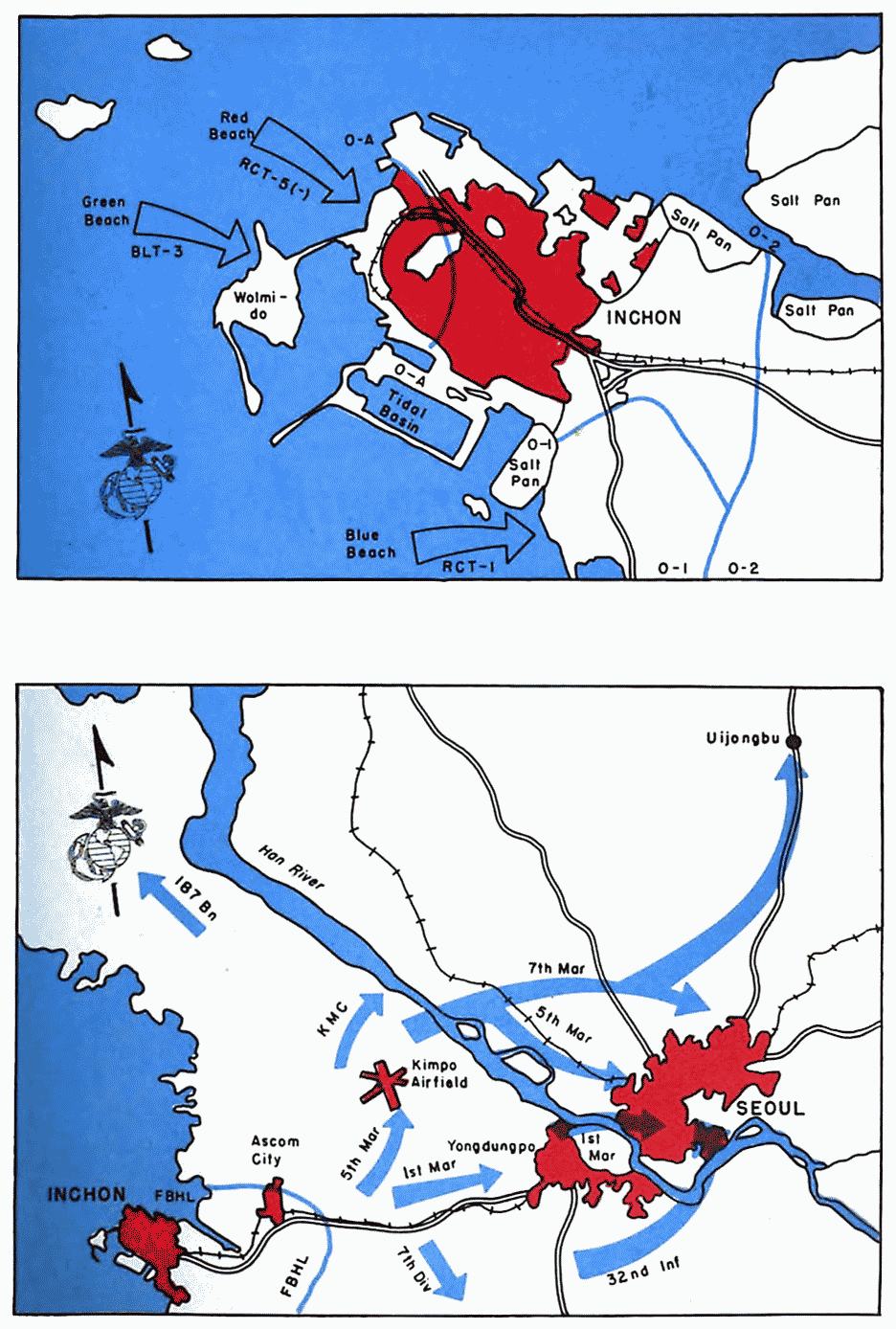
CHAPTER I The Communist Challenge — Authorization of Marine Brigade — First Conference on Inchon Landing — General Shepherd in Tokyo — Request for a Marine Division — America’s Force-in-Readiness — Planning for the Pohang Landing
Authorization of Marine Brigade—First Conference on Inchon
Landing—General Shepherd in Tokyo—Request for a Marine
Division—America’s Force-in-Readiness—Planning for the
Pohang Landing
No spot on earth could have seemed farther removed from war’s
alarms than Yellowstone Park on the tranquil Sunday afternoon
of 25 June 1950. Yet it was here that Lieutenant General
Lemuel C. Shepherd, Jr., Commanding General of Fleet Marine
Force, Pacific (FMFPac), had his first news of Communist armed
aggression in Korea and the resulting threat to world peace.
Appointed to his new command only nine days before, he was
motoring from the Marine Corps Schools at Quantico to the West
Coast. From Yellowstone Park he advised Admiral Arthur W.
Radford, Commander in Chief, U. S. Pacific Fleet, of his readiness
to proceed to Hawaii and the Far East. His offer was accepted, and
a Marine plane from El Toro transported him from Salt Lake City
to San Francisco. There he boarded the first available plane to Pearl
Harbor, arriving in the early morning hours of 2 July.1
On this date, with the Korean conflict only a week old, the armed
forces of the United States were already committed. From the outset
the United Nations had viewed the Red Korean invasion of the
Republic of Korea as a challenge issued to free nations by World
Communism. The so-called North Korean People’s Republic had
been set up after World War II as a Communist puppet state, and
the army of invasion was both trained and armed by Soviet Russia.
More than half of the troops in the original North Korean People’s
Army (NKPA) were veterans of the victorious Chinese Communist
forces in the Chinese Civil War. Weapons and equipment, all the
way from T-34 tanks to Tokarev pistols, had been made available
by the Soviet Union; and Soviet instructors prepared the invading
army for its surprise attack of 25 June on the Republic of Korea.2
There could have been little doubt as to the outcome. Although
the ROK army included eight divisions and a regiment, estimated
at some 98,000 men in all, it could not compare with the NKPA
establishment of about equal numbers. The difference lay in the
purposes for which the two forces had been organized during the
joint Soviet-American occupation of Korea after World War II.
While Red Army officers created the NKPA as an instrument of
aggression, American instructors trained the ROK troops for frontier
defense and internal security. They had neither tanks nor combat
aircraft, and their heaviest artillery consisted of a few battalions of
105mm howitzers. It was scarcely more than a lightly armed constabulary
which crumpled at the first shock of NKPA columns led
by Soviet-made tanks and supported by Soviet-made bombing planes.
The four ROK divisions deployed along the frontier were routed,
and Seoul fell to the invaders on the third day.
The reaction of the United Nations was prompt and decisive. On
27 June the UN Security Council denounced the NKPA attack as a
breach of world peace and called upon member nations to aid the
Republic of Korea. The United States and 52 other nations approved
this resolution, which was opposed only by the Soviet Union and two
of its satellites.3
As the NKPA tanks entered Seoul, just evacuated by American
nationals, President Truman ordered American air and sea forces in
the Far East to support the shattered ROK army. With the U. S.
Seventh Fleet protecting Formosa, Task Force 77 bombed and
bombarded points on the Korean coast. Far East Air Forces (FEAF),
consisting of eight and a half combat groups commanded by Lieutenant
General George E. Stratemeyer, USAF, flew interdictory
strikes meanwhile from bases in Japan against NKPA supply lines.
Within a few days the NKPA air force, consisting of about 100
Yak-type planes, was driven from the skies except for occasional night
raids. It would appear that a mountainous peninsula of few good
roads would be a favorable area for strategic bombing, since our
naval forces were denying the sea lanes to the enemy. Yet the FEAF
bombers could not prevent the aggressors from bringing up supplies
at night by means of truck, animal, and human transport. The
columns of invasion were doubtless hampered, but they continued to
roll on southward in spite of interdictory strikes.
General of the Army Douglas MacArthur, Commander in Chief,
Far East (CinCFE), concluded on 29 June, during his first flying
visit to the front, “that air and naval action alone could not be decisive,
and that nothing short of the intervention of U. S. ground
forces could give any assurance of stopping the Communists and of
later regaining the lost ground.”4 Unfortunately, he had only the
four understrength divisions of the Eighth U. S. Army at his disposal
in the Far East. During the two World Wars the United States had
been able to raise and train armies while allies held the line. But no
such respite was forthcoming in Korea, and the first U. S. ground
forces at the front consisted of a small task force flown from Japan—an
incomplete battalion reinforced by a battery of artillery.
The date was 2 July 1950. And on this same Sunday, CinCFE
sent a request to Washington for the immediate dispatch of a Marine
regimental combat team (RCT) with appropriate air to the Far East.
It is not quite a coincidence that 2 July happened also to be the date
of General Shepherd’s arrival at Pearl Harbor. Previous decisions
in Washington had made it virtually certain that General MacArthur’s
request would be granted, and CG FMFPac was on his way to the
Far East to prepare for the reception of the Marine reinforcements.
The first step had been taken on 28 June. General Clifton B.
Cates, Commandant of the Marine Corps, conferred at the Pentagon
with Admiral Forrest P. Sherman, Chief of Naval Operations. He
urged that troops of the Fleet Marine Force be employed, and CNO
promptly informed Vice Admiral C. Turner Joy, Commander of
Naval Forces, Far East (ComNavFE), that a Marine RCT could be
made available if General MacArthur desired it.5
CinCFE had hoped that an entire Marine division could be sent
to the Far East. But after being briefed by Admiral Joy as to the
limitations of Marine Corps numbers, he had to content himself with
the request for an RCT.
Admiral Sherman acted at once. With the approval of JCS and
the President, he ordered Admiral Radford to transport the Marine
units across the Pacific. This was the inception of the 1st Provisional
Marine Brigade (Reinf.), which was activated on 7 July with
three squadrons of Marine Aircraft Group 33 as its air component.6
While General Shepherd stopped for a few days at Pearl Harbor, the
possibility of an Inchon amphibious operation was mentioned officially
for the first time at a conference in Tokyo attended by two Marine
officers.
On 4 July a party given by the American colony was interrupted
by a message for Brigadier General William S. Fellers, commanding
general of Troop Training Unit, Amphibious Training Command,
Pacific Fleet, and Colonel Edward S. Forney, commanding Mobile
Training Team Able of that organization. As specialists in amphibious
techniques, they were summoned along with Army and Air Force
officers to a meeting at Headquarters, FECOM, presided over by
General MacArthur’s chief of staff, Major General Edward M.
Almond, USA.7
The Marine officers were in Japan as a result of General MacArthur’s
belief in the efficacy of amphibious tactics. Early in 1950, several
months before the outbreak of the Korean conflict, he had foreseen
the necessity of recovering lost ground by means of a ship-to-shore
assault if an enemy ever won a foothold in the Japanese Islands. His
request for amphibious instructors to train U. S. Army troops in Japan
had found the Navy and Marine Corps ready with units set up for
just such a purpose.8
The oldest was the TTU organization of the Phib Tra Pac established
originally on 15 August 1943 to prepare Army as well as Navy
and Marine forces for amphibious operations. After making a distinguished
record in World War II, TTU created a permanent place
for itself during the following five years.9
A group of TTU officers and enlisted men under the command
of Colonel Forney made up Mobile Training Team Able in the spring
of 1950. Sailing from San Diego in April, these Marines were accompanied
by a second group of amphibious specialists, the ANGLICO
(Air and Naval Gunfire Liaison Company) instruction team commanded
by Lieutenant Edward B. Williams, USN.10
The ANGLICOs, composed of both Navy and Marine Corps personnel,
evolved in 1949 to assist Army units lacking the forward air
control and naval gunfire control units which are integral in Marine
divisions. Growing out of the responsibility of the Marine Corps
for the development of those phases of landing force operations pertaining
to tactics, techniques, and equipment employed by landing
forces, the first company was formed in answer to the request of
Lieutenant General Mark W. Clark, USA, for a unit capable of giving
an Army division this sort of amphibious fire support. After taking
part in the MIKI exercises with the Sixth Army in Hawaii during
the autumn of 1949, this ANGLICO split up into instruction teams
assigned to various Army units.11
Training Team Able and Lieutenant Williams’ ANGLICO team
reached Japan just in time to cooperate with a third organization of
amphibious specialists, Rear Admiral James H. Doyle’s Amphibious
Group (PhibGru) One of the Pacific Fleet. The three teams were
given a mission of training one regiment from each of the four Eighth
Army divisions in Japan. But the instruction program had only been
launched when it was interrupted by the Korean conflict.
PhibGru One and the ANGLICO team were immediately assigned
to new duties in connection with the sea lift of Eighth Army troops
to Korea. They had just begun this task when orders came for
Admiral Doyle and his staff, in the USS Mount McKinley at Sasebo,
to proceed by air on 4 July to the conference at Tokyo.12 There at
FECOM Headquarters, they met General Fellers, Colonel Forney,
and the Army officers who had been summoned from the Independence
Day celebration of the American colony.
At the conference it was made plain that the concept of an Inchon
landing had originated with General MacArthur. Even at this early
date, he envisioned not only a ship-to-shore assault on some east or
west coast seaport, preferably Inchon, but also a drive inland to cut
enemy communications and envelop Seoul. The Joint Strategic Plans
and Operations Group (JSPOG) headed by Brigadier General Edwin
K. Wright, U. S. A. (FECOM G-3) was then drawing up the outline
of such an amphibious attack plan. Code-named Operation BLUEHEARTS,
it called for a landing in the Inchon area by a Marine
RCT and an Army assault force in coordination with a frontal attack
from the south by the 24th and 25th Divisions. Inchon had been
designated the objective area for the amphibious assault, and the date
would depend upon the availability of troops for the combined
operation.13
It would be an understatement to say that the naval and Marine
officers were impressed by the boldness of MacArthur’s thinking. At
a time when he could send only a battalion-size force to the aid of
the shattered ROK army, his mind had soared over obstacles and
deficiencies to the concept of an amphibious operation designed to
end the war at a stroke.
It was an idea that fired the imagination. But the amphibious
specialists of TTU and PhibGru One had been trained to view the
risks with a realistic appraisal. Their admiration was tempered by
caution, therefore, when they took into account the difficulties.14
The end of World War II had found the United States at a peak
of military strength never before attained in the Nation’s history.
Then, within a year, the popular clamor for the immediate discharge
of citizen-soldiers had left the Army with scarcely enough troops for
the occupation of strategic areas in the Far East. It took vigorous
recruiting to fill the ranks in time of peace, and on 25 June 1950 the
U. S. Eighth Army in Japan included the 7th, 24th, and 25th Infantry
Divisions and the 1st Cavalry (dismounted) Division. Infantry regiments
were limited to two battalions.
In the lack of trained amphibious assault troops, a definite decision
could not be reached at the conference of 4 July. But it was proposed
by FECOM officers that Major General Hobart H. Gay’s 1st Cavalry
Division be employed as the Army assault force of the proposed
Inchon operation. PhibGru One and Training Team Able were to
give the troops all possible amphibious training, and Colonel Forney
was assigned on 5 July as the G-5 (Plans) of the division.15
The activation of the 1st Provisional Marine Brigade on 7 July freed
General Shepherd to continue his trip to the Far East. That evening,
accompanied by his G-3, Colonel Victor H. Krulak, he took off from
the Pearl Harbor area on the flight to Tokyo.
Upon his arrival, CG FMFPac was acquainted by General Almond
with the deteriorating military situation. As a first step toward sending
U. S. ground forces to Korea, CinCFE had set up the GHQ Advanced
Command Group under the command of Brigadier General
John H. Church, USA. After beginning the reorganization of the
ROK forces, it was absorbed on 3 July by Headquarters, U. S. Armed
Forces in Korea. And with the establishment next day of the Pusan
Logistical Command (Brigadier General Crump Garvin, USA), a
start was made toward handling the mountains of supplies which
would be required.16
On 4 July the initial contact of U. S. ground forces with the enemy
took place near Osan. The little task force from Major General
William F. Dean’s 24th Infantry Division could not attempt anything
more ambitious than delaying actions. But preparations were afoot
to send the rest of the division to Korea as soon as possible, to be
followed by Major General William B. Kean’s 25th Infantry Division.
The first fire fights occurred on 5 and 6 July in the vicinity of
Osan. It was evident at once that the enemy held a great superiority
in arms and equipment. Lieutenant General Walton H. Walker,
USA, who had been one of Patton’s favorite subordinates, commented
after his first visit to the Korean front that the NKPA units appeared
equal to the Germans who were his adversaries in World War II.17
Accounts of the early actions in Korea were depressing to FECOM
officers.18 Many plausible excuses may be found for men snatched
from occupation duties and rushed piecemeal into action against great
material odds. The nation as a whole must share the blame when
willing troops are sent to the firing line without adequate preparation,
as were the first U. S. units. Eighth Army officers had done their
best under the circumstances, but a scarcity of maneuver areas in Japan
had restricted training exercises to the battalion and company levels.
Divisions with barely 70 percent of their full complement of troops
were armed with worn World War II weapons, some of which proved
unserviceable for lack of spare parts and maintenance personnel.
Division tank units, equipped with light M-24 tanks because of poor
roads and bridges in Japan, operated at a handicap against the enemy’s
new Soviet T-34 tanks; and American 2.36-inch rocket launchers
knocked out NKPA armor only at fairly close ranges.19
At this stage the ground forces were particularly dependent upon
air support because of shortages of artillery. But since the mission
of the Air Force in Japan had been primarily of a defensive nature,
neither the organization nor equipment was available for effective
air-ground cooperation on the tactical level. As a consequence,
FEAF units had to confine their tactical efforts largely to targets of
opportunity, and 24th Infantry units had to do without such support
when it was most needed.20
Altogether, the so-called “police action” in Korea proved to be one
of the toughest assignments ever given to American soldiers.
General Shepherd’s few days in Tokyo were filled with conferences,
and history was made on 10 July during the course of a conversation
with General MacArthur at FECOM Headquarters.
The commander in chief was not optimistic about the situation at
the front. Not only had the NKPA invasion developed into a formidable
threat at the end of the first two weeks, but the possibility
of Red Chinese or Soviet armed intervention could not be dismissed.
President Truman had named General MacArthur as supreme
commander of UN forces after the Security Council passed a resolution
on 7 July calling for a unified effort in Korea. General Walker
was soon to be appointed to the command of the Eighth Army in
Korea (EUSAK), assuming control of all ROK ground forces.
The personnel situation had grown critical. After being completely
routed, the ROK troops were now in process of reorganization into
five divisions. Meanwhile, the U. S. 25th Infantry Division was being
sent to Korea as rapidly as possible; and it had been decided to withdraw
the 1st Cavalry Division from consideration as the landing force
of the proposed Inchon operation. Not only were these troops lacking
in amphibious training, but they were needed as infantry reinforcements.
Thus it was planned for the combat-loaded 1st Cavalry
Division to make a landing at the East Coast port of Pohang-dong,
under the direction of ComPhibGru One and Mobile Training Team
Able, before proceeding to the front. This would leave only the 7th
Infantry Division in Japan, and it was being stripped of troops to fill
out units of the other three.
The outweighed UN forces were still limited to delaying actions.
But General MacArthur hoped that space could be traded for time
until the arrival of stateside units enabled him to take the offensive.
At his urgent request, the 2d Infantry Division and 2d Engineer
Special Brigade had been alerted in the United States for immediate
movement to the Far East. Port dates commencing on 20 July had
been assigned, and General Wright expressed his opinion that these
units might be employed along with the recently activated 1st Provisional
Marine Brigade to initiate the first UN counterstroke.21
The only hope of an early UN decision, General MacArthur told
CG FMFPac at their conference of 10 July, lay in the launching of an
amphibious assault to cut supply lines in the enemy’s rear. This
situation, he added, reminded him of the critical days of World War
II in the Pacific, when troops trained in amphibious techniques were
urgently needed to make ship-to-shore landings on Japanese-held
islands.
In a reminiscent mood, MacArthur recalled the competence shown
by the 1st Marine Division while under his control during the New
Britain operation of 1943–1944. If only he had this unit in Japan, he
said, he would employ it at his first opportunity as his landing force
for the Inchon assault.
Shepherd, who had been assistant division commander of the 1st
Marine Division during the New Britain landings, immediately suggested
that the UN supreme commander make a request that the
1st Marine Division with appropriate Marine air be assigned to him.
This possibility had apparently been put aside by MacArthur after
being limited to an RCT in his request of 2 July. He asked eagerly
if the Marine general believed that the division could be made available
for an Inchon landing as early as 15 September. And Shepherd
replied that since the unit was under his command, he would take
the responsibility for stating that it could be sent to Korea by that
date, minus the infantry regiment and other troops of the Brigade.22
Thus was history made without pomp or ceremony during the
conference at FECOM Headquarters.
The date was 10 July, but it was already D-minus 67 for thousands
of American young men. On farms and in offices, in cities and villages
from coast to coast, these civilians had no inkling that just 67
days later they would be fighting their way ashore in a major amphibious
operation. For they were Marine reservists, and the 1st Marine
Division could not be brought up to full strength without calling them
back into uniform.
Shepherd realized, even while assuring MacArthur that the division
could be made combat-ready by 15 September, that the activation of
the Brigade had left the division with less than the strength of a
single RCT. Nearly as many men would be required to bring it up
to full strength as were contained at present in the entire Fleet Marine
Force.23 But so great was his confidence in the Marine Corps Reserve
that he did not hesitate to take the responsibility.
Nor did MacArthur lose any time at making up his mind. That
very day, 10 July, he sent his first request to the Joint Chiefs of Staff
for a Marine division.
As the conference ended, Shepherd found the UN supreme commander
“enthusiastic” about the prospect of employing again the
Marine outfit that had been his reliance seven years before in the New
Britain operation. He planned to stabilize the front in Korea as soon
as possible, he said, as a prelude to the landing in the NKPA rear
which he believed would be decisive.24
Long before the New Britain landing, Cates and Shepherd had learned
from first-hand experience as junior officers how decisive a force-in-readiness
can be. The lieutenant from Tennessee and the lieutenant
from Virginia took part in June 1918 with the Marines who stopped
the Germans by counterattacking at Belleau Wood. In terms of
human tonnage, two Marine regiments did not cut much of a figure
in the American Expeditionary Force. What counted was the readiness
of the Marines and a few outfits of U. S. Army regulars at a time
when most of the American divisions had not yet finished training.
More than three decades later, as CMC and CG FMFPac, both
Marine generals were firm advocates of the force-in-readiness concept
as a basic mission of the Marine Corps. It was a mission that had
evolved from practice rather than theory. During the half century
since the Spanish-American War, there had been only two years
when U. S. Marines were not on combat duty somewhere. It had
long been a tradition that the Marines, as transitory naval forces, might
land on foreign soil without the implication of hostilities usually associated
with invasion. This principle was invoked, along with a liberal
interpretation of the Monroe Doctrine, by the State Department from
1906 to 1932 in the Caribbean and Central America. As a means of
supervising unstable governments in sensitive strategic areas, Marines
were sent to Cuba, Mexico, Haiti, the Dominican Republic, Nicaragua,
and China for long periods of occupation.25
U. S. Marines were not only web-footed infantry during these overseas
operations; they also distinguished themselves as scouts, cannoneers,
constabulary, engineers, and horse marines. As modern warfare
grew more complex, however, the time came when the Leathernecks
could no longer sail on a few hours’ notice as a “gangplank
expeditionary force” made up of men detailed from the nearest posts
and stations. No longer could such light weapons as machine guns,
mortars, and mountain howitzers serve as the only armament necessary
for seizing a beachhead.
The Fleet Marine Force evolved in 1933, therefore, to fill the need
for a corps of highly-trained amphibious specialists capable of carrying
out a major ship-to-shore assault against modern defensive
weapons. New landing craft as well as new landing tactics and techniques
were developed during the next ten years, and the reputation
of the Marine Corps as a force-in-readiness was upheld in the amphibious
operations of World War II.
During these three eventful decades of Marine development, General
Cates and General Shepherd had participated in all the stages
while ascending the ladder of command. Thus in the summer of
1950, they were eminently qualified for leadership in the task of building
the 1st Marine Division up to war strength for the amphibious
operation which General MacArthur hoped to launch on 15 September.
As a prerequisite, the sanction of Congress and authorization of
the President had to be obtained before the Marine Corps Reserve
could be mobilized. General MacArthur’s request of 10 July for a
Marine division went to the Joint Chiefs of Staff, who referred it to
General Cates. The Commandant could only reply that it would be
necessary to call out the Reserve, and no action was taken on this first
request. It was enough that a beginning had been made, and CMC
put his staff to work on the necessary studies and plans.
General Shepherd was meanwhile winding up his visit to Tokyo
by conferring with Admirals Joy and Doyle and Generals Almond
and Stratemeyer. The Air Force general tentatively confirmed
(subject to discussion with his staff) the assignment of Itami Airfield in
Japan to Marine air units. He also informed CG FMFPac that he
accepted as valid the principle of employing Marine air in support
of Marine ground forces.26
The air situation in Korea had struck General Shepherd as abounding
in paradoxes. He noted that “B-29’s are employed against
tactical targets to the dissatisfaction of all concerned—the Air Force
because of misemployment of its planes, and the ground forces because
of the results achieved. Carrier aircraft, despite the wealth of close
support targets available, were committed against deep and semi-strategic
targets. Jet fighters, with little enemy air to engage, have
been assigned to close support work despite a fuel restriction which
holds them to no more than 15 minutes in the combat zone. Only a
very limited number of aircraft adaptable to tactical support missions
are available (F-51 and B-26) and there appears to be urgent need
for suitable close support aircraft along with competent air-ground
liaison units.”27
These conclusions had much to do with a Marine policy, dating
back to World War II, of insisting whenever possible on Marine
close air support for Marine ground forces. Without disparaging
other techniques, Marines believed that their own fliers, trained in
Marine infantry methods, could provide the most effective tactical
air for Marine infantry.
While General Shepherd was flying back to Pearl Harbor, a succession
of sleepless nights awaited the officers of PhibGru One, the
ANGLICO group, and Training Team Able. Upon the shoulders
of these amphibious specialists fell the task of drawing up the orders,
planning the loading, and mounting out the troops of the 1st Cavalry
Division for its landing of 18 July at Pohang-dong.
It was not even certain, when the division commenced loading at
Yokohama on 14 July, that Pohang-dong could be held by the ROKs
long enough for a landing to be effected. Three reinforced NKPA
divisions were making the enemy’s main thrust down the Seoul-Taejon
axis. They were opposed only by weary 24th Infantry Division
units fighting delaying actions while falling back on Taejon
and the line of the river Kum. Along the east coast and the mountains
of the central sector, five regrouped and reorganized ROK
divisions held as best they could. Two of these units in the center
were being relieved by the U. S. 25th Infantry Division, which completed
its movement to Korea on the 14th.
As a preliminary step in the Pohang landing, a reconnaissance
party of Army, Navy, and Marine officers flew from Tokyo on 11 July
into the objective area. They returned two days later with valuable
information about the beaches, depths of water, and unloading
facilities.
“Because of the extraordinary speed with which the landing at
Pohang-dong was conceived, planned, and executed,” said the report
of ComPhibGru One, “there was no opportunity for conventional
and orderly planning.... Since all echelons of the planning force
were installed in offices at GHQ in Tokyo, it was possible to employ
the quickest and most informal ways of doing business. Telephone
conversations and oral directives were used in place of dispatches,
letters, and formal orders.”28
Lack of amphibious shipping in the area made it a Herculean labor
to provide boat servicing gear, general securing gear, debarkation
nets, towing bridles, and boat and vehicle slings in less than a week.
By 14 July, however, enough shipping to move the four embarkation
groups of the division had been assembled at Yokohama—two MSTS
transports, two AKAs, six LSUs, and 16 LSTs in addition to LCVPs
and LCMs.
The transport group and screen got under way on the 15th for a
rendezvous near the objective area on D-day with the tractor group.
Naval aircraft of Rear Admiral John M. Hoskins’ carrier group of the
Seventh Fleet were on call to provide support; but at 0558 on the
18th, the armada was unopposed as it steamed into Yongil Bay. CTF
90 signaled orders for the carrying out of Plan Baker, calling for a
landing against little or no enemy resistance. By midnight the Mount
McKinley, Union, Oglethorpe, and Titania had been completely unloaded,
and the LSTs had accounted for 60 per cent of their cargoes.
Altogether, 10,027 troops, 2,022 vehicles, and 2,729 tons of bulk cargo
were put ashore on D-day.
The Second Echelon consisted of six LSTs, three APs, and four
Japanese freighters, while six LSTs made up the Third Echelon. These
ships discharged their cargo from 23 to 29 July, having been delayed
by Typhoon GRACE. And on the 30th, ComPhibGru One, as CTF
90, reported that the operation had been completed and no naval units
were now at the objective.29
Viewed superficially, the uncontested Pohang landing may have
seemed a tame affair to stateside newspaper readers. Nevertheless, it
was a timely demonstration of Navy and Marine Corps amphibious
know-how and Army energy, and it came at a critical moment. The
important communications center of Taejon had to be abandoned by
24th Infantry Division units on 20 July, and it was growing apparent
that the Eighth Army would be hard-pressed to retain a foothold in
Korea until reinforcements from the States could give the United
Nations a material equality. It was a time when every platoon
counted, and the fresh regiments of General Gay’s division were rushed
to the Yongdong area two days after their landing to relieve weary
and battered elements of the 24th Infantry Division.
CHAPTER II The Minute Men of 1950 — Expansion to Full Peace Strength — Mobilization of Marine Corps Reserve — The Influx at Camp Pendleton — Embarkation of 1st Marine Division — Build-up of 7th Marine Regiment — Staff Groups Flown to Japan
Expansion to Full Peace Strength—Mobilization of Marine
Corps Reserve—The Influx at Camp Pendleton—Embarkation
of 1st Marine Division—Build-up of 7th Marine Regiment—Staff
Groups Flown to Japan
On 18 July 1950, it was D-minus 59 for the Marine reservists who
would hit the beaches at Inchon. These young civilians were
doubtless more interested in major league baseball standings at the
moment than in hydrographic conditions at the Korean seaport they
would assault within two months. Yet the proposed amphibious
operation moved a long step closer to reality on the 18th when Major
General Oliver P. Smith left Washington under orders to assume command
of the 1st Marine Division at Camp Pendleton, California.
A graduate of the University of California in 1916, General Smith
had been commissioned a Marine second lieutenant at the age of 24
in the first World War. After serving in Guam during that conflict,
he saw duty at sea and in Haiti during the early 1920’s, followed by
studies at the Army Infantry School, Fort Benning, Georgia, and duty
as an instructor in the Marine Corps Schools at Quantico.
In Paris, while attached administratively to the office of the U. S.
Naval Attaché, he took the full two-year course at the École Supérieure
de Guerre, and afterwards he was an instructor for three more years
at the Marine Corps Schools. He had an extensive experience of
hard-fought amphibious operations during World War II as a regimental
commander in the Talasea, New Britain, landing, as ADC of
the 1st Marine Division at Peleliu, and as deputy chief of staff of the
U. S. Tenth Army on Okinawa. Returning with the rank of brigadier,
he became Commandant of the Marine Corps Schools; and
after putting up a second star, the tall, slender, white-haired general
served as Assistant Commandant at Marine Corps Headquarters in
Washington.
At the outbreak of the Korean conflict, Major General Graves B.
Erskine had commanded the 1st Marine Division. Following his
assignment to a secret State Department mission in southeast Asia,
General Smith was named as his relief.
The division had meanwhile been reduced to 3,386 officers and men
as compared to a strength of 7,789 on 30 June 1950. It had been
stripped of its principal operating elements to build up the 1st Provisional
Marine Brigade, which numbered about 5,000 officers and men
when it sailed from San Diego to the Far East on 14 July under the
command of Brigadier General Edward A. Craig.30
At El Toro, the near-by Marine Corps Air Station, it was the same
story. The 1st Marine Aircraft Wing, with a total strength of 4,004
officers and men on 30 June, provided most of the 1,548 officers and
men of Marine Aircraft Group 33, the air component of the Brigade,
commanded by Brigadier General Thomas J. Cushman, who was also
deputy Brigade commander.31
General Smith had known before his arrival at Pendleton that his
first task would be the building up of the 1st Marine Division to full
peace strength. As early as 12 July, a dispatch from CNO had warned
CinCPacFlt that this expansion would take place, including the elements
of the Brigade.32 And on 15 July General Shepherd directed
Brigadier General Harry B. Liversedge, temporary CG 1st Marine
Division, to extend the work day and work week while intensifying
training and making preparations to expand.33
The 15th was also the date of General MacArthur’s second request
for a war-strength Marine division with its own air for employment
in his proposed Inchon amphibious assault. General Shepherd advised
CMC that same day as to the composition of cadres to facilitate
the rapid expansion of the 1st Marine Division.34
Already it was becoming apparent that this build-up would allow
little time for training. Fortunate it was, therefore, that the Division
and the 1st Marine Aircraft Wing had participated in an intensive
training program during recent months. Following are the principal
exercises:
| Oct 1949 |
Air lift field exercise involving movement of a reinforced battalion and air command to San Nicholas Island, Calif. One Marine aircraft group carrier-embarked for participation in Operation MIKI with Sixth Army in Hawaii. |
| Nov 1949 |
Field exercise involving a reinforced regiment and supporting aircraft. |
| Dec 1949 |
Combined field exercise—a simulated amphibious assault extending over a period of seven days—involving all principal elements of the Division and Wing. |
| Jan 1950 |
Participation by elements of Division in Operation MICOWEX 50, stressing the use of the transport submarine and helicopter in amphibious operations. |
| Feb 1950 |
Field exercise involving a reinforced regiment with supporting air. |
| Mar 1950 |
Land plane and seaplane air-lift exercise involving seizure of San Nicholas Island by a reinforced battalion and a Marine air command. |
| May 1950 |
Participation by a majority of Division and Wing elements in DEMON III, an amphibious demonstration for students of Command and General Staff College, Fort Leavenworth. Participation by Wing in two-week major advanced base field exercise, with intensive training in close support. |
| Jun 1950 |
Continuation of training in lesser air-ground problems, field exercises and command post exercises.35 |
Counterparts of nearly all of these exercises might have been found
in the training program for the 2d Marine Division and 2d Marine
Aircraft Wing on the North Carolina coast. Operation CAMID at
Little Creek, Va., was similar to DEMON III. All principal
FMFLant elements participated in Operation CROSSOVER at Camp
Lejeune, North Carolina, in the spring of 1950, and a Marine aircraft
group was embarked aboard a carrier in the Mediterranean. Other
elements of the Wing took part in PORTREX, an Army-Navy
amphibious exercise in the Caribbean, and in SWARMER, an Army-Air
Force airborne exercise in North Carolina. Units of both the
Division and the Wing were represented in the annual Amphibious
Command Post Exercise at Lejeune; and throughout the winter and
spring a succession of smaller ground, air, and air-ground exercises
emphasized close support and amphibious landings.
Posts and stations were meanwhile conducting annual weapons
qualification firing tests and individual training as required by USMC
General Order No. 10. This program was designed to maintain the
basic military proficiency of men not serving with the Fleet Marine
Force. It is significant, however, that a large proportion of them had
reported to such duty directly from FMF units, in accordance with the
rotation policy.
The program for the Organized Reserve included both armory and
active duty summer training. Air and ground units of reservists were
“adopted” during their summer training by similar units of the Fleet
Marine Force, which supervised the exercises and provided instructors.
By the summer of 1950, a large proportion of the reservists had
progressed beyond basic training into advanced individual and unit
training, so that they could be classed as “nearly combat ready” at the
time of the 1st Marine Division expansion.36
Shortcomings in quantity rather than quality of Marine personnel
made expansion a problem on 19 July 1950, when General MacArthur
sent his third request to the Pentagon for a Marine division with
appropriate air. Again the Joint Chiefs referred the matter to General
Cates, who was prepared with two plans worked out in detail by
his staff—Plan ABLE, providing third rifle companies and replacements
for the Brigade; and Plan BAKER, designed to bring the 1st
Marine Division up to full war strength by calling reservists to active
duty.
These plans were based on the personnel statistics of 30 June 1950.
The grand total of 74,279 Marines on active duty at that time (97
per cent of authorized strength) was distributed as follows:
| Operating Forces—engaged directly in carrying out assigned missions and tasks |
40,364 |
| Supporting Establishment—comprising trained administrative and supply personnel |
24,552 |
| Special Assignment—including all personnel serving with organizations outside the regular establishment |
3,871 |
| Non-Available—made up of personnel hospitalized, confined, or en route |
5,492 |
| Total |
74,279 |
A breakdown of the Operating Forces reveals that the Fleet Marine
Force numbered 27,703 men, the security detachments included 11,087,
and 1,574 Marines were afloat. Of the 11,853 in FMFPac, 7,779 were
in the 1st Marine Division, and 3,733 in the 1st Marine Aircraft Wing.
The 15,803 Marines in FMFLant included 8,973 in the 2d Marine
Division and 5,297 in the 2d Marine Aircraft Wing.37
These figures make it evident that the 1st Marine Division could
not be brought up to war strength of about 25,000 troops without
drawing upon the 33,527 (77 per cent of authorized strength) in the
ground forces of the Organized Reserve, and the 6,341 (94 per cent of
authorized strength) in the aviation forces. The ground personnel
were distributed among these units:
Twenty-one infantry battalions; 16 rifle companies; seven 105mm
howitzer battalions; five 155mm howitzer battalions; one 155mm gun
battalion; two 40mm gun batteries; two tank battalions; three amphibian
tractor battalions; one amphibian truck company; one signal
company (supplementary); six signal companies; one engineer battalion;
15 women’s reserve platoons.
Aviation units consisted of 30 Marine fighter squadrons (VMF)
and 12 Marine ground control intercept squadrons (MGCI).
The Organized Reserve was exceeded as a reservoir of potential
man power by the Volunteer Marine Corps Reserve, which had a
total of 90,044 men and women on 30 June 1950. This total included
2,267 volunteer reservists on continuous active duty with the regular
establishment, about 5,000 training in some 200 volunteer training
units, and 1316 in the Fleet Reserve.
Altogether, the strength of all Marine reserve components (less
volunteer reservists on active duty) amounted to a total of 128,959,
or nearly double the number of Marines in the regular establishment.38
Behind every Marine regular, figuratively speaking, stood two reservists
who were ready to step forward and fill the gaps in the ranks.
Thus it was scarcely far-fetched when some inspired public information
officer coined the phrase “Minute Men of 1950” for these recent
civilians who made it possible for the 1st Marine Division to hit the
beaches at Inchon.
Events moved swiftly on 19 July. Only a few hours after the
receipt of CinCFE’s third request, the mobilization of the Marine
Corps Reserve was authorized by President Truman with the sanction
of Congress. Headquarters Marine Corps, on the hill overlooking
the Pentagon, was ablaze with lights that summer night; and
decisions were made which enabled four important steps to be taken
next day:
(1) a warning to Reserve District directors that the Organized Reserve
would soon be ordered to active duty;
(2) notification to commanding generals to expect some 21,000 Organized
Reservists shortly at Marine Barracks, Camp Pendleton, and about 5,800
at Marine Barracks, Camp Lejeune;
(3) orders issued by CMC, with the approval of CNO, to discontinue the
practice of discharging reservists at their own request;
(4) the first reservists—22 units with a total strength of 4,830 men—ordered
to active duty with a delay of ten days.39
The Joint Chiefs of Staff were still not convinced that a Marine force
could be embarked to meet General MacArthur’s deadline of 10 September
without stripping FMFLant units to a dangerous extent. On
the advice of Admiral Sherman, they informed CinCFE on 20 July
that a Marine division could not be sent before November or even
December.
General Shepherd had a great deal to do with shaping the ultimate
decision. On the 20th, when CNO conferred with Admiral
Radford on the question of a Marine division, the Commander of the
Pacific Fleet in his turn asked the opinion of the Marine general.
General Shepherd replied that a Marine amphibious striking force
could be raised for the proposed Inchon landing without seriously
weakening the Fleet Marine Force as a whole. This striking force,
he predicted, would prove to be “the key of achievement of a timely
and economical decision for our arms.”40
The Marine general’s statement was one of the main factors in
causing the Joint Chiefs to advise MacArthur on the 22d that they
were reconsidering their stand. During the next 48 hours, as dispatches
sped back and forth across the Pacific, a compromise was
reached. CinCFE was promised his Marine division in time for his
target date—but it was to be a division minus one RCT. In other
words, the infantry regiment of the Brigade would be supplemented
by another RCT and supporting troops with appropriate Marine air.
But the Joint Chiefs were adamant in their decision that MacArthur
must wait until autumn or even winter for his third RCT.
These preliminaries cleared the way so that General MacArthur’s
request was finally approved by JCS on 25 July, the day when General
Smith took over command of the 1st Marine Division. The Marine
Corps was directed to build the division (less one RCT) up to full
war strength, and a date of departure of 10–15 August for the Far
East was set.
A 50 percent reduction in Marine security forces within the continental
limits of the United States was authorized by CNO on that
same date. This meant that an additional 3,630 regulars would be
enabled to report for service with the 1st Marine Division.
On the morning of the 26th a courier from Washington arrived at
Camp Pendleton with a communication for General Smith indicating
that the expanded 1st Marine Division would be composed of four
types of personnel: (1) Brigade units, to be combined with the Division
upon arrival in the Far East; (2) units of the 2d Marine Division,
to be ordered to Camp Pendleton to augment elements of the
1st; (3) regular personnel to be called in from posts and stations;
and (4) final deficiencies to be filled by men from the Marine Corps
Reserve who met minimum combat experience requirements.41
Congress passed legislation on 27 July authorizing the President to
extend for one year all enlistments in the armed forces, both regular
and reserve, which were due to expire before 9 July 1951. This gave
the assurance of a stable body of troops.
On the 31st, with the first reservists arriving at Camp Pendleton and
the first contingents leaving Camp Lejeune for the West Coast, the
Joint Chiefs of Staff directed CNO to expand the 2d Marine Division
to war strength while increasing the number of Marine tactical air
squadrons from 16 to 18.42 Obviously, the 1st and 2d Divisions could
not be built up simultaneously without serious delays, and priority
must be given to the 1st. It was equally obvious, moreover, that this
expansion must be largely accomplished during the first week of
August if the troops were to be made ready for embarkation between
the 10th and 15th.
The first build-up troops to reach Camp Pendleton were three Organized
Reserve units which arrived on 31 July—the 13th Infantry Company,
of Los Angeles; the 12th Amphibian Tractor Company, of San
Francisco; and the 3d Engineer Company, of Phoenix, Arizona. This
was the beginning of an inundation which kept the camp keyed to a
24-hour day and a 7-day week. A torrent of troops poured into the
vast military reservation by bus, train, and plane at all hours of the day
and night. Confusion seemed to reign from the tawny California
hills to the blue Pacific; and yet this seeming chaos was under the
control of veteran officers and NCOs who had mounted out before.
Accommodations for the newcomers were not de luxe, but men were
being processed, assigned, fed, and equipped as rapidly as they arrived.
The tramp of feet could be heard all night long as details of troops
drew clothing and equipment or reported for medical examinations.
A total of 13,703 Marines reached Camp Pendleton during this busy
week. Counting the personnel already on hand, troops of four categories
were represented:
| Officers and men remaining in 1st Marine Division at Camp Pendleton after dispatch of the Brigade |
3,459 |
| Officers and men reporting from posts and stations up to 4 August |
3,630 |
| Officers and men reporting from the 2d Marine Division from 3 to 6 August |
7,182 |
| Officers and men selected as combat-ready out of the total of about 10,000 reservists reporting by 7 August |
2,891 |
| Total |
17,162 |
The expansion took place in two phases. First, of course, came the
bringing of the 1st Marine Division (less one RCT) up to war strength,
including augmentation personnel and supplies for the units of the
Brigade. Next, the organization of a third reinforced infantry regiment,
the 7th Marines, was directed by a letter from CMC to CG 1st
Marine Division on 4 August.43
Headquarters Marine Corps naturally foresaw the necessity for
replacement and rotation troops. The importance of the Reserve in
this long-range expansion program may be seen by glancing ahead
at the statistics of the next few months. Units of these recent civilians
continued to report at such a rate that by 11 September 1950 the Organized
Reserve (Ground) had in effect ceased to exist! In other
words, all acceptable personnel had already reported for active duty,
and the total of 33,528 officers and men represented a 90.02 percentage
of availability.
The record of the Volunteer Reserve proved to be equally good after
it was ordered to active duty on 15 August 1950. During the next
seven and a half months, down to 31 March 1951, the Volunteer
Reserve furnished 51,942 of the 84,821 reservists on active duty. As
to the quality of these troops, about 99 per cent of the officers and
77.5 per cent of the enlisted were veterans of World War II.44
Many of the first reservists to report at Camp Pendleton made unusual
sacrifices. Although they had the privilege of being discharged
at their own request as late as 18 July 1950, the unexpectedness of the
Korean conflict worked hardships in some instances. Reservists with
several dependents or just establishing themselves in a business or
profession had to settle their affairs hurriedly. There was little
applause when the Minute Men of 1950 departed from home communities
which were on a basis of business and pleasure as usual.
The Korean conflict was still regarded as a “police action” which
would be ended shortly. Nobody dreamed that within its first year
it would become the fourth largest military effort of our nation’s
history.
The Marine Corps was as lenient as could reasonably be expected
when it came to granting delays and deferments. On 1 August a
board of eight officers at Marine Corps Headquarters initiated daily
meetings to consider such requests emanating from the various Reserve
districts. Two weeks later the Commandant gave Reserve District
directors the authority to grant delays for periods up to six months
after judging each case on its individual merits. But even after every
concession had been made that could be reconciled with the national
interest, it was a wrench for hundreds of reservists to make the sudden
plunge from civil into military life.
There were instances of men seeking deferment by using political
influence or pleading physical disability. But such cases were rare
as compared to the great majority who reported promptly and
declared themselves combat-ready.
In the selection of reservists for the division, two categories were
recognized—combat-ready and noncombat-ready. The first applied
to men whose records proved that they had been members of the
Organized Reserve for two years and had attended one summer camp
and 72 drills or two summer camps and 32 drills. Veterans of more
than 90 days’ service in the Marine Corps also qualified. All other
reservists were classified as noncombat-ready.
When lost or incomplete records complicated the equation, a
reservist’s own opinion could not be accepted as proof of his fitness
for combat. This ruling had to be made because so many men were
found to have more spunk than training. Officers of a reservist’s
unit were questioned before a decision was reached, and any man
feeling the need of further training could be removed without
prejudice from immediate consideration for combat.
Standards were so strictly observed that only about half of the
reservists qualified as being combat-ready. This group broke down
into the 15 per cent accepted for the 1st Marine Division and the 35
per cent assigned to posts and stations to relieve regulars who joined
the division. The remaining 50 per cent consisted of men placed
in the noncombat-ready or recruit class.45
The emergency found the Organized Aviation Reserve with 30
VMF and 12 GCI squadrons generally up to peacetime strength. Of
the 1,588 officers, about 95 per cent were combat-experienced, and
only about 10 per cent of the enlisted men stood in need of basic
training. It was a comparatively simple task, therefore, to comply
with the order of 23 July calling for six VMF and three GCI squadrons
to report to El Toro. Their mission was to build up to war strength
the units of the 1st MAW which had been stripped to mount out
MAG-33.
On 3 August the remaining nine GCI squadrons of the Organized
Aviation Reserve were ordered to El Toro.46 By this time the build-up
was so well in hand that Major General Field Harris, commanding
the 1st Marine Aircraft Wing, conferred with General Smith about
aviation shipping for the embarkation.
This veteran Marine pilot, a native of Kentucky, had been commissioned
a second lieutenant in 1917 after graduating from the U. S.
Naval Academy. Three years of service with Marine ground forces
in Cuba and the Philippines were followed by Headquarters duty at
Washington and flight training at Pensacola. Designated a naval
aviator in 1929, he held various Marine air commands before participating
as colonel and brigadier general in the Guadalcanal, Northern
Solomons, and Green Island air operations of World War II. On
his return, he was appointed Assistant Commandant (Air) and
Director of Aviation.
In the autumn of 1946, after Operation CROSSROADS had given
a glimpse into the tactical future, Generals Shepherd, Harris, and
Smith were named as a Special Board “to orient the effort of the
Marine Corps away from the last war and toward the next.” The
result was recommendations leading to experiments with rotary wing
aircraft as a means of tactical dispersion in amphibious operations
against an enemy employing atomic weapons. Thus the Marine
Corps worked out new helicopter combat techniques which were soon
to create tactical history with the Brigade and Division in Korea.47
It is a curious circumstance that not until 8 August did General Smith
himself have his first information as to the Inchon landing. The basic
directive of 25 July had merely specified that the main body of the
Division would embark from San Diego, prepared for combat. The
commanding general did not learn even unofficially about the time
and the place of the proposed operation until he was told by General
Fellers. While reporting at Camp Pendleton on his return from
Japan, the TTU commander gave General Smith an informal account
of the conference which took place on 4 July at FECOM Headquarters
in Tokyo.48
On the following day, 9 August, the Division issued Operation
Order No. 1-50, which provided for the movement of the Division
(less the Brigade and one RCT) to the Far East to report upon arrival
to CinCFE for operational control. Embarkation was to be carried
out in accordance with Embarkation Plan No. 1-50 of 6 August.
By this date, 17,162 Marines in Camp Pendleton were eligible for
reassignment to the 1st Marine Division. There was no time, of
course, for much training. On 2 August the Division issued Training
Bulletin No. 36–50 as a general guide providing for some rudiments
of individual and small-unit instruction. But about all that could be
accomplished was conditioning training and test firing of weapons.
As a result, many of the weapons issued directly to units were found
to be defective, having been in storage since 1945.49
The war news from Korea at this time lent an atmosphere of grim
realism to preparations at Camp Pendleton. On 2 August the 1st
Provisional Marine Brigade had landed at Pusan, the day following the
debarkation of two U. S. Army units, the skeletonized 2d Infantry
Division and the 5th RCT. The original destination of the Marines
had been Japan, but during the voyage the military situation deteriorated
so rapidly that on 25 July a landing in Korea was ordered by
CinCFE.
Following the capture of Taejon on 20 July, the Red Korean columns
of invasion speeded up their “end run” around the Eighth Army’s
open left flank. Driving eastward as well as southward, the enemy
made such progress during the next ten days that on 31 July the UN
forces were pushed back into a chain of defensive positions in southeast
Korea. This was the Pusan Perimeter, which must be held if
the vital line of communications from the supply port to Taegu was
to be maintained.
The Marines jumped off east of Masan on 7 August with the Army
5th RCT and elements of the 25th Infantry Division in the first sustained
counterattack mounted by UN forces. General Craig had
control of Army as well as Marine units during the most critical period
of the initial two days, and carrier-based MAG-33 squadrons provided
tactical air support. Enemy resistance was so shattered by the 9th
that the Red Korean machine of invasion went into reverse for the
first time.
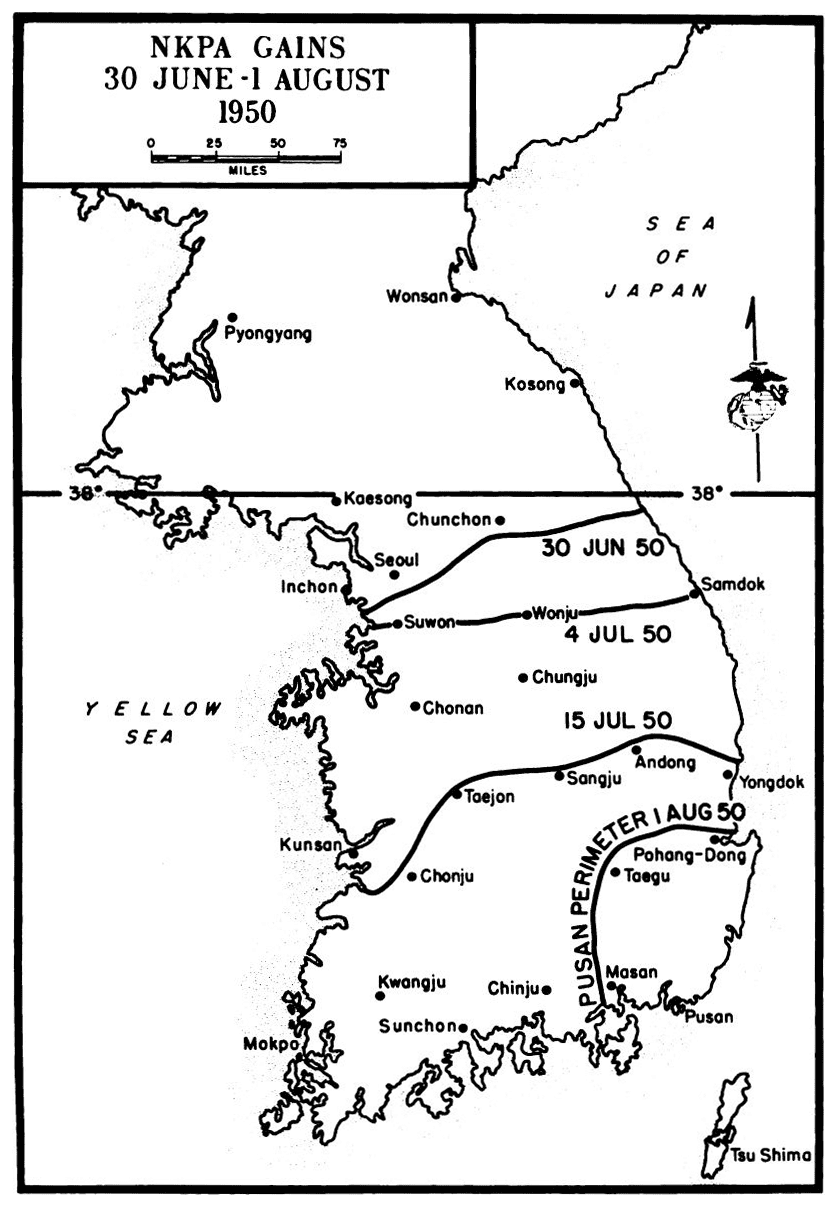
NKPA GAINS
30 JUNE-1 AUGUST
1950
From the 9th to the 13th, when they were relieved, parallel columns
of Army and Marine assault troops drove from Chindong-ni nearly
to Chinju, a distance of about 40 miles by the seacoast route. It was
only a local setback for the enemy, to be sure, but it had a heartening
effect for tired UN forces which had known only delaying actions
so far.
It also added to the problems of staff officers at Camp Pendleton
and Pearl Harbor, since replacements must be sent to the Brigade.
With this in mind, the Commandant had begun the organization
of the 1st Replacement Draft of approximately 800 men on the date
of Brigade activation. These troops, however, were absorbed into the
1st Marine Division when it expanded to war strength, as was a second
draft (also designated the 1st Replacement Draft) of 3,000 men.50
On 3 August the 1st Marine Division was directed by FMFPac to
send 10 officers and 290 enlisted men to the Brigade by airlift. This
draft was to be ready to move from Camp Pendleton by MATS planes
on 9 August, but not until five days later did it finally proceed to San
Francisco by rail and fly to Japan.
On the 23d another draft of 10 officers and 300 enlisted men from
Marine posts in Hawaii and Guam was sent by air to Japan, these
troops being replaced by the same number of noncombat-ready Marines
airlifted from Camp Pendleton. This process was twice repeated
early in September, when two more drafts totaling 20 officers and
590 men flew to Japan to provide replacements and third companies
for the 5th Marines of the Brigade.51
Logistics offered as many problems as personnel at Camp Pendleton,
since both the Brigade and Division units had been on peace tables
of organization and equipment. The 30-day replenishment stock, held
in readiness for such an emergency, was also based on peace strength
tables. Thus it was found that the specification of “requirements”
was best determined in most instances by making out requisitions
based on the difference between T/E for peace and war.
Narrow time limits did not permit the assembly of supplies and
equipment delivered at Camp Pendleton under the relentless pressure
of urgent deadlines. FMFLant air and ground units arriving from
Camp Lejeune brought their own organization equipment, which was
staged through the Recruit Depot at San Diego. Much of the heavy
equipment from the Barstow, California, Annex, Depot of Supplies,
was delivered dockside and loaded without further inspection. Not
until arrival at Kobe, Japan, were such items as the LVTs finally given
a mechanical checkup.52
Ammunition was delivered from the depots to the Naval Station,
San Diego, for loading. The following units of fire were specified
by Division Embarkation Plan 1-50:
(1) 3 UF in hands of 1st Marines, LVT, tank, and artillery units;
1 UF in hands of all other units;
(2) 2 UF in hands of 1st Ordnance Bn for the 1st Marines, LVT, tank, and
artillery units;
(3) 4 UF in the hands of the 1st Ordnance Bn for other units.53
Even after all items of initial supply had been assembled, the problem
was by no means solved. Since the Division and Wing would be
operating under Army and Air Force control, it became necessary to
establish a long-range policy for resupply. The best answer seemed
to be the procedure adopted by the Brigade, providing that the Army
and Air Force furnish all supplies not peculiar to the Marine Corps.
The latter would be provided by Marine or Navy agencies automatically
in 30-day increments, with 120 days of resupply allotted to
ground units and 90 days to air units. Thereafter, supply was to be
requisitioned as needed. And in the lack of a service command as
such, the G-4 section of FMFPac was committed to the task of preparing
and submitting resupply requisitions for items in this
category.54
Five hundred civilians were employed to help with the reconditioning
of motor transport and other heavy equipment which had been
“in mothballs” at Barstow since the end of World War II. Such items
had to be put through the shops in many instances and restored to
operating condition before delivery. The enormous supply depot in
the California desert erupted with activity as trains of flatcars and
long columns of motor trucks were routed to San Diego.
The actual loading and embarkation were conducted almost according
to schedule in spite of such handicaps as inadequate dock facilities,
the reception of supplies and equipment from a variety of sources, a
shortage of stevedores, and piecemeal assignments of shipping. Only
54 stevedore crews were available out of the 90 requested, and commercial
ships were necessary to supplement naval shipping. Nevertheless,
the loading began on 8 August and was completed by the
22d. The following 19 ships were employed to mount out the main
body of the 1st Marine Division:
LST 845; LSM 419; two APAs, the USS Noble and USS President
Jackson; five APs, the USNS General Buckner, USNS General
Weigel, USS Marine Phoenix, USNS General Meigs and USS General
Butner; and ten AKs, the SS Dolly Thurman, SS Green Bay Victory,
SS Noonday, SS African Patriot, SS Twin Falls Victory, SS Southwind,
SS American Press, SS American Victory, SS Alma Victory,
and SS Belgian Victory.55
Generals Shepherd and Cates arrived for the main embarkation on
the 13th and 14th respectively, accompanied by Major General Franklin
A. Hart and Brigadier General Edwin A. Pollock. While these
general officers were being acquainted with the progress made so far,
the AKA Titania blew out two boilers after being about 20 percent
loaded. Since the repairs would require about ten days, a commercial
freighter was provided as a last-minute replacement.
One of the purposes of General Shepherd’s visit was to discuss with
General Cates the problems of organizing and embarking the 7th
Marines (Reinf.). The activation of this unit had been directed on 10
August 1950, when an officer of the G-1 Section, Headquarters
FMFPac, delivered orders to Camp Pendleton.56
This was the result of a change of mind on the part of the Joint
Chiefs of Staff. After reconsideration, they decided that it would be
feasible to raise a third RCT much sooner than had at first seemed
possible, though not in time for MacArthur’s assault landing. Arrival
in Japan about 20 September seemed to be the earliest date that
could be managed.
Of the 17,162 eligible Marines at Camp Pendleton at that time, the
regulars in excess of those required to mount out between the 10th and
15th were placed in the rear echelon of the division as a cadre for the
third infantry regiment.57 The following troops were made available
to draw upon for the formation of the 7th Marines:
| Officers and men from 2d Marine Division |
1,822 |
| Officers and men of 3d Bn, 6th Marines in the Mediterranean |
735 |
| Officers and men of Marine Corps Reserve selected as combat-ready |
1,972 |
| Officers and men of rear echelon of Division, and from posts and stations |
1,109 |
| Total |
585,638 |
Colonel Homer L. Litzenberg was designated as commanding
officer on the date of activation, 17 August 1950. The Chief of Naval
Operations directed the regiment to embark for the Far East not later
than 3 September. These components were included in the build-up:
3d Battalion, 11th Marines; Company D, 1st Tank Battalion; Company
D, 1st Engineer Battalion; Company C, 1st Shore Party Battalion
(including two Shore Party communication teams from Signal Company,
Signal Battalion); Company D, 1st Motor Transport Battalion;
Company E, 1st Medical Battalion.
Forming the nucleus of the regiment, the 6th Marines, at peace
strength and less two battalions, arrived from Camp Lejeune on 16
August. The 3d Battalion of this FMFLant regiment, then stationed
afloat in the Mediterranean, was ordered to proceed through the Suez
Canal to become part of the 7th Marines upon arrival in Japan.
While the other elements were being absorbed at Camp Pendleton,
a conference attended by General Smith, Major General Alfred H.
Noble, and Colonel Litzenberg was held to discuss rear echelon personnel
and the formation of RCT-7. The following troops were
found to be available to take care of casuals and retain custody of such
division supplies and equipment as had not yet been embarked:
| MARINE CORPS |
NAVY |
| Off. |
Enl. |
Off. |
Enl. |
| 224 |
1,029 |
11 |
35 |
Not included in these figures were 197 noneffective enlisted personnel,
a rocket battery, a motor transport company, and the organizational
rear echelon of eight officers and 28 men. It was decided
that General Noble, as FMFPac representative, would examine MOSs,
to determine how many men would be transferred to the 7th Marines
or retained for FMF units to be activated later. The need was also
foreseen for rear echelon working parties to relieve personnel of units
mounting out.59
Although the 1st Marine Division had enough problems at Camp
Pendleton to keep a full war-strength staff busy, several of the key
members were in Korea with the Brigade. The complete Division
staff was never integrated until after the landing at Inchon. On 7
August, however, a dispatch from CinCFE requested that the “Commanding
General, 1st Marine Division, and planning group capable
of developing Division embarkation and landing plans be airlifted”
to the Far East.60
General Smith decided that this flight could best be made in two
echelons. The first, which took off for Japan at 1400 on 16 August
1950, included a group of 12 officers and six enlisted men selected to
initiate planning:
| |
Officers |
Enlisted |
| G-2 |
Col B. T. Holcomb, Jr. |
TSgt W. O’Grady |
| Ass’t G-2 |
Maj J. G. Babashanian |
Cpl J. N. Lareau |
| G-3 |
Col A. L. Bowser, Jr. |
Sgt G. O. Davis, Jr. |
| Ass’t G-3 |
LtCol F. R. Moore |
| Ass’t G-4 |
LtCol C. T. Hodges |
| Ass’t Emb Off |
Capt R. E. Moody |
PFC H. J. McAvinue |
| Shore Pty Off |
Maj J. G. Dibble |
| Signal Off |
LtCol A. Creal |
Cpl L Shefchik |
| Ass’t G-1 |
LtCol B. D. Godbold |
| Fire Sup Coord |
LtCol D. E. Reeve |
SSgt P. Richardson |
| Naval Gunfire Off |
LtCol L. S. Fraser |
| Air Off |
Capt W. F. Jacobs |
General Smith stayed at Camp Pendleton for two more days until
he was assured that the main body of the Division had sailed. Then
he accompanied the second echelon of planners which departed by
air at 1410 on 18 August:
| |
Officers |
Enlisted |
| CG |
MajGen O. P. Smith |
| C/S |
Col G. A. Williams |
Cpl C. V. Irwin |
| Aide to CG |
Capt M. J. Sexton |
PFC W. D. Grove |
| G-1 |
Col H. S. Walseth |
Cpl W. P. Minette |
| Ass’t Signal Off |
Capt A. J. Gunther |
MSgt F. J. Stumpges |
| G-4 |
Col F. M. McAlister |
| Engineer Off |
Maj E. P. Moses, Jr. |
| Embark Off |
Maj J. M. Rouse |
| Amtrac Off |
Maj A. J. Barrett |
| Motor Trans Off |
Maj H. W. Seeley, Jr. |
| Ordnance Off |
Maj L. O. Williams61 |
The departure of the commanding general coincided with the closing
of the Division CP at Camp Pendleton. There were still several
thousand Marines of the rear echelon left under the control of General
Noble in the sprawling installation, but the brown California hills
looked down upon a scene of strange and brooding quiet as compared
to the activity of the past three weeks.
It was D-minus 28 for the men of the 1st Marine Division.
CHAPTER III Operation Plan Chromite — Interview with General MacArthur — Conferences in Tokyo — Inception of X Corps — Final Conference on Inchon — Brigade Victory in Korea — The Marine Amphibious Mission
Interview with General MacArthur—Conferences in Tokyo—Inception
of X Corps—Final Conference on Inchon—Brigade
Victory in Korea—The Marine Amphibious Mission
The scars of war heal rapidly. From the air General Smith could
see jungle covering the battlefields of Guam. Iwo Jima looked as
untouched as if it had never been the scene of Marine casualties exceeding
the losses of the Union army at Gettysburg. Even fire-blasted
Tokyo had recovered to a surprising extent from the terrible bombings
of 1945.
Now, five years later, the United States had entered upon a new
military effort. As the Marine general landed at Haneda Airfield on
the afternoon of 22 August 1950, he was met by Admiral Doyle and
driven to the Mount McKinley, tied up at the dock in Tokyo harbor.
And though assigned to the cabin reserved for the landing force commander,
CG 1st MarDiv found it an ironical circumstance that he did
not yet know the prospective D-day and H-hour of the landing.62
He had not long to wait for such data. The advance section of the
Marine planning group being already aboard the Mount McKinley,
he was quickly informed by Colonel Bowser, the G-3 of the incomplete
Division staff. D-day at Inchon had been tentatively set for 15 September,
and the landing must be made during the high tide of late
afternoon. It meant assaulting a port of 250,000 prewar population
over the mud flats and seawalls, with little opportunity to consolidate
positions before nightfall. Nor would there be time for training and
rehearsals, since the troops would reach Japan barely in time to unload
and reload in amphibious shipping before proceeding to the objective
area.
General Smith learned further that a new command structure, to
be known as X Corps, was being hastily erected by FECOM especially
for the operation. No announcement had been made of a project
still classified as Top Secret, but it was known to the planning group
that General Almond would command a corps not yet activated. The
1st Marine Division would be under his control as the landing force.
Admiral Doyle, an old hand at amphibious warfare, was not happy
about Inchon when he considered the naval aspects. Initiated at
Guadalcanal and Tulagi in 1942, he had taken part in some rugged
ship-to-shore assaults of World War II. Afterwards, as Commander
of Amphibious Shipping for the Pacific Fleet, he had made a career
of it. And Admiral Doyle considered Inchon a hard nut to crack.
He refused to admit that any amphibious operation was impossible as
long as the United States Navy remained afloat, but he did maintain
that Inchon bristled with risks.
In twenty minutes that Tuesday afternoon General Smith heard
enough to convince him that the forthcoming assault would take a
great deal of doing. But there was no time for discussion. For at
1730, just two hours after stepping from his plane, he had an appointment
with the commander in chief.
Arriving on the minute at the Dai Ichi building, General Smith
reported to FECOM Headquarters. He was met by an aide, who
escorted him to General Almond’s office. On the way down echoing
corridors, he responded at frequent intervals to the salutes of sentries
who presented arms with fixed bayonets.63
The offices of CinCFE and his chief of staff were connected by an
imposing conference room with paneled walls and pillars along one
side. General Smith had an opportunity to survey his surroundings
at leisure before General Almond appeared. The new X Corps commander
explained that his chief had a habit of taking a long afternoon
break and would arrive later.
Of medium height and stocky build, Almond gave the impression
at the age of 58 of a buoyant temperament and restless energy. A
native Virginian and graduate of the Virginia Military Institute, he
had been an ETO division commander in World War II. After
joining MacArthur’s staff, he became one of the most loyal officers
of a group noted for devotion to their famous chief.
Almond greeted the reserved, white-haired Marine general cordially.
He launched at once into the topic of the Inchon operation, expressing
the utmost confidence in the ability of the UN forces to prevail.
It was the initial contact of the two men. Mutual respect was not
lacking, but differences in temperament made it inevitable that these
generals would not always see eye to eye. History teaches that this
is by no means a deplorable situation when kept within reasonable
bounds. Character can be as decisive a factor as logistics, and some
of the greatest victories of the ages have been won by colleagues who
did not agree at times. Friction, in fact, is more likely to sharpen
than to blunt military intellects; and Smith’s precision had potentialities
of being a good counterpoise for Almond’s energy.
While they were discussing the tactical problems, the commander
in chief returned to his office. He summoned his chief of staff for
a brief conference, then requested that Smith be presented.
MacArthur shook hands warmly, grasping the Marine general’s
elbow with his left hand. Without the celebrated “scrambled eggs”
cap, he looked his 70 years in moments of fatigue, but the old fire and
dash were not lacking. The very simplicity of his attire—shirtsleeves
and open collar—made a dramatic contrast to the military pomp and
ceremony surrounding him in this former Japanese commercial building,
one of the few earthquake-proof and air-conditioned structures
in Tokyo.
In a cigarette-smoking age, both MacArthur and Smith preferred
the calm comfort of a pipe. The commander in chief lit up and puffed
reflectively a moment. Then he leaned back in his chair and gave
his concept of the Inchon operation. But it was more than a concept
in the usual military sense; it was a vision of a victory potent enough
to end the Korean conflict at a stroke. And it was more than confidence
which upheld him; it was a supreme and almost mystical
faith that he could not fail.
He granted, of course, that there were difficulties and risks. Evidently
Almond had mentioned Smith’s reservations, for he proceeded
to reassure the Marine general. His voice full of feeling, he expressed
his deep conviction that the war could be won in a month at Inchon,
and that the 1st Marine Division could win it. The enemy, he explained,
had committed nearly all of his troops in the Pusan Perimeter.
Thus the Marines would not be heavily opposed when they stormed
ashore at Inchon and drove inland to cut the main NKPA line of
communications at Seoul.
MacArthur said he knew that the Marines had high standards,
having commanded them in the New Britain operations of the last
war. He realized that the Marines strove for perfection, and the
Inchon landing was bound to be somewhat helter-skelter by the very
nature of things. But there was no doubt, he affirmed, that the victory
soon to be gained by the 1st Marine Division would make 15 September
1950 a glorious date in American history.
His voice was charged with fervor as it rose and fell eloquently.
Once General Smith made a move as if to depart, but the commander
in chief motioned him back to his chair. At last he brought the conversation
to a close by standing suddenly, grasping the Marine general’s
hand, and bidding him a cordial good-bye.
It was sometimes an awkward situation for Navy and Marine officers
in general, and Admiral Doyle and General Smith in particular. In
many respects they appeared doubters and pessimists in contrast to
FECOM staff officers who reflected General MacArthur’s shining confidence.
But as amphibious specialists, carrying a heavy load of responsibility
for the landing, they had to give serious thought to the
risks at Inchon.
This was brought home forcibly to the Marine general on the morning
of the 23d, when he attended a meeting conducted by Major
General Clark L. Ruffner, Chief of Staff of the future X Corps.
Although the conference proceeded according to the usual form,
General Smith felt that it departed at times from the realism which
he considered an essential of sound amphibious planning. It was announced,
for instance, that after taking Inchon, the 1st Marine Division
was to cross the Han and attack Seoul, although X Corps had
neither equipment nor materiel for bridging the sizeable river.64
A review of the background disclosed that after CinCFE decided on
10 July not to use the 1st Cavalry Division as his landing force, he
briefly considered two other Army outfits. The 2d Infantry Division,
commanded by Major General Lawrence B. Keiser, was then under
orders to embark from the West Coast. Some of the personnel had
been given amphibious training by an ANGLICO instruction team
and had taken part in Operation MIKI, but the division as a whole
was much understrength. The same difficulty led to the elimination
of Major General David G. Barr’s 7th Infantry Division in Japan,
which had supplied troops to units at the front until only a cadre
remained.
The assurance on 25 July of a war-strength Marine division took
care of the who question. Next came the problems of when and
where an amphibious assault could be best mounted. JANIS (Joint
Army and Navy Intelligence Studies) reports indicated that the east
coast of Korea, though of lesser importance in military respects, offered
such hydrographic advantages as unusually moderate tides and a general
absence of shoals. In forbidding contrast, the shallow west coast
waters could be navigated at most points only by means of narrow
channels winding through the mud flats.65
Of all the west coast seaports, Inchon was probably the least desirable
objective when considered strictly from the viewpoint of hydrographic
conditions. From first to last, however, Inchon was Douglas
MacArthur’s choice. FECOM staff officers ventured to suggest two
alternatives, Wonsan on the east coast and Kunsan on the west coast,
but the commander in chief replied that neither was close enough to
the enemy’s main line of communications to suit his purposes. He
would settle for nothing less than Inchon.
So much for the place. As to the time, the choice was even more
limited. The tidal range varied from an average spring tide66 height
of 23 feet to an occasional maximum of 33 feet. Landing craft required
a tide of 25 feet to navigate the mud flats of the harbor, and
the LSTs must have 29 feet. Only during a few days in the middle
of September and October were those depths provided by spring tides
of the next 12 weeks. MacArthur rejected an October date as being
too late in the season, so that 15 September became D-day by virtue of
elimination.
A late afternoon H-hour was also a choice of necessity. Islands,
reefs, and shoals restricted the approach to the outer harbor, and currents
ranging from three to six knots multiplied the chances of confusion.
This meant that daylight landings were necessary for all but
small groups.
Much of the inner harbor was a vast swamp at low water, penetrated
by a single dredged channel 12 to 13 feet deep.67 The duration of spring
tides above the prescribed minimum depth averaged about three hours,
and during this interval the maximum in troops and supplies must be
put ashore. Every minute counted, since initial landing forces could
not be reinforced or supplied until the next high water period.
Time and tide seemed to have combined forces to protect Inchon
from seaborne foes. As if such natural obstacles were not enough, the
target area provided others. Two islands, Wolmi-do and Sowolmi-do,
located in a commanding position between the inner and outer harbors,
were linked to each other and to Inchon by a causeway. In
advance of intelligence reports, it must be assumed that rocky, wooded
Wolmi-do would be honeycombed with hidden emplacements for
enough guns to create a serious menace for the landing craft.
This critical terrain feature must somehow be reduced as a preliminary
to the main landing during the high tide of late afternoon.
Inchon being situated on a hilly promontory, the “beaches” were mere
narrow strips of urban waterfront, protected by seawalls too high for
ramps to be dropped at any stage of the tide. Once past these barriers,
the troops would have about two hours of daylight in which to secure
an Oriental city with a population comparable to that of Omaha.
But the amphibious assault was only the first phase of the operation
as conceived by CinCFE. After taking Inchon the landing force had
the task of driving some 16 miles inland, without loss of momentum, to
assault Korea’s largest airfield before crossing a tidal river to assault
Korea’s largest city.
And even this ambitious undertaking was not the whole show. For
a joint operation was to be carried out meanwhile by Eighth Army
forces thrusting northward from the Pusan Perimeter to form a
junction with the units of the Inchon-Seoul drive. This double-barreled
assault, it was believed, would shatter North Korean resistance
and put an end to the war.
The time, the place, the landing force, the main objectives—these
essentials of the proposed Inchon-Seoul operation had been pretty
well settled, at least to General MacArthur’s satisfaction, by the first
week of August. But even though he had his assault troops, there
was as yet no headquarters organization.
Admiral Sherman urged early in August that the commander in
chief call upon General Shepherd and the facilities of the FMFPac
organization at Pearl Harbor. Since there was so little time left before
D-day—only a fraction of the time usually allotted to the planning
phase of a major ship to shore assault—he felt that amphibious know-how
and experience were required. He proposed, therefore, that
steps be taken to obtain the approval of Admiral Radford, who had
jurisdiction over FMFPac.
The need for a headquarters organization was discussed on 7 August
by the Joint Strategic Plans and Operations Group (JSPOG) of
FECOM. Brigadier General Wright, G-3 of FECOM, received a
memorandum from the other members of the staff recommending
that the gap be filled in one of two ways—either by putting into effect
Admiral Sherman’s plan, or by sponsoring the organization of a provisional
corps headquarters. General Wright favored the first course
of action, as did Brigadier General Doyle G. Hickey, FECOM deputy
chief of staff. Ultimately, however, the FECOM chief of staff decided
in favor of the latter command arrangement.68
The questions of when and where and who had been answered to some
extent. But as late as 23 August, a good many variations of opinion
existed as to how the amphibious assault was to be accomplished.
The natural obstacles of the Inchon harbor area were so disturbing
that Doyle suggested an alternative to MacArthur and Almond. Since
the purpose of the landing was to drive inland and cut the enemy’s
communications, urged ComPhibGru One, why not select a west
coast objective with fewer hydrographic difficulties? He proposed
the Posung-Myon area, about 30 miles south of Inchon on the west
coast, where better approach channels and beaches were believed to
be available in a more lightly populated locality. A landing at this
point, Doyle contended, would not be attended by the risks and restrictions
of Inchon, yet after securing a beachhead the troops would
be in position to strike inland at the enemy’s main line of rail and
highway communications in the vicinity of Osan.69
Smith was favorably impressed. He brought up the subject on 23
August, when he and Barr had a meeting with Almond. The X
Corps commander did not concur, though conceding that Posung-Myon
had possibilities as an area for a subsidiary landing in connection
with the Inchon assault. Nor was Doyle able to obtain MacArthur’s
consent to the alternate objective.
It was the Marine general’s third conference of the day. From the
X Corps meeting he had gone directly to the regular conference at
GHQ, and thence to the talk with Almond and Barr. He came away
from all three meetings with the conviction that CinCFE and his
staff were not to be swerved by his objections. It was definitely to
be Inchon on 15 September, and Smith instructed his planning group
to proceed accordingly.
Doyle made a last attempt at 1730 that afternoon to present a comprehensive
picture of the risks and difficulties inherent at Inchon.
This final conference on the subject of a west coast landing was attended
by some of the nation’s highest ranking officers—General J.
Lawton Collins, Army Chief of Staff; Admiral Forrest P. Sherman,
Chief of Naval Operations; General Shepherd, CG FMFPac; Lieutenant
General Idwal H. Edwards, U. S. Air Force; as well as other
high-ranking staff officers who had flown out from Washington. It
was no secret in Tokyo military circles that the Joint Chiefs of Staff
were present for the purpose of studying General MacArthur’s plans
for the Inchon landing. It was also generally known that doubts and
misgivings had been expressed at various times when the project was
discussed at the Pentagon. General Collins stated candidly at a later
date that the purpose of his Tokyo visit was “... to find out exactly
what the plans were. Frankly, we were somewhat in the dark, and
as it was a matter of great concern, we went out to discuss it with
General MacArthur. We suggested certain alternate possibilities
and places....”70
Admirals Joy and Doyle also attended the meeting, and FECOM
was represented by Generals Almond, Ruffner, and Wright. The
conference room on the sixth floor of the Dai Ichi building proved too
small for the audience, and members of the PhibGru One team had
to wait their turn in Almond’s adjoining office. One by one, at eight-minute
intervals, Doyle’s officers took turns at being presented to
MacArthur, who listened gravely while puffing at his pipe. The following
amphibious specialists were heard:
| Cdr Edmund S. L. Marshall, USN |
Navigation |
| Lt Charles R. Barron, USN |
Aerology |
| LtCol William E. Benedict, USMC |
Military Aspects |
| LCdr Jack L. Lowentrout, USN |
Beach Study |
| LCdr M. Ted Jacobs, Jr., USN |
Seabees Pontoon Causeway Plans |
| LCdr Clyde E. Allmon, USN |
Ship to Shore Plans |
| LCdr Arlie G. Capps, USN |
Gunfire Support |
| Cdr Theophilus H. Moore, USN |
Air Support71 |
The officers spoke of the natural obstacles. They asserted that
it would be the peak of optimism to hope for a strategic surprise at
Inchon, for the enemy also knew that only a few days each autumn
month offered a tidal range sufficient to float the landing craft and
supply ships over the mud flats of the harbor.
They contended that even a tactical surprise was out of the question,
since Wolmi-do must be neutralized before landings could be
made on the mainland. Otherwise, the vulnerable column of landing
craft would be exposed to a slaughter from the flanking fire of the
island’s guns.
The Navy group pointed out further that it must also be assumed
that the enemy would not neglect a good opportunity to sow both
moored and magnetic mines in the channels the shipping must
take. And to cap all the other natural and man-made risks, there
was danger at the height of the typhoon season that Nature would
intervene and scatter the amphibious armada during its approach to
the objective area.
The presentation lasted for nearly an hour and a half. At the conclusion,
Admiral Doyle summed up by giving his opinion. “The
best I can say,” he told the commander in chief, “is that Inchon is not
impossible.”
General MacArthur heard the amphibious specialists to a finish
without his imperturbability being shaken. Even the onlookers who
could not partake of his perfect faith were impressed. There was
something magnificent about this old warrior in shirtsleeves and open
collar, calmly smoking his pipe while hearing his plan dissected.
Daring and optimism are supposed to be the exclusive prerogatives of
youth, yet this smiling septuagenarian was not only the oldest officer at
the conference, he was also the most confident and assured! After the
PhibGru One presentation ended, he took 45 minutes for his comments.
Speaking with eloquence, he declared that the natural obstacles
and practical difficulties of the proposed Inchon operation were
more than balanced in the strategic scale by the psychological advantages
of a bold stroke. About 90 percent of the NKPA forces were
fighting in the Pusan Perimeter. A combined offensive by X Corps
and the Eighth Army would have the effect of placing the enemy
between the hammer and anvil.
Referring to the Kunsan landing favored by General Collins and
Admiral Sherman, CinCFE asserted that this objective was too far
south for a fatal blow to be dealt the invaders. He cited a historical
precept in Wolfe’s victory at Quebec, made possible by audacity in
overcoming natural obstacles that the enemy regarded as insurmountable.
He recalled the amphibious victories he himself had won in the
Southwest Pacific, with the Navy and sometimes the Marine Corps
sharing in the glory. And he ended on a dramatic note with a
single, prophetic sentence spoken in a tense voice:
“We shall land at Inchon and I shall crush them!”72
As the officers filed out into the noisy, teeming Tokyo street, most
of them felt certain that the last word had been said. It was still
possible, of course, for the Joint Chiefs to overrule CinCFE; and it was
not likely that all of their doubts had been laid to rest. Nevertheless,
the Navy and Marine planners proceeded on the basis that a final decision
had been reached that August afternoon.
Before his arrival at Tokyo, General Shepherd had paid a flying visit
to the headquarters of the Brigade in Korea immediately after the
Marines stormed and seized Obong-ni Ridge. Just as General Craig’s
men had taken part from 7 to 13 August in the first sustained UN counterattack,
so this Army and Marine effort a week later became the first
rout of a major NKPA unit. After putting up a fierce struggle to hold
their bridgehead on the east bank of the river Naktong, the veteran
troops of the NKPA 4th Division were shattered by repeated Marine
attacks. Carrier-borne Corsairs of MAG-33 had a turkey shoot at the
expense of panic stricken enemy soldiers who abandoned their arms in
a wild flight. Some of the fugitives were shot down while trying to
swim the river.
Despite this encouraging little victory, it was still nip and tuck on
the central front of the Pusan Perimeter. With the U. S. 2d Infantry
Division and 5th RCT now in line, the Eighth Army strategy of trading
space for time had resulted in whittling down the enemy’s material
superiority. But the invaders still held the material advantage, and
there were signs that they would soon launch an all-out effort to
smash through to Pusan.
General Shepherd, after being informed as to the Tokyo conferences,
accompanied General Smith on the morning of 24 August to a meeting
with Admirals Sherman, Radford, Joy, and Doyle. It was generally
agreed that not enough weight had been given to amphibious
considerations in the final decision to attack at Inchon. Navy opinion
held that one more attempt should be made to propose another landing
point with fewer hydrographic objections. The area south of
Inchon had been investigated by Navy UDT and Marine amphibious
scouts of the Reconnaissance Company, 1st Marine Division, who had
sailed to the Far East with the Brigade. As a preliminary, this group
had embarked on the USS Horace A. Bass (APD-124) and gone
ashore undetected to stage several raids during the period 12–16
August on the enemy’s main line of communications along the west
coast. Three tunnels and two railway bridges were destroyed without
the loss of a man.73
Next the raiders successfully carried out a survey and reconnaissance
of available landing beaches during the period 22–25 August in the
Posung-Myon area. Their findings impressed General Shepherd so
much that before his departure from Tokyo he called on CinCFE
to make a last plea for reconsideration of the landing area. General
MacArthur, however, remained firm in his preference for Inchon.74
The meeting of the admirals and Marine generals on the 24th broke
up with a general agreement that the decision as to Inchon on 15
September must be accepted as the basis for final planning. That
same afternoon General Smith instructed his planning group to begin
work on a scheme of maneuver.
Modern amphibious tactics were in their infancy during World War
I when an appalling object lesson seemed to have been left by the
Allied disaster at Gallipoli in 1915–16. Brilliant in strategic conception,
this major amphibious operation might have knocked Turkey
out of the war and opened the unlocked back door of Austria and
Germany. Unfortunately, the execution fell short; and the failure was
too often charged to amphibious warfare itself rather than a wholesale
violation of its basic principles.
In 1920 the new Marine Corps Schools at Quantico became the
center of Marine amphibious study and research. Marine units participated
in fleet problems at Panama and Culebra during the post-war
years; and in 1927 the Joint Board of the Army and Navy (forerunner
of JCS) stated in a directive that the Marine Corps had the
mission of “special preparation in the conduct of landing operations.”75
During the early 1920s the writings of a brilliant Marine officer,
Major Earl H. Ellis, had a tremendous influence on current amphibious
thought. Predicting that Japan would strike first in the Pacific and
win initial successes, he drew up a strategic plan for assaults on Japanese-mandated
islands which was approved by Major General John A.
Lejeune, Commandant of the Marine Corps. Later known as Operation
Plan No. 712, this Top Secret document helped to shape the
ORANGE plans adopted by the Joint Board of the Army and Navy
for offensive operations against Japan if it came to war.
After making good progress in the early 1920s, with landing exercises
being held annually, the Marine amphibious program bogged
down from 1927 to 1932 because of the necessity of sending expeditionary
forces to China and Nicaragua. The turning point came in
1933, a memorable date in the evolution of modern amphibious warfare.
It was then that Major General John H. Russell, Assistant
Commandant of the Marine Corps, urged that a staff be set up at
Quantico to plan for the organization of a mobile Marine striking
force. This force, under the Commandant, and fully prepared for
service with the fleet, was to be in readiness for tactical employment
subject to the orders of the Commander in Chief, U. S. Navy. General
Russell further proposed that the old name “Expeditionary Force”
be discontinued and “Fleet Marine Force” adopted as a name better
expressing this mission.76
After the acceptance of these recommendations, the Commandant
ordered classes discontinued at the Marine Corps Schools and a concerted
effort applied to the preparation of a new amphibious manual.
Both the Army and Navy had treated some of the procedures in existing
manuals, but it remained for the Marine Corps in 1934 to put out
the first complete work of the sort. Known as the Tentative Manual
on Landing Operations, it became either directly or indirectly the
guide for exercises and maneuvers of the Navy and Marine Corps
down to World War II.
Most of its suggested procedures were endorsed with revisions in the
Navy’s Fleet Training Publication 167, published in 1938. This work
in its turn became the model three years later for the Army’s first basic
field manual for landing operations.77
Training exercises were held every year, usually at Culebra or Vieques
in the Caribbean and San Clemente Island off San Diego. At
the suggestion of the Fleet Marine Force, the Navy purchased Bloodsworth
Island in Chesapeake Bay as the first amphibious gunfire range
used for that purpose alone.
Schools were set up to train Army and Navy as well as Marine
officers as specialists in fire control parties. Air support was closely
integrated with naval gunfire, shore artillery, and troop movements.
Technology came to the aid of tactics when the Fleet Marine Force
encouraged and supervised the designing of strange new amphibious
craft and vehicles. Concepts were actually based in several instances
on landing craft not yet developed and the confidence of the Marine
Corps in American inventiveness proved to be justified.
Thus the Nation entered World War II with a system of offensive
tactics which opened Europe, Africa, and the islands of the Pacific
to American invasion without incurring a single major defeat. Not
only was the United States ahead of the enemy in the development
of amphibious operations but the Axis Powers never found the key
to an adequate defense. In an often quoted summary, the British
military critic and historian, Major General J. F. C. Fuller, has asserted
that these techniques were “in all probability ... the most
far-reaching tactical innovation of the war.”78
During the next few years the Marine Corps was twice officially
given the major responsibility for American amphibious tactics. The
National Security Act of 1947 made it the function of the Corps “to
provide fleet marine forces of combined arms, together with supporting
air components, for service with the fleet in the seizure and defense
of advanced naval bases and for the conduct of such land operations
as may be essential to the prosecution of a naval campaign.”79
At the so-called Key West Conference the following spring (March
11–14, 1948), the Secretary of Defense and Joint Chiefs of Staff restated
the Marine Corps’ mission to include that of developing “in coordination
with the Army, the Navy, and the Air Force, the tactics,
technique, and equipment employed by landing forces in amphibious
operations. The Marine Corps shall have primary interest in the
development of those landing force tactics, techniques, and equipment
which are of common interest to the Army and the Marine Corps.”80
During these post-war years, the Marine Corps was grappling with
the new amphibious problems posed by atomic weapons. It was
fitting, therefore, that the three men who formed the Special Board
for this research—Generals Shepherd, Harris, and Smith—should have
been at the forefront in 1950 when the Marine Corps faced its next
amphibious test. As veterans of World War II operations, they could
recall the scramble for the beaches of Bougainville, the fight for
Bloody Nose on Peleliu, the off-the-cuff landing on Oroku Peninsula
in Okinawa. There had been some tense moments in those battles,
but never had Marine generals contemplated an objective which held
more potentialities for trouble than the harbor area at Inchon.
CHAPTER IV The Planning Phase — Working Around the Clock — X Corps Scheme of Maneuver — Intelligence Planning for Inchon — The Landing Force Plan — Availability of Brigade Troops — Naval Gunfire and Rockets — Air Support for Inchon
Working Around the Clock—X Corps Scheme of Maneuver—Intelligence
Planning for Inchon—The Landing Force Plan—Naval
Gunfire and Rockets—Plans for Air Support
The champion globe-trotters of the 1st Marine Division were the
men of the 3d Battalion, 7th Marines. Before returning to their
homes from Korea, these military tourists would have traveled entirely
around the world by various forms of land, water, and air transportation.
The unit was originally an element of the 6th Marines, FMFLant,
serving afloat with the Sixth Fleet in the Mediterranean. On 12
August 1950 the CP aboard the USS Yellowstone at Suda Bay, Crete,
received a message from CNO ordering the battalion to the Far East.
Lieutenant Colonel Frederick R. Dowsett, deputy commander, noted
that the dispatch had bypassed such channels as CMC and the Sixth
Fleet.81 This irregularity, he learned later, was explained by the
urgency of an order which had been framed by Admiral Sherman
while General Cates was present. It directed that the APA Bexar
arrive on 14 August at Suda Bay and depart two days later with the
troops.
The rub was that these Marines were dispersed on various ships
all over the Mediterranean.
Given the rush job of picking up the scattered elements of the
battalion was the USS Leyte, which was due to return to Norfolk
for refitting afterwards and thence to the Far East via the Panama
Canal. Not only did the carrier complete its assignment before the
deadline, but the Bexar also arrived at Suda Bay on the evening of
the 14th. Both ships had hardly dropped anchor when the LCVPs
and LCMs were shuttling troops and cargo to the transport and the
AKA Montague, which was to accompany it to the Far East.82
On the 16th the two vessels departed according to schedule by way
of Port Said and the Suez Canal. Security regulations were rigidly
enforced, with only one stop being made when the vessels anchored
at Ceylon for six hours to take on fuel. Marine officers were figuratively
as well as literally at sea, since they had no idea of the specific
mission awaiting the battalion in the Far East. Unaware of plans for
the Inchon landing, they envisioned the troops being employed as the
ship-based raiding party of some American task force.
Meanwhile their future teammates of the 7th Marines were preparing
to embark from San Diego. Colonel Litzenberg and his
officers had made a good start at Camp Pendleton even before the
activation date of 17 August 1950. In order to build up from cadres
of former 6th Marines’ troops, this regiment received the largest proportion
of combat-ready reservists of any major unit in the 1st Marine
Division—about 50 per cent, counting the augmentation personnel to
bring 3/6 up to war strength when it would be taken into the outfit
in Japan.83
CNO had set 3 September as the date of embarkation. But Headquarters,
FMFPac, prepared the embarkation plans while the regimental
staff solved problems of organization and equipment so effectively
that the 7th Marines sailed on the 1st, thus beating the deadline
by two days.84
Orders came to El Toro on 16 August for the overseas movement of
the remaining elements of the 1st MAW. Units affected were Wing
Headquarters Squadron 1 and MAG-12, comprising Headquarters
Squadron 12, Service Squadron 12, VMF-312, VMF-212, VMF(N)-542,
and the rear echelon of VMF(N)-513.
VMF-312 and the rear echelon of VMF(N)-513 were loaded on
the USS Sitkoh Bay with their aircraft and sailed on 24 August. Three
days later VMF-212 and VMF(N)-542 embarked on the USS Cape
Esperance, and the USNS General Morton weighed anchor with the
remaining components on 1 September.85 This completed the overseas
movement of the 1st MAW, since General Harris and his staff had
departed from El Toro by air for Japan the day before.
The first echelon of the 1st Marine Division planning group had its
preliminary briefing on 19 August, and the tractor elements of the
Attack Force were scheduled to sail for the objective area on 9 September.
This left an interval of 20 days for most of the Inchon planning—probably
the shortest period ever allotted to a major amphibious
assault.
Less than one-fourth of the officers and men of the 1st Marine
Division staff were on the Mount McKinley when planning commenced.
At that time the distribution of the staff was as follows:
| |
With the 1st Prov Mar Brig in Korea |
Aboard USS Mount McKinley in Tokyo |
En route by sea to Japan |
Total |
| Div Cdr Section |
|
2 |
|
2 |
| Asst Div Cdr Section |
2 |
|
|
2 |
| Chief of Staff Section |
2 |
1 |
1 |
4 |
| General Staff Section: |
|
|
|
|
| G-1 |
2 |
2 |
1 |
5 |
| G-2 |
2 |
2 |
7 |
11 |
| G-3 |
2 |
2 |
1 |
5 |
| G-4 |
2 |
2 |
2 |
6 |
| Special Staff Section: |
|
|
|
|
| Adjutant |
|
4 |
7 |
11 |
| Air & Air Observers |
2 |
1 |
2 |
5 |
| Amph Trac |
a1 |
a1 |
|
2 |
| Anti-Tank |
b1 |
|
1 |
1 |
| Armored Amtracs |
|
|
a1 |
1 |
| Artillery |
a1 |
a1 |
a1 |
3 |
| Chaplains |
b1 |
|
1 |
1 |
| Chem War & Radiol Def |
|
|
1 |
1 |
| Dental |
b1 |
|
1 |
1 |
| Embarkation |
b1 |
2 |
1 |
3 |
| Engineer |
|
a1 |
|
|
| Food Director |
|
|
1 |
1 |
| Hq Comdr |
a1 |
|
a2 |
3 |
| Inspector |
|
|
2 |
2 |
| Legal |
b1 |
|
1 |
1 |
| Liaison |
3 |
|
|
3 |
| Medical |
2 |
|
1 |
3 |
| Mtr Trans |
1 |
1 |
|
2 |
| Nav Gunfire |
|
1 |
|
1 |
| Ordnance |
b1 |
1 |
|
1 |
| Post Ex |
|
|
a1 |
1 |
| Pub Info |
b1 |
|
1 |
1 |
| Prov Marshal |
|
|
a1 |
1 |
| Shore Party |
|
a1 |
|
1 |
| Signal |
6 |
2 |
|
8 |
| Spec Serv |
b1 |
|
3 |
3 |
| Sup & Disb |
b2 |
|
9 |
9 |
| Tank |
b1 |
|
a1 |
1 |
| Total |
33 |
23 |
51 |
107 |
The Marine planners aboard the Mount McKinley were short on
elbow room as well as personnel, time, and equipment. Although it
was an advantage to have the planning groups of the Attack Force
and Landing Force together, the ship did not provide enough space
for both without crowding. Moreover, the already undermanned
Marine contingent had to be further reduced late in August by sending
several officers to Kobe to meet incoming units. Thus the G-2
section, to cite one example, consisted of only two officers, one of
whom was detached on this duty for a week.
“The issuance of and adherence to a planning schedule was utterly
impossible,” commented the 1st Marine Division report. “Only by
a virtual ‘around the clock’ working day, concurrent ... planning
by Attack Force (ComPhibGru One) and Landing Force (1st
MarDiv), willing teamwork by both, and especially the amphibious
‘know-how’ of key staff members gained by long experience, was it
possible to complete and issue ... plans and orders for a most difficult
... landing operation. The time-space factor denied any coordinated
orientation, prohibited even the most elementary rehearsal,
made it difficult to distribute orders, and gave subordinate
units very little time for formulation and distribution of their plans.”87
Command relationships during the embarkation and assault phases
were as follows:
                             +------+
                 +-----------+CinCFE+-------------+
                 |           +------+             |
             +---+----+                      +----+-----+
        +----+ComNavFe+--------+             |CG X Corps|
        |    +--------+        |             +----------+
        |                      |
 +------+-------+       +------+------+
 |ComPhibGru One|       |CG 1st MarDiv|
 +--------------+       +-------------+
All the top commanders were concentrated in Tokyo with the arrival
of Admiral Struble on 25 August. This facilitated the planning and
allowed important decisions to be worked out in conferences between
the principal commanders.88
Planning was based mainly on studies made by ComPhibGru One
as prospective Attack Force Commander. It was conducted entirely
on a concurrent basis by the Attack Force and Landing Force groups
aboard the Mount McKinley. No step was taken by either without
the full knowledge and consent of the other.
Army planning had been initiated by the Joint Strategic Plans and
Operations Group until 16 August, when the “Special Planning Staff”
was set up at GHQ to issue directives for Operation Plan CHROMITE.
Published on 12 August as CinCFE Operation Plan No. 100-B, it
was based on these assumptions:
| (a) |
that the North Korean ground advance would be stopped in time to permit the build-up of our forces in South Korea; |
| (b) |
that our forces in South Korea would be built up to the capability of mounting effective offensive operations against NKPA forces opposing them; |
| (c) |
that we retain air and naval supremacy in the area of operation; |
| (d) |
that the NKPA ground forces would not receive major reinforcements from the USSR or Red China; |
| (e) |
that there would be no major change in the basic disposition of the NKPA forces.89 |
It was understood from the beginning that the Special Plans
Staff, headed by General Ruffner, would be the nucleus of the future
X Corps staff. In order to have the benefit of specialized amphibious
knowledge, ten Marine and two Navy officers of TTU Mobile Training
Team Able were assigned on 19 August:
| Col H. A. Forney |
Deputy Chief of Staff |
| LtCol J. Tabor |
Asst Coordinator, FSCC |
| LtCol C. E. Warren |
Asst G-4 |
| Maj J. N. McLaughlin |
Asst G-3 |
| Maj J. F. Warner |
Asst G-3 |
| Maj C. P. Weiland |
Air Officer, FSCC |
| Maj V. H. Vogel |
Asst G-4 |
| Capt H. S. Coppedge |
Asst G-2 |
| Capt T. A. Manion |
Asst Signal Officer, FSCC |
| Capt V. J. Robinson |
Target Info Officer |
| Lt L. N. Lay, USN |
Asst Surgeon |
| Lt W. A. Sheltren, USN |
Asst NGF Officer, FSCC90 |
These officers did not begin their new assignment in time to contribute
to the preliminary X Corps over-all scheme of maneuver. The
main provisions, as communicated to General Smith at General
Ruffner’s briefing conference of 23 August, were as follows:
(1) The 1st Marine Division, as the landing force, was to seize the urban
area of Inchon (line A-A); to capture a beachhead (line B-B); to advance as
rapidly as possible and seize Kimpo Airfield (line C-C); to clear out the south
bank of the Han River (line D-D); to cross the river, seize Seoul and secure the
commanding ground to the north (E-E); and, finally, to fortify and occupy
this line with reduced forces until relieved (apparently by the 3d Infantry
Division, still in the United States), whereupon the Division was to recross the
Han and seize a line (F-F) about 25 miles southeast of Seoul.
(2) The 7th Infantry Division was to land behind the Marines and advance on
their right flank to seize the commanding ground south of Seoul and the south
bank of the river (line D-D); to continue the advance to phase line (E-E); and
to conduct a reconnaissance in force to the south (line F-F). There, on the
line from Suwon to Kyongan-ni, the 7th Infantry Division and 1st Marine
Division would form the strategic anvil as Eighth Army forces advanced from
the Pusan Perimeter in the role of hammer.
(3) The 1st Marine Aircraft Wing was to furnish air support, air direction,
and air warning for the Corps with units operating from Kimpo Airfield. It
was also to be prepared to operate a control center ashore on order.91
The Special Plans Staff gave General Smith a study explaining
the purposes of these maneuvers. “The B-B line in this study appeared
to be a suitable beachhead line,” he commented, “and we decided to
concentrate our efforts on plans for its seizure. Subsequent operations
would be reserved for later consideration.”92
Good planning, of course, depended on accurate intelligence. All
possible information about the objective area had been gathered by
the staff of PhibGru One before the arrival of the 1st Marine Division
planners. Air Force planes had taken hundreds of photographs at
every stage of the tide. Hydrographic reports and navigation charts
had been studied. Army and Navy men familiar with Inchon during
the American occupation after World War II were interrogated as
well as NKPA prisoners captured by the Eighth Army.
Although a great deal of useful data was compiled, some disturbing
questions remained. How high were the sea walls of Inchon? Were
the mud flats suitable for landing either troops or vehicles at low tide?
Approximately how many NKPA guns were hidden on Wolmi-do?...
These were some of the intelligence gaps which must be
filled before an effective plan could be drawn up for an assault landing.
PhibGru One made its material available to the G-2 Section of
the 1st Marine Division, and the two staffs worked together on the
Mount McKinley in close cooperation. Attached were the 163d
Military Intelligence Service Detachment (MISD) and the 441st
Counter Intelligence Corps (CIC) Team. Both of these units had
been furnished by FECOM and consisted of Army commissioned
and enlisted personnel as well as native Koreans serving in liaison,
interpretation, and translation capacities.
Even when a question could not be answered conclusively, it was
up to the G-2 sections of the Attack Force and Landing Force to
arrive at a conclusion for planning purposes. For instance, it was
never satisfactorily determined from available sources—JANIS publications,
strategic engineering studies, Naval Attaché reports, and
photographic interpretation reports—whether LVTs would be able to
traverse the mud flats of the Inchon harbor area. And since there
remained some doubt, planning proceeded on the assumption that
the answer was negative. This proved to be the correct as well as the
prudent decision, later developments revealed.
Another G-2 planning problem concerned the effect that the height
of the sea walls would have upon the landing. Photographs at hourly
stages of the tide made it appear that the masonry was too high for
the dropping of ramps at any time. As a solution, G-2 officers hit
upon a device reminiscent of the storming of castles during the Middle
Ages. Scaling ladders were recommended with the suggestion that
they be built of aluminum with hooks at one end to be attached to
the masonry. Construction was started at Kobe, but the order could
be only partially filled before D-day, and wooden ladders were built
as substitutes.
It is hardly necessary to point out the importance of estimates as to
the numbers and defensive capabilities of the enemy. Yet the G-2
sections on the Mount McKinley were up against a peculiar situation
cited in the 1st Marine Division report:
“Our accumulated knowledge of the enemy’s military tactics, prior
to our landing at Inchon on 15 September 1950, consisted almost in
its entirety of knowledge about the enemy’s offense.... With but
few exceptions, UN forces were forced to take a defensive stand and
denied the opportunity to study large scale enemy defensive tactics
from actual combat. Thus it was that our assault landing was made
with relatively little prior knowledge regarding the enemy’s probable
reaction to a large-scale offensive of this nature, particularly when
it involved the penetration into the very heart of his newly acquired
domain.”93
Photographic coverage showed the Inchon harbor area to be honeycombed
with gun positions and other defensive installations. On the
other hand, daily aerial observation indicated that most of them were
not occupied.
G-2 conclusions during the planning phase often had to be based
on such conflicting evidence, even though the penalties of faulty interpretation
might be drastic. But after being viewed with due suspicion,
signs of negative enemy activity were finally accepted as valid in estimates
of light to moderate NKPA resistance.
“Sadly lacking as was information on the objective area,” commented
the Division G-2 report, “more so was that on the enemy in
the area.” Early in September, however, the Attack Force and Landing
Force concurred in the initial X Corps estimate of 1,500 to 2,500
NKPA troops in the immediate area, consisting largely of newly raised
personnel.94
Radio reports of first-hand observations in the objective area, though
coming too late for initial planning purposes, confirmed some of the
G-2 estimates. This dangerous mission was undertaken by Lieutenant
Eugene F. Clark, a naval officer on General MacArthur’s JSPOG staff.
U. S. and British Marines provided an escort on 1 September when
the British destroyer Charity brought him from Sasebo to a point along
the coast where the South Korean patrol vessel PC 703 waited to land
him at Yonghung-do, an island about 15 miles southwest of Inchon.95
Clark went ashore with a small arsenal of firearms, grenades and
ammunition, as well as 30 cases of C rations and 200 pounds of rice.
He quickly made allies of the 400 friendly Korean inhabitants of the
island and organized his own private little “army” of about 150 youths
from 14 to 18 years old. These “troops” were posted about Yonghung-do
for security, since the near-by island, Taebu-do, was occupied
by 400 NKPA soldiers within wading distance at low tide.
The naval officer had no illusions as to what his fate might be in
the event of capture. Day and night, he kept a grenade within reach,
since he did not intend to be taken alive. When the long expected
enemy attack from Taebu-do materialized, he commandeered a “one-lung”
South Korean motor sampan and fought it out with the NKPA
motor sampan escorting boats filled with soldiers. The enemy began
the strange “naval” battle with a few badly aimed rounds from a
37mm tank gun. Clark and his crew of three friendly Koreans finished
it with a long burst from a .50 caliber machine gun. After sinking
the NKPA motor sampan, he destroyed another boat with 18 soldiers
aboard and captured three prisoners for questioning.
One night the intrepid lieutenant rowed a dinghy to the Inchon sea
wall. When the tide went out, he tested the mire by wading in it up
to his waist. This experience led to the sending of a radio report,
“Inchon not suitable for landing either troops or vehicles across the
mud.”
Korean youths, posing as fishermen, brought intelligence which
Clark included in his daily radio messages. One of these spies made
an effort to count the guns on Wolmi-do and describe the locations.
Others took measurements of the Inchon sea wall and penetrated as
far inland as Seoul to report numbers and positions of NKPA troops.
Clark declined all offers to evacuate him. As the climax of his
exploit, he managed to restore the usefulness of the lighthouse on
Palmi Island which the enemy had put out of commission. This
structure, the former entrance beacon for Inchon by way of Flying
Fish channel, served him as a refuge when he had to leave Yonghung-do
hurriedly just ahead of NKPA troops who landed in force and
butchered 50 civilians of both sexes. Clark, who received a Silver
Star, stuck it out on Palmi until midnight of 14 September, when he
turned on the beacon light to guide the amphibious task force.
The decisions behind the Landing Force Plan—1st Marine Division
OpnO 2-50—obviously had to be made without benefit of Lieutenant
Clark’s reports, since the publication date was 4 September 1950.96
It is to the credit of these conclusions, therefore, that so few of them
had to be corrected in the light of first-hand evidence from the objective
area.
Although CG X Corps was the assigned Expeditionary Troops
Commander, planning on the Corps level was concerned almost
entirely with the exploitation phase following the seizure of the beachhead.
All Landing Force planning was done on the Mount McKinley
by the Division in close coordination with PhibGru One.
The first consideration, as viewed by the Navy planners, was that
the tides, currents, and tortuous channels of Inchon made necessary
a four-hour daylight approach to the transport area. This meant
that 1130, at low tide, was the earliest hour of arrival; and not until
about 1700 would the next high tide provide enough water for an
assault landing.
On 15 September a maximum high tide of 31 feet could be expected
at 1919. Evening twilight came at 1909. It was estimated initially
that 23 feet of water would take the LCVPs and LVTs over the mud
flats, but that 29 feet were necessary for the beaching of the LSTs.
In view of these conditions, PhibGru One planners concluded that
1700 was the best time for landing the LCVPs and LVTs, and it was
decided to beach the LSTs at about 1900. Simultaneous landings of
troops on Wolmi-do and the mainland were contemplated.
This was the point of departure for Division planners. They maintained
that Wolmi-do was the key terrain feature, and that it should
be secured first in a separate landing. The logical course, according
to the Marines, would be to utilize the morning high tide for the
seizure of this island commanding the waterfront. The enemy would
be given the whole day in which to prepare for the attack on the mainland;
but the Landing Force could also utilize this period for cleaning
up Wolmi-do and moving in supporting artillery.
It was typical of the harmony prevailing between the two planning
groups on the Mount McKinley that PhibGru One immediately
accepted the concept of a double-barreled attack. The rub was that
a night approach would be necessary to assault Wolmi-do at 0600 on
the morning high tide, and the Navy doubted the feasibility of a
movement of the slow-moving and unmaneuverable APAs, AKAs,
and LSTs through winding, mud-lined channels in the darkness.
At length a compromise was reached with the decision to employ
DD, APD, and LSD types primarily, which were more maneuverable
in addition to being equipped with radar navigational instruments.97
The morning landing on Wolmi-do was to be made with a single
battalion of the 5th Marines, to be designated by the Brigade. On
the mainland the remaining two battalions would land with the
evening high tide on RED Beach, just north of the causeway connecting
the island with the city, while two battalions of the 11th
Marines landed in support on Wolmi-do. Meanwhile the 1st Marines
was to hit BLUE Beach, southeast of the urban area. And after
driving rapidly inland to consolidate their positions before nightfall,
the two Marine regiments were to make a junction in the morning and
seize the beachhead while the 17th ROK Regiment (later replaced by
1st KMC Regiment) mopped up the city streets.
Marine G-4 planners suggested one of the most daring of all the
calculated risks. This was the decision to use LCVPs for the RED
Beach landings because their comparative speed would clear the landing
area for the beaching of eight LSTs—all that could be crammed
into the narrow confines of this strip of urban waterfront. Each was
to be loaded with ammunition, rations, water, and fuel. Obviously
these Navy workhorses, nicknamed “large slow targets”, would be
easy marks for NKPA shore guns, but this was a chance that had to
be taken if the assault troops were to be adequately supplied.
There was not time, of course, to unload and retract the ships during
the period of evening high tide. They must be unloaded during the
night and taken out on the morning tide.
Since it was not considered feasible to land LSTs on BLUE Beach,
that area would not be developed beyond the needs of the immediate
assault. For this purpose, 16 preloaded LVTs were to be used as
floating dumps until the 1st Marines could link up with the other
regiment.
These were the essentials of the Landing Force plan. H-hour was
ultimately determined from a study of late photographs which brought
about a slight change in estimates. Since a tide of 25 feet (two feet
higher than the initial estimate) appeared to be necessary for the
LCVPs and LVTs to reach the sea wall, H-hour was set at 1730 instead
of 1700. The completed Landing Force plan provided for these steps:
(1) BLT-3 of RCT-5 to land on Beach GREEN at L-hour on D-day and
seize Wolmi-do.
(2) RCT-5 (— BLT-3) to land on Beach RED at H-hour, seize Objective
O-A, effect a juncture with RCT-1, and prepare for further operations to the
east in coordination with RCT-1 to seize the FBHL.
(3) RCT-1, to land on Beach BLUE, with two battalions in assault, seize
Objective O-1, and prepare for further operations to the east in coordination
with RCT-5 to seize the FBHL.
(4) 11th Marines (— 3d Bn) (96th F. A. Bn, USA, attached) to land 1st
and 2d Bns on Beach GREEN at H-hour, occupy positions on Wolmi-do and
support seizure of the beachhead with priority of fires to RCT-1. Remainder
of artillery to land on call.
(5) ROK Marines, initially in Division reserve, to land over Beach RED on
call and conduct operations to occupy the city of Inchon in coordination with
RCT-5.
(6) 1st Tank Bn (—) (Reinf.) to be prepared to land on order one company
in LSU on Beach GREEN, remainder of battalion on order on beaches to be
designated.
(7) 1st Engr Bn (—) to land on Beach RED or in harbor on order, assume
control of detached companies on order, and support seizure of beachhead as
directed. Priority to opening and maintaining MSR along southern edge of
the city to RCT-1 zone of action.
(8) 1st Shore Party Bn (—) to land on order on Beach RED or in harbor
and assume control of shore party activities on Beaches RED and GREEN.
(9) 1st Amph Trac Bn to transport and land elements of RCT-1 on Beach
BLUE and continue support of RCT-1 until released.
(10) 2d Engr Spl Brig, USA (Reinf.) to furnish ships platoons and augment
Division shore party as requested. After landing and when directed, to assume
operational control of Division shore party and responsibility for control of
all port operations. To provide logistical support of 1st MarDiv.
The old recipe for rabbit stew began, “First, catch your rabbit.” And
while the Landing Force plan was being formulated, General Smith
had no assurance for a few days that he could count on having the
whole of his landing force available.
General Almond informed the Marine general on 23 August that
the release of the 1st Provisional Marine Brigade for participation
in the Inchon landing would depend on the military situation. He
seemed doubtful and added that the withdrawal of the Marines would
be bad for Eighth Army morale.
The Attack Force and Landing Force began their planning, however,
on the basis of Brigade availability. It had been the intention
of CinCFE to employ a full Marine division, but an embarkation date
of 1 September would not permit the 7th Marines to arrive in time.
This left the 1st Marines as the only RCT of the Landing Force unless
the 5th Marines and other Brigade units could be released.
On 30 August, Smith brought up the issue again in a dispatch to
X Corps, whereupon CinCFE issued an order making the Brigade
troops available to the Division on 4 September.
This might have settled the issue if the enemy had not launched
an all-out offensive on 1 September to smash through the Pusan
Perimeter. Although the Brigade had already sent heavy equipment
to Pusan for embarkation, the Marines were rushed up to the front
on 2 September as a mobile reserve. That same day the order for their
release was revoked.
There could be no doubt about the gravity of the military situation.
Thirteen NKPA divisions were making a final effort, and the Marines
were needed in the Naktong Bulge sector, where the Korean Reds
were attempting to cut the Pusan-Taegu lifeline.
On the other hand, time was also running out for the Inchon
planners. Colonel Forney, the new deputy chief of staff for X Corps,
informed Smith on 2 September that Almond planned to use the
32d Infantry of the 7th Infantry Division if the 7th Marines could
not arrive in time for the Inchon landing. Recently, the cadres of
this Army division had been brought up to strength with 8,000 South
Koreans. The remaining 12,000 U. S. troops had received no adequate
amphibious training, though instructors from Training Team Able
had made a start with some of the units.
This turn of affairs resulted in a meeting in General Almond’s
office. The Navy was represented by Admirals Joy, Struble, and
Doyle; the Army by Generals Almond, Ruffner, and Wright; and
the Marines by General Smith.
Wright opened the discussion by stating that Walker needed the
Brigade troops urgently as a mobile reserve to hold the line in the
current NKPA offensive. Almond conceded that the question of
Brigade availability must be decided on a basis of Eighth Army requirements
and tactical considerations. But if the 5th Marines could
not be released, he reiterated his decision to substitute the 32d Infantry
for the Inchon operation.
Admiral Joy declared that the success of the Inchon assault depended
on the employment of Marines trained in amphibious techniques;
and he called upon Smith for his opinion. The Marine general said
that a hastily instructed unit could not be expected to take the place
of a combat-experienced regiment in the Landing Force, and that last-minute
substitutions of this sort could not be made in complicated
ship-to-shore landings without courting trouble. He added that it
would be necessary in such an event to land in column on one beach
instead of two, with the 1st Marines in advance of the 32d Infantry.
These comments had the support of Doyle, who agreed that the
availability of the 5th Marines might mean the difference between
success and failure at Inchon.
At this point Admiral Struble commented that the issue boiled
down to the need for a mobile Eighth Army reserve. He suggested
as a compromise that a regiment of the 7th Infantry Division be
embarked and moved to Pusan as a floating reserve to be landed in
an emergency as a substitute for the 5th Marines. This solution was
accepted. Almond called up Eighth Army Headquarters immediately,
and within an hour Wright telephoned to inform Smith that the
Brigade would be relieved at midnight on 5 September.98
As it turned out, the 17th Infantry of the 7th Infantry Division was
embarked and transferred to Pusan to substitute for the 5th Marines,
with Marine officers of Training Team Able assisting in the outloading.
After the amphibious assault, the regiment landed administratively
at Inchon to rejoin its parent unit.
At a conference on 1 September called by Admiral Struble and
attended by Admirals Richard W. Ruble, John M. Higgins, and Sir
William G. Andrewes (RN)99 in addition to Generals Ruffner and
Smith, it was tentatively agreed that the cruisers would begin the
bombardment on the morning of D-minus 1, and the destroyers that
afternoon after a napalm air strike had been conducted against
Wolmi-do on D-minus 4.
At another naval gunfire conference two days later, the napalm
strike was delayed until D-minus 3. On 8 September, when Admiral
Struble held his final meeting, PhibGru One and the 1st Marine Division
agreed on the scope and timing of naval gunfire support. It
was decided, therefore, that the bombardment would commence on
D-minus 2 and be repeated if necessary on D-minus 1.100
During the following week, plans were worked out in detail. The
beachhead was divided into 52 target areas, including two on Wolmi-do
and one on Sowolmi-do. In the channel to the west and southwest
of the port, imaginary lines marked off three fire support areas
for the ships, numbered in order from south to north.
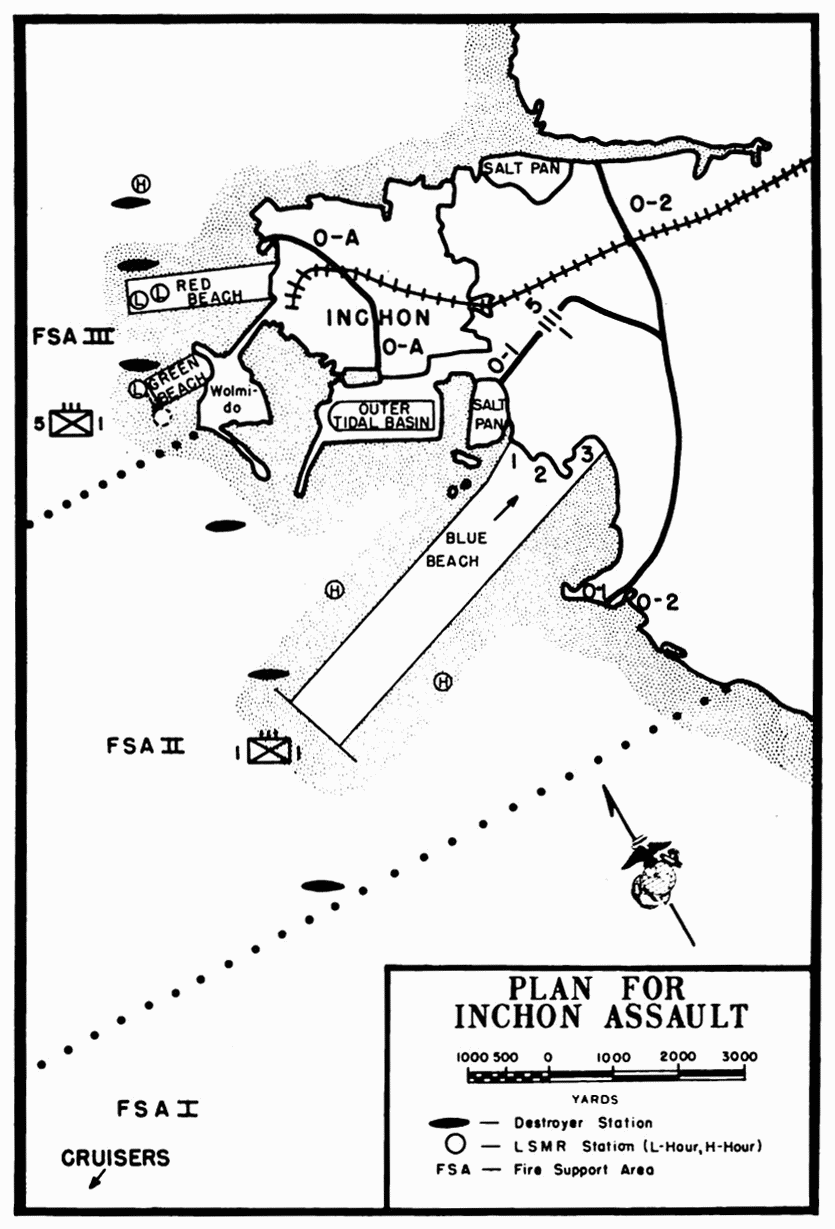
PLAN FOR INCHON ASSAULT
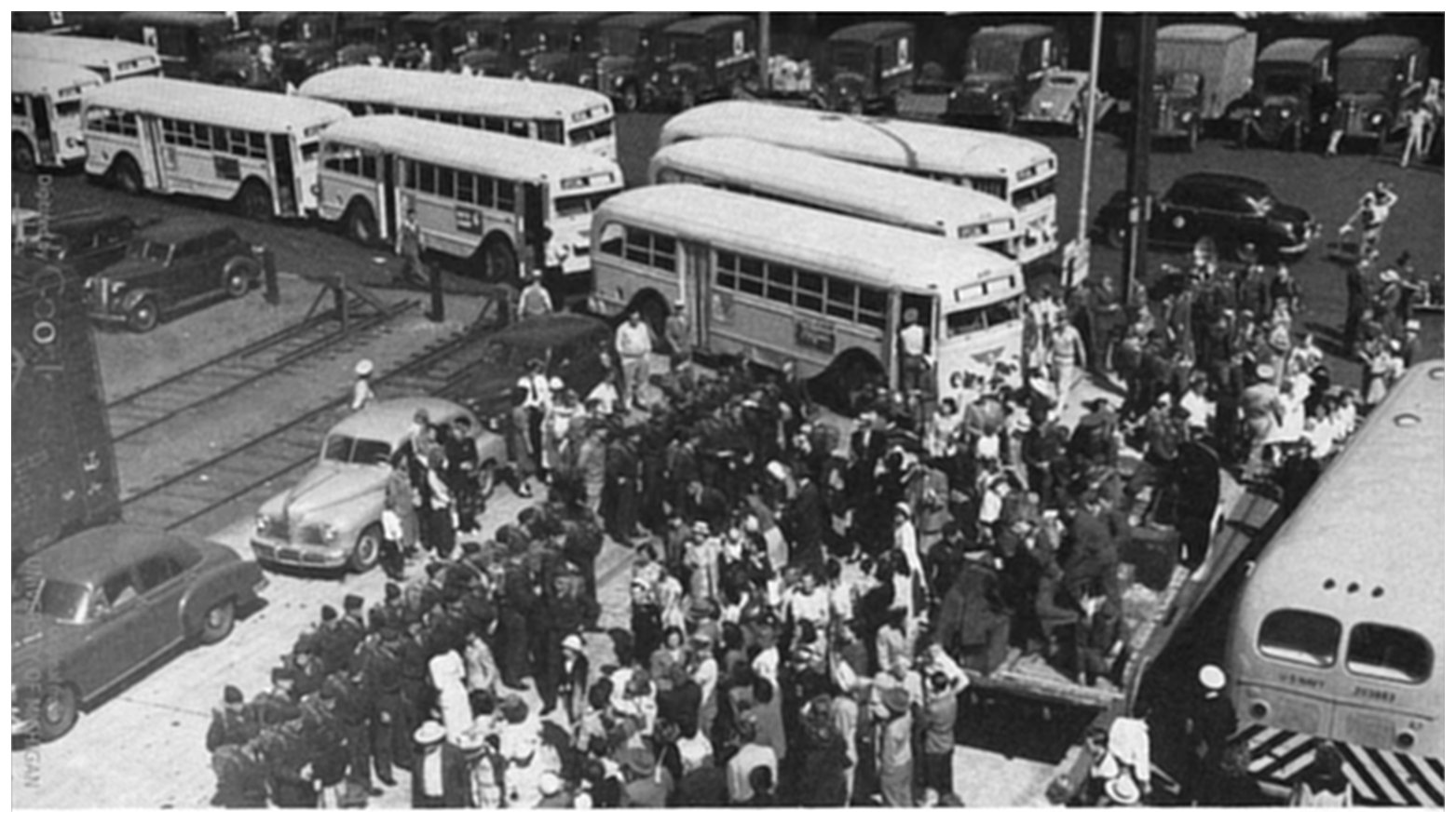
Call to Arms——Marine reservists fall in near railway station in Seattle for departure to Camp Pendleton (U. S. Navy Photo).
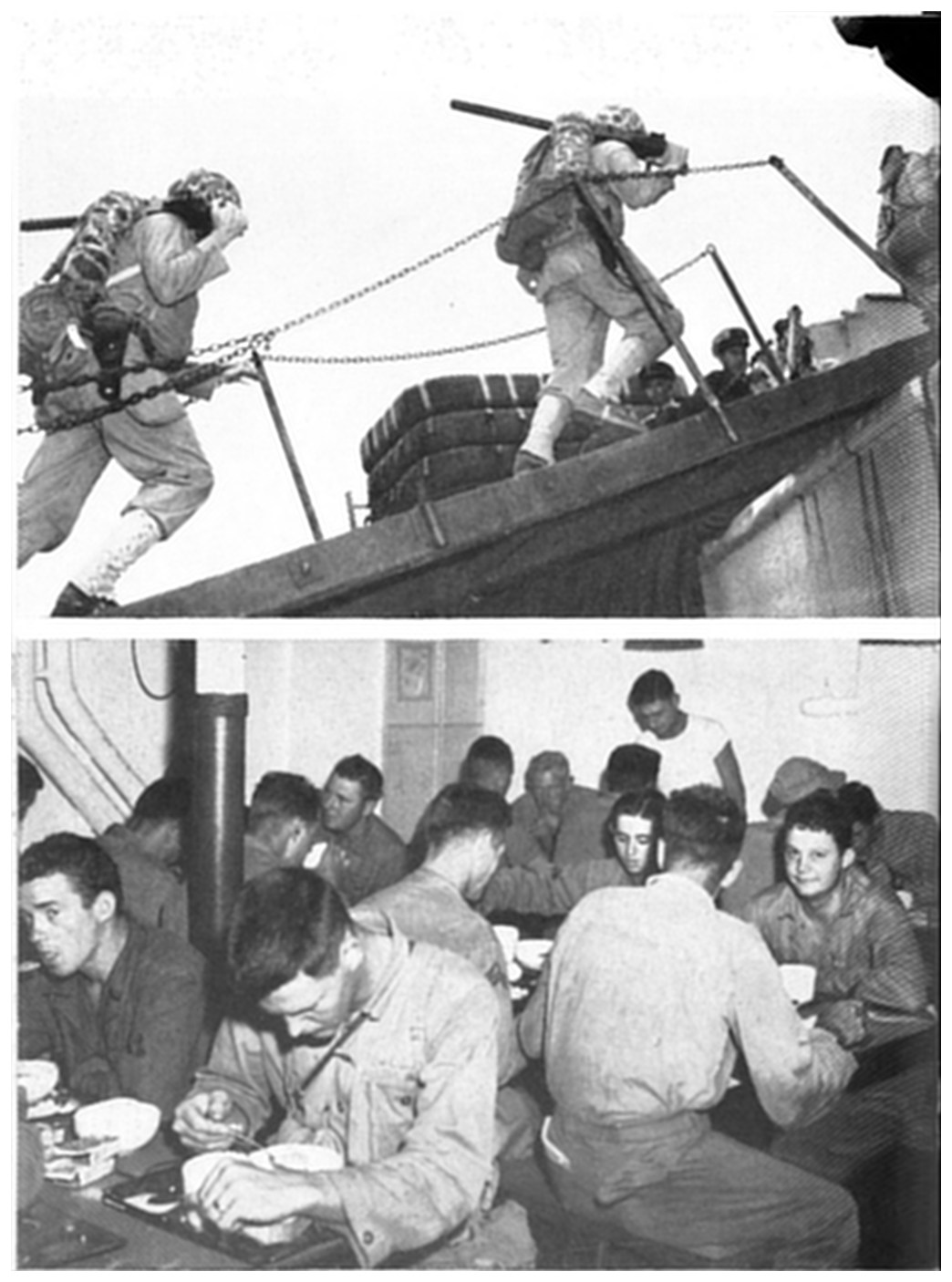
The Invasion Fleet——Above, Marines board troopship in Japan for
voyage to objective; and, below, Marines eating breakfast on transport
at 3:30 on the morning of D-Day (Marine Corps Photos).
Sunrise at Inchon——as seen from the USS Mount McKinley (U. S.
Army Photo).
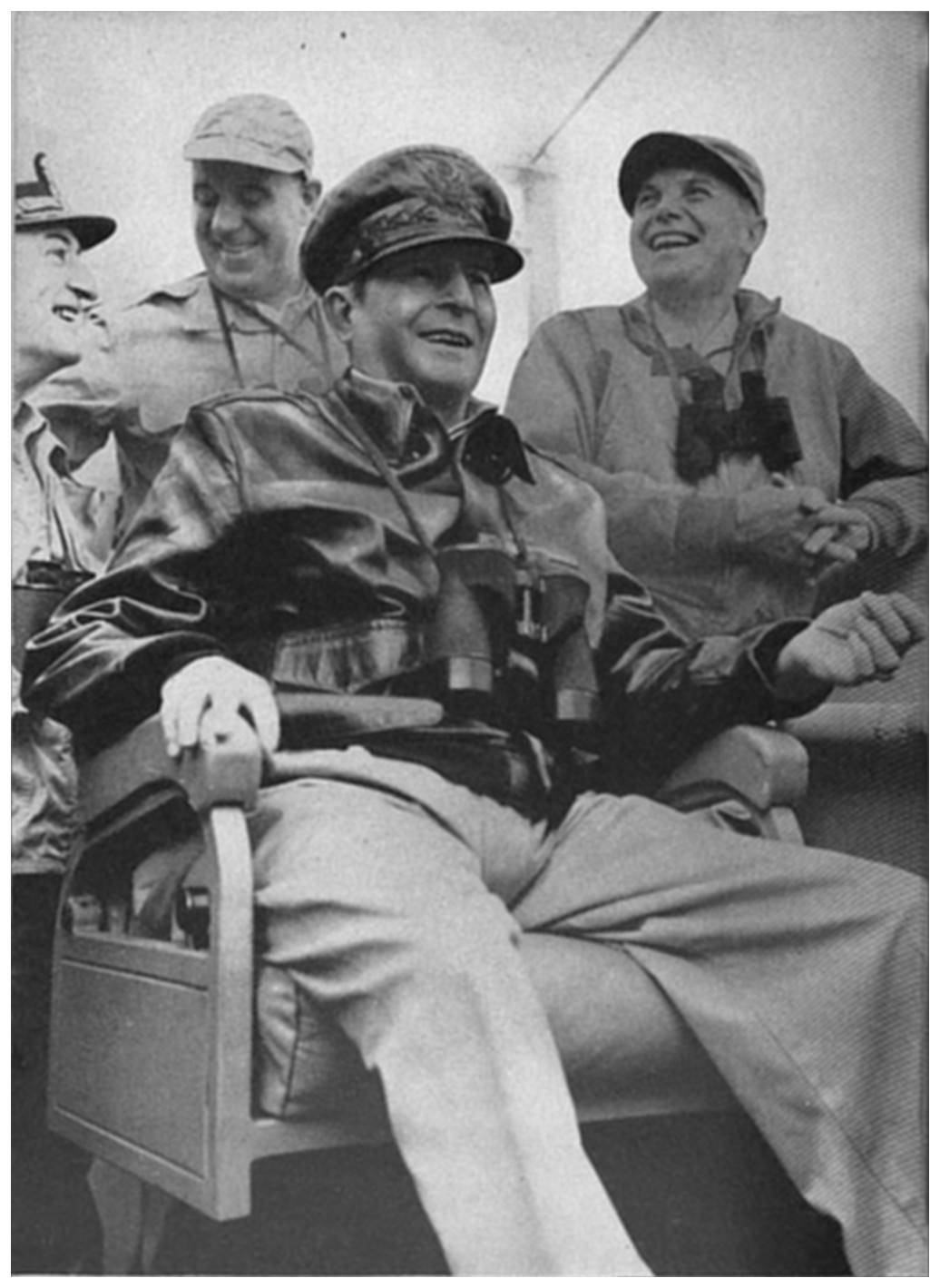
Smiles of Victory——General MacArthur shows his approval of the
Wolmi-do Landing; behind him (left to right) are Vice Admiral
Struble, Brigadier General Wright, and Major General Almond
(U. S. Navy Photo).
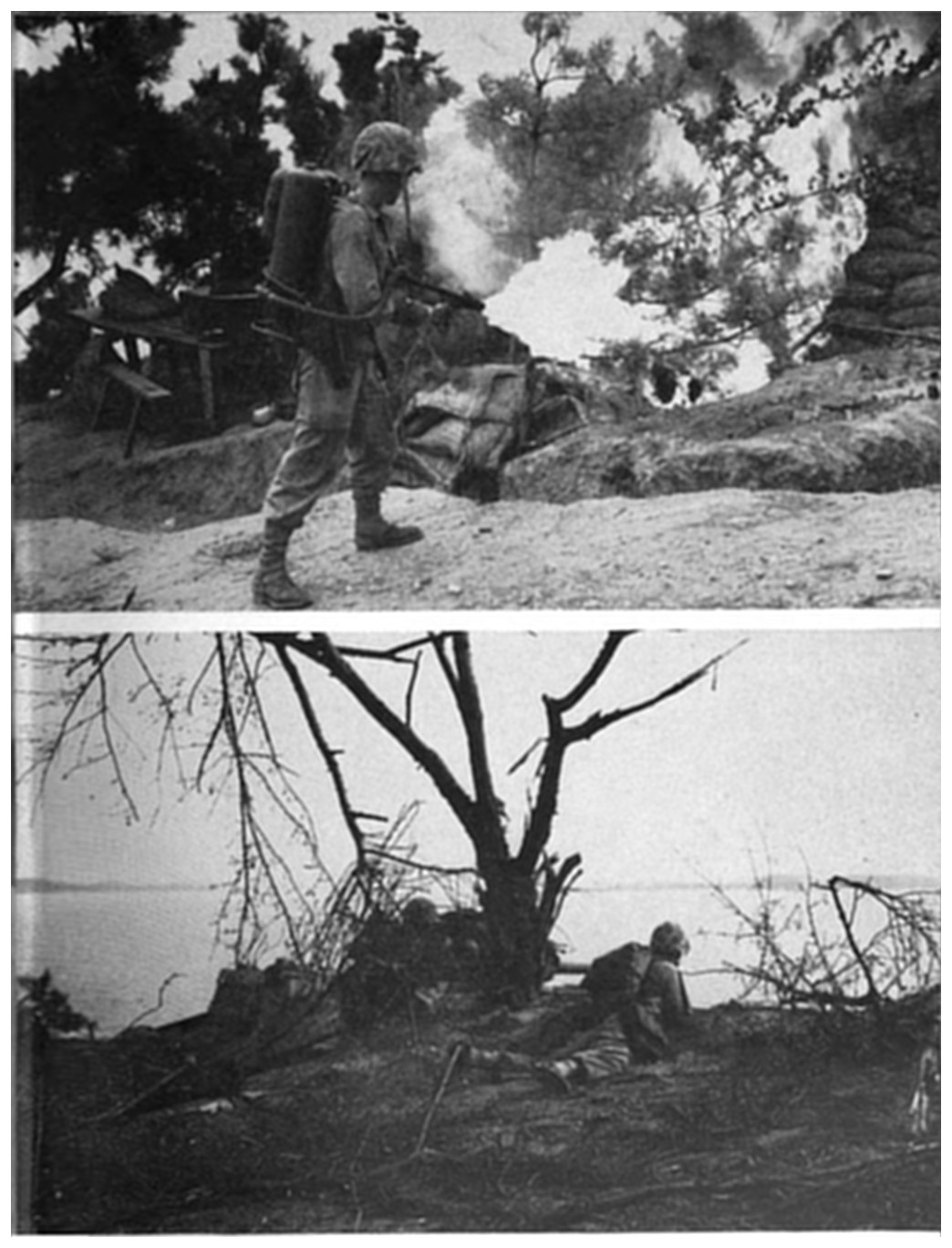
Action on Wolmi-do——Above, Marine using flame thrower on enemy
cave; and, below, assault troops mopping up on the island (Marine
Corps Photos).
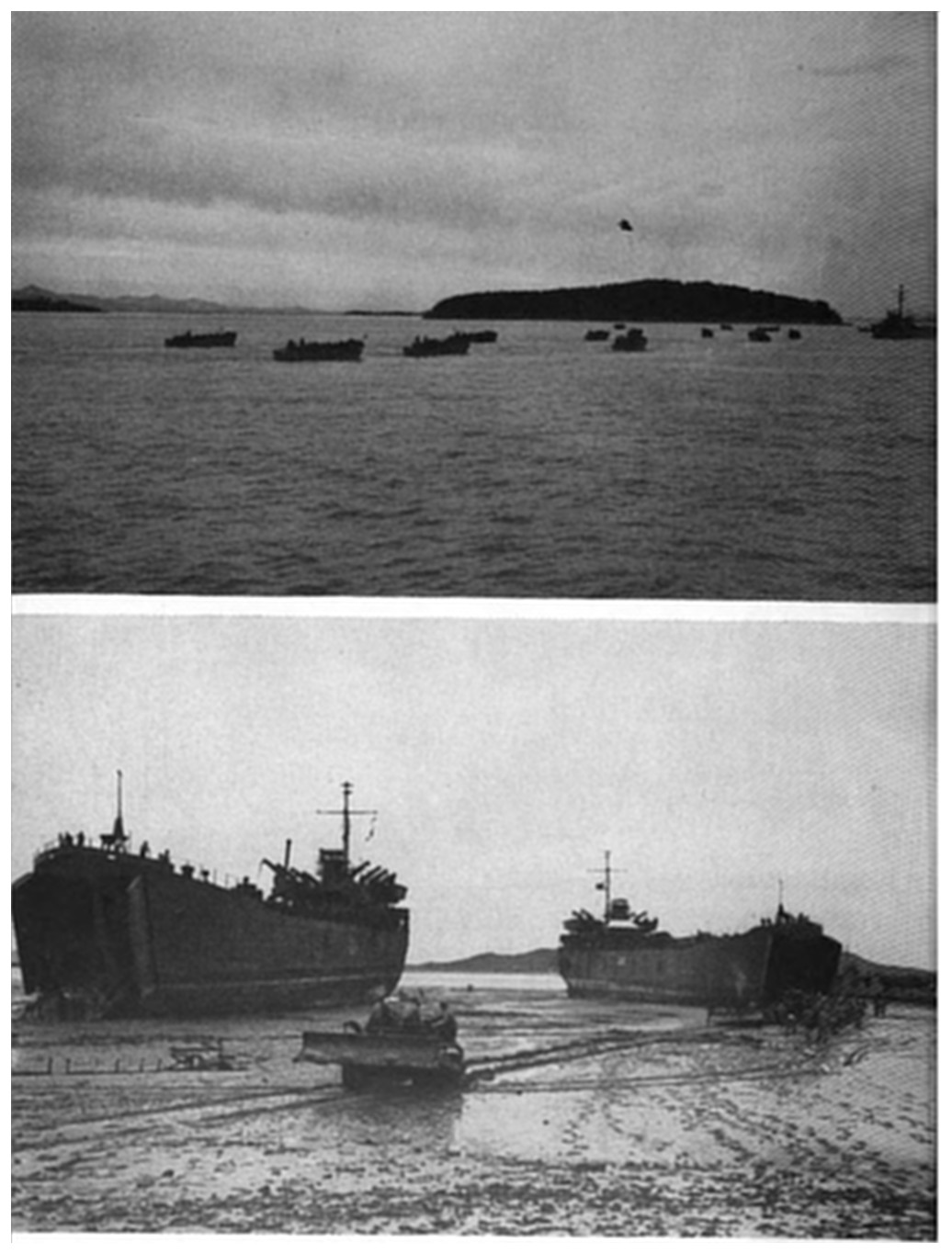
H-Hour——Above, the first wave of LCVPs heads for the beaches at
Inchon; and, below, grounded LSTs bring supplies to captured
Wolmi-do (U. S. Navy Photos).
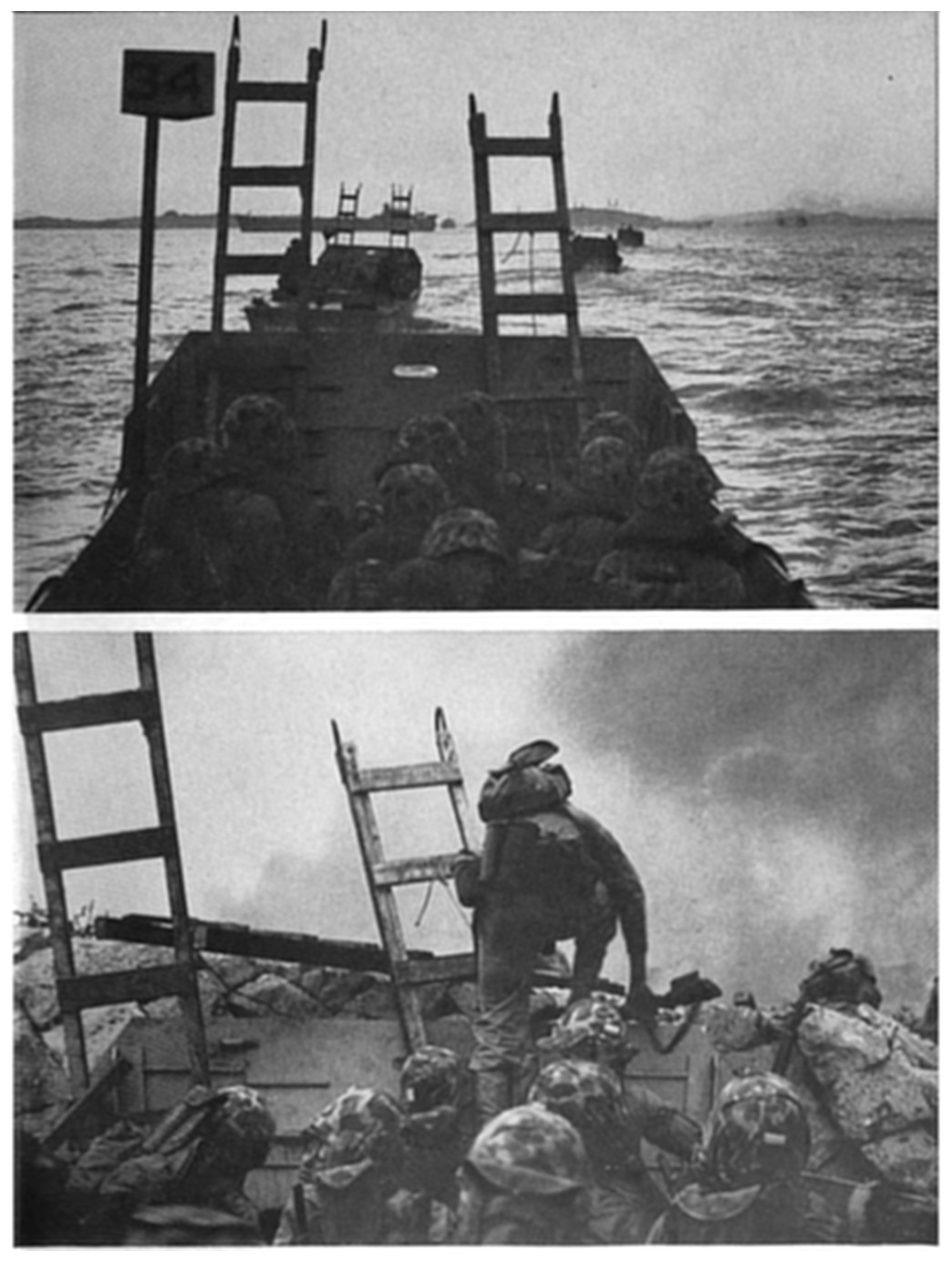
Hitting the Beaches——Above, Marines in landing craft on way to
BLUE Beach with scaling ladders; and, below, assault troops using
ladders to climb seawall at RED Beach (Marine Corps Photos).
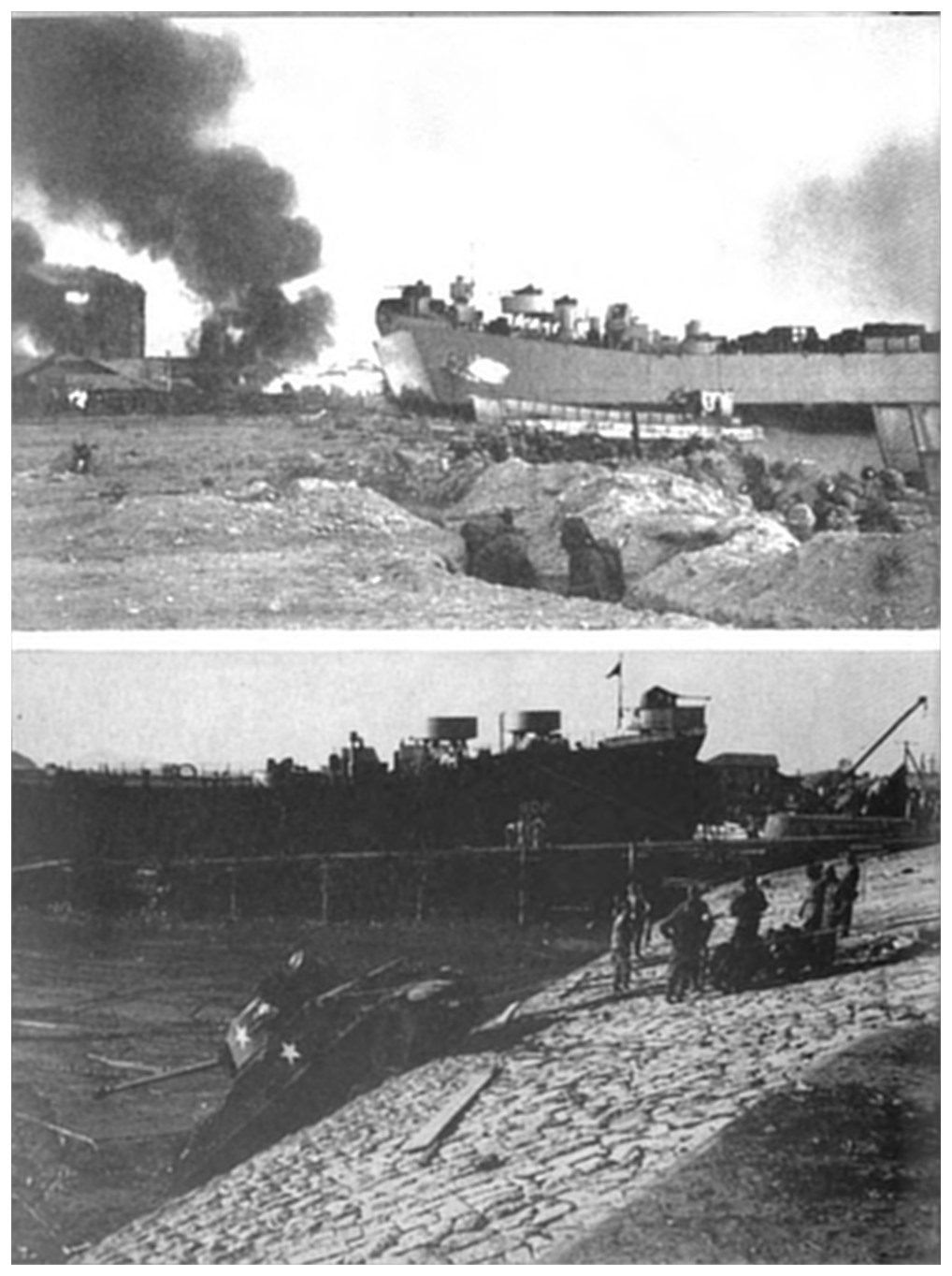
Ashore at Inchon——Above, an LST brings supplies to RED Beach on
heels of assault troops (Marine Corps Photo); and, below, Marines
hoisting tank over seawall, with LST 802 in background (U. S.
Navy Photo).
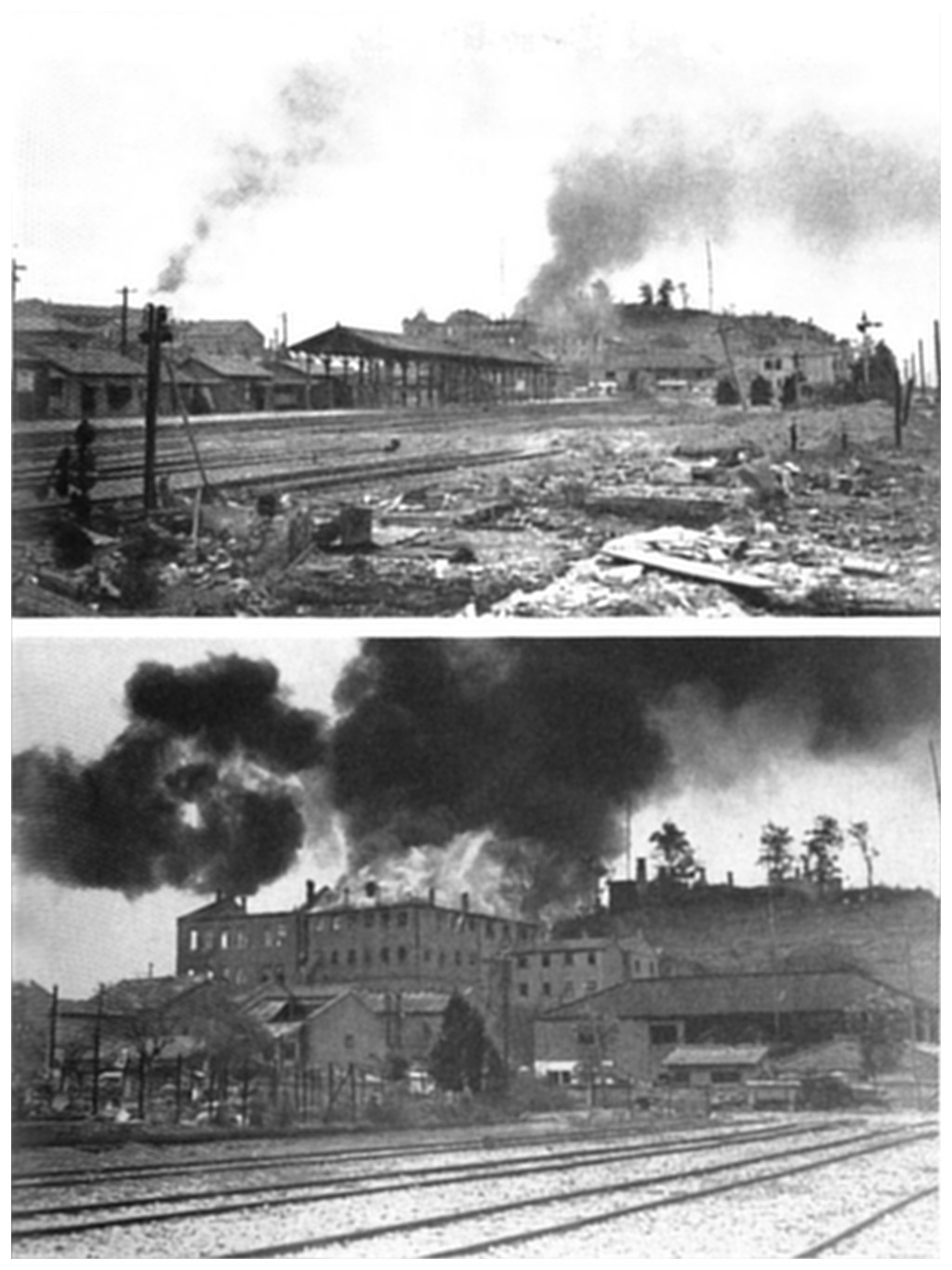
Bombardment of Inchon——Above, railway station in flames (U. S.
Army Photo); and, below, burning factory buildings (U. S. Navy
Photo).
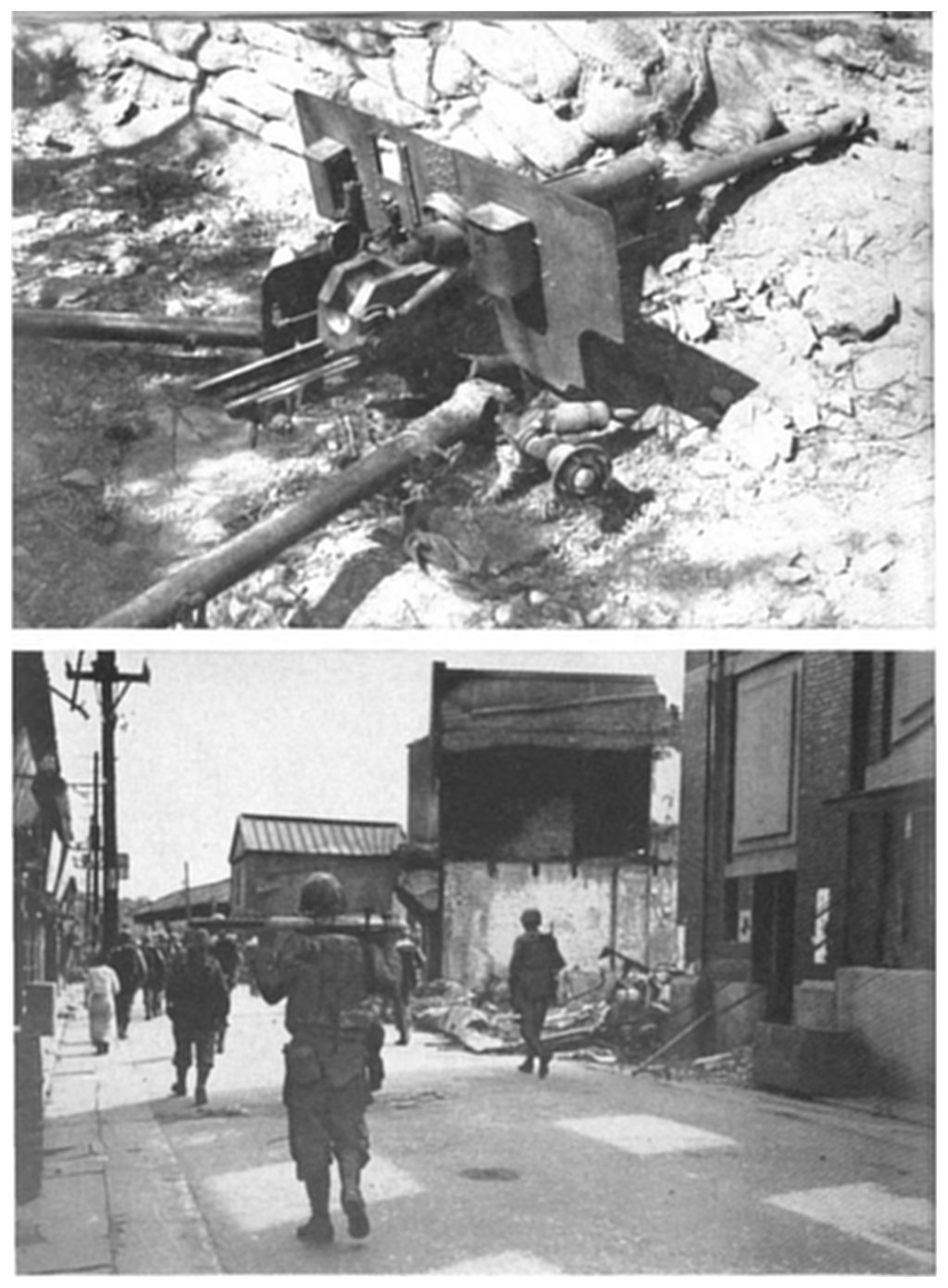
Inchon Secured——Above, enemy gun emplacement (U. S. Navy Photo);
and, below, troops of 5th Marines advancing in streets of Inchon
(U. S. Army Photo).
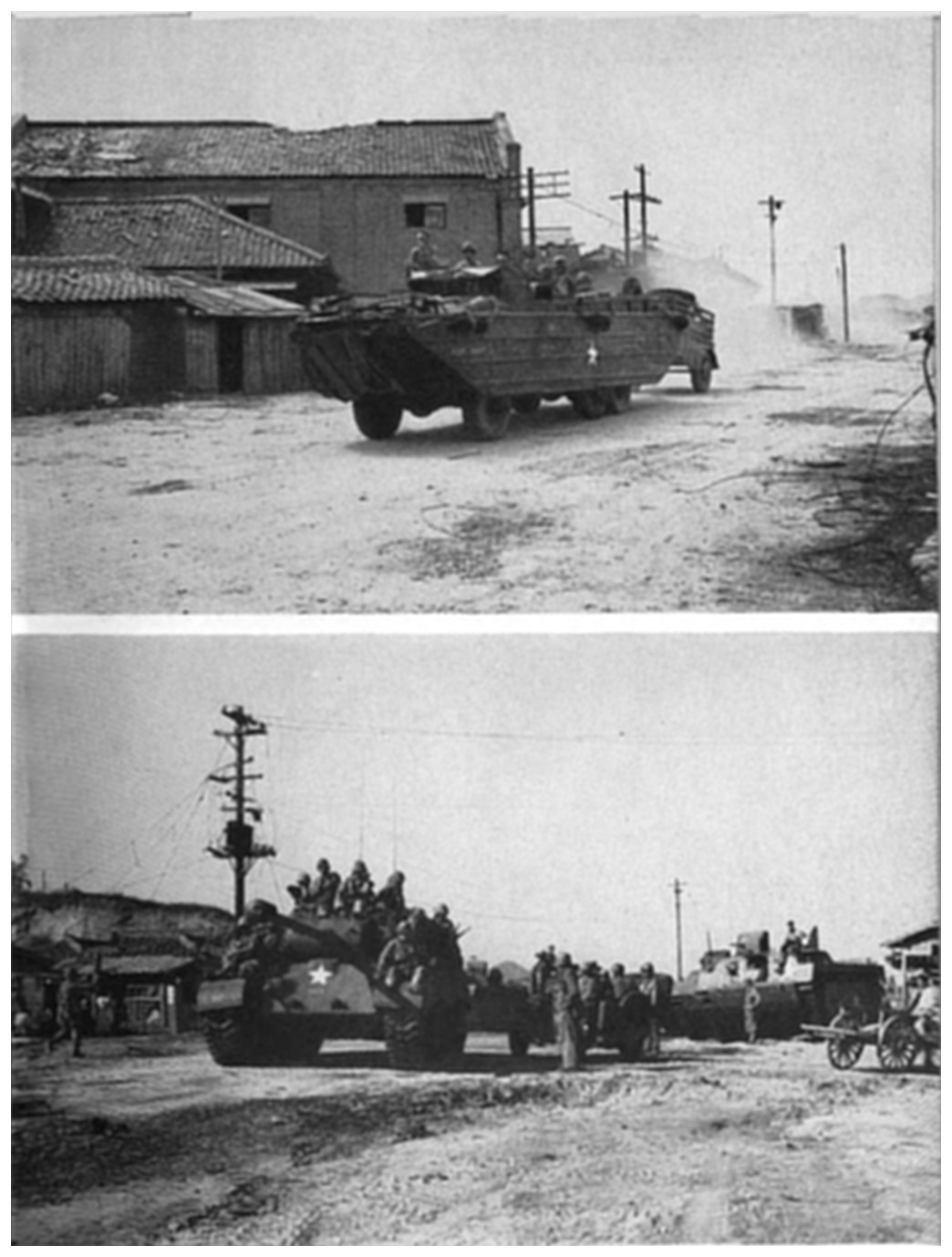
Advance to Force Beachhead Line——Above, assault troops of 1st
Marines move up in DUKWs; and, below, Marine tanks and
amtracs northeast of Inchon (U. S. Army Photos).
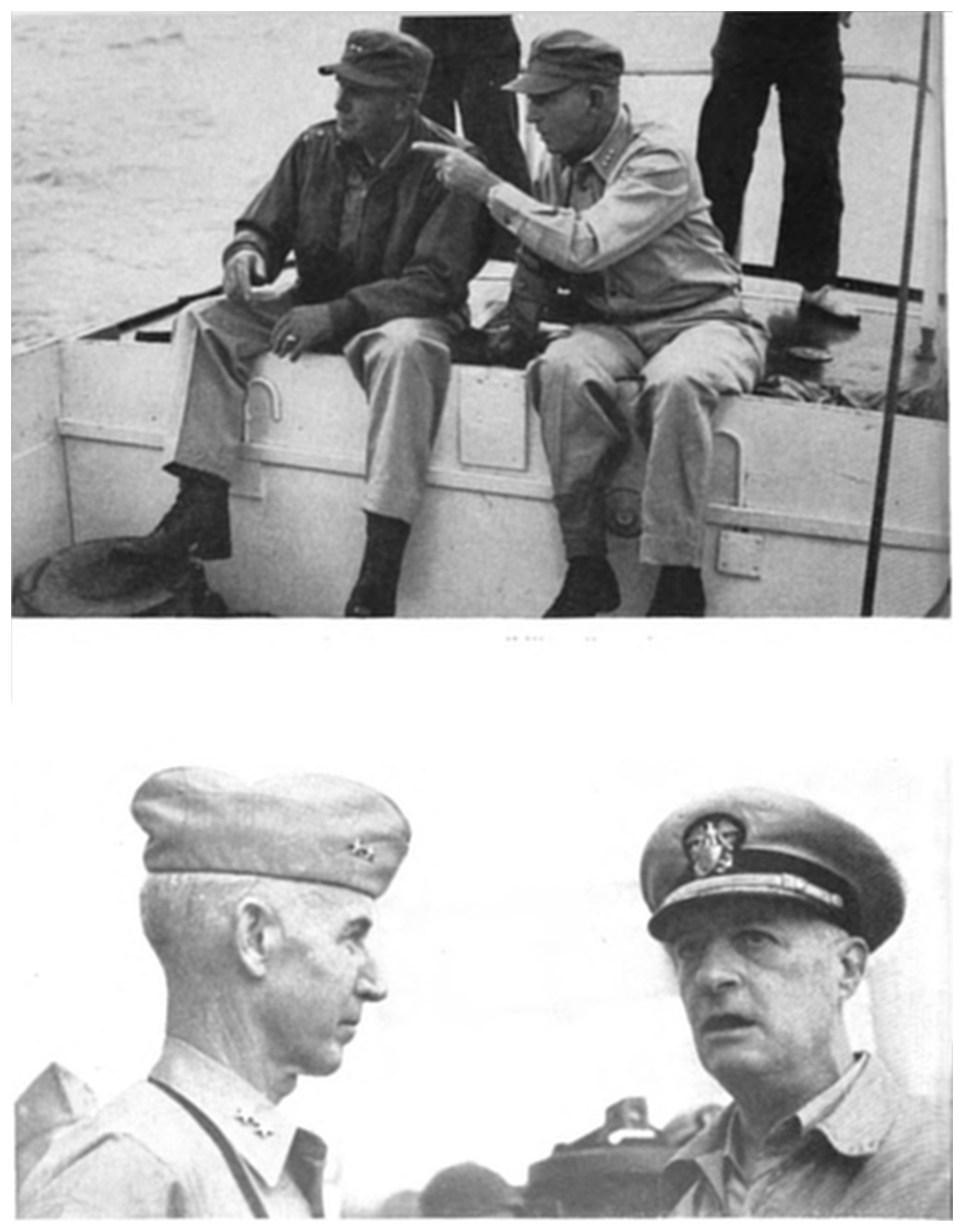
Upper Command Level——Above, Generals Almond (left) and Shepherd
go ashore in launch of USS Mount McKinley; and, below, General
Smith and Admiral Doyle confer on the USS Rochester (U. S. Navy
Photos).
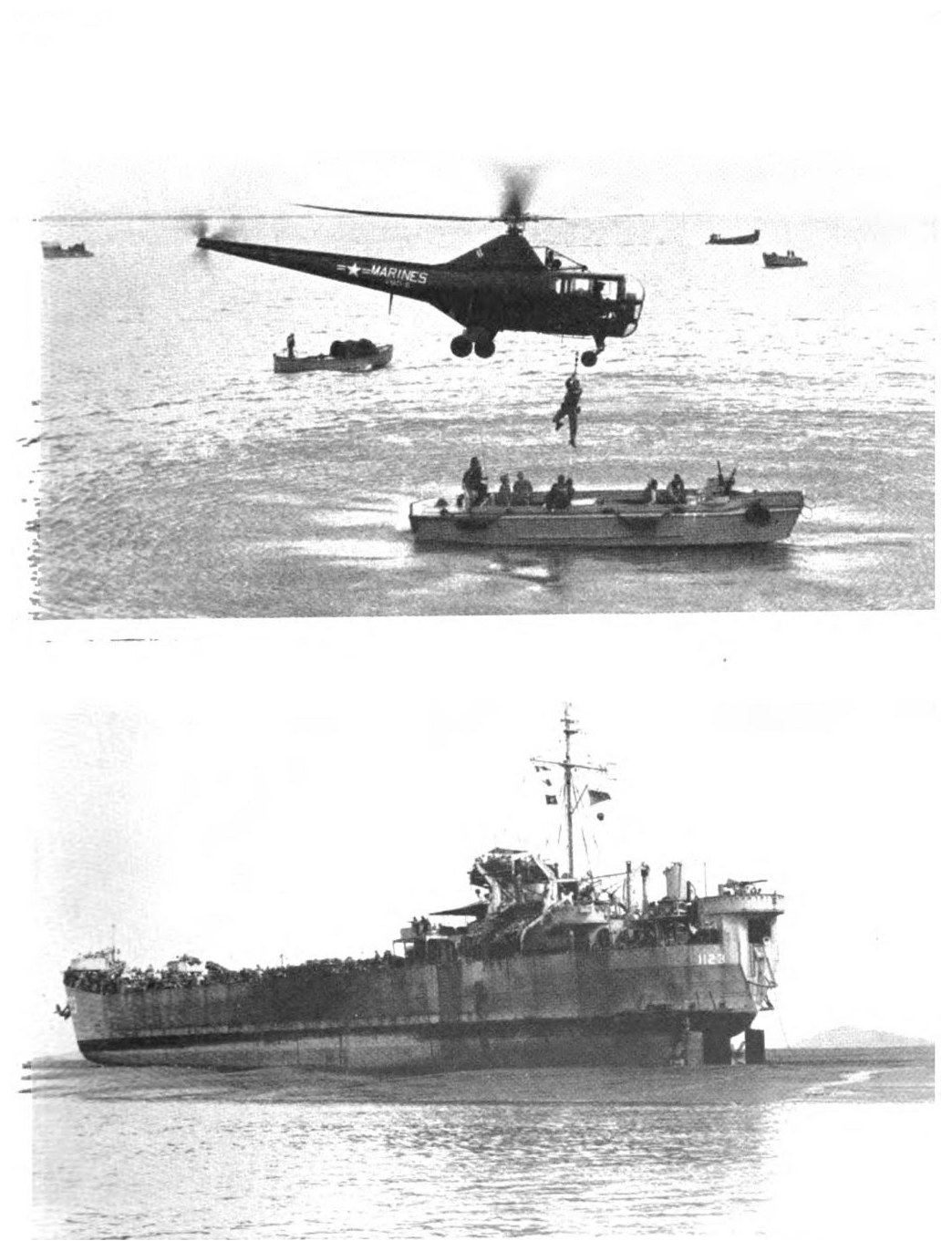
Inchon Harbor Scenes——Above, a VMO-6 helicopter gives a lift to a
Marine officer on LCP; and, below, LST 1123 stranded at low tide
(U. S. Navy Photos).
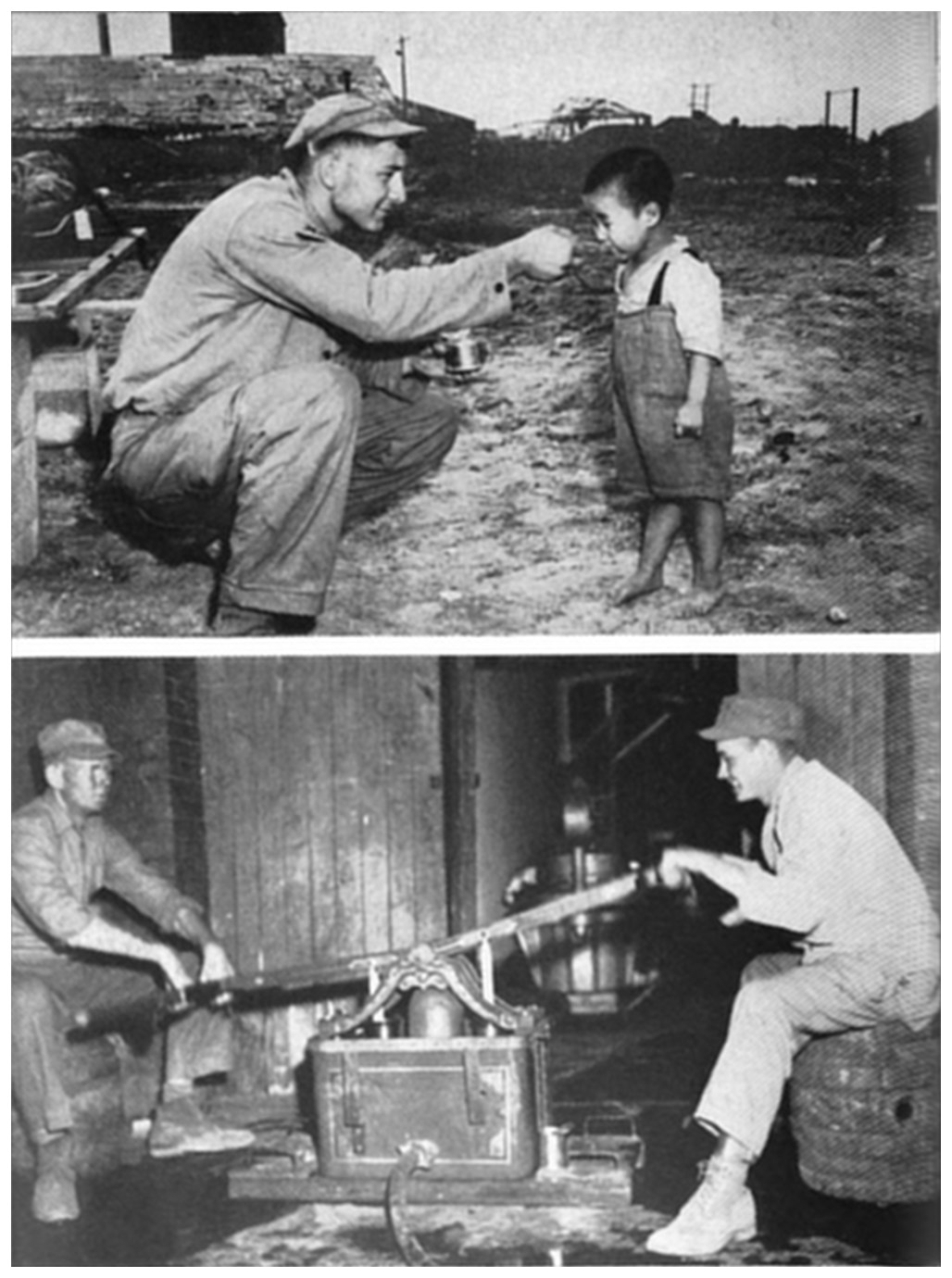
Interludes——Above, Hospitalman Philip A. Barome, USN, shares
his “C” rations with a Korean youngster (U. S. Navy Photo);
and, below, Private G. W. Febrey and Corporal Charles E. Burris
of 1st Marine Division, fill can at captured Yongdungpo brewery
(U. S. Army Photo).
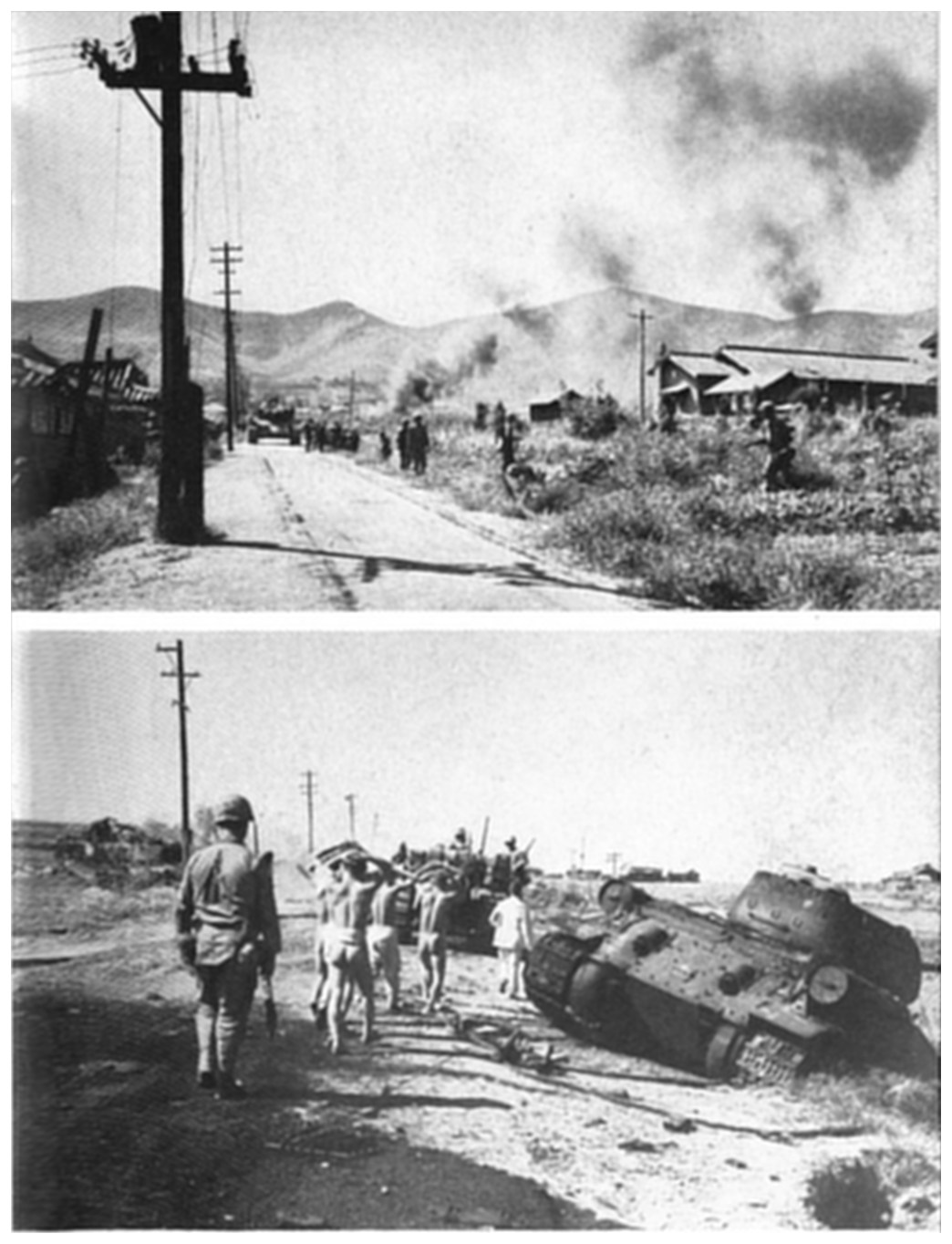
D-Plus 2——Above, Marine tank-infantry team searches houses in
Korean village (Marine Corps Photo); and, below, stripped
NKPA prisoners are marched past killed enemy tank (U. S.
Army Photo).
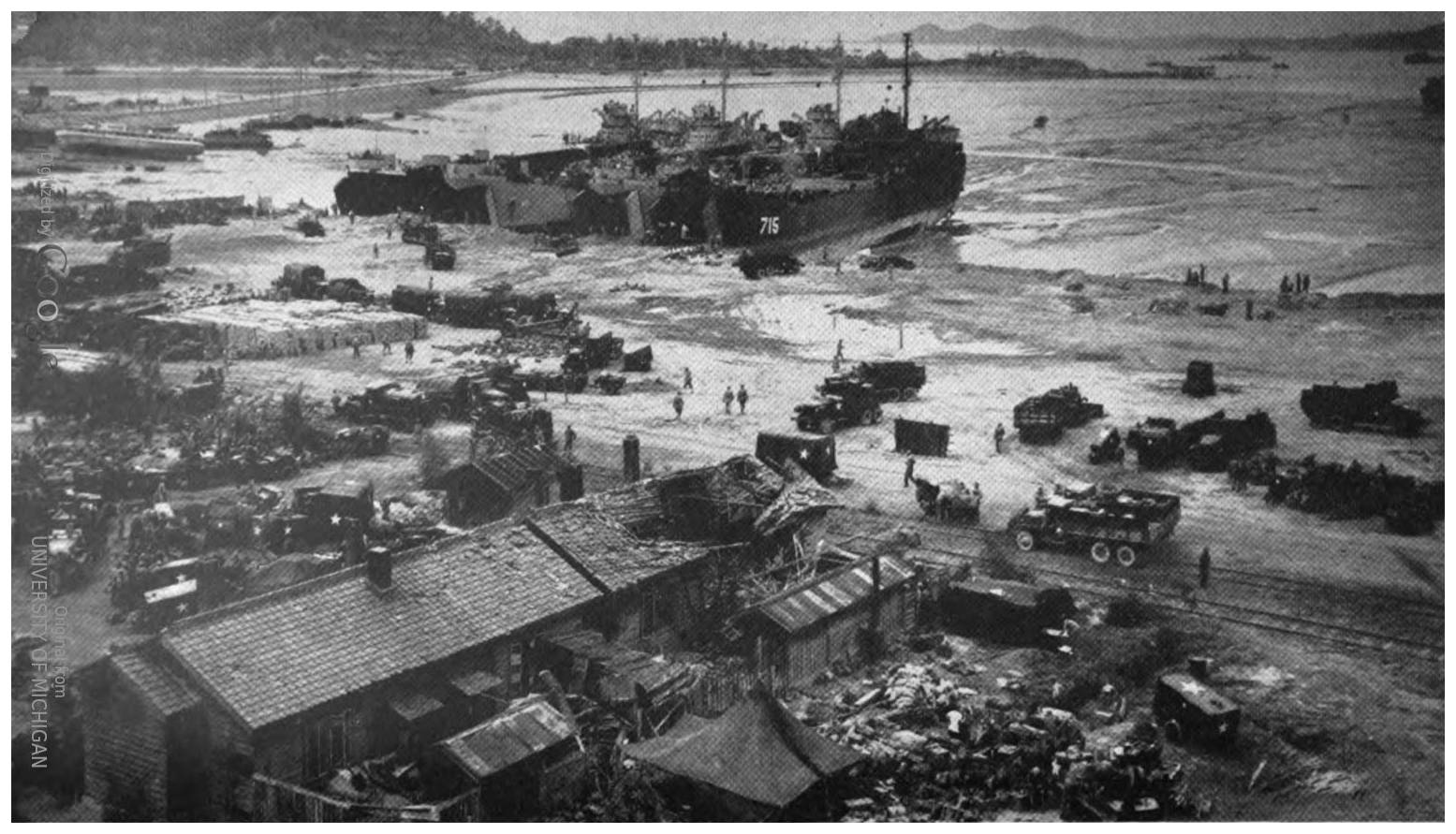
RED Beach——LSTs unloading and Marine trucks taking supplies to advancing troops on D-plus 2 (U. S. Army Photo).
On D-day the four cruisers would stand in from 13,000 to 15,000
yards offshore in Fire Support Area I, while the destroyers in FSAs
II and III manned stations 800 to 6,000 yards from the beach. The
three LSMRs would first support the Wolmi-do landing from close-in
positions to the north and west of the island. Later, for H-hour, one
of the rocket ships was to remain northward to soften up RED Beach,
and the other two would displace to the vicinity of BLUE Beach.101
From L-minus 45 to L-minus 2, the cruisers and destroyers would
dump a total of 2,845 shells on Inchon and its outlying island, each
ship concentrating on specifically assigned target areas. From L-minus
15 to L-minus 2, each of the three LSMRs would saturate Wolmi-do
with 1,000 5-inch rockets. Most of the ships were to cease fire two
minutes before the landing on GREEN Beach, when Marine planes
strafed possible enemy positions for final shock effect. Four of the
destroyers would continue to pound Inchon targets with 55 shells
during the short air attack.
Another intricate piece in the mosaic of destruction was the mission
assigned to one LSMR for the period immediately preceding and
following the landing of 3/5. The lone rocket ship would lumber
parallel to Wolmi-do’s shoreline, across the front of the advancing
first wave, and pour 40mm shells into the beach area. Clearing the
route of approach to GREEN Beach just in time for the landing
craft to speed by, the LSMR was to continue southward along the
coast and direct its heavy automatic fire at the slopes in advance of
the attacking troops.
Once Wolmi-do was secured, the full fury of the support ships
would rain down on targets in the Inchon area. From H-minus 180
to H-minus 5, the cruisers and destroyers were scheduled to blast
their assigned targets with a total of 2,875 shells. Chiming in at H-minus
25 with 2,000 rockets apiece, the LSMRs would pulverize RED
and BLUE Beaches until five minutes before the landings by the two
Marine regiments. At that time, all ships must cease fire to clear the
way for strafing Corsairs and Navy Skyraiders.
The meticulous planning left nothing to chance, even with the
assumption that a foothold would be successfully established by darkness.
During the night of D-day, the cruisers would expend an additional
250 shells on interdictory missions, and the destroyers were
authorized to fire a total of 300 5-inch rounds on call from the infantry.
To help thwart any possible enemy ambitions at dawn of D-plus 1, the
cruisers would be prepared to unload 300 shells for interdiction and
call fires, while the destroyers stood poised with the same number of
high-explosive missiles plus 300 illuminating shells.
Other details of the elaborate plan dealt with the coordination of
naval gunfire, air, artillery, mortars, and rockets. At certain times,
for example, Marine and Navy gunners could fire only below a maximum
trajectory of 1100 feet, so that planes, whose minimum altitude
was set at 1500 feet, could pass safely over Inchon during strikes on
adjacent areas. During those periods when close support Corsairs were
scheduled to descend on beachhead targets, all other heavy weapons
would fire completely clear of broad circles defining strike areas for
the air missions.
More tables and instructions in the formidable appendixes of
Admiral Doyle’s operation order assigned shore fire control parties
their ships and radio frequencies, ships their battery missions and
ammunition allowances, and a host of other tasks and responsibilities.
Air support, of course, was closely related to naval gunfire planning.
After the arrival of CG 1st MAW and his staff at Tokyo on 3 September,
part of the group proceeded at once to Itami Air Force Base while
General Harris and selected staff members remained at Tokyo for
planning conferences.
Air support planning for Inchon was based on the decision that
the sky over the objective area was to be divided between the organic
air units of JTF-7 and X Corps.
JTF-7 counted on its fast carrier task force, TF-77, to gain air
supremacy and furnish deep support and interdiction strikes. Close
support for the landing was to be provided by the two squadrons of
TG-90.5, on board the CVEs Sicily and Badoeng Strait, which had
been the main air components of MAG-33 in support of the 1st Marine
Provisional Brigade. In addition, the Attack Force commander could
also call upon the aircraft of TF-77 for close support.
Organic air support for X Corps was to be the mission of the
Tactical Air Control set up under the operational control of the corps
commander and the direct command of General Cushman. The
inspiration for this organization came from Marine officers on the
staff of X Corps. Their suggestions were accepted by General
Almond, who used his authority as FECOM chief of staff to put the
idea into effect.
MAG-33 was designated by General Harris from the Forward
Echelon, 1st MAW, to serve as TAC X Corps, with VMFs 212 and
312 in addition to VMF(N)-542 and the rear echelon of VMF(N)-513.
These units were not to be assigned, however, until X Corps
assumed control of operations in the objective area, whereupon they
would be based at Kimpo Airfield. Meanwhile, they remained under
the administrative control of ComNavFE and MAG-12, with headquarters
at the Itami AFB in Japan. The two Marine carrier-based
squadrons and the forward echelon of VMF(N)-513, having come
out to Korea in August as units of MAG-33, continued to be assigned
temporarily to that group for administrative purposes.102
TAC X Corps was activated on 8 September, just six days before its
components landed in Japan. 1st MAW planners designated the Air
Support Section of MTACS-2, which had controlled air support for
the Brigade, to continue in that capacity for the Landing Force and
later for the entire X Corps. Arrangements were made with the
Combat Cargo Command, FEAF, to airlift aviation fuel and ammunition
from Japan to Kimpo Airfield, after its capture, until such supplies
could be transported by sea.
Marine air units were also affected, of course, by the planning which
the 1st Marine Division air and naval gunfire representatives of the
Fire Support Coordination Center had already accomplished. Working
aboard the Mount McKinley in conjunction with their opposite
numbers of PhibGru One, the FSCC group had been busy since its
arrival in Japan on 18 August. Planning was conducted with the CO
11th Marines after the artillery regiment landed in Japan, and the
resulting decisions coordinated with air and naval gunfire plans.
The 1st MAW completed its planning on 9 September. General
Cushman was designated Tactical Air Commander, X Corps, on that
date and departed for the objective area the next day with the air
elements scheduled to proceed by ship.
CHAPTER V Embarkation and Assault — Landing of 1st Marine Division — Plan to Seize Kimpo Airfield — Shipping Assigned to Marines — Movement to the Objective Area — Air and Naval Bombardments — Marine Landings on GREEN Beach — The Two Harbor Islands Secured
Landing of 1st Marine Division—Plan to Seize Kimpo Airfield—Shipping
Assigned to Marines—Movement to the
Objective Area—Strikes and Bombardments—Marine Landings
on GREEN Beach—The Two Harbor Islands Secured
On 30 August, ComNavFE issued his Operation Plan 108-50,
assigning to JTF-7, of which X Corps was a part, the mission of
seizing by amphibious assault a beachhead at Inchon.
X Corps OpnO No. 1 was dated on the 28th, though not received
by Division until the 30th. By that time, Division planning had made
so much progress that Embarkation Order 1-50 was issued on the last
day of the month, followed on 4 September by the final draft of
Division OpnO 2-50. Operations orders of JTF-7 and TF-90 were
issued concurrently.
This meant that the assault RCTs, contrary to amphibious doctrine,
were to receive rigid landing plans drawn up completely by the Division.
Lack of time caused this variation from usual procedure, but
General Smith had confidence in the ability of his troops to overcome
the handicap. “Under the circumstances,” he asserted, “adoption
of such methods was justified by the common background and
training of all elements and individuals in amphibious doctrine, procedures,
tactics, and techniques.”103
The most that could be done was to summon Brigade staff officers
from Korea for a conference. Colonel Edward D. Snedeker (Chief
of Staff), Captain Eugene R. Hering, Jr., USN (Brigade Surgeon),
Lieutenant Colonel Arthur A. Chidester (G-4), and Major Donald
W. Sherman (G-1) arrived on board the Mount McKinley for a conference
on 28 August and the following day. The Brigade G-3,
Lieutenant Colonel Joseph L. Stewart, reported as liaison officer on
the 31st. When he returned to the front, the 5th Marines was attacking,
and he discussed landing schedules with Lieutenant Colonel Raymond
L. Murray while the regimental commander directed the action.
“This,” remarked General Smith, “was hardly in accordance with
accepted procedure for planning amphibious operations.”104
The recommendation of Brigade staff officers that the 3d Battalion,
5th Marines, be designated for the assault on Wolmi-do was accepted
by Division planners. Colonel Snedeker also proposed that the 1st
Korean Marine Corps (KMC) Regiment of nearly 3,000 men be substituted
for the 17th ROK Regiment, which he said was committed
in the Pusan Perimeter and might not be available. The change was
approved by GHQ on 3 September, with the Eighth Army being
directed to provide weapons for the newcomers.
This was the beginning of a relationship that would find the KMCs
serving with distinction alongside the men of the 1st Marine Division
and eventually becoming a fourth infantry regiment of the Division.
Activated in 1949 by the Republic of Korea, the unit took part in
anti-guerrilla operations until the NKPA invasion. After the outbreak
of hostilities, the KMCs fought creditably in UN delaying actions in
southwest Korea. The turning point came when they were attached
to the 1st Marine Division and sent to Pusan for test-firing of their
new weapons before embarking for Inchon. Immediately the Koreans
commenced to model themselves after U. S. Marines so assiduously
as to win respect for their spirit and rugged fighting qualities.105 They
were quick to learn, despite the language handicap, and showed
aptitude in mechanical respects.
The main body of the 1st Marine Division troops landed at Kobe
from 29 August to 3 September. Marine officers sent in advance to
that seaport had found the authorities there “very cooperative” and
brought back to Tokyo a billeting plan which General Smith
approved. Since the facilities in and about Kobe were limited, two
large APs were designated as barracks ships, thus making available
a Marine labor pool at the docks.
At best, every hour was needed for the tremendous task of transferring
cargo from merchant type shipping into assault shipping.106
There was cause for anxiety, therefore, when a telephone message
informed the command of the 1st Marine Division on 3 September
that Typhoon JANE had struck Kobe with winds of 74 miles per
hour. First reports had it that the Marine Phoenix was on the bottom
with all of the Division’s signal gear. Several ships were said to have
broken their moorings and gone adrift; the docks were reported under
4 feet of water, and loose cargo on the piers had been inundated by
breakers.
Later accounts proved to be less alarming. The Marine Phoenix,
having merely developed a bad list as a result of shifting cargo, was
soon righted. Nor was the other damage as serious as had at first
been supposed. But 24 hours were lost from the tight reloading
schedule while Typhoon JANE kicked up her heels, and time was
one commodity that could not be replaced. All operations at Kobe
had to be speeded up to pay for this delay.
On 4 September the Mount McKinley set sail for Kobe, arriving at
1445 the next day to be welcomed by an Army band at the pier.
The soothing powers of music were needed by Marine officers who
learned that fire had broken out in the hold of the Noonday as she
belatedly approached Kobe. This “Jonah” had taken so long to load
at San Diego that she lagged behind the others, and now large quantities
of much-needed Marine clothing were apparently ruined by
water when the fire was extinguished. Once again the Army came
to the rescue with wholehearted cooperation by taking the water-soaked
boxes to a reclamation depot where the garments were dried,
repackaged and sent back to the docks in time for loading out on the
originally scheduled ships.
Only the most basic troop training could be conducted at Kobe to
supplement the individual and amphibious instruction the men had
received on shipboard. At this time, moreover, an order from the
Secretary of the Navy made it necessary to reduce the size of the
landing force by withdrawing about 500 Marines who had not yet
reached their 18th birthday. They were transferred to the 1st Armored
Amphibian Tractor Battalion, which was to be left behind at Kobe
when the Division embarked for Inchon.
This unit had been organized at Camp Pendleton in accordance
with a directive from the Commandant. It was found necessary,
however, to transfer most of its combat-ready men to the 1st Tank
Battalion in order to bring that outfit up to full strength. The tank
battalion was given priority because its vehicles would be used throughout
the operation while the armored amphibians might be employed
only occasionally. As a consequence, the 1st Armored Amphibian
Tractor Battalion left San Diego with new personnel lacking in the
skills to make it fully combat ready.
Lieutenant Colonel Francis H. Cooper, the commanding officer,
recommended at Kobe that the unit be withheld from action until
drivers, gunners, and maintenance crews could be properly trained.
General Smith and his staff concurred, having learned that a trained
Army unit, Company A of the 56th Amphibian Tractor Battalion,
could be made available. Orders were given for Cooper’s battalion
to remain at Kobe, therefore, with the 17-year-old Marines attached.
Several other U. S. Army units were to take part along with the
Marines—the 96th Field Artillery Battalion, the 2d Engineer Special
Brigade, the 73d Engineer (c) Battalion, the 73d Tank Battalion, the
50th Engineer Port Construction Company, and the 65th Ordnance
and Ammunition Company. These units comprised a total of about
2,750 troops.
Plans called for the commanding officer of the 2d Engineer Special
Brigade to head a logistical task organization which also included
several Marine units—the 1st Shore Party Battalion, the 1st Combat
Service Group, and the 7th Motor Transport Battalion. The Shore
Party troops were to initiate unloading at the objective, whereupon
the over-all control would pass to the 2d Engineer Special Brigade, on
order, to insure continuity of development of unloading facilities.107
Division service units, in accordance with current directives, were
to carry the 30-day replenishment of spare parts appropriate to the
unit concerned. Although the Combat Service Group had neither
spare parts nor supplies, it was to have custody of both after the landing.
Thus the units would be freed immediately to move away from
the beach in support of the Division as it drove toward Kimpo and
Seoul.108
At Kobe the men of the 1st Marine Division were required to leave
the full clothing bags they had brought from San Diego and embark
for Inchon with field transport packs containing only the most essential
items. This meant that some 25,000 sea bags must be stored at
the Japanese port in such a way that future casualties and rotation
drafts could reclaim their personal effects without delay. As a reminder
of the grim task ahead, provisions must be also made to return
to proper custody the effects of deceased personnel.
Intelligence reports on the eve of embarkation did not depart from
earlier estimates of a maximum of 2,500 NKPA troops in the objective
area. From 400 to 500 were believed to be garrisoning Wolmi-do,
500 defending Kimpo, and the balance stationed in and about Inchon.109
Despite the estimates of low to moderate enemy resistance, however,
General Smith differed with the command of X Corps when a
commando-type raid on Kimpo was proposed.
The question came up on 8 September at a conference held at Kobe
on the Mount McKinley and attended by Generals Hickey and Smith,
Admiral Doyle and Colonel Louis B. Ely, USA. Ely commanded
the newly formed X Corps Special Operations Company composed
of 124 U. S. Army troops briefly trained by TTU instructors in demolitions,
individual combat and ship-to-shore movements in rubber
boats.110 General Almond’s plan called for this company, reinforced
by Marines, to embark at Kobe on 10 September in a British frigate and
transfer to a South Korean picket boat. Upon arrival at the objective
area on D-day, the raiders were to paddle three miles in rubber boats
to the north of the Attack Force, land under cover of darkness, and
move inland for a surprise attack on Kimpo at dawn.
General Almond felt it necessary to seize the airfield at the earliest
possible moment. Surprise, he felt, would reduce the risks. General
Smith pointed out, however, that Colonel Ely’s men would have to
row their rubber boats against a strong tide and cross a wide expanse
of mud flats on foot. His radios could only reach four miles, and his
presence in the 1st Marine Division’s zone of action would restrict
the use of naval gunfire and air support. Finally, said the Marine
general, it was not certain that the raiders could hold the airfield even
if they took it.111
This conference did not settle the issue. Colonel Williams, the
Division chief of staff, was requested in a telephone call followed by
a dispatch from the G-1 Section of GHQ to turn over 100 specially
qualified Marines to Ely’s company. Smith sent a dispatch requesting
reconsideration. He cited the battle casualties of the Brigade, which
had not been replaced, and the 500 under-age Marines to be left behind
at Kobe. As a final objection, many of his best qualified men had
already embarked on the LSTs.
General Shepherd sent a dispatch supporting the 1st Marine Division
commander, and the order from GHQ was recalled.112
Another proposal by General Almond to speed up the drive inland
from the beachhead was relayed to General Smith aboard the Mount
McKinley on 9 September by Brigadier General Henry I. Hodes,
ADC of the 7th Infantry Division. This was a plan to land a battalion
of the 32d Infantry on GREEN Beach, Wolmi-do, with a mission of
racing across the causeway on the late afternoon of D-day and moving
rapidly down the road to seize the high ground south of Seoul, more
than 20 miles inland. The 1st Marine Division was requested to
furnish five tanks in support of the enterprise tentatively scheduled
to take place while two battalions of Marine artillery were landing
on Wolmi-do and two Marine rifle regiments were landing on the
Inchon beaches.
This idea struck Smith as being extremely optimistic. Without
going into the tactical objections, he decided that the scheme was
logistically impracticable.113
The embarkation at Kobe was not completed without some confusion.
Much of the equipment was in its original containers and had never
been checked or identified. Large quantities of Class I, III, and V
supplies, distributed throughout the incoming shipping, had to be
reassembled and reassigned for the outloading. In the lack of suitable
storage areas near the piers, Classes III and V were off-loaded into
Japanese barges and held in floating storage until they could be reloaded
into assault shipping.114
Inter-pier transfer of cargo was avoided whenever possible by berthing
incoming shipping so that units could load directly into assault
shipping. Unfortunately, this could not be done in some instances,
since the LST landing was outside but adjacent to the pier area.
Facilities for the embarkation of the Brigade at Pusan were satisfactory,
with pier space for three APAs and one AKA at one pier and
an LSD at another. All of the assigned LSTs could beach simultaneously
along the sea wall.
Only Marine amphibious experience enabled the Division to complete
its tremendous task at Kobe in spite of the time lost as a result
of Typhoon JANE. The shipping tentatively assigned by X Corps
consisted of one AGC, six APAs, eight AKAs, three LSDs, one LSM,
three APDs, 12 LSUs, and 47 LSTs. This last figure included 17
Navy-manned and 30 SCAJAP (Japanese-manned) LSTs. The troop
list of approximately 29,000 men was broken down by the Division
into the following six embarkation groups with their assigned
shipping:
| Embarkation group |
Principal units |
Shipping |
| ABLE |
Divisional Troops |
1 AGC |
| |
1st CSG |
2 APAs |
| |
|
5 AKAs |
| |
|
9 LSTs |
| |
|
1 LSM |
| |
|
3 LSUs (towed to objective area by tugs) |
| BAKER |
1st Marine (Reinf) |
1 APA |
| |
1st Amtrac Bn |
12 LSTs |
| CHARLIE |
5th Marines (Reinf) |
3 APAs |
| |
73d Tank Bn, USA |
12 LSTs |
| |
|
3 APDs |
| |
|
1 LSD w/3 LSUs |
| DOG |
11th Marines |
1 AKA |
| |
|
6 LSTs |
| EASY |
1st Tank Bn |
2 LSDs w/3 LSUs each |
| |
|
4 LSTs (later increased to 6) |
| FOX |
2d Engr Spec Brig, USA |
1 AKA |
| |
96th FA Bn, USA |
4 LSTs |
Four of these groups were to embark from Kobe while CHARLIE
mounted out from Pusan and FOX from Yokohama, Yokosuka, and
Camp McGill in Japan.115 The main body of the Division’s third rifle
regiment, the 7th Marines, was scheduled to land in Japan on 17
September. Colonel Litzenberg, the commanding officer, arrived at
Itami Airfield on the 6th, having flown from Camp Pendleton ahead
of his troops to make arrangements.
Command relationships during the assault and embarkation phase
were as follows:
                      +---------+
                      | CinCFE  |
                      +----+----+
                           |
                      +----+----+
                      |ComNavFE |
                      +----+----+
                           |
                      +----+----+
                      | CJTF-7  |
                      +----+----+
                           |
                 +---------+--------+
                 |                  |
           +-----+----+       +-----+-----+
           |  CTF-90  |       |CG X Corps |
           +-----+----+       +-----+-----+
                 |                  |
       +---------+---------+--------+--------+
       |                   |                 |
+------+-------+   +-------+------+   +------+-------+
| ComPhibGru-1 |   |CG 7th Inf Div|   |CG 1st Mar Div|
+--------------+   +--------------+   +--------------+
The movement of JTF-7 to the objective area was planned in the
most exacting detail, owing to the dispersion of the ships to begin
with, the need for secrecy, and the limited time. Another complication
entered the picture at the last minute, when a second typhoon
loomed on the Pacific horizon with considerably more menace than
its exotic name would imply.
Navy meteorologists had been plotting the movement of Typhoon
KEZIA since the first signs of turbulence near the Marianas Islands
on 6 September. Generating winds of 100 miles per hour three days
later, the typhoon was churning a steady course toward the East China
Sea and Tsushima Strait, where it was expected to hit on 12 or 13
September. The timing could not have been worse as far as Admiral
Doyle and General Smith were concerned. KEZIA threatened to
strike the ships of the task force during the last stages of embarkation
and the first phase of the approach to Inchon. And any serious disruption
of the Navy’s delicate timetable would place the 15 September
deadline hopelessly beyond reach.
With the carriers, cruisers, and destroyers scheduled to be in the
Yellow Sea, beyond the path of the storm, Admiral Doyle’s amphibious
vessels were the most imperiled elements. The Attack Force
Commander planned to move his ships to the objective area in six
increments, three of them loading in Japan, one in Pusan, and two at
both places simultaneously. Because of the last two, certain rendezvous
areas were designated so that fragments of a group could converge
at sea to form the whole. Obviously, then, the mathematics of navigation
was a dominant factor. Success hinged on coordination in
terms of hours, not weeks or days.
Each of the six increments had its own time schedule for an independent
voyage. The route to Inchon was marked off on maps by
a chain of check points, the most significant of which bore the code
names ARKANSAS, IOWA, and CALIFORNIA. The first two,
lying in the East China Sea off the southwestern tip of Korea, formed
the junction of the sea lanes from Japan and Pusan. Consequently,
there was no alternative to their remaining fixed in the direct path
of the oncoming typhoon. Point CALIFORNIA was important in
that it marked the end of the open sea phase and the beginning of
the treacherous offshore approach to Inchon via Flying Fish and East
channels.116
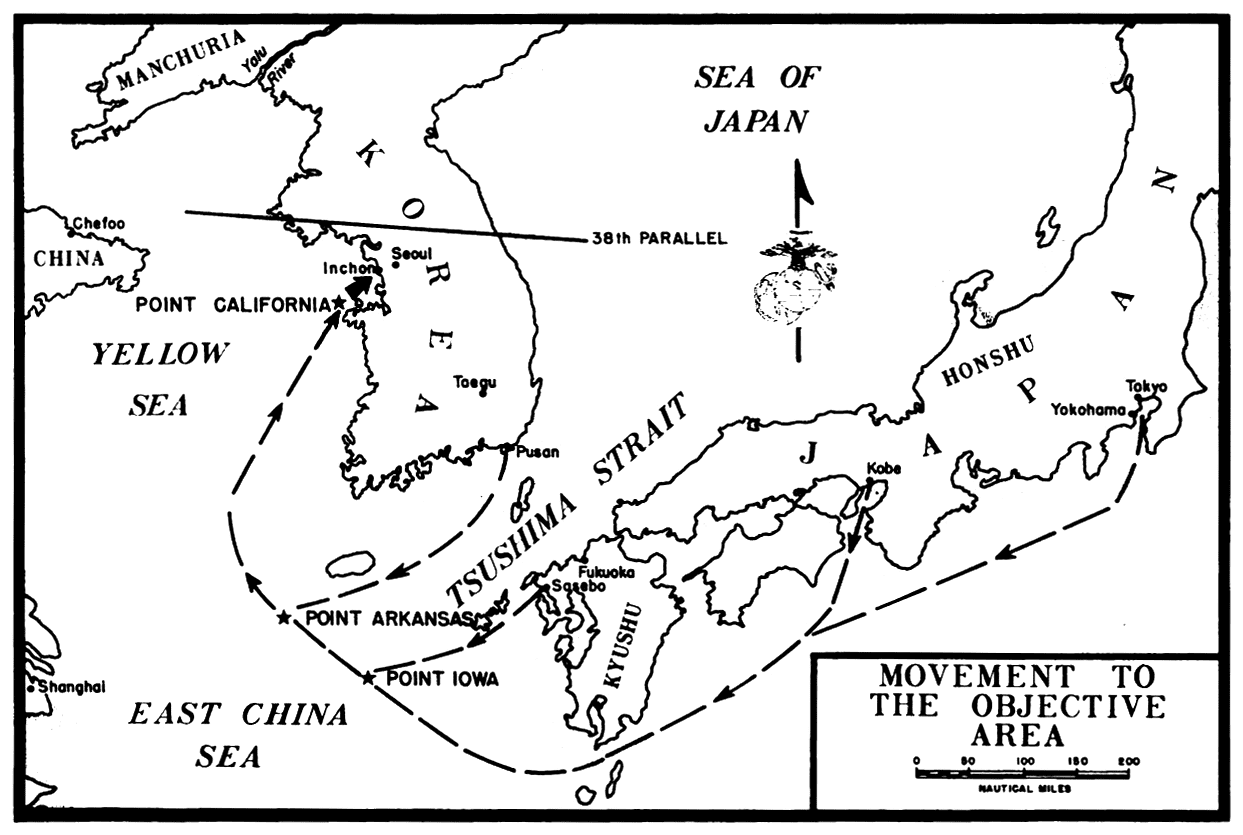
MOVEMENT TO
THE OBJECTIVE AREA
The departure schedule for the Attack Force was set out in Doyle’s
Operation Order 14-50 as follows:
| Unit |
Port |
Date |
| Pontoon Movement Group (2 ATFs, 3 LSUs, 1 YTB, 1 YW) |
Yokohama |
5 Sep |
| LSMR Movement Element (3 LSMRs) |
do |
9 Sep |
| Tractor Movement Element A (LSM, 1 AMS, 1 AM, 1 ARS, 2 LSDs, 36 LSTs) |
Kobe |
10 Sep |
| Tractor Movement Element B (1 ARL, 1 PF, 1 PCEC, 12 LSTs) |
do |
10 Sep |
| Transport Movement Group (5 APAs, 8 AKAs, 1 AP, 2 PFs) |
do |
12 Sep |
| Advance Attack Group (Wolmi-do) (1 LSD, 3 APDs) |
Pusan |
13 Sep |
The chart shows the basic pattern, which would evolve only after
considerable shuffling and secondary routing. For instance, two vessels
of the cumbersome Pontoon Movement Group, carrying vital equipment
for the expansion of Inchon’s port facilities, would not leave
Sasebo until 11 September. They were to join the slow Yokohama
convoy near Point IOWA the same day. Tractor Elements A and B,
the latter trailing at a distance of six miles, would pick up the Pusan
LSTs at IOWA on 13 September. The Kobe contingent of the Transport
Movement Group was to pass through Point ARKANSAS on
the 14th, joining the Cavalier, Pickaway, Henrico, and Seminole from
Pusan.
All ship movements took place on schedule until the morning of
11 September, when angry ocean swells off the coast of Japan marked
the approach of KEZIA. Winds at the center of the typhoon were
estimated at 125 miles per hour, but Admiral Doyle based his decisions
on the assumption that the storm would curve off to the north instead
of colliding with the invasion armada in full force. He was taking a
calculated risk, therefore, when he ordered the Transport Movement
Group at Kobe to weigh anchor on the 11th, a day ahead of schedule,
and proceed to the objective area. The LSTs, already on their way,
were now out of danger; and Doyle believed that advancing the sailing
date would enable the AKAs and APAs to escape the worst of the
typhoon.
The Mount McKinley, with Doyle, Smith, and their staffs aboard,
departed Kobe at 1030 on the 11th. As the ship rolled and pitched in
heavy seas, the Attack Force Commander remarked that KEZIA was
one of the worst storms he had ever encountered.117
This was also the opinion of Captain Cameron Briggs, USN, then
fighting it out with KEZIA in an effort to reach Sasebo with the carrier
Boxer and its 96 planes plus 14 extra aircraft taken aboard at Pearl
Harbor. It was necessary to launch these spares and land them on
Okinawa before he could finally make port on the 12th and prepare
to mount out two days later for Inchon.118
On 12 September the Mount McKinley overtook the AKAs and
APAs. They had reversed course, apparently on the assumption that
they could not get around the typhoon. If Doyle had not ordered
the heaving vessels to circle about and follow the flagship through the
storm, their chances for meeting the 15 September deadline at Inchon
would have vanished like the wind-whipped spray.119
There was no joy in the troop compartments as the transports plowed
through mountains of water. But Doyle was winning his gamble that
the typhoon would slowly veer off to the north, and starting the Transport
Group a day early proved to be a sound decision. Thanks to the
admiral’s judgment and resolution, every ship weathered the storm
and approached Point ARKANSAS on schedule.
After rounding Kyushu on 12 September, the Mount McKinley
docked at Sasebo that evening to pick up General MacArthur with
his party of GHQ and X Corps officers. The proper ship for this
purpose was Admiral Struble’s flagship, the USS Rochester. But
CinCFE preferred the Mount McKinley despite the fact that an AGC
was designed for the staffs of an Attack Force and Landing Force
and had no accommodations suited to a party including seven general
officers. The ship was warped in by two tugs and CinCFE came
aboard. General Shepherd had previously been assigned by General
MacArthur to his staff for temporary duty as amphibious adviser and
personal liaison officer to the 1st Marine Division. The Marine general
was accompanied by Colonel V. H. Krulak, G-3 of FMFPac, and his
personal aide, Major J. B. Ord.
In less than an hour the Mount McKinley was back on the high seas,
straining through the darkness toward Korea.120
All elements of the Attack Force completed the last leg of the
voyage without incident on 14 September. Headquarters of the 2d
Battalion, 1st Marines, rode the only cripple, an LST partially incapacitated
by an engine breakdown. Fortunately, an ocean-going tug was
on hand to tow the ailing vessel at eight knots—sufficient speed to get
her to the objective area on time.
The Yellow Sea was quiet as the columns of ships closed on Point
CALIFORNIA and Korea’s coastline. Nothing was taken for granted,
and the approach was carefully screened to the very end by Admiral
Andrewes’ fast Blockade and Covering Force.
The softening up of Wolmi-do had begun on 10 September, when
the Marine fliers of TG-95.5 made napalm attacks designed to burn
off the trees screening NKPA artillery. Six planes of VMF-323 and
eight planes of VMF-214 took off from the CVEs at 0600 and scorched
the eastern side of the island. The next flight of 14 planes found it
necessary to orbit for a few minutes until the smoke cleared sufficiently
for them to continue the work of destruction.
Lieutenant Clark’s reports had led G-2 officers to believe that enemy
defensive installations on Wolmi-do were more formidable than had
at first been supposed. As if in support of this conclusion, the Marine
fliers of the second strike were greeted with small-caliber anti-aircraft
fire both from the island and mainland. A third attack, launched
from the decks of the Sicily and Badoeng Strait shortly before noon,
left the hump-backed island in flames from one shore to another.
After the CVEs returned to Sasebo for replenishment the next day,
the carrier-based Navy planes of TF-77 worked over both Wolmi-do
and Inchon on 12 and 13 September. It was now the turn of the
destroyers, and Admiral Higgins had planned a bold venture. Instead
of risking collision or grounding in a night approach, he decided to
forego the advantages of surprise and attack in broad daylight. And
instead of avoiding NKPA fire, he intended to goad the enemy into
retaliations which would reveal the positions of NKPA guns on
Wolmi-do.
The hazards of the operation were increased by the fact that a
ROK PC boat had discovered an NKPA craft laying mines on the
morning of the 10th. This confirmed Admiral Struble’s opinion
that the Inchon area offered the enemy excellent opportunities for this
form of warfare. Not only would the muddy waters make detection
difficult, but crippled ships would block the narrow channel.
It was not a pleasant prospect. And the outlook became darker on
the morning of 13 September when four mines were spotted in Flying
Fish Channel. The U. S. cruisers Toledo and Rochester and the
British cruisers Kenya and Jamaica had dropped off in support as the
six destroyers carried out their mission. Pausing only to detonate the
mines with 40mm rounds, the cans moved up within 800 yards of
Wolmi-do to fire down the enemy’s throat while the four cruisers
poured in 6- and 8-inch salvoes and the planes of TF-77 made bombing
runs.121
It had been long since the Navy issued the historic order “Prepare
to repel boarders!” But Admiral Higgins did not overlook the possibility
of NKPA infantry swarming out over the mud flats to attack a
disabled and grounded destroyer. And though he did not issue pikes
and cutlasses, the crews of the Gurke, Henderson, Swanson, Collett,
De Haven, and Mansfield were armed with grenades and Tommy
guns for action at close quarters.
The enemy endured half an hour of punishment before obliging
Higgins by opening up with the shore guns of Wolmi-do. The Gurke
and De Haven took hits, and five NKPA shells found the Collett.
The total damage was insignificant, however, and the casualties
amounted to one man killed and eight wounded. These results cost
the enemy dearly when the cruisers and destroyers silenced the NKPA
guns shortly after they revealed their positions.
On the return trip the destroyers found eight more mines and
exploded them. This proved to be all, for the enemy had neglected
an opportunity to make the waters around Inchon dangerous for the
attack force. The next morning, when the destroyers paid another
visit to Wolmi-do, the shore guns appeared to have been effectually
silenced. The DDs fired more than 1,700 5-inch shells and drew only
a few scattered shots in reply. Meanwhile, the Marine planes of
VMFs-214 and -323, having returned from Sasebo, cooperated by spotting
for the cruisers and launching napalm strikes before and after
the bombardment.
On the evening of 14 September, after five days of continual pounding,
Wolmi-do was a blasted piece of real estate as the Marines of 3/5
prepared to hit GREEN Beach in the morning.
The pre-dawn stillness of the Yellow Sea was shattered as the Corsairs
of VMFs-214 and -323 flashed up from the decks of the Sicily and
Badoeng Strait. To the west the planes of Task Force 77 were assembling
in attack formations above the Valley Forge, Philippine Sea, and
Boxer. Squadron after squadron droned eastward through the blackness,
and the first aircraft began orbiting over the objective area at
0454.122
Two hours earlier, Advance Attack Group 90.1, under Captain
Norman W. Sears, USN, had glided into the entrance of Flying
Fish channel. Led by the Mansfield, the column of 19 ships snaked
through the treacherous passage while captains and navigators sweated
over radar scopes. Lieutenant Clark’s handiwork provided a welcome
relief midway along the route, when the glimmering beacon on
Palmi-do guided the vessels past one of the more dangerous points in
the channel. Minutes after air cover began to form over Inchon, the
ships eased into the narrows west of Wolmi-do and sought assigned
battle stations. Training their big guns on the port city were the
cruisers Toledo, Rochester, Kenya, and Jamaica, comprising one of
the three Fire Support Units under Admiral Higgins. Other support
vessels scattered throughout the waters of the objective area were the
destroyers Collet, Gurke, Henderson, Mansfield, De Haven, Swenson,
and Southerland; and this array of fire power was further supplemented
by the three bristling rocket ships, LSMR’s 401, 403, and 404.123
The control ship, Mount McKinley, its flag bridge crowded with star-studded
commanders, steamed into the narrows just before dawn. No
sooner had the gray shoreline become outlined in the morning haze
than the 6- and 8-inch guns of the cruisers belched sheets of orange
flame in the direction of Inchon; and at 0545, the initial explosions
rocked the city and reverberated throughout the channel. There was
a deafening crescendo as the destroyers hammered Wolmi-do with
their 5-inch guns. Radio Hill, its seaward side already burnt and
blackened from previous bombardments, was almost hidden by smoke
when Marine planes streaked down at 0600 to smother the island with
tons of rockets and bombs.124
Captain Sears, reporting to the Mount McKinley, confirmed L-hour
at 0630. To this end, Lieutenant Colonel Robert D. Taplett’s landing
force was boated by 0600, and the LCVPs and LSUs rendezvoused
while Marine air continued to soften up the target.125
Air attacks ceased at 0615, but Wolmi-do enjoyed only a momentary
respite before the most unnerving blow of all. In strange contrast to
the sleek men-o’-war and nimble aircraft, three squat LSMRs closed
on the island from the north, a few hundred yards offshore. Phalanxes
of rockets arose from the decks of the clumsy ships, arched steeply,
and crashed down. One of the rocket ships, taking a southerly course,
passed GREEN Beach and dumped salvo after salvo along the slopes
and crest of Radio Hill.
When the LSMR cleared North Point of Wolmi-do, seven LCVPs
darted across the line of departure and sped shoreward with 3/5’s first
wave.126 Rockets and 40mm shells were still ripping the southern half
of the island when one platoon of Company G and three platoons of
Company H stormed GREEN Beach at 0633. Two minutes later,
the second wave of landing craft ground to a halt on the sand, bringing
the remainder of both assault companies.
The Marines were confronted by a scene of devastation almost devoid
of enemy resistance. Only a few scattered shots greeted the assault
force as it punched inland. The failure of UDT men to clear away
all of the wrecked small craft cluttering the beach had left 3/5 a landing
strip less than fifty yards wide. Consequently, each wave had to contract
like an accordion, and there was considerable crowding during
the first crucial minutes of the landing. But even at this stage, the
potent Marine air arm offered a final measure of protection to the
infantrymen splashing ashore. Pilots swung their F4Us fifty yards
ahead of the assault troops and hosed the routes of advance with
machine-gun bullets.
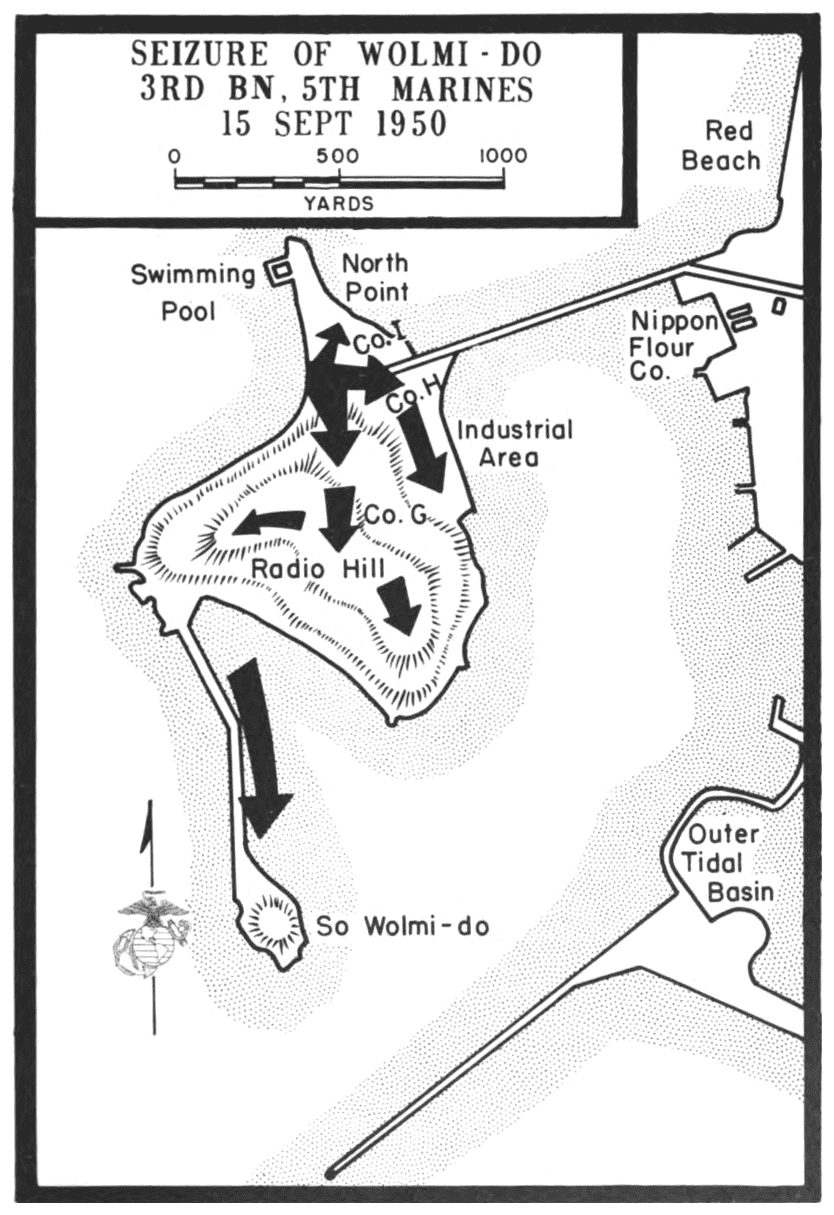
SEIZURE OF WOLMI-DO
3RD BN, 5TH MARINES
15 SEPT 1950
After a brief pause for reorganization at the beach, First Lieutenant
Robert D. Bohn’s Company G wheeled to the right and drove up
the northern slopes of Radio Hill, Objective 1-A. Only half-hearted
resistance was met along the way, most of the scattered and numb
North Koreans preferring to surrender rather than face the inevitable.
At 0655, Sergeant Alvin E. Smith, guide of the 3d Platoon, secured
the American flag to a shell-torn tree on the crest.
At this point General MacArthur rose from the swivel chair in
which he had been viewing the operation on the flag bridge of the
Mount McKinley. “That’s it,” he said. “Let’s get a cup of coffee.”
Meanwhile, the Wolmi-do assault continued as Captain Patrick E.
Wildman, after detaching a small force from Company H to clear
rubble-strewn North Point, attacked across Wolmi-do toward the
Inchon causeway with the rest of his unit. How Company’s mission
was to seize Objective 2-B, which included the eastern nose of Radio
Hill and the shoreline industrial area facing Inchon.
At 0646, the three LSUs comprising the third wave squeezed into
the narrow beach and disgorged the armored detachment of Company
A, 1st Tank Battalion, under Second Lieutenant Granville G. Sweet.
Ten tanks were landed in all—six M-26s, one flame-thrower, two
dozers, and one retriever. The big vehicles crunched inland a short
distance to await calls from the infantry.
Lieutenant Colonel Taplett ordered his free boat to the beach at 0650.
Fifteen minutes later, he radioed the Mount McKinley and Fort
Marion that his assault companies were advancing on schedule.
It was ironic that 3/5’s reserve company should encounter the
angriest hornets’ nest on Wolmi-do. Landing in the fourth wave at
0659, Captain Robert A. McMullen’s Company I moved through
North Point in trace of the How Company detachment which supposedly
had cleared the area. Suddenly a flurry of hand grenades
clattered on the rubble, and the surprised Marines scattered for cover.
Regaining their composure after the explosions, the infantrymen determined
the source of trouble to be a by-passed string of enemy emplacements
dug into a low cliff at the shoreline facing Inchon. There
appeared to be about a platoon of North Koreans, who would rise
from their holes intermittently, fling grenades inland, then disappear
from sight.
Item Company’s interpreter crawled toward the cliff during a lull,
bellowing to the Reds that their predicament was hopeless and exhorting
them to surrender. When the Communists responded to this
advice by throwing more grenades, McMullen signalled Sweet’s tanks
into action. The M-26s and Marine riflemen took covering positions,
while the dozer tank, directed by McMullen himself, rumbled into
the troublesome pocket and systematically sealed the die-hard Reds
in their holes.
Another bit of drama unfolded before the reserve troops when they
closed on the causeway terminus in the wake of How Company’s
advance. From one of many caves drifted noises indicating the
presence of several occupants, hitherto unnoticed. While riflemen
covered the entrance, a Marine tank drove forward and fired two
rounds into the interior.
Muffled explosions shook the area, and billows of black smoke
streaked with flame rolled out of the cave. Wide-eyed, as though
watching ghosts emerge, the Marines of Company I saw thirty enemy
soldiers stagger out of the blazing recess and throw up their hands.
Less than an hour after landing, 3/5 controlled half of Wolmi-do.
Company H, having cleared the causeway terminus, was pivoting
southward to clean out the ruins of the industrial area. Engineers,
close on the heels of the infantry, advanced 25 yards out on the pavement
leading to Inchon and laid an antitank mine field. George
Company had advanced about 400 yards and was clearing the northern
crest of Radio Hill. Action up to this point is best summed up in
Taplett’s message to the Mount McKinley at 0745:
“Captured 45 prisoners. Meeting light resistance.”
Nor did the situation change as Company G occupied the dominating
peak of Radio Hill, some 105 meters high. The enemy lacked the
will to fight, despite the fact that he had sufficient weapons and a
formidable defensive complex from which to fire them. Frightened,
dejected Red soldiers continued to surrender singly or in small groups,
and Taplett exulted over the amazingly light casualties sustained by
his battalion.
Since Company H found the going slow in the shambles of the
industrial area, the battalion commander ordered Lieutenant Bohn
to seize the whole of Radio Hill. Accordingly, George Company
troops rushed across the ridgeline to the eastern spur. This done,
Bohn dispatched a force to clear the western reaches of the high ground.
By 0800, Radio Hill became the property of the 1st Marine Division,
and with the prize went control of the island and Inchon Harbor.
When the news of 3/5’s success blared from the loudspeaker on the
flag bridge of the Mount McKinley, the commander in chief, wearing
his famous leather jacket and braided campaign cap, withdrew to his
cabin and penned a spirited message to Vice Admiral Struble aboard
the Rochester:
“The Navy and Marines have never shone more brightly than this morning.
MacArthur”
Consolidation of Wolmi-do required the reduction of an enemy
outpost on Sowolmi-do, the small lighthouse station connected to the
southwestern tip of the island by a causeway 750 yards long and 12
yards wide. An islet of about 500 square yards, Sowolmi-do was topped
by a low hill with the navigational beacon on the summit. Before
bothering with this tiny, isolated target, Taplett put his larger house
in order.
By previous plan, the three rifle companies of 3/5 took up defensive
positions generally facing Inchon. Item Company occupied North
Point, Wildman’s unit the slopes above the industrial area, and Company
G the crest of Radio Hill. While the battalion dug in, mopping-up
operations throughout the island continued to net more prisoners
and reveal the extent of North Korean fortifications. Radio Hill was
ringed by mutually supporting trenches and emplacements, all of
which had brought only a negligible return on the Reds’ investment in
time and labor. Parked on the western nose of the ridge were two
intact 76mm antitank guns that could have wrought havoc on landing
waves approaching GREEN Beach. Fortunately, these weapons had
been exposed to the 40mm fire of the LSMR covering the beach
assault, and their crews had lacked the stomach to man them.
More antitank guns were scattered around the terminus of the causeway
leading to Inchon, leaving some question as to whether they had
been rushed to the defense of the island or were marked for displacement
to the city.
North Point, once a luxurious resort, was honeycombed with caves
used both for storage and for bomb shelters. The swimming pool,
one of the few structures still recognizable after the bombardment,
was converted by the Marines into a prisoner-of-war stockade.
More than 300 cast-iron antipersonnel mines were found attached
to the barbed wire entanglement stretched along the west coast at the
base of Radio Hill. The explosives were removed and disarmed by
Technical Sergeant Edwin L. Knox and his detachment from Company
A, 1st Engineer Battalion. Though the North Koreans had
been helpful in placing these mines in so obvious a location, they had,
oddly enough, failed to employ similar obstacles on the beaches, roads,
and paths around the island.
Prior to the midmorning advance on Sowolmi-do, total casualties
for the 3d Battalion were 14 wounded—an incredibly small price for
a critical terrain feature commanding the approaches to Korea’s major
west coast port. Evacuation plans so carefully laid out by the 1st
Medical Battalion worked smoothly. In the early phase of the operation,
LCVPs returning from GREEN Beach delivered Marine casualties
to the Fort Marion, whose normal medical complement had been
augmented by a special surgical team. Men with particularly bad
wounds were transferred to the Mount McKinley after being administered
first aid. As the battle developed, navy medical corpsmen of
3/5 established a collecting point on a small pier which could be
reached by ambulance boats even during low water.
Shortly before 1000, Taplett ordered Company G to seize Sowolmi-do.
Bohn in turn assigned the mission to one infantry squad reinforced
with machine guns and a section of tanks, all under the control of
Second Lieutenant John D. Counselman, leader of George Company’s
3d Platoon. Although the islet was by no means an objective of formidable
proportions, the attackers eyed their route of approach over
the long strip with misgivings. Their skepticism was not unfounded,
for they neared the entrance to the causeway only to be stopped cold
by heavy rifle and machine-gun fire from the other end. A platoon
of North Koreans, almost literally at the end of a rope, preferred to
fight it out.
Taplett ordered the tank-infantry team to hold up while he radioed
a mission to Marine air. A few minutes later, Corsairs of VMF-214
nosed down and scorched the objective with napalm.
Sweet’s tanks, preceded by an engineer mine-clearance team and
followed by the column of infantrymen, rumbled onto the rock bed
tracing the seaward edge of the causeway. As the task force filed
across the exposed route, 81mm shells from 3/5’s mortar platoon rattled
overhead and tore into the Communist emplacements. Enemy fire
was reduced to a light patter, and the observers on Radio Hill breathed
a sigh of relief when the attackers gained the far end of the causeway
at 1048.
Covered by tank fire, the Marine infantry quickly fanned out and
closed with the defenders. There was a sharp outburst of small-arms
racket, interspersed with the clatter of machine guns; then a few scattered
volleys and the main fight was over at 1115. Mopping up with
grenades and a flame thrower continued for almost another hour,
owing to the number of caves and the determination of a few Red
soldiers.
Nineteen North Koreans surrendered and 17 were killed, including
some hapless warriors who tried to swim to the mainland. Despite
the size of the islet, eight Reds succeeded in hiding out from the
attackers; and General Craig, after landing on Wolmi-do with the
ADC group in the evening, observed the fugitives escape to the
mainland.127
Three Marines were wounded on Sowolmi-do, bringing 3/5’s total
casualties for the day to 17 WIA. In return, Taplett’s battalion could
count 136 prisoners and 108 enemy dead. Since interrogation of captives
established the original number of Red defenders at 400, it could
be concluded that some 150 more Communist fatalities lay entombed
in sealed emplacements and caves throughout the island.
The Wolmi-do garrison was part of a 2,000-man force committed
to the defense of Inchon by NKPA headquarters in Seoul. Represented
were elements of the 226th Marine Regiment, to which two
companies of the 2d Battalion, 918th Coast Artillery Regiment were
attached with their Soviet-manufactured 76mm guns. The spiritless
resistance encountered by 3/5 was the natural reaction of green troops
to the awesome power of modern combined arms; for the North
Korean marines and their artillerymen were largely recent conscripts
with sketchy training and no experience. It remained to be seen how
the other 1,600 Red troops would respond to the later assaults on RED
and BLUE Beaches.
Mopping-up operations on the island were completed by noon, and
with the support ships standing silent in the narrows, an oppressive
quiet settled on the objective area. Gradually the phenomenal tide
rolled back from its morning high of more than 30 feet. By 1300 the
waters had receded, leaving 3/5 perched on an island in a sea of mud.
For the next several hours Taplett and his men were on their own,
speculating whether an enemy force might suddenly rush out of
Inchon’s dead streets in an attempt to cross the mud flats, or whether
a Red tank column would abruptly streak from the city and make for
the causeway.
Nothing happened. The air of unreality caused by the stillness of
the Oriental seaport weighed down on the nerves of the entire attack
force. As the afternoon wore on, the Marines detected movement
here and there, but the distant figures were identified as civilians more
often than not. Captain McMullen, studying the RED Beach area
from his OP on North Point, reported possible enemy “field pieces”
on Cemetery Hill. What he actually sighted were the tubes of the
mortar company of the 226th NK Marine Regiment, as will be shown
later.
At Taplett’s OP on Radio Hill, the Shore Fire Control Party Officer,
Second Lieutenant Joseph R. Wayerski, searched Inchon intently
through his binoculars. On one occasion he called down naval gunfire
on small groups of people stirring in the inner tidal basin area to his
right front, but when further observation revealed the figures to be
civilians raiding a pile of rice, the Marine officer promptly cancelled
the mission. Wayerski’s lone tactical target of importance was a section
of trench on Observatory Hill in which he once spotted about
20 enemy soldiers on the move. He smothered the earthworks with
30 5-inch shells from the Mansfield, and what North Koreans
remained chose other avenues from that point on.
Taplett and others of his headquarters picked out enemy gun emplacements
right at the waterfront near the Inchon dry dock. After
the report went out to the Mount McKinley, red pencils throughout
the task force circled the locale on maps for special attention during
the pre-H-Hour bombardment.
Thus, the 3d Battalion enjoyed an almost uneventful interlude
during its isolation. An occasional mortar round or long-range machine
gun burst was the feeble reminder that Inchon still remained
in enemy hands.
While the infantry lolled in relative ease and safety, service and
support elements, attached to 3/5 for the landing, set the stage at
GREEN Beach for the logistical follow-up so vital to amphibious
operations. First Lieutenant Melvin K. Green’s team from Shore
Party Group A, having unloaded its LSUs in record time, established
dumps for ammunition, rations, and other field necessities. Personnel
of the Ordnance Battalion, Combat Service Group, and Service Battalion
engaged in backbreaking toil to alleviate the headaches of a
harried beachmaster. Signalmen scurried about, setting up their equipment
and creating the familiar maze of wire. The reconnaissance
detachment of the 11th Marines probed around the island’s desolation
in search of battery positions for the howitzers scheduled to roll ashore
on the evening tide.
The narrow strip of sand on North Point would have appeared
crowded and hopelessly confused to the inexperienced eye, but old
hands knew that order would gradually emerge, as if by magic, from
the “early rush hour”—that necessary evil inherent in all assault
landings.
CHAPTER VI Hitting the Beaches — The Assault Plan — Beginning the Ship-to-Shore Movement — Seizure of Cemetery Hill — RED Beach Secured — LSTs Under Enemy Fire — Fighting on Observatory Hill — 1st Marines on BLUE Beach — Ending the Ship-to-Shore Movement — Seizure of the O-1 Line
The Assault Plan—Beginning the Ship-to-Shore Movement—Seizure
of Cemetery Hill—RED Beach Secured—LSTs under
Enemy Fire—Fighting on Observatory Hill—1st Marines on
BLUE Beach—Ending the Ship-to-Shore Movement—Seizure
of the O-1 Line
The concept of the amphibious envelopment of the North Korean
Peoples Army, together with the actual assault on Inchon by
United States Marines, constituted heresy to that school of wishful
thinkers which sprang to life as World War II faded in the first
brilliant flashes of the Atomic Age. Widely accepted and noisily
proclaimed was the belief, perhaps sincere, perhaps convenient, that
the nuclear and aeronautical sciences had relegated armies, navies, and
man himself to insignificant positions in the waging of war. The
massing of ships and field forces, it was argued, was a thing of the
past; for the next war, if humanity dared risk another, would be
decided in weeks or even days with the power unleashed by electronic
and mechanical devices—many of which in 1950 were still in rudimentary
stages on drawing boards.
This was the controversial “push-button” theory of war which left
the peace-loving nations of the world unprepared in 1950 for violent
aggression by the tough little peasant army of North Korea, supported
by some 100 tanks and a few hundred artillery pieces. And to the
premature acceptance of this theory by a large section of the American
public may be attributed many of the major shortcomings of the
Inchon assault, as it unfolded in the evening of 15 September. That
the operation succeeded despite these shortcomings and the myriad
natural handicaps amounts almost to a tactical miracle.
In the words of General Smith, “... half of the problem was in
getting to Inchon at all.”128 The tremendous obstacles overcome in
solving that “half of the problem” have already been treated at length;
and it remains now, in the short space of a chapter, to show how the
other half became history.
Aboard the Henrico and Cavalier in the Inchon narrows on 15 September
were the 1st and 2d Battalions, 5th Marines, yanked out of the
Pusan Perimeter ten days earlier. Having had no time for a rehearsal
and only a few days for planning on the basis of admittedly sketchy
intelligence, these two units would scale the sea wall of RED Beach
and plunge into the dense waterfront area of the sprawling seaport.
The mission of the 5th Marines (less 3/5 on Wolmi-do) was to seize
the O-A Line, a 3,000-yard arc encompassing Cemetery Hill on the
left (north), Observatory Hill in the center, and thence extending the
last 1,000 yards through a maze of buildings and streets to terminate
at the inner tidal basin. Each battalion would land in a column of
companies, Lieutenant Colonel George R. Newton’s 1st, on the left,
seizing Cemetery Hill and the northern half of Observatory Hill;
while Lieutenant Colonel Harold S. Roise’s 2d secured the remainder
of the latter, the hill of the British Consulate, and the inner tidal
basin.129
Landing nearly three miles southeast of the 5th Marines, the 1st
Regiment would seize BLUE Beach, a north-south strip fronting a
suburban industrial area. BLUE Beach One, on the left, was 500 yards
wide, flanked on the north by the rock revetment of a salt evaporator
that jutted into the water at a sharp angle to the shoreline. A wide
drainage ditch, about which little was known besides the fact that
it existed, formed the south boundary. Just inland a dirt road—the
sole exit from the beach—skirted the north end of a steep knoll that
ran the whole width of the landing site. There being no revetment
at the waterline, Marine planners hoped that amphibian tractors could
crawl ashore with the assault troops.130
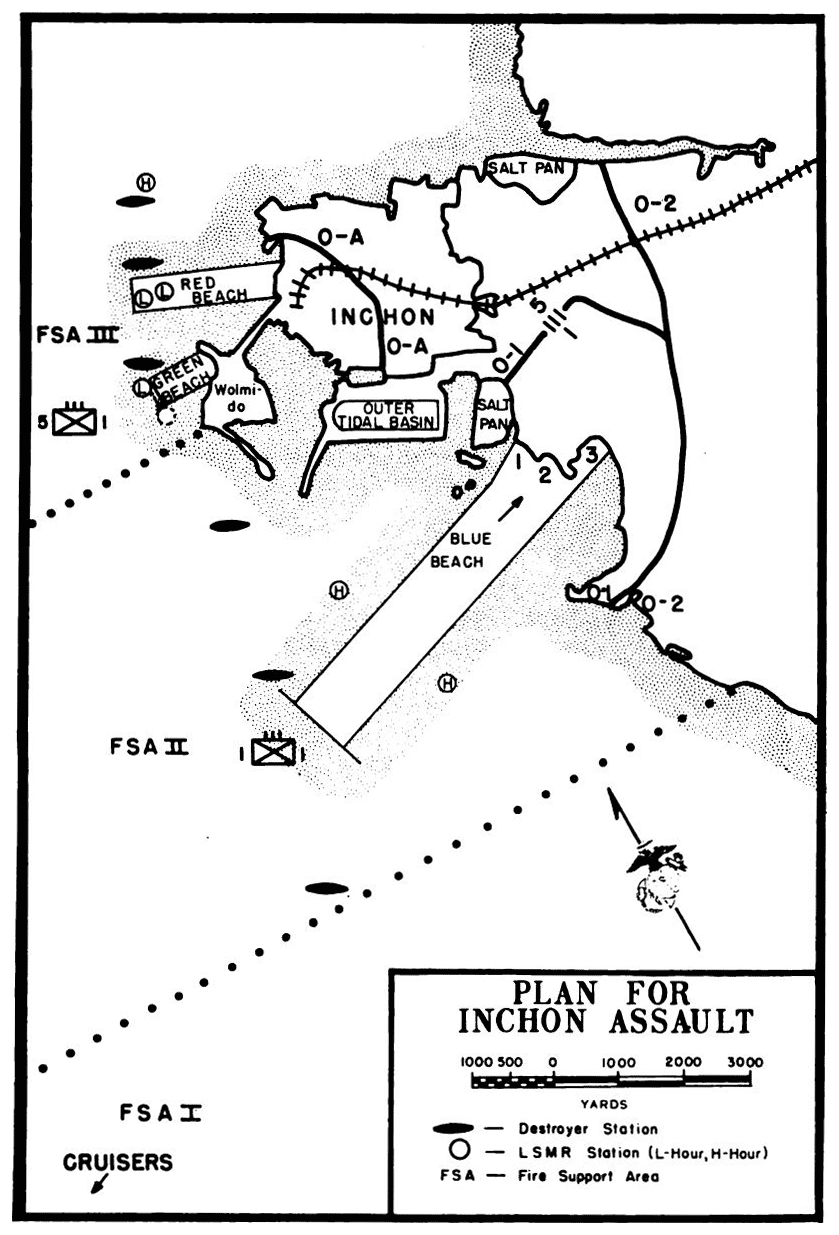
PLAN FOR
INCHON ASSAULT
BLUE Beach Two, connected to One by the drainage ditch, also
extended 500 yards. Like RED Beach it was fronted by a rock sea
wall. On the right half, the wall retained one side of a narrow ramp
that jutted southward like a long index finger. Behind the ramp lay
a cove, its shoreline at a right angle to the sea wall. During the assault,
Marines would scale the waterfront of BLUE Two from LVTs, while
the cove around the corner on the right, unofficially dubbed “BLUE
Beach Three,” was investigated as a possible supplementary landing
site.131
Preceded by a wave of LVT(A)s of Company A (Reinf), 56th
Amphibian Tractor Battalion, USA, the 2d and 3d Battalions, 1st
Marines, would land abreast on BLUE One and Two respectively.
With two companies initially in the assault, each of the infantry
battalions was to drive forward and secure its portion of the O-1 Line.
This four-mile arc bent inland as far as 3,000 yards to include four
main objectives, assigned as follows:
| |
2d Battalion (BLUE One) |
| ABLE |
A critical road junction about 1,000 yards northeast of the beach. |
| DOG |
Hill 117, 3,000 yards northeast of the beach, commanding Inchon’s back door and the highway leading to Seoul, 22 miles away. |
| |
3d Battalion (BLUE Two) |
| CHARLIE |
The seaward tip of Hill 233, a long east-west ridge beginning 1,500 yards southeast of the beach and blocking off the stubby Munhang Peninsula, which projected southward. |
| BAKER |
A small cape, topped by Hill 94, to the right of Objective Charlie and flanking BLUE Beach.132 |
While a question may arise as to the choice of landing the 5th
Marines in the very heart of Inchon, it must be remembered that
immediate seizure of the port facilities was vital to the success of the
operation. Hitting the beaches at only two-thirds infantry strength,
the 1st Marine Division could not swell to the overwhelming proportions
of an invasion force. A modern harbor for rapid build-up and
exploitation by X Corps figured inherently in MacArthur’s strategy.
If RED Beach thus constituted the critical objective, then the selection
of BLUE Beach for a supporting landing followed in logical
sequence. Once on the O-1 Line, the 1st Marines would flank the
single overland approach to the peninsular seaport, thereby presenting
the NKPA garrison with the grim alternatives of early flight, capitulation,
or strangulation. Without this leverage on Inchon’s flank and
rear, the 5th Regiment could easily be swallowed up by two square
miles of dense urban area.
Four assault battalions would have two hours of daylight in which
to bridge the gap between planning and reality. From overhead and
behind they could expect a preponderance of heavy fire support, but
ahead lay enemy and hydrographic situations still clouded by question
marks.
As the early afternoon of 15 September wore on, the continued silence
of Inchon beckoned temptingly to Lieutenant Colonel Taplett on
Wolmi-do. Having studied the city over a prolonged period without
detecting any significant evidence of Communist defensive capability,
he radioed Division headquarters for permission to move a strong tank-infantry
force across the causeway. The battalion commander believed
that 3/5 could launch either an effective reconnaissance in force or
an actual assault on RED Beach. Although his estimate of the enemy
potential was shortly borne out, the degree of risk in Taplett’s bold
plan drew a firm “negative” from the Mount McKinley.133
Busy with last-minute details aboard the command ship, General
Smith at noon had radioed General Craig instructions to land on
Wolmi-do on the evening tide and set up an advance echelon of the
division command post with the ADC group. Smith did not desire
to land the remainder of his headquarters until D-plus 1, when there
would be more room for dispersion within the expanding beachhead.134
The Landing Force Commander could look down from the flag
bridge at 1400 and note the first signs of activity on the water. A few
special landing craft were beating the forthcoming traffic rush as they
sped toward the various ships to which they were assigned as command
boats.
At the same time, the central control vessel, Diachenko (APD 123),
edged forward to its key station 3,000 yards southwest of the BLUE
Beach line of departure. Lieutenant Commander Allmon checked
the set and drift of the current and radioed his observations to Admiral
Doyle. Estimated at three and a half knots, the run of current was
heavier than expected. After receiving the Senior Control Officer’s
report, the Attack Force Commander confirmed 1730 as H-Hour.135
The confirmation went out to the entire Joint Task Force at 1430,
and Admiral Higgins’ fire support ships immediately commenced the
final bombardment of Inchon. His four cruisers and six destroyers
poured shells into the seaport for the next three hours, smashing every
landmark of tactical importance and starting fires that blazed across the
whole waterfront.
Under the calculating eyes of tactical air observers and coordinators
in F4Us droning high above the objective area, VMFs-323 and -214
and three squadrons of Navy Skyraiders alternately blasted Inchon,
integrating their strikes with naval gunfire from H-minus 180 minutes
onward. Simultaneously, Fast Carrier Task Force 77 kept another
12 planes in the air continuously for deep support missions designed to
freeze all enemy activity within a radius of 25 miles.
As if enough obstacles did not confront the landing force already,
rain squalls began drifting past Inchon during the bombardment.
Gradually the storm clouds merged with the thick smoke boiling up
from the city, and heavy overcasts settled over large areas, particularly
in the vicinity of BLUE Beach.136
Assault troops of the 5th Marines scrambled down cargo nets on
the Henrico and Cavalier to fill landing craft splashing into the water
from booms and davits. Nearly 200 LCVPs and 70 LCMs soon were
joined by 12 LSUs and 18 LVT(A)s, 164 LVTs, and 85 DUKWs
disgorged from the yawning wells of the LSTs, wherein the Marines
of the 1st Regiment had made ready for battle.137
Guided by Lieutenant Commander Ralph H. Schneeloch, USNR,
the Horace A. Bass, RED Beach control vessel, slowly steamed toward
the line of departure, a long file of assault craft trailing behind like a
brood of ducklings. Lieutenant Theodore B. Clark, USN, ordered
the Wantuck to the head of the boat lane to BLUE Beach, and PCEC
896, under Lieutenant Reuben W. Berry, USN, took station off
Wolmi-do to regulate the waves scheduled for the administrative
landing on GREEN Beach.138
At 1645, the 18 Army LVT(A)s comprising the first wave of the
1st Marines crossed the line of departure and headed for BLUE Beach.
Crawling at four knots, the armored vehicles had three quarters of
an hour to cover the 5,500 yards to the target. The LCVPs, capable
of twice the speed of the amphibian tractors, left the inner transport
area near the Diachenko’s station for the five-mile trip northward to
the RED and GREEN boat lanes.139
The roar of the fire support ships increased in volume during the
approach of the landing craft until, at 1705 (H-minus 25), Admiral
Higgins signaled the LSMRs into action. At once the cruisers and
destroyers fell silent. Again missiles soared from the squat rocket
ships in high arcs that sent them plunging into the RED and BLUE
landing areas. Upwards of 6,000 rockets detonated in the seaport
during the next twenty minutes, further numbing the defenders but
at the same time increasing the density and volume of the overcast.140
The critical moment of every amphibious assault was now at hand—the
moment when intelligence and planning would be put to the test
of actuality. On the bridge of the Mount McKinley high-ranking
Army, Navy, and Marine Corps officers gathered again about General
MacArthur, seated in a swivel chair. They listened for the second
time that day as the loud speaker gave a blow-by-blow account of
developments reported by aerial observers.
Everything that air attacks and naval gunfire could do to soften
up the target had been done, yet no one could be sure just what sort
of opposition the troops would encounter on RED and BLUE Beaches.
It might be as fainthearted as that brushed aside by 3/5 on Wolmi-do;
or it might be that another Tarawa awaited on those cramped strips of
urban waterfront lying between the mud flats of the harbor and the
dark, crooked streets of the Asiatic town and environs. The enemy
had been given ample time in which to prepare for a defense of the
mainland.
Even the possibility of undetected mines or surprise NKPA air
attacks at the last minute had not been overlooked. Although the
Attack Force continued to exercise control from the TADC on the
Mount McKinley of all aircraft operating in its assigned area, an
alternate control agency had been installed on the USS George Clymer,
utilizing an emergency hookup and a control unit attached to TAC,
X Corps. All nets were manned and communications set up to permit
a rapid shift of control to General Cushman in case of disaster.141
With H-hour only minutes away, the sky above the objective was
murky and the wind whipped rain as well as stinging spray into the
faces of the Marines in the assault waves. Only the Marine and Navy
flyers upstairs could see the panorama of the waterborne attack—the
cruisers and destroyers standing silent in the background, LSMR
rocket flashes stabbing the false twilight ashore, the landing craft
trailing pale wakes behind them like the tails of comets. The pilots
observed the LCVPs to the left of Wolmi-do fan out at the line of
departure and touch the sea wall of RED Beach minutes later. To
the right of the little island, however, they saw the leading waves of
the 1st Marines disappear in a blanket of gloom. For while the smoke
and moisture-laden air had obscured parts of the 5th Marines’ zone
of action ashore, it had completely blotted out BLUE Beach and half
the length of the 1st Regiment’s boat lanes. Because of this development
and other factors which posed special problems for the 1st
Marines, the narrative will treat each landing separately, beginning
with that of the 5th Regiment on the left.
Eight LCVPs had crossed the line of departure at H-minus 8 and
sped toward RED Beach with the first wave of the 5th Marines.
Starting from the left, boats numbered one through four carried parts
of two assault platoons of Company A, 1st Battalion, whose mission
was to seize Cemetery Hill and anchor the regimental left. In boats
five through eight were troops of Company E, 2d Battalion, whose
task included clearing the right flank of the beach and taking the
hill of the British Consulate.142
From Wolmi-do 3/5’s machine guns, mortars, and supporting
M-26s cut loose with a hail of bullets and high explosive to cover the
landing. Technical Sergeant Knox lead an engineer team forward
to clear the causeway, in order that the detachment of Able Company
Tanks could advance to the mainland after the initial assault waves
hit the beach.
As the landing craft passed the midway point of the 2,200-yard
boat lane, the heaving LSMRs ceased firing, so that Lieutenant Colonel
Walter E. Lischeid and Major Arnold A. Lund could lead in VMFs-214
and -323 for final strikes on both RED and BLUE Beaches. Navy
Skyraiders joined in at the request of Captain John R. Stevens, commander
of Company A; and the FAC of 1/5, First Lieutenant James
W. Smith, controlled their strafing passes as the first wave came within
30 yards of the sea wall.143
Although the tide was racing in fast, the wall still projected about
four feet above the ramps of the landing craft. The Marines readied
their scaling ladders. On the right the boats of Company E touched
the revetment at 1731. Up went the ladders as the assault troops
hurled grenades over the wall. Following the explosions, the Marines
from the four boats scrambled to the top of the barrier one by one.
The ladders slipped and swayed as the LCVPs bobbed next to the wall.
But they served their purpose, and in short order every man of Second
Lieutenant Edwin A. Deptula’s 1st Platoon was on the beach.
There were no casualties from the few stray bullets cracking through
the air. Filtering through smoke and wreckage, the platoon moved
inland to cover the landing of the second and third waves, carrying
the remainder of Easy Company.
On the north of RED Beach, three of the four LCVPs with the
leading elements of Company A bumped the sea wall at 1733. Boat
number one, carrying Technical Sergeant Orval F. McMullen and
half of his 1st Platoon, was delayed offshore by an engine failure.
The remainder of the 1st, under the platoon guide, Sergeant Charles
D. Allen, scaled the wall from boat number two in the face of heavy
fire from the north flank and from submachine guns in a bunker
directly ahead. Several Marines were cut down immediately, the
others being unable to advance more than a few yards inland.
Boat number three, with Second Lieutenant Francis W. Muetzel
and a squad of his 2d Platoon, touched a breach in the sea wall under
the muzzle of an enemy machine gun protruding from a pillbox. The
weapon did not fire as the Marines scrambled through the gap and
onto the beach. A second squad and a 3.5-inch rocket section joined
from boat number four. Gunfire crackled far off on the left, barely
audible amid the road of fighter planes strafing fifty yards ahead.
Muetzel and his men jumped into a long trench which paralleled
the sea wall a few feet away. It was empty. Two Marines threw
grenades into the silent pillbox, and the six bloody North Koreans
who emerged in the wake of the hollow explosions were left under
guard of a Marine rifleman.
Just beyond the beach loomed Cemetery Hill, its seaward side an
almost vertical bluff. To avoid getting trapped if the enemy opened
up from the high ground, Muetzel attacked toward his objective, the
Asahi Brewery, without waiting for the remainder of his men in the
tardy second wave. The skirmish line raced across the narrow beach,
ignoring padlocked buildings and flaming wreckage. Passing to the
south of Cemetery Hill, the 2d Platoon entered the built-up area of the
city and marched unopposed up a street to the brewery.
On the left of Company A’s zone, the beached half of the 1st Platoon
made no progress against the flanking fire and the Communist bunker
to the front. The 3d Platoon, under First Lieutenant Baldomero
Lopez, landed in the second wave, and McMullen finally got ashore
with the other half of the 1st. Both units crowded into the restricted
foothold and casualties mounted rapidly. Enemy guns had felled
Lopez as he climbed ashore and moved against the bunker with a
grenade. Unable to throw the armed missile because of his wound,
the young officer was killed when he smothered the explosion with
his body to protect his men. Two Marines attacked the emplacement
with flame throwers. They were shot down and their valuable assault
weapons put out of action.
The situation on the left was at its worst when Captain Stevens
landed in Muetzel’s zone at H-plus 5. Learning of Lopez’ death
and unable to contact McMullen, he ordered his executive officer, First
Lieutenant Fred F. Eubanks, Jr., to “take over on the left and get them
organized and moving.”144 Time was of the essence, since Cemetery
Hill, objective of the 1st Platoon, yet remained in enemy hands.
Succeeding waves would be landing hundreds of Marines in the shadow
of the cliff within the next half hour. Stevens also radioed Muetzel,
whose small force had just reached the brewery without suffering a
casualty, and ordered the 2d Platoon back to the beach to help out.
Muetzel immediately formed his unit in column and struck out on
the return trip to the waterfront. Nearing Cemetery Hill again, he
noted that the southern slope of the vital objective was an excellent
route of approach to the top. In planning Company A’s part of the
operation, Stevens had once told him that the 2d Platoon could expect
to help seize the high ground if the job proved too rough for the 1st
alone.145 With a creditable display of judgment and initiative, Muetzel
launched an assault on the key to RED Beach.
The Marines moved rapidly up the incline, flushing out about a
dozen Red soldiers who surrendered meekly. Gaining the summit,
they drove forward and saw the entire crest suddenly come alive with
infantry-crewmen of the 226th NKPA Regiment’s mortar company.
Spiritless and dazed from the pounding by air and naval gunfire, the
North Koreans to a man threw down their weapons, filed quietly
from trenches and bunkers, and marched to the base of the hill where
a small detachment kept them under guard. Hardly a shot had been
fired by the 2d Platoon, still without a single casualty, and the capture
of Cemetery Hill had required about ten minutes.
During the attack on the high ground, Eubanks had taken the
situation in hand on the left of the beach. He first bested the bunker’s
occupants in a grenade duel, then ordered the emplacement fired by
a flame thrower. Just as Muetzel prepared to dispatch assistance from
the top of Cemetery Hill, the 1st and 3d Platoons broke out of the
pocket, drove inland to the edge of the city, and made physical
contact with the 2d.
At 1755, Stevens fired an amber star cluster signifying that Cemetery
Hill was secured for the 5th Marines. The half-hour fight in the north
corner of RED Beach had cost Company A eight killed and 28
wounded.
After landing in 2/5’s first wave, the 1st Platoon of Company E pushed
inland 100 yards to the railroad tracks against no resistance whatsoever.
Captain Samuel Jaskilka was ashore with the rest of the Company
by H-plus 10, and reorganization took place quickly near the
Nippon Flour Company buildings, just south of the beach. Deptula’s
platoon then moved unopposed down the railroad tracks and seized
the British Consulate, Regimental Objective C, at 1845. Simultaneously,
another platoon cleared the built-up area across the tracks on
the lower slopes of Observatory Hill. These rapid accomplishments
secured the 5th Marines’ right flank, giving an added measure of
protection to 22 more waves of landing craft and LSTs scheduled
for RED Beach.
Still in enemy hands, however, was Observatory Hill, reaching well
over 200 feet above the center of the regimental zone to buttress the
arc of the O-A Line. Company C of the 1st Battalion, landing in the
fourth and fifth waves shortly before 1800, was to take Objective A,
northern half of the critical terrain feature. To Dog Company of
2/5 was charged the southern half, designated Objective B.
That the attack did not go off as planned stemmed from a series
of mishaps which began as far out as the line of departure. Despite
the fact that Lieutenant Commander Schneeloch was using standard
control procedures from the Bass, including radio contact with the
beach, there was a mixing of waves starting with number four.146 This
development reflected the lack of a rehearsal in the hurried preparations
for the operation, and the end result was that parts of Companies
C and D, both in the second assault echelon, landed over the
wrong beaches.147 After landing, Charlie Company had the added
disadvantage of being without its company commander for a crucial
12 minutes. Captain Poul F. Pedersen was delayed when the fifth-wave
commander, who shared his boat, decided to tow a stalled LCVP
left behind by the preceding formation.148 When he finally reached
his company, the job of reorganization was much more difficult than
it would have been had he arrived at the beach on schedule. With
troops pouring over the sea wall from succeeding waves, what had
begun as intermingling at the point of overlap in the center of the
landing area had grown to temporary congestion and confusion.
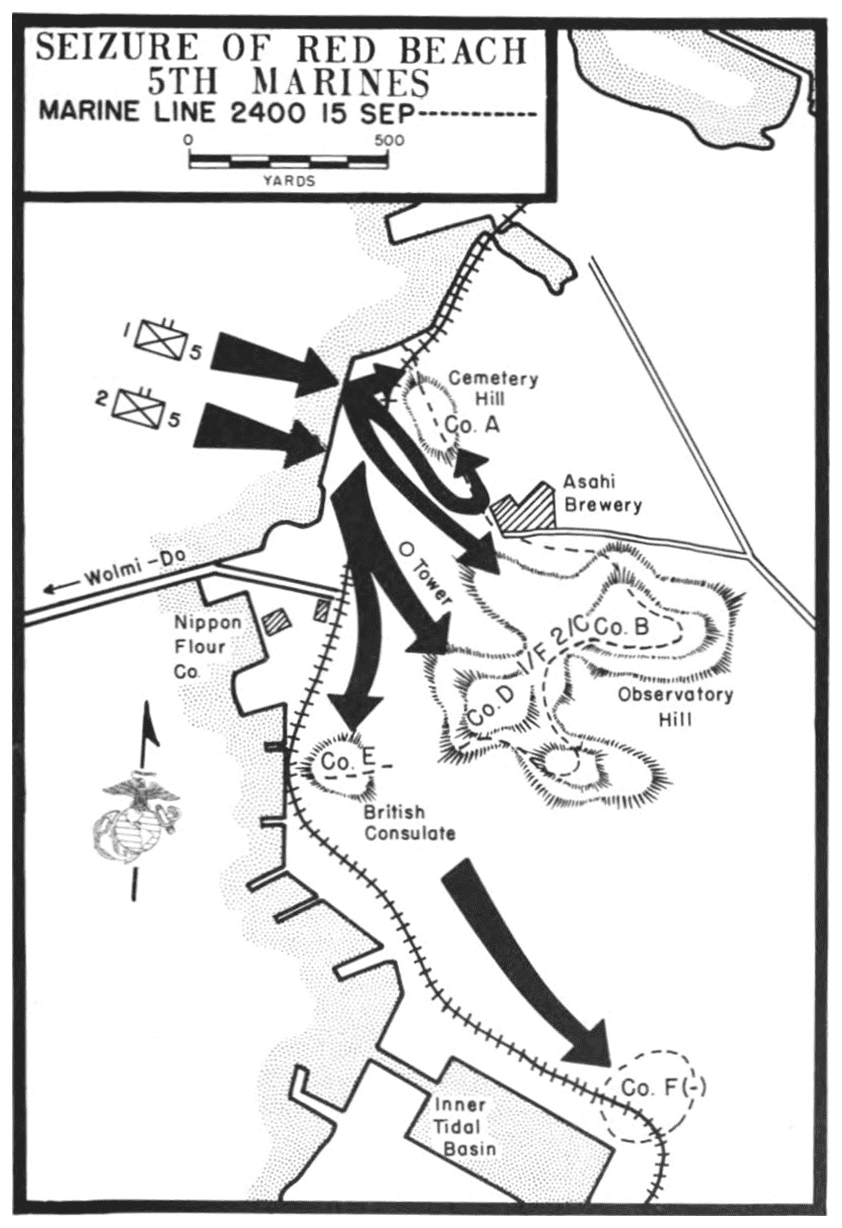
SEIZURE OF RED BEACH
5TH MARINES
Out in the channel, the first of eight LSTs149 heralded the climax of
the ship-to-shore movement at 1830 by crossing the line of departure
and heading for the sea wall. Prior to the approach, ships’ officers had
spotted the close fighting on the north flank of RED Beach as they
peered through binoculars from their respective bridges. Later, noting
the growing knot of Marines in the center of the waterfront area,
they concluded that the assault troops could not advance inland. This
impression was strengthened by an abrupt procession of gun flashes
on Observatory Hill where, owing to the delay in the attack by Companies
C and D, a handful of enemy soldiers had recovered from shock
sufficiently to set up machine guns. A few North Korean mortar
crews in the city also came to life and manned their weapons.
LST 859, leading the pack, came under mortar and machine-gun
fire as it waddled toward its berth about 1835. Gun crews on the ship
reacted by opening up with 40mm and 20mm cannon, spraying Cemetery
and Observatory Hills and the right flank of the beach. Next in
the column of ships, LSTs 975 and 857 likewise commenced firing
after taking hits from mortars and machine guns. Enemy automatic
weapons touched off a fire near ammunition trucks on LST 914,
trailing fourth, but sailors and Marines quickly brought the blaze
under control. Guns on the latter ship remained silent as a result
of dispatch orders received by the captain after leaving the line of
departure.150
Lieutenant Muetzel and his platoon were chased by LST fire from
the crest of Cemetery Hill to the slope facing Inchon—where they came
under fire from a Red machine gun in a building on Observatory Hill.
Fortunately, a 40mm shell from one of the LSTs crashed into the
building and obliterated the enemy position. There were no casualties
in Muetzel’s outfit, but Lieutenant Colonel Roise’s 2d Battalion did
not fare as luckily from the misdirected shooting by the American
ships. Weapons and H&S Companies of 2/5 had landed about 1830
and were just proceeding inland when LST fire seared their ranks,
killing one Marine and wounding 23 others. “If it hadn’t been for
the thick walls of the Nippon Flour Company,” remarked Roise later,
“the casualties might have been worse.”151
All eight of the supply vessels were intact in their berths by 1900.
Guns fell silent as soon as the LSTs touched the sea wall and contact
was established with the infantry.
On the beach, meanwhile, Second Lieutenant Byron L. Magness
had reorganized his 2d Platoon of Company C and, on his own initiative,
attacked Observatory Hill. Second Lieutenant Max A. Merritt’s
60mm mortar section followed closely behind, but the rest of the
company remained fragmented in the landing area. Sparked by Technical
Sergeant Max Stein, who was wounded while personally accounting
for a North Korean machine gun, the provisional force advanced
rapidly in the gathering darkness and at 1845 seized the saddle between
Objectives A and B on Observatory Hill. This was just about the
time when the LSTs stopped firing.152
Since their single flare misfired and they were not able to raise
Lieutenant Pedersen by radio, Magness and Merritt were unable to
inform the beach of their success. In the meantime, Company B, 1/5’s
reserve, had landed in the 2d Battalion zone, the waves having
swerved to that area to avoid small-arms fire peppering their assigned
approach on the left. Captain Francis I. Fenton, Jr., led the unit
through a mixed group on the waterfront to an assembly area near
the base of Cemetery Hill. When he discussed the beach situation
by radio with the battalion commander, Lieutenant Colonel Newton
ordered him to take over Charlie Company’s mission and assault
the northern half of Observatory Hill.153
Darkness had fallen when Company B drove up the slopes of Objective
A in a two-pronged attack. Six Marines were wounded in brief
skirmishes with North Korean die-hards along the way. Gaining the
summit at 2000, Fenton deployed three platoons on line, making contact
with the Magness-Merritt force dug in on the saddle to the right.
With Objective A seized and Able Company deployed on top and
to the flanks of Cemetery Hill, Newton radioed the 5th Marines at
2240 that 1/5’s segment of the O-A Line was secured.154
In the right of the 5th Marines’ zone, the 2d Battalion had also been
making gains, despite the handicaps of mixed boat waves, LST fire,
poor visibility, and, finally, enemy action.155 It will be recalled that
Company E suffered no casualties in landing and clearing the waterfront
as far south as Objective C, the British Consulate. Next to hit
the beach was First Lieutenant H. J. Smith’s Company D, part of
which went ashore in 1/5’s zone. Assembling later near the base of
Observatory Hill, the unit prepared to carry out its mission of seizing
Objective B, the southern half of the big ridge.
Although 2d Battalion overlays show that Easy Company bore no
responsibility for the crest of Observatory Hill, Smith’s men somehow
got the impression that part of Jaskilka’s force was already on the
summit. Its tactics based on this misunderstanding, Company D
formed a simple route column, with Second Lieutenant Ray Heck’s
1st Platoon leading the way, and marched up a street to the top of
the hill. The vanguard troops cleared the first peak in the company
zone without opposition and continued along the road to the second,
expecting to meet men of Company E. They were greeted, however,
by machine-gun fire from an enemy squad entrenched to the right
of the street.
The Marines tumbled into positions on the left. Grenades and
small-arms fire flew back and forth across the road during a brisk
exchange that lasted about 15 minutes. One of Heck’s men was
killed and three others wounded. The company corpsmen was hit
but refused evacuation until he had first administered to the other
casualties and seen them off to safety. Company D’s executive officer,
First Lieutenant Michael J. Dunbar, went forward with Lieutenant
Colonel Roise, the battalion commander, and was wounded by a
ricochet.
The enemy troops were driven off just as darkness closed in, leaving
the Marines to grope for night defensive positions on unfamiliar
ground. Eventually Lieutenant Smith formed a line with all three
rifle platoons deployed on the forward slopes of Objective B. Out of
battalion reserve came Second Lieutenant Harry J. Nolan’s platoon
of Company F to bridge the gap between Company D and the Magness-Merritt
positions in 1/5’s zone on the left.
With Cemetery and Observatory Hills secured, the only portion of
the O-A Line not yet under control was the extreme right, anchored on
the inner tidal basin. Since the night was pitch black, Roise felt
apprehensive about sending troops any farther into the city. In answer
to a query, Lieutenant Colonel Murray, whose regimental headquarters
had landed at 1830 and set up near the terminus of the
Wolmi-do causeway, emphasized to Roise that where the O-A
Line could not actually be defended from a suitable tactical standpoint,
it must at least be outposted. The battalion commander
forthwith dispatched a two-squad patrol from Fox Company to the
tidal basin, and the small force returned from the 1,000-yard prowl
into the city at 2300, having seen no sign of the enemy. Roise reacted
by committing Company F, less its platoon on Observatory Hill, to a
defensive perimeter on the right flank. Shortly after midnight, Captain
Uel D. Peters deployed the company next to the tidal basin as
ordered; and the 5th Marines’ O-A Line, though not manned in
entirety, came as close to tactical reality as the tangled black depths
of the seaport would allow.
As mentioned earlier, the overcast resulting from rain squalls and
smoke had completely blotted out BLUE Beach by H-hour, 1730.
This fact in itself would have sufficed to upset a precise landing procedure;
but at this point in the narrative, it is timely to review some
of the other problems which had beset the 1st Marines since the inception
of the plan for the Inchon assault.156
In the short space of weeks, the regiment had been brought up to
war strength by the rapid convergence on Camp Pendleton of
Marines—in units or as individuals, both regular and reserve—from
all over the United States; it had embarked at San Diego and crossed
the Pacific; and it had reloaded and embarked from Japan for a
combat operation designed to quench a major conflagration. There
had been time for only the sketchiest training above the company level.
The new 1st Marines had never operated tactically as a regiment, nor
had it ever been concentrated in one place as an organizational entity
up until the time it hit BLUE Beach.
During the planning phase in Kobe, battalions had to combat-load
their LSTs according to an X factor, while awaiting the prescribed
tactical plans that would be handed down from higher echelon at
the last minute. Intelligence on the enemy and beach conditions was
practically non-existent; and the speculative studies and inadequate
photos available could be kept only a few hours before being passed
on to the next unit in line.
Whenever Marines are given a difficult assignment, the United
States Navy invariably draws its own full measure of handicaps. A
typical example of the problems confronting naval planners was this
case, cited by Major Edwin H. Simmons, of 3/1:
“I was aboard LST 802, which was carrying H&S Company and elements of
Weapons Company. The ship had just been recovered from the island trade.
Her captain had been flown out to Sasebo from the States, given a pick-up
crew and two weeks to condition the ship and crew for an amphibious landing.
Despite his best efforts, the 802 had three major breakdowns and had to drop
out of convoy several times. At one point it appeared as though the battalion
command group would have to be taken off the 802 if they were to get to
Inchon in time.”
In connection with BLUE Beach itself, officers of the 1st Marines
had only a vague impression of offshore conditions and the accessibility
of the landing site. As already noted, the current in the channel was
underestimated, and so little was known about the consistency of the
mud flats that each landing craft contained planking for emergency
use by the assault troops.
The sole exit from BLUE One was the dirt road already mentioned.
On aerial photos the drainage ditch separating BLUE One and Two
appeared to be some kind of a road over which tractors could crawl
ashore. No one was certain, and “BLUE Beach Three,” the cove on
the right, was ruled out as a possible landing area early in the planning.
At the last minute, however, recent aerial photos and studies led to
the conclusion that both the inlet and the ramp at the southern tip
of BLUE Two might be good approaches after all. Acting on this
information while en route to the target area, Lieutenant Colonel
Thomas L. Ridge, commanding officer of 3/1, decided to explore
personally the right flank with his executive officer at the outset of the
assault. If the ramp, BLUE Three, or both were accessible to LVTs,
Ridge would divert later assault echelons on a “follow me” basis.
Thus vital questions were to remain unanswered until the officers
and men of the 1st Marines got their first look at BLUE Beach. It
was keenly disappointing, therefore, when they stared from the line
of departure on the afternoon of 15 September and saw, instead of
the distant shoreline, a murky wall rolling seaward from the blazing
waterfront.
As noted previously, the line of departure was 5,500 yards—3.2
miles—from the beach, a distance requiring 45-minute trips for the
slow-moving LVT waves. The ship-to-shore movement got off to a
bad start owing to the current, which scattered some of the landing
formations during the rendezvous phase. Other obstacles entered the
picture in rapid succession, one of them best described by Lieutenant
Clark, BLUE Beach Control Officer:
“At about H-50, while press boats and the initial waves of LVT(A) and LVT
were milling around the BLUE Beach control vessel [Wantuck], mortar fire
was received in the immediate vicinity. This created some confusion until
a destroyer spun around on her anchor and silenced the battery. This was
the beginning of the end of the well-planned ship-to-shore movement for
BLUE Beach.”157
Other shortcomings that took on special significance because of the
overcast were the lack of compasses and radios in the amphibian
tractors and the inexperience of many of the crews. The first wave,
consisting of the Army LVT(A)s, was escorted shoreward from the
line of departure by Navy guide boats, manned by UDT crews who
possessed both the compasses and seamanship necessary to pierce the
smoke screen and find the distant beach on time.158 Wave number
two, only a minute behind and close enough to benefit by the expert
guidance, did not fare too badly. The ragged formation of number
three, however, indicated mounting difficulties at the line of departure.
From a study of numerous accounts, the experience of Major Simmons
appears to have been typical:
“Wave 5 cleared the 802 about 1630. We had been told that a wave guide
would pick us up and lead us to the line of departure.... Time was passing
and we were feeling desperate when we came alongside what was apparently
the central control vessel. I asked the bridge for instructions. A naval officer
with a bull horn pointed out the direction of BLUE Two, but nothing could
be seen in that direction except mustard-colored haze and black smoke. We
were on our way, and our path crossed that of another wave. I asked if they
were headed for BLUE Two. Their wave commander answered, ‘Hell no,
we’re the 2d Battalion headed for BLUE One.’ We then veered off to the
right. I broke out my map, but the LVT driver had no compass....
With no confidence in its accuracy within a steel hull, I got out my lensatic
compass and made a best guess as to the azimuth of our approach line.”159
The nine LVT(A)s leading off for Lieutenant Colonel Alan Sutter’s
2d Battalion thrashed through the gloom and crawled ashore on BLUE
One at 1730, on schedule. Meeting no opposition at the beach, they
rumbled northward to the road skirting the knoll in order to penetrate
the interior. The exit was blocked by an earth slide resulting from the
naval bombardment of the high ground, and the column of amphibious
vehicles ground to a halt.
At H-plus 1, most of the eleven LVTs of the second wave crunched
ashore with elements of two assault companies. The remainder, with
troops of Fox Company embarked, had grounded in mud about 300
yards offshore. The Marines had to wade to the beach, and they lost
several pieces of communications gear in potholes en route. Company
D, on the left, was to have remained aboard the tractors for the drive
inland, while the troops of Company F debarked at the beach, cleared
the knoll, and continued overland on foot. The latter scheme of
maneuver unfolded as planned, and the Marines encountered no
resistance when they swept to the top of the high ground. Dog Company,
meanwhile, had also dismounted because of the blocked road.
The third wave groped ashore through the smoke at H-plus 4,
bringing the remainder of both assault companies and raising the total
strength on BLUE One to 30 tractors and over 600 men. Noting that
the beach was getting crowded, Lieutenant Colonel Sutter ordered
his free tractor to pull alongside the revetment of the evaporator on the
left. When his battalion headquarters had debarked on the wall, he
turned his attention seaward that he might signal the succeeding
three waves, carrying the rest of 2/1, to do likewise. He looked and
waited in vain, however, for the LVT formations did not materialize
out of the offshore haze.
Meanwhile, Companies D and F reorganized quickly to continue
the attack. Looking inland from the knoll, officers and NCOs could
catch glimpses of the unfamiliar terrain only between billows of
smoke. Several landmarks loomed ahead that were not marked on
the inaccurate tactical maps. Many others that had been recorded
were ablaze, and the numerous fires would make direct compass
marches difficult. Moreover, since the enemy situation inland was
open to conjecture, dispersed tactical formations would add to the
problem of controlling the Marine advance.
Despite these disadvantages, Sutter pressed the attack. Easy Company
in battalion reserve, together with part of Weapons and H&S,
had not landed, nor had all of the vital signal equipment for supporting
arms. But further waiting and delay was out of the question, since
only about an hour of daylight remained.
Company D struck out for Regimental Objective ABLE, the junction
on the left flank 1,000 yards away, and Company F drove northeast
in the direction of Objective DOG, Hill 117. It was almost dark
when the last of the 600 troops plunged forward into the unknown,
leaving LVT crews behind to open the road with picks and shovels.
The nine LVT(A)s comprising 3/1’s first wave had closed on the
sea wall of BLUE Beach Two shortly after H-hour.160 Nosing their
vehicles toward the drainage ditch on the left, the drivers apparently
eyed the muck and conformation of the restricted passageway with
some skepticism, for they backed off and exchanged fire with scattered
enemy soldiers shooting from just beyond the waterfront.
Wave number two passed through the Army tractors and bumped
the sea wall ten minutes late with the leading elements of Companies
G and I, the former on the left. Since the landing echelons had
intermingled in the cloudy boat lane, some LVTs of the third wave
arrived with those of the second. This accounted for Lieutenant
Colonel Ridge’s tractor reaching the beach one increment ahead of
schedule. The battalion commander and his executive officer, Major
Reginald R. Myers, immediately swung their separate vehicles around
to the right flank, Ridge heading toward the ramp while the other
officer continued around the corner in the direction of BLUE Three.
On the left of BLUE Two, meanwhile, the amphibians carrying
Captain George C. Westover’s Company G formed a column and
crawled into the drainage ditch.161 Troops of First Lieutenant Joseph
R. Fisher’s Item Company simultaneously scrambled up their aluminum
ladders and deployed just beyond the sea wall in the face of
moderate small arms fire. As had been anticipated, some of the metal
scaling devices bent and buckled under the strain, delaying troop
debarkation from the landing craft crowding the revetment. Assault
elements of Captain Lester G. Harmon’s Company C, 1st Engineer
Battalion, reached the beach and anchored cargo nets over the wall
to speed up the landing.162
The lead tractor in George Company’s column bellied down in the
mud of the drainage ditch, blocking five other LVTs behind. Westover
ordered his troops to dismount and move forward along a road
near the beach. After a brief period of reorganization, Company G
fanned out for the drive inland, its mission being to block a lowland
corridor and secondary access road leading to BLUE Beach out of
the east.163
Just about the time Westover’s LVTs bogged down in the ditch on
the left, the tractors transporting Ridge and Myers crawled ashore over
the ramp and BLUE Beach Three respectively, setting a precept for
the mounting number of landing craft lying off BLUE Two. A
heavy volume of traffic was thus diverted to the cove, and the
appreciable gain in time far outweighed the intermingling which
developed by landing troops at a right angle to those scaling the sea
wall.
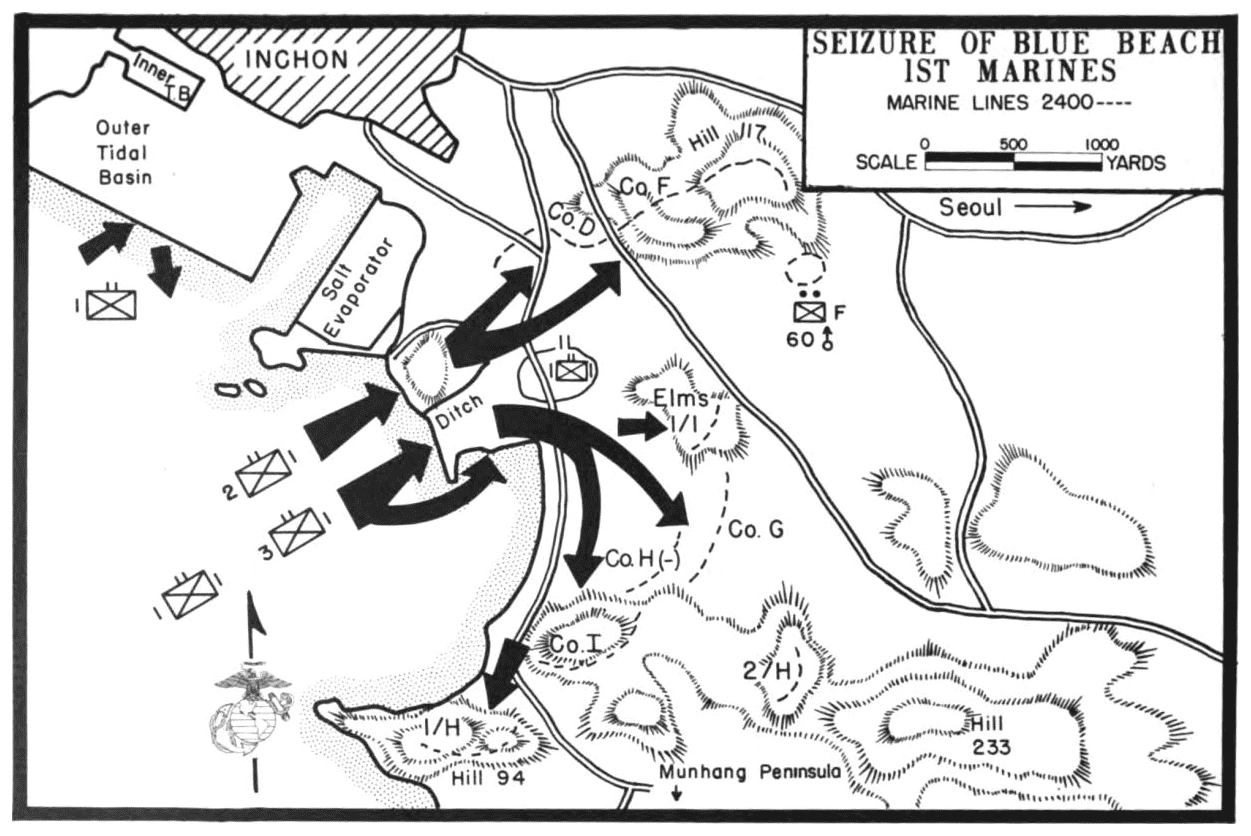
SEIZURE OF BLUE BEACH
1ST MARINES
In recalling the situation ashore as of 1800 (H-plus30), Colonel
Lewis B. Puller, the regimental commander, later observed:
“I personally landed on BLUE Beach with the 3d wave. My reason for doing
so was, exactly, that there was a strong possibility of confusion and disorganization
under the circumstances: namely, the unavoidable necessity of landing
the regiment without a rehearsal, without even a CPX.... The reorganization
of the assault battalions was accomplished with remarkable speed and
effectiveness. I recall being, at the time, extremely gratified that my prior
concern in this connection was not warranted.”164
Despite the initial delays at the ditch and sea wall, Companies G
and I cleared the beach rapidly. Of the few casualties taken during
the first 30 minutes ashore, most were caused by an enemy machine
gun in a tower about 500 yards inland. LVT fire silenced the weapon,
and the Marine infantry plunged forward through a labyrinth of
blazing buildings and smoke-filled streets. On the left, George Company
groped almost straight ahead toward the lowland corridor as
Item veered sharply southward to attack Objective CHARLIE, the
seaward tip of Hill 233.
While the assault units fought inland, the gathering darkness created
one more formidable handicap for the last wave serials leaving the
line of departure far out in the channel. The four Navy guide boats,
mentioned earlier as having escorted the first wave, were exactly 28
short of the number prescribed by amphibious doctrine for a landing
of the Inchon assault’s magnitude.165 For this reason the guide boats
took station on either side of the boat lanes after the initial run, since
it was manifestly impossible for them to help out in any other way.
The limited visibility, however, just about negated their worth as
stationary markers, owing to the fact that some landing craft formations
were losing their direction even before they entered the boat lanes.
In describing the situation as it developed at the line of departure
Lieutenant Clark later commented:
“The BLUE Beach Control Officer was unable to contact LVT wave commanders
or wave guide officers by radio at any time during the initial assault.
The control officer was aware that waves or groups of LVTs and boats were
landing at the wrong places but was helpless to prevent it without communications.
As a last resort, Casualty and Salvage landing craft were dispatched
to assist the initial wave guides (members of UDT 1) in rounding
up vehicles and leading or directing them to BLUE Beach.”166
Since current and smoke fought relentlessly against tractors seaward
of the line of departure, not all of the vehicles could find the
control ship. If they did, it was next to impossible to come in close
enough to get instructions shouted from the bridge. Thus many
wave commanders, amtrac officers, and infantry leaders gave orders
to head shoreward on their own initiative. They went in with waves
and fragments of waves, displaying the kind of leadership that made
the operation an overwhelming success in spite of the obstacles. This
was the case with the three waves of 2/1 that failed to arrive at BLUE
One. They found their way ashore, some of the LVTs landing on
BLUE Two, others diverted to BLUE Three; but the important thing
was that they got there.167
The most serious error of the day, again offset by initiative and
decision, involved Lieutenant Colonel Jack Hawkins’ 1st Battalion,
landing in regimental reserve.168 About H-hour, Puller radioed
Hawkins and ordered him to cross the line of departure with LCVP
waves 21 through 25, carrying the whole of 1/1. Had the approach
to the beach gone smoothly, the battalion would have begun landing
at approximately H-plus 45 (1815).
Because of conditions in the channel and boat lanes, as already described,
a searchlight on the control ship now beamed the supposed
course to the beach. Actually, the whole area had become so clouded
that the light was mistakenly pointed toward the outer tidal basin,
some 45 degrees off course to the northeast.
Moving in the designated direction, the first two of the reserve
waves reached the sea wall of the basin; and the Marines, believing
they were at the revetment of BLUE Two, began debarking.
Hawkins, following in the third wave (wave number 23), caught the
error as his boat passed within sight of two outlying islands between
the basin and the salt evaporator jutting out from the left of BLUE
One. About the same time, Lieutenant Colonel Robert W. Rickert,
executive officer of the 1st Marines, noticed some of the errant landing
craft from his free boat between the line of departure and BLUE One.
He intercepted a group of the LCVPs and reoriented them.
In the meantime, Hawkins cruised the length of the basin wall and
shouted instructions to the troops of the first two waves. Most of
Company B had already debarked and a few of the empty boats had
left for the channel. Able Company, having just begun to land,
promptly reembarked in its LCVPs. In short order, the battalion
reformed at sea and headed toward BLUE Two. Owing to the lack
of boats, one platoon of Baker Company remained on the tidal basin
all night. Hiking to rejoin the company on the mainland next
morning, this platoon rounded up an impressive bag of prisoners.
Upon reaching BLUE Two in darkness, Hawkins found Company
C, which had avoided the detour owing to the sixth sense of a boat
coxswain, organizing and setting up local security. The battalion
commander led most of 1/1 forward to a night assembly area along
the railroad tracks, half a mile inland. Major David W. Bridges,
battalion S-3, was left behind to organize late-comers as they arrived
from the tidal basin.
The tactical situation ashore had meanwhile begun to crystallize for
the 1st Marines. In the 2d Battalion zone, Dog Company occupied
Objective A, the road intersection, at 2000. Two hours later, Fox
Company reported that it occupied enough of Objective D, Hill 117,
so that it could cover the Inchon-Seoul highway with fire.
The attack from the beach had cost Sutter’s unit one KIA and
19 WIA as compared to enemy losses of 15 prisoners and an estimated
50 dead.
On the right of the regimental zone, Ridge’s 3d Battalion was also
making good progress against light resistance. Item Company reported
at 1900 that it was on Objective C, the western nose of Hill 233.
Half an hour later, George company began deploying in blocking
positions across the corridor and road at the center of the O-1 Line.
This movement was completed about 2030.169
The 1st Platoon of How Company passed seaward of Item at 2030
and pressed a night attack against a company of North Koreans on
Objective B, the small cape topped by Hill 94. After a token
resistance, the Reds abandoned their well-prepared entrenchments,
leaving 30 dead and wounded to be counted by the Marines.
How Company (less 1st and 2d Platoons) covered the low ground
between George and Item, finally occupying a blocking position about
400 yards behind the O-1 Line.
With the seizure of Hill 94, the critical portions of the O-1 Line
were secured. There was, however, a good deal of activity within
the perimeter for several more hours. Major Bridges of 1/1 collected
about 100 late-comers at BLUE Three and led them forward in search
of the battalion assembly area. Composed of men from H&S, Able
and Baker Companies, the little force not only missed its destination
but made one of the deepest penetrations of the day, finally halting
on a hill to the left of George Company’s front lines.
Shortly after Bridges set up a defensive position for the night, his
position was invaded by an Easy Company contingent in search of
the 2d Battalion. Reoriented to some degree, the visitors reached
Dog Company’s intersection much later. The 2d Battalion CP had
meanwhile intercepted a group from Major Whitman S. Bartley’s
Weapons Company at the trail junction selected in the darkness for
the initial battalion CP. At one or the other of these points, the misdirected
portions of Sutter’s battalion were directed to their parent
units. All personnel were present or accounted for before dawn.170
Two other troop movements completed the tactical mosaic of the
1st Marines. The 2d Platoon of How Company was to pass through
Item’s lines on Objective C at 2330 and outpost the summit of Hill
233, some 2,000 yards farther along the ridge and beyond the regimental
front. After setting out on schedule, the small unit covered
about half of its rugged journey upon reaching Hill 180, an intermediate
height. With most of the night gone and his troops wearied
by the climb, the platoon leader radioed for permission to halt and
his request was granted.
Another venture into the unknown was made by an even smaller
unit. Second Lieutenant Bruce F. Cunliffe’s 60mm section of Fox
Company had somehow mingled with 3d Battalion troops during
the drive inland. When he led his men through the darkness in
search of 2/1, the section ranged forward of friendly lines and into
unexplored territory near Hill 117.
The surprise was mutual when these Marines stumbled into a small
NKPA patrol. But a brief fire fight in the darkness was enough for
the Red soldiers, who took to their heels and left three dead. Cunliffe’s
force, which had no casualties, spent the rest of the night in
uneventful isolation.
CHAPTER VII Securing the Beachhead — Supplies on RED and BLUE Beaches — Surgical Teams on the Beaches — Artillery and Tank Operations — The Attack on D-plus 1 — Advance to the Force Beachhead Line — Displacement Ashore of Division CP
Supplies on RED and BLUE Beaches—Surgical Teams on the
Beaches—Artillery and Tank Operations—The Attack on
D-plus 1—Advance to the Force Beachhead Line—Displacement
Ashore of Division CP
Of all the calculated risks taken at Inchon, perhaps the most
daring was the decision to ground eight LSTs abreast on RED
Beach immediately after the assault troops landed. The Navy workhorses
were vulnerable enough at best, and on this narrow strip of
waterfront they were lined up so close to one another that shots fired by
a blindfolded enemy could scarcely have missed.
Not all the NKPA shells and bullets did miss, for that matter. But
fortune as usual blessed the bold, and such enemy rounds as found
their targets did not touch off tons of napalm, gasoline, and
ammunition.
Only with reluctance had the planners accepted the risk of landing
thin-skinned supply vessels before the immediate battle area was
secured. But Inchon was not a typical amphibious operation. The
tremendous tidal range created an unprecedented situation; and if
vital supplies were not landed on the evening high tide, the assault
troops must pass a precarious first night without adequate quantities
of ammunition, water, and gasoline.
Dusk had fallen, with visibility further reduced by smoke and rain
squalls, when the vessels wallowed into RED Beach. The reconnaissance
element of Shore Party Group Able had gone ahead with
the assault troops to erect landing guides during the last moments of
daylight. While the men were working under fire, one of the beach
markers was riddled by enemy machine guns as it was being erected.
The H&S Company of Lieutenant Colonel Henry P. Crowe’s 1st
Shore Party Battalion came in with the first of the LSTs, and other
elements of Groups Able and Baker followed in short order. Each
of the eight vessels brought a cargo consisting of 50 tons of ammunition,
30 tons of rations, 15 tons of water, and five tons of fuel. These
special loads were in addition to the normal cargo of engineer and
shore party equipment and combat vehicles. Every LST was limited
to 500 short tons, however, in order to insure that it could be beached
without trouble.171
The last of the LCMs had not yet unloaded and retracted on RED
Beach when the first of the LSTs appeared slightly ahead of schedule.
Naval officers managed to hold the LSTs back until the beach had
cleared, and the eight vessels made a successful landing in spite of
treacherous currents combined with low visibility. Two of them
grounded momentarily on the mud flats but butted their way through
to the beach. And though the sea wall temporarily prevented several
vessels from lowering bow ramps effectively, the LSTs at each end
of the line were able to discharge cargo over their ramps.172
Bulldozers were first on the beach. They moved along the sea wall
under enemy fire, pushing down sections of masonry which interfered
with unloading operations.
LST 973 had no more than grated ashore when a Red Korean mortar
shell exploded among the drums of motor fuel. Gasoline flooded
the main deck and leaked down to the crew quarters through holes
made by shell fragments. Orders were given to cut off electric
motors and enforce all possible precautions, and the vessel miraculously
escaped a conflagration even though it took further hits from
enemy machine-gun fire.173
LST 857 ran into a ROK PC boat while heading in toward the
beach, but no harm was done to either vessel. Hits from NKPA
mortar and machine-gun fire punctured eight drums of gasoline without
any of them bursting into flame. This was one of the LSTs which
fired back at enemy gun flashes. During the exchange a sailor was
killed and another knocked unconscious when an enemy projectile
damaged one of the LST’s gun mounts.
LST 859, which had a sailor wounded by enemy mortar fragments,
hit RED Beach with all guns blazing away. When the vessel
beached, it was immediately boarded by Marines who helped themselves
to ammunition while shouting to sailors in the well deck to
stop firing. The same message was slammed home more authoritatively
when First Lieutenant William J. Peter, Jr., appeared on deck,
as directed by Lieutenant Colonel Newton, and demanded that the
LST’s guns cease at once.174
This put an end to the bombardment of shore positions. “No
LSTs fired after my ship beached,” commented Lieutenant Trumond
E. Houston, USN, commander of LST 799 at the extreme left of the
line. “Earlier LSTs beaching had opened fire on targets unknown
to me, but my command had received very firm orders not to open
fire due to the danger of firing into our own forces.”175
As dusk shaded into darkness, the Marines on and around Cemetery
Hill extended their lines into the city. Even at the climax of the
military drama there was an unexpected note of comedy—assault
troops were to discover shortly that among the ammunition brought
by the LSTs, some useless .22 caliber cartridges testified to the haste
of departure from Camp Pendleton.176 There was enough M-1 ammunition,
however, so that the enemy had no cause to complain of
being neglected by the Marines.
It was absolutely essential that the LSTs unload in time to retract
on the morning high tide and allow other cargo vessels to take their
places. This meant an all-night job for the 1st Shore Party Battalion,
which was to initiate unloading on both beaches for the organization
composed also of the 1st Combat Service Group, the 7th Motor
Transport Battalion, and the U. S. Army 2d Engineer Special Brigade,
with the latter in control.
The vehicles came off the LSTs first—about 450 of them, all told—and
darkness had fallen when the unloading of cargo got into full
swing. Congestion on the 650-foot strip of beach did not permit normal
location and employment of dumps. It was catch-as-catch-can
for the shore party troops and engineers, with the cargo being off-loaded
and stockpiled wherever space could be found. Later, as the
tactical situation improved, designated dumps were established.
The men went about their work under the floodlights, heedless of
scattered enemy small-arms fire which continued throughout the
night. At a glance the unloading presented a scene of noisy chaos,
yet everything was so well under control by midnight that the accomplishment
of the mission within prescribed time limits was assured.
In the morning the eight LSTs were retracted according to schedule
as a like number approached the beach to discharge cargo. Two of
them grounded in the mud flats too far out for unloading, but the
supply problem was already so well solved that this setback was not
serious.
On BLUE Beach it was not the intention to develop the area beyond
the needs of the initial assault, so that a comparatively small shore
party element was required. Only such equipment as could be
carried by hand was taken ashore in the LCVPs and LVTs.
The reconnaissance element of Shore Party Group B (—) had
landed with the assault troops, followed by the rest of the group at
1930. Provisions for the use of pre-loaded LVTs having been made
in the assault phase supply plan, the shore party troops set out flanking
lights to mark the entire BLUE area as a single beach. This was
in preparation for the arrival of the 24 LVTs bringing pre-loaded
supplies to sustain the attack in the morning. Ten of these vehicles
were so delayed by adverse currents that a receding tide left them
high and dry. Officers of the 1st Marines decided that the supplies
were not critical enough to warrant unloading by hand over the mud
flats, and the job was postponed until the LVTs could be floated in
on the morning high tide. While they were discharging on BLUE-3,
the LCVPs came in with other gear which was unloaded and stored
in the regimental dump.
Prison stockades were set up on both beaches the first night. The
LSTs continued to unload most of the Division supplies on RED
Beach in spite of treacherous currents, the tidal range and the mistakes
made by Japanese crews. BLUE Beach was closed on D-plus 1, having
served its purpose, and the shore party personnel transferred to
GREEN Beach, where facilities for unloading LSTs had been improved.
Supplies landed there could be trucked across the causeway,
and on D-plus 2 the shore party troops on RED Beach were also
relieved and sent to Wolmi-do.
The 2d Engineer Special Brigade retained control of all logistical
operations in the Inchon port area on 17 September as vessels began
to discharge at Pier No. 2, designated as YELLOW Beach. There
were assurances by this time that the engineers would soon have the
tidal basin partially operative, thus adding materially to the capacity
of the harbor.177
The 1st Combat Service Group remained in control of consolidated
dumps. This organization was the storage agency for all X Corps
supplies with the exception of ammunition and engineering materials,
both of which were handled by Army personnel. Owing to the shortage
of trucks, the 7th Motor Transport Battalion was held in the port
area under control of the engineer brigade.
The lack of enough motor trucks for port operations was alleviated
by the restoration of rail transportation much sooner than had been
expected. Although the planners did not count on this factor before
D-plus 30, the 2d Engineer Special Brigade rounded up Korean crews
and speeded up the tremendous task of putting the Inchon-Seoul line
back in working order. As early as D-plus 1 a switch engine and
six cars were operating in the Inchon yards. Three days later the
first train, carrying 1,200 Marines, was dispatched over the 5-mile
run from Inchon to Ascom City. As the ground forces advanced,
the engineers followed close behind the front with rail transportation
which handled a total of 350,000 rations, 315,000 gallons of fuel,
1,260 tons of ammunition, and 10,000 troops before the Division was
relieved.
Casualties of the Landing Force on D-day amounted to 20 KIA,
1 DOW, 1 MIA, and 174 WIA in addition to 14 of non-battle
classification. Medical officers regarded the operation as a landmark
because of the four Navy surgical teams, each composed of three
doctors and ten corpsmen, which went in behind the assault troops
on the LSTs. Similar teams had been employed in the later operations
of World War II, but Inchon had the distinction of being the
first amphibious assault in which carefully planned medical
techniques were integrated with military operations.
The surgical teams had been drilled and rehearsed in Japan for
their tasks. Patients requiring immediate surgery on the night of
D-day were evacuated to LST(H) 898, where an improvised operating
room had been installed. During the assault phase, 42 military
and 32 civilian casualties were treated instead of the 300 which had
been expected. Such an unqualified success was achieved that the
teams were recalled to Japan afterwards to act as instructors. Within
a year the numbers of Navy surgical teams had grown to a total of
22 on standby duty in the Far East.178
Captain Eugene R. Hering, (MC) USN, had served in the Pusan
Perimeter as the Brigade Surgeon. From a study of maps and intelligence
reports, he tentatively selected a site for the Division hospital
on the eastern outskirts of Inchon.
The 1st Medical Battalion, commanded by Commander Howard
B. Johnson, (MC) USN, consisted of an H&S Company and five
letter companies. Able and Baker were hospital companies, while
Charlie, Dog, and Easy functioned as collecting and clearing companies.
The last was organized for attachment to the 7th Marines
when that regiment landed at Inchon.
Medical planning necessarily had to be hurried. In view of the
unusual landing conditions at Inchon, it was decided to revert the
clearing platoons, normally attached to infantry regiments, to Division
control when they reached the transport area.
Three casualty teams, each consisting of a medical officer and six
hospital corpsmen—one team from Able Company, and two from
Baker—landed from separate LSTs on D-day with a mission of caring
for initial casualties. Supporting collection sections of Charlie and
Dog Companies landed with the assault troops of the two rifle
regiments.
The reconnaissance group and the two hospital companies arrived
on D-plus 1, followed by the H&S Company with equipment for the
hospital set up in a schoolhouse. It was opened at 1500 on D-plus 2,
with 47 casualties being received the first day.
These were the forerunners of a total of 5,516 patients to be treated
by the 1st Medical Battalion for all causes during the entire Inchon-Seoul
operation. Most of them were WIA cases, but such ailments
as acute appendicitis, hernia, piles, and sprains are also recorded.
Of the 2,484 surgical patients, only nine died after reaching the
first aid station, and among them were six deaths following major
surgery. The proportion of patients surviving after evacuation, therefore,
reached the figure of 99.43 per cent. This meant that the
chances were about 199 to 1 that a wounded Marine would live.
The planners, anticipating the need of artillery support for the assault
on the mainland, had hoped that DUKWs could land two battalions
of Colonel James H. Brower’s 11th Marines on GREEN Beach for
this mission. There was some reason to believe that these vehicles
could cross the mud flats at low tide, thus enabling the 105s to get
in position on Wolmi-do and registered before the Inchon landing.
In the end, however, it was decided that this plan was not feasible,
and the 1st and 2d Battalions of the artillery regiment landed on the
evening tide while the rifle regiments were hitting the beaches at
Inchon. A delay of an hour and a half occurred as a result of the
confused maneuvering of ships in the inner harbor. It was not until
2150, therefore, that the 1st and 2d Battalions were prepared to deliver
massed fires in support of the 5th and 1st Marines respectively.179
Fortunately, the lack of this support at H-hour had not been a grave
handicap in view of the light resistance encountered on the beaches.
Low visibility and lack of targets limited the fires to a few rounds
the first night. Next day the artillery landing was completed when
4/11 went ashore on RED Beach, followed on D-plus 2 by the 96th
Field Artillery Battalion, USA. Plans for the drive inland called for
1/11 and 2/11 to fire in direct support of RCT-5 and RCT-1 respectively.
Support was to be provided by 4/11 for RCT-5 and by the
Army battalion for RCT-1.180
The problems of tank support for the Inchon operation had given
the planners many a headache. BLUE Beach was dismissed from
consideration because of the mud flats, and the possibilities at RED
Beach were not encouraging. GREEN Beach offered the best prospects
for landing tanks, though it was recognized that they would be
stranded if the enemy destroyed the causeway connecting Wolmi-do
with the mainland.
The consequences of the hasty embarkation from Camp Pendleton
had borne down heavily upon the 1st Tank Battalion, commanded
by Lieutenant Colonel Harry T. Milne. Crews trained with the
M-4A3 (Sherman) and 105mm howitzer were suddenly equipped
with the M-26 (Pershing) and its 90mm gun. With the exception
of Company A, which saw action with the Brigade, few of the men
had had any experience either at driving or firing the new tanks.
The flame tank platoon of Headquarters Company had received some
training at Barstow, but most of the personnel of Baker, Charlie,
and Dog Companies were limited to shipboard instruction.
The men of the Company A platoon which landed on GREEN
Beach in support of 3/5 were veterans of several fights with NKPA
tanks and infantry in the Pusan Perimeter. In the evening of D-day
they supported the landing on RED Beach and moved across the
causeway to the mainland at dusk. There they joined the other two
platoons of Able Company and the flame tank platoon, which landed
with the LSTs in support of the 5th Marines.
At 1700 on D-day a reconnaissance team went ashore on Wolmi-do
to prepare for the landing of B Company, which took place late the
following afternoon. YELLOW Beach, in the inner harbor, was
operative for the landing of Company C on 18 September, and
Company D was to arrive later with the 7th Marines.181
The night of 15–16 September passed quietly for both of the infantry
regiments. At 2000 on D-day the 3d Battalion crossed over the causeway
from Wolmi-do to rejoin RCT-5. The most dramatic action
on either regimental front was an episode in the Cemetery Hill area.
Two Marines mistakenly wandered out in front of the high ground
and were cut down by enemy fire from a cave at the base of the hill,
just below the lines of Company A, 5th Marines. Repeated attempts
to reach the fallen men were thwarted by submachine gun fire from
the recess, until a ROK interpreter, threatening the use of tanks,
persuaded the occupants to surrender. As a squad of North Koreans
filed out in submission, troops from Able Company rushed forward
to get their two comrades. One of the Marines was already dead;
the other lay mortally wounded.182
In the middle of the night, the 1st and 5th Marines received General
Smith’s OpnO 3-50, directing them to attack after dawn. Murray’s
regiment, by previous plan, would march through the southern part
of Inchon, leaving the heart of the seaport to be cleared by the KMC.
About three miles inland, the 5th Marines would reach the O-2 Line
coming abreast of Puller’s front of the night before. (Thus, the
O-1 and O-2 Lines were one and the same in the 1st Marines zone).
Tied in along the Inchon-Seoul Highway at Hill 117, the two regiments
would drive eastward to the O-3 Line, approximately five
miles inland. This last arc was the goal specified in Smith’s attack
order.183
Murray’s tactical plan was dictated by the simple necessity of
getting out of Inchon as quickly as possible. The 5th Marines would
therefore attack in a column of battalions, with Roise’s 2d in the lead,
followed by the 1st and 3d in that order. Two hills, located north
of the highway on the outskirts of the city, were designated Regimental
Objectives D and E. In taking this high ground, 2/5 would
automatically control the 5th Marines’ segment of the O-2 Line and
seal off the Inchon Peninsula in conjunction with the 1st Marines.
This would leave a secure pocket for the great ship-to-shore build-up
commencing on the morning tide.
Following a brief orientation at dawn, Captain Jaskilka led Company
E forward from the British Consulate. Unopposed, the column
passed the inner tidal basin, where Fox Company fell in behind. In
the meantime, Company D left its positions atop Observatory Hill
and brought up the rear of the battalion formation. Inchon’s streets
were strangely quiet during 2/5’s advance. Frightened civilians
peeped from windows and alleyways, but the enemy was nowhere to
be found. The sprawling seaport seemed dead.
Inconsistencies of the Oriental enemy were exposed in a striking
contrast of scenes at 0700. Nearing the edge of the city, Easy Company
was preparing to veer off the road and attack Objective D. The
troops were encountering no resistance whatsoever, and it was obvious
that the North Koreans had abandoned Inchon in haste during the
night. Only five miles away, however, six T-34 tanks were rumbling
along the highway in broad daylight, headed toward the seaport
without infantry escort.
An eight-plane strike of VMF-214 intercepted the enemy armor at
the village of Kansong-ni. As the Corsairs swept down on the first
pass, one of the tanks was enveloped in flaming napalm. Another
was disabled when a rocket hit blew off its tracks. A third was left
seemingly helpless on the road, squatting in a pool of motor fuel
which poured out of its wounds.184
Marines of 2/1 watched the show with enthusiasm from the top
of Hill 117, less than two miles away. The joy of victory went flat,
however, when one of the planes failed to pull out of its dive. Captain
William F. Simpson, the pilot, was killed as the F4U crashed beside
the highway.185
A second flight of VMF-214 descended on Kansong-ni with a
vengeance. Rocket fire destroyed one T-34, and a direct bomb hit
knocked another off the road. It will be shown shortly that these
two tanks must have been the same pair that were severely damaged
by napalm and rockets during the first strike. When panicky NKPA
crewmen fled to nearby thatched huts for concealment, the dwellings
were promptly razed by napalm. Marine pilots, assuming incorrectly
that all six tanks lay dead beneath the pall of smoke and flame, turned
their attention to other targets in the area. They bombed an enemy
jeep and weapons carrier standing in the open, then strafed two other
motor vehicles which had been cleverly camouflaged.186
It would soon become more apparent why Red leaders in Seoul had
sacrificed precious armor in a clearly hopeless thrust against the swelling
beachhead. Communications were destroyed, so that NKPA
defense forces fought or fled as isolated units. Adequate reserves
were not at hand initially, with the result that stop-gap detachments
were fed piecemeal into battle, only to be flattened by the Marine
steamroller. In short, the North Koreans lost control. And when
they attempted to regain it, time had run out.
While Marine air hammered the enemy’s armored column, the 2d
Battalion, 5th Marines, deployed outside Inchon. Having made sight
contact with Lieutenant Colonel Sutter’s troops on Hill 117 at 0730,
Captain Jaskilka led Easy Company off the road and toward Objective
D the left. Fox Company continued along the pavement
several hundred more yards, then also veered northward in the direction
of Objective E. Neither company met opposition, and both
were atop their respective hills at 0930.187
Meanwhile, Company D had advanced eastward on the highway
with a platoon of Able Company tanks. There was the occasional
whine of a sniper’s bullet overhead as the column moved rapidly to
its junction with the 1st Marines. At 0900, while Easy and Fox
Companies were climbing their objectives, Dog made contact with
2/1 at Hill 117.188
It was its opposite of the 1st Marines that Dog Company of 2/5
met at Hill 117. Fox Company of 2/1 had been clearing the eastern
reaches of the big ridge since 0615, and Easy was to spend all morning
and afternoon securing high ground and a village about a mile off on
the right flank. When the attack along the highway resumed shortly
after 0900, Company D of the 5th Marines and a platoon of A/Tanks
took the lead. Fox and Dog Companies of 2/1 followed in trace
and on the right as the formation advanced rapidly against nothing
heavier than sniper fire. By 1100, elements of both battalions were
deployed at Sogam-ni, just a few hundred yards short of smoking
Kansong-ni. Since the former hamlet bordered the O-3 Line, the
Marines held up to await further orders.189
To the south of the highway, the 1st Battalion, 1st Marines, reorganized
in the center of Puller’s zone and moved forward as regimental
reserve. Simultaneously, the 3d Battalion began its sweep
of the Munhang Peninsula, Companies G and I attacking generally
southward from Hill 233. Since the broad front was studded with
high ground and villages, Lieutenant Colonel Ridge relied on LVT
transport whenever possible to regain momentum lost to hill-climbing
and searching. Resistance on the peninsula proved negligible,
although once again the capture of prisoners and materiel revealed
enemy potential unused. Among the weapons abandoned by the
North Koreans were quantities of rifles and machine guns, a battery
of Russian-made 120mm mortars, and four coastal guns, the latter
pointing menacingly toward the ships of the Attack Force anchored
in the channel.190
Although 1/1 and 3/1 did not reach their portion of the objective
until later in the day, Division Headquarters realized by midmorning
that enemy resistance as far out as the O-3 Line could be
discounted. Now that the tremendous obstacles of the actual landing
had been overcome, the tactical advantage of the moment swung from
the Red commander at Seoul to General Smith. Owing to the conformation
of the Inchon and Munhang Peninsulas, which were linked
together inland like Siamese twins, the O-3 Line formed a front
three miles long with both flanks bounded by water. A glance at
the map will show the beachhead thus set off as an ideal foothold.
To North Koreans thinking in terms of counterattack, the vacuum
rapidly being filled by the Landing Force was a defensible bottleneck.
To the Marines, on the other hand, it was the gateway to freedom of
maneuver for an overland offensive.
Opening the gate was the subject of General Smith’s OpnO 4-50,
issued by dispatch at 1045, D-plus 1. He directed Puller and Murray
to continue the attack from the O-3 Line, seized the Force Beachhead
Line (FBHL), and thereby conclude the assault phase of the amphibious
operation. The order also marked off a new Tactical Bomb
Line,191 behind which Marine Air was forbidden to strike without
ground coordination.
Roughly the shape of a right angle, the FBHL corresponded to
X Corps Phase Line BB. Like the O-3 arc, it was anchored on the
sea at both ends. The east-west leg of the angle, five miles long, lay
above and almost parallel to the Inchon-Seoul Highway. The north-south
leg, about seven miles inland, added a third projection, the
Namdong Peninsula, to the beachhead. Encompassing the built-up
centers of Ascom City and Mahang-ri on the main road, the apex of
the FBHL pointed northeast toward Kimpo Airfield like an
arrowhead.
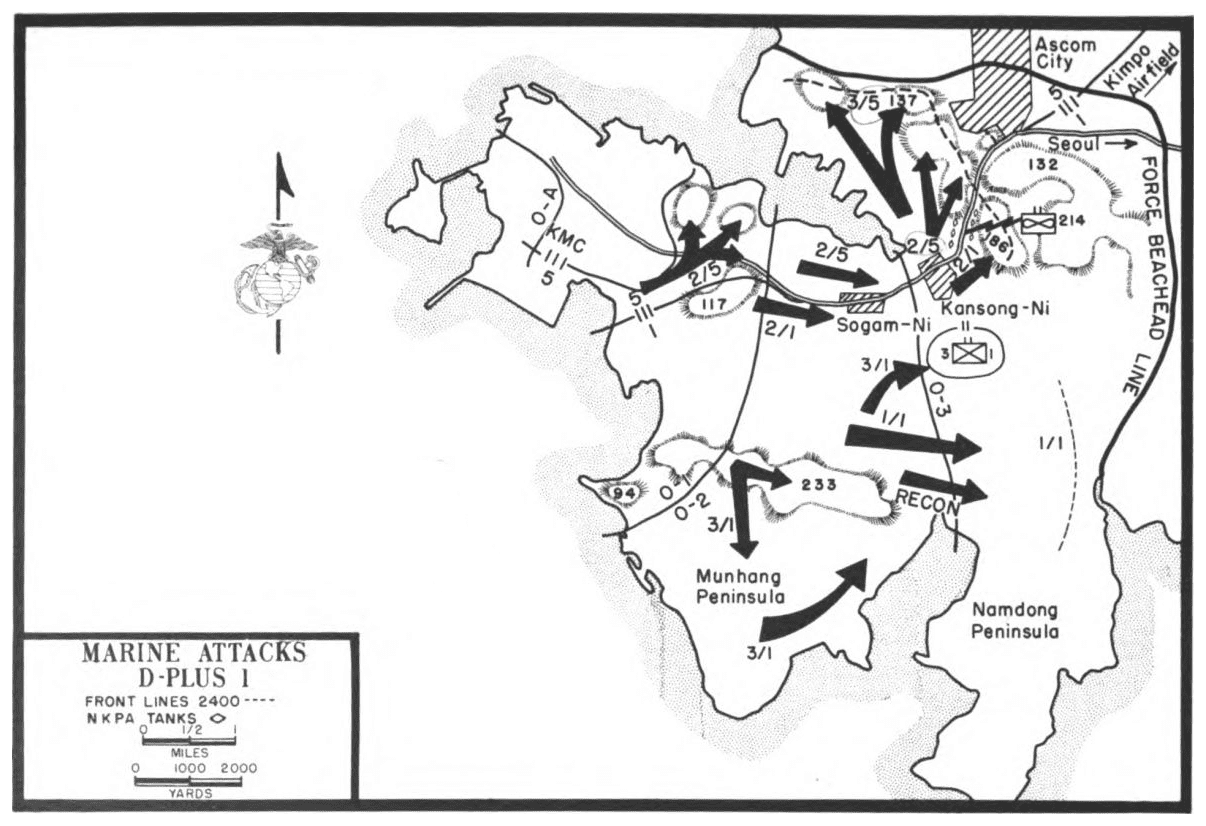
The Inchon-Seoul Highway remained the boundary between the
1st and 5th Marines. Lieutenant Colonel Murray’s order went out
to the latter before noon, directing a two-pronged assault. The 2d
Battalion would jump off from the O-3 Line and trace the course
of the highway, clearing the hills and villages on the left. Simultaneously,
the 3d was to swing sharply northward from behind 2/5
and attack high ground overlooking the east-west leg of the FBHL.
The 1st Battalion would remain in regimental reserve.192
There were a number of reasons why Colonel Puller’s scheme of
maneuver was more complex. Not only was the 1st Marines’ front
much wider and the terrain more difficult, but the rapid advance had
left troops units scattered throughout a zone of action some 15 square
miles in area. There was considerable shuffling to be done before the
regiment could deploy along the highway for the drive to the east.
The 2d Battalion would continue along the MSR, clearing the high
ground on the right and coordinating with 2/5 on the left. To the
south, the 1st Battalion would move up on the right of the 2d as
quickly as the rugged terrain allowed. The 3d, after clearing the
Munhang Peninsula, was to pass into regimental reserve subsequent
to being relieved on the right flank by the Reconnaissance Company.
Swinging around a sharp cove of salt pans and mud flats, the latter
unit would patrol the Namdong Peninsula to secure the Division
right.193
At 1335, the 5th Marines attacked against minor resistance on the
north of the highway. Moving into Kansong-ni, the vanguard of
2/5 and its tank escort approached a sharp bend where the road veered
northward for about a mile to avoid two large hills. Around the
curve were the enemy tanks believed to have been knocked out by
VMF-214 earlier in the day.
A section of Marine armor turned left off the pavement just short
of the bend. The two M-26s crawled to the top of a knoll from which
they could cover the infantry, as the latter advanced around the
corner. Looking down from their vantage point, the tank crews saw
three intact T-34s parked in column on the highway, about 300 yards
beyond the turn. Hatches on the Communist vehicles were buttoned,
with the 85mm guns leveled at the road bend.194
The M-26s opened up immediately. Twenty rounds of 90mm
armor-piercing (AP) ammunition crashed into the enemy armor.
There was no return fire, probably because the Red crews had not
time to elevate and traverse their manually-operated guns. In the
space of a few minutes, each of the T-34s exploded and burst into
flame. The crews did not escape.195
The Marine attack rolled past the blazing hulks. Nearby were
two other wrecked T-34s, obviously the victims of the air attack. If
the pilots of VMF-214 had attacked a total of six enemy tanks, one
of the vehicles must have escaped before the ground troops reached
the scene.196
Tracing the north-south stretch of highway that led to Ascom City,
Dog Company of RCT-5 marched a thousand yards beyond the bend
and ascended a high hill on the west side of the road. Company F
swung out to the left, crossed the railroad tracks running parallel
to the highway, and seized the high ground adjacent to that held by
Company D. Both assault units encountered only sniping, but it was
early evening before the two hills and surrounding low ground had
been searched thoroughly.197
Lieutenant Colonel Roise ordered 2/5 to dig in for the night. He
was about 3,000 yards short of the highway’s intersection with the
FBHL, but his battalion held the commanding ground. Companies
D and F defended the approach to Ascom City, which sprawled out on
the low ground just forward of their positions. Company E, in
reserve, set up a perimeter in the battalion rear.198
Lieutenant Sweet’s five M-26s, which had supported the day-long
advance from RED Beach, were relieved at dusk by the 1st Platoon
of Able Company tanks. In addition to their score of three T-34s,
Sweet’s veterans of the Pusan Perimeter had captured an impressive
tally of enemy materiel: three NKPA trucks, two 76mm AT guns,
two 122mm mortars, and a pair of Russian-manufactured jeeps.199
During 2/5’s attack along the MSR, the 3d Battalion, 5th Marines
was occupied with the hills overlooking that portion of the FBHL to
the northwest. Lieutenant Colonel Taplett had launched his drive
at 1330 with Companies G and I in the assault and H in reserve. On
the left, George Company seized its high-ground objective at 1440,
while Item took an extra hour to clear adjacent Hill 137. There
were no Marine casualties during a rapid advance that netted 12
enemy prisoners.200
Patrols from 3/5 ranged westward to the sea, and eastward to the
edge of Ascom City, where Item Company troops discovered an
enemy ammunition dump and vehicle park. Location of these undefended
prizes was promptly reported to the 5th Marines CP.201
South of the Inchon-Seoul Highway, the 1st Marines attacked from
the O-3 Line at 1600. Sutter’s 2d Battalion drove forward on the
right of the MSR and passed below Kansong-ni without incident.
Continuing a thousand yards farther, Company D scaled the rugged
slopes of Hill 186, cleared the summit, and dug in. Fox Company
climbed the same high ground shortly afterwards and went into
position on the left of Dog and overlooking the highway. Thus
2/1’s front for the night was across the road and slightly to the rear
of the high ground positions occupied by Company D of 2/5. Easy
Company returned from its independent mission on the right flank
and set up a reserve position in the vicinity of Kansong-ni, just
rearward of Sutter’s CP at the base of Hill 186.202
The enemy attitude in the 2d Battalion’s zone gradually had developed
from occasional sniping early in the day to a pattern of
definite light resistance as the Marines surged over Hill 186. Though
most of the North Koreans fled after firing a few rounds, their token
efforts cost the battalion four killed and 10 wounded. These figures
are noteworthy in view of the fact that total losses for the whole
Division on D-plus 1 were four KIA and 21 WIA.203
Sutter’s troops exacted a comparatively stiff price from the Reds
in return, for it was estimated that 120 of the enemy were killed or
wounded. Moreover, the Marines captured more than 30 prisoners,
70 rifles, 10 machine guns, and an ordnance dump loaded with
small-arms ammunition.204
Elsewhere on the 1st Marines front there was considerably more
hiking than combat. The 3d Battalion completed its sweep of the
Munhang Peninsula about 1600 and assembled at the southern tip of
the O-3 Line to await relief by the Reconnaissance Company.205 In
the course of rounding up NKPA prisoners and abandoned weapons,
3/1 had encountered a group of Korean villagers, headed by their
schoolmaster, who called themselves the Young People’s Anti-Communist
Resistance League. They had armed themselves with Russian
rifles and light machine guns left behind by enemy troops fleeing
inland.206
In the center of Puller’s zone, the 1st Battalion had moved rapidly
to fill the gap between the 2d and 3d. Attacking into the vacuum
left by the retreating enemy, Hawkins’ unit drove two mountainous
miles beyond the O-3 Line, finally stopping for the night on high
ground about 2,500 yards south of 2/1’s positions on Hill 186. The
break in the regimental front was protected when 3/1 shifted northward
and formed a reserve perimeter to the rear of the lines, after
being relieved on the right at 1700 by Captain Kenneth J. Houghton’s
Reconnaissance Company. Assuming responsibility for the Division’s
southern flank, the Recon troops set up a night defense at the base
of the Namdong Peninsula with their front linked to that of 1/1 on
the left.207
The establishment of a Division CP on shore was delayed by the
necessity of utilizing every minute of the limited periods of high tide
for the movement of troops, supplies, and equipment. General
Smith decided on D-day that it would not be advisable to displace
his CP ashore until General Craig and the ADC group (former headquarters
of 1st ProvMarBrig) were able to set up adequate communications.
With this object in mind, the ADC group landed on
the evening high tide of D-day to locate an advance echelon on
Wolmi-do.
Not much could be done that evening. And in the morning Craig
informed CG 1st MarDiv that the island was too crowded. He reported
that he and Lieutenant Colonel Stewart had discovered a likely
spot on the southeast outskirts of Inchon and recommended that the
CP be moved without delay.208 General Smith approved and the
move started at once.
Meanwhile, a good deal of military housekeeping had been accomplished
in the Inchon port area. Lieutenant Colonel John H. Partridge’s
1st Engineer Battalion was given the task of making a survey
of beach exit roads with a view to opening up an MSR between RED
and BLUE Beaches.
After elements of Company A hit GREEN Beach, the remaining
troops of the battalion had landed on the two beaches and assisted
shore party units at unloading water, ammunition, and rations. This
work was so well along by the morning of D-plus 1 that the engineers
opened up the MSR between the two beaches and assigned personnel
for improvement and maintenance. A Water point was established at
the north end of RED Beach with 31 distillation units, and 125,000
gallons were issued during the next six days.209
The new Division CP on the outskirts of Inchon was ready by the
afternoon of D-plus 1, and General Smith said goodbye to General
MacArthur on the bridge of the Mount McKinley. The commander
in chief wished him well and enjoined him to take Kimpo Airfield
at the first opportunity.210
The Marine general landed at YELLOW Beach at 1730. Upon
arrival at the CP, he sent a dispatch to Admiral Doyle, informing
him that he was assuming responsibility for the conduct of operations
ashore at 1800 on 16 September. Thus ended the amphibious assault
phase, almost exactly 24 hours after the first wave of Marines set foot
on RED Beach.
CHAPTER VIII On to Kimpo — Operations on Other Korean Fronts — Landing of RCT-7 in Japan — Destruction of NKPA Tank Column. — General MacArthur Visits the Front — The Drive to Kimpo Airfield — Action at 5th Marines CP — Enemy Counterattack at Kimpo
Operations on Other Korean Fronts—Landing of RCT-7 in
Japan—Destruction of NKPA Tank Column—General MacArthur
Visits the Front—The Drive to Kimpo Airfield—Action
at 5th Marines CP—Enemy Counterattack at Kimpo
On Sunday morning, D-plus 2, General Smith was directed as
Landing Force Commander to re-establish civil government in
Inchon. Although parts of the Korean seaport had been burned or
battered into rubble, thousands of refugees were returning to the
ruins of their homes after having fled during the bombardments.
The KMC Regiment, operating under the control of RCT-5, had
been given the task of screening the remaining inhabitants for their
loyalty. No fault could have been found with the thoroughness
of these Korean allies who were perhaps inclined to be too zealous
when they suspected subversion.
General Smith concluded that the best procedure was to find loyal
Korean officials and uphold their authority. He consulted Rear
Admiral Sohn Won Yil, the ROK Chief of Naval Operations, and
learned that the former mayor of Inchon had fled during the original
NKPA invasion and never returned. Admiral Sohn vouched for the
loyalty of one of the political prisoners, Pyo Yang Moon, who had
been the losing candidate for the mayoralty in the last election. The
Marine general decided to install him as Inchon’s chief executive and
issued a proclamation to that effect in Korean as well as English.
Induction ceremonies were held on the morning of 18 September
on the portico of the city hall, a once imposing edifice which bore
the scars of war. About 700 prominent citizens attended as the
Marine interpreter led in singing the Korean national anthem. After
the proclamation had been read in both languages, General Smith
made a few remarks and the new mayor responded. A ROK Marine
guard of honor officiated, and Admiral Sohn brought the occasion
to a close with a brief address.
Steps were taken immediately to bury the civilian dead, to care
for the orphans, to distribute food and clothing to the distressed, and
to establish a civilian hospital and police force.211
Dispatches received from the Pusan Perimeter revealed that the Eighth
Army had jumped off according to schedule on the 16th in its
joint offensive. Although gains were negligible the first day, this
effort was pinning down NKPA troops who might otherwise have
reinforced the defenders of Kimpo and Seoul.
Several other operations had been mounted on both coasts as diversions
to keep the enemy guessing as to where the lightning would
strike. Kunsan, it may be recalled, had been briefly considered by
X Corps planners as an alternate amphibious objective. Early in
September this west coast seaport was selected as the chief target of
feints during the preparations for the Inchon landing. General
Stratemeyer’s Fifth Air Force bombers initiated strikes on rail and
highway communications within a 30-mile radius. That same day
a hit-and-run amphibious raid on Kunsan was planned at Admiral
Joy’s headquarters in Tokyo. As a result, Colonel Ely sailed with
his company on the British frigate Whitesand Bay and raided the
Kunsan waterfront on the night of 12 September. Three casualties
were incurred from enemy machine-gun fire.
The Seventh Fleet added to the deception by singling out Kunsan
for carrier air strikes and naval gunfire bombardments to give the
impression of softening up an objective for amphibious assault.
Chinnampo, the seaport of Pyongyang, also appeared to be threatened
when it was bombarded by a British task force.
On the east coast the USS Missouri, just arrived from the United
States, poured 16-inch shells into Samchok on 14 September while
a Navy helicopter did the spotting. The cruiser Helena and three
U. S. destroyers added their metal to the bombardment.212
D-day at Inchon was the date of a landing of ROK guerrillas behind
the NKPA lines at Changsa-dong, a coastal town about midway between
Yongdok and Pohang-dong. After the ROK merchant marine
LST struck submerged rocks and grounded, it was used as an improvised
fortress by the guerrillas, who retreated from the NKPA
forces when their ammunition ran short. The only two Americans,
an Army lieutenant and sergeant, radioed for help; and the cruiser
Helena provided naval gunfire for the Navy relief expedition which
took off the survivors.
How much these diversions on both Korean coasts may have contributed
to a surprise at Inchon is a moot question. It might even be
argued that the enemy was not surprised, since an intercepted NKPA
radio message warned Pyongyang on 13 September that United
Nations vessels were approaching Inchon and planes bombing
Wolmi-do. The senders deduced that an amphibious landing was
forthcoming and assured NKPA Headquarters that defensive units
were being stationed where they would repulse the UN forces.213
This would make it appear doubtful that a surprise had been
achieved. But it is the opinion of Admiral Struble that “the actual
results in the Inchon-Seoul area clearly indicate surprise.... While
the message was apparently sent, and was a good report, there is no
evidence that the enemy headquarters accepted the report. It is possible
that a later report that the enemy bombarding ships were retreating
from Inchon may have confused the issue. In any event, only a
short time was available to take advantage of strong defensive positions
and certainly not enough time to mine the harbor.”214
An excellent analysis of the outcome is to be found in Admiral
Doyle’s official report. After paying tribute to the pre-D-day bombardments
by the cruisers and destroyers, plus the air strikes by planes of
TF-77 and TG-90.5, he concluded that “the assault itself was successful
only through the perfect teamwork that existed between the participating
Naval and Marine elements. The successful accomplishment
of the assault on Inchon demanded that an incredible number of
individual and coordinated tasks be performed precisely as planned.
Only the United States Marines, through their many years of specialized
training in amphibious warfare, in conjunction with the Navy,
had the requisite know-how to formulate the plans within the limited
time available and execute those plans flawlessly without additional
training or rehearsal.”215
Dispatches were received on D-plus 2 at the new Division CP to the
effect that the 7th Marines was preparing to embark that day from
Kobe and land at Inchon on 21 September.
The 3d Battalion of this regiment, it may be recalled, had originally
been a unit of the 6th Marines on FMFLant duty with the Sixth Fleet
in the Mediterranean. Upon being ordered to the Far East, the unit
sailed from Crete to Japan by way of the Suez Canal and Indian Ocean.
Lieutenant Colonel Dowsett, the battalion commander, did not know
throughout the voyage what specific mission awaited his men.
They later met at Kobe their new regimental commander,
Colonel Litzenberg, who had flown to Japan ahead of the other two
battalions sailing from San Diego. He informed Dowsett that his
battalion was now a part of the 7th Marines and named him executive
officer of the regiment. Major Maurice E. Roach succeeded to the
command of the newly designated 3/7.
A formidable task awaited the 7th Marines in Japan. The officers
of the staff, not having served with the Division before, were unfamiliar
with references and terms in directives dealing with the Inchon
landing. Problems of integrating the regiment into the operations of
the division were solved only by intensive application.
A reshuffling of the regiment had to be accomplished meanwhile
before embarking for Inchon. The purpose was to spread the hundreds
of reservists throughout the three battalions instead of having them
concentrated in several companies.216
It took some remarkable adjustments to get the regiment ready for
embarkation from Kobe only 17 days after sailing from San Diego.
But it meant that the 7th Marines would get into the fight at least a
week sooner than Division planners had anticipated.
The amphibious assault phase was left behind on D-plus 2 when the 1st
and 5th Marines jumped off from the western outskirts of Ascom City
to initiate their drive inland. With the exploitation phase coming next,
command relationships would be as follows:
          +-------------+
          |    CinCFE   |
          +------+------+
                 |
          +------+------+
          |  CG X Corps |
          +------+------+
                 |
          +------+------+
          |CG 1st MarDiv|
          +------+------+
                 |
       +---------+---------+
       |                   |
+------+------+     +------+------+
|CG 1st MarDiv|     |CG 7th InfDiv|
+-------------+     +-------------+
The night of 16–17 September had been quiet all along the Division
front. It was so quiet, in fact, that the troops of 2/5 paid no particular
heed to a truck which drove through their lines on the Inchon-Seoul
Highway about midnight. Not until the vehicle penetrated a
few hundred yards into Marine territory was it stopped by curious
tank crews of Able/Tanks’ 1st Platoon, whose M-26s were deployed
across the road in deep anti-mechanized defense. The startled occupants
of the stray truck turned out to be an NKPA officer and four
enlisted men, but they were no more surprised than the Marines who
stepped out of the darkness and took them prisoner.217
Apparently, neither the tank crews nor anybody else in the area
attached any special importance to the strange truck incident. In a
few hours, however, an epic of smoke, flame, and twisted steel would
attest to the significance of this scrap of evidence. The fact of the
matter was that the Red leaders in Seoul did not know the exact
location of the 1st Marine Division.
It will be recalled that Dog Company of 2/5 occupied a hill on the
west side of the highway as the attack on D-plus 1 ground to a halt.
About 200 yards beyond the company front was a large knoll that
nosed into the center of Ascom City. Observing that the highway
turned sharply to the east and passed through a cut at the base of the
knoll, Lieutenant H. J. Smith decided to outpost the natural roadblock
in strength. At dusk, therefore, he dispatched the 2d Platoon, under
Second Lieutenant Lee R. Howard, to man the advance position along
with machine-gun and rocket-launcher attachments.218
As the first rays of dawn creased the sky on 17 September, Howard
and his troops were entrenched in a compact perimeter atop the knoll.
Several hundred yards to the rear, the 1st Platoon of A/Tanks was
augmented in its blocking position by 3.5-inch rocket launchers of
2/5 and the 75mm recoilless rifles of the 5th Marines. Just across the
road from this formidable array were more 75s and 3.5s of the 1st
Marines, emplaced with Fox Company of 2/1 on Hill 186.219
Records of the 5th Marines describe this bristling gauntlet as “... a
temporary defensive position in depth....” It was more like a giant
torpedo.
Sometime before daybreak, a North Korean column formed on the
Inchon-Seoul Highway a few miles east of Ascom City.220 In the van
were six sleek T-34s of the 42d NKPA Mechanized Regiment.
Perched atop the tanks and strung out for about a hundred yards were
200 Red infantrymen, comprising a mixed representation of the 18th
NKPA Division in Seoul. The enemy force was on its way to block
the advance of the 1st Marine Division along the highway.
It was obvious that the Communist soldiers had little or no knowledge
of the situation ahead. For as they neared Ascom City at the
crack of dawn, some were still sitting comfortably on the tanks and
eating breakfast. Others laughed and jabbered as they trailed along
the road.
Lieutenant Howard saw them approaching his Dog Company outpost
on the knoll. He reported to Smith, who passed the word to
Roise at 2/5’s CP, first one tank, then three, and finally six. Roise
took the information with the proverbial grain of salt, supposing it to
be a delusion of youth and inexperience. Just as quickly as that impression
formed in his mind, it was shattered by the first reverberations
of the battle.
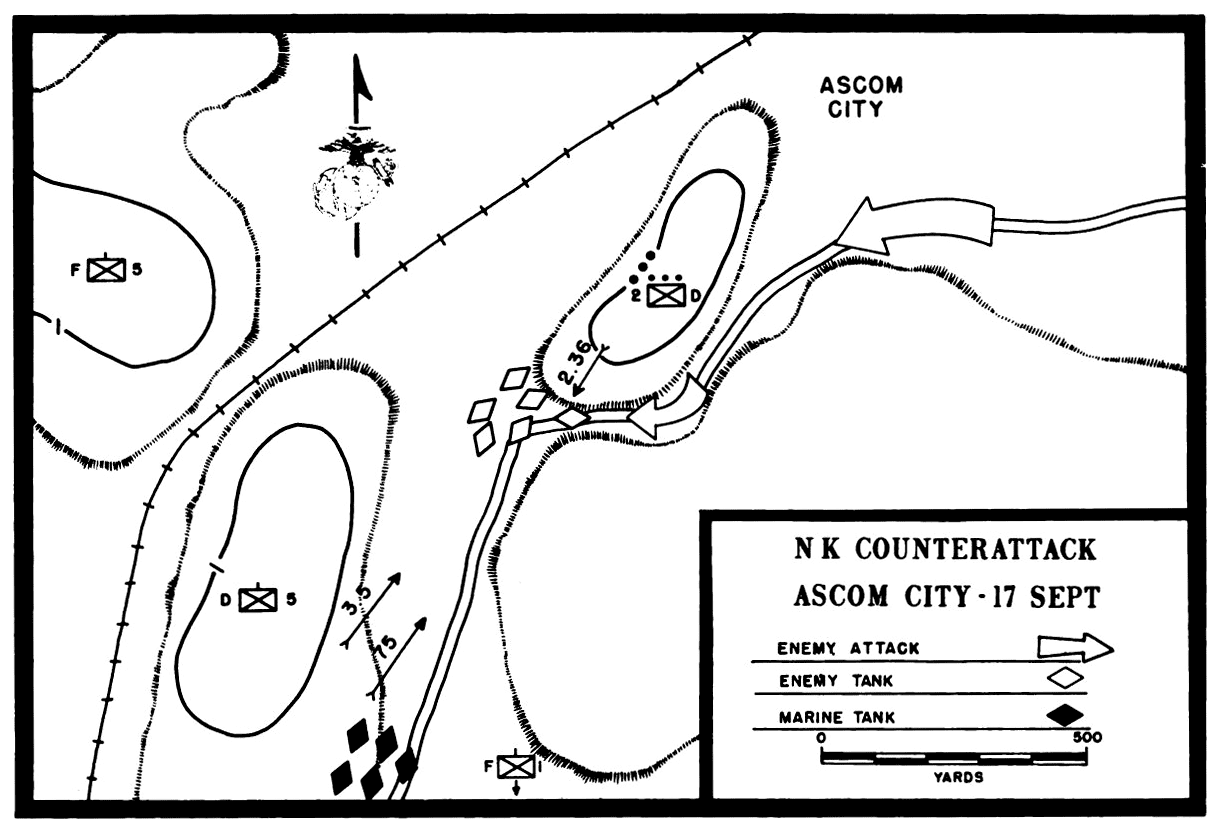
NK COUNTERATTACK
ASCOM CITY-17 SEPT
The attitude of the enemy soldiers as they neared his outpost convinced
Howard that they were unaware of the proximity of Marine
lines. He let the head of the column slip by on the road below,
therefore, until the tanks began to round the bend leading to Dog
Company’s MLR. Then the platoon leader shouted the order, and
his men opened up with machine guns, rifles, and BARs.221
The Red infantry went down under the hail of lead like wheat under
the sickle. Soldiers on the tanks were knocked to the road, where
many were ground under as the big vehicles lurched and roared crazily
in reaction to the surprise.
Corporal Okey J. Douglas moved part way down the knoll and
closed on the lead T-34 with his 2.36-inch rocket launcher. A few
well-placed rounds, fired calmly at a range of 75 yards, killed the
armored vehicle on the spot. Continuing the single-handed assault,
Douglas damaged tank number 2 just as the main Marine position
exploded into action.
Under attack by the outpost, the cripple and the four unharmed
T-34s had continued around the road bend, some of them spilling off
the curve in an attempt to deploy in the adjacent rice paddy. All five
were taken under fire by First Lieutenant William D. Pomeroy’s M-26s,
about 600 yards away. Within five minutes, the Marine 90mm
guns threw 45 rounds of AP at the enemy armor.
Recoilless rifles of Second Lieutenant Charles M. Jones’ platoon (5th
Marines AT Co) added their hot metal at a range of 500 yards, and
the 75s with the 1st Marines across the road also erupted. Simultaneously,
Second Lieutenant James E. Harrell ordered the 3.5-inch
rocket launchers of 2/5’s assault platoon into action.
The T-34’s didn’t have a chance. All of them exploded under
the heavy fusilade; and when the smoke cleared, they were heaps of
burning wreckage. Scattered around the dead tanks and along the
road were the bodies of 200 Red infantrymen. So rapid and complete
was the enemy’s destruction that only one Marine casualty—slightly
wounded—resulted from the fight.
It was only natural that conflicting claims would arise among the
participants in the short, violent clash. To Pomeroy’s tank crews, it
appeared that the M-26s accounted for the five T-34s with little or no
assistance from infantry arms. This was a reasonable conclusion
on their part, owing to the limited visibility from the buttoned vehicles
and the fact that their 90mm guns unquestionably wrought the greatest
destruction on the NKPA machines. Since so many weapons were
firing simultaneously from various other positions, however, and since
the T-34s were wrecked so completely, kills and partial kills were also
claimed by the recoilless rifles of both regiments. Moreover, the 3.5-inch
rocket gunners of 2/5 and 2/1 believed that some of their rounds
found the mark in the midst of the furor. It is known, for instance,
that Private First Class Walter C. Monegan, Jr., rocket man in the
assault squad of Fox Company, 1st Marines, closed on the enemy
vehicles after they had rounded the bend and fired his weapon at
point-blank ranges.
The acrid odor of high explosives still lingered in the fresh morning
air as a column of jeeps came slowly around the bend from the rear.
General MacArthur was making his first visit to the front. With him
and Admiral Struble were Generals Almond, Shepherd, Smith,
Ruffner, Hodes, Wright, and a group of X Corps staff officers. Several
jeeps filled with newspaper correspondents and photographers
followed close behind the military cortege.222
Grimy Marines of RCT-5, their eyes dazzled by the glitter of starry
insignia, gazed in wonder at this sudden revelation of the pomp and
circumstance of war. The generals and admirals in their turn were
equally impressed by the destruction these Marines had wrought—the
warm corpses beside the road, the blazing heaps of twisted metal that
had been T-34 tanks only a few minutes before.
The Marine driver parked the leading jeep on a culvert and General
MacArthur leaped down to survey the spectacle. Instantly he was
surrounded by cameramen snapping pictures which would soon appear
on stateside front pages. All America was rejoicing at the turning
tide in Korea after the humiliating weeks of delaying operations.
Early that morning CinCFE had been met by General Smith at
YELLOW Beach and welcomed to the 1st Marine Division CP, a
Quonset hut with a dirt floor. There the commander in chief was
briefed by the Division G-2 and G-3 on the military situation.
The second stop was at the 1st Marines CP. CinCFE informed
Colonel Puller and Admiral Sohn that he was awarding each of them
a Silver Star. Reaching into the pocket of his leather jacket, he discovered
that he had no medals with him.
“Make a note of that,” he enjoined an aide as the correspondents
busily scribbled on their pads.
Next, the route of the procession led to the zone of RCT-5 and the
scene of the Marine tank ambush. It was not exactly a happy occasion
for General Smith, who felt a heavy responsibility for the lives and
welfare of the 1st Marine Division’s distinguished guests. Not only
was the commander in chief indifferent to danger, but the Marine
general had similar cause to worry about others making the tour of
inspection. For instance, there was Frank Lowe, a 66-year-old retired
National Guard major general visiting Korea as President Truman’s
personal observer. Astonishingly hardy for his age, this admirer
of the Marines took personal risks which gave concern to Smith.
Another source of anxiety was the attractive correspondent of a New
York newspaper, Marguerite Higgins, who had hit RED Beach on
the heels of the Landing Force.
Both she and Lowe were on hand when the column of jeeps stopped
to survey the results of the tank ambush. Smith scanned the landscape
with apprehension, devoutly hoping that some hidden foeman
would not choose this moment to obliterate several visiting generals
with a well-aimed mortar round. It was with relief that he departed
with MacArthur for a visit to the CP of the 5th Marines. And it was
just as well that he did not learn until later what happened shortly
after his departure. First Lieutenant George C. McNaughton’s platoon,
hearing a suspicious noise, had flushed seven armed NKPA
soldiers out of a culvert—the culvert on which General MacArthur’s
jeep had been parked! A few rifle shots persuaded them to surrender
as the only survivors of the enemy expedition.223
The caravan of distinguished visitors proceeded meanwhile to the
CP of the 5th Marines, raising a cloud of dust that could be seen for
miles. Lieutenant Colonel Murray and General Craig were next to
be awarded Silver Stars by General MacArthur. His tour of inspection
ended with a look at the Marine stockade in Inchon, where 671
NKPA prisoners were held, and a survey of the defenses of Wolmi-do.
When the Marine general returned to his CP, he found Major
General James M. Gavin, USA, waiting to make a detailed study of
Marine close air support and the weapons employed. The day ended
with Ruffner and Hodes conferring with Smith on plans for the employment
of the 32d Infantry, due to land the next day as the first
unit of the 7th Infantry Division to go ashore. Plans were made for
the Army unit to assume responsibility at 1200 on 19 September for
the zone of action on RCT-1’s right flank.224
On the evening of D-plus 1, General Smith had issued OpnO 5-50,
directing the 1st and 5th Marines to attack toward Corps Phase Line
CC the next morning.225 The actual jump-off on 17 September was
delayed about an hour by the intrusion of the ill-fated Red tank column.
Both in scope and in shape, Phase Line CC was an enlargement of
the FBHL. Beginning on the coast above Inchon and running parallel
to the Inchon-Seoul Highway, the line extended inland about eight
miles to bend around Kimpo Airfield. It then ran southward, intersecting
the highway two miles east of Sosa and finally terminating at
an inlet not far from the Namdong Peninsula.
The 5th Marines’ tactical plan was of necessity an ambitious one,
since approximately two-thirds of the Division’s projected 19-mile
frontage lay in Murray’s zone. On the left, an attached KMC battalion
would attack northward to the phase line, taking high ground
Objectives One, Two, and Three en route. Roise’s 2d Battalion was to
advance in the center on a northeasterly course, which included Objectives
ABLE, BAKER, and CHARLIE, the latter being Kimpo
itself. Newton’s 1st Battalion would follow the 2d initially, then take
over the regimental right and seize Objectives EASY and FOX, two
sprawling hills just beyond the phase line.226
The 3d KMC Battalion passed through 2/5’s lines at 0700 for the
purpose of clearing the western outskirts of Ascom City before driving
toward its numbered objectives to the north. That the initial mission
was accomplished only with considerable difficulty and assistance will
be shown later. Afterwards the Korean Marines made rapid progress,
as they advanced over flatlands almost devoid of enemy resistance.
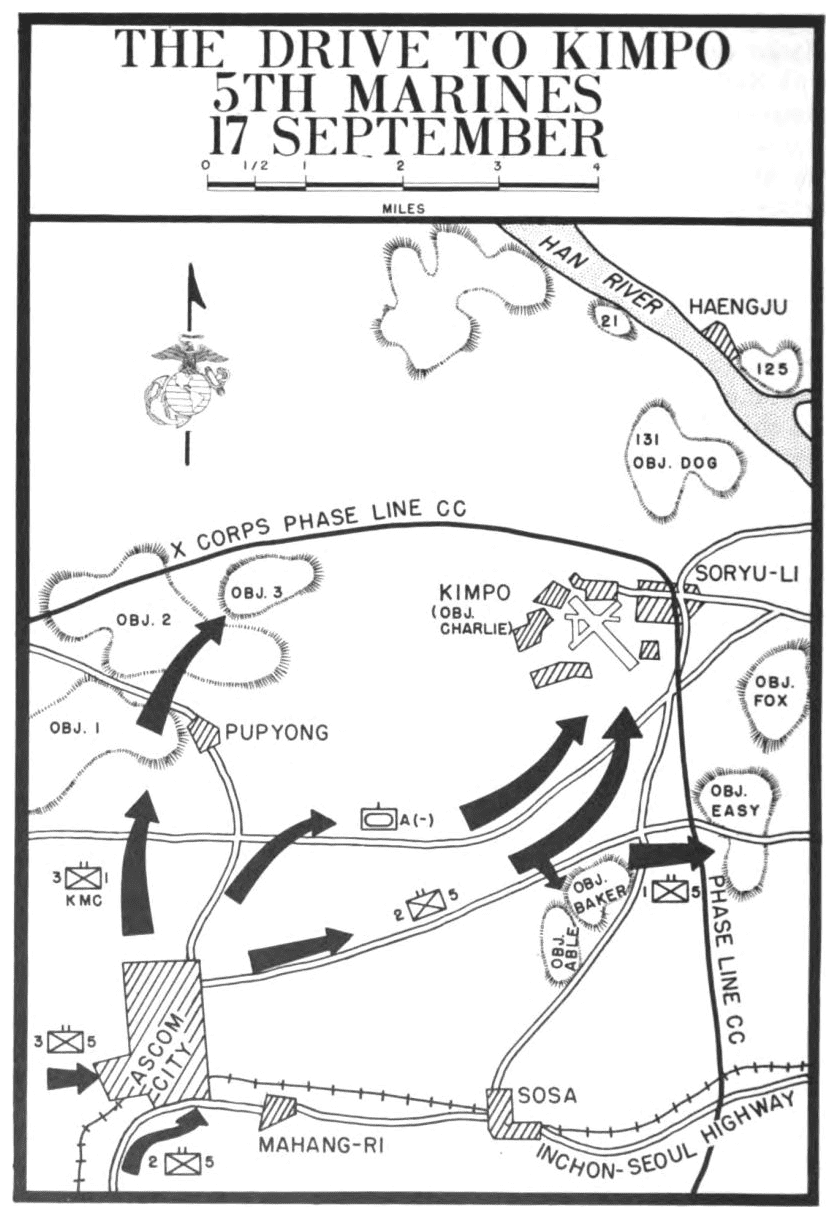
THE DRIVE TO KIMPO
5TH MARINES
17 SEPTEMBER
Lieutenant Colonel Roise launched 2/5’s attack at 0900. Company
E led the long route column eastward on the Inchon-Seoul Highway
through the carnage left by the defeat of the Red tank thrust. Having
marched about a mile, the vanguard of the battalion turned left on a
secondary road that traced the eastern edge of Ascom City.227
This expansive urban area would prove to be a thorn in the side of the
5th Marines for the next 24 hours. Originally a large Korean village
called Taejong-ni, Ascom City became the site of a huge service command
of the United States Army during the occupation of South Korea
after World War II. The few acres of small buildings and thatched
huts had grown into almost two square miles of residential, industrial,
and storage area. Caves, large warehouses, hundreds of other buildings,
and a complex network of streets made it an ideal hiding place for
fragments of a broken enemy, as the Marines were shortly to learn.
Marching northward through the outskirts, Easy Company of 2/5
was repeatedly held up by small pockets of resistance among the dwellings
on both sides of the road. Captain Jaskilka’s veteran infantry
reduced the enemy positions methodically, but the whole morning
was used up in the process. Simultaneously with the main advance,
the 2d Platoon of Fox Company marched through the heart of Ascom
City and screened 2/5’s left flank. Second Lieutenant Tilton A. Anderson,
the platoon leader, reported everything quiet in his zone, although
his men did not have time to check all of the side streets and blocks
of buildings.228
Having cleared the eastern fringe of the city by noon, Roise looked in
vain for the branch road shown on his map as leading to Objective
Able and Baker, some four miles distant. The chart was inaccurate,
and only a time-consuming reconnaissance could locate the correct
route. It was already 1400 by the time Company E led off on the hike.
While 2/5 was having its troubles in the eastern outskirts, Lieutenant
Colonel Taplett’s 3d Battalion stepped in to help the Korean
Marines on the other side of Ascom City. In regimental reserve,
3/5 was scheduled to occupy a series of assembly areas throughout the
day, moving forward by bounds behind the assault elements. The
morning displacement, into the western edge of Ascom City, took
place before the KMC attack had cleared the suburb as planned.
Using his initiative, Taplett committed his battalion against moderate
resistance that was holding up the South Koreans.229
Company G went into action and knocked out a Communist machine-gun
emplacement in the city. Next, a George Company patrol
attacked a strong enemy force deployed among the buildings. The
North Koreans fled after a hot fight, leaving behind 18 dead at a cost
of three wounded to the Marines. Item and How Companies also
spread out through the maze of streets, and there were several more
skirmishes before the “assembly area” was secured. The Korean
Marines then passed through and attacked to the north, as mentioned
earlier.230
The 1st Platoon of A/Tanks, having silenced other enemy positions
in the city, made contact with 3/5 at 1500. Leaving the built-up area,
Lieutenant Pomeroy led his M-26s in search of 2/5, in order to support
that unit’s drive on Kimpo. His armor was escorted by Lieutenant
Anderson’s rifle platoon, which had just completed its independent
mission in Ascom City without incident. Finding a road to the northeast
proved as much of a headache to Pomeroy as it had to Roise, particularly
since his big vehicles could not use the same route over which
2/5’s infantry column had advanced an hour earlier.231
Extending his quest northward, the tank platoon leader found a road
that not only paralleled the infantry’s path but also led to within a few
hundred yards of Kimpo, now about five miles distant. The M-26s
proceeded approximately a mile on the new route and were stopped by
a damaged bridge. First Lieutenant Wayne E. Richards rounded up
a party of Korean natives to help his 2d Platoon of A/Engineers repair
the span. During the layover, Pomeroy’s force was beefed up by
another platoon of M-26s, brought forward by Captain Gearl M.
English, the company commander, and by a long column of rolling
stock from 2/5’s headquarters.232
Meanwhile, the leading elements of Roise’s infantry reached the
foot of Objectives Able and Baker, two large hills about 4,000 yards
due south of Kimpo. There being no evidence of the enemy in the
area, the battalion commander did not waste time by committing whole
rifle companies to the high ground. At 1600, Lieutenant Deptula’s
1st Platoon of Easy Company ascended Objective Baker, while the
rest of the battalion waited on the road below. The hill was laced
with vacant entrenchments, and once on the summit, Deptula further
observed that objective Able was unoccupied. Moreover, he reported
by radio that it appeared to be clear sailing over the low ground
leading to the airfield.233
Acting on this information, Roise promptly launched his attack on
Kimpo, one of the major tactical objectives of the Inchon-Seoul operation.
A left face by the roadbound column put the troops of 2/5 on
line for the assault. Easy and Dog Companies, the latter on the left,
advanced rapidly against only desultory sniper fire.
Captain English’s tanks arrived propitiously, entering far out to the
left front of the attacking infantry. At a point 1,000 yards south of
the airfield, the M-26s came under moderate small-arms fire. Lieutenant
Anderson’s rifle platoon dismounted and engaged the small
force of North Koreans, knocking out one automatic weapon with
grenades. The Marine armor put down the remaining resistance with
seven rounds of 90mm High Explosive (HE) followed by a thorough
hosing with bow machine-gun fire.234
Just as this action subsided, Company D of 2/5 swept through the
area, picked up a platoon of tanks, and continued toward the airfield.
The other platoon of armor swung to the right to support Easy Company’s
attack. By 1800, the Marines were on the southern tip of
Kimpo’s main runway. Aside from sporadic long range fire from
the east, there was no opposition worthy of note.235
Over a mile long and three-quarters of a mile wide, Korea’s principal
airdrome was no mean target to secure. Scattered around the field
were more than half a dozen villages, and the runways themselves
were lined by scores of plane revetments and emplacements. It was
already dusk when Roise ordered his two assault companies to take
the objective “with all speed,” but by nightfall the infantry and tanks
had cleared only the southern portion of the runway.236
Rather than stretch a single defensive line to the point of diminishing
returns, the battalion commander deployed his three rifle companies
in separate perimeters, each one a tightly knit strong point.
Easy Company dug in on the east of the main runway and Dog on
the west. Company F deployed to the south of the airfield, paying
particular attention to the main road and a pair of intersections that
tied in secondary routes. In a central perimeter was 2/5’s CP, and
Able Company Tanks took up positions in Company D’s area. Just
before dark, Lieutenant Deptula’s platoon had raced northward to
outpost the village of Soryu-li, several hundred yards beyond Company
E’s lines.237
While 2/5 was investing the southern reaches of Kimpo, Lieutenant
Colonel Newton’s 1st Battalion, 5th Marines, pressed the attack on the
regimental right. Encountering no resistance, Company A occupied
the southern portion of Objective Easy at 1900. Company B ascended
the northern half of the high ground without incident later in the
evening. With Charlie Company on another hill to the west, 1/5
settled down for the night some 1,500 yards southeast of the 2d Battalion’s
lines. Two miles to the rear, 3/5 deployed in regimental reserve
around a critical road junction midway between Kimpo and
Ascom City.238
During the afternoon of 17 September, as the assault elements of
the 5th Marines rolled forward over a relatively quiet front, regimental
headquarters suddenly found itself in the center of an angry hornets’
nest. Lieutenant Colonel Murray’s CP had just displaced to the north
of the railroad station in Ascom City, when Commissioned Warrant
Officer Bill E. Parrish walked across the tracks to reconnoiter a site for
his ordnance dump. Gaining the summit of a small knoll, the officer
and his NCO assistants were met by a heavy fusilade from the orchard
and rice paddy beyond. Parrish was killed instantly and two of his
men seriously wounded.239
Cries of help brought First Lieutenant Nicholas A. Canzona’s 1st
Platoon of A/Engineers, which had just arrived at Murray’s CP. In
a brief clash around the orchard, the engineers killed ten enemy die-hards.
South Korean police swept through the adjoining rice paddy
and came up with seven prisoners.
About the same time, Major James D. Jordan’s party arrived in the
area to select a position for Battery A of 1/11. Again small-arms fire
crackled. Two of Jordan’s NCOs, Technical Sergeants Kenneth C.
Boston and Donald Comiskey, plowed through the hail of lead and
killed four more North Koreans.240
North of the railroad, still another Marine was killed and one more
wounded not far from Murray’s headquarters. For obvious reasons a
tight perimeter of engineers and H&S Company troops was drawn
around the CP during the night. Nevertheless, a Red officer stumbled
through the line in the darkness and seriously wounded Second Lieutenant
Lawrence Hetrick of A/Engineers.
At dawn on 18 September the regimental commander and his staff
were awakened by the chatter of an enemy submachine gun a few
yards from the CP. Holed up in a grain field with one Communist
rifleman, the officer who had shot Hetrick fought fanatically against
a whole platoon of engineers. Another Marine was wounded before
the suicidal stand was crushed by grenades and rifle fire.
There were no regrets when Murray’s headquarters took leave of
Ascom City and displaced to Kimpo.
The air at Kimpo was charged with tension during the night of 17–18
September. Troops of 2/5, manning perimeters which had been laid
out on unfamiliar ground during darkness, had every reason to believe
that the North Koreans would not give up the airfield without a fight.
But there were troubles enough in the North Korean camp, where
confusion and panic seemed to be the order of the day. Intelligence
on the enemy garrison in the Kimpo area presents a scrambled picture
so characteristic of the Communist organization throughout the
Inchon-Seoul operation.241 It appears that elements of the NKPA 1st
Air Force Division were charged with the operation of the airfield.
Under the command of 40-year-old Chinese-trained Brigadier General
Wan Yong, the division was comprised of the following units or,
more often than not, mere fragments thereof:
Division Headquarters
1st Co, Engineer Bn, Fighters Regt
3d Co, Engineer Bn, Fighters Regt
3d Plat, Gunners Co
2d Co, 1st Bn, 1st Regt
2d Bn, 1st Regt
Finance Co, 3d Technical Bn
Supply Co
The Kimpo force was augmented by a motley mixture of poorly
trained troops from the 226th and 107th NKPA Regiments and the
separate 877th Air Force Unit. In the face of the Marine advance,
Colonel Han Choi Han, commander of the 107th had fled across the
Han River, leaving the remnants of his regiment to an obvious fate.
Major Kung Chan So, leader of the 877th AF Unit, was killed in action
on 17 September. Of the 400 men originally assigned to this organization,
only five remained in combat by 18 September.
Crowded into undesirable terrain between the airfield and the Han
River, the Red troops were demoralized and bewildered by the rapid
advance of the 5th Marines. Only the fanaticism of a few officers
and NCOs prevented the complete collapse that would have resulted
from the lack of tangible assistance from the North Korean leaders in
Seoul. And it was no boost to sagging morale that white clothing
had been issued by the Supply Company, so that the Red soldiers could
quickly change to the traditional Korean garb when defeat was imminent,
and dissolve in the local populace.
In the counterattack against the airfield, which was designed to
uproot a full-strength Marine battalion backed by tanks and other
heavy fire support, the celebrated night tactics of the Communists
fizzled completely. With only a few hundred men at most, the rest
having slipped away to safer parts, the North Koreans further reduced
their strength by trying to develop three widely separated attacks. That
they launched these assaults with only rifles and submachine guns
serves to make the story more incredible.
The first move was in company strength against Lieutenant Deptula’s
isolated platoon outpost in Soryu-li, far to the north of Easy Company
lines.242 Deployed on both sides of a road junction in the village, the
Marines heard the enemy column approaching about 0300. Deptula
held fire until the Red vanguard marched into the center of his position.
Sergeant Richard L. Martson then jumped to his feet, bellowed
“United States Marines!” and opened up with his carbine on full
automatic. A sheet of rifle and BAR fire poured into the column from
the roadsides, and a dozen North Koreans went down in a heap. The
remainder fled.
The Communist commander rallied his soldiers for three more
thrusts against the Marine platoon. In between the attacks, his gravel-voiced
exhortations ground the air. The will to fight was lacking,
however, and each time, the attackers barely brushed the Marine position
before darting back into the night.
A T-34 tank was finally brought up to buttress another North Korean
assault. Without AT weapons to stop the armored vehicle rumbling
down the road toward his platoon, Deptula retracted southward in the
direction of 2/5’s main positions. The outpost had suffered only one
KIA and one WIA in blunting the four attacks. It was not pursued
during the withdrawal.
Deptula’s platoon gained Company E’s lines at 0500, just before the
perimeter received enemy small-arms fire from the west. Captain
Jaskilka, supposing it to be coming inadvertently from Dog Company,
forbade his men to reply. He stood up and yelled, “Hey! Cease fire,
you guys, this is Easy Company!” Fortunately, the enemy’s aim must
have been disturbed by the spectacle of a Marine officer giving orders,
for Jaskilka escaped without a scratch after discovering his mistake.
This enemy force proved to number about two squads, and just at that
moment the main NKPA force hit from the east. Easy Company was
thus engaged on two fronts, with Jones’ recoilless gun platoon taking
on the attack from the west while the 2d Platoon bore the brunt of the
assault from the east.243
The 2d Battalion’s southernmost position, manned by Company F,
had been active throughout the night. Lieutenant Harrell’s assault
platoon together with Richards’ engineer outfit was entrenched around
an overpass within the southeastern arc of the company perimeter. In
the first hours of 18 September, a North Korean lieutenant and his five-man
demolition team tried to reach the bridge in an apparent attempt
to destroy it. Sergeant Ray D. Kearl opposed the intruders single-handedly,
killing the Red officer and three of his men, and driving the
remaining pair back into the night. Before daybreak, another enemy
patrol approached on the road and was annihilated.
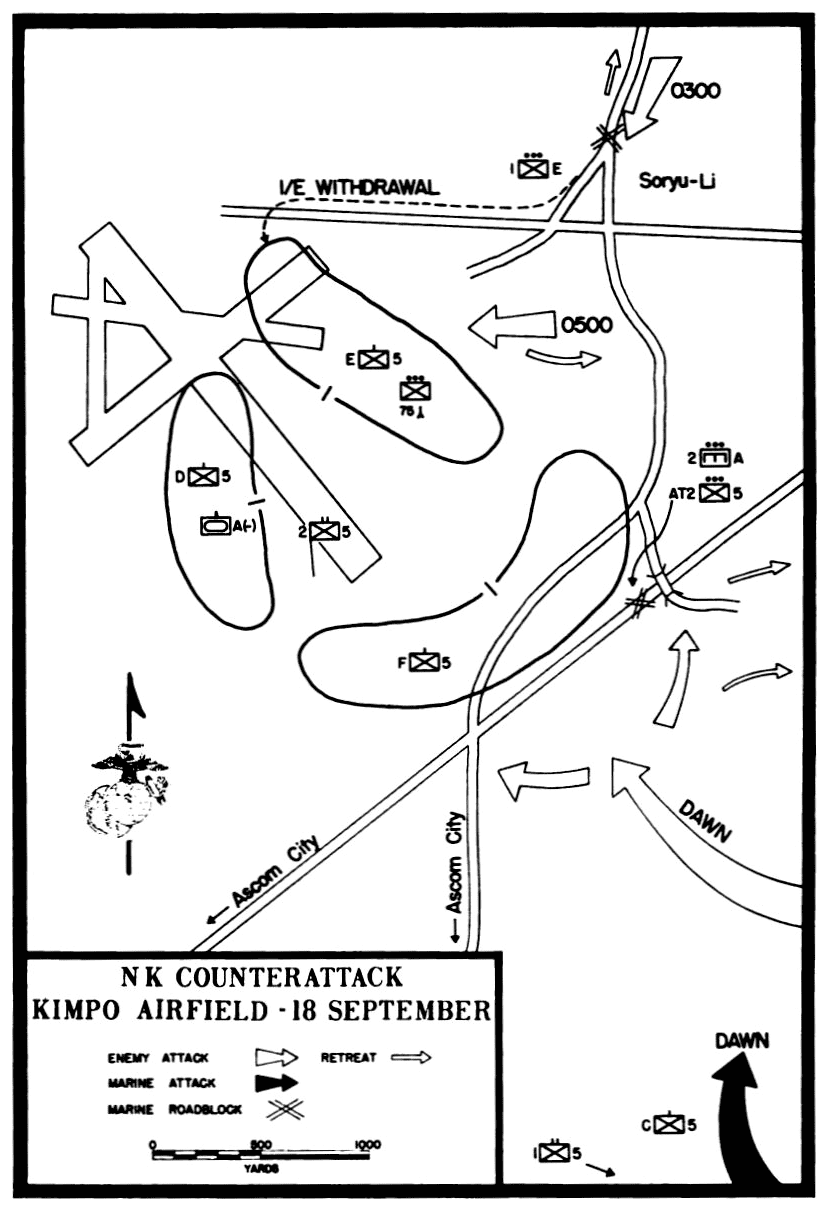
NK COUNTERATTACK
KIMPO AIRFIELD—18 SEPTEMBER
It proved that these and other scattered incidents were the prelude
to the third and final attack against the airfield, which was launched
from the south at dawn. This last maneuver by the Reds, however,
was checked even before it began, for the 1st Battalion, 5th Marines,
spotted the attackers moving across its front toward Kimpo. Baker
Company took the North Koreans under fire immediately, and the
battalion commander called down heavy mortar and artillery
concentrations.
Most of the Communist column was disorganized and dispersed
before it could reach 2/5’s southern defenses. The lone platoon that
did connect with Company F’s perimeter engaged the Marines at the
overpass. Harrell’s troops and the engineers poured small-arms fire
and white phosphorus rockets into the attackers. Staff Sergeant Robert
J. Kikta, defying enemy bullets as he moved among his men shouting
encouragement, fell mortally wounded. Sergeant David R.
DeArmond, normally a bulldozer operator for A/Engineers, was
killed behind his machine gun.
After the short, bitter clash, the surviving North Koreans retreated
through the rice paddies and hills leading to the Han River. Companies
E and F, supported by A/Tanks, fanned out from their perimeters
and mopped up. In 1/5’s zone, Lieutenant Colonel Newton
committed Charlie Company against the withdrawing enemy and
inflicted more casualties.
Kimpo and the surrounding villages were secured by 1000, 18
September. Half an hour later, Lieutenant Colonel Roise ordered
Company D, supported by tanks, recoilless rifles, and heavy machine
guns, to seize Regimental Objective Dog—Hill 131, which dominated
the banks of the Han River north of the airfield. Advancing under
cover of naval gunfire, the Marines occupied the high ground unopposed
at 1145.244
In the 24 hours since leaving Ascom City, the 2d Battalion, 5th
Marines, had suffered four KIA and 19 WIA in driving over nine
miles of hills and rice paddies.245 The rapid advance cost the North
Koreans 100 dead in 2/5’s zone, ten prisoners, and one of the finest
airdromes in the Far East.
CHAPTER IX Marine Air Support — Helicopters and OYs in Support — Marine Air Units at Kimpo — Progress of Eighth Army Offensive — Division CP Displaces to Oeoso-ri — Advance of RCT-1 to Sosa — Reports of Enemy Build-up — Orders for Crossing the Han
Helicopters and OYs in Support—Marine Air Units at
Kimpo—Progress of Eighth Army Offensive—Division CP
Displaces to Oeoso-Ri—Advance of RCT-1 to Sosa—Reports
of Enemy Build-up—Preparations for Crossing the Han
At 1000 on the morning of 18 September an HO3S-1 helicopter became
the first American aircraft to land on Kimpo Airfield since
June. Mopping up operations had scarcely been completed, following
the enemy counterattack, when Captain Victor A. Armstrong of
VMO-6 made a vertical approach with General Shepherd and Colonel
Krulak as passengers. They were greeted by General Craig, the ADC,
who had just arrived in a jeep.
The field was in surprisingly good shape, considering the fighting
it had seen within the last few hours. As evidence that the enemy had
been surprised, one Russian-built fighter of the Yak III type and two
Stormovik type aircraft were found “relatively undamaged” and turned
over to Air Force Intelligence.246 Several other Yaks and Stormoviks
had been destroyed by the enemy.
On the return trip, Armstrong was requested by his passengers to
fly them across the Han for a preview of the outskirts of Seoul. Except
for scattered small-arms fire, the helicopter was allowed to proceed
without being molested by the enemy. There were few signs of extensive
NKPA preparations to be seen at this time.247
VMO-6, the composite observation squadron commanded by Major
Vincent J. Gottschalk, had already made a name for itself in the Pusan
Perimeter actions. Consisting of eight HO3S-1 helicopters and an
equal number of OY planes, this former Brigade unit came under the
operational control of the 1st Marine Division and the administrative
and logistical control of MAG-33. During the Inchon assault,
VMO-6 was based on SCAJAP LST QO79 in the harbor except for
an Oy attached to each of the two CVEs.
The first of a long sequence of helicopter rescue missions during the
Inchon-Seoul operation took place on D-plus 1 when First Lieutenant
Max N. Nebergall picked up a Navy pilot who had ditched in Inchon
harbor. Flights carried out by other aircraft were reported as three
reconnaissance, two artillery spot, three beach reconnaissance, and one
utility.248
VMO-6 displaced ashore the next day to an airstrip improvised near
the Division CP by the Marine engineers. This was the beginning
of liaison, utility, reconnaissance, evacuation, and rescue flights on a
dawn-to-dark basis.
Division air and naval gunfire representatives of the Fire Support
Coordination Center followed VMO-6 ashore on the 16th. During
the planning phase they had worked with their opposite numbers of
PhibGru One and with the 11th Marines after the Division landed at
Kobe. Although some of the officers and men embarked for Inchon
in the Mount McKinley, the materiel and 90 percent of the personnel
arrived in the President Jackson. At 1400 on D-plus 2 the FSCC became
operational after all elements and their equipment reported to
the Division CP. Responsibility for the coordination of supporting
arms ashore was assumed at 0630 on 16 September for air, at 1500 on
the 17th for artillery, and at 1800 on the 18th for naval gunfire.249
The rapid advance of Marine ground forces during the first three
days meant that Major Robert L. Schreier’s 1st Signal Battalion had a
job on its hands. The main body reached the objective area on
board the President Jackson, and the first units ashore were the battalion
and regimental ANGLICO teams, most of which had embarked
in LSTs. When the ADC group displaced from Wolmi-do to Inchon,
radio facilities were maintained without a hitch.
Radio and message center facilities met all requirements during the
night of 16–17 September. Teletype (through radio carrier) was
initiated between the Division CP and Corps, afloat on the Mount McKinley.
And by the morning of D-plus 2, such progress had been
made that wire communication was established not only with both advancing
infantry regiments but also with most of the battalions.250
Enemy resistance was so ineffectual from 16 to 18 September that
the Marine infantry regiments were able to advance without much
flank protection. The three battalions of the 11th Marines did more
displacing than firing in their efforts to keep pace, and men and
vehicles of the Signal Battalion were kept busy at laying wire.
Security was provided for the left, or northern, Division flank by
the attack of the KMC Regiment (less the 2d Battalion, left behind
for police duties in Inchon) under the control of the 5th Marines. Attached
to the regiment for possible use in calling down naval gunfire
were two Shore Fire Control Parties. Objectives on Corps Phase Line
CC were reached without much difficulty after the initial KMC setbacks
described in the previous chapter.251
There had been little or no urgent need for close air support until 18
September, when RCT-1 met stubborn opposition in the Sosa area.
Thus the capture of Kimpo in comparatively good condition was a
timely boon, since it meant that land-based Marine tactical air support
could be initiated as soon as Captain George W. King’s Able Company
Engineers made the field operative with temporary repairs.
This was the conclusion of Generals Harris and Cushman, commanding
the 1st MAW and TAC X Corps, when they visited Kimpo
by helicopter on the afternoon of the 18th. They advised CG X Corps
accordingly, and that evening he ordered the deployment of MAG-33
to the captured airfield with its headquarters and service squadrons.
The tactical squadrons figured in an administrative switch that has
sometimes puzzled chroniclers of Marine air operations. By order
of General Harris, the following reassignments were directed to take
effect on 21 September 1950:
From MAG-33 to MAG-12—VMF-214, VMF-323, and VMF(N)-513;
From MAG-12 to MAG-33—VMF-212, VMF-312, and VMF(N)-542.252
Both MGCIS-1 and MTACS-2 were already ashore at Inchon under
the operational control of the 1st Marine Division. Aircraft and
flight echelons of the tactical squadrons were to be flown to Kimpo
on the 19th from Itazuke and Itami airfields in Japan, with the
remaining elements following by surface shipping. Thus MAG-33
would consist of these units:
| Organization |
Officers |
Enlisted |
Total |
| HqSq-33 |
74 |
177 |
251 |
| SMS-33 |
29 |
538 |
567 |
| VMF-212 |
32 |
154 |
186 |
| VMF-312 |
53 |
221 |
274 |
| VMF(N)-542 |
54 |
291 |
345 |
| MTACS-2 |
34 |
190 |
224 |
| MGCIS-1 |
19 |
185 |
204 |
| Total |
295 |
1,756 |
2532,051 |
VMFs-214 and 323 would continue to operate from the carriers
Sicily and Badoeng Strait, with the night-fighters, VMF(N)-513 being
based as usual at Itazuke AFB in Japan. The only difference was that
a scratch of the pen had transferred these units from MAG-33 to
MAG-12. It was their responsibility to support the advancing ground
forces during the critical period while the other three tactical squadrons
were making the move from Japan to Kimpo.
Control of tactical air support had passed from the TADC on the
Mount McKinley to the Air Support Section of MTACS-2 on D-plus
2, after the Landing Force Commander signified his readiness to assume
it. Calls for close air support were increasing as the enemy
recovered from the first shock of invasion. On the 18th and 19th, the
three fighter squadrons of MAG-12 flew a total of nearly 50 close
support sorties controlled by the Air Support Section of MTACS-2.
Napalm, 20mm ammunition, rockets, and 500-pound bombs were used
to blast NKPA troop concentrations in the zone of the 1st Marines.254
Logistical as well as tactical and administrative problems had to be
solved. During the planning phase, it may be recalled, Colonel Kenneth
H. Weir (C/S TAC X corps) had learned that X corps would not
have enough trucks to support air operations at Kimpo by transporting
aviation gasoline and aircraft munitions from Inchon. As a solution,
arrangements were made to accept the offer of FEAF Combat Cargo
Command to provide logistical support; and these totals in tonnage
were flown in from Japan during the first week:
| Date |
Ammo |
Avgas |
Oil |
| 18 Sep |
16 |
8 |
0 |
| 19 Sep |
73 |
28 |
5 |
| 20 Sep |
151 |
86 |
0 |
| 21 Sep |
219 |
88 |
11 |
| 22 Sep |
268 |
153 |
5 |
| 23 Sep |
139 |
80 |
0 |
| 24 Sep |
118 |
81 |
25516 |
This proved to be the largest total for a single week during the
Inchon-Seoul operation. In addition, about 1,025 tons of POL and
425 tons of ammunition were trucked from Inchon to Kimpo during
the entire period, and the forward echelon of VMR-152 flew in spare
parts and items of urgently needed equipment.
Headquarters of the 1st MAW remained at Itami AFB in Japan,
though General Harris made frequent trips to Kimpo. The chief
task of the Wing during the Kimpo air operations was furnishing
administrative and logistical support to TAC X Corps and MAG-33.
TAC X Corps set up its headquarters at Kimpo Airfield on 19
September, followed by MTACS-2, MGCIS-1, and VMO-6. The
first fighter squadron of MAG-33 to arrive at the new base was
VMF(N)-542. Lieutenant Colonel Max J. Volcansek, Jr., the commanding
officer, and five pilots landed their F7F-3Ns at 1830 on the
19th after a flight from Itami AFB. This was the baptism of fire for
a majority of the squadron’s pilots. Numbering 54 officers and 274
enlisted men when it left El Toro, VMF(N)-542 had only 20 trained
night fighter pilots. The remainder were volunteer reservists qualified
by “a good experience level and a desire to become night fighters.”256
The squadron claimed the distinction of flying the first Marine combat
mission from Kimpo at 0735 on the 20th when four of the F7F-3N
aircraft destroyed two enemy locomotives after expending some 3,000
rounds of 20mm ammunition. The Corsairs of Lieutenant Colonel
Richard W. Wyczawski’s VMF-212 and two aircraft of Lieutenant
Colonel J. Frank Cole’s VMF-312 also landed at Kimpo on the 19th
and got into action the following day. Conditions were primitive at
the outset. In the lack of refueling facilities, the first strikes had to
be flown on fuel remaining in the aircraft, and bombs were loaded
by hand.257
It had been an achievement to have two tactical squadrons of MAG-33
in action less than 48 hours after the reconnaissance landing by
Generals Harris and Cushman. This accomplishment owed a great
deal to the care shown by the 5th Marines to keep damage at a minimum.
Lieutenant General George E. Stratemeyer, CG FEAF, expressed
his appreciation of this factor in a letter to General Smith:
“I want to take this opportunity of expressing my admiration and
gratification for the manner in which elements of your Division recently
captured Kimpo Airfield and so secured it as to make it available
for use by Far East Air Forces and Marine Corps aircraft in the shortest
possible time.”258
General MacArthur had intended the Eighth Army to be the hammer
and X Corps the anvil of a great joint operation. During the
first few days, however, it sometimes appeared as if these roles were
reversed. On 18 September, after a penetration of 16 miles on the X
Corps front, the attacking forces in the Pusan Perimeter had just begun
to inch ahead against desperate NKPA resistance. In some sectors,
indeed, the enemy not only put up a stubborn defense but counterattacked
vigorously. (See map in end papers.)
The Eighth Army now consisted of the U. S. I Corps (IX Corps did
not become operational until 23 September) and the ROK I and II
Corps. General Walker’s command was already on the way to becoming
the most cosmopolitan army in which Americans have ever
served. Contingents of British ground forces had reached the front;
and before the end of the year, 40 countries of the United Nations
would have offered assistance, either military or economic, to the fight
against Communism.
Most of this aid had not yet materialized on 16 September, but the
Eighth Army had overcome its disadvantage in numbers of trained
troops, thanks to NKPA losses, when it jumped off all along the line
in southeast Korea. In the north the 1st Cavalry Division, 24th Infantry
Division, ROK 1st Division, and British 27th Brigade launched
a determined attack along the Taegu-Waegwon axis to win a bridgehead
across the Naktong. It was nip-and-tuck for the first three days,
and not until the 19th did the UN forces fight their way across the
river against the last-ditch opposition of the 1st, 3d, 10th, and 13th
NKPA Divisions.259
Still farther north, the enemy relinquished little ground until the
18th. On that date the ROK 3d Division recaptured the east coast
port of Pohang-dong, which the invaders had taken in their drive
during the first week of September.
In the south, the U. S. 2d and 25th Infantry Divisions and attached
ROK units were held up for three days by the NKPA 6th and 7th
Divisions. The deadlock lasted until 19 September, when the enemy
fell back in the Masan area along the southern coast.260
Major Joseph H. Reinburg’s VMF(N)-513, operating out of its
Itazuke base, played a conspicuous role in the first days of Walker’s
offensive. Although specialists in night-fighting, the Marine pilots
flew 15 daylight close support missions for Army units from 17 to 19
September. Enemy troops, tanks, vehicles, and artillery were scored
during every strike, as the planes ranged the entire extent of the Pusan
Perimeter.261
So much progress had been made by this date on the X Corps front that
General Smith displaced the 1st Marine Division CP from the eastern
outskirts of Inchon to Oeoso-ri, about a mile and a half southeast of
Kimpo Airfield. This forward location was selected by General Craig
with a view to preliminary Division planning for the crossing of the
Han, which would entail a reshuffling of units.
Oeoso-ri having been an American housing area during the post-World
War II occupation, duplex houses and Quonset huts were available.
General Smith arrived by helicopter on the afternoon of the
19th, and the new CP opened at 1645. During the next few days the
area was treated to intermittent artillery fire, apparently from a single
well-hidden gun somewhere in the Seoul area. It was an embarrassment
to Marine artillery officers, who were never able to locate the
offending weapon, but no great harm was done.
By this time General Smith could look forward to the arrival of more
units at the front. On D-day the strength of X Corps on paper had
been 69,450 ground force troops. In addition to the 1st Marine Division
and 7th Infantry Division, there were such major units as the 93d and
96th Field Artillery Battalions, the 73d Tank Battalion, 56th Amphibian
Tank and Tractor Battalion, the 2d Engineer Combat Group. In
GHQ UNC Reserve were the 3d Infantry Division and the 187th
Airborne RCT.262
The 3d Division had not sailed for the Far East in time to take part
in the Inchon-Seoul operation. The 187th Airborne RCT, due to land
at Inchon on 23 September, had been the answer to General MacArthur’s
requests in July for paratroops to land behind the enemy’s
lines in conjunction with the amphibious assault planned as Operation
BLUEHEARTS. Although the Joint Chiefs of Staff decided against
flying an airborne RCT to Japan at the time, the 11th Airborne Division
was later directed to organize and train such a unit for service in the
Far East. On account of the large proportion of new troops filling out
a skeleton unit, General Collins stipulated that the 187th was not to
be committed for an airdrop before 29 September. It was decided,
therefore, that the RCT would be given an initial mission of protecting
the left flank of the 1st Marine Division.
Preliminary planning for the crossing of the river Han began as soon
as the Division staff settled down in the new CP. The reshuffling of
various units had to wait, however, until both Marine regiments took
their assigned objectives of 18 and 19 September. Throughout the
17th, while Murray’s regiment drove northeastward toward Kimpo,
the 1st Marines had continued the attack from Ascom City along
the Inchon-Seoul Highway. As mentioned previously, Monegan’s
rocket launcher and the 75mm recoilless rifles, emplaced in 2/1’s positions
on Hill 186, helped smash the North Korean tank-infantry
column at dawn. It appeared that a second enemy force was supposed
to have closed on Marine lines by taking a parallel course through the
hills south of the highway. The Red infantry, in about company
strength, was spotted moving along the high ground toward Company
D’s front on Hill 186. Fox Company dispersed the column with
mortar fire and then notified Dog to be on the alert.263
Though the North Koreans were stopped cold, they did not flee
with the usual rapidity. Their base of operations seemed to be Hill
208, a land mass that began near Mahang-ri on the highway and spread
southward across most of the 2d Battalion front. Lieutenant Colonel
Sutter’s attack plan committed Easy Company on the left of the road,
Fox on the right, and Dog in the high ground to the south. No sooner
had the companies jumped off than they became involved in scattered,
stubborn fighting with Red soldiers on and around Hill 208.264
Howitzers of the 11th Marines raked the high ground ahead of the
attackers, and Sutter’s troops measured off slow but steady progress.
In the low ground bordering the highway, enemy troops had taken
cover in the fields on both sides of a road block about 500 yards from
Mahang-ri. Second Lieutenant Robert C. Hanlon’s 2d Platoon of
Easy Company was pinned down by fire from three sides. Second
Lieutenants Johnny L. Carter and George E. McAlee started forward
with reinforcements, but McAlee was wounded by several bullets.
After summoning a corpsman, Carter got through to Hanlon, and
they called for 3.5-inch rockets and 75mm recoilless fire on huts sheltering
enemy soldiers. The two officers then led an advance which
took the platoon to a small hill on the right of the road block, where
the other two platoons moved up abreast. About 20 NKPA troops
were estimated to have been killed.265
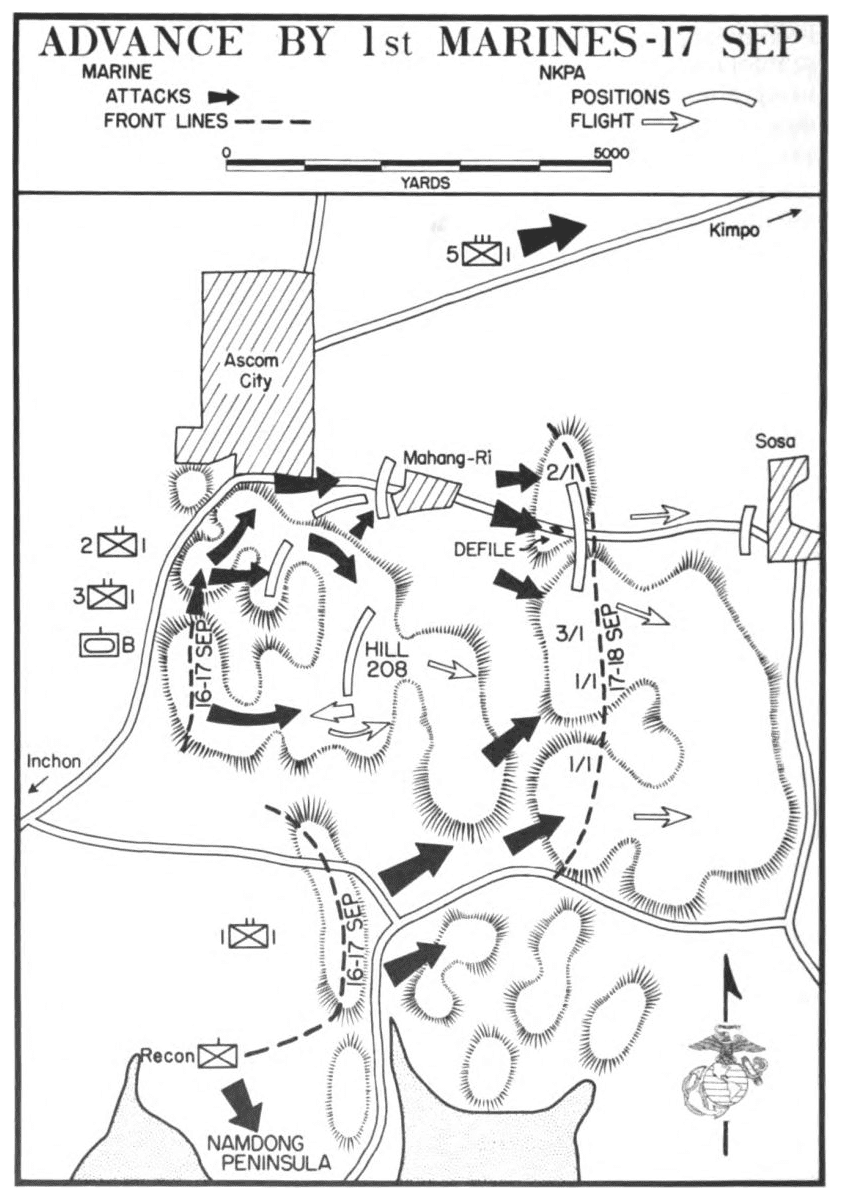
ADVANCE BY 1st MARINES—17 SEP
At noon, Companies F and D had secured Hill 208 overlooking the
FBHL, but it remained for E to break into Mahang-ri on the highway.
By this time 3/1 had entered the fight with an armored column.
Company G, led by First Lieutenant Robert L. Gover’s 1st Platoon of
Baker Company Tanks, punched down the road in an attempt to
pierce the screen of Red resistance with the rest of 3/1 in column close
behind. The M-26 crews spotted an 85mm gun protruding from a
thatched hut and destroyed the camouflaged T-34 before it could fire
a shot. An infantry platoon riding the Marine tanks was forced to
dismount at Mahang-ri and deploy, while the armor fired from the
road at numerous targets of opportunity. The village was finally
secured shortly before 1600, and small bands of enemy were seen
darting eastward to take up new positions along the highway.266
The advance to Mahang-ri and the FBHL had carried the 1st
Marines 3,000 yards from its starting point at Ascom City. As the
attack continued late in the afternoon, the next objective was Corps
Phase Line CC, whose boundaries were defined in the previous
chapter. Midway between Mahang-ri and the phase line was the town
of Sosa, and it was from this locale that North Korean soldiers were
pouring westward to delay the Marine advance on the highway.
Since the 5th Marines had veered to the northeast to attack Kimpo,
its boundary with the 1st had moved well to the left of the highway.
Henceforth, Puller’s regiment would have to go it alone on the main
road. This was the case as the 2d and 3d Battalions butted against
enemy delaying forces between Ascom City and Mahang-ri, and the
isolation became more pronounced as they attacked toward Sosa late
on the 17th.
Sutter’s unit advanced on the left of the highway with Companies E
and F in assault. George Company of 3/1, transported in LVTs and
followed by the rest of the battalion, moved along the road behind the
2d Platoon, Baker Company Tanks. There is a defile halfway between
Mahang-ri and Sosa, and at this spot the North Koreans chose to
make a determined stand. Second Lieutenant Bryan J. Cummings
nosed his lead M-26 into the pass, while infantry moved to the shoulders
on either side against light opposition. Suddenly the troops and lone
tank were hit from the front by a heavy volume of small-arms, antitank,
and mortar fire.267
The Marine infantry was thrown back by the intensity of the outburst,
the most severe they had yet encountered. As luck would have
it, the engine of Cummings’ tank went dead at this inopportune
moment, and the big vehicle stalled. Remembering that infantry had
been riding on top of his M-26, the platoon leader opened the hatch
to make a quick check. He yanked a lone rifleman inside and buttoned
up just as Red soldiers scrambled down the embankment.
Fumes from the 90mm gun choked the Marines in the vehicle as
they listened to the clamor of North Koreans on the hull. The infantryman
who had been pulled to safety by Cummings suddenly went
berserk and had to be knocked out. Then the officer was forced to
choose between two evils: either his crew must succumb to the acrid
fumes or take its chances on opening the pistol port for ventilation. He
opened the port. A grenade bounced inside, and the ear-shattering
explosion within the steel enclosure wounded Cummings, the rifleman,
and one of the tank gunners. At this moment the semi-conscious
Marines resigned themselves to the worst.268
Help was on the way, however, and it was timed to the split second.
Just as the grenade exploded, Sergeant Marion C. Altaire’s M-26
moved to the mouth of the defile and “scratched the back” of the
beleaguered vehicle with bow machine-gun fire. Riddled Red soldiers
were swept from the top of Cummings’ tank and piled up alongside.
Within a few minutes, a VMF-214 flight appeared over the pass, and
the planes peeled off to bomb, rocket, and strafe the high ground.269
As the tide of battle swept past, Cummings and his men opened the
hatch, coughing and choking, and drank in long breaths of fresh air.
It took them a moment to realize that they were back again in the land
of the living after one of the closest calls that Marines have ever
experienced.
Company G of 3/1 fought back on the right of the MSR and gained
the high ground above the pass. Simultaneously, Staff Sergeant Arthur
J. MacDonald led the second section of Cummings’ tank platoon into
the defile, and the M-26s laid down heavy 90mm and machine-gun fire
on the crescent of North Korean emplacements ahead. A total of
six enemy AT guns was destroyed, but not before the weapons had
knocked a track off Cummings’ vehicle and damaged two others to a
lesser extent.270
The 2d Battalion drove to the top of the high ground on the left of
the road, and the Marines enjoyed a small-scale “turkey shoot” as the
North Koreans pulled out and pelted toward Sosa. While the assault
units consolidated their holdings, the remainder of the 2d and 3d
Battalions moved into the area around the defile and dug in for the
night.
The 1st Marines’ attack along the highway had netted 4,800 yards.
Despite repeated clashes in the course of the day, 2/1 lost only one killed
and 28 wounded, and Company G of the 3d Battalion suffered six
WIA. Enemy losses included 250 killed and wounded, 70 prisoners,
one T-34 tank, several AT guns, and large quantities of small arms and
ammunition.271
Action on the Division’s southern flank involved little more than
hill climbing and foot races for the 1st Battalion, 1st Marines, and the
Division Reconnaissance Company. After jumping off in the morning
of D-plus 2, Lieutenant Colonel Hawkins’ infantry fanned out through
a maze of twisting valleys and ridges. The battalion encountered only
light resistance, which invariably evaporated under pressure, and by
dark the assault elements had gained 4,000 yards. Hawkins then
deployed his troops for night defense on the high ground south of 3/1’s
positions overlooking the highway defile.272
On the right of the 1st Battalion, Captain Houghton’s Reconnaissance
Company reached the tip of the Namdong Peninsula. The
Recon troops spent two days, the 17th and 18th, patrolling this spacious
tactical vacuum. A number of dispirited prisoners were collected and
caches of arms and munitions uncovered. One of the more significant
discoveries was a small arsenal in which Russian-type wooden box
mines were being manufactured and stored in quantity. First encountered
by Able Company engineers in the Pusan Perimeter, these
crude but effective explosives would become serious obstacles to the
Marine advance in the days ahead.273
The night of 17–18 September passed quietly for the 1st Marines.
During the hours of darkness, Ridge requested intermittent naval
gunfire to interdict Sosa and Hill 123, where he believed enemy defenses
to be located. Jump-off fires were also planned for the morning
in addition to air strikes. Captain P. W. Brock’s HMS Kenya poured
in more than 300 6-inch rounds with good results. “Our Royal Navy
ally not only supported the battalion to the maximum of its naval
gunfire desires,” said Ridge, “but volunteered to render more than was
requested.”274
Shortly after first light on D-plus 3, the 2d Battalion attacked along
the highway with Easy Company on the left of the road and Dog on the
right. Premature air bursts from an artillery preparation resulted in
two KIA and three WIA among the troops of Company E.275
Ridge’s 3d Battalion boarded a column of LVTs, DUKWs, and
jeeps, then rumbled down the highway through 2/1’s assault companies.
In striking contrast to the previous day’s advance, there was
a conspicuous absence of NKPA infantry along the way. The Marines
brushed aside light opposition, including an antitank roadblock at
Sosa’s outskirts, and captured the town at noon. Covered by Baker
Company Tanks, 2/1 moved into defensive positions on the right side
of the railroad about a mile beyond the built-up area, and the 3d
Battalion deployed on Hill 123 just across the tracks.276
On the Division’s right, 1/1 gained another 4,000 yards in the course
of 18 September. In its third consecutive day of attack, the battalion
had yet to encounter anything more formidable than steep hills and
vapid enemy bands. Hawkins built his night defenses along a mountainous
two-mile front south of 2/1’s position overlooking the highway.
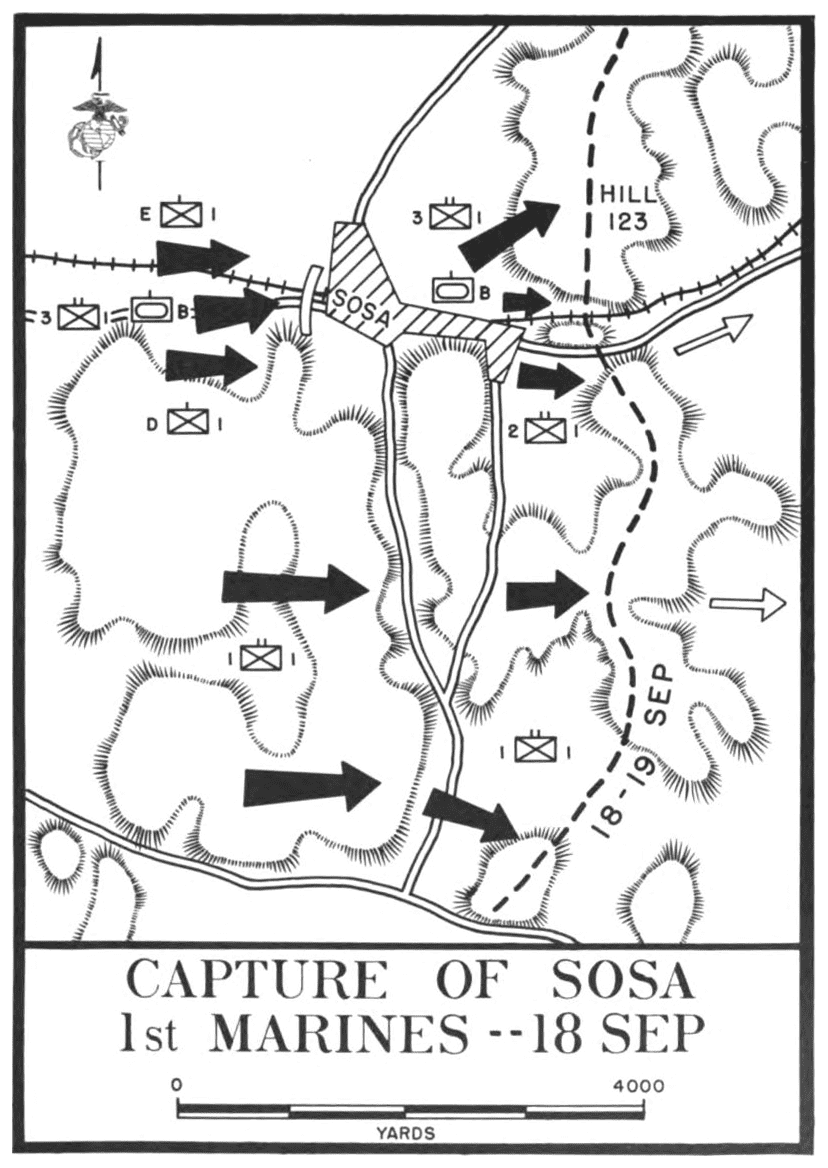
CAPTURE OF SOSA
1st MARINES—18 SEP
There was little activity in the 5th Marines’ zone of action during the
1st Regiment’s drive on Sosa. After helping 2/5 smash the dawn
counterattack at Kimpo, Company C, 1st Battalion, attacked Objective
Fox under cover of an artillery preparation. Lieutenant Pedersen’s
unit seized the high ground against light opposition at 0930, while the
remainder of 1/5 remained entrenched at Objective Easy, captured
the previous day.277
Murray’s CP displaced to Kimpo at 1245 on the 18th, and the regiment
spent the rest of the day patrolling from its positions which
ringed the airfield. On the 5th Marines’ left, the 3d Battalion of the
KMC was joined by 1/KMC in searching out the base of the
Kumpo Peninsula. A new security force was added to the Division
sector when the 17th ROK Regiment landed at Inchon and fanned
out to comb the troublesome area between Ascom City and the sea.278
The General Situation Map gives the disposition of friendly and
suspected enemy elements as of late afternoon on 18 September. This
date is particularly important in that the Marine division, regimental,
and battalion headquarters were swamped by a torrent of intelligence
which indicated for the first time the future patterns of organized
NKPA resistance.
Beginning on the left of the broad arc of the 1st Marine Division’s
front, repeated reports told of enemy concentrations north and south
of the Han River in the area of the Kumpo Peninsula.279 Upwards of
1,000 troops were sighted by natives and air observers, and it was believed
that the North Koreans were organizing for an attempt against
Kimpo. A strike by four Navy Skyraiders caught part of the Red
force exposed on both banks of the Han northeast of the airfield. After
killing an estimated 50 of the enemy and dispersing the remainder,
the Navy pilots reported the area “still active.”
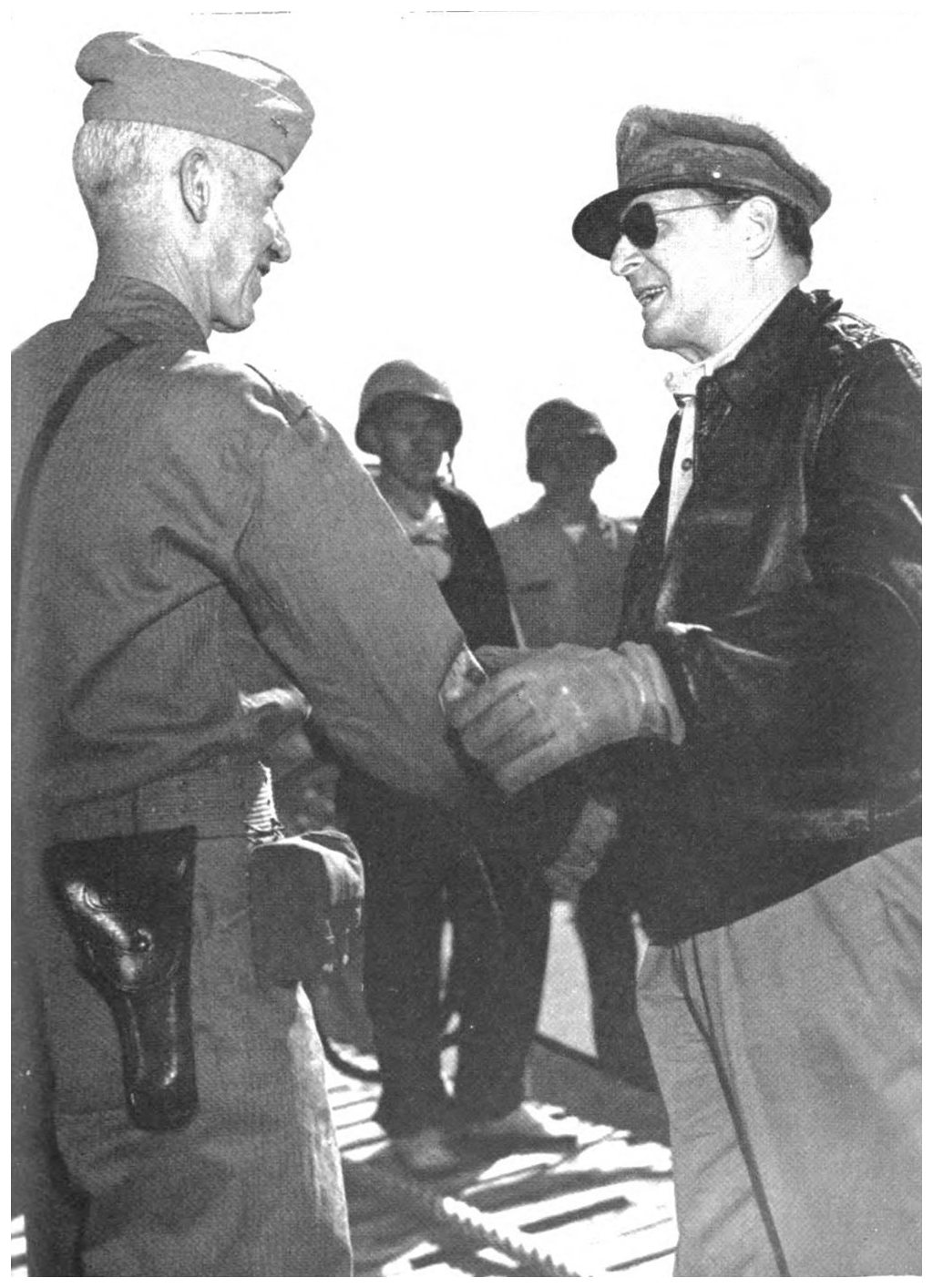
Hail to the Chief—General Smith welcomes General MacArthur
ashore, on D-plus 2, for his first trip of inspection (U. S. Army
Photo).
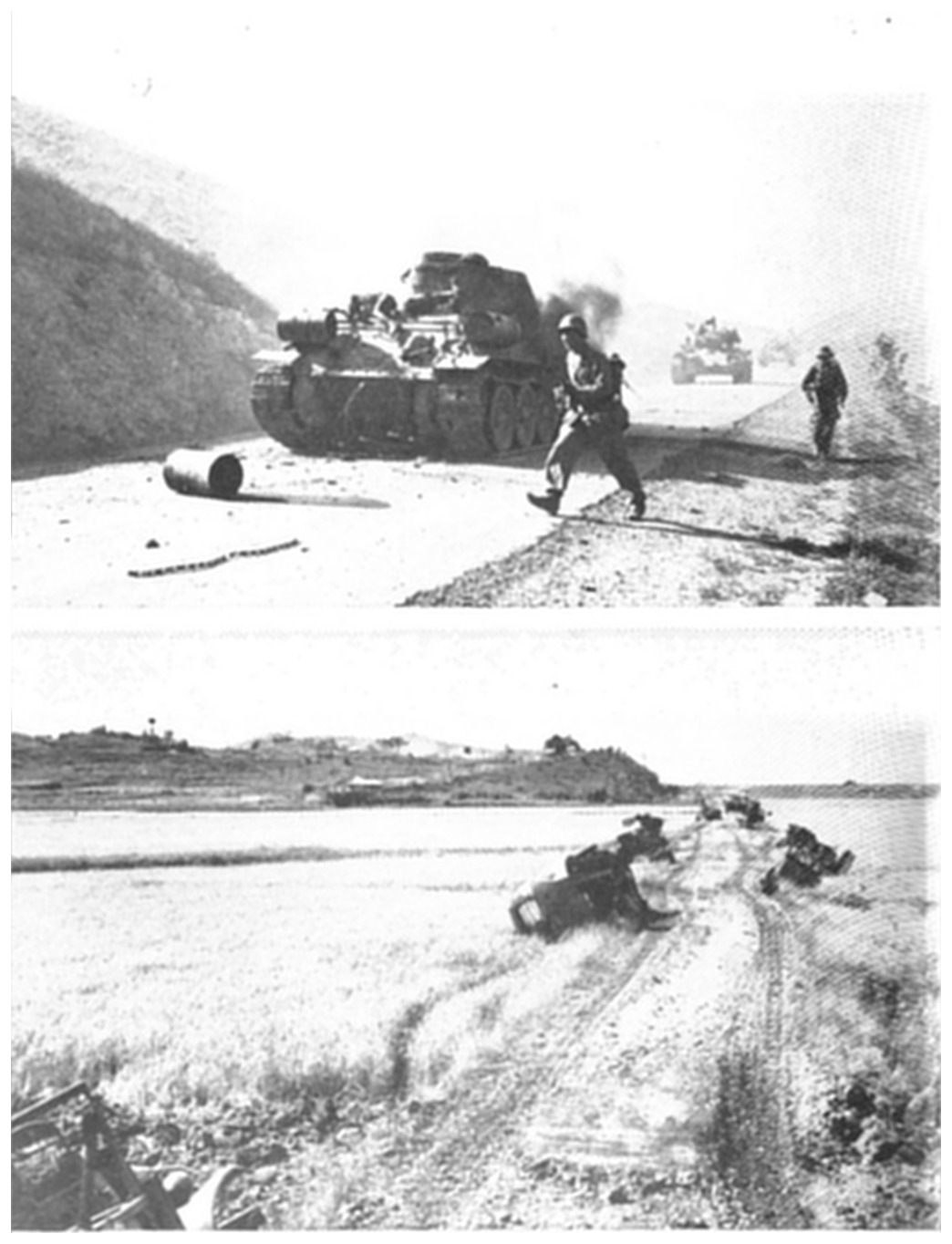
Drive to Kimpo——Above, Marines pass burning enemy tank with
bodies of NKPA soldiers on top; and, below, enemy transport
knocked out by Marine planes (Marine Corps Photos).
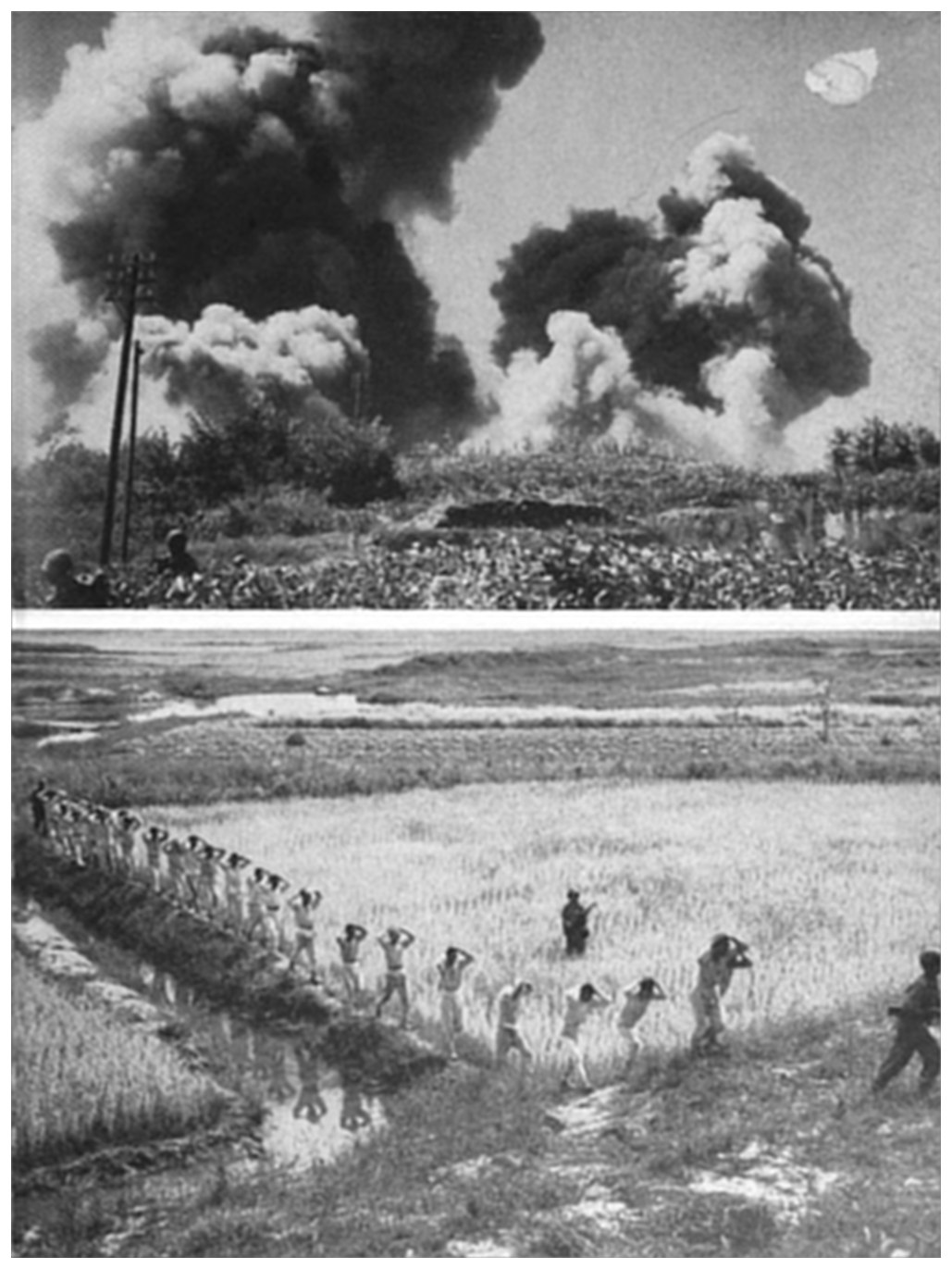
Advance to Yongdungpo——Above, an enemy ammunition dump goes
up in smoke (U. S. Army Photo); and, below, RCT-1 Marines
march prisoners back through a rice paddy (Marine Corps Photo).
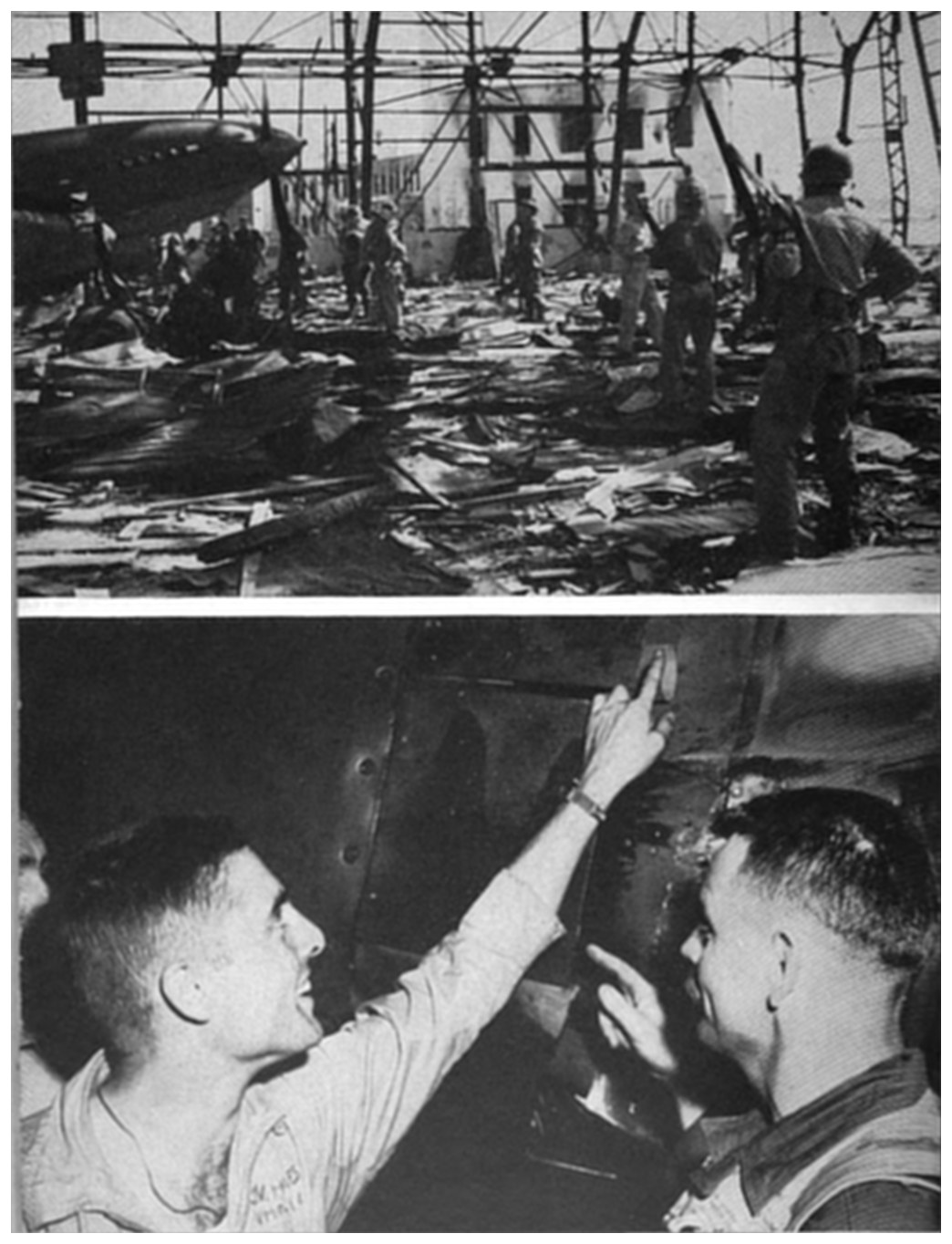
Kimpo Airfield Secured——Above, correspondents examine captured
Yak fighter (U. S. Army Photo); and, below, First Lieutenant
J. V. Hanes of VMF-214 shows Lieutenant Colonel Walter Lischeid
the flak scars on his Corsair (U. S. Navy Photo).
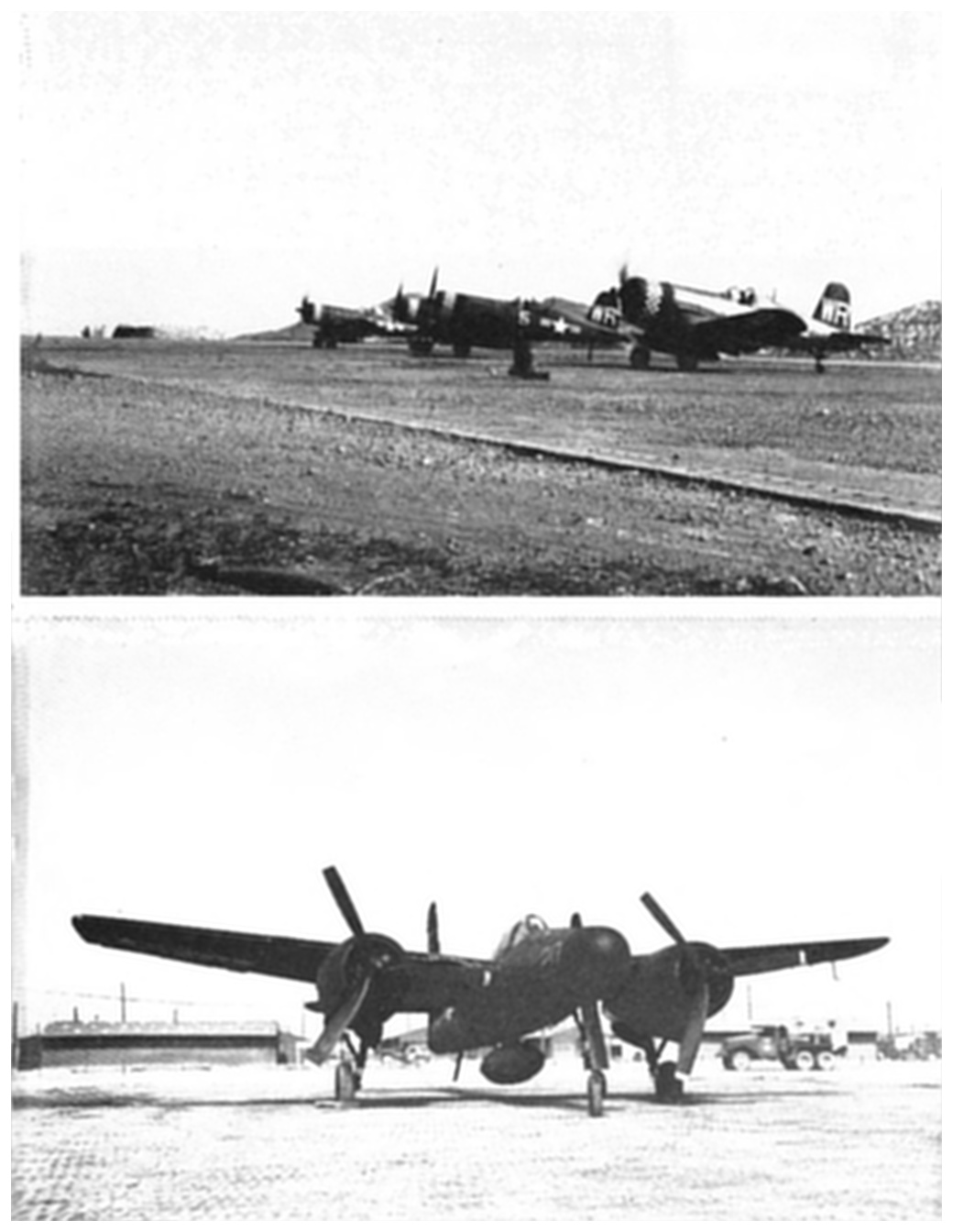
Marine Aircraft——Above, Corsair fighter-bombers on Kimpo Airfield;
and, below, the F7F Tigercat used as a night fighter and
intruder.
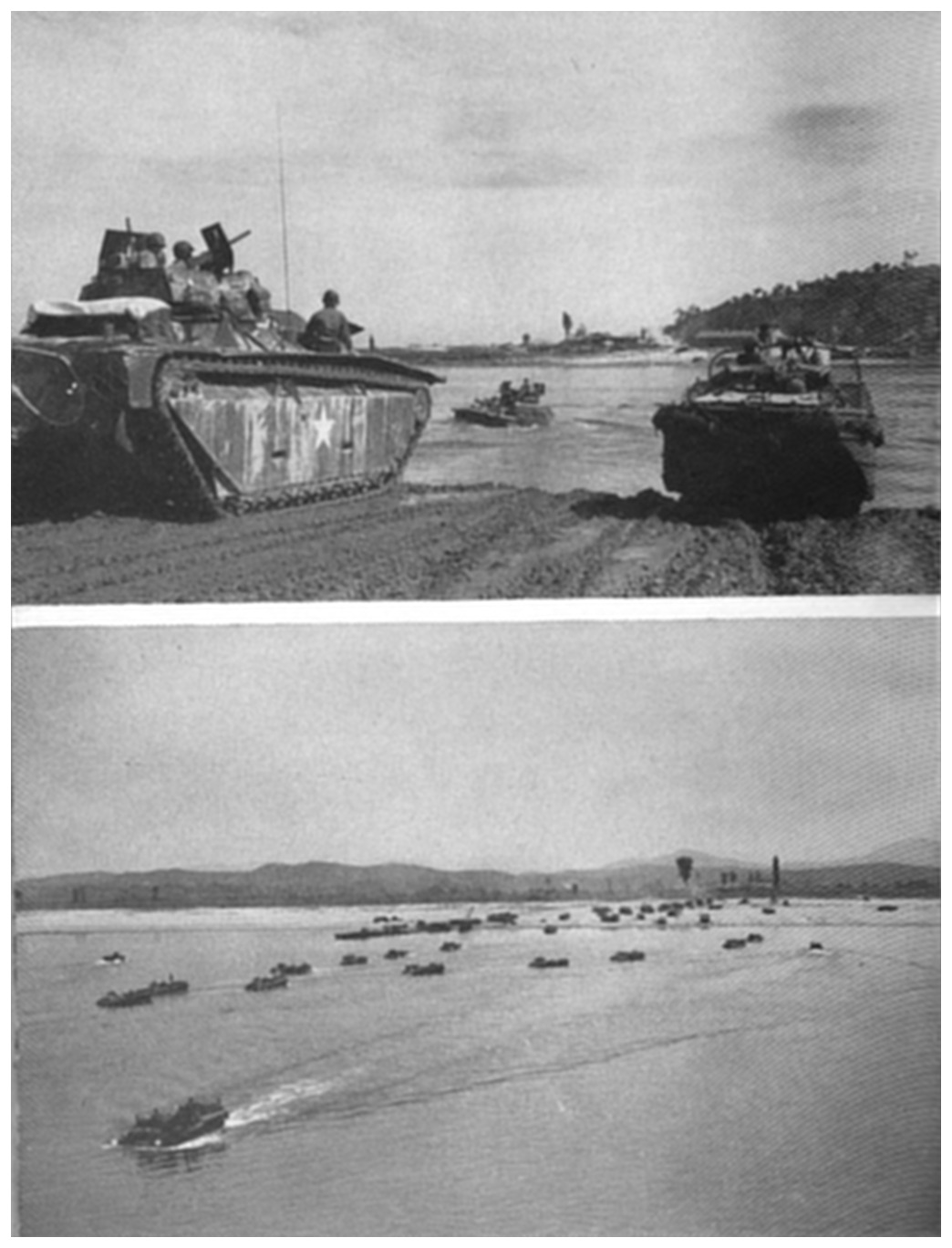
Crossing the Han——Above, Marine amtracs take Marines and
KMCs across river, with Hill 125 on far shore; and, below, troops
of 32d Infantry, USA, cross in Marine amtracs (U. S. Army
Photos).
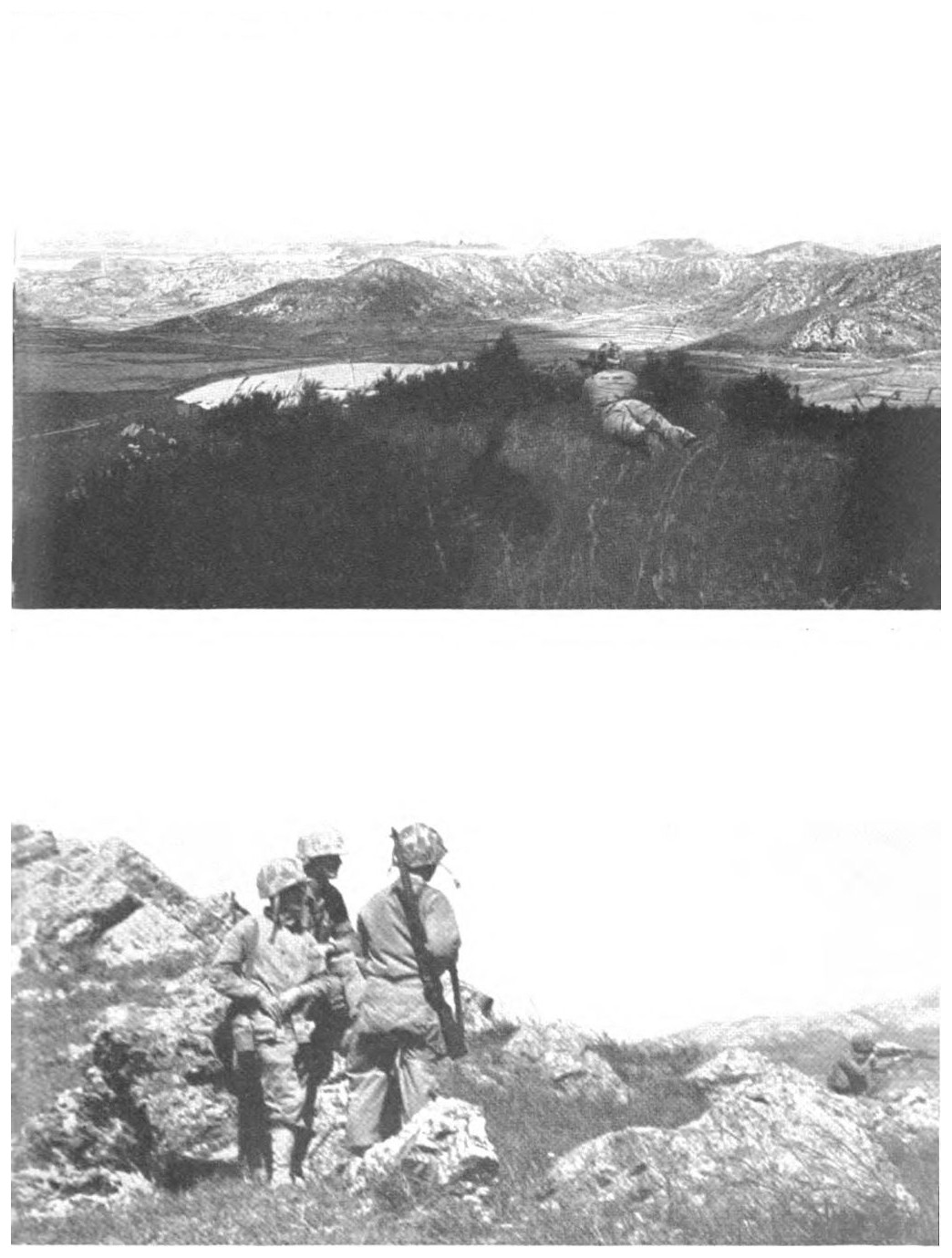
Approach to Seoul——Above, the rugged terrain northwest of Seoul as
seen by Marine from ridge on south bank of Han; and, below, Marine
fire team fighting in this terrain (U. S. Navy Photos).
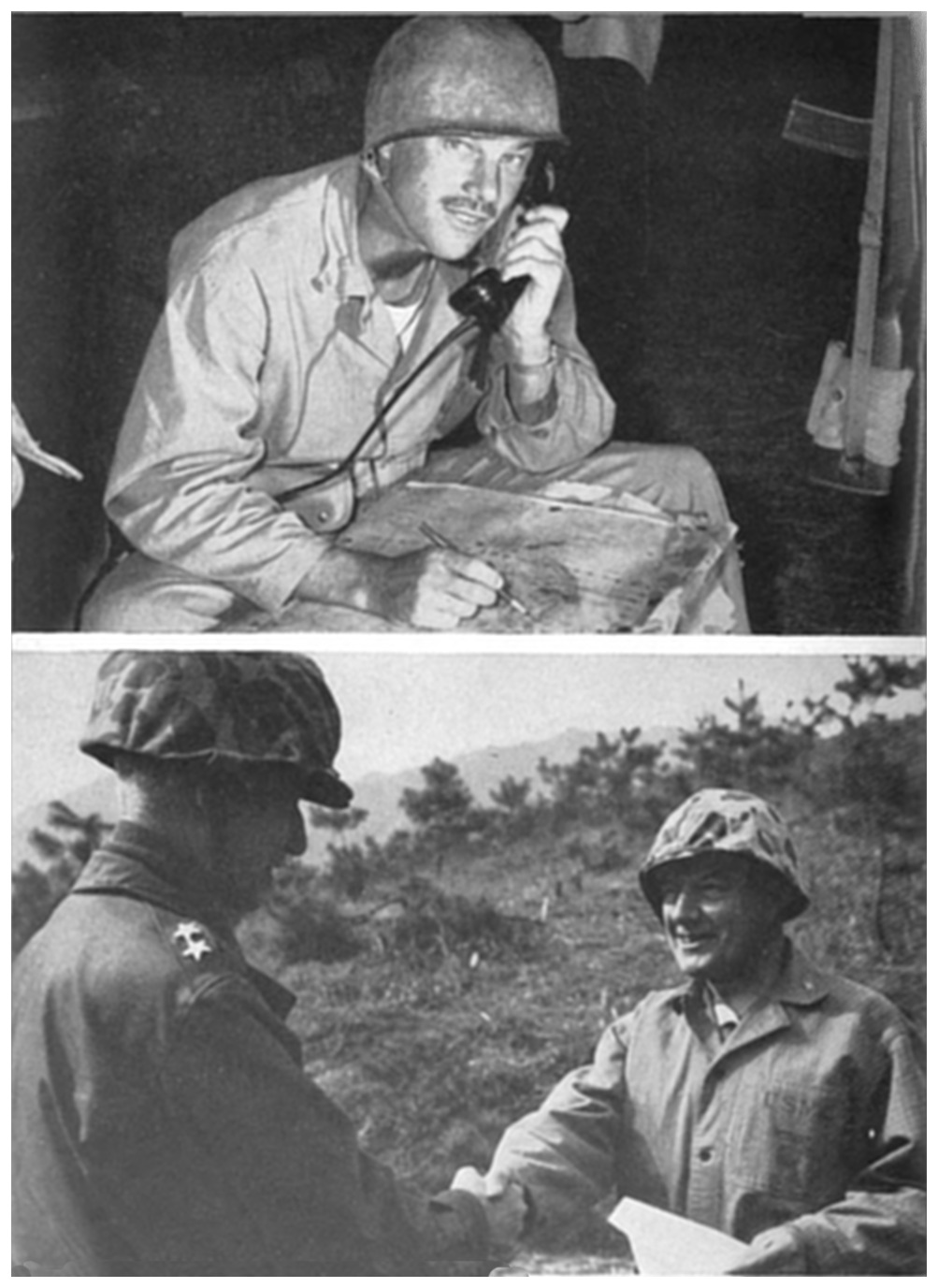
Regimental Commanders——Above, Lieutenant Colonel Raymond L.
Murray, commanding officer of RCT-5, in his CP; and, below,
General Smith being greeted by Colonel Homer L. Litzenberg,
commanding officer of RCT-7 (Marine Corps Photos).
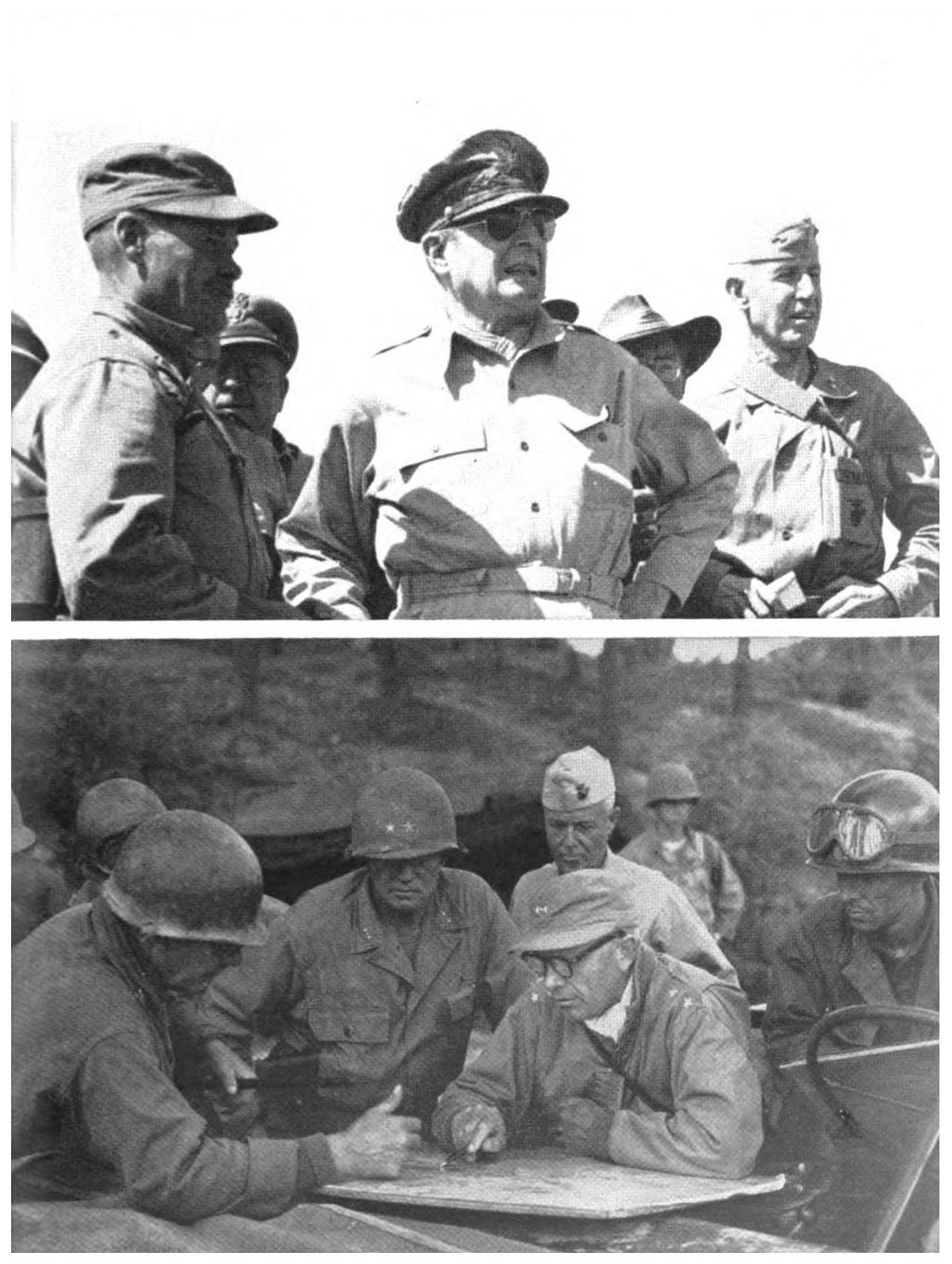
Command Conferences——Above (left to right) Colonel Lewis B. Puller,
commanding officer of RCT-1, General MacArthur and General
Smith; and, below (left to right), Colonel Charles E. Beauchamp,
commanding officer of 32d Infantry, General Barr, General Almond
and General Craig (U. S. Army Photos).
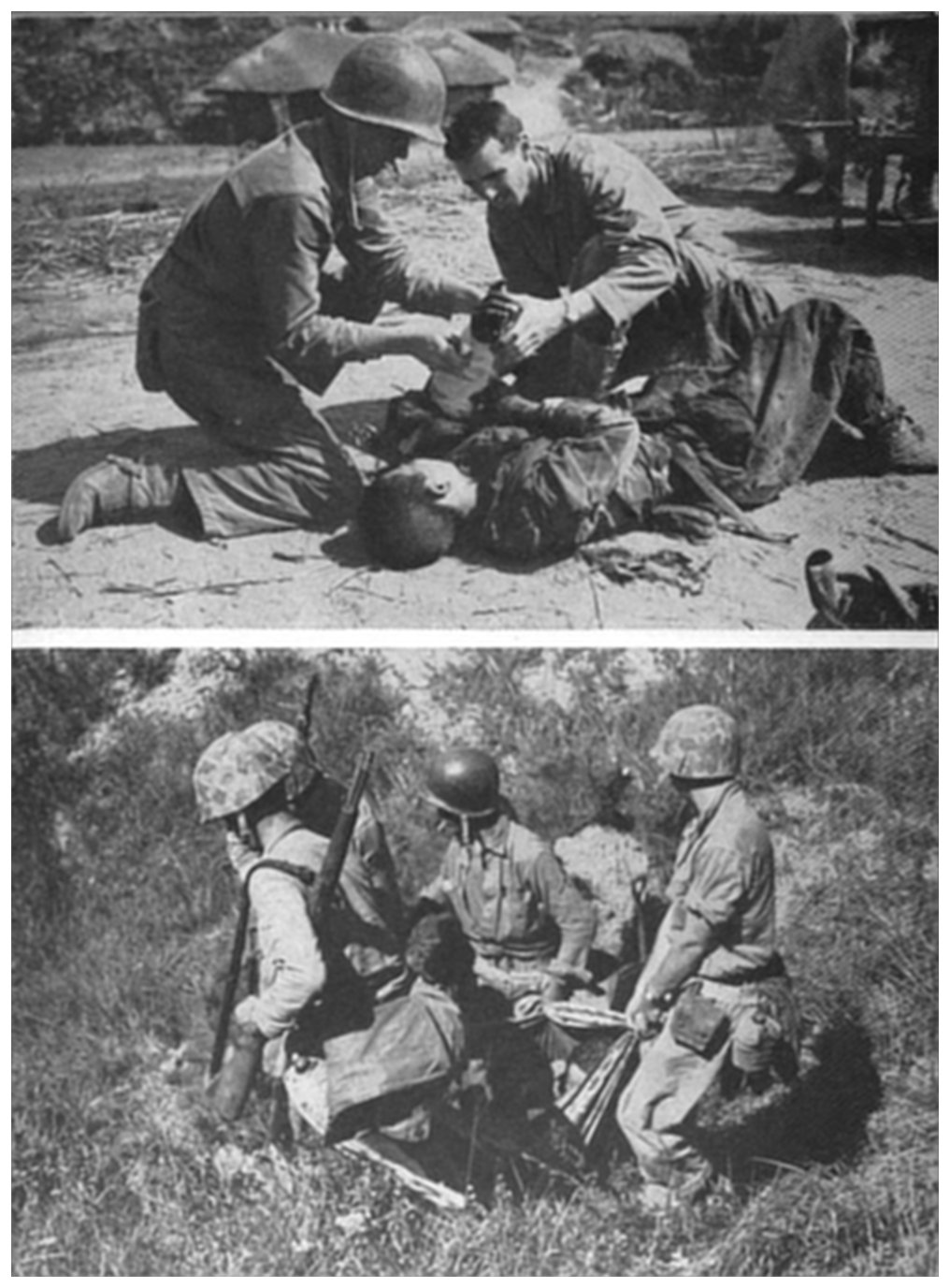
Battle Casualties——Above, Navy Hospitalmen R. E. Rosegoom and
Frank J. Yasso give first aid to wounded NKPA prisoner; and,
below, Marines carry wounded comrade back from firing line (U. S.
Army Photos).
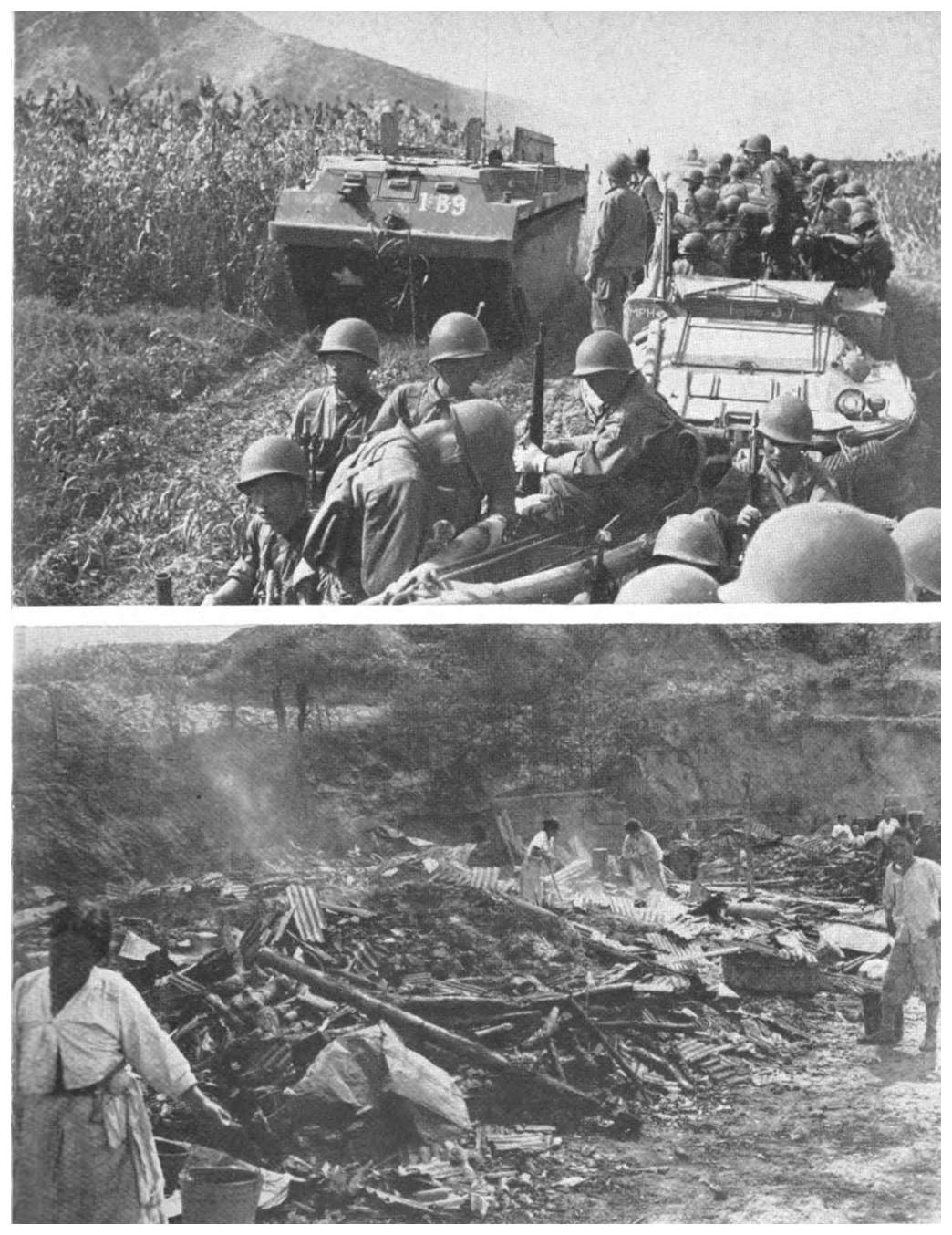
Northwest of Seoul——Above, the KMCs move up in amtracs; and,
below, Korean refugees return to ruined homes on outskirts of
Seoul (U. S. Army Photos).
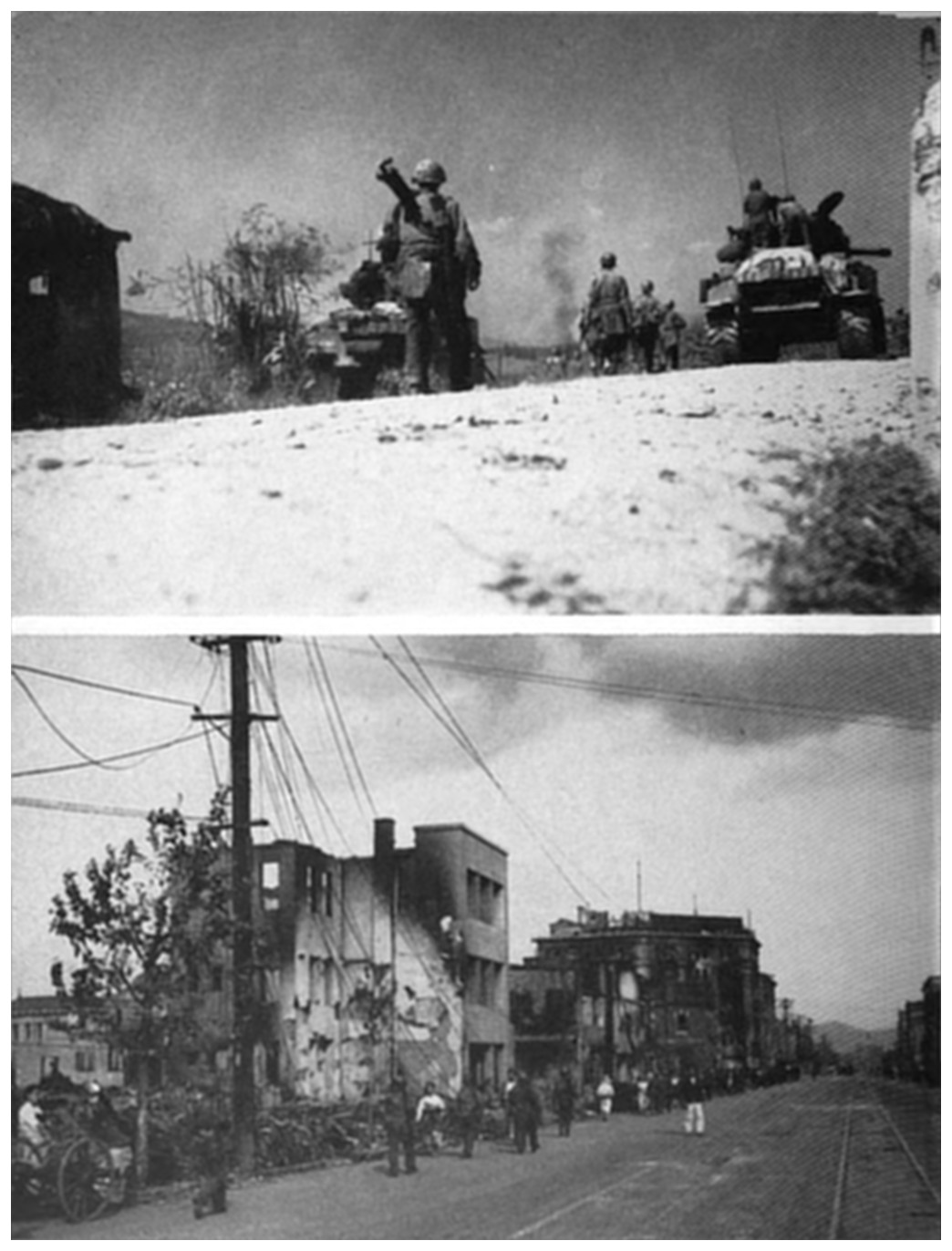
The Fight for Seoul——Above, Marine tank and infantry close in on
northwest approaches; and, below, Marines pass refugees in battered
streets (U. S. Army Photos).
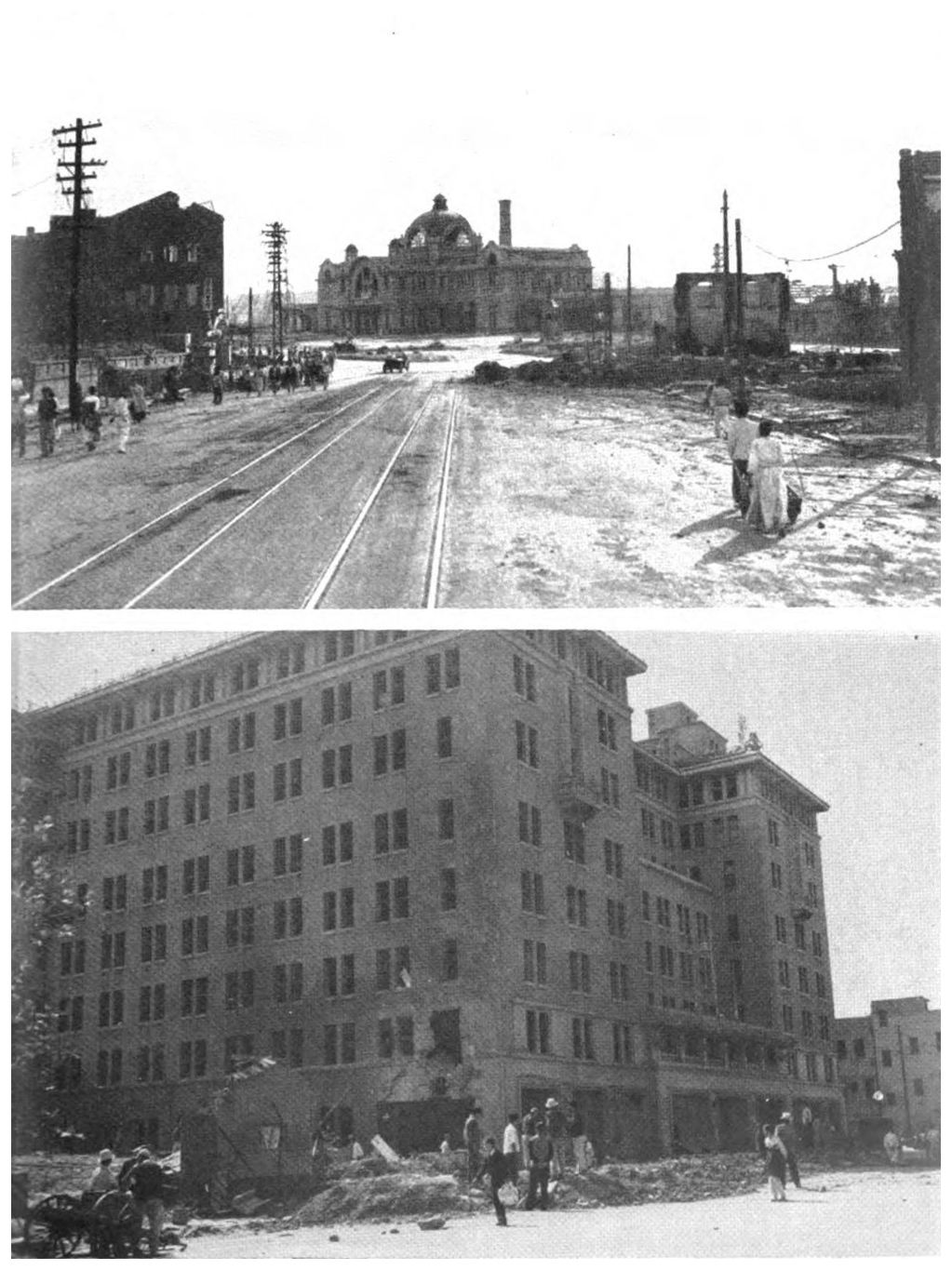
Return of Refugees——Displaced residents of Seoul come back to find
railway station (above) and Hotel Banta (below) scarred by artillery
fire (U. S. Army Photos).
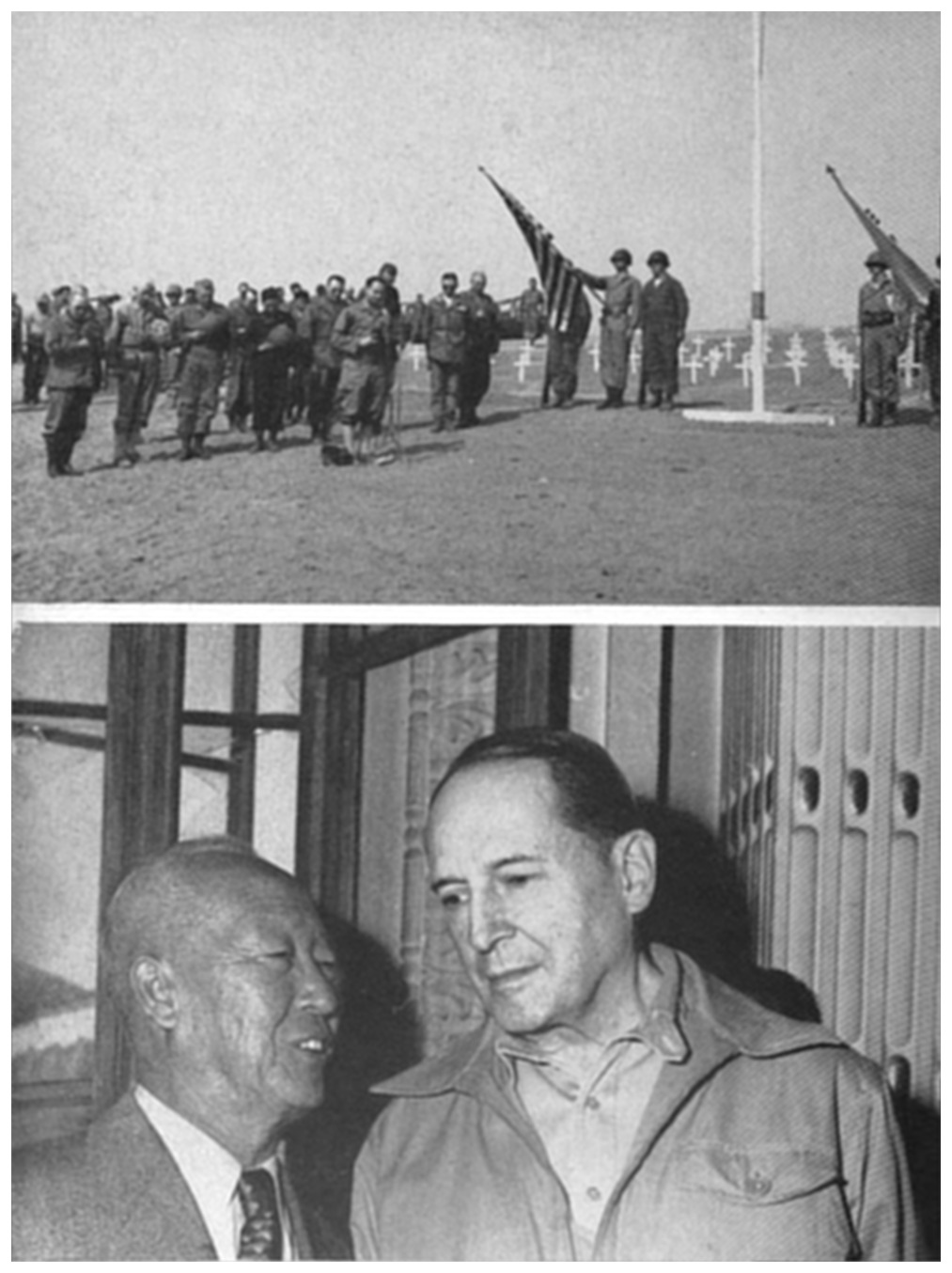
Ceremonies——Above, former Marine cemetery at Inchon is dedicated as
United Nations Cemetery; and, below, President Syngman Rhee
and General MacArthur at liberation ceremony in Seoul (U. S.
Army Photos).
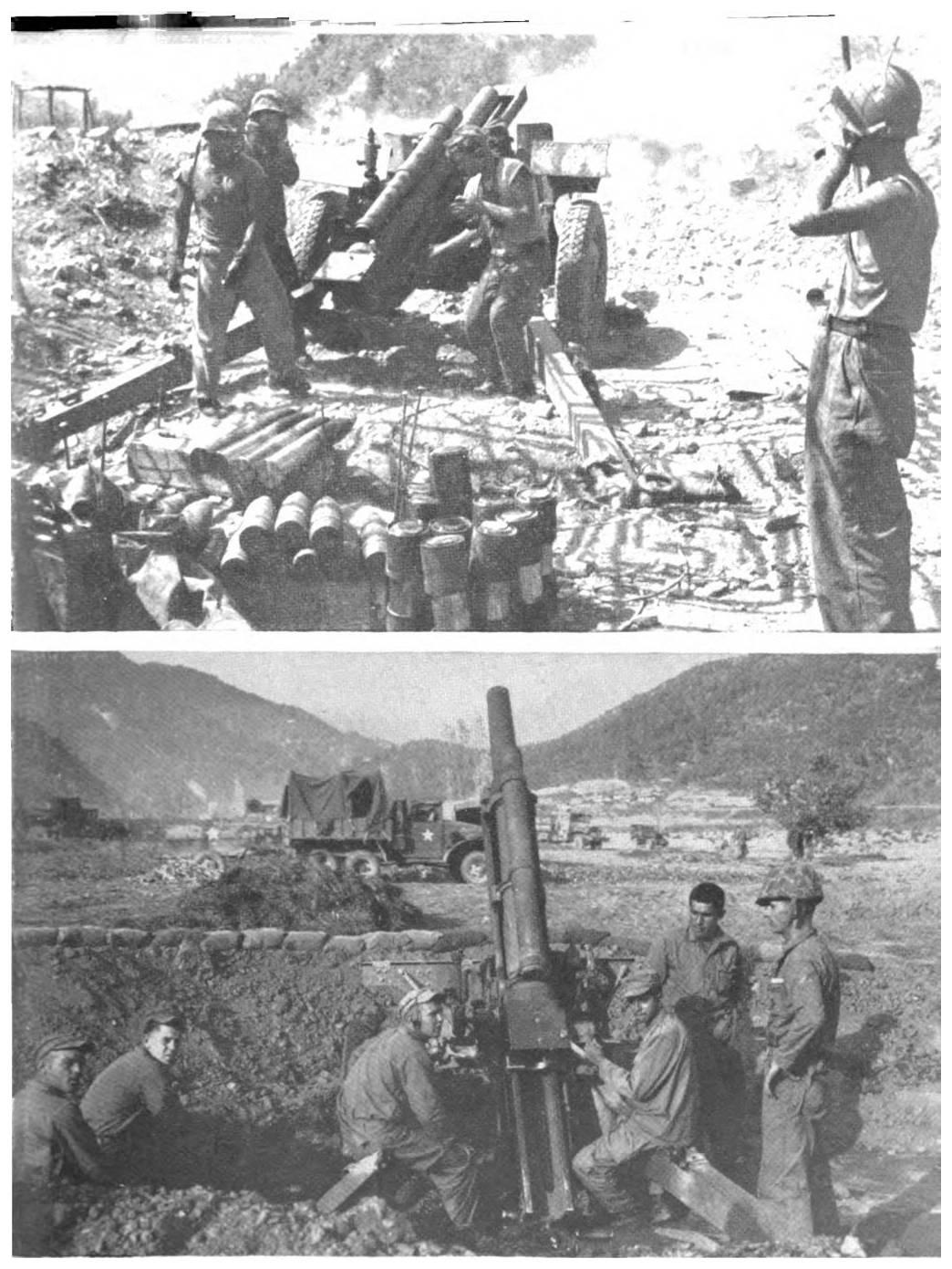
Marine Artillery——Two views of 105mm howitzers of 11th Marines
in Korea (Marine Corps Photos).
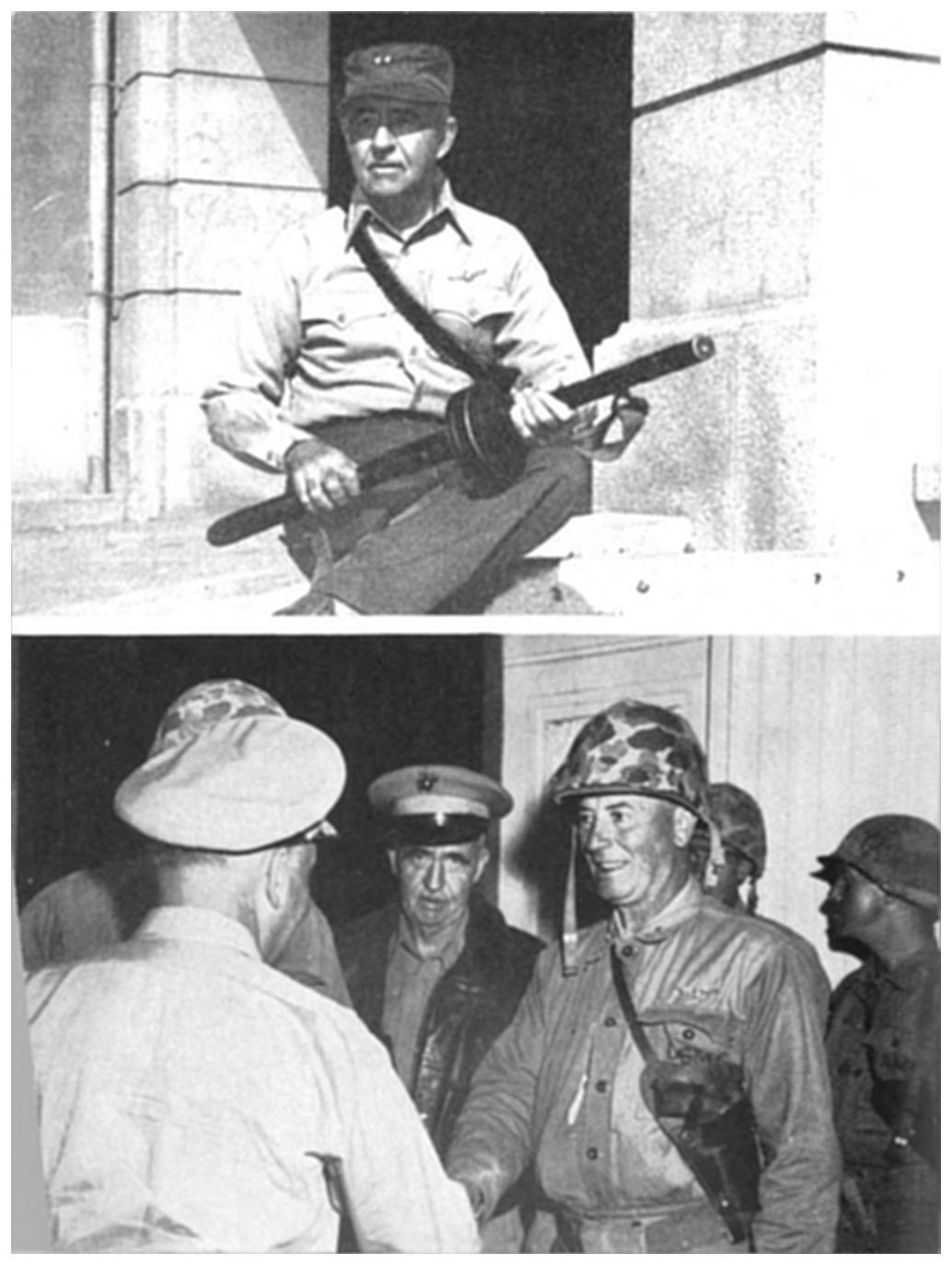
Marine Air Commanders—Above, Major General Field Harris,
commanding the 1st Marine Aircraft Wing, holding a captured
Russian burp gun; and, below, facing camera from left to right,
General Harris and Brigadier General Thomas J. Cushman, commanding
TAC X Corps.
Marine Air in turn warned of a build-up of Communist troops and
equipment in the vicinity of Haengju and Hill 125, directly across the
Han from 2/5’s position north of Kimpo. East of the airfield, the
enemy was withdrawing from the 5th Marines’ zone toward Yongdungpo,
using the Hill 118 area as an intermediate rallying point.
Moreover, interrogation of two NKPA officers captured near Kimpo
disclosed that a Communist regiment was already committed to the
defense of Yongdungpo. Since this large industrial suburb of Seoul
rambled across the 1st Marines’ path to the Han, Colonel Puller knew
well in advance that trouble lay ahead of his regiment.
Further evidence that storm clouds were gathering over the highway
came from a number of sources in Sosa. Informants were almost
unanimous in their predictions that the approaches to Yongdungpo
would be sown liberally with land mines.
VMF-214, which provided effective close air support for the 1st
Marines’ attack through Sosa, reported destroying huge enemy stockpiles
hidden in and around buildings on the sand spit between Yongdungpo
and Seoul. The squadron also sighted six enemy tanks far
beyond Marine lines and killed two of them with direct napalm hits.
Its sister unit, VMF-323, likewise scoured the Division front and
radioed similar findings to Tactical Air Control.
Other reports from scattered sources placed approximately 3,000
North Koreans in Seoul—with more on the way. Air spotters noted
heavy traffic south from the 38th Parallel and north from the Suwon
area. Tanks, troops, and vehicles from the latter not only were heading
for the capital but also were veering off toward Yongdungpo and the
Division right flank.
Thus, the Marines faced the possibility of major interference from:
(1) the Kumpo Peninsula; (2) the Haengju locale on the north bank
of the Han; (3) the area around Hill 118 between Kimpo Airfield and
Yongdungpo; (4) Yongdungpo itself; (5) Seoul; and (6) the direction
of the Division’s right (southeastern) flank. Strangely enough for an
enemy who was at his best with the artful dodge, only the two flank
threats failed to measure up to expectations.
The North Koreans gave a preview of the changing picture on the
afternoon of 18 September when, at 1415, the first shells of a sustained
mortar barrage crashed into 3/1’s positions on Hill 123. During the
next hour, 120mm eruptions traced accurate paths back and forth along
the ridge, and 30 Marines were cut down by the whirring fragments.
Moving through the explosions with near-miraculous immunity, the
3d Battalion’s senior medical officer, Lieutenant Robert J. Fleischaker,
(MC) USN, remained fully exposed to the barrage while administering
to the wounded. “He never thought of his own safety when men
needed his services,” commented Lieutenant Colonel Ridge.280
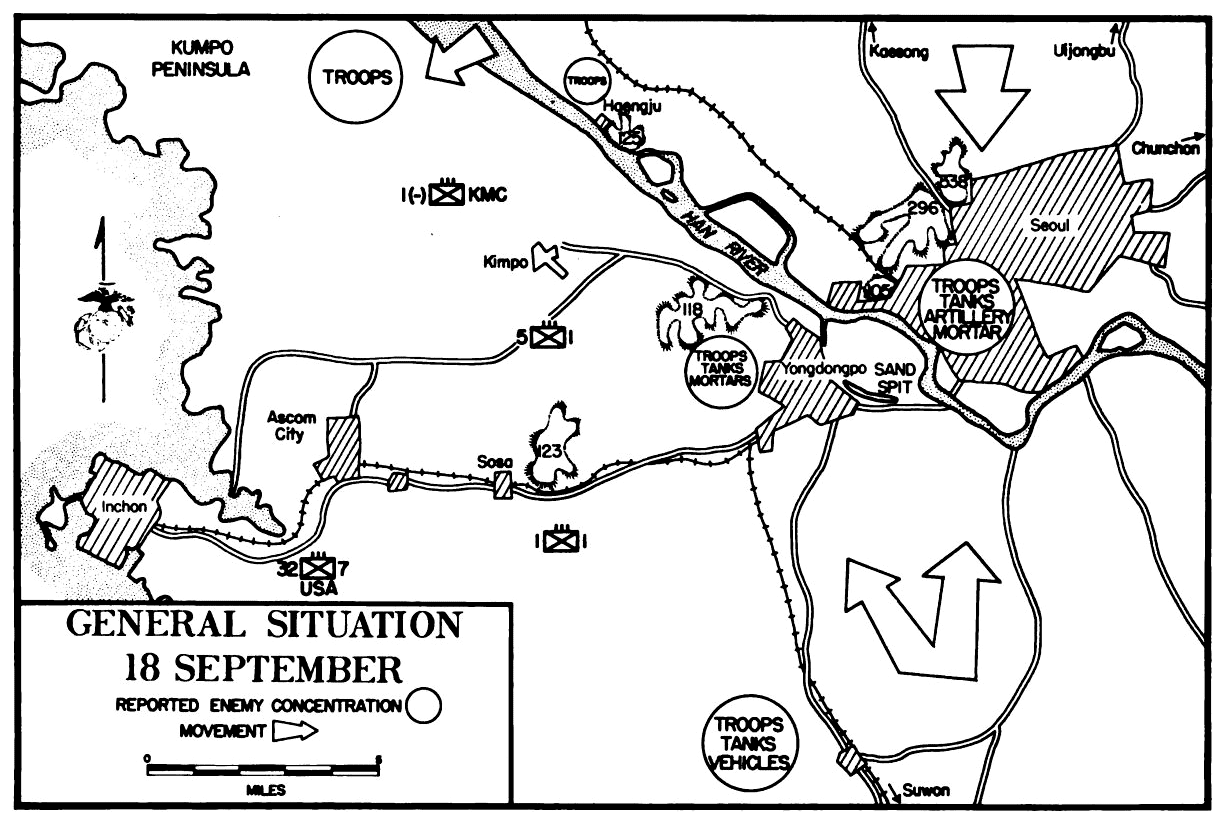
GENERAL SITUATION
18 SEPTEMBER
South of the highway, enemy gunners ranged in on 2/1’s lines at
1800, adding 14 more Marines to the casualty rolls. Lieutenant Colonel
Sutter and his S-3, Captain Gildo S. Codispoti, narrowly escaped
injury when two mortar rounds hit the battalion CP. The explosions
wounded Captain Albert L. Williams, commander of Company E, and
Warrant Officer Bartley D. Kent, the battalion supply officer.281
Late in the afternoon of the 18th, both Corps and Division issued
orders within a period of two hours for crossing the Han. In OpnO
6-50, the Commanding General of the 1st Marine Division directed
RCT-5 to seize crossing sites along the south bank the next day and
be prepared to cross on order while RCT-1 continued its attack along
the highway toward Yongdungpo.
Much more territory was taken in by X Corps Operational Instructions
No. 1, which ordered the 1st Marine Division to reconnoiter the
river on the 19th and cross the next day. Then, after enveloping enemy
positions on the north bank in the vicinity of Seoul, the Marines were
to seize and secure both the city and the high ground to the north.
Since the Corps did not concern itself much with ways and means,
General Smith asked for a conference at 0930 the next morning with
General Almond. He informed the X Corps commander that he and
his staff had already given considerable thought to the question of a
crossing site. A preliminary Marine study had disclosed that three
abandoned ferry crossings met military requirements: one downstream
from Kimpo Airfield; one at Yongdungpo in the zone of the 1st
Marines; and one opposite Kimpo near the village of Haengju. The
first was too far from Seoul, and the second too near; but the Haengju
site seemed to satisfy all conditions, subject to General Craig’s verification
by helicopter reconnaissance.282
Next to be discussed was the problem of bridging material. The X
Corps engineer officer, Lieutenant Colonel Edward L. Rowny, reported
that Corps had no material other than that brought by the 1st Engineer
Battalion of the Marines. Fortunately, that unit’s commanding officer,
Lieutenant Colonel Partridge, was prepared to meet the emergency.
Although he did not have enough floating bridge material to span
such a wide stream, he reported to General Smith that he could have
one 50-ton raft in operation to support the assault of troops crossing
in LVTs, and another shortly afterwards. These rafts would take the
tanks and vehicles across, and Partridge added that later his engineers
might be able to put together an actual bridge by combining floating
and Bailey components.283
The two Marine regiments had been in effect the infantry of X Corps
up to this time. But Almond promised the Marine general that the
32d Infantry of the 7th Infantry Division would be moved up on the
right flank of RCT-1. This Army unit, it may be recalled, had made
an administrative landing at Inchon on the 18th and gone into an
assembly area under 1st Marine Division control. The other two
regiments of the 7th Division were the 31st Infantry, due to arrive on
the 20th, and the 17th Infantry, still attached to the Eighth Army.
The X Corps commander lost no time at ordering the 32d to move
up on the right, after reverting to the control of the 7th Division, to
relieve the 1st Battalion, 1st Marines. This was the first of a series of
maneuvers carried out on the 19th in preparation for the river crossing.
On the left, the 2d Battalion of the KMCs advanced against negligible
opposition to occupy the high ground south of the Han and provide
flank protection for the crossing.
A more intricate maneuver was carried out when 1st Battalion of
the 5th Marines was relieved west of Yongdungpo by its opposite of
RCT-1, which had sideslipped to the left after the 32d Infantry moved
up in protection of the regiment’s right flank. This shift was not
accomplished without some fighting, the account of which belongs in
a forthcoming chapter dealing with the battle for Yongdungpo.
Another preliminary step was taken on the 19th when the 1st
Amphibian Tractor Battalion was relieved of its mission of supporting
the 1st Marines. All LVTs were withdrawn as the unit displaced by
motor march to the vicinity of Kimpo Airfield, a distance of about 18
miles.284
The 1st Shore Party Battalion was also concerned in planning for
the river crossing. On the 19th this unit reverted to Division control
and displaced to the vicinity of Oeoso-ri. Meanwhile, a reconnaissance
detail reported to the CP of the 5th Marines with a mission of selecting
DUKW, LVT, and ferry sites. The shore party battalion was also to
have the responsibility of establishing evacuation stations and supply
dumps on both banks after the crossing while exerting LVT and
DUKW traffic control.285
Except for the 1st Battalion, the 5th Marines had no trouble on the
19th while advancing to its assigned positions on the south bank of
the Han. All objectives were occupied against little or no opposition,
placing the regiment in position for the crossing.
CHAPTER X Crossing the Han — Swimming Team Leads the Way — Marine LVTs Grounded in Mud — Daylight Assault Crossing by 3/5 — Departure of General MacArthur — Supporting Arms of Bridgehead — Command Ashore Assumed by X Corps
Swimming Team Leads the Way—Marine LVTs Grounded in
Mud—Daylight Assault Crossing by 3/5—Departure of
General MacArthur—Supporting Arms of Bridgehead—Command
Ashore Assumed by X Corps
The CP of the 5th Marines had a holiday atmosphere during the
afternoon of 19 September. An already large group of newspaper
and magazine correspondents had been reinforced by new arrivals
flown in from Tokyo to report the crossing of the Han. The gathering
might have been mistaken for a journalistic convention, and Lieutenant
Colonel Murray and his regimental planners could scarcely
make themselves heard. Finally it became necessary to request the
gentlemen of the press to leave, so that the battalion and company
commanders could be summoned for briefing and orders.
The CP was located in a basement room of the Kimpo Airfield administration
building. Coleman lanterns lighted the scene as Murray
gave a brief talk to his officers, seated about him on boxes and bedrolls.
There had been little time for planning, said the regimental commander,
but he was confident of success. General Craig, who made a
helicopter reconnaissance of the river and roads leading to Seoul, had
recommended the old ferry crossing to Haengju. The river was about
400 yards wide at this site, which was about a mile from the Kaesong-Seoul
railroad and main highway to Seoul. Hill 125, as the principal
terrain feature, was an isolated knob rising nearly 500 feet and located
on the right of the landing point. To the left was the village of
Haengju, bordered by dikes and rice paddies.
Regimental planning, said Murray, had been conducted in compliance
with 1st MarDiv OpnO 7-50, issued at 1430 that afternoon. The
5th Marines was directed to cross the Han in the vicinity of Haengju
seize Hill 125 and advance southeast along the railroad to the high
ground dominating the Seoul highway. The units attached for the
operation were the 2d Battalion, KMC Regiment, the Division Reconnaissance
Company, Company A of the 1st Tank Battalion, and Company
A of the 56th Amphibian Tractor Battalion, USA. In addition,
the 11th Marines had been directed to give priority in artillery fires
to the 5th Marines, while the 1st Engineer Battalion, 1st Shore Party
Battalion and 1st Amphibian Tractor Battalion were in direct support.
Major William C. Esterline, the S-2 of the 5th Marines admitted that
intelligence as to conditions on the north bank left much to be desired.
He mentioned the reports of an enemy build-up on the other side of
the river, and he added that a POW had told of enemy mining activities
along the road to Haengju. But in spite of these warning notes, his
listeners got the impression that 5th Marines’ planning was based on
assumptions of light resistance.
Major Charles H. Brush, Jr., the S-3, announced the hastily formulated
regimental plan. Houghton’s Recon Company was to lead the
advance by sending a swimming team across shortly after nightfall.
If the swimmers found the other bank clear of the enemy, they were to
signal for the rest of the men to follow in LVTs. Recon Company
then had the mission of seizing a bridgehead consisting roughly of the
triangle formed by Hills 95, 125, and 51. After securing these objectives,
about 1,500 yards apart, Recon was to defend until Taplett’s 3d
Battalion crossed at 0400, with Bohn’s and McMullen’s companies in
assault and Wildman’s in reserve. While they passed through Recon
and attacked toward Seoul, Roise’s 2d Battalion would follow in column
two hours later, with Newton’s 1st Battalion remaining in reserve and
crossing on order as the KMC battalion protected the regiment’s
left flank. Tanks and vehicles would be ferried across on 50-ton floating
bridge sections.286
No alternate plan was provided. After the briefing ended at 1700,
Houghton and Lieutenant Colonel Lawrence C. Hays, Jr., executive
officer of RCT-5, climbed a hill on the south bank and inspected the
old ferry crossing and the opposite shore. They saw no enemy activity.
Houghton was so optimistic that he asked permission to swim across at
dusk but Murray denied the request.287
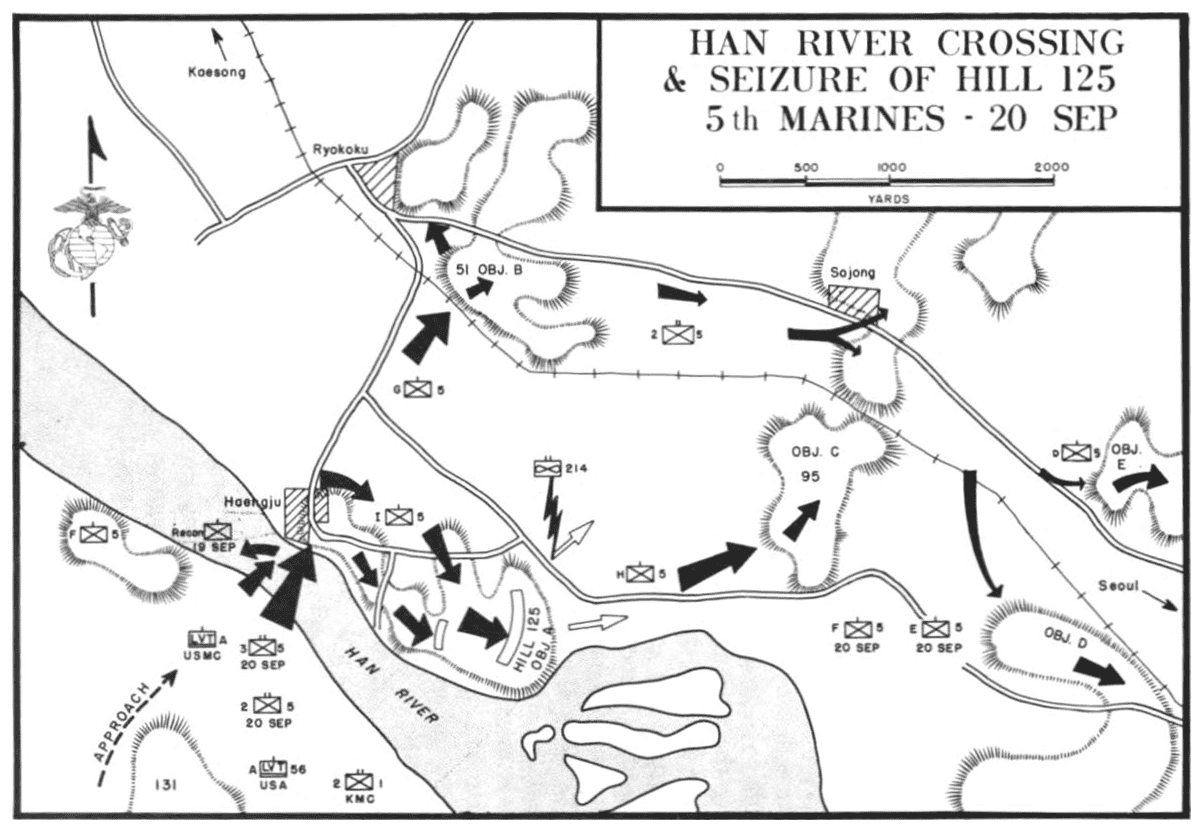
HAN RIVER CROSSING & SEIZURE OF HILL 125
5th MARINES—20 SEP
The swimming team consisted of Houghton, Second Lieutenant
Dana M. Cashion, and ten enlisted men, accompanied by two Navy
reserve officers, Lieutenant Horace Underwood and Ensign John
Seigle. The first went along as interpreter, and the other as public
information officer with a tape recorder. General Lowe had asked
permission to cross in the LVTs; and when the Division commander
refused, the 66-year old observer showed a card signed by President
Truman, requesting that he be allowed to go anywhere. Even this
passport did not swerve General Smith, who decided that Lowe must
wait to accompany the reserve battalion.288
It was a dark and moonless night when the swimmers trudged
through the muddy grain fields to the river bank, carrying two small
rubber boats in which to tow the arms and equipment. After checking
the current and making allowances for drift, they stripped to
their skivvies and slipped into the tepid water shortly after 2000. Only
two or three sets of rubber fins were available, but speed was not
expected of men using a slow breast stroke to avoid making noise or
ripples. These precautions became all the more necessary after a
Marine shell or aerial bomb set fire to a native house on the far bank
and the flames cast a lurid glow over the water. Apparently the
swimmers had not been observed when they scrambled ashore,
dripping, about 2040. They encountered two Koreans at the water’s
edge and overpowered them without much difficulty. Lieutenant
Underwood questioned the captives in their native tongue and
reported that they were escaping from Seoul.289
Houghton ordered Lieutenant Cashion and four enlisted men out
on patrol duty with a mission of reconnoitering Hill 125 and the
Haengju area. The Recon commander remained at the beach, where
Gunnery Sergeant Ernest L. DeFazio and the other members of the
swimming team guarded the prisoners and prowled the immediate
area without encountering enemy. There were so few signs of
NKPA activity that Houghton decided even before the return of
Cashion’s patrol to give the signal for the rest of the company to cross.
And it was when the LVTs revved up on the south bank, shattering
the night’s stillness, that hell broke loose.290
The men in the amtracs had the problem of advancing five miles
by road from Kimpo to an embarkation site they had never seen,
crossing a river in the darkness, and seizing three objectives on a
basis of map reconnaissance. First Lieutenant Ralph B. Crossman,
executive officer of Recon Company, had received oral orders without
an overlay or an opportunity to take notes during the briefing at the
Fifth Marines CP. His first message by SCR-300 from Houghton
came about 2000, warning that the swimming team was taking to
the water. This was the signal for the amtracs to start their road
trip. They were on the way when Houghton prematurely radioed
the familiar words:
“The Marines have landed and the situation is well in hand.”291
An hour later the Recon commander came in again with a message
that no enemy had been encountered. He directed his executive
officer to cross in LVTs with the three platoons of Recon Company
and the attached platoon of Company A, 1st Engineer Battalion,
which had a mission of mining road blocks after the objectives were
secured.
Crossman acknowledged this message but replied that he could not
reach the river bank for nearly an hour. He had assigned the three
objectives to his platoon commanders, directing that they take their
orders from Houghton upon reaching the other bank. SCR-300
communications were frequently blurred, however, or blasted off the
air altogether by the more powerful radios of the tractors. Thus the
possibilities for confusion were multiplied as the nine amtracs proceeded
in column to the embarkation point, clanking and revving up
thunderously in preparation for the crossing.292
The din was deafening enough to arouse even an enemy who had
not shown much fight so far in the zone of RCT-5. Hill 125 suddenly
came to life as NKPA bullets whipped the water and mortar
shells exploded among the LVTs or along the beach occupied by
Houghton’s swimmers. Although Cashion’s patrol reported no
enemy encountered on Hill 125, his men came under fire from that
quarter on their return to the beach. One of them, Private First Class
Alphonse O. Ledet, Jr., was reported as missing in action, and it was
assumed that Communists bullets had cut him down.293
The embarkation area was so cramped that Crossman had found it
necessary to send the LVTs across the river in column, with First
Lieutenant Francis R. Kraince’s 1st Platoon in the lead, followed by
Second Lieutenant Philip D. Shutler’s 2d Platoon and the 3d commanded
by Second Lieutenant Charles Puckett. Kraince was to seize
Hill 125 while Shutler attacked Hill 51 and Puckett went up against
Hill 95.
The three platoons were accompanied by a 4.2-inch mortar forward
observer team, two 105mm FO teams from the 11th Marines, and a
squad of engineers. Communications on the SCR-300 net were so
badly jammed, however, that Houghton and Crossman were
figuratively as well as literally in the dark on opposite sides of the
river. Crossman’s final messages from Kraince and Shutler reported
that four of their amtracs had drifted from the course and grounded
in the mud. He ordered both officers to extricate themselves while
Puckett, who had not yet left the south bank, covered them with fire.
Just then DeFazio radioed that Houghton and his team were planning
to swim to the LVTs. This was the last word from the north
bank received by Crossman, who lost all radio contact afterwards with
anyone except the 5th Marines.294
At the height of the pandemonium on the north bank, the two
Korean prisoners attempted to escape. Both were killed by Marines
of the swimming team.295
Houghton’s first thought had been to swim out and guide the LVTs
to the north bank. But the enemy had shown such unexpected resistance
as to justify the withdrawal of the swimming team. The
rubber boats and excess equipment were hidden along the shore and
some of the weapons thrown in the river to prevent capture.296 Then
the swimmers started their return trip through water churned by
mortar shells, chiefly Marine 4.2-inch bursts falling short. One of
these projectiles exploded so near to Houghton as to knock him out
momentarily, and he was assisted to a grounded LVT by Corporal
James Morgan. The Recon commander suffered a sprained back
and double vision from the concussion, and two men of the team were
slightly wounded. DeFazio led the remaining swimmers to the
south bank.
There he learned that all the amtracs had returned except the four
reported grounded. Most of the Recon troops on these stranded vehicles
had chosen to swim or wade back to the south bank. These
stragglers were collected on the northern tip of Hill 131 by Captain
John F. Paul and Corporal James P. Harney of the amtracs and
shuttled to Kimpo as fast as they returned.297
DeFazio took care of his casualties, then set out with eight men in
search of Houghton. It was low tide by this time, but wading
through the mud proved to be more tiring than swimming. After
finding Houghton in a dazed condition on one of the grounded
LVTs, the sergeant agreed with Kraince and Shutler that the approach
of dawn made it necessary to abandon the two amtracs which were
still stuck. They returned on the two that the officers had succeeded
in extricating. Thus at daybreak the swimming expedition ended
in the CP of the 5th Marines, with DeFazio reporting to Murray and
Brush after seeing his commanding officer on the way to a field
hospital.298
The crews and troops on the LVTs retained a confused impression
of the night’s events. Master Sergeant Edwin L. Knox, who crossed
with the engineers in the second amtrac, could not understand why
the column withdrew. The vehicles were dispersed in every direction
after some became stuck, and it was on his LVT that Captain
Houghton received first aid.299
It was not officially established who gave the order for the return
of the LVTs when they neared the north bank, if indeed such an
order was ever given. But all participants agreed that it was for the
best. Events had proved that too much dependence was placed in
assumptions of little or no resistance, despite G-2 warnings of an
enemy build-up in the Haengju area. And even if Recon Company
had landed, the task of taking three hills in a night attack without
previous reconnaissance would probably have been too much for a
unit of 126 men against an enemy estimated by Houghton at a
battalion.
At dawn on the 20th the command and staff of the 5th Marines
rebounded from this preliminary reverse with vigor and firmness.
General Craig, the ADC, summed up the viewpoint of Murray and
his officers when he commented:
“The eyes of the world were upon us. It would have looked bad
for the Marines, of all people, to reach a river and not be able to
cross.”300
It was decided at 0430 that the 3d Battalion would make a daylight
assault crossing just two hours later. The revised plan called for
LVTs to cross at the Haengju site in waves of two to six vehicles.
Troop units would be organized into boat teams, and the plan provided
for a 15-minute artillery preparation by the 1st and 4th
Battalions of the 11th Marines.301
Many of the Marine shells fell short, so that little benefit was derived
from the barrage by the assault troops. On the other hand,
enemy fire from Hill 125 was only too well placed. About 200 hits
were taken by the first wave of amtracs from 14.5mm antitank
projectiles and small caliber high explosive shells as well as machine-gun
bullets. The armor plate prevented any infantry losses, and only
four casualties were suffered by the crews.
Battalion objectives, according to the revised plan, were designated
ABLE, BAKER, and CHARLIE—Hills 125, 51, and 95. Captain
McMullen’s Item Company landed at 0650 in the first wave, followed
by How and George. While discharging troops, the LVTs were exposed
to more machine-gun and antitank fire, resulting in several
infantry casualties.302
Item Company, it may be recalled, consisted of newcomers who had
arrived at Pusan to make up third infantry companies just before the
Brigade embarked for Inchon. Barring a few World War II men,
these troops had known no combat experience before they hit GREEN
Beach at Wolmi-do. They acquitted themselves like veterans in the
Han crossing, however, as platoon leaders organized them under fire
after they piled out of the amtracs.
The only covering fires at first were provided by the 50-caliber
machine guns of First Lieutenant Stanley H. Carpenter’s platoon of
amtracs, which had taken the first wave across. Then four Corsairs
of VMF-214 struck the enemy on Hill 125 while Captain Joseph N.
Irick of the amtracs led four of his vehicles eastward to a position
where they could direct 50 caliber fire on the NKPA positions.
Item Company’s plan of attack called for a two-pronged assault on
Hill 125 (Objective ABLE) from the northwest by First Lieutenant
William F. Sparks’ 3d Platoon on the right, attacking up the main
spur paralleling the river, while First Lieutenant Elmer G. Peterson’s
2d Platoon attacked on the left after riding a few hundred yards inland
on LVTs. Second Lieutenant Roy E. Krieger’s 1st Platoon was to
remain on call in reserve.
Item Company had it hot and heavy from the beginning. The two
assault platoons overcame such difficulties as bogged-down amtracs,
intermingled units, and bullet-swept open areas before getting in position
to return the Communist fire. The first phase ended on a plateau
about halfway up the hill when enemy machine guns cut down most
of the mortar section before the Marines could gain a foothold.
At this point it became necessary for the 3d Platoon to fall back and
redeploy. Contact had been lost momentarily with Peterson’s men;
but after he appeared on the left, McMullen called up his reserve unit
to pass through the 3d Platoon. Sparks having been wounded, First
Lieutenant Wallace Williamson took command of his men, now reinforced
by an engineer squad and troops from company headquarters.
The revamped 3d Platoon was sent out to envelop the enemy left while
Krieger hit the center and Peterson worked his way around the
NKPA right.
This time the plateau was carried in a single rush. But casualties
had reduced the company to the point where another reorganization
was necessary before attacking the military crest. Although Captain
McMullen had been wounded, he remained in action to lead the final
assault.
The 1st and 3d Platoons were clawing their way upward when
Peterson radioed from the left that he could see enemy soldiers in
flight from the peak to the low ground north of the hill mass. One
of the VMF-214 Corsairs also reported Communists streaming down
the eastern slopes with Marine planes in hot pursuit. Thanks to their
efforts, not many Korean Reds were left on the crest when the panting
Marines arrived to finish the job. More lucrative targets were presented
by the foes racing down the eastern slopes. Marine rifles and
BARs cut down many of these fugitives when they attempted to change
into civilian clothes to avoid capture.
It was estimated that the enemy had 200 killed on Objective ABLE.
The other two battalion objectives offered little or no resistance to
troops who rode in column from the beaches on LVTs—How Company
to seize Hill 95, and George Company attacking Hill 51. Thus
at a total cost of 43 casualties—most of them in Item Company—the 3d
Battalion had secured its three objectives by 0940.
Among the other results of the successful assault crossing was the
salvaging of the two grounded LVTs, both of which had been in the
enemy’s field of fire. The equipment left on the north bank by the
swimming team was also recovered, and PFC Ledet showed up unharmed.
After being assigned to an observation post, he had inadvertently
been left behind as missing in action when the Reds
opened fire. But he kept his head throughout his lonely night’s vigil
and was able to give a good report of enemy numbers and activities.
At 1000 on the 20th the first wave of amtracs crossed the river with
troops of 2/5. This battalion had orders to remain in the LVTs while
passing through 3/5 and continuing the attack. The scheme of
maneuver called for a sharp turn to the right at Hill 51, and the next
objectives, DOG and EASY, consisted of the high ground on either
side of the Kaesong-Seoul Railroad about three miles east of Haengju.
Company A of the 56th Amphibian Tractor Battalion, USA, was
to follow with the 2d Battalion of the KMC regiment in DUKWs.
These troops had a mission of providing security for the rear of the
5th Marines.
The 1st Battalion of that regiment was alerted to be ready to cross
the Han at 1330 and move into an assembly area near Hill 95, prepared
to continue the attack toward Seoul.
Once the plan has been told, it would be repetitive to describe a
performance which put it into effect without incident. At 1400 the
regimental CP displaced across the river to the vicinity of Sojong,
about two miles northeast of the Haengju crossing site. Fifteen
minutes later the 2d Battalion reported that it had secured Objectives
Dog and EASY. Troops of that unit had ridden the LVTs as far
as Sojong, where they encountered a swamp and a bridge too small
for anything larger than a jeep. The infantry proceeded on foot
while a few LVTs and a platoon of tanks crossed over a railroad bridge.
About 30 prisoners, believed to be the remnants of enemy forces on
Hill 125, were taken on Objective EASY. They were hiding in a
cave and surrendered after a couple of warning rounds fired by a
platoon of the Army amtrac troops supporting the battalion. Company
D dug in on Objective EASY and Company E on Objective
DOG while Company F covered the gap between.303
The 3d Battalion went into an assembly area a mile north of Hill 95.
And after 1/5 moved a company to Hill 125 to secure the landing
area for the night, the 1st Marine Division had a firm bridgehead on
the north bank of the Han.
General Shepherd and Admiral Struble witnessed the crossing from
a vantage point on the south bank, where they had a good view of the
fight for Hill 125.304 Both accompanied General MacArthur that
afternoon, when he made a final tour of the front before his departure
for Tokyo.
The caravan of jeep-borne officers and reporters stopped first at the
crossing area, then proceeded to the zone of the 1st Marines, where
the battle for Yongdungpo was going on full blast. General MacArthur
got out of his jeep and continued on foot along rice paddies
where Marines were still flushing out snipers. This meant a period
of anxiety for General Smith which lasted until the responsibility for
the safety of the commander-in-chief passed to General Barr in the
zone of the 7th Infantry Division.
On the afternoon of the 21st the Marine general saw MacArthur off
at Kimpo on his plane for Tokyo. Never had the old warrior worn
his famous “scrambled egg” cap with more verve. Barely a week had
gone by since the Marines scrambled ashore on RED and BLUE
Beaches, yet most of the major objectives had already been taken—Inchon,
Kimpo, Yongdungpo, the north bank of the Han, and the
approaches to Seoul. In the Pusan Perimeter meanwhile, the Eighth
Army had been hitting the enemy hard in its joint offensive.
This was the score on D-plus 7. But perhaps the famous septuagenarian
recalled with pardonable complacency that as late as D-minus 7,
the Joint Chiefs of Staff had reiterated doubts of the Inchon landing
which they had expressed on several previous occasions. MacArthur
was warned that if the operation failed, the entire United Nations
cause in Korea might be plunged into serious difficulties. The commander
in chief replied with superb assurance, “I and all of my commanders
and staff officers, without exception, are enthusiastic and
confident of the success of the enveloping operation.”305
Such confidence could not be withstood. But it was not until 8
September 1950 that the Joint Chiefs of Staff finally acquiesced in an
operation they had never entirely approved—an operation scheduled
to take place in just one week.
It may be that Douglas MacArthur was recalling this exchange of
views as he stood in the sunlight of Kimpo Airfield, his eyes flashing
and his chin outthrust. There is no tonic like victory, and he looked
20 years younger than his actual years as he decorated General Smith
with a Silver Star just before the plane took off.
“To the gallant commander of a gallant division!” said the commander
in chief by way of citation.
Even success did not alter the conviction of Navy and Marine amphibious
specialists that risks had been assumed in the Inchon landing
which might have resulted in disaster. It was taking no credit away
from General MacArthur for his unshakeable faith in victory to conclude
that fortune had smiled in some instances when a frown would
have been costly.
The teamwork of Marine supporting arms was never shown to better
effect than in the establishment of a bridgehead over the Han.
Lieutenant Colonel Partridge’s engineers, of course, were on the job
from the beginning. It was up to them to get the tanks across the
river as soon as possible, in case the infantry needed the support of
armor. Approaches and ferry landings had to be constructed for this
purpose; and just six hours after the initial infantry crossing, the
engineers had their first six-float M4A2 raft in operation. It had
taken them four hours to build.306
The 2d Platoon of Able Company, 1st Tank Battalion, crossed the
river at 1410 on 20 September and moved up in support of 3/5. The
1st Platoon followed at 1600 and the 3d Platoon late that afternoon,
after the engineers completed a second raft.
When the KMCs attempted to cross in DUKWs, the clumsy vehicles
bogged down several yards from the river on the south bank.
Partridge suggested to the KMC commander that his troops build a
makeshift corduroy approach off the main route which Marine engineers
were constructing to the embarkation point. The Korean officer
agreed with Partridge that this was a sensible solution and soon had
his men gathering logs.
Neither of them dreamed that they had stirred up an international
incident which called for a decision on the division level. American
policy makers had felt it necessary to lean backwards to avoid giving
Communist propagandists any excuse to charge us with recruiting
Koreans for “slave labor.” It was an extremely sensitive subject, and
Partridge was astonished at the repercussions. At last General Craig
visited the ferry site and ruled that it was a closed incident after finding
all explanations satisfactory. It was further decided—for mechanical
rather than political reasons—to take the KMCs across in amtracs
rather than waste any more time on DUKWs.307
On the night of the 20th, Partridge and Colonel McAlister, the Division
G-4, interviewed a captured NKPA engineer major at Kimpo
Airfield. The prisoner informed them that the bombed highway
bridge between Yongdungpo and Seoul had been damaged beyond
repair with the means at hand. This agreed with the conclusions of
the Marine officers on the basis of aerial observation. Prospects for a
span over the Han seemed dim as Partridge was leaving McAlister’s
quarters. That very evening, however, Lieutenant Colonel Rowny,
chief of the X Corps engineers, telephoned to announce that materials
for a floating bridge unit had been accumulated by the Army in Japan
and would be flown to Korea shortly. Up to this time, with rafts the
only solution, the Marine engineers had supplied all the materials.
But Rowny announced that Corps would assume the responsibility
after the arrival of enough materials for a floating bridge unit.308
Military operations could not wait a week or ten days for the new
span, and the Marine ferry plus amtracs and DUKWs309 had to nourish
the assault on Seoul. With this end in view, the 1st Shore Party Battalion
reverted to Division control on the 19th and displaced from
Inchon to Oeoso-ri. By nightfall the entire battalion was bivouacked
in this area.
On the 20th, after establishing a forward CP at Kimpo Airfield, the
shore party troops of Baker Company moved up to the Han in support
of the 5th Marines, followed by two teams from Able Company.
Evacuation stations and supply dumps were set up on both banks.
Other shore party missions were maintaining LVT and DUKW traffic
control, providing guides for the amtracs, posting security at the
crossing sites on both banks, and effecting unit distribution of supplies
upon request by the DUKWs and LVTs.
Control of the ferry site, known as BAKER Ferry, became the
responsibility of Baker Company of the 1st Shore Party Battalion.
Teams 1 and 2 were employed on the south bank, and Team 3 plus
headquarters troops on the other shore. Traffic control was of the
utmost importance, since ferry operation had to be limited to periods
of low tide, and during idle intervals a long line of vehicles accumulated.
Most of them were trucks containing cargo to be reloaded
in LVTs and taken across the river. The shore party men had the
duty of keeping the traffic flowing as smoothly as possible, both on
land and water, and special regulations were enforced to prevent the
LVTs from colliding with the ferries. With the establishment of a
third ferry, the problem of supplying the troops across the river was
pretty well solved.310
A military ceremony was held on 21 September when the commanding
general of X Corps established his CP in Inchon and assumed
command at 1700 of all forces ashore. It was stated in some reports
that command had been transferred from the commander of JTF-7
to the commander of X Corps. But officers familiar with amphibious
doctrine pointed out that at no time prior to landing did CG X Corps
relinquish command; and only through him did the commander of
JTF-7 exercise command.311
The date was also significant for the 1st Marine Division in that
its third rifle regiment, the 7th Marines, landed at Inchon with Major
Francis F. Parry’s 3d Battalion of the 11th Marines attached. Before
the ships reached the inner harbor, Colonel Litzenberg went ashore
and reported at the Division CP. Informing General Smith that
troop units in the convoy had been vertically loaded for maximum
flexibility, he asked what troops the Division commander desired to
have unloaded first.
“An infantry battalion,” said General Smith.
“And what next?”
“Another infantry battalion,” said the commanding general.
Colonel Litzenberg began unloading at once, and by 2200 his CP
had opened at Wonjong-ni, two miles south of Kimpo Airfield, while
H&S Company and the 3d Battalion (Major Maurice E. Roach)
occupied near-by assembly areas. The 2d Battalion (Lieutenant
Colonel Thornton M. Hinkle) had reached an assembly area at Hill
131, a mile north of Kimpo, by 0100 on 22 September with a mission
of providing security for the airfield and a river crossing site. The
1st Battalion (Lieutenant Colonel Raymond G. Davis) was given the
duty of unloading the ships of the convoy.312
It appeared for a few hours on 21 September that the enemy might
be planning to retake Kimpo Airfield. At 0730 a report came to the
3d Battalion, KMC Regiment, warning of an attempted NKPA crossing
of the Han in the area about seven miles northwest of the field.
Air strikes were called immediately with the result of dispersing the
enemy. At 1310, however, an estimated two NKPA battalions were
reported in front of KMC positions by the air liaison officer attached
to the battalion. All units in the Kimpo area were alerted to the possibility
of attack. The CO of the 1st Shore Party Battalion was designated
as coordinator of defensive forces consisting of his unit, and
elements of the 1st Engineer Battalion, 1st Tank Battalion, 1st Ordnance
Battalion, and 1st Amphibian Tractor Battalion. Army troops
of the 56th Amphibian Tractor Battalion were also ordered to Kimpo.
With an NKPA attack threatening, some concern was felt about
an enemy Yak type aircraft—fueled, armed, and ready for flight—which
had been discovered in a revetment on the edge of the airfield
by First Lieutenant Edward E. Collins of the Ordnance Battalion and
later of the 5th Marines. The plane was hastily disarmed and painted
with U. S. markings, so that it could be flown to Japan in case the
enemy overran Kimpo.313
Although the NKPA threat did not materialize, there could be no
doubt of an enemy build-up within striking distance. And it was on
this sensitive left flank that the support of naval gunfire was most
effective.
As early as 19 September the 1st and 5th Marines had advanced
beyond the range of the light cruisers and destroyers. The battleship
Missouri was made available the next day, but targets in Seoul proved
to be too distant for her maximum range, and no further efforts were
made to call upon the battleship’s 16-inch rifles. In the Kimpo area,
however, naval gunfire was at its best, and a total of 535 8-inch shells
were fired from 21 to 24 September by the Toledo and Rochester.
These fires were requested by Lieutenant Wayerski in support of
patrol actions by the 3d KMC Battalion. One of the KMC attacks
wiped out a company-size pocket of Red Korean resistance in the
vicinity of Chongdong—about three miles northwest of the airfield
on the south bank of the Han—with a loss to the enemy of 40 counted
dead and some 150 prisoners.314
After the Han crossing, the 1st Marine Division found itself in the
position of advancing astride an unbridged tidal river with the northern
flank wide open. Generals Smith and Craig depended on VMO-6
helicopters for their visits to the 5th Marines front. Those rotary-winged
aircraft were in increasing demand for evacuating serious
casualties; and the commanding general directed that such missions
be given priority over command and liaison flights. This meant that
Smith and Craig were occasionally “bumped.” In such instances they
crossed the river by LVT or waited until their helicopter could return.
At the time of the Han crossing, the general plan of the 1st Marine
Division had been for RCT-5 to clear the north bank and open up
crossing sites for RCT-1 in the Yongdungpo area. That regiment
would then cross to seize South Mountain, just north of the crossing
site, thus forming an enclave in Seoul proper. Further objectives
were to be seized by RCT-1 to the north and east while the KMC
Regiment passed through RCT-5 to attack the center of the city.
Here a political motive entered the picture, since it was desired to have
Koreans take a prominent part in the liberation of the former ROK
capital. To the north, on the left flank of the Division, it was planned
for RCT-7 to seize objectives to protect the flank and cut off the escape
of the enemy. Meanwhile, RCT-5 would revert to Division reserve
as soon as the tactical situation made it possible.
So much for the plan. Before it could be put into execution,
stiffening NKPA resistance made it necessary to consider revisions.315
Not only was the hilly terrain northwest of Seoul well suited to defensive
operations, but it had been a training area as far back as the
Japanese overlordship, with fields of fire accurately charted. Moreover,
it had become evident by the 21st that the enemy was about to
exchange a strategy of delaying operations for one of defending to
the last ditch. The 1st Marines had already experienced the new
NKPA spirit at Yongdungpo, and on the 21st the 5th Marines contented
itself with limited advances for the purpose of seizing high
ground from which to launch the assault on Seoul.
The attack on the 21st was launched astride the railroad by the 3d
Battalion to the north and the 1st Battalion between the railroad and
the river. After passing through the 2d Battalion, Taplett’s men
seized three hills and by dusk were digging in on Hill 216, about six
miles east of Hill 125 and the ferry landing site.
The 1st Battalion had meanwhile advanced to Hill 96, about 3,000
yards southeast of yesterday’s Objective DOG, now occupied by the
2d Battalion in reserve. Further gains of some 2,500 yards to the
southeast took the battalion to Hill 68, between the railroad and river,
which was seized and held for the night.
Enemy resistance ranged from light to moderate in both battalion
zones. Between them, the 1st Battalion of the KMCs moved up to
Hill 104, just north of the railroad and south of Sachon Creek.316
This was the situation across the river at nightfall on the 21st. The
5th Marines was in position to grapple with the enemy for possession
of Seoul. Hill 104, in the center of the 5th Marines front, was
only 5,000 yards west of the Government Palace in the northwest
section of the city. Less than three miles, yet officers and men alike
realized that they would have to fight for every inch of the way. If
anyone had any doubts, he had only to watch the flashes of gunfire
stabbing the night sky to the southeast, and he had only to listen to
the unremitting roar of gunfire. For at Yongdungpo the 1st Marines
had been slugging it out with the enemy for the last three days in a
battle for the rambling industrial suburb.
CHAPTER XI The Fight for Yongdungpo — Three Hills Taken by 1/5 — Enemy Minefields Encountered — NKPA Counterattacks of 20 September — Recapture of Hills 80 and 85 — 1st Marines in Position — Assault of Yongdungpo — Able Company on a Limb — Yongdungpo Secured
Three Hills Taken by 1/5—Enemy Minefields Encountered—NKPA
Counterattacks of 20 September—Recapture of Hills
80 and 85—1st Marines in Position—Assault of Yongdungpo—Able
Company on a Limb—Yongdungpo Secured
“If Yongdungpo is lost, Seoul also will fall.” This was the warning
note sounded during the conferences of the Red Korean military
leaders in Seoul. So important did they consider the industrial suburb
that a regiment of the 18th NKPA Division was assigned to the
defense of the built-up area on the south bank of the Han.317
Slogans of this sort were a favorite form of Communist inspirational
literature, and they may have served to buck up the defenders. From
the tactical standpoint, however, the quoted catch phrase was illogical.
Yongdungpo was untenable. Squatting on the low ground at
the confluence of the Kalchon and Han Rivers, the town was an
isolated landmark of only symbolic significance. It was separated
from Seoul by two miles of sand and water, and the only connecting
links, the old railroad and highway bridges, had long since been
destroyed. Thus, what had once been a vital communications hub
south of the Han was now a veritable dead end.
While the Reds in Seoul were able to ferry troops and materiel
across the exposed river and sand spit by night, they could not hope
by this primitive method to meet the logistical requirements of a
regimental garrison confronted by a modern juggernaut of combined
arms. Nevertheless, the North Koreans chose to make a fight of it,
and in addition to the hundreds of troops in Yongdungpo, they sent
over considerable artillery and armor that could have been put to
better use in the defensible terrain around Seoul.
Hill 118 was the principal terrain feature between Kimpo Airfield
and Yongdungpo, the dominating peak being about three miles from
the former and two from the latter. Giant spurs from the main ridge
extended northward toward the Han and eastward to the bed of the
Kalchon, beyond which lay Yongdungpo. At the end of one easterly
projection were the twin caps, Hills 80 and 85. Paralleling the Han
River, a modern highway led from Kimpo, passed north of Hill 118,
skirted 80 and 85, then bridged the Kalchon to enter Yongdungpo
from the northwest.
It will be recalled that the 1st Battalion, 5th Marines, occupied high
ground generally east of Kimpo Airfield at the close of 18 September.
During the night, Lieutenant Colonel Murray ordered the unit to
seize Hills 80 and 85 the next day. To gain these gates to Yongdungpo,
it would be necessary to take Hill 118; and the battalion commander,
Lieutenant Colonel Newton, formulated his plan accordingly.318 Company
B would leave its positions on old Objective EASY at dawn and
envelop Hill 118 from the south. Company C would attack frontally
from Objective FOX, assist the enveloping force by taking one of
118’s spurs, then continue eastward to seize 80 and 85. Company A
was to remain behind an Objective EASY for the purpose of guarding
the approaches to the airfield.
At dawn of 19 September, Company C atop Objective FOX was
greeted by a hail of mortar and small-arms fire. Under this shield
part of a 500-man enemy force attacked the Marine position from the
east, while the remainder attempted to move along the Yongdungpo-Kimpo
Highway, obviously bent on reaching the airfield. Other
large NKPA concentrations were spotted at the base of Hill 118.
Charlie Company’s organic weapons roared into action along with
the battalion 81s. While the Marine fire cut swaths through the exposed
enemy ranks, Baker Company lunged forward to envelop Hill
118 according to plan. Air and artillery paved the way so effectively
that Captain Fenton’s unit gained the commanding peak about 1100
without suffering a casualty. This left the North Korean attackers,
who had been contained by Charlie Company, trapped between Objective
Fox and Hill 118. After losses of 300 dead and 100 prisoners,
the Red Force broke into a few small bands that fled across the highway
to the fields and villages bordering the Han. Company C’s
casualties in stopping the attack and moving forward to its spur on
Hill 118 were two killed and six wounded.319
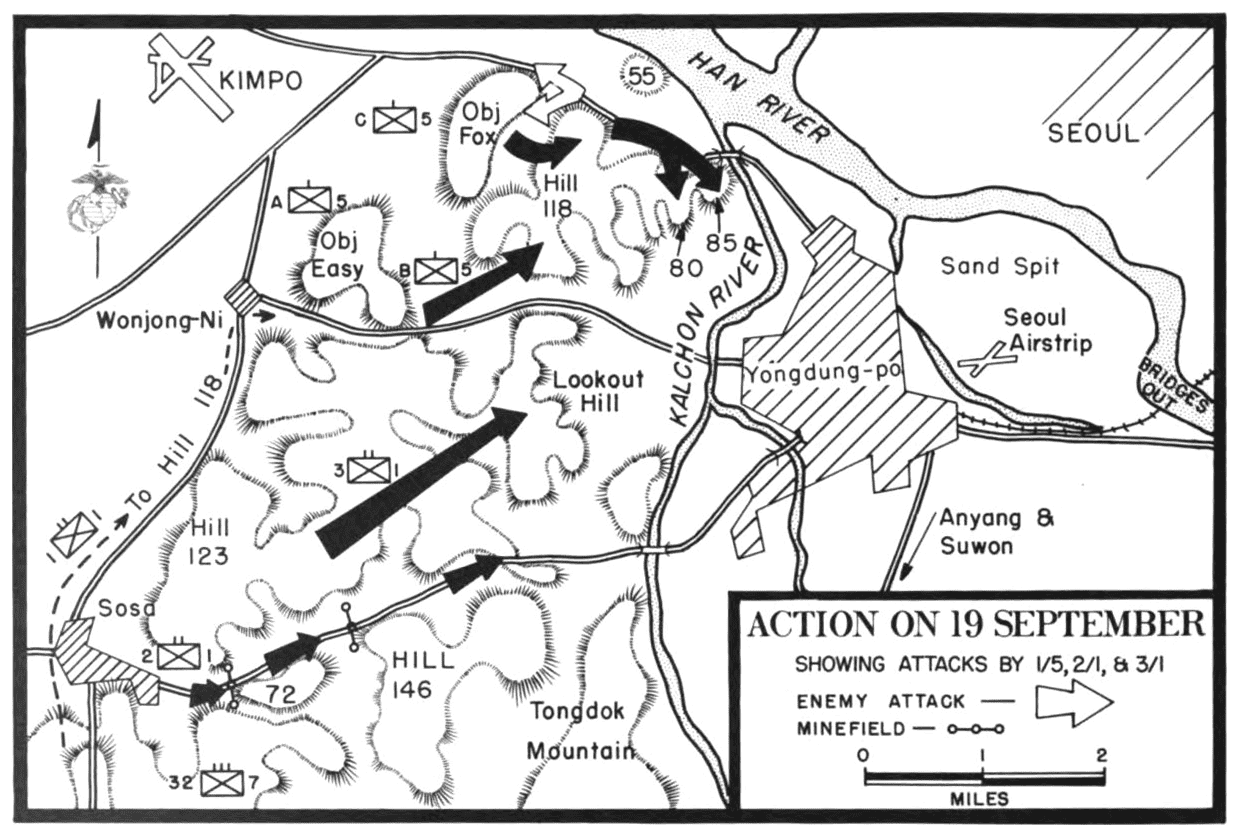
ACTION ON 19 SEPTEMBER
SHOWING ATTACKS BY 1/5, 2/1, & 3/1
As the two assault companies reorganized on the newly won ridge,
Fenton spotted a large number of Red troops on Hill 80, now about
1,000 yards away. He directed an air strike from his advance position,
and the Corsairs not only cut down many of the North Koreans but
completely routed the survivors. While the planes worked over the
enemy positions on the high ground, the Marines of Company B observed
a growing throng of NKPA soldiers in the vicinity of the
Kalchon Bridge leading to Yongdungpo. Some of the Reds were
milling around, but others were filing across the undamaged span
and disappearing into a knot of warehouses and huts at the far end.
Fenton radioed for artillery fire just as Communist machine guns and
an AT weapon opened up on Baker Company from positions across
the bridge. Four times firing for effect with “battery four rounds,”
the Marine howitzers sent a total of 96 shells crashing into the enemy
positions within the space of a few minutes. The explosions neutralized
the bridge area, but the span itself was badly damaged in the
process.320
First Lieutenant Pedersen led Company C along the highway toward
Hills 80 and 85 at 1430. Owing to the press of time, the area
between the road and the Han River was not cleared, with the result
that small bands of enemy were left free to roam the fields and make
their presence felt later. The 3d Platoon, under Second Lieutenant
Harold L. Dawe, Jr., peeled off the column and attacked Hill 80
shortly after 1500. Following at an interval of 500 yards, Second
Lieutenant Robert H. Corbet’s 1st Platoon continued along the pavement
toward Hill 85. A platoon of A/Tanks supported the two-pronged
assault along with Charlie Company’s mortars and machine
guns, and by 1650 the two heights were secured. In the wake of the
air strike called down by Fenton, the attacking infantry had
encountered practically no opposition.
Yongdungpo, bristling with Communist armament, rumbled its
challenge from the low ground 500 yards east of Hill 85. Taken
under heavy fire by artillery, mortars, and small arms, Company C
was forced to dig in on the reverse slopes of its high ground, there
to await the expected counterattack after nightfall.
As noted previously, the 2d and 3d Battalions, 1st Marines, spent the
night of 18–19 September astride the Inchon-Seoul Highway a mile
east of Sosa. The 1st Battalion, deployed over a broad front in the
hills south of the road, was to be relieved in the morning by the 32d
Infantry, so that Colonel Puller could shift his regiment to the left.
Since the relief did not take place as early as expected, Puller ordered
his 2d and 3d Battalions to attack at 1030, leaving 1/1 in position to
await replacement by the Army unit.321
On the left of the highway, 3/1 jumped off from Hill 123 with
Companies H and I in the assault. The battalion’s mission was to
clear a rambling ridge complex that extended more than three miles
before stopping short of Hill 118. Assigned as a final objective was
the terminal height, Lookout Hill, facing western Yongdungpo across
the wide bottomland of the Kalchon.322
Considering the formidable cross-compartment approach, the assault
companies led by the battalion S-3, Major Joseph D. Trompeter, made
good progress against enemy resistance described as “light but stubborn.”
At a cost of two killed and 15 wounded, the Marines combed
the vertical wilderness and seized Lookout Hill late in the evening.
The attack was almost too successful, for the battalion was now out
on a limb. The closest friendly forces were on Hill 118, several
hundred yards to the north, and along the Inchon-Seoul Highway,
about a mile to the south, as will be shown.323
The 2d Battalion could boast comparable success along the highway
in the course of 19 September, but gains were made under far different
circumstances. Spearheaded by Charlie Company Tanks commanded
by Captain Richard M. Taylor, the battalion had advanced only 500
yards in the morning when the lead M-26 was enveloped in a violent
explosion. With one track and two road wheels destroyed, the steel
monster settled into the crater left by the detonation of a wooden box
mine.324
Simultaneously, the infantrymen of Company F came under heavy
small-arms fire from Hill 72 to the right front. In an attempt to
sight in on the enemy positions, other tanks tried to bypass the mine
field in the highway, only to discover that explosives were concealed
in both road shoulders as well. Howitzers of the 11th Marines
registered on Hill 72, and during the ensuing bombardment a
VMF-214 flight appeared overhead to lend further assistance.325
Despite his generous use of supporting arms, Lieutenant Colonel
Sutter was forced to commit all three rifle companies to the fight.
Tank gunners tried to detonate mines embedded in the road with
machine-gun fire, but without success.326 It remained for First
Lieutenant George A. Babe’s 2d Platoon, Charlie Company Engineers,
to remove the obstacles under fire. Darting forward on the bullet-swept
highway, the engineers placed “snowball” charges of C-3 on
the wooden boxes, then took cover while the mines exploded.327
After 2/1 had driven the enemy from the area with the assistance
of Marine air and artillery, the job of clearing the 250-yard mine field
proceeded under less hair-raising conditions. To get the armor back
into the fight as soon as possible, Babe ignored the explosives embedded
in the highway shoulders. Word was passed back to this
effect, but several jeeps and trucks were lost later when drivers failed
to heed the warning.328
While the tanks remained on the sideline, Companies D and F
punched about a mile down the highway against continuing resistance,
which gradually solidified at Hill 146. Like 72, this ridge was on the
right side of the road, in the 32d Infantry’s zone of action. Since the
Army unit had yet to enter the picture, the Marine flank was becoming
more and more exposed with each forward bound by 2/1.329
Sutter had no choice but to commit troops beyond his zone. Not
only were the Reds entrenched on Hill 146 with machine guns and
field pieces, but they had blocked the highway with trees and other
encumbrances. Thus, while Fox Company seized a knoll on the
left, Dog Company invaded Army territory and battled its way to the
top of Hill 146’s western spur. VMF-214 plastered the peak itself,
and the 11th Marines shelled enemy positions across the whole
battalion front.330
It was 1300 when the mine field to the rear was finally cleared,
enabling Charlie Company Tanks to move forward in an attempt to
overtake Sutter’s infantry. Within sight of the fighting around Hill
146, the armor ground to a halt before the roadblock of trees, rice bags,
and other debris.331 A dozer tank rumbled ahead, smashed through the
first obstruction, then went up in a cloud of smoke. Under the litter
on the road lay a second mine field, 75 yards long.332
Again the tank men watched from behind as engineers cleared the
highway and 2/1 drove forward out of sight. By 1730, the Marine
infantry had completely smashed the main enemy concentration on
the highway. When the surviving Reds fled, they exhibited the same
determination that had characterized their stand throughout the day.
Weapons and equipment were strewn along the road, and the Marines
captured a truck loaded with mines as further evidence of the
hasty retreat.333
Sutter ordered 2/1 to hold up at 1900 and dig in astride the highway.
The 4,800-yard advance had cost the Marine unit four killed and 18
wounded, against 350 casualties and five prisoners for the North
Koreans. Since all written and personal accounts agree that 19 September
amounted to almost one continuous fire fight for the 2d
Battalion, the amazing contrast in friendly-enemy loss figures must be
attributed to the sound employment of Marine supporting arms.334
As mentioned earlier, 2/1’s positions for the night were a mile
southeast of the 3d Battalion on Lookout Hill. Company E entrenched
on high ground to the left of the highway—4,000 yards from
Yongdungpo—while D and F manned a long, low hill on the right.
Because the latter height ran parallel to the road, the line formed by
Dog and Fox was at a right angle to that held by Easy. Sutter’s choice
of this L-shaped defense would shortly prove to be an extremely wise
one.
The right flank of the 1st Marines was bare. Not until 1200, 19
September, did the 32d Infantry begin relieving 1/1 in its old positions
southeast of Sosa. Liaison between the Marine and Army units at
this time was weak. Apparently many of the Marines were unaware
that General Barr’s OpnO No. 2,335 for the 7th Infantry Division did
not call for a jump-off by the 32d until 0630 on the 20th. At that
time the Army regiment would attack a series of objectives which
included Hill 146 and other high ground above the road.336 Thus,
the schedules north and south of the highway were running one day
apart, and it would take the enemy himself to straighten the line when
he slammed the gates of Yongdungpo.
Meanwhile, the 1st Battalion, 1st Marines, entrucked below Sosa
for its circuitous journey from the right flank of the regiment to the
left, where it was to relieve the 1st Battalion, 5th Marines, on Hills
118, 80, and 85. The 11-mile trip via Sosa and Wonjong-ni was uneventful,
except that the troops had to dismount at the latter village
and proceed on foot over the primitive road. With the first increment
to arrive at Wonjong-ni, Captain Robert H. Barrow, commanding
Company A of 1/1, set a rugged pace to get his troops on top of Hill
118 before dark. Relieving Company B of 1/5, he expected Charlie
Company to pass through and replace its opposite of the 5th Marines
on Hills 80 and 85.
It was dusk, and Companies B and C were still on the move when
Hawkins of 1/1 met Newton of 1/5. They briefly discussed the lay
of the land, the latter’s tactical disposition, and the requirement that
1/5 assemble at Kimpo within a matter of hours to prepare for the
river-crossing next day. Time, space, and terrain factors were too
great, Hawkins concluded, for his battalion to assume all positions
then occupied by the other. To facilitate the rest of the relief, which
now would take place in darkness, he ordered Charlie Company to
occupy Hill 118 with Able and directed Baker to dig in on a southern
extension of the big ridge.337
Having relieved Fenton on Hill 118 before nightfall, Barrow enjoyed
the opportunity to reconnoiter 1/5’s area and to realize the tactical
significance of Hills 80 and 85. When it became apparent that
Company C would not arrive before dark, he radioed the battalion
S-3 for permission to move his company to the twin peaks immediately,
explaining that Charlie Company of 1/5 could remain in position
no later than 2100. Since Hawkins had already decided against
taking over too much unfamiliar ground after daylight, Major Bridges
turned down the request. Thus, at 2100, with no relief in sight, the
5th Marines’ unit withdrew from the two heights as ordered. Company
C of 1/1 reached Hill 118 at 2200 and went into position with
Barrow’s outfit for the night. Unknown to the enemy, Hills 80 and
85 had become a no-man’s-land.338
While the battalions of the 1st Marines settled down for the night
in a three-mile arc facing western Yongdungpo, the North Korean
commander within the town organized part of his garrison for two
separate thrusts against the closing vise. In one case he would win
by default; in the other he would see more of his limited resources
go down the drain.
Just before dawn of 20 September, the Marines on Hill 118 were
alerted by a furious clatter of small arms and automatic weapons far
out to the east. Daylight disclosed that the enemy was “assaulting”
Hills 80 and 85. When the North Koreans finally discovered that
their objectives were unoccupied, they abruptly ceased firing, surged
over both crests, and entrenched in about company strength. An
attempt was made to extend the counterattack to Hill 118, but Companies
A and C, backed by a flight of VMF-323, threw the Reds back
with ease.339
During the early morning blackness which found the enemy filling
the vacuum on Hills 80 and 85, a stronger North Korean force—estimated
at a battalion—marched out of Yongdungpo toward 2/1’s positions
astride the Inchon-Seoul Highway.340 In the van of the Red
column were five T-34 tanks preceded, oddly enough, by a truck loaded
with ammunition. Other vehicles, laden with less sensitive supplies,
were safely interspersed among the infantry in the long file.
It will be remembered that Companies D and F, the latter in the
fore, occupied high ground positions parallel to and south of the highway.
Farther back, Easy Company’s line tied in at a right angle and
extended to the north of the road. The troops of Fox Company,
tense with anticipation in their advance deployment, heard the first
distant sounds of clanking armor and racing engines sometime before
0400. The noise grew steadily louder until, at 0430, the shadows of
the ammunition truck and T-34s passed beneath the Marine defenses
and continued along the road toward Easy Company’s lines. At the
latter, Private Oliver O’Neil, Jr., rose from behind his machine gun
and shouted a challenge to the truck, which by this time was well out
in front of the enemy tanks. O’Neil was cut down by automatic
fire in answer, and pandemonium broke out on the highway.
Obviously the North Koreans had stumbled into it again, just as
they had done at Ascom City. Two T-34s stopped short of Easy
Company’s front and opened up wildly. Companies D and F in turn
exploded with machine guns, small arms, grenades, and mortars
against the flank of the enemy column, while E fought to deny
further passage along the road. Under the hail of fire from above,
the Red soldiers milled about in panic and were slaughtered. Some
flung themselves into roadside ditches, where the crowding only increased
the odds of destruction. Others sought escape by scrambling
up the slopes—into the very muzzles of Dog and Fox Company
weapons.
The T-34s began to lurch back and forth like trapped animals.
Owing either to mines laid by Marine engineers or a grenade thrown
from above, the ammunition truck exploded in a brilliant spectacle of
pyrotechnics. In the midst of the furor, Private First Class Monegan
moved across the hillside from Company F’s front with his rocket
launcher. Observing his progress against the backdrop of flames from
the truck, his comrades either held or shifted their fire to protect him.
Monegan closed on the lead tank and wrecked it with one 3.5-inch
projectile. Approaching the second T-34 under intense fire, he
paused and took aim with imperturbability. Again his rocket connected
with a roar, and the black hulk on the road turned into a
blazing furnace. Silhouetted against the hillside, the Marine leveled
his weapon at a third armored vehicle just as it was pivoting around
to retreat. But at this moment an enemy machine gun found the
mark, and Monegan—killer of tanks—fell dead.
Although the North Korean attack was thus smashed at the outset,
fighting along the highway continued until daylight. In addition
to the two T-34s destroyed, another was captured intact with its crew.
The 11th Marines closed the “back door” of the highway with a
curtain of high explosive, thereby sealing the fate of the Red battalion.
Dawn of 20 September revealed a scene of utter ruin across the
Marine front. The highway was littered with burnt NKPA trucks,
tanks, and equipment. Heaped on the road, in ditches, and along
hillsides were 300 enemy dead.341
For the most part, fighting around Yongdungpo on 20 September was
a contest of the giants. Supporting arms of both sides exchanged heavy
blows, and the 1st Marines reported with business-like frankness that
it was “... leveling the southern part of Yongdungpo, which is infested
with enemy.” North Korean mortars, tanks, and field pieces
pumped hundreds of rounds out of positions in the center of town and
the eastern outskirts. Marine planes and howitzers replied by
smothering Red concentrations and emplacements with literally
thousands of missiles of all types.
The 4th Battalion, 11th Marines, commanded by Major William McReynolds,
fired 28 concentrations in the course of the day; and Lieutenant
Colonel Merritt Adelman’s 2d Battalion expended 1,656 rounds
in 21 missions. It was the precision firing of these two units which
had supported 2/1 so effectively during the pre-dawn counterattack.342
Battery C, 1st 4.5-inch Rocket Battalion, FMF, moved to advance
positions in the morning to increase the pressure on the Yongdungpo
garrison. Land counterpart of the LSMRs which rocked the Inchon
waterfront on D-day, this unit had seen little action to date, owing to
the lack of M48 fuses for its missiles. Banking on substitute detonating
devices (M51 for 105mm and 155mm Howitzer shells), First
Lieutenant Eugene A. Bushe ordered his gunners to fire a test salvo
of 24 rockets. No visible effect being noticeable from his OP, the
battery commander then called for a full ripple of 144—enough high
explosive to flatten a good portion of the town. Again the big missiles
plowed into the target area with a dull thud, and Bushe withdrew his
battery to the rear. The M48 fuses did not arrive until 28 September,
with the result that the potent Marine rocket artillery was sidelined
until the closing days of the operation.343
Colonel Puller’s tactics during the bombardment on 20 September
were designed to align the 1st Marines for the actual assault of Yongdungpo,
planned for the next day. It was necessary to occupy in
strength all the final approaches to the town, so that the full weight
of the regiment could be brought to bear against the defending garrison.
From left to right, therefore, the schedule of operations on the
20th was as follows: (1) 1st Battalion to seize Hills 80 and 85; (2) 3d
Battalion to remain in position on Lookout Hill; and (3) 2d Battalion
to advance to the first of two highway bridges which spanned branches
of the Kalchon just outside of Yongdungpo.
These limited attacks would also provide time for the 32d Infantry
to catch up on the right. The day’s mission for the Army unit was to
attack over a six-mile front and secure, among other objectives, towering
Tongdok Mountain south of the MSR and two miles from
Yongdungpo.344
Shortly after first light, Lieutenant Colonel Hawkins reached the
crest of Hill 118 and established his OP. He was in time to see Able
and Charlie Companies repulse disconnected Red elements moving
on the Marine lines from Hills 80 and 85. While the battalion commander
issued his order for the attack, Major William L. Bates, Jr.,
commander of 1/1’s Weapons Company, set up his “supporting arms
center” to cover the impending assault.345
Hawkins gave Company C the mission of taking Hills 80 and
85.346 Deciding on a southerly approach, the company commander
Captain Robert P. Wray ordered his 2d Platoon to lead off by clearing
a village sprawled across the route to the lower peak. Second
Lieutenant John N. Guild moved out at the head of the skirmishers
and led them over 500 yards of intervening low ground. Nearing
a knoll which topped the clump of thatched huts, the platoon came
under heavy small-arms fire and was stalled.
Wray immediately committed the rest of his company in a two-pronged
attack which wrapped around the flanks of Guild’s line and
smashed through the North Korean resistance. After a hot fire fight,
the surviving Reds fled to Hill 80, and Company C occupied the village
and knoll by early afternoon. The executive officer, First Lieutenant
James M. McGee, led a six-man patrol eastward to clean out a small
nest of holdouts, while Wray reorganized the company for the assault
on the twin caps.
Charlie Company’s tactics in advancing on the enemy’s southern
flank were ideal from the standpoint of Weapons and Able Companies,
which supported the attack from Hill 118. The two units
could actually witness the progress of the assault troops across the 1st
Battalion’s front, so that mortars and machine guns at the base of
fire had only to shift gradually leftward to support the Marine
advance.
Late in the afternoon, Wray launched a double envelopment of
Hill 80. Second Lieutenant Henry A. Commiskey led his 3d Platoon
around to the right, and Second Lieutenant William A. Craven’s
1st swung through the low ground on the left. A few huts concealing
snipers were demolished by 3.5-inch rockets, but otherwise the
Marines met little resistance as they moved over the crest of the objective
early in the evening. With the first signs of darkness already
in the sky, Wray lost no time in preparing for his third double
envelopment of the day.
The remnants of the North Korean company were entrenched on
the crest and forward slopes (facing the Marine attack) of Hill 85,
obviously intent on making a determined stand. Anticipating
Charlie Company’s tactics, the Red leader had bent back both flanks
to prevent encroachments on the sides or rear. Thus, though both
Marine assault platoons swung out to stab at the enemy flanks, the
Communist disposition actually relegated each maneuver to a separate
frontal attack.
Craven’s platoon and Charlie Company machine guns, under First
Lieutenant Francis B. Carlon, covered the attackers from a base of
fire on the northern slopes of Hill 80. Moving aggressively through
a hail of bullets, the 2d Platoon on the left crossed the low ground
and drove up the western incline of the objective. Almost to the top,
Guild was grievously wounded by a machine-gun burst.
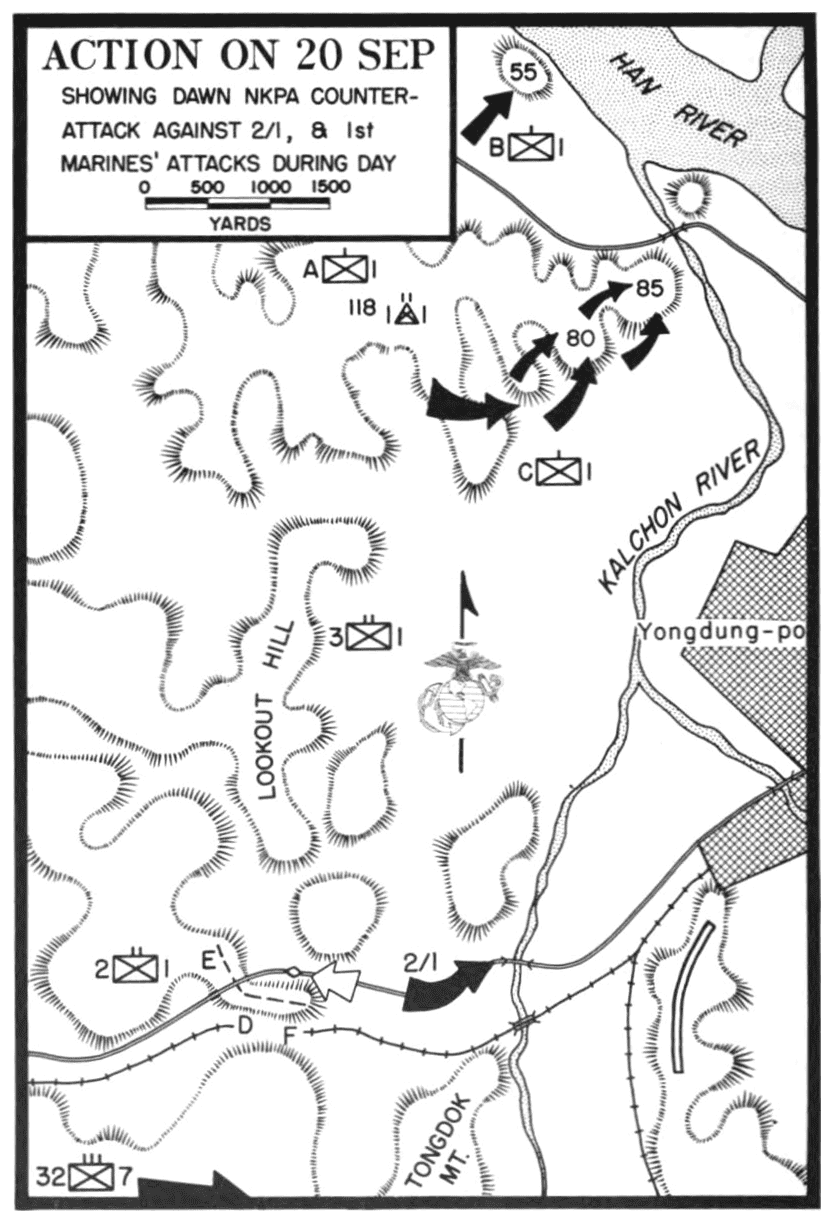
ACTION ON 20 SEP
SHOWING DAWN NKPA COUNTERATTACK
AGAINST 2/1, & 1st
MARINES’ ATTACKS DURING DAY
On the right, Lieutenant Commiskey paved the way in the face of
heavy resistance. Nearing the crest of Hill 85, the officer abruptly
bounded ahead of his platoon and went over the top. He jumped
into a machine-gun emplacement and was dispatching the last of five
occupants when his lead skirmishers caught up with him. He ran
forward again to clean out another North Korean position in a single-handed
attack. By this time, the Reds on the eastern side of the hill
had had enough. Those who still had hides to save pelted down the
northern slopes in the direction of the mouth of the Kalchon River,
where the stream was spanned by the now damaged bridge.
Guild’s platoon, inspired by its leader who remained in action despite
a mortal wound, gained the summit shortly after Commiskey’s
unit. Captain Wray, following closely behind, later described his
meeting with Guild on the slope as follows:
“He stayed on his feet and turned toward where I was climbing 20
yards behind him. He dropped at my feet and made every effort to
remain conscious long enough to tell me how his squads were attacking
and pleading with me to keep them attacking. I called for a
corpsman; he tried to refuse, saying that he had a wounded man who
needed one more than he did.”
Lieutenant Guild died shortly afterwards.
During the morning phase of Charlie Company’s attack, Hawkins
and the others on Hill 118 were racked by frustration of a type seldom
experienced by Marines in the history of the Corps. It will be recalled
that the ground between the Kimpo-Yongdungpo Highway and the
Han River was not cleared in the course of 1/5’s attack on Hills 80 and
85 on 19 September. Since the 5th Marines’ unit had withdrawn to
cross the Han at Haengju, and since Charlie Company of 1/1 had
chosen a southern route in recapturing the twin heights, enemy bands
in hiding along the river bank were unmolested. The potential danger
in the area was not realized, however, until too late.
From Kimpo came a “weasel” of the 1st Signal Battalion, the crew
calmly stringing wire into the 1st Marines’ zone as the vehicle rattled
along the highway. Just short of the Kalchon bridge, the little tractor
struck a mine and was ambushed by a party of North Koreans. The
power-packed Marine infantry on Hill 118, less than a thousand yards
away, watched helplessly as the communications men were either
killed or captured. No sooner had the Reds disappeared into the
brush with two prisoners than a Marine truck, belonging to
A/Engineers, cruised down the highway with four unsuspecting passengers.
Captain Barrow ordered his troops to fire over the vehicle,
hoping that the driver would hear the bullets in the air and turn back.
But the truck continued on into the ambuscade, where it was stopped
by an enemy fusilade.347
The engineers piled out and plunged into a rice paddy in an attempt
to escape. Three of them made it. The fourth, Private First Class
Clayton O. Edwards, was tracked down and captured. Although
the Marine was out of ammunition and already wounded, one heroic
warrior of the NKPA stepped forward and bayoneted him in the
shoulder after he had surrendered. Edwards later escaped from a
POW train fleeing before the UN drive into North Korea.
Not long after these incidents, Captain Richard F. Bland led Baker
Company of 1/1 through the area and secured Hill 55 and the nearby
villages on the bank of the Han. The North Koreans pulled out
and crossed the Kalchon to join the Yongdungpo garrison.
With fighting going on to the right and left, 3/1 sat quietly on
Lookout Hill during 20 September without suffering a casualty. An
occasional break in the orange and black pall over Yongdungpo
allowed the Marines a glimpse of the wrecked railroad and highway
spans which once had bridged the Han to Seoul.
The ROK capital was still a long way off for the 1st Marines; and
the 2d Battalion, now on the regimental right and in its sixth straight
day of the assault, was more concerned with the immediate foreground.
After smashing the Red attack in the morning of the 20th,
Sutter’s unit jumped off at 0645 against scattered resistance along the
Inchon-Seoul Highway. The assault elements reached the bridge
spanning the western branch of the Kalchon at 1230, and the battalion
commander immediately ordered engineers to inspect the long concrete
structure. It was reported to be in good enough condition to
support M-26 tanks for the attack on Yongdungpo the next day.348
While the battalion dug in on the west side of the stream, the
Marines eyed the 2,000-yard stretch of highway leading ahead to a
second span, bridging the Kalchon’s eastern branch at the very edge
of the blazing town. A high ridge on the right of the road—technically
in the 32d Infantry’s zone of action—was a beehive of North
Korean activity. Anticipating the effect of this commanding position
on his attack the following day, Sutter contacted Lieutenant Colonel
Charles M. Mount, USA, commanding the 2d Battalion of the 32d,
for permission to shell the height. The Army officer approved the
request at 1300, but more than seven hours elapsed before the necessary
clearance filtered through 7th Division, X Corps, and 1st Marine
Division to reach the 11th Marines. When the howitzers finally
opened up, darkness prevented effective observed fire from being
delivered on the enemy strong point.349
Out of sight and earshot of 2/1 during 20 September, Colonel
Charles E. Beauchamp’s 32d Regiment, in its first day of actual combat,
paid with seven killed and 36 wounded in taking Tongdok Mountain
and part of “Copper Mine Hill.” Using the Inchon-Anyang road as
an MSR, the Army unit lost three tanks in a field of over 150 wooden
box mines. Beauchamp himself narrowly escaped death or serious
injury when his jeep struck one of the explosives, killing the driver
and wounding a radio operator. By nightfall, the 32d was deployed
far out on the right of the Marines on the Inchon-Seoul Highway;
and the 31st Infantry, having landed at Inchon earlier in the day, went
into position even farther southward.350
There was no infantry action during the night of 20–21 September.
Both sides were steeling themselves for the ordeal each knew would
commence at dawn. The Red commander in Yongdungpo threw up
formidable earthworks to block the approach over the Kalchon from
Hills 80 and 85 in the northwest; and he concentrated a strong force
between the two tributaries in the southwest. That edge of town
facing due west, though most defensible, he left unguarded, with the
result that a single Marine rifle company would hasten his demise.
Marine artillery thundered all night long, and the glare from flaming
Yongdungpo rolled back the darkness in an ever broadening arc.
Shortly after dawn, the Marines of Company B, 1st Battalion,
threaded across the wreckage of the Kalchon bridge under cover of
machine-gun, mortar, and tank fire from Hill 85. Reaching the
eastern bank, the attackers swept over a knoll overlooking the Han on
the left, which the North Koreans had left undefended. The assault
inched forward toward the town, first through sporadic small arms
resistance, then into a deadly cross-fire from several automatic
weapons.351
Baker Company was now confronted by two dikes which the Reds
had converted into a main line of resistance. One of the barriers
paralleled the Han River north of Yongdungpo; the other ran the
entire length of the western edge of town. Where they met to form
a point facing the Kalchon bridge and the Marine advance, a reinforced
company of North Koreans was deployed across each levee in
strong, mutually supporting positions.
Captain Bland chose wisely in directing his attack against the
northern dike alone. By this decision he not only kept his left flank
and rear protected by the Han, but also maintained local superiority
in numbers over the Reds immediately confronting him. Grinding
slowly forward with heavy casualties, Company B rolled up the length
of enemy entrenchments on the levee and pushed eastward 2,000 yards
by afternoon. The Marines then formed a line with their backs to the
Han and shot it out with the Communists on the second dike at a
range of 500 yards. At this point the attack stalled, and the fight
settled down to one of attrition. Casualties on both sides mounted
rapidly under the ceaseless exchange of machine-gun, mortar, and
tank fire.352
Part of Bland’s difficulty owed to the random deployment of all
opposing forces at this time, as indicated on the charts of the 11th
Marines. Noting that Company B’s positions were along the Han
north of Yongdungpo, the artillerymen expressed reluctance to fire
on the enemy-held dike to the “rear” in answer to Lieutenant Colonel
Hawkins’ repeated requests from his OP on Hill 85. It was a matter
of the howitzers pointing generally north toward Seoul, while
Bland’s outfit, at the moment, was trying to head south. The misunderstanding
was finally cleared up late in the afternoon, and
Marine air joined the artillery in pounding the southern barrier.
The Reds held stubbornly under the battering, and at darkness
Hawkins sent Charlie and Weapons Companies across the bridge to
form a perimeter with Baker for the night.353
The narrative will now switch to the action in the 2d Battalion
zone, leaving the separate attack of Company A to be taken up in
detail later.
Sutter’s unit jumped off at 0630 on the 21st with Companies D and
E in the assault. The infantry crossed the first bridge without incident,
then fanned out to move on the second. It was no surprise
when the North Koreans on the intermediate ridge to the right of
the highway suddenly threw heavy fire across the Marine front, but
it was disconcerting to Sutter that his calls for artillery fire met with
the same delay as on the previous day. He therefore shelled the high
ground with attached 4.2-inch mortars on his own initiative, before
ordering Companies E and F to attack the enemy bastion.354
Meanwhile, Captain Welby Cronk led Company D forward on the
left of the highway against a strongly defended dike fronting the
Kalchon’s western branch. Progress was slow and casualties severe,
but the Marines closed to within 100 yards of the barrier by noon.
There they dug in and slugged it out, while the 2d and 3d Platoons
of Charlie Company tanks alternated in ripping the Communist
trenches with 90mm, delayed-action shells.
Heavy fighting continued on the right side of the road until evening.
Companies E and F fought part way up the slopes of the ridge and
suffered heavily during the close exchange with the Reds on the crest.
Since the enemy was still in control of most of the high ground at
dusk, Sutter ordered the assault units to withdraw into 2/1’s zone and
dig in with Dog Company. VMF-214 covered the hot disengagement—one
of the most difficult of all tactics—under a masterful job
of forward air controlling by First Lieutenant Norman Vining,
Sutter’s FAC. After bombing and rocketing from 75 to 100 yards
beyond the Marine front, the Corsairs closed to within 30 yards for
strafing runs to shield the retracting line of infantry.355
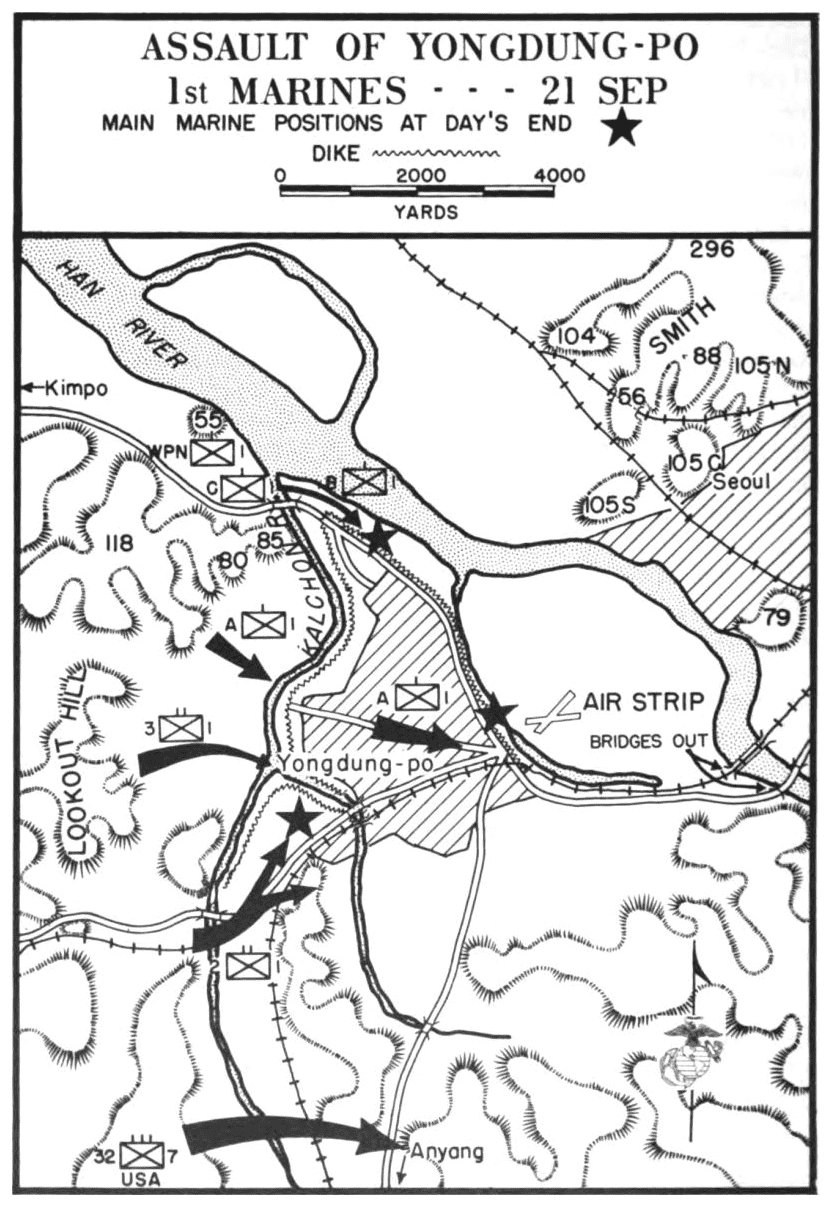
ASSAULT OF YONGDUNG-PO
1st MARINES——21 SEP
The seventh straight day in the assault had cost the 2d Battalion 11
killed and 74 wounded, bringing its total casualties since D-Day to 28
KIA and 226 WIA. Partially because of these crippling statistics,
Colonel Puller, at 1530 on the 21st, had committed 3/1 to the relief of
the battle-weary outfit. The reserve battalion swung northeast from
Lookout Hill to flank the enemy dike positions facing Company D
from the eastern tributary. Crossing the Kalchon against light resistance,
the attackers ran into trouble at the fortified levees fronting
southwestern Yongdongpo.
After heavy machine guns of 3/1 bested a battery of Communist
automatic weapons, Companies G and I, the latter on the right, attacked
astride the stream branch. Progress was slow, but at a cost
of 11 killed and 18 wounded, the Marines rolled up the heavily defended
dike and reached the bridge entering the city. Darkness fell
with the 3d Battalion entrenching to the north of the 2d, both units
along the left side of the Inchon-Seoul Highway.356
To the south of the 1st Marines, the 32d Infantry met with considerable
success during its attack over a mountainous nine-mile front.
The 1st Battalion on the right mopped up Copper Mine Hill, then
seized the high ground around Anyang against “light sniper fire.”
In the left of the Army zone and adjacent to the Marines, 2/32 took its
objective south of Yongdungpo against light-to-moderate resistance.
Thus, at a cost of two KIA, 28 WIA, and one MIA, the regiment succeeded
in cutting the railroad and highway leading from Suwon to
Seoul via Anyang and Yongdungpo. Difficulties in Marine-Army
liaison and coordination throughout 21 September stemmed from the
fact that neither realized the size of the gap between them. The map
will show that the 32d’s route of advance was planned to miss Yongdungpo
by two miles, not even coming close to the NKPA strong
point which gave the 2d Battalion, 1st Marines, so much trouble.357
With the coming of night on 21 September, there was grave apprehension
in the 1st Marines over the fate of one rifle company. In the
course of the day, the Reds had staved off major penetrations by two
Marine battalions in the southwest and the better part of another in
the northwest. Incredibly enough, one Marine unit of some 200 men
had swept through the space in between and cleared the very heart of
Yongdungpo; so that when darkness fell, the isolated force was
anchored in the rear of the enemy, a good mile and a half beyond
the closest friendly units.
Company A of the 1st Battalion had jumped off from below Hill 80
on the morning of the 21st, after Baker Company was slowed by the
dike positions east of the Kalchon bridge. In committing the unit
to an attack through a mile of open rice paddies, Lieutenant Colonel
Hawkins was gambling with high stakes for surprise.358
Captain Barrow employed the classic approach-march formation.
Forward on the left was Second Lieutenant John J. Swords’ 3d
Platoon; on the right front was the 2d, under Second Lieutenant
Donald R. Jones. To the left rear was First Lieutenant William A.
McClelland’s 1st Platoon, with the dual mission of company reserve
and flank guard. In the right rear were the 60mm mortars, a section
of heavy machine guns of Weapons Company, and the assault squad.
Light machine gun sections were attached to each rifle platoon, so
that they could be employed to the front or flanks on a moment’s
notice. Barrow’s six-foot, four-inch frame loomed between the two
assault platoons.
To say that these Marines were tense and expectant as they plodded
across the broad, flat expanse would be an understatement. Far off
on the left and right, small arms crackled continuously at the bridge
entrances to Yongdungpo. Marine planes were swooping down in
the distance, the hollow eruptions of their ordnance adding to the
incessant rumbling of artillery and mortars.
Almost hidden from view by the high grain stalks, Company A
swept through the rice paddies against no opposition whatever. Its
advance was rapid until the 3d Platoon was slowed by muck which
marked the beginning of the Kalchon’s bed. Heads craned eagerly
to the front and flanks as progress dropped to a snail’s pace for several
minutes.
The crucial moment seemed certainly at hand when the assault
line stepped forward from the concealment of the rice and waded
into the stream, completely exposed to the wide bank and parallel dike
beyond. Still, not an enemy shot was fired. Dripping mud and
water, the green-clad figures in the van surged ashore and over the
dike. The rest of the men followed, unbelieving, close behind.
Retaining the same tactical formation, ready to engage in any or
all directions, Company A marched into Yongdungpo. The first
buildings were 100 yards ahead of the levee. Barrow channeled his
advance astride the main east-west street. Although buildings and
dwellings were many, the layout was not dense; and the Marines were
able to keep their ranks open and enjoy good all-around observation.
The place seemed empty and dead. By noon Able Company was
several hundred yards within the town, its careful search of buildings
and side streets having failed to uncover a flicker of enemy resistance.
Barrow could tell from the din far out on either flank that he was
well ahead (eastward) of Baker Company and the 2d Battalion. He
radioed for instructions, and Hawkins told him to keep going.
Halfway through town, Barrow noted on his map that the Inchon-Seoul
Highway was now converging on his right, so that it would
meet the company’s attack route just east of Yongdungpo. Because
of the furious clatter along the stretch of highway out of sight on the
southwest (2/1’s fight), he ordered the reserve platoon to shift from
the left side to the right. No sooner had McClelland completed the
move than his men spotted an enemy column advancing down the
highway in the direction of 2/1’s front. The Reds were chanting a
spirited military air when the 3d Platoon opened up and cut the
formation to ribbons.
Simultaneously, the two lead platoons began firing on individuals
and small groups in the streets of eastern Yongdungpo. Astonished
at the sight of a large Marine force in the very heart of their bastion,
most of the North Koreans took to their heels. But there were other
Reds “in the rear with the gear” who obviously did not recognize the
attackers. After glancing curiously from distant streets, they went
calmly about their business.
Swords’ 3d Platoon barreled through town on the left of the street
and broke into the open. A dike topped by a road lay across the
Marine front, and the platoon leader led his men into a hasty defense
on top. From this position they could cover the vast sand spit with
its airfield and approaches to Seoul. Looking north, they observed a
large body of enemy soldiers withdrawing from Baker Company’s
zone onto the spit. Light machine guns took the North Koreans
under fire immediately, and the section of heavies sent forward by
Barrow joined in shortly afterwards. Caught by surprise in the open,
the Red outfit suffered heavy casualties before the survivors could
fan out and disappear.
The rest of Company A moved up on the right of the 3d Platoon,
occupying more of the dike and the junction with the Inchon-Seoul
Highway. It was at this point that Company A—if it could hold the
ground—had an opportunity to deal the Yongdungpo garrison a mortal
blow. For the road junction turned out to be the enemy’s supply
center.
Across the intersection lay what appeared at first glance to be a
huge coal pile. Actually it was a camouflaged mountain of ammunition.
During a fire fight with a small group of North Koreans taking
cover behind the explosives, one Marine set off the dump with a
grenade. The whole countryside shook with the detonation, and the
great cloud of smoke that shot into the air marked Able Company’s
isolated position for the rest of the 1st Marines on the outskirts of town.
While part of the unit dug in on the dike, the remainder inspected
and cleared the area around the intersection. A five-story building
on the near corner was jammed with captured U. S. Army medical
supplies, field equipment, ammunition, and enemy ordnance. The
Marines could not use the heavy caliber ammo but they did help
themselves to blood plasma for their wounded.
Throughout the afternoon, the Reds made repeated attempts to
regain the vital area by throwing small assault parties against Able
Company from the south. Each attack was smashed, and darkness
found the Marines firmly entrenched on the dike, hoping only that
their limited supply of ammunition would last throughout the night.
A weak SCR-300 battery prevented further communications with the
battalion CP.
If the Marine Corps Schools ever enlarges its varied curriculum to
include “The Defense of a Dike,” Captain Barrow’s tactical disposition
on the night of 21–22 September 1950 can be taken as a unique
precedent. Able Company’s commander chose to defend a 100-yard
stretch of the levee just north of the intersection. Here the
macadam road ran about 25 feet above ground level, and the incline
on either side sloped gently. The Marines staggered their foxholes
alongside, some high on the slope, others low. Machine guns and
BARs were emplaced along the shoulders at the top, so that automatic
fire could be directed in volume in any direction. Since all of their
ammunition had been fired during the afternoon counterattacks, the
60mm mortar crews laid aside their tubes and went into the line as
infantry.359
Company A’s perimeter for the night thus had the shape of a long
sausage, with the 3d Platoon in an arc at the northern end, the 1st defending
the west side, and the 2d in position on the east. From their
foxholes on the top and sides of the levee, the Marines commanded
the sand spit, the road on the dike, Yongdungpo’s eastern exits, and
the vital intersection with the Inchon-Seoul Highway.
Fortunately, they had dug their holes deep. At dusk came the
telltale rattling, revving, and clanking from the direction of 2/1’s
front; and five unescorted T-34s loomed on the Inchon-Seoul Highway,
headed toward the intersection. They turned left just short of
the crossroads and proceeded in column along a street that paralleled
Company A’s dike.
The Marines on the levee crouched low in their holes. Cruising
majestically like a file of battleships, the tank column cut loose with
a hail of machine-gun fire and salvoes of 85mm shells at a range of
30 yards. Able Company’s rocket gunners, whose total experience
with the 3.5-inch launcher was limited to the firing of a few practice
rounds, popped up from their holes and let fly. One of the tanks
exploded in a convulsion of flame and smoke, its turret twisted askew
as though some giant hand had torn the steel cap from the body.
The other four tanks continued to the end of the perimeter, then
reversed course past the Marine line a second time, pumping a steady
stream of steel into the western slope of the dike. Reaching their
starting point at the Inchon-Seoul Highway, they turned back and
made another round trip, with Marine rocket fire damaging two more
vehicles and sending them limping off the field. The remaining pair,
upon completing the second circuit, again reversed course and made
a final pass—the fifth—on the Marine lines. Clearing the perimeter,
they rumbled into town and disappeared.
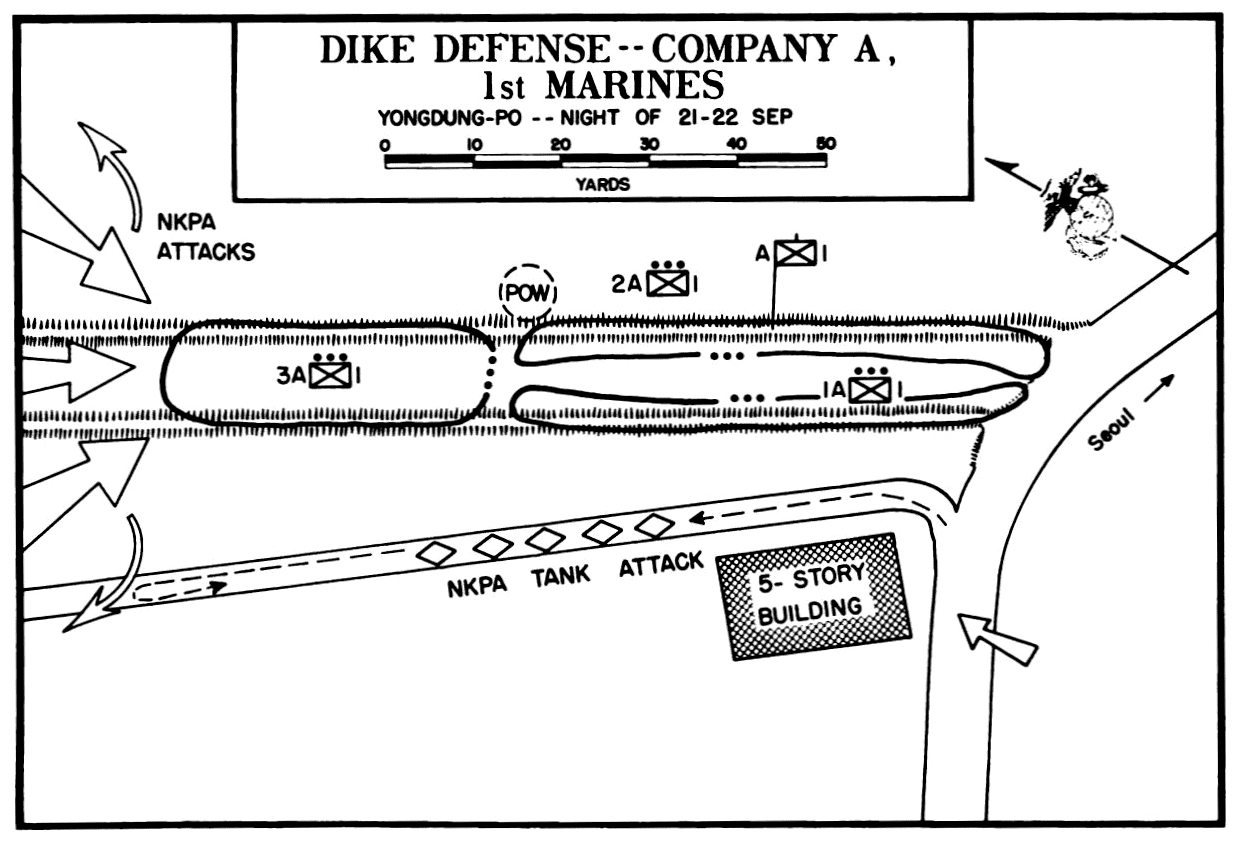
DIKE DEFENSE—COMPANY A, 1st MARINES
YONGDUNG-PO—NIGHT OF 21–22 SEP
Fantastic as it may seem, Company A sustained a single casualty,
a concussion case, during the half hour of sustained heavy caliber
pounding at pistol ranges. Tremendous muzzle velocity had embedded
the 85mm, armor-piercing shells deep in the slope of the dike
in the split second before each explosion; and Marine foxholes proved
to be sufficient protection against the raking machine-gun fire.
Between 1900 and 2100 it was relatively quiet. McClelland’s
platoon, facing town, killed a few Reds attempting to remove stores
from the five-story building. Then the long expected report reached
Barrow by sound-power telephone: Swords’ platoon, manning the
northern arc of the perimeter, could hear a large enemy force
approaching its front.
The counterattack hit shortly after 2100. Transmitting a running
account of the sharp fire fight by phone, Swords assured his company
commander that he was “having no trouble.” After 15 minutes of
failure, the Reds withdrew for a breather. They struck in the same
place half an hour later and were thrown back again, despite any inspiration
derived from a display of multi-colored flares and wild cries of
“banzai.”
By midnight, the 3d Platoon had withstood five such onslaughts,
each appearing to be in about company strength. Before the last
attack, a captive Red officer escaped from Company A’s POW “compound”
east of the dike and ran northward into the blackness, shouting
repeatedly, according to Barrow’s ROK interpreter, “Don’t
attack any more! They’re too strong for you!”
Apparently his advice was heeded, much to the relief of the Marines,
whose ammunition supply was becoming dangerously low. At midnight,
following the enemy’s fifth unsuccessful attempt against
Swords’ position, the fight for Yongdungpo came to an end for the
1st Marines. There was scattered firing throughout the night, but the
North Koreans, denied access to their vital supplies, quickly withered
on the vine.
At dawn, Company A counted 275 dead and 50 automatic weapons
around its perimeter, principally in front of the 3d Platoon. The
four T-34 tanks which had withdrawn into town were found
abandoned.
The 1st and 3d Battalions attacked at 0800 against negligible resistance
and converged on the isolated unit, making the historic linkup
in short order. The enemy was gone, except for the hundreds of
dead that littered the borders of the city. He had left behind practically
all of his heavy armament, equipment, and supplies.
Continuing the advance on the 22d, the 1st Marines surged eastward
beyond Yongdungpo, then spent the remainder of the day reorganizing
and patrolling. On the 23d, the regiment moved almost unopposed
to the bank of the Han, 3/1 seizing Hill 108 which dominated
the battered bridges. Late that night Puller received orders to effect
the river-crossing early next morning.
CHAPTER XII Main Line of Resistance — Three Hills Designated 105 — RCT-7 North of the Han — Attack Continued by RCT-5 — Modified Plan of Corps Attack — Climax of the Marine Assault — The Epic of Dog Company — River Crossing of RCT-1
Three Hills Designated 105—RCT-7 North of the Han—Attack
Continued by RCT-5—Modified Plan of Corps Attack—Climax
of the Marine Assault—The Epic of Dog
Company—River Crossing of RCT-1
During the night of 21–22 September an NKPA shell crashed
through the roof of the native house serving as CP of the 5th
Marines northwest of Seoul. The explosion wounded Lieutenant
Colonel Hays so severely that the regimental executive officer required
immediate evacuation. Lieutenant Colonel Murray, who escaped
with a slight cut, directed that the CP be moved to a cave on the reverse
slope of a hill.
Thus did the enemy serve notice that henceforward the battle for
the northwest approaches to Seoul would be furiously contested.
Yongdungpo had been taken by the 1st Marines only after a grim,
three-day struggle in which the Korean Reds made their first real
stand as distinguished from delaying operations. And now it was
the turn of the 5th Marines to meet opposition such as that regiment
had not encountered since D-day.
Two new NKPA units had much to do with the sudden stiffening of
resistance. One was the 78th Independent Regiment, commanded by
Colonel Pak Han Lin. This unit, numbering about 2,000 recruits in
July, was organized into three battalions of infantry supported by
medical, motorcycle, weapons, reconnaissance, mortar and 76mm gun
companies, and an engineer platoon.
Another recent arrival which won the respect of the Marines for
rugged fighting qualities was the 25th Brigade of 4,000 to 5,000
troops. Commanded by Major General Wol Ki Chan, who had reportedly
studied in Russia in 1947, the unit was made up of four heavy
weapons battalions and an infantry battalion in addition to engineer,
120mm mortar, heavy artillery, and brigade artillery battalions.360
It was literally a fight to the death for these two NKPA outfits,
which were all but wiped out of existence by the Marines of RCT-5
during the battle for Seoul. But while they lasted, the 78th Regiment
and 25th Brigade put up a determined and at times desperate resistance
in hill country well adapted to defense.
The grapple for the northwest approaches to Seoul began in deadly
earnest at 0700 on the morning of 22 September. From north to
south, the three assault battalions of the reinforced 5th Marines were
the 3d on the left, the 1st KMC in the center, and the 1st on the right.
They were jumping off from the high ground about three miles southeast
of Haengju along a line bounded by Hill 216 on the north, 104
in the center, and 68 on the south.
Misunderstandings in regard to routes and unit boundaries were
made inevitable by maps disagreeing as to place names and heights
of ridges. Added to the confusion was the fact that each battalion
zone had a Hill 105 as one of its final objectives. (Staff officers played
safe by designating them 105-N, 105-C, and 105-S to indicate north,
central and south.)
Ahead of the Marines lay a hill complex which constituted a great
natural bastion of interlocking heights and fields of fire. Spurs and
defiles leading from one ridge to another enabled NKPA troops to
move up in concealment and launch counterattacks in the most unexpected
quarters.
Casualties of the next three days were the heaviest for a comparable
period that RCT-5 had suffered in Korea. Added to previous
totals, it meant that 17 of the original 18 platoon leaders were killed
or wounded in a 50-day period, and five of the six company commanders
who landed with the Brigade.361
Grim as the outlook was, the Marines of the 2d Battalion enjoyed
a sideshow on the eve of battle when Sergeant James I. Higgins and
a companion made a prize of an enemy locomotive. Knowing
nothing about operating it, they found a simple but effective solution
by firing up and opening throttles or depressing levers until the gauges
were at the halfway mark. This policy of moderation led to success.
The locomotive took off with ponderous docility, and Higgins managed
to bring it to a safe stop near the regimental CP. His exploit
was not applauded, however, by supply officers taking alarm from
the dense clouds pouring out of the smokestack. They did not relish
the idea of providing enemy artillery with a target marker, visible
for miles, in an area full of exposed Marine ammunition. As a result
of their anxiety, Higgins was promptly invited to keep rolling until
he reached the rear.362
The 2d Battalion remained in reserve while the 1st KMC Battalion
jumped off in the center from Hill 104. Heavy resistance was met
immediately. In fact, NKPA detachments infiltrated all the way to
Hill 104 itself, though it had been secured by 3/5 the previous afternoon.
They poured small-arms fire into KMCs already taking a
pounding from mortar and artillery fire, and the battalion was held
up until the high ground to the front could be cleared by artillery
and air strikes.363
On the left, 3/5 also ran into trouble after deceptively easy progress
at first. At 0700 all three companies jumped off from Hill 216,
secured by Item Company the day before. The new objective, as
directed by 5th Marines’ Operations Order 24–50, was Hill 296.
This height was reported by How Company as taken at 0945. It
was not realized at the time that Hill 296 was actually the bastion
of the Red Korean defense complex northwest of Seoul if its three
southern spurs were considered. Attached to the main land mass like
the roots of an ulcerated molar were Hills 56, 88, and 105-N, with
105-C, 72, and 105-S describing an arc to the southward. Nearly all
of these positions would have to be reduced before the road could
be opened to Seoul.
Only long-range small-arms fire from Hill 338 was encountered
by How Company at the outset, but enemy pressure steadily increased
from the southern spurs of 296. An NKPA counterattack in estimated
company strength was repulsed with heavy enemy losses, including
some 40 prisoners, by Marine riflemen supported by tanks.
Communist pressure was soon renewed, however, with How Company
receiving heavy small-arms, automatic, AT, and mortar fire.
Patrols from the other two companies, ranging to the northeast of
Hill 216 in the early afternoon, met determined opposition. A reinforced
rifle platoon of Item Company encountered an NKPA force,
in estimated company strength, defending the village of Nokpon-ni.
During the ensuing fight the Marines lost two men killed and 11
wounded. Action was broken off at dusk, when the 3d Battalion
received oral orders to defend against an enemy infiltrating from the
south, southeast, and northeast in attempts to regain lost ground.
The fight for Hill 296 had only begun.364
South of the railroad, 1/5 had about 2,000 yards to cover to its objective,
Hill 105-S. The battalion plan of maneuver called for Baker
Company to deliver fire support while Able passed through Charlie
and advanced to the base of the hill. Meanwhile, Charlie was to
envelop the objective from the right. When the three Able platoons
moved into position, they were pinned down by enemy automatic fire
from the forward slope of 105-S. First Lieutenant Joseph A. Schimmenti
of 3/A and his men had a grim reminder of American reverses
earlier in the war when they found a 50-caliber machine gun and
ammunition of U. S. manufacture which the enemy had abandoned.365
Schimmenti was severely wounded and First Lieutenant Nathaniel
F. Mann, Jr., killed before Able Company won a foothold on the lower
slopes of 105-S. It took until 1500 for Charlie Company, supported
by a machine gun section, to complete its wide swing and close in on
the right of the enemy’s positions. Baker Company passed through
Able meanwhile and attacked the forward slopes. At 1720, after an
intense mortar, air, and artillery preparation, the 1st Battalion needed
only 15 minutes in which to secure the objective. The three companies
had taken losses of 12 killed and 31 wounded during the day.366
Close air support was provided for RCT-5 by the MAG-33 squadrons
which had begun tactical operations at Kimpo on the 20th.
Although they were still in process of moving to the airfield from
Japanese bases, VMF-212 and VMF(N)-542 flew strikes in support
of all three assault battalions. Of the two carrier-based squadrons,
VMF-323 almost doubled its usual number of daily missions on 22
September.367
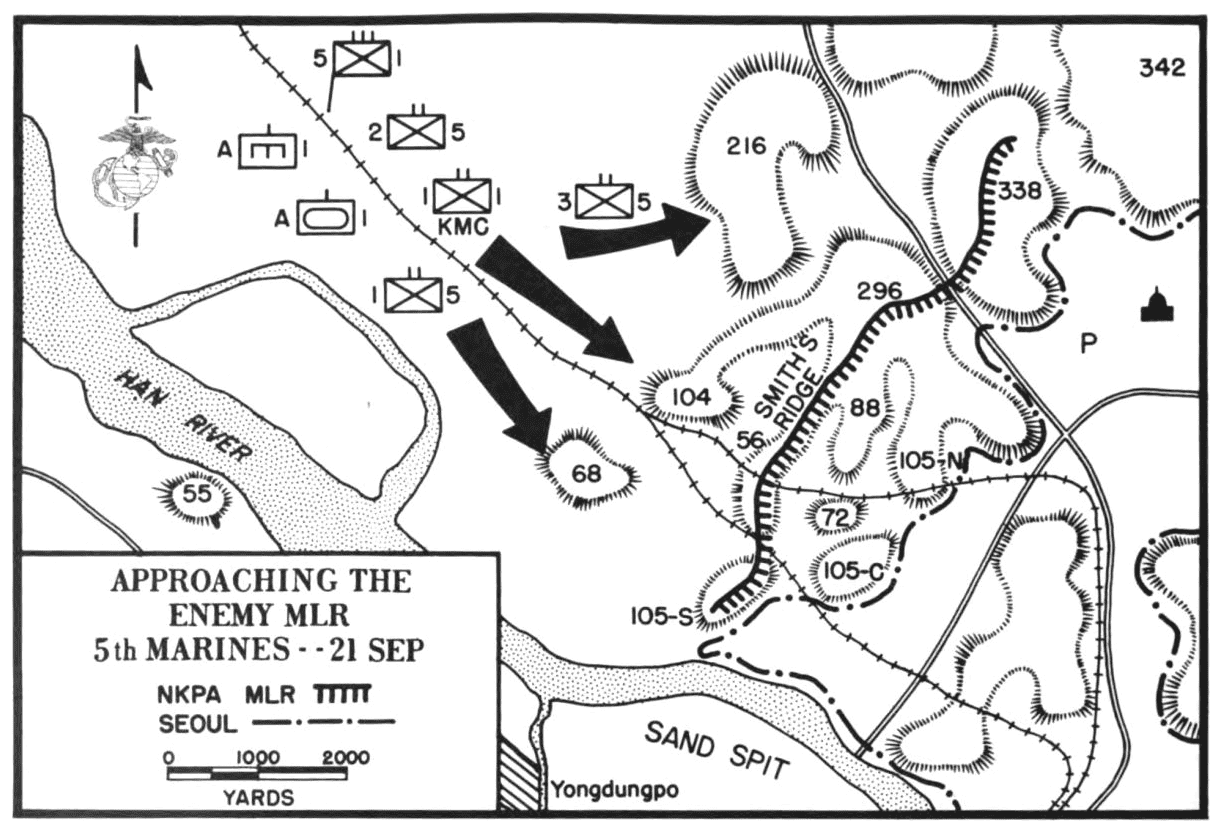
APPROACHING THE
ENEMY MLR
5th MARINES—21 SEP
Just before nightfall, Lieutenant Colonel Murray directed 1/5 to
pull back to Hill 68 with one company while holding Hill 105-S with
the other two. This shift was made necessary by the fact that the
KMCs had been compelled to withdraw to Hill 104, their starting
point. As a consequence, the center of the line was more than 1,000
yards in the rear of the battalions on the right and left. The company
on Hill 68 was to provide covering fires in the morning, therefore,
when the KMC battalion would renew its attack in an effort to regain
lost ground.
On D-plus 8 the 1st Marine Division had its third rifle regiment in
line for the first time. OpnO 9-50, issued at 1200 on 23 September,
directed the 7th Marines (less 2d Battalion) to cross the Han into a
zone of action in the rear of the 5th Marines.
In response to verbal instructions and a fragmentary warning order
the day before, the regimental headquarters and 3d Battalion crossed
late on the morning of the 23d. Colonel Litzenberg set up his CP
on the north bank at 1710, and his men had their first contact with
the enemy the following morning. A 3d Battalion patrol ranging
to the north of the battalion zone of action encountered an estimated
200 NKPA troops, and Marine air and artillery supported a successful
attack.368
Division orders called for the relief of 2/7 on the 24th in the area
northwest of Kimpo by the 2d Battalion of the 187th Airborne RCT,
USA. The Marine unit was directed to cross the Han that afternoon,
followed by the 1st Battalion, which had completed unloading at
Inchon.
It had been decided by the Division command and staff to give the
7th Marines time for shaking down instead of committing the newcomers
immediately to the attack on Seoul. The regiment was assigned
a series of five objectives along a ridgeline extending from the
ferry crossing at Haengju on a gentle arc to a point north of the city.
Protecting the north flank and rear of the 5th Marines was a primary
mission, and Colonel Litzenberg was also directed to prevent the
escape of the enemy to the northward.369
On the morning of the 23d the 1st KMC Battalion was directed to
attack from Hill 104 at 0700 to straighten out the line. The 1st and
3d Battalions of the 5th Marines were to remain in position and assist
the advance by fire.
Heavy and immediate resistance was encountered from NKPA
troops dug in on Hill 56. Although the KMCs made a valiant effort,
they were soon stopped cold. Only slight gains resulted at an excessive
cost in casualties from artillery, mortar, and automatic weapons
fire.370
Lieutenant Colonel Roise moved his CP forward at 1300 to the
western base of Hill 104. While his 2d Battalion assembled under
cover of that height, he conferred with Lieutenant Colonel Murray
after receiving orders to pass through the KMCs and continue the
attack on Hill 56. Both officers realized the advantages of swinging
around to hit the enemy from the left after approaching along the
low ground. But it was already midafternoon and this movement
could not be completed before darkness. The only alternative was a
line-buck in the center if Hill 56 was to be taken that day. And since
the line had to be stabilized and the KMCs pulled back in reserve
to give the regimental defense some depth, Murray and Roise agreed
that the situation called for a frontal assault without delay.371
At this stage the Marine officers did not realize that Hill 56 was part
of the enemy’s main line of resistance. It seemed logical to them
that he would make his final stand on the next ridgeline, crowned with
Hills 105-C and 105-N. As for the repulses suffered by the KMCs, it
was a logical assumption that their inexperience had been a contributing
factor. In view of these circumstances, a brief artillery preparation
and the support of a platoon of tanks seemed sufficient when Companies
D and F attacked and E contributed fires from the eastern
slopes of Hill 104.372
Captain Peters’ Fox Company was to lead off on the right, south
of the railroad, and seize the portion of the objective below the railroad
tunnel. From this high ground, his men could then support
First Lieutenant H. J. Smith’s Dog Company, moving forward under
cover of a sunken road, to assault Hill 56 north of the tunnel. About
1,000 yards of rice paddies had to be crossed at the outset, and the expected
support of the tanks in this low ground failed to materialize.
The leading M-26 bogged down in a wide ditch which prevented the
advance of the other four. One of them remained in the paddies to
give supporting fires while three took a new route along the railroad
tracks. Fox Company received increasingly heavy casualties meanwhile
on the way across the low ground.
Peters ordered Second Lieutenant S. E. Sansing’s mortar section
forward, but the officer reported afterwards that his radio did not pick
up the message. This left the three assault platoons without 60mm
support as they climbed the lower slopes of Hill 56 and became heavily
engaged with NKPA troops just below the railway tunnel.373
Apparently the Reds so overrated the weight of Company F’s
assault that they lost the topographical peak of Hill 56 by default.
Whether their timely withdrawal from Dog Company’s initial objective
was meant to be permanent is not known, for they might have
been caught flatfooted while shifting troops against Fox. Nevertheless,
Company D emerged from the sunken road in a column of
platoons and moved onto the high ground in its zone against negligible
opposition.
Lieutenant Heck’s 1st Platoon, according to plan, then pivoted leftward
to spearhead the attack on the final objective, Smith’s Ridge—named
by the men after their company commander. Halfway into
the connecting saddle, the Marines were caught in the open by a
heavy burst of fire from a large knoll on the southern tip of the wooded
ridge. Heck fell mortally wounded, and his senior NCO, Staff
Sergeant T. Albert Crowson, went down with a shattered leg. In the
space of a few minutes, more than half of the exposed platoon became
casualties.374
Startled by the intensity of enemy reaction from this unexpected
quarter, Smith personally retrieved the battered 1st Platoon, while
the 2d and 3d were clearing the northeastern slopes of Hill 56. Then,
owing to the lateness of the hour, he deployed Company D defensively
on that high ground for the night. There was no contact with Fox
Company or any other friendly unit. This fact, coupled with the
evidence of strong enemy positions on Smith’s Ridge, led the company
commander to reconsider carefully his plans for the postponed attack.375
Fox Company had meanwhile been heavily engaged along the
eastern slopes of Hill 56 in the vicinity of the railway tunnel. Peters
ordered Lieutenant Anderson to lead his 2d Platoon against the strong
NKPA positions just beyond the tunnel. Only 27 men were left to
fight it out at close quarters with an entrenched enemy estimated by the
platoon leader at company strength. The Communist force was
wiped out in exchanges of small-arms fire and grenades at murderous
ranges, but the effort took a frightful toll of the 1st Platoon in KIA
and WIA casualties. Only seven able-bodied men were left when
Peters ordered a withdrawal to the company position south of the
tunnel.376
All of Anderson’s wounded and most of his dead were brought
back, and he combined his remnants with the survivors of Lieutenant
Nolan’s 2d Platoon. A gap of about 50 yards separated their position
from First Lieutenant Albert F. Belbusti’s isolated 3d Platoon as Fox
Company dug in for the night.377
No fault could be found with the over-all plan of attack, providing
as it did for each assault company to seize ground from which it
could support the advance of the other. But as darkness approached,
it became evident that the 2d Battalion had bargained for more North
Korean real estate than it could handle. The two isolated companies
had no choice but to cling desperately to their scorched holdings while
organizing to meet an expected NKPA counterattack.
Although the other two battalions of the 5th Marines had defensive
missions on 23 September, enemy threats and encroachments kept
them occupied. On Hill 296, in the zone of 3/5, Weapons Company
took a good deal of satisfaction in firing a captured NKPA howitzer
to break up hostile troop concentrations in the vicinity of Nokpon-ni.
How Company remained in contact with the enemy all day, supported
by 50-caliber and 90mm fires from Marine tanks.378
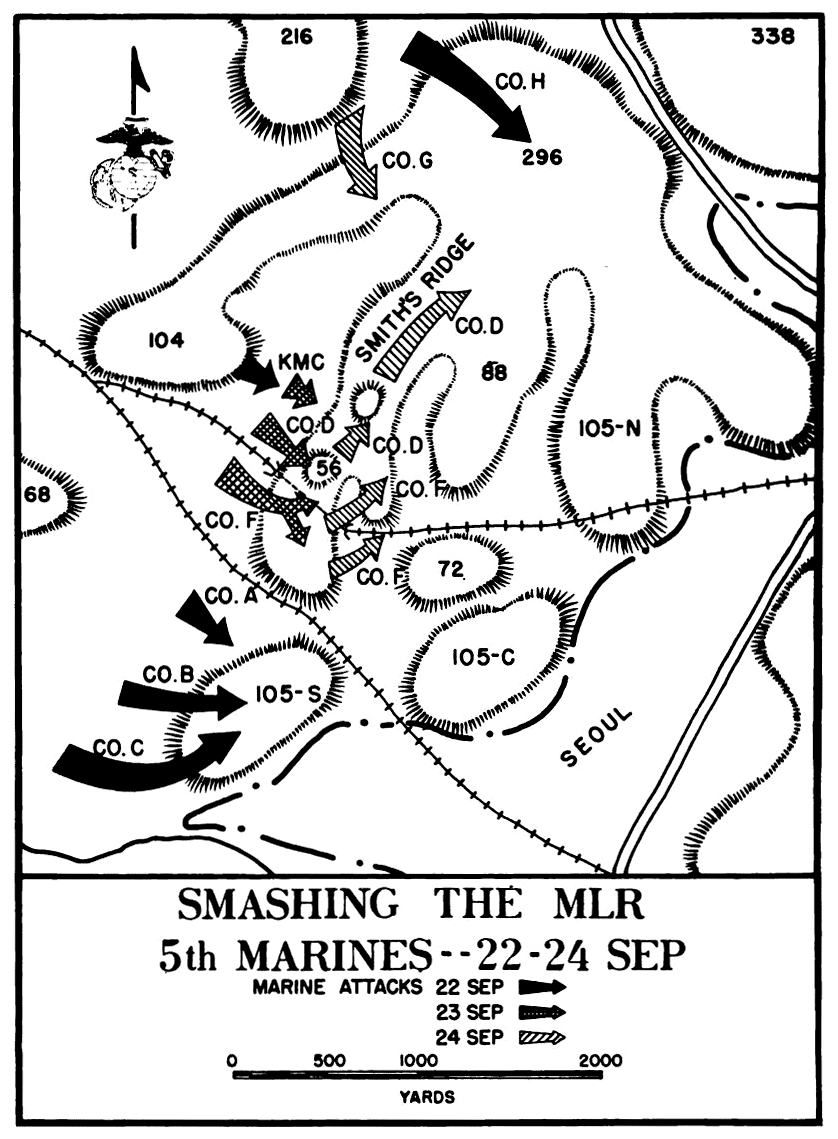
SMASHING THE MLR
5th MARINES—22–24 SEP
It was in the How Company zone that Taplett’s men first made the
acquaintance of “Fireproof Phil.” This was the name applied to a
gigantic NKPA officer, towering head and shoulders over his troops,
who exposed himself with contempt for Marine bullets. Not only
his burly build but his light complexion gave some of the Marines
the conviction that he was Russian. At any rate, Fireproof Phil was
both fearless and lucky. Machine gun bullets and mortar rounds
seemed to bounce off his frame. Finally, the tanks paid the honor
of making him the special target of 90mm ammunition, and still
Fireproof Phil always had the benefit of a minor miracle at the last
moment.379
Combat leadership by enemy officers and NCOs was outstanding in
the operations north of Seoul. On Hill 105-S the 1st Battalion came
under pressure all day on 23 September. Movement was impossible
for the men of Baker and Charlie Companies, and supplies of water,
food, and ammunition had to wait for darkness. Enemy smoke pots
created a haze restricting air activities, but it did not prevent a timely
strike flown by Lieutenant Colonel Lischeid and five planes of
VMF-214 to break up a threatened enemy counterattack on Hill
105-S. This was one of six close support missions completed on the
23d by that squadron in the zone of RCT-5.380
Why the enemy did not launch a counterattack that night against
the hard-hit assault companies of the 2d Battalion is one of the
mysteries of the war. But the weary Marines on the slope of Hill 56
attributed their respite to effective and unremitting artillery support.
All night long the howitzers of the 11th Marines lit up the night sky
like heat lightning in the rear and crashed like thunder in front as
they scourged the NKPA positions.
Up to this time the Corps plan of attack had called for the 1st Marines
to clear the south bank of the Han and cross in the vicinity of Yongdungpo
to join the 5th Marines in an assault on Seoul from the west and
southwest. In view of the location of the boundary between the 1st
Marines and the 7th Infantry Division, this meant that the Army troops
would not participate in the attack on the city.
General Almond had already made it plain in conversations with
General Smith that it was highly desirable to take Seoul by 25 September
as GHQ wished to announce the liberation just three months
to the day after the NKPA invasion.
The subject came up again during a conference at Corps Headquarters
on 23 September. Almond proposed that Smith send RCT-1
around to attack Seoul from the southeast while RCT-5 continued its
assault from the northwest. This plan struck the Corps commander
as promising to maneuver the enemy out of the city sooner than the
attack as formerly conceived.
Smith replied that the NKPA forces defending Seoul had proved
to be much stronger than had been expected. He said he was convinced
that the enemy would put up a fight from street to street regardless
of any flanking maneuvers. The Marine general added that the
fierce opposition met by RCT-5 had demonstrated that the western
approaches to Seoul were too much for one regiment to handle, and
he urged that no change be made in the original plan of crossing
RCT-1 northwest of Yongdungpo to aid the attack. This plan, Smith
asserted, would offer the advantage of keeping the 1st Marine Division
together; for when the 1st and 5th Marines had penetrated well into the
city, the 7th Marines could be brought around from the northwest to
deliver the coup de grace.381
Differences between commanders are not remarkable, and it is noteworthy
that Corps and Division usually managed in the Inchon-Seoul
operation to reach an acceptable solution. Such was the case when
General Almond reconsidered on the 23d and agreed to allow the 1st
Marines to cross northwest of Yongdungpo, as originally planned, and
take part in a two-regiment attack on Seoul from the west and southwest.
In place of the 1st Marines, the 32d Regiment of the 7th Infantry
Division was to cross the Han and enter Seoul from the southeast.
Amphibian tractors for the operation would be furnished by the 1st
Marine Division.
Revised 1st Marine Division plans called for RCT-1 to take position
on the right flank of RCT-5 after the crossing, then pivot to the northeast
and continue the attack through the heart of the city. RCT-7
(less one battalion in Division reserve) would have the mission of
advancing across the northern approaches to protect the left flank and
prevent the enemy from escaping while RCT-5 sliced through the
western edge of the built-up area. Thus the burden of capturing Seoul
fell chiefly upon Colonel Puller’s regiment.
As the eastern sky turned gray on the Saturday morning of 24 September,
the men on the firing line northwest of Seoul knew that the
time had come. They knew with the instinct of battle-wise troops that
supporting arms had done all they could. Now it was up to the infantry
to come to grips with the enemy. Supporting arms could only
sue for victory and it was up to the infantry to collect.
The two companies of 2/5 were still clinging by their eyelashes to
the scarred slopes of Hill 56. All three of the Company F platoon
leaders, Nolan, Anderson, and Belbusti were carrying on in spite of
wounds. Corporal Welden D. Harris, who had killed three Red
Koreans in hand-to-hand combat the day before, refused to be
evacuated after a second wound.382
The survivors of Captain Peters’ outfit could not say too much in
praise of the support given continuously throughout the night by
Captain Arnold C. Hofstetter’s Baker Battery of the 11th Marines.
There were indications that several incipient NKPA counterattacks had
been broken up during the night by the bombardment.
In the Dog Company zone the night had been relatively uneventful
except for sniping, though the enemy could be heard digging new
positions and bringing up ammunition.
The regimental scheme of maneuver, as outlined in OpnO 26-50,
called for the 2d Battalion to continue the attack, with Hill 105-N
as a final objective. This meant going up against practically the entire
Hill 296 defense system, since Smith’s Ridge and all of Hill 88 also
remained to be seized. An estimated 2,500 enemy troops, well supported
by automatic weapons, mortars, and artillery were defending
every foot of defensible ground in front of the two thinned companies
of 2/5.
It was intended that 3/5 should assist by attacking down the principal
eastern spur of 296 to outflank the enemy and contribute supporting
fires. Taplett’s men were to be relieved in gradual stages on Hills 216
and 296 by elements of the 1st Battalion. As a preliminary, Newton
was to send out a patrol to secure a portion of the river bank on the
right flank of Hill 105-S in preparation for the crossing of the Han by
the 1st Marines that morning. The reserve company of 1/5 would
then commence the relief of the 3d Battalion while the 1st Battalion
of the KMC Regiment remained in an assembly area in the rear of the
5th Marines and elements of the 7th Marines protected the left flank.
Units of 1/5 were to continue to defend 105-S—seized and held at a
total cost of 27 KIA and 72 WIA—until the crossing of the 1st Marines
and the relief of 3/5 had been completed.383
Two small enemy counterattacks were repulsed without much
trouble by elements of 3/5 on Hill 296 before dawn. Company H
remained in contact with the enemy on the eastern slopes until 1550,
when Company G moved around the right flank and a coordinated
attack was launched against moderate NKPA artillery, mortar, and
AT fires. Relief of Item Company and other 3/5 troops remaining
on Hill 216 was completed by the 1st Battalion at 2000. Casualties of
the 3d Battalion for the day were five killed and 33 wounded.384
The movements of these two battalions were subsidiary to the main
attack launched by 2/5 on 24 September. H-hour at 0630 was preceded
by a 20-minute artillery preparation and an air strike by VMF-323
planes. Lieutenant Colonel Roise planned to bring up Easy Company
from reserve on Hill 104 and push it forward between Dog and Fox
while those companies completed the seizure of Hill 56 and cleared
the heavily wooded spur to the north known as Smith’s Ridge, linking
up with the main land mass of Hill 296. Easy Company would then
take the lead in a battalion attack aimed at Hills 88 and 105-N as the
final objectives.
Fox Company jumped off on the eastern slope of Hill 56. Nolan
having been evacuated, Anderson led what was left of the 2d and 3d
Platoons—a total of some 20 riflemen. Belbusti commanded about the
same number in the combined assault on the heavily defended finger
of high ground east of the tunnel. Counting machine gunners, mortarmen,
and troops bringing up ammunition, Fox Company had been
reduced to fewer than 90 effectives, including wounded men refusing
evacuation.
Corsairs of VMF-323 swooped down to drop 500-pound bombs less
than a hundred yards in front of the attackers. Thanks to such close
air support, Fox Company soon seized high ground which enabled the
men to gain fire superiority.385 At this point they took cover to make
use of their advantage in an exchange of small-arms and automatic fire.
Dog Company, with two platoons still almost at full strength, had at
least a dozen walking wounded who elected to keep on fighting.
Ground mist and smoke from burning huts made for low visibility
when the men jumped off in a column of platoons. The enemy opened
up from Smith’s Ridge as the Marines came within close range, pinning
them down for two hours by concentrated and accurate artillery, mortar,
AT, and automatic fire. One of the Marine tanks moving up the
road in support was disabled by a mine and another became inoperative
after a direct hit by an NKPA mortar shell on the motor hatch.386
The large knob across the sunken road from Hill 56 remained to be
taken before Dog Company completed its mission by advancing northward
to clear the enemy from the wooded spine of Smith’s Ridge.
After the attack stalled with heavy casualties Lieutenant H. J. Smith
ordered every available man into line, including personnel of company
headquarters. Two Marine machine guns were kept in action at a
cost of repeated casualties as First Lieutenant Karle Seydel made five
consecutive trips under fire to bring up ammunition.
At some points the opposing forces were within long grenade-throwing
distance. In these exchanges the Marines had a pronounced advantage
because of stronger arms and the control developed by baseball.
Both sides attempted without success to break the deadlock by sending
out detachments for flanking movements. Sergeant Robert Smith
of McNaughton’s platoon led a squad in a wide end sweep to the
north, only to meet such fierce NKPA opposition that Smith and
eight of his men were killed, including a corpsman. Only three
wounded Marines ever got back.387
At 1000 the company commander sent the first of three messages to
inform the battalion CP of his situation and request reinforcements.
Roise could only reply that Easy Company, his reserve unit, was irrevocably
committed to the attack on the final objectives. During the
course of the battle the battalion commander himself was wounded by
a mortar fragment but returned to the CP after having his arm
dressed.388
When Second Lieutenant George Grimes’ 60mm mortar section ran
out of ammunition, the survivors fought as riflemen. Two platoon
leaders, McNaughton and Lieutenant Howard, were wounded but
continued in action.
About 1030, as the smoke and mist cleared, the howitzers of the 11th
Marines and the 81mm mortars of 2/5 poured it into the enemy positions
along the wooded ridge. The men on the firing line had another
welcome assist when four Corsairs of VMF-323 roared in to make
passes with bombs, rockets, and napalm.
Lieutenant Smith had 44 effectives left as he alerted his men for the
assault. McNaughton, Seydel, Grimes, and First Lieutenant Karl
Wirth were the other officers still on their feet. Platoons, sections, and
squads had ceased to exist as units when the 44 men of Dog Company
moved out of their foxholes and swarmed over the high ground that
had held them up for more than two hours.
First impressions under more normal circumstances would have
been shocking, for the position held more enemy dead and dying than
the Marines had ever seen before in Korea. The entire area was honeycombed
with foxholes, trenches, and bunkers, which had become the
graves of Red Koreans cut down by Marine air and artillery. There
they had died at their posts, crowded together so closely that every
shell, bomb, or rocket had caused frightful carnage. The dead outnumbered
the living, in fact, for the men of Dog Company met unexpectedly
weak resistance from the few NKPA effectives who trusted
to their weapons instead of their feet.389
Lieutenant Smith paused to regroup in a skirmish line for the final
attack to clear the remainder of the ridge. Again the Marines seemed
to prevail by sheer moral ascendancy as the assault went forward by
leaps and bounds. But the victory was bought at the cost of the company
commander’s life, for Smith was killed at the head of his men.
Only five additional casualties were taken in this phase, but Marines
dropped from exhaustion until McNaughton, as acting commander,
had just 26 able-bodied men left at the finish. They were greeted by the
strange spectacle of three enemy officers exhorting about 150 Red
Koreans to retreat. No second invitation was needed, and the Marines
had a “turkey shoot” at the expense of foemen scurrying down the
eastern and northern slopes in the direction of Seoul.390
Seydel was the only officer left unwounded when Dog Company
notified the Battalion CP at 1300 that objectives had been secured. Fox
Company reported about two hours later that it also had seized all
assigned ground and was digging in after a mopping-up period.391
Casualties had not been heavy on the east side of the ridge as compared
to the day before. The Company F attack consisted of two prolonged
fire fights in which the Marines seized better positions and made
good use of their advantage. After reaching the objective, they took
cover and proceeded systematically to cut the enemy down to size with
the support of VMF-214 planes. Captain Peters then sent both platoons
forward to eliminate an NKPA force firing on them from a
distance. Anderson’s men passed through a small built-up area and
took cover behind a stone wall on the enemy’s flank. Opening fire
on Communists about 300 yards away in an open field, they made short
work of the opposition.392
Second Lieutenant Wiley J. Grigsby, the machine gun platoon leader,
was killed in the day’s final Fox Company attack. Anderson’s composite
platoon had three men killed and three wounded. Among the
casualties was Corporal Harris, who received a mortal wound after
twice refusing evacuation. He was posthumously awarded the Navy
Cross.393
The attack of Easy Company on Hill 105-N was delayed until after
the other two companies took their objectives. At 1500, after moving
up from battalion reserve, Jaskilka’s men ran into heavy enemy mortar
and automatic fire soon after passing Hill 56. Two tanks of the 1st
Platoon, Company B, 1st Tank Battalion were knocked out, one by
an AT mine and the other by a direct hit of a mortar shell. The
remaining three tanks could not have continued in action except for
the efforts of Staff Sergeant Stanley B. McPherson of Company A, 1st
Engineer Battalion, who went ahead and cleared a path through the
enemy mine field. By some miracle he survived the hail of NKPA
fire unhurt, and the tanks went on to destroy two enemy AT guns and
several machine gun emplacements.
The main enemy stronghold appeared to be Hill 72, a conical height
located between Hills 105-N and 105-C and enfilading both of them.
Not enough daylight remained on 24 September to mount an assault
on this position, and the effort was put off until the following
morning.394
Marine air had a busy day. Lieutenant Colonel Lischeid’s VMF-214,
repeating the pattern of the day before, launched strikes of five
aircraft every two hours in support of 2/5 attacks northwest of Seoul—a
total of six missions. Not only was the city a flak-trap, but Marine
pilots were flying Corsairs from which the armor around the air-cooler
system had been removed by order of BuAer as a peacetime economy
measure and never restored. As a consequence, NKPA small-arms
fire was likely to hit the oil lines and send a machine down in flames.395
A 1st MAW record for combat sorties flown in a day by a single
squadron was set on the 24th by VMF-212 with 12 flights and 46
sorties. Close support missions were about equally represented along
with search and attack.396
Nightfall of this eventful day found 2/5 in possession of ground
containing the most enemy dead in a small area ever seen in the Inchon-Seoul
operation. Lieutenant Colonel Roise estimated that 1,500 NKPA
bodies were left on Hill 56 and Smith’s Ridge, and the command of
the 1st Marine Division put the figure at 1,750 enemy killed in the
Hill 296 defenses.397
Survivors of Dog Company agreed that in spite of such frightful
losses, the Red Koreans had enough able-bodied men left at the finish
to make mincemeat of the 26 attackers who took Smith’s Ridge. But
this Marine effort seemed to break the heart of enemy resistance in
the Hill 296 defense complex, thus giving fresh proof of Napoleon’s
famous dictum, “The moral is to the material in war as three to one.”
The battle for Seoul entered its final stage on the 24th with the river
crossing of the 1st Marines. At first light a site about 2,000 yards southwest
of Hill 105-S was cleared by Charlie Company of the 1st Engineer
Battalion. Extensive mine-clearing operations at the crossing site
area caused delays, and it was 0800 when reconnaissance and assault
elements of 2/1 embarked in the LVTs of Company A, 1st Amphibian
Tractor Battalion. Sutter’s troops completed their crossing at 0945
against scattered and ineffectual fire, and made contact that afternoon
on the north bank with elements of Company C, 5th Marines.398
For lack of a ferry, the 1st Marines had no tank support at the crossing
site. Plans had been made to send Baker Company, 1st Tank
Battalion, around by the Haengju ferry to join the infantry north of
the river. As it worked out, however, the armor was delayed by a
fight on the north bank which will be discussed in the next chapter.
Hill 79, about 4,000 yards from the crossing site, had been assigned
to the 1st Marines by Division OpnO 10-50 as an objective. The 2d
Battalion began a rapid advance toward this point after moving into
position on the north bank abreast of the 5th Marines on a 1,500-yard
front.
The 1st Battalion and Regimental Headquarters were next to cross.
Puller ordered Hawkins and his men to drive eastward along the river
and pass through the 2d Battalion. Since that unit was rapidly advancing
at the time, one of the 1/1 staff officers looked dubious.
“You’ll just have to advance a little faster,” explained the veteran
regimental commander.399
This proved to be a practical even if not exactly a school solution.
On the march the 1st Battalion had the same experience as the 2d
when small-arms and automatic fire came from Hill 105-S, supposedly
secured by 1/5. Again the enemy was demonstrating his ability to
hide out behind the Marine lines and make the most of his nuisance
value. The 2d Battalion had two men killed and nine wounded by
harassing fires, and the 1st suffered four casualties while passing
through at 1300 to continue the attack.
Effective Marine artillery and 4.2-inch mortar fire supported the
advance. After drawing out of range of Hill 105-S, Hawkins and
his men encountered long-range small-arms fire, and roads into the
city were mined. Hill 79 was located in the southwest section of Seoul
itself, commanding a good view of the railroad marshaling yards and
industrial area. After seizing the objective at 1500, the men celebrated
by raising an American flag, thus precipitating a friendly race with
the 5th Marines in exuberant ceremonies of this sort.
At 1515 the 3d Battalion was relieved by the Division of its mission
of defending Hill 108, south of the wrecked Han bridges, and reverted
to regimental control for a river crossing completed at 2000. On the
north bank Ridge’s outfit was thought to have pulled the last fangs
of enemy resistance on Hill 105-S after his men in their turn came
under fire from hidden opponents. Since this height dominated the
new regimental CP, Company I was given the mission of outposting
the height. A small but lively fire fight took place at dusk, and the
Marines bagged ten prisoners at a cost of one man killed and two
wounded.400
The 3d Battalion went into an assembly area near the crossing site
for the night. Hawkins set up a perimeter defense on the objective, and
the 2d Battalion occupied positions about 2,000 yards in the rear. A
few probing attacks were received from enemy patrols on Hill 79, but
Marine artillery and 4.2-inch mortars made short work of these
attempts.
CHAPTER XIII Seoul as a Battlefield — Two More River Crossings — Division Attack of 25 September — Tank Victory on Hill 105-S — Night Attack Ordered by Corps — Entrapment of Dog Company, RCT-7 — Last Fight on Hill 296 — 1st Marines in the Heart of Seoul — Objective Secured
Two More River Crossings—Division Attack of 25 September—Night
Pursuit Ordered by Corps—Renewal of Drive
Through Seoul—Entrapment of Dog Company, RCT-7—Last
Fight on Hill 296—1st Marines in the Heart of Seoul—Objective
Secured
On the morning of 25 September 1950, with RCT-1 across the
river, the 1st Marine Division was in a position for the first
time since D-day to launch an attack of all three regiments abreast.
This was but one of the portents indicating that the days of the North
Korean People’s Army were numbered. Exactly three months had
passed since the invasion of the Republic of Korea, and now the forces
of the Communist puppet state were reeling under blows from two
directions. While X Corps pounded inland to seize the NKPA main
communications hub, the Eighth Army had smashed through the
Pusan Perimeter and was driving northward to place the enemy between
two fires.
The big break in South Korea came on 23 September. Up to that
time, the NKPA 5th, 8th, 12th, and 15th Divisions had put up a stubborn
resistance on the northern front of the Pusan Perimeter against
six ROK divisions. Then the enemy crumpled and the ROKs began
an advance (see map in end papers) that would take them 70 miles
during the ensuing week.401
It was much the same story along the Kumchon-Taejon axis of the
central front. There the U. S. I Corps, comprising the U. S. 24th
Infantry and 1st Cavalry Divisions, the 1st ROK Division, and the
British 27th Brigade, drove a deep salient into the line of the 1st, 3d,
13th, 10th, and 2d NKPA Divisions. UN gains of 35 miles were made
from the 22d to the 25th.
In the south the U. S. 2d and 25th Divisions had hurled the NKPA
6th, 4th, 9th, and 7th Divisions back from the vicinity of Masan to
the Chinju area. This gain of about 15 miles from 21 to 23 September
was only a prelude as the two U. S. divisions pressed their advantage
against a retreating enemy.402
The ultimate purpose of the joint Eighth Army and X Corps offensive
must already have been made alarmingly apparent to NKPA
generals. Not only was the Eighth Army salient along the Kumchon-Taejon
axis being extended northwest, but a X Corps regiment was
driving southeast toward a junction. This was the 31st Infantry of the
7th Infantry Division, which had been given the mission of following
in the trace of the 32d, then wheeling southward toward the Suwon
area to meet the elements of the 1st Cavalry Division spearheading
the Eighth Army advance. Thus was the drawstring being rapidly
pulled on the remnants of the invading NKPA army, soon to have its
main routes of escape cut off by UN forces.
After nearly a week of commanding a division in combat on both sides
of an unbridged tidal river, Generals Smith and Craig now had a
consolidated front north of the Han, with RCT-1 on the right, RCT-5
in the center, and RCT-7 on the left. The 11th Marines was in position
on the south bank. The 1st, 3d, and 4th Battalions lined up northwest
of Yongdungpo, while the 2d Battalion and the U. S. Army 96th Field
Artillery emplaced to the east of that shattered suburb.403
Two more river crossings took place on 25 September. First, the
32d Infantry of the 7th Infantry Division moved to the north bank
in accordance with the revised Corps plan. The Marine 1st Amphibian
Tractor Battalion (less Company B) and the Army’s Company A,
56th Amphibian Tractor Battalion had to make a 25-mile round trip
that night to bring the troops to an embarkation point about 5,000 yards
east of the railroad bridge at Yongdungpo. Scattered enemy small-arms
and artillery fire was received during the crossing, resulting in
a few casualties among crews and soldiers. The LVTs took the troops
about 200 yards inland, where they advanced on foot to their objectives
on South Mountain without encountering any opposition other than
long-range harassing fires.404
Later that same day the 17th ROK Regiment, under the control of
the 7th Infantry Division, crossed in the LVTs. It was hoped by
United Nations leaders that this unit, known as the Seoul Regiment,
could take part in the liberation of the ROK capital. Apparently the
second river crossing of the day alarmed the enemy, for it drew mortar
and artillery fire in greater volume and accuracy than had been encountered
before.
The support given to the two crossings by the 1st Amphibian Tractor
Battalion was commended by General Barr in a letter to General Smith.
“Despite long hours, loss of sleep, maintenance difficulties, and exposure
to fire,” said the commanding general of the 7th Infantry Division,
“the personnel of your battalion performed so magnificently that I
have nothing but praise to offer. If at any time in the future elements
of this Division are called upon to cross a river, it is my sincere wish
that they may be supported by the 1st Amphibian Tractor Battalion.”405
From South Mountain the troops of the 32d Infantry looked down
upon the city. They could not enter as yet because of the danger of
interfering with the fires of the 1st and 5th Marines. But the 32d and
the ROK unit were assigned a zone of action by Corps for an advance
on the right of the Marines when the time came for a concerted effort.
At 0700 on the 25th the 1st Marine Division launched the final phase
of its attack on Seoul. The following objectives were assigned by
Division OpnO 11-50:
RCT-1, with the 2d KMC Battalion attached, was to seize the part
of Seoul within its zone of action and Objective ABLE, consisting of
the high ground beyond the northeastern outskirts and about six miles
from the jump-off positions. The zone of action, ranging from a mile
to a mile and a half wide, carried the attack through the heart of the
city, with South Mountain on the right and Ducksoo Palace on the
left. Mopping-up operations were assigned to the KMCs, who would
revert to their own regimental control afterwards.
RCT-5, with the Division Reconnaissance Company and 1st KMC
Battalion attached, was to seize that part of Seoul within its zone of
action and Objective BAKER, comprising the high ground overlooking
the Seoul-Uijongbu road six miles from the line of departure.
About a mile and a half wide, this zone included the northwest section
of the city and the Government Palace, though the regiment would be
operating in open country after an advance of about two miles. The
KMCs were to be used for mopping up after RCT-5.
RCT-7 had the mission of protecting the left flank of the Division
and seizing Objective CHARLIE—the high ground astride the Seoul-Kaesong
road about six miles northwest of the center of Seoul in the
vicinity of Chonsong-ni.
The KMC Regiment (less the 1st and 2d Battalions) was designated
the division reserve. It was to be prepared to resume control of detached
battalions and occupy Seoul.
The 3d Battalion, 187th Airborne RCT, with Special Operations
Company attached, was to continue under operational control of the
1st Marine Division and protect the Corps left flank west and south of
the river Han.406
Following the artillery and air preparation, 3/5 and 2/5 jumped off
abreast from left to right in an attack on the remaining defenses of
the Hill 296 complex. Roise’s objective was Hill 105-N. He was to be
supported by fires from Taplett’s men, attacking down the slopes of
Hill 296 in an advance that would eventually pinch out the 2d Battalion,
which would go into reserve. The 1st Battalion had completed its
relief of 3d Battalion elements on Hills 216 and 296, thus placing it in
position to move up on the left of the 3d.407
During the air strikes, VMF-214 had its second pilot fatality in two
days when Lieutenant Colonel Lischeid was shot down in flames over
the western edge of the city. His death brought to light a curious train
of circumstances. It was recalled that the squadron had lost its first
pilot on D-plus 2 when enemy fire killed Captain Simpson in plane
No. 17. Two days later, while inspecting the new No. 17 on the flight
deck of the Sicily, Technical Sergeant George C. Underwood received
a mortal wound from an accidental discharge of the guns. Major
Robert Floeck was flying this Corsair when he met his death on 23
September, but the machine was saved. And it was in plane No. 17
that the squadron commander crashed on the 25th. This was enough
for Captain John H. Thach of the Sicily, and he issued an order
banning the number forever on the carrier.408
Within two hours of Lischeid’s death, two other squadron commanders
were shot down, Lieutenant Colonel Wyczawski of VMF-212
and Lieutenant Colonel Volcansek of VMF(N)-542. Both escaped
with moderate injuries, but in the space of a few minutes Volcansek
had pressed his luck within a hair’s breadth of the point of no return.
Wounded, his plane badly damaged by enemy fire from Seoul, the
squadron commander stubbornly led his flight in two more passes
on Red positions. Approaching Kimpo, he was forced to keep the
battered F7F-3N at almost 200 knots—twice the landing speed—to
prevent its stalling.
There was no alternative but to bail out. When he jettisoned the
canopy, his altimeter needle wavered around the 1,000-foot mark.
Slipstreams from the twin engines pinned him to the cockpit as the
plane continued losing altitude. In desperation he kicked violently
at the stick with both feet. The aircraft lurched downward and
Volcansek was thrown clear, the big tail of the machine missing him
by inches as both plummeted earthward. A few seconds after the
officer’s chute opened and broke the fall, his feet touched earth a few
miles northwest of Kimpo. Within 45 minutes he was aboard a
helicopter rattling back to the airfield.409
It was the last day for the Sicily and VMF-214 in the Inchon-Seoul
operation. That evening the CVE left the area for maintenance work,
and the Badoeng Strait took over with VMF-323.
Easy Company led the attack of 2/5 on the 25th, with Dog on the
left and Fox in reserve. The advance was supported by a platoon of
tanks as well as fires from 3/5 on Hill 296. An effective artillery
preparation aided the advance, but Captain Jaskilka’s men were enfiladed
by enemy mortar and automatic fire from Hill 72. Lieutenant
Deptula’s platoon led the assault and seized this position by 1335 after
suffering heavily along the way. Lieutenant Seydel commanded the
remnants of Dog Company which jumped off from Smith’s Ridge
and took Hill 88 at 1320.410
While Fox Company moved up to occupy Hill 72, an airstrike was
called on Hill 105-N at 1310, and the artillery bombardment began 15
minutes later in preparation for the final assault by Easy Company.
Second Lieutenants James W. Epley and Samuel L. Eddy, Jr., led the
advance with their platoons, and Hill 105-N was reported as secured
at 1545.
The 2d Battalion, with the exception of Deptula’s platoon had met
moderate opposition as compared with the last two days. It was in
the zone of the 3d that the enemy put up his most stubborn resistance
on 25 September. George and How Companies, the latter on the
exposed left flank, led the attack on the remaining NKPA positions
along the two southeastern spurs of Hill 296. Initial progress was slow,
the attackers being harassed by long range fires from Hill 338 on the
left and 105-N on the right. Lieutenant Colonel Murray directed the
battalion to hold up until the situation around 105-N clarified. Resuming
the attack against mounting resistance on the left, at 1435, the
two companies reached their objectives two hours later and made
contact with 2/5 on the right.411
Since 105-N capped the terminus of the lower of 3/5’s two spurs,
the whole length of the 1,000-yard projection was tagged with that
number. This fact accounts for both Roise and Taplett reporting that
they were in possession of the height. Actually, 2/5 was on 105-N,
and George Company of 3/5 held an unnumbered peak to the north
on the same ridge.412
Company H, in moving down the huge spur on the open left flank,
had taken heavy casualties before reaching its objective, an intermediate
peak. Just as Item Company was passing through to continue the
attack at about 1700, the Marines were hit hard by a force of 200 Reds,
who advanced under cover of accurate supporting fire. The close-in
fire fight raged until after nightfall, and both depleted companies were
hard-pressed to hold their own. Weakened by the loss of 100 dead,
the enemy finally withdrew, thereby allowing Item Company to
take over the front line while How reverted to battalion reserve.413
Thus, the 3d Battalion was now in position to pinch out the 2d on the
morrow and to trace Item Company’s spur into the very heart of Seoul.
In preparation for the assault of Hill 338, Newton’s 1st Battalion had
shifted to the regimental left, where, with the Division Recon Company
and the 1st KMC Battalion, it blocked the precipitous approaches
to 216 and 296.
In the zone of the 7th Marines, the 2d Battalion had jumped off at
0630 and occupied Objective CHARLIE at 1215 without meeting resistance.
Patrols of the 1st Battalion devoted the day to reconnoitering
the area between RCT-7 and RCT-5, maintaining contact with both.
The 3d Battalion was employed defensively along roads and trails in
an arc around the ferry crossing site at Haengju.414
In preparation for the attack of the 1st Marines, the 3d Battalion moved
forward before daybreak in a column of companies. Passing eastward
through the 2d Battalion, Ridge’s men began a sharp wheel to the
north. The 1st Battalion, on Hill 79, withdrew slightly, pivoting on
its left flank in order to reorient its direction of attack and tie in with
the 3d Battalion on the left.
Thus did RCT-1 carry out the Corps plan of maneuver on the
morning of the 25th by making a 90-degree change of direction, after
advancing eastward to Hill 79, and driving straight northward toward
the heart of Seoul. It was necessary to jump off without tank support,
however, since the assigned armor had been delayed by a fight on the
way.
The 2d and 3d Platoons of Captain Bruce F. Williams’ Baker Company,
1st Tank Battalion, had crossed the river at the Haengju ferry
on the 24th. Reports of enemy mines along the railroad leading into
Seoul caused Lieutenant Babe’s 2d Platoon of Company C Engineers to
be attached to the tanks. And since the column was to pass through the
zone of the 2d Battalion, 5th Marines, a depleted infantry platoon of
Company F was attached under the command of Staff Sergeant Arthur
Farrington.
Owing to the shift of 1/5, a gap existed at this time between the zones
of the 1st and 5th Marines; and the little task force entered this area
with the infantry at the point and the engineers sandwiched between
the tanks—a total of some 50 men supporting the armor. About half
of the gap between the regiments had been safely traversed when the
head of the column received a few scattered shots from the slope of Hill
105-S.
After being supposedly secured by 1/5, with a final mopping up by
3/1, this troublesome position now erupted into enemy small-arms fire
that could only have come from at least a company-size pocket of resistance.
Lieutenant Babe was severely wounded before he could
carry out his plan of sending Farrington’s platoon around to envelop
the left flank of the NKPA troops entrenched on the slope. After
Technical Sergeant Pasquale Paolino took command of the engineers,
his men and the infantry platoon were so badly outnumbered that
Captain Williams considered pulling them inside the tanks and withdrawing.
Then it occurred to him to send a flame-thrower tank,
escorted by Staff Sergeant Altaire’s M-26, around the enemy’s left flank
by way of a primitive trail leading southward from the railway tracks.415
This maneuver had a spectacular success. The flame tank moved
into a position enabling it to sear the length of the NKPA trenches
with bursts of napalm. When the terrified Red Koreans fled down the
slope, they became targets for the machine guns of Lieutenant Cummings’
platoon of tanks.
Sergeants Paolino and Farrington had meanwhile been organizing
an infantry and engineer base of small-arms fire from men taking
cover along the railroad embankment and the lower slopes of the hill.
The engineer NCO noticed that enemy grenades were being lobbed
from three thatched huts below the NKPA trenches on the left flank.
Closer inspection revealed the mouth of a cave, concealed by the third
house and extending back into Hill 105-S.
Paolino, after getting Williams’ permission to direct tank fire, banged
on the hull of Cummings’ M-26 and indicated the huts and mouth of
the cave as targets. A few 90mm rounds destroyed the huts; but
before Cummings could fire into the cave, eight or ten NKPA soldiers
came out with upraised hands. When they were allowed to surrender
unharmed, the example had an amazing effect as a seemingly endless
file of enemy troops poured out of the cave. Altogether, 131 prisoners
were taken, in addition to an estimated 150 killed, on a hill first reported
secured two days before. Apparently the undiscovered cave
had provided a refuge for nearly 300 Red Koreans.
Among the captives, as the Marines discovered later were two women
in uniform who had evidently been armed. Because of the NKPA
reputation for treachery, it was considered necessary to search them;
but they were treated with respect and provided with garments more
appropriate to their sex. In spite of the consideration shown them, the
incident resulted in sensational articles in stateside publications after
the women reached the rear and claimed mistreatment on the grounds
that they were nurses.
Two wounded engineers and an infantry casualty were the price of
the Marine success after a surprise encounter had been turned to the
disadvantage of the enemy. Since the NKPA prisoners were more than
double the numbers of the engineers and infantry, they were placed
between two M-26s when the column resumed the march.
It was 1200 when Cummings reported to Colonel Puller at the intersection
of the railroad and a boulevard with street car tracks leading
into the heart of the city. The tanks took the lead, joining 3/1 in its
fighting advance up both sides of the north-south boulevard. Enemy
mines knocked out two of the M-26s, one of them being Cummings’
tank, but both were retrieved in spite of heavy NKPA fire.
Successive road blocks consisting of earth-filled rice bags were stubbornly
defended by enemy infantry supported by NKPA automatic,
AT, and mortar fire from the roof tops. The Marines pressed forward
methodically and by evening the 3d Battalion had penetrated about
2,000 yards into the city to occupy positions astride the streetcar line
and on the western slopes of Hill 97. The 1st Battalion, on the high
ground to the right, had advanced about 2,000 yards when both assault
units tied in for the night with defensive positions on Hill 82. The
2d Battalion, as regimental reserve, deployed in the rear of the 1st to
protect the right flank and rear.416
The battle for Seoul took a sudden and unexpected new turn at 2009
on the night of 25 September 1950 when the following X Corps flash
(plain) message was received at the CP of the 1st Marine Division:
“Info addressee (X Corps TacAir Commander) reports enemy fleeing
city of Seoul on road north of Uijongbu.... He [TacAir] is
conducting heavy air attack and will continue same. You will push
attack now to the limit of your objectives in order to insure maximum
destruction of enemy forces. Signed Almond.”417
The Division G-3 immediately called the Corps G-3 for corroboration.
Colonel Bowser questioned the ability of night air observation
to determine whether the movement out of the city consisted of urban
refugees or enemy troops. He was informed, however, that the intention
of Corps was for the attack to begin at once.
General Smith then called the X Corps chief of staff for confirmation,
pointing out the inadvisability of attacking at night in an unfamiliar
Oriental city of the size and complexity of Seoul, particularly as there
was no indication of the enemy fleeing from the Division front. But
General Ruffner replied that General Almond himself had dictated the
message and it was to be executed without delay.418
General Smith gave the attack order to the commanding officers of
the 1st and 5th Marines, directing them to coordinate their efforts and
confine them to avenues of advance which could be identified at night.
His order was receipted by the 1st Marines at 2205 and the 5th Marines
at 2215 just a few hours after the NKPA counterattack hit the 3d
Battalion of Murray’s regiment.
While the two rifle regiments made preparations to jump off, the
order was relayed to the 7th and 11th Marines. Colonel Puller coordinated
hastily with the 5th Marines and supporting arms for an
attack scheduled to begin at 0145 on 26 September, following a 15-minute
artillery preparation.419
At 0138, deciding that the preparation was inadequate, he notified
the assault battalions to “stand fast, preparatory fires to be repeated.”
A new jump-off time of 0200 was set, but at 0153 a dramatic interruption
came in the form of a flash message from the 3d Battalion of the
1st Marines. Lieutenant Colonel Ridge reported that a heavy enemy
attack, supported by tanks and self-propelled guns, was moving down
the main avenue leading from the center of the city to the southwest in
the zone of the 1st Marines.420
It was the enemy’s misfortune that 3/1 had sent out a patrol of eight
Marines and three natives under Corporal Charles E. Collins to make
contact with a similar patrol from the 5th Marines. But at 0130 the
clamor of a fire fight about 400 yards in front of 3/1 was followed by
the return of members of the patrol who gave the alarm. Corporal
Collins was still missing when Major Simmons heard the sound of
tracked vehicles and was warned that two enemy tanks were approaching
the George Company roadblock defended by heavy machine guns,
3.5-inch rocket launchers and 75mm recoilless guns.421
These weapons accounted for the destruction of one enemy tank
and the hasty retreat of the other. The Division attack scheduled for
0200 was indefinitely postponed, of course, until 3/1, astride the principal
avenue of approach, could deal with a large-scale enemy counterattack
launched by an estimated battalion of infantry and about 12
tanks supported by self-propelled guns and mortars. A terrific concentration
of Marine artillery was called down upon an NKPA effort
that reached its peak about 0230. High-angle Marine howitzer and
81mm mortar fire almost literally blasted the attacking column out of
existence, and enemy infantry action was negligible afterwards.422
At 0315 the artillery liaison officer informed Puller that the three
battalions of the 11th Marines must cease barrage fire at the penalty of
burning out the tubes of their howitzers. During the comparative lull
the T-34s continued to attack at intervals until daybreak, and the last
two tanks were killed at 0630.423 About that time Corporal Collins
returned safely after having been given up as dead. Exposed to
friendly as well as enemy fire all night, he had made his way back
through enemy-held areas in a disguise of Korean civilian garments.
POW interrogation and examination of the ground revealed that
seven enemy tanks and two self-propelled guns were destroyed or
disabled by Marine mines, rockets, mortars, or artillery. An estimated
475 to 500 infantry of the NKPA 25th Brigade had been killed and
many more wounded, and the Marines took 83 prisoners at a relatively
light cost in casualties.424
At 0500, as 3/1’s fight in the city was tapering off, another Red force
of battalion strength hit the 2d Battalion, 32d Infantry, on South Mountain.
A section of the Army unit’s front was overrun, but a counterattack
restored the line by 0700. Finally driven from the ridge, the
North Koreans left behind 394 dead and 174 prisoners, according to
the regimental report.425
On the morning of 26 September it may have occurred to some of the
Marines that yesterday’s announcement by X Corps of the capture of
Seoul was a bit premature. The lines of the Division remained where
they were the night before, with only the difference that hundreds of
enemy dead gave testimony of a busy night.
Division OpnO 12-50, issued at 1230 on the 26th, directed a continuation
of the attack on Seoul, the principal change from the last order
being the commitment of the 7th Marines. This regiment, augmented
by the Division Recon Company and 5th KMC battalion, was given
the mission of pinching out the 5th Marines about 1200 yards beyond
the Government Palace and attacking abreast of the 1st Marines toward
the northeast. In the 7th’s zone of advance north of the city lay
Objectives DOG (northern half of Hill 338), EASY (Hill 342), FOX
(Hill 133), GEORGE (Hill 343), and BAKER (Hill 171)—as rugged
an order of terrain as any outfit could be served. Puller’s regiment,
with the 2d KMC Battalion attached, would drive northward from
Hills 97 and 82 in lower Seoul, clear the center of the city, then wheel
to the right to take Objective ABLE, Hill 133 in the northeastern
outskirts.
The 5th Marines, with the 1st KMC Battalion attached, was to support
Litzenberg’s attack until being pinched out, whereupon it had
orders to assemble in Division reserve and relieve elements of the 7th
Marines. The KMC Regiment was still under orders to resume control
of its detached battalions for the occupation of Seoul. The 3d Battalion,
however, was detached from the 1st Marine Division and ordered
to report to the 3d Battalion, 187th Airborne RCT, for operational
control in Kumpo Peninsula operations. Responsibility for the security
of Kimpo Airfield now rested upon X Corps.426
Thus, the Marine front prior to the assault formed a semicircle extending
from the Kaesong Highway in the northwest to Hill 82 in
the south, and the concave side faced Seoul like a giant scythe poised to
mow down the last remnants of NKPA resistance.
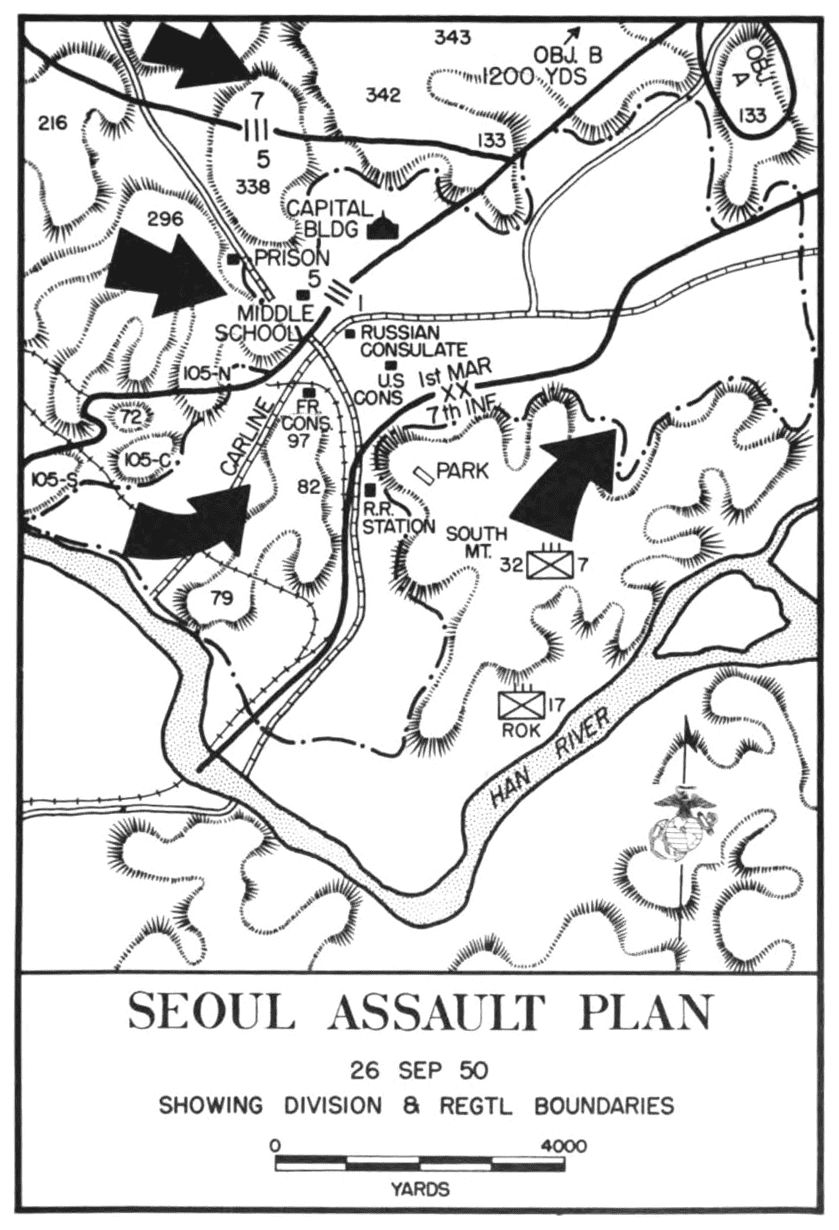
SEOUL ASSAULT PLAN
26 SEP 50
SHOWING DIVISION & REGTL BOUNDARIES
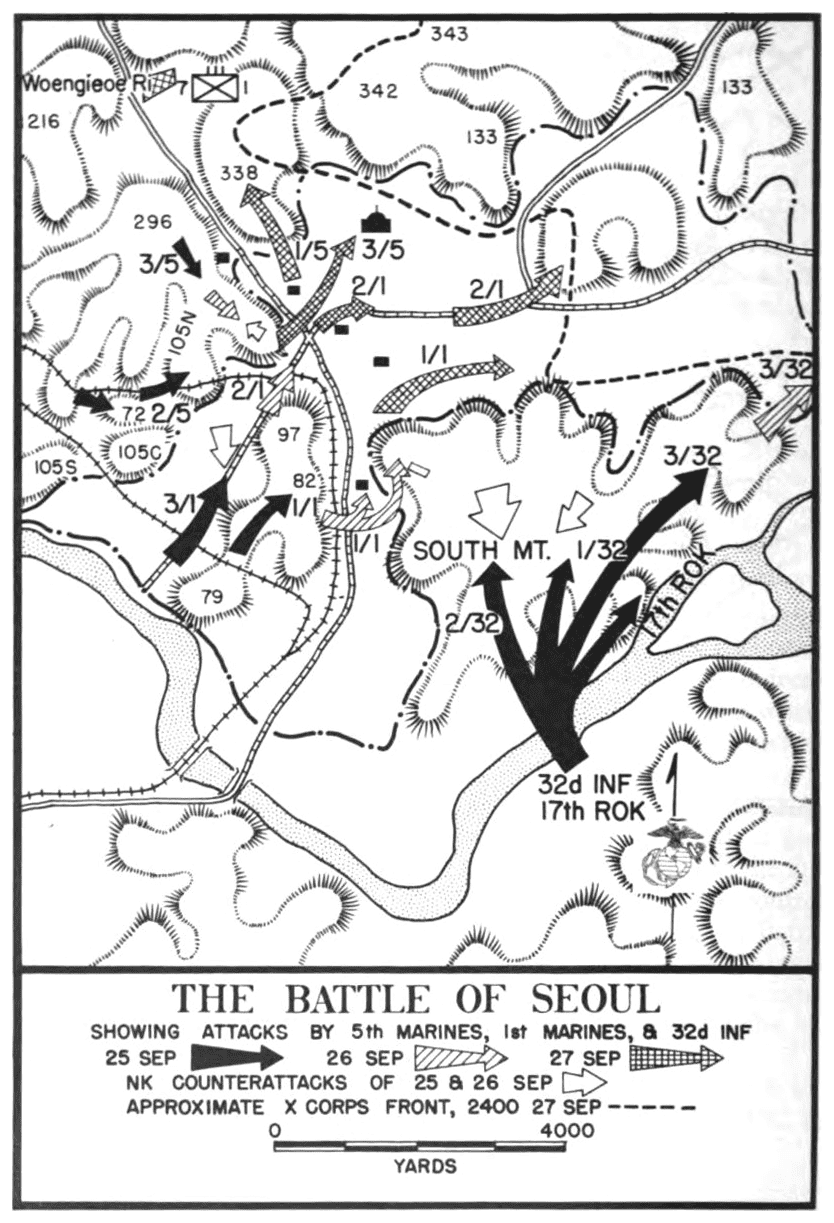
THE BATTLE OF SEOUL
SHOWING ATTACKS BY 5th MARINES, 1st MARINES, & 32d INF
Colonel Litzenberg dispatched Dog Company of the 7th Marines
southwest along the Kaesong Highway at 0630 on 26 September. The
mission of the unit was to approach Seoul and make contact with the
5th Marines on the right. In the van of the column was the company
machine gun officer, First Lieutenant William F. Goggin. For a while
it seemed as though this untried unit was reaping the laurels earned
by its battle-weary relatives of the 1st and 5th Marines, since hundreds
of Koreans lined the highway to welcome the “victors” with resounding
cheers.427
Progress was marked off rapidly in the absence of enemy resistance.
The Marines passed through Hoengjeoe-ri, and by 0900 the great slopes
of Hill 296 loomed up on the right and those of 338 on the left. Tracing
the road through the narrow valley between, the company approached
the Sodaemun Prison at the northwest corner of Seoul. Suddenly the
column came under machine-gun fire from a high tower about 400
yards down the road. The initial burst caused several casualties, including
Lieutenant Goggin, and the Marines quickly deployed on both
sides of the road. Several more enemy machine-guns and rifles opened
up from hillside positions only a hundred yards away. Since the
throngs of well-wishers along the highway had prevented the use
of flank guards, Company D was caught flatfooted in the low ground
by the hail of lead.
After a few minutes, other Red weapons began firing from the lower
slopes of Hills 296 and 338, directly to the flanks, and encirclement
seemed imminent. Dog Company’s commander, Captain Richard R.
Breen, reacted by ordering the 2d Platoon to attack the high ground
around the prison. Simultaneously, First Lieutenant Paul P. Sartwell
set up two 60mm mortars on the road and silenced one of the North
Korean emplacements. Directing his crews from an exposed position,
the young officer was wounded three times before finally being put
out of action.
First Lieutenant Edward H. Seeburger closed on the prison with his
2d Platoon, while First Lieutenant Paul V. Mullaney’s 1st ascended
the slopes of Hill 338 on the left. The 3d, under First Lieutenant
James D. Hammond, Jr., remained in position along the road. When
the assault platoons were stopped on the high ground by stiffening resistance,
Company D settled down in an elongated perimeter for a
battle of survival. There was no artillery support, but Marine air
assisted by pounding the crescent of Red positions.
The S-3 of the 7th Marines, Major Raymond V. Fridrich, radioed
Captain Breen and asked about the situation. Though now wounded
himself, Breen stated that he could hold his ground. A small tank-infantry
column was dispatched from regiment to reach the beleaguered
force with ammunition and supplies. By this time, however,
the Reds had set up in the rear of Dog Company, and the relief force
was turned back.
Faced with the bleak fact that it was now surrounded, Company D
withdrew 1000 yards to a defensible road cut between Hills 296 and 338.
The Marines completed the move with their wounded and dead at
1600. After being resupplied by air drop in their tight perimeter, they
prepared grimly for an all-night stand.
Elsewhere in the 7th Marines’ zone, 26 September would be remembered
as much for exhausting marches and climbs as for enemy contacts.
In the morning the 1st Battalion, under Lieutenant Colonel
Davis, had taken over flank responsibility far to the northeast along the
Kaesong highway, thereby relieving the 2d (less Company D) and 3d
for the advance on Seoul. The 2d Battalion then moved out in trace
of Dog Company, but according to plan veered leftward into the
hills at Hoengjeoe-ri, one mile short of the ambuscade. While 2/7
reconnoitered the high ground above the village, Major Roach’s 3d
Battalion completed an eight-and-a-half-mile forced march to gain an
assembly area in preparation for the assault of northern Hill 338.
At 1400 Fox and Easy Companies of 2/7 attacked eastward from the
height above Hoengjeoe-ri to seize Hill 343. After an advance of 1000
yards, they were stopped cold by heavy fire from the direction of Hill
338 to the south. Lieutenant Colonel Hinkle ordered 2/7 to dig in
short of the objective, since any further progress would only make his
right more vulnerable to the enemy guns on the flank.
Captain Thomas E. Cooney led Company G of 3/7 through Hoengjeoe-ri
about 1700, circled the northern half of Hill 338, then launched
a two-platoon assault on the crest. His Marines gained the north summit
against no opposition, but Company H, led by Captain Nicholas
L. Shields, was taken under fire in a draw to the right and held up
on the slopes for the night.428
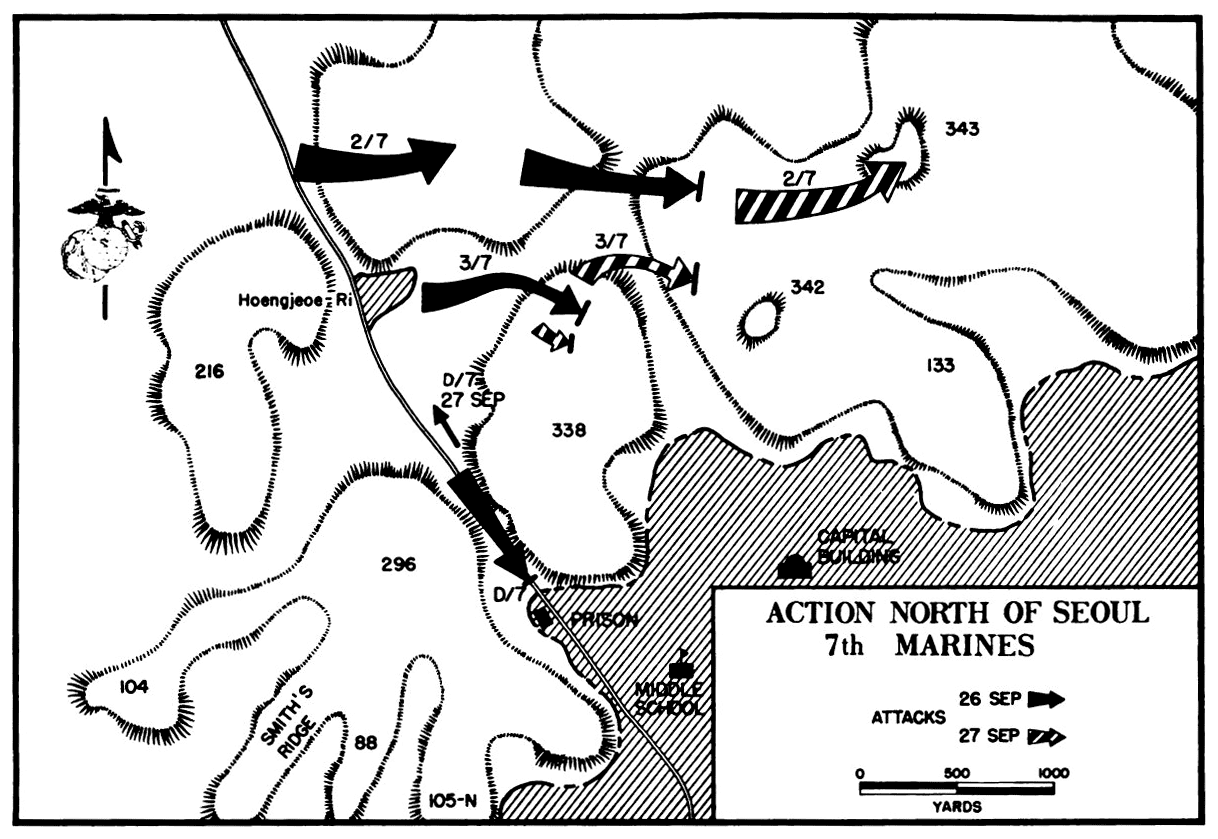
ACTION NORTH OF SEOUL
7th MARINES
While the 7th Marines were fighting uphill on 26 September, the 3d
Battalion, 5th Marines, punched downward in a bitter contest to clear
the last NKPA resistance from the Hill 296 complex. The attack was
launched early in the morning after preparatory fires by artillery and
81mm mortars. Item Company on the left was to sweep the remainder
of the giant spur which descended into the very heart of Seoul. George,
upon jumping off from the ridge above Hill 105-N, would clear the
low ground on Item’s right.
Dissatisfied with the accuracy of the preparatory barrages, and underestimating
the enemy’s strength and determination, Captain McMullen
called off supporting arms and based the success of his two-platoon assault
on organic company weapons alone. No sooner had the Marines
lunged downhill than great gaps were torn in the skirmish line by
fire from swarms of North Koreans on the lower slopes. Both assault
platoon leaders were wounded before an intermediate knoll was taken,
and McMullen was forced to commit his reserve to bolster the hard-hit
3d Platoon on the right.
Continuing the attack under the personal leadership of its commander,
the entire company waded into a maze of entrenchments
manned by 200 enemy soldiers. In the close-in fighting that followed,
the Reds were driven from their emplacements to seek cover farther
down the spur. The depleted ranks of Item Company ground to a
halt.
There followed a brief calm—abruptly shattered when the North
Koreans rallied and counterattacked uphill against the company center.
A wild melee enveloped the ridgeline, and the tactical situation
gradually became a blur. Just as it seemed the Marines’ hold on the
lower spur would be pried loose, Lieutenant Williamson plowed into
the tumult at the head of a small supply party. Ammunition distributed
in the heat of the fighting tipped the scales in favor of the
Marines, but not before McMullen was carried from the field as a
result of his seventh battle wound in two wars.
The heavy fighting finally eased toward the close of the day. Although
the last organized defenses of the enemy were smashed, Company
I was too badly battered to seize the tip of the spur before nightfall.
Abreast on the right, First Lieutenant Charles D. Mize led Company
G into defensive positions after a day of inching forward against
stubborn opposition in the low ground.429
Other units of the 5th Marines experienced little action during 3/5’s
day-long engagement. While the 2d Battalion mopped up in its zone
south of the 3d, the 1st KMC Battalion moved into position between
the latter and the Reconnaissance Company, now manning the topographical
peak of Hill 296 in the northwest. To the rear of 3/5, the 1st
Battalion enjoyed a quiet interlude in regimental reserve.
Early in the morning of 26 September, the 2d Battalion, 1st Marines,
moved out of reserve to pass through the 3d on the streetcar line and
continue the attack northward into the center of Seoul. On the right
of Puller’s zone, 1/1 prepared to descend Hill 82 and clear the main
railroad station and adjoining slopes of South Mountain, where increasing
enemy activity had been noted below the positions of the 32d
Infantry.430
Sutter’s unit completed the passage of lines at 0900 and attacked
along the boulevard with Fox and Easy Companies in the assault.
Leading the advance up the street were the tanks of Baker Company,
Cummings’ M-26 in the van. The young officer’s machine had proceeded
only a few yards when it struck an American M6 mine, overlooked
by Marine engineers while they were removing their hasty field
of the previous night. Not only did the explosion wreck the tank, but
it also caused several casualties among the infantry on either side.
The attack edged forward in the second day of the “Battle of the
Barricades.” Every 200–300 yards, fanatical Red detachments manned
rice-bag barriers about eight feet high and five feet thick, stretching
the whole width of the street. It fell to the M-26s to smash the emplacements
and silence the NKPA antitank guns behind each one.
Marine tank action in turn hinged on mine clearance by supporting
engineers, who looked to flanking infantry for covering fire. Thus
was a system of three-party teamwork developed and perfected during
the roar of battle.
Aiding the Communists behind the barricades were other North
Koreans who fired their rifles and submachine guns from roof tops,
windows, and side streets. The Marine infantry, therefore, had to
defend in every direction as it attacked to the front. Intense heat
from burning buildings along the street added to the handicaps, and
the constant discovery of South Korean civilians, including women
and children, huddled in the rubble further strained the taut nerves of
men who looked for trouble from every quarter.
It was a dirty, frustrating fight every yard of the way, perhaps best
described by Puller himself, who reported that “progress was agonizingly
slow.” A principal deterrent to speed was the fact that all
supporting tanks simultaneously expended their ammunition and fuel,
so that all had to return to the rear for replenishment at the same time.
During their absences from the fight, the infantry understandably
chose to await their return rather than pay heavily in casualties by
assaulting barricades with small arms alone.
At one point in the street battle, an enemy soldier darted from behind
a building and charged a flame tank advancing behind two lead M-26s.
Ignoring the Marine infantrymen, who gaped in disbelief, the
North Korean hurled a huge satchel charge over the engine compartment
of the armored vehicle, then escaped unharmed as the explosion
rocked the area. The flame tank was wrecked, but the crew escaped
serious injury with the assistance of supporting infantry. Apparently
a suicide squad of NKPA demolitions men had been assigned the
mission of destroying Marine armor in this fashion, for several other
Red soldiers tried single-handed assaults shortly afterwards. The riflemen
of 2/1 were alert for the later attempts, however, and the enemy
fanatics were cut down before inflicting further damage.
The crucial period in the 2d Battalion’s day-long fire fight came as
Captain Goodwin C. Groff’s Fox Company approached a street junction
below Hill 97. It had been planned that this unit would advance
through the intersection and continue along the streetcar line, while
Company E, moving behind in column, veered off on the right branch.
Enemy resistance against Fox’s advance proved so fierce that Captain
Norman R. Stanford by-passed the fork and threw Easy Company’s
weight in support of the other unit. The North Korean strong point
crumbled under the two-company onslaught, but not before Stanford
and several others were added to the casualty rolls.431
By dark, 2/1 had measured off a hard-won gain of 1200 yards.
Lieutenant Colonel Sutter ordered the battalion into defensive positions
astride the boulevard a scant 100 yards from the tip of the ridge spur
which was costing Item Company, 5th Marines, so dearly.
In the right half of Puller’s zone on 26 September, the 1st Battalion
stamped out a hornets’ nest around the main railroad station, nestled at
the foot of South Mountain.432 Charlie Company had led off the early
morning attack in the wake of a preparation by air, artillery, and
mortars. After descending Hill 82 in a column of platoons, the company
formed on line along a stream paralleling the rail yard. Then,
at a signal from Captain Wray, the platoons crossed over, wheeled to
the north, and advanced up the tracks by leaps and bounds.
Though the over-all intensity of enemy resistance in this quarter
could be termed only moderate, the random deployment of the Reds
among buildings and train cars made the going slow and costly for
the Marines. After clearing out the yard, the attackers converged on
the station house itself and drove the last North Koreans from the
building during a sharp exchange. The interior of the bullet-pocked
structure produced only a handful of enemy dead, but in one corner
were heaped the bodies of several South Korean women and children.
It was obvious that the latter had been gunned by Communist executioners,
since their sheltered location within the building was ample
protection against the small arms of the advancing Marines.
By darkness, Company C was in undisputed control of the railroad
terminal, a patrol led by Lieutenant Carlon having mopped up the
fringe area. To the right, Company A had secured the park promontory
on the northwestern tip of South Mountain in conjunction with
Baker Company’s drive which included the nose jutting out below.
East of the 1st Marines, the 32d Infantry’s zone was the scene of considerable
activity throughout 26 September. After the 2d Battalion
repulsed the enemy’s pre-dawn counterattack, the 3d jumped off at
0800 from positions a mile and a half east of South Mountain. Its
objective, Hill 106, lay more than 3000 yards away, just south of the
highway leading eastward out of Seoul. Approaching the base of the
ridge, Company L surprised and destroyed a strong NKPA position,
while Company I swept up the objective itself against light opposition.
Reaching the summit, the company commander called an air strike
on an enemy column marching out of Seoul on the highway. As the
planes broke up the Red formation, Company L, reinforced with tanks
and additional infantry, drove down the road to mop up and block the
escape route.433
In the day-long attack, 3/32 and its supporting armament accounted
for 500 enemy dead, five tanks, 45 vehicles, three artillery pieces, and
two ammunition dumps, according to regimental reports. The remainder
of the 32d, now augmented by the 2d Battalion, 17th Infantry,
in addition to the 17th ROK, saw spots of heavy fighting during the
mop-up and consolidation on and around South Mountain. Casualties
for the 32d, as reported on 26 September, were six KIA, 92 WIA, and
three MIA. Most of those reported the following day—32 KIA, 33
WIA, and nine MIA—could also be traced to action on the 26th.434
Thus the Army regiment, having been impressively blooded in its
eight days of action, could lay claim to clearing both South Mountain
and that 15 per cent of Seoul’s built-up area east of the great height.435
In the course of the day, the 1st Marines had made patrol contact
with the 5th Marines in the left rear and with Army elements atop
South Mountain on the right flank. Prospects for the morrow
appeared much brighter at Division and Corps levels, where there
must have existed some apprehension over the complicated maneuvering
which had denied the attackers a solid front until they were in the
heart of the sprawling capital.
The twenty-seventh of September dawned as the day of reckoning.
Applicable to the tactical situation in Seoul was the old law of physics,
that two bodies cannot occupy the same space at the same time. With
X Corps troops pouring into the city and environs to share them with
the Communist garrison, it was axiomatical that one side or the other
would shortly have to go.
Oddly enough, despite the electrified atmosphere, the night of 26–27
September had passed quietly, even for Dog Company, 7th Marines,
isolated in the road cut between Hills 296 and 338.436 At dawn a tank-infantry
team supported by engineers of Company D, 1st Engineer
Battalion, advanced down the Kaesong Highway against negligible
resistance and escorted the beleaguered rifle company back to the 7th
Marines CP at Hoengjeoe-ri.
While the anticlimatical “rescue” was taking place, the 3d Battalion
jumped off in the attack, supported by fire from the 2d on the left, to
clear the northern reaches of Hill 338. How Company pressed forward
up the draw on George’s right but was stalled by heavy fire which
suddenly erupted on the slopes above. The 3d Platoon, under Second
Lieutenant Paul E. Denny, broke through in its zone, only to be recalled
by Shields when the rest of the company failed to regain the
lost momentum. Captain Richard H. Sengewald’s Item Company, en
route to take positions on the left of George, paused to assist Shields’
outfit for a short time. After further attempts by Company H to gain
the summit were unsuccessful, Sengewald led his unit to the north and
attacked the right flank of the NKPA elements scattered indiscriminately
over the remote humps of Hill 338. The situation on the
northern half of the towering objective did not change appreciably
in the course of the day.
Colonel Litzenberg developed further pressure against the enemy’s
right by ordering 2/7 to continue the attack against Hill 343 in midmorning.
On the right of the battalion zone, Captain Walter D.
Phillips, Jr., led Company E forward in the face of stubborn enemy
resistance from the crest. Owing to steady North Korean fire and the
rugged terrain, gains were measured off by the yard, both for Phillips’
unit and for Captain Elmer J. Zorn’s Fox Company on the left. By
nightfall, nevertheless, the Marines had mastered the situation to the
extent that Company E sat firmly entrenched atop Hill 343—2500
yards from its starting point.
More force was applied to Litzenberg’s flanking lever north of Seoul
when Company G was withdrawn from its ridgeline on Hill 338 and
ordered to attack eastward to seize Hill 342, which loomed above the
capital building in the northern tip of Seoul. Circling through the
low ground north of Hill 338, the company passed safely through an
extensive minefield that had been conveniently marked off by friendly
South Koreans. As the Marines approached the base of their objective
and came under heavy sniper fire, Captain Cooney ordered the 1st
Platoon, under Second Lieutenant Arthur R. Mooney, to set up a base
of fire on intermediate high ground in order to support an assault by
the 2d and 3d.
The plan backfired, for the 1st Platoon became engaged in a hot
fire fight as it moved toward the designated position. The two assault
units fared no better when, without the expected covering fire, they
were hit by a hail of lead on the lower slopes of Hill 342. Several
officers and NCOs were killed or wounded within a matter of minutes,
and the scattered fighting that continued until nightfall brought about
no significant change in the local situation.
Thus, the day ended on Litzenberg’s “Seoul Front” with the 7th
Marines in control of Hill 343 but sharing parts of 338 and 342 with the
NKPA. The story would not be complete, however, without a brief
visit to the regiment’s “Haengju Front,” several miles to the west,
which had crackled with activity during the early afternoon. About
1200, a company of North Koreans emerged from the northern hills
and attacked toward the old ferry crossing at Hill 125. On the way the
Reds had the misfortune to stumble into Captain David W. Banks’
Able Company of 1/7, manning a blocking position at Ryokoku. (See
map of Han River crossing). To avoid the danger of infiltration in
the bustling bridgehead, Lieutenant Colonel Davis promptly committed
Company C, under Captain Richard F. Delamar, III.
Despite their disadvantages in numbers and fire power, the dogged
Reds extended the fight sufficiently to involve even a platoon of Captain
Myron E. Wilcox’s Baker Company. After a prolonged clatter, the
engagement ended almost as abruptly as it had begun; and the immediate
result was that all Communist troops above the ferry site
withdrew to Kaesong.
The 7th Marines claimed 375 enemy killed and 34 taken prisoner in
the fighting which ranged its vast front from 23 to 27 September. The
spoils of war included the strangely unbalanced assortment of four
machine guns, six rifles and 600 bayonets.
While the 2d and 3d Battalions of Litzenberg’s regiment struggled
among the massive ridges north of Seoul on the 27th, the 1st and 5th
Marines struck at the vital nerve center of the ROK capital. The
regimental attacks through the center of the city began as separate
thrusts in the morning, but as the day wore on they took on aspects
of a coordinated foot race. It could even be said, finally, that the battle
became a flag-raising contest between the two Marine units, as the
last NKPA resistance died in heaps of rubble and torn rice bags.
At 0645, the 3d Battalion, 5th Marines, jumped off to clear the tip
of Hill 296’s troublesome eastern spur. For the first time in longer
than they cared to remember, the infantrymen were greeted not by
a sheet of small-arms and machine-gun fire, but by occasional, erratic
pops from the rifles of dispirited snipers. Groping through the smoke
and haze boiling up from the shattered city, Companies G and I
swept the high ground by 0730 and—at long last—slowly filtered
through the first streets of western Seoul. In short order they were
encountering the expected barricades and minefields. There was a
hint of stiffening opposition, but it quickly dissolved as the riflemen,
backed by supporting tanks and engineers, ground forward
relentlessly.437
By 0930, George Company made contact with the 1st Marines on
the right.438 Less than an hour later, after wheeling northward 3/5
controlled Middle School and adjacent high ground—the springboard
for the assault on the capital building 1000 yards away. At 1200,
Lieutenant Colonel Taplett ordered Companies G and I to continue
the attack, guiding on the two Red flags which whipped the wind defiantly
on both sides of the great dome ahead. Meanwhile, the 1st
Battalion moved up behind and prepared to advance on the left of
the 3d. Its mission in the final assault was to seize the craggy peak of
Hill 338, which reared upward on the left of the capital building like
a grim fortress.439
On the right of the 5th Regiment, the 2d Battalion, 1st Marines had
smashed through another series of rice-bag barriers on the boulevard
and at 1057, the United States colors unfurled above the French Consulate.
A furious fight exploded around the city’s main intersection,
where the principal streetcar lines crossed to form an X not far from
Middle School. Company D, spearheading 2/1’s drive, waded into the
fray with determination. Lieutenant Cummings, who by this time
appeared to have a remarkable affinity for heavy trouble, again lost
his tank to enemy mines, but not before he had knocked out two
Russian 76mm self-propelled guns emplaced in the middle of the
intersection. Staff Sergeant MacDonald’s M-26 obliterated an NKPA
truck with two 90mm rounds when the vehicle tried to escape with a
howitzer and its crew.440
The afternoon of 27 September was a time of climax as the 1st Marine
Division front surged forward of Middle School and the central intersection.
Though beaten and faltering, the North Koreans still managed
to fight stubbornly here and there; but their over-all deployment
no longer bore any semblance of tactical integrity.
By early afternoon the Reds facing the 5th Marines broke and fled.
Troops of 3/5 poured into the government compound, their final
objective, and secured it at 1508. The North Korean flags were struck,
and in their place rose the United States colors. Somewhat awed by
the historic import of their accomplishment, young Marine riflemen
wonderingly probed the spacious halls and chambers of the huge
building that shortly would be reoccupied by the government of the
Korean Republic.441
On the left of the 3d Battalion, Company A of 1/5 had launched
its attack on Hill 338 at 1300 in the wake of devastating preparations by
air, artillery, and mortars. Second Lieutenant Nicholas M. Trapnell
led off with the 1st Platoon, which seized an intermediate piece of
high ground against moderate resistance. The 2d Platoon, under
Second Lieutenant Edward E. Collins, then drove forward on the left
of the ancient wall leading to the crest of the objective; but the attack
was stopped by heavy mortar and small-arms fire. Marine air thundered
down to rake the target with machine guns and rockets. The
ground troops followed up with heavy concentrations of 60mm and
81mm mortars. Moving closely behind the supporting fire, the 1st
Platoon overran a knob situated below the dominating peak. The 2d
Platoon then resumed its advance on the left of the wall, and the 3d,
under Technical Sergeant George W. Bolkow, took the lead on the
right. It was the latter unit that smashed through the last resistance
and secured the cliffs at the summit of Hill 338 at 1850.442
While the 5th Marines completed its final mission in Seoul, 2/1 on
the right continued along the streetcar line which curved below the
government buildings to run eastward to the far edge of the city. Since
the 7th Marines had been slowed in the hills north of the capital, the
expected tie-in on the left flank did not occur, and Puller’s troops had
to go it alone through the dense maze of streets in eastern Seoul. At
1530 infantrymen of 2/1 raised the American flag over the Russian Consulate,
just to the right of the curve in the boulevard. Seven minutes
later the flag also waved above the United States Consulate, about 350
yards farther off on the flank.443
To the right of 2/1, the 1st Battalion was making good progress
after a slow start against stiff opposition. Charlie Company had been
held up at the outset in the neighborhood of the railroad station, but
supporting tanks, including flame throwers, had paved the way by
blasting and burning a formidable nest of NKPA automatic weapons
and AT guns. One armored vehicle was disabled by a mine and
another by antitank fire before the Marines finally broke through. As
the battalion pivoted eastward in accordance with the general plan,
both Charlie Company and Able on the right hammered through the
usual barricades and suicide detachments.444
The 32d Infantry and elements of the 17th enjoyed a relatively quiet
day on and around South Mountain, for these units had only to hold
firm in their positions until the 1st Marines could complete its wheeling
movement and come abreast, facing east.445
Shortly before 1630, 2/1 was pounding eastward through a stretch of
the streetcar line south of the government compound. Fire poured
into the ranks of Dog Company from three sides, and Marines sweltered
in the heat of burning buildings that offered dubious protection.
Corsairs screamed down to plaster enemy positions only a block ahead
of the foremost infantry. Immediately after each pass by the gull-winged
planes, Second Lieutenant Carl B. Thompson, Jr., led his 1st
Platoon in the assault with covering fire provided by supporting tanks.446
There was a final surge up the street by the green-clad riflemen
and BAR-men, and then it was all over. At 1630 enemy resistance
across the 1st Regiment’s front abruptly collapsed, with the result
that the Battle of Seoul came to an end. Snipers and bypassed pockets
remained to be mopped up by the Marines, KMC units, and South
Korean Police; but the NKPA had clearly quit the fight and abandoned
the city. The 1st and 2d Battalions of the 1st Marines marched rapidly
through desultory sniper fire to the eastern part of town, where they
dug in for the night.447
CHAPTER XIV The Drive to Uijongbu — Operations of 28 September — Liberation Ceremonies at Seoul — Crumbling of NKPA Resistance — Last Days of Inchon-Seoul Operation — Summaries and Conclusions — MacArthur’s Report to United Nations
Operations of 28 September—Liberation Ceremony at Seoul—Crumbling
of NKPA Resistance—RCT-7 and the Battle for
Uijongbu—Last Days of Inchon-Seoul Operation—Summaries
and Conclusions—MacArthur’s Report to United Nations
As rapidly as the advance of the troops permitted, preparations
were made for the restoration of civil government to Seoul. A
group of former city officials had arrived by plane from Pusan; and on
26 September, Mayor Lee opened a temporary office in Yongdungpo.
The police chief, construction engineer, and the health and welfare
officials also resumed their old duties.
Collecting points were set up for handling the civilian wounded.
The following statistics, comprising the patients treated for all causes
by the 1st Medical Battalion of the 1st Marine Division, show that
Korean civilians were second in numbers only to the Marines themselves:
| U. S. Marine |
2,811 |
| Korean civilian |
1,908 |
| U. S. Army |
358 |
| KMC and ROK |
322 |
| U. S. Navy |
78 |
| POW |
44839 |
The problem of food for a city with a pre-war population of a million
and a half was met during the advance when stores of rice and other
supplies were turned over to Seoul officials by the Marines. Medical
supplies found in the city were redistributed for use in Seoul and
Inchon hospitals as well as the hospital established at Yongdungpo
by Captain Hering, the Division Surgeon, expressly for the treatment of
civilian wounded.
A shipment of some 50 tons of rice through X Corps, plus large
amounts located in Seoul by the Marines, enabled the officials to take
over without critical food shortages. On the 28th, Mayor Lee moved
into the city hall at Seoul and acted immediately to re-establish police
authority, clear destroyed areas and provide for the restoration of such
public utilities as water and electricity.449 These prompt measures did
much to ease the hardships of thousands of returning refugees.
The 5th Marines passed an uneventful day on 28 September, having
taken its assigned objectives and been pinched out by the 1st Marines
on the right and the 7th Marines on the left, as planned. An assembly
area was established in the vicinity of the Women’s University, and
though the regiment sent out patrols, no enemy were encountered.450
The 7th Marines put in a busy day at seizing objectives which consisted
of the high ground north of Seoul on both sides of the main
highway from the capital to Uijongbu. Opposition was light to moderate,
with the stiffest resistance occurring in areas which indicated that
the enemy intended to put up a fight to protect his escape route to
Uijongbu. Seventy-five tons of American-made dynamite and explosives,
captured by the 7th Marines, were believed to have been
originally supplied to the ROK forces before the war and abandoned
during the NKPA invasion.451 Total advances for the day ranged from
1,500 yards in the zone of the 3d Battalion to 2,600 yards in the zone of
the 2d Battalion.
When the 1st Marines jumped off at 0645 on the 28th, the 1st and 2d
Battalions were in assault. The 3d Battalion remained in an assembly
area in the rear and continued mopping up along with the 2d KMC
Battalion. Although organized resistance in the city had been broken,
the 1st Battalion met stubborn resistance from enemy groups and
encountered many mines. The 2d Battalion, on the left, made headway
against light opposition.
These attacks cleared the remainder of Seoul and took the assault
battalions to Hill 133 (Objective ABLE) commanding the city on the
northeast.452
General Smith visited the CPs of all three regiments on the 28th by
helicopter. He found Colonel Puller at the Ducksoo Palace, near the
intersection of the streetcar lines. Colonel Litzenberg’s CP was located
a short distance to the west, and Lieutenant Colonel Murray had established
his headquarters in the Women’s University on the northwest
outskirts of the city.
Later that day Generals Smith and Craig displaced the Division CP
from Oeoso-ri to a barracks area in Seoul, southwest of South Mountain.
The two Marine generals took over a former infirmary, but they decided
that the mortuary slab was too depressing and had that fixture
removed.453
Planning for impressive liberation ceremonies at Seoul had begun while
the street fighting was at its height. The 1st Marine Division was
requested by Corps to furnish two honor guards and a band. Musical
instruments having been left behind in Japan, air shipment was
prescribed.454
General MacArthur had hoped to hold the liberation ceremony at
Seoul on 25 September, just three months to the day after the launching
of the NKPA invasion. The enemy, however, was not cooperative
with respect to this date; and even on the morning of the 29th, three
NKPA counterattacks were repulsed on the outskirts of the city. As
it proved, General MacArthur vetoed plans for a ceremony with
band music. “I will personally conduct the proceedings without being
introduced,” said his message to X Corps, and he specified that there
be no honor guard.455
Two pre-dawn counterattacks on the 2d Battalion, 1st Marines,
were not auspicious beginnings for the day of the liberation exercises.
The first occurred at 0445 on 29 September, when the OP,
located on a spur projecting forward of the MLR and defended by a
rifle platoon, was infiltrated by an estimated 70 to 100 NKPA troops.
A second enemy attack hit the left flank of the battalion shortly afterwards.
Both attempts were repulsed with total losses of 48 to the Communists,
and the Marines had casualties of 4 KIA and 28 WIA, most
of them resulting from hand grenades.456
Another assault, launched by the enemy at 0600 in the zone of action
of the 7th Marines, was repulsed without trouble. Most of the fighting
on 29 September was done by this regiment, which pushed forward to
gain all the rest of its objectives before nightfall.
At dawn, in preparation for the liberation ceremony, Marine guards
were unobtrusively stationed along the route of approach from the
new floating bridge to the Government Palace. This duty fell chiefly
on 3/1, with elements of the 5th Marines being responsible for security
in the western part of the city.
General MacArthur and President Syngman Rhee drove directly
to the Palace after separate arrivals at Kimpo Airfield. The guests
included Korean dignitaries and United Nations officials in addition
to high-ranking representatives of military organizations.
The commander in chief opened the ceremony with a moving five-minute
address ending with the Lord’s Prayer. The rumble of artillery
could be heard at times, and some of the guests glanced up
apprehensively at the shattered skylight overhead.
“Occasional falls of glass from the dome and drifting smoke and
ashes were part of the scene,” commented a Marine officer. “Unheeded
noise of rifle shots punctuated the talks. Grim Marines from Puller’s
regiment surrounded the seated audience.... The youth of the
guards was offset by the tall, gray-haired figures of Generals Smith and
Barr at the front of the audience. They were patently the men who
had borne precisely and capably the load of decision.”457
With the 1st Marine Division still responsible for security, it was a
relief to General Smith when the distinguished visitors departed unharmed.
Not all the mines had been removed from the streets as yet,
and it was suspected that snipers might still be lurking in the ruins.458
Although more hard fighting lay ahead in the Inchon-Seoul operation,
X Corps alerted its major units on 29 September to the possibility of a
new amphibious landing on the east coast of Korea. This was one of
the earliest announcements of the planning which led to the Wonsan
landing and the advance to the Chosin Reservoir, but the history of
those events belongs in the next volume of this series.
The new operation was suggested by the rapid disintegration of the
main body of the NKPA invasion forces. In a single day, 26 September,
elements of the 1st Cavalry Division had advanced more than 100
miles; and a total of about 23,600 prisoners were taken by the Eighth
Army before the end of the month. Enemy resistance was still encountered,
to be sure, and sometimes it was of a desperate nature as
Red Korean troops fought to escape encirclement. But all hope and
heart had gone out of the Communist cause. One Eighth Army column
sliced across the peninsula to Kunsan while other spearheads
drove northward and ROK units pushed up the east coast nearly to
Samchok. NKPA opposition was crumbling everywhere as demoralized
invasion troops threw away their weapons and changed to civilian
clothes in the hope of making their way to North Korea through the
ever tightening Eighth Army cordon.459
The X Corps troops in the Seoul area had enough on their hands to
finish the old operation before starting a new one. 1st Marine Division
OpnO 13-50, issued at 2000 on 29 September, provided for the securing
of the captured city by these means:
(1) a continuation of the attack to the east;
(2) the conduct of reconnaissances in force to the north and northwest;
(3) the relief of elements of the 7th Infantry Division north of the river Han;
(4) the seizure of prescribed blocking positions.460
The Division plan of maneuver called for the three Marine rifle
regiments to take blocking positions forming a rough semi-circle defending
Seoul from three sides—the 5th Marines to the northwest, the
7th Marines to the north, and the 1st Marines to the northeast. Responsibility
for the area north of the Han river and west of the Pukhan
River had passed to the 1st Marine Division, and at 1500 on 30 September
the following missions were assigned by OpnO 14-50:
RCT-1—To protect the right flank of the Division and be prepared to
assemble in Division reserve by battalions for a motor lift. Blocking positions,
as assigned by OpnO 13-50, consisted of high ground from two to five
miles northeast of Seoul.
RCT-5—To continue reconnaissance in force with minimum of a reinforced
battalion to Suyuhyon and establish a blocking position; to protect the
left flank of the Division; and to be prepared to provide a reinforced rifle
company for Task Force Kumpo, on order. These attachments to be made:
1st Battalion, 11th Marines, and one battery of 50th AAA Battalion, USA;
Company A, 1st Tank Battalion; Company A, 1st Engineer Battalion; and a
company from the 1st Motor Transport Battalion.
RCT-7—To advance rapidly and seize blocking positions in the vicinity
of Uijongbu. These attachments to be made: 3d Battalion, 11th Marines, and
one battery of 50th AAA Battalion, USA; Company D, 1st Tank Battalion;
and one company of the KMC Regiment.
The KMC Regiment (less the 1st and 3d Battalions and one company of
the 5th Battalion, with a detachment of ANGLICO attached) was meanwhile
to advance to the east and seize blocking positions at the junction of the Han
and Pukhan rivers where the road leading northeast from Seoul reaches
that point. The 1st KMC Battalion had been attached to the 7th Infantry
Division, and the 3d Battalion was operating on the Kumpo Peninsula.
Task Force Kumpo, when activated on Division order, was to consist of
the 3d KMC Battalion and Battery C, 50th AAA Battalion, USA, plus a 5th
Marines rifle company and a tank detachment, if required. As it proved,
however, X Corps held responsibility for the defense of this area until 2
October, when the 187th Airborne RCT was relieved by Task Force Kumpo.461
Two more small fire fights awaited the 5th Marines in carrying out
the missions assigned by Division OpnO 14-50. At 1030 on 1 October,
while patrolling the extensive area of regimental responsibility, a detachment
of 2/5 made contact with an NKPA force estimated at 150
to 200 men. Air strikes and mortar fire soon took the fight out of the
enemy, who left 30 dead behind.
At 0600 on 1 October the 3d Battalion, reinforced with a battery of
artillery and a platoon of tanks and engineers, moved out toward
Suyuhyon. Charlie Company of 1/5 followed in trace to protect the
battalion rear and provide security for returning motor transport.
Two road blocks were cleared before the battalion tied in for the
night on high ground just short of the objective. Then, at 0230 the
next morning, the enemy struck in estimated company strength. The
attempt was repulsed by machine-gun fire, and 67 Red Korean bodies
were found at daybreak in the attack area. At 0700 the column resumed
the march to Suyuhyon, which was occupied without further
incident.462
The 1st Marines found little difficulty in carrying out all missions
assigned by Division OpnO 14-50. In fact, the regiment had only a
few minor patrol actions after taking blocking positions northeast of
Seoul.
Colonel Litzenberg’s men were now making the main effort of the
1st Marine Division. Preparations for the drive to Uijongbu began
with every indication that the enemy was bent upon flight. A patrol
from the 3d Battalion found 30 Korean bodies beside a wall, including
several women and a child, whose hands had been bound behind them
before they were shot. The victims, according to a POW, were members
of the families of ROK soldiers.463
Positions had been consolidated by the late afternoon of 30 September
in readiness for the jump-off in the morning. The 7th Marines might
well have been called Task Force Litzenberg at this stage for it was reinforced
by Major Parry’s 3d Battalion of the 11th Marines, Captain
Lester T. Chase’s Company D of the 1st Tank Battalion, Captain Byron
C. Turner’s Company D of the 1st Engineer Battalion, and Captain
Kim’s Company C of the 5th KMC Battalion.
The drive to the new objective began at 0630 on 1 October in a
column of battalions. Air reconnaissance had made it appear likely
that any NKPA resistance would probably take advantage of a tactical
bottleneck, about halfway to Uijongbu, where steep and rocky ridges
overlooked a narrow defile through which the road passed. Colonel
Litzenberg and his staff decided to maneuver by sending the 1st Battalion
to make a broad feint to cover the entry of the 3d Battalion into
the defile with tank support while the 2d Battalion followed in reserve.
Lieutenant Colonel Davis secured his preliminary objectives, then
swiftly spread out on both sides of the defile for his feint. Unfortunately,
Major Roach was delayed by an enemy mine field, which
brought the 3d Battalion and the tanks to a halt while the engineers
cleared the way. Davis’ simulated attack had meanwhile disclosed
that the enemy was entrenched in depth along the high ground on
each side of the defile. Both Marine battalions took heavy NKPA
artillery and mortar fire before halting for the night.464
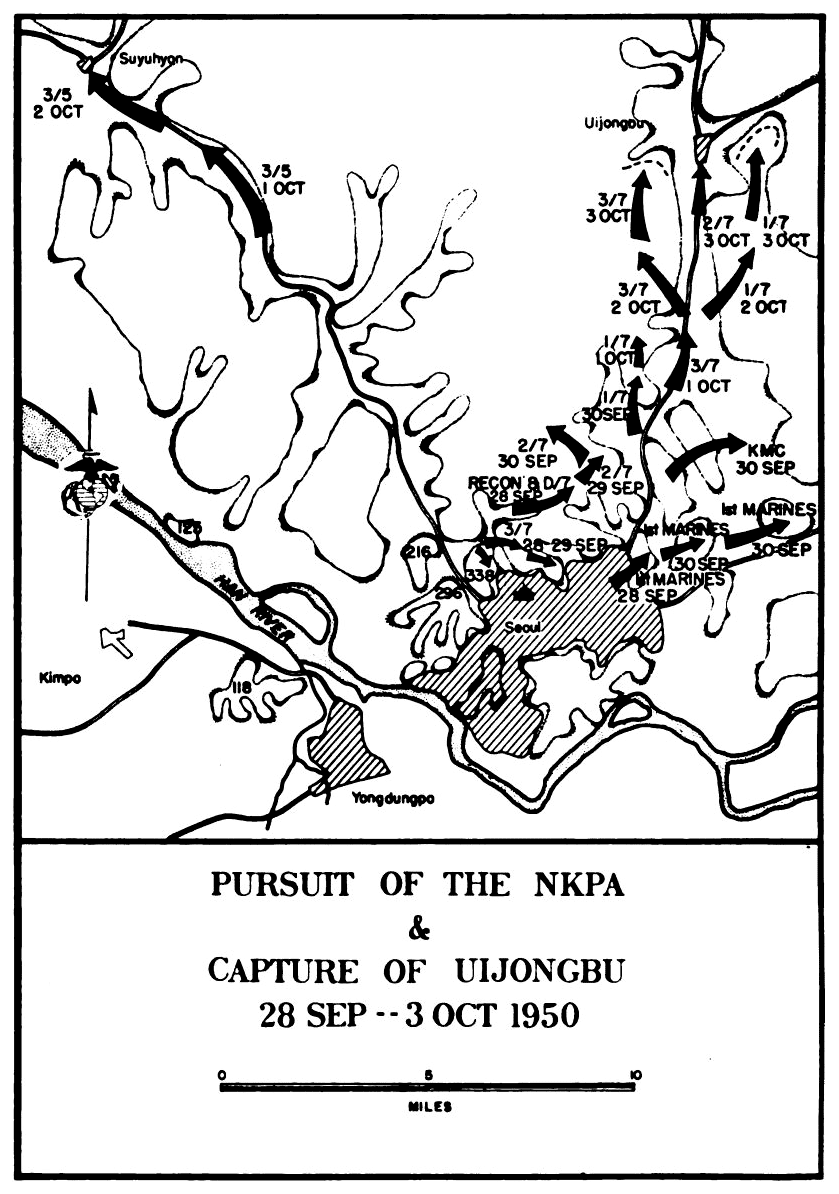
PURSUIT OF THE NKPA
&
CAPTURE OF UIJONGBU
28 SEP—3 OCT 1950
At least the day’s attacks had unmasked the enemy’s positions and
exposed them to savage attacks by the Corsairs of VMF-312. RCT-7
continued the attack at 0630 on the 2d, with Roach on the left of the
road and Davis on the right. About halfway through the defile the
3d Battalion was pinned down by a concentration of NKPA artillery,
mortar, and small-arms fire. Again the tanks were held up while the
engineers cleared away mines, working in a hail of bullets. The tanks
of the 1st Platoon repaid the favor by closing in on two huts sheltering
NKPA troops and killing an estimated 35. Here an attached dozer
tank, without blade, had a freakish accident when two men in the
turret were wounded by enemy fire down a 105mm gun tube while
the breech was open.
The 1st Battalion managed to cross the stream east of the defile and
seize the high ground just beyond. But the day ended with gains of
only 300 yards in the defile.
Roach’s men returned to the attack in the morning, supported by the
tanks of the 2d Platoon. Again VMF-312 flew one close air support
sortie after another. Major Charles E. McLean was hit by enemy AA
fire but crash-landed his plane in friendly territory. First Lieutenant
Robert O. Crocker was killed in action shortly after being brought
down by NKPA small-arms fire.
VMF-312 fliers intercepted an enemy convoy and First Lieutenant
Franklin Stratton reported the destruction of seven out of eight trucks.
The tanks also gave the infantry helpful support, firing 167 90mm
rounds during the day and an estimated 20,000 machine gun rounds at
enemy troops along the ridge.
While 1/7 cleared the high ground on the east side of the road and
3/7 on the west side, Colonel Litzenberg directed Major Webb D.
Sawyer465 to pass between them with 2/7 and drive directly along the
highway. Progress was satisfactory from the start. When Sawyer’s
men began to overrun abandoned NKPA artillery pieces and supply
dumps, they pounded ahead with the realization that enemy resistance
was broken.
At five that afternoon the 2d Battalion entered the ruins of Uijongbu,
evacuated by the enemy. The last large-scale fight of the Inchon-Seoul
operation had ended in a smashing victory for the Division’s youngest
regiment.
Identifications showed that the Marines had been opposed by three
battalions of the 31st Regiment of the 31st NKPA Division. Elements
of the 17th and Seoul Divisions and of an artillery battalion were also
encountered. These troops had been supported by 13 tanks, of which
four were killed by Marine air attacks and two captured in a damaged
condition by 2/7 after the others escaped.
The three-mile advance of RCT-7 on 3 October had resulted in the
cutting of lateral communications to the east and west of Uijongbu
and the securing of an important blocking position on the X Corps
final phase line. Losses of 13 killed and 111 wounded were suffered by
the regiment in the three-day fight.
The climax of the battle was witnessed by General Cates, who visited
the front on 3 October, accompanied by Major Generals Edwin A.
Pollock and Clayton C. Jerome. After being briefed at the Division
CP by the G-1, G-2, G-3, and G-4, the Commandant inspected the
positions of RCT-1 and RCT-5 by helicopter before taking a jeep tour
along the road to Uijongbu to watch Colonel Litzenberg’s men slug
their way forward into the battered town.466
That evening the fighting virtually came to an end, for the 1st
Marine Division had a total of only seven casualties during the last
four days of the Inchon-Seoul operation. The rifle regiments had only
to maintain their blocking positions while patrolling to front and flank.
Operations on the Kumpo Peninsula, which had been sputtering intermittently
ever since the occupation of the airfield, also drew to a
close.467 Responsibility for the area having passed from Corps back to
Division on 2 October, elements of the 187th Airborne RCT were
relieved by Task Force Kumpo, consisting of the 3d KMC Battalion,
a detachment from the 1st Signal Battalion, and Battery C of the 50th
AAA Battalion, USA.
Naval gunfire had found its greatest mission of the exploitation phase
in support of the widely assorted units which protected the left flank
of X Corps at various times. The 187th, being short on artillery, had
relied on the naval gunfire and spot teams commanded by Lieutenant
(jg) Leo D. McMillan, USN, and First Lieutenant J. E. Dolan, of the
2d Battalion, 7th Marines. These officers and their men remained with
Task Force Kumpo after it relieved the 187th, but patrols reported no
enemy contacts after 2 October. The chief activity on the peninsula
was listening to the baseball games of the World Series, which came in
clearly over the radios of the naval gunfire teams.468
As directed on 5 October by OpnO 15-50, the last to be issued by
the Division in the Inchon-Seoul Operation, the major Marine units
were scheduled to close into staging areas in Inchon as follows:
| 5th Marines |
1800 on 5 October; |
| 11th Marines |
1700 on 6 October; |
| 1st Marines |
Prior to darkness, 6 October; |
| 7th Marines |
Midafternoon, 7 October; |
| KMC Regiment |
Prior to darkness, 7 October. |
An impressive ceremony was held on the 6th, when the cemetery
established by the Marines on the outskirts of Inchon was taken over
by the United Nations. After an invocation by Chaplain R. M. Schwyhart
of the 1st Marine Division, General Almond made a few remarks
and laid a wreath on the grave of an unknown soldier. Then General
Smith, General Barr, and Colonel Lee performed the same ceremony
over Marine, Army, and ROK graves. Volleys were fired, taps were
sounded, and the dedication ended with the national anthems of the
United States and Korea.469
There could be no doubt, as the Marines prepared to mount out for
a new amphibious operation, that the NKPA invaders had been
knocked out of the war by the combined X Corps and Eighth Army
offensives. The Red Korean retreat had become a rout, and Marine
staff officers considered it doubtful whether the enemy could hold the
east coast port of Wonsan long enough to defend it against the proposed
new Marine assault landing.470
It was apparent, in fact, that only the active intervention of Red
China or the Soviet Union could save the North Korean People’s Republic
from imminent collapse. At this time, however, it did not
seem likely that any such attempt would be made.
And so it was that one of the most remarkable amphibious operations
in Marine Corps annals came uneventfully to an end on 7 October
1950. Early in the morning the Division CP displaced from Seoul to a
housing area just north of Ascom City. At 0935, in accordance with X
Corps OpnO 5, General Smith reported to Admiral Doyle, ComPhibGru
One, for duty as commander of the landing force for the proposed
Wonsan assault. And at 1200 the Inchon-Seoul operation passed into
history when the last troops of the 7th Marines were relieved in the
Uijongbu area by elements of the Eighth Army.
At this stage the men of the 1st Marine Division and 1st Marine Aircraft
Wing were still too close to the operation to see it clearly in
detail. If there was any one overwhelming impression they all had in
common, it was a sense of the speed with which events had raced
toward a climax.
This was by no means an illusion. Hundreds of Marine reservists
had watched baseball games or enjoyed picnics with their families on
the Fourth of July, never dreaming that shortly after Labor Day they
would be scrambling out of landing boats to assault a flaming Asiatic
seaport on the other side of the earth!
Speed was an essential if the assault landing were to be completed on
the prescribed D-day. But there was no place for the proverbial haste
that leads to waste. It had to be the speed of precision—an acceleration
of men and events made possible by the amphibious know-how of a
Navy-Marine Corps team that had worked together throughout the
Pacific operations of World War II.
Sometimes this acceleration was so unobtrusive as to pass almost
unnoticed. Shipping does not grow on trees, particularly the enormous
amounts of shipping required for a major amphibious operation. Yet
the U. S. Navy made it appear a simple and routine matter to assemble
from all the seven seas an invasion fleet made up of craft ranging from
cruisers to rowboats.
The Marines, as the Landing Force, worked hand-in-hand with the
Attack Force commanded by Rear Admiral James H. Doyle, who had
no superior in the world of 1950 as an amphibious specialist. From
preliminary planning to final execution, Doyle and his staff officers
of PhibGru One supplied a precision which had much to do with the
success of an operation holding so many potentialities of disaster.
Looking back, some of the Marine participants could hardly recall a
full night’s sleep from 25 July 1950, the date of the order directing that
the 1st Marine Division be brought up to full war strength, until 7
October 1950, when the operation came to a victorious end. From the
mobilization at Camp Pendleton to the street fighting in Seoul, it was
often necessary to utilize the hours of darkness ordinarily devoted to
rest. At Kobe, for instance, there were so few copies of the plans for
the Inchon landing that they were circulated on a 24-hour schedule
for study by Marine officers who took turns.
The acceleration of the 1st Marine Division in 64 days from a peacetime
basis to the capture of Seoul has been summarized as follows:
(a) Expansion from a reduced peace strength (less the 1st Provisional Marine
Brigade) to a reinforced war strength, less one RCT, was completed in a
period of approximately 15 days.
(b) Administrative sea lift and movement of over 15,000 personnel, organic
equipment, and partial resupply from San Diego to the Far East Command
commenced in less than three weeks after expansion was ordered.
(c) Debarkation and unloading from administrative shipping, and reembarkation
and reloading at Kobe, Japan for the assault landing at Inchon
were done in a period averaging about seven days per unit, two days of which
were lost due to a heavy typhoon in the Kobe area.
(d) Completed planning and the issuance of the complete operation order
for the amphibious landing at Inchon were accomplished 17 days after the
receipt of the initial directive.
(e) The 1st Provisional Marine Brigade was disengaged from active combat
with the enemy on the South Korean front at midnight on 5 September,
moved to Pusan, and outloaded in combat shipping in less than 7 days.
(f) A successful assault landing was executed at Inchon, Korea, on 15
September under some of the most adverse landing conditions in the history
of amphibious operations.
(g) The Force Beachhead Line approximately six miles from landing
beaches was seized within 24 hours after the main landing on Beaches RED
and BLUE.
(h) Kimpo Airfield, a primary objective of the operation in the 1st Marine
Division’s zone of action, was captured 50 hours and 35 minutes after H-Hour,
D-Day.
(i) The first assault crossing of the Han River (400 yards wide at the
crossing site) was executed by RCT-5, employing LVTs, DUKWs, and
pontoon ferries, less than five days after landing at Inchon.
(j) The remainder of the Division crossed the Han River without bridging,
and after intense fighting completed the seizure of Seoul 12 days after
landing at Inchon.
(k) The effectiveness of the Marine air-ground team and close air support
doctrine were reaffirmed with outstanding success.
(l) The ability of Marine units to participate in extended land operations,
provided additional transportation requirements are met during the emergency,
was demonstrated in the Inchon-Seoul operation.471
In any such summary, it is understood that credit for the accomplishments
of the 1st Marine Division was shared by the 1st Marine Aircraft
Wing. Two more days of fighting remained for the squadrons at
Kimpo after the relief of the ground forces, since Marine air operations
cover the period from 7 September to 9 October 1950. Altogether,
2,774 combat sorties were flown by the five Marine squadrons during
this 33-day period, most of them in close support of infantry units.
Following are the totals:
| Squadron |
Days in
Action |
Combat
Sorties |
| VMF-214 |
16 |
484 |
| VMF-323 |
22 |
784 |
| VMF-212 |
19 |
607 |
| VMF-312 |
10 |
288 |
| VMF(N)-542 |
19 |
573 |
| Total |
|
4722,774 |
“No enemy air operations of any significance were encountered,”
stated the TAC X Corps report. “Some enemy antiaircraft fire from
light to moderate was encountered. Most of this AA fire was of small
caliber.”
Eleven Marine planes (not counting VMO-6 aircraft) were shot
down by NKPA ground forces. Six pilots and a crewman were killed
in action and two pilots wounded.
As an example of the types of missions, the 326 combat sorties flown
by VMF-322 fell into these categories: close air support, 163; reconnaissance,
99; rescue cover, 18; deep support, 17; helicopter escort, 8;
photo escort, 6; combat air patrol, 6; tactical air control, 4; leaflet, 2;
R4D escort, 2; message drop, 2. In addition, the squadron was credited
with 151 noncombat sorties.
There could be no question that Marine close air support had won
the esteem of Army infantry units. Generals Harris and Cushman
were the recipients of many spontaneous comments of appreciation
from individuals as well as formal endorsements. (See Appendix L
for the record.)
On the other hand, the Marines had cause to be grateful for the deep
support and interdiction strikes provided by the Naval fast carrier
planes of JTF-7 in combination with the Fifth Air Force, which was
committed primarily to the support of the Eighth Army in South
Korea. During the first two weeks of September, JTF-7 had responsibility
for the gradual isolation of the Inchon target area by means of
air operations conducted as far as 150 miles north of the objective and
100 miles to the south.
The air defense of our forces at sea and in the Inchon area, and the
air interdiction operations of the first five or six days of the landing—these
were carried out largely by Naval air effort under Commander
JTF-7. Mutual assistance between JTF-7 and the Fifth Air Force was
provided for, with coordination being achieved by the delineation of
areas for each.473
VMO-6, under the control of the 1st Marine Division and administration
control of MAG-33, completed a total of 643 helicopter and OY
flights in 515 hours. Of the 139 seriously wounded men evacuated by
helicopter from the firing line, a large proportion owed their lives to the
speed and ease with which they were transported to the hospital. The
helicopters also were credited with twelve rescue missions of friendly
pilots shot down behind the enemy lines.474
In the long run, of course, it took the coordinated efforts of ground,
air, and sea forces to win the final victory in one of the most unusual
and difficult amphibious operations of all time. And though this book
is limited to an account of Marine activities primarily, the Marines
who took part would be first to acknowledge how much the final
victory owed to the efforts of other ground forces—the U. S. Army
units, the KMC Regiment, and the ROK contingents.
Many of these units, like the Marines, had been handicapped by a
hasty build-up which allowed little or no time for special training and
rehearsals. No greater feat of organization was recorded in 1950 than
the creation of a new 7th Infantry Division from the bare bones of the
old in only a few weeks. The Marines saw more of the 32d Infantry
than General Barr’s other units, for it was this regiment which protected
the right flank during critical periods of the advance on Seoul
while elements of the 187th Airborne RCT were responsible for the
security of the left flank.
The Army artillery units, amphibian tractor troops, and AAA companies
also deserve their full share of credit for the victory. And
though the Marines were not often in contact with the ROKs, they
realized how much these allies had contributed, often under the most
adverse circumstances.
Naturally, the Marines felt a special interest in the KMC Regiment,
which they had trained and equipped. The KMCs repaid this feeling
by the valor with which they fought in every phase of the operation
from the mopping up of Inchon to the battle for Seoul.
The Inchon landing and its exploitation have been made the subject
of a study by officers of the Marine Corps Schools at Quantico, who
summed up the over-all effects as follows:
(a) The amphibious envelopment at Inchon produced a decisive threat
to the North Korean forces which led directly to the rapid disintegration of
their front on the Pusan Perimeter. The 1st Marine Division was the landing
force in this amphibious envelopment.
(b) It completed the dislocation of the enemy’s entire logistical system by
the capture of Seoul, which, together with the combat action of other UN
forces, shattered the enemy in all of South Korea, causing the complete rout
of the North Korean forces. The 1st Marine Division played a principal role
in the capture of Seoul.
(c) The successful completion of the campaign made available to UN forces
the port facilities of Inchon and the extensive Seoul communications complex
for carrying offensive action into North Korea.
(d) By the direct action of the 1st Marine Division, the enemy’s potential
was reduced by the capture of 4,692 POWs, by inflicting 13,666 casualties on
the enemy, by destroying 44 tanks, and by destroying or capturing much
other material.475
In view of such far-reaching results, total casualties for the 1st Marine
Division of 366 KIA, 49 DOW, 6 MIA, and 2,029 WIA cannot be considered
excessive for an operation fraught with so many calculated risks.
No man’s life was given in vain, for the Communist challenge to the
free nations was met in Korea and the aggressors beaten so decisively
that the world would soon have had peace except for the intervention
of Red China.
Again it is worthy of emphasis that the victory was not won by any one
nation or any one branch of the military service. As far as this country
is concerned, the Inchon-Seoul operation was conducted jointly by the
United States Army, Navy, Air Force, and Marine Corps. General
Douglas MacArthur was spokesman for all of them late in September
1950, in these extracts from the Sixth Report of the Commander in
Chief, United Nations Command, to the Security Council of the
United Nations:
“Events of the past two weeks have been decisive. The strategic concepts
designed to win the war are rapidly proving their soundness through aggressive
application by our ground, sea, and air forces.
“The seizure of the heart of the enemy’s distributing system in the Seoul
area has completely dislocated his logistical supply to his forces in South Korea
and has quickly resulted in their disintegration. Caught between our northern
and southern forces, both of which are completely self-sustaining because of
our absolute air and naval supremacy, the enemy is thoroughly shattered
through disruption of his logistical support and our combined combat
activities.
“The prompt junction of our two forces is dramatically symbolic of this
collapse.
“The obstacles to this wide envelopment were not only the enemy opposition,
but also the natural obstacles of poor beaches fronted by miles of mud
flats, a narrow channel and an extraordinary tidal range of over 29 feet.
The success demonstrated a complete mastery of the technique of amphibious
warfare, clockwork coordination, and cooperation between the units and services
participating. There was nothing noteworthy about the North Korean
opposition, but there could have been. The potential was there. The North
Koreans were proceeding with the construction of coastal fortifications, dug-in
tanks and guns of all calibers, beach defenses and mining operations. Had
this development been delayed for as much as a month, the enemy would have
been ready and the assault, if possible, would have been more costly to
United Nations forces.”
At no time, not even when the United Nations forces were fighting
with their backs to the wall at Pusan, did the commander in chief ever
have any doubts as to the outcome. It was fitting, therefore, that he
should have summed up the results of the combined Eighth Army and
X Corps offensives in this conclusion written after the securing of Seoul:
“A successful frontal attack and envelopment has completely changed the
tide of battle in South Korea. The backbone of the North Korean army has
been broken and their scattered forces are being liquidated or driven north
with material losses in equipment and men captured.”
APPENDIX I Congratulatory Messages — From CG, X Corps to CG, 1st Marine Division under date of 28 September 1950 — From the President to General MacArthur — From the Joint Chiefs of Staff to General MacArthur — From CG, X Corps to all units of the X Corps under date of 2 October 1950 — Division Commander’s Message to the 1st Marine Division upon Completion of the Inchon-Seoul Campaign
The following messages, of a commendatory nature, were transmitted to the
1st Marine Division by the X Corps upon completion of the Inchon-Seoul
Campaign.
“On this date the X Corps attained one of its distinct objectives—the securing
of the city of Seoul. In recognition of the heroic efforts of the officers and men
of the 1st Marine Division I extend my deepest thanks and my continuing admiration
for a task well done.” Signed Edward M. Almond, Major General, United
States Army, Commanding.
“I know that I speak for the entire American people when I send you my
warmest congratulations on the victory which has been achieved under your
leadership in Korea. Few operations in military history can match either the
delaying action where you traded space; for time in which to build up your forces,
or the brilliant maneuver which has now resulted in the liberation of Seoul. I
am particularly impressed by the splendid cooperation of our Army, Navy, and
Air Force. I wish you would extend my thanks and congratulations to the commanders
of those services—Lieutenant General Walton H. Walker, Vice Admiral
Charles T. Joy and Lieutenant General George E. Stratemeyer. The unification
of our arms established by you and by them has set a shining example. My thanks
and the thanks of the people of all the free nations go out to your gallant forces—soldiers,
sailors, Marines and airmen—from the United States and the other countries
fighting for freedom under the United Nations Banner. I salute you all, and
say to all of you from all of us at home, ‘well and nobly done.’” Signed Harry S.
Truman.
“The Joint Chiefs of Staff are proud of the great successes you have achieved.
We realize that they would have been impossible without brilliant and audacious
leadership and without the full coordination and the fighting spirit of all forces
and all arms. From the sudden initiation of hostilities you have exploited to the
utmost all capabilities and opportunities. Your transition from defensive to
offensive operations was magnificently planned, timed, and executed. You have
given new inspiration to the freedom-loving peoples of the world. We remain
completely confident that the great task entrusted to you by the United Nations
will be carried to a successful conclusion.”
“It is desired that this message be disseminated to all members of your command.
The achievements of the U. N. forces comprising the X Corps should be
a pride and inspiration to all who participated in the recent operations so successfully
concluded and which resulted in the liberation of Seoul, the capital city
of Korea. Your efforts have greatly contributed in freeing the Republic of Korea
of the forces of Communism that threatened to enslave her people. Koreans may
now take their rightful place among the freedom-loving people of the world.
History will long remember the feat of arms that you, through your untiring
efforts and superb valor have accomplished. I am proud of the units comprising
the X Corps. Each of you should be proud of the unit in which you serve, the
nation it represents, and your part in this military operation. I am confident that
the tasks that are before us will be accomplished with the same splendid cooperation,
leadership, and determination that you have so recently displayed.” Signed
Major General Edward M. Almond, Commanding General, X Corps.
On 8 October 1950, the Division Commander issued Division Memorandum
No. 192-50, quoted below, in recognition of the accomplishments of the 1st
Marine Division during the Inchon-Seoul Campaign:
“1. Upon completion of the campaign in the Inchon-Seoul area of Korea I
desire to express my appreciation and admiration of the superb manner in which
all hands have cooperated in bringing to a successful conclusion a very difficult
operation.
“2. From the time the decision was made to bring the Division to war strength
and to commit it in Korea until the city of Seoul was captured, urgency has been
the order of the day. Urgency has been necessary because tidal conditions dictated
that a landing at Inchon be made on September 15th. For the Division
this meant that its elements in the United States had to be brought to war strength
immediately, had to be re-equipped and, in the absence of amphibious shipping,
had to be loaded on such other ships as could hurriedly be made available. Upon
arrival in Kobe, Japan, there was the pressing necessity of reloading in minimum
time in amphibious shipping, with the disruption caused by a destructive typhoon.
Elements of the Division comprising the First Provisional Marine Brigade were
not released from combat in South Korea until midnight of September 5th and
between that date and September 12th were required to move to Pusan, re-equip
and mount out.
“3. It is now history that the First Marine Division did meet its commitments,
did land at Inchon on September 15th under conditions which required the maximum
of coordination, aggressive action, and devotion to duty; went on to capture
the Kimpo airfield three days after landing, to effect a difficult amphibious crossing
of the Han River, and to liberate the city of Seoul by driving the North
Korean invaders far beyond its limits.
“4. I fully appreciate, and I am sure the American people now fully appreciate
and realize, that only well-trained and determined troops, completely devoted to
duty, could have accomplished what the First Marine Division did in Korea.
You have established your place in history. The memory of those who made the
supreme sacrifice in the accomplishment of this mission will forever remain an
inspiration to all Marines.”
APPENDIX K Comments on Close Air Support Provided by 1st Marine Aircraft Wing — [1st Endorsement] — [2nd Endorsement] — [3rd Endorsement] — [4th Endorsement]
HEADQUARTERS
7TH INFANTRY DIVISION ARTILLERY
Office of the Commanding General
APO 7
10 January 1951
Subject: Marine Air Support
To: Commandant, United States Marine Corps, Washington 25, D. C.
Thru: Commanding General, 7th Infantry Division, APO 7.
1. In my capacity as Division Artillery Commander and Fire Support Coordinator
of the Seventh Infantry Division I have been able to observe closely the
most effective system of close air support currently used by the Marines. During
the period 19 September to 20 December 1950, close air support of this division
was furnished almost exclusively by the First Marine Air Wing.
2. In an effort to parallel as nearly as possible the Marine system of controlling
close support air this division had attached to it the Far East Detachment,
ANGLICO, FMF, Atlantic. This detachment was augmented by nine (9)
Tactical Air Control Parties, Fifth U. S. Air Force, trained in the Marine system
of control by the ANGLICO detachment. This enabled the placement of Tactical
Air Control Parties with each infantry battalion. Such placement proved to
be ideal and gave the battalion commander a means of controlling and coordinating
the close air support he received.
3. It is worthy to note that in 57 days of combat 1024 sorties were flown by
Marine Aircraft in close support of the division without a single casualty among
our own troops due to friendly air action. This record I attribute to the fact that
adequate control was available with front line units. In many instances Marine
planes were bombing and strafing within 200 yards of our front lines.
4. I wish to express my appreciation for the superior cooperation of Captain
Charles E. Crew, 023897, USMC, Far East Detachment, ANGLICO, FMF, Atlantic
and his enlisted assistants during the period 19 September 1950 to 20
December 1950. In his capacity as Marine Air Liaison Officer to the Seventh
Infantry Division Captain Crew functioned as a member of the division team with
a common objective. The excellent air support received by this division was due
in no small part to the enthusiastic manner in which Captain Crew performed.
Unfortunately, I was not able to observe the work of the other two Marine Forward
Air Controllers attached to the division. Reports indicate that they performed
equally as well.
5. Again, allow me to reemphasize my appreciation for the outstanding air
support received by this division. The Marine system of control, in my estimation,
approaches the ideal and I firmly believe that a similar system should be
adopted as standard for Army Divisions.
(s) Homer W. Kiefer
Brigadier General, USA
Commanding
Subject: Marine Air Support
Headquarters, 7th Infantry Division, APO 7 12 January 1951
To: Commanding General, X Corps, APO 909
I wish to express my own appreciation to all members of the 1st Marine Air
Wing who assisted in the fine air support given to the 7th Infantry Division and
also to commend Forward Air Controllers, Captain Edward P. Stamford and
1st Lieutenant Jack R. Grey as well as Captain Crew for outstanding performances
of duty in connection with the support.
(s) David G. Barr
Maj Gen., USA
Commanding
Headquarters, X Corps, APO 909, 16 January 1951
To: Commanding General, Eighth United States Army, APO 301
1. The effective close air support rendered by the 1st Marine Air Wing through
the Forward Air Controllers with the 7th Infantry Division greatly aided in the
successful accomplishment of X Corps operations. The actions of the personnel
concerned are worthy of commendation, and I wish to add my appreciation for
their assistance.
2. Further, I wish to emphasize the statements of General Kiefer in paragraph
5, basic letter, in which he endorses the Marine system of Tactical Air Control.
It has proved itself on every occasion.
(s) Edward M. Almond
Major General, United States Army
Commanding
CHO FEC-SCAP
AG RECORDS
FIEDAG 330.13
4795
AG 373 KAR (10 Jan 51)
Subject: Marine Air Support
Hq Eighth U. S. Army Korea (EU AK), APO 301 30 JAN 1951
TO: Commander-in-Chief, Far East, APO 500
I note with gratification the splendid spirit of cooperation that existed between
the 1st Marine Air Wing and the 7th Infantry Division in recent combat operations.
I congratulate not only Captain Crew, Captain Stamford, and Lieutenant
Grey but all officers and men of the 1st Marine Air Wing for their magnificent
performance.
(s) M. B. Ridgway
Lieutenant General, United States Army
Commanding
AG 330.13 (10 Jan 51) GA
General Headquarters, Far East Command, APO 500, 4 February 1951
To: Commander, United States Naval Forces, Far East, Navy No. 1165
Commander-in-Chief, Far East, takes pleasure in forwarding this correspondence
which again illustrated the outstanding support that Marine Air is providing
ground forces in the Korean operations.
By Command of General MacArthur
(s) K. B. Bush
Brigadier General, USA
Adjutant General
CNFE/P15 05/RVW/the
Serial: 1213 12 Feb 1951
Fifth Endorsement on CG, 7th INFDIVART ltr of 10 Jan 1951
From: Commander Naval Forces, Far East
To: Commandant, United States Marine Corps
Via: (1) Commanding General, First Marine Air Wing
(2) Commander in Chief, Pacific Fleet
Subj: Marine Air Support
1. Readdressed and forwarded.
2. Commander, Naval Forces, Far East, takes great pleasure in forwarding correspondence
and desires to recognize also the outstanding performance of duty
of Marine Corps personnel concerned.
(s) C. T. Joy
APPENDIX L Presidential Unit Citation
THE SECRETARY OF THE NAVY
Washington
The President of the United States takes pleasure in presenting the Presidential
Unit Citation to the
First Marine Division, Reinforced
for service as set forth in the following Citation:
“For extraordinary heroism in action against enemy aggressor forces in Korea
from 15 September to 11 October 1950. In the face of a determined enemy and
against almost insurmountable obstacles, including disadvantageous tidal and
beach conditions on the western coast of Korea, the First Marine Division, Reinforced,
rapidly and successfully effected the amphibious seizure of Inch’on in an
operation without parallel in the history of amphibious warfare. Fully aware
that the precarious situation of friendly ground forces fighting desperately against
the continued heavy pressure of a numerically superior hostile force necessitated
the planning and execution of this extremely hazardous operation within a period
of less than thirty days, and cognizant of the military importance of its assigned
target, the Division moved quickly into action and, on 15 September, by executing
three well-coordinated attacks over highly treacherous beach approaches defended
by resolute enemy troops, captured the island of Wolmi-do, the city of Inch’on and
Kimp’o Airfield, and rendered invaluable assistance in the capture of Seoul. As
a result of its aggressive attack, the Division drove the hostile forces in hasty
retreat over thirty miles in the ensuing ten days, completely severed vital hostile
communication and supply lines and greatly relieved enemy pressure on other
friendly ground units, thereby permitting these units to break out from their
Pusan beachhead and contributing materially to the total destruction of hostile
ground forces in southern Korea. The havoc and destruction wrought on an
enemy flushed with previous victories and the vast accomplishments in turning
the tide of battle from a weakening defensive to a vigorous offensive action reflect
the highest credit upon the officers and men of the First Marine Division, Reinforced,
and the United States Naval Service.”
The following reinforcing units of the First Marine Division participated in
operations against enemy aggressor forces in Korea from 15 September to 11
October 1950:
Fleet Marine Force Units and Detachments: Radio Relay Platoon, 1st Signal
Operations Company; Battery C, 1st 4.5 Inch Rocket Battalion; 1st Amphibian
Truck Company; 1st Amphibian Tractor Battalion (less Company “D”); 1st
Combat Service Group, Service Command; 1st Fumigation and Bath Platoon;
1st Aerial Delivery Platoon; 7th Motor Transport Battalion, Service Command;
1st Armored Amphibian Battalion; Detachment Marine Tactical Air Control
Squadron Two; Team #1, First Provisional Historical Platoon; Marine Observation
Squadron Six; Marine Aircraft Group Thirty-Three, Reinforced, including
Headquarters Squadron Thirty-Three, Marine Service Squadron Thirty-Three,
Marine Ground Control Intercept Squadron One, Marine Fighter Squadron Two
Hundred Twelve, Marine Fighter Squadron Two Hundred Fourteen, Marine
Fighter Squadron Three Hundred Twelve, Marine Fighter Squadron Three
Hundred Twenty-Three, Marine Night Fighter Squadron Five Hundred
Thirteen, and Marine Night Fighter Squadron Five Hundred Forty-Two.
United States Navy Units: Naval Beach Group One.
United States Army Units: Detachment 205th Signal Repair Company; Detachment
4th Signal Battalion; 163rd Military Intelligence Service Detachment;
Company “A” Reinforced, 56th Amphibian Tractor Battalion; 96th Field Artillery
Battalion; 441st Counter-Intelligence Corps Detachment; 2nd Engineer Special
Brigade; 73rd Engineer (C) Battalion; 50th Engineer Port Construction
Company; 65th Ordnance Ammunition Company; 32nd Regimental Combat
Team; Special Operations Company; 3rd Battalion, 187th Airborne Regimental
Combat Team; and the 50th Antiaircraft Artillery Air Warning Battalion.
For the President,
(s) Dan A. Kimball
Secretary of the Navy
Bibliography — Documents — Books and Periodicals
Earney, William R. Maj, USMC. Notes on operations of Third Battalion,
Seventh Marines, in South Korea. MS. Manuscript File, Records and Research
Section, Historical Branch, G-3, Headquarters Marine Corps (HQMC
Historical).
Forney, Edward H. Col, USMC. Transcript of special report. n. d. MS.
Manuscript File, HQMC Historical.
Smith, Oliver P. MajGen, USMC. Chronicle of the operations of the 1st
Marine Division during the first nine months of the Korean War, 1950–1951.
MS. Manuscript File, HQMC Historical.
——. Notes on the operations of the 1st Marine Division during the first nine
months of the Korean War, 1950–1951. MS. Manuscript File, HQMC
Historical.
U. S. Congress. National Security Act of 1947. 61 U. S. Stat. at L. 495.
Joint Army-Navy Intelligence Survey. No. 75. Copy at HQMC Secret and
Confidential Files, Naval Records Management Center, Alexandria, Va. (S&C
Files, NRMC).
Joint Landing Force Board. Study on the conduct of training of landing forces
for joint amphibious operations during World War II. Project no. 13-52.
Copy at HQMC S&C Files, NRMC.
U. S. Marine Corps. U. S. Marine Corps Board. An evaluation of the influence
of Marine Corps forces on the course of the Korean War (4 Aug 50–15 Dec 50).
Processed; copy in HQMC Historical. 2 v.
——. Interviews with participants in the Korean War, 1951–54. Interviews
(Korea) File, HQMC Historical.
——. Headquarters Marine Corps incoming and outgoing dispatches, 1949–50.
HQMC S&C Files, NRMC.
——. Letters and memoranda to Historical Branch, G-3, concerning Korean
operations. Monograph and Comments File, HQMC Historical.
Commander in Chief, U. S. Pacific Fleet. Interim Evaluation report no. 1. Period
25 June to 15 November 1950. 20 January 1951. v. XV: Annexes.
ZEBRA. Fleet Marine Force Pacific. A report on activities of Fleet Marine
Force, Pacific, from 25 June 1950 to the amphibious assault at Inchon.
n. d.
ABLE ABLE. Commander Amphibious Group ONE (CTF 90). Report
of ComPhibGru ONE (CTF 90) operations for period 25 June 1950 to 1
January 1951. 17 January 1951.
BAKER BAKER. Commanding General, Aircraft, Fleet Marine Force,
Pacific. Historical report. 24 November 1950.
CHARLIE CHARLIE. Operations of 1st Marine Air Wing, FMF, in
Korea. 25 June-15 November 1950. n. d.
DOG DOG. Headquarters, 1st Marine Division (Reinf), FMF. Special
report, 1st Marine Division (Reinf), FMF. Period 1 August-15 November
1950. n. d. Processed; copy in HQMC Historical.
Fleet Marine Force Pacific. Historical diary, 1–31 August 1950. Historical
Diary (Korea) File, HQMC Historical.
Commanding General, 1st Marine Air Wing, FMF. Special action report
for period 7 September to October 1950. 20 February 1951.
| ABLE |
Tactical Air Command, X Corps, USA. |
| BAKER |
G-1 |
| CHARLIE |
G-2 |
| DOG |
G-3 |
| EASY |
G-4 |
| ITEM |
Marine Air Group 33 |
| |
Basic report |
| |
Annexes |
| |
Able |
Personnel |
| |
Baker |
Intelligence (including combat narrative) |
| |
Charlie |
Operations |
| |
Dog |
Supply |
| |
Easy |
Communications |
| |
Fox |
Logistics |
| |
George |
Medical |
| |
How |
Public Information |
| |
Item |
Buildings and Grounds |
| |
Jig |
Ordnance |
| |
King |
Transportation |
| |
Love |
Base Security |
| |
Mike |
Electronics |
| |
Nan |
Photographic Unit |
| |
Oboe |
Engineering |
| |
Peter |
Comments and recommendations |
| |
Queen |
VMF-312 |
| |
Roger |
VMF-212 |
| |
Sugar |
VMF(n)-542 |
| |
Tare |
MGCIS-1 |
| |
Uncle |
MTACS-2 |
| JIG |
Marine Aircraft Group 12. |
| |
Basic report |
| |
Annexes |
| |
Able |
Personnel |
| |
Baker |
Intelligence |
| |
Charlie |
Operations |
| |
Dog |
Supply |
| |
Easy |
VMF-214 |
| |
Fox |
VMF-323 |
| |
George |
VMF(N)-513 |
| |
How |
Logistics |
| |
Item |
Medical |
| |
Jig |
Communications |
| |
King |
Building and Grounds |
| |
Love |
Engineering |
| |
Mike |
Ordnance |
| |
Nan |
Transportation |
| |
Oboe |
Base Security |
| |
Peter |
Electronics |
| |
Queen |
Mess |
| |
Roger |
Plans and Directives |
“SAR” File (Korea), USMC Historical.
1st Marine Division, FMF. Field journals, correspondence, dispatches,
orders, reports, and miscellaneous matter. August-October 1950.
Classified Correspondence File, (1st Marine Division) HQMC Historical.
1st Marine Division. 1st Korean Marine Corps Regiment and its relationship
to the 1st Marine Division. “SAR” File (Korea), Type “C”
Reports, HQMC Historical.
1st Marine Division, FMF. Special action report for the Inchon-Seoul operation,
15 September-7 October 1950. 2 May 1951. 3 sections:
1. Division (20 April 1951.)
2. Commanding General’s remarks on comments and recommendations
3. Annexes
|
ABLE |
G-1 |
|
BAKER |
G-2 |
|
CHARLIE |
G-3 |
|
DOG |
G-4 |
|
EASY |
Adjutant |
|
FOX |
Anti-Tank |
|
GEORGE |
Chaplain |
|
HOW |
Chemical Warfare & Radiological Defense |
|
ITEM |
Dental |
|
JIG |
Embarkation |
|
KING |
Engineer |
|
LOVE |
Headquarters Commandant |
|
MIKE |
Food Director |
|
NAN |
Historical |
|
OBOE |
Inspector |
|
PETER |
Legal |
|
QUEEN |
Medical |
|
ROGER |
Motor Transport |
|
SUGAR |
Ordnance |
|
TARE |
Post Exchange |
|
UNCLE |
Public Information |
|
VICTOR |
Signal |
|
WILLIAM |
Special Services |
|
XRAY |
Supply |
|
YOKE |
Disbursing |
|
ZEBRA Civil |
Affairs |
|
ABLE ABLE |
Division Administration Center |
|
BAKER BAKER |
Fire Support Coordination Center |
|
CHARLIE CHARLIE |
Air & Air Observers |
|
DOG DOG |
Naval Gunfire |
|
EASY EASY |
Headquarters Bn |
|
FOX FOX |
1st Service Bn |
|
GEORGE GEORGE |
1st Signal Bn |
|
HOW HOW |
1st Medical Bn |
|
ITEM ITEM |
1st Motor Transport Bn |
|
JIG JIG |
1st Amphibious Truck Co |
|
LOVE LOVE |
1st Ordnance Bn |
|
MIKE MIKE |
1st Shore Party Bn |
|
NAN NAN |
1st Engineer Bn |
|
OBOE OBOE |
1st Tank Bn |
|
PETER PETER |
1st Marines |
|
QUEEN QUEEN |
5th Marines |
|
ROGER ROGER |
7th Marines |
|
SUGAR SUGAR |
11th Marines |
|
TARE TARE |
1st Amphibious Tractor Bn |
|
UNCLE UNCLE |
1st Combat Service Group |
|
VICTOR VICTOR |
7th Motor Transport Bn |
|
WILLIAM WILLIAM |
Marine Observation Squadron 6 |
“SAR” File (Korea), HQMC Historical
7th Infantry Division. War diaries, supporting documents, histories, and general
and special staff activities reports, September 1950. Army Record Group
207-0.3, Code 307, Departmental Records Branch, The Adjutant General’s
Office, Alexandria, Va.
Commander Air Support Group and Commander Carrier Division 15. Report
of operations, 6–21 September 1950. Classified Correspondence File (1st Marine
Division) HQMC Historical.
2d Battalion, 1st Marines. Special action report for Inchon-Seoul operation.
“SAR” File (Korea), HQMC Historical.
3d Battalion, 1st Marines. Special action report for Inchon-Seoul operation.
“SAR” File (Korea), HQMC Historical.
Almond, Edward M. LtGen, USA. Conference on United Nations Military
Operations in Korea, 29 June 1950–31 December 1951. Carlisle Barracks,
Pennsylvania: The Army War College. 1952.
Cole, Eli K. BGen, USMC. “Joint Overseas Operations.” U.S. Naval Institute
Proceedings, 35, no. 321: 927–937 (November, 1929).
Condit, Kenneth W. “Marine Supply in Korea.” Marine Corps Gazette, 37,
no. 1: 48–55 (January, 1953).
Fuller, J. F. C. MajGen, British Army. The Second World War. London:
Hutchinson, 1948.
Geer, Andrew. The New Breed: The Story of the U. S. Marines in Korea.
New York: Harper and Brothers, 1952.
Giusti, Ernest H. The Mobilization of the Marine Corps Reserve in the
Korean Conflict. Washington: Historical Branch, G-3, HQMC, 1952.
——, and Condit, Kenneth W. “Marine Air Over Inchon-Seoul,” Marine
Corps Gazette, 36, no. 6: 19–27 (June, 1952).
Gugeler, Russell A. Capt, USA. Combat Actions in Korea. Washington:
Combat Forces Press, 1954.
Isely, Jeter A., and Crowl, Philip A. The U.S. Marines and Amphibious War.
Princeton: Princeton University Press, 1951.
Karig, Walter, Capt, USN, Cagle, Malcolm, Cdr, USN, and Manson, Frank A.,
LtCdr. Battle Report: The War in Korea. New York: Rinehart, 1952.
Montross, Lynn. Cavalry of the Sky: The Story of U. S. Marine Combat
Helicopters. New York: Harper and Brothers, 1954.
—— “Fleet Marine Force Korea.” U.S. Naval Institute Proceedings, 37, no.
8: 836–839 (August, 1953).
—— “They Make Men Whole Again.” Marine Corps Gazette, 36, no. 12: 42–49
(December, 1952).
Sleger, J., Jr. 2dLt, USA. Report to Dr. A. D. Coax, n. d. Department of
the Army, Operations Research Office.
U. S. Department of Defense, Office of Armed Forces Information and Education.
The United States Marine Corps. Washington: Department of Defense
Printing, 1950. (Armed Forces Talk No. 317.)
——, Department of the Army, Office of the Chief of Military History. The
Korean conflict. By James F. Schnabel. Maj, USA. MS. v. I.
U. S. Marine Corps, Fleet Marine Force Pacific. Historical Outline of the
Development of FMFPac 1941–1950 (Preliminary). Processed; copy at
HQMC Historical.
U. S. Military Academy, Department of Military Art and Engineering.
Operations in Korea. West Point: U. S. Military Academy, 1953.
U. S. Department of State. Guide to the U.N. in Korea. Washington: U. S.
Government Printing Office, 1951.
——, Office of the Solicitor. Right To Protect Citizens in Foreign Countries
by Landing Forces. 3d revised edition with supplementary appendix to 1933.
Washington: U. S. Government Printing Office, 1934. (State Dept. Publication
No. 538.)