The defendants Karl Brandt, Handloser, Schroeder, Gebhardt,
Rudolf Brandt, Mrugowsky, Poppendick, Sievers, Ruff, Romberg,
Becker-Freyseng, and Weltz were charged with special responsibility
for and participation in criminal conduct involving high-altitude
experiments (par. 6 (A) of the indictment). During the
course of the trial, the prosecution withdrew this charge in the cases
of Karl Brandt, Handloser, Poppendick, and Mrugowsky. Only
the defendants Rudolf Brandt and Sievers were convicted on this
charge.
The prosecution’s summation of the evidence on the high-altitude
experiments is contained in its closing brief against the defendants
Ruff, Romberg, and Weltz. An extract from this brief is set forth
below on pages 92 to 113. A corresponding summation of the evidence
by the defense on these experiments has been selected from the closing
briefs for the defendants Ruff and Sievers. It appears below on
pages 114 to 140. This argumentation is followed by selections from
the evidence on pages 140 to 198.
EXTRACTS FROM THE CLOSING BRIEF AGAINST DEFENDANTS RUFF, ROMBERG, AND WELTZ
Early in the war it was deemed necessary to conduct research in the
field of high altitudes because of the higher ceilings reached by the
Allied fighter planes. This created the problem of availability of
human experimental subjects, inasmuch as animal experimentation
was considered inadequate. The heights involved were 12,000 meters
to over 20,000 meters, hence it goes without saying that such experiments
were very dangerous and, as indicated by the evidence, volunteers
were not to be had. This difficulty was overcome by the use of
concentration camp inmates without their consent. The first indication
of this criminal plan appears in a letter from Dr. Sigmund
Rascher, a Luftwaffe physician, in a letter to the Reich Leader SS
dated 15 May 1941:
“For the time being, I have been assigned to the Luftgau
Kommando VII, Munich, for a medical selection course. During
this course, where research on high-altitude flying plays a prominent
part, determined by the somewhat higher ceiling of the English
fighter planes, considerable regret was expressed that no experiments
on human beings have so far been possible for us because
such experiments are very dangerous, and nobody is volunteering.
I therefore put the serious question: is there any possibility that two
or three professional criminals can be made available for these
experiments?” [Emphasis supplied.] (1602, PS, Pros. Ex. 44.)
It further appears in this Rascher letter of 15 May 1941 that
Rascher had conferred with another Luftwaffe physician and that a
tentative agreement had been reached wherein it was determined
that the experiments on the concentration camp inmates, in which the
experimental subjects were expected to die, would be performed at the
“Bodenstaendige Pruefstelle fuer Hoehenforschung der Luftwaffe”
at Munich:
“The experiments are being performed at the Ground Station for
High-Altitude Experiments of the Luftwaffe [Bodenstaendige
Pruefstelle fuer Hoehenforschung der Luftwaffe] at Munich. The
experiments, in which the experimental subject of course may die,
would take place with my collaboration. They are absolutely
essential for the research on high-altitude flying and cannot, as
it had been tried until now, be carried out on monkeys, because
monkeys offer entirely different test conditions. I had an absolutely
confidential talk with the representative of the Luftwaffe physician
who is conducting these experiments. He also is of the opinion
that the problems in question can only be solved by experiments on
human beings.” (1602-PS, Pros. Ex. 44.)
Weltz testified that a meeting took place in the summer of 1941
on the occasion of a visit by Generaloberstabsarzt Hippke to Luftgau
VII. (Tr. p. 7056.) In a discussion between Weltz, Kottenhoff,
and Hippke, Hippke gave his approval in principle to the experiments
if they were deemed necessary. (Tr. p. 7065.) In the course
of the summer of 1941, Rascher went to Weltz and proposed the slow-ascent
experiments, but Weltz turned them down as unnecessary.
(Tr. p. 7176.) This testimony of the defendant Weltz clearly indicates
the jurisdiction Weltz had over Rascher’s activities. This refusal to
permit the performance of slow-ascent experiments bears out the contention
of the prosecution that the defendant Weltz had the power and
the authority to intervene at any time. Weltz’ actions throughout the
entire development of the plans for the experiments were not merely
negative. He was in full accord with the entire enterprise and he realized
that Rascher did not possess the necessary qualifications to conduct
these experiments without the assistance of a specialist in this particular
field of aviation medicine. Furthermore, although Rascher was attached
to Weltz’ Institute he had no other definite work. (Tr. pp. 7078
and 7187.) To find a specialist to collaborate with Weltz and Rascher
proved to be a difficult task. Weltz first approached members of his
own institute, namely Lutz and Wendt, men of considerable reputation
in this field, but to no avail. Wolfgang Lutz appeared before this
Tribunal and testified that Weltz requested his assistance, as well as
the assistance of Wendt, but that they both refused on moral grounds.
(Tr. p. 269.) Weltz did not deny this, but contended that his questions
to Lutz were purely rhetorical. (Tr. p. 7069.)
The inability to interest a specialist in the field of high-altitude
research to collaborate with Rascher explains the cause for the lapse
of time between the date of the authorization by Himmler and the
actual date of the commencement of the experiments, viz, July 1941
to February 1942. Weltz was not a specialist in high-altitude research.
Kottenhoff was transferred to Romania, and Rascher was comparatively
a novice in this field.
The next step taken by Weltz, which led to the completion of the
plans to conduct the high-altitude experiments on human beings at
the Dachau concentration camp, was his invitation to the defendants
Ruff and Romberg to collaborate with Rascher. These two men were
experts in this field and were interested in further research in altitudes
exceeding 12,000 meters. Weltz testified that he made a trip to Berlin
and that Ruff accepted his invitation to collaborate with Rascher.
(Tr. p. 7188.) The evidence shows that Weltz approached Ruff and
Romberg as he needed expert assistance. (NO-437, Pros. Ex. 42;
NO-263, Pros. Ex. 47; NO-191, Pros. Ex. 43.) The defendant Ruff
stated that he first heard of the plan to carry out research on inmates
of the Dachau concentration camp from the defendant Weltz and that
Weltz desired collaboration between Romberg and Rascher and between
Weltz’ Institute and Ruff’s Institute. (Tr. p. 6653.) Furthermore,
Ruff testified that Weltz stated:
“It is, of course, best if you or Romberg take part in these experiments
because Romberg had already carried out such parachute
descent experiments and is therefore the man who knows about the
whole problem of rescue from high altitudes.” (Tr. pp. 6654-5.)
Ruff further testified that Weltz suggested that a new series of
experiments in parachute descents from great heights should be carried
out at Dachau on prisoners. (Tr. p. 6653.)
From this moment on, the experimental program started to move
as a mutual undertaking. This is better stated by the defendant
Weltz:
“This was to be a mutual undertaking, during which Ruff was
to detail Romberg and I was to detail Rascher. Ruff naturally was
to be chief of Romberg and I, as a matter of course, was to be
Rascher’s chief. Ruff couldn’t give any orders to Rascher. Rascher
was a captain in the Medical Corps and Ruff was a civilian. I
couldn’t give any orders to Romberg because Romberg was a civilian
while I was a soldier. Naturally, this is how the distribution was.
It had to be that way. Furthermore, it was clear that I couldn’t in
any way retire. I could not just leave Rascher to Ruff. It was quite
clear that I had to participate in these experiments by exercising
supervision, but not by actively participating.” (Tr. p. 7079.)
This evidence certainly rebuts Weltz’ vague contention that he
was not in search of specialists in high-altitude research to collaborate
with him and Rascher. Without the efforts of Weltz the experiments
could never have taken place. In brief, to conduct these experiments
at altitudes exceeding 12,000 meters Weltz found it necessary to secure
the assistance of experts in the field, as well as a low-pressure chamber
which would meet his needs. Ruff and Romberg possessed both, and
in the above manner Weltz skillfully engineered the whole plan.
Immediately after Weltz had completed his negotiations with Ruff,
he called a meeting at his institute in Munich, wherein discussions of
a technical nature concerning the experiments were held. At this
meeting, Ruff, Romberg, Rascher, and Weltz were in attendance.
This meeting was at Weltz’ Institute and Weltz presided over the
meeting. It was further decided that a second meeting was to be
held at Dachau a few days later in order to make the necessary arrangements
with the camp commander. This trip took place in order
to discuss technical preparations with the camp commander, and to
arrange details concerning the selection of the experimental subjects.
Again, Weltz, Ruff, Romberg, and Rascher were in attendance, in
addition to Piorkowski, the camp commander, and Schnitzler of the
staff of the Reichsfuehrung SS. (NO-476, Pros. Ex. 40; NO-437, Pros.
Ex. 42; NO-263, Pros. Ex. 47; Tr. pp. 7086-7.)
After the arrangements with the camp authorities at Dachau had
been completed, the shipment of the low-pressure chamber from Berlin
was the next problem to overcome. As pointed out earlier, Weltz
desired the low-pressure chamber which was possessed by Ruff and
Romberg for use in the experiments at Dachau. It is interesting to
note that Weltz had had a low-pressure chamber available in his own
institute from 1938 on (Tr. p. 7178.), and that Weltz testified that volunteers
from his student body or from the Luftwaffe were available.
(Tr. pp. 7180-83.) Despite this, it was necessary to resort to the
concentration camp for inmates and, in order to conduct the experiments,
a mobile pressure chamber had to be brought down from the
Ruff Institute in Berlin, as the low-pressure chamber in the Weltz
Institute was not mobile. The mobile low-pressure chamber from
Ruff’s Institute at Berlin was driven to Weltz’ Institute in Munich
and arrived in the late afternoon. This chamber was driven to
Munich by employees of the DVL and turned over to Weltz. On
the following day, SS drivers came from Dachau, received the keys to
the chamber and drove it to the concentration camp. (Tr. p. 7199.)
The purpose in camouflaging this activity was to deceive the employees
of the DVL because Weltz and Ruff did not want them to
know that the low-pressure chamber was to be used in an experimental
program at a concentration camp. This is borne out by the fact that a
completely new set of drivers came from the concentration camp to
take the chamber to Dachau. This particular action of secrecy is
noticeable when it is considered that Dachau is merely 12 kilometers
from Munich and actually the DVL drivers had to go out of their
way to deliver the chamber to the Weltz Institute. Ruff testified that
the secrecy in the transfer of the chamber to Dachau was for security
reasons. (Tr. p. 6550.)
From the evidence thus far summarized, and indeed from Weltz’
own admission, it is clear that he must be found guilty of the high-altitude
crimes committed in Dachau. This was a criminal undertaking
from its inception. It was known to all concerned that the
proposed experiments were certain to result in deaths and that they
were to be performed on nonvolunteers. That is proved by the very
first letter to Himmler. Weltz supported the ambition of his subordinate,
Rascher, to perform the experiments on behalf of the Weltz
Institute. He secured the collaboration of Ruff and Romberg. He
obtained the consent of Hippke and a research assignment from the
Referat for Aviation Medicine under Anthony and Becker-Freyseng.
He took care of the technical arrangements and participated in conferences
with Ruff, Romberg, and Rascher which decided on the experiments
to be performed. Weltz did more in having the experiments
performed than anyone else. His guilt is clearly established on
this evidence alone. It is not disputed that Rascher was subordinated
to him until February 1942. Weltz’ main defense is that he had
Rascher transferred from his institute late in February 1942 and,
hence, cannot be held responsible for what happened thereafter.
Even if true, this is no defense. Weltz had long since participated in
the criminal enterprise. He cannot be heard to say that “Yes,
I did all that, but I’m not responsible for the actual consequences
which my acts were expected to bring about.” The deaths which
occurred in these experiments were foreseeable from the beginning.
Weltz does not escape responsibility for those deaths, even if it were
true that Rascher was not subordinated to him when they occurred.
But that is not true, as the evidence proves.
The actual date of the commencement of the experiments at Dachau
was 22 February 1942, which was recalled by the witness Neff because
it was his birthday. (Tr. p. 606.) From this point on, the defendant
Weltz takes the position that he had no knowledge of the work and
that, in fact, Rascher was relieved from his command. Weltz admitted
that it was his obligation to supervise Rascher and that the
existing arrangement between Ruff and Weltz was that this was to be
a joint undertaking. Ruff exercised supervision over Romberg, and
Weltz was to exercise supervision over Rascher. Weltz conceded that
he was Rascher’s disciplinary superior and was responsible for the
scientific programs to which he assigned Rascher. (Tr. p. 7088.)
Despite this chain of command and working agreement, Weltz takes
the position that Rascher endeavored to work independently and that
he did not desire to report to Weltz. (Tr. pp. 7088-9.) It became
necessary for Weltz to order Rascher to report to him twice a week
and, as a result of this order, Weltz alleges that Rascher came to him
in the middle of February and that they had their first conversation
since the meeting in Dachau and on that occasion, Rascher informed
Weltz that the experiments had not even started yet and that he had
nothing to report. (Tr. p. 7089.)
Weltz testified that Anthony, under whom Becker-Freyseng worked
in the Luftwaffe Medical Inspectorate, in Berlin, telephoned him to
inquire how the Dachau experiments were progressing and that he
could only reply that nothing had been reported to him. Rascher
reported to him for the second time, whereupon Weltz informed
Rascher that a telephone call had come through from Berlin and that
he wanted to have some clarification as to how things stood at Dachau.
Rascher did not want to report anything to Weltz at the second conversation,
and Weltz maintains that he told Rascher that he was going
to Berlin to clear up the situation and obtain a clear decision whether
or not Rascher was to report to him. Then, on the occasion of the
third visit from Rascher, Weltz, expecting a sharp argument, asked
Wendt of his office to come into the room, and on that occasion he confronted
Rascher with the alternative either to report to him or to
leave the institute. Weltz asserts that at that time Rascher showed
him a telegram from Himmler, which read: “Experiments are to be
kept secret from everyone.” (Tr. p. 7089.) Thereupon, Weltz maintains
that he ordered Rascher from his institute and that he then composed
a letter, together with Wendt, to the Luftgau and asked for
Rascher’s immediate transfer and that within a few days Rascher’s
assignment had ended. (Tr. p. 7090.)
The memorandum of Nini Rascher to Himmler of 24 February
1942 shows that at that time Rascher was still subordinate to Weltz.
(NO-263, Pros. Ex. 47.) She reviewed the history of the experiments
and pointed out that on 24 July 1941 Rascher, Kottenhoff, and Weltz
were to be in charge. Kottenhoff was transferred to Romania in
August and thereby excluded from the group. She stated that it
was Weltz’s task to initiate the technical execution of the experiments.
Apparently because of a fear of moral objections on the part of Hippke,
Weltz had postponed the beginning of the experiments but had finally
secured Ruff and Romberg to collaborate with Rascher. A conference
took place in Dachau between Piorkowski, Schnitzler, Weltz, Rascher,
Romberg, and Ruff. Weltz had given the assurance that he would
take care of the authorization for Rascher. Mrs. Rascher complained
that on 18 February, after Rascher had carried out all the preparatory
work, Weltz stated: “Now that you have removed all obstacles from
the path of Romberg with the SS, the authorization must be handled
differently.” Mrs. Rascher stated that both Romberg and Rascher
agreed that Weltz was not needed anymore and that both opposed his
attempts to oust Rascher in favor of himself.
Weltz contended that the truth of the matter was that he wished
to get rid of Rascher, and that Mrs. Rascher had misrepresented
this to Himmler so that it would appear that he was trying to eliminate
Rascher in order to keep the work exclusively to himself. (Tr. p.
7099.) There can be no question that Mrs. Rascher was quite correct
in her analysis of the situation. What possible reason could
Weltz have for desiring, just before the experiments began, to eliminate
Rascher unless he wished to participate himself personally and
thus secure a larger share of the scientific credit? Certainly he had
supported Rascher from the very inception of the proposal to perform
the experiments. Be that as it may, the proof shows that Rascher
continued to participate in the experiments as a subordinate of Weltz.
This is clearly proved by a file memorandum of Schnitzler of the SS
office in Munich, dated 28 April 1942. (NO-264, Pros. Ex. 60.) This
memorandum shows that Rascher was still subordinated to Weltz,
and that Weltz was insisting on active participation in the experiments
and full responsibility. The RLM [Reich Air Ministry] had
inquired of Weltz how long the experiments would last, and whether
it was justifiable to detail a medical officer for so long. Rascher,
who was chafing under his subordination to Weltz, requested that
his assignment be changed to the DVL [German Aviation Research
Institute], Dachau Branch.
Weltz’ only reaction to this document was that the date was wrong
and should read 28 February 1942 instead of 28 April 1942. (Tr. p.
7099 ff.) Weltz conceded on cross-examination that, assuming the
date 28 April 1942 was correct, then of course Rascher was still his
subordinate at that time. (Tr. p. 7232.) The file memorandum of
Sievers dated 3 May 1942 settled this question beyond any doubt. This
memorandum reads as follows:
“SS Untersturmfuehrer Stabsarzt Dr. Rascher reported in
Munich on 29 April 1942 about the result of the conference with
Oberstabsarzt Dr. Weltz. Weltz requested that Dr. Rascher be
withdrawn if by Friday, 1 May 1942 he (Weltz) were not taken into
consultation regarding the experiments. The Reich Leader SS was
informed accordingly. He ordered SS Obergruppenfuehrer Wolff
on 30 April 1942 to send a telegram to Field Marshal Milch requesting
that Dr. Rascher be ordered to the German Aviation Research
Institute [Deutsche Versuchsanstalt fuer Luftfahrt], Dachau
Branch, and there to be at the disposal of the Reich Leader SS.”
(NO-1359, Pros. Ex. 493.)
After having been confronted with this document Weltz in effect
conceded that his previous testimony about the transfer of Rascher
had been, to say the least of it, incorrect. He said:
“Yes, now the entire matter looks somewhat different. If I had
this file note of Sievers in addition to my other documents, I would
have known that the note of Schnitzler was correct, and that there
must be another possibility to explain Mrs. Nini Rascher’s letter.
This letter, on the other hand, cannot be explained now. I can only
try to reconstruct the dates from the documents which were available
here, since I no longer know them today.” (Tr. p. 7239.)
On redirect examination by his defense counsel, Weltz was asked
again to clarify the situation with respect to Rascher’s subordination,
and he replied:
“Since my first attempt to clarify this contradiction came to
naught, I should not like to try again. I simply can see no way to
clarify it on the basis of the material before me.” (Tr. p. 7251.)
In a letter of 20 May 1942 from Milch to Wolff it is again made evident
beyond any doubt that Rascher was subordinate to Weltz:
“In reference to your telegram of 12 May our medical inspector
reports to me that the altitude experiments carried out by the SS
and Air Force at Dachau have been finished. Any continuation of
these experiments seems essentially unreasonable. However, the
carrying out of experiments of some other kind, in regard to perils at
high sea, would be important. These have been prepared in immediate
agreement with the proper offices; Major (M. C.) Weltz will
be charged with the execution and Captain (M. C.) Rascher will
be made available until further orders in addition to his duties
within the Medical Corps of the Air Corps.” (343-A-PS, Pros. Ex.
62.)
Thus it is clear that Weltz must be held responsible for the numerous
murders which resulted during the high-altitude experiments in
Dachau. Not only did he participate in plans and enterprises involving
the commission of these experiments, but he also was the direct
superior of Rascher who, together with Ruff and Romberg, actually
executed the experiments.
Status of Prisoners Used in the Experiments
After Weltz had successfully secured the collaboration of Ruff and
Romberg, he held a meeting at his institute in Munich late in December
1941, or early in January 1942. (Tr. p. 6657; Tr. p. 7086.) Ruff, Romberg,
Weltz, and Rascher attended this meeting primarily to lay the
groundwork for the technical arrangements necessary to perform the
work at Dachau. It is alleged by all the defendants that the question
regarding the status of the prisoners to be used was discussed and
that Rascher had assured them that the subjects would be exclusively
volunteers. (Tr. p. 7086; Tr. p. 6232; Tr. p. 6869.) In fact, the
defendants state that Rascher exhibited a communication from Himmler
which provided that the subjects must be volunteers under all circumstances.
(Tr. p. 6869.) Unfortunately, this letter has not been
produced by the defense. Needless to say, the defendants take the
position that such experiments were to be performed on habitual and
condemned criminals and that considerations were to be offered to
said “volunteers” in the event of their surviving the experiments. As
a matter of fact, Romberg explicitly states that he saw the “Himmler
letter” and he was able to observe the words “criminal” and “volunteer”
therein. (Tr. p. 6870.)
The assertion on the part of the defendants that Himmler had
ordered that the criminals used be volunteers is ridiculous and incredible
when one considers that Himmler instructed Rascher to pardon
these unfortunate inmates only if they could be recalled to life after
having been subjected to the type of experiments outlined in Rascher’s
first interim report, wherein it is shown that the experimental subjects
had stopped breathing altogether and their chests had been cut open,
i. e., autopsy had been actually performed on them. (1971-A-PS,
Pros. Ex. 49.)
In this instance, Himmler graciously stated:
“3. Considering the long-continued action of the heart, the experiments
should be specifically exploited in such a manner as to
determine whether these men could be recalled to life. Should such
an experiment succeed, then, of course, the person condemned to
death shall be pardoned to concentration camp for life.” (1971-B-PS,
Pros. Ex. 51.)
It is absurd to give any weight to the allegation that Himmler
provided that the subjects were to be volunteers. These men knew
that volunteers could not be secured and that was the very reason
for going to Himmler. This is shown in the letter from Rascher
to Himmler requesting that criminals be made available due to the
fact that “nobody is volunteering.”
The defendant Ruff admitted on the stand that the experiments
conducted on themselves and colleagues in Berlin concerned altitudes
up to 12,000 meters and that the question of what would happen
between 12,000 and 20,000 meters was subsequently investigated at
Dachau. (Tr. p. 6679.) It is obvious, therefore, that Ruff, Romberg,
Weltz, and Rascher were unwilling to perform such investigations on
themselves.
The evidence has proved that the subjects used in the high-altitude
experiments were not, with a few minor exceptions, volunteers. The
inmates were simply selected at random in the camp and forced to
undergo the experiments. Russians, Poles, Jews of various nationalities,
and Germans were used. Russian prisoners of war were included,
as were many political prisoners. Approximately 180 to 200
inmates were experimented on, about 70 to 80 being killed as a result.
Not more than 40 of these had been “condemned to death.” Among
those killed were political prisoners. (Tr. pp. 613-18; also Tr. p. 432.)
This testimony of Neff, who was the inmate assistant in the experiments
and who identified Ruff, Romberg, and Weltz, is corroborated
by Rascher’s cable asking if Himmler’s amnesty rule applied to Russians
and Poles who had been extensively used in the experiments.
(1971-D-PS, Pros. Ex. 52.) The nationality and status of inmates
were easily discernible from the badges worn on their uniforms. Ruff
and Romberg could have told from these that foreign nationals and
political prisoners were being used. (Tr. pp. 616-7.)
The witness Neff’s testimony reveals that approximately 10 prisoners
were selected as permanent, experimental subjects, but they
were not volunteers. (Tr. pp. 611, 622, and 430.) There were, however,
a few “volunteers” according to Neff. He stated that “there were
certain volunteers for these experiments, because Rascher promised
certain persons that they would be released from the camp if they
underwent these experiments.” (Tr. p. 614.) Neff clearly pointed out
that in view of the way the prisoner subjects were selected and used
it was not possible to know who were volunteers, if any, and who were
not volunteers. (Tr. pp. 606-26.) They were not brought in and used
as a separate group. Moreover, the evidence shows that these promises
were not kept. (Tr. p. 615.) The only evidence of a release is the case
of Sabota, as outlined by Neff, and in that case he was sent to an undesirable
special SS commando group. No death sentences were
commuted.
The defense claims for Ruff and Romberg that the experiments
at Dachau were divided into two groups. The first group, the so-called
Ruff-Romberg-Rascher experiments, was noncriminal, while
the second group, the Rascher experiments, encompassed all the
crimes. They contend that the Ruff-Romberg-Rascher experiments
were conducted independently of the Rascher experiments and that
the 10 original subjects mentioned by Neff and Vieweg were used
exclusively for the Ruff-Romberg-Rascher experiments. Despite the
testimony of the witnesses and the weight of the documentary evidence,
they would have the Tribunal believe that by a wondrous working
of fate these were all volunteers and no crimes occurred. This
defense is of course inapplicable to Weltz. Rascher was subordinated
to and subject to his orders.
It should be noted that Romberg and Rascher who tested themselves
in the altitude chamber at Dachau with an air pressure equivalent
to 12,500 and 13,500 meters altitude respectively, for 30 to 40
minutes, discontinued these experiments on themselves because of
intense pain. (NO-402, Pros. Ex. 66.) Yet, these men proceeded, as
proved by their own joint report, to conduct experiments on prisoners
which they would not perform on themselves.
The experimenters took no responsibility or even interest in seeing
to it that the alleged promises made to the subjects to induce them to
“volunteer” were kept. (Tr. p. 6993.) Although Romberg said he
had no channel to Himmler, he also admitted he visited Himmler with
Rascher in July 1942. (Tr. pp. 7015-6.)
In this connection, we must consider the convenient line of the
defense. By limiting the Ruff-Romberg-Rascher experiments to the
10 subjects, we find that they further allege that no deaths occurred
in those experiments as opposed to a considerable number of deaths
in the Rascher work. But the witness Neff, in describing the first
day of the experiments, emphatically stated that the first series of
experiments was not carried out on volunteers. Furthermore, the
defendant Ruff was also present during these experiments. (Tr. p.
622.) The defendants’ contention that the experiments were in two
groups is explicitly denied by Neff. He testified that Romberg not
only experimented with Rascher on the original 10 subjects, but also
on a large number of other prisoners. The distinction fabricated
by the defendants cannot possibly be credited in the light of Neff’s
testimony. On being asked the question whether Romberg experimented
only on the 10 original subjects, Neff replied:
“Experiments were conducted not only with these ten persons
but, for example, in a series of experiments which Romberg also
conducted on a large number of other prisoners. The distinction
which the defense counsel tries to make between experiments included
in the report to the Luftgau or of death—it is impossible
for me to make this distinction and to distinguish between those
which fell into one category or the other.” (Tr. p. 691.)
Which is to be believed, the testimony of Neff, plus one’s common
sense, or the self-serving statements of the defendants? This is a
question the Tribunal must answer. There is no such thing as half
a murderer. These defendants are responsible for those murders or
they are not responsible. There is not one scintilla of evidence to
support the ridiculous contention that a group of volunteers, segregated
for use by Romberg, wore different colored shirts so he could
tell them apart and were treated with the greatest deference. But
that is just what Ruff and Romberg ask the Tribunal to find. It is
absolutely impossible in the face of the record.
This, alleged disassociation of Ruff and Romberg from the “crimes
committed exclusively by Rascher” is in complete contradiction to
the acts of these defendants during the experiments, which after all
speak much louder than their present testimony. Neff testified that
Romberg personally witnessed at least five deaths during the experiments,
and that he made no effort to stop them nor did he even protest
after the event. (Tr. p. 619.) Romberg admitted seeing three deaths
and that he knew that five to ten other murders took place in his
absence. (NO-476, Pros. Ex. 40.) The first death Romberg saw,
he said, occurred in April. He reported this to Ruff. Yet the experiments
were not discontinued. They went on to the end of June
and still more deaths occurred which Romberg saw. To say the
least of it, these defendants made themselves a party to murder by
continuing the experiments. This is true no matter how innocent they
may have been up to the first death. They were duty bound to stop
the experiments immediately, remove the chamber, and force a court
martial of Rascher. They did none of these simple and obvious
things. They did not for the very reason that deaths were expected
from the very beginning and were a part of the experimental plan.
Romberg saw these men die and did absolutely nothing. It was
within his power to save them at the time. He said he was operating
the electrocardiograph. He knew precisely by their heart action
when the subjects were in danger of dying. He also knew this from
his knowledge of reaction to high altitudes. He could see and read
the pressure gauges. He could have turned the pressure down and
saved their lives by simply moving the gauge which was within arm’s
reach. He was a bigger man than Rascher. Force could have been
used if necessary. Not only did he do nothing while the helpless
victims died before his very eyes, but he assisted in the autopsies.
After all these murders had occurred and were known to them,
Ruff and Romberg still went on. They issued a joint report on the
experiments in the name of Ruff, Romberg, and Rascher in July 1942.
(NO-402, Pros. Ex. 66.) They were still collaborating with this admitted
murderer and gave him the cover of their scientific reputation.
Romberg received a medal for his work in the experiments on the
recommendation of Rascher. (1607-A-PS, Pros. Ex. 65.) Romberg
was still supporting Rascher in September 1942 and was to have
made an oral report to Milch on the experiments with Rascher. He
wrote a memorandum on Rascher’s behalf explaining that the report
was not given because Milch was unable to receive them at the scheduled
time. This same memorandum, signed by Romberg, proves that
he was anxious to continue high-altitude experiments with Rascher
and asked for Milch’s permission.
He wrote:
“Oberstarzt Kalk stated that he was willing to report to the State
Secretary (Milch) our wishes concerning the distribution of the
report and the continuation of the experiments. * * * Oberstarzt
Kalk had transmitted, still on 11 September, our wishes concerning
distribution and confirmation of the experiments to the
State Secretary. The State Secretary had approved the distribution
schedule, and said that a continuation of the experiment was
not urgent.” (NO-224, Pros. Ex. 76.)
In the meantime, the murderous freezing experiments had been
started with the Luftwaffe team of Holzloehner, Finke, and Rascher.
Ruff, Romberg, and Weltz all heard the report of those experiments
in Nuernberg in October 1942. (NO-401, Pros. Ex. 93.) Hippke
himself wrote his special thanks to Himmler on 8 October 1942, and
said: “When the work will need once more your sympathetic assistance,
may I be allowed to get in touch with you again through
Stabsarzt Dr. Rascher?” (NO-289, Pros. Ex. 72.)
Analysis of the Experiments
The experiments at Dachau in the field of high-altitude research
were conducted to determine human reactions to altitudes above
12,000 meters. The defendant Romberg stated that four series of experiments
were conducted (a) slow descent without oxygen, (b) slow
descent with oxygen, (c) falling without oxygen, and (d) falling
with oxygen. (NO-476, Pros. Ex. 40.) The first two tests were designed
to simulate descent with parachute open while the latter two
a free fall from an airplane before the parachute opens. As pointed
out in Dr. Rascher’s first interim report on the experiments, an additional
problem was to be solved, namely, the determination whether
the theoretically established norms pertaining to the length of life of
human beings breathing air with only a small portion of oxygen and
subjected to low pressure correspond with the results obtained by
practical experience. This interim report of Rascher’s states as
follows:
“2. Experiments testing the length of life of a human being
above the normal breathing limits (4, 5, 6 km.) have not been conducted
at all, since it has been a foregone conclusion that the human
experimental subject (Versuchsperson-VP) would suffer death.”
The experiments conducted by myself and Dr. Romberg proved
the following:
“Experiments on parachute jumps proved that the lack of oxygen
and the low atmospheric pressure at 12 or 13 km. altitude did not
cause death. Altogether 15 extreme experiments of this type were
carried out in which none of VP died. Very severe bends together
with unconsciousness occurred, but completely normal functions of
the senses returned when a height of 7 km. was reached on descent.
Electrocardiograms registering during the experiments did show
certain irregularities, but by the time the experiments were over
the curves had returned to normal and they did not indicate any
abnormal changes during the following days. The extent to which
deterioration of the organism may occur due to continuously repeated
experiments can only be established at the end of the series
of experiments. The extreme fatal experiments will be carried out
on specially selected VP’s otherwise it would not be possible to
exercise the rigid control so extraordinarily important for practical
purposes.” [Emphasis supplied.] (1971-A-PS, Pros. Ex. 49.)
Thus, it is clear that the experiments were planned and executed with
the intention that some were to terminate fatally. This report covered
the period up to the first week in April and mention of deaths and
autopsies is made. This quite obviously was the instance when Romberg
says he saw his first death and autopsy, although he tends to
place the date as the latter part of April. (NO-476, Pros. Ex. 40.)
If the experiments had been stopped there the lives of many subjects
would have been saved.
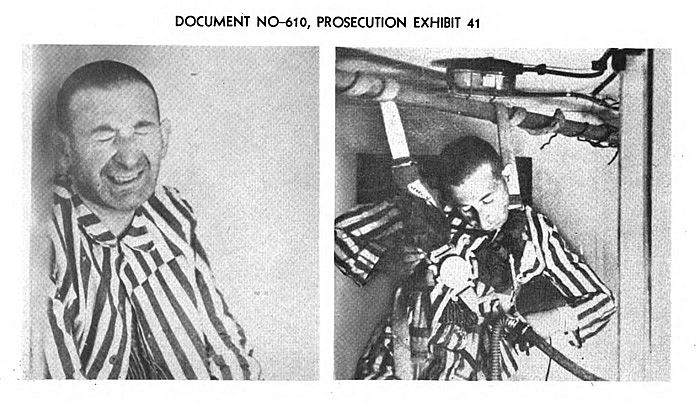
The defendants argue that, while the experiments may have killed
persons, they did not involve torture and pain. This is on the theory
that the subjects lost consciousness before any sensation of pain. This
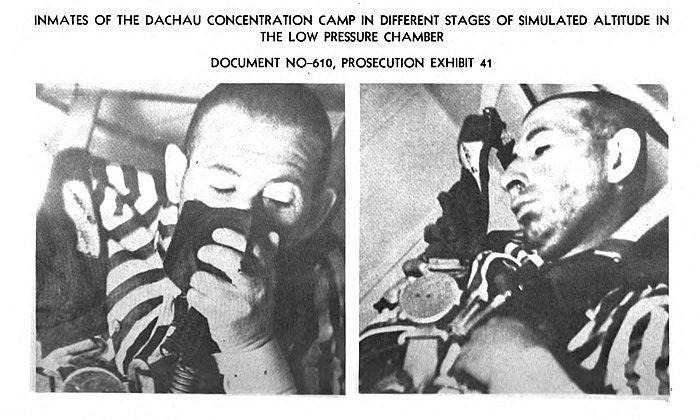
anomalous defense is completely disproved by the photographic exhibits
showing the expressions of pain of the subjects. (NO-610,
Pros. Ex. 41.) as well as the defendants’ own report on the experiments.
(NO-402, Pros. Ex. 66.) The reaction of one subject was described
in terms such as “severe altitude sickness, spasmodic convulsions”.
In a self-experiment by Romberg and Rascher, the latter’s reactions
were described as follows:
“After 10 minutes stay at this altitude, pains began on the right
side with a spastic paralytic condition of the right leg which increased
continually as though Ra’s [Rascher’s] whole right side
were being crushed between two presses. At the same time there
were most severe headaches as though the skull were being burst
apart. The pains became continually more severe so that at last
the discontinuation of the experiment became necessary.”
(NO-402, Pros. Ex. 66.)
There is no case on record where an experiment on an inmate was
discontinued because of pain.
Ruff and Romberg take the position that they would be most unwilling
to kill prisoners in the course of an experiment. They insist
that their experiments with Rascher were concerned with the problem
of explosive decompression and on parachute descent from high altitudes,
whereas Rascher alone worked on sojourn or a more prolonged
stay at high altitudes, and that it was in Rascher’s experiments that
prisoners were killed. This again is the artificial division of the experiments
into the criminal and noncriminal which has already been
proved to be spurious. But here again, the two self-experiments which
Ruff, Romberg, and Rascher included in their joint final report as mentioned
above were experiments on prolonged stay at high altitude, a
subject which they now claim was exclusively Rascher’s. The only reason
that this experiment did not end fatally was the fact that it was
interrupted in time because of intense pain. Moreover, on page 11 of
the final report by Ruff, Romberg, and Weltz the following is said:
“This is worthy of special attention because in this case a person has
fully recovered mentally at an altitude of 8.3 km. (27,230 ft.), after 3
minutes of the most severe lack of oxygen, while in altitude endurance
experiments at this altitude severe altitude sickness sets in after about
3 minutes.” [Emphasis supplied.] (NO-402, Pros. Ex. 66.) Here,
again, it is proved from their own report that Ruff and Romberg, as
well as Rascher, were concerned with sojourn at high altitudes.
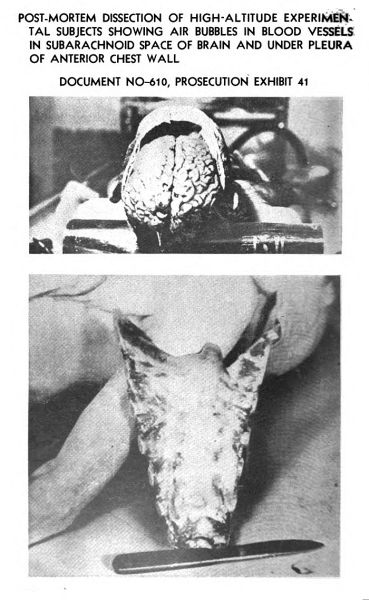
Experiments, in which prisoners were killed, are reported in
Rascher’s report to Himmler of 11 May 1942. (NO-220, Pros. Ex. 61.)
Some prisoners were killed by keeping them at 12,000 meters without
oxygen for 30 minutes; one was killed at 20,000 meters when exposed
there for about 6 minutes without oxygen. These prisoners were
autopsied to ascertain if bubbles of gas, called air embolism in
Rascher’s report of 11 May 1942, were present in the blood vessels of
the brain and other organs when dissected under water. Some “Jewish
professional criminals” who had committed “Rassenschande”
(race pollution)[18] were killed for another reason:
“To find out whether the severe psychic and physical effects, as
mentioned under No. 3, are due to the formation of embolism, the
following was done: After relative recuperation from such a parachute
descending test had taken place, however before regaining
consciousness, some VP’s were kept under water until they died.
When the skull and the cavities of the breast and of the abdomen
had been opened under water, an enormous amount of air embolism
was found in the vessels of the brain, the coronary vessels and the
vessels of the liver and the intestines, etc.” (NO-220, Pros. Ex. 61.)
It should be noted that these murders were committed in connection
with the parachute descending tests, not prolonged stay at high altitudes,
and this was the very subject being studied by Ruff and Romberg.
Romberg testified that he was present at the death of three of
these prisoners, one in April and two in May 1942, and witnessed an
autopsy of one, in which gas bubbles were present in the blood vessels
of the brain. He reported these deaths to Ruff. (NO-476, Pros.
Ex. 40.) Neff testified Romberg was present in five cases where
fatalities occurred (Tr. pp. 619, 692.) and Romberg admitted that he
knew that five to ten other experimental subjects were killed while
he was not present. (NO-476, Pros. Ex. 40.) Neff stated that Romberg
actively participated in the majority of the experiments. He observed
the experiments, took notes, and studied the electrocardiogram
and thus was able to determine when an experimental subject in the
chamber was about to die. (Tr. p. 651.)
It is incredible that Dr. Ruff was not informed regarding the finding
of bubbles in the blood vessels of the brain since such observations in
human beings who have died following too rapid atmospheric decompression
is a very, very unique event, though bubbles had been observed
many times prior to 1942 in the blood vessels of laboratory animals.
It is inconceivable that Dr. Ruff, or anyone else in the field of aviation
medicine, had not heard of the bubble theory of the cause of joint
pains, coughing, blindness, or paralysis, or the symptoms of the
pressure drop sickness, which may occur on exposure to high altitude,
since this theory was well known in literature and text books of aviation
medicine available since 1938. How else would Rascher have
had occasion to look for the bubbles? He either learned of the theory
during a course in aviation medicine or was told about it by Ruff and
Romberg, who knew much more than Rascher about aviation medicine.
It is fantastic that Ruff, Romberg, and Rascher did not have in mind
the observations of bubbles in the blood vessels of the murdered prisoners,
when, in the final joint report of 28 July 1942, they wrote:
“In spite of the relatively large number of experiments, the
actual cause of the severe mental disturbances and bodily failures
(paralysis, blindness, etc.) attendant upon post-hypoxemic twilight
state remains something of a riddle. It appeared often as
though the phenomena of pressure drop sickness had combined with
the results of severe oxygen lack”. (NO-402, Pros. Ex. 66.)
It has been the theory for some time that the symptoms associated
with decompression or pressure-drop sickness may be due to the formation
of gas bubbles (air embolism) in the blood vessels of the brain
or in the regions of the joints or in the blood vessels of the lungs.
When the bubbles collect in the blood vessels of the brain, they are
supposed to cause a physical or mental disturbance or paralysis.
When the gas bubbles collect in the region of the joints, they are supposed
to cause pain in the region of the joints. When the bubbles collect
in the blood vessels in the lungs, they are supposed to cause the
chokes or attacks of coughing. That has been a theory that has been
held for some 15 or 20 years, and an expert in the field of aviation
medicine could not have been unaware of it. (Tr. pp. 9098-9.) Since
Rascher had observed bubbles as is described in his report of 11 May
1942, and since Ruff and Romberg had complete knowledge of the
deaths, obviously these important findings of Rascher on air embolism
did not escape the attention of Ruff and Romberg. It can only be
concluded that these findings, which resulted from intentioned deaths,
form the basis of the paragraph quoted above from the final report.
Because of the nature of the subject matter, and a prior knowledge of
the observations in the autopsies in the experiments, the ideas expressed
in the paragraph quoted above cannot be separated from those in the
Rascher report of 11 May. So testified the expert witness Dr. A. C.
Ivy. (Tr. p. 9151.) All of this proves again that the testimony of
Ruff and Romberg to the effect they had nothing to do with the
so-called “Rascher experiments” is completely false. Even though
deaths are not specifically mentioned in the joint report of 28 July, it
is clear from Dr. Ivy’s testimony that the findings in the death cases
form the basis for a part of that report.
Ruff and Romberg would have the Tribunal believe that the experiments
were completed and the chamber removed from Dachau by 20
May 1942. Since Romberg knew of and reported on the deaths to
Ruff in April, there clearly was no excuse whatever to leave the chamber
in Dachau for even another day. But according to their own
story, it stayed until 20 May and Romberg saw two more men killed.
They attempted to gloss over their criminal participation in these
later murders by saying that the chamber could not be moved without
orders from the Luftwaffe Medical Inspector. Be that as it may, such
a technical violation of moving the chamber without orders is hardly
comparable to the crime of leaving the chamber for further experiments
by a man whom they admit they knew to have been a murderer.
Indeed, any decent superior who was not himself a party to the
crime, as they actually were, would undoubtedly have court-martialed
Ruff and Romberg for leaving the chamber there, not to speak of
Rascher.
But it is not true that the chamber left Dachau on 20 May 1942 as
they perjuriously stated. They seized upon this date from Milch’s
letter to Wolff stating that the chamber was needed elsewhere. (343-A-PS,
Pros. Ex. 62.) There clearly was an intention to transfer the
chamber, but it was not in fact moved and this was undoubtedly due
to the joint efforts of Ruff, Romberg, and Rascher. Romberg was
anxious to continue his criminal work with Rascher in September
1942 as has been pointed out above. In any event, on 4 June 1942,
Milch authorized retention of the chamber in Dachau for two more
months. (NO-261, Pros. Ex. 63.) On 25 June this order was passed
on to Rascher by Heckenstaller, adjutant to Wolff, reference being
made to a letter of 5 June from Rascher. (NO-284, Pros. Ex. 64.)
These documents prove beyond doubt that the chamber remained in
Dachau until July 1942.
The testimony of Neff not only proves that the experiments continued
until July 1942 but also that Romberg was presented with a remarkable
opportunity to discontinue the experiments without any
trouble whatever. Neff stated that Romberg told him in the latter
part of May that the chamber was to be transferred (undoubtedly as
a result of Milch’s letter of 20 May which was later countermanded)
and, under the impression that Romberg might not be in favor of any
continuation of the experiments, he sabotaged the chamber by breaking
a glass barometer in order to make sure the chamber would be sent
away. Instead of seizing this opportunity for stopping the experiments
by removing the damaged chamber, Romberg rushed to Berlin,
obtained spare parts, and in a matter of 2 weeks had the chamber
functioning again for more murderous experiments. (Tr. pp. 623-4.)
The chamber was used for another 3 weeks after it was repaired and
five persons were killed on the last day of the experiments. (Tr. p.
624.) Although the defense attacked Neff on cross-examination concerning
the sabotage of the chamber (Tr. p. 663), by the time Romberg
took the stand they admitted the chamber was damaged but moved the
whole incident to the month of May instead of June. (Tr. p.
6905.) This was obviously done on the theory that the Tribunal could
be deceived into believing that very few experiments could have been
conducted in May since they contend the chamber was moved on 20
May. But the documents and Neff’s testimony clearly established
that the chamber was there until July. Moreover, it matters little
whether the chamber was damaged in May or June. Romberg in no
event took the opportunity to stop the experiments on the ground of
unavailable spare parts, although this opportunity would not have
been needed if he really wanted to discontinue them. He need have
done nothing more complex than to have sent the chamber away or
left himself.
Ruff’s and Romberg’s guilt is beyond doubt when we consider that
they did not take the opportunity to withdraw after the first death of
an experimental subject in April 1942. Romberg admitted his presence
at the death of this first subject. (Tr. p. 6924.) He was studying
the electrocardiogram at the time of the experiments (NO-476,
Pros. Ex. 40), but he would have the Tribunal find that he was an
innocent bystander who was privileged to do nothing. This was just
another “SS experiment” according to Romberg. But Romberg admitted
that he was working the electrocardiogram and was studying
the point of light that follows the heart. When he saw that the critical
point had been reached, he said he spoke to Rascher (Tr. p. 6927),
but to no avail as Rascher continued the experiment until death resulted.
This testimony of assumed impotence when a man was slowly
killed before his eyes is an insult to one’s intelligence. Romberg was
the senior scientist and was fully aware of the fact that the danger
zone had been reached as he was thoroughly familiar with the equipment
being used. He has outlined for the Tribunal the proximity
of the electrocardiogram to the controls of the chamber (Tr. p. 6929),
and it is inconceivable that Romberg could not have taken the necessary
action to have spared this experimental subject’s life if he had so
desired. The inescapable fact is that these deaths were part of the
plan and Romberg not only had no desire to interfere but was very
much interested in the cause of death through air embolism.
Assuming that Romberg was opposed to this fatal experiment, it
is impossible to understand why he did not take the appropriate action
to have Rascher prosecuted for this premeditated murder. The
fact of the matter is that Romberg merely reported this death to Ruff
(Tr. p. 6932), and no appropriate action was taken by Ruff either.
Although alleging an objection to this fatality, Romberg admits participation
in the autopsy of the unfortunate victim. This autopsy
clearly bore out the fact that air embolism was the cause of death.
When asked if he participated in this autopsy, Romberg answered,
“Yes, I watched one autopsy. That was my duty.” (Tr. p. 6924.)
Romberg testified that he saw two other deaths and that air embolism
also caused those. (Tr. pp. 6925-6.)
Ruff and Romberg lay great stress on the point that deaths are not
mentioned in the joint report of 28 July 1942 of Romberg, Ruff, and
Rascher. This, of course, is a very understandable omission, but it in
no way proves that they are not responsible for those murders. Indeed,
the joint report of 28 July 1942 (NO-402, Pros. Ex. 66) is identical
with Rascher’s report of 11 May 1942 (NO-220, Pros. Ex. 61) except
for the specific mentioning of the deaths. For example, paragraph 3
of the Rascher report is a summary of part III-1, pages 3 to 18, and
part III-2, pages 18 to 19 of the joint final report. Paragraph 4 of
Rascher’s report contains results set out in part III-4, pages 21 to 22,
of the joint final report. Paragraph 5 of Rascher’s report is identical
with part III-3, pages 19 to 21, of the joint final report. Paragraph
6 of the Rascher report where the pervitin experiments are mentioned
is alluded to in the pervitin data in the joint final report on page 18.
Paragraph 7 of the Rascher report contains the conclusions incorporated
in the joint final report and gives details on the gas bubble
data which are referred to on pages 16 to 18 of the joint final report,
but from which is omitted reference to the autopsy results of the
murdered prisoners. These various passages were compared by the
witness Ivy and he concluded that they refer to the same subject
matter. (Tr. p. 9097.)
Ruff attempts to explain the omission of mention of deaths in the
final report on the ground that the deaths did not occur as a result
of their experiments on rescue from high altitudes (i. e., parachute
descending tests), but rather in Rascher’s own experiments with which
they had nothing to do (i. e., prolonged stay at high altitudes). (Tr. p.
6592.) It has already been proved that the basic premise to this spurious
argument is completely false, since Ruff and Romberg themselves
were not interested in sojourn at high altitudes. The self-experiments
of Romberg and Rascher were just such tests and they are specifically
mentioned in the final report. These involved a stay of 30 to 40
minutes at altitudes between 12 and 13.5 kilometers (39,400 to 44,290
feet). But so also is the minor premise wrong. Deaths were deliberately
brought about in the course of the parachute descending tests.
In these tests it had been noted that the subjects suffered from spasmodic
and clonic convulsions together with paralysis. This is reported
in paragraph 3 of Rascher’s memorandum of 11 May 1942 on the experiments
and also on pages 13 through 18 of the final report. In his
memorandum, Rascher stated:
“To find out whether the severe psychic and physical effects, as
mentioned under No. 3, are due to the formation of embolism, the
following was done: After relative recuperation from such a parachute
descending test had taken place, however before regaining
consciousness, some VP’s were kept under water until they died.
When the skull and the cavities of the breast and of the abdomen
had been opened under water, an enormous amount of air embolism
was found in the vessels of the brain, the coronary vessels, and the
vessels of the liver and the intestines, etc.” [Emphasis supplied.]
(NO-220, Pros. Ex. 61.)
This proves beyond any doubt that murders were committed in the
parachute descending tests of Ruff, Romberg, and Rascher. Ruff
again tried to deceive the Tribunal by testifying that it was substantially
impossible for air embolism to form in parachute descending
tests. This is obviously disproved by the statement of Rascher quoted
above and by the reference in the final report, already mentioned
above, which alludes to this same problem. But the lie was also
squarely nailed by the expert witness Ivy, who testified that it was
possible for air embolism to form in subjects who were at altitudes
above 12,000 meters (39,400 feet) only 3 minutes, that is to say, subjects
who bailed out at 15,000 meters. Bubbles may form as low as
30,000 feet. (Tr. p. 9102.) Thus, the defense that no deaths occurred
during the experiments concerning rescue from high altitudes
is completely spurious.
Moreover, it should be noted that while the joint final report does
not describe any of the death cases, it also does not deny that deaths
occurred. On page 25 of the original, it says: “In conclusion, we must
make it particularly clear that, in view of the extreme experimental
conditions in this whole experimental series, no fatality and no lasting
injury due to oxygen lack occurred.” (NO-402, Pros. Ex. 66.) The
deaths described in Rascher’s report quoted above were not due to lack
of oxygen but were deliberate killings to investigate air embolism.
But even the experiments which Ruff, Romberg, and Weltz admit
were planned and performed under their responsibility were highly
dangerous to the life and health of the subjects. Both Ruff and Romberg
agreed that 12,000 meters was the upper limit of safety and that
experiments of the type they performed above that altitude were hazardous.
The description of the reaction of the subjects as set forth
in the final report proves that the subject suffered severe convulsions
and prolonged periods of disorientation. The expert witness Ivy
pointed out that the experiments described in the final report of Ruff,
Romberg, and Weltz were highly dangerous for the following reasons:
“I consider them to be dangerous because of the prolonged period
of unconsciousness to which the subjects were exposed. For example,
they were unconscious for periods of around twenty minutes,
and they were disoriented for periods of around thirty to ninety
minutes. That is a dangerous period of oxygen lack to which to
expose the brain. I agree that * * * the electrocardiogram
demonstrates that the heart of these subjects was not momentarily
affected or significantly affected by this prolonged exposure to oxygen
lack. But these experiments do not show, or the results do not
show that the cells of the brain were not injured. One of the higher
faculties of the brain is learning, and we know that the learning
process is rather sensitive to oxygen lack, and the only way to check
against the possibility of damage of the learning mechanism by
prolonged exposure to oxygen lack would have been to have determined
the I. Q. of these subjects or the ability of these subjects to
learn before and after the subjects were exposed to such a prolonged
period of oxygen lack.” (Tr. p. 9036.)
Dr. Ivy testified that the experiments described in the final report
had reached the physiological limit and that work was being done in a
very dangerous and hazardous zone as far as the welfare of the experimental
subjects was concerned. He said that he should be reluctant to
perform such experiments even on himself and that he would prefer
to depend upon that degree of accuracy which could be obtained from
calculations of the results of animal experiments. (Tr. pp. 9081,
9112, and 9197.)
Finally it should be noted that the experiments were neither necessary
nor a scientific success. “Necessity of the State” has been much
used by the defendants as if it were a defense. This is clearly unfounded
even though necessity, military or otherwise, be assumed. It
is to be supposed that each defendant thought there was some necessity
to what he was doing. This is no defense. Rascher thought the
same thing. It was deemed necessary to incarcerate hundreds of
thousands of persons in concentration camps. It was deemed necessary
to murder millions of Jews. The slave labor policy was bottomed
on necessity. If that is a defense, then these trials lose all
meaning. But, on the other hand if it is proved that these experiments
were not necessary, not of scientific value, then it makes the
guilty even more guilty. The brutal sacrifice of human life was to no
avail. And such was the case here. Hippke, Chief of the Medical
Service of the Luftwaffe, when writing his thanks to Himmler on 8
October 1942 said the following:
“It is true that no conclusions as to the practice of parachuting
can be drawn for the time being, as a very important factor, namely,
cold has so far not yet been taken into consideration; it places an
extraordinary excess burden on the entire body and its vital movements,
so that the results in actual practice will very likely prove
to be far more unfavorable than in the present experiments.” (NO-289,
Pros. Ex. 72.)
When asked his opinion concerning the necessity for the typical experiment
described on page 13 of the final report of Ruff, Romberg,
and Rascher, the witness Ivy testified:
“I do not believe that it was necessary to do this experiment in
order to determine the equipment to supply aviators who have to
bail out of an airplane at high altitude.” (Tr. p. 9035.)
The witness Ivy stated further that the information which was obtained
by these experiments on concentration camp inmates could have
been obtained from animals as indicated by the results of Lutz’ and
Wendt’s animal work referred to in the final report. The differences
in the reactions of human subjects and animals, as reported by Lutz
and Wendt, were not sufficient to warrant the carrying out of these
hazardous experiments on human beings. (Tr. p. 9036.)
EXTRACTS FROM THE CLOSING BRIEF FOR DEFENDANT RUFF[19]
Certainly Dr. Ruff gave his agreement and approval to high-altitude
tests with a low-pressure chamber of the Reich Air Ministry being
performed by his collaborator of many years, Dr. Romberg, together
with Stabsarzt Dr. Rascher, in a concentration camp, using concentration
camp inmates as experimental subjects. He agreed after the
performance of urgent experiments in the Dachau concentration
camp had already been agreed upon in principle and approved by
Professor Dr. Hippke and Professor Dr. Weltz.
Therefore, the question arises whether these high-altitude experiments
were already illegal for the reason that they were performed
on concentration camp inmates.
This question must be denied for only such inmates were used for
the experiments as had volunteered for them, or who at least were
regarded by Ruff as volunteers and could be regarded as such in view
of the whole situation, and no one could reproach him for having erred
in this respect because other persons had perhaps deceived him about
these facts.
There are, however, some witnesses who apparently maintain that
the prisoners used in the Ruff-Romberg experiments were not volunteers.
Above all the witnesses Vieweg and Neff are of this opinion.
During his direct examination on 13 December 1946 the witness
Vieweg mentioned a series of various experiments which were performed
at the Dachau concentration camp. Referring in particular
to the high-altitude experiments there, which alone can be considered
in the indictment against Dr. Ruff, he states firstly that high-altitude
experiments with the low-pressure chamber were performed on 10
patients; “for these experiments frequently patients and also male
nurses were used who during the experiments were seen in the corridor
of the adjacent hospital ward.”
By this Vieweg apparently wanted to point out that these “patients”
and “also the nurses” were not volunteers. These 10 “official experimental
subjects” had been well fed and supplied with smokes, but in
addition to these 10 so-called “exhibition patients”, a large number
of people had been selected from the camp who were again and again
sent to the high-altitude experiment institute. That happened to a
block leader who probably had pneumonia a few hours later and ended
in the sick bay mortuary. The same happened in the malaria department
of the witness Vieweg. One day a patient who had some
differences with Zill, the leader of the camp, concerning protective
custody, was sent to the experimental institute, and he (Vieweg)
found him in the mortuary the next day. He (Vieweg) knows by
hearsay that, “a great number of patients who took part in these
experiments died, and ended up in the sick bay mortuary.” (German
Tr. p. 476.)
Between the lines of this rather obscure and vague statement one
may read that, according to Vieweg’s statement, these further experimental
subjects, and especially those who had died during the experiments,
did not belong to the 10 “official experimental subjects” and had
not been volunteers. However, in the direct examination by the prosecution
the witness Vieweg did not express himself explicitly about
this alleged compulsion of the so-called experimental subjects.
During the cross-examination by the defense counsel of Dr. Romberg,
the witness Vieweg explained his expression, the “10 exhibition
patients”. (German Tr. p. 485.) The 10 selected patients who were
used for the high-altitude tests had been accommodated in a special
room and had been well nourished; they had been exhibited, and they
had been presented to Himmler during one of his visits. Himmler
made them big promises; if they survived, they would be set free
* * * these 10 patients had been drawn into the experiments
* * * they had told him (Vieweg) that they were very exhausted
by the whole affair, but as far as he could remember “they all survived”
(German Tr. pp. 486, 489). On being questioned the witness
Vieweg repeatedly stated (German Tr. pp. 486, 487, 489), that as far
as he could remember Dr. Rascher had carried out the experiments
himself. The only thing Vieweg could state about participation of
“Luftwaffe officers” in these high-altitude experiments, was that some
Luftwaffe officers “had also been there”. But he could not say anything
about the actual participation of the Luftwaffe officers. From
the description on page 501 (German Transcript) these two gentlemen
of the Luftwaffe certainly were not identical with Buff and Romberg.
He himself (Vieweg) had only talked with these 10 official experimental
subjects, the so-called “exhibition patients”, but not with any
of the other experimental subjects. He himself had never observed
that these other prisoners were used for high-altitude tests, but he had
been told about it frequently. Vieweg repeatedly stated that the 10
official experimental subjects had still been alive at the end of the
experiments (German Tr. p. 489), that no deaths had occurred among
them.
So much for the statement of the witness Vieweg. It is, of course,
unreliable because it does not establish a clear distinction between the
high-altitude experiments authorized by Ruff and carried out with the
cooperation of Dr. Romberg, and other experiments in the low-pressure
chamber which Rascher undertook by order of Himmler, without
the authorization or previous knowledge of Dr. Ruff and without the
cooperation of Dr. Romberg. This distinction, which is of decisive
importance in judging this case, only appears in Vieweg’s statement
insofar as the 10 official experimental subjects (the so-called “exhibition
patients”) were exclusively used for the first experiments (Ruff-Romberg-Rascher),
whereas other prisoners were used for the other
experiments (by Rascher alone). Of course, the significance of this
distinction was not clear to Vieweg at that time and could not be
observed by him because Vieweg did not know anything at all about
Dr. Ruff’s activity and since he did not know anything at all about the
agreements which had been reached between Dr. Ruff and Dr. Rascher.
Apart from these obscurities one has to regard the statement of the
witness Vieweg with the greatest reserve for another reason. Vieweg
is the witness who, with unusual unscrupulousness, committed
plain perjury in the sessions of 13 and 16 December 1946. He tried
first (German Tr. p. 474) to give the impression that he had been sent
to the concentration camp without any reason, that he had been committed
for “political protective security”. This representation of the
witness Vieweg is completely in accordance with his previous behavior,
because formerly he had generally pretended to be politically
persecuted—an innocent man who had been thrown into a concentration
camp without ever having learned the reason. Under this false
pretense he offered himself as witness for this trial, and because of
this misrepresentation he was presented as a witness by the prosecution
whom he had deceived. However, during cross-examination,
Vieweg had to admit that in 1934 he was sentenced to 4 and to 6 years’
penal servitude for forgery of documents and fraud, that is to say for
common crimes which, as a rule, have nothing to do with politics. On
repeated questioning the witness Vieweg stated again and again
(German Tr. pp. 483 ff.) that he could not remember having received
any other previous conviction in addition to those 4 and 6 years’ penal
servitude. He insisted on this statement, even though he had been
repeatedly reminded that he was under oath. His stereotype phrase
was, he could not remember; he even emphasized that he had deposed
to this or that under oath (German Tr. p. 484), and he continued to
insist on his statement, even though he was told that his previous convictions
could be determined without difficulty since his files had been
sent for.
Now, let us compare the testimony given under oath with the list of
convictions of the witness Vieweg, which was submitted as Document
Ruff 24.
Besides the 4 and 6 years of penal servitude which he admitted, the
witness Vieweg received in reality not less than 6 prison terms prior
to 1934, among them 5 years’ penal servitude and 5 years’ loss of civil
rights for repeated grave thefts.
This extract from the penal register shows why the witness Vieweg
had such a “bad memory”. He never was politically persecuted, as
he pretended to be, but he is the type of incorrigible professional
criminal who could not be changed or educated even by the most
severe penalty. If anybody deserved to be sent to a concentration
camp it was this Vieweg. But even the 5 years he spent in the concentration
camp did not help. For now he is again in prison, in
Bamberg, where charges were brought against him on 5 March 1947
at the District Court for forgery of documents and fraud, as well as
for five cases of repeated theft, for attempted abortion, for active
bribery, and for black market dealings.
This incorrigible professional criminal allowed himself to be presented
here as a star witness for the prosecution against an honorable,
blameless citizen, as which Dr. Ruff emerged in the course of this
trial. Can the Court base its verdict on the statements of a person
like Vieweg, who on top of everything shamelessly lied to the Tribunal
and committed the worst possible perjury.
The other witness presented by the prosecution for the Dachau experiments
is Walter Neff.[20] He is at present in the Dachau camp for
war criminals and will soon have to stand trial himself before the
American Tribunal, for experiments in which he took an active part.
This witness Neff, who not only continuously participated in the
successful experiments of Dr. Romberg, but also in the inhuman
freezing experiments, in the deadly “severe experiments” of Rascher,
and who cooperated in many other cruelties, is, I think the last who
should appear as a witness against a man like Dr. Ruff, or condemn
him.
Let us recall what this witness said about himself at the close of
his testimony. According to his own admission, he produced three
prisoners (a certain Robert Wagner, a prisoner named Hutterer, and
a man named Sammendinger) for deadly experiments, on his own
initiative without being ordered to do so. According to his own
testimony, he delivered these three people over to a violent death;
he murdered them. It is characteristic of his ethics that he even
boasted of this act here in the courtroom! (German Tr. pp. 737-739.)
That does not trouble his conscience, as he himself declared under
oath (German Tr. p. 737); he is just the type of those inmates who,
to quote his own words “were often worse than the SS in their
cruelty and brutality”. (German Tr. p. 737.) That is the second
witness who was presented against Dr. Ruff by the prosecution. The
one, an unscrupulous swindler, an incorrigible habitual criminal, an
old jailbird; and the other a murderer many times over whose hands
are stained with much blood—a murderer who boasts that he has no
conscience. Is the Court to lend credence to such people? These witnesses
quite obviously believed they would be able to elude the hangman’s
noose by saddling other defendants with untrue, fabricated
statements.
All those facts are a warning that Neff’s testimony, too, must be
regarded with considerable caution. At any rate, his testimony
has a certain importance for Dr. Ruff inasmuch as Neff (German
Tr. p. 652) confirms that Dr. Ruff was in Dachau only on one
single occasion during the high-altitude experiments. Thus the
truth of Dr. Ruff’s own testimony has been established. Furthermore,
the witness Neff, states in his testimony of 17 December 1946 that “10
prisoners, designated as permanent experimental subjects, were taken
to the station and told that nothing would happen to them; they
were especially assured of this”. (German Tr. p. 711.) The witness
Neff then told of the killing of the 16 Russians who were sentenced
to death and who were murdered by Dr. Rascher. However, according
to Dr. Neff, this act was carried out by Dr. Rascher together with
the two members of the SS, while Dr. Romberg was not even present
on that day. (German Tr. pp. 654, 656.) Special importance must be
attached to the witness Neff’s further assertion regarding a Jewish
tailor who worked in the sick bay. Neff called Dr. Romberg’s attention
to the fact that this man was not sentenced to death, and Romberg
thereupon immediately went to Rascher with Neff in order “to set
matters straight”. Upon intervention by Dr. Romberg, Rascher then
actually sent the tailor back; when the accompanying SS man again
threatened the Jew, Rascher again intervened and “immediately had
the man (the tailor) brought to safety in the bunker”. (German Tr.
p. 655.) Again, in the case of a second inmate, a Czech, who wrongly
and without his consent had been brought in for the experiments,
Dr. Romberg, according to Neff’s report, intervened on behalf of the
prisoner, with the result that Dr. Rascher entered a complaint against
the criminal SS man with the camp commander, Piorkowski. Thereupon,
the SS man was immediately transferred to Lublin. In that
way the Czech was saved from certain death by Dr. Romberg.
This testimony of the witness Neff plays an important part in
answering the question whether or not the experimental subjects used
were volunteers, and also, what Dr. Romberg, and therefore Dr. Ruff,
knew about them and what Dr. Romberg’s attitude was toward this
question. In this connection, Neff said: “Romberg, Ruff’s deputy,
therefore, did not want any dangerous experiments. He tolerated
no murder and considered only experiments with volunteers.”
However, the further assertions of the witness Neff suffer from the
same shortcomings as those of the witness Vieweg; for Neff also did
not know that only part of the high-altitude experiments in Dachau
were carried out with the approval of Dr. Ruff and Dr. Romberg; nor
did Neff have any knowledge of the agreements made by the participating
physicians, and he therefore treated all high-altitude experiments
equally, without distinguishing whether or not Dr. Ruff had
agreed to them that there “were 180 to 200 inmates who participated
in high-altitude experiments” (German Tr. p. 656) and that “during
the altitude flight experiments, 70 to 80 people lost their lives.” These
figures may be correct, but they refer to the whole of the Dachau low-pressure
chamber experiments; that is, they also include the experiments
which Dr. Rascher made on his own authority, without the prior
knowledge of Dr. Ruff, and in which alone all the fatalities occurred;
while in the legitimate experiments—that is, those approved by Dr.
Ruff—no fatality occurred at all. Of course, Neff could not know all
this. As he said himself it was impossible for him to distinguish
“from whom the order came for the individual experiment, and in
whose interest the experiment was made.” (German Tr. p. 715.)
The same shortcoming is demonstrated by Neff’s testimony with regard
to the nationality of the experimental subjects (German Tr. pp.
656, 657) and the manner of their “selection”. However, Neff’s testimony
does show that the selection of the experimental subjects was
carried out in two different ways: For the “dangerous experiments”
Rascher ordered the subjects through the local headquarters, and they
were produced by the SS; they were therefore people condemned to
death (German Tr. p. 663), for the “serial experiments”. On the
other hand, and “for most of the other experiments which took place,
the people were brought to the experimental station from the blocks,
that is, from the camp” (German Tr. p. 657) by the block leaders.
(German Tr. p. 663.) These “serial experiments” were obviously
the experiments approved by Ruff, and Neff expressly establishes that
“volunteers reported for these experiments”! (German Tr. pp. 657,
712.) He even gives the reasons why the prisoners volunteered: As
Rascher, and Himmler too, had promised various inmates that, “if
they, participated in the experiments, they would be given a better
labor assignment”, and as Himmler promised that they might even
be released, volunteers reported to Rascher on their own initiative
as he went through the camp, without any special efforts being necessary
to find volunteers (German Tr. p. 657).
There can be no doubt that these volunteers, estimated by Neff to
number about 10, are identical with the 10 “official experimental subjects”
or “exhibition patients” mentioned already by the witness
Vieweg, and it is noteworthy that Dr. Ruff, too, in his testimony always
spoke of 10 or 12, or at the most 15 persons from the very beginning
(of course he did not count them himself), who were regularly called
in for the high-altitude experiments, and whom he saw himself when
he was once present to observe and check the experiments in Dachau.
This number Dr. Ruff had mentioned at a time when Neff’s and
Vieweg’s testimony was not yet available. He therefore could not
have anticipated that these witnesses would confirm his figures as
correct.
To be sure, the witness Neff testified in another place (German Tr.
p. 666) that the first 10 experimental subjects were not volunteers.
But this statement is obviously in direct contradiction to his other
testimony which, in the last analysis implied—and could not be interpreted
otherwise—that the so-called “10 official experimental subjects”
were those prisoners who had voluntarily offered themselves,
who were given all possible privileges in return, who were promised
rewards for their service by Rascher as well as by Himmler, and who
were repeatedly reassured that nothing would happen to them during
the experiments. This whole presentation would be incomprehensible
if one were to assume that these 10 persons were involuntary subjects as
well, that they were simply ordered to take part in the experiments,
forced to participate, for them all this would not have been necessary
at all, since at that time nobody in a concentration camp would have
thought of troubling himself about these people, if they had been
forced against their will to take part in the experiments.
In a concentration camp, according to the opinion of Himmler and
his men, 1,000 people were of no consequence. Therefore, if efforts
were made to obtain these inmates for the experiments, and to get
them willingly, if even a Himmler found kind words to say to them and
promised them rewards, then as we know today, this can only be explained
by the assumption that even in concentration camps, for some
reason, it was desirable to obtain voluntary subjects for the experiments
and to induce them to go through the experiments voluntarily.
This assumption is not refuted by the contrary assertion of Neff
(German Tr. p. 666). For 1½ days, during his examination on 17
and 18 December 1947, Neff did not know that these first 10 experimental
subjects had not been volunteers. For 1½ days he did not
dare to make such an assertion here in the witness box, and only
during the cross-examination did he finally go so far as to make this
assertion, thereby completely overthrowing his previous statements.
This allegation of the multiple murderer Neff now stands, however,
completely isolated. There can be no doubt that, if these statements
by Neff were true, it would have been easy for the office of the public
prosecutor to produce numerous other witnesses who, likewise, had
been inmates of the concentration camp at Dachau, who had perhaps
experienced these experiments themselves, or who had spoken to subjects
of these experiments or had even observed the experiments.
However, not a single outsider, not a single incontestable witness has
been produced, although half a year has elapsed since the days when,
here in the courtroom, one could not fail to realize to what an unreliable
and untrustworthy class persons of the caliber of Vieweg and
Neff belong. This fact very strongly indicates that obviously no
other witnesses are available, or could be made available, who could
confirm that the experimental subjects who were used in the Ruff-Romberg
altitude tests were not volunteers. Let the fact be mentioned
here, for the sake of comparison, that in the case of the Gebhardt
sulfanilamide operations for example, half a dozen incriminating
witnesses were brought from Poland and Russia and were interrogated
here as witnesses. Why was not a single trustworthy witness
produced from among the Dachau experimental subjects and placed
in the witness box? Because no one could be found, who could confirm
the untrue allegations of a Vieweg and a Neff. On the other
hand, during the trial, a whole series of persons who deserve a great
deal more belief than Vieweg and Neff affirmed with certainty that all
the experimental subjects in the Ruff-Romberg experiments were volunteers,
and that from the very beginning the indispensable condition
which was demanded and assured was that the subjects would be
voluntary.
The witness Dr. Lutz for example, who was introduced by the office
of the public prosecutor and therefore recognized by it as a credible
witness, confirmed here on oath, “it was a tacit assumption that the
criminals would volunteer”; and he added that he could almost say
that, in a way, a favor was being conferred upon the criminals, because
“they were given a chance of pardon by participating in the experiments,”
and it is significant that this witness deposed further: “subsequently,
we were very much surprised when, probably during the
later stages of the experiments, as far as I recall now, no further mention
was made of it,” namely, of the fact that only volunteers were to
be used for the altitude experiments (German Tr. p. 320).
These depositions by the witness Dr. Lutz conform in every respect
with the general impression received from all the pertinent descriptions.
At first, only the altitude experiments approved by Dr. Ruff
regarding the problem of “rescue from high altitudes” were carried
out. These experiments were not dangerous as proved by their successful
outcome; the inmates volunteered for them. Gradually, however,
Rascher misused more and more the presence of the chamber in
order to conduct his arbitrary experiments on Himmler’s orders for
entirely different problems, namely, to conduct his notorious “difficult
experiments” which had numerous fatal results. These were Rascher’s
more cruel, painful experiments; naturally, no more volunteers
reported for these because word was passed quickly through the camp
that the experiments which Rascher himself conducted were dangerous,
while the mere presence and cooperation of Dr. Romberg
gave assurance to the inmates that his experiments were conscientiously
conducted and were not dangerous.
Other witnesses also, not named by Dr. Ruff, have confirmed that
the experimental subjects for the Ruff-Romberg high-altitude experiments
were voluntary, namely, the witness Dr. Hielscher (German Tr.
pp. 6025-26, 6041, 6062). Testimony on similar lines is given by the
codefendant Sievers (German Tr. pp. 5471, 5881); and Dr. Hippke
(German Tr. p. 793) “Prisoners who might volunteer”; (German Tr.
p. 795) “these persons had to volunteer for the experiments.” Also
the witness Karl Wolff, (Ruff 21, Ruff Ex. 20) “volunteer concentration
camp inmates who were to be given compensatory privileges
* * * the inmates, about 10 in number, appeared quite relaxed
and, in their turn, willingly entered the low-pressure chamber
which had been driven up * * * the inmates reported to
Himmler, in my presence, that in this manner they could at least
voluntarily * * * give a proof of their genuine good will * * *
I never learned through Himmler, nor, as far as I remember, by any
other means that later low-pressure chamber experiments * * *
took place on a nonvoluntary basis * * * I only knew about
voluntarily low-pressure chamber experiments and these were made,
without doubt, on a voluntary basis.” Finally, the witness Herbert
Wilschewske (Ruff 11, Ruff Ex. 9).
While the previous witness Wolff was only present for 1 day during
the experiments, the witness Wilschewske, during the 2 years he spent
in the concentration camp, spoke repeatedly to inmates who “had volunteered
for the medical experiments”, and who, by reason of his
repeated conversations with the prisoners, could give the following
as reason for the willingness to volunteer for experiments “they could
earn thereby their own liberty and rehabilitation as well as privileges
for their family.” The witness Wilschewske is certainly an absolutely
reliable witness with regard to his statements. He is a Polish Communist,
served 2 years in Dachau concentration camp for this, and
was proved to be only a political prisoner.
If one considers all these statements by witnesses, which certify
that the experimental subjects in the Dachau high-altitude experiments
of Drs. Ruff and Romberg were volunteers, it cannot be doubted
that the concordant statements by Dr. Ruff, Dr. Romberg, and Dr.
Weltz were absolutely true. They are defendants, it is true; but from
all sides testimony is given of their irreproachable professional integrity.
Although they are now sitting in the dock, their precise and
clear statements deserve far more belief than the changing and contradictory
statements of a habitual criminal who has committed downright
perjury in this Court, or of a murderer who is actually more
deserving of a place in this dock than these defendants are.
The correctness of this conception is confirmed again on the one
hand by the fact—already mentioned in another connection—that Dr.
Romberg, as has been proved repeatedly, actively intervened and prevented
the use of experimental subjects for experiments by Rascher
when he could see that nonvoluntary experimental subjects were to be
used, and on the other hand, it was known that in the high-altitude
experiments which Dr. Ruff had carried out with Dr. Romberg only
voluntary experimental subjects could be used, and only with voluntary
experimental subjects could the experiments succeed. The whole
idea of this type of high-altitude experiment (the Ruff-Romberg
method) was based on the theory that the experimental subject, immediately
on recovering from the state of unconsciousness—the “high-altitude
malady”—reaches up with his arm and pulls down the handle
of the parachute, which in practice reduces the speed of the fall, insuring
the flier of a smooth landing on the ground. All this necessitated
active cooperation on the part of the experimental subject;
one was absolutely dependent on his cooperation, otherwise each of
these experiments would have been useless right from the start.
Naturally, Dr. Ruff knew this, as did Dr. Romberg, and therefore for
them the first and most important condition for each experiment of
this type was that the experimental subject should be voluntary (see
Ruff’s statement in German Tr. pp. 6638-40). There are therefore
also important inherent reasons why the statements by Ruff and
Romberg are correct.
Actually the high-altitude experiments carried out in Dachau were
successful. They were of considerable help in clarifying the problem
of “rescue from great heights”, and this was only possible when the
experimental subjects themselves cooperated when they took part in
the experiments voluntarily and took an interest in them. This was,
by the way, also the reason why this type of high-altitude experiment
could not be made with animals as experimental subjects, a fact which,
for example, Ruff and Romberg pointed out in their summary report
of 28 July 1942. (NO-402, Pros. Ex. 66.)
I come, therefore, to the following conclusion: There can be no
doubt that the experimental subjects for the Dachau high-altitude
experiments were volunteers, at least as far as the experiments authorized
by Ruff are concerned. Whether volunteers reported for the
special experiments continued by Dr. Rascher or whether the prisoners
were forced into the experiments by Dr. Rascher does not need to be
examined, because Ruff and Romberg did not participate in those experiments
in any way. But even if any doubt as to their being volunteers
were possible, it cannot be denied that Ruff and Romberg were
firmly convinced that all their experimental subjects actually were
volunteers. This was stipulated from the very beginning, and in all
the discussions of Dr. Ruff with Hippke, Weltz, and the representative
of the SS, Ruff was consequently convinced that only volunteers
were actually concerned.
Dr. Ruff’s conviction was strengthened through personal conversation
with various prisoners on that day on which he himself went to
Dachau to control the execution of the experiments and to ascertain
that everything was carried out in a completely orderly manner. And
finally in this connection it cannot be overlooked that Dr. Ruff, as he
has stated under oath and as is confirmed by numerous affidavits, had
never at any other time in his life worked with nonvoluntary experimental
subjects. Just because he considered it indispensable for the
success of the experiments that the experimental subjects were volunteers,
that they themselves cooperate, Dr. Ruff never thought that
the Dachau prisoners were not fully and completely in agreement with
the experiments.
It is obvious that the voluntary character of these experimental
subjects, whether an actual fact or whether Dr. Ruff deluded himself
into believing that this was the case, does not in itself relieve him of
all responsibility. On the contrary, Dr. Ruff himself is of the opinion
that, besides voluntariness, several other conditions would have to be
fulfilled before the experiments and the way in which they were
performed could be considered lawful:
1. The experiment would have to be necessary, particularly necessary
in the interests of aviation and thus essential to the fatherland’s
war effort. This condition is obviously fulfilled. This is confirmed
above all by the statement of the witness Dr. Hippke who stated that
it was Dr. Ruff’s duty to work on the research tasks assigned to him
by the Medical Inspectorate of the Luftwaffe and to submit reports
on them to the Medical Inspectorate.
The experiments carried out by Ruff were necessary, for “high-altitude
experiments in particular have been undertaken intensively
in America, too, because the question of pressure drop [Drucksturz]
and the cabin development is of particular importance.” (Ruff 23,
Ruff Ex. 22.) Dr. Hippke developed this point of view not only
during the trial but stated it very clearly in his letter to Himmler, dated
as early as 8 October 1942 (NO-289, Pros. Ex. 72), where he writes:
“These-experiments represent a very valuable and important supplement.
The fact that such an extreme deficiency of oxygen can be
endured at all for some time is very encouraging for further research.”
Dr. Hippke’s opinion about the necessity of the high-altitude experiments
is therefore extremely important because Hippke was the highest
official expert in that field in Germany at that time.
But most of all, the absolute necessity of Ruff’s experiments is
acknowledged by all experts who testified in this trial in connection
with these problems. I recall, for example, the statements of the
witness Dr. Scheiber that “at a later judgment of Dr. Ruff’s scientific
work, his name will be remembered together with the names of all
of those well-known scientific research workers who, by personal, devoted,
and heroic effort, rendered immeasurable service to the advance
of science and therewith to the welfare of humanity.” Professor Dr.
Strughold expresses himself in a similar way in his affidavit. He
was chief of a German institute for aviation medicine for several years
and writes concerning Dr. Ruff that “he (Ruff) can be considered as
a man who surpasses by far many academically proficient and recognized
scientists as far as scientific experience and scientific success is
concerned.” Of particular importance, however, seems to be the
opinion of Dr. Grauer, who is at present in America as a research
worker and experimenter in matters of aviation medicine.
According to the opinion of the Air Force General, Adolf Galland,
and the statements of all the other experts, it is an established fact
that the Dachau experiments of Dr. Ruff and Dr. Romberg were
absolutely necessary.
This necessity does not cease to exist because the people concerned
realized that with this first series of experiments, carried out in
Dachau in the spring of 1942, the problem in question (rescue from
high altitudes) was not yet entirely solved. Ruff and Romberg
pointed out in their final report of 28 July 1942, that the “danger
of freezing has to be considered.” On the basis of this final report
the medical inspector, Dr. Hippke, later pointed out in his letter to
Himmler of 10 October 1942 (NO-289, Pros. Ex. 72) that in the
Dachau high-altitude experiments of Ruff and Romberg of spring
1942, “a very important factor was not yet taken into consideration,
namely freezing.” He remarked, however, at the same time that
“the necessary supplementary work was started meanwhile.”
Hippke did not leave any doubt that this fact would not impair the
value and the importance of the Dachau high-altitude experiments,
which he stressed; for it is in the nature of such experiments that
both parts of the problem, high altitude and freezing temperatures,
cannot be dealt with simultaneously, but that at first only one part
must be considered, then the other. This was Ruff’s plan from the
very beginning, and the special experiments with regard to the influence
of freezing temperatures on descent from high altitudes were
carried out according to plan in the Berlin institute of Dr. Ruff in the
summer and fall of 1942. (Compare this with Dr. Grauer’s affidavit
of 28 January 1947.)
Another prerequisite for the justification of the high-altitude experiments
undertaken by Ruff and Romberg lies in the requirement
that the experiments should not be extended any further than is
necessary for the solution of the problems presented. This requirement,
too, was fulfilled by Dr. Ruff. It is confirmed by his own testimony
(German Tr. p. 6704), as well as by the testimony of Dr. Romberg
(German Tr. pp. 6879-80), that Dr. Romberg was sent by Dr.
Ruff to Dachau with a definite program which carefully outlined the
kind as well as the extent of the experiments to be carried out. Only
the problem of “rescue from high altitude” was to be investigated.
Only experiments for this purpose were ordered by Dr. Ruff. Dr.
Romberg was not allowed to undertake experiments for any other purposes,
and the experiments were to be carried on only until either
the problem was solved or its solution found impossible. Had Dr.
Romberg not adhered to this program, which had been strictly outlined,
had he carried out further experiments behind Dr. Ruff’s
back, the latter could in no case have been responsible for them. Since
he was not told of such further experiments by Dr. Romberg, he
could not stop them. However, it must be stated expressly that Dr.
Romberg adhered to Dr. Ruff’s orders; he did not carry out more
extensive experiments than he had been permitted and had been
ordered; this was done alone and solely by Dr. Rascher. The latter,
however, was in no way subordinated to Dr. Ruff, nor to Dr. Romberg;
moreover, he would certainly not have taken any orders from
either of them. The final report Ruff-Romberg-Rascher of 28 July
1942 (NO-402, Pros. Ex. 66) furnishes clear proof of the fact that
Dr. Ruff and Dr. Romberg were at all times conscious of their duty
to restrict experiments to the extent which seemed absolutely necessary
in order to explore a problem which was all-important at the
time and to carry out no experiments which could not be considered
especially important and of great consequence.
Even the introduction to this report of 28 July 1942 is significant
for the delineation of the tasks set for these experiments. It reads:
“Considering the urgency of finding a practical solution to this important
problem [the rescue of airplane crews from high altitude],
particularly in view of the prevailing experimental conditions, it
was necessary to forego for the time being a detailed clarification of
the purely scientific problems involved.” Here the basic tendency
of all the experiments finds its clear expression. Only such practical
requirements of aviation which could not be postponed during time
of war should be solved, while investigations of purely scientific
nature, without great practical significance, were to be excluded.
This restriction of solutions sought demonstrates that the scientists
in question (Ruff and Romberg) were not subject to the unbridled
desire for experimentation which may be found in people of Rascher’s
type.
Were the Ruff-Romberg high-altitude experiments in Dachau
dangerous to life? If it is demanded that experiments on humans
are carried out as humanely as possible, pain avoided wherever possible,
and damage to health eliminated, it is obvious that deaths must
be prevented in every way possible. The conscientious research
worker will always start from the standpoint that experiments can
only then be carried out when, according to human estimation and
the experience of science, death can in no way be expected. According
to German Law (Article 216 of the German Penal Code) the
intentional killing of a person would not be legalized through his
agreement, not even at his expressed desire.
To this question the presentation of evidence has shown the
following:
1. In the Summary Report Ruff-Romberg-Rascher of 28 July 1942,
it is “expressly stated that in the whole series of experiments no death
and likewise no permanent oxygen deficiency damage occurred.”
(NO-402, Pros. Ex. 66.) In direct contradiction to this appears to be,
at least at first glance, the intermediary report which Dr. Rascher
alone made on his experiments on 5 April 1942 to the Reich Leader
SS Himmler (1971-A-PS, Pros. Ex. 49) and also the following secret
report, which likewise Dr. Rascher alone sent to Himmler on 11 May
1942. (NO-220, Pros. Ex. 61.) These two special reports by Dr.
Rascher prove that in the experiments described by Rascher alone
several deaths occurred.
The explanation of the apparent contradiction is shown clearly
by the presentation of evidence: In the experiments authorized by
Dr. Ruff and carried out with his approval not a single death occurred.
Only the arbitrary experiments which Rascher carried out without
the approval of Dr. Ruff and against his will, and which were ordered
by Himmler, were deadly.
This can be seen from Rascher’s intermediary report of 5 April
1942. (1971-A-PS, Pros. Ex. 49.) It falls into two parts.
In the first part Dr. Rascher describes the experiments carried out
with Dr. Ruff’s approval. He states expressly, “the experiments
conducted by myself and Dr. Romberg,” and he confirms that even
“in a total of 15 extreme experiments, none of the experimental subjects
died. Severe high-altitude sickness with unconsciousness occurred;
however, the subject was always fully capable of action when
approximately 7 km. was attained in the descent.”
In the second part, Rascher then describes his arbitrary experiments
of which Ruff knew nothing, and was permitted to know nothing.
This second part of the report is much more extensive and detailed
than the first. That can be explained without difficulty because the
experiments mentioned in this second part were carried out by Rascher
himself; here he could describe the “merit” of the results he apparently
gained all by himself. From this second part he obviously
also hoped for complete new results for science, which he emphasized
in the accompanying letter to Himmler of 5 April 1942, and he was
obviously very proud that following his suggestions (as he emphasized)
such “interesting standard experiments” were carried out. All
this referred exclusively to the arbitrary experiments mentioned in
the second part of the report, which Rascher carried out alone without
the assistance of Dr. Romberg and without the authorization and
previous knowledge of Dr. Ruff. (1971-A-PS, Pros. Ex. 49.)
Rascher himself made this distinction in his report (1971-A-PS,
Pros. Ex. 49): He contrasts in the second part of his report the “extremely
dangerous experiments” with the “experiments carried out by
myself (Rascher) and Romberg,” while he specially asked for an “SS
doctor from the camp as witness” for the arbitrary experiments of the
second part of his report, as “I carried out these experiments by myself.”
But surely Dr. Rascher had his reasons for specially requesting
“a camp doctor as a witness” for these experiments (which are described
in the second part of his report), but intentionally kept Dr. Romberg
away. Dr. Rascher indicates these reasons in his accompanying letter
of 5 April 1942, talking about difficulties which the Luftwaffe created
for him up to that time, whose removal he hopes for by the intervention
of SS Fuehrer Sievers. These difficulties which hindered the research
work of Rascher were discussed in various other documents
which concerned the use of the low-pressure chamber and its return
to Dachau, which the SS tried to arrange but never succeeded.
If Dr. Rascher in his intermediary report (1971-A-PS, Pros. Ex.
49) emphasized that “only continuous experiments are fatal at heights
above 10.5 km.”, this plainly confirms, in Dr. Rascher’s own words,
what Ruff and Romberg stated from the very beginning, that two kinds
of high-altitude experiments were carried out in Dachau with the low-pressure
chamber. The one kind, which Dr. Romberg took part in
and Dr. Ruff knew about, was carried out completely humanely and
without any pain, and nothing happened; and the other kind, which
Rascher carried out alone by order of Himmler, without Romberg
and without the previous knowledge of Dr. Ruff, to which at one
time an SS doctor was even asked to attend as a witness and which
caused several fatalities.
This result is confirmed by the second report, which Rascher again
alone (without the participation of Dr. Ruff and Dr. Romberg) submitted
to Himmler, dated 11 May 1942, as a secret report (NO-220,
Pros. Ex. 61). He describes here the experiments which he carried
out jointly with Dr. Romberg and again states: “On the average, the
experimental subjects were in complete accord of their actions at
12-13 km.; no disturbances of any kind in the general condition
occurred in any of these experiments,” and even less, of course, a
fatality. Only among the experiments described under figures 6 and
7 of this secret report of Rascher’s did fatalities occur, and that
“during a continued high-altitude experiment, for example after half
an hour in an altitude of 12 km.” But these experiments (according
to figures 6 and 7) were the arbitrary experiments in which Rascher
had other aims in mind, which had nothing to do with Ruff’s problem
of “saving from high altitudes,” and which were carried out by
Rascher alone.
It is also interesting that Rascher still mentions the partial assistance
of Dr. Romberg in his first report (of 5 April 1942) (1971-A-PS,
Pros. Ex. 49) but does not say anything more in the final second report
(of 11 May 1942), (NO-220, Pros. Ex. 61) where he described the
affair as though he alone had carried, out the experiments. Compare
page 81, line 21: “Experiments carried out by myself”; or page 79,
lines 15-16: “My heart experiments * * * that a very big sphere
of work opened up for me,” etc. By that Rascher has clearly expressed
that he did not have any assistance from Dr. Romberg in the
experiments he thought particularly valuable, when he explains as
particularly valuable his heart experiments and his observations concerning
air embolism. Those were all experiments in which Ruff and
Romberg had not the least interest, in which they never participated,
and for which they would never have risked the health and the life
of an experimental subject.
Even specialists like Dr. Ruff and Dr. Romberg could never understand
the scientific or other aim which Rascher had in mind in the case
of those arbitrary experiments with fatal endings. Even the layman
can easily recognize the basic difference between the two categories of
experiments. The legal experiments which had been authorized by
Dr. Ruff were always restricted to a very short period of a few
moments; but the fatal experiments of Dr. Rascher were, as he
emphasized himself, continuous experiments without oxygen, therefore
experiments lasting over 30 minutes. It is easily understandable
that experiments of such a length without the administration of
oxygen may be fatal. To prove this it would not have been necessary
to sacrifice even one single human life in these experiments. Serious
research workers like Dr. Ruff and Dr. Romberg had therefore never
carried out and never authorized such experiments. That was also
well known to Rascher, and this explains the fact as stated by Neff
(German Tr. pp. 668, 670, 671) that Rascher kept Dr. Romberg intentionally
away from his arbitrary experiments; furthermore that
he even carried out his experiments at night to keep them secret from
Dr. Romberg, and that he also did not ask Romberg to sign his intermediary
report of 5 April 1942, nor his summarizing secret report of
11 May 1942, which Romberg would surely have refused to do.
It would therefore be quite wrong to attribute to Dr. Ruff and Dr.
Romberg the intention of wanting to suppress something in their
final report of 28 July 1942. (NO-402, Pros. Ex. 66.) For it is a
proven fact that not only Himmler was informed by Rascher of the
cases of death which had occurred, but that Dr. Ruff had also reported
the cases of death for which Dr. Rascher was guilty, to his supreme
superior, the Inspector of the Medical Service [of the air force],
Dr. Hippke. For this same reason he had caused the low-pressure
chamber to be removed from Dachau and had asked the witness, Dr.
Hippke, to consent to this. These proven facts show that Dr. Ruff
did not conceal anything and had nothing to conceal. The fact that
the cases of death were not mentioned in the final report of 28 July
1942 has therefore nothing to do with any concealment but is only
due to the fact that those experiments which had fatal results had
nothing whatsoever to do with the experiments of Dr. Ruff and Dr.
Romberg and their problem.
For the same reasons it is not surprising at all that Dr. Ruff did not
inform Dr. Weltz of the fatal accidents during the special experiments
of Rascher. Weltz was neither Ruff’s superior nor his subordinate,
and at the time when Dr. Ruff learned of the deaths which had
occurred during Rascher’s experiments, Dr. Rascher had already been
transferred from the Weltz Institute.
The defense, therefore, arrives at the following conclusion:
Dr. Ruff only did what his superiors ordered him to do. If they
have failed, they should be taken to account.
Dr. Ruff had no doubts concerning the orders of his superiors for
his assignment was urgently necessary in the interest of his country,
engaged in the most difficult war, and of its aviation. If Dr. Ruff at
the time had been able to read all the international literature about
medical experiments on human beings he would have learned that
experiments much more exacting and much more dangerous than
those with which he was familiar—which he knew and planned—were
being conducted everywhere, also on prisoners; and perhaps
they are still being conducted without the competent authorities or
medical societies declaring them impermissible and intervening
against them. Over many years, Dr. Ruff proved himself to be a
particularly conscientious and considerate man of research who devoted
his entire activity primarily to save endangered human lives.
Neither can he be blamed for having collaborated for a short time
with Dr. Rascher. He (Rascher) had been assigned to him as associate
by his highest superiors; he had to rely upon that. If they
ordered him to work together with a man who, later on, turned out to
be a criminal, no liability can be charged to Dr. Ruff. When Dr. Ruff
saw through his colleague who was forced upon him and realized his
criminal activities, he immediately cut off all relations to him on his
own initiative, avoided any further collaboration with him, and thus
probably prevented much further disaster.
Field Marshal Milch was acquitted as far as the Dachau altitude
tests are concerned.[21] Medical Inspector Dr. Hippke was not indicted
at all. Under these circumstances justice demands that Dr. Ruff be
acquitted.
EXTRACT FROM THE CLOSING BRIEF FOR DEFENDANT SIEVERS
Low-Pressure Experiments
Low-pressure experiments (high-altitude experiments) were carried
out in the Dachau concentration camp from 22 February to the
end of May 1942.
The first plans to carry out experiments “for rescue from high altitudes”
were discussed already in 1941. The experiments were an
affair of the Luftwaffe. (1581-A-PS, Pros. Ex. 48.)
The carrying out of experiments for “rescue from high altitudes”
was agreed upon, as far as the Dachau concentration camp was concerned,
by the Reich Minister for Aviation (represented by State
Secretary and Field Marshal Milch) and the Reich Leader SS
Himmler. (German Tr. p. 274. Also judgment of Military Tribunal
II, Nuernberg in case of Field Marshal Milch. See Vol. II.)
The witness Neff gave the exact date of the start of the experiments.
The experiments were started on 22 February 1942. The witness
could remember this date so well because it was his birthday. (German
Tr. p. 606.) After a few interruptions the experiments ended
in the second half of May. (German Tr. p. 6779.)
When answering the question whether the experiments could inflict
torture and death on the experimental subjects, one has to distinguish
between the experiments which according to the detailed
instructions of Dr. Ruff were carried out by Dr. Rascher and Dr.
Romberg in the Dachau concentration camp, and the experiments
which Rascher carried out either with the knowledge and permission
of Himmler, or without his permission on his own responsibility.
With regard to the first experiments it has to be said that they caused
the experimental subjects some discomfort through high-altitude sickness,
but that on no account did they mean torture and death for the
experimental subjects. (Evidence of Dr. Ruff in direct examination.)
On the other hand the experiments which Rascher conducted on his
responsibility have, according to Prosecution Document 1971-A-PS
(Pros. Ex. 49), apparently to be judged in a different manner.
Sievers came in contact with the low-pressure experiments only; in
the second half of March 1942. By letter of 21 March 1942 Rudolf
Brandt replied to an inquiry of the Reich business manager of the
Ahnenerbe of 9 March 1942 concerning Rascher, and informed him
that low-pressure experiments were carried out in the Dachau camp:
“The Reich Leader SS gave his permission on condition that Dr.
Rascher would participate.” (1581-A-PS, Pros. Ex. 48.)
The cause of Sievers’ letter of 9 March 1942 was the statement of
Dr. Rascher to the curator Wuest, according to which certain research
work which he carried out for the Luftwaffe in Dachau, and of which
he could give no details, was to be supported by the administration of
the “Ahnenerbe”. (German Tr. p. 5671.) Following this, Sievers
went to Dachau in late March or on 1 April 1942. (German Tr. p.
5672.)
Thus this date was the earliest on which Sievers could possibly
have gained knowledge about the carrying out of high-altitude experiments
in Dachau. It is important that at this time the experiments
had already been under way for over a month.
The cunning Rascher took the first visit of Sievers as an opportunity
to invite Sievers to have a look at the experiments directed by him,
in spite of the fact that Sievers had nothing at all to do with the
carrying out of the experiments. Sievers watched two experiments.
He took the opportunity to speak to the two persons who were subjected
to the experiments on that day. Both told Sievers that they
had volunteered for the experiment. A few minutes after the experiment
both experimental subjects did not show any after-effects and
finished the experiment without suffering any bodily or physical
damage. (German Tr. p. 5741.)
The following proceeding shows the special care which was taken in
the carrying out of these experiments: It was agreed with the experimental
persons that in case of earache they were to point with the hand
to the ear. When one of the experimental subjects did this, Dr. Romberg
immediately altered the pressure conditions, and the behavior of
the experimental subject showed that he had no more discomfort.
(German Tr. pp. 5743 and 6845.)
Since the question of the voluntary status of the human experimental
subjects may be of significance in the case of all experiments,
a comprehensive presentation of the most important depositions on
this subject is given here.
Himmler stated at the Easter conference in 1942, in answer to the
scruples of Sievers, that only volunteers were to be allowed to be
drawn upon for the experiments, and if the experiments were fraught
with danger to life then only major criminals under sentence of
death and no political prisoners would be taken. (German Tr. p.
5677.) The witness Neff testified that volunteers presented themselves
for the experiments. (German Tr. p. 614.)
Dr. Craemer of the Mountain Institute for Psychology of the Army
Mountain Medical School [Gebirgspsychologisches, Institut der
Heeres-Gebirgs-Sanitaets-Schule] has, in an affidavit, reported a conversation
with Dr. Rascher in the course of which the latter said:
“Human experimental subjects. It is a question of major criminals
under valid sentence of death who come forward voluntarily for the
experiments in Dachau in order to have life and liberty given to
them if they survive an experiment.” (Handloser 37, Handloser
Ex. 18.)
The witness Meine declared:
“* * * since, furthermore, I knew from the series of experiments
in Oranienburg that the prisoners had come forward voluntarily
in crowds * * * my suspicion was not aroused during
these years.” (German Tr. p. 4864.)
Dr. Mrugowsky deposed the following in his direct examination
regarding yellow-fever experiments:
“Only volunteers were used, and Dr. Ding states in his declaration
(NO-257, Pros. Ex. 283) that he knew of a list, and that for
these kinds of cases always hundreds of volunteers offered themselves
because they would not need to work for 4 weeks and were
better fed.” (German Tr. p. 5195.)
Further, I refer to the affidavit of Dr. Morgen, which was submitted
by Dr. Mrugowsky’s defense counsel, Mrugowsky 32 (Mrugowsky
Exhibit 26):
“At the conference with Dr. Ding I learned that the human
experimental subjects came forward voluntarily for these experiments.
* * * In the case of the prisoner whose treatment I
chanced to watch with others, I had the definite impression that he
was a volunteer.” (German Tr. p. 5228.)
In connection with the high-altitude experiments in Dachau, I quote
the following from Dr. Ruff’s deposition:
“Professor Dr. Weltz told me that these human experimental
subjects were professional criminals who were allowed to volunteer
for the experiments.” (German Tr. p. 6532.)
“Hippke told me also in this conversation that it was a question
of major criminals who could offer themselves voluntarily for the
experiments and who, following the experiments, were then to receive
in some form a mitigation of their punishment, either reduction
or remission.” (German Tr. p. 6534.)
The chief of Himmler’s personal staff, SS General Karl Wolff, gave
an affidavit in London on 21 November 1946, which is of special importance
because Wolff himself watched experiments in Dachau together
with Himmler, and also reported to Hitler concerning the experiments:
“They (namely, the human experimental subjects) protested to
Himmler in my presence that—after their request to be sent to
the front had been turned down—they wanted to render a modest
voluntary service to Germany and thereby give proof of the good
will they really possessed. * * * That later low-pressure experiments
are said to have taken place on prisoners on a nonvoluntary
basis—of that I received no knowledge either from
Himmler nor in any other way.” (German Tr. pp. 6757-58.)
Dr. Romberg declared in direct examination:
“In the course of time, not exactly on the first day, but as time
went on, I spoke of course with all of them more often and in greater
detail; then they told me gradually what previous sentences they
had had, what prisons and penitentiaries they had already been at
before coming to the camp. They told me also the reasons why
they had come forward and had placed themselves voluntarily at
the disposal of the experiments.”
To the question: “Do you mean by that, that all the human experimental
subjects who were used for the altitude experiments were
voluntarily human experimental subjects?” Dr. Romberg answered
with a clear, “Yes.” (German Tr. pp. 6787-88.)
The following is quoted from Dr. Weltz’ deposition:
“When I first heard anything from Kottenhoff concerning
Rascher’s proposals, Kottenhoff spoke already of volunteers. Later,
after this conversation with Hippke I spoke again with Rascher.
Rascher also spoke of volunteers. We then had Rascher at our
joint consultation with Ruff and Romberg in my institute. There,
too, he spoke of volunteers. In the observations that he made at
the Nuernberg conference in connection with Holzloehner’s lecture,
he spoke of volunteers. He spoke further of volunteers, on the
return journey from the Nuernberg conference, with Dr. Craemer
from St. Johann. * * * Thus I never heard Rascher speak
otherwise than of volunteers, and, as I said already, that was the
reason why we did not speak for a long time at all concerning
compulsory experiments with Hippke.” (German Tr. p. 7064.)
The affidavit of the Polish Communist Wilschewske, an inmate of
Dachau concentration camp, which was read on 28 April 1947, deposes
as to the voluntary status of the human experimental subjects:
“Prisoners who came forward for these experiments did so, as
far as I know, voluntarily, because they could thereby gain their
own freedom and rehabilitation, and also favorable treatment for
their relatives.” (German Tr. p. 6555.)
Dr. Becker-Freyseng deposed the following in his direct examination:
“Rascher spoke unequivocally of prisoners or criminal characters
who were available because of special sanctions * * * by
Hitler and Himmler, and through volunteering.” (German Tr. pp.
7850-51.)
The witness Dorn, a former prisoner in Buchenwald, deposed in
answer to the following question: Were these people now forced into
these experiments or was there a possibility of volunteering?
“I should like to give you an answer to that. Imagine the position
of a prisoner who perhaps for years had not had enough to eat to
satisfy him, and who perhaps learns from a camp conversation that
if he were to offer himself for this or that experiment he would
receive a double or triple amount of food. You can imagine that
hundreds or more presented themselves merely from the purely
human urge to eat their fill once again.” (German Tr. p. 8620.)
Dr. Beiglboeck likewise makes assertions in his direct examination
concerning the voluntary status of the human experimental subjects,
and declares in conclusion:
“I had at that time absolutely no reason to doubt that this information
was correct. Superiors, officers of the SS, and the human
experimental subjects themselves admitted this to me. And I do not
know what more I could have done in order to assure myself still
further.” (German Tr. p. 8701.)
The voluntary status of the prisoners is likewise confirmed in his affidavit
by the witness Dr. Lesse, who worked as a doctor with Dr. Beiglboeck
in Dachau. (Beiglboeck 14, Beiglboeck Ex. 20.)
The witness Mettbach has also confirmed the voluntary status of the
human experimental subjects in connection with the sea-water experiments.
Finally reference is made to the deposition of the witness Nales, who
was examined by the prosecution on 30 June 1947 in the second half
of the forenoon session, and who testified to the voluntary status of
the human experimental subjects used in the Lost gas experiments.
The evidence produced has not given the slightest grounds for
believing that Sievers had any knowledge at all that nonvoluntary
human experimental subjects were compelled to undergo experiments,
or that the experiments would be painful or fraught with danger to
life.
As a precaution let us also examine the question as to what further
activity Sievers developed in connection with the low-pressure experiments.
From the document book presented by the prosecution it
appears that Sievers passed on letters which came to his office. Sievers
is mentioned in some documents. The following separate letters are
at hand:
In connection with the altitude experiments, the prosecution’s document
book contains the following documents in which the Reich Business
Manager of the Ahnenerbe is mentioned in one way or another.
(NO-263, Pros. Ex. 47.) Letter from Frau Rascher to the Reich Leadership
SS dated 24 February 1942:
“Rascher requests SS Obersturmbannfuehrer Schnitzler to acquaint
the Reich Leader with the events and to say at the same time
that Rascher, as a member of the Ahnenerbe, definitely wishes to
participate scientifically in the experiments.”
From this it is seen how very keen even Frau Rascher was that her husband
should participate in the experiments in Dachau. This was at a
time when Sievers had as yet no knowledge at all of the altitude
experiments.
Letter from the Reich Business Manager of the Ahnenerbe to Dr.
Brandt, dated 26 August 1942 (NO-221, Pros. Ex. 68). This letter
contains a copy of a letter from Rascher which had as its subject a
report by Rascher and Romberg to Field Marshal Milch. The second
part of the letter contains the report and the assent to the publication
of the scientific results. Here the date of the letter must be pointed
out, 26 August 1942, which was many weeks after the altitude experiments
had come to an end, in May 1942.
Dr. Brandt’s reply to Sievers, dated 29 August 1942 (NO-222, Pros.
Ex. 69):
“The letter of the Reich Leader SS, with which he has forwarded
the report to Field Marshal Milch, was only signed and sent off a few
days ago. Copy of the letter of the Reich Leader SS dated 25 August
1942 is enclosed for your information.”
Here it is to be observed that this letter likewise was written long after
the conclusion of the altitude experiments and, like the preceding one,
contains nothing at all concerning the experiments. It cannot be
inferred from the letter dated 29 August 1942 that a copy of the report
sent to Field Marshal Milch was also sent to the Ahnenerbe.
Brandt sends Sievers a copy of his letter to Dr. Rascher dated 6 September
1942 (NO-223, Pros. Ex. 71). It contains the information
that Field Marshal Milch will ask Dr. Rascher and Dr. Romberg to
meet shortly and report.
Letter from Rascher to Himmler, dated 9 October 1942 (1610-PS,
Pros. Ex. 73). Sievers is mentioned in connection with the unsuccessful
report to Milch. It is worth noting that Rascher asks that the
low-pressure chamber may still be left at his disposal for further
experiments.
Letter from the Reich Business Manager of the “Ahnenerbe” to
the personal staff, for the attention of Dr. Brandt, dated 21 October
1942 (NO-226, Pros. Ex. 75 (Pros. Ex. 110 in Milch case); 1617-PS,
Pros. Ex. 111 in Milch case). This letter contains the information
that the freezing experiments are finished and that the altitude experiments
desired by the Reich Leader SS can now be continued. For
this purpose the low-pressure chamber will be needed again, and
the Reich Leader SS is to write personally to Field Marshal Milch.
The rough draft of a letter of the Reich Leader SS to Field Marshal
Milch was enclosed with this letter. This rough draft is submitted
by the prosecution as NO-226, Prosecution Exhibit 75. This draft
was submitted by Sievers because of an assignment given to him by
Himmler. The rough draft was drawn up in accordance with
Rascher’s suggestions. (German Tr. p. 5682.)
This letter, dated 13 December 1942, contains several research commissions
given personally by Himmler to Rascher (1612-PS, Pros. Ex.
79). Number 5 reads:
“The procuring of the apparatus necessary for all experiments
is to be discussed separately with the offices of the Reich Physician
SS of the SS Economic and Administrative Main Office, and with
the Ahnenerbe Registered Association.”
A copy went to the Ahnenerbe.
This is a letter from the Vorstand [Board of Directors] of the
Siemens-Schuckert-Werke, Berlin, and concerns the ordering of an
electrocardiograph (NO-3675, Pros. Ex. 548). This apparatus was
never delivered because the “SS priority grade” was not certified. Let
it be remarked here, for the sake of understanding, that the designation
“SS priority grade” was in general use and had nothing to do
with the “SS”, the so-called “Schutzstaffeln” of the NSDAP.
Letter from Sievers to the Rector of the University of Munich concerning
the loan of different pieces of apparatus (NO-3674, Pros. Ex.
549.) Dr. Wuest was, as repeatedly pointed out, office chief of the
Ahnenerbe. As such he had exact information concerning the research
commissions of the Institute for Military Scientific Research.
A simple way to obtain the apparatus would have been an agreement
made over the telephone. If Sievers chose to do it by letter it was
only because of the delaying tactics practiced by him. This is seen
clearly from the postscript intended for Rascher, telling him not to
participate. It is also worthy of note that the apparatus was to be
used in Munich and not in Dachau.
Sievers had no right to issue orders or instructions in connection
with the low-pressure experiments, as is seen from part III of the
closing brief. Sievers had not the slightest influence on the carrying
out of the experiments.
Sievers could have had no knowledge that the experiments might
be inhuman, because he, or the Ahnenerbe, was only brought in when
the experiments had already been in progress for over a month.
The question still to be examined is whether and when Sievers
received knowledge of Rascher’s reports concerning his experiments.
To this the following details are pointed out: On 5 April 1942
Rascher sent an interim report on his low-pressure experiments direct
to Himmler. He asked that the report should be treated as secret.
(1971-A-PS, Pros. Ex. 49.)
The acknowledgment of the receipt did not go through the
Ahnenerbe but went directly from Rudolf Brandt to Rascher. (1971-C-PS,
Pros. Ex. 50.) It is nowhere mentioned that a copy went to
the Ahnenerbe. From the distribution of the order issued by Himmler
thereon (1971-B-PS, Pros. Ex. 51), it is clearly seen that the
Ahnenerbe received no copy of the order.
On 11 May 1942 Rascher sent a further secret report direct to Himmler,
so that Sievers here too had no possibility of acquiring any
knowledge of this report. (NO-220, Pros. Ex. 61.)
On 22 September 1942 the German Experimental Station for Aviation
sent copies of Nos. 2, 3, and 4 of the report “Experiments on
Rescue from High Altitudes” as “top secret” matter to the Reich Leader
SS “to be filed there”. (NO-402, Pros. Ex. 66.) Even if the first page
of the report bears the note, “The investigations were conducted in
conjunction with the Research and Instruction Association the
Ahnenerbe”, no kind of proof is thereby furnished that a copy of
the report reached the Ahnenerbe. It is true that Sievers does not
exclude the possibility that such a report came to the Ahnenerbe, but
he denies that he read such a report, because it did not concern him,
and it also did not interest him as it dealt with medical matters. If
he did read any of it, it was at the most the short summary to be
found at the end. (German Tr. p. 5681.)
It must also be pointed out that there is nothing in this report which
could lead to the conclusion that the experiments had fatal results.
The prosecution’s expert Professor Ivy also confirmed this in answer
to the Court’s question: “Is there anything mentioned in the Ruff-Romberg-Rascher
report about experiments concerning which it can
be asserted with absolute certainty that fatalities, permanent injury,
or great pain have resulted in the case of human experimental subjects?”
The expert’s answer was “No.” (German Tr. p. 9217.) In
addition this report was sent to Himmler on 22 September 1942, thus,
long after the close of the experiments. Sievers cannot then have
gained any insight into Rascher’s criminal activity from Rascher’s
reports.
Sievers had not the power or the opportunity of preventing
Rascher’s criminal experiments or of bringing them to a standstill.
It is true that at the Easter conference in 1942 he tried to move
Himmler to discontinue all experiments in the concentration camps,
or at least to bring about the suppression of the research of Rascher
and Professor Dr. Hirt, which were not in harmony with the character
of the Ahnenerbe. Both his suggestions were refuted by Himmler’s
declaration that “all that” was no concern of Sievers and that he
(Himmler) bore the sole responsibility. (German Tr. p. 5714.)
In spite of Himmler’s declaration, Sievers endeavored to halt further
low-pressure experiments, when the low-pressure chamber had
been removed from Dachau at the beginning of June 1942.
Already on 27 November 1942, the chief of the personal staff of
the Reich Leader SS, SS General Wolff, had applied to Field Marshal
Milch in order to make possible Rascher’s further experiments in
Dachau. In the closing sentence of this letter the loan of the low-pressure
chamber is once again requested. (NO-269, Pros. Ex. 78
(Pros. Ex. 118 in the Milch Case).)
That General Wolff by Himmler’s orders laid great stress on making
further experiments possible is seen from the fact that a copy
of the letter went also to SS Oberfuehrer Dr. Wuest, who was office
chief of the Ahnenerbe. Thereby the special importance of the affair
was to be shown also to the Ahnenerbe, on which the obligation rested
to procure the requisite apparatus in accordance with figure three
of Himmler’s order of 7 July 1942 (NO-422, Pros. Ex. 33) and repeated
later under figure five of Himmler’s order of 13 December 1942
(1612-PS, Pros. Ex. 79).
When the Luftwaffe did not make the low-pressure chamber available
again, Sievers was commissioned to buy a special portable low-pressure
chamber for the SS. (German Tr. p. 5800.) And then
Sievers did something unheard of and rang up Dr. Romberg of the
German Experimental Station for Aviation. Romberg was very
much surprised at this telephone call. (German Tr. pp. 6839-40.)
Through his communication that he had been commissioned by
Himmler to procure a low-pressure chamber for Rascher, who at that
time was still a member of the Luftwaffe, he aroused the attention of
the Luftwaffe. For Dr. Romberg communicated this news to his
superior Dr. Ruff, who, on his side, informed Dr. Becker-Freyseng
of the Medical Inspectorate of the Luftwaffe. (German Tr. pp. 6607-08,
7878; Becker-Freyseng 24, Becker-Freyseng Ex. 11.) This
was what Sievers counted upon. The consent of the Luftwaffe would
have been necessary for the purpose of sanctioning the requisite priority
grade for a low-pressure chamber. The Luftwaffe denied this
necessity and thus the low-pressure chamber under consideration for
Rascher was not procured.
When Himmler in the year 1943—probably at Rascher’s urging—ordered
Sievers again to procure a low-pressure chamber, Sievers was
able once more to prevent one from being procured. This time he
pointed out that the research management of the Luftwaffe did not
consider it necessary to continue with altitude experiments. Sievers
advanced this statement at random, profiting by the fact that Rascher,
though probably known to the Medical Inspectorate of the Luftwaffe,
was not known to the research management of the Luftwaffe. (German
Tr. p. 5801.)
Summary
Criminal action on the part of Sievers cannot be proved in connection
with the low-pressure experiments. The carrying out of the experiments
was neither ordered nor arranged for by him. He did not
come into contact with the experiments until they had been in progress
for over a month. What Sievers saw, heard, and read about the experiments
could not in any way give him the knowledge that inadmissible
experiments were being made. Sievers had no knowledge of Rascher’s
criminal experiments while the experiments were in progress, because
Rascher kept these experiments completely secret. Sievers’ activity
was of a completely subordinate nature. Apart from that, however,
Sievers helped to prevent Rascher (whom Sievers could not bear, for
he was a pompous fellow and a protégé of Himmler) from being
put again in a position to carry on further low-pressure experiments.
There is no criminal guilt then on the part of Sievers, as far as
Sievers’ contact with the low-pressure experiments is concerned.
| Prosecution Documents |
| Pros. | | |
| Doc. No. | Ex. No. | Description of Document | Page |
| 1602-PS | 44 | Letter from Rascher to Himmler, 15 May 1941, concerning high-altitude experiments on human beings. | 141 |
| 1582-PS | 45 | Letter from Rudolf Brandt to Rascher, undated, nforming him that prisoners would be made available for high-altitude research. | 143 |
| 1581-A-PS | 48 | Letter from Rudolf Brandt to Sievers, 21 March 1942, concerning Rascher’s participation in high-altitude experiments. | 144 |
| 1971-A-PS | 49 | Letter from Rascher to Himmler, 5 April 1942, and report, undated, on high-altitude experiments. | 144 |
| 1971-C-PS | 50 | Letter from Rudolf Brandt to Rascher, 13 April 1942, regarding his success with high-altitude experiments. | 147 |
| 1971-B-PS | 51 | Letter from Himmler to Rascher, 13 April 1942, requesting a repetition of high-altitude experiments on prisoners condemned to death. | 148 |
| 1971-D-PS | 52 | Teletype from Rascher to Rudolf Brandt, 20 October 1942, requesting clarification on the pardon granted by Himmler. | 149 |
| 1971-E-PS | 53 | Teletype from Rudolf Brandt to Schnitzler, 21 October 1942, concerning the pardon granted by Himmler. | 149 |
| NO-218 | 56 | Letter from Rascher to Himmler, 16 April 1942, reporting on high-altitude experiments with fatal results and on experiments conducted together with Romberg. | 150 |
| NO-264 | 60 | File note for SS Obersturmfuehrer Schnitzler, 28 April 1942. | 151 |
| NO-220 | 61 | Letter from Rascher to Himmler, 11 May 1942, and secret report concerning high-altitude experiments. | 152 |
| NO-402 | 66 | Letter, 29 September 1942, and report, 28 July 1942, from Romberg and Ruff to Himmler concerning experiments on rescue from high altitudes. | 155 |
| 343-A-PS | 62 | Letter from Milch to Wolff, 20 May 1942, regarding continuation of experiments. | 172 |
| 343-B-PS | 70 | Letter from Milch to Himmler, 31 August 1942, acknowledging receipt of reports by Rascher and Romberg on high-altitude experiments. | 172 |
| NO-289 | 72 | Letter from Hippke to Himmler, 8 October 1942, thanking the latter for his assistance in high-altitude experiments in Dachau. | 173 |
| NO-224 | 76 | Note by Romberg on showing of film in office of State Secretary Milch and proposed report to Milch, 11 September 1942. | 174 |
| 1612-PS | 79 | Letter from Rudolf Brandt to Rascher, 13 December 1942, and Himmler’s order assigning Rascher to high-altitude experiments. | 176 |
| NO-610 | 41 | Inmates of the Dachau concentration camp in different stages of simulated altitude in the low-pressure chamber; postmortem dissections of experimental subjects who died from the effects of high-altitude experiments. (See Selections from Photographic Evidence of the Prosecution.) | 898 |
| | | |
| | | |
| Testimony |
| | | |
| Extracts from the testimony of tribunal witness Walter Neff | 177 |
| Extracts from the testimony of defendant Rudolf Brandt | 183 |
| Extracts from the testimony of defendant Romberg | 186 |
TRANSLATION OF DOCUMENT 1602-PS
PROSECUTION EXHIBIT 44
[Stamp]
Sigmund Rascher, M. D.
Personal Staff Reich Leader SS
Archives File No. Secret/58
Munich, Trogerstrasse 56, 15 May 1941
Highly esteemed Reich Leader,
My most sincere thanks for your cordial wishes and flowers on the
birth of my second son. This time, too, it is a strong boy, though he
arrived 3 weeks too early. I shall take the liberty and send you a
small picture of both children some time.
Since I want a third child very soon, I feel very grateful to you that
with your help, highly esteemed Reich Leader, the wedding is made
possible. Today I was informed by SS Standartenfuehrer Sollmann
on the telephone that the 165 marks as required for a wedding will be
charged to the account “R” and will be transmitted by the Ahnenerbe.
I thank you heartily! I only need a short certificate concerning
Aryan descent for the Luftwaffe, where the permit was already submitted.
Tomorrow, prior to my departure, I shall dictate a rough
text to Nini D; she will then forward the note to you, highly esteemed
Reich Leader.
I also thank you very cordially for the generous regular allowance
of fruit; this is at present extremely important for mother and children.
For the time being, have been assigned to the Luftgau Kommando
VII, Munich, for a medical selection course. During this course,
where research on high-altitude flying plays a prominent part, determined
by the somewhat higher ceiling of the English fighter planes,
considerable regret was expressed that no experiments on human beings
have so far been possible for us because such experiments are very
dangerous and nobody is volunteering. I therefore put the serious
question: is there any possibility that two or three professional criminals
can be made available for these experiments? The experiments
are being performed at the Ground Station for High-Altitude Experiments
of the Luftwaffe [Bodenstaendige Pruefstelle fuer Hoehenforschung
der Luftwaffe] at Munich. The experiments, in which the experimental
subject of course may die, would take place with my collaboration.
They are absolutely essential for the research on high-altitude
flying and cannot, as it has been tried until now, be carried out on
monkeys, because monkeys offer entirely different test conditions. I
had an absolutely confidential talk with the representative of the
Luftwaffe physician who is conducting these experiments. He also
is of the opinion that the problems in question can only be solved by
experiments on human beings. (Feeble-minded individuals also
could be used as experimental material.)
For the time being, SS men and some SS officers as well are detailed
to the antiaircraft school IV, for studying the range-finding technique.
The material is excellent. Nevertheless, I suggest that selection of
range-finding men among SS troops should be carried out according to
the methods of examination as used by the Luftwaffe. A still better
selection would thus be the result. I am able to judge because I am the
specialist for medical selection with the Luftwaffe range-finding unit,
and all those detailed to these courses once more have to pass my examination.
I therefore take the liberty to send to you from Schongau
the method of selection as drafted by me. For this, I received the
War Merit Cross, 2d Class, with Swords. It will not be a note for
instruction but a draft for a lecture. I prefer to have it forwarded
the direct way rather than that any SS officer should put it down in a
mutilated way during my lectures. A similar instructional note was
submitted to the Reich Ministry for Aviation.
Thanks to your generosity, the cancer research is progressing well,
in spite of the war.
I do hope that you, highly esteemed Reich Leader, are in perfect
health, in spite of your tremendous amount of work!
With my most hearty wishes, I am with
Heil Hitler!
[handwritten] Yours, gratefully devoted,
[Signed] S. Rascher
[Handwritten] RUSH
TRANSLATION OF DOCUMENT 1582-PS
PROSECUTION EXHIBIT 45
AK/104a/LO Bra/V
[Stamp unintelligible May 2 (?) 1941]
SS Untersturmfuehrer Sigmund Rascher M. D.
Munich
Trogerstr. 56
Dear Dr. Rascher:
Shortly before flying to Oslo, the Reich Leader SS gave me your
letter of 15 May 1941, for partial reply.
I can inform you that prisoners will, of course, be gladly made
available for the high-flight researches. I have informed the Chief of
the Security Police of this agreement of the Reich Leader SS, and
requested that the competent official be instructed to get in touch
with you.
I want to use the opportunity to extend my cordial wishes to you on
the birth of your son.
I shall refer as soon as possible to the second part of your letter.
By order
Heil Hitler!
[initials] R Br [Rudolf Brandt]
SS Sturmbannfuehrer
[illegible markings]
TRANSLATION OF DOCUMENT 1581-A-PS
PROSECUTION EXHIBIT 48
The Reich Leader SS Personal Staff
Journal No. AR 704/2 A/Bn.
[Stamp]
Personal Staff Reich Leader SS
Documentary Administration
Record number AR/704/2 A/Bn. 58
Fuehrer Headquarters, 21 March 1942
To the Reich Chief Manager [Reichsgeschaeftsfuehrer] of the “Ahnenerbe”
SS Obersturmbannfuehrer Sievers
Berlin—Dahlem
Dear Comrade Sievers,
I refer to your inquiry of 9 March 1942 B/151/r1 S/Wo—concerning
Dr. Rascher.
Reference is made to the subatmospheric pressure experiments
which are being carried out on concentration camp inmates in the
Dachau camp by the air force. The Reich Leader SS has approved
these experiments under the condition that SS Untersturmfuehrer
Dr. Rascher, who is an Obersturmfuehrer of the air force, takes part
in them. I am sure that Dr. Rascher will be able to give you further
details.[22]
Heil Hitler!
[Signed] Brandt
SS Sturmbannfuehrer
TRANSLATION OF DOCUMENT 1971-A-PS
PROSECUTION EXHIBIT 49
Sigmund Rascher, M. D.
5 April 1942
[Marginal note] Very interesting. 8-4-42.
[Apparently by Himmler]
Highly esteemed Reich Leader:
Enclosed is an interim report on the low-pressure experiments so
far conducted in the concentration camp of Dachau. May I ask you
respectively to treat the report as secret?
A few days ago Reich Physician SS [Reichsarzt SS] Professor
Dr. Grawitz made a brief inspection of the experimentation plant.
Since his time was very limited, no experiments could be demonstrated
to him. SS Obersturmbannfuehrer Sievers took a whole day off to
watch some of the interesting standard experiments and may have
given you a brief report. I believe, highly esteemed Reich Leader,
that you would be extraordinarily interested in those experiments.
Is it not possible that on the occasion of a trip to southern Germany
you have some of the experiments demonstrated to you? If the
results so obtained by the experiments are confirmed by further experimentation,
entirely new data will be secured for science; simultaneously,
entirely new aspects will be opened to the Luftwaffe.
I hope that, thanks to the intended efforts of SS Obersturmbannfuehrer
Sievers, the Luftwaffe will make no difficulties from now
on. I am very much indebted to Obersturmbannfuehrer Sievers as
he has shown a very active interest in my work in every respect.
I thank you respectfully, highly esteemed Reich Leader, for the
generous realization of my proposition to conduct such experiments
in the concentration camp.
With my best wishes for your personal well-being, I am
With Heil Hitler
Gratefully yours,
[Signed] S. Rascher
1. The object is to solve the problem of whether the theoretically
established norms pertaining to the length of life of human beings
breathing air with only a small proportion of oxygen and subjected
to low pressure correspond with the results obtained by practical experiments.
It has been asserted that a parachutist, who jumps from
a height of 12 km. would suffer very severe injuries, probably even
die, on account of the lack of oxygen. Practical experiments on this
subject have always been discontinued after a maximum of 53 seconds,
since very severe bends [Hoehenkrankheit] occurred.
2. Experiments testing the length of life of a human being above
the normal breathing limits (4, 5, 6 km.) have not been conducted at
all, since it has been a foregone conclusion that the human experimental
subject [Versuchsperson—VP] would suffer death.
The experiments conducted by myself and Dr. Romberg proved the
following:
Experiments on parachute jumps proved that the lack of oxygen
and the low atmospheric pressure at 12 or 13 km. altitude did not
cause death. Altogether 15 extreme experiments of this type were
carried out in which none of VP’s died. Very severe bends together
with unconsciousness occurred, but completely normal functions of
the senses returned when a height of 7 km. was reached on descent.
Electrocardiograms registering during the experiments did show certain
irregularities, but by the time the experiments were over the curves
had returned to normal and they did not indicate any abnormal
changes during the following days. The extent to which deterioration
of the organism may occur due to continuously repeated experiments
can only be established at the end of the series of experiments.
The extreme fatal experiments will be carried out on specially selected
VP’s, otherwise it would not be possible to exercise the rigid
control so extraordinarily important for practical purposes.
The VP’s were brought to a height of 8 km. under oxygen and then
had to make 5 knee bends with and without oxygen. After a certain
lapse of time, moderate to severe bends occurred and the VP’s became
unconscious. However, after a certain period of accustoming
themselves to the height of 8 km. all the VP’s recuperated and regained
their consciousness and the normal functions of their senses.
Only continuous experiments at altitudes higher than 10.5 km.
resulted in death. These experiments showed that breathing stopped
after about 30 minutes, while in 2 cases the electrocardiographically
charted action of the heart continued for another 20 minutes.
The third experiment of this type took such an extraordinary course
that I called an SS physician of the camp as witness, since I had
worked on these experiments all by myself. It was a continuous experiment
without oxygen at a height of 12 km. conducted on a 37-year-old
Jew in good general condition. Breathing continued up to 30
minutes. After 4 minutes the VP began to perspire and to wiggle his
head, after 5 minutes cramps occurred, between 6 and 10 minutes
breathing increased in speed and the VP became unconscious; from
11 to 30 minutes breathing slowed down to three breaths per minute,
finally stopping altogether.
Severest cyanosis developed in between and foam appeared at
the mouth.
At 5-minute intervals electrocardiograms from three leads were
written. After breathing had stopped, the electrocardiogram was
continuously written until the action of the heart had come to a complete
standstill. About ½ hour after breathing had stopped, dissection
was started.
Autopsy Report
When the cavity of the chest was opened the pericardium was filled
tightly (heart tamponade). Upon opening of the pericardium
80 cc. of clear yellowish liquid gushed forth. The moment the
tamponade had stopped, the right auricle began to beat heavily, at
first at the rate of 60 actions per minute, then progressively slower.
Twenty minutes after the pericardium had been opened, the right
auricle was opened by puncturing it. For about 15 minutes, a thin
stream of blood spurted forth. Thereafter clogging of the puncture
wound in the auricle by coagulation of the blood and renewed acceleration
of the action of the right auricle occurred.
One hour after breathing had stopped, the spinal marrow was completely
severed and the brain removed. Thereupon the action of the
auricle stopped for 40 seconds. It then renewed its action, coming
to a complete standstill 8 minutes later. A heavy subarchnoid
oedema was found in the brain. In the veins and arteries of the brain
a considerable quantity of air was discovered. Furthermore, the
blood vessels in the heart and liver were enormously obstructed by
embolism.
The anatomical preparations will be preserved and so I shall be
able to evaluate them later.
The last-mentioned case is to my knowledge the first one of this type
ever observed on man. The above-described heart actions will gain
particular scientific interest, since they were written down with an
electrocardiogram to the very end.
The experiments will be continued and extended. Another interim
report will follow after new results have been obtained.
[Signed] Dr. Rascher
TRANSLATION OF DOCUMENT 1971-C-PS
PROSECUTION EXHIBIT 50
1174/42 BRa/V
Fuehrer Headquarters, 13 April 1942
Top Secret
SS Untersturmfuehrer Rascher, M. D.
Munich, Trogerstrasse 56
Dear Comrade Dr. Rascher,
Your report of 5.4.1942 has been seen by the Reich Leader SS today.
The tests on which SS Obersturmbannfuehrer Sievers gave a brief
report interested him very much.
For the further tests I wish you a continuation of the success you
have had so far.
Best regards also to your wife.
Heil Hitler!
Yours,
[Signed] B. [R.] Brandt
SS Sturmbannfuehrer
TRANSLATION OF DOCUMENT 1971-B-PS
PROSECUTION EXHIBIT 51
The Reich Leader SS
Fuehrer Headquarters, 13 April 1942
SS Untersturmfuehrer Dr. Rascher
Munich 27, Trogerstrasse 56
Dear Dr. Rascher:
I want to answer your letter with which you sent me your reports.
Especially the latest discoveries made in your experiments particularly
have interested me. May I now ask you the following:
1. This experiment is to be repeated on other men condemned to
death.
2. I would like Dr. Fahrenkamp to be taken into consultation on
these experiments.
3. Considering the long-continued action of the heart the experiments
should be specifically exploited in such a manner as to determine
whether these men could be recalled to life. Should such an experiment
succeed, then, of course, the person condemned to death shall
be pardoned to concentration camp for life.
Please keep me further informed on the experiments.
Kind regards and
Heil Hitler!
Yours
[Signed] H. Himmler
2. Chief of the Security Police and SD.
3. SS Brigadefuehrer Gluecks.
Copy for your information.
by order [I. A.]
[initialed] BR. [Rudolf Brandt]
SS Sturmbannfuehrer
TRANSLATION OF DOCUMENT 1971-D-PS
PROSECUTION EXHIBIT 52
Reich Security Main Office
Communication
| Communication No. 11194 |
|
Urgent |
RFSS Munich—Teletype No. 2020, 20 October 1942, 5:25 p. m.
To: SS Obersturmbannfuehrer Dr. Brandt
Field Command Post [Feldkommandostelle] Hegewald
Highly esteemed Obersturmbannfuehrer:
Will you please clarify the following case with the Reich Leader
SS as soon as possible?
In communication RFSS [Reich Leader SS] of 13-1-42 under paragraph
3 it is ordered that if prisoners in Dachau condemned to death
live through experiments which have endangered their lives, they
should be pardoned. As up to now only Poles and Russians were
available, some of whom had been condemned to death, it is not quite
clear to me yet as to whether the above-mentioned paragraph also
applies to them, and whether they may be pardoned to concentration
camp for life after having lived through several very severe experiments.
Please answer by teletype via Adjutant’s Office, RFSS, Munich.
Obedient Greetings,
Heil Hitler!
Yours
[Signed] S. Rascher
TRANSLATION OF DOCUMENT 1971-E-PS
PROSECUTION EXHIBIT 53
Teletype
To SS Obersturmfuehrer Schnitzler
Munich
Please inform SS Untersturmfuehrer Dr. Rascher with regard to
his teletype inquiry that the instruction given some time ago by the
Reich Leader SS concerning amnesty of test persons does not apply
to Poles and Russians.
[Signed] Brandt
SS Obersturmbannfuehrer
21 October 1942
Bra/Dr.
TRANSLATION OF DOCUMENT NO-218
PROSECUTION EXHIBIT 56
Munich, Trogerstrasse 56, 16 April 1942
Highly esteemed Reich Leader:
May I thank you for your letter of 13 April. I am delighted with
the great interest which you, highly esteemed Reich Leader, are taking
in the experiments and their results. I thank you for the inspiration
you have given me in your letter.
The experiment described in the report of 4 April was repeated
four times, each time with the same results. When Wagner, the last
test person had stopped breathing, I let him come back to life by increasing
pressure. Since test person “W . . .” was assigned for
a terminal[23] experiment, as a repeated experiment held no prospect of
new results, and since I had not been in possession of your letter at
that time, I subsequently started another experiment through which
Test Person Wagner did not live. Also in this case the results obtained
by electrocardiographic registration were extraordinary.
In accordance with your orders, I tried to contact Dr. Fahrenkamp
immediately upon receipt of your letter. However, I could not speak
to him since he is laid up with angina. In a few days I shall ask
again if Dr. Fahrenkamp is available.
Meanwhile, at times together with Dr. Romberg, I have carried out
falling experiments from heights of from 16 to 20 kilometers. There,
contrary to theoretical assumptions, it was proved that falling
through space after jumping from an airplane in the stratosphere
(pressure cabinplane) is quite possible, as after severe unconsciousness
the test person regained complete consciousness in each case, at between
7 and 8 kilometers height when the parachute lever, installed
in the chamber, was pulled.
Within the next few days, I shall report at length on these experiments
as well as on the above-mentioned Test Person Wagner.
I also have a request to make: May I take pictures of the various
dissection preparations in the dissecting room of the concentration
camp to make a record of the strange formations of air embolism?
In this connection, my wife has already written to SS Sturmbannfuehrer
Dr. Brandt.
Highly esteemed Reich Leader, allow me to close by assuring you
that your active interest in these experiments has a tremendous
influence on one’s working capacity and initiative.
I am with devoted greeting and
Heil Hitler!
Yours gratefully devoted
[Signed] S. Rascher
TRANSLATION OF DOCUMENT NO-264
PROSECUTION EXHIBIT 60
Frau Rascher was here today in the office and stated the following
to me for you in a few words:
Oberstabsarzt Dr. Weltz still insists on participation in the experiments
and on full responsibility. If not, the assignment of Dr.
Rascher to the Weltz Institute must be changed. Weltz personally is
not interested in these experiments. RLM [The Reich Air Ministry]
asks Oberstabsarzt Dr. Weltz how long the experiments will last and
whether it is justifiable to detail a medical officer for so long a time.
RLM demands from Weltz an opinion on the experiments which he,
however, cannot give, unless he is fully informed about them.
Weltz will be in Berlin with Generaloberstabsarzt Hippke on Friday.
Weltz demands a statement by Friday as to whether he should consider
himself as still participating in the experiments, or whether it
is requested that he should not participate in the experiments.
The assignment of Dr. Rascher must immediately be changed to
“Assignment to Aviation Test Institute Berlin—Adlershof, Dachau
Branch” (not Weltz Institute), because Weltz—as he stated—intends
to cancel the assignment immediately, if he is not to participate in it.
For personal confidential information
Dr. Weltz confidentially informed Dr. Rascher that there is great
mistrust against him in the RLM because of the experiments (SS
membership); there is also animosity in the air force administrative
command (Luftgau) Munich for this reason.
Munich, 28 April 1942.
Gr.
TRANSLATION OF DOCUMENT NO-220
PROSECUTION EXHIBIT 61
Sigmund Rascher M. D.
Munich, Trogerstrasse 56, 11 May 1942
Highly esteemed Reich Leader:
Enclosed I am forwarding a short summary on the principal experiments
conducted up to date. A detailed report on the practical as well
as the theoretical results will take some more time. I shall hurry.
Since the material has to be processed the exploitation of the pathological
preparations will take about ½ year though the Kaiser Wilhelm
Institute for Brain Research will help us, I hope.
Tonight I succeeded in seeing Dr. Fahrenkamp who has relatively
recovered. He appeared to be very interested and I think there will
be a fine and fruitful cooperation. Dr. Fahrenkamp who has an
enormous knowledge most amiably promised to help me in everything.
He will give to you himself his opinion on my heart experiments.
From our conversation I have had the impression that a great field of
work will open up to me yet. I thank you, highly esteemed Reich
Leader, for having opened these opportunities to me to such an extent.
Unfortunately, the extension of my assignment has not been settled
yet; in accordance with the present regulations, my assignment will be
terminated on 15 May.
Thanking you again, I am with most obedient greetings and
Heil Hitler!
Yours gratefully,
[Signed] S. Rascher
Munich, 11 May 1942
SECRET REPORT
Based on results of experiments which up to now various scientists
had conducted on animals only, the experiments in Dachau were to
prove whether these results would maintain their validity on human
beings.
1. The first experiments were to show whether the human being
can gradually adapt himself to higher altitudes. Some 10 tests showed
that a slower ascent without oxygen taking from 6 to 8 hours kept
the functions of the senses of the various VP’s [Versuchspersonen—human
experimental subjects] fully normal up to a height of 8,000
meters. Within 8 hours several VP’s had reached a height of 9.5
kilometers without oxygen when bends occurred suddenly.
2. Normally it is impossible to stay without oxygen at altitudes
higher than 6 kilometers. Experiments showed however that after
ascent to 8,000 meters without oxygen, bends combined with unconsciousness
lasted only about 25 minutes. After this period the
VP’s had mostly become accustomed to that altitude; consciousness
returned, they could make knee bends, showed a normal electrocardiograph
and were able to work (60 to 70 percent of the cases examined).
3. Descending tests on parachutes (suspended) without oxygen.
These experiments proved that from 14 kilometers on down severest
bends occurred which remained until the ground was reached. The
detrimental effects caused by these experiments manifested themselves
at the beginning as unconsciousness, and subsequently as spastic and
limp paralysis, catotomy, stereotypy, and as retrograde amnesia lasting
several hours. About 1 hour after the end of the experiment the
VP’s for the most part were still disoriented as to time and locality.
The blood picture often showed a shift to the left; albumen and red
and white blood corpuscles were regularly found in the urine after the
experiment; cylinders were sometimes found. After several hours or
days the blood and urine returned to normal. The changes of the
electrocardiograph were reversible.
Contrary to descending tests on parachutes without oxygen, descending
tests with oxygen were carried out from heights up to 18
kilometers. It was proved that on the average the VP’s regained the
normal function of their senses at 12 to 13 kilometers. No disturbances
of general conditions occurred during any of these experiments.
Brief unconsciousness at the beginning of the experiment caused no
lasting disturbances. Urine and blood showed only a slight change.
4. As the long time of descent on parachutes, under actual conditions,
would cause severe freezing even if no detrimental effects were
caused by lack of oxygen, VP’s were brought by sudden decreases in
pressure with a cutting torch from 8 to 20 kilometers, simulating the
damage to the pressure-machine of the high-altitude airplane. After
a waiting period of 10 seconds, corresponding to stepping out of the
machine, the VP’s were made to fall from this height with oxygen to
a height where breathing is possible. The VP’s awoke between 10
and 12 kilometers and at about 8 kilometers pulled the parachute
lever.
5. In experiments of falling from the same height without oxygen,
the VP’s regained normal function of their senses only between 2 and
5 kilometers.
6. Experiments testing the effect of pervitin on the organism during
parachute jumps, proved that the severe after-effects, as mentioned
under No. 3, were considerably milder. The ability to withstand the
conditions at high altitudes was only slightly improved, while the
bends, since they were not noticed, occurred suddenly (restraint-loosening
effects of pervitin).
7. Dr. Kliches, of the Charles University in Prague, reports in the
publication of the Reich Research Council: “By prolonged breathing
of oxygen, human beings should theoretically be kept fully fit up to
13 kilometers. In practice, the limit is around 11 kilometers. Experiments
which I carried out in this connection proved that with pure
oxygen no lowering of the measurable raw energy (ergometer) was
noticeable up to 13.3 kilometers. The VP’s merely became unwilling
since pains of the body cavities grew too severe, due to the lowering
of pressure between body and thin air. When pure oxygen was inhaled
bends occurred in all 25 cases only at heights above 14.2
kilometers.”
As practical result of the more than 200 experiments conducted at
Dachau, the following can be assumed:
Flying in altitudes higher than 12 kilometers without pressure-cabin
or pressure-suit is impossible even while breathing pure oxygen. If
the airplane pressure-machine is damaged at altitudes of 13 kilometers
and higher, the crew will not be able to bail out of the damaged plane
themselves since at that height the bends appear rather suddenly. It
must be requested that the crew should be removed automatically
from the plane, for instance, by catapulting the seats by means of
compressed air. Descending with opened parachute without oxygen
would cause severe injuries due to the lack of oxygen, besides causing
severe freezing; consciousness would not be regained until the ground
was reached. Therefore the following is to be requested: 1. A parachute
with barometrically controlled opening. 2. A portable oxygen
apparatus for the jump.
For the following experiments Jewish professional criminals who
had committed race pollution were used. The question of the formation
of embolism was investigated in 10 cases. Some of the VP’s died
during a continued high-altitude experiment; for instance, after one-half
hour at a height of 12 kilometers. After the skull had been
opened under water an ample amount of air embolism was found in
the brain vessels and, in part, free air in the brain ventricles.
To find out whether the severe psychic and physical effects, as mentioned
under No. 3, are due to the formation of embolism, the following
was done: After relative recuperation from such a parachute descending
test had taken place, however, before regaining consciousness,
some VP’s were kept under water until they died. When the skull
and the cavities of the breast and of the abdomen had been opened
under water, an enormous amount of air embolism was found in the
vessels of the brain, the coronary vessels, and the vessels of the liver
and the intestines, etc.
That proves that air embolism, so far considered as absolutely fatal,
is not fatal at all, but that is reversible as shown by the return to
normal conditions of all the other VP’s.
It was also proved by experiments that air embolism occurs in practically
all vessels even while pure oxygen is being inhaled. One VP
was made to breathe pure oxygen for 2½ hours before the experiment
started. After 6 minutes at a height of 20 kilometers, he died and at
dissection also showed ample air embolism, as was the case in all other
experiments.
At sudden decreases in pressure and subsequent immediate falls to
heights where breathing is possible, no deep reaching damages due to
air embolism could be noted. The formation of air embolism always
needs a certain amount of time.
[Signed] Dr. Rascher
PARTIAL TRANSLATION OF DOCUMENT NO-402
PROSECUTION EXHIBIT 66
German Aviation Research Institute
Berlin-Adlershof, Rudower Ch. 16-25
[Stamp] Secret
To the Reich Leader SS
Berlin SW 11
Prinz-Albrechtstr. 8
Your Ref.
Your communication of DVL-Ref. Day
R/Ru/Ko 2098/42, 22 September 1942
Military Secret
Re: Report “Experiments on Rescue from High Altitudes”
| [handwritten] | to files |
| B [initial] |
Enclosed we submit copies Nos. 2, 3, and 4 of the report “Experiments
on Rescue from High Altitudes” for your files.
German Aviation Research Institute
per procura
[Signed] Dr. Romberg
L. Ruff
[handwritten]
Report-3-received 2 November
[Signed] Sievers, SS Oberfuehrer
3 enclosures
Personal Staff Reich Leader SS 29 September 1942
Diary No. 1348/42 To RF
[handwritten] 1943
Top Secret [stamp]
Experiments on Rescue from High Altitudes.[24]
| Abstract: | A report is to be made on experiments in which the possibility of rescue from high altitudes in the low-pressure chamber is studied. Experiments were made at parachute sinking speeds up to 15 km. [49,200 ft.] without oxygen, and up to 18 km. [59,100 ft.] with oxygen breathing, as well as falling experiments speeds up to 21 km. [68,900 ft.] altitude with and without oxygen. The results with practical significance will be discussed below. |
| Organization: | I. | Introduction and statement of the problem. |
| II. | Procedure of the experiment. |
| III. | Results of the experiment. |
| | 1. Descending experiments without | O2 breathing. |
| | 2. Descending experiments with | O2 breathing. |
| | 3. Falling experiments without | O2 breathing. |
| | 4. Falling experiments with | O2 breathing. |
| IV. | Discussion of the results. |
| V. | Conclusions from the results. |
| VI. | Summary. |
| | Bibliography. |
| The report includes 28 pages with 3 figures and 6 tables. |
German Aviation Research Institute
For the Institute
[signed]: L. Ruff
The Authors:
[Draft copy signed by] Dr. Rascher
Stabsarzt der Lw.
[signed] Dr. Romberg.
Berlin, Adlershof, 28 July 1942.
Rf 401/20
[page 2 of original]
It is theoretically possible for man to reach as high altitude as he may
wish in an aircraft with a pressure cabin. However, the question
must be settled as to what results or effects the destruction of the pressure
cabin will have upon the human being, who in such cases is exposed
in a few seconds to the low air pressure and thereby to the lack of
oxygen, which is characteristic of high altitude. Of particular practical
interest is the question from what altitudes and by what means
the safest rescue of the crew can be made. In the work at hand, a
report is presented on experiments in which the various possibilities
of rescue were studied under special experimental conditions. Since
the urgency of the solution of the problem was evident, it was necessary,
especially under the given conditions of the experiment, to
forego for the time being the thorough clearing up of purely scientific
questions.
The experiments were carried on in a portable low-pressure chamber
with equipment for explosive decompression. The performance
of this apparatus limited the highest altitude attainable to about 21,000
meters [68,900 feet].
In this experimental series, which was to clarify the possibilities of
rescue from high altitudes, the experiments, simulating actual conditions,
were carried out in such a way that rescue with parachute
unfolded (designated as descending experiments) and with parachute
folded (designated as falling experiments) were studied sometimes
with and sometimes without oxygen breathing. Since the altitude or
posture of the body is of essential significance for the demands made
by the lack of O2 on the circulation, the experiments were carried out
in sitting and prone positions; and, in descending experiments, in a suspended
[page 3 of original]
position in a parachute harness corresponding to the actual
position. For purposes of demonstration certain of the experiments
were recorded on film. Electrocardiograms were made of several experiments
in the experimental series. Oxygen was breathed out of the
customary low-pressure apparatus with continuous flow at altitudes
over 10 km. [32,800 ft.]. The following experimental sequence was
chosen:
| 1. | Descending experiments without | O2 breathing. |
| 2. | Descending experiments with | O2 breathing. |
| 3. | Falling experiments without | O2 breathing. |
| 4. | Falling experiments with | O2 breathing. |
The sinking and falling times which were used in the experiments
are tabulated in figures 1 and 2. [Figure 2 not reproduced.]
1. Sinking experiments without oxygen breathing
Since a thoroughly dependable parachute oxygen apparatus is not
yet generally available, experimental tests were made to determine
from what altitudes a rescue with open parachute without oxygen
is possible. Therefore, sinking experiments were carried out in
which the mask was taken off after ascent with O2 (for speed of
ascent of the chamber see fig. 1), and, after a waiting period of 10
seconds the sinking was begun.
In the experiment no altitude sickness occurred at 9 km. [29,500 ft.]
as was expected.
In the sinking experiments, from 10 km. [32,800 ft.] altitude, typical
altitude sickness occurred after about 2 minutes, i. e., at an altitude of
about 8.6 km. [28,200 ft.], which was indicated by a very pronounced
scrawling in the writing test. However, no loss of consciousness
occurred. (Kloos’ writing test.)
[page 7 of original]
The experiments from 12 to 15 km. altitude were made partly during
suspension in a parachute harness, partly in a sitting position,
and partly in a prone position. These experiments show that the
body attitude has a very essential influence on the tolerance for a
high degree of lack of oxygen. Since, besides this, every bodily exertion
is of great importance, in one portion of the experiments six
knee bends were made by the subject during the waiting period before
beginning the descent. These six knee bends consisted of three knee
bends while breathing oxygen followed by deep inhaling and holding
of the breath, and then three more knee bends without oxygen breathing.
This procedure was chosen in order not to neglect the bodily
work involved in an actual parachute jump. The descending experiments
from 12 km. [39,400 ft.] altitude yielded the following
average times:
Table 1
| Descending experiment | Unconsciousness | Recovery of consciousness |
| from 12 km. [39,400 ft.] | after— | after— |
| | |
| Sitting without knee bends | 1′39″ = 10.85 km. | 6′38″ = 7.45 km. |
| [35,600 ft.]. | [24,440 ft.]. |
| Sitting after 6 knee bends | 55″ = 11.4 km. | 6′55″ = 7.25 km. |
| [37,400 ft.]. | [23,786 ft.]. |
| Suspended in parachute harness | 37″ = 11.65 km. | 7′40″ = 6.77 km. |
| [38,220 ft.]. | [22,212 ft.]. |
| | |
It is to be noted in connection with the stated time and altitude
values that the beginning of unconsciousness, or of the recovery, was
calculated from the withdrawal of oxygen, while in most experiments
the sinking or free fall was begun at the expiration of the 10-second
waiting period. Since in addition to this the stages of altitude were
read off at the moment of unconsciousness, small variations from
the times given in figs. 2 and 3 [not reproduced] are possible
[page 8 of original]
since, especially in the falling experiments, variations occurred because
of the somewhat crude valve control. These variations, however,
are small and may be overlooked since in any case the fall and
sinking time under practical conditions are dependent on the flying
attitude at the moment of the leap from the catapult seat. In addition
to this, the calculated fall and sinking time are influenced to
a high degree under actual conditions by weight and air resistance.
It should be kept in mind in regard to the experiments conducted
in the sitting position that the subjects fell over at the beginning of
unconsciousness and so passed the critical time of greatest load on
the circulatory system in a prone position, while those suspended in
the parachute harness remained throughout the experiment in a vertical
position, the most unfavorable position for loading the circulatory
system.
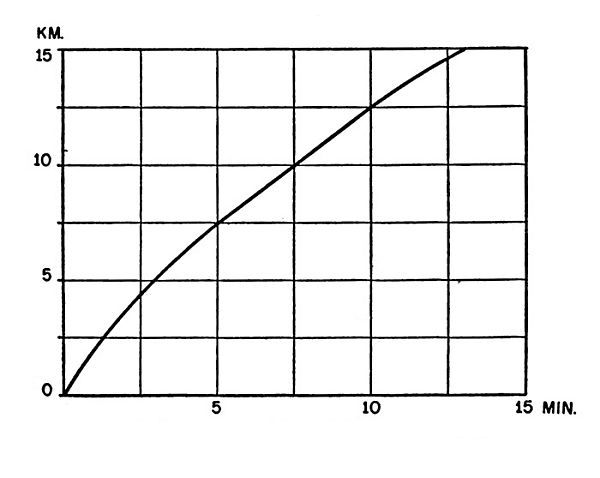
Figure 1. Speed of ascent in the portable low-pressure chamber.
In the writing test shown above [not reproduced] the occurrence of
altitude sickness in a sinking experiment for 12 km. [39,400 ft.]
altitude is shown in this manner: For example, after 1 minute and
20 seconds at 11 km. [36,100 ft.] altitude, the writing is interrupted
because of sudden altitude sickness with unconsciousness, and is
resumed after 4½ minutes at an altitude of 8.8 km. [28,870 ft.], with
erroneous writing. At 8.3 km. [27,230 ft.] altitude the writing becomes
free of errors. This is worthy of special attention because in
this case a person has fully recovered mentally at an altitude of 8.3
km. [27,230 ft.], after 3 minutes of the most severe lack of oxygen,
while in altitude endurance experiments at this altitude severe altitude
sickness sets in after about 3 minutes. Here we are dealing with a
process which in any case is very favorable but which is not yet entirely
clear and which was already observed in earlier experiments
of parachute jumps from great altitudes. Still, it appears from this
that a rather long oxygen lack at altitudes up to 13 km. does not present
any great strain in
[page 12 of original]
the sense of using the last reserves, but, on the contrary, the human
organism seems to react to this loading with a certain increase in
resistance to altitude.
In descending experiments from 13 km. [42,700 ft.] altitude the
waiting time of 10 seconds was retained, but on the other hand exertion
in the form of knee bends was omitted since technical difficulties
interfered with this procedure.
The experiments involving suspension could be done only in the
large low-pressure chamber, since suspension was impossible in the
small low-pressure chamber for reasons of space. Therefore, the
ascent to 13 km. [42,700 ft.] altitude was carried out slowly in the
main chamber (without explosive decompression) so that when 13
km. [42,700 ft.] was reached a certain oxygen lack existed. With this
oxygen lack the knee bends would have presented a great burden
which would have falsified too greatly the results of the experiment.
The same conditions were also given in further experiments at higher
altitudes in the main chamber. For this reason, the 13 km. [42,700
ft.] descending experiments were carried out partly in the sitting
position, partly in the sitting position strapped in, and partly suspended.
They yielded the following average data:
Table 2
| Descending experiment | Unconsciousness | Recovery of consciousness |
| from 13 km. [42,700 ft.] | after— | after— |
| | |
| Seated (lying during unconsciousness) | 50″ = 12.4 km. | 8′ 12″ = 7.2 km. |
| [40,672 ft.]. | [23,620 ft.]. |
| Seated strapped in | 35″ = 12.6 km. | 10′ 30″ = 5.85 km. |
| [41,340 ft.]. | [19,190 ft.]. |
| Suspended | 20″ = 12.8 km. | 19′ = 1.6 km. |
| [41,980 ft.]. | [5,250 ft.]. |
[page 13 of original]
Since in unfavorable cases in these experiments, namely while suspended,
recovery of consciousness did not occur until 1.6 km. [5,250 ft.]
altitude, it had to be concluded that in jumps from altitudes over 13
km. [42,700 ft.], recovery of consciousness would follow only after
0 km., which would mean that in an actual situation the landing would
be made in an unconscious condition. This raised the question of a
safe means of rescue.
Descending experiments were made in larger numbers from 15 km.
altitude, since it became evident that at this altitude the approximate
limits for what was possible in emergencies had already been reached
or essentially surpassed. After an ascent made as rapidly as possible,
using oxygen apparatus with free flow, the mask was removed immediately
upon attaining 15 km. [49,200 ft.] altitude and the descent
was begun. Since the results of these descending experiments were
very typical and especially impressive it is necessary to present one of
these experiments in detail. The record of an experiment is represented
as follows:
| 15 km. [49,200 ft.] | Lets the mask fall, severe altitude sickness, clonic convulsions. |
| 14.5 km. [47,560 ft.] 30 sec. | Opisthotonus. |
| 14.3 km. [46,900 ft.] 45 sec. | Arms stretched stiffly forward; sits up like a dog (“Pfoetchenstellung”), legs spread stiffly apart. |
| 13.7 km. [44,950 ft.] 1 min. 20 sec. | Suspended in opisthotonus. |
| 13.2 km. [43,310 ft.] 1 min. 50 sec. | Agonal convulsive breathing. |
| 12.2 km. [40,030 ft.] 3 min. | Dyspnea, hangs limp. |
| 7.2 km. [23,620 ft.] 10 min. | Uncoordinated movements with the extremities. |
| 6 km. [19,690 ft.] 12 min. | Clonic convulsions, groaning. |
| 5.5 km. [18,040 ft.] 13 min. | Yells loudly. |
[page 14 of original]
| 2.9 km. [9,520 ft.] 18 min. | Still yelling, convulses arms and legs, head sinks forward. |
| 2-0 km. [6,560-0 ft.] 20-24.5 min. | Yells spasmodically, grimaces, bites his tongue. |
| 0 km. | Does not respond to speech, gives the impression of someone who is completely out of his mind. |
| 5 min. (after reaching ground level). | Reacts for the first time to vocal stimulation. |
| 7 min. | Attempts upon command to arise, says in stereotyped manner: “No, please”. |
| 9 min. | Stands up on command; severe ataxia; answers to all questions: “Just a minute”. Tries spasmodically to recall his birth date. |
| 10 min. | Typical stereotypes of attitude and movement (catatonia); mumbles number to himself. |
| 11 min. | Holds his head turned convulsively to the right; tries repeatedly to answer the first question concerning his birth date. |
| 12 min. | Questions of the subject: “May I slice something?” (Note: In civilian work he was a delicatessen clerk.) “May I pant, will it be all right if I inhale?” Breathes deeply, then says, “All right, thank you very much.” |
| 15 min. | On being ordered to walk, steps forward and says: “All right, thank you very much”. |
| 17 min. | Gives his name; says he was born in 1928 (born 1 November 1908). Experimenter asks: “Where?” “Something 1928” “Profession?” “28—1928”. |
| 18 min. | “May I inhale?” “Yes.” “I am content with that.” |
| 25 min. | Still the question continues: “Pant?” |
| 28 min. | Sees nothing; runs against open window sash upon which the sun is shining, so that large lump is formed on his forehead; says: “Excuse me please.” No expression of pain. |
[page 15 of original]
| 30 min. | Knows his name and place of birth. Upon being asked for the day’s date: “1 November 1928”. Shivering of the legs; stupor continues; cannot be frightened by the report of a shot. Dark objects are still not discerned; subject bumps against them. Is aware of bright light; knows his profession; spacially disoriented. |
| 37 min. | Reacts to pain stimuli. |
| 40 min. | Begins to observe differences. Falls continually into his previous speech stereotypes. |
| 50 min. | Spacially oriented. |
| 75 min. | Still disoriented in time; retrogressive amnesia over 3 days. |
| 24 hours | Normal condition again attained; has no recollection of the experiment itself. |
The events of the descending experiments from 15 km., as shown
here through this example, repeated themselves in a similar way in all
the rest of the experiments. The average data from 20 experiments
with 15 different subjects are as follows:
Table 3
| | | Clear |
| 15 km. | Unconsciousness | Subconscious awakening | consciousness |
| [47,200 ft.] | after— | movements | at 0 km. |
| | | |
| Suspended | 16″ = 14.7 km. | 20½′ = 1.8 km. | |
| [48,220 ft.]. | [5,910 ft.]. | 18′-90′ |
| | | |
| Lying | 20″ = 14.6 km. | 14′ = 5 km. | 15′-80′ |
| [47,890 ft.]. | [16,400 ft.] | |
Unconsciousness after discontinuation of oxygen occurs following
a short motor restlessness with severe altitude sickness, whereupon
light spasmodic and then very severe tonic convulsions follow in a
condition of complete unconsciousness. These tonic convulsions lasting
virtually a minute are followed rather suddenly by a phase of
complete
[page 16 of original]
flacidity with a drop in breathing rate and transition to convulsive
breathing with 3 to 4 breaths per minute until complete cessation of
breathing of 45 seconds duration (post-hypoxemic pseudo-death—Lutz).
Then follows a period of improvement in breathing, until
the first subconsciousness movements announce the gradual recovery
of consciousness, during which, nevertheless, the higher mental functions
are temporarily entirely absent. Further recovery proceeds
slowly during the course of the following ½ to 1½ hours as may be
seen from the above case record. During the time of complete unconsciousness,
there was defecation and urination in the case of most
subjects, increased salivation and, in some cases, vomiting.
Here we obviously have the conditions which Lutz and Wendt in
their animal experimentation which is referred to in greater detail
later found in falling experimentation with O2 breathing and designated
as “post-hypoxemic twilight state” (“Posthypoxaemischen
Daemmerzustand”) since we are dealing with a slow recovery of consciousness,
especially also in view of the mental behavior of the experimental
subjects. The post hypoxemic pseudo-death observed by
Wendt and Lutz was not found in any experiments in the form which
they had observed. The severe condition described above we could
designate as hypoxemic pseudo-death only because it was limited to
the period of the most severe O2 lack (on the average, between 13.3
and 12.3 km.).
In spite of the relatively large number of experiments, the actual
cause of the severe mental disturbances and bodily failures (paralysis,
blindness, etc.) attendant upon post-hypoxemic twilight state remains
something of a riddle. It appeared often as though the phenomena
of pressure drop sickness had combined with the results of severe
oxygen lack. In this connection, the subjective accounts made by
the authors in two experiments each were interesting. In the case
of Ro. during a half hour stay at 12 km. [39,400 ft.] with oxygen,
[page 17 of original]
only the usual pains attendant with bends occurred. In a further
experiment with a stay of 40 minutes duration at an altitude of between
13 [42,650 ft.] and 13.5 km. [44,290 ft.] there developed very
gradually a condition of weakness, combined with a peculiar headache,
which then led to a considerable slackening of strength in the arms
and hands. As a result of this, Ro. could no longer hold the breathing
mouthpiece (for special reasons in these experiments, Ro. had to
breathe with a mouthpiece and nose clamp) so that it slid out of
his mouth. All these phenomena were still clearly observed by Ro.
Ra. returned the mouthpiece to Ro. However at this point Ro. failed
rather suddenly with paleness, strong cyanosis of the lips and complete
unconsciousness. After Ro. had regained clear consciousness
through descent and sufficient O2 breathing, he determined the existence
in himself of a complete paralysis of the legs, weakness of the
arms and severe disturbances of vision. These serious disturbances
developed although the time of oxygen lack and unconsciousness had
lasted only about 5 seconds. Following descent soon after this to 0
km., the paralysis of the legs continued for about 5 minutes more and
the very severe visual disturbances only cleared up after 2 hours.
While this episode of Ro.’s occurred in an experiment at a special
altitude, the disturbances occurred in Ra. at an altitude of between
12 [39,400 ft.] and 13 km. [42,700 ft.] while he was breathing sufficient
oxygen with a mask and continuous flow into the circuit. After 10
minutes stay at this altitude, pains began on the right side with a
spastic paralytic condition of the right leg which increased continually
as though Ra.’s whole right side were being crushed between two
presses. At the same time there were most severe headaches as though
the skull were being burst apart. The pains became continually more
severe so that at last the discontinuation of the experiment became
necessary. The pains disappeared when ground level was reached
while the disturbances of the right leg continued about 5 minutes more.
Shortly before the
[page 18 of original]
second experiment, Ra. took two tablets of “Antineuralgica” (a coal
tar derivative) and two tablets of pervitin. In the course of the experiments
there occurred only light pains in the right arm and leg,
moderate headaches, but a very severe uncontrollable urge to cough,
actually less severe difficulties than in the foregoing experiment,
although this one was made at 1,000 m. [3,280 ft.] higher.
Ro. experienced disturbances which in quality resembled the severe
disturbances in the 15 km. [49,200 ft.] sinking experiment, although
the degree of oxygen lack in this experiment was negligible in comparison
to the 15 km. [49,200 ft.] experiment, so that the idea of a
combination of pressure drop phenomena with the phenomena of
oxygen lack is definitely suggested.
2. Descending experiments with O2 breathing
Since obviously the utmost limits of these experiments had been
reached with the descending experiments from 15 km. [49,200 ft.]
without oxygen breathing, descending experiments with oxygen
breathing were conducted from greater heights.
In the experiments, the following experimental procedure was
chosen: ascent to 8 km. [26,300 ft.], remaining there 5 to 10 minutes
with oxygen breathing; then turning on the oxygen blower explosive
decompression to a predetermined altitude; 10 seconds waiting time
(experiments from 17 [55,800 ft.] and 18 km. [59,100 ft.], altitude
without waiting time) and descent at sinking speed. In order to
imitate the perpendicular body position as occurs in suspension in a
parachute harness, the experimental subjects had to stand during
the experiments since suspension was not possible in the small decompression
chamber.
In the descending experiments from 15 km. [49,200 ft.] altitude
there was no altitude sickness or only a slight temporary kind. In
the further descending experiments, the following results were obtained
(Table 4):
[page 19 of original]
Table 4.—Descending experiments with oxygen breathing
| Unconsciousness | From— | Recovery of |
| after— | | consciousness after— |
| | |
| 23 sec. = 15.75 km. | 16 km. [52,500 ft.] | 2 min. 35 sec. = 13.55 km. |
| [51,660 ft.] | | [44,460 ft.] |
| 10 sec. = 16.8 km. | 17 km. [55,800 ft.] | 3 min. 50 sec. = 13 km. |
| [55,120 ft.] | | [42,700 ft.] |
| 7 sec. = 17.9 km. | 18 km. [59,100 ft.] | 10 min. 35 sec. = 8.5 km. |
| [58,740 ft.] | | [27,890 ft.] |
Thus it was shown that unconsciousness developed relatively early
in spite of oxygen breathing, while the following convulsive stage ran
its course in a much less severe form than in the experiments without
oxygen breathing. Primarily spasmodic convulsions with only occasionally
light tonic convulsions developed. Breathing paralysis
never set in and upon recovery of consciousness the experimental subjects
were again completely in control of themselves. The markedly
quick development of unconsciousness was caused by the fact that the
subjects were standing during the experiments (to be considered in
comparison with the corresponding times in the falling experiments
with oxygen breathing). Descending experiments from still greater
altitudes were not undertaken, since in practice there is no need to
escape from such altitudes with open parachute and thus to expose
oneself to the danger of severe freezing.
3. Falling experiments without oxygen
Since the results of falling experiments from 12 km. altitude were
known from earlier experimentation and indeed descending experiments
up to 15 km. [49,200 ft.] without oxygen had been conducted
within the scope of this work, falling experiments were begun at an
altitude of 14 km. [45,900 ft.], in order not to increase unnecessarily
the number of experiments.
[page 20 of original]
The ascent preceded by explosive decompression from 8 to 14 and
15 km. altitude, in which the ascent to 8 km. was made with oxygen
and the explosive decompression with continuous flow, followed after
5 to 10 minutes waiting time. After the removal of the oxygen mask
directly in connection with the explosive decompression, five knee
bends were made during the waiting period of 10 seconds, then descent
at free fall speed. During the explosive decompression the oxygen
supply was interrupted from the outside. The results of these experiments
were (Table 5):
Table 5.—Falling experiments without O2 breathing
| Unconsciousness | From— | Recovery of consciousness |
| after— | | after— |
| | |
| 30 sec. = 13.2 km. | 14 km. | 65 sec. = 9.7 km. |
| [43,310 ft.] | [45,900 ft.] | [31,830 ft.] |
| 28 sec. = 14.3 km. | 15 km. | 96 sec. = 7.6 km. |
| [46,900 ft.] | [49,200 ft.] | [24,940 ft.] |
The further experiments up to 20 km. [65,600 ft.] altitude were
made with the same procedure as those up to 15 km. [49,200 ft.], although
without knee bends during the waiting period of 10 seconds,
since unconsciousness would have occurred too soon as a result of the
knee bends and the experimenters had become convinced that rescue
from these altitudes would have to be brought about by abandonment
of the aircraft without bodily exertion (catapult seat).
(Table 5—Continued)
| Unconsciousness | From— | Recovery of consciousness |
| after— | | after— |
| | |
| 32 sec. = 14.7 km. | 16 km. | 118 sec. = 6.6 km. |
| [48,220 ft.] | [52,500 ft.] | [21,650 ft.] |
| 27 sec. = 15.9 km. | 17 km. | 126 sec. = 6.3 km. |
| [52,150 ft.] | [55,800 ft.] | [20,660 ft.] |
[page 21 of original]
| Unconsciousness | From— | Recovery of consciousness |
| after— | | after— |
| | |
| 23 sec. = 17 km. | 18 km. | 156 sec. = 4.6 km. |
| [55,800 ft.] | [59,100 ft.] | [15,090 ft.] |
| 20 sec. = 18.5 km. | 19 km. | 173 sec. = 3.7 km. |
| [60,700 ft.] | [62,300 ft.] | [12,140 ft.] |
| 17 sec. = 19.75 km. | 20 km. | 178 sec. = 3.2 km. |
| [61,520 ft.] | [65,600 ft.] | [10,500 ft.] |
| 15 sec. = 20.875 km. | 21 km. | 1 min., 10 sec. after |
| [68,490 ft.] | [68,900 ft.] | reaching 0 m. |
From 21 km. [68,900 ft.] altitude only one experiment was made
in this series, just as in the falling experiments, with oxygen breathing
since the pumps achieved the evacuation of the main chamber necessary
for a pressure drop to 21 km. altitude only after hours of overloading
and the fact that the mercury barometer used in these experiments
had its limit of measurement at this altitude. The two experiments
were considered only as an orientation on the behavior of the
human organism at this altitude at which the ebullition point of the
blood had already been far surpassed. A systematic working over
of these altitudes must be carried on with perfected measuring instruments
and a two-stage pump aggregate in a new experimental series.
The result of this falling experiment from 21 km. altitude was made
unreliable through the fact that the subject experienced a paralysis
of breathing from 11 to 7 km., through which his recovery was doubtless
greatly delayed. However, no permanent damage occurred.
4. Falling experiments with oxygen breathing
Falling experiments with oxygen breathing were undertaken only in
small numbers for crude orientation for the following reasons:
The altitude
[page 22 of original]
was limited by the available equipment to a maximum of 21 km.
[68,900 ft.], but indeed from this altitude falling experiments without
oxygen breathing had already been profitably carried out. It is self-evident
that oxygen breathing during parachute jumps from such
extreme altitudes greatly increases in any case the chances of success
of the jump and, therefore, is to be unconditionally demanded. For
that reason it devolved upon the experimenters only to determine
to what degree the results of the experiments are influenced by oxygen
breathing, especially in regard to the recovery of consciousness, which,
of course, followed without oxygen only at relatively low altitudes.
As was to be expected, these experiments showed clearly the favorable
effect of oxygen breathing. (Table 6):
Table 6.—Falling experiments with oxygen breathing
| Unconsciousness | From— | Recovery of consciousness |
| after— | | after— |
| | |
| 21 sec. = 19.5 km. | 20 km. | 87 sec. = 10.55 km. |
| [63,980 ft.] | [65,600 ft.] | [34,620 ft.] |
| 15 sec. = 20.875 km. | 21 km. | 60 sec. = 12.9 km. |
| [68,490 ft.] | [68,900 ft.] | [42,320 ft.] |
The astonishing value of 60 seconds = 12.9 km. [42,320 ft.] for the
recovery of consciousness in the 21 km. [68,900 ft.] experiment is
explained on the basis that this value was obtained from a single
experiment with one subject, who had shown himself in numerous
other experiments to be especially resistant to altitude. On the other
hand the 20 km. [65,600 ft.] values are the average of a series of
experiments.
The descending experiments without oxygen show that the limit for
a safe escape with an open parachute lies approximately at a jumping
altitude of 13 km. [42,700 ft.], since in a jump from 13 km. [42,700 ft.]
recovery of consciousness occurred only at an altitude of 1.6 km.
[5,250 ft.], and so one must already consider the possibilities of landing
in an unconscious condition with all the attendant dangers. This
still does not take into account the heavy demands made on the body
by the cold and the consequent risk. The great effect of the body
position during the experiment makes it obvious how severe is the
effect of every additional demand. While, for example, in the 13 km.
[42,700 ft.], experiment upon a seated subject, recovery of consciousness
took place after 8 minutes 12 seconds at an altitude of 7.2 km.
[23,620 ft.], the suspended subjects recovered consciousness only after
19 minutes at 1.6 km. [5,250 ft.] altitude. Correspondingly also, unconsciousness
occurred in the suspended subjects much more rapidly
than in those who were seated. The same observation was made in
the 15 km. [49,200 ft.] experiments, and indeed those who went
through the experiment lying down could already state name and birth
date immediately upon reaching ground level although they were
paralyzed, while those who had been suspended did not respond at all
to speech within this time. Except for one mentally very sluggish
subject, the return of normal condition occurred much earlier to
those who were lying down, namely within 15 minutes. The descending
experiments extended to 18 km. [59,100 ft.] altitude with oxygen
breathing showed that, except for the danger of cold, escape with an
open parachute is possible from these altitudes even though, practically,
no need exists for it.
Before we go into a discussion on the falling experiments it seems
essential for us to cite the work of Lutz and Wendt on “Animal
Experiments on Parachute Jumping from High-Pressure Cabins.”
Unfortunately this work was not available to us during these experiments
so that we could not build upon the valuable results contained
in it and derived from numerous animal experiments, or upon the
experience of the authors. Although both authors approach with
necessary scepticism the problem of “reaching decisions through
animal experimentation upon questions in
[page 24 of original]
which, in the final analysis, the behavior of the human being in identical
situations is of exclusive interest,” they could, and had to depend
upon the previously proved experience that no fundamental qualitative
differences in the manner of reaction to oxygen lack is to be expected
between animals and human beings although there are considerable
quantitative differences which, in this case, mean temporal differences.
However, the results of our experiments show that to some extent
quantitative as well as qualitative differences are present to the extent
that the above animal experiments must lead to great fallacies which
are significant to future developments. This appears especially in a
comparison of results obtained with animals with the collective results
of human experimentation upon escape from high altitudes through
free fall without oxygen. On the basis of animal experiments, Lutz
and Wendt were forced to the conclusion that if oxygen is breathed
before the pressure drop “jumps from 14 km. [45,900 ft.] altitude can
theoretically be survived—at any rate, that is the maximum altitude
* * *,” whereas we were able to carry out human experiments
up to 21 km. [68,900 ft.] altitude without any harm whatever. In all
experiments at 20 km. [65,600 ft.] the subjects recovered clear consciousness
with spontaneous control above 3 km. [9,800 ft.], and so
within a sufficient altitude for actual parachute jumping. As instructed
before the experiment, the subject rang a cowbell hung up
in the chamber by pulling a handle (the equivalent of pulling the rip
cord) without a new order to do so, so that under actual conditions they
would certainly have also pulled the rip cord at the right time.
Experiments with a pressure drop from 4 km. [13,100 ft.] without
previous breathing in of oxygen were not carried out by us because
we proceeded from the viewpoint that when contact with the enemy
is possible, pressure cabin machines fly with a pressure corresponding
to 8 km. [26,200 ft.] altitude and, therefore, the crews would already
be breathing oxygen in case of a possible pressure drop as a result of
damage to the cabin.
[page 25 of original]
Since the falling experiments without oxygen had already given
such good results, falling experiments were begun only at 20 km.
[65,600 ft.] altitude, and, because of the limitations described above,
could be carried out only to 21 km. [68,900 ft.]. In these the results
obtained by Lutz and Wendt were fully corroborated in this respect,
that jumps from above 21 km. [68,900 ft.] can probably be made without
danger, and that ebullition of the blood does not yet take place
up to 21 km. [68,900 ft.] altitude. On the other hand in a falling
experiment with human beings, neither a post-hypoxemic pseudo-death
nor a post-hypoxemic twilight sleep were ever observed (Lutz).
In conclusion, we must make it particularly clear that, in view of
the extreme experimental conditions in this whole experimental series,
no fatality and no lasting injury due to oxygen lack occurred.
For practical rescues by parachute jump from the highest and
higher altitudes the experiments yielded the following:
The parachute jump without oxygen with immediate opening of the
parachute is possible up to a jumping altitude of 13 km. [42,700 ft.];
the jump with oxygen equipment can be made at jumping altitudes
up to 18 km. [59,100 ft.]. Advice must be given against jumping and
immediate opening of the parachute since there is considerable danger
of freezing and there is no need to pull the rip cord at high altitudes.
However the experimental data give some indication of the chances
of the parachute jumper whose parachute has become unfolded from
whatever cause.
The jump with a free fall and opening of the parachute at low altitudes
can be made without oxygen equipment up to altitudes of 20
km. [65,600 ft.], with oxygen up to 21 km. [68,900 ft.], and probably
considerably higher.
In all the experiments at great height, even in experiments with
oxygen breathing, unconsciousness occurred extraordinarily rapidly
and was naturally preceded by loss of control before that. In one
unfavorable case of a subject in the standing position during a descending
experiment with oxygen, jumping from an altitude of 18 km.
[59,100 ft.], unconsciousness occurred after 7 seconds. One may not
count on a longer time than 10 seconds before loss of control occurs
at high altitudes even with the body at rest. So within that time the
airplane must be abandoned or at least one must activate the ejection
seat. The technical solution of this problem must be found through
a different approach. It is certain only that it will be impossible to
climb out under one’s own power, that one must avoid absolutely all
bodily exertion, and that the time must be kept as short as possible.
Rescue is still possible from very great heights; the critical part is
the abandoning of the aircraft.
Oxygen equipment is absolutely necessary at these altitudes, since
it assures the most favorable conditions for the jump. In case of
failure of the equipment, loss of the mouthpiece or other mishaps, we
still need not count upon serious disturbances or injuries up to 20
km. [65,600 ft.]. Even jumps from 21 km. [68,900 ft.] will go well
if there is automatic opening of the parachute through barometrical
control at 7 to 4 km. [23,000 to 13,100 ft.] altitude.
The automatic opening is also essential for several other reasons:
1. In particular cases the parachute jumper is not able to regain
consciousness at a sufficient altitude above the ground because of collapse
or injury.
2. As a result of cold the jumper may be handicapped by immobility
of his hands, and thus be hindered in pulling the rip cord.
3. As a result of the unconsciousness resulting from anoxia, the
[page 27 of original]
parachute jumper loses all sense of the time which has elapsed since
his jump, as was shown in all experiments, so that it is impossible for
him, with failing eyesight, to estimate his altitude.
On the other hand it is desirable, on the basis of the reason adduced
under number 3 above, that the opening of the parachute at altitudes
above 7 km. [23,000 ft.] be prevented, since very often the parachute
jumper would pull the rip cord immediately after recovering from his
altitude sickness, which may be too soon and at too high an altitude.
The best conditions for explosive decompression itself and for the
seconds elapsing until the appearance of altitude sickness are provided
if flying is done at a cabin pressure corresponding to 8 km. [26,300 ft.]
and with oxygen breathing.
Since it may become necessary to abandon the aircraft for reasons
other than damage to the pressure cabin, the pressure equalization at
a predetermined rate must be made possible by means of a valve.
In case abandonment does not appear necessary in spite of the loss
of cabin pressure the danger of oxygen lack is still less with the automatic
diving control mechanism than in a parachute jump, since the
dive may be made with considerably greater rate of descent.
Experiments were instituted upon the possibility of rescue from altitudes
up to 21 km. [68,900 ft.].
Without parachute oxygen equipment, rescue in descending experiments
is still possible from 13 km. [42,700 ft.], with equipment, from
18 km. [59,100 ft.]. The danger arising from cold must be considered.
In falling experiments, rescue from 21 km. [68,900 ft.] altitude with
and without oxygen was proved possible. Automatic parachute opening
is necessary. Ebullition of the blood does not yet occur at 21 km.
[68,900 ft.] altitude.
[page 28 of original]
Oxygen must be breathed before explosive decompression. Abandonment
must be by means of the ejection seat. The dive to safe
altitude offers good possibilities of rescue if abandonment of the plane
is not necessary after loss of the cabin pressure.
Lutz and Wendt—“Animal Experiments on Parachute Jumping from
High-Pressure Cabins.” Communications in the Field of Aviation
Medicine, Research Report 5/42.
Romberg—“The Parachute Jump from Great Heights.” German
Aviation Research, Research Report No. 1416.
TRANSLATION OF DOCUMENT 343-A-PS
PROSECUTION EXHIBIT 62
Field Marshal Milch
Secret
Berlin W 8, 20 May 1942 Leipzigerstrasse 7
Dear Wolffy!
In reference to your telegram of 12 May our medical inspector
reports to me that the altitude experiments carried out by the SS
and Air Force at Dachau have been finished. Any continuation
of these experiments seems essentially unreasonable. However the
carrying out of experiments of some other kind, in regard to perils
at high sea, would be important. These have been prepared in immediate
agreement with the proper offices; Major (M. C.) Weltz will
be charged with the execution and Captain (M. C.) Rascher will be
made available until further orders in addition to his duties within
the Medical Corps of the Air Corps. A change of these measures
does not appear necessary, and an enlargement of the task is not
considered pressing at this time.
The low-pressure chamber would not be needed for these low-temperature
experiments. It is urgently needed at another place
and therefore can no longer remain in Dachau.
I convey the special thanks from the Supreme Commander of the
Air Corps to the SS for their extensive cooperation.
I remain with best wishes for you, in good comradeship and with
Heil Hitler!
Always yours
[Signed] E. Milch
SS Obergruppenfuehrer Wolff
Berlin SW 11.
TRANSLATION OF DOCUMENT 343-B-PS
PROSECUTION EXHIBIT 70
Field Marshal Milch
Berlin, W 8, 31 Aug. 1942 Leipzigerstrasse 7
Dear Herr Himmler!
I thank you very much for your letter of 25 August. I have read
with great interest the reports of Dr. Rascher and Dr. Romberg. I
am informed about the current experiments. I shall ask the two
gentlemen to give a lecture combined with the showing of motion
pictures to my men in the near future.
Hoping that it will be possible for me to see you on the occasion
of my next visit to Headquarters, I remain with best regards and
Heil Hitler!
Yours,
[Signed] E. Milch
Reich Leader SS and Chief of the German Police Himmler
Berlin SW 11.
TRANSLATION OF DOCUMENT NO-289
PROSECUTION EXHIBIT 72
Berlin W 8, 8 October 1942 Leipziger Str. 7
Telephone 52 00 24
To the Chief of the German Police, Reich Fuehrer SS Himmler, Berlin SW. 11, Prinz Albrecht Str. 8
Subject: Letter 1309/42 of 25 August 1942 to State Secretary Milch concerning experiments for rescue from high altitudes.
Very honored Reich Leader SS,
In the name of German research on aviation medical problems, I beg
to thank you very obediently for the great help and all the interest
shown in the Dachau experiments; these experiments form a complement
which is, for us, of great value and importance.
The fact that an atmosphere with so little oxygen can be endured
at all for some time is most encouraging for further research.
It is true that no conclusions as to the practice of parachuting can
be drawn for the time being, as a very important factor, namely cold,
has so far not yet been taken into consideration; it places an extraordinary
excess burden on the entire body and its vital movements,
so that the results in actual practice will very likely prove to be far
more unfavorable than in the present experiments.
In the meantime the supplementary tasks required now have been
begun. In part they will have to be finished only after completion
of the new Research Institute for Aviation Medicine of the Reich Air
Ministry in Tempelhof, whose low-pressure chamber will include all
cold generating apparatus and also an installation for producing
conditions at a height of 30 kilometers.
Freezing experiments in another direction are, in, part, still being
made at Dachau.
When the work will need once more your sympathetic assistance,
may I be allowed to get in touch with you again through Stabsarzt
Dr. Rascher?
Heil Hitler
[Signed] Prof. Dr. Hippke
TRANSLATION OF DOCUMENT NO-224
PROSECUTION EXHIBIT 76
On 11 September 1942, at 9:45 o’clock, Stabsarzt Dr. Rascher and
Dr. Romberg met, according to telephonic and oral agreements with
Colonel Pendele, in the antechamber of the State Secretary. We were
informed that the State Secretary had ordered this conference at the
present stage, in the course of which a report on experiments concerning
“rescue from great heights” was to be made, and the motion picture
concerning these experiments was to be shown. The gentlemen
waiting in the antechamber of the State Secretary and in the corridor
(most of them from the experimental staff) were informed that previous
to the conference a motion picture was to be shown, so that all
went to the projection room on the fifth floor. Here quite a large
number of people were already present, so that 30-40 persons were
there in all. Among them were officers, medical and engineer officers—we
know some of them personally—some whose presence surprised
us in view of the top secret nature of the motion picture and of
the experiments. No checking of the persons present was done, nor
was there an attendance list. As, after a short time of waiting, the
State Secretary had not come, the motion picture was shown, without
giving us an opportunity for preliminary or explanatory remarks.
During the intermission between the two parts of the motion picture,
Dr. Rascher referred once more to the strict obligation of secrecy ordered
by the Reich Leader SS. After completion of the showing of
the motion picture—the State Secretary had not come, as he had been
summoned to see the Reich Marshal [Goering]—the persons present
still talked a little while about the motion picture, on which occasion
less interest was shown in the subject itself than in the place of the experiments
and the individuals who had been the subjects. After this
period of time, during which we were neither called upon to make any
statements whatsoever nor were we, considering the great forum and
the absence of the State Secretary, inclined to give any reports the
greater part of those present went back to the development conference,
while Oberstarzt Wuerfler, Oberstarzt Professor Kalk, Stabsarzt
Bruehl and Regierungsrat Benzinger asked us to make a report to a
small medical circle. As, however, the State Secretary had prohibited
that any report be made before the distribution had been decided on,
we refused to disclose the results of the experiments. Oberstarzt Kalk
stated that he was willing to report to the State Secretary our wishes
concerning the distribution of the report and the continuation of the
experiments. The film was handed to Colonel Vorwald.
According to the conference with Obersturmbannfuehrer Sievers,
I tried to get the film back on the same day, but Colonel Vorwald
was still at the development conference. When I telephoned the next
day and requested that the film be handed back, Colonel Vorwald
declared that he would like to keep the film until after Sunday, 13
September, since on this day the Reich Marshal was coming and
might perhaps desire to see the film. Accordingly, I let Colonel
Vorwald keep the film for that day. On 14 September, I went to
fetch the film from Colonel Vorwald, and was informed that it had
not been shown. On the same day I spoke with Stabsarzt Bruehl,
who informed me that Oberstarzt Kalk had transmitted, still on
11 September, our wishes concerning distribution and confirmation
of the experiments to the State Secretary. The State Secretary had
approved the distribution schedule, and said that a continuation of
the experiments was not urgent. A few days later the distribution
schedule accepted by the State Secretary was sent to the German
Aviation Research Institute by Colonel Pendele, and the report was
subsequently transmitted by the Institute to the offices concerned.
Since that time I have not received any news either concerning the
film or concerning the report.
[Signed] Dr. Romberg
TRANSLATION OF DOCUMENT 1612-PS
PROSECUTION EXHIBIT 79
The Reich Leader SS
| Field Command Post |
| | [Rubber stamp]: | Personal Staff of Reich Leader SS |
| | | Documentation Section |
| | | File No.: Confidential |
| | Field Command Post, 13 December 1942 |
| The Reich Leader SS |
| Personal Staff |
| Journal No. 19/10/43 g, Bra/Secret |
| 1. | Hauptsturmfuehrer Dr. med. Rascher [illegible] * * * SS |
| 2. | Reich Leader SS Berlin |
| 3. | Medical Office in SS Fuehrungshauptamt (SS Operational Main Office) Berlin |
| 4. | SS Obergruppenfuehrer Pohl, Berlin |
| 5. | Ahnenerbe Berlin-Dahlem |
Enclosed I am sending you a letter of the Reich Leader SS (copy of
same) with an order for SS Hauptsturmfuehrer Dr. Rascher.
You are requested to duly note and accord needed assistance to
Hauptsturmfuehrer Dr. Rascher in the carrying through of his
experiments.
By order
[Initialed] B.
SS Obersturmbannfuehrer
| | Prinz Albrechtstrasse |
| | [Rubber stamp] | Personal Staff of Reich Leader SS |
| | | Documentation Section |
| | | Journal No.: Confidential |
SS Hauptsturmfuehrer Dr. Rascher is being assigned by me to carry
through the following experiments:
1. Low-pressure chamber experiments—to be carried out under
conditions corresponding to those actually prevailing under normal
operating conditions—for rescue from high and extremely high altitudes.
Determination of changes in chemical equilibrium, as well
as gas equilibrium of human body. Experiments are to be repeated
until a scientifically incontestable basis for findings is established.
Testing of pressure-proof protection garments for the highest altitudes
to be carried out with the assistance of manufacturers of such
protective suits.
2. Tests for reimparting warmth after total chilling of the human
body, recording all changes of chemical and gas characteristics, are to
be further continued until complete clarification of doubtful questions.
I attach particular value to conditions for experiments coming as close
to actual conditions as possible, particularly as regards reimpartation
of warmth. Sauna equipment available in Dachau should be used in
connection with experiments on reimpartation of warmth.
3. Experiments on removal of effects due to freezing of parts of
human system, especially the extremities, to be carried through in
suitable form (e. g. applications with Gastein water).
4. Experiments concerned with adaptation to freezing cold in snow
huts (igloos) to be carried out under varying diets in order to establish
whether adaptation to cold [German text says “Gewaehrung”, i. e.
consent, which evidently is a typographical error] and resistance increase
against freezing is possible. These experiments are to be carried
out on the site of the SS Mountain Retreat Sudelfeld.
5. The procurement of the apparatus needed for all the experiments
should be discussed in detail with the offices of the Reicharzt SS, of
the SS Main Office for Economic Administration and with the
Ahnenerbe. The necessary chemical products, medical supplies, and
glassware will be made available by the SS Medical Office, Berlin.
6. Publication of results obtained in such tests subject to my
approval only.
[Signed] H. Himmler
EXAMINATION BY PROSECUTION
Mr. McHaney: * * * When did the high-altitude experiments
begin in Dachau?
Witness Neff: The first high-altitude experiments were on 22 February
1942. The so-called low-pressure chambers had been brought
in earlier and dismounted. The exact time when the chambers came
is not known to me.
Q. Why do you remember the date when the first experiments were
made in the low-pressure chambers so well?
A. The 22d of February is my birthday and the tubercular patients
gave a party for me. On that date the experiments started, and
that is why I remember the date.
Q. Will you tell the Tribunal who worked on these experiments?
A. The experiments were conducted by Dr. Rascher and Dr. Romberg.
Ten prisoners were selected and were taken to the station as
permanent experimental subjects; and they were told that nothing
would happen to them. In the beginning, the first 3 weeks, the experiments
went off without incident. One day, however, Rascher told
me the next day he was going to make a serious experiment and that
he would need 16 Russians who had been condemned to death, and he
received these Russians. Then I told Rascher that I would not help,
and I actually got Rascher to send me away to the tubercular ward.
On that day I know for certain that Rascher’s SS man Endres or
other SS men conducted these experiments. Dr. Romberg was not
there that day. The SS man Endres took the Russian prisoners of
war to Rascher and in the evening the parties were taken out. On the
next day when I returned to the station, Endres was already there and
he said that two more, two Jews, would be killed. I am quoting what
he said. I left the station again, but I watched to see who would be
taken for the experiments. I saw the first one getting into the car.
I could only see his profile. It seemed familiar to me. I knew that
man worked in the hospital as a tailor. I tried to find out if it was
really that man. I went to the place where he worked, and I was told
that Endres had just taken the man away. The first person that I
informed was Dr. Romberg whom I met in the corridor. I told Romberg
that this was not a person who had been condemned to death,
that this was a clear case of murder on the responsibility of Endres.
Romberg went with me to see Rascher to clear the matter up, but it
was discovered that Endres had put this man in the experimental car
because he had refused to make a civilian suit for him. Rascher sent
the man back; Endres went with him and remarked: “Well, then you
will get an injection today.” I must say that Rascher interfered once
more and put the man in safety into the bunker. In the meantime,
Endres had brought a second man up, a Czech, whom I knew very well.
Again it was Romberg together with me who talked to Rascher to
stop this experiment or to inquire why a man like Endres was simply
taking people who had never been condemned to death. Rascher
went to the camp commandant, Piorkowski, who personally came to
the station and Endres was transferred to Lublin immediately.
And now I come to the subject: it was actually the day on which my
comrade and I reached the decision that under all circumstances, no
matter what happened, I would not remain at this——
Q. Now, Witness, let me interrupt you just a minute. We will come
back and you can tell the full story then.
Presiding Judge Beals: I will ask the Secretary General to turn
this book over to counsel for the prosecution, and defense counsel may
examine the book.
Mr. McHaney: Now, Witness, before the recess, you had been telling
the Tribunal about the high-altitude experiments which you stated began
on 22 February 1942, and you had related how early in March
Rascher had experimented upon some 15 Russians who were killed and
you stated that neither you nor the defendant Romberg were present
on that occasion and you then had gone on to relate that an SS man in
Dachau named Endres had brought in the tailor at the camp and
wanted him to be experimented upon and how you recognized the
tailor and interceded with Romberg and had this man returned.
Now, before you continue with your story, I would like to put some
specific questions to you. It is true, is it not, that concentration camp
inmates were experimented on during these high-altitude experiments?
Witness Neff: Yes.
Q. About how many concentration camp inmates were subjected to
these high-altitude experiments?
A. There were 180 to 200 inmates who were subjected to the high-altitude
experiments.
Q. When, to the best of your recollection, did the high-altitude
experiments end?
A. The incident of the dead—I am afraid I didn’t quite get your
question. Will you repeat it?
Q. I am asking you, Witness, when the high-altitude experiments
ended, that is, when they were completed.
A. During the course of June—maybe the beginning of July, the
low-pressure chambers were taken away. I don’t recollect the exact
date, however.
Q. And you state that between 22 February 1942 and the end of
June, or the beginning of July 1942, approximately 180 to 200
concentration camp inmates were experimented on?
A. Yes.
Q. What nationalities were the experimental subjects?
A. I cannot say that with certainty but I think that approximately
all nations were represented there; that is, all nations that were in
the camp, mostly Russians, Poles, Germans, and Jews belonging to
any nation. I do not remember any other nationalities being represented
there.
Q. Were any of these experimental subjects prisoners of war?
A. Yes.
Q. What nationalities were they? Do you recall?
A. They were Russians.
Q. Now, will you tell the Tribunal how these experimental subjects
were selected?
A. The experimental subjects who had to be subjected to severe
experiments, experiments that would end in death, were requested by
Rascher from the camp administration and then furnished by the SS;
however, this procedure differed with the so-called series of experiments
and a number of other experiments. For those experiments,
the people were brought into the experimental station straight from
the camp, that is, from the blocks.
Q. Now, did they, to your knowledge, make any effort in the camp
to secure volunteers for these experiments?
A. There were certain volunteers for these experiments. That was
because Rascher promised certain persons that they would be released
from the camp if they underwent these experiments. He sometimes
promised them that they would be detailed to more favorable work.
Q. Now, about how many of such volunteers would you say there
were for the high-altitude experiments?
A. I do not know the exact number. It was not very high; approximately
10 inmates volunteered for that purpose.
Q. Did these volunteers come one at a time, or did they come in
a body, or just how did they present themselves to the experimental
stations?
A. Rascher moved around the camp quite a lot and on that occasion
the inmates spoke to him.
Q. In other words, the camp officials and Rascher and Romberg
made no effort to find volunteers, did they?
A. I don’t know, but I should not think so. I should not think
that they made great efforts to get volunteers.
Q. Now, other than these approximately 10 persons who you state
presented themselves as volunteers, were all the rest of the experimental
subjects simply picked out and brought in and experimented
on?
A. Yes.
Q. Were any of these prisoners experimented upon released from
the concentration camp because they underwent the experiments?
A. There is only one man who was released after the high-altitude
experiments.
Q. And who was that?
A. An inmate with the name of Sobota.
Q. And did Sobota assist Rascher in his experimental work other
than simply undergoing the experiment? Was he something in the
nature of an assistant to Rascher?
A. No. Sobota was one of those persons who had to undergo most
of the experiments and he was also used on one experiment which was
conducted in the presence of the Reich Leader SS. On that occasion he
was asked by the Reich Leader how long he had been in the camp and
he promised him that he would be released. He was later sent to
the Group Dirlewanger.
Q. Was it considered a privilege to be released to the Group
Dirlewanger?
A. No. The inmates who later were forced to transfer to the
Group Dirlewanger thought that this was the worst thing that could
happen to them.
Q. Will you tell the Tribunal just what the Group Dirlewanger
was?
A. The Group Dirlewanger was an SS division who received their
education in Oranienburg and who were used for special purposes.
At one time 200 German political inmates in this group were transferred
to Russia. All persons who were forced to join this group
were very disgusted at being forced to join the SS and fight for them.
They considered being selected to join the SS as the very worst
disgrace.
Q. Was the Dirlewanger a special commando group?
A. Yes, it was a special commando group and was assigned to the
most dangerous spots. However, I only know that from comrades to
whom I have spoken about this matter after the liberation.
Q. Other than the prisoner Sobota, were there any other concentration
camp inmates released as a result of undergoing the high-altitude
experiments?
A. I know of no case except Sobota.
Q. Do you know of any cases where a prisoner condemned to death
had his sentence commuted to life imprisonment because he underwent
the high-altitude experiments?
A. No.
Q. Witness, were any political prisoners used in these high-altitude
experiments?
A. Yes, there were political prisoners who were used in these experiments.
All foreigners were considered political prisoners.
Q. Witness, tell the Tribunal how one could tell the difference between
a political and a criminal prisoner in a concentration camp?
A. All inmates had certain squares with letters; the political inmates
had red squares; the German political inmates had a plain red
square; the Poles had a red square with a “P” marked on it; the
Russians with an “R”; all nationalities could be identified by the first
letter of their country. The red square with a yellow star was the
Jew. The green square, on the other hand was the sign of the so-called
professional criminal. Here it must be said that there were
quite a number of people with green squares who did not fall under
the classification of professional criminals, but who were sent to the
camp with that square since the Gestapo could find no excuse to send
them into the camp as political prisoners.
Q. Now, was this square really a square or a triangle?
A. It was really a triangle with the head of the triangle pointed
down to the earth. If it pointed upward, it indicated a member of
the Wehrmacht who was sent to the camp for punishment.
Q. Witness, were any Jews experimented on in these high-altitude
experiments?
A. Yes.
Q. Now, tell the Tribunal approximately how many prisoners were
killed during the course of the high-altitude experiments?
A. During the high-altitude experiments 70 to 80 persons were
killed.
Q. Did they experiment on prisoners other than those condemned
to death?
A. Yes.
Q. Were any of those prisoners who had not been condemned to
death killed during the course of the high-altitude experiments?
A. Yes.
Q. Do you have any idea how many may have been killed?
A. There could have been approximately 40 persons.
Q. That is, 40 persons were killed, who had not been condemned
to death, out of a total of 70, did you say?
A. Yes.
Q. Now, were some of those killed political prisoners?
A. Yes.
Q. Is there any way of telling whether or not a prisoner had been
condemned to death—that is, when the experimental subject arrived
in the pressure chamber, was there any way to know whether he had
been condemned to death?
A. Once the experimental subjects came from the Bunker, that is,
if the SS brought them out, we could always tell they were prisoners
who had been condemned to death. When the inmates were sent
by the camp leader, and were brought there by him, then we could
also tell they were persons who came from the camp, and that they
were not persons who had been condemned to death.
Q. Could Romberg know this just as you did?
A. He could only know it if he tried to find out about it, because
he could hardly differentiate whether the person concerned came from
the Bunker or came from the camps.
Q. But you could tell that yourself?
A. Yes.
Q. Did Romberg ever ask you whether or not these experimental
subjects had been condemned to death?
A. I do not remember Romberg ever asking me about that.
Q. Were records kept in the concentration camp which showed
whether or not a man had been condemned to death?
A. Yes.
Q. Do you know whether Romberg ever checked these records?
A. I do not know that.
Q. You do not know if he ever checked them, is that right?
A. No.
Q. Can you remember, approximately, how many deaths Romberg
witnessed during these high-altitude experiments, if any?
A. I can remember five cases where Romberg was present during
cases of death; whether he was present on other occasions, I do not
know. It is possible, but I am not sure of it.
Q. You are sure of only five cases?
A. Yes.
Q. Did Romberg ever make any objections concerning these deaths?
A. I do not know of Romberg having made any protests against it.
Q. He did not make any protest in your presence?
A. Only at the time when we were concerned with the incident which
I spoke of earlier. I do not know anything about anything else.
DIRECT EXAMINATION
Dr. Kauffmann: Now I should like to speak to you about Document
Book No. 2, concerning the high-altitude experiments of Dr. Rascher.
You said this morning that you knew Rascher?
Defendant Rudolf Brandt: Yes.
Q. Did you see him frequently?
A. Very few times in the course of 4 to 5 years.
Q. Did he come to your office and speak with you?
A. Twice when I was about to leave Munich by train, he and his
wife brought a letter for Himmler to the station and gave it to me.
Q. And what did he want when he came to Himmler’s front office
and saw you?
A. Either he brought a report or a letter; as I said, this could not
have happened more than 4 or 5 times.
Q. Were you ever present when Himmler talked with Rascher?
A. No. I was never present at those conferences.
Q. Did Rascher ever tell you personally, either before or after a
conference with Himmler, why he had come?
A. No. Afterwards we never spoke about these visits because I had
no time for that.
Q. But you do not want to deny that you knew that Rascher was
carrying out experiments on human beings in Dachau?
A. Yes, that I knew.
Q. Did you ever visit Dachau yourself?
A. No. I was never in Dachau nor in any other concentration camp.
Q. Did you yourself ever take part in experiments on human beings?
A. No.
Q. Did you see these photographs which are supplements to the
document books?
A. I cannot recall ever having seen them.
Q. Now, please turn to page 53. This is a letter from Rascher to
Himmler in which he makes suggestions to Himmler for the first time
that human being experiments should be carried out in Dachau. In
this letter he says that in these experiments he would certainly have to
count on fatal consequences for some of the subjects. Do you remember
receiving this letter? If not, can you say how you probably would
have handled this letter when it came?
A. I do not remember the letter. As in all cases I certainly would
have put this letter among the mail that Himmler would read personally,
after one glance through it had assured me that it was a
medical matter in which Himmler was generally interested.
Dr. Kauffman: We are speaking now, your Honor, of 1602-PS,
Prosecution Exhibit 44.
Q. Now, please look at page 57 of the German document book. This
is 1582-PS, Prosecution Exhibit 45, a letter from you to Rascher in
which you tell him that, of course, prisoners will gladly be made available
for high-altitude experimentation. Was this letter written on
your own initiative or is it a case similar to all the others that you
have brought up here, namely, a letter written on orders from
Himmler?
A. This letter does not originate with me. It can be traced back
to clear orders from Himmler.
Q. Now, please take a look at 1581-A-PS, Prosecution Exhibit 48,
a letter that bears your signature, addressed to Sievers. Here you
write that low-pressure experiments are being carried out by the Luftwaffe
in Dachau on prisoners there. Then look at the next Document,
1971-A-PS, Prosecution Exhibit 49, a letter from Rascher to Himmler.
In the first sentence of this letter there is mention of an enclosed
interim report, and there is no doubt that this interim report was
enclosed. Now, did you read this interim report?
A. I should assume that I did not because firstly, such medical reports
were quite incomprehensible to me as a layman; and, secondly,
because of all the work which I had to do, I did not have enough time
to concern myself with reports which, first of all, I didn’t understand
and, secondly, did not interest me. Thus it is that I put this report
in with the mail that Himmler was to read without reading it myself.
Q. Now, please look at 1971-D-PS, Prosecution Exhibit 52, apparently
a teletype message from Rascher to you. Here Rascher asks
whether Poles and Russians are also to be pardoned if they have survived
several severe experiments. In 1971-E-PS, Prosecution Exhibit
53, your answer is to be found, a teletype message to Obersturmfuehrer
Schnitzler in Munich. In this letter you say that experimental
subjects are not to be pardoned if they are Poles or Russians.
This document was given particular stress by the prosecution, and its
cruel and atrocious nature was emphasized. Do you remember this
document or can you give us any explanation of how it came about
that you signed this teletype message?
A. I cannot remember this communication. Of course, I cannot
here state under oath whether this is one of those cases in which a
teletype message was sent on Himmler’s orders with my signature to
it. It is also quite possible that I saw this message and knew its contents
and sent it off, after receiving instructions from Himmler.
Q. But I should think that you would still remember a document
with such contents today; and yet you say that you do not remember
it?
A. No, I do not. In view of the enormous number of orders that I
got from Himmler, I could not concern myself enough with the details
of each matter in order to be able to remember them for any length
of time.
Q. Do you perhaps know whether you discussed this matter with
Himmler and then waited for his orders?
A. I cannot say that. I assume that I put the teletype message
among his mail and then received his instructions along with all the
rest of his orders.
Q. Now, I want to discuss NO-402, Prosecution Exhibit 66. This
is a letter to the German Research Institute for Aviation. This letter
accompanies a long report, the subject of which is rescuing pilots from
high altitudes. Do you have that report now in front of you?
A. Yes.
Q. Did you work on this report or at least give a cursory glance at
it?
A. I certainly did not work on it, and I did not even give it a cursory
glance, first of all because it is a medical report, and secondly, because
it is much too long.
DIRECT EXAMINATION
Dr. Vorwerk: Now, we’ll go back to the point of Rascher’s position
in the experiment.
Defendant Romberg: I said that without Rascher there would
never have been any intention of carrying out the experiments and it
would never have been possible. This can be seen from Himmler’s
original assignment. Practical proof of this is the fact that the experiments
were stopped immediately when there were difficulties with
Rascher’s assignment. This is proved by the letter from Frau
Rascher to the Reich Leader SS, dated 24 February 1942. (NO-263,
Pros. Ex. 47.) In this letter Frau Rascher writes that there were
difficulties of command and that the experiments were stopped; that
Rascher had gone back to Schongau. That was the time when I went
back to Berlin. Later on when the experiments were actually carried
out, Rascher had expressly forbidden me to perform experiments in
Dachau without his permission or his presence, so that I never did
perform any experiments without Rascher. I always waited until
he was there. On the days when he was in Schongau no experiments
were performed. Generally, I did not even go to the experimental
station. Sometimes I went to write—but certainly never to carry out
experiments. This rule, although, of course, it often delayed the
work, seemed justified to me because Rascher had permission from
Himmler to perform these experiments and was responsible to him
for the experimental subjects. Also, I myself was under the authority
of the camp at Dachau which seriously restricted my independence,
for example, my freedom of movement or talking to prisoners and
similar things. Rascher himself, on the other hand, had a very free
position on the basis of the powers which he had received from Himmler
and because of a special pass. The Dachau camp was under
Himmler’s authority. This is shown by the letter from Himmler to
Milch of November 1942. (1617-PS, Pros. Ex. 77 (Pros. Ex. 111,
Milch Case).) In this letter Himmler spoke of Holzloehner’s conduct
and adds that the Dachau camp was under his orders, and Holzloehner
would have to submit. It was under these conditions that
Rascher took the low-pressure chamber from the SS in Munich and set
it up there.
Q. Who took care of the maintenance work on the chamber during
the experiments?
A. There was not a great deal of maintenance work necessary; loading
the batteries or supplying the oxygen for the experiments was
taken care of by Rascher and was probably paid for by the camp.
Q. Was Rascher responsible to you for that?
A. No, Rascher was not responsible to me at all. He was responsible
to the Medical Inspectorate because the chamber belonged to them.
Q. Did you have ah opportunity to give Rascher any orders or
instructions, or to prohibit anything?
A. No, that can no doubt be seen from what I have already said.
I could not give him any orders. I certainly could not forbid him
to do anything. Concerning the conduct of these experiments on
rescue from high altitudes, I merely had a certain advisory right as
is customary for two scientists who are working together on the same
task when one of the two has greater knowledge pertinent to the
specific task.
Q. You said the experiments began on 22 or 23 February; was
that when you saw the experimental subjects for the first time?
A. Yes. On that day I went out to Dachau with Rascher for the
first time and met the experimental subjects for the first time.
Q. About how many were there?
A. There were 10 or 12.
Q. Could it have been 5?
A. Five? No, there were certainly more than that.
Q. Could it have been 15?
A. Yes, that is possible.
Q. Did you talk to the experimental subjects on that day before the
experiments began?
A. I believe on that day we mostly talked. Whether any proper
experiments were done at all on that first day, I don’t remember. At
any rate I talked to the experimental subjects and got to know them
a little on the first day.
Q. What did you talk about with the experimental subjects?
A. They were quite new surroundings for me, of course. They were
all professional criminals who were in custody.
Q. How do you know that?
A. They told me that gradually in the course of conversation. They
didn’t, of course, have complete confidence on the first day and did not
tell me all about their previous convictions. But after careful inquiries
one discovered that they had been condemned for certain
crimes, repeatedly convicted, and finally had been condemned to protective
custody.
Q. Why did you talk to the experimental subjects on this day?
A. It is quite natural when one begins to work with such a group
that a certain personal contact is necessary. We had to get to know
each other. I talked to them about their profession, if I may call it
that, and of course I told them something about the experiments,
what the whole thing was all about, what they themselves had to do
to cooperate in the same way as my usual experimental subjects.
Q. Was the reason for this investigation to prepare the subjects
for their activity or to check whether these people were actually
volunteers?
A. No. It was more to get to know the subjects personally. The
situation was this: in the discussion with the camp commandant on
the basis of the agreement with Rascher and his authorization from
Himmler, a very definite agreement had been reached to the effect that
these people were to be selected from the volunteers. Therefore, a
clear agreement had been reached on the conditions, about which there
could be no doubts basically. When I met the subjects for the first
time personally and talked to them about the principle of the experiments
and their duties, and so forth, of course I also inquired why they
had volunteered—not because of any distrust of the camp commandant,
but just for that reason.
Q. You thought, accordingly, that they were volunteers?
A. I didn’t only think they were. They told me so themselves.
Q. How do you know that so definitely for each case?
A. In the course of time—not on the first day but in the course of
time—I talked to all of them frequently in some detail, and gradually
they told me about their previous convictions and what other prisons
and penitentiaries they had been in before they came to the camp, and
they also told me the reasons why they had volunteered.
Q. Do you mean to say that all the experimental subjects used for
the high-altitude experiments were volunteers?
A. Yes.
Q. Now before these subjects entered the chamber did you prepare
them for what they had to do and tell them the significance of the
whole thing?
A. Yes, of course. First I explained the whole question to them in
broad outline, so that they would know what it was about and what
the purpose of the experiment was. In detail I told them specifically
what they had to do in the experiments. There was the writing test
during which they had to write numbers from 1,000 backwards; then
the cardinal point was that after the altitude sickness during the
experiments, as soon as they came to, they had to pull the rip cord.
We had a handle in the chamber connected to a bell. This was to
represent pulling the rip cord of the parachute. This had to be explained
to them carefully, otherwise they wouldn’t have understood
it and wouldn’t have reacted correctly.
Q. Now, before the experiments began, did you have an electrocardiogram
of each separate subject?
A. Yes and again later on.
Q. Please explain that.
A. Rascher had first examined the people to see if they were suitable
for the experiments, so there would be no heart defects or anything like
that. Then in order to get an exact control, before the beginning of
the experiments we took an electrocardiogram of all the subjects. In
almost all the experiments the electrocardiograms were registered and
at the end, when the experiments were finished, we took another electrocardiogram
of all the subjects in order to have material because perhaps
even if there was no visible injury, there might still be some
effects which could only be determined by such tests.
Q. Now, how long did these experiments on rescue from high altitude
last, approximately?
A. Well, they really began on about 10 or 11 March and they
lasted until 19 or 20 May.
Q. Following that, you prepared the report which has been submitted
by the prosecution?
A. Yes.
Q. In this report you have a sentence saying that during the experiments
on rescue from high altitudes there were no deaths and there
had been no injury to health; is that correct?
A. Yes, it is correct that that sentence is in the report, and it is
also true that there were no deaths or other injuries.
Q. But here in the testimony of the witness Neff you heard that
there were deaths?
A. Yes.
Q. What do you have to say about that?
A. In addition to our joint experiments on rescue from high altitudes,
Rascher conducted experiments of his own. He did not tell me
the exact problem; he merely said that he was performing these experiments
for Himmler and that they had to do with explosive decompression
sickness and electrocardiograms. He had apparently carried out
secret experiments for some time on this problem, but then in my
presence he continued them with special subjects. In the course of
these experiments the first death occurred at the end of April in my
presence. He told me in the course of our conversations that he wanted
to qualify as a lecturer on the basis of these experiments which were
ordered by Himmler. He wanted to get Dr. Fahrenkamp into it but
this cooperation never came about because the experiments were broken
off.
Before this death I had no reason to object to the experiments in any
way since Rascher was using other subjects and had a separate assignment
from Himmler for them. My assignment was to perform the
experiments on rescue from high altitudes and I carried it out together
with Rascher.
Q. How many deaths took place in your presence?
A. Three.
Q. But Neff spoke of five deaths at which you were present.
A. There could only have been three.
Q. Why could there only have been three?
A. Because I remember. After all they were deaths and they made
a definite impression on me; I know it.
Q. Why did death in the low-pressure chamber make such an impression
on you?
A. In the innumerable low-pressure-chamber experiments not only
performed by us, but everywhere in Germany in other institutes, we
never had any deaths at all, and the opinion at that time was that any
necessary problem of aviation medicine could be solved without deaths.
Q. Now, how did it happen that you were present at these deaths,
since you say these experiments did not belong to your series of experiments?
A. At the beginning of April or in the middle of April, Rascher
told me for the first time that he was performing experiments with slow
ascension and that he had attempted to work with Fahrenkamp but
the work had been interrupted when the latter was sent away. I said
that had nothing to do with our experiments and was quite unimportant
and uninteresting from our point of view. He admitted that,
but said it was a specific question which especially interested him
personally and which he had to work on. I did not see these experiments,
which according to records here lasted 8 to 10 hours. He probably
always performed them on the days I was absent because these 8
to 10 hours would have interfered considerably with our experiments.
He expanded these experiments and performed time-reserve experiments
at certain altitudes to test the adaptation which he had been
testing before in the slow-ascension experiments. This was an experiment
in which the subject remains at the same altitude, in contrast to
the falling or sinking experiments where the pressure is constantly
increased, that is, when the altitude is decreased. As his interim
reports show, he extended these experiments to high altitudes and
the time reserve was studied either with or without oxygen. The
suggestion for this in part came obviously from other work, such as
that of Dr. Kliches.
I sometimes observed these experiments. He performed them correctly;
he watched the subjects so that there was, in itself, no objection
to these experiments. The only thing was that they interfered with
our experiments from the point of view of time, and Rascher’s lack
of punctuality was a much greater annoyance in this respect. According
to the documents, as well as the witness Neff, Rascher apparently
had deaths in these experiments. The first deaths were evidently unexpected.
In these unexpected deaths the electrocardiogram and the
autopsy findings, together with his reports, apparently gave Himmler
the idea that these experiments should be carried on further, and in
addition that Fahrenkamp should be called in to extend them as far
as possible scientifically. The fact that Himmler was covering them
apparently induced him in my presence to perform experiments which
were dangerous, and in which deaths occurred. The fact that I had
been present several times at previous experiments brought about my
presence at that fatal experiment, too.
Q. Did you not think it unusual that during an experimental series
which you and Rascher were to carry out together, Himmler suddenly
gave Rascher orders for special experiments?
A. Yes. I did not have any specific experience in this direction,
but on principle it is nothing unusual if when two people are working
together on a certain job, one of them receives an additional assignment
from his chief to carry out other work on his own. In addition,
Rascher was also working in Schongau at the same time on behalf of
Luftgau VII. I, myself, had work of my own in the DVL, which my
associates were carrying on and which I inquired about when I happened
to be in Berlin. No one could dispute the fact that Himmler, as
Reich Leader SS and Chief of the German Police and as Rascher’s
boss insofar as he was an SS member, had the right to give assignments
to his subordinates and to order them to carry out experiments on
experimental subjects in a concentration camp.
Q. Now, in your opinion, what is the distinction between your presence
at the experiments on rescue from high altitudes and your occasional
presence during Rascher’s experiments?
A. In the experiments on rescue from high altitudes I was not
merely present. I performed the experiments myself. That is, I
called the experimental subjects myself, or sometimes Rascher called
them. Of course, then I explained to the people what they had to do,
what they had to write, what they had to pay special attention to, and
that when they registered the electrocardiogram, in order not to interfere
with it, they had to keep still; and then when the experiment had
started I directed the experiment myself. I watched the altitude of
the mercury indicator, and the calculated speed of ascension and descension,
which I checked with the stop watch. Of course, at the
same time I observed the subject, in other words, the persons in the
experiments. In Rascher’s experiments which were at a certain altitude—that
is, the subjects were ascended to a certain altitude and then
remained at that altitude—I sometimes watched if I happened to be in
the low-pressure chamber, but otherwise he performed these experiments
alone just as he did when I was not present. He even laid
great stress on performing them alone. It is clear to me now that
he did not want me to observe any special results; that is apparently
why he performed the other experiments in the evening or when I
was away.
Q. After the first death was there an autopsy?
A. Yes, there was an autopsy.
Q. Did you participate in it?
A. No, I did not participate. I was present and I watched the
autopsy.
Q. Why did you watch the autopsy if it was not your experiment?
A. Today, of course, it looks different than it did at the time. It
was a matter of course for me then. Rascher was a colleague of mine.
He had had a fatal accident in his experiments. He asked me to watch
the autopsy, and, of course, I went. I also had a quite natural scientific
interest in the cause of death, and in the findings, and I admit it
frankly, although I am aware of the danger that someone may say I
was interested in the death of the person too, but it happens in every
hospital; all doctors watch the autopsies. If, for example, in the
surgical ward, a patient died after an operation, then the chief physician,
or if he had no time, the senior physician, and the other doctors
who had nothing specifically to do with the patient, watched the
autopsy, and generally even X-ray doctors came over who didn’t know
the patient at all. Besides if I had not been present, that would today
be considered as an incomprehensible lack of interest in the death—if
I had not accepted Rascher’s invitation. If such a death happened
during a centrifugal experiment in our institute, if such an accident
had happened which was not in my field of work, I certainly would
have gone to watch the autopsy. One must learn from the findings;
that is one’s duty as a doctor. One has to look at such things so that
one can draw one’s own conclusions and be able to avoid subsequent
accidents.
Q. Did you see any further autopsies of Rascher?
A. No.
Q. Why not?
A. After this death there was a basic change in my attitude toward
Rascher and the plan to break off the experiments, so that in the case
of later deaths I was not present because of this attitude. I do not
believe he invited me to the autopsies either, and under the conditions
in Dachau I could not go there on my own initiative.
Q. Did you ask Rascher how this death came about, or did you warn
him before the death?
A. Yes, I have already said I was present at the experiments just
as I had sometimes been present at the other series of his experiments,
purely out of curiosity, just as in our institute if centrifugal experiments
were performed, I sometimes watched them, too. There was no
reason for distrust but at that time I just watched the experiments out
of curiosity. That was how it happened that I was present by accident
at the experiment and looked at the electrocardiogram of this subject.
On the screen of the electrocardiograph one can see a little point of
light which moves, and that is determined by the heart action. When
it seemed to me that it was getting dangerous, that the heart action was
lessening, I said to Rascher: “You had better stop now.”
Q. And what did Rascher do?
A. Nothing. He kept that altitude and later death suddenly
occurred.
Q. When you observed the electrocardiogram was it quite clear to
you that the person would die in the next second?
A. No, of course not. First of all I had never seen a death from
high altitude. That was the first one I ever saw. I couldn’t know
that, and, in the second place, this death certainly resulted from aero-embolism
and, therefore, suddenly. In the third place, the electrocardiogram
change was, shall we say, doubtful. I myself would have
stopped the experiment at this stage but he didn’t. I only spoke up
because I would have stopped the experiment at that moment.
Q. Did you speak to Rascher about this after the experiment?
A. It was not possible for me to object in view of Rascher’s position,
but I told him that such things should not happen.
Q. And what else did you do?
A. After this death I went to Berlin and told Ruff about it. Ruff
agreed with me that death should not be allowed to occur in high-altitude
experiments and it had never occurred before. Since
Rascher, however, performed these experiments for Himmler on men
who were condemned to death, we saw no way of preventing Rascher
after we had made an official report. In general when objections
were made Rascher simply referred to the orders from Himmler and
to the fact that he was covered by them. It was quite impossible to
remove the chamber from Dachau against Himmler’s and Rascher’s
will. And to give this death as a reason for removing the chamber
was even more impossible. In the first place, Himmler would not have
reacted. He would certainly not have given up the chamber. He
might have started proceedings for treason or for sabotage of an essential
war experiment. In fact, I had reported this to Ruff against
my signature to the contrary in a concentration camp. Like every
other visitor to a concentration camp I had to sign a statement to the
effect that everything I saw and so forth in the camp would be secret.
Besides, at the beginning of the experiments Rascher had received a
special telegram from Himmler ordering silence about these experiments.
A specific obligation to secrecy was strengthened by this order
from Himmler. Since I had reported the matter to Ruff against the
secrecy obligation, I also had to be covered in this respect, and for this
reason again we could not give the death as the reason for removing
the chamber from Dachau, aside from the fact it would not have met
with success.
Therefore, after some consideration we decided that the only possibility
was for Ruff to go to Milch or Hippke and ask to have the
chamber removed, giving the excuse that it was needed at the front.
On the other hand, I was to conclude our experiments quickly so that
Himmler could be told that the experiments were finished and that we
could prove this so that we could claim the right to remove the
chamber from Dachau. Otherwise Himmler would doubtless have
ordered the experiments to be continued until the original goal had
been reached, that is, the clarification of the question of rescue from
high altitudes, and he would doubtless have gone to Goering or even
Hitler and arranged to keep the chamber longer. He would have said
that the use of this chamber at the front was unimportant compared
to its use at Dachau in the experiments, and he would not have released
the chamber.
If I myself had not gone back to Dachau, then Rascher would have
carried out the experiments on rescue from high altitudes alone; and
he would doubtless also have continued his own experiments. That
was the reason why I reluctantly went back to Dachau.
Q. Now, what was the purpose of your trip to Berlin?
A. The purpose was this report to Ruff.
Q. Was that the only purpose?
A. Yes.
Q. How did you explain this trip to Rascher?
A. I told Rascher that I was going because of my wife’s condition.
My wife had had a child in March, and that was a good reason for my
going to Berlin.
Q. How long were you in Berlin?
A. Only 1 or 2 days; then I went back to Dachau.
Q. Now, before you left did you make sure whether Ruff had done
anything in response to your report, whether he had done anything to
get the chamber out of Dachau?
A. Yes. Ruff tried to get Hippke but was not able to at that time,
so that I really did not know what was going on and what would be
accomplished.
Q. Did you notice anything special about the chamber when you
came back to Dachau?
A. Yes. When I came back, the barometer was broken, as Neff has
already said; and I had to go right back to Berlin to have the
barometer repaired.
Q. How long did you stay in Berlin this time?
A. As long as the repair required; about 2 weeks.
Q. Then during this time there were no experiments?
A. No.
Q. When did the experiments begin again?
A. The beginning of May or the middle of May I went back with
the repaired apparatus; then we concluded the experiments as quickly
as possible.
Q. Did you abbreviate the program which you had planned, or did
you change it in any way, or did you keep it the way it was?
A. No. We shortened it. We had fewer experiments at the various
altitudes in order to conclude the whole thing as quickly as possible
but in such a way that it was actually completed with adequate
results.
Q. When was the second death at which you were present?
A. That was a few days after my return to Dachau.
Q. Did the death of the experimental subject occur in a manner
similar to the first case?
A. In general, yes. I don’t know exactly what happened. As far
as I recall, it was an experiment at a rather high altitude, and death
occurred quicker, more suddenly.
Q. And when was the third death at which you were present?
A. That was right after that, on the next day, or the second day.
Q. After these deaths, did you ever have any arguments with
Rascher about his experiments and the way in which he performed
them?
A. Yes, we had some minor arguments resulting from my objections,
which he always refused to accept; but after the third death
when I started to object again, he said first that Himmler had ordered
it and I wasn’t to interfere. When I later brought the subject up
once more, he lost his patience, and we got rather excited. I asked
him why he was carrying out these experiments; what he wanted to
achieve. He said he wanted to clarify the problem of caisson diseases,
that is bends or aero-embolism, because Himmler had ordered it. He
was the first man to prove these air bubbles in the blood during an
autopsy under water. Also the question of the electrocardiogram in
bends and altitude sickness had to be clarified as Himmler had given
him a special assignment for it, and Fahrenkamp was to do this work
together with him. In addition he wanted to qualify as a professor
with Schittenhelm through this work.
Then he brought out a letter and read to me that the experiments
were to be continued; that Professor Fahrenkamp was to be called
in; and that people condemned to death who survived the experiments
would, of course, be pardoned. Then he held the letter out to
me and asked me whether I could read Himmler’s signature and
whether I wasn’t satisfied with that.
Q. Was this the letter 1971-B-PS, Prosecution Exhibit 51?
A. Yes, 1971-B-PS, as Prosecution Exhibit 51.
Q. And what does this letter indicate?
A. Well, it showed that Himmler had actually ordered these experiments
and that he, therefore, had complete official coverage, that
the subjects were to be pardoned. It says in the letter: “Of course
the person condemned to death shall be pardoned to concentration
camp for life.” Then it says that Fahrenkamp is to be consulted.
On the next page it says that this order from Himmler goes to the
Chief of the Security Police and the SD and to SS Brigadefuehrer
Gluecks, with a copy for their information.
Q. Did Rascher give you any further explanation of this letter?
A. Since this letter prevented me from doing anything, I calmly
asked him what idea he had of these experiments, what he wanted
to do, what he wanted to achieve. He said that Dr. Fahrenkamp
would help him and that he would have electrocardiograms for heart
failure from the most various reasons and would compare them with
electrocardiograms in the case of death at high altitudes with the
change in severe altitude sickness and with later recovery. In addition,
in the hospital in Munich he had taken electrocardiograms in
cases of heart failure. In Dachau, he said, he had also registered
electrocardiograms when there were executions by shooting. If he
really had evaluated all this material together with a heart specialist,
then it would, of course, have been quite valuable.
Q. Now, did you do anything, and what did you do in order to
stop Rascher’s experiments and did you incur any danger and, if
so, what?
A. What I did against Himmler’s orders and against my signed
promise to keep secrecy, the fact that I reported the incidents to
my boss who passed the information on—all this was dangerous.
One probably understands enough about conditions under Himmler
to realize that. The witness Neff has described my attitude to
Rascher’s experiments. He confirmed that I intervened in one case
when he was present. Perhaps he knows nothing about my other
objections. In general, the discussions between Rascher and myself
did not take place in the presence of the prisoners. The low-pressure
chamber was removed from Dachau earlier than intended at our instigation.
Against Rascher’s and Himmler’s wishes, it was never returned
to Dachau. The extent of the accusations made by the SS in this
direction is shown by the document. These efforts begin with Wolff’s
telegram to Milch on 12 May, which is answered in the negative in
Milch’s letter of 20 May. (343-A-PS, Pros. Ex. 62.) In answer to
further efforts from Himmler, Milch ordered that the chamber was
to remain 2 months longer in Dachau. (NO-261, Pros. Ex. 63.) At
this time, we had already removed the chamber. On 5 June, Rascher
again writes to Himmler about the low-pressure chamber. Document
NO-284, Prosecution Exhibit 64, is the answer to this letter of
5 June. The letter itself is, unfortunately, not available. This letter,
no doubt, says that the chamber was removed from Dachau in May,
while the prosecution alleges that the experiments continued until
August. Then there is a certain pause in Rascher’s and Himmler’s
efforts, because Rascher is busy with the cold experiments. When
the film is shown in Berlin in the Air Ministry, Rascher does not
forget to tell Milch again of his wishes in regard to the low-pressure
chamber. But hardly has the first phase of the cold experiments—the
series with Holzloehner—been finished, when he writes to
Himmler again on 9 October. (1610-PS, Pros. Ex. 73.) He asks
Himmler to get him the low-pressure chamber so that he can continue
his experiments and qualify as a professor. In the letter of 21 October
1942 (NO-226, Pros. Ex. 75), Sievers writes to Brandt about the
continuation of the high-altitude experiments which Himmler wants,
but knowing of the existing difficulties, or for other reasons, he adds
that Himmler will no doubt have to write to Milch personally in order
actually to get the chamber. This happens on 27 November 1942
(NO-269, Pros. Ex. 78)—a letter from Wolff to Milch, on behalf of
Himmler. The definite request for the low-pressure chamber, which
is expressed in this letter, is given definite emphasis by mention of
the opposition of the Luftwaffe doctors. I learned from a telephone
call from Sievers, which he mentioned in his testimony, that he was
to buy a low-pressure chamber for Rascher on behalf of Himmler.
I was greatly astonished at this telephone call at the time, because I
knew very well that Rascher certainly didn’t want to have this made
public in any way. Now, this telephone call has been cleared up.
Then I informed Ruff of this call and he had Becker-Freyseng take
further steps, as he said here yesterday. In an official letter to various
SS agencies, dated 13 December 1942 (1612-PS, Pros. Ex. 79),
Rascher is given the assignment by Himmler personally to carry out
high-altitude experiments. On 14 March 1943 (NO-270, Pros. Ex.
110), Rascher tells of his discussions with Hippke and again says
that he wants to carry out low-pressure chamber experiments, together
with me; and finally, on 18 November 1943 (NO-1057, Pros. Ex. 463),
he tries again, through the Reich Research Council in agreement with
Himmler, to get a mobile low-pressure chamber in order to carry out
experiments. Those are Rascher’s and Himmler’s efforts but, nevertheless,
Rascher never again had a low-pressure chamber at his disposal
for experiments.
Q. Well, what do you want to prove by these statements?
A. This no doubt proves clearly how great Rascher’s and Himmler’s
efforts were and that my conduct under these circumstances was not
only not cowardly, but that it was much more clever and much more
successful. Even if I had had any legal obligations to prevent him
by force, if I had had any obligations to attack Rascher and if I had
tried and been unsuccessful, then I would have been locked up or
killed and Rascher would have been able to continue his experiments
for a long time without any restriction.
Q. At that time, was there any possibility in Germany to resist,
and in what did you see such possibility?
A. There were only three types of resistance possible. First of
all, emigration for a person who was able; second, open resistance
which meant a concentration camp or the death penalty, and to my
knowledge, never met with any success; third, passive resistance by
apparent yielding, misplacing and delaying orders, criticism among
one’s friends, in short, what writers today call “internal emigration.”
But that really doesn’t have much to do with the question. As far as
the direct question of prevention is concerned, I would like to say
something more. To take a comparison from the medical field, it is
unknown to me and I cannot imagine, for example, that an assistant
of a scientific research worker who is performing infections with a
fatal disease, for example, leprosy, on a prisoner, that this assistant
should prevent the scientist from carrying out this infection by force—perhaps
by knocking the hypodermic syringe out of his hand and
crying “You mustn’t do that, the man might die!” I could imagine
that some assistant might, for personal reasons, refuse to participate
in such experiments, but I cannot imagine that if there were a trial
against this doctor the prosecution would demand that the assistant
should have prevented the scientist in this manner.
Q. Then, you are convinced that prevention by force was impossible?
A. Yes.
Q. But could you not have filed charges, for example, with the
police or with the public prosecutor, against Rascher?
A. Yes, of course, I could have, but if I had gone there and said,
“Rascher has performed experiments ordered by Himmler—by the
Chief of the German Police and whatever else he was—the Reich
Leader SS, the State Secretary in the Ministry of the Interior,” they
would probably have said: “Well, we can’t do anything about it.
If he has orders, then we can’t do anything about it.”
The defendants Karl Brandt, Handloser, Schroeder, Gebhardt,
Rudolf Brandt, Mrugowsky, Poppendick, Sievers, Becker-Freyseng,
and Weltz were charged with special responsibility for and participation
in criminal conduct involving freezing experiments (par. 6 (B)
of the indictment). On this charge the defendants Handloser,
Schroeder, Rudolf Brandt, and Sievers were convicted. The defendants
Karl Brandt, Gebhardt, Mrugowsky, Poppendick, Becker-Freyseng,
and Weltz were acquitted.
The prosecution’s summation of the evidence on the freezing experiments
is contained in its final brief against the defendant Sievers.
An extract from this brief is set forth below on pages 199 to 206. A
corresponding summation of the evidence by the defense on these experiments
has been selected from the closing briefs for the defendants
Sievers and Weltz. It appears below on pages 207 to 217. This argumentation
is followed by selections from the evidence on pages 219
to 278.
EXTRACT FROM THE CLOSING BRIEF AGAINST DEFENDANT SIEVERS
Freezing Experiments
Before the high-altitude experiments had actually been completed,
the freezing experiments were ordered to be performed by the defendant
Weltz and his subordinate Rascher. This can be seen from
a letter of 20 May 1942 from Milch to Karl Wolff. (343-A-PS, Pros.
Ex. 62.) A short time later, Rascher had a conference with Hippke
and the experimental team was changed to include Jarisch, Holzloehner,
and Singer. Rascher reported these orders to Himmler on 15
June 1942, and passed on Hippke’s request to have the experiments
conducted in Dachau. He stated: “It was also decided that the inspector
[Hippke] would issue orders to me at all times during the experiments.”
(NO-283, Pros. Ex. 82.) The research assignment was
issued by the Department for Aviation Medicine (2 II B) under
Anthony, with the defendant Becker-Freyseng as his deputy.
(NO-286, Pros. Ex. 88.)
The cold-water freezing experiments began on 15 August 1942
and continued until the early part of 1943. They were performed by
Holzloehner, Finke, and Rascher, all of whom were officers in the
Medical Service of the Luftwaffe. Holzloehner and Finke collaborated
with Rascher until December 1942. As Rascher said in a paper
on his medical training: “By order of the Reich Leader SS and Generaloberstabsarzt
Professor Dr. Hippke, I conducted ‘Experiments
for the Rescue of Frozen Persons’ (started on 15 August 1942), in cooperation—for
4 months—with the Professor Dr. Holzloehner and
Dr. Finke both of Kiel University.” (NO-230, Pros. Ex. 115.)
Rascher also said that: “Since May 1939 till today I have been in
military service with the Air Force.” The memorandum was dated
17 May 1943. It should therefore be borne in mind that during all
of the high-altitude and substantially all of the freezing experiments,
Rascher was on active duty with the Luftwaffe, not the SS. It was
not until after May 1943 that he went on active duty with the
Waffen SS. He was of course supported by both the Luftwaffe and
the SS in these experiments.
The witness Neff, who was an inmate assistant in the experiments,
testified that freezing experiments in the concentration camp Dachau
started at the end of July or in August 1942. They were conducted
by Rascher, Holzloehner, and Finke. In October, Holzloehner and
Finke left and Rascher proceeded alone to conduct freezing experiments
until May 1943. Rascher, Holzloehner, and Finke used ice-cold
water for their freezing experiments. The experimental basin
had been built 2 meters long and 2 meters high in Rascher’s experimental
station, Block 5. (Tr. pp. 626-8.) The experiments were
carried out in the following manner: The basin was filled with water
and ice was added until the water measured 3° C. The experimental
subjects, either dressed in a flying suit or naked, were placed into the
ice water. Narcotics were frequently not used. It always took a
certain time until so-called “freezing narcosis” made the experimental
subjects unconscious, and the subjects suffered terribly. The temperature
of the victims was measured rectally and through the stomach
by galvanometer. They lost consciousness at a body temperature of
approximately 33° C. The experiments actually progressed until
the experimental persons were chilled down to 25° C. body temperature.
An experiment on two Russian officers who were exposed
naked to the ice-cold water in the basin was particularly brutal.
These two Russians were still conscious after 2 hours. Rascher
refused to administer an injection. When one of the inmates who
attended the experiment tried to administer an anaesthetic to these
two victims, Rascher threatened him with a pistol. Both experimental
subjects died after having been exposed at least 5 hours to the terrible
cold. (Tr. pp. 629-631.) Approximately 280 to 300 experimental
subjects were used for this type of freezing experiment, but in reality,
360 to 400 experiments were conducted since many experimental subjects
were used two or three times for experiments. Approximately
80 to 90 experimental subjects died. About 50 to 60 inmates were
used in the Holzloehner-Finke-Rascher experiments and approximately
15 to 18 of them died. Political prisoners, non-German nationals,
and prisoners of war were used for these experiments. Many
of the inmates used had not been “condemned to death.” The subjects
did not volunteer for the experiments. (Tr. pp. 627-8.)
Even though one assumes that prisoners condemned to death were
used in all of the experiments, which is not true, the “defense” that
they volunteered on the agreement that their sentences would be commuted
to life imprisonment is invalid. During the high-altitude
experiments, Himmler had directed that in further experiments where
the long continued heart activity of subjects who were killed was
observed, criminals condemned to death should be used and, if they
were revived, they should be “pardoned” to concentration camp for
life. (1971-B-PS, Pros. Ex. 51.) Rascher apparently construed this
order to apply to the freezing experiments also. On 20 October 1942,
Rascher advised Rudolf Brandt that until then only Poles and Russians
had been used for such experiments and that only some of these
persons had been condemned to death. He inquired whether Himmler’s
“amnesty” applied to Russians and Poles. (1971-D-PS, Pros.
Ex. 52.) Brandt told him that it did not apply. (1971-E-PS, Pros.
Ex. 53.)
Dry-freezing experiments were carried out by Rascher in January,
February, and March 1943. One experimental subject was placed
on a stretcher at night and exposed to the cold outdoors. He was
covered with a linen sheet, but a bucket of cold water was poured over
him every hour. He remained outdoors until the morning and then
his temperature was taken with a thermometer. In the next series
the experimental plan was changed, and experimental persons had to
remain naked outdoors for long hours without being covered up at
all. One series was carried out on 10 prisoners who had to remain
outdoors overnight. Rascher himself was present during approximately
18 to 20 experiments of that type. Approximately three experimental
subjects died as a result of the dry-freezing experiments.
(Tr. pp. 636-7.)
On the order of Grawitz and Rascher, a mass experiment on 100
experimental subjects was to be carried out. As Rascher was not
present, Neff was in the position to frustrate the experiment by taking
the experimental subjects indoors, and therefore no deaths occurred
during this experimental series. The longest period that experimental
subjects were kept outdoors in the cold was from 6 p. m. of
one day to 9 a. m. of the following morning. The lowest temperature
Neff can recollect during the dry-freezing experiments was 25° body
temperature. As Rascher had prohibited that experiments were to
be carried out under anaesthetics, the experimental subjects suffered
great pain and screamed to such an extent that it was impossible to
carry out further experiments. Rascher therefore requested Himmler’s
permission to carry out such experiments in the future in the
Auschwitz concentration camp. Non-German nationals and political
prisoners were among the experimental subjects. None of them was
sentenced to death. They had not volunteered for the experiments.
(Tr. pp. 637-9.)
In connection with the freezing experiments, Neff further testified
that in September 1942 he received orders from Sievers to take the
hearts and lungs of five experimental subjects who had been killed
in the experiments to Professor Hirt in Strasbourg for further scientific
study. The travel warrant for Neff had been made out by Sievers,
and the Ahnenerbe Society paid the expenses for the transfer
of the bodies. One of the five experimental subjects killed had been
a Dutch citizen. (Tr. p. 633.) Sievers visited the experimental
station quite frequently during the freezing experiments. (Tr. p.
635.)
Neff’s testimony is corroborated by the affidavits of the defendants
Rudolf Brandt and Becker-Freyseng (NO-242, Pros. Ex. 80; NO-448,
Pros. Ex. 81) and the testimony of the witness Lutz (Tr. pp.
266-76), Vieweg (Tr. p. 431), and Michalowsky (Tr. pp. 878-83), and
by the documentary evidence in the record.
On 15 June 1942, Rascher informed Himmler that the Inspector
of the Medical Service of the Luftwaffe, Hippke, sought permission
for cold experiments to be conducted by Rascher and Holzloehner in
the Dachau concentration camp. (NO-283, Pros. Ex. 82.) On 10
September 1942, Rascher submitted his first intermediary report on
the freezing experiments to Himmler. In the covering letter Rascher
stated that Holzloehner, who participated in the execution of the experiments
on behalf of the Luftwaffe, intended to lecture on the subject
of freezing in the “cold conference” of the Luftwaffe on 26-27
October in Nuernberg. Rascher informed Himmler that “Sievers,
who surveyed the experiments in Dachau last week, believed that if
any report was to be made at a meeting, I should be called upon to
submit the report.” (NO-234, Pros. Ex. 83.) The intermediary report
itself shows on its face that fatalities occurred as a result of the
Rascher-Holzloehner-Finke experiments and advocated rapid rewarming
of severely chilled persons. Rascher considered that rewarming
with animal heat would be too slow, and that experiments in
this respect would be unnecessary. He voiced a similar opinion as
to the use of drugs for the purpose of rewarming. (1618-PS, Pros.
Ex. 34.) Himmler, when acknowledging the receipt of Rascher’s
report on 22 September, directed nevertheless that the experiment
with rewarming by means of drugs and body heat should be made.
A copy of this order of Himmler’s was forwarded to Sievers on 25
September. (1611-PS, Pros. Ex. 85.)
On the basis of this order Rascher approached Sievers to make arrangements
for four female gypsies to be procured at once for the
purpose of rewarming experimental subjects. (NO-285, Pros. Ex.
86.) It was apparently Sievers’ effort in this regard which resulted
in a series of telegrams to transfer these women from the Ravensbrueck
concentration camp to Dachau. Rudolf Brandt actually directed the
transfer. (1619-PS, Pros. Ex. 87.) The four women arrived in
November 1942 in Dachau. Three of them were used for rewarming
of frozen experimental subjects, one being excluded because she was
a “Nordic” type. That the experimental subjects were not volunteers
is plain from a remark of one of these women. “Rather half a year in
the brothel than half a year in the concentration camp.” (NO-323,
Pros. Ex. 94.) This series of experiments, which was not only murderous
but obscene, was carried out by Rascher between November
1942 and February 1943. His report to Himmler reveals that one
of the experimental subjects died as a result of this series of experiments.
(1616-PS, Pros. Ex. 105.)
On 8 October 1942, Stabsarzt Professor Anthony of the Medical
Inspectorate of the Luftwaffe approached Himmler with the information
that the results of the wet-freezing experiments carried out by
Rascher in cooperation with Holzloehner and Finke were to be lectured
upon by Holzloehner during the “cold conference” on 26-27
October in Nuernberg. (NO-286, Pros. Ex. 88, compare NO-234,
Pros. Ex. 83.) On 16 October Rascher also asked Himmler’s permission
to release the results of the freezing experiments during these
“cold conferences.” (NO-225, Pros. Ex. 89.) On the same day
Rascher submitted to Himmler his final report on the freezing experiments
as far as they had been carried out in collaboration with Holzloehner
and Finke. This report did not include experiments for rewarming
by means of drugs and of animal body heat, which at that
time were still in progress. (1613-PS, Pros. Ex. 90.)
This report on “Cooling Experiments on Human Beings” by Holzloehner,
Rascher, and Finke, corroborates fully the testimony of Neff
concerning this series of the wet-freezing experiments and proves
that many fatalities occurred. It shows that some of the experimental
subjects were exposed to this terrible type of experimentation without
receiving anesthetics, which would have alleviated their pain considerably.
The sufferings of the experimental subjects were vividly
described. Foam appeared round the mouths of the experimental
subjects, and breathing difficulties and lung oedema resulted. The
cooling of the neck and back of the head of the experimental subjects
caused especially painful sensations. Progressive rigor, which developed
very strongly in the arm muscles, cyanosis, and total irregularity
of the heart activity were the symptoms observed by the experimenters.
Hot baths were advocated as the best treatment for severely
chilled persons. Fatalities resulted from heart failure and brain
oedema, and measures for protection against such results were discussed
at great length. (NO-428, Pros. Ex. 91.)
Sievers denied that Rascher reported to him on the freezing experiments
but admitted that he received occasionally Rascher’s reports
from Himmler. (Tr. pp. 5684-5.) But by the testimony of the witness
Neff it is not only proved that Rascher submitted to the Ahnenerbe
monthly, quarterly, and semi-annual reports, describing in detail the
nature and status of his experimental research (Tr. p. 635), but also
that the final report of Rascher, Holzloehner, and Finke (NO-1428,
Pros. Ex. 91) was forwarded to him. (Tr. p. 681.)
On 24 October Himmler acknowledged the receipt of this report
which he had read “with great interest” and charged Sievers with
arrangements for “the possibility of evaluation at institutes which are
connected with us.” (1609-PS, Pros. Ex. 92.)
On 26 and 27 October 1942, the conference on “Medical Problems
Arising from Distress at Sea and Winter Hardships,” sponsored by the
Inspector of the Medical Service of the Luftwaffe, Hippke, under the
chairmanship of Anthony and with the assistance of Becker-Freyseng,
took place in Nuernberg. At this conference Holzloehner delivered
his lecture on the freezing experiments under the title “Prophylaxis
and Treatment of Freezing in Water.” The very detailed clinical observations
described by him excluded the possibility that only observations
on human beings who were rescued had been made, and made it
clear that experiments on human beings had been conducted. (NO-401,
Pros. Ex. 93.) Moreover, Rascher made a statement following
Holzloehner’s lecture, which clearly revealed that the experiments had
been carried out on concentration camp inmates. This report caused
a sensation among the officials present at the lecture. It was made
clear that deaths had occurred. (Tr. p. 272.) Sievers has denied
having received a report on this conference (Tr. p. 5689), but the
entry of 12 January in his diary for the year 1943 shows that he
discussed with Rascher the “procurement of memoranda on the conference
concerning the effects of cold in Nuernberg.” (NO-538, Pros.
Ex. 122.)
On 6 November 1942, Rascher forwarded a memorandum to Himmler’s
personal staff, the office of the defendant Rudolf Brandt, regarding
cooperation with Dr. Craemer of the Medical Research Station
for Mountain Medical Troops at St. Johann. This was a school subordinated
to Handloser as Army Medical Inspector. In this memorandum
Rascher advocated dry-freezing experiments on concentration
camp inmates in the mountain region of Bayrischzell. The purpose
was to investigate whether injuries of the extremities due to freezing
would have a better prognosis on persons accustomed to cold than
on persons unaccustomed to it. Rascher said that Craemer had heard
the report in Nuernberg and was very enthusiastic about the experiments.
He requested to see some in progress. (NO-319, Pros. Ex. 96;
1579-PS, Pros. Ex. 97.) Himmler gave his permission for this type
of dry-freezing experiment in an order dated 13 December 1942, in
which he lists Rascher’s assignment for the execution of high-altitude
and three different types of freezing experiments. Copies of this
order were submitted to various SS agencies and to the Ahnenerbe
Society. (1612-PS, Pros. Ex. 79.) Himmler’s letter contained the
following directive:
“5. The procurement of the apparatus needed for all the experiments
should be discussed in detail with the offices of the Reichsarzt
SS, of the Main Office for Economic Administration, and with the
Ahnenerbe. * * *”
The evidence proves that prior to 21 October 1943, Rascher received
an assignment from Blome of the Reich Research Council to conduct
open-air freezing experiments. (NO-432, Pros. Ex. 119.) Sievers
aided Rascher in the matter of obtaining the location and personnel
for these experiments. (3546-PS, Pros. Ex. 123.)
On 13 January 1943, Rascher had a conference with Grawitz and
the defendant Poppendick concerning the freezing experiments. In
this conference Rascher’s freezing experiments were discussed in detail.
He stressed the point that he was working with the Ahnenerbe
and that he reported to the Ahnenerbe. The documentary note of
Rascher’s on this conference shows on its face that wet-freezing
experiments had been conducted by him and that Grawitz requested
him to carry out further freezing experiments with dry cold until he
would “have a few hundred cases.” This documentary note was forwarded
by Sievers to the defendant Rudolf Brandt on 28 January.
(NO-320, Pros. Ex. 103.) In his covering letter Sievers requested
Brandt’s opinion as to what attitude he and Rascher were to take
in respect of their position to Grawitz, with the implied request that
Brandt should strengthen his position with Grawitz, who considered it
“an unbearable situation to have a non-physician give information on
medical matters.” What Sievers wanted to achieve was an intervention
of Brandt with Himmler on his behalf and, therefore, he stressed
his personal importance by saying:
“My duty merely consists in smoothing the way for the research
men and seeing that the tasks ordered by the Reich Leader SS are
carried out in the quickest possible way. On one thing I certainly
can form an opinion—that is, on who is doing the quickest job.
“If things are to go on in the future as SS Gruppenfuehrer
Grawitz desires, I am afraid that Dr. Rascher’s work will not continue
to advance as fast and unhampered as hitherto.” (NO-320,
Pros. Ex. 103.)
On 17 February, Rascher forwarded his report on the results of the
experiment in which animal warmth was used for the rewarming of
severely chilled persons. (1616-PS, Pros. Ex. 105.) In his accompanying
letter to Himmler, he informed him that he was conducting
dry-cold experiments in Dachau. Thirty experimental subjects had
been experimented upon and had been exposed to cold out of doors
from 9-14 hours, thereby reducing their body temperature to
27°-29° C. The extremities of the experimental subjects were frozen
white. Rascher suggested a large series of experiments in the
Auschwitz concentration camp. This place would be suitable for such
experimentation because it was colder there, and the spacious open
country within the camp “would make the experiments less conspicuous,
as the experimental subjects yell when they freeze severely.”
[Emphasis supplied.] (1616-PS, Pros. Ex. 105.) Himmler gave
Rascher permission to carry out additional freezing experiments in the
concentration camps Auschwitz and Lublin. (1615-PS, Pros. Ex. 109.)
Rascher’s letter to the defendant Rudolf Brandt, dated 4 April 1943,
reveals that another series of dry-freezing experiments had been carried
out on inmates of the Dachau concentration camp during a period
of heavy frost weather. Some of the experimental subjects were
exposed to cold of -6° C. in the open air for 14 hours and had
reached an internal temperature of 25° C. (NO-292, Pros. Ex. 111.)
The three fatalities which, according to Neff’s testimony, resulted
from the dry-freezing experiments, apparently occurred during this
series of experiments. (Tr. pp. 637-8.)
On 11 April 1943, Rascher submitted to Himmler a brief report
concerning “freezing experiments on human beings exposed to the
open air.” (NO-240, Pros. Ex. 112.) The report itself is not available,
but the letter of the defendant Rudolf Brandt of 16 April to
Rascher proves that the defendant Gebhardt received it from Himmler
for study. (NO-241, Pros. Ex. 113.) A conference between
Rascher and the defendant Gebhardt took place in Hohenlychen on
14 May in the presence of the defendant Fischer. Gebhardt discussed
with Rascher the freezing experiments and other experimentation
carried out in the Dachau concentration camp and invited Rascher
to collaborate with him. Rascher feared to lose his independence and
turned to Sievers to settle this affair in a tactful way as Gebhardt was
a very close friend of Himmler, and Rascher, therefore, feared his
eventual enmity. (NO-231, Pros. Ex. 116.) Sievers, in turn,
approached Brandt in this matter on 22 May and requested information
whether Himmler had given any definite directive to Gebhardt
in regard to Rascher’s sphere of action and work. He further asked
Brandt’s intervention on behalf of Rascher by saying:
“I entrust you with this affair and ask you particularly to use
it only for your strict personal information so that Dr. Rascher does
not encounter any difficulties with SS Gruppenfuehrer Professor
Dr. Gebhardt.” (NO-267, Pros. Ex. 117.)
When Rascher visited Gebhardt in Hohenlychen, the latter encouraged
him to embark upon a career of university lecturer. (NO-231,
Pros. Ex. 116.) Rascher followed this suggestion and Sievers supported
him wholeheartedly and collaborated with the defendants
Brandt and Blome to have Rascher appointed university lecturer.
(NO-229, Pros. Ex. 118; NO-290, Pros. Ex. 121.) That Rascher’s
thesis for habilitation was based on the freezing and high-altitude experiments
is proved by Rascher’s memorandum on his medical training
which he wrote for the purpose of his habilitation (NO-230, Pros.
Ex. 115) and other evidence in the record. (NO-240, Pros. Ex. 112.)
EXTRACTS FROM THE CLOSING BRIEF FOR DEFENDANT SIEVERS
The Freezing Experiments
Freezing experiments on human beings were carried out in Dachau
concentration camp from the end of 1942 on.
It cannot be denied that a ruthless carrying-out of these experiments
was liable to inflict torture and death upon the persons experimented
on. Here, too, it seems necessary to distinguish between two
groups of experiments. One group comprises the experiments carried
out by Professor Holzloehner, Dr. Rascher, and Dr. Finke, and
the other one, those carried out by Rascher alone. The first group of
experiments easily permits the assumption that the possible effects
of the experiments on the persons subjected to them were taken into
consideration. After all that has become known about Rascher by
now, the assumption is justified that, during the experiments carried
out by Rascher alone, considerations of the effect on life and health
of the persons used were not of primary importance. The only exceptions
were probably the experiments Rascher carried out in the
presence of third persons who were not involved.
On the occasion of administrative conferences he had to attend in
Dachau, Sievers met Professor Holzloehner, Dr. Finke, and Rascher
who had just finished a freezing experiment. The person experimented
on was placed under an arc of light [Lichtbogen]. That is all
Sievers saw of this experiment. (German Tr. p. 5684.)
Then Sievers watched a second freezing experiment. Himmler had
instructed Professor Hirt of Strasbourg to have a look at Rascher’s
work on freezing, since he (Himmler) obviously had come to the conclusion
that Rascher alone was not sufficient for the clarification of
these scientifically extensive and difficult questions. For this experiment
a professional criminal was introduced whom a regular court
had sentenced to death for robbery and murder. Sievers and Dr.
Hirt made sure about this by examining the files of the criminal police
department of the Dachau concentration camp. Dr. Hirt then asked
the person to be experimented on whether he realized that the experiment
might prove fatal to him. The person to be experimented on
answered in the affirmative.
By personally questioning the person to be experimented on, Sievers
then made sure that he agreed to the experiment. The person
in question answered in the affirmative and added: “If it does not
hurt.” This assurance could be given since the experiment was carried
out under full narcosis. Sievers did not take part in the entire
experiment, but he saw that it was carried out under full narcosis.
(German Tr. pp. 5685-86.)
The witness Dr. Punzengruber, at that time an inmate of the Dachau
concentration camp and from 1942-1943 assigned to Dr. Rascher’s
station as a chemist, confirms that the person used had been
condemned to death.
The same witness confirms that Sievers was not present during
other freezing experiments. Dr. Punzengruber could establish this
because his laboratory was located next to the room where Dr. Rascher
carried out his experiments. (Affidavit of Dr. Punzengruber, 14
March 1947.)
A further presence of Sievers at freezing experiments has not occurred
and has not been claimed from any side.
In order to prove Sievers’ participation in the freezing experiments,
the prosecution pointed out the following documents:
Rascher’s letter of 10 September 1942 to Himmler. “SS Obersturmbannfuehrer
Sievers, who observed the experiments in Dachau
last week, is of the opinion that if during a convention there
would be a report at all, I, too, would have to be called in for
reporting.” (NO-234, Pros. Ex. 83.)
Himmler’s letter of 22 September 1942 to Rascher in which the
former instructs Rascher to carry out experiments in quick increase
of body temperature and increase of body temperature
through medicaments and animal heat [medikamentanimalische
Erwaermung], Sievers received a copy of this letter for information
on 25 September 1942. (1611-PS, Pros. Ex. 85.)
Rascher’s letter of 3 October 1942 to Dr. R. Brandt which contains
the information that he (Rascher) had asked Sievers to
transmit at once a teletype communication to the camp commander
stating that four female gypsies from another camp must be procured
immediately; that furthermore he had asked Sievers to take
steps to have the low-pressure chamber put at his disposal; he
finally mentioned that he informed Sievers about the failure of
the planned report to Field Marshal Milch. (NO-285, Pros. Ex.
86.)
Sievers’ note of 6 November 1942 concerning Rascher’s transfer
to the SS. (NO-288, Pros. Ex. 95.)
Letter, dated 12 January 1943, from the Reich Chief Manager
[Reichsgeschaeftsfuehrer] of Ahnenerbe to SS Obergruppenfuehrer
Wolff, concerning Rascher’s transfer to the Waffen SS. (NO-236,
Pros. Ex. 101.)
Letter, dated 28 January 1943, from the Reichsgeschaeftsfuehrer of
Ahnenerbe to the personal staff of the Reich Leader SS concerning
the taking of Dr. Rascher’s work under the protection of
Ahnenerbe in pursuance of Dr. Rascher’s conversation on 13 January
1943 with the Chief Reich Physician [Reichsarzt] of the SS,
Dr. Grawitz. (NO-320, Pros. Ex. 103.)
Note, dated 4 February 1943, of the Reichsgeschaeftsfuehrer of
Ahnenerbe concerning Dr. Rascher’s report to the medical inspection
[Sanitaetsinspekteur] of the Luftwaffe on his activities since
he was declared unassigned [zur Disposition]. Furthermore
Rascher should go to SS Obersturmbannfuehrer Professor Dr.
Pfannenstiel on 7 February 1943. (NO-238, Pros. Ex. 104.)
Letter, dated 17 May 1943, from Dr. Rascher to the Reichsgeschaeftsfuehrer
of Ahnenerbe concerning Rascher’s statement on his report
to SS Gruppenfuehrer Professor Dr. Gebhardt on 14 May
1943. (NO-231, Pros. Ex. 116.)
Letter, dated 22 May 1943, from the Reichsgeschaeftsfuehrer of
Ahnenerbe to Dr. R. Brandt concerning Rascher’s statement on
his report to SS Gruppenfuehrer Professor Dr. Gebhardt.
(NO-267, Pros. Ex. 117.)
Letter, dated 27 September 1943, from the Reichsgeschaeftsfuehrer
of Ahnenerbe to Dr. Brandt concerning Dr. Rascher’s establishment
as a college professor (Habilitation). (NO-229, Pros. Ex.
118.)
Letter, dated 21 March 1944, from the Reichsgeschaeftsfuehrer of
Ahnenerbe to Dr. R. Brandt concerning the establishment of Dr.
Rascher as a college professor. (NO-290, Pros. Ex. 121.)
The prosecution furthermore refers to the testimony given on 17
and 18 December 1946 by witness Neff. Neff testified that Sievers
frequently was at the experimental station; that during experiments
he was present several times; that, however, he could not remember
whether Sievers had been present during experiments which ended
fatally.
The prosecution furthermore accuses Sievers of having procured
female concentration camp inmates to be used in the rewarming experiments
[Wiedererwaermungsversuche]. In this connection the following
was submitted:
Letter, dated 3 October 1942, from Dr. Rascher to Dr. Brandt:
“* * * Today I asked Obersturmbannfuehrer Sievers to pass
on immediately a teletype communication to the camp commander
in which is stated that four female gypsies must be procured from
another camp at once.” (NO-285, Pros. Ex. 86.)
Telephone call [Fernspruch] of 7 October 1942 from camp commander
Weiss to Dr. Brandt, concerning the putting at the disposal
of staff physician [Stabsarzt] Dr. Rascher “of the four
women for experimental purposes as ordered by the Reich Leader
SS”. (1619-PS, Pros. Ex. 87.)
Teletype communication, dated 8 October 1942, to SS Brigadefuehrer
Gluecks, concerning the departure from their original
station of “the four women ordered by the Reich Leader SS”.
Dr. Rascher’s report of 5 November 1942 on concentration camp
prostitutes [KL-Dirnen]. Refusal, on account of her Nordic
racial characteristics, to use one of those women, and corresponding
report to the camp commander and to the adjutant of the
Reich Leader SS. (NO-323, Pros. Ex. 94.)
Witness Neff estimates that 10 women from the Ravensbrueck concentration
camp were put at disposal for experiments with body heat
[animalische Waerme]. (German Tr. p. 632.)
The following is to be said to the prosecution’s accusation that
Sievers played an important part in procuring female concentration
camp inmates to be used for the rewarming of persons used in experiments:
Nowhere, except in the letter, dated 3 October 1942, from Dr. Rascher
to Dr. Brandt does there exist any indication that such an assumption
might be justified. But this letter only states that Dr.
Rascher had asked Obersturmbannfuehrer Sievers immediately to pass
on to the camp commander a teletype communication reporting that
four female gypsies must be procured from another camp at once.
(NO-285, Pros. Ex. 86.)
The fact that the order to carry out experiments concerning the increase
of temperature through medicaments and body heat [medikamentanimalische
Erwaermung] was given by Himmler is proved beyond
doubt by 1611-PS, Prosecution Exhibit 85.
Furthermore, I point to the interrogation of Dr. Romberg. (German
Tr. pp. 6864-65.)
Sievers claims not to have done anything in this connection since
the orders originated with Himmler himself. Consequently there
was nothing caused by his own initiative. (German Tr. pp. 5685-86.)
At that time Rascher was at Dachau concentration camp most of the
time, while Sievers came there very rarely. Therefore it was much
easier for Rascher than for Sievers to inform the camp commander of
his wishes.
Rascher refused to use one of the four women for experiments in
rewarming through body heat because this woman possessed beyond
doubt the characteristics of the Nordic race. Rascher reported this to
the camp commander and to the adjutant of the Reich Leader SS.
(NO-323, Pros. Ex. 94.) In this connection, too, Sievers did not play
any part.
The prosecution furthermore accuses Sievers of taking part in Dr.
Rascher’s dry-freezing experiments [Trockenkaelteversuche].
Sievers is not mentioned in the following documents submitted in
this connection: NO-319, Pros. Ex. 96; 1579-PS, Pros. Ex. 97; NO-431,
Pros. Ex. 99; 1580-PS, Pros. Ex. 107; 1615-PS, Pros. Ex. 109; NO-292,
Pros. Ex. 111; NO-240, Pros. Ex. 112; NO-241, Pros. Ex. 113;
NO-432, Pros. Ex. 119.
These letters are neither addressed to him nor signed by him.
Neither have copies of them reached him nor have they passed through
his hands.
The letter, dated 12 January 1943, from the Reichsgeschaeftsfuehrer
of Ahnenerbe to SS Obergruppenfuehrer Wolff, contains the following
passage: “Since the freezing experiments depend on the season,
valuable time is lost as long as Dr. Rascher is not available.” (NO-236,
Pros. Ex. 101.)
The witness Neff did not testify that Sievers knew of the dry-freezing
experiments [Trockenkaelteversuche].
Sievers knew through Himmler’s order of 13 December 1942, that
Rascher was supposed to carry out dry-freezing experiments. (1612-PS,
Pros. Ex. 79.) Only during this trial did Sievers come to know
that Rascher carried out such experiments in Dachau. Himmler had
ordered these experiments to be carried out on the terrain of Berghaus
Sudelfeld. They were planned for the winter of 1943-44. Sievers
faked inquiries as a result of which the terrain at Sudelfeld was
supposed to be unsuited and by this he succeeded in not having the
dry-freezing experiments carried out during the winter of 1943-44.
The experiments, which Himmler then ordered for the winter of
1944-45, did not take place because Rascher was arrested in the spring
of 1944. (German Tr. pp. 5689-90.)
Since the dry-freezing experiments in the mountains, ordered by
Himmler, did not take place at all, Sievers can rightfully claim to
have helped to prevent them.
The freezing experiments which, beginning at the end of August
1942, were carried out in Dachau concentration camp, originated from
a scientific research order the medical inspector [Inspekteur des Sanitaetswesens]
of the Luftwaffe had given Stabsarzt Professor Dr.
Holzloehner on 24 February 1942. At Stabsarzt Dr. Rascher’s suggestion,
corresponding experiments were carried out on human beings.
For this research work an experimental group “Seenot” (“Hardships
at sea”), consisting of Professor Dr. Holzloehner as chief, and Stabsarzt
Dr. Rascher and Dr. Finke, was organized. (NO-286, Pros. Ex.
88; NO-268, Pros. Ex. 106; NO-230, Pros. Ex. 115.) The freezing
experiments were carried out in agreement with the Reich Leader SS.
(NO-286, Pros. Ex. 88.) In his letter, dated 19 February 1943, the
medical inspector of the Luftwaffe thanks the Reich Leader SS for the
great help which the cooperation with the SS afforded in carrying out
the research work. (NO-268, Pros. Ex. 106.) On 6 March 1943 the
medical inspector of the Luftwaffe confirmed in a letter to Obergruppenfuehrer
Wolff that he had at once agreed to freezing experiments
on human beings. (NO-262, Pros. Ex. 108.)
The prosecution argues that Sievers gave special support to Rascher
as a person and thus he revealed that he also wanted to support
Rascher’s experiments. Therefore reason exists for comment on Rascher’s
personality and Sievers’ attitude toward him.
Dr. Rascher was staff physician (Stabsarzt [Captain, M. C.]) of
the Luftwaffe reserve and at the same time a member of the general SS,
holding the rank of an SS Hauptsturmfuehrer. In a well-planned
scheme he always put this last mentioned position and his direct connection
with Himmler in the foreground. Orally or in writing he submitted
all his wishes to Himmler; to him directly did he send the
reports on his work. He referred to Himmler whenever he wanted to
assert himself and his work before other official agencies such as, for
example, the Luftwaffe. He appealed to Himmler when the chief physician
of the SS [Reichsarzt SS] Dr. Grawitz, and Professor Dr. Gebhardt,
did not give him the recognition and the support he believed
were due him. Through Himmler he tried to effect his establishment
as a university lecturer. (NO-283, Pros. Ex. 82; NO-234., Pros. Ex.
83; NO-320, Pros. Ex. 103; 1616-PS, Pros. Ex. 105; 1580-PS, Pros.
Ex. 107; NO-270, Pros. Ex. 110; NO-240, Pros. Ex. 112.)
There can be no doubt that on account of his protection by Himmler
he showed an autocratic mind toward his surroundings and also toward
his military superiors, brutality toward his inferiors, and disgusting
servility toward his protector, Himmler. (German Tr. p. 674.)
In the Dachau concentration camp he was able to move without restrictions
and without control by accompanying guards. This was
impossible for occasional visitors like Sievers. (German Tr. p. 5672;
German Tr. p. 5320; German Tr. pp. 6542-43; German Tr. p. 8620;
German Tr. pp. 8697 and 8887-88; Beiglboeck 31, Beiglboeck Ex. 12.)
Holding the rank of a commanding general, the medical inspector
of the Luftwaffe deemed it advisable to assure SS Obergruppenfuehrer
Wolff in his letter of 6 March 1943 that he “would discuss the entire
problem in old comradeship with Rascher personally.” (NO-262,
Pros. Ex. 108.)
A commanding general deemed it advisable to adopt this attitude,
contrary to all military customs, toward a staff physician because by
this conciliatory attitude, inconceivable under other circumstances, he
wanted to avoid a controversy with the latter on account of the latter’s
connections with Himmler.
What Rascher thought of Medical Inspector Dr. Hippke’s attitude
is revealed in the letter of 14 March 1943 to Dr. Rudolf Brandt in
which he states:
“I would like to point out the extraordinary amiability of the inspector
and his carefulness in all remarks relating to the SS.”
(NO-270, Pros. Ex. 110.)
To make sure that Himmler would under all circumstances be informed
about Rascher’s conference with Medical Inspector Hippke,
he continues:
“May I respectfully ask to inform, wherever that seems necessary
to you, the Reich Leader SS of my report.” (NO-270, Pros.
Ex. 110.)
The statement that Witness Dr. Punzengruber made about Rascher
is very characteristic:
“His (Rascher’s) connections were so strong that practically
every important superior trembled in fear of the intriguing Rascher,
who consequently held a position of enormous power.” (Sievers
44, Sievers Ex. 45.)
Rascher’s servility toward Himmler is already revealed by the
bombastic phrases with which he closes his letters to Himmler. To
give a few examples only:
Letter dated 17 February 1943, from Rascher to Himmler: “With
most obedient regards I remain in honest gratitude with Heil
Hitler your very devoted S. Rascher.” (1616-PS, Pros. Ex. 105.)
Letter, dated 11 April 1943, from Rascher to Himmler: “With most
obedient regards and Heil Hitler I remain always, devoted to
you in gratitude, your S. Rascher.” (NO-240, Pros. Ex. 112.)
Letter, dated 10 September 1942, from Rascher to Himmler: “In
grateful admiration with Heil Hitler your very devoted S.
Rascher.” (NO-234, Pros. Ex. 83.)
The picture of Rascher is completed by the testimony that personally
he went to the highest authorities only. (German Tr. p. 7966.)
Sievers is also brought into connection with Dr. Rascher’s attempt
to establish himself as a university lecturer.
In his “educational history” [“Ausbildungsverlauf”] Rascher mentions
that the Reich Leader SS (Himmler) ordered him to establish
himself as a university lecturer with one of his two papers: “Attempts
at Rescue from High Altitude” [“Versuche zur Rettung aus grossen
Hoehen”] and “Attempts at the Saving of Frozen Humans” [“Versuche
zur Rettung ausgekuehlter Menschen”]. (NO-230, Pros. Ex.
115.)
By a letter, dated 12 August 1943, from Dr. Rudolf Brandt of the
personal staff of the Reich Leader SS, Sievers is entrusted with this
affair. This letter is not at our disposal. On 27 September 1943,
that is after more than 6 weeks, Sievers answers that he introduced
Rascher to Professor Dr. Blome and SS Brigadefuehrer Mentzel. The
former had talked to Professor Dr. Pfannenstiel of Marburg. On 21
March 1944, that is almost 6 months after the letter just mentioned,
Sievers reports to Dr. Brandt on the further development of the case
of Dr. Rascher’s establishment as a university lecturer. The attempt
in Marburg had failed and consequently they would have to try to
establish Rascher as a lecturer at Strasbourg University. (NO-290,
Pros. Ex. 121.)
Rascher’s arrest freed Sievers from the necessity of taking any further
action. The fact that Sievers was involved, as far as the establishment
as a university lecturer is concerned, not only in Rascher’s
case, is revealed, for example, by Sievers’ 1943 diary, entry of 9 February
1943 concerning the establishment as a lecturer of Dr. Schuetrumpf
(NO-538, Pros. Ex. 122); furthermore, entry of 22 February 1943
concerning the establishment as a lecturer of Dr. Rudolph; furthermore,
Sievers’ 1944 diary, entry of 22 February 1944, concerning the
establishment as a lecturer of Dr. Schmidt-Rohr. (3546-PS, Pros.
Ex. 123.)
If, in case of Rascher’s establishment as a lecturer, Sievers was
acting only as in other similar cases of members of Ahnenerbe, then
this was one of his tasks as Reich manager [Reichsgeschaeftsfuehrer]
of Ahnenerbe and he cannot be charged with special activity on
Rascher’s behalf.
There is no indication that Sievers had known, before the experiments
started, that they could become immoderate or inhuman.
Neither as far as planning nor as far as the direction was concerned
nor in any other way had Sievers anything to do with the carrying
out of the experiments.
Furthermore the question must be answered whether Sievers did
not gain knowledge through Rascher’s reports, which he received
while the experiments were carried out, of the criminal character
of Rascher’s experiments.
The prosecution submitted the following reports of Dr. Rascher:
Final report, dated 10 October 1942, of Professor Dr. Holzloehner,
Dr. Finke, Dr. Rascher (NO-428, Pros. Ex. 91.) Interim report,
dated 15 August 1942, of Dr. Rascher. (1618-PS, Pros. Ex. 84.) Report,
dated 17 February 1943, of Dr. Rascher. (1616-PS, Pros. Ex.
105.) These reports were sent by Rascher directly to Himmler as can
be ascertained from the documents themselves or from the accompanying
letters. None of the documents indicates that a copy of the reports
went to the Ahnenerbe or that they came to Sievers’ knowledge
in some other way. Sievers denies that he obtained knowledge of
these reports.
Sievers did not take part in the conference of 26-27 October 1942,
as can be clearly seen from the list of those present. (NO-401, Pros.
Ex. 93.) Sievers, also, never received a written report on the conference.
Also the secretary of many years’ standing of the Ahnenerbe,
the witness, Dr. Gisela Schmitz, has stated that she never saw reports
about experiments of Rascher. Since all the incoming mail was delivered
first to her she would necessarily have seen any such reports.
(Sievers 45, Sievers Ex. 46.) Even if Sievers—as he did not—should
have obtained knowledge of one or another of the reports, he
cannot be expected to have formed an independent opinion on the
permissibility of human experiments from the point of view of medical
professional ethics.
Sievers had neither the power nor the opportunity to interfere with
the sub-chilling experiments, or to prevent them or bring them to a
stop. It must be pointed out again and again that Sievers was competent
only for administrative affairs.
Everything that Sievers could do for the prevention of the experiments
was done. In the cases of the experiments at Dachau, Sievers’
influence was nil. On the other hand he was able to prevent some experimental
activity on Rascher’s part by procrastinating the dry-cold
experiments [Trockenkaelteversuche] which should have been carried
out in the mountains.
EXTRACT FROM THE CLOSING BRIEF FOR DEFENDANT WELTZ
Document 343-A-PS, Prosecution Exhibit 62, is the only document
submitted in this connection [freezing experiments] and mentioning
the name of Professor Weltz. It is a letter by Field Marshal Milch,
dated 20 May 1942, to SS Obergruppenfuehrer Wolff, Chief of the
Personal Staff, Reich Leader SS. In this letter Field Marshal Milch
says that the high-altitude experiments were completed and that there
was no real reason for their continuation. The letter continues: “The
carrying out of experiments concerning the problem of distress at
sea, on the other hand, is important; they were prepared in direct
agreement with the authorities. Oberstabsarzt Weltz is instructed to
carry them through and Stabsarzt Rascher is also made available for
them until further notice.”
Obviously, the prosecution intends to take this letter as basis for
the assertion that Professor Weltz participated in the planning and
the carrying out of the experiments. At the session of 8 May 1947,
(Tr. p. 7237) the prosecutor referred to this letter and drew the conclusion
therefrom that Field Marshal Milch, pursuant to the information
he had obtained from Professor Hippke on 20 May, thought that
Rascher still belonged to the office of Weltz in Munich and that Professor
Weltz was entrusted with the carrying out of the freezing experiments
for this reason. If and to what extent Field Marshal Milch
was informed about the actual events may be left undecided. It is
merely established that Professor Hippke already knew at that time
that Stabsarzt Rascher no longer belonged to the office of Weltz.
This appears with certainty from NO-296, Prosecution Exhibit 58,
which is the letter of the Medical Inspector of the Luftwaffe of 27
April 1942 to the Chief of the Personal Staff of the Reich Leader SS,
from the reply to Wolff’s application to Hippke of 16 April 1942, in
which Wolff asks for the extension of Stabsarzt Rascher’s assignment
to the DVL (German Research Institute for Aviation), Dachau
Branch. There is, therefore, no doubt that on 20 May 1942, Hippke
knew that at that time Rascher no longer belonged to Weltz’ office.
How it happened that the name of Professor Weltz was mentioned
in this document was established by Professor Hippke’s testimony
as witness in the trial against Erhard Milch. (Weltz 3, Weltz Ex. 7.)
Professor Hippke testified in this connection that in a discussion at
the beginning of June 1942 he was informed by Rascher that the latter
had received orders from the Reich Leader SS (Himmler) to carry
out freezing experiments. A report on this conference is contained
in NO-283, Prosecution Exhibit 82. Supplementing this report,
Rascher’s report on his conference with Professor Hippke, Hippke
himself testified that he was thinking of Professor Weltz because he
knew that Professor Weltz—in his institute in Munich—had been
working on problems of freezing with animal experiments. Later,
he had abandoned this plan to ask Professor Weltz to cooperate in
the carrying out of these experiments because he had become convinced
that the theoretical work was not the point but the practical
experience on freezing problems and that not Professor Weltz but
Professor Holzloehner had the greater practical experience.
However, it has been established that Professor Weltz never received
such an order and also that he was not otherwise concerned
in any way with the carrying out of the freezing experiments. This
is proved by the testimony of the defendant Weltz in his own case,
(Tr. 7108-09), and by the affidavit of Professor Weltz’ co-worker
Dr. Wendt. (Weltz 23, Weltz Ex. 21.)
For the rest, Weltz’ name does not appear in any connection in
any of the numerous documents relating to the problem of freezing
experiments submitted by the prosecution. On the contrary, these
documents show clearly who from the Luftwaffe was actually ordered
to carry out these experiments and who carried them out in Dachau.
The fact that Professor Weltz was not even requested to participate
in the planning of the freezing experiments, appears clearly from
Document NO-283, Prosecution Exhibit 82, already discussed, and
above all without objection.
That Professor Weltz refused to participate in the experiments
after he learned about them was firmly established on the other hand
by the evidence submitted by the defense which in turn is supported
by the documents submitted by the prosecution. Document 1610-PS,
Prosecution Exhibit 73, submitted by the prosecution appears to have
special weight as evidence in this connection. It is Rascher’s letter
to Himmler of 9 October 1942. In this letter Rascher asks Himmler
to see to it that the apparatus necessary for chemical analysis be put
at his disposal by laboratories not working to full capacity. He
points to the fact that the Weltz Institute does not make apparatus
available to him, as it was allegedly used there for freezing experiments
with shaved cats, and the institute needed these apparatus for
its own use. Moreover, the affidavit of the witness Dr. v. Werz
(Weltz 4, Weltz Ex. 11) according to which Professor Weltz refused
to furnish apparatus for freezing experiments at Dachau, further
proves this disapproval on the part of Professor Weltz of the
freezing experiments carried out at Dachau. Moreover, it appears
also from NO-3674, Prosecution Exhibit 549. Here, an attempt is
made to procure the apparatus (colorimeter) which was not delivered
by Weltz from somewhere else. From 1609-PS, Prosecution Exhibit
92, it becomes apparent to what danger Professor Weltz exposed himself
by his attitude against Rascher. It is a letter of the Reich Leader
SS of 24 October 1942 to Rascher. In it Himmler acknowledges the
receipt of Rascher’s letter, dated 9 October 1942, (1610-PS, Pros. Ex.
73) mentioned above in which Rascher complains about Professor
Weltz’ attitude. In reply to this complaint Himmler writes:
“People who today still disapprove of human experiments and
would rather have German soldiers die of the consequences of freezing
I consider to be guilty of treason and high treason, and I shall
have no compunction to report the names of these gentlemen to the
authorities concerned. You are authorized by me to inform the
offices concerned of this of my opinion.”
From Sievers’ testimony in direct interrogation it appears, unequivocally,
that this referred to Professor Weltz. In this regard
Sievers declared the following: “I can only say this in respect to
Weltz himself, for Herr Rascher, as I already stated in reply to your
question, mentioned in this connection Weltz as a participant.”
The defendant Sievers also declared that in view of Rascher’s character,
as known to him, it could be expected that Rascher would make
use of the powers given him with respect to “those guilty of treason
and high treason,” among others also against Professor Weltz.
In the course of the cross-examination of Weltz the prosecution
intimated in a veiled manner that Professor Weltz might have moved
objects and files or might have put apparatus at the disposal of the
Dachau experiments.
Since the prosecution could not submit evidence of any weight in
this respect it is unnecessary to go into this. In the cross-examination
itself it became apparent that all the files and apparatus were in
existence at the end of the war and that Weltz himself had made suggestions
to hand over his institute in an orderly manner to the
Americans. (Tr. pp. 7241-7242.)
| Prosecution Documents |
| | | |
| Pros. | | |
| Doc. No. | Ex. No. | Description of Document | Page |
| NO-234 | 83 | Letter from Rascher to Himmler, 10 September 1942, transmitting intermediate report on freezing experiments (1618-PS). | 219 |
| 1618-PS | 84 | Intermediate report, 10 September 1942, on intense chilling experiments in Dachau concentration camp. | 220 |
| 1611-PS | 85 | Letter from Himmler to Rascher and Sievers, 22 September 1942, ordering rewarming in freezing experiments through physical warmth. | 221 |
| NO-285 | 86 | Letter from Rascher to Rudolf Brandt, 3 October 1942, stating that Sievers would obtain four gypsy women for rewarming through body warmth. | 221 |
| 1619-PS | 87 | Teletype from commandant of Dachau concentration camp to Rudolf Brandt, 7 October 1942, stating that four women would be available from Ravensbrueck concentration camp for Rascher’s experiments. | 223 |
| NO-286 | 88 | Letter from Goering’s office to Himmler, 8 October 1942, with attached invitation to the conference on “Medical Problems Arising from Hardships of Sea and Winter.” | 223 |
| 1613-PS | 90 | Letter from Rascher to Himmler, 16 October 1942, transmitting report on cooling experiments on human beings (NO-428). | 225 |
| NO-428 | 91 | Report of 10 October 1942, on cooling experiments on human beings. | 226 |
| 1609-PS | 92 | Letter from Himmler to Rascher, 24 October 1942, and note by Rudolf Brandt. | 244 |
| NO-323 | 94 | Memorandum of Rascher on women used for rewarming warming in freezing experiments, 5 November, 1942. | 245 |
| NO-320 | 103 | Letter from Sievers to Brandt, 28 January 1943, and Rascher’s report on his discussions with Grawitz and Poppendick. | 246 |
| 1616-PS | 105 | Letter from Rascher to Himmler, 17 February 1943, and summary of experiments for rewarming of chilled human beings by animal warmth, 12 February 1943. | 249 |
| NO-268 | 106 | Letter from Hippke to Himmler, 19 February 1943, on freezing experiments in Dachau. | 252 |
| 1580-PS | 107 | Letter from Himmler to Rascher, 26 February 1943, on freezing experiments in the concentration camps Auschwitz and Lublin. | 253 |
| NO-292 | 111 | Letter from Rascher to Rudolf Brandt, 4 April 1943, reporting on dry-freezing experiments in Dachau. | 253 |
| NO-322 | 114 | Letter from Rascher to Keindl, 28 April 1943, about previous freezing experiments conducted at Sachsenhausen. | 254 |
| NO-231 | 116 | Letter from Rascher to Sievers, 17 May 1943, concerning a conference with Gebhardt on freezing experiments. | 255 |
| NO-432 | 119 | Letter from Rascher to Neff, 21 October 1943, concerning dry-freezing experiments. | 258 |
| NO-690 | 120 | List of research projects from the files of the Reich Research Council. | 259 |
| | | |
| Testimony |
| | | |
| Extracts from the testimony of Tribunal witness Walter Neff | 260 |
| Extract from the testimony of defendant Handloser | 265 |
| Extract from the testimony of defendant Schroeder | 269 |
| Extracts from the testimony of defendant Sievers | 274 |
TRANSLATION OF DOCUMENT NO-234
PROSECUTION EXHIBIT 83
| Dr. med. Sigmund Rascher |
|
Munich, Trogerstr. 56 |
at present Berlin, 10 Sep 1942
My dear Reich Leader,
May I submit in the enclosure the first intermediary report about
the freezing experiments?
In the beginning of October, a meeting on the subject of freezing
experiments is to take place. Professor Dr. Holzloehner, participating
in our Dachau experiments on behalf of the Luftwaffe, wants to
give on this occasion an account of the results of our experiments.
SS Obersturmbannfuehrer Sievers, who surveyed the experiments in
Dachau last week, believes that if any report was to be made at a meeting,
I should be called upon to submit the report. A discussion with
other experts on freezing experiments would surely be very valuable.
I therefore request your decision.
1. Can a report be made elsewhere before the oral report has been
submitted to you, my Reich Leader?
2. Is my participation in the conference on the subject of the freezing
experiments of the Luftwaffe ordered by you, my Reich Leader?
I will take care that the report is submitted in the manner appropriate
for top secret matter.
Yours gratefully and respectfully
Heil Hitler!
[Signed] Yours very devotedly, S. Rascher
1 enclosure
TRANSLATION OF DOCUMENT 1618-PS
PROSECUTION EXHIBIT 84
S. Rascher
Intermediate report on intense chilling experiments in the Dachau Camp, started on 15 August 1942
Experimental procedure
The experimental subjects (VP) were placed in the water, dressed
in complete flying uniform, winter or summer combination, and with
an aviator’s helmet. A life jacket made of rubber or kapok was to
prevent submerging. The experiments were carried out at water
temperatures varying from 2.5° to 12°. In one experimental series,
the occiput (brain stem) protruded above the water, while in another
series of experiments the occiput (brain stem) and back of the head
were submerged in water.
Electrical measurements gave low temperature readings of 26.4° in
the stomach and 26.5° in the rectum. Fatalities occurred only when
the brain stem and the back of the head were also chilled. Autopsies
of such fatal cases always revealed large amounts of free blood, up to
one-half liter, in the cranial cavity. The heart invariably showed
extreme dilation of the right chamber. As soon as the temperature
in these experiments reached 28°, the experimental subjects died invariably,
despite all attempts at resuscitation. The above discussed
autopsy finding conclusively proved the importance of a warming protective
device for head and occiput when designing the planned protective
clothing of the foam type.
Other important findings, common in all experiments, should be
mentioned, marked increase of the viscosity of the blood, marked
increase of hemoglobin, an approximate five-fold increase of the leukocytes,
invariable rise of blood sugar to twice its normal value. Auricular
fibrillation made its appearance regularly at 30°.
During attempts to save severely chilled persons [Unterkuehlte],
it was shown that rapid rewarming was in all cases preferable to slow
rewarming, because after removal from the cold water, the body
temperature continued to sink rapidly. I think that for this reason
we can dispense with the attempt to save intensely chilled subjects by
means of animal heat.
Rewarming by animal warmth—animal bodies or women’s bodies—would
be too slow. As auxiliary measures for the prevention of intense
chilling, improvements in the clothing of aviators come alone
into consideration. The foam suit with suitable neck protector which
is being prepared by the German Institute for the Textile Research,
Munich-Gladbach, deserves first priority in this connection. The
experiments have shown that pharmaceutical measures are probably
unnecessary if the flier is still alive at the time of rescue.
[Signed] Dr. S. Rascher
Munich—Dachau, 10 September 1942.
TRANSLATION OF DOCUMENT 1611-PS
PROSECUTION EXHIBIT 85
Secret
Reich Leader SS
Rf/Dr. AR/19/30/42
Personal Headquarters
Reich Leader SS
22 September 1942
1. Dr. Rascher
Munich—Dachau
I have received the intermediate report on the chilling experiments
in Camp Dachau.
Despite everything, I would so arrange the experiments that all
possibilities, prompt warming, medicine, body warming, will be executed
in positive experiment orders.
[Signed] H. Himmler
2. SS—Lt. Col. Sievers
Berlin
A carbon copy with the request for acknowledgment.
SS Lt. Col.
25 Sep 42
PARTIAL TRANSLATION OF DOCUMENT NO-285
PROSECUTION EXHIBIT 86
Dr. med. Sigmund Rascher; Munich, Trogerstr. 56, 3 October 42
Most honored Obersturmbannfuehrer!
First of all I want to thank you very much for “Das glaeserne Meer”
(“The Glass Ocean”). My wife and myself are very happy to possess
now a complete set of these books. I have already read the book with
great interest.
The Reich Leader SS wants to be informed of the state of the experiments.
I can announce that the experiments have been concluded,
with the exception of those on warming with body heat. The final
report will be ready in about 5 days. Professor Holzloehner, for reasons
that I cannot fathom, does not himself want to make the report
to the Reich Leader Himmler and has asked me to attend to it. This
report must be made before 20 October, because the great Luftwaffe
conference on freezing takes place in Nuernberg on 25 October. The
report on the results of our research must be made there, to assure that
they be used in time for the troops. May I ask you to arrange for a
decision from the Reich Leader regarding the final report to him, and
the submission to him of the relevant material?
Today I received your letter of 22 September 1942, in which the
Reich Leader orders that the experiments on warming through body
heat must absolutely be conducted. Because of incomplete address
it was delayed. Today I asked Obersturmbannfuehrer Sievers to send
a telegram to the camp commander immediately, to the effect that
four gypsy women be procured at once from another camp. Moreover,
I asked SS Obersturmbannfuehrer Sievers to take steps to have
the low-pressure chamber made ready for use.
The report to Field Marshal Milch planned for 11 September could
not be made, as you have discovered, because he was prevented from
attending, and no representative was commissioned to receive it. As
the Reich Leader had not empowered me to report to anyone in the
Reich Air Ministry (RLM), I abstained from making the report,
which rather nettled the gentlemen of the Medical Inspectorate [Sanitaetsinspektion].
I immediately informed Obersturmbannfuehrer
Sievers. For the time being the report is being held as a military
secret at the German Aviation Research Institute (DVL) together
with a distribution list prepared by the Reich Air Ministry. The distribution
of the copies, however, has not yet taken place, because, as
I said, the report has not yet been made to Milch. I assume that you
were informed of this whole business long ago. What shall we do
now?
I wish to enclose a letter of thanks to the Reich Leader from the
former prisoner Neff. At the same time I should like to thank you
very much for your efforts; and let me beg you, should opportunity
offer, to convey to the Reich Leader my most sincere thanks for his
granting of this request. I did not write to the Reich Leader in
person, in order not to make any further demands on his valuable
time.
With best wishes and
Heil Hitler!
Yours most sincerely
[Signed] S. Rascher.
PARTIAL TRANSLATION OF DOCUMENT 1619-PS
PROSECUTION EXHIBIT 87
Reich Security Main Office (RSHA) Message Center
CONCENTRATION CAMP DACHAU 9793 7 OCTOBER 1942 1630-FR-
TO SS OBERSTURMBANNFUEHRER DR. BRANDT BERLIN
PRINZ ALBRECHT STR. 8. THE HEADQUARTERS CONCENTRATION
CAMP DACHAU REQUESTS CHIEF OF THE
AMTSGRUPPE SS BRIGADEFUEHRER GLUECKS TO HAVE
THE FOUR WOMEN ORDERED BY THE REICH LEADER
SS FOR STABSARZT DR. RASCHER FOR THE PURPOSE OF
EXPERIMENTS SENT IMMEDIATELY FROM RAVENSBRUECK
TO DACHAU.
SIGNED WEISS, SS STURMBANNFUEHRER AND COMMANDANT OF THE CAMP.
PARTIAL TRANSLATION OF DOCUMENT NO-286
PROSECUTION EXHIBIT 88
The Reich Air Minister
and Commander in chief
of the Luftwaffe
Az: 55 No. 5 340/secret/42 (L. I. 14, 2IIB)
Berlin W 8, 8 October 1942
Leipziger Strasse 7
By Messenger!
Subject: Research order on Freezing [Abkuehlung].
| Reference: | 1. D. R. d. L. and Ob. d. L. Ch. d. Lw. L. In. 14 Az: 55 No. 20058/41 (2II B) dated: 24/2/42 |
| |
| 2. D. R. d. L. and Ob. d. L. Ch. d. Lw. L. In. 14 Az: 21 o-r No. 10909/42 (1 II A) dated: 6/8/42 |
To the Reich Leader SS
The Inspectorate of the Medical Service of the Luftwaffe has given
an order for research to the Stabsarzt Professor Dr. Holzloehner, reference
above, dated 24 February 1942, for work on the following
problem:
“The effect of freezing on warm-blooded subjects.”
At the proposal of Stabsarzt Dr. Rascher appropriate examinations
were made of human beings, and in agreement with the Reich Leader
SS suitable SS facilities were used for the examinations.
In order to carry out these examinations a research group “Hardships
at Sea” (“Seenot”) was set up, consisting of Professor Dr.
Holzloehner as leader and Stabsarzt Dr. Rascher and Dr. Finke.
The leader of this research group reported that the examinations
have been concluded.
It is intended to dissolve the research group at the latest by 15
October 1942.
The research documents and an extensive report will be presented
to the Reich Leader SS by Stabsarzt Dr. Rascher. It is requested that
the originals or copies of the report and of the documents be put at
the disposal of the Inspectorate of the Medical Service of the
Luftwaffe.
It is intended to make the results, in the form of an extract, accessible
to experts at a conference which will take place in Nuernberg on
26 and 27 October 1942. The agenda schedule of the conference is
closed.
The SS Central Office, Medical Department [SS Hauptamt, Sanitaetsamt]
has been invited to this discussion by letter, dated 30
September 1942.
It is further requested to abstain from forwarding the documents
and the report to other nonmedical offices.
Draft signed [Im Entwurf gez.]
By order
Wullen
True Copy
[Signature] Anthony
1 enclosure
[Enclosure]
The Inspector of the Medical Service of the Luftwaffe
Conference on “Medical Problems Arising from Hardships of Sea and
Winter” on 26 and 27 October 1942 in Nuernberg, Hotel “Der Deutsche
Hof,” 29-35 Frauentorgraben. Chairman of the conference: Stabsarzt
Professor Dr. Anthony, L. In. 14.
Tentative schedule:
26 October 1942.
| 15.35 o’clock—Oberstabsarzt Dr. Weltz: |
| “Warming Up after Freezing to the Danger Point”. |
| 15.55 o’clock—Stabsarzt Professor Holzloehner: |
| “Prevention and Treatment of Freezing.” |
| 16.40 o’clock—Discussion. |
TRANSLATION OF DOCUMENT 1613-PS
PROSECUTION EXHIBIT 90
Dr. Sigmund Rascher
Munich 16 October 42
Troger Str. 56
Highly esteemed Reich Leader!
Permit me to submit the attached final report on the super-cooling
experiments performed at Dachau. This report does not contain
the course and results of a series of experiments with drugs as well
as experiments with animal body heat [animalische Waerme] which
are now being conducted. Likewise this report does not contain the
microscopic pathological examinations of the brain tissues of the deceased.
I was surprised at the extraordinary microscopic findings
in this field. I will carry out experiments before the start of the
conference in which the effect of cooling will be discussed and I
hope to be able to present further results by that time. My two coworkers
left Dachau about 8 days ago.
In the hope that you, highly esteemed Reich Leader, will be able
to spare a quarter of an hour to listen to an oral report, I remain,
with the most obedient regards and
Heil Hitler!
Yours respectfully.
[Signed] S. Rascher.
PARTIAL TRANSLATION OF DOCUMENT NO-428
PROSECUTION EXHIBIT 91
Stabsarzt Prof. Dr. E. Holzloehner
Stabsarzt Dr. S. Rascher
Stabsarzt Dr. E. Finke
I. Problem of the Experiment
Up to the present time there has been no basis for the treatment of
shipwrecked persons who have been exposed for long periods of time
to low-water temperatures. These uncertainties extended to the possible
physical and pharmacological methods of attack. It was not
clear, for example, whether those who had been rescued should be
warmed quickly or slowly. According to the current instructions for
treating frozen people, a slow warming up seemed to be indicated.
Certain theoretical considerations could be adduced for a slow
warming. Well-founded suggestions were missing for a promising
medicinal therapy.
All these uncertainties rested in the last analysis upon the absence
of well-founded concepts concerning the cause of death by cold in
human beings. In the meantime, in order to clarify this question, a
series of animal experiments were started. And, indeed, these officials
who wished to make definite suggestions to the doctors in the
sea-rescue service had to assume a great deal of responsibility if it
came to a question of convincing and consistent results in these animal
experiments. At this particular point it is especially difficult to carry
the findings in animals over into the human field. In the warm-blooded,
one finds a varied degree of development in the heat-regulating
mechanism. Besides this, the processes in the skin of the
pelted animals cannot be carried over to man.
II. General Procedure of the Experiment
The effect of water temperatures of 2°, 3°, to 12° C. [34°, 37°, to
54° F.] were investigated. A tank 2×2×2 m. [6-2/3×6-2/3×6-2/3 ft.] served
as an experimental basin. The water temperature was attained by
addition of ice, and remained constant during the experiment. The
experimental subjects were generally dressed in equipment such as the
flier wears, consisting of underclothing, uniform, a one piece summer
or winter protective suit, helmet, and aviators fur-lined boots. In
addition they wore a life preserver of rubber or kapok. The effect
of additional protective clothing against water-cold was tested in a
special series of experiments, and in another series the cooling of the
unclothed person was studied.
The bodily warmth was measured thermoelectrically. Following
preliminary experiments in which gastric temperatures were measured
by a thermic sound, we adopted the procedure of continuously registering
rectally the body temperature [Kerntemperatur]. Parallel with
this, the recording of the skin temperature was undertaken. The point
of measurement was the skin of the back at the level of the fifth thoracic
certebral process. The thermoelectrical measurements were controlled
before, during, and after the experiments by thermometric
tests of the cheek and rectal temperature.
In severe cooling, checking of the pulse is difficult. The pulse becomes
weaker, the musculature become stiff, and shivering sets in.
Auscultation during the experiment by means of a tube stethoscope
fastened over the tip of the heart proved effective. The tubes were
led out of the uniform and made possible the continuous listening to
the heart during the stay in the water.
Electrocardiographic controls were not possible in the water.
After removal from the water they were possible only in those cases
in which, a too severe muscle shivering did not disturb the electrocardiograph
records.
The following chemical studies were carried out: following up of
the blood sugar picture (continuous); the sodium chloride picture in
the serum; the nonprotein nitrogen (Rest-N); the alkali reserve; the
alkali reserve of the venous and arterial blood and sedimentation rate
(before and after the experiment). Besides this the general blood
condition and viscosity were followed during the experiment, and
before and after the experiment the resistance of the red blood cells
and the protein content of the blood plasma (this refractometrically)
were measured.
The following urinalyses were made regularly: sediment, albumen,
sugar, sodium chloride, acetone, acetic acid, as well as a qualitative
albumen determination.
In part of the experiment lumbar and suboccipital punctures were
made as well as corresponding spinal fluid studies.
Among physical and therapeutic measures the following were
tested:
a. Rapid warming by means of a hot bath.
b. Warming by means of a light cradle.
c. Warming in a heated sleeping bag.
d. Vigorous massage of the whole body.
e. Wrapping in covers.
f. Diathermy of the heart.
In addition the following drugs were given: Strophanthin i. v.;
Cardiaz 1 i. v. and i. c.; Lobelin and Coramin i. v. and i. c. In other
experiments alcohol or grape sugar was given.
A part of the experiments was begun under narcosis (8 cc. Evipan
i. v.).
III. The Clinical Picture of Cooling
The clinical picture as well as the behavior of the body temperature
showed certain regularities in the general course; the time of appearance
of certain phenomena was, however, subject to very great individual
variations. As one might expect, a good general physical condition
delayed the cooling and the concomitant phenomena. Further
differences were conditioned by the position of the subject in the water
and the manner of clothing. Furthermore, differences showed up between
experiments in which the subject lay horizontally in the water
so that the nape of the neck and the back of the head were splashed
with water, and others in which neck and head protruded freely out
of the water.
Peculiarly, the actual water temperatures between 2° C. and 12° C.
[35° and 54° F.] had no demonstrable effect upon the rate of the cooling.
Naturally such an effect must exist. But since besides the already
mentioned individual differences and those due to experimental
conditions, the various subjects cooled on different days at different
rates of speed, the effect of the actual water temperatures between
2° and 12° disappears behind such variations.
If the experimental subject was placed in the water under narcosis,
one observed a certain arousing effect. The subject began to groan
and made some defensive movements. In a few cases a state of excitation
developed. This was especially severe in the cooling of head
and neck. But never was a complete cessation of the narcosis observed.
The defensive movements ceased after about 5 minutes.
There followed a progressive rigor, which developed especially
strongly in the arm musculature; the arms were strongly flexed and
pressed to the body. The rigor increased with the continuation of
the cooling, now and then interrupted by tonic-clonic twitchings.
With still more marked sinking of the body temperature it suddenly
ceased. These cases ended fatally, without any successful results
from resuscitation efforts.
In the course of the narcosis experiments the evipan effects in a few
cases went directly over into a cold narcosis; in other cases one could
determine a transitory return of consciousness, immediately following
the awakening effect already described; at any rate, the experimental
subjects were dizzy. Cold pain was not expressed.
Experiments without narcosis showed no essential differences in
the course of cooling. Upon entry into the water a severe cold shuddering
appeared. The cooling of the neck and back of the head was
felt as especially painful, but already after 5 to 10 minutes a significant
weakening of the pain sensation was observable. Rigor developed
after this time in the same manner as under narcosis, likewise
the tonic-clonic twitchings. At this point speech became difficult
because the rigor also affected the speech musculature.
Simultaneously with the rigor a severe difficulty in breathing set in
with or without narcosis. It was reported that, so to speak, an iron
ring was placed about the chest. Objectively, already at the beginning
of this breathing difficulty, a marked dilatation of the nostrils occurred.
The expiration was prolonged and visibly difficult. This
difficulty passed over into a rattling and snoring breathing. However,
the breathing at this point was not especially deep as in Kussmaul’s
breathing nor were any Cheyne-Stokes breathing or Biot’s
breathing to be observed. Not in all subjects, but in a great number, a
simultaneous hindering during this breathing through very profuse
secretion of mucous could be established. Under these conditions
sometimes a white, fine-bubbled foam appeared at the mouth which reminded
one of an incipient lung oedema, though it was not possible
to determine this symptom with certainty by clinical auscultation; only
a sharpened unclean breath sound was audible. This foam might
occur early, that is, at rectal temperatures of 32° C. to 35° C.;
[90°-95° F.]. No special significance was to be attributed to this regarding
the outcome of the experiment which is the opposite of the described
relaxation of rigor. The rate of breathing increased at the
beginning of the experiment, but after about 20 minutes it decreased
to something like 24 per minute with slight variations.
In general a definite dulling of consciousness occurred at the
dropping of the body temperature of 31° C. [88° F.] rectal temperature.
Next, the subjects still responded to speech but finally answered
very sleepily. The pupils dilated markedly. The contraction under
light became increasingly weaker. The gaze was directed overhead
with a compulsive fixation. After withdrawal from the water an increase
in the reflexes was evident in spite of the rigor, and regularly a
very marked drawing up of the testicles occurred which practically
disappeared into the abdomen. Early in the experiment the face was
pale. After 40 to 50 minutes cyanosis appeared. With this the face
appeared redder, the mucous membrane bluish-red. The skin veins
were not maximally collapsed and were virtually always penetrable.
The heart activity showed a constant change independent of all other
individual variations, which was noticeable in all subjects. Upon introduction
into the water with narcotized subjects as well as nonnarcotized
subjects, the heart rate went suddenly to about 120 per minute.
At a rectal body temperature of about 34° C. [93° F.] it then began
to become increasingly slower and to sink continuously to about 50 per
minute.
The bradycardia at a body temperature of about 29° to 30° C.
[84° to 86° F.] changed suddenly to an arrythmia perpetua or, as the
case may be, to a total irregularity and this began with a slow form of
about 50 beats per minute; this slow form of irregularity could be
transformed into a faster one. The transformation to the faster form
was not an unfavorable sign regarding life.
When an electrocardiographic control after the experiment was
possible, it regularly showed a Vorhof flutter. Let it be anticipated
that this irregularity could continue to exist after the cessation of the
cooling and a recovery of the body temperature to 33° or 34° C.
[91° or 93° F.] 1½ to 2 hours after removal from the water, but then
customarily changed of itself and without therapeutic aids into a coordinated
heart activity. In the same way let it be anticipated that in
all cases with a lethal termination, a sudden cessation of the heartbeat
ensued upon an irregularity of the slow type.
A check of the blood pressure was attempted, but was in no case satisfactory
since an exact measurement was not possible in the decisive
stage of the experiment because of the severe rigor and muscle
fibrillation.
Reference has already been made to individual differences in the behavior
of the rectal temperatures. Figure 4 gives an example which
includes four experiments, in which four different experimental subjects
were cooled at identical water temperatures and with identical
clothing. It was shown that in water at 4.5° C. [40° F.] temperature
the time required for reaching a rectal temperature of about 29.5° C.
[85° F.] varies between 70 and 90 minutes. But nevertheless the
diagram shows that in spite of these individual differences, it is observable
that the progress of the rectal temperature proceeds according
to rule. The body temperature begins to sink rapidly from about
35° C. [95°-97° F.].
It is of very great practical significance at this point that the body
temperature continues to sink virtually lineally for a considerable time
after removal from the water. This continued drop can last 20 minutes
or more. During this drop an after-drop of 4° C. [7° F.] could be
observed, and indeed not only at temperatures under 30° C. [86° F.].
In one case it was observed that an interruption of the experiment at
35° C. [95° F.] after a further lapse of 20 minutes the rectal temperature
had fallen 4° to 5° C. [8° F.] more. We will later discuss the
“arresting” of this after-drop by physical measures.
In our experimental series, the lowest rectal temperatures which
could be survived varied individually just as did the progress of the
temperature drop. In general (in six cases) death occurred with a
drop in temperature to values between 24.2° and 25.7° C. [75.6° and
77.6° F.]. In one case, however, a drop to 25.2° C. was survived.
This experiment fell outside the typical picture insofar as after 90
minutes at 26.6° C. [79.9° F.] a virtually stationary condition of the
rectal temperature had become established for 85 minutes. We will
come back again to this special experiment.
The skin temperature sinks or drops much more rapidly than the
rectal temperature. Within a minute there occurs a thorough saturation
of the articles of clothing. Correspondingly the skin temperature
falls already within 5 minutes to values between 24° and 19° C. [75°
and 66° F.]. After 10 minutes it may have already dropped to 12° C.
[54° F.]. Within 10 to 20 minutes more after the beginning of the
experiment the steepness of the drop changes considerably. The curve
of the skin temperature runs for some time, that is, for 15 to 30 minutes
virtually horizontal. After this time there follows a further but
now slower drop to the lowest figures, which may lie below 15° C.
[59° F.] at the close of the experiment.
Parallel experiments which compare the course of the rectal temperatures
and the cooling of the body with and without submersion
of neck and back of head showed great difference in temperature drop.
The curves pertain to the same experimental subject. The one with
the deep fall to 26° C. [79° F.] in 70 minutes was obtained with a
water temperature of 12° C. [54° F.] the other with a drop to 32.5° C.
[90.4° F.] in the same time resulted from a water temperature of 5.5° C.
[41.9° F.]. The very marked difference cannot be explained by a variation
in resistance of the particular person, but is to be attributed to
the position of the subject in the water and his head covering. In the
experiment with the water at 12° C. [54° F.] the subject, in a kapok
life preserver, lay flat in the water so that his neck and the back of his
head were well submerged; beyond this he did not wear a flier’s helmet.
In the other experiment with water at 5.5° C. [41.9° F.] the
head was covered with an aviator’s summer helmet without headphones.
The subject wore a rubber life preserver open at the back; with this,
the head is somewhat out of the water.
In order to follow up the effect of isolated cooling of the neck and
the back of the head on consciousness, body temperature, and circulation,
this was undertaken in three special experiments. The experimental
subject lay horizontal; the back of the head and the neck were
dipped into a receptacle through which water of corresponding temperature
was continuously run. In an experiment of 3 hours duration
there occurred small temperature drops of not more than 0.8° C. [1.4°
F.]. The water temperature was 1° to 2° C. [34° to 35° F.]. In one
case after 50 minutes a marked sleepiness occurred which changed over
into a deep narcosis. The heart activity was variable, and obvious
bradycardia could not be observed. Irregularity never developed.
Changes were not seen in the electrocardiograph. On the other hand in
all three subjects the spinal fluid pressure was markedly increased after
the ending of the experiment to maximal values of 300 mm. After the
experiment, ataxia and definite Romberg phenomena were observed,
as well as exaggeration of the normal reflexes; pathological reflexes
were absent.
IV. Blood, Spinal Fluid, and Urine During Freezing
The differential blood smears showed no special features during cooling.
On the other hand the number of white and red blood corpuscles
shows a regular change. The number of leukocytes rapidly increases,
roughly with the beginning of the steeper temperature drop at about
35° C. [95° F.] rectal temperature to values of from 25,000 to 27,000
per cu. mm. After one hour a maximum may be reached and a falling-off
begins in the number of leukocytes, while the body temperature
falls still further. The number of red corpuscles undergoes an increase,
though to a relatively small degree, which in its course resembles
the change in the number of leukocytes. We saw increases up to 20
percent. This increase is interrupted even earlier than the increase in
the number of leukocytes, so that both curves give no reflection of the
temperature curve. The increase of the erythrocytes corresponded to
the increase of the hemoglobin of from 10 to 20 percent. A reduction
of the fragility of the red corpuscles could not be demonstrated with
certainty, on the other hand, although in three experiments a definite
hemolysis occurred.
The viscosity regularly increases with the beginning of the fall in
temperature. The rise can reach values up to 7.8. This rise occurs
very early, indeed, already at body temperatures of 35° C. [95° F.].
After that the values remain relatively constant with further temperature
falls. The albumen content of the plasma was likewise increased
after the experiment, on the average by 1 percent of the absolute value.
Since these measurements could not be made as often as those of
viscosity for technical reasons, the connection with the progress of the
viscosity remained unclear. Such a connection could not be recognized
from the absolute values obtained.
With the acceleration of the temperature drop, there always occurs
a more marked increase of the blood sugar to maximal values which
may attain an average increase of 80 percent and in a few cases may
reach an increase of over 100 percent. According to that, the maximal
value of about 27.5° C. [81.5° F.] is reached and is maintained for
some time. It is to be observed that as long as the temperature drop
continues, in no experiment was it possible to observe a decrease in
these high blood sugar values. It is usually to be observed that a
relatively rapid drop of the blood sugar values sets in when, after
removal from the water, the temperature drop ceases and goes over
into a temperature rise. We consider these findings to be of theoretical
significance. During the isolated cooling of the neck and back
of the head which was described in section III the blood sugar
remained constant.
In striking contrast to the increase of the blood sugar, there was
never established a corresponding glycosuria in the urine collected
immediately after the experiment or withdrawn through a catheter,
although considerable quantities of urine averaging 500 cc. were found
in the bladder; in only two cases could traces of sugar (0.5 percent)
be demonstrated. This paradoxical behavior can, perhaps, be explained
in this manner: during the time of great blood sugar increase,
a blocking of the kidneys had occurred, and that the associated urine
quantities were formed before or after this blocking under reflex
polyuria. Acetone and acetic acid, likewise, could not be demonstrated
in the urine.
The alkali reserve in the arterial and venous blood was regularly
very much reduced at the end of the experiments. Experiments concerning
oxygen saturation could not be carried out. According to
the color of the venous blood withdrawn from the arm veins, the
saturation of this blood must have been very greatly reduced; the
blood was virtually black as it came into the syringe. Noteworthy
in this connection are the autopsy findings which were undertaken
directly after death. In these, the blood in the right heart appeared
very dark, and in the left heart very bright red. According to this,
one must calculate upon an increase in the saturation differential
between the arteries and veins.
Sodium chloride and nonprotein nitrogen in the blood were not
clear in the blood at the end of the experiments or increased within
the limit of error. Sodium chloride in the urine was generally less,
corresponding to a reduction of the specific gravity. On the other
hand at the end of the experiments traces of albumin could regularly
be demonstrated in the urine and moderately increased leukocytes,
occasional erythrocytes, and epithelial cells in the sediments. In
particular cases, albumin casts were also observed. The reaction of
the urine remained identical before and after the experiments virtually
without exception. The studies of the bile yielded no results.
Lumbar and suboccipital punctures immediately after the experiments
showed a considerable increase in fluid pressure. On the average
it amounted to between 50 and 60 mm. In one case, an increase
to 420 mm. was seen. The protein values were always normal. Cell
increases did not appear, likewise no abnormal deviation of the colloidal
gold curve was observed. The meaning of these findings for
therapy is still to be discussed later.
V. Recovery After Cooling and Its Dependence Upon Physiotherapeutic Measures
The important fact has already been referred to that after rescue
from the cold water, the body temperature sinks further and so a
further temperature reduction of 4° C. [7° F.] may take place. As
was likewise emphasized, this may occur as a postphenomenon not
only when low temperatures have been obtained already during the
experiments, but it can be noted also at final temperatures of 35° C.
[95° F.]. A dependence of this after-drop on the duration of the
experiment could not be established; as a result it is difficult to calculate
in advance. This fact becomes of great importance for practical
measures; on the other hand it makes it difficult to gain an insight
into the manner in which various physiotherapeutic measures affect
the arresting of this after-drop and the recovery of the body temperature.
Only because of the large number of the experiments was it
possible to obtain well-founded concepts of this.
The flattest rise of the body temperature was to be observed when
the subject was merely dried off, wrapped in warm cover, and left
to himself after removal from the water. The recovery is greatly accelerated
if the subject is placed in a hot bath as soon as possible after
the removal of the wet articles of clothing. Warming under a light
cradle assisted the temperature rise. Vigorous massage had a favorable
effect, however, only if it was preceded by treatment in a hot
bath or light cradle. In no case was it established that there was
any indication of bad effects from the hot water or the light cradle,
or that the subject had been harmed in any way. On the other hand,
it was observed in three cases that a hot bath had doubtless a life
saving effect. In two of these cases there had been complete cessation
of heart and breathing action, and in one case the heart had stopped
for several seconds after a markedly slackened irregularity before the
subject was placed into water of not more than 50° C. [122° F.]. As
a result of this we can discard all traditional objections to a sudden
rewarming.
The favorable effect of a hot bath is still clearer in the observation
of the general condition of the subject than in the temperature curves,
although it cannot be presented objectively. The breathing very
often becomes “freer” immediately upon introduction into the hot
water. The hot water releases a strong stimulus; the unconscious
subject often reacts with an outcry. Soon thereafter there occurs
a distinct lessening of the severe rigor. The return of consciousness
occurs sooner, and indeed at temperatures at which it did not usually
happen under other methods of treatment.
In the first experiments with hot water treatment, this was continued
only for 10 minutes; after that the subjects were removed and
vigorously massaged. Under these circumstances it could be established
that the temperature rise continued during the rubbing, indeed
in one experiment the rise became steeper. As already indicated, this
favorable effect of dry rubbing was not so pronounced without preliminary
treatment by heat. It is important, too, that the rubbing be
done when the severe spasm of the peripheral vessels has already
passed.
In view of this, the hot hath is the best method of treatment of the
severely cooled person. However, in the practice of sea rescue service
it will not be possible to carry out this method, since the necessary
means are not available in aircraft and boats. Under these circumstances
we must consider next only the rapid rewarming with light
cradle or electrically heated sleeping bag. Therefore a sleeping bag
as now used in the sea rescue service was also tested. It was evident
that the temperatures which can be developed by this means are not
sufficient for heat therapy. With those it was possible to reach a
temperature of only 32° C. [90° F.] over the skin, with the heat turned
on fully. Besides this, the wall of the foot-section of the sleeping
bag is only partly heated; on the outer sides it remains completely
cold. As long as no improvement and strengthening of the heating
equipment of the sack is carried out, the sleeping bag can be considered
only as a substitute for wrapping in warm covers.
The warming by means of the light cradle is more uneven than with
a hot bath. With warming by light one might expect severe local
vessel expansion with danger of collapse. Actually the subjects often
complained of dizziness and nausea after reaching consciousness if
the treatment lasted longer than 15 minutes. Occasionally vomiting
occurred. In these cases it is indicated to switch off the light cradle
and to pack the subject with covers. Apart from this it must be remembered
that during unconsciousness the subject should be protected
against direct contact with the lamps by means of covers, otherwise
burns could occur during clonic-tonic convulsions.
This suggests that “short waves” be employed to supply heat, since
it was shown in animal experimentation that by this means it is possible
to bring about a thorough warming of the whole animal, which leads
to a recovery of the animal with puzzling rapidity. We did not have
the proper equipment for a thorough warming of a human being by
this means. For this reason the short wave therapy of the heart was
tried. This did not have any demonstrable effect. Above all, it is
necessary to advise against a practical application of this method, since
there exists the danger of prolonged burning even in full consciousness,
as the result of cold anaesthesia, even if the treating physician carefully
tries to avoid this.
The severe difficulty in breathing as well as the formation of foam
before the mouth, which reminded one of incipient lung oedema,
seemed to indicate oxygen therapy. Therefore this therapy was tried
in four experiments. It showed no effect on either the breathing or
the heart action. It has been pointed out that the arterial blood appears
especially light red.
VI. Death After Cooling in Water
Practical and Theoretical Considerations
Reports to the effect that those who have been rescued at sea are imperilled
for a considerable time after rescue has aroused special attention.
It has been reported especially that sudden cases of death
occurred as much as 20 minutes to 90 minutes after rescue, and that
in mass catastrophes these sudden deaths could amount to mass-dying
(rescue collapse). These observations have set off far-reaching discussions.
Bleeding in the rewarming periphery, break-downs of
neural and humoral correlations and similar ideas have been
brought up.
In contrast to this our experiments give a relatively simple explanation
of cold-death under these conditions. With the exception of
a single case, a total irregularity of the heart chamber could be definitely
demonstrated in all cases of cooling under 30° C. [86° F.], (50
experiments), when the rectal temperature reached 29° C. [84° F.] and
usually already at a cooling of 31° C. [88° F.]. The exception was an
experiment on an intoxicated subject, which is to be gone into more
fully below (see sec. VII).
Furthermore heart-death was established clinically in all cases of
death observed by us. In two cases breathing ceased simultaneously
with the heart activity. These were cases in which it was specially
noted that the neck and the back of the head lay deep in the water.
In all remaining cases breathing outlasted the clinical chamber cessation
by as much as 20 minutes. In part this was “normal, much decelerated
breathing,” in part an angonal form of gasping. As already
referred to, an auricular flutter could be demonstrated cardiographically
during the irregularity.
In cases in which a special cooling of neck and back of head had
existed before death, the autopsy showed a marked brain oedema, a
tight filling of the general brain cavity [Hirngefaesse] blood in the
spinal fluid as well as blood in the Michaelisrhomboid.
The heart findings warrant our taking a certain attitude toward the
question of rescue collapse. Death occurred relatively quickly after
removal from the water, which may be compared with rescue. The
longest interval involved was 14 minutes. It is to be noted, however,
in the first place, that almost certainly a much larger number of deaths
would have been observed if an active heat therapy had not almost
regularly been coupled directly with the completion of the experiment;
in the second place, that in such cases there would have been very much
longer intervals. We have already called attention repeatedly to the
after-cooling following the experiment. In every case where this had
proceeded to a certain point, countermeasures were taken, since the
experiments were never planned to end in death. One may well
imagine, however, that in mass catastrophes, in which almost exclusively
rescue collapse has heretofore been described, the therapeutic
measures were confined to an undressing and drying off of the rescued
together with a subsequent wrapping in covers. Under these conditions
after-drops of great magnitude and long duration were to be
expected. In the course of this delayed fall in temperature, a heart-death
might occur as in our experiments.
We should like to emphasize that the irregularity per se is not to be
regarded in our experiments as a symptom of danger to life any more
than in the clinic, but rather as a sign of direct heart damage, which
increases continuously with further falling off of temperature, until
finally the heart fails. If the temperature drop is arrested, the slow
form of irregularity passes over into a rapid form. This transition
is a favorable sign for survival; for this irregularity virtually always
passes over of itself after a time averaging 90 minutes into normal
heart activity. It continues therefore for a long time after the body
temperature has already risen markedly. A danger to the circulatory
system could not be demonstrated at this stage. In three cases the
return of the heart action to normal occurred in spite of simultaneous
energetic physical work.
With the demonstration that cold-death of man is primarily a heart-death,
the essential points for therapy are also cleared up. The cause
of the severe heart damage is another question. Since our studies
were primarily aimed at the development of practical methods of
treatment, we will not go very far into the theoretical concepts which
may be developed in this connection. Still, several hints may be
drawn from the blood studies:
1. The great increase of the viscosity causes an increased loading
upon the heart.
2. The choking of peripheral vessel areas by the severe vessel contraction
leads to an over-filling of the central areas. This appears not
only from our autopsies. In all available records of autopsies which
pertain to cases of death from cold in the water after sea disaster, we
find uniformly a severe over-filling of the right heart.
3. It is to be calculated that, under the effect of the low blood temperature,
the heart itself becomes severely hypodynamic. It has been
proved long ago in animal experimentation that a Vorhof flutter can
be developed by the overloading and cooling of the isolated heart.
Besides a physical damaging of the heart musculature by the cold,
we must also keep in mind the damaging by pathological products of
metabolism. Next, the sharp increase in blood sugar may be connected
with the increased outpouring of adrenalin. The constancy of
this increase of blood sugar during the temperature drop is, however,
remarkable. One may well assume that this flow of adrenalin exhausts
itself with the continuance of the temperature drop. With this
there would have to be a rapid decrease in the blood sugar if the oxidation
processes were to continue undisturbed. The decrease in the
alkali reserve or the development of an acidosis argues strongly for an
injury.
Animal experiments, with general cooling, give grounds for believing
that the intermediary metabolism is disturbed during drops in
temperature; but this change is also discussed in connection with local
freezing of the human being and has been proved to a certain extent.
Furthermore, not only this disturbance shows a transition between
general and local damage by cold. In both cases there occurs an increase
in viscosity, which points to a change in the capillary walls
and indicates the conclusion that there is a change in the permeability
of those walls for protein and water.
The heart-death remains prominent, the regular increase of spinal
fluid pressure with severe cooling of the neck and back of the head
leaves it unsettled whether, in addition, this has pathognomonic significance
for the outcome. With a fluid pressure of 420 mm. it must in
fact be assumed that this participates in the development of
bradycardia.
The detection of an increase in fluid pressure is also not without
significance for therapy. One may think of a lumbar or suboccipital
puncture as a measure to be prescribed. After a lumbar puncture
there occurs a transformation of the slow form of arrhythmia into
the rapid form. It must remain undecided whether such measures,
which delay a rapid, active rewarming, are to be recommended for
practical application in the sea-rescue service.
The idea that cold-death in water depends upon failure of the
heart, accompanied or unaccompanied by breathing, is subject to limitation.
One experiment among fifty-seven was typical. This involved
survival of a cooling to 25.2° C. [77.4° F.] during a stay of
3 hours in water of 5.5° C. [41.4° F.]. The rectal temperature under
these conditions remained constant within slight variations between
27° and 25° C. [81° and 77° F.] for the last hour and a half. Likewise,
quite irregularly, no increase in blood sugar occurred. But most
striking was the fact that until the end of the experiment and after
its termination consciousness was undisturbed. The course of the experiment
reminded one of the behavior of certain experimental animals
which can withstand extremely low body temperatures for long
periods of time. Lower, warm-blooded animals (for example, rats)
can endure rectal temperatures of 20° C. [68° F.] for several hours.
It is conceivable that this atypical experiment, had it been continued,
would have shown also an atypical cause of death. Against this we
have the fact that an irregularity had already set in but not before a
temperature of 30.1° C. [86.2° F.] had been reached.
Also, aside from the fluid pressure increase, the part which the
central nervous system plays in the outcome of the experiment seems
to us to be secondary. The experiments with simultaneous cooling
of the neck of course showed how the cooling of the neck and back of
the head speeds up the lowering of temperature. This is to be explained
by the fact that the counter-controls which are relayed from
the temperature center to the periphery, either cannot exist further
because of hypofunction of the centers (effect of oedema and cooling),
or are no longer transmitted because of cold-blocking of the pathways.
But likewise central counter-controls for the areas of the peripheral
capillaries may fall; thus delaying the overloading of the heart by
extended periphera vasco friction.
VII. The Influence of Pharmacology and the Question of Alcohol
Now experiments by Jarisch have shown that heart drugs like
strophanthin and stimulants like cardiazol and coramine in therapeutic
doses may react toxically upon cooled animals. These findings
are a warning to be most careful in the medicinal treatment of
severely cooled persons, though strophanthin and cardiazol have heretofore
been expressly recommended in such cases.
In experiments with fatal outcome, the stopping of the heart occurred
either in the water or after an interval of not more than 14
minutes after removal from the water. With such a rapid course
of events it is unlikely that one can favorably influence the heart action
by intravenous injections of strophanthin, especially because the
circulation is at a very low ebb before the heart-death. For this reason,
in a case whose condition was already very dangerous, strophanthin
was given intracardially in a dose of 0.25 mg. Thereupon the
heart condition grew still worse and after 5 minutes the heart stopped.
One had the impression that the heart action was made worse by the
intracardial injection of strophanthin. This is, however, the only
case which left the possibility of damage by strophanthin in doubt.
No such damage could ever be established in the intravenous injection
of strophanthin. On the other hand no therapeutic effect, even with
maximal doses of 0.5 mg., could be detected. Figure 11 [not reproduced],
last section, shows the total duration in 10 cases of the irregularity
observed without strophanthin dosage. This varies between
25 and 200 minutes. On the other hand in Figure 13 in the last
section, first five cross-rows there are corresponding time values of
175 to 360 minutes. At various experimental time points during
these experiments 0.25 to 0.5 of strophanthin were given. Accordingly,
a shortening of the duration of the irregularity cannot be
established. Furthermore no improvement of the pulse or general
condition was ever noted. Obviously these experiments are too few
to rule out a possible favorable effect in all cases. Several hundred
experiments would be necessary to obtain statistically reliable data
on this point. And so, since contrary to animal experimentation,
we could not unquestionably establish damage following intravenous
strophanthin dosage, we may leave it to the treating physician whether
or not he may still want to make an experiment with strophanthin.
To be sure, such an employment of it must be advised against in case
of a very much decelerated form of irregularity. This will be observed
when there is the greatest danger; under such circumstances
time should never be lost by experimenting with drugs, but every
effort should be made in the direction of intensive heat therapy.
Also in the experiments with cardiazol, coramin and lobeline we restricted
ourselves primarily to determining whether injurious effects
occurred in the case of relatively large doses. Four cc. of 10 percent
coramin as well as 2 cc. of 1 percent lobeline were injected intravenously
at various stages of recovery without any marked objective
and subjective deterioration of the state of the heart, the breathing,
and the general condition. But just as with strophanthin, it is impossible
to rule out a possible therapeutically favorable effect because of
the small number of experiments. We never observed such an effect.
Especially the marked deepening of breathing and of the irritability
of the trigeminal nerve which usually sets in very suddenly after
coramin (for example, sneezing immediately after the injection) were
always missing. Contrary to strophanthin, in the case of which we
cannot advise against experimentation by intravenous injection under
certain conditions, we believe on theoretical grounds that such experiments
with peripheral circulatory drugs which may heighten the vessel
tonus are not indicated because of the following considerations: The
damage to the heart is to be attributed, among other things, to an
overloading, which is caused by a blocking of enlarged vessel areas,
aside from an increase in viscosity. If the vessel tonus is further increased
in the areas which have remained unimpeded, the conditions
for the heart are thereby made worse.
The sceptical attitude toward the effect of drugs is strengthened
above all by the observation that in the majority of the experiments in
which no drugs were given, even the most severe disturbances of the
peripheral circulation were reduced remarkably rapidly under intensive
heat treatment. In this connection it must be emphasized
that besides the recovery of body temperature through heat therapy
an unloading of the heart takes place because the blocked areas open
up. Contrary to earlier concepts, according to which there was danger
of hemorrhage into the periphery during rapid rewarming, and according
to which one sought to avoid this hemorrhage by wrapping
up the extremities as well as by very slow warming, the “venalous
bleeding into the periphery” may be life-saving under some circumstances.
An exception, namely, loval pyperacmia after considerable
rise in temperature and corresponding reestablishment of circulation
has already been described in the reference to the danger in some cases
of very prolonged treatment in the light cradle.
The familiar increase of peripheral blood volume as a result of alcohol
leads one to expect that very intoxicated persons cool more rapidly.
Figure 14[28] shows an experiment from which we may conclude that
actually acceleration of the cooling does set in after partaking liberally
of alcohol before the experiment. It is very remarkable that in such
an experiment, the only exception among all cooling experiments, irregularity
was absent in a cooling to 28.1° C. [82.6° F.]. Even if it
was not possible to reproduce this apparent protection against irregularity
caused by partaking of alcohol in control experiments on
other subjects, there remains the possibility that the distending of the
peripheral vessels delays the overloading of the heart, just as on the
other hand it increases the speed of cooling.
Our observations contradict the old seafaring custom of pouring
alcohol into a person already cooled, since, according to these observations
the temperature tends, even in slight degrees of cooling, to sink
further for a long time after rescue. As long as there is no active
supply of heat from outside, the disadvantage of an increased heat loss
will reduce the utility of stopping the peripheral vessel blockage.
Also in later stages of recovery one must obviously be very careful
in giving alcohol; above all, this warning is emphasized by the possibility
that one must reckon with a total irregularity after more than
an hour, which may go unnoticed by the inexperienced experimenter.
VIII. Preventive Measures
IX. Concerning Life Jackets [Schwimmwesten]
X. Summary
1. The curve of rectal temperature of human beings chilled in water
of 2° C. [35.6° F.] to 12° C. [53.6° F.] shows a gradual drop to about
35° C. [95° F.], after which the drop becomes rapid. Death may
occur at rectal temperatures below 30° C. [86° F.].
2. Death results from heart failure. The direct damage to the
heart becomes evident from the total irregularity observed in all cases,
setting in at approximately 30° C. [86° F.]. This cardiac damage is
due to overloading of the heart, caused by the marked and regular
increase in the viscosity of the blood, as well as by the marked throttling
of large peripheral vascular areas; besides, a direct injury to the
heart by the cold is also probable.
3. If the neck is also chilled, the lowering of the temperature is
more rapid. This is due to interference with the temperature-regulating
and vascular centers; cerebral oedema also makes its appearance.
4. The blood sugar rises as the temperature falls, and the blood
sugar does not drop again as long as the body temperature continues to
fall. This fact suggests an intermediary disturbance of metabolism.
5. Respiration of the chilled subject is rendered difficult due to
the rigor of the respiratory musculature.
6. After removal from the cold water, the body temperature may
continue to fall for 15 minutes or longer. This may be an explanation
of deaths which occur after successful rescue from the sea.
7. Intensive rewarming never injures the severely chilled person.
8. Strophanthin treatment was not observed to have been successful.
The question of the use of strophanthin remains open, however.
Remedies which influence the peripheral circulation are definitely not
advisable.
9. The most effective therapeutic measure is rapid and intensive
heat treatment, best applied by immersion in a hot bath.
10. By means of special protective clothing, the survival time after
immersion in cold water could be extended to double the survival time
of subjects who were immersed without protective clothing.
11. Certain proposals for improvement of life jackets are being
made.
Concluded on 10 October 1942.
| [Signed] Prof. | Dr. Holzloehner |
| Dr. Rascher |
| Dr. Finke |
| | Occurance of | Therapy | Pulse becomes | Total | |
| | Irregularity | | | regular | dura- | |
| Subj. | Water | After | At | | At | After exper. | tion | |
| temp. | exper. | body | Mg. | min. | time & admin. | of ir- | Remarks |
| [°C] | time | temp. | stroph. | [min.] | strophanthin | regu- | |
| | [min.] | [°C] | | | | larity | |
| | | | | | | | |
| * | * | * | * | * | * | * | * | * |
| | | | | | | | |
| B. L | 4 | 55 | 30 | 0.25 mg., 4 cc. coramin. | 65 | — | — | Death in the seventieth minute, ten minutes after removal from water. |
| | | | | | | | |
| | | | | | | | |
| | | | | | | | |
| L. H | 4 | 30 | 31.5 | 0.25 mg., intracardial. | 60 | — | — | Death (heart stopped) five minutes after administering strophanthin, ten minutes after removal from water. |
| | | | | | | | |
| | | | | | | | |
| | | | | | | | |
| | | | | | | | |
| | | | | | | | |
| V. E | 5.2 | 60 | 30.3 | 0.25 mg., heart, masage, coramin, cardiazol, artificial respiration. | 68 | — | — | Death (heart stopped) in the sixty-sixth minute during removal from water. |
| | | | | | | | |
| | | | | | | | |
| | | | | | | | |
| | | | | | | | |
| | | | | | | | |
| | | | | | | | |
| S. M | 6 | 75 | 31.4 | Artificial respiration, cardiazol. | 82 | — | — | Death (heart stopped) in the eighty-seventh minute, seven minutes after removal from water. |
| | | | | | | | |
| | | | | | | | |
| | | | | | | | |
| | | | | | | | |
| L. O | 4.5 | 30 | 31.2 | L. P | 57 | — | — | Death (heart stopped) in the sixty-fifth minute, eight minutes after removal from water. |
| | | | | | | | |
| | | | | | | | |
| | | | | | | | |
Figure 13.
TRANSLATION OF DOCUMENT 1609-PS
PROSECUTION EXHIBIT 92
Reich Leader SS
Nr 1397/42
Field Command Post, 24 Oct 1942
Dr. Sigmund Rascher
Munich, Trogerstr. 56
Top Secret
Dear Rascher!
I acknowledge the receipt of your letter of the 9th and 10th and
both notes of 16 October 1942.
I have read your report regarding cooling experiments on humans
with great interest. SS Sturmbannfuehrer Sievers should arrange
the possibility of evaluation at institutes which are connected with us.
I regard these people as guilty of treason and high treason, who,
still today, reject these experiments on humans and would instead
let sturdy German soldiers die as a result of these cooling methods.
I shall not hesitate to report these men to the offices concerned. I
empower you to make my opinion on this known to the offices
concerned.
I invite you to a personal conference in November as I cannot make
it sooner despite my great interest.
SS Obergruppenfuehrer Wolff will once again get in touch with
Field Marshal Milch. You are empowered to make a report to Field
Marshal Milch—and, of course, to the Reich Marshal if he has time—concerning
those who are not doctors.
I think that covers which have heat packets or something similar
sewed in their lining are the best for the warming of those who were
stranded at sea and were picked up in boats or small vessels and
where there is no possibility of placing these chilled people in a hot
bath. I take it for granted that you know these heat packets which
we also have in the SS and which were used by the Russians a great
deal. They consist of a mass which develops a warmth of 70° to 80°
upon addition of water and retains it for hours.
I am very curious as to the experiments with body warmth. I personally
take it that these experiments will probably bring the best and
lasting results. Naturally, I could be mistaken.
Keep me informed on future findings. Of course we will see each
other in November.
Heil Hitler!
Yours
[Signed] H. Himmler
2. SS Obergruppenfuehrer Wolff
Sent with request for acknowledgment. I present the report with
the request for acknowledgment and return since the Reich Leader
SS in Munich wants these copies again.
[Signed] Brandt
SS Sturmbannfuehrer
TRANSLATION OF DOCUMENT NO-323
PROSECUTION EXHIBIT 94
Sigmund Rascher, M. D.
Munich, Trogerstrasse 56, 5 November 1942
Subject: Requested report on concentration camp prostitutes.
For the resuscitation experiments by animal warmth after freezing
as ordered by the Reich Leader SS I had four women assigned to me
from the women’s concentration camp Ravensbrueck.
One of the assigned women shows unobjectionably Nordic racial
characteristics: blond hair, blue eyes, corresponding head and body
structure, 21¾ years of age. I asked the girl why she had volunteered
for the brothel. I received the answer: “To get out of the concentration
camp, for we were promised that all those who would volunteer
for the brothel for half a year would then be released from the concentration
camp”. To my objection that it was a great shame to volunteer
as a prostitute, I was told: “Rather half a year in the brothel
than half a year in the concentration camp”. Then followed an account
of a number of most peculiar conditions at camp Ravensbrueck.
Most of the reported conditions were confirmed by the three other
prostitutes and by the female warden who had accompanied them
from Ravensbrueck.
It hurts my racial feelings to expose to racially inferior concentration
camp elements a girl as a prostitute who has the appearance of
a pure Nordic and who could perhaps by assignment of proper work
be put on the right road.
Therefore, I refused to use this girl for my experimental purposes
and gave the adequate reports to the camp commander and the adjutant
of the Reich Leader SS.
[Signature] Dr. S. Rascher
TRANSLATION OF DOCUMENT NO-320
PROSECUTION EXHIBIT 103
The Ahnenerbe
The Reich Business Manager
| To the Reich Leader SS |
|
Berlin, 28 January 1943 |
| Personal Staff |
|
G/R/8 S 1/Sb |
[illegible shorthand notes]
Attention: SS Obersturmbannfuehrer Dr. R. Brandt
Berlin S. W. 11, Prinz Albrecht Str. 8
Secret!
Subject: Research of Dr. Rascher.
Dear comrade Brandt!
I submit to you enclosed a documentary note of Dr. Rascher on his
discussion with the Reich Physician SS [Reichsarzt SS] of 13 January
1943. I would be much obliged to you if you could advise us
as to what attitude we or Dr. Rascher are to take in the future. I
am slightly astonished about the course of the discussion, for the
orders of the Reich Leader SS were especially to the effect that we—that
is the Ahnenerbe—were to take Dr. Rascher’s work under our
care. The argument of SS Gruppenfuehrer Grawitz, that it constituted
an unbearable situation to have a non-physician give information
on medical matters, is not pertinent. I have never claimed to be
a judge of medical matters, nor do I consider it as one of my duties.
My duty merely consists of smoothing the way for the research men
and seeing that the tasks ordered by the Reich Leader SS are carried
out in the quickest possible way. On one thing I certainly can form
an opinion—that is, on who is doing the quickest job.
If things are to go on in the future as SS Gruppenfuehrer Grawitz
desires, I am afraid that Dr. Rascher’s work will not continue to advance
as fast and unhampered as hitherto.
With comradely greetings,
Heil Hitler!
Yours
[Signature] Sievers
[Stamp]:
Personal Staff RF SS / Enclosure
Received on: 4th Feb. 1943 1
Journal No: 1786/43
COPY
Documentary note on discussion Reich Physician SS [Reichsarzt
SS] Dr. Grawitz—SS Obersturmbannfuehrer
Dr. Poppendick—SS Hauptsturmfuehrer Dr.
Rascher, 13 January 1943.
Rascher: Reports on freezing experiments with water and emphasizes
that they have been concluded practically, but not in theory.
Grawitz: Question about the memorandum. Whether Rascher believes
this to be absolutely established for dry freezings, too?
Rascher: No, a lot of theoretical work is still to be done, primarily
many practical experiments have still to be conducted.
Grawitz: That is my opinion, too. We cannot distribute a memorandum
to the troops, abolishing all former views, if this is not entirely
well-founded, as otherwise uncertainties will arise among the
troops. I shall write to Obersturmbannfuehrer Dr. Brandt that I
am asking the Reich Leader SS not to distribute the memorandum
before a well-founded method of treatment of dry frozen persons has
been established.
Rascher: Very well, that’s why the Reich Leader SS gave me the
order of 13 December 1942. But I urgently want to emphasize that
the results of the freezing experiments with water have been established
and are well-founded.
Grawitz: Well, now, this had to be mentioned in the letter to Brandt
so that you are not blamed in any way! You see, from my former
activities (mention of some hospital) I know so much about metabolism
that I am almost a specialist in this field and can help you
enormously.
Rascher: As I understood, Gruppenfuehrer, that’s why I am to
turn to your office for glass materials, chemicals, etc.
Grawitz: No. Not only for that. You have to turn to me in all
medical matters, since after all, I am Reich Physician SS and all medical
affairs are subordinate to me. It is absolutely necessary that all
medical matters destined for the Reich Leader SS go through my
office.
Rascher: I don’t know, Gruppenfuehrer, if this was the intention.
I am under the direct orders of the Reich Leader SS and I have
always reported directly to him. I have never received orders to
another effect.
Grawitz: You certainly will be transferred to the Waffen SS?
Rascher: Yes, I hope so. The transfer is under way.
Grawitz: There you are. Then you will be under my orders as a
physician at any rate and all matters will have to go through my
office, otherwise the situation would be unbearable.
Rascher: But I am under the orders of the Ahnenerbe! Am I to
report to you, too, what I have to report to the Ahnenerbe?
Grawitz: Certainly! At least a copy on all medical matters has
to be sent to me for my information. For it is an unbearable situation
to have a non-physician, such as Standartenfuehrer Sievers, inform
me on medical matters if he does not have the adequate special medical
education. I have nothing against Sievers. Well, yes, I know you
are of the Ahnenerbe. I don’t say anything against your work for the
Ahnenerbe, but I want you to work with the Ahnenerbe for the Reich
Physician. I shall also write to Brandt on that matter.
Poppendick: Well, I already had to ask Standartenfuehrer Sievers
several times to come to me to receive information. In the long run
all medical matters wind up with us, anyway.
Grawitz: You see, this is the point! When the Reich Leader SS
does not understand a medical matter clearly he hands the matter over
to me, anyway.
Rascher: Of course, I am grateful for every kind of help, but I
believe that I am primarily under the orders of the Ahnenerbe.
Grawitz: Certainly not when you are a member of the Waffen SS.
I am able to be of much use to you through my knowledge and I shall
inform Brandt to that effect. It isn’t that I bear a grudge against
you or your work, but all things have to follow their course. Don’t
be afraid, scientific thefts don’t occur with us. As I know, you have
to acquire the right of giving lectures at universities as a qualified
academic teacher under Pfannenstiel. And you will need support.
Do you want to be supported by me?
Rascher: Of course, I thank you most obediently. Where I need
support, I gladly accept it.
Grawitz: Well, we shall wait then with the memorandum until you
have a few hundred cases, then we shall continue. Of course, I would
not like the Reich Leader SS to believe that I want to impede you.
But if something has not yet been proved to a great extent, we cannot
distribute anything to the troops that might spread uncertainty
among the responsible authorities!
Everything may be true for freezing by water, but we don’t have
that in the Waffen SS. So you agree to wait with the distribution
of the memorandum.
Rascher: Gruppenfuehrer, anyway it is entirely your affair,
whether the memorandum is issued now, as you are responsible for
it. I composed the memorandum on the basis of these few cases of dry
freezing, because the Reich Leader SS pressed for its publication. In
composing the memorandum, I was fully aware of the necessity that
many experiments still have to be carried out, and I also submitted
this view on the occasion of a discussion with the Reich Leader SS in
Dachau. But the Reich Leader saw the results in Dachau and in
wanting to help the troops ordered the memorandum to be drawn up.
Grawitz: In composing a memorandum or in any other scientific
work you should not let anybody press you, not even the Reich Leader
SS, that will never do! Well now, you’ll send me a copy of all your
medical correspondence with the Ahnenerbe, and you’ll no longer write
directly to the Reich Leader SS in medical matters but write to me,
as it comes to me anyway. Will you do that?
Rascher: I’ll have to discuss the matter with Standartenfuehrer
Sievers first, this comes too much as a surprise.
Grawitz: Well, I shall send you a copy of my letter to Dr. Brandt
so that you can get a clear picture. I am very pleased to have established
such a close contact with you.
This is a certified true copy.
[Signature] Wolff
SS Untersturmfuehrer
TRANSLATION OF DOCUMENT 1616-PS
PROSECUTION EXHIBIT 105
Dr. S. Rascher
SS Hauptsturmfuehrer
Munich, 17 February 1943
To the Reich Leader SS and Chief of the German Police Heinrich
Himmler
Berlin SW 11, Prinz Albrecht Str. 8
Dear Reich Leader,
Enclosed I present to you in condensed form a summary of the
results of the experiments made in warming up people who have been
cooled off by using animal heat.
Right now I am attempting to prove through experiments on human
beings that it is possible to warm up people cooled off by dry cold
just as fast as people who were cooled off by remaining in cold water.
The Reich Physician SS, SS Gruppenfuehrer Dr. Grawitz, doubted
very much that that would be possible and said that I would have
to prove it first by 100 experiments. Up to now I have cooled off
about 30 people stripped in the open air during 9-14 hours at 27°-29°.
After a time corresponding to a transport of 1 hour, I put these
subjects in a hot bath. Up to now every single patient was completely
warmed up within 1 hour at most, though some of them had their
hands and feet frozen white. In some cases a slight fatigue with
slightly rising temperature was observed on the day following the
experiments. I have not observed any fatal results from this extremely
fast warming up. I have not so far been able to do any
warming up by “Sauna” as ordered by you, my dear Reich Leader,
as the weather in December and January was too warm for any
experiments in the open air, and right now the camp is closed on
account of typhoid and I am not allowed therefore to bring in subjects,
for “Sauna” experiments.
With most obedient greetings and sincere gratitude, and
Heil Hitler!
Yours very devotedly
Rascher
(enclosure)
Secret
A. Purpose of the Experiments
To ascertain whether the rewarming of intensely chilled human
beings by animal warmth, i. e., the warmth of animals or human beings,
is as good or better than rewarming by physical or medical
means.
B. Method of the Experiments
The experimental subjects were cooled in the usual way—clad or unclad—in
cold water of temperatures varying between 4° C. and 9° C.
The rectal temperature of every experimental subject was recorded
thermoelectrically. The reduction of temperature occurred within the
usual span of time varying in accordance with the general condition
of the body of the experimental subject and the temperature of the
water. The experimental subjects were removed from the water when
their rectal temperature reached 30° C. At this time the experimental
subjects had all lost consciousness. In eight cases the experimental
subjects were then placed between two naked women in a spacious
bed. The women were supposed to nestle as closely as possible to the
chilled person. Then all three persons were covered with blankets.
A speeding up of rewarming by light cradles or by medicines was not
attempted.
C. Results
1. When the temperature of the experimental subjects was recorded
it was striking that an after-drop of temperature up to 3° C. occurred,
which is a greater after-drop than seen with any other method of rewarming.
It was observed, however, that consciousness returned at
an earlier point, that is, at a lower body temperature than with other
methods of rewarming. Once the subjects regained consciousness
they did not lose it again, but very quickly grasped the situation and
snuggled up to the naked female bodies. The rise of body temperature
then occurred at about the same speed as in experimental subjects who
had been rewarmed by packing in blankets. Exceptions were four
experimental subjects who, at body temperatures between 30° C. and
32° C., performed the act of sexual intercourse. In these experimental
subjects the temperature rose very rapidly after sexual intercourse,
which could be compared with the speedy rise in temperature in a hot
bath.
2. Another set of experiments concerned the rewarming of intensely
chilled persons by one woman. In all these cases rewarming was significantly
quicker than could be accomplished by two women. The
cause of this seems to me that in warming by one woman only, personal
inhibitions are removed, and the woman nestles up to the chilled individual
much more intimately. Also in these cases, the return of
complete consciousness was strikingly rapid. Only one experimental
subject did not return to consciousness and the warming effect was
only slight. This person died with symptoms suggesting cerebral
hemorrhage, as was confirmed by subsequent autopsy.
D. Summary
Rewarming experiments of intensely chilled experimental subjects
demonstrated that rewarming with animal warmth was very slow.
Only such experimental subjects whose physical condition permitted
sexual intercourse rewarmed themselves remarkably quickly and
showed an equally strikingly rapid return to complete physical well-being.
Since excessively long exposure of the body to low temperatures
implies danger of internal damage, that method must be chosen for
rewarming which guarantees the quickest relief from dangerously low
temperatures. This method, according to our experiences, is a massive
and rapid supply of warmth by means of a hot bath.
Rewarming of intensely chilled human beings by human or animal
warmth can therefore be recommended only in such cases in which
other possibilities for rewarming are not available, or in cases of
specially tender individuals who possibly may not be able to stand
a massive and rapid supply of warmth. As for example, I am thinking
of intensely chilled small children, who are best rewarmed by the body
of their mothers, with the aid of hot water bottles.
Dachau, 12 February 1943.
[Signature] Dr. S. Rascher
SS Hauptsturmfuehrer
TRANSLATION OF DOCUMENT NO-268
PROSECUTION EXHIBIT 106
The Inspector of the Medical Service of the Luftwaffe
Berlin W8, 19 February 1943
Leipziger Strasse
Phone numbers: [illegible]
Cable address: Reichsluft Berlin
File No. 55 No. 81038/43 (2 IIB)
Reich Leader,
The experiments conducted in Dachau concerning protective measures
against the effects of freezing on the human body by immersion
in cold water have led to results of practical use. They were conducted
by the Stabsaerzte [Captains] of the Luftwaffe, Professor Dr.
Holzloehner, Dr. Fink, and Dr. Rascher in cooperation with the SS,
and are now finished. The results were reported upon by those who
worked on them during a conference on medical problems arising from
distress at sea and winter hardships, on 26 and 27 October 1942, at
Nuernberg. The detailed report on the conference is at present in
state of preparation.
I thank you most gratefully for the great assistance that the cooperation
of the SS has meant for us in conducting the experiments,
and beg you to express our thanks, too, to the commander of the Dachau
camp.
Heil Hitler!
[Signature] Prof. Dr. Hippke
2 [?] Feb 1943
1509/43
RF
[stamp illegible]
[figures 1509/43 handwritten]
TRANSLATION OF DOCUMENT 1580-PS
PROSECUTION EXHIBIT 107
The Reich Leader SS
1516/43
26 February 1943
Secret
Dear Rascher,
Best thanks for your letter of 17 February[29] with report on warming-up
experiments. I agree to experiments being made at Auschwitz or
Lublin, although I believe that the time for the cooling-off and warming-up
tests under natural conditions of cold weather has nearly
passed for this winter.
I am sending this letter at the same time to SS Obergruppenfuehrer
Pohl, whom I request to order the execution of your experiments at
Lublin or Auschwitz.
Kind greetings and
Heil Hitler!
Yours
[Signed] H. Himmler
2. SS Obergruppenfuehrer Pohl
Transmitted with request to take note and to take the necessary steps.
By order,
[Signature (illegible)]
SS Obersturmbannfuehrer
PARTIAL TRANSLATION OF DOCUMENT NO-292
PROSECUTION EXHIBIT 111
Dr. med. Sigmund Rascher
[4 April 1943]
To Herr Oberregierungsrat SS Obersturmbannfuehrer Dr. R. Brandt
Berlin SW 11, Prinz Albrecht Strasse 8
Much esteemed Obersturmbannfuehrer!
The question of the saving of people frozen in the open air has in the
meantime been cleared up, since, thank goodness, there was once again
a period of heavy frost weather in Dachau. Certain people were in
the open air for 14 hours at -6° C., reached an internal temperature
of 25° C. with peripheral freezings, and were all able to be saved by a
hot bath. As I said: it is easy to contradict! But before someone
does so, he should come and see for himself. Moreover, a report about
freezing in the open air will be sent to the Reich Leader in the next
few days.
With best wishes,
Heil Hitler!
Yours gratefully,
[Signature] S. Rascher
TRANSLATION OF DOCUMENT NO-322
PROSECUTION EXHIBIT 114
Dr. med. S. Rascher, SS Hauptsturmfuehrer
Personal Staff Leader SS
Division (Abteilung) Chief at the Institute for Military
Scientific Research
Office A (Amt A)
Dachau 3K, 28 April 1943
To the Commander of the Sachsenhausen Concentration Camp,
SS Obersturmbannfuehrer Keindl
Sachsenhausen, near Oranienburg
Obersturmbannfuehrer!
By order of the Reich Leader SS, I have been conducting freezing
experiments on human beings in the Dachau concentration camp for
more than a year. Today I learned from an experimental subject
that I was not the only one conducting these experiments, but that, on
the contrary, already in October and November 1938, similar experiments
were conducted in the Sachsenhausen concentration camp. SS
Hauptsturmfuehrer Dr. Samenstrang is said to have frozen experimental
subjects—that is prisoners—in cold water, and subsequently
revived them by means of warm water or hot compresses. As I was
to work out and have worked out a prescription for the Waffen SS
for the resuscitation of frozen persons (for the campaign in the East),
knowledge of all preliminary experiments in my field of work is of
great importance for me.
I therefore request that if possible you let me know what kind of
experiments were conducted in your camp, and, if possible, what
results were obtained in connection with these experiments.
As you might not know anything about me, please make inquiries
about me, if necessary, either at the Personal Staff of the Reich Leader
SS (Obersturmbannfuehrer Baumert) or from the Commander of the
Dachau concentration camp, SS Sturmbannfuehrer Weiss.
Yours sincerely
Heil Hitler!
TRANSLATION OF DOCUMENT NO-231
PROSECUTION EXHIBIT 116
Dr. med. Rascher, SS Hauptsturmfuehrer
Dachau 3K, 17 May 1943
To: Reich Business Manager of the Ahnenerbe Society
Attn: SS Standartenfuehrer Sievers
Berlin-Dahlem, 16 Pueckler Street
Dear Standartenfuehrer!
The following contains a short account of my report to SS Gruppenfuehrer
Dr. Gebhardt.
On 14 May 1943, I reported to SS Gruppenfuehrer Prof. Dr. Gebhardt
at Hohenlychen. I had hardly arrived, when SS Gruppenfuehrer
Dr. Gebhardt asked me in a very loud voice to explain how I dared
to submit specialist medical reports directly to the Reich Leader SS
(he was referring to the treatise on “The Cooling of Human Beings
Outdoors”). I actually did not even get a chance to speak and practically
couldn’t reply anything. Then, when I tried to reply, Prof. Dr.
Gebhardt said that if I wanted to defy him, my train would be leaving
for Berlin at 3 o’clock. When I was finally given the opportunity to
speak I was able to point out to Prof. Dr. Gebhardt that the report in
question was not meant to be a strictly scientific work, but simply was
a short information for the Reich Leader SS on the results of the experiments
conducted up to now. Dr. Gebhardt had taken the view
that the report was unscientific, and if a student of the second term
dared to submit a treatise of that kind, he would throw him out.
Later on I was able to tell him that of course all the physiological-chemical
experiments that could be carried out in Dachau with the
available instruments had indeed been conducted. Whereupon Dr.
Gebhardt replied: “I can imagine that you did a lot of work; one can
tell it from this job. If I had not believed that you did a lot of work,
I would not have asked you to come at all.”
In addition Dr. Gebhardt said that he intended to merge all the
groups of physicians working independently within the SS, since that
would suit the Reich Leader SS much better than individual people
working on their own. Besides that, he said that I somehow ought to
learn university methods of working since very likely I did not yet
have the proper training. He suggested that it was necessary for me
to get out of Dachau since there I was quite left to myself and had no
guidance whatsoever; that since I intended to enter upon a university
career, I would by all means have to complete the training of a university
assistant first. He further said that all those SS physicians,
who are qualified to enter upon a university career, had the duty to do
so. Upon my reply that for that reason I was already in touch with
Professor Pfannenstiel, Professor Gebhardt replied that these matters
ought to be processed by a centralized agency. In future it would not
do that I send any reports directly to the Reich Leader SS, but that
further reports to serve their purpose would have to be transmitted
through him to the Reich Leader. If the report had reached a suitable
stage, he would first inform the Reich Leader SS, and then go to
see the Reich Leader SS together with me. Finally Dr. Gebhardt
asked me to give him data on my personal and scientific career to
enable him to make further arrangements. He requested me to call
again in the afternoon.
When I called in the afternoon, I was, as in the morning, accompanied
by SS Hauptsturmfuehrer Dr. Fischer. This time Dr. Gebhardt was
extremely amiable. He asked me whether I now agreed with his
arrangements; it would be by far the best I could do, if I joined him.
I should not worry, but just continue my work in Dachau, until I had
finished my jobs. Later, one would see what was to be done for the
future. Upon my question, what it was all about, and who was my
superior, whether the Reichsarzt SS, SS Gruppenfuehrer Dr. Grawitz,
who had come for an inspection several days ago, the Reich Leader SS,
as he personally had promised me, or the Ahnenerbe, of which I had
been a member for years, Dr. Gebhardt suggested that all that will be
straightened out. Just trust it to me. But I’ll need your curriculum
vitae soon, since I have to report to the Reich Leader SS on 23 May.
May I ask you, Standartenfuehrer, under whom I am actually working?
Under the Reich Leader SS, the Ahnenerbe, the Reich Physician
SS or Dr. Gebhardt? Dr. Gebhardt has already asked me why
I am not a member of the Waffen SS. Upon my answer that Dr.
Hippke does not like to let me go, he declared that I was too able for
him to let me go. Standartenfuehrer! If the same tug of war starts
in the Waffen SS as has been going on between Luftwaffe and the SS,
I’d rather do without a transfer to the Waffen SS. I was promised
that I would continue to work under the Reich Leader SS or under
the Ahnenerbe. But I cannot serve several masters at the same time.
Of course I am convinced that SS Gruppenfuehrer Prof. Dr. Gebhardt
has the best of intentions. His assistants are enthusiastic about him.
If I am compelled to ask Prof. Dr. Gebhardt’s advice each time I am
going to start a new experiment, I will get so much involved in the
academic routine that I won’t even be allowed to experiment with such
a method as rapid resuscitation which overthrows all the established
clinical experiences because the results contradict Prof. Dr. Gebhardt’s
methods which are based upon centuries-old clinical experiences. Also
the cooperation with Professor von Luetzelberg would thus come to
an end, as these experiments are from the very start contradictory to
the hitherto recognized clinical experiences. I think, this arrangement
would stop everything that really ought to be experimented.
I pray you with all my heart, Standartenfuehrer, to handle this
affair in such a way that Prof. Dr. Gebhardt, who is a very close friend
of the Reich Leader SS does not become my enemy. I think that
Prof. Dr. Gebhardt can and will be an extremely disagreeable adversary.
Before I get into trouble with him, I would rather resign my
job and ask for an immediate transfer to the Luftwaffe for combat
service. I therefore ask you again to deal with this affair with as much
circumspection as it actually requires, because in addition I am convinced
that Prof. Dr. Gebhardt (apart from his personal ambition)
really has good intentions.
Very respectfully yours and
Heil Hitler!
Yours very devotedly
[Signature] S. Rascher
This is to certify that the above copy is true:
[Signature] Sievers
SS Standartenfuehrer.
TRANSLATION OF DOCUMENT NO-432
PROSECUTION EXHIBIT 119
Dr. S. Rascher
Dachau, 21 October 1943
To
Police-Rottwachtmeister Walter Neff
Police Training Battalion I
Dresden-Hellerau
Dear Neff:
Your letter dated 11.10 reached me here on 15.10. First of all many
thanks for your decision to write such a detailed letter. I really was
very pleased about it. To come right away to the affair concerned:
I am very sorry to hear that you are being bullied, especially as there
exists no reason at all for it. Please let me know the name, rank, and
address of your commanding officer because I most certainly will take
the matter up. There is no purpose at all in your getting stuck there.
Finally I too know how the general condition of your health had
been, when you were still here, and I also am able to judge that you
cannot go through heavy infantry training. I am glad that you have
become accustomed to the ideals of the place and I am convinced that
you would be glad to go to the front. But on the other hand, I believe
that I need you more urgently than you are needed at the front. As a
matter of fact I need you for the following: From the Reich Research
Council [Reichsforschungsrat] I got the order to carry out open country
freezing experiments and I think they will take place on the Sudelfeld.
Now I need urgently a most reliable man, acquainted with the
material, and that is you in this case. During the next few days I
will go with Sievers to the Fuehrer’s Headquarters [Fuehrerhauptquartier],
and report there in this sense, and will let you know immediately.
I expect your notice soon, and remain until then with sincerest comradely
regards,
Your old chief,
[Initialed] R.
TRANSLATION OF DOCUMENT NO-690
PROSECUTION EXHIBIT 120
Cancer Research—70—copies 15 [pencil notation]
| 25th copy. |
| Worked on by: | Professor Dr. K. Blome |
| Berlin SW 68 |
| Lindenstr. 42 77 [pencil notation] |
| Telephone: 174871 929 [pencil notation] |
Priority: “SS”
| SS-No. | Requested by— | Topic | Registration | Degree of |
| | | No. | secrecy |
| | | | |
| 0453 | Schwarz, Kruft | Combating of potato bug. | 2058/15 | |
| | | | |
| 0496 | Seel, Poznan | Investigation of means for combating agricultural parasites and for disinfection of the soil. | 2118/15 | |
| | | | |
| 0328 | Rascher, Munich | Rewarming after general freezing of the human body; healing after partial freezings; adjustment of the human body to low temperatures. | 1879/15 | |
| | | | |
| 0329 | Hirt, Strasbourg | Changes in the living organism under the influence of poison gases. | 1881/15 | |
| | | | |
| 0415 | von Borstell, Colonel, Weimar-Nohra. | Development of aircraft apparatus for insecticides and fungicides which can be sprayed. | 1975/15 | Secret. |
| Cancer Research | |
| Worked on by: | Prof. Dr. K. Blome |
| | Berlin SW 68 |
| | Lindenstr. 42 |
| | Telephone: 174871 |
| Deputy: | Dr. Breuer |
| | Berlin-Steglitz |
| | Grunewaldstr. 35 |
| | Telephone: 726071 |
| No. | Requested by— | Topic |
| | |
| 0454/1857/15 | Zipf, Koenigsberg | Tests of food colors for their cancer-causing effect on animals. |
| 0473/1838/15 | Spek, Heidelberg | Physio-chemical investigations on living cells. |
[Stamp] Top Secret
| The Reich Research Council |
|
22 [pencil notation] |
The Director of the Business Management
Committee
Cancer Research
3d copy
Authorized person:
Prof. Dr. Kurt Blome
Berlin SW 68, Lindenstr. 42
“Nesselsted”
Prof. Dr. Blome, Commissioner for Cancer Research, Berlin SW 68.
Lindenstr. 42
DE 1413—RPS—VLI/44
SS 4891—0242 (1739/15) 44
EXAMINATION BY PROSECUTION
Mr. McHaney: When did the freezing experiments start?
Witness Neff: The first freezing experiments started during August
or at the end of July. They were conducted by Prof. Holzloehner,
Dr. Finke, and Dr. Rascher. The freezing experiments can be divided
into two separate classes, the Holzloehner-Finke series, which were
later dropped, and a series where Dr. Rascher conducted these experiments
himself.
Q. All right. Suppose you describe the experimental basin.
A. The experimental basin was built of wood. It was 2 meters long
and 2 meters high. It was raised about 50 centimeters above the floor
and it was in Block No. 5. In the experimental chamber and basin
there were many lighting instruments and other apparatus which were
used in order to carry out measurements.
Q. Now, you have stated that you can divide the freezing experiments
into two groups, one where Holzloehner and Finke were working
with Rascher and then the period after Holzloehner and Finke had
left?
A. Yes.
Q. Now, will you tell the Tribunal approximately how many persons
were used over the whole period? That is, including both groups that
you have mentioned.
A. Two hundred and eighty to three hundred experimental subjects
were used for these freezing experiments. There were really
360 to 400 experiments that were conducted, since many experimental
subjects were used for more than one such experiment—sometimes
even for three.
Q. Now, out of the total of 280 or 300 prisoners used, approximately
how many died?
A. Approximately 80 to 90 subjects died as a result of these freezing
experiments.
Q. Now, how many experimental subjects do you remember that they
used in the Holzloehner-Finke-Rascher experiments?
A. During that period of time approximately 50 to 60 subjects were
used for experimental purposes.
Q. Did any of these experimental subjects die?
A. Yes. During that period of time there were about 15, maybe
even 18 cases of death.
Q. When was that experimental series concluded?
A. It was concluded in the month of October. I think it was at the
end of October. At that time Holzloehner and Finke discontinued
these experiments, giving the reason that they had accomplished their
purpose and that it was useless to carry out further experiments of that
kind.
Q. And then Rascher continued experiments on his own?
A. Yes. Rascher conducted these experiments saying that he had
to build a scientific basis for them and he prepared a lecture for Marburg
University on the subject.
Q. How long did Rascher continue to experiment with freezing by
cold water?
A. Until May 1943.
Q. Now, were the experimental subjects for the freezing experiments
selected in the same way as for the high-altitude experiments?
A. No. Here Rascher turned to the camp administration and told
them that he needed so and so many experimental subjects. Then the
political department of the camp selected 10 inmates by name. That
list was sent to the camp commandant and was signed by the camp
commandant and they were then sent to Rascher’s station and the subjects
on that list had to be experimented on. I was able to use the
original list as evidence in the first Dachau trial.
Q. Do I understand then that the experimental subjects used in the
freezing experiments were political prisoners?
A. There were a number of political prisoners and also a number of
foreigners, but there were also prisoners of war and inmates who had
been condemned to death.
Q. These persons were not volunteers, were they?
A. No.
Q. Suppose you describe to the Tribunal exactly how these freezing
experiments were carried out, that is what tests they made, how they
measured the temperature and how the temperature of the water was
lowered in the basin and so forth?
A. These basins were filled with water, and ice was added until
the water measured 3°, and the experimental subjects were either
dressed in a flying suit or were placed into the ice water naked. During
the period when Holzloehner and Finke were active, most experiments
were conducted under narcotics because he maintained that you could
not find the exact condition of the blood, and that you would exclude
the will power of the experimental subject if he was under an anaesthetic.
Now whenever the experimental subjects were conscious, it
took some time until so-called freezing narcosis set in. The temperature
was measured rectally and through the stomach through the Galvanometer
apparatus. The lowering of the temperature to 32° was
terrible for the experimental subject. At 32° the experimental subject
lost consciousness. These persons were frozen down to 25° body temperature,
and now in order to enable you to understand this problem,
I should like to tell you something about the Holzloehner and Finke
period. During the period when Holzloehner and Finke were active,
no experimental subject was actually killed in the water. Deaths
occurred all the more readily because during revival the temperature
dropped even further and so heart failure resulted. This was also
caused by wrongly applied therapy, so that in contrast to the low-pressure
experiments, deaths were not deliberately caused. In the
air-pressure chamber on the other hand, each death cannot be described
as an accident, but as willful murder. However, it was different
when Rascher personally took over these experiments. At that
time a large number of the persons involved were kept in the water
until they were dead.
Q. Now, Witness, you have identified the defendant Weltz in the
defendants’ dock. On what occasion did you meet Weltz?
A. I met Weltz in Munich. I saw him there once. According to
my recollection it was in Luftgau Kommando VII, Prinzregenten
Strasse No. 2, and I saw him speak to Rascher there, and at a later date
Rascher told me that that was Professor Weltz. I remember this
incident especially since Rascher often discussed Weltz and his animal
experiments, which he carried out with reference to freezing. I never
saw Professor Weltz in Dachau or anywhere in the camp.
Q. Do you know, Witness, whether Rascher and Weltz exchanged
information on freezing problems?
A. I don’t know that. I would assume so, since Rascher discussed
Professor Weltz’ experiments, and he certainly must have had some
discussions with Weltz on the subject. However, I know of no correspondence
with Weltz.
Q. Do you recall the occasion when two Russian officers were experimented
upon in the freezing experiments?
A. Yes.
Q. Will you relate that incident to the Tribunal?
A. Yes. It was the worst experiment which was ever carried out.
Two Russian officers were carried out from the bunker. We were
forbidden to speak to them. They arrived at approximately 4 o’clock
in the afternoon. Rascher had them undressed and they had to go
into the basin naked. Hour after hour passed and while usually after
a short time, 60 minutes, freezing had set in, these two Russians were
still conscious after 2 hours. All our appeals to Rascher asking him
to give them an injection were of no avail. Approximately during the
third hour one Russian said to the other, “Comrade, tell that officer to
shoot us.” The other replied, “Don’t expect any mercy from this
Fascist dog.” Then they shook hands and said “Goodbye, Comrade.”
If you can imagine that we inmates had to witness such a death, and
could do nothing about it, then you can judge how terrible it is to be
condemned to work in such an experimental station.
After these words were translated for Rascher in a somewhat different
form by a young Pole, Rascher went back into his office. The
young Pole tried at once to give them an anesthetic with chloroform,
but Rascher returned immediately and threatened to shoot us with his
pistol if we dared approach these victims again. The experiment
lasted at least 5 hours until death occurred. Both corpses were sent
to Munich for autopsy in the Schwabing Hospital.
Q. Witness, how long did it normally take to kill a person in these
freezing experiments?
A. The length of the experiment varied, according to the individual
case. Whether the subject was clothed or unclothed also made a difference.
If he was slight in build and if in addition to that he was
naked, death often occurred after only 80 minutes. But there were
a number of cases where the experimental subject lived up to 3 hours,
and remained in the water until finally death occurred.
Q. Will you describe to the Tribunal the method used for rewarming
the victims of the freezing experiments?
A. During the period when Rascher, Holzloehner, and Finke were
there, rewarming was in the beginning carried out by massage and
partly by means of injections of drugs affecting the heart, and also
by means of rewarming by electrical heaters and sometimes by means
of a warm bath. At the end of the Holzloehner period, the hot water
rewarming method was introduced, and that was carried out until
the end of the rewarming experiments with the exception of a few
special experiments with animal heat. About 10 women from the
concentration camp at Ravensbrueck were ordered to report to Dachau
to supply the heat and were forced to press themselves against the
body of the frozen person in order to rewarm him in that manner.
These are the methods which were employed in order to rewarm the
frozen body.
Q. Now, Witness, did I understand you to say that the hot water
bath method of rewarming was not adopted until after Holzloehner
and Finke had left?
A. After Holzloehner and Finke had left the station, hot water rewarming
was also carried out.
Q. Do you recall receiving orders in September 1942 from Sievers
to take the hearts and lungs of five inmates who had been killed to
Professor Hirt in Strasbourg for further scientific study?
A. It is correct that I had to take specimens belonging to five
persons who died during experiments from the morgue to Hirt in
Strasbourg. I myself, of course, have never done any dissecting and
therefore did not prepare these specimens. Sievers ordered me to
go to Strasbourg and there deliver the glasses to Professor Hirt, together
with an accompanying letter. This was the end of September
or the beginning of October. The travel warrant had been made
out by Sievers and the traveling expenses were also paid by the
Ahnenerbe.
Q. Had the five experimental subjects been killed shortly before
you left for Strasbourg?
A. I cannot remember with absolute certainty whether the specimens
were fresh or whether they were taken from older corpses. I
do know that among the specimens there was one from a Dutchman.
I cannot recollect for certain the nationality of the other four.
Q. Did you deliver these hearts and lungs to Professor Hirt in
Strasbourg?
A. I delivered them in Strasbourg, not to Professor Hirt himself
but to the laboratory at the University there. The letter to Professor
Hirt I handed to him personally, and he wanted me to return and
see him in the afternoon, since he had to give me something to take
to Dachau. He gave me a sealed letter to Dr. Rascher and a parcel
for Sister Pia which I handed to Rascher to pass on.
Q. Now, Professor Hirt was also a member, in fact the head of the
Department of the Ahnenerbe Society, was he not?
A. We knew that Professor Hirt was also making experiments and
belonged to the Ahnenerbe Society.
CROSS-EXAMINATION
Mr. McHaney: Let us pass on, General. Your attorney asked you
whether or not you ever gained any information concerning the
freezing experiments carried out by Rascher, Holzloehner, and Finke.
Do you deny that you ever received knowledge on that matter?
Defendant Handloser: I said, no.
Q. As a result of the Eastern campaign weren’t you very much interested
in “Cold” problems?
A. Yes.
Q. Isn’t that why you sent army officers to the Luftwaffe conference
in October 1942?
A. Of course the interest in cold problems was of an important
nature. I do not know who assigned them. From May until the
end of October I was with headquarters in the Ukraine and I believe
that the chief probably telephoned me as to whether or how many
people we should send, and he may have made some proposal, and I
think I would have told him on that occasion “Yes, I am in full agreement.
Send somebody there.” It is quite a matter of course that
we took people who knew something about cold because they were
the people who would be interested in it.
Q. Well, having sent them, you then immediately lost interest in
the problem, I suppose?
A. No, I did not lose interest. At some period of time somebody
probably reported to me whether something particular had happened
or whether there were any particular results or not, and what could
be exploited by us. But, at that time there was no mention of anything
in particular having occurred, nor was it said that any particular
revolutionary results were achieved. At any rate, I cannot recollect
that anything like that happened. I should merely like to point out
that my interest in cold problems was in our particular sphere of
these problems, that is the so-called earth-bound cold, at normal
height or at the most in the mountains where it concerned soldiers
in mountain troops. That was something which we discussed during
various meetings, at first in 1942; it was discussed to a great extent,
and very exact directives were contained in the reports of these
meetings. You will find them in 1942 and you will find them in 1943.
Naturally we were interested in cold problems, and it is quite a matter
of course that whenever we were invited by the Luftwaffe to send our
experts we did. The same thing is done everywhere, not only in the
army and in the field of medicine, but in technical fields as well.
Q. Well, I thought that was probably correct, General; now I want
to put it to you that Holzloehner had made a very remarkable discovery
and one which I am sure came to your attention. Holzloehner
and Rascher had found out that this massive warm bath was an
extremely effective way of reviving persons from shock due to long
exposure to cold, a treatment which had been first discovered by a
Russian in the 19th century but had been forgotten somehow. Wasn’t
this a matter remarkable enough so that Schreiber, who was at this
meeting, or one of the many other army doctors who were down there,
would perhaps call it to your attention, after the extreme cold you
had suffered in Russia the previous winter?
A. I said already before that we were always interested in cold
problems and as you say, very correctly, mainly because of this
terrible winter of 1941-42. I knew before that our regulations which
were valid up to the war and perhaps during the first year of the war,
stated that people who were frozen had to be rewarmed very slowly.
The entire population was informed that a frozen person should not
be rewarmed too quickly. Even before that we included in our regulations
that one should concentrate on rewarming, and certain forms
of rewarming were described. If we army people who knew the
Russian front were not as impressed by this warm bath, as you may
think we were, it was probably because there were no warm baths
available along the entire Eastern front, and this plays quite a large
part in the impression any new invention may have made on us.
Q. Well, now, General, let me put it to you this way. Did you
make any changes in the basic directives concerning the rewarming
after shock from exposure to cold after this Luftwaffe conference
or after the conference in December 1942?
A. If you look through the reports of the meetings and the directives
it is quite possible that somewhere, I can’t tell you exactly where
although I have it, something is said about warm or hot baths in
regard to freezing. You yourself brought to our knowledge again,
through a document, that in December 1942, that is, after Nuernberg,
Holzloehner spoke about his rewarming questions during a conference
in the Academy. That was reported to 300 or 400 men who
transferred that information to the front and I am sure that later
on new directives contained information about the warm bath, too.
Q. I am sure it did, too, General. That is the reason I asked you
because I think that there is no doubt that great importance was
attached to the results of this experiment in Dachau by Rascher,
Holzloehner, and Finke. I now want to ask you if you didn’t actually
hear Holzloehner speak in December 1942 at the meeting of consulting
physicians at the Military Medical Academy?
A. I cannot recollect that, and I must say once more that that is
something which was done within the various expert branches. I am
sure you will see that these expert branches dealt with these suggestions
themselves. However much one so desires, it is not possible
to participate in several expert branches simultaneously.
Q. Well, then, to put it to you, General, this speech by Holzloehner
is reported in our Document NO-922, Prosecution Exhibit 435, and it
goes on—you have a very short synopsis here of his report but he does
give clinical observations in cases of deaths resulting from cold, and I
find that you made some comments at this cold session on page 51 of
the original report. It reads:
“Handloser stresses the extraordinary importance of education
also in combating cold effects and appeals to all medical officers, in
their capacity as leaders of the health service, to see to it that
through frequently repeated explanations each individual is taught
to observe the necessary precautionary measures.”
A. May I ask you where it is? Is it with reference to the lecture by
Holzloehner? At any rate, it seems to be within the framework of the
cold problem.
Q. General, I will put the German to you so that you can see for
yourself. General, let us read the little summary of the speech by
Holzloehner because the Tribunal does not have this document before
it. It reads:
“Stabsarzt Professor Holzloehner:
“Prevention and Treatment of Freezing
“In case of freezing in water of a temperature below 15° biological
counter-measures are practically ineffective, whether in the case of
human beings or animals. Human beings succumb to reflectory
rigidity, increase of blood sugar, and acidosis, at an earlier stage and
to a greater extent than animals. At a rectal temperature of below
30° under such conditions of distress at sea auricular flutter regularly
sets in; at under 28° heart failure frequently occurs in human
beings. (Over-exertion due to unequal distribution of blood, increased
resistance, and increased viscosity.) Treatment with drugs
is senseless and has no effect. In the case of human beings, best
results are also achieved with hot baths. The foam-suit was developed
as a prophylaxis against freezing in water below 15°.”
Now, General, after that little summary of the talk by Holzloehner
there were several other lecturers on freezing problems and then at
the end we have the gentlemen who made some comments on these
lectures; we find among them Bremer, Dr. Hippke, the man who commissioned
these experiments, and Jarisch and Buechner. Now I want
to ask you if this document refreshes your recollection so that you can
tell us whether or not you heard this report by Holzloehner.
A. Yes, after reading what I have in my hand now, it is quite possible
that I listened to this lecture. At the same time, it is a proof that I
have not as good a memory as you assumed, because I already had this
document in my hands once before here in Nuernberg; you once gave
it to me and I forgot about it.
Q. Now, did Holzloehner describe clinical observations about human
deaths resulting from cold in this lecture which you heard?
A. I cannot tell you that.
Q. Does it not say so in your own report here?
A. It says here that Holzloehner belonged to the Luftwaffe and as
far as I was informed later, Holzloehner had gained a large amount of
experience from his service on the Atlantic Coast. I am sure that was
something which was mentioned during his lecture. He had an emergency
sea station near the Atlantic coast and near that there was a
hospital where he treated these frozen people who had been rescued
from the sea. There was no cause to suspect anything special behind
this.
Q. Was it apparent to you that he carried out experiments on human
beings?
A. No.
Q. Well, General, we have heard some testimony here about the talk
Holzloehner gave in Nuernberg 2 months before this and, as I recall,
there was some indignation in this meeting in October 1942, because all
these gentlemen realized what had happened; are you telling me that
no rumor of this seeped up from Nuernberg to Berlin in 2 months, so
when the same man gave the same talk, you gentlemen were in complete
ignorance about the fact that these experiments had been carried
out on living human beings in a concentration camp?
A. I cannot say how far any discussions or any indignations were
noted in Nuernberg. At any rate, I never heard anything about any
rejection or any indignation. I could well imagine that if I were to
hold a lecture somewhere and I afterwards gained the impression that
there was some kind of obscurity, or some particular sensation, and
if 2 months later, I gave the same lecture at another place, I would
naturally change my lecture and would draw my conclusions from
what I had learned previously. I am sure that this might well have
been the case here. At any rate after reading this excerpt, if a few
pages are missing here and if one doesn’t look at the pages exactly,
one must assume that the man noted down here as Handloser spoke
immediately after the lecture of Holzloehner. I believe that the report
of the meeting itself will show you that a few other lectures took place
between the lecture of Holzloehner and the discussion. You will also
have to admit that considering the fact that we were approaching winter
again (this meeting took place in December 1942) my remarks did
not refer so much to Professor Holzloehner’s lecture, but were merely
a reminder that we wanted to do everything and in that way wanted to
concentrate our entire interest on the front where freezing took place
in order to help our soldiers. That is all this discussion was.
CROSS-EXAMINATION
Mr. McHaney: I don’t believe you have told the Tribunal yet
about the conversation you had with Holzloehner on his freezing experiments,
have you?
Defendant Schroeder: What experiments do you mean? What
conversation do you mean? Do you mean in 1940?
Q. General, you know as a matter of fact there apparently is some
dispute between the prosecution and yourself about the precise date,
but you knew during the course of the war that Holzloehner, Finke,
and Rascher had carried out experiments on concentration camp inmates
at Dachau?
A. Yes, I learned that in my office in 1944, as I said here before.
Q. And, I am suggesting to you that after you learned that Holzloehner
had been implicated in those experiments you called him in
and talked to him?
A. Yes, oh yes. I know when you mean now, yes. There are two
things which play a part here. I said yesterday that in 1940 Holzloehner
had furnished people who were rescued from the sea to the
Rescue Station at Witze, where he first gained experience. Then I
lost sight of Holzloehner, since I left the west in the year 1941, and
I saw him again for the first time in the fall of 1944, when for some
reason that I do not know, he visited one of the men in my office. At
that time I spoke to him briefly, and since I had learned in the meantime
that he was conducting, experiments in Dachau, I asked him
whether that was correct or how he was doing it. I remember at
that time he told me that he was conducting experiments based on
the experience which he had gained on the coast, and he was supplementing
these experiments by conducting experiments on human
beings in Dachau. At that time he was speaking about six or seven
criminals who had been condemned to death were put at his disposal
for that purpose. At that time, he said nothing about any fatalities.
I gained the impression then that the entire manner of the experiments
had impressed him mentally. I had the feeling that he did
not want to speak about it; his suicide later confirmed that.
Q. Well, General, I think this is all rather significant. I think you
should have probably made some mention of it before this date. When
was this meeting with Holzloehner?
A. I mentioned it during my interrogation; I think that was in
the fall of 1944. I cannot remember the exact date. It could have
been November 1944. I am not quite sure.
Q. Well, this was after you had initiated the sea-water experiments,
then; is that right?
A. Considerably later, yes.
Q. And, as I recall, you also said in this interrogation that you had
seen this report by Holzloehner, which I understand you have denied
heretofore; now, had you seen Holzloehner’s report or not?
A. No, nor did I ever say that I had. He reported to me on this,
but he did not show me a report.
Q. Now, General, I am reading from a summary of an interrogation
of you made on 21 October 1946, and one paragraph reads as follows:
“Schroeder also knows about the ‘See-Not’ and ‘Winter-Not’ reports
from which he could conclude that human beings were used for experiments.
This could also be concluded from Holzloehner’s report on the
freezing experiments, and it could furthermore be seen from the comments
which Dr. Rascher wrote on the above matter. Schroeder
learned about these matters in 1944.” Now, is this summary
inaccurate?
A. Very inaccurate.
Q. All right, let us get it straight. In the first part of 1943 you
received a report on the Nuernberg meeting, did you not?
A. Yes.
Q. In May 1944, Becker-Freyseng told you that Holzloehner, Finke,
and Rascher, had carried out experiments on concentration camp inmates
at Dachau, did he not?
A. That is not the right way of putting it. He said that Holzloehner
had made the experiments; nothing was said to me about Rascher
and Finke. I did not know them then. I learned their names only
since I was imprisoned.
Q. You mean you had not heard up to then that Rascher had worked
with Holzloehner on these experiments; is that right?
A. No, I did not say that. I heard Rascher’s name for the first
time in this report of 1945 when I was imprisoned.
Q. Well, I do not know, General, but I am going to look in just
a minute—I think Rascher’s and Finke’s names are mentioned in this
report which you got in the first part of 1943 on the Nuernberg meeting.
You do not recall that?
A. No.
Q. And I very well remember that Rascher had made a comment on
this rather long lecture by Holzloehner, from which it could clearly
be seen that Rascher himself was experimenting with Holzloehner;
do you not remember that?
A. I can say that now, because in the meantime I have seen these
reports, “See-Not” and “Winter-Not,” and have read them through
carefully and acquainted myself with the various names, and I know
that in this report there is an extensive report by Holzloehner and
after that a short remark by Rascher. I did not pay any attention to
it at that time because I had no connections with Rascher, nor did I see
any reason why I should; but I did interest myself in Holzloehner’s
report because I knew him from working with him on the French
coast.
Q. Well, we will come back to the report in just a moment, but right
now I want to go on with your discussion with Holzloehner. Can you
tell us, more or less, exactly what he told you?
A. That is a little too much to ask me to recall a brief remark that I
made in 1944 on the occasion of a very short visit. I do recall that
I met Holzloehner outside my hut, and I asked him to step in a moment;
then I asked him about the experiments. He answered me
briefly and that was the end of our conversation. The only thing that
struck me was that Holzloehner, who previously had been a very
lively and brisk person, seemed very depressed and worn out. I attributed
that to the 5 years of war that had passed. That there were
other reasons, perhaps, for this, I could only adduce later from his
tragic demise. It could be that I commented to my adjutant on this
subject. I am not sure at the moment, but I think it is quite possible
because Augustinick knew Holzloehner very well and liked him. Perhaps
Augustinick can be asked about that later.
Q. You said a moment ago you got the impression that Holzloehner
did not want to talk about these experiments, and you also had been
dabbling in Dachau experiments yourself. I think under these circumstances
it might be expected that you would have questioned
Holzloehner rather closely about what went on in his experiments.
You did not do that?
A. He told me briefly that his observations from the English channel
coast could be checked on experiments being performed in Dachau
on criminals condemned to death, and that these experiments had been
described in the report which he had submitted. That made it perfectly
clear what was going on, so why should I ask anything further?
I was not particularly interested in going into that specific result.
Q. Well, were the sea-water experiments over at that time?
A. Yes, some time before, and that must have been why Holzloehner
came to me because these experiments had long been concluded.
Q. You did not have any one in the nature of representative at the
Nuernberg meeting in October 1942?
A. No.
Q. Now, you mentioned this report which you received on that
meeting; that is Document NO-401, Prosecution Exhibit 93. You
stated that you did not know that Rascher and Finke were working
with Holzloehner. I found a statement on page 11 of this report
which reads as follows: “For the relevant statements, we have to
thank the cooperation of Stabsarzt Dr. Rascher and Stabsarzt Dr.
Finke; they refer to a stay in water of 2 to 12 degrees.” That statement
indicates very clearly that Rascher and Finke were working with
Holzloehner, does it not?
A. Yes.
Q. Now, I think you stated to your own defense counsel that it
was impossible for you to conclude from this report that experiments
had been carried out, but rather, you thought they were clinical observations
made on people fished out of the North Sea, is that right?
A. Yes, I based my testimony solely on the Holzloehner report which
was the only thing that interested me. There were reports by Rose and
others but I did not read them. I glanced through them briefly but
gave no further attention to them because I did not know the people
who had drawn them up.
Q. Let’s just look briefly at one or two points here and see if they
might not indicate to you, if you thought about it a little bit, that
these were really experiments and not clinical observations on people
who accidentally fell into the sea. For instance, on page 11 of the
translation it states as follows:
“The rapidity with which numbness occurs is remarkable. It
was determined that already 5 to 10 minutes after falling in, an
advancing rigor of the skeletal muscles sets in, which renders the
movement of the arms especially increasingly difficult. This also
affects respiration. Inspiration is deepened, and expiration is delayed.
Besides this, heavy mucous secretions occur.”
Now, when you read that little paragraph about a man who had been
in the water 5 to 10 minutes where it is said that he had rigor of the
skeletal muscles, where his inspiration is deepened and his expiration
is delayed and where there is a heavy mucous secretion, did you
imagine that they had Dr. Holzloehner in a lifeboat in the North Sea
making these observations on some aviator who had fallen in accidentally?
Did you think that, General?
A. Yes, that’s what I thought. You don’t know the local situation
at Visson. There were a beach and dunes, and a guard from the rescue
station always stood on the dunes to keep an eye on the water and
the surrounding country, particularly when flights to England were
taking place, so that it actually did happen that fliers bailed out and
fell into the water just in front of the shoreline. Rescue boats were
ready at that time and went out to sea immediately, so that it was
altogether possible that fliers who fell into the water close to the coast
could very quickly be observed and rescued. These are the facts of
what actually took place at that rescue station at that time.
Q. On the same page they have this remark: “With the drop of the
rectal temperature to 31°, a clouding of consciousness occurs, which
passes to a deep, cold-induced anaesthesia if the decline reaches below
30°.”
Now, do you suppose that they pulled this aviator in and inserted
a rectal thermometer and found his temperature at 31° and then tossed
him back and let it drop another degree, all the time watching closely
a clouding of consciousness, and then hauled him back in when it was
30° and noted a deep, cold-induced anaesthesia?
A. No, that isn’t the correct way to put it either. This is one of
the observations that was new to us and to which we paid a great
deal of attention in order to explain these incomprehensible fatalities,
namely, the fact that when the people were removed from the water
their temperature still dropped and simultaneously with the drop in
temperature a fatal collapse of the heart occurred. This was one
of our fundamental and new observations. And I must report again
and again that this rescue house was a small place, but it did have the
apparatus for observing these people very exactly. That was the sense
of the whole thing.
Q. General, you’ve already covered yourself a little bit by saying you
didn’t read these discussions after Holzloehner’s lecture very carefully;
but I want to read you the one by Rascher, in any event, and see
if you won’t admit that if you had read this little comment by Rascher
that there could have been no doubt whatsoever in your mind that experiments
were carried out and not observations on aviators in the
North Sea. This is on page 15 of the translation, and Rascher has
said:
“Supplementing the statements of Holzloehner, there is a report
on observations according to which cooling in the region of the
neck only, even if it lasts for several hours, causes merely a low sinking
of the body temperature up to 1° C., without changing the blood
sugar level or the heart function. Checking of the rectal temperature
was carried out by taking the temperature in the stomach and
showed complete agreement. After taking alcohol, body temperature
decreases at a quicker pace. After taking dextropur, the decrease
is slower than with the experiments in both a sober and an
alcoholic condition. Hot infusions (10 percent dextro solution,
table salt solution, tutofusin, table salt solution with pancortex)
were successful only for a time.”
Now, General, if you had read that, wouldn’t it have been perfectly
clear that these were experiments?
A. Today, of course, after this whole question has been exposed I
should; but at that time I never suspected the possibility from that
report that these were a special group of human experiments. I can
say that here under oath, and I should like to reiterate it. That was
my attitude toward the matter at that time and it has only been
changed by what I have discovered here.
Q. I might also point out to you that Benzinger’s comment expressly
speaks of Holzloehner’s experiments repeatedly; but I assume that
that also made no impression on you?
A. I can say one thing to that. My comrades, the medical officers
in my office at that time in Italy, had no notion either that human experiments
were the basis for these reports. Never was one single word
said about such a thing on the occasion of my inspection visits. Of
course, during my visits to the Mediterranean such matters were
brought up; but I never heard any indication that these reports were
the result of a long series of experiments on human beings. In other
words, others, too, did not see so clearly as is pointed out here that
these were human experiments.
Q. And you heard no rumors in the air force at all about these
experiments, although there had been a large meeting at Nuernberg
in October, with considerable comment there about these experiments?
Holzloehner later gave a lecture before all the consulting physicians,
at least those who attended the meeting on internal medicine where he
spoke. He gave another report there on these experiments. You
never heard any rumors in the air force about these things; is that
right?
A. No.
Q. You never talked to Finke about these experiments, did you?
A. I have stated frequently that I don’t even know Finke.
DIRECT EXAMINATION
Dr. Weisgerber: During the subsequent period you came in contact
with the cold experiments of Dr. Rascher?
Defendant Sievers: I once went to Dachau in order to participate
in administrative conferences at the time when Dr. Rascher, Professor
Holzloehner, and Dr. Finke were concluding a cold experiment. That
is to say, the experimental subject had just been placed into a room,
but I didn’t see anything else of this experiment.
Q. On the occasion of this experiment, or on the occasion of a discussion
which perhaps followed, did you hear anything more in detail
about Rascher concerning these experiments?
A. These three men were very busy reading the apparatus used in
connection with that experiment. I was told that it was necessary
to apply the warm covers as quickly as possible. Professor Holzloehner
stated that they had almost concluded their experiments and that
further experiments hardly seemed necessary. No scientific questions
were discussed at that time.
Q. Did you see any report or did you receive reports from Rascher
about these cold experiments?
A. No. These reports also went directly to Himmler from Rascher,
as becomes evident from the documents which have been submitted
here.
Q. In Document 1611-PS (Pros. Ex. 85), you find a letter sent by
the Reich Leader SS to Dr. Rascher, dated 22 September 1942. In the
second paragraph it states that it was sent to SS Obersturmbannfuehrer
Sievers for information. Paragraph 1 mentions the interim report
on the cold experiments by Dr. Rascher at the Dachau concentration
camp. One could conclude therefrom that you received this interim
report.
A. This interim report went directly from Rascher to Himmler,
otherwise Himmler wouldn’t have answered Rascher direct. I don’t
think, however, that it is out of the question that Rascher had told
Hitler in this interim report, or in some other way, that when I heard
of these cold experiments I considered them to be perverse. I assume
that by sending me that report Himmler’s opinion on that subject was
to be transmitted to me, and that is why I received a copy of that
letter for my information.
Q. Now, would you be good enough to turn over one page, and
you will find there Dr. Rascher’s letter dated 3 October 1942. (NO-285,
Pros. Ex. 86.) This letter is obviously directed to Dr. Rudolf
Brandt. It becomes evident from that letter that Rascher applied to
you in a number of matters, is that correct?
A. Yes, I shall revert to that briefly, first of all concerning the low-pressure
chamber. He says here that he turned to me in order to take
steps regarding the low-pressure chamber. I didn’t do anything about
that, at least not on the basis of this request by Rascher, only later
when Himmler arrived at Munich and when he himself ordered me
to send him this draft letter which was previously discussed. He
further says that he turned to me regarding a teletype which requested
the furnishing of women for these experiments. Since Himmler had
already issued orders regarding the furnishing of experimental
subjects, there was nothing left for me to do.
Q. Didn’t you participate in a second cold experiment?
A. Yes, together with Dr. Hirt, whom I had to accompany by order
of Himmler, as he had been included in Rascher’s experiments with
Himmler’s approval. Himmler probably had realized in the meantime
that Rascher alone would not be sufficient in order to clarify these
scientifically very extensive and difficult questions. Hirt could only
come to Munich for one day because of his state of health and for that
reason asked that everything be prepared beforehand, so that he could
gain insight into all the work results which had been obtained so far.
I told Rascher to prepare everything according to Hirt’s desire. A
professional criminal was presented for the purpose of this experiment.
Q. Was that a professional criminal who had already been condemned
to death, and how did you know whether it was such a
criminal?
A. Before the experiment started Hirt wanted to look at the files
because there was a possibility that this experiment would end fatally.
The sentence was furnished by the Criminal Police Department of the
Camp Administration. We saw that this was a sentence which had
been passed by a regular court, and it became evident therefrom that
this man had more than 10 years’ penitentiary behind him, and had
been recently, sentenced to death because of murder and theft. Hirt
furthermore asked the man whether he knew that this experiment
might end fatally, whereupon the man answered that he was well aware
of it. He said that he would have to die anyway for he was a confirmed
criminal, and he just could not stop his criminal activity;
therefore he deserved death.
Q. Did you convince yourself of that by asking the experimental
subject whether he was actually a volunteer?
A. After Hirt’s questioning I personally asked the man whether he
agreed to that experiment. He thereupon said that he was in full
agreement, providing it didn’t hurt him. This assurance could be
given to him because the experiment was carried out under complete
anaesthesia. I didn’t participate in the entire experiment, but I saw
that this man was given an anaesthetic.
Q. You yourself saw the files from the criminal police?
A. Yes, I read through them, together with Hirt.
Q. Well, I guess there can be no doubt that this was a professional
criminal sentenced to death by a regular court?
A. This was a very regular sentence. All previous sentences were
listed in the files, and I remember in addition to the death sentence,
he had already had 10 years’ penitentiary.
Q. Now, would you please be good enough to turn to page 86 of the
document book before you? This is a report about a so-called “Cold
Conference” dated 26 and 27 October 1942. Did you receive this report
in the Ahnenerbe?
A. I certainly didn’t receive it and I don’t remember having seen it
anywhere.
Q. Didn’t Curator Wuest receive that report?
A. I do not believe so. The scientific work in connection with
Rascher, which only concerned Himmler personally, was always dealt
with directly by Rascher and Himmler. These matters were only sent
to Wuest if Himmler actually sent them himself. I don’t believe that
has happened in this particular case. At any rate, Wuest never told me
anything about it. These reports and the research assignments just
discussed lay completely outside the interests and sphere of Wuest.
Q. What do you know about the so-called dry-cold experiments of
Dr. Rascher?
A. I only know about these experiments on the basis of Himmler’s
order which was sent by Himmler to Pohl and Grawitz because of the
furnishing of the equipment. I don’t know whether these experiments
were actually carried out. At any rate, I only found out about that
here in this courtroom. As a prerequisite for the execution Rascher
said that it was necessary for them to be performed in the mountains.
Himmler had also ordered that these experiments be carried out in the
grounds of the mountain villa at Sudelfeld. I was to see to it that
accommodation was available there. Investigations, however, proved
that the terrain at Sudelfeld was not suitable for that purpose. At
the same time I had heard that there were a sufficient number of cases
of freezing to be found in hospitals at the front. I therefore asked
Rascher why it was necessary for him to carry out any further experiments.
He evaded my question and merely declared categorically that
he would have to abide by Himmler’s order.
Q. Which year was that?
A. That was at the end of 1942.
Q. The order was at the end of 1942?
A. The end of 1942. The conversation with Rascher about the
accommodation took place afterwards.
Q. And that was intended for the winter of 1943-44?
A. No, for 1942-43. Since the terrain at Sudelfeld was not suitable,
some other place had to be found and I handled this matter in a very
dilatory manner. Rascher pressed me on the matter and Himmler
was rather indignant, but after all I couldn’t create a house by myself.
Himmler subsequently ordered that preparations be made for these
experiments to be carried out at least in the next winter. I think I
made a mistake, I think it must have been the winter of 1943-44. I’m
sure it was 1943-44, and I think that afterwards Himmler said that
preparations were to be made for 1944-45. These experiments, however,
were never carried out because Rascher was already arrested in
the spring of 1944.
Q. In that case you are saying that these dry-cold experiments were
not carried out in the mountains in the winter of 1943-44. You assisted
in preventing these experiments from being carried out by delaying
the finding of suitable accommodation?
A. Yes.
Q. I will now briefly summarize your testimony with reference to
the count concerning cold experiments.
Mr. Hardy: If it please your Honor, the defense counsel has put
questions to the witness and the witness has testified to these questions.
I really think summations after each experiment are unnecessary here.
That can take place in his closing statement.
Presiding Judge Beals: A short summation on the part of defense
counsel might be in order, as long as it does not contain too much
repetition.
Dr. Weisgerber: Yes, your Honor. You accidentally attended the
completion of a cold experiment by Dr. Rascher at Dachau. You had
seen no reports about Dr. Rascher’s experiments and received no knowledge
about them in any other way. The furnishing of the experimental
subjects for the rewarming experiments were not your business,
and you actually had nothing to do with it. You attended a further
experiment under the circumstances which you have previously described.
You know nothing about any dry-cold experiments being
carried out in Dachau itself. You succeeded in delaying and finally
completely frustrating the dry-cold experiments in the mountains. Is
that correct?
Defendant Sievers: Yes, that is correct.
Q. After searching your mind, did you do anything in that connection
which went beyond the orders given you by Himmler?
A. No, in no way at all.
The defendants Karl Brandt, Handloser, Rostock, Gebhardt, Blome,
Rudolf Brandt, Mrugowsky, Poppendick, and Sievers were charged
with special responsibility for and participation in criminal conduct
involving malaria experiments (par. 6 (C) of the indictment). Only
the defendant Sievers was convicted on this charge. In the case of
the defendant Mrugowsky the judgment of the Tribunal makes no
special reference to this charge.
Although the defendant Rose was not charged with special responsibility
for participation in malaria experiments, the prosecution
offered proof to show some participation by Rose in these experiments.
However, the Tribunal in its judgment refrained from making a
finding of guilt or innocence as to Rose, since malaria experiments
were particularized in paragraph 6 (C) of the indictment and since
Rose was not among those defendants who were charged with special
responsibility by name (judgment, vol. II). The Tribunal said that
the manner of the prosecution’s pleading “constituted, in effect, a
bill of particulars and was, in essence, a declaration to the defendants
upon which they were entitled to rely in preparing their defenses,
[and] that only such persons as were actually named in the designated
experiments would be called upon to defend against the specific items.
Included in the list of names of those defendants specifically charged
with responsibility for the malaria experiments the name of Rose does
not appear. We think it would be manifestly unfair to the defendant
to find him guilty of an offense with which the indictment affirmatively
indicated he was not charged.”
“This does not mean that the evidence adduced by the prosecution
was inadmissible against the charges actually preferred against Rose.
We think it had probative value as proof of the fact of Rose’s knowledge
of human experimentation upon concentration camp inmates.”
The Tribunal did make findings of guilt or innocence with regard
to several experiments which were not particularized in detail in the
indictment and concerning which the indictment did not name any
particular defendants as having special responsibility. For example,
the prosecution introduced evidence concerning phlegmon, polygal
and gas oedema experiments (subsections 12-14, see pp. 653 to 694)
under the general charge of paragraph 6 of the indictment, which
alleges that the criminal experiments “included, but were not limited
to” the particularized experiments. (See also introductions to sub-section
12-14, see pp. 653-4, 669-70 and 684.)
The prosecution’s summation of the evidence on the malaria experiments
is contained in its final briefs against the defendants Rose and
Sievers. Extracts from these briefs are set forth below on pages
280 to 283. A corresponding summation of the evidence by the defense
on these experiments has been selected from the closing briefs for
the defendants Sievers and Rose. It appears below on pages 283 to 288.
This argumentation is followed by selections from the evidence on
pages 289 to 314.
With respect to the malaria experiments, two questions are presented
for consideration: first, whether the malaria experiments were performed
in a criminal manner, and second, whether the defendant Rose
was connected with such experiments.
That the performance of the malaria experiments in the Dachau
concentration camp from February 1942 until the end of the war was
criminal has not been seriously disputed by any of the defendants.
In December 1941, while working in Italy, Dr. Claus Schilling met
Conti who became interested in supporting further work by Schilling
on malaria problems. A meeting was arranged with Himmler who
gave his permission for experiments to be carried out in the Dachau
concentration camp. Schilling began his work in Dachau in February
1942 and continued his experiments until the end of the war. He
was primarily concerned with discovering a way of immunizing persons
against malaria. During the course of the experiments, approximately
1,200 concentration camp inmates were infected with malaria
either by being bitten by infected mosquitoes or by injections of malaria-infected
blood. After having been infected, the prisoners were
treated with various drugs, including quinine, neosalvarsan, and
pyramidon. Most of the experimental subjects were non-German
nationals. Of the experimental subjects infected, approximately 30
died as a direct result of the experiments and an additional 300 to 400
died as a result of complications.
The above facts are established by the Review of the General Military
Commission in the case of the U. S. against Weiss and others,
held at Dachau, Germany. (NO-856, Pros. Ex. 125.) Claus Schilling
was a defendant in that case and was convicted and sentenced to death.
In an affidavit submitted in evidence before that Tribunal, dated 30
October 1945, Schilling admitted that the experimental subjects were
not volunteers.
One of the assistants to Schilling in his experiments at Dachau was
Dr. Ploetner, who was a member of the Institute for Military Scientific
Research of the Ahnenerbe under the defendant Sievers. Sievers conferred
with Ploetner regarding the malaria experiments and received
reports from him. (3546-PS, Pros. Ex. 123; entries for 30 January, 22
February, 23 May, 31 May, 1 June, 24 August.) Rose stated that he
learned that Ploetner was a collaborator of Schilling through an inquiry
to the Journal of Tropical Medicine in the year 1944. Ploetner
had published an article in that magazine and it had come to Rose’s
attention. (Tr. 6339.)
The witness August Vieweg testified for the prosecution and substantiated
the findings of the Military Commission at Dachau. Vieweg
was first subjected to the malaria experiments himself and thereafter
served as an inmate-assistant in the malaria ward. Vieweg testified
that Schilling experimented on approximately 1,100 inmates, including
Germans, Poles, Russians, and Jugoslavs. Among the Russian inmates
used were prisoners of war. Seven or eight of the subjects died in the
malaria station, primarily as a result of pyramidon poisoning. (Tr. p.
428.) He also testified that to his knowledge, an additional 60 inmates
died after having been transferred from the experimental station. He
further stated that none of the inmates volunteered, that he personally
did not, and that the experimental subjects were not freed as a result
of undergoing the experiment. The original infection card from the
files of Schilling in Dachau, showing the date of infection of the witness
Vieweg with “Culture Rose,” was introduced. (NO-983, Pros.
Ex. 128; see also Tr. pp. 584-5.)
The defendant Rose participated in the criminal experiments of
Schilling by furnishing him material with which to carry out the
experiments. This material was furnished by Rose with knowledge
of facts which would have led any reasonable man to the conclusion
that Schilling was carrying out criminal experiments. Rose had
known Schilling for many years and succeeded him as Chief of the
Department for Tropical Medicine in the Robert Koch Institute.
Moreover, Rose, by his own admission, was an adviser to Dr. Conti,
who arranged for Schilling to carry out his experiments in Dachau.
It is highly unlikely that such an arrangement would have been made
without consulting Rose.
Rose furnished Schilling with malaria spleens for his experiments
in Italy during the year 1941, a fact which Rose denied on the stand
until contradicted by his letter to Schilling, dated 3 February 1941.
(NO-1756, Prog. Ex. 486.) Rose continued to furnish infection material
to Schilling after he set up his experimental station in Dachau.
Rose and his witnesses admitted that anopheles eggs were sent to
Schilling in 1942, but Rose, after that occasion, issued instructions that
no more material was to be sent to Schilling because he did not agree
with his research aims. (Tr. p. 6415.) On 4 April 1942, Schilling
wrote to Rose asking for “Culture Rose” to continue his experiments.
This letter bears the dateline “Dachau, 3K, Hospital for Inmates,” and
it was initialed by Rose on 17 April 1942. Schilling stated that he
would be “very thankful * * * for this new support of my work.”
[Emphasis supplied.] That Rose complied with this request of Schilling’s
is established because the witness Vieweg was himself infected
with “Culture Rose.”
On 5 July 1943, in a letter, also with the notation “Dachau, K3,
Malaria Station,” Schilling thanked Rose for a consignment of atroparvus
eggs and accepted Rose’s offer to send him his excess eggs. This
letter mentions the “Prisoner August,” who obviously was the witness,
August Vieweg. This letter was initialed by Rose on 27 July. (NO-1753,
Pros. Ex. 488.) On the same date Rose replied to Schilling’s
letter, advising him that at the next favorable opportunity, a shipment
of anopheles eggs would be made to him.
Sievers had knowledge of and supported the criminal malaria experiments
in Dachau. He testified that early in 1942 he learned from
Himmler that Schilling was conducting malaria experiments in
Dachau. (Tr. p. 5692.) In a memorandum dated 3 April 1942 concerning
a consultation between Sievers and Dr. May on the location
of an experimental station for the Ahnenerbe, Sievers mentioned as
a persuasive reason for locating in Dachau the fact that Schilling was
carrying out his malaria experiments there. (NO-721, Pros. Ex. 126.)
Although this memorandum gives the name as “Schling”, Sievers testified
that the name Schilling was intended. (Tr. p. 5693.)
The witness Vieweg testified that in late 1943 or early 1944 Sievers
made several visits to Schilling’s malaria station where he consulted
with Ploetner, who was a collaborator of Schilling’s. (Tr. pp. 445-7,
464.) He stated that Sievers consulted with Schilling and also inspected
the laboratory. (Tr. p. 423.) Sievers testified that the purpose
of these visits and consultations was to arrange for the transfer
of Ploetner to the Institute for Military Scientific Research of the
Ahnenerbe.
A number of entries in the Sievers diary for 1944 prove that Sievers
was connected with and supported the malaria experiments. On 30
January he received a memorandum by Ploetner on malaria. A
notation of 22 February states that “further work in the matter
of SS Hauptsturmfuehrer Dr. Ploetner to be done through RGF
[Reichsgesundheitsfuehrer Conti].” Ploetner, in addition to his
work with Schilling, was also collaborating with Rascher in the blood
coagulation experiments. (See entries of 29 January and 14 April.)
On 10 May 1944, the entry indicates that Rascher’s research work was
transferred to Ploetner. This was apparently a result of Rascher’s
difficulties in connection with the kidnapping of children by him and
his wife. On 23 May 1944, Ploetner was charged with the management
of the Ahnenerbe division in Dachau. The entry for 31 May
indicates that Sievers and Grawitz reached an understanding concerning
Ploetner’s continued collaboration with Schilling. On 21
June, Sievers conferred with Schilling about limiting Ploetner’s activities
with him after his transfer to the Ahnenerbe. Ploetner was
actually appointed department head in the Institute for Military
Scientific Research of the Ahnenerbe on 27 June. The entry for 24
August 1944 notes that collaboration between Schilling and Ploetner
had been agreed upon. (3546-PS, Pros. Ex. 123.)
Malaria Experiments
1. Under the direction of Professor Dr. Schilling, malaria experiments
were carried out in Dachau concentration camp in the years
1941-1944.
2. According to the statements in the verdict of the United States
Military Court at Dachau of 26 January 1946 (NO-856, Pros. Ex. 125)
a great number of people were killed in these experiments.
3. Sievers had not the slightest connection with either Professor
Schilling’s malaria experiments or with any other malaria experiments.
The prosecution charges Sievers with participation in malaria
experiments.
“As can be seen in all spheres of this devilish experiment program
in Nazi Germany, the defendants charged with the malaria experiments
had on their side an extensive knowledge of Schilling’s activity.
In some cases they worked actively with the late Dr.
Schilling”. (Tr. pp. 403-4.)
For proof, the prosecution refers to NO-721, Prosecution Exhibit 126.
Regarding 3546-PS, Prosecution Exhibit 123, Sievers’ diary 1944,
entries of 22 February 1944 and 31 May 1944, the prosecution states:
“From this document it can be seen that on or about 1 April 1942
Wolfram Sievers had knowledge of Dr. Schilling’s activity in
Dachau. This letter represents a proposal for planned further experiments
and clearly shows that the distinguished Wolfram Sievers
in his capacity as Reich Business Manager of Ahnenerbe had a
finger in all these matters.”
The defense has proved:
Sievers stated in his cross-examination that the affairs which he
discussed with Dr. May on 1 April 1942 in Munich had nothing whatsoever
to do with malaria experiments. Sievers paid a social visit
to Dr. Schilling in Dachau in the middle of the year 1944 in order to
get Dr. Ploetner released for the manufacture of pectin. (Cross-examination
of Sievers, German Tr. pp. 5692-93.) Neither Sievers
nor the Ahnenerbe nor the Institute for Military Scientific Research
[Institut fuer Wehrwissenschaftliche Zweckforschung] had anything
to do with malaria experiments. (Cross-examination of Sievers,
German Tr. p. 5693; Statement of the witness Dr. May, German Tr.
p. 5877.) Neither can there be proved from Point four of the memorandum
of 1 April 1942 (NO-721, Pros. Ex. 126) any connection of
Sievers with the malaria experiments.
An affidavit of the secretary Hildegard Wolff relates how the memorandum
of 1 April 1942 and the drawing up of Point four came
about. She took down and typed the memorandum from Sievers’
dictation. (Sievers 11, Sievers Ex. 8.) According to this, Sievers,
in the very hurried dictation, said Frau Wolff should write down
as Point four what Himmler had said in his telephone conversation
about the erection of the institute in Dachau. Therefore, not
Sievers’ but Himmler’s opinion is stated here.
Through the discussion of 1 April 1942 between Sievers and Dr.
May it had been made completely clear that human experiments
within the framework of the research order to Dr. May were absolutely
out of the question, not only for the reason that such experiments
would have been rejected on principle, but also because human
experiments had nothing whatsoever to do with the task of developing
an insecticide for insects harmful to human beings. Moreover, no
other kind of human experiment was carried out in connection with
Dr. May’s work. The witness, Dr. May, testified concerning Sievers’
diary entry of 22 February 1944 that there never existed any cooperation
between Dr. May, Dr. Ploetner, and Dr. Schilling. (Witness
Dr. May, German Tr. p. 5878.)
That, however, would have been a necessary condition in order to
classify Sievers’ administrative activity in this connection as participation.
As to points four, five, six, seven, there is no occasion for statements
concerning these points.
Summary
Since Sievers took no part in the malaria experiments of Professor
Schilling at Dachau or any other malaria experiments, he is not
guilty of a crime. Thus any special responsibility and participation
in malaria experiments is excluded.
Statements Concerning the Question of Responsibility of the Defendant
Rose for the Malaria Experiments Carried Out by Professor
Claus Schilling at the Concentration Camp Dachau and Concerning
the Question of Rose’s Participation in These Experiments.
In the indictment, Professor Rose is not charged with special responsibility
for the malaria experiments carried out by Professor
Schilling at the Dachau concentration camp or with participation.
The defendant Rose is also not mentioned in Document Book No. 4
of the prosecution which deals with these malaria experiments. In
the course of the verbal proceedings in the court, the prosecution has,
however, preferred charges against Professor Rose to this effect and
introduced several new documents in the trial during the cross-examination
of defendant Rose (NO-1752, Pros. Ex. 487; NO-1753, Pros.
Ex. 488; NO-1755, Pros. Ex. 489; NO-1756, Pros. Ex. 486) and also
heard the witness Vieweg concerning this question. (German Tr., 13
Dec. 46, pp. 464-516.)
This evidence shows that among others also the Department for
Tropical Diseases of the Robert Koch Institute in Berlin, under the
direction of the defendant Rose, sent anopheles eggs and malaria
cultures on a few occasions to Professor Schilling at Dachau during
the years 1942 to 1943. At this juncture it should be mentioned that
it is completely immaterial for the judgment of the case what the
name of the culture of malaria tertiana was and whether or not its
name was first changed by Schilling to “Culture Rose”. The above-mentioned
evidence also shows that Professor Schilling told Professor
Rose in two of his letters about his breeding of mosquitoes; finally
it also shows that Professor Schilling asked the defendant Rose from
Italy to procure for him spleens of persons whose death had been
caused by malaria. This was in 1941, at a time when Schilling was
not yet working in Dachau. According to the testimony given by
the defendant Rose during cross-examination (Tr. pp. 6412-3), he
evidently complied with Schilling’s request.
The Tribunal will have to decide whether these above-mentioned
activities of the Department for Tropical Diseases of the Robert Koch
Institute under the management of the defendant Rose or his own activities,
constitute, within the meaning of the Penal Code, participation
on the part of the defendant Rose in the deeds of Professor Schilling.
In my opinion this decision can only be a negative one, for the followings
reasons:
The delivery of material necessary for malaria research such as anopheles
eggs and malaria cultures was one of the official duties of the
Department for Tropical Diseases of the Robert Koch Institute.
(Rose 11, Rose Ex. 27.) This department had a section which dealt
exclusively with these matters. This can be seen from both the yearly
reports of the Robert Koch Institute and from the report covering the
Third Conference East of Consulting Specialists discussing work-projects.
(Rose 38, Rose Ex. 10; Rose 10, Rose Ex. 26; Rose 12, Rose Ex.
28.) Deliveries of this kind are internationally common practice and
were never denied by the defendant Rose. It is also common practice
to use the organs of human corpses for the carrying out of scientific
research. (Tr. p. 6474; Rose 51, Rose Ex. 50.)
The prerequisites for such deliveries are that they are requested
either by well-known institutes or by renowned research scientists. It
cannot be denied that Schilling, a coworker of Robert Koch and a
member of the malaria commission of the League of Nations, was
famous as a malaria research scientist. In a case of this kind, the non-delivery
of such material would have been an express violation of traditional
practice and of official duty. It is also not international usage
for the orderer to be questioned about the intended use of the material
before its delivery. (Compare Mrugowsky 4a, Mrugowsky Ex. 96;
Rose 49, Rose Ex. 48; German Tr., 19 June 47, p. 9680.) Even if Professor
Rose declared, in the witness box during examination on his own
behalf, that he assumes full responsibility for it, it should be mentioned
here that such deliveries are carried out in such a routine way
that the chief of the institute often knows nothing about it since these
matters are dispatched independently by the personnel employed by
him in the laboratory. This also was the procedure in the case in question
as the evidence shows unequivocally. (Rose 35, Rose Ex. 32; German
Tr., 16 Dec. 46, p. 507; Tr. pp. 6020, 6352.) Thus, it is by no means
surprising that the defendant Rose could no longer remember the correspondence
with Professor Schilling put before him by the prosecution
during cross-examination especially since undoubtedly it often
happens that, as in the case in question, although the letters are sent
by the orderer to the head of such an institute personally, the dispatching
of the order is nevertheless carried out independently by the
personnel of the institute.
Besides, the delivery of these materials by the Department for
Tropical Diseases of the Robert Koch Institute to Professor Schilling
was by no means a prerequisite for the carrying out of his experiments
in Dachau, since it has already been established that Schilling obtained
no less than 12 other malaria cultures from other institutes. (NO-1752,
Pros. Ex. 487; German Tr., 16 Dec. 46, p. 509.) Professor Schilling
also obtained mosquitoes from other institutes. (German Tr.,
16 Dec. 46, p. 507.) Naturally these institutes could also not have
had any scruples about sending material to Professor Schilling. In
addition to this, Professor Schilling personally maintained a group of
people to catch mosquitoes. (German Tr., 16 Dec. 46, p. 508.) If Professor
Schilling turned at all to the Robert Koch Institute in this matter,
the main reason for doing so was that for decades he himself had
been the head of the Department for Tropical Diseases of the Institute
and that personnel were still working there who had formerly
already been employed under his management.
The defendant Rose did, as a matter of fact, oppose Schilling’s scientific
approach to the problem as may clearly be seen from his opinion
on Schilling for the Reich Ministry of the Interior (Tr. p. 6021) and
from his lecture in Basel. (Rose 25, Rose Ex. 31.) However, to
judge by Professor Schilling’s personality and past he could, nevertheless,
not conceive the idea that Professor Schilling’s work at Dachau
could be anything but completely above reproach. Experiments on
human beings in malaria research are first of all, a matter of course
and common practice. Even if the defendant Rose always limited his
own work to the traditional evaluation of therapeutic malaria infections,
experiments on prisoners in this field must unquestionably be
permissible from an ethical point of view, as can be proved by the
malaria experiments on many hundreds of prisoners in American
prisons. (Karl Brandt 1, Karl Brandt Ex. 1; Karl Brandt 117, Karl
Brandt Ex. 103; Mrugowsky 80, Mrugowsky Ex. 76; Rose 50, Rose Ex.
49.) Apart from the fact that the delivery of material to Schilling
by no means obliged him to inform himself about the latter’s research
work and its ways and means, Rose really had no knowledge whatsoever
of the object of the research carried out by Schilling, and did not
know the collaborators of the latter. (Rose 29, Rose Ex. 34; Rose 30,
Rose Ex. 33.) Much less was he informed about the conditions under
which Schilling was working in Dachau.
The defendant Rose himself is a well-known malaria research scientist.
Malaria research was the main study of his department at the
Robert Koch Institute in Berlin and also later in Pfaffenrode. Professor
Schilling only worked with malaria tertiana (benign tertian)
in Dachau. (NO-1752, Pros. Ex. 487.) Professor Rose, as an experienced
malaria research scientist, knew of course that this form of
malaria is not a dangerous one and that no complications are to be
expected from it. (Rose 50, Rose Ex. 49.) The witness Vieweg (Tr.
pp. 457-458) also expressly stated that none of the prisoners died of
malaria, but that the cause of death could be traced back to technical
errors [Kunstfehler] or to complications, as, for example, faulty puncture
of the liver resulting in hemorrhage due to omission of an operation
and an overdose of pyramidon in therapy, outbreak of typhus
among the experimental subjects and finally, wrong doses in the treatment
with salvarsan. Just in passing it should also be mentioned here
that the defendant Rose also opposed this last-mentioned method of
treatment. This method was prohibited in the German Luftwaffe
at his suggestion. (NO-922, Pros. Ex. 435.)
No further explanation is necessary to show that solely the person
carrying out the experiments is responsible for technical errors and
negligence in the process. It seems to me that not even his superiors
who ordered the work, namely Himmler and Grawitz, were responsible
for them. However, a person assigned to supervise these experiments
would have been obliged to take action whenever he was informed
of such technical errors or negligence. The defendant Rose,
however, was neither assigned to supervise nor was he informed of
these matters. It is also unfair to assume that he knew about these
matters, because he happened to take part in the conference on freezing
experiments which took place in Nuernberg in October 1942. Firstly,
the freezing experiments carried out by Professor Holzloehner, although
also taking place on Dachau, were in no way connected with
the malaria experiments carried out by Professor Schilling. Furthermore,
the participants of the conference were misinformed about the
method employed in these experiments and about the status of the
experimental subjects. (Handloser 37, Handloser Ex. 18; German
Tr., 12 Dec. 46, p. 315.)
Now, to be sure, it is known that Holzloehner’s, Rascher’s, and Finke’s
freezing experiments were carried out in Dachau. That, however, was
certainly not made public at the above-mentioned Nuernberg conference.
Even if one of the participants suspected that experiments at
a concentration camp were concerned, he would not have had the
slightest reason to suppose that the concentration camp in question
was Dachau.
Schilling’s reports about his work were always sent to Himmler or
Grawitz but never went any further. That also explains why no
reports about Schilling’s experiments were found in the confiscated
files of the defendant Rose. (Tr. pp. 5566, 6021; German Tr., 13 Dec.
46, pp. 466-7; German Tr., 26 Mar. 47, p. 5106; German Tr., 2 Apr. 47,
pp. 5420-1.)
Rose personally was the prototype of a worker above reproach in
the field of malaria research and with regard to his care for the well-being
of his malaria patients (Rose 47, Rose Ex. 35), as shown by the
investigation undertaken by the competent American authorities. He
risked his own life (Rose 8, Rose Ex. 29) in order to assure the orderly
handing-over of his Malaria Research Institute in Pfaffenrode to the
Americans—in contrast to Dachau, without burning files and the like,
and also to insure continued regular care and medical treatment for
his patients. (Rose 31, Rose Ex. 36; Rose 32, Rose Ex. 37; Rose 33,
Rose Ex. 38; Rose 34, Rose Ex. 39.) It would be completely incomprehensible
if such a man were to be made responsible for the technical
errors and negligence of another who was not even under his influence.
| Prosecution Documents |
| | | |
| Doc. No. | Pros. Ex. No. | Description of Document | Page |
| | | |
| NO-856 | 125 | Extracts from the review of the proceedings of the general military court in the case of the United States vs. Weiss, Ruppert, et al., held at Dachau, Germany. | 289 |
| | | |
| Defense Documents |
| | | |
| Doc. No. | Def. Ex. No. | Description of Document | Page |
| | | |
| Rose Document 11 | Rose Ex. 27 | Extracts from report of Professor Dr. E. Gildemeister concerning the activities of the Robert Koch Institute—Reich institute for the fight against infectious diseases. | 298 |
| Rose Document 47 | Rose Ex. 35 | Affidavit of Professor Dr. Hans Luxenburger, 24 March 1947, concerning Rose’s interest in therapeutical malaria treatments. | 300 |
| Rose Document 50 | Rose Ex. 49 | Extract from the affidavit of Professor Dr. Ernst Georg Nauck, M. D., Hamburg 4, Bernhard-Nocht-Institute for nautical and tropical diseases. | 302 |
| | | |
| Testimony |
| | | |
| Extracts from the testimony of prosecution witness August H. Vieweg | 303 |
| Extracts from the testimony of defendant Rose | 308 |
PARTIAL TRANSLATION OF DOCUMENT NO-856
PROSECUTION EXHIBIT 125
A series of experiments concerning the treatment of malaria were
conducted under the supervision of the accused, Dr. Schilling (R 157).[34]
Three hundred to four hundred persons died as a result (R 204, 206).
The facts elicited with respect to these experiments are set out in
detail infra in connection with Dr. Schilling.
B. The common design at the Kaufering Branch Camps of Dachau
C. The Individual Defendants
15. Dr. Claus Karl Schilling. A special experimental station had
been set aside in the hospital for the performance of malaria experiments
under the supervision of the accused Dr. Schilling (R 191, 157,
482). Schilling performed his research for the purpose of determining
immunization for and treatment of malaria (R 192). Requests
for prisoners were made by Schilling (R 159-160). One such request
which was admitted into evidence, stated that Polish prisoners were
requested (R 160, Pros. Ex. 38).[35] A list of inmates was prepared in
the camp physician’s office, the inmates being of all nationalities which
were represented in the camp, and was sent to the labor office which
made a copy of the list (R 284, 285, 287, Pros. Ex. 47, 48, 157). There
the list was confirmed by the Schutzhaftlagerfuehrer who sometimes
made a few changes in the list (R 285). These lists appeared about
once every month since about 1943 (R 285). None of the 1,200 selectees
ever consented or volunteered (R 160-161). Priests were often
selected for these experiments (R 356, 353). An inmate, a priest
named Father Koch, related his experience in that connection (R
356). He was first X-rayed and then sent to the malaria station (R
356-357, 353, 215). He was put into a little room where he received
a box with mosquitoes which he had to hold in his hands for about
half an hour (R 358). That occurred every day for one week (R 358,
363). Every afternoon another box of mosquitoes was put in between
his legs while he was in bed (R 358, 363). Each morning a blood
smear was taken from his ear and his temperature was measured each
day and night (R 358, 364). He was given quinine (R 358, 364). In
about 17 days he left the hospital (R 359, 364). After being released
from the hospital he had to report back every Saturday (R 360, 364).
Eight months later he had an attack of malaria, which recurred precisely
every 3 weeks for 6 months (R 359, 363, 364, 365). The symptoms
he felt were high fever, chills, and pains in the joints (R 359).
Koch did not volunteer for the experiments nor did the other prisoners
who were mostly Poles and Russians, who underwent the treatment
with him (R 356, 362).
The prisoners were infected with malaria by the injections of the
mosquitoes themselves or the injections of extracts of the mucous
glands of the mosquitoes (R 157). After having contracted malaria
the prisoners were treated in different ways (R 157). Some, as
Father Koch, were given quinine (R 358). Others were given neosalvarsan,
pyramidon, antipyrin, a drug numbered 92516, and several
combinations of these (R 157). Some people died as a result of these
experiments (R 158). Schilling was present when autopsies were
performed on some of those persons (R 158). Whenever anyone died
who had been injected with malaria, a report of that death was made
to the accused Schilling and the chief doctor (R 158). Some of the
victims died from the intoxication of neosalvarsan and pyramidon,
for many individuals could not withstand large doses of these drugs
(R 159). From the autopsy it could be determined that a patient
died of neosalvarsan since the reactions were similar to arsenic (R
193, 194). In the beginning of 1944 three deaths resulted from the
use of pyramidon (R 194). These people were brought directly from
the malaria ward to the autopsy room (R 197). Two young Russian
boys who were transferred from the malaria ward to the general medical
ward died within a day after their arrival because of overdoses of
pyramidon (R 394-395, 405). They had been sent to the general ward
so that the official cause of death which would be stated would not be
malaria (R 405). Pyramidon has a toxic on the blood corpuscles
which causes them to disintegrate (R 195). Malaria was the direct
cause of 30 deaths and as a result of complications, 300 to 400 more
died (R 196, 197). People who had died directly from malaria had
come straight from the malaria ward while the 300 to 400 others had
undergone the malaria experiment (R 204). These people who had
been subjected to malaria may later have died of tuberculosis, pneumonia,
or dysentery (R 196). Some of the patients whom Dr. Schilling
used had had tuberculosis before undergoing the experiments (R
11). Fever type diseases have adverse effects on tuberculosis (R
211). An index of the malaria diseased people was kept in the hospital
office (R 198).
Schilling received various visitors such as Dr. Rabbit, who was a
Reich SS physician at Oranienberg (R 192).
A pretrial affidavit of the accused Schilling executed in his own
handwriting on 30 October 1945 before 2d Lieutenant Werner Conn
was admitted into evidence (R 827, Pros. Ex. 122). This statement
reads in pertinent part and in translation as follows:
“My name is Professor Dr. Claus Schilling. I have already
worked on tropical diseases for 45 years. I came to the experimental
station in Dachau in February 1942. I judge that I inoculated
between 900 and 1,000 prisoners. Those were mostly
inoculations for protection. These people, however, were not
volunteers. The inmates whom I gave protective inoculations
were not examined by me but by the current camp doctor.
Before the inoculation there was usually an observation of several
days. The last camp doctor was Dr. Hintermayer. As well as I
can remember, in 3 years there were 49 patients who died outside
the malaria station. The patients were always released by me as
cured only after 1 year.
“As remedy I used quinine, atabrine, and neosalvarsan. I know
for sure of six cases where I used pyramidon tablets to hold down
the fever (Pros. Ex. 122).”
V. Evidence for the Defense.
15. Doctor Claus Karl Schilling
The accused Doctor Schilling elected to testify and made the following
unsworn statement: He was 74 years old, married, had one
son, and was a physician. He had specialized in tropical diseases,
particularly malaria, since 1898 (R 1490, 1500). Dr. Schilling
studied under Professor Koch of Berlin, and graduated from Munich
as a physician in 1894 (R 1894). He did research work in Africa on
malaria, sleeping sickness, and tsetse fly diseases (R 1497, 1498).
Dr. Schilling worked for the Rockefeller Foundation in Berlin, receiving
a grant in 1911 for the study of various diseases and for a
trip to Rome (R 1499, 1500, Def. Ex. 19).[36] In December 1941 in
Italy Dr. Schilling met Dr. Conti, the Reich physician leader, who
invited him to see Himmler (R 1500, 1501, 1508). Schilling went
to Himmler who gave him the order to continue his studies at Dachau
(R 1502). Schilling had selected Dachau because it was near his
birthplace (R 1568-1569). The question of using prisoners for experiments
was not discussed (R 1502). In January 1942, Schilling
went to Dachau (R 1502). Schilling only accepted this commission
at Dachau because the League of Nations, of which he was a member,
told him of the importance of curing the seventeen million known
cases of malaria. He believed it was his duty to humanity (R 1540).
He never became a member of the SS or the Nazi Party (R 1503).
He was a “free, independent, research man.” (R 1568.)
Dr. Schilling infected thousands of prisoners with malaria “Benign
Tertian” which is not fatal (R 1503). The purpose for this was
to find a vaccination against malaria and today there is no vaccination
against malaria except the one discovered by Schilling (R 1503). Dr.
Schilling used mosquitoes and blood transfusions to infect the patients
and received patients already infected (R 1503, 1504). The patients
were divided into groups and were constantly watched, one group
for the purpose of keeping up the strain and another for immunization
purposes (R 1505-1506). The latter were injected repeatedly
to step up their immunity (R 1506). Schilling re-infected about 400
to 500 patients and used quinine, atabrine, and neosalvarsan, and a
dye No. 2516 which made the patients immune; to prove this he
had to test by infecting them again (R 1507).
Dr. Schilling could not work with animals because they are not
receptive to malaria and men are used throughout the world (R 1507).
He assumed that Admiral Stipp and Mark Boyd, two malaria authorities,
used humans in their experiments (R 1508). Infected
malaria has been used to cure paralysis (R 1508).
Only about four or five of the patients refused to be immunized, but
they consented after Schilling explained the importance of the work
(R 1509). The selections of the patients were made as follows: Berlin
allowed him thirty patients a month and he would requisition them
through the camp physician from the commandant who contacted
the labor leader (R 1510). The latter selected healthy prisoners and
Schilling’s assistants chose the final names and sent them to Berlin,
where the selection was approved (R 1509, 1510). These patients were
carefully inspected and could not be refused by Schilling by order
of Himmler (R 1511).
The doses of neosalvarsan were 1.54 grams and at no time failed
(R 1512). He used pyramidon to lower the body temperature although
the drug has a bad effect on the blood corpuscles (R 1513,
1514). He used this drug only in 15 cases and found that two grams
were not harmful. This was important so the body could react
without fever (R 1515). Nobody died from pyramidon (R 1515).
Malaria has been used to cure syphilis and neosalvarsan can destroy
parasites in a fever (R 1515).
Dr. Schilling never dealt with Dr. Blaha on any autopsies involving
neosalvarsan poisoning. Discharged patients were told to report
back if they felt sick (R 1516). Periodic checks were made of them
and any patient was received back if there was sign of relapse
(R 1517). If Schilling was asked to resume his work, he would do
so only on volunteers (R 1518).
Dr. Schilling was withdrawn as a witness, at this point, but resumed
the stand later and testified as follows: In death through neosalvarsan
all organs are affected (R 1536). Blood cells may die, but nothing
like this happened in his cases (R 1536, 1537). It is impossible to
determine death by malaria by a mere autopsy without a microscope,
especially where there may be other complications (R 1537). Pyramidon
is rarely the cause of death (R 1537).
Out of the 100 people infected by Dr. Schilling with malaria, not
a single one of them died of uncomplicated malaria (R 1538).
Weight of the patients during experiments increased. Additional
food was given and people suffering from contagious disease would
be isolated (R 1539). Dr. Schilling never stated the wrong cause of
death (R 1539).
Dr. Schilling stated he couldn’t experiment on himself because he
had had malaria in 1933 and men like him cannot be reinfected in
most cases although malaria is a recurring disease (R 1541). If there
is chronic malaria, the heart muscles will suffer as in all chronic
diseases (R 1543). Malaria will increase the watery substance in
the blood and the brain will suffer under chronic malaria (R 1544).
Chronic malaria will weaken the body to make it susceptible to other
diseases and one may die of another disease while having malaria
(R 1546). Schilling had SS doctors helping him and examined all
patients personally and supervised the records (R 1546). Schilling
recognized Prosecution Exhibit 131 which stated that 19 cases were
treated with pyramidon, three of whom died (R 1547). He declared
these patients were suffering from typhus and were removed from
the ward (R 1547, 1548).
Although there was a typhus epidemic in November 1944 and he
knew that people were dying, he continued his experiments (R 1550).
Everyone who was inoculated remained at the station (R 1550). One
patient was injected three times and later died of typhus (R 1551).
He was given neosalvarsan, atabrine, and quinine. Pyramidon doses
of three grams per day for five successive days were given. Dr. Blaha
did not inform Schilling of the deaths due to pyramidon poisoning.
If Schilling had been notified he would have stopped the experiment.
An Italian named Calveroni was infected with blood and might have
gotten typhus (R 1556).
If a man is suffering from malnutrition, a big dose of neosalvarsan
is not advisable (R 1557). If it would save his life, Schilling would
give it to him (R 1557). It depended on the physical condition of
the man and of what he was suffering; yet, Schilling gave the drug
to Father Wicki who only weighed 50 kilos (R 1558), but Schilling
says that Wicki was not a severe case (R 1559). Schilling gave 3
grams of neosalvarsan in 5 days, which was the largest dose he ever
gave over that period of time. He does not remember giving drugs
to sufferers of dysentery (R 1562).
Schilling did not remember specific cases where he did not use
caution (R 1566, 1567). He recalled the priest Stachowski who died,
but doesn’t remember he died from neosalvarsan (R 1567, 1568).
Dr. Schilling was not under the control of the SS (R 1568). He
heard rumors about beatings, but did not concern himself with “things
that were not my business” (R 1569). All his records had been burned
(R 1570). Schilling denied all accusations against him other than
what he admitted as part of his duty (R 1572, 1573). He declared
that his work was unfinished and that the court should do what it
could to help him finish his experiments for the benefit of science and
to rehabilitate himself (R 1574).
Mrs. Hubner, who knew Professor Schilling for 30 years, stated that
she often saw him in Italy and in Germany and has known him to be
of good reputation and of good veracity (R 1519, 1520, 1521). He
told her his only aim was to help cure malaria (R 1522). She believed
his intentions at Dachau were good (R 1523).
Frau Durck, the wife of a university professor of anatomical pathology
who was interested in malaria research, knew Professor Schilling
since 1924 (R 1525, 1526). Schilling was always regarded in his
field as a serious scientist (R 1527). She knew what he was doing at
Dachau but her husband would not have done it (R 1527).
Dr. Eisenberger, a lawyer for 52 years, knew Dr. Schilling for 30
years (R 1527). He considered Schilling highly respectable and reliable,
and said Schilling was seeking to benefit science and would
never do anything wrong (R 1528).
Heinrich Stoehr, a male nurse at Dachau, testified it was known
that Schilling worked on orders from Himmler (R 1608, 1609). The
camp physician’s and Schilling’s assistants examined the patients prior
to experimentation (R 1609). Dr. Brachtel, an SS doctor and assistant
to Schilling, also performed atabrine experiments (R 1610).
If a patient had a relapse from malaria, he was treated by Dr. Schilling
(R 1611, 1612). Others were given quinine by some of the hospital
staff (R 1611, 1612).
Max Kronenfelder worked in the malaria station under Schilling
from February 1941 to June 1943 (R 1614). He knew about a Dr.
Brachtel, who also made private experiments on malaria without the
knowledge of Dr. Schilling (R 1615). Kronenfelder took blood
smears and performed minor details such as cleaning up (R 1616).
Brachtel experimented with patients who had tuberculosis, helped by
a man named Adam (R 1617). Adam was often in the morgue with
Dr. Blaha (R 1618).
Father Rupieper had been subjected to the malaria experiment in
August 1942 (R 921). Other priests who were also subjected were
Peter Bower, Gustav Spitzick, Amon Burckhardt, Fritz Keller, and
Kasinemer Gasimer Rikofsky (R 921).
VI. Prosecution Rebuttal Evidence.
Common Design.
15. Dr. Claus Karl Schilling. When one of Dr. Schilling’s patients
died there were orders to report that fact to the malaria station even
though the man had died in another section of the hospital (R 1712).
Toward the end of 1942 Professor Schilling was personally present
at the autopsy of a man who died of neosalvarsan and he requested the
brain, liver, kidneys, spleen, and a piece of stomach (R 1712, 1731).
In that case Dr. Schilling dictated part of the findings with respect
to the cause of death (R 1712). When the first three patients died
from pyramidon in February 1945, a member from the malaria station
and Dr. Hintermayer were present (R 1713, 1723, 1731). Dr.
Blaha stated that in his experience as a physician the average patient
could receive 3.3 pyramidon a day, and that the largest dose would be
2 grams per day, but that of course assumed that the individual was
healthy and strong (R 1713). In Dr. Blaha’s judgment, the prison
inmates could not be given more than 1½ to 2 grams for a few days
(R 1714). If these people were to receive 3 grams per day for three
successive days, signs of poisoning would be revealed (R 1714).
Dr. Blaha stated that an autopsy revealed that death from pyramidon
was the result of sudden suffocation which was not true in the
case of typhus (R 1725). Death from typhus could be determined by
certain indicia without a microscope (R 1725).
Dr. Blaha explained that the ordinary mydol tablet contained 3
pyramidon and that it is sold over the open counter (R 1722). If
taken in moderate doses it will not have any ill effects (R 1722).
A leaflet of I. G. Farben, Indiana, which held the neosalvarsan contained
the following instructions: “In between the individual infections,
spaces of time should be permitted to elapse, from 3 to 7 days.”
(Pros. Ex. 134) These were instructions for syphilis (R 1564). In
paragraph five in the leaflet it read in part, “such caution in the use of
neosalvarsan is recommended for undernourished and severe anaemic
patients, tuberculosis, diseases of the lungs, heart, kidneys, liver, and
intestines.” (R 1564, 1565.)
X. Merits and Defense.
15. Dr. Claus Karl Schilling. Dr. Schilling, at the call of Himmler,
began conducting his malaria experiments at Dachau in February
1942. He continued these experiments until liberation of the camp.
It was undisputed that the inmates whom Dr. Schilling used in his
work were not volunteers. Dr. Schilling’s research was performed
for the purpose of determining immunization for and treatment of
malaria. His requests for inmates were made about every month.
These lists were prepared in the camp physician’s office and then sent
to the camp commander and labor office. About 1,200 selectees were
thus chosen for subjection. Many of them were priests. The number
of people who died from the malaria or from the drugs such as
pyramidon or neosalvarsan is not known. Certainly some died. It
is reasonable to infer that the deaths of many of the inmates from
tuberculosis, dysentery, typhus, and other diseases were caused in part
by the fact that those people had been subjected to malaria. Although
Dr. Schilling’s motive may have been simply and purely a scientific
one, his activities exemplified the Nazi scheme which existed at Dachau.
The part he played in that scheme is clear.
XIV. Sentences.
In many respects the accused Schilling was the most reprehensible.
He voluntarily came to Dachau fully cognizant of the nature of the
work he intended to perform. Being the educated and learned person
that he was, Schilling undoubtedly must have realized the manner
in which his work suited the needs of the Nazis. Although his personal
motives may have stemmed from his desire to aid humanity, he
permitted himself to utilize Nazi methods in contrast to other eminent
German artists and scientists who either fled or refused to make
themselves a part of the Nazi system. It is believed that the sentence
of the Court, which was aware of Schilling’s position in the scientific
world, should be approved.
XVI. Actions.
A form of action designed to carry the foregoing recommendations
into effect, should they meet with your approval, is submitted herewith.
| [Signature] | Charles E. Cheever |
| [Typed] | CHARLES E. CHEEVER |
| Colonel, JAGD, |
| Staff Judge Advocate. |
Order No. 3.
Whereas Martin Gottfried Weiss, Friedrich Wilhelm Ruppert, et al.,
were convicted of the offenses of Violations of Laws and usages of war
in that they acted in pursuance of a common design, did encourage,
aid, abet, and participate in the subjection of Allied nationals and
prisoners of war to cruelties and mistreatments at Dachau concentration
camp and its subcamps by the General Military Court appointed
pursuant to paragraph 3, SO 304, Hq., 2 November 1945, at Dachau,
Germany and each accused was sentenced to death by hanging except
four: Peter Betz who was sentenced to life imprisonment, Hugo Alfred
Erwin Lausterer who was sentenced to confinement at hard labor for
10 years, Albin Gretsch who was sentenced to confinement at hard labor
for 10 years, and Johann Schoepp who was sentenced to confinement
at hard labor for 10 years by judgment dated the 14th day of December
1945, and
Whereas the case has now come before me by way of review and
after due consideration and in exercise of the powers conferred upon
me, I hereby order:
That the findings and the sentence in the cases of Weiss, Ruppert,
Jarolin, Trenkle, Niedermeyer, Seuss, Eichberger, Wagner, Kick,
Hintermayer, Witteler, Eichelsdorfer, Foerschner, Schilling, Knoll,
Boettger, Betz, Endres, Kiern, Rewitz, Welter, Suttrop, Tempel,
Lausterer, Becher, Kramer, Filleboeck, Schoettl, Gretsch, Kirsch,
Langleist, Lippmann, Degelow, Moll, Schulz, and Wetzel be upheld.
That the sentence imposed in the case of Eisele be reduced to
confinement at hard labor for life.
That the sentence imposed in the case of Puhr be reduced to confinement
at hard labor for 20 years.
That the sentence imposed in the case of Mahl be reduced to
confinement at hard labor for 10 years.
That the sentence imposed in the case of Schoepp be reduced to
confinement at hard labor for 5 years,
and for so doing this shall be sufficient warrant.
Dated this 24th day of January 1946.
[Signed] L. K. Truscott, Jr.,
Lieutenant General, U.S.A.
Commanding.
PARTIAL TRANSLATION OF ROSE DOCUMENT 11
ROSE DEFENSE EXHIBIT 27
2. Malaria Research.
a. Cultures of strains. The strain “Greece” of plasmodium vivax
was bred in the department by Miss Lange till 31 December 1942, in
the 30th continuous passage of man-mosquito-man. The number
of infected patients up to that date was 379. The main work concerned
the malaria treatment of paralytics and schizophrenics. In
addition, however, there were a few therapeutic experiments with
other diseases, in cases where the clinics concerned required mosquito
bite infections in order to obtain a reliable malaria free from lues.
The number of clinics and hospitals obtaining part or all their requirements
of therapeutical malaria infection from the department rose
to 11. In addition to the strain “Greece”, various other malaria strains
were taken into the mosquito passage for comparative experiments;
they were, however, not permanently maintained. This considerable
amount of incoming clinical material was continuously collected and
sorted although it has not yet been used.
In the course of the research two more laboratory infections occurred
due to mosquito bites.
The following examinations by Dr. Hoering, Professor Rose, and
Dr. Emmel were made possible by the maintenance of the anopheles
colony and the malaria breed.
b. Parasite straining. Dr. Hoering continued her work on the improvement
of the microscopic presentation of malaria parasites. Despite
certain improvements of the microscopic picture it was not possible
to develop a procedure easily applicable in practice and superior
to the established methods.
c. Artificial feeding and artificial infection of anopheles. Dr. Hoering
continued to develop the methods of artificial blood feeding of
anopheles, evolved by Dr. Olzscha. In this artificial feeding the
anopheles would not take citrated blood even though sugar had been
added. Blood haemolized with water and saturated with sugar was
taken, as well as liquid blood, although the addition of sugar was preferred.
Artificial feeding of blood is biologically not altogether equal
to natural feeding. The duration of life was almost the same with
artificial feeding as with the normal feeding of the animal. However,
females which were merely artificially fed, only laid eggs in exceptional
cases.
It is known that with anopheles which suck blood from the animal,
the blood enters the duodenum without previously entering the sucking
stomach, while other nutritious matter first reaches the sucking
and reserve stomachs. It was previously assumed that the nature of
the food, especially the number of cells, acted as indicative irritation.
Dr. Hoering’s experiments with artificial blood nutrition showed this
assumption to be wrong. Sweetened as well as unsweetened blood,
which is used for artificial feeding, first enters into the reserve stomachs
in the same way as a sugar solution. Further experiments proved
that the piercing of a membrane also causes no indicative irritation.
After the method of the artificial feeding with blood had been developed,
Dr. Hoering carried out experiments with the feeding of
infected blood containing malaria. Finally, it was possible to infect
anopheles by artificial feeding of blood, so that normally developed
sporozoites grew inside them. This is the first time that such an
experiment was successfully carried through.
d. Conservation of malaria parasites. Professor Rose had the experiments
continued concerning the conservation of malaria parasites
in liquids suitable for the conservation of blood. Even after 150
days malaria parasites could be demonstrated morphologically in individual
cases. However, attempt at infection with such blood did
not succeed. The continuation and repetition of these experiments
are planned.
The as yet unknown possibility of keeping malaria parasites alive
in vitro for such long periods raises the problem of whether malaria
parasites may become also dormant in human beings. The fact that
an infection could be achieved in human beings with 90-day-old
parasites proves that these preserved parasites did not lose their
development and multiplying properties. The assumption of such
dormant forms in the human being would offer new explanations for
malaria relapses after long intervals of recovery. The department
is engaged in morphologically characterizing the dormant forms observed
in a test tube and in searching for the existence of such forms
in clinical malaria cases.
e. The appearance of anopheles in the Warthegau. Dr. Olzscha
investigated the appearance of anopheles in 221 hamlets, villages, and
scattered settlements of the Warthegau. Anopheles were found practically
everywhere. The investigation of 600 individual clusters
proved beyond doubt that except in a few cases where a definite determination
was not possible, they belonged to the genus of messaeae
of anopheles maculipennis. Only in one case were A. m. artroparvus
found.
h. Malaria treatment. Professor Rose in cooperation with Obermedizinalrat
Dr. Sagel, director of the Country Mental Institution in
Arnsdorf-Saxony, and Dr. Mertens, Dr. Koenig, and Dr. Peters,
Leverkusen, tested the efficacy of new synthetic remedies against
mosquito sting malaria. The best method of administering a new and
proved preparation was developed.
PARTIAL TRANSLATION OF ROSE DOCUMENT 47
ROSE DEFENSE EXHIBIT 35
I, Professor Dr. med. Hans Otto Luxenburger, born on 12 June
1894 in Schweinfurt, residing in Munich, 22 Liebigstrasse 35/II,
have been informed that I will be liable to punishment if I make a
false affidavit. I declare under oath that my statement is true and
was made in order to be submitted in evidence to Military Tribunal
No. 1 at the Palace of Justice, Nuernberg, Germany.
Being a psychiatrist myself, I took an interest in Professor Rose’s
malaria research insofar as we talked now and again about Rose’s
progress and the results of his research. For me as a psychiatrist it
was always noteworthy that Rose regarded cooperation with the
psychiatrists of hospitals for the insane by no means only from the
point of view of his interest in malaria research. On the contrary, he
always showed definite interest in the related psychiatric-therapeutic
questions. Contrary to the opinion formerly advocated by Wagner-Jauregg,
he hoped to attain more thorough and permanent success in
treatment by infection with mosquitoes as advocated by him (Rose)
instead of the formerly customary blood transfusion, because in his
opinion endothelia infection was also attained thereby.
He also was particularly interested in the question of finding a
benign tropical strain and employing it in treatment, in order to carry
out thorough and long fever treatments on cases of paralysis relapse;
this is generally unsuccessful when employing the usual tertiana
strains in cases of relapse.
He was especially interested in the possibility of therapeutic influence
upon schizophrenia. In the well-known psychiatrist Dr. Sagel,
he had a co-worker who advocated the opinion that schizophrenia,
apart from its hereditary basis, must be caused by an additional
external impairment, and he suspected that these causes lay in infectious
diseases, especially rheumatic infections. Working from this
assumption, he hoped for success with this disease similar to that
with paralysis. This idea was not a new one. Similar experiments
were conducted earlier. Rose was especially encouraged in this work
by some impressive isolated successes in quite hopeless cases of schizophrenia.
I can recall his joy as he told me, apart from other, cases,
of a woman who was about to be divorced, after the head of the
institution had declared her condition, which had existed for more
than 3 years, to be incurable. In this case Rose’s treatment, according
to his report, not only resulted in completely restoring the sick
woman’s health but also led to her return to her family and the
reestablishment of the marriage.
Munich, 24 March 1947
[Signed] Prof. Dr. Hans Luxenburger
The above signature of Professor Dr. med. Hans Otto Luxenburger,
residing in Munich, 22 Liebigstrasse 35/II, given before me, Notary,
Theobald Petri, Administrator, is herewith certified and attested.
Munich, 24 March 1947.
[Signed] Petri, Notary
(Theobald Petri), Notary
Administrator of the Notary’s Office, Munich
XVII
Seal
I certify that the above document is a true and correct copy.
Nuernberg, 10 April 1947.
[Signature] Dr. Hans Fritz
(Dr. Hans Fritz)
Defense Counsel
PARTIAL TRANSLATION OF ROSE DOCUMENT 50
ROSE DEFENSE EXHIBIT 49
Experimental infections of human beings with malaria tertiana
(mild tertian malaria) have proved to be harmless and have very
frequently been carried out on voluntary experimental subjects. It
is well known that artificial infection with tertiana is also carried out
as a cure against other diseases (paralysis, rabies). If the artificial
infection is carried out carefully and under medical supervision, death
or permanent damage to health should not occur. If the experiment
with malaria tertiana, as carried out by Claus Schilling, was carried
out with the same care, no danger to the experimental persons should
have been entailed. Since Claus Schilling was a prominent scientist
of international fame, it must be assumed that he carried out his investigations
with the intention or the knowledge not to harm human life.
This we find confirmed in the following:
1. Stitt’s diagnosis, Prevention and Treatment of Tropical Diseases,
by Richard P. Strong, 7th edition, London, H. K. Lewis & Co.,
Ltd., 1945, page 59:
“The question of the occurrence of immunity in malaria has been
extensively studied in recent years, not only from the epidemiologic
standpoint but from experimental inoculations which have
been carried on in both men and animals. However, in interpreting
the results of the inoculations in man which have been carried out
by direct injection of blood containing schizonts or by the injection
of sporozoites from mosquitoes or by the bites of infected mosquitoes,
many factors regarding the virulence or number of the parasites
inoculated, the species and conditions of infectivity of the
mosquitoes, the temperature at which they have been kept, and other
factors, must be taken into consideration in drawing conclusions
with regard to the susceptibility of individuals to infection. Much
of the work is still in the experimental stage, though some definite
progress has recently been made.”
DIRECT EXAMINATION
Mr. Hardy: While you were an inmate at the concentration camp,
did you ever undergo any medical experiments?
Witness Vieweg: I was used for malaria experiments by Professor
Dachfinney at the Dachau concentration camp.
Q. How many times were you subjected to the malaria experiments
by Dr. Schilling?
A. On five occasions I received injections of 5 cubic centimeters of
highly infectious malaria blood.
Q. Would you kindly tell the Tribunal what effect these experiments
had on you; that is, did you have high fever, serious illness, and so
forth?
A. Quite often I ran a very high temperature. I got into a very
exhausted condition, and after the injection I received large doses of
medical drugs, quinine, ephedrine, and many others. I was in bed
for weeks, and after one treatment there were 20 to 26 occasions in the
course of the years 1943, 1944, 1945, and 1946, when I had malaria
attacks, so that for a long time I was unable to work.
Q. At the present time, do you have recurrences of this malaria
fever?
A. This last year I was in the hospital from August 1st to 15th,
again with malaria attacks.
Q. How many recurrences of malaria have you endured since you
were experimented on by Dr. Schilling?
A. After my treatments in the experimental station had been concluded
I stayed with Dr. Schilling, and there were 20 occasions when
I was treated for recurrences.
Q. Are you completely cured now, Witness?
A. No.
Q. After you had undergone the various experiments at the hands of
Dr. Schilling, did you then become a worker in Dr. Schilling’s
laboratory?
A. After my first so-called immunization treatment had been concluded,
the chief medical officer of that department sent me over to
Dr. Schilling’s department for laboratory duties.
Q. On what date did you assume those duties?
A. I am afraid I can’t tell you that exactly, but it must have been
on or about August 1942.
Q. What were your duties in Dr. Schilling’s experimental station?
A. In Dr. Schilling’s department I was in charge of animals. In
other words, I cultivated animals, white mice, and canaries; in fact, I
was in charge of that department.
Q. Did you have any other or additional duties, such as file clerk
or typist, Witness?
A. For a certain period, I substituted for the clerk and I was in
direct contact with Dr. Schilling on various occasions. I had a certain
amount of business with the chemistry department, purchases from
Dachau, and I was also in charge of the detachment which had to
search the water near Dachau for anopheles mosquitoes.
Q. While with Dr. Schilling, did you have the opportunity to
read any of Dr. Schilling’s correspondence?
A. I had frequent occasions to see the reports which Dr. Schilling
sent in every 3 months, and sometimes I saw the answers which Dr.
Schilling received from Berlin, as well as from some other chemical
manufacturers.
Q. Witness, can you recall to whom those reports were sent, in
Berlin?
A. These quarterly reports, which Dr. Schilling used to prepare,
went to the SS Obergruppenfuehrer Dr. Grawitz, Reich Medical
Officer.
Q. You have referred to the fact, today, that you saw some of the
answers Dr. Schilling received from Berlin; who was the originator
of those letters that Dr. Schilling received from Berlin?
A. As far as I can recollect, these replies were sent to Professor
Schilling by Dr. Grawitz.
Q. Do you know where Dr. Schilling received his material to be
used in this research, that is, infected blood for the malaria experiments,
fly eggs, and so forth?
A. I can remember that Dr. Schilling received malaria fly eggs,
so-called eggs from which he bred other flies, from Duesseldorf;
they came from an insane asylum, but I can’t remember the name,
and some from the Medical Institute at Rome that used to receive
eggs. In fact, his material used to come from Berlin. According to
my memory, it came from Professor Rose, and also from Athens; but
I am afraid I cannot recollect the name there.
Q. Do you know whether Professor Rose had any correspondence
with Dr. Schilling?
A. I remember that in connection with previous breeding attempts
we were not too successful, and subsequently I saw a number of
letters given to a stenographer by Dr. Schilling. They were addressed
to Professor Rose. He was making certain explanations in
them regarding certain types of insects, in connection with which my
name was used. I am certain it went to Berlin and I am certain
that answers were received on numerous occasions.
Q. Did Dr. Schilling ever send any reports of these experiments
to Professor Rose, to your knowledge?
A. Whether he sent reports about malaria patients, I don’t know.
At any rate, as far as these fly-breeding experiments are concerned,
he had sent reports. I know that for certain.
Q. Witness, we will go back to the malaria experiments for the
moment. What was the nationality of the people used for the malaria
experiments, what type of people were they?
A. The biggest proportion, approximately two hundred patients,
used for the malaria experiments were Germans, a large proportion
were Polish priests, and the rest were partly Russians, some Yugoslavs,
and some Poles.
Q. Were any prisoners of war used in these experiments?
A. Of the Russians, many were prisoners of war.
Q. What was the total number of people used in these malaria
experiments from your knowledge?
A. According to my knowledge, 1,084 experimental subjects were
used for the malaria experiments.
Q. Will you kindly tell us, Witness, how many of these subjects
used in the malaria experiments died as a result of the experiments?
A. According to my knowledge seven or eight died at the malaria
station, either directly or because of the treatment with drugs. I can
describe the details if you like. The first case was an Austrian who
afterwards became ill because of these malaria experiments. The
assistant at that time, Dr. Brachtel, who was at the same time the
deputy physician at the hospital, made a liver puncture and the
patient bled to death.
Q. Witness, then you state from your knowledge that seven or eight
died from the experiments. Of that number who died, did the deaths
occur in the malaria station itself?
A. This was the number of dead who were not transferred by us to
another department, but who died at our station or a few hours after
they had been transferred to another station.
Q. Have you any knowledge as to what happened to some of the
other patients who were transferred to some other station after they
were experimented on? That is, did some others die after they were
experimented on?
A. Of our patients, during the years after they came to us for
observation, I can recollect that another 60 patients died. I cannot
say for certain they died of malaria or other results of the experiments.
CROSS-EXAMINATION
Dr. Fritz: I have a few questions to ask the witness. Witness, on
Friday you seemed to be fairly well acquainted with certain malaria
questions, obviously on the basis of knowledge gained with Professor
Schilling. I would now like to ask you the following questions concerning
some very important details: During your examination by
the prosecuting counsel you spoke of certain regrettable incidents. A
number of deaths had occurred during the course of the malaria experiments
conducted by Professor Schilling. At the time you mentioned
about seven cases, but you only described one in detail. The patient
had yellow fever in addition to malaria and then bled to death because
the liver was punctured. I now ask you to tell me something about the
reasons for the other six deaths.
Witness Vieweg: The other six patients were the so-called “medicament
death” cases. One patient died as a result of the salvarsan drug.
The other one died as a result of the so-called “periphery” experiment,
and the last four died as the result of a pyramidon experiment.
Q. Were the patients who, after being released from the station of
Schilling, suffered relapses sent back to Professor Schilling’s station?
A. If they reported back to us, they were taken back to the station.
Q. In that case did any patients die in Professor Schilling’s department
who later on had malaria or relapses?
A. Patients who were in danger of death were transferred to another
station.
Q. Do you remember whether malaria tertiana is a fatal illness?
A. As far as I know nobody with us died of malaria tertiana. The
deaths were a result of the secondary diseases which appeared because
of the drugs used in the malaria experiments.
Q. Did Professor Schilling say anything to you about these fatal
cases which were under his responsibility and observation, and if so,
what?
A. The first two cases, the patient who died as a result of the punctured
liver and the one who died because of the salvarsan injection, Dr.
Schilling regretted very deeply. He tried to prevent such happenings
as much as possible. In the last four cases, concerning the pyramidon
experiment, he was told that the patients were in a very bad condition.
Nevertheless, he insisted that they continue to receive the pyramidon
drugs—I think it was 3 grams per day—and when these patients arrived
at the delirium stage, they were transferred from our ward
shortly before their death.
Q. And now something else. On Friday you testified that Dachau
received anopheles from Dr. Rose’s institute and that there was an
exchange of correspondence about the difficulties you had in breeding
these eggs. Do you know where Dr. Rose worked, in which institute?
A. I think these letters were addressed to the Robert Koch Institute
in Berlin.
Q. Do you know from this correspondence whether these replies
came from Dr. Rose personally or from his assistant?
A. That I cannot state from memory. I recall one reply from a lady
who was in charge of the breeding of these eggs in Berlin.
Q. That was probably an assistant who had worked with Rose for
many years?
A. Yes, but I think Professor Schilling first turned to Professor
Rose, and probably the replies primarily came from Professor Rose.
Q. Can you remember the name of the lady?
A. No.
Q. Do you know with whom Dr. Schilling had dealings and correspondence
in addition to Dr. Grawitz and Dr. Rose?
A. I cannot remember. I know that he corresponded with an institution
in Duesseldorf called Graefenrad or something like that, and
he requested the breeding of these eggs there, and they sent us flies,
live flies.
Q. Did you have the name “Rose” in mind, or did you only recall his
name when you were first examined?
A. No. The name “Rose” remained in my recollection because I,
myself, was infected with the malaria called “Rose”. He had these
various immunization groups, the so-called malaria stock, which had
various different names, and I was with a group which was infected
with a so-called Rose Culture.
Q. You have testified before that you received eggs from Rome.
You could not however remember the name. Was it perhaps Professor
Vissireli, Dr. Rosni, or Dr. Raphaeli?
A. I think it was Vissireli.
Q. Did you also receive these eggs from Hamburg?
A. We received no eggs from the Tropical Institute in Hamburg,
but Professor Schilling corresponded with that Institute.
Q. Can you remember in which year you received these eggs from
the Robert Koch Institute, or rather from Professor Rose?
A. It was in the summer of 1942.
Q. You have told us about a number of these flies which you had to
breed in the vicinity of Dachau. Were you present?
A. There was one special detachment for this purpose, including
an SS man and one or two inmates. That was in the swamps surrounding
Dachau during the summer months. Various water tests were
made, and according to the degree of heat of the swamps, Dr. Schilling
ordered the waters to be infected with a mixture of pig food. This
special detachment went around the cellars of the Dachau camp during
the winter months and worked on that matter. Our laboratories then
examined these anopheles flies, and used them for breeding purposes.
Q. Can you state anything about the quantities caught?
A. It varied in the winter—sometimes they brought 10, sometimes
30 to 50, and sometimes 60.
Q. Did your department in Dachau deliver any such eggs to other
departments?
A. We delivered such eggs on one occasion, but I cannot remember
where.
Q. I now come to the question of malaria culture. From where
did Professor Schilling receive his malaria cultures?
A. I cannot say exactly. I know that he received malaria cultures
from Essen and from Berlin. But this was in February 1942, when
I had not yet arrived at the ward. I remember we had 12 different
malaria cultures. I know that Professor Schilling used one, and
another man used one—I think his name was Flugg—in order to give
one such culture the name of “Flugg.”
CROSS-EXAMINATION
Mr. McHaney: Let’s go back to the malaria experiments. What
contact did you have with Schilling in 1941?
Defendant Rose: During my direct examination I testified that in
1941 I saw reports about Schilling’s malaria work in Italy on behalf
of the Italian Government and with the support of the Reich Ministry
of the Interior; then, either at the end of 1941 or the beginning of
1942, I gave an opinion, a written opinion, on an application which
Professor Schilling had sent to State Secretary Conti, or rather to
the Reich Ministry of the Interior. Then I saw Professor Schilling
personally in 1941. I am not certain whether he was in Germany
again at that time, but I can’t deny it with certainty under oath, because
after all that was 6 years ago.
Q. Did you supply him with any material while he was working in
Italy?
A. No, nothing.
Q. Who was Fraeulein von Falkenberg?
A. You mean Fraeulein von Falkenhayn?
Q. No, I mean Fraeulein von Falkenberg.
A. I don’t know any Fraeulein von Falkenberg.
Q. You are sure you didn’t supply Schilling with any material in
1941?
A. I cannot remember it. It might have been done by my department
without my knowledge. Then, of course, I would take the responsibility
for it, but I did not learn of it until now. My assistants
did not tell me anything about it, if it happened. If you can prove it
happened, I shall, of course, assume responsibility for it, even if it
was done without my knowledge.
Q. Well, it is not terribly important, but let us let you have a look
at Document NO-1756. In the meantime, when did this incident
occur about your giving material to Schilling, after he had set up his
institute at Dachau?
A. I beg your pardon, I didn’t understand your question.
Q. When did you give Schilling material, after he had gone to
Dachau?
A. I cannot give any information about that myself. I have to
depend on the testimony of my assistant, von Falkenhayn, and my secretary,
Block. My secretary, Block, testified here that it was the end of
1941, but I would assume that she is mistaken about that, since Fraeulein
von Falkenhayn testified that this material was given in the year
1942. I think the latter is more likely.
Q. Document NO-1756 will be marked as Prosecution Exhibit 486
for identification.
Q. Isn’t there a Fraeulein von Falkenberg mentioned in this letter
of yours to Schilling, dated 3 February 1941?
A. No. In the German copy of the document which you showed
to me, it says Fraeulein von Falkenhayn.
Q. That is a mistake then in the English translation.
A. Fraeulein von Falkenhayn was an assistant in my department.
She had formerly worked for Professor Schilling. There is an affidavit
from her. Since I have this letter I can give you some information
about the matter. Professor Schilling wanted to have a serological
reaction in malaria, the so-called Henry reaction; that is a
reaction which is carried out for the purpose of malaria diagnosis.
As in the antigen reaction, in this reaction also the spleen of dead
persons is used. Professor Schilling apparently wrote to me to find
out whether I, as head of the tropical medical department, was in a
position to obtain a spleen from a corpse where the patient had died of
malaria. I answered saying that such material would hardly be available
in Berlin. Malaria was very rare in Berlin and consequently
deaths from malaria were also very rare. The only cases of this
type occurred in insane asylums, in the treatment of paralytics. It
is well known that the first work of Wagner-Jauregg shows that in
the course of malaria treatment paralysis deaths occur, just as death
occurs following operations, and such malaria deaths, of course, occurred
in Berlin insane asylums. As far as I can remember the matter,
my assistants contacted various pathological institutes in Berlin
and asked that if such an autopsy should occur there, the spleen should
be preserved so that it could be sent to Professor Schilling. This was
what this letter was about.
Q. Did you ever supply any to him?
A. As far as I can recall, in the course of several months, one or two
such cases occurred and the material was sent to Schilling, but I cannot
say for certain today.
Q. Well, you are now qualifying at least the answer you gave to
my earlier question as to whether you gave him any material in 1941;
isn’t that right?
A. I beg your pardon. I didn’t understand the question.
Q. I say you now wish to qualify the answer you gave me a few
moments ago, before you saw the letter, to the effect that you had not
given him any material in 1941. You now, after having seen the
letter, state you did in fact give him some.
A. Yes. I am sorry. My attention was entirely devoted to the
question of the malaria parasite strains and mosquitoes. I did not
think of negotiations between Schilling and the pathological institute
in Berlin.
Q. Let’s go back to what we were discussing. You stated that although
Frau Block said that the malaria eggs were supplied to
Schilling in the latter part of 1941, you think probably it was 1942?
A. Yes. That is what I said. Perhaps I may correct myself. When
you speak of malaria eggs you mean anopheles eggs probably. There
are no malaria eggs.
Q. Yes, that is right.
A. I am inclined to agree that von Falkenhayn and Block think
differently. I think that von Falkenhayn was right and that it was
in 1942.
Q. Did you know anything about this before it was sent?
A. I cannot remember it. I don’t believe so. As far as I remember
I was informed of it by Fraeulein von Falkenhayn, after I had been
given a letter from Professor Schilling that the mosquitoes were
thriving in Dachau.
Q. Did you thereafter issue orders that no more material was to
be sent to Schilling; is that right?
A. I did not issue a precise order. I said that since we ourselves
were using so many mosquitoes I didn’t want any more material to
be sent to Mr. Schilling because I was not convinced of the scientific
value of his work. But Fraeulein von Falkenhayn in her testimony
says that there was further correspondence with Fraeulein Lange. I
have not been able to find this correspondence and I can’t clear up the
question completely. I have to rely fully on my assistant in this
respect and I can’t answer from my own knowledge. In our first
conversation on the subject when I told you that Schilling got anopheles
eggs from us, which you didn’t know at the time, I did not tell
you that he got a malaria strain from my department. I didn’t know
that at the time. I learned it only a short time ago from Fraeulein
von Falkenhayn. That was not in the affidavit. Apparently she was
afraid of some objections and sent a letter to that effect to my lawyer.
I am not so timid. I am not afraid to tell you about it.
Q. In other words you did supply a Rose strain to Schilling?
A. No. As I said on direct examination, the Rose strain could not
come from my department because we didn’t have any strain with
the name Rose. Where this strain with the name Rose comes from
is a puzzle to me. I don’t know of any Rose strain in malaria literature.
But I don’t think there is any point in quarreling about this
name. The information given by Fraeulein von Falkenhayn, which
I believe fully, that a malaria strain was sent—that is quite sufficient—no
matter whether it is called Rose or some other name.
Q. Your witness, Frau Block, testified you had no correspondence
with Schilling in 1942 and 1943, as I recall. Is that right?
A. That is what Frau Block said. I myself would not have been
so definite in my testimony if you asked me the same question. I would
say I can’t answer that question definitely. I only know one thing,
that I never corresponded with Professor Schilling on the subject
of his work. Whether Schilling and I ever exchanged letters in those
years I don’t know, since I don’t have my files. Concerning any information
about such infrequent correspondence and whether he wrote
a certain letter 5 or 6 years ago, he says, “I would like to look that
up in my files.” Unfortunately I cannot do so but perhaps you would
be kind enough, if you have copies of such a letter, to make it available
to me. You have my files and they are much more easily available to
you than to me. For example, I am trying to find my malaria opinion
from the year 1941. That was in the same filing cabinet from which
you got the record of the typhus meeting on 29 December 1941 in the
Ministry of the Interior.
Q. You overestimate the prosecution, Herr Professor, but we needn’t
dwell on that. Now, is your memory good enough to tell us how long
you continued to furnish Schilling with material for his Dachau experiments?
You say that somewhere along in 1942 you told them
not to send any more. Are you clear about it?
A. Yes, I think I can remember reliably.
Q. Well, when did this malaria strain go down?
A. I don’t know. Fraeulein von Falkenhayn merely told me that
the malaria strain was given to Schilling. I don’t know when. She
didn’t mention that in her letter to Dr. Fritz.
Q. Let’s look at Document NO-1752. This will be marked as Prosecution
Exhibit 487 for identification. Suppose you read the letter
aloud, Professor?
A. “Prof. Claus Schilling
“Dachau, 4 April 1942
“3 K, Hospital for Inmates
“To Prof. Dr. Rose
“Berlin, Fohrerstrasse 2
“Robert Koch Institute
“Dear Colleague:
“I inoculated a person intracutaneously with sporocoides from the
salivary glands of a female anopheles you sent me. For the second
inoculation I do not have the sporocoides material because I do not
possess the Strain Rose in the anopheles yet. If you could find it
possible to send me a few anopheles infected with Strain Rose during
the next few days (in the last consignment 2 out of 10 mosquitoes were
infected), I would be able to continue this experiment and I would
naturally be very grateful to you for this new support of my work.
“The mosquito breeding and the experiments are proceeding satisfactorily;
I am working now on six tertiary strains. I remain with
hearty greetings and
“Heil Hitler!
“Yours truly
“[Signed] Claus Schilling”
Q. Schilling apparently thought there was a “Strain Rose.”
A. Yes. That is indicated by the letter. That clears up the matter.
He must have renamed this strain which came from my department
and called it Rose. That is very unusual. Normally a malariologist
would not do that.
Q. Are those your initials on the bottom of this letter, “L. g. RO
17/4”?
A. Yes, that indicates that 13 days after the letter was mailed, 12
days after it arrived at the Robert Koch Institute, I saw it. There
is also the file note “Settled EVF.” That is Erna von Falkenhayn
on 17 April 1942. I find that in spite of my instructions to the department,
Fraeulein von Falkenhayn still sent mosquitoes to her old chief
although she denies it now; but I should like to emphasize that, of
course, I am responsible for what Fraeulein von Falkenhayn did even
if she did not tell me about it.
Q. Well, you saw the letter of 17 April 1942. Did you reaffirm your
instructions that no more material was to be sent to Schilling?
A. I cannot tell you now. That is quite possible. It is not even
certain that I was in the Robert Koch Institute when I saw the letter.
It is much more likely that Frau Block brought this letter to my home
where such things were generally settled. And, from the fact that it
had been dealt with 10 days before, you can see that such letters were
opened by my secretary.
Q. I thought we would be a bit generous with Frau Block and
assume she hadn’t seen the letter since she was so firm in the testimony
that you hadn’t corresponded with Schilling during these years.
Did you ever send Schilling any atroparvus eggs?
A. Yes. Those are a type of anopheles eggs which he got from us.
As a type of anopheles I had anopheles eggs maculipenis atroparvus
in my laboratory.
Q. Suppose I put Document NO-1753 to you. This will be marked
as Prosecution Exhibit 488 for identification. This is another letter
from Schilling. This one is dated a year later—5 July 1943, acknowledging,
“with appreciation the receipt of your letter of 30 June and
the consignment of atroparvus eggs.”
I would also like to direct your attention, Professor, to the last paragraph
of the letter where it says: “Please give Fraeulein Lange, who
apparently takes care of her breed with greater skill and better success
than the prisoner August, my best thanks for her troubles.”
Do you remember the Christian name of the witness Vieweg?
A. No, I am sorry I do not remember the name of this man.
Q. If you search the record I think you will find his forename was
August.
Now, Doctor, apparently they completely ignored your orders of
the year previous not to send any more material to Schilling. Apparently
you had a change of heart yourself. Isn’t that right?
A. I have already stated expressly that my orders not to send any
more material to Schilling meant that we did not have too much material
ourselves. It did not mean that I had any misgivings about the
way in which Schilling was carrying out his work. It is quite possible
that when we again had plenty of mosquito eggs we gave some to
Schilling again. I am in a very difficult position. It is difficult for
me to testify anything from memory. You see here again that this
matter was apparently dealt with by Fraeulein Lange and Schilling
himself wrote to me again.
Q. Well, I didn’t read it that way, Professor. The first line
acknowledges your letter of June 30th.
A. Well, then it’s possible that I wrote to Schilling.
Q. Frau Block suffered from bad memory about your correspondence
with Schilling in 1943 as well as 1942, didn’t she?
A. Yes, I am rather astonished because one would assume that a
secretary remembers such things better, but it is, of course, possible to
make mistakes if one doesn’t have access to the files. I have told you
that I cannot testify with any certainty to the details of such correspondence
because I had too much correspondence.
Q. Well, isn’t it possible you supplied material to him in 1944?
A. I consider that quite impossible. We have the testimony of Fraeulein
von Falkenhayn that the department for fever therapy never
gave them any material and, at that time, I no longer had an office in
Berlin. However, I must again rely on Fraeulein von Falkenhayn’s
testimony. I myself was at Pfaffenrode once a month at the most,
and I called up once or twice over long distance.
Q. I put in Document NO-1755. This will be marked “Prosecution
Exhibit 489” for identification. This is a reply from you to Schilling,
dated 27 July 1943. This letter speaks about shipping eggs to Schilling,
doesn’t it?
A. Yes, apparently. There must have been plenty of mosquito eggs,
so that we could give up some of them.
Q. There wasn’t as big a shortage as you thought; is that right?
Dr. Fritz: Mr. President, I ask that the photostat be shown to the
defendant Rose. It is not impossible that it was written by an assistant
and initialed “R.” I know the signature of Professor Rose, and I
think the “R” looks a little different. Perhaps he might be shown
the photostat.
Presiding Judge Beals: Let the photostat be shown to the witness.
Defendant Rose: I must say I do not understand this signature
at all. When I signed a letter I signed my name, but I don’t think
it’s very important.
The defendants Karl Brandt, Handloser, Rostock, Gebhardt, Blome,
Rudolf Brandt, and Sievers were charged with special responsibility
for and participation in criminal conduct involving mustard gas
experiment (indictment, par. 6 (D)). On this charge the defendants
Karl Brandt, Rudolf Brandt, and Sievers were convicted and the
defendants Handloser, Rostock, Gebhardt, and Blome were acquitted.
The prosecution’s summation of the evidence on the Lost (mustard)
gas experiments is contained in its final briefs against the defendants
Karl Brandt and Sievers. Extracts from these briefs are set forth
below on pages 315 to 324. A corresponding summation of the evidence
by the defense on these experiments has been selected from
the closing briefs for the defendants Karl Brandt and Sievers. It
appears below on pages 324 to 334. This argumentation is followed
by selection from the evidence on pages 336 to 354.
Gas Experiments
The treatment of wounds caused by chemical warfare agents was
of considerable interest to military medical circles of Germany. On
1 March 1944, the Fuehrer gave Karl Brandt broad powers in the
field of chemical warfare. (NO-012, Pros. Ex. 270.) The decree itself
is not available, but there is no dispute that Brandt’s jurisdiction extended
to pharmaceutical products to treat gas wounds. So much he
admits. (Tr. p. 2629.) This necessarily involved a determination
of the most effective method of treatment. That the decree included
medical research on gas wounds can also be concluded from the fact
that copies of the decree which Brandt sent to Himmler (NO-012,
Pros. Ex. 270) were forwarded to Grawitz and Sievers who had previously
worked on this problem. (NO-013a, Pros. Ex. 271; NO-013b
Pros. Ex. 272.)
In any event, on 31 March 1944, Sievers reported to Brandt about
the research activities of Hirt. (NO-015, Pros. Ex. 275.) Hirt had
been experimenting on inmates of the Natzweiler concentration camp
since November 1942. (NO-098, Pros. Ex. 263.) For a detailed
description of Hirt’s experiments, see the brief against Sievers (p.
318 ff). Brandt admitted that Sievers gave him the written report
by Hirt, which was introduced as Prosecution Exhibit 268 (NO-099)
and that this report shows on its face that experiments on human
beings were performed by him. (Tr. p. 2626.) It is significant to
note that the report speaks of heavy, medium, and light wounds caused
by Lost. Moreover, Brandt admitted he talked to Hirt in Strasbourg
in April after the meeting with Sievers. (Tr. p. 2610.) Approximately
220 inmates of Russian, Polish, Czech, and German nationality
were experimented on with gas, of whom about 50 died. They did not
volunteer. (Tr. pp. 1052, 1057.) Hirt continued his gas experiments
at Natzweiler during the summer of 1944. (Tr. p. 1058.) His gas
research was classified “urgent” by Rostock in August 1944. (NO-692,
Pros. Ex. 457.)
In addition to his participation in the gas experiments of Hirt, Karl
Brandt personally furthered the criminal experimentation of Otto
Bickenbach. Brandt testified that the gas experiments of Bickenbach
came to his attention in the fall of 1943 on the occasion of a visit to
Strasbourg to see a cyclotron; that later he helped him to arrange a
laboratory; that he assisted him in obtaining experimental animals;
that Bickenbach did not conduct experiments on human beings; that he
helped him in 1944 after he had established this laboratory. (Tr. pp.
2619, 2620.)
The Sievers’ diary for 1944 contains the following entry under 2
February:
“Met Professor Bickenbach in Karlsruhe and he advises that he
has put his research work under the control of General Commissioner
Professor Dr. Brandt.
“Discussion with SS Hauptsturmfuehrer Hirt: 1. Professor Dr.
Bickenbach, without instructions from Hirt and Professor Stein,
contacted General Commissioner Professor Dr. Brandt concerning
the phosgene experiments that were [and was] in Natzweiler with
him. Commission is to be withdrawn; for our part Natzweiler is to
be closed.” (3546-PS, Pros. Ex. 123.)
Phosgene is a chemical warfare agent. (Tr. p. 2630.) Brandt admits
he was in Natzweiler, but insists that only animal experiments
were conducted. This is in direct contradiction to statements contained
in an official war crimes report of the Government of the Netherlands.
(NO-1063, Pros. Ex. 328.) Josef Kramer, former camp commander
at Natzweiler, also stated that Bickenbach experimented on
prisoners. (NO-807, Pros. Ex. 185.)
Brandt testified that he later assisted Bickenbach in establishing a
laboratory in Fort Franzeky, which is near Strasbourg, and that he saw
animal experiments there. (Tr. p. 2630.) Bickenbach was a professor
at the University of Strasbourg with Hirt and Haagen.
(Tr. p. 2631.)
The Bickenbach reports sent to Karl Brandt not only prove that
Bickenbach and his collaborators Helmut Ruehl and Fritz Letz carried
out phosgene experiments on 40 Russian prisoners of war, but that four
of the subjects were killed as a result. (NO-1852, Pros. Ex. 456.)
This document completely destroys the credibility of the defendant
Brandt.
These reports on the phosgene experiments are designated top military
secret and are numbered 2, 3, 4, 5, 6, and 7. They are all addressed
to Plenipotentiary General Brandt. These reports obviously cover the
same series of experiments which culminated in experiments on 40
prisoners detailed in the 7th report. They were found in the apartment
of Professor Bickenbach by French authorities. The purpose of
these experiments was to determine the effectiveness of a drug called
hexamethylentetramine against phosgene poisoning. Certain preliminary
studies are detailed in the 4th report, dated 11 August 1944, and
mention is made of tests carried out on a “nervous Russian prisoner
of war, who could not be calmed down because of language
difficulties * * *”.
The 7th report, which is undated, concerns experiments carried out
shortly after 11 August 1944 (the date of the 4th report) as Strasbourg
was overrun by the Allies a few months later. These experiments were
performed on “40 prisoners on the prophylactic effect of hexamethylentetramine
in cases of phosgene poisoning. Twelve of those were protected
orally, twenty intravenously and eight were used as controls.”
On the basis of the 4th report, it can only be concluded that the 40
prisoners referred to were Russian prisoners of war. The experimental
subjects are further described as being “persons of middle age,
almost all in a weak and underfed condition. On principle, the
healthier ones were used as controls, only control number 39 (J. Rei)
and the orally protected experimental subject No. 37 (A. Rei) had a
localized cirrhotic productive tuberculosis of the lungs. With the
others, no pulmonary disease could be found.” (1852-PS, Pros. Ex.
456.)
The experimental persons were subjected to phosgene poisoning with
resulting death to no less than four subjects. (Tr. p. 3404.) Other
subjects suffered severe lung oedema.
Defense counsel for Karl Brandt urged the possibility that this report
was not received by him. Assuming arguendo that the report was
not mailed to Brandt, and, if received, not read, the fact remains that
the experiments were performed by Bickenbach and his collaborators,
whose work was directly controlled by Brandt. (Supra.) Were there
no other evidence on this point, the circumstances of the report having
been addressed to Karl Brandt are sufficient proof of his responsibility.
Moreover, the research of both Bickenbach and Hirt was
classified urgent by Brandt’s Office for Science and Research under
Rostock. (NO-692, Pros. Ex. 457.)
The continued interest of Brandt in research on chemical warfare
agents and his knowledge of experiments on concentration camp inmates
are shown by the report dated 31 March 1945 concerning experiments
at the Neuengamme concentration camp. (NO-154, Pros. Ex.
446.) Water decontamination experiments were carried out there on
inmates. The report states that the “third series of experiments was
carried out with an agent of the Lost group, the asphyxiating gas
Lost; in accordance with the suggestion made by Oberstarzt Dr. Wirth
at the conference on 4 December 1944 with Reich Commissioner
Brandt.”
Lost (Mustard) Gas Experiments
From the winter of 1942 until the summer of 1944, experiments
to determine the most effective treatment for wounds caused by Lost
(mustard) gas were conducted in the Natzweiler concentration camp
under the supervision of Professor Hirt of the Reich University of
Strasbourg. The experiments were ordered by Himmler and the
Luftwaffe, and sponsored by the Reich Research Council. The
Ahnenerbe Society and the defendant Sievers supported this research
on behalf of the SS. (492-PS, Pros. Ex. 267.) The arrangement
for the payment of the research subsidies of the Ahnenerbe was made
by Sievers. (NO-3819, Pros. Ex. 550.)
The defendant Sievers participated in these experiments by actively
collaborating with the defendants Karl Brandt and Rudolf
Brandt, and with Hirt and his principal assistant, Dr. Wimmer.
The record shows that Sievers was in correspondence with Hirt
at least as early as 1942, and that he established contact between
Himmler and Hirt. (NO-791, Pros. Ex. 256; NO-792, Pros. Ex.
257.)
On 9 April 1942 Sievers wrote to Hirt that Himmler wanted detailed
information from Hirt on his Lost experiments. Sievers went on
to say:
“We are sure to be in a position to put at your disposal for the
furtherance of these experiments unique facilities in connection
with special secret experiments which we are at present conducting
at Dachau. Could you not some day write a brief secret report for
the Reich Leader SS on your Lost experiments?
“But you should by no means go to Berlin for the time being,
especially since the Reich Leader SS is staying permanently at the
Fuehrer’s Headquarters. I, therefore, intend to pay you a visit
at Strasbourg as soon as possible. But perhaps it would be easier
for you to come to Munich, where I would have the opportunity
of introducing you to the Chief of our Institute for Entomology
and would be able to give you an insight into our secret experiments
at Dachau.” (NO-793, Pros. Ex. 258.)
The wording of the letter makes it apparent that it was Sievers himself
who brought Hirt’s research activities concerning Lost gas to
Himmler’s attention. This is also proved by the fact that on 9
February 1942, he had already submitted to the defendant Rudolf
Brandt, Hirt’s report concerning the creation of a skeleton collection
and research in the field of intravital microscopy. The latter experimentation
involved the effect of Lost on the living tissue. (NO-085,
Pros. Ex. 175.) Brandt informed Himmler about Hirt’s report on
27 February, and directed Sievers to report again on Hirt’s work.
(NO-090, Pros. Ex. 176.) It was thus Sievers’ report on Hirt’s
research activities which prompted Himmler to take an interest in
Hirt’s Lost experiments.
On 27 June 1942 Sievers forwarded to the defendant Rudolf Brandt
the information of Hirt concerning the use of mustard gas on combatting
rats. In this letter he mentioned that he would have another
conference with Hirt on this subject. According to Sievers,
Hirt had voiced his expert opinion that Lost even “in a dilution of
1-100 is dangerous for man if it contacts the body in an adequate
amount.” (NO-794, Pros. Ex. 259.) It was Sievers who forwarded
on 2 June 1942 Hirt’s report on his experiments in treating gas
wounds by vitamins. In his covering letter to this report, Sievers
informed the defendant Rudolf Brandt that he was to meet Hirt
“in order to discuss with him a more intensive application, continuation,
and promotion of his research work”. In the report itself, Hirt
stated that he had not been able to conduct experiments with Lost
gas on human beings because of the offensive against France, but
suggested such experiments particularly in order to determine the
protective effect of vitamin treatment. (NO-097, Pros. Ex. 260.)
In a memorandum of 26 June 1942 concerning support by the
Ahnenerbe of the research work of Hirt on mustard gas, Sievers
proposed that an Institute for Military Scientific Research be established
within the Ahnenerbe to bring together Hirt’s and similar
research and thus facilitate the organizational and technical execution
of the experiments. He proposed appointing Hirt as an active
member of the new institute as chief of Department H (Hirt). He
also stated that Rascher, who was then performing high-altitude
experiments in collaboration with Ruff and Romberg, should be appointed
as chief of Department R (Rascher). He stated that the
necessary supplies for the new institute would be easier to explain and
more reasonable than if applied for under the name of Ahnenerbe
alone. (NO-2210, Pros. Ex. 483.)
As a result of this suggestion by the defendant Sievers, Himmler
directed the establishment of the Institute for Military Scientific Research
within the Ahnenerbe in July 1942. In his letter to Sievers,
Himmler requested that the new institute “support in every possible
way the research carried out by SS Hauptsturmfuehrer Professor
Dr. Hirt and promote all corresponding research and undertakings; to
make available the required apparatus, equipment, accessories and
assistants, or to procure them * * *.” (NO-422, Pros. Ex. 33.)
Sievers proceeded to make all the necessary arrangements for
carrying out the Lost gas experiments in the Natzweiler concentration
camp. On 27 August 1942 in a letter to Gluecks of the WVHA, he
stated that in connection with a visit to Hirt in Strasbourg he would
like to take Hirt with him to Natzweiler on 31 August 1942 and he
asked Gluecks to make the necessary arrangements with the commander
of the camp. (NO-935, Pros. Ex. 481.) In a file note dated
17 September 1942 Sievers stated that the conference mentioned in
his letter to Gluecks had been held in Natzweiler on 31 August 1942,
and that the working conditions there for the proposed experiments
were favorable. Professor Hirt, Stabsarzt Dr. Wimmer, and Dr.
Kieselbach would require automobile transport for part of the trip
from Strasbourg to Natzweiler in order to perform their work there,
and accordingly 20 liters of gasoline would have to be made available
to the camp authorities each month. (NO-977, Pros. Ex. 482.) In a
letter of 11 September 1942 to Gluecks, Sievers stated that the necessary
conditions existed in Natzweiler “for carrying out our military
scientific research work * * *”. He requested that Gluecks issue
the necessary authorization for Hirt, Wimmer, and Kieselbach to enter
Natzweiler, and that provision be made for their accommodation and
board. He also stated that:
“The experiments which are to be performed on prisoners are
to be carried out in four rooms of an already existing medical
barrack. Only slight changes in the construction of the building
are required, in particular the installation of the hood which can
be produced with very little material. In accordance with attached
plan of the construction management at Natzweiler, I request that
necessary orders be issued to same to carry out the reconstruction.
All the expenses arising out of our activity at Natzweiler will be
covered by this office * * *.” (NO-978, Pros. Ex. 480.)
In a memorandum on 3 November 1942 to the defendant Rudolf
Brandt, Sievers complained about certain difficulties which had arisen
in Natzweiler because of the lack of cooperation from the camp
officials. Sievers was particularly outraged by the fact that the camp
officials were asking that the experimental prisoners be paid for. He
said that:
“When I think of our military research work conducted at the
concentration camp Dachau, I must praise and call special attention
to the generous and understanding way in which our work was
furthered there and to the cooperation we were given. Payment of
[for] prisoners was never discussed. It seems as if at Natzweiler
they are trying to make as much money as possible out of this
matter. We are not conducting these experiments, as a matter
of fact, for the sake of some fixed scientific idea, but to be of
practical help to the armed forces and beyond that to the German
people in a possible emergency.” (NO-098, Pros. Ex. 263.)
Brandt was requested to give his help in a comradely fashion in
setting up the necessary conditions at Natzweiler. The defendant
Rudolf Brandt replied to this memorandum on 3 December 1942, and
told Sievers that he had had occasion to speak to Pohl concerning
these difficulties, and that he had reported that they would be remedied.
(NO-092, Pros. Ex 180.)
The witness Holl gave in his testimony an accurate and detailed
description of the manner in which the Lost gas experiments were
carried out. The execution of the experiments was supervised by
Hirt in the experimental station Ahnenerbe in the Natzweiler concentration
camp. In the middle of October 1942 the preparation for
these experiments was finished and the actual experimentation began
sometime in October or November, after the experimental subjects
were given the same food as the SS guards for approximately 14 days.
The first series of experiments was carried out by Hirt on 30 experimental
subjects with a liquid gas substance. (Tr. p. 1051.) In spite
of the fact that Hirt, before selecting these experimental subjects, had
promised them that he would intervene with Himmler in order that
they should be released as a reward if they would volunteer for the
experiments, none of the experimental subjects of all the experiments
carried out by Hirt volunteered. Political prisoners, Russians, Poles,
Czechs, and also some German nationals were among the experimental
subjects used. (Tr. p. 1052.)
The first series of experiments was carried out by Hirt and an officer
of the Luftwaffe in the following manner: One drop of the liquid was
applied to the lower arm of the experimental subject. Approximately
10 hours later burns began to appear and spread over the whole body
in every place where drops of the fluid contacted the skin. Some of
the experimental subjects became partially blind. The victims of
these experiments suffered terrible pain. Photographic pictures of
the burns were taken daily. After the fifth or sixth day of the experiment,
the first fatality occurred. The corpse of the victim was dissected
and the autopsy showed that the greater parts of the lungs and
other organs had been destroyed. On the following day, that is, on
the seventh day of the experiment, another seven of the experimental
subjects died. The remaining 22 were sent to another concentration
camp after approximately 2 months when they had recovered sufficiently
and became fit for transport. (Tr. pp. 1052-3.) Other
experiments on concentration camp inmates of the Natzweiler concentration
camp were carried out in the gas chamber approximately 500
meters distant from the camp. The experimental subjects had to
enter this gas chamber two by two. They had to smash small ampules
which contained the liquid. This liquid evaporated and the experimental
subject then had to inhale the resulting vapor. Usually the
experimental subjects became unconscious and were returned to the
Ahnenerbe station for further observation of the results of the experiments.
(Tr. pp. 1053-4.) These results were approximately the same
as those observed in the first series. The breathing organs of the experimental
subjects were likewise destroyed. Their lungs had been
eaten away by the gas. About 150 concentration camp inmates were
experimented upon in this manner. (Tr. pp. 1034-5.) Approximately
the same percentage as in the first series died as a result of this
type of experimentation. (Tr. p. 1056.)
Other Lost gas experiments were carried out by means of injection.
These experiments were carried out in a special room adjoining the
crematorium. The victims of these experiments died without exception.
(Tr. p. 1056.) Another type of experiment was carried out on
the experimental subjects, who had to take the liquid orally. As Holl
was transferred before Christmas 1943 to an outside camp, he was not
able to give information on the results of this type of experiment.
(Tr. p. 1056.) He, however, returned once a month to the Natzweiler
concentration camp and was therefore able to observe that the Lost gas
experiments continued until autumn 1944, when the Natzweiler concentration
camp was liberated by the Allies. (Tr. pp. 1057-8.)
From Holl’s testimony it is proved that approximately 220 inmates
of Russian, Polish, Czech, and German nationalities were experimented
upon with gas by Hirt and his collaborators. About 50 of
them died. None of the experimental subjects volunteered. (Tr. pp.
1052, 1057.)
On 7 April 1943, when the Lost experiments were well under way
(supra), Himmler ordered an intensification of Lost research. At
about this time the progress of Hirt’s Lost research was threatened by
the transfer of Hirt’s assistant, Wimmer, a medical officer of the Luftwaffe.
Since personnel matters fell within the scope of Sievers’ duties,
he wrote to Rudolf Brandt protesting the proposed transfer of Wimmer
and stating that if Wimmer left the Institute for Military Scientific
Research, the Lost experiments would have to end. Sievers then
outlined the proper procedure for securing the future services of
Wimmer at the Ahnenerbe Institute. (NO-193, Pros. Ex. 264.)
Again, on 3 November 1943, Sievers, in order to further the Lost
experiments and assure their continuation, made a certificate which
enabled two of Hirt’s research assistants to obtain increased food
rations. Sievers stated that the research activities in which these persons
were engaged with Department H (Hirt), Strasbourg, of the
Institute for Military Scientific Research of the Ahnenerbe involved
health-damaging poisons which had caused injuries to their health.
(492-PS, Pros. Ex. 267.)
The evidence clearly indicated that during the entire period covered
by the Lost experiments, Hirt was associated with the Ahnenerbe
Society. In early 1944 Hirt and Wimmer summarized their findings
from the Lost experiments in a report entitled “Proposed Treatment
of Poisoning caused by Lost”. The report was described as from the
Institute for Military Scientific Research, Department H of the
Ahnenerbe, located at the Strasbourg Anatomical Institute. Light,
medium, and heavy injuries due to Lost gas are mentioned. Sievers
received several copies of this report. (NO-099, Pros. Ex. 268.) On
31 March 1944, after Karl Brandt had received a Fuehrer Decree
giving him broad powers in the field of chemical warfare (NO-012,
Pros. Ex. 270), Sievers informed Brandt about Hirt’s work and gave
him a copy of the report. This is proved by Sievers’ letter to Rudolf
Brandt on 11 April 1944. (NO-015, Pros. Ex. 275.) Karl Brandt
admitted that the wording of the report made it clear that experiments
had been conducted on human beings. (Tr. p. 2626.)
The proof has also shown that in October 1943 the defendant Blome,
in his capacity as a Plenipotentiary in the Reich Research Council,
issued a research assignment for Hirt in support of his gas experiments.
This is proved by the file index card on Blome’s research
assignment in the Reich Research Council, where the assignment to
Hirt by Blome is listed under SS priority number 0329. (NO-690,
Pros. Ex. 120.) Sievers admitted that a Reich research assignment to
Hirt “on the behavior of Lost gas in living organisms” was made.
(Tr. p. 5817.) He further admitted that at a conference in April 1942,
Himmler told him that Hirt should make Lost experiments on human
beings other than volunteer military cadets. (Tr. p. 5679.)
Sievers testified that on 25 January 1943, he went to Natzweiler
concentration camp and consulted with the camp authorities concerning
the arrangements to be made for Hirt’s Lost experiments. These
arrangements included the obtaining of laboratories and experimental
subjects. (Tr. pp. 5842-43.) Sievers testified that the Lost experiments
were harmful. (Tr. p. 5810.) On the visit of 25 January 1943,
Sievers saw ten persons who had been subjected to Lost experiments
and watched Hirt change the bandages on one of the persons. Sievers
said that the experimental subjects told him that they were volunteers
and Hirt confirmed this to Sievers. (Tr. p. 5732.) The testimony of
Sievers was contradictory as to his knowledge that the Lost experiments
caused deaths. Sievers testified that in March 1943 he asked
Hirt whether any of the experimental subjects had suffered harm from
the experiments and was told by Hirt that two of the experimental
subjects had died due to other causes. (Tr. p. 5733.) On the other
hand, Sievers seemed to be referring to Lost experiments when he
stated that he knew of one condemned criminal who had died from
the experiments. (Tr. p. 5810.) As to the nationality of the experimental
subjects, Sievers was of the opinion, in view of their manner
of speech, that the test persons were Germans. (Tr. p. 5812.) The
proof, however, clearly shows that Sievers already, as early as January
1942, had knowledge that nonvolunteers were to be used for the Lost
experiments of Hirt. In his letter of 3 January 1942, Sievers requested
Hirt to submit comprehensive research reports to him in order that
he might forward them to Himmler. Sievers assured Hirt that
Himmler would permit Hirt to conduct experiments of any kind “on
prisoners and real criminals who would never be released anyhow and
on persons scheduled for execution.” (NO-3629, Pros. Ex. 547.)
Sievers’ diary entries indicate that his primary concern was making
the necessary arrangements for the carrying out of the Lost experiments.
On 25 January 1943 Sievers visited Natzweiler and consulted
with the camp administration; on 28 January 1943 Sievers consulted
with Pohl concerning the continuation of the Lost experiments and
undoubtedly arranged for the allocation of test persons, although he
testified that his conversation related to obtaining space for animals.
(Tr. p. 5736.) On 24 and 25 January Sievers received reports from
Hirt on Lost experiments and on 17 March 1943 Sievers attended a
conference at the Institute for Military Scientific Research where Lost
experiments were reported. (NO-538, Pros. Ex. 122.)
I. Experiments performed. Counsel for the defense does not wish
to make a statement in this connection.
II. Order to carry out the experiments. The defendant Karl Brandt
is not mentioned in connection with the order to carry out these
experiments.
1. Drug F 1001. NO-199, Prosecution Exhibit 253, and NO-198,
Prosecution Exhibit 254, show that the order to carry out these experiments
in the Sachsenhausen concentration camp was given by Himmler
or Reich Physician SS Grawitz in 1939. This is confirmed by the
fact that the reports on the concluded experiments were submitted to
Grawitz or Himmler.
2. “Lost” experiments. According to NO-098, Prosecution Exhibit
263, the order to Hirt was given on 13 July 1942 as shown in the letter
dated 3 November 1942, which contains a research commission of
the SS Institute for Applied Military Scientific Research of the
Ahnenerbe. According to 492-PS, Prosecution Exhibit 267, the order
to carry out experiments was given by Himmler or Goering.
In accordance with Sievers’ testimony (Tr. pp. 5733-34) Himmler,
on 8 March 1944, ordered Hirt to carry out human experiments despite
the latter’s arguments that only animal experiments could achieve
further results. The issuing of this order is supported by the fact
that the reports were sent to Reich Physician SS Grawitz to be passed
on to Reich Leader SS Himmler. NO-085, Prosecution Exhibit 269,
contains a preliminary final report made by Hirt of the year 1941;
NO-097, Prosecution Exhibit 260, Hirt’s final report of 2 June 1942
to be submitted to the Reich Leader SS; also NO-099, Prosecution
Exhibit 268, Hirt’s 1944 proposals for treatment. This is also supported
by the correspondence between Sievers and Hirt. NO-793,
Prosecution Exhibit 258, reports on a conference with Himmler.
3. N-substance. The order to carry out the experiments was issued
by Reich Physician SS Grawitz in connection with Schwab and after
Gebhardt, Gluecks, and Panzinger had been heard. Reference is
made to an instruction from Hitler and an order from Himmler of
15 May.
III. Reason for and aim of the experiments. Statement of the defendant
Karl Brandt. (Tr. p. 2383.)
1. “Lost” and Drug F 1001. Research work on a healing drug for
injuries, not poisoning, caused by “Lost”. Experiments of this kind
have been carried out by all nations since World War I, England being
the leading nation in these experiments on human beings. The general
need for experiments on human beings, and only those are relevant here,
has been recognized by all nations as a military necessity. (Karl
Brandt 106, Karl Brandt Ex. 49; Karl Brandt 107, Karl Brandt
Ex. 50.)
The necessity to carry out experiments increased in Germany, particularly
during World War II, as all nations were eagerly engaged
in the manufacture of “Lost” gas. The need became imperative in
1944 when reliable sources reported that the enemy was getting chemical-warfare
agents ready. (Karl Brandt 103, Karl Brandt Ex. 42;
Karl Brandt 101, Karl Brandt Ex. 41; Karl Brandt 11, Karl Brandt
Ex. 10; Karl Brandt 12, Karl Brandt Ex. 11.)
2. N-substance. Reasons for and aim of the experiments are unknown.
N-substance is the name for “normal” substance. It is not
a chemical warfare agent but a fuel substance, intended to be used for
ignition. This N-substance is not to be mistaken for N-“Lost”, that
is, nitrogen-Lost. (Karl Brandt 88, Karl Brandt Ex. 36; Karl
Brandt 103, Karl Brandt Ex. 42.)
IV. Participation in the performance of the experiments.
1. Drug F 1001. The experiments were carried out exclusively at
SS offices on the orders of the Reich Leader SS. They were performed
before the defendant Karl Brandt received his first official appointment.
2. “Lost”. The experiments were made by Hirt and Wimmer in
the SS Institute for Military Scientific Research in Strasbourg. According
to Sievers’ testimony (Tr. p. 5788) the defendant Karl Brandt
did not have any influence on these institutions. The “Lost” chemical
warfare agent does not act like gas, but in a dried form injures the skin.
Ordinarily, experiments are made by all nations by applying small
drops of “Lost” to the skin. They cause injuries to the tissue, which
are treated with healing drugs. This procedure is demonstrated in
Holl’s testimony. (Tr. p. 1052.)
3. N-substance. Sievers’ testimony (Tr. p. 5738) shows that the
experiments were not carried out due to a laboratory experiment of
Professor Thyssen and an expert opinion sent to Himmler.
V. The experimental subjects.
A. Number of experimental subjects.
1. Drug F 1001. No statement.
2. “Lost”. The statements made by the witness Holl about the
number of persons experimented upon must be treated with caution,
since they do not originate with Holl, but were stated by the prosecution
and merely confirmed by Holl. The testimony of Nales about
experiments cannot refer to “Lost”.
3. N-substance. Since there were no experiments, no statement is
made.
B. Consent of the experimental subjects.
1. Drug F 1001. No statement.
2. “Lost”. Sievers’ testimony (Tr. p. 5732) shows that Hirt said
that the experimental subjects had volunteered, following a lecture by
Hirt. This testimony seems to be quite trustworthy, as it was usual
to make similar experiments on officer candidates of the Academy of
Military Medicine in Berlin. Testimony of Becker-Freyseng (Tr.
p. 8072) as well as testimony of Sievers (Tr. pp. 5730-31); also
testimony of the witness Nales (Tr. pp. 10409-10471).
3. N-substance. No experiments, no statement.
C. Type of experimental subjects.
1. F 1001. The documents submitted do not reveal the nature of
the experimental subjects, though the year 1939 indicates that in no
case were foreigners used.
2. “Lost”. According to Sievers’ testimony, the persons used in
the experiments in the Natzweiler concentration camp volunteered,
so that the nature of the experimental subjects would appear to be of
no significance as a basis for judgment. The testimony of the defendant
Rudolf Brandt (NO-372, Pros. Ex. 252) is no basis to judge
the true state of affairs, as Rudolf Brandt’s testimony (Tr. pp. 4930-34)
shows that he himself never witnessed an experiment and that his
statements are conclusions drawn from documents and statements
submitted by the interrogators.
3. N-substance. No experiments, no statement.
D. Danger involved for the experimental subjects.
1. Drug F 1001 and “Lost”. The usual forms of the “Lost” experiments,
applying a drop to the skin, as described by Holl (Tr. p. 1052)
do not entail any danger to life, because the aim is to ascertain the
most detailed reactions of the skin towards tiny drops of “Lost”.
Experiments with deadly quantities would prevent this being ascertained.
The relevant statements of the witness Holl must be due to
ignorance of the manner of the experiment. Holl’s statement (Tr.
p. 1050 ff.) and the affidavit of Wagner (NO-881, Pros. Ex. 280) also,
to a certain degree, contradict each other. Holl, a miner by profession,
who was hospital Kapo [inmate trusty] in Natzweiler, makes scientific
statements with illustrations, to which one can hardly attach any
value. The affidavit of Wagner who, as a scientific designer, held,
during the experiments, an elevated position within the inner working
circle, is far more reserved. He knows nothing of deaths occurring
during “Lost” experiments. His conclusions as to how dangerous the
“Lost” experiments were are based on a chart which was most likely
intended for a committee. Sievers’ statement (Tr. p. 5732) reports
a visit to Wimmer at Strasbourg during which the latter did not
mention that there had been any deaths. Hirt also confirms this in
March 1943; though he cites two deaths, they had not resulted from
“Lost” experiments. The experiments with drug F 1001, too, are
“Lost” experiments. The danger involved in the experiments has
been described accurately. There are no deaths and health is not
impaired permanently. In 23 cases general condition was not impaired.
(NO-199, Pros. Ex. 253.) In contrast to this, NO-198,
Prosecution Exhibit 254, mentions serious disturbances of the general
condition in eight cases. Yet it must be assumed that these disturbances
were of a temporary nature and occurred only when the climax
of the injury was reached. They did not last throughout the duration
of the experiments.
2. N-substance. The experiments were not carried out. Over and
above that, NO-005, Prosecution Exhibit 279, discloses that the experiments
would, most probably, not result in any permanent bodily
harm.
VI. Special responsibility and participation of the defendant Karl
Brandt.
1. The defendant Karl Brandt did not issue any order to carry out
experiments. Karl Brandt did not have authority to issue orders.
2. The decree of 1 March 1944 concerning defense equipment in
chemical warfare has been reconstructed by means of the following
affidavits: (Karl Brandt 103, Karl Brandt Ex. 42; Karl Brandt 5, Karl
Brandt Ex. 6; Karl Brandt 11, Karl Brandt Ex. 10; Karl Brandt 4,
Karl Brandt Ex. 5; Karl Brandt 101, Karl Brandt Ex. 41; Karl
Brandt 89, Karl Brandt Ex. 37). They show that this decree does not
refer to an authorization to give orders concerning chemical-warfare
agents and their research, but that it represents a production order
referring to defense equipment in chemical warfare. Document
NO-015, Prosecution Exhibit 275, proves that Hirt’s experiments had
been completed when the defendant Karl Brandt received, through
Sievers, Hirt’s treatment-instructions for injuries caused by “Lost”
following the decree of 1 March 1944. The very fact that in this
way, for the first time, he gained knowledge of the results of the experiments
proves that this was an SS affair of Himmler and Hirt
and that it belonged to a sphere where interference was denied to Karl
Brandt by strict orders (see statements on participation in experiments
by virtue of contacts with Himmler). (Also Karl Brandt 120,
Karl Brandt Ex. 35.) The affidavit of Rudolf Brandt (NO-372,
Pros. Ex. 252) is refuted by Karl Brandt 13, Karl Brandt Exhibit
12, as well as statements made by Rudolf Brandt. (Tr. pp.
4930-34.) As a matter of fact the name of the defendant Karl Brandt
is never mentioned in the numerous documents extending over a period
of several years. The special secrecy surrounding the Noli Decree
and its contents with regard to poison gas defense is made sufficiently
clear by the necessity of safeguarding the inadequate poison gas defense
in the least possible time, and to hide this from the enemy.
(Karl Brandt 103, Karl Brandt Ex. 42; Karl Brandt 101, Karl Brandt
Ex. 41; Karl Brandt 11, Karl Brandt Ex. 10.)
3. Karl Brandt’s efforts not to experiment on human beings are
proved by the fact that he had animal material, i. e., man-like apes,
brought from Spain and Africa by the Luftwaffe at great expense.
Had he been predominantly inclined to experiment on human beings,
to be had free of cost, he would hardly have gone to such expense.
(Karl Brandt 12, Karl Brandt Ex. 11.) The exhaustive enumeration
of parties engaged on work with N-gas (NO-005, Pros. Ex. 279) proves
that the defendant Karl Brandt did not participate. The N-gas problems
belong to a very different sphere, as shown by the Documents Karl
Brandt 88, Karl Brandt Exhibit 36, and Karl Brandt 103, Karl Brandt
Exhibit 42. This is further confirmed by Sievers’ letter to Hirt of 9
April 1942. (NO-793, Pros. Ex. 258.) In it, reference is made to the
possibility of advancing experiments by “single possibilities”.
NO-422, Prosecution Exhibit 33, contains an order by Himmler
of 7 July 1942 to Sievers and the SS Institute Ahnenerbe to support
Hirt’s researches in every possible way.
4. The codefendant Rudolf Brandt does not know the contents of
the decree of 1 March 1944, though he distinctly alludes to it in his affidavit,
(NO-372, Pros. Ex. 252; Tr. pp. 4941-42.)
1. Lost gas experiments were carried out from November 1942 on
by Professor Dr. Hirt in the Natzweiler concentration camp.
2. According to the statement of the witness Nales in the session of
30 April 1947, three experimental persons died. Other experimental
persons are supposed to have suffered from severe burns.
3. Sievers did not personally participate in these experiments.
The prosecution has submitted the following evidence to prove Sievers’
participation in the Lost gas experiments:
Letter of Sievers to Dr. Hirt of 17 January 1942 (NO-791, Pros. Ex.
256) concerning experiments with insecticides.
Letter of Dr. Hirt to the Ahnenerbe of 20 January 1942 (NO-792,
Pros. Ex. 257) concerning answer to Sievers’ letter.
Sievers’ letter to Dr. Hirt of 9 April 1942 (NO-793, Pros. Ex. 258)
concerning Dr. Hirt’s treatises on intravital microscopy and Lost
experiments.
Sievers’ letter to Dr. Brandt of 27 August 1942 (NO-794, Pros. Ex.
259) concerning the passing on of a message of Dr. Hirt on the
results of Lost experiments.
Letter of the Ahnenerbe to Dr. Brandt of 2 June 1942 (NO-097,
Pros. Ex. 260) concerning Dr. Hirt’s report on Lost wounds. Experiments
on human beings could not be made as Hirt was at the
front.
Note of the Reich Business Manager of 3 November 1942 (NO-098,
Pros. Ex. 263).
Letter of the Reich Business Manager of the Ahnenerbe to Dr. R.
Brandt of 22 April 1943—concerning release of Staff Physician
Dr. Wimmer from the air force so that he can do further work
with Dr. Hirt on Lost experiments. (NO-193, Pros. Ex. 264.)
Letter of the personal staff of the Reich Leader SS to Ministerial
Councillor Dr. Goernert, of 9 June 1943—concerning Dr. Wimmer’s
transfer. (NO-195, Pros. Ex. 266.)
Certificate of the Institute for Military Scientific Research of 8
November 1943—concerning the sending of special rations of food
to Dr. Wimmer and Frl. Schmitt. (492-PS, Pros. Ex. 267.)
Proposed treatment of poison-gas injuries through Lost. (NO-099,
Pros. Ex. 268.)
Letter of the Reich Business Manager of the Ahnenerbe to Dr.
Brandt of 9 February 1942—concerning forwarding Dr. Hirt’s
report on his medicinal experiments and a microscope, which enables
one to observe a living tissue. (NO-085, Pros. Ex. 269.)
Letter of the personal staff of the Reich Leader SS to the Ahnenerbe
of 10 March 1944—concerning the transmission of a Fuehrer
Decree of 1 March 1944. (NO-013, Pros. Ex. 272.) The Fuehrer
Decree mentioned—of 1 March 1944—has not been submitted.
Letter of the Office “A” to Dr. R. Brandt of 11 April 1944 concerning
Sievers’ report to SS Brigadefuehrer Prof. Dr. Brandt on the
research work of Dr. Hirt. (NO-015, Pros. Ex. 275.)
Letter of Sievers to SS Brigadefuehrer Gluecks of 11 September
1942 (NO-978, Pros. Ex. 480) concerning military scientific research
in connection with the Natzweiler concentration camp.
Letter of Sievers to SS Brigadefuehrer Gluecks of 27 August 1942
concerning military scientific research in connection with the
Natzweiler concentration camp. (NO-935, Pros. Ex. 481.)
Sievers’ memorandum concerning the carrying out of military
scientific research in the Natzweiler concentration camp of 17
September 1942. (NO-977, Pros. Ex. 482.)
The defense refers to the following evidence:
Lost experiments were carried out at the Military Medical Academy
in Berlin. The experimental persons were cadets studying at this
Academy. (NO-097, Pros. Ex. 260; Tr. p. 5679; Tr. pp. 8071-72.)
Professor Dr. Hirt, later Director of the Anatomical Institute at the
University of Strasbourg, took part in carrying out these experiments.
(Tr. p. 5731.) Professor Hirt also carried out Lost experiments on
himself. (Tr. p. 5733.) Hitler then decreed that experiments were no
longer to be carried out on cadets, as they were more important as
soldiers. Himmler gave Dr. Hirt orders to carry out a few practical
experiments on human beings in addition to his animal experiments.
Then on 9 April 1942 Himmler asked Sievers, who in his discussion
with him at Easter 1942 had also mentioned the research done by
Professor Hirt, to ask the latter in writing to submit a secret report
on his Lost experiments. (NO-793, Pros. Ex. 258.) Hirt then gave
this report to the Ahnenerbe, from where it was forwarded, with a
letter on 2 June 1942 to the personal staff of the Reich Leader SS.
(NO-097, Pros. Ex. 260.) The heading of this letter is remarkable:
“Report on the Lost experiments carried out by order of the Wehrmacht.”
Dr. Hirt mentions further on page four of the report that
he submitted the written report on the results of his Lost experiments
to the surgeon general who was his superior at that time. From this
report, it is quite clear that experiments on human beings, with the
exception of cadets, had not yet been carried out by Hirt. However,
Dr. Hirt made a further short report, which the Reich Business
Manager of the Ahnenerbe forwarded to the personal staff of the
Reich Leader SS on 27 August 1942. (NO-794, Pros. Ex. 259.)
In a letter of 13 July 1942 the Reich Leader SS ordered that Dr.
Hirt should carry out the research work assigned to him in the Natzweiler
concentration camp. (NO-098, Pros. Ex. 263.) Sievers set
out for Natzweiler with Dr. Hirt at the end of August 1942 in order
to ascertain whether the prerequisites existed. As is shown in Dr.
Hirt’s report of 19 October 1942, nothing had yet happened besides
the drafting of Oberscharfuehrer Walbert, the animal-keeper. The
extension of the laboratories and stables had not yet begun. And
now Dr. Hirt’s report continues:
“We were further informed that prisoners, who are later to be
experimented on, would have to be paid by us while they are subjected
to the experiment. For the prisoners in the L-experiment
we propose that they are put on full diet (guards’ diet), so that
the experiments can be carried out under the same conditions as
would prevail with the troops in an actual case. To begin with
we intend to take 10 prisoners for the experiment.” (NO-098,
Pros. Ex. 263.)
As Hirt reported in addition that the assignment of a second physician
to the Natzweiler concentration camp would be difficult, Sievers was
asked to participate in the efforts to obtain the release of Dr. Wimmer,
surgeon captain of the air force, in order to make him assistant to
Dr. Hirt, especially as the Reich Leader SS expressly wished that
Dr. Wimmer’s transfer should take place as soon as possible. (NO-194,
Pros. Ex. 265.)
It was the duty of Sievers to deal with questions of billets, laboratory
finance and similar matters. Therefore, in August and September
1942 he wrote to SS Brigadefuehrer Gluecks, who was
responsible for the administration of the concentration camps.
(NO-935, Pros. Ex. 481; NO-977, Pros. Ex. 482; NO-978, Pros. Ex.
480.) They contain only administrative matters.
How little Sievers knew about concentration camps is seen from
Document NO-935. Sievers asks to be sent the exact address of the
camp and of the commandant of Natzweiler. This letter is particularly
worthy of notice.
As for the question whether and to what extent Sievers had knowledge
of the performance of Lost experiments in the Natzweiler
concentration camp, the following can be stated:
Ferdinand Holl, witness for the prosecution, when giving evidence
on 3 January 1947, said nothing about Sievers’ taking part in any way
in the performance of the Lost experiments at the Natzweiler concentration
camp. The experimenters were Dr. Hirt and officers of
the Luftwaffe. The witness Holl did not mention Sievers at all. If
Sievers, who wore SS uniform, had become known at all in connection
with the Lost experiments, this witness would certainly have made
some such statement, especially as he was dispensary assistant
[Revierkapo] and prisoners’ guard in the so-called Ahnenerbe block
in the Natzweiler concentration camp. (German Tr. pp. 1051-1059.)
The witness Grandjean too, who was at the Natzweiler concentration
camp hospital as medical assistant from April 1944 on, knows
nothing of Sievers’ presence at the Natzweiler concentration camp
or of any connection between Sievers and the Lost experiments. (Tr.
p. 1099 ff.)
Sievers was in Natzweiler concentration camp on 25 January 1943
and also visited the barracks where the experimental persons for the
Lost experiments were housed. Dr. Wimmer showed Sievers some of
the experimental persons with their forearms in bandages. There
were about 10 persons altogether who gave the impression of being
quite lively. One of the experimental subjects was just having his
bandage changed, and Sievers saw that the place being treated on the
arm was covered with a scab. Dr. Wimmer reported nothing about
fatal incidents. On the other hand, by questioning the experimental
subjects himself, Sievers found that they volunteered for those experiments
after a lecture by Professor Hirt. Sievers also learned that
from Dr. Hirt himself, who at the end of the experiments confirmed
that he had sent to the camp commandant a report on the good behavior
of the prisoners with a recommendation for their release.
(German Tr. pp. 5732-33.) The lecture which Hirt had previously
delivered to the experimental persons is also confirmed by the witness
Holl. (German Tr. pp. 1051-1059.) This was the only visit Sievers
paid to the experimental subjects of the Lost experiments. After
25 January 1943 Sievers never went to Natzweiler again. This is
already known from his diary entries.
Sievers attached a certain danger to the experiments, but, not being
a physician, he was in no position to judge exactly from the
experiments and the way in which they were carried out whether
there was reason to be prepared for fatal results. In March 1943
Sievers asked Dr. Hirt whether any experimental subjects had died.
Hirt admitted two deaths which, he remarked, however, had no connection
with the Lost experiments. (German Tr. pp. 5732-33.)
The statement of the witness Nales, heard in the session of 30 April
1947, deserves special attention. This witness confirmed that the
experimental subjects who had reported for the “Burning Experiments”
were volunteers. The witness thereby confirmed Sievers’
statement of 10 April 1947. (German Tr. pp. 5732-33.) The witness
admitted under cross-examination that Professor Dr. Hirt, as well
as the SS camp physician, explained to the experimental subjects the
nature of the planned experiments. It may be that the SS camp
physician did not precisely state the actual danger of the experiments.
But it may certainly be supposed that Dr. Hirt described the nature
of the planned experiments more closely in his instructions, which
are also confirmed by the witness Holl. Here Sievers had just as little
to do with the choice of experimental subjects as in all the other cases.
He was present neither at the lecture of the camp physician nor at
that of Dr. Hirt. He could and had to rely on what Dr. Hirt told him
concerning the question of volunteering.
4. In the case in question, Sievers was again not in a position to give
instructions or orders on the carrying out of the Lost experiments.
Neither did he do so. In as far as he came into contact with the Lost
experiments, he only forwarded correspondence and did subordinate
administrative work, which had no decisive or important influence on
the experiments carried out by Dr. Hirt.
5. The knowledge that the experiments could exceed certain limits
or become inhuman existed neither before they began nor in the course
of the experiments.
We still have to examine whether Sievers did not receive, through
some report or other, more exact knowledge of the course of the experiments.
As a result of the experiments carried out by Dr. Hirt and
Dr. Wimmer, the “Proposed Treatment of Poison-Gas Injuries Caused
by Lost” was produced. (NO-099, Pros. Ex. 268.) From this report
nothing at all is to be learned of the course of the experiments in
its effect on the experimental subjects. Since no further report exists,
the correctness of Sievers’ statement must be accepted, according to
which he knew no more of the Lost experiments than what he had seen
and heard himself at Natzweiler. There was nothing in that to make
him believe in criminal experiments.
This must also form the basis for the judging of Documents NO-195
and NO-015, Prosecution Exhibits 266 and 275. Sievers could only
give information on what he knew. By virtue of his own observation
of the information which he had received from Dr. Hirt and the correspondence
submitted here, Sievers could only give information on
the subject of the experiments carried out by Dr. Hirt and the circumstances
under which they were carried out. It is also quite absurd
to suppose that anyone who himself had detailed knowledge of
the course of the experiments would have been used to pass on information.
In his letter to Dr. Rudolf Brandt of 11 April 1944, Sievers
further stated that on 31 March he had given a report to SS Brigadefuehrer
Professor Dr. Brandt on the research work of SS Hauptsturmfuehrer
Professor Dr. Hirt. The contents of this so-called report
were reproduced by Dr. Karl Brandt in his examination on 4 November
1947. According to that, Sievers only stated that he had been
commissioned by order of Himmler to hand over to him the final report
on Lost by Dr. Hirt. But Sievers said nothing about being commissioned
to discuss the contents with Dr. Karl Brandt. No discussion
took place between Dr. Karl Brandt and Sievers on the
performance of the experiments. This was the “report” from which
the prosecution believes it can draw the conclusion that Sievers had
detailed knowledge of the Lost experiments. (German Tr. pp.
2365-66.)
The question still arises, whether Sievers, as a result of the report
made by Hirt on 8 March 1944 to the Reich Leader SS, was not aware
of deaths in connection with the Lost experiments. Hirt’s report did
not disclose anything from which one could conclude that a special
endangering of the experimental subjects was involved. Moreover
Hirt declared that he could arrive at further results only through experiments
on animals. (German Tr. p. 5734.)
Finally, an opinion is expressed in regard to the possible assertion
of the prosecution that the application of intravital microscopy constituted
a crime against humanity. The intravital microscope used
by Dr. Hirt could only be used on animals. (Tr. p. 5734.) Letter
from the firm of Zeiss of 13 January 1947. (Sievers 9, Sievers Ex. 10;
Tr. p. 5879; Sievers 55, Sievers Ex. 51.) That intravital microscopic
experiments were carried out on human beings by Dr. Hirt was not
testified to by any of the witnesses and also cannot be seen from any
document. If this had been the case, it certainly would have become
known to third parties through experimental subjects or records.
6. Sievers had neither the power nor the opportunity to prevent
the Lost experiments or to stop them. Sievers could in no way hinder
the course of experiments against Himmler’s order.
7. Under these circumstances Sievers could not have become guilty
of criminal negligence either.
| Prosecution Documents |
| Pros. Ex. | | |
| Doc. No. | No. | Description of Document | Page |
| NO-794 | 259 | Letter from Sievers to Rudolf Brandt, 27 June 1942, concerning mustard gas and its effect on human beings. | 336 |
| NO-098 | 263 | Memorandum from Sievers to Rudolf Brandt, 3 November 1942, concerning research in the Natzweiler concentration camp. | 337 |
| NO-193 | 264 | Letter from Sievers to Rudolf Brandt, 22 April 1943, regarding prevention of Dr. Wimmer’s to active duty with the air force. | 340 |
| NO-099 | 268 | Report by Hirt and Wimmer on the proposed treatment of poisoning caused by Lost gas. | 341 |
| NO-005 | 279 | Letter from Grawitz to Himmler, 22 November 1944, requesting prisoners for experiments. | 344 |
| NO-1852 | 456 | Extract from report on medical experiments addressed to Karl Brandt. | 345 |
| NO-978 | 480 | Letter from Sievers to Gluecks, 11 September 1942, concerning military scientific research work to be conducted at Natzweiler concentration camp. | 349 |
| Defense Documents |
| Doc. No. | Def. Ex. No. | Description of Document | Page |
| Karl Brandt 12 | Karl Brandt Ex. 11 | Affidavit of Dr. Walther Schieber on his efforts to purchase experimental animals in Spain and bring them to Germany. | 350 |
| Karl Brandt 101 | Karl Brandt Ex. 41 | Affidavit of Dr. Otto Ambros, 21 April 1947, concerning the urgency of experiments in the field of chemical-warfare agents and their countermeasures. | 351 |
| Karl Brandt 103 | Karl Brandt Ex. 42 | Affidavit of Dr. Walter Mielenz, 21 April 1947, concerning the assignment of Karl Brandt in connection with chemical warfare. | 352 |
TRANSLATION OF DOCUMENT NO-794
PROSECUTION EXHIBIT 259
The Ahnenerbe
The Reich Business Manager
Berlin-Dahlem, 27 June 1942
G/H/6, g/Sch/4, A/1/101 S/wo
To: SS Obersturmbannfuehrer Dr. R. Brandt
Personal Staff of the Reich Leader SS
Berlin
Subject: Use of mustard gas for exterminating rats.
Re: Your letter of 13 July 1942—A 19/95/1942
Dear Comrade Brandt!
On request SS Hauptsturmfuehrer Prof. Dr. Hirt, Strasbourg
tells me:
“Mustard gas in a dilution of 1:100 is dangerous to human beings
if it contacts the body in an adequate amount. Above all, mustard
gas is dangerously effective to clothing, as is known, even when
greatly diluted, especially in connection with dampness. Mustard
gas touching the skin even in a dilution of 1:100 causes reddening,
possibly it causes little cysts without effecting necrosis. That is,
the effect is much weaker than that of pure mustard gas. In spite
of that, coming in contact with the clothes in sufficient quantities,
especially in the regions of perspiration as the armpit, or the
inguinal region, it can have exactly the same effect as concentrated
mustard gas. For this, only a trace of it is frequently sufficient.
This I experienced in a laboratory accident with a chemical student,
who touched his armpit with one of the rabbits only for a second
and a reddening ensued which spread over the entire body the
following day, however, without further consequences. In my
opinion, only a place which can be temporarily evacuated by human
inhabitants can be used for gassing. The use of mustard gas in
the vicinity of food stores, especially grain dumps, has to be absolutely
excluded because one cannot know to what extent the rats
carry the mustard gas there. Only gassing of rat holes would be
possible with full application of precautionary measures. How
this will work out technically, I cannot of course determine. Proper
experts would have to judge that. Probably the case may be the
same as with other poisons used for the extermination of rats
(Phosphor-arsenic, strychnine, etc.)—that means that the use of
every type of poison has two sides. In spite of this, your idea to
try the extermination of vermin by means of poison gas does not
seem strange at all, but an expert on poison gas would have to determine
if there are not other means of killing rats which are less
harmful to human beings.”
With kind regards
Heil Hitler!
[Signature] Sievers
P. S. I shall talk over this matter thoroughly with Professor Hirt
one of these days, and I will see which poison gas expert we might
consult for the solution of the problem.
TRANSLATION OF DOCUMENT NO-098
PROSECUTION EXHIBIT 263
The Ahnenerbe
Reich Business Manager
Berlin-Dahlem, 3 November 1942
S/Wo G/H/6
Personal Staff Reich Leader SS [Filing stamp]
File Room Document No. Secret/51/16 [shorthand notation]
Note
Re: Research order SS Hauptsturmfuehrer, Professor Dr. August
Hirt, Strasbourg, at the Institute for Military Scientific Research
of the Ahnenerbe.
The Reich Leader SS [Himmler] ordered, in his letter of 13 July
1942—Journal number AR/48/7/42—that SS Hauptsturmfuehrer
Prof. Dr. Hirt carry out the research tasks assigned him, in conjunction
with the Natzweiler concentration camp. It was determined at
a conference, for which I drove, along with SS Hauptsturmfuehrer
Prof. Dr. Hirt, to Natzweiler on 31 August 1942, that the necessary
conditions exist in Natzweiler. I reported on this orally on 9 September
1942, and afterwards in writing on 11 September 1942 to SS
Brigadefuehrer Gluecks, who agreed and promised his full support.
In view of the urgency of these research tasks, I asked SS Hauptsturmfuehrer
Professor Dr. Hirt to go to Natzweiler again because
until then no report on the beginning of the work had arrived. SS
Hauptsturmfuehrer Prof. Dr. Hirt reported the following, among
other things, concerning this conference which took place at Natzweiler
on 19 October 1942:
“The conference was due to the fact that until now nothing besides
the detachment of Oberscharfuehrer Walbert had been accomplished.
Nor had the installation of the laboratories been started
to date.
“It has now been decided to start with the laboratories this week.
“It was further established that the camp for security suspects,
Schirmeck, would erect the sheds. Its commander fortunately is
ready, as he told us at once, to place the necessary people at our
disposal free of charge; whereas Natzweiler would not have been in
a position to do so owing to the overbearing and inconvenient demands
of the workers.
“We were furthermore informed that the prisoners who would
later be used for experiments would have to be paid for by us during
the period that experiments were being made upon them.
“We are to request that the prisoners of the Lost experiment
receive full rations (food for guards) to enable the experiments
to be carried out under the same conditions as the troops would be
under in a possible emergency. We intend for the time being to
take 10 prisoners as subjects for experiments.
“Hauptsturmfuehrer Dr. Blanke said that he was refused the
assistance of a second physician in supervising the experiments on
patients, so that he probably would not have enough time to concern
himself with the experiments.
“The X-ray apparatus which I could procure here has not yet
been definitely allocated by Berlin. We must get it immediately,
otherwise we may lose it.
“The installation of direct current causes difficulties. One, however,
gets the impression that the building operators had not dealt
with this problem at all. According to their opinion, a transformer
should be procured which is able to transform 220 volts alternating
current into direct current. This is most likely quite improbable at
this place.
“To equip the laboratory, I would ship the needed things (freezing
microtome, incubators, etc.) from the stocks of the Anatomical Institute
to Natzweiler during the next week. They remain, of course,
the property of the Anatomical Institute. The two prisoners trained
in handling the microtome can then be put to work. According to
Hauptsturmfuehrer Dr. Blanke, both should be proficient at it.”
On the basis of this report, I have the impression that not too much
interest in cooperative work exists at Natzweiler. As such cooperation
is ordered by the Reich Leader SS and as SS Brigadefuehrer
Gluecks is willing, the whole thing is not understandable to me. I
was very much surprised by the fact that the prisoners to be used for
experiments should be paid for. If we use only 10 prisoners for one
experiment, which might under certain circumstances last 10 months,
the cost for the prisoners alone would total approximately 4,000 RM.
When I think of our military research work conducted at the concentration
camp Dachau, I must praise and call special attention to the
generous and understanding way in which our work was furthered
there and to the cooperation we were given. Payment of [for] prisoners
was never discussed. It seems as if at Natzweiler they are trying
to make as much money as possible out of this matter. We are
not conducting these experiments, as a matter of fact, for the sake
of some fixed scientific idea, but to be of practical help to the armed
forces and beyond that to the German people in a possible emergency.
The budget of the institute will be met, according to the order of the
Reich Leader of the SS and as already discussed by me in detail with
SS Standartenfuehrer Loerner, out of the funds of the Waffen SS.
Under the supposition that the prisoners needed for experiments
are in the prescribed condition as regards nourishment by this time,
the experiments could start approximately on 10 November 1942.
Special treatment in Dachau was never the subject of special instructions
but was understood to be necessary and issued without further
ado. On the occasion of his personal inspection of the experiments
at Dachau, the Reich Leader SS also ordered special food as an additional
measure. Just as the Reich Leader SS appeared one day at
Dachau to have a look at the experiments there, this is possible at
Natzweiler too.
[Signature] Sievers
SS Obersturmbannfuehrer
1. To SS Obersturmbannfuehrer Dr. R. Brandt to read in reference
to our discussion of today and with the request for help in comradely
fashion in setting up the necessary conditions at Natzweiler.
2. Documents.
[Initials] SI
TRANSLATION OF DOCUMENT NO-193
PROSECUTION EXHIBIT 264
Copy
Ahnenerbe Society
The Reich Business Manager
Berlin-Dahlem, 22 April 43
G/H/6 S/No
Note [Handwritten]
Some information on W. is also in the files of Prof. Hirt
Diary No. 41/8/43
G. Mue.
To: SS Obersturmbannfuehrer Dr. R. Brandt
Personal Staff Reich Leader SS
Berlin SW 11, Prinz Albrecht Str. 8.
| Subject: | Dr. med. habil. Karl Wimmer, born on 24 October 1910, staff physician of the Luftwaffe, commanded by Air Gau Physician 7, Munich, for service with the Anatomical Institute of Strasbourg University. Co-worker at the Institute for Military Scientific Research of the Ahnenerbe Society, Department SS Hauptsturmfuehrer Dr. Hirt, Strasbourg. |
| Re: | Your letter of 10.42. No. AR/48/7/42. |
| Our letter of 25.7.42. |
Dear Comrade Brandt!
Effective immediately, Dr. Wimmer has been transferred to the
XIth Fliegerkorps [subordinate operational Command of an Air
Fleet], and according to information given by the Air Gau Medical
Department 7 was to report today to Oberstabsarzt Dr. Jaeger,
Berlin-Tempelhof, Manfred von Richthofenstr. 6./II. As Jaeger
is going to be absent until 27 April, Dr. Wimmer will have to wait
for a decision, until that date. The transfer of Dr. Wimmer means
discontinuance of the gas experiments at Natzweiler and Strasbourg,
as—
1. Replacement cannot be supplied due to the specialized knowledge
necessary.
2. The practical knowledge gained by Dr. Wimmer through an extensive
series of experiments can only be used by him.
3. On Dr. Wimmer’s leaving, SS Hauptsturmfueherer Prof. Dr.
Hirt will have to take over his lectures and as he, considering his state
of health, is already more than overworked, he can no longer go on with
research work.
Interim report on experiment results up to now will follow next week
to be submitted to the Reich Leader SS. The intensification of experiments
and research, as well as the continuation of the work at all, as
ordered by the Reich Leader SS on the basis of our discussion on 7
April, is out of the question, if the small staff of co-workers at the
disposal of Prof. Dr. Hirt, especially Dr. Wimmer, is withdrawn. The
problems to be solved constantly demand scientists with long years of
experience and specialized knowledge. Dr. Wimmer would now be
employed only as an army doctor, which is totally uneconomical considering
his knowledge and abilities, as his services as an army doctor
will never be of vital importance as regards the war, while this may well
be said of his scientific activities. Obviously the Recruiting Office of
the Waffen SS at that time contented itself with the information of the
Reich Air Minister and Supreme Commander of the German Luftwaffe,
without concluding a definite agreement. I request immediate
steps for this to be remedied; the best would be to order Dr. Wimmer to
the Waffen SS at least until 31.13.43 [sic] and if necessary the Reichsarzt
SS should send an army doctor in his place to the Luftwaffe for
the time Dr. Wimmer is assigned to the Waffen SS.
With best regards
Heil Hitler!
Yours
[Signed] Sievers [typewritten]
TRANSLATION OF DOCUMENT NO-099
PROSECUTION EXHIBIT 268
Top Secret
| [Handwritten] | Enclosure of Top Secret Z. I. A. H. No. 36 |
| G. Tgb. S. 19, No. 170 |
From the Institute for Military Scientific Research Department H of
the Research and Instruction Society Ahnenerbe (Reich Leader SS
Personal Staff, Office “A”) Strasbourg, Anatomical Institute.
Proposed treatment of poisoning caused by Lost [Gas]
(By Professor Dr. A. Hirt, and Staff Surgeon of the Luftwaffe,
Professor Dr. Wimmer, Strasbourg, 1944)
General Observations
The effect of Lost as a poison gas is immediate and, by causing other
pathological reactions within the cells and organs, it damages the entire
efficiency of the individual cell as well as that of the organs. The organism
stands the best chance of absorbing the damage caused by Lost
if there is a large vitamin reserve in the body. In administering the
vitamin treatment after Lost damage has been inflicted, care must be
taken that the medicaments are not administered indiscriminately.
The vitamin combinations (A, B complex, C) taken orally or vitamin
B1 administered intravenously in glucose suspension have proved most
effective. Both methods aim at raising the resistance of the reticuloendothelial
system, while simultaneously introducing therapeutic
measures to protect the liver which can be further strengthened by food
with a high carbohydrate and vitamin content. When definite damage
to the organs (liver, cardiac muscles, kidneys) manifests itself, vitamin
treatment has to be discontinued and injections of B1 glucose substituted,
as the excretion of the surplus quantity of vitamins results in a
temporary additional overstimulation of the cells of the excretory
organs.
In addition the inter-connection between the effect of sulfanilamide
and vitamin B complex should be noted. In the case of pulmonary
complications (bronchial pneumonia, pulmonary abscess) which are
treated with sulfanilamides, the administration of yeast is definitely
not indicated.
The general treatment, as set forth, especially the administration of
vitamin B1 glucose, also has a salutory effect on the healing of cutaneous
necrosis. In average and serious cases, the length of the healing
process can thereby be considerably decreased. Supporting measures
to be taken are bandaging the affected limb in splints until the appearance
of clean granulation or placing the patient in a suitable recumbent
position as well as vigorous, systematic psychotherapy. The psychological
influencing of the largely apathetic Lost patient constitutes an
essential part of the treatment, due to the possibility of thereby
influencing the parasympathetic system (circulation, circulatory
system).
Outline of treatment
1. All the directions given for the elimination of the Lost poison
are to be followed carefully. Only after elimination of the poison
has resulted may Lost patients be treated and accommodated together
in enclosed rooms. (Inhalation of Lost vapors!)
2. Damp dressings with Rivanol (0.1-0.05 percent) and Trypaflavin
(0.1 percent) have proved to be a successful treatment of the
skin symptoms (reddening, swelling, blisters) of the first to fourth day.
If necessary, ointment dressings (10 percent cod liver oil tannic ointment,
boric acid ointment, etc.) may be applied. With the opening
of the blisters, the exposed corium of the skin becomes extremely sensitive
to the drying reflex. Introductory treatment; daily bathing with a
potassium permanganate solution, constant damp dressings of Rivanol-Trypaflavin
solution; later on ointment dressings (5 percent cod liver
oil tannic ointment, boric acid ointment). With the development of
cutaneous necrosis and increasing disinfection of the affected parts
of the skin, the damp dressings are to be substituted—if only for
nursing reasons—by ointment dressings, after bathing with a potassium
permanganate solution at body temperature, which are to be
changed daily. Usually after the 17th day, the necrotic spots on the
skin can be removed by drying them up or better still by brushing
them off (under narcosis if necessary) with a potassium permanganate
solution. In this way the local healing process is considerably
shortened.
With the beginning of the knitting of the skin granulation stimulating
ointment dressings (alternately cod liver oil ointment, boric acid
ointment, unguentine, etc.) are sufficient. Lexer’s cod liver ointment
(only 2 hours, painful!) can provide a strong stimulus should
granulation formation be slow and drag itself out.
3. General treatment of average and serious Lost damage begins with
administering a vitamin mixture compounded as follows:
Vitamin A (in the form of Vogane oil) increasing from 4 to 10
drops daily.
Vitamin C (Cantan—Cebion tablets) 2 tablets 3 times daily.
Yeast powder 3 teaspoonfuls daily.
One should consider whether a vitamin compound of similar preparation—if
need be with the addition of glucose—should be produced for
the combat troops. Such a powder mixture would have to be
administered in increasing quantities as well. In all cases of absorbed
Lost damage (liver damage indicated by increased secretion of urobilinogen
in the urine, later icteric skin coloring, cardiac muscle damage
with tachycardiacs, kidney damage with albumin secretion in the
urine) treatment with vitamin mixtures is to be discontinued and to
be substituted by injections of vitamin B1 glucose. (Betaxin—Betabion
2 cc.—also in larger dosages—intravenously with 10 cc.
20 percent glucose solution.) Injections are to be given slowly, since
at the height of Lost damage the veins of the arms incline to thrombosis!
In the latter case glucose has to be administered orally and
vitamin B1 intramuscularly. There exists the possibility, in every
case of considerable Lost damage, of a sudden failure of circulation
(frequently between the 7th and 17th day) indicated by a weak
response to heart and circulatory stimulants. Heart stimulants
(strophanthin, caffeine, digitalis) and circulatory stimulants (sympatol,
priscol, camphor, cardiazol) have therefore to be administered
with care in serious cases. The therapeutic routine valid for all clinical
treatment is particularly valid for cases of organic damage.
TRANSLATION OF DOCUMENT NO-005
PROSECUTION EXHIBIT 279
The Reich Leader SS
Reich Physician SS and Police
Diary No. 39/44 Top Secret
Berlin W. 15, 22 November 1944
Knesebeckstrasse 50/51
Telephone: 924249.924374.924351.924406.
Top Secret
Subject: Experiment with N-substance.
Reference: Order of Reich Leader SS of 15 May 1944
2 copies, 1st copy
To: Reich Leader SS H. Himmler
Field H. Q.
Reich Leader:
The Chief of the Technical Office in the SS Administrative Main
Office, SS Gruppenfuehrer Schwab, contacted me in September of
this year with the request to furnish him with two doctors, who as
medical experts were to witness experiments with N-substance, which
he was carrying out at the time by order of the Fuehrer. This was
above all a matter of the clarification of the question whether N-substance
was to be considered for chemical warfare or not.
For this purpose I have furnished my leading pathologist, SS
Hauptsturmfuehrer University Teacher Dr. Sachs, as well as the
doctor working on the Ahnenerbe, SS Hauptsturmfuehrer University
Teacher Dr. Ploetner.
In accordance with the experiments carried out on 25 September
1944, the necessity has now arisen to carry out several experiments on
human beings for the final clarification of the physiological effect of
N-substance on and through the human skin. Five prisoners are
necessary for the execution of these experiments. It is highly improbable
that the experiments will cause any permanent damage.
In accordance with your order of 15 May 1944, Reich Leader, I
have obtained the opinion of SS Gruppenfuehrer Professor Gebhardt,
SS Gruppenfuehrer Gluecks, and SS Oberfuehrer Panzinger. They
read as follows:
1. SS Gruppenfuehrer Professor Dr. Gebhardt
“I am certainly in agreement with suggestion, and request that
the directions for the supervision of the experiments be issued
directly by the Reich Physician SS and Police.”
2. SS Gruppenfuehrer Gluecks
“I have received your letter of 7 November 1944 with regard to
the procurement of five prisoners for the experiments which are to
be carried out with N-substance.
“For this purpose I have had five prisoners in the Sachsenhausen
concentration camp who have been condemned to death placed in
readiness, on whom these experiments can be carried out.”
3. SS Oberfuehrer Panzinger
“From the point of view of the criminal police the experiments to
be carried out there are to be welcomed. Therefore, no misgivings
exist against the handing over of prisoners for inoculation.
“If political prisoners should be considered, the Chief of Office
IV, SS Gruppenfuehrer Mueller would still have to be consulted,
but he will certainly also grant permission.”
I respectfully request the permission so that the experiments can
be initiated.
Heil Hitler!
[Signed] Grawitz
[stamp]
Personal Staff of Reich Leader SS
Received: 26 November 1944
No. 1991/44
TRANSLATION OF DOCUMENT NO-1852
PROSECUTION EXHIBIT 456
Contents
| Report. | (2d copy) |
| 2 and 3 Phosgene experiments Ruehl |
| 4 and 5 T-experiments Letz |
| 6 Aerosol experiment Letz |
| 7 Natzweiler (3d copy) |
| |
| 6. 1st copy |
| 7. 1st copy |
Top Secret
3 copies—3d copy
To the
Fuehrer’s Plenipotentiary General
for Health and Medical Services,
Surgeon-General Professor Dr. Brandt,
Berlin Ziegelstrasse 5/9
Surgical Clinic at the University
7th Report
On the protective effect of hexamethylentetramine in phosgene
poisoning.
Experiments were carried out on 40 prisoners on the prophylactic
effect of hexamethylentetramine in cases of phosgene poisoning.
Twelve of those were protected orally, twenty intravenously, and
eight were used as controls.
The method
The chamber has a capacity of 20 cbm. In experiments I to XIV
the chamber was given a coat of paint which had a strong deteriorating
effect on phosgene. This decrease in concentration was measured after
experiment XI; the curves are shown on chart I [not reproduced].
The greatest decrease measured was taken as basis for the calculations
of the average concentration for experiments I to XI. In experiments
XII to XV, the initial concentration and its decrease were measured
separately in each case. In the tables II and III, co stands for
the quantity of phosgene infused into the chamber in mg/cbm, cm for
the calculated average concentration, t for the time of reaction. cm was
measured as an arithmetic medium from 5 to 7 and calculated on the
curve values obtained through interpolation.
B. The experimental subjects were all persons of middle age, almost
all in a weak and underfed condition. On principle, the
healthier ones were used as controls, only control number 39 (J. Rei)
and the orally protected experimental subject No. 37 (A. Rei) had
a localized cirrhotic productive tuberculosis of the lungs. With the
others, no pulmonary disease could be found. In the first experiments
up to 6g hexamethylentetramine were given orally, later despite
the much higher concentrations 0.06 g/kg body weight, orally as
well as intravenously.
Results
The intravenously protected experimental subjects, without exception,
all survived the phosgene poisoning with a c. t. of 247 to 5,400.
There were no symptoms of pulmonary oedema after intravenous
protection even with a c. t. of 2,970. Only experiment No. 10 with
a c. t. of 3,960 suffered pulmonary oedema of the first degree, which
was overcome without any therapy and in experiment No. XIV the
intravenous protection was penetrated to an extent to cause pulmonary
oedema of the 3d degree, which however was overcome by oxygen
inhalation. The experimental subject recovered.
All control subjects fell ill. With a c. t. of 768 and 1,180 a first
degree pulmonary oedema resulted which was overcome. With a c. t.
of 2,275, one control subject died, the second contracted a second
degree pulmonary oedema but recovered. A c. t. of 5,400 killed one
control subject after 4 hours, the other after 14 hours.
After oral protection, a c. t. of 247 to 768 was suffered without
any oedema, even when the protective solution of hexamethylentetramine
was drunk only 2-3 minutes before the inhalation of the
phosgene. Two control subjects showed a marked oedema with a c. t.
of 768. With a c. t. of 1,485 one protected subject fell seriously ill
with a second degree oedema, a second subject likewise protected,
having breathed the same phosgenic air, was unaffected. The cause
of this striking difference must be sought in the different resorption
of the hexamethylentetramine on the one hand and in the different
reaction and the different volume of respiration of the experimental
subjects on the other hand.
Even a c. t. of 2,275 resulted in only a slight pulmonary oedema in an
orally protected test subject, whereas one control subject died after
4 hours, and a second contracted a second degree pulmonary oedema.
The oral protection was penetrated by a c. t. of 5,400, the protected test
subject died, as did the two control subjects.
Experiment XV is characteristic of the test schedule and its results,
and will therefore again be specially described. Of four test subjects,
the first was protected orally, the second intravenously, the third received
an intravenous injection of hexamethylentetramine after the
poisoning, in order once more to ascertain the effect of therapeutic
treatment, the fourth was not treated at all. The four subjects were
placed in the chamber in which a phial containing 2.7 grams of phosgene
was smashed. The test subjects remained in this concentration
for 25 minutes. The phosgene content was measured three times during
the inhalation. The readings showed an average concentration of
91 mg. per cbm. The subject protected intravenously remained
healthy, and did not show the least signs of difficulties or symptoms,
the orally protected subject contracted a slight pulmonary oedema,
subsequently bronchopneumonia and pleurisy, from which he recovered.
One control subject also survived his pulmonary oedema; the
second died a few hours later, and the autopsy showed the characteristics
of very serious pulmonary oedema.
Summary
The conclusions of the experiment are impaired by the varying constitutions
and the general poor state of nutrition and of physique of
the experimental subjects, as well as by the different behavior and
the different volume of respiration of the experimental subjects under
gas, which was here demonstrated for the first time. But the experiments
gave the following decisive conclusions:
1. A previous intravenous injection of 3 grams of hexamethylentetramine
completely prevents serious toxic and fatal phosgene poisoning
from a c. t. of 2,275.
2. An endurable quantity of hexamethylentetramine taken prophylactically
weakens a fatal poisoning to such an extent that it can be
overcome without treatment. c. t.=2,275.
3. Nonfatal but nevertheless oedema-producing poisonings are made
positively ineffective by intravenous application, and are weakened
by oral application, c. t. 250 to 1,980.
4. The oral application of hexamethylentetramine is no longer effective
against phosgene poisoning of a c. t.=5,400, the intravenous injection,
however, weakens the effect to such an extent that the protected
subject is able to overcome a lung oedema.
5. The dosis letalis minima (minimum lethal dose) based on these
experiments cannot yet be determined with certainty. One c. t. of 2,275
resulted in the death of one experimental subject, and the second developed
second degree oedema of the lungs which was cured.
6. Some of the protected experimental subjects who did not develop
oedema of the lungs remained completely healthy, others suffered from
slight bronchitis with a brief fever. In every case they recovered
without treatment.
TRANSLATION OF DOCUMENT NO-978
PROSECUTION EXHIBIT 480
The Reich Leader SS
Personal Staff
The Chief of the Office Ahnenerbe
Berlin-Dahlem, 11 September 42
Puecklerstr. 16
[handwritten] secret
G/W/12
To: SS Brigadefuehrer Gluecks
Berlin-Oranienburg
| Subject: | Military Scientific Research in Connection with the Natzweiler Concentration Camp. |
| Reference: Personal discussion of the 9th inst. |
Brigadefuehrer,
Based on my report that, as proposed by the Reich Leader SS, there
is a good possibility for carrying out our military scientific research
work in the Natzweiler concentration camp, I hereby summarize what
awaits your approval:
1. Information to the commander’s office, Natzweiler concentration
camp: SS Hauptsturmfuehrer Professor Dr. Hirt, Stabsarzt Dr.
Wimmer, and Dr. Kieselbach are authorized to enter the Natzweiler
concentration camp. During their activity in the Natzweiler concentration
camp, they are to be provided with accommodations and
board.
2. SS Oberscharfuehrer Walbert, at present supply sergeant in the
administration of the Natzweiler concentration camp, is to be detached
for service with the Institute for Military Scientific Research, Personal
Staff Reich Leader SS, Strasbourg-Natzweiler section. Walbert
will have to tend the animals under the supervision of SS Hauptsturmfuehrer
Professor Dr. Hirt. It is requested that another man be
assigned to the administration of the Natzweiler concentration camp
in order to replace SS Oberscharfuehrer Walbert.
3. The transfer of two prisoners from the group which has been
trained on the microtome for pathological research in the Buchenwald
concentration camp is requested.
4. It is furthermore requested, that a younger physician be assigned
to assist the camp medical officer, SS Hauptsturmfuehrer Dr. Blanke,
in the Natzweiler concentration camp.
5. The experiments which are to be performed on prisoners are to
be carried out in four rooms of an already existing medical barrack.
Only slight changes in the construction of the building are required,
in particular the installation of the hood which can be produced with
very little material. In accordance with attached plan of the construction
management at Natzweiler, I request that necessary orders
be issued to same to carry out the reconstruction.
6. All the expenses arising out of our activity at Natzweiler will be
covered by this office. I have already discussed the accounting procedure
with the administrative leader, SS Obersturmfuehrer Faschingbauer.
In conclusion I would be very grateful to you, my dear Brigadefuehrer,
if you would inform the commander of the Natzweiler
concentration camp, that you have approved the execution of the work
at Natzweiler, just as it was discussed with me there, and about which
I reported to you in detail, and that you desire that we be given assistance
in fulfilling the duties with which we have been entrusted by the
Reich Leader SS.
Heil Hitler!
[Signed] Sievers
SS Obersturmbannfuehrer
2. To SS Hauptsturmfuehrer Prof. Dr. Hirt
TRANSLATION OF DOCUMENT KARL BRANDT 12
KARL BRANDT DEFENSE EXHIBIT 11
Affidavit 111
I, Dr. Walther Schieber, at present in Nuernberg, Justice Prison,
have been duly warned that I am liable to punishment if I make a
false statement. I affirm under oath that my deposition corresponds
to the truth and was made to be offered in evidence before Military
Tribunal No. I at the Palace of Justice, at Nuernberg, Germany.
During the summer of 1944, Professor Karl Brandt informed me
during discussions concerning the execution of the especially urgently
operated Brandt—and defense—program against chemical warfare
agents that he was having considerable difficulties in procuring
animals which were needed for test purposes concerning the effect
of the top chemical warfare agents and for which he had requests
from testing office.
At that time the problem was how to convert the production of
chemical warfare agents on account of raw material shortage to the
production of the top chemical warfare agent Sarin, the effect of
which would not yet be finally determined.
To carry out these tests, an action to procure animals was started
by me in Spain, instigated by Professor Karl Brandt; because of the
biological reaction parallels to human beings, apes resembling men
were allegedly needed. An assistant was sent there especially for
this purpose. For this, the armament office offered approximately
200,000 Swiss francs, and after my resignation as Chief of the Armament
Supply Office in October 1944 from the Speer Ministry I made
strenuous efforts, together with Professor Karl Brandt, to have a large
number of animals brought by extremely difficult air transportation
from Spain to Germany. These were put at Professor Karl Brandt’s
disposal for the testing offices.
[Signed] Walther Schieber
TRANSLATION OF DOCUMENT KARL BRANDT 101
KARL BRANDT DEFENSE EXHIBIT 41
I, Dr. Otto Ambros, at present in Nuernberg, Justice Prison, having
been duly informed that I shall render myself punishable if I submit
a false affidavit, declare under oath that my statement is true and was
made for presentation in evidence to Military Tribunal No. I in the
Palace of Justice, Nuernberg, Germany.
During the war I was a director of I. G. Farben and had to work
on chemical warfare agents and protective agents, and can therefore
state the following:
I got into touch with Professor Dr. Karl Brandt during 1944. On
that occasion Professor Brandt told me he had to take an interest in
chemical warfare agents and countermeasures. At the same time he
showed me a letter from Adolf Hitler referring to this subject.
Furthermore, he stated that he did not understand very much about
chemical warfare, as he was not an analytical chemist. His primary
concern in this field was the question of the supply of materials for
gas masks, i. e., activated charcoal and the synthetic materials and
textiles which are necessary for these.
Professor Brandt visited two poison gas plants at Dyherrnfurth
and Gendorf, to become generally acquainted with the nature of
poison gas itself.
There was the greatest uneasiness at that time regarding protection
against chemical warfare, as it was thought that the Allies would use
poison gas. It was said that they had brought poison gas over with
them when they landed at Tunis.
It was also said that the Russians had new gas masks which fact
pointed to the possibility of the use of a new kind of poison gas.
On the German side, there was definitely a serious shortage of
chemical warfare protective equipment, as not even the most urgently
needed gas masks were available, nor was it even possible to produce
the required number.
Nuernberg, 21 April 1947.
[Signature] Dr. Otto Ambros
TRANSLATION OF DOCUMENT KARL BRANDT 103
KARL BRANDT DEFENSE EXHIBIT 42
I, Dr. Walter Mielenz, born 20 November 1888 in Berlin, residing
in Berlin-Friedenau, Ceciliengaerten 45 (business address: Berlin-Lichterfelde
W, Kadettenweg 67, Telephone 245218), have been duly
advised that I shall render myself liable to punishment if I give a false
affidavit. I declare under oath that my statement is true and was made
to be submitted in evidence to Military Tribunal No. I, at the Palace of
Justice, Nuernberg, Germany.
From 1933 to 1945 I worked at the Reich Air Ministry as an
analytical chemist, technical advisor on the question of the protection
of the civilian population against gas.
I am familiar with the decree of 1 March 1944 in which special
tasks were assigned to Professor Dr. Karl Brandt in connection with
chemical warfare. As far as I remember, the decree was worded
approximately as follows:
“I have ordered my Commissioner General for the Medical and
Health Service (Professor Dr. Brandt) to take a major part in all
matters concerning protection against chemical warfare (of the
army and the civilian population) and to issue orders to the stations
(military and civilian) established for this purpose. In questions
of the protection of the civilian population against chemical warfare,
he must obtain in advance the approval of the Reich Air
Minister and Commander in Chief of the Luftwaffe.”
The decree certainly did not contain any order for research in connection
with chemical warfare agents.
The reason for the appointment of Professor Karl Brandt was the
assumption that the initiation of chemical warfare by the enemy was
shortly to be expected. This assumption was based on the fact that
intelligence was accumulating, according to which gas was being prepared
in large quantities by the enemy. Thus confidential agents reported
that poison gas ammunition was being stored at Tunis and
Dakar, and these reports were constantly being confirmed.
The greatest alarm was caused by the examination of captured
Russian gas masks, which showed that they afforded protection
against far stronger concentrations of poison gas than it had so far
been believed possible to achieve at the front. Their protective
capacity far surpassed that of the German Army and civilian gas
masks. From this fact, it could be concluded that the scientists and
technicians of the Red Army had succeeded in developing new and
particularly effective methods of attack in chemical warfare for known
or new chemical warfare agents.
The German measures for gas defense were totally inadequate in
number, too. The civilian population in particular was exposed
almost without defense to gas attacks because the issue of civilian and
infants’ gas masks in many town and country districts was seriously
behind schedule. The relevant figures for civilian gas masks in the
different supply areas were between 10 and 70 percent of the population
to be equipped, the average figure being about 32 percent, and for
infants’ gas masks, about 7 percent. This estimate is based on the total
number of civilian and infants’ gas masks manufactured up to that
date, in relation to the total number of persons entitled to supply.
This estimate did not take into consideration the fact that, without
doubt a large part of the equipment which, in some cases had been
in the hands of the population for years, was no longer completely fit
for use on account of faulty unsuitable storage, or had been rendered
useless by air raid damage, evacuation of the owners, and other reasons,
or lost completely. The losses in civilian gas masks were estimated
at about 15,000,000 (almost 50 percent of the total output up
to that date) so that for the completion of the initial equipment
(without reserves) the manufacture of 45,000,000 gas masks had to
be planned.
In view of these facts, Professor Dr. Karl Brandt was assigned the
task of providing with the utmost speed for the improvement of gas
defense to avert the danger which threatened.
Through the initiative of Professor Brandt, the gas defense program
was finally given the highest priority and had an equal standing
with the program for the construction of fighter planes and tanks.
I know that Professor Dr. Brandt was most strongly opposed to
the propaganda demand spread by extreme Party circles for the initiation
of chemical warfare by Germany.
I regularly had to work with Professor Karl Brandt on gas defense
and I know that in view of their importance and urgency, he dispatched
all matters himself. The Department of Science and Research
and its chief, Professor Rostock, were not concerned with
these matters.
The N-agent was not one of the chemical warfare agents. It is
an incendiary agent composed of chlorine and fluorine (ClF3); this
N-agent has never been mentioned in connection with gas defense.
I know that there existed in the Armament Ministry a special commission
for the decontamination of drinking water; this had neither
been established by Professor Brandt nor was it under his command.
The task of this commission was the production of decontamination
equipment but not the development of such equipment, and especially
not the development of new processes for the decontamination of
water. The repeated suggestions made by Professor Haase in this
context were therefore beyond the field of activity of the commission.
They were discussed, however, at a meeting in December 1944, at
which I was present.
At this meeting the representatives of the army and the air raid
protection service stated that for their sphere, i. e., for the gas defense
of the troops and the civilian population, there was no need to continue
this work. Professor Brandt who was present at the meeting had
already agreed in advance with the general opinion that the efforts of
Haase did not admit of the expectation of any improvement on the
experiences presented for consideration, and that they should therefore
be rejected. He therefore asked me to work towards this end.
As far as I know, the commission was never concerned with sea-water
experiments. In particular, to my knowledge, the commission
had no knowledge of human experiments for the testing of agents
designed to render sea-water potable.
I can state with certainty that the undertaking of gas experiments
on human subjects was never spoken of by Professor Brandt and
myself. Moreover, during discussions with army experts concerned
with gas defense and chemical warfare, I never heard that Professor
Brandt in any way suggested human experiments or otherwise spoke
of such experiments.
Nuernberg, 21 April 1947
[Signature] Dr. Walter Mielenz
The defendants, Karl Brandt, Handloser, Rostock, Schroeder, Genzken,
Gebhardt, Blome, Rudolf Brandt, Mrugowsky, Poppendick,
Becker-Freyseng, Oberheuser, and Fischer were charged with special
responsibility for and participation in criminal conduct involving
sulfanilamide experiments (par. 6 (E) of the indictment). During
the trial the prosecution withdrew this charge in the cases of
Schroeder, Blome, and Becker-Freyseng. On this charge the defendants
Karl Brandt, Handloser, Gebhardt, Mrugowsky, Oberheuser,
and Fischer were convicted and the defendants Rostock, Genzken, and
Poppendick were acquitted. Regarding the defendant Rudolf Brandt,
the judgment makes no reference to this charge.
The prosecution’s summation of the evidence on the sulfanilamide
experiments is contained in its final brief against the defendant Gebhardt.
An extract from that brief is set forth below on pages 355 to
364. A corresponding summation of the evidence by the defense on
these experiments has been selected from the closing brief for the
defendant Gebhardt. It appears below on pages 364 to 370. This
argumentation is followed by selections from the evidence on pages
371 to 391.
A. SULFANILAMIDE EXPERIMENTS
Experiments to test the effectiveness of sulfanilamide on infections
were conducted in the Ravensbrueck concentration camp from 20 July
1942 until August 1943. These experiments were performed by the
defendants Gebhardt, Fischer, and Oberheuser. (NO-228, Pros. Ex.
206.)
Gebhardt personally requested Himmler’s permission to carry out
the sulfanilamide experiments and their execution was his responsibility.
(Tr. pp. 4024-5.) He himself carried out the initial operations.
(Tr. p. 4032.)
The experimental subjects consisted of 15 male concentration camp
inmates, who were used during the preliminary experiments in July
1942, and 60 Polish women who were experimented on in 5 groups of
12 subjects each.
The purpose of the experiments was stated in a preliminary report
by Gebhardt dated 29 August 1942, in which he stated:
“By order of the Reich Leader SS, I started on 20 July 1942 at
Ravensbrueck concentration camp for women on a series of clinical
experiments with the aim of analyzing the sickness known as gas
gangrene, which does not take a uniform course, and to test the efficacy
of the known therapeutic medicaments.
“In addition, the simple infections of injuries which occur as
symptoms in war surgery had also to be tested; and a new chemo-therapeutic
treatment, apart from the known surgical measures, had
to be tried out.” (NO-2734, Pros. Ex. 473.)
The sulfanilamide experiments, as substantially all of the experiments
with which the case is concerned, were directly related to the
German war effort. Allied propaganda about the “miracle drug”
sulfanilamide was having considerable effect on the confidence of the
German soldiers in their medical officers. Heavy casualties had been
sustained from gas gangrene on the Russian front in the winter of
1941-42. The theoretical question to be answered by these experiments
was whether the wounded should be treated surgically in the
front line hospitals or should be treated by field medical officers with
sulfanilamide and then sent down the long lines of communication to a
base hospital for further treatment. (Tr. pp. 4010-14.)
The same report cited above states that the defendant Fischer was
appointed by Gebhardt as his assistant; Dr. Blumenreuter, a subordinate
of the defendant Genzken, made available the surgical instruments
and medicines; the defendant Mrugowsky put his laboratory
and co-workers at the disposal of Gebhardt; and Dr. Lolling, chief
medical officer of all concentration camps, assigned Dr. Schiedlausky
and the defendant Oberheuser as co-workers.
This preliminary report concerns itself with the early experiments
on 15 male subjects to determine a mode of infection with gangrene.
Gebhardt was assisted by the Hygiene Institute of the Waffen SS,
which made available the bacteria and gave advice on the method of
bringing about gangrene infection artificially. The experimental
technique was described in the report as follows:
“The point was to implant the lymph cultures on the damaged
muscle tissue, to isolate the latter from atmospheric and humoral
oxygen supply, and to subject it to internal tissue pressure. The
inoculation procedure was as follows: a longitudinal cut of 10 centimetres
over the musculus peroneus longus; after incision into the
fascia the muscle was tied up with forceps in an area the size of a
five-Mark piece; an anaemic peripheral zone was created by injection
of 3 cc. adrenalin and in the area of the damaged muscle
the inoculation material (a gauze strip saturated with bacteria) was
imbedded under the fascia, subcutaneous adipose tissue and skin
sutured in layers.” (NO-2734, Pros. Ex. 473.)
In the first series of experiments the subjects were infected with
staphylococci, streptococci, para oedema malignum, bacteria Fraenkel,
and earth. The resulting infections were not considered serious
enough, and a conference was held with the Hygiene Institute of the
Waffen SS and the bacteria used in bringing about the infections were
changed. Six additional male subjects were then infected, but again
the results were not considered serious enough. After further consultation
with the collaborators in the Hygiene Institute of the
Waffen SS, the infectious material was changed by adding wood shavings.
During the course of these experiments the subjects were treated
with various types of sulfanilamides, including catoxyn and marfanil-prontalbin,
the latter being strongly recommended by the Army Medical
Inspectorate. Efforts continued to make the gangrene infection
more serious, and the report concluded with the following paragraph:
“We are now investigating the problem as to why the gangrene
in the present cases did not fully develop. Therefore, the injuring
of the tissue and the exclusion of a muscle from the circulation of
the blood were undertaken during a separate operating session,
and the large-scale necrosis resulting therefrom, was to be inoculated
with bacteria strain which had already had one human passage. For
it is only when the really definite clinical picture of the gangrene
has appeared that conclusions may be drawn on therapy with chemo-therapeutics
in connection with surgical operations.” [Emphasis
supplied.] (NO-2734, Pros. Ex. 473.)
This report was certified as a correct copy by the defendant Poppendick.
In his zealousness to protect his fellow defendants, Gebhardt testified
that neither the Hygiene Institute of the Waffen SS nor the defendant
Mrugowsky played any part in these experiments, and that
the infectious material was sent to him by Grawitz. (Tr. p. 4179.)
This is clearly contradicted by his own report cited above.
Following the conclusion of the preliminary experiments on the
male prisoners, experiments were continued on female Polish inmates.
The affidavit of the defendant Fischer states that three series of
operations were performed, each involving 10 persons, one using the
bacterial culture and fragments of wood, the second using bacterial
culture and fragments of glass, and the third using culture plus glass
and wood. (NO-228, Pros. Ex. 206.) These experiments were
undertaken during the month of August 1942. While Fischer speaks
of experimental groups of 10 persons each, the defendant Gebhardt
testified that the groups were composed of 12 experimental subjects.
(Tr. p. 4056.) On 3 September 1942, after 36 women had been experimented
on, Reich Physician SS Grawitz visited Ravensbrueck and inspected
the experimental subjects. He asked Gebhardt how many
deaths had occurred, and when it was reported that there had been
none, he stated that the experiments did not conform to battlefield
conditions. (NO-228, Pros. Ex. 206; Tr. p. 4057.) In order to make
the gangrene infections still more severe, a new series of experiments
involving 24 Polish female inmates was carried out. In this series
the circulation of blood through the muscles was interrupted in the
area of infection by tying off the muscles on either end. This series
of experiments resulted in very serious infections and a number of
deaths occurred. (NO-228, Pros. Ex. 206.)
Gebhardt, Fischer, and Oberheuser all admit that three of the experimental
subjects died as a result of the experiments. (NO-228, Pros.
Ex. 206; Tr. pp. 4059, 5492.) Other evidence, however, proves that
five died as a direct result of the experiments and six were executed
by shooting at a later date. (Tr. pp. 1438, 1449, 797, 845, 863.)
Four of the Polish women who were subjected to these experiments
testified before the Tribunal. Most of the women who were used as
subjects had been active in a resistance movement. (Tr. pp. 787, 816,
840, 857.) Only healthy inmates were used. (Tr. pp. 786, 815, 836,
856, 860-1.) None of them volunteered for the experiments. (Tr.
pp. 789, 819, 842, 844-5, 861.) On the contrary, they protested against
the experiments both orally and in writing. (Tr. pp. 789, 794, 823-5.)
They stated that they would have preferred death to continued experiments,
since they were convinced that they were to die in any event.
(Tr. pp. 795, 824, 863.) They testified that 74 Polish women, 1 German,
and 1 Ukrainian woman were experimented upon. (Tr. pp.
1438, 796, 818, 862.) Since Gebhardt placed the total number of
Polish female experimental subjects in the sulfanilamide experiments
at 60, the additional 16 women mentioned by the witnesses may well
have been subjects in the bone, muscle, and nerve regeneration
experiments. (Tr. p. 1462.)
The witness Kusmierczuk was one of the subjects in the sulfanilamide
experiments. She is a Polish national and arrived in
the Ravensbrueck concentration camp in the fall of 1941. (Tr. p.
857.) She was operated on in October 1942 and a severe infection
developed in her case. (Tr. p. 858.) She remained in the hospital
from October 1942 until April 1943, but her wound was still not healed
at the time she was discharged from the hospital. Her condition
deteriorated and she was readmitted to the hospital on 1 September
1943. (Tr. p. 860.) She left the hospital the second time in February
1944, but her wound did not finally heal until June 1944. (Tr. p.
861.) She identified the defendants Gebhardt, Fischer, and Oberheuser
as having participated in the experiment upon her. (Tr. p.
860.) Kusmierczuk suffered permanent injuries as a result of this
experiment, and her condition was described by the expert witness
Dr. Leo Alexander. (Tr. pp. 864-9.) The post-operational care of
this woman was not handled by Gebhardt and Fischer, but by the camp
doctors. On the occasion of her second admission to the hospital in
September 1943, Kusmierczuk was operated on by Dr. Treite in an
effort to cure the deep-seated infection. (Tr. p. 861.) [See photographs,
pp. 898 to 908.]
The expert witness Maczka, who worked as an X-ray technician in
the Ravensbrueck concentration camp during the course of the experiments,
testified concerning deaths of the five Polish experimental subjects
resulting from the sulfanilamide experiments. Weronica
Kraska developed typical tetanus symptoms a few days after the
experimental operation was performed on her. After a brief illness
she died under cramps caused by tetanus. (Tr. p. 1438.) Kazimiera
Kurowska was artificially infected with gangrene bacillus. She was
a healthy Polish girl of 23 years. From day to day her leg became
blacker and more swollen. She was given care for only the first few
days. After that she was taken to Room 4 in the hospital where
she lay for days in unbelievable pain and finally died. Maczka was
able to observe this case personally and in her opinion immediate amputation
would have saved her life. (Tr. pp. 1439-40.) It is quite
clear that if a German soldier’s life had been endangered by gangrene
infection, an amputation would have been undertaken immediately.
In this experiment, where the very effort was to develop a serious
gangrene infection and to test the effects of sulfanilamide preparations,
it is equally clear why the leg of Kurowska was not amputated.
Aniela Lefanowicz was infected with oedema malignum. Her leg
kept swelling more and more, the blood vessels eroded, and she died
from bleeding. Maczka testified that the blood vessels should have
been tied off and an amputation carried out in order to save her life.
She was completely neglected after the first 2 or 3 days. (Tr. pp.
1440-1.) Zofia Kiecol died under similar circumstances. (Tr. p.
1441.)
Alfreda Prus was infected with oedema malignum the same day
as the witnesses Kusmierczuk, Kiecol, and Lefanowicz. She was a
beautiful, young 21-year-old girl, and a university student. She
proved to be stronger than Kiecol and Lefanowicz and for that reason
she lived a few days longer. She suffered terrible pain and finally
died of hemorrhage. (Tr. pp. 1142-3.) Kusmierczuk was the only
subject to survive that series of experiments. (Tr. p. 1443.)
It is hardly necessary to point out that all of the experimental subjects
suffered severe pain and torture. (Tr. pp. 790-1, 802, 820, 842,
859; NO-876, Pros. Ex. 225; NO-871, Pros. Ex. 227; NO-877, Pros.
Ex. 228.) The Tribunal was able to observe for itself the mutilations
to which the Polish witnesses were subjected, and pictures of their scars
were introduced to form a permanent part of the record. (NO-1079a,
b, and c, Pros. Ex. 209; NO-1081a, and b, Pros. Ex. 211; NO-1082a,
b, and c, Pros. Ex. 214; NO-1080a-g, Pros. Ex. 219.)
The post-operational care of the experimental subjects was entirely
inadequate. (NO-873, Pros. Ex. 226.) Many of the subjects were
given neither medicine nor morphine by order of defendant Oberheuser.
(NO-877, Pros. Ex. 228.) They were given bandages from
time to time when the doctors felt like it. Sometimes they waited 3
days, sometimes 4 days. There was a terrible odor of pus in the rooms.
The girls were forced to help each other. (Tr. p. 1444.) Post-operational
care, such as it was, was administered by the camp doctors.
The witness Broel-Plater testified that:
“My leg pained me; I felt severe pain, and blood flowed from
my leg. At night we were all alone without any care. I heard
only the screaming of my fellow prisoners, and I heard also that
they asked for water. There was nobody to give us any water or
bed pans.” (Tr. p. 790.)
The witness Karolewska testified that:
“I was in my room and I made the remark to fellow prisoners
that we had been operated on under very bad conditions and were left
here in this room, and that we were not given even the possibility to
recover. This remark must have been heard by a German nurse who
was sitting in the corridor because the door of our room leading
to the corridor was open. The German nurse entered the room and
told us to get up and dress. We answered that we could not follow
her order because we had great pains in our legs and could not
walk. Then the German nurse came into our room with Dr. Oberheuser.
Dr. Oberheuser told us to dress and go to the dressing room.
We put on our dresses; and, being unable to walk, we had to hop on
one leg going to the operating room. After one hop we had to rest.
Dr. Oberheuser did not allow anybody to help us. When we
arrived at the operating room quite exhausted, Dr. Oberheuser
appeared and told us to go back because a change of dressing would
not take place that day. I could not walk, but somebody, a prisoner
whose name I do not remember, helped me to get back to the room.”
(Tr. p. 822.)
At least five human lives were sacrificed in the sulfanilamide experiments,
while an additional six were shot after having survived
the operations. All the surviving victims suffered terrible pains
and were crippled for life. Nevertheless, the experiments were not
even scientifically successful. The results, as reported by Gebhardt
and Fischer at the Third Conference of the Consulting Physicians
of the Wehrmacht at the Military Medical Academy in Berlin in
May 1943, were not adopted, and medical directives were issued which
required the continued use of sulfanilamide. (Gebhardt, Fischer,
Oberheuser 3, Gebhardt, Fischer, Oberheuser Ex. 10.) The sulfanilamide
experiments were entirely unnecessary, since similar results
could have been achieved by the treatment of wound infections of
German soldiers normally contracted during the course of the war.
(Tr. pp. 3334, 3338.)
Gebhardt does not seriously contend that the experimental subjects
were volunteers. He admitted that he did not know whether the
women consented. He testified he was not interested in that. He left
it to the “legal authorities.” He did not discuss this matter with
Himmler. (Tr. p. 4214.) By legal authorities, Gebhardt meant
Himmler who, as he said, “had the power to execute thousands of
people by a stroke of his pen.” (Tr. p. 4025.) Gebhardt, however,
showed no interest whatever in the moral or legal character of that
power. At one point in his testimony, he stated that the subjects were
nonvolunteers forced to submit to the experiments by the State. (Tr.
p. 4064.) At still another point, they were “more or less volunteers,
condemned persons.” (Tr. p. 4021.)
Gebhardt’s defense, if it can be dignified with that word, is rather
that the Polish women had been condemned to death for participation
in a resistance movement and that by undergoing the experiments,
voluntarily or otherwise, they were to have their death sentences
commuted to some lesser degree of punishment whereby they would
at least not be executed. This was no bargain reached with the experimental
subjects; their wishes were not consulted in the matter. It
was, according to Gebhardt, left to the good faith of someone unnamed
to see to it the death sentence was not carried out on the survivors of
the experiments. Certainly Gebhardt assumed no responsibility, or
even interest, in this matter.
The prosecution points out, in connection with this alleged defense,
that the proof shows that the experimental subjects who testified
before this Tribunal were never so much as accorded a trial; they
had no opportunity to defend themselves against whatever crimes they
were said to have committed. They were simply arrested and interrogated
by the Gestapo in Poland and sent to a concentration camp.
They had never so much as been informed that they had been marked
for, not sentenced to, death. (Tr. p. 831.) Article 30 of the Regulations
Respecting the Laws and Customs of War on Land annexed to
the Hague Convention expressly provides that even a spy “shall not
be punished without previous trial.” The alleged defense of Gebhardt
is accordingly without merit.
Gebhardt would have the Tribunal believe that but for the experiments
all these Polish girls would be dead; that he preserved the evidence
now being used against him. Nothing could be further from
the truth. There is no proof in the record that these women would
have been executed if they had not undergone the experiments. The
witness Maczka is living proof of the contrary. She was arrested
for resistance activities on 11 September 1941, and shipped to Ravensbrueck
on 13 September. (Tr. p. 1433.) She was not an experimental
subject yet she lives today. Substantially all the Polish experimental
subjects arrived in Ravensbrueck in September 1941. (Tr. pp.
788, 817, 840.) These girls had not been executed by August 1942
when the experiments began. Indeed, it was a surprise to Gebhardt,
according to his testimony, that they were used at all since during
July 1942 the experiments were conducted on men. There were some
700 Polish girls in that transport. (NO-877, Pros. Ex. 228; Tr. p.
4216.) There is no evidence that a substantial number were ever
executed even though most of them were not experimented on.
No, the proof has shown beyond controversy that these Polish
women could not have been legally executed. The right to grant
pardons in cases of death sentences was exclusively vested in Hitler by
a decree of 1 February 1935, Reich Law Gazette [RGBl], I, page 74.
(NO-3070, Pros. Ex. 531.) On 2 May 1935, Hitler delegated the
right to make negative decisions on pardon applications to the Reich
Minister of Justice. (NO-3071, Pros. Ex. 532.) On 30 January 1940
(RGBl, I, p. 399), Hitler delegated to the Governor General for
the occupied Polish territories the authority to grant pardons and
to make denying decisions in pardon matters for the occupied Polish
territories. (NO-3072, Pros. Ex. 533.) By edict, dated 8 March
1940, VOB1 GGP I p. 99, the Governor General of occupied Poland
ordered with reference to the execution of the right to pardon in the
case of death sentences that:
“The execution of a death sentence pronounced by a regular court,
a special court or a police court martial shall take place only when
my decision has been issued not to make use of my right to pardon.”
[Emphasis supplied.] (NO-3073, Pros. Ex. 534.)
Assuming arguendo that the experimental subjects had all committed
substantial crimes, that they were all properly tried by a duly
constituted court of law, that they were legally sentenced to death,
it is still clear from the decrees set forth above that these women could
not have been legally executed until such time as the Governor General
of occupied Poland had decided in each case not to make use of his
pardon right. There has been no proof that the Governor General
had ever acted with respect to pardoning the Polish women used
in the experiments, or, for that matter, any substantial number of
those not used in the experiments.
The only reason these 700 Polish women were transported from
Warsaw and Lublin to Ravensbrueck was because the Governor General
had not approved their execution. Otherwise they would have
been immediately executed in Poland. At the very least, these women
were entitled to remain unmolested so long as the Governor General
took no action. He may never have acted or, when he did, he may
have acted favorably on the pardon.
The affidavit of Schiedlausky, the camp doctor at Ravensbrueck,
shows that the Governor General had not turned down a pardon when
the experiments started. He said on page four of the original:
“Polish women who had been sentenced to death by court martial
and who were awaiting execution, after their sentences had been
approved by the Governor General, were chosen as subjects.” (NO-508,
Pros. Ex. 224.)
At still a later point, on page 15 of the original, he said:
“During my tour of duty at Ravensbrueck, I estimate that about
25 women were executed by shooting. They were exclusively
Polish women, who were already prisoners, whose sentences were
only approved after a long time by the Governor General.” [Emphasis
added.]
Schiedlausky was in Ravensbrueck from December 1941 until the
middle of August 1943. During that long period of time only 25 of
over 700 Polish inmates were made eligible for execution by action of
the Governor General. Who is to say that the majority of these 700
Polish women did not live through the war even though they did not
undergo the experiments? Certainly it was incumbent on the defense
to prove the contrary by a preponderance of the evidence. This it did
not do by any evidence.
The defendants Gebhardt, Fischer, and Oberheuser cannot claim
that they believed in good faith that the Polish women could have
been legally executed. Even the camp doctor Schiedlausky knew that
the Governor General had to approve the execution. Moreover, the
large number of 700 women being sentenced to death at this early
stage of the war was enough to put any reasonable person on notice
that something was wrong.
Additionally, the uncontradicted evidence proves that survival of
the experiments was no guarantee whatever of avoiding execution in
any event. At least six of the experimental subjects were executed
after having survived the experiments. (Tr. pp. 1449, 797, 845, 863.)
The names of the Polish girls who were shot were Pajaczkowska,
Gans, Zielonka, Rakowska, Sobolewska, and Gutek. (NO-873, Pros.
Ex. 226; NO-861, Pros. Ex. 232.) It was not a question of experimentation
or execution but experimentation and execution.
Indeed, in February 1945, an effort was made to execute all the
experimental subjects. They were ordered to report to one block and
remain there. They were informed that they would be transferred
to the Gross-Rosen concentration camp, but it was common knowledge
that Gross-Rosen was already in the hands of the Allies. They, therefore,
knew that they were going to be executed and so took different
identification numbers and hid themselves. This was possible because
of disorganization in the camp. (Tr. pp. 1450-1, 862-3; NO-876,
Pros. Ex. 225; NO-877, Pros. Ex. 228.)
If one takes the case of the defense at its face value, the Tribunal
is in effect asked to rule that it is legal for military doctors of a nation
at war to experiment on political prisoners of an occupied country
who are condemned to death, to experiment on them in such a way
that they may suffer death, excruciating pain, mutilation, and permanent
disability—all this without their consent and in direct aid of
the military potential of their enemy. There is no valid reason for
limiting such a decision to civilian prisoners; the experiment would
certainly have been no worse had it been performed on Polish or
American prisoners of war. It is impossible to consider seriously the
ruling being sought for by the defense.
The Sulfanilamide Experiments
Of all medical experiments forming the subjects of the indictment,
the experiments for testing sulfanilamides were undoubtedly
the most directly connected with the war. The problem of wound
infection is one with which every nation at war must concern itself
especially in modern warfare. This problem is not only one of
great importance to the life and health of the individual wounded
soldier, but it may have a decisive effect on the strategical position
and on the outcome of the war itself through the resultant gaps in
the ranks. Already the First World War showed that the majority
of soldiers do not die on the battlefield itself and that in most cases
death is not the direct result of a wound, but that the heavy losses
must be attributed to infection of wounds received. These experiences
have been confirmed in the Second World War and the special
conditions prevailing in Russia and the climatic conditions due to
the winter there have shown even more than in the First World War
that wound infection was a medical and tactical problem of the
highest importance for the troops and their health. As regards details,
I refer to statements made in this connection on the witness stand
by several defendants in these proceedings.
Consequently, it could not come as a surprise that in this war, too,
efforts were made to deal with wound infection not only by using surgical
measures, but that a way was sought to prevent the formation
and spreading of bacterial infections or at least to confine them within
reasonable limits by using chemical preparations.
Such efforts seemed the more called for as the war in the East not
only meant an immense strain on the resources in material and personnel
in general, but also in view of the fact that especially the
supply of the army troops and the Waffen SS with medical officers
and, above all, with trained field surgeons became more and more difficult.
Had it been possible to assist the field medical officers at the
front and at the main dressing stations with a reliable and effective
chemo-therapeutic preparation against bacterial wound infection,
progress of vast importance would have been achieved.
On the other hand, however, it was impossible to overlook the fact
that the introduction of a chemo-therapeutic preparation which did
not operate safely involved a certain amount of danger to an effective
medical care of the wounded and consequently to the war potential of
the wounded and consequently to the war potential of the German
Wehrmacht and its striking power. In his lecture on the chemo-therapy
of wound infection as delivered before the First Conference
East of the Consulting Specialists on 18 May 1943, which I submitted
as part of the report dealing with this conference, (Gebhardt, Fischer,
Oberheuser 1, Gebhardt, Fischer, Oberheuser Ex. 6.) Professor Dr.
Rostock referred to the great danger of chemo-therapy, i. e., the possibility
“of making negligent physicians careless in the surgical aspect
of wound dressing, since they may place a certain trust in chemo-therapy.”
This warning was all the more in order since, at that time there
was not only complete uncertainty as regards the effects of sulfanilamides,
but also because there was a divergence in opinions as to the
efficacy of this preparation. It has been clearly shown by the evidence
that, in spite of close observation of the effects of sulfanilamides in
peace time and in war, it was impossible to answer this question.
Opinions were very much divided. While some were convinced of
the efficacy of these preparations in connection with wound infections,
and ascribed extraordinarily good results to them, others were
of the opinion that these chemical preparations could at the best be
used as a supplement and that if used by themselves, they did not have
the properties to prevent bacterial infection resulting from combat
wounds. With regard to the details I refer to the statements of the
defendants Karl Brandt, Handloser, Rostock, Gebhardt, and Fischer
and to Gebhardt Exhibits 6, 7, and 10 as submitted by me during the
hearing of the evidence.
In this respect, it is highly interesting to review the scientific discussions
of the consulting specialists as contained in the report on the
First Conference East on 18 and 19 May 1942. (Gebhardt, Fischer,
Oberheuser 1, Gebhardt, Fischer, Oberheuser Ex. 6.) These discussions
which took place prior to the sulfanilamide experiments comprising
the subject of the indictment give a true picture of the situation as
it was at that time with regard to the efficacy of sulfanilamides.
In this respect we are able to distinguish three sharply defined
groups. In the group which rejected the chemo-therapeutic treatment
of wound infection, Geheimrat Professor Sauerbruch was the leader.
He emphatically voiced the opinion that these chemical preparations
tend to obscure surgical work and to lead to perfunctory treatment.
He requested that the preparations should be critically tested, that is
to say, the test should be made by surgeons experienced in general
surgery.
In the other camp there were surgeons who claimed to have obtained
extraordinarily favorable results in the chemo-therapeutical treatment
of bacterially infected wounds. Among them was Dr. Krueger, the
Berlin professor of surgery, who claimed to have observed a favorable
effect of sulfanilamide in as many as 5,000 cases.
To the third group belonged the surgeons, bacteriologists, and
pathologists who took the view that nothing definite could be said
as yet as to the effects and the efficacy of sulfanilamides as agents in
the fight against bacterially infected wounds and that further tests
along these lines would have to be made.
Thus it can be said that after the experiences of the Russian winter
campaign of 1941-1942, the fight against bacterial wound infections,
and the question of the efficacy of the sulfanilamides had become a
military-medical and medical-tactical problem of the first importance,
about which opinions differed widely. A solution of this problem
was the more urgent as an answer had to be found quickly, and on
the other hand the fact was not to be disregarded that the experiences
gained during nearly 10 years of peace and war in clinics as well as
in laboratories were insufficient to answer this question.
The Order for the Execution of these Experiments
The evidence has shown that the order to ascertain the effectiveness
of the sulfanilamides by experiments on human beings was given
directly by the Head of State and Supreme Commander of the Wehrmacht.
Hitler’s order was not at first submitted by Himmler to the
defendant Gebhardt, but to Dr. Grawitz, Reich Physician of the SS
and police.
However, the evidence showed further that another circumstance
arose which from the point of view of time at least caused the order
for these experiments to be given, viz, the death of the Chief of the
Reich Security Main Office, General of the Waffen SS Reinhardt
Heydrich, who in May 1942 was assassinated in Prague. For the details
I refer to the testimony of Gebhardt in the witness box on this
matter. Heydrich’s death is connected with the experiments themselves
only insofar as, at that time, the charge was leveled that
Heydrich’s life could have been saved if sulfanilamides, and especially
a certain sulfanilamide preparation, had been administered to the
wounded man in sufficient quantities. The whole problem of sulfanilamide
therapy came to the fore once more in this one case, and then in
such an obvious manner that the Head of State himself gave the order
to clarify by way of all-out experiments the question which for a long
time had been of general importance for the fighting troops at the
front.
Within the scope of this evaluation of evidence, it is irrelevant to
enter into the details which resulted in the experiments being carried
out by the defendant Gebhardt himself. Against the strict order of
the Reich Physician SS Grawitz, Gebhardt carried out the experiments
not by deliberately inflicting bullet wounds but by causing an
infection while observing all possible precautionary measures.
It was further shown by the evidence that the experiments were
started with 15 habitual criminals who had been sentenced to death
and who had been transferred from the concentration camp Sachsenhausen
to Ravensbrueck. In view of the fact that this part of the
experiment is not a subject of the indictment, it seems to be unnecessary
to enter into this matter. It should, however, be kept in mind that at
the conference on 1 June 1942, at which the conditions for the experiments
were determined in detail—the defendant Gebhardt has described
this conference in detail and I am referring to this—it was
understood that the experiments should be carried out with the male
habitual criminals who had been sentenced to death and who were to
be pardoned in case of survival.
The Experimental Arrangements for the Sulfanilamide Experiments
It was shown by the evidence that the experiments for testing the
effectiveness of the sulfanilamides were carried out in three groups.
The first group included 15 men (habitual criminals). This group
has nothing to do with the charges of the indictment and it is therefore
superfluous to enter into this matter more closely.
The second group included 36 female prisoners who had been members
of the Polish Resistance Movement and who, for this reason, had
been sentenced to death by the German court martial in the General
Government. This second group was divided into 3 subgroups of 12
experimental persons each. As to the particulars of the provisions
for the experiments, I refer to the testimony of the defendants Gebhardt
and Fischer in the witness box. Contrary to the first group,
contact substances were used in this second group to accelerate the
process of infection. The contact substances were inserted into the
open wound together with the germs. Sterile and pulverized glass
and sterile wood particles were used as contact substances. These contact
substances took the place of earth and uniform particles and were
to produce war-like conditions for the wounds, without, however, producing
at the same time the general dangers created by infection of
the wound by earth and parts of clothing.
As in the case of the first group, staphylococci, streptococci, and
gas gangrene bacilli were used as agents. But the contention of the
indictment that tetanus germs were also used is incorrect. On the
contrary, the evidence has proved that the treatment of tetanus did not
come within the scope of these experiments. There was all the less
reason for this as it was realized long ago by German military surgery
that the sulfanilamide preparations are not suitable for the effective
prevention of traumatic tetanus. Here I refer to the directives for the
chemo-therapeutical treatment of wound infection which were issued
at the First Working Conference East of the Consulting Specialists
in May 1943 (Gebhardt, Fischer, Oberheuser 1, Gebhardt, Fischer,
Oberheuser Ex. 6)—that is prior to the performance of the sulfanilamide
experiments charged in the indictment. In these directives it
is expressly pointed out that the outbreak of traumatic tetanus cannot
be prevented by means of the sulfanilamides and that tetanus anti-toxin
has to be administered as usual.
During the presentation of evidence, only the witness Dr. Maczka
maintained that tetanus was actually used in one individual case.
This witness did not make her own observations of the case but drew
conclusions based exclusively on the pathological picture presented by
one of the experimental subjects according to her statements. In
view of the fact that even according to the testimony of this witness
tetanus bacilli were employed only in one individual case, the assertion
of this witness can hardly be taken as a true representation of the
facts, for if it had really been the intention of the defendant Gebhardt
to determine the effect of sulfanilamides on tetanus too, one experimental
subject would certainly not have been sufficient, and more
experiments would have been necessary before a final decision regarding
this question could possibly have been made.
The third group consisted of 24 experimental subjects who were not
treated with any sort of contagion—unlike the procedure applied to
the second group—but only had part of the muscle ligatured. The
defendants Gebhardt and Fischer have given detailed evidence regarding
these new experimental arrangements, how they originated, what
considerations had to be regarded, and what part was played by SS
Reich Physician Dr. Grawitz. With regard to these details I refer
to the testimony of the defendants in the witness box.
The experimental subjects were treated with sulfanilamides as
described by the defendants in the witness box. A few persons were
not treated with sulfanilamides but were used as control subjects. But
that did not mean that these persons were not treated at all. As the
evidence has proved, all experimental subjects were treated, namely
by surgical measures if the sulfanilamides did not prove effective
against the inflammation. For this reason too the experimental subjects
to whom sulfanilamides were applied, and where the inflammation
did not pass away by itself, were given direct surgical treatment
under observance of the generally recognized principles of surgery,
particularly as developed in Germany by Gebhardt’s teacher Professor
Dr. Lexer. This direct surgical treatment resulted in the scars which
the court has seen on the experimental subjects questioned as witnesses.
As explained by Professor Dr. Alexander, the expert produced by the
prosecution, these scars are the result not of the bacteriological infection
but of the operations performed in order to eliminate this infection.
In the prosecution case, four experimental subjects were called
to give evidence. In addition, the prosecution submitted a series of
affidavits given by other persons used as experimental subjects. The
statements of the four witnesses questioned in court coincide largely
with the testimony given by the defendants Gebhardt, Oberheuser,
and Fischer themselves in the witness box. For this reason alone it
appears expedient and sufficient for the pronouncement of a just sentence
and for the establishment of the true facts to base the sentence
exclusively on the testimony of these four witnesses together with the
statements of the defendants themselves. This is not only in accordance
with the principle of direct and oral proceedings in court prevailing
in any modern criminal procedure and which should not be
departed from without urgent reason, but also such handling of the
case seems suitable because the statements of the four witnesses are
identical essentially so that they themselves, together with the statements
given by the defendants, can be regarded as a safe basis for a
finding—apart from one point which I shall go into later. In addition,
the affidavits submitted by the prosecution not only differ in essential
points from the statements made by the witnesses in court, but are
inconsistent and contradictory in themselves as well. This is shown,
above all, by the fact that in several of these affidavits contentions are
quite obviously made which are not based on personal and factual
observation, but have become known to these witnesses by hearsay.
The affidavits, moreover, fail to represent the circumstances in clear
chronological order, which makes the whole matter all the more doubtful,
as it was proved by the evidence that in the Ravensbrueck camp
experiments were obviously also performed by other physicians with
whom the defendant in this case had no connection.
Considerable doubts also exist regarding the statements made by
the witness Dr. Maczka. The prosecution has submitted two affidavits
given by this witness as part of its evidence. When questioned in
court, this witness could not maintain the most incriminating contentions
which appeared in the two affidavits. Under these circumstances,
the court has to consider whether it regards the statements
of this witness as sufficiently reliable to enter into the judgment. I
would answer this question in the negative, not only because she had
to revoke the most essential points of her previous affidavits, but
because a large part of her testimony was based not on her own observations,
but either on information obtained from other prisoners or on
conclusions drawn by her.
| Prosecution Documents |
| | | |
| Doc. No. | Pros. Ex. No. | Description of Document | Page |
| NO-228 | 206 | Affidavit of defendant Fischer, 19 November 1946, concerning sulfanilamide experiments conducted in the concentration camp Ravensbrueck. | 371 |
| NO-472 | 234 | Affidavit of the defendant Fischer, 21 October 1946, supplementing his affidavit concerning sulfanilamide experiments. | 376 |
| NO-1080 A, E, F | 219 A, E, F | Exposures of the witness Maria Kusmierczuk who underwent sulfanilamide and bone experiments while an inmate of the Ravensbrueck concentration camp. (See Selections from Photographic Evidence of the Prosecution.) | 901 |
| NO-1082 A, C | 214 A, C | Exposures of the witness Jadwiga Dzido who underwent sulfanilamide and bone experiments while an inmate of the Ravensbrueck concentration camp. (See Selections from Photographic Evidence of the Prosecution.) | 903 |
| | | |
| Defense Documents |
| | | |
| Doc. No. | Def. Ex. No. | Description of Document | |
| Gebhardt, Fischer, Oberheuser 21 | Gebhardt, Fischer, Oberheuser Ex. 20 | Extract from affidavit of Dr. Karl Friedrich Brunner, 14 March 1947. | 377 |
| Gebhardt, Fischer, Oberheuser 1 | Gebhardt, Fischer, Oberheuser Ex. 6 | Extract from report on the First Conference East of Consulting Specialists on 18 and 19 May 1942 at the Military Medical Academy, Berlin. | 377 |
| Gebhardt, Fischer, Oberheuser 3 | Gebhardt, Fischer, Oberheuser Ex. 10 | Extracts from report on the Third Conference East of Consulting Specialists on 24 to 26 May 1943 at the Military Medical Academy, Berlin. | 378 |
| | | |
| Testimony |
| | | |
| Extracts from the testimony of prosecution witness Jadwiga Dzido | 381 |
| Extracts from the testimony of the prosecution expert witness Dr. Leo Alexander | 386 |
| Extracts from the testimony of defendant Gebhardt | 388 |
PARTIAL TRANSLATION OF DOCUMENT NO-228
PROSECUTION EXHIBIT 206
AFFIDAVIT
I, Fritz Ernst Fischer, having been duly sworn, depose and state
under oath:
I am a doctor of medicine, having been graduated from the University
of Hamburg. I passed my state examination in 1936. On 13
November 1939 I was inducted into the Waffen SS and after having
served with a combat division as medical officer, I was hospitalized
and then assigned to the SS hospital at Hohenlychen, as assistant
surgeon.
In addition to my normal duties as surgeon at the SS hospital at
Hohenlychen, I was ordered by Professor Gebhardt to begin medical
experiments in my capacity as assistant surgeon to Professor Gebhardt
on or about 12 July 1942. The purpose of the proposed experiments
was to determine the effectiveness of sulfanilamide, which I was informed
at that time was a matter of considerable importance to military
medical circles.
According to the information which I received from Professor
Gebhardt, these experiments were directed initially by the Reich
Leader SS and the Reich Physician Dr. Grawitz.
Professor Gebhardt instructed me, before the operations were undertaken,
on the techniques to be followed and the procedure to be employed.
The persons who were to be the subjects of these experiments
were inmates of the concentration camp at Ravensbrueck who had been
condemned to death.
The administrative procedure which was followed in obtaining the
subjects for the experiments was established by Professor Gebhardt
with the camp commandant at Ravensbrueck. After the initial arrangements
had been made, it was the general practice to inform the
medical officer at Ravensbrueck as to the date on which a series of
experiments was to be begun and the number of patients who would
be required, and then he took the matter up with the commandant of
the camp, by whom the selections of subjects were made. Before an
operation was undertaken, the persons who had been selected in accordance
with this procedure were given a medical examination by the
camp physician to determine their suitability for the experiments from
a medical standpoint.
The first of the series of experiments involved five persons. The
gangrenous bacterial cultures for use in the experiments were obtained
from the Hygiene Institute of the Waffen SS. The procedure followed
in the operations was as follows: The subject received the conventional
anesthetic of morphine-atropine, then evipan ether. An incision was
made 5 to 8 centimeters in length and 1 to 1½ centimeters in depth,
on the outside of the lower leg in the area of the peronaeus longus.
The bacterial cultures were put in dextrose, and the resulting mixture
was spread into the wound. The wound was then closed and the
limb encased in a cast, which had been prepared, which was lined on
the inside with cotton so that in the event of swelling of the affected
member the result of the experiment would not be influenced by any
factor other than the infection itself.
The bacterial cultures used on each of the five persons varied both
as to the type of bacteria used and the amount of culture used.
After the initial operations had been performed, I returned to
Ravensbrueck each afternoon to observe the progress of the persons
who had been operated on. No serious illnesses resulted from these
initial operations. I reported the progress of the patients to Professor
Gebhardt each night.
When the five persons first operated on were cured, another series
of five was begun. The surgical procedure and the post-operative
procedure was the same as in the initial experiments, but the bacterial
cultures were more virulent. The results from this series were substantially
the same as in the first and no serious illnesses resulted.
Since no inflammation resulted from the bacterial cultures used in
the first two series of operations, it was determined, as a result of
correspondence with Dr. Mrugowsky, the Chief of the Hygiene Institute
of the Waffen SS, and conversations with his assistant, to change
the type of bacterial culture in the subsequent operations. Using the
new culture, two more series of operations were performed, each
involving five persons.
The difference between the third and fourth series was in the bacterial
cultures used. The Hygiene Institute of the Waffen SS prepared
them from separate combinations of the three or four gangrene
cultures which were available. In the third and fourth series, more
pronounced infection and inflammation were discernible at the place
of incision. Their characteristics were similar to a normal, local
infection, with redness, swelling, and pain. The circumference of
the infection was comparable in size to a chestnut. Upon the completion
of the fourth series, the camp physician informed me that the
camp commandant had instructed him that male patients would no
longer be available for further experiments, but that it would be
necessary to use female inmates.
Accordingly, five women were prepared for the operation, but I did
not operate on them. I reported the change of situation to Professor
Gebhardt and suggested that in view of these circumstances, it would
be desirable to stop the experiments. He did not adopt this suggestion,
however, and pointed out that it was necessary for me as
an officer to carry out the duties which had been assigned to me.
The experiments, however, were interrupted for a period of 2 weeks,
during which Professor Gebhardt told me he had discussed the matter
in Berlin and had been instructed to carry on the experiments, using
Polish female prisoners who had been sentenced to death. In addition,
he instructed me to speed up the experiments since the Reich
Physician, Dr. Grawitz, intended to go to Ravensbrueck soon to test the
results of the experiments. Accordingly, I went to Ravensbrueck
and operated on the female prisoners.
Since the infections which resulted from the first four series of
experiments were not typical of gangrenous battlefield infections, we
communicated with the Hygiene Institute of the Waffen SS to determine
what steps could be taken more nearly to simulate infections
caused by battle. As a result of this correspondence and a conference
at Hohenlychen presided over by Professor Gebhardt, it was decided
to add tiny fragments of wood shavings to the bacterial cultures, which
would simulate the crust of dirt customarily found in battlefield
wounds.
As a result of this conference, three series of operations were performed,
each involving 10 persons, one using the bacterial culture and
fragments of wood, the second using bacterial culture and fragments
of glass, and the third using the culture plus glass and wood.
About two weeks after these new series were begun, Dr. Grawitz
visited Ravensbrueck. Professor Gebhardt introduced him to me
and explained to him the general nature of the work. Professor Gebhardt
then left, and I explained to Dr. Grawitz the details of the
operations and their results. Dr. Grawitz, before I could complete
my report on the procedures used and the results obtained, brusquely
interrupted me and observed that the conditions under which the
experiments were performed did not sufficiently resemble conditions
prevailing at the front. He asked me literally, “How many deaths
have there been?” and when I reported that there had not been any,
he stated that that confirmed his assumption that the experiments
had not been carried out in accordance with his directions.
He said that the operations were mere flea bites and that since the
purpose of the work was to determine the effectiveness of sulfanilamide
on bullet wounds it would be necessary to inflict actual bullet
wounds on the patients. He ordered that the next series of experiments
to be undertaken should be in accordance with these directions.
That same evening, I discussed these orders of Dr. Grawitz with Professor
Gebhardt and we both agreed that it was impossible to carry
them out, but that a procedure would be adopted which would more
nearly simulate battlefield conditions without actually shooting the
patients.
The normal result of all bullet wounds was a shattering of tissue,
which did not exist in the initial experiments. As a result of the
injury, the normal flow of blood through the muscle is cut off. The
muscle is nourished by the flow of blood from either end. When this
circulation is interrupted, the affected area becomes a fertile field
for the growth of bacteria; the normal reaction of the tissue against
the bacteria is not possible without circulation.
This interruption of circulation usual in battle casualties could be
simulated by tying off the blood vessels at either end of the muscle.
Two series of operations, each involving 10 persons, were begun following
this procedure. In the first of these, the same bacterial cultures
were used as were developed in the third and fourth series, but
the glass and wood were omitted. In the other series, streptococci
and staphylococci cultures were used. In the series using the gangrenous
culture a severe infection in the area of the incision resulted
within 24 hours.
Eight patients out of ten became sick from the gangrenous infection.
Cases which showed symptoms of an unspecific or specific
inflammation were operated on in accordance with the doctrine and
manner of septic surgery. The Lexer doctrine formed the basis of
the procedure. The technique is that an incision in the area of the
gangrene is made, from healthy tissue to healthy tissue on either side.
The wound and fascian corners were laid open, the gangrenous blisters
swabbed, and a solution of H2O2 (hydrogen peroxide) was poured
over them. The inflamed extremity was immobilized in a cast. With
most patients it was possible to improve the gangrenous condition of
the entire infected area in this manner.
In the series in which banal cultures of streptococci and staphylococci
were used, the severe resultant infection with accompanying increase
in temperature and swelling did not occur until 72 hours later.
Four patients showed a more serious picture of the disease. In the
case of these patients, the normal professional technique of orthodox
medicine was followed as outlined above, and the inflamed swelling
split. Due to the slight virulence of the bacteria it was possible in
the case of all patients except one to prevent the threatened deadly
development of the disease.
The incisions were made on the lower part of the leg only in all
series to make an amputation possible. It was not made on the upper
thigh because then no area for amputation would remain. However,
in this series the inflammation was so rapid that there was no remedy
and no amputations were made.
Since after the tying up of the circulation of the muscles, a very
severe course of infection was to be expected, 5 grams of sulfanilamide
were given intravenously in the amount of 1 gram each, beginning 1
hour after the operation. After the wound was laid open to expose all
its corners, sulfanilamide was shaken into the entire area and the
area was drained by thick rubber tubes.
The infection normally reached an acute stage over a period of 3
weeks, during which time I changed the bandages daily. After the
period of 3 weeks the condition was normally that of a simple wound
which was dressed by the camp physicians rather than by me.
The procedure prescribed for the post-operative treatment of the
patients was to give them three times each day 1 cc. of morphine, and
when the dressings were changed, to induce an esthesia by the use of
evipan.
In all the series of experiments, except the first, sulfanilamide was
used after the gangrenous infection appeared. In each series two
persons were not given sulfanilamide as a control to determine its
effectiveness. When sulfanilamide and the bacteria cultures together
were introduced into the incision no inflammation resulted.
My behavior towards all patients was very considerate, and I was
very careful in the operations to follow standard professional
procedure.
In May 1943, on the occasion of the Fourth Conference of the Consulting
Physicians of the Wehrmacht, a report was made by Professor
Gebhardt and myself as to these operations. This medical congress
was called by Professor Handloser, who occupied the position of Surgeon
General of the Armed Forces, and was attended by a large number
of physicians, both military and civilian.
In my lecture to the meeting I reported on the operations frankly,
using charts which demonstrated the technique used, the amount of
sulfanilamide administered, and the condition of the patients. This
lecture was the focal point of the conference. Professor Gebhardt
spoke about the fundamentals of the experiments, their performance
and their results, and then asked me to describe the technique. He
began his lecture with the following words: “I bear the full human,
surgical, and political responsibility for these experiments.”
This lecture was followed by a discussion. No criticism was raised.
I am convinced that all the physicians present would have acted in
the same manner as I.
Subsequent to my repeated urgent requests, I went to the front as
surgeon immediately after this conference. Only after I was wounded
did I return as a patient to Hohenlychen. I never entered the Ravensbrueck
camp again. I protested vigorously against these experiments
on human beings, endeavored to prevent them, and to limit their
extension after they had been ordered. In order not to be forced
to participate in these experiments, I repeatedly volunteered for front-line
service. Insofar as it was in my power, I tried to dissuade Doctor
Koller and Doctor Reissmayer from performing these experiments.
I declined habilitation at the University of Berlin because I felt that
it might result in my being obliged to carry on additional experiments
at Ravensbrueck. After I succeeded in scientific discoveries of the
highest practical importance, that is, the solution of the cancer problem
and its therapy, I did not communicate this fact to Professor
Gebhardt and did not publish this work in order not to be ordered
again to carry out experiments.
Fritz Ernst Fischer
TRANSLATION OF DOCUMENT NO-472
PROSECUTION EXHIBIT 234
3. At the conference of May 1943, which I described on page 12
of my affidavit (last paragraph) the following officials were present
to the best of my recollection: Dr. Paul Rostock as chairman of the
conference; Dr. Siegfried Handloser, who was then the Chief of the
Medical Service of the German Armed Forces, who had sent out the
invitations to the meeting; Professor Karl Brandt, who sat in the
center of the front row; Dr. Leonardo D. Conti, the Reich Health
Leader; Professor Dr. Sauerbruch; Dr. Frey; and Professor Heubner.
The Medical Service of the Luftwaffe was represented by Dr. Hippke,
who was the Chief of the Medical Service of the Luftwaffe; and by
Dr. Oskar Schroeder. The Medical Service of the Waffen SS was
represented by its chief, Dr. Karl Genzken. Dr. Helmut Poppendick,
who was the Chief of Staff of the Reich Physician SS and Police,
and Dr. Grawitz were also present.
5. It was made perfectly clear during the speeches made by Dr.
Gebhardt and myself that the experiments were conducted on inmates
of a concentration camp.
6. Six months after this, the 10th anniversary of the hospital at
Hohenlychen was celebrated. Dr. Karl Brandt, Dr. Siegfried Handloser,
Dr. Leonardo D. Conti, and Professor Dr. Sauerbruch were invited
to the celebrations.
7. When the sulfanilamide experiments started, I was told by
Professor Gebhardt, my military and medical superior, that these
experiments were being carried out by order of the Chief of the Medical
Office of the Wehrmacht and the Chief of the State Medical Office,
with the initial order from Hitler, and I must therefore carry out these
orders.
8. Dr. Herta Oberheuser and Dr. Schiedlausky assisted me in the
sulfanilamide experiments.
9. As a result of these experiments, three people died.
[Signed] Fritz Ernst Fischer
TRANSLATION OF GEBHARDT, FISCHER, OBERHEUSER
DOCUMENT 21
GEBHARDT, FISCHER, OBERHEUSER DEFENSE EXHIBIT 20
I only heard of the sulfanilamide experiments on human beings at
Ravensbrueck after their conclusion through the public report made
by Professor Gebhardt and Dr. Fischer before the Third Conference
East of Consultant Specialists of 24 and 26 May 1943 at the Military
Medical Academy, Berlin. I attended this conference as Stabsarzt
in the army from a military reserve hospital in Berlin. Later on I
read a report in the directives. Professor Dr. Gebhardt did not speak
to us about this point subsequently. On the other hand, the existence
of this sulfanilamide experiment was known and was not kept secret,
although even foreigners were continuously to be found among the
assistants, as, for instance, the Swiss surgeon, Dr. Meyer, during my
time.
TRANSLATION OF GEBHARDT, FISCHER, OBERHEUSER
DOCUMENT 1
GEBHARDT, FISCHER, OBERHEUSER DEFENSE EXHIBIT 6
Directives for the chemo-therapy of wound infections
The treatment of war wounds with sulfanilamide preparations in
order to combat wound infections seems to have prospects. In stock
now in the medical stores are: prontalbin-marfanil powder, prontosil,
neo-uleron-albucid, eubasinum, sulfapyridine-cibazol, and eleudron
pills.
Traumatic tetanus cannot be prevented by these preparations; tetanus
antitoxin must therefore be given as usual.
Chemotherapeutics are not a safe precaution against gas oedemata.
The collection of further experiences in this field is especially
desirable.
When treating war wounds, an operative arrangement of the wound
must first be made by removing the dead tissue and opening all cavities
of the wound. Then the remedy is applied with a powder distributor
or with dredging boxes, in dosages of from 5-20 grams according
to the size of the wound. This is repeated whenever a change of dressing
is necessary. Independently of the change of dressing, and spread
evenly over the day, the patient is given 8 grams on the first day, 6
grams on the second day, 5 grams on the third day and on each of the
fourth, fifth, and sixth days, 4 grams of sulfanilamide preparations
per os (if necessary, rectal or intravenous injections). Then the drug
treatment is discontinued and started again if necessary. The earlier
this treatment is begun the better are its chances.
Local treatment with the available sulfanilamide powders together
with an internal treatment with albucid, cibazol, eleudron, eubasinum,
globucid (particularly for gas oedema), marfanil-prontalbin, protosil
is suggested.
If, in rare cases, secondary reactions occur such as nausea, vomiting,
diarrhea, buzzing in the ears, headaches, skin rashes, or icterus, these
remedies must be discontinued at once. A blood transfusion may be
useful.
PARTIAL TRANSLATION OF GEBHARDT, FISCHER,
OBERHEUSER DOCUMENT 3
GEBHARDT, FISCHER, OBERHEUSER DEFENSE EXHIBIT 10
5. SS Gruppenfuehrer and Major General, Professor Gebhardt, and
F. Fischer.
Special Experiments on Sulfanilamide Treatment
CONCLUSIONS
“1. The development of suppuration on the soft parts caused by
bacteriae cannot be prevented, even if sulfanilamides are applied
immediately, locally, or internally.
“2. It could not be proved that the course of an inflammatory illness
caused by aerobic organisms on abscesses and phlegmons of the
limbs was influenced by sulfanilamides. We were of the impression
that combined gas gangrene therapy took a milder course under
the influence of sulfanilamides.
“3. Surgical measures are indispensable for a successful treatment
of inflammations.”
Additional Remarks
The sprinkling of sulfanilamide powder on wounds can be injurious,
if, by so doing, the fundamentals of surgery are infringed, if, for
instance, the powder basis is not dissolved by the tissue fluids, and if
the discharge of secretions is hampered by coagulation. The wounds
treated with sulfanilamide powder show a slight tendency to
exudation.
Hypothesis of Functions
The inflammation on the mesodermal soft parts shows a tendency
towards necrosis at an early stage. The necrosis is the seat of the
bacterial culture. Its surroundings show thrombosed vessels. Access
to it by chemo-therapeutic reagents is very difficult.
Directives for the Application of Sulfanilamides
Experiments (Gebhardt-Fischer) showed the following results:
Even the immediate internal and external application of sulfanilamide
preparations cannot prevent a suppuration of the soft parts due
to ordinary suppurative organisms. It could not be proved that the
course of the inflammatory disease caused by anaerobions is influenced
by sulfanilamides. The sulfanilamides seemed to have an easing
effect on the course of combined gangrene therapy.
Disorders caused by sulfanilamides (Randerath) are relatively
rare. They occur directly as liver disorders including acute yellow
liver atrophy, as kidney disorders, and as agranulocytosis. Therefore,
as far as is possible under front-line conditions, the white and
red blood count should be controlled. The decrease of the body temperature
caused by an infection of the central regulatory system may
be looked upon as an indirect disorder, so that the temperature curve
permits no conclusions as to the development of the wound infection.
Furthermore, local powder treatment may lead to an occasional increase
in the depth of the wound infection. Direct injury to the tissue
at the spot where the preparations were applied was not observed.
The endolumbal application of the sulfanilamides (Mueller) must
also be rejected for the treatment of meningitis, since it leads to serious
disturbances in the region of the spinal cord and may result in
paralysis.
The clinical discourse (Frey) emphasized the decrease of optimistic
and the increase of critical opinions. The clinical doctor considers
the principal disorders to be anorexia, nausea, and increasing exhaustion.
Early application in the wound itself is essential for the efficacy.
The enteral or parenteral inducing of sulfanilamide drugs cannot
prevent wound infections, but can favorably influence its course.
The following rules for practice therefore result: All surface
wounds, that is, grazing shot wounds, sulcus-shaped wounds and large
gaping wounds of the soft parts should be sprinkled as soon as possible
with sulfanilamide powder. The powder treatment is of no use if
the depths of the wound are not reached. It is ineffective to powder
the small wounds caused by the penetration and exit of the bullet.
The powdering of the skin is senseless and may cause eczema. Deeper
wounds must be treated in the quickest and most thorough manner.
After this, the wound can be additionally treated with sulfanilamide
powder which must reach the deepest cavities. It is not advisable
to powder granulating wounds.
If the powder treatment cannot be applied during the first hours
or does not seem to suffice, a pororal application of sulfanilamides
should take its place or be performed supplementarily. Front-line
conditions will not always allow intravenous injections. According
to the danger of a wound infection, the wound should be treated for a
short time with large doses of sulfanilamides (6-10 grams during
3-4 days, not more than a total of 50 grams). On the whole, small
doses are insufficient and therefore have no influence on the course of
an infection, but if applied too long they may be injurious. Suitable
preparations are preferably eleudron, cibazol, and globucide. If possible,
the treatment should be applied by a medical officer.
Wounds endangered by gas oedema—and this means all large and
deep muscle wounds—should, in addition to the local and oral treatment
with sulfanilamide, also be treated with gangrene serum. At
subsequent operations, for example resection of the ribs, empyema of
the chest, secondary sutures, and late amputations, the new wound
caused by the operation may be powdered adequately with sulfanilamides
when bleeding has stopped.
The thoroughness of the surgical wound treatment should in no way
be lessened even by the additional application of sulfanilamides.
Abdominal gunshot wounds can also be treated with sulfanilamide
powder (about one tablespoon) or the sulfanilamide may be induced
into the abdominal cavity in the form of an emulsion.
DIRECT EXAMINATION
Mr. Hardy: Witness, what is your full name?
Witness Dzido: Jadwiga Dzido.
Q. Do you spell that J-a-d-w-i-g-a, last name spelled D-z-i-d-o?
A. Yes.
Q. Witness, you were born on 26 January 1918?
A. Yes.
Q. You are a citizen of Poland?
A. Yes.
Q. Have you come here to Nuernberg voluntarily to testify?
A. Yes.
Q. Would you kindly tell the Tribunal your present home address?
A. Warsaw, Garnoslonska 14.
Q. Witness, are you married?
A. No.
Q. Are your parents living?
A. No.
Q. What education have you received?
A. I finished elementary school and high school at Warsaw. In
1937 I started to study pharmacology at the University of Warsaw.
Q. Did you graduate from the University in Warsaw?
A. No.
Q. What did you do after you had finished school in the University
of Warsaw?
A. I started studying pharmacology at the University, and then
when I was studying the second year, the war broke out.
Q. What did you do after the war broke out?
A. In 1939 I was working in a pharmacy during the holidays.
Q. Were you a member of the Resistance Movement?
A. In the autumn of 1940 I entered the Resistance Underground.
Q. What did you do in the Resistance Movement?
A. I was a messenger.
Q. Then were you later captured by the Gestapo and placed under
arrest?
A. I was arrested by the Gestapo on 28 March 1941.
Q. What happened to you after your arrest by the Gestapo?
A. I was interrogated by the Gestapo in Lublin, Lukow, and Radzin.
Q. And what happened after that?
A. In Lublin, I was beaten while naked.
Q. Did you then receive any further treatment from the Gestapo, or
were you released?
A. I stayed in Lublin 6 weeks in the cellar of the Gestapo building.
Q. Then were you sent to the Ravensbrueck concentration camp?
A. On 23 September 1941, I was transported to the Ravensbrueck
concentration camp.
Q. Were you told why you were sent to the concentration camp in
Ravensbrueck?
A. No, I was not told.
Q. Were you ever given a trial in any German court?
A. Never.
Q. Who sent you to Ravensbrueck concentration camp?
A. All the prisoners in the prison at Lublin were sent there, and I
went with them.
Q. Now will you tell the Court, Miss Dzido, in your own words
what happened to you after you arrived at Ravensbrueck?
A. When I arrived in the Ravensbrueck concentration camp, I
thought that I would stay there till the end of the war. The living
conditions in the prison were such that we could not live there any
longer. In the camp we had to work, but in the camp it was not so
dirty, and there were not so many lice as used to be in the prison.
Q. What work did you do in the camp, Witness?
A. I did physical work inside or outside the camp.
Q. Were you ever operated on in the Ravensbrueck concentration
camp?
A. I was operated on in November 1942.
Q. Will you kindly explain the circumstances of this operation to
the Tribunal?
A. In 1942 great hunger and terror reigned in the camp. The Germans
were at the zenith of their power. You could see haughtiness
and pride on the face of every SS woman. We were told every day
that we were nothing but numbers, that we had to forget that we were
human beings, that we had nobody to think of us, that we would never
return to our country, that we were slaves, and that we had only to
work. We were not allowed to smile, to cry, or to pray. We were
not allowed to defend ourselves when we were beaten. There was no
hope of going back to my country.
Q. Now, Witness, did you say that you were operated on in the
Ravensbrueck concentration camp on 22 November 1942? [See
photographs, pp. 898-908.]
A. Yes.
Q. Now, on 22 November 1942, the day of this operation, will you
kindly tell the Tribunal all that happened during that time?
A. That day the policewoman, camp policewoman, came with a piece
of paper where my name was written down. The policewoman told
us to follow her. When I asked her where we were going, she told
me that she didn’t know. She took us to the hospital. I didn’t know
what was going to happen to me. It might have been an execution,
transport for work, or operation.
Dr. Oberheuser appeared and told me to undress and examined me.
Then I was X-rayed. I stayed in the hospital. My dress was taken
away from me. I was operated on 22 November 1942 in the morning.
A German nurse came, shaved my legs, and gave me something
to drink. When I asked her what she was going to do with me
she did not give me any answer. In the afternoon I was taken to the
operating room on a small hospital trolley. I must have been very
exhausted and tired and that is why I don’t remember whether I got
an injection or whether a mask was put on my face. I didn’t see the
operating room.
When I came back I remember that I had no wound on my leg, but
a trace of a sting. From that time I don’t remember anything till
January. I learned from my comrades who lived in the same room
that my leg had been operated on. I remember what was going on in
January, and I know that the dressings had been changed several
times.
Q. Witness, do you know who performed the operation upon your
leg?
A. I don’t know.
Q. Now, you say that you had dressings changed. Who changed
the dressings on your leg?
A. The dressings were changed by Drs. Oberheuser, Rosenthal, and
Schiedlausky.
Q. Did you suffer a great deal while these dressings were being
changed?
A. Yes, very much.
Q. Witness, will you step down from the witness box and walk over
to the defendants’ dock and see if you can recognize anyone in that
dock as being at Ravensbrueck concentration camp during the period
and during the time that you were operated on?
A. (Witness points.)
Q. Will you point to the person again that you recognized, Witness?
A. (Witness points.)
Q. And who is that, Witness?
A. Dr. Oberheuser.
Mr. Hardy: May we request that the record so show that the witness
has identified the defendant Oberheuser?
Presiding Judge Beals: The record will so show.
Mr. Hardy: Do you recognize anyone else in that dock, Witness?
Witness Dzido: Yes.
Q. Point out who else you recognize, Witness?
A. (Witness points.)
Q. Who is that, Witness?
A. This man I saw only once in the camp.
Q. Do you know who that man is, Witness?
A. I know.
Q. Who is that man, Witness?
A. Dr. Fischer.
Mr. Hardy: Will the record so show that the witness has properly
identified the defendant Fischer as being at the Ravensbrueck concentration
camp?
Presiding Judge Beals: The record will so show.
Mr. Hardy: Witness, do you have any other details to tell the
Tribunal about your operation?
Witness Dzido: (No answer.)
Q. Witness, how many times were you operated on?
A. Once.
Q. When Dr. Oberheuser attended you, was she gentle in her treatment
toward you?
A. She was not bad.
Q. Witness, have you ever heard of a person named Binz in the
Ravensbrueck concentration camp?
A. I know her very well.
Q. Do you remember what time your friends were called to be
operated on in August of 1943?
A. Yes.
Q. Will you kindly tell the Tribunal some of the details there and
the names of the persons who were to be operated on?
A. In the spring of 1943 the operations were stopped. We thought
that we could live like that till the end of the war. On the 15th of
August a policewoman came and called ten girls. When she was
asked what for, she answered that we were going to be sent to work.
We knew very well that all prisoners belonging to our transport
were not allowed to work outside the camp. The chief of the block
where we were living was forbidden under capital punishment to let
us outside the camp. That’s why we know that it was not true.
We didn’t want to let our comrades out of the block. The policewoman
came, and the assistants, the overseers, and with them Binz.
We were driven out of the block into the street. We stood there in
line 10 at a time and Binz herself read off the names of 10 girls.
When they refused to go because they were afraid of a new operation
and were not willing to undergo a new operation, she herself
gave her word of honor that it was not going to be an operation and
she told them to follow her.
We remained standing before the block. Then several minutes
later our comrades ran to us and told us that SS men have been called
for in order to surround them. The camp police arrived and drove
our comrades out of the line. We were locked in the block. The
shutters were closed. We were 3 days without any food and without
any fresh air. We were not given parcels that arrived in the camp
at that time. The first day the camp commandant and Binz came
and made a speech. The camp commandant said that there had never
been a revolt in the camp and that this revolt must be punished.
She believed that we would reform and that we would never repeat it.
If it were to happen again, she had SS people with weapons. My
comrade, who knew German, answered that we were not revolting,
that we didn’t want to be operated on because five of us died after
the operation and because six had been shot down after having suffered
so much. Then Binz replied: “Death is victory. You must
suffer for it and you will never get out of the camp.” Three days
later, we learned that our comrades had been operated on in the
bunker.
Q. Now, Witness, how many women, approximately, were operated
on at Ravensbrueck?
A. At Ravensbrueck 74 women were operated on. Many of them
underwent many operations.
Q. Now, you have told us that five died as a result of the operations,
is that correct?
A. Yes.
Q. And another six were shot down after the operation, is that
correct?
A. Yes.
Q. Do you know why those other six were shot, Witness?
A. I don’t know.
Q. Witness, were any of these victims asked to volunteer for these
operations?
A. No.
Q. Were any of them promised freedom if they would submit to
operations?
A. No.
Q. When you were operated on, did you object?
A. I could not.
Q. Why?
A. I was not allowed to talk and our questions were not answered.
Q. Do you still suffer any effects as a result of the operation, Witness?
A. Yes.
Q. Were you ever asked to sign any papers with respect to the
operation?
A. Never.
Q. When did you finally leave Ravensbrueck?
A. On 27 April 1945.
Q. Have you ever received any treatment since you have left
Ravensbrueck in the last year?
A. Yes.
Q. Tell us what treatment you have received.
A. Dr. Gruzan in Warsaw transplanted tendons on my leg.
Q. When did he do that?
A. On 25 September 1945.
Q. Do you have to wear any special shoes, now, Witness?
A. Yes, I should wear them, but I can’t afford to buy them.
Q. What are you doing now, Witness? Are you working now, or
what is your occupation?
A. I am now continuing my studies which I started before the war.
Q. I see. I will ask the witness to identify these pictures.
Mr. Hardy: This is Document NO-1082a, b, and c. I will pass
these up to the Tribunal for your perusal. Were these photographs
taken of you in Nuernberg in the last day or two, Witness?
Witness Dzido: Yes.
Q. Witness, would you kindly take your stocking and shoe off your
right leg, please, and will you step out to the side and show the Tribunal
the results of the operations at Ravensbrueck? (Witness complies.)
That’s all, Witness, you may sit down.
Mr. Hardy: I have no further question on direct examination, your
Honor.
Presiding Judge Beals: Is there any defense counsel who desires
to cross-examine this witness?
Dr. Seidl (counsel for defendants Gebhardt, Oberheuser, and
Fischer): I do not want to cross-examine the witness; however, I do
not wish the conclusion to be drawn that my clients admit all the
statements made by the witness.
DIRECT EXAMINATION
Mr. Hardy: Dr. Alexander, have you examined Miss Dzido before
today?
Witness Dr. Alexander: Yes, sir, I did, on several occasions during
the last 3 days.
Q. During your examination, did you have X-rays made of the
patient’s legs?
A. I did, sir.
Mr. Hardy: At this time I will introduce Document NO-1091
which is the X-ray of the witness, Miss Dzido. We will pass two
copies to the Tribunal and one copy to the Secretary General. Dr.
Alexander, in the course of your diagnosis of these X-rays, will you
kindly diagnose this X-ray in English and then repeat in German
for the benefit of the defendants?
Witness Dr. Alexander: Yes, sir.
Q. Doctor, will you identify that X-ray which carried Document
NO-1091?
A. Yes. This is the X-ray which included the lower two-thirds
of the thigh bone, the femur, and the knee joint, and—
Mr. Hardy: I offer this X-ray as Prosecution Exhibit 215.
Q. Doctor, this X-ray you are referring to now is Document NO-1092?
A. This is Document NO-1091. The arrow points to the osteoporotic
atrophy of the tibia. Document NO-1092 is the X-ray of the
leg. It shows the fibula which is the smaller of the two larger bones
of the leg, about in the middle between the area just mentioned under
the bracket called “B”. On the side, looking toward the tibia is
the osteoperiostitis of the periosteum. This group of marks is particularly
severe in the smaller area which I have marked with the
bracket “A”, which indicates a smaller area of the shaft of the tibia
within the larger area of the disturbance marked as “B”. This alteration
is indicative and consists of an ordinary inactive Coxa, which in
view of the osteoperiostitis of the periosteum was probably an osteomyelitis
process. However, there is no active osteomyelitis at the
present examination of the right foot. In pictures 1093 and 1094, it
shows arthritic changes of the cuniform navicula joints with narrowing
of the joint spaces and increased marginal sclerosis. This has been
marked in the X-ray with an arrow pointing to the joint. The other
prints are the same. The prints have come out too dark, but it shows
the condition clearly in the film.
This arthritis is due to the immobilization of the right foot. Secondary
to the muscles and especially the paralysis of the perineal
nerve. It is evidently arthritis of an immobilization nature which
one sees also by inspection of the patient’s foot.
Q. Doctor, can you determine from your examination——
A. (Interposing) 1094—have I mentioned it?—shows the same as
1093 in a slightly different exposure. The marks are the same pointing
to the most marked arthritis between the cuniform navicular
joints.
Q. Doctor, in your opinion, from your examination of this patient
can you determine what was the purpose of the experiment?
A. It appears that in this experiment a highly infectious agent
was implanted, probably without the addition of a bacteria static
agent such as sulfanilamide, and for that reason the infection got
out of hand and became very extensive.
DIRECT EXAMINATION
Dr. Seidl: The experiments on Polish internees were carried out
in such a way that, first of all, three series of experiments were performed
on three groups of 12 persons each. Is that correct?
Defendant Gebhardt: Yes. What I wanted to solve by means of
this second experimental group was the task given me in my orders,
namely, the testing of the drugs prescribed. I definitely hoped in
these experiments, which produced gangrene, that if there was anything
in the sulfanilamide drugs, which I had reason to hope, then
the advantages connected with one or the other drug would become
apparent, and I would be able to discontinue the experiments. Of
course, I could not stop at the initial instructions. I really had to go
on to a localized and definite infection, and for that there is an internationally
known precept, not discovered by us, which is to produce
a locus minoris resistentia—that is to say, the place of least resistance—where
germs combine with contact substances. So we did not insert
dirt, glass, or earth, cruelly; the dirt in the wound was represented
by sterile glass silicate; soil and textiles which would enter a wound
were replaced by us through sterile cellulose, finely ground. You all
know that if you cut yourself and a nonsterile piece of glass remains
in the wound, if you do not move the spot, it will heal with the glass
inside without any aggravated symptoms. The only effect it has is
to produce a catalysis for the germs and a local obstruction to the
flow of blood, and possibly to damage a few cells slightly. In other
words, we produced inflammation in the safest way possible for such
an experiment. That is an unquestionable scientific train of thought
in this sphere. We proceeded in just that manner and in addition,
we gave our sulfanilamide, or zeibazol 1., eleutron, and nitron. Two
control persons, however, were not without protection, because they
were taken care of in the old established way.
Now, don’t suggest that I should know the schedule or that there
was some schedule regarding the supply of sulfanilamide used. A
schedule is always bad in medicine because it is no longer original.
One thing is characteristic, however, with sulfanilamides and that is
that you give a big dose at the beginning, and here there is a question
of whether it is correct to introduce it locally or to leave it open.
Someone might mix it, somebody else might have a different combination
and that is how we did it. I would be a bad scientist if I were to
write down for you now that I knew exactly that they were all given
in a certain manner on the third day, or that they are all like this
and this now. It states expressly in Thomas’ statement, of course, that
any prearranged table for the administration is wrong, and that we
also cannot prescribe the correct way to apply these drugs. It was
obviously clear that there was a strong impression made by sulfanilamides
and, even in the first group, we were astonished to find a certain
result, which is useful for the idea as such, but not for practical purposes.
Among other things we immediately and simultaneously
sprinkled a mixture of germs together with sulfanilamide powder into
the wound. That was the only exception made in the first group
and it didn’t produce any results at all. Now, if I were a bad scientist
then I would have assumed that that, in itself, was a success. No
matter whether it was the ultrasepsis or the powder we had used, I
would have been satisfied, and I would have said, “Everybody now has
to take a little bag of sulfanilamide along with him and powder the
wounds with it immediately because we know that if they are inserted
simultaneously into the wound—the germ and the drug—then there
will be no inflammation.” Only in complete ignorance of wound conditions
and war conditions could one adopt that point of view. The disadvantage
of the sulfanilamide bag is that a man who is badly shot
isn’t in a position to act; he would be lying somewhere badly wounded
and not be able to do anything. On the other hand, of course, the
position is that the surface of the wound can easily be powdered, but
of course not right down to the very bottom of the wound, and we
know particularly well that sulfanilamides when applied wrongly in
this way have caused injury.
Q. The second group consisted of the 36 women, 3 times 12 women?
A. Yes. Infection, plus contact materials.
Q. Is it true that the Reich Physician SS, Dr. Grawitz, on 3 September
1942, when inspecting Ravensbrueck, demanded that the experimental
conditions had to be made more severe in order to create
conditions similar to wartime conditions?
A. At the beginning of September, on the basis of my report, I
was called to Grawitz to report on the results which might be expected.
Grawitz, and as I shall explain later, Stumpfegger, came to
me at the beginning of September. Since Grawitz was coming to
Ravensbrueck I turned up on the same day, so that Fischer could
demonstrate the patients under my protection. That is the impression
probably created repeatedly by the testimony of witnesses; they
have to wait for a time, and then I say “These are the patients whom
I operated on.” I assume the same description was given each time.
Grawitz was able to prove to me that the effects were circumscribed
and not of a war nature. And he was able to prove to me that I had
obtained no clear medical information, only assumptions, and the
clinical conditions resulting might perhaps be expected after surgery
at home. For another reason, which can be seen from the documents,
the argument became rather violent. Grawitz turned to Fischer,
who presented the cases to him. At any rate he then said, unfortunately,
that a speedy clarification had to be reached and that wounds
similar to combat wounds had to be created, that is, a gunshot wound
infected by earth and matter. Of course, I did not accept these conditions
and I looked for some way to get the experiment into my own
hands so that, using all safeguards, a higher degree of infection might
be brought about, and the cases might still remain under my control.
I did not want to give up and say, “I have not reached any conclusion,”
thereby impliedly giving permission for wounds similar to combat
wounds to be inflicted elsewhere. And so we arrived at the idea of
tying off the arteries of the third group, which is also a customary
means of bringing about a locus minoris resistentiae in international
experimental technique.
Q. You did not carry out the order then?
A. No.
Q. Then how were the experiments continued in order to create
severe local inflammation in warlike wounds?
A. We kept to our old technique, the infusion, that is an incision
on the outer side of the calf far from the joint, where it is not under
pressure, and where the cast does not hurt it. In other words, we chose
the most suitable place according to all medical considerations. Then
we administered the infection in a place where the circulation of the
blood had been reduced.
Q. What do you know about the deaths, and why was there no amputation
in these cases?
A. I believe that I can remember the three deaths very well. But
I only remember three—I have always testified that—with all the
things that have happened in the meantime and all the patients I have
taken care of. It was not that Fischer or I overlooked an amputation,
and it is certainly not true that an amputation can save the life of
the patient in all cases of gangrene. As I remember the case histories,
the most serious patient had a large abscess on the hip. Probably
the corresponding glands had been affected. The infection on the
calf and the abscess on the hip—what can I amputate? One can amputate
when the infection is limited to the calf. We did not have
such cases because we forced the infection to the place where we
wanted it, but we were not able to prevent the infection spreading
to a different area and running into the blood vessel as does happen occasionally.
There are infections of the veins, and then the patient
dies suddenly, and it is a definite risk to perform an operation because
the power of resistance is on the borderline, hanging by a hair. If
we perform such major operations to save the patient’s life, then you
may assume that we would have undertaken an amputation, or would
you assume that a surgeon of my experience does not know when he
has to amputate? Unfortunately that is the first thing that an operative
surgeon like Fischer learns in wartime, to amputate in time.
As far as I remember, the deaths were from an abscess of the glands,
an inflammation of the veins, an inflammation of the blood vessels, and
one died from general sickness, in spite of all transfusions. This happens
in cases of infection when there is no possibility of stopping the
infection by local surgery. But one cannot conclude that any medical
measures which should have been taken were overlooked, because just
by seeing a case history from a distance one cannot decide that at such
and such a moment the patient should have been operated on. I am
convinced that in these three cases which Fischer reported to me exactly,
which I saw, and in which the therapy was discussed, that we
certainly did not overlook anything. As far as one can humanly say,
we did what we considered necessary.
I wanted to publish this result or to report it to the public from the
beginning. Therefore, it was obvious from the very beginning, if you
did not assume that I had any humane or surgical motives, that I did
everything in order to be able to publish the results.
The defendants Karl Brandt, Handloser, Rostock, Gebhardt, Rudolf
Brandt, Oberheuser, and Fischer were charged with special responsibility
for and participation in criminal conduct involving experiments
on bone, muscle, and nerve regeneration and experiments on bone transplantation
(par. 6 (F) of the indictment). During the trial, the prosecution
withdrew this charge in the case of Rudolf Brandt. On this
charge the defendants Gebhardt, Oberheuser, and Fischer were convicted
and the defendants Karl Brandt, Handloser, and Rostock were
acquitted.
The prosecution’s summation of the evidence on these experiments
is contained in its final brief against the defendant Gebhardt. An
extract from this brief is set forth below on pages 392 to 396. A corresponding
summation of the evidence by the defense on these experiments
has been selected from the final plea for the defendant Gebhardt.
It appears below on pages 396 to 399. This argumentation is followed
by selections from the evidence on pages 400 to 418.
Bone, Muscle, and Nerve Regeneration, and Bone Transplantation Experiments
These experiments were carried out in the Ravensbrueck concentration
camp during the same period of time and on the same group of
Polish inmates as the sulfanilamide experiments. (Tr. p. 1458.)
The defendant Fischer made the following statement about these
experiments in his affidavit:
“After the arrival of Doctor Stumpfegger from general headquarters
in the fall of 1942, Professor Gebhardt declared before some
of his co-workers that he had received orders to continue with the
tests at Ravensbrueck on a larger scale. In this connection, questions
of plastic surgery which would be of interest after the end of
the war should be clarified. Doctor Stumpfegger was supposed to
test the free transplantation of bones. Since Professor Gebhardt
knew that I had worked in preparation for my habilitation at the
university on regeneration of tissues, he ordered me to prepare a surgical
plan for these operations, which, after it had been approved he
directed me to carry out immediately. Moreover, Doctor Koller and
Doctor Reissmayer were ordered to perform their own series of experiments.
Professor Gebhardt was also considering a plan to form
the basis of an operative technique of remobilization of joints. Besides
the above, Doctors Schulze and Schulze-Hagen participated in
this conference.
“Since I knew Ravensbrueck I was ordered to introduce the new
doctors named above to the camp physician. I was specially directed
to assist Doctor Stumpfegger, since, as physician on the staff
of Himmler, he would probably be absent from time to time.
“I had selected the regeneration of muscles for the sole reason
because the incision necessary for this purpose was the smallest.
The operation was carried out as follows:
“Evipan and ether were used as an anaesthetic, and a 5 centimeter
longitudinal incision was made at the outer side of the upper leg.
Subsequent to the cutting through the fascia, a piece of muscle
was removed which was the size of the cup of the little finger. The
fascia and skin were enclosed in accordance with the normal technique
of aseptic surgery. Afterwards a cast was applied. After
1 week the skin wound was split under the same narcotic conditions,
and the part of the muscle around the area cut out was removed.
Afterwards the fascia and the sewed-up part of the skin were
immobilized in a cast.” (NO-228, Pros. Ex. 206; Tr. p. 774.)
The responsibility of the defendant Gebhardt for these experiments
is also proved by the affidavit of Oberheuser. She stated:
“The experiments with bone transplantations were carried out,
as far as I can remember, at the end of 1942 and beginning of 1943
by Dr. Stumpfegger of Hohenlychen. I helped Dr. Stumpfegger in
the same way as I helped Dr. Fischer with the sulfanilamide experiments,
and as I have described already in paragraph 4 of this
affidavit. Before the operation I had to examine, as in the other
case, the condition of health of the selected persons. The operations
consisted of the removal and transplantation of a piece of the bone
from the tibia. Fifteen to twenty persons were used for these
experiments.
“The persons necessary for these experiments were requisitioned
by Dr. Schiedlausky from the camp commander.
“Dr. Karl Gebhardt was in charge of the sulfanilamide experiments
and bone transplantations. I do not know whether he himself
performed operations of this type. But I know that all these
experiments were performed under his direction and supervision
and upon his instructions. He was assisted by the doctors already
mentioned, Dr. Fischer and Dr. Stumpfegger, and also by Drs.
Schiedlausky and Rosenthal. Also only healthy Polish prisoners
were used for these experiments.
“I cannot remember that a single one of the experimental subjects
used was pardoned after the completion of the experiments.” (NO-487,
Pros. Ex. 208.)
The witness Maczka, a graduate of the Medical School of the University
of Krakow and a practicing physician, testified that in the
course of her duties as X-ray technician in the Ravensbrueck concentration
camp she had occasion to observe approximately 13 cases
in which experimental operations were performed on the bones of
inmates. There were three kinds of bone operations—fractures, bone
transplantations, and bone splints. Some of the Polish girls were
operated on several times. In the case of Krystyna Dabska, Maczka
took X-ray pictures of both legs and discovered that small pieces
of the fibulae had been removed. In the case of one leg the periosteum
had also been taken out. Zofia Baj was operated on in a similar
manner. Janina Marczewska and Leonarda Bien were subjected to
the bone fracture experiments. The tibia was broken in several places
and in the case of one of the girls, clamps were applied while in the
case of the other they were not. These operations impeded the locomotion
of the girls operated on. Bone incision operations were performed
on Barbara Pietczyk, a Polish girl 16 years old. She was
operated on six times. During the first operation incisions were made
in each tibia. During a later operation pieces of the tibia were cut
out where incisions had been previously made. Maczka took an X-ray
of the pieces of tibia that were removed. As a result of these bone
operations, Maczka observed the development of two cases of
osteomyelitis, Maria Grabowska and Maria Cabaj. (Tr. pp. 1445-7.)
A rather large group of muscle experiments were performed. Here
again multiple operations were carried out on the same subject.
Gledziewjowska was operated on most frequently. During the first
operation certain muscles were removed and during subsequent operations
additional pieces were cut out, always at the same place, so that
the legs got thinner and weaker all the time. (Tr. p. 1447.)
Transplantation of whole limbs from one person to another was
also carried out. Maczka testified that about 10 feeble-minded inmates
were selected, taken to the hospital and prepared for operation.
She knew personally that at least two of these persons were operated
on. One case was a leg amputation. Following this operation, the
experimental subject was killed and placed in a special room where the
dead were kept. Maczka was able to observe the corpse and saw
that there was only one leg. In the second case an abnormal woman
was operated on by Dr. Fischer. When he left the operating room he
carried with him a bundle wrapped up in linen about the size of an
arm. He took this away with him. The prison nurse, Quernheim,
informed Maczka that the whole arm with shoulder blade was removed
from this woman. (Tr. p. 1448.)
The amputation of the arm and shoulder blade mentioned by Dr.
Maczka obviously refers to the transplantation performed on the
patient Ladisch at Hohenlychen. As to this, the defendant Fischer
stated in his affidavit as follows:
“As a disciple of Lexer, Gebhardt had already planned long ago
a free heteroplastic transplantation of bone. In spite of the fact
that some of his co-workers did not agree, he was resolved to carry
out such an operation on the patient, Ladisch, whose shoulder joint
was removed because of a sarcoma.
“I and my medical colleagues urged professional and human objections
up until the evening before the operation was performed,
but Gebhardt ordered us to carry out the operations. Dr. Stumpfegger,
in whose field of research this operation was, was supposed
to perform the removal of the scapula at Ravensbrueck and had
already made initial arrangements for it. However, because Professor
Gebhardt required Doctor Stumpfegger to assist him in the
actual transplantation of the shoulder to the patient Ladisch, I was
ordered to go to Ravensbrueck and perform the operation of removal
on that evening. I asked Doctors Gebhardt and Schulze to
describe exactly the technique which they wished me to follow.
The next morning I drove to Ravensbrueck after I had made a
previous appointment by telephone. At Hohenlychen I had already
made the normal initial preparation for an operation, namely,
scrubbing, etc., merely put on my coat, and went to Ravensbrueck
and removed the bone.
“The camp physician who was assisting me in the operation continued
with it while I returned to Hohenlychen as quickly as possible
with the bone which was to be transplanted. In this manner
the period between removal and transplantation was shortened. At
Hohenlychen the bone was handed over to Professor Gebhardt, and
he, together with Doctor Schulze and Doctor Stumpfegger, transplanted
it.” (NO-228, Pros. Ex. 206.)
Gebhardt admitted that he, together with Stumpfegger, personally
performed the bone transplantation operation on Ladisch. He testified
further that Fischer only removed the scapula, shoulder blade,
from the Polish female inmate at Ravensbrueck. (Tr. p. 4235.) It is
impossible to raise the arm above the horizontal if the scapula has
been removed. (Tr. p. 4235.) Gebhardt further admitted that Stumpfegger
reported to him on the bone experiments in Ravensbrueck concentration
camp. (Tr. p. 4235.)
The affidavit of Gustawa Winkowska corroborates the testimony of
Maczka concerning the transplantation of whole limbs and establishes
that the experimental subjects were later killed. (NO-865,
Pros. Ex. 231.)
The witness Karolewska was a subject in both the sulfanilamide and
bone experiments. (Tr. pp. 833, 836-7.) She was operated on a total of
six times. The first operation was conducted on 14 August 1942 by
Fischer. (Tr. p. 819.) Gebhardt inspected her early in September.
(Tr. p. 821.) She was sent back to her block on 8 September 1942,
but was unable to walk and remained in bed for a week. On 16 September
1942 she was again taken to the hospital and operated on for
the second time by Fischer. (Tr. pp. 821-2.) She left the hospital
on 6 October 1942 and remained in bed for several weeks. Her leg
did not heal until June 1943 (Tr. pp. 822-3). She filed a written
protest with the camp commander, together with other experimental
subjects in February 1943. In August 1943 she was operated on literally
by force in the bunker at Ravensbrueck. Both her legs were
cut open. These operations were carried out on five other Polish girls
under indescribably filthy conditions. On 15 September 1943 a further
operation was performed on her right leg by a doctor from Hohenlychen.
Two weeks later her left leg was operated on and pieces of
the shinbone were removed. She stayed in the hospital for 6 months—until
the end of February 1944. (Tr. pp. 828-9.) Karolewska identified
the defendants Gebhardt, Fischer, and Oberheuser as having participated
in the experiments on her. (Tr. pp. 818, 830.)
The defendant Fischer participated in these experiments until at
least 23 February 1943. On that date he carried out a second operation
on Zofia Baj. (NO-871, Pros. Ex. 227.)
The most disgusting series of operations were those carried out in
August 1943 in the bunker. The Polish girls selected had revolted
and refused to report to the hospital. The barrack block in which
they had barricaded themselves was then surrounded by male guards
who carried these women off forcibly to the camp prison, known as
the Bunker, where they were held down by these male guards and
forcibly anaesthetized without any pre-operative care, and with their
bodies still in a filthy condition from walking around the camp. The
experimental subject Piasecka stated in her affidavit as follows:
“I resisted and hit Trommer in the face and called him a bandit.
He called some SS male guards who threw me on the floor and held
me down while ether was poured over my face. There was no mask.
I fought and resisted until I lost consciousness. I was completely
dressed and my legs were filthy dirty from walking in the camp.
As far as I know my legs were not washed. I saw my sister during
this time unconscious on a stretcher, vomiting mucous.” (NO-864,
Pros. Ex. 229)
Piasecka stated that this operation was carried out by Dr. Villmann
who was an assistant doctor at Hohenlychen. A few weeks later two
other assistant doctors to Gebhardt came and operated on her right
leg. (NO-864, Pros. Ex. 229.)
In his testimony Gebhardt attempted to disassociate himself from
these experiments. He admitted however that he received information
from Stumpfegger about the experiments. (Tr. pp. 4082,
4087-9.) Stumpfegger was a former assistant of Gebhardt’s and he
stayed at Hohenlychen during the course of these experiments. Fischer
assisted Stumpfegger and Gebhardt. (Tr. pp. 4230, 4090.) It is further
established by Fischer’s own affidavit that the plan for the experiments
was worked out with the knowledge and approval of Gebhardt.
The Experiments Concerning Bone, Muscle, and Nerve Regeneration and Bone Grafting
The defendant Gebhardt is also charged in the indictment with
particular responsibility in the experiments, whose object according
to the indictment was the examination of the conditions under which
the regeneration of bones, muscles, and nerves resulted, and under
what conditions the grafting of bones was possible.
With regard to the general reasons why there can be no question of
guilt, I refer to the statements I have already made in connection
with the sulfanilamide experiments. These experiments, too, were
occasioned by conditions of war and were to open up new ways of
treating seriously wounded persons.
The evidence, however, has shown that the defendant Gebhardt,
with a single exception, had nothing to do with these experiments.
These experiments, insofar as they were concerned with the regeneration
and grafting of bones, were carried out by Sturmbannfuehrer Dr.
Stumpfegger. It is correct that Dr. Stumpfegger was assistant doctor
in the clinic in Hohenlychen before the war, and to that extent subordinate
to its chief doctor, Dr. Gebhardt. Dr. Stumpfegger, however,
left in the early years of the war, and in the year 1942 became
consulting physician to Reich Leader SS Himmler and later consulting
physician to Hitler. The experiments carried out by him in Ravensbrueck
were carried out on his own responsibility, and upon direct
orders from the Reich Leader SS Himmler. Dr. Stumpfegger at
that time was neither under the military nor the medical supervision
of the defendant Karl Gebhardt. For the remainder, Dr. Stumpfegger
limited himself to carrying out experiments in the removal and
grafting of so-called bone splinters, the exact number of which can no
longer be determined now, but which certainly did not exceed six to
eight. These were aseptic operations, which constituted no danger
to the life of the experimental subjects. The evidence has shown
that the experimental subjects from whom the bone splinters were
removed suffered no reduction in the function of their limbs. Besides,
the examination of the transplantation process of bones achieved a
research result that could not be attained from the animal experiments
because of the variety of the stipulated regeneration areas caused by
the location of the various species and for the other reasons given by
Gebhardt.
The evidence has further shown that the experimental subjects were
members of the resistance movement who had been condemned to death
and who were in this way given an opportunity to obtain a pardon,
and so to escape execution. In view of the fact that no direct responsibility
for these experiments falls on the defendant Gebhardt, it is not
necessary to go into the purpose of these experiments further at this
time. It should, however, be emphasized once more that the experiments
were to open up new possibilities in wartime surgery and
restorative surgery on the wounded. In 1944, Dr. Ludwig Stumpfegger
published the results of his experiments in the periodical for
surgery the editor of which was Geheimrat Dr. Sauerbruch (vol. 259,
issue 9-12) and this article was also made available to the public in
book form. I have submitted to the Court (Gebhardt, Fischer, Oberheuser
6, Gebhardt, Fischer, Oberheuser Ex. 9) a review of this
work in the periodical, “Clinic and Practice” of February 1946 and
refer to this for the details.
The defendant Karl Gebhardt would certainly not have hesitated
to admit his responsibility for these experiments if he had actually
been more closely connected with them, and if the experiments had
taken place at his behest or under his medical supervision. There
would have been little reason to deny this responsibility since the
experiments concerned were completely without danger; they resulted
in no reduction of the function of the limbs, and, moreover, no fatalities
occurred. Furthermore, corresponding to the general practice
in Germany, the work of Dr. Stumpfegger under the scientific responsibility
of the defendant Gebhardt would have been made public if
he had been directly concerned with the experiments, and if they had
been carried out under his scientific supervision. Nor did the evidence
prove that there were any experiments carried out in connection with
muscle and nerve regeneration under the scientific supervision and
by order of the defendant Gebhardt. It even seems doubtful that
any such experiments were ever carried out in Ravensbrueck. The
witnesses called before this court were unable to make any statements
about this matter and it may be taken for granted that in any case the
defendant Karl Gebhardt had nothing to do with these experiments.
There was no point in carrying out such experiments as, long before
the war, the surgical technique had already been developed on scientific
principles and set down in a system. It covers plastic surgical bone
regeneration but does not advocate free transplantation.
The only new field of scientific research taken up by Dr. Gebhardt
during the war was that of experiments connected with nerve operations.
These experiments were, however, carried out on animals by
the special order and under the scientific supervision of the defendant
Gebhardt himself. I am here referring to the affidavits given by the
witnesses Koestler (Gebhardt, Fischer, Oberheuser 22, Gebhardt,
Fischer, Oberheuser Ex. 21) and Brunner (Gebhardt, Fischer, Oberheuser
21, Gebhardt, Fischer, Oberheuser Ex. 20), and to the statements
made by the defendant Gebhardt himself on the witness stand.
I am further referring to the report of the Third Session East of the
Consulting Specialists on 24-26 May 1943 (Gebhardt, Fischer, Oberheuser
3, Gebhardt, Fischer, Oberheuser Ex. 10) which I have presented
in Court and which proves that during this session he himself
and the aforementioned witness, Dr. Koestler, spoke about grafting
operations in cases of nervous paralysis. This is the same report to
which the witness Dr. Koestler referred in his affidavit of 27 February
1947.
Furthermore, I wish to draw the attention of this Court to the lecture
given by the defendant Gebhardt in the same report on “Gymnastic
Therapy and Mobilization of the Joints” which is also based upon
clinical experience in Hohenlychen and also has nothing whatever to
do with medical experiments on human beings. The evidence has
further proved that the defendant Gebhardt was concerned with the
transplantation of bones in one case only. This experiment was the
free transplantation of a shoulder blade from one person to another.
The defendant Gebhardt has given a detailed account of this on the
witness stand and I am referring you to his statement on this point.
Generally speaking, the following has to be added: The free transplantation
of bones from one person to another is one of the great
problems of restorative surgery which has yet to be solved. For decades,
physicians have been trying to find a solution to this problem. As
early as the end of the First World War, Geheimrat Lexer, the great
teacher of the defendant Gebhardt, conducted experiments along these
lines in 23 cases, aiming at the replacement of completely destroyed
bones. The terrible injuries which occurred during the Second World
War made this problem still more urgent and it is, therefore, understandable
that in view of the progress Dr. Stumpfegger had made in
his research, he was ordered by the Reich Leader SS to make use of
this research result in the direct transplantation of bones. The defendant
Gebhardt himself did not take any steps in this direction.
He himself has stated his fundamental attitude as to this question
and I refer to his own statements. Only in one case did he give his
approval, viz: when Dr. Stumpfegger carried out the experiment of
transplanting a shoulder blade. The order to do this was given by
the Reich Leader SS. This experiment was justified in this particular
case as it took place for the benefit of a patient in serious danger. The
experimental person from whom the shoulder blade was taken was
also a member of the resistance movement and she, too, thus escaped
execution. Furthermore, the shoulder blade in question belonged
to a hand restricted in its function.
| Prosecution Documents |
| | | |
| Doc. No. | Pros. Ex. No. | Description of Document | Page |
| NO-875 | 230 | Affidavit of Mrs. Zdenka Nedvedova-Nejedla, M. D., of Prague, concerning experimental operations conducted on fellow inmates at Ravensbrueck concentration camp. | 400 |
| NO-861 | 232 | Affidavit of Sofia Maczka, 16 April 1946, concerning experimental operations on inmates of the Ravensbrueck concentration camp. | 402 |
| NO-579 | 288 | Phosphorous burns artificially inflicted on inmates of the Buchenwald concentration camp. (See Selections from the Photographic Evidence of the Prosecution.) | 904 |
| | | |
| Defense Documents |
| | | |
| Doc. No. | Def. Ex. No. | Description of Document | Page |
| Gebhardt, Fischer, Oberheuser 6 | Gebhardt, Fischer, Oberheuser Ex. 9 | Extract from “Clinic and Practice”, weekly journal for the practicing physician, regarding bone transplantation. | 405 |
| Gebhardt, Fischer, Oberheuser 21 | Gebhardt, Fischer, Oberheuser Ex. 20 | Extracts from affidavit of Dr. Karl Friedrich Brunner, 14 March 1945, concerning scientific experiments conducted at the clinic of Hohenlychen. | 407 |
| Gebhardt, Fischer, Oberheuser 22 | Gebhardt, Fischer, Oberheuser Ex. 21 | Extract from affidavit of Dr. Josef Koestler, 27 February 1947, concerning Dr. Gebhardt’s activities. | 408 |
| | | |
| Testimony |
| | | |
| Extracts from the testimony of prosecution witness Miss Karolewska | 409 |
| Extract from the testimony of the prosecution expert witness Dr. Leo Alexander. | 417 |
TRANSLATION OF DOCUMENT NO-875
PROSECUTION EXHIBIT 230
1. I, Zdenka Nedvedova-Nejedla, M. D. came to Ravensbrueck concentration
camp in a transport from Auschwitz on 19 August 1943,
and I worked in the sick bay as a doctor prisoner from September
1943 until 30 May 1945. In the beginning I worked in the Department
for Contagious Diseases at Station No. 1 and the Ambulatory.
Besides this, I was in charge of Sucking Block from the fall of 1944
until May 1945.
2. Of the victims of experimental operations, I nursed personally
Helena Piasecka, who was suffering from chronic osteomyelitis after
completed operation of both shin bones. I knew that these operations
were performed under Professor Gebhardt’s supervision by Doctor
Fischer, and a woman, Doctor Oberheuser, from the SS Hospital
Hohenlychen, but I do not know which one of them had operated on
Piasecka. The operation was performed in the “bunker,” camp prison,
where there were not even the most primitive sanitary installations
and even fewer aseptic installations. Her general condition was good,
but the defect in both bones made her an invalid for life. Before the
operation Piasecka was completely healthy.
3. All women on whom experimental operations had been performed
were placed in one block and they were generally known as
“rabbits,” so that I saw the effects of the operations on those women
who had survived them. In each case of abbreviation of limbs,
muscular atrophy of the highest degree set in, proving a grave injury
of nerves during operations and deep indrawn scars where parts of
muscles had festered away.
4. From lay reports of nursing personnel without any special training,
I tried to construct the types of experimental operations.
a. Culture of virulent germs (streptococci, staphylococci, maybe
even tetanus and gas phlegmon) were injected subcutaneously, intramuscularly,
and even directly into bones. These were the attempts
to produce osteomyelitis experimentally. The resulting sepsis was
checked by daily examination of the blood and urine to test the effectiveness
of new medicaments of the sulfanilamide group.
b. Parts of long bones, as much as 5 centimeters (fibulae and tibiae),
were removed and in some cases replaced by metal or left without
connection. These operations were probably to prove the inability of
bone to grow without periosteum.
c. High amputations were performed; for example, even whole arms
with shoulder blade or legs with osiliaca were amputated. These
operations were performed mostly on insane women who were immediately
killed after the operation by a quick injection of evipan. All
specimens gained in operations were carefully wrapped up in sterile
gauze and immediately transported to the SS hospital nearby
(Hohenlychen presumably), where they were to be used in the attempt
to heal the injured limbs of wounded German soldiers.
5. Operations were performed on 1 Yugoslav, 1 Czech, 2 Ukrainian,
2 German, and about 18 Polish women, of whom 6 were operated on by
force in the bunker with the help of SS men. Two of them were
shot after their operation wounds had healed. After operations, no
one except SS nurses was admitted to the persons operated on, whole
nights they lay without any assistance and it was not permitted to
administer sedatives even against the most intensive postoperational
pains. From the persons operated on, 11 died or were killed, and
71 remained invalids for life.
6. The report mentioned in paragraphs 3 to 5 was prepared on the
basis of evidence given to me at Ravensbrueck in the autumn of 1943
by these fellow prisoners: Sofia Maczka, M. D., Poland; Isa Siczynska,
medical student, Krakow, Poland; Jola Krzyzanowska, medical student,
Krakow, Poland; Krisa Iwanska, medical student, Krakow,
Poland; Emilie Skrbkova, medical student, Praha, Czechoslovakia;
and Inka Katnarova, M. D., Hradec Kralove, Czechoslovakia.
TRANSLATION OF DOCUMENT NO-861
PROSECUTION EXHIBIT 232
Information concerning the experimental operations which took
place in Ravensbrueck concentration camp.
The operations were carried out in the period between the summer
of 1942 and the summer of 1943. The operations were conducted
in the camp hospital, under the direction of Professor Dr. Gebhardt,
SS Brigadefuehrer. Professor Gebhardt was the head of the Hohenlychen
sanatorium at Hohenlychen (Mecklenburg). The operations
were conducted with the help of Dr. Fischer, who was Professor
Gebhardt’s assistant. There was also another assistant whose name
I do not know. The following camp doctors participated in this
matter: Dr. Herta Oberheuser, Dr. Rolf Rosenthal, Dr. Schiedlausky;
all German nurses who were employed there at the time and two
German prisoners (Schutzhaftgefangene), Gerda Quernheim and
Fina Pautz, gave assistance. Polish political prisoners in protective
custody, from the transports from Warsaw and Lublin, numbering
74, were chosen as victims. All those who were chosen were young,
healthy, and well-built women. Many were college or university
students. The youngest was 16 years of age, the oldest 48 years of
age. The operations were to be carried out for scientific purposes,
but they had nothing to do with science. They were carried out under
horrible conditions. The doctors and the assisting personnel were
not trained properly medically. Conditions were neither aseptic nor
hygienic. After operations, the patients were left in shocking rooms
without medical help, without nursing or supervision. The dressings
were made according to the whim of the doctors with unsterilized
instruments and compresses. Dr. Rosenthal, who did most of the
dressings, excelled himself in sadism. In the summer of 1943 the last
operations were carried out in the “bunker”. “Bunker” is the name of
the horrible prison in the camp. The victims were taken there because
they resisted, and there in the cell their dirty legs were operated
on. This was the “scientific atmosphere” in which the “scientific”
operations were carried out.
All operations were carried out on the leg and all under anesthetic.
The operations were divided into two main groups:
1. Operations for infecting the patient.
2. Experimental aseptic operations.
The soft part of the calf of the leg was opened and the open wounds
were infected with bacteria which were introduced into the wounds.
The following were used: staphylococcus aureus, oedema malignum
(clostridium oedematis maligni), gas gangrene bacillus (clostridium
perfrim gens), and tetanus. Weronika Kraska was infected with
tetanus. She died after a few days. Kazimiera Kurowska was infected
with gas gangrene bacillus; she died after a few days. The
following were infected with oedema malignum: Aniela Lefanowicz,
Zofia Kiecol, Alfreda Prus, and Maria Kusmierczuk. The first three
died after a few days; Maria Kusmierczuk survived the infection.
She was lying ill for more than a year and became a cripple, but she
is alive and is living evidence of the experiments. Mostly pyrogen
stimulants were employed. The wounds were stitched after the
infection and serious illness began. Many of the patients were ill
for months and almost all of them became cripples.
Why did Professor Gebhardt, with his education, carry out these
experiments? To test the new drugs of the German pharmaceutical
industry; mostly cibazol and albucid were used. Even tetanus was
treated in that way.
The results of the treatment were not checked, or if they were, it
was done in such an inadequate and superficial manner, that it was
of no value.
The aseptic, experimental operations consisted of bone experiments,
muscle experiments, and nerve experiments.
The bone experiments were checked by X-ray photographs. As
ward attendant I had to do all the X-ray photographs. In this way
I was given the opportunity of gaining an insight in this matter. The
following were carried out: (a) bone breaking; (b) bone transplantation;
and (c) bone grafting.
a. On the operating table, the bones of the lower part of both legs
were broken into several pieces with a hammer, later they were
joined with clips (for instance Janiga Marczewska) or without clips
(for instance Leonarda Bien) and were put into a plaster case. This
was removed after several days and the legs remained without plaster
casts until they healed.
b. The transplantations were carried out in the usual way, except
that whole pieces of the fibula were cut out, sometimes with periosteum,
sometimes without periosteum. The most typical operation of this
kind was carried out on Krystyna Dabska.
c. Bone grafting. These operations were with the school of Professor
Gebhardt. During the preparatory operation two bone splints
were put on the tibia of both legs; during the second operation such
bone splints were cut out together with the attached bones and were
taken to Hohenlychen. As a supplement to the bone splint operations
such operations were also carried out on two prisoners in protective
custody who suffered from deformation of bones of the osteomyelitis
type. These two were not Poles, one of them was a German who was
a Jehovah’s Witness, Maria Konwitschka, and the other was a
Ukrainian, Maria Hretschana. It was interesting for Professor
Gebhardt to see how the diseased bones would react to such an
operation.
The muscle experiments consisted of many operations, always on
the same spot, the upper or lower part of the leg. At each further
operation larger and larger pieces of muscles were cut out. Once a
small piece of bone was planted into a muscle (this happened to
Babinska). During nerve operations parts of nerves were removed
(for instance Barbara Pytlewska).
What problem did Professor Gebhardt and his school wish to solve
by these experiments? The problem of the regeneration of bones,
muscles, and nerves.
Was the thing carried out? No. It was not checked at all, or only
insufficiently. I do not know what was done at Hohenlychen with
those pieces of bone, muscle, and nerves which were cut out and taken
there.
What was the fate of the patients after they left the hospital?
Almost all of the patients became cripples, and suffered very much
as a result of these operations. Even more severe was the moral torture
inflicted on them since they lived under the conviction that they
would all be shot in order that they should not be evidence of these
murderous operations. The camp authorities—Commandant Suhren,
Adjutant Braeuning and Chief Supervisor Binz—ensured through
their orders that the victims should not forget that they were condemned
to death. In the meantime, six of the patients were shot
after surviving the operations.
As a supplement to these operations I am submitting a description
of “special operations” which were carried out at the same time.
A few abnormal prisoners (mentally ill) were chosen and brought
to the operating table, and amputations of the whole leg (at the hip
joint) were carried out, or on others, amputation of the whole arm
(with the shoulder blade) were carried out. Afterwards the victims
(if they still lived) were killed by means of evipan injections and the
leg or arm was taken to Hohenlychen and served the purposes known
to Professor Gebhardt. Ten such operations, approximately, were
carried out.
During the whole of the time these operations were carried out, I
was employed as a worker in the ward and investigated this matter
risking my own life, with the idea that it was my duty, if I were
saved, to tell the truth to the world. I conclude my statement with
two questions: What kind of recompense can the world offer to
those who were operated on in such a manner? What kind of justice
has the world for those who carried out such operations?
| [Signed] | Dr. Maczka, Zofia |
| Dr. med. Zofia Maczka |
| X-ray specialist from Krakow. Former political prisoner in protective custody No. 7403 at Ravensbrueck, now in Stockholm, Serafimerlasarettet, Roentgen. |
Stockholm, 16 April 1946
TRANSLATION OF GEBHARDT, FISCHER, OBERHEUSER
DOCUMENT 6
GEBHARDT, FISCHER, OBERHEUSER DEFENSE
EXHIBIT 9
Editors: Dr. Herbert Volkmann and Dr. V. E. Mertens, Munich 2, Alfonsstrasse 1
| No. 1 |
Munich, February 1946 |
Volume 1 |
[page 12]
Discussions and extracts
[page 14]
Surgery
Ludwig Stumpfegger—Hohenlychen: The free autoplastic bone transplantation
in the restorative surgery of limbs—experiences and results.
During the past 10 years, 471 free autoplastic bone transplantations
were carried out in Hohenlychen. Recent research results clearly
showed that apart from the osteoplastic activity, a metaplastic formation
of new bone occurs in the tissue. The newly formed bone
trabeculae between transplant and old bone begin to connect with
those formed in the osteoid tissue in the seventh week, and in this way
constitute the bone connection between the graft and the original
bone which have completely grown together in the ninth week. After
the twelfth week no old bone can be detected in the entire region of
the original graft, but only new bone trabecula. The question of the
ever present hematoma can be answered in this way: a blood extravasation,
lying in the gap between the transplant and the old bone,
and not being subject to pressure, represents an adequate stimulation
to the mesenchymal germinal tissue formation, while the large
hemorrhage represents a negative stimulation and permits only a
scarry connection of the transplant and the defective stump. The
periosteum is no more important than the other layers, it is transplanted
with the bone, because in connection with the bone it has
osteogenetic properties, but above all it effects a speedy supply from
the surroundings. A careful technique must be employed to spare
the tissue layers, and bleeding must be stanched. Foreign bodies in
the shape of wire slings to hold the transplant usually heal well into
the body. Firm fixation in a plaster cast safeguards the result. When
the graft has taken, a careful start with remedial exercises may be
made in the third or fourth month. The clinical use of free bone
transplantations is discussed with the help of numerous examples
and many X-ray illustrations. The first task of the bone transplant
to bridge over a gap in the bone is to provide sufficient support for
the defective stump and, therefore, it has to be fairly strong. Bone
splinters in the lower arm have roentgenologically completely taken
after 1-1½ years, those in the tibia after 1½-2 years. The free bone
transplant, some distance from the joints, has proved to be particularly
valuable with the usual dislocations of the shoulder and the hip joints.
The overlapping bone ridge prevents the bone from coming out of the
articular cavity. In the course of years, the piece lying in the soft
parts is considerably reduced, so that only a small bone ridge remains.
The graft effects a regeneration of the damaged edge of the articular
cavity and in this way prevents further dislocation. Bone transplants
in bone gaps after removal of growths are subject to special conditions
of taking. Hyperemic phenomena in the zone of the tumor edge in
the form of a mild inflammation, possibly also fermentation processes,
accelerate the taking of the transplant compared with the process in
healthy tissue. Increased local resorption processes, occasionally with
spontaneous fractures, infrequently prevail, but they again are apt
to heal well. In wounds which heal with difficulty owing to suppurative
inflammations, there is a great danger of the transplant
being pushed out. When the whole transplant region is inflamed,
total sequestration cannot be stopped. If suppuration remains localized,
partial sequestration of the transplantation must be awaited.
(German Surgical Journal, 1944, Vol. 299, H. 9-12. H. Floercken-Frankfurt
am Main.)
TRANSLATION OF GEBHARDT, FISCHER, OBERHEUSER
DOCUMENT 21
GEBHARDT, FISCHER, OBERHEUSER DEFENSE
EXHIBIT 20
I can state the following regarding the scientific experiments at
the clinic [of Hohenlychen]: It was in accordance with the principles
of the clinic and, therefore, of the chief and his deputy to collect
scientific results arrived at through clinical observations. All reports
at congresses and lectures as well as publications were based on these
results. The scientific work and research were normally determined
by the observations made on the patients. In addition to this, and
in order to clarify the question of surgical treatment of nerve injuries,
experiments on dogs were carried out in close collaboration with
Gebhardt—first by Dr. Koestler in 1939-40, later by myself from 1943
to the end of the war. I was ordered by Dr. Gebhardt to carry out
the experiments on animals at the training and experimental station
for dogs [Hundelehr- und Versuchsanstalt], which establishment was
situated outside the concentration camp Ravensbrueck, and I was
strictly cautioned not to enter into any kind of contact with the
concentration camp itself. The animal experiments were strictly
continued until the end of the war. The results were never published
because of war conditions.
Regarding Dr. Stumpfegger, I can state that he was an assistant
of the clinic in peacetime, before I arrived. At the outbreak of war
in 1939 he joined the Waffen SS, and was then, as far as I know, from
1942 onwards an escorting physician of Himmler. I did not see
Dr. Stumpfegger on my return to Hohenlychen in autumn 1943, nor
had he any official connection with the clinic up to the end of the
war, either in a medical or in a military sense. He did not have
to report his return or departure to the chief physician or to his
deputy. His family, however, still lived at Hohenlychen. I still
met him occasionally outside the medical sphere. I emphasize that
during my presence at the clinic from 1 September 1943 up to the
end of the war, as far as I know—and finally I was directing the
clinic—no assistant was drafted from Hohenlychen to Ravensbrueck.
I know that the specialist in pulmonary diseases, Dr. Heissmeyer,
was working as an assistant and later as chief physician in the so-called
sanatorium Hohenlychen even before Professor Gebhardt took
over Hohenlychen. This sanatorium was strictly detached from the
surgical wards of the hospital at Hohenlychen and was not under
the professional supervision of the chief physician nor of his deputy;
i. e., Dr. Heissmeyer looked after his patients without any supervision
by the surgeon, he made no reports to the chief or his deputy, he did
not participate in the daily discussions of the physicians, he had his
own staff of assistants and carried out his treatments and operations
independently; he also planned his duty journeys independently and
made these without reporting to the chief or his deputy on departure
or return.
TRANSLATION OF GEBHARDT, FISCHER, OBERHEUSER
DOCUMENT 22
GEBHARDT, FISCHER, OBERHEUSER DEFENSE
EXHIBIT 21
When Professor Dr. Karl Gebhardt and I, at the Third Conference
of Consulting Specialists of the German Wehrmacht in May 1943,
lectured on surgical aid for peripheral nerve damage, we were, on
the one hand, interpreting the results of animal experiments carried
out on dogs from 1938 to 1940 in the Langenbeck-Virchow Hospital,
Berlin, and in the institutes of Professor Holz (Institute for Experimental
Hormone and Cancer Research) and Professor Ostertag
(Pathological Institute), and, on the other hand, announcing surgical
methods as they had been frequently used during the previous
years.
Under the title of “Preparatory and Restorative Surgery in cases
of Peripheral Nerve Damage,” I recorded these experiences in the
“German Journal for Surgery,” volume 259, Nos. 1-4, 1943, and in
my habilitation paper (1943, University of Berlin).
I emphasize expressly that this series of experiments was carried
out exclusively on animals.
From 1 July 1938 to 26 August 1939 I was in the Red Cross hospital
at Hohenlychen (Department for Sport and Industrial Injuries).
During the following war years, after I was drafted into the Wehrmacht,
I worked there repeatedly for short periods. I am convinced
that the medical care there was on an especially high level and that
Professor Gebhardt as chief physician did everything possible to
improve the treatment and its results.
DIRECT EXAMINATION
Mr. McHaney: What is your name, please?
Witness Karolewska: Karolewska.
Q. And that is spelled K-a-r-o-l-e-w-s-k-a?
A. Yes.
Q. Were you born on 15 March 1909 at Yeroman?
A. I was born on 15 March 1909 in Yeroman.
Q. You are a citizen of Poland?
A. Yes, I am a Polish citizen.
Q. And have you come here as a voluntary witness?
A. Yes, I came here as a voluntary witness.
Q. What is your home address?
A. Warsaw, Inzynierska Street, No. 9, Flat No. 25.
Q. Are you married?
A. No.
Q. Are your parents living?
A. No, my parents are dead.
Q. Will you tell the Tribunal what education you have received?
A. I finished elementary school, and completed the training school
for teachers in 1928.
Q. And what did you do between 1928 and the beginning of the
war in 1939?
A. I worked as a teacher in a children’s school in Grudenz.
Q. And when did you leave that post?
A. I finished my work in June 1939 and went on holiday.
Q. And did you go back to this position after your holiday?
A. No, I did not go back because the war broke out and I stayed in
Lublin.
Q. And what did you do while you were in Lublin?
A. I lived with my sister and did not work at all.
Q. Were you a member of the Polish Resistance Movement?
A. Yes, I was.
Q. And what did you do in the Polish Resistance Movement?
A. I was a messenger.
Q. And were you ever arrested for your activity in the Resistance
Movement?
A. I was arrested on the 13th of February 1941 by the Gestapo.
Q. Was your sister arrested with you?
A. Two sisters and two brothers-in-law were arrested with me on
the same day.
Q. What happened to you after you were arrested?
A. I was taken to the Gestapo.
Q. And what did the Gestapo do with you?
A. The first day the Gestapo took down my personal data and sent
me to the prison in Lublin.
Q. And then what happened? Just go on and tell the complete
story about what the Gestapo did with you and where you went.
A. I stayed 2 weeks in the prison in Lublin and then I was taken
again to the Gestapo. There I was interrogated and they wanted to
force me to confess what kind of work I used to do in the Resistance
Movement. The Gestapo wanted me to give them the names of persons
with whom I worked. I did not want to tell them the names and,
therefore, I was beaten. I was beaten by one Gestapo man, with brief
intervals, for a very long time. Then I was taken to a cell. Two days
later, at night, I was taken again to the Gestapo for interrogation.
There I was beaten again. I stayed in the Gestapo office one week and
then I was taken back into the prison in Lublin. I stayed in the prison
till 21 September 1941. Then I was transported with other prisoners
to the concentration camp Ravensbrueck, where I arrived on the 23d
of September 1941.
Q. Now, Witness, before you continue, will you tell the Tribunal
whether you were ever tried by any court for the crime of being a
member of the Resistance Movement?
A. I was only interrogated by the Gestapo and I think that the sentence
must have been passed in my absence because no sentence was
ever read out to me.
Q. All right. Will you tell the Tribunal what happened to you at
Ravensbrueck?
A. At Ravensbrueck our dresses were taken away from us and we
received the regular prison dress. Then I was sent to the block and I
stayed in quarantine for 3 weeks. After 3 weeks we were taken to
work. The work was hard physical work. In the spring I was given
other work and I was transferred to the workshop, which was called
in German “Betrieb.” The work I did there was also very hard, and
one week I had to work in the daytime and the next week at night.
In the spring the living conditions in the camp grew worse and
worse, and hunger began to reign in the camp. The food portions
were smaller. We were undernourished, very exhausted, and
we had no strength to work. In the spring of the same year, shoes
and stockings were taken away from us and we had to walk barefoot.
The gravel in the camp hurt our feet. The most tiring was the so-called
“roll calls”, which we had to stand several hours, sometimes even
4 hours. If a prisoner tried to put a piece of paper underneath her
feet, she was beaten and ill-treated in an inhuman way. We had to
stand at attention at the roll call place and we were not allowed to
move our lips, because then we were supposed to be praying and
we were not allowed to pray.
Q. Now, Witness, were you operated on while you were in the
Ravensbrueck concentration camp?
A. Yes, I was.
Q. When did that happen?
A. On 22 July 1942, 75 prisoners from our transport that come
from Lublin were summoned to the chief of the camp. We stood outside
the camp office, and present were Kogel, Mandel, and one person
whom I later recognized as Dr. Fischer. We were afterwards sent
back to the block and we were told to wait for further instructions.
On the 25th of July, all the women from the transport of Lublin
were summoned by Mandel, who told us that we were not allowed to
work outside the camp. Also, five women from the transport that
came from Warsaw were summoned with us at the same time. We
were not allowed to work outside the camp. The next day 75 women
were summoned again and we had to stand in front of the hospital
in the camp. Present were Schiedlausky, Oberheuser, Rosenthal,
Kogel, and the man whom I afterwards recognized as Dr. Fischer.
Q. Now, Witness, do you see Oberheuser in the defendants’ dock
here?
Interpreter: The witness asks for permission to go near to the
dock to be able to see them.
Mr. McHaney: Please do.
(Witness walks to dock and points to Dr. Oberheuser.)
Mr. McHaney: And Fischer?
(Witness points to Dr. Fischer.)
Mr. McHaney: I will ask that the record show that the witness
properly identified the defendants, Oberheuser and Fischer.
Presiding Judge Beals: The record will show that the witness correctly
identified the defendants Oberheuser and Fischer.
Mr. McHaney: Witness, you have told the Tribunal that in July
1942, some 75 Polish girls, who were in the transport from Lublin,
were called before the camp doctors in Ravensbrueck.
Witness Karolewska: Yes.
Q. Now, were any of these girls selected for an operation?
A. On this day we did not know why we were called before the
camp doctors and on the same day 10 out of 25 girls were taken to the
hospital, but we did not know why. Four of them came back and six
stayed in the hospital. On the same day six of them came back to
the block after having received some injection, but we did not know
what kind of injection. On the 1st of August, those six girls were
called to the hospital again; those girls who received injections were
kept in the hospital, but we could not get in touch with them to hear
from them why they were put in the hospital. A few days later, one
of my comrades succeeded in getting close to the hospital and learned
from one of the prisoners that all were in bed and that their legs were
in casts. On the 14th of August, the same year, I was called to the
hospital and my name was written on a piece of paper. I did not know
why. Besides me, eight other girls were called to the hospital. We
were called at a time when executions usually took place and I thought
I was going to be executed because some girls had been shot down
before. In the hospital we were put to bed and the ward in which we
stayed was locked. We were not told what we were to do in the hospital
and when one of my comrades put the question she got no answer
but an ironical smile. Then a German nurse arrived and gave me an
injection in my leg. After this injection I vomited and I was weak.
Then I was put on a hospital cot and they brought me to the operating
room. There, Dr. Schiedlausky and Rosenthal gave me the second
intravenous injection in my arm. A while before, I noticed Dr.
Fischer, who left the operating theater and had operating gloves on.
Then I lost consciousness and when I revived I noticed that I was in a
proper hospital ward. I recovered consciousness for a while and I
felt severe pain in my leg. Then I lost consciousness again. I regained
consciousness in the morning, and then I noticed that my leg
was in a cast from the ankle up to the knee and I felt very great pain
in this leg and had a high temperature. I noticed also that my leg
was swollen from the toes up to the groin. The pain was increasing
and the temperature, too, and the next day I noticed that some liquid
was flowing from my leg. The third day I was put on a hospital trolley
and taken to the dressing room. Then I saw Dr. Fischer again.
He had on an operating gown and rubber gloves on his hands. A
blanket was put over my eyes and I did not know what was done with
my leg but I felt great pain and I had the impression that something
must have been cut out of my leg. Those present were Schiedlausky,
Rosenthal, and Oberheuser. After the dressing was changed I was
again put in the regular hospital ward. Three days later I was again
taken to the dressing room, and the dressing was changed by Doctor
Fischer with the assistance of the same doctors, and I was also blindfolded.
I was then sent back to the regular hospital ward. The next
dressings were made by the camp doctors. Two weeks later we were
all taken to the operating theater again, and put on the operating
tables. The bandage was removed, and that was the first time I saw
my leg. The incision went so deep that I could see the bone. We
were told then that there was a doctor from Hohenlychen, Doctor
Gebhardt, who would come and examine us. We were waiting for
his arrival for 3 hours, lying on our tables. When he came, a sheet
was put over our eyes, but they removed the sheet and I saw him for a
short moment. Then we were taken back to our regular wards. On
8 September I went back to the block. I couldn’t walk. The pus
was draining from my leg; the leg was swollen up and I could not
walk. In the block, I stayed in bed for one week; then I was called
to the hospital again. I could not walk and I was carried by my
comrades. In the hospital I met some of my comrades who were
there after the operation. This time I was sure I was going to be
executed because I saw an ambulance standing outside the office, which
was used by the Germans to transport people intended for execution.
Then we were taken to the dressing room where Doctor Oberheuser
and Doctor Schiedlausky examined our legs. We were put to bed
again, and on the same day, in the afternoon, I was taken to the operating
theater and the second operation was performed on my leg. I
was put to sleep in the same way as before, having received an injection.
This time I again saw Doctor Fischer. I woke up in the regular
hospital ward, and I felt a much greater pain and had a higher temperature.
The symptoms were the same. The leg was swollen and the pus
flowed from my leg. After this operation, the dressings were changed
by Dr. Fischer every 3 days. More than 10 days afterwards, we were
again taken to the operating theater and put on the table; and we
were told that Dr. Gebhardt was going to come to examine our legs.
We waited for a long time. Then he arrived and examined our legs
while we were blindfolded. This time other people arrived with Dr.
Gebhardt, but I don’t know their names, and I don’t remember their
faces. Then we were carried on hospital cots back to our rooms.
After this operation I felt still worse, and I could not move. While
I was in the hospital, Dr. Oberheuser treated me cruelly.
When I was in my room I remarked to fellow prisoners that we
were operated on in very bad conditions and left here in this room
and that we were not even given a chance to recover. This remark
must have been heard by a German nurse who was sitting in the
corridor, because the door of our room leading to the corridor was
opened. The German nurse entered the room and told us to get up
and dress. We answered that we could not follow her order because
we had great pains in our legs and we could not walk. Then the
German nurse came into our room with Dr. Oberheuser. Dr. Oberheuser
told us to dress and come to the dressing room. We put on
our dresses; and, being unable to walk, we had to hop on one leg into
the operating theater. After one hop we had to rest. Dr. Oberheuser
did not allow anybody to help us. When we arrived at the
operating theater, quite exhausted, Dr. Oberheuser appeared and
told us to go back, because the change of dressing would not take
place that day. I could not walk, but somebody, a prisoner whose
name I don’t remember, helped me back to the room.
Q. Witness, you have told the Tribunal that you were operated on
the second time on the 16th of September 1942? Is that right?
A. Yes.
Q. When did you leave the hospital after this second operation?
A. After the second operation I left the hospital on 6 October.
Q. Was your leg healed at that time?
A. My leg was swollen up, caused me great pain, and the pus drained
from my leg.
Q. Were you able to work?
A. I was unable to work, and I had to stay in bed because I could
not walk.
Q. Do you remember when you got up out of bed and were able to
walk?
A. I stayed in bed several weeks, and then I got up and tried to
walk.
Q. How long was it until your leg was healed?
A. The pus was flowing from my leg till June 1943; and at that
time my wound was healed.
Q. Were you operated on again?
A. Yes, I was operated on again in the bunker.
Q. In the bunker? That is not in the hospital?
A. Not in the hospital but in the bunker.
Q. Will you explain to the Tribunal how that happened?
A. May I ask permission to tell something which happened in March
1943, March or February 1943?
Q. All right.
A. At the end of February 1943, Dr. Oberheuser called us and said,
“Those girls are new guinea pigs”; and we were very well known
under this name in the camp. Then we understood that we were
persons intended for experiments, and we decided to protest against
the performance of those operations on healthy people.
We drew up a protest in writing and we went to the camp commandant.
Not only those girls who had been operated on before
but other girls who were called to the hospital came to the office. The
girls who had been operated on used crutches and they went without
any help.
I would like to tell you the contents of the petition made by us.
“We, the undersigned, Polish political prisoners, ask the commandant
whether he knows that since the year 1942 experimental operations
have taken place in the camp hospital, under the name guinea pigs,
explaining the meaning of those operations. We ask whether we
were operated on as a result of sentences passed on us because, as far
as we know, international law forbids the performance of operations
even on political prisoners.”
We did not get any answer; and we were not allowed to talk to the
commandant. On 15 August 1943, a policewoman came and read off
the names of 10 new prisoners. She told us to follow her to the hospital.
We refused to go to the hospital, because we thought that we
were intended for a new operation. The policewoman told us that
we were probably going to be sent to the factory for work outside the
camp. We wanted to make sure whether the labor office was open
because it was Sunday. The policewoman told us that we had to go
to the hospital to be examined by a doctor before we went to the
factory. We refused to go then because we were sure that we would
be kept in the hospital and operated on again. All prisoners in the
camp were told to stay in the blocks. All of the women who lived
in the same block where I was were told to leave the block and stand
in line in front of Block 10 at a certain time. Then the Overseer
Binz appeared and called out 10 names, and my name was among
them.
We went out of the line and stood before Block 9 in line. Then
Binz said: “Why do you stand in line as if you were to be executed?”
We told her that operations were worse for us than executions and
that we would prefer to be executed rather than to be operated on
again. Binz told us that she might give us work; there was no question
of our being operated on, but we were going to be sent for work outside
the camp. We told her that she must know that prisoners belonging
to our group were not allowed to leave the camp and go outside.
Then she told us to follow her into her office, that she would show us
a paper proving that we were going to be sent for work to the factory
outside the camp. We followed her and we stood before her office.
She was in her office for a while and then went out and went to the
canteen where the camp commandant was. She had a conference
with him probably asking him what to do with us. We stood in front
of the office for half an hour. In the meantime one fellow prisoner
who used to work in the canteen walked past. She told us that Binz
had asked for help from SS men to take us to the hospital by force.
We stood for a while and then Binz came out of the canteen accompanied
by the camp commandant. We stood for a while near the
camp gate. We were afraid that SS men would come to take us, so we
ran away and mixed with other people standing in front of the block.
Then Binz and the camp police appeared. They drove us out from
the lines by force. She told us that she was putting us into the bunker
as punishment for not following her orders. Five prisoners were put
into each cell although one cell was only intended for one person.
The cells were quite dark, without lights. We stayed in the bunker
the whole night long and the next day. We slept on the floor because
there was only one couch in the cell. The next day we were
given a breakfast consisting of black coffee and a piece of dark bread.
Then we were locked in again. People were walking up and down
the corridor of the bunker the whole time. The same day in the
afternoon we learned our fate. The woman guard of the bunker unlocked
our cell and took me out. I thought that I was to be interrogated
or beaten. She took me down the corridor. She opened one
door and behind the door stood SS man Dr. Trommel. He told me to
follow him upstairs. Following Dr. Trommel I noticed there were
other cells, with beds and bedding. He put me in one of the cells.
Then he asked me whether I would agree to a small operation. I told
him that I did not agree to it because I had already undergone two
operations. He told me that this was going to be a very small operation
and that it would not harm me. I told him that I was a political
prisoner and that operations could not be performed on political
prisoners without their consent. He told me to lie down on the bed;
I refused to do so. He repeated it twice. Then he went out of the
cell and I followed him. He went quickly downstairs and locked the
door. Standing in front of the cell I noticed a cell on the opposite
side of the staircase, and I also noticed some men in operating gowns.
There was also one German nurse ready to give an injection. Near
the staircase stood a stretcher. That made it clear to me that I was
going to be operated on again in the bunker. I decided to defend
myself to the last. In a moment Trommel came back with two SS
men. One of these SS men told me to enter the cell. I refused to do
it, so he forced me into the cell and threw me on the bed.
Dr. Trommel took me by the left wrist and pulled my arm back.
With his other hand he tried to gag me, putting a piece of rag into my
mouth, because I shouted. The second SS man took my right hand
and stretched it. Two other SS men held me by my feet. Immobilized,
I felt somebody giving me an injection. I defended myself
for a long time, but then I grew weaker. The injection had its effect;
I felt sleepy. I heard Trommel saying, “That is all.”
I regained consciousness again, but I don’t know when. Then I
noticed that a German nurse was taking off my dress, I then lost consciousness
again; I regained it in the morning. Then I noticed that
both my legs were in iron splints and were bandaged from the toes
up to the groin. I felt a severe pain in my feet, and had a temperature.
On the afternoon of the same day, a German nurse came and gave
me an injection, in spite of my protests; she gave me this injection in
my thigh and told me that she had to do it.
Four days after this operation a doctor from Hohenlychen arrived,
again I was given an injection to put me to sleep, and as I protested he
told me that he would change the dressing; I felt a higher temperature
and a greater pain in my legs.
Q. How many times did you see Gebhardt?
A. Twice.
Q. I will ask you to step down and walk over to the defendants’ dock
and see whether or not you find the man Gebhardt sitting in the dock.
(The witness complied and pointed to the defendant Gebhardt.)
Thank you. Sit down.
I will ask that the record show that the witness properly identified
the defendant Gebhardt.
Presiding Judge Beals: The record will show that the witness
identified the defendant Gebhardt in the dock.
Mr. McHaney: I have no further questions at this time.
Presiding Judge Beals: Will Dr. Alexander again be put on the
stand in connection with the examination of this witness?
Mr. McHaney: Yes, but if there is any cross-examination we can
probably finish that before lunch.
Presiding Judge Beals: Do any of the defense counsel desire to
cross-examine this witness?
Dr. Seidl (counsel for the defendants Gebhardt, Oberheuser, and
Fischer): I do not intend to cross-examine this witness, but this does
not mean that my clients admit the correctness of all statements made
by this witness.
Presiding Judge Beals: Does any other of the defense counsel desire
to examine the witness?
(No response.)
DIRECT EXAMINATION
Mr. McHaney: Doctor, can you express any opinion as to the purpose
of the type of operation to which she [Karolewska] was subjected,
that is the bone removal?
Dr. Alexander: I think it must have been one of the experiments
which aimed at the question of regeneration of bone or possible transplantation
of bone. Chances are that this tibial graft was either
implanted in another person or that grafts had been exchanged. Of
course today, 3 years after the experiment, no trace of transplantation
is left in this individual. Or if the object was, as alleged in some
statements I have seen, that tibial grafts were exchanged between the
two legs, one must conclude that the experiment was negative because
there is no evidence that a graft took. All we see now are the consequences
of removal of a graft, and the graft had included the entire
compact part of the bone, otherwise the repair would have been better.
If some part of the compact had remained, the periosteum would have
probably regenerated and today, 3 years after the operation, no X-ray
would have shown the defect. So I feel that rather deep grafts were
taken which went down into the spongiosa. Whether anything was
replaced that later was destroyed, I do not know, except the patient
stated that there was a purulent discharge, indicating that the wound
had become infected, and her statement of a subsequent operation,
in fact, if I am not mistaken, two subsequent operations, indicates the
probability that the grafts did not take and that they were removed
after infection had become obvious.
The defendants Karl Brandt, Handloser, Rostock, Schroeder, Gebhardt,
Rudolf Brandt, Mrugowsky, Poppendick, Sievers, Becker-Freyseng,
Schaefer, and Beiglboeck were charged with special responsibility
for and participation in criminal conduct involving sea-water
experiments (par. 6 (G) of the indictment). In the course of the
trial the prosecution withdrew the charge in the case of Mrugowsky.
On this charge the defendants Schroeder, Gebhardt, Sievers, Becker-Freyseng,
and Beiglboeck were convicted and the defendants Karl
Brandt, Handloser, Rostock, Rudolf Brandt, Poppendick, and Schaefer
were acquitted.
The prosecution’s summation of the evidence on the sea-water experiments
is contained in its final brief against the defendant
Schroeder. Extracts from that brief are set forth below on pages 419
to 443. A corresponding summation of the evidence by the defense
on these experiments has been selected from the final plea for the
defendant Schroeder and from the closing brief for the defendant
Beiglboeck. It appears below on pages 434 to 446. This argumentation
is followed by selections from the evidence on pages 447 to 494.
Sea-Water Experiments
On 19 May 1944 a conference was held at the German Air Ministry
which was attended by Christensen, Schickler, Becker-Freyseng, and
Schaefer, among others. This conference was concerned with the
problem of the potability of sea-water. Two methods of making sea-water
drinkable were then available to the Medical Service of the
Luftwaffe. One, the so-called Schaefer method, had been chemically
tested and apparently produced potable sea-water. It had the disadvantage,
however, of requiring substantial amounts of silver which
was available only in limited quantities. The second method, so-called
Berkatit, was a substance which changed the taste of sea-water
but did not remove the salt. It had the advantage of simplicity of
manufacture and use.
At the conference on 19 May the defendant Becker-Freyseng reported
on certain clinical experiments which had been conducted by
von Sirany to test Berkatit. He came to the conclusion that the experiments
had not been conducted under sufficiently realistic conditions
of sea distress. He reported that the Chief of the Medical
Service of the Luftwaffe was—
“* * * convinced that, if the Berka method is used, damage
to health had to be expected not later than 6 days after taking
Berkatit, which damage will result in permanent injuries to health
and—according to the opinion of Unterarzt Dr. Schaefer—will
finally result in death after not later than 12 days. External symptoms
are to be expected such as dehydration, diarrhea, convulsions,
hallucinations, and finally death.” (NO-117, Pros. Ex. 133.)
As a result of this conference it was agreed to conduct new experiments.
They were to include a series of experiments for a maximum
of 6 days during which one group was to be given sea-water processed
with Berkatit, another group ordinary drinking water, another group
no drinking water at all, and the final group such water as was available
in the emergency sea distress kits then used. A second series of
experiments was decided upon and the report stated:
“Persons nourished with sea-water and Berkatit, and as diet also
the emergency sea rations.
“Duration of experiments: 12 days.
“Since in the opinion of the chief of the medical service permanent
injuries to health, that is, the death of the experimental
subjects has to be expected, as experimental subjects such persons
should be used as will be put at the disposal by Reichsfuehrer SS.”
(NO-177, Pros. Ex. 133.)
Thus, with full knowledge that the use of Berkatit for periods of
6 days would result in permanent injuries to the experimental subjects
and that death would result no later than the 12th day, plans
were made to conduct experiments of 6 and 12 days’ duration. It
should be noted that the conference report does not state that the
duration was a maximum of 12 days as in the case of the first series
of experiment. The duration was to be 12 days in any event. Since
it was known that volunteers could not be expected under such conditions,
the conference determined to use inmates of concentration
camps which would be put at their disposal by the SS. At a second
meeting on 20 May 1944, the report states that “it was decided that
Dachau was to be the place where the experiments were (to be) conducted.”
(NO-177, Pros. Ex. 133.) Copies of the report on the
conferences were sent, among others, to the Medical Experimentation
and Instruction Division of the Air Force, Jueterbog, to which the
defendants, Schaefer and Holzloehner, who conducted the freezing
experiments with Rascher, were attached; to the German Aviation
Research Institute, Berlin-Adlershof, to which the defendants Ruff
and Romberg were attached; to the Medical Inspectorate of the
Luftwaffe (L. In. 14); and to the Reich Leader SS. The report was
signed by Christensen of the Technical Office of the Reich Air Ministry.
On 7 June 1944 the defendant Schroeder wrote to Himmler through
Grawitz asking for concentration camp inmates to be used as subjects
in the sea-water experiments. This letter reads in part as follows:
“Earlier already you made it possible for the Luftwaffe to settle
urgent medical matters through experiments on human beings.
Today again I stand before a decision which, after numerous experiments
on animals as well as human experiments on voluntary
experimental subjects, demands a final solution. The Luftwaffe
has simultaneously developed two methods for making sea-water
potable. The one method, developed by a medical officer, removes
the salt from the sea-water and transforms it into real drinking
water; the second method, suggested by an engineer, leaves the
salt content unchanged, and only removes the unpleasant taste from
the sea-water. The latter method, in contrast to the first, requires
no critical raw material. From the medical point of view this
method must be viewed critically, as the administration of concentrated
salt solutions can produce severe symptoms of poisoning.
“As the experiments on human beings could thus far only be
carried out for a period of 4 days, and as practical demands require
a remedy for those who are in distress at sea up to 12 days, appropriate
experiments are necessary.
“Required are 40 healthy test subjects, who must be available for
4 whole weeks. As it is known from previous experiments that
necessary laboratories exist in the concentration camp Dachau, this
camp would be very suitable.” [Emphasis supplied.] (NO-185,
Pros. Ex. 134.)
Schroeder concluded his letter by stating that the experiments
would be directed by the defendant Beiglboeck.
That these experiments were carried out on nonvoluntary subjects
is also proved by Grawitz’ letter to Himmler on 28 June 1944. (NO-179,
Pros. Ex. 135.) In this letter Grawitz reports the opinions of
Gebhardt, Gluecks, and Nebe, as well as his own, on the proposed experiments.
Gluecks stated that he had no “objections whatsoever to
the experiments requested by the Chief of the Medical Service of the
Luftwaffe to be conducted at the Rascher experimental station in the
Dachau concentration camp. If possible, Jews or prisoners held in
quarantine are to be used.” It is impossible to imagine a Jew being
asked to volunteer for anything in the Third Reich when they were
being slaughtered by the millions in the concentration camps. Nebe
stated: “I proposed taking for this purpose the asocial gypsy half-breeds.
There are people among them, who, although healthy, are
out of the question as regards labor commitment. Regarding these
gypsies, I shall shortly make a special proposal to the Reich Leader,
but I think it right to select from among these people the necessary
number of test subjects. Should the Reich Leader agree to this, I
shall list by name the persons to be used.” It is a little difficult to
imagine how Nebe, chief of the Reich Criminal Police, could “list by
name” gypsy volunteers for these experiments. Grawitz raised the
objection to the use of gypsies on the ground that they were “of somewhat
different racial composition” and he therefore wanted experimental
subjects racially comparable to European peoples. Himmler
decided that gypsies plus three others for control should be used.
(NO-183, Pros. Ex. 136.)
Schroeder testified that he tried to arrange for carrying out the
sea-water experiments at the Luftwaffe hospital in Brunswick. He
remembered very specifically, according to his testimony, that he had
contacted the commander of that hospital on 1 June 1944. He stated
that he also attempted to obtain students as experimental subjects
from the Luftwaffe Medical Academy in the latter part of May 1944.
Both of these attempts to obtain volunteers allegedly failed because
of the lack of clinical facilities and the calling up of students to
active service. Schroeder testified that he went to the SS only after
he had exhausted all other possibilities. He would have the Tribunal
believe that there was no place to find 40 volunteers and the necessary
clinical facilities, although von Sirany had conducted such experiments
in Vienna on Wehrmacht soldiers, but of course for only 4 days.
(Tr. pp. 3657-9.)
In connection with this testimony of Schroeder’s, it should be noted
that the records of the conference on 19 and 20 May 1944 were immediately
sent to the SS. The decision to use concentration camp
inmates did not await any efforts to find volunteers but was made at
the conference of 19 May. It was known that because of the very
nature of the experiments which were planned volunteers could not
be obtained. Contrariwise, it is impossible to believe that the commanding
officer of the whole of the Medical Service of the Luftwaffe
was unable to obtain 40 volunteers for the experiments which he
claims were so innocuous. There were no regulations which forbade
experiments on members of the Wehrmacht. (Tr. p. 3660.) The defense
witness Haagen, in connection with his proposed epidemic
jaundice experiments on human beings, as set forth in his letter of 27
June 1944 to Kalk, who was attached to the staff of Schroeder, insisted
at great length that he planned to use volunteers from the student
companies of the Wehrmacht at Strasbourg, Freiburg, or
Heidelberg. (Tr. p. 9578.) He was positive that student volunteers
would have been made available. He stated that he could have used
them during their vacations. (Tr. p. 9579.) Kalk was also sure that
this could have been done. Haagen emphasized repeatedly that volunteers
were available. (Tr. p. 9580.) Clinical facilities would have
been easily obtained in reserve hospitals. (Tr. p. 9581.)
Schroeder testified that he did not know that Berkatit would cause
death in not more than 12 days. (Tr. p. 3666.) He could not remember
whether Schaefer had told him that taking Berkatit for 12 days
would cause death. In a pretrial interrogation, he specifically
denied that. (Tr. p. 3668.) He testified that while both Becker-Freyseng
and Schaefer were at the Nuernberg meeting in October
1942 at which the report on the freezing experiments at Dachau was
given, neither of them reported to him about it when he proposed
going to Dachau to conduct the sea-water experiments. (Tr. p.
3669.) Schroeder denied that he had ever seen the report on the meeting
of 19 and 20 May 1944 (NO-177, Pros. Ex. 133) on the sea-water
experiments. (Tr. p. 3662.) Although a copy of this report was
sent to Himmler, he would have the Tribunal believe that it was a
sheer coincidence that he turned to Himmler for experimental subjects
without having seen the report. (Tr. p. 3669.) He testified that
he told Grawitz in a meeting with him that he wanted the experiments
carried out on dishonorably discharged soldiers. (Tr. p. 3670.)
Grawitz allegedly said that he would respect this wish. Schroeder
stated that he made it clear to Grawitz that the subjects had to be
volunteers, with a little food as a reward. (Tr. p. 3672.) He further
testified that he told Grawitz that the experiments had to be controlled
by the Luftwaffe. During a pre-trial interrogation, he swore
that he knew nothing about the sea-water experiments, that the SS
took it out of his hands and he had no influence. (Tr. pp. 3610-1.)
Schroeder had no idea, according to his testimony, that foreigners
were incarcerated in concentration camps. He said that he knew that
gypsies were used as experimental subjects only after the report by
Beiglboeck in Berlin in October 1944. (Tr. p. 3676.) He testified
that he instructed Beiglboeck that Berkatit was to be used only until
the subjects said they could not tolerate any more. (Tr. p. 3677.)
He admitted having heard the report by Beiglboeck on the experiments,
together with Becker-Freyseng and Schaefer, among others,
but that he did not hear the complete report as he had to leave the
meeting early. (Tr. pp. 3679-80.)
The charts kept by the defendant Beiglboeck on each of the experimental
subjects—which the defense was finally forced into submitting
in evidence, after attempting to use them through the defense
“expert” Vollhardt without offering the documents themselves—give
some of the details as to the experiments, although under the circumstances
their reliability is doubtful. (Tr. p. 9381.) Certain alterations
in these records which will be discussed at a later point, indicate
that they are not entitled to great weight. The experiments
began in August 1944 and continued until the middle of September.
Forty-four experimental subjects were used. Subjects one to six
were deprived of all food and water for periods from 5½ to 7½ days.
The duration of the experiments given herein is based upon the starting
date of the morning of 22 August, as contended by the defense,
although there is some evidence indicating that the starting date was
21 August. If the experiment was interrupted in the forenoon, no
additional day or part thereof is counted. If it was interrupted between
noon and 1700 hours, one-half day is added, while if it was
interrupted after 1700 hours, a full day is added. Subjects 7 through
10 were given 1,000 cc. of Schaefer water for 12, 13, and 12 days,
respectively, and hungered for 7, 8, and 9 days, respectively. Subject
No. 9 was not used for reasons of health. This was the defense
witness Mettbach. Subjects 11 through 18 were given 500 cc. of sea-water
plus the emergency sea ration which contained approximately
a total of 2,400 calories. These experiments lasted from 5 to 10 days.
They hungered up to 6½ days. Several of these subjects, for example,
11, 13, 17, and 18 were subjected to two separate experiments
of 8 and 6 days, 6 and 5 days, 7½ and 5 days, and 10 and 4 days,
respectively. Subjects 19 through 25 were given 500 cc. of Berkatit
plus the emergency sea ration. The duration of the experiments
lasted from 5 to 9½ days with periods of hunger up to 6½ days.
Subjects 19 and 20 underwent two separate experiments of 7 and 5
days each. Subjects 26 through 30 were given 1,000 cc. of Berkatit
plus the emergency sea ration. Duration of the experiments was
from 5 to 9½ days with periods of hunger up to 6½ days. Subject
29 underwent two experiments of 8 and 5 days. Subjects 31 and 32
were given 1,000 cc. of sea-water for 8 and 6 days, respectively. Subject
31 was subjected to an additional experiment of 5 days. Subject
33 was given 500 cc. of Berkatit for 6 days; subject 34, 1,000 cc.
of Schaefer for 12 days, subjects 35 through 37, 39, 41, and 42 were
given 500 cc. of sea-water for periods ranging from 4 to 6 days; subjects
38, 40, and 43 were given 1,000 cc. of sea-water for 6, 5, and 6
days; and subject 44 was given Schaefer water for 12 days.
The clinical charts on the experiments also supply us with the ages
of the experimental subjects. Subjects 17, 19, 20, 35, 37, 40, and 43
were all under the age of 21. Subject 40 was 16 years old; subjects
17, 19, and 37 were 17 years old; subject 35 was 18 years old; subject
43 was 19 years old; and subject 20 was 20 years old. Needless to say,
no effort was made to obtain the consent of the parents or guardians
of these minors.
The defendant Beiglboeck testified that he reported to Berlin at
the end of June 1944 where he was told by Becker-Freyseng that he
was to carry out the sea-water experiments in Dachau. He also saw
Schroeder previously in connection with the experiments. He said
he attempted to withdraw because he had a horror of working in a
concentration camp. He did not refuse to perform the experiments
because he was afraid of being called to account for failure to obey
orders. (Tr. pp. 8828-9.) Becker-Freyseng told him that the purpose
of the experiments was, first, to find out if Berkatit was useful;
second, to test the Schaefer method; and third, to see whether it
would be better to go completely without sea-water or to drink small
quantities of it. (Tr. p. 8832.) He said he was told by the officials
in Dachau that the gypsies who were to be used in the experiments
were held as “asocial” persons. Beiglboeck apparently considers
himself an expert on asocials. He testified that it was his understanding
that a whole family could be classified asocial, although
this “does not exclude the possibility that, in this family, there may
be a large number of persons who did not commit any crime.” (Tr. p.
8848.)
He testified that he called the experimental subjects together and
told them what the experiment was about and asked them if they
wanted to participate. (Tr. p. 8849.) He did not tell them how
long the experiment would last. He did not tell them that they
could withdraw at any time. He testified that he had to require that
they thirst for a certain period. The decision as to their being relieved
from the experiment lay with him. (Tr. p. 8850.) During
the course of the experiments he testified that the subjects revolted
on one occasion because they did not get the food they had been
promised. (Tr. p. 8863.) They did not get food for several days
because of a delay in delivery. (Tr. p. 8868.) The subjects were
locked in a room during the experiments. Beiglboeck testified that:
“They should have been locked in a lot better than they were,
because then they would have had no opportunity at all to get
fresh water on the side.” (Tr. p. 8864.)
He stated that the danger point would be reached in about seven
days drinking 500 cc. of sea-water, while in cases of 1,000 cc. of sea-water,
it would be 4½ days. (Tr. pp. 8876-7.) Compare the much
longer duration of the experiments as set out above.
It was readily apparent to the prosecution after an inspection of
the clinical charts kept during the course of the experiments that a
number of alterations had been made in them. These records were
in the exclusive possession of defense counsel prior to the testimony
of Vollhardt, whose expert opinion was based in part upon such records.
In a large number of instances the names of the experimental
subjects have been erased from the charts, obviously in an effort to
make it impossible to locate such persons for the purpose of giving
testimony. An examination of the charts further reveals that the
final weights of the experimental subjects were written on the charts
in a different shade of ink from the remainder of the records. In
some cases these weights were written over the original pencil notations;
for example, on chart C-2 the final weight of 62 kilograms in
pencil was written over in ink to read 64½ kilograms. Beiglboeck
admitted that the red arrows purporting to indicate the start of the
experiments, usually appearing under the date August 22, were made
by him in 1945, long after the experiment had been completed. (Tr.
p. 8909.) In charts 1 to 32 a red mark under the date August 21
appears, which would indicate that the experiments very probably
began on that date. Certain notes in German shorthand appear on
the back of chart C-23. Beiglboeck admitted that he wrote these
notes himself. (Tr. p. 8970.) Beiglboeck testified that:
“We [Beiglboeck and his defense counsel] were in agreement
at all times that the charts and curves should be submitted in the
same way as we received them here.” (Tr. p. 8921.)
He repeatedly stated that he did not make any erasures on the charts
in Nuernberg. (Tr. pp. 8922, 8973, 8975-6.) When the proof left
him no alternative, Beiglboeck finally admitted having made changes
and erasures in the notes on the back of chart C-23 in Nuernberg.
(Tr. p. 8978.) These notes give a clinical report on one of the experimental
subjects who was critically ill. The following is a restoration
of the original stenographic notes insofar as they could be
translated:
“The thirst assumes forms difficult to endure. The patient lies
there quite motionless with half-closed eyes. He takes no notice of
his surroundings. He asks for water only when he awakes from his
semiconscious condition (half a line erased).
“The appearance is very bad—looks doomed. The general condition
gives cause for alarm.
“Respiration more shallow, labored, moderately frequent.
“Respirations 25 per minute.
“The eyes are deeply hollowed, the turgor of the skin greatly reduced.
“Skin dry, tongue completely dry, whitish coating in the middle
fairly loose.
“The mucous membranes of the mouth and the lips dry, latter
covered with crusts. Lungs show slight very dry bronchitis lower
border VI-XII, sharpened vesicular respiration.
“Heartbeats very low hardly audible. Filling of the pulse weaker.
Increased thickness of walls of blood vessels. Frequency 72, liver,
2½-3 fingers below sternal margin, rather soft, moderately sensitive
to pressure; spleen on percussion slightly enlarged.
“Musculature hypotonic. Joints over-extendable. Calves slightly
sensitive to pressure. Indications of transverse welt formation,
marked longitudinal welt formation. Romberg plus plus. Reflexes
plus plus. Abdominal reflexes plus plus. Babinski negative.
Eife phenomenon. Oppenheim negative. Rossolimo negative.
Tonus of the bulb of the eye bad. Bulbus reflex positive. (Interruption.)”
Beiglboeck had substituted the word “somnolent” for the word
“semiconscious” in the last line of the first paragraph. In this same
paragraph half a line was completely erased and could not be translated.
Beiglboeck purported not to remember what it said, an obvious
falsehood since it was erased out of fear of the truth. In the last
sentence of the second paragraph, Beiglboeck altered the notes to
read “The general condition gives no cause for alarm.” In the first
line of the eighth paragraph, Beiglboeck substituted the word
“poorly” for “hardly.” The notation “Romberg plus plus” means
that the subject has an “uncertain” ability to stand. (Tr. p. 8982.)
He said that these notes refer to subject number 30 rather than subject
23. (Tr. p. 8984.)
Beiglboeck testified that he made no further changes, erasures, or
alterations in Nuernberg. (Tr. p. 8992.) That Beiglboeck’s testimony
as a whole is completely unreliable is evidenced by the fact that
he also made erasures in the notes on the back of chart A-29. These
notes, insofar as they can be translated, read as follows:
“The thirst again becomes very severe. Patient lies down on his
back and rolls about. Also gets * * * a typical stereotyped organic
rigid seizure with severe tetanic symptoms such as from his
* * *, symptoms * * *. In view of the fact that in the last
two days he has been drinking a great deal of water * * * quarter
plus half liter, he is being taken out of the experiment.
“3/9 Again taken into the experiment.
“5/9 Again complains about very severe thirst.
“6/9 Feeling of thirst very severe, tongue dry and coated. Fetid
smell from the mouth. Skin dry and hot, liver significantly enlarged,
reflexes very lively, blood vessels show thickening of walls,
musculature over-excitable.
“7/9 Psychic state has changed. Somnolence. Tongue dry,
musculature feels stiffened. Considerable weakness of musculature
with atoxic manifestation. Romberg positive. Blood vessels
still * * *, pulse poorly filled, marked bradycardia, respiration
accelerated. General condition [the next word erased and not
legible], liver greatly enlarged.”
In the case of subject 25, Beiglboeck testified that this man was
X-rayed several times and apparently had acute bronchitis. His fever
went up to 39.8 Centigrade. (Tr. p. 8998.) He complained of a
stomach ailment before the experiment began. (Tr. p. 9000.) He
was still sick when Beiglboeck left Dachau on 15 September. (Tr. p.
9002.) Subject 39 was a man 49 years old; He was given 500 cc. of
Berkatit for a period of four days, namely, from 1 September to 4
September, when the experiment was interrupted at 1930 hours.
Beiglboeck used the truth with characteristic economy when he testified
that the man was undergoing the experiment only three days.
(Tr. p. 9010.) He admitted having performed numerous lumbar
and liver punctures on the subjects. (Tr. p. 8933.)
A number of experimental subjects were able to gain access to fresh
water in spite of the efforts of Beiglboeck to prevent them. Beiglboeck
and his defense counsel assumed the anomalous position that
this somehow mitigates his guilt. It is difficult to understand how
this self-help on the part of the subjects, which undoubtedly saved
the lives of the majority of them, could be raised as a mitigating factor
when Beiglboeck did everything in his power to prevent that. As a
matter of fact he did not even know that the experimental subjects in
the first group, that is to say from 1 to 32, had been able to get at fresh
water. He testified that:
“I should like to say that in the second group, when I knew their
devices from my experience with the first group, I knew what to do
and broke off the experiments. If I had wanted to continue the
experiments, I would have done it in the second group too. This
I did in the first group only became at first I did not realize the
significance of their failure to lose weight.” [Emphasis supplied.]
(Tr. p. 9022.)
Thus Beiglboeck says, in effect, that although he did not know that
the experimental subjects gained access to fresh water, and although
he continued the experiments far beyond what he himself knew to be
the danger point, nonetheless he is to be excused because some of the
experimental subjects drank fresh water secretly in spite of his efforts
to prevent it.
The expert witness, Dr. Ivy, testified for the prosecution concerning
sea-water experiments. He, himself, participated in an experiment
of three days during which he consumed 2,400 cc. of sea-water
with a caloric intake of 108 per day in the form of candy. He suffered
marked dehydration and was at the point of developing hallucinations.
A second volunteer in these experiments took 2,000 cc. in a
little over one day and developed vomiting and diarrhea to such an
extent that the experiment had to be stopped. (Tr. p. 9038-9.)
Compare the amounts of sea-water taken by Beiglboeck’s subjects.
For scientific data concerning the effect of sea-water on the human
body, see Transcript pages 9039-41. Dr. Ivy pointed out certain
basic inconsistencies in the testimony of the defense expert witness,
Vollhardt. (Tr. pp. 9041-43.) Dr. Ivy testified that it was entirely
unnecessary to perform these experiments for the purpose of establishing
the potability of sea-water processed by the Berka method. This
could have been determined chemically in a matter of one-half hour.
(Tr. pp. 9043-4.) He stated that if 1,000 cc. of sea-water or Berkatit
were taken per day, it would cause death in less than 12 days. Death
would occur between the 8th and the 14th day if 500 cc. were consumed
per day under ideal conditions. (Tr. p. 9045.) The statement
in the report of the conferences on 19 and 20 May 1944 that if Berka
water was used, damage to health was to be expected not later than
six days and would lead to death not later than 12 days is essentially
correct. (Tr. p. 9044.) This document shows that the planned duration
of the experiments was 12 days. Dr. Ivy testified that it would
be unnecessary to conduct experiments for more than three or four
days to show that Berkatit was just as dehydrating as sea-water.
(Tr. p. 9046.) He stated that these experiments make sense only if
they were trying to determine the survival time of human beings on
500 cc. and 1,000 cc. of sea-water per day. It is clear that the experimental
plan anticipated deaths. (Tr. pp. 9046-7.)
Dr. Ivy testified that, on the basis of his studies of the charts kept
during the course of the experiments, there was an insufficient observation
period after the experiments to determine whether there
were any delayed damaging effects to the experimental subjects.
(Tr. p. 9049.) The results of the experiments are not scientifically
reliable. (Tr. p. 9051.)
Dr. Ivy pointed out that the chart of subject 3 proved that he
was too weak to stand and have his blood pressure taken on several
occasions. (Tr. p. 9052.) This was one of the subjects in the fasting
and thirsting group. He was given an injection of coronine on 29
August and strychnine on 30 and 31 August. Both of these drugs
are heart stimulants and the clinical picture indicates that this subject
was ill or markedly disabled by the experiments. (Tr. p. 9053.)
Eight to fourteen days is the range of survival time of strong men
under ideal conditions for thirsting and fasting. (Tr. p. 9053.)
As a result of his study of the clinical records, Dr. Ivy testified
that subjects 3, 14, 36, 37, 39, 31, 23 (or 30), 25, 28, and 29 were ill
during the experiments. Subjects 3, 23, (or 30), and 25 were
especially ill and there is a possibility that they were permanently
injured or died as a result of the experiments. (Tr. pp. 9058-9.)
The subject to whom the notes on the back of chart C-23 applied
was very sick and in a coma. (Tr. p. 9061.) The changes made in
the stenographic notes by the defendant Beiglboeck make the subject
appear to be in a better condition than he actually was. (Tr. pp.
9062-3.) The bulbous reflex referred to in these notes means the
pressing of the eyeball to determine the degree of coma. “Tonus
of ball of eyes is bad” indicates the blood pressure was low and the
circulation was quite poor. This is a bad prognostic sign and might
indicate impending death. (Tr. p. 9064.) These notes indicate that
the subject was in a dangerous condition and required immediate
remedial therapy. The follow-up observation for subject 23 was four
days, while for subject 30 it was five days. This was entirely insufficient.
This subject could have died if not properly cared for.
(Tr. pp. 9065-6.)
Dr. Ivy testified that of the 44 subjects, 13 were too weak to stand
on one or more occasions, had fever, required cardiac stimulants, or
were unconscious—namely, subjects, 3, 4, 14, 21, 23, 25, 28, 29, 32, 36,
37, 39 and 40. (Tr. pp. 9067-8.) The statement of the affiant Bauer
to the effect that he observed symptoms of heart weakness in the experimental
subjects as a result of certain electrocardiograms he took
was corroborated by Ivy. (Tr. p. 9069.)
In Dr. Ivy’s opinion, an experimental subject who agrees to undergo
an experiment is no longer a volunteer if, during the course of the
experiment, he is forced to continue after having expressed a desire
to be relieved. (Tr. pp. 9076-7.)
The testimony of the defense expert Vollhardt is entirely unreliable.
Although Vollhardt had nothing whatever to do with these experiments
in Dachau, he repeatedly testified in a highly partial manner
concerning matters about which he could not possibly have had any
knowledge. For example, he insisted that the subjects in Dachau
were volunteers. He testified that Beiglboeck eliminated three subjects
before the experiments began because of their physical condition,
and that three other persons immediately volunteered. (Tr. pp.
8457-8.) Even Beiglboeck made no such contention. He said that
he considered it “quite out of the question that the experimental subjects
felt it necessary to drink water out of mops, because there were
air raid buckets and if they felt they needed a drink, they could
have drunk out of them.” (Tr. p. 8467.) It is passing strange that
Vollhardt could have such information when he was never in Dachau.
He believed it quite impossible that any of the experimental subjects
had cramps, although subject 29 is proved to have had cramps and
organic seizures by the notes quoted above. Although Vollhardt
admitted that the clinical data showed that a number of the experimental
subjects had secretly obtained fresh water, and although Beiglboeck
admitted that some of the subjects threw their urine away
(Tr. p. 8865), Vollhardt was quite sure that the experimental subjects
were all volunteers.
Vollhardt made no study of the clinical notes himself but turned
them over to a 25-year-old assistant to digest for him. (Tr. p. 8432.)
He admitted that he relied on descriptions of the experiments made
by Becker-Freyseng and Beiglboeck since the trial began. (Tr. p.
8438.) Vollhardt had had no previous experience with sea-water
problems, nor had his assistant. (Tr. p. 8451.) Vollhardt testified
that he conducted a volunteer experiment on five of his doctor assistants
after he had been approached by defense counsel. His subjects
drank 500 cc. of simulated sea-water per day and received 1,600
calories per day. (Tr. pp. 8440-2.) Four of the subjects continued
the experiment for five days and one for six days. The latter subject
drank an extra 500 cc. on the last day. The purpose of these experiments
was to ascertain how much a person suffers when undergoing a
sea-water experiment. (Tr. p. 8443.) Vollhardt’s subjects continued
their work about the clinic, although they ate and slept in the
same room. He does not know whether they went to the local cinema
or left the clinic for other purposes during the course of the experiments.
(Tr. p. 8445.) Four of the subjects quit on the fifth day because
of an engagement with a young lady. (Tr. p. 8450.) He
testified that his subjects had no severe thirst on the first two days,
it became unpleasant on the third, reduced thirst on the fourth, and
very strong thirst on the fifth day; the subject who went six days reported
that it made very little difference. All continued their work
during the experiment. (Tr. p. 8453.) It is obvious that this experiment
in no way compared to those conducted in Dachau. While some
of the experimental subjects in Dachau were too weak on many occasions
to have their blood pressure taken, Vollhardt’s subjects were able
to continue their work.
While Vollhardt’s subjects were trained doctors who participated
in the experiment because of interest, who were permitted to withdraw
from the experiment at any time, who were permitted to control their
own activities during the experiment, none of these important factors
were present in the Dachau experiments. (Tr. p. 8479.) The wretched
gypsies were not permitted to withdraw when they felt like it. They
did not know how long the experiments were to last, they had no freedom
of activity, they had no interest in the experiment. Vollhardt’s
regard for these gypsies is apparent from his statement that
“* * * people like that will of course find a way” to cheat. (Tr. p.
8468.) That Vollhardt knew nothing of the experiments he purported
to testify about is apparent from his testimony regarding their
duration. For example, he stated that in the Berkatit group of 500
cc., the experiments were discontinued after six days. (Tr. p. 8462.)
The clinical charts which Vollhardt had in his possession, and upon
which his testimony purported to be based, show that the duration of
the experiments in this group ran as high as 9½ days, and in all but
two cases exceeded six days. He testified that the group on sea-water
was also discontinued after six days while the clinical charts show
some of them to have run as long as ten days. In the fasting and
thirsting group he testified that they were discontinued after four to
five days, while the chart shows that they lasted from 5½ to 7½ days.
(Tr. pp. 8462-3.) No, Vollhardt’s testimony would indeed have been
an unreliable substitute for the charts.
The testimony of the prosecution witnesses proves that the sea-water
experiments resulted in murder and tortures. The Austrian witness
Vorlicek, who was tried for “preparation of high treason” in 1939
and sentenced to four years in a penitentiary, was transferred to
Dachau in March 1944 and acted as an assistant nurse in the experimental
station during the course of the sea-water experiments. (Tr.
pp. 9383-5.) One of the inmate guards who fell asleep was transferred
to a penal company. (Tr. p. 9386.) At least one of the subjects suffered
a violent attack of cramps. (Tr. p. 9386.) On one occasion
Vorlicek spilled some fresh water on the floor and forgot the rag which
he used to mop it up. The experimental subjects seized the dirty rag
and sucked the water out of it. Beiglboeck threatened to put him in
the experiments if it ever happened again. (Tr. p. 9387.) The experimental
subjects were not volunteers. Vorlicek talked to some of
the Czech subjects who told him they had been asked in another camp
to volunteer for a good outside assignment and only when they got to
Dachau did they find out that they were to undergo the experiments.
(Tr. pp. 9388, 9392.) He testified that the subjects were of Czech,
Polish, Hungarian, Austrian, and German nationalities. (Tr. p.
9388.) Some of the subjects were quite ill and he was under the impression
that they would not live much longer. About three months
after the experiments he met Franz, one of the subjects, and he told
him that one of the victims of the experiments had already died.
(Tr. p. 9390.)
The witness Laubinger, who was subject number 7, testified that
he was arrested by the Gestapo in March 1943 because he was a gypsy.
He was sent to Auschwitz in the spring of 1943 without having been
tried for any crime. (Tr. p. 10199.) He was later transferred to
Buchenwald for a few weeks and while there, together with other
inmates, was asked to volunteer for a cleaning-up work detail in
Dachau. The inmates were under the impression that conditions were
better in Dachau, so they agreed to go. Upon their arrival at
Dachau they were given a physical examination and X-rayed and
then taken to the experimental station. (Tr. p. 10200.) Beiglboeck
told them that they were to participate in the sea-water experiment
and that was the first they knew of it. (Tr. p. 10201.) Laubinger
identified Beiglboeck in the dock. (Tr. p. 10202.) He told Beiglboeck
that he had had two stomach operations, but Beiglboeck did
not permit him to withdraw. Beiglboeck did not ask whether the
subjects wished to volunteer, and they did not volunteer. (Tr. p.
10203.) Laubinger, who was in the Schaefer group, was given
Schaefer water for 12 days and fasted for at least nine days. He
got so weak he could hardly stand up. The experimental subjects
received special food for only one day after the experiment. Beiglboeck
had promised them extra rations and an easy work detail but
these promises were not kept. (Tr. p. 10205.) One of the subjects
tried to persuade the others to refuse to drink the sea-water. Beiglboeck
threatened to have him hanged for sabotage. The subject later
vomited after drinking sea-water whereupon Beiglboeck had the water
administered through a stomach tube. (Tr. p. 10207.) Another subject
was tied to his bed and adhesive tape was plastered over his
mouth, because he had obtained some fresh water and bread. Most
of the subjects were Czech, Polish, and Russian nationalities, with
approximately eight Germans. (Tr. p. 10208.). A number of subjects
suffered attacks of delirium and two were transferred to the hospital.
Laubinger did not see them again. (Tr. p. 10209.)
The witness Hoellenrainer corroborated the testimony of Laubinger
on all important points. He testified that the experimental subjects
did not volunteer (Tr. p. 10509) and that the majority of them were
non-German nationals. (Tr. p. 10513.) Hoellenrainer testified further
that Beiglboeck showed no concern for the experimental subjects,
but, on the contrary, threatened to shoot them when they became excited.
(It hardly seems appropriate to wear a gun when experimenting
on volunteers.) He had no pity for them when they became
delirious from thirst and hunger. (Tr. p. 10510.) The witness
Hoellenrainer unfortunately assaulted Beiglboeck in open Court.
This impulsive act of the witness, however, speaks more forcibly than
volumes of testimony as to the inhuman treatment of the experimental
subjects and the suffering which was inflicted on them as a result of
these experiments. We may rest assured that Hoellenrainer was no
volunteer. When explaining his behavior to the Tribunal, Hoellenrainer
characterized Beiglboeck a “murderer”. (Tr. pp. 10233-4.)
The witness Tschofenig was committed to Dachau in November
1940 where he remained until April 1945. He was a political prisoner.
(Tr. p. 9331.). He is at present a member of the Carinthian Land Diet
in Austria. (Tr. p. 9332.) From the summer of 1942 until the end,
he was in charge of the X-ray station in Dachau. (Tr. p. 9334.) He
examined the transport of gypsies in the summer of 1944 before the
experiments began and excluded a number of them as being unfit.
(Tr. pp. 9334-5.) He saw Beiglboeck several times in the camp and
in the X-ray station. (Tr. p. 9335.) During the experiments a number
of those who got sick were brought to the X-ray station for examination.
Their physical condition had deteriorated considerably as a
result of the experiments. He heard that one of the subjects had a
maniac attack. (Tr. p. 9336.) At the conclusion of the experiments,
three of the subjects were brought to the station for internal diseases.
One was on a stretcher and unable to walk. All of them were X-rayed
by Tschofenig. (Tr. p. 9338.) It was customary to send the results
of the X-ray examinations to the hospital ward where the inmates
were kept. Tschofenig received an official order from the station for
internal diseases that it was not necessary to report on the stretcher
case as he had died two days after his transfer. The station physician
reported that the death resulted from the sea-water experiments.
Tschofenig examined the death records himself. (Tr. p. 9339.)
Even Dr. Steinbauer, defense counsel for Beiglboeck, has apparently
convinced himself that these experiments involved torture. He
said, in explaining his conduct in withholding part of a document the
Tribunal had ordered to be produced, that: “I do not want to say anything
about the experimental subjects, who suffered terribly.” (Tr. p.
9378.)
I now come to the count of the indictment “Participation of the
defendant Professor Dr. Schroeder in the sea-water experiments
which were carried out in the Dachau concentration camp.”
In the case of these experiments, Professor Schroeder’s participation
has been established, and he has accepted the responsibility as far
as the preparation and the planning of these experiments are concerned.
Professor Schroeder has mainly been accused by the prosecution
of having permitted these experiments to be carried out in a concentration
camp. The prosecution in its case against Professor Schroeder
further stated that these experiments were not necessary at all,
and it drew the conclusion that the experiments had only been ordered
in order to torture people and in order to subject them to unnecessary
cruelties; it also stated that it was clear that in no case had the experimental
subjects been volunteers.
Therefore it is the task of the defense to show in the following paragraphs
why from the point of view of Professor Schroeder, as Chief of
the Medical Inspectorate of the Luftwaffe, these experiments had to
be considered necessary, and just what reasons motivated him to give
his approval for the carrying out of the experiments in a concentration
camp.
The first question therefore is—why and from what considerations
were there experiments ordered at all? It must be stated in advance
here, that as far as Chief of the Medical Inspectorate Professor
Schroeder was concerned, he did not have to examine the question
whether one or the other method for making sea-water drinkable was
more suitable; the problem for him existed in its entirety and it could
not be divided. It was to rescue shipwrecked persons from death
from lack of water and find the best method of protection against this
danger. This problem had already been handled by various interested
agencies for quite some time, and various individual questions for the
solution of this problem had arisen. No method for making sea-water
drinkable had been found and it was not clear what procedure should
be advocated.
In the course of the year 1943 two methods for making sea-water
drinkable were offered almost simultaneously. One of them, the so-called
Wofatit method, had been developed by Dr. Schaefer in collaboration
with I. G. Farben. Another, the Berkatit method, represented
the invention of Stabsingenieur Berka.
It was quite clearly recognized that Schaefer’s Wofatit represented
the ideal solution, because this method removed all the salt from the
sea-water and changed it into drinking water, while the Berka method
let the salt remain in the sea-water and only improved the taste of the
sea-water through the addition of various sugar and vitamin drugs.
We agree with the prosecution and the expert Professor Dr. Ivy when
they state that a chemist in the course of one afternoon could have
decided by means of a short experiment whether Wofatit or Berkatit
was better. The participating agencies of the Medical Service of the
Luftwaffe, Professor Schroeder and Dr. Becker-Freyseng, realized
that quite clearly. From the chemical point of view this problem
could also have been solved in a simple manner.
The difficulty which existed for Professor Schroeder with regard
to this problem, however, lay in another field; this was the shortage of
raw materials prevailing at the time, which had arisen in Germany
because of the war. This circumstance made it possible for the Technical
Office of the Luftwaffe to oppose the introduction of the Wofatit
and to consider the Berkatit method, because the raw materials for
the latter method could be procured without any difficulty and production
could be started right away, since production facilities for
the appropriate amounts were already in existence. It was different
in the case of Wofatit. Considerable amounts of silver were required
for its production, which could not be set aside for the production
of Wofatit without damaging other production branches which
also needed this metal. The Technical Office of the Luftwaffe, therefore,
had already decided in favor of the introduction of Berkatit on
1 July 1944. Professor Schroeder, in his capacity as Chief of the
Medical Inspectorate, however, could not have assumed the responsibility
for having the units which were entrusted to his professional
medical care equipped with the Berka method, because the danger
existed that shipwrecked aviators, deceived by the improvement in
the taste of sea-water, would drink it in larger amounts and thus increase
the danger of their dying of thirst. The question also had to
be clarified whether the shipwrecked crew of an airplane completely
adrift at sea should go without any food or water whatsoever or
whether they should consume a certain amount of sea-water rather
than no water at all. This last question could only be clarified by
carrying out an experiment on human beings. An experiment on
animals would not suffice in this respect, because the distribution of
water in the body of animals differs from that in a human being. By
proving its medical objections, the Medical Inspectorate would also
have been able to make its point of view heard by the Technical Office, if
the medical expert, Professor Dr. Eppinger, one of the best known
specialists for internal diseases not only in Germany, but in Europe,
had not sided with the Technical Office. Professor Eppinger, in the
conference at the Technical Office on 25 May 1944, expressly voiced
the opinion that the Berka method was suitable, because for a certain
time the human kidney could concentrate salt up to 3 percent, and
because the vitamins which had been added to the Berka method would
be suitable for speeding up the excretion of the salt from the human
organism. This opinion was also shared at the same conference by the
pharmacologist Professor Heubner, who is still one of the leading
specialists in the field today.
Professor Schroeder would not have been able to turn down both
methods. He would then have been reproached with the fact that he
had not done everything within his power in order to make the position
of shipwrecked German soldiers more bearable and to save them
from dying of lack of water. It, therefore, becomes evident that these
considerations on the part of Schroeder give us proof of his great
feeling of responsibility; it was not easy for him to give his approval
for the carrying out of such experiments.
Further developments also show clearly that Schroeder, in spite of
the fact that he was extremely busy with official matters, devoted the
greatest care and conscientiousness to this matter. He did not just
decide to select Dachau as the place where the experiments were to be
carried out. Originally he did not even harbor such a thought, but
he intended to have the experiments carried out as a troop experiment
in institutes which were owned by the Luftwaffe. He was primarily
considering the Luftwaffe hospital at Brunswick for this purpose.
On 1 July 1944 he turned to the chief medical officer of this hospital,
who was competent in the matter, who, however, disapproved of it.
This becomes evident from the certificate of Dr. Harriehausen, who
was a Generalarzt at the time. Now Professor Schroeder began to
consider the Military Medical Academy of the Luftwaffe in Berlin,
where he intended to use the young cadets in this academy as experimental
subjects. An inquiry which he made there was also unsuccessful.
The reason why his requests were turned down in each case was
that just at this particular time the OKW had issued a strict order to
the effect that all convalescents were to be returned immediately from
the hospitals to their units, and that the cadets of the academy were to
be given a combat assignment. For the same reason, the suggestion
of Professor Beiglboeck to carry out the experiments at the Tarvis
Field Hospital also remained unsuccessful.
The further possibility of perhaps using German civilians for the
experiments was completely out of question because at this time it was
not possible to find young men in the age groups necessary in this case
among the German civilian population, because all of them had either
been conscripted for military service or for labor service. Professor
Schroeder, therefore, had no choice but to follow the suggestion of considering
Dachau concentration camp for his experimental station.
Professor Schroeder was not informed at all about conditions in
a concentration camp. He thought the circumstances in such a camp
were no different from those prevailing in a military camp, and only
the names Dachau and Oranienburg were known to him as concentration
camps. In this connection, it may be pointed out that the SS
surrounded events in the concentration camps with an almost impenetrable
veil of secrecy. Schroeder never listened to foreign radio
stations. In the circles of his medical officers such events were never
discussed. I may point out here that an express opponent of National
Socialism, no less than the former Prussian Minister of the Interior,
Severing, testified as a witness in the IMT trial that he had had no
knowledge of the events in the concentration camps, and he had
different sources of information at his disposal from Professor
Schroeder. If Professor Schroeder had had any idea of what happened
in concentration camps while he was away from Germany, then
in view of his ideology as a faithful Christian, he would have refused
such contact with concentration camps arising out of ordering these
experiments. The decisive point in Schroeder’s favor is that the experiments
were not to be carried out under the supervision and command
of the SS camp leadership but completely separate, under the
special leadership of a Luftwaffe medical officer and recognized specialist.
As a further consideration, Professor Schroeder had to take
into account that a useful result could be achieved in these experiments
only if they could be carried out without interruption or hindrance.
Because of the then prevalent almost daily air raids over the whole
of Germany, no guarantee for an uninterrupted execution of these
experiments could be given in any spot in Germany. However, it was
known that air raids on concentration camps did not take place.
Moreover, the charge cannot be brought against Professor Schroeder
that he chose a concentration camp because he then had available
defenseless tools who perforce had to subject themselves to the experiments.
The very opposite is true. It was clear to Professor Schroeder
that if he wanted to be successful he could carry out these experiments
only with voluntary experimental subjects, for the director of the
experiments was dependent on the willing cooperation of the experimental
subjects, since in no other way could usable clinical data be
achieved. Every involuntary experimental subject would have had
the power to drop out of the experiment prematurely by feigning indisposition
or pain, and, in this way, would have caused the director of
the experiment to terminate it prematurely.
For the further evaluation of Professor Schroeder’s conduct, his
conversation with the Reich Physician SS Grawitz must be considered
especially. Professor Schroeder expressed the opinion to Grawitz
that he could only work with healthy and voluntary experimental persons,
whose age corresponded to that of the pilots under his command,
and he made the further condition that the experimental persons should
have the same physiological and racial requisites as the members
of the German Wehrmacht in question. On direct examination, Professor
Schroeder testified under oath that in this connection he talked
to Grawitz about dishonorably discharged former members of the
German Wehrmacht who, he knew, had been transferred to concentration
camps because of the seriousness of their offenses.
Professor Schroeder could not assume, nor was any report on the
part of Grawitz or the SS leadership made to him, that the SS leadership
did not accept this suggestion and that instead of former members
of the German Wehrmacht, gypsies had been decided upon for experimental
purposes. Professor Schroeder, from his point of view, could
rely on Grawitz to make arrangements according to his suggestions; he
had no reason to expect that the SS would decide upon experimental
subjects, against his well-founded wish, who, racially and physiologically
did not have the prerequisites demanded by Professor
Schroeder.
Because of the extremely heavy official duties caused for Professor
Schroeder in his capacity as chief medical officer by the imminent collapse
of German military resistance, this affair was only a small segment
of his official duties and it must be admitted that he could not
concern himself further with this affair.
A further consideration which Professor Schroeder had to bear in
mind was whether such experiments were dangerous and possibly damaging
to the health of the experimental subjects. Professor Schroeder
had thoroughly studied this question and contemplated all possible
aspects of the problem. Professor Schroeder also knew that sea-water
is used by doctors for drinking cures and that the criterion of harmfulness
depends on the doses. If there was medical supervision then
there would be no danger to health. Therefore, the prosecution’s
charge that he failed to take the possible hazards sufficiently into
account is not justified.
Nothing shows the high degree of responsibility which characterized
Professor Schroeder more than the instructions which the medical
inspector issued to the man carrying out the experiments.
Professor Schroeder was convinced that the experiments held no
danger to the experimental subjects and he expressed this opinion to
Reich Physician SS Grawitz. Such danger was excluded particularly
if and when the quantity of sea-water to be taken was regulated in accordance
with the best medical experiences, and when it was definitely
ordered that the experiments should be stopped at a certain time; and,
furthermore, if the selection of the man in charge of the experiments
guaranteed, on the basis of professional and ethical standards, that
the experiments would be carried out in a humane manner, taking into
account all medical and clinical considerations.
Therefore, it is fully justified if Professor Schroeder claims that
he, from his position as a physician and a leading medical officer, considered
all possible situations and attempted to avert all possible
sources of danger as far as humanly possible. His direction to the
man in charge to discontinue the experiments as soon as the experimental
subject refused to take in further water, and if dangerous
injury to the body were recognizable, must be mentioned in Schroeder’s
favor. The person carrying out the experiments was furnished
with all necessary assistants and a number of special co-workers from
medical circles as well as all machinery to carry out his work in an
orderly fashion.
The contention that both the planning and preparation of the experiments
by Schroeder can stand any examination, that that planning
was with full moral responsibility and with a true feeling of duty
and humanity was reaffirmed, too, before this Tribunal by Professor
Dr. Vollhardt, as well as by the American expert, Professor Ivy.
It is simply unthinkable that instructions to one conducting experiments
could be more correct from a medical point of view than those
which Professor Schroeder worked out.
By this plea and the evidence, all charges against Professor Schroeder
in the sea-water complex are refuted.
The Persons Subjected to the Experiments
As regards this subject [sea-water experiments] I want to put the
defendant’s statements first (Tr. pp. 8703-4):
“Dr. Steinbauer: Did you have influence on the selection of the
experimental subjects?
“Defendant Beiglboeck: No. I was told at the Medical Inspectorate
that arrangements had been made with the SS, and the SS in
accordance with these arrangements would supply the experimental
subjects. I did not have to worry about that.
“Q. Did you have orders to find out where the experimental subjects
came from and what the specified circumstances and conditions
were?
“A. No. That too was not a decision that I could have made,
nor could the Luftwaffe.
“Q. Did you know before that gypsies had been used?
“A. I only found out that gypsies were coming into Dachau from
the camp commandant. * * * I, therefore, do not feel that I am
responsible either for the selection of the place where the experiments
were carried out nor for the selection of those persons who
were used.”
Defendant Professor Dr. Schroeder states regarding this (Tr.
pp. 3676-7): [Transcriber Note: The text ends here. No
further statement printed in the original text.]
CROSS-EXAMINATION
“Mr. McHaney: Did you say anything to Beiglboeck about the
experimental subjects?
“Defendant Schroeder: No. We only spoke about the matter
as such. I am not quite sure whether the question ‘concentration
camp’ was already established at that time. Please, why don’t you
ask Beiglboeck himself? I don’t know if it was before or after
1 June.
“Q. You didn’t say anything to Beiglboeck about making sure
that only German volunteers were used in the experiments?
“A. That was a matter of course. There was no discussion about
it. It was no subject of discussion. There wasn’t anything to be
discussed.
“Q. Well, you didn’t tell him that then?
“A. I don’t know. I can’t tell you that under oath. I know that
there were volunteers; and I certainly did not say that they had
to be German because I didn’t take any other possibility into consideration
at all and couldn’t have said it. These are all reconstructions
which came up later, but at that time weren’t subjects
of discussion at all.”
These were gypsies wearing the black badge of the asocials. The
defendant states that the Sturmbannfuehrer in charge of the shipment
told him that these persons were all asocials, who were interned
on account of punishable offenses and not for social reasons. As we
read in Kogon’s book “The SS State”[48] the black badge was in fact
the designation of the asocials. We see from Document NO-179,
Prosecution Exhibit 135, that SS Gruppenfuehrer Nebe suggested as
persons to be used for the experiments asocial persons of mixed gypsy
blood in Auschwitz concentration camp, who were in good health but
at the same time unsuitable for labor. In the book on gypsies of the
Royal Police Directorate Munich 1905, (Beiglboeck 28, Beiglboeck
Ex. 11), we read:
“The greatest difficulty arises in securing a census of gypsies.
The majority of them make every effort to obscure their identity
through false statements or through a pretense of ignorance * * *.”
Their asocial character led to a series of police regulations, of which
the most important are the following, as far as Germany is concerned:
Decree of 16 May 1938, RMB1.i.V. (Bulletin of the Reich Ministry
of the Interior) pages 883-4, concerning measures against the
gypsy nuisance.
Decree of 8 December 1938, RMB1.i.V., page 2105, concerning measures
against the gypsy nuisance.
Decree of 10 November 1939, RMB1.i.V., page 2339, concerning
employment records for gypsies.
Decree of 2 September 1939, Reich Law Gazette, I, page 1578.
Prohibition of wandering of gypsies in the frontier zone[49] (Sec.
4 of the ordinance concerning frontier protection).
The witness Dorn states (Tr. p. 8618):
“As far as I know, the brown sign was done away with in Buchenwald
in 1940 and all gypsies arrested for racial reasons were
asocial. In other words, from 1940 on, there were no gypsies in
the camp who were not designated in the filing system as asocial,
as unwilling to work.”
The same witness states (Tr. pp. 8661-2):
“I can merely say that initially all gypsies were arrested for
racial reasons. Later on this was changed. Some of the gypsies
who were not declared asocial elements were removed from Dachau
to the Labor House in the Rebdorf Bavarian penitentiary.”[50]
The famous Swiss Psychiatrist E. Bleuler, Zuerich, writes in his
Textbook on Psychiatry, Berlin, Springer, 1937 on pages 397-400
about:
Constitutional ethnical deviations
“* * * A large number of asocials show what type of character
they are while still young. Most of them are backward at
school, even if their intelligence is good, because they adjust themselves
too little and show too little industry and attention. Extraordinary
achievements in any single direction are rare. Many of
them are lazy, thieving, lying, cruel to animals and people, exacting,
often deliberately and negligently damaging their own and
others property, vain, unreliable, and egotistical. They cannot submit
to authority, run away if they do not like anything; punishments
are not respected, altogether neither sugar plums nor the whip
have any visible effects. When carrying out mean tricks they develop
cunning and energy, soon learn from others what is bad, with difficulty
or not at all what is good, have an instinctive inclination for
bad company.”
I have not made any special reference to asocial character to point
out that we must be particularly careful when estimating their trustworthiness,
on account of their tendency to mendacity and because of
a certain psychotic cupidity concerning claims for compensation.
This is not necessary where the judges are so experienced; I am referring
to this fact for legal reasons. It is well known that there is
no legal definition of crimes against humanity. According to legal
authors, such crimes can only be committed against persons who are
persecuted for political, religious, and racial reasons.
To complete this chapter in its legal aspects, I would also like to
mention the racial regulation of the gypsy question as far as it can
be seen from German legislation. According to the 12th decree implementing
the Reich Citizenship Law, dated 25 April 1943 (Reich
Law Gazette I, p. 268), gypsies who are not yet German citizens cannot
acquire citizenship. Section 4 of this decree reads:
“Jews and gypsies cannot become citizens. They cannot become
citizens either subject to revocation, or protected persons * * *.”
According to the first decree implementing the Law for the Protection
of German Blood and German Honor of 14 November 1935
(Reich Law Gazette I, p. 1334), marriage between gypsies and Germans
is prohibited. Section 6 of this decree reads:
“A marriage shall furthermore not be contracted if the progeny
to be expected from it would endanger the purity of German blood.”
In all fairness, however, one must admit in this connection that in
the practice of the Third Reich no strict distinction seems to have
been made when gypsies were put in a concentration camp, so that we
should need the criminal record and family history of each person
subjected to the experiments to be able to ascertain accurately the
asocial character of each individual. It is a fact that in the gypsy
book mentioned by me, 11 names of persons subjected to experiments
are to be found, who must no doubt be characterized as asocial.
Origin of the gypsies as to nationality
As I have already mentioned, the gypsies themselves like to leave
this point vague. Therefore no point of the evidence contains so
many conflicting statements as this particular one. Beiglboeck himself
cannot make any definite statements as to this matter, but as he
used to speak to all of them, they must all have understood German.
Among the names we also find plenty of Slav names, having a Polish,
Ukrainian, or Southern Slav sound. In the old Austrian Monarchy,
these people were jumbled together a good deal and in their wanderings
they also entered German Reich territory. After the break-up
of the Monarchy, some of the so-called Carpatho-Russians became
citizens of Hungary or Slovakia. In the eastern provinces of the
German Reich, there were many Poles or Germanized persons with
Polish names. The mere name, therefore, admits of no conclusion
as to nationality. The fact, however, that most of them could make
themselves understood in the German language allows the conclusion
that none of the persons subjected to experiments were imported from
the Allied countries.
The witness Fritz Pillwein states in his affidavit (Beiglboeck 32,
Beiglboeck Ex. 21):
“The experimental subjects in most cases spoke their gypsy dialect.
Many of them were obviously of Slav origin. I did not see identification
papers, however, as this was quite impossible in a concentration
camp and as I did not ask them anything of the kind, I
cannot make any exact statement regarding the nationality of the
individual gypsies. I did not ask them because the gypsies were
very primitive people, and some of them did not even know their
own birthdays.”
The witness Mettbach stated when questioned by Dr. Steinbauer
(Tr. p. 9729):
“Dr. Steinbauer: What language did you speak among yourselves?
“Witness Mettbach: Mostly gypsy language.
“Q. What was the citizenship of the individual experimental
subjects?
“A. Mostly they were Germans. There were a lot of Austrians
and a lot of them came from East Prussia and Upper Silesia and
the Burgenland [Province bordering Austria-Hungary].”
When questioned by counsel for the prosecution the witness Mettbach
stated (Tr. pp. 9737-8):
“Mr. Hardy: Were there any foreign nationals—that is, men
other than Germans—used in these experiments?
“Witness Mettbach: Austrians and Burgenlaender and some
from Upper Silesia and East Prussia.
“Q. No Czechs?
“A. No.
“Q. No Russians?
“A. No.
“Q. No Poles?
“A. A couple of them talked Polish but I think they came from
Upper Silesia or East Prussia. That very often happens. Lots of
Upper Silesians can talk Polish.”
When questioned by counsel for the prosecution the witness Joseph
Vorlicek stated (Tr. p. 9388):
“Mr. Hardy: Do you know the nationality of the various
subjects?
“Witness Vorlicek: For the most part I do.
“Q. Can you tell the Tribunal the nationality of the various subjects,
as near as you can recollect?
“A. There were Czechs, Poles, Hungarians, Austrians, and Germans.”
During direct examination the witness Vorlicek stated (Tr. p.
9388):
“Mr. Hardy: Well, did they ever volunteer for any special detachment
or some such thing?
“Witness Vorlicek: Well, this is how it happened. Since I
know the Slavonic language, and there were some Czechs among
them, I spoke to them.”
Therefore, the defendant’s statement, that the persons concerned
were Slovaks from the Bratislava area (Bratislava is the capital of
Slovakia) is not without foundation.
The Rations of the Gypsies
The defendant states that the persons subjected to the experiments
got the Luftwaffe flight rations before the experiments, and the same
rations after the experiments, and that there was a hitch only once
due to the bombing of the provisions warehouse. During the experiments,
the persons got shipwreck rations. The Englishman,
Ladell also says that he gave his soldiers shipwreck rations during
the experiments. On this point, see extract from Beiglboeck 20,
Beiglboeck Exhibit 8:
“* * * In all the experiments the food given was the ‘shipwreck
diet’; this comprises 1 ounce each per day of biscuits; sweetened
condensed milk; butter, fat, or margarine; and chocolate.”
That food was provided is evident from two documents. (Beiglboeck
26, Beiglboeck Ex. 13; Beiglboeck 27, Beiglboeck Ex. 14.)
The witness Massion states in his affidavit (Beiglboeck 31, Beiglboeck
Ex. 12):
“Before beginning the experiment, the experimental subjects
were given the same food as that supplied to the flying personnel
of the Luftwaffe, that is to say, a very nutritious diet of sardines,
butter, cheese, milk, meat, etc. During the experiment, 4 persons
assigned to the thirst group received no food whatsoever, the others
received sea-emergency rations, with chocolate, etc. I know that
on one occasion difficulties arose in the food supply which possibly
were connected with an air raid. I was sent to Frankfurt with
the urgent order to obtain sea-emergency rations there.”
The Treatment of Gypsies
Beiglboeck treated the experimental subjects in a humane manner.
It is natural that he insisted the strict observance of the whole experiment
was not to be a farce. The whole experiment was a constant
struggle against the understandable attitude of the experimental
subjects who wanted to save themselves by cheating the director of
the experiment (by secretly drinking water and pouring away the
urine), and by obtaining special favors, in particular cigarettes, which
in 1944 were hard to get—and that not only in the concentration
camps.
In regard to this point I refer to a document in which Professor
Dr. Dennig writes (Beiglboeck 29, Beiglboeck Ex. 15):
“While the people are able for the first few days successfully to
fight their thirst with good grace, their strength of will is insufficient
during the later stage; they devise extremely subtle means
of obtaining water, e. g., the case of Juergensen.”
Witness Ernst Mettbach states in regard to this point when questioned
by Dr. Steinbauer (Tr. p 9722):
“Dr. Steinbauer: The professor forbade your bringing them
water. Did you nevertheless bring them water? Now, be honest.
“Witness Mettbach: Several times I brought my relative, Mettbach,
water to drink.
“Q. Where did you give it to him?
“A. Sometimes I smuggled it in to the experimental station
myself. Sometimes I stuck it through the fly screen on the
window which was a little bit loose.”
Later we shall speak in detail about the secret drinking of water.
At this point I just want to say in general that every drop of water
which was consumed in secret not only diminished the scientific value
of the experiments, but is also of greatest significance from the point
of view of criminal law, because it decreased the feeling of thirst.
As I said before, the treatment of the experimental subjects was a
humane one. In regard to this point compare the statement of
Dr. Lesse (Bieglboeck 14, Bieglboeck Ex. 20):
“Q. What was his attitude to the prisoners in general?
“A. Very humane and benevolent.”
Witness Massion states in his affidavit (Beiglboeck 31, Beiglboeck
Ex. 12):
“Dr. Beiglboeck treated the prisoners as humanly as ordinary
patients. He was rough to them only when they obtained drinking
water contrary to orders. I know definitely that none of the
experimental subjects were turned over to the SS for punishment
because of any offenses.”
Witness Pillwein states in his affidavit (Beiglboeck 32, Beiglboeck
Ex. 21):
“Q. How did Beiglboeck treat the inmates?
“A. Beiglboeck treated the patients well, which was a striking
contrast to the treatment which we inmates received from the SS.
Beiglboeck only became very angry when the gypsies lied to him
regarding the drinking of water, and when he found out about it
from the blood test.”
| Prosecution Documents |
| Pros. | | |
| Doc. No. | Ex. No. | Description of Document | Page |
| NO-184 | 132 | Letter from the Technical Office of the Reich Minister of Aviation (Goering) to Himmler’s office, 15 May 1944, concerning methods to render sea-water potable. | 447 |
| NO-177 | 133 | Minutes of conference at the Reich Ministry of Aviation, 20 May 1944, concerning methods for making sea-water potable. | 448 |
| NO-185 | 134 | Letter from Schroeder to Himmler and Grawitz, 7 June 1944, requesting subjects for sea-water experiments. | 452 |
| NO-183 | 136 | Teletype from Rudolf Brandt to Grawitz, undated, concerning experimental subjects. | 453 |
| NO-182 | 137 | Letter from Sievers to Grawitz, 24 July 1944, concerning experiments on the potability of sea-water. | 454 |
| Defense Documents |
| | | |
| Doc. No. | Def. Ex. No. | Description of Document | |
| Becker-Freyseng 42 | Becker-Freyseng Ex. 29 | Affidavit of Dr. Ludwig Harriehausen, 9 January 1947, regarding use of patients in sea-water experiments. | 455 |
| | | |
| Testimony |
| | | |
| Extracts from the testimony of prosecution witness Karl Hoellenrainer | 456 |
| Extracts from the testimony of defendant Beiglboeck | 468 |
| Extracts from the testimony of defense expert witness Dr. Franz Vollhardt | 474 |
TRANSLATION OF DOCUMENT NO-184
PROSECUTION EXHIBIT 132
[Stamped] Secret
[Letterhead]
Reich Minister of Aviation
and Commander in Chief of the Luftwaffe
Technical Office
Ref. Nrs. 91a, 0016 GL/C-E (51V)
No: 26 773 secret
(In your answer to the above
reference, please give date and
short summary.)
Berlin W 8, 15 May 1944
Leipziger Strasse 7
Cable address: Reichsluft Berlin
Phones: Local: 520024
218241
120047
Long distance: 218011
Extension: 4335
| Re: Rendering sea-water potable. |
| Reference: | Letter of the Reich Leader SS |
| No. 39/4/44 secret of 17 January 1944. |
| To: Reich Leader SS and Chief of the German Police, |
| Personal Staff. |
| Berlin |
With reference to the interoffice conference between Oberstingenieur
Christensen and Haupsturmfuehrer Engineer Dohle regarding the
above-mentioned matter, it is announced that two processes have been
worked out by the office to render sea-water potable:
1. The I. G. method, using mainly silver nitrate. For this process
quite a large plant needs to be set up, which would require about 200
tons of iron and cost about 250,000 RM. The amount of the product
needed by the Luftwaffe and Navy requires 2.5 to 3 tons of pure silver
a month. Besides, the water which is rendered potable by this preparation
has to be sucked through a filter in order to avoid absorption
of precipitated chemicals. These facts make the application of this
process practically impossible.
2. The second process which was worked out is the so-called Berka
method. According to this method, the salts present in the sea-water
are not precipitated, but are so treated that they are not disagreeable
to the taste. They pass through the body without oversaturating it
with salts and without causing an undue thirst. No special plants are
necessary for producing preparations needed for this process; nor do
the preparations themselves consist of scarce materials.
It can be presumed that this method will be introduced in the Luftwaffe
and the navy in a short time. Now that German technical
science has actually succeeded in rendering sea-water potable for
people in distress at sea, in accordance with the above, the knowledge
as to how foreign countries intend to solve this problem is no longer
of prime importance. Naturally the office is very much interested in
ascertaining how, above all, the United States has solved this problem,
and it is requested that this information be sought, without, however,
compromising any person or any office too much.
Should the office there be interested in the Berka method, let us
know. Samples can then be delivered.
The cube dispensed is not a preparation to render sea-water potable,
but a milk cube such as is already familiar to the offices.
[Signature illegible]
Enclosure: [Notation: both crossed out]
1 Milk cube
TRANSLATION OF DOCUMENT NO-177
PROSECUTION EXHIBIT 133
Personal Staff RF-SS.
Filing Department, File No./220/5
Technical Office
GL/C-E 5 IV No. 26860/44 secret
Berlin, 23 May 1944
[Handwritten] W 29.6
[Handwritten]:
Just received
for reading given
to RF [Himmler]
[Signature] R. Br. [Rudolf Brandt]
Minutes of the conference on 20 May 1944 re methods for making sea-water drinkable
Present:
| 10. | Oberstingenieur | Christensen | German Air Ministry— |
| | | GL/C-E 5 IV | 120047/28 |
| 11. | Stabsingenieur | Dr. Schickler | dto. | 120047/4335 |
| 12. | Stabsingenieur | Berka | E-Tra | Vienna |
| | | | B 23566 |
| 13. | Stabsarzt | Dr. Becker-Freyseng | Chief Medical Service | 278313 |
| 14. | Unterarzt | Dr. Schaefer | Luftwaffe Medical |
| | | Research Institute | 27 83 13 |
I. On 19 May 1944 a preliminary discussion was held at the Reich
Air Ministry—GL/C-E 5 IV. Present were the following persons:
| GL/C-E 5 IV | Obersting. Christensen |
| dto. | Stabsing. Dr. Schickler |
| E-Tra. | Stabsing. Berka |
| L. In. 14 | Major Jeworrek |
| Chief of the Medical Service [Office] | Stabsarzt Dr. Becker-Freyseng |
| dto. | Unterarzt Dr. Schaefer |
| Herr Pahl. |
At this meeting Captain (med.) Dr. Becker-Freyseng reported on
the clinical experiments conducted by Colonel (med.) Dr. von Sirany
and came to the final conclusion that he did not consider them as being
unobjectionable and conclusive enough for a final decision. The
Chief of the Medical Service is convinced that, if the Berka method
is used, damage to health has to be expected not later than 6 days after
taking Berkatit, which damage will result in permanent injuries to
health and—according to the opinion of N. C. O. (med.) Dr. Schaefer—will
finally result in death after not later than 12 days.
External symptoms are to be expected such as drainage, diarrhea,
convulsions, hallucinations, and finally death. As a result of the
preliminary discussion it was agreed to arrange a new series of experiments
of short duration. A commission was to be set up for the
arrangement of these series of experiments. This commission should
be set up together with the High Command of the Navy at the conference
on 20 May 1944.
The series of experiments should include the following:
| 1. | a. | Persons to be given sea-water processed with Berka method. |
| b. | Persons to be given ordinary drinking water. | [Shorthand notation]: |
| | | One copy to be submitted |
| | | to the ministry. |
| c. | Persons without any drinking water at all. |
| d. | Persons given water treated according to the present method. (0.7 liters of drinking water for 4 persons and 4 days.) |
For the duration of the experiments all persons will receive only
an emergency sea diet such as is provided for persons in distress at sea.
Duration of experiments: Maximum 6 days
In addition to these experiments a further experiment should be
conducted as follows:
2. Persons nourished with sea-water and Berkatit, and as diet also
the emergency sea rations.
Duration of experiments: 12 days
Since in the opinion of the Chief of the Medical Service permanent
injuries to health—that is, the death of the experimental subjects—have
to be expected, as experimental subjects such persons should be
used as will be put at the disposal by the Reichsfuehrer SS.
Herr Pahl reports that due to the latest improvements in the I. G.
Farben method, smaller quantities of iron are needed for the construction
of the manufacturing equipment than were originally provided
for and estimated by I. G. Herr Pahl reports further that if
the Wofatit equipment which has to be constructed could not be used
later for the manufacturing of the sea-water preparation another use
would be quite possible. As to the silver problem GL/C-E 5 IV will
check whether the necessary quantities of silver are available.
With GL/C-B 5 it is to be determined whether the same quantities
of the preparations will be required as heretofore.
II. At the main conference on 20 May 1944, Stabsingenieur Dr.
Schickler will report on work done since the last conference, especially
re the results of the preliminary discussion described in part I.
The navy emphasizes that it is considered to be of great importance
to obtain a method which under the given conditions could be introduced
at once without undue delay. In the opinion of the navy the
results obtained at the clinical experiments are sufficient, since they
are mainly interested in being able to nourish their men 3 to 5 days
with the preparation. A longer nourishing period up to 12 days would
probably only be necessary in very few cases. But in spite of this the
High Command of the Navy agrees that the series of experiments, as
proposed by the Chief of the Medical Service in paragraph 1, should
still be carried out.
These series of experiments should be finished and reported on not
later than the end of June. During this period all preparations are
to be made for the commencement of production according to the
Berka method at a date not later than July 1st 1944, and also, if the
I. G. method should be introduced, for the start of the construction
of the necessary manufacturing equipment by the I. G.
The commission which has to determine the conditions for the series
of experiments still to be conducted is composed as follows:
Professor Eppinger, Vienna, Representative of the Chief of the Medical
Service of the Air Force
Representative of the German Air Ministry GL/C
Representative of the High Command of the Navy
Stabsarzt Dr. Becker-Freyseng is being contemplated as representative
of the Chief of the Medical Service. Stabsingenieur Dr. Schickler
and Stabsingenieur Berka as representatives of GL; and Professor
Orzichowski as representative of the High Command of the Navy.
It was decided that Berlin, Reich Air Ministry GL/C-E 5 IV
should be the meeting place of the commission. (The originally proposed
meeting place was changed from Munich to Berlin after a telephone
call from Dr. Becker-Freyseng); and that the meeting should
be on 25 May 1944 at 10:00 a. m.
It was decided that Dachau was to be the place where the experiments
should be conducted.
Stabsarzt Dr. Becker-Freyseng would invite Professor Eppinger
and would get in touch with the Reich Leader SS. The High Command
of the Navy would invite Professor Orzichowski.
Distribution:
High Command of the Navy—Medical Department
High Command of the Navy, Department for Research, Inventions
and Patents
Research Operation of the Reich Ministry for Aviation and High
Command of the Luftwaffe
For information of:
Medical Experimentation and Instruction Division of the Air Force
Jueterbog
E-Office Rechlin (E med)
Institute for Aviation Medicine,
D. V. L., Berlin-Adlershof
L. In. 14. 1. Abt. 2 Abt., Gruppe 3, KTB
Reich Leader SS
Technical Academy, Vienna
[Signature] C. Christensen
[Handwritten]
A—
RSHA. Through asocial gypsies
Gerhabdt.
[Stamp]
Personal Staff RFSS—enclosures received on: 12 June 1944
Journal No. 39/4/44g.
to:
TRANSLATION OF DOCUMENT NO-185
PROSECUTION EXHIBIT 134
[handwritten] Top Secret
Chief Medical Service of the Luftwaffe
File: 55 Nr. 510/44 top secret (2F).
Saalow, 7 June 1944
ueber Zossen/Land
2 Copies—1st copy
To the Reich Minister of the Interior and Reich Leader SS through Reich Physician SS and Police
Berlin W, Knesebeckstr. 51
Highly respected Reich Minister!
Earlier already you made it possible for the Luftwaffe to settle
urgent medical matters through experiments on human beings. Today
again I stand before a decision which, after numerous experiments
on animals as well as human experiments on voluntary experimental
subjects, demands a final solution. The Luftwaffe has simultaneously
developed two methods for making sea-water potable. The one
method, developed by a medical officer, removes the salt from the
sea-water and transforms it into real drinking water; the second
method, suggested by an engineer, leaves the salt content unchanged,
and only removes the unpleasant taste from the sea-water. The latter
method, in contrast to the first, requires no critical raw material.
From the medical point of view this method must be viewed critically,
as the administration of concentrated salt solutions can produce
severe symptoms of poisoning.
As the experiments on human beings could thus far only be carried
out for a period of 4 days, and as practical demands require a remedy
for those who are in distress at sea up to 12 days, appropriate experiments
are necessary.
Required are 40 healthy test subjects, who must be available for 4
whole weeks. As it is known from previous experiments that necessary
laboratories exist in the concentration camp Dachau, this camp
would be very suitable.
Direction of the experiments is to be taken over by Stabsarzt Dr.
Beiglboeck, civilian; Chief Physician of the Medical University Clinic
in Vienna, Professor Dr. Eppinger. After receipt of your basic approval,
I shall list by name the other physicians who are to participate,
in the experiments.
Due to the enormous importance which a solution of this problem
has for shipwrecked men of the Luftwaffe and navy, I would be
greatly obliged to you, my dear Reich Minister, if you would decide to
comply with my request.
Heil Hitler!
[Signature] Schroeder
TRANSLATION OF DOCUMENT NO-183
PROSECUTION EXHIBIT 136
[stamp] Top Secret
Teletype:
To the Reich Physician SS and Police SS Obergruppenfuehrer Dr. Grawitz, Berlin
Subject: Experiments by the Chief of the Medical Service of the Luftwaffe.
Reference: Your letter of 28 June 1944—Journal Number 13/44 secret
Obergruppenfuehrer!
The Reich Leader SS has decided that in accordance with the
suggestion of SS Gruppenfuehrer Nebe, gypsies should be used for
the experiments. In addition, three other prisoners will be made
available.
Heil Hitler!
[Signed] Brandt
SS Standartenfuehrer
TRANSLATION OF DOCUMENT NO-182
PROSECUTION EXHIBIT 137
Reich Leader SS
Personal Staff “Office-A”
(13a) Waischenfeld/Ofr.
No. 135, Tel. No. 2
24 July 1944
Secret
SS Standardtenfuehrer Ministerialrat Dr. Brandt, for Information.
To SS Obergruppenfuehrer Reich Physician SS and Police Dr. Grawitz
Berlin W 15, Knesbeckstr. 51
[Handwritten remark]
Gbl 29.7
Subject: Experiments on the potability of sea-water.
Refer: Your letter of 11 July 1944, Journal No. 13/SS top secret
Dear Obergruppenfuehrer!
I want to inform you about my talks with SS Hauptsturmfuehrer
Dr. Ploetner and Chief Physician Beiglboeck in Dachau on 20 July.
There will be employed: 1 person in charge, 3 medical chemists, 1
female assistant, 3 ranks for supervision. Prospective time: 3 weeks.
In our research station only the 40 experimental persons can be accommodated,
otherwise there is absolutely insufficient room since the
Ploetner section is fully occupied and work cannot be interrupted.
Our laboratory is insufficiently equipped, since some essential equipment
is wanting. In spite of serious difficulties, the following agreement
was arrived at: 1. In the Ploetner section a desk will be reserved
(in the laboratory). 2. The remaining rooms will be placed at our
disposal in our Entomological Institute for a period of 3 weeks.
Equipment needed must be provided by the Luftwaffe. Thus it will
be assured that the female assistants can work in Dachau too, because
the Entomological Institute is located outside the concentration camp.
3. Billet must be arranged between Chief Physician Dr. Beiglboeck
and the commandant’s office, since we have no billets at our disposal.
4. SS Hauptsturmfuehrer Dr. Ploetner will give his assistance, help,
and advice. He was, however, not selected for internal guidance,
because this is being done by the Luftwaffe physicians themselves.
The experiments are to begin on July 23 if experimental persons are
available by then and the camp commandant is in possession of the
required order of the Reich Leader SS. Dr. Beiglboeck himself
wanted to get in touch with SS Hauptsturmfuehrer Frowein, Adjutant
of the Reich Physician SS, on this subject.
I hope that this arrangement may permit a successful conduct of
the experiments. When the results are reported at the proper time,
please arrange to point out the participation and assistance of the
Reich Leader SS.
With best regards and
Heil Hitler!
[Signature] Sievers
SS Standartenfuehrer
Dr. Schroeder, as my superior, often visited the hospitals in my
charge, especially the Luftwaffe hospital in Brunswick of which I
had been medical superintendent since 1942.
I recall very well that I was once asked whether it would be possible
to carry out control experiments with sea-water, made drinkable by
various methods, on patients suffering from minor complaints and
the slightly wounded in the Luftwaffe hospital in Brunswick which
was under my supervision. Whether Professor Dr. Schroeder or
one of his representatives put this question to me, and at what exact
time, I cannot recall exactly. It could have been in June 1944. I
had to refuse the undertaking of such experiments, as I had strict
orders to send all patients and wounded who could be released back to
the troops; thus I did not have at my disposal hospital inmates suitable
for these experiments. Furthermore, the hospital was overcrowded
at this time and was, therefore, not suitable for scientific experiments.
I can also recall clearly that, at a later time, I again spoke to Professor
Dr. Schroeder about this matter, and that he expressed his regret
on this occasion that these experiments could not be carried out in the
Luftwaffe hospital in Brunswick which was under my direction.
DIRECT EXAMINATION
Mr. Hardy: Now, Witness, for what reasons were you arrested by
the Gestapo on 29 May 1944?
Witness Hoellenrainer: Because I am a gypsy of mixed blood.
Q. And after your arrest you were sent to the Auschwitz concentration
camp?
A. Yes.
Q. How long did you remain in Auschwitz?
A. About 4 weeks.
Q. And then where were you placed?
A. I was sent to Buchenwald.
Q. How long did you stay in Buchenwald?
A. I only stayed there for a few days.
Q. And then what happened to you?
A. I was in Buchenwald, and suddenly our numbers were called.
Forty men were called out, including me, and we were told that we
were going to Dachau to work. As soon as we arrived at Dachau we
were put in a quarantine block. One day an SS man came and wrote
down our numbers, and then we were X-rayed. Afterwards they
sent us to the surgical department of a certain Luftwaffe doctor. I
am afraid I can’t remember the physician’s name. I know that he
was in the Luftwaffe and that he was an Austrian. He examined
all of us, and then we were divided into groups for a sea-water experiment.
Q. Just a moment, Witness. I now want to ask you some brief
questions concerning what you have just told us. You state that
you went to Dachau to work. Did you consider going to Dachau
to be good fortune?
A. Yes; a friend of mine, a gypsy, had already been to Dachau,
and he told me that the situation was much better and that we would
get better food. But that was not the case.
Q. Well, did you understand what you were to do when you went
to Dachau, what type of work was it, bomb disposal or removal?
A. Yes. We went there to work.
Q. Did you understand that you were going to Dachau to volunteer
for sea-water experiments?
A. No, never.
Q. Now, upon arrival in Dachau you then went to the quarantine
block, is that correct?
A. Yes.
Q. You stayed there for a day or two and were given a physical
examination?
A. Yes.
Q. Did you also get an X-ray examination?
A. Yes.
Q. And then you were transferred to the experimental block?
A. Yes.
Q. And there you met a professor or a doctor?
A. Yes.
Q. Do you think you would be able to recognize that doctor if you
saw him today?
A. Yes, immediately. I would recognize him at once.
Q. Would you kindly stand up from your witness chair, take your
earphones off, and proceed over to the defendants’ dock, and see if you
can recognize the professor that you met at Dachau?
(Witness leaves the stand.)
Q. Walk right over, please.
(Witness attempts assault on the defendant Beiglboeck.)
Mr. Hardy: The prosecution apologizes for the conduct of the
witness, your Honors. Due to the manner of this examination, the
prosecution will have no further questions, your Honors.
Presiding Judge Beals: The marshal will keep the witness guarded
before the Tribunal.
Dr. Steinbauer (counsel for the defendant Beiglboeck): I have
no questions to put to the witness.
Presiding Judge Beals: Will the marshal bring the witness before
the bar of this Court? Will an interpreter come up here who can
translate to the witness?
Witness, you were summoned before this Tribunal as a witness to
give evidence.
Witness Hoellenrainer: Yes.
Q. This is a court of justice.
A. Yes.
Q. And by your conduct in attempting to assault the defendant
Beiglboeck in the dock, you have committed a contempt of this Court.
A. Your Honors, please excuse my conduct. I am very excited.
Q. Ask the witness if he has anything else to say in extenuation of
his conduct.
A. Your Honors, please excuse me. I am so worked up. That
man is a murderer. He has ruined my whole life.
Q. Your statements afford no extenuation of your conduct. You
have committed a contempt in the presence of the Court, and it is the
judgment of this Tribunal that you be confined in the Nuernberg
prison for the period of 90 days as punishment for the contempt
which you have exhibited before this Tribunal.
A. Would the Tribunal please forgive me. I am married and I
have a small son. This man is a murderer. He gave me salt water
and he performed a liver puncture on me. I am still under medical
treatment. Please do not send me to prison.
Q. That is no extenuation. The contempt before this Court must
be punished. People must understand that a court is not to be
treated in that manner. Will the marshal call a guard and remove
the prisoner to serve the sentence which this Court has inflicted for
contempt? It is understood that the defendant is not to be confined
at labor. He is simply to be confined in the prison, having committed
a contempt in open court by attempting to assault one of the defendants
in the dock.
Mr. Hardy: At this time, your Honor, the prosecution will request
a brief recess, if your Honors please.
Presiding Judge Beals: Very well, the Tribunal will be in recess
for a moment.
(A recess was taken.)
The Marshal: The Tribunal is again in session. [1 July 1947.]
Mr. Hardy: The prosecution wishes to recall the witness Karl
Hoellenrainer to the witness stand, your Honors.
Presiding Judge Beals: The marshal will summon the witness
Hoellenrainer.
(The witness Karl Hoellenrainer took the stand.)
Judge Sebring: You will raise your right hand and be sworn. I
swear by God, the Almighty and Omniscient, that I will speak the
pure truth and will withhold and add nothing.
(Witness repeated the oath.)
Presiding Judge Beals: Counsel may proceed.
DIRECT EXAMINATION
Mr. Hardy: Witness, your name again is Karl Hoellenrainer?
Witness Hoellenrainer: Yes.
Q. Witness, at the close of your testimony the other day, you were
proceeding to tell the Tribunal about your activities after your arrival
at the Dachau concentration camp?
A. Yes.
Q. Now, when did you arrive for the first time at the Dachau
concentration camp?
A. That was about the middle of July.
Q. And then you stayed at the camp hospital for a period of 1
or 2 days?
A. In Auschwitz?
Q. No, in Dachau, after your arrival?
A. Yes, yes, in Dachau.
Q. And then you were examined physically and also X-rayed?
A. Yes.
Q. After you had been physically examined and X-rayed, what happened
to you?
A. Then, we came into the so-called surgical department. We were
40 men. Then a Luftwaffe doctor came and examined us. We had
to take our clothes off and stand in line. Then he said, “Well, you
will be given good food, such as you have never had, and then you won’t
get anything to eat at all, and you will have to drink sea-water.”
One of the prisoners whose name was Rudi Taubmann jumped up and
refused. He was in an experiment, a cold-water experiment, and he
didn’t want to be in any more experiments. The doctor from the
Luftwaffe said, “If you are not quiet, and want to rebel, I will shoot
you on the spot.” The doctor from the Luftwaffe always had a pistol,
and then we were all quiet. For about one week we got cookies, rusks,
and brown sugar. There were about 21 little cookies, and three or
four little pieces of dextrose. Otherwise, we got nothing. The 8
days—
Q. Just a moment. Did you at any time volunteer for these experiments?
A. No.
Q. Were you asked whether or not you wished to volunteer for the
experiments?
A. No.
Q. Were any of the other inmates asked if they would like to
volunteer?
A. No.
Q. Was the young Mettbach a volunteer, the youngest Mettbach?
A. I know only one Ernst Mettbach from Fuerth, but I don’t know
whether he volunteered.
Q. Was Ernst Mettbach in the experiments throughout; that is, did
he complete the experiments?
A. No, he was only there a short time, 2 or 3 days maybe. Then,
the doctor from the Luftwaffe put him out, and where he went I don’t
know.
Q. Now, did the professor ask anyone for his approval before he
was subjected to the sea-water experiments?
A. No.
Q. Did the professor or any of the other Luftwaffe physicians talk
to the inmates and advise them as to the hazards of the experiment
prior to the commencement of the actual experiments?
A. No.
Q. Now, will you, in detail, tell the Tribunal just what food the
experimental subjects received prior to the experiments, during the
course of the experiments, and after the experiments, and in doing so,
Witness, kindly talk very slowly and distinctly so that the interpreters
will be able to translate you more efficiently.
A. Yes. At first we got potatoes, milk, and then we got these
cookies and dextrose and rusks. That lasted about 1 week. Then we
got nothing at all. Then the doctor from the Luftwaffe said, “Now,
you have to drink sea-water on an empty stomach.” That lasted about
1 or 2 weeks. This Rudi Taubmann, as I already said, got excited and
didn’t want to participate; and the doctor from the Luftwaffe said,
“If you get excited and mutiny, I will shoot you,” and then we were
all quiet. Then we began to drink sea-water. I drank the worst kind,
that was yellowish. We drank two or three times a day, and then in
the evening we drank the yellow kind. There were three kinds of
water, white water, and yellow water [two kinds]; and I drank the
yellow kind. After a few days the people became raving mad; they
foamed at the mouth. The doctor from the Luftwaffe came with a
cynical laugh and said, “Now it is time to make the liver punctures.”
I remember one very well.
Q. Talk more slowly, Witness. Thank you.
A. Yes. The first row on the left when you came in, the second bed,
that was the first one. He went crazy and barked like a dog. He
foamed at the mouth. The doctor from the Luftwaffe took him down
on a stretcher with a white sheet over him, and then he stuck a needle
about this long (indicating) into his right side, and there was a hypodermic
needle on it, and it bled, and it was very painful. We were
all quiet and excited. When that was over, the other inmates took
their turn. The people were crazy from thirst and hunger, we were
so hungry—but the doctor had no pity on us. He was as cold as
ice. He didn’t take any interest in us. Then, one gypsy—I don’t
know his name any more—ate a little piece of bread once, or drank
some water; I don’t remember just what he did. The doctor from the
Luftwaffe got very angry and mad. He took the gypsy and tied him
to a bed post and sealed his mouth.
Q. Witness, do you mean that he put adhesive tape over this gypsy’s
mouth?
A. Yes.
Q. Go ahead, continue.
A. Then a gypsy, he was lying on the right, a big strong, husky
fellow, he refused to drink the water. He asked the doctor from the
Luftwaffe to let him go. He said he couldn’t stand the water. He
was sick. The doctor from the Luftwaffe had no pity, and he said,
“No, you have to drink it.” The doctor from the Luftwaffe told one
of his assistants to go and get a sun. Naturally, we didn’t know what
a sun was. Then one of his assistants came with a red tube about this
long (indicating) and thrust this tube first into the gypsy’s mouth
and then into his stomach.
Q. Just a moment. That tube was how long? How long would
that be, a half a meter long?
A. About this long (indicating).
Q. That will be about a half a meter?
A. Yes, about a half a meter. And then the doctor from the
Luftwaffe took this red tube and put it in the gypsy’s mouth and into
his stomach. And then he pumped water down the tube. The gypsy
kneeled in front of him and beseeched him for mercy but that doctor
had none.
Q. Witness, during the experiments was your temperature taken?
A. Yes.
Q. Who took your temperatures?
A. There were two Frenchmen, one tall thin and one short blond
one; and they took the temperatures and the doctor from the Luftwaffe
took the temperatures, too.
Q. When you say “the doctor from the Luftwaffe” you mean the
man you referred to as the “professor.” The professor and the doctor
from the Luftwaffe are the same or are they two different people?
A. Yes.
Q. I see. Thank you. Now, who performed the liver punctures?
A. The doctor from the Luftwaffe carried out the liver punctures
himself. Some people were given liver punctures and at the same
time a puncture in the spinal cord. The doctor from the Luftwaffe
did that himself. It was very painful. Something ran out at the
same time at the back. It was water or something—I don’t know
what it was.
Q. Well, did you receive a liver puncture?
A. Yes.
Q. Did the professor tell you for what reason he gave you that
liver puncture?
A. The doctor from the Luftwaffe came to me and said, “Now, Hoellenrainer,
it’s your turn.” I was lying on the bed. I was very weak
from this water and from not having anything to eat. He said, “Now,
lie on your left side and take the clothes off your right side.” I held
on to the bedstead on top of me and the doctor from the Luftwaffe sat
down next to me and pushed a long needle into me. It was very
painful. I said, “Doctor, what are you doing?” The doctor said,
“I have to make a liver puncture so that the salt comes out of your
liver.”
Q. Now, Witness, can you tell us whether or not the subjects used
in the experiments were gypsies of purely German nationality or were
there some Polish gypsies, some Russian gypsies, Czechoslovak
gypsies, and so forth?
A. Yes, there were about seven or eight Germans and the rest of
them were all Poles and Czechs, Czech gypsies and Polish gypsies.
Q. Were any of the experimental subjects ever taken out of the
station room to the yard outside the experimental barracks?
A. Yes, at the end when the experiments were all finished; and three
people were carried out with white sheets over them on a stretcher.
They were covered with sheets but I don’t know whether they were
dead or not. But we, my colleagues and I, talked about it. We never
saw these three again, neither at work nor anywhere in the camp. We
often talked about it and wondered where they were. We never saw
them again. We thought that they were dead.
Q. Do you know where they were taken?
A. No, I don’t know.
Q. Well, during the course of the experiments were you weighed
every day?
A. Yes. We were weighed, too.
Q. Was that every day or every other day?
A. I don’t remember exactly.
Q. Well, now, after the completion of the experiments in early
September what happened to you?
A. When we had finished the experiments?
Q. Yes.
A. I told you that already. We were sent to the hospital and the
doctor from the Luftwaffe came and said we were to take our clothes
off and we lined up and were divided into three groups. The doctor
from the Luftwaffe said, “Now you will be given good food. You have
never had such good food.” We were given potatoes, dextrose, cookies,
milk—
Q. Just a minute, Witness. I am referring to the end of the experiments,
after the experiments were all completed. Could you tell us
what date your experiments were completed and you were transferred
from the experimental station?
A. The experiment lasted, maybe, 4 or 5 weeks altogether. I don’t
know the date.
Q. Well, then, they were completed in early September. Is that
correct? You arrived—
A. Yes.
Q. Now, after the experiments were completed did you then return
to the camp proper or to the camp hospital?
A. No, to the camp, into Block 22. We couldn’t walk. We all had
to support each other. We were exhausted. I forgot to tell you one
thing. Before we began the experiments and we had this good food
for about one week, the doctor took us out into the courtyard near the
hospital. The doctor from the Luftwaffe came. He had a little bottle
in his hand and we all had to line up. There was some liquid in the
bottle and he put a number on our chest. I had number “23.” It
burned a lot. Then we went back into the block. On every bed there
was a number, the same number we had on our chests. One man—but
I don’t remember who it was—one of the inmates, said: “That is what
they call the death number.” I was pretty scared and the inmates
said, “Yes, that is the death number so that the doctor of the Luftwaffe
will know right away who is dead.”
We didn’t want to go on with the experiments but what choice did
we have? We were just poor prisoners. Nobody bothered about us.
We had to let them do with us what they wanted. We couldn’t resist.
I haven’t got the power to relate everything as it—
Q. All right. Just a moment. Was your bed number “23”?
A. Yes.
Q. Then you were considered to be experimental subject number 23?
A. Yes.
Q. Were you sick during the course of the experiments, Witness?
A. Yes.
Q. Now, Witness, after the completion of the experiments in early
September were you then called in and weighed to determine your
weight about 2 weeks later?
A. No, not after 2 weeks.
Q. Were you called in and weighed 1 week after you had completed
the experiments? Do you remember?
A. I don’t remember. But we were weighed.
Q. You were weighed every day during the experiments?
A. Yes.
Q. What I want to know is, were you weighed after the completion
of the experiments? For instance, you were weighed every day during
the experiments; then the experiments were completed; then you
were not weighed again for a period of 1 or 2 weeks. Did you get
weighed 1 or 2 weeks after the completion of the experiments?
A. When the experiment was all finished? No.
Q. Well, now after you left the experimental block and went to the
camp how long was it before you were able to resume work?
A. A few days. Then we were sent in a detachment to a farm in
Feldmochingen. We had to work hard and the food was better than
in the camp but, you know, if you are a prisoner, what did the farmers
give you? A little bread, some soup—but, in any case it was better
than in the camp; and then every evening we came back to our block
and then we got the regular camp food.
CROSS-EXAMINATION
Dr. Steinbauer: When you were examined the first time you said
that you had no previous convictions. Do you maintain this assertion?
Witness Hoellenrainer: No, I have been convicted.
Q. Then why did you lie?
A. I did not lie. I meant from the experiments.
Q. The question was whether before you came to the Gestapo you
had ever been convicted and punished by the police. Nothing was
mentioned about experiments at that time. That’s an excuse. Do
you admit that you lied? It’s much better for you.
A. No. I did not lie.
Q. Well, you have been convicted?
A. Yes.
Q. For theft?
A. Yes.
Q. For fraud?
A. Yes.
Q. For assault?
A. Yes.
Q. For blackmail?
A. What do you mean by that?
Q. Well, coercion.
A. No.
Q. For using a false name?
A. No. I never used a false name.
Q. You have to speak more slowly. We will come back to that.
You were arrested then for desertion?
A. Yes.
Q. You were prosecuted for desertion?
A. Yes.
Q. You refused to obey your draft order?
A. Yes.
Q. Isn’t that why you were sent to the concentration camp?
A. No, I was sent to the concentration camp merely because I am
a gypsy. My brothers were in the war and they came back from
Russia and were sent to Sachsenhausen and were murdered there,
because there weren’t supposed to be any more gypsies in the German
Army.
Q. What kind of a badge did you wear in the camp?
A. A black one.
Q. You and your wife, too, have stated that you participated in
malaria, phlegmon, typhoid, and sea-water experiments?
A. No, only this one experiment, no malaria.
Q. Do you admit that you lied to the young doctor who talked
to you?
A. No, I didn’t lie to the doctor. I just told him the exact truth.
My wife and I weren’t allowed to marry. My wife had a child from
me and it was cremated in Birkenau. My sister was cremated and
both her children.
Q. Don’t get excited. I asked you whether you told the young
doctor that you were in four different experiments. All you have
to say is yes or no.
A. I told the doctor I drank salt water.
Q. Listen, Herr Hoellenrainer, don’t be evasive as gypsies usually
are. Give me a clear answer as a witness under oath. Did you tell
the doctor that you participated in other experiments, yes or no?
A. No. I just drank salt water.
Mr. Hardy: Your Honor, the testimony of this doctor is not in
evidence before this Tribunal. I don’t understand what Dr. Steinbauer
is referring to.
Dr. Steinbauer: You said you were in Auschwitz?
Witness Hoellenrainer: Yes.
Q. Were you in the Birkenau extermination camp?
A. Yes.
Q. Were the gypsies in a big camp there?
A. Yes.
Q. Were there women and children there?
A. Yes.
Q. Did you have a wife there?
A. Yes, my fiancee, Ida Schmidt. She was gassed. She was burned
to death. I never saw her again.
Q. Didn’t you once beat your wife until the blood spurted out on
to the wall?
A. No.
Q. Did you ever beat her?
A. No.
Q. I asked you whether what I have just read to you is true, that you
were divided up and your numbers were called out, etc.?
A. We weren’t asked at all. Forty of us were collected together and
we were sent to Dachau.
Q. Now, I have to tell you that your countryman—he is from Fuerth
too, called Mettbach—said that he talked to you and particularly said
that he wanted to go to Dachau because it was nearer Fuerth than
Buchenwald; is that true?
A. That might be. I didn’t mind going to Dachau either because
my brother lived in Munich.
Q. Then you did go voluntarily?
A. No, I did not.
Q. How does it happen that Laubinger said something else?
Laubinger said you were deceived, that is why you volunteered?
A. No, I never volunteered. I certainly wouldn’t volunteer for
these death experiments.
Q. Well, you went to Dachau?
A. Yes.
Q. Do you know the old Herzberg?
A. No.
Q. You don’t remember the gypsy from Bratislava?
A. No.
Q. Who was the oldest gypsy?
A. I don’t remember.
Q. You were with your comrades for weeks and don’t know their
names?
A. No.
Q. It is possible that Mettbach did not know all the names then,
isn’t it?
A. How should I know? I did not have time to ask everybody what
his name was.
Q. When the experiments were to begin, did the professor explain
the purpose? That it was for rescuing people from shipwrecks, and
that it was a sea-water experiment?
A. Yes, of course.
Q. Did he explain that you would be very thirsty?
A. Yes, he did first.
Q. And that thirst was very unpleasant?
A. Yes.
Q. Witness, the thirst dried out the mouth?
A. Yes.
Q. How can you explain that these people foamed at the mouth?
A. They had fits and foamed at the mouth, they had fits of raving
madness.
Q. I am just asking you how there can be foam on a mouth which
is completely dried out?
A. I don’t know.
Q. You don’t know. Then some became mad?
A. Yes.
Q. You gypsies stick together, don’t you?
A. Yes, of course.
Q. Then you must be able to tell me who became mad?
A. I don’t remember.
Q. You must know. If a friend of mine—I was a soldier twice—and
if a friend of mine had gone mad then I would have noticed it.
A. It was a tall man who was in the first row. He was the first one
to start. He became raving mad and had fits and thrashed around
with his hands and feet. He was a tall slim gypsy.
Q. You said that you were weighed?
A. Yes.
Q. Isn’t it possible that after the experiment, when you received
good food again and plenty of water, you were re-weighed?
A. No.
Q. But then they had a chart showing where you were weighed
every day?
A. I don’t know.
Q. Were you weighed standing up or lying down?
A. Standing up.
Q. Were some of the people weighed lying down?
A. I don’t remember.
Q. Were the scales ones on which people could be weighed lying
down?
A. I don’t know.
Q. What did these scales look like?
A. Well, they were big scales. You had to stand on it. There was
an indicator which showed the weight.
Q. The man who had his mouth sealed, did he have a tube in his
stomach too?
A. I don’t remember.
Q. Your liver was punctured?
A. Yes.
Q. Do you have a scar?
A. A scar? I don’t know.
Q. Don’t you ever look at your body?
A. Yes. You want to see it?
Q. No. I am just asking you if you have a scar?
A. You mean a little mark?
Q. Have you a little round scar there?
A. I did not look as carefully as that.
Q. Well, do you think you have one or not?
A. I don’t know. I didn’t bother with these camp matters any
more, otherwise I would go crazy. I don’t want to hear anything
more about the camp. We suffered long enough.
Q. Witness, do you think you are mad or mentally retarded?
A. No. I don’t think I am mad. I said, I’d very soon go mad if
I thought about these things at the camp.
Q. Do you think there is something wrong with you mentally?
A. No.
Q. You say you are going crazy?
A. Well, if I keep thinking of that camp.
Mr. Hardy: I object to this line of questioning, your Honor.
Dr. Steinbauer: Well, your liver was punctured?
A. Yes.
Q. Do you know whether you have a scar, yes or no?
A. I don’t know.
Q. What was the nationality of the people in the camp who were
experimental subjects?
A. Poles and Czechs.
Q. How many Germans were there?
A. Seven or eight, who spoke German.
Q. Were there some Hungarians and Burgenlaender?
A. No. I don’t know.
CROSS-EXAMINATION
Mr. Hardy: Do you have any ability to write shorthand, Doctor?
Defendant Beiglboeck: Yes, I know shorthand.
Q. Are these your stenographic notes on the back of Document C-23?
A. Yes.
Q. Would you kindly read those to the Tribunal—transcribe them?
Would that be too difficult, or would you like to have me give you my
transcription of them to aid you?
A. It says: “The thirst acquires forms which are difficult to bear.
The patient is apathetic.”
Q. Pardon me, Doctor. It might be helpful if you used this transcription.
I have had experts transcribe the notes; and then the interpreters
can follow us more readily. I have the English copies also
for the Tribunal to follow you, and if you have any discrepancy to
point out with transcription as set out in the English—
Judge Sebring: Are you offering this, Mr. Hardy?
Mr. Hardy: That is a problem, your Honor. I want to have him
transcribe the notes, and when the Tribunal settles who will offer this
document into evidence, either the defense or prosecution, at that time,
if necessary, I will give this a document number. I think we will have
to wait to clarify that point later.
Q. Would you check that transcription, Professor?
A. That is correct, except in the first line it says—
Presiding Judge Beals: You have read your own stenographic
notes, have you not?
Defendant Beiglboeck: Yes, and I have compared them with this
transcription.
Q. What you should now read is your own version of these shorthand
notes as you say they are correctly read. You understand that?
You can read them from that, as you corrected it. You can read them
from shorthand direct or from the typewritten transcription, as you
please. Read slowly, too, please.
Mr. Hardy: While he is reading that, your Honor, I suggest that
he stop at the correction he wishes to make and we can correct our
English copy and the interpreters can correct the German copy.
Presiding Judge Beals: He will call attention to the corrections
which you make.
Defendant Beiglboeck: “The thirst assumes forms difficult to endure.”
The second version reads: “already unendurable”. My notes
do not read like that.
“The thirst assumes forms difficult to endure. The patient lies there
quite motionless with half-closed eyes. The patient lies apathetically.
He takes little notice of his surroundings. He asks for water only
when he awakes from his somnolent condition.
“The appearance is very bad and shows signs of a decline. The general
condition gives no cause for alarm.
“Respiration somewhat flatter, moderately frequent.
“Respirations 25 per minute.
“The eyes are deeply hollowed”, it should read “deeply”. Here it
says “often”.
“The turgor of the skin greatly reduced.
“Skin dry, tongue completely dry, whitish coating in the middle
fairly free.
“The mucous membranes of the mouth and the lips dry, latter covered
with crusts. Lungs show slight very dry bronchitis, lower border
VI-XI.” It is supposed to read “XI”. Originally it said “XII”
and apparently I corrected it to read “XI.”
“Sharpened vesicular”, the word “breathing” is omitted here, of
course.
“Sharpened vesicular breathing”—that is a medical expression.
“Heart beats very low, barely audible. Pulse weak. Filled. Palpability
of the pulse worse.” Here it says that the pulse is “felt”
and it should be “filled”. The pulse is less full.
Then this which is described here as undecipherable reads: “The
cell walls are somewhat thickened.” Here I probably said “more
strongly thickened”.
“Liver 2½-3 fingers below sternal margin, rather soft, moderately
sensitive to pressure.”
“Spleen soft” is wrong. It says: “Spleen reutoric, enlarged in a
ring form, slightly enlarged.”
“Musculature hypotonic. Joints can be extended excessively.
Calves slightly sensitive to pressure.” Then what is described here
as illegible reads: “Indication of horizontal welt formation strong
welt vertical formation.” That refers to the reaction of the muscle
upon knocking, the so-called ideo-muscular welt.
Q. Would you kindly start that paragraph again and read it as it
is written?
A. It reads here: “Musculature hypotonic. Joints can be extended
excessively. Calves slightly sensitive to pressure. Indication of
horizontal welt formations. Strong vertical welt formations.” Up
to this point, that is how it reads in the text; then in order to explain
it, I added that we were concerned with the so-called ideo-muscular
welt.
Further the text continues: “Reflexes” with two little crosses,
that is, they react strongly. “Abdominal reflexes”, also two little
crosses. “Romberg” as it says here. “Babinski negative”.
“Left”—here it says “Leif” “phenomenon”. Here on the left, “phenomenon
of Becher”. “Oppenheim negative”. “Rosselimo negative”.
“Bulbous reflex bad”. “Tonus of the bulb of the eye bad”. “Bulbous
reflex” with a little cross—that is positive.
[Interruption.]
Q. Now, Professor Beiglboeck, looking over these stenographic
notes in the sentence in the first paragraph, which will be the third
sentence, which states: “He takes little notice of his surroundings”,
has an erasure been made in the stenographic notes in that sentence?
A. No. I can’t see any.
Q. In place of the word “little” which appears in the present text
on the back of C-23, was there originally a symbol, stenographic
symbol for the word “no” and then the word “no” was erased and replaced
by the word “little”?
A. I see here that actually something else had been written there;
probably at the time I wrote over it. I don’t see anything erased.
Q. Now, in the sentence in the same paragraph, the first paragraph,
the fourth sentence where it states: “He asks for water only when he
awakes from his somnolent condition”, did another word appear in the
same place as the character for “somnolent condition”? Did another
word appear in the same place as the character for “somnolent” now
appears, and can you make out whether or not that other character
that has been erased was the word “semiconscious” and has now been
replaced by “somnolent”? I think the original character can be well
recognized to read “semiconscious”.
A. What is legible under here says: “Numb”.
Q. After the sentence that I have just read: “He asks for water—”
Presiding Judge Beals: I did not understand the witness’ explanation
of that last double reading of the shorthand. What was your
explanation, Witness?
Defendant Beiglboeck: The German word “benommen”, numb.
Q. Numb? Not unconscious?
A. Numb.
Mr. Hardy: In the first instance, in the sentence: “He takes little
notice of his surroundings”, is an erasure noticeable there, in that the
word “no” has been replaced by the word “little”?
Defendant Beiglboeck: Something has been written over.
Q. Will you show that to the Tribunal, please, that character that
has been written over? Would you point that out to them, Doctor?
Point out the character in that sentence: “He takes little notice of
his surroundings”, and point that out, this character here (indicating)
on the second line of characters.
Mr. Hardy: Here it is, your Honor, the last character on the page.
Q. Now, would you show the Tribunal also where the word “semiconscious”
or “numb” appeared and that has also been written over?
That is the last character on the third line.
A. Yes, here (indicating).
Q. Now, after the sentence: “He asks for water only when he awakes
from his somnolent condition,” which is the fourth stenographic line
on the back of chart C-23, we notice that an entire line or half line
has been erased. This half line had previously contained stenographic
symbols but they are now no longer identifiable. Is that correct?
A. Yes. Something has been erased here.
Mr. Hardy: Your Honors can see the red erasure that has been used
to erase that half line of characters; the impression of the eraser is
still obvious there.
Q. Now, Professor, in the sentence in the next paragraph of stenographic
notes, the second sentence reads: “The general condition gives
no cause for alarm.” Is that correct?
A. Yes.
Q. Now, throughout your writing of these characters, between each
word you usually leave a space to indicate another word, do you not?
That is very clear throughout your transcription. You have left
spaces between each character signifying words. Is that correct?
A. No. It varies. Sometimes the words are written closer together,
quite closely, for example here (indicating).
Q. Well now, here in this sentence where it says, “The general
condition gives no cause for alarm”, the word “no”—that is, this character
here—does not have the spaces between it that all the other
characters on the sheet have, does it? In fact, the symbol for “no”
touches the previous symbol for “general condition”, leaving no
spacing. Did you add the word “no” at a later date in a different
pencil?
A. No. I do that quite frequently. When something is written
above the line in shorthand I raise the adjoining sign as well.
Q. Now, if you will turn to the sentence in the third paragraph
which reads: “Respiration somewhat flatter, moderately frequent”.
The word “is” appeared instead of “somewhat” originally, did it not,
before an erasure was made? Didn’t it read originally “Respiration
is flatter, moderately frequent”?
A. It still says so: “somewhat frequent; moderately frequent.” I
wrote that twice.
Q. Well, now, how does that sentence read?
A. “Respiration somewhat flatter, moderately frequent; respiration
25 per minute.”
Q. Did the word “is”, the character for the word “is”, appear in
that sentence before a change was made?
A. Which word?
Q. “Is”—“i-s”.
A. No.
Q. Can’t you clearly see in that sentence that the word “is” has
been erased and in its place the word “somewhat” has been written,
the character “somewhat”?
A. No.
Q. You can’t see that. Did you look at it through the glass, Doctor?
A. In shorthand I write the word “is”—
Q. Now, later in this same sentence, Dr. Beiglboeck, after the word
“flatter”, didn’t the word “hardly” appear originally in place of the
word “moderately”? The word “hardly” was erased and replaced by
“moderately” and then crossed out twice.
A. Here it said “troublesome”.
Q. It says, “respiration flatter”. It could say “hardly frequent”
before the changes, couldn’t it?
A. “Hardly moderately” it says here. That means: “Hardly
moderately frequent”.
Q. Has the character been changed at all?
A. I said already originally it read “troublesome”.
Q. Have any erasures been made in that sentence?
A. It was written over.
Q. And then crossed out?
A. Yes.
Q. What word was written over? Is that word there that is
written over, that is now legible, the word “moderately” or is that the
word “hardly”?
A. It didn’t read “hardly”. It read: “troublesome”.
Q. Well, which character said “troublesome”, the one that is legible
now or the one that has been written over?
A. It is legible; it was “troublesome”.
Q. Well now, in the sentence which starts out in the eighth paragraph
with the words: “Heartbeats very low, poorly audible,” in that
sentence has a character been erased and another one written over?
Has the character “scarcely” been erased and replaced by “poorly”?
I believe the marks of the original symbol for “scarcely” can still be
clearly distinguished, can they not?
A. Yes, that is correct.
Q. Who made these changes, Doctor? Did you make them yourself?
A. Yes, I did.
Q. When did you make them?
A. I am no longer able to tell you exactly when I made them.
Q. Did you make them at Dachau?
A. No.
Q. Did you make them in Nuernberg?
A. Yes.
Q. Did you erase these shorthand characters that appear on the
fourth line here in Nuernberg?
A. Yes, I did that too.
Q. Now, Doctor, you have had the opportunity to think over during
the course of last evening your examination yesterday, and you have
told this Tribunal that these stenographic notes were altered by yourself
here in Nuernberg; are you prepared to tell this Tribunal now
just why it became necessary for you to alter these stenographic
notes?
A. I ask permission to be allowed to make the following explanation.
I changed these notes before these sheets were handed in, that
is, after they had been returned from Professor Vollhardt. I only
made some changes in these stenographic notes, and then I told my
defense counsel, whom I had not informed about this—this I want
to emphasize—I said to him we should withdraw the weight chart,
because I was immediately sorry that I had changed something. I
originally intended to submit the weight charts of these persons, because
I believe from the changed weights alone one can see on the
whole how this experiment developed. And then, when I had committed
this thoughtless action, my conscience immediately bothered
me, and I told my defense counsel that I should not submit it. But
I want to state that I did not make any changes in the rest of the
report on the course of the experiments; that in the urine amounts,
as well as in the temperatures, and especially in the case of the weights,
they are definitely the original values, as also in the case of the blood
pressure. So in what you see here, on the front pages of the chart,
nothing has been changed since these charts arrived here.
Q. Could you tell us just what was your reason for changing some
of the stenographic notes?
A. Because a person who does not know the condition of thirst
would receive a stronger impression of the condition from the description
as it was here than the actual condition really was.
Q. Do you have anything further to say about those alterations,
Doctor? You may at this time explain to the Tribunal anything else
in connection with those alterations if you wish.
A. Well, I want to state again that I am very sorry that I did it.
As I said, I only intended to submit the charts to show the weights,
and not because of the other results of the medical examinations,
because I am of the opinion that from the weight charts one can definitely
recognize, first, how much weight the experimental subject lost;
secondly, they reveal unequivocally on which days water was drunk;
thirdly, they reveal clearly that immediately after the conclusion
of the experiment there was a gain in weight in the case of all the
experimental subjects; and, fourthly, one sees that when the persons
were discharged in most cases they had again reached their original
weight.
Judge Sebring: Well, Doctor, how do you explain the fact that
names have been erased from many of these charts?
Defendant Beiglboeck: This erasing of names must have been
done before. I did not do that here. I did not change anything on
the front pages of these charts. It is possible that this already happened
in Dachau. I can’t tell you that. It is possible that I erased
them later on in Tarvis. I did not erase them here.
DIRECT EXAMINATION
Dr. Marx: Please, would you briefly tell the Tribunal what your
scientific activities have been and in what special field you have taken
a particularly great interest, and since when?
Witness Vollhardt: I am Professor of Internal Medicine at
Frankfurt and predominantly I have dealt with the questions of circulation,
metabolism, blood pressure, and kidney diseases.
Q. Which are the German universities where you have been a
lecturer?
A. Halle and Frankfurt.
Q. Are you an author of scientific works regarding this special
field of activity?
A. Yes.
Q. Have they been circulated and translated in foreign countries
and in foreign languages?
A. Yes, they have been translated into Russian, behind my back.
Q. Considering the facts you have just stated, it would be right to
say that you have had honors allotted to you in this country and
abroad; so would you please tell the Tribunal what types of decoration
you have received abroad?
A. I really have to?
Q. Which foreign academies and foreign societies have you been a
member of? Professor, I really want you to answer my questions
because my questions pursue certain purposes.
A. I am Honorary Doctor of the Sorbonne, Paris, of Goettingen
and Freiburg; and, as far as societies are concerned, there are a lot of
them, Medical Society at Edinburgh, at Geneva, at Luxembourg. I
am an Honorary Member of the University at Santiago, and so on
and so forth.
Q. Thank you very much. Then I would be interested to hear from
you whether you had connections with the NSDAP and what sort of
connections they were and whether the Party persecuted you in any
way. Perhaps you might answer the last question first.
A. When I was lecturing in Spanish in South America, and when
I was giving a lecture in Cordoba, Argentina, before a medical congress,
I received a telegram to the effect that I had been relieved from
my office and the reason given was lack of anti-Semitic attitude.
Q. When was that?
A. 1938.
Q. And since when have you been reinstated and active again?
A. Since 1945.
Q. As a full professor?
A. Yes, as full professor for internal medicine at the University of
Frankfurt.
Q. Now, Professor, a few questions regarding your own research
work. You have dealt particularly with hunger and thirst treatment
in the case of kidney diseases. Is that correct?
A. Yes.
Q. So that you have personal medical and scientific experience regarding
the observation of human beings when they undergo hunger
and thirst treatment?
A. Yes.
Dr. Marx: Mr. President, before continuing with the examination
of this expert witness, I should like to permit myself to make a suggestion.
There are two types of possibilities for the examination of
Professor Vollhardt regarding questions which interest us here. One
possibility, the one which I myself consider the correct one, is that
Professor Vollhardt should give us a continuous expert opinion regarding
the entire complex of questions which are of interest here, and
that at the end I would then permit myself to put a few concluding
questions to the expert here as, of course, any defense counsel and
prosecutor is entitled to do, too. The other possibility would be that
I put a number of individual questions to the expert which would
deal with the subject chronologically and technically from a medical
point of view. But, that would distort the context and would not
give as clear a picture of the situation as would the first possibility.
I should like therefore, Mr. President, for you to make a decision
whether the expert is to give an opinion in the form of a lecture first.
Presiding Judge Beals: If counsel would propound to the witness
a hypothetical question covering the basic facts which here are at issue,
and if the witness would answer that hypothetical question without
further question from counsel and make his response brief and to the
point, and without enlarging too much upon the fact that salt water
is not fit to drink and is injurious, which the Tribunal very well
knows, we might proceed as suggested by counsel. The hypothetical
question should cover the facts here at issue, that experiments were
tried upon a group of people, a control group, a noncontrol group, and
others, then the witness may answer that question without further
interruption by counsel if his answer is, as I said, brief and not enlarging
too much on generalities.
Dr. Marx: Very well, Mr. President.
Q. Now, Professor, have you sufficient insight into the planning
and carrying out of the so-called sea-water experiments to give an
expert opinion on that subject?
Witness Vollhardt: Yes.
Q. What documentary evidence did you have?
A. I had the original records prepared by Beiglboeck.
Q. I shall first of all deal with the character and type of the experiments.
Are there differences between the character of these sea-water
experiments and experiments with artificial infection with malaria
and cholera and if there are differences, what are they?
A. You can’t compare the two at all, because in the case of the sea-water
experiments you have things so perfectly under control and can
interrupt so instantaneously, and because the experiments take such
a short time that the danger of injury could be excluded with absolute
certainty. In the case of artificial infection you cannot do that.
Q. You are saying that in the case of sea-water experiments, providing
they are interrupted in time, danger to health and body can
be avoided with certainty or bordering on certainty.
A. Not the latter. I said with absolute certainty.
Q. I shall now come to the planning of these experiments. I suppose
you know of the meeting of 25 May 1944, which was decisive for
the planning of the experiments. Did the presence of Professors Eppinger
and Heubner guarantee the purely scientific and medically
proper treatment of the problem?
A. Undoubtedly it did. Professor Heubner is a leading scientist
and an extremely critical person, and Professor Eppinger was one
of the leading clinicians in the world and a most outstanding expert,
and I assume both of these gentlemen had reasons for allowing these
experiments to be carried out, presumably in order to strengthen the
medical men, vis-a-vis, the technicians. Secondly, Eppinger’s idea
apparently was that under such stringent experimental conditions, the
kidney would suffer to an unusual degree and that Berkatit, which
contains vitamins, might assist the work of the kidney.
Q. Professor, what is your opinion about the individual experimental
groups?
A. I think that scientifically speaking the planning was excellent
and I have no objection to the entire plan. It was good to add a
hunger-and-thirst group because we know by experience that thirst
can be borne less well than hunger, and if people are suffering from
hunger and thirst too, they do not suffer from hunger, but do suffer
from thirst; and that resembles what shipwrecked persons would be
subjected to because they only suffer from thirst. It was excellent
that Wofatit was to be introduced into the experiments too, although
it was expected from the beginning that this wonderful discovery
would show its value. It turned out that groups given sea-water
treated according to the Schaefer method reacted similarly to a group
that was subjected to a reasonable hunger treatment and did not suffer
any great discomfort. In the hunger treatment of 12, or, we should
say 8 days, because the people still ate during the first 4 days, that
is a minor affair, and we carry that out innumerable times for medical
reasons. There exists a sanitarium where people are made to go
without food for 4 weeks, and as long as they get water in the shape
of fruit juice, they still carry on well and often with enthusiasm.
Group 2 was Schaefer’s group, groups 3 and 4 were the groups that
received 500 cc. of sea-water, once without and once with Wofatit.
Group 3 was the one which drank 1,000 cc. of sea-water. That one
could only use volunteers for this group is an obvious fact, since the
cooperation of the experimental subject is indispensable; without his
good will such an experimental arrangement is impossible. That
sufficient volunteers could be found for a case was a matter of course,
since a period of 10 days of excellent food before and after the
experiment was before them, and since one could assure them with
the best of confidence that there would not and could not be any
danger.
Q. We will come to that, Professor. You have just started to
speak about food, nourishment. What is your opinion about the
food before, during, and after the actual experiments?
A. Well, before the experiments it was splendid. During the experiments
it was meager, corresponding to that of shipwrecked persons
and afterwards quite excellent. In my opinion during such brief
experiments nourishment doesn’t play any part.
Mr. Hardy: May it please the Tribunal, might I inquire whether
the witness is now testifying to facts as he has ascertained them from
studying graphs and charts made by Professor Beiglboeck or is he
testifying from hearsay that food was given to these inmates, or
what is the basis of his knowledge that he is eliciting here?
A. I was giving my testimony based on the records which I have
studied.
Mr. Hardy: Thank you.
A. But I don’t attach any importance to the meager food served
during the experiments because that is an insignificant point which
as I have said we have allotted to others many times.
Presiding Judge Beals: Witness, when you referred to this examination
of the records, state briefly just what records you examined.
A. The original records.
Dr. Marx: Professor, how do you judge the individual examinations
carried out by Professor Beiglboeck? Were they adequate for
the solution of the practical question whether Berkatit was sufficiently
useful and preferable to thirst treatment, and was it sufficient to judge
the daily condition of the experimental subjects so that the right time
to interrupt the experiments could be ascertained?
Did you get my question?
A. Yes. I got it. I thought that the arrangement of these experiments
was splendid from the scientific point of view, and Beiglboeck
apparently devoted himself with tremendous industry and great responsibility
to carrying out of these experiments which he had been
ordered to do.
Q. Would it be right to say that a personality such as Beiglboeck, as
a professor of internal medicine and chief medical officer at a clinic
for many years on the basis of daily examinations and through his
personal consideration and examination of the experimental subject,
would be in a position to recognize any threat to the health of the
person before such a threat could actually become serious?
A. That was a matter of course. Beiglboeck is an excellent internal
medical man and the great care with which he carried out these
experiments shows that he was fully conscious of his responsibility.
Only, it’s hard to imagine that, during such brief experiments, serious
damage could have occurred at all.
Q. Professor, a little earlier you briefly dealt with the question of
starving, of hunger or of thirst for the purpose of treatment, and I
now want to ask you whether the administration of hunger and thirst
cures of several days is a medically recognized fact, and also how long
would you consider that hunger and thirst with complete refusal of
food and liquid could take place without putting someone’s health in
jeopardy?
A. It depends who it is. Initially, I recommended hunger and
thirst treatment in the case of acute inflammation of the kidneys, but
there people have a great deal of water in their system and the water
is absorbed during such a cure. Astonishing as it may seem, a cure
is effected very rapidly. In such cases, three, five, seven, and even
more days of hunger are employed. In other cases, where no water
surplus is in existence, we would only apply 6 days of hunger treatment.
During the time when I had to be interested in these particular
experiments, there were four women in my clinic, all of whom were
there because of high blood pressure. They were aged 50, 51, 53, and
63 years. One had a blood pressure of 210/100, and 6 days later it had
been reduced to 170/100. The third had a blood pressure of 280/160
and 6 days later it dropped to 180/100. The loss of weight amounted
to 3 or 4 kilograms and the patients naturally, during those days,
suffered from thirst and felt weak at the end of the sixth day, but
they were so happy about the improved condition that they considered
the unpleasantness of the recent days as being worth forgetting.
Q. Is it correct that when water is withdrawn, nourishment should
also be withdrawn?
A. It’s easier to suffer thirst when you are also hungry because the
supply of nourishment makes claims upon the kidneys and, if you
exclude salt in the nourishment, the water loses further humidity.
Thus, appetite disappears when you are thirsty. Therefore, it is
definitely better to be hungry and thirsty simultaneously.
Q. Professor, is it right to observe the individual doses in order
to prevent diarrhea, and, if individual quantities of less than 300 cc.
are admitted, can you prevent diarrhea?
A. In the case of sea and bitter water you only suffer from diarrhea
if you drink a large quantity at once. If you distribute it over a day
you suffer from constipation.
Q. Yes, but you didn’t quite answer my question. I inquired about
the individual doses.
A. Yes, well, I’m trying to say that if you spread it out over a day,
giving smaller individual doses instead of giving it all at once, then
there isn’t any danger of diarrhea.
Q. Can you describe sea-water as poisonous at all?
A. Absolutely not. There is a trend towards treatment with sea-water
which is increasing, and people drink half a liter of sea-water
every day for weeks. There can’t be any question of any poisonous
quality. In fact, people say they feel splendid. The only difference
is that in the case of such cures fresh water is administered, too, in the
manner of tea, coffee, and soup, so that the dehydrating effect of the
sea-water is counteracted.
Q. Professor, I wonder if you would speak a little more slowly and
make a pause after individual answers in order to enable the interpreters
to follow.
Has there been an experiment during which a dose of 500 to 1,000
cc. of sea-water daily was taken and is it to be described as dangerous,
providing the experiment is discontinued as soon as there is a threat
of danger to health?
A. There can’t be any question of there being any danger to health
during the first few days. The only question is, how long can the
body stand up to this continued deprivation of humidity? Sea-water
has a three-percent salt water content. Generally speaking, at least
so far, we have assumed that the kidneys cannot deal with such a salt
concentration. This means that salt will remain in the system, collecting
water from the tissues. In the beginning, this is of no importance,
but after 6 or 7 or 8 days, this becomes unpleasant and it is to be
expected that after the twelfth day there is some danger. There have
been cases of sea rescue when even 17 or more days afterwards recovery
was achieved, but I would say that I would never dare to continue such
an experiment beyond the twelfth day, and in this case with which we
are concerned, all experiments were discontinued after the sixth day,
so that danger to health during that period was out of the question.
Q. Could the aim of these experiments have been achieved with
a semipermeable membrane?
A. I don’t understand how one can imagine this. What we are
concerned with is the question of how long the human body can survive
without water and under the excess quantity of salt. Now, that
is subject to the water content of the body and it depends first of all,
upon whether water is only used by the intermediary tissues or whether
the cell liquid too is being used up. In the latter case, there is a danger
which becomes apparent through excess potassium quantities, and
this was also continuously observed and checked during such experiments,
and there were no excess potassium quantities such as can be
expected after 6 days.
Q. Nor would it be right to say that these experiments were not
planned scientifically and medically, is that correct?
A. Absolutely not.
Q. Could they have been planned differently?
A. I couldn’t imagine how.
Q. Were these experiments in the interests of active warfare, or in
the interests of the care of shipwrecked sailors or soldiers?
A. The latter.
Q. In other words, for aviators and sailors who were shipwrecked or
might be shipwrecked?
A. Towards the end of the war there was an increase in the number
of pilots shot down as well as of shipwrecked personnel, and it was,
therefore, the duty of the hygiene department concerned to consider
the question of how one could best deal with such cases of shipwrecked
personnel; that was the reason for this conference. Previously
Schaefer, as we heard yesterday, had recommended that no liquid
should be taken. When, together with I. G. Farben, he succeeded in
eliminating salt and bitter salt from sea-water through Wofatit, the
problem was really solved scientifically. There were, however, considerable
technical difficulties, and it isn’t exactly simple to equip each
flier with so much Wofatit in addition to everything else he has to
carry in order to protect him against the danger of shipwreck. That
is no doubt why Eppinger and Heubner were in favor of the experiment,
and it was unfortunate that Mr. Berka appeared with Berkatit
at the same time, and impressed the technicians because his method was
more simple and cheaper.
Q. Professor, was there any reason to expect symptoms of injury
which might appear later than 10 days after the end of the experiment?
A. It was entirely out of the question, even after the seventh day.
Later injury is out of the question, because the duration of the
experiments is too short.
Q. To what do you attribute the loss of weight during such experiments?
A. That is almost entirely the loss of water. As I have already told
you, the excess salt supply in the body deprived the body of water.
The body must have a supply of water if it is to supply salt. In
other words, if the body is not receiving any other water than sea-water,
an attack on the water held by the body must take place, and
therefore loss of weight is bound to occur which, however, can be
made up very quickly.
Q. What would you say was to be expected in the way of the loss
of substance of the body and how much loss of water?
A. I would say the bulk is the loss of water, but to split this up
is something I consider impossible to do with certainty. You might
possibly compare just how much was lost during the time applied
by Schaefer when there was considerable hunger and how much was
lost in the case of Berka.
Q. Does the speed with which the loss of water takes place play
an important part?
A. Yes, of course, a tremendous part. The colored nostras is a
well-known example, during which disease the most tremendous loss
of water and salt takes place during 24 hours. I knew a case where
10 liters of water and 150 grams of salt had to be added intravenously
through the veins, the skin, and through the stomach in order to save
the life of a person suffering from such an acute loss of water. If, on
the other hand, this is spread out over a period of days and if you do
not have to expect such a dangerous loss of salt, then the body can
stand up to it for a much longer period. I might perhaps add that
the loss of salt is just as dangerous as excess quantities of salt, and
also in the event of the loss of salt which is always connected with
loss of water, considerable losses of weight are suffered. It is well
known that an expedition on the mountain Monte Rose lost 5 kilograms
of salt and water in weight, and that the weight could not be
replaced in spite of the addition of water when salt was also added.
Q. Professor, according to the documents at your disposal were
these experiments sufficiently well prepared?
A. It was my impression that they were extremely well prepared,
and I was particularly impressed by the fact that Beiglboeck had
sufficiently examined the participants carefully and had considered
the use of three of them to be unsuitable since he found a defect of
the lungs.
Q. I also want to deal with such preparations—
Mr. McHaney: I do not think by any stretch of the imagination
this witness can testify from the records that Beiglboeck conducted
an examination or rejected three experimental subjects. In my opinion
it does not appear from the records, and he can only testify what
Beiglboeck told him. Unless he can say it does appear in the records,
I think it should be stricken.
Presiding Judge Beals: Counsel has an opportunity of cross-examining
the witness at the close of his testimony.
Dr. Marx: Professor, would you not say that regulations for these
experiments also mean that certain experiments, such as experiments
on one’s self and animal experiments, printed regulations, if you like,
must have been in existence or was that true of this case?
A. Yes, a report from Beiglboeck about an experiment carried out
upon himself is in existence which describes most efficiently the condition
in which he found himself during a sea-water experiment, and
this description tallies to the highest possible degree with what my
volunteers who submitted themselves to these experiments described.
I might deal with that later.
Q. What opinion do you have regarding the experiments which
were carried out by Sirany in Vienna?
A. There appeared to me to be a lack of critical attitude. I think
Schaefer had the same impression yesterday.
Q. Are symptoms recognizable regarding the planning of these
experiments which would go beyond the absolutely essential practical
purposes and which would lead to considerable pains or painful feelings
or might have led to that?
A. Of course it isn’t fun to be thirsty, and that is the major complaint
in these cases. These people are increasingly thirsty, and they
are disappointed to find that drinking sea-water doesn’t decrease
but increases their thirst, and towards the end of the experiments
there are disturbances of the muscles, and the temper doesn’t exactly
improve. It is the same in the salt water experiments where there
are cramps of the calf because of the lack of water, but the characteristics
of that are that these symptoms disappear instantaneously at
the very moment when the first glass of water is drunk.
Q. Would you consider it possible that disturbances of the nerve
end might appear? Temperature?
A. Temperature doesn’t happen at all, and I can’t imagine there
being disturbances of the nervous system at all.
Q. How about fits?
A. In the case of insane people there may appear insane fits, maybe,
but not in the case of normal human beings.
Q. If you yourself had been placed in this position, and considering
your attitude toward medical ethics, would you have objected to
carrying out the same type of experiment as was carried out here, if
healthy, strong, young men had been at your disposal?
A. I actually did it. Since I was interested in connection with
sea-water experiments, I called for volunteers among my young doctors,
and five of them volunteered, among them my youngest son,
and they drank synthetic sea-water, having the exact salt content of
real sea-water, drinking up to 500 cc.; they got a little food, because they
were to continue on duty during the experiment. The loss of weight
varied and was around one kilogram a day. At the end of the experiment,
my son was pretty thin, but after having a cup of tea was fine.
Two days later he had regained his lost weight fully. All five participants
described the experiment in the same way as Beiglboeck described
the experiment carried out on himself. Four of these subjects
interrupted the experiment after 5 days. One carried it out for 6
days, and apart from continuous thirst, he had no complaints. Any
serious disturbance or damage is out of the question, and the extraordinary
fact was the speed with which all symptoms of thirst disappeared
after water had been taken.
Q. Now, Professor, the experiments we were talking about; did
they have a practical valuable aim and did they show a corresponding
result?
A. Yes, that is correct. For instance an important observation was
made which Eppinger had expected; he wanted to see if the kidneys
did concentrate salt under such extreme conditions to an even higher
extent than one expected previously. One thought that it would be
something like 2.0 percent but 2.6 or 2.7 percent and record figures of
3.0, 3.5, 3.6, and 4 percent are shown, so that the fortunate man who is
in a position to concentrate 3.6 percent or 4 percent of salt would be
able to live on sea-water for quite a long period.
Presiding Judge Beals: Witness, after a question is propounded
to you by your counsel, would you pause a moment before giving your
answer so that the question may be translated and conveyed and when
you begin to make your answer, would you speak a little more slowly?
A. Finally, one unsuspected fact was shown which may be connected
with this, and that is that the drinking of small quantities of sea-water
up to 500 cc. given over a lengthy period turned out to be better than
unalleviated thirst.
Dr. Marx: What do you think of Wofatit generally?
A. It is a wonderful thing.
Q. Is it correct to say that sea-water really assumes the character of
drinking water through it?
A. Yes, the only difficulty would appear to be to obtain the drug
in sufficiently large quantities for a man who is shipwrecked and did
not have his luggage; but it is a wonderful discovery.
Q. So, you think that the result of these experiments is not only of
importance in wartime, but is also of importance for the problems of
seafaring nations?
A. Quite right, it is a wonderful thing for all sea-faring nations.
Q. So that both the experiments with Wofatit, as well as the experiments
made regarding the symptoms when such a drink was not available,
were important to show, for instance, the result of the consumption
of sea-water in certain given doses.
A. That is quite correct.
Q. That was only discovered by these experiments?
A. Quite correct.
CROSS-EXAMINATION
Mr. Hardy: On what precisely is your testimony with respect to the
experiments by Beiglboeck based?
Witness Vollhardt: On the records and the descriptions that Beiglboeck
gave of the experiments.
Q. Precisely what records have you seen of these experiments?
A. The records that the defense counsel had in his hand yesterday
or today.
Q. Doctor, I will have passed up to you a set of records which are
numbered from 1 to 44 in red pencil, and I ask you, did you have
those records before you and did you make a study of them?
A. Yes, I had these records, and I asked one of my collaborators
who took part in these experiments to read through these records and
to make excerpts from them. He happens to be here also.
Q. Who was this collaborator?
A. One of my assistants by the name of Werner. He is in the audience
at the moment.
Q. You said something about his having participated in experiments;
you don’t mean the Dachau experiments, do you?
A. No. In experiments that I carried out with my students.
Q. Did you personally examine these records at all?
A. I saw them, but I didn’t study every one of them. I left that
up to the young man.
Q. And what did the young man do?
A. He gave me a very exhaustive report on them.
Q. Your testimony, then, is based upon a summary made by your
assistant, is that correct?
A. Yes. That is so.
Q. Now what other records were made available to you upon which
your testimony is based here?
A. The charts that were filled out in pencil with figures.
Q. Now, were there any other records that you got which we have
not heard about, on which your testimony here is based?
A. I cannot say at the moment. I would have to confer with—
Q. I believe that the defense had reports by Becker-Freyseng and
by Beiglboeck?
A. These were reports on the whole development of the question.
Q. Well, Professor, what sort of reports were they? We have not
seen them, you know, and we would like to know on what you are
basing your opinion before this Tribunal.
A. Descriptions of the whole course that the matter took regarding
the conference, how the decision was reached, how the experiments
were planned, and then Beiglboeck’s report on his own experiments
on himself, which is a very careful description and corresponds exactly
to what my subjects experienced when they carried out experiments
on themselves.
Q. Did you read and study these experiments carried out by Becker-Freyseng
and Beiglboeck?
A. Of course.
Q. And they influenced your testimony before this Tribunal; you
relied on them in making your testimony here?
A. From these I had an idea of the situation as a whole; in order
to form my own opinion I performed experiments myself.
Q. And your testimony here is based in part upon the reports made
by Becker-Freyseng and Beiglboeck; that is true, isn’t it, Doctor?
A. Yes.
Q. And these records made by Becker-Freyseng and Beiglboeck
were not contemporaneous records of these experiments, were they,
Professor?
A. I don’t believe so.
Q. They were, rather, essays or reports which they have written up
since their arrest and incarceration; isn’t that true, Professor?
A. That is very possible.
Q. How old a man is this assistant of yours, Professor?
A. Twenty-six.
Q. Twenty-six years old?
A. Twenty-seven.
Q. Twenty-seven years old; has he studied medicine?
A. Of course.
Q. Where did he study?
A. Heidelberg.
Q. Herr Professor, I will ask you to testify from your own memory,
and if the defense counsel wishes to put your assistant on the stand,
they are privileged to do so; but I am interested primarily in knowing
what you know about your assistant. Now, you did not know he
studied at Heidelberg until he told you just now?
A. I have 40 to 50 young men at the clinic, and it is impossible for
me to know of each one where he studied, but I made his acquaintance
at the clinic. He is a very industrious and intelligent person and for
that reason I asked him to do this work and take some work off my
shoulders.
Q. How long has he been working with you?
A. More than a year.
Q. Working with you about a year, and since that time you have
conducted these sea-water experiments yourself?
A. We carried them out shortly before Shrove Tuesday.
Q. Of 1947?
A. Yes, this year.
Q. How did you happen to carry out these experiments; were you
requested to do so by defense counsel?
A. No. I had been asked very often to interest myself in this matter,
and I was interested to see for myself the effect of sea-water on the
experimental subjects. This was interesting to me because I already
had considerable experience in the field of hunger and thirst.
Q. Were you approached at all with respect to this case before the
time you started these sea-water experiments?
A. Yes, that is why I started to interest myself in the matter, because
I was asked to appear here as a witness, but I carried out these experiments
entirely spontaneously, without outside interference and for my
own interest.
Q. But the fact that you were approached to come here and testify
influenced your decision to carry out these experiments, is that right?
A. Of course, of course.
Q. And did you make any effort to have these experiments coincide
with the conditions which you were told existed in the Dachau experiments?
A. Yes, we made only one distinction in this, namely, that the experimental
subjects received roughly 1,600 calories a day, because they
were not to interrupt their work. To be sure, as the experiment went
on they ate less and less of the 1,600 calories, because thirst made them
lose their appetite.
Q. Now how many experimental subjects did you use in your experiments?
A. Five of them.
Q. And you say that they were volunteers, your assistants, is that
right?
A. Yes, they were all doctors, volunteers, and, as I said, also
included my youngest son who also happens to be here.
Q. And precisely what happened during these experiments?
A. These persons were assembled in one room, received the same
amount of salt each and more or less continued their work. They
drank 500 cc. of sea-water, and one of them drank 1,000, and they stuck
pretty closely to the provisions set down for the experiment.
Q. You say four of them drank 500 cc. of sea-water per day and the
fifth one drank 1,000 cubic centimeters of sea-water?
A. The fifth drank on one day, on the last day I think, an additional
500 cc. because he was very thirsty.
Q. When did you start the experiments?
A. On the Monday before the beginning of Lent.
Q. And how long did they run?
A. As I said, four broke off the experiment after four days because
of the carnival season and one of them stuck it out for six.
Q. Well, you spoke of four days, do you know how many hours they
were under the experiments?
A. Five times twenty-four in general and the other one six times
twenty-four.
Q. Well, I misunderstood you, or else your testimony has changed;
you said four of the students stayed on the experiments for four days
and one went on for six days. Is that right?
A. No, four did it for five days, four broke off at the end of the
fifth day, and one stayed until the end of the sixth day.
Q. And you are prepared to testify it was five times twenty-four,
is that right, 60 hours [sic]?
A. I would have to check on that for sure in the record, whether it
was five times twenty-four or four times twenty-four, or sixteen or
eighteen. Those things didn’t seem very important to me. I was
interested primarily in seeing how greatly the persons suffered under
the experiments, but the man who did it for six days did do it for six
times twenty-four hours. However, I don’t want to make a statement
for certain under oath regarding the number of hours.
Q. Well this little experiment conducted by you, as I take it, had
as its purpose to find out how much a man suffers, is that right?
A. Yes.
Q. You didn’t know that before you conducted this experiment, is
that right?
A. I assumed that they would be very thirsty, but I wanted to see
what the subjective sensations or feelings of the experimental subjects
were. What was most important to me was to know whether these
experiments could be characterized as cruel or inhumane or brutal, and
if they were experiments which led to a pretty strong sense of discomfort,
namely, thirst, but did not do any damage to health, that is
what I wanted to know.
Q. And your testimony before this Tribunal is based upon those
experiments; is that right?
A. No, on both, of course, both on those carried out by Beiglboeck
and on my own.
Q. Well, your judgment was also influenced by what Beiglboeck
told you about how much the experimental subjects suffered, is that
right?
A. Beiglboeck drew up his own report on his own experiment on
himself and a general report on whatever complaints the subjects
uttered.
Q. What is the experiment that Beiglboeck conducted by himself?
You mean he has been undergoing an experiment back in the prison?
A. No, before the experiments began, he carried out a sea-water experiment
on himself.
Q. Where did these experimental subjects of yours stay during this
experiment? I seem to recall you said they continued their work or
something of that sort.
A. They all stayed in one room where they ate and slept, and this
was done to make the conduct of the experiment easier, as they were
to receive special rations.
Q. Well, now all five experimental subjects were in one room during
the whole course of the experiment, is that right?
A. Yes.
Q. And what did they do?
A. They went from this room to wherever they had to work, but
they returned to the room for sleeping and eating.
Q. Well, Doctor, we are having great difficulty in really getting a
clear picture about how this experiment went on. Now you mean to
say they carried on their work about the clinic? They didn’t stay
in this room the whole time, is that right?
A. Yes.
Q. They actually only ate in the room and slept in the room; is
that right?
A. That is correct.
Q. Did they leave the clinic at all?
A. I believe that they did not during those days.
Q. But you don’t know?
A. I can’t swear to it.
Q. You can’t swear that they didn’t go to a local cinema during the
course of the experiments for example?
A. No, I can’t swear to that. I just don’t know.
Q. In other words, they had their normal daily life available to
them during these experiments?
A. They carried on their daily work and in this case it is perfectly
certain that they did not drink any fresh water. They knew perfectly
well what the point of the experiment was.
Q. How much food did they get, again?
A. 1,600 calories.
Q. And do you know what the food was?
A. Yes, that is also in the record. It was meat, fat, and what not,
but I can’t tell you that from memory. However, I could give you the
record in writing.
Q. In what record? Have we any record on these experiments?
A. Yes. There was a record.
Q. Now, they got absolutely no fresh water during the course of
the experiments, is that right?
A. No.
Q. Did they get any other water or fluid other than salt water?
A. No, that was the whole purpose, that they should receive no
other fluid and that is why they lost their appetite later.
Q. They got no milk and no fruit juices?
A. No, no, that would have violated the whole experiment, and then
they would not have lost so much weight.
Q. I can appreciate that, Professor. Where did you get the sea-water
that these experimental subjects drank?
A. We manufactured it carefully in the chemical laboratory according
to a chemical analysis of sea-water that can be found in many
text books. I have a chemist who was in charge of the laboratory and
he made this sea-water according to the formula. We couldn’t get any
natural sea-water for this experiment.
Q. Now, you didn’t keep any of your experimental subjects without
any water whatever, did you?
A. Five hundred cc. of sea-water was the liquid they received.
Q. Well, were there not some experimental subjects at Dachau who
did not get any water at all, sea-water or otherwise?
A. Yes, the first group fasted and thirsted. I have already spoken
about that and said that thirst can more easily be tolerated if one is
fasting at the same time, so that the kidney has as little as possible to
do; thus the body is able to retain more water.
Q. But you can’t testify to the Tribunal about what pain and suffering
those experimental subjects were subjected to, can you? You
didn’t run any similar experiments yourself?
A. I do not understand you. I carried out these experiments to
know what sort of suffering the experimental subjects went through.
Q. But you didn’t carry out one where a man fasted for 5 or 6 days
without either food or water. They did carry out such an experiment
in Dachau. So you have no basis to testify about pain and suffering
to which that group of experimental subjects were subjected, do you?
A. I mentioned that at the same time I was having four women
fast and thirst who had come to the clinic with very high blood
pressure and for six whole days these women fasted and thirsted.
This so improved their condition that they consequently forgot the
unpleasantness involved in the fasting and thirsting. I also mentioned
among them one woman who weighed only 51.7 kilo, and who
lost 3. However, her blood pressure went down from 245/125 to
185/100. I carried out such experiments almost daily in the clinic.
That is done by the hundred. And, in the case of persons with kidney
disease, that is the accepted method so that during the war people
from the fronts went through thousands of such hunger and thirst
cures. I didn’t have to have any control experiment in this; that was
furnished daily by the clinic.
Q. And these women went without food and water for 4 days?
A. Six days without food and water.
Q. And what was the result on them aside from their blood pressure?
Did they suffer much pain?
A. There is no question of pain in such cases. They simply felt
thirst. Strangely enough they do not complain of being hungry. The
body water that still remains is enough to keep the body metabolism
supplied with the necessary chemicals. However, there is a lack of
sodium nitrate in the body which, however, can be overcome by giving
sodium nitrate. They never complain about hunger, only thirst.
Sometimes they complain of a feeling of weakness but fasting for 6
days is nothing very special. As I said, some people carry out hunger
cures for 4 weeks. To be sure, they drink fruit juice during such a
long cure. We also make use of it for therapeutic purposes. They
will receive fruit juice but that is by no means so unpleasant as an 8-day
long hunger and thirst cure.
Q. And you gave them no compensation for going without food
and water whatever? You gave them no injections of any sort?
A. No, no. My whole purpose is to eliminate from the body all
the unnecessary fluids in the blood so that the blood pressure will
drop. I gradually bring these people over to a form of nourishment
without any salt.
Q. Now you say that four out of five of your experimental subjects
broke off on the fifth day?
A. Yes. For external reasons only, not because they could no longer
tolerate it. It just happened that four of the men had dates on the
5th day, but the 5th one stayed on until the sixth day and I asked him
specifically whether he felt particularly tortured or in pain and he
said no. He said that with the first drink of water he took all
unpleasantness and discomfort vanished. I observed my son myself.
As soon as he drank a cup of tea, he was perfectly all right and 2
days after the experiment he had recovered all the weight he had
lost. He had lost roughly one kilo a day.
Q. You say these four men had a date on the 5th. You mean they
had an engagement with a young lady?
A. I do not know what details were planned for the carnival celebration.
I could simply draw the regrettable conclusion that their
interest in the carnival was a little greater than their interest in the
experiment. But this does indicate that the experiments did not have
a very deleterious effect on them, otherwise they could not have gone
to the carnival and enjoyed it.
Q. Well, it might also indicate that they didn’t regard the experiments
as being very serious and that, even though several men in this
dock are quite interested in the results of this particular experiment,
your four young assistants didn’t regard it as serious enough to
refrain from going out on a date. Isn’t that about the size of it?
A. I can’t deny that. I wasn’t too pleased by their behavior.
Q. Were these men informed of the seriousness of this undertaking?
A. No.
Q. And what reason did you advance to them for undergoing the
experiments?
A. Of course, I told them, and they knew, that such sea-water
experiments were an issue, but I was perfectly convinced that these
experiments could by no means be called inhumane or brutal and consequently
we didn’t approach the experiments in too tragic a manner.
All we wanted to know was how unpleasant such an experiment was.
EXAMINATION BY THE TRIBUNAL
Presiding Judge Beals: Professor, these subjects upon whom you
conducted an experiment in your institute were very excellent subjects
for such an experiment, were they not?
Witness Vollhardt: They were characterized by the fact that
they were medical men who understood the meaning of the experiment
and that I could rely on them. Physically, they certainly were no
better-conditioned, according to the photographs at least, than those
rather well nourished experimental subjects.
Q. I was not thinking so much of their physical condition, but they
were men who were interested in this work, were they not?
A. Yes.
Q. The results of the experiment—each upon himself and upon each
of his associates—would be interesting to each one, would it not?
Is that not true?
A. I would assume so, yes.
Q. Each one was entirely controlling his own participation in the
experiment, was he not?
A. Yes.
Q. If, at any time, any one of the subjects felt that the conditions
which he was undergoing in the experiment were becoming too heavy
for him, he would have been released from further participation upon
his request, would he not?
A. No doubt he would have reported and he would have said,
“I want to step out. This is too much for me.”
Q. That’s what I meant. He would have asked to be released and
he would have been immediately released? Well, is it or is it not
a fact that a human being will voluntarily undergo hunger, thirst,
pain, discomfort, and stand it better when he knows that he is doing
it under his own volition with a scientific objective, than a person of
equal physical condition will stand such an experiment when, insofar
as he is concerned, he has no personal interest whatsoever?
A. No doubt that is correct, and I am perfectly convinced that
Professor Eppinger tried everything he could in order to obtain such
volunteers. He was most uncomfortable about the fact that these
experiments were carried out in Dachau. He would much rather have
seen them carried out in Vienna on his own students but, at that time,
there weren’t any students any more. They had all been called up,
and medical officers were very scarce so that there was no question
of obtaining volunteers. Hence, in this very tense and difficult time,
no subjects could be found, to carry out such a series of experiments
as was planned here, in a hospital or clinic of any kind. It would have
been better, more practical and more sensible, by all means, if the
experiments had been carried out at that time upon medical students,
but, unfortunately, that was impossible.
Q. You prefaced your statement, Doctor, by saying that Dr.
Eppinger had this sentiment. How do you know that?
A. Because, during the conference, it was mostly Professor
Eppinger who was in favor of these experiments being made and,
since Professor Eppinger had earmarked his favorite pupil, Beiglboeck,
for the carrying out of these experiments, it is a matter of
course that Eppinger would have liked nothing better than that these
experiments should be carried out under his own control in Vienna.
Q. You are assuming that Eppinger would have felt as you would
have felt under similar circumstances, is that correct?
A. I know that all those who were interested in these experiments
were making efforts to find places where these experiments could be
carried out in a military hospital on soldiers or convalescent patients
or other persons, but, unfortunately, everything turned out to be
impossible. You can only imagine the situation if you know how
every hospital bed and every doctor was being utilized in this time.
That was the final period of the war.
Q. You prefaced this last statement by saying, “I know.” Now,
how do you know? By any other method than assuming that these
gentlemen would have felt as you felt?
A. No. I recollect that I read that in one of the reports, that an
attempt had been made to carry out the experiments elsewhere and
that one had come across locked doors everywhere. For instance, one
had Brunswick in mind, I know that by chance, the Luftwaffe hospital
at Brunswick, and that was impossible. Thus, all inquiries had
negative answers.
Q. I gathered from your answer to one of my questions a short time
ago—I would like to return to that subject—that a person of intelligence
will endure more discomfort, pain, and suffering, pursuing
a voluntary experiment which he knows he can terminate at any
moment than a person, probably of less intelligence, would display
upon undergoing an experiment which he could not stop at his own
volition. Is that correct?
A. Well, there is no question but that, for those persons in Dachau,
the only bait was the good food before and afterwards and the cigarettes
that they had been promised. That was not possible in the case
of my doctors. They did it because they were interested and, of course,
that would have been by far the best solution if it had been possible.
Q. And, insofar as the subjects at Dachau, if any of them, at any
time during the course of the experiments, believed that the pain or
discomfort or whatever it might be called, which they were suffering
would not be compensated by cigarettes, or other promises which had
been made to them, they would be very anxious then to be released
from prosecution of that experiment. Is that true?
A. Certainly. That’s why quite a number of experimental subjects
secretly drank water, because the strict course didn’t please them too
much.
Q. Well, unlike the experimental subjects in your institute, those
subjects would not be particularly interested in the result, would
they? They had no scientific interest in the result, did they?
A. No, no. None at all. None whatever.
The defendants Karl Brandt, Handloser, Rostock, Schroeder, Gebhardt,
Rudolf Brandt, Mrugowsky, Poppendick, Sievers, Rose, and
Becker-Freyseng were charged with special responsibility for and
participation in criminal conduct involving epidemic jaundice experiments
(par. 6 (H) of the indictment). During the trial the prosecution
withdrew this charge in the case of Sievers, Rose, and Becker-Freyseng.
On this charge only the defendant Karl Brandt was convicted,
and the defendants Handloser, Rostock, Schroeder, Gebhardt,
Rudolf Brandt, Mrugowsky, and Poppendick were acquitted.
The prosecution’s summation of the evidence on the epidemic jaundice
experiments is contained in its final briefs against defendants
Handloser and Schroeder. Extracts from these briefs are set forth
below on pages 494 to 498. A corresponding summation of the evidence
by the defense on these experiments has been selected from the
final plea for the defendant Handloser. It appears below on pages
499 to 503. This argumentation is followed by selections from the
evidence on pages 503 to 508.
Epidemic Jaundice
Following the attack on Russia, epidemic jaundice (hepatitis epidemica)
became a disease of major proportions for the German
Wehrmacht. (Tr. p. 2707.) In some units, casualties up to 60 percent
were reported from this disease. (NO-010, Pros. Ex. 187.) Accordingly,
an intensive effort was made to discover the causes of and
vaccinations against epidemic jaundice. Dohmen and Gutzeit of the
Army Medical Inspectorate and Haagen of the Medical Service of the
Luftwaffe were among the doctors working on this subject.
Dohmen and Gutzeit were attached to the Military Medical
Academy and directly subordinated to Schreiber. (Tr. p. 2752.)
The Military Medical Academy was, of course, subordinated to
Handloser as Army Medical Inspector. (Tr. p. 2740.) Gutzeit was
also consulting internist to Handloser. (Tr. p. 2700.) Dohmen was
one of the first to isolate a virus which was claimed to be the cause of
jaundice. This was accomplished by inoculating animals with germs
taken from human beings suffering from the disease. (Tr. p. 2695.)
However, considerable divergence of opinion still existed as to whether
jaundice was caused by bacteria or a virus. (Tr. p. 3045.) On 1
June 1943, Grawitz, Reich Physician of the SS, requested Himmler
to make concentration camp inmates available for infection by Dohmen
with his virus. He stated that cases of death among the experimental
subjects were to be anticipated. (NO-010, Pros. Ex. 187.) It
was not stated whether the deaths were to be brought about for the
purpose of performing autopsies (as in the cases of the high-altitude
experiments), or whether they were to be expected from the disease
itself (as in the cases of the typhus experiments).
Himmler consented to the use of eight Polish Jews, who had been
condemned to death in the Auschwitz concentration camp, and to
Dohmen’s conducting the experiments. (NO-011, Pros. Ex. 188.)
The experiments were carried out by Dohmen in the Sachsenhausen
concentration camp, and according to the affidavit of the defendant
Rudolf Brandt, some of the experimental subjects died as a result.
(NO-371, Pros. Ex. 186.) Even the defense witness Gutzeit, who collaborated
closely with Dohmen, admits that Dohmen worked in Sachsenhausen,
but stated that this was merely a ruse to avoid turning over
the jaundice virus to Grawitz, and in reality no infection experiments
were performed. (Tr. p. 2722.) Gutzeit did not explain, however,
why Dohmen, who was in no way subordinated to Grawitz, should
have engaged in such ridiculous scientific “horseplay.” (Tr. p. 2758.)
In weighing the credibility of the testimony of Gutzeit, consideration
should be given to the fact that he was a member of the SS himself
and that he was closely associated with Dohmen in his work.
(Tr. p. 2760.)
In June 1944, a conference of experts was called by Handloser for
the purpose of coordinating jaundice research. This conference took
place at Breslau and was presided over by Schreiber. (Tr. p. 7252.)
Handloser, Gutzeit, and Haagen, a consulting hygienist of the Air
Fleet, were all present at this conference. (Tr. p. 2717.) Schreiber
assigned groups of physicians to work together on jaundice problems.
Dohmen, Gutzeit, and Haagen were assigned to one of these groups.
(Tr. p. 2717.) On 12 June 1944, Haagen himself requested Schreiber
to assign Dohmen to work with him. Generalarzt Schreiber at that
time was commander of the Military Medical Academy. (NO-299,
Pros. Ex. 190.) Schreiber complied with this request. (NO-300,
Pros. Ex. 191.)
On 24 June 1944, Gutzeit wrote to Haagen that he was also requesting
Schreiber to assign Dohmen to Haagen. He went on to state that
he was making preparations for experiments on human beings and
he wanted Haagen to supply him with his virus material. (NO-124,
Pros. Ex. 193.) Haagen replied to Gutzeit’s letter on 27 June 1944
stating that he was glad that Dohmen would be assigned to him as
of 15 July. He further stated that he was working with Kalk,
Buechner, and Zuckschwert, all officers of the Luftwaffe, on jaundice
problems and that he had arranged with Kalk to conduct human
experiments with his material. (NO-125, Pros. Ex. 194.) On the
same date Haagen wrote to his collaborator Kalk, who was attached
to the staff of the defendant Schroeder, stating as follows:
“In the enclosure I send you a copy of a letter from Gutzeit and
my reply. We must proceed as soon as possible with the experiments
on human beings. These experiments, of course, should be
carried out at Strasbourg or in its vicinity. Could you in your
official position take the necessary steps to obtain the required
experimental subjects? I don’t know what sort of subjects Gutzeit
has at his disposal, whether they are soldiers or other people.”
(NO-126, Pros. Ex. 195.)
The remark about “other people” is an obvious reference to concentration
camp inmates, upon whom Haagen had long since been
experimenting with virulent typhus virus, while the reference to
“Strasbourg or in its vicinity”, indicates the concentration camp Natzweiler.
(See typhus experiments supra.) Herr Kalk and his
chief, the defendant Schroeder, were well advised on how to procure
concentration camp inmates for medical experiments because only
a few weeks before Schroeder himself had requested inmates from
Himmler for the sea-water experiments. (NO-185, Pros. Ex. 134.)
The record shows that Dohmen did in fact go to Strasbourg to work
with Haagen on the direct orders of Schreiber. (Tr. p. 2752.)
Handloser was advised of this collaboration of Dohmen and Haagen.
(Tr. p. 2757.)
Still another series of jaundice experiments was planned with
which Handloser was connected. On 29 January 1945 Mrugowsky
wrote to Grawitz as follows:
“Hauptsturmfuehrer Professor Dr. Dresel, Director of the
Hygienic Institute of the University of Leipzig, has cultivated a
virus from persons suffering from hepatitis and succeeded in transplanting
it on animals.
“It is necessary to make experiments on human beings in order
to determine the fact that this virus is indeed the effective virus
hepatitis epidemica. The plenipotentiary for research on epidemics
in the Reich Research Council therefore addressed himself to me
with the request to carry out the above experiments.
“I am asking you to obtain authorization from the Reich Leader
SS to carry out the necessary experiments on 20 suitable prisoners
who have hitherto never suffered from hepatitis epidemica, at the
typhus experimental station of the concentration camp in Buchenwald.”
(NO-1303, Pros. Ex. 467.)
The plenipotentiary for research on epidemics in the Reich Research
Council who requested these experiments on concentration camp inmates
was Generalarzt Schreiber, at the same time commander of
Lehrgruppe C of the Military Medical Academy under Handloser.
(Tr. p. 5402.) Schreiber had been designated by Handloser for the
very purpose of coordinating jaundice research, and the meeting in
Breslau was called to that end.
In view of this evidence outlined above, it can only be concluded that
the jaundice experiments were carried out by subordinates of the
defendant Handloser with his knowledge and approval.
EPIDEMIC JAUNDICE EXPERIMENTS
In June 1944 a conference of experts was called for the purpose of
coordinating jaundice research. This conference took place at Breslau
and was presided over by Schreiber. (Tr. p. 2752.) Handloser,
Gutzeit, and Haagen were all present at this conference. (Tr. p.
2717.) Haagen admitted during cross-examination that experiments
on human beings were discussed. That criminal experiments
on concentration camp inmates were discussed is clear from the
fact that Schreiber in January 1945 personally requested Mrugowsky
to make available inmates for hepatitis experiments by Dr. Dresel.
(NO-1303, Pros. Ex. 467.) Schreiber assigned groups of physicians
to work together on jaundice problems. Dohmen, Gutzeit, and Haagen
were assigned to one of these groups. (Tr. p. 2717.) On 12 June
1944 Haagen himself requested Schreiber to assign Dohmen to work
with him. Generalarzt Schreiber at that time was commander of the
Military Medical Academy under Handloser. (NO-229, Pros. Ex.
190.) Schreiber complied with this request. (NO-300, Pros. Ex.
191.)
On 24 June 1944 Gutzeit wrote to Haagen that he was also requesting
Schreiber to assign Dohmen to Haagen. He went on to state that
he was making preparations for experiments on human beings and he
wanted Haagen to supply him with his virus material. (NO-124,
Pros. Ex. 193.) Haagen replied to Gutzeit’s letter on 27 June 1944
stating that he was glad that Dohmen would be assigned to him as of
15 July. He further stated that he was working with Kalk, Buechner,
and Zuckschwert, all officers of the Luftwaffe, on jaundice problems
and that he had arranged with Kalk to conduct human experiments
with his material. (NO-125, Pros. Ex. 194.) On the same date
Haagen wrote to his collaborator Kalk, who was a consultant to
defendant Schroeder and a specialist on hepatitis (Tr. p. 3632), stating
as follows:
“In the enclosure I send you a copy of a letter from Gutzeit and
my reply. We must proceed as soon as possible with the experiments
on human beings. These experiments, of course, should be carried
out at Strasbourg or in its vicinity. Could you in your official
position take the necessary steps to obtain the required experimental
subjects. I don’t know what sort of subjects Gutzeit has at his
disposal, whether they are soldiers or other people.” (NO-126,
Pros. Ex. 195.)
The remark about “other people” is an obvious reference to concentration
camp inmates, upon whom Haagen had long since been experimenting
with virulent typhus virus, while the reference to “Strasbourg
or in its vicinity”, indicates the concentration camp Natzweiler.
The witness Olga Eyer, secretary to Haagen, testified that prisoners
were requested for the epidemic jaundice experiments. (Tr. p. 1759.)
Haagen would have the Tribunal believe that he referred to Freiburg
and Heidelberg which are 60 and 100 kilometers respectively from
Strasbourg, while Natzweiler was only a few kilometers away. (Tr.
p. 9579.)
Herr Kalk and his chief, the defendant Schroeder, were well advised
on how to procure concentration camp inmates for medical experiments
because only a few weeks before Schroeder himself had requested
inmates from Himmler for the sea-water experiments. (NO-185,
Pros. Ex. 134.)
Epidemic Jaundice (Hepatitis)
The problem of experiments in the field of hepatitis research consists
in finding the most efficient treatment of the disease and identifying
the virus in order to evolve a vaccine.
Discussions of this problem were extensive during this trial. The
indictment on this point applies only when experiments on human
beings, as understood by the prosecution, such as infection with
jaundice germs, could have effects detrimental to health. On this the
experts, Professors Gutzeit and Rose, have expressed their opinions.
Professor Gutzeit, as one of the foremost specialists for problems connected
with epidemic jaundice, on the basis of his extensive practical
clinical experience and experiments on his own person, has described
the effects as follows:
“As far as I, as clinical physician, can judge, the development of
vaccines, and of experiments to gain these vaccines, is harmless.
This harmlessness is shown by the fact that spontaneous outbreaks
of jaundice are not dangerous in themselves. Like every other vaccine,
a potential vaccine which is being developed for or against
hepatitis may cause harmless local reactions on the place of vaccination.”
Furthermore he said, “it (epidemic jaundice) is a harmless disease”
(German Tr. p. 2761); “it has no damaging after-effect on the liver.”
(German Tr. p. 2763.) Professor Rose has expressed his expert
opinion in the following words: “Hepatitis epidemica as such is not
considered a dangerous disease by hygienists.” (German Tr. pp.
5433, 5434.) Then he continues that naturally, just as in the case of a
nasal cold, so in the case of hepatitis, complications may arise as
after-effects, “but no one would consider hepatitis as a dangerous disease
for that reason.” (German Tr. p. 6454.) As to the experiments,
Professor Rose says:
“In Germany, experiments with hepatitis virus have been carried
out by Eppinger, Vogt, Esser, and Lembel and no incidents
occurred. All experiments took place without ill effects. This is,
of course, very limited experimental material, but material concerning
hundreds of cases which permit a more accurate judgment has
been published in England and America. Up to date I have knowledge
of about 60 experiments on human beings for hepatitis and no
single incident has been reported yet.”
The prosecuting counsel furnished no proof in this trial that infection
experiments with jaundice organisms on unwilling persons
took place at all in the concentration camps. Whereas in the case of
the other facts the prosecution produced medical records or a witness
to prove that such experiments had been carried out, this was not
possible with regard to epidemic jaundice. Proof was limited to the
presentation of documents which one must admit might have given
any layman, or even a doctor who was not a hygienist or a clinical
physician, the impression that the experiments in question must have
been dangerous. The letter of Dr. Grawitz dated 1 June 1943 to
Himmler (NO-010, Pros. Ex. 187) contains the sentence, “We must
expect deaths.”
According to the expert opinions expressed by Rose, Gutzeit, and
Hoering this view is incorrect and incomprehensible. The experts
exclude in practice all possibility of death. Rose declares (German
Tr. p. 6455):
“Grawitz, who had only concerned himself for years with the business
of administration, did not have sufficient understanding of the
matter,” or “that he was cautious to an exaggerated degree * * *.”
Professor Gutzeit (German Tr. p. 2764) says of Document NO-010,
Prosecution Exhibit 187:
“The only way I can explain it to myself is that Grawitz himself
was not sufficiently informed about this jaundice, the course of the
disease, and its danger. Certainly Grawitz was no specialist on
this matter, this jaundice, and has for a considerable time been out
of touch with practical medicine.”
Professor Gutzeit gives the mortality figure for jaundice as less than
0.1 percent; finally he declares (German Tr. p. 2762) that severe pain
and suffering, such as mentioned in the indictment, do not occur when
a patient is injected with jaundice organisms. A layman can also
understand that over-injection can only produce at the most the disease
itself, the effects of which have already been represented as
harmless.
As already stated, the prosecution furnished no concrete assertions
that the intended experiments were made in Sachsenhausen. Here
we are speaking of the time from June 1942. At this time Stabsarzt
Dr. Dohmen was allowed to work in the concentration camp at Sachsenhausen
in accordance with permission given by Himmler. Professor
Gutzeit worked together with Stabsarzt Dr. Dohmen insofar
as he conducted the hepatitis research work from the clinical side,
while Dr. Dohmen was occupied with basic bacteriological research, in
the Robert Koch Institute where he was stationed at the time in question
and worked under Professor Gildemeister. Evidence was given
by Professor Rose (German Tr. p. 6468) and Dr. Lentz. (Rose 16,
Rose Ex. 12.)
As a result of the mutual exchange of experience which took place,
we must assume that Professor Gutzeit was informed about Dohmen’s
research work in this field. Gutzeit also testified upon oath what
Dohmen had reported to him about his activity in Sachsenhausen.
According to this, Dohmen was only able to escape pressure from
Himmler and Grawitz to leave him his breeding stocks by apparently
acceding to the offer that he should conduct experiments in Sachsenhausen,
but in actual fact undertaking experiments only on prisoners
of concentration camps which could be carried out without any risk
of bodily harm or loss of life.
In like manner the prosecution was obliged to furnish proof with
regard to the experiments asserted to have been made on concentration
camp prisoners in Natzweiler. The only witness provided by the
prosecution for this, a woman by the name of Eyer, did not confirm
what the prosecution affirmed, namely that experiments intended by
Professor Haagen in the research into hepatitis had been carried out
in the concentration camp at Natzweiler. (German Tr. p. 1765.)
Dr. Cording testified in an affidavit submitted by Professor Rose:
“For my training in the study of hygiene and bacteriology I was
detailed in February 1944 to the Hygiene Institute of Strasbourg
University where I was engaged, until the military occupation of
the town on 23 November 1944, almost exclusively on work connected
with hepatitis (series of inoculations of mice and proof of
virus in the organs of mice) under Professor Haagen.”
“It did not come to my ears that during the time I was in Strasbourg
experiments with hepatitis were made on human beings
within the framework of this cooperation. In the middle of July
1944 Stabsarzt Dr. Dohmen went from Giessen to visit Professor
Haagen in Strasbourg for about 2-3 days. During this time he saw
for himself in the Institute the results obtained from our research
work in hepatitis. He confirmed that the results of his experiments
had been similar but that all his research material had been destroyed
in an air raid on Berlin. At present he was busy in Giessen
making a fresh start with his own experiments.
“I know for a fact that Dr. Dohmen was not in Natzweiler during
the time of his visit to Strasbourg. I know nothing of any further
cooperation between Professor Haagen and Dr. Dohmen.”
Thus it is proved that Dr. Dohmen was not at the Natzweiler concentration
camp and did not take part in any experiments on human
beings there in this particular branch of medicine. In correcting his
affidavit (NO-371, Pros. Ex. 186) the defendant Rudolf Brandt
declared upon oath that he had no knowledge that these experiments
had been carried out in Sachsenhausen and that some of the prisoners
died. In like manner he revoked his evidence concerning the cooperation
of Dr. Dohmen and Dr. Haagen in the Natzweiler concentration
camp and declared that no facts were known to him about this.
(German Tr. pp. 1990-1993.) Finally Rudolf Brandt declared in his
affidavit (Handloser 11, Handloser Ex. 35) that no facts were known
to him from which could be deduced that the defendant Handloser had
any knowledge of the experiments in Sachsenhausen and Natzweiler.
If one also takes into consideration Professor Gutzeit’s testimony
that Professor Handloser had reported nothing about Dohmen working
in the concentration camp in Sachsenhausen or of his activity there,
the following emerges: Professor Handloser’s answer is correct
that he had no knowledge that experiments with epidemic jaundice
were conducted on human beings in the concentration camps of Sachsenhausen
and Natzweiler.
On the other hand Professor Handloser declares that he had a considerable
interest in the hepatitis research work, as it is also established
that not only his consulting physician Gutzeit but also numerous other
offices had concerned themselves with hepatitis research. Professor
Handloser gave reasons, confirmed by Professor Gutzeit, why he, as
medical officer responsible for the management of health matters in
the army, had the duty to give importance to the research in order to
find out what caused epidemic jaundice. As far as Handloser knew,
this research was carried out in accordance with recognized medical
practice, i. e., by experiments on animals and on the persons of the
experimenters themselves; likewise by unobjectionable clinical examinations
of human beings.
This also emerges from the hepatitis meeting of June 1944 in
Breslau. Professor Gutzeit also reported about this meeting and
declared upon oath that six or seven different hepatitis research workers
had given reports on their experiments and the results obtained.
Nothing was said about experiments on human beings. From this
Professor Handloser, who took part in the meeting which included
the military and civilian sector, must have gained the impression that
research into hepatitis was conducted in a generally recognized
medical fashion.
As it could not be established at this meeting whether the organisms
bred by the various offices were identical, or whether it was a question
of different viruses (German Tr. p. 2737), the suggestion made by
Generalarzt Dr. Schreiber, who as the delegate of the Reich Research
Council for the combat of epidemics was the chairman of the meeting,
was to the point and served the purpose. His suggestion was that various
working groups for hepatitis research be formed in order that
results obtained on each side might be compared. On both direct
and cross-examination, Professor Gutzeit gave a convincing explanation
for his letter of 24 June 1944 (NO-124, Pros. Ex. 193), in which
he speaks of the experiments “crucis ad hominem.” He declared that
he had prepared with his students and candidates a vaccination with
the virus material placed at his disposal in Breslau. (German Tr.
pp. 2739-2740.)
Dr. Dohmen’s visit to Strasbourg, which was requested by Haagen,
was to have been made in compliance with the suggestion of Dr.
Schreiber to form a circle of research groups.
| Prosecution Documents |
| Pros. Ex. | | |
| Doc. No. | No. | Description of Document | Page |
| NO-371 | 186 | Affidavit of defendant Rudolf Brandt, 14 October 1946, concerning experiments to determine the cause of epidemic jaundice. | 503 |
| NO-011 | 188 | Note from Himmler to Grawitz, 16 June 1943, concerning epidemic jaundice experiments at concentration camp Sachsenhausen. | 504 |
| NO-299 | 190 | Letter from Haagen to Schreiber, 12 June 1944, concerning epidemic jaundice experiments. | 505 |
| NO-125 | 194 | Copy of letter from Haagen to Gutzeit, 27 June 1944, concerning epidemic jaundice experiments on human beings. | 506 |
| | | |
| Testimony |
| | | |
| Extract from the testimony of defendant Karl Brandt | 506 |
PARTIAL TRANSLATION OF DOCUMENT NO-371
PROSECUTION EXHIBIT 186
I, Rudolf Brandt, being duly sworn, depose and state:
Experiments to Determine the Cause of Epidemic Jaundice (Hepatitis Epidemica)
3. About the middle of 1943, Dr. Grawitz, Reichsarzt SS, wrote to
Himmler that Dr. Karl Brandt wished to obtain prisoners for experimentation
on the causes of a jaundice epidemic. He had been doing
research on this problem with the assistance of Dr. Dohmen, a medical
officer attached to the Army Medical Corps and the Robert Koch
Institute. Experiments had thus far disclosed that contagious jaundice
is transferred by a virus and human beings were desired for
inoculation with germs which had been cultivated in animals.
Grawitz advised that death of some of the experimental subjects must
be expected. He wanted to know if Dr. Dohmen could be permitted
to carry out the experiments at the Sachsenhausen concentration camp,
as desired by Dr. Karl Brandt.
4. Himmler wrote Grawitz that Dr. Dohmen had his permission to
conduct the experiments at Sachsenhausen, and for that purpose he
had Oswald Pohl of the WVHA allocate a number of prisoners to be
used as experimental subjects. I know that these experiments were
carried out and that some of the prisoners died as a result.
5. Dr. Eugen Haagen, Oberstabsarzt and consultant in hygiene for
the Luftwaffe, had also been doing research work at the Natzweiler
concentration camp in an effort to discover an effective inoculation
against epidemic jaundice. As I recall, Dr. Dohmen collaborated
with Haagen in 1944 at Natzweiler and experiments on involuntary
human beings were conducted which resulted in deaths.
6. These experiments were of course well known to Karl Brandt as
he was personally furthering them. Handloser and Schroeder must
also have known of them because Dohmen and Haagen were doctors in
the Medical Services of the Army and the Luftwaffe respectively.
Generalarzt Paul Rostock was also well informed on all research work
of this nature.
I have read the above statement in German, consisting of two (2)
pages, and it is true and correct to the best of my knowledge and belief.
I have had the opportunity to make any changes and corrections in
the foregoing statement. This statement was given by me freely and
voluntarily, without promise of reward and I was subjected to no
duress or threat of any kind.
[Signed] R. Brandt
TRANSLATION OF DOCUMENT NO-011
PROSECUTION EXHIBIT 188
The Reich Leader SS
Day Book No 1652/43, RF/BN
XIa-/-43
Field H. Q., 16 June 1943
Subject: Investigation of the cause of the infectious jaundice (hepatitis epidemica)
Reference: Yours of 1 June 1943—Az.: 420/IV/43—Diary No. 6/43 g.Kdos.
Top Secret
| Reich Physician SS and Police | 4 Copies |
| Berlin | 3d Copy |
I acknowledge the receipt of your letter of 1 June 1943.
1. I approve that eight criminals condemned in Auschwitz (eight
Jews of the Polish resistance movement condemned to death) should
be used for experiments.
2. I agree that Dr. Dohmen should make these experiments in
Sachsenhausen.
3. I agree with your opinion that a real fight against infectious jaundice
would be of unheard [of] value.
[Signed] H. Himmler.
2. SS Obergruppenfuehrer Pohl,[55] Berlin
Carbon copy forwarded with request that you will duly note.
[Signature] SS Obersturmbannfuehrer
TRANSLATION OF DOCUMENT NO-299
PROSECUTION EXHIBIT 190
12 June 1944
Generalarzt Professor Dr. Schreiber
Academy of Military Medicine
Berlin NW
Dear Generalarzt:
Enclosed I am sending you my hepatitis report for further use. At
the same time I would like to use this opportunity to renew my invitation
to Stabsarzt Dohmen. Since I do not know his present address,
may I direct this invitation to you and suggest that Dr. Dohmen
be assigned to me for several weeks so that we may discover and possibly
work on questions we have in common. This would probably
be the quickest way to determine whether we have the same virus
or not. A satisfactory date for Dohmen’s visit to begin would be
15 July.
At the same time I should like to approach the subject of your
negotiations for mice. My supplies, and particularly my cultures, are
so depleted that they absolutely must be rejuvenated and refilled.
You told me in Hohenlychen that it is possible for you to secure mice,
even in large numbers. May I ask you to endeavor to secure for me
several thousand mice of both sexes, preferably only young animals.
Thirdly I would like to ask whether the hepatitis research will be
carried on in future out of funds of the Reich Research Council? My
funds for this branch are now exhausted and I am faced with the
question as to whether to apply for further funds to my Medical Chief
of the Luftwaffe or to you. I would be grateful to you to be informed
about this shortly.
With kindest greetings and compliments,
Heil Hitler!
Very devotedly yours,
[Signed] Haagen
TRANSLATION OF DOCUMENT NO-125
PROSECUTION EXHIBIT 194
Oberstabsarzt Professor Dr. E. Haagen,
Consulting Hygienist to the Air Fleet Physician Reich
Strasbourg, 27 June 1944
To: Oberstarzt Professor Dr. Gutzeit
Consulting Physician to the Army Medical Inspector,
Medical Clinic of University of Breslau, Hobrechtufer 4
My dear colleague Gutzeit,
Many thanks for your letter of 24/6/44. I am glad that Herr Dohmen
will come here on 15 July. We shall then review all common
hepatitis questions and perhaps also set up the experiments together.
I cannot at present definitely answer your inquiry about human
experiments. As you know, I am working with Herr Kalk, Herr
Buechner, and Herr Zuckschwert. Naturally, I have already arranged
with Herr Kalk that we shall undertake that type of experiment
with our material. I must therefore first determine the point
of view of the others concerned.
I shall be very glad to begin work on the nephritis material from
your Oberstarzt K (?) [sic].
With best greetings,
Heil Hitler!
Yours
DIRECT EXAMINATION
Dr. Servatius: The indictment mentions experiments with hepatitis.
A letter from Grawitz to Himmler says that you furthered
these experiments. Did you yourself do any clinical work on this
question?
Defendant Karl Brandt: I never did any work in connection
with hepatitis epidemica, for that would have been during the war,
as before the war this disease was not given much importance in
Germany. During the war I did not deal with this question because
I was too busy with other things, and also because such a purely
internal disease, although perhaps of interest to the hygienist, was
relatively uninteresting to me as a surgeon.
Q. Did you allocate research assignments on this subject? How
about Dr. Dohmen?
A. I do not know why I should have given a research assignment
to Dr. Dohmen. Of course the question of hepatitis was a question
which interested everyone, for it was encountered everywhere in
the East. But, for that reason I would not have given special attention
to that disease. It had no relation to other things which were of
more interest to me as a surgeon. I know the letter. I was told about
it last year. I saw it here again for the first time this year. It says
that I had asked Grawitz to have special hepatitis work carried out
by Dr. Dohmen. Dr. Dohmen, the letter goes on, was to obtain seven
or eight prisoners for that purpose and the lives of these prisoners
would be endangered. It is not clear to me in what connection, and
for what reason, my name was mentioned as the instigator of hepatitis
research, for in all the rest of the correspondence, and in all the
other documents, there is not even the slightest hint that I had any
particular interest in this question, or that I was so interested that I
would have started the research. I never really knew that the experiments
were actually carried out, and I never received any report of
results. There are indications contrary to the sense of this letter,
especially when it says these experiments are to be carried out on
persons condemned to death. Hepatitis epidemica is not a disease as
dangerous as all that. I have inquired meanwhile, and know that compared
with malaria, for example, it is only about a fifth or a tenth
as dangerous. I have already discussed today my relationship with
Himmler and with Grawitz. I did not invent that; that was actually
the truth. On the other hand, it is interesting to note that in all
the correspondence concerning hepatitis, one year later, after the first
letter failed to have the desired effect, Professor Schreiber sought a
way to approach Himmler in order to have hepatitis research work
continued.
Schreiber was the deputy for epidemic control in the Reich Research
Council, so that I may assume that, for some reason which is
not quite dear to me, Grawitz possibly confused Schreiber and me in
the first letter. That is conceivable. The letter is dated 1 June 1943.
A short time before that there was a meeting of the Military Medical
Academy, and probably Grawitz, who was present, talked to Schreiber
as well. In any case I am not able to give any information about this
question of hepatitis, and certainly not about any experiments which
actually took place. I have no information; I received no report; and
I have not heard from any other source even now that these experiments
were really conducted. It seems to me significant that the
witness Schmidt, who was heard here, testified that the experiments
were certainly not conducted in Strasbourg, as Dohmen, who wanted
to conduct them, was there for only two or three days himself.
The defendants Karl Brandt, Handloser, Rostock, Schroeder,
Genzken, Gebhardt, Rudolf Brandt, Mrugowsky, Poppendick, Sievers,
Rose, Becker-Freyseng and Hoven were charged with special responsibility
for and participation in criminal conduct involving
typhus experiments (par. 6 (J) of the indictment). In the indictment,
“spotted fever” was used for the German word “Fleckfieber”,
but later this was translated as “typhus”. (See also judgment, Vol.
II.) On this charge the defendants Handloser, Schroeder, Genzken,
Rudolf Brandt, Mrugowsky, Sievers, Rose, and Hoven were convicted,
and the defendants Karl Brandt, Rostock, Gebhardt, Poppendick, and
Becker-Freyseng were acquitted.
The prosecution’s summation of the evidence on the typhus experiments
is contained in the final briefs against the defendants Mrugowsky
and Schroeder. Extracts from them are set forth below on pages
508 to 528. The extract of the prosecution brief against Mrugowsky
summarizes evidence concerning experiments with old blood plasma,
blood transfusions, and withdrawal of blood from inmates of the
Buchenwald concentration camp for the purpose of manufacturing a
typhus convalescent serum. A corresponding summation of the evidence
by the defense on these experiments has been selected from the
closing brief for the defendant Rose and the final plea and closing brief
for the defendant Mrugowsky. These appear below on pages 528 to
554. This argumentation is followed by selections from the evidence
on pages 555 to 631.
Typhus and Other Vaccine Experiments
The attack against Russia in 1941 gave rise to many military medical
problems, not the least of which was typhus. The disease reached
serious proportions in the fall of 1941, and typhus vaccines were so
scarce that only doctors, nurses, and other medical personnel in exposed
positions could be given inoculations. (Tr. pp. 3160-3161.)
One of the most important problems with respect to the increased
production of typhus vaccines was the effectiveness of the so-called
Cox-Haagen-Gildemeister vaccine, which was produced from egg-yolk
cultures. The effective Weigl vaccine, produced from the intestines
of lice, was available, but its manufacture was expensive and complicated.
The egg-yolk vaccine was relatively simple to produce but its
protective qualities were not regarded as having been sufficiently
proved. (NO-732, Pros. Ex. 451.)
The entry for 29 December 1941 in the Ding diary proves that a
conference was held on that date between Handloser, as Army Medical
Inspector; Conti, of the Ministry of Interior; Reiter, of the Public
Health Department; Gildemeister, of the Robert Koch Institute; and
Mrugowsky, of the Hygiene Institute of the Waffen SS. (NO-265,
Pros. Ex. 287.)
At the conference it was decided that the typhus vaccine from egg
yolks was to be tested on human beings to determine its efficacy. On
the same day an earlier conference was held which discussed the same
problem. It took place at the Reich Ministry of the Interior, and
was attended by Bieber of the Interior; Gildemeister; representatives
of the General Government in Occupied Poland; officials of the
Behring Works of I. G. Farben, and Oberstabsarzt Scholz, of the
Army Medical Inspectorate. The minutes of this conference state
that:
“The vaccine which is presently being produced by the Behring
Works from chicken eggs shall be tested for its effectiveness in an
experiment. For this purpose Dr. Bieber will contact Obersturmfuehrer
Dr. Mrugowsky.”
Since Mrugowsky was not present at this conference, it is obvious
that other conferences took place in which this matter was discussed
with him, which is corroborated in the entry of the Ding diary referred
to above.
As a result of the decision reached at these conferences, the experimental
station in the Buchenwald concentration camp under SS
Sturmfuehrer, later Hauptsturmfuehrer Dr. Ding-Schuler (hereinafter
referred to as “Ding”) was established. (NO-265, Pros. Ex.
287; Tr. p. 1154.) The charts drawn by the defendant Mrugowsky,
among other proof, show that the experimental station in Buchenwald
was subordinated to the Hygiene Institute of the Waffen SS under
Mrugowsky from the date of its establishment until the end of the
war. (NO-416, Pros. Ex. 22; NO-417, Pros. Ex. 23.)
In the beginning of 1943, the research station in Buchenwald was
officially called the “Department of Typhus and Virus Research” of
the Hygiene Institute of the Waffen SS. The experiments were carried
out in Block 46, the so-called Clinical Block, with the exception
of a few experiments early in 1942. In the autumn of 1943 a vaccine
production department was established in Block 50. Both Blocks
46 and 50 were part of the Division for Typhus and Virus Research.
The defendant Hoven was the deputy to Ding in both blocks. (NO-265,
Pros. Ex. 287; Tr. pp. 1155-1156.)
Criminal experiments on concentration camp inmates without their
consent were carried out in Block 46 to test typhus, yellow fever,
smallpox, typhoid, para-typhoid A and B, cholera, and diphtheria
vaccines.
The typhus experiments in Buchenwald were carried out on a very
large scale and resulted in many deaths. The manner of execution
and the results of the experiments are proved in great detail by the
Ding diary and the testimony of Kogon as well as other evidence.
The first experiment began on 6 January 1942 with the vaccination
of 135 inmates with the Weigl, Cox-Haagen-Gildemeister, Behring
Normal, or Behring Strong vaccines. All vaccinations were completed
by 1 February. On 3 March 1942, all of the vaccinated subjects
and 10 inmates who had not been vaccinated (known as the “control
group”) were artificially infected with virulent virus of Rickettsia-Prowazeki
furnished by the Robert Koch Institute. The experiment
was concluded on 19 April 1942. Five deaths occurred, three in the
control group and two among the vaccinated subjects. (NO-265,
Pros. Ex. 287; Mrugowsky 10, Mrugowsky Ex. 20.)
In later experiments the number of experimental subjects usually
varied between 40 and 60, but the proportion of control subjects was
increased. Approximately two-thirds of the experimental subjects
were vaccinated while one-third remained without protection. A few
weeks after vaccination, all experimental subjects were artificially
infected with typhus. The course of the disease was then observed
in the protected and control groups and the effectiveness of the vaccine
was determined. (Tr. p. 1168.) Therapeutic experiments were
conducted in the same manner with various drugs. For example, between
24 April and 1 June 1943, experiments were performed to test
the effect of acridine granulate and rutenol on typhus. Of a total
of 39 inmates used, 21 died. (NO-582, Pros. Ex. 286.)
Artificial infection was accomplished in various ways. In the beginning
the skin was lacerated and infected with a typhus culture.
Contagious lice were used to a limited extent. For the most part,
however, infection was brought about by the intravenous or intramuscular
injection of fresh blood containing the typhus virus. For the
sole purpose of maintaining a constant source of infected fresh blood,
3 to 5 inmates per month were artificially infected with typhus. The
use of these so-called “passage persons” began at least as early as
April 1943 and continued until March 1945. Substantially all of
them died. These victims were so much “a matter of course” that
their fatalities were not included by Ding in his diary. (Tr. pp.
1168-1171.)
An analysis of the Ding diary proves that a total of 729 inmates
were experimented on with typhus, of whom 154 died. To these
figures must be added the passage persons, of whom between 90 and
120 died.
So much for the cold statistics of the experiments. Block 46, where
the experiments were carried out, was a horror for every inmate of
the Buchenwald concentration camp. Everyone selected for the experiments
expected to die a slow and frightful death. The man-to-man
passage of the typhus virus created a form of “super” typhus. (Tr.
p. 1168.) While typhus normally has a mortality of about 30 percent
in unprotected cases, in an experiment on 13 April 1943 five out of six
persons infected died. (NO-265, Pros. Ex. 287.) Many of the experimental
subjects became delirious. (Tr. pp. 1172, 1173.) In the experiments
with acridine and rutenol, the subjects vomited up to
seven times a day. Bronchial pneumonia, nephritis, intestinal bleeding,
subcutaneous phlegmones below the larynx, parotitis, gangrene
of the shank, furunculosis, bronchitis, and decubital sores developed
as a result of this treatment. (NO-582, Pros. Ex. 286.) Experimental
subjects who survived and had a lighter course of the disease
because the vaccine with which they were vaccinated was effective
were forced to watch the death struggle of their fellow inmates.
There was an iron discipline in Block 46, the cat-o’-nine-tails ruled
supreme, and the experimental subjects were completely deprived of
the last vestige of personal freedom which they had in the camp. (Tr.
pp. 1172, 1173.)
It is hardly necessary to state that the experimental subjects used
in the typhus, as well as all other experiments in Buchenwald, were
not volunteers. One does not normally volunteer to be killed. In
the first series of typhus experiments, a number of inmates were duped
into submitting after being told it was a harmless affair and that they
would get additional food. They were not informed that they
would be artificially infected with typhus nor that they might
die. (Tr. p. 1162; see also the testimony of Kogon in Case 4,[57]
Tr. pp. 731, 732; NO-3680, Pros. Ex. 536.) These subjects cannot
be described as volunteers. After the first few experiments, it
was no longer possible to deceive inmates into offering themselves for
the experiments. Thereafter, up until about the fall of 1943, experimental
subjects were chosen arbitrarily from among the inmates,
whether criminals, political prisoners, or homosexuals. Intrigue
among the prisoners themselves sometimes played a role in the selection.
In the fall of 1943, the camp administration no longer desired
to take the responsibility for the selection of the experimental subjects.
Ding no longer was satisfied with verbal orders from
Mrugowsky to carry out the experiments and he asked for written
orders. He approached Mrugowsky with the request that the Reich
Leader SS should appoint the experimental subjects. According to
a directive from Himmler to Nebe of the Reich criminal police, only
those inmates were to be used who had been confined for 10 years or
more. Thereafter, most of the experimental subjects were habitual
criminals, many of whom were transported to Buchenwald from other
camps. But political prisoners were still included because they were
in disfavor with the camp administration or because of camp intrigues.
None of the experimental inmates had been condemned to
death, except a few Russian prisoners of war who had not been tried
or sentenced. They were from some 9,500 Russian prisoners of war
who were killed in Buchenwald. The experimental subjects were
generally in good physical condition. (Tr. pp. 1162, 1163.) The experimental
subjects included not only Germans, but also Poles, Russians,
and Frenchmen, as well as prisoners of war. The testimony of
Kogon is applicable not only to the typhus experiments but to the other
experiments in Buchenwald as well. (Tr. p. 1167.)
This testimony of Kogon is corroborated by the letter from Himmler
to the Chief of the Security Police dated 27 February 1944. He said:
“I agree that professional prisoners be taken for experiments
with the typhus vaccine. But only those professional criminals
should be chosen who have served more than ten years in prison;
that is, not with ten prior convictions but with a total penalty of
ten years.
“SS Gruppenfuehrer Nebe is to supervise the disposal of these
inmates. I don’t wish the physician to pick out inmates without
my counter-control.” (NO-1189, Pros. Ex. 471.)
The same document shows that Mrugowsky received a copy of this
decision on change in procedure and that it had been arrived at after
a conference between Mrugowsky and Nebe.
The testimony of Kogon is further corroborated by the witness
Kirchheimer (Tr. pp. 1321-1332) and the affidavit of Hoven. (NO-429,
Pros. Ex. 281.)
The defense has contested the authenticity of the Ding diary. It
is impossible to determine from the record precisely what their position
is in that regard. That the diary does not consist of entries
made day by day is obvious from the face of the document itself. It
is rather a document which periodically summarizes the experiments
which in many cases lasted several months. Ding also kept a daily
diary and work reports. (Tr. p. 1226.) These obviously form the
basis of the diary in evidence. The defense lays great stress on the
fact that page one of the diary was typed with an older ribbon than
pages two et seq., and hence was probably typed later. The prosecution
has no quarrel with that. Kogon gave the very obvious explanation
that the page was probably re-typed when the name of the experimental
station was designated as the “Department for Typhus and
Virus Research”. (Tr. p. 1228.) At best, the reasons for re-typing
pages are now a matter of sheer speculation. No valid inference can
be drawn from that fact alone. The Ding diary was taken by Kogon
from Buchenwald. It was in his exclusive possession until delivered
to the Office of Chief of Counsel for War Crimes. He testified that
he did not alter the document in any respect and that the signatures
of Ding, and later Schuler, are genuine. (Tr. pp. 1164-1166.) He had
no motive for changing the diary. The document was authenticated
by the prosecution as being in the same condition as when received.
The experts of the defense established that the document was
written on the same typewriter with the same kind of paper. Mrugowsky
admitted that Ding’s signature is on substantially all of the pages
of the diary. (Tr. p. 5410.) There is no contention they have been
forged. A comparison of the admittedly genuine signature of Ding
on a vaccination chart (NO-578, Pros. Ex. 284), and of Schuler on an
affidavit signed by him after the war (NO-257, Pros. Ex. 283), with
the signatures of Ding-Schuler in the diary prove beyond any doubt
that the signatures are authentic.
The defense has not established a single inaccuracy in the Ding
diary. The prosecution, on the other hand, has proved the detailed
accuracy of the diary time and again by the introduction of independent
documents. It will suffice to cite a few examples. The work
report of the “Division for Typhus and Virus Research” for the
year 1943, which was sent to Mrugowsky, substantiates the corresponding
entries in the diary in every detail. (NO-571, Pros. Ex. 285.)
The paper written by Ding on the treatment of typhus with acridine
derivatives, approved by Mrugowsky, checks to the last detail with
the experiment reported by the entries in the diary for 24 April and
1 June 1943. (NO-582, Pros. Ex. 286.) Mrugowsky’s letter of 5 May
1942 to Conti, Grawitz, Genzken, Gildemeister, Eyer, and Demnitz
reporting on a typhus vaccine experiment is in fact a description of
the first experimental series in Buchenwald as given in the diary.
This was a document submitted by the defense. (Mrugowsky 10,
Mrugowsky Ex. 20.) Mrugowsky admitted he was reporting on that
experiment. (Tr. p. 5414.) The entry in the diary for 19 August
1942 concerning the testing of the Bucharest [Cantacuzino] vaccine
made available by Rose, is corroborated by Mrugowsky’s letter to
Rose, dated 16 May 1942, asking for the vaccines. (NO-1754, Pros.
Ex. 491.) The entry for 8 March 1944 concerning the experiments
with the Ipsen [Copenhagen] vaccine, which the diary shows were
suggested by Rose, is substantiated by Rose’s letter to Mrugowsky of
2 December 1943 (NO-1186, Pros. Ex. 492), and by Lolling’s letter
to Grawitz of 14 February 1944. (NO-1188, Pros. Ex. 470; see also,
NO-1189, Pros. Ex. 471.) The yellow fever vaccine experiments
reported in the diary on 10 January 1943 are dealt with in a letter
from the Behring Works to Mrugowsky dated 5 January 1943.
(NO-1305, Pros. Ex. 469.) The phosphorus bomb experiments are
noted in the Ding diary under the dates of 19 to 25 November 1943.
The report on these experiments dated 2 January 1944 shows the
burning of inmates began on 19 November and ended on 25 November
1943. (NO-579, Pros. Ex. 288.) As to the conference held on 29
December 1941 reported in the Ding diary, Mrugowsky made the
following statement in a pre-trial interrogation: “I remember that
meeting and it occurred to me that there were present Schreiber,
Gildemeister, Ding, and myself.” Mrugowsky admitted in open court
having made such a statement. (Tr. p. 5380.)
The above analysis of the authenticity and accuracy of the Ding
diary, while not exhaustive, suffices to show that the defense objection
to this document is completely without merit. There is scarcely a
line in the whole diary which has not been substantiated either by
documents or testimony. The diary must be accepted as accurate in
its entirety. There is no basis whatever for accepting some entries and
rejecting others. The defense has presented no credible evidence of
any inaccuracies. The living record of the deceased Ding is the best
evidence of what actually happened.
Other vaccine experiments were carried out in the experimental
station in Buchenwald. On request of the Medical Inspectorate of
the Army, yellow fever vaccine containing a live virus was tested in
a large-scale experiment on inmates which began on 10 January 1943.
The arrangements were made by Schreiber through the defendant
Mrugowsky. (NO-1305, Pros. Ex. 469.) A very large number of
inmates were vaccinated between 13 January and 17 May 1943 at
which time production of the yellow fever vaccine was abandoned
because of the military situation in North Africa. The results of
these experiments were sent to Amt XVI in the SS Operational Headquarters,
which was the hygiene office under Mrugowsky, and to the
Army Medical Inspectorate. (NO-265, Pros. Ex. 287.)
In the first part of 1943, Mrugowsky conferred with Handloser concerning
multiple vaccinations. (Tr. p. 3064.) There can be no doubt
that this was the motivation for the large scale vaccination experiments
on 45 inmates of Buchenwald between 24 March and 20 April
1943, as set forth in the Ding diary. Each person was vaccinated on
eight different days within four weeks against smallpox, typhoid,
typhus, para-typhoid A and B, cholera, and diphtheria. The report
on these experiments was sent to Mrugowsky’s office. Kogon testified
that the experimental subjects were given para-typhoid bacilli in
potato salad. He also stated that the experiments in Buchenwald
with diseases other than typhus resulted in deaths, although relatively
fewer. (Tr. pp. 1182, 1183.)
Mrugowsky would have the Tribunal believe that he is in no way
responsible for the experiments carried out by Ding and Hoven in
the Buchenwald concentration camp. He testified, in effect, that Ding
was directly subordinated to Grawitz as far as the experiments were
concerned. (Tr. p. 5067.) While he did admit that Ding was subordinated
to him for purposes of vaccine production in Block 50 in
Buchenwald, he said he had nothing whatever to do with the experiments
carried out in Block 46. The same contention was made by the
defendant Genzken. Mrugowsky testified that he was outraged by
the idea of experimenting on human beings since he was of the opinion
that human life is sacred. (Tr. p. 5066.)
The proof, however, is overwhelming that Mrugowsky ordered the
experiments carried out by Ding in Buchenwald. In his own pre-trial
affidavit Mrugowsky stated that the Division for Typhus and Virus
Research of the Hygiene Institute of the Waffen SS in Buchenwald
was established in the beginning of 1942 by Genzken. He admitted
that as Chief of Amt XVI (hygiene) in the SS Operational Headquarters
and as Chief of the Hygiene Institute of the Waffen SS, he
was the immediate superior of Ding. He stated further that experiments
on inmates were carried out by Ding in order to determine the
effect of various typhus vaccines. He admitted he obtained full knowledge
of the work of Ding; that he received reports from him on the
experiments, including the death rates, and that he informed Genzken.
(NO-423, Pros. Ex. 282.) The two charts drawn by the defendant
Mrugowsky clearly show that the experimental station in Buchenwald
under Ding was directly subordinated to Mrugowsky from the time of
its establishment until the collapse of Germany. (NO-416, Pros. Ex.
22; NO-417, Pros. Ex. 23.) Mrugowsky admitted Ding’s connection
with the Hygiene Institute of the Waffen SS on cross-examination.
(Tr. p. 5371.)
The pre-trial affidavit of the defendant Hoven who was deputy to
Ding and certainly in a position to know the facts, states that the
Hygiene Institute of the Waffen SS under Mrugowsky received all
the reports on the experiments in Block 46 and that Ding received
orders directly from Mrugowsky. Hoven outlined the chain of command
as: Grawitz, Genzken, Mrugowsky, and Ding. Ding went to
Berlin for discussions with Mrugowsky nearly every second week.
Mrugowsky visited the home of Ding on one of his trips to Buchenwald.
(NO-429, Pros. Ex. 281.)
Kogon testified that Ding reported personally to Mrugowsky on the
experiments, and when he did not go to Berlin himself, he reported
regularly every three months in writing. (Tr. pp. 1155-1186.) The
reports on the experiments carried out in Block 46 were sent to Mrugowsky
in Berlin. (Tr. p. 1160.) Ding’s official correspondence was
primarily with Mrugowsky. (Tr. p. 1157.) The instructions for
the execution of the experiments came from Mrugowsky. (Tr. pp.
1163, 1219.) In the late summer of 1943 Mrugowsky became the sole
chief of Ding and issued all orders to him. (Tr. p. 1202.) Mrugowsky
occupied such an important position that it would have been dangerous
for Ding to contact Grawitz over his head. (Tr. p. 1241.) Mrugowsky
visited the experimental block in Buchenwald on several occasions.
(Tr. pp. 1244, 1245; Tr. p. 1329.)
The proof outlined above as to Mrugowsky’s responsibility is repeatedly
supported by documentary evidence. Ding’s work report for
the year 1943, which lists the experiments carried out in Block 46,
was sent to Mrugowsky and carried the letterhead “Hygiene Institute
of the Waffen SS, Division for Typhus and Virus Research, Weimar-Buchenwald.”
(NO-571, Pros. Ex. 285.) This work report covers
the experiments in Block 46 and the production of vaccines in Block 50,
which conclusively proves that Mrugowsky’s assertion that his responsibility
was limited to Block 50 is completely false. The same
report shows that Mrugowsky inspected the Division for Typhus and
Virus Research in Buchenwald on 3 September 1943, and that Ding
had several conferences with Mrugowsky. Mrugowsky’s own secretary
admitted that Ding’s reports about his experiments on inmates went
via the Hygiene Institute of the Waffen SS to Grawitz. (Mrugowsky
38, Mrugowsky Ex. 13.)
Mrugowsky received Ding’s report on the treatment of typhus with
acridine derivatives. (NO-582, Pros. Ex. 286.) This report speaks of
clinical tests on human beings who were afflicted with typhus, but
Mrugowsky knew that Ding experimented by artificially infecting the
subjects. (Tr. p. 5066.) The report shows on its face that 21 of the
experimental subjects died and that the inmates who survived had to
fight severe complications of the disease. This same experimental
series is reported in the Ding diary under the entries for 24 April
and 1 June 1943.
The first experimental series on typhus carried out in Buchenwald
between 6 January and 19 April 1942 in which 145 inmates were used
as experimental subjects was the basis of a report by Mrugowsky to
Conti, Grawitz, Genzken, Eyer, and Demnitz, dated 5 May 1942.
(Mrugowsky 10, Mrugowsky Ex. 20.) Five of the subjects died as a
result of these experiments. (NO-265, Pros. Ex. 287.)
The experiments with the Cantacuzino vaccine from Bucharest,
reported in the Ding diary under the entry for 19 August 1942, were
ordered by Mrugowsky. This vaccine was furnished by the defendant
Rose, who requested Mrugowsky to arrange for the experiments. On
16 May 1942 Mrugowsky wrote to Rose stating that Grawitz had
consented to the execution of the experiments and that the vaccine
should be sent to him (Mrugowsky). He also agreed to conduct
experiments to determine whether the louse could be infected by a
vaccinated typhus patient. This, of course, necessitated the infection
of the experimental subject with typhus. (NO-1754, Pros. Ex. 491.)
As a result of these experiments, four of the subjects died. (NO-265,
Pros. Ex. 287.)
The typhus experimental series No. VIII, during which the Ipsen
vaccine from Copenhagen was tested, was also ordered by the defendant
Mrugowsky. On 2 December 1943 Rose asked Mrugowsky
to have the Ipsen vaccine tested in Ding’s experimental station in
Buchenwald. (NO-1186, Pros. Ex. 492.) Mrugowsky expressly denied,
during cross-examination, that he was ever approached by Rose
to have the Copenhagen [Ipsen] vaccine tested in Buchenwald. He
stated that: “If he had come to me I would have sent him on to someone
else. I would have said: ‘My dear man, that does not have anything
to do with me.’ ” (Tr. pp. 5434, 5435.) On 21 February 1944
Mrugowsky was notified that 30 “appropriate gypsies” would be made
available for testing the Ipsen vaccine. (NO-1188, Pros. Ex. 470.)
Mrugowsky was further advised on 29 February 1944 that the experimental
subjects would be designated by the office of Nebe of the
Reich criminal police. (NO-1189, Pros. Ex. 471.) The Ding diary
proves that the experiments with the Ipsen vaccine began on 8 March
1944 with 30 experimental subjects, of whom six died as a result of
the experiments.
On 12 August 1944 the defendant Mrugowsky ordered Ding to carry
out experiments to determine the infectious character of blood of
slight cases of typhus compared with that of serious cases. (NO-1197,
Pros. Ex. 472.)
Mrugowsky ordered a series of experiments to determine whether
the course of typhus could be tempered by intravenous or intramuscular
injection of typhus vaccine. Of the 25 experimental subjects used,
19 died. This experiment was carried out between 11 November and
22 December 1944. (NO-265, Pros. Ex. 287.)
Experiments with Old Blood Plasma and the Production of Blood Plasma and the Typhus Serum
Experiments with old blood plasma were conducted on inmates in
Buchenwald by order of Mrugowsky at the request of the Military
Medical Academy. Blood transfusions were carried out in order to
determine whether old blood plasma could be used without danger,
especially without danger of shock. Several series of experiments
were performed, each with 10 to 20 experimental subjects. Some of
the victims died, probably due to the combined effect of shock and
poor physical condition. Mrugowsky received reports on these experiments.
(Tr. pp. 1190-1192; NO-265, Pros. Ex. 287.)
The entries for 26 May and 13 October 1944 in the Ding diary show
that blood was withdrawn from inmates recovering from typhus for
the purpose of making a typhus convalescent serum. The witness
Kogon testified that this work was done by SS Hauptsturmfuehrer
Dr. Ellenbeck on order from Mrugowsky. Ellenbeck obtained the
blood from typhus convalescents in Block 46 from the summer of
1944 until the spring of 1945. Blood was taken from these experimental
subjects regularly, usually in amounts between 250 and 350
cubic centimeters. Taking the blood from the convalescent patients
meant an extraordinary burden on them and a number died. While
the precise cause of death could not be definitely ascertained under
the circumstances, there is no doubt that the withdrawal of blood
was a contributing factor. (Tr. pp. 1192, 1193.)
Kogon further testified that Ellenbeck, on orders from Mrugowsky,
systematically selected invalids and old persons, especially Frenchmen,
who were in the so-called “little camp” of Buchenwald, for the purpose
of withdrawing blood to be used in making blood plasma. The horrible
conditions in the “little camp” were vividly described. The
blood was demanded from the victims and was taken from them.
Sometimes extra food was given to these starving patients. (Tr. pp.
1194-1196.) Upon being asked whether any of these blood donors in
the “little camp” in Buchenwald died from this blood-letting, Kogon
replied:
“The question shows that it is very difficult to gain a real concept
of the ‘little camp’ at Buchenwald. The people died there in masses.
During the night corpses were lying in the blocks naked because they
were thrown out of the bunks by the other prisoners so that they
would have a little more space. Even the smallest pieces of clothing
were torn off by those who wanted to survive. It is impossible to
determine if anybody died as the direct and immediate result of the
taking of blood, because many people fell and died while walking
around in the ‘little camp’.
“But it is beyond doubt to anyone who knew the conditions there,
that the taking of blood—even if a small measure of strength was
given to these people as far as food was concerned—was a considerable
contributing factor in the death of very many of them.” (Tr.
p. 1196.)
Ellenbeck also conducted research concerning the oxygen content of
the blood of human beings in various stages of exhaustion and artificially
produced starvation oedema. Mrugowsky gave his approval
to these experiments. (Tr. pp. 1257-1266.)
Typhus and Other Vaccine Experiments in the Natzweiler Concentration Camp
The appearance of Haagen as a defense witness requires consideration
of his testimony on these experiments.
Haagen testified that in the summer of 1943 the defendant Rose, as
consulting hygienist to the Chief of the Medical Service of the Luftwaffe,
prevailed upon him to resume active status as consulting hygienist
to the Air Fleet Physician Reich. Haagen also accepted a typhus
research commission from the Luftwaffe and as a result of this commission
and his position in the Luftwaffe, he carried out certain typhus
experiments. (Tr. pp. 9564, 9565.)
Haagen stated that Stabsarzt Graefe was assigned to him at the
Hygiene Institute of the University of Strasbourg in 1942 by the Luftwaffe
and that Graefe acted as his assistant. Graefe was militarily
subordinated to Luftgau Physician 7 but technically subordinated to
Haagen. (Tr. p. 9582.) Haagen was also militarily subordinated to
Luftgau Physician 7. (Tr. p. 9563.)
Haagen had developed a murine typhus (rat typhus) vaccine which
contained an attentuated virulent (living) virus. (Tr. pp. 9596, 9597.)
Haagen testified that he performed compatability tests with this vaccine
on 28 inmates of Schirmeck concentration camp, which was a sub-camp
of Natzweiler. Eight inmates were vaccinated with .5 cc. of this
virulent vaccine, ten with .5 cc. [of virulent vaccine], and ten with a
dead vaccine plus .5 cc. of the virulent vaccine. Three additional inmates
were vaccinated with a dead vaccine for purposes of comparison.
He stated that no serious reactions occurred as a result of these vaccines.
(Tr. p. 9603.) All of these vaccinations were carried out in
the month of May 1943 and no vaccinations occurred after that date,
according to Haagen. (Tr. p. 9636.) In the fall of 1943 Haagen
transferred his activities to Natzweiler on the alleged ground that he
felt a typhus epidemic was more likely there than in Schirmeck. (Tr.
p. 9603.) He requested through Hirt that 100 concentration camp
inmates be put at his disposal in Natzweiler for purposes of these
experiments. These inmates were transferred from Auschwitz to
Natzweiler during the month of November 1943, 18 of whom died
on the way. Haagen found the remainder unsuitable for his purposes
and requested an additional 100 which were made available
during December 1943. He testified that of these, 40 inmates
were subjected to a series of two vaccinations by injection to
bring about immunity and a third vaccination by scarification to test
the immunity. For purposes of comparison, a second group of 40
inmates designated as “controls” was given only the third scarification
vaccination. The same vaccine was used for all of these alleged
vaccinations and was a new vaccine containing an attenuated virulent
Rickettsia-Prowazeki virus (louse typhus). The scarification vaccine
applied to both groups of subjects contained a smaller quantity of
vaccine than the first two injection vaccinations given to the group
immunized. In the first group the injected vaccine produced what
Haagen described as the normal vaccine reaction. Substantially the
same reaction occurred in the control group which received only the
third scarification vaccine. The reaction was no more serious than
in those who were vaccinated by injection. (Tr. pp. 9615-7.)
Haagen admitted that the subjects used by him both in Schirmeck
and Natzweiler were of many different nationalities, among whom
were gypsies and Poles. (Tr. p. 9607.) He further testified that
these inmates were not volunteers because, as he said, he was only
carrying out protective vaccinations. (Tr. pp. 9541-2.)
Haagen stated that the only reason he performed these vaccinations
in Schirmeck and Natzweiler was because he was asked to do
so by Kramer, camp commandant in Natzweiler. He and Kramer
were disturbed about the possibility of a typhus epidemic in the
middle of 1943, although he testified that in fact no typhus cases actually
occurred until March 1944. (Tr. pp. 9594-5.) He went to
Schmireck only because he and Kramer feared an epidemic. (Tr.
p. 9600.)
Haagen’s testimony, as outlined above, is completely incredible
on its face as well as in view of the documents which were submitted
by the prosecution and available to Haagen at the time he testified.
Firstly, it is utterly ridiculous to credit his statement that he went to
Schirmeck and Natzweiler only because he feared an epidemic. It is
ridiculous to suppose that a concentration camp commander, on his
own initiative, sought medical assistance from doctors in the towns
surrounding a concentration camp. The WVHA, to which all concentration
camps were subordinated, had a very elaborate medical
system and it is unthinkable that a local camp commander would ask
aid from an outsider. Secondly, it is ridiculous to suppose that
Haagen, out of the kindness of his heart and the fear of an epidemic
spreading beyond the confines of the camp, would use his precious typhus
vaccine to protect the miserable wretches who were imprisoned
in the concentration camps. Haagen himself stated that he had very
little typhus vaccine. (Tr. p. 9613.) It has been repeatedly testified
to during the course of this trial that typhus vaccines were critically
short in Germany during the war and that there were not even
sufficient quantities to vaccinate doctors, nurses, and other personnel
exposed to special danger. That this vaccine would be used to
protect concentration camp inmates is unthinkable. Thirdly, it is
ridiculous to suppose that any scientist could have possibly thought
that vaccinating 28 inmates in Schirmeck and 80 in Natzweiler could
have had any possible effect on the likelihood of a typhus epidemic.
That Haagen perjured himself with respect to what he was really
doing in Natzweiler during the course of his typhus experiments is
clearly evident from his own letter of 27 June 1944 to Hirt. In a
letter of 9 May 1944 to Hirt, Haagen requested that an additional
200 persons be furnished to him for his experiments. (NO-123, Pros.
Ex. 303.) Supplementary to this request, he stated in his letter of
27 June 1944 that, “in the subsequent inoculations with virulent typhus
which are to be made for the purpose of testing the protective
vaccine, one must count on sickness particularly in the control
group which has not received the protective vaccines. These after-inoculations
are desirable in order to establish unequivocally the effectiveness
of the protective vaccines. This time 150 persons will be
used for the protective vaccine and 50 for the control inoculations.”
(NO-127, Pros. Ex. 306.)
It should be noted specifically that in the letter quoted above,
Haagen pointed out to Hirt that sickness was to be expected in the
control group which had not received the protective vaccine. Haagen
testified that this additional group of 200 inmates requested by him
was merely for the purpose of vaccination, just as he had done in
December 1943 and January 1944 on the 80 experimental subjects.
He added that in May he had enough vaccine for 200 more persons
and he was merely trying to increase the protection in the camp.
(Tr. p. 9613.) The falsity of Haagen’s testimony is clearly apparent
from the statement in the letter that sickness was expected in the
control group. He had previously testified that there was no reason
whatever to expect any more serious reaction to the scarification
vaccination in the control group than to the injected vaccine in the
immunized group. (Tr. p. 9618.) Indeed, there was every reason
to expect that the vaccine injected in the immunized group would
bring about a more serious reaction since more vaccine was given by
injection than by scarification. Haagen applied a much larger quantity
of the vaccine in the first two injections of the immunized group
than in the scarification vaccination of both the immunized and the
control group. The same vaccine was used throughout. (Tr. p.
9710.) The method of vaccination, whether by injection or scarification,
has no effect on reaction to the vaccine. Haagen specifically
testified that “if we vaccinate by scarification we can expect that
the effect of the vaccine will be the same as if we inject subcutaneously
or intramuscularly.” (Tr. p. 9710.)
Haagen was quite unable to reconcile his statement in his letter
to Hirt of 27 June 1944 that “one must count on sickness, particularly
in the control group” with his testimony that there was no difference
in the reaction to the vaccine as between the immunized and control
groups. Indeed, the only possible interpretation of his letter is that
instead of vaccinating the immunized and control groups by scarification,
he, in fact, infected them with typhus. Haagen knew that
the unprotected control subjects would become ill with typhus.
Haagen also had no explanation for the letter of Kahnt, Chief of
Staff to Schroeder, of 29 August 1944, in which he was asked “whether
it may be assumed that the typhus epidemic prevailing at Natzweiler
at present is connected with the vaccine research.” (NO-131, Pros.
Ex. 309.) He testified that he had completed his vaccinations of the
80 experimental subjects during January 1944 and that all of his
serological examinations were finished no later than February 1944
and that the experimental subjects were released from confinement.
Haagen submitted a report to the Luftwaffe no later than May or
June 1944 to the effect that the vaccine had been a success. (Tr. pp.
9627-9.) There was no reason whatever for Kahnt and Rose to address
such an inquiry to Haagen when he had long since completed
his experiments, according to his testimony, and submitted a success
report to the Luftwaffe at least two months before the inquiry. It is
quite impossible that vaccine tests which caused no typhus in the vaccinated
persons could cause typhus in other persons, as suggested by
Rose during his examination. Moreover, it should be noted that
Kahnt’s letter clearly indicated an understanding on his part that
Haagen’s vaccine research in Natzweiler was contemporaneous with
the epidemic. This, Haagen testified, he could not understand.
Haagen also had considerable difficulty explaining why, in his letter
of 19 September 1944, in reply to Kahnt’s inquiry, he didn’t state
that he had conducted no vaccinations or experiments in Natzweiler
since January 1944 and that his vaccinations had caused no illness in
the subjects, let alone caused a typhus epidemic. Haagen simply
stated in his letter that, “We hereby inform you that no connection
existed between the cases of typhus in Natzweiler and the examinations
dealing with typhus vaccine that is to be tested.” [Emphasis
added.] (NO-132, Pros. Ex. 310.) Indeed, Haagen himself stated
in his reply that the vaccine was still under test, contrary to his
testimony before this Tribunal.
Haagen would have the Tribunal believe that he had no typhus virus
strain which was pathogenic to human beings, that he could not have
brought on a serious case of typhus even had he tried to do so. (Tr. pp.
9608, 9612.) In the very same breath he testified “that there was considerable
danger of infection in working about the laboratory and that
he gave his assistants a “risk bonus.” (Tr. p. 9608.)
Haagen testified that he performed no vaccinations after January
1944. He reiterated this time and again during the course of his examination.
(Tr. pp. 9614-5.) When asked his reason for not vaccinating
during the typhus epidemic in Natzweiler in the spring and
summer of 1944, which offered an opportunity to test the anti-infectious
effect of his vaccine under natural conditions, he lamely
answered that he had to make so many official military trips that he
had no time. (Tr. p. 9614.) Although he had sufficient vaccine to
justify his asking for 200 additional experimental victims in May 1944,
his only effort in the typhus epidemic, according to his testimony, was
to send them decontamination equipment. (Tr. p. 9614.) It is not
readily apparent, to say the least of it, just why some other doctor or
an assistant of Haagen could not have performed the vaccinations
which Haagen would have the Tribunal believe he was so anxious to
have done for the protection of the camp.
All of the above contradictions and falsifications appear upon the
face of Haagen’s testimony as well as from the documents which he
had so carefully studied before his appearance. The documents submitted
to him during cross-examination reveal his testimony to have
been perjurious from start to finish. Haagen repeatedly testified that
he carried out no vaccinations in Schirmeck after May 1943. He
stated that in Schirmeck he only performed a single vaccination and
not the series of vaccinations to test “anti-infectious immunity” because
at that time his “knowledge hadn’t progressed so far.” (Tr. p.
9636.) In connection with the Ipsen vaccine, about which Rose had
corresponded with him, he especially denied that he ever proposed to
Rose that experiments be carried out with it. Haagen’s letter to Rose
of 4 October 1943 squarely contradicts him on both of these significant
points. (NO-2874, Pros. Ex. 520.) He stated in his letter that:
“I already reported to you the numeral results of experiments on
human beings. The serum titer is considerably higher, also after
a single vaccination, in comparison with three vaccinations with
deactivated vaccines. I regret that it was not possible so far to
perform infectious experiments on the vaccinated persons; I requested
the Ahnenerbe of the SS to provide suitable persons for vaccination,
but have not received an answer yet. We are now performing
a further vaccination of human beings; I shall report later
about the result. I guess we will then have reached the point of
being able to recommend the introduction of our new vaccine for the
time being without infectious experiments.” [Emphasis added.]
In this same letter of 4 October 1943, Haagen discussed Rose’s
report concerning the Ipsen vaccine from Copenhagen. He concluded
his letter by stating: “If we can get experimental subjects from the
SS for test vaccinations, it would be an opportunity to test the liver
vaccine as well on its anti-infectious effect. I would then suggest that
our material be used parallel with the Ipsen tests.” Thus, Haagen
testified falsely when he said that he did not propose experiments with
Ipsen vaccine. In his letter he very specifically proposed performing
anti-infectious experiments with the Ipsen vaccine as well as his own
vaccine. This again proves that the use of the phrase “infectious
experiments” could not possibly mean multiple vaccinations with
living typhus vaccine. The Ipsen vaccine was a dead vaccine; it
contained no attenuated virulent virus. Three vaccinations with a
dead vaccine could not be designated an “infectious experiment” even
by Haagen. (Tr. p. 9655.) Moreover the defense’s own proof shows
that the Ipsen vaccine had already been tested for tolerability and
found comparable with other vaccines used by the Wehrmacht. This
is clear from Rose’s letter to the Behring-Works and Haagen, among
others, dated 29 September 1943. (Rose 88, Rose Ex. 21.) It is
quite clear that the only type of experiment left open for the Ipsen
vaccine was precisely the kind that Haagen proposed, namely, after-infection
of the vaccinated and control subjects with typhus.
Haagen was further impeached by the notes kept on his typhus
experiments by his assistant, Miss Crodel. (NO-3852, Pros. Ex. 521.)
Haagen definitely identified these notes as having been written by
Miss Crodel. (Tr. p. 9691.) Miss Crodel had been an assistant of
Haagen’s for many years and he found her most reliable. (Tr. p.
9701.) He conceded that Miss Crodel was very careful in her work.
(Tr. p. 9697.) On page three of the notebook appears a series of
entries dating from 30 April 1943 to 27 January 1944 concerning a
series of experiments in Schirmeck. The entry for 19 May 1943 shows
that two out of four mice injected with his vaccine died. The entry
for 26 May reads: “(4 weeks) 3-6, 0.5 per person and 6 mice 0.5 i. p.,
5 dead, after 10, 14, 14 days, the rest after 4 weeks.” This entry proves
that on that date human beings were inoculated with Haagen’s vaccine.
To say the least of this entry, five mice who were similarly
vaccinated died as a result. The phrase “the rest after 4 weeks” can
obviously refer also to deaths among experimental persons since it is
quite impossible that this phrase could be used to refer to the one
remaining mouse. The entry for 6 July indicates that on that date
Haagen and his assistants appeared in Schirmeck for the purpose of
withdrawing blood from ten persons, who had been previously vaccinated,
for a Weil-Felix reaction test. The entry gives the serum
titer value of eight of the experimental subjects. The entry is ended
with the laconic note, “the other two were not here anymore.” This
entry is conclusive corroboration of the testimony of the witness,
George Hirtz, who stated that Haagen had tested his vaccine at Schirmeck
in the summer of 1943. Approximately 20 Polish inmates were
used in these experiments and, following the inoculations, two of the
experimental subjects died. Hirtz testified that he himself sewed up
the bodies of the inmates in paper bags and delivered them for cremation.
The other experimental subjects had reactions such as high
fevers, shock, and impairment of speech. (Tr. pp. 1293-1299.) His
testimony is further corroborated by Haagen himself, who stated
that two groups of ten inmates were inoculated by him in Schirmeck.
The entry in the Crodel notes obviously has reference to one of these
groups of ten, and upon arrival of Haagen and his assistants in the
camp for the purpose of withdrawing blood, it was found that two
of the subjects had died.
The entry for 4 October 1943 on page three of the Crodel notes
reads “(six months) inoculated 20 persons in Schirmeck, Tube—2 cc.
distilled water, 0.5 per person.” (NO-3852, Pros. Ex. 521.) This
proves not only that Haagen testified falsely when he stated that he
carried out no typhus vaccinations in Schirmeck after May 1943 but
also that multiple vaccinations with his vaccine were performed.
This entry bears the same date as Haagen’s letter to Rose, referred
to above, which also stated that he was performing further vaccinations.
The last entry on page three is dated on the original as 27 January
1943 and reads: “(9 months) mixed with the same amounts (as
21 May) distilled water tube, 20 persons 1.1 cc. each.” The date 1943
is obviously a mistake on the part of Miss Crodel in making the entry.
This is proved by the fact that the period of time indicated in parentheses
in the notes refers to the period of time the vaccine had been
stored. Haagen so admitted. (Tr. p. 9711.) Thus the reference
“(9 months)” means that the vaccine being used in that series of
experiments had been stored for nine months since 30 April 1943,
the date of the first entry on page three and the time the vaccine was
first prepared. That 1943 in the original entry should really be 1944
also is apparent from page four of the notes wherein the last entry
is for 27 January 1944. It is a common mistake for one to use the
date of the old year during the first month of the new year.
Haagen inoculated another group of ten persons in Schirmeck on
10 October 1943 and 20 more on 27 January 1944 as seen from the
entries on page four of the Crodel notes. Again on page five of the
original, the entry for 14 October 1943 proves that ten persons were
inoculated for the third time with 1.0 cc. of Haagen’s new vaccine.
That this entry refers to the virulent murine vaccine and not to the
Gildemeister dead vaccine can be seen from the preceding entry which
speaks of four control persons being inoculated three times with
Gildemeister vaccine. This fact is further apparent by comparing
the quantity of the injections plus the amount of distilled water used
per tube of Haagen’s new vaccine as set forth in other entries.
The entry for 25 May 1944 on page 7 of the Crodel notes states that
30 persons were inoculated in Natzweiler. “The inoculation took
place during the incubation period (in a transport containing also
sick people). Thirteen became sick in the period from 29 May to
9 June, of these, two died.” Haagen had repeatedly testified that he
performed no vaccinations after January 1944 in Natzweiler. Not
only did he perform experiments after January 1944, but as proved
by the entry quoted above, subjects died during the course of such
experiments. By his own testimony Haagen proves that these entries
deal with an experiment during which the subjects were artificially
infected with typhus. Although the entry euphoniously states that
the vaccinations “took place during the incubation period,” Haagen
testified, as had been repeatedly suggested by the prosecution, that it
is impossible to know when persons are in the incubation period. The
incubation period is that time between the infection and the first
manifestations of the disease. Accordingly, it is impossible to know
that a vaccination takes place during the incubation period unless
the person has been artificially infected so that the date of infection
is known. (Tr. pp. 9701-2.)
It is significant to note also that the chart on page 14 of Miss Crodel’s
notes uses the word “nachimpfung,” meaning after-vaccination or
re-inoculation, in connection with multiple vaccination experiments
on two mice (both of which incidentally died), rather than the word
“nachinfektion,” meaning after-infection or subsequent infection,
which was repeatedly used by Haagen in his letters concerning experiments
on human beings.
Haagen testified that the defendant Schroeder visited him on 25
May 1944, the very day on which he was carrying out experiments in
Natzweiler. (Tr. p. 9632.) While it is, of course, entirely possible
that Schroeder may have visited Haagen on 24 or 26 May, rather than
on 25, the fact is quite clear that in any event Haagen’s very important
experiments on typhus were discussed with Schroeder, contrary to
the testimony of both men. The same is true with respect to the visit
of the defendant Becker-Freyseng which took place shortly after that
of Schroeder (Tr. p. 9569) and of Rose who visited Haagen both in
1943 and 1944. (Tr. p. 9570.) Haagen’s statement that Becker-Freyseng
came all the way from Berlin to discuss with him the procurement
of rabbits and mice is as incredible as the rest of Haagen’s
testimony.
The defendant Schroeder testified that Haagen’s research assignment
was not secret and attempted to argue on that basis that nothing
criminal could have happened. (Tr. p. 3654.) Without pausing to
point out the stupidity of such an argument, suffice it to say that
Schroeder’s testimony was proved to be false by a list of research assignments
issued by Schroeder’s office in 1944. Haagen’s typhus work
was classified secret. (NO-934, Pros. Ex. 458.)
The testimony of the witness Nales corroborates the proof outlined
herein above: That Haagen performed experiments to test the immunity
of his vaccine by artificially infecting the subjects with typhus.
Nales, a Dutch citizen, was arrested by the Gestapo in 1940 for allegedly
participating in a resistance movement. Although he was
tried and acquitted, he was committed to Buchenwald concentration
camp in April 1941. In March 1942 he was transferred to Natzweiler
and in November 1942 he became a nurse in the Ahnenerbe experimental
station there. (Tr. pp. 10409-12.) He stated that in the latter
part of 1943, 100 gypsies were sent to Natzweiler from Auschwitz
for Haagen’s typhus experiments. Haagen found them physically
unsuitable and thereafter an additional 90 gypsies were shipped in.
These were divided into two groups and confined in separate rooms
in the Ahnenerbe experimental station. One group was vaccinated
against typhus. Approximately 14 days later, both groups were artificially
infected with typhus. As a result, about 30 of the subjects
died. Nales nursed the victims himself and saw the bodies. He
talked to the subjects frequently and knows they did not volunteer, as
indeed Haagen himself admitted on the stand. The gypsies were
of various nationalities including Poles, Czechs, Hungarians, and
Germans. (Tr. pp. 10419-23.)
Haagen’s long continued activity in Schirmeck and Natzweiler can
be clearly seen from his account book on research tasks on yellow fever
and typhus. His work in Schirmeck began as early as 20 April 1943.
He was placing telephone calls to Schirmeck late in August 1944, over
a year after Haagen’s alleged “last vaccination” there. These accounts
were charged to the Medical Service of the Luftwaffe. (NO-3837,
Pros. Ex. 542.) They were in such detail as to reveal on their
face his activity in the concentration camps. (NO-3450, Pros.
Ex. 519.)
Haagen admitted that by infection experiments one could mean
only one of three things—(1) subsequent artificial infection with
typhus, (2) vaccinations of large groups of people and then studying
efficacy during a natural epidemic, and (3) Weil-Felix reaction tests
carried out before and after a subsequent vaccination. (Tr. p. 9601.)
He admitted that the prosecution’s interpretation of “infection experiments”
and “subsequent infection” was equally consistent with his
own. (Tr. p. 9611.) He admitted that the word “nachimpfung”
(subsequent vaccination) could have been used as well as “nachinfektion”
(subsequent infection). (Tr. p. 9611.)
There are no refined questions of documentary interpretation presented
to the Tribunal. The simple issue is whether Haagen committed
crimes during the course of his experiments. There is no
dispute that these were “experiments”. Haagen repeatedly used the
word in his own letters. There is no dispute that the inmates used
as subjects were nonvolunteers, among whom were nationals of German
occupied countries. Haagen admitted as much. The documents
and the testimony prove that a substantial number of subjects were
killed during the course of these experiments. Against this overwhelming
proof stands the testimony of Haagen and Rose, both of
whom perjured themselves repeatedly on the stand. Indeed, their own
testimony is the best circumstantial proof as to the criminality of the
experiments. One does not gratuitously testify falsely. Those who
fear the light of truth commit perjury. These men regard their oaths
as lightly as they did the lives of their helpless victims.
The guilt of Rose and Haagen is the measure of the guilt of
Schroeder. As a medical officer of the Luftwaffe, Haagen was subject
to his orders. (Tr. p. 3636.) The office of Schroeder issued the research
assignments pursuant to which these experiments were carried
out. It provided the funds with which to carry them out. It received
reports on the experiments and knew they were performed on concentration
camp inmates. (Tr. p. 1758.) Schroeder was himself in
Strasbourg at the very time the experiments were going on. His guilt
is clear and unequivocal.
Statements Regarding the Question of Responsibility of the Defendant
Rose for the Typhus Experiments of Professor Eugen Haagen in
the Concentration Camps at Schirmeck and Natzweiler and the
Question of the Participation in These Experiments
In order to reach a decision on the question of whether punishable
behavior on the part of the defendant Rose is established, the Tribunal
will have to examine the following: Did Professor Rose, in his
capacity as consulting hygienist with the Luftwaffe Medical Inspectorate,
have any commanding authority or the right and obligation
of supervision at all over Professor Eugen Haagen at the University
of Strasbourg? Did the defendant Rose participate in a penally
relevant form in the experiments with typhus vaccine conducted by
Haagen in the concentration camps at Natzweiler and Schirmeck? If
so, the question of whether Haagen made himself liable to punishment
or not can be left completely undecided.
As far as the first question is concerned, one thing is certain. Above
all, Professor Haagen was a full professor at the University of Strasbourg
at the time and also director of the Institute for Hygiene at
this University. At the same time he was consultant on hygiene for
the civil administration of Alsace. (German Tr. p. 9526.) During
the war, in addition to this, he was a part-time consulting, hygienist
with an Air Fleet. Finally, he applied for so-called research assignments
for his experiments, including his typhus experiments, that is,
in practice, financial aid.
First of all, it must be ascertained in which of his many capacities
Professor Haagen conducted his experiments. In this connection the
facts are perfectly clear. As a witness, Professor Haagen himself
explained that he requested and received the research assignments
which made possible his experiments, not as an officer of the Luftwaffe,
but as director of a civilian research institute. As usual, therefore,
the initiative was taken by the scientist. (Becker-Freyseng 70, Becker-Freyseng
Ex. 48; Tr. pp. 6251-3; German Tr. pp. 7941-2, 8399, 9583-5.)
The correctness of this description can be seen from the letter of
Professor Haagen, submitted by the prosecution, addressed to the
rector of the University of Strasbourg, dated 7 October 1943. (NO-137,
Pros. Ex. 189.) In this letter Haagen requests his civilian superior,
the rector of the University of Strasbourg, for special privileges
for the Institute for Hygiene of the University (i. e., a civilian institution)
based on the research commissions assigned to him.
The fact that the position of Professor Haagen was also interpreted
by the Luftwaffe in this manner can be seen, for example, from the
style of the letters addressed to him in matters relevant to his research
and vaccine production assignments. They are not clothed in the
manner of military orders, but possess the character of correspondence
with a civilian office which was not subordinate to the Luftwaffe,
either in the matter of receiving orders or of being under its supervision.
A number of those invested with such research assignments
have described to the Tribunal how they accepted these assignments
for opportunistic reasons, e. g., to obtain priority grading and to protect
their personnel from being drafted to military service. However,
the fact that no subordinate relationship or supervisory right arose
through the acceptance of such an assignment, can be seen likewise
from the numerous statements of the recipients of such Luftwaffe
assignments. (Schroeder 30, Schroeder Ex. 22; Schroeder 31, Schroeder
Ex. 23; Becker-Freyseng 79, Becker-Freyseng Ex. 63; German Tr.
p. 6720.) Obligations arose solely with regard to the computation of
the money allowed, the reporting of any possible results achieved, as
well as the mention of assistance in the event of a scientific publication.
Moreover, such financial aid is in no way limited to Germany but
is common in many countries. No responsibility for possible errors
and crimes, which the recipients might commit, can result from such
financial assistance. As a matter of fact, Haagen never received a
special individual assignment to carry out a certain series of experiments,
but he was accorded, as per request, assistance for “typhus
research.” However, financial assistance for typhus research is something
quite normal. Incidentally, Haagen not only utilized the means
put at his disposal by the Luftwaffe, but also contributions from the
Reich Research Council and, most important, the personnel and
equipment of his institute. Therefore, his typhus research was not a
part of his military activities but was carried out within the scope of
his civilian activities. Also, the fact that a reserve officer of the Luftwaffe,
namely, Staff Physician [Stabsarzt] Graefe, appears as a collaborator
in his typhus research work, alters none of the facts of the
case. It is true that Graefe was a reserve officer in the same way as
Haagen. However, his main profession was that of assistant in the
Institute for Hygiene of the University of Strasbourg, and in this
capacity he was subordinate to Professor Haagen who was, of course,
the director of this institute. He was in no way subordinate to
Haagen in the military sense, but to the Air Force Area VII. (German
Tr. p. 9718.) Staff Physician Graefe, who was drafted into the
Luftwaffe, was transferred, therefore, for purposes of further training,
to the civilian institute where he worked as an assistant in peacetime.
Such incidents occurred quite frequently in order to enable
research activities in civilian institutes to be continued in wartime.
As a result of this assistance given in respect of personnel, these
civilian offices did not fall under the command and supervision of the
military authorities.
The fact that Professor Haagen felt himself to be completely independent
in his research activities can also be seen unequivocally
from the fact that he procured further assistance from other offices
disregarding his subordinate position with respect to the military.
This means, without going through the military channels which were
prescribed as binding in military matters. In his capacity as Oberstabsarzt
of the Luftwaffe, he could not deal with the Reich Research
Council without informing his superior thereof. Even less could he
deal with the Reich Leader SS, with other offices of the SS, or, for
example, with the Generalarzt Schreiber, who belonged to the army.
He was, however, well able to do all of this in his capacity as director
of the Institute for Hygiene of the University of Strasbourg. The
correctness of this statement is shown most clearly in the important
point, namely the procurement of experimental subjects in the concentration
camps. In this case he did not conduct negotiations
through military channels via the Medical Inspection of the Luftwaffe,
but through his civilian channels, through the mediation of his university
colleague, Professor Hirt, via the Ahnenerbe. He never informed
his military superiors of these negotiations nor asked for their
assistance therein, for as matters were, there was no reason to do so.
The files show quite clearly that Professor Haagen had already conducted
his experiments on prisoners in Schirmeck in May of 1943 in
the same way as he continued them until the middle of 1944. In May
of 1943, however, Haagen was—in a military sense—on leave of
absence, and as far as his activities were concerned he was in no way
subject to the supervision of the Luftwaffe. His appointment as consulting
hygienist did not ensue until after 14 July 1943, because the
letter from the Reich Minister of the Luftwaffe dated 14 July 1943
was not addressed to Consulting Hygienist Haagen, but to Staff Physician
[Stabsarzt] Haagen, who had been given leave to work in his
institute. (NO-297, Pros. Ex. 316.) After his appointment as consulting
hygienist, however, his research activities do not differ in any
way from those which he performed before this appointment. They
remained civilian research activities as formerly.
Further attention should be called to the fact that the Luftwaffe
showed no special interest in Professor Haagen’s research work. The
only real interest of the Luftwaffe might have been in the actual production
of vaccine. They tried to influence him in this connection, but
without practical success. The Luftwaffe received no typhus vaccine
from Haagen. His research activities had no connection with the
wishes of the Luftwaffe regarding production; they were even in
conflict with these interests.
The prosecution, it is true, has submitted a number of accounts from
which it can be seen that telephone calls to Schirmeck and Natzweiler
were paid for from Luftwaffe funds. (NO-3450, Pros. Ex. 519; NO-3837,
Pros. Ex. 542.) Even if one were to consider the fact proved
that these calls were in connection with his work in concentration
camps, the whole nature of the accounts shows that Haagen treated
his research work as a unit and divided the costs according to his own
point of view among the different funds which had been placed at his
disposal. The purpose served by the telephone calls cannot be inferred
from the accounts alone. The arbitrary division of costs can be
seen, for example, from the fact that a whole series of expenditures
entered under “Influenza Account” referred to his typhus work. The
department receiving the expense sheets had no possibility of checking
in detail the purpose to which each enumerated item was put, and who
the participants in the telephone conversations were.
Sufficient facts have already been produced to show that, in general,
the Luftwaffe bore no responsibility for the research activities of the
University Professor Haagen. Nevertheless, it is proposed to examine
the question of whether a responsibility on the part of the defendant
Rose for Haagen’s research work can be deduced from the fact
that Professor Rose was consulting hygienist with the Medical Chief
of the Luftwaffe; because the prosecution is mainly attempting to
construe responsibility on the part of the defendant Rose from (1)
the existence of the research assignments given by the Luftwaffe; and
(2) the fact that Professor Haagen belonged to the Luftwaffe as a
reserve officer.
There can be no doubt that Haagen was the medical officer of the
Luftwaffe. First of all, he was consulting hygienist with the Air
Fleet 1 until the year 1941. Then he was given leave to work in his
Institute for Hygiene until a certain time, which must have been
shortly after 14 July 1943. Then he became consulting hygienist with
the Air Fleet “Mitte” which was later renamed Air Fleet “Reich”.
However, he did not conduct his experiments in his capacity as
consulting hygienist. The tasks of a consultant did not include
scientific research. They lay in other fields. Professor Haagen was
never subordinate to the defendant Rose even in this military position
as consulting hygienist of an Air Fleet. On the other hand, the defendant
Rose had neither commanding authority, and neither the
right nor the duty of supervision as far as Haagen was concerned.
From a military standpoint Haagen was subordinate to his air
fleet physician in every respect. Incidentally, the defendant Rose had
no superior rights nor supervisory obligations either with respect to
Professor Haagen or to all the other consulting hygienists of the
Luftwaffe. His official duties were exclusively limited to consultations
with the Medical Inspector, that is, the Chief of the Medical
Service of the Luftwaffe. (Compare Rose 6, Rose Ex. 6; Rose 7, Rose
Ex. 7; Rose 8, Rose Ex. 29; Handloser 12, Handloser Ex. 12; Tr. pp.
2987, 6259; German Tr. p. 3346.)
There is no need to comment further on the fact that the defendant
Rose particularly did not possess such rights and obligations with
respect to Haagen in his capacity as a research scientist and director of
the institute of the University of Strasbourg, which was in no way subordinate
to the Luftwaffe. The correctness of these statements was
unequivocally confirmed on the witness stand during my examination,
not only by Professor Haagen himself (German Tr. pp. 9679-80)
but also by the defendant Schroeder, who, after all, should know,
having been the former Chief of the Medical Service of the Luftwaffe.
(German Tr. p. 3734.) These facts should be sufficient to show that
the defendant Rose had neither the power of command and neither
the right nor obligation of supervision over Professor Haagen.
We still have to examine the second question of the possible participation
of the defendant Rose in Professor Haagen’s research work
in the concentration camps at Natzweiler and Schirmeck.
It is incontestable that the defendant Rose was cognizant of the
fact that the Luftwaffe gave several research assignments to Professor
Haagen, and that the reports issued by Haagen within the
framework of these assignments were sent to him for his information.
However, these reports never contained details from which a criminal
activity on the part of Professor Haagen could have been inferred
or assumed. Even the prosecutor, Mr. McHaney, during his interrogation
of the defendant Rostock, expressly declared that even he
doubted whether Haagen would have disclosed such details. (German
Tr. p. 3346.) This interpretation corresponds completely with
the facts. Professor Haagen’s reports consisted purely of scientific
research work which was designated for publication. No reader could
gather that they were based on illegal experiments. A plan of experiments
was never submitted by Haagen in detail.
As has already been stated, it is true that the defendant Rose knew
of the research commissions which had been assigned to Professor
Haagen by the Luftwaffe. According to the nature of his official
position, however, he exercised no influence on the assignment of such
commissions. There were no misgivings about the assignments as
such, for nothing of a suspicious or objectionable nature could be seen
from their formulation. (Becker-Freyseng 37, Becker-Freyseng Ex.
23.)
This situation is not altered by the fact that the defendant Rose
visited Professor Haagen twice in Strasbourg during the course of
the war, the first time in the year 1943 and the second time in 1944.
Clearly outlined assignments were dealt with on both occasions. During
the first visit the question was discussed whether Haagen wished
to reassume in addition the functions of a consulting hygienist of an
Air Fleet. The second visit resulted from the desire of the medical
inspection of the Luftwaffe that Haagen should comply with the
request repeatedly made to him, to take up the production of vaccine.
This second visit further served the purpose of discussing the question
of a particularly expensive but necessary installation for reproducing
various climates for the rabbit hutch in Professor Haagen’s
Institute.
The reasons just mentioned for these two visits will be substantiated
by documents submitted. The question regarding Professor
Haagen’s assumption of the functions of a consulting hygienist with
the Air Fleet “Mitte” is mentioned in the letter from Rose addressed
to Haagen, dated 9 June 1943, (NO-306, Pros. Ex. 296) the procurement
of the climate installation in Document NO-2874, Prosecution
Exhibit 520. Moreover, the first of these two documents just mentioned
shows quite clearly that the defendant Rose had no influence
on the assignment of research commissions to Haagen. In answering
a question from Haagen relevant to this matter, Rose had to limit his
reply to the statement that the competent expert was absent.
In examining the relationship between Rose and Haagen, their further
exchange of correspondence must also be mentioned.
Rose met Haagen when they were both division chiefs at the Robert
Koch Institute in Berlin from 1937 until 1941. Both were specialists
in the field of research into infectious diseases. Haagen specialized
in virus diseases including typhus. The defendant Rose specialized
in tropical diseases, parasitology, and vermin control. This fact explains
the existence of a scientific private correspondence, part of
which can be found in the files. According to the testimony of the
witness, Olga Eyer, this correspondence was extremely cursory and
consisted of only five to six letters from 1941 to 1944, during which
time Fraeulein Eyer was Haagen’s secretary. (German Tr. p. 1781.)
The prosecution is obviously in possession of the entire exchange of
correspondence between Rose and Haagen. The letters the prosecution
has submitted from this correspondence deal with two subjects:
The first group consists of the two letters of 5 June 1943 and 9 June
1943 (NO-305, Pros. Ex. 295; NO-306, Pros. Ex. 296) which contain
an answer to the questions on the production technique of typhus
vaccine. Rose, who himself is not a specialist in this field, had requested
technical information and had received it. (In passing, it
should be stated that the 30 to 40 persons mentioned in this exchange
of correspondence signified the required manpower figure and not
possible experimental subjects, as the prosecution asserts.) (German
Tr. p. 9063.)
The principal letter of Haagen to Rose, dated 4 June 1943, which is
mentioned in Rose’s reply dated 9 June 1943, would clear up the matter
absolutely unequivocally. Unfortunately, it has not been submitted
by the prosecution.
The second part of the correspondence between Rose and Haagen
concerns the attitude of Haagen to the Copenhagen vaccine. Among
others, Rose had also informed Professor Haagen, one of the leading
German typhus-research scientists, about the result of his conversation
with Dr. Ipsen in Copenhagen, as can be seen from the distribution
of the report on the Copenhagen trip. (Rose 22, Rose Ex. 21.)
This second part of the correspondence developed as a result of the
transmission of this strictly scientific information, and the following
letters from it were introduced by the prosecution during the trial:
Letter from Haagen to Rose dated 4 October 1943 (NO-2874, Pros.
Ex. 520).
Letter from Haagen to Rose dated 29 November 1943 (NO-1059,
Pros. Ex. 490).
Letter from Rose to Haagen dated 13 December 1943 (NO-122,
Pros. Ex. 298).
Professor Rose furnished a detailed explanation of this exchange
of correspondence during his direct examination. At the time he was
only in possession of his aforementioned letter to Haagen dated 13
December 1943, whereas the two other letters were still withheld
by the prosecution. Although, as a result of this, he was put in the
difficult position of having to testify regarding an exchange of correspondence
which took place four years ago, only a part of which he
had available for reference, the correctness of his statements was
completely confirmed in the essential points by the two other letters
which were not introduced until later in the trial. (Tr. p. 6281.) It
can be seen quite definitely from the first paragraph of Haagen’s letter
to Rose dated 4 October 1943 that the actual interest of the defendant
Rose lay in inducing Professor Haagen to produce a proven vaccine.
The question hinged on the climate installation which was necessary
for the production of the Giroud vaccine from the lungs of rabbits.
It was only necessary to establish an additional production plant for
the Luftwaffe because the vaccine concerned was obtained from dead
typhus bacilli and had been introduced for some time. At the end
of his letter Professor Haagen once more refers to this purely technical
question of production. In his letter Haagen also expresses his
opinion and valuation of the Ipsen method. The penultimate paragraph
of this letter is particularly important. It describes the great
importance Professor Haagen attached to the serological experiments
in weighing the results of the vaccination and of the state of immunity.
He writes in this connection:
“I generally regret that, in judging immunity, much too little consideration
is being given to the serological reaction. My experiments
with the nonphenolized vaccine particularly proved again
that the titer of agglutination should be considered. No doubt,
much greater importance must again be attached to the serological
result when judging the state of immunity in accordance with our
present opinion on the course of the infection of the virus diseases,
especially in their initial stages.” (NO-2874, Pros. Ex. 520.)
At the end of his letter, Haagen suggests that his own vaccines and
the Ipsen vaccine be compared by examination. This is unequivocal
proof of the proposal having been made by Haagen. The defendant
Rose had not the slightest reason to assume that Professor Haagen
intended to perform an immunity check with a virulent virus causing
disease in human organism, since the Professor particularly stressed
the importance of serological methods when testing the condition of
immunity. On the contrary, he had to assume that Professor Haagen
considered such an infection superfluous.
The prosecution objects to the fact that Haagen, when discussing
the planned experiments in his correspondence with Rose, used such
terms as “experiments of infection” and “subsequent infection.” But
Professor Rose knew that Haagen was engaged in the development
of live vaccine nonpathogenic to human beings. He even mentioned
this in his lecture on typhus and malaria at Basel in 1944. (Rose
25, Rose Ex. 31.) Every expert knows that the application of living
virus for the purpose of protective vaccination is a procedure of
infection.
He was aware that Haagen worked on the further development of
the method evolved by the Frenchman Blanc. This, too, can be
found in the same passage of his Basel lecture mentioned above. The
fact that the term “subsequent infection” was used by Professor
Haagen in distinguishing protective vaccinations from live and
weakened vaccines could in no way surprise or startle him. (Rose
69, Rose Ex. 59; Rose 60, Rose Ex. 60; Tr. pp. 6295-6; German Tr.
9639.)
It must be pointed out in this connection that the notes of the Natzweiler
camp physician himself distinctly describe the vaccination
which Haagen had occasionally called “subsequent infection,” as
“vaccination”. His entries of 22 March 1944 state that “the actual
‘vaccination’ will now be carried out after two protective vaccinations
have taken place.” (German Tr. p. 9782.)
The report taken from the Tropical Diseases Bulletin which I introduced
in this trial shows, however, quite clearly that these infections
were not dangerous and could, in the main, be controlled. (Rose 58,
Rose Ex. 58.)
This report states that the Blanc live typhus vaccine was used by
the French Government in Algeria in 3.5 million cases to combat
typhus, and that as a result of these protective vaccinations, real typhus
illness was found in only 5-6 cases per thousand. If one compares
this figure of 5-6 per thousand with the total number of the
vaccinations, it appears that in the course of this vaccination action
carried out by the French Government, 17,500 to 21,000 cases of typhus
illness took place as a result of vaccination. This result may justly
give weight to the assumption that the French Government considered
these incidents a justifiable and tolerable risk in view of the extent
of the threatened danger.
It would be unfair to blame the defendant Rose for having taken no
steps at all on learning that another research scientist, namely Haagen
(who was not subordinated to him) was using a method which he
knew was widely practiced. He had much less reason to do so since
it was Haagen who tried by preliminary vaccinations with dead vaccines
to avoid and to reduce the extent of the vaccination reactions
and the danger of sickness as a result of the vaccination. Haagen’s
reports and publications only deal with this object of a preliminary
vaccination with dead vaccines and of the subsequent vaccination with
a live, virulent vaccine nonpathogenic to human beings (subsequent
infection). This field, with which he was not so familiar, was described
in detail by the defendant Rose in his direct testimony. When
interrogated, Professor Haagen, as the actual originator of the plans,
substantially enlarged and in some instances corrected this description.
It does not seem feasible to me to classify as criminal, experiments
which tend to make more bearable and less dangerous a recognized
method already applied on millions of people.
In addition, there is no reply from the defendant Rose to this letter
from Professor Haagen of 4 October 1943. It is not certain whether
he actually received it. However, the possibility that he did receive it
cannot be denied.
Chronologically, the next letter in this correspondence is Haagen’s
letter to Rose of 29 November 1943. (NO-1059, Pros. Ex. 490.) The
defendant Rose cannot remember ever having received this letter.
It is true that after this letter had been submitted to him by the
prosecution during cross-examination, Professor Rose assumed that
he must have received it, judging by the date and the conditions of
the postal service at that time. (Tr. p. 6428.) However, he was misled
when making this statement by a mistake in the reproduction.
Whereas this letter is actually dated 29 November 1943, the date on
the letter is given as 29 November 1942 in the German mimeographed
copies distributed by the prosecution in the course of the cross-examination.
Thus it was sent at a time when large quantities of mail were
destroyed in trains or at post offices by the heavy air raids on German
towns and communications. According to the resultant state of affairs,
it is probable that he actually did not receive this letter. In this
very letter Professor Haagen mentions that 18 of the 100 inmates had
already died en route. The answers the defendant Rose gave on
cross-examination before this letter had been submitted to him show
clearly that he could not remember such information. (Tr. p. 6424-5.)
He would hardly have been able to forget such a gruesome report
if he had actually received this letter.
It also cannot be stated that the defendant Rose could only have
written his letter to Haagen of 13 December 1943 (NO-122, Pros. Ex.
298) after having received Haagen’s letter of 29 November 1943.
Prosecuting counsel, Mr. McHaney, however, alleged this when cross-examining
Rose (Tr. p. 6431) thus causing confusion in the mind of
the defendant Rose. For, in reality, Rose’s letter of 13 December 1943
is the reply to a further letter from Haagen dated 8 December 1943,
as appears clearly from the introductory sentence in Rose’s letter
of 13 December 1943. From this state of affairs it can only be concluded
that either Professor Haagen did not mail this letter at all—perhaps
in view of the information contained therein about the unfavorable
conditions of health of the inmates—or else the defendant
Rose did not receive the letter because it was destroyed along with a
lot of other mail of the same date in the heavy air raids. The prosecution,
no doubt, would not have failed to introduce this letter into
evidence if the defendant Rose had replied to Haagen’s letter dated
29 November 1943. Professor Haagen’s suggestion in his letter of
4 October 1943 that the Copenhagen vaccine be tested, is again dealt
with in Rose’s letter of 13 December 1943. In this letter Rose exclusively
speaks of the testing of vaccine, without mentioning infections
at all. In the letter a parallel is drawn to the Buchenwald typhus
experiments only insofar as he indicated the advantage of the simultaneous
testing of several vaccines. On direct examination, that is,
prior to the submission of other documents which give greater clarification
to the whole matter, the defendant Rose stated quite clearly
and in agreement with subsequent evidence and the later testimony
of Haagen, that the point in question was the application of the
Copenhagen vaccine for preliminary vaccination, aiming at the weakening
of the vaccination reaction in connection with subsequent vaccination
with a live, avirulent vaccine nonpathogenic to human
beings.
The two biologically parallel conditions which are obvious to every
layman, one, the weakening of a reaction following vaccination with
a live vaccine, and two, the weakening of a natural sickness, were
explained in detail by Professor Rose on direct examination. (Tr.
p. 6281.)
Finally, it must be emphatically pointed out that the plan discussed
in this correspondence to test the effect of the Copenhagen vaccine
on the weakening of vaccination reactions followed by the application
of the new live avirulent typhus vaccine pathogenic to human beings
as compared with other vaccines, was not carried out at all. After
Haagen had succeeded in weakening the reaction in another way,
namely by long storage, he was no longer interested in the Copenhagen
vaccine. (Becker-Freyseng 62[58]; German, Tr. 9614-5.)
Therefore, there only remains the examination of the question of
whether the defendant Rose was responsible for Haagen’s activities,
knowing that Professor Haagen had performed experiments on inmates
with live avirulent typhus vaccines still in the testing stage.
Apart from the correspondence discussed just now (part of which did
not deal with experiments at all, while the other part referred to the
discussion of an experimental plan which had been temporarily
under consideration), the defendant Rose was only informed of
Haagen’s activities through the latter’s reports which were sent to
him for information and comments by the chief of the Medical
Service of the Luftwaffe, through official channels. These, however,
either contained simple information about the fact that Professor
Haagen had asked for and received a commission for research, or else
they were scientific publications containing nothing to which objections
could be made.
The prosecution concluded from the letter of the Luftwaffe Medical
Academy, dated 7 July 1944 to the Luftlottenarzt Reich [Air Fleet
Physician Reich] that Haagen must have infected human beings with
virulent typhus bacilli which were pathogenic to human beings because
“control persons” were mentioned in this letter. (NO-128, Pros.
Ex. 307.) This letter approves the publication of Professor Haagen’s
work and that of his assistant Crodel: “Experiments with a New
Dried Typhus Vaccine.” This work which had been submitted to the
defendant Rose prior to publication actually shows clearly that these
controls were meant to be a comparison of the results of serological
examinations on patients from the camp epidemic with the serological
examinations on persons protectively vaccinated. Haagen, whose
main interest was in serological examinations, as already mentioned,
had no reason whatsoever to perform artificial infections since the
epidemic in the concentration camp at Natzweiler offered an abundance
of persons for the purposes of comparison.
Finally it must be stated, in addition, that the experimental plans
discussed in Haagen’s letter of 27 June 1944 to Professor Hirt never
became known to the Luftwaffe Medical Inspectorate nor to Rose.
(NO-127, Pros. Ex. 306.) Moreover, the general development of the
situation (Haagen’s absence from Strasbourg, evacuation of the camp
at Natzweiler, etc.,) shows that this planned experiment could never
have been performed. The truth of this statement is further clearly
proved by the testimonies of the witnesses Broers and Nales, according
to which no more typhus vaccinations took place after April 1944.
The prosecution stated in its plea: If Grawitz were still alive, he
would sit here as one of the principal defendants on the defendants’
bench. This is certainly true. But Grawitz passed sentenced on
himself. And what does the prosecution do? It indicts Mrugowsky
instead of Grawitz. It does not consider in its arguments that
Mrugowsky was not a private person but a medical officer in the
Waffen SS, that is a soldier, and that Grawitz and Himmler were his
military superiors. It speaks of conspiracy but it does not examine
thereby to what extent a conspiracy may be conceived when military
subordination plays its part. In its summing-up, both written and
oral, the prosecution merely submitted the original allegations of the
indictment. It completely ignored the evidence produced by the defendants,
and merely pointed out a little scornfully that this evidence
was mostly composed of affidavits. But this is no fault of the defendants.
They would have preferred to be able to produce counter-proof
taken from their own records. But all the documents belonging to
the defendants and to other offices, from which the prosecution evidence
emanates, are in the hands of the prosecution. It merely submitted
those parts of the documents which, torn from their context,
seem to incriminate the defendants. On the other hand, the prosecution
made it impossible for the defendants to find the records connected
with the prosecution evidence which would ensure a complete
elucidation of the true facts.
I would ask the Tribunal to consider in particular this difficult position
of the defendants with regard to evidence. It places particular
emphasis on the old legal principle that the defendant is considered
not guilty until his guilt has been proved, and in doubtful cases the
Court is to decide in favor of the defendant.
The charges against Mrugowsky are composed of three groups:
(1) The typhus experiments and the aconitine execution which did
not concern volunteers. In these cases the Tribunal will have to
consider whether state emergency contended by Mrugowsky really
existed, and if so, if the typhus experiments and the aconitine execution
were justified. If the answer is in the affirmative, then neither
the typhus experiments nor the aconitine execution is criminal, since
there is no objection raised as to the manner in which they were performed.
If the question is answered in the negative, then the next
consideration is, if and to what extent Mrugowsky participated in
them and if he is responsible under criminal law.
(2) The second group consists of the actions of Ding which he
performed on his own initiative, e. g., his participation in a killing
by phenol and the poison experiment on 6 persons.
(3) The third group consists of the protective vaccinations for
which volunteers were available, according to the evidence produced
by the prosecution.
The defendant Mrugowsky is indicted first of all for his alleged participation
in the typhus experiments at Buchenwald and in other
medical experiments. In its submission of evidence, the prosecution
treated these experiments as criminal and as experiments performed
by doctors. During the examination of the experts, Professor Leibbrandt
and Professor Ivy, the prosecution also treated these medical
experiments as experiments performed by doctors and asked the experts
if these experiments were to be considered as admissible from
the point of view of medical ethics.
I am convinced that the experiments on which the prosecution bases
its indictment were in no way experiments which originated from the
initiative of the executive physicians themselves. The experiments
were a form of research work necessitated by an extraordinarily
pressing state emergency, and ordered by the highest competent
governmental authorities.
Professor Ivy also admitted that there is a fundamental difference
between the physician as a therapeutist and the physician as a scientific
research worker. When asked by Dr. Tipp: “So you admit that to
the physician as a therapeutist, the physician who cures, other rules
and, therefore, other paragraphs of the oath of Hippocrates apply,” he
gave the answer: “Yes, I do, very definitely.”
Consequently, experiments on human beings, performed for urgent
reasons of a public character and ordered by the competent authorities
of the state, cannot simply be considered as criminal merely because
the experimental persons chosen by the state for the research
work were not volunteers.
The prosecution ought to have brought additional evidence with
regard to the individual experiments to prove why they were criminal,
apart from the fact that the experimental persons were not volunteers.
The largest space in the indictment against Mrugowsky is taken up
by the typhus experiments at Buchenwald. The prosecution does not
contend that Mrugowsky participated in them personally, but I further
think I have proved in my written arguments that he neither
suggested nor ordered nor controlled these experiments; that he did not
further them nor even approve of them.
Nevertheless for precaution’s sake, I also must prove that the experiments
in question were not illegal and that under no aspect can they
be considered as criminal since they were caused by an urgent state
emergency. This proof can be produced in a particularly impressive
manner in the case of the typhus experiments.
In the Flick trial,[60] the prosecution submitted Document NI-5222
which I have offered to the Tribunal. (Mrugowsky, Ex. 99.) This
document, which comes from the Labor Office Westphalia and is dated
3 February 1942, states that according to information from military
quarters, until recently the number of Soviet prisoners of war dying
of typhus was still 15,000 daily.
I think I need no longer emphasize that a most pressing state emergency
is considered to exist if from one single epidemic there are, I
repeat, 15,000 deaths daily in the camps for Russian prisoners alone.
On the other hand, the prosecution stated that from the beginning
of 1942 until the beginning of 1945, a total of 142 persons died as a
result of the typhus experiments at Buchenwald. I place these two
figures intentionally at the beginning of my argument. They show
that during the entire period of the experiments in Buchenwald, the
number of fatalities amounted to one percent of the toll taken every
day by typhus in the Russian prisoner camps alone in winter 1941-42.
In addition to these victims in the Russian P. W. camps, one has to consider
the enormous number of people who died of typhus among the
civil population of the occupied eastern territories and the German
Armed Forces.
It is clear that under these conditions drastic measures had to be
taken. When judging the typhus experiments carried out in the concentration
camp Buchenwald one must not forget that Germany was
engaged in war at the time. Millions of soldiers had to give up their
lives because they were called upon to fight by the state. The state
employed the civil population for work according to state requirements.
In doing so it made no distinction between men and women.
The state ordered employment in chemical factories which was detrimental
to health. It ordered work on the construction of new projectiles
which involved considerable danger. When unexploded enemy
shells of a new type were found at the front, or unexploded bombs of
new construction were found after an air raid at home, it ordered gunnery
officers to dismount such new shells or bombs with the aid of
assistants in order to learn their construction. This implied great
danger. Then the fillings of the new shells and bombs had to be
examined by analytical chemists to determine their composition. In
certain cases this work was detrimental to the health of the chemists
and their assistants and always considerably dangerous.
In the same way the state ordered the medical men to make experiments
with new weapons against dangerous diseases. These weapons
were the vaccines. The fact that during these experiments not only
the experimental persons but also the medical men were exposed to
great danger was proved when Dr. Ding infected himself unintentionally
at the beginning of his typhus experiments and became seriously
ill with typhus.
With regard to such medical experiments, one has to agree on principle
with the opinion of Professor Ivy and Professor Leibbrandt that
such experiments may only be performed on volunteers. But even
Professor Ivy admitted that there is a difference between those cases
in which a scientific research worker starts such experiments on his
own initiative and the cases in which the competent organs of the
state authorize him to do so. He answered the question of whether
the organ of the state is responsible in the affirmative; but he added
that this has nothing to do with the moral responsibility of the experimenter
towards the experimental subject.
If the experiment is ordered by the state, this moral responsibility
of experimenter towards the experimental subject relates to the way
in which the experiment is performed, not to the experiment itself.
The prosecution did not contest that the experiments at Buchenwald
were carried out correctly. By way of precaution, I offered evidence
for the correct execution in my closing brief.
In answer to a question by Dr. Sauter, Professor Ivy observed that
he did not think the state could take the responsibility of ordering
a scientist to kill a man in order to obtain knowledge.
The case with the typhus experiments is different. No order was
given to kill a man in order to obtain knowledge. But the typhus
experiments were dangerous experiments. Out of 724 experimental
persons, 154 died. But these 154 deaths from the typhus experiments
have to be compared with the 15,000 who died of typhus every day in
the camps for Soviet prisoners of war, and the innumerable deaths
from typhus among the civilian population of the occupied eastern
territories and the German troops. This enormous number of deaths
led to the absolute necessity of having effective vaccines against typhus
in sufficient quantity. The newly developed vaccines had been tested
in the animal experiments as to their compatibility.
I explained this in detail in writing.
The Tribunal will have to decide whether, in view of the enormous
extent of epidemic typhus, in view of the 15,000 deaths it was causing
daily in the camps for Russian prisoners of war alone, the order given
by the government authorities to test the typhus vaccines was justified
or not. If the answer is in the affirmative, then the typhus experiments
at Buchenwald were not criminal, since the prosecution did not contest
that they were carried out according to the rules of medical science.
In this case, any responsibility of Mrugowsky for these experiments is
excluded. If, on the other hand, the Tribunal answered the question
in the negative and declared the typhus experiments at Buchenwald to
be criminal, then examination would have to be made as to whether
Mrugowsky was responsible for them in any way.
In my written statement I explained in detail that Block 46 at
Buchenwald, where the experiments were carried out, was not subordinate
to Mrugowsky, but that Dr. Ding worked under the immediate
orders of Grawitz. Out of the extensive evidence I offered to
prove this fact, I only want to stress, one, the letter addressed by
Grawitz to Mrugowsky in which Grawitz declared explicitly on 24
August 1944 that he gave his consent for the series of experiments he
mentioned in the letter to be performed in Block 46 at Buchenwald,
and two, the letter addressed by Mrugowsky to Grawitz on 29 January
1945 in which he suggests the testing of a jaundice virus and writes:
“Please obtain permission from the Reich Leader SS to perform the
infection experiments in the typhus experimental station of the concentration
camp Buchenwald.”
These two letters demonstrate that even in autumn 1944 and early in
1945 Mrugowsky could still only have performed a series of experiments
in Block 46 with special permission. This refutes the assumption
of the prosecution that Block 46 was subordinate to Mrugowsky.
But above all, I want to stress again the affidavit given by Dr.
Morgen on 23 May 1947 in which he stated that when he investigated
the occurrences in Block 46 at Buchenwald, Dr. Ding showed him an
order signed by Grawitz in which Ding was commissioned explicitly
to carry out the experiments.
Dr. Morgen has further stated that he had to report to Grawitz
personally about the result of his investigations as an examining
magistrate at Buchenwald. The results here, too, according to the
affidavit given by Dr. Morgen showed that Grawitz ordered the
experiments. On this occasion he called Dr. Ding “his man,” and
said he would be very sorry if the investigation caused any charges to
be brought against Dr. Ding, since he had employed him for the experiments.
Morgen emphasized that the name of Mrugowsky was not
mentioned in the course of his conversations with Ding and Grawitz.
This clearly shows, I think, that Mrugowsky had nothing to do with
Block 46 at Buchenwald. As further evidence that Ding was actually
subordinate to Mrugowsky in Block 46, the prosecution referred to
the sketches designed by Mrugowsky. (NO-416, Pros. Ex. 22 and
NO-417, Pros. Ex. 23.) These pictures show that the Division for
Typhus and Virus Research in Buchenwald was subordinate to
Mrugowsky; Mrugowsky does not deny this. Division for Typhus
and Virus Research was only Block 50. Block 46 was called as
formerly “Experimental Station of the Concentration Camp Buchenwald.”
Mrugowsky’s letter just quoted shows this. Block 46 was
merely attached to the Division for Typhus and Virus Research without
establishing thereby any relationship of subordination to Mrugowsky.
This is described and proved in detail in my closing brief.
From the two sketches designed by Mrugowsky, showing that the
Division for Typhus and Virus Research was under his control from
its establishment to the end of the war, nothing can be deduced,
therefore, about whether he was Ding’s superior in Block 46.
This fact and the further evidence brought in my closing brief demonstrate
that Block 46 at Buchenwald was not subordinate to Mrugowsky.
Therefore, Mrugowsky bears no responsibility for the typhus
experiments in Block 46.
In this connection, I want to emphasize that Mrugowsky never denied
that he knew the typhus experiments at Buchenwald were ordered
by Grawitz and carried out by Dr. Ding. He never denied that he
saw, for instance, the report about the series I of the experiments,
which he rewrote in his letter of May 5, 1942, and that he saw Ding’s
essay about acridine which Ding sent to Grawitz for approval to publish
18 months after the experiments were completed, and which Grawitz
then gave to Mrugowsky to return to Ding. But from this
knowledge, no responsibility on the part of Mrugowsky can be deduced
for the typhus experiments. The experiments were ordered by
Himmler and Grawitz as his highest military superiors. As a medical
officer of the Waffen SS, Mrugowsky had no possibility at all of opposing
these experiments ordered by his superiors. When Grawitz first
suggested the experiments, he resisted at once, and induced him to ask
for a decision from Himmler as the highest superior. Himmler decided
against Mrugowsky. Under these conditions Mrugowsky could
do no more. His opposition, however, resulted in the fact that he was
not commissioned with the experiments, but that Ding received the
order for execution.
Nor has the prosecution brought any evidence to show that Mrugowsky
subsequently intervened in any way in the typhus experiments at
Buchenwald; that he furthered them, or participated in them in any
way. On account of the fact that Mrugowsky knew about the typhus
experiments, no charge can be made against him under criminal law,
because neither in law nor in fact had he any possibility of preventing
the experiments or enforcing their cessation later on.
The prosecution further based its charge against Mrugowsky on the
depositions of several witnesses to the effect that he had been Ding’s
chief in Block 46, also insofar as the experiments carried out by Ding
in Block 46 were concerned. I have energetically contested this. All
the statements produced by the prosecution in this respect originate
from Ding. None of these statements comes from anybody who
worked in Block 46 himself. It is significant that the prosecution has
not been able to submit one single order given by Mrugowsky to Ding
for the execution of typhus experiments, although its witness, Balachowsky,
stated that Kogon had managed to collect and secure extensive
evidence which he had handed over to the American Army. If
there had been any written orders from Mrugowsky to Ding, the latter
would certainly not have destroyed them for the sake of his own
protection, and Kogon would have given them to the American Army
with his other documents. It is true that the witness Kogon (whose
unreliability I shall prove later) maintains that Mrugowsky gave
mostly only oral orders to Ding. But he further testified that from
the year 1943 onwards, Ding was no longer satisfied with oral orders
from Mrugowsky but asked for them to be given in writing. In spite
of this, not a single written order from Mrugowsky to Ding concerning
the execution of a series of typhus experiments was produced.
The only witness who might be able to state from his own knowledge
anything about the order given to Ding in respect of the typhus experiments
is the witness Dr. Morgen. I just indicated that Morgen saw
the order given by Grawitz to Ding for the execution of the typhus
experiments, and that Grawitz personally told Dr. Morgen that Ding
was his man at Buchenwald and said he employed him there.
The error of the witnesses, who stated that Mrugowsky had been
Ding’s chief, results from the fact that Ding was dependent on
Mrugowsky in respect of the production of vaccine in Block 50 and
also concerning his activity as a hygienist. I proved in my closing
brief that from 1942 to 1945 Ding was only working on the typhus
vaccine experiments for about 2½ months, if one adds up all the hours
he worked on them. All the rest of his activity in approximately 3
years was devoted to the vaccine production and the work of a hygienist,
that is, work in which he was Mrugowsky’s subordinate. It is comprehensible
that during the approximate period of 33 months when
he worked for Mrugowsky, he received many more orders from him
than from Grawitz for the execution of the 13 typhus vaccine experiments.
It is, therefore, comprehensible that the main part of his correspondence
under these circumstances was carried on with Mrugowsky.
In consequence of the description of the prosecution which hardly
spoke of anything except the typhus vaccine experiments, and only
produced documents thereon, the impression was certainly given that
the typhus vaccine experiments were Ding’s main activity at Buchenwald.
That is not so. In his main activity at Buchenwald, Ding
was Mrugowsky’s subordinate. Therefore, because his main correspondence
was with Mrugowsky and he called Mrugowsky his superior,
one cannot assume that also in respect of the typhus vaccine experiments
there was some connection between Mrugowsky and Ding, and
that Mrugowsky participated in these experiments in any way or was
responsible for them. The prosecution did not deny that such double
subordination, as it existed between Ding on the one hand and
Grawitz and Mrugowsky on the other, is possible in a military organization
and happened frequently. I can refer also in this respect to
the statement in my closing brief.
The testimony of the witness Kogon and Ding’s diary (NO-265,
Pros. Ex. 287) are the chief items of evidence submitted by the prosecution
against Mrugowsky. This is why, in my closing brief, I explained
in detail that neither Kogon’s statement nor the Ding diary
furnish any substantial proof. As to Kogon’s testimony, I want to
emphasize once more the principal points:
Kogon described on the witness stand the dramatic circumstances
under which he pretends to have saved the so-called Ding diary. I
needn’t point out that the particular occurrences which happened when
he saved the diary would have impressed him so much that he would
not forget them if his statement were true. Therefore, he couldn’t
possibly give a different description of this event on several different
occasions. In fact, in the doctors’ trial and in the Pohl trial,[61] he gave
two reports about the way he allegedly saved the diary. These reports
differ so fundamentally and in a manner which could only be
possible if his contention that he saved the diary is untrue, and the
descriptions he gives of this event are pure invention.
Kogon stated in the doctors’ trial that Ding sorted the secret documents
to be burned in Block 46. While Ding and Dietzsch went into
the adjoining room for a moment, he threw the diary and a heap of
papers into a box to save them from destruction. Two days later he
had told Ding that he had saved the diary and a heap of other papers
from being destroyed and received permission to fetch them from
Block 46; otherwise, he wouldn’t have been able to get them out. He
fetched them and kept them ever since. This description is quite
plausible and would be hard to refute if there was not Kogon’s own
testimony in the Pohl trial.
In the Pohl trial, the same Kogon testified about three months later
that he was standing with Ding and Dietzsch at the same table when
the secret documents were sorted for destruction. Suddenly Ding
pushed the diary and other papers towards him. He took them and
carried them to Block 50, together with Ding. Ding did not know at
this time that Kogon had the diary and the other documents with him,
but he told Ding this on the same day.
A more striking contradiction than these two statements about the
saving of the diary is hardly possible. If Kogon had really saved
the diary in the way he described in the doctors’ trial, then the moment
when he threw the diary into the box and his reflections during the
two days before he told Ding that the diary had not been burned would
have remained indelibly in his memory. He would have remembered
the way from Block 46 to Block 50 to fetch the diary and the way back
with the diary so well, that a different description would be impossible.
Also, if the preservation of the diary had occurred in the way described
by Kogon in the Pohl trial, it certainly would have been recollected
by him so clearly that a different description would also be
impossible. So the two descriptions about the preservation of the
diary, differing so fundamentally from each other, can only be explained
in two ways. Either Kogon’s statement is untrue and he
didn’t save the diary at all—in this case, if he told the Tribunal a
falsehood about such an important point, then his whole testimony is
unreliable—or Kogon must have such a bad memory that his contradictions
in his testimony can be explained therefrom. In this case,
too, his entire testimony would have no probative value on account of
his bad memory.
The Dietzsch testimony submitted by me speaks against the correctness
of Kogon’s statement on the saving of the diary. Dietzsch
states that during the destruction of the secret documents in Block 46
Ding tore up the diary in his presence and threw it into the lighted
stove where it was burned. Dietzsch declared explicitly that Ding
made sure that all the documents were entirely burned after the destruction
of the papers was finished.
I should say that Dietzsch’s statement combined with the contradiction
between the two statements of Kogon’s proves that what
Kogon said about the saving of the diary is a falsehood.
In my closing brief I dealt in detail with still further points on
which the statements made by Kogon in the doctors’ trial and in the
Pohl trial contradict each other in a similarly marked manner concerning
the preservation of the diary. It will not be necessary to
repeat all these arguments here. I should like to refer the Tribunal
to them.
The second main evidence of the prosecution against Mrugowsky
is the diary which is said to have been saved. The two fantastic
descriptions of the saving of the diary given by Kogon are unreliable.
Therefore, Dietzsch must be believed. He said that Ding burned the
original diary of Block 46 in his presence. This statement is supported
by the opinion given by the handwriting experts, Zettner and
Nastvogel, treated in detail in my closing brief.
In the meantime the prosecution declared while discussing the
Beiglboeck evidence that it could have handwriting examined to determine
the date of its origin at an institute in Frankfurt and also
documents investigated in every way. The prosecution thereupon
stressed explicitly that I also had the Ding diary examined by experts.
The Ding diary is of importance for the prosecution for the charges
against several defendants. Therefore, the prosecution ought to have
found it more important to have the genuineness of the Ding diary
examined rather than the Beiglboeck documents. Ding signed in
ink. So the institute at Frankfurt would have been able to ascertain
without any difficulty whether the signature on the first page is several
years older than the signature on the last page. Furthermore,
the institute could have ascertained without any difficulty whether the
whole diary from the end of the year 1941 till spring 1945 was written
on exactly the same paper or not. But the prosecution did not hand
the diary to this institute for examination. This fact shows that it
was itself convinced that such examination would not have given a
result favorable to the prosecution.
In my opinion, this is a particularly strong argument for the assumption
that the diary was really composed and written subsequently.
I also want to refer the Tribunal to my closing brief with reference
to this point. The probative value of a diary lies in the fact that
the man who kept it cannot foresee the future development when making
his entries. Therefore it is to be presumed that the entries
portray the events objectively and in their entirety. If a document
which is subsequently composed is given the external form of a diary,
one can deduce therefrom the intention to influence the reader in a
certain direction and also to deceive him for this purpose. That is
the reason why any record written subsequently and made up in the
form of a diary has no probative value.
The prosecution tried to show that the Ding diary is of probative
value by comparing its contents with a number of documents having
the same contents as the entries in the diary. In my closing brief
I dealt with these documents in detail and proved that they all,
without exception, came from Ding. All documents which the prosecution
compared with the diary, Ding still had at hand when he made
the belated compilation after the original diary had been burned.
They are vouchers he used for the entries he made in the diary we have
now. Therefore, it cannot be deduced from the conformity of these
documents and the diary that the latter is good evidence.
One of the documents the prosecution compared with the diary
is the so-called work report of Ding. This work report is really only
a draft which was not signed and was not sent to Mrugowsky. I explained
this in detail in my closing brief and offered evidence for it.
According to Kogon’s statement, this draft of the report was written
in Block 50 by the second compound clerk. Such draft has no probative
value unless it is signed by the person who should sign it. In
this instance, it would have been Ding. Mr. Hardy admitted that this
work report was only prepared for signature by Ding. He thereby
admitted that it was not signed. Therefore, the draft has no probative
value. If these three main elements of evidence fail, Kogon’s
statement, the work report, and the Ding dairy, the chief part of the
evidence brought forward against Mrugowsky fails.
The prosecution contended in its summing-up that the experimental
subjects volunteered neither for the typhus experiments nor for the
other experiments at Buchenwald. In respect of the other experiments,
this is not correct. I shall deal with this later. In respect to
the typhus experiments, it may be correct that most of the experimental
subjects did not volunteer.
On the other hand, the closing brief of the prosecution shows no
allegation for the period up to the fall of 1943 that Mrugowsky had
anything to do with the selection of the prisoners for the experiments.
This is correct and was also put in in my closing brief. In autumn
1943 according to the contentions of the prosecution, again relying
on Kogon’s testimony, Ding is said to have asked Mrugowsky for
the experimental subjects to be chosen by the Reich Leader SS. This
statement of Kogon’s is also untrue. I have pointed this out in detail
in my written statement.
In this connection, the prosecution mentions Himmler’s order of
27 February 1944 relating to the selection of the prisoners by the
Reich police agency. But this order of Himmler was not given
pursuant to a suggestion made by Mrugowsky. It is really due to the
attempts of Dr. Morgen. He explained this accurately in his affidavit
of 23 May 1947, which I offered in evidence.
So it is an established fact that until autumn 1943 Mrugowsky had
nothing to do with the selection of the prisoners, and that from this
time on, the prisoners for the typhus experiments were chosen by the
Reich criminal police agency pursuant to Himmler’s order suggested
by Dr. Morgen, so that after this time Mrugowsky had also nothing
to do with the choice of the prisoners.
The prosecution calls the typhus experiments criminal, in particular,
because control persons were used and above all because of the
alleged “passage persons”.[62] As to the control persons, I explained
at length in my closing brief that such vaccine experiments are impossible
without the use of control subjects and lead to no practical
result without them.
If one takes the Ding diary for information, it appears that in a
number of test series the cultural virus used was no longer pathogenic
to human beings. If no control persons had been infected, the fact
that the experimental persons were not taken ill would have been
explained as a consequence of the protection obtained by the vaccination.
This would have led to entirely wrong deductions and to the
use of inferior vaccines in practice. If one considers the typhus experiments
as admissible, the use of control subjects is, therefore, indispensable.
I explained this in detail in my closing brief.
On the other hand there was no justification for the use of passage
persons who were infected merely in order to have live virus always
on hand. I have demonstrated in my written arguments that such
passage persons were never used. Until April 1943 there was no
reason to use them. For until April 1943 it is stated explicitly in the
Ding diary that in each series of experiments the infection was performed
by means of cultural virus bred in the yolk sacs of hens’ eggs
which Ding obtained from the Robert Koch Institute in Berlin. After
11 April 1943, Ding infected with fresh blood taken from persons
suffering from typhus. But during this period, too, the use of passage
persons was superfluous because Ding always had persons at his disposal
who had contracted typhus spontaneously, and he could take
the fresh infected blood from them.
If the prosecution had wanted to bring evidence to show that passage
persons were used in Block 46, this could have been done best of
all by Ding and Dietzsch. The prosecution produced statements from
both in which the question of the passage persons is not mentioned.
The prosecution knew from the examination of Mrugowsky on the
witness stand that he denied the use of passage persons. When I
said at the end of the presentation of my evidence that I did not call
Dietzsch to the witness stand but only offered an affidavit from him,
Mr. Hardy asked the Tribunal for permission to interrogate Dietzsch
on certain facts.
However, he never produced a record of such an interrogation.
This is further evidence that Dietzsch did not confirm the use of passage
persons. All the witnesses who testified on the use of passage persons
did not work in Block 46. They, therefore, know nothing from
their own observation, but only through third persons. Dr. Morgen
discovered nothing about passage persons during his investigations
as an examining magistrate in Block 46 in Buchenwald. So there is
no conclusive evidence of any kind to show that passage persons were
used in Block 46. On the contrary, I proved in my closing brief that
passage persons actually were not used.
If the Tribunal were, nevertheless, to assume that the use of passage
persons was proved, there would be no guilt of Mrugowsky involved in
the use of these passage persons because I demonstrated that Ding was
not his subordinate in respect of his activity in Block 46, and also
there is no evidence whatever to show that he even as much as knew
about the use of passage persons.
In my written statements, I then dealt in detail with the experiments
with acridine preparations within the framework of the typhus experiments.
I proved that Ding did not obtain these preparations
from Mrugowsky but from the I. G. Farbenindustrie A. G. There is
no evidence whatever to show that Mrugowsky had any knowledge of
these experiments performed by Ding.
Ding’s report on the acridine experiments submitted for publication
was handed to Mrugowsky by Grawitz only about 18 months after
the termination of the experiments. Therefore, no charge can be
made against Mrugowsky under criminal law for the experiments
with acridine preparations which caused a particularly high number of
deaths.
Convalescence Serum, Blood Conservation, and Blood Serum Conservation
Convalescence Serum
In Ding’s diary (NO-265, Pros. Ex. 287) two entries are found concerning
the taking of blood for the purpose of extracting convalescence
serum. During the period from 26 May to 12 June 1944, 6,500
cc. of blood were taken from 15 defervescent typhus patients, and
between 13 October and 31 October 1944, 20,800 cc. of blood were
taken from 44 defervescent typhus patients. The blood was taken
between the 12th [14th] and the 21st day following the disappearance
of the fever. Thus an average of 465 cc. for each patient can be
calculated. The witness for the prosecution, Kogon, has testified on
this question. (Tr. pp. 1192-3.) His statement contains several serious
misinterpretations. In the first place, it must be stressed that
the taking of blood from a convalescent patient by no means constitutes
an “experiment,” as indicated by Mr. McHaney. What would
be the experiment in that case? The only thing to find out is whether
the person in question is suitable or not for the taking of blood.
Even Kogon admits that the taking of blood from convalescent
patients is an ordinary procedure. I have proved the same thing
through Mrugowsky 14, Mrugowsky Exhibit 37. The same appears
from the affidavit of the expert, Professor Dr. Siebeck. (Mrugowsky
15, Mrugowsky Ex. 38.) There it says:
“* * * It is correct that in the case of typhus, convalescence
serum is frequently used for therapeutical purposes * * *.”
The expert, Professor Dr. Vollhardt, also confessed to the same
opinion. It is then a fact that the taking of blood from former
typhus patients during convalescence is, in principle, in accordance
with medical usage.
It has been proved that no objections can be raised against the
treatment in Block 46. Accordingly, it is very improbable that the
physician in charge should have exposed particularly asthenic patients
to the taking of blood. The witness Dorn has stated that the delivery
of drugs to Block 46 took place through the prison hospital
and that he personally discharged the deliveries twice a week.
Furthermore, the examining judge, Dr. Morgen (Mrugowsky 23,
Mrugowsky Ex. 26) demonstrated that even in 1944—
“* * * the treatment and supply of the sick persons was careful
and good in every respect. According to the impression I gained,
the sick persons were treated similar to those in a good military
hospital.”
This is also confirmed through the indictment of Morgen against
Koch. (NO-2366, Pros. Ex. 526.)
Consequently, there is no reason to doubt that they were in a condition
favorable to the taking of blood and that this constituted no
danger for them. Mrugowsky expressed his opinion on this question
during his examination. (Tr. p. 5166.) He pointed out that the
taking of blood in a quantity not exceeding 500 cc. is in complete
compliance with medical regulations and that the convalescent
patients received additional food as compensation for the loss of
blood. In his affidavit Dr. Ellenbeck propounded his view concerning
the extraction of typhus convalescence serum. (Mrugowsky 120,
Mrugowsky Ex. 110.) From this it appears that Ellenbeck also received
blood from patients belonging to the Waffen SS, consequently
not exclusively from prisoners in the concentration camps. In the
above-mentioned document (Mrugowsky 15, Mrugowsky Ex. 38) Professor
Siebeck expressly points out:
“It is at least quite improbable, if not impossible, for human
beings, who are in the convalescent stage of typhus, to be so harmed
by a single bloodletting of 439 cc. that they die after a certain
period has elapsed in consequence of the loss of blood.”
The same opinion is endorsed by Professor Dr. Vollhardt.
In face of this evidence no support is to be found for the assertion
of Kogon that many convalescent patients died at that time,
nor for his suspicion that they died as a consequence of the taking of
blood. The result of this exposition then is that:
1. The taking of blood for the purpose of extraction of convalescence
serum is not an experiment but a medical measure. It is not
criminal but customary throughout the world.
2. The bleedings were carried out according to the regulations of
medical science.
3. The quantities taken were below the usual limit, probably even
very far below.
4. It is absolutely impossible that any person whatsoever died as a
consequence of the taking of blood.
On the other hand, the blood pressure of persons convalescing from
typhus, in particular, is often too low. Their blood vessels are still
not as elastic as before. In such cases, a withdrawal of blood within
the normal limits is very often a practiced method of relieving the
circulation.
Preservation of Blood Serum
Furthermore, Kogon states that Dr. Ellenbeck carried out the
taking of blood in the small camp to obtain a stock of blood serum.
(Tr. p. 1192.) Kogon further states that in the part of the Buchenwald
concentration camp, where blood was taken, there were enough
volunteers and they received additional food. He answered the question
as to whether anybody died as a consequence of the taking of
blood as follows:
“* * * It is impossible to establish whether anybody died
directly or indirectly as a consequence of the taking of
blood * * *.”
Dr. Ellenbeck made the following statement concerning that
question:
“From the fall of 1944 onwards, as far as I know by request of
the leading physician of the concentration camps, the department
for the conservation of blood produced a conserved blood serum to
be used for the emergency treatment of prisoners since drugs became
more and more scarce. I had nothing whatsoever to do with
the drawing of blood and the supply. I had the blood sent to
Berlin. On account of reasons to be found in the aerial warfare,
the production of this conserved blood serum was only very small.
“Kogon maintained that SS medical personnel from Berlin drew
the blood for this conserved blood serum. That is untrue. No SS
medical personnel came from Berlin to Buchenwald in order to
fetch blood, but ordinary couriers came who were not in a position
to draw the blood.” (Mrugowsky 120, Mrugowsky Ex. 110.)
Therefore these amounts of blood, too, were only small. Ellenbeck
can state positively that such stocks of serum were not made for other
purposes in his laboratory. The medical officer of the concentration
camp gave him the order. The stocks of serum he had prepared were
made available to him again. * * *
“To the question as to whether people died after the removal of
blood, I refer to the above-quoted statements of the specialists,
Professor Dr. Vollhardt and Professor Dr. Siebeck.”
I would also like to point out that according to Kogon’s statement,
Dr. Ellenbeck himself saw to it that the prisoners actually received
their additional food after the removal of blood. The prisoners
volunteered for the removal of blood and received additional food
for it. That somebody died as a consequence of the removal of blood
is a statement without any basis.
I cannot imagine how a criminal character can be attached to this
removal of blood. The taking of blood from volunteers is not criminal
in any way.
| Prosecution Documents |
| | | |
| Doc. No. | Pros. Ex. No. | Description of Document | Page |
| NO-429 | 281 | Extract from the affidavit of defendant Hoven, 24 October 1946, concerning typhus and virus experiments. | 555 |
| NO-265 | 287 | Diary of the division for typhus and virus research at the Institute of Hygiene of the Waffen SS, 1941 to 1945 (Ding diary). | 557 |
| NO-257 | 283 | Extract from the affidavit of Dr. Erwin Schuler, 20 July 1945, concerning typhus experiments. | 572 |
| NO-571 | 285 | 1943 work report for department for typhus and virus research. | 573 |
| NO-121 | 293 | Letter from Haagen to Hirt, 15 November 1943, concerning prisoners to be used as experimental subjects for tests with typhus vaccine. | 578 |
| NO-122 | 298 | Letter dictated by Rose, addressed to Haagen, 13 December 1943, concerning experimental subjects for vaccine experiments. | 579 |
| NO-123 | 303 | Letter from Haagen to Hirt, 9 March 1944, concerning experiments conducted with typhus vaccine and requesting experimental subjects. | 580 |
| NO-139 | 317 | Letter from Dr. Grunske to Haagen, 7 March 1944, concerning reports on yellow fever virus experiments requested by a Japanese medical officer. | 581 |
| | | |
| Defense Documents |
| | | |
| Doc. No. | Def. Ex. No. | Description of Document | Page |
| Rose 16 | Rose 12 | Extracts from the affidavit of Professor Otto Lenz, director of the Robert Koch Institute in Berlin. | 581 |
| Rose 46 | Rose 20 | Extract from a certified statement, 4 March 1947, of J. Oerskov, M. D., director of the State Serum Institute in Copenhagen. | 582 |
| | | |
| Testimony |
| | | |
| Extracts from the testimony of prosecution witness Eugen Kogon | 583 |
| Extracts from the testimony of defendant Rose | 586 |
| Extract from the testimony of defendant Mrugowsky | 595 |
| Extracts from the testimony of defense witness Dr. Eugen Haagen | 606 |
TRANSLATION OF DOCUMENT NO-429
PROSECUTION EXHIBIT 281
I, Waldemar Hoven, being duly sworn, depose and state:
Typhus and Virus Experiments
4. In the latter part of 1941 an experimental station was established
in the Buchenwald concentration camp in order to determine the
effectiveness of various typhus vaccines. This section was called the
“Typhus Experimental Station—Division for Typhus and Virus Research”
and was under the direct supervision of Dr. Ding, alias
Schuler. This experimental station was set up in Block 46 of the
camp. The Hygiene Institute of the Waffen SS in Berlin, under the
command of Dr. Joachim Mrugowsky, received all the reports of these
activities and Dr. Ding took orders from Mrugowsky. In the early
days, that is, between 1941 and the summer of 1943, Dr. Ding had
many meetings in Berlin with Dr. Karl Genzken concerning his work at
Buchenwald in connection with the typhus experiments. Dr. Ding
told me that Dr. Genzken had a special interest in these matters and
that he sent him reports at various times. Dr. Ding also said that
Dr. Karl Genzken was one of his superiors. From my association
with Dr. Ding, I understood that the chain of command in the supervision
of the typhus experimental station was as follows: Reichsarzt
SS Grawitz, Genzken, Mrugowsky, and Ding.
5. I can recollect that Dr. Genzken gave orders to Dr. Ding in
January 1943 to enlarge the experimental station. At this time Block
60 was cleaned out and made into a station for the production of the
various vaccines to be used in the experiments at Block 46. From
this time on the experimental station was known as the “Division for
Typhus and Virus Research of the Hygiene Institute of the Waffen
SS”. Then in the summer of 1943, Dr. Genzken turned all his duties
over to Dr. Mrugowsky, and from that time on Genzken no longer
actively participated in these matters. I can recall meeting Dr. Mrugowsky
in the home of Dr. Ding on one of his visits to Buchenwald.
6. Inasmuch as I was constantly associated with Dr. Ding at
Buchenwald, we became very friendly. I frequently discussed matters
with Ding and visited his experimental station from time to time. As
a matter of fact, Dr. Ding had to go to Berlin for discussions with
Dr. Mrugowsky and others nearly 3 days out of every two weeks, and
on such occasions I was in charge of the typhus institute. However,
when Ding went to Berlin the experiments were discontinued until
he returned.
7. The experiments in Block 46 in the Buchenwald concentration
camp were conducted as follows: One group of victims was first vaccinated
with the typhus vaccine and then infected with the typhus virus.
In order to contrast the effectiveness of the vaccine, another group of
inmates was merely infected with the typhus virus without previous
vaccination. Between the autumn of 1942 and the summer of 1943
about 500 inmates of the Buchenwald concentration camp were used
in these experiments. During my time about 10 percent of the total
number of the inmates used, died as a result. I heard that a larger
number of the victims died after my time, that is, about 20 percent.
8. The selection of inmates to be used for the purposes of medical
experiments in Block 46 by the Division for Typhus and Virus Research
was as follows: Whenever Dr. Ding needed human beings for
his work, a request was made to the office of the camp commandant
and referred to me for action. Usually a man named Schober, an SS
Hauptsturmfuehrer, notified me to select the necessary number of
prisoners for these purposes. In accordance with this request I selected
various inmates, at random, from the roster of the camp. They were
placed on a list over my signature and returned to Schober, who often
removed certain names from the list for political reasons. In the
event of particular prisoners being removed from the list, I was requested
to select substitutes in order to provide Dr. Ding with the
desired number of victims. After I returned the completed list to
Schober, it was given to Dr. Ding for approval. He made a final check
to ascertain, from a medical point of view, the physical condition of
the selected inmates and to determine whether or not they met with
his requirements.
TRANSLATION OF DOCUMENT NO-265
PROSECUTION EXHIBIT 287
29 Dec 41:
Conference between Army Sanitation Inspection [Inspector], General
Chief Surgeon Professor Dr. Handloser; State Secretary for the
Department of Health of the Reich, SS Gruppenfuehrer Dr. Conti;
President Professor Reiter of the Health Department of the Reich;
President Professor Gildemeister of the Robert Koch Institute (Reich
Institute to Combat Contagious Diseases) and SS Standartenfuehrer
and Lecturer [Dozent] Dr. Mrugowsky of the Institute of Hygiene,
Waffen SS, Berlin.
It has been established that the need exists to test the efficacy of, and
resistance of the human body to, the typhus serum extracted from the
egg yolks. Since tests on animals are not of sufficient value, tests
on human beings must be carried out.
2 Jan 42:
The concentration camp Buchenwald is chosen for testing the typhus
vaccines. SS Hauptsturmfuehrer Ding is charged with these tests.
5 Jan 42:
Preliminary test A:
Preliminary test to determine the surest and most practical way of
infecting human beings artificially. Five experimental subjects received
intramuscular and subcutaneous injections of vitelline membrane
diluted 1:25 with an emulsified Rickettsia-Prowazeki strain
from the Robert Koch Institute in doses of 1 cc. Infection was not
possible.
Dr. Ding
SS Hauptsturmfuehrer
10 Jan 42:
Preliminary test B:
Preliminary test to establish a sure means of infection: Much as in
smallpox vaccination, 5 persons were infected with vitelline membrane
culture virus (strain Rickettsia-Prowazeki, Robert Koch Institute)
through 2 superficial and 2 deeper cuts in the upper arm.
All experimental subjects used for this test fell ill with genuine
typhus. Incubation period 2 to 6 days.
20 Jan 42:
Preliminary report of reactions to vaccinations. Through continuous
blood pictures a strong surplus of neutrophile myelocytes
was discovered.
20 Feb 42:
Case history and charts of the preliminary tests to establish a sure
means of infection sent to Berlin.
1 death out of 5 sick.
Dr. Ding
SS Hauptsturmfuehrer
6 Jan 42:
1 Feb 42:
Typhus Vaccine, Research Series I
Vaccination for immunization against typhus using the following
vaccines:
1. 31 persons with Weigl vaccine from the intestines of lice from
the Institute for Typhus and Virus Research of the Army High
Command, Krakow.
2. 35 persons with vaccine from vitelline membrane cultures made
by the Cox, Gildemeister, and Haagen process.
3. 35 persons with vaccine “Behring Normal” (1 egg in an emulsion
of 450 cc. vaccine. Mixture of 70 percent Rickettsia Mooseri and
30 percent Rickettsia-Prowazeki).
4. 34 persons with “Behring Normal” “Behring Strong” (1 egg
emulsified in 250 cc. solvent).
5. 10 persons for control.
3 Mar 42:
All persons vaccinated for immunization between 6 Jan 42 and
1 Feb 42, and the 10 control persons were infected with a virus culture
of Rickettsia-Prowazeki in the presence of Professor Gildemeister.
SS Hauptsturmfuehrer Dr. Ding infected himself in the process (laboratory
accident).
17 Mar 42:
Visit of Professor Gildemeister and Professor Rose (Head of the
Department for Tropical Medicine in the Robert Koch Institute)
to the experimental station. All persons experimented on fell sick
with typhus except two who, as was established later, had already
had typhus during an epidemic at the police prison in Berlin.
SS Hauptsturmfuehrer Dr. Ding fell sick with typhus and is in the
hospital in Berlin. SS Hauptsturmfuehrer Hoven, station medical
officer of the Waffen SS in Weimar, is supervising the stations in the
meantime (Blocks 44 and 49).
19 Apr 42:
Final report on the 1st typhus vaccine research series: Stone Block
46 will be made available for the purpose of these typhus experiments.
5 deaths (3 control persons, 1 “Behring Normal”, and 1 “Behring
Strong”).
Dr. Ding
SS Hauptsturmfuehrer
19 Aug 42:
4 Sep 42:
Typhus Vaccine, Research Series II
Vaccination for immunization against typhus using the following
vaccines:
1. 20 persons with vaccines made by the Durand and Giroud process
(Pasteur Institute, Paris) from rabbit lungs.
2. 20 persons with vaccine made by the process of Combiescu, Zotta,
and collaborators from dog lungs. (Producer: Cantacuzino, Bucharest.)
This vaccine was made available by Professor Rose, who
received it from Naval Doctor Professor Ruge from Bucharest.
15 Oct 42:
Artificial infection of all persons vaccinated for immunization between
19 September 1942 and 4 October 1942, and 19 persons for
control with vitelline membrane virus (Rickettsia-Prowazeki).
25 Oct 42:
Infection has started with all persons experimented on.
20 Nov 42:
Charts and case history sent to Berlin.
4 deaths of control persons.
Dr. Ding
SS Hauptsturmfuehrer
10 Sep 42:
10 Oct 42:
Unit of SS Hauptsturmfuehrer Dr. Ding ordered to the Pasteur
Institute in Paris to Professor Giroud.
22 Oct 42:
5 Nov 42:
Typhus Vaccine, Research Series III
Vaccination for immunization against typhus of 20 persons with
vaccine made according to the process of Giroud, Paris. (This vaccine
was brought from Paris by SS Hauptsturmfuehrer Dr. Ding
immediately after production.)
30 Nov 42:
Artificial infection with vitelline membrane material from the
Robert Koch Institute of the 20 persons vaccinated for immunization
and of 6 control persons. This research series was observed for 6
weeks and then abandoned without results, as no sickness broke out
in the control group.
Dr. Ding
SS Hauptsturmfuehrer
27 Oct 42:
8 Nov 42:
Typhus Vaccine, Research Series IV
Vaccination for immunization of 20 persons with a vaccine from
intestines of lice made by the Weigl process (sent by lecturer Dr. Haas
of the typhus institute “Emil v. Behring” in Lvov),
30 Nov 42:
To test the effect of the immunization, the infection is to be carried
out with lice suffering from typhus. The lice and their cages must
be burnt immediately, as the latter became leaky during transport,
and therefore represent a danger of epidemic in Buchenwald camp.
3 Dec 42:
Newly sent lice applied to 15 persons (5 immunized and 10 persons
for control). The lice must again be destroyed, as the cages are not
tight.
Report made that infection with live typhus lice is not possible
because the danger to the camp inmates is too great.
4 Jan 43:
Due to infection by lice on 3 December 1942, five persons show short
nontypical illness.
The research series is concluded.
Dr. Ding
SS Hauptsturmfuehrer
15-18 Dec 42:
Unit of SS Hauptsturmfuehrer Dr. Ding ordered to the opening
of the typhus research institute “Emil v. Behring” in Lvov in the
General Government (lecturer Dr. Haas).
28-31 Dec 42:
Vaccination for immunization against diphtheria of the Reserve
Battalion of the Leibstandarte SS “Adolf Hitler” (approx. 2,500
men), because of the outbreak of an epidemic.
Inspection of quarters and advice to the medical officer on the
fighting of the epidemic.
Dr. Ding
SS Sturmbannfuehrer
1943
1 Dec 42:
20 Dec 42:
Typhus Vaccine, Research Series V
To determine the immunization effect, 20 persons are being actively
vaccinated for immunization with “EM” vaccine of the Behring
Works—Dr. Demnitz—(vaccine in which vitelline membrane as well
as chicken embryos were used).
26 Jan 43:
Artificial infection with vitelline membrane virus OP No. 223 and
226 (Rickettsia-Prowazeki—strain from Robert Koch Institute).
Dr. Ding
SS Sturmbannfuehrer
9 Jan 43:
By order of the Chief of the Medical Service of the Waffen SS, SS
Gruppenfuehrer and Major General of the Waffen SS Dr. Genzken,
the typhus research station at the Buchenwald concentration camp
becomes the “Division for Typhus and Virus Research.” The head
of the division will be SS Sturmbannfuehrer Dr. Ding. During his
absence, the station medical officer of the Waffen SS, Weimar, SS
Hauptsturmfuehrer Hoven, will supervise the production of vaccines.
The Chief of the WVHA, SS Obergruppenfuehrer and Lt. General of
the Waffen SS, Pohl, has ordered the extension of the block of stone
buildings.
SS Sturmbannfuehrer Dr. Ding is at the same time appointed chief
departmental head for special missions in office XVI (Hygiene), of
office group D (medical affairs of the Waffen SS) of the SS Main
Operational Headquarters.
10 Jan 43:
Therapeutic Experiments with Acridine and Methylene Blue
At the suggestion of the I. G. Farbenindustrie A. G. the following
were tested as typhus therapeutica:
a. Preparation 3,582 “Acridine” of the chemical pharmaceutical
and sero-bacteriological department in Frankfurt-on-Main, Hoechst,
Professor Lautenschlaeger and Dr. Weber.
(Therapeutic experiment A)
b. Methylene Blue, tested in an experiment on mice by Professor
Kiekuth, Elberfeld.
(Therapeutic experiment M)
26 Jan 43:
Artificial infection with vitelline membrane virus OP Nos. 223
and 226:
20 persons for therapeutic experiment A: Acridine.
20 persons for therapeutic experiment M: Methylene Blue.
7 persons for control.
20 Feb 43:
The control persons from the typhus infections of the 26 January
1943 show no typical typhus symptoms; in the groups, vaccine “EM”
of the Behring Works, Acridine, Methylene Blue, about ¼ are also not
sick, the remainder have medium typhus.
The research series was designated to the manufacturer as “negative,”
since the persons for control could not be infected properly.
One death in therapeutic experiment Acridine.
Dr. Ding
SS Sturmbannfuehrer
10 Jan 43:
Yellow Fever Vaccine Tests
The Behring Works, Marburg-Lahn, the Robert Koch Institute,
Berlin, and the Institute for Typhus and Virus Research of the Army
High Command in Krakow were commissioned by the Army High
Command to manufacture the yellow fever vaccine of Beltier and
collaborators. Since a live virus is being handled, a test is to be
performed on 5 persons for safety’s sake from each vaccine charge.
At the same time 50 persons are to be vaccinated once with OP No.
25 of the Robert Koch Institute, which has already been tested for
its harmlessness, to determine the decrease of working capacity.
The results of the yellow fever vaccine tests are to be sent to office
XVI in the SS Main Operational Headquarters, in duplicate, who
will forward one to the manufacturer, and one to the Army High
Command, attention: Oberstabsarzt Dr. Schmidt, Army Medical
Inspectorate.
List of Tested OP Numbers
| Manufacturer | | |
| No. 1. | Behring Works, Marburg. | 1, 2, 4. | 13 Jan-26 Jan 43. |
| 2. | Robert Koch Institute, Berlin. | 28, 30, 37, 38, 39. | 11 Jan-26 Jan 43. |
| 3. | Robert Koch Institute, Berlin. | 46, 47, 48, 49, 50. | 30 Jan-8 Feb 43. |
| 4. | Behring Works, Marburg. | 4, 5, 6, 7, 8, 9, 10, 11, 12, 13, 14, 15, 16, 17, 18, 19, 20, 21, 22, 23. | 30 Jan-8 Feb 43. |
| 5. | Army High Command, Krakow. | 19, 21, 22, 23, 25, 26, 27. | 9 Feb-22 Feb 43. |
| 6. | Behring Works, Marburg. | 24, 25, 26, 27, 28, 29, 30, 31, 32, 33. | 11 Feb-22 Feb 43. |
| 7. | Behring Works, Marburg. | 34, 35, 36, 37, 38, 39, 40, 41, 42, 43. | 25 Feb-7 Mar 43. |
| 8. | Army High Command, Krakow. | 28, 29, 30, 32, 34. | 25 Feb-7 Mar 43. |
| 9. | Robert Koch Institute, Berlin. | 54, 55, 57, 58. | 25 Feb-7 Mar 43. |
| 10. | Behring Works, Marburg. | 54, 55, 56, 57, 58, 59, 60, 61. | 6 May-17 May 43. |
Production is being abandoned for the time being because of the
military situation.
Dr. Ding
SS Sturmbannfuehrer
3 Feb 43:
Sterility Experiment with an Egg Vaccine
A package was sent to us with a small bottle of 20 cc. typhus vaccine
from egg-yolk cultures. Op No. 35 of 15 October 1942. A
second injection on 8 December 1942, a third injection on 13 December
1942, of a typhus vaccination for immunization was carried
out on Sister Lilli Boehm, born on 3 April 1912, by resident surgeon
Dr. von Eysmond. Towards evening a temperature of 104° F.
(40° C.). Forty-eight hours after the last vaccination, death in coma
in the German clinic in Kovno.
Section protocol: Typhus (No. 2033, University of Kovno, pathological
institute, Dr. Starkus).
Investigation: Material vaccinated on
| 1. 2 percent Schraegagar } | |
| 2. Bouillon } | |
| 3. 2 percent Glucose Bouillon} | |
| 4. Tarrozzi } | No growth after 48 hours |
| 5. Blood slide } | |
| 6. Klauberg slide } | |
During animal experiments, guinea pigs and mice were vaccinated
intraperitoneally and under the skin of the back. No pathological
symptoms at all.
Results: The vaccine not responsible for the death. Vaccination
took place during the incubation period.
Dr. Ding
SS Sturmbannfuehrer
8 Feb 43:
Visit of Oberstabsarzt Dr. Eyer from the Institute for Typhus and
Virus Research of the Army High Command in Krakow and Oberstabsarzt
Dr. Schmidt from the Army Medical Inspectorate.
22 Feb 43:
Examination of Unknown Bacteriological Material
During August 1942 Soviet parachutists were dropped in the
Marienburg district; they carried in their baggage amphiole material,
which was turned over by the RSHA (Dept. IV A/2 Book No.
2152/439 on 25 Feb 1943). They were dysentery bacteriophaga which
could be clearly diagnosed by animal and culture experiments; this
can be used for therapeutic purposes in cases of diarrhea.
Dr. Ding
SS Sturmbannfuehrer
Unit of SS Sturmbannfuehrer Dr. Ding ordered to Paris to procure
laboratory material for the Division for Typhus and Virus Research,
and the Institute of Hygiene.
23 Mar 43:
Conference between SS Sturmbannfuehrer Barnewald, SS Sturmbannfuehrer
Dr. Ding and SS Hauptscharfuehrer Schlesinger of department
W 5, W V H A concerning the breeding of rabbits, guinea
pigs, and mice as experimental animals for the experimental department.
Typhus Vaccine, Research Series VI
To determine the immunization effect, the following were actively
vaccinated for immunization:
20 persons with vaccine “Zuerich” from the hygiene institute of the
University of Zuerich (lungs of mice), and
20 persons with vaccine “Riga” from the serum institute of the
University of Riga (Professor Darsin, from vitelline membrane
cultures).
31 Mar 43:
Artificial infection with egg Rickettsia (Rickettsia-Prowazeki)
of the Robert Koch Institute, Berlin.
11 Apr 43:
The infection of 31 March 1943 has not resulted in any sickness
so far.
28 Apr 43:
Experimental series abandoned.
Dr. Ding
S Sturmbannfuehrer
7 Mar 43:
Examination of the water and inspection of the concentration
camp Vught, near Hertogenbosch.
Inspection of billets in Apeldoorn-Arnhem and vicinity. Advising
chief surgeon of the commander of the Netherlands re a diphtheria
epidemic in Apeldoorn.
Dr. Ding
SS Sturmbannfuehrer
Carrying out of a large scale experiment on 45 persons by the
process of the hygiene institute of the Waffen SS by SS Standartenfuehrer
Lecturer Dr. Mrugowsky.
Vaccinations were made on 8 different days within 4 weeks against
smallpox, typhoid, paratyphus A and B, cholera, typhus, and
diphtheria.
Compatibility was generally good. Exact records and report were
delivered on 27 April 1943 to department chief of office XVI.
It led partly to a strong decrease in working capacity, loss of
strength, increase of temperature, and swelling of the lymph glands.
Typhoid and smallpox were not vaccinated on the same side of the
body, otherwise great swelling of the lymph glands takes places.
The diphtheria adsorbat vaccine led to about 20 cases of strong
formation of abcesses. Where still in the camp, the persons were
again vaccinated for smallpox within ¼ year.
Dr. Ding
SS Sturmbannfuehrer
31 Mar 43:
Therapeutic Experiments “Acridine Granulate” and “Rutenol”
For the therapeutic experiments “Acridine Granulate” (A. Gr)
and Rutenol (R), 40 persons were infected with egg Rickettsia.
11 Apr 43:
After observation lasting several weeks, no sickness started.
Report to SS Standartenfuehrer Lecturer Dr. Mrugowsky and President
Professor Gildemeister. The strain “Matelska” of the Robert
Koch Institute, which was highly virulent until a year ago, apparently
is no longer pathogenic to humans. A new means of artificial
infection must therefore be found, which will lead to typhus with
certainty.
Dr. Ding
SS Sturmbannfuehrer
11 Apr 43:
Preliminary Experiment C:
To determine a sure means of infection, experiments with fresh
blood from persons stricken with typhus were made. Infection took
place as follows:
3 persons—2 cc. each of fresh blood intravenously.
2 persons—2 cc. each of fresh blood intramuscularly.
2 persons—2 cc. each of fresh blood subcutaneously.
2 persons—after scarification.
2 persons—with a vaccinating scalpel cutaneously.
Those infected intravenously contracted typical, serious typhus and
died from failure of the circulatory system. The other experimental
subjects complained only of minor discomfort, without becoming
hospital cases.
Dr. Ding
SS Sturmbannfuehrer
13 Apr 43:
Preliminary Experiment D:
The following were infected:
6 persons with 2 cc. each of fresh blood intravenously.
6 persons with 2 cc. each of fresh blood intramuscularly.
6 persons with 2 cc. each of fresh blood subcutaneously.
6 persons by scarification.
6 persons by means of vaccinating scalpel cutaneously.
The 6 intravenously infected persons again contracted very serious
typhus; 5 died.
Of the 6 infected intramuscularly, one person contracted medium
typhus. The others had no serious complications, and were not hospital
cases.
The surest means of infection to produce typhus in humans is,
therefore, the intravenous injection of 2 cc. fresh typhus-infected
blood.
Dr. Ding
SS Sturmbannfuehrer
13 and 14 Apr 43:
Unit of SS Sturmbannfuehrer Dr. Ding ordered to I. G. Farbenindustrie
A. G., Hoechst. Conference with Professor Lautenschlaeger,
Dr. Weber, and Dr. Fussgaenger concerning the experimental
series “Acridine Granulate and Rutenol” in the concentration
camp Buchenwald.
Visit to Geheimrat Otto and Professor Prigge in the Institute for
Experimental Therapeutics in Frankfurt/Main.
24 Apr 43:
Therapeutic Experiments Acridine Granulate (A-GR2) and Rutenol (R-2)
To carry out the therapeutic experiments Acridine Granulate and
Rutenol, 30 persons (15 each) and 9 persons for control were infected
by intravenous injection of 2 cc. each of fresh typhus-infected blood.
All experimental persons contracted very bad typhus.
1 Jun 43:
Charts and case history completed.
The experimental series was concluded.
21 deaths (8 with Acridine Granulate, 9 with Rutenol, 5 control).
Dr. Ding
SS Sturmbannfuehrer
Unit of SS Sturmbannfuehrer Dr. Ding ordered to Paris to procure
laboratory material for the Division for Typhus and Virus
Research and the Hygiene Institute.
10 Jun 43:
Typhoid-Therapeutic Experiment “Otrhomin”
At the suggestion of the Robert Koch Institute, Berlin (Professor
Dr. Lockemann) the effect of a new therapeuticum of the Rhoda
series—Otrhomin is to be tested on humans. For this purpose, 20
persons of the series “Otrhomin” and 20 persons for control (10 immunized,
10 not immunized) were infected on 10 June 1943 and on
18 June 1943 with 2 cc. each of typhoid bacteria in a physical salt
solution, given in potato salad. Of the 40 persons, 7 became slightly
sick, 23 more seriously. Furthermore, there were 6 ambulatory cases.
Four persons did not show any symptoms.
28 Jul 43:
Charts and case history of the series “Otrhomin” completed and
sent to Berlin.
5 Aug 43:
Charts and case history of the control series completed and sent
to Berlin.
10 Aug 43:
Delivery of the records to Reich Senior Medical Counsellor Christiansen
in the Reich Ministry of the Interior. The experimental
series was concluded.
1 death (control not immunized).
Dr. Ding
SS Sturmbannfuehrer
Typhus Vaccine, Experimental Series VII
Carrying out of typhus vaccination for immunization with the
following vaccine:
1. 20 persons with vaccine “Asid”.
2. 20 persons with vaccine “Asid Adsorbat” of the Anhaltinischen
Serumwerke G. m. b. H., Berlin 7.
3. 20 persons with vaccine “Weigl” of the Institute for Typhus and
Virus Research of the Army High Command, Army (OKH) Krakow
(Eyer).
27 Aug 43:
Infection of—
20 persons in the series “Asid”.
20 persons in the series “Asid Adsorbat”.
20 persons in the series “Weigl”.
10 persons for control by intravenous injection of ¼ cc. each of
fresh typhus-infected blood, strain Bu II, Passage I.
All experimental persons got very serious typhus.
7 Sep 43:
Chart and case history completed. The experimental series was
concluded—
53 deaths (18 with “Asid”, 18 with “Asid Adsorbat”, 9 with “Weigl”,
8 control).
9 Sep 43:
Charts and case histories delivered to Berlin.
Dr. Ding
SS Sturmbannfuehrer
High Immunization Experiment with Fraenkel Vaccines
According to an immunization plan of the Fraenkel high immunization
for humans, the compatibility of Fraenkel-Formol-Toxoid
(Formol-Toxin of bacterium perfringens) of humans was tested.
At first 15 experimental subjects were vaccinated 3 times at intervals
of 14 days with 1 cc. Fraenkel-A1. F. T. (Fraenkel-Toxoid absorbed
in aluminum hydroxide).
After an interval of 14 days, vaccinations with Fraenkel-Formol-Toxoid
(Formol-Toxin of bacterium perfringens) as follows:
| 20 Dec 43 | 1 cc. subcutaneously | left upper arm. |
| 26 Dec 43 | 2 cc. subcutaneously | right upper arm. |
| 31 Dec 43 | 4 cc. subcutaneously | left upper arm. |
| 3 Jan 44 | 6 cc. subcutaneously | right upper arm. |
| 6 Jan 44 | 9 cc. subcutaneously | right and left chest. |
| 10 Jan 44 | 12 cc. subcutaneously | both upper arms. |
| 14 Jan 44 | 15 cc. subcutaneously | right and left chest. |
17 Jan 44:
Observation of vaccination reactions completed and sent away.
Dr. Ding
SS Sturmbannfuehrer
Phosphorus-Rubber Incendiary Bomb Experiment
To test the preparation “R 17” on fresh phosphorus burns and to
test “Echinacine” ointment and “Echinacine extern” for the later
treatment of wounds from phosphorus burns (all from the Dr. Madaus
Works in Dresden-Radebeul), burning tests were carried out on five
experimental subjects on the above-mentioned dates with phosphorus,
matter taken from an English incendiary bomb found near Leipzig.
5 Jan 44:
Records delivered to the Reich medical officer of the SS with the
request to forward it to the Dr. Madaus Works.
Dr. Ding
SS Sturmbannfuehrer
30-31 Dec 43:
Special Experiment on 4 Persons in the Koch-Hoven Case
By order of SS Gruppenfuehrer Nebe, the experiment was carried
out in the presence of Dr. Morgen and Dr. Wehner.
Dr. Ding
SS Sturmbannfuehrer
Control of Blood Plasma
By order of the Military Academy of Medicine, Berlin, 18 capsules
of blood plasma were tested on 18 experimental persons for their
compatibility on humans.
17 Jan 44:
Test records sent away.
Control of Blood Plasma
By order of the Military Academy of Medicine, Berlin, 30 more
capsules of blood plasma were tested on 30 experimental persons for
their compatibility on humans.
22 Feb 44:
Test papers sent to Reich medical officer of SS by courier.
Dr. Ding
SS Sturmbannfuehrer
Vaccine Preliminary Experimental Series “Weimar”
To test compatibility and the immunization effect, five persons were
immunized by three vaccinations with typhus vaccine “Weimar” (producer:
Hygiene Institute of the Waffen SS, Division for Typhus and
Virus Research). On 22 Jan 44, 0.5 cc., on 27 Jan 44, 1.0 cc., on 31 Jan
44, 1.0 cc. were injected subcutaneously in the left or right upper arm.
For comparison, 5 persons were immunized on the above-mentioned
dates with 0.5 cc., 0.5 cc., and 1 cc. of typhus egg-culture vaccine “Asid”
(Anhaltinische Serumwerke, Berlin) and 5 persons were immunized
with typhus vaccine “Giroud” (produced by the Pasteur Institute,
Paris, from rabbit lungs), 1 cc. each.
25 Feb 44:
Twenty persons (15 immunized and 5 for control) were infected by
subcutaneous injection of 1/20 cc. fresh typhus-infected blood.
Donor: G * * * Nr 713, 36 years old (6th day of sickness)
Strain Bu IV/Passage 13.
All those infected fell sick with slight to serious typhus.
5 Apr 44:
Chart and case history completed.
25 Apr 44:
The experimental series was concluded—
5 deaths (1 Asid, 1 Weimar, 3 Control).
Dr. Ding
Typhus Vaccine, Experimental Series VIII
Suggested by Colonel M. C. of the Air Corps, Oberstarzt Professor
Rose the vaccine “Kopenhagen” (Ipsen-Murine vaccine), produced
from mouse liver by the National Serum Institute in Copenhagen,
was tested for its compatibility on humans.
20 persons were vaccinated for immunization by intramuscular
injection into the Musculus Glutaeus Max. on the following dates:
8 Mar 44, 0.5 cc.; 13 Mar 44, 0.5 cc.; 18 Mar 44, 1.0 cc.
10 persons were contemplated for control and comparison.
4 of the 30 persons were eliminated before the start of the artificial
injection, because of intermittent sickness.
16 Apr 44:
The remaining experimental persons were infected on 16 Apr 44
by subcutaneous injection of 1/20 cc. typhus sick fresh blood.
Donor: W * * * No. 763, 27 years old (6th day of sickness)
Strain Bu VII/Passage 1.
The following fell sick:
a. 17 persons immunized; 9 medium, 8 seriously.
b. 9 control persons; 2 medium, 7 seriously.
2 Jun 44:
The experimental series was concluded.
13 Jun 44:
Chart and case history completed and sent to Berlin.
6 deaths (3 Kopenhagen, 3 Control).
Dr. Ding
Taking of Blood to Produce Typhus Convalescent Serum (FFRS)
To produce FFRS, 6,500 cc. blood were taken from 15 typhus convalescents
between the 14th and 21st day after the fever had subsided,
and sent by courier to the SS Main Operational Headquarters, office
group D, office XVI (blood conservation) attn: SS Hauptsturmfuehrer
Dr. Ellenbeck, in Berlin-Lichterfelde.
Ding
Control of Blood Plasma
By order of the Military Academy for Medicine, Berlin, 44 capsules
of blood plasma were tested on 44 experimental persons for their
compatibility on humans.
19 Jun 44:
Test protocol sent to the senior hygienist of the Reich Medical
Office of the SS and Police, Berlin.
Ding
Typhus Vaccine, Experimental Series IX
The typhus vaccine “Weimar”, produced by the Division for Typhus
and Virus Research of the Hygiene Institute of the Waffen SS,
Weimar-Buchenwald, was tested according to orders for its efficacy
on humans.
This vaccine was produced from rabbit lungs according to the
process Durand-Giroud. It contains virus (Rickettsia-Prowazeki)
of self-isolating types deadened and suspended in 2/00 Formol.
20 persons were immunized on the following dates with 1 cc. each:
17, 22, 27 July 1944.
The vaccinations were made subcutaneously on the right or left
upper arm.
For comparison 20 persons were immunized at the same time with
“Weigl” vaccine, produced from lice by the Army High Command in
Krakow according to regulations.
Furthermore, 20 persons were provided for control purposes.
6 Sep 44:
The 60 experimental persons were infected by subcutaneous injection
of 1/10 cc. fresh typhus-infected blood each into the right upper
arm.
All persons fell sick as follows:
a. “Weimar”—9 slightly, 7 slightly to medium, 4 medium.
b. “Weigl”—6 slightly to medium, 8 medium, 6 seriously.
c. Control—1 medium, 19 seriously.
17 Oct 44:
The experimental series was concluded.
4 Nov 44:
Chart and case history completed.
24 deaths (5 “Weigl”, 19 Control).
Dr. Schuler
Taking of Blood to Produce Typhus Convalescent Serum (FFRS)
To produce FFRS, 20.8 liters of blood were taken from 44 typhus
convalescents between the 14th and 21st day after the fever had subsided,
and sent by courier to the SS Main Operational Headquarters,
office group D, office XVI (blood conservation)—SS Sturmbannfuehrer
Dr. Ellenbeck, Berlin-Lichterfelde.
Schuler
26 Oct 44:
Special experiment on 6 persons according to instructions of SS
Oberfuehrer Lecturer Dr. Mrugowsky and RKPA (report on this
orally).
Schuler
13 Nov 44:
Therapeutic Experiment with Typhus Vaccine
By order of the senior hygienist of the Waffen SS of 12 August
44, it is to be determined whether the course of typhus can be tempered
by the intravenous or intramuscular injection of typhus vaccine.
For the experimental series 20 persons were considered, of these,
10 for intravenous injection (Series A), 10 for intramuscular injection
(Series B) and, in addition, 5 persons for control.
On 13 Nov 44, the 25 experimental persons were infected by subcutaneous
injection of 1/10 cc. each fresh typhus-infected blood. All
persons fell sick as follows: Series A—10 serious; Series B—1 medium
9 serious; Control—5 serious.
22 Dec 44:
The experimental series was concluded.
2 Jan 45:
Chart and case history completed.
19 deaths (9 Series A, 6 Series B, 4 Control).
Dr. Schuler
TRANSLATION OF DOCUMENT NO-257
PROSECUTION EXHIBIT 283
Hoven’s Share in Block 46
In February 1942 the order to conduct typhus experiments came
through. I was chosen to carry out these experiments. Since I had
my office in Berlin, a deputy had to be appointed for my absence in
Buchenwald. Reichsarzt SS Dr. Grawitz, in agreement with the leading
doctor of the concentration camps, Lolling, appointed SS 1st Lt.
Dr. Hoven as station doctor at Buchenwald. My presence in Buchenwald
always lasted only a few days, while the experiments and the
typhus epidemic lasted about 10 weeks.
Dr. Hoven had orders to get the prisoners (professional criminals
sentenced to death), who had been released for the experiments from
the Reich Security Office and the chief of the concentration camps, for
vaccination or infection after an examination of their physical fitness.
As deputy, he often ordered Dr. Plaza to take over the guard of
Block 46. Dr. Plaza, in addition, continued to work independently
under Kapo Dietzsch.
For experiments that did not result in death, such as the effectiveness
of yellow fever vaccine, 200 to 300 volunteers stood in readiness. This
I know from rosters that Dietzsch showed me once. Such experiments
did not only take place in the block but also, in a certain case, in the
camp itself. For that experiment about 80 Dutchmen were taken;
they did not have to work and they were given extra rations. For
that they had to have their temperature taken three times daily and
every two days they had to give 10 cc. blood for a blood count.
Hoven worked as my deputy until my permanent entrance into
Buchenwald in August 1943. In September he was arrested.
In the year 1942 he had to work a lot by himself, since I contracted
typhus and after that was sent to a rest home. Immediately after
that I was detailed to the Pasteur Institute in Paris. During this time
the sick reports bore the signature of Hoven or Plaza.
[Signed] Dr. Schuler
TRANSLATION OF DOCUMENT NO-571
PROSECUTION EXHIBIT 285
Weimar-Buchenwald, January 1944.
Hygiene Institute of the Waffen SS
Department for Typhus and Virus Research
Work Report for the Year 1943
I. Division for Typhus and Virus Research, Clinical Section
| 1 December 42 to 20 February 43 | Experiment with typhus vaccines “EM” of the Behring Works, carried out on 20 experimental subjects. |
| 10 January to 20 February | Experiment with typhus therapeutics, Acridine and Methylene Blue, carried out on 47 experimental subjects. |
| 10 January to 17 May | Tests with yellow fever vaccines, carried out on 435 experimental subjects. |
| 25 January to 28 April | Experiment with typhus vaccines “Riga” and “Zuerich,” carried out on 40 experimental subjects. |
| 24 March to 20 April | Performance of a large-scale experiment according to the scheme of the Hygiene Institute of the Waffen SS, carried out by SS Standartenfuehrer Lecturer Dr. Mrugowsky, with smallpox, typhoid, paratyphus A and B, cholera, typhus, and diphtheria, on 45 experimental subjects. |
| 31 March to 11 April | Experiment with typhus therapeutics Acridine Granulate and Rutenol, carried out on 40 persons. |
| 11 April to 24 May | Preliminary experiments with fresh blood infected with typhus for the purpose of investigating an infallible method of infection, carried out on 41 persons. |
| 11 April—not yet terminated | Infections with typhus so far applied to 47 persons. |
| 24 April to 1 June | Experiment with typhus therapeutics Acridine Granulate (2) and Rutenol (2) carried out on 40 experimental subjects. |
| 28 May to 9 September | Experiment with typhus vaccines “Asid,” “Asid-Adsorbat,” and “Weigl” carried out on 70 persons. |
| 10 June to 8 August | Experiment with typhoid therapeutics “Otrhomin,” carried out on 40 experimental subjects. |
| 8 November—not yet terminated | Gangrene—high immunization experiment, carried out on 15 experimental subjects. |
| 19 November—not yet terminated | Experiments with burns by means of phosphorus rubber incendiary bombs carried out on 5 persons. |
| 21 November—not yet terminated | Control of blood conservation. |
| 23 December to 31 December | Special experiment carried out on 4 persons. |
II. Division for Typhus and Virus Research, Production of Vaccines
| 10 August | Termination of the exterior alterations on the prisoners’ Block 50 in Buchenwald concentration camp. |
| 16 August | Opening of the Division for Typhus and Virus Research. Transfer of the head of the department, SS Sturmbannfuehrer Dr. Ding to Buchenwald. Beginning of the preliminary work for production. |
| 20 September | First infection of 3 guinea pigs with typhus-infected blood, strain Bu I. Up to the end of the year 8 successful infections from this strain and positive adaptation of the strain to mice (with only 2 infections due to lack of these experimental animals), as well as to the lungs of rabbits through mice with the brains of guinea pigs as starting material. |
| 24 September | Isolation of the strain Bu II on 3 guinea pigs with typhus-infected blood. After successful adaptation at the end of the year 8th infection. Performance of 4 infections of mice. Great quantities of standard type Rickettsia. Furthermore successful adaptation of the strain Bu II to the lungs of rabbits through mice. |
| 9 October | Due to lack of mice experiment to adapt the mixed strains Bu I and Bu II directly from infected brains of guinea pigs to the lungs of rabbits. At the end of the year this strain is contained fully virulent in the 6th infection of rabbits. Since the 5th infection, particularly, great quantities of Rickettsia on the lungs of rabbits. The results of the direct adaptation experiments are being checked by pathogenic and skin virulence tests. |
| 12 October | Reported to the Hygiene Institute of the Waffen SS that the experiments for the breeding of Rickettsia strains on the lungs of rabbits were successful and production was only handicapped by the lack of the refrigerator and of the Calabeius meat-triturator model. |
| 22 October | Isolation and transfer to guinea pigs of the strain Bu IV of subjects infected with typhus after strain Bu III had died during the first infection. In this case the lack of mice was once more especially noticeable. |
| First half of November | Outbreak of an epidemic among 375 recently supplied mice to which 289 animals succumbed within a few days. As the remaining mice were not healthy either, they were killed. |
| 11 November | Vaccination of rabbits with infected lungs of mice. Later on, performance of two more infections of rabbits. Experiments are a complete success; large quantities of Rickettsia with well-developed bacilli-shaped elements on the lungs of the rabbits. |
| 30 November | Successful direct adaptation of the strain Bu IV from the brains of infected guinea pigs to the lungs of rabbits. After performance of another infection of rabbits, mixing of the strain with the strain Bu I and Bu II. All infections continue to be successfully carried out. |
| 4 December | Experiment, by making use of the night frosts and by using the handshake technique without refrigerator and without Calabeius, to produce the first sample of vaccine. For this purpose, lungs of rabbits of the 5th or 6th infection series of the mixed strain Bu I and Bu II, which are rich in Rickettsia, were used. |
| 14 December | Centrifugation of the suspension produced on 4 December. |
| 15 December | Starting of the refrigerator which had arrived in the meantime. Result of the examination of the sediment of the vaccine produced on 4 December: after 2 hours of centrifugation great quantities of Rickettsia (bacilli-shaped, point-shaped, dumbell-shaped). The sterility control proved the suspension free from bacteria. |
| 17 December | 4 guinea pigs were given intraperitoneal injections of 1 cc. of vaccine each, in order to check whether the vaccines produced on 4 December agreed with them. The guinea pigs did not show any alterations of voracity nor of temperature and were still alive at the end of the year. |
| 24 December | Vaccination of a series of 10 guinea pigs, with our own vaccine and Giroud vaccine, in order to infect them later on with typhus-infected blood. |
| 29 December | The reactions for skin virulence according to Giroud show a virulence of the suspension at a dilution of 1:2.000 to 1:4.000. |
For the performance of the breeding experiments 56 mice, 134 guinea
pigs, and 112 rabbits were used up to the present date.
In the serological department 1226 proteus OX 19 agglutinations,
3 Gruber-Widal tests, and 4 Takata-Ara reactions were performed for
the SS infirmary and Buchenwald concentration camp and its branch
camps.
For our own requirements up to this date, about 1,500 cubic cm. of
typhoid-paratyphus B deposits have been produced, in order to reduce
the power of resistance of the experimental animals.
III. Inspections of the Division for Typhus and Virus Research
| 8 February | Inspection of the clinical section by Oberstabsarzt Dr. Eyer of the Institute for Typhus and Virus Research of the Army High Command, Krakow and by Oberstabsarzt Dr. Schmidt of the Army Medical Inspectorate. |
| 24 August | Inspection of the department by the Director of the Central Building Section of the Waffen SS and Police, SS Obersturmfuehrer Huehnefeld, and discussion of necessary improvements. |
| 26 August | Inspection by the Higher SS and Police leader in Kassel, SS Obergruppenfuehrer and General of the Waffen SS, the Prince of Waldeck and Pyrmont, and by the commandant of Buchenwald concentration camp. |
| 3 September | Inspection by the head of the Hygiene Institute of the Waffen SS, SS Standartenfuehrer Lecturer Dr. Mrugowsky. |
| 29 September | Inspection by the Chief of Office D III in the SS Economic and Administrative Main Office (WVHA), SS Obersturmbannfuehrer Dr. Lolling and Professor Dr. Schenk. |
IV. Official Trips by the Head of the Division for Typhus and Virus Research
| 28 February to 6 March | SS Obersturmbannfuehrer Dr. Ding ordered to Paris for the purchase of laboratory equipment for the Division for Typhus and Virus Research Weimar-Buchenwald, and for the Hygiene Institute of the Waffen SS. |
| 27 April to 1 May | Once more on detached service to Paris for the same purpose. |
| 25 June to 15 August | Ordered sick leave at Sellin on Ruegen. |
| 27 August | Conferences with the Zeiss firm at Jena, with the Landesgewerbearzt and in the University Library. |
| 4 September | Inspection in the village of “X” with the Head of the Hygiene Institute, SS Standartenfuehrer Lecturer Dr. Mrugowsky, with the Standortarzt of the Waffen SS Weimar-Buchenwald, and with the adjutant of the commandant of the Buchenwald concentration camp. |
| 8 September | Another inspection in the village of “X”. |
| 16September | Purchase of laboratory requisites at Jena, conference with the Zeiss firm concerning the alteration of 2 microscopes. |
| 23 September | Purchase of laboratory requisites at Erfurt. |
| 29 September to 4 October | Conference in Berlin with the Head of the Hygiene Institute of the Waffen SS, SS Standartenfuehrer Lecturer Dr. Mrugowsky. |
| 13 October | Inspection at “Dora” and “Laura” with the commandant of the Buchenwald concentration camp. |
| 21 October | Inspection of the branch commands Leipzig Wernigerode, Schoenebeck, and “Dora” with the camp commandant. |
| 25 October to 15 November | On detached service with the German Hygiene Institute for the Eastern Territories in Riga, and subsequently conference with the Madaus firm in Dresden at the instance of SS Obergruppenfuehrer and General of the Waffen SS von Woyrsch. |
SS Sturmbannfuehrer.
TRANSLATION OF DOCUMENT NO-121
PROSECUTION EXHIBIT 293
15 November 1943
Secret
To: Professor Dr. Hirt
Anatomical Institute of the Reich University
Strasbourg
On 13-11-43, an inspection was made of the prisoners that were
furnished to me in order to determine their suitability for the tests
which have been planned for the typhus vaccines. Of the 100 prisoners
that have been selected in their former camp, 18 died during
transport. Only 12 prisoners are in such a condition that they can be
used for these experiments, provided their strength can first be restored.
This should take about 2-3 months. The remaining prisoners
are in such a condition that they cannot be used at all for these
purposes.
I might point out that the experiments are for the purpose of
testing a new vaccine. Such experiments only lead to fruitful results
when they are carried out with normally nourished subjects whose
physical powers are comparable to those of the soldiers. Therefore,
experiments with the present group of prisoners cannot yield usable
results, particularly since a large part of them are apparently afflicted
with maladies which make them unsuitable for these experiments. A
long period of rest and of good nourishment would not alter this fact.
I request, therefore, that you send me 100 prisoners, between 20-40
years of age, who are healthy and who are so constituted physically
that they furnish comparable material.
Heil Hitler!
Stabsarzt Prof. Dr. E. Haagen
TRANSLATION OF DOCUMENT NO-122
PROSECUTION EXHIBIT 298
Professor Rose, Chief Surgeon.
O. U., 13 December 1943.
Stabsarzt Professor Haagen
Institute of Hygiene of the Reich University
Strasbourg, Alsace, Adolf Kussmaulstrasse 3
Dear Herr Haagen,
Many thanks for your letter of 8 December. I regard it as unnecessary
to make a renewed special request to the SS Main Office in
addition to the request you have already made. I request that, in
procuring persons for vaccination in your experiment, you requisition
a corresponding number of persons for vaccination with the Copenhagen
vaccine. This has the advantage, as also appeared in the
Buchenwald experiments, that the testing of various vaccines simultaneously
gives a clearer idea of their value than the testing of one
vaccine alone.
With best wishes,
Heil Hitler!
Yours
(Dictated by Prof. Rose and signed after his departure)
By order
[Signed] Schwarze
Private, 1st Class (Med. Corps)
TRANSLATION OF DOCUMENT NO-123
PROSECUTION EXHIBIT 303
9 May 1944
Main Office SS
through Professor Dr. Hirt
Anatomical Institute of the Reich University Strasbourg
I enclose herewith a carbon copy of a paper on our experiments with
a dry typhus vaccine. The paper was sent to the Chief of the Luftwaffe
Medical Service as a manuscript, with the request for permission
to publish it. It constitutes a report concerning further experiments
with a typhus vaccine which has not been made sterile by chemical
agents or by heating. As may be seen from the results, it has been possible
to produce a vaccine which provides not only an antitoxic immunity
but also a definite anti-infection immunity which is of particularly
practical significance. However, it is clearly pointed out
that vaccination is followed by a rather long fever reaction and,
therefore, its introduction cannot yet be recommended. Further tests
are now in progress to alter the vaccine so that, without losing its
antigenic property, it will produce so weak a reaction that no general
indisposition will result. These tests will be made by reducing the
dose or by storing the vaccine for a longer interval.
To carry out this research, experimental subjects will again be
needed. I, therefore, again request that subjects be furnished to me
for this purpose. In order to obtain results which are accurate and
which can be statistically evaluated, I ask that 200 persons be furnished
to me for inoculation. I may point out that they must be in a
physical condition similar to that of members of the armed forces.
It is highly desirable that I again be permitted to carry out these
experiments at camp Natzweiler.
Professor Dr. E. Haagen
TRANSLATION OF DOCUMENT NO-139
PROSECUTION EXHIBIT 317
High Command of the Navy
Flottenarzt Dr. Grunske
Berlin, 7 March 1944
Landgrafenstr. 12
Tel: 24 9591 Ext 241
To: Professor Dr. Haagen
Strasbourg
Hygiene Institute of the University
Dear Professor:
In connection with my letter of 26 February and your long distance
telephone call of 6 March, I must advise you that the Japanese Oberstabsarzt
has in the meantime contacted Oberstarzt Professor Dr. Rose
of the Luftwaffe Medical Service, and that the latter has promised to
secure for him from Strasbourg all the accounts concerning the yellow
fever virus experiments which are important to him. Therefore,
Oberstartz Dr. Rose will give you further details. I therefore ask
that the matter be considered closed between us.
With fraternal esteem and
Heil Hitler!
Respectfully yours
[Signed] Dr. Grunske
Flottenarzt
TRANSLATION OF ROSE DOCUMENT 16
ROSE DEFENSE EXHIBIT 12
Professor Rose was not the “typhus expert” of the Robert Koch Institute,
nor did he work on typhus there. But he was the Chief of
the Department of Tropical Medicine, and was in this capacity, with
the exception of one field of research, (that of the transmission of
dysentery and typhoid bacilli by insects) exclusively concerned with
tropical diseases and parasites (insects).
The typhus expert of the institute was rather Professor Haagen,
the Chief of the Virus Division. After his departure, following his
appointment to the Chair of Hygiene at Strasbourg University, Professor
Gildemeister, the then President of the Institute, continued
the research on typhus.
Thus, various physicians, among them Dr. Ding, received instruction
on typhus from Professor Haagen in the Virus Division, but not
from Professor Rose.
Owing to the destruction by air raids of many of the files of the
Robert Koch Institute, I can no longer ascertain whether Professor
Rose was associated with the decisions taken on typhus experiments.
Several of the men who were at that time departmental chiefs, however,
assured me unanimously, that this had not been the case.
Finally, nothing is known of Professor Rose’s having had the
opportunity to become aware of Geheimrat Lockemann’s chemo-therapeutical
experiments (chemo-therapy of abdominal typhoid
with otrhomin). The only research on abdominal typhoid carried on
in Rose’s department consisted of the experiments on the role of the
house fly in the transmission of dysentery caused by bacteria and of
abdominal typhoid.
TRANSLATION OF ROSE DOCUMENT 46
ROSE DEFENSE EXHIBIT 20
In answer to questions asked us about the visit of Professor Rose, I
can say the following:
to 1. Did Professor Rose, when he visited the Institute at the end of
September 1943, request the Copenhagen Institute to take up the production
of the typhus vaccine from R. pr. in order to help overcome the
great shortage of typhus vaccine? Yes.
to 2. Was this request refused by Director Oerskov for valid reasons?
Yes.
to 3. Was R. then taken to visit Dr. Ipsen’s section?
I do not remember this, but it is apparent from Dr. Ipsen’s experimental
records that Professor Rose actually was in Dr. Ipsen’s laboratory
on 24 September and probably discussed these problems with him.
Unfortunately, Dr. Ipsen is at present in America on a study trip and
will not return before June or July. It is, however, apparent from
our records that if Profesor Rose ever received samples of our vaccine
it could only have been a small quantity, and neither I nor Dr. Ipsen’s
colleagues have ever heard anything of the possible effects of our vaccine.
Through the Danish Red Cross we sent our vaccine to Danish as
well as to Norwegian prisoners of war camps, so that the vaccine was
given only to Danish or Norwegian colleagues. We heard from Danish
colleagues that the effect of these vaccinations was good.
I can add that I am grateful to Professor Rose because he probably
helped to prevent our Institute’s being compelled to take over the
production of typhus vaccine. It is entirely unpredictable what
calamities might have arisen if we had been forced to take up the production
of this vaccine.
[Signed] J. Oerskov
Director of the State Serum Institute
Not. K. J. No. 1974/47
DIRECT EXAMINATION
Mr. McHaney: Now, will you please explain to the Tribunal in
your own words exactly how these typhus experiments were carried
out.
Witness Kogon: After 40 to 60 people, sometimes up to 120, had
been detailed for a series of experiments, one-third of them were separated,
and the other two-thirds were either vaccinated with a protective
treatment, or it was otherwise administered to them, if it was a
chemical therapeutical treatment. Those people who were protected
against typhus remained in Block 46 for several weeks until their
infection with Rickettsias Prowazeki, the typhus agent. The first
selection, that is to say, the first third, was also infected together with
them. They served as so-called control persons, with the help of whom
it was possible to ascertain whether the infection took and what course
the disease took in their cases, so that this course could be compared
with that of those who had been vaccinated and then infected. The
infection was performed in various ways. Either typhus was transferred
through fresh blood injected intravenously or intramuscularly.
At the beginning, too, by scratching the skin, or by making a small
incision in the arm. In the initial stages, two cubic centimeters of
fresh blood infected with typhus were used for the infection, unless
the infection concerned was one with an infectious solution. Two
cubic centimeters of fresh blood containing typhus were then usually
injected into the veins. Later on that dosage was reduced to 1/20 of 1
cubic centimeter because the large quantity of 2 cubic centimeters
would penetrate any security achieved by the vaccination. Even 1/20
of a cubic centimeter of fresh blood containing typhus was usually
enough to produce a very high degree of typhus if injected into the
veins. In the course of years the typhus cultures used at Buchenwald
had been cultivated from man to man and had increased their strength,
their virulence to a considerable degree, so that the very smallest
quantity was sufficient. I suggested to Sturmbannfuehrer Dr. Ding
in 1944 that in order to increase the scientific value he should reduce
the quantity of these injections to the extreme minimum so that the
so-called threshold value could be ascertained—in other words, so
that the artificial infection should be as similar to normal infection by
lice as possible. He turned this suggestion down because he believed
that then no convincing proof could be achieved of the real strength of
the protective treatment used. A third category of the experimental
persons was used to maintain the typhus cultures. Those were the so-called
passage persons, amounting to three to five persons per month.
They were merely infected for the purpose of ensuring a constant supply
of fresh blood containing typhus. Very nearly all those persons
died. I do not think I am exaggerating if I say that 95 percent of
these cases were fatal.
Q. Witness, do you mean to say that they deliberately infected
three to five persons a month with typhus just to have the viruses
alive and available in blood?
A. Just for that particular purpose.
Q. Can you tell the Tribunal approximately how many of those persons
died who were infected just to keep the viruses alive?
A. From the so-called passage persons, as I have already said,
between three to five were used per month, that is, when I was working
for Dr. Ding-Schuler—every month until the end of the Buchenwald
concentration camp. That is to say, from April 1943 until
March 1945. As far as the previous period is concerned, I only know
that passage persons had been used, but I do not know the figures.
Q. Now, Witness, were experimental persons also infected with lice?
A. As far as I know, only one single experiment took place in
Buchenwald where an original infection with typhus was performed
with lice. The infected lice were brought from the OKH Institute
in Krakow by a courier and were taken to Block 46. There they were
kept in small cages which were applied to the thighs of the experimental
persons, and a number of persons, I do not know how many,
were infected. Some of our comrades let a few lice escape in a room of
Block 46, but they kept them under control and reported to the Kapo
that infected lice had escaped from the cages. Kapo [inmate trusty]
Arthur Dietzsch immediately reported this to the camp physician, Dr.
Hoven, who was deputizing at that time for Dr. Ding-Schuler.
Dr. Hoven, following Dietzsch’s advice, then ordered the destruction
of these infected lice. A second delivery from Krakow was also burned
because it was not desired that experiments should be performed which
entailed such danger for the camp.
Q. Can you tell the Tribunal whether these experimental subjects
suffered to any appreciable extent during the course of these typhus
experiments?
A. There we must draw a strict dividing line between the general
mental condition of such experimental persons and the physical condition
caused by this disease. Every man in the camp knew that
Block 46 was a dreadful place. Only a very few people in the camp
had an exact idea of what was going on in Block 46. A dreadful horror
seized anyone who was brought into any kind of connection with this
block. If people were selected and taken to Block 46 through the sick
bay, then they knew that the affair was a fatal one. The untold horror
which was attached to this block made things even worse. Apart from
this, it was generally known in the camp that Kapo Arthur Dietzsch
exercised iron discipline in Block 46. There the cat-o’-nine-tails
really ruled supreme. Everyone, therefore, who went to Block 46
as an experimental person did not only have to expect death, and under
certain circumstances a very long drawn out and frightful death, but
also torture and the complete removal of the last remnants of personal
freedom. In this mental condition these experimental persons waited
in the sick bays for an unknown period of time. They waited for the
day or for the night when something would be done to them; they did
not know what it would be, but they guessed that it would be some
frightful form of death. If they were vaccinated, then sometimes
the most horrible scenes took place, because the patients were afraid
the injections were lethal. Kapo Arthur Dietzsch had to restore order
with iron discipline. After a certain period, when the actual illness
had set in after the infection, ordinary symptoms of typhus would
appear, which, as is well known, is one of the most serious illnesses.
The infection, as I have already described to you, became so powerful
during the last two and a half years that the typhus almost always appeared
in its most horrible form. There were cases of raving madness,
delirium, people would refuse to eat, and a large percentage of them
would die. Those who experienced the disease in a milder form, perhaps
because their constitutions were stronger or because the vaccine
was effective, were forced continuously to observe the death struggles
of the others. And all this took place in an atmosphere hardly possible
to imagine. Just what happened to those people who survived the
typhus was something which they did not know during the period of
convalescence. Would they remain in Block 46 to be used for other
purposes? Would they be used as assistants? Would they be feared
as surviving witnesses of the experiments on human beings and therefore
killed? All this was something which they did not know and
which aggravated the conditions of these experiments.
CROSS-EXAMINATION
Mr. McHaney: When did you first learn that Haagen was conducting
experiments on concentration camp inmates?
Defendant Rose: That Haagen was performing experiments on
concentration camp inmates? I don’t believe that even today, but I
knew that he carried out vaccinations in concentration camps. I cannot
remember when I first learned of it—probably in 1943.
Q. Well, you remember the letter in December 1943?
A. I certainly must have known it by then because there I refer to it.
Q. Well, did you know about this sordid occasion when Haagen had
18 men who had been assigned to him die on transport?
A. I never learned anything about that at the time. I found it out
from the files. I never knew that prisoners were especially taken
to these concentration camps in order to be vaccinated.
Q. What would you have done if you had known about it?
Wouldn’t that have given you an indication that maybe things were
not so nice in the concentration camp, or maybe proper care wasn’t
being taken of the inmates in these experiments?
A. If I had learned anything about it I probably would have reacted
exactly as Haagen did. The documents he wrote to the SS office prove
that one cannot conduct any experiments of any consequence on such
unfortunate people. The record is in the documents here. If I had
learned about it, I would probably have reacted in exactly the same
way, perhaps more violently.
Q. Well, I should have hoped so.
A. I beg your pardon. I didn’t understand you.
Q. I should have hoped you would have reacted somewhat more
violently than Haagen apparently did.
A. That is possible. Our temperaments are different.
Q. You recall Fraeulein Eyer testified that Haagen sent reports
every three months to the Medical Inspector of the Luftwaffe. Do
you agree to that testimony?
A. I heard the testimony. Yesterday in my direct examination I
commented on it. If Haagen had reported every three months I certainly
wouldn’t have forgotten it. I had many things on my mind
during the war, but such an exemplary condition of reporting would
certainly have impressed itself on my memory. It is quite out of the
question that the Medical Inspectorate received a report from Haagen
every 3 months. I said yesterday that I consider Fraeulein Eyer’s
testimony quite credible, because in view of the number of offices with
which Haagen was in connection, and from which he received reports,
there were so many reports and accounts necessary that it is a marvel
that Fraeulein Eyer didn’t say she had to write a report every month.
I explained with the aid of the documents what obligation to report
is apparent from the documents alone. You probably haven’t had
an opportunity to read the record yet, but as soon as the record is
ready you will be able to see that. I don’t think there is any purpose
in holding up the proceedings with that any further.
Q. And you are quite clear that Haagen never suggested to you that
he was going to carry out infection experiments with typhus after
vaccination?
A. That is not known to me.
Q. Let’s have a look at Document NO-1059. This will be marked
as Prosecution Exhibit 490 for identification. Now, will you please
read this letter in a loud and resonant voice?
A. Perhaps I may see the photostat.
Q. Will you read the letter aloud, please?
A. (Reading)
“29 November 1943—Registered
“To Oberstarzt Professor Dr. Rose
“Inspectorate of the Medical Service of the Luftwaffe
“Saalow (Post Office Zossen-Land)
“Dear Herr Rose:
“Enclosed I am sending you the report about our experiments
with dehydrated typhus vaccine which I promised you several days
ago. As I intend to publish the findings, I have already written
the report in manuscript form. After it has been reviewed, I would
like it to be submitted to the competent authorities for their approval
of its publication in the ‘Zentralblatt fur Bakteriologie’ [Central
Periodical for Bacteriology].
“One hundred persons from a local concentration camp were put
at my disposal for immunization and subsequent infection. Unfortunately,
these people were in such a poor physical condition that
eighteen of them already died during transport; the remainder
were likewise in such bad physical shape that they could not be used
for inoculation purposes. In the meantime I have requested 100
additional persons from the SS Main Office, who should, however,
be in a normal physical and nutritional condition, so that the
experiments can be carried out on material which at least approaches
the physical condition of our soldiers.
“For the time being, we will concentrate on an epidemic culture in
the form of a virus, which we have received from Giroud in the
meantime. This seems to be a very good culture.
“With best regards,
“Heil Hitler!
“Yours—
“Enclosure: one report.”
And no signature.
This is the matter which I discussed yesterday. Haagen’s plan to
test the inoculation reactions to his live and virulent dry vaccine by
prevaccination with dead vaccine to weaken the reaction. That is the
same matter.
Q. I thought you said about two minutes ago that you didn’t know
of the incident where eighteen of the inmates put at Haagen’s disposal
had died during transport.
A. Yes, that’s true. That’s what I said. I had forgotten about it.
I thought that I had learned it for the first time from the records.
If I had remembered it, I would, of course, not have exposed myself by
denying it. But now I see this letter. It is obviously a carbon copy.
I must assume that on 29 November 1943 the mail was still fairly
normal, and that I received the letter, since a report is mentioned which
I was to deal with. It was apparently one of Haagen’s papers on his
dry vaccine, on which my knowledge is based and on account of which
I can give any information here at all as to Haagen’s experiments.
This knowledge of mine goes back to these papers of his which he
wanted to publish.
Q. It would appear that in spite of your fiery temperament your
reaction was even less significant than Haagen’s himself, wouldn’t it?
A. Since I was not concerned in the matter, as it was something
between Haagen and the concentration camp, there was no reaction
in this case. If somebody else tells me that he has had direct contact
with abuses, then there is no occasion for me to interfere, since that
is settled between the persons concerned. I had nothing to do with
the concentration camps. I did not have to carry out any inoculations
there.
Q. And you insist that the words, “one hundred persons from a
local concentration camp were put at my disposal for immunization
and subsequent infection” really don’t mean subsequent infection at
all, but a subsequent immunization?
A. With the live and virulent dry vaccine, yes.
Q. Well, that is certainly an inarticulate way of saying that, isn’t
it?
A. This is correspondence between experts, and they know what it’s
about.
Q. You state yourself that you are still not sure exactly what
Haagen did, although you were down there in the middle of 1943 and
got him back on the pay roll of the Luftwaffe, and you knew he was
staying at the laboratory and you knew he was going to work on
typhus vaccines, but you now sit here and say you don’t know exactly
what he was doing.
A. Yes. That is true. I have given considerable information here
about Haagen’s work, and I have gone to considerable pains to get it
all together; but of course I can’t give you complete information,
simply because all these experiments were not under our direction and
supervision.
Q. Herr Professor, the first time the question of subsequent infection
came up was in a letter dated 1944, and you spent the best part of
a day rationalizing “subsequent infection” as meaning something entirely
different—that it was simply a subsequent vaccination, after the
man had already been vaccinated by the dead vaccine. Now, if you
were told on 29 November 1943 that he was going to carry out immunization
and subsequent infection experiments, you certainly would
have known as a matter of fact what he was doing, and you would not
need to speculate on this stand as you did yesterday. These words
are entirely susceptible to the meaning that they mean exactly what
they say.
A. At this stage of his experiments Haagen did not yet have a fully
developed vaccine. He was working exclusively on the problem of
weakening the reaction to this live virulent vaccine. That was the
problem he was dealing with at the end of 1943 and the beginning of
1944. He was looking for various methods of achieving this aim.
Q. What does he mean in the last paragraph when he says, “For
the time being, we will concentrate on an epidemic culture in the
form of a virus, which we have received from Giroud in the meantime”?
A. That means that up to that time he had worked with a murine
strain, and that now for the development of the dry vaccine he wanted
in addition to use a strain of Rickettsia-Prowazeki.
Q. Well, I now want to point out to you again that I am having
considerable difficulty in construing the word “infection” to mean
vaccination.
A. Yes. I admit that many of these documents are written in a
confusing way, but I believe that I can remember the whole matter
adequately enough to know what the problem is. The vaccine was
not developed enough to be used in vaccination without reaction and
then to determine the effect. There were strong fever reactions, and
the problem was how to avoid this fever reaction.
Q. Well, why call that infection?
A. That is a similar condition biologically. An injection of a live,
a virulent vaccine, from the biological point of view, is an infection.
This expression is used often enough, but it is an infection which
one can absolutely control.
Q. And after receipt of this letter, you then wrote him on the 13th
of December—and this is Document NO-122, Exhibit 298—you sent
him the Copenhagen vaccine, didn’t you, and asked him to test it in
his experiments on his concentration camp inmates, didn’t you, just
as they did in Buchenwald, as you put it?
A. I beg your pardon?
Q. You sent him the Copenhagen vaccine after receiving this letter
of 29 November, and asked him to test that in his experiments on
concentration camp inmates.
A. When this discussion of the Copenhagen vaccine took place,
Haagen was specially interested in it, because it was a murine vaccine;
and since he could not yet control fever reaction with murine vaccine—he
only succeeded in doing that at the beginning of 1944 by
storing the vaccine for a considerable time—he was no longer interested
in this Copenhagen vaccine. But at the end of 1943, when he still had
the same difficulties as Blanc with the reactions with the live murine
vaccine, he was considerably interested in the Copenhagen vaccine.
For it was the only vaccine from murine virus available in Europe
at the time.
Q. You sent it to him, told him to test it just like they did in a
series of experiments in Buchenwald, didn’t you?
A. I don’t remember that.
Q. Well, you remember mentioning Buchenwald to Haagen in your
letter of 13 December 1943?
A. Oh, that’s what you mean. Yes, I pointed it out as a parallel,
because several vaccines were tested in Buchenwald for their effect
against infection, and Haagen in Strasbourg wanted to test various
vaccine for their reaction effect.
Q. You sent that Copenhagen vaccine to Buchenwald also to be
tested?
A. No.
Q. Herr Professor, did Mrugowsky ever request you to give him
vaccines for use in typhus experiments?
A. No.
Q. Did you ever discuss the question as to whether the louse could
be infected by a vaccinated typhus patient with the defendant
Mrugowsky?
A. That could be possible. This question played an important
role for a time in the discussion about the vaccines and their effectiveness.
We had some old Polish observations available to the effect that
if vaccinated persons received typhus in spite of the vaccination, no
further illnesses could be transferred by such persons. It is possible
throughout, since this question was of considerable importance that
something like that could well have been discussed by Mrugowsky
and myself. We talked a lot about that question.
Q. Did you ever negotiate with Mrugowsky concerning vaccines to
be tested in Buchenwald?
A. No.
Q. Let’s look at Document NO-1754.
(Document submitted to the witness.)
Mr. McHaney: I will ask that document NO-1754 be marked as
Prosecution Exhibit 491 for identification.
Q. (Continuing) Herr Professor, will you read this document
aloud?
A. “Hygiene Institute of the Waffen SS; Journal No. 795/42
“Berlin W 15, Knesebeckstrasse 43/44; 16 May 1942
“To Oberfeldarzt Professor Dr. Rose; Berlin N. W., Foehrerstrasse 2
“Robert Koch Institute
“Dear Professor:
“The Reich Physician SS and Police has consented to the execution
of experiments to test typhus vaccines. May I therefore ask
you to let me have the vaccines?
“The other question which you raised, as to whether the louse can
be infected by a typhus patient vaccinated for protection, will also
be dealt with. In principle, this has also been approved. There
are, however, still some difficulties at the moment about the practical
execution, since we have at present no facilities for breeding
lice.
“Your suggestion to use Olzscha has been passed on to the personnel
department of the SS Medical Office. It will be given consideration
in due course.
“With kind regards, and
“Heil Hitler!
“Yours
“Dr. Mrugowsky, SS Obersturmbannfuehrer.”
There is a footnote to this letter, and I quote:
“According to telephone inquiry, Dr. Mrugowsky asks to be
called by telephone after Professor Dr. Rose’s return. Dr. Mrugowsky
will not be in Berlin in June. His deputy, Dr. Ding, is informed.
20 May 1942.”
This letter shows that Dr. Mrugowsky once informed me that the
Reich Physician SS and Police had consented to the testing of typhus
vaccines. He then asks me to send him these vaccines. I cannot recall
what vaccines he is speaking of.
Then the question is discussed about lice being infected by typhus
patients vaccinated for protection.
I admitted that a possibility exists, and I said that this question
was at one time discussed with me.
The final paragraph says that one of my assistants had been drafted
into the Waffen SS and that I endeavored to have him used in the
hygiene service.
Q. Herr Professor, let’s go to the footnote first. What are the
initials “B. L.” at the end of that footnote for? Isn’t that Frau
Block?
A. Yes, that would be Frau Block, yes.
Q. And Frau Block has been in touch with Dr. Mrugowsky. She
notes that Dr. Ding, who I suppose you will admit is Dr. Ding, has
been informed. In view of this note we can pretty well disregard
the testimony of your witness Frau Block before this Tribunal, can’t
we? She testified that you had not corresponded with Mrugowsky,
didn’t she?
A. She said that she could not recollect any correspondence with
Mrugowsky, but you will see from my documents which you have
before you, that this correspondence in effect was so small that it is
quite understandable if she does not remember it in detail. It is a
result of my express order that you have these documents available.
I ordered that in my institute at Pfaffenrode no documents should be
destroyed under any circumstances. There is a written document
available to show that I gave such an order.
Q. Herr Professor, this letter is in response to one which you wrote
to Mrugowsky, isn’t it?
A. That’s possible.
Q. And in the letter that you wrote to Mrugowsky you asked him to
have the Bucharest vaccine tested in Buchenwald, didn’t you?
A. I told you before in great detail that I could not remember this
matter about the Bucharest vaccine. If you have a letter before you
about this matter, it would, of course, give me a possibility to refresh
my memory.
Q. I should think this letter would refresh your memory, Herr
Professor, particularly in view of the Ding diary, which has an entry
shortly following the date on this letter where Ding carries out his
experiments with the Bucharest vaccine among others, and says in the
diary that the vaccine was obtained from you; and Mrugowsky in
this letter asked you to send him the vaccines which you have mentioned
in your previous letter. There’s really no doubt about it, is
there, Professor?
A. This possibly becomes apparent.
Q. And was this person Olzscha mentioned in the letter? Was he to
assist in Buchenwald?
A. He was to be used in the hygiene service. Since he particularly
dealt with entomological questions, I asked that he should work on
these questions there.
Q. You got a report from Ding, too, on these experiments testing
the Bucharest vaccine, didn’t you, Professor?
A. I cannot remember that, and I already told you once that had I
received any such report, I would have drawn the conclusions from
it; and since I did not do that, I think it is improbable that I received
such a report.
Q. In view of this letter, Doctor, do you want to go back and change
your testimony about the Copenhagen vaccine? Didn’t you also
suggest those experiments, and didn’t you also supply the Copenhagen
vaccine for the experiments in Buchenwald?
A. No. I have no intention of doing that.
Q. Well, in that event I will ask that Document NO-1186 be passed
up to you, and this will be marked as Prosecution Exhibit 492 for
identification. Will you read this letter aloud please?
A. “Oberstarzt Professor Rose
“O. U., 2 December 1943
“To Standartenfuehrer Dr. Mrugowsky,
“Head of the Hygiene Institute of the Waffen SS
“Berlin-Zehlendorf 6
“Spanische Allee 10
“Dear Herr Mrugowsky:
“At present I have at my disposal a number of samples of a new
murine virus typhus vaccine which was prepared from mice livers
and proved in animal experiments to be quantitatively a thousand
times more effective than the vaccine prepared from mice lungs. In
order to decide whether this first-rate murine vaccine should be used
for protective vaccination of human beings against lice typhus, it
would be desirable to know if this vaccine showed in yours and
Ding’s experimental arrangement at Buchenwald an effect similar
to that of the classic virus vaccines. Would you be able to have
such an experimental series carried out? Unfortunately, I could
not reach you over the phone. Considering the slowness of postal
communications I would be grateful for an answer by telephone.
My numbers, all of which go through the same switchboard, are:
Berlin 278313; Rapid Exchange Berlin 90, Zossen 559; Luftwaffe
Exchange 72, there you ask for RLM, L In 14.
“With best regards
“Heil Hitler!
“Yours
“Rose”
The signature which you see on this photostatic copy is, in effect,
my signature. This letter shows that I also informed Mrugowsky
about the Copenhagen vaccine, which I did not remember up to this
point.
Q. And you asked him to test the vaccine in Buchenwald didn’t you?
A. The question of whether this vaccine can be tested in Buchenwald
is dealt with here.
Q. Do you see the name “Ding” written at the bottom of the letter?
A. Yes, it is at the bottom of the page.
Q. And it appears that the testimony of Kogon was very precise,
wasn’t it, because Ding got a copy of this letter, didn’t he?
A. Yes. Ding’s utterances do not only refer to my memorandum
but also to the correspondence between Mrugowsky and myself. Apparently
it was then transferred to the Reichsarzt SS.
Q. Is the date on this letter 2 December 1943 or 12 February 1943—and
I direct your attention to the receipt stamp on the letter which
is 21 February 1944?
A. The difference between the two dates can be explained by the
fact that a considerable time had elapsed between the sending of my
letter and when this letter finally reached Ding. During this time the
competent agency dealt with the matter of the approval and execution
of the experiments on human beings.
Q. So you maintain that 2 December 1943 is the correct date on the
letter?
A. Certainly. That is certainly the correct date.
Q. On the basis of the two letters which I have exhibited to you,
you will concede that the Ding diary was precisely accurate in what
it said, won’t you?
A. No, one can’t conclude that just like that. The order to carry
out experiments in Buchenwald could not be issued by me in any way.
Q. That’s very clear—
A. That vaccines were requested from me seems to be evident from
one letter. I didn’t remember it and I still don’t remember it now,
but on the basis of this letter one has to consider that fact proved.
Then it also becomes evident that in this case I drew the attention
of Herr Mrugowsky to this vaccine, and that I mentioned a discussion
dealing with human experiments regarding these vaccines.
Q. Professor, 6 persons died in this experiment with the Copenhagen
vaccine, didn’t they?
A. Yes. These were 6 persons who were furnished by the Reich
Criminal Police Office through the regular channels after they were
chosen by the competent agencies.
DIRECT EXAMINATION
Dr. Fleming: Will you please draw the necessary conclusions from
what we have discovered about Ding’s diary?
Defendant Mrugowsky: The various erroneous entries in this document
and the facts which the handwriting experts have discovered
prove that this document is not a diary in which entries were made
from time to time. Rather there are long periods of time that are
missing, sometimes periods of more than one year before the entries
were made. Pages 1 to 3, I believe, were all written at the same time,
and also the subsequent pages. The document has 27 pages, which
were written down on only a few occasions. That is testified to by the
handwriting expert. This explains the various discrepancies between
the entries and the actual facts; for instance, calling the Robert
Koch Institute a Reich Institute, when it wasn’t, etc. The testimony
of a prosecution witness, Balachowsky, corroborates this affidavit.
Q. This affidavit is Document NO-484, Prosecution Exhibit 291.
Balachowsky said, under number 29: “The file notes which were copied
into the diary shortly before the collapse, give the precise number of
the pages and the number of the experiments.” Now please continue.
A. In these words Balachowsky corroborates the fact that this diary,
namely, this diary of Block 46, was drawn up shortly before the collapse,
apparently on several days, consequently the difference in the
typewriters used. Now, as to why he did this I can only conjecture—I
do not know. That there was some reason for making the entries in
this form would appear to be obvious.
Q. For the explanation of why Ding wrote this diary on Block 46
let me remind you of Kogon’s testimony, namely, that after 1943 Ding
was sure that the war would be lost.
A. Yes. That is true. During his testimony Kogon often stated
that from the beginning of 1943 on, Ding made efforts to cover himself.
He also said that from that moment on, the oral assignments
that he received were not sufficient, but that he must insist on receiving
written orders. All the more remarkable is it then that the so-called
diary, this NO-265, says only very infrequently who initiated the
various lines of experimentation. And, if I recall correctly, he does
not once say who ordered them.
Q. Then do the contents of this diary meet the normal requirements
of a scientist’s diary?
A. The diary of a scientist has the purpose of setting down the
precise course of the work undertaken. Consequently, all efforts regarding
the initiation and course of experiments should be set down.
That is a perfectly comprehensible custom in all institutes because
subsequently the evaluation of the experiments is based on entries in
the scientific institute’s diary. In this Document NO-265, however,
which is allegedly such a diary of Block 46, there is not one entry
regarding the actual course of the experiments; not even the results
of the experiments are set down there. That is really the least that
you could ask of such a diary. Dr. Kogon thought that the number
of fatalities which are set down with clear precision were a result, to
be sure, an unhappy result, of these experiments. That these events
are found lamentable can hardly be disputed, but it is a false point of
view if one orients oneself on the basis of this result toward something,
the purpose of which was entirely different. The real experimental
result can be seen in the following: as a consequence of the protective
vaccination, what happens during a subsequent case of infection is
that firstly, the period of incubation is prolonged, namely, that period
of time which lapses between the actual infection and the first appearance
of the disease. Secondly, the period of fever is shortened,
whereas usually the period of fever in typhus is 17 days. This protective
vaccination reduces it to 12, 10, and even 6 days, depending on
the strength of the protective vaccine. At the same time, the height of
the temperature is reduced. In other words, the symptoms that are
associated with fever, which effect the blood circulation and the heart,
as well as those which effect the central nervous system, are less pronounced
or altogether absent after the protective vaccine. There are
various other small clinical indications which a doctor readily recognizes
as a result of the protective vaccine, and it must be said that as the
result of less serious clinical manifestations, the number of fatalities
from typhus is smaller. That is not a direct but an indirect consequence
of vaccination. Therefore, when Ding asserts in this block
diary of Block 46 that the most important result of the experiments
was the number of fatalities, then every doctor will recognize this as
such an erroneous and distorted statement that even if it is made by a
doctor so reliable as Ding, it is completely unworthy of credence.
Q. I now show you Mrugowsky 9 and I put it in as Mrugowsky
Exhibit 23. It is a photostat of a paper by Dr. Ding on the protective
action of various vaccines on human beings and the course of typhus
after immunization. I do not wish to read the document but simply
desire to bring it to the attention of the Tribunal. Would you care
to make any statement about the inadequate way in which this diary
was worked on? Would you like to say that perhaps Ding was not
in a position to carry on such work?
A. This paper is 13 pages long. First, there is the manner of the
patient’s tolerance for the vaccine, then the individual points which
I just mentioned as the consequences of the protective vaccination are
gone into. Tables are presented which give statistics in these matters.
There are eight sketches giving graphs showing the results;
and at the very bottom on the next to the last page, in the next to the
last paragraph, there are three lines which say that the fatalities in
the cases of those vaccinated were fewer in number than among those
not vaccinated. That is all mentioned in the summary—there is a
final summary. This is also an indication that he was perfectly
capable of carrying on scientific work. I should like to point out
that at the top of this paper it is mentioned that this work was done
in my institute in Berlin. I say that as an indication that I laid no
stress on keeping these matters secret in any way or that it was my
point of view that these experimental results which had been achieved
on the most expensive of all material, namely, human beings, should
be carried through to conclusion and that results should be made available
to all who are interested.
Q. The prosecution also charges you with the fact that Ding infected
persons in Buchenwald who had not previously received the
protective vaccination. Would you like to make a statement on
that subject?
A. The following cases come into question here on the basis of
Ding’s diary entries. First of all, there are the so-called “preliminary
experiments”. In Document NO-265, four such preparatory
experiments are mentioned on nonvaccinated persons. These were
done in order to ascertain what method was possible in order to artificially
infect human beings with typhus. I always found that the
lay person who had never concerned himself with these matters assumes
it to be a matter of course that it is always possible to infect
a human being with a disease. That, however, is by no means the
case. Even in the case of such a toxic material as the typhus germ,
successful infection can only occur if it is not directed directly into the
blood stream. Unless another way is chosen, it is usually impossible
to bring about infection with such a disease. Consequently, when
such experiments are to be carried out on human beings—and this is
a point of view which I express without any reference to my own
person—then such preliminary experiments cannot be dispensed with.
The second case is the so-called “controlled cases”.
Q. Did you know anything of these preliminary experiments?
A. No. I found out about them only through the diary.
Q. Ding says in his diary under the 20th of February 1942: “Case
histories and curves on the preliminary experiments were sent to
Berlin.” Did you receive this report?
A. No. Nor do I believe Ding sent it to me, because he was not
subordinate to me in these experiments and it seems, therefore, more
probable to me that he sent them to Grawitz. I, at any rate, did not
see them.
Q. How can this be reconciled with your letter of 5 May 1942 to
Conti and others which I put into evidence this morning as
Mrugowsky 10, Mrugowsky Exhibit 20?
A. This letter corroborates what I have just testified to, because
the report on this series of experiments was sent to Grawitz, and I
received Ding’s report to Grawitz from Grawitz himself with the
order to rewrite it in a suitable form, since Grawitz did not wish
outside persons to be able to see, without any further trouble to themselves,
that these were really experiments on human beings with artificial
infection. He knew that, to some extent, I could master the
style which he used in his official communications, whereas he did
not know whether Ding could or not. Consequently, he commissioned
me to take Ding’s original report and to cast it in a suitable form for
the purpose of making communications to the manufacturing firm.
This I did, and the result is this document dated 5 May 1942.
Q. Your letterhead here is “Reich Physician SS and Police, Chief
Hygienist”. In other words, this is one of the cases in which Grawitz
made use of you when you still belonged to the medical staff of the
Waffen SS?
A. Yes.
Q. Why didn’t Grawitz rephrase the letter himself?
A. There may have been two reasons for that. Firstly, Grawitz
was not a hygienist but an internist and since the letter was being
sent to specialists, namely, to those people who manufactured the
vaccines, he wanted to be sure that the letter contained everything
they needed to know and, on the other hand, no more than they needed
to know; secondly, this is quite in line with his customary manner
of working, namely, to let his collaborators write letters which dealt
with their particular sphere of work, and for this reason, he commissioned
me to indite this letter.
Q. On this occasion did you not once again express objections to
Grawitz regarding experiments on human beings?
A. That I did not do because this series of experiments had been
concluded and because I knew that they had been carried out on
Himmler’s specific orders. This was the first series of experiments
which had ever been carried out and it was the reason for my very
violent show-down with Grawitz at that time. I assumed that this job
was now completed and I had no reason to raise further objections.
Q. Were the vaccines of the Behring Works in an experimental stage
when Dr. Ding used them in his experiments?
A. No; these vaccines had already been tested in the plant as to a
person’s tolerance for them. All such preparations of the Behring
Works were worked on in their own laboratories before they were sent
out into the world.
Q. I submit to the Tribunal Mrugowsky 44, and I put it in as
Mrugowsky Exhibit 24. This is an affidavit by Dr. Demnitz, the
manager of the Behring Works, regarding the way in which the vaccines
of the Behring Works were developed and how they were tested
in the institute itself. On the fourth page, it reads:
“Naturally, the Behring Works also carried out tests to establish
whether the vaccines agreed with human beings for (a) it was necessary
to vaccinate those people working in the typhus laboratories
in order to protect them against typhus; (b) it was necessary to
protect those people who attended the experimental animals; and
(c) the undersigned himself was vaccinated against typhus on several
occasions with vaccines of the Behring Works. These vaccinations
had to be repeated from time to time. This concerned both
German and Russian assistants. About 20 to 25 persons were employed
in our typhus department.”
And Number 6: “The animal experiments according to Otto proved:
(a) the harmlessness and (b) the effectiveness or insufficient effectiveness.”
It stated previously, “the question of whether the animals showed
a positive reaction is incomprehensible.” It stated also that animal
experiments were carried out in the Behring Works. I submit this
document to prove these were not vaccines which had not been previously
tested, but were vaccines which had gone through the necessary
preliminary and effective testing. Do you remember Kogon’s testimony
that volunteers were used in the first two series of experiments?
This testimony is on page 1,162 of the English transcript and on page
1,197 of the German transcript. If we base our assumptions on Ding’s
diary, what two series of experiments must these have been for which
volunteers were used?
A. If we base our statements on Ding’s diary we can only consider
that these two series were, first of all, the preliminary series A which
began on 5 January, and the first series of vaccine experiments with
145 persons regarding which the letter of 5 May 1942 that was previously
read concerns itself. (Mrugowsky 10, Mrugowsky Ex. 20.) This
series began on the next day, namely, on 6 January 1942. Any other
experiments took place at a later date. Thus, when Kogon says that
two series of experiments were carried out with volunteers, it can only
be these two series of experiments.
Q. The experiments with which the letter of 5 May concerned itself
were carried out on volunteers?
A. Apparently they were.
Q. Can you remember the communication of 11 April 1943 to the
effect that the Mateska serum could no longer be used for experiments?
A. No, I don’t remember that and I consider it out of the question
that I ever received any such communication. In all bacteriology, particularly
in virology, there have been efforts for centuries to breed live
germs which are no longer pathogenic (which do not infect human
beings), in order to use these live germs for the manufacture of vaccine,
namely vaccines with live attenuated strains, because these are a complete
protection against the disease.
Q. In other words, you want to say that if you had received this
communication, you would have seen to it that further experiments
were carried out with this serum which was no longer so virulent?
A. I should not like to put it quite that way, but I should certainly
have contacted the person whose institute had developed this strain,
that was the Robert Koch Institute, Professor Gildemeister. However,
I never spoke to him about this matter, and I should like to believe
that he found nothing out about this matter because Gildemeister was
one of our best virus researchers and was very familiar with the value
such a really unique occurrence would have had.
Q. Did you see reports on the C and D series of experiments concerning
the discovery of a safe method of infection, which were said to
have taken place on the 11th and 13th of April?
A. No, I only found out about them here while looking through this
document and I also saw that Ding does not assert that he sent a report
on this to Berlin.
Q. On what further typhus experiment series did you then see
reports?
A. In the diary of Block 46, Document NO-265, Ding says that only
in the case of a few experimental series did he send reports to Berlin,
namely the new experimental series, series I, II, VII, and VIII. I saw
the report on series I, having received it from Grawitz, and as I said
before, I rephrased it in another form, and it constitutes the document
here submitted. Series II was carried out with the vaccine of Durand-Giroud
of the Parisian Institute. That was the vaccine we intended
to produce in our own institute. I really cannot recall ever having
seen this report, but it is possible that I was informed of it by Grawitz,
because I remember that Grawitz one day told me that he was convinced
of the effectiveness of this vaccine and had no further objection
to my suggestion that we manufacture the vaccine according to that
process. The immunization in the course of this series was carried
on by Ding between 19 August and 4 September 1942. From 10
September to 9 October he was in Paris with Professor Giroud to learn
his method, and when he returned, he infected persons and sent the
charts to Berlin on 20 November. It was probably then, toward the
end of 1942, that Grawitz spoke to me about this matter.
Q. Ding was ordered to report to Giroud in Paris in the autumn of
1942, although, as you have stated, it was already decided at the end
of 1941 to manufacture your own vaccines according to Giroud’s
process. Now how do you explain this delay?
A. In the infections carried out in series I on 3 March 1942, Ding
infected himself and fell seriously ill of typhus, despite his protective
vaccination. Subsequently, he went on leave to recover, and when his
health was somewhat restored, the business of going to Paris was
discussed, which was only possible in the autumn.
Q. There were 4 specific fatalities in the control cases. Now you
say that Grawitz probably discussed this matter with you. Did you
do nothing about the fact that there had been fatalities?
A. When Grawitz spoke to me about this matter, [I] could do nothing
because the series of experiments had already been concluded. But
I do remember pretty clearly the situation in his office there. I remember
that I brought up the matter of these 4 fatalities and told
him that that would probably be the last series that he instigated. He
answered that Himmler had ordered these experiments and that I
had specifically objected to being included in the matter, and consequently
no longer had any right to interfere in his business.
Q. The report on the typhus experimental series VII was concluded
on 7 September 1943, and when finished a report was sent to Berlin
on 9 September, according to Ding’s diary. Did you see this report?
A. No.
Q. But according to Ding’s work report, on the third of September,
at a time when this series was completed but the report not yet written,
you were in Buchenwald, according to this diary, visiting Ding. Did
you talk about this matter then?
A. This entry is apparently correct. This was the period in which
Block 50 was being prepared for the production of the vaccines. Ding
writes in one of his documents that on the 10th of August this block
was occupied and that work in producing the vaccine was begun.
Kogon corroborated that in his testimony. Then 3 weeks after the
beginning of this work, I went to Buchenwald to look over the laboratory
and to see how his work was getting along. Kogon also described
at some length how I inspected the institute, how I went into every
room. It was a rather extensive inspection. I asked many questions,
had many conversations with the inmates there; he further testified
that I was with Ding in his room for only a very brief period of time,
and that is also correct. In other words, at that time he did not submit
any material to me.
Q. Did you know anything else about this experimental series VII?
A. This series was carried out with a vaccine similar to the Behring
vaccine, manufactured by a different firm. I knew nothing of this
experimental series.
Q. I submit to the Tribunal as the next document, Mrugowsky 12,
and I put it in evidence as Mrugowsky Exhibit 25. This is an affidavit
by Dr. Karl Ludwig Wolters of Hamburg, from the Asid Works.
After the customary introduction the statement reads:
“The above person requested the notary to draw up an affidavit
and declared and deposed the following under oath and after having
been duly informed of the meaning of an affidavit:
“1. The production of typhus vaccines based on the egg culture
process began as early as 1941. Later on, the prescribed process
according to Gildemeister and Haagen was introduced.
“2. Experiments on animals for the purpose of testing the manufactured
vaccines were taken up simultaneously with the beginning
of the production and were carried out continuously. The results
of the animal experiments were not always clear. The vaccine tolerance
was tested by protective vaccinations of employees; all employees
connected with the typhus department or who came in contact
with employees working therein, were vaccinated. In addition,
all other employees had the privilege of receiving protective vaccination
against typhus on demand and without charge. In the course
of time, about one thousand employees were vaccinated against
typhus.”
To figures 3 and 4 I simply draw the attention of the Tribunal.
Figure 5 reads:
“5. As far as I know, there was no correspondence between the
firm of Asid, Serum Institute G.m.b.H., Dessau, on the one hand,
and the former Hygiene Institute of the Waffen SS, or the Institute
for Typhus and Virus Research at Buchenwald, or its chief, Dr.
Ding, or the Grawitz Agency, on the other hand.
“6. I made the acquaintance of Dr. Ding during a trip from Berlin
to Krakow.
“7. I could not say how the test of the typhus vaccines in question
materialized. In any case, as far as I know, I never discussed that
question with Professor Mrugowsky, nor did I forward the vaccines
to him for testing. It is quite possible that the vaccines reached
Dr. Ding through Professor Gildemeister of the Robert Koch Institute
in Berlin, who received them in his capacity as expert consultant
of the Ministry of the Interior for the fight against epidemics.
“8. During a discussion with Professor Mrugowsky in the Hygiene
Institute of the Waffen SS in Berlin, I only talked about general
questions of hygiene concerning the occupied eastern territories,
and I asked for assistance in the work of developing the serum institute
at Kiev. At the same time, the organization of delousing by the
Asid Serum Institute Koenigsberg was discussed. There also may
have been discussion of general questions in connection with active
immunization, especially against scarlet fever, diphtheria, and
tetanus.”
Then there is the usual conclusion and signature.
It can be seen from this that the vaccines for this series did not go
via you from Ding; is that true?
A. Yes.
Q. According to Dr. Ding’s work report, which is Document
NO-571, Prosecution Exhibit 285, you were present with him on the
3d of September in Buchenwald. Did you visit Block 46?
A. Yes. Ding invited me to take a look at Block 46. I went over
there with him; and I remember quite well that I was led to the lower
floor of a stone building, where there were a number of room-like
partitions.
In the first room there were a few men playing cards; Ding told
me that these were typhus convalescents who had survived typhus and
who were to be released. I talked to them and found that their state
of health was good and that the usual after-effects of typhus were no
longer in existence. There were about five or six persons.
In the second room I saw about three patients lying in bed. I
examined them and spoke to them. They had been transferred to
Buchenwald a short time before from other camps. I think one of
them was ill even when he arrived and the others had fallen ill shortly
after their arrival in Buchenwald, and then were transferred to the
typhus station. We are here concerned with people who fell ill
spontaneously. According to Ding’s entry, there was no series of
experiments carried on at that time.
Q. When visiting Buchenwald, didn’t you talk to Dr. Ding about
his various series of typhus experiments?
A. No. At that time he had concluded the experimental series
number VII with Asid vaccines as I can see from this document. This
was a series which had a number of fatalities as its result. It is in
line with Ding’s character that he did not speak to me about such a
series of experiments, since he knew what my basic attitude towards
this question was.
Q. Didn’t you discuss the typhus experiments with Ding on the
occasion of your visit?
A. No. We didn’t discuss that matter. Our conversation merely
dealt with the work carried on in Block 50 for the production of
vaccine, which was really the purpose of my visit. I think we discussed
a number of other hygienic questions concerning the vicinity of
Buchenwald. I knew that there was a lack of water there from my
previous activity; and I am sure that this was a subject which was
discussed. I spent the evening with Ding in his flat where I met
Dr. Hoven, the camp physician of Buchenwald, and his wife. Mrs.
Ding was there, too. It is a matter of course that we didn’t discuss
any technical questions in that circle. We certainly did not speak
about any experiments on human beings.
In this connection I may perhaps say that this was the only time
that I saw Hoven, who was allegedly Ding’s representative. This was
ten days before Hoven had to end his activity as a camp physician in
Buchenwald.
Q. Were you of the opinion that the typhus experimental series had
been concluded?
A. Yes. I held that opinion, since it becomes evident from the documents
here that the experimental series of that time had not led to
any disease. The reason was that the strain coming from the Robert
Koch Institute was not pathogenic. Ding did not say that he sent
any reports to Berlin about it; and I, therefore, did not know anything
about the way he worked in Buchenwald as far as it did not concern
Block 50. I was of the opinion that after the second series of experiments,
which was concluded at the end of 1942, no further experiments
were planned.
Q. Well, if you believed that the typhus experiments had been concluded,
the main activity of Dr. Ding would also have had to come to a
conclusion?
A. No. That is not the case. Seen from my point of view, he was
a bacteriologist; and I was anxiously awaiting the end of this special
mission by Grawitz when Ding would again be fully at my disposal.
At that time, in 1943, he had to carry out the preparations for vaccine
production at Buchenwald. Therefore, the building work had to be
supervised. Block 50 was a bacteriological institute furnished in
a very modern style with a number of special pieces of equipment.
Animals had to be obtained and accommodation made ready for them.
There was not only one kind of animal but four different kinds. It
was necessary to obtain fodder for them. Then a number of other
organizational activities were necessary, which made Ding’s stay in
Buchenwald absolutely necessary.
Q. Ding maintains that he sent a report about the series number
VIII of the typhus experiments. Did you see that in Berlin? It was
to have been sent on the 13th of June 1944.
A. Well, I heard about this series of experiments only by looking at
the document here. I hadn’t seen or heard of it before.
Q. In the last entry of his diary, Ding says: “By order of the Chief
Hygienist of the Waffen SS, dated the 12th of August 1944, it was
to be established whether the course of a typhus illness can be mitigated
by a typhus vaccine through intravenous or intramuscular injections.”
Did you ever issue such an order?
A. No. I repeatedly pointed out that on the basis of the entire
organizational set-up of the Medical Institute of the Waffen SS,
neither as the Chief of the Hygiene Institute of the Waffen SS, nor
as the consulting hygienist of the Reich Physician SS and Police, could
I order any experiments to be carried out on inmates because I had just
as little influence on the medical service of the concentration camp as
any other member of the Waffen SS. The matter with which we dealt
was completely different. In the Crimea, in one of the hospitals in
the East, I saw that the internist there was treating typhoid illnesses
with injections of dead typhoid vaccines; and this procedure resulted
in fever in many of the cases. At that time I remembered that literature
dating back to the last World War, when a number of papers
were written on the very same subject, showed that there were similar
methods in the treatment of typhus and typhoid entailing the injection
of vaccines.
During the course of these years when I had to deal closely with,
typhus, I had developed a very definite opinion about the origin and
development of typhus. I was, therefore, of the opinion that in the
case of this illness, which clinically is very close to para-typhus, it
would be quite feasible to make an experiment with that kind of treatment.
The clinical symptoms of typhus and typhoid and stomach
typhus are very similar. If a cure can be achieved with one method,
it is to be assumed that all other types of illnesses of that nature could
also be treated with success using that method. After my return,
therefore, I established contact with a number of internes belonging
to the hospitals which I knew, and wrote them that I had gathered,
like experiences. I quoted passages from literature on that subject,
and I said that our new experiences were the same as our old. I made
the suggestion that the same method be used in the case of typhus by
injecting with a protective typhus vaccine. One might consider that
at that time we had just as little means of combating the severe
disease as we have today. We, therefore, were medically justified in
searching for new methods of treatment.
Q. Were these to be a series of experiments in the sense in which
Ding carried them out?
A. That is completely out of the question. There was no reason to
do that at all. In order to perform such an experiment, one could
make tests on a typhus inflicted person using this method, and the
worst that could happen would be that it would not help; but it certainly
would not be necessary to make a certain series of experiments,
and I certainly never gave any such order.
Q. Did you write to Ding in that sense?
A. At that time I informed my assistants about this therapy in the
case of contagious diseases, and I am sure that it was a matter of course
that, as epidemic specialists, we had to be informed about such a possibility,
and in this manner we also received knowledge of it.
Q. You were saying that there would not have been justification
for the experimental theory?
A. No.
Q. Well, did you or did you not order such a series of experiments
from Dr. Ding?
A. Never, at no time.
Q. Are you of the opinion that Ding started these experiments on
his own initiative?
A. That is possible. At any rate he did not receive orders from
me, and I don’t know where else he could have received an order.
DIRECT EXAMINATION
Dr. Tipp: Now, Professor, we are coming to the last and perhaps
the most decisive count of the indictment—namely, the typhus experiments,
as the prosecution calls them. Professor Schroeder and Professor
Becker-Freyseng are charged with responsibility for such
typhus experiments. There are two groups of them, according to
the prosecution. On the one hand, those performed in Buchenwald
concentration camp by Dr. Ding-Schuler and to a lesser extent by
the defendant Dr. Hoven. The second group is alleged typhus experiments
that you carried out in the Natzweiler concentration camp.
Before we turn to the individual experiments, Professor, please tell
the Tribunal what the hazards of typhus were during the war, especially
in the years 1943, 1944, and 1945 when this problem became
acute? Describe it only to the extent necessary in order to make
your work understandable.
Witness Haagen: I shall try to be brief, but in order to understand
this whole problem, one must be given some general information.
Typhus is a very serious infectious disease which, in international
medical circles, is included among the diseases which are of general
danger, and it is consequently subject to international control. In
cases of such hazardous and dangerous diseases, every state felt the
moral obligation to do everything to prevent the outbreak of an
epidemic because it is very difficult to combat and to eliminate the
epidemic once it has broken out. This point of view was embraced,
of course, not only by the government officials, but also by the responsible
and interested scientists and physicians; because we all, of
course, knew how prodigious the danger of typhus is, not only for
the waging of the war but also for the civilian population of the entire
world. Typhus is not only a war epidemic, but it has taken root in
the country. It is also a peacetime epidemic which is enormously difficult
to combat.
Presiding Judge Beals: Counsel, the Tribunal is quite aware that
typhus is a very dangerous disease, that it is a great menace to humans,
and that it was a menace to Germany during the last war, a great
danger. I don’t think it is necessary to elaborate that again. We
have heard it from several witnesses. It’s not denied.
Dr. Tipp: Witness, you heard the Tribunal’s wish. In the opinion
of the Tribunal, the typhus danger for Germany has already been
sufficiently proved. Please go on to the subject itself now. Perhaps
you could speak of the usual preventive measures which are used
against typhus, particularly vaccines.
Witness Haagen: There are, in general, two procedures to prevent
typhus. One is what I might call the mechanical procedure, and the
other the biological procedure. In the mechanical procedure we are
concerned with combating the lice—I shall not go into that—but in
the biological procedure we are interested in a protective vaccine.
There are various vaccines available. Now, to get down to the crux of
the matter, I must say that the typhus vaccines which are made from
dead typhus virus do not provide absolute protection against the
disease. They may lead to a milder form of the disease, but the infection
itself is not prevented. Dead typhus vaccine, in other words, has
no absolute anti-infectious effect, which, however, is the main point
of any vaccine.
We developed a live vaccine, not on the basis of our own experiences
and research, but we made use of the experiences of others. I should
like to mention primarily the work of the French typhus research
scientists, Blanc, Baltasar, and assistants Legrer and Lecolle. When
vaccinating, a vaccine must be used which gives anti-infectious protection,
and in general, in the case of virus diseases, successful vaccination
is also achieved only with live virus. Let me mention the examples
of smallpox, influenza, and yellow fever. In all these cases
the vaccines are made from a live virus, but it is true that this virus is
mutated, that is, it is no longer pathogenic to human beings. Its
pathogenic characteristics have been suppressed and have disappeared,
but the virus retains its anti-infectious efficacy. This change is accomplished
in two ways, either by passing the virus through an animal—this
is frequently done—and sometimes effects mutation in the
virus and sometimes weakens the virus. I need not go into that; it
would take up too much time.
Q. If I understand you correctly, Witness, your aim as a scientist
was to develop a vaccine from live virus; in other words from a nonpathogenic
virus which could not cause the disease, but which, nevertheless,
had the antigenic effect, namely the effect of protecting the
vaccinated person against contracting the disease later by infection.
Is that so?
A. Yes. That is correct.
Q. Now, Witness, nobody is reproaching you for having produced
vaccines, but it is said that you tested the effectiveness of your vaccines
in a concentration camp. The prosecution called these virulent
and you say they were nonpathogenic. At any rate, that is the way
I understood the reproach of the prosecution; but first before you go
into this, Witness, will you please tell the Court how it happened that
you came into contact with the concentration camp Natzweiler in this
matter?
A. The development of typhus throughout the war was such that
typhus no longer became purely a war epidemic, but because of the
many refugee camps, PW transports, and military transports, typhus
was brought into Germany itself. In the overcrowded camps, especially
with lack of sanitary installations, there was considerable danger
from typhus, particularly where people assembled who came from the
East. I have only to say that in the Auschwitz camp, for example
(but also in many other prisoner camps in the east), there had already
been extensive epidemics. Typhus pressed further and further into
Germany. Every closed community such as a camp is, in itself, a great
source of danger of typhus, not only the danger of an epidemic within
the camp, but also an epidemic that spreads to the surrounding civilian
population. Most of the concentration camp inmates worked outside
the camp in factories and they came into contact with the civilian population,
so you can easily see the danger of contagion. Now, in brief,
the camp commandant and the camp doctor in the course of the spring
of 1943 asked me whether they could have my assistance in combating
this danger.
Q. Witness, a preparatory question first. Did you have any connection
with the SS, with the concentration camp, as such?
A. I had no connection with the SS or with the concentration camps,
or with any office in charge of them.
Q. Why did the camp commandant and the camp physician of the
Natzweiler concentration camp turn specifically to you?
A. As director of the Hygiene Institute I had a rather large sphere
of activity in Alsace, and, of course, it was known in the concentration
camps, too, that my offices were in Strasbourg. For this reason the
camp turned to me for help in many matters, including the obtaining
of vaccines and help in the disinfection of the camp, and so forth,
matters which perhaps we shall deal with later.
Q. You say then that the camp turned to you because you were the
hygienist in the Alsatian district around Strasbourg?
A. That is correct.
Q. You said also that the camp commandant or doctor asked for
your assistance?
A. Yes, that was an obvious thing for him to do, because I was right
there in Strasbourg.
Q. You said further that it was roughly in the spring of 1943 that
these requests for assistance were made to you; was there an epidemic
in the camp already at that time, or why did they think they needed
your help?
A. At that time there was no epidemic in the camp, but the general
epidemiological situation was such that an outbreak of typhus was
expected at any moment, especially since transports were continually
coming from the East. These transports were infected with lice and
contained people who were already infected with typhus, and other
camps in the neighborhood had already had their first cases of typhus.
Q. Professor, what means did you have available to help these camp
physicians? Please limit yourself, first of all your vaccines?
A. I have already said that there are various vaccines available
made from dead virus, and also those made from live and attenuated
virus. It was very difficult to procure virus at that time. The superior
officers simply could not make the effective vaccines available, and
in order to carry out any plans, all sorts of decrees and orders existed
in Germany for the planning of systematic vaccination should the
danger of typhus arise.
Q. Now, Witness, you have described your work in the field of vaccine
production, namely, that of producing a live pathogenic virus;
did you begin this developing and working on your own initiative, or
did some other agency refer the problem to you?
A. Live typhus virus was being manufactured in foreign countries
at that time in great quantities, particularly in France where they had
had a great deal of experience with such live virus. I have already
mentioned Blanc, Baltasar, Lecolle, and Legrer. During the war,
protective vaccines were also made with such live virus in North
Africa. There had already been millions of such vaccinations and,
of course, this permitted experience to be gathered. The fact is that
the French, who saw this great danger, also saw the necessity of such
large-scale vaccines, and they had also had a few fatalities. As I
said, we had to use a virus strain for these vaccinations which, it is
true, was alive and still pathogenic to animals. In other words, a
virulent virus, the pathogenic effect of which on human beings was
suppressed to a large extent; and that is the essence of all live vaccine
manufacture, and it must occupy the central position in our considerations
here. You bring about such mutation only by passing the
virus through animals. Every specialist knows that when the virus
is passed through animals it is attenuated there more than by being
cultured or bred, for instance, in chicken yolks or by being preserved
in a vacuum, or at very low temperatures and only somewhat attenuated
in strain.
Q. Witness, you still haven’t answered my question fully, that is,
whether you carried out this work on your own initiative or on the
basis of an order, directive, or assignment which came to you from
elsewhere?
A. In developing this live typhus vaccine—
Presiding Judge Beals: Witness, you can answer that question
in a very few words. Just answer the question propounded to you
by your counsel.
A. This was a research assignment, as I just said, there was no military
or other directive.
Dr. Tipp: Witness, you have already described this morning how research
assignments were distributed, and you told us that, in general,
the assignment was made on the application of a scientist for such an
assignment; now what was the case here, did you work on this problem
first and then receive an assignment or was there already an assignment
in existence and did you then begin to work?
A. All this work was done entirely on my own initiative. I also
saw to it that I got the necessary research assignment so that I could
have the necessary funds for the work from the Reich Research Council,
and then from the Medical Chief of the Luftwaffe. That is where
I obtained my assignment.
Mr. Hardy: Your Honor, before we adjourn may I inquire from
counsel how long the examination will continue, and how long other
defense counsels will take in their examination of the witness Haagen?
Dr. Tipp: I have already said I will need roughly a day and a half.
We have already eliminated some of the questions; I don’t know if I
can finish this afternoon, but I shall not need so much time tomorrow
morning. I cannot tell you how much time my other colleagues will
need.
Mr. Hardy: Do I understand Dr. Tipp is going to take the rest of the
day, in spite of the fact that we sit until 5 o’clock?
Dr. Tipp: I shall use all of today. Yes.
Presiding Judge Beals: Does any other defense counsel desire to
examine this witness while he is on the stand?
Dr. Tipp: Dr. Nelte just tells me that he will need a quarter of an
hour, and my colleague Krauss for Rostock, fifteen minutes.
Dr. Fritz: Mr. President, I cannot say definitely now how long I
shall need because I do not know how many of the questions I intend to
put to the witness will be made unnecessary by Dr. Tipp’s examination.
Presiding Judge Beals: The Tribunal is only asking for an estimate.
Dr. Fritz: One hour.
Presiding Judge Beals: Counsel, during the noon recess will you
instruct your witness to answer your questions directly and simply
without expostulating on matters about which, while scientific and
important, the Tribunal has already been advised. Kindly instruct
him and explain to him how to answer these questions.
Dr. Tipp: Professor, before the recess you said that you began your
work in the field of typhus on your own initiative, and that in the
course of this work you obtained research assignments from the Medical
Inspector of the Luftwaffe as well as the Reich Research Counsel;
now I ask you, in your applications made before the various assignments
were issued, were any details given about the work which you
planned to carry out or the work which you had already carried out?
Witness Haagen: No details were given, of course, merely the
problem as such was dealt with.
Q. You have already described to the Tribunal your work on this
problem; it was to find a vaccine produced from live virus, a virus
no longer pathogenic to human beings which, however, contained the
qualities of the virus.
A. Yes. That is true. Our work was limited to the development of
a live vaccine, and this work was based on the great experiences of
foreign scientists, especially the French scientist Blanc; the technical
side was always carried out in animal experiments.
Q. Now, Witness, did you succeed in finding a vaccine of the type
described?
A. Yes. We did succeed in developing such a vaccine from a so-called
murine typhus virus strain, that is, from rat typhus. The
weakening was brought about through animal experiments, through
cultivation in chicken eggs, and thirdly through a conservation
process.
Q. Was this vaccine then tested for its effectiveness and if so, how?
A. Yes. The vaccine was tested for its effectiveness. First, of
course, by animal experiments for its immunizing qualities. After this
quality had been proved, the first vaccinations were undertaken in
order to test the effectiveness and the tolerance on human beings. This
was done on volunteers.
Q. Where did you get these volunteers, Professor?
A. First of all I served myself, then the members of my institute
and a number of students from the university.
Q. Now, will you please tell us the purpose of these experiments?
A. When one has produced a new vaccine one must test not only
its effectiveness, but also its tolerability. This can only be done on
human beings; animal experiments are not sufficient. At a certain
stage it always becomes necessary to test it on human beings.
Q. In these vaccinations on members of the institute and students,
you tested the tolerability of the vaccine; the immunizing effect of
the vaccine, if I understood you correctly, could not be proved by
these experiments?
A. Yes. The immunizing effect can also be determined. One merely
needs to make the Weil-Felix reaction, which has been mentioned in
this trial. That is, to ascertain whether the blood serum already contains
protective bodies against the typhus germ. This test (I mention
this because mistakes have been made here) is used not only to
diagnose the disease, but also, since it is a definite immunity reaction,
to find the protective bodies after vaccination.
Q. We will come back to that later, Witness. Now when did you
achieve your aim, when did you have a vaccine of the type described,
and when did you develop it far enough to be used?
A. In the spring of 1943.
Q. And when was this vaccine first actually used on a large scale,
or when was it first used at all?
A. The first vaccinations were carried out in May 1943 in the
Schirmeck internment camp, which belonged to the Natzweiler concentration
camp. The vaccinations were performed on persons in
special danger.
Q. This morning, Witness, you mentioned the request of a camp
doctor of the Natzweiler concentration camp, and Schirmeck was
no doubt under him; may I ask whether these Schirmeck vaccinations
go back to the request of the camp physician?
A. I do not quite understand your question.
Q. Please tell me whether the vaccinations performed in Schirmeck
originated with the request of the camp physician?
A. Yes. Schirmeck and Natzweiler belong together. My vaccinations
there were in connection with all the work of the camp.
Q. Then you used this vaccine for the first time in May 1943 in
Schirmeck. How many persons did you vaccinate?
A. Twenty-eight persons were vaccinated altogether.
Q. Did you have any influence on the selection of these persons;
that is, did you select these persons, or who selected them?
A. I did not have any direct influence on the selection of these
persons, only to the extent that I told the camp administrator and the
camp doctor that we could only vaccinate people who were in a more
or less good state of health, since if this were not the case it would
not correspond to our German vaccination laws. To that extent I
did have some influence.
The selection was made according to the point of view that persons
were selected who were in special danger of typhus, persons who
were in the so-called “east block” of the camp. New transports were
always coming from the East, lice infected, for the most part, so
that one could count on a considerable typhus danger. In this part
of the camp the danger was greater than in those parts of the camp,
housing Germans and Alsatians who did not come from the East.
Q. You said, Witness, the persons were selected from the group of
prisoners in special danger of contracting typhus. You just mentioned
the east block. Can you tell us what nationality these persons
were?
A. As far as I can remember they were of various nationalities.
There were quite a number of them who spoke German and one could
converse with them easily.
Q. Now, Witness, I should like to ask you to describe how these
vaccinations were carried out. Perhaps a preliminary question first.
Why did you vaccinate only 28 persons? Why did you not vaccinate
all the inmates of the camp there?
A. At first I could only produce the vaccine in very small quantities.
My laboratory facilities were very limited. If I had wanted
to vaccinate a whole camp I would have had to have a production
workshop. That is why we only vaccinated a small number of people.
Q. Now, Professor, please describe how the vaccinations were performed.
A. Vaccinations were performed on 28 persons altogether, in several
groups. The first vaccination was of eight persons. They were
given one injection of 0.5 cc. of the vaccine into the breast muscle in
the customary manner. The second group consisted of 20 persons,
divided into two subgroups of ten each. The first group—let’s call
this group A—was also given 0.5 cc. of the vaccine intramuscularly.
Subgroup B, the last ten persons, were first given a vaccination of 0.5
cc. of a dead typhus vaccine produced in the Robert Koch Institute.
Then, eight days later, there was a second vaccination with a live
vaccine, again 0.5 cc. intramuscularly. I should like to say that the
first vaccination with the dead vaccine, which I have just mentioned,
was performed for two reasons: First of all, in order to be able to
see whether this preliminary examination produced more protective
bodies; and, in the second place, to see whether this preliminary examination
with dead vaccine might reduce the reactions of the living
vaccine.
At the same time, I carried out protective vaccinations on persons
outside the camp, on volunteers. They were again performed in such
a way that there were three injections this time: the first, 0.25 cc.,
the second, 0.25 cc., and the third injection 0.5 cc. of the live vaccine.
Q. The Court will be especially interested, Witness, in the reactions
of the persons after this vaccination. Can you tell us that?
A. In the first group of eight persons who were given 0.5 cc. of the
living vaccine only once, three had a reaction consisting of a short
fever of over 39 degrees. The rest of the persons, however, had no
reaction.
In the second group, among the ten persons in group A, there were
no noticeable reactions. In the other group there were very negligible
symptoms, in some cases only a headache and depression. Typical
symptoms of typhus, brain symptoms or vessel symptoms, and
other symptoms, did not appear in any case.
The same was true of the third group. Here again there was no
reaction. I must say in this connection that I used a vaccine produced
from dead typhus virus. I must point that out because later,
in Natzweiler, I used the classic epidemic or louse typhus virus
vaccine.
Q. Professor, after the vaccination did you watch the well-being
of the persons vaccinated?
A. Yes, of course. After the vaccination I was frequently in the
camp. I looked at the persons who had been vaccinated and was
shown their temperature charts. After four weeks a final blood
sample was taken to perform the Weil-Felix reaction in order to see
what degree of immunity they had developed.
Q. * * * Were there any deaths in the course of these vaccinations
at Schirmeck?
A. No. There were no deaths from the vaccinations at Schirmeck.
Q. Witness, your testimony is in contradiction to the testimony of a
prosecution witness whom we heard here. This was George Hirtz,
who testified here on the 8th of January. His testimony is on page
1310 of the German and page 1293 of the English record. Hirtz said
that at Schirmeck you injected 20 to 25 persons and during the following
days these people developed a high temperature. The temperature
is said to have started after 36 to 48 hours, and two of these people died.
The witness also said you had vaccinated him, the head of the camp,
and the Kapo in the sick bay. Will you explain the differences
between your testimony and the testimony of Hirtz?
A. It is true that these three people, the camp head, the Kapo
[inmate trusty], and the nurse, that was Hirtz, were vaccinated with
the customary vaccine on the basis of an order to the effect that if
there was any danger of typhus, the camp personnel had to be vaccinated
regularly against this disease. Now, the personnel was in
much less danger than the inmates themselves; so in order to help
the camp doctor, I supplied the vaccine and vaccinated these three persons,
but I reserved the live vaccine for the persons who were in real
danger. Those were the reasons why these seeming distinctions were
made.
Q. The witness Hirtz also testified that he did not medically examine
these 20 people before they were vaccinated. Is that correct?
A. When the prisoners came to the camp they were carefully examined
by the camp doctor. This was necessary in the interest of
preventing disease in the camp. Therefore, here I merely had to
observe whether they were free from external symptoms of disease
and to determine how strong they were.
Q. Then if I understand you correctly, you say that the medical
examination was performed by the camp doctor, who made them
available to you for vaccination?
A. Yes, the camp doctor and the head of the camp, together.
Q. Now, Professor, is the statement of the witness Hirtz correct
to the effect that after 36 to 48 hours these persons had a temperature
of up to 40° Centigrade, 104° Fahrenheit?
A. I have already said that aside from the first group there was
no special reaction. Hirtz himself did not know the first group, he
says so himself. In the second group, I have just testified that there
were no temperature reactions or any other reaction.
Q. But you said, Witness—oh, that was the first group.
A. Yes. And even here the reactions were quite the usual ones
which occur in other vaccinations, too.
Q. But Hirtz also says that after the temperature—seven to eight
days, the persons developed some kind of disturbance and they had
some impediment in their speech and in three or four cases they
stuttered. Do you know anything about that?
A. When I visited these persons I did not observe any such symptoms.
None of them complained, and I am sure that if any one found
that he had developed such symptoms he would immediately have
gone to the doctor. Everyone was interested in getting rid of these
symptoms. I did not observe any disturbances or stuttering. If
Hirtz had seen them at the time, I am convinced he would have
reported them to me. He was the nurse for these persons and was
responsible for them; I cannot imagine that he would have served
the interests of these prisoners by keeping these things secret.
Q. You say that you did not observe such symptoms nor did Hirtz
report them to you. Now, Witness, Hirtz also said that after two
days two of these experimental subjects, as he calls them, or vaccinated
persons, as you call them, died. Did you observe this,
Witness?
A. I have already said that in the smaller experimental group no
one died, because I am sure I would have noticed it when I visited
these persons who had been vaccinated. I would certainly have
ordered an autopsy in the case of such deaths to determine when the
person died. Not only would I have ordered or carried out this
autopsy, but the camp administration would have ordered it. People
might think that these persons perhaps died of typhus. I must say
that after a two-day incubation period—that was the period between
inoculation and death—no one ever died of typhus. The shortest
time for typhus deaths, that is the incubation period plus length of
disease, is ten days to fourteen days. And these early deaths are
supposed to be cases with a high pathogenic virus originating directly
from human beings. For this reason alone it is quite impossible.
Q. Witness, you said that in such cases you would doubtless have
had an autopsy performed. You said you heard nothing about the
deaths, and that, therefore, there was no autopsy; is that right?
A. Yes. That is correct.
Q. I should like to remind the Tribunal of the testimony of Hirtz.
(Tr. p. 1298.) He said that he immediately wrapped the bodies in
paper and had them burned in the crematorium at Natzweiler. Not
even the prosecution witness was able to say, or perhaps did not want
to say, how Professor Haagen reacted to these deaths. Now one more
question about this witness Hirtz. Here on the witness stand Hirtz
was asked, “Now Witness, you realized that these experiments performed
on the 20 to 25 persons were experiments for the determination
of typhus in connection with typhus disease?” A. “Yes, I had not
the slightest doubt about it. I have fifteen years of practice behind
me.” I do not know, Witness, what this testimony means. Perhaps
I am not enough of a specialist to judge, but I may assume that you
can explain what the content of these statements is.
A. I can only say that I cannot understand Mr. Hirtz’ statement
at all. I have no idea what experiments to determine typhus in connection
with this disease are supposed to be. First of all, there were
no experiments to determine typhus since there was no typhus. And
I don’t know any method for performing experiments on human
beings to determine typhus. If by experiments, one means the removal
of blood in the Weil-Felix reaction, that is something else, but
that is not what he is talking about here. As reason for his expert
knowledge the witness states that he has been a pharmacist for 15
years. That he has such a long practice behind him and so considers
himself an expert in the field of contagious diseases. I can’t quite
understand that either. But I think one can expect that from a
pharmacist—after all, pharmacists do sell vaccines for public diseases
in pharmacies—one would really expect him to know what vaccine reactions
are and what a real disease is. And then in the first group
where a reaction did appear, he didn’t know that group at all.
Q. You have already said, Witness, something about Mr. Hirtz’
testimony that the prisoner Atloff told him about what Mr. Hirtz described
was the second experiment. It seems to me that supports your
statement that Mr. Hirtz knew nothing about the first group, that is
the eight persons. Can you tell us anything else, Professor, to explain
the contradiction between your testimony and that of Mr. Hirtz?
A. Hirtz speaks only of one injection, not of two. The vaccinated
persons whom he took care of all had two injections at intervals of
several days. If he had really been interested in the vaccination, he
must have known that two injections were performed. That is one
point. Then he says that the needles were not changed. He seems
to have overlooked something there again; that for every injection
a new injection needle was used which was brought from Strasbourg
already sterilized, and that the technical assistant changed them.
Anybody who knows anything about scientific work knows that in such
important work, one does not use the same needle for several persons,
quite aside from the fact that this would not be in accordance with one
of the most elementary demands of asepsis. Here again he probably
didn’t observe very carefully.
Q. Now, Professor, we are interested in the question of whether
in the camp of Schirmeck, you wanted to produce typhus through
artificial injection of pathogenic virus. Did you perform such experiments
at Schirmeck?
A. No. No such experiments were performed. I don’t know what
the purpose would have been.
Q. Then if I may sum up, Professor, you were introducing a vaccine
into practice after it had already been tested in animal experiments,
in self-experiments, and in experiments on volunteers. But
experiments such as I have just described were not performed at
Schirmeck, is that correct?
A. Yes. That is correct. We were merely introducing a vaccine
which was already being used on a large scale in other countries.
Perhaps I may add that at first I intended to perform further vaccinations
in the Schirmeck camp in order to protect this camp as far
as possible, but that in the course of the next month, I realized that
the Natzweiler camp was entirely different in its whole structure and
that there was much greater danger of typhus in this camp. Therefore,
I shifted my interest from Schirmeck to Natzweiler.
Q. Now before we go on to the work at Natzweiler, Witness, I
should like to clarify the following point with you. Mr. Hirtz testified
here that the prisoners used for vaccination were not volunteers;
but you say, Professor, that your point of view is that experimental
subjects should be volunteers. Can you please clearly answer this
question and explain the points of view which are important in your
opinion in vaccinations particularly?
A. The prisoners whom we vaccinated were not volunteers. I
would like to say the following on that point: As I have already said,
I share with most scientists the point of view that the prerequisite for
any experiment is the self-experiment. This was not merely a theory
in my case. Everyone who knows my work or saw my work knows
that I performed a number of self-experiments and contracted a number
of infections. I need not go into that now, but of course I tested
all vaccines on myself. If we dispensed with the element of voluntariness
in this present case, I must state that according to our rules
and laws in Germany, vaccinations are ordered wherever there is
danger of an epidemic. This situation existed in Schirmeck and
Natzweiler. There was a decree for this camp from the SS-WVHA,
and decrees were sent out by the chief doctor of concentration camps.
Our vaccinations were performed within these legal regulations. In
the records of trial, I find again and again the point of view that I
had taken poor, helpless prisoners and treated them with murderous
germs. But if one knows my work well, one can see that, on the contrary,
I was combating these diseases. There can be no question of
any criminal experiments here. I want to object very definitely to
being called a criminal when I was merely fighting diseases.
Q. Well, Professor, you say that in this case you dispensed with
volunteers because it was not an experiment, but rather a vaccination,
and because it is your point of view that for vaccinations it is legally
permissible to make them compulsory—that you were merely carrying
out a legal measure under international law?
A. Yes. This was a vaccination with a vaccine which was already
being used elsewhere in the world within the framework of general
vaccinations carried out on the basis of the existing regulations.
Q. When did you begin your work in Natzweiler proper?
A. It was my intention to begin vaccination in the Natzweiler camp
in the summer of 1943, but then unexpected difficulties arose which
I must go into—I think they are of significance for this trial. Professor
Hirt, whose name I believe has been mentioned here repeatedly,
the director of the Anatomical Institute in Strasbourg, was a member
of the SS and a research worker of the Ahnenerbe. As an SS officer
he had discovered through the camp that I wanted to perform vaccinations
there. He then intervened because he thought that if persons
outside the SS or the WVHA wanted to work in the camp in
some form or other we had to have approval for this, quite aside from
the fact that I had been asked to perform these vaccinations, etc.
Professor Hirt told the camp doctor and myself that he was ready
to get this approval and asked me to make a request to this effect to the
Institute for Military Scientific Research. I had no connection with
the SS or any suborganization of the SS, nor did I know the inner
organization of the SS. The application was made in the summer
of 1943. I cannot remember the wording of the application exactly,
but Hirt sent it on to the agency in question. I only know that the
application said that I had asked for permission to vaccinate a certain
number of camp inmates. One had to make a limitation because I
could only produce the vaccine in small quantities since the technical
conditions did not yet exist at the institute for large-scale production.
In this letter to Hirt, I pointed out that there was no danger in vaccination
with the new vaccine, but that we had to expect a more or
less strong reaction, especially a temperature reaction in accordance
with the variances in the individuals. I also pointed out that the
people to be vaccinated had to be in good physical condition, so that
they should be in more or less the same physical condition as our
soldiers. I said this in order to conform with the general vaccination
regulations. After some time I received an announcement from
the Institute for Military Scientific Research to the effect that my
request would be granted.
Q. Professor, will you please look at Document NO-120, which is
Prosecution Exhibit 297. It is a letter from the Reich Leader SS,
Personal Staff, Institute for Military Scientific Research, dated 30
September 1943. It is signed by Sievers, and it is addressed to the
Director of the Institute for Hygiene of the Reich University, Strasbourg.
Herr Sievers writes:
“I confirm receipt of your request of 16 August 1943. I shall be
glad to help you and have accordingly contacted the proper source
to have the desired personnel placed at your disposal.”
Is this the letter you meant, Witness, when you said that you were
given approval in principle to carry out these vaccinations?
A. Yes, this letter created the basic prerequisities for performing
the vaccinations. If we disregard the fact that for epidemiological
reasons the vaccinations were justified and even necessary, this letter,
I believe, gives us a justification to perform them.
Q. Now, were you able to carry out the vaccinations?
A. No. It wasn’t as simple as that unfortunately—I say “unfortunately”
because precious time was lost and I was interested in
protecting the camp as soon as possible, at least insofar as there was
no longer any danger of typhus. I informed the camp doctor of the
contents of this letter and asked to be allowed to commence the vaccinations.
A considerable time passed, however, and not until November
did I receive notice that we could begin with the vaccinations.
The whole affair had not been helped by Hirt’s intervention, therefore,
but had even been delayed. Then when I received the first
hundred prisoners, I looked at them and found that they were in no
condition at all to be vaccinated. They were in very poor shape.
I must say that they were prisoners who came from Auschwitz on the
transport; I think eighteen of the people had already died. One
really had no right to perform a vaccination on such a group. I did
not do so and refused for medical reasons.
Q. And what did you do then, Witness?
A. I informed Hirt of this. I wrote to him frankly that these
people were out of the question for vaccination and I asked for men
in good physical condition.
Q. Professor, will you please look at Document NO-121, Prosecution
Exhibit 293? It is a letter from you to Professor Hirt, dated
15 [13] November 1943. Did you mean this letter when you say that
you wrote to Hirt? I shall read briefly:
“On the 13th of November 1943, an inspection was made of the
prisoners who were furnished to me by the SS-WVHA, in order
to determine their suitability for the tests which have been planned
for typhus vaccines.”
Is this the letter?
A. Yes. This is the letter of 13 November 1943. I may point out
in this letter that I asked for a hundred prisoners in good physical
condition. Only in this way could I expect results which could be
used for purposes of comparison.
Q. Professor, I have something to put to you from this document
which is perhaps a contradiction—or which may be interpreted as a
contradiction—of your testimony. You say that you wanted to vaccinate
these people and the first sentence of the document seems to
indicate that. You write, “their suitability for the typhus vaccinations.”
Further down, however, in the document you speak of testing
a new vaccine. Again, further down, “material which can be compared.”
One might conclude that these are not vaccinations but experiments.
Is this not in contradiction of your testimony?
A. No. That is not in contradiction of my statements. It is apparently
necessary for me to supplement my statements by saying
the following: as I said, in the Natzweiler camp I wanted to vaccinate
a fairly large number of prisoners. The vaccine was ready as far as
the laboratory was concerned; it had been tested in animal experiments;
it had been tested in self-experiments, and on a small group of
volunteers. I, therefore, knew that it no longer involved any danger
for the persons vaccinated and that the use of this living vaccine did
not bring about any manifest disease. But when a new vaccine is
used for the first time in practice it is to a certain degree an experiment,
since the tolerance still has to be determined and that can only
be determined on a large number of people. The dose still has to be
determined and the result of the vaccination still has to be checked on
a large number of people. So I admit it is no doubt true that the use
of a new vaccine for the first time in practice on a large number of
people could still be considered an experiment. I should like to add
that in the first large-scale application the titer values and blood
were examined. Of course, temperature was taken and all other
observations were carefully made in order to get a definite final impression
of the effectiveness and tolerance of the vaccine. We had
to do this; it was our duty. It was a big responsibility to introduce
a new vaccine like this, even if one had already gained experience in
a small experiment on oneself and volunteers. But in this trial the
word, “experiment,” has been grossly misused. In this sense our
vaccinations were not “experiments”, they were tests and not experiments
with any uncertain goal or purpose. One can hardly speak of
criminal experiments here. And in every medical journal in the
world, on almost every page, we find experiments at the sick bed, and
I don’t think anyone has any objection to this word. And as far as
human experiments are concerned, I should like to refer to advertisements
which show the public attitude of an American firm—in picture
magazines which I have seen myself. Antiseptics such as Listerine,
where they speak of human beings on whom tests have been
made, who were used as guinea pigs. For this reason alone I think the
word; “experiment”, is used in different senses.
Q. One term has not yet been cleared in this document, the last
words, “comparable material.” Can you please explain what that
means? What did you mean by “comparable material”?
A. That means that the investigations indicated had already been
made and that the results were to be compared with one another, so
that one could have really useful results. The individual values of
every immunologist vary considerably according to the constitution
and general physical condition. That was one of the reasons why I
was very careful to obtain only those persons in good physical condition
for vaccination, since persons in a poor condition react quite
differently. Besides, I must point out that according to the general
vaccination regulations, vaccinations of any type can only be performed
on healthy people, and I wanted to observe this rule strictly.
Dr. Tipp: Now, Witness, I turn to the next document, NO-122,
Prosecution Exhibit 298. It is a letter from Rose to you dated 13
December 1943. In this letter the frequently mentioned Copenhagen
vaccine is again mentioned. Herr Rose writes here that the
testing of many vaccines simultaneously gives a clearer picture of
better or worse results of a method than the testing of one vaccine
alone. Furthermore, there is mention of the experiments in Buchenwald.
Let me ask you first of all, Professor, when you received this
letter in December 1943, what did you know about these Buchenwald
experiments?
Witness Haagen: I only heard the details about these Buchenwald
experiments from the documents in this trial. Moreover, Dr. Ding’s
report at the consulting conference in 1943 must be mentioned. I
heard of Professor Rose’s protest against these human experiments
at that time.
Q. You had no connection then with these Ding experiments?
A. I never worked with Ding and knew of his work only from the
report at this consulting conference.
Q. The prosecution has deduced regarding these Buchenwald experiments
that the efficacy of the vaccine was tested by subsequent infection
with pathogenic virus. Will you please say what you have
to about that?
A. This attitude on the part of the prosecution ignores the fact,
as I said several times, that I never had a strain of virus which is
pathogenic to human beings, consequently, I could not carry out an
infection such as the prosecution seems to assume. I never thought of
carrying out such subsequent infection with a virus pathogenic to
human beings, because I was working as a scientist with my own
material, and wasn’t testing mixture for other vaccines at all.
As I have already said, on the occasion of Aherinesliev, I vaccinated
some of the inmates there, with an attenuated virus in order to minimize
the reactions to the vaccine. I thought that in the next vaccination
I would carry out these primary vaccinations with dead vaccine
and I wanted to use such a vaccine that used a dead virus. In the
meantime, between Schirmeck vaccines and the new vaccinations in
Natzweiler, I had carried my work to the point where I no longer
needed a dead vaccine. But the previous history was this: Professor
Rose, by sending me this Copenhagen vaccine, thought he was supporting
and helping me. And he suggested that I include this dead
vaccine in my series of vaccines. Let me say regarding this Copenhagen
vaccine that it was a liver vaccine which is said to be much more
effective than the other dead vaccines, particularly more so than the
lung vaccine; and from it, in dead form, a better protection could be
expected. Now, it was my point of view that if we distributed it over
100 persons again and did not get other persons, there would not
be enough vaccinations to be of value for comparisons. So, I didn’t
see any reason for introducing the Copenhagen vaccine. I told this
to Professor Rose and Professor Rose answered in the form we have
seen in the letter which constitutes this document. This would have
given some basis for comparison between the two vaccines. However,
I didn’t use it because I was no longer interested in it since, in the
meantime, we had succeeded somewhat in attenuating our own virus
so that we could do without it. I heard no more from Professor Rose
about this vaccine and never received the Copenhagen vaccine.
Q. Then you say, Professor, that this was a dead vaccine, namely the
Copenhagen vaccine, and there was also your own dead vaccine which
was to be used for a preliminary vaccination to reduce the reaction to
the live vaccine. However, this plan although originally intended,
was never carried out?
A. Yes. That is so.
Q. Now, Professor, we were talking about your letter to Professor
Hirt of 15 [13] November 1943, in which you ask him to make other
prisoners available. Was this request met later and were you able
to carry out vaccinations in Natzweiler later with your new vaccine?
A. Yes. I received the persons I had requested, and in December of
1943 and January of 1944 we were able to carry out these vaccinations.
I performed them in two groups of 40 persons each with my live
attenuated virus which is no longer pathogenic to human beings, and
this I want to state explicitly.
Q. Professor, please describe these vaccinations briefly to the
Tribunal.
A. First, a group of 40 persons was vaccinated. The first vaccination
was done with one cc. intramuscularly. One was a vaccine made
of murine typhus virus vaccine. In no case did local reactions of
temperature or other symptoms occur. The second vaccination took
place a week later. This was again one cc. of vaccine introduced intramuscularly.
This was no longer pathogenic to human beings. To
complete the story I have to say that between the Schirmeck vaccinations
in May and these vaccinations, I had turned to the production
of a louse typhus vaccine; this vaccine contained live virus. Before
it was used in Natzweiler as a vaccine, we tested it on ourselves, that
is, with some collaborators, to ascertain the tolerability and effects.
We were roughly ten persons, members of the institute and also
students. Only then did we use the vaccine on the prisoners in Natzweiler.
Four weeks after the last vaccination there were the usual
serological examinations. The Weil-Felix reaction was used. The
average titer value, let me say, was better than in the vaccinations
with the rat virus. It was, namely 2,000. I need not go into these
details. The general reactions were normal reactions to inoculation,
temperature, and headaches; but there were no manifestations of
actual typhus as a result of inoculations.
Q. You are speaking of a first group, so I assume there must have
been a second group. How did you carry out the vaccination of the
second group?
A. It occurred to me that instead of injecting the vaccine, the vaccination
could be performed by scarifying the skin in the same way as
you scrape the skin to make a smallpox vaccination. Therefore, as
with the first group, with the same living virus vaccine, I vaccinated
40 additional persons with scarification of the skin. Let me point
out that the experiments on myself and on my assistants were carried
out in the same way, with scarification of the skin. The reactions
were comparatively mild, corresponding roughly to the reactions to
vascular typhus vaccine, so that we had no misgivings about undertaking
this kind of vaccination.
Q. You described the reactions of yourself and the volunteers as
very slight. Now, the reactions of the prisoners were stronger, were
they not?
A. Yes. They were stronger again. And this we can only explain
by believing that the general state of health among the prisoners was
lower than among my associates; but there was no such thing as a
natural manifestation of typhus or any fatalities.
Q. But, Professor, to this statement I shall have to put to you
something which was said before this Tribunal and which is quite
different from what you have just said. I am referring to the testimony
of the witness, Edith Schmidt. On 9 January 1947 (Tr. p.
1371), she said that you had carried out vaccination experiments on
100 to 150 persons in Natzweiler, and out of these experiments roughly
50 are said to have died from the control group. Fraeulein Schmidt
stated that she knew this from notes which your technical assistant,
Miss Crodel, had made about the typhus experiments at Natzweiler.
Can you please tell the Tribunal to which notes Fraeulein Schmidt
was referring—in other words, how do you explain her testimony?
A. It is utterly impossible for Fraeulein Schmidt to have seen
records of notes of my vaccinations in Natzweiler in which fatalities
occurred because as I have already said no one died following the
vaccinations. These notes of Fraeulein Crodel’s which Fraeulein
Schmidt saw do not refer to the vaccinations. That can be seen from
the numbers mentioned, by Fraeulein Schmidt, because I only vaccinated
80 persons at Natzweiler, not 150 to 200 as the witness stated.
The witness apparently took this number and the concept of a control
group from later writings, which are to be discussed hereafter; but
I can imagine to which note she could have been referring.
Q. Please continue, Witness.
A. The witness states correctly when these notes were made, because
she says the sun was shining on the pages. That must have been in
the spring or summer of 1944. This corresponds with the time when
the typhus epidemic was raging in the camp. Thus I assume that
Fraeulein Schmidt really did see genuine notes of some sort.
Q. Then, Witness, you are saying that these were notes which were
made in the course of an epidemic that took place in Natzweiler, can
you tell us when this epidemic broke out?
A. So far as I can state from memory, the epidemic broke out in
February or March of 1944. Gradually the number of cases became
very large, and in the summer the very considerable figure of roughly
1,200 was reached.
Q. Let me point out in this connection that this epidemic is confirmed
by two prosecution witnesses: Grandjean on 6 January (Tr. p.
1099) and the witness Holl on 3 January 1947 (Tr. p. 1058). Both
witnesses stated that in the spring of 1944 and also in the summer
following, there was a severe typhus epidemic in Natzweiler. The
witness Grandjean gave the number as 1,200 to 1,400 cases, as I remember,
thus this would agree with what you have just said, Witness.
Now, the most important question in this connection is, did the outbreak
of this epidemic have any connection with your vaccinations—what
I mean is, were your vaccinations the cause of this epidemic?
A. No. There was no connection between the epidemic and our
vaccinations. Our vaccinations had already been concluded in
January 1944, and the first typhus cases occurred in February or
March, and they were brought into the camp from outside, either by
transports or from other camps. Let me repeat that the sick people
were taken from outside camps to Schirmeck where they were treated
in a special department, because there was no way of isolating them
in the outside camps.
CROSS-EXAMINATION
Mr. McHaney: Let’s pass on to the notebook. Now, what does the
notebook show? What is this notebook?
Witness Haagen: That is a control book in which the experiments
with the typhus vaccine on the animals were recorded.
Q. Does that notebook concern your typhus experiments?
A. As far as I can see now, it looks as if that was the current laboratory
work which we were carrying out. That is what it looks like, but
I’d have to see all of it first.
Q. Now, Professor, you must be able to tell the Tribunal who wrote
this book.
A. The technical assistant kept it, and from the handwriting, it
looks as if she made these entries; but I can’t interpret every record
after such a long time. I have to study it first. We did not only have
vaccinations, but also scientific work.
Q. But to the best of your memory, you can state that this notebook
was written by Fraeulein Crodel, and it concerns the experiments
carried out by you?
A. The laboratory work, as far as I can see at the moment. I would
like to make that restriction.
Mr. McHaney: The prosecution asks that Document NO-3852 be
marked as Prosecution Exhibit 521 for identification.
Now, Professor, we have covered the chart of the test on the two
mice. Let’s go to the notebook itself. And in order to follow my
questions, I will ask you to observe the pencil numbers which I have
written on this photostatic copy down at the bottom right-hand corner
of each page. Do you find that?
A. Yes.
Q. Will you turn to page 3?
If the Tribunal, please, it will be necessary to renumber the pages
appearing on your translations. This applies equally to the defense
counsel. When the translation was made, they took some pages off
the reverse side of the photostatic copy, and because of the two pages
appearing for one photostatic copy, they had to be renumbered. Page
5 on the translations should be marked page 3.
Do you find the entry for 30 April 1943, Professor?
A. 30 April ’43, yes.
Q. And that says, “S, plus, plus, 9, Sch.” That is Schirmeck, isn’t
it, Professor? “Sch.”?
A. No. That means ninth passage. It is supposed to be “pas.”,
ninth passage.
Q. It says “Sch.”, what does “Sch.” mean?
A. It doesn’t look like “Sch.” to me.
Q. What does it look like to you?
A. In German, I think it looks like a “p”, a German “p”.
Q. And you think it should read what?
A. First, I said it is probably “passage—ninth passage”.
Q. All right. Let’s go down to the entry, the next one for 14 May.
In parenthesis “two weeks,” does that mean the vaccine had been
stored for two weeks?
A. Where is that? I can’t find it.
Q. 14 May, immediately—
A. It probably means that it was stored for two weeks, yes.
Q. And then you go on, and it reads, “1 plus two point two for six
mice, point five, I. P. All injected again, six point six immune, only
two out of four of the controlled died,” right?
A. Yes. That is right.
Q. Then, the next is 26 May, “four weeks, three dash six,” what does
“three dash six” mean, Professor?
A. “Four weeks, three to six,” only I can’t tell you at the moment.
I’d have to reconstruct what the assistant wrote.
Q. Well, passing that for the moment. It continues to read, “point
5 per person and six mice point five I. P., five dead after ten, fourteen
days. The rest after four weeks.” What does “the rest” refer to, the
one mouse? Does that refer to those unidentified persons?
A. No. That refers to the mice. It was simply a mouse experiment.
It says “five dead.” We should have all the information on
the mice. This is only an extract.
Q. But this is May 1943, when you were vaccinating people in
Schirmeck, and this entry says “three dash six, point five per persons”.
Now you are not suggesting to the Tribunal that the “persons” are
referring to the mice? It continues to say—
A. But when it says “six mice” with “point five”, that was the serum,
I suppose, because we were also testing the immunizing effect on mice.
I can’t interpret it differently at the moment. “Four weeks”, that
means the vaccine had been stored for four weeks. “Point five per
persons” were vaccinated. That might mean that it was a comparison
experiment, that the effectiveness was to be tested on mice. At the
moment I can’t give any exact interpretation. I’d have to study the
document very carefully.
Q. What does this “per person” refer to? Talking about human
beings, aren’t they?
A. Yes. It is very possible that that was the vaccine which we had
injected into the persons in Schirmeck in May of ’43; and then in
parallel experiments, we tested it on mice. It was still pathogenic to
mice. It was the murine typhus virus.
Q. But not pathogenic to human beings. It killed the mice, but
you were sure it wouldn’t kill any human beings, is that right?
A. Yes. The vaccination showed that.
Q. Let’s see what it showed. Let’s look at the entry for 6 July, and
you will recall that this is right about the time that our witness, Hirtz,
was testifying. On 6 July, “drawings of blood, Schirmeck, 10 persons,
3 had fever, Weil-Felix,” and then under number 1 to 8, indicating
persons 1 to 8, you give the serum titer count, and then comes a
little phrase, “the other two were not here anymore.” Professor,
what about these other two persons out of the ten? You remember
that the witness Hirtz testified that he personally sewed two bodies up
in a paper bag, which were delivered to the crematorium after you
had injected your vaccine. Doesn’t this, “the other two are not here
anymore”, rather substantiate what the witness Hirtz testified to?
A. No. I wouldn’t say that. In my direct examination, I said
that on checking these vaccinated persons, no one was missing.
Whether later perhaps—these serological examinations were in May,
two months before—whether some of the prisoners went in the meantime,
I don’t know. If anyone had died there would have been an
entry somewhere in the record, I should think.
Q. Doesn’t that entry say, “the two weren’t here anymore”? Where
were these serological examinations in May? I don’t see that in your
records. Does it show any serological examinations in May?
A. In the institute. And this is a later check on the immunity
through the Weil-Felix experiments.
Q. We will proceed, Professor. Now you testified you did not
conduct any vaccinations after May 1943 in Schirmeck, and I must
have given you an opportunity at least five times to make that perfectly
clear. And even on the last document I put to you, you still insist
you did not make any. The next entry reads, “4 October 1943, six
months, inoculated 20 persons in Schirmeck, tube plus 2 cc. distilled
water, 0.5 per person”.
Do you want to change your testimony now, Professor?
A. First I have to read it carefully. There is a figure here, “six
months”. I have to interpret that “20 persons inoculated in Schirmeck”.
Those are probably the 20 people we vaccinated in May, whom
the witness here mentioned. “Two cc. distilled water, then 0.5 cc. per
person.” I do not know even today that we carried out vaccinations
in Schirmeck in the fall of 1943. Then there is an entry on the 27th
of January, 1944, “nine months”.
Q. That is right. That gives you the length of time you had this
vaccine stored, does it not, Professor? On 4 October 1943 you had
it stored six months? You inoculated 20 persons in Schirmeck on 4
October, did you not, as you stated in your letter to Rose on the same
date: “the inoculations are now progressing,” or words to that effect?
You remember you said to Rose in a letter of 4 October 1943, which I
put to you, that was just a plan that you would do that. This entry
indicates you did do it, does it not, Professor?
A. I must stress what I said before. Afterwards it suddenly says
“January 1943”. That is a time much farther back.
Q. Yes, it is further back. It is obviously a mistake, Professor, as
you well know. Sometimes people running from December over into
January make a mistake and put the last year, you know, and that is
obviously what happened in this case because he could not write a
contemporaneous entry for January 1943 and then have it appear up
above that entry, entries for October, July, and May and April 1943,
could he, Professor? You will agree with me that the date should
read 27 January 1944, when the vaccine had been stored nine months
dating from 30 April 1943, is that not right, Professor?
A. I cannot remember that we vaccinated anybody in Schirmeck
later; I am very sorry.
Q. You remember that you did not vaccinate anybody after May,
Professor?
A. Yes. That is right.
Q. On 27 January 1944, which is the next entry, “nine months, mixed
with the same amount as 21 May distilled water plus tube, 20 persons
10 cc. each”. Those were in Schirmeck, too, were they not, Professor?
A. It says 1 cc., 1 point 0 cc. It does not say anything about Schirmeck.
I cannot say. I must assure you once more that I actually
know nothing about these vaccinations. I am very sorry.
Q. Let us proceed to page 4, Professor. It is apparently another
series on Schirmeck. Do you find the entry on page 4? Your Honors
should change page 6 to page 4.
Presiding Judge Beals: Our pages are numbered 1 and 2. You are
referring to the numbers on the original document?
Mr. McHaney: Yes, your Honor, page 6 on our translation. Page
6 of the original, should be changed to read page 4 of the original.
Now, Professor, do you find an entry on page 4 before you, of 10
October, “five months, inoculated ten persons in Schirmeck”? Do
you find that, Professor?
Witness Haagen: Yes.
Q. That indicates you inoculated some after 4 October 1943, vaccinations
which you mentioned in your letter to Rose, and which are
confirmed by this notebook.
And then, under the entry for 10 October, you find 27 January 1944.
Does it appear 1944 on the original?
A. 27 January 1944, yes.
Q. Eight months?
A. Eight months, yes.
Q. You speak of inoculating 20 persons there, do you not, Professor?
Can you tell the Tribunal that those were done in Schirmeck?
A. I do not know that vaccinations were performed in Schirmeck
at this time. We were only vaccinating in Natzweiler at this time, and
I did not hear that such vaccinations were carried out. I am sorry.
Q. All right.
A. I am trying to interpret the document.
Q. Professor, let us go on to page 5. Do you find page 5, Professor?
A. Yes.
Q. This mentions another series of inoculations in Schirmeck, “13
July 1943, approximately seven weeks, Schirmeck, 0.5 cc. per person and
six mice before the inoculation”.
Let us drop down lower on the page. Do you find the entry for 14
October?
Professor, do you find that?
A. Yes.
Q. “Ten persons inoculated for the third time with 1 cc.” Professor,
I thought you told us that you did not carry out multiple vaccinations
with your murine vaccine in Schirmeck.
A. I have already testified that the only vaccinations in Schirmeck
were in May 1943. I do not know from where this record came. In
the fall of 1943 we were only working in Natzweiler. I am sorry,
I cannot give any explanation.
Q. This entry, though, Professor, indicates an inoculation for the
third time on a series of ten persons. That was your “Infektions-Versuche,”
was it not, Professor?
A. No. I know nothing about it; I am sorry.
Q. But your series of three vaccinations was what you referred
to as the “Infektions-Versuche,” was it not, Professor?
A. But these were vaccinations which were carried out in Natzweiler,
Mr. Prosecutor.
Q. The book says they were carried out in Schirmeck, and about
four days before, on the 4th of October 1943, you wrote to Rose and
said, “We have to carry out infection experiments.” Professor, is
it possible that you really meant by “infection experiments” something
other than your three-times vaccination which you had concluded
on 14 October 1943?
A. Let me see exactly what it says here, page 5, “10 October-14
October, ten persons, three times point five,” it says again. It only
says it is a vaccination, if this document is right.
Q. Does the document say, “Vaccinated ten persons, inoculated for
the third time”? Is that what it said?
A. Yes. It says so. In May at Schirmeck in the control group we
vaccinated three times. That is not impossible; but what I notice on
this document, if you want to connect it with the Ipsen vaccine, is
that it does not say anything about the Ipsen vaccine; I have not found
that yet, but it does say Gildemeister.
Q. I have not mentioned anything about Ipsen vaccine. Let us
proceed, Professor, so that we get through before the noon recess.
Remember, you testified you had not carried out any vaccinations in
Natzweiler after January 1944. Professor, will you turn to page 7
of this little notebook on your experiments, and while this is not the
only entry which shows that you carried out vaccination experiments
in Natzweiler after January 1944, I think it will be sufficient for our
purposes. Do you have page 7? Will you find the entry?
A. Yes. I have page 7.
Q. Will you find the entry for 25 May 1944?
A. Yes.
Q. Does that read, “Together with S inoculated, used up five tubes
of MI in Natzweiler; two ampules distilled water, three to four cubic
centimeters per ampule vaccine, 0.5 cc. The inoculation took place
during the incubation period, a transport also containing sick people,
13 became sick in the period from 29 May to 9 June; of those, two
died.”
Then it continues to give the titer value of some of the others.
Professor, don’t you have to change your testimony about vaccination
in Natzweiler?
A. No. I cannot change it. I know nothing about this.
Q. Professor, let us look at words “together with S”. What do you
understand “together with S” to mean? It is 25 May 1944?
A. I have no idea what “S” means.
Q. You testified that the defendant Schroeder visited you and you
fixed the date, 25 May 1944. Is there any possibility that that “S”
could mean Schroeder?
A. No. That is quite impossible. Impossible. Professor Schroeder
never carried out any experiments with me nor did any work in my
laboratory. He was not with me in Schirmeck or Natzweiler.
Q. He was not with you in Natzweiler?
A. No.
The defendants Genzken, Gebhardt, Mrugowsky, and Poppendick
were charged with special responsibility for and participation in
criminal conduct involving experiments with poison (par. 6 (K) of
the indictment). Only the defendant Mrugowsky was convicted on
this charge.
The prosecution’s summation of the evidence on the experiments
with poison is contained in its closing brief against the defendant
Mrugowsky. An extract from this brief is set forth below on pages
631 to 632. A corresponding summation of the evidence by the defense
on these experiments has been selected from the final plea for the
defendant Mrugowsky. It appears below on pages 633 to 634. This
argumentation is followed by selections from the evidence on pages
634 to 639.
Poison Experiments
Poison experiments were carried out in the Buchenwald and Sachsenhausen
concentration camps by order of the defendant Mrugowsky
(Tr. pp. 1183-6). The first series of the experiments was carried out
in December 1943 in order to determine the fatal dosage of poisons of
the alkaloid group. These experiments were requested by the SS
judge, Morgen, who investigated the criminal case against Koch,
camp commander of Buchenwald, and the defendant Hoven. Hoven
was suspected of having killed a witness against Koch and himself
by means of poison. Four Russian prisoners of war were experimented
upon by Ding. The poison was administered to the experimental
subjects in their food without their knowledge. All four survived,
but were strangled in a crematorium of the concentration camp
in order that autopsies could be performed. (Tr. pp. 1183-6; NO-265,
Pros. Ex. 287.) Since Ding was subordinated to Mrugowsky, this
experiment could not have been performed by Ding without Mrugowsky’s
approval.
On 11 September 1944 Mrugowsky and Ding carried out an experiment
with aconitine nitrate projectiles in the Sachsenhausen concentration
camp. The projectiles were filled with crystallized poison
and five experimental subjects were shot in the upper part of the left
thigh with these projectiles. In two cases, no effect of the poison
could be observed. In the other three cases, the suffering of the experimental
subjects was terrible. All three died after approximately
two hours of agony. The poison bullets used in the experiments were
allegedly of Russian origin. (NO-201, Pros. Ex. 290.)
The experimental subjects were Russian prisoners of war. (Tr. p.
1186; see also Kogon’s testimony in Case 4.[67]) Mrugowsky admitted
his participation in these experiments. He defended himself on the
ground that he was the legally appointed executioner in this case.
Assuming the truth of this absurd statement, it cannot be held legal
to torture to death prisoners of war even if they had been validly sentenced
to death.
On 26 October 1944 still another poison experiment was carried
out by Ding in Buchenwald. The entry in the Ding diary for that
date states: “Special experiment on 6 persons according to instructions
of SS Oberfuehrer Lecturer Dr. Mrugowsky and RKPA. (Report
on this orally.)” Kogon testified that Ding told him the Russian
prisoners of war used in the experiments died in a short time.
They were later dissected and burned. Ding reported to Mrugowsky
orally. These experiments were connected with the poison bullet
experiments in the Sachsenhausen concentration camp. (Tr. pp.
1185-1186.)
In respect to the poison experiments, I proved in my written statement
that Ding’s assertion that Mrugowsky had ordered him to be
present at a euthanasia killing by phenol is not correct. Professor
Killian, who according to Ding’s statement, was present when the
order was given, said that this statement of Ding’s was incorrect. It
showed that the examination of the question of whether the noxious
effect of serums containing phenol can be proved by the comparative
use of serums with and without phenol, and also a series of experiments
with serums containing phenol was never carried out.
The experiments with pervitin were carried out on the initiative
of Dr. Morgen and Dr. Wehner, according to the Ding diary. I
proved that no harm was caused to the health of the experimental subjects
by these experiments. The experiments were performed with
pervitin which can be obtained in any chemist’s shop without a prescription
and consequently is not a poison. In the experiments it
was used together with a narcotic because the authority wanted to
determine whether, as a result of this treatment, the effect was increased
one way or the other. The only effect was that the experimental
subjects fell into a disturbed sleep for up to 20 hours. This
pervitin experiment was not ordered by Mrugowsky; he did not participate
therein in any way, and the prosecution did not even contend
that he knew of it. No responsibility under criminal law may be
deduced against him from this experiment.
With regard to the special experiment on 6 persons mentioned in
Ding’s diary, it is again solely the witness Kogon who gave details.
In my closing brief I pointed out that, in this case too, Kogon gave
contradictory testimony in the Pohl trial[69] and the doctors’ trial about
the origin of this experiment. Thus his evidence has no probative
value. Moreover, Kogon’s description of this experiment, except for
the sealing and the burning of the prescription, is only based on
Ding’s statements. In respect to this special experiment, there is no
evidence whatsoever to show the type of poison used, the manner in
which the special experiment was performed, and the aim of the
experiment. After the collapse, Ding told the defendant Sievers
that towards the end of 1944 in Buchenwald he had filled 80 phials
with prussic acid in order to commit suicide, but he unfortunately
took none of them with him.
No one can prove whether Ding carried out his “special experiment”
with these prussic acid capsules because Ding left no report
about the course of the special experiment.
The Ding diary states that the experiment was performed by order
of Mrugowsky and the Reich Criminal Police Office. Because the
diary has such little probative value, the truth of this contention
cannot be proved by this document alone. No other evidence has
been submitted to show that Ding poisoned 6 prisoners by order of
Mrugowsky. Therefore there is no conclusive evidence to prove that
Mrugowsky ordered this experiment or that he even knew about it.
The prosecution further indicted Mrugowsky because of an execution
performed at Sachsenhausen in which ten bandits sentenced
to death were executed with bullets poisoned with aconitine. I have
proved that Mrugowsky attended this execution only as the usual
doctor present at an execution. I further demonstrated that the
execution took place because, in an attempt on the life of a high-ranking
civil servant in the General Government, Russian revolver ammunition
had been used in which hollow bullets had been filled with
aconitine poison. This use of poisoned Russian bullets, and Henderson’s
book which described the preparation for the use of
poisoned bullets in the First World War, had increased the concern
that poisoned bullets would shortly be used at the front. I proved
that poisoned ammunition was used at the execution to determine
whether pure aconitine or a poison mixture had been used in the
bullets, and how much time would be available in case of need to
administer antidotes.
I proved that all executions in the concentration camps were ordered
by the Reich Criminal Police Office, and that the presence of a
doctor at such executions was prescribed. The execution at Sachsenhausen
was ordered by the Reich Criminal Police Office. No charge
under criminal law can be deduced against Mrugowsky from his
attendance as a doctor at the execution. I have explained this in detail
in my closing brief.
| Prosecution Documents |
| Pros. Ex. | | |
| Doc. No. | No. | Description of Document | Page |
| NO-201 | 290 | Report from Mrugowsky to the Criminological Institute, 12 September 1944, concerning experiments with aconitine nitrate projectiles. | 635 |
| | | |
| Testimony |
| | | |
| Extract from the testimony of prosecution witness Dr. Eugen Kogon | 637 |
PARTIAL TRANSLATION OF DOCUMENT NO-201
PROSECUTION EXHIBIT 290
| Reich Physician SS and Police | Berlin-Zehlendorf 6, |
| The Chief Hygienist | 12 September 1944 |
| Journal No.: Secret 364/44 Dr. Mru./Eb. | Spanische Allee 10-12 |
| |
| Top Secret |
| |
| Subject: Experiments with aconitine nitrate projectiles |
| To the Criminological Institute | [Stamp] |
| attn: Dr. Widmann | |
| |
| Berlin | Criminological Institute |
| Department: Chemistry |
| received: 13 Sep 1944 |
| Journal No. g 53/44 |
| in charge: |
In the presence of SS Sturmbannfuehrer Dr. Ding, Dr. Widmann,
and the undersigned, experiments with aconitine nitrate projectiles
were conducted on 11 September 1944 on 5 persons who had been
condemned to death. The projectiles in question were of a 7.65 mm.
caliber, filled with crystallized poison. The experimental subjects, in
a lying position, were each shot in the upper part of the left thigh.
The thighs of two of them were cleanly shot through. Even afterwards,
no effect of the poison was to be observed. These two experimental
subjects were therefore exempted.
The entrance of the projectile did not show any peculiarities. Evidently
the arteria femoralis of one of the subjects were injured. A
slight stream of blood issued from the wound. But the bleeding
stopped after a short time. The loss of blood was estimated as having
been at the most ¾ of a liter, and consequently was on no account fatal.
The symptoms of the condemned three showed a surprising similarity.
At first no peculiarities appeared. After 20 to 25 minutes a
motor agitation and a slight ptyalism set in, but stopped again. After
40 to 45 minutes a stronger salivation set in. The poisoned persons
swallowed repeatedly, but later the flow of saliva became so strong
that it could not even be overcome by swallowing. Foamy saliva
flowed from their mouths. Then choking and vomiting set in.
After 58 minutes the pulse of two of them could no longer be felt.
The third had a pulse rate of 76. After 65 minutes his blood pressure
was 90/60. The sounds were extremely low. A reduction of blood
pressure was evident.
During the first hour of the experiment the pupils did not show
any changes. After 78 minutes the pupils of all three showed a
medium dilation together with a retarded light reaction. Simultaneously,
maximum respiration with heavy breathing inhalations set
in. This subsided after a few minutes. The pupils contracted again
and their reaction improved. After 65 minutes the patellar and
achilles tendon reflexes of the poisoned subjects were negative. The
abdominal reflexes of two of them were also negative. The upper
abdominal reflexes of the third were still positive, while the lower
were negative. After approximately 90 minutes, one of the subjects
again started breathing heavily. This was accompanied by an increasing
motor unrest. Then the heavy breathing changed into a
flat, accelerated respiration, accompanied by extreme nausea. One
of the poisoned persons tried in vain to vomit. To do so he introduced
four fingers of his hand up to the knuckles into his throat, but
nevertheless could not vomit. His face was flushed.
The other two experimental subjects had already early shown a
pale face. The other symptoms were the same. The motor unrest
increased so much that the persons flung themselves up, and down,
rolled their eyes and made meaningless motions with their hands and
arms. Finally the agitation subsided, the pupils dilated to the maximum,
and the condemned lay motionless. Masseter spasms and urination
were observed in one case. Death occurred 121, 123, and 129
minutes after entry of the projectile.
Summary. The projectiles filled with approximately 38 mg. of
aconitine nitrate in solid form had, in spite of only insignificant injuries,
a deadly effect after two hours. Poisoning showed 20 to 25
minutes after injury. The main reactions were salivation, alteration
of the pupils, negative tendon reflexes, motor unrest, and extreme
nausea.
[Signature] Mrugowsky
SS Lecturer Oberfuehrer and Office Chief.
(Perspective view, scale 10:1)
[Illustration]
The projectile is cut open and ¼ of the lead core (1 segment) is
removed. The lead seal at the bottom of the projectile is not shown
in this illustration. The section is clearly visible on the right half
of the jacket of the projectile.
Criminological Institute of the Security Police
Department: Chemistry
Journal No. g 15/44
(Stamp on bottom of cartridge case: Geco)
[Illustration]
Criminological Institute of the Security Police
Department: Chemistry
DIRECT EXAMINATION
Mr. McHaney: Do you know anything about experiments with
poisons in the Buchenwald concentration camp?
Witness Kogon: I know of two such cases. The one case was
about the turn of the year 1943-44 or in the late fall of 1943, and the
second case was probably in the summer of 1944. In each case Russian
prisoners of war were used for these experiments. In the first
case various preparations of the so-called alkaloid series were put into
noodle soup and administered to 40 of these prisoners of war who
were in Block 46. They, of course, had no idea what was going on.
Two of these prisoners became so sick that they vomited, one was
unconscious, the fourth showed no symptoms at all. Thereupon, all
four were strangled in the crematorium. They were dissected and
the contents of their stomachs and other effects were determined. The
experiment was ordered by the SS court, by the SS investigating
judge, Sturmbannfuehrer Dr. Morgen. It was carried out in the
presence of Dr. Ding, Dr. Morgen, Dr. Wehner, SS Hauptsturmfuehrer
and SS judges, and one of the three camp leaders, I do not
know whether it was SS Sturmbannfuehrer Schubert or SS leader
Florstedt. The second experiments—
Q. Witness, before continuing with the second experiment, I wonder
if you could tell the Tribunal the reason why this poison experiment
which you have just mentioned was carried out?
A. In the summer of 1943 the SS court in Berlin was trying the
former commander of Buchenwald and later commander of the Lublin
concentration camp in Poland, SS Standartenfuehrer Koch. The
trial was reaching its climax. The investigation had led to very serious
charges against Koch. Here I must mention that SS Obergruppenfuehrer
Prince Waldeck, then head of the SS main district [Oberabschnitt]
Fulda-Werra, was personally opposing Koch, and it was
merely this personal antagonism of the two men which had brought
about the trial. A man by the name of Koehler, a Hauptscharfuehrer
in Buchenwald, was arrested by Dr. Morgen and kept in custody in
the Buchenwald concentration camp. This Hauptscharfuehrer seemed
to have testified against Koch. Two or three days later this
Hauptscharfuehrer Koehler was found dead in his cell. A few hours
before he had been quite healthy. He seemed to have taken strong
poison. Dr. Morgen contended that Dr. Hoven, together with the
guard, Hauptscharfuehrer Sommer, had killed Koehler. Koehler was
dissected in the dissecting room in the presence of a scientist from Jena
and two of my comrades. The head of the pathology section was also
present. Drugs of the alkaloid series were found in the stomach of
the dead man. The amount and the specific type was not known. In
order to determine the fatal dosage of poisons of this type, the SS
court ordered an experiment on four Russian prisoners of war. This
is the experiment which I have just described in Block 46. On 20
September 1943, Dr. Hoven was arrested on Dr. Morgen’s orders and
remained in the custody of the SS court until the end of March 1945.
I know the date exactly because on that Saturday afternoon Dr.
Hoven came to Block 50 on his motorcycle, asked me about Dr. Ding-Schuler,
who was not there, and went away again quite depressed.
Half an hour later I learned from the hospital, the prisoners’ hospital,
that Dr. Hoven expected to be arrested himself.
Q. In other words, Hoven was suspected by Morgen of having
done away with the witness against Koch, is that right?
A. Yes.
Q. Now, will you explain to the Tribunal about his second poison
experiment?
A. In the summer of 1944—I am not quite sure of the exact date—Dr.
Ding, who was already called Schuler, came from Berlin at the
time and told me that he had a very unpleasant task to perform. He
said it was extremely secret and a few hours later, without my having
asked, he told me details about it in his room.
I must point out that at this time there was really nothing at all
private or official, that Dr. Schuler would not have told me in order
to get my advice. He realized quite clearly that the cause of National
Socialism was lost. He was only looking for safety.
He said, “Kogon, can you see any way of getting me out of this
affair? I am supposed to test a poison here on Russian prisoners of
war. I have to report on it immediately. It is a direct order from
Mrugowsky. I don’t know how I can get out of it.”
He gave me the prescription, the chemical formula of this poison,
and I was to put this prescription in an envelope and seal it in his
presence. In my haste I was not able to read it. It had some code
name. I put the prescription in the envelope and only said to him,
because we were interrupted, “You know my point of view.” I must
add here that in long conversations at night I had tried to explain to
him that his only way out was to do as much as possible for the political
prisoners, but that in serious cases he must, as a human being, refuse
to carry out orders which violated the moral laws.
He laughed when I said that and replied, “I know your religious
and moral ideas. You know I don’t believe in anything. This way is
out of the question for me; all I can do is comply with the first
suggestion and collaborate with the political prisoners.”
In this poison case, he went in great haste and excitement to the
camp leader, Sturmbannfuehrer Schubert, whom he had informed
beforehand by telephone, and the commander, Oberfuehrer Pister,
who also knew about it and they all went—I don’t know whether the
camp physician was also present—at any rate, they went to the crematorium,
not to Block 46. The Russian prisoners of war, again, four
of them, had been taken there into the cellar with the 46 hooks on
the walls on which the people were strangled. These four Russians
were given this poison. I do not know how it was administered.
As Ding-Schuler told me later, they died in a very short time. Then
they were dissected and cremated. Dr. Ding did not send a written
report on this matter to Berlin. He told me he had to report on it
to Mrugowsky orally. Ding was not only excited about this matter,
but afterwards he was also very secretive about it. He did not want
me to talk about it any more. From indications in his conversation
I learned that there was some connection with experiments in the
Sachsenhausen concentration camp near Oranienburg which Mrugowsky
had performed in Ding’s presence. Prisoners must have been
shot there with poisoned bullets, because Ding said that a Russian
prisoner of war had succeeded in getting hold of a knife and attacking
Mrugowsky, but that the prisoner had been immediately overpowered.
In any case, Ding did not want to have anything more to do with
the matter, even in my presence. A short time later the prescription
and the sealed envelope were burned by Ding in my presence. He
held it over a candle in my presence and burned it. I could not find
out what the contents were.
The defendants Genzken, Gebhardt, Mrugowsky, and Poppendick
were charged with special responsibility for and participation in criminal
conduct involving incendiary bomb experiments (par. 6 (L) of
the indictment). The defendants were acquitted on this charge.
The prosecution’s summation of the evidence on the incendiary
bomb experiments is contained in its closing brief against the defendant
Poppendick. An extract from this brief is set forth below on
page 640. A corresponding summation of the evidence by the defense
on these experiments has been selected from the closing brief
for the defendant Poppendick. It appears below on pages 641 to
643. This argumentation is followed by selections from the evidence
on pages 643 to 653.
Incendiary Bomb Experiments
Sturmbannfuehrer Ding-Schuler (hereinafter referred to as Ding)
carried out incendiary bomb experiments in the Buchenwald concentration
camp between 19 and 25 November 1943. (NO-265, Pros. Ex.
287.) In order to ascertain the effectiveness of the drug R 17 and
echinacine ointment and liquid for the treatment of phosphorus
burns, five experimental persons were deliberately burned with ignited
phosphorus which was taken from an incendiary bomb. The resulting
burns were very severe, the victims suffered excruciating pain and
permanent injury. The drugs to be tested were manufactured at the
Dr. Madaus Works in Dresden-Radebeul. (Tr. pp. 1187-90.)
The report on these experiments (NO-579, Pros. Ex. 288) was forwarded
by Ding to the defendants Poppendick and Mrugowsky.
(Tr. pp. 1158, 1188.) The Research Department “V” (for Vonkennel)
in Leipzig was also interested in these experiments. Correspondence
by Ding with this department went through Poppendick. (Tr. pp.
1158, 1175, 1247, 1267.) Research Department “V” was a laboratory
run by Sturmbannfuehrer Vonkennel, with funds and material furnished
by Grawitz. (Poppendick 9, Poppendick Ex. 8; Tr. pp. 5589-5592.)
Poppendick was the expert in Grawitz’ office responsible for
the work of that laboratory. (Tr. p. 1267.) This testimony of Kogon
is corroborated by letters from Vonkennel to Poppendick and Ding to
Poppendick concerning typhus experiments. (NO-1182, Pros. Ex.
477; NO-1184, Pros. Ex. 476; NO-1185, Pros. Ex. 478.) The latter
was actually typed by Kogon for Ding, as can be seen from the file
notation.
Experiments with Incendiaries
Evaluation of Evidence
The prosecution questioned the witness Kogon about the dispatch
of reports on experiments with incendiaries. He stated:
“The photos were placed opposite each other, mounted in an
album, described in detail; the result sent in two copies to Berlin,
one to Professor Mrugowsky, the other—here I am not quite sure—to
Oberfuehrer Poppendick. I believe that Oberfuehrer Poppendick
certainly received one report concerning this matter because
Dr. Ding intended to publish a dissertation on this in a medical
journal.”
The prosecution then referred in this connection, to the entry in the
so-called Ding diary under 5 January 1944 (NO-265, Pros. Ex. 287):
“Records dispatched to the Reich Physician SS with the request
that they be forwarded to the Dr. Madaus Works.”
The prosecution now thought they would be able to connect these two
pieces of evidence with one another and wants to prove from this that
Poppendick received a regular report, with photos, on experiments
with incendiaries, and thus learned about criminal experiments with
incendiaries in Buchenwald.
The defense first questioned the persons concerned in Leipzig, in the
form of affidavits, about the previous history of the experiments with
incendiaries—the affidavit of Dr. Koch from the Madaus Works
(Mrugowsky 103, Mrugowsky Ex. 97), the affidavit of Kirchert (Poppendick
7, Poppendick Ex. 9), and the affidavit of von Woyrsch
(Mrugowsky 115, Mrugowsky Ex. 108), all of these make similar
reports on these events. Each one of these three witnesses, viewing
this matter from different angles, was able to testify under oath that
the correspondence between Dr. Ding and the firm of Madaus did not
pass through Poppendick personally, and that the research section of
Professor Vonkennel also had nothing to do with the whole matter
as far as it took place in Leipzig, but that the connections were somewhat
different in many respects from what might be concluded from
the statement of Kogon.
For a person like Kogon, it was, of course, difficult to take in the
connections as a whole, as he only occasionally received letters which
had anything to do with the questions dealt with here. On the basis
of letters still available, he can only draw certain retrospective conclusions
today. Therefore, in the formulation of his statements, he
exercises a certain caution, qualifying in advance things as they
happened by remarks such as “I believe,” “certainly,” and so on.
(See also testimony, Pohl trial, 22 April 1947;[71] Poppendick 21, Poppendick
Ex. 20.) For these reasons the phrase “in this case I am
not quite sure,” relating to Poppendick’s knowledge of illustrated
reports on incendiaries, can only be taken as an indication of the fact
that Kogon did not want Poppendick to be charged, through his
sworn testimony, with the knowledge of these reports, with photographs
concerning incendiaries. Poppendick has definitely declared
that he would certainly have remembered such a report with photographs
if he had received it. In this way then, the uncertain statement
of Kogon is confronted by the definite statement of the defendant,
who could not be accused of any unreliability in the course of his
examination. The contention of the defendant is supported by the
three above-mentioned affidavits which fully confirm this. Kogon
then said, however: “A report, I think * * *”—then again with
a certain limitation—“which Oberfuehrer Poppendick certainly received
because Dr. Ding intended to publish a dissertation on this in
a medical journal.”
Although this last statement was made with somewhat more emphasis,
but still not with complete certainty, the following comment
can be made on it:
It is certain that Kogon had access to the entire documentary evidence
as introduced in this trial before making his statement. Without
doubt he saw the manuscript of the Ding publication on typhus
(NO-582, Pros. Ex. 286) with the stamp of approval “by order of
Poppendick,” even if he did not see it while still in Buchenwald during
his stay in the camp. From this he thought he could deduce that Poppendick
must be the person responsible—in spite of the words “by order”—for
the approval of scientific publications. Kogon knew from
his work in Buchenwald that Ding meant to publish a pamphlet on the
treatment of burns. He therefore took it for granted that the only
way of getting official permission was via Poppendick, whereas
actually Poppendick authorized these requests and signed them “by
order of” in every case only when given special permission by Grawitz.
Neither Kogon nor we know whether such a manuscript was ever
actually sent in for publication. Even if it was actually sent in, it is
not certain that Poppendick had to grant permission for its publication.
If Poppendick actually authorized the publication of such a
pamphlet “by order of”—a fact which cannot be proved—there is a
100 percent probability, taking the typhus manuscript (NO-582, Pros.
Ex. 286) as an example, that in such a publication the question of
artificially inflicting wounds on human bodies would not have been
openly mentioned but would have been just as carefully veiled as
was done in the manuscript concerning typhus treatment.
It is quite obvious, though, and even the prosecution will not dispute
this, that Poppendick otherwise played no part whatever in the
incendiary bomb experiments, and had no contact with the authorities
responsible for them, such as the Madaus Works, Dr. Ding, etc.,
whereby he might have been informed of what was going on in
Buchenwald also in regard to those incendiary bomb experiments.
| Prosecution Documents |
| Doc. No. | Pros. Ex. No. | Description of Document | Page |
| NO-579 | 288 | Extracts from a report on the findings of 2 January 1944, on a skin ointment—R 17—for phosphorus burns. | 644 |
| NO-1080 A, E, F | 219 A, E, F | Exposures of the witness Maria Kusmierczuk who underwent sulfanilamide and bone experiments while an inmate of the Ravensbrueck concentration camp. (See Selections from the Photographic Evidence of the Prosecution.) | 901 |
| NO-1082 A, C | 214 A, C | Exposures of the witness Jadwiga Dzido who underwent sulfanilamide and bone experiments while an inmate of the Ravensbrueck concentration camp. (See Selections from the Photographic Evidence of the Prosecution.) | 903 |
| | | |
| Defense Documents |
| | | |
| Doc. No. | Def. Ex. No. | Description of Document | |
| Mrugowsky 115 | Mrugowsky Ex. 108 | Extracts from the affidavit of Udo von Woyrsch, 3 May 1947, concerning experiments on combating injuries due to phosphorus incendiary bombs. | 647 |
| | | |
| Testimony |
| | | |
| Extract from the testimony of prosecution witness Eugen Kogon | 648 |
| Extract from the testimony of defendant Mrugowsky | 651 |
PARTIAL TRANSLATION OF DOCUMENT NO-579
PROSECUTION EXHIBIT 288
EXPERIMENTS ON ANIMALS
EXPERIMENTS ON HUMAN BEINGS
I. Application of the phosphorus-caoutchouc mixture and immediate
removal—
1. With R 17.
19 November. The mixture was dropped on a smooth spot of skin
on the forearm and immediately thereafter wiped off with a tampon
dipped in R 17. R 17 quickly dissolved the phosphorus and the
caoutchouc. Subsequent checks showed a complete cessation of phosphorescence.
The spot of skin showed an increased temperature until
14 December, as the testers ascertained by placing the backs of their
hands against it.
2. With CuSO4.
19 November. The mixture, which had been applied to a smooth
spot of skin on the forearm, was removed with a 2 percent solution
of copper-sulphate. There appeared a blackish-brownish, strongly
viscous mass with a metallic sheen which, when rubbed off, spread
over the entire experimentation area. After an initial formation
of black smoke (phosphorus fumes) and a strong glow, the phosphorescence,
because of the formation of a copper-phosphate coating,
ceased almost immediately. It seems to be possible that phosphorus,
if it comes in contact with small skin wounds, is assimilated into the
body by resorption. This spot of skin likewise showed an increase
in temperature until 14 December.
3. With water.
19 November. It was always possible to remove the mixture from
the skin by water. However, in this case pronounced phosphorescence
lasting several minutes and phosphorus fumes were to be
observed.
II. Lighting of the phosphorus-caoutchouc mixture and treatment:
1. With R 17.
a. Immediate ignition.
25 November. The mixture was applied to a skin area of 6 × 3 cm.
and immediately ignited. After burning for 20 seconds, it was extinguished
with water and then wiped off with R 17. A burn appeared,
with a yellowish induration of the skin. Later a thin scab
formed. After 3 days, the wound was treated with liquid echinacine.
On 11 December the scab fell off; the surface of the wound was dry
and rosy red. Epithelium formed very rapidly; on 21 December
only 1/5 of the surface remained without epithelium. On 29 December
this spot too was almost healed.
25 November. The mixture was applied to a skin area of the same
size (6 × 3 cm.) and immediately ignited. It burned for 55 seconds
until it went out by itself. The burned spot was wiped off with R 17.
There appeared a yellowish-brown burn which exhibited a cavity at
the proximal end and a blister at the distal end. An elastic scab
formed. On the fourth day the wound was treated with echinacine
ointment. Thereupon, on 3 December, the scab began to slough off;
on 10 December the wound was dry and closed; on 13 December only
the edge of the wound still showed a scab and the main part of the
wound was covered with fine granulation. The wound continued to
become smaller until 29 December without healing over.
b. Ignition after 30 seconds.
19 November. The mixture was applied to 2 sq. cm. of skin.
After 30 seconds it was ignited and after burning for 40 seconds it
was wiped off with R 17. A dry burn appeared. During the following
days a small oedematous swelling developed. The wound was
treated with liquid echinacine. Thereafter, the swelling subsided
rapidly, so that on 1 December there remained a clear, dry wound
without necrosis. Subsequently to this a broad zone of epithelization
formed and by 29 December the wound had healed with the exception
of 0.5 sq. cm. still lacking epithelium.
19 November. The mixture was again applied to 2 sq. cm. of skin,
ignited after 30 seconds, but treated with R 17 only after burning 60
seconds. Here too a dry burn appeared, however with severe reddening
and pain in the surrounding area. The wound formed a necrotic
coating. On the third day it was treated with a 10 percent solution
of cod-liver-oil ointment. On 19 December it was circumscribed and
dry. A slow epithelization began. Later the wounded skin area
became similar to the smooth surrounding area. On 29 December the
wound had not yet healed over.
c. Application to a piece of cloth covering the skin.
25 November. The phosphorus-caoutchouc mixture, applied to a
piece of cloth covering the skin was ignited. Sixty-seven seconds
elapsed before it had burned itself out. The piece of cloth, except for
a small remainder, was carbonized. After it was wiped off with R 17
there appeared on skin a burn with a central blister which later developed
to a thin, elastic scab. After 3 days the wound was treated with
echinacine ointment. Until 3 December cleaning of the wound took
place; at this date it was dry, rosy red, and closed; a fine granulation
covered it. Thereupon rapid epithelization began. On 29 December
it was not yet healed over.
2. With CuSO4.
a. Immediate ignition.
25 November. The mixture was applied to a skin area of 6 × 3 cm.,
and immediately ignited. After burning 20 seconds it was extinguished
with water, and then wiped off with copper-sulphate solution.
During this operation the entire epidermis separated from the area
of the wound. An oedematous swelling of the surrounding area,
12 × 13 cm. in extent and a thick scab formed. Treatment took place
with liquid echinacine. On 7 December the necrosis began to slough
off, and gradual epithelization took place. On 21 December one-third
of the area of the wound was still without epithelium (cf. II/1/a/aa).
On 29 December the wound was healed over.
25 November. The mixture was again applied to a skin area of
6 × 3 cm. and immediately ignited. After it had burned itself out in
60 seconds, the burned area was wiped off with copper-sulphate solution.
A brownish-grey burn with thickening of the skin appeared.
The thickening developed to a strong scab. It was treated with a 10-percent
solution of cod-liver oil ointment. The surrounding area remained
very red and painful. On 10 December a subcutaneous suppuration
appeared at the edge of the wound. Consequently the
treatment with cod-liver oil was replaced by liquid echinacine. On
13 December the scab separated from the greater part of the wound,
but the surrounding area remained more inflamed than in the corresponding
experiment with R 17 (cf. II/1/a/bb). The granulation
was coarse and uneven. On 29 December the wound was not yet
healed over; epithelization advanced only slowly.
b. Ignition after 30 seconds.
19 November. The phosphorus-caoutchouc mixture was applied to
2 sq. cm. of skin and left there for 30 seconds; then it was ignited
and after burning for 60 seconds wiped off with copper-sulphate
solution. A brownish-black viscous mass formed; the dry wound
discolored to a blackish-grey. Thereupon a thick crust formed and
a considerable oedematous swelling of the area surrounding the wound
developed. Treatment took place with echinacine ointment. The
swelling subsided more slowly than in the treatment with R 17 (cf.
II/1/b/aa). On 5 December the wound was without necrosis, with
a wide zone of epithelization. On 29 December it had healed over
except for 1 sq. cm. lacking in epithelium (cf. II/1/bb/aa).
c. Application to a piece of cloth covering the skin.
25 November. The skin was covered with a piece of cloth 6 × 3 cm.
to which the mixture was applied and then ignited. After it had
burned itself out in 57 seconds there remained of the piece of cloth
only small carbonized remnants. After being wiped off with copper-sulphate
solution a yellowish, rather strong thickening of the skin
appeared. The wound was treated with a 10-percent solution of
cod-liver oil. A few days later little blisters appeared, which then
dried up on 5 December. On 9 December, thickened, shred-like
necroses began to peel off, and a dark red surface with rough, uneven
granulations developed. The epithelization progressed only slowly.
On 29 December the wound was not yet healed over.
3. With water.
19 November. The mixture was applied to a 2 sq. cm. of skin and
ignited 30 seconds later. After 45 seconds the fire was extinguished
with a damp cloth and the burned spot washed off with water. A
burn of parchment-like, dry, greenish-brownish appearance appeared.
The wound was treated with echinacine ointment. On 3 December it
was clean, dry, and without necrosis. On 5 December the epithelization
began, which then made rapid strides, so that on 23 December
the wound, in contrast to the treatment with a 10-percent solution of
cod-liver oil, was considerably smaller. On 29 December it was not
yet healed over, but was only half as large as the wound treated with
a 10-percent solution of cod-liver oil.
PARTIAL TRANSLATION OF MRUGOWSKY
DOCUMENT 115
MRUGOWSKY DEFENSE EXHIBIT 108
From 20 April 1940 to 12 February 1947 I was Higher SS and Police
Leader in Military District IV and main district leader [Oberabschnittsfuehrer]
in Dresden. In this capacity I was responsible for
measures counteracting the damage caused by the air war. I knew
Dr. Hans Madaus, co-partner of the firm Dr. Madaus & Co., in Dresden.
He told me that experiments on the combating of injuries caused
by phosphorus incendiary bombs were being carried on in his laboratory
with rabbits. On the occasion of an inspection of the whole
pharmaceutical lay-out of the firm, I inspected, at his suggestion, in
particular numerous hothouses and also the above-mentioned experiments.
As far as I remember I inspected the experiments once again
at a later date—at that time I called in Dr. Kirchert as medical expert,
who was the physician of the Higher SS and Police Leader.
The experiments seemed to me to be so successful that I reported
about them to Reich Physician SS and Police Dr. Grawitz; that is,
I called his attention to these experiments on the combating of injuries
caused by phosphorus incendiary bombs, which in my opinion
were particularly successful.
I do not remember Dr. Ding, who, as I have learned only now, is
supposed to have carried on experiments in Buchenwald with the
preparation of the Madaus firm. It is possible that when visiting
Dresden he paid a brief visit to me with Kirchert. But I do not
recall such a visit.
I want to emphasize that the experiments at the Madaus firm made
a big impression upon me, because I saw that the rabbits used in those
experiments were treated very well. The content of the phosphorus
incendiary bombs which was rubbed onto their skins and then wiped
off with preparation R 17 did not seem to cause any kind of pain to
the animals, because after they were returned to their cage, immediately
after the experiments, they immediately ate again and did
not show any signs of discomfort.
Professor Dr. Joachim Mrugowsky is personally known to me. He
was not mentioned in any way nor did he participate in the matter
of incendiary bombs. Since I know him, I would certainly remember
if he had participated in any way at all or if his name had been
mentioned.
Dr. Helmut Poppendick has also never been mentioned in any way
in connection with this matter.
DIRECT EXAMINATION
Mr. McHaney: Witness, I had just asked you whether or not you
know anything about experiments conducted at Buchenwald with the
phosphorous content of incendiary bombs.
Witness Kogon: * * * As far as I can recall, I was told by Dr.
Ding in the spring of 1944 that he had been given orders by Professor
Dr. Mrugowsky in collaboration with the firm of Madaus & Co. at
Dresden-Radebeul to carry out experiments on human beings with
regard to the effect of a drug against the contents of phosphorous-caoutchouc
incendiary bombs. I had the impression that the idea for
this experiment had come from Dr. Ding and had been given to Dr.
Mrugowsky by him, and then he had obtained permission to carry
out this experiment. On the part of the firm Madaus, negotiations
were led by a certain Dr. Koch. He had a drug which he called R 17
and which was used by the German population after attacks in which
incendiary bombs were dropped.
By way of Obersturmbannfuehrer Dr. Koch and the higher police
leader of the Dresden sector, the contents of phosphorus incendiary
bombs were sent to Buchenwald, and four experimental subjects from
Block 46, who had survived other experiments, had this phosphorus
liquid applied to their forearms. The whole mass was then ignited and
was then treated in various manners. In the case of one experimental
subject, water was used in order to wipe off the liquid, and in other
cases a damp rag was applied, and in the last case R 17 was applied.
Several experiments were carried out on these four subjects.
In one instance the drug R 17 was applied immediately after the
mass had been ignited; in another instance, after approximately five
minutes, and in yet another case, after thirty minutes. After the
mass had burned the arm, serious burns developed which were observed
for two weeks afterwards. The experiment was conducted by
the Special Section 5 at Leipzig, and photographs were taken of the
wounds. Previously experiments on animals had been carried out in
Block 40 on rabbits. These experiments were conducted in the same
manner, and the various results were also photographed, and the
photographs were compared with each other. Then they were put
into an album with exact descriptions and the results were sent to
Berlin—two copies. One was sent to Professor Mrugowsky, and the
other was sent to Oberfuehrer Poppendick, but I am not quite sure
about that. I believe that Oberfuehrer Poppendick must surely have
received a report on this matter because Dr. Ding intended to write an
article about this in a German medical journal.
Q. Now, you have mentioned an album report. Did you see this
report?
A. I personally made the report after having it dictated to me by
Dr. Ding.
Q. I will ask you if the document which I will now have handed to
you, and which is Document NO-579, is the report on these incendiary
bomb experiments which you have described.
Mr. McHaney: I will ask that the original of this document be
passed up to the Tribunal.
I didn’t hear any answer to the question.
A. Yes. It is a carbon copy of the report with the original photographs.
Mr. McHaney: I offer Document NO-579 as Prosecution Exhibit
288, and I will ask that the original be passed up to the Tribunal for
inspection. I will ask that the Tribunal turn particularly to page 15
and following of the exhibit itself. Your Honor, I think you would
find the pictures more easy to discern in the original document. Page
15 and following are pictures of burns on the arms of human beings.
Witness, did you see any of the experimental subjects who were burned
with this phosphorus?
Witness Kogon: I personally saw all the experimental subjects because
this experiment was carried out in the private room of Dr. Ding
in Block 50 and in the library of the Hygiene Institute in Block 50.
The reason for this was that the experiment in Block 46 among the
experimental subjects that were located there, and who were destined
for other purposes, would have caused far too much excitement.
Q. Were these burns very severe?
A. As far as I can recall they were very severe in three out of the
four cases.
Q. Did the experimental subjects suffer any pain?
A. Kapo Arthur Dietzsch had suggested that the subjects should
be given an anesthetic as soon as they came into Block 50, so that
violent scenes could be avoided, and in Block 50, which was completely
different from Block 46, having persons handcuffed, as was the common
practice in Block 46, was to be avoided. It was like that at
least in the first experiment, but I only saw the subjects. I did not
personally witness the experiments, and I saw the subjects before as
well as afterwards. During the first experiment at least, the subjects
were given an anesthetic, and after about half an hour they regained
consciousness and complained of very severe pains. You could see
that they were really suffering very badly. I must confess that I personally,
after having looked at the photographs, almost became sick.
Q. Do you know whether the injuries which they received are
permanent?
A. In the case of some of the wounds, it is completely impossible
that they will ever become completely healed; very deep scars must
have remained because the wounds were big and were as deep as two
or two and a half centimeters.
Q. Do you know whether any of the experimental subjects died?
A. Four persons were returned to Block 46, and I do not know anything
about the future fate which awaited them there. I especially
do not know if they were used for further experiments.
Q. Do you know the nationality of the experimental persons used?
A. No. However, all four wore the green triangle to signify that
they were habitual criminals, and they were Germans.
Q. And you state that the purpose of these experiments was to test
certain chemical preparations of the Madaus Company in treating
the burns.
A. Yes.
DIRECT EXAMINATION
Dr. Flemming: Now, I come to the incendiary bomb experiments.
Dr. Kogon during his testimony frequently spoke of an experiment
by Dr. Ding with a phosphorus-caoutchouc incendiary bomb, and he
said that you ordered this experiment.
Defendant Mrugowsky: I did not know who ordered this experiment.
I found out about it only from the report which was drawn up
after the experiment had been terminated. This report has been put
in evidence here as a document. From this it can be seen that animal
experiments were also carried out. I assume that these were not performed
in Block 46, but in Block 50, which was under my supervision.
I went with the report to Grawitz and asked him if he knew any more
about this matter. I asked him if I was correct in my assumption
that some of the experiments took place in Block 50 and if so, to tell
Dr. Ding in future to confine himself to his Block 46 in such matters,
which was directly under Grawitz. Grawitz answered thereupon
that it did not make any difference one way or the other, and I should
not be so fussy. I also know that after a few weeks Ding was looking
for this report and called me up and asked me if I had it. I no longer
had it at that time as I had given it to Grawitz, and it was in his files
where it belonged.
Q. Kogon also testified that the experimental subjects had suffered
serious pain and had incurred wounds from 2 to 2.5 centimeters deep,
which led to the formation of extensive scars. I show you now Document
NO-579, Prosecution Exhibit 288 and ask you to comment on this
document and Dr. Kogon’s testimony?
(The document is handed to the witness.)
A. The first part of this document deals with the rabbit experiments.
In the second part, however, there are pictures of experiments on
human beings. These pictures show the place on the arm where the
experiment was made. Kogon said that this burning was done in such
a way that the mass of phosphorus was burning for quite awhile.
The document, however, proves exactly the contrary. The length of
time during which the matter was burning was not long, but the
period between the time when the mixture was applied and the time it
was ignited was long; that is possibly the reason for this misunderstanding.
Moreover in the description of the individual cases, it can
be seen that already on 29 December, in other words four days after
the experiment, the burn was almost healed, or had greatly reduced
in size. In one case there was still an open wound of 0.5 centimeter
but there is no mention anywhere of any deeper wounds, but only of
purely superficial epidermal wounds. There is constant mention of
the fact that the wounds healed over nicely and in some cases the
wound was completely healed four days after the experiments.
Wounds 2½ centimeters deep, or large scars could not have occurred
and that testimony of Kogon is false. In this case let me point out
that he was not speaking from his own knowledge. During the first
discussion of these incendiary bomb experiments, he said he had seen
the experimental subjects, and then in the same interrogation he later
says this was not the case. In other words, he is reporting what he
has heard and not what he knows at first hand.
Q. I am submitting to the Tribunal Mrugowsky 56, and it will be
Mrugowsky Exhibit 50. I should like to read from page two:
“Treatment of phosphorus burns with ‘R 17.’
“The dropping of phosphorus incendiary bombs made it necessary
to find an adequate method of treatment. As the copper-sulphate
solution hitherto in use did not give satisfactory results,
the firm of Dr. Madaus in Dresden looked for a different solvent
and produced a liquid carbon tetrachloride which was called ‘R 17.’
The efficacy of R 17 had been proved by means of experiments on
rabbits carried out by the firm of Dr. Madaus.
“After the completion of these rabbit tests, Dr. Madaus asked the
Higher SS and Police Leader von Woyrsch, Dresden, to come and
see the tests. As my emergency office was in the building of Gruppenfuehrer
von Woyrsch, he asked me to accompany him to the
firm of Madaus in my capacity as a doctor and to watch these tests.
That was in the autumn of 1943. At the request of Gruppenfuehrer
von Woyrsch and the firm of Madaus, I reported to the Reich
Physician SS and Police the results achieved by the firm of Madaus
in the treatment of phosphorus burns and suggested that the drug
R 17 be made known to the air-raid precaution dispensaries. Grawitz
promised to have another test made.
“Some time afterward he sent Dr. Ding to Dresden for this purpose
in his capacity as health expert, and instructed me to make
arrangements for Ding to see the results achieved there, by the firm
of Madaus, with R 17. I arranged this. Ding came to Dresden and
saw the above-mentioned tests in my presence, on the premises of
the Madaus firm. Afterward he declared that, on the orders of
the Reich Physician SS in Buchenwald, he would also test the
efficacy of the drug on rabbits. He requested the firm of Madaus
to put the drug R 17 at his disposal. Immediately after inspecting
the firm of Madaus he left Dresden.
“I also know that Dr. Ding asked the office of the Higher SS and
Police Leader to procure for him the filling of an English incendiary
bomb, which as far as I know was done through the Commissioner
of the Police of Leipzig. Dr. Ding had the drug R 17 and the incendiary
bomb collected.
“I also know that Ding made a report on his experiments. I know
this because Dr. Ding asked my office in Dresden several times,
in writing and by telephone, if they had this report, as he could
not find it. It was supposed to be a report with photographs. I
do not know if the report went through my office, as I was in
Dresden only one day a week. At the time when Ding was looking
for the report it was not in my office. I assume, therefore, that he
sent it direct to the firm of Madaus, as they were interested in the
results of his test.
“When, after a considerable time, I still had not heard from the
Reich Physician whether the drug R 17 was to be made known to
the air-raid precaution dispensaries, I asked the Reich Physician
about it at a meeting. He then declared that the drug would not
be introduced, as it only possessed phosphorus-dissolving properties,
but did not directly contribute to the healing of the burns. However,
a drug was in preparation elsewhere that combined both qualities
and this would be introduced.”
I submit further the last paragraph of Dr. Morgen’s affidavit.
(Mrugowsky 23, Mrugowsky Ex. 26.) Dr. Morgen says here:
“While I was making observations in Block 46 I paid repeated
surprise visits in order to inspect the running of the Block. Once,
when I paid a surprise visit to Block 46, examinations on the treatment
of wounds caused by phosphorus incendiaries were being
carried out.
“As I arrived a big strong prisoner came into the room laughing.
On each of his two upper arms there were applied on a space about
1 centimeter wide and 5 centimeters long, some parts of the contents
of a phosphorus incendiary bomb. These spots on both upper arms
were treated with various ointments. During the discussion with
Dr. Ding I was informed that the experimental persons volunteered
for the experiment. They received the diet for sick persons, a
packet of cigarettes, and for one month they did not have to work.
In the case of the inmate whose treatment I witnessed by chance, I
had the definite impression that he was a volunteer.”
The prosecution introduced evidence calculated to show that inhumane
acts and atrocities, as generally alleged in paragraph 6 of the
indictment, were committed in the course of phlegmon experiments.
These experiments were not specifically described in the subparagraphs
of paragraph 6 of the indictment which particularized 12 specific types
of experimentation. On this charge the defendants Poppendick,
Oberheuser, and Fischer were acquitted.
The prosecution’s summation of the evidence on the phlegmon
experiments is contained in its closing brief against the defendant
Gebhardt. An extract from this brief is set forth below on pages 654
to 655. A corresponding summation of the evidence by the defense on
these experiments has been selected from the final plea for defendant
Gebhardt. It appears below on pages 655 to 657. This argumentation
is followed by selections from the evidence on pages 657 to 669.
Sepsis (Phlegmon) Experiments
Sepsis experiments were performed in the Dachau concentration
camp beginning in the autumn of 1942. These experiments were carried
out in order to test the effectiveness of biochemical treatment of
sepsis and related diseases.
The witness Stoehr testified concerning these experiments. He
stated that sepsis was artificially provoked by infecting with pus the
concentration camp inmates who were used as subjects. (Tr. pp.
578, 579.) He knew of at least two series of experiments. In each of
these series approximately half of the experimental inmates were
treated by biochemical means and the other half with sulfanilamide.
The first series consisted of 20 German concentration camp inmates of
whom seven died as a result. For the second series, 40 clergymen of
various nationalities were selected and 12 died as a result of the experiments.
(Tr. pp. 581, 582.) The experimental subjects did not volunteer.
(Tr. p. 590.) See also the Review of Proceedings of the General
Military Court in the case of the United States vs. Weiss, et al. (NO-856,
Pros. Ex. 125.)
It is quite clear that the biochemical experiments performed in
Dachau were complementary to the sulfanilamide experiments by Gebhardt
in Ravensbrueck. This is shown by the fact that in September
1942, while the sulfanilamide experiments were still in progress, Gebhardt
received a copy of a report on the biochemical experiments in
Dachau from Grawitz. (NO-409, Pros. Ex. 249.) This report shows
on its face that approximately eight cases of sepsis were artificially
provoked. The report dealt with the results obtained from experiments
carried out on 40 concentration camp inmates in treating sepsis,
phlegmon, furuncles, abcesses, and nephrosis, among others.
Ten of the experimental subjects died. The report also covered three
sepsis cases in Auschwitz, all of whom died. It concluded with the
statement that the experiments were being continued.
The case history of one of the experimental subjects artificially
infected with pus in November 1942 shows the horrible pain which
these victims suffered. (NO-994, Pros. Ex. 251.)
That the defendants Gebhardt and Fischer had more than a casual
connection with the sepsis experiments in Dachau is proved by a
handwritten notation by Gebhardt on a letter written by Grawitz to
Himmler on 7 September 1942, attaching copies of the preliminary
report by Gebhardt on his sulfanilamide experiments, together with
the report on the sepsis experiments in Dachau. (NO-2734, Pros. Ex.
473.) This note reads as follows:
“16 September 1942. Settled, after conversation with Reich
Leader SS. Obersturmfuehrer F. Fischer has been given new
instructions for Ravensbrueck and Dachau. Gebhardt.” [Emphasis
supplied.]
Phlegmon Experiments
In the course of the hearing of the evidence, the prosecution submitted
documents and interrogated witnesses with the intention of
proving that apart from other medical experiments, experiments were
also carried out on the treatment of phlegmon. In the indictment itself
these experiments, which were carried out at Dachau, are not
mentioned. In view of Article IV of the Ordinance of Military Government
for Germany, which expressly states that the indictment
should list the counts in sufficient detail, it must be assumed that in this
case a properly made charge does not exist.
As far as the participation of the defendant Gebhardt is concerned,
the documents submitted by the prosecution show by themselves that
he had nothing to do with the execution of these experiments. It was
only later that he learned of the experiments carried out at Dachau,
as unequivocally proved by the letter of Reich Physician SS Dr. Grawitz
to Reich Leader SS Himmler of 29 August 1942, referring to the
biochemical treatment of sepsis, which was submitted by the prosecution
as NO-409, Prosecution Exhibit 249. The defendant Gebhardt
learned of these experiments on 3 September 1942, on the occasion of
the visit of Reich Physician SS Dr. Grawitz to Ravensbrueck in connection
with the sulfanilamide experiments in this camp. The defendant
Gebhardt wrote on the margin of this document the remark
“seen and read”. This remark alone shows that he could only have
learned subsequently of these experiments, and especially that he did
not approve of them. If it had been the contrary, he certainly would
have made some other notation on the document, as for instance,
“agreed”, or else he would have shown his approval in a similar way.
On the witness stand the defendant Gebhardt explained in detail to
the Tribunal what his opinion of these experiments was. These experiments
demonstrate unequivocally that they were deliberately initiated
in ignorance of, and in contradiction to, the recognized rules
of orthodox medicine. As also demonstrated by the evidence the
Reich Leader SS Himmler did not conform to orthodox medicine but
wanted to promote independently one patent solution out of a variety
of suggestions and opinions. Nearest to his conception, beside his
inclination towards theories of biological selection, were biochemistry,
homeopathy, and mesmerism, i. e., those schools of medicine which,
contrary to the theories of orthodox medicine do not combat certain
symptoms of a disease but by means of the so-called stimulation theory
want to bring about a change of the general physical disposition.
The defendant Gebhardt, when on the witness stand, clearly explained
this attitude of Himmler, which among other things resulted in rejection
of any criticism by orthodox medicine, relying exclusively on
his biochemical experts.
The evidence, however, has further shown that after having learned
of the letter of Reich Physician SS Grawitz of 29 August 1942
(NO-409, Pros. Ex. 249) and with the object of convincing Himmler
of the futility of these experiments, the defendant Gebhardt himself
performed experiments on patients with these biochemical remedies
in his clinic at Hohenlychen, and that he succeeded in convincing
Himmler of the inefficacy of these remedies. In this connection I
refer to the statements of the defendant Gebhardt himself and to the
affidavits of Dr. Jaedicke and Dr. Brunner, which I submitted to the
Tribunal.
When examining the legal conclusions which can be drawn from the
facts presented above, we may arrive at the following results:
The defendant Gebhardt did not commit any act which had any
causative connection with these experiments. He learned about these
experiments only after the event, and then he did everything in his
power to prevent further experiments of this kind. The prosecution
was not able to produce evidence that such experiments had been
carried out at all after 3 September 1942. All this proves that in view
of the missing causal connection and absence of premeditation there
cannot be any question of criminal action on the part of the defendant
Gebhardt. It is acknowledged in the criminal law of all civilized
nations that knowledge acquired after events is not sufficient to prove
the existence of a criminal action.
| Prosecution Documents |
| Doc. No. | Pros. Ex. | Description of Document | Page |
| No. | | |
| NO-409 | 249 | Report from Grawitz to Himmler, 29 August 1942, concerning experiments with biochemical remedies conducted at the Dachau and Auschwitz concentration camps. | 657 |
| NO-2734 | 473 | Extracts of letter from Grawitz to Himmler, 7 September 1942, and report on gas gangrene experiments. | 660 |
| | | |
| Testimony |
| | | |
| Extract from the testimony of prosecution witness Heinrich W. Stoehr | 664 |
| Extract from the testimony of defendant Gebhardt | 667 |
TRANSLATION OF DOCUMENT NO-409
PROSECUTION EXHIBIT 249
| The Reich Leader SS | Berlin W 15, 29 August 1942 |
| Reich Physician SS and Police | Knesebeckstr. 50/51 |
| Telephone: 924249.924351.924373. | [Stamp] |
| 924406 | | Personal Staff |
| Az.: 738/IV/42 | Reich Leader SS |
| | G 213 |
| | |
| Subject: | Biochemical treatment of sepsis, etc., with biochemical remedies. |
| To the Reich Leader SS H. Himmler | |
| Berlin SW 11 Prinz Albrechtstrasse 8 | |
Reich Leader,
With regard to previous results of biochemical treatment of sepsis
and other cases of illness, I beg to submit the following provisional
report.
1. The following 40 cases were treated with biochemical remedies
in the SS hospital Dachau in the time mentioned in the report.
Besides septic processes, such diseases were treated where a decisive
change for the better should be achieved by means of biochemistry.
| Phlegmonous-purulent processes | 17 |
| Sepsis | 8 |
| Furuncles and abscesses | 2 |
| Infected operational incisions | 1 |
| Malaria | 5 |
| Pleural empyema | 3 |
| Septic endocarditis | 1 |
| Nephrosis | 1 |
| Chronic sciatica | 1 |
| Gall stones | 1 |
According to the indications of the biochemistry applied to the
different cases, we used the following remedies:
| Potassium phosphoricum | D6 |
| Ferrum phosphoricum | D6 and D12 |
| Silicea | D6 |
| Sodium muraticum | D6 |
| Calcium phosphoricum | D6 |
| Sodium sulfuricum | D6 |
| Magnesium phosphoricum | D6 |
| Sodium phosphoricum | D6 |
| Calcium fluoratum | D6 |
The cases of sepsis were mostly artificially provoked.
Up to now we found that the unfavorable course of the severe cases
could scarcely be stopped by means of biochemical remedies. All
sepsis cases died. The malaria cases were not influenced by it.
The cases of extended purulent processes, with development of
abscesses, the pleuralempyeata, the septic endocarditis, the nephrosis,
the chronic sciatica and the gall stones showed no definite influence
from biochemical treatment. Insofar as they were conducted with
positive results, they did not show a different result from the ones
where, according to medical experience, patients were restricted to
staying in bed without receiving any special treatment.
The impression of a favorable effect on morbid cases of sickness
by biochemical means proved to be satisfactory in five cases only, four
of which were comparatively slight. The fifth case involved a 17-day-old
child with severe furunculosis. In this case an improvement set
in only a few days after treatment had been applied. However, an
error occurred in the experimental procedure, for at the beginning of
the treatment a sulfanilamide preparation was used.
The strong formation of pus, clearly noticeable in a few cases, is
perhaps due to the biochemical remedies applied. The doses of sugar,
which were frequently given and mainly consisted of pure milk sugar
in the form of biochemical tablets, probably promoted the effect.
Experiments for orientation are to be made. In a case of a joint
mould the antiseptic potassium phosphoricum D 6 was given as a
prophylactic because the incision of the operation was greatly endangered
by infection. In spite of that, the temperature rose to 39° on
the following day. Consequently, the biochemical treatment could
not prevent appearance or breaking-out of an infection, although
potassium phosphoricum D 6 was given immediately and intensively.
It is also to be noted that very soon all the seriously ill cases flatly
refused to take biochemical tablets, because it meant torture to them
to take the tablets every 5 minutes, even at night.
Finally it must be said that from a total number of 40 cases there
are 1 positive case and 4 positive cases with certain reservations,
against 35 failures, of which 10 ended fatally.
The experiments in Dachau are being continued.
Besides the hitherto existing program, special attention is directed
to research of twin cases in similar conditions, of which one will
receive an allopathical, the second a biochemical treatment.
[Marginal note.] Seen at Ravensbrueck 3-9-1942, [Signature]
K. Gebhardt
2. In the concentration camp of Auschwitz, three typical cases of
sepsis, which developed from phlegmons, were treated—according to
prescription—with potassium phosphoricum D 4. In none of these
cases a therapeutical influence on the progress of the disease could be
observed. All 3 cases ended fatally.
The experiments are being continued.
[Signature] Grawitz
TRANSLATION OF DOCUMENT NO-2734
PROSECUTION EXHIBIT 473
| The Reich Leader SS | Berlin, W 15, 7 September 1942 |
| Reichsarzt SS and Police | Knesebeckstrasse 50/51 |
| Telephone: 924249. 924351. | [Rubber stamp] |
| 924373. 924406 | (Personal Staff Reich Leader SS |
| File No. 748/IV/42 | Archives) |
| | (File No. AR/31/13) |
| | [Signature] Gebhardt |
| | |
| Subject: | 1. Experiments by SS Brigadefuehrer Gebhardt on the Combating of Gas Gangrene. |
| 2. Experiments on the Treatment of Sepsis by Biochemistry. |
| | |
| Enclosures: -2-X | |
| To the Reich Leader SS H. Himmler | |
| Berlin | | |
Reich Leader:
Attached please find a provisional report by SS Brigadefuehrer
Professor Dr. Gebhardt on his clinical-surgical experiments at
Ravensbrueck concentration camp, furthermore a concluding provisional
report on experiments on the biochemical treatment of sepsis
as performed at Dachau concentration camp.
[Signature] Grawitz
| [Rubber stamp] | } | [Handwritten] |
| } | 16 September 1942 |
| Personal Staff RF-SS Enclosures | } | Settled, after conversation with |
| In: 9 September 1942 | } | RF-SS. Obersturmfuehrer F. |
| Journal No. AR/40/7/42 2 | } | Fischer has been given new |
| ? RF | } | instructions for Ravensbrueck |
| } | and Dachau. |
| | [Signature] Gebhardt |
| Copy! | | |
| | [Rubber stamp] |
| (Personal Staff Reich Leader SS Archives) |
| | (File No. AR/31/13) |
| | |
| Professor Dr. K. Gebhardt |
| SS Brigadefuehrer and Brigadier General of the Waffen SS |
| To the Reichsarzt SS Gruppenfuehrer Grawitz |
Provisional Report on Clinical Experiments at Ravensbrueck
Concentration Camp for Women
By order of the Reich Leader SS, I started on 20 July 1942 at Ravensbrueck
concentration camp for women on a series of clinical experiments
with the aim of analyzing the sickness known as gas gangrene,
which does not take a uniform course, and of testing the efficacy of the
known therapeutic medicaments.
In addition, the simple infections of injuries which occur as symptoms
of war surgery had also to be tested, and a new chemo-therapeutic
treatment apart from the known surgical measures had to be tried
out.
I appointed SS Obersturmfuehrer Dr. Fischer as co-worker. SS
Oberfuehrer Dr. Blumenrent put the complete surgical instruments
and medicaments at my disposal. SS Standartenfuehrer Mrugowsky
put his laboratory and co-workers at my disposal.
SS Obersturmbannfuehrer Dr. Lolling, Chief of Office IIID at
Oranienburg, assigned as co-workers: SS Obersturmfuehrer Dr.
Schiedlausky, garrison-physician at Ravensbrueck concentration
camp for women, and Fraeulein Dr. Oberheuser, camp physician at
Ravensbrueck concentration camp for women.
The question was to define firstly, by way of a preliminary experiment,
the mode of infection, making use of the known results from
experiments upon animals. In these questions I was advised by SS
leaders of the Hygienic Institute of the Waffen SS who had taken
over the culture and dosage of the inoculation material.
The point was to implant the lymph cultures on the damaged
muscle tissue, to isolate the latter from atmospheric and humoral
oxygen supply, and to subject it to internal tissue pressure. The inoculation
procedure was as follows: a longitudinal cut of 10 centimeters
over the musculus peroneus longus; after incision into the
fascia the muscle was tied up with the forceps in an area the size of a
five mark piece; an anaemic peripheral zone was created by injection
of 3 cc. adrenalin and in the area of the damaged muscle the inoculation
material (a gauze strip saturated with bacterii) was imbedded
under the fascia, subcutaneous adipose tissue, and skin sutured in
layers.
In the first series of experiments (preliminary experiments), three
selected prisoners of as much the same constitution as possible were
used. They were inoculated as follows:
The first: Aerobic mixculture (staphylococci, streptococci, bact.
comm. try. a 5 Mil).
The second: Para Oedema Malignum, sarc, flav. 4.5 mg.
The third: Bact. Fraenkel and earth. Stimulus 4.5 mg.
The experiment was concluded after 10 days. After an initial local
swelling in the inoculation area and an increase in temperature up to
39 degrees, the inflammation died down, the wound having broken open
on the fourth day. There was no danger to the life of any of the prisoners.
We succeeded in producing locally the symptoms of gas gangrene
in the third prisoner. After 20 days the prisoners were released
again to their working blocks.
The course of the preliminary series of experiments had proved
that we were not successful in producing the same symptoms as of
clinical gas gangrene. In a conference with the Hygiene Institute
of the Waffen SS the nature of the infection and the conditions for
the germs were not considered to be equivalent to the natural conditions
in war surgery and consequently the experimental arrangements
were varied.
Bacterium coli were added to the acrobe culture and the germ number
was increased to 20 millions. Bacterium coli and dextrose were
added to the mixture of para oedema malignum.
Bacterium coli were added to the gas gangrene culture by Fraenkel,
and while doubling the number of germs, earth was administered to
produce a similar environment. Six selected youthful prisoners were
inoculated two by two with the above mixture of bacteria in the subsequent
first experimental series. One of them remained untreated
for control purposes, the other one was powdered with cataxyn wound
powder immediately after the inoculation. The first change of dressing
took place 3 days afterwards, the following each second day.
Those who remained without treatment were covered with sterile layers,
those treated with cataxyn (indicated in the graphs as TK-cases)
were continuously powdered with cataxyn. The aerobe cultures in
both cases showed local abscesses which could be easily treated
surgically.
The para oedema malignum inoculation produced a local inflammation
with central suppuration, small formation of necrosis in the depth
and moderate emphysem of the skin. The regional lymphatic glands
were not affected.
Those prisoners who were infected with Fraenkel’s gas gangrene,
and who immediately received tetanus-antitoxin for the administered
earth, produced by far the strongest inflammatory reaction: abscesses
with deep necrosis in the area of the inoculation, emphysem of the
skin with formation of blisters, and beginning necrosis collateral
oedema extending from above the joint of the knee to the lower third
of the thigh as far as the back of the foot. The inflammatory appearances
receded considerably after the opening of the injury on the first
dressing day. The effect of the opening of the wound was particularly
significant in the TK-cases which started inflammations in spite of
simultaneous therapy. Greater pressure of the tissue due to oxygen,
liberated by the medicament, was considered to be the reason for the
accentuated local inflammation.
Comparing nontreated cases with the TK-cases, the final critical
observation shows:
1. Immediate therapy does not prevent the occurrence either of an
ordinary suppuration or of a “gangrene”.
2. The cleaning of the wound is faster in TK-cases than in control
cases.
3. The formation of fresh wound granulations occurs earlier with
cataxyn.
4. The part played by the paranchymatic organs (liver, kidneys) is
less important under the influence of cataxyn.
Since in this experiment too definite gangrene could be produced
clinically speaking, yet its picture did not in any way correspond to
the one known in war surgery; after further consultation with the
collaborators in the Hygiene Institute of the Waffen SS, the vaccine
was changed by adding wood shavings. It is known in bacteriological
literature that the virulence of the bacteria in the experimental animal
can thereby be considerably increased.
The triple distribution was reserved for the second series of experiments
now in progress. Three prisoners in each group were inoculated.
One person was left without treatment as control, the second
was treated with cataxyn as before, and with the third the Marfanilprontalbin
powder manufactured by I. G. Farben was employed, since
this was strongly recommended by the Army Medical Inspectorate.
The powder was applied according to the Schmick procedure. This
experiment is still in progress.
Even if as yet nothing definite can be said about this series of experiments
it can already be stated that—
1. there is no decisive difference between cases which are treated
and those which are not treated,
2. that opening the wound, in addition to immobilization, has
proved the most effective means of controlling the inflammation,
3. the effect of the MP powder seems at least doubtful, since in the
III TM case the most definite gangrene observed up to now has developed.
We are now investigating the problem as to why the gangrene in the
present case did not fully develop. Therefore, the injuring of the
tissue and the exclusion of a muscle from the circulation of the blood
were undertaken during a separate operating session, and the large-scale
necrosis resulting therefrom was to be inoculated with bacteria
strain which had already had one human passage. For it is only
when the really definite clinical picture of the gangrene has appeared
that conclusions may be drawn on therapy with chemo-therapeutics
in connection with surgical operations.
[Signature] Gebhardt
SS Brigadefuehrer
Copy certified correct
Berlin, 7 September 1942
[Signature] Poppendick
SS Obersturmbannfuehrer
DIRECT EXAMINATION
Mr. Hardy: Witness, did you ever hear of the sepsis or phlegmon
experiments at the Dachau concentration camp?
Witness Stoehr: Yes, these experiments were conducted at my
station.
Q. How did you gain your knowledge of these phlegmon experiments?
Were you an observer? Were you an assisting nurse, or by
what way did you gain the knowledge you have of these phlegmon
experiments?
A. I was the nurse at that station. One day, I think it was in the
late summer and fall of 1943, a certain Sturmbannfuehrer Schuetz
came to me, with a Standartenfuehrer by the name of Laue or Lauer—I
am not quite sure which—and inspected the surgical department.
He was shown a number of patients. We had to take their bandages
off, and he examined their wounds—or rather, he just looked at them
very superficially. After that, the chief physician of the concentration
camp Dachau, Dr. Walda, was called in, and he received the order
to see to it that the patients received biochemical treatment for some
time.
Q. Witness, will you kindly explain to the Tribunal in what manner
these phlegmon experiments were conducted; that is, the details of
the experiments? What did they do to the victim?
A. Mainly, phlegmon was treated. It was very general in the
camp. That is to say, phlegmon was the typical camp disease. The
biochemical treatment was carried out in the following manner:
Three similar cases were observed. One of these cases was given
allopathic treatment; another biochemical, and the third one received
only ordinary surgical treatment. That is, the third one received no
drugs whatsoever, and the wound was treated in an ordinary way
with bandages and so on. These were the directives of the physicians
who were there. We saw on many occasions that the patient was
cured much faster who received no drugs or injections.
Experiments of that kind were conducted for many weeks, and if I
may as a layman make a judgment, I must say that the physicians,
according to my observations, were not satisfied with these
experiments.
In addition, I have to emphasize that not only wounds were treated
according to these methods, but internal diseases, too. They tried
to find out whether biochemical treatment was suitable for treating the
thirst for water, which was so frequent in the camp. We saw that the
biochemical drugs had no influence whatsoever as to the cause of this
illness.
I emphasize that I am speaking as a layman and that all these are
my observations.
During the fall, this Sturmbannfuehrer Dr. Schuetz told the camp
doctor, who was named Babo, to infect a number of people with pus.
We nurses were told nothing about that, and we did not know the
purpose. These experiments were conducted on a group of men, and
they extended over a period of approximately six to seven weeks.
First a group of Germans were infected with pus. We nurses had
no idea of the cause of the illness, and we gave the patients the drugs
that were ordered by the physicians. I emphasize again that half of
these people received allopathic and the other half biochemical treatment.
As nurses, we could observe the following facts:
The patients who received allopathic treatment were cured much
quicker, that is, if they had any power of resistance to their illness,
but the patients who had to take those pathological tablets, if I remember
correctly, died with the exception of one person. There were
approximately 20 persons who, at that time, were infected. The second
group consisted of 40 clergymen of all nationalities and brothers
of religious fraternities. These patients were selected from the block
where the clergymen were housed. They were selected by the Chief
Physician Dr. Walda and were sent to the operational room of the
concentration camp Dachau. They were operated on by Dr. Schuetz
and Dr. Kieselwetter [Kieselwecker (?)] I think that was his name—and
these experiments were conducted on them. A number of nurses,
and also the personnel of the operating room, and I myself, saw how
the injections were made. We were standing in the anteroom of the
operating room.
Q. Witness, will you explain to the Tribunal what the word
“phlegmon” means?
A. Phlegmon, as far as a layman can answer that question—means
an inflammation of the tissues, and in the camp of Dachau phlegmons
were very numerous because the people there were mostly sent to the
hospital too late. Typical camp phlegmons, as far as I know, are
caused by germs. Persons got phlegmons who suffered from lack of
water.
Q. Witness, did you say that inmates were used for experiments in
which they were injected with pus?
A. Yes.
Q. Did you see these injections of pus being administered?
A. Yes.
Q. How were the inmates to be used for these experiments selected?
A. I didn’t understand your question.
Q. In what manner did they select the inmates to be used for these
experiments which dealt with the injection of pus? In other words,
how were they selected? What type of prisoners? What were their
nationalities, etc.?
A. They were 40 persons coming from the so-called clergymen
block.
Q. Were these inmates used for these experiments with injection
of pus healthy inmates?
A. Completely healthy and strong men.
Q. You have told us that they had one group, the first group, of ten
Germans. How many died in that group?
A. I believe that the first group consisted of ten people of whom,
as far as I remember, seven died.
Q. Now, you have told us of a second group of 40 clergymen. How
many died in that group?
A. I have seen a list of the survivors, and according to that list, 12
clergymen, or rather brothers, must have died.
Q. Were any prisoners of war used in these experiments?
A. I don’t know whether they were prisoners of war or not. We
could not tell the difference in the camp of Dachau, whether they were
prisoners of war or not; at least I could not.
Q. Were the victims used in these experiments treated by medical
doctors after they had been injected with pus?
A. The operation was done by physicians.
Q. Well, after they had been infected with pus what kind of
treatment was given to them?
A. After the injection, Sturmbannfuehrer Schuetz gave instructions
to the nurses that one-half of them should receive allopathic and
the other half biological treatment. I emphasize that the group
which received allopathic treatment had special drugs, the so-called
sulfanilamide drugs. We had the impression that the physicians
wanted to prove that the biological drugs were not suitable to cure
such a severe disease.
Q. Then you say, Witness, that 50 percent were treated with sulfanilamide
and the other 50 percent with biological medicants?
A. Yes.
Q. Now, after these injections with pus, did abscesses develop on
the inmate?
A. The greater part of those who were treated biologically, or
rather, all of them, developed abscesses and very deep abscesses.
Some of the persons who received allopathic and prophylactic treatment
with sulfanilamide had no abscesses.
Q. Did the inmates who endured this treatment suffer pain?
A. Yes.
Q. Severe pain?
A. As far as I know, the pain was very severe.
DIRECT EXAMINATION
Dr. Seidl: The next document which I intend to submit to the
witness is NO-409 which has been submitted by the prosecution as
Exhibit 249. It is a letter from Reich Physician SS Dr. Grawitz to
the Reich Leader SS Himmler dated 29 August 1942. It refers to
the biochemical treatment of sepsis. This document came to your
knowledge, didn’t it? And this is shown by a comment you wrote:
“Seen at Ravensbrueck on 3 September 1942. (Signed) Karl Gebhardt.”
Did you know beforehand about the performance of these
experiments and did you agree with them?
Defendant Gebhardt: I did not have any previous knowledge of
these experiments, and with regard to this document may I state
somewhat more in detail what it shows? This is a letter to Himmler,
dated the end of August, and signed by Grawitz. It was never
mentioned that I was to receive this letter or that this letter was to be
routed through me. It does not have any note from me to the effect
that I countersigned it, or was in agreement with it, in this form.
It was also not discussed in Berlin or Hohenlychen or in the headquarters,
but in Ravensbrueck, and, in particular, on 3 September
when this discussion took place between Grawitz and me, because
of the second group of our sulfanilamide experiments. Grawitz, who
at that time came in order to show us that he was not in agreement,
as far as I can recall, brought this letter and this description along
from Dachau. We then discussed it in detail, because on my part
there were many reasons for raising the sharpest protest against it.
And, may I point out how much can be seen from this document about
how Grawitz planned to publish experiments or to describe them,
in contrast to my procedure at the time. Under point (1) it states,
“SS Hospital, Dachau” and it actually looks in general as though
this were a hospital report. And most of the case histories also
speak in favor of that, too. For example, the reference on page 3
to a joint plastic, certainly is a big operation which can only be
performed in a hospital. On the following page there is “artificially
induced sepsis.” On the second page, “the cases of sepsis were mainly
artificially induced.” Then on the other side it is stated that in the
fatalities there is no mention of the 8 cases of sepsis that were artificially
induced, but of 10. I proved to Grawitz, especially on this
page, that the description he wanted to make of a camouflaged mixture
of experiments and clinical results might later on be read by somebody
superficially, and he would come to the word “artificially induced”
and would not be able to decide. Then there was a fundamental
point with regard to all persons concerned. This was the
impracticability of performing an experiment in this establishment.
Then on page 3 it states that the drugs were to be taken every five
minutes, even at night. At the time I didn’t even think of giving
the report to Grawitz, after I had found out about it by chance.
I wrote “read” in the margin and drew a logical conclusion with regard
to Himmler and Grawitz. In this connection I not only concluded
Grawitz’ influence on our experiments, but I also asked Himmler
how these biochemical experiments were brought about. I request
permission of the Tribunal to permit me here to describe what
Himmler thought with regard to such experiments, and to show,
therefore, how impossible it was in certain cases, in spite of obtaining
knowledge, to effect any change. For a person who has studied school
medicine it is impossible to believe that through the homeopathic
administration of sulphur and phosphorus, surgical case histories, as
well as internal case histories, and metabolistic diseases can be influenced.
However, in medicine one can, of course, take a completely
different point of view, and that is the basic conception of biochemistry
up to homeopathy, to which Himmler completely adhered.
And here in two sentences we have described how all the elements
which appear in nature also have traces in the human body. Now,
if one small trace of an element is lacking, then the human being is
susceptible to and suffering from some disease or other. The therapy
and method of treatment by the biochemist is the exact contrast of
medicine as practiced by a person who has studied it at school. They
make test experiments on human beings and discover what element is
lacking in that human being, and no matter from what disease he is
suffering, the patient is treated with minimum doses of the element
which he lacks. Never in the world has it been possible for a typical
school practitioner and a biochemist to agree, because they want to
treat the human being completely in contrast to each other. From
this example you can see now that when I went to Himmler and said
that it was madness for not only an experiment to be performed on
out-patients, but that also simultaneously ten or twelve different cases
should be treated with the same medicine, when I told Himmler this,
he said that he had one of the most experienced biochemists, and a
layman, Herr Laue with him, and that he was absolutely convinced
that this method of treatment was correct. Himmler always attempted
to discover old-fashioned popular remedies. In spite of my
objection and in spite of my proof that my own surgical patients would
suffer from it, these experiments were performed until I succeeded in
bringing this Dr. Laue and Dr. Kieselwecker from Marburg (who
enjoyed Himmler’s complete confidence on this question) to Hohenlychen.
There we performed a similar experiment together on my
patients in order to show that this method of treatment was impossible.
But even in this way I was not able to achieve my purpose
with Himmler, because afterwards it was said we had not applied
the drugs properly, and so on. Therefore, one can conclude from this
that it was not the case that Himmler adhered to one certain medical
concept, and if one accidentally heard of an experiment, one could
convince him. Himmler maintained a hostile attitude toward school
medicine, and from nature cures to biochemistry he was accessible to
every thought, and when Laue convinced him of the fact that this
drug was of decisive importance, then the experiment was performed.
May I state in this connection, that the knowledge of this document
had the following three results with me: that Grawitz, who was ready
to make compromises as is shown here, did not allow anyone to tell
him anything at all about the sulfanilamide question; that I gave
Himmler clear knowledge of the false idea without being able to
convince him because of his favorable attitude toward biochemistry;
and that the experiment would perhaps be discontinued, mainly on
account of subsequent examinations at Hohenlychen. I shall give
evidence of this as soon as I receive the appropriate testimony of
witnesses.
The prosecution introduced evidence calculated to show that inhumane
acts and atrocities, as generally alleged in paragraph 6 of the
indictment, were committed in the course of polygal experiments.
These experiments were not specifically described in the subparagraphs
of paragraph 6 of the indictment which particularized 12 specific
types of experimentation. On this charge the defendants Handloser,
Blome, and Poppendick were acquitted and only the defendant
Sievers was convicted.
The prosecution’s summation of the evidence on the polygal experiments
is contained in its closing brief against the defendant Blome.
An extract from this brief is set forth below on pages 670 to 672.
A corresponding summation of the evidence by the defense on these
experiments has been selected from the closing brief for the defendant
Blome. It appears below on pages 672 to 675. This argumentation
is followed by selections from the evidence on pages 675 to 683.
In order to test the effectiveness of a blood coagulant “polygal,”
Rascher carried out experiments in which inmates of the Dachau
concentration camp were shot. Rascher’s uncle, in his affidavit, describes
the murderous experiments which were carried out by his
nephew. In August 1943, he visited Rascher in Dachau and, while
Rascher was away from his office, he saw a report which he describes
as follows:
“It refers to a report about the shooting (execution) of four people
for the purpose of experimenting with the hemostatic preparation
‘Polygal 10.’ As far as I remember they were a Russian
Commissar and a cretin, I do not remember who the other two
were. The Russian was shot in the right shoulder from above by
an SS man who stood on a chair. The bullet emerged near the
spleen. It was described how the Russian twitched convulsively,
then sat down on a chair and died after about 20 minutes. In
the dissection protocol the rupture of the pulmonary vessels and
the aorta was described. It was further described that the ruptures
were tamponed by hard blood clots. That could have been
the only explanation for the comparatively long span of life after
the shot.” (NO-1424, Pros. Ex. 462.)
This evidence is corroborated by the testimony of the witness Stoehr
(Tr. p. 587) and the affidavit of Pohl (NO-065, Pros. Ex. 221). Even
the defendant Gebhardt admitted, during his testimony, that he knew
that Rascher had carried out blood coagulation experiments on concentration
camp inmates who had been shot for the purpose. (Tr.
pp. 4240-1.)
The evidence proves that Blome collaborated with Rascher in the
polygal research. This collaboration began at least as early as the
middle of 1943 in connection with cancer research. (NO-473, Pros.
Ex. 237; see also NO-538, Pros. Ex. 122, entries for 18 February,
7 April, 14 April, and 26 June 1943.) The defendant Sievers stated
in his affidavit that: “Blome also had full knowledge of the blood
coagulation experiments at Dachau. He received reports from
Rascher and should have a complete knowledge of these matters.”
(NO-473, Pros. Ex. 237.) Blome admitted that Rascher had been
commissioned by Himmler to work with him in the field of blood
coagulation. (Tr. p. 4642.) One of the collaborators of Rascher in
the polygal research was an inmate of the Dachau concentration
camp by the name of Robert Feix. By letter of 15 September 1943,
Rascher requested Sievers to approach Blome, so that the latter might
arrange for the release of Feix and for his reinstatement in his former
category as half-Aryan. Rascher stated in his letter that “Blome
has given me great hopes in this respect.” (NO-611, Pros. Ex. 239.)
This proves that Blome was already collaborating with Rascher on
polygal research in the summer of 1943. Obviously, Blome would
not have put himself out to assist in this work without knowing precisely
what had been done to test polygal.
In the latter part of 1943, Rascher and Dr. Haferkamp wrote a
paper on polygal. This paper draws a clear distinction between experiments
on human beings to test the effect of polygal and clinical tests.
It states that: “Before we tried the clinical use of the drug and had it
probed, it was tested on human beings by thorough experiments as to
its influence on the period of clotting and bleeding.” Curves were
included to show the reaction of polygal on clotting and bleeding.
Later on, the paper discusses clinical observations during operations.
(NO-438, Pros. Ex. 240.) The experiments mentioned in this paper
obviously are the ones during which inmates were shot. They were
not so described in the paper because it was written for publication.
Blome testified that the only experiments he knew about were ones
where one cubic centimeter of blood was withdrawn to see how fast
it would coagulate in a test tube. (Tr. p. 4643.) Such tests cannot
be described as experiments. It is impossible to conceive of Rascher’s
testing a blood coagulant to be used on soldiers wounded on the battlefield
in such a manner. And this was better known to Blome at the
time than it is now to the Tribunal. He knew that Rascher had conducted
the freezing experiments with resultant loss of life. He had
been informed about the Buchenwald typhus experiments. (Tr. p.
4640.) Moreover, this devious explanation of Blome does not cover
experiments to test the effect of polygal on bleeding; to test blood in
a test tube covers only coagulation reaction, not bleeding reaction.
So he had to add to the implausible by saying that Rascher once told
him that he or another doctor had rubbed the upper thigh of a person
under anesthetic until it became bloody and then tested the efficacy
of polygal. But Blome said, “I didn’t take this statement of his
seriously.” (Tr. p. 4635.) The thing which cannot be taken seriously
is Blome’s display of ignorance about experiments in which the
documents prove he had a direct personal interest.
Blome approved the publication of the paper mentioned above
in the Munich Medical Weekly [Muenchener Medizinische Wochenschrift].
(Tr. p. 4639; NO-616, Pros. Ex. 244.) Both Grawitz and
Pohl raised objections to the publication of the article because they
had not been consulted and because Dachau 3 K and human experimental
subjects were mentioned. (NO-614, Pros. Ex. 245; NO-615,
Pros. Ex. 246.) Both these men knew of the murderous experiments
carried out by Rascher to test polygal. Gebhardt knew. Yet Blome
asks the Tribunal to assume that he was too naive to have known; that
he didn’t even believe Rascher when he was told that he had deliberately
rubbed the hide off of an inmate’s leg to test polygal.
On 23 February 1944 Rascher received a research assignment on
polygal from the Reich Research Council. (NO-656, Pros. Ex. 247.)
Blome admitted that he issued this assignment. (Tr. p. 4634.) Siever’s
diary reveals that on 1 February 1944, polygal production by Rascher
was listed as a war economy industry by the Reich Research Council.
On 22 February Sievers had a conference with Rascher in which supply
questions for the production of this drug, experiments of Blome,
and the polygal report for the defendant Gebhardt were discussed.
On 24 February Sievers had a telephone conversation with Blome in
which Blome informed him that Himmler had issued an order concerning
Blome’s work in Dachau in collaboration with Rascher,
(3546-PS, Pros. Ex. 123.) Blome admitted that Himmler requested
him to cooperate with Rascher on polygal research. (Tr. p. 4510.)
When Ploetner took over Rascher’s work on 31 March (Tr. p. 973),
Blome continued his interest in polygal as shown by a telephone conversation
with Sievers on this matter on 24 July. (Tr. p. 976.)
The question of polygal was from the beginning one of the weakest
counts of the indictment against Dr. Blome. It is a remedy to make
the blood clot and to prevent people from bleeding to death as a result
of wounds inflicted in battle or by operation, or from injury due to excessive
loss of blood. This equally innocuous and beneficial remedy
was apparently made the object of a charge only because Dr. Rascher
once maintained that he had killed four concentration camp inmates
with pistol shots in order to try out polygal on them. (NO-1424, Pros.
Ex. 462; NO-065, Pros. Ex. 221.) But I believe that every intelligent
person must have approached this contention of Rascher’s with the
strongest distrust, because one cannot try out a styptic on a dead person,
and Dr. Blome, like other physicians, has repeatedly assured me
that they did not understand what Dr. Rascher had in mind with such
actions, which of course had nothing to do with “experiments”. But
even on the assumption that these stories of Dr. Rascher were true—that
he had actually killed some concentration camp prisoners in order
to “experiment” on them with “polygal”—by what right can Dr. Blome
be held responsible for this, a man who knew nothing at all about these
crimes of Dr. Rascher? Dr. Blome has been waiting in vain for evidence
to be submitted by the prosecution to prove that he (Dr. Blome)
had had anything to do with those actions of Dr. Rascher, that he had
at least approved or at any rate had some knowledge of them. The
document presented by the prosecution proves that Dr. Blome can
certainly not be held responsible for the alleged shooting of four concentration
camp inmates by Dr. Rascher. (NO-1424 Pros. Ex. 462.)
This murder committed by Dr. Rascher, if it was committed at all,
happened before August 1943, according to Document NO-1424. It
was during this month that the witness Friedrich Karl Rascher found
in the writing table of his nephew, Dr. Rascher, the report on the
shooting of the four concentration camp inmates. Dr. Blome, however,
heard about polygal for the first time only during his second
visit to Himmler in August or September 1943; before that time the
matter was unknown to him. This statement by Dr. Blome concerning
the date is in agreement with the testimony of Sievers of 10 April
1947, according to which the joint visit of Dr. Blome, Sievers, and
Rascher to Himmler took place in the autumn of 1943. From this
it is evident that the murder of the four concentration camp inmates by
Dr. Rascher, if it has really any connection with polygal, happened
without doubt at a time when Dr. Blome still had no knowledge of
this styptic. Dr. Blome has rightly pointed out that it would have
been a completely incomprehensible insanity to kill people only for
the purpose of testing a styptic at a time when every day offered an
abundance of material for the observation and study of the effect of
polygal in the thousands of wounded soldiers and of patients operated
on at the front as well as among the civilian population.
In this connection it is, incidentally, quite interesting to learn from
the interrogation of the witness Neff that he never saw or observed any
such “experiments” by Dr. Rascher. Neither did Dr. Rascher tell Neff
anything about them, although Neff held a particularly confidential
position with Rascher and otherwise learned much about Rascher and
his “experiments”. Even in the camp nothing was said at the time
about these alleged “experiments” of Dr. Rascher with polygal, although
it could certainly not have been and also did not have to be
kept secret in the camp if Rascher had actually shot four concentration
camp inmates in order to carry out “experiments” on them with
polygal.
These facts justify serious doubts as to whether those “experiments”
ever took place at all and especially whether they have anything to do
with the hemostatic polygal.
In reality, polygal is an absolutely harmless drug, whether it is
injected or taken in tablet form, and the use of such a drug in this
form can in no case be considered a criminal experiment against
humanity as specified by the indictment before this Tribunal. Even
when administered by injection with the subsequent drawing of a few
drops of blood from the experimental subject, it is completely harmless.
It does not cause any more “pain” than any other injection, and
the whole test of this drug consists solely of taking one cc. of blood
from the vein of the so-called experimental subject. Thus we are not
dealing with any experiment of the kind that could be considered
criminal because it causes severe pains or because it is dangerous or
for any other reasons.
Besides, the concept of “criminal experiments on human beings” has
already been explained at the trial of Field Marshal Milch[77] by the
verdict of 16 April 1947; this verdict expressly limits the range of such
experiments to experiments “which could cause torture or death to
the experimental subjects.” Thus one cannot, in the present proceedings,
object to those experiments which cannot ordinarily be assumed
to cause death to the experimental subject or be accompanied by severe
pain. Neither took place when polygal was administered. For either
it serves as a hemostatic which can only be of advantage to the patient
or, in the reverse case, it simply has no effect. Polygal can never
have any harmful consequences, least of all cause any damage to
health; nor could this be claimed by the prosecution, for polygal is
generally used in surgery nowadays.
And finally, all the persons who submitted to polygal tests were
volunteers. Dr. Blome, however, could not prove this here by interrogating
the inventor of the drug, Feix, because the prosecution prevented
defense counsel from examining Feix by transferring the latter
to Dachau, whence he later escaped. The transcript of the interrogation
of Feix by the prosecution was not submitted here, even though
Feix had told me personally that he could not understand how any
blame in connection with polygal could be put on Dr. Blome. But
another witness, namely Walter Neff, testified here on the witness stand
that the experimental subjects on whom the experiments had been
carried out had volunteered, just as he himself had done. Since Neff
was produced as witness by the prosecution,[78] the latter will hardly
want to declare the testimony, sworn to by Neff, to be untrue.
The verdict of 16 April 1947 against Field Marshal Milch quoted
above, states explicitly that medical experiments are punishable only
when carried out without the consent of the subjects. Furthermore,
punishability presumes that the experiments were a “torture” for the
experimental subject or jeopardized his life. Both conditions obviously
do not apply to polygal. Thus one comes to the conclusion that
it would have been better not to mention within the limits of this trial
subjects where even the closest observer has to look very carefully to
see whether he could not possibly find anything to object to.
This applies especially to the report of the Institute for Military
Scientific Research (Department Rascher), on coagulation of blood.
(NO-438, Pros. Ex. 240.) In this report, the author, Dr. Rascher,
emphasizes the importance of “Polygal 10” for combat troops and in
operations and describes five operations where polygal was used with
good results. There can be no doubt that those were five bona fide
operations which were performed on patients in an entirely legitimate
way and which tested polygal’s effectiveness in stopping bleedings in
an absolutely proper manner, as it is usually done, with similar drugs.
It is inconceivable how a conclusion of illegal “experiments” could
have been drawn from that report.
One of these five legitimate operations, by the way, is described in a
report by the camp physician Dr. Kahr, dated 12 October 1943 [10
December 1943] (NO-656, Pros. Ex. 247); it does not offer any basis
for assuming an “experiment”. In this connection it is worthwhile
to note that Dr. Blome himself, in his affidavit of 25 October 1946
(NO-471, Pros. Ex. 238), under section 8 describes the use of polygal
in cases of “battle wounds and operations”, but deals with “experiments
on human beings” only in the next section, 9. Therefore, Dr.
Blome knew from the beginning that polygal had nothing to do with
“experiments on human beings”.
| Prosecution Documents |
| Pros. Ex. | | |
| Doc. No. | No. | Description of Document | Page |
| NO-1424 | 462 | Affidavit of Fritz Friedrich Karl Rascher, M. D., 31 December 1946, concerning the life and activities of Dr. Sigmund Rascher. | 676 |
| NO-438 | 240 | Report from the Institute for Military Scientific Research, (Department Dr. Rascher) on “Polygal 10.” | 676 |
| NO-656 | 247 | Memorandum by SS Obersturmbannfuehrer Wolff, 8 May 1944; letters from Dr. Kahr to Rascher, 10 and 16 December 1943. | 680 |
| | | |
| Testimony |
| | | Page |
| Extracts from the testimony of defendant Sievers | 682 |
TRANSLATION OF DOCUMENT NO-1424
PROSECUTION EXHIBIT 462
AFFIDAVIT
I, Fritz Friedrich Karl Rascher, being duly sworn, depose and
state:
1. I was born on 13 August 1888 at Kellmuenz/Schwaben-Neuburg.
I am a German citizen. My present civilian address is: Hamburg,
Parkallee 78. I attended the following schools: 4 years public school
at Augsburg, 4 years St. Anna Gymnasium at Augsburg, 2 years Real-Gymnasium
at Augsburg, and 4 years of senior high school at Ravensburg.
I graduated from junior college at Ravensburg in 1909. I
studied medicine for 5 years at Munich. I passed my state board
examination in 1914 at Munich. From 1914 to 1917 I worked as
general practitioner. In the autumn of 1917 I was drafted into the
armed forces, remained however at first in Hamburg in the home
guard reserve and worked at the same time as general practitioner
until May 1918. From May 1918 until November 1918 I was a medical
officer. Since the end of 1918 until now I have been a general practitioner
in Hamburg.
2. I am the uncle of Dr. Sigmund Rascher and have always maintained
a pleasant family relationship with my nephew. I also was
well acquainted with the wife of Dr. Sigmund Rascher, Nini Rascher
nee Diehl. I also maintained contact with Dr. Sigmund Rascher and
his wife during the war until the arrest at the end of 1943 or beginning
of 1944. For the reasons stated above, I am in the position
to make the following statement:
3. While attending the wedding of my nephew in Munich he told
me that he had been asked to take over a laboratory in the concentration
camp Dachau by order of the Luftwaffe and in connection with
the Ahnenerbe. This offer was made to him through the medium of
his wife and Himmler. He told me that this would be a big chance
to work free and undisturbed. At the same time he saw in it a chance
of continuing his experiments on blood crystallization. In these experiments
he was supported by a relative of his wife by the name of
Fraeulein Lulu, who later committed suicide. At that time I advised
my nephew against accepting such a job.
4. In August 1942 I heard from my nephew in Munich that he
had taken over the laboratory at Dachau and that he would work
there extensively. Knowing the great diligence and the ambition
of my nephew I was not surprised that he accepted this job.
At that time I drove with my nephew by car up to the entrance
of the concentration camp, but did not enter. The only thing I heard
from my nephew at that time was that he had carried out high-altitude
tests on himself.
5. In August 1943 I was with my nephew twice in the Dachau
concentration camp. The first time I went only to his private
quarters and did not see the laboratory. The second time he showed
me his laboratory and introduced me to his colleagues. I still remember
the following names: Dr. Punzengruber and Dr. Feix. I inspected
the chemical exploitation of blood coagulation. At that time
he also told me of freezing experiments. He said that he had carried
these out on himself at first and then he introduced to me one of his
colleagues who had volunteered three times for these experiments.
If I remember rightly, Himmler is supposed to have been present at
one of these experiments and to have pardoned the man who was
condemned to death. During the absence of my nephew, I accidentally
found the following document in his desk:
It refers to a report about the shooting (execution) of four people
for the purpose of experimenting with the hemostatic preparation
“Polygal 10”. As far as I remember they were a Russian Commissar
and a cretin, I do not remember who the other two were. The Russian
was shot in the right shoulder from above by an SS man who stood
on a chair. The bullet emerged near the spleen. It was described
how the Russian twitched convulsively, then sat down on a chair and
died after about 20 minutes. In the dissection protocol the rupture
of the pulmonary vessels and the aorta was described. It was further
described that the ruptures were tamponed by hard blood clots. That
could have been the only explanation for the comparatively long span
of life after the shot. After reading this first protocol I was so
shocked that I did not read the others. At the time I took a sample
of the hemostatic preparation from the desk which I submit herewith
to the files.
6. On the way to Munich after this visit to Dachau, which was my
last, I called my nephew to account. He raved when he learned that
I knew of this matter. After appealing to his conscience, from the
scientific as well as from the humane point of view, he broke down
and cried: “I dare not think, I dare not think.” In Munich my
nephew and I continued this conversation during the whole night.
Dr. Sigmund Rascher admitted at the time that he was on the wrong
path but that he didn’t see any possibility of resigning from it.
7. At the end of 1943 or beginning of 1944 I received a letter from
my nephew, in which he informed me that he and his wife had been
arrested because of illegal adoption (and registration) of a child.
This letter was accompanied by a note by Kriminalrat Schmidt from
Munich in which he informed me that I should contact him if I knew
anything about this matter. I wrote at the time to Munich that I
considered this to be impossible because I myself had once seen Frau
Rascher in a pregnant state. I am a doctor and examined her myself.
That was before the birth of the second child; she was then in the
6th or 7th month of pregnancy. I wish to add that the first son
looked very much like his father and also had similar habits.
8. Since this occurrence in 1943 or 1944 I have not heard from
either Dr. Sigmund Rascher or his wife. Only in 1946 I learned from
various people that my nephew had been shot in Dachau before the
arrival of the Americans and that his wife had been hanged at Ravensbrueck
or Berlin on orders of Himmler. I also submit to the files
three pictures taken during the youth of Dr. Sigmund Rascher. All
my nephew’s documents which I had in my possession I burned in
1944 because I was afraid of the Gestapo.
I have read the above affidavit in the German language consisting
of 2 pages and declare that it is true and correct to the best of my
knowledge and belief. I was given the opportunity of making alterations
and corrections in the above affidavit. This affidavit was made
by me voluntarily, without any promise or reward and I was subjected
to no compulsion or duress of any kind.
[Signature] Rascher
Hamburg, 31 December 1946.
PARTIAL TRANSLATION OF DOCUMENT NO-438
PROSECUTION EXHIBIT 240
[Handwritten]
Mue. med. Wo. Schri.
delivered 20 Dec. 1943.
From the Institute for Military Scientific Research (Department Dr.
Rascher) “Polygal 10”, a hemostat to be administered orally
by
Dr. med. S. Rascher, Munich, and Dr. med. H. Haferkamp,
Waltershausen (Thuringia).
A good hemostat has to have the following qualifications:
1. It must be harmless.
2. It must be administered easily (orally).
3. It must not have an unpleasant taste.
4. It must have a deep and long-lasting effect on bleeding and
clotting time.
5. After the effect wears off it must be possible to administer
another dose without any danger.
Hemostats now on sale commercially meet these demands only partially.
No unobjectionable hemostat is known so far which is in tablet
form, durable, unimpaired by cold temperatures and therefore easily
transportable. But it would be worthwhile to produce such a preparation
whose application would have the following important
advantages:
1. It could be given prophylactically to the combat troops before
an attack and to air crews before action. Too great a loss of blood
could be avoided that way when tending to wounds is delayed; similarly
it would prevent the wounded from becoming incapacitated by
delaying the loss of blood.
2. Before operations in which greater areal bleeding is to be expected,
it could be used to keep the operational region clear of
interfering bleeding.
3. Persons having a long blood clotting time could benefit inestimably
from such a remedy in cases of teeth extractions, etc.
4. In severe cases of lung or stomach hemorrhage which cannot be
treated surgically at once, such a remedy could be life saving.
We believe we have such a remedy in “Polygal 10,” a preparation
composed and tested in our institute, which does fulfill the above
requirements. “Polygal 10” is a drug composed on a “pectin” base;
its new method, differentiating it from other hemostats on a pectin
base is to be found in the activation of pectin before composing it
into the hemostat.
Before we tried the clinical use of the drug and had it probed,
it was tested on human beings by thorough experiments as to its
influence on the period of clotting and bleeding. The period of clotting
was occasionally established in short intervals by 10 parallel
definitions of free flowing venous blood according to the method of
Buercker. The period of bleeding was measured by a stop watch
after a wound at the ear had been inflicted by a “Frankeschen
Schnepper.”
On the enclosed graphic chart (not reproduced) the curves of two
experimental subjects are displayed (experimental subjects Nos. 200
and 207). The depth of decline and the duration of effect correspond
to the average. It is to be mentioned with reference to the curves
that various persons were always used for the experiments in order
to avoid a possible accumulation of effect by the drug.
TRANSLATION OF DOCUMENT NO-656
PROSECUTION EXHIBIT 247
| [Handwritten] | The Preparation of Polygal |
Waischenfeld/Oberfranken 8 May 1944
No. 135 Telephone No. 2
Journal No. Wo/He.
The Reich Leader SS
Personal Staff
Office Ahnenerbe
SUMMARY
SS Hauptsturmfuehrer S. Rascher MD. was assigned the following
research tasks by the Reich Research Council:
2. On 23 February 1944 Journal No. Rf 3717/44g Code word:
“Polygal.” Research task for the development of production methods
for the preparation of the hemostat polygal. Priority SS/44
Wehrmacht order number: SS 4118-0391/44 Rf 2829.
Point 11 as an addition to the task.
Procurement of supplies, etc., has a priority rating SS 4950
(Group I).
[Signature] Wolff
SS Obersturmfuehrer
Copy
Concentration Camp Dachau
The Camp Physician
Dachau, 10 December 1943
Subject: Administering “polygal” after amputation of the thigh of
a 40-year-old male patient.
To: Stabsarzt Dr. Rascher
Dachau
On 10 December 1943 the effectiveness of “polygal” in the case of
the amputation of the thigh was tested. The drug was administered
per os 45 minutes before the operation and was placed in the patient’s
mouth to be dissolved. A blood transfusion of 500 cc. had been
made the previous day in preparation for the operation. Blood
pressure on the day of the operation was 180/80.
As regards the effectiveness of “polygal” one can say that it was
absolutely evident how little the tissues bled. After the first rush
of blood from the vessels which had been cut, when completely emptied
of blood no more bleeding occurred after this first flow of accumulated
blood, so that it was not necessary to apply any ligatures to the surface
of the muscles and the fatty tissues, or the subcutaneous tissues, as
had always been the case with other amputations. The effectiveness
of “polygal” must in this case be described as complete.
By order:
[Signed] Dr. Kahr
SS Obersturmfuehrer
The First Camp Physician, Concentration Camp Dachau
Copy
Concentration Camp Dachau
The Camp Physician
Dachau 16 December 1943
To: SS Hauptsturmfuehrer Dr. Rascher
Dachau
“Polygal 10” was used for 2 herniotomies. The patients were men
of 35 and 42 years of age, respectively. In both cases the tablets were
administered to the patients 40 minutes before the operation. Blood
pressure before the operation was 135/80 in the case of the 35-year-old
patient and 145/80 in the case of the 42-year-old patient. Both
patients tolerated “polygal 10” without complaint, nor were there any
unpleasant accompanying symptoms in the stomach.
It is to be said of the operation itself that the loss of blood was
conspicuously slight in both cases. As in the case of all preceding
operations where “polygal 10” had been administered, it was only
necessary in this case, to cut off the bleeding from the vessels. In
the first case, that of the 35-year-old patient, stronger bleeding from
the subcutaneous tissues occurred after the skin had been cut, which,
however, was stopped by mere wiping, so that in this case the application
of clips to the subcutaneous tissues was unnecessary. Only after
cutting the cremaster was it necessary to apply some ligatures, because
then some smaller vessels were pierced. During the further course
of the operation, i. e., the separation of the hernial sac from the funiculus
spermaticus (it was an indirect inguinal hernia), several spots
bled in the beginning, but bleeding came to a standstill at once and the
use of ligatures was superfluous.
The same observations were made in the second case, the case of
the 42-year-old patient. Hemostasis by application of ligatures was
necessary in only a few spots, and this was always in those places
where vessels had been injured during the operation. The favorable
effect of “polygal 10” in surgical operations consists not only in its
causing slight bleeding and preventing great loss of blood, but also
in that it makes possible considerably faster operations, because the
applications of clips and later ligatures always takes up a certain
time, which can be saved by the use of “polygal 10.”
[Signed] Dr. Kahr
SS Obersturmfuehrer
DIRECT EXAMINATION
Dr. Weisgerber: The prosecution has submitted a single Document,
NO-1424, Prosecution Exhibit 462. This is an affidavit of Dr. Fritz
Friedrich Karl Rascher, who is an uncle of Dr. Rascher. It becomes
evident from this document that Rascher was carrying out fatal experiments
on human beings in connection with the development of
polygal. Did you know about that at any time?
Defendant Sievers: No, I heard nothing about it. After Rascher’s
arrest, however, in 1944, the Police President of Munich, von Eberstein,
gave me a rather excited description of this criminal Rascher.
He said that Rascher had even shot at a human being in order to test
his coagulating drug. A confirmation of this statement could not be
obtained at that time. I didn’t believe it at first because so many
rumors were flying around about him and his wife after his arrest—one
of them was that he removed his collaborator Muschler by murdering
her. Rascher, incidentally, succeeded in clearing himself of
this suspicion of murder. After everything has become known through
this trial—everything that Rascher has on his conscience—I am rather
inclined to believe it. Uncle Rascher’s statements also reveal how
secret Rascher kept his misdeeds. Only by interfering with his
nephew’s desk did Uncle Rascher gain knowledge of whatever he is
testifying here. At the same time, he confirms in his statement that
his nephew was furious when he found out about his interference.
Q. Concluding these questions, I put to you Pohl’s affidavit which
is Document NO-065, Prosecution Exhibit 221. I quote (this is on
top of page 3): “Sievers told me the following: Ahnenerbe, of which
Sievers was manager, was developing a drug in Dachau, by order of
Himmler, which had as its result the quick coagulation of blood. He
said that it was very important for fighting units because it prevented
their bleeding to death. The experiments in Dachau, during which
one inmate was shot at, have proved these results.” Did you tell Pohl
anything to that effect?
A. I told Pohl exactly what I had found out from Eberstein. As I
already said, the development stage of polygal was already concluded
when he received Himmler’s order to take care of the production. If
Rascher shot at an inmate in connection with polygal research then
this, at any rate, occurred at a time when he had nothing to do with
that matter. I only heard of this alleged shooting after Rascher’s
arrest, as I have already testified.
Q. Mr. President, in this connection I offer Document Sievers 10
as Sievers Exhibit 8. I beg your pardon, Sievers Exhibit 9. This is
an affidavit of Oswald Pohl. The essential points to be found on page
one of this document are, and I quote:
“1. My affidavit of 23 July 1946 concerning medical experiments
was submitted to me with reference to my statements in paragraph
4, Sievers (Ahnenerbe).
“2. Sievers’ diary of 1944 (3546-PS) was submitted to me with
reference to the entry of 15 June 1944, 9 o’clock (page 167):
“SS Obergruppenfuehrer Pohl.
“1. Production of polygal and settlement Felix.”
Paragraphs two to six are not interesting here and I shall skip them.
I quote again:
“After having read this entry in the diary, I can remember Sievers’
visit very well and I can state according to the best of my
knowledge and conscience:
“When all the relevant points concerning the possibility of producing
(installation for manufacture) the blood-stanching remedy
‘polygal’, as well as the other items had been discussed, Sievers told
me a few things about the Rascher case before I called in SS Standartenfuehrer
Maurer to discuss the employment of scientist prisoners
in mathematical calculating problems. He informed me that
Rascher and his wife had been arrested for jointly committing child
substitution and abduction. Through Rascher’s arrest, several unbelievable
things had apparently come to light which were now
being investigated. It was also maintained that Rascher was supposed
to have fired at a prisoner in order to test the ‘polygal’.
Sievers therefore expresses an assumption which he himself had
only heard, and not a fact based on his own knowledge.”
And then follows the certification.
The prosecution introduced evidence calculated to show that inhuman
acts and atrocities (as generally alleged in paragraph 6 of the
indictment) were committed in the course of gas oedema experiments.
These experiments were not specifically described in the subparagraphs
of paragraph 6 of the indictment, which particularized 12
specific types of experimentation. On this charge the defendants Mrugowsky
and Hoven were convicted and the defendant Handloser was
acquitted.
The prosecution’s summation of the evidence on the gas oedema
experiments is contained in its closing brief against the defendant
Mrugowsky. An extract from this brief is set forth below on pages
684 to 685. This argumentation is followed by selections from the evidence
on pages 685 to 694.
Gas Oedema Serum Experiments
The affidavit of Dr. Erwin Schuler, alias Ding, states that at a conference
in the Military Medical Academy in Berlin, at the end of 1942,
in which he took part, one of the topics of discussion was the fatality of
gas oedema serum on wounded soldiers. The affidavit goes on to state
that among the participants in the discussion were Killian, General
Schreiber, Mrugowsky, and a medical officer who was unknown to him.
Killian and Mrugowsky gave reports on soldiers who had received the
serum in high quantities and hours later, after apparently having
recovered, died suddenly without visible reason. It was suspected
that the phenol content of the serum brought about the fatal result.
In the presence of Killian and Schreiber, Mrugowsky ordered Ding to
take part in the performance of euthanasia with phenol on a concentration
camp inmate and to describe the results in detail. Ding later
witnessed the execution of four or five persons with phenol injections
by the defendant Hoven in the Buchenwald concentration camp.
According to orders, Ding reported his findings to Berlin. (NO-257,
Pros. Ex. 283.)
Mrugowsky denied having given any such order to Ding. It is quite
apparent, however, that Ding-Schuler, who was under arrest at the
time he executed this affidavit, would not have implicated himself in a
crime which did not occur. Mrugowsky’s continued interest in the
effect of the phenol contained in serum is evidenced by a letter of 24
August 1944 from Grawitz to him. Grawitz stated that the Reich
Leader SS had approved experiments proposed by Mrugowsky on the
tolerance of serum containing phenol. (NO-1198, Pros. Ex. 466.)
| Prosecution Documents |
| Pros. Ex. | | |
| Doc. No. | No. | Description of Document | Page |
| NO-429 | 281 | Extracts from the affidavit of Waldemar Hoven, 24 October 1946, concerning the killing of inmates by phenol and other means. | 685 |
| NO-257 | 283 | Extract from a sworn statement by Dr. Erwin Schuler (Ding), 20 July 1945, concerning euthanasia with phenol injection. | 686 |
| | | |
| Testimony |
| | | |
| Extracts from testimony of the defendant Mrugowsky | 688 |
TRANSLATION OF DOCUMENT NO-429
PROSECUTION EXHIBIT 281
I, Waldemar Hoven, being duly sworn, depose and state:
1. I was born in Freiburg, Breisgau, on the 10th of February 1903.
I attended high school but did not complete my education until many
years later. Between the years 1919 and 1933 I visited Denmark,
Sweden, United States, and France. In 1933 I returned to Freiburg
and completed my high school course and then attended the Universities
of Freiburg and Munich. In 1939 I concluded my medical
studies and joined the Waffen SS as a physician. The last rank I
held in the Waffen SS was Hauptsturmfuehrer (captain). In 1934
I had joined the Allgemeine SS.
2. In October 1939 I was assigned as an assistant medical officer in
the SS hospital in the Buchenwald concentration camp and held that
position until 1941 when I was appointed the medical officer in charge
of the SS troops stationed in the camp. At the end of 1941 I was
transferred to the camp hospital and became the assistant medical
officer therein. This hospital was for the inmates of the Buchenwald
concentration camp. In July 1942 I was elevated to the position of
chief physician and thereby had the full responsibility for the inmate
patients in the hospital. I held this position until September 1943
when I was arrested by the SS police court of Kassel and remained
under arrest until 15th of March 1945.
3. Due to my various positions in the Buchenwald concentration
camp during this period of nearly four years I became acquainted
with all phases of the medical activities therein and am hereby able to
make the following statement:
10. In the camp we had a great many prisoners who were jealous of
the positions held by a certain few of the inmates, that is, some of the
political prisoners held key positions and were able to get better living
conditions than the average. Hence, many of the prisoners envied
these positions and made every effort to discredit the men who held
the key positions. Such traitorous actions became known through
the “grapevine” to the men in the key positions and then such traitors
were immediately killed. In each case I was later notified in order
to make out the death statements of the prisoners killed. These statements
did not indicate the actual cause of death but were made out to
indicate that the prisoner died of natural causes.
11. In some instances I supervised the killing of these unworthy
inmates by injections of phenol at the request of the inmates. These
killings took place in the camp hospital and I was assisted by several
inmates. On one occasion Dr. Ding came to the hospital to witness
such killings with phenol and said that I was not doing it correctly,
therefore he performed some of the injections himself. At that time
three inmates were killed with phenol injections and they died within
a minute.
12. The total number of traitors killed was about 150, of whom 60
were killed by phenol injections, either by myself or under my supervision
in the camp hospital, and the rest were killed by various means,
such as beatings, by the inmates.
The above affidavit written in the English language, consisting of
five (5) pages, is true and correct to the best of my knowledge and
belief. This affidavit was given by me freely and voluntarily, without
promise of reward and I was subjected to no duress or threat of any
[Signed] Dr. Waldemar Hoven
TRANSLATION OF DOCUMENT NO-257
PROSECUTION EXHIBIT 283
Freising, 20 July 1945
Erwin Schuler, M. D.
Case 508
As ordered I am briefly answering two questions:
1. Witness of Euthanasia with Phenol at Buchenwald.
At the end of 1942 I took part at a conference in the Military Academy
of Medicine in Berlin. The topic of discussion was the fatal
effect of gas gangrene serum on wounded men.
Present: Generalarzt Professor Schreiber, hygienist of the Military
Academy of Medicine; SS Oberfuehrer Professor Mrugowsky,
hygienist; Oberstabsarzt Professor Killian, professor in the University
of Breslau, surgeon; a medical officer (surgeon) whose name
I did not know; and myself, as department chief of the Central Institute
for the Combating of Epidemics, Berlin.
Killian and Mrugowsky gave reports on soldiers who had been
given gas gangrene serum in high quantities (up to 1,500 cc.) and
hours afterwards, while feeling perfectly well, had died suddenly
without any visible reason. Mrugowsky suspected that the cumulative
effect of the phenol content of the injections was responsible for
the deaths.
In the presence of the other gentlemen, Mrugowsky ordered me to
take part in euthanasia with phenol in a concentration camp and to
describe the result in detail, since neither I nor Mrugowsky had ever
seen a case of death by phenol. Mrugowsky himself could not take
part in the euthanasia because of an urgent trip to the East, on the
other hand the affair was urgent for the fighting troops, and the publication
of a new circular for the troop doctors.
A few days later I asked Dr. Hoven in Buchenwald to notify me
when he performed euthanasia with phenol. The next evening he
asked me to come to the operating theater in the inmates’ hospital.
Besides himself and another doctor—probably Dr. Plaza—only two
other prison male nurses, whom I cannot remember, were present.
I talked to the doctor about the composition of the phenol injection
and, as far as I can remember, it consisted of undiluted raw phenol,
which was to be administered in doses of 20 cc.
One by one, four or five prisoners were led in. The upper part of
the body was naked so that their nationality patch [on their clothing]
could not be distinguished. The condition of their bodies was bad
and their age was advanced. I do not remember a diagnosis as to
why euthanasia was to take place, but probably I did not ask about
it either.
They sat down quietly on a chair, that is without any sign of excitement,
near a light. A male nurse blocked the vein in the arm and
Dr. Hoven quickly injected the phenol. They died in an immediate
total convulsion during the actual injection without any sign of other
pain. The time between the beginning of the injection and death I
estimate at about ½ second. The rest of the dose was injected as
a precautionary measure, although part of the injection would have
been enough for the fatal result (I estimate 5 cc.).
The dead were carried into an adjoining room by the nurses—I
estimate the time of my presence at 10 minutes.
I reported in Berlin according to orders. I know nothing further
to say.
DIRECT EXAMINATION
Dr. Flemming: I now turn to the gas gangrene experiments.
When examining the defendants Handloser, Rostock, Schroeder,
Genzken, and the witness Bernhard Schmidt, we heard to what extent
gas gangrene became prevalent at the front. I refer you to
the Document NO-578, Prosecution Exhibit 284. I shall have it submitted
to you. Would you please tell the Tribunal whether, in
connection with gas gangrene, there was an extreme necessity in concentration
camps and in the army to discover protective means to
combat this disease?
Defendant Mrugowsky: It was pointed out frequently that no
infection can be taken so seriously in the surgical field as the infection
by gas gangrene, since the mortality cases of these injuries were very
high. In concentration camps, as Noeling told me, we often had cases
of gas gangrene. Therefore, the Asid Works suggested that vaccine
should be used in the same manner as in the case of diphtheria. This
was done in these works sometimes in cases of tetanus. Such vaccine
against gas gangrene was produced by the Behring Works and
was tested on students at Marburg University at first, about which a
publication is available. I received a small part of this gas gangrene
toxin in order to protect people in danger. This gas gangrene toxin
I gave to Noeling and he used it at Buchenwald. The chart is available
concerning persons on whom this vaccine was used. It becomes
evident from that that there is even an increase in temperature following
that vaccination, and that we are here concerned with a
completely harmless project which has nothing at all to do with an
infection.
Q. Dr. Ding in an affidavit (NO-257, Pros. Ex. 283) stated that
at the Military Medical Academy a conference took place on the question
of gas gangrene serum. What do you know about that?
A. It is correct that such a conference actually took place. Whenever
gas gangrene occurred a large amount of gas gangrene serum had
to be used for treatment in order to insure success. It was not a mere
ten or fifteen cubic centimeters, but 400 to 800 cubic centimeters which
was given to the patient in the course of a few days. In Germany all
serums which are obtained from animals, mostly horses, are mixed
with 0.5 percent of phenol and carbolic acid—in order to preserve
them—i. e., to 400 cubic centimeters I added a concentration of two
cubic centimeters of phenol acid. This amount is, of course, far above
the tolerance of human beings. Carbolic acid is one of the strongest
acids we possess. When treating people with gas gangrene serums
a number of deaths occurred. We discussed whether we were dealing
with cases of serum death, resulting from the serum, or whether death
was caused by the phenol added. Ding and I participated in that
conference with others.
Q. Did you give Dr. Ding an assignment on the basis of this discussion
to test this phenol question?
A. Yes, I told him to study the literature and to make use of the
libraries of the pharmacological and forensic medicine institute in
Jena. He was in touch with those institutes.
Q. Did you give him the assignment to participate in euthanasia
with phenol?
A. No. I never heard anything about his having carried out such
euthanasia, or of such killings having been carried out. I could not,
therefore, have given him any such order.
Q. You are aware that in an affidavit of your codefendant Hoven
it is stated that Ding himself carried out killings in Buchenwald
with phenol. Had you given him instructions to that effect?
A. No. I did not give him any such instructions, and there was no
occasion to do so because death by phenol is well known in literature;
simply reading works on the subject would have sufficed.
Dr. Flemming: Mr. President, I submit Document Mrugowsky 28.
I should like to submit it as Mrugowsky Exhibit 46. It is an affidavit
of Professor Killian, who is a university professor at Halle/Saale.
He says:
“In 1941-1943 I was consulting surgeon with the 16th Army in
the East. We had experienced numerous cases of death and injury
to the circulatory system due to the effects of gas gangrene serum.
In my opinion, these bad effects cannot only be attributed to the
inoculation of great quantities of unrelated serums, but also to the
addition of one-half percent phenol, as is prescribed by law. Since
up to 150 cc. of gas gangrene serum—sometimes even more than
that—was given intravenously to wounded in the field, in my
opinion the total quantity of phenol added then approached becoming
a danger. This became obvious after four of my collaborators
had had themselves injected intravenously with a phenol common
salt solution of 0.5 percent density. All of them showed typical
signs of phenol poisoning to a different degree. In a letter to the
medical inspectorate I called their attention to the disappointing
effects of the gas gangrene serum and to the detrimental effect of
phenol, and made proposals for a change. Consequently, I was
officially ordered to report during my stay in Berlin to Oberstarzt
Professor Schreiber, who was a specialist on this matter. Present
at this conference were Professor Mrugowsky and a junior physician
whose name I no longer remember. I did not know any of the
three gentlemen; I saw and spoke to them then for the first time.
Apart from a few general questions concerning bacteriology, we
discussed mainly the gas gangrene serum problem. I had to give
an exact report on what took place at the front and on the symptoms
of poisoning. The discussion then took two directions. First, the
question whether it was possible for industry to substitute a harmless
disinfectant for the dangerous phenol, and which one of the
many substances would be suitable for this purpose.”
Number two is not important. And I can skip the next paragraph
too. I come to the last paragraph:
“I well remember the substance of the discussions and declare that
no mention was made of any experiments in a concentration camp,
or of effecting euthanasia by injecting phenol. Such considerations
never even came up for discussion, let alone an order in my presence
by one of the medical officers. This would certainly have remained
in my memory. I may add that a reason for such experiments did
not exist since the symptoms of phenol poisoning are well known
and may be found in any book on pharmacology. Apart from this,
the question had been sufficiently settled by the above-mentioned
experiments which the physicians had carried out on themselves.
I am convinced that Dr. Ding’s statements are not true.” [Signed
by Professor Killian, and certified.]
On the basis of instructions that he was to inform himself from
literature about phenol poisoning—instructions which you gave to
him—what did Ding report? Was the question of gangrene serum,
and the deaths resulting from it, settled?
Defendant Mrugowsky: Ding made a report. I waited for it for
some time and when it did not come I myself read up on this question.
Then I was no longer interested in his report.
Q. On page 20 of the Ding diary (NO-265, Pros. Ex. 287) it says
that a special experiment on four persons was carried out on behalf of
Gruppenfuehrer Nebe. What do you know about that?
A. I have already mentioned the case of Hauptscharfuehrer Koehler,
who was at the hospital at Weimar, who died from poisoning.
Inaccurate statements were given about his death and autopsy. It
was said that they occurred in the Buchenwald concentration camp—which
is not true. At the discussion of the autopsy findings in the
Reich Criminal Police Office, the opinion had been expressed that this
death might have resulted from pervitin together with a narcotic
drug. I participated in this discussion.
Dr. Flemming: Mr. President, I have already submitted the
affidavit by Dr. Konrad Morgen. (Mrugowsky 29, Mrugowsky Ex.
36.) When I submitted it I read the first one and one-half pages. I
should now like to read the following portion:
“Professor Dr. Timm”—that is, the forensic medical expert from
Vienna who performed the autopsy on Koehler—“came to the
opinion that there were two possibilities: first, that a South American
poison had been used which was totally unknown to us and
which dissolves completely in the human body; second, that a combination
of drugs had been used. One drug had excited the circulation
to the point of exhaustion, the other drug had acted as an
antidote. Professor Dr. Timm spoke of the possibility that
pervitin had been used together with a soporific. The idea that a
South American poison had been used was rejected from a criminological
point of view. From a technical point of view the second
possibility would have been quite possible.
“I had to report the case to the Reich Security Main Office. Subsequently,
a conference took place in the Reich Security Main Office
at which quite a number of persons were present. The chief of the
Reich Security Main Office [sic], Gruppenfuehrer Mueller, presided.
Gruppenfuehrer Nebe of the Reich Criminal Police was also present,
as well as Professor Dr. Mrugowsky. At the conference various
persons, among others also Dr. Mrugowsky, pointed out that
pervitin was not a poison, that it could be obtained without a
prescription. One of the gentlemen present pointed out that in
America experiments were carried out where up to 100 tablets of
pervitin were administered and the effects were not fatal. But no
one present could answer the question of whether a combination of
pervitin and a soporific would be harmless, or whether it would lead
to an increased reaction to any one direction. The latter appeared
improbable to the experts. In order to settle this question Gruppenfuehrer
Mueller ordered that an experiment be conducted. He
ordered that Dr. Ding, whom he knew, should conduct this experiment
in Buchenwald.
“It was ruled that in this experiment, which was to settle the
purely criminal side of the question, only minute quantities of
pervitin and soporific should be used, since it would be impossible
to give large quantities of pervitin and a soporific unobtrusively to
the prospective victim. Moreover, larger quantities of these drugs
would have been found in any case by means of a chemical analysis.
The scientific theoretical problem concerning the harmfulness or
even deadliness of maximum doses did not interest anyone.
“I was present at the experiments at Buchenwald.
“Five persons were presented to us for testing, because Gruppenfuehrer
Mueller had ordered experiments to be conducted on five
persons. I checked the papers of the persons to be experimented
on prior to the experiment. They were Russians who had deserted,
or workers, who had formed a gang, stolen, and plundered, and had
even been charged with murder. They had all been sentenced to
death before a special court in Pomerania. Gruppenfuehrer Mueller
had already previously been given the order for their execution.
“I had agreed with Dr. Ding that a preliminary experiment should
be made on three persons to see the kind of reaction this combination
had in the organism. Some of the condemned could speak German.
They were told that the experiments were neither dangerous nor
painful, and that by taking part they would at least put off their
execution. Thereupon they all volunteered. Dr. Ding chose three
of them. They were transferred to Block 46. There they were
given a dose of pervitin and a subcutaneous injection of a soporific.
Then they had to go to bed. They fell asleep. Their sleep was very
restless. One of them slept for 20 hours. The others awoke a little
earlier * * *.”
Then he says that none of them showed the symptoms which Koehler
had shown, and that the experiment was considered completed. In
the last sentence of the next paragraph he says, “Therefore, I told Dr.
Ding that he should not make any more experiments, and I reported
this to Gruppenfuehrer Mueller.” I shall read the last paragraph in
another connection.
According to the affidavit of Dr. Morgen, Mueller ordered Ding to
carry out the experiment at Buchenwald. Did you receive a report
on this experiment?
A. No, I did not receive a report on it.
CROSS-EXAMINATION
Mr. Hardy: Prior to the afternoon recess, Doctor, we were discussing
the phenol problem. Now, in this connection, did you at any time
propose experiments to be conducted at Buchenwald concerning the
tolerance of serum or sera containing phenol? That is, did you propose
that in 1942 or 1943 at any time?
Defendant Mrugowsky: No. No such suggestions were made and
they were not necessary, because in Germany every serum contains
phenol. In the German serum industry there is no serum produced
without phenol. I am speaking of the sera for therapeutic purposes,
not vaccines.
Q. Then at no time did you even propose that experiments be conducted
to determine the tolerance of sera containing phenol; is that
what you say?
A. No. I never suggested that.
Q. Are you sure, Doctor?
A. Yes.
Mr. Hardy: At this time, your Honor, I offer Document NO-1198
as Prosecution Exhibit 466, for identification. This is a letter dated
Berlin, 24 August 1944. Subject: Service of experiments. It has
reference-file indexes, addressed to the chief hygienist on the staff
of the Reich Physician SS and Police, Berlin-Zehlendorf:
“Dear Mrugowsky,
“I am able to inform you that the Reich Leader SS has approved
today the series of experiments proposed by you.
“1. Specific therapy with typhus.
“2. Tolerance of sera containing phenol.
“I agree that both series of experiments in the department for
typhus and virus research of the Hygienic Institute of the Waffen
SS in Weimar-Buchenwald should be carried out, and request that
I be informed of the course of the findings, perhaps through intermediary
reports.”
“By order of Grawitz.”
The signature is “Nicolai”.
Q. Now this states that the Reich Leader SS has approved a series
of experiments proposed by you and the experiments may be carried
out in Buchenwald. You stated that you never proposed experiments
to determine the tolerance of sera containing phenol. Now do you
maintain, Doctor, that you never initiated any experimentation to
determine the tolerance of sera containing phenol?
A. Yes. The connection here is something quite different. I shall
discuss point two first.
I have already said that in Germany there were no sera without
phenol. In connection with this phenol question in German serum,
I informed Grawitz about the question which is being discussed here—Killian
and Schreiber were present—and I told him that industry
should try to produce sera without phenol, as the French serum industry
had been doing for some time. I knew that suggestions to that
effect had been sent to the industry, but that the German serum industry
had refused, during the war, to effect any such basic change in its
production because it was not in a position to obtain the necessary
special apparatus, filters, etc. I therefore told Grawitz that in serum
therapy for ordinary diseases—I was thinking primarily of diphtheria,
where large quantities of serum were used at the time in the therapy
against diphtheria once it had broken out, because the highly concentrated
serum was no longer available in necessary quantities—I told
him that in the case of such diseases one should watch to see whether
injury from phenol might result. I told him also that it would be
desirable to know whether serum without phenol would definitely
prevent such shock. I also remember that this point too had connection
with the fact that we had negotiated with the Behring Works for
the production of serum frequently in small quantities in order to use
it, and to compare it with other serum. If I remember correctly this
involved diphtheria serum, that is the serum which is used most in
Germany. The comparison was to be made of symptoms following
the administration of the usual antidiphtheria serum containing
phenol on children, and it was to be noted whether the symptoms would
appear; and the symptoms following the administration of serum free
of phenol were also to be noted. This was what Grawitz meant here,
and he called that a series of experiments. I might point out that
this expressed series of experiments in this case cannot refer to artificial
infection, because it is not possible to have a human being artificially
infected with diphtheria serum.
Q. Doctor, after receiving this confirmation of your proposals to
perform experiments as outlined in this letter, you must have issued
orders in that regard. Now to whom did you issue those orders?
A. No. I did not issue any orders. In my opinion this concerns
activities of some civilian hospitals; for among the troops, and in
concentration camps, we did not have any diphtheria patients.
Q. Just a moment, Doctor. But it is said in this letter that Grawitz
agrees that these experiments can be carried out in the Department
for Typhus and Virus Research of the Hygiene Institute of the Waffen
SS in Weimar-Buchenwald. Did you or did you not carry out these
experiments in Weimar-Buchenwald?
A. No.
Q. Never issued any orders to carry out such experiments to Ding,
for instance?
A. I have already explained what this series of experiments means.
It is possible that I suggested, for example, that he was to vaccinate
one child with one kind of serum and another child with another serum.
That is possible; I don’t remember about that. But to try out serum
containing phenol on human beings, that I did not order. * * *
The defendants Karl Brandt, Gebhardt, Rudolf Brandt, Mrugowsky,
Poppendick, Brack, Pokorny, and Oberheuser were charged with
special responsibility for and participation in criminal conduct involving
sterilization experiments (par. 6 (I) of the indictment). In the
course of the trial the prosecution withdrew this charge in the case of
the defendants Mrugowsky and Oberheuser. On this charge the
defendants Gebhardt, Rudolf Brandt, and Brack were convicted, and
the defendants Karl Brandt, Poppendick, and Pokorny were acquitted.
The prosecution’s summation of the evidence on the experiments for
mass sterilization is contained in its closing brief against the defendant
Rudolf Brandt. An extract from this brief is set forth below on pages
695 to 702. A corresponding summation of the evidence by the defense
on these experiments has been selected from the final plea for the
defendant Gebhardt and closing brief for the defendant Pokorny. It
appears below on pages 702 to 708. This argumentation is followed
by selections from the evidence on pages 710 to 738.
Sterilization Experiments
By 1941 it was the accepted policy of the Third Reich to exterminate
the Jewish population of Germany and the occupied countries.[81] Because
of the pressing need for laborers, sterilization of Jews able to
work was considered as an alternative to outright extermination.
(NO-205, Pros. Ex. 163.)
In order to ascertain cheap and fast working methods for sterilization,
experimentation on concentration camp inmates by means of
drugs (NO-036, Pros. Ex. 143), injection of an irritating solution
(NO-212, Pros. Ex. 173) and X-rays and surgical operation (Tr. pp.
556-9) were carried out on a large scale. Brandt not only had full
knowledge of these experiments, but collaborated actively in all of
them.
The purpose of the sterilization experiments is well described by
Brandt in his own affidavit:
“Himmler was extremely interested in the development of a cheap
and rapid sterilization method which could be used against enemies
of Germany, such as the Russians, Poles, and Jews. One hoped
thereby not only to defeat the enemy but to exterminate him. The
capacity for work of the sterilized persons could be exploited by Germany,
while the danger of propagation would be eliminated. As
this mass sterilization was part of Himmler’s racial theory, particular
time and care were devoted to these sterilization experiments.
Surgical sterilization was of course known in Germany and applied;
this included castration. For mass application, however, this procedure
was considered as too slow and too expensive. It was further
desired that a procedure be found which would result in sterilization
that was not immediately noticeable.” (NO-440, Pros. Ex.
141.)
Sterilization experiments in order to ascertain the efficacy of a
drug known as caladium seguinum (Schweigrohr) were suggested to
Himmler by the defendant Pokorny in October 1941. Pokorny reported
that Dr. Madaus had found, as a result of his research on medical
sterilization of animals, that caladium seguinum produced sterility
in animals when administered orally or by injection. Pokorny further
stated in his letter that:
“* * * the immense importance of this drug in the present fight
of our people occurred to me. If, on the basis, of this research, it
were possible to produce a drug which after a relatively short time
effects an imperceptible sterilization on human beings, then we would
have a new powerful weapon at our disposal. The thought alone
that the 3 million Bolsheviks, at present German prisoners, could
be sterilized so that they could be used as laborers but be prevented
from reproduction, opens the most far reaching perspectives.”
He therefore advocated immediate research on human beings in
order to determine the dose and length of treatment, the cultivation of
the plant caladium seguinum in hothouses, and chemical research in
order to produce the drug synthetically on a large scale. (NO-035,
Pros. Ex. 142.)
Himmler agreed to Pokorny’s suggestions and requested Pohl, on 10
March 1942, to contact Dr. Madaus and to “offer him possibilities for
doing research in cooperation with the Reich Physician SS (Grawitz)
on criminals who would have to be sterilized in any case.” He further
ordered that the intended plan of research should be submitted to
him. It was the defendant Rudolf Brandt who forwarded a copy
of this letter to Grawitz (NO-036, Pros. Ex. 143) and furnished him,
on 20 April, with a copy of Pokorny’s report and information on the
publications of Madaus concerning medicinal sterilization of animals.
(NO-037, Pros. Ex. 146.)
Brandt’s office submitted Madaus’ report on the studies of experiments
on animals to SS Obergruppenfuehrer Heydrich, Chief of the
Security Police and SD. The letter of transmittal, dated 23 April
1942, bears the same file number as Himmler’s letter to Pohl (752/5)
and refers expressly to “the question of sterilization by medicine.”
(NO-047, Pros. Ex. 145.)
In June 1942 Brandt requested a report from Pohl, Chief of the
WVHA, as to the progress of the preparation for experiments. (NO-038,
Pros. Ex. 147.) Pohl reported on 3 June 1942 that since
“Schweigrohr,” from which caladium seguinum was derived, grew
only in North America and could not be exported in adequate quantities,
attempts to grow the plant from seed cultivated in hothouses
had been made by Dr. Koch of the Biological Institute of the Madaus
Works. These attempts had been successful, but the process of growing
the plant and developing the drug was not speedy enough and the
yield not sufficient to permit experimentation on a large scale. In
order to remove these difficulties, he said that it would be necessary
to build a larger hothouse. (NO-046a, Pros. Ex. 148.) On 11 June,
Brandt advised Pohl that he had informed Himmler of his letter and
that Himmler wanted Pohl to see to it that a large hothouse was
placed at Dr. Koch’s disposal as soon as possible as Himmler considered
the experiments extremely important. Brandt also asked Pohl
for further reports in the matter. (NO-046b, Pros. Ex. 149.) Only
eight days later Brandt himself had a conference with Pohl in which,
among other things, he informed Pohl of Himmler’s request to have the
ingredients of caladium seguinum thoroughly investigated to determine
whether equally effective ingredients could be found in plants
more easily accessible. Brandt requested that the work of Dr. Koch
should be carried out to the fullest extent. He informed Pohl that
experiments should be conducted in concentration camps with the
amount of the drug then available. Pohl agreed to take the necessary
steps at once. (NO-044, Pros, Ex. 150.) Department IV-B-4 of the
Reich Security Main Office, the agency which was in charge of the
solution of the Jewish question[82] was informed by a subordinate of
Brandt about Madaus’ research work and requested to collaborate
closely with Pohl in this matter. (NO-050, Pros. Ex. 151.) A copy
of this letter was forwarded to the defendant Rudolf Brandt. (NO-051,
Pros. Ex. 152.)
The Deputy Gauleiter of Gau Lower Danube (Lower Austria), SS
Obergruppenfuehrer Gerland, informed Himmler on 24 August 1942
that the Director of the Office for Racial Policy in that province, Dr.
Fehringer, had examined the question of mass sterilization and, in this
connection, had come across Dr. Madaus’ studies on medicinal sterilization
with caladium seguinum. For reasons similar to those suggested
by the defendant Pokorny (NO-035, Pros. Ex. 142), Gerland advocated
experimentation on inmates of the gypsy camp of Lackenbach
in Gau Lower Danube. Gerland pointed out that if these experiments
were successful, as was expected, it would be possible to sterilize practically
unlimited numbers of people in the shortest time and in the
simplest way conceivable. (NO-039, Pros. Ex. 153.)
It was the defendant Rudolf Brandt who took the matter up and
informed Gerland on 29 August of the steps which had already been
taken in respect to experiments with caladium seguinum. From
Brandt’s letter, it is apparent that Himmler was not present at that
time. Brandt took care of this matter on his own initiative and informed
Gerland that Pohl and Grawitz were in charge of the experiments.
He requested information from Gerland whether Dr.
Fehringer had caladium seguinum available and what means for the
procurement of this plant the latter would suggest. (NO-040, Pros.
Ex. 154.) Copies of Gerland’s letter were forwarded by Brandt to
Pohl and Grawitz. On 7 September 1942, Pohl gave Gerland further
details and informed him that he and Dr. Lolling were personally
supervising the experiments. Pohl, in turn, sent copies of this letter
to Rudolf Brandt and Grawitz. In the covering letter to Brandt,
Pohl informed him that he had been to the Madaus Works to convince
himself of the progress of the experiments and that Dr. Lolling would
cooperate in them. An agreement had been reached with Madaus “to
transfer the experiments to our concentration camps as soon as
possible.” (NO-041, Pros. Ex. 156.)
On 14 October 1942, Gerland wrote to Rudolf Brandt and informed
him of the letter he had received from Pohl. He stated that he considered
Dr. Fehringer’s suggestion to use inmates of the gypsy camp
of Lackenbach as obsolete, as Pohl had informed him that Lolling was
already collaborating with the Biological Institute of Madaus. He
further advised Brandt that Fehringer was of the opinion that it was
quite possible to produce caladium seguinum chemically or have the
plant cultivated in hothouses to an extent which would be sufficient
for experimental purposes. He also suggested collaboration between
Lolling and Fehringer. (NO-043, Pros. Ex. 157.) Brandt’s reply
of 25 October reveals that he, on his own initiative in Himmler’s
absence, agreed to the collaboration between Fehringer and Lolling.
(NO-049, Pros. Ex. 159.) Brandt sent copies of Gerland’s letter of
14 October (NO-043, Pros. Ex. 157) and his reply (NO-049, Pros. Ex.
159) to Pohl. In his covering letter to Pohl he expressed the conviction
that in spite of the fact that he could not consult Himmler, he
was convinced that the latter would certainly welcome experiments to
produce caladium seguinum synthetically. He asked Pohl to arrange
for a contact between Lolling and Fehringer. (NO-048, Pros. Ex.
158.)
There is no reasonable doubt that the sterilization experiments with
caladium seguinum were, in fact, carried out on concentration camp
inmates. Himmler, who was the highest authority to decide such questions,
not only gave his consent to these experiments (NO-036, Pros.
Ex. 143) but considered them “extremely important” (NO-046b, Pros.
Ex. 149) and requested that they should be carried out in the concentration
camps in any case. (NO-044, Pros. Ex. 150.) Pohl, who was
in charge of the administration of the concentration camps, agreed
upon the request of Brandt to take the necessary steps immediately.
(NO-044, Pros. Ex. 150.) There can be no doubt that Department
IV-B-4 of the Reich Security Main Office, which was charged with
the solution of the Jewish question, was informed about Madaus’
research work for the purpose of furnishing the necessary Jewish victims
for the experiments. The collaboration of Dr. Lolling, who was
the doctor in charge of all concentration camps, can only be explained
in connection with experimentation in these camps. This is also
clear from Gerland’s letter to Brandt:
“SS Obergruppenfuehrer Pohl has informed me that the doctor
of his Main Office is already collaborating with the Madaus Biological
Institute for research on the effects of caladium seguinum,
so that the suggestion of my District Main Office Leader, Dr.
Fehringer, becomes obsolete.” [Emphasis added.] (NO-043,
Pros. Ex. 157.)
It can only be concluded that Pohl and Lolling carried out the experiments
in concentration camps as was agreed upon between them,
Himmler, Brandt, and Madaus. (NO-043, Pros. Ex. 157.) Moreover,
Brandt himself admitted in his affidavit that experiments with
caladium seguinum on human beings were performed in concentration
camps:
“As result of Pokorny’s suggestion experiments were conducted
upon concentration camp prisoners in order to test the effect of the
drug. Simultaneously all efforts were made to cultivate the plant
in large quantities. Oswald Pohl, Chief of the Economic and
Administrative Main Office, took a personal interest in this matter.
Hothouses were used, with a certain amount of success, to cultivate
this plant, and the experiments were continued.” (NO-440, Pros.
Ex. 141.)
On 30 May 1942, Dr. Clauberg wrote to Himmler asking his support
on sterilization experiments on female concentration camp inmates.
(NO-211, Pros. Ex. 169.) On 4 June the defendant Poppendick forwarded
to Rudolf Brandt a list of doctors who were authorized to
carry out sterilization. Clauberg is listed among these doctors. (NO-214,
Pros. Ex. 168.) On 7 and 8 July, a conference took place between
Himmler, Gebhardt, Gluecks, and Clauberg. The topic of discussion
was the sterilization of Jewesses. Clauberg was promised by Himmler
that the Auschwitz concentration camp would be placed at his disposal
for experiments on human beings. He was assigned the task
of performing experiments to test a method of sterilizing persons without
their knowledge. He was ordered to report on this matter as soon
as possible so that measures could be taken “for the practical realization
of the sterilizations on a larger scale”. It was suggested that Hohlfelder
be consulted on the sterilization of men by X-rays. The participants
in the conference were admonished that these experiments
were a matter of utmost secrecy. Rudolf Brandt denied having been
present at this conference. Be that as it may, one of the two file
memoranda which reveal complete knowledge of all details discussed
in this conference was dictated by Brandt (NO-215, Pros. Ex. 172),
and the other was signed by him. (NO-216, Pros. Ex. 170.)
On 10 July 1942, Rudolf Brandt wrote a letter to Clauberg in which
he informed him of the details of his assignment and the plans for
the execution of the experiments. Clauberg was ordered to report
to Himmler on how long it would take to sterilize, a thousand Jewesses
by his method. It was suggested that Clauberg should contact Pohl
and a camp physician of the Ravensbrueck concentration camp in
order to perform there his sterilization experiments. Brandt stated
further:
“Thorough experiments should be conducted to investigate the
effect of the sterilization, largely in a way that you could find out
after a certain time, which would have to be fixed, perhaps by
X-rays, what kind of changes have taken place. In some cases a
practical experiment might be arranged by locking up a Jewess and
a Jew together for a certain period and then seeing what results
are achieved.
“I ask you to let me know your opinion about my letter for the
information of the Reich Leader SS.” [Emphasis added.] (NO-213,
Pros. Ex. 171.)
Copies of this letter were sent by Brandt to Pohl, Grawitz, SS
Sturmbannfuehrer Koegel of the Economic and Administrative Main
Office, and to Gruppenfuehrer Mueller of the Reich Security Main
Office. On 7 June 1943, Clauberg was able to report, on the basis
of his experiments, that it would be possible to sterilize several hundred,
if not a thousand, per day by his methods. He stated that
sterilization could be “performed by a single injection made from
the entrance of the uterus in the course of the usual customary gynecological
examination”. (NO-212, Pros. Ex. 173.)
The sterilization experiments of Clauberg were, in fact, carried
out in the Auschwitz concentration camp. Brandt communicated
with Clauberg on this matter again on 19 June and 22 July 1943.
While these two letters are not available, it is clear from Clauberg’s
reply to Brandt, dated 6 August, that these communications were
reminders to Clauberg to expedite his experimentation. In his reply,
Clauberg stated:
“I really do need the second X-ray installation—I can give you
the explanation only by word of mouth—at any rate the probability
exists that even more of the installations will be needed later on
(it depends on, the application of my results the moment these are
determined). For I can get the installation without further difficulties,
that is, it is ‘waiting’ for me—really I have got it already!
“I had an opportunity to acquire one myself and I quickly laid
hands on it, and the installation has been set up for some weeks.
But what I care for is the following:
“I urgently need this installation here in Koenigshuette for my
contrary (positive) research. But I cannot spare it in Auschwitz
until I get a second installation from the Waffen SS. If I may
tell you something between ourselves—the fact is that I will be
able to replace my own existing installation provided the Reich
Leader SS will give me his approval. I would not bother either
him or you with this unless it were really necessary.” (NO-210,
Pros. Ex. 174.)
Brandt himself admitted in his affidavit that Clauberg did carry out
sterilization experiments in the Auschwitz concentration camp on
a large scale. He stated:
“Dr. Clauberg developed further a method for the sterilization
of women. This method was based upon the injection of an irritating
solution into the uterus. Clauberg conducted widespread
experiments on Jewish women and gypsies in the Auschwitz concentration
camp. Several thousand women were sterilized by
Clauberg in Auschwitz.” (NO-440, Pros. Ex. 141.)
Sterilization of Jews by means of X-rays was suggested to Himmler
by the defendant Brack in the spring of 1941. (NO-426, Pros. Ex.
160.) Himmler requested Brack to investigate with some of the physicians
who were active in the euthanasia program, the possibility of
sterilization which would keep the victims unaware of their terrible
fate. (Tr. p. 7484.) On 28 March 1941, Brack forwarded to Himmler
a report of the results of experiments concerning X-ray castrations
in which he stated that mass sterilization by means of X-rays could
be carried out without difficulty. Brack estimated that with twenty
X-ray installations, sterilization of 3,000 to 4,000 victims could be
carried out daily. (NO-203, Pros. Ex. 161.) On 12 May 1941 a
subordinate of Brandt, SS Sturmbannfuehrer Tiefenbacher, acknowledged
receipt of Brack’s report and sent a copy to the Chief of the
Security Police and SD, Heydrich. (NO-204, Pros. Ex. 162.)
The invasion of Russia began in the summer of 1941 and Brack’s
proposal was not acted on immediately, but on 23 June 1942, when
Germany appeared to be on the verge of victory, Brack again wrote
to Himmler suggesting the sterilization of Jews who were able to
work. Jews unable to work were being exterminated. (NO-205,
Pros. Ex. 163.) Himmler wrote to Brack on 11 August 1942 that
further experiments to ascertain the effectiveness of X-ray sterilization
should be carried out on concentration camp inmates by expert
physicians who were to be furnished by Brack’s chief, Bouhler.
Rudolf Brandt sent copies of this letter to Pohl and Grawitz in order
to put Himmler’s decision into effect. (NO-206, Pros. Ex. 164.)
Brack ordered his deputy, Blankenburg, to contact the chiefs of the
concentration camps for this purpose. Blankenburg’s letter, which
communicated this fact to Himmler, was received by Brandt’s office
on 15 August 1942. (NO-207, Pros. Ex. 165.) As a result, experiments
on inmates in the Auschwitz concentration camp were carried
out by Dr. Schumann. (NO-208, Pros. Ex. 166.) One of the victims
of these atrocious experiments who, after having been subjected to
severe doses of X-ray in the genital area, was castrated by operation
in order to determine the effects of the X-ray. (Tr. p. 541.) At least
100 involuntary experimental subjects—Poles, Russians, French, and
prisoners of war—were used for these experiments. Only young, well-built
inmates, in the best of health, were selected for them. (Tr. pp.
556-7.) Nearly all the victims of these experiments were exterminated
as the severe X-ray burns made them incapable of working. (Tr. p.
557; Tr. p. 543.) Brandt admitted in his pretrial affidavit that “sterilization
experiments were likewise conducted with X-rays. Dr. Schumann
applied this procedure in Auschwitz and sterilized a number of
men.” (NO-440, Pros. Ex. 141.)
The Sterilization Experiments
The defendant Gebhardt is also accused of special responsibility
for these experiments and of participation in them. The evidence,
however, proved that this contention of the indictment is not true.
First of all it should be pointed out that the life work of the defendant
Gebhardt as a physician was based on the principle of helping the
physically and mentally affected and to find cures for restoring them
as fully qualified members of human society. That was the reason
for the establishment of the training camp Hohenaschau in the lower
Alps of Bavaria, which was repeatedly mentioned in the evidence.
He also made this principle the finding principle of his work as chief
physician of the hospital at Hohenlychen. The defendant Gebhardt
did not hold the opinion that a sound population policy could be
realized by negative measures only; on the contrary, he was convinced
that the faculties of physically and mentally handicapped
patients ought to be improved by new methods of treatment and their
efficiency thus increased. He applied these principles not only in his
rehabilitation surgery dealing with injuries but also in the cure of
hereditary physical defects. I am here referring to the affidavits of
Professor Dr. Iseling, Professor Dr. Buerkle de la Camp, and of the
Generalarzt, Dr. von Heuss. (Gebhardt 7, Gebhardt Ex. 1; Gebhardt
8, Gebhardt Ex. 2; Gebhardt 9, Gebhardt Ex. 3.) I further
refer to the affidavits presented in court as exhibits in volume II of my
document books. All these witnesses’ affidavits in connection with
the defendant’s own statements make it obvious that his medical attitude
was not based on the principle of negative selection and the
destruction of unworthy lives or the prevention of propagation of
such human beings but, on the contrary, that he was led by the conviction
that these human beings must be helped insofar as medical
science was able to help them at all. In their presentation of evidence,
the prosecution presented documents concerned with the
sterilization experiments. It is obvious from these documents that
three different methods of quick and simple sterilization had been
considered.
The first experiments were supposed to be carried out with caladium
seguinum. The documents presented in this connection proved
clearly that the defendant Gebhardt had nothing to do with this
matter and that he apparently had no knowledge of it. May I, as a
matter of precaution, point out the following: to start with, I wish
to refer to the letter of Reich Leader SS Himmler to SS Obergruppenfuehrer
Pohl of 10 March 1942, which proves that the experiments
with caladium seguinum were supposed to be carried out on criminals
whose sterilization had been ordered before that anyway. (NO-036,
Pros. Ex. 143.) In this connection I should like to point out that the
German Penal Code expressly provides in certain cases for compulsory
sterilization and castration of certain types of criminals. The
experiments in themselves, therefore, need not be contrary to the law.
From the other documents presented by the prosecution it is, however,
to be seen that the plans to carry out sterilizations with caladium
seguinum were dropped. It turned out that a cultivation of this
plant, or at least of a quantity adequate for experimental purposes was
impossible. From the evidence presented by the prosecution it is
obvious that it only came to preparatory measures which, according to
generally acknowledged principles, cannot be considered punishable.
The second part of the documents deals with sterilization by X-rays.
The prosecution presented no evidence from which it can be concluded
that the defendant Gebhardt had knowledge of this matter.
Finally, the third part of the documents deals with sterilization experiments
conforming with the methods of Professor Dr. Clauberg.
From Professor Dr. Clauberg’s letter to the Reich Leader SS Himmler
dated 30 May 1942 presented by the prosecution as evidence, it is
obvious that the initiative for these experiments and the methods
used originated exclusively with Professor Clauberg himself. In
this connection, it must be pointed out that it was quite obvious that
Professor Clauberg’s intention was not only to develop the simplest
possible method of sterilization, but that he aimed at the establishment
of an all-inclusive “Research Institute for Propagation Biology”
with due consideration for the demands of a positive population
policy. This is demonstrated among other things by the content of
Document NO-211, Prosecution Exhibit 169, and the plan for this
research institute attached to that document.
In the course of evidence and referring to the sterilization experiments,
the prosecution has submitted two file notes of the defendant
Rudolf Brandt (NO-216, Pros. Ex. 170; NO-215, Pros. Ex. 172)
which refer to a discussion with the Reich Leader SS on 7 July 1942
and 8 July 1942, in which the defendant Gebhardt had participated.
The evidence has shown that these are two file notes which refer to the
same discussion. The evidence, however, has further demonstrated
that this was the very discussion during which the conditions were
established under which the sulfanilamide experiments were to be
carried out. This was the reason why the defendant Gebhardt took
part in this discussion at all. The defendant Rudolf Brandt who had
written these file notes did not participate in the discussion, and obviously
the file notes were made due to some remarks made by Reich
Leader SS Himmler to the defendant Brandt following the discussion.
The fact that the defendant Gebhardt had nothing whatsoever to
do with these sterilization experiments is also demonstrated by
another document which was also introduced as evidence by the prosecution.
I refer in this connection to the letter which the defendant
Brandt by order of the Reich Leader SS sent to Professor Clauberg
on 10 July 1942, that is, a few days after the discussion mentioned.
This letter has been submitted to the Tribunal by the prosecution.
(NO-213, Pros. Ex. 171.) Copies of this letter were sent to SS Obergruppenfuehrer
Pohl, to SS Gruppenfuehrer Grawitz in his capacity
as Reich Physician SS and to two other offices, but not to the defendant
Gebhardt. There can be no doubt that a copy of this letter would have
been sent to this defendant, too, if his participation in Clauberg’s
experiments would have been decided upon or even considered in any
form. This seems to be the more impossible, apart from the reasons
already given, since the defendant Gebhardt at no time concerned
himself with sterilization problems. In this connection it is necessary
to refer briefly to the affidavit of the defendant Rudolf Brandt,
of 19 October 1946, which has been introduced by the prosecution
and in which it is asserted among other things that “Dr. Karl Gebhardt
apparently performed surgical sterilization at the Ravensbrueck
camp.” (NO-440, Pros. Ex. 141.) By the wording of this
affidavit it is already demonstrated that here only an assumption is
stated. The defendant Rudolf Brandt could not state any facts on
which he could base this assumption. In view of the other result of
the evidence, and above all because of Rudolf Brandt’s own statements,
no substantial value can be attached to this affidavit. In these
circumstances it will be useless to discuss this question any further,
especially also in view of the fact that surgical sterilization offers no
problems and that it is difficult to understand what reasons the defendant
Gebhardt could have had to work on this field which was
quite foreign to him.
Sterilization with caladium seguinum is impossible as is shown
by the following opinions:
1. Opinion of Dr. August Wilhelm Forst of the University of
Munich. (Pokorny 20, Pokorny Ex. 28.) This opinion states:
“Apart from all these restrictions it appears to me that the whole
idea cannot claim to have any actual significance, since it would
hardly have been possible to import tropical plants in large numbers
to Europe during the war and to work out a rational method
for production of the effective substance as well as the initiation
of animal experiments on a broad basis. This would have required
disproportionally more time than was available up to the time when
the war was lost.”
2. Opinion of Professor Dr. Helmuth Weese, Director of the Pharmacological
Institute of the Medical Academy in Duesseldorf.
(Pokorny 19, Pokorny Ex. 27.) This opinion states:
“Asked whether it can be assumed that after studying the work
of G. Madaus and Dr. E. Koch, ‘Studies in Animal Experiments
concerning Medical Sterilization by Caladium Seguinum’ in the
Journal of Experimental Medicine, page 68, 1941, a doctor can
come to the conclusion that he can sterilize human beings with
caladium seguinum, I have the following comment:
“In the research mentioned it was proved that the authors managed
to sterilize rats by feeding them with the juice of caladium
seguinum. The proof is not only given by pairing experiments
but by anatomical examinations. In order to achieve this sterilization
of female as well as of male rats weighing 150-180 grams,
daily doses of ½ cubic centimeter for each rat had to be administered
30-50 times and 40-90 times, respectively, without assuring
a certain result. Applied to a human being weighing 70 kilograms
this would mean that 200 grams of juice would have to be administered
daily.
“It is also proved in these examinations that a large number
of the animals treated died from the poisonous effects of the
caladium juice. The juice has therefore no specific action on the
reproductive system. It is still completely unknown if these injurious
complications are caused by the main substance of the juice
or any other ingredients.
“Such nonspecific damage to the reproductive system in similar
ways but with different substances is also observed in human beings,
for example as result of serious abuse of nicotine, morphine, etc.,
where it also occurs only together with most severe harm to other
functions.
“The question arises for every doctor if these experiments on
rats can be applied to human beings at all. Madaus and Koch
reject them on principle because they merely want to determine if
the layman’s belief about sterilizing men with large amounts of the
caladium extract can be proved in animal experiments.
“A prerequisite for the use of the caladium extract on human
beings in our countries would be the cultivation in central Europe
of the South American caladium. This appears extremely improbable
to any student of natural science with the least experience.
Even if it could be cultivated, this would not prove that it would
produce the same effective substances in sufficient quantities in our
moderate climate.
“Because of the uncertain effect of the caladium extract, its high
toxicity, the doubts as to its successful cultivation and use in our
moderate climate, I consider it extremely improbable that even a
doctor with only average intelligence could in seriousness embark
on an experiment to sterilize human beings with caladium extract.
No other convincing foundation on which the problem under discussion
might be based besides the work of Madaus and Koch is
known to me.”
3. Opinion of Dr. Friedrich Jung, lecturer at the Pharmacological
Institute of Wuerzburg University. (Pokorny 30, Pokorny Ex. 30.)
This opinion states:
“Summary: The findings of Madaus and Koch in their work
‘Studies in Animal Experiments concerning Medical Sterilization
by Caladium Seguinum’ are certainly valid, but they do not prove
anything with regard to a specific sterilizing effect of caladium
seguinum; they are rather to be accepted as part of the general
poisonous effect of the caladium extract. One can therefore sterilize
with caladium or achieve the effect of castration, but not more
and not less than one can sterilize by hunger, vitamin deficiency,
infections, psychic insults, etc. The experiments of Madaus and
Koch are in no way conclusive with regard to human beings. The
symptoms on the sexual glands of the experimental animals are
only a reversible partial symptom of a long lasting, almost fatal,
serious injury to the entire organism, and have no connection with
an actual sterilization or castration. Dr. Pokorny’s proposals based
upon certain completely unfounded conclusions drawn from
Madaus’ work can be recognized even by slightly educated men as
quite apparently utopian.”
4. The expert witness of the prosecution, Dr. Friedrich Scheiffart,
writes (NO-3347, Pros. Ex. 546):
“The experimental sterilization by caladium seguinum is a scientifically
interesting but, in practice, an unimportant addition to the
group of pharmacological methods of sterilization, which without
exception in their totality have not gone beyond a certain theoretical
interest.”
The prosecution itself states (Tr. p. 525):
“The prosecution admits openly that it cannot prove that sterilization
was actually brought about through this drug. We have not
been able to find anybody who has been actually sterilized by it.
But we maintain that it is nevertheless a crime. We strongly hope
that no permanent sterilization has been caused in any case with this
drug. However it is fortunate that the plants from which this substance
was received could not be cultivated to a greater extent.”
Final Summary of the Defense:
Nothing could or did occur with the caladium plant as the prosecution
admits and as has completely been proved by the expert opinions.
In an affidavit by Karl Tauboeck (NO-3963, Pros. Ex. 528) the
prosecution referred to the idea that sterilization with caladium seguinum
is not an ideal one, but a matter which lies well within the bounds
of possibility.
The defense on the other hand contends that this affidavit is lacking
in credibility because of the expert opinions. The expert witness of
the defense, university lecturer Dr. Friedrich Jung, in his enclosure
to the expert opinion (Pokorny 30, Pokorny Ex. 30) comments as
follows on Karl Tauboeck’s affidavit:
“Concerning the person—
“Dr. Tauboeck is, according to his education, a natural scientist
with additional specialized studies in plant chemistry. His medical
education is confined to histology, physiology, physiological
chemistry, immunology, and pharmacology. By virtue of his education,
he calls himself ‘a specialist in this field’, i. e., in the field
of medicamental sterilization. I should like to stress the fact that
the title ‘specialist’ in the field of sterilization presupposes considerable
medical and in particular gynecological knowledge, which
generally may be acquired only in a complete study of medicine or
a penetrating study over several years in the materia medica.
“The affidavit of Dr. Tauboeck in several places lacks that critical
attitude which is so necessary in scientific questions, especially if
they are discussed under oath. Dr. Tauboeck states, for example,
under point 5, that caladium seguinum was used as a means of
sterilization by the natives of Brazil. He calls this assertion of the
Indians, which has been reported in literature, a fact. Under point
6 he calls the reports from Brazil vague, only to assert literally
several lines further on that ‘the Brazilian natives have already
reached castration effects with an arrow wound, i. e., with an intramuscular
injection’. This assertion is not proved, and is therefore,
in my opinion, out of place in an affidavit. Furthermore Dr. Tauboeck
makes a large number of apodictic assertions, for which he
brings no direct proof whatever and which he tries to strengthen
with the help of absolutely impermissible generalizations of the
examples listed under points 7 a-d. Such analogical conclusions
are not permissible in a serious scientific explanation, the more so
since also the examples brought by him are by no means unobjectionable.
Moreover, Dr. Tauboeck, under point 8, draws a conclusion
from the experiments by Madaus and Koch, which can
only be based on an insufficient knowledge of these experiments.
He writes literally: ‘This bitter substance was lacking in the plants
of the firm Madaus, the use of the pressed juice for feeding was
accomplished there without any irritation of the pharyngeal mucous
membranes or the tongue.’ According to the evidence on hand,
Madaus and Koch administered the pressed juice through probing,
no doubt in order to avoid this very irritation.
“These findings may be further enlarged upon by attentive reading
of Dr. Tauboeck’s statement. I, therefore, do not consider Dr.
Tauboeck to be qualified as a scientific expert in this question.”
Conclusion of the Defense:
The affidavit of Karl Tauboeck produced at the end of the case-in-chief
cannot alter the fact that it is impossible to sterilize or castrate
human beings with caladium seguinum.
| Prosecution Documents |
| Pros. Ex. | | |
| Doc. No. | No. | Description of Document | Page |
| NO-3963 | 528 | Extracts from affidavit of Karl Wilhelm Friedrich Tauboeck, 18 June 1947, concerning the development of, and experiments with sterilization drugs. | 710 |
| NO-035 | 142 | Letter from Pokorny to Himmler, October 1941, concerning a sterilization drug to be used against Germany’s enemies. | 713 |
| NO-036 | 143 | Letter from Himmler, 10 March 1942, to Pohl (initiated by Rudolf Brandt) concerning a sterilization drug and suggesting further research on criminals. | 714 |
| NO-038 | 147 | Letter from Rudolf Brandt to Pohl, June 1942, transmitting an inquiry by Himmler as to the progress made with experiments for medical sterilization. | 715 |
| NO-046a | 148 | Letter from Pohl to Himmler, 3 June 1942, concerning the development of a sterilization drug by the firm of Dr. Madaus and Co. | 716 |
| NO-046b | 149 | Letter from Rudolf Brandt to Pohl, 11 June 1942, asking him on behalf of Himmler to set up a large hothouse for the development of a sterilization drug. | 717 |
| NO-039 | 153 | Letter from Gund to Himmler, 24 August 1942, concerning research in medical sterilization and development of sterilization drugs. | 717 |
| NO-203 | 161 | Covering letter from Brack to Himmler, 28 March 1941, with report on experiments concerning sterilization and castration by X-rays. | 719 |
| NO-205 | 163 | Letter from Brack to Himmler, 23 June 1942, proposing sterilization of two to three million Jews. | 721 |
| NO-206 | 164 | Letter from Himmler (countersigned by Rudolf Brandt), 11 August 1942, addressed to Brack, concerning Himmler’s interest in sterilization experiments. | 722 |
| NO-208 | 166 | Letter from Blankenburg to Himmler, 29 April 1944, regarding employment of Dr. Horst Schumann on experiments concerning the influence of X-rays on human genital glands in connection with similar experiments conducted at concentration camp Auschwitz. | 723 |
| NO-211 | 169 | Letter from Professor Clauberg to Himmler, 30 May 1942 (referring to a letter from Rudolf Brandt), concerning the urgency of research into biological propagation and sterilization without operation, and draft of a “Research Institute for Biological Propagation.” | 724 |
| NO-216 | 170 | Memorandum of Rudolf Brandt, July 1942, on a discussion between Himmler, Gebhardt, Gluecks, and Clauberg concerning sterilization experiments conducted on Jewesses. | 728 |
| NO-213 | 171 | Letter from Rudolf Brandt to Clauberg, 10 July 1942, transmitting instructions of Himmler to perform sterilizations on Jewesses at concentration camp Ravensbrueck. | 729 |
| NO-212 | 173 | Letter from Professor Clauberg to Himmler, 7 June 1943, reporting on research in connection with the sterilization of women. | 730 |
| | | |
| Testimony |
| | | |
| Extract from the testimony of the defendant Viktor Brack | 732 |
TRANSLATION OF DOCUMENT NO-3963
PROSECUTION EXHIBIT 528
I, Karl Wilhelm Friedrich Tauboeck, swear, depose, and state:
1. I was born on 21 September 1904 in Josefstadt, Czechoslovakia.
I have been an Austrian citizen all my life. From 1910 to 1915 I attended
the elementary school in Leitmeritz and Pilsen, Czechoslovakia.
From 1915 to 1923 I attended the gymnasium (high school) in Pilsen
(Czechoslovakia), Ljubljana (Yugoslavia) and Klosterneuburg
(Austria). In June 1923 I graduated from the Klosterneuburg high
school. From 1923 to 1925 I studied natural science at the University
of Vienna, Austria, specializing in plant physiology and chemistry.
In 1925 I studied at Kiel (Germany), where I devoted myself mainly
to problems of marine biology and bacteriology. From 1926 to 1927 I
again studied the above-mentioned natural science subjects in Vienna
(Austria). In December 1927 I was made Doctor of Philosophy with
special distinction. My thesis dealt with a problem concerning
vegetable chemistry—urea in the plant world.
2. From 1928 to 1929 I was assistant in the Institute of Plant
Physiology of the University of Vienna, Austria. In this capacity
I had to direct the practical studies of the students and was able to
carry out my own research in the field of vegetable chemistry. I also
continued my studies there in the medical faculty of that University,
in several medical subjects, especially in histology, physiology, physiological
chemistry, immunology, and pharmacology. These above-mentioned
studies made it possible for me to be able to carry out
independently tests on the efficacy of drugs in animal experiments.
3. From 1930 to 1945 I was employed as a biochemist and botanist
in the biological laboratory of the I. G. Farbenindustrie A. G. at
Ludwigshafen/Rhine. I specialized there in drugs with particular
effects on the animal and human organisms, respectively. Through
this work I invented various new remedies based on biology. In
particular I studied the question of animal poisons for many years
and thus produced a new remedy for rheumatism. I also worked on
the question of the stimulant from the sensitive plant (Mimosa
pudica) and similar substances effective in minimum quantities. During
the war years I worked on biochemical problems concerning agriculture
and as a result of my work produced an improved fertilizer.
The I. G. Farbenindustrie A. G. at Ludwigshafen at Rhine employed
several hundred natural scientists and technicians. Since 1937
I was the senior specialist in vegetable chemistry there.
4. In the fall of 1942, I was instructed by the director of my laboratory,
Dr. Mueller-Cunradi, to devote my time to research on the effective
substance from the plant caladium seguinum (Schweigrohr). At
the beginning of November 1942, I was sent to Dr. Schamberger of the
Research Institute Grunewald-Berlin for the purpose of obtaining
further information. The Research Institute Grunewald was a cover
name for a camouflaged SS office. The address was Grunewald-Berlin,
Delbrueckstrasse 6. There I was told that this plant was to be
used for sterilizing mental patients. In order to obtain further information
about the progress of experiments with caladium seguinum
which had already taken place, I had to visit the firm Madaus in
Dresden-Radebeul, together with Dr. Schamberger and another SS
man. This firm had already made animal experiments with this plant
and published the results in a medical journal in 1941. I was introduced
to the firm Madaus as Dr. Weiss, so that nobody should know
that I was an employee of I. G. Farben. The senior pharmacologist
of the firm Madaus asked us: You must be a commission from SS Obergruppenfuehrer
Pohl, to which the SS men replied “yes”. The
pharmacologist went on to tell us that a few days previously Pohl
himself had visited the firm Madaus together with several other people
and had mentioned the especial urgency of this work. Furthermore,
while visiting the firm Madaus, I checked all the equipment and experiments
in the course of one day. By careful examination of sections
of mice and rats and of the histological preparations, I was convinced
that the publications of the firm Madaus were perfectly true.
By this examination I, as a specialist in this field, gained the conviction
that sterilization with caladium seguinum is no Utopia, but something
which is quite within the bounds of possibility. On the return
journey from Dresden to Berlin, the SS men revealed to me that this
research was being carried out on the express order of Reich Leader
SS Himmler in order to suppress births among the eastern nations.
After this fact had been revealed to me I was sworn to secrecy. I was
furthermore informed at the Research Institute Grunewald-Berlin
that the first preparations were to be supplied as soon as possible, as
the Reich Leader SS had ordered the testing of the new method on
inmates of concentration camps to take place at once.
5. In order to point out the effectiveness and practical possibility of
using caladium seguinum as a sterilization drug, I would like first
of all to go into the subject of the history of this plant. Before doing
so, however, I would like to add that caladium seguinum is not
considered a sterilization drug in the ordinary sense of the word, but
a castration drug. This is evident from the fact that the experiments
carried out by the firm Madaus have clearly shown that a destruction
of the sexual glands of the experimental animals occurred which
is equivalent to the surgical removal of such glands. Caladium
seguinum is a plant which comes from Brazil. As I know from the
literature and the publications made by the firm Madaus, this plant
has already been used by the Brazilian natives as a means of sterilization
of their enemies. It was administered to the enemies either in
food or in arrow wounds. By this method of injection by arrows,
only relatively small portions of poison gained from caladium
seguinum could have been administered, as the wound produced by
arrows may be compared with a large intramuscular injection. From
this fact, as learned from literature, results the conclusion that this
poison, if obtained by the correct process, is effective even in very
small doses. This drug is described in literature as secret, which
shows that the enemy did not know that he was being sterilized.
6. Inspired by this experience of the Brazilian natives, the firm
Madaus carried out their experiments on animals. The results obtained
by the firm Madaus which I have seen with my own eyes
confirm the effectiveness of caladium seguinum as a means of sterilization
for human beings. It was possible to doubt whether the
caladium seguinum was actually effective according to the first rather
vague reports coming from Brazil before the experiments of the firm
Madaus had been carried out. The experiments of Madaus, however,
have eliminated all doubts in this direction.
11. As a result of all examples and explanations mentioned, I am
of the opinion that mass production of a castrating preparation from
caladium seguinum in Germany or in the German occupied countries
is no dream, but could easily have been put into practice.
Another proof of the harmfulness of the caladium poison is the
fact that the Madaus examinations confirmed beyond doubt the
castrative effect of caladium despite all the shortcomings already
described. All this made me realize at once the criminal character
of such research and for this reason did not carry it out as far as my
specific order was concerned. The SS, however, took a great interest
in this matter. I received my orders as an employee of the I. G.
Farbenindustrie from the Chief of the Security Police, first through
the camouflaged office of the Research Institute Grunewald-Berlin
and later direct. I know, however, that the firm Madaus placed
their orders through SS Obergruppenfuehrer Pohl separately and
I am not acquainted with the development of this matter.
I have read the above statement consisting of seven pages, in
German, and declare it to be the whole truth to my best knowledge
and belief. I was given an opportunity of making alterations and
amendments in the above statement. I have made this statement of
my own free will, under no duress, without promise of reward.
| Nuernberg, 18 June 1947. | [Signature] Dr. Karl Tauboeck |
TRANSLATION OF DOCUMENT NO-035
PROSECUTION EXHIBIT 142
To the Reich Commissioner for the Consolidation of German
Folkdom,
SS H. Himmler, Chief of Police,
Berlin.
I beg you to turn your attention to the following arguments. I
have requested Professor Hoehn to forward this letter to you. I have
chosen this direct way to you in order to avoid the slower process
through channels and the possibility of an indiscretion in regard to the
eventually enormous importance of the ideas presented.
Led by the idea that the enemy must not only be conquered but
destroyed, I feel obliged to present to you, as the Reich Commissioner
for the Consolidation of German Folkdom, the following:
Dr. Madaus published the result of his research on a medicinal
sterilization (both articles are enclosed). Reading these articles, the
immense importance of this drug in the present fight of our people
occurred to me. If, on the basis of this research, it were possible to
produce a drug which, after a relatively short time, effects an imperceptible
sterilization on human beings, then we would have a new
powerful weapon at our disposal. The thought alone that the 3 million
Bolsheviks, at present German prisoners, could be sterilized so
that they could be used as laborers but be prevented from reproduction,
opens the most far-reaching perspectives.
Madaus found that the sap of the Schweigrohr (caladium seguinum)
when taken by mouth or given as injection to male and also to female
animals, after a certain time, produces permanent sterility. The
illustrations accompanying the scientific article are convincing.
If my ideas meet your approval, the following course should be
taken:
1. Dr. Madaus must not publish any more such articles.
(The enemy listens!)
2. Multiplying the plant. (Easily cultivated in greenhouses!)
[Written notation] Dachau
3. Immediate research on human beings (criminals!) in order to
determine the dose and length of the treatment.
4. Quick research of the constitutional formula of the effective
chemical substance in order to
5. Produce it synthetically if possible.
As German physician and chief physician of the reserves of the
German Wehrmacht, retired [d. R. a. D.], I undertake to keep secret
the purpose as suggested by me in this letter.
| [stamp] | Heil Hitler! |
| [Signed] Dr. Pokorny |
| Specialist for skin and venereal diseases, M. U. Dr. |
| Ad. Pokorny | |
| Komotau | |
| Graben 33 | |
| Komotau, October 1941 | |
TRANSLATION OF DOCUMENT NO-036
PROSECUTION EXHIBIT 143
The Reich Leader SS
Journal No. 752/5, RF/H.
Fuehrer Headquarters, 10 March 1942
2 W 1.5.
Dear Pohl,
I read Dr. Pokorny’s very interesting memorandum and Dr.
Madaus’ publications on medicinal sterilization. I would ask you
to get in touch with Dr. Madaus and to inform him, on my behalf,
that he should not publish anything else on these questions of medicinal
sterilization, and offer him possibilities of doing research, in
cooperation with the Reich Physician SS, on criminals who would
have to be sterilized in any case.
The intended plan of research is, however, to be submitted to me
by the office engaged on the subject.
Heil Hitler!
Yours,
[Signed] H. Himmler
A copy is forwarded to the Reich Physician SS, SS Gruppenfuehrer
Dr. Grawitz with request to take cognizance.
By Order:
[Initial] Br. [Brandt]
SS Sturmbannfuehrer
TRANSLATION OF DOCUMENT NO-038
PROSECUTION EXHIBIT 147
The Reich Leader SS
Personal Staff
Journal No. AR/752/5, Bra/Bn.
Fuehrer Headquarters, June 1942
Top Secret
SS Obergruppenfuehrer Pohl
Berlin
Dear Obergruppenfuehrer,
On 10 March 1942, the Reich Leader SS sent you a memorandum
written by Dr. Pokorny and the publication of Dr. Madaus on medicinal
sterilization. In cooperation with the Reich Physician SS, experiments
were to be made accordingly.
The Reich Leader SS inquired today as to how things were progressing.
I would appreciate it if I might have some information
soon.
Heil Hitler
Yours,
[Signed] R. Brandt
SS Obersturmbannfuehrer
TRANSLATION OF DOCUMENT NO-046a
PROSECUTION EXHIBIT 148
Chief of SS, Economics and Administrative Main Office
Ch. Po/Ha
Berlin, 3 June 1942
Subject: Sterilization by means of drugs.
Re: Your letter of 3 October 1942. Journal No. AR. 752/52, RF/H
To the Reich Leader SS
Berlin SW 11, Prinz Albrecht Strasse 8
Dear Reich Leader:
In reference to the above matter, I had a conversation today with
E. Koch, Ph. D. and M. D., director of the Biological Institute of
Dr. Madaus and Co., at Dresden-Radebeul.
I advised him of your desire to have publications on this subject
discontinued for the time being. Dr. Koch will comply with your
request.
Furthermore, experiments have reached a dead point because the
caladium seguinum grows only in North America and during the
war cannot be imported in adequate quantities. Dr. Koch’s attempts
to grow this plant from seed cultivated in hothouses have been successful,
it is true; but the process is very slow and the yield is not sufficient
to permit carrying on experiments on a large scale.
Dr. Koch is hopeful that this will be remedied if it is possible
for us to obtain permission for him to build a larger hothouse. I
promised him this.
For the time being this is the first and only practical step to promote
the project.
I shall continue reports periodically.
Heil Hitler!
[Signed] Pohl
SS Obergruppenfuehrer and General of the Waffen SS
TRANSLATION OF DOCUMENT NO-046b
PROSECUTION EXHIBIT 149
The Reich Leader SS
Personal Staff, Diary No. 1230/42, Bra/Bu
Fuehrer’s Headquarters, 11 June 1942
Re: Medical sterilization.
To SS Obergruppenfuehrer Pohl
Berlin
Dear Obergruppenfuehrer,
I have informed the Reich Leader SS of your letter of 3 June
1942. He asks you to see to it without fail that a large hothouse is
set up as soon as possible for Dr. Koch. He considers the experiments
extremely important.
The Reich Leader SS asks you to continue to send in further reports.
Heil Hitler
[Signed] B.
SS Obersturmbannfuehrer
TRANSLATION OF DOCUMENT NO-039
PROSECUTION EXHIBIT 153
Secret
The Deputy Gauleiter of Lower Danube [Lower Austria]
Vienna, 9, Wasagasse 10, 24 August 1942
Ge/Schd—310/42 g
To: The Reich Leader SS Pg. Heinrich Himmler
Berlin SW 1, Prinz Albrecht Strasse 8
Sir,
At the orders of Gauleiter Dr. Jury, his staff have hitherto busied
themselves especially with the problems of population, racial policy,
and antisocial elements. Since the prevention of reproduction by
the congenitally unfit and racially inferior belongs to the duties of our
National Socialist racial and demographic policy, the present Director
of the District Office for Racial Policy, Gauhauptstellenleiter Dr.
Fehringer, has examined the question of sterilization and found that
the methods so far available, castration and sterilization, are not
sufficient in themselves to meet expectations. Consequently, the obvious
question occurred to him whether impotence and sterility
could not be produced in both men and women by the administration
of medicine or injections. So he came to the studies of the Biological
Institute of Dr. Madaus, in Dresden-Radebeul, on animal experiments
for medical sterilization, which became accessible to him through the
Madaus Annual Report, IVth year, 1940, and are of the greatest
interest for our demographic policy. Madaus and Koch found that
caladium sequinum used in homeopathic doses, that is, administered in
infinitesimal quantities, favorably affects impotence, sterility, and
frigidity (sexual indifference), so that clinical and medical research
should not proceed without regard to this fact. It was established
by an extensive series of experiments on rats, rabbits, and dogs that,
as the result of the administration or injection of caladium extract,
male animals became impotent and females barren, and the differences
in effect of the various methods of applying the drug could be seen.
From the animal experiments, it seems that a permanent sterility is
liable to result in male animals and a more temporary one in females.
It is clear that these observations could be of tremendous importance
if alterations of potency or fecundity could also be successfully
brought about in human beings by the administration of a caladium
extract. Research on human beings themselves would, of course, be
necessary for this. The director of my race policy office points out
that the necessary research and human experiments could be undertaken
by an appropriately selected medical staff, basing their work
on the Madaus animal experiments in cooperation with the pharmacological
institute of the Faculty of Medicine of Vienna, on the persons
of the inmates of the gypsy camp of Lackenbach in Lower Danube.
It is quite clear that such research must be handled as a nationally
important secret matter of the most dangerous character, because
enemy propaganda could work tremendous harm all over the world
by the knowledge of such research, should it come by such knowledge.
Since these considerations are only a theory, the fundamental accuracy
of which has already been established by animal experiments
and the possibility of the application of which to human beings is
highly probable, a mere indication only can be given of the prospects
of the possibility of the sterilization of practically unlimited numbers
of people in the shortest time and in the simplest way conceivable.
In this connection, I may perhaps point out that it would surely
be worth while to study the old cults and the knowledge of their
priests concerning the promotion and prevention of human potency
and fecundity. Primitive, primeval populations which are close to
nature had, and still have, a very extensive knowledge of this subject
without these things being known to science. It is known, for instance,
that the natives of South America attempted to destroy the
potency of their enemies by administering caladium seguinum to
them.
I should be particularly grateful to you if you would give me your
opinion in this respect when the occasion arises, or even order a
concrete working plan to be submitted to you. Gauleiter Dr. Jury
would personally have approached you with this plan were he not at
present away on a vacation.
Heil Hitler!
Yours faithfully,
[Signed] K. Gund
SS Oberfuehrer
TRANSLATION OF DOCUMENT NO-203
PROSECUTION EXHIBIT 161
Viktor Brack
Oberdienstleiter
Berlin, 28 March 1941
To the Reich Leader SS and Chief of the German Police
Berlin SW 11, Prinz Albrecht Str. 8
H. H. [Handwritten initials]
Top Secret
| [Handwritten]: | 1 read |
| 2+ |
| 5 May 41 |
Dear Reich Leader:
Enclosed herewith for your information is the result of the investigations
into the possibility of sterilization or castration, respectively,
by means of X-rays. I request your instructions as to what further
theoretical or practical steps, if any, are to be taken in this matter.
Heil Hitler!
[Signed] Brack
Enclosure
The experiments in this field are concluded. The following result
can be considered as established and adequately based on scientific
research:
If any persons are to be sterilized permanently, this result can only
be attained by applying X-rays in a dosage high enough to produce
castration with all its consequences, since high X-ray dosages destroy
the internal secretion of the ovary, or of the testicles, respectively.
Lower dosages would only temporarily paralyze the procreative capacity.
The consequences in question are for example the disappearance
of menstruation, climacteric phenomena, changes in capillary
growth, modification of metabolism, etc. In any case, attention must
be drawn to these disadvantages.
The actual dosage can be given in various ways, and the irradiation
can take place quite imperceptibly. The necessary local dosage for
men is 500-600 r, for women 300-350 r. In general, an irradiation
period of 2 minutes for men, 3 minutes for women, with the highest
voltage, a thin filter and at a short distance, ought to be sufficient.
There is, however, a disadvantage that has to be put up with: as it is
impossible unnoticeably to cover the rest of the body with lead, the
other tissues of the body will be injured, and radiologic malaise, the
so-called “Roentgenkater”, will ensue. If the X-ray intensity is too
high, those parts of the skin which the rays have reached will exhibit
symptoms of burns—varying in severity in individual cases—in the
course of the following days or weeks.
One practical way of proceeding would be, for instance, to let the
persons to be treated approach a counter, where they could be asked
to answer some questions or to fill in forms, which would take them
2 or 3 minutes. The official sitting behind the counter could operate
the installation in such a way as to turn a switch which would activate
the two valves simultaneously (since the irradiation has to operate
from both sides). With a two-valve installation about 150-200 persons
could then be sterilized per day, and therefore, with 20 such
installations as many as 3,000-4,000 persons per day. In my estimation
a larger daily number could not in any case be sent away for this
purpose. As to the expenses for such a two-valve system, I can only
give a rough estimate of approximately 20,000-30,000 RM. Additionally,
however, there would be the cost of the construction of a new
building, because adequately extensive protective installations would
have to be provided for the officials on duty.
In summary, it may be said that, having regard to the present
state of radiological technique and research, mass sterilization by
means of X-rays can be carried out without difficulty. However, it
seems to be impossible to do this in such a way that the persons concerned
do not sooner or later realize with certainty that they have
been sterilized or castrated by X-rays.
[Signed] Brack
TRANSLATION OF DOCUMENT NO-205
PROSECUTION EXHIBIT 163
Viktor Brack
SS Oberfuehrer
Berlin, W 8, Voss-Strasse 4, 23 June 1942
[Initial] HH
Top Secret
To the Reich Leader SS and Chief of the German Police
Heinrich Himmler,
Berlin SW 11, Prinz Albrecht Str. 8
Dear Reich Leader,
On the instructions of Reich Leader [Reichsleiter] Bouhler I placed
some of my men—already some time ago—at the disposal of Brigadefuehrer
Globocnik to execute his special mission. On his renewed
request I have now transferred additional personnel. On this occasion
Brigadefuehrer Globocnik stated his opinion that the whole
Jewish action should be completed as quickly as possible so that one
would not get caught in the middle of it one day if some difficulties
should make a stoppage of the action necessary. You, yourself, Reich
Leader, have already expressed your view, that work should progress
quickly for reasons of camouflage alone. Both points which in principle
arrive at the same result are more than justified as far as my own
experience goes; nevertheless would you kindly allow me to submit
the following argument:
Among 10 millions of Jews in Europe there are, I figure, at least
2-3 millions of men and women who are fit enough to work. Considering
the extraordinary difficulties the labor problem presents us
with, I hold the view that those 2-3 millions should be specially
selected and preserved. This can, however, only be done if at the
same time they are rendered incapable to propagate. About a year
ago I reported to you that agents of mine had completed the experiments
necessary for this purpose. I would like to recall these facts
once more. Sterilization, as normally performed on persons with
hereditary diseases, is here out of the question, because it takes too
long and is too expensive. Castration by X-ray however is not only
relatively cheap, but can also be performed on many thousands in the
shortest time. I think, that at this time it is already irrelevant
whether the people in question become aware of having been castrated
after some weeks or months once they feel the effects.
Should you, Reich Fuehrer, decide to choose this way in the interest
of the preservation of labor, then Reichsleiter Bouhler would be prepared
to place all physicians and other personnel needed for this work
at your disposal. Likewise he requested me to inform you that then
I would have to order the apparatus so urgently needed with the
greatest speed.
Heil Hitler!
Yours,
[Signed] Viktor Brack
TRANSLATION OF DOCUMENT NO-206
PROSECUTION EXHIBIT 164
The Reich Leader SS
1314/42 [Handwritten]
XIa/126 [Handwritten]
11 August 1942
Figure 11—[Handwritten]
SS Senior Col. (SS Oberfuehrer) Brack Field Headquarters
Berlin W 8 Voss-Strasse 4
Top Secret
4 copies
4th copy
Dear Brack:
It is only today that I have the opportunity of acknowledging the
receipt of your letter of 23 June. I am positively interested in seeing
that sterilization by X-rays is tried out at least once in one camp in a
series of experiments.
I will be very much obliged to Reichsleiter Bouhler if, to begin with,
he would place the expert physicians for the series of experiments at
our disposal.
I will mail a copy of this letter to the Reich Physician SS and to the
competent Chief of the Main Office for concentration camps.
Heil Hitler!
Yours,
[Signed] H. Himmler
| SS Obergruppenfuehrer Pohl | |
| SS Gruppenfuehrer Dr. Grawitz | |
| For information. | |
| By order | [Handwritten] Br. |
| SS Obersturmbannfuehrer |
| [Stamp] 11 August 1942 | |
TRANSLATION OF DOCUMENT NO-208
PROSECUTION EXHIBIT 166
Chancellery of the Fuehrer of the NSDAP
File No: IIa/Kt.
Berlin W 8, Vosstrasse 4, 29 April 1944
Telephone No.: local 120054
Long distance 126621
Top Secret
To the Reich Leader SS and Chief of the German Police, Heinrich Himmler
Berlin SW 11, Prinz Albrecht Strasse 9
Dear Reich Leader!
By order of Reich Leader (Reichsleiter) Bouhler I submit to you
as an enclosure a work of Dr. Horst Schumann on the influence of
X-rays on human genital glands.
Previously you have asked Senior Colonel [Oberfuehrer] Brack
to perform this work, and you supported it by providing the adequate
material in the concentration camp Auschwitz. I point especially
to the 2d part of this work, which shows that by those means a castration
of males is almost impossible or requires an effort which does
not pay. As I have convinced myself, operative castration requires
not more than 6 to 7 minutes, and therefore can be performed more
reliably and quicker than castration by X-rays.
Soon I shall be able to submit a continuation of this work to you.
Heil Hitler!
[Handwritten] Your devoted,
[Signed] Blankenburg
Enclosure
TRANSLATION OF DOCUMENT NO-211
PROSECUTION EXHIBIT 169
Professor C. Clauberg, M. D. Chief Physician of the Gynecological
Clinics of the Miners’ (Knappschaft) Hospital and of the St. Hedwig
Hospital.
Koenigshuette, Upper Silesia, 30 May 1942
Telephone 409-31
[Handwritten]
Wednesday 8 July
To the Reich Leader SS Heinrich Himmler Through SS Obergruppenfuehrer
and General of the Police Schmauser
[Handwritten]
discussed H. H. [Heinrich Himmler]
Dear Reich Leader!
In answer to my letter of 5 June 1941 “concerning the Research Institute
for Biological Propagation” I received at that time by return
mail the answer of your personal adjutant, SS Sturmbannfuehrer
Brandt, dated 19 June 1941 saying that you, Reich Leader, would
come back to my expose as soon as possible. Without any doubt the
far more important events of the war which happened shortly afterwards
prevented this.
If I may remind you briefly, the continuation of my work had been
rendered impossible because of the problem of carrying out the procurement
of female concentration camp inmates. On the occasion
of a scientific discussion with the Stabsfuehrer of your office here, SS
Obersturmbannfuehrer Dr. Arlt, I also happened to speak about my
research activities in the field of biological propagation. Dr. Arlt
told me then that the one person in Germany today who would be
particularly interested in these matters and who would be able to
help me would be you, most honorable Reich Leader. In his capacity
as a member of the SS and Stabsfuehrer of your office here, I then
told him briefly that I had already submitted this matter to you.
After this discussion, I most obediently take the liberty of asking
you to make it possible for me to carry out these tasks here in Upper
Silesia.
In order to explain what would be necessary at the moment—that
is, at least for the time being—the two most urgent questions and fundamental
problems should be stated briefly once more.
A. In the question of the positive population policy, the eventual
or most probable importance of agriculture for the female capacity
for propagation demands clarification. This is to be thoroughly
probed and tested by experiments on animals, namely, on the experimental
animal which is proverbially most fertile and at the same
time variable in its fertility—the rabbit. The question is whether
good general nutrition with food obtained through intensive farming
can reduce fertility, and if this should be the case, what factor (positive
or negative) is responsible.
B. In the question of the negative population policy the situation
now is such that from animal experiments (in which I have demonstrated
the possibility of sterilization without operation) we must
proceed to the first experiments on human beings.
For that purpose the following is necessary:
With ref. to A. Problem of fertility and agriculture.
1. Land—that is, as much “untouched”, “wild” or hitherto “badly”
farmed land as possible. For the first animal experiments to be conducted
at least 10 Morgen [Morgen = 2/3 of an acre] would be needed.
2. Personnel to till the land.
3. Animal material—that is, a few hundred female rabbits and the
corresponding number of males necessary.
4. Animal hutches and shelters.
5. Persons to attend and guard the animals.
With ref. to B. Sterilization without operation.
1. Occasional special billeting for 5 to 10 women (single rooms or
rooms for two persons) corresponding to the conditions of sick rooms.
2. Special X-ray apparatus with installation and accessories.
3. Smaller outfit of instruments and material.
Reich Leader! Without wishing to anticipate your decision, I am
taking the liberty of proposing that the experiments necessary for
A and B be carried out at the Auschwitz concentration camp and that
the facilities there be used. As I already told you in the course of our
conversation, I would be very much pleased to work under you as
head of an experimental institute, directed exclusively by you.
I believe that in view of the procurement of the land, the necessary
animals, the attending personnel, and the human material to be provided,
an annex to your camp in Upper Silesia would offer the best
facilities. Cash would be needed only for the procurement of—
With ref. to A.
1. Animal material.
2. Material for the animals’ stables and shelters.
3. A conscientious working person to attend them.
With ref. to B.
4. Special accommodations for 5 to 10 female camp inmates undergoing
experiments.
5. Eventually a special X-ray installation.
6. Smaller outfit of instruments and material.
Reich Leader! The explanations and dispositions made here are
related to the fact that the most necessary and most urgent means
for solution of this problem should at once be created and set in motion.
My suggestions are absolutely adapted to the present times and
attempt to meet the circumstances. As one problem arises from the
other or—I should rather say—as many further problems will arise,
the ideal pattern of such a “Research Institution of the Reich Leader
SS for Biological Propagation” the establishment of which is to be
considered, would present itself as an entity, on the one hand far
greater in scope, and on the other hand more concentrated and closely
knit in shape. A short sketch is enclosed as a suggestion for that purpose.
This suggestion is to demonstrate the possibility of realization
of all the thoughts discussed and submitted to you.
Heil Hitler!
Yours most obediently,
[Signed] Prof. Clauberg.
Draft of a “Research Institute for Biological Propagation”
The center from which all ideas start, all problems are raised and
their execution directed, and finally turned over into practical use,
is and remains the clinic. It must be an obstetric clinic at the same
time. For the problems (which are mostly of a hormonal nature)
do not merely extend into practical gynecology and obstetrics but
also reach deeply into them and remain most closely connected with
pregnancy and obstetrics as well. These problems are just as unlimited
and therefore must necessarily be solved step by step, as they are
proving to be successful for obstetrics also in the future.
In this clinic the possibility must be provided—
a. for most intensive treatment of women hitherto sterile but desirous
of bearing children and for applying and testing of newly gained
experiences in cases hitherto seemingly hopeless.
b. to evaluate the method of sterilization without operation (bloodless
sterilization) on women unworthy of propagation and to use this
method continually after it is finally proved efficient.
Attached to this clinic there is to be—
c. a laboratory for extensive animal experiments, which will always
serve as a basis for further research.
There should also be incorporated in this research station—
d. an experimental farm as a basis for the solution of the questions
of “agriculture and fertility,” that is—
1. far reaching nutrition experiments on animals, and
2. far reaching nutrition experiments on human beings (female
camp inmates).
Sketch enclosed.
[Handwritten] 30 May 1942.
Clauberg
“Research Institute for Biological Propagation”
Experimental Farm—
a. For far reaching nutrition experiments on the animal.
Laboratory for further experimental research on animals.
b. For far reaching nutrition experiments on human beings.
(Special production of food for female camp inmates.)
Clinic for gynecology and obstetrics
Clinical and Polyclinical Department—
a. Treatment of sterile women desired to propagate.
b. Further clinical research on cases of sterility hitherto seemingly
hopeless.
Clinical department—
For sterilization without operation (bloodless sterilization) on
women (women unworthy of propagation or women whose propagation
is not desirable—at first to test method without operation,
later for current use).
TRANSLATION OF DOCUMENT NO-216
PROSECUTION EXHIBIT 170
Fuehrer Headquarters, July 1942
Top Secret
1 copy
On 7 July 1942 a discussion took place between the Reich Leader
SS, SS Brigadefuehrer Professor Dr. Gebhardt, SS Brigadefuehrer
Gluecks, and SS Brigadefuehrer Clauberg, Koenigshuette. The topic
of the discussion was the sterilization of Jewesses. The Reich Leader
SS has promised SS Brigadefuehrer Professor Clauberg that Auschwitz
concentration camp will be at his disposal for his experiments
on human beings and animals. By means of some fundamental experiments,
a method should be found which would lead to sterilization
of persons without their knowledge. The Reich Leader SS wanted
to get another report as soon as the result of these experiments was
known, so that the sterilization of Jewesses could then be carried out
in actuality.
It should also be examined, preferably in cooperation with Professor
Dr. Hohlfelder, an X-ray specialist in Germany, what way sterilization
of men could be achieved by X-ray treatment.
The Reich Leader SS called the special attention of all gentlemen
present to the fact that the matter involved was most secret and should
be discussed only with the officers in charge and that the persons
present at the experiments or discussions had to pledge secrecy.
[Signed] Brandt
SS Obersturmbannfuehrer.
TRANSLATION OF DOCUMENT NO-213
PROSECUTION EXHIBIT 171
Reich Leader SS Personal Staff
Journal Number 1266/42, Bra/Dr.
[Handwritten]
Returned 31 October 1942 by Pol. Administration K.
Fuehrer Headquarters, 10 July 1942
Top Secret
[Handwritten]
Original handed to G.
6 copies—6th copy
1. Professor Clauberg
Koenigshuette.
[Handwritten]
W 1-10
1-5-43
Dear Professor!
Today the Reich Leader SS charged me with transmitting to you his
wish that you go to Ravensbrueck after you have had another talk
with SS Obergruppenfuehrer Pohl and the camp physician of the
women’s concentration camp Ravensbrueck, in order to perform the
sterilization of Jewesses according to your method.
Before you start your job, the Reich Leader SS would be interested
to learn from you how long it would take to sterilize a thousand
Jewesses. The Jewesses themselves should not know anything about
it. As the Reich Leader SS understands it, you could give the appropriate
injections during a general examination.
Thorough experiments should be conducted to investigate the effect
of the sterilization largely in a way that you find out after a certain
time, which you would have to fix, perhaps by X-rays, what kind of
changes have taken place. In some cases a practical experiment might
be arranged by locking up a Jewess and a Jew together for a certain
period and then seeing what results are achieved.
I ask you to let me know your opinion about my letter for the information
of the Reich Leader SS.
Heil Hitler!
[Signed] Brandt
SS Obersturmbannfuehrer
2. To SS Obergruppenfuehrer Pohl, Berlin.
[Handwritten] delivered to Boemer
Please acknowledge. SS Obersturmbannfuehrer Koegel also received
a copy for the information of the camp physician. Moreover
the Reich Physician SS and the Reich Security Main Office (RSHA)
received a copy.
[Signed] Brandt
SS Obersturmbannfuehrer
3. To SS Gruppenfuehrer Grawitz, Reich Physician SS.
Please acknowledge.
[Signed] Brandt
SS Obersturmbannfuehrer
4. To SS. Obersturmbannfuehrer Koegel, WVHA.
Please acknowledge and inform the camp physician.
[Signed] Brandt
SS Obersturmbannfuehrer
5. To the Reich Security Main Office (RSHA), Berlin.
SS Sturmbannfuehrer Guenther, IV B 4 (Department for Jews).
[Handwritten] SS Gruf. Mueller
Please acknowledge.
[Initialed] Br.
SS Obersturmbannfuehrer
TRANSLATION OF DOCUMENT NO-212
PROSECUTION EXHIBIT 173
Professor Dr. C. Clauberg,
Chief Physician of the Clinics for Women of the Miners’ (Knappschaft)
Hospital and the St. Hedwig Hospital
Koenigshuette O. S., 7 June 1943
Telephone: 409-31
Secret
To the Reich Leader SS
Heinrich Himmler
Berlin
Dear Reich Leader,
Today I am fulfilling my obligation to report to you from time to
time about the state of my research work. In doing this I am, as
before, adhering to the procedure to report only if the matter is
essential. The fact that, after my most recent interview in July
1942, I could not do so before today is due to temporary difficulties
against which I myself was powerless and with which I could not
bother you, Reich Leader. I mention as an example that only since
February 1943 am I in possession of an X-ray installation, which is
of great value to my special research. In spite of the short period of
actually only 4 months, it is already today possible to report to you
the following:
The method I contrived to achieve the sterilization of the female
organism without operation is as good as perfected. It can be performed
by a single injection made through the entrance of the uterus
in the course of the customary gynecological examination known to
every physician.—If I say that the method is “as good as perfected,”
this means:
1. Still to be worked out are only minor improvements of the
method.
2. Already today it could be put to practical use in the course of
our regular eugenic sterilization and could thus replace the operation.
As to the question which you, Reich Leader, asked me almost one
year ago, i. e., how much time would probably be required to sterilize
1,000 women by using this method. Today I can answer you with
regard to the future as follows:
If my researches continue to have the same results as up to now—and
there is no reason to doubt that—then the moment is not far off
when I can say:
“One adequately trained physician in one adequately equipped
place, with perhaps 10 assistants (the number of assistants in conformity
with the speed desired) will most likely be able to deal with
several hundred, if not even 1,000 per day.”
Please permit me to postpone my report about the other part of
my researches (positive population policy) because it will take some
time until something decisive can be said in this field.
Reich Leader! The main reason for my reporting to you today,
shortly before the possibility of even more final results, is the
following:
I know that the settlement of the last part of this particular complex
of problems—in contrast to the external forces which determined
the progress so far—depends now almost entirely on me. In this
connection, several minor but nevertheless fundamental changes would
be necessary which only you, my dear Reich Leader, can personally
direct and order. I had hoped that I would be able to give you personally
a short description of these requirements in the event of a
visit to Upper Silesia. Since I have not had this opportunity, I am
asking you for your decision today.
In addition I should like to make a further request. It was SS
Brigadefuehrer Dr. Blumenreuter who finally managed to get me
the one suitable X-ray installation. I am in urgent need of another
installation of the same kind, and he informed me in February that
he had another one stored in Berlin. He was ready to deliver it to
me if I would secure your approval.
May I ask you, Reich Leader, for this approval?
Heil Hitler!
[Signed] Clauberg
DIRECT EXAMINATION
Dr. Froeschmann: What plans are you talking about?
Defendant Brack: The plans to exterminate the Jews which I
told you about before. Having known them and having been in the
Party Chancellery in the course of this conversation when I told
Himmler that Grafeneck was to be abandoned, Himmler also told me
of communications he had received from Poland, according to which
the Jews there were using the temporary impotence of the Polish government
to strengthen their own position and Himmler said something
had to be done about this. He said something had to be undertaken
to stop this because through the mixing of blood in the Polish Jews
with that of the Jews from Western Europe a much greater danger
for Germany was arising than even before the war, and he said it was
his intention to sterilize the Jews according to reliable methods, according
to a procedure which would permit mass sterilization. Operative
sterilization was out of the question for one thing because you
couldn’t do that without leaving some scar. Then he brought up the
question, could not this be done with X-ray treatment? However, I
didn’t know about this for sure, and in fact nobody knew about it, and
especially didn’t know whether the person in question could be treated
without noticing something. Himmler then said that Bouhler had
gathered together so many scientists and doctors in the Euthanasia
Program, consequently I should try to find out from him what he
could tell me about sterilization, and tell him to report to me again.
Q. Well, what was the effect of this communication from Himmler
on you?
A. This made a great impression on me. I believed that Heydrich
could really have been the instigator of all of this.
In my interrogation I told the interrogator that I regarded such a
plan to exterminate the Jews as unworthy of Germany and its leaders.
From what I knew of Himmler it would never have occurred to me
that such a destructive idea could have originated in his mind. Be
that, however, as it may, whether the idea originated with Heydrich
or Bormann, my attitude was opposed to this; and I felt that I was
under the obligation to do anything I could to prevent this. If I had
raised the least objection to it openly, I would have aroused great
suspicion of myself and would have aroused a false reaction in Himmler.
Therefore, I had to make the best of a bad job and had to pretend
that I agreed with Himmler. I pretended to be willing to clarify
the question of mass sterilization through X-ray methods. Many
years ago I had been subjected to X-ray treatment for quite a period
of time and had discussed with the doctor the effect of X-rays on
the human body. Now I remembered from those discussions that the
effect of X-rays on the sexual organs is only of slight importance and
not lasting. Moreover, I knew that one of my associates was personally
acquainted with an X-ray specialist and he told me that this
specialist was conducting experiments on the effects of X-rays on the
fertility of animals. However, there seemed to be no result.
Q. Mr. President, I present an affidavit of 25 February 1947, by
Dr. Martin Zeller, a specialist, born 3 December 1880, living in
Munich, signed by him on this same date and certified by myself.
(Brack 26, Brack Ex. 31.) This affidavit contributes to the understanding
of this matter now under discussion and I quote:
“I remember distinctly that 10 to 15 years ago I spoke to Viktor
Brack about X-ray injuries. Brack was worried that he might
develop an X-ray injury; at that time his knee had been X-rayed.
When some time afterwards he had rough hands he thought that
might be an X-ray burn. I explained to him that no injuries could
result from our X-ray examinations since the quantities of radiation
used for diagnosis were small and besides, the more distant
parts of the body (that is, in the case of a picture of the knee being
taken, the hands and genitals) were not in the danger zone under
modern technical conditions.
“I also made the remark that even an intentional sterilization by
X-ray treatment would, especially in the case of young persons, be
difficult to achieve and even then only with a strong dose of prolonged
radiation.”
And then in paragraph 2 the witness continues:
“It is quite possible that Brack in this way developed the views
he brought forward, i. e., that the effect of X-rays upon the sexual
organs is negligible, and that the danger of sterilization does not
exist at all. The layman will not differentiate between X-ray diagnostics
and X-ray therapy.”
A. I took this associate into my confidence and told him of my
intention to deceive Himmler, if only to gain time. We agreed to
deceive Himmler by giving him a certificate that seemed to say that
sterilization by X-ray methods was possible and we would thus get
him to pursue a false path. Just what was said in this certificate I
do not know any longer. At any rate there were no positive results
in it so that we couldn’t put it to Himmler in this form.
Dr. Froeschmann: Mr. President, let me remark in this connection,
that after great efforts I have succeeded in finding the man who drew
up this certificate of which the witness has just been speaking. I
have found out his name and address. He lives in the Russian zone
and for that reason it was not possible for me to get a copy of that
certificate that he drew up at that time. However, I have contacted
this doctor and he has declared his readiness to come to Nuernberg and
to give me an affidavit, because as he said it, it would be a matter of
course that he should help an innocent man if his testimony could do
so. He does remember having given this certificate to Brack or to
his associates and I ask permission to reserve the right to put this
affidavit in evidence as soon as I have it, and when perhaps the doctor
has had a chance to speak to the defendant.
Presiding Judge Beals: Counsel for defendant Brack may offer the
affidavit as soon as it is received so long as it complies with the evidence
in the case.
Dr. Froeschmann: Thank you, your Honor. Witness, please continue.
Defendant Brack: Naturally, this factor of uncertainty had to
be taken into consideration.
Q. What exactly are you speaking of?
A. I am talking about the report we received.
Q. You mean the man who drew up the certificate, the expert?
A. Yes.
Presiding Judge Beals: Now, counsel, I don’t want you to misunderstand
me. I said counsel may offer the affidavit; that means it is
offered subject to any objection raised by the prosecution as to the
form of the affidavit or its relevancy. Yesterday, the affidavits from
Brazil were possibly offered by you because the Tribunal had said
that they might be offered. The right to offer simply means offered,
subject to objection, and that is not equivalent to saying that the
affidavit will be received in evidence but it may be offered. That
is the sense in which I have used the word “offer” towards this affidavit.
Dr. Froeschmann: Yes, your Honor, I understood the President
and I shall only submit an affidavit which is in compliance with the
regulation of this Tribunal. Would you please continue, Witness?
Defendant Brack: My collaborator changed the contents of this
certificate in such a manner that sterilization becomes apparent as
something possible from a medical point of view. That is exactly
what is contained in my affidavit. Thus, this letter dated 28 March
1941, originated with Document NO-203, Prosecution Exhibit 161.
Q. Mr. President, let us reconstruct this letter quite shortly. I shall
quote. It is addressed by Brack to Himmler, marked “Top Secret.”
“Dear Reich Leader:
“Enclosed I send to you for your information the report of the
examination regarding the possibility of an X-ray sterilization or
castration. I ask you to tell me whether anything can be done in
the matter either theoretically or practically.”
That is the covering letter. This covering letter, Witness, in connection
with the report which is attached was considered by the
prosecution as being a serious suggestion for sterilization and the
prosecution in that connection has stated that this needed no comment.
What is your attitude toward it?
A. Neither the former nor the latter is correct. I admit that if one
reads this letter or report without knowing the connections that impression
can be created. I therefore have to attempt to analyze this
report in order to explain to the Tribunal what we tried to achieve
with this letter. I have to emphasize once more that the entire thing
was a maneuver of deceit.
Q. With reference to the report which you attached to this letter
(NO-203, Pros. Ex. 161) I should like to quote from it a very brief
passage:
“Report on experiments concerning X-ray castration.
“The experiments in this field are concluded. The following
result can be considered as established and adequately based on
scientific research.
“If any persons are to be sterilized permanently, this result can
only be attained by applying X-rays in a dosage high enough to
produce castration with all its consequences, since high X-ray
dosages destroy the internal secretion of the ovary or of the testicles,
respectively. Lower dosages would only temporarily paralyze the
procreative capacity. The consequences in question are, for example,
the disappearance of menstruation, climacteric phenomena,
changes in capillary growth, modification of metabolism, etc. In
any case, attention must be drawn to these disadvantages.
“The actual dosage can be given in various ways, and irradiation
can take place quite imperceptibly. The necessary local dosage
for men is 500-600 r, for women 300-350 r. In general, an irradiation
period of 2 minutes for men, 3 minutes for women, with the
highest voltage, a thin filter, and at a short distance ought to be
sufficient. There is, however, a disadvantage that has to be put
up with. It is impossible unnoticeably to cover the rest of the body
with lead, the other tissues of the body will be injured, and radiologic
malaise, the so-called ‘Roentgenkater,’ will ensue.”
Witness, would you define your attitude toward this letter which
I partly read?
A. I was speaking in connection with the talk I had with Himmler
in the year of 1941. This becomes apparent from the paragraph
“I herewith submit the result of an X-ray examination.” It looks
now as though in effect experiments had been carried out by scientists,
which was not the case. Himmler had to be reassured and that is
why we had to emphasize that the experiments had been concluded
and the result could be based on scientific work. Of course, we couldn’t
state the result as being absolutely positive. We had to leave it to
Himmler himself to judge it. In the first instance it was our intention
to get Himmler off the idea. That is why we chose the formulation
which can be seen in that letter—“If any persons are to be sterilized
permanently.” It meant in effect that this was theoretically possible.
At the same time, however, we pointed out that this success cannot
be concealed and that phenomena will arise. That obviously was
shown by the contents of the certificate itself, and it is emphasized
that permanent sterilization makes a high dosage of X-rays necessary.
These high dosages would then bring about the effects of castration
with all of the accompanying symptoms which would be noticed immediately.
If, however, lower dosages were used, you would only have
stopped procreative capacity for a short time. We actually said that
at the end of the report, namely, that the result of sterilization could
be ascertained after a comparatively short time but that it was impossible
to achieve the results of bringing about sterilization without
being noticed, and in this way we thought we could get Himmler to
give up that idea.
Q. Now, this was the first part of the letter. Now, let us discuss
the second part. I am again referring to the method which you
suggested to Himmler. You thought at that time “One practical way
of proceeding would be, for instance, to let the persons to be treated
approach a counter, where they could be asked to answer some questions
or to fill in forms, which take them 2 or 3 minutes. The official
sitting behind the counter could operate the installation in such a way
as to turn a switch which would activate the two valves simultaneously
(since the irradiation is to operate from both sides). With a two-valve
installation about 150-200 persons could then be sterilized per
day and, therefore, with 20 such installations as many as 3,000-4,000
persons per day. In my estimation a larger daily number could not
in any case be sent away for this purpose.”
Herr Brack, how could you arrive at this idea of turning switches?
This is completely nonunderstandable for a layman.
A. Himmler wanted this procedure to be carried out as simply as
possible. Therefore, we had to suggest as simple a method as we
could think of. On the other hand, this method increased the uncertainty
of directing the rays to the corresponding parts of the body.
That is what was discussed by my collaborator with his acquaintance.
We suggested this switch method to Himmler with the idea of making
this matter as simple as possible and at the same time preventing any
active X-ray reaching the body. Furthermore, only 2-3 minutes were
suggested as the length of time for these people to be subjected to
these X-rays. How we arrived at these 500-600 figures—or 350 r.—I
don’t know whether they were just invented or whether they were
based upon something. I don’t know. But looking at it as a whole
it contained a number of points that were to demonstrate to Himmler
that the whole thing could not be carried out. There is a scientific
basis for these suggestions.
Dr. Froeschmann: Mr. President, in connection with this point
I have tried to get an unobjectionable irreproachable certificate for
the correctness of what the defendant just stated. I shall get a certificate
from a specialist. The man concerned says that this suggestion
is absolutely senseless. I had, however, to wait for this
certificate because I had to wait for an affidavit from another expert
physician. With the permission of the Tribunal, I shall obtain a
corresponding certificate from a radiologist who can show that it is
credible that this entire suggestion was really scientific nonsense.
A. We had to take into account the possibility that Himmler might
accept this proposal in spite of all these difficulties. We knew, however,
that the preparation of any such installation would take a long
time, for the building, etc. We thought that the war would end very
quickly, and as I said before I didn’t know there was any threat from
the West. And, in case of peace, the Madagascar plan, which had
already been rejected, could once more be placed in the foreground.
If on the other hand this suggestion was to be accepted and if at that
time the war had not yet ended, the carrying out of this experiment
on the 100-200 Jews was much less of an evil than Himmler taking
the Jews and sterilizing them en masse or doing something worse to
them.
Q. Mr. Brack, if I understand you correctly, you’re saying that, at
that time, you had to make a decision between either killing millions
of Jews or choosing the smaller evil by only suggesting this small
number which you have mentioned upon whom experiments might be
carried out. Is my opinion correct?
A. During my interrogations I designated this dilemma in a way
by saying that this was our last way out. But, naturally, when judging
these two possibilities one must take into consideration that one
decides upon one possibility and, at the same time, feels an inner justification
for doing so. The same way as a troop commander sacrifices
a few thousand people somewhere if he can save a hundred thousand
somewhere else.
Q. Now, Mr. Brack, in order to finish with this letter I want to say
that you have stated the following at the end of that letter, and I quote:
“In summary it may be said that, having regard to the present
state of radiological technique and research, mass sterilization by
means of X-rays can be carried out without difficulty. However, it
seems to be impossible to do this in such a way that the persons concerned
do not, sooner or later, realize with certainty that they have
been sterilized or castrated by X-rays.”
In your covering letter you apparently mentioned your second letter,
and I quote:
“I request your instructions as to further theoretical or practical
steps if any are to be taken in this matter.”
What is the significance of this latter statement?
A. By using this formulation I endeavored to keep control of the
development of that matter. I never really counted on the realization
of these experiments and I never had any intention of submitting a
serious proposal to Himmler which would cause the sterilization of
millions of Jews, but if Himmler was to accept this nonsensical proposal
I wanted to have his idea delayed as long as possible. If this
suggestion had been serious on my part I would have had to be a fanatical
Jew hater, and I think I have already proved that I was not such
a person.
B. Jewish Skeleton Collection — a. Introduction — b. Selection from the Argumentation of the Prosecution — EXTRACT FROM THE CLOSING BRIEF AGAINST DEFENDANT SIEVERS — c. Selection from the Argumentation of the Defense — EXTRACTS FROM THE CLOSING BRIEF FOR DEFENDANT SIEVERS — d. Evidence — LETTER FROM SIEVERS TO RUDOLF BRANDT, 9 FEBRUARY 1942, AND REPORT BY HIRT CONCERNING THE ACQUISITION OF SKULLS OF JEWISH-BOLSHEVIK COMMISSARS — LETTER FROM SIEVERS TO RUDOLF BRANDT, 2 NOVEMBER 1942, REQUESTING WITH HIMMLER’S APPROVAL, 150 SKELETONS — LETTER FROM SIEVERS TO EICHMANN (COPY TO RUDOLF BRANDT), 21 JUNE 1943, CONCERNING SELECTION OF SUBJECTS FOR A SKELETON COLLECTION — EXTRACT FROM THE AFFIDAVIT OF DR. GISELA SCHMITZ, 27 MARCH 1947, ON SIEVERS’ POSITION IN THE AHNENERBE SOCIETY AND HIS CONNECTION WITH THE SKELETON COLLECTION — REGULATIONS FOR THE COMMANDOS (EINSATZKOMMANDOS) [87] OF THE SECURITY POLICE AND THE SECURITY SERVICE TO BE ACTIVATED IN STALAGS — EXTRACT FROM THE TESTIMONY OF DEFENDANT RUDOLF BRANDT [88]
The defendants Rudolf Brandt and Sievers were charged with
criminal responsibility and participation in plans and enterprises,
involving the murder of civilians and members of the armed forces of
nations at war with the German Reich, and specifically with the murder
of 112 Jews for the purpose of completing a skeleton collection for
the Reich University at Strasbourg (par. 7 of the indictment). On
this charge both defendants were convicted.
The prosecution’s summation of the evidence and argumentation on
the Jewish skeleton collection is contained in its closing brief against
the defendant Sievers. An extract from this brief is set forth below on
pages 739 to 741. A corresponding summation of the evidence by the
defense has been selected from the closing brief for the defendant
Sievers. It appears below on pages 741 to 747. This argumentation is
followed by selections from the evidence on pages 748 to 759.
Skeleton Collection
In response to a request by the defendant Rudolf Brandt, on 9
February 1942, Sievers submitted to him a report by Dr. Hirt of the
University of Strasbourg on the desirability of securing a collection
of Jewish skeletons. (NO-085, Pros. Ex. 175.) In this report, Hirt
advocated outright murder of “Jewish Bolshevik Commissars” for the
procurement of such a collection. He stated:
“By procuring the skulls of the Jewish Bolshevik Commissars,
who personify a repulsive, yet characteristic subhumanity, we have
the opportunity of obtaining tangible scientific evidence. The
actual obtaining and collecting of these skulls without difficulty
could be best accomplished by a directive issued to the Wehrmacht
in the future to immediately turn over alive all Jewish Bolshevik
Commissars to the field police.”
These units were to report to a special office which would send out
specialists to have photographs and anthropological measurements
taken and ascertain the origin, birth date, and other personal data of
the victims. Hirt further stated:
“Following the subsequently induced death of the Jew, whose
head must not be damaged, he will separate the head from the torso
and will forward it to its point of destination in a preserving fluid
in a well-sealed tin container especially made for this purpose. On
the basis of the photos, the measurements, and other data on the
head and, finally, the skull itself, comparative anatomical research,
research on racial classification, pathological features of the skull
formation, form and size of the brain, and many other things can
begin. In accordance with its scope and tasks, the new Reich University
of Strasbourg would be the most appropriate place for the
collection of and research upon these skulls thus acquired.”
[Emphasis supplied.]
On 27 February 1942, Brandt informed Sievers that Himmler would
support Hirt’s work and would place everything necessary at his
disposal. Brandt requested Sievers to inform Hirt accordingly and to
report again on Hirt’s work. (NO-090, Pros. Ex. 176.)
Hirt’s murderous and inhuman plan was carried out in a way which
differed but slightly from the suggestion made in his preliminary
report. (NO-085, Pros. Ex. 175.) The proof has shown that it was
decided to preserve the whole skeletons of the victims rather than
merely the skulls. On 2 November 1942 Sievers requested Brandt to
make the necessary arrangements with the Reich Security Main Office
for providing 150 Jewish inmates from Auschwitz to carry out this
plan. (NO-086, Pros. Ex. 177.) On 6 November Brandt informed
Adolf Eichmann, the Chief of Office IV-B-4 (Jewish affairs) of the
Reich Security Main Office to put everything at Hirt’s disposal which
was necessary for the completion of the skeleton collection. (NO-089,
Pros. Ex. 179.)
From Sievers’ letter to Eichmann of 21 June 1943, it is apparent
that SS Hauptsturmfuehrer Beger, a collaborator of the Ahnenerbe
Society, carried out the preliminary work for the assembling of the
skeleton collection in the Auschwitz concentration camp on 79 Jews,
30 Jewesses, 2 Poles, and 4 Asiatics. In this letter, Sievers stated
that Beger had to interrupt his work because of the danger of infectious
diseases in the camp. Sievers requested that the inmates on whom
Beger had carried out this work be transferred to the Natzweiler concentration
camp because further activities in Auschwitz were impossible
due to the danger of infection. Special accommodation for the
thirty women was to be provided in the Natzweiler concentration
camp “for a short period”. [Emphasis added.] (NO-087, Pros.
Ex. 181.)
The statement of the camp commandant of the Natzweiler concentration
camp, SS Hauptsturmfuehrer Josef Kramer, reveals that approximately
80 inmates of the Auschwitz concentration camp, among
them females, were transferred to the Natzweiler concentration camp
and killed there by gas at the request of Hirt in the beginning of
August 1943. A special gas chamber had been built for this purpose.
The corpses of the victims were sent in three shipments to the Anatomical
Institute of Hirt in Strasbourg University. (NO-807, Pros. Ex.
185.) This evidence is corroborated by the testimony of the witness
Henripierre. He testified that in the beginning of August 1943, the
principal autopsy technician of the Anatomical Institute, Bong, received
the order from Hirt to prepare the tanks in the cellar of the
Institute for approximately 120 corpses. At intervals of a few days,
three shipments of corpses, 30 female, 30 male, and 26 male, arrived
by truck from an unknown place. All of these victims were Jewish.
These corpses were preserved in the cellar of the Anatomical Institute
in the tanks prepared by Bong. (Tr. pp. 712-4.) See also the
affidavit of Wagner. (NO-881, Pros. Ex. 280.) As proved by the
Sievers’ diary, Beger was ordered to prepare plaster casts of the
victims. (3546-PS, Pros. Ex. 123.)
Early in September 1944, when the Allied armies were threatening
Strasbourg, Sievers approached the defendant Brandt with the request
for instructions as to what should be done with the Jewish
bodies which were still stored in the tanks in the cellar of the Anatomical
Institute. He informed Brandt that Hirt would be able to “de-flesh”
the corpses and thus render them unrecognizable, but in this
case part of the work would have been done in vain “and it would be
a great scientific loss for this unique collection because casts could not
be made afterwards. The skeleton collection is not conspicuous.
Viscera could be declared as remnants of corpses, apparently left in the
Anatomical Institute by the French and ordered to be cremated.”
Sievers requested a directive from Brandt whether the collection
should be preserved, partly dissolved, or completely dissolved. (NO-088,
Pros. Ex. 182.)
From the memorandum of SS Hauptsturmfuehrer Berg, and his
telephone conversation with Sievers on 15 October 1944, it is apparent
that it was first decided to destroy the evidence of these brutal
crimes, but with a temporary improvement in the military situation,
this decision was rescinded. Sievers informed Berg on 21 October
1944 that, in compliance with the orders he had received previously,
the dissolution of the collection had been completed. (NO-091, Pros.
Ex. 183.) But such was not the case. Hirt had ordered Bong and
his assistant, Meyer, to cut up the 86 corpses and have them cremated
in the Strasbourg crematorium, but these two men alone were unable
to carry out this enormous task. A number of corpses remained un-dissected
and were left in the tanks, together with partially dissected
corpses, in order to create the impression that they were used for
normal anatomical research. (Tr. p. 715; NO-881, Pros. Ex. 280.)
The pictures of these corpses and of the gas chambers in the Natzweiler
concentration camp, where the victims of the Jewish skeleton
collection were murdered, taken by the French authorities after the
liberation of Strasbourg, tell the grim story of this mass murder more
vividly than witnesses and documents ever could. (NO-483, Pros.
Ex. 184; NO-807, Pros. Ex. 185.)
In 1943 a collection of Jewish skeletons was set up in the Anatomy
Department of the Reich University of Strasbourg according to plans
which had been prepared in 1941 by Himmler and the Director of this
Anatomy Department, Professor Dr. Hirt. The skeletons were to
be obtained by selecting the required number of persons in the concentration
camp at Auschwitz from among the Bolshevist commissars
who had been taken prisoner in the campaign against the Soviet
Union. The liquidation of the persons chosen took place in the concentration
camp at Natzweiler.
Whether the liquidation entailed a death which was deserved or
undeserved on the part of the persons chosen depends upon whether
the “Commissar Order,” which was the basis of the liquidation, can be
regarded as legal and permissible or not. A detailed examination of
this question can be excluded here, since subjective grounds are of
decisive significance in this connection.
Sievers did not take part personally either in the selection or in
the liquidation of those persons designated for the skeleton collection.
The choosing was undertaken by a certain Dr. Beger in the concentration
camp at Auschwitz. (NO-087, Pros. Ex. 181.) Sievers himself
was never in Auschwitz. The liquidation took place in the concentration
camp at Natzweiler. The earliest date at which the liquidation
could have taken place is shown by the date of the aforementioned
document which is dated 21 June 1943. After 23 January 1943,
Sievers was no longer in Natzweiler. Therefore, any personal participation
of Sievers in the selection as well as the liquidation is out of
the question.
We must now examine whether the setting up of the skeleton collection
and the associated liquidation of those persons selected took place
on Sievers’ orders or instructions—
The prosecution has submitted and read:
Letter of the Reichsgeschaeftsfuehrer of the Ahnenerbe to Brandt,
dated 9 February 1942, with a report from Dr. Hirt in which the
latter suggests a collection of skulls for the University of Strasbourg
which was to be obtained from Jewish-Bolshevist Commissars.
(NO-085, Pros. Ex. 175.)
Letter of Brandt to Sievers, dated 27 February 1942, with the report
that the Reich Leader SS is quite interested in the work of
Professor Hirt and will place at his disposal everything which
he requires for his experiments. (NO-090, Pros. Ex. 176.)
Letter of the Reichsgeschaeftsfuehrer of the Ahnenerbe to Dr.
Brandt, dated 2 November 1942, regarding the requisition of 150
skeletons of prisoners for certain anthropological examinations.
(NO-086, Pros. Ex. 177.)
Personal staff Reich Leader SS to Reichssicherheitshauptamt
(Main Office for the Security of the Reich), dated 6 November
1942, regarding transmission of the order of the Reich Leader SS
to make possible the construction of the skeleton collection as
planned. (NO-089, Pros. Ex. 179.)
Letter of the personal staff Reich Leader SS to the Ahnenerbe, dated
3 December 1942, regarding remedying of deficiencies through
SS Obergruppenfuehrer Pohl. (NO-092, Pros. Ex. 180.)
Letter of the Institute for Military Scientific Research of the Reichssicherheitshauptamt
(Main Office for the Security of the Reich),
dated 21 June 1943, regarding the transfer of the 115 persons
selected by SS Hauptsturmfuehrer Beger in the concentration
camp at Auschwitz. (NO-087, Pros. Ex. 181.)
Telegram of the personal staff, office “A”, to Dr. Brandt, dated 5
September 1944, regarding the procurement of instructions as to
what should happen to the collection in the event Strasbourg
should be endangered. (NO-088, Pros. Ex. 182.)
Two memoranda of Berg, dated 15 and 26 October 1944, regarding
the breaking up of the collection. (NO-091, Pros. Ex. 183.)
Several entries in the diary of Sievers, 1943-44.
A letter of Sievers to Dr. Hirt, dated 3 January 1942, has been
offered by the prosecution. (NO-3629, Pros. Ex. 547.) This
letter contains the request of Himmler to Hirt to make available
to him a detailed report regarding his experiments which then
could serve as basis for a conference.
Letter of the Reich Business Manager to Dr. Hirt, dated 29 October
1942, regarding the granting of subsidies for research activities.
(NO-3819, Pros. Ex. 550.)
In this respect, counsel for the defense declares:
The idea of setting up a skull collection of Jewish-Bolshevist Commissars
initiated with Dr. Hirt, director of the Anatomy Department
of the University of Strasbourg. Dr. Hirt himself submitted to
Himmler the suggestion for setting up such a collection. (Tr. p.
5704.) The suggestion received Himmler’s complete assistance.
Himmler issued instructions to place everything at Hirt’s disposal
which he required for his experiments. (NO-090, Pros. Ex. 176.)
In addition to this, Himmler issued an order through his personal staff
on 6 November 1942 that everything necessary will be placed at the
disposal of Professor Dr. Hirt. (NO-089, Pros. Ex. 179.)
It can be seen from the letter of the personal staff of the Reich
Leader SS to the Reich Business Manager of the Ahnenerbe, dated 25
March 1942, how energetically Himmler favored the experiments of
Dr. Hirt. This letter states:
“In this connection, please get in touch with Hirt as soon as possible
and consider further how Hirt can best be brought closer to us.”
(Sievers 53, Sievers Ex. 49.)
It can be seen further from the direct examination of Sievers that
Dr. Hirt was a confidant of Himmler, for Sievers was able to establish
this fact as early as 1936 and in the subsequent years had an opportunity
to repeat this observation. (Tr. pp. 5706-7.)
This can also be established by means of the conference which took
place at Easter 1942 regarding the course of which Sievers has given
a detailed description. Among other things, Sievers called attention
to the fact that Hirt and his anatomical collection, which was a University
matter, did not concern the Ahnenerbe in any way.
Himmler became quite active after this aggressive action of Sievers,
following which the latter requested an order in writing. (Tr. p.
5715.)
In this connection, the order of Himmler, dated 7 July 1942, must
also be mentioned. Figure 2 reads as follows (NO-422, Pros. Ex. 33):
“I order the Ahnenerbe
“1. * * *
“2. To aid in every possible manner the research activities of SS
Hauptsturmfuehrer Professor Dr. Hirt and in the same way
promote all the experiments and work pertinent to same.”
These facts were necessary in order to clarify matters for the chief
instigators, Himmler and Hirt. Everyone cognizant of the conditions
knows that it was also impossible in this case to act in any way
contrary to the orders issued by Himmler.
Until the Easter conference of 1942, Sievers knew nothing of the
Commissar Order; Himmler at that time showed him pictures of
Bolshevist Commissars, men and women who had been arrested, as
well as pictures of German soldiers and civilians who had been killed
and mutilated in the most horrible manner by these male and female
monsters. This influenced Sievers’ attitude toward the “Commissar
Order,” the contents of which he learned in outline at that time. The
original text of the “Commissar Order” could not be produced during
the Goering[85] trial. For a clarification of the contents of this order,
counsel for the defense refers to the—
“Directives for the commands of the Chiefs of the Security
Police and of the Security Service (SD) to be transferred to the
Stalags.” (Sievers 54, Sievers Ex. 50.)
As in the other cases, Sievers’ activity consisted in forwarding correspondence,
whether it came from “above,” that is, Himmler, Rudolf
Brandt, or from Hirt or other third parties. It can be shown conclusively
that he himself issued no instructions and orders and thereby
exercised no decisive activity.
The suggestion to set up a Jewish-Bolshevist skull collection did not
originate with Sievers but with Dr. Hirt. The order for this was
issued by Himmler, who also ordered that Hirt should be granted all
possible assistance.
Himmler requested information about the anthropological experiments
of Dr. Hirt from Sievers and ordered the presentation of a report
from Dr. Hirt. Thereafter, Sievers submitted, on 9 February
1942, the report requested again by Dr. Brandt on 29 December
1941.
After his meeting with Hirt in May 1941 and his brief report to
Himmler, Sievers obviously did not concern himself further with the
entire matter, until Himmler, in his letter dated 29 December 1941,
requested a detailed report from Hirt through Dr. Brandt. This can
be seen from the reference memorandum of Sievers dated 9 February
1942 in his letter of 9 February 1942 to R. Brandt (NO-085, Pros. Ex.
175) and was also stated by Sievers on direct examination. (Tr. p.
5704.) At that time, Himmler imparted the information which Sievers
passed on to Hirt in his letter of 3 January 1942. In this letter, the
question of a Jewish-Bolshevist skull collection was never mentioned
but simply the matter of anthropological experiments. It is generally
known that the carrying out of anthropological experiments forms a
part of the chief duties of every anatomical institute, and also that
such experiments are conducted on designated groups of persons, and
that persons who have been executed are turned over to anatomical
institutes for research purposes. Upon the request of Hirt for assistance
in his anthropological experiments, Himmler immediately made
a corresponding offer; as the competent chief of the German police, he
was in a position to do so. And Sievers, at that time, need not have
assumed, by any stretch of the imagination that the experimental subjects
were to be killed for this purpose. On the basis of the general
practice, he could perhaps more easily assume that only the corpses of
those legally condemned to death and legally executed would be considered
for the experiments of Hirt. Today we know that it was compatible
with his criminal mentality insofar as human experiments and
the like were concerned. At that time, the latter part of 1941, no one
who, like Sievers, had not up to this time come in contact with experiments
on human beings could have suspected in advance that in this
case it would be a question of criminal acts.
In addition, there was no provision made at all at this time for Hirt’s
working in connection with the Ahnenerbe. In his letter of 3 January
1942 to Hirt, Sievers writes:
“In order to effect your transfer to the Ahnenerbe, that is, to the
Personal Staff of the Reich Leader SS, I would like some information
from you.”
Naturally, Himmler wanted Hirt to be as close to him as possible,
but in reference to the transfer Sievers adds: “* * * that is, to
the Personal Staff of the Reich Leader SS”, for neither Sievers nor
Hirt assumed that Hirt would receive the support of Himmler through
the Institute for Humanistic Studies of the Ahnenerbe of all things.
This was also testified to by Sievers on direct examination. (Tr. pp.
5715 6.)
Not until later did Hirt’s connection with the Ahnenerbe develop as
a result of the personal and extraordinary urging of Himmler, as can
be proved by the two letters, dated 27 February 1942 (NO-090, Pros.
Ex. 176), and 25 March 1942 (Sievers 33, Sievers Ex. 49). On the
basis of these letters and the efforts of Himmler, Sievers then lodged
a protest with Himmler at Easter, 1942—5 April—as he set forth in
detail on direct examination. (Tr. pp. 5714-15.)
As a matter of fact, Hirt did not become a member of the Ahnenerbe
until the fall of 1942, as can be seen from the prosecution rebuttal
Document NO-3819, Prosecution Exhibit 550.
The rebuttal documents submitted by the prosecution in this matter
do not, therefore, refute the testimony of Sievers on his direct examination,
but confirm them, which is also shown by the affidavits of Frau
Dr. Schmitz (Sievers 45, Sievers Ex. 46; Sievers 55, Sievers Ex. 51),
and is shown in a further summary in the affidavit of Sievers. (Sievers
64, Sievers Ex. 59.)
Letter of the Chief of the Security Police (SIPO) and of the Security
Service (SD) dated 9 November 1941, regarding the transportation
of the Soviet-Russian prisoners of war, who were to be executed,
to the concentration camps (1234-PS, Pros. Ex. 555):
It can be seen from this document that Soviet-Russian prisoners of
war who were to be executed were taken to the concentration camps.
Although the Commissar Order was not known to Sievers in detail, it
follows from the context of the Easter conference of 1942, which Sievers
had with Himmler, that Soviet-Russian Commissars were affected
by this order. At that time, it was generally known in the German
Wehrmacht and also among the German civilian population that there
were female commissars in the Soviet-Russian Army who evidenced an
unusual degree of fanaticism. It was also known that strong gangs of
insurgents were being formed behind the German front line, who
were conducting a ruthless and brutal war against members of the
German Wehrmacht of both sexes contrary to all the rules of international
law. In the ranks of these gangs there were many riflewomen
who, in complete accordance with the provisions of international law,
were condemned to death. In this respect, it must be stated that all
or the great majority of the Soviet-Russian Commissars did not commit
crimes against international law. However, there can be no doubt
that within their great numbers, a certain number could have also been
found who could have committed such crimes. Since the number of
skeletons requested by Hirt was small, Sievers could assume that only
such criminals could be considered for the collection.
Therefore, it cannot be argued that Sievers must in any case have
assumed from the letter dictated by Dr. Beger to the Reich Security
Main Office, dated 21 June 1943, that the persons who had been chosen
by Dr. Beger in the concentration camp at Auschwitz were to be liquidated
without trial or without any legal basis. It was not the duty
of Sievers to check this matter. Here we must examine only whether
Sievers in any case is bound to have recognized that the proceedings
were illegal or whether he could rely on the fact that there existed a
legal basis for the liquidation ordered by Himmler. Considering the
war conditions in the East, Sievers could assume the latter fact without
further ado.
These statements are only made in case it should be assumed that
Sievers had the obligation to examine this independently. We think,
however, that someone who was only engaged in a subordinate position
was entitled to rely on the legality of the decisions of his superior.
| Prosecution Documents |
| | | |
| Doc. No. | Pros. Ex. No. | Description of Document | Page |
| NO-085 | 175 | Letter from Sievers to Rudolf Brandt, 9 February 1942, and report by Hirt concerning the acquisition of skulls of Jewish-Bolshevik Commissars. | 748 |
| NO-086 | 177 | Letter from Sievers to Rudolf Brandt, 2 November 1942, requesting with Himmler’s approval, 150 skeletons. | 750 |
| NO-087 | 181 | Letter from Sievers to Eichmann (copy to Rudolf Brandt), 21 June 1943, concerning selection of subjects for a skeleton collection. | 751 |
| NO-807 | 185 | Tank containing formaldehyde for the preservation of corpses; corpses assembled in tanks prior to dissection; corpse showing incisions in preparation for dissection. (See Selections from Photographic Evidence of the Prosecution.) | 905 |
| | | |
| Defense Documents |
| | | |
| Doc. No. | Def. Ex. No. | Description of Document | Page |
| Sievers 45 | Sievers Ex. 46 | Extract from the affidavit of Dr. Gisela Schmitz, 27 March 1947, on Sievers’ position in the Ahnenerbe Society and his connection with the skeleton collection. | 752 |
| Sievers 54 | Sievers Ex. 50 | Regulations for the Commandos (Einsatzkommandos) of the Security Police and the Security Service to be activated in Stalags. | 754 |
| | | |
| Testimony |
| | | |
| Extract from the testimony of defendant Rudolf Brandt | 757 |
TRANSLATION OF DOCUMENT NO-085
PROSECUTION EXHIBIT 175
The Ahnenerbe
The Reich Business Manager
Berlin, 9 February 1942
G/R/2 page 1
To: SS Sturmbannfuehrer Dr. Brandt
Berlin SW 11, Prinz Albrecht Strasse 8
Secret
Dear Comrade Brandt:
For the reason that Professor Dr. Hirt has in the meantime become
seriously ill, I regret that I have been unable to submit any
sooner Dr. Hirt’s report which you requested in your letter of 29
December 1941, Journal No. AR/493/37. He was stricken with pulmonary
hemorrhages, the diagnosis was “cystlung”, so at least it is
not TB. In addition to that he suffered from circulatory asthenia.
At present he is still in the hospital, but hopes that the doctor will
release him soon so that he can, at least to a limited degree, resume
his work. Due to those circumstances Professor Hirt was able to
furnish only a preliminary report which, however, I still should like
to submit to your attention. The report concerns—
1. His research in the field of microscopy of living tissues, the discovery
of a new method of examination, and the construction of a
new research microscope, and
2. a proposal for securing skulls of Jewish-Bolshevik Commissars.
As a supplement to report 1, some special publications are attached;
of which the two parties from the “Zeiss Nachrichten” #10 (Vol.
II) and 1-5 (Vol. III) facilitate most rapid general orientation,
whereas other publications deal with difficult, individual scientific
studies.
Sincerely yours
Heil Hitler!
[Signed] Sievers
Enclosures
Enclosure
Subject: Securing skulls of Jewish-Bolshevik Commissars for the
purpose of scientific research at the Reich University of Strasbourg.
There exist extensive collections of skulls of almost all races and
peoples. Of the Jewish race, however, only so very few specimens of
skulls are at the disposal of science that a study of them does not
permit precise conclusions. The war in the East now presents us
with the opportunity to remedy this shortage. By procuring the
skulls of the Jewish-Bolshevik Commissars, who personify a repulsive
yet characteristic subhumanity, we have the opportunity of obtaining
tangible scientific evidence.
The actual obtaining and collecting of these skulls without difficulty
could be best accomplished by a directive issued to the Wehrmacht in
the future to immediately turn over alive all Jewish-Bolshevik Commissars
to the field police [Feldpolizei]. The field police in turn is
to be issued special directives to continually inform a certain office
of the number and place of detention of these captured Jews and to
guard them well until the arrival of a special deputy. This special
deputy, commissioned with the collection of the material (a junior
physician attached to the Wehrmacht or even the field police, or a
medical student equipped with car and driver), is to take a prescribed
series of photographs and anthropological measurements, and is to
ascertain, insofar as is possible, the origin, date of birth, and other
personal data of the prisoner. Following the subsequently induced
death of the Jew, whose head must not be damaged, he will separate
the head from the torso and will forward it to its point of destination
in a preserving fluid in a well-sealed tin container especially made for
this purpose. On the basis of the photos, the measurements and other
data on the head and, finally, the skull itself, comparative anatomical
research, research on racial classification, pathological features of the
skull formation, form and size of the brain, and many other things can
begin. In accordance with its scope and tasks, the new Reich University
of Strasbourg would be the most appropriate place for the collection
of and research on the skulls thus acquired.
TRANSLATION OF DOCUMENT NO-086
PROSECUTION EXHIBIT 177
The Ahnenerbe
The Reich Business Manager
Berlin, 2 November 1942
[Stamp]
Personal Staff Reich Leader SS
Registration of Files Secret 5/116
Secret
To: SS Obersturmbannfuehrer Dr. Brandt
Berlin
Dear Comrade Brandt!
The Reich Leader SS once ordered, as you know, that SS Hauptsturmfuehrer
Prof. Dr. Hirt should be provided with all necessary
material for his research work. I have already reported to the Reich
Leader SS that for some anthropological studies 150 skeletons of inmates
or Jews are needed and should be provided by the Auschwitz
concentration camp. It is only necessary for the Reich Security
Main Office to be furnished now with an official directive by the Reich
Leader SS; by order of the Reich Leader SS, however, you could
issue it yourself.
Sincerely yours,
Heil Hitler!
[Signed] Sievers
1 enclosure:
Draft of a letter to the Reich Security Main Office
TRANSLATION OF DOCUMENT NO-087
PROSECUTION EXHIBIT 181
[Handwritten] XI a 56
Ahnenerbe Office
Institute for Military Scientific Research
G/H/6, S2/He.
Berlin-Dahlem, Puecklerstrasse 16, 21 June 1943
Top Secret
G.R.Z.I. A.H. Sk. No. 10
5 copies—2d copy
no enclosures
To
Reich Security Main Office
Office IV B 4
Attention: SS Obersturmbannfuehrer Eichmann,
Berlin SW 11, Prinz Albrecht Strasse 8
Subject: Assembling of a skeleton collection.
With reference to your letter of 25 September 1942, IV B 4 3576/42 g
1488, and the personal talks which have taken place in the meantime
on the above matter, you are informed that the coworker in this office
who was charged with the execution of the above-mentioned special
task, SS Hauptsturmfuehrer Dr. Bruno Beger, ended his work in the
Auschwitz concentration camp on 15 June 1943 because of the existing
danger of infectious diseases.
A total of 115 persons were worked on, 79 of whom were Jews, 2
Poles, 4 Asiatics, and 30 Jewesses. At present, these prisoners are
separated according to sex and each group is accommodated in a hospital
building of the Auschwitz concentration camp and are in
quarantine.
For further processing of the selected persons an immediate transfer
to the Natzweiler concentration camp is now imperative; this must be
accelerated in view of the danger of infectious diseases in Auschwitz.
Enclosed is a list containing the names of the selected persons.
It is requested that the necessary directives be issued.
Since with the transfer of the prisoners to Natzweiler the danger
of spreading diseases exists, it is requested that an immediate shipment
of disease-free and clean prisoners’ clothing for 80 men and 30 women
be ordered sent from Natzweiler to Auschwitz.
At the same time one must provide for the accommodation of the
30 women in the Natzweiler concentration camp for a short period.
[Signature] Sievers
SS Standartenfuehrer
Carbon copies to—
a. SS Hauptsturmfuehrer Dr. Beger
b. SS Hauptsturmfuehrer Prof. Hr. Hirt
c. SS Obersturmbannfuehrer Dr. Brandt
PARTIAL TRANSLATION OF DOCUMENT SIEVERS 45
SIEVERS DEFENSE EXHIBIT 46
In 1937 I was appointed Secretary in the Research and Instruction
Society, the Ahnenerbe, Registered Association, where I remained
until the end of the war in 1945. During all these years I worked
for Wolfram Sievers, who was Reich Business Manager, and I gained
thereby a fairly comprehensive insight into the organization of the
Ahnenerbe and into Sievers activity.
The organization of the Ahnenerbe during the time when I was
attached to it was as follows:
Himmler was the president; Professor Wuest, Rector of Munich
University, was his curator; Sievers was responsible to the latter
as Reich Business Manager.
An internal code of procedure laid down as a regulation for the
Reich Business Manager stipulated that all decisive functions were
the concern of the department chief and curator of the Ahnenerbe.
According to this all decisions had to be obtained by the Reich Business
Manager from the department chief if they were not dealt with
by the president. Professor Wuest had the right to report direct to
Himmler as president on all questions; Sievers could only do so on
administrative concerns, and then only when Himmler consulted him
on special matters and requested a report of him.
Sievers’ own sphere was financial and staff administration and the
supervision of the business dealings of the Ahnenerbe. In scientific
matters Sievers was denied the right to issue any orders. He was
also forbidden personally to sign letters concerning scientific matters.
However, as it was not always possible in practice to send all letters
from Berlin to Munich, the domicile and permanent residence of the
curator, for signature, Sievers often signed; Wuest then countersigned
the copy.
When in 1942 the Ahnenerbe became a department of the personal
staff of the Reich Leader SS, Professor Wuest became department
chief. He was thus made responsible for all matters of administration
and personnel, which had hitherto been the responsibility of the
Reich Business Manager. Himmler personally made it quite clear
to Sievers that he was not to interfere in scientific affairs.
In this connection I mention briefly the Ahnenerbe diary which
it was Sievers’ duty, as Reich Business Manager, to write up. By
express order of Himmler, all departments of the Reich Leader SS
had to keep diaries. They were a hobby-horse of Himmler’s, and
failure to comply with this order would have had very unpleasant
consequences for the person responsible. Sievers who was frequently
away from Berlin used to dictate the diary entries on his return. I
know that the entries would not always have been able to stand close
examination—they were inaccurate in parts and sometimes fabricated.
Sievers insisted upon keeping the diary ostensibly correct, so as not
to offend Himmler. The reasons for this will be explained by a
later part of my statement. Sievers also mentioned to me the collection
of Jewish-Bolshevik skulls, which was planned by Professor Hirt
of Strasbourg.
Document NO-085, Prosecution Exhibit 175, regarding the collection
of Jewish skeletons has been submitted to me. With the exception
of the last paragraph which begins with the words “For the
preservation * * *”, the report was—as far as I remember—drafted
by Dr. Bruno Beger who had come from the SS Race and Settlement
Main Office (RuSHA).[86] I first saw the report in the autumn
of 1941. The report had already been circulated in all possible offices
and one copy had also been sent to the Ahnenerbe. The reasons why
the report had also been sent to the Ahnenerbe are unknown to me; in
any case, Sievers showed me this proposal with all signs of horror and
defined it as a hybrid outgrowth of the propaganda which at that
time used to describe the eastern nations as “subhuman.” The report
itself was filed away, as it did not concern us, or passed on to the chief
of the Ahnenerbe, Professor Wuest, as it was really a “scientific”
matter. One day Sievers told me that Himmler had mentioned this
matter in a private conversation—I believe it was in connection with
Professor Hirt—and ordered the document to be submitted after obtaining
an opinion from Professor Hirt. Hirt then added the last
paragraph. With this addition the report was forwarded to the personal
staff of the Reich Leader SS and to Dr. Rudolf Brandt.
With regard to the Document NO-087, Prosecution Exhibit 181, as
shown to me, I can state: the letter to the Reich Security Main Office
bears the dictation reference S 2/Ha. According to this, the letter
was not dictated by Sievers himself, but—as I remember—by Dr.
Beger who dictated the letter in the office of subdepartment Chief
Wolff, whose reference number was S 2.
With regard to Document NO-088, Prosecution Exhibit 182, I can
say that Professor Hirt had asked by telephone for a decision on the
suggestions which appear at the end of this document. Sievers only
passed this request of Hirt on to the personal staff of the Reich
Leader SS.
Sievers spoke to me repeatedly about the experiments on humans
and also about the collection of skeletons and always said that these
things were very much against his inner feelings. Repeatedly, I had
an opportunity to see how much Sievers suffered in this connection.
He sometimes had pronounced periods of depression.
TRANSLATION OF DOCUMENT SIEVERS 54
SIEVERS DEFENSE EXHIBIT 50
| B 101 |
| Enclosures 2 |
| Office IV | Berlin, 17 July 1941 |
Top Secret
The activation of commandos will take place in accordance with the
agreement of the Chief of the Security Police and Security Service
and the Supreme Command of the Armed Forces as of 16 July 1941.
The commandos will work independently according to special authorization
and in consequence of the general regulations given to them in
the limits of the camp organizations. Naturally, the commandos will
keep close contact with the camp commander and the defense officers
assigned to him.
The mission of the commandos is the political investigating of all
camp inmates, the elimination and further treatment—
a. of all political, criminal, or in some other way unbearable elements
among them.
b. of those persons who could be used for the reconstruction of the
occupied territories.
For the execution of their mission, no additional means can be put at
the disposal of the commandos. The Deutsche Fahndungsbuch
[German Wanted List] the Aufenthaltsermittlungsliste [Residence
Locator List] and the Sonderfahndungsbuch UdSSR [Special
Wanted List, Union of the Soviet Socialist Republic] will prove to
be useful in only a small number of cases; the Sonderfahndungsbuch
UdSSR is not sufficient, because it contains only a small part of Soviet
Russians considered to be dangerous.
Therefore, the commandos must use their special knowledge and
ability and rely on their own findings and self-acquired knowledge.
Therefore, they will be able to start carrying out their mission only
when they have gathered together appropriate material.
The commandos must use for their work as far as possible, at present
and even later, the experiences of the camp commanders which the
latter have collected meanwhile from observation of the prisoners and
examinations of camp inmates.
Further, the commandos must make efforts from the beginning to
seek out among the prisoners elements which appear reliable, regardless
if there are Communists concerned or not, in order to use them
for intelligence purposes inside of the camp and, if advisable, later
in the occupied territories also.
By use of such informers and by use of all other existing possibilities,
the discovery of all elements to be eliminated among the prisoners must
succeed step by step at once. The commandos must learn for themselves,
in every case, by means of short questioning of the informers
and eventual questioning of other prisoners.
The information of one informer is not sufficient to designate a camp
inmate to be a suspect without further proof; it must be confirmed in
some way if possible.
Above all, the following must be discovered; all important
functionaries of state and party, especially—
Professional revolutionaries.
Functionaries of the Comintern.
All policy forming party functionaries of the Communist Party
of the Soviet Union and its subsidiary organizations in the
central committees, in the regional and district committees.
All Peoples Commissars and their deputies.
All former Political Commissars in the Red Army.
Leading personalities of the Main and intermediate offices of
the state authorities.
Members of the Soviet Russian intelligentsia.
All Jews.
All persons who are found to be agitators or fanatical
Communists.
It is not less important, as mentioned already, to discover all those
persons who could be used for the reconstruction, administration, and
management of the conquered Russian territories.
Finally, all such persons must be secured who are still needed for
the completion of further investigation, regardless if they are police
investigations or other investigations, and for settling questions of
general interest. Among them are all those especially who, because of
their position and their knowledge, are able to give information about
measures and working methods of the Soviet-Russian State, of the
Communist Party, or of the Comintern.
In the final analysis, consideration must be given to origin in all
decisions to be made. The leader of the Einsatzkommando will give
a short report every week by telephone or an express letter to the
Reich Security Main Office, containing:
1. Short description of their activities in the past week.
2. Number of all definitely suspicious persons (report of number
sufficient).
3. Individual names of all persons found to be functionaries of the
Comintern, leading functionaries of the party, Peoples Commissars,
leading personalities, and political commissars.
4. Number of all persons found not to be suspicious informers, with
a short description of their position.
A. Prisoners of war.
B. Civilians.
On the basis of those activity reports the Reich Security Main Office
will issue immediately the further measures to be applied. For the
measures to be applied on the basis of this successive directive, the
commandos are to demand the surrender of the prisoners involved
from the camp command.
The camp commandants have received orders from the Supreme
Commander of the Armed Forces to approve such requests.
Executions are not to be held in the camp or in the immediate
vicinity of the camp. If the camps in the General Government are
in the immediate vicinity of the border, then the prisoners are to be
taken for special treatment, if possible, into former Soviet-Russian
territory.
Should executions be necessary for reasons of camp discipline, then
the leader of the Einsatzkommando must apply to the camp commander
for it.
The commandos have to keep lists about the special treatments
carried out and must contain—
Current number.
Family name and first name.
Date and place of birth.
Military rank.
Profession.
Last residence.
Reason for special treatment.
Day and place of special treatment (card file).
In regard to executions to be carried out and to the possible removal
of reliable civilians and the removal of informers for the Einsatz
group in the occupied territories, the leader of the Einsatzkommando
must make an agreement with the nearest state police office, as well
as with the commandant of the security police unit and security
service and beyond these with the chief of the Einsatz group concerned
in the occupied territories.
Reports of that kind are to be transmitted for information to the
Reich Security Main Office, IV A 1. Excellent behavior during and
after duty, the best cooperation with the camp commanders, and careful
examinations are the duty of all leaders and members of the
Einsatzkommando.
The members of the Einsatzkommando must be constantly aware
of the special importance of the missions entrusted to them.
DIRECT EXAMINATION
Dr. Kauffmann: Witness, I now put to you documents concerning,
among other things, procuring skulls of Jewish-Bolshevist Commissars.
Please look at page 1 of Document NO-085, Prosecution
Exhibit 175. This is a letter from the Ahnenerbe, of 9 February
1942, addressed to you. It is a secret communication, and it bears
Sievers’ signature. There are two annexes to this document. One
of them concerns research into microscopy, and the other one concerns
the suggestion for procuring the afore-mentioned skeletons for the
purpose of scientific research. Now, I ask you whether you received
this document, whether you are familiar with the contents of this
letter, and whether you still remember it today?
Defendant Rudolf Brandt: I received the letter with the
inclosures, but I recall as little about this as I recall about the other
matters.
Q. Do you wish to say then that you did not read the two inclosures
to this letter?
A. That is what I really should like to say because, as I have already
said, reports which were destined for the Reich Leader were put with
the mail that he was to read personally, and it would have been the
same in the case of Professor Hirt’s report, which is really incomprehensible
to a lay reader.
Q. Perhaps I might point out to the Tribunal that the two
inclosures are wrongly bound in the document. The first inclosure
refers to the microscopic research and the second inclosure to the
procuring of skeletons. Is that also your opinion, Herr Brandt?
A. Yes. That is how the letter states it. First, comes the microscopic
study and then the other.
Q. Now, I ask you, with particular regard to the fact that you are
testifying under oath, did you know in detail that, as can be seen from
this report, human beings were to be killed and that the skulls or
skeletons were then to be sent to the University of Strasbourg? Did
you know these details?
A. No. I did not know these details.
Q. Would you tell us just what you did know, in broad terms?
A. I knew the contents of the letter which I sent on to Eichmann.
Q. This is Document NO-116, Prosecution Exhibit 178. In this
letter you inform Eichmann that everything necessary would be done
for Professor Hirt to build up this collection of skeletons, and you say
further that SS Obersturmbannfuehrer Sievers will communicate
with Eichmann as to the details of this. I now ask you, who is
Eichmann?
A. I do not think that I had any idea who Eichmann was at that
time. Sievers sent me the draft of this letter, which I certainly did
not send on in this form as it appears here. As was always the case,
I showed it to Himmler, and only then did I send it on. I am quite
sure that I heard Eichmann’s name then for the first time. I did not
know him otherwise, nor did I know him later.
Q. Can you not tell us whether you did not have some idea as to
what was going on here in this whole business? When, for instance,
one heard that a collection of skeletons was to be made, then one would
surely ask oneself what was really going on?
A. I certainly had no other ideas concerning this matter than those
that would normally arise in connection with a collection of skeletons
for anatomical purposes; and it would never have occurred to me that
any prisoners would be used for this except those who had died a
normal death.
Q. Did you work on this affair independently thereafter, or did
you submit the matter to Himmler for him to decide and arrange?
A. It was submitted to Himmler, like all other questions. To begin
with I was not thoroughly versed in such matters, and secondly,
owing to my lack of technical knowledge, I could not give orders
or instructions for it to be carried out.
Q. I draw your attention now to Document NO-087, Prosecution
Exhibit 181, again a letter to Eichmann marked “secret”, dated 21
June 1943. The letter was apparently sent by Sievers with copies
for two other persons and also with a copy to be sent to you. This
letter says that altogether 115 persons would be affected and that the
selected persons should be sent to the concentration camp at Natzweiler.
How would such a letter be handled by you in your registry
office—I refer now to the copy which was sent to you? Did you
again submit it to Himmler, and did you or someone else lay the
letter aside?
A. I do not remember ever having seen this letter. The file note
on it bears an initial that is not mine, but that of my collaborator
Berg. He also initialed for filing several of the documents that are
in the document book.
Q. Now, please look at the file note of Berg. (NO-091, Pros. Ex.
183.) Would you say that that is the same Berg who initialed the
foregoing document?
A. Yes. That is the same Berg.
Q. Now, please look at Document NO-091. Here it says, “Note—for
SS Standartenfuehrer Dr. Brandt”, and it is signed by Berg.
This reproduces a talk that Berg had with Sievers; do you remember
seeing this notation?
A. I do not remember having seen it.
Q. Let me point out the date, 26 October 1944.
A. That was the last day of our stay at our East Prussian quarters.
The Russians were only about 30 to 40 kilometers away. Berg would
have made the note so that I could get a final report to Himmler.
As, however, we had to clear out by that evening, there were more
important things to do than to submit such a memorandum, so that
possibly he did not show it to me at all.
C. Project To Kill Tubercular Polish Nationals — a. Introduction — b. Selection from the Argumentation of the Prosecution — EXTRACT FROM THE CLOSING BRIEF AGAINST DEFENDANT BLOME — c. Selection from the Argumentation of the Defense — EXTRACT FROM THE FINAL PLEA FOR THE DEFENDANT BLOME [90] — d. Evidence — LETTER FROM KOPPE TO RUDOLF BRANDT, 3 MAY 1942, CONCERNINGTHE KILLING OF TUBERCULAR POLES — LETTER FROM HIMMLER (SIGNED BY RUDOLF BRANDT) TO GREISER, 27 JUNE 1942, CONCERNING THE EXTERMINATION OF TUBERCULAR POLES — LETTER FROM BLOME TO GREISER, 18 NOVEMBER 1942, CONCERNING THE MASS EXTERMINATION OF TUBERCULAR POLES — AFFIDAVIT OF DEFENDANT RUDOLF BRANDT, 24 OCTOBER 1946, CONCERNING THE PLAN TO EXTERMINATE TUBERCULAR POLISH NATIONALS — LETTER FROM GREISER TO HIMMLER, 1 MAY 1942, CONCERNING THE PLAN FOR MASS EXTERMINATION OF TUBERCULAR POLES — EXTRACTS FROM A REPORT ON THE GERMAN TUBERCULOSIS CONFERENCE OF 18 TO 20 MARCH 1937, AT WIESBADEN — EXTRACTS FROM THE AFFIDAVIT OF DR. OSKAR GUNDERMANN, 28 DECEMBER 1946, STATING THAT BLOME OPPOSED THE PLAN TO EXTERMINATE TUBERCULAR POLES AND THAT THE PLAN WAS NEVER CARRIED OUT — EXTRACT FROM THE TESTIMONY OF DEFENDANT BLOME [91]
The defendants Blome and Rudolf Brandt were charged with
participation in and responsibility for the murder and mistreatment
of tens of thousands of Polish Nationals allegedly infected with incurable
tuberculosis (par. 8 of the indictment). On this charge both
defendants were acquitted.
The prosecution’s summation of the evidence and argumentation
on this charge is contained in its closing brief against the defendant
Blome. An extract from this brief is set forth below on pages 760 to
763. A corresponding summation of the evidence by the defense has
been selected from the final plea for the defendant Blome. It appears
below on pages 763 to 768. This argumentation is followed by
selections from the evidence on pages 769 to 794.
Personal Participation in Criminal Activities—Murder and Mistreatment of Polish Nationals
By 1941 it was the accepted policy of the Third Reich to exterminate
the Jewish population of Germany and the occupied countries.
(IMT judgment.[89]) In pursuance of this policy the Reich Governor
of the Warthegau, Greiser, obtained permission from Himmler to
exterminate the Jewish population in this province. In a letter of
1 May 1942, he informed Himmler that the “special treatment” of
about 100,000 Jews would be completed within 2 to 3 months. He
stated that as soon as this task was completed, the “existing and efficient
special commandos” could be used for the extermination of approximately
35,000 Polish Nationals who suffered from open tuberculosis.
These Poles allegedly were a danger to the German officials and their
families because they were a possible source of tubercular infection.
Greiser went on to say:
“The ever-increasing risks were also recognized and appreciated
by the deputy of the Reich Health Leader for Public Health
[Reichsgesundheitsfuehrer] Comrade Professor Dr. Blome as well
as by the leader of your X-ray battalion, SS Standartenfuehrer
Prof. Dr. Hohlfelder.
“Though in Germany proper it is not possible to take appropriate
draconic steps against this public plague, I think I could take
responsibility for my suggestion to have cases of open tuberculosis
exterminated among the Polish race here in the Warthegau. Of
course, only a Pole should be handed over to such an action who is
not only suffering from open tuberculosis, but whose incurability
is proved and certified by a public health officer.
“Considering the urgency of this project I ask for your approval
in principle as soon as possible. This would enable us to make the
preparations with all necessary precautions now to get the action
against the Poles suffering from open tuberculosis under way,
while the action against the Jews is in its closing stages.”
(NO-246, Pros. Ex. 196.)
In a letter of 27 June 1942 Himmler gave consent in principle to this
plan and instructed Greiser to discuss the individual measures in
detail with the security police first, in order to assure an inconspicuous
accomplishment of the task. (NO-244, Pros. Ex. 201.) On 21 November
1942 Greiser informed Himmler that the examinations which
were to be carried out in order to separate the curable and incurable
would be executed by Professor Hohlfelder and his X-ray battalion.
He estimated that the first utilization of the method would be in
approximately six months. He further stated:
“In this stage of the proceedings, Professor Dr. Blome, in his
capacity as Deputy Chief of the Public Health Office [Hauptamt fuer
Volksgesundheit] of the NSDAP is raising some objections as to its
execution, as he states in a letter of 18 November. These objections
are expressed only now, although Dr. Blome and Dr. Hohlfelder
and myself have spent months of preliminary work on examination,
clarification, and straightening out the whole procedure.
“I enclose a copy of Blome’s letter of 18 November for your
information * * *.” (NO-249, Pros. Ex. 202.)
In this letter, Blome stated that among the Polish population of
the province, at least 35,000 persons were suffering from open tuberculosis,
and besides this number, about 120,000 consumptives were in
need of treatment. This constituted an enormous danger to the German
settlers in all parts of the province. In order to make further
German immigration possible, counter measures were to be taken
soon. Blome then outlined the three ways for the practical elimination
of the danger of infection:
“1. Special treatment [Sonderbehandlung] of the seriously ill
persons.
“2. Most rigorous isolation of the seriously ill persons.
“3. Creation of a reservation for all tubercular patients.”
As to the first proposal he stated:
“The approximately 35,000 Poles who are incurable and infectious
will be ‘specially treated’. All other Polish consumptives
will be subjected to an appropriate cure in order to save them for
work and to avoid their causing contagion.” (NO-249, Pros. Ex.
202.)
Blome pointed out that one of the practical difficulties of outright
extermination of all tubercular Poles was that it might provide excellent
propaganda material for the enemies of Germany, especially
with regard to the strong Catholic feelings of the Italian nation and
“all the physicians of the world.” He therefore considered it necessary
that Hitler himself personally decide on this step. Should
Hitler consider this radical solution as unsuitable, preparations for
the execution of the plan as outlined in points 2 and 3 should be made.
The exclusive settlement of all tubercular Poles, irrespective of
whether they were curable or incurable, would remove the danger of
infection for the German settlers. These Poles should be used for
labor. Not only the tubercular Poles of the Warthegau, but also those
in Danzig-West Prussia, those of the administrative district of
Zichenau, and of the Province of Upper Silesia should be isolated
in the same settlement. He stated:
“Another solution to be taken into consideration would be a strict
isolation of all the infectious and incurable consumptives, without
exception, in nursing establishments. This solution would lead
to the comparatively rapid death of the sick. With the necessary
addition of Polish doctors and nursing personnel, the character of a
pure death camp would be somewhat mitigated.” (NO-249, Pros.
Ex. 202.)
Finally Blome advocated as the most practicable solution the creation
of a reservation similar to the reservation for lepers. Within the
reservation, the strict isolation of the strongly contagious could easily
be achieved. In this way the danger of infection would be removed
and the problem of the German consumptives in the province would
be overcome. (NO-250, Pros. Ex. 203.) Blome admitted that the
expression “special treatment” which he used in the letter meant the
killing of the tubercular Poles. (Tr. p. 4791.)
Himmler approved Blome’s plan to create a reservation for tubercular
Poles, incurable and curable alike, in a letter to Greiser dated
3 December 1942. It would be possible to exploit this action for propaganda
purposes, whereas on the other hand, outright extermination of
those inflicted with open tuberculosis would take too long, as the
X-ray examinations of the Polish population would require at least
six months. (NO-251, Pros. Ex. 204.)
That at least some of the tubercular Poles were exterminated, while
the others were taken to death camps where they were left to die, is
proved by the affidavit of the defendant Rudolf Brandt. (NO-441,
Pros. Ex. 205.) Brandt tried to explain, not to say repudiate, this
affidavit by testifying that he made the statements on the basis of
documents shown to him in pretrial interrogations. He stressed the
point, however, that he insisted the wording of one sentence be
changed. This sentence originally read: “As a result of the suggestions
made by Blome and Greiser, 8-10,000 Poles were exterminated”!
He changed the expression “8-10,000” to “numerous.” (Tr. pp. 4890,
4953.) This proves in itself that Brandt did not make his statement
in exclusive reliance on the contents of the documents shown to him
in pretrial interrogations (Tr. p. 4891) but also on the basis of the
knowledge he obtained as collaborator of Himmler. The documents
do not show the execution of “numerous” Poles. Moreover, Brandt
states in these documents that Dr. Blome visited Himmler from time
to time and supported Greiser’s suggestions. There is no document
in evidence or in the possession of the prosecution which would give
the basis for this statement. It is, therefore, clear that Brandt’s
statements are founded upon knowledge which he obtained from
Himmler.
Without a doubt, Rudolf Brandt is as well advised on the crimes
which are the subject of this trial as any man in Germany. There
is no reason whatever for refusing to give full weight to the pretrial
statements of Brandt. There has been no proof that these statements
were obtained by fraud or duress. Brandt’s testimony before the
Tribunal can be summed up in one sentence: “I remember nothing.”
Aside from a description of Himmler’s personality, he contented
himself with giving answers to leading questions by his attorney which
were calculated to reveal him as a disembodied stenographic automaton—something
in the nature of a proficient half-wit. Surely his pretrial
affidavits are entitled to more weight than the blatant nonsense
which was his testimony.
Blome denied that he ever planned or suggested that Poles suffering
from open tuberculosis should be exterminated and that the remainder
should be put in reservations and left there to die (Tr. pp.
4578, 4790-1) but he is contradicted by the proof of his own making.
Probably the most serious accusation against Dr. Blome seemed
to be the allegation that he had proposed the murder of 25,000-30,000
tubercular Poles and had taken part in carrying out this plan. The
evidence clearly shows, however, that this accusation is quite unfounded.
I maintain on the contrary (a) it is not true that Dr.
Blome approved or supported this murderous plan, and (b) it is also
untrue that this plan was ever carried out. It is true, however, that
it was Dr. Blome himself who prevented this devilish plan. It was
Dr. Blome who, by his clever intervention saved the lives of the
25,000-30,000 tubercular Poles who were to be “liquidated.”
The documents show that this plan originated with Gauleiter
Greiser and Reich Leader SS Himmler. Blome was then assigned to
this matter because it was known that he had for many years made
the fight against tuberculosis the aim of his life, and because he built
his cancer institute in the same Gau which Gauleiter Greiser governed.
Blome stated his attitude to this plan clearly at the time in the well-known
letter of 18 November 1942. (NO-250, Pros. Ex. 203.) He discussed
the three possibilities which existed and explained the pro’s and
con’s of each of these three possibilities in detail. These three possibilities
were either “Liquidation,” i. e., the murder of those Poles suffering
from incurable tuberculosis, their internment in isolated institutions,
or lastly, their settlement in a reservation. In his letter of
18 November 1942 (Appendix 25) he definitely rejected the first
possibility and advocated the latter.
In this, Blome was completely successful. Greiser was so much
impressed by Blome’s arguments that he no longer dared to carry
out the liquidation of the Poles which had been decided upon. In
fact, he submitted Dr. Blome’s memorandum to the Reich Leader
SS Himmler, so that he should obtain a decision from Hitler himself.
(NO-249, Pros. Ex. 202.) This was already a remarkable
success for Blome, because Himmler had already ordered the liquidation
of the Poles. Blome’s arguments made such an impression even
on the bloodhound Himmler that, contrary to Greiser’s expectations,
he cautiously put the matter before Hitler again and obtained his
definite ruling. It should be remembered that this in itself would
no longer have been necessary, because not only had Conti agreed to
the murder, but from Greiser’s covering note of 21 November 1942
it is obvious that Hitler had also given his approval to the extermination
of the Poles before.
Thereupon, after a subsequent examination of the matter, Hitler
withdrew the extermination order and thus Himmler had no alternative
but to do the same. This is clearly proved by Himmler’s letter
of 3 December 1942. (NO-251, Pros. Ex. 204.)
The extermination of the Poles did not take place; this is due to
Blome.
Although these facts are incontestably proved by the documents
presented, the prosecution nevertheless upheld the charge against
Blome. This evidently was due to the peculiar wording of Blome’s
letter to Greiser of 18 November 1942. The prosecution in their
speech of 19 December 1946 described this letter a “devilish masterpiece
of murderous intent.” In considering this case, the prevailing
conditions should be borne in mind. Dr. Blome knew that the
tuberculous Poles were lost, that their murder had been decided
upon, unless it was possible on some grounds to change Hitler’s mind
at the last moment. The statement of the witness Dr. Gundermann
(Blome 1, Blome Ex. 8) proved that Blome at that time, as is confirmed
by Blome’s own testimony (Tr. pp. 4574-78), strove for days
for a successful wording of his letter; he repeatedly drafted the letter,
then rejected the wording again, and finally introduced arguments
in the letter which he hoped would be successful. From the very
beginning he was aware, of course, that his intervention was bound
to fail and have no success if he described Hitler’s planned extermination
of the Poles as a crime and downright murder and solemnly protested
against it. In this way Blome would have achieved nothing
for the Poles, but would have had to expect to be brought before a
court himself and sentenced for sabotaging an order of the Fuehrer,
or to have disappeared in a concentration camp without any legal
sentence. With such simple method as entering a solemn protest by
calling on the laws of humanity or of justice nothing would have been
achieved with Hitler, especially when he had already made up his
mind and had decided on a certain matter and had already given the
necessary orders for execution; in such cases Hitler was usually inaccessible
and would not listen to any counterproposals. Dr. Blome
knew this, of course, just as well as, for instance, the Gauleiter of the
Lower Danube, who in connection with a similar problem (sterilization),
in his letter of 24 August 1942 (NO-039, Pros. Ex. 153) pointed
out the importance of “enemy propaganda,” as he considered this most
likely to be successful. Dr. Blome therefore looked for reasons which
would perhaps have a decisive influence on Hitler and these were either
the Church or other nations. It is understandable that Hitler, in
view of the tense situation at that time, in the middle of the Second
World War, did not want to break completely with the Church, and
he also had to consider the opinion of foreign countries so as not to
antagonize neutral states. Dr. Blome speculated on these two points.
In his letter of 18 November 1942 he emphasized in a skillful manner,
and with full determination, these two points of view, and with those
two references he achieved full success. (NO-250, Pros. Ex. 203.)
It may now be realized why Blome, in the early part of his letter,
tried to give Hitler the impression that he (Blome) fully agreed with
the plan as such for the extermination of the Poles, and why he even
pretended that everything was already prepared for the execution
of this plan. Hitler had, so to speak, only to press the button and
25,000-30,000 Poles would be done away with. This was merely a
trick which Blome used in order to ensure a favorable consideration
of his second and third proposals (internment or reservation).
If Dr. Blome had written that he declined to approve such an order
of the Fuehrer, that, in consequence, no preparations for its execution
had been made, and that he would rather resign than become a
party to a mass murder, then Hitler would have had his customary
outburst, and Blome would have been finished as far as he was concerned;
he would, of course, have entirely disregarded the protest of
such a “saboteur,” and in the interests of so-called “reasons of State,”
the Fuehrer’s orders would have been strictly carried out. To prevent
this, Dr. Blome had to pretend for the time being, that he was
ready to acknowledge the Fuehrer’s orders as a matter of course and,
where possible, to participate personally in their execution, if Hitler,
as Head of the State, so desired. However, when weighing the pro’s
and con’s, Dr. Blome was able to bring to the foreground points of
view against the plan of extermination which conceivably might
greatly impress Hitler.
Blome’s letter of 18 November 1942 can only be explained thus, and
was intended in this way. (Blome 1, Blome Ex. 8.) So Dr. Blome,
on the strength of this letter, cannot be convicted. For it is certain
that Hitler thereupon dropped his plan and completely rescinded his
orders for the murder.
This success, which could hardly have been anticipated because of
Hitler’s obstinacy and vainglory, completely justifies the defendant
Blome. It proves that Blome’s conception was the right one and
that his manipulations saved the lives of the Poles.
Another matter helped Blome considerably, which must not be
overlooked here. Shortly before, Hitler had cancelled the continuation
of the Euthanasia Program. Apparently he did this under the
influence of numerous protests which had been made by the two
Christian Churches. The reaction abroad also played a considerable
part in this because mass destruction of the insane had been taken
up repeatedly by the foreign press with particular reproaches against
the Nazi regime. Dr. Blome made use of these points of view which
had proved effective in the case of the Euthanasia Program, and they
also produced telling effects in the case of the tubercular Poles.
Why did the prosecuting authorities maintain the accusation against.
Dr. Blome in spite of all this? Apparently this was solely on account
of an affidavit by the codefendant Rudolf Brandt. In his affidavit
of 24 October 1946 Rudolf Brandt completely suppresses the letters
which cause the complete rescinding of the plan for murder. (NO-441,
Pros. Ex. 205.) He is silent about these letters, although it can be
proved that they passed through his hands, were initialed, and handed
down to lower offices by him.
During his examination by the defense, Rudolf Brandt was charged
with untruthfulness. He was unable to offer an explanation, failed
to answer, and was forced to submit to the charge of untruthfulness,
of deliberate untruthfulness. Altogether, Rudolf Brandt has made
an amazing number of affidavits; he has, without scruples, supplied
the prosecution with practically every affidavit desired for the incrimination
of codefendants, and with equal readiness, he has given affidavits
for these same codefendants which directly contradicted his
former assertions. What he confirms under oath today, he denies
under oath tomorrow, and vice versa. However, it must be stated that
the affidavit which Rudolf Brandt made against Dr. Blome, dated 24
October 1946, was the climax of his mendacity. After the experiences
in this trial, and after having become acquainted, as we have, with a
man like Rudolf Brandt, it would be ridiculous even to consider attaching
any weight to the affidavit of a man such as we have got to
know in Rudolf Brandt. His affidavit of 24 October 1946 has been
entirely refuted by documents introduced by the prosecution. It is
unnecessary, therefore, to examine to what extent Rudolf Brandt’s
untruthfulness can be traced to his state of mental health.
During the session of 9 December 1946 the prosecuting authorities
announced:
“The prosecution will introduce evidence to show that the program
was in fact carried out at the end of 1942 and the beginning of
1943, and that as a result of the suggestions made by Blome and
Greiser, many Poles were ruthlessly exterminated and that others
were taken to isolated camps, utterly lacking in medical facilities,
where thousands of them died.”
This evidence has not been produced so far by the prosecuting
authorities, although the defense, during the session of 17 March
1947, referred in particular to this lack of evidence. The assertions
of a Rudolf Brandt in this respect cannot be evaluated as “evidence,”
even if it had not been completely retracted and even if it had not
already been completely refuted by additional documents submitted by
the prosecution. If the prosecuting authorities had succeeded in
producing the witness Perwitschky, who had already been proposed
in 1946, and who had been approved by the Tribunal, then his testimony
would have produced additional clear proof that Blome actually
prevented the proposed mass murder.
We know that later fate of these Poles who suffered from incurable
open tuberculosis from the affidavit of Dr. Gundermann, the highest
medical officer of the Warthegau (the territory in which the tubercular
Poles were to be liquidated). (Blome 1, Blome Ex. 8.) The fight
against tuberculosis was a legal task of the Public Health Offices which
were subordinated in the Warthegau to the witness Dr. Gundermann.
As a result of difficulties caused by the war, it was not possible to
accommodate during the war, either in restricted institutions or in a
segregated area, those suffering from tuberculosis; these two possibilities,
which had been examined in a letter dated 18 November 1942
from Blome to Greiser were therefore out of the question for the time
being. (NO-250, Pros. Ex. 203.) Therefore, the tubercular Poles
were provided for according to the same legal regulations which applied
to tubercular Germans in Germany proper. Legal regulations
notwithstanding, a separate Tuberculosis Welfare Office, with Polish
physicians and nurses, was established in the various health offices of
the Warthegau. (Blome 1, Blome Ex. 8.) Therefore, the contention
of the prosecution “that the accommodation of sick Poles in restricted
institutions resulted in the comparatively rapid death of the sick” or,
that the transportation of the sick into a reserved area meant that,
“they were left to their fate, provided with few physicians and with
few or no nursing personnel,” is devoid of application. (Tr. pp.
757-59.)
It should be observed, however, that these proposals by Blome (for
internment or reserved areas) did not originate from him, but had
already been discussed during the meeting of the German Tuberculosis
Society in 1937, and went back to proposals which had already been
worked out years before by English research workers in tuberculosis
on instructions from the International Tuberculosis Commission, and
which had been generally approved. (Blome 14, Blome Ex. 6.)
Therefore, even if the existence of these proposals had been known,
it cannot be said that they contradicted in any way the laws of humanity.
According to widespread views held by the responsible circles,
such measures are necessary if tuberculosis, from which millions
die yearly, is to be fought effectively, and if the healthy portion of the
population is to be protected effectively against the dangers of infection
through incurable tubercular patients. In this case, the protection
of the healthy population against infection appears more
important than consideration for the unrestricted liberty of incurable
patients.
| Prosecution Documents |
| | | |
| Doc. No. | Pros. Ex. No. | Description of Document | Page |
| NO-247 | 197 | Letter from Koppe to Rudolf Brandt, 3 May 1942, concerning the killing of tubercular Poles. | 769 |
| NO-244 | 201 | Letter from Himmler (signed by Rudolf Brandt) to Greiser, 27 June 1942, concerning the extermination of tubercular Poles. | 770 |
| NO-250 | 203 | Letter from Blome to Greiser, 18 November 1942, concerning the mass extermination of tubercular Poles. | 771 |
| NO-441 | 205 | Affidavit of defendant Rudolf Brandt, 24 October 1946, concerning the plan to exterminate tubercular Polish Nationals. | 775 |
| NO-246 | 196 | Letter from Greiser to Himmler, 1 May 1942, concerning the plan for mass extermination of tubercular Poles. | 776 |
| | | |
| Defense Documents |
| | | |
| Doc. No. | Def. Ex. No. | Description of Document | Page |
| Blome 14 | Blome Ex. 6 | Extracts from a report on the German Tuberculosis Conference of 18 to 20 March 1937, at Wiesbaden. | 777 |
| Blome 1 | Blome Ex. 8 | Extracts from the affidavit of Dr. Oskar Gundermann, 28 December 1946, stating that Blome opposed the plan to exterminate tubercular Poles and that the plan was never carried out. | 778 |
| | | |
| Testimony |
| | | |
| Extract from the testimony of defendant Blome. | 780 |
TRANSLATION OF DOCUMENT NO-247
PROSECUTION EXHIBIT 197
The Higher SS and Police Leader on the Staff of the Reich Governor
in Poznan,
In Military District XXI [Wehrkreis XXI], Journal No. 132/42 g
Poznan, 3 May 1942
Fritz-Reuter Street, 2a
Tel: 6501-05
Secret
To the Reich Leader SS, Personal Staff,
Attention: SS Obersturmbannfuehrer Brandt,
Berlin SW 11, Prinz Albrecht Street 8.
Subject: Poles afflicted with TB.
Dear Comrade Brandt,
May I ask that you submit the following matter to the Reich Leader
SS:
The Gauleiter will shortly ask the Reich Leader SS for permission
to have Poles who have been shown to be afflicted with open TB admitted
to the detachment Lange for special treatment. This request
is motivated by the Gauleiter’s serious and understandable concern
for the physical welfare of the German people here. For there are
about 20-25,000 Poles in the Gau who, according to the doctors’ opinion,
are afflicted with incurable TB and who will not be fit for assignment
to work again. In view of the fact that these Poles live very
closely crowded together, particularly in the cities, and that, on the
other hand, they come in constant contact with the German population,
they constitute a tremendous source of infection which must be
checked as quickly as possible. If this is not done, the infection of
large numbers of Germans and most serious damage to the health of
the German population must be expected. Today already the number
of cases of Germans, among them also members of the police
force, becoming infected by Poles with TB is increasing.
Under these circumstances, I consider the solution desired by the
Gauleiter as the only possible one and ask that you inform the Reich
Leader SS accordingly.
With comradely greetings,
Heil Hitler!
Yours,
[Signature] W. Koppe
TRANSLATION OF DOCUMENT NO-244
PROSECUTION EXHIBIT 201
Top Secret
Reich Leader SS
Journal No. 1247/42
Reference: Yours of 1 May 1942, P 802/42. Bra/V.
[Handwritten] XI 2/97
Fuehrer Headquarters, 27 June 1942
Secret
Reichsstatthalter SS Obergruppenfuehrer Greiser, Poznan
1. Dear Comrade Greiser!
I am sorry that I was not able until today to give a definite answer
to your letter of 1 May 1942.
I have no objection to having protectorate people and stateless persons
of Polish origin, who live within the territory of the Warthegau
and are infected with tuberculosis, handed over for special treatment
as you suggest; as long as their disease is incurable according to the
diagnosis of an official physician. I would like to request, however,
to discuss the individual measures in detail with the security police
first, in order to assure inconspicuous accomplishment of the task.
Heil Hitler!
Yours,
[Signed] H. Himmler
2. SS Obergruppenfuehrer Koppe
3. Reich Security Main Office
Copies for information.
By order:
[Signature] Br.
SS Obersturmbannfuehrer.
[Initialed] M 25/6.
TRANSLATION OF DOCUMENT NO-250
PROSECUTION EXHIBIT 203
Dr. med. Kurt Blome
Deputy Head
NSDAP Main Office for Public Health
18 November 1942
Berlin, SW 68, Lindenstrasse 42
To the Reichsstatthalter and Gauleiter, Party Member Greiser, Poznan
Reference: Tuberculosis action in the Warthegau.
Dear Party Member Greiser,
Today I return to our various conversations concerning the fight
against tuberculosis in your Gau, and I will give you—as agreed on
the 9th of this month in Munich—a detailed picture of the situation
as it appears to me.
Conditions for quickly getting hold of all consumptives in your
Gau exist. The total population of your Gau amounts to about 4.5
million people, of which about 835,000 are Germans. According to
previous observations, the number of consumptives in the Warthegau
is far greater than the average number in the old Reich. It was
calculated that in 1939 there were among the Poles about 35,000 persons
suffering from open tuberculosis, and besides this number about
120,000 other consumptives in need of treatment. In this connection
it must be mentioned that, in spite of the evacuation of part of the
Poles further to the east, the number of sick persons is at least as
great as in 1939. As, in consequence of the war, living and food conditions
have deteriorated steadily, one must expect an even higher
number.
With the settlement of Germans in all parts of the Gau an enormous
danger has arisen for them. A number of cases of infection of children
and adults occur daily.
What goes for the Warthegau must to a certain degree also hold
true for the other annexed territories, such as Danzig-West Prussia,
the administrative districts of Zichenau and Katowice. There are
cases of Germans settled in the Warthegau who refuse to have their
families follow because of the danger of infection. If such behavior
is imitated, and if our compatriots see that necessary measures for
combating tuberculosis among the Poles are not carried out, it is
to be expected that the necessary further immigration will come to
a halt. In such a way the settlement program for the East might reach
an undesired state.
Therefore, something basic must be done soon. One must decide
the most efficient way in which this can be done. There are three
ways to be taken into consideration:
1. Special treatment of the seriously ill persons.
2. Most rigorous isolation of the seriously ill persons.
3. Creation of a reservation for all TB patients.
For the planning, attention must be paid to different points of view
of a practical, political, and psychological nature. Considering it
most soberly, the simplest way would be the following: Aided by
the X-ray battalion we could reach the entire population, German
and Polish, of the Gau during the first half of 1943. As to the
Germans, the treatment and isolation are to be prepared and carried
out according to the regulations of tuberculosis relief. The approximately
35,000 Poles who are incurable and infectious will be “specially
treated.” All other Polish consumptives will be subjected to an appropriate
cure in order to save them for work and to avoid their
causing contagion.
According to your request I made arrangements with the offices in
question, in order to start and carry out this radical procedure within
half a year. You told me that the competent office agreed with you
as to this “special treatment” and promised support. Before we
definitely start the program, I think it would be correct if you would
make sure once more that the Fuehrer will really agree to such a
solution.
I could imagine that the Fuehrer, having some time ago stopped
the program in the insane asylums, might at this moment consider
a “special treatment” of the incurably sick as unsuitable, and irresponsible
from a political point of view. As regards the Euthanasia
Program it was a question of people of German nationality afflicted
with hereditary diseases. Now it is a question of infected sick people
of a subjugated nation.
There can be no doubt that the intended program is the most simple
and most radical solution. If absolute secrecy could be guaranteed,
all scruples—regardless of what nature—could be overcome. But I
consider maintaining secrecy impossible. Experience has taught
that this assumption is true. Should these sick persons, having been
brought, as planned, to the old Reich supposedly to be treated or
healed, actually never return, the relatives of these sick persons in
spite of the greatest secrecy would some day notice “that something
was not quite right”. One must take into consideration that there
are many Polish workers in the old Reich who will inquire as to the
whereabouts of their relatives; that there are a certain number of
Germans related to or allied by marriage with Poles who could in this
way learn of the transports of the sick. Very soon more definite news
of this program would leak out which would be taken up by enemy
propaganda. The Euthanasia Program taught in which manner this
was done and which methods were used. This new program could be
used better politically, as it concerns persons of a subjugated nation.
The Church will not remain silent either. Nor will people stop at
discussing this program. Certain interested circles will spread the
rumor among the people that similar methods are also to be used in
the future for German consumptives—even, that one can count on more
or less all incurably ill being done away with in the future. In connection
with this I recall the recurring recent foreign broadcast in
connection with the appointment of Professor Brandt as commissioner
general spreading the news that he was ordered to attend as little as
possible to the healing of the seriously sick, but all the more to healing
the less sick. And there are more than enough people who listen
to illegal broadcasts.
Furthermore, it is to be taken into consideration that the planned
proceeding will provide excellent propaganda material for our
enemies, not only as regards the Italian physicians and scientists, but
also as regards all the Italian people in consequence of their strong
Catholic ties. It is also beyond all doubt that the enemy will mobilize
all the physicians of the world. And this will be all the more easy as
the general age-old conception of medical duty practice is “to keep
alive the poor and guiltless patient as long as possible and to allay his
suffering.”
Therefore, I think it necessary to explain all these points of view
to the Fuehrer before undertaking the program, as, in my opinion,
he is the only one able to view the entire complex and to come to a
decision.
Should the Fuehrer decline the radical solution, preparations for
another way must be made. An exclusive settlement of all Polish
consumptives, both incurable and curable, would be one possibility
of assuring an isolation of the infected. One could settle with them
their immediate relatives, if they so desire, so that nursing and livelihood
would be assured. As regards labor commitment, besides agriculture
and forestry certain branches of industry could be developed
in such territories. I cannot judge whether you can conceive such
a possibility within your Gau. I also could imagine the creation of a
common area for the settlement of the consumptives not only of your
Gau, but also of the districts of Danzig-West Prussia, of the administrative
district of Zichenau and of the province of Upper Silesia. In
order to avoid unnecessary overtaxing of public means of transport,
the transfer could be accomplished by walking. This would be a
solution that world propaganda could hardly use against us, and one,
on the other hand, that would not arouse any of those stupid rumors
in our own country.
Another solution to be taken into consideration would be a strict
isolation of all the infectious and incurable consumptives, without
exception, in nursing establishments. This solution would lead to the
comparatively rapid death of the sick. With the necessary addition
of Polish doctors and nursing personnel, the character of a pure death
camp would be somewhat mitigated.
The following Polish accommodation possibilities are at present
available in your Gau:
| Nursing Home Walrode | 400 beds |
| Nursing Home “Grote Wiese” | 300 beds |
| Smaller establishments | 200 beds |
| Liebstadt barracks, district of Leslau as of 1 Jan 1943 | 1,000 beds |
| ————— |
| Total | 1,900 beds |
Should the radical solution, i. e., proposal No. 1, be out of question,
the necessary conditions for proposals 2 or 3 must be created.
We must keep in mind the conditions of the war deprive us of the
possibility of arranging for a fairly adequate treatment of the curable
consumptives. To do so would require procuring at least 10,000
more beds. This figure, under the condition that the program is to be
carried out within half a year, could not be met.
After a proper examination of all these considerations and circumstances,
the creation of a reservation, such as the reservations
for lepers, seems to be the most practicable solution. Such a reservation
should be able to be created in the shortest time by means of the
necessary settlement. Within the reservation one could easily set up
conditions for the strict isolation of the strongly contagious.
Even the case of the German consumptives represents an extremely
difficult problem for the Gau. But this cannot be overcome, unless
the problem of the Polish consumptives is solved at the same time.
Heil Hitler!
Yours,
[Signed] Dr. Blome
TRANSLATION OF DOCUMENT NO-441
PROSECUTION EXHIBIT 205
I, Rudolf Emil Hermann Brandt, being duly sworn, depose and
state:
1. I am the same Rudolf Brandt who on 30 August 1946 swore an
affidavit concerning certain low-pressure experiments which were also
conducted with test subjects of the Dachau concentration camp without
their consent.
2. I am entitled by the same reasons as already stated in paragraphs
1, 2, and 3 of my affidavit of 30 August 1946 to state as follows:
3. In the middle of 1942 the Reich Governor of the Warthegau,
Herbert [Arthur(?)] Greiser, suggested to Himmler to annihilate
Poles infected with incurable tuberculosis. In submitting this suggestion,
Greiser gave as a reason that the Germans in Poland would be
exposed to this epidemic. Dr. Kurt Blome, Deputy Chief of the Main
Office for Public Health of the NSDAP, and radiologist Dr. Hohlfelder
conferred with Greiser about this matter. Dr. Blome was from time
to time with Himmler and supported Greiser’s suggestion.
4. The Higher SS and Police Leader, and Chief of the Warthegau,
Koppe, further, Mueller of Office IV of the Reich Security Main Office
(RSHA), and the Chief of the Reich Security Main Office,
Heydrich, were involved in this operation. At the end of 1942 and
the beginning of 1943 Greiser carried out the annihilation of the Jews
in the Warthegau, and the rounding up of the tubercular Poles was
finished at the same time as the rounding up of the Jews. As a result
of the suggestions made by Blome and Greiser numerous Poles were
exterminated. Many thousands of tubercular Poles were taken to isolation
camps where they had to take care of themselves.
I have read the above affidavit in the German language, consisting
of one page, and it is true and correct to the best of my knowledge and
belief. I was given the opportunity to make changes and corrections
in the above affidavit. This affidavit was given by me freely and voluntarily
without promise of reward, and I was subjected to no threat or
duress of any kind.
Nuernberg, 24 October 1946
[Signature] R. Brandt
TRANSLATION OF DOCUMENT NO-246
PROSECUTION EXHIBIT 196
Reich Governor of the Reichsgau Wartheland.
Poznan, Schlossfreiheit 13, 1 May 1942
Telephone No. 1823 24
[Handwritten note]
P 802/42
Top Secret
Personal.
To the Reich Leader SS Heinrich Himmler,
Fuehrer Headquarters.
Reich Leader,
The special treatment [Sonderbehandlung] of about 100,000 Jews
in the territory of my district [Gau], approved by you in agreement
with the Chief of the Reich Security Main Office, SS Obergruppenfuehrer
Heydrich, can be completed within the next 2-3 months. I
ask you for permission to rescue the district immediately after the
measures taken against the Jews, from a menace which is increasing
week by week, and use the existing and efficient special commandos
for that purpose.
There are about 230,000 people of Polish nationality in my district,
who were diagnosed to suffer from tuberculosis. The number
of persons infected with open tuberculosis is estimated at about
35,000. This fact has led in an increasingly frightening measure to
the infection of Germans who came to the Warthegau perfectly healthy.
In particular, reports are received with ever-increasing effect of German
children in danger of infection. A considerable number of well-known
leading men, especially of the police, have been infected lately
and are not available for the war effort because of the necessary medical
treatment. The ever-increasing risks were also recognized and appreciated
by the deputy of the Reich Leader for Public Health [Reichsgesundheitsfuehrer],
Comrade Professor Dr. Blome, as well as by the
leader of your X-ray battalion, SS Standartenfuehrer Prof. Dr.
Hohlfelder.
Though in Germany proper it is not possible to take appropriate
draconic steps against this public plague, I think I could take responsibility
for my suggestion to have cases of open tuberculosis exterminated
among the Polish race here in the Warthegau. Of course only a
Pole should be handed over to such an action who is not only suffering
from open tuberculosis, but whose incurability is proved and certified
by a public health officer.
Considering the urgency of this project I ask for your approval in
principle as soon as possible. This would enable us to make the preparations
with all necessary precautions now to get the action against
the Poles suffering from open tuberculosis under way, while the
action against the Jews is in its closing stages.
Heil Hitler!
[Signature] Greiser
PARTIAL TRANSLATION OF DOCUMENT BLOME 14
BLOME DEFENSE EXHIBIT 6
(Published in Berlin, Publishers: Julius Springer, 1937)
Extract from the report by Dr. Erwin Dorn, chief physician of the
Charlottenhoehe Sanatorium, chief physician of the Tuberculosis
Welfare Center of the Oberamt Neuenbuerg, Calmbach (Wuerttemberg)
concerning Task and Aims of the Method of Treatment and its
Application in Consideration of the Awaited Special Laws for the
Tubercular Patients
[Page 770]
In former years, particularly at the beginning of this century, every
attempt at a labor treatment of tubercular patients was condemned
as useless, as only a limited treatment was known. On the other hand,
in countries such as Holland, England, and Switzerland, where treatment
lasting many months is possible, labor treatment was firmly
established. We all know that several months are frequently needed
in order to effect a change by the conservative or radical treatment.
Our surgical patients (plastics, plugging, bilateral pneumothorax,
premicectory) also require a long time until the severe stage of tuberculosis
has been alleviated, and until they themselves again reach full
working capacity. In a similar manner to those treated conservatively,
these patients frequently remain contagious for the rest of their lives.
In the sanatorium they are superfluous, in every day life, useless. But
they should not be regarded as wholly incapacitated for years.
The aim of the labor treatment for active tubercular people is to fill
this gap between the remedial treatment and full working capacity.
It should be carried out in a work-sanatorium or a settlement.
Various conditions are necessary to enable tubercular persons with
only a limited working capacity to derive satisfaction from their
work. The right type of work must be provided for them; the work
periods must be graduated according to the amount of work they
can handle, and it must be suited to their capabilities and to what
they did in their former life.
The place of work and the tools should be satisfactory. At a
work-sanatorium, in favorable climatic surroundings, these requirements
are best met if the patients are assigned to factory work. * * *
[Page 772]
In my last year’s report on the forced treatment of tuberculosis
patients, I showed that a patient suffering from open tuberculosis
should remain in a work-sanatorium or settlement until the disease
no longer presents a peril to himself and to his fellow men.
PARTIAL TRANSLATION OF DOCUMENT BLOME 1
BLOME DEFENSE EXHIBIT 8
From the summer of 1940 on I was chief medical officer in the department
of the Reich Governor in Poznan.
The frequency of tuberculosis in the region of the Wartheland,
at one time incorporated into the Reich, was, according to statistics
recorded before 1939—at the time of the Polish Health Administration—considerably
higher than in the German Reich. When the
administration was taken over, no modern welfare service for tuberculosis
for the whole region existed. Among other things, there
were insufficient beds to effect a successful treatment and the isolation
of tuberculosis patients. The estimates made from the statistical
material of infectious tuberculosis cases amounted to a round figure of
20,000 to 25,000 people of the Polish population. To check this tuberculosis
epidemic, the authorities immediately began building 40 health
offices with modern welfare centers, as well as sanatoria and isolation
homes with approximately 2,500 beds for Germans and Poles (the
latter under Polish medical direction with Polish doctors and Polish
nursing staff), and these were speedily finished. These measures by
the office of the Reich Governor were supported by the superior Reich
authority (Health Section of the Reich Ministry of the Interior).
Since the above institutions were able to check the spreading of the
tuberculosis epidemic to a certain degree, but particularly owing to
the increasing difficulties arising from the war, they were not able
to get the urgently needed sanitary measures running effectively, all
the medical officers of the Wartheland untiringly continued to warn
their superiors and heads of departments urgently of the danger.
The whole affair took an unexpected turn in the autumn of 1942,
because the Gauleiter and Reich Governor Greiser supposedly said
that in case of necessity he would stop at nothing to check the tuberculosis
epidemic effectively in the Wartheland in the interest of the
entire population.
I thought it my duty to talk personally to the head of the Department
of Health in the Reich Ministry of the Interior and the Reich
Health Leader, Dr. Conti, in Berlin, about this matter and the entire
tuberculosis problem.
As I was unable to get a clear answer from Dr. Conti and could
not be satisfied with such information as I received, I immediately
called on the Deputy Reich Health Leader, Dr. Blome. I knew that
he dealt with special questions concerning tuberculosis in the Reich
Health Leader’s office. From the beginning Blome showed a clearly
negative attitude toward any possible solution contrary to humanity
or medical ethics. He showed me the draft of a letter addressed
to Greiser; I asked him to make a few additions and alterations.
We discussed the formulation of the letter in detail from the point of
view of convincing Greiser that an intensive continuation of the health
and welfare measures so far taken, and a further extension of the
health program set up for the fight against tuberculosis could effectively
avert the acute dangers. The suggestion for a large tuberculosis
settlement was particularly discussed. This plan was based on smaller
examples, and its final aim was the establishment of a widely spread,
but nevertheless closed settlement for tuberculosis patients and their
families. In this settlement, all modern examination, treatment, isolation,
and welfare facilities should be provided for the patients and
members of their families who might be in danger.
Dr. Blome and I having agreed on the tactics to be taken toward
Greiser and on the contents of the said letter, Dr. Blome began, in
my presence, to dictate the draft of a new letter.
I concluded that the letter from Dr. Blome to Gauleiter Greiser
was successful, mainly from the development in the fight against
tuberculosis in the Wartheland. The regulation about tuberculosis
relief having become effective for the whole Reich territory on 1
April 1943, a similar regulation for protection against tuberculosis
could be decreed in the Wartheland in favor of the Polish population.
A central office for the fight against tuberculosis was established under
the management of a specialist. This office gave the same treatment
to German and to Polish cases.
During my period in office as chief medical officer in Poznan, until
January 1945, no tuberculosis patients were “liquidated” in the Wartheland
as far as I know. I never received an order for such a
measure, much less brought one about either directly or indirectly.
On the contrary, the office always tried to give all tuberculosis patients
proper treatment.
DIRECT EXAMINATION
Dr. Sauter: Now, Witness, I come to a different problem. It is
the suggestion made at that time that Poles suffering from incurable
contagious tuberculosis should be liquidated. You were interrogated
in January 1946 at Oberursel concerning your participation in the
plan for the extermination of tubercular Poles, and also on 9 and 22
October 1946 here in the prison. Were the statements you made at
that time true?
Defendant Blome: Yes. But I must add that concerning this
matter of the tubercular Poles, as far as I recall, I said it was in 1943,
while in reality, as the files now show, it took place in 1942. I must
also say that my letter to Greiser in November 1942 has been shown to
me here. I was asked whether this was my letter, whether I had
written this letter. I said “No.” I said that because it was not a
photostatic copy of the original, but a photostatic copy of a copy. I
objected to several things in the letter and did not acknowledge it at
that time. They were external matters which occasioned me to make
that statement. Later, however, in December, when you took over my
case, you gave me this photostatic copy, and I had an opportunity
to study it carefully and reconstruct the conditions which existed at
the time and, therefore, I now acknowledge this letter as authentic.
Q. It is true, Dr. Blome, that the prosecution learned for the first
time of this plan to exterminate the Poles through you? Dr. Blome,
what can you say about that?
A. Yes. The prosecution learned from me for the first time of
this plan. In 1942 I told my interrogator Captain Urbach at Oberursel
about it, after he had described the details of the atrocities which
I had not known up to that time.
Q. You just said 1942.
A. I meant 1945. I meant December 1945. I beg your pardon.
I do not believe that the prosecution had any knowledge of this, at
least not at Oberursel.
Q. Dr. Blome, this whole matter begins with a letter from the Reich
Governor Greiser dated 1 May 1942. (NO-246, Pros. Ex. 196.) Tell
us briefly who Greiser was.
A. This was Arthur Greiser, Gauleiter of the Warthegau, the
Reich Governor of the Wartheland, and the Reich Defense Commissioner
of the Wartheland.
Q. This Gauleiter Greiser, who was a Gauleiter in a district which
now belongs to Poland, sent a letter on May 1st to the Reich Leader
SS suggesting that Poles suffering from tuberculosis in the Wartheland
should be liquidated if the existence of open tuberculosis and the
incurability of the patients were established by official doctors. In
this connection Greiser writes and (this is what I want to ask you
about) I quote, “The increasing dangers were also recognized and appreciated
by Deputy Reich Leader of Public Health, Dr. Blome, as
well as by the Leader of your X-ray unit, SS Standartenfuehrer, Dr.
Hohlfelder.” That is the quotation. What can you tell us today
about these apparently early discussions between you and Gauleiter
Greiser?
A. I talked to Gauleiter Greiser about three times, concerning the
combating of tuberculosis in Wartheland, certainly once in the presence
of Professor Hohlfelder. These discussions go back to the year
1941. I can recall Greiser once saying that the simplest thing would
be to treat the incurable tubercular Poles exactly like the insane by
means of euthanasia. I pointed out that the comparison was not valid.
The Poles, I also said, were not German citizens. The plan which
Greiser was considering was a radical solution but I could not agree to
it. When sometime later I learned of the so-called Fuehrer order,
according to which the euthanasia action was stopped and prohibited,
I considered this matter and Greiser’s statement as settled. Then the
year 1942 was filled with purely organizational preparation for the
tuberculosis action. For example, all the population had to be registered
in card index files, Germans as well as Poles; preparations had
to be made for a series of X-ray examinations. Then these examinations
had to be evaluated, and so on. The latter was a matter for the
state health offices, that is the National Socialist welfare organization,
and the X-ray unit which was to carry out the technical side of these
examinations. From time to time I had a report from Professor
Hohlfelder about the preparations. Only when all prerequisites were
fulfilled, did I give my approval for such large scale action. The execution
of this action was dependent upon my personal approval. I
only took action in this tuberculosis question in the Warthegau when
I received alarming reports about an alleged liquidation order from
Himmler. I learned of it because at the beginning of November
Sturmbannfuehrer Perwitschky came to my office in Berlin and reported
to me that Greiser had an order from Himmler to the effect
that incurably sick cases of tuberculosis found during the planned
examinations in the Wartheland were to be liquidated. Perwitschky
belonged to the X-ray unit and was business manager for the society
combating tuberculosis. Then I immediately reached an agreement
with Perwitschky that I would meet Professor Hohlfelder at Poznan
to discuss the matter and to prevent Himmler’s and Greiser’s plans
from being carried out. I went to Poznan and discussed the matter
with Hohlfelder. We were both greatly astonished at this order from
Himmler. We agreed that this order must not be carried out, and that
we as German doctors could not lend our aid to such an action. We
discussed the manner in which this Himmler-Greiser plan could be
prevented. We decided that I should go to Greiser first of all. I telephoned
Greiser from this conference and said that it was very important
that I should speak to him. Then I talked to him on the same
day, or on the next day. When I asked Greiser whether Himmler’s
orders for liquidating were correct, he said “Yes.” He said he had the
order in his hands. I said that I was willing to prevent this plan
in any case and explained why. I said that in the first place as a
doctor I could not participate in this and, in the second place, I pointed
out the political danger connected with such a crime.
Then Greiser agreed that I should write a letter for him which he
would pass on to Himmler for a decision. As for Greiser’s letter to
Himmler of May 1942 (NO-246, Pros. Ex. 196) which you just mentioned,
Dr. Sauter, I learned of it for the first time from files here,
and Himmler’s opinion concerning my letter of November 1942 I
learned of here for the first time too. Up to that time I did not know
about Himmler’s letter to Greiser. In the letter of May 1942, from
Greiser to Himmler, Greiser writes, I quote, “that Hohlfelder and
Blome recognized the ever-increasing risks and appreciated them.”
But he does not say that Hohlfelder and I approved liquidation. The
letter does not say that. My basic opinion on the problem is the
following: Let us suppose that we in Germany had a valid law for
the liquidation of incurably sick persons. Assuming that such a law
did exist, it would, of course, be out of the question to apply it to
non-Germans. Application in this case would be a crime, especially
during war. Germany had occupied foreign territory and, as an
occupying power, had to observe international law in the treatment
given to the occupied territories. As for the problem of tuberculosis,
I had dealt with it for some time, especially since 1935 when I had
incorporated the tuberculosis question into the post-graduate medical
training. In 1937 Professor Janker, Bonn, a well-known X-ray
specialist, called upon me for aid in developing a new procedure which,
with a minimum of cost, would make it possible to examine large
groups of the population. This was the so-called X-ray screen photography
which was developed. I shall give you a brief explanation
of this. Previously for an X-ray picture of the lungs, a film had been
needed of 24 by 30 centimeters. This new procedure required a film
of about only 4 by 4 centimeters. That is, the so-called Leica size.
The pictures were taken with a Leica. The X-ray screen was photographed.
The successful development of this procedure meant that
for an X-ray photograph, in place of the price of from twelve to
thirteen marks, which the social insurance had paid, it now could be
produced for about ten pfennigs: that is, less than one percent.
The further value of the development of this process was that one
would no longer need several minutes for an X-ray photograph, but
this procedure was developed to such an extent that we could take two
hundred to three hundred pictures per minute. I developed this
screen picture process together with Janker until we reached the
results which I have just described. At the X-ray Congress in May
1938 in Munich I made this process public and I stated that with its aid
one could begin a large-scale fight against tuberculosis. Only a few
people believed my words at the time, and some smiled pityingly.
After this congress, Professor Hohlfelder, who was later commander
of the X-ray unit, came to me, and working with X-ray science, the
optical industry, the film industry, X-ray industry, screen industry,
etc., we developed the process during the course of that same year to
such an extent that in a short time we were able to X-ray practically
every inhabitant in the whole province of Mecklenburg. The procedure
was then gradually developed until we could easily have
X-rayed ten million or more in Germany per year. Then, during
the war, at my instigation, in 1939 and 1940, we X-rayed the population
of the whole province of Westphalia; then in 1941, the whole
province of Wuerttemberg, including Hohenzollern. Now there
was the plan to X-ray the people of Wartheland. Gauleiter Greiser
had approached me, because approval had to be obtained from me,
and I gave such approval only if all prerequisites were given, so
that the cases which were discovered could be given some medical
and clinical attention. It had been our experience in these examinations
that one percent new tuberculosis cases were discovered which
had hitherto been completely undetected. For the Warthegau alone,
with a Polish population of four and one-half millions, that would
have meant forty-five thousand new cases of tuberculosis, not
counting the ten thousand from among the one million German population.
I had withheld my approval for such actions because at that
time, with the development of this invention, a plan of irresponsible
X-raying was being carried out by various Gauleiters and by large
industries. Everyone wanted to take up the battle against tuberculosis
but that would have been a disaster unless there had been some check.
When whole groups of population were X-rayed, there had to be the
necessary preparation of medical supplies from the beginning, otherwise
there would have been a catastrophe. Through this action and
through these many new cases of tuberculosis which were discovered,
I consciously put the state in a difficult situation. I forced the state to
issue a new law for the fight against tuberculosis. This law which was
issued was the Tuberculosis Aid Law. This law formed the basis for
the lung examination of the population of the Wartheland which was
actually carried out in 1943-1944. This law, it can be proved, was not
only of benefit to the German population in the Warthegau, but also to
the Polish population, as is clearly seen from the affidavit of Regierungsdirektor
Dr. Gundermann. (Blome 1, Blome Ex. 8.) Dr. Gundermann
was the chief medical officer of the Wartheland; that is, he
had the main responsibility for the fight against tuberculosis in this
Gau.
Q. Dr. Blome, before we go into the letter of 18 November 1942, I
should like to return to the spring of 1942. (NO-250, Pros. Ex. 203.)
We just heard of a letter from Gauleiter Greiser dated May 1942, in
which he suggests that Poles suffering from tuberculosis should be
liquidated. He writes “that the ever-increasing risks were also recognized
and appreciated by the Deputy of the Reich Leader for Public
Health, Professor Dr. Blome.”
You said that Greiser does not mention that you approved the plan
for the liquidation of the Poles. I would be interested to know what
your attitude was at that time, in the spring of 1942, towards this plan.
Did you approve of the plan to liquidate tubercular Poles? Did you
reject it? What did you say about it?
A. In the spring of 1942 I expressed no opinion at all in respect to
this plan. The discussions with Greiser, as I said, were in the year
1941, at the time when the euthanasia action was still in operation.
In 1942 I did not talk to Greiser about such a plan at all. I did not
know that Greiser intended to write this letter in May 1942 to Himmler,
or that he did actually write it. I heard about it only here and
after Greiser had made his statements in connection with the euthanasia
action. But the euthanasia action had been stopped by Hitler’s
order, and of course I assumed that such ideas on the part of Greiser
were settled too. I did not approve of his ideas, as I said before.
Q. Then, if I understand you correctly, you did not deal with this
matter in the fall of 1942 when this Perwitschky brought you alarming
news?
A. Yes. That is right.
Q. Can you tell us why Gauleiter Greiser discussed this tuberculosis
problem with you particularly?
A. The reason was, as I have already said, that the execution of such
an action depended on my approval. If I had said the Warthegau was
not to be X-rayed, then it would not have been X-rayed, no matter
what the Gauleiter did.
Q. Dr. Blome, Gauleiter Greiser was not thinking apparently of
X-raying but of liquidating. The letter of 1 May 1942, where he
makes the suggestion, speaks only of liquidation. It says nothing
about X-raying. I would like to find out how you became involved in
this matter, and when you heard of Greiser’s plan for the first time, the
plan to eliminate the tubercular Poles?
A. Of course Gauleiter Greiser was thinking of X-raying; that is
essential for detecting incurable cases of tuberculosis.
Q. Then, Witness, on the 18th of November you wrote a
letter. (NO-250, Pros. Ex. 203.) This is the letter which the prosecution
has described as a “masterpiece of murderous intention.” Did
you discuss this letter beforehand with the Reich Physician Leader,
Dr. Conti?
A. No. After I had talked to Greiser I saw Conti for a short time
in Berlin, or I went to see Conti to report to him about the plan and
about my talk with Greiser. Dr. Conti said, “What do you want?
That’s an order from the Reich Leader, that is, Himmler!” Then I
told Conti what I had agreed upon with Greiser, and that I would
write a letter to that effect to be sent on to Himmler. This he agreed
to and also to my writing this letter. But I did not discuss the contents
with Dr. Conti. I did not see any point in doing so. This
statement of Conti’s showed that he knew about this plan of
liquidation.
Q. Witness, this letter which you wrote to Gauleiter Greiser, in
which you opposed liquidation of the Poles, did you write it by yourself
or did you discuss the draft of this letter with anyone?
A. First of all I wrote the letter by myself. After I had returned
to Berlin from Poznan I had to go to Munich. When I came back from
Munich I wrote this letter. I made various rough drafts. It was not
easy. I had discussed the general tactics with Hohlfelder according
to which we would start right at the beginning of the letter by appearing
to agree to the ideas, but then in the second part of the letter we
would list all the political factors which might induce Himmler and
the others to give up such an action. It was not easy to write such
a letter. I worried about this letter a great deal until I thought I
finally had a right draft.
In my preliminary interrogation an interrogator asked me something
to this effect: “Why did you not simply give up your office and
resign when you heard about this plan?” My answer is as follows:
It would, of course, have been the simplest thing for me to take advantage
of this opportunity to give up my position. Then I would
have had nothing more to do with the whole matter; at least 40,000
Poles would have been murdered, and I would not be under indictment
today on this charge. Please excuse me for saying this, but I
must say it, when such a charge is made against me. I will try to
speak as dispassionately as possible. Dr. Sauter had just said that
the prosecution considers my letter a “masterpiece of murderous intention”.
I now state the following: Apart from this questionable
affidavit of Rudolf Brandt, the prosecution has not produced a single
document to prove the murder of tubercular Poles by me. On the
contrary, the prosecution has submitted Himmler’s reply dated the
end of November 1942, according to which Himmler, in answer to
my letter, prohibited the liquidation of the tubercular Poles, and this
letter expressly says that my suggestion was to be carried out and that
this matter was to be used as propaganda. In spite of that, the
prosecution makes such charges as these against me. I am accused of
being a murderer 10,000 times for a crime which I did not commit
but which I prevented, as I can prove. I should like to say something
else. The press, of course, has taken up this charge. I cannot hold
that against the press. The consequence of this news, however, was
that my family, my wife and my little children, are subjected to unpleasantness
and even threats. Through this assertion of the prosecution,
the name of Blome has been defamed in a way which it does not
deserve, especially if it can be proved that I prevented the crime with
which I am charged.
Mr. Hardy: If it please your Honor, I object to any further comment
of this type from the witness.
Presiding Judge Beals: Objection overruled. Witness may continue.
Defendant Blome: I beg your pardon if I got rather excited. I
should like to conclude my statement by saying that I hope that this
case will be soon cleared up, and that then the press will be chivalrous
enough to state that I not only did not commit this crime, but that I
actually prevented it.
Dr. Sauter: Mr. President, I should like to discuss with the witness
the letter of 18 November 1942 in which the defendant prevented the
murder of the Poles. It will take some time. I believe this would be a
good time to take a recess.
Dr. Sauter: Witness, during the morning session you explained
to us among other things the new method of X-ray photography, the
so-called screen photography; you stated that using this new method
one could take 200 to 300 photographs per minute. Were you not
wrong, didn’t you mean perhaps per hour and not per minute?
Defendant Blome: Yes, per hour.
Q. I just wanted to correct that so that it does not appear erroneously
in the record. We shall continue, Witness, with the letter
which we have repeatedly discussed, the letter of 18 November 1942,
regarding the extermination of Poles. (NO-250, Pros. Ex. 203.) It
is a letter in which you define your attitude towards the proposal
made by Greiser, namely to liquidate the tubercular Poles. Do you
know the contents of this letter?
A. Yes.
Q. In this letter you made certain proposals. May I ask you to tell
us what suggestions you actually made in that letter? Do you need
the letter for that purpose?
A. Thank you, I have it. The most suitable suggestion I considered
to be my suggestion to create an area in which one could put the tubercular
Poles, and I recalled the leper colonies well known throughout
the world. I must emphasize that there is a considerable difference
between tuberculosis and leprosy.
As I made the last draft of my letter, the leading medical officer of
Warthegau was suddenly announced. It was Dr. Gundermann, the
highest state medical officer of Warthegau. He reported that he had
just come from Dr. Conti, and that he had heard rumors from Warthegau
that tubercular Poles were to be liquidated. Dr. Conti had maintained
a very evasive attitude toward him, so he had left Dr. Conti
without having achieved any results and thereupon he had decided to
come to me. I told him that he had come at the most suitable moment,
and I explained to him the position as it had developed in the meantime.
I told him of my conversation with Hohlfelder and with Greiser,
and of the letter which had been decided upon. He was very pleased
about it and was also pleased that I shared his attitude of rejection.
I showed him my draft letter and he made a few suggestions. The
number of geographical details in the letter actually originated from
Gundermann. In particular, he emphasized the importance of a special
settlement for tubercular Poles and recognized this as the most suitable
solution. I had already heard of such suggestions, especially
those arising from the tuberculosis meeting in 1937. During that
meeting two well-known German tuberculosis experts, Dr. Dorn and
Dr. Hein, had lectured on tuberculosis settlements. Very useful experience
had been obtained from such tuberculosis settlements, not only
in Germany but also in England. When making my suggestion to
Himmler I explained in detail how such a suggestion could be realized.
In my letter I explained the tactics that were to be used, taking into
consideration the mentality of people like Greiser and Himmler, and
made it appear as though I wanted to agree with their liquidation program.
Afterwards I cited all the political misgivings I had, naming
individual examples. Then I said that in one experiment the people
who were seriously ill and those who were contagious would be segregated,
and that Polish physicians and Polish nursing personnel would
be attached to these seriously ill patients in order to avoid the appearance
of a death camp. Every physician knows, and it is also known
in lay circles, that if one isolates seriously ill people, such an isolation
soon comes to be considered as an isolation for death. That is why I
said that the necessary Polish physicians and nursing personnel must
be attached to these camps. My best suggestion I considered to be the
creation of a colony for all tubercular Poles.
In particular I wished to point out the following in my letter, I said,
and I quote: “I could imagine that as the Fuehrer stopped the program
in the insane asylums sometime ago, he might at this moment consider
’special treatment’ of the incurably sick as unsuitable, and unwise
from a political point of view.” I mentioned that because Greiser’s
suggestion in the year 1941 pointed to a comparison with the euthanasia
action. In order, however, to be quite sure that these political
misgivings also reached Hitler and that the decision did not rest
mainly in Himmler’s hands, I sent a copy of my letter direct to Martin
Bormann.[92] I furthermore want to point out the following matter. I
said: “I consider any secrecy completely impossible.” In this connection,
I should like to refer to a letter concerning a different action,
namely the letter from the Deputy Gauleiter of the Lower Danube,
dated 1942, which suggests experiments on the sterilization of national
groups such as gypsies. In this letter, contrary to my letter, completely
different tactics are used. The Deputy Gauleiter of the Lower Danube
stated that one must keep such an action very secret, because otherwise
it would have serious consequences from the point of view of the state.
Mr. Hardy: Is it the intention of the defendant to put the letter
he is referring to in as evidence, or is he merely quoting from his own
letter?
Presiding Judge Beals: Can counsel for the defendant Blome advise
the Tribunal on that point?
Dr. Sauter: This is a letter which has already been used by the
prosecution and thus came to the knowledge of the defendant. Therefore
he can quote it. It is certainly not necessary to submit this letter
once more.
Presiding Judge Beals: Would counsel please identify the letter,
the exhibit number, and where it may be found?
Dr. Sauter: One moment, please. Mr. President, this letter was
submitted by the prosecution concerning sterilization experiments.
It was submitted as Document NO-039—I repeat NO-039—Prosecution
Exhibit 153. It is a letter from the Deputy Gauleiter of the
Lower Danube district addressed to Reich Leader SS Himmler dated
24 August 1942. This letter was already submitted by the prosecution.
Dr. Sauter: Doctor, will you please finish your answer?
Defendant Blome: In this letter the Deputy Gauleiter of the
Lower Danube district writes to Himmler, and I quote:
“We are quite clear about the fact that such examination must be
considered as an absolute state secret.”
That is exactly contrary to the tactics which I used. I say “I think
that any secrecy is quite impossible,” and I give detailed reasons for
this. I will merely give you a short excerpt from my letter. I point
out how many Polish workers there are in the German Reich, and that
there would be questions from their relatives about their whereabouts.
Then I indicate the number of Germans who are related to these Poles.
I also mention that, in the case of the Poles, we are concerned with
members of a conquered nation. I further point out that certain
circles would spread rumors among the population to the effect that
similar methods would be used in the case of German tubercular
patients in the future. I further show that in connection with the
appointment of Professor Brandt as Commissioner General, foreign
broadcasts spread reports that Brandt was no longer concerned with
the rehabilitation of seriously wounded people, but only with those
people who had been slightly wounded. I refer to the reaction which
would result in the case of such a crime on the part of the Italian physicians
and scientists as well as the entire Italian population. I
furthermore refer to the Church, and I then say and quote: “Therefore,
I think it is necessary to explain all these points of view to the Fuehrer
before undertaking the program.”
With reference to my suggestion for a kind of reservation, I say in
the last paragraph of my letter, and I quote: “After a proper examination
of all these considerations and circumstances, the creation
of a reservation such as the lepers colonies seems to be the most
practical solution.”
Before that I had suggested that these tubercular settlements should
be arranged in such a manner that relations who were willing could
also be settled there. In this way in addition to the necessary nursing
personnel and the necessary Polish physicians, the necessary medical
care would be safeguarded.
Q. Witness, you previously referred to your suggestions, and you
spoke about a congress on tuberculosis questions in which you
participated.
Dr. Sauter: Mr. President, I have an excerpt from the record of
this tuberculosis congress. It is a report on the Third International
Congress. It is a report on the proceedings of the German Tuberculosis
Conference dated 18 to 20 March 1937, which took place at
Wiesbaden. Two speeches are reproduced here in excerpt form.
Presiding Judge Beals: Counsel, this document is found in
supplemental documents?
Dr. Sauter: Yes, in the supplemental volume. In this report a
paper by two well-known German tuberculosis experts is mentioned,
a Dr. Erwin Dorn, who was the chief physician of a sanatorium for
chest diseases at Charlottenhoehe, and a certain Dr. Joachim Hein,
who was the director of a sanatorium for chest diseases in Holstein.
I am not going to read these papers in detail, but I beg the Tribunal
to take judicial notice of them. I submitted these reports of the conference
in order to show that the same suggestions which this defendant,
Dr. Blome, made in 1942 when writing to Gauleiter Greiser,
are also contained here in the year 1937, and were made during the
German Tuberculosis Conference. These proposals did not concern
foreign tubercular persons, but German tubercular persons.
Presiding Judge Beals: Does counsel offer this document into
evidence?
Dr. Sauter: It will become exhibit 6, Blome Exhibit 6. Witness,
in this letter of 18 December 1942, about which we are speaking now,
you really dealt with three proposals: (1) special treatment for the
seriously ill persons; (2) most rigorous isolation of the seriously ill
persons—that is to say, separation from the outside world; and (3)
the creation of a reservation area for all tubercular patients in Poland.
Now when reading your letter, one gains the impression—at least one
might gain the impression—that you were speaking in favor of your
first suggestion in the first part of your letter, namely, the “special
treatment” of the seriously ill, which is to say their liquidation as was
suggested and desired by Himmler and Greiser.
My question is: Why did you not simply state very frankly in your
letter of 18 November 1942 that this liquidation of the incurably ill
tubercular Poles, as suggested by Greiser and Himmler, was a crime;
that it could under no circumstances be permitted, and that you, Dr.
Blome, would have nothing to do with any such proposal? Why did
you not write to Greiser on those lines at that time?
Defendant Blome: I think that I already defined my attitude towards
that question very briefly this morning, and I state again, I
would have preferred merely to have pointed out the criminal aspects
of this proposal in my letter, but I knew the mentality of these men,
and it was quite clear to me that the expression of any such point of
view could only have had a negative result. In doing that I would
not have saved myself, and much less 30,000 tubercular Poles—they
would actually have then been liquidated. If I had not wanted to
present my true point of view frankly, I would not have had to think
for days about the letter; it would only have been a matter of five or
ten minutes. I would just have had to dictate the letter and mail it.
I had, however, realized, and it was also the opinion of Professor Hohlfelder,
that I would have to make it appear as if I agreed to the plan
if I wanted to have any success with my counterproposals. I was
convinced that the mention of all the political aspects which might
involve danger would be the only effective weapon. The success of
my procedure quite clearly speaks for the correctness of my tactics.
Yes, Himmler really wanted to carry out this proposal I had made
and he wanted to exploit it as propaganda; that is clearly stated in
Himmler’s letter to Greiser, dated the end of November 1942. The
documentary value of my letter can be seen only in the following: It
shows, firstly, that during that period of brutal thinking, men like
Himmler had no time for any considerations of a humane nature;
secondly, only by a clear and definite statement on my part could the
crime of the murder of 10,000 Poles be prevented, and I was only
concerned with that result.
Q. Witness, the suggestion which you made in your letter was that
under No. 2: the most rigorous isolation of the seriously ill persons.
With reference to this suggestion, the prosecution considers that during
the meeting of 19 December you had the idea of sending these
tubercular patients to institutions and I quote: “That opinion was
voiced because then the comparatively quick death of these patients
would ensue in these institutions.”
Was that really your intention, and did you think of any such possibility
at that time, that is, when you made the suggestion?
A. On the contrary I cannot recognize the evidence of the prosecution
regarding that point as being logical. Had it been my intention
to let the patients die, I would not have demanded that they be
given the necessary physicians and nursing personnel. In addition,
I want to refer to my former testimony on this point.
Q. The other suggestion you made at that time and which is listed
under No. 3 of your letter is the creation of a reservation for all
tubercular patients. During the same meeting of 19 December the
prosecution said with reference to that proposal, and I quote:
“With this plan, that is, to send all patients into a reservation and
thereby isolate them from the rest of the population, you, Dr. Blome,
wanted to cause these sick Poles to be left to their fate with very
few doctors and scanty nursing personnel. The aim of liquidating
these Poles was to be realized in this way.”
What do you have to say, Dr. Blome, to this motive which the
prosecution imputes to you?
A. This motive is not correct. The contrary can clearly be seen
from my letter. In that connection I may refer to my previous explanation
regarding my letter. Furthermore, I refer to the affidavit
of Dr. Gundermann. (Blome 1, Blome Ex. 8.) My interest was
exactly the contrary to what the prosecution tries to impute to me,
for I was planning the very same thing for Germany after the war.
If I had been able to carry through such an action, and had been able
to show success in that action, it would have been easier for me later
on to refer to the plans mentioned during the Tuberculosis Congress
of 1937 by pointing out the success I had achieved in the Warthegau.
Even today I realize that until we are able to bring about really effective
medical treatment, or vaccination against the spread of tuberculosis,
the only really practicable and effective solution is the creation
of such settlement areas or reservations.
Q. Dr. Blome, from your book, entitled “Physician in Combat”,
which has been submitted in evidence in its entirety as Blome Exhibit
1, it can be seen that for quite a long time you had waged war against
tuberculosis. Can you tell us on the basis of your experiences whether
these proposals which you made in your letter of 18 December 1942—that
is, either housing the sick in tuberculosis institutions, or placing
the consumptives in a reservation area—whether these suggestions
were completely different from the manner of combating tuberculosis
as practiced in various foreign countries up to that time, or, if not
tuberculosis, other infectious diseases of the same importance as
tuberculosis?
A. Naturally the plan to set up a tuberculosis settlement on a large
scale does not represent anything absolutely new, because, as can be
seen from the documents submitted regarding the Tuberculosis Congress,
such tuberculosis settlements had existed in England and Holland
in addition to Germany, with good results; but, on the other
hand, the realization of this settlement idea would make an enormous
difference to fight against tuberculosis generally. The war difficulties
that existed in 1942 and 1943 did not permit this plan to be realized
as suggested by me for the Warthegau. The fight against tuberculosis
continued, however, in the usual way, as far as it was possible during
the war, and as it was dealt with throughout the Reich for Germans
as well.
In other countries, other experiments were made. For instance in
the year 1935 certain well-known people in the city of Detroit, in
America, made a large-scale experiment for the combat of tuberculosis.
After preparations were made the entire population of Detroit
was asked, by means of enormous propaganda by press and radio, to
submit to an examination for tuberculosis, in order to find out the
source of the infection. The city of Detroit had made the necessary
facilities available for carrying out the examination and a certain
success was obtained. In particular, nearly the whole of the colored
population of Detroit reported for these examinations, whereas the
American press, on the other hand, complained that this was not fully
the case with the white population.
This action started in 1936 and was continued in 1937. I could not
hear anything about the ultimate results because the war had started.
All actions such as that action in Detroit, and small settlements in
the form of little villages for consumptives, will not solve the entire
problem unless done on a large scale. There is no doubt that the
problem of tuberculosis has not been tackled on a large scale in the
world today. The sole reason for that is that tuberculosis cannot be
compared with any other contagious disease such as diphtheria,
cholera, typhoid. These epidemics have a shorter course and quickly
claim their victims. If that had been the case with tuberculosis the
fight against it would have progressed much farther throughout the
world. The tragic thing in that problem is the manner of the disease
itself, the slow tricky course. That is why, in my opinion, there are
nowhere in the world laws which definitely secure the isolation of
infectious tubercular subjects, although such plans are being considered
at all congresses dealing with tuberculosis all over the world.
As far as I know nobody has made a decisive step, and I think the sole
reason lies in the slow tricky course of tuberculosis, in spite of the
fact that tuberculosis is regarded as having the second highest mortality
of all diseases.
Q. In addition to that letter of 18 December 1942 about which we
are speaking now, did you take any more steps to frustrate the plan
of Greiser, namely, to liquidate all tubercular Poles, and in particular
did you turn to Hitler or Himmler personally in that matter?
A. No. I did not speak to Hitler at all throughout the entire war.
Q. How about Himmler?
A. I spoke to Himmler on various occasions, but that was about one
year later. At that time I had as yet no official relations with Himmler,
and I did not know him. Had this happened one year later, when I
already had official contact with Himmler, and had I known him
better, I would not have written a letter; I would have approached
Himmler personally and would have been able to frustrate the action
without having to write a letter. Having written this letter I received
a report through Greiser very shortly afterwards to the effect that
Himmler had withdrawn his order, and that settled the affair as far
as I was concerned. I was only informed that everything was handled
in an orderly and legal manner in the Warthegau as regards the examination
and the registration of tubercular persons.
Q. Who told you that this plan had been withdrawn on the basis of
your suggestion?
A. I heard it from Hohlfelder as well as from Perwitschky.
Q. These were the two men—
A. Hohlfelder was the commanding officer of the X-ray unit, and
Perwitschky was the business manager of the association for combating
tuberculosis.
Q. Did you find out how the rejection of this plan really came about,
and, in particular, do you know that when Greiser’s letter was shown
to him Himmler said that Hitler himself had to decide, and that Hitler
himself actually did decide that this plan was to be rejected for the
reasons which you, Dr. Blome, stated in your letter to Greiser? Did
you hear about that later?
A. At that time I only learned from Professor Hohlfelder and Perwitschky
that the reasons stated in my letter had moved Hitler to
withdraw his order. I only heard of Himmler’s letter here in this
courtroom, through the documents, and I am, therefore, very grateful
to the prosecution for not having withheld this letter from me.
Q. Witness, when you say that this plan of Greiser’s was frustrated
because of you, I must remind you of what the prosecution said here
on 9 December in this courtroom. The prosecution said at that time,
“We shall introduce evidence to show that the program was in fact
carried out at the end of 1942 and the beginning of 1943 * * *.”
And by that, the program for the liquidation of the tubercular Poles
was meant. Further, “that as a result of the suggestions made by
Blome and Greiser, many Poles were ruthlessly exterminated and that
others were taken to isolated camps, utterly lacking in medical facilities
where thousands of them died.” These were statements made by
prosecution. I must again ask you very definitely, did you at any time
later hear that on the basis of these proposals tubercular Poles were,
in effect, exterminated?
A. No. The assertions of the prosecution are not true. Nothing
happened to one Pole within the framework of this tubercular action
in the Warthegau. On the contrary they received decent medical
treatment.
D. Euthanasia — a. Introduction — b. Selections from the Argumentation of the Prosecution — EXTRACTS FROM THE CLOSING BRIEF AGAINST THE DEFENDANT KARL BRANDT — EXTRACTS FROM THE CLOSING BRIEF AGAINST DEFENDANT BRACK — c. Selections from the Argumentation of the Defense — EXTRACTS FROM THE CLOSING BRIEF FOR DEFENDANT KARL BRANDT — EXTRACTS FROM THE FINAL PLEA FOR THE DEFENDANT BRACK [108] — d. Evidence — EXTRACT FROM THE AFFIDAVIT OF DEFENDANT BRACK, 14 OCTOBER 1946, DESCRIBING ADMINISTRATIVE DETAILS AND PROCEDURE OF THE EUTHANASIA PROGRAM — LETTER FROM DR. HILFRICH, BISHOP OF LIMBURG, TO THE REICH MINISTER OF JUSTICE, 13 AUGUST 1941, PROTESTING AGAINST THE KILLING OF MENTALLY ILL PEOPLE — EXTRACT FROM THE AFFIDAVIT OF DEFENDANT HOVEN, 24 OCTOBER 1946, CONCERNING THE TRANSFER OF CONCENTRATION CAMP INMATES TO EUTHANASIA STATIONS FOR EXTERMINATION — LETTER FROM HITLER TO KARL BRANDT AND BOUHLER, 1 SEPTEMBER 1939, CHARGING THEM WITH THE EXECUTION OF EUTHANASIA — CONFIRMATION, 30 AUGUST 1940, OF THE TRANSFER OF MENTAL PATIENTS WITH LIST OF TRANSFERRED PATIENTS ATTACHED — LETTER FROM DR. CONTI TO THE MENTAL HOSPITAL IN KAUFBEUREN, 16 NOVEMBER 1939, REQUESTING THAT QUESTIONNAIRES (ATTACHED) BE FILLED OUT FOR INDIVIDUAL PATIENTS; LETTER FROM THE GENERAL SICK TRANSPORT COMPANY TO THE MENTAL HOSPITAL IN KAUFBEUREN, 12 MAY 1941, STATING THAT THE COMPANY WOULD REMOVE MENTAL PATIENTS; REPORT FROM THE PROVINCIAL ASSOCIATION FOR SOCIAL WELFARE IN SWABIA, 6 MAY 1941, THAT ALL TRANSFERRED PATIENTS HAD DIED; LETTER FROM GAUM, 24 NOVEMBER 1942, TO DR. LEINISCH STATING THAT EPILEPTICS WOULD BE MADE AVAILABLE FOR RESEARCH — EXTRACT FROM THE AFFIDAVIT OF DR. LUDWIG SPRAUER, 23 APRIL 1946, CONCERNING THE ORGANIZATION OF THE EUTHANASIA PROGRAM — LETTER FROM THE CHIEF OF THE INSTITUTION FOR FEEBLE-MINDED IN STETTEN TO DR. FRANK, 6 SEPTEMBER 1940, REQUESTING THAT EUTHANASIA BE CARRIED OUT ONLY AFTER LEGAL BASIS WAS CREATED — NOTE BY SELLMER, 6 DECEMBER 1940, DESCRIBING THE METHOD OF SELECTION FOR EUTHANASIA — LETTER FROM HIMMLER TO BRACK, 19 DECEMBER 1940, REQUESTING THAT EUTHANASIA STATION GRAFENECK BE DISCONTINUED AND THAT MOTION PICTURES BE SHOWN TO DISPEL RUMORS — LETTER FROM BRACK TO DR. SCHLEGELBERGER [112] , 18 APRIL 1941, FORWARDING FORMS FOR EUTHANASIA AND SUGGESTING THAT DEATH NOTIFICATIONS SHOULD NOT FOLLOW A STEREOTYPED FORM — LETTER FROM HIRCHE, ADMINISTRATOR OF THE MENTAL INSTITUTION BERNBURG, TO CAMP COMMANDANT OF THE GROSS-ROSEN CONCENTRATION CAMP, 19 MARCH 1942, WITH LIST OF INMATES TRANSFERRED FROM THE CONCENTRATION CAMP TO BERNBURG — EXTRACT FROM LETTER FROM DR. FRITZ MENNECKE TO HIS WIFE, 25 NOVEMBER 1941, CONCERNING HIS ACTIVITIES AS PHYSICIAN SELECTING INMATES OF CONCENTRATION CAMP BUCHENWALD FOR EUTHANASIA — CIRCULAR FROM GLUECKS TO CONCENTRATION CAMP COMMANDANTS, 27 APRIL 1943, STATING THAT IN THE FUTURE ONLY INSANE PRISONERS SHOULD BE USED FOR ACTION “14 F 13” (EUTHANASIA) — DIRECTIVE OF THE REICH MINISTER OF THE INTERIOR, 6 SEPTEMBER 1944, ORDERING EUTHANASIA EXTENDED TO INSANE EASTERN WORKERS — EXTRACT FROM THE FIELD INTERROGATION OF KURT GERSTEIN, 26 APRIL 1945, DESCRIBING THE MASS GASSING OF JEWS AND OTHER “UNDESIRABLES” — UNSIGNED DRAFT LETTER FROM DR. WETZEL TO ROSENBERG, 25 OCTOBER 1941, DEALING WITH BRACK’S COLLABORATION IN THE CONSTRUCTION OF GAS CHAMBERS FOR THE EXTERMINATION OF JEWS — EXTRACTS FROM THE AFFIDAVIT OF DR. WERNER KIRCHERT, 29 JANUARY 1947, STATING THAT KARL BRANDT WAS NOT INVOLVED IN THE EUTHANASIA PROGRAM — AFFIDAVIT OF ALFRED RUEGGEBERG, 23 JANUARY 1947, CONCERNING RADIO DISCUSSIONS ON EUTHANASIA — AFFIDAVIT OF EDUARD WOERMANN, 18 JANUARY 1947. CONCERNING DISCUSSIONS OF KARL BRANDT AND PASTOR BODELSCHWINGH ON EUTHANASIA — AFFIDAVIT OF DR. HELMUTH WEESE, 19 MARCH 1947, CONCERNING USE OF CALADIUM SEGUINUM FOR STERILIZATION — EXTRACTS FROM THE TESTIMONY OF PROSECUTION WITNESS DR. MENNECKE [114] — EXTRACTS FROM THE TESTIMONY OF DEFENDANT BRACK [115] — EXTRACT FROM THE TESTIMONY OF PROSECUTION WITNESS WALTER E. SCHMIDT [117] — EXTRACTS FROM THE TESTIMONY OF DEFENDANT KARL BRANDT [118]
The defendants Karl Brandt, Blome, Brack, and Hoven were
charged with participation in and responsibility for the execution of
the so-called “Euthanasia Program” in the course of which hundreds
of thousands of human beings, including nationals of German occupied
countries, were murdered (pars. 9 and 14 of the indictment).
On this charge the defendants Karl Brandt, Brack, and Hoven were
convicted, and the defendant Blome was acquitted.
The prosecution’s summation of the evidence on euthanasia is contained
in its closing briefs against the defendants Karl Brandt and
Brack. Extracts from these briefs are set forth below on pages 795
to 813. A corresponding summation of the evidence by the defense on
this program has been selected from the closing brief for the defendant
Karl Brandt and from the final plea for the defendant Brack. It
appears below on pages 813 to 839. This argumentation is followed by
selections from the evidence on pages 842 to 896.
The Euthanasia Program
A. Procedure
On 1 September 1939 Hitler charged the defendant Karl Brandt
and Reichsleiter Bouhler with the execution of the Euthanasia Program.
The letter of appointment stated:
“Reichsleiter Bouhler and Dr. Brandt, M. D., are charged with
the responsibility of enlarging the authority of certain physicians
to be designated by name in such a manner that persons who, according
to human judgment, are incurable can, upon a most careful
diagnosis of their condition of sickness, be accorded a mercy death.”
(630-PS, Pros. Ex. 330.)
This document in no way limited the application of euthanasia to
insane persons but included anyone who might be designated as “incurable.”
The witness Mennecke testified that the program was carried out in
the following way:
Every German mental institution received questionnaires from the
Reich Ministry of the Interior which were to be completed for each
inmate of the institution and to be sent back to the Reich Ministry of
the Interior. Experts then had to examine the questionnaires after
they had been photostated; they had to express their medical opinion
on them, and had to return them, with their opinion, to the Reichsarbeitsgemeinschaft
(Reich Labor Association). (Tr. pp. 1872, 1873.)
This Reichsarbeitsgemeinschaft cooperated with the “Stiftung”
(Charitable Foundation for Institutional Care), and the Patients
Transport Corporation. The “Stiftung” was in charge of the financial
side of the program, while the Patients Transport Corporation
was used when patients were moved from one institution to another
in order to bring them closer to the euthanasia institutions and finally
into the euthanasia institutions themselves. These three organizations,
Reichsarbeitsgemeinschaft, “Stiftung,” and Patients Transport
Corporation, were in fact camouflaged names for the operation of the
Euthanasia Program and were under the supervision of one management.
They did not work independently but together. (Tr. p. 1874.)
As to the questionnaires, three experts received photostated copies,
and, independently of each other, they expressed their opinion on individual
cases. Then so-called top experts expressed their opinion. A
list was made up of the patients who were judged subject to euthanasia,
and the patients were removed from the institution to so-called collecting
points, and from there were transferred to euthanasia institutes.
(Tr. pp. 1877, 1878.) Non-German nationals and Jews were
subjected to euthanasia as well as Germans. (Tr. p. 1881.)
The activities of the experts were extended in the early summer of
1940 to inmates of concentration camps. A doctors commission,
which consisted of doctors and officials from the Euthanasia Program,
filled out the questionnaires on inmates from among those who had
been preliminarily selected by the camp doctors. Numerous concentration
camps were visited, some of them twice, in the period between
1940 and the end of 1941. (Tr. pp. 1882, 1883.) Dr. Mennecke, who
visited a number of concentration camps to select inmates, received
the orders for these activities from the top experts in the Euthanasia
Program and from the defendant Brack. (Tr. p. 1882.) Announcements
about these trips were made from the Berlin agency of the program
to the individual concentration camps. (Tr. p. 1885.) Non-German
Nationals and Jews who were inmates of concentration camps
were subjected to the Euthanasia Program in extensive numbers. (Tr.
p. 1887.)
Another function of the Euthanasia Program was the killing of
mentally and bodily deficient children. The witness Walter Schmidt
testified that the agency which handled this part of the program was
called the Reich Committee for Research on Hereditary and Constitutional
Severe Diseases [Reichsausschuss zur wissenschaftlichen
Erfassung von erb- und anlagebedingten schweren Leiden]. The questionnaires
were filled out by the health departments, the chief of children’s
clinics, physicians, doctors, midwives, hospitals, etc., and reports
were made to Dr. Linden’s office in Berlin. Linden was a member
of the Ministry of the Interior. There a committee of chief experts,
on the strength of these reports, decreed euthanasia through so-called
authorizing orders in the form of a photostatic copy of the report,
which had been approved in writing. These activities continued
until 1944. (Tr. pp. 1833, 1834.) Schmidt himself was in charge
of a special department for the killing of such deformed children.
(Tr. p. 1833.)
Workers from the occupied eastern territories who had become
unfit for labor were executed pursuant to the Euthanasia Program.
Busses belonging to the Patients Transport Corporation, which were
operated by the personnel of the Patients Transport Corporation, took
these victims to the extermination center of Hadamar, where they
were killed. (Tr. pp. 1842-1845; NO-1116, Pros. Ex. 415.)
This evidence on the method of carrying out the program is corroborated
by the affidavit of the defendant Brack (NO-426, Pros. Ex. 160),
the affidavit of Pauline Kneissler (NO-470, Pros. Ex. 332), the chart
drawn by Brack (NO-253, Pros. Ex. 331), as well as numerous other
documents in the record.
The evidence concerning the activities of the top experts and experts
of the Euthanasia Program in the various concentration camps is corroborated
by the affidavit of the camp doctor of the Dachau concentration
camp, Dr. Muthig (NO-2799, Pros. Ex. 497), who states that
in the fall of 1941, Professor Heyde, as leader of a commission of four
psychiatrists, came to the Dachau concentration camp. This doctors
commission selected inmates, unable to work, for extermination by gas.
Heyde was the first top expert of the Euthanasia Program. (Tr. p.
2495.) The affidavit of Dr. Gorgass reveals that he and Dr. Schumann,
both of whom were active in the Euthanasia Program, visited the
Buchenwald concentration camp in June 1941. Gorgass states explicitly
that the purpose of this trip was to acquaint himself with the
assignment of concentration camp inmates to euthanasia institutions.
This visit was made on the order of Brandt, and was transmitted by
the defendant Brack. (NO-3010, Pros. Ex. 503.)
B. Non-German Nationals and Jews
Non-German nationals and Jews, who were inmates of the concentration
camps, were victims of the Euthanasia Program which operated
in these camps under the code name “14 f 13.” (NO-429, Pros.
Ex. 281.)
A few documents submitted by the prosecution on one “14 f 13” action
in Gross-Rosen show how the Euthanasia Program operated in
concentration camps. The list of concentration camp inmates of the
Gross-Rosen concentration camp, who were sent to the Bernburg
euthanasia station for extermination, contains many names of non-German
nationals and non-German Jews. (NO-158, Pros. Ex. 410.)
Jews in protective custody, Poles in protective custody, Jews who were
habitual criminals, Jews who were “shirkers,” Jews who “defiled the
race,” Czech “shirkers,” and Czechs in protective custody were among
the inmates selected by the camp physicians for “examination” by the
experts. (1151-PS, Pros. Ex. 411.)
By comparing the names on the lists contained on Documents NO-158
and 1151-PS, it is proved that, of the 240 names listed for extermination
in the Bernburg euthanasia station, at least 51 were of Polish
or Czech nationality. How many of the Jews listed were of non-German
nationality cannot be ascertained from these documents, but
a substantial number of them were born in countries other than Germany,
as the list contained in Document NO-158 shows, and it is therefore
apparent that a further substantial number of the inmates selected
for extermination were of non-German nationality. (NO-158,
Pros. Ex. 410; 1151-PS, Pros. Ex. 411.)
On 17 March 1942, 70 inmates were transferred to Bernburg for
extermination. (NO-1873, Pros. Ex. 556.) Of these, 27 of the non-Jewish
prisoners on the transport list were of Czech or Polish nationality.
Compare transport list with list of inmates originally
selected in Gross-Rosen. (1151-PS, Pros. Ex. 411.) On 19 March
1942 an additional 57 inmates arrived at Bernburg from Gross-Rosen.
(NO-158, Pros. Ex. 410.) Of these, 15 of the non-Jewish prisoners
of the transport list were of Czech or Polish nationality. Thus,
of the total of 127 inmates proved to have been sent to Bernburg in
March 1942, at least 42, or one-third of the total, were non-German
citizens forcibly detained in an enemy country. That all of these
inmates were exterminated in Bernburg is conclusively proved by the
laconic report from Gross-Rosen to the Economic and Administrative
Main Office that “special treatment of 127 prisoners was concluded on
2 April 1942.” (1234-PS, Pros. Ex. 555.)
This evidence as to Action 14 f 13 is amplified by the testimony of the
witnesses Neff (Tr. pp. 600-605), Kogon (Tr. pp. 1210-13), Roemhild
(Tr. pp. 1634-37, 1641), and Holl (Tr. p. 1060).
Non-German nationals and Jews other than those in concentration
camps were not exempt from the program, and many of them were
killed. Besides the evidence cited under A above, there is ample proof
that non-German nationals were subjected to extermination from the
beginning of 1940 through the war. (NO-1135, Pros. Ex. 334;
NO-818, Pros. Ex. 373.) Jews of German and Polish nationality and
stateless Jews were also subjected to the program. (NO-1310, Pros.
Ex. 337.) Polish and Russian nationals and other non-German nationals
were subjected to the program. (NO-720, Pros. Ex. 366.)
The questionnaires had a space provided for “race”, being defined:
German or similar blood (of German blood), Jew, Jewish mixed breed
Grades 1 or 2, Negro (mixed breed). (1696-PS, Pros. Ex. 357.) This
question would have been completely unnecessary if non-Germans
were exempted from the program. Questionnaires had to be filled out
about all patients who were not of German nationality or German related
blood, indicating their race and nationality. (NO-825, Pros.
Ex. 358.) These questionnaires had to be processed by the experts.
(Tr. p. 1881.) Those who were active in euthanasia never received an
order that non-German nationals were to be excluded from the program.
(NO-817, Pros. Ex. 368.) The witnesses Mennecke (Tr.
pp. 1877, 1922) and Schmidt (Tr. pp. 1860-1) also testified to this
effect. Hugo Suchomel, LL. D., the highest official after the Minister
in the Austrian Federal Ministry of Justice, says in his affidavit that
when Brack, as representative of the defendant Brandt, gave a lecture
on euthanasia in the Ministry of Justice in 1942, he enumerated, as the
classes of persons who were exempted from the program, the war-wounded
and persons who had become insane as a result of air attacks.
Foreigners and Jews were not mentioned among the groups of persons
who were excluded. (NO-2253, Pros. Ex. 557.) Brack admits having
held the lecture. (Tr. p. 7589.)
As early as 1939 inmates of insane asylums in occupied Poland
were killed. (3816-PS, Pros. Ex. 370.) In the autumn of 1940,
funds for the evacuation of 1,558 inmates of mental institutions of
East Prussia and approximately 250 to 300 insane Poles were made
available by the defendant Brack, who was the administrative executive
of the Euthanasia Program. As these transfers were carried
out by a special detachment (Sonderkommando) of the infamous SD,
which was used for special tasks, there is no doubt that these insane
Poles were killed. (NO-2909, Pros. Ex. 500; NO-2911, Pros. Ex.
501.) In September 1941, an order was issued that the inmates of
the insane asylums in Russia, in the occupation zone of the German
Army Group “Nord,” were to be killed. (NO-1758, Pros. Ex. 444.)
Eastern workers were also dealt with. (NO-1430, Pros. Ex. 429;
NO-1436, Pros. Ex. 430.) Eastern workers, who had been forcibly
brought into Germany, who were no longer able to work, and who
were considered a burden on the mental institutions of Germany,
were brought together in a collecting institution and, unless they
could be discharged in a matter of six weeks, they were exterminated
under the Euthanasia Program. (NO-891, Pros. Ex. 414; NO-1116,
Pros. Ex. 415.) Half-Jewish healthy children (NO-1427, Pros. Ex.
431) and adult gypsies (3882-PS, Pros. Ex. 371) were also killed.
C. Inadequate Examination and Lack of Supervision
The selection and examination of the persons who were subjected
to euthanasia were criminally negligent and inadequate.
The defendant Karl Brandt testified that the doctors in the Euthanasia
Program were given enormous responsibility. (Tr. p. 2425.) He,
together with Bouhler, had authority over the physicians who were
participating in the program. (Tr. p. 2408.) He admitted, however,
that he did not make observation in, or visits to, insane asylums. He
was only once in the Bethel insane asylum and visited a special clinic
in Kassel. He admitted having no expert knowledge in the field of
psychiatry. (Tr. p. 2470.) He, the doctor of the two persons who were
charged by Hitler with the execution of euthanasia (Bouhler was not
a doctor), authorized the doctors to administer euthanasia. He did
not make investigations as to the medical abilities of these men. (Tr.
p. 2476.) He does not know one single name of the total of ten to
fifteen doctors who, according to his testimony, were charged with the
execution of euthanasia. (Tr. pp. 2478-9.) Brandt testified that he
only visited one of the extermination stations, Grafeneck, in 1940, one
time (Tr. p. 2480), and never went to an observation station. (Tr.
p. 2481.) In winter 1939-1940, however, he visited, together with the
defendant Brack, Bouhler, and Conti, the euthanasia station of Brandenburg,
where the first gas chamber was set up. The purpose of this
visit was to observe a test experiment in which four insane persons
were gassed. (Tr. pp. 7645-6.)
Victims of euthanasia were condemned to death by so-called top
experts who had never so much as seen the patient. The victims were
only superficially examined on the basis of questionnaires. (NO-470,
Pros. Ex. 332.) Pfannmueller, an expert, received no less than 159
shipments of questionnaires, averaging between 200 and 300 questionnaires
each, prior to 15 April 1941, for judgment as to life and death.
(NO-1129, Pros. Ex. 354; NO-1130, Pros. Ex. 355.) Since his main
occupation was that of manager of an insane asylum, his judgment of
the questionnaires was only a secondary activity. In a period of 18
days, this same expert passed judgment on no less than 2,058 questionnaires.
(NO-1129, Pros. Ex. 354; Tr. p. 7384.)
Questionnaires on patients who were in an asylum for as short a
time as one month were filled out and formed the basis for judgment as
to whether the particular inmate should be killed. (NO-825, Pros.
Ex. 358.) Many of these questionnaires were inadequately completed
so that it was impossible in any event to form a clear medical opinion.
Experts were also exposed to pressure to induce them to give positive
opinions. (Tr. p. 1881.) Unanimous opinion of the experts was not
necessary to bring about a positive judgment which would condemn
the patient to be killed. The dissenting opinion of one expert did not
suffice to save the life of the patient. (Tr. pp. 1907-8.)
In a concentration camp 105 Aryans were “examined” by the expert
Mennecke in an afternoon. The “examination” of 1,200 Jews, which
consisted in the transcription of the reason for their arrest from the
files to the reports, took only a few days. In a letter to his wife, Mennecke
himself put the word “examination” in quotation marks. It is
impossible that any kind of mental examination of the patients was
carried out. (Tr. p. 1892; NO-907, Pros. Ex. 412.) In fact, these
Jews were mentally and physically healthy. (Tr. p. 1893.) It was
impossible for Dr. Heyde and his doctors commission, which was
active in the Dachau concentration camp, to examine the great number
of inmates selected in the short time they spent there. The examination
consisted solely in the cursory study of personal records in the
presence of the inmate. (NO-2799, Pros. Ex. 497.) Doctors Schumann
and Gorgass screened approximately 100 concentration camp
inmates during a one day’s visit in the Buchenwald concentration
camp. (NO-3010, Pros. Ex. 503.)
It was not the degree of insanity which was the decisive factor in
the decision as to whether or not the inmates should be killed, but
rather their usefulness for work. The manner of employment, the
value of work, if possible compared with the average performance of
healthy persons, had to be carefully filled out in the questionnaires.
(1696-PS, Pros. Ex. 357.) Valuable workers were not sent to euthanasia
stations. (3865-PS, Pros. Ex. 365.)
Patients who had arteriosclerosis, tuberculosis, cancer, and other
disabling illnesses were included in the program. (3896-PS, Pros.
Ex. 372.) “Useless eaters” were starved to death. (3816-PS, Pros.
Ex. 370; NO-823, Pros. Ex. 399.) Persons who no longer had any
value to the state were considered “useless eaters.” It was pointed
out that during the war healthy people had to give up their lives while
these severely ill people continued to live, and would continue to live
unless euthanasia was carried out. In addition, it was stated the lack
of food and nursing personnel justified the elimination of these
people. (Tr. p. 1906.) Concentration camp inmates were examined as
to their capacity for work and their political reliability and were
selected accordingly for euthanasia. (NO-2799, Pros. Ex. 497.) Questionnaires
were completed on concentration camp inmates who were
not insane. (NO-3010, Pros. Ex. 503.) Prior to 27 April 1943, Action
14 f 13 encompassed the execution not only of insane persons, but persons
suffering from tuberculosis, bedridden individuals, and others
unfit for manual work. (NO-1007, Pros. Ex. 413.) Only inmates
who were no longer fit for work were to be brought before the examining
commission. (1151-PS, Pros. Ex. 411.)
In the case of killing of children, a previous consultation with the
parents or relatives did not take place. (3864-PS, Pros. Ex. 367.)
The defense witness Pfannmueller testified that, after having received
authorization to kill the individual child, he invited the relatives to
visit the child because it was sick. However, he never notified the
parents or guardians that he was going to kill the child, as this was a
top secret matter. (Tr. p. 7394.) From the documents submitted by
the defendant Brack, it is clear that the parents were deceived about
the purpose of the transfer of the children to institutions where they
were to be killed. It was the business of the medical officers to induce
the parents to send their children to such institutions. To accomplish
this, the parents were told that in the case of individual diseases there
was a possibility of achieving certain successes with treatment.
(Brack 52, Brack Ex. 43; Tr. p. 7717.) The parents were told that the
best care would be taken of the child in such institutions and everything
possible in the way of modern therapy would be carried out.
(Brack 51, Brack Ex. 42.) From these documents it is clear that the
parents and relatives were not only not asked for their consent in the
case of killing of children, but were deceived in order to make the
transfer to a euthanasia institution possible. A letter from the Reich
Committee for Research on Hereditary and Constitutional Severe
Diseases to the Eichberg Sanatorium shows on its face that, in the
case of euthanasia of children, the consent of the parents was not
sought. (NO-890, Pros. Ex. 443.) This evidence is corroborated
by the affidavit of Dr. Suchomel. (NO-2253, Pros. Ex. 557.) The
defendant Brack testified that the consent of the parents to the
killing of children was an absolute prerequisite. The medical
officers who made the arrangements for the transfer of the children
to the killing stations were allegedly charged with the task
of informing the parents and requesting their consent. This statement
is in contradiction to Brack’s own documents, which clearly show what
the parents really were told, as well as the top secret character of the
program. The proof has further shown that Pfannmueller himself
was one of the doctors who had, according to the decree of the Minister
of the Interior of 18 August 1939, to report deformed and deficient
children. (NO-3355, Pros. Ex. 553.) He himself testified that he
never informed the parents about the fate their children had to expect.
Brandt admitted that in the case of the killing of insane adults, the
consent of the relatives was not requested and their opinion not heard.
(Tr. pp. 2427-8.)
There is abundant proof that the German public was horrified by
euthanasia and the manner of its execution. A police report stated:
“The wildest scenes imaginable are reported to have taken place,
as some of these people did not board the bus voluntarily and were
therefore forced to do so by the accompanying personnel. There
were people who were imbeciles and feeble-minded, and were said
to have other epileptic illnesses as well, and whose upkeep the state
and other public bodies up till now had to provide for completely,
or at least for the greater part. People went so far as to formulate
and disseminate more or less the following assertion: ‘The state
must be in a bad way now or it could not happen that these poor
people should simply be sent to their death solely in order that the
means, which until now have been used for the upkeep of these
people, are made available for the prosecution of the war.’ ” (D-906,
Pros. Ex. 376.)
D. General Extermination of the Jews
Personnel active in the Euthanasia Program also took part in the
extermination of the Jews in the East from about 1941 until the liberation
of the eastern territories. Some time in the second half of 1941
part of the personnel, who were until then executing the Euthanasia
Program in Germany, was sent to Lublin and put at the disposal of
SS Brigadefuehrer Globocnik in order to assist in the mass extermination
of the Jews, which was then common knowledge in the higher
circles of the NSDAP. Among the doctors who assisted in the extermination
of the Jews were Drs. Eberle and Schumann, both of whom
had been previously active in the Euthanasia Program in Germany.
All of this Brack admitted in his pretrial affidavit:
“The order to send these men to the East could only have been
given by Himmler to Brandt, possibly through Bouhler.” (NO-426,
Pros. Ex. 160.)
The connection between the “Stiftung” (Charitable Foundation for
Institutional Care) and the extermination camps in Lublin was also
known to the lower employees of the euthanasia stations. (NO-470,
Pros. Ex. 332.) The witness Gorgass stated in his affidavit that Police
Captain Wirth told him, late in the summer of 1941, that he had been
transferred by the Foundation for Institutional Care (which was
one of the code names under which the Euthanasia Program operated)
to a euthanasia institute in the Lublin area. (NO-3010, Pros. Ex.
503.) The SS judge, Dr. Morgen, who investigated the Jewish extermination
program in Lublin, testified before the International Military
Tribunal that Wirth, having previously carried out the task of removing
the incurably insane, was a specialist in mass destruction of human
beings. The office from which Wirth obtained his orders was Berlin,
Tiergartenstrasse, and among the people who were connected with
this operation was Blankenburg. (NO-2614, Pros. Ex. 504.) Brack
admitted that Wirth was an official of the Brandenburg euthanasia
station. (Tr. p. 7733.) Brandt visited Brandenburg in the winter of
1939-40. (Tr. pp. 7645-6.) The central office for the Euthanasia
Program was set up in Tiergartenstrasse 4, and Blankenburg was
Brack’s deputy in the Euthanasia Program. (Tr. pp. 7563 and 7707.)
The defendant Brack reported to Himmler about these activities on
23 June 1942, as follows:
“On the instructions of Reich Leader Bouhler I placed some of
my men—already some time ago—at the disposal of Brigadefuehrer
Globocnik to execute his special mission. On his renewed request
I have now transferred additional personnel. On this occasion
Brigadefuehrer Globocnik stated his opinion that the whole Jew
action should be completed as quickly as possible, so that one would
not get caught in the middle of it one day if some difficulties should
make a stoppage of the action necessary. You yourself, Reich
Leader, have already expressed your view that work should progress
quickly for reasons of camouflage alone * * *.” (NO-205,
Pros. Ex. 163.)
The affidavit of Kurt Gerstein, which also mentions Wirth, gives a
vivid description of the terrible way in which the victims were killed
by the thousands by order of Globocnik. (1553-PS, Pros. Ex. 428.)
In October 1941, Brack, the administrative head of the Euthanasia
Program, forwarded plans whereby Jews who were unable to work
should be exterminated by gas. He declared his readiness to send
some of his assistants and especially his chemist, Kallmeyer, to the
East, where the necessary gassing apparatus could be easily manufactured.
Eichmann, whom Hitler had charged with the extermination
of the Jews, was in agreement with these plans. Consequently, there
were “no objections to doing away with those Jews who are unable to
work, by means of the Brack remedy”. (NO-365, Pros. Ex. 507.)
Kallmeyer, who was charged with the manufacture of the gassing
apparatus and equipment, had been trained for this task in the Euthanasia
Program. Previously he had been responsible for the proper
operation of the gas chambers of the different euthanasia institutions.
(Tr. p. 7743.) According to Eichmann’s own estimate, four million
Jews were killed in extermination institutions. (NO-2737, Pros. Ex.
505.)
E. Legality
The evidence outlined above makes it clear that the Euthanasia
Program can only be described as mass murder. This Tribunal is not
called upon to define with juridical nicety what a state may lawfully
legislate with respect to euthanasia. The prosecution asks only that
this Tribunal find, as other tribunals have already held, that there was
no valid law in the Third Reich permitting euthanasia, and that the
execution of persons under the guise of euthanasia, with the connivance
and assistance of certain defendants in this dock, constituted the
crime of murder—a war crime and a crime against humanity.
The first and foremost authority on the legality of euthanasia as
practiced under the Nazis is in the judgment of the International Military
Tribunal.[93]
These findings draw no distinction between German nationals executed
under the program and non-German nationals. These executions
are described with the word “murders” and constitute war crimes
and crimes against humanity under the Charter and Control Council
Law No. 10. This was one of the principal crimes which led to the
judgment of guilty and the sentence of death against Frick.[94]
The Review of the Deputy Theater Judge Advocate in the case of
the U. S. vs. Klein, Wahlman, et al., held at Weisbaden, Germany, from
8 October through 15 October 1945 is a clear precedent that the execution
of non-German nationals pursuant to the Euthanasia Program
was a crime. (NO-1116, Pros. Ex. 415.)
The defendants were there charged with the execution of some 400
persons of Polish and Russian nationality, alleged to be suffering from
incurable tuberculosis, at the Hadamar euthanasia station between
July 1944 and April 1945. They were not charged with murdering
German nationals and that issue was not considered. After taking
judicial notice of the fact that foreign laborers were pressed for service
in Germany, the reviewing authority held that the killings in issue
were a violation of the international laws of war and of Article 46
of The Hague Convention. Three of the seven defendants were
sentenced to death.
According to German law, euthanasia was nothing other than
murder. Paragraph 211 of the German Criminal Code, in its old
form reads:
“Whoever kills a person willfully will be punished by death for
murder if the killing was premeditated.”
In the new form, which was in effect from 4 September 1941 on, the
section stated:
“The murderer will be punished by death.
“A murderer is one who kills a person out of sheer desire to
murder, for the satisfaction of the sexual instincts, for covetousness
or other vile motives; one who kills another maliciously or
cruelly, or by publicly dangerous means, or to create the preconditions
for another punishable action, or to conceal such an action.
“Certain exceptional cases where capital punishment is not appropriate
will be punished by life sentence.” (NO-705.[95])
For expert commentaries on the legality of euthanasia, see NO-708
and NO-706.[96]
The defense witness Hans Lammers, a German legal expert, testified
that the Hitler letter to Bouhler and Brandt was not a law, and
that official legislation was necessary to legalize euthanasia. (Tr.
pp. 2672-2679.) The Reich Minister of Justice, Guertner, on 24 July
1940, wrote a letter to Lammers informing him that, as the Fuehrer had
refused to issue a law it was necessary to discontinue immediately the
secret extermination of insane persons. (NO-832, Pros. Ex. 393.)
A copy of this letter was sent to Bouhler on 27 July 1940. (NO-833,
Pros. Ex. 394.)
During Brack’s lecture in the Ministry of Justice, referred to in B
above, the legal authorities present were completely misinformed
about the extent of the program. From the remarks of the speaker,
the impression was obtained that only a very limited circle of persons,
at the utmost several hundred, throughout Germany, Austria, and the
Protectorate Bohemia and Moravia, would be affected. The opinion
created was that only very dangerous patients and delirious maniacs
who might injure themselves would be subjected to the program.
(NO-2253, Pros. Ex. 557.) This obviously was done to quiet the misgivings
of the persons present. Brack, when questioned as to
whether, during the lecture, he gave an approximate number of persons
who would be subjected to euthanasia, could or would not give any
answer. Contrary to the impression created during the conference
in the Ministry of Justice, the defendants Brandt and Brack now
admit that about 50,000 to 60,000 people were killed in the Euthanasia
Program in Germany and Austria alone. (Tr. p. 2465; Tr. p. 7610.)
Since the end of the war, German and Austrian courts have repeatedly
held that the killing of persons of any nationality under the
guise of euthanasia was in violation of the German Criminal Code
and punishable as murder. The witnesses Schmidt and Mennecke
who testified before this Tribunal had themselves been convicted by a
German court for participation in the Euthanasia Program and
sentenced to life imprisonment and death, respectively.
The Court of Assizes in Berlin, at the session on 25 March 1946,
found the defendants Hilde Wernicke and Helene Wieczorek guilty
of murder and sentenced them to death.
The Court of Appeals in the same case rejected the appeals of both,
defendants. The following quotation from the findings may be of
interest:
“It cannot be mistaken that the defendants Wernicke and
Wieczorek are only the last links of a long chain, and that they are
preceded by persons whose guilt is still greater.” [Emphasis added.]
(NO. 447[97]).
Thus it is established that euthanasia was murder according to German
law.
In connection with this question, it is again pointed out that the
whole program was kept completely secret. Hitler’s letter of 1 September
1939 (Tr. p. 1516) marked “Top Secret” was never published,
and the Minister of Justice received a copy of it only one year after
its issuance. (630-PS, Pros. Ex. 330.) Transfers of inmates of insane
asylums to euthanasia stations were allegedly carried out by the order
of the Reich Defense Commissioner. (NO-1133, Pros. Ex. 335.)
The officials active in the program had to sign a written oath of
secrecy. (NO-1312, Pros. Ex. 338; NO-1311, Pros. Ex. 339.) The
doctors who performed euthanasia were warned that they would be
severely punished if they sabotaged the work. (Tr. p. 1894.) The
whole program of euthanasia was to be kept secret, as they were told
from the beginning that it was a top secret matter. The reason given
was to avoid unrest among the population. Breach of secrecy was
considered sabotage. (Tr. p. 1923.) Others had to sign a written
oath binding them to secrecy. It was known that the result of breach
of this oath was confinement in a concentration camp. (Tr. p. 1826.)
F. Personal Responsibility of Karl Brandt
Brandt was put in charge of the program, together with Bouhler,
by the above-quoted letter of Hitler of 1 September 1939. His position
as highest authority in the Euthanasia Program is outlined in the
affidavit of Dr. Boehm, one of the oldest members of the NSDAP.
When, in November 1940, Boehm approached Martin Bormann[98] with
the request to obtain an audience with Hitler to complain about the
execution of the Euthanasia Program, Bormann referred him to
Brandt as the responsible authority for the execution of euthanasia.
As a result, Boehm had a discussion with Brandt and when he complained,
among other things, that the Euthanasia Program was not
regulated by law and should not be carried out in a secret manner,
Brandt admitted that the Minister of Justice, Guertner, had also urged
legislation. From his conversation with Bormann and Brandt, Boehm
was sure that Brandt was the leading personality in the program.
(NO-3059, Pros. Ex. 558.) Brandt admitted that it was necessary
to set up a special organization to carry out euthanasia. (Tr. p. 2407.)
He, together with Bouhler, had authority over the physicians who
were participating in this program, and furthermore he had to keep
Hitler informed from the medical point of view (English translation
is garbled, therefore reference is made to German Tr. p. 2420) and had
to maintain contact with Bouhler. (Tr. p. 2408.) He further admitted
that authorizations for the killing of children were submitted
to him and Bouhler. (Tr. p. 2544.)
He stated that he resigned his job some time in 1942. (Tr. p. 2433.)
While this is of no material significance, it is established that he held
his position as the leading figure in the program until 1944. Dr.
Ludwig Sprauer, in his affidavit, stated:
“I heard the name of Professor Dr. Karl Brandt for the first time
at a conference in Berlin in the middle of 1941. At this conference
I learned that Karl Brandt and Philipp Bouhler were the leading
figures in the Euthanasia Program. The conference was called by
Dr. Linden on behalf of the Department of the Interior, and problems
of institutions and asylums were submitted. Dr. Linden
directed the proceedings.
“To the best of my knowledge and belief, Philipp Bouhler as well
as Professor Dr. Karl Brandt were the leading figures in this so-called
Euthanasia Program from 1941 to the collapse of Germany.
“The connection between the Department of the Interior and
Professor Karl Brandt, in the framework of the Euthanasia Program,
was that Karl Brandt gave orders to Conti and Linden, which
were passed on by these persons on behalf of the Department of the
Interior. Brandt was the dominating figure without doubt.”
(NO-818, Pros. Ex. 373.)
The witness Wesse said in his affidavit that Brandt was in charge
of the Euthanasia Program at least until March 1944. (NO-1428,
Pros. Ex. 432.)
The witness Mennecke testified that he learned in the beginning of
1941 that the defendant Brandt was active in the Euthanasia Program.
(Tr. p. 1874.) He further testified:
“When, in 1944, I was treated as a patient in the army hospital
at St. Blasien, I found out through conversations with officers that
Professor Brandt had an essential part in the collection of insane
persons in the area of Lublin, Poland.” (Tr. p. 1903.)
He further testified, in connection with this Lublin action, that it
must have continued up to 1944 and that it was said that insane persons
and Jews were collected in Lublin in large numbers. (Tr. p. 1904.)
The witness Schmidt testified that Professor Brandt had the medical
direction of the program, and only in 1944 was he told that Brandt
had left the program. (Tr. p. 1825.) He also knew that Brandt
played the leading part in the task which had to be accomplished
(Euthanasia Program), that he (Brandt) was to accomplish this
task. (Tr. p. 1847.)
Both witnesses, Schmidt and Mennecke, also testified that the chart
(NO-253, Pros. Ex. 331), which shows Brandt in the center of the
program, is correct. (Tr. pp. 1833, 1876.)
The evidence shows further that Brandt gave orders in the Euthanasia
Program as late as July 1943. In a letter from the Patients
Transport Corporation, dated 20 July 1943, to the Mental Institution
Hadamar—which was, as documents and testimony show, an
extermination station—the following sentences are found:
“I order transfer of insane persons to your institution also, by
order of Professor Brandt, the Commissioner General of the Fuehrer
for Medical and Health Service. You will get, on 26 July
1943, 150 insane women from the Mental Institution Warstein if
the Reichsbahn will furnish the necessary cars as requested.” (NO-892,
Pros. Ex. 442.)
Brandt was the person who had to be approached if one were to
save a child from euthanasia. In a letter from the Reich Committee
for Research on Hereditary and Constitutional Severe Diseases, dated
16 November 1943, to Dr. Schmidt’s sanatorium, Eichberg (as the
evidence shows, a killing station for deficient children), we find the
sentence:
“On the basis of a letter directed to Professor Dr. Brandt concerning
the above mentioned, I request an elaborated diagnosis
about the mentioned Anna Gasse who is reported to be in your institution
at present.”
And further:
“If from a medical point of view such a release is warranted, one
could take into consideration whether one should not perhaps comply
with such a request in the interest of the good reputation of
the institution.” (NO-890, Pros. Ex. 443.)
That the defendant Karl Brandt was in a position to issue instructions
and assign tasks to insane asylums in Germany is further corroborated
by the affidavit of the defendant Rose, who said that in 1943
Brandt put an insane asylum in Thuringia at his disposal and made
arrangements that this institution would not be converted into a general
hospital; and further, that in 1944 Brandt made arrangements
for the better feeding of inmates of this asylum in order to enable Rose
to proceed with his malaria therapy. (Tr. p. 1717.) If this statement
in itself has nothing to do with euthanasia, it shows the scope of influence
and power Brandt still commanded over insane asylums in 1943
and 1944. (NO-872, Pros. Ex. 408.)
According to his own testimony, Brandt was in charge of euthanasia
until 1942. (Tr. p. 2433; Tr. p. 2532.) There is no proof, other than
his own statement, that he resigned his commission at that time. On
the contrary, the proof has shown that he was active in this field until
some time in 1944. In any event, the program was criminal in its
inception. The murder of concentration camp inmates pursuant to
euthanasia began as early as 1940. Non-German nationals were included
in substantial numbers. Healthy Jews were exterminated
without examination. Trained killers from euthanasia stations were
sent to the East as early as 1941 to aid in the mass murder of Jews.
Persons whose only crime was physical inability to work were subjected
to euthanasia from the very beginning. Indeed, the elimination
of “useless eaters” was the principal rationale of the whole
program.
Brandt stated that an order existed which exempted non-German
nationals, but he was unable to give any explanation as to how this
order operated, who received it, and why, if such an order existed,
questionnaires for foreign nationals were filled out at all. (Tr. pp.
2499-2503.) The evidence has shown that non-German nationals were
never exempted and were killed in large numbers. There is nothing
to be said in mitigation for Brandt.
Moral and Humanitarian Justification
In the brief against Karl Brandt the prosecution has summarized
the overwhelming proof that euthanasia, far from being “an act of
grace”, was a measure to eliminate “useless eaters” and other “undesirable”
persons. Brack himself, when questioned by the Tribunal,
was unable to explain why war veterans of the First World War (1914-18)
were exempted from this “act of grace.” (Tr. pp. 7650, 7664.)
Contrariwise, he could not explain why this grace was extended to
insane criminals, irrespective of the length of time they had spent in an
insane asylum. (NO-825, Pros. Ex. 358.)
Brack personally reprimanded Mennecke, who was an expert in the
Euthanasia Program, on the ground that his expert opinions were far
too soft and did not recommend euthanasia as often as he desired.
(Tr. pp. 1881, 1907.) The so-called “observation stations” where the
patients, according to Brack’s statement, were examined for several
weeks by expert doctors were nothing but collecting points for the
victims. (Tr. pp. 1822, 1878, 1879.)
Brack admitted that the work of Binding and Hoche is considered
the standard work on euthanasia. (Tr. p. 7633.) This work leaves
no doubt that the will to live, of even those who are most seriously ill,
suffer most gravely, and are of least use, should be fully respected, and
that any authority for the annihilation of life is excluded in cases
where the will to live must be broken. (NO-2893, Pros. Ex. 496.)
Brack himself admitted that euthanasia is inadmissible in cases where
the patient has the will to live. (Tr. p. 7701.) The witness Schmidt
testified that the victims, who obviously knew or suspected their fate,
had to be forced to enter the busses which took them to the extermination
stations. (Tr. pp. 1856, 1861.) This evidence is corroborated
by documentary proof. (D-906, Pros. Ex. 376.) While many of
those victims may have been insane, they certainly did not lack the
will to live. Moreover, Brack himself admitted, when questioned
by the Tribunal, that Bouhler ordered that the arrangements for the
killing had to be made in such a way that the patients would not
realize what was being done to them. (Tr. p. 7660.) The gas chambers
where the victims were annihilated resembled shower rooms.
(Tr. p. 7659.) The patients were deceived into thinking that they
were to take a shower bath and, therefore, had to undress. (Tr. pp.
7644, 7660.) Such precautions would certainly not have been necessary
if the victims had desired the “privilege of a mercy death.”
Action 14 f 13[99]
If the testimony of Brack and Brandt as to the number of doctors
who were active in the Euthanasia Program is correct, it is clear from
the record that all doctors active in this program collaborated in
Action 14 f 13. Brandt estimated the number of doctors who were
charged with the execution of the Euthanasia Program as 10 to 15
(Tr. p. 2478), Brack, as 12 to 15. (Tr. p. 7573.) Mennecke testified
that about 15 doctors from the Euthanasia Program were commissioned
to carry out the “examinations” in the concentration camps.
(Tr. p. 1891.)
Brack was unable to explain how it came about that concentration
camps inmates selected in Action 14 f 13 were killed in euthanasia
stations. (Tr. p. 7541.)
Legality
Even Brack’s own documents reveal that he misinformed the legal
authorities about the legal situation in respect to the Euthanasia Program.
The ministerial director in the Reich Ministry of Justice,
Karl Engert, states in his affidavit (which, according to the defense
counsel of Brack, is “of great interest because it shows the opinion
of the influential jurists on this question”): “Brack’s statements reassured
me because, according to them, it was to be definitely assumed
that a Reich law would then be enacted in the customary form, i. e.,
by publication in the Reich Law Gazette. I saw no reason why any
difficulties should arise.” (Brack 37, Brack Ex. 37.) Needless to
say, Brack did not mention that Hitler had refused to issue such a
law until after the war.
That Brack was well aware of the fact that the Euthanasia Program
was a criminal one is proved by his attempt to destroy evidence
prior to the occupation of Germany by the Allies. The affidavit of
Claussen proves that he sent the following teletype to the commandant
of the concentration camp at Mauthausen (NO-2429, Pros. Ex.
498):
“To the Concentration Camp Mauthausen, SS Standartenfuehrer
Ziereiss.
“Hartheim must be destroyed immediately. Execution must be
reported by order of the Fuehrer.
[Signed] Oberfuehrer Brack”
Brack admitted that Hartheim was a euthanasia station where the
victims of the Euthanasia Program were killed. (Tr. p. 7714.)
General Extermination of the Jews
That the defense of Brack is fabricated is proved by other evidence
in the record. SS judge, Dr. Morgen, who investigated the criminal
case of Wirth, testified before the International Military Tribunal
that when Wirth took over the mass extermination of the Jews, he was
already a specialist in the extermination of human beings. He had
previously carried out the task of annihilating the insane. He had
received this assignment from the Chancellery of the Fuehrer, Bouhler’s
office. A system which Wirth had devised in his activities in the
Euthanasia Program made it possible to exterminate large numbers
of people with the help of only a few assistants. The same system,
with a few improvements, was employed for the extermination of
the Jews. Wirth’s assignment for the extermination of the Jews
came from Bouhler’s office, from the very office where Brack was
active. Morgen investigated Wirth’s mail and found out that the
courier who brought this mail came from the Fuehrer’s Chancellery,
Tiergartenstrasse, the place where the office of the Euthanasia Program
was located. Among the people connected with this extermination
program, Morgen remembers Blankenburg, Brack’s deputy.
(NO-2614, Pros. Ex. 504.) Brack admitted that Wirth was active in
the Euthanasia Program. (Tr. p. 7733.) It may well be that Morgen
started his investigations in July 1943[100] but by the affidavit of
Gorgass, it is proved that Wirth received his assignment from the
“Foundation”, one of the camouflaged societies of the Euthanasia
Program, as early as the summer of 1941. (NO-3010, Pros. Ex. 503.)
This evidence is fully corroborated by the affidavit of Gerstein.
Globocnik was in charge of the extermination camps near Lublin, and
Wirth collaborated with him in the extermination of the Jews. The
gas chambers were camouflaged as “bath and inhalation” rooms and
called “Foundation” Heckenholt. Doctors’ commissions toured the
towns and villages of Poland and Czechoslovakia in order to select
persons for extermination. (1553-PS, Pros. Ex. 428.) Brack when
questioned by the Tribunal, admitted that the gas chambers of the
euthanasia stations where the victims of the Euthanasia Program
were killed were camouflaged as “shower rooms”. (Tr. p. 7659.)
“Foundation” was one of the code names under which the Euthanasia
Program operated. (NO-3010, Pros. Ex. 503.) The similarity between
the extermination arrangement in the euthanasia stations and
that used by Globocnik and Wirth is not coincidental.
The proof has shown that Brack himself advanced plans for the
mass extermination of the Jews. In the beginning of October 1941
Brack had a conference with Eichmann from the Reich Security Main
Office of the SS and Wetzel of the Reich Ministry for the Occupied
Territories on the “solution of the Jewish question”. (NO-997,
Pros. Ex. 506.) Brack declared himself ready to collaborate in the
manufacture of the necessary gas chambers and gassing apparatus
for the extermination of all Jews who were unfit to work. Since the
manufacture of this apparatus was easier to accomplish in the East,
Brack agreed to send some of his collaborators, and especially his
chemist, Kallmeyer, there for this purpose. Brack proposed outright
extermination of all Jews who were unable to work. Since Eichmann,
whom Hitler had charged with the solution of the Jewish
question, was in agreement with Brack’s proposals, no objection was
voiced against the extermination of those Jews who were unable to
work with the “Brack remedy”. (NO-365, Pros. Ex. 507.) Kallmeyer
was the technical expert on operation of the gas chambers in
the euthanasia station. (Tr. p. 7743.)
Euthanasia
Position taken in the indictment
Position of the defense
The aim of euthanasia was to solve an old medical problem.
Statement of Karl Brandt according to which the subject of “useless
eaters” was never mentioned in the presence of Karl Brandt.
(Tr. pp. 2397, 2434.)
Statement of Schmidt according to which the ethical points of view
were stressed during the conference of the experts in Berlin, 1941.
(Tr. p. 1852.)
Statement of Mennecke according to which medical motives were
given at the informative conference. (Tr. p. 1906.)
Statement of Brack regarding what was involved was the solution
of the old medical problem. (Tr. p. 7544.)
The ethical aims of the euthanasia planned can also be seen from
the drafts of a final bill of law.
Statement of Lammers in which the witness compiled a draft
according to medical and ethical points of view. (Tr. p. 2683.)
Statement of Brack stating that Bouhler worked out a draft in
cooperation with Brack based on scientific contributions. The
heading “Law relating to the granting of ultimate medical assistance
to incurable persons” shows the characteristic features
of the law. (Tr. p. 7581.)
The peculiar individual attitude of Karl Brandt is of an ethical
nature.
Affidavit of Schwerin-Krosigk, according to which Pastor Bodelschwingh,
chief of the mental institutions of Bethel, declared that
Karl Brandt had stated his point of view as regards euthanasia
in a respectful way, making every allowance for the contrary
opinion of Bodelschwingh. (Karl Brandt 26, Karl Brandt
Ex. 83.)
Affidavits of Pastor Woermann. The witness, successor of Pastor
Bodelschwingh, said that Bodelschwingh had told him about the
idealistic attitude of Karl Brandt and said that Karl Brandt had
supported euthanasia for the fully extinct spirit. (Karl Brandt
23, Karl Brandt Ex. 19.)
Affidavit of Rueggeberg. The witness reported on a radio interview
of the London radio commentator Robert Graham with
Pastor Bodelschwingh in the summer of 1945. Bodelschwingh
himself declared there that one should not consider Karl Brandt
as a criminal but as an idealist. (Karl Brandt 19, Karl Brandt
Ex. 16.)
Affidavit of Rach. According to the statement of this witness,
Bodelschwingh visited Karl Brandt at his house in Berlin as late
as the summer of 1943 and spent an afternoon there in a friendly
discussion. (Karl Brandt 6, Karl Brandt Ex. 7.)
Suspension of euthanasia in August 1941.
Affidavit of Kirchert. According to this statement euthanasia was
stopped in the summer of 1941 although at that time economic
reasons had become rather more important than before. The
statement of the prosecution admits with certain limitations that
euthanasia had been stopped in August 1941. (Karl Brandt 18,
Karl Brandt Ex. 15; Tr. p. 1752.)
Special responsibility and participation of Karl Brandt.
The authorization of 1 September 1939 was founded on a purely
medical point of view, namely euthanasia for incurable persons “under
most careful scrutiny of their state of illness.” An economic or political
motive as the basis is therewith rejected. The drafts for a law
for further implementation of the euthanasia idea also show medical
and ethical motives.
The report sheets and memorandum slips were sent to mental institutions
only, which proves that euthanasia was practically restricted
to insane persons. Had the elimination of “useless eaters” been the
aim, this restriction would have been meaningless for there were “useless
eaters” in other places too (nursery homes for cripples, hospitals,
etc.). Undesirable foreigners were rarely to be found in mental institutions
at the start of the Euthanasia Program since aliens entered the
area of the Reich only with the beginning of the allocation of foreign
labor.
The suspension of euthanasia in August 1941 argues against the intention
to eliminate “useless eaters”, for only from that time on economic
reasons of that kind acquired a certain importance.
The transfer of sick persons by order of the Reich Defense Commissioner
did not point to a special war interest but was an administrative
and local measure in order to evade difficulties as regards competence.
The Reich Defense Commissioner was a new regional administrative
office which made it possible to combine the various offices without
regard to their competencies for the different tasks. It seems possible
that it was only a camouflage. The blank draft contains contradictions,
for according to that draft the director of a mental institution gives
directives to the general public prosecutor and refers to a decree of
the Reich Defense Commissioner. (NO-841, Pros. Ex. 360.)
The motive of elimination of “useless eaters” appears only in the subsequent
statements of the ideological opponents as a propaganda measure
of the resistance movement where a symptom is passed off as a
motive. At the conferences, no economic reason was given for the
euthanasia measures; but this was mentioned only as a secondary
phenomenon.
The attitude of Karl Brandt himself was proved by the statements
of Bodelschwingh as the authoritative leader in matters of medical
and nursery treatment among convinced Christians. Bodelschwingh’s
attitude towards Karl Brandt would be inconceivable if he had enforced
the liquidation of all undesirable sick persons. (Karl Brandt
115, Karl Brandt Ex. 91.)
The statement in the judgment of the International Military Tribunal
is subject to revision on the grounds of the evidence material of
this trial.
Legal Foundation of Medical Euthanasia
Position taken in the indictment
Position of the defense
The authorization of 1 September 1939 was a sufficient legal basis.
(630-PS, Pros. Ex. 330.) The form of the authorization was sufficient.
The sheet with the golden eagle chosen for that purpose shows the
special importance of the authorization.
No recipient was mentioned to whom the authorization in the form
of a letter may have been addressed. (Tr. p. 2396.)
Karl Brandt took part in working out the text by inserting the
words “under the most careful scrutiny of their state of illness.”
Statement of Lammers, expert in constitutional law. (Tr. p.
2678-9.) According to that document the form chosen was not
usual, but such violation did occur and flaws were adjusted. Hitler
did not care about the form.
Statement of Lammers, stating that Hitler as the Fuehrer was authorized
to alter the form: “I thought him authorized to do such
things.” Apart from the form of the authorization which is on
hand here, there existed still another version. (Tr. p. 2686.)
Statement of Pfannmueller. According to this document, the authorization
contained the passage: “To the Reich Minister of the
Interior.” The document was of a different form from the authorization
in question. (Tr. p. 7362.)
Affidavit of Kirchert. Grawitz told the witness that there existed
an authorization with the additional signature of Goering as the
Chairman of the Reich Defense Council. (Karl Brandt 18, Karl
Brandt Ex. 15.)
Statement of Mennecke. At the conference in 1940 the law was read
word by word. (Tr. p. 1921.)
File note of the Gauleitung of Franconia dated 1 April 1940, “The
Fuehrer gave the order, the law is made.” (D-906, Pros. Ex.
376.)
Publication of the authorization was not necessary for its coming
into force.
Statement of Lammers says that there existed legal provisions which
had not been published. (Tr. p. 2689.)
Affidavit of the Regional Bishop Wurm. Conti told the witness that
there existed a law that had not been published for political
reasons. (Karl Brandt 25, Karl Brandt Ex. 82.)
The obligation of secrecy does not prove the illegality of euthanasia.
Statement of Brack. The offices were informed. The decree of 1
September 1939 was transmitted to the Reich Minister of Justice
on 27 August 1940, according to his special wish, but he had
been informed of it earlier. (Tr. p. 7689.)
Statement of Pfannmueller. The witness states that the obligation
of secrecy was usual. “I was bound to keep Reich matters secret.
I was bound with regard to the Reich Penal Code.” (Tr. pp.
7343, 7397.)
Statement of Schmidt. The witness says that an ordinary obligation
of secrecy form was signed without a special threat of punishment.
Camouflage.
Files of the Gauleitung of Franconia concerning correspondence
with Marie Kehr. According to this, instructions were given
after they were convinced of her good sense. (D-906, Pros. Ex.
376.)
Book of Meltzer: “The Problem of Abbreviation of Worthless
Lives.” According to a statistical summary, on the whole, relatives
of the mentally diseased do not wish to be informed. (Karl
Brandt 85, Karl Brandt Ex. 94.)
Recognition of the Decree. The point of view of German literature
and the administration of justice does not consider the present
state of constitutional law. After taking cognizance of the decree, all
authorities acknowledged it as the legal basis.
Testimony of Lammers. “The Reich Minister of Justice Guertner
considered this regulation legal and stopped the pending actions.”
(Tr. p. 2686.)
Testimony of Brack. Guertner, the Reich Minister of Justice, declared
that the decree was not to be doubted. (Tr. p. 7590.)
Extract from the periodical “German Law” [Deutsche Justiz]
1941. Transfer of the supreme officials of the Justice Department
in Berlin on 23 and 24 April 1941. According to this, photostatic
copies of the decree of 1 September 1939 were delivered to all
participators and its legality acknowledged by them. (Brack
36, Brack Ex. 36.)
Affidavit of Suchomel. This witness erroneously places the date of
the conference in the 2d half of the year 1942. That means
some time after the stoppage. (NO-2253, Pros. Ex. 557.)
Letter of 15 July 1940 of the General Prosecutor of Stuttgart to
the Reich Ministry of Justice containing a report concerning illegal
euthanasia. The following remark is made on the letter
by the department chief of the Reich Ministry of Justice: “There
is nothing to be ordered.” (NO-156, Karl Brandt Ex. 4.)
Schlaich to the Reich Ministry of Justice on 6 September 1940—Nothing
has been attempted. (NO-520, Pros. Ex. 374.)
Testimony of Schmidt. The witness states that during a conference
of jurists in Berlin 1941 the action was declared legal. This
refers to the conference mentioned above, as it was mentioned in
Document Brack 36, Brack Exhibit 36. (Tr. p. 1852.)
Preliminary Conference. Karl Brandt did not take part in the
preliminary conference.
Testimony of Karl Brandt. According to this, Karl Brandt was
invited unexpectedly, because he was available as an attendant-physician,
when the conference with Bouhler took place. He
was uninformed before this. Preliminary conferences concerning
euthanasia took place between Hitler and Bouhler, Hitler
and Conti.
Testimony of Lammers. According to this, during a conference
in the autumn of 1939 in the presence of Lammers, a commission
was given to Conti to start euthanasia. (Tr. p. 2668.)
Testimony of Lammers. According to this, Bouhler declared that
Hitler wanted to give him the commission to carry out euthanasia.
(Tr. p. 2669.)
Testimony of Brack. According to this a rivalry existed between
Bouhler and Frick, Conti and Bormann, concerning the commission.
Bouhler went to Hitler and said he would consent to accept
the commission. Bouhler received the commission. (Tr.
p. 7556.)
Particular responsibility and participation of Karl Brandt. According
to the existing conditions of constitutional law, the decree of
1 September 1939 was to be looked upon as a legal order, and Karl
Brandt, in his capacity as a physician, could rely on the organizations
of the state and the opinions of the jurists.
The belated objection to the decree today is not made because of
its external form, but in reality because of its contents. The circumstance
that no publication of the decree took place was explained with
politically intelligible reasons, corresponding to similar regulations
issued for other measures.
The obligation of secrecy corresponds with the general regulations
of the administration; a warning with reference to the regulations of
penal law was usual. The so-called “death threat” is an exaggeration
without any sense; according to practice, a reference to penal regulations
concerning the revelation of secret matters had to be made where
capital punishment was provided as the severest punishment in the
Reich Penal Code. The opposition of all the persons interested in
the procedure was directed against the camouflage of measures, with
its inevitable consequences, the establishment of sham offices, the
drawing-up of false death certificates, false information for the relations.
Karl Brandt accepted these regulations because they were the necessary
consequence of the consideration not to disturb the part of the
population involved. Neither the patient nor his relatives were to
be alarmed, and the relatives had to be released from their feeling of
responsibility. This motive is expressed in the correspondence concerning
Marie Kehr, where the proper information was given and
served as reassurance and warranted an expectation of understanding.
Karl Brandt did not partake in the organization of the Euthanasia
Program. His connection with it, as an expert adviser for Hitler, is
due only to the accident that he was in the headquarters of the Fuehrer.
He received only a limited commission compared with Reichsleiter
Bouhler, who, according to his own offer, was charged with the execution
of this task.
Organization
Position taken in the indictment
Position of the defense
Karl Brandt was not the leading person, Bouhler was the head of the
organization. In the decree of 1 September 1939 Karl Brandt is listed
in second place, after Bouhler who had the rank of a Reich Minister.
The indictment denotes Bouhler as the chief of Karl Brandt. (Tr.
p. 1531.)
Bouhler’s letter to the Reich Minister of Justice of 5 September
1940. “On the authority of the Fuehrer and as the only responsible
person for all measures to be carried into effect, I have given
the orders which seemed necessary to me to my collaborators.”
(NO-156, Karl Brandt Ex. 4a and 4b.)
Affidavit of Lammers (supplement). The witness certifies as Bouhler’s
the signature on the documents mentioned above. (Karl
Brandt 92, Karl Brandt Ex. 86.)
Letter from Bormann sent to the Gauleitung of Franconia. Here,
too, Bouhler is quoted as the Chief of the Committee of Physicians.
(D-906, Pros. Ex. 376.)
Testimony of Lammers, according to which Karl Brandt never
appeared before Lammers; in the Reich Ministry of Justice also;
Bouhler was the only person who made an appearance. (Tr. p.
2672-3.)
Affidavit of Kirchert. The witness had a conference with Grawitz,
who wanted to interest him in the use of euthanasia. Grawitz
declared to the witness that Bouhler was charged with euthanasia.
To him Karl Brandt had never been mentioned. (Karl Brandt 18,
Karl Brandt Ex. 15.)
Affidavit of Prince of Hesse (supplement). The witness declares
that he protested to Hitler and Bouhler because of the euthanasia
project. Karl Brandt had not been called in at that time, though
he could have been reached at once in the Fuehrer Headquarters.
The witness is convinced that Karl Brandt was not connected with
the matter in a decisive way. (Karl Brandt 115, Karl Brandt
Ex. 91.)
Statement of Mennecke. The witness has never seen Karl Brandt,
nor did he receive any order from him; he only knows the position
of Karl Brandt within the framework of the euthanasia project
from hearsay. (Tr. pp. 1903-5.)
Statement of Schmidt. The witness did not know Karl Brandt and
did not see any order signed by him. He only knows by hearsay
from Hegener that Karl Brandt “was supposed to be the medical
chief” in 1941. In 1944 the witness learned that Karl Brandt was
no longer involved, but could not state if he had still any influence
in 1942 and 1943. (Tr. pp. 1857-8.)
Karl Brandt had no administrative organization of his own.
General items
New plan of organization by Brack. (Karl Brandt 8, Karl Brandt
Ex. 3; Karl Brandt 15, Karl Brandt Ex. 3.) Testimony of Karl
Brandt. (Tr. p. 2403.)
Affidavit of Brack. (Tr. p. 7550.)
Judgment of the International Military Tribunal[101] according to
which Frick, as Reich Minister of the Interior, is made responsible
for the carrying out of the euthanasia project.
Direct correspondence of the Bouhler office with the competent
authorities prove that Karl Brandt was not involved: Letter
from Brack to Schlegelberger. (NO-842, Pros. Ex. 405.) Letter
from Brack to Freisler. (NO-843, Pros. Ex. 406.) Letter
from Himmler to Brack. (NO-018, Pros. Ex. 404.)
Complaints of the national and ecclesiastical authorities and of
civilians did not reach Karl Brandt.
Complaint by Schlaich, Chief of the Mental Institution of
Stetten. This director who worked in this specialized field
does not know anything of Karl Brandt. (NO-520, Pros. Ex.
374.)
Affidavit of Sprauer of 23 April 1946. The witness does not
mention Karl Brandt in this affidavit. (3896-PS, Pros. Ex.
372.) (Only in a later affidavit of 19 November 1946, does
he add a pertinent, general statement.)
Actual complaints are transferred by the ministries to the
Bouhler office, not to Karl Brandt. (616-PS, Pros, Ex. 403.)
Specific examples.
Statement of Pfannmueller, according to which the invitation for
the experts’ conference was made by Bouhler. (Tr. p. 7316.)
Statement of Pfannmueller. Bouhler took the chair in the second
conference in Berlin; Karl Brandt was not present. (Tr. p. 7359.)
Statement of Brack, according to which Karl Brandt made no
speeches on problems of euthanasia, and he was not expected to
do so. (Tr. p. 7588.) This is confirmed by the testimony of
Blome.
Statement of Mennecke, according to which Brack was chairman of
the conference in February 1940. (Tr. p. 1869.)
Statement of Schmidt. Karl Brandt also was not present at the
conference in February 1941, but there were present representatives
of the Reich Ministry of the Interior and of the Reich
Ministry of Justice. (Tr. p. 1819.)
Statement of Pfannmueller, according to which the experts were
appointed by the Reich Ministry of the Interior. (Tr. p. 7377.)
Statement of Brack, according to which the physicians were chosen
by Linden and Grawitz. (Tr. pp. 7703, 7705.)
Affidavit of Kneissler, according to which the persons in charge of
euthanasia were instructed by Blankenburg of the Bouhler office.
(NO-470, Pros. Ex. 332.) Karl Brandt was not mentioned.
Affidavit of Sprauer, according to which the mental institutions
were under the control of the Reich Ministry of the Interior.
(3896-PS, Pros. Ex. 372.) Answering a complaint of Sprauer,
Conti stated: “That is the business of the Reich Ministry of the
Interior.”
Affidavit of Jordans. (3882-PS, Pros. Ex. 371.) Also confirms
that the mental institutions were under the control of the Reich
Ministry of the Interior.
The order for evacuation from Warstein to Hadamar was not given
at the suggestion of the Reich Defense Commissioner or for “systematic
registration”, but with regard to the air raid danger.
(NO-892, Pros. Ex. 442.) Karl Brandt was a member of the
committee for air raid damage, and it was his special task within
this committee to allot the space available in hospitals fairly.
The order was given in 1942, after the great air raids in the area
of Cologne and the industrial areas. It refers to an institution in
the interior of Westphalia which was considered as a reception
district at that time; the euthanasia facilities at Hadamar were
removed and the institution was returned to the former owner.
(See indictment in the Hadamar Trial.[102])
Affidavit of Steinbrecher. (Karl Brandt 84, Karl Brandt Ex. 87.)
The activity of Karl Brandt on occasion of the removal of the
mental institution from Dueren shows that Karl Brandt was not
engaged as chief of the mental institutions, but in advisory
capacity beside the competent authority, because he had influence
and was charged with a special task in the field of air raid protection,
in view of his general allocation tasks. Here Karl Brandt
was able to help directly on account of his special tasks connected
with the Committee for Air Raid Damage.
Statement of Rose. (Tr. p. 6362.) Opinion of the witness as to
affidavit, NO-872, Prosecution Exhibit 408. From this it is seen
that Karl Brandt here did not have charge of the patients, but
was to endeavor with the other authorities to have the institution
placed at his disposal.
Real Position of Karl Brandt. The position of Karl Brandt within
the framework of the Euthanasia Program was limited.
Statement of Karl Brandt, according to which it was his task to
inform Hitler and to license physicians of the euthanasia institutions
according to the decree on the basis of personal responsibility
of the physicians. (Tr. p. 2408.)
Statement of Brack. The witness says that Karl Brandt had nothing
to do with the carrying out of the Euthanasia Program,
“for he was the delegate of Hitler”. (Tr. p. 7571.) He had no
office at Tiergartenstrasse 4, and to the knowledge of Brack, he
was never in the office “T 4”.
Affidavit of Reinhardt. (Karl Brandt 5, Karl Brandt Ex. 6.)
The witness was occupied as an auditor in the office of Karl
Brandt, and he states that in this capacity he did not find in the
office of Karl Brandt any accounts or items with entries referring
to euthanasia.
Affidavit of Schaub, according to which Karl Brandt was bound to
the Fuehrer Headquarters and to Hitler and thus was not able
to make any inspections. (Karl Brandt 80, Karl Brandt Ex. 98.)
Affidavit of Rach. (Karl Brandt 6, Karl Brandt Ex. 7.) The
witness confirms the connection of Karl Brandt with the Fuehrer
Headquarters and with the clinic in Berlin.
Execution
Position taken in the indictment
Position of the defense
Time. The practice (of euthanasia) by virtue of the authorization
started at the beginning of 1940 and lasted until August 1941, when
it was stopped. Statement of Karl Brandt. (Tr. p. 2431.) Statement
of Brack. (Tr. p. 7543.) According to both statements, the
practice was suspended because of an oral order by Hitler to Karl
Brandt. (Oral order of suspension was sufficient, since the legal
ordinance itself was not revoked, because in principle euthanasia was
supposed to be continued after the war. Continuation of the Reich
Committee for Children.)
Suspension of euthanasia is confirmed through the following depositions:
Statement by Blome. (Tr. p. 4653.) Statement by Pfannmueller.
(Tr. p. 7348.) Statement by Dr. Schmidt. (Tr. p. 1823.)
Statement by Dr. Mennecke. (Tr. p. 1879.) According to these testimonies,
euthanasia was discontinued in Hadamar in August 1941
and the gas chambers removed. (See record of Hadamar Trial, especially
indictment[103].)
The witnesses say further that euthanasia was no longer practiced
at Eichberg either.
Affidavit of Irene Asam-Bruckmueller. The witness confirms suspension
in Ansbach; she places this in the year 1942. (3865-PS,
Pros. Ex. 365.)
Affidavit of Jordans. According to this, the witness learned in
March 1942 that there had been a euthanasia program in other
institutions, too, which now had been discontinued. (3882-PS,
Pros. Ex. 371.)
Kirchert affidavit. According to this, suspension occurred in the
summer of 1941. (Karl Brandt 18, Karl Brandt Ex. 15.)
Mennecke correspondence. The witness writes on 15 June 1942
of “re-commencement” of euthanasia. (NO-907, Pros. Ex. 412.)
Number of dead.
Statement by Karl Brandt on the number of insane falling under the
authorization of 1 September 1939. (Tr. p. 2465.) Brack estimates
them at 50,000 to 60,000. (Tr. p. 7610.)
Pfannmueller statement. The number of report forms which
were made out does not equal the number of persons marked for
euthanasia. This number contains only a fairly small percentage
of persons, who were judged eligible for euthanasia. (Tr. p.
7384.)
Registration by report forms.
In general.
Statement by Karl Brandt. (Tr. p. 2401.) According to this, Karl
Brandt did not assist in drawing up the report forms. They
were drafted by the Reich Ministry of the Interior (Linden).
Pfannmueller statement. (Tr. p. 7322.) According to this, the
directives were worked out as a result of the conference of experts
at which Karl Brandt was not present.
In detail.
Pfannmueller statement. (Tr. p. 7324.) According to this, no persons
incapable of work were supposed to be registered, but only
the insane, with whom the inability to work was a special characteristic
of their diseased state.
Wesse Affidavit (in lieu of cross-examination). (NO-129, Pros.
Ex. 105.)
Statement of Karl Brandt. (Tr. p. 2465.) According to Karl
Brandt, the registration of Jews, foreigners, and war wounded
was presumably carried out for statistical reasons.
Statement of Brack. (Tr. pp. 7596-8.) According to Brack the
opinion of Karl Brandt about the reasons for the inclusion of
the above-mentioned question is false and is based on “lack of
professional knowledge” by Karl Brandt. Brack says that the
questions were included only for the purpose of concealing the
practice of euthanasia in the sanatoriums and nursing homes, from
their personnel and their patients, and to veil the true purpose
of the questionnaire. (For the same reason the purpose of the
transfer was given out as “planned economic registration.”)
Rosenau affidavit about camouflaging purpose of the report forms.
(Karl Brandt 130, Karl Brandt Ex. 106.) Letter concerning the
registration of workhouses. (NO-781, Pros. Ex. 379.) Not the
old and disabled are registered, but only those cases of insanity
that can no longer be treated.
Brack statement. (Tr. p. 7599.) Foreigners were sorted out in
T 4.
Brack statement. (Tr. p. 7593.) According to this, foreigners
were exempt from euthanasia. They were screened in the central
office T 4. If single sheets for appraisal possibly went further,
then this was because of incorrect transmission. Wounded veterans
of World War I, just like Jews, were screened at the central
office T 4. Report forms were made out for Jews, but they were
not registered for the euthanasia procedure.
Classification procedure. The accomplishment of the classification
procedure was guaranteed by the choice of the appraisers.
Statement by Pfannmueller. (Tr. p. 7377.) According to this,
professional persons of proven ability were designated by the
Reich Minister of the Interior.
Statement by Mennecke. (Tr. p. 1294.) According to this, university
professors lecturing on psychiatry at colleges were appointed
as appraisers. The appraisal was preceded by an
examination of the patient. After the appraisal a re-examination
was made in observation institutions and in the euthanasia
institutions.
According to the scheduled procedure special commissions were
appointed to examine the insane in nursing homes.
Affidavit of Irene Asam-Bruckmueller. Then came a commission
which studied the case histories; among them were two physicians;
the commission was in the institution for three days; after
three months the transfer was effected. (3865-PS, Pros. Ex.
365.)
Granzer affidavit. In the autumn of 1940 there was a commission
of 40 persons; all case histories were asked for and a conference
with the local staff physicians followed. An inspection of the
patients was held. (3867-PS, Pros. Ex. 369.)
Sellmer report of 6 December 1940, Gauleiter’s office, Franconia.
According to this a commission came and examined the files and
inspected the patients. (D-906, Pros. Ex. 376.)
Decision of the commission was based on the documents of the
institution. (NO-660, Pros. Ex. 377.)
Pfannmueller statement. He recalls that a commission came in
1940. (Tr. p. 7325.)
Further re-examination took place in the observation and euthanasia
institutions. The physicians were authorized and obliged to judge
the patients on their own responsibility. On an average 4 percent
to 6 percent were rejected.
Kneissler affidavit. Witness says that individual persons were
rejected. (NO-470, Pros. Ex. 332.)
It appears from the reports that individual patients were sent back.
(D-906, Pros. Ex. 376.)
Transfer of patients. Order of transfer.
Statement by Karl Brandt. “Operation Brandt” has nothing to do
with the transfer. Through inquiries at sanatoriums and nursing
homes, special Karl Brandt project concerning euthanasia
order. According to this inquiry the hospitals of the special
Brandt project accepted patients from areas endangered by air
raids as evacuation hospitals. The transfer which became necessary
had no connection with euthanasia. (Karl Brandt 86, Karl
Brandt Ex. 88.)
Schnelle affidavit. According to this “Operation Brandt” meant
the removal of patients and chronic sufferers to medicinal baths.
(Karl Brandt 21, Karl Brandt Ex. 17.)
Miesen affidavit. According to this Karl Brandt charged them
with the manufacture of ambulances which were then lacking.
(From this it appears that up to that time other means of transportation
had to be used, among others the Red Cross, etc., and
also the General Sick Transport Company, which had likewise
been used for transport purposes in the battle zones of the East.)
Compare also the widely popular expression “Operation Brandt”
in purely economic fields. (Karl Brandt 28.[104])
Schieber affidavit. (Karl Brandt 22, Karl Brandt Ex. 18.)
Grabe affidavit. (Karl Brandt 86, Karl Brandt Ex. 88.)
Kehrl affidavit. (Karl Brandt 90, Karl Brandt Ex. 89.)
Order of transfer through other agencies. Collective transport of
Jews takes place under the reference of “Initial Decree of the State
[Bavarian] Ministry [of Interior] in Munich.” (NO-1141,
Pros. Ex. 348.)
Collective transport of Eastern workers ordered by the Oberpraesident
through Bernotat. (NO-891, Pros. Ex. 414.)
Transfer through Munich [Bavarian] State Ministry [of Interior].
(NO-1132, Pros. Ex. 341.)
Transfer through the Province Governor of Military District III.
(NO-1133, Pros. Ex. 335.)
Transfer through Military District III. (NO-826, Pros. Ex. 356.)
Transfer through Munich Ministry. (D-906, Pros. Ex. 376.)
Motives for the transfer. The transfer from institutions was effected
for various reasons as a result of wartime conditions, such
as evacuation of districts endangered by air raids, evacuation on
account of proximity to the front and evacuation under consideration
of inner displacements.
Ganzer affidavit. (3827-PS, Pros. Ex. 369.) According to this,
the evacuations became frequent on account of wartime conditions
and it was not easily apparent to the outsider why they
were effected. The evacuation from Warstein to Hadamar,
where reference is made to an order by Karl Brandt, could not
have taken place on account of euthanasia, as Hadamar at this
time had discontinued euthanasia. The change was made for
reasons of air raid precaution.
Carrying out of the evacuation.
Statement of Karl Brandt. The evacuation was carried out by
the Cooperative Ambulance Company through Office T 4, which
was not subordinate to Karl Brandt. The Cooperative Ambulance
Company was not employed for euthanasia transports
alone. Whenever it was used, the account was rendered through
the clearing office which settled the matter centrally.
Affidavit by Schieber on procurement of lacking ambulance space
through the defendant Karl Brandt. (Karl Brandt 22, Karl
Brandt Ex. 18.)
Affidavit by Miesen. (Karl Brandt 28.[105])
Statement of Mennecke on the assignment of the Cooperative Ambulance
Company, 1941-42, in the East.
Deportation of Jews. Here a separation of the Jews according to
nationality is carried out. Poles and Jews from Bohemia and
Moravia shall not be transferred because they do not belong to
the area of the transport. This shows that the aim of the deportation
was not euthanasia, because separation according to
nationality would have been senseless. (NO-1310, Pros. Ex.
337.)
Affidavit by Schnidtmann. He expresses his opinion on the transfer
of workers from the East on 18 September 1944; they are to
be returned to their home institutions. This would have been
superfluous in the case of intended euthanasia. (NO-720, Pros.
Ex. 366.)
Affidavit by Rosenau. (Karl Brandt 130, Karl Brandt Ex. 106.)
Reasons for euthanasia. Euthanasia was brought about on the
basis of an authorization given to the directors of the euthanasia institutions
on 1 September 1939. This authorization was no order to
carry out euthanasia but merely gave permission to arrange for
euthanasia after examination based on a critical judgment of the condition
of the illness. Consequently, doctors acted on their own
responsibility.
The means for the execution of euthanasia.
Statement of Brack. According to this statement, carbon monoxide
(CO) was used as a means. This is scientifically proved to
be the least painful manner of death. The use of other methods
proves that such an execution of euthanasia does not conform
with the intended procedure, but is carried out on personal initiative.
(Tr. p. 7743.)
Statement of Rose. (Tr. p. 6363.) Opinion on the reduction of
food in medical institutions. (NO-872, Pros. Ex. 403.) Rose
declares that this did not result in any particular reduction or
neglect of the patients.
Experimental killing of insane persons.
The handing-over of patients from the institution of Eglfing-Haar
is under consideration. (No euthanasia). (1696-PS, Pros. Ex.
357.)
Issue of false death certificates and notices.
Meltzer opinion. (Karl Brandt 85, Karl Brandt Ex. 94.) This
document contains an inquiry sent to 200 relatives regarding
their attitude towards euthanasia. Most of the relatives
agree to it; it is characteristic that many disagree but
declare that they do not wish to be asked and that the matter had
best be kept secret and covered up (death should come unexpectedly
not influenced by the wishes and interests of others and
should not burden the relatives). Professor Meltzer, an opponent
of euthanasia, arranged for the examination as the director
of an insane asylum in order to obtain an argument against
the main advocates of euthanasia in Germany, Binding and
Hoche, and he declared that he was surprised at the result shown
by the questionnaire.
Euthanasia compared with Medical Euthanasia
Position taken in the indictment
Position of the defense
In addition to the prescribed euthanasia based on authorization a
so-called “wild euthanasia” took place, upon which the defendant
Karl Brandt had no influence, and of which he had no knowledge.
Euthanasia on Polish Nationals. The authorization by Karl Brandt
was limited to the occupied territories, which were subordinate to
special administration, like the administration for the Government of
Poland and the Protectorate as well as the Communication Zone.
Karl Brandt therefore cannot be held responsible for the events which
took place in the insane asylums in Poland. The removal of Eglfing-Haar
to the occupied territories was carried out by the Cooperative
Ambulance Company, but the fact of the transport shows obviously
that death was not intended, as such a deportation would have been
senseless. The seizure of Poles in the Polish district Zichenau by the
Reich Security Main Office proves that quite another organization is
at work than the organization for euthanasia in Germany, which was
Appointed by the Ministry of the Interior as supervisory authority.
Euthanasia in the Communication Zone.
Affidavit by Halder. (Karl Brandt 116, Karl Brandt Ex. 92.)
Rumors that inmates of the insane asylum of Novgorod and
others had been killed reached Halder. He knows that Karl
Brandt was not mentioned in this connection as he held no authority
in this field and that his appearance would be particularly
noticeable.
Extermination in Auschwitz.
Letter from Brack to Himmler. (NO-205, Pros. Ex. 163.) The
letter shows that the defendant Karl Brandt had nothing to do
with the deportation of persons to Auschwitz. Brack designates
the “men” as his “personnel” and on his own initiative offers
further personnel in his direct correspondence with Himmler.
Statement of Brack. (Tr. p. 7530.) He points out that he had
not accused Brandt himself of having any knowledge of or part
in this, but merely that the possibility was presented to him
during the interrogation by the prosecution. He had attempted
to maintain his opinion through changes in the text of the affidavit
composed for him. The text presented to him definitely
mentioned Brandt as a confidant. It was stated there:
“It was impossible for these people to participate without the
knowledge of Karl Brandt” further “that this order could
have been issued by Karl Brandt only.” Brack has changed
the text in the best possible way and has rearranged the sentence
as follows: “It would have been impossible for these
people to participate.” To the phrase “only by order of Karl
Brandt” was added “possibly Bouhler.”
Statement of Hielscher. (Tr. p. 5982 ff.) On cross-examination,
the witness testified to the trustworthiness of the witness Gerstein,
who since submitting the affidavit can no longer be traced
and is presumed to be hiding.
Statement of Mennecke. (Tr. p. 1912.) The witness has not
learned any more in regard to the rumors of euthanasia in Lublin
and the participation of Karl Brandt in these matters in spite of
his particular interest.
The Workers from the East.
Statement of Schnidtmann. (NO-720, Pros. Ex. 366.) Subsequently
the transfer of the insane Eastern workers to a home institution
took place. No euthanasia was therefore carried out;
a transfer for this purpose would have been senseless.
Euthanasia after Cessation in 1941
Position taken in the indictment
Position of the defense
With the cessation of euthanasia in August 1941, a new procedure
appeared in which Karl Brandt no longer participated. Karl Brandt
personally was fully occupied with special commissions in other fields
(building of hospitals; since 1942 Commissioner General; since 1944
Reich Commissioner for Health and Medical Care). The cessation
was ordered during August 1941. Subsequently euthanasia was discontinued.
Statement of Schmidt. (Tr. p. 1879.) Hadamar in August 1941.
(Compare also the documents of the Hadamar Trial,[106] particularly
indictment.)
The same applies to Eichberg in August 1941. (Tr. p. 1879.)
Affidavit by Kirchert. According to this there was general cessation
in the summer of 1941. (Karl Brandt 18, Karl Brandt Ex.
15.)
Affidavit by Asam-Bruckmueller. (3865-PS, Pros. Ex. 365.) According
to this euthanasia was also discontinued in Ansbach.
Affidavit by Jordans. (3882-PS, Pros. Ex. 371.) Hereby euthanasia
was also discontinued in other institutions in 1942.
(The statements regarding date of cessation may be erroneous inasmuch
as they were made long after the end of 1941. It is also possible
that in spite of the order to cease, some places still carried on upon
the instruction of the local authorities.)
A new purpose for euthanasia is presented, which begins after the
cessation. The motive is no longer medical and also has no more connection
with the authorization.
Letter from Liebehenschel to the concentration camp of Gross-Rosen
of 12 December 1941 on the discharge of prisoners. (1151-PS,
Pros. Ex. 411.)
Correspondence of Mennecke. (NO-907, Pros. Ex. 412.) Therein
a report is made about the cooperation of a new group, concerned
with extermination. Under the date of 15 June 1942 Mennecke
speaks about the “re-commencement” of euthanasia.
Statement of Brack. The witness reports of Bouhler’s worry that
before requesting the euthanasia commission on 1 September
1939, Bormann and other powers might wish to use the opportunity
and he feared they might abuse it (wild euthanasia).
Legal foundations. Karl Brandt is not acquainted with the legal
foundation for such proceedings after expiration of the authorization
of 1 September 1939. After the cessation of euthanasia in August
1941, the powers held on the basis of the authorization of 1 September
1939 could no longer be exercised.
Statement of Karl Brandt. (Tr. p. 2421.) According to this, Karl
Brandt, in 1944 learned of two cases in Saxony and of one in
Pomerania where euthanasia was carried out. He forwarded this
report to Hitler, Bormann, and Bouhler because he felt that
within Bormann’s sphere extremists were at work.
Organization. The old organization was abandoned or considerably
reduced. (Compare the indictment of the Hadamar Case[107] regarding
the liquidation office.)
The physicians were dismissed in August 1941 from the Office,
Tiergartenstrasse 4.
Letter from Brack to Himmler of 23 June 1942. (NO-205, Pros. Ex.
163.) Here he refers to the former transfer of personnel and
once more offers people from the remaining personnel.
It seems that the organization was now under the influence of
Himmler. Karl Brandt was eliminated by the cessation in 1941.
Affidavit of Beringer. (NO-808, Pros. Ex. 425.) The witness
says, “it was an open secret in the Gau that Mennecke was charged
by Himmler to search the mental institutions of Germany for
insane persons.”
Activity of the former organization. Registration sheet.
Letter of the Reich Ministry of the Interior of 1 August 1940.
(3871-PS, Pros. Ex. 359.) According to this all sick persons are
now to be reported. The letter is addressed to the private clinic
of Hertz at Bonn.
Testimony of Mennecke. (Tr. p. 1902.) According to this, the program
was not resumed again in its original form.
Some of the experts had retired.
The killing no longer took place by carbon monoxide but by other
means and by other methods.
In part the dead were not burned anymore but buried (as at
Hadamar).
Elimination in the Concentration Camps
Position taken in the indictment
Position of the defense
Motive is not reconcilable with medical authorization; this does not
allow euthanasia for political or economic reasons.
Testimony of Mennecke. (Tr. p. 1913.) The witness explains that
the execution was a complete breach of the directive at the start of
euthanasia. “At least it had nothing to do with the euthanasia
of lunatics.”
Testimony of Karl Brandt.
Time.
Testimony of Mennecke. (Tr. p. 1933.) According to this Brack
spoke of undertaking an examination in the KL [concentration
camp] Oranienburg for the first time in the summer of 1940.
Testimony of Roemhild. (Tr. p. 1659.) The witness says that a
second action 14 f 13 started in 1943 (therefore an independent
action after the suspension of 1941). From that the independent
character of the “first action 14 f 13” must be concluded, and
it is to be assumed that it was ordered by the Reich Criminal
Police Office, Berlin, as was the second action 14 f 13.
According to the testimony of Mennecke (Tr. p. 1914), Action
14 f 13 did not start with the first visit in 1940, but at first it was
only an expert opinion according to medical points of view. In
1940 prisoners were examined by him in the concentration camp
Buchenwald and registration forms filled out. At that time the
examination extended to phychoses and psychopathy.
Affidavit of Muthig. According to this a transport went from
Dachau to Mauthausen in December 1941 after examination by
Heyde. (NO-2799, Pros. Ex. 497.)
Order. There were two parallel orders:
The order of the office of Bouhler in accordance with the Euthanasia
Program, according to which from 1940 on the lunatics in the concentration
camps were examined according to the directions.
Testimony of Mennecke. (Tr. p. 1935.) According to this, the
order to visit the concentration camps was issued in the summer
of 1940.
The order of Himmler to submit to the special treatment of action
14 f 13, or to kill undesirable prisoners, regardless of these examinations.
Letter of 10 December 1941 regarding the special action 14 f 13.
(1151-PS, Pros. Ex. 411.)
Affidavit of Hoven. Order by Himmler was at hand for the execution
of these actions. (NO-429, Pros. Ex. 281.) Further testimony
of Hoven.
Report of Dr. Morgen in the proceedings against Hoven: “The
right to decide about the life or death of prisoners in the concentration
camps is assigned to the Reich Leader SS Himmler.”
(NO-2366, Pros. Ex. 526.)
Organization. Two organizations working side by side have to be
distinguished: (1) Organization for the selection of real lunatics
according to the authorization of 1 December 1939. Here the organization
of Bouhler is active up to summer 1941 within the framework
of the former directives. (2) Organization for extermination
contrary to the former directives, exclusively by Himmler and the
Reich Security Main Office.
Testimony of Roemhild, about Action 14 f 13. (Tr. p. 1641.)
Testimony of Roemhild. (Tr. p. 1644.) According to this, Dr.
Lolling participated, and was corresponding about it with
Himmler.
Testimony of Roemhild. (Tr. p. 1659.) According to this, the
second Action 14 f 13 started on the orders of the Reich Criminal
Police Office, Berlin.
It was the independent work of Lolling in the concentration camp
Oranienburg. (1151-PS, Pros. Ex. 411.)
Letter from concentration camp Gross-Rosen to the institution
Bernburg. (NO-1873, Pros. Ex. 556.)
Report on special treatment to Main Economic and Administrative
Office. (1234-PS, Pros. Ex. 555.)
Execution. Nothing was done before the suspension in August
1941.
Testimony of Mennecke. (Tr. p. 1933.) According to this, the
first visit in 1940 was not the start. Until autumn 1941 there was
only a general examination of the insane persons.
Testimony of Mennecke. (Tr. p. 1940.) There were no objections
regarding the examination of insane persons in the first action.
Testimony of Mennecke. (Tr. p. 1890.) According to this, Mennecke
himself filled out the registration forms, and they were
treated in the same way as the registration forms of mental institutions.
This was only so during the first visits of Mennecke,
while the examinations were still taking place according to the
prescribed medical points of view.
After autumn 1941 another procedure was adopted. The registration
forms were no longer supplied by Tiergartenstrasse 4, but produced
and filled out by the inspectorate of the concentration camp.
The filling out of the registration forms is restricted to a few points
according to an order of the Reich Security Main Office.
(1151-PS, Pros. Ex. 411.) It was sufficient to fill out the particulars
of the form underlined in red. These were name, date
of birth, religion, race, since when in institution, physical incurable
complaints, disabled soldier, offense, former criminal
offenses.
Testimony of Mennecke. (Tr. p. 1914.) He does not know what
a physician is expected to tell from registration forms filled out
in such a way.
No expert was present. (NO-907, Pros. Ex. 412.)
In the proceedings 14 f 13, the consideration of the disease was not
the main thing.
Here there is talk about “special treatment 14 f 13”; it has nothing
to do with euthanasia but is extermination. (NO-158, Pros.
Ex. 410.)
Correspondence of the Main Economic and Administration Office
with the concentration camp Gross-Rosen. (1234-PS, Pros. Ex.
555.) Only special treatment is mentioned. The word “euthanasia”
nowhere appears.
Examination. The fact that the Mauthausen concentration camp
is mentioned as a place of execution, which was not empowered to
carry out the euthanasia within the framework of the order of 1 September
1939, shows the arbitrariness of the “action.” It must be assumed
that Himmler included Bernburg, favorably situated to him,
in the exercise of his own full powers. The difference in the examination
according to the directions and according to the proceedings
applied in the concentration camp is shown in the correspondence of
Mennecke.
Correspondence of Mennecke. (NO-907, Pros. Ex. 412.)
Testimony of Mennecke. (Tr. p. 1882.) According to this, it later
on depended only on ascertaining reasons for the arrest, and not
on the medical examination.
Letter from the concentration camp Gross-Rosen to Liebehenschel
of 25 March 1942. (1151-PS, Pros. Ex. 411.) According to this,
a part of the “eliminated prisoners” became “fit for work” again.
Communication of the concentration camp Gross-Rosen of 16 November
1941 about the elimination of prisoners. (NO-158, Pros.
Ex. 410.) The killing was done at the institutions of Bernburg
and in the concentration camp Mauthausen.
Connection of Karl Brandt with the Concentration Camps.
Affidavit of Dietzsch. (NO-1314, Pros. Ex. 433.) According to
this, Karl Brandt was said to have been in Buchenwald.
Appendix—Affidavit of Dietzsch. (Karl Brandt 98, Karl Brandt
Ex. 39.) Dietzsch corrects his supposition and explains he did
not see Karl Brandt in Buchenwald.
Testimony of Hoven. (Tr. p. 9911.)
The correspondence submitted was conducted exclusively by offices
of concentration camps.
Appendix—Report of Dr. Morgen shows that the right over life
and death is assigned to Reich Leader SS Himmler. (NO-2366,
Pros. Ex. 526.) The name of Karl Brandt is not mentioned in the
correspondence.
The witness Mennecke cannot give any information about the activity
of Karl Brandt within the framework of the special treatment
14 f 13 attributed to him by the indictment.
Euthanasia Practice on Children (Reich Committee)
Position taken in the indictment
Position of the defense
Motive. From a medical standpoint, it is a humane motive to
shorten the lives of children not fit to live.
Testimony of Schmidt. (Tr. p. 1854.) At the discussion in 1941
only medical viewpoints were dealt with. The Reich Committee
was already being prepared before the authorization of 1 September
1939 (Leipzig case).
Time. Execution was in force from 1940 to 1944.
Testimony of Pfannmueller. (Tr. p. 7310.) Execution at Eglfing-Haar
did not start before 1 June 1940.
Pfannmueller letter to Reich Committee of 17 January 1941.
(NO-1139, Pros. Ex. 346.) It refers to agreement of 10 December
1940 in connection with decision of 18 August 1939.
Kaufbeuren documents. (1696-PS, Pros. Ex. 357.) According
to this, euthanasia was carried on in the Irrsee Institute, even
after the occupation in 1945.
Supplement, Affidavit of Weese. (Karl Brandt 129, Karl Brandt
Ex. 105.) Opinion on the state of disease was arrived at objectively
by medical examination.
Legal basis. Legal basis was the authorization of 1 September 1939,
which had not been suspended or annulled for the activity of the Reich
Committee.
Decree regarding treatment of malformed children. (Brack 52,
Brack Ex. 43.) Circular of 1 July 1940, published in the Ministerial
Gazette. There, compulsory reporting of malformed and
insane children is provided for.
Organization.
Affidavit of Sprauer, according to which the direction of the Reich
Committee was in the hands of von Linden at the Reich Ministry
and not under Karl Brandt. (3896-PS, Pros. Ex. 372.)
Testimony of Karl Brandt, according to which the direction was
with Linden of the Reich Ministry of the Interior. (Tr. p. 2433.)
Affidavits of Engel and Schaub. Karl Brandt was attached to
the Fuehrer’s General Headquarters. (Karl Brandt 81, Karl
Brandt Ex. 85; Karl Brandt 80, Karl Brandt Ex. 98.)
Testimony of Mennecke. (Tr. p. 1903.) Mennecke never saw a
document signed by Karl Brandt. He never saw him and never
heard him speak. Karl Brandt was only available to give advice.
In a few cases, he was consulted when there were doubts about the
final expert opinion.
Testimony of Brack. (Tr. p. 7612.) According to this Bouhler
and Brandt voiced their opinion on the judgment of experts only
in questionable cases. Further observation was indicated if there
were doubts at all.
Testimony of Karl Brandt. (Tr. p. 2532.) According to this,
Karl Brandt resigned from the Reich Committee in the summer of
1942. He was not used as an expert.
Letter of the Reich Committee of 16 November 1943 regarding the
child Anna Gasse. (NO-890, Pros Ex. 443.)
Testimony of Karl Brandt. (Tr. p. 2541.) By virtue of this letter,
addressed to Karl Brandt, an inquiry by the Reich Committee is
addressed to the Eichberg Institution. This incident is the outcome
of the claim of an incompetent person. The letter shows
precisely that Karl Brandt did not have an office of his own, but
that he remitted the letter to the competent official authority.
Execution.
Registration was handled by the Reich Ministry of the Interior.
(NO-1132, Pros. Ex. 341.)
The notification about the children was made, as required by law,
by physicians, midwives, and clinics.
Testimony of Pfannmueller. (Tr. p. 7312.) According to this, the
registration sheets were published in the gazette of the Reich
Ministry.
Sick records had to be attached to the report. (NO-1133, Pros. Ex.
335.)
Directive issued by the Reich Ministry of the Interior to the effect
that personnel and sick records are to be attached. (NO-1132,
Pros. Ex. 341.)
Letter of 30 April 1941, with regard to the child Thalmeyer. (NO-1138,
Pros. Ex. 349.) In that case a medical report on the child
was especially required.
Testimony of Schmidt. (Tr. p. 1828.) According to this, the
registration followed upon information obtained from health
offices, midwives, and clinics for children.
Medical opinion was given by special advisers who cooperated with
official physicians.
Affidavit of Weese. (Karl Brandt 129, Karl Brandt Ex. 105.)
The transfer of partly Jewish children has no connection with the
Reich Committee.
Directive issued by the Provincial President Bernotat of 15 May 1943
concerning the collection of part Jews. (NO-893, Pros. Ex. 426.)
Consent of the parents.
Letter of the Reich Committee of 9 January 1943 to the health office
at Tuttlingen. (Karl Brandt 40, Karl Brandt Ex. 84.) There
the competent authority declares that a transfer of a child is not
permissible in principle if the consent of the parents is not given.
Testimony of Brack. (Tr. p. 7612.) The consent of the parents
was secured by the official physician or by the physician in charge,
in other words, before the child was taken to the clinic.
It was up to the practicing physicians to inform the parents of the
type of treatment which the child would undergo and of the prospects
of success. (Brack 52, Brack Ex. 43.) The probability of
death was stressed.
Testimony of Karl Brandt. (Tr. p. 2399.) According to this, the
parents were treated with care while being questioned, in order
that their conscience should not bother them later.
Testimony of Karl Brandt. (Tr. p. 2544.) According to this
the consent of the parents was not put into writing but was given
orally and then a note made of it in the files. No child was
removed against the express wishes of the parents.
How the killing was done.
Testimony of Pfannmueller (Tr. p. 7331) rebuts affidavit of Jordans
(3882-PS, Pros. Ex. 371). According to this, where treatment
was not possible any more, putting to sleep by narcotics was
effected by the physician of the institution. There was no National
Socialist nursing staff to carry out the killing.
Testimony of Pfannmueller. (Tr. p. 7304.) Comment on the
statement in the affidavit of Lehner according to which euthanasia
was not practiced on children before the war.
Testimony of Pfannmueller. (Tr. p. 7329.) Comment on the conference
of the Bavarian Ministry of the Interior in 1942. According
to this, the starvation process had not been ordered but on
account of the general food situation no additional food supplies
were permitted which exceeded the rations of the civilian population.
Affidavit of Weese. (Karl Brandt 129, Karl Brandt Ex. 105.)
Graph indicating cases of death of insane persons in the Kaufbeuren
Clinic from 1910 till 1944. (Karl Brandt 123, Karl Brandt
Ex. 93.) The graph shows that during the membership of Karl
Brandt in the Reich Committee the number of cases of death did
not really exceed those of World War I. Only after his retirement
does the curve rise suddenly.
Performance of experiments by Professor McCance on children not
fit to live in the Military Hospital, Wuppertal, in 1946. (Karl
Brandt 93, Karl Brandt Ex. 29.)
Testimony of Brack. (Tr. p. 7716.) According to this, the consent
of the parents was secured in some form or other.
Authorization. The authorization was given for each case separately
on the basis of the files.
Testimony of Pfannmueller. (Tr. p. 7304.) About the types of
children in question.
Affidavit of Leusser. (3864-PS, Pros. Ex. 367.) There it is
pointed out that the children stood at the lowest level of idiocy.
Testimony of Schmidt. (Tr. p. 1821.) The witness names the type
of diseases in question. He says that the consultants and chief
consultants gave the authorization.
Testimony of Pfannmueller. (Tr. p. 7314.) According to this, the
authorization orders did not read that the life of the children
was to be shortened, but it was only an authorization for treatment.
Affidavit of Schmidt. (3816-PS, Pros. Ex. 370.) The witness
has seen many certificates of authorization, all of which were
signed by Hegener.
Special authorization. The Reich Committee could not issue special
authorizations for adults. The signature of Hegener in individual
cases is in contradiction to issued directives. It was an arbitrary
evasion of the decreed cessation of euthanasia.
The defendants in this trial, who are doctors, were accused in
General Taylor’s opening speech of having committed atrocities under
the guise of medical science. The defendant Brack is not one of
these doctors. Brack would probably not even have appeared before
you as a war criminal had his superior Bouhler been still alive.
Brack worked as an expert in the Fuehrer’s Chancellery and in his
field of work had nothing to do with medical problems. Nor is Brack
accused by the prosecution of having participated in medical
experiments.
However, Brack is accused of participation in the genocide policy
of the Third Reich insofar as he participated in the Euthanasia Program
and the sterilization experiments, and was conscious of their
destructive purpose.
In the judgment of the IMT the word “euthanasia” or “Euthanasia
Program” is not used at all. It only mentions measures that were
taken for the purpose of killing all the old, mentally ill, and all those
who had incurable diseases, in special institutions; this included
German nationals and foreign workers who were unable to work.
In the separate judgment of the defendant Frick,[109] too, only these
measures are mentioned.
Any connection, or even the possibility of such a connection between
these measures and persecution of the Jews, dealt with in a separate
chapter, in particular with the plans drawn up in the summer of 1941
for a “final solution” of the Jewish question in Europe, was never
established by the IMT nor even hinted at.
Until 1939 the word “euthanasia” was unknown to Brack as well as
to large circles of the German population. That this word originally
meant the “art” of dying, or to meet death with serene calm, had
remained the secret of those scientists who were interested in the
Greek language.
During the course of centuries the meaning of this word changed.
It first became the expression for the attempt of the physician—originating
in human compassion, developed by medical science—to alleviate
the end of a dying person by soothing his pain. But then the
meaning of the word, and with it the concept of euthanasia, was
expanded, and towards the end of the 19th century it meant assistance
in dying through an abbreviation of life if the life of the suffering
person had lost its value in view of immediate and painful death, or
as a result of an incurable disease.
It is a fact that this kind of euthanasia has been applied throughout
the world since time began and can be traced back to the Twelve Tables
of Ancient Rome and to the epoch of state socialism in antiquity.
The assertion of the prosecution that euthanasia was the product
of National Socialism and its racial theories can be indisputably
refuted by history.
Even if the prosecution is of a different opinion, the Tribunal
cannot overlook the fact that the testimony of Karl Brandt, Brack,
Pfannmueller, Hederich, Schultze, Grabe, Gertrud Kallmeyer, and
Walter Eugen Schmidt, all stated independently that the measures
started according to Hitler’s will in the autumn of 1939 only applied
to incurable, mentally ill persons, and were suspended in 1941. For
these measures, the participants used the word and the concept of
“euthanasia” in the meaning of the final medical assistance, whether
justly or injustly, will be discussed later.
It is not uninteresting to note that the word “Euthanasia Program”
appears for the first time in the Brack affidavit (NO-426, Pros. Ex.
160), which was drawn up by the prosecution after several interrogations;
Brack at that time was in a state of physical and mental exhaustion
and, therefore, not in a position to realize clearly what he said.
The defense, in agreement with the prosecution, refrained from
presenting an expert medical opinion, but did not, as the prosecution
now asserts, refuse to present it.
I regret very deeply that the prosecution, when using the word
“Euthanasia Program” coined by them, characterizes without sufficient
proof the euthanasia applied in 1939-1941 for the incurably sick
as the conscious and deliberate precursor of the different actions of
annihilation which mark the milestones of the mental and moral ruins
left to the German people by men who had become insane.
If the prosecution had been sure of their assumption, they would
not have had to submit those extremely doubtful documents with which
they tried to prove in cross-examination that the defendant Brack participated
in planning the mass extermination of the Jews.
How, in the face of such insufficient evidence which is opposed by
numerous cases of intervention for Jews in that period of time—I
only recall the cases Warburg and Georgii—and in the face of Brack’s
sworn statements about his attitude towards Jewry, can the prosecution
assert that Brack participated in planning the extermination of
the Jews? In this way, the prosecution closed the circle incriminating
Brack, which they drew round the euthanasia of incurable mental
patients, the Action 14 f 13, and the final measures to exterminate the
Jews.
I wish to stress again that everything that happened after the stop
in August 1941 in the way of abuse by the euthanasia institutions had
nothing to do with the euthanasia of the incurably insane which was
supported by Brack. An opposing view would only be suitable to
make a historical record which is not supported by the weight of the
judgment of the International Military Tribunal, but merely corresponds
to a conjecture which in the decisive points themselves is void
of every substantiated basis.
| Prosecution Documents |
| | | |
| Pros. Ex. | | |
| Doc. No. | No. | Description of Document | Page |
| NO-426 | 160 | Extract from the affidavit of defendant Brack, 14 October 1946, describing administrative details and procedure of the Euthanasia Program. | 842 |
| 615-PS | 246 | Letter from Dr. Hilfrich, Bishop of Limburg, to the Reich Minister of Justice, 13 August 1941, protesting against the killing of mentally ill people. | 845 |
| NO-429 | 281 | Extract from the affidavit of defendant Hoven, 24 October 1946, concerning the transfer of concentration camp inmates to euthanasia stations for extermination. | 847 |
| 630-PS | 330 | Letter from Hitler to Karl Brandt and Bouhler, 1 September 1939, charging them with the execution of euthanasia. | 848 |
| NO-1135 | 334 | Confirmation, 30 August 1940, of the transfer of mental patients with list of transferred patients attached. | 848 |
| 1696-PS | 357 | Letter from Dr. Conti to the Mental Hospital in Kaufbeuren, 16 November 1939, requesting that questionnaires (attached) be filled out for individual patients; letter from the General Sick Transport Company to the Mental Hospital in Kaufbeuren, 12 May 1941, stating that the company would remove mental patients; report from the Provincial Association for Social Welfare in Swabia, 6 May 1941, that all transferred patients had died; letter from Gaum, 24 November 1942, to Dr. Leinisch stating that epileptics would be made available for research. | 849 |
| 3896-PS | 372 | Extract from the affidavit of Dr. Ludwig Sprauer, 23 April 1946, concerning the organization of the Euthanasia Program. | 853 |
| NO-520 | 374 | Letter from the chief of the institution for feeble-minded in Stetten to Dr. Frank, 6 September 1940, requesting that euthanasia be carried out only after legal basis was created. | 854 |
| NO-660 | 377 | Note by Sellmer, 6 December 1940, describing the method of selection for euthanasia. | 855 |
| NO-018 | 404 | Letter from Himmler to Brack, 19 December 1940, requesting that Euthanasia Station Grafeneck be discontinued and that motion pictures be shown to dispel rumors. | 856 |
| NO-842 | 405 | Letter from Brack to Dr. Schlegelberger, 18 April 1941, forwarding forms for euthanasia and suggesting that death notifications should not follow a stereotyped form. | 857 |
| NO-158 | 410 | Letter from Hirche, administrator of the Mental Institution Bernburg, to camp commandant of the Gross-Rosen concentration camp, 19 March 1942, with list of inmates transferred from the concentration camp to Bernburg. | 858 |
| NO-907 | 412 | Extract from letter from Dr. Fritz Mennecke to his wife, 25 November 1941, concerning his activities as physician selecting inmates of concentration camp Buchenwald for euthanasia. | 861 |
| NO-1007 | 413 | Circular from Gluecks to concentration camp commandants, 27 April 1943, stating that in the future only insane prisoners should be used for Action “14 f 13” (euthanasia). | 862 |
| NO-891 | 414 | Directive of the Reich Minister of the Interior, 6 September 1944, ordering euthanasia extended to insane Eastern workers. | 863 |
| 1553-PS | 428 | Extract from the field interrogation of Kurt Gerstein, 26 April 1945, describing the mass gassing of Jews and other “undesirables.” | 865 |
| NO-365 | 507 | Unsigned draft letter from Dr. Wetzel to Rosenberg, 25 October 1941, dealing with Brack’s collaboration in the construction of gas chambers for the extermination of Jews. | 870 |
| | | |
| Defense Documents |
| | | |
| Doc. No. | Def. Ex. No. | Description of Documents | |
| Karl Brandt 18 | Karl Brandt Ex. 15 | Extracts from the affidavit of Dr. Werner Kirchert, 29 January 1947, stating that Karl Brandt was not involved in the Euthanasia Program. | 871 |
| Karl Brandt 19 | Karl Brandt Ex. 16 | Affidavit of Alfred Rueggeberg, 23 January 1947, concerning radio discussions on euthanasia. | 872 |
| Karl Brandt 23 | Karl Brandt Ex. 19 | Affidavit of Eduard Woermann, 18 January 1947, concerning discussion of Karl Brandt and Pastor Bodelschwingh on euthanasia. | 873 |
| Pokorny 19 | Pokorny Ex. 27 | Affidavit of Dr. Helmuth Weese, 19 March 1947, concerning use of caladium seguinum for sterilization. | 874 |
| | | |
| Testimony |
| | | Page |
| Extracts from the testimony of prosecution witness Dr. Mennecke | 875 |
| Extracts from the testimony of defendant Brack | 876 |
| Extract from the testimony of prosecution witness Walter E. Schmidt | 890 |
| Extracts from the testimony of defendant Karl Brandt | 892 |
PARTIAL TRANSLATION OF DOCUMENT NO-426
PROSECUTION EXHIBIT 160
The Euthanasia Program
4. The Euthanasia Program was initiated in the summer of 1939.
Hitler issued a secret order to Professor Dr. Karl Brandt, Reich Commissioner
for Medical and Health Matters, and at that time personal
physician to the Fuehrer, and to Philipp Bouhler, charging them with
responsibility for the killing of human beings who were unable to live,
that is, the according of a mercy death to incurably insane persons.
Prior to the issuance of this secret order, Bouhler had a conference
with Dr. Brandt and Dr. Leonardo Conti, the Reich Chief for Public
Health and State Secretary in the Ministry of Interior. On the basis
of this order of Hitler, Bouhler and Brandt were to select doctors to
carry out this program. Inasmuch as the insane asylums and other
institutions were functions of the Ministry of Interior, Dr. Herbert
Linden became the representative of the Ministry of Interior. Dr.
Karl Brandt and Philipp Bouhler appointed Professor Dr. Heyde and
Professor Dr. Nietsche along with several other medical men to aid
in the execution of this Euthanasia Program.
5. Professor Dr. Karl Brandt was in charge of the medical section
of the Euthanasia Program. In this capacity, as shown in the chart
I have drawn, dated 12 September 1946, Dr. Karl Brandt appointed
as his deputies Professor Heyde and Professor Nietsche. In charge
of the administrative office under Brandt was first Herr Bohne and
later Herr Allers. Three different names were used by Brandt’s section
in order to disguise the activities of the organization. The names
of the organization are as follows:
Reich Association—Mental Institutions.
Charitable Foundation for Institutional Care.
General Patient Transport Company.
6. In the early stages of this program, Dr. Karl Brandt visited
Philipp Bouhler and discussed with him many details of this program.
As a matter of fact, after such meetings between Brandt and Bouhler,
I received many orders, more often from Bouhler than from Brandt
directly.
7. In my capacity as Chief of Office II of Bouhler’s Chancellery,
I was ordered to carry out the administrative details of the Euthanasia
Program. My deputy was Werner Blankenburg, who eventually became
my successor, that is, in the beginning of 1942 when I joined the
Waffen SS. Von Hegener, Reinh, Vorberg, and Dr. Hevelmann were
members of my staff.
8. In the Ministry of the Interior, Dr. Linden was in charge of the
Euthanasia Program and his deputy was Ministerialrat Franke. The
Department for Public Health in the Ministry of the Interior had
authority over all insane asylums of the Reich, and in this position,
my department as well as the office of Dr. Brandt maintained close
liaison in order to operate this Euthanasia Program efficiently.
The Procedure
9. By order of Dr. Linden, the directors of all insane asylums in
the Reich had to complete questionnaires for each patient in their
institutions. These questionnaires were drafted by Bouhler, Heyde,
Nietsche, and others in several of their many conferences. The questionnaires
were then forwarded to the Ministry of the Interior to
be distributed to the various insane asylums and similar institutions.
Theoretically, Dr. Linden’s office had the questionnaires returned
and then forwarded them to the administrative section of the office
of Dr. Brandt. The program was so arranged that photostats of each
questionnaire were to be sent to four experts consisting of about 10
to 15 doctors. I do not remember the names of all the members of
this panel, but Dr. Pfannmueller, Dr. Schumann, Dr. Faltlhauser, and
Dr. Rennaux are fresh in my memory in this connection. Each of
these experts indicated by making a certain comment on the questionnaire
whether or not the patient could be transferred to an observation
institution and eventually killed. The questionnaire was then
forwarded to a senior expert. According to the regulation, the senior
expert was only entitled to order the transfer of the patient when all
four experts voted for the transfer. This senior expert also marked
the questionnaire and then submitted it to Dr. Linden who ordered
the insane asylum to transfer the patient to one of the observation
institutions. Offhand I can remember, among others, the names of the
following observation institutions: Eglfing-Haar, Kempten, Jena,
Buch, Arnsberg.
10. At these institutions the patients were under the observation
of the doctor in charge for a period of 1 to 3 months. The physician
had the right to exempt the patient from the program if he decided
that the patient was not incurable. If he agreed with the opinion
of the senior expert, the patient was transferred to a so-called Euthanasia
Institution. I can recall the names of the Euthanasia Institutions—
Grafeneck—under Dr. Schuman.
Brandenburg—under Dr. Hennecke.
Hartheim—under Dr. Rennaux.
Sonnenstein—under Dr. Schmalenbach.
Hadamar—(I do not remember under whose leadership).
Bernburg—under Dr. Behnke or Dr. Becker.
In these institutions the patient was killed by means of gas by the
doctor in charge. To the best of my knowledge, about fifty to sixty
thousand persons were killed in this way from autumn 1939 to the
summer of 1941.
11. The order issued by the Fuehrer to Brandt and Bouhler was
secret and never published. The Euthanasia Program itself was kept
as secret as possible, and for this reason, relatives of persons killed
in the course of the program were never told the real cause of death.
The death certificates issued to the relatives carried fictitious causes
of death such as heart failure. All persons subjected to the Euthanasia
Program did not have an opportunity to decide whether they
wanted a mercy death, nor were their relatives contacted for approval
or disapproval. The decision was purely within the discretion of the
doctors. The program was not restricted to those cases in which the
person was “in extremis”.
12. Hitler’s ultimate reason for the establishment of the Euthanasia
Program in Germany was to eliminate those people confined to insane
asylums and similar institutions who could no longer be of any use
to the Reich. They were considered useless objects and Hitler felt
that by exterminating these so-called useless eaters, it would be possible
to relieve more doctors, male and female nurses, and other personnel,
hospital beds and other facilities for the armed forces.
Reich Committee for Research on Hereditary Diseases and Constitutional Susceptibility to Severe Diseases
13. This committee, which was also a function of the Euthanasia
Program, was an organization for the killing of children who were
born mentally deficient or physically deformed. All physicians
assisting at births, midwives, and maternity hospitals were ordered by
the Ministry of Interior to report such cases to the office of Dr. Linden
in the Ministry of Interior. Experts in the medical section of Dr.
Brandt’s office were then ordered to give their opinion in each case. As
a matter of fact, the complete file on each case was sent to the offices of
Bouhler and Dr. Brandt in order to obtain their opinions and to decide
the fate of each child involved. In many cases these children were to
be operated upon in such a manner that the result was either complete
recovery or death. Death resulted in a majority of these cases. The
program was inaugurated in the summer of 1939. Bouhler told me
that Dr. Linden had orders to obtain the consent of the parents of each
child concerned. I do not know how long this program continued,
since I joined the Waffen SS in 1942.
The Connection between the Euthanasia Program and SS Brigadefuehrer Globocnik
14. In 1941 I received an oral order to discontinue the Euthanasia
Program. I received this order either from Bouhler or from Dr.
Brandt. In order to preserve the personnel relieved of these duties
and to have the opportunity of starting a new Euthanasia Program
after the war, Bouhler requested, I think after a conference with
Himmler, that I send this personnel to Lublin and put it at the disposal
of SS Brigadefuehrer Globocnik. I then had the impression that
these people were to be used in the extensive Jewish labor camps run by
Globocnik. Later, however, at the end of 1942 or the beginning of
1943, I found out that they were used to assist in the mass extermination
of the Jews, which was then already common knowledge in higher
Party circles.
15. Among the doctors who assisted in the Jewish extermination
program were Eberle and Schumann; Schumann performed medical
experiments on prisoners in Auschwitz. It would have been impossible
for these men to participate in such things without the personal
knowledge and consent of Karl Brandt. The order to send these men
to the East could have been given only by Himmler to Brandt, possibly
through Bouhler.
TRANSLATION OF DOCUMENT 615-PS
PROSECUTION EXHIBIT 246
The Bishop of Limburg
Limburg/Lahm, 13 August 1941
To the Reich Minister of Justice
Berlin
Regarding the report submitted on July 16 (sub. IV, pp. 6-7) by the
Chairman of the Fulda Bishops’ Conference, Cardinal Dr. Bertram,
I consider it my duty to present the following as a concrete illustration
of destruction of so-called “useless life”.
About 8 kilometers from Limburg in the little town of Hadamar, on
a hill overlooking the town, there is an institution which had formerly
served various purposes and of late had been used as a nursing home.
This institution was renovated and furnished as a place in which, by
concensus of opinion, the above-mentioned euthanasia has been systematically
practiced for months—approximately since February 1941.
The fact is, of course, known beyond the administrative district of
Wiesbaden because death certificates from the Hadamar-Moenchberg
Registry are sent to the home communities. (Moenchberg is the name
of this institution because it was a Franciscan monastery prior to its
secularization in 1803.)
Several times a week busses arrive in Hadamar with a considerable
number of such victims. School children of the vicinity know this
vehicle and say: “There comes the murder-box again.” After the
arrival of the vehicle, the citizens of Hadamar watch the smoke rise
out of the chimney and are tortured with the ever-present thought of
depending on the direction of the wind.
The effect of the principles at work here are that children call each
other names and say, “You’re crazy; you’ll be sent to the baking oven
in Hadamar.” Those who do not want to marry, or find no opportunity,
say, “Marry, never! Bring children into the world so they can
be put into the bottling machine!” You hear old folks say, “Don’t
send me to a state hospital! When the feeble-minded have been
finished off, the next useless eaters whose turn will come are the old
people.”
All God-fearing men consider this destruction of helpless beings a
crass injustice. And if anybody says that Germany cannot win the
war, if there is yet a just God, these expressions are not the result of a
lack of love for the Fatherland but of a deep concern for our people.
The population cannot grasp the fact that systematic actions are
carried out which in accordance with paragraph 211 of the German
Penal Code are punishable with death. High authority as a moral
concept has suffered a severe shock as a result of these happenings.
The official notice that N. N. died of a contagious disease and, therefore,
his body had to be burned, no longer finds credence, and official
notices of this kind which are no longer believed have further
undermined the ethical value of the concept of authority.
Officials of the Secret State Police, it is said, are trying to suppress
discussion of the Hadamar occurrences by means of severe threats.
In the interest of public peace, this may be well intended. But the
knowledge, and the conviction, and the indignation of the population,
cannot be changed by it; the conviction will be increased with the
bitter realization that discussion is prohibited by threats, but that the
actions themselves are not prosecuted under penal law.
Facta loquuntur.
I beg you most humbly, Herr Reich Minister, in the sense of the
report of the Episcopate of 16 July of this year, to prevent further
transgressions of the Fifth Commandment of God.
[Signed] Dr. Hilfrich
I am submitting copies of this letter to the Reich Minister of the
Interior and to the Reich Minister for Church Affairs.
[Initialed by the above]
PARTIAL TRANSLATION OF DOCUMENT NO-429
PROSECUTION EXHIBIT 281
AFFIDAVIT
I, Waldemar Hoven, being duly sworn, depose and state:
Transfer of Inmates to the Bernburg Euthanasia Station for Extermination
I became aware in 1941 that the so-called Euthanasia Program for
the extermination of the mentally and physically deficient was being
carried out in Germany. At that time, the camp commandant Koch
called all the important SS officials of the camp together and informed
them that he had received a secret order from Himmler to the effect
that all mentally and physically deficient inmates of the camp should
be killed. The camp commandant stated that higher authorities from
Berlin had ordered that all the Jewish inmates of the Buchenwald
concentration camp be included in this extermination program. In
accordance with these orders 300 to 400 Jewish prisoners of different
nationalities were sent to the euthanasia station at Bernburg for extermination.
A few days later I received a list of the names of those
Jews who were exterminated at Bernburg from the camp commandant
and I was ordered to issue falsified death certificates. I obeyed this
order. This particular action was executed under the code name
“14 f 13”. I visited Bernburg on one occasion to arrange for the
cremation of two inmates who died in the Wernigerode branch
(Aussenkommando Wernigerode) of the Buchenwald concentration
camp.
TRANSLATION OF DOCUMENT 630-PS
PROSECUTION EXHIBIT 330
[Letterhead: A. HITLER]
Berlin, 1 September 1939
Reichsleiter Bouhler and Dr. Brandt, M. D., are charged with the
responsibility of enlarging the authority of certain physicians to be
designated by name in such a manner that persons who, according
to human judgment, are incurable can, upon a most careful diagnosis
of their condition of sickness, be accorded a mercy death.
[Signed] A. Hitler
[Handwritten note]
Given to me by Bouhler on 27 August 1940
[Signed] Dr. Guertner
PARTIAL TRANSLATION OF DOCUMENT NO-1135
PROSECUTION EXHIBIT 334
CONFIRMATION
In accordance with the decision of the State Ministry of the Interior
(Public Health Division), dated 8 January 1940, on orders from the
Reich Association of Mental Institutions [Reichsarbeitsgemeinschaft
der Heil und Pflegeanstalten] and as responsible chief of the General
Sick Transport Company G.m.b.H. [Gemeinnuetzige Krankentransport
G.m.b.H.], I have taken charge of the transfer to a Reich
institution of the patients enumerated in the list below.
Eglfing, 30 August 1940 [Signature illegible]
Commissioner of General Sick Transport Company G.m.b.H.[110]
TRANSFER MEMORANDUM FOR NIEDERNHART
Handed over were—
1. 149 patients with their own clothing, underwear, money, and
belongings.
2. 149 files with personal records (case histories).
3. A list of the amount of money of each patient. A receipt was
made out for this purpose.
4. A list of the names.
Eglfing-Haar, 30-8-40
[Signed] Head Nurse Lotte Zell
TRANSLATION OF DOCUMENT 1696-PS
PROSECUTION EXHIBIT 357
The Reich Minister of the Interior
Berlin, NW 40, Koenigsplatz 6, 16 November 1939
IV g 4178 /39-5100
Telephone:
Dept. Z, I, II, V, VIII 11 00 27
Dept. II, IV, VI
(Unter den Linden 72); 12 00 34
Tel. Address: Reichsinnenminister.
To the Head of the Hospital for Mental Cases
Kaufbeuren
or his deputy in Kaufbeuren.
With regard to the necessity for a systemized economic plan for
hospitals and nursing institutions, I request you to complete the
attached registration forms immediately in accordance with the attached
instruction leaflet and to return them to me. If you yourself
are not a doctor, the registration forms for the individual patients are
to be completed by the supervising doctor. The completion of the
questionnaires is, if possible, to be done on a typewriter. In the column
“Diagnosis” I request a statement as exact as possible, as well
as a short description of the condition, if feasible.
In order to expedite the work, the registration forms for the individual
patients can be dispatched here in several parts. The last
consignment, however, must arrive in any case at this Ministry at the
latest by 1 January 1940. I reserve for myself the right, should occasion
arise, to institute further official inquiries on the spot through my
representative.
per proxi: Dr. Conti
Certified:
(Sd.) [Illegible]
Administrative Secretary.
| Registration Form 1 | To be typewritten |
| Current No. | | |
| Name of the Institution: | |
| At: | | |
| Surname and Christian name of the patient: |
| At birth | | |
| Date of birth: | Place: | District: |
| Last place of residence | District: |
| Unmarried, married, widow, widower, divorced: |
| Religion: | Race[111]: | |
| Previous profession: | Nationality: |
| Army service when? 1914-18 or from 1-9-39. |
| War injury (even if no connection with mental disorder) Yes/No |
| How does war injury show itself and of what does it consist? |
| | |
| Address of next of kin: | |
| Regular visits and by whom (address): | |
| Guardian or nurse (name, address): | |
| Responsible for payment: | |
| Since when in Institution | |
| Whence and when handed over: | |
| Since when ill: | | |
| If has been in other institutions, where and how long: |
| Twin? Yes/No | Blood relations of unsound mind: |
| Diagnosis: | | |
| Clinical description (previous history, course, condition; in any case ample data regarding mental condition): |
| | |
| Very restless? Yes/No | Bedridden? Yes/No |
| Incurable physical illness: Yes/No (which) | |
| Schizophrenia: Fresh attack | Final condition | Good recovery |
| Mental debility: Weak | Imbecile | Idiot |
| Epilepsy: Psychological alteration | Average frequency of the attacks |
| Therapeutics (insulin, cardiazol, malaria, permanent result: |
| Salvarsan, etc. when?) | | Yes/No |
| Admitted by reason of par. 51, par. 42b German Penal Code, etc. through |
| | |
| Crime: | Former punishable offenses: |
| Manner of employment (detailed description of work): |
| Permanent/Temporary employment, independent Worker? Yes/No |
| Value of work (if possible compared with average performance of healthy person) |
| | |
| This space to be left blank. | |
| | |
| Place, Date | |
| | |
| Signature of the head doctor or his representative (doctors who are not psychiatrists or neurologists, please state same). |
General Sick Transport Company, G.m.b.H.
Dept. II/d, H/K
Berlin, W. 9, 12 May 1941
Potsdamer Platz 1.
To the Director of the Hospital
of the District Association of Swabia,
Kaufbeuren/Bavaria.
Dear Director,
By order of the Reich Defense Commissioner, I must remove mental
cases from your institution and from the branch at Irrsee to another
institution. A total of 140 persons are to be transported, 70 on 4 June
and 70 on 5 June. I forward you herewith Transport Lists Nos. 8,
9, 10, and 11 in triplicate. The additional names on the lists are intended
for possible deficits (discharged meanwhile, died, etc.).
The marking of the patients is most suitably done by means of a
strip of adhesive tape, on which the name is written in indelible
pencil, to be pasted between the shoulder blades. At the same time the
name is to be put on an article of clothing.
The hospital reports and personal histories are to be prepared for the
transportation and to be handed to our director of transport, Herr
Kuepper; in the same way, the personal possessions of the patients, as
well as money and articles of value.
I enclose property information cards and information cards as to
the defrayer of the expenses, which must be completed accurately
and handed in at the time of transportation. Money and articles of
value, besides being noted on the property information cards, must
also be noted on separate special lists (in duplicate).
Transportation takes place:
On 4 June, 8:46 a. m. from Kaufbeuren—70 patients
On 5 June, 8:46 a. m. from Kaufbeuren—70 patients
Our director of transport, Herr Kuepper, will visit you the previous
day in order to discuss further details with you.
I further request you to provide the patients with food (2-3 slices
of bread and butter each and some cans of coffee).
Heil Hitler!
(sd) [Illegible]
General Sick Transport Company, G.m.b.H.
PROVINCIAL ASSOCIATION FOR SOCIAL WELFARE
SWABIA
Address: Augsburg 1, P. O. Box Regierungspraesident
Tel. No. 5842
Cashier’s Office: Principal Govt.
Cashier’s Office Augsburg.
Post Office check account: Munich No. 1624
Director Dr. Faltlhauser, of the Hospital,
Kaufbeuren.
Your reference: 2080. Your letter of 13 November 1940.
Our reference:
(must always be
referred to).
II-B-7-2.
Augsburg, 6 May 1941
Concerning the transfer of patients.
I have the honor to inform you that the female patients transferred
from your institution on 8 November 1940 to the institutions in
Grafeneck, Bernburg, Sonnenstein, and Hartheim all died in November
of last year.
[Signed] [Illegible]
Enclosures:
Copy
No. 5255 c 39
State Ministry of the Interior
Munich, 24 November 1942
to the Director of the
Hospital, Kaufbeuren,
Obermed. Rat
Dr. Faltlhauser.
To: Chief Physician, Dr. W. Leinisch
Guenzburg.
Re letter of 13-11-1942.
Dear Doctor,
In your letter of 13-11-1942 you requested me to send suitable epileptics
for the carrying out of your research work. I had an opportunity
to discuss this with the Obermedizinalraete Dr. Faltlhauser
and Dr. Pfannmueller. Both will willingly deliver suitable patients
to you. For various reasons patients from the Institution at Kaufbeuren
are primarily to be chosen. If this institution has no suitable
material, I agree to the transfer of patients from Eglfing-Haar to
Guenzburg for your research work. I request that you get in touch
with Dr. Faltlhauser.
Heil Hitler!
[Signed] Gaum
PARTIAL TRANSLATION OF DOCUMENT 3896-PS
PROSECUTION EXHIBIT 372
AFFIDAVIT
I, Dr. Ludwig Sprauer, born on 19 October 1884, now living at
Konstanz, Baden, Salmannsweilergasse 2, make the following statement
under oath:
I passed my state examination for medicine in Freiburg in 1907, and
since 1919 was active in the civil service. During the following 14
years I was active as Bezirksarzt in Stockach, Oberkirch, Konstanz.
I joined the NSDAP in 1933. From 1934 until 1944 I was the highest
medical officer of Baden and held the title Ministerialrat. My highest
superior was the Reich Minister of the Interior, Dr. Frick. As Frick’s
subordinate I traveled several times, perhaps every 2 to 3 months
to Berlin, to take part in discussions, conferences, etc., in the Reich
Ministry of the Interior.
These took place in the Reich Ministry of the Interior, Berlin,
Unter den Linden 72-74; later in the Reich Ministry of the Interior
office on Voss-Strasse. On one such occasion in Berlin, Dr. Linden,
Ministerialdirigent in the Reich Ministry of the Interior, stated that
it was planned to introduce a euthanasia law. For military-political
reasons to create more space, the incurably insane were to be done
away with. The asylums thus vacated were in part asked for by the
SS to be used for national political educational institutions.
A transportation company was founded for the execution of all these
measures. This company worked hand in hand with the so-called
Reich Committee for Research into Hereditary Ailments. This Reich
concern was managed by Frick’s Ministerialdirigent Dr. Linden.
In the course of these measures from 1941 through 1944, thousands
of persons were transferred from Baden’s asylums to places like Hadamar,
Grafeneck, etc., and were killed there. The killings, however,
were not solely confined to the mentally sick. In the course of the
same campaign, steps were taken by order of the Reich Ministry of
the Interior to eliminate particularly old but also young people who
were ill.
The persons killed in the course of this program included not only
those who were mentally sick, but also those who suffered from arteriosclerosis,
tuberculosis, cancer, and other ailments. Most of those
were older people who were inmates of public institutions at the state’s
expense, and who in a respectable society would have been taken care
of from public funds. These people were brought from public asylums
in Baden to Hadamar, Grafeneck, and other asylums and killed
there. In what manner they were killed, I do not know. In this way
space was made available in the institutions for the armed forces and
for the National Socialist educational institutions.
The whole program was camouflaged on the outside and falsified
death certificates were made out.
PARTIAL TRANSLATION OF DOCUMENT NO-520
PROSECUTION EXHIBIT 374
L. Schlaich, Stetten i. R.
Chief of the Institution
for Feeble-Minded and Epileptics.
Stetten, i. R., 6 September 1940
To the Reich Minister of Justice, Dr. Frank
Berlin
Dear Reich Minister,
The measures at present being taken with mental patients of all
kinds have caused a complete lack of confidence in justice among large
groups of the people. Without the consent of relatives or guardians,
such patients are being transferred to different institutions. After
a short time they are notified that the person concerned has died of
some disease. In view of the abundance of death notices people are
convinced that these sick people are being done away with.
Since from the institution under my direction altogether 150 of the
patients entrusted to me are to be transferred to such an institution
(75 on the 10th and 75 on the 13th of September) I take the privilege
of asking: Is it possible for such a measure to be carried out without
a pertinent law having been promulgated? Is it not the duty of every
citizen to resist under all circumstances an act not justified by law,
even forbidden by law, even if such acts are carried out by state
agencies?
On account of the complete secrecy and camouflage under which
the measures are carried out, not only are the wildest rumors circulating
among the people (for example, that people unable to work
on account of age or injuries received during the World War have
also been done away with or are to be done away with), but it seems
as if the selection of the persons concerned is performed in a wholly
arbitrary manner.
If the state really wants to carry out the extermination of these
or at least of some mental patients, shouldn’t a law be promulgated,
which can be justified before the people—a law which would give
everyone the assurance of careful examination as to whether he is due
to die or entitled to live and which would also give the relatives a
chance to be heard, in a similar way, as provided by the law for the
Prevention of Hereditarily Affected Progeny?
With regard to the patients entrusted to the care of our institutions
in the future, I urgently pray that everything possible be done to suspend
the execution of this measure until a clear legal situation has
been established.
Heil Hitler!
[Signed] Schlaich
I have forwarded a copy of this letter by the same mail to the chief
of the Reich Chancellery, Reichsminister Dr. Lammers.
TRANSLATION OF DOCUMENT NO-660
PROSECUTION EXHIBIT 377
Subject: Mental Institutions
The following is for your personal information. Please destroy
this sheet afterwards.
For some time the inmates of mental institutions have been visited
by a commission which functions on orders from some very high office.
The commission’s task is to find out which inmates should be selected
for transport to certain other institutions. The commission bases its
decision on the records of the institution. The patients who are then
transferred are examined again in the institution designated by the
commission and then the decision is made whether they should be
released from their sufferings.
The body itself is cremated and the ashes are placed at the disposal
of the relatives. Small mistakes in notifying are naturally always
liable to occur, and in the future it will not be possible to avoid them.
The commission itself is anxious to avoid all mistakes. I could give
you further information but I would like to abstain from it and beg you
to look me up when you visit the Gauleitung.
I believe that we National Socialists can welcome this action which
is extraordinarily serious for the affected individual. I beg you, therefore,
to oppose all rumors and grumblings with the necessary emphasis
by representing our point of view in regard to these matters.
Nuernberg, 6 December 1940
Heil Hitler!
[Signed] Sellmer
Gaustabsamtsleiter
[Stamp]
National Socialist German Labor Party
Gau Franconia
TRANSLATION OF DOCUMENT NO-018
PROSECUTION EXHIBIT 404
Top Secret
19 December 1940
SS Standartenfuehrer Viktor Brack
Staff Leader at Reichsleiter Bouhler’s Office
Berlin W 8
Dear Brack,
I hear there is great excitement on the Alb because of the Grafeneck
Institution.
The population recognizes the gray automobile of the SS and think
they know what is going on at the constantly smoking crematory.
What happens there is a secret and yet is no longer one. Thus the
worst feeling has arisen there, and in my opinion there remains only
one thing, to discontinue the use of the institution in this place and in
any event disseminate information in a clever and sensible manner
by showing motion pictures on the subject of inherited and mental
diseases in just that locality.
May I ask for a report as to how the difficult problem is solved?
Heil Hitler!
[Initialled] H[einrich] H[immler]
TRANSLATION OF DOCUMENT NO-842
PROSECUTION EXHIBIT 405
| Viktor Brack Oberdienstleiter |
| Berlin, 18 April 1941 |
| [Stamp] | |
| 21 [Penciled] |
| 26 April 1941 | |
| Dept: [Illegible] | |
| [Handwritten] Gg. | |
| Strictly Confidential |
| My dear Party comrade Dr. Schlegelberger, |
| [Handwritten] Top Secret |
According to agreement I send you herewith a folder with forms
needed for your ascertainment and partial medical preparation; also
another folder with forms for further clerical elaboration resulting
from the death of the patient.[113] The records are secret, however, and
I would appreciate if you would keep them under lock and key. Some
more things are, of course, necessary for proper recording and administrative
routine, but I do not believe that they are of any interest to
you. Thereto belong, for instance, the death notifications to the relatives
of the patient. These are to be kept somehow different according
to the district and kind of relatives; they must be altered frequently to
avoid stereotype texts and therefore a sample letter would only irritate.
I would like to call your attention especially to the card files Nos. 13
and 14. On their reverse sides you will find a list of authorities to
be informed.
When again reviewing the files which you put at my disposal, I
found some details which ought to be clarified and settled; I would be
grateful to you for doing so. Therefore, I shall forward them to you
separately on Monday or Tuesday next week.
Heil Hitler!
Respectfully yours
[Signed] Brack
PARTIAL TRANSLATION OF DOCUMENT NO-158
PROSECUTION EXHIBIT 410
| Mental Institution, Bernburg | Bernburg, 19 March 1942 |
| Reference: B e. vH. | Box 266 |
| Consultation only by appointment |
| To | [Stamp] |
| Camp Commandant | Concentration Camp Gross-Rosen |
| Concentration Camp | Administration |
| Gross-Rosen | Received: 23 March 1942 |
| Initials [Illegible] |
Registered
Subject: Transport of 19 March 1942
Enclosed you will find a list of the camp inmates who arrived here
on 19 March 1942 from your concentration camp.
Heil Hitler!
[Signed] Hirche
1 Enclosure
List of the camp inmates transferred on 19 March 1942 from the Gross-Rosen concentration camp to Bernburg
| 139/K1. 19-3-1942 | Bernburg (Gross-Rosen) |
| | | [Signed] |
| | | [Signed] |
| | | |
| | | [Signed] |
| | | [Signed] |
| | | | 1942 |
| 26746 | 10423 | Bier, Rudolf | Koeln | |
| | | 2.11.1901 | divorced 19.3. |
| 26747 | 10424 | Beckers, Herm | Hamburg | |
| | | 18.9.1923 | single 19.3. |
| 26748 | 10444 | Bajgelmann, Isaak | Czenstochau | |
| | | 4.8.1909 | single 19.3. |
| 26749 | 10412 | Cohen, Arthur Isr | Dellwig-Westf. | |
| | | 15.8.1908 | single 19.3. |
| 26750 | 10468 | Eckhaus, Herm | Berlin C 2, | |
| | | 1.12.1922 | single 19.3. |
| 26751 | 10395 | Edel, Gerh. Isr | Nakel, | |
| | | 30.5.1914 | single 19.3. |
| 26752 | 10440 | Eisner, Otto | Bochtitz | |
| | | 26.4.1910. | divorced 19.3. |
| 26753 | 10439 | Fleischner, Rich | Kolin/Elbe | |
| | | 20.12.1902 | married 19.3. |
| 26754 | 10438 | Fried, Hans, Isr | Budweis | |
| | | 8.3.1919 | single 19.3. |
| 26755 | 10450 | Haase, Siegfried | Schoenlanke | |
| | | 3.8.1920 | single 19.3. |
| 26756 | 10436 | Hauser, Max | Kastel | |
| | | 15.12.1908 | single 19.3. |
| 26757 | 10394 | Hecht, Jacob, Isr | Hamburg-Altona | |
| | | 18.10.1896 | single 19.3. |
| 26758 | 10410 | Lubnicki, Jacob | Wuppertal/Elberf. | |
| | | 28.6.1918 | single 19.3. |
| 26759 | 10409 | Markuse, Esriel | Warschau | |
| | | 14.3.1897 | widower 19.3. |
| 26760 | 10470 | Nachmann, Erich | Ulm/D. | |
| | | 6.10.1907 | married 19.3. |
| 26761 | 10406 | Pollak, Heinr | Lemberg | |
| | | 30.9.1904 | married 19.3. |
| 26762 | 10517 | Pufe, Otto | Osternburg | |
| | | 16.3.1917 | single 19.3. |
| 26763 | 10421 | Rosenbaum, Otto Isr | Muehlheim/Ruhr | |
| | | 2.6.1894 | married 19.3. |
| 26764 | 10486 | Robalewski, Leo | Kl. Tarpen | |
| | | 15.12.1915 | single 19.3. |
| 26765 | 10595 | Rose, Reinhold | Cochelna | |
| | | 4.5.1907 | single 19.3. |
| 26766 | 10579 | Rekel, Josef | Tarnow | |
| | | 10.1.1909 | single 19.3. |
| 26767 | 10405 | Roubicek, Karl | Horovice/Boehmen | |
| | | 16.6.1906 | single 19.3. |
| 26768 | 10577 | Rwaski, Wladislaus | Kszywystock | |
| | | 19.6.1919 | single 19.3. |
| 26769 | 10509 | Rost, Hans Willi | Apolda/Weimar | |
| | | 15.7.1920 | single 19.3. |
| 26770 | 10606 | Schuensmann, Wilh | Wittenberge | |
| | | 23.8.1892 | widower 19.3. |
| 26771 | 10576 | Skratak, Viktor | Stazow | |
| | | 5.3.1909 | married 19.3. |
| 26772 | 10575 | Smigielski, Stanislaus | Coloneg | |
| | | 25.10.1918 | single 19.3. |
| 26773 | 10425 | Sommer, Arthur Isr. | Frankfurt/M. | |
| | | 4.12.1900 | single 19.3. |
| 26774 | 10578 | Sikorski, Stanislaw | Lublin | |
| | | 27.1.192 | single 19.3. |
| 26775 | 10488 | Sommer, Wenzel | Litzmannstadt | |
| | | 7.8.1907 | married 19.3. |
| 26776 | 10404 | Seitmann, Simon | Warschau | |
| | | 17.12.1896 | widower 19.3. |
| 26777 | 10594 | Sarbach, Heinz | Erfurt | |
| | | 28.4.1921 | single 19.3. |
| 26778 | 10483 | Schroff, Karl | Reilingen/ Baden | |
| | | 11.6.1910 | single 19.3. |
| 26779 | 10484 | Schilling, Aug | Rake/Wohlau | |
| | | 9.3.1896 | single 19.3. |
| 26780 | 10516 | Schueler, Manfred | Sonneberg/ Thuer. | |
| | Richard | 17.9.21 | single 19.3. |
| 26781 | 10487 | Schmidt, Johann | Nuernberg | |
| | | 8.4.1900 | divorced 19.3. |
| 26782 | 10426 | Schindler, Ernst Isr. | Sandhofen/Mannh. | |
| | | 7.6.1906 | single 19.3. |
| 26783 | 10427 | Spira, Alfred | Wien, | |
| | | 20.11.1908 | single 19.3. |
| 26784 | 10454 | Stern, Zudik | Rozniatow | |
| | | 28.9.1908 | married 19.3. |
| 26785 | 10485 | Stuka, Wladimir | Maehr. Sternberg | |
| | | 8.2.1907 | married 19.3. |
| 26786 | 10453 | Weinberger, Erich, Isr. | Wien | |
| | | 16.6.1916 | single 19.3. |
| 26787 | 10452 | Weisz, Ignaz | Munkatesh/Ungarn | |
| | | 30.6.1914 | single 19.3. |
| 26788 | 10503 | Wallzak, Theophil | Hohensalza | |
| | | 19.4.1907 | single 19.3. |
| 26789 | 10512 | Welser, Karl | Pilgram/Prot. | |
| | | 10.11.1918 | single 19.3. |
| 26790 | 10505 | Walczyk, Josef | Bokow | |
| | | 24.2.1908 | married 19.3. |
| 26791 | 10461 | Wutkowski, Willi Max | Graudenz | |
| | | 16.4.1902 | divorced 19.3. |
| 25792 | 10506 | Wozniczka, Ignac | Kadziak | |
| | | 8.7.1916 | single 19.3. |
| 26793 | 10504 | Wasolowski, Marian | Markstaedt | |
| | | 29.11.1909 | single 19.3. |
| 26794 | 10507 | Wendolowski, Josef | Warschau | |
| | | 7.1.1912 | single 19.3. |
| 26795 | 10604 | Wolf, Karl | Ged | |
| | | 10.5.1903 | single 19.3. |
| 26796 | 10595 | Zbytniewski, Zymunt | Czekarzowice | |
| | | 1.1.1905 | single 19.3. |
| 26797 | 10592 | Zbytniewski, Zdzislaw | Czekarzowice | |
| | | 2.3.1910 | married 19.3. |
| 26798 | 10502 | Zuchowski, Felike | Lietzendorf/W. | |
| | | 2.8.18. | married 19.3. |
| 26799 | 10565 | Zimmermann, Willi | Dortmund | |
| | | 10.2.1917 | single 19.3. |
| 26800 | 10521 | Zdybik, Wladislaus | Borownica | |
| | | 5.4.1915 | single 19.3. |
| 26801 | 10480 | Zielke, Karl | Butow | |
| | | 4.2.1904 | married 19.3. |
| 26802 | 10422 | Birnberg, Markus | Kolomea | |
| | | 5.10.03 | divorced 19.3. |
PARTIAL TRANSLATION OF DOCUMENT NO-907
PROSECUTION EXHIBIT 412
Letter No. 8
Weimar, 25 November 1941,
Hotel Elephant
2058 hours
At 7 o’clock tomorrow morning we will be awakened. At about 8
o’clock we will have our coffee and then we will drive out in Schmalenbach’s
car, but he himself will soon leave for Dresden again. On
Thursday and Friday a meeting will be held in Pirna in connection
with the action in which problems of the future will be discussed and
in which Schmalenbach will take part as the medical adjutant of
Herr Brack (Jennerwein). No experts will be present * * *.
The first working day at Buchenwald is over. At 8:30 this morning
we were out there. At first I introduced myself to the authoritative
leaders. The deputy of the camp commandant is SS Hauptsturmfuehrer
Florstaedt; camp physician is SS Obersturmfuehrer Dr.
Hoven. At first another 40 reports of a first portion of Aryans had
to be completed. The two other colleagues worked on these yesterday
already. Out of these 40 I worked up about 15. After this whole
portion had been worked up, Schmalenbach left for Dresden. He will
not return until our work here is done. Following this, the “examination”
of the patients was carried out, i. e., a presentation of the individuals
and a comparison with the entries taken from the files. We
did not finish this work until noon, because the other two colleagues
worked only in theory yesterday, so that I had to “re-examine” those
whom Schmalenbach (and I myself this morning) had prepared and
Mueller did his people. At 12 o’clock we stopped for lunch * * *.
Afterwards we continued our examination until about 4 o’clock.
I myself examined 105 patients, Mueller 78 patients, so that finally
a total of 183 reports were ready as a first group. As a second group
a total of 1,200 Jews followed, all of whom do not need to be “examined”,
but where it is sufficient to take the reasons for their arrest
from the files (often very voluminous!) and to transfer them to the
reports. Therefore, it is merely theoretical work which will certainly
keep us busy until next Monday inclusive, perhaps even longer. Of
this second group (Jews), we completed today. I myself did 17, and
Mueller 15. At 5 o’clock sharp, “we threw away the trowel” and
went for supper * * *.
Exactly as the day I described above, the following days will pass—with
exactly the same program and the same work. After the Jews,
another 300 Aryans follow as a third group who will again have to be
“examined”. Therefore, we are busy here until the end of next week.
Then on Saturday, 6 December, we shall go home.
TRANSLATION OF DOCUMENT NO-1007
PROSECUTION EXHIBIT 413
SS Economic and Administrative Main Office
Division Chief D Concentration Camps
D I/1/File No.: 14 f 13/L/S.—
Secret Journal No. 612/43
Oranienburg, 27 April 1943.
Subject: Action 14 f 13 in Concentration Camps.
Re: Our Order—D I/1/File No. 14 f 13/Ot/S.—Secret Diary No.
32/43 of 15 January ’43.
Enclosures: None.
[Stamp]
Top Secret
——th copy
To the Camp Commanders of the Concentration Camps
Dachau, Sachsenhausen, Buchenwald, Mauthausen, Flossenbuerg,
Neuengamme, Auschwitz, Gross-Rosen, Natzweiler, Stutthof,
Ravensbrueck, Riga, Hertogenbosch, Lublin, and Bergen-Belsen.
Copy to: Chief of Amt DII, III in the building.
The Reich Leader SS and Chief of the German Police has decreed
that in future only insane prisoners can be selected for the Action 14
f 13 by the medical commissions appointed for this purpose.
All other prisoners unfit for work (persons suffering from tuberculosis,
bedridden invalids, etc.) are definitely to be excluded from this
action. Bedridden prisoners are to be given suitable work which can
be performed in bed.
The order of the Reich Leader SS must be strictly observed in the
future.
Requests for gasoline for this purpose will therefore be discontinued.
[Signed] Gluecks
SS Brigadefuehrer and Generalmajor of the Waffen SS
TRANSLATION OF DOCUMENT NO-891
PROSECUTION EXHIBIT 414
| Reich Minister of the Interior |
| Berlin, 6 September 1944 |
| g 9255/44 |
| To: | |
| a. | The Reich Governor [Reichsstatthalter] (State government) |
| b. | The Oberpraesidenten (administration of the provincial association) |
| c. | The County Presidents |
| d. | The Police President in Berlin |
| e. | The Lord Mayor [Oberbuergermeister] of the Reich capital Berlin. |
| |
| Re: | Mentally insane Eastern workers and Poles—Circular decrees of the Reich Minister of the Interior of—A g 9255/44-5100—. |
1. Due to the considerable number of Eastern workers and Poles
brought into the German Reich for employment, the assignment of
mental cases among them to German asylums is constantly increasing.
The purpose of such assignments must be in any case the
speediest possible recovery to working ability. Thus every means
of modern therapy must also be applied to those mentally insane
people. But due to lack of space in German institutions there
can be no justification for patients who are considered incurable and,
therefore, unable to work again in a reasonably short time to remain
permanently or for a long time in German institutions. In order to
avoid this, the following is ordered:
2. In the following list I have established for each district in the
Reich a collective list for incurable mentally insane Eastern workers
and Poles. They should be assigned to those institutions immediately
if possible. If this is impossible due to urgency or to transportation
difficulties, the institution in question should deliver their
Eastern or Polish patients to the collecting institution in their respective
district within one month at the most. It is not necessary
to carry out the removal if the patient is considered able to leave the
institution within 6 weeks at the latest.
3. It is the task of the collecting institution to decide whether the
restoration of working ability might be considered within a reasonable
period of time.
4. The expenses from the date of registration in the collecting institution
are to be taken over by the head of the Central Financial Clearing
Office of the sanatorium in Linz/Upper Danube, P. O. Box 324,
which has to be informed immediately of such assignments. The fixed
rate for patients of the general class will be paid to the institutions.
The Eastern workers and Poles already assembled in collecting institutions
are to be reported on a list immediately to the Central Financial
Clearing Office. The expenses for those patient are transferred as
from 1 October 1944 to the Central Accounts Office.
5. After 4 weeks, at the latest, of the registration in the collecting
institution a short report on the prognosis of the case and on the question
of working ability has to be sent to the head of the Central Financial
Clearing Office. It is the task of that office to direct the transportation
of patients from the collecting institutions to nearby special
asylums in their home district.
6. Only those people are to be considered as Poles who were brought
into the Reich for employment. This decree does not apply to the
local Polish population.
7. The leaders of mental institutions in the districts, etc., are to be
informed by their superior officials, and the leaders of welfare and
private institutions by their competent higher administrative authorities.
The required copies are enclosed herewith.
List of the collecting institutions
1. For East Prussia, Danzig, and West Prussia and Wartheland:
Mental Institution Tiegenhof.
2. For Upper and Lower Silesia and the Sudetengau: Mental Institution
Lueben.
3. For Pomerania, Mecklenburg, Kurmark, and Berlin: Mental
Institution Landsberg-Warthe.
4. For Schleswig-Holstein and Hamburg: Mental Institution
Schleswig.
5. For Bremen, Weser-Ems, Hanover-East, Hanover-South, and
Brunswick: Mental Institution Lueneburg.
6. For the Rhine province, Westphalia, and Lippe: Mental Institution
Bonn.
7. For Baden, Westmark, Wuerttemberg, and Hohenzollern: Mental
Institution Schussenried.
8. For Bavaria: Mental Institution Kaufbeuren.
9. For Kurhesse, Nassau, and Land Hesse: Mental Institution
Hadamar.
10. For Thuringia-Land and Province Saxony, Anhalt: Mental
Institution Pfaffenrode.
11. For the Alps [Alpen] and Danube districts: Mental Institution
Mauer-Oehling.
By Order:
Wiesbaden, 11 September 1944
Landeshaus
11a One copy to the County Mental Institution, Eichberg.
With the request to acknowledge and to take further steps.
By Order:
Landesrat
PARTIAL TRANSLATION OF DOCUMENT 1553-PS
PROSECUTION EXHIBIT 428
Deposition of Kurt Gerstein
Hearing of the massacres of idiots and insane people at Grafeneck,
Hadamar, etc., shocked and greatly affected me, having such a case in
my family. I had but one desire—to gain an insight into this whole
machinery and then to shout it to the whole world! With the help
of two references written by the two Gestapo employees who had dealt
with my case, it was not difficult for me to enter the Waffen SS.
From March 10 to June 2, 1941, I was given elementary instruction
as a soldier at Hamburg-Langehorn, Arnhem, and Oranienburg, together
with 40 doctors. Because of my twin studies—technology and
medicine—I was ordered to enter the medical-technology branch of
the SS Fuehrungshauptamt (SS Operational Main Office)—Medical
Branch of the Waffen SS—Amtsgruppe D (Division D), Hygiene
Department. Within this branch, I chose for myself the job of immediately
constructing disinfecting apparatus and filters for drinking
water for the troops, the prison camps, and the concentration camps.
My close knowledge of the industry caused me to succeed quickly
where my predecessors had failed. Thus, it was possible to decrease
considerably the death toll of prisoners. On account of my successes, I
very soon became lieutenant. In December 1941 the tribunal which
had decreed my exclusion from the NSDAP obtained knowledge of my
having entered the Waffen SS. Considerable efforts were made to
remove and to persecute me but, due to my successes, I was declared
sincere and indispensable.
In January 1942 I was appointed chief of the technical branch of
disinfection, which also included the branch dealing with strong
poison gases for disinfection. On 8 June 1942 SS Sturmbannfuehrer
Guenther of the RSHA entered my office. He was in plain clothes
and I did not know him. He ordered me to get a hundred kilograms
of prussic acid and to accompany him to a place which was only known
to the driver of the truck. We left for the potassium factory near
Collin (Prague). Once the truck was loaded, we left for Lublin
(Poland). We took with us Professor Pfannenstiel, Professor for
Hygiene at the University of Marburg on the Lahn. At Lublin, we
were received by SS Gruppenfuehrer Globocnik. He told us, “This
is one of the most secret matters there are, even the most secret.
Whoever talks of this shall be shot immediately. Yesterday, two
talkative men died.” Then he explained to us that at the present
moment—17 August 1942—there were three installations:
1. Belcec, on the Lublin-Lvov road, in the sector of the Russian
demarcation line. Maximum 15,000 persons a day. Seen!
2. Sobiber, I do not know exactly where it is located. Not seen.
20,000 persons per day.
3. Treblinka, 120 kilometers NNE of Warsaw. 25,000 persons per
day. Seen!
4. Maidanek, near Lublin. Seen—in the state of preparation.
Globocnik then said: “You will have to handle the sterilization of
very large quantities of clothes, 10 or 20 times the amount of the clothing
and textile collection, which is only arranged in order to conceal
the source of these Jewish, Polish, Czech, and other clothes. Your
other duties will be to change the method of our gas chambers (which
are run at the present time with the exhaust gases of an old Diesel
engine), using more poisonous material, having a quicker effect:
prussic acid. But the Fuehrer and Himmler, who were here on August
15, the day before yesterday, ordered that I personally should
accompany all those who are to see the installations.”
Then Professor Pfannenstiel asked: “What does the Fuehrer say?”
Then Globocnik, now Chief of Police and SS, from the Adriatic
Riviera to Trieste, answered: “Quicker, quicker! Carry out the
whole program!” And then Dr. Herbert Linden, Ministerialdirektor
in the Ministry of the Interior said: “But would it not be better to
burn the bodies instead of burying them? A future generation might
think differently of these matters!” * * * Globocnik replied:
“But, gentlemen, if after us such a cowardly and rotten generation
should arise that it does not understand our work which is so good
and so necessary, then, gentlemen, all National Socialism will have
been for nothing. On the contrary, bronze plaques should be put up
with the inscription that it was we, we who had the courage to achieve
this gigantic task. And Hitler said: ‘Yes, my good Globocnik, that
is the word, that is my opinion, too.’ ”
The next day we left for Belcec, a small special station of two platforms
against a hill of yellow sand, immediately to the north of the
Lublin-Lvov road and railway. To the south, near the road were
some service houses with a signboard: “Belcec, Service Center of the
Waffen SS.” Globocnik introduced me to SS Hauptsturmfuehrer
Obermeyer from Pirmasens, who with great restraint showed me the
installations. No dead were to be seen that day but the smell of the
whole region, even from the main road, was pestilential. Next to
the small station there was a large barrack marked “Cloakroom,” and
a door marked “Valuables.” Next to that, a chamber with a hundred
“barber’s” chairs. Then came a corridor, 150 meters long, in the open
air and with barbed wire on both sides. There was a signboard: “To
the baths and inhalations”! Before us we saw a house, like a bathhouse,
with concrete troughs to the right and left containing geraniums
or other flowers. After climbing a small staircase, we came to 3
garage-like rooms on each side, 4 × 5 meters in size and 1.90 meters high.
At the back were invisible wooden doors. On the roof was a Star of
David made out of copper. At the entrance to the building was the
inscription, “Heckenholt Foundation.” That was all I noticed on
that particular afternoon.
Next morning, a few minutes before 7, I was informed that in 10
minutes the first train would arrive. And indeed, a few minutes later
the first train came in from Lemberg [Lvov]; 45 cars, containing 6,700
persons, 1,450 of whom were already dead on arrival. Behind the
little barbed-wire openings were children, yellow, half scared to death,
women, and men. The train stopped; 200 Ukrainians, forced to do
this work, opened the doors and drove all the people out of the coaches
with leather whips. Then, through a huge loud-speaker, instructions
were given to them to undress completely and to hand over false teeth
and glasses—some in the barracks, others right in the open air. Shoes
were to be tied together with a little piece of string handed to everyone
by a small Jewish boy of 4 years of age; all valuables and money
were to be handed in at the window marked “Valuables”, without
receipt. Then the women and girls were to go to the hairdresser who
cut off their hair in one or two strokes, after which it vanished into
huge potato bags “to be used for special submarine equipment, door
mats, etc.”, as the SS Unterscharfuehrer on duty told me.
Then the march began. To the right and left, barbed wire; behind,
two dozen Ukrainians with guns. Led by a young girl of striking
beauty they approached. With Police Captain Wirth, I stood right
in front of the death chambers. Completely naked, they marched by,
men, women, girls, children, babies, even one-legged persons, all of
them naked. In one corner, a strong SS man told the poor devils in
a strong deep voice: “Nothing whatever will happen to you. All you
have to do is to breathe deeply; it strengthens the lungs. This inhalation
is a necessary measure against contagious diseases; it is a very
good disinfectant!” Asked what was to become of them, he answered:
“Well, of course the men will have to work, building streets
and houses. But the women do not have to. If they wish they can
help in the house or the kitchen.” Once more, a little bit of hope for
some of these poor people, enough to make them march on without
resistance to the death chambers. Most of them, though, knew everything,
the smell had given them a clear indication of their fate. And
then they walked up the little staircase—and behold the picture:
Mothers with babies at their breasts, naked, lots of children of all ages,
naked too; they hesitate, but they enter the gas chambers, most of
them, without a word, pushed by the others behind them, chased by the
whips of the SS men. A Jewess of about 40 years of age, with eyes like
torches, calls down the blood of her children on the heads of their
murderers. Five lashes in her face, dealt by the whip of Police Captain
Wirth himself, drive her into the gas chamber. Many of them
say their prayers; others ask, “Who will give us the water for our
death?” Within the chambers, the SS press the people closely together;
Captain Wirth had ordered “Fill them up full.” Naked men
stand on the feet of the others. 700-800 crushed together on 25 square
meters, in 45 cubic meters! The doors are closed!
Meanwhile the rest of the transport, all naked, waited. Somebody
said to me: “Naked, in winter! Enough to kill them!” The
answer was: “Well, that’s just what they are here for!” And at
that moment I understood why it was called the Heckenholt Foundation.
Heckenholt was the man in charge of the Diesel engine, the
exhaust gases of which were to kill these poor devils. SS Unterscharfuehrer
Heckenholt tried to set the Diesel engine going, but it would
not start! Captain Wirth came along. It was obvious that he was
afraid because I was a witness of this breakdown. Yes, indeed, I saw
everything and waited. Everything was registered by my stop watch.
50 minutes—70 minutes—the Diesel engine did not start! The people
waited in their gas chambers—in vain. One could hear them cry.
“Just as in a synagogue,” says SS Sturmbannfuehrer Professor Dr.
Pfannenstiel, Professor for Public Health at the University of Marburg/Lahn,
holding his ear close to the wooden door! Captain Wirth,
furious, dealt the Ukrainian who was helping Heckenholt 11 or 12
lashes in the face with his whip. After 2 hours and 49 minutes—as
registered by my stop watch—the Diesel engine started. Up to that
moment the people in the four chambers already filled were still alive—4
times 750 persons in 4 times 45 cubic meters! Another 25 minutes
went by. Many of the people, it is true, were dead by that time. One
could see that through the little window as the electric lamp revealed
for a moment the inside of the chamber. After 28 minutes only a few
were alive. After 32 minutes all were dead! From the other side,
Jewish workers opened the wooden doors. In return for their terrible
job, they had been promised their freedom and a small percentage of
the valuables and the money found. The dead were still standing like
stone statues, there having been no room for them to fall or bend over.
Though dead, the families could still be recognized, their hands still
clasped. It was difficult to separate them in order to clear the chamber
for the next load. The bodies were thrown out blue, wet with sweat
and urine, the legs covered with excrement and menstrual blood.
Everywhere among the others were the bodies of babies and children.
But there is no time!—Two dozen workers were busy checking the
mouths, opening them with iron hooks—“Gold on the left, no gold
on the right!” Others checked anus and genitals to look for money,
diamonds, gold, etc. Dentists with chisels tore out gold teeth, bridges,
or caps. In the center of everything was Captain Wirth. He was on
familiar ground here. He handed me a large tin full of teeth and said:
“Estimate for yourself the weight of gold! This is only from yesterday
and the day before! And you would not believe what we find here
every day! Dollars, diamonds, gold! But look for yourself!” Then
he led me to a jeweler who was in charge of all these valuables. After
that they took me to one of the managers of the big store, Kaufhaus
des Westens, in Berlin, and to a little man whom they made play the
violin. Both were chiefs of the Jewish worker units. “He is a captain
of the Royal and Imperial Austrian Army, and has the German Iron
Cross 1st Class,” I was told by Hauptsturmbannfuehrer Obermeyer.
The bodies were then thrown into large ditches about 100 × 20 × 12
meters located near the gas chambers. After a few days the bodies
would swell up and the whole contents of the ditch would rise 2-3
meters high because of the gases which developed inside the bodies.
After a few more days the swelling would stop and the bodies would
collapse. The next day the ditches were filled again, and covered with
10 centimeters of sand. A little later, I heard, they constructed grills
out of rails and burned the bodies on them with Diesel oil and gasoline
in order to make them disappear. At Belcec and Treblinka nobody
bothered to take anything approaching an exact count of the persons
killed. Actually, not only Jews, but many Poles and Czechs, who,
in the opinion of the Nazis, were of bad stock, were killed. Most of
them died anonymously. Commissions of so-called doctors, who were
actually nothing but young SS men in white coats, rode in limousines
through the towns and villages of Poland and Czechoslovakia to
select the old, tubercular, and sick people and have them done away
with shortly afterwards in the gas chambers. They were the Poles
and Czechs of category No. III, who did not deserve to live because
they were unable to work. Police Captain Wirth asked me not to
propose any other kind of gas chamber in Berlin, but to leave everything
the way it was. I lied—as I did in each case all the time—and
said that the prussic acid had already deteriorated in shipping and had
become very dangerous, that I was therefore obliged to bury it. This
was done right away. The next day, Captain Wirth’s car took us to
Treblinka, about 75 miles NNE of Warsaw. The installations of this
death center scarcely differed from those at Belcec, but they were even
larger. There were eight gas chambers and whole mountains of
clothes and underwear about 35-40 meters high. Then a banquet was
given in our “honor,” attended by all the employees of the institution.
The Obersturmbannfuehrer, Professor Pfannenstiel, Hygiene Professor
at the University of Marburg/Lahn, made a speech: “Your task
is a great duty, a duty useful and necessary.” To me alone he talked
of this institution in terms of “beauty of the task”; “humane cause”;
and speaking to all of them he said: “Looking at the bodies of these
Jews, one understands the greatness of your good work!”
TRANSLATION OF DOCUMENT NO-365
PROSECUTION EXHIBIT 507
“Draft” [penciled notation]
Reich Ministry for the Occupied Territories
Referent AGR. Dr. Wetzel
Berlin, 25 October 1941
Secret
Re: Solution of the Jewish Question.
To the Reich Commissioner for the East.
Re: Your Report of 4 October 1941 Concerning Solution of the Jewish Question.
Referring to my letter of 18 October 1941, you are informed that
Oberdienstleiter Brack of the Chancellery of the Fuehrer has declared
himself ready to collaborate in the manufacture of the necessary
shelters as well as the gassing apparatus. At the present time, the
apparatus in question are not on hand in the Reich in sufficient number;
they will first have to be manufactured. Since in Brack’s opinion
the manufacture of the apparatus in the Reich will cause more difficulty
than if manufactured on the spot, Brack deems it most expedient
to send his people directly to Riga, especially his chemist Dr. Kallmeyer,
who will have everything further done there. Oberdienstleiter
Brack points out that the process in question is not without
danger, so special protective measures are necessary. Under these
circumstances, I beg you to turn to Oberdienstleiter Brack, in the
Chancellery of the Fuehrer, through your Higher SS and Police
Leader, and to request the dispatch of the chemist Dr. Kallmeyer, as
well as of further aides. I draw attention to the fact that Sturmbannfuehrer
Eichmann, the Referent for Jewish questions in the RSHA, is
in agreement with this process. On information from Sturmbannfuehrer
Eichmann, camps for Jews are to be set up in Riga and Minsk
to which Jews from the old Reich territory may possibly be sent. At
the present time, Jews being deported from the old Reich are to be sent
to Litzmannstadt [Lodz], but also to other camps, to be later used as
labor in the East, so far as they are able to work.
As affairs now stand, there are no objections against doing away
with those Jews who are not able to work—with the Brack remedy.
In this way occurrences would no longer be possible such as those
which, according to a report presently before me, took place at the
shooting of Jews in Vilna [Vilnyus] and which, considering that the
shootings were public, were hardly excusable. Those able to work, on
the other hand, will be transported to the East for labor service. It is
self-understood that among the Jews capable of work, men and women
are to be kept separate.
I beg you to advise me regarding your further steps.
“N. d. H. M.”
[Lightly penciled notation, meaning copy for the Minister.]
“Wet 25/10” [in ink]
PARTIAL TRANSLATION OF DOCUMENT KARL
BRANDT 18
KARL BRANDT DEFENSE EXHIBIT 15
As a former medical officer of the Waffen SS, I had in 1939 a clinical
assignment as medical assistant in the University Clinic of the Charité
in Berlin. In September 1939 Reich Physician SS Dr. Grawitz summoned
me and asked me to make a list of the German lunatic asylums
and the number of their inmates, based on the data in the Reich
medical calendar. The reason, I was told, was the fact that, due to
the evacuation of the West Wall zone, the inmates had to be transferred
to other asylums. After I had finished compiling the list and
had handed it in, Grawitz sent me to Dr. Hevelmann at the Chancellery
of the Fuehrer. There I learned that it was actually a matter
of euthanasia of the insane, and that the transfer was only a pretext.
It was pointed out to me that it was on direct orders from the Fuehrer
and that Reichsleiter Bouhler had been instructed to carry it out.
At first, three institutions in different parts of Germany were mentioned.
The insane people who were to come under the program were
to be selected, and Heyde, as chief expert, reserved the final decision
for himself. Everything was to be based on strictly medical views
and only such persons were to be selected who in a psychiatric sense
could be called “siech” (incurably ill).
During all the negotiations the names which were mentioned of the
persons who took part were Grawitz, Hevelmann, Heyde, Blankenburg,
Brack, and Bouhler. Not a single word was said about Dr.
Karl Brandt. Everything at that time was still in the early stages.
Later the problem arose again, when I was department head with
Reich Health Leader Dr. Conti; that was at the end of the summer of
1941 when the Fuehrer’s order came that euthanasia should be stopped.
But here too the name of Professor Dr. Karl Brandt was never
mentioned.
TRANSLATION OF KARL BRANDT DOCUMENT 19
KARL BRANDT DEFENSE EXHIBIT 16
I, Alfred Rueggeberg, factory owner in Marienheide, have been told
by the certifying notary that I am liable to punishment if I make a
false statement under oath.
I declare under oath that my statement is true and is being made
to be presented as evidence to the Military Tribunal I, at the Palace of
Justice in Nuernberg, Germany:
In summer 1945 I listened to a BBC broadcast from England, which
was an interview between the English radio commentator (as far as I
remember it was Mr. Robert Graham) and Pastor von Bodelschwingh
of Bethel.
In the course of this interview Pastor von Bodelschwingh pointed
out that a number of years ago the place now occupied by the radio
commentator had been occupied by Professor Brandt and Herr
Bouhler who, under Hitler’s orders, were discussing questions on
euthanasia.
Questioned by the commentator, Pastor von Bodelschwingh said
almost literally—in any case in effect—the following:
“You must not picture Professor Brandt as a criminal, but rather
as an idealist.”
This radio talk left me under the impression that Pastor Bodelschwingh
did not agree with the nature of Professor Brandt’s activities,
yet he had a favorable opinion of his human qualities.
Gummersbach, 23 January 1947.
[Signed] Alfred Rueggeberg
TRANSLATION OF KARL BRANDT DOCUMENT 23
KARL BRANDT DEFENSE EXHIBIT 19
The Director of the Institution Bethel
Dpt. Bethel-office
Bethel, near Bielefeld, 18 January 1947
AFFIDAVIT
I, the undersigned Pastor Eduard Woermann in Bethel near Bielefeld,
have been informed that I am liable to punishment if I should
give a false statement under oath. I hereby affirm the following:
The director of the Bodelschwingh institutions in Bethel near Bielefeld,
Pastor D. Friedrich von Bodelschwingh, who died 4 January
1946, had several discussions with Professor Dr. Karl Brandt on the
question of “the extirpation of life not worth living”, in February
1941 and during the following months. Pastor D. Bodelschwingh
reported about this only very discreetly within a very close circle of
coworkers, to which I belonged.
He emphasized then that—
1. Though they held fundamentally different views of these
measures, he had met a willingness on Professor Dr. Brandt’s part to
hear the objections.
2. Professor Dr. Brandt had talked about “completely extinguished
life”, while other exponents of these measures based them upon the
formula “incurable” or “hopeless”.
3. Professor Dr. Brandt was aware of the fallibility of these
measures, and he was prompted to act, not by brutality, but by a certain
idealism which was inherent in his conception of life.
I give my permission for this statement to be presented as evidence
to the International Military Tribunal I in the Palace of Justice in
Nuernberg.
[Signed] Eduard Woermann
TRANSLATION OF POKORNY DOCUMENT 19
POKORNY DEFENSE EXHIBIT 27
I, the undersigned, Professor Dr. Helmuth Weese, resident of
Wuppertal-Elberfeld, have first been duly warned that I shall be
subject to punishment if I give a false affidavit. I declare under oath
that my statement is true and was made to be introduced as evidence
before the Military Tribunal I in the Palace of Justice of Nuernberg,
Germany.
When the question is put to me whether it is to be assumed that a
doctor, after studying the monograph by G. Madaus and Fr. E. Koch:
“Studies of Animal Experiments,” pertaining to the question of
sterilization by medication (by means of caladium seguinum (dieffenbachia
seguina)), Journal for the Entire Experimental Medicine,
vol. 109, p. 68, 1941, could become convinced that human beings can
be sterilized with caladium seguinum, I have the following to say
about it:
It is pointed out in the investigation referred to above that the
authors succeeded in sterilizing rats by feeding them with extract of
caladium seguinum. This is proved by mating experiments as well
as by anatomical investigations. In order to effect this sterilization
of both female and male rats, daily doses of ½ cc. for each rat weighing
from 150-180 grams had to be administered 30-50 times and 40-90
times daily, respectively, without being certain of successful results.
To apply this to a man weighing 70 kilograms, it would mean
administering 200 grams of extract daily.
The investigations show abundantly that a considerable number of
animals treated perished from the poisonous effects of the caladium
extract. The extract therefore has no specific effect on the reproductive
system. It is still completely unknown whether these harmful
secondary effects are due to an element in the extract or some kind of
accompanying ingredients.
Such types of unspecific injuries of the reproductive system are
known to be caused in man in a similar manner also by other agents,
for example, by the excessive misuse of nicotine, morphine, and the
like, in which case, however, they too appear only along with most
severe impairment of other functions.
First of all every doctor faces the question as to whether these
experiments on rats are at all applicable to men. Madaus and Koch
reject this from the start, because for them it is merely a question of
determining whether the popular medical practice of making men
impotent by administering sizable quantities of caladium extract can
be corroborated by animal experiments.
The prerequisite for administering caladium extract to human
beings in our countries would be the planting in Central Europe of
caladium seguinum, the habitat of which is in tropical South America.
This seems extremely improbable even to an only moderately experienced
natural scientist. Even if the planting were successful, this
would not necessarily mean that it produces, in our moderate zone,
the same effective agents in a sufficient quantity.
Because of the unspecific effect of the caladium extract, its virulently
poisonous quality, the doubt as to whether it can be planted
and used in our moderate zone, I consider it extremely improbable
that even a doctor of only average education will attempt with conviction
the experiment of sterilizing human beings with caladium
extract on the basis of the work of Madaus and Koch. Convincing
papers for the problem referred to other than the work of Madaus
and Koch are not known to me.
Wuppertal-Elberfeld
19 March 1947
[Signed] Prof. Dr. Helmuth Weese
DIRECT EXAMINATION
Mr. McHaney: Doctor, were all the concentration camp inmates
selected actually insane?
Witness Mennecke: No.
Q. Will you explain your answer please?
A. By insanity we mean a disease which shows characteristic interferences
with mental activity. I will not describe them but merely
call them characteristics. That is what we mean by insanity. This
condition was not prevalent in the majority of cases among inmates
in the concentration camps.
Q. Were any inmates selected only for the reason that they were
unable to work?
A. That is possible.
Q. Were people selected who had diseases other than those of the
mind, such as tuberculosis?
A. Yes. Such people were also included.
REDIRECT EXAMINATION
Mr. McHaney: The last question, Dr. Mennecke. Would you be
willing to tell the Tribunal how you now feel about your participation
in the “euthanasia” program?
Witness Mennecke: Yes. I am willing to say something on that
subject. I deeply regret the fact that I was drawn into this program
in 1940. After the collapse, when the total extent of the extermination
of human beings became known to the public—and to me for the
first time—I was ashamed that I had ever had any part in this program
(even though in a subordinated position), and I am still ashamed
today. That is what I have to say.
Mr. McHaney: Thank you, Dr. Mennecke. I have no further
questions.
EXAMINATION
Judge Sebring: Witness, when adult persons were selected for euthanasia
and sent by the transport to euthanasia stations for that purpose,
by what methods were the mercy deaths given?
Defendant Brack: The patients went to a euthanasia institution
after the written formalities were concluded—I need not repeat these
formalities here, they were physical examination, comparison of the
files, etc. Then the patients were led to a gas chamber and were there
killed by the doctors with carbon monoxide gas (CO).
Q. Where was that carbon monoxide obtained, by what process?
A. It was in a compressed gas container, like a steel oxygen container,
such as is used for welding—a hollow steel container.
Q. And these people were placed in this chamber in groups, I suppose,
and then the monoxide was turned into the chambers?
A. Perhaps I had better describe this in some detail. Bouhler’s
basic requirement was that the killing should not only be painless, but
also imperceptible. For this reason, the photographing of the patients,
which was only done for scientific reasons, took place before
they entered the chamber, and the patients were completely diverted
thereby. Then they were led into the gas chamber which they were
told was a shower room. They were then in groups of perhaps 20 or
30. They were gassed by the doctor in charge.
Q. Have you ever been present when a mercy death was accorded
to these people by that process?
A. Yes. I had to be present because Bouhler wanted a report on
whether things were being done according to his orders, and in a dignified
and not a brutal fashion.
Q. And you found from your inspection and witnessing these ceremonies
that they were being done in accordance with Bouhler’s orders,
in a dignified and painless sort of way?
A. Yes. But let me say I was already convinced that the method
was painless. And I also saw that by this method the patient did not
realize that he was about to be killed. There were benches and chairs
in the chamber. A few minutes after the gas was let in, the patient
became sleepy and tired and died after a few minutes. They simply
went to sleep without even knowing that they were going to sleep, and
that was one of the most essential requirements.
Q. When was the first time that you witnessed one of these
procedures?
A. The first time was on the occasion of an experiment with four
such patients. I think it must have been December 1939 or January
1940. I know there was snow on the ground at the time. That is why
I remember these months. Bouhler, Conti, and I don’t know who else
was there, there were a few other doctors witnessing it for the first
time. On the basis of this experiment Hitler decided that only carbon
monoxide was to be used for killing the patients.
Q. Well now, before or after that time had you tried any other
gases or any other means of administering euthanasia to these people?
A. No, we—and by this I mean Bouhler’s organization—never used
any other gas or any other means.
Q. You found the carbon monoxide quite satisfactory, so you never
had to resort to any other means?
A. Yes. You can put it that way.
Q. Now, where was it that these four people were accorded the
privilege of a mercy death in December, 1939 or 1940?
A. That was in the first euthanasia station in Brandenburg.
Q. And who were the subjects that were used for that experiment?
A. They were four mentally incurable persons.
Q. Do you know what institution they came from?
A. No. That I don’t know.
Q. Were they men or women?
A. Men.
Q. All men. What were their ages, were they young men, middle-aged
men, or elderly men; how would you classify them?
A. I really don’t remember that.
Q. What can you say in regard to their nationality; do you know
anything about that?
A. They must have been Germans, they could not have been anything
but Germans, because according to regulations only German
mentally defective persons were used for euthanasia.
Q. And you say Hitler was there?
A. No. Hitler was not there, Bouhler was there.
Q. Bouhler?
A. Bouhler was there, Conti was there, and I believe Brandt.
Q. Karl Brandt?
A. Yes, Karl Brandt.
Q. Do you remember any of the other defendants who were there?
A. None of the defendants here was present except myself.
Q. Well, then you remember that you, Bouhler, Conti, and Karl
Brandt were there; now do you remember any of the other gentlemen
there at the time?
A. Yes. I said there were some more doctors there, but none of the
defendants here.
Q. Dr. Pfannmueller, perhaps?
A. No. Dr. Pfannmueller was certainly not there. They must have
been Berlin doctors.
Q. When after December of 1939 or January of 1940 was it that you
again witnessed a euthanasia procedure?
A. I should say that during 1940 in all the euthanasia institutions
existing at that time I personally assured myself once or twice that
the euthanasia was being correctly carried out. But I think I recollect
that the Hadamar Institute was only set up in 1941 and in that year I
did not witness euthanasia being carried out, so that this would eliminate
the Hadamar Institute.
Q. The Institute at Hadamar, I think you said there were five other
stations?
A. Yes. There were six altogether.
Q. So that during the year 1940, you assured yourself that each of
the five stations on perhaps one, two or perhaps more visits that the
procedure insisted upon by Bouhler was being carried out in a humane
manner, in a painless manner by carbon monoxide?
A. Completely imperceptible.
Q. And now who were the people—let me put it this way—the first
time at Brandenburg there were four people, all men?
A. Yes.
Q. Now, can you remember on your subsequent visits in 1940 to the
other euthanasia stations who the people were, men or women?
A. Both, sometimes men and sometimes women.
Q. And what can you say in regard to their nationality?
A. I can only say that they were only Germans, because I am perfectly
convinced that Bouhler’s regulations, which rested on an order
from Hitler, namely that no foreigners were to be given euthanasia,
were observed strictly by all the euthanasia institutions.
Q. Where were these stations located, Witness?
A. I don’t understand what you mean, where they were?
Q. In what part of Germany or in what part of Poland, or in what
part of Czechoslovakia, in what part of the Protectorate of Bohemia-Moravia,
in what part of Denmark, in what part of Holland, in what
part of France, and in what part of Europe were these stations located?
A. Now I understand you correctly. The first one was in Brandenburg
on the Havel in the neighborhood of Berlin about 70 or 80
kilometers away. The next was the Grafeneck Institute, that was in
Wuerttemberg. Another institution was Sonnenstein and that is near
Pirna near Dresden. There was the Hartheim Institute which was near
Linz on the Danube in Austria. Then there was the Bernburg Institute
on the Saale River near Dessau. The Hadamar Institute is in
Hesse.
Q. Were any of these stations located in that portion of Poland
which was occupied by the Germans in military occupation?
A. No.
Q. And the six stations you have just named were all the stations
known to you that existed; there were just six?
A. Those were the only ones, yes.
Q. Witness, can you approximate the population of Germany as it
existed in the year of 1939 or the year of 1940? Were there some fifty
or sixty million people?
A. No, roughly eighty to eighty-five million.
Q. Now by that, when you say eighty to eighty-five million, you
include the entire German Reich, including Austria, the Sudetenland,
and the occupied territory?
A. Austria and the Sudetenland, but not the occupied territory.
Q. And you estimate roughly there were eighty-five million people?
A. Yes.
Q. Of that eighty-five million, how many Jews would you say were
living in Germany at the time who were German nationals?
A. Maybe two or three million.
Q. You are talking now about the Greater German Reich, including
Austria and the Sudetenland?
A. Yes.
Q. You estimate there were between two or three million who were
German nationals?
A. Roughly, yes.
Q. Now with two or three million German Jews amalgamated
into the German population of eighty-five million people who were
German nationals, explain, if you will, to the Tribunal why it was that
the German Jews were excluded from the Euthanasia Program, if as
you say it was a salutary program according to people the privilege of
a mercy death for taking them out of their misery; why was it that the
German Jews were not included in that program?
A. I have already stated that. As Bouhler explained it, the blessing
of euthanasia should be granted only to Germans.
Q. I understand that, but I thought you said at that time there were
between two and three million Germans in Germany, German citizens
who were Jews?
A. Yes. That is so.
Q. Why were they not included in the program, if the privilege of
the program was going to be accorded to all Germans?
A. The reason possibly lies in the fact that the government did not
want to grant this philanthropic act to the Jews.
Q. They wanted to grant this philanthropic act to all Aryan Germans,
but did not want to grant it to German Jews, and they did not
want to grant this philanthropic act to German soldiers of the first war,
who had received mental injuries growing out of their war wounds.
Is that correct?
A. As I have already said, that was a great inconsistency in this
procedure and we often protested. However, it was determined by
considerations of a military and psychological nature.
Q. Thank you.
Q. Witness, I think you said yesterday afternoon that these six
euthanasia stations were located at Bernburg, Brandenburg, Hadamar,
Hartheim, Grafeneck, and Sonnenstein, is that correct?
A. Yes. That is correct.
Q. When were the gas chambers at these euthanasia stations built?
A. When the institutions were set up as euthanasia institutions.
Q. Can you remember the approximate dates?
A. No. I cannot remember the dates. I just know the years when
the institutions became euthanasia institutions—approximately. I
know that Grafeneck and Brandenburg were the first institutions to
become euthanasia institutions. It began at the end of 1939 at the
earliest, the beginning of 1940 at the latest. Sonnenstein and Hartheim
were set up in the early summer 1940. In the early summer or
spring. The institution at Bernburg was established in the fall or
winter of 1940, Hadamar, in the winter or spring of 1941. This is as
accurate as I can give it.
Q. You said the winter or spring of 1941. Do you mean the winter
of 1940 or the spring of 1941? You said the winter or spring of 1941.
A. If I say winter ’41, I mean January ’41, but it might have been
March too, I don’t know.
Q. And you think that Hadamar was the last one that was set up?
A. I am quite certain that Hadamar was the last one.
Q. Now, of what materials were these gas chambers built? Were
they movable gas chambers, very much like the low-pressure chambers
that Professor Dr. Ruff talked about, or were they something that was
built permanently into the camp or installation?
A. No special gas chamber was built. A room suitable in the hospital
was used, a room of necessity attached to the reception ward and
to the room where the insane persons were kept. This room was
made into a gas chamber. It was sealed, given special doors and windows,
and then a few meters of gas piping were laid, or some kind of
piping with holes in it. Outside this room there was a container, a
compressed gas container with the necessary apparatus, that is a
pressure gauge, etc.
Q. Now what department had the responsibility for constructing
or building these gas chambers, what department of the Party or of the
government?
A. No office of the Party. I don’t understand the question.
Q. Somebody had to build these chambers. Who gave the orders
and who had the responsibility of building them, was that your
department?
A. I assume the orders were given by the head of the institution,
but I don’t know who actually did give the orders.
Q. In other words, were these chambers not built according to some
specifications, plans and specifications?
A. I can’t imagine that, every chamber was different. I saw several
of them.
Q. Do you know what department gave the order for having the
chambers built? Was that your department under Bouhler?
A. No. It was Bouhler himself.
Q. And he gave the order to the various heads of institutions to
install this chamber, is that correct?
A. Yes.
Q. Now, how would the heads of each of these institutions know
how to install a gas chamber unless there were certain plans and
specifications given to them?
A. I never saw any such plan. I don’t know of any.
Q. Would you know how to go out and build a gas chamber unless
some engineer or planner had told you? Certainly I wouldn’t.
A. I don’t know whether I would either. Presumably he called in
an engineer.
Q. That’s what I’m trying to say. What engineer or group of engineers
was responsible for seeing that these gas chambers were built
so that they would do the job they were supposed to do?
A. There was certainly no group of engineers. I presume there
was somebody at the institutions who had enough technical ability to
do it. I don’t know.
Q. Then, so far as you know, someone at one of these institutions
would be told by Bouhler to construct a gas chamber and he would
call—the head of the institution then would call on someone, you don’t
know whom, to go out and build the chamber? Is that correct?
A. That is how I imagine it.
Q. Well, wouldn’t it make a considerable difference whether the
chamber was to be constructed for euthanasia by carbon monoxide or
by some other means? Wouldn’t there have to be some technical information
available to the head of the institution so that he could give
directions to his mechanic to build the thing to do the thing it was
supposed to do?
A. I must say honestly I really don’t know anything about that.
I can’t judge.
Q. Do you know whether or not any department of the government,
under Bouhler, or under Brandt, or under anybody else, was responsible
for seeing that the gas apparatus was installed properly?
A. I don’t know, but I don’t believe so because I would probably
have heard of it.
Q. How large were these gas chambers?
A. They were of different sizes. It was simply an adjoining room.
I can’t remember whether they were 4 × 5 meters, or 5 × 6 meters.
Simply normal sized rooms, but I can’t tell you the exact size. It was
too long ago. I can’t remember.
Q. Were they as large as this courtroom?
A. No. They were just normal rooms.
Q. Well, a man of your intelligence must have some idea about the
size of these rooms. The assertion “normal size” doesn’t mean anything
in particular.
A. By that I mean the size of the normal room in a normal house.
I didn’t mean an assembly room or a cell either. I meant a room, but
I can’t tell you the exact size because I really don’t know it. It might
have been 4 × 5 meters, or 5 × 6 meters, or 3½ × 4½, but I really don’t
know. I didn’t pay much attention to it.
Q. Have you ever visited a concentration camp or a military camp
of any kind?
A. I visited a concentration camp, and I was once in a military camp
as a soldier.
Q. Have you ever seen a shower room or shower bath built into a
camp of that kind where the inmates of concentration camps, or where
soldiers in a military barracks, can take showers?
A. Yes, I have. In my own barracks.
Q. And would you say that this euthanasia room at the various
institutions was about that dimension?
A. I think it was much smaller.
Q. Well, perhaps we can get at it this way. I thought perhaps you
knew something about the mechanical construction that I supposed
everybody knew something about. This room of yours that you talk
about, how many people would it accommodate?
A. Yesterday I said that according to my estimate it might have
been twenty-five or thirty people.
Q. And that is still your estimate today? I remember yesterday
that you said that, and that is still your estimate today, it could
comfortably take care of twenty-five or thirty people?
A. Yes. That’s my estimate.
Q. Now, the carbon monoxide gas that was used for the purpose of
euthanasia, where did it come from? I know you said yesterday that
it came out of tubes very much like oxygen came in, but where did the
tubes come from? Do you know?
A. I don’t know. They were the normal steel containers which can
be seen everywhere.
Q. Do you know how they reached the camp?
A. That I don’t know.
Q. Do you know whether any department of the government was
responsible for furnishing the gas to the camp?
A. No. They were probably bought.
Q. You think then that perhaps the superintendent of the institution,
if he wanted some carbon monoxide gas, would just walk down-town
and walk into a store and buy a steel tube of it and put it under
his arm and carry it on back to the camp; pay for it out of his pocket?
A. No, not out of his own pocket but through the institution. The
institutions bought them, I mean.
Q. Do you know from what sources the institution bought it?
A. Yes. All the funds came from the Reich Ministry of the
Interior. They were advanced by the Party treasurer.
Q. Well, now, at that time, wasn’t virtually everything in Germany
of a critical nature on some sort of priority? Do you understand
what I mean?
A. No.
Q. Would not the diversion of this carbon monoxide in tubes to the
various institutions have to be given a priority rating and approved
by someone or by some department in the government and thus be
made available to the hospitals? Don’t you understand what I mean?
A. Yes, I understand. I have no idea, but I don’t believe so. Why?
Q. What was done with the bodies of these people after mercy deaths
were given?
A. When the room had been cleared of gas again, stretchers were
brought in and the bodies were carried into an adjoining room. There
the doctor examined them to determine whether they were dead.
Q. Then what happened to the bodies?
A. When the doctor had determined death, he freed the bodies for
cremation and then they were cremated.
Q. After he had freed the bodies, had determined that they were
dead, they were then cremated? Is that correct?
A. Yes.
Q. There was a crematory built for every one of these institutions?
A. Yes. Crematoriums were built in the institutions.
Q. Do you know whether or not—what department or agency,
either under the government, that is, the Reich government, or under
the superintendent of the various institutions, was responsible for this
detail of cremation?
A. I don’t understand. Bouhler ordered the cremation. Bouhler
ordered, on principle, that the bodies were to be cremated after death.
There was no office for that.
Q. Was there any report made to anyone of the fact that certain
people, who had been selected for euthanasia had finally arrived at
these institutions, had actually been accorded the privilege of mercy
deaths and then had been cremated?
A. No. I know nothing about that.
Q. No records were kept at all?
A. Oh, I thought you said reports. Now you mean records?
Q. I don’t care what you call it. There must have been a report or
record of some kind kept of these people. Was there?
A. Yes, of course. Not only the case histories, but the personal
data of the individual patients were collected at the euthanasia institution
and there the death records were added and whatever else was
available. In my direct examination I pointed out that there were
announcements to the agencies concerned, for example, the guardianship
court. All these files were sent to Tiergartenstrasse 4.
Q. They were finally sent to Tiergartenstrasse 4?
A. Yes.
Q. Isn’t it true that only in that way could an accurate record or
report of this program be made?
A. I didn’t understand. Whether this fact created accurate records
about the people, or whether records were kept?
Q. Records were kept, were they not, of this entire transaction of
each individual from the time he was expertized?
A. Yes.
Q. Until finally he was cremated?
A. Yes.
Q. And those records were filed with T-4?
A. Yes. They were kept there.
Q. Now, I believe you said that these euthanasia chambers were
built to resemble shower rooms?
A. Yes. That’s how I remember it.
Q. And the only people that were accorded euthanasia were people
who were incurably insane, I think you said?
A. Yes.
Q. These were people who, as you put it, on ethical grounds did
not have the mental capacity either to consent or to resist the decision
to grant them euthanasia, and that consequently as you viewed it, it
was a humane procedure to accord them a mercy death; is that correct,
did I understand you correctly?
A. Yes.
Q. Now, were these people, the ones whom you saw, so insane as not
to understand where they were or what was going on around them?
A. I can only say that of course I am not a doctor and therefore
not in a position to judge the condition of such patients, but when
I was at such institutions I myself saw that the patients, in as far as
they were able to walk, went into these chambers or rooms where they
were told to go without any objection and sat down on the benches
or lay down and were quite quiet.
I don’t know to what extent they realized where they were. I do
know, however, that they were not in any way worried, but perfectly
calm. Bouhler had ordered that the doctors were to arrange things so
that the patients would not realize what was being done to them.
Q. And that was the reason that the gas chambers were constructed
to resemble shower rooms, I suppose?
A. Yes.
Q. And these people thought that they were going in to take a
shower bath?
A. If any of them had any power of reasoning, they no doubt
thought that.
Q. Well now, were they taken into the shower rooms with their
clothes on, or were they nude?
A. No. They were nude.
Q. In every case?
A. Whenever I saw them, yes.
Q. And you said, I believe, yesterday that you witnessed perhaps
some 10 to 12, or 15, or 20 occasions when groups were accorded
mercy deaths?
A. No. I said that I visited each of the institutions, with the exception
of Hadamar, at least once, perhaps twice.
Q. And on each occasion did you witness the according of a mercy
death to a group?
A. Yes.
Q. And I believe you said yesterday that some of these groups
were adults, that some groups were men, other groups were women,
and that on some occasions the groups were made up of both men and
women, is that correct?
A. No. Apparently I did not express myself clearly. They were
either men or women, but I saw both.
Q. And you think perhaps you saw as many as 20 to 30 comfortably
accommodated in the chamber?
A. Yes, quite comfortably. There was plenty of room.
CROSS-EXAMINATION
Dr. Hochwald: You never cooperated in the program of extermination
of the Jews, is that correct?
Defendant Brack: No. I personally never did.
Q. Is the name Eichmann, Obersturmbannfuehrer Adolf Eichmann,
familiar to you?
A. Yes. I know the name now.
Q. You did not know him before? That is, during the war?
A. No, not to my knowledge.
Q. Did you know anything about his activities during the war
from your own knowledge, not what you heard now?
A. I cannot remember ever having heard the name Eichmann before.
Q. In order to keep the record straight I would like to offer Document
NO-2737. This is an excerpt from the judgment of the International
Military Tribunal about the activities of Eichmann, and I
would like to ask the Tribunal whether I should give an identification
number to this document or whether the Tribunal will take judicial
notice of the document.
Presiding Judge Beals: While the Tribunal will take judicial notice
of the document mentioned, it would be convenient to have an
identification number for the purpose of identification only.
Dr. Hochwald: So it will be Prosecution Exhibit 505 for identification;
extract from the judgment of the International Military
Tribunal:[116]
“In the summer of 1941, however, plans were made for the ‘final
solution’ of the Jewish question in Europe. This ‘final solution’
meant the extermination of the Jews, which early in 1939 Hitler
had threatened would be one of the consequences of an outbreak of
war, and a special section in the Gestapo under Adolf Eichmann,
as head of Section B-4 of the Gestapo, was formed to carry out the
policy * * *
“* * * Adolf Eichmann, who had been put in charge of
this program by Hitler, has estimated that the policy pursued resulted
in the killing of 6,000,000 Jews, of which 4,000,000 were killed
in the extermination institutions.”
Did you ever have any conferences or discussions with Eichmann
concerning the extermination of the Jews and the solution of the
Jewish problem?
Defendant Brack: I already said that I did not remember having
heard the name Eichmann at all.
Q. I want to put to you NO-997, which is Prosecution Exhibit 506
for identification, your Honors. This is a draft of a letter from the
Reich Minister for the Occupied Eastern Territories to the Reich
Commissioner for the East:
“Solution of the Jewish Problem.
“Reference: Your report of 4 October 1941, concerning the solution
of the Jewish problem.
“I have no objection against your suggestion for the solution of
the Jewish problem. Attached please find a memorandum concerning
the conversation between my expert consultant, Amtsgerichtsrat
Dr. Wetzel, Oberdienstleiter Brack of the Chancellery of
the Fuehrer, and Sturmbannfuehrer Eichmann, expert consultant
to the Reich Security Main Office. Please note the details of the
matter from this memo. Will you please take the necessary steps
at the Reich Security Main Office and with Oberdienstleiter Brack
from the Chancellery of the Fuehrer via your Higher SS and Police
Leader. Please keep me informed.
[Handwritten] F. d. H. M.
[For the Minister]
| “2d Copy |
| “(a) | Reich Security Main Office |
| “(b) | Chancellery of the Fuehrer |
| Attention: Oberdienstleiter Brack, |
| Copy of (1), including enclosure for information.” |
Did you receive a copy of this letter?
A. May I first ask you what the date of this letter is?
Q. Only 1941 is mentioned here. But that is the date I told you.
Did you receive a copy of this letter, Herr Brack?
A. I did not receive a copy of it nor did I even see a copy of that
letter, nor do I know this Amtsgerichtsrat Wetzel.
Q. Did you have a conference with Eichmann on this problem, on
the solution of the Jewish question?
A. I already said I cannot even remember the name Eichmann, nor
can I remember the name Wetzel.
Q. Do you know anything about the matters discussed at this conference
concerning the solution of the Jewish problem?
A. No. I know nothing.
Q. You have no idea. You never made any suggestions as to what
kind of treatment or what kind of gas chambers should be used for the
solution of the Jewish problem? You never did that?
A. I can remember nothing in this connection.
Q. You were questioned by the Tribunal last Friday as to whether
plans were made for the construction of the gas chambers in the
euthanasia stations or whether an engineer or specialist was ordered
to assist the directors of the stations in setting up such gas chambers,
were you not?
A. Yes.
Q. You were not able to give any information to the Tribunal on
that fact, were you?
A. No. I said I didn’t concern myself with these matters.
Q. Is the name Kallmeyer, K-a-l-l-m-e-y-e-r, familiar to you?
A. Yes. But I can’t remember in which connection.
Q. His wife executed an affidavit for you here. (Brack 39, Brack
Ex. 23.) Do you remember him now?
A. Yes. Yes, I remember him now.
Q. Was Kallmeyer the engineer, or was he a chemist, who made
these plans for gas chambers and assisted the directors in euthanasia
stations in setting up these gas chambers?
A. No. Kallmeyer had to check that the gas chambers were operating
properly, but I don’t believe he made any plans for that purpose.
Q. Kallmeyer was the man who supervised these gas chambers, was
he not?
A. I believe so, yes, but not for long, only for a short time.
Q. All right. And does the name Kallmeyer refresh your memory
as to eventual plans you made together with Eichmann about the solution
of the Jewish problem, Herr Brack?
A. No.
Q. I want to put to you Document NO-365, which will be Prosecution
Exhibit 507 for identification, your Honors. This is a draft
from the Reich Ministry for the Occupied Territories dated Berlin,
25 October 1941.
“Referent AGR. Dr. Wetzel
“Re: Solution of the Jewish Question
“1. To the Reich Commissioner for the East
“Re: Your Report of 4 October 1941 Concerning Solution of the Jewish question
“Referring to my letter of 18 October 1941, you are informed that
Oberdienstleiter Brack of the Chancellery of the Fuehrer has declared
himself ready to collaborate in the manufacture of the necessary
shelters, as well as the gassing apparatus. At the present time
the apparatus in question are not on hand in the Reich in sufficient
number; they will first have to be manufactured. Since in Brack’s
opinion the manufacture of the apparatus in the Reich will cause
more difficulty than if manufactured on the spot, Brack deems it
most expedient to send his people direct to Riga, especially his
chemist Dr. Kallmeyer, who will have everything further done
there. Oberdienstleiter Brack points out that the process in question
is not without danger, so that special protective measures are
necessary. Under these circumstances I beg you to turn to Oberdienstleiter
Brack, in the Chancellery of the Fuehrer, through your
Higher SS and Police Leader and to request the dispatch of the
chemist Dr. Kallmeyer as well as of further aides. I draw attention
to the fact that Sturmbannfuehrer Eichmann, the referent for Jewish
questions in the RSHA, is in agreement with this process. On
information from Sturmbannfuehrer Eichmann, camps for Jews
are to be set up in Riga and Minsk to which Jews from the old Reich
territory may possibly be sent. At the present time, Jews being
deported from the old Reich are to be sent to Litzmannstadt,
[Lodz] but also to other camps, to be later used as labor in the East
so far as they are able to work.
“As affairs now stand, there are no objections against doing away
with those Jews who are unable to work with the Brack remedy.
In this way occurrences would no longer be possible such as those
which, according to a report presently before me, took place at the
shooting of Jews in Vilna and which, considering that the shootings
were public, were hardly excusable. Those able to work, on the
other hand, will be transported to the East for labor service. It is
self-understood that among the Jews capable of work, men and
women are to be kept separate.
“I beg you to advise me regarding your further steps.”
Herr Brack, are you still going to maintain what you said here in
direct examination, namely, that you tried to protect the Jews and to
save the Jews from their terrible fate and that you were never a
champion of the extermination program?
A. I should even like to maintain that misuse, terrible misuse, was
made of my name. I see from this letter and from the date of this
letter that all these negotiations were carried out at a time when I was
far away from Berlin, when I was on sick leave. If I have the possibility
I hope I shall be able to bring witnesses who will testify to that
effect. I must frankly admit that at this period something was going
on which entirely contradicted my opinion, but this could only have
been done under misuse of my name and my agency. I was not willing
to participate in these things.
Q. Can you tell me, Herr Brack, where Riga and Minsk are located?
A. Riga is on the Baltic in Latvia, and Minsk is in Russia.
Q. These two places were outside Germany, were they not?
A. Yes.
Q. Prosecution has no further questions at this time.
CROSS-EXAMINATION
Dr. Servatius: What kind of directives were given at that time
about the execution of the Euthanasia Program?
Witness Schmidt: Well, the same directives as were finally carried
out—to move the invalids from lunatic asylum to the euthanasia
institution. I personally received subsequently the orders from the
Reich committee which had already been discussed during that meeting.
Q. Did you at that time consider that an order for murder?
A. In no way at all. The jurists in Berlin told us that this was a
legal matter, that it was a Hitler decree or a law which had been duly
approved; also that the jurists had discussed whether Hitler was authorized
to issue such a decree and decided in the affirmative, and we
were told that this was a matter which was a quite legal—
Q. Witness, a little slower.
A. That it was a legal task of the State which had already been
planned in 1932 and which was also being planned in other countries
and that we would not incriminate ourselves in any way, on the contrary,
a sabotage of this order would be a criminal offense. The
question of secrecy was also discussed in detail and it was stated that
this was a kind of law now; that the patients were not to have knowledge
of such a measure beforehand because otherwise they would be
excited, and that was probably the main reason why this law could
not be published. In addition at that time we were at war and those
kinds of measures should be kept secret in the interior.
Q. Who were the people to be concerned by the Euthanasia Program?
A. The incurably sick. However, it was not quite clear to me where
the limit was to be drawn. For me personally, such a measure could
only be considered in the cases of persons who were dying anyhow.
Q. Was there any mention made at that time of “useless eaters” and
other economic points of view?
A. I never actually heard the words “useless eaters” at all during
the war.
Q. Was it mentioned at the time that the institution had to be kept
free for other purposes, and that that was the reason?
A. The reason for this measure was only touched upon briefly. We
were told that these were tasks of the state which had become urgent
because of the war and, yes, of a eugenic nature.
Q. How about the children?
A. At the time there was always talk about the last medical aid.
Q. Well, if I understood you correctly, the decisive viewpoint was
the medical one?
A. Yes. I only observed it from the medical point of view.
Q. Now was the procedure actually carried out from this point
of view? Or didn’t this so-called program actually go far beyond its
limits in its execution?
A. The limits of the program were certainly exceeded to a great
extent. I personally did not see it myself, but on the basis of the reports
I received, I must say that excesses certainly took place.
Q. Witness, how was it in your institution with reference to excesses?
A. In my institution procedure was taken only on the basis authorized
by law. We also had a therapy station. Of course, I must say,
it was not very nice to watch these transports.
Q. Now, you said that later on Eastern workers were picked up?
A. Yes.
Q. Wasn’t that in excess of the original order which you received?
A. I cannot say that. I don’t know.
Q. Do you know where the order came from to transport these
people away?
A. From the Ministry of the Interior. It was given to us by the
superior office of the Ministry of the Interior.
Q. You mean the Reich Minister of the Interior?
A. Yes.
Q. You further mentioned that the action was concluded in August
1941, that it was stopped. Do you know the reason for this?
A. Yes. I do not know the official reason, but I heard of it unofficially.
I heard that Herr von Galen protested, and that was probably
why the whole procedure was stopped. I emphasize that I don’t know
for certain, but anyway for me it was a reason.
Q. Well was this procedure actually stopped everywhere in the end?
A. No. When Hadamar was closed I immediately assumed that
some other institution would continue this task or that the procedure
would be followed up in some other way. That is also what Mr. von
Hegener said when he was there.
Q. You said that these Eastern workers were collected by the same
busses as before?
A. Yes. The busses were the same. They were big black busses, and
we knew the drivers because they came frequently.
Q. To whom did the busses belong? To the Gauleiter’s office?
A. These busses were owned by the transport company. The Sick
Transport Company in Berlin. Some of the personnel remained in
Hadamar.
Q. Was there no medical personnel?
A. No. There was no medical personnel.
Q. You said something about the excesses with reference to the
program.
A. One must differentiate between how things were until the action
was stopped in 1941, and how it was later on.
Q. What excesses do you know of before the action was stopped in
1941?
A. You mean individually?
Q. Yes, in your institution.
A. There were none at all in our institution. The people were
transported away.
Q. You acted according to directives?
A. Yes. I personally was not in charge of this action. My chief
was in charge. But as far as I know no excesses were committed by
the nursing personnel. Of course, some of the obstinate patients refused
to enter the busses. That is natural.
Q. Were these all extreme cases which were sent for under this
Euthanasia Program?
A. Of course, it depends where the limit is drawn. One can maintain
the view that a large part of the patients, perhaps, might have
undergone a certain change through modern shock treatment or some
other modern method of treatment. But with those cases there in which
the mental disease was in a very advanced stage, in my opinion, most
of the patients no longer had any chance to enjoy life.
DIRECT EXAMINATION
Dr. Servatius: Witness, you are charged with participation in the
Euthanasia Program. I shall show you the decree of 1 December
[1 September] 1939. (NO-630, Pros. Ex. 330.) Please describe how
this decree came about.
Defendant Karl Brandt: After the end of the Polish campaign
in about October [sic], the Fuehrer was at Obersalzberg. I was called
to him for some reason which I can no longer remember and he told me
that because of a document which he had received from Reichsleiter
Bouhler, he wanted to bring about a definite solution in the euthanasia
question. He gave me general directives on how he imagined it, and the
fundamentals were that insane persons who were in such a condition
that they could no longer take any conscious part in life were to be
given relief through death. General instructions followed about petitions
which he himself had received, and he told me to contact Bouhler
himself about the matter. I did so by telephone on the same day, and
I then informed Hitler about my conversation with Bouhler. Thereupon
he drafted a formulation of this decree, not in the form we have
here, but in a similar form, and certain changes were made. My request
was that a precaution be introduced because of the medical participation,
and I used an expression for this which was familiar to me
from expert opinions. It stated that euthanasia could be carried out
on persons and then comes the formulation “who are incurable with a
probability bordering on certainty.” Since this formulation was
strange to him, “on the most careful diagnosis of their condition
of sickness” was added. Therefore, when this decree was signed about
the end of October, the text read as follows: “Reichsleiter Bouhler and
Dr. Brandt are charged with the responsibility of extending the authority
of certain doctors, to be designated by name in such a manner
that persons who, according to human judgment, are incurably sick,
can, on the most careful diagnosis of their condition of sickness, be
accorded a mercy death.”
Q. Did you talk to Bouhler?
A. At first I only talked to Bouhler on the telephone and even
after the decree was signed I did not talk to him immediately but
sent the signed decree to him in Berlin.
Q. And what was Hitler’s idea of euthanasia? What did he understand
by it?
A. The decisive thing for him was also expressed here in the decree,
namely, that incurably sick persons—actually it should have read
insane persons—other persons were absolute exceptions—could be
accorded a mercy death. That is, therefore, a measure dictated by
purely humane considerations, and nothing else could be thought under
any circumstances, and nothing else was ever said to me.
Q. You said that the Fuehrer gave you the assignment on the basis
of a telephone call from Bouhler? The call from Bouhler could not
have been the only reason. There must have been others.
A. It was not a telephone call. There was some kind of a documentary
incident which was decisive. It may be that the Fuehrer
already had these documents or that Bouhler spoke to him again about
them. I don’t know exactly. But this was not the cause of the Euthanasia
Program being started. In his book, “Mein Kampf,” Hitler had
already referred to it in certain chapters, and the law for the “prevention
of the birth of children suffering from hereditary diseases”
is a proof that Hitler had definitely concerned himself with such
problems earlier. The law for the “prevention of the birth of children
suffering from hereditary diseases” is actually a law which followed
the events. It certainly arose because children with congenital diseases
existed. Proof that this is a problem which affects the whole
world lies in the fact that similar laws with similar formulation and
contents have been passed in other countries.
Dr. Gerhardt Wagner, who was Dr. Conti’s predecessor, discussed
these questions at the Party rally in Nuernberg. I did not talk to
Gerhardt Wagner at that time and had nothing to do with these
things. However, I hear now that in 1935 Gerhardt Wagner had a film
made presenting the problem of the insane. Apparently the film was
made in asylums with insane persons.
Q. Witness, did not the requests received by Bouhler and the
Fuehrer play a certain part?
A. Requests to this effect were certainly constantly received by
Bouhler, and the Chancellery of the Fuehrer always received such
things. I only know that these requests were afterwards passed on
to the Reich Ministry of the Interior. I myself know of one request
which was sent to the Fuehrer himself through his adjutant’s office
in the spring of 1939. The father of a deformed child approached the
Fuehrer and asked that this child or this creature should be killed.
Hitler turned this matter over to me and told me to go to Leipzig immediately—it
was in Leipzig—to confirm the fact on the spot. It was
a child who was born blind, an idiot—at least it seemed to be an idiot—and
it lacked one leg and part of one arm.
Q. Witness, you were speaking about the Leipzig affair, about this
deformed child. What did Hitler order you to do?
A. He ordered me to talk to the physicians who were looking after
the child to find out whether the statements of the father were true.
If they were correct, then I was to inform the physicians in his name
that they could carry out euthanasia.
The important thing was that the parents should not feel themselves
incriminated at some later date as a result of this euthanasia—that
the parents should not have the impression that they themselves were
responsible for the death of this child. I was further ordered to state
that if these physicians should become involved in some legal proceedings
because of this measure, these proceedings would be quashed by
order of Hitler. Martin Bormann was ordered at the time to inform
Guertner, the Minister of Justice, accordingly about this case.
Q. What did the doctors who were involved say?
A. The doctors were of the opinion that there was no justification
for keeping such a child alive. It was pointed out that in maternity
wards under certain circumstances it is quite natural for the doctors
themselves to perform euthanasia in such a case without anything
further being said about it. No precise instructions were given in
that respect.
Q. Was this problem of deformities dealt with anywhere else?
A. The problem of deformities was probably discussed before this
Leipzig case. However, in the course of the summer it was worked
on in a more concrete form, first of all by the Ministry of the Interior.
In this case, Dr. Linden participated as a special consultant, probably
as representative of Dr. Conti—who became Reich Minister for
Health after the death of his predecessor Wagner, and then afterwards
State Secretary in the Ministry of the Interior.
Q. Who was Dr. Linden?
A. Dr. Linden was Ministerialrat in the Reich Ministry of the Interior.
He was a doctor and was the competent official who was later
in charge of this office for the mental institutions, perhaps he already
was at the time, I don’t know exactly. Later on, during the treatment
of the euthanasia question he was appointed exponent of all these
matters.
Q. What was the procedure at the time? Was Hitler informed
about all these matters?
A. In August 1944 he ordered me to participate in a conference
which took place between Dr. Linden, Mr. Bouhler, and some other
people. The question of the registration of these deformities was
discussed, and also how to set about this registration. Dr. Linden,
on behalf of the Ministry of the Interior, submitted pertinent documents,
questionnaires, etc., which were then discussed once more in
detail. It was the preparatory work for the Reich Committee for the
Registration of Serious Hereditary and Constitutional Diseases, which
was subsequently established.
CROSS-EXAMINATION
Mr. McHaney: Now, Witness, this is the first time that I have ever
heard mentioned in connection with the Euthanasia Program that
anybody’s consent had to be obtained, and I take it that it is a rather
fundamental matter. Are you ready to swear to this Tribunal that the
Reich committee never performed euthanasia on children without
obtaining the consent of the parents of the child?
Defendant Karl Brandt: I said yesterday that the approval of
the parents was necessary for the euthanasia of children, and I am of
the opinion that such approval was actually given.
Q. Was the approval written approval or verbal approval?
A. That I don’t know. I cannot say.
Q. Have you ever seen any written approval?
A. I believe that during the first period when this authorization
was submitted for signature to Bouhler and to me, all the other papers
were together with it, such as approvals, etc. It may be that during
the later period we were only concerned with the authorization papers
and that the other papers were left with the Reich committee. However,
I did see such letters of approval but I don’t believe that they
were in writing in every case. I think they were partly given orally
through the local physician or some other agency which dealt with
the case.
Q. Well, Witness, let’s look at this letter again. I find some difficulty
in reconciling your testimony about the necessity of consent by
the relatives of the child with what’s written here in this letter. For
example, the third line reads: “It seems that the relatives of Anna
Gasse tried to obtain her release by every possible means.” If, Witness,
it was necessary to obtain consent, why was there any question
about releasing Anna Gasse?
A. I cannot say that either. According to my opinion, the child
could not be kept in an institution if the parents wanted it at home.
Q. And the last sentence which reads, “If from a medical point
of view such release is warranted, one could perhaps take into consideration
whether one should not perhaps comply with such request
in the interest of the good reputation of the institution.” Don’t you
find that language just a bit restrained, Witness?
A. Yes. I think it is very restrained.