By W. A. Orton
U. S. Department of Agriculture
The health of tomato plants is to a large extent dependent on the
conditions under which they are being grown. The character and physical
condition of the soil, the supply of water and plant food, the
temperature and amount of sunlight, are all factors of the greatest
importance in the growth and development of the crop. When there are
variations from the normal in the case of any of these the plant adapts
itself to the change as far as possible, but its functions may be so
disturbed as to result in ill health or disease. It is in many cases
difficult to draw a line between a natural re-action of the plant to its
environment and a state of disease. For example, the trouble described
in the next paragraph seems to fall into the first class.
Shedding of blossoms.—The tomato is very liable to drop its buds and
blossoms and in some instances partial or total crop failures have
resulted. The principal causes are an over-rapid growth, due in many
cases to an excess of nitrogenous fertilizers, unfavorable weather
conditions, especially cold winds, continued rainy or moist weather,
which hinders pollination, lack of sunlight, or extremely hot weather.
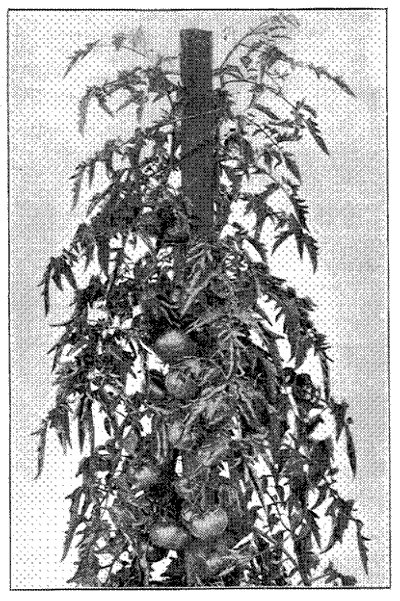
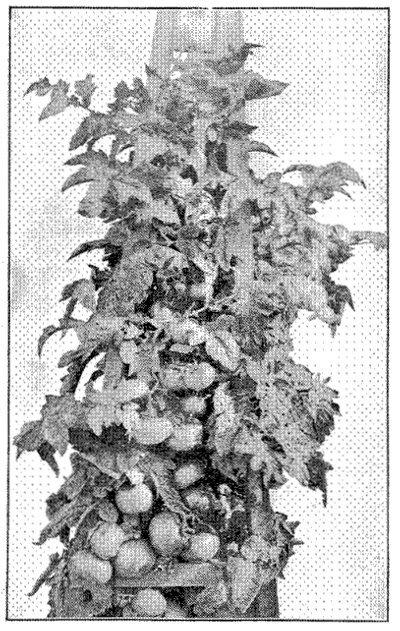
Such shedding can be partially controlled by pruning away the lateral
branches as soon as formed and topping the plants after the third
cluster of fruit has set, and by a reduction in the use of nitrogenous
fertilizers. A failure to set fruit in the greenhouse is often due to
lack of pollination, which must be remedied by hand pollination.
Cracking of the fruit.—The formation of cracks or fissures in the
nearly mature fruit is due to variations in the water supply and other
conditions affecting growth at this stage. If after the development of
the outer portion of the fruit has been checked by drought there follows
a period of abundant water supply and rapid growth, the fruit expands
more rapidly than its epidermis and the latter is ruptured. Some
varieties of tomatoes are much less subject to this trouble than others
and should be given preference on this account. The grower, so far as
lies in his power, should seek to maintain an uninterrupted growth by
thorough preparation of the land, by cultivation or by mulching. If the
half-grown fruits are enclosed in paper bags, cracking may be prevented,
but at the risk of loss of flavor in the ripened fruit.
Leaf curl.—The effect of pruning is to stimulate growth and to increase
the size of the leaves, the effort of the plant being to maintain a
balance between roots and foliage. With rapidly growing plants,
especially in the greenhouse and garden where both high manuring and
pruning have been practiced, more or less curling and distortion of the
leaves may result without developing into serious trouble if the grower
takes the hint and modifies his methods so as to permit a more balanced
growth. On the other hand, the ill effects of over-feeding and pruning
may reach a point where the plant is seriously crippled.
Edema.—Under certain conditions plants in greenhouses or even in the
open field, may absorb water through the roots faster than it can be
transpired through the leaves, with the result that dropsical swellings
or blisters occur on the leaves and more succulent stems. There is also
a deformation of the foliage, much like the leaf-curl produced by
over-feeding. This trouble, known as edema, occurs when the soil is
warmer than the air, or during periods of moist, warm, cloudy weather,
which checks transpiration. The grower should cease pruning, and
withhold water, and in the field cultivate deeply. In the greenhouse,
adequate ventilation should be given, keeping the house dry rather than
moist.
Mosaic disease.—The tomato is occasionally subject to a trouble allied
to the mosaic disease of tobacco. It is characterized by a variegation
of the leaves into light and dark green areas, usually accompanied by
distortion and reduction in size. In severe cases a whole field may
become worthless. While the nature of this malady is not fully
understood, it is known to be due to a disordered nutrition of the young
leaf-cells. It can be produced by severe pruning or by mutilation of the
roots in transplanting, both of which should be carefully avoided. It is
more likely to occur in seedlings that have made a soft, rapid growth on
account of an excess of nitrogenous fertilizer or too high temperature.
Close, clayey soils, on account of their poor physical condition, also
favor the development of the disease after transplanting.
Western blight (Yellows).—In the North Pacific and Rocky Mountain
states, serious losses are annually caused by a disease apparently
unlike any eastern trouble. It is marked by a gradual yellowing of the
foliage and fruit. Development is checked, the leaves curl upward and
the plant dies without wilting. The nature and cause of this disease is
as yet unknown. It appears to be worst on new land. Experiments that
have been made indicate that in older cultivated fields thorough
preparation of the soil, manuring and cultivation, combined with care in
transplanting to avoid injuring the roots and checking growth, will
greatly restrict the spread of this blight.
There are several fungous parasites of tomatoes, which, for the readers
convenience, may be briefly mentioned and the treatment of all discussed
together. The first three are indeed somewhat difficult to tell apart
without a microscope, as they produce a similar effect on the leaves and
all yield to the same treatment—thorough spraying with Bordeaux
mixture.
Leaf spot (Septoria lycopersici Speg.) has been widely prevalent and
injurious during recent years. It produces small, roundish dark-brown
spots on leaves and stems. The lower leaves are attacked first and
gradually curl up, die and fall off. The vitality of the plant is
reduced and it is only kept alive by the young leaves formed at the
top.
The fungus that causes early blight of potatoes (Alternaria solani (E.
& M.) J. & G.) occurs on tomatoes also, sometimes doing much injury. The
spots formed are at first small and black, later enlarging and
exhibiting fine concentric rings.
A somewhat similar leaf-blight results from a species of
Cylindrosporium, and other fungi may occur on diseased leaves.
Leaf mold (Cladosporium fulvum Cke.) is quite distinct from the
foregoing in appearance. It does not cause such distinct spots but
occurs in greenish brown, velvety patches of irregular outline on the
under side of the leaves. The lower leaves are first attacked, and as
the disease progresses they turn yellow and drop off. This is the
principal fungous enemy of greenhouse tomatoes, but also does injury in
gardens, particularly in Florida and the Gulf region. It is readily
controlled by spraying. In the greenhouse care should be taken to
ventilate well, without, however, allowing cold drafts to strike the
plants.
Downy mildew (Phytopthora infestans DeBy.), the cause of the late
blight of potatoes, will attack tomatoes during cool and very moist
weather, which greatly favors its development. Such outbreaks sometimes
occur to a limited extent in New England and serious losses are reported
on the winter crop in southern California, but the disease has never
been troublesome in other sections of the country, as it cannot develop
in dry or hot weather. It affects the tomato as it does the potato,
forming on the leaves dark, discolored spots, which spread rapidly under
favorable conditions, killing the foliage in a few days. The fruit is
also attacked and becomes covered with the mildew-like spore-bearing
threads of the fungus. Bordeaux mixture properly applied is an efficient
preventive.
Spraying tomatoes.—It should be the invariable practice of the tomato
grower to spray with Bordeaux mixture to prevent injury from any of
these leaf-blights. This should be done while the plants are still
healthy, as if put off until the disease appears the battle is half
lost. Make the first application to the young plants in the seed-bed a
few days before transplanting. Spray again within a week after the
plants are set in the field, and repeat at intervals of ten days or two
weeks until the fruit is full grown. Success in spraying depends mainly
on the thoroughness of the work. The aim should be to cover every leaf
with a fine mist. Do not drench the foliage but pass to the next plant
before the drops run together and off the leaf. Use a nozzle that gives
a fine spray and maintain a high pressure at the pump.
Preparation of Bordeaux mixture.—Formula: Copper sulphate
(bluestone), 5 pounds; lime, 5 pounds; and water, 50 gallons. The copper
sulphate may be either in crystals or pulverized. Dissolve by suspending
the required amount in a coarse sack near the top of the water a few
hours before it will be needed. The lime must be fresh stone lime of
good quality. Slake thoroughly by the addition of small quantities of
water at a time as needed, stirring until all small lumps are slaked.
Strain both the lime milk and the copper sulphate or bluestone solution
through a brass strainer of 18 meshes per inch and dilute each with half
the water before mixing together. Do not use Bordeaux left over from
the previous day. An old mixture or one made from the concentrated
solutions has a poor physical condition. It settles more quickly, tends
to clog the nozzle and does not adhere so well to the foliage. Failure
to use the strainer results in endless trouble in the field from clogged
nozzles.
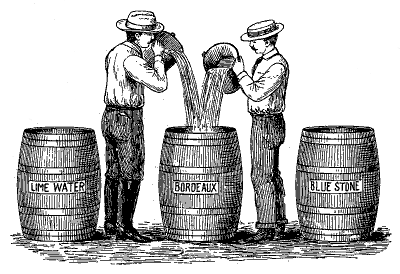
FIG. 42—PROPER WAY TO MAKE BORDEAUX
(From W. G.
Johnson)
When much spraying is to be done it is more convenient to keep the
bluestone and lime in separate permanent stock solutions, as shown in
Fig. 42, containing 2 pounds to the gallon of their respective
ingredients. These will keep indefinitely, if the water evaporated is
replaced, and may be used from as needed.
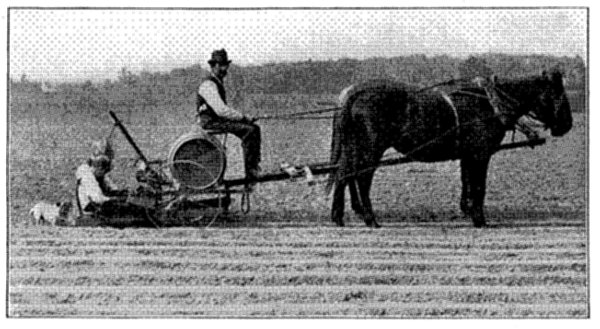
Spraying apparatus.—Tomato growers having only a small area to spray
may use one of the numerous forms of hand-pumps or bucket sprayers now
on the market. For larger fields it will be necessary to employ a
barrel sprayer. This consists of a hand-pump mounted in a barrel or tank
and equipped with two leads of 3/8 inch hose 25 feet long, each with a
four-foot, extension made from ¼ inch gas pipe, and a double Vermorel
nozzle. The barrel should be carried in an ordinary farm wagon. Three
men do the work. One is expected to drive and pump, while the other two
manipulate the nozzles. The outfit is stopped while the plants within
reach are sprayed, then driven forward about 30 feet and stopped again.
On an average in actual field practice 3 to 4 acres a day can be sprayed
in this way, applying 100 to 200 gallons of Bordeaux per acre. To keep
the long hose off the plants two poles about 10 feet long may be pivoted
to the bed of the wagon so as to swing at an angle over the wheel and
carry the hose. The pump for this outfit should be of good capacity,
with brass valves. A "Y" shut-off discharge connection on the pump is a
convenience for stopping the spray at any time. The most satisfactory
nozzles are those of the Vermorel type. It is cheapest in the long run
to buy the best grades of pumps on the market. This outfit is
excellently adapted for spraying small fields of potatoes and for
general orchard work, and is invaluable on the average farm.
Phytoptosis.—This disease is known to occur only in Florida, where it
is sometimes common enough to require remedial treatment. The affected
portions of the foliage are more or less distorted and covered with an
ashy white fuzz. The general vigor and fruitfulness of the plants are
greatly reduced. The name applied to this trouble denotes its cause, an
extremely small mite (Phytoptus calacladophora Nal.), which by its
presence on the leaves or stems so irritates them as to result in the
abundant development of modified plant hairs, which shelter the mites
and form the fuzzy covering characteristic of the disease. A remedy for
phytoptosis is available in the sulphur compounds. The following one is
particularly recommended by Prof. P. H. Rolfs, to whom our knowledge of
the disease is due:
Preparation of sulphur spray.—Place 30 pounds of flowers of sulphur
in a wooden tub large enough to hold 25 gallons. Wet the sulphur with 3
gallons of water, stir it to form a paste. Then add 20 pounds of 98 per
cent. caustic soda (28 pounds should be used if the caustic soda is 70
per cent.) and mix it with the sulphur paste. In a few minutes it
becomes very hot, turns brown, and becomes a liquid. Stir thoroughly and
add enough water to make 20 gallons. Pour off from the sediment and keep
the liquid as a stock solution in a tight barrel or keg. Of this
solution use 4 quarts to 50 gallons of water. Apply with a spray pump
whenever the disease appears, and repeat if required by its later
reappearance. The use of dry sulphur is also recommended.
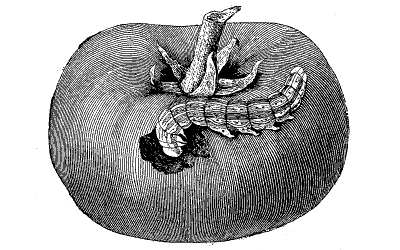
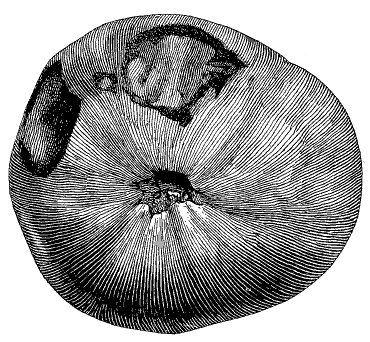
FIG. 43—POINT-ROT DISEASE OF THE TOMATO
(Redrawn from N. Y. Expr. Sta. No. 125)
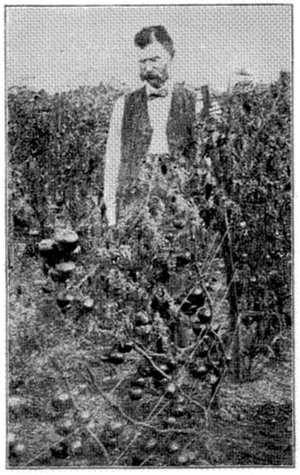
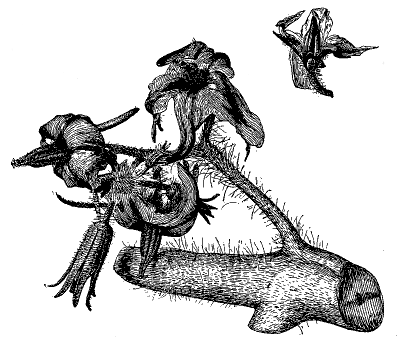
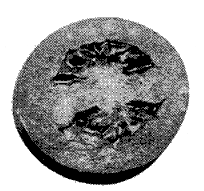
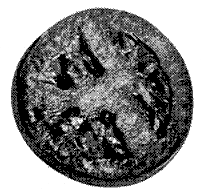
Point-rot.—This trouble, called also "blossom-end rot," and
"black-rot," occurs on the green fruit at various stages of development,
as shown in Fig. 43. It begins at the blossom end as a sunken brown
spot, which gradually enlarges until the fruit is rendered worthless.
The decayed spot is often covered in its later stages by a dense black
fungous growth (Alternaria fasciculata (C. & E.) J. & G. syn.
Macrosporium tomato Cke.), formerly thought to be the cause of the
rot, but now known to be merely a saprophyte. Point-rot sometimes occurs
in greenhouses, but is more common in field culture. It is one of the
most destructive diseases of the tomato, but its nature is not fully
worked out, and a uniformly successful treatment is unknown. It has been
thought to be due to bacterial invasion, but complete demonstrations of
that fact have not yet been published. The physiological conditions of
the plant appear to be important. The disease is worst in dry weather
and light soils, where the moisture supply is insufficient, and
irrigation is beneficial in such cases. Spraying does not control
point-rot so far as present evidence goes.
Anthracnose—ripe-rot—(Colletotrichum phomoides (Sacc.) Chest.), is
distinguished from the point-rot by the fact that it occurs mainly on
ripe or nearly ripe fruits, producing a soft and rapid decay. Widespread
losses from this cause are not common, but when a field becomes infected
a considerable proportion of the crop within a limited area may be
destroyed if humid or rainy weather prevails. Preventive measures only
can be employed. These should consist in collecting and destroying
diseased fruit and in staking and trimming the vines to admit light and
air to dry out the foliage. Bordeaux mixture applied after the
development of the disease would be of doubtful efficiency and would be
objectionable on account of the sediment left on the ripe fruit.
Damping off.—Young plants in seed-beds often perish suddenly from a rot
of the stem at the surface of the ground. This occurs as a rule in dull,
cloudy weather among plants kept at too high a temperature, crowded too
closely in the beds or not sufficiently ventilated. Several kinds of
fungi are capable of causing damping off, under such conditions.
Preventive measures are of the first importance. Since old soil is
often full of fungous spores left by previous crops, it is the wisest
plan to use sterilized soil for the seed-bed. When the young plants are
growing, constant watchfulness is required to avoid conditions that will
weaken the seedlings and favor the damping off fungi.
Watering and ventilation are the two points that require especial
skill. Watering should be done at midday, to allow the beds to drain
before night, and only enough water for the thorough moistening of the
soil should be applied. Ventilation should be given every warm day as
the temperature and sunshine will permit, but the plants must be
protected from rain and cold winds. Work the surface of the soil to
permit aeration and do not crowd the plants too closely in the beds. If
damping off develops something can be done to check it by scattering a
layer of dry, warm sand over the surface, and by spraying the bed
thoroughly with weak Bordeaux or by applying dry sulphur and air-slaked
lime.
Bacterial wilt (Bacterium solanacearum Erw. Sm.).—This disease, which
also attacks potatoes and eggplants and some related weeds, is one of
the most serious enemies of the tomato. It is known to occur from
Connecticut southward to Florida and westward to Colorado, but is most
prevalent in the Gulf States, where it has greatly discouraged many
growers.
Its most prominent symptoms are the wilting of the foliage and a
browning of the wood inside the recently wilted stems. An affected plant
wilts first at the top, or a single branch wilts, but later the entire
plant yellows, wilts and dies. Young plants wilt more suddenly and dry
up. The disease progresses more rapidly in plants that have made a
succulent, luxurious growth, while those with hard, woody stems resist
it somewhat.
The disease is due to the invasion of bacteria, which enter the leaves
through the aid of leaf-eating insects, or through the roots. They plug
the water-carrying vessels of the stem, shutting off the water and food
supply of the plant. If the stem of a plant freshly wilted from this
disease be severed, the bacteria will ooze out in dirty white drops on
the cut surface.
Remedial measures entirely satisfactory for the control of bacterial
wilt have not yet been worked out. The best methods to adopt at present
are the following:
(1) Rotation of crops.—The field evidence is that this disease is in
many cases localized in old gardens or in definite spots in the field.
It appears also that the infection left by a diseased crop can remain in
the soil for some time. It is therefore advised that tomato growers
should always practice a rotation of crops, whether any disease has
appeared or not, and that in case bacterial wilt develops they should
not plant that land in tomatoes, potatoes, or eggplants for three or
four years. The length of rotation necessary to free the soil is not
known, but will have to be worked out by the individual grower.
(2) Destruction of diseased plants.—The bacteria causing wilt not
only spread through the soil but are carried by insects from freshly
wilted to healthy plants. Diseased plants thus become dangerous sources
of infection, and it is evident that all such should be pulled out and
burned. This is particularly important at the beginning of the trouble
when the eradication of a few wilting plants may save the remainder.
(3) Control of insects.—To lessen the danger from spread of wilt by
insects, the measures advised in the next chapter for the control of
leaf-eating insects should be adopted. In this connection it should be
mentioned that the use of Bordeaux mixture for leaf blights, as
previously recommended, has an additional value in that the coating on
the leaves is distasteful to insects and helps to keep them away.
(4) Seed selection.—Work done at the Florida experiment station
indicates that resistant varieties may be secured, but there are as yet
none in commercial use. This is an important line for experimenters to
follow up. There is no proof that the disease is spread through seed
from diseased plants.
Fusarium wilt.—This disease and the one following resemble the
bacterial wilt so closely, as far as external characters go, that they
are difficult to tell apart. The parasites, however, differ so
materially in their nature and life history that the field treatment is
quite different. There are also differences in geographical distribution
that are important, for while the Fusarium wilt occurs occasionally
throughout the southern states, it is known to be of general commercial
importance only in southern Florida and southern California.
The symptoms of the disease are a gradual wilting and dying of the
plants, usually in the later stages of their development. Young plants
die, however, when the soil infection is severe. There is a browning of
the woody portions of the stem, and when a section of this is examined
under a compound microscope the vessels are found to be filled with
fungous threads, which shut off the water supply.
The infection in the Fusarium wilt appears to come entirely from the
soil. Little is known of its manner of spread, except that the
cultivation of a tomato crop in certain districts appears to leave the
soil infected so that a crop planted the next year will be injured or
destroyed. The fungus does not remain in the soil for a very long time
in sufficient abundance to cause serious harm. A rotation of crops that
will bring tomatoes on the land once in three years has been found in
Florida to prevent loss from Fusarium wilt.
This fungus does not attack any other crop than tomatoes, so far as
known, though it is very closely related to species of Fusarium
producing similar diseases in cotton, melon, cowpea, flax, etc. Fusarium
wilt has not been found in fields and gardens in the northern states,
but tomatoes in greenhouses there are sometimes attacked by it or a
related Fusarium, which also occurs in England. When greenhouse beds are
infected the soil for the next crop should be thoroughly sterilized by
steam under pressure.
Sclerotium wilt.—This disease resembles the two preceding in its effect
on the plant, which wilts at the tip first, and gradually dies. Its
geographical range is more restricted. It seems to be confined to
northern Florida and the southern part of Georgia and Alabama, where it
occurs in gardens and old cultivated fields. The fungus causing this
wilt attacks the root and the stem near the ground, working in from the
outside. There is not the browning of the wood vessels characteristic of
the two preceding diseases. If an affected stem is put in a moist
chamber made from a covered or inverted dish, there will develop an
exceedingly vigorous growth of snow-white fungous mycelium which, after
a few days, bears numerous round shot-like bodies, at first
light-colored, then becoming smaller and dark-brown. These are the
sclerotia or resting bodies of the fungus. This fungus, called
Sclerotium sp., or "Rolf's Sclerotium," is noteworthy because it
attacks potatoes, squash, cowpea, and a long list of other garden
vegetables and ornamental plants. The only satisfactory means of control
is rotation of crops, using corn, small grain, and the Iron cowpea, a
variety immune to this and other diseases. Susceptible crops should be
kept from infected fields for two or three years.
Root-knot (Heterodera radicicola (Greef) Mül.) attacks tomatoes in
greenhouses and is in some cases an important factor in southern field
culture. It is caused by a parasitic eelworm or nematode, of minute
size, which penetrates the roots and induces the formation of numerous
irregular swellings or galls, in which are bred great numbers of young
worms. The effect on the plant is to check growth and diminish
fruitfulness, in advanced cases even resulting in death.
The remedy in greenhouse culture is thorough soil sterilization. In
the open field this is impracticable and recourse must be had to a
rotation with immune crops, which will starve out the root-knot. It must
now be borne in mind that the root-knot worm can attack cotton, cowpea,
okra, melons and a very large number of other plants. The only common
crops safe to use in such a rotation in the South are corn, oats,
velvet beans, beggar weed, peanuts, and the Iron cowpea. The use of
other varieties of cowpea than the Iron is particularly to be avoided,
on account of the danger of stocking the land with root-knot.
Fortunately, the disease is serious only in sandy or light soils.
Rosette (Corticium vagum (B. & C.) var. solani Burt.) is a disease
of minor importance, which occurs in Ohio, Michigan, and scatteringly in
other states. The fungus causing it (Rhizoctonia) attacks the roots
and base of the stem, forming dark cankers. The effect on the plant is
to dwarf and curl the leaves and to restrict productiveness. The potato
suffers more severely from the same trouble. Rotation of crops and
liberal application of lime to the soil are advised for the control of
rosette in tomatoes.