 A NUMBER of difficult and confusing
questions present themselves
at the very beginning of
any extensive and impartial investigation
of the trial of Jesus.
A NUMBER of difficult and confusing
questions present themselves
at the very beginning of
any extensive and impartial investigation
of the trial of Jesus.
Did the Great Sanhedrin exist
at the time of Christ? If it
existed, was it still a legally constituted
court, having jurisdiction
to try capital offenses? Did it have jurisdiction of
the particular offense with which Jesus was charged?
If the Great Sanhedrin was actually in existence, had
criminal jurisdiction in capital cases, and was judicially
empowered to try the offense with which Jesus
was charged, did it actually try Him? Were the rules
of criminal procedure, prescribed in the Mishna and
cited in this Brief, in existence and actively in force in
Judea at the time of the trial of Jesus? What was the
nature of the charge brought against the Christ? Was
He guilty as charged? Were forms of law duly observed
in the trial of the accusation against Him?
Answers to these questions, which will be considered
in the Brief in the order above enumerated, will cover
the legal aspects of the Hebrew trial of Jesus.
Did the Great Sanhedrin exist at the time of Christ?
The answer to this question is of prime importance,
since the existence of a court having jurisdiction of the
person and subject matter of the suit is a fundamental
consideration in all litigation. It is generally supposed
that the Hebrew trial of Jesus took place before
the Great Sanhedrin in Jerusalem. But many able
writers, both Jewish and Gentile, deny that this court
had any existence at the time of Christ. In the "Martyrdom
of Jesus," Rabbi Wise says: "But this body
did positively not exist at the time when Jesus was crucified,
having been dissolved 30 A.C. In nowise, then,
any passages of the Gospels must be understood to
refer to the Great Sanhedrin." Many Jewish and several
eminent Gentile authors agree with this contention,
which is founded upon a passage in Josephus in
which it is declared that King Herod had all the members
of the Sanhedrin put to death.[176] It is contended
by these writers that the supreme tribunal of the Jews
was then abolished and was not restored until subsequent
to the crucifixion. Opposed to this assertion,
however, is the weight of both reason and authority.
Schürer is of the opinion that Josephus did not mean
literally "all" (πάντας) when he wrote that Herod
had destroyed all the members of the Great Sanhedrin;
since in the following book he relates that the
same king caused to be put to death the forty-five most
prominent members of the party of Antigonus, who
must themselves have been members of this court; and
forty-five are twenty-six fewer than seventy-one, the
full membership of the Great Sanhedrin.[177] The same
author asserts the existence and discusses the jurisdiction
of this court in the following language: "As regards
the area over which the jurisdiction of the Great
Sanhedrin extended, it has already been remarked
above that its civil authority was restricted, in the time
of Christ, to the eleven toparchies of Judea proper.
And, accordingly, for this reason it had no judicial authority
over Jesus Christ so long as He remained in
Galilee. It was only as soon as He entered Judea that
He came directly under its jurisdiction."[178]
Again, Salvador, who may be justly styled the Jewish
Blackstone, wrote concerning the condemnation of
Jesus: "The senate declared that Jesus, son of Joseph,
born at Bethlehem, had profaned the name of God in
usurping it for himself, a simple citizen. The capital
sentence was then pronounced." Now, the word
"senate" is properly applied nowhere in literature to
any other Hebrew court than the Great Sanhedrin.
This High Court of the Jews has been frequently compared
to the senate of Rome, to the Areopagus of the
Greek and to the parliament of England. It should
be noted in this connection that the great Jewish writer
not only styled the body that tried Jesus "senate"
(Great Sanhedrin) but stated that it pronounced a
capital sentence, thus declaring that the supreme tribunal
of the Jews not only existed at the time of Jesus
but had the right to decree capital punishment.
Edersheim, discussing the alleged abolition of the
Sanhedrin by Herod, says: "The Sanhedrin did exist
during his reign, though it must have been shorn of
all real power, and its activity confined to ecclesiastical
or semi-ecclesiastical causes. We can well believe that
neither Herod nor the procurators would wish to
abolish the Sanhedrin, but would leave to them the administration
of justice, especially in all that might in
any way be connected with purely religious questions.
In short, the Sanhedrin would be accorded full jurisdiction
in inferior and in religious matters; with the
greatest show, but with the least amount of real rule
or of supreme authority."[179] This is a powerful voice
in favor of the existence of the supreme tribunal of the
Jews at the time of Christ; for Edersheim's "Life and
Times of Jesus the Messiah" is the best and most reliable
biography of the Savior in any language.
Keim bases his advocacy of the existence of the Sanhedrin
at the time of Christ on New Testament authority.
"Not only," he says, "does the New Testament
speak of Synedria in the time of Jesus and the
Apostles, but Jesus Himself, in a well-established
utterance, mentions the Synedrion (Sanhedrin) as the
highest legally constituted tribunal and as having the
right to pass the sentence of death."[180]
The strongest passage in the New Testament supporting
the contention of the existence of the Great
Sanhedrin at the time of the crucifixion is contained
in Acts v. 21: "But the high priest came, and they that
were with him, and called the council together, and all
the senate of the children of Israel, and sent to the
prison to have them brought." Here, the use of the
words "high priest," "council," and "senate" in the
same connection, strongly suggests, almost accurately
describes, the president and members of the Great Sanhedrin;
and besides, the words, "sent to the prison to
have them brought," indicate that this body was exercising
judicial functions.
Again, the utterance of Jesus above referred to by
Keim is found in two passages of Matthew. The first
is in Chap. xvi. 21: "From that time forth began Jesus
to shew unto His disciples, how that He must go unto
Jerusalem, and suffer many things of the elders and
chief priests and scribes, and be killed and be raised
again the third day." The second is in Chap. xx. 18:
"Behold, we go up to Jerusalem; and the Son of man
shall be betrayed unto the chief priests and unto the
scribes, and they shall condemn him to death." The
"elders" and "chief priests" and "scribes" were the
characteristic constituent elements of the Great Sanhedrin;
and the prophecy, "they shall condemn him to
death," ascribed to them the highest judicial prerogative,
the right of passing the death sentence. In his
brilliant essay on the Talmud, Emanuel Deutsch
emphatically says: "Whenever the New Testament
mentions the 'Priests, the Elders, and the Scribes' together,
it means the Great Sanhedrin."[181] It is impossible
to refrain from contrasting this statement of a
most eminent and learned Jewish writer with that of
Rabbi Wise, also very scholarly and pious, "In no
wise, then, any passages of the Gospels must be considered
to refer to the Great Sanhedrin." Suffice it to
say that the weight of authority is with Emanuel
Deutsch. And that which seems to conclusively disprove
the whole theory of the nonexistence of the
Great Sanhedrin at the date of the crucifixion, is the
fact that Josephus—whose account of the alleged killing
of all the members of the Sanhedrin by Herod is
the very basis of the theory—in a subsequent chapter,
relating to a subsequent event, describes the summoning
of Hyrcanus, former king and high priest, before
the Sanhedrin to be tried by them. As a result of the
trial, Hyrcanus was put to death.[182] Such a personage
could have been tried and condemned only by the
Great Sanhedrin, which was in existence subsequent to
the alleged destruction of all its members by Herod.
It is believed that enough has been said to show that
the contention that the Great Sanhedrin did not exist
at the time of Christ is not well founded. As a matter
of reason, the mere destruction of the members of the
court by Herod did not, of necessity, abolish the court
itself. From what we know of the character and policy
of Herod, he simply had the members of an old
and unfriendly aristocracy put to death in order that
he might make room in the court for an entirely new
body friendly to him and devoted to his interests.
Again, it is entirely improbable that the Roman masters,
of whom Herod was but a subject prince and
tool, would have permitted the destruction of the most
important local institution of a conquered state. The
policy of the Romans in this regard is well known.
Whenever it was consistent with the dignity and safety
of the Roman empire, local institutions were allowed
to remain intact and undisturbed. We are not aware
of any good historical reason why the Great Sanhedrin,
the national parliament, and the supreme tribunal
of the Jews, should have been abolished thirty
years before Christ, as Rabbi Wise and other eminent
scholars and theologians have contended. After all, it
seems to be more a matter of dogma than of history.
The majority of Jewish writers rest their case upon
Josephus, with their peculiar construction of the passage;
the majority of Christian writers quite naturally
prefer the New Testament. But the line is not closely
drawn. Dr. Geikie, the eminent Gentile author, supports
the Jewish opinion, without reference, however,
to the passage in Josephus. On the other hand, Salvador,
Edersheim, and Deutsch, all writers of Jewish
blood, support the Christian contention.
The assertion of Graetz that Jesus was arraigned
before one of the Minor Sanhedrins,[183] of which there
were two in Jerusalem, is not to be taken seriously,
since these minor courts had no jurisdiction of the
crime with which Jesus was charged.[184] It is very evident
from the weight of authority that Jesus was tried
before the Great Sanhedrin, and that this court had
authority to pass sentence of death. Upon this theory,
the author will proceed in framing the Brief.
Did the Great Sanhedrin have jurisdiction to try
capital offenses at the time of the crucifixion? This
question, involving great difficulty and much confusion
in discussing the trial of Jesus, arises from the divergent
opinions of Bible scholars as to the exact legal
and political status of the Jews at the time of Christ.
Many concede the existence of the Great Sanhedrin at
this time, but insist that it had been shorn of its most
important judicial attributes; that the right to try capital
cases had been wholly taken from it; and that it
retained the legal right to try only petty crimes and
religious offenses not involving the death penalty.
The Jews contend, and indeed the Talmud states that
"forty years before the destruction of the Temple the
judgment of capital causes was taken away from Israel."
The great weight of authority, however, is registered
against this view. The New Testament teachings
on the subject have just been discussed in the
beginning of the Brief. The opinion generally held by
Bible scholars is that the Great Sanhedrin continued
to exist after the Roman conquest of Judea and after
the time of Herod; that its legislative, executive, and
judicial powers remained substantially unimpaired in
local matters pertaining to the internal affairs of the
Jews; and that the Roman representatives intervened
only when Roman interests required and the sovereignty
of the Roman State demanded. The question of
sovereignty presented itself, indeed, whenever the question
of life and death arose; and Rome reserved to herself,
in such cases, the prerogative of final judicial determination.
Both Renan and Salvador hold the view
that the Sanhedrin had the right of initiative, the cognitio
causæ; that is, the right to try the case. In the
event of the acquittal of the accused the matter was
finally ended without Roman interference, but in case
of conviction the Roman legate or procurator certainly
might review and probably was required to review
the matter, and either affirm or reverse the sentence.
This is the prevalent opinion among the best
writers; and is plausible because it is at once consistent
with the idea of the maintenance of Roman sovereignty
and of the preservation of the local government
of the Jews. However, many able writers, among
them Rosadi and Dupin, assert that the Jews had lost
the right, by virtue of Roman conquest, even to try
capital cases. And it must be admitted that the logic
of law is in their favor, though the facts of history and
the weight of authority are against them.
Did the Great Sanhedrin have jurisdiction of the
particular offense with which Jesus was charged? Admitting
the existence of the Great Sanhedrin at the
time of Christ, and its right to initiate and try proceedings
in capital cases with reference to Roman authority,
had it jurisdiction, under Hebrew law, of the
special accusation against Christ? On this point there
is little difference of opinion. Jesus was brought
before the Sanhedrin on the charges of sedition and
blasphemy, both of which crimes came within the cognizance
of the supreme tribunal of the Jews.[185]
Was there a regular legal trial of Jesus before the
Great Sanhedrin? Admitting that this court was in
existence at the time of Christ, that it had competence,
with reference to Roman authority, to try capital cases,
and that it had jurisdiction under Hebrew law of the
crime with which Jesus was charged, did it actually
conduct a regular, formal trial of the Christ? Many
able critics give a negative answer to this inquiry.
Jost, one of the greatest and most impartial of Jewish
historians, designates the crucifixion of Jesus "a private
murder (Privat-Mord) committed by burning
enemies, not the sentence of a regularly constituted
Sanhedrin."[186] Edersheim supports this view as to the
nature of the trial.[187]
A certain class of writers base their objection to a
regular trial on the ground of the nonexistence of the
Great Sanhedrin at the time of Christ. If this court
did not exist, they say, there could not have been any
regular judicial proceeding, since this body was the
only Hebrew tribunal that had jurisdiction to try the
offense with which Jesus was charged. Others, who
hold similar views, maintain that the errors were so
numerous and the proceedings so flagrant, according
to the Gospel account, that there could have been no
trial at all, and that it was simply the action of a mob.
These writers contend that the members of the Sanhedrin
acted more like a vigilance committee than a
regularly organized tribunal. Of this opinion is Dr.
Cunningham Geikie.
Still another class of critics insist that the Hebrew
judges exercised only accusatory functions, and that
the examination of Jesus at night was merely preparatory
to charges to be presented to Pilate.
Others still apparently reverse the order, and insist
that the Hebrew trial was the only one; that the duty
of Pilate was merely to review, sanction, and countersign
the verdict of the Sanhedrin. Of this class is
Renan, who says: "The course which the priests had
resolved to pursue in regard to Jesus was quite in conformity
with the established law. The plan of the enemies
of Jesus was to convict him, by the testimony of
witnesses and by his own avowals, of blasphemy and of
outrage against the Mosaic religion, to condemn him
to death according to law, and then to get the condemnation
sanctioned by Pilate."[188] Salvador and Stapfer
agree with Renan that the Hebrew trial was regular
and that the proceedings were legal. On the other
hand, Rosadi, Dupin, Keim and many others denounce
the proceedings in the trial of Jesus as outrageously
illegal.
As to the number of trials, the authorities above
cited seem to be exceptions to the rule. By far the
greater number contend that there were two distinct
trials: a Hebrew and a Roman, separate and yet dependent.
The opinion of this class of writers is most
clearly expressed by Innes, who says: "Whether it was
legitimate or not for the Jews to condemn for a capital
crime on this occasion, they did so. Whether it was
legitimate or not for Pilate to try over again an accused
whom they had condemned, on this occasion, he
did so. There were certainly two trials."[189] This is the
view of the writer of these pages; and he has, accordingly,
divided the general subject into two trials, devoting
a volume of the work to each. It may be answered,
then, that there was a regular trial of Jesus
before the Great Sanhedrin. The relation of this trial
to the Roman proceeding will be more fully discussed
in the second volume of this treatise.
Were the rules of criminal procedure prescribed in
the Mishna and cited in this Brief, in existence and
actively in force in Judea at the time of the trial of
Jesus? This question has been answered in the negative
by several writers of repute. Others have answered
that the matter is in doubt. But it is very generally
agreed that an affirmative answer is the proper
one. Out of this question, two others arise: (1) Were
the rules of criminal law, herein cited, obsolete at the
time of the crucifixion? (2) Were they the legal developments
of an age subsequent to that great event?
In either case, their citation, in this connection, is
without reason or justification.
It is a sufficient answer to the first of these questions
that none of the standard works on Hebrew criminal
law classes any of the rules herein stated as obsolete at
the time of Christ. In support of a negative answer
to this question, it may be urged that all of the aforesaid
rules were the essential elements of an enlightened
and humane criminal procedure in capital cases at the
date of the crucifixion.
The answer to the second question above suggested
is a more serious matter. It is historically true that the
Mishna was not reduced to writing until two hundred
years after the beginning of our era. The Jerusalem
Talmud was not redacted until 390 A.D.; and the Babylonian
Talmud, about 365-427 A.D. The question at
once arises: Were the rules of criminal procedure,
which we have herein invoked in the discussion of this
case, the growth of the periods intervening between
the crucifixion of Jesus and these dates? Two valid
reasons give a negative answer to this question. In
the first place, the criminal rules applied in the Brief
are in nearly every case traceable to Mosaic provisions
which were framed more than a thousand years before
the trial of Jesus. In the second place, they could not
have been the developments of a time subsequent to the
crucifixion, because less than forty years, a single generation,
intervened between that event and the fall of
Jerusalem, which was followed by the destruction of
Jewish nationality and the dispersion of the Jews.
This short interval was a period of national decay and
disintegration of the Jewish people and could not have
been, under Roman domination, a formative period in
legal matters. After the fall of Jerusalem, the additions
and developments in Hebrew law were more a
matter of commentary than of organic formation—more
of Gemara than of Mosaic or Mishnic growth.
The decided weight of authority, then, as well as the
greater reason, is in favor of the proposition that the
Hebrew criminal law had reached its full development
and was still in active force at the time of which
we write.
What was the nature of the charge brought against
Christ at the trial before the Sanhedrin? Was He
guilty as charged? The questions preceding these
were secondary, though important. If the Great Sanhedrin
did not exist at the time of Christ, we are
forced to believe and admit that the men who arrested
and examined Jesus at night were nothing more than
an irresponsible rabble, acting without judicial authority
or legal excuse. If it was without criminal jurisdiction,
though in existence, we have erroneously
spoken of a Hebrew trial. If the rules of criminal
procedure which we have invoked were not in existence
at the time of the crucifixion, we have proceeded
upon a false hypothesis. Fortunately, the weight of
authority, in every case, is so overwhelmingly in our
favor, and our contention is, in each case, so well
founded in reason, that we feel justified in now proceeding
to a discussion of the real merits of the case,
involved in answers to the questions: What was the nature
of the charge or charges brought against Jesus at
the Hebrew trial? Was He guilty as charged?
The accusations against Christ were numerous, both
in and out of court; and it will help to simplify matters
and to arrive at a clear understanding, if, in the
very beginning, the distinction be made and held in
mind between judicial and extra-judicial charges. By
judicial charges are meant those made at the time of
the examination of Jesus by the Sanhedrin, assembled
at night in the palace of Caiaphas. By extra-judicial
charges are meant those made out of court at divers
times and places in Jerusalem, Galilee, and elsewhere
by the accusers of the Christ, and especially by the
spies who dogged His footsteps during the last days of
His ministry on earth. Ordinarily, it would be proper,
in a work of this kind, to consider only charges made
after the trial of the accused had begun, and jeopardy
had attached. All others are extra-judicial and are
entitled to only passing notice. It would be proper to
omit them altogether, if they did not serve to throw
much light upon the specific charges at the trial.
An excellent summary of the extra-judicial charges
brought against Jesus at various times in His career,
is given in Abbott's "Jesus of Nazareth," p. 448: "It
was charged that He was a preacher of turbulence
and faction; that He flattered the poor and inveighed
against the rich; that He denounced whole cities, as
Capernaum, Bethsaida, Chorazin; that He gathered
about Him a rabble of publicans, harlots, and drunkards,
under a mere pretense of reforming them; that
He subverted the laws and institutions of the Mosaic
commonwealth, and substituted an unauthorized legislation
of His own; that He disregarded not only all
distinctions of society, but even those of religion, and
commended the idolatrous Samaritan as of greater
worth than the holy priest and pious Levite; that,
though He pretended to work miracles, He had invariably
refused to perform them in the presence and at
the request of the Rabbis of the Church; that He had
contemned the solemn sanctions of their holy religion,
had sat down to eat with publicans and sinners with
unwashen hands, had disregarded the obligations of
the Sabbath, had attended the Jewish feasts with great
irregularity or not at all, had declared that God could
be worshiped in any other place as well as in His
Holy Temple, had openly and violently interfered
with its sacred services by driving away the cattle
gathered there for sacrifice."
These different charges were doubtless present in
the minds and hearts of the members of the Sanhedrin
at the time of the trial, and probably influenced their
conduct and entered into their verdict. But only one
or two of these accusations can be said to have any direct
connection with the record in this case, and, consequently,
can be only indirectly considered in discussing
its merits.
We come now to examine the actual charges made
at the night trial before the Sanhedrin. The subsequent
charges before Pilate have no place in this volume.
A review of the proceedings at the time of the
examination in the palace of Caiaphas reveals two distinct
charges: one preferred by witnesses who had been
summoned by the Sanhedrin, the other preferred by
Caiaphas himself.
First, according to Matthew, "At the last came two
false witnesses, and said, This fellow said, I am able
to destroy the temple of God, and to build it in three
days."[190] The same testimony is thus reported by
Mark: "And there arose certain, and bare false witness
against him, saying, We heard him say, I will
destroy this temple that is made with hands, and
within three days, I will build another made without
hands."[191] Luke and John do not discuss the night trial
before the Sanhedrin, and therefore make no reference
to the charges brought forward by the false witnesses.
The second accusation made against Jesus is that by
Caiaphas himself, who embodies his charge in the
form of an oath or adjuration which he administered
to the accused: "I adjure thee by the living God that
thou tell us whether thou be the Christ, the Son of
God." Then came the confession and condemnation.
"Jesus said unto him, Thou hast said: nevertheless I
say unto you, Hereafter shall ye see the Son of man sitting
on the right hand of power, and coming in the
clouds of heaven. Then the high priest rent his
clothes, saying, He hath spoken blasphemy; what further
need have we of witnesses? behold, now ye have
heard his blasphemy. What think ye? They answered
and said, He is guilty of death."[192]
These few words of Scripture are the essential parts
of the record of fact of the most awful trial in the history
of the universe. An analysis of the evidence
shows the existence of two distinct charges: that preferred
by the false witnesses, accusing Jesus of sedition;
and that of blasphemy made by Caiaphas himself.
Concerning the testimony adduced in support of the
first charge, Mark says: "For many bare false witness
against him, but their witness agreed not together."[193]
Now, we have seen that the concurrent testimony of at
least two witnesses, agreeing in all essential details,
was necessary to sustain a conviction under Hebrew
law. If one witness against the accused contradicted
any other witness against the accused, all were rejected.
Under this rule of law, when "their witness
agreed not together," according to Mark, the charge
of sedition was abandoned, and the accusation of blasphemy
then followed, which resulted in a confession
and condemnation. Later on, in another place, we
shall discuss the illegality of a double accusation, in
the same breath and at the same trial. But at this point
we have no further interest in the abandoned charge,
except to say that the false witnesses, in their ignorance
and blindness, failed to grasp the Master's allegorical
language in reference to the destruction of the Temple.
Their worldly-mindedness and purely physical
conception of things centered their thoughts upon the
Temple at Jerusalem, and gave a purely temporal and
material interpretation to His words. "Forty and six
years was this temple in building, and wilt thou rear
it again in three days?"[194] This question asked by the
original auditors, shows a total misconception of the
true meaning of the language of Jesus. The spiritual
allusion to the resurrection of His own body seems
never to have penetrated their thoughts. Then, again,
their general statement was, in effect, an absolute misrepresentation.
By perverting His language, He was
made to utter a deliberate threat against a national institution,
around which clustered all the power, sanctity,
and glory of the Hebrew people. He was made
to threaten the destruction of the Temple at Jerusalem.
But it is most reasonable to infer from the entire evidence
as contained in the Sacred Writings that the
words imputed to Jesus by the false witnesses were not
those which He actually used. In reality, He did not
say: "I can destroy," or "I will destroy"; but, simply,
"Destroy." "Destroy this temple, and in three
days I will raise it up."[195] This is evidently a purely
hypothetical expression and is equivalent to "Supposing
you destroy this temple." St. John, in whose
presence, it seems, this language was used, correctly
interprets the Savior's meaning when he says: "He
spake of the temple of his body."[196]
The evidence of the false witnesses was so contradictory
that even wicked judges were forced to
reject it and to conduct the prosecution on another
charge.
We come now to consider more closely the real accusation
upon which Jesus was condemned to death.
At first glance, there seems to be no difficulty in determining
what this accusation was, since the Gospel
record specifically mentions the crime of blasphemy.
It was for this offense that Caiaphas pronounced judgment
against Jesus with the unanimous approval of his
fellow-judges. "Then the high priest rent his clothes
and saith, What need we any further witnesses? ye
have heard the blasphemy: what think ye? and they all
condemned him to be guilty of death." But what had
they heard that constituted blasphemy? Nothing
more than His own confession that He was "the
Christ, the Son of God." This seems simple enough
upon its face; but a vast mass of acrimonious discussion
has resulted from these few passages of the Scripture.
The main difficulty turns upon the meaning of the
word "blasphemy," as used by the high priest in passing
condemnation upon Jesus. The facts adduced at
the trial, or rather the facts suggested by the oath or
adjuration addressed to Jesus, as to whether or not He
was "Christ, the Son of God," did not, in the opinion
of many, constitute blasphemy under the definition of
that term given in the Mosaic Code and interpreted by
the Rabbinic writers whose opinions have been embodied
in commentaries upon the Mishna. Eminent
Jewish writers have ridiculed the idea of attempting
to make a case of blasphemy out of a mere claim of
being a "Son of God." Rabbi Wise, in "The Martyrdom
of Jesus," has very tersely stated the Jewish
position on the subject. "Had Jesus maintained," he
says, "before a body of Jewish lawyers to be the Son
of God, they could not have found him guilty of blasphemy,
because every Israelite had a perfect right to
call himself a son of God, the law (Deut. xiv. 1) stating
in unmistakable words, 'Ye are sons of the Lord,
your God.' When Rabbi Judah advanced the opinion,
'If ye conduct yourselves like the sons of God, ye
are; if not, not,' there was Rabbi Mair on hand to contradict
him: 'In this or in that case, ye are the sons of
the Lord your God.' No law, no precedent, and no
fictitious case in the Bible or the rabbinical literature
can be cited to make of this expression a case of blasphemy.
The blasphemy law is in Leviticus (xxiv.
15-20), which ordains, 'If any man shall curse his
God (i.e., by whatever name he may call his God), he
shall bear his sin,' but the law has nothing to do with
it, dictates no punishment, takes no cognizance thereof.
'But he who shall curse the name of Jehovah, he shall
surely be put to death,' be the curser native or alien.
Another blasphemy law exists not in the Pentateuch.
The ancient Hebrews expounded this law, that none is
guilty of blasphemy in the first degree, unless he curses
God himself by the name of Jehovah; or, as Maimonides
maintains, by the name Adonai. The penalty of
death is only threatened in the first degree. The
Mishna states expressly as the general law, 'The blasphemer
is not guilty, unless he (in cursing the Deity)
has mentioned the name itself' (of Jehovah or Adonai),
so that there can be no doubt whatever that such
was the law in Israel. It is clear that the statements
made by Mark, in the name of Jesus, had nothing in
the world to do with the blasphemy laws of the
Jews."[197]
Rabbi Wise was concededly an able and accomplished
theologian; and in a general way the above
extract states the truth. But it does not state the whole
truth, and in one or two places is certainly erroneous.
Leviticus xxiv. 15-20 is undoubtedly the blasphemy
statute of the Mosaic Code. But Mr. Wise was assuredly
wrong when he stated that "another blasphemy
Law exists not in the Pentateuch." For, if this were a
correct statement, other eminent Jewish authorities, as
well as many Gentile authors, would be all at sea. Besides,
the New Testament use of the word "blasphemy,"
in many places, would only serve to illustrate
the dense ignorance of the Jews of the time of Jesus
as to the meaning of the term, if the author of "The
Martyrdom of Jesus" were right.
In this connection, let us now consider another Jewish
authority, as able and even more famous than the
one just cited. In Salvador's celebrated treatise entitled
"Histoire des Institutions de Moïse," he devotes
a chapter to the question of the judgment and condemnation
of Jesus. Touching the nature of the charge
against Christ and the real cause of His conviction, he
says: "But Jesus, in presenting new theories and in
giving new forms to those already promulgated,
speaks of himself as God; his disciples repeat it; and
the subsequent events prove in the most satisfactory
manner that they thus understood him. This was
shocking blasphemy in the eyes of the citizens: the law
commands them to follow Jehovah alone, the only true
God; not to believe in gods of flesh and bones, resembling
men or women; neither to spare or listen to a
prophet who, even doing miracles, should proclaim a
new god, a god neither they nor their fathers had
known. The question already raised among the people
was this: Has Jesus become God? But the Senate having
adjudged that Jesus, son of Joseph, born in Bethlehem,
had profaned the name of God by usurping it
to himself, a mere citizen, applied to him the law in
the 13th Chapter of Deuteronomy and the 20th verse
in Chapter 18, according to which every prophet, even
he who works miracles, must be punished when he
speaks of a god unknown to the Jews and their fathers:
the capital sentence was pronounced."
Here we have the doctors divided; Wise saying that
"another blasphemy law exists not in the Pentateuch,"
and Salvador contending that Jesus was legally convicted
of blasphemy under the Mosaic Law as it was
laid down, not in Leviticus xxiv. 15-20, but in Deuteronomy
xiii.
The law in Deuteronomy is peculiarly impressive in
its relationship to the charges against Jesus.
"If there arise among you a prophet, or a dreamer
of dreams, and giveth thee a sign or a wonder, And the
sign or the wonder come to pass, whereof he spake
unto thee, saying, Let us go after other gods, which
thou hast not known, and let us serve them; Thou shalt
not hearken unto the words of that prophet, or that
dreamer of dreams: for the Lord your God proveth
you, to know whether ye love the Lord your God with
all your heart and with all your soul. Ye shall walk
after the Lord your God, and fear Him, and keep His
commandments, and obey His voice, and ye shall serve
Him, and cleave unto Him. And that prophet, or that
dreamer of dreams, shall be put to death; because he
hath spoken to turn you away from the Lord your
God, which brought you out of the land of Egypt and
redeemed you out of the house of bondage, to thrust
thee out of the way which the Lord thy God commanded
thee to walk in."[198]
The position of Rabbi Wise cannot be defended by
trying to identify this passage with the one in Leviticus.
The law in Deuteronomy has reference to that
form of blasphemy which is nearly identical with
idolatry, that is, seducing the people from their allegiance
to Jehovah, and inducing them to go off after
strange gods. The law in Leviticus applies peculiarly
to profane epithets and to curses hurled at Jehovah
Himself.
Again, Rabbi Wise ridicules the notion that Caiaphas
and the Sanhedrists attempted to twist the use of
the words "Son of God" into a crime. He is right
when, quoting Deuteronomy xiv. 1, he says that "every
Israelite had a perfect right to call himself a son of
God." But here again the eminent theologian has
stopped short of the entire truth. It is not at all probable
that he would have contended that "every Israelite
had a perfect right to call himself the son of God" in
the sense of being equal with God Himself. Should
reply be made that such would be an unwarranted construction
of Christ's confession that he was "the
Christ, the Son of God," then the opinion of Salvador
would be again invoked. In a note to the "Jugement
de Jesus," he says: "I repeat that the expression 'Son
of God' includes here the idea of God Himself."
We are not in a position, nearly two thousand years
after the event occurred, to tell exactly what was in
the mind of Caiaphas at the time. But, in view of the
condemnation which he passed, and of the language
which he used in passing it, we are certainly justified
in supposing that he deliberately and designedly connected
the two titles—"the Christ" and "the Son of
God"—to see if Jesus would assume responsibility for
both, or if He would content himself with the simple
appellation, "son of God," to which every pious Israelite
was entitled. The reply of Jesus, "Thou hast
said," meaning "I am" the Christ, the Son of God,
was an affirmation of His identity with the Father.
The condemnation for blasphemy immediately followed.
Such a sentence would have been inconsistent
with any other theory than the assumption that Jesus
had claimed equality with God, or had arrogated to
Himself power and authority which belonged alone to
Jehovah. This definition of blasphemy is certainly
different from that laid down in Leviticus xxiv. 15-20.
As a matter of history, it is really true that both the
Old and New Testaments reveal not only the existence
of more than one blasphemy statute in the Mosaic
Code, but also more than one conception and definition
of blasphemy at different periods in the development
of the Hebrew people.
In II Samuel xii. 14 the word "blaspheme" is used
in the sense "to despise Judaism." In I Macc. ii. 6
blasphemy means "idolatry." In Job ii. 5; II Kings
xix. 4-6; Hosea vii. 16, the term indicates "reproach,"
"derision."
Not only might God be blasphemed, but the king
also, as his representative. The indictment against
Naboth was: "Thou didst blaspheme God and the
king."[199] The people of Jehovah and his Holy Land
might also become victims of blasphemy.[200]
The New Testament writers frequently charge the
Jews with blaspheming Jesus, when they use insulting
language toward Him, or deny to Him the credit that
is His due.[201]
In Revelation, St. John tells that he "saw a beast
rise up out of the sea, having seven heads and ten
horns, and upon his horns ten crowns, and upon his
heads the name of blasphemy. And he opened his
mouth in blasphemy against God, to blaspheme his
name, and his tabernacles, and them that dwell in
heaven."[202] This beast was the symbolical Antichrist,
and his blasphemy was simply the treasonable opposition
of the antichristian world to God and His
kingdom.
A comprehensive meaning of "blasphemy," in the
various senses above suggested, is conveyed by the definition
of the term "treason" under the governments
of Gentile commonwealths. A single statute, 25 Edw.
iii. c. 2, defines seven different ways of committing
treason against the king of England.[203] The lex Julia
majestatis, promulgated by Augustus Cæsar, was a single
statute which comprehended all the ancient laws
that had previously been enacted to punish transgressors
against the Roman State.[204] There was no particular
statute, as Rabbi Wise would have us believe,
among the ancient Hebrews, that defined all forms of
blasphemy against Jehovah. But a very clear notion
of the various phases of blasphemy may be had if we
will keep in mind the various definitions of treason
under modern law.
It should not be forgotten that the ancient Hebrew
Commonwealth was a pure theocracy; that Jehovah
was king; that priests, prophets, and people were
merely the subjects and servants of this king; that its
government and its institutions were the products of
his brain; and that the destinies of the people of Israel,
the "chosen seed," were absolutely in his keeping and
subject to his divine direction and control. It should
also be remembered that the God of Israel was a most
jealous God; that the greatest irritant of His wrath
was any encroachment upon His rights as ruler of men
and creator of the universe; that for the protection of
His sovereignty, He had proclaimed to His people
through His servant Moses the most stringent statutes
against any profanation of His name or disloyalty to
His person. The Decalogue was the great charter of
Jehovah for the government of His children. The
first three commandments were special statutes intended
to excite their gratitude and insure their attachment.
He reminds them of the circumstances of their
deliverance, and warns them, under severe penalty,
against going off after strange gods.
But, not content with these, He had still other statutes
proclaimed, furnishing safeguards against idolatry
and insuring loyalty to His person.[205] At the time
of the establishment of the Hebrew theocracy, idolatry
was everywhere to be found. Not only were the
neighboring peoples worshipers of idols, but the Israelites
themselves were prone to idolatry and to running
off after strange gods. The worship of the
Golden Calf is a familiar illustration of this truth.
Thus the Commonwealth of Jehovah was threatened
not only with idolatrous invasion from without but
with idolatrous insurrection from within. Hence the
severity of the measures adopted for the protection of
His kingdom, His person, and His name, not only
against idolaters but against necromancers, witches,
sorcerers, and all persons who pretended to supernatural
powers that did not proceed directly from Jehovah
Himself. The enforcement of and obedience to these
various statutes required an acknowledgment of the
power and authority of Jehovah in every case where
prophecies were foretold, wonders worked, and supernatural
powers of any kind exhibited. And throughout
the Sacred Scriptures, in both the Old and New
Testaments, we find traces of the operation of this law.
Sometimes it is an instance of obedience, as when
Pharaoh wanted to credit Joseph with the power of
interpreting dreams. "And Joseph answered Pharaoh,
saying, It is not in me: God shall give Pharaoh
an answer of peace."[206] At other times, it is an act of
disobedience. To satisfy the thirsty multitude Moses
smote the rock and brought forth water at Meribah.
But instead of giving the Lord credit for the act,
Moses claimed it for Aaron and himself, saying,
"Hear now, ye rebels: must we fetch you water out of
this rock?" Whereupon Jehovah grew very angry
and said to Moses and Aaron: "Because ye believe me
not, to sanctify me in the eyes of the children of Israel,
therefore ye shall not bring this congregation into the
land which I have given them."[207] As punishment for
this blasphemous conduct, neither Moses nor Aaron
was permitted to enter the Promised Land.[208] And that
this omission to give due acknowledgment to the
Lord for the miraculous flow of water was treasonable
or blasphemous under the wider interpretation of the
term, cannot be doubted.
From the foregoing remarks it is clear that blasphemy
among the ancient Hebrews was subject to a
twofold classification: (1) A verbal renunciation and
profane speaking of the name of Jehovah. To this
kind of blasphemy the provision in Leviticus xxiv.
15-20 was applicable. This was blasphemy in its generally
accepted but narrower and more restricted
sense. This kind of blasphemy indicated a most depraved
and malignant state of mind, and to secure a
conviction it was necessary to show that the word "Jehovah"
or "Adonai" had been pronounced. (2)
"Every word or act, directly in derogation of the sovereignty
of Jehovah, such as speaking in the name of
another god, or omitting, on any occasion that required
it, to give to Jehovah the honor due to His own
name."[209] This form of blasphemy was nearly the same
as treason under modern governments, and included
all offenses that threatened the usurpation of the
throne of Jehovah, the destruction of His institutions,
and that withheld from Him due acknowledgment of
His authority and authorship in all matters of miracle
and prophecy.
Returning to the trial in the palace of Caiaphas, let
us again consider the question: Was Jesus guilty of
blasphemy under any of the definitions above given?
Had He ever cursed the name of Jehovah and thereby
brought Himself within the condemnation of the law,
as laid down in Leviticus xxiv. 15-20? Certainly not.
Every word uttered by Him at the trial, as well as
every other expression elsewhere uttered at any time
or place, was said with reverence and awe and love in
praise and glorification of the name and person of Jehovah.
Rabbi Wise ridicules the notion that Jesus
was ever tried upon the charge of blasphemy, because
it is not recorded anywhere that He ever used any but
tender and affectionate language in speaking of the
Heavenly Father.
Had Jesus blasphemed, in the sense of "despising
Judaism," and thereby brought Himself within the
purview of the rule as exemplified in II Sam. xii. 14?
Certainly not. There is no record anywhere that He
despised Judaism. Jesus revered both the Law and
the Prophets. He claimed that He came to fulfill, not
to destroy them.[210] He frequently denounced Pharisaic
formalism and hypocrisy, but at the same time He was
a most loyal Jew and a devoted son of Israel.
Had He blasphemed by working wonders in His
own name, and omitting to give Jehovah credit for
them; and did He thereby bring Himself within the
condemnation of the rule exemplified by Moses and
Aaron in the matter of striking water from the rock
at Meribah? We are forced to answer this question
in the affirmative. If we regard Jesus as a mere man,
a plain citizen, like Moses, the New Testament discloses
many infractions of the Law in His prophecies
and miracles. It is true that in John v. 19 it is said,
"Verily, verily, I say unto you, The Son can do nothing
of himself, but what he seeth the Father do."
Here He affirmed that the power was from God and
not from Himself. Again, having raised Lazarus
from the dead, Jesus said, "Father, I thank thee that
thou hast heard me,"[211] thus acknowledging the intervention
of Jehovah in the performance of the miracle.
In several other places He gave the Father credit for
the act of the Son. But these were exceptions, isolated
cases. The law required an express acknowledgment
in every case of prophesy or miracle working. "Thus
saith the Lord" was either the prologue or epilogue
of every wonder-working performance. In all the
miracles wrought by him in Egypt Moses had given
due credit to Jehovah. But this was not enough. He
was made an example for all time when he failed to
make acknowledgment in the matter of striking the
water from the rock. Now Jesus worked many miracles
in no other name than His own, and in so doing
brought Himself within the operation of the rule and
of the precedent established in the case of Moses and
Aaron. The curing of the bloody issue,[212] the stilling
of the tempest,[213] the chasing of the devils into the sea,[214]
the raising of Jairus' daughter,[215] and of the son of the
widow of Nain[216] from the dead, were done without
any mention of the power and guidance of Jehovah.
But these transgressions were extra-judicial offenses
and have been discussed merely as an introduction
throwing light upon the specific charge at the trial,
that Jesus had claimed to be "the Christ, the Son of
God." The question of the high priest is meaningless,
unless interpreted in the light of knowledge which we
know the members of the Sanhedrin had regarding the
wonder-working performances of the Christ. The
failure of Jesus to acknowledge the power of Jehovah
in working miracles might be interpreted as a tacit
avowal that He Himself was Jehovah, and that therefore
no acknowledgments were necessary. The silence
itself was a proclamation of the divinity that was in
Him, which placed Him above a law intended to govern
the conduct of men like Moses and Aaron.
We are now prepared to consider the final question:
Had Jesus blasphemed, when He confessed to the high
priest that He was "the Christ, the Son of God"?
Had He blasphemed in that wider sense which Salvador
has interpreted as being the Jewish notion of blasphemy
at the time of Christ; that is, by claiming at
once the attributes of the Messiah and the Son of God?
Had He asserted an equality with God which looked
to a usurpation of His power and the destruction of
His throne; that is, did the confession of Jesus that He
was "Christ, the Son of God," suggest a rivalry between
Him and Jehovah which might result in the dethronement
of the latter and the substitution of the
former as the Lord and King and Ruler of Israel?
Regarding Jesus as a mere man, a plain citizen, an
affirmative answer to any one of these questions would
convict Him of blasphemy, according to the Jewish
interpretation of that term at the time of Christ; for
the Hebrew Jehovah had repeatedly proclaimed that
He was a jealous God, and that He would brook
neither rivals nor associates in the government of His
kingdom.
That Jesus had more than once identified Himself
with Jehovah, and had claimed divine attributes and
powers; and that the Jews regarded all these pretenses
as blasphemous, is evident, and can be ascertained
from more than one passage of New Testament
Scripture. On one occasion the Savior said to one sick
of palsy: "Son, be of good cheer; thy sins be forgiven
thee. And, behold, certain of the Scribes said within
themselves, This man blasphemeth."[217] According to
Luke, they said: "Who is this man which speaketh
blasphemies? Who can forgive sins but God
alone?"[218] Here, according to the Scribes and Pharisees,
Jesus had blasphemed by claiming the power
which alone belonged to Jehovah, that of forgiving
sins; or, at least, by exercising a supernatural power
without acknowledging the authorship and guidance
of the Almighty. It should be remembered that in
this instance of alleged blasphemy Jesus had not remotely
cursed or profaned the name of Jehovah; but,
according to Jewish notions of the times, had exercised
a prerogative, that of forgiving sins, which belonged
solely to Jehovah, without giving credit.
Again, we read this passage in the New Testament:
"Therefore Jews sought the more to kill him, because
he not only had broken the Sabbath, but said also
that God was his father, making himself equal with
God."[219] Here we see that the Jews of the days of
Jesus, as well as Salvador in our own day, construed
the claims of Jesus to be "the Christ, the Son of God,"
as an assertion of equality with Jehovah.
Again, on another occasion, Jesus said emphatically:
"I and my Father are one. Then the Jews took
up stones again to stone him. Jesus answered them,
Many good works have I shewed you from my
Father; for which of those works do ye stone me?
The Jews answered him, saying, For a good work, we
stone thee not; but for blasphemy; and because that
thou, being a man, makest thyself God."[220] Even before
this bold declaration of His identity with Jehovah,
He had intimated that He was of Heavenly
origin and had enjoyed a divine preëxistence. He had
declared that He was the "Bread which came down
from Heaven,"[221] and that "Before Abraham was, I
am."[222] The Jews regarded His statement that He had
lived before Abraham as blasphemy, and "took up
stones to cast at him," this being the usual punishment
for blasphemous conduct.
We have said enough to emphasize the point that
there was another kind of blasphemy known to the
Jews of the days of Jesus than that prescribed in Leviticus;
and that the confession of being "Christ, the
Son of God," as the Jews and Caiaphas interpreted the
term, brought Jesus within the meaning of blasphemy,
in its wider signification—that of assuming equality
with God. The numerous illustrations above furnished
were given to provide means of clear interpretation
of the term blasphemy, as used in the condemnatory
sentence of the high priest. For it is clearly
evident that he and the other judges must have had
many charges against Jesus in mind other than those
that appear in the record of the trial. But we repeat,
these extra-judicial charges must be considered only
for purposes of correct interpretation and as a means
of throwing light upon the actual proceedings in the
night trial before the Sanhedrin. We further repeat
that the New Testament furnishes abundant evidence
that Jesus the man, the Jewish citizen, had, at
divers times and places, committed blasphemy against
Jehovah, under a strict interpretation of the law of
God.
Mr. Simon Greenleaf, the great Christian writer on
the Law of Evidence and the Harmony of the Gospels,
has thus tersely and admirably summarized the matter
from the lawyer's point of view: "If we regard Jesus
simply as a Jewish citizen, and with no higher character,
this conviction seems substantially right in point
of law, though the trial were not legal in all its forms.
For, whether the accusation were founded on the first
or the second command in the Decalogue, or on the
law laid down in the thirteenth chapter of Deuteronomy,
or on that in the eighteenth chapter and the twentieth
verse, he had violated them all by assuming to
himself powers belonging alone to Jehovah. It is not
easy to perceive on what ground his conduct could
have been defended before any tribunal, unless upon
that of his superhuman character. No lawyer, it is
conceived, would think of placing his defense upon
any other basis."[223]
But, at this point, the reader would do well to
discriminate very carefully between certain matters
touching the most vital features of the controversy.
Certain well-defined distinctions must be observed,
else an erroneous conclusion will inevitably follow.
In the first place, proper limitations must be applied
to the person and character of Jesus before it can be
truthfully said that His conviction by the Sanhedrin
was "substantially right in point of law." It must be
remembered that, in this connection, Jesus is regarded
merely as a man, "a Jewish citizen," to use Greenleaf's
phrase. His divine character, as the only-begotten
Son of God, as the Second Person of the Trinity,
as the Savior of the human race, is not considered.
But the reader may object, and with reason, that this
is begging the question; and is therefore an inexcusable
evasion; since the real issue before the Sanhedrin
was this: Is Jesus God? And to strike the Godhead
of Jesus from the discussion is to destroy the real issue,
and to place the judgment of the Sanhedrin upon an
irrelevant and immaterial basis. There is much truth
in this contention, since it is clearly evident that if
Jesus was actually God, "manifest in the flesh," He
was not guilty; if He was not God, He was guilty.
Fortunately for the purposes of this treatise, the legality
or the illegality of the proceedings in the trial
of Christ is not so much related to the question of substance
as to that of form. Whether Jesus were God or
not is a question involving His divinity, and is a problem
peculiarly within the domain of the theologian.
Whether legal rules were duly observed in the trial
of Christ, were He man or God, is a question involving
His civil rights, and belongs to the domain of the
lawyer. Unless this distinction be recognized and
held in mind, the treatment of this theme from a legal
standpoint has no justification. This contention is all
the more certainly true, since proof of the divinity of
Jesus, a spiritual problem, would rest more upon the
basis of religious consciousness and experience, than
upon historical facts and logical inferences.
The author of these volumes believes that Jesus was
divine, and that if He was not divine, Divinity has
not touched this globe. The writer bases his conviction
of this fact upon the perfect purity, beauty, and
sinlessness of Jesus; upon the overwhelming historical
evidence of His resurrection from the dead, which
event "may unhesitatingly be pronounced that best established
in history";[224] as well as upon the evident
impress of a divine hand upon genuine Christian civilization
in every age.
But the historic proofs of the divinity of Christ that
have come down to us through twenty centuries were
not before the Sanhedrin. A charitable Christian
criticism will be slow in passing unmerciful judgment
upon the members of that court for denying the claims
of Jesus to identify with God, when His own disciples
evidently failed to recognize them. The incidents of
the Last Supper clearly prove that those who had been
intimately associated with Him during three eventful
years did not, at the close of His ministry, fully comprehend
His character and appreciate His message
and His mission.[225] Were comparative strangers to
Him and His teachings expected to be more keenly
discerning? After John had baptized Jesus in the
Jordan and the Spirit of God, in the form of a dove,
had descended upon Him, the Baptist seems to have
had some doubts of the Messiahship of Christ and sent
an embassy to Him to ask, "Art thou he that should
come, or do we look for another?"[226] If the Forerunner
of the Messiah did not know, are we justified in
demanding perfect prescience and absolute infallibility
of Caiaphas?
The most perfect proof of the divinity of Jesus is the
fact of His resurrection from the dead, attested by
Matthew, Mark, Luke, John, Peter, James, and Paul.
And yet, although He had frequently foretold to them
that He would rise again, Jesus had to personally appear
before them and submit to physical tests before
they would believe that His prophecies had been fulfilled.[227]
And it must be remembered that the great
proof of His divinity, His resurrection from the dead,
was not before Caiaphas and his colleagues at the time
of the trial.
The preceding suggestions and observations have
not been made in order to excuse or palliate the conduct
of the members of the Sanhedrin for their illegal
conduct of the proceedings against Jesus. Under
Point XI of the Brief we shall prove by Jewish testimony
alone the utterly wicked and worthless character
of these judges. Under Point XII we shall elaborate
the proofs in favor of the Messiahship of Jesus and of
His divine Sonship of the Father, as far as the scope
of this work will permit. We have suggested above
the perplexity of the members of the Sanhedrin and
of the disciples of Jesus, concerning the divinity of the
Nazarene, to illustrate to the reader how futile would
be the task of attempting in a treatise of this kind to
settle the question of the identity of Jesus with God,
and thereby fix upon His judges in the palace of Caiaphas
the odium of an unrighteous judgment. The
question, after all, is one to be settled in the forum of
conscience, illuminated by the light of history, and not
at the bar of legal justice.
But whether Jesus were man or God, or man-God,
we are justified in passing upon the question of the violation
of forms of law which He was entitled to have
observed in the trial of His claims. And at this point
we return to a consideration of the phrase, "substantially
right in point of law." This language is not intended
to convey the notion that Jesus was legally convicted.
It means simply that the claim of equality
with God by a plain Jewish citizen was, under Hebrew
law, blasphemy; the crime which Caiaphas and
the Sanhedrin believed that Jesus had confessed, and
for which they condemned Him.
Another distinction that must be made is that relating
to the kind of law that is meant, when it is said
that the conviction of Jesus was "substantially right
in point of law." Ancient Hebrew law is meant, and
as that law was interpreted from the standpoint of ancient
Judaism. The policy and precepts of the New
Dispensation inaugurated by Jesus can hardly be considered,
in a legal sense, to have been binding upon
Caiaphas and the Sanhedrin, since the very claims of
Jesus to Messiahship and identity with God were to
be tested by the provisions of the Mosaic Code and in
the light of Hebrew prophecy. The Pentateuch, the
Prophets, and the Talmud were the legal guides, then,
of the judges of Israel in judicial proceedings at this
time, and furnished rules for determining the genuineness
of His pretensions.
Mr. Greenleaf, the author of the phrase, "substantially
right in point of law," asserts that the trial was
not legal in all its forms, but he fails to enumerate the
errors. The purpose of the Brief in this work is to
name and discuss the errors and irregularities of the
Hebrew trial, that is, the trial before the Sanhedrin.
But the question may be asked: Why be guilty of
the inconsistency of discussing illegalities, when admission
has already been made that the decision was
"substantially right in point of law"? The answer
is that a distinction must be made between that which
is popularly and historically known or believed to be
true, and that which has not been or cannot be proved
in a court of law. Every lawyer is familiar with this
distinction. The court may know that the accused is
guilty, the jury may know it, the attorneys may be perfectly
sure of it, but if the verdict of guilt returned by
the jury into court is not based upon testimony that
came from the witness stand from witnesses who were
under oath, and that had submitted to cross-examination,
such verdict would hardly be sustained on appeal.
In other words, the lives and liberties of alleged criminals
must not be endangered by extra-judicial and
incompetent testimony. A legal verdict can be rendered
only when a regular trial has been had before
a competent court, having jurisdiction of the crime
charged, and after all legal rules have been observed
which the constitution and the laws have provided as
safeguards for the protection of the rights of both the
people and the prisoner. However heinous the offense
committed, no man is, legally speaking, a criminal,
until he has been legally tried and declared a
criminal. The presumption of innocence, a substantial
legal right, is thrown around him from the very
beginning, and continues in his favor until it is overthrown
by competent and satisfactory evidence. Unless
such evidence is furnished, under legal forms, no
man, however morally guilty, can be denominated a
criminal, in a juristic sense, in the face of the perpetual
continuance of this presumption of innocence.
If these rules and principles be applied to the trial
of Jesus, either before the Sanhedrin or before Pilate,
it can be easily demonstrated that while He might
have been abstractly and historically guilty of the
crime of blasphemy, in the wider acceptation of that
term, He was not remotely a criminal, because He was
never legally tried and convicted. In other words, his
condemnation was not based upon a legal procedure
that was in harmony with either the Mosaic Code or
the Mishna. The pages of human history present no
stronger case of judicial murder than the trial and
crucifixion of Jesus of Nazareth, for the simple reason
that all forms of law were outraged and trampled
under foot in the proceedings instituted against Him.
The errors were so numerous and the proceedings so
flagrant that many have doubted the existence of a
trial. Others have sought to attack the authenticity of
the Gospel narratives and the veracity of the Gospel
writers by pointing to the number of errors committed
as evidence that no such proceedings ever took place.
As Renan would say, this is a species of "naïve impudence,"
to assert that a trial was not had, because numerous
errors are alleged; as if a Hebrew court could
not either intentionally or unintentionally commit
blunders and many of them. Every lawyer of extensive
practice anywhere knows from experience that
judges of great ability and exalted character conduct
lengthy trials, in both civil and criminal cases, with
the most painstaking care, and are aided by eminent
counsel and good and honest jurors; the whole purpose
of the proceedings being to reach a just and righteous
verdict; and yet, on appeal, it is frequently held that
not one but many errors have been committed.
At this point, a few preliminary observations are
necessary as a means of introduction to the discussion
of errors. Certain elementary principles should be
clearly understood at the outset. In the first place, an
analysis of the word "case," used in a juristic sense,
shows the existence of two cardinal judicial elements:
the element called Fact, and the element called Law.
And whether the advocate is preparing a pleading at
his desk, is making a speech to the jury, or addressing
himself to the court, these elements are ever present in
his mind. He is continually asking these questions:
What are the facts of this case? What is the law applicable
to these facts? Do the facts and law meet,
harmonize, blend, according to the latest decision of
the court of last resort? If so, a case is made; otherwise,
not.
It is impossible to frame any legal argument upon
any other basis than that of the agreement or nonagreement
of law and fact, in a juristic sense; and
upon this plan errors will be discussed and the Brief
will be framed.
In the second place, it must not be forgotten that, in
matters of review on appeal, errors will not be presumed;
that is, errors will not be considered that do
not appeal affirmatively upon the record. The law
will rather presume and the court will assume that
what should have been done, has been done. In conformity
with this principle, only such errors will be
discussed in these pages that affirmatively appear in
the New Testament Gospels which form the record in
this case. By "affirmatively appear" is meant that
the error is clearly apparent or may be reasonably
inferred.
In Part II of the preceding pages of this volume,
Hebrew criminal law, which was actively in force at
the time of Christ, was outlined and discussed. In
Part I the Record of Fact was reviewed in the light
of judicial rules. It is the present purpose, in Part
III, to enumerate, in the form of a Brief, the errors
committed by the Hebrew judges of Jesus, as the result
of their failure to make the facts of their trial conform
with the legal rules by which they were bound
in all criminal proceedings where human life was at
stake. The plan proposed is to announce successive
errors in brief statements which will be designated
"Points," in imitation of the New York method on
appeal. Following the statement of error will be
given a short synopsis of the law applicable to the
point suggested. Then, finally, will follow the fact
and argument necessary to elaboration and proof. Accordingly,
in pursuance of this method, let us consider
the points in order.
LAW
"Now the Jewish law prohibited all proceedings by
night."—Dupin, "Jesus Devant Caïphe et Pilate."
"The testimony of an accomplice is not permissible by
Rabbinic law both propter affectum and propter
delictum, and no man's life, nor his liberty, nor his
reputation can be endangered by the malice of one
who has confessed himself a criminal."—Mendelsohn,
"Criminal Jurisprudence of the Ancient
Hebrews," n. 274.
"Thou shalt not go up and down as a talebearer
among thy people: neither shalt thou stand against
the blood of thy neighbor. Thou shalt not hate thy
brother in thine heart: Thou shalt not avenge or
bear any grudge against the children of thy people,
but thou shalt love thy neighbor as thyself."—Leviticus
xix. 17, 18.
FACT AND ARGUMENT
The Bible record discloses three distinct elements
of illegality in the arrest of Jesus: (1) The arrest took
place at night in violation of Hebrew law; (2) it was
effected through the agency of a traitor and informer,
in violation of a provision in the Mosaic Code and of
a Rabbinic rule based thereon; (3) it was not the
result of a legal mandate from a court whose intentions
were to conduct a legal trial for the purpose of
reaching a righteous judgment. These elements of illegality
will be apparent when the facts of the arrest
are briefly stated.
It was the 14th Nisan, according to the Jewish calendar;
or April 6th, A.D. 30, according to our calendar.
The Paschal Feast was at hand. The eyes of
all Israel were centered upon the Metropolis of Judaism.
From Judea, from Samaria, from Galilee and
Perea, from all parts of the world where Jews were
resident, pilgrims came streaming into the Holy City
to be present at the great national festival. It was to
be an occasion of prayer and thanksgiving, of sweet
memories and happy reunions. Then and there offerings
would be made and purifications obtained. In
the great Temple, with its gorgeous ritual, Judaism
was to offer its soul to Jehovah. The national and religious
feelings of a divinely commissioned race were
to be deeply stirred by memories that reminded them
of the first, and by hopes that looked forward to the
final great deliverance.
It was probably in the home of Mark, on the outskirts
of Jerusalem, that Jesus gathered with the
Twelve, on the evening of this day, to eat the Paschal
lamb. In the Upper Room, the sacred feast was
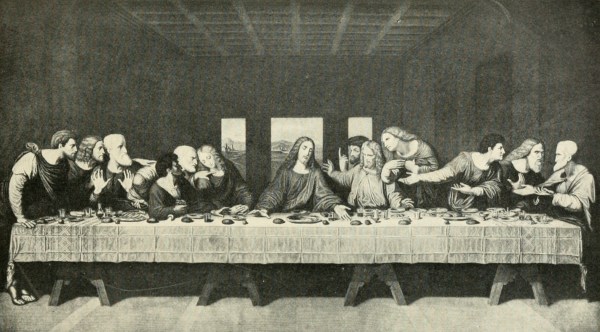
spread and the little band were gathered. Only the
genius of a da Vinci could do justice to that scene.
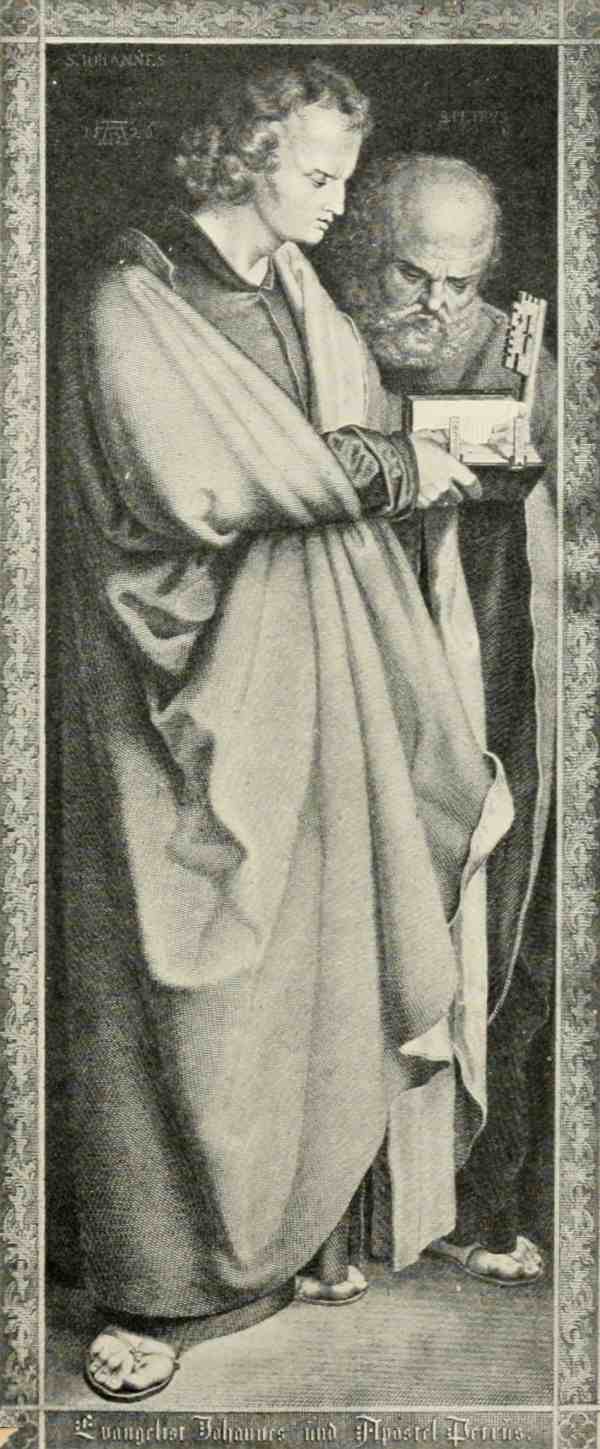
There was Peter, hot-headed, impetuous, bravado-like.
There was John, as gentle, pure-minded, and loving
as a woman. There was Judas, mercenary, low-browed,
and craven-hearted. There were others who,
with Peter and John, were to have temples dedicated
in their names. In their midst was the Master of them
all, "God manifest in the flesh," who "with His
pierced hands was to lift empires off their hinges, and
turn the stream of centuries from its channel." No
moment of history was so fraught with tragic interest
for the human race. There the seal of the New Covenant
was affixed, the bond of the new human spiritual
alliance was made. The great law of love was proclaimed
which was to regenerate and sanctify the
world. "These things I command you, that ye love
one another. And I have declared unto them thy
name, and will declare it; that the love wherewith
thou hast loved me, may be in them, and I in them."
Thus the great law of love was to be the binding tie,
not only among the little brotherhood there assembled
but was to be the cementing bond between the regenerate
of earth, the Mediator, and the great Father of
love, Himself. There, too, was given the great example
of humility which was to characterize true Christian
piety throughout the ages. The pages of history
record no other spectacle so thrilling and sublime, and
at the same time tender and pathetic, as that afforded
by the Paschal Meal, when Jesus, the Savior of men,
the Son of God, the Maker of all the shining worlds,
sank upon His knees to wash the feet of ignorant, simple-minded
Galilean fishermen, in order that future
ages might have at once a lesson and an example of
that genuine humility which is the very life and soul
of true religion.
During the evening, a bitter anxiety, an awful melancholy,
seized the devoted band, whose number, thirteen,
even to-day inspires superstitious dread. In the
midst of the apprehension the heart of the Master was
so deeply wrung with agony that He turned to those
about Him and said: "Verily, verily, I say unto you
that one of you shall betray me." This prediction only
intensified the sadness that had already begun to fall
over the Sacred Meal and the loving disciples began
to ask: "Lord, is it I?" Even the betrayer himself
joined with the others, and, with inconceivable heartlessness
and effrontery, asked: "Lord, is it I?" At the
moment of greatest dread and consternation, Peter,
bolder than the rest, leaned across the table and whispered
to John, who was resting upon the bosom of
Jesus, and suggested that he ask the Master who it was.
Accordingly, John whispered and asked the Savior:
"Lord, who is it?" "Jesus answered, He it is, to
whom I shall give a sop, when I have dipped it. And
when he had dipped the sop, he gave it to Judas Iscariot,
the son of Simon. And after the sop Satan entered
into him. Then said Jesus unto him, That thou
doest, do quickly." Judas then arose from the feast
and vanished from the room. When he was gone, the
Master began to deliver to His "little children,"[228] to
those who had loved and followed Him, those farewell
words which St. John alone records, and that are so
"rarely mixed of sadness and joys, and studded with
mysteries as with emeralds."
There, too, doubts and fears began to burst from the
hearts and lips of the members of the little company.
The knowledge that the gentle Jesus, whose ministry
had thrilled and glorified their simple peasant lives,
and promised to them crowns of glory in the world to
come, was about to leave them, and in a most tragic
way, filled them with solicitude and dread. Their
anxiety manifested itself by frequent questioning
which excites our wonder that men who had been with
Him so long in the Apostolic ministry should have
been so simple-minded and incredulous. "They said,
therefore, What is this that he saith, A little while?
We cannot tell what he saith." This verse is a simple
illustration of the continued misapprehension, on this
night, upon the part of the Apostles, of everything said
by the Master. Peter was anxious to know why he
could not follow the Lord. Thomas wanted to know
the exact way, evidently failing to comprehend the
figurative language of the Christ. Judas Lebbæus
also had his doubts. He became muddled by mixing
the purely spiritual with the physical powers of sight.
"Lord, how is it," he asked, "that thou wilt manifest
thyself to us and not to the world?" Philip of Bethsaida
desired to see the Father. "Lord, show us the
Father," he said, "and it sufficeth us." Philip seems
to have been so dense that he had no appreciation of
the spiritual attributes and invisible existence of the
Father.
It was thus that several hours were spent in celebrating
the great Feast; in drinking wine; in eating the
Paschal lamb, the unleavened bread, and the bitter
herbs; in singing hymns, offering prayers, and performing
the sacred rites; in delivering discourses
which in every age have been the most precious treasures
of Christians, and in expressing doubts and fears
that have excited the astonishment and even the ridicule
of the exacting and supercilious of all the
centuries.
At the approach of midnight, Jesus and the Eleven
left the Upper Chamber of the little house and stepped
out into the moonlight of a solemn Passover night.
They began to wend their way toward the Kedron that
separated them from the olive orchard on the Mount.
Less than an hour's journey brought them to the Garden
of Gethsemane. The word "Gethsemane" means
"oil press." And this place doubtless derived its name
from the fact that in it was located an oil press which
was used to crush olives that grew abundantly on the
trees that crowned the slopes. Whether it was a public
garden or belonged to some friend of Jesus, we do not
know, but certain it is that it was a holy place, a sanctuary
of prayer, where the Man of Sorrows frequently
retired to pray and commune with His Heavenly
Father. At the gateway Jesus left eight of the Apostles
and took with Him the other three: Peter, James,
and John. These men seem to have been the best beloved
of the Master. They were with Him at the raising
of Jairus' daughter, at the Transfiguration on the
Mount, and were now selected to be nearest Him in
the hour of His agony. Proceeding with them a short
distance, He suddenly stopped and exclaimed: "My
soul is exceedingly sorrowful, even unto death: tarry
ye here, and watch with me." Then, withdrawing
Himself from them a stone's cast, He sank upon His
knees and prayed; and in the agony of prayer great
drops of sweat resembling blood rolled from His face
and fell upon the ground. Rising from prayer, He
returned to His disciples to find them asleep. Sorrow
had overcame them and they were mercifully spared
the tortures of the place and hour. Three times did
He go away to pray, and as many times, upon His return,
they were found asleep. The last time He came
He said to them: "Rise, let us be going; behold he is
at hand that doth betray me." At this moment were
heard the noise and tramp of an advancing multitude.
"Judas then, having received a band of men and officers
from the chief priests and Pharisees, cometh
thither with lanterns and torches and weapons." This
midnight mob, led by Judas, was made up of Roman
soldiers, the Temple guard, and stragglers from along
the way. It is probable that the traitor walked ahead
of the mob by several paces. "And forthwith he came
to Jesus, and said, Hail, master, and kissed him and
Jesus said unto him, Friend, wherefore art thou come?
Then came they and laid hands on Jesus and took
him." But the arrest was not accomplished without
incidents of pathos and of passion. "Whom seek ye?"
asked the Master. "Jesus of Nazareth," they answered.
"I am he," replied the Savior. Then, dazed
and bewildered, they fell backward upon the ground.
"Then asked he them again, whom seek ye? and they
said, Jesus of Nazareth. Jesus answered, I have told
you that I am he: if, therefore, ye seek me, let these
go their way." John says that this intercession for the
disciples was to the end that prophecy might be fulfilled.[229]
Doubtless so; but this was not all. Nowhere
in sacred literature do we find such pointed testimony
to the courage and manliness of Jesus. His tender
solicitude for the members of the little band, for those
who had quit their homes and callings to link their
destinies with His, was here superbly illustrated. He
knew that He was going to immediate condemnation
and then to death, but He ardently desired that they
should be spared to live. And for them He threw
Himself into the breach.
The furious and the passionate, as well as the
tender and pathetic, mark the arrest in the garden.
"Then Simon Peter having a sword drew it, and
smote the high priest's servant, and cut off his right
ear. The servant's name was Malchus." This was
bloody proof of that fidelity which Peter loudly proclaimed
at the banquet board, but which was soon to
be swallowed up in craven flight and pusillanimous
denial.
"Then the band and the captain and officers of the
Jews took Jesus, and bound him."
At this point the arrest was complete, and we now
return to the discussion of the illegalities connected
with it.
It was a well-established and inflexible rule of Hebrew
law that proceedings in capital trials could not
be had at night. This provision did not apply simply
to the proceedings of the trial after the prisoner had
been arraigned and the examination had been begun.
We have it upon the authority of Dupin that it applied
to the entire proceedings, from the arrest to the
execution. The great French advocate explicitly states
that the arrest was illegal because it was made at
night.[230] Deference to this rule seems to have been
shown in the arrest of Peter and John on another occasion.
"And they laid hands upon them and put
them in hold unto the next day: for it was now eventide."[231]
That Jesus was arrested at night is clearly
evident from the fact that those who captured Him
bore "lanterns and torches and weapons."
The employment of Judas by the Sanhedrin authorities
constitutes the second element of illegality in
the arrest. This wretched creature had been numbered
among the Twelve, had been blessed and honored,
not merely with discipleship but with apostleship,
had himself been sent on holy missions by the
Master, had been given the power to cast out devils,
had been appointed by his Lord the keeper of the
moneys of the Apostolic company, and, if Edersheim
is to be believed, had occupied the seat of honor by
the Master at the Last Supper.[232] This craven and cowardly
Apostate was employed by the Sanhedrin Council
to betray the Christ. It is clearly evident from the
Scriptures that the arrest of Jesus would not have
taken place on the occasion of the Passover, and therefore
probably not at all, if Judas had not deserted
and betrayed Him. The Savior had appeared and
preached daily in the Temple, and every opportunity
was offered to effect a legal arrest on legal charges
with a view to a legal determination. But the enemies
of Jesus did not want this. They were waiting to
effect His capture in some out-of-the-way place, at the
dead of night, when His friends could not defend Him
and their murderous proceedings would not reach
the eye and ear of the public. This could not be
accomplished as long as His intimates were faithful
to Him. It was, then, a joyful surprise to the members
of the Sanhedrin when they learned that Judas
was willing to betray his Master. "And when they
heard it, they were glad, and promised to give him
money."
In modern jurisdictions, accomplice testimony has
been and is allowed. The judicial authorities, however,
have always regarded it with distrust, and we
might say with deep-seated suspicion. At the common
law in England a conviction for crime might rest upon
the uncorroborated testimony of an accomplice, after
the jury had been warned that such testimony was to
be closely scrutinized. In the American States the testimony
of an accomplice is admissible, but must be corroborated
in order to sustain a conviction. This is the
general rule. The weakness of such evidence is shown
by the nature of the corroboration required by several
states. In some of them the corroborating testimony
must not only tend to prove the commission of the
crime but must also tend to connect the defendant with
such commission. Another evidence of the untrustworthiness
of such testimony is that in several states an
accomplice is not permitted to corroborate another accomplice,
so as to satisfy the statutes.[233] The admission
of such testimony seems to rest, in great measure, upon
the supreme necessity of the preservation of the state,
which is only possible when the punishment of crime
is possible; and in very many instances it would be impossible
to punish crime if guilty confederates were
not allowed and even encouraged to give state's evidence.
But notwithstanding this supreme consideration of
the necessity of the preservation of the state, the ancient
Hebrews forbade the use of accomplice testimony,
as we have seen from the extract from "The
Criminal Jurisprudence of the Ancient Hebrews," by
Mendelsohn, cited on page 219.
The arrest of Jesus was ordered upon the supposition
that He was a criminal; this same supposition
would have made Judas, who had aided, encouraged,
and abetted Jesus in the propagation of His faith, an
accomplice. If Judas was not an accomplice, Jesus
was innocent, and His arrest was an outrage, and
therefore illegal.
The Hebrew law against accomplice testimony must
have been derived, in part at least, from the following
rule laid down in Leviticus xix. 16-18: "Thou shalt
not go up and down as a talebearer among thy people:
neither shall thou stand against the blood of thy neighbor.
Thou shalt not hate thy brother in thine heart:
Thou shalt not avenge, or bear any grudge against the
children of thy people, but thou shalt love thy neighbor
as thyself." It may be objected that this is only a
moral injunction and not a legal rule; to which reply
must be made that there was no difference between
morality and law among the ancient Hebrews. Their
religion was founded upon law, and their law upon
religion. The two ideas of morality and law were inseparable.
The ancient Hebrew religion was founded
upon a contract of the strictest legal kind. The Abrahamic
covenant, when properly interpreted, meant
simply that Jehovah had agreed with the children of
Israel that if they would obey the law as He gave it,
they would be rewarded by Him. The force of this
contention will be readily perceived when it is reflected
that the Decalogue is nothing but ten moral
injunctions, which are nevertheless said to be the law
which God gave to Moses.
Every provision in the rule laid down in Leviticus
is, moreover, directly applicable to the character and
conduct of Judas, and seems to have been intended as
a prophetic warning to him. Let us consider the different
elements of this rule in order.
"Thou shalt not go up and down as a talebearer
among thy people."
Was not Judas a talebearer among his people? Did
he not go to the chief priests to betray his Master unto
them? Was he not a "talebearer" if he did nothing
more than communicate to the chief priests the whereabouts
of the Savior, that Gethsemane was His accustomed
place of prayer and that He might be found
and arrested there at midnight? Are we not justified
in supposing that Judas told the enemies of Jesus
much more than this? Is it not reasonable to infer that
the blood-money was paid to secure more evidence
than that which would merely lead to the arrest of the
Nazarene? Is it not probable that Judas detailed to
the chief priests many events in the ministry of Jesus
which, it is known, He communicated only to the
Twelve? If he did these things, was he not a "talebearer"
within the meaning of the rule?
"Neither shalt thou stand against the blood of thy
neighbor."
Did not Judas stand against the blood of his nearest
and dearest neighbor when he consented to be the
chief instrument of an arrest which he knew would
result in death?
"Thou shalt not hate thy brother in thy heart."
Is it possible to suppose that anything less than
hatred could have induced Judas to betray the Christ?
This question is important, for it involves a consideration
of the real character of the betrayer and the main
motive for the betrayal. Judas was from Kerioth in
Judea and was the only Judean among the Twelve.
Why Judas was selected as a member of the Apostolic
company is too deep a mystery to be solved by the
author of these pages. Besides, the consideration of
the elements of predestination in his case is foreign to
the purpose of this work. His character as a purely
human agency is sufficient to answer the present design.
Judas had undoubtedly demonstrated business
capacity in some way before his appointment to the
treasury portfolio of the little band. It cannot be
doubted that greed was his besetting sin. This trait,
coupled with political ambition, undoubtedly accounts
for his downfall and destruction. He was one of those
simple-minded, short-sighted individuals of his day
who believed that a political upheaval was at hand
which would result in the restoration of the independence
of Israel as a separate kingdom. He believed
that this result would be brought about through the
agency of a temporal Messiah, an earthly deliverer of
almost divine qualities. He thought at first that he
saw in Jesus the person of the Messiah, and in the
Apostolic band the nucleus of a revolution. He was
gratified beyond measure at his appointment to the
treasury position, for he felt sure that from it promotion
was in sight. He was perfectly contented to carry
for a while the "little bag," provided there was reasonable
assurance that later on he would be permitted
to carry a larger one.
As the months and years rolled by, heavy scales began
to fall from his stupid eyes and he began to be
deceived not by but in Jesus. We are justified in believing
that Judas never even remotely appreciated the
spiritual grandeur of the Christ. He probably had
intellect and soul enough to be charmed and fascinated
by the lofty bearing and eloquent discourse of Jesus,
but after all he perceived only the necessary qualifications
of a great republican leader and successful revolutionist.
And after a while he doubtless began to tire
of all this when he saw that the revolution was not progressing
and that there was no possibility of actual and
solid results. It is probable that disaffection and
treachery were born and began to grow in his mind
and heart at Capernaum, when Jesus was deserted by
many of His followers and was forced to effect a realignment
along spiritual lines. Judas was not equal
to the spiritual test, and it was doubtless then that
the disintegration of his moral nature began, which
stopped only with betrayal, infamy, and death.
But by what process, we may ask, was the mercenary
disposition of Judas converted into hatred against
Jesus? The process was that of disappointment.
When Judas became convinced that all the years of his
connection with the Apostolic company had been lost,
his will became embittered and his resentment was
aroused. In the denseness of his ignorance and in the
baseness of his soul he probably thought that Jesus had
deceived His followers as to His true mission and he
felt enraged because he had been duped. He had
looked forward to worldly promotion and success.
He had fondly hoped that the eloquence of Jesus
would finally call around Him an invincible host of
enthusiastic adherents who would raise the standard
of revolt, drive the Romans from Judea, and establish
the long-looked-for kingdom of the Jews. He had
noted with deep disappointment and unutterable chagrin
the failure of Jesus to proclaim Himself king
when, at Bethphage, the multitude had greeted His
entrance into Jerusalem with Hosannas and acclamations.
And now, at the Last Supper, he became convinced
from the conduct and discourses of the Master
that his worst fears were true, that Jesus was sincere
in His resolution to offer Himself as a sacrifice for the
sake of a principle which he, Judas, did not approve
because he could not understand. In other words, he
witnessed in the resolve of Jesus to die at once the shipwreck
of his hopes, and he made haste to vent his
wrath upon the author of his disappointment.
The writer agrees with Renan that the thirty pieces
of silver were not the real or leading inducement to
this black and monumental betrayal. Having taken
the fatal step, by leaving the Upper Room in the home
of Mark, to deliver his Lord and Master into the
hands of enemies, a bitter hatred was formed at once
against the innocent victim of his foul designs, on the
well-known principle of human nature that we hate
those who have induced us to do that which causes us
to despise and hate ourselves.
"Thou shalt not avenge or bear any grudge against
the children of thy people."
Where, in the annals of the universe, do we find another
such case of vengeance and grudge as this of
Judas against Jesus?
"But thou shalt love thy neighbor as thyself."
This commandment of the Mosaic law was also the
great commandment of the Master of Galilee, and in
violating it by consenting to betray and sacrifice Jesus,
Judas assaulted and destroyed in his own soul the cardinal
principle of the two great religious dispensations
of his race.
And yet this informer, conspirator, and malefactor
was employed by the chief priests in effecting the
arrest of Jesus. Was not a fundamental rule of Mosaic
law violated? Will it be urged that the rule operated
against Judas but not against the chief priests? If so,
it must be remembered that no wicked instrument
could be used in promoting Hebrew justice. Officers
of the law were not permitted to require a citizen to
do an act which was forbidden by law. If Jesus was
innocent, then the arrest was illegal. If He was
guilty, then Judas, his Apostle and fellow-worker, was
an accomplice; and no accomplice could be utilized in
furtherance of justice, under Hebrew law, either in
the matter of arrest or in the establishment of guilt as
a witness at the trial.
According to the Talmud, there was at least one
seeming exception to this rule. Renan describes it
with peculiar clearness and succinctness. "The procedure,"
he says, "against the 'corrupter' (mesith),
who sought to attaint the purity of religion, is explained
in the Talmud, with details, the naïve impudence
of which provokes a smile. A judicial ambush
is therein erected into an essential part of the examination
of criminals. When a man was accused of being
a 'corrupter,' two witnesses were suborned who were
concealed behind a partition. It was arranged to
bring the accused into a contiguous room, where he
could be heard by these two witnesses without his perceiving
them. Two candles were lighted near him, in
order that it might be satisfactorily proved that the
witnesses 'saw him.' (In criminal matters, eyewitnesses
alone were admitted. Mishna, Sanhedrin VI,
5.) He was then made to repeat his blasphemy; next
urged to retract it. If he persisted, the witnesses who
had heard him conducted him to the Tribunal and he
was stoned to death. The Talmud adds that this was
the manner in which they treated Jesus; that he was
condemned on the faith of two witnesses who had been
suborned, and that the crime of 'corruption' is, moreover,
the only one for which the witnesses are thus
prepared."[234]
Most Gentile writers ridicule this statement of the
Talmud, and maintain that it was a Rabbinic invention
of post-Apostolic days, and was intended to offer
an excuse for the outrageous proceedings against the
Christ. Schürer dismisses the whole proposition with
contempt. Many Jewish scholars also refuse it the
sanction of their authority. But even if it was a Talmudic
rule of law in force at the time of Christ, its
constitutionality, so to speak, might be questioned, in
the first place; since it was, in spirit at least, repugnant
to and subversive of the Mosaic provision in Leviticus
cited above. It must not be forgotten that the Mosaic
Code was the constitution, the fundamental law of Judaism,
by which every Rabbinic interpretation and
every legal innovation was to be tested.
Again, such a law would have been no protection to
the chief priests and to Judas against the operation of
this Mosaic injunction. If such a rule of procedure
could be justified upon any ground, it would require
disinterested men acting from honorable motives, in
promoting the maintenance of law and order. Officers
of the law have sometimes, as pretended accomplices,
acted in concert with criminals in order to secure and
furnish evidence against them. But they were officers
of the law, and the courts have held that their evidence
was not accomplice testimony requiring corroboration.
It is very clear that Judas was not such a disinterested
witness, acting in the interest of public justice. He
was a fugitive from the Last Supper of his Master, a
talebearer within the meaning of the provision in Leviticus;
and his employment by the Sanhedrin was a
violation of a fundamental provision in the Mosaic
Code.
The third illegality in the arrest of Jesus was that
His capture was not the result of a legal mandate from
a court whose intentions were to conduct a legal trial
for the purpose of reaching a righteous judgment.
"This arrest," says Rosadi, "effected in the night between
Thursday and Friday, the last day of the life of
Jesus, on Nisan 14, according to the Hebrew calendar,
was the execution of an illegal and factious resolution
of the Sanhedrin. There was no idea of apprehending
a citizen in order to try him upon a charge which after
sincere and regular judgment might be found just or
unfounded; the intention was simply to seize a man
and do away with him. The arrest was not a preventive
measure such as might lawfully precede trial and
condemnation; it was an executive act, accomplished
in view of a sentence to be pronounced without legal
justification."
LAW
"Now the Jewish law prohibited all proceedings by
night."—Dupin, "Jesus Devant Caïphe et Pilate."
"Be not a sole judge, for there is no sole judge but
One."—Mishna, Pirke Aboth IV. 8.
"A principle perpetually reproduced in the Hebrew
scriptures relates to the two conditions of publicity
and liberty. An accused man was never subjected
to private or secret examination, lest, in his perplexity,
he furnish damaging testimony against
himself."—Salvador, "Institutions de Moïse," pp.
365, 366.
FACT AND ARGUMENT
The private examination before Annas (or Caiaphas)
was illegal for the following reasons: (1) The
examination was conducted at night in violation of
Hebrew law; (2) no judge or magistrate, sitting
alone, could interrogate an accused judicially or sit in
judgment upon his legal rights; (3) private preliminary
examinations of accused persons were not allowed
by Hebrew law.
The general order of events following the arrest in
the garden was this: (1) Jesus was first taken to the
house of Annas; (2) after a brief delay He was sent
by Annas to Caiaphas, the high priest, in whose palace
the Sanhedrin, or a part thereof, had already assembled;
(3) He was then brought before this body, tried
and condemned; (4) He remained, during the rest of
the night, in the high priest's palace, exposed to the
insults and outrages of His keepers; and was finally
and formally sentenced to death by the Sanhedrin
which reconvened at the break of day.
That Jesus was privately examined before His regular
trial by the Sanhedrin is quite clear. But whether
this preliminary examination took place before Annas
or Caiaphas is not certainly known. John alone records
the private interrogation of Jesus and he alone
refers to Annas in a way to connect him with it. This
Evangelist mentions that they "led him away to Annas
first."[235] Matthew says that after the arrest of Jesus,
they "led him away to Caiaphas the high priest,"[236]
without mentioning the name of Annas. Mark tells us
that "they led Jesus away to the high priest";[237] but he
does not mention either Annas or Caiaphas. Luke
records that they "took him, and led him, and brought
him into the high priest's house,"[238] without telling us
the name of the high priest.
"The high priest then asked Jesus of his disciples
and of his doctrine."[239] This was the beginning of the
examination. But who was the examiner—Annas or
Caiaphas? At first view we are inclined to declare
that Caiaphas is meant, because he was undoubtedly
high priest in that year. But Annas is also designated
as high priest by Luke in several places.[240] In Acts iv.
6 he mentions Caiaphas without an official title, but
calls Annas high priest. It is therefore not known to
whom John refers when he says that the "high priest
asked Jesus of his disciples and of his doctrine." For
a lengthy discussion of this point, the reader is referred
to Andrews's "Life of Our Lord," pp. 505-510.
But it is absolutely immaterial, from a legal point
of view, whether it was Annas or Caiaphas who examined
Jesus, as the proceedings would be illegal in
either case. For whether it was the one or the other,
neither had the right to sit alone as judge; neither had
the right to conduct any judicial proceeding at night;
neither had the right to institute a secret preliminary
examination by day or night.
Attention has been called to the matter as involving
a question of historical rather than of legal consequence.
A knowledge of the true facts of the case
might, however, throw light upon the order and connection
of the proceedings which followed the same
night. For if the private examination recorded by
John was had before Annas, it was doubtless separated
by a certain interval of place and time from the later
proceedings before Caiaphas. Then it is reasonable
to suppose that the examination of witnesses, the confession
and condemnation which took place at the
regular trial before the Sanhedrin over which Caiaphas
presided, happened later in the night, or even
toward morning, and were of the nature of a regular
public trial. If, on the other hand, Annas sent Jesus
without delay to Caiaphas, who examined Him, it is
reasonable to conclude that witnesses were at once produced,
and that the adjuration and condemnation immediately
followed. If such were the case, a considerable
interval of time must have intervened between
these proceedings and the meeting of the Sanhedrin
which was had in the morning to confirm the judgment
which had been pronounced at the night session.
But these considerations are really foreign to the question
of legal errors involved, which we come now to
discuss.
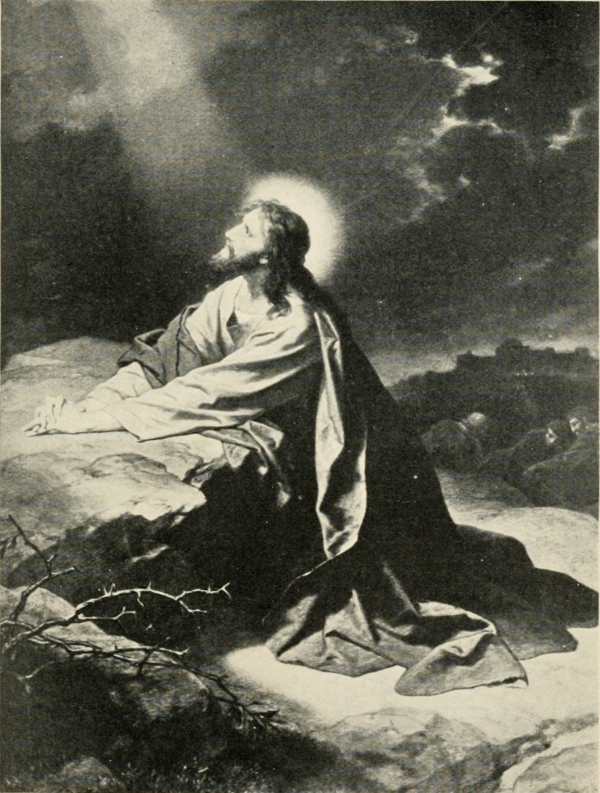
JESUS IN GETHSEMANE (HOFFMAN)
In the first place, the private examination of Jesus,
whether by Annas or Caiaphas, took place at night;
and we have learned from Dupin that all proceedings
at night in capital cases were forbidden.
In the second place, no judge or magistrate, sitting
alone, could interrogate an accused person judicially
or sit in judgment upon his legal rights. We have
seen in Part II of this volume that the Hebrew system
of courts and judges provided no single magistrates
who, sitting alone, could adjudicate causes. The lowest
Hebrew court consisted of three judges, sometimes
called the Court of Three. The next highest tribunal
was the Minor Sanhedrin of three-and-twenty members.
The supreme tribunal of the Jews was the Great
Sanhedrin of seventy-one members. There was no
such thing among the ancient Hebrews as a court with
a single judge. "Be not a sole judge, for there is no
sole judge but One," is one of the most famous aphorisms
of the Pirke Aboth. The reason of this rule is
founded not only in a religious exaction born of the
jealousy of Jehovah, but in the principle of publicity
which provides for the accused, in the very number of
judges, a public hearing. The same principle is suggested
by the number of witnesses required by both the
Mishna and Mosaic Code for the conviction of a prisoner.
At least "two or three witnesses" were required
to appear publicly and give testimony against the accused,
else a conviction could not follow.
Again, preliminary examinations of accused persons
were not allowed by Hebrew law. In the American
states and in some other countries, a man suspected of
crime and against whom an information or complaint
has been lodged, is frequently taken before an examining
magistrate to determine whether he should be
discharged, admitted to bail, or sent to prison to await
the action of a Grand Jury. At such hearing, the prisoner
is usually notified that he is at liberty to make a
statement regarding the charge against him; that he
need not do so unless he desires; but that if he does, his
testimony may be subsequently used against him at the
regular trial of the case. But such proceedings, according
to Salvador, were forbidden by ancient Hebrew
law. The preliminary examination, therefore,
by Annas or Caiaphas was illegal. The reason of the
rule, as above stated, was to protect the prisoner
against furnishing evidence that might be used against
him at the regular trial of his case. The private examination
of Jesus illustrates the justice of the rule
and the necessity of its existence, for it was undoubtedly
the purpose of Annas or Caiaphas to gather material
in advance to lay before the regularly assembled
Sanhedrin and thereby expedite the proceedings at the
expense of justice.
If it be contended that the leading of Jesus to Annas
first, which St. John alone relates, was merely intended
to give the aged Sanhedrist an opportunity to
see the prisoner who had been causing such commotion
in the land for several years; and that there was no
examination of Jesus before Annas—the interrogation
by the high priest concerning the disciples and the
doctrine of Jesus being construed to refer to an examination
by Caiaphas, and being identical with the night
trial referred to by Matthew and Mark—reply may
be made that, under any construction of the case, there
was at least an illegal appearance before Annas, as
mere vulgar curiosity to see a celebrated prisoner was
no excuse for the violation of the spirit if not the
letter of the law. It is inconceivable, however, to
suppose that Annas did not actually interrogate Jesus
concerning His disciples, His doctrine, and His personal
pretensions. To suppose that he demanded to
see Jesus for no other reason than to get an impression
of His looks, is to insult common sense. If Annas examined
the prisoner, though only slightly, concerning
matters affecting the charges against Him that might
endanger His life or liberty, he had violated a very
important rule of Hebrew criminal procedure. The
question of the amount of examination of the accused
is immaterial.
It is not known whether Annas at this time sat in
the Great Sanhedrin as a judge. He had been deposed
from the high priesthood nearly twenty years before
by the procurator Valerius Gratus, for imposing and
executing capital sentences. But he was, nevertheless,
still all-powerful in the great Council of the Jews.
Edersheim says that though "deprived of the Pontificate,
he still continued to preside over the Sanhedrin."[241]
Andrews is of the opinion that "he did in
fact hold some high official position, and this probably
in connection with the Sanhedrin, perhaps as occasional
president."[242] Basing his criticism upon the
words in Luke, "Annas and Caiaphus being the high
priests,"[243] Dr. Plummer believes "that between them
they discharged the duties, or that each of them in different
senses was regarded high priest, Annas de jure,
and Caiaphas de facto."[244] This is a mere supposition,
however, since there is no historical evidence that Annas
was restored to the pontificate after his deposition
by Valerius Gratus, A.D. 14.[245] The phrase, "Annas and
Caiaphas being high priests," refers to the fifteenth
year of the reign of Tiberius Cæsar, which was A.D. 26.
After all, it is here again an historical more than a
legal question, whether Annas was an official or not at
the time of the appearance of Jesus before him. In
either case his preliminary examination of the Christ
was illegal. If he was a member of the Sanhedrin, the
law forbade him to hold an informal preliminary examination
at night. He certainly could not do this
while sitting alone. If he was not a magistrate, as
Dupin very properly contends, this fact only added to
the seriousness of the illegality of subjecting a prisoner
to the whimsical examination of a private citizen.
Whether a member of the Sanhedrin or not, Annas
was at the time of Christ and had been for many years
its dominating spirit. He himself had been high
priest. Caiaphas was his son-in-law, and was succeeded
in the high priesthood by four sons of Annas.
The writer does not believe that Annas had any legal
connection with the Sanhedrin, but, like many American
political bosses, exercised more authority than the
man that held the office. He was simply the political
tool of the Roman masters of Judea, and the members
of the Sanhedrin were simply figureheads under his
control.
Again, the private examination of Jesus was marked
by an act of brutality which Hebrew jurisprudence
did not tolerate. This was not enumerated above as
an error, because it was not probably a violation of any
specific rule of law. But it was an outrage upon the
Hebrew sense of justice and humanity which in its
normal state was very pure and lofty.
"The high priest then asked Jesus of his disciples
and of his doctrine. Jesus answered him, I spake
openly to the world; I ever taught in the Synagogue,
and in the Temple, whither the Jews always resort;
and in secret have I said nothing. Why askest thou
me? ask them which heard me, what I have said unto
them: behold, they know what I said." In this reply
Jesus planted Himself squarely upon His legal rights
as a Jewish citizen. "It was in every word the voice
of pure Hebrew justice, founded upon the broad principle
of their judicial procedure and recalling an unjust
judge to the first duty of his great office."
"And when he had thus spoken, one of the officers
which stood by struck Jesus with the palm of his hand,
saying, Answerest thou the high priest so?" Again
the Nazarene appealed for protection to the procedure
designed to safeguard the rights of the Hebrew prisoner.
"Jesus answered him, If I have spoken evil,
bear witness of the evil: but if well, why smitest
thou me?"[246]
We have seen that, under Hebrew law, the witnesses
were the accusers, and their testimony was at once the
indictment and the evidence. We have also seen that a
Hebrew prisoner could not be compelled to testify
against himself, and that his uncorroborated confession
could not be made the basis of a conviction. "Why
askest thou me? ask them that heard me, what I have
said unto them." This was equivalent to asking: Do
you demand that I incriminate myself when our law
forbids such a thing? Why not call witnesses as the
law requires? If I am an evil-doer, bear witness of
the evil, that is, let witnesses testify to the wrongdoing,
that I may be legally convicted. If I am not guilty
of a crime, why am I thus maltreated?
Is it possible to imagine a more pointed and pathetic
appeal for justice and for the protection of the law
against illegality and brutal treatment? This appeal
for the production of legal testimony was not without
its effect. Witnesses were soon forthcoming—not
truthful witnesses, indeed—but witnesses nevertheless.
And with the coming of these witnesses began the formal
trial of the Christ, and a formal trial, under
Hebrew law, could be commenced only by witnesses.
LAW
"The entire criminal procedure of the Mosaic Code
rests upon four rules: certainty in the indictment;
publicity in the discussion; full freedom granted to
the accused; and assurance against all dangers or
errors of testimony."—Salvador, "Institutions de
Moïse," p. 365.
"The Sanhedrin did not and could not originate
charges; it only investigated those brought before
it."—Edersheim, "Life and Times of Jesus the
Messiah," vol. i. p. 309.
"The evidence of the leading witnesses constituted the
charge. There was no other charge: no more formal
indictment. Until they spoke, and spoke in
the public assembly, the prisoner was scarcely an
accused man. When they spoke, and the evidence
of the two agreed together, it formed the legal
charge, libel, or indictment, as well as the evidence
for its truth."—Innes, "The Trial of Jesus
Christ," p. 41.
"The only prosecutors known to Talmudic criminal
jurisprudence are the witnesses to the crime. Their
duty is to bring the matter to the cognizance of the
court, and to bear witness against the criminal. In
capital cases, they are the legal executioners also.
Of an official accuser or prosecutor there is nowhere
any trace in the laws of the ancient Hebrews."—Mendelsohn,
"The Criminal Jurisprudence of
the Ancient Hebrews," p. 110.
FACT AND ARGUMENT
The Gospel records disclose two distinct elements
of illegality in the indictment against Jesus: (1) The
accusation, at the trial, was twofold, vague, and indefinite,
which Mosaic law forbade; (2) it was made, in
part, by Caiaphas, the high priest, who was one of the
judges of Jesus; while Hebrew law forbade any but
leading witnesses to present the charge.
A thorough understanding of Point III depends
upon keeping clearly in mind certain well-defined elementary
principles of law. In the first place, it should
be remembered that in most modern jurisdictions an
indictment is simply an accusation, carries with it no
presumption of guilt, and has no evidentiary force.
Its only function is to bring the charge against the
prisoner before the court and jury, and to notify the
accused of the nature of the accusation against him.
But not so under the ancient Hebrew scheme of justice.
Under that system there was no such body as the
modern Grand Jury, and no committee of the Sanhedrin
exercised similar accusatory functions. The leading
witnesses, and they alone, presented charges. It
follows then, of necessity, that the ancient Hebrew indictment,
unlike the modern indictment, carried with
it a certain presumption of guilt and had certain evidentiary
force. This could not be otherwise, since the
testimony of the leading witnesses was at once the indictment
and the evidence offered to prove it.
Again, in the very nature of things an indictment
should, and under any enlightened system of jurisprudence,
does clearly advise the accused of the exact
nature of the charge against him. Under no other
conditions would it be possible for a prisoner to prepare
his defense. Most modern codes have sought to
promote clearness and certainty in indictments by requiring
the charging of only one crime in one indictment,
and in language so clear and simple that the nature
of the offense charged may be easily understood.
Now Salvador says that "certainty in the indictment"
was one of the cardinal rules upon which rested
the entire criminal procedure of the Mosaic Code.
Was this rule observed in framing the accusation
against Jesus at the night trial before the Sanhedrin?
If so, the Gospel records do not disclose the fact. It
is very certain, indeed, that the learned of no age of
the world since the crucifixion have been able to agree
among themselves as to the exact nature of the indictment
against the Christ. This subject was too exhaustively
discussed in the beginning of the Brief to warrant
lengthy treatment here. Suffice it to say that the
record of the night trial before Caiaphas discloses two
distinct charges: the charge of sedition—the threat to
destroy a national institution and to seduce the people
from their ancient allegiance, in the matter of the destruction
of the Temple; and the charge of blasphemy
preferred by Caiaphas himself in the adjuration which
he administered to Jesus. When the false witnesses
failed to agree, their contradictory testimony was rejected
and the charge of sedition was abandoned. And
before Jesus had time to answer the question concerning
sedition, another distinct charge, that of blasphemy,
was made in almost the same breath.[247] Did
this procedure tend to promote "certainty in the indictment"?
Did it not result in the complete destruction
of all clearness and certainty? Are we not justified
in supposing that the silence of Jesus in the
presence of His accusers was at least partially attributable
to His failure to comprehend the exact nature of
the charges against Him?
Again, the accusation was, in part, by Caiaphas, the
high priest, who was also one of the judges of Jesus;[248]
while Hebrew law forbade any but leading witnesses
to present the charge. Edersheim tells us that "the
Sanhedrin did not and could not originate charges; it
only investigated those brought before it." If the Sanhedrin
as a whole could not originate charges, because
its members were judges, neither could any individual
Sanhedrist do so. When the witnesses "agreed not
together" in the matter of the charge of sedition, this
accusation was abandoned. Caiaphas then deliberately
assumed the rôle of accuser, in violation of the law,
and charged Jesus, in the form of an adjuration, with
blasphemy, in claiming to be "the Christ, the Son of
God." Confession and condemnation then followed.
Only leading witnesses could prefer criminal charges
under Hebrew law. Caiaphas, being a judge, could
not possibly be a witness; and could not, therefore, be
an accuser. Therefore, the indictment against Jesus
was illegally presented.
The writer believes that the above is a correct interpretation
of the nature and number of the charges
brought against the Christ, and that the legal aspects
of the case are as above stated. But candor and impartiality
require consideration of another view. Several
excellent writers have contended that there were,
in fact, not two charges preferred against Jesus but
only one under different forms. These writers contend
that Caiaphas and his colleagues understood that Jesus
claimed supernatural power and identity with God
when He declared that He was able to destroy the
Temple and to build it again in three days,[249] and that
the question of the high priest, "I adjure thee by the
living God, that thou tell us whether thou be the
Christ, the Son of God," flowed naturally from and
had direct reference to the charge of being able to destroy
the Temple. The advocates of this view appeal
to the language of the original auditors to sustain their
contention. "Forty-and-six years was this temple in
building, and wilt thou rear it again in three days?"
It is insisted that these words convey the idea that
those who heard Jesus understood Him to mean that
He had supernatural power. There is certainly much
force in the contention but it fails to meet other difficulties.
In the first place, it is not clear that a threat
to destroy the Temple implied a claim to supernatural
power; in which case there would be no connection
between the first charge and that in which it was suggested
that Jesus had claimed to be the Christ, the Son
of God. In the second place, the contention that the
two charges are substantially the same ignores the language
of Mark, "But neither so did their witness
agree together,"[250] which was certainly not injected by
the author of the second Gospel as a matter of mere
caprice or pastime. This language, legally interpreted,
means that the testimony of the false witnesses,
being contradictory, was thrown aside, and that the
charge concerning the destruction of the Temple was
abandoned. This is the opinion of Signor Rosadi and
is very weighty.
Those writers who maintain that there was only one
charge, that of blasphemy, under different forms, rely
upon the passage in Matthew, "I am able to destroy
the temple of God and to build it again in three
days," and interpret it as a claim to supernatural
power in the light of the language used by those who
heard it: "Forty-and-six years was this temple in
building, and wilt thou rear it again in three days?"
Those who hold the opposite view, that there were two
distinct charges, rely upon the passage in Mark, "I
will destroy this temple that is made with hands, and
within three days I will build another made without
hands," and interpret it in the light of a similar accusation
against Stephen a few months afterwards: "For
we have heard him say, that this Jesus of Nazareth
shall destroy this place, and shall change the customs
which Moses delivered us."[251] This second interpretation,
which we believe to be the better, establishes the
existence at the trial of Christ of two distinct charges:
that of sedition, based upon a threat to assault existing
institutions; and that of blasphemy, founded upon the
claim of equality with God. And, in the light of this
interpretation, the illegality in the form of the indictment
against Jesus has been urged.
If the first construction be the true one, then the
error alleged in Point III is not well founded, since
the accusation was presented by witnesses, as the law
required; unless it could be successfully urged that the
witnesses, being false witnesses, were no more competent
to accuse a prisoner than to convict him upon
their false testimony. In such a case the substance as
well as the form of the indictment would be worthless,
and the whole case would fall, through failure not
only of competent testimony to convict but also of a
legal indictment under which to prosecute.
Neither the Mishna nor the Gemara mentions written
indictments among the ancient Hebrews. "The
Jewish Encyclopedia" says that accusations were
probably in writing, but that it is not certain.[252] A passage
in Salvador seems to indicate that they were in
writing. "The papers in the case," he says, "were
read, and the accusing witnesses were then called."
"The papers" were probably none other than the indictment.
But of this we are not sure, and cannot,
therefore, predicate the allegation of an error upon it.
From the whole context of the Scriptures, however,
we are led to believe that only oral charges were preferred
against Jesus.
LAW
"Let a capital offence be tried during the day, but suspend
it at night."—Mishna, Sanhedrin IV. 1.
"Criminal cases can be acted upon by the various
courts during day time only, by the Lesser Synhedrions
from the close of the morning service till
noon, and by the Great Synhedrion till evening."—Mendelsohn,
"Criminal Jurisprudence of the
Ancient Hebrews," p. 112.
"The reason why the trial of a capital offense could
not be held at night is because, as oral tradition
says, the examination of such a charge is like the
diagnosing of a wound—in either case a more thorough
and searching examination can be made by
daylight."—Maimonides, Sanhedrin III.
FACT AND ARGUMENT
Hebrew jurisprudence positively forbade the trial
of a capital case at night. The infraction of this rule
involves the question of jurisdiction. A court without
jurisdiction can pronounce no valid verdict or judgment.
A court has no jurisdiction if it convenes and
acts at a time forbidden by law.
One is naturally disposed to deride the reason assigned
by Maimonides for the existence of the law
against criminal proceedings at night. But it should
not be forgotten that in the olden days surgery had no
such aids as are at hand to-day. Modern surgical apparatus
had not been invented and electric lights and
the Roentgen Rays were unknown. In the light of
this explanation of the great Jewish philosopher the
curious inquirer after the real meaning of things naturally
asks why the Areopagus of Athens always held
its sessions in the night and in the dark.[253]
We have seen that Jesus was arrested in Gethsemane
about midnight and that His first ecclesiastical trial
took place between two and three o'clock in the morning.[254]
St. Luke tells us that there was a daybreak
meeting,[255] which was evidently intended to give a semblance
of legality and regularity to that rule of Hebrew
law that required two trials of the case.
The exact time of the beginning of the night session
of the Sanhedrin is not known. It is generally supposed
that the arrest took place in the garden between
midnight and one o'clock. The journey to the house
of Annas must have required some little time. Where
this house was located nobody knows. According to
one tradition Annas owned a house on the Mount of
Olives close to the booths or bazaars under the "Two
Cedars." Stapfer believes that Jesus was taken to that
place. According to another tradition the house of
Annas was located on the "Hill of Evil Counsel."
Barclay believes that this was the place to which Jesus
was conducted. But the tradition which is most generally
accepted is that which places the palace of
Annas on Mount Zion near the palace of Caiaphas. It
is believed by many that these two men, who were related,
Annas being the father-in-law of Caiaphas, occupied
different apartments in the same place. But
these questions are mere matters of conjecture and
have no real bearing upon the present discussion, except
to show, in a general way, the length of time
probably required to conduct Jesus from Gethsemane
to Annas; from Annas to Caiaphas, if the latter was
the one who privately examined Jesus; and thence to
the meeting of the Sanhedrin. It is reasonable to suppose
that at least two hours were thus consumed, which
would bring Jesus to the palace of Caiaphas between
two and three o'clock, if the arrest in the garden took
place between twelve and one o'clock. But here,
again, a difference of one or two hours would not
affect the merit of the proposition stated in Point IV.
For it is beyond dispute that the first trial before the
Sanhedrin was had at night, which was forbidden by
law.
The question has been frequently asked: Why did
the Sanhedrin meet at night in violation of law? The
answer to this is referable to the treachery of Judas, to
the fact that he "sought opportunity to betray him
unto them in the absence of the multitude," and to the
thought of the Master: "But this is your hour, and
the power of God." Luke tells us that the members
of the Sanhedrin "feared the people."[256] Mark informs
us that they had resolved not to attempt the
arrest and execution of Jesus at the time of the Passover,
"lest there be an uproar of the people."[257]
Jesus had taught daily in the Temple, and had furnished
ample opportunity for a legal arrest with a
view to a legal trial. But His enemies did not desire
this. "The chief priests and scribes sought how they
might take him by craft, and put him to death."[258] The
arrival of Judas from the scene of the Last Supper
with a proposition of immediate betrayal of the Christ
was a glad surprise to Caiaphas and his friends. Immediate
and decisive action was necessary. Not only
the arrest but the trial and execution of Jesus must be
accomplished with secrecy and dispatch. The greatest
festival of the Jews had just commenced. Pilgrims to
the feast were arriving from all parts of the Jewish
kingdom. The friends and followers of Jesus were
among them. His enemies had witnessed the remarkable
demonstration in His honor which marked His
entrance into Jerusalem only a few days before. It is
not strange, then, that they "feared the people" in the
matter of the summary and illegal proceedings which
they had resolved to institute against Him. They
knew that the daylight trial, under proper legal forms,
with the friends of Jesus as witnesses, would upset
their plans by resulting in His acquittal. They resolved,
therefore, to act at once, even at the expense
of all forms of justice. And it will be seen that this
determination to arrest and try Jesus at night, in violation
of law, became the parent of nearly every legal
outrage that was committed against Him. The selection
of the midnight hour for such a purpose resulted
not merely in a technical infraction of law, but rendered
it impossible to do justice either formally or substantially
under rules of Hebrew criminal procedure.
LAW
"The Sanhedrin sat from the close of the morning
sacrifice to the time of the evening sacrifice."—Talmud,
Jerus., Sanhedrin I. fol. 19.
"No session of the court could take place before the
offering of the morning sacrifice."—MM. Lémann,
"Jesus Before the Sanhedrin," p. 109.
"Since the morning sacrifice was offered at the dawn
of day, it was hardly possible for the Sanhedrin
to assemble until the hour after that time."—Mishna,
"Tamid, or of the Perpetual Sacrifice,"
C. III.
FACT AND ARGUMENT
The fact that the Sanhedrin convened before the
offering of the morning sacrifice constitutes the fifth
illegality. This error is alleged upon the authority of
MM. Lémann, who, in their admirable little work
entitled "Jesus Before the Sanhedrin," have called
attention to it. It is very difficult, however, to determine
whether this was a mere irregularity, or was
what modern jurists would call a material error.
From one point of view it seems to be merely a repetition
of the rule forbidding the Sanhedrin to meet at
night. The morning sacrifice was offered at the break
of day and lasted about an hour. A session of the
court before the morning sacrifice would, therefore,
have been a meeting at night, which would have been
an infringement of the law. But this was probably not
the real reason of the rule. Its true meaning is doubtless
to be found in the close connection that existed
between the Hebrew law and the Hebrew religion.
The constitution of the Hebrew Commonwealth was
an emanation of the mind of Jehovah, the Temple in
which the court met was His residence on earth, and
the judges who formed the Great Sanhedrin were the
administrators of His will. It is most reasonable,
then, to suppose that an invocation, in sacrifice and
prayer, of His guidance and authority would be the
first step in any judicial proceedings conducted in His
name.
It is historically true that a session of the Sanhedrin
in the palmiest days of the Jewish Commonwealth was
characterized by all the religious solemnity of a service
in the synagogue or the Temple. It is entirely
probable, therefore, that the morning sacrifice was
made by law an indispensable prerequisite to the assembling
of the supreme tribunal of the Jews for the
transaction of any serious business. On any other supposition
the rules of law cited above would have no
meaning. We have reason to believe, then, that the
offering of the morning sacrifice was a condition
precedent to the attachment of jurisdiction, and without
jurisdiction the court had no authority to act.
That the morning sacrifice was offered each day,
whether the court assembled or not, as a religious requirement,
does not alter the principle of law above
enunciated.
But it may be asked: How do we know that the
morning sacrifice was not offered? The answer is that
the whole context of the Scriptures relating to the trial
shows that it could not have been offered. Furthermore,
a simple and specific reason is that the time prescribed
by law for conducting the morning service was
between the dawn of day and sunrise. Then, if the
court convened between two and three o'clock in the
morning, it is very certain that the sacrifice had not
been offered. It is true that there was a morning session
of the Sanhedrin. But this was held simply to
confirm the action of the night session at which Jesus
had been condemned. In other words, the real trial
was at night and was held before the performance of
the religious ceremony, which was, in all probability,
a prerequisite to the attachment of jurisdiction.
LAW
"Court must not be held on the Sabbath, or any holy
day."—"Betza, or of the Egg," Chap. V. No. 2.
"They shall not judge on the eve of the Sabbath, nor
on that of any festival."—Mishna, Sanhedrin
IV. 1.
"No court of justice in Israel was permitted to hold
sessions on the Sabbath or any of the seven Biblical
holidays. In cases of capital crime, no trial could
be commenced on Friday or the day previous to
any holiday, because it was not lawful either to
adjourn such cases longer than over night, or to
continue them on the Sabbath or holiday."—Rabbi
Wise, "Martyrdom of Jesus," p. 67.
FACT AND ARGUMENT
No Hebrew court could lawfully meet on a Sabbath
or a feast day, or on a day preceding a Sabbath
or a feast day.
Concerning the Sabbath day provision Maimonides
offers the following reason for the rule: "As it is required
to execute the criminal immediately after the
passing of the sentence, it would sometimes happen
that the kindling of a fire would be necessary, as in the
case of one condemned to be burned; and this act
would be a violation of the law of the Sabbath, for it
is written 'Ye shall kindle no fire in your habitations
on the Sabbath day.'"[259] (Exodus xxxv. 3.)
Under modern practice, sessions of court may be
adjourned from day to day, or, if need be, from week
to week. But under the Hebrew system of criminal
procedure the court could not adjourn for a longer
time than a single night. Its proceedings were, so to
speak, continuous until final judgment. As the law
forbade sessions of court on Sabbath and feast days, it
became necessary to provide that courts should not
convene on the day preceding a Sabbath or a feast day,
in order to avoid either an illegal adjournment or an
infringement of the rule relating to the Sabbath and
feast days.
Now Jesus was tried by the Sanhedrin on both a
feast day and a day preceding the Sabbath. And, at
this point, a clear conception of the ancient Jewish
mode of reckoning time should be had. The Jewish
day of twenty-four hours began at one sunset and
ended with the next. But this interval was not divided
into twenty-four parts or hours of equal and invariable
length. Their day proper was an integral part of time
and was reckoned from sunrise to sunset. Their night
proper was likewise a distinct division of time and was
measured from sunset to sunrise. An hour of time, according
to modern reckoning, is invariably sixty minutes.
But the ancient Jewish hour was not a fixed
measure of time. It varied in length as each successive
day and night varied in theirs at different seasons of
the year. Neither did the Jews begin their days and
nights as we do. Our day of twenty-four hours always
begins at midnight. Their day of twenty-four hours
always began at one sunset and ended with the next.
Now Jesus was tried by the Sanhedrin on the 14th
Nisan, according to the Jewish calendar; or between
the evening of Thursday, April 6th, and the afternoon
of Friday, April 7th, A.D. 30, according to our calendar.
The 14th Nisan began at sunset on April 6th and
lasted until sunset on April 7th. This was a single
Jewish day, and within this time Jesus was tried and
executed. According to our calendar, the trial and
execution of Jesus took place on Friday, April 7th.
This was the day preceding the Jewish Sabbath, which
came on Saturday, according to our reckoning. And
on a day preceding the Sabbath no Jewish court could
lawfully convene. This is the first error suggested
under Point VI.
Again, it is beyond dispute that the Feast of Unleavened
Bread had begun and that the Passover was
at hand when Jesus was tried by the Sanhedrin.[260] This
was in violation of a specific provision of Hebrew
law, and constitutes the second error alleged under
Point VI.
There seems to be some conflict among the authorities
as to whether Jesus was tried on the first day of
the celebration of the feast of the Passover or on the
day preceding. But the question is immaterial from a
legal point of view, as the law forbade a trial either
on a feast day or on the day preceding, for reasons
above stated.
This violation of the law relating to the Sabbaths
and feast days, like that relating to night sessions of
the Sanhedrin, resulted in still other errors. It is
necessary to mention only one of these at this point.
The proceedings of the Sanhedrin were recorded by
two scribes or clerks. Their records were to be used
on the second day of the trial in reviewing the proceedings
of the first. But Hebrew law forbade any
writing on a Sabbath or a holy day. How was it possible,
then, to keep a record of the proceedings, if
Jesus was tried on a Sabbath and also on a feast day,
without violating a rule of law? If no minutes of the
meeting were kept, a most glaring irregularity is
apparent.
LAW
"A criminal case resulting in the acquittal of the accused
may terminate the same day on which the
trial began. But if a sentence of death is to be
pronounced, it can not be concluded before the
following day."—Mishna, Sanhedrin IV. 1.
FACT AND ARGUMENT
Care and conservatism, precaution and delay, were
the characteristic features of the criminal procedure
of the ancient Hebrews. The principal aphorism of
the Pirke Aboth is this: "Be cautious and slow in
judgment, send forth many disciples, and make a fence
around the law."[261] The length and seriousness of their
deliberations in criminal proceedings of a capital
nature were due to their supreme regard for human
life. "Man's life belongs to God, and only according
to the law of God may it be disposed of." "Whosoever
preserves one worthy life is as meritorious as if
he had preserved the world." These and similar maxims
guided and controlled Hebrew judges in every
capital trial. Their horror of death as the result of
a judicial decree is shown by the celebrated saying:
"The Sanhedrin which so often as once in seven years
condemns a man to death, is a slaughter-house."[262]
To assure due deliberation and reflection in a case
where a human life was at stake, Hebrew law required
that the trial should last at least two days, in case of the
conviction of the accused. In case of an acquittal the
trial might terminate within a single day. Before condemnation
could be finally decreed a night had to intervene,
during which time the judges could sleep,
fast, meditate, and pray. At the close of the first day's
trial they left the judgment hall and walked homeward,
arm in arm, discussing the merits of the case.
At sunset they began to make calls upon each other,
again reviewing among themselves the facts in evidence.
They then retired to their homes for further
meditation. During the intervening night they abstained
from eating heavy food and from drinking
wine. They carefully avoided doing anything that
would incapacitate them for correct thinking. On the
following day they returned to the judgment hall and
retried the case. The second trial was in the nature
of a review and was intended to detect errors, if there
were any, in the first trial.[263] It was not until the afternoon
of this day that a final decree could be made and
that a capital sentence could follow.
Now the Gospel record very clearly discloses the
fact that Jesus was arrested, tried, and executed within
the limits of a single day. Neither the exact hour of
His arrest, nor of His trial, nor of His execution is
known. But it is positively certain that all took place
between sunset, the beginning of Nisan 14, and sunset,
the beginning of Nisan 15. This was the interval of
a single Jewish day, Nisan 14. And within such an
interval of time it was illegal to finally condemn a man
to death under Hebrew law. Even Stapfer, who contends
that the trial was legal and that forms of law
were generally observed, admits this error. He asserts
that the precipitate conduct of the members of the
Sanhedrin was not only opposed to the spirit of Hebrew
conservatism in the matter of criminal procedure
but was a breach of a specific provision of the criminal
code.[264]
It is true that there were two distinct trials: one
between 2 and 3 A.M., Friday, April 7th, which
is recorded by Matthew[265] and Mark,[266] and a second
about daybreak of the same day, recorded by Matthew,[267]
Mark,[268] and Luke.[269] But both these trials were
had within one day—indeed, within six hours of each
other. The judges did not try the case and then retire
to their homes for sleep, prayer, and meditation until
the following day, as the law required. Even if they
had done so, they would not have avoided an illegal
procedure, inasmuch as the trial had been illegally
begun on a feast day and the eve of the Sabbath, and
it would have been impossible to avoid the error alleged
in Point VII. For if they had deferred the sentencing
and execution of Jesus until the following day
it would still have been illegal, since the next day was
both a Sabbath and a holy day (the Passover).
Several writers who contend that there was a regular
trial of Jesus assert that the morning meeting of the
Sanhedrin was intended to give a semblance of legality
and regularity to that rule of Hebrew law which required
at least two trials. But it will readily be seen
that this was a subterfuge and evasion, since both trials
were had on the same day, whereas the law required
them to be held on different days.
LAW
"We have it as a fundamental principle of our jurisprudence
that no one can bring an accusation
against himself. Should a man make confession
of guilt before a legally constituted tribunal, such
confession is not to be used against him unless properly
attested by two other witnesses."—Maimonides,
Sanhedrin IV. 2.
"Not only is self-condemnation never extorted from
the defendant by means of torture, but no attempt
is ever made to lead him on to self-incrimination.
Moreover, a voluntary confession on his part is not
admitted in evidence, and therefore not competent
to convict him, unless a legal number of witnesses
minutely corroborate his self-accusation."—Mendelsohn,
"Criminal Jurisprudence of the Ancient
Hebrews," p. 133.
FACT AND ARGUMENT
More than one system of jurisprudence has refused
to permit a conviction for crime to rest upon an uncorroborated
confession. But it remained for the
ancient Hebrews to discover the peculiar reason for
the rule, that the witness who confessed was "his own
relative"; and relatives were not competent witnesses
under Hebrew law. Modern Jewish writers, however,
have assigned other reasons for the rule. Rabbi
Wise says: "Self-accusation in cases of capital crime
was worthless. For if not guilty he accuses himself
of a falsehood; if guilty he is a wicked man, and no
wicked man, according to Hebrew law, is permitted
to testify, especially not in penal cases."[270] Mendelsohn
says that "the reason assigned for this enactment
is the wish to avoid the possibility of permitting judicial
homicide on self-accusing lunatics, or on persons
who, in desperation, wish to cut short their earthly existence,
and to effect this falsely accuse themselves of
some capital crime."[271]
Modern jurists have assigned still other reasons for
the rule as it has existed in modern law.[272] Men have
been known to confess that they were guilty of one
crime to avoid punishment for another. Morbid and
vulgar sentimentality, such as love of newspaper notoriety,
have induced persons of inferior intelligence,
who were innocent, to assume responsibility for criminal
acts.
But whatever the reason of the rule, Jesus was condemned
to death upon His uncorroborated confession,
in violation of Hebrew law.
"For many bare false witness against him, but their
witness agreed not together. And there arose certain,
and bare false witness against him, saying, We heard
him say, I will destroy this temple that is made with
hands, and within three days I will build another
made without hands. But neither so did their witness
agree together. And the high priest stood up in the
midst, and asked Jesus, saying, Answerest thou nothing?
what is it which these witness against thee? But
he held his peace, and answered nothing. Again the
high priest asked him, and said unto him, Art thou the
Christ, the Son of the Blessed? And Jesus said, I am:
and ye shall see the Son of Man sitting on the right
hand of power, and coming in the clouds of Heaven.
Then the high priest rent his clothes, and saith, What
need we any further witnesses? ye have heard the blasphemy:
what think ye? And they all condemned him
to be guilty of death. And some began to spit on him,
and to cover his face, and to buffet him, and to say
unto him, Prophesy."[273]
It will be seen from a perusal of this report of the
trial that it was sought to condemn Jesus first on the
charge of sedition, that is, that He had threatened the
destruction of the Temple and thereby endeavored to
seduce the people from their national allegiance.
"But their witness agreed not together"; and under
Hebrew law they were required to reject contradictory
testimony and discharge the prisoner, if the state was
unable to prove its case. This is what should have
been done at this point in the trial of Jesus. But, instead,
the judges, in their total disregard at law,
turned to the accused and said: "Answerest thou
nothing? what is it which these witness against thee?"
"But he held his peace, and answered nothing." By
remaining silent, Jesus only exercised the ordinary
privilege of a Jewish prisoner to refuse to incriminate
himself. The modern rule that the accused cannot be
made to testify against himself, unless he first voluntarily
takes the witness stand in his own behalf, was
substantially true among the ancient Hebrews. But
here we find Caiaphas insisting that Jesus incriminate
Himself. And he continues to insist in the matter of
the second charge, that of blasphemy. "And the high
priest asked him, and said unto him, Art thou the
Christ, the Son of the Blessed?" That question was
illegal, because it involved an irregular mode of criminal
procedure, and because it asked for a confession
of guilt to be made the basis of a conviction. The false
witnesses had failed to agree and had evidently been
rejected and dismissed. The judges were then without
witnesses to formulate a charge and furnish proof
of its truth. They were thus forced to the despicable
and illegal method of asking the accused to condemn
Himself, when they knew that no confession could be
made the basis of a conviction. They were also guilty
of the illegality of formulating a charge without witnesses.
We have seen that only leading witnesses
could present an indictment, but here the judges became
the accusers, in violation of law.
In answer to the high priest's question, Jesus, feeling
that He could not afford at such an hour and in
such a place to longer conceal His Messiahship, answered
boldly and emphatically: "I am."[274] "And
they all condemned him to be guilty of death." It will
thus be seen that upon His own confession and not
upon the testimony of at least two competent witnesses
agreeing in all essential details, as the law required,
was the Nazarene condemned to death.
If it be argued, as it has been, that the two charges
of threatening to destroy the Temple and of pretending
to be the "Christ, the Son of God," were in fact
but different phases of the same charge of blasphemy,
and that the two witnesses were the corroborators of
the confession of Jesus, then reply must be made that
the witnesses were not competent, being false witnesses,
nor was their testimony legally corroborated,
because it was false and contradictory.
Again, it was the rule of Hebrew law that both witnesses
had to testify to all the essential elements of a
complete crime. One could not furnish one link, and
another another link, in order to construct a chain of
evidence. Each had to testify to all the essential elements
necessary to constitute the legal definition of a
crime. But the false witnesses did not do this. Under
any view of the case, then, the testimony of these witnesses
was wholly worthless, and the confession of
Jesus was the solitary and illegal basis of His conviction.
The failure of the Sanhedrin to secure sufficient and
competent evidence to convict Jesus must not be regarded
as accidental, or as attributable to the hour and
to the surroundings. The popularity of the Nazarene,
outside the narrow circle of the Temple authorities,
was immense. The friendship of Nicodemus and Joseph
of Arimathea is proof that He had standing even
in the Sanhedrin itself. It was therefore difficult to
find witnesses who were willing to testify against Him.
Besides, the acts of His ministry, while in no sense
cowardly or hypocritical, had been, in general, very
cautious and diplomatic. He seems to have retired, at
times, into the desert or the wilderness to avoid disagreeable
and even dangerous complications with the
civil and ecclesiastical authorities.[275] Jesus was in no
sense a politician, but He was not lacking in mother
wit and practical resources. He saw through the designs
of Herod Antipas, who wished to get Him out
of his dominions. It will be remembered that certain
Pharisees, pretending friendship for Him, warned
Him to flee from Galilee to avoid being killed by
Herod. The courage and manliness of Jesus are
shown by the fact that He remained in His native
province, and even sent a contemptuous message to the
Tetrarch, whom He styled "that fox."[276]
At other times, Christ was compelled to defend
Himself against the swarm of spies that hovered over
His pathway through Samaria, along the Jordan, and
around the Sea of Galilee. In His discussions with
His enemies who sought to entrap Him, He displayed
consummate skill in debate. His pithy sayings and incomparable
illustrations usually left His questioners
defenseless and chagrined. Oftentimes in these encounters
He proclaimed eternal and universal truths
which other nations and later ages were to develop and
enjoy. When, holding in His hand a penny with
Cæsar's image upon it, He said, "Render therefore
unto Cæsar the things which are Cæsar's, and unto
God the things that are God's," he foretold and
stamped with approval the immortal principle that
was to be embodied in the American constitution and
to remain the cornerstone of the American Commonwealth;
a truth repeated by Roger Williams when in
the forests of Rhode Island he declared that the magistrate
should rule in civil matters only and that man
was answerable for his religious faith to God alone.
This declaration of the Nazarene is the spiritual and
intellectual basis of the sublime doctrine of civil liberty
and religious freedom that finds its highest expression
in that separation of the Church and State
which enables men of different creeds and different
parties to live side by side as patriots and religionists
and as comrades, though antagonists.
The replies of Jesus to those who came to "entangle
him in his talk" usually left them disconcerted and
defeated, and little disposed to renew their attacks
upon Him.[277] The efforts of the Pharisees to entrap
Him seem to have resulted in failure everywhere and
at all times. And at the trial the Sanhedrin found
itself in possession of a prisoner but with no competent
evidence to establish His guilt. It was least of all prepared
to convict Him of the crime of blasphemy as
founded upon the claim of Messiahship, for Jesus had
been exceedingly cautious, during His ministry, in declaring
Himself to be the Messiah. Except in the
presence of the woman of Samaria, who came to draw
water from the well, there is no recorded instance of
an avowal of His Messiahship outside the immediate
circle of the disciples.[278] He forbade the devils whom
He had cast out, and that recognized Him, to proclaim
His Messiahship.[279] When the Jews said to Him,
"How long dost thou make us doubt? if thou be the
Christ, tell us plainly," Jesus simply referred them
to His works, and made no further answer that could
be used as testimony against Him.[280] He revealed Himself
to His followers as the Messiah, and permitted
them to confess Him as such, but forbade them to
make the matter public. "Then charged he his disciples
that they should tell no man that he was Jesus, the
Christ."[281]
It will thus be seen that probably no two witnesses
who were legally competent to testify could have been
secured to condemn Jesus upon the charge preferred
at the trial. In their desperation, then, the members
of the Sanhedrin were compelled to employ false testimony
and a confession which was equally illegal.
LAW
"A simultaneous and unanimous verdict of guilt rendered
on the day of the trial has the effect of an
acquittal."—Mendelsohn, "Criminal Jurisprudence
of the Ancient Hebrews," p. 141.
"If none of the judges defend the culprit, i.e., all pronounce
him guilty, having no defender in the
court, the verdict of guilty was invalid and the sentence
of death could not be executed."—Rabbi
Wise, "Martyrdom of Jesus," p. 74.
FACT AND ARGUMENT
Few stranger rules can be found in the jurisprudence
of the world than that provision of Hebrew law
which forbade a conviction to rest upon the unanimous
vote of the judges. A comparison instantaneously and
almost inevitably arises in the mind between the Saxon
and Hebrew requirement in the matter of unanimity
in the verdict. The finest form of mind of antiquity,
with the possible exception of the Greek and Roman,
was the Hebrew. One of the finest types of intellect
of the modern world is that of the Anglo-Saxon. The
Hebrew organized the Sanhedrin, and, under God,
endowed it with judicial and spiritual attributes. The
Anglo-Saxon, on the shores of the German Ocean,
originated the modern jury and invested it with its distinctive
legal traits. With the Anglo-Saxon jury a
unanimous verdict is necessary to convict, but with the
Hebrew Sanhedrin unanimity was fatal, and resulted
in an acquittal. A great modern writer[282] has declared
that law is the perfection of reason. But when we contemplate
the differences in Hebrew and Saxon laws we
are inclined to ask, in seeking the degree of perfection,
whose law and whose reason?
But, after all, the Jewish rule is not so unreasonable
as it first appears, when we come to consider the reason
of its origin. In the first place, as we have seen in
Part II, there were no lawyers or advocates, in the
modern sense, among the ancient Hebrews. The
judges were his defenders. Now if the verdict was
unanimous in favor of condemnation it was evident
that the prisoner had had no friend or defender in
court. To the Jewish mind this was almost equivalent
to mob violence. It argued conspiracy, at least. The
element of mercy, which was required to enter into
every Hebrew verdict, was absent in such a case.
Again, this rule of unanimity was only another form
or statement of the requirement that the court defer
final action, in case of conviction, to the next day in
order that time for deliberation and reflection might
intervene. In other words, Hebrew law forbade precipitancy
in capital proceedings. And what could be
more precipitate than an instantaneous and unanimous
verdict? "But where all suddenly agree on conviction,
does it not seem," asks a modern Jewish writer,
"that the convict is a victim of conspiracy and that the
verdict is not the result of sober reason and calm
deliberation?"
But how did they convict under Hebrew law? By
a majority vote of at least two. A majority of one
would acquit. A majority of two, or any majority less
than unanimity, would convict.[283] If the accused had
one friend in court, the verdict of condemnation would
stand, since the element of mercy was present and the
spirit of conspiracy or mob violence was absent. Seventy-one
constituted the membership of the Great Sanhedrin.
If all the members were present and voted,
at least thirty-seven were required to convict. Thirty-six
would acquit. If a bare quorum, twenty-three
members, was present, at least thirteen were required
to convict. Twelve would acquit.
This rule seems ridiculous and absurd, when viewed
in the light of a brutal and undeniable crime. If the
facts constituting such a crime had been proved against
a Jewish prisoner beyond any possibility of doubt, if
such facts were apparent to everybody, still it seems
that the rule above stated required that the defendant
have at least one advocate and one vote among the
judges; else, the verdict was invalid and could not
stand. Such a procedure could be justified on no other
ground than that exceptional cases should not be permitted
to destroy a rule of action that in its general
operation had been found to be both generous and
just.
Now the condemnation of Jesus was illegal because
the verdict of the Sanhedrin was unanimous. We
learn this from Mark, who says: "Then the high
priest rent his clothes and saith, What need we any
further witnesses? ye have heard the blasphemy: what
think ye? And they all condemned him to be guilty
of death."[284] If they all condemned Him, the verdict
was unanimous and therefore illegal. The other
Evangelists do not tell us that the verdict was unanimous;
neither do they deny it. Mark's testimony
stands alone and uncontradicted; therefore we must
assume that it is true.
Rabbi Wise[285] and Signor Rosadi[286] call attention to
the fact that the verdict was unanimous. The former
seeks to ridicule Mark as an authority because a unanimous
verdict was illegal under Hebrew law, and the
distinguished Hebrew writer does not conceive that
Hebrew judges could have made such a mistake.
Such argument, reduced to ultimate analysis, means,
according to Rabbi Wise, that there were certain rules
of Hebrew law that could not be and were never
violated.
In this connection, it has been frequently asked:
Was the entire Sanhedrin present at the night trial of
Jesus? Were Nicodemus and Joseph of Arimathea
present? If they were present, did they vote against
Jesus? These questions can be answered only in the
light of the authorities. Only two of the Gospel writers,
Matthew and Mark, tell us of the night trial.
Both declare that "all the council" were present.[287]
The "council" (concilium) is the Vulgate, the Latin
New Testament designation of the Great Sanhedrin.
Then, if all the "council" were present, the Great
Sanhedrin were all present.
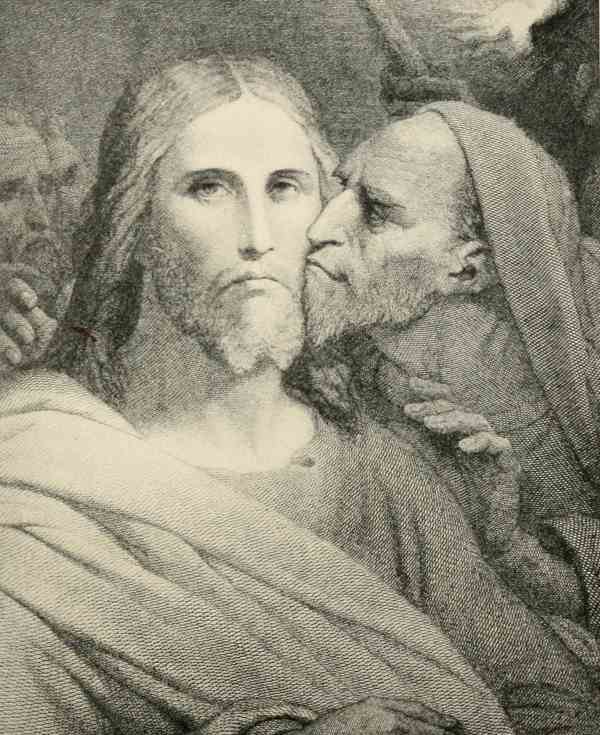
THE BETRAYING KISS (SCHEFFER)
Concerning the number of judges at the second or
daybreak meeting of the Sanhedrin, both Matthew and
Mark again declare that the full membership was
present. Matthew says: "When the morning was
come, all the chief priests and elders of the people took
counsel against Jesus to put him to death."[288] Mark
says: "And straightway in the morning the chief
priests held a consultation with the elders and scribes
and the whole council, and bound Jesus, and carried
him away, and delivered him to Pilate."[289] It should be
remembered that neither Luke nor John contradicts
even remotely the statements of Matthew and Mark
concerning the full attendance of the members of the
Sanhedrin at either the night or morning trial. The
first and second Gospel writers therefore corroborate
each other, and the presumption of the law is that each
told the truth.
And yet most commentators and writers seem to be
of the opinion that all the members of the Sanhedrin
were not present at the night trial of Jesus. They insist
that both Matthew and Mark were employing a
figure of speech, synecdoche, when they said that "all
the council" were present. But these same writers
seem to think that these same Evangelists were in earnest
and speaking literally when they declared that
"all the chief priests and elders" and the "whole
council" were present at the morning trial. We shall
not attempt to settle the question but will leave it to
the reader to draw his own inferences. Suffice it to
say that as far as the rule stated in connection with
Point IX is concerned, it was immaterial whether the
full council was present at either meeting. The rule
against unanimity applied to a bare quorum or to any
number less than the full Sanhedrin. It was the unanimity
itself, of however few members, that carried
with it the spirit and suggestion of mob violence and
conspiracy against which Hebrew law protested.
The question of the number of members that were
present at the different meetings of the Sanhedrin has
been discussed in the light of history, and as bearing
upon the conduct of Nicodemus and Joseph of Arimathea,
who were friends of Jesus. Nicodemus was certainly
a member of the Great Sanhedrin. This we
learn from two passages of New Testament scripture.[290]
It is also believed that Joseph of Arimathea was a
member from a mere suggestion in another passage.[291]
Did these friends of the Christ vote against Him? If
they were members of the court; if Matthew and Mark
wrote literally when they said that "all the council"
were present; and if Mark wrote literally and truthfully
when he said that "they all condemned him to
be guilty of death"; then it naturally and inevitably
follows that both Nicodemus and Joseph voted against
Jesus.
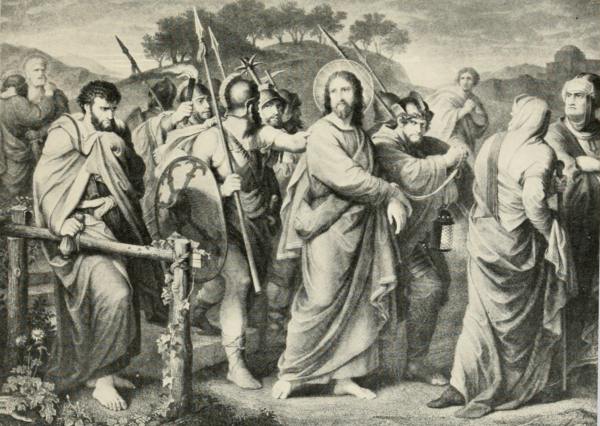
THE ARREST OF JESUS (HOFFMAN)
A number of arguments have been offered against
this contention. In the first place, it is said that at a
previous meeting of the Sanhedrin Nicodemus defended
Jesus by asking his fellow-judges this question:
"Doth our law judge any man before it hear him and
know what he doeth?"[292] It is asserted that there is no
good reason to believe that Nicodemus defended Jesus
at this meeting and turned against Him at a subsequent
one, that there is a presumption of a continuance of
fidelity. But is this good reasoning? Did not Peter
cut off the ear of the high priest's servant, Malchus, in
defense of Jesus at midnight, in the garden, and then
within three hours afterwards deny that he knew
Jesus? There is no good reason to believe that Nicodemus
was braver or more constant than Peter, for the
former seems to have been either ashamed or afraid
to express his affection for the Master during the daytime,
but preferred to do it at night.[293]
Concerning the part taken by Nicodemus in the final
proceedings, Rosadi says: "The verdict was unanimous.
The members of the Sanhedrin who were secretly
favorable to the Accused were either absent or
else they voted against him. Nicodemus was amongst
the absentees, or amongst those that voted against him.
At all events, he did not raise his voice against the pronouncement
expressed by acclamation."
If Joseph of Arimathea was a member of the Great
Sanhedrin, it seems that he "had not consented to the
counsel and the deed of them."[294] But it is impossible
to tell certainly to which one of the three meetings of
the Sanhedrin, held within the six months preceding
the crucifixion, this language refers. The defense of
Jesus offered by Nicodemus was certainly not at the
final meeting which condemned Jesus. It may be that
the reference to the protest of Joseph of Arimathea
also referred to a prior meeting. Its connection in
Luke seems to make it refer to the last trial, but this is
not certain. Neither is it certain that Joseph was a
member of the Great Sanhedrin, and his failure to consent,
if he were not a member, would not disturb the
contention made in Point IX of the Brief. Even if he
were a member, his failure to consent would not destroy
the contention, since ancient Hebrew judges, like
modern American jurors, could have first protested
against their action and then have voted with them.
The polling of the jury, under modern law, has reference,
among other things, to this state of affairs.
But we may admit that both Nicodemus and Joseph
of Arimathea, as well as many others, were absent, as
Rosadi suggests, and still contend that the verdict
against Jesus was illegal because it was unanimous, as
Mark assures us, since the number of judges present
was immaterial, provided there was a quorum of at
least twenty-three and their verdict was unanimous
against the accused. According to the second Gospel
writer, there seems to be no doubt that this was the
case in the judgment pronounced against Jesus.
LAW
"After leaving the hall Gazith no sentence of death
can be passed upon anyone soever."—Talmud,
Bab., Abodah Zarah, or of Idolatry, Chap. I.
fol. 8.
"A sentence of death can be pronounced only so long
as the Sanhedrin holds its sessions in the appointed
place."—Maimonides, Sanhedrin XIV.
"And he that is the high priest among his brethren,
upon whose head the anointing oil was poured,
and that is consecrated to put on the garments,
shall not uncover his head, nor rend his clothes."—Leviticus
xxi. 10.
"And Moses said unto Aaron, and unto Eleazar, and
unto Ithamar, his sons, Uncover not your heads,
neither rend your clothes; lest ye die, and lest
wrath come upon all the people."—Leviticus
x. 6.
"Let the judges each in his turn absolve or condemn."—Mishna,
Sanhedrin XV. 5.
"The members of the Sanhedrin were seated in the
form of a semicircle at the extremity of which a
secretary was placed, whose business it was to record
the votes. One of these secretaries recorded
the votes in favor of the accused, the other those
against him."—Mishna, Sanhedrin IV. 3.
"In ordinary cases the judges voted according to
seniority, the oldest commencing; in a capital trial,
the reverse order was followed. That the younger
members of the Sanhedrin should not be influenced
by the views or arguments of their more mature,
more experienced colleagues, the junior judge was
in these cases always the first to pronounce for or
against a conviction."—Benny, "Criminal Code
of the Jews," pp. 73, 74.
FACT AND ARGUMENT
In the trial of capital cases, the Great Sanhedrin
was required to meet in an apartment of the National
Temple at Jerusalem, known as the Hall of Hewn
Stones (Lishkhath haggazith). Outside of this hall
no capital trial could be conducted and no capital sentence
could be pronounced.[295] This place was selected
in obedience to Mosaic injunction: "Thou shalt do
according to the tenor of the sentence, which they may
point out to thee from the place which the Lord shall
choose."[296] The Rabbis argued that the Great Council
could not try a capital case or pronounce a death sentence,
unless it met and remained in the place chosen
by God, which, they contended, should be an apartment
of the Great Temple. The Lishkhath haggazith
was chosen, and continued for many years to be the
meeting place of the supreme tribunal.
But Jesus was not tried or condemned to death in
the Hall of Hewn Stones, as Hebrew law required.
It is clearly evident, from the Gospels, that He was
tried and sentenced in the palace of Caiaphas, probably
on Mount Zion. It is contended by the Jews, however,
that soon after the Roman conquest of Judea the
Great Sanhedrin removed from the sacred place to
Bethany, and from there to other places, as occasion
required. And there is a Jewish tradition that the
court returned to the accustomed place on the occasion
of the trial and condemnation of Jesus.[297]
In opposition to this, Edersheim says: "There is
truly not a tittle of evidence for the assumption of
commentators that Christ was led from the palace of
Caiaphas into the Council Chamber (Lishkhath haggazith).
The whole proceedings took place in the
former, and from it Christ was brought to Pilate."[298]
St. John emphatically declares: "Then led they Jesus
from Caiaphas into the hall of judgment."[299] This
Hall of Judgment was the Prætorium of Pilate.
The first irregularity, then, noted under Point X is
that Jesus was tried and condemned in the palace of
Caiaphas instead of the Hall of Hewn Stones, the
regular legal meeting place of the Great Sanhedrin.
The second error noted under Point X is that which
relates to the rending of garments by the high priest.
"An ordinary Israelite could, as an emblem of bereavement,
tear his garments, but to the high priest it
was forbidden, because his vestments, being made
after the express orders of God, were figurative of his
office."[300]
When Jesus confessed that He was Christ the Son
of God, Caiaphas seems to have lost his balance and to
have committed errors with all the rapidity of speech.
"Then the high priest rent his clothes, and saith,
What need we any further witnesses? ye have heard
the blasphemy: what think ye? And they all condemned
him to be guilty of death."[301] In this language
and conduct of the son-in-law of Annas there were several
irregularities in procedure. The first was the
rending of garments reported by Matthew and Mark,
which act was forbidden by the provisions of the
Mosaic Code, recorded in Leviticus and cited above.
But it is only fair to state the dissenting opinion on
this point. In the times of Christ it seems to have been
the custom among the Jews to rend the garments as a
sign of horror and execration, whenever blasphemous
language was heard. Edersheim states the rule:
"They all heard it—and, as the law directed, when
blasphemy was spoken, the high priest rent both his
outer and inner garment, with a rent that might never
be repaired."[302] The law here referred to, however, is
the Rabbinic or Talmudic and not the Mosaic law.
It should be remembered that the Mosaic Code was
the constitution or fundamental law of the ancient Hebrews.
The Talmudic law embodied in the Mishna
was, in a sense, a mere commentary upon the Mosaic
law. We have seen in Chapter I of Part II of this
volume that the traditional law was based upon, derived
from, and inspired by the written law contained
in the Pentateuch. It is true that the Talmud, while
professing subordination to the Pentateuch, finally
virtually superseded it as an administrative code. But
the doctors never repealed a Mosaic injunction, since
it was an emanation of the mind of Jehovah and could
not be abrogated by human intelligence. When an
ancient ordinance ceased to be of practical value the
Jewish legists simply declared that it had fallen into
desuetude. And whenever a new law was proclaimed
to meet an emergency in the life of the Hebrew people
the Rabbins declared that it was derived from and
inspired by some decree which God had handed down
to Moses for the benefit of the nation. In other words,
the Mosaic Code was Israel's divine constitution
which was to serve as a standard for all future legislation.
And as the Jewish lawmakers were not permitted
to repeal a Mosaic ordinance, neither were they
allowed to establish a rule in contravention of it.
Now the Pentateuch forbade the rending of garments.
Then did the Talmudists have a right to declare
that the law might be changed or broken in the case
of blasphemy? That they did is denied by many
writers.
But admitting the validity of the Talmudic rule, it
is nevertheless beyond dispute that the high priest was
forbidden to rend his clothes on Sabbaths and holidays.
And as Jesus was condemned on both a Sabbath
and a festival day, the high priest's action in rending
his clothes on that day was illegal.[303]
Again, the proceedings against Jesus were illegal
because the balloting was irregular. This is the third
error noted under Point X.
The Hebrew law required that each judge, when his
time came to vote upon the guilt or innocence of the
accused, should rise in his place, declare his vote, and
state his reasons for so voting. In capital cases the
youngest judge was required to vote first, in order that
he might not be unduly influenced by the example of
his seniors in age and authority. The balloting continued
in this manner from the youngest member to
the high priest, who was generally among the oldest.
Two scribes—according to some writers, three—were
present to record the votes and to note the reasons
stated. These records were to be used on the second
day of the trial in comparing the arguments of the
judges on that day with those offered on the first day.
Judges who had voted for acquittal on the first day
could not change their votes on the second day. Those
who had voted for conviction on the first day might
change their votes on the second day, by assigning
good reasons. Those who had voted for conviction on
the first day could not vote for conviction on the second
day, if the reasons assigned on the second day were
radically different from those assigned on the first
day.[304] It will thus be seen how very essential were the
records of the scribes and how important it was that
they should be correctly kept. Hence the necessity,
according to Benny, of a third scribe whose notes
might be used to correct any discrepancies in the reports
of the other two.
Now are we justified in assuming that this was the
method employed in counting votes at the trial of
Jesus? The law will not permit us to presume errors.
We must rather assume that this was the method employed,
unless the Gospel record indicates, either by
plain statement or by reasonable construction, that it
was not the method used.
In this connection, let us review the language of the
Scriptures. "Ye have heard the blasphemy: what
think ye? And they all condemned him to be guilty
of death." Is it not clearly evident, from this passage,
that the balloting was not done singly, the youngest
voting first, as Hebrew law required? Can it not be
seen at a glance that the judges voted en masse? If
they did, was it possible for the scribes to record the
votes and make a note of the reasons assigned, as the
law required? If these things were not done, were the
proceedings regular?
According to Matthew, Caiaphas, before calling for
the votes exclaimed: "He hath spoken blasphemy."[305]
Instead of doing this should he not, under the law,
have carefully concealed his opinion until the younger
members of the court had voted? Is it not a matter of
history that the opinion of the high priest was regarded
as almost infallible authority among the ancient
Hebrews? Did not this premature declaration
of guilt on the part of the high priest rob the subordinate
judges of freedom of suffrage?
The conduct of the case at the close, when the balloting
took place, seems to justify the view of those
writers who assert that there was no regular trial of
Jesus, but rather the action of a mob.
LAW
"The robe of the unfairly elected judge is to be respected
not more than the blanket of the ass."—Mendelsohn,
"Hebrew Maxims and Rules," p.
182.
"As Moses sat in judgment without the expectation
of material reward, so also must every judge act
from a sense of duty only."—Mendelsohn, "Hebrew
Maxims and Rules," p. 177.
"Nor must there be on the judicial bench either a relation,
or a particular friend, or an enemy of either
the accused or of the accuser."—Mendelsohn,
"Criminal Jurisprudence of the Ancient Hebrews,"
p. 108.
"He (the Hebrew judge) was, in the first instance, to
be modest, of good repute among his neighbors,
and generally liked."—Benny, "Criminal Code
of the Jews," p. 38.
"Nor under any circumstances, was a man known to
be at enmity with the accused person permitted to
occupy a position among his judges."—Benny,
"Criminal Code of the Jews," p. 37.
FACT AND ARGUMENT
The Gospel records disclose the fact that the members
of the Great Sanhedrin were legally disqualified
to try Jesus. This disqualification was of two kinds:
(1) A general disqualification, under Hebrew law, to
act as judges in any case; (2) a special disqualification
to sit in judgment upon the life of Jesus.
Among all the great systems of jurisprudence of the
world the ancient Hebrew system was the most exacting
in the matter of judicial fitness. In the palmiest
days of the Hebrew Commonwealth the members of
the Great Sanhedrin represented the most perfect
mental, moral, and physical development of the Hebrew
people. A man could not be a member of this
court who had any serious mental, moral, or physical
defect. He must have been "learned in the law," both
written and unwritten. He must have had judicial
experience; that is, he must have filled three offices of
gradually increasing dignity, beginning with one of the
local courts and passing successively through two magistracies
at Jerusalem. He must have been an accomplished
linguist; that is, he must have been thoroughly
familiar with the languages of the surrounding nations.
He must have been modest, popular, of good appearance,
and free from haughtiness. He must have been
pious, strong, and courageous. And above all, he must
have been friendly in his attitude toward the accused.[306]
These were the qualifications of Israel's judges
before Roman politics had corrupted them. But at the
time of Christ they had grown to be time-serving,
degenerate, and corrupt. Judea was then passing
through a period of religious and political revolution.
At such a time in any state, as all history teaches us,
the worst elements of society generally get the upper
hand and control the political currents of the day.
Many members of the Sanhedrin had themselves been
guilty of criminal acts in both public and private life.
Many of them held office by purchase—they had
bought their seats. They were thus unfitted to be
judges in any case; especially in one involving the
great question of life and death.
In order to show the general disqualification, under
the test of Hebrew law, of the members of the Great
Sanhedrin, at the time of Christ, to exercise judicial
functions, it is necessary to quote only Jewish authorities.
In "The Martyrdom of Jesus," Rabbi Wise
says: "The chief priests, under the iron rule of Pilate
and his wicked master, Sejan, were the tools of the
Roman soldiers who held Judea and Samaria in subjection.
Like the high priest, they were appointed to
and removed from office by the Roman governor of
the country, either directly or indirectly. They purchased
their commissions for high prices and, like
almost all Roman appointees, used them for mercenary
purposes. They were considered wicked men by the
ancient writers and must have stood very low in the
estimation of the people over whom they tyrannized.
The patriots must have looked upon them as hirelings
of the foreign despot whose rule was abhorred. Although
there was, here and there, a good, pious and
patriotic man among them, he was an exception. As a
general thing, and under the rule of Pilate, especially,
they were the corrupt tools of a military despotism
which Rome imposed upon enslaved Palestine."
Again, the Talmud, in which we never look for
slurs upon the Hebrew people, where slurs are not
deserved, contains this bitter denunciation of the high-priestly
families of the times of Christ: "What a
plague is the family of Simon Bœthus; cursed be their
lances! What a plague is the family of Ananos;
cursed be their hissing of vipers! What a plague is
the family of Cantharus; cursed be their pens! What
a plague is the family of Ismael ben Phabi; cursed be
their fists! They are high priests themselves, their
sons are treasurers, their sons-in-law are commanders,
and their servants strike the people with staves."
In like manner the Talmud, in withering rebuke
and sarcasm, again declares that "The porch of the
sanctuary cried out four times. The first time, Depart
from here, descendants of Eli; ye pollute the Temple
of the Eternal! The second time, Let Issachar ben
Keifar Barchi depart from here, who polluted himself
and profaneth the victims consecrated to God! The
third time, Widen yourselves, ye gates of the sanctuary
and let Israel ben Phabi, the wilful, enter that he may
discharge the functions of the priesthood! Yet another
cry was heard, Widen yourselves, ye gates, and
let Ananias ben Nebedeus, the gourmand, enter, that
he may glut himself on the victims."[307]
It should be borne in mind that the high-priestly
families so scathingly dealt with by the Talmud were
the controlling spirits in the Great Sanhedrin at the
time of Christ. Were they legally qualified, then,
under the ancient and honorable tests of Hebrew law,
to be members of the highest court in the land? If
they bought their offices and used them for mercenary
purposes, as Wise asserts, were they worthy of the
great exemplar, Moses, who "sat in judgment without
the expectation of material reward"? If they thus
secured their places and prostituted them to selfish
purposes, were their robes to be respected any more
than the blanket of the ass?
The ancient Hebrew judges, in the days of Israel's
purity and glory, submitted their claims to judicial
preferment to the suffrage of a loving and confiding
people.[308] They climbed the rungs of the judicial ladder
by slow and painful degrees. Integrity and ability
marked each advance toward the top. Was this
the process of promotion in the case of Caiaphas and
his fellow-judges? Did their bought and corrupted
places not brand them with the anathema of the
law?
We come now to consider the special disqualifications
of members of the Sanhedrin to sit in judgment
upon the life of Jesus. The reasons for these disqualifications
were two: (1) The members of this court
were, in the language of Jost, "burning enemies" of
Jesus, and were therefore disqualified, under Hebrew
law, to act as His judges; (2) they had determined
upon His guilt, and had sentenced Him to death
before the trial began; and had thus outraged not only
a specific provision of Hebrew law but also a principle
of universal justice.
The various causes of the hatred of the members of
the Sanhedrin for Jesus are too numerous and profound
to admit of exhaustive treatment here. A thorough
analysis of these causes would necessitate a review
of the life of Christ from the manger to the
sepulcher. A few reasons will suffice.
But at this point a distinction should be made between
that personal hatred which disqualifies and the
hatred and loathing of the crime that do not disqualify.
Every just and righteous judge should loathe and hate
the crime itself; and a certain amount of loathing and
dislike for the criminal is most natural and almost inevitable.
But no judge is qualified to sit in judgment
upon the rights of life, liberty, or property of another
whom he hates as the result of a personal grudge, born
of personal experience with the prisoner at the bar.
The hatred that disqualified the members of the Sanhedrin,
under Hebrew law, was that kind of hatred
that had been generated by personal interest and experience.
The most merciless invective, barbed with
incomparable wit, ridicule, and satire, had been daily
hurled at them by Jesus with withering effect. With
a touch more potent than that of Ithuriel's spear He
had unmasked their wicked hypocrisy and had blazoned
it to the skies. Every day of His active ministry,
which lasted about three years, had been spent in denouncing
their shameless practices and their guilty
lives. The Scribes and Pharisees were proud, haughty,
and conceited beyond description. They believed implicitly
in the infallibility of their authority and in the
perfection of their souls. How galling, then, to such
men must have been this declaration of an obscure and
lowly Nazarene: "Verily, I say unto you, That the
publicans and the harlots go into the kingdom of God
before you."[309] What impetuous invective this: "Woe
unto you, scribes and Pharisees, hypocrites! for ye devour
widows' houses, and for a pretense make long
prayer: therefore ye shall receive the greater damnation.
Woe unto you, scribes and Pharisees, hypocrites!
for ye compass sea and land to make one proselyte,
and when he is made, ye make him twofold more
the child of hell than yourselves."[310] We can well imagine
how these fiery darts pierced and tore the vanity
of a haughty and contemptuous priesthood.
Consider for a moment the difference in the spheres
of Jesus and of His enemies. He, an obscure prophet
from Nazareth in Galilee; they, the leaders of Israel
and the guardians of the Temple at Jerusalem. He,
the single advocate of the New Dispensation; they, the
manifold upholders of the Old. He, without earthly
authority in the propagation of His faith; they,
clothed with the sanction of the law and the prestige
of a mighty past. Imagine, then, if you can, the intensity
of the hatred engendered by the language and
the conduct of Jesus.
That we may fully appreciate the tension of the situation let us cast a
single glance at the character of the Scribes. Edersheim has written
these wonderfully graphic lines about them:
He pushes to the front, the crowd respectfully giving way, and eagerly
hanging on his utterances, as those of a recognized authority. He has
been solemnly ordained by the laying on of hands; and is the Rabbi, "my
great one," Master, amplitudo. Indeed, his hyper-ingenuity in
questioning has become a proverb. There is not measure of his dignity,
nor yet limit to his importance. He is the "lawyer," the "well-plastered
pit," filled with the water of knowledge, "out of which not a drop can
escape," in opposition to the "weeds of untilled soil" of ignorance. He
is the divine aristocrat, among the vulgar herd of rude and profane
"country people," who "know not the law," and are "cursed." Each scribe
outweighed all the common people, who must accordingly pay him every
honor.... Such was to be the respect paid to their sayings that they
were to be absolutely believed, even if they were to declare that to be
at the right hand which was at the left, or vice-versa.[311]
What could, then, be more terrific than the hatred of such a character
for an unlettered Galilean who descended from the mountains of His
native province to rebuke and instruct the "divine aristocrats" in
religious matters and heavenly affairs? Imagine his rage and chagrin
when he heard these words: "Woe unto you, scribes and Pharisees,
hypocrites! for ye are like unto whited sepulchres, which indeed appear
beautiful outward, but are within full of dead men's bones, and all
uncleanness.... Woe unto you, scribes and Pharisees, hypocrites! because
ye build the tombs of the prophets, and garnish the sepulchres of the
righteous, And say, If we had been in the days of our fathers, we
would not have been partakers with them in the blood of the prophets.
Wherefore ye be witnesses unto yourselves, that ye are the children of
them which killed the prophets. Fill ye up then the measure of your
fathers. Ye serpents, ye generation of vipers, how can ye escape the
damnation of hell?"[312]
"His exquisite irony," says Renan, "His stinging
remarks, always went to the heart. They were everlasting
stings, and have remained festering in the
wound. This Nessus-shirt of ridicule which the Jew,
son of the Pharisees, has dragged in tatters after him
during eighteen centuries, was woven by Jesus with a
divine skill. Masterpieces of fine raillery, their features
are written in lines of fire upon the flesh of the
hypocrite and the false devotee. Incomparable traits
worthy of a Son of God! A god alone knows how to
kill in this way. Socrates and Molière only grazed
the skin. The former carried fire and rage to the very
marrow."[313]
Are we not now justified in asserting, with Jost, that
the members of the Sanhedrin, who were none other
than the Scribes and Pharisees above described by
Jesus, were the "burning enemies" of the prisoner at
the bar? If they were, were they legally qualified to
be His judges?
But it may be argued that their hatred was simply
a form of righteous indignation provoked by His repeated
assaults upon the national religion and the
national institutions; that it was their duty as guardians
of both to both hate and try Him; and that they
would have been derelict in duty if they had not done
so. But it is apparent from the record and is evident
to any fair-minded reader that the enmity of the judges
toward Jesus was more personal than political, more
a private than a public affair. In support of this contention,
in addition to the withering language addressed
to them, the matter of the purification of the
Temple may be mentioned. It will be remembered
how Jesus, with a scorpion lash, scourged the money-changers
and traders from the Sanctuary. Now it is
historically true that Annas and Caiaphas and their
friends owned and controlled the stalls, booths, and
bazaars connected with the Temple and from which
flowed a most lucrative trade. The profits from the
sale of lambs and doves, sold for sacrifice, alone were
enormous. When Jesus threatened the destruction of
this trade He assaulted the interests of Annas and his
associates in the Sanhedrin in a vital place. This
grievance was certainly not so religious as it was personal.
The driving of the cattle from the stalls was
probably more effective in compassing the destruction
of the Christ than any miracle that He performed or
any discourse that He delivered. But whatever the
cause the fact is historic and indisputable that the Sanhedrists
were enemies of Jesus, and therefore disqualified
under Hebrew law to try Him.
A second reason for the special disqualification of
the members of the Sanhedrin to sit as judges at the
trial of Christ was the fact that they had determined
upon His guilt and had sentenced Him to death before
the trial began. This point needs no extensive argument
or illustration. Under every enlightened system
of justice the first great qualification of judges has been
that they should be unbiased and unprejudiced. Judicial
proceedings are murderous and no better than
mob violence when judges and jurors enter upon the
trial of the case with a determination to convict the
accused, regardless of the testimony. The principles
underlying this proposition are fundamental and self-evident.
Now the Gospel narratives disclose the fact that
three different meetings of the Sanhedrin were held
in the six months preceding the crucifixion, to discuss
the miracles and discourses of Jesus, and to devise
ways and means to entrap Him and put Him to death.
The first meeting was held in the latter part of the
month of September, A.D. 29, about six months before
the night trial in the palace of Caiaphas. This meeting
is recorded by St. John in Chap. vii., verses 37-53.
The occasion was the Feast of Tabernacles, when
Jesus made many converts by His preaching, and at
the same time caused much apprehension among the
Pharisees, who assembled the Sanhedrin to adopt plans
to check His career. It was on this occasion that
Nicodemus defended Christ and asked the question
that shows the nature of the proceedings at that time.
"Doth our law judge any man before it hear him
and know what he doeth?" This was the voice, not
only of Hebrew but of universal justice demanding a
hearing before a condemnation. Nothing definite
seems to have been accomplished at this meeting.
The second session of the Sanhedrin took place in
the month of February, A.D. 30, about six weeks before
the crucifixion. The occasion of this meeting was the
resurrection of Lazarus, an account of which is given
in John xi. 41-53. The chief priests and Pharisees
seem to have been seized with consternation by the reports
of the progress of the propaganda of Jesus. They
had often listened contemptuously and in sullen silence
to the accounts of His miraculous performances. But
when He began to raise the dead to life, they decided
that it was about time to act. At this meeting Caiaphas
appealed to his associates in the name of the common
weal. "Ye know nothing at all," he said, "nor
consider that it is expedient for us, that one man should
die for the people, and that the whole nation perish
not."[314] This seems to have been a form of condemnation
in which the other judges joined. "Then from
that day forth they took counsel together for to put
him to death."[315] At this second session of the Sanhedrin
the death of Jesus seems to have been decreed in
an informal way and an opportunity was awaited for
its accomplishment.
The third meeting of the Sanhedrin took place just
a few days before the Paschal Feast.
"Now the feast of unleavened bread drew nigh,
which is called the Passover. And the chief priests
and scribes sought how they might kill him; for they
feared the people."[316] "Then assembled together the
chief priests, and the scribes, and the elders of the people,
unto the palace of the high priest, who was called
Caiaphas, and consulted that they might take Jesus by
subtilty, and kill him. But they said, Not on the feast
day, lest there be an uproar among the people."[317]
At this third session of the court it was agreed that
the arrest and execution of Jesus should be accomplished
at the earliest possible date.
It will be seen that at these different sessions of the
Sanhedrin in the six months preceding the regular
trial the judges had resolved that Jesus should be done
away with at the first convenient opportunity. In
short, and in fact, their hatred was formed and their
determination fixed in the matter of the proceedings
to be instituted against Him. Were they, then, legally
qualified to act as His judges?
Again, besides prejudging Him to death had they
not demonstrated their total unfitness for any righteous
administration of justice by seeking false witnesses
against Him? Hebrew law forbade them to seek for
witnesses of any kind. They were the defenders of the
accused and, under the Hebrew system, were required
to search for pretexts to acquit and not for witnesses to
condemn.[318] It was a maxim that "the Sanhedrin was
to save, not to destroy life."[319] Much more were they
forbidden to seek for false witnesses. Hebrew law denounced
false witnesses and condemned them to the
very punishment prescribed for those whom they
sought to convict.
"And the judges shall make diligent inquisition;
and, behold, if the witness be a false witness, and hath
testified falsely against his brother; then shall ye do
unto him, as he had thought to do unto his brother.... And
thine eye shall not pity; but life shall go for
life, eye for eye, tooth for tooth, hand for hand, foot
for foot."[320]
But here we find the judges actually seeking testimony
which the law pointedly prohibited. This matter
alone establishes their utter unfitness to try Jesus,
and is explicable only on the ground of the degradation
into which they had fallen at the time of Christ
and on the hypothesis that their burning hatred had
overwhelmed their judgment and sense of justice.
If it be objected that the points of disqualification
above alleged were not applicable to all the judges, a
single sentence of Scripture meets the objection: "And
the chief priests and all the council sought for witness
against Jesus to put Him to death."[321] The fact that
"all the council" were willing to outrage a provision
of the fundamental law is sufficient proof that they
were all disqualified to try Christ.
Another conclusive proof of the total unfitness of
the members of the Sanhedrin to try Jesus is the fact
that they so far forgot themselves that they abandoned
all sense of self-respect and judicial dignity by brutally
striking Him and spitting in His face. We would like
to believe that this outrageous conduct was limited to
the servants of the priests, but the Gospel of St. Mark,
Chap. xiv., verse 65, clearly indicates that the judges
themselves were also guilty.
LAW
"Then shalt thou inquire, and make search, and ask
diligently."—Deuteronomy xiii. 14.
"The judges shall weigh the matter in the sincerity of
their conscience."—Mishna, Sanhedrin IV. 5.
"The primary object of the Hebrew judicial system
was to render the conviction of an innocent person
impossible. All the ingenuity of the Jewish legists
was directed to the attainment of this end."—Benny,
"Criminal Code of the Jews," p. 56.
FACT AND ARGUMENT
The actual trial of any criminal case shows, upon
the record, two essential parts: (1) The accusation;
(2) the defense. The absence of the elements of defense
makes the proceeding ex parte; and there is
really no trial. And it is impossible to conceive a
proper administration of justice where a defense is not
allowed, since the right to combat the allegations of
the indictment is the essential principle of liberty
under the law. The destruction of this right is the
annihilation of freedom by subjecting the individual
citizen to the whims and caprices of the governing
power. An ideal code of criminal procedure would
embody rules of evidence and practice perfectly
adapted to establish truth in the matter at issue between
the commonwealth and the prisoner. Neither
the people nor the accused would be favored or prejudiced
by the admission or exclusion of any kind of evidence.
An exact interpretation and administration of
this code would result in a perfect intellectual balance
between the rights of the state and the defendant. But
such a code has never been framed, and if one were in
existence, it would be impossible to enforce it, as long
as certain judges insisted on aiding the prosecution and
others on helping the accused, in violation of standard
rules of evidence.
Now, the ancient Hebrew system of criminal procedure
was no such ideal one as that above described.
It should be remembered that there was no body,
under that system, corresponding to our modern Grand
Jury, to present indictments. There were no prosecuting
officers and no counselors-at-law, in the modern
sense. The leading witnesses preferred charges and
the judges did the rest. They examined and cross-examined
witnesses, did the summing up and were,
above all, the defenders of the accused. The rights of
the defendant seem to have alone been seriously considered.
This startling maxim was a constant menace
to the integrity of the government and to the rights of
the commonwealth: "The Sanhedrin which so often
as once in seven years condemns a man to death, is a
slaughter-house."[322] Lightfoot is of the opinion that
the Jews did not lose the power of capital punishment
as the result of the Roman conquest, but that they voluntarily
abandoned it because the rules of criminal
procedure which they had from time to time adopted
finally became wholly unfitted for convicting anyone.
This view is unsupported by historic fact, but it is nevertheless
true that the legal safeguards for the protection
of the rights of the accused had, in the later years
of Jewish nationality, become so numerous and stringent
that a condemnation was practically impossible.
The astonishing provision of Hebrew law to which we
have referred in Part II known as Antecedent Warning
had the effect of securing an acquittal in nearly
every case. It is contended by many that this peculiar
provision was intended to abolish capital punishment
by rendering conviction impossible.
In the light of the principles above suggested let us
review the action of the Sanhedrin in condemning
Jesus to death upon His uncorroborated confession.
The standard of thoroughness in investigating criminal
matters is thus prescribed in the Mosaic Code:
"Then shalt thou inquire, and make search, and ask
diligently." The Mishna supplements the fundamental
law by this direction: "The judges shall weigh
the matter in the sincerity of their conscience." From
what we know of the peculiar tendency of the Hebrew
system to favor the accused we are justified in assuming
that the two rules just cited were framed for the
protection of the prisoner more than for the security
of the commonwealth.
Now at this point we are led to ask: Were these
rules applied in the trial of Jesus in any sense either
for or against the accused? Did Caiaphas and the
other members of the Sanhedrin "inquire, and make
search and ask diligently" concerning the facts involved
in the issue between Jesus and the Hebrew people?
Did they weigh the whole matter "in the sincerity
of their conscience?" Is it not clearly evident
from the record that the false witnesses contradicted
themselves, were rejected and dismissed, and that Jesus
was then condemned upon His uncorroborated confession
that He was the Christ, the Son of God? The
usual and natural proceeding in a Jewish criminal
trial was to call witnesses for the defendant, after the
leading witnesses had testified for the people. Was
this done in the case of Jesus? His own apostles deserted
Him in the garden, although two of them seem
to have returned to the scene of the trial. Is it probable,
in the light of the record, that witnesses were
called for the defendant? We have seen that they
could not legally convict Him upon His own confession.
And there is nowhere the faintest suggestion
that witnesses other than the false ones were called to
testify against Him. The record is clear and unequivocal
that the conviction of Jesus was upon His
uncorroborated confession. This was illegal. When
Caiaphas said, "I adjure thee by the living God that
thou tell us whether thou be the Christ, the Son of
God," Jesus answered, "Thou hast said"; that is, "I
am," according to Mark. Here was an issue squarely
joined between the Commonwealth of Israel and
Jesus of Nazareth. It was incumbent upon the state
to establish His guilt by two competent witnesses
who agreed in all essential details. If these witnesses
were not present, or could not be secured, it was the
duty of the court to discharge Christ at once. This
the law provided and demanded. But this was not
done.
If, as has been contended, the false witnesses were
relied upon by the Sanhedrin to corroborate the confession
of Jesus, then under Hebrew law the judges
should at least have sought witnesses in His behalf, or
should have allowed His friends time to find them and
bring them in. In other words, His defense should
have been considered. However overwhelming the
conviction of the judges of the Sanhedrin that the
claims of Jesus were false and blasphemous, they were
not justified in refusing to consider the merits of His
pretensions. If a midnight assassin should stealthily
creep into the room of a sleeping man and shoot him
to death, a judge would not be legally justified in instructing
the jury, at the close of the people's case, to
bring in a verdict of guilty, on the ground that nothing
that the defendant could prove would help his
case. However weak and ridiculous his defense, the
prisoner should at least be heard; and a failure to accord
him a hearing would certainly result in reversal
on appeal. A refusal to consider the defense of a
prisoner under ancient Hebrew law was nothing less
than an abrogation of the forms of government and a
proclamation of mob violence in the particular case,
for it must be remembered that Hebrew criminal law
was framed especially for the protection of the accused.
It should also be kept in mind that it would not have
been incumbent upon Caiaphas and his fellow-judges
to acquit Jesus simply because a defense had been
made. In other words, they were not bound to accept
His explanations and arguments. If they had heard
Him and His witnesses, they could have rejected His
pretensions as false and blasphemous, although they
were truthful and righteous, without incurring the
censure of mankind and the curse of Heaven, for it
would be preposterous to require infallible judgment
of judicial officers. All that can be demanded of
judges of the law is that they act conscientiously with
the lights that are in front of them. The maledictions
of the human race have been hurled at Caiaphas and
his colleagues during nineteen centuries, not because
they pronounced an illegal judgment, but because they
outraged rules of law in their treatment of the Christ;
not because they misinterpreted His defense, but because
they denied Him all defense.
We should constantly keep in mind that Jesus was
entitled to have the two requirements, "Then shalt
thou inquire, and make search, and ask diligently,"
and "The judges shall weigh the matter in the sincerity
of their conscience," applied not only for but
against Him. That is, before the Hebrew Commonwealth
rested its case against Him, He had a right to
demand that a prima facie case be made, or in case of
failure to do so, that He be at once discharged. This
rule was as pointed and imperative under ancient as
under modern law, and before the merits of the defense
were required to be considered the state had to close
its case against the defendant, with a presumption of
guilt against Him, as a result of the introduction of
competent and satisfactory evidence.
If rules of law had been properly observed in the
trial of Jesus the question of the merits of His defense
would never have been raised; for it was practically
impossible to convict Him under the circumstances
surrounding the night trial in the palace of Caiaphas.
As has been before suggested, Jesus was very popular
outside the circle of the Temple authorities. So great
was His popularity that it is almost certain that two
competent witnesses could not have been secured to
convict Him of blasphemy in the sense that He had
claimed to be the Messiah. We have seen, under
Point VIII, that Jesus had confessed His Messiahship
to no one excepting the Samaritan woman, outside the
Apostolic company. Judas, then, was probably the
only witness who had heard Him declare Himself to
be the Messiah that could have been secured; and his
testimony was incompetent, under Hebrew law, because,
under the supposition that Jesus was a criminal,
Judas, His apostle, was an accomplice. As to the
charge of blasphemy in the broader sense of having
claimed equality with God, upon which, according to
Salvador, Jesus was convicted, it seems from the Gospel
record that there would have been no difficulty in
legally convicting Him, if the Sanhedrin had met
regularly and had taken time to summon witnesses in
legal manner. For on many occasions Jesus had said
and done things in the presence of both friends and
enemies that the Jews regarded as blasphemous; such
as claiming that He and His Father were one; that He
had existed before Abraham; and that He had power
to forgive sins. But these charges were not made at
the trial, and we have no right to consider them except
as means of interpreting the mind of Caiaphas in connection
with the meaning of the claim of Jesus that
He was the Christ, the Son of God. If Caiaphas was
justified in construing these words to mean that Jesus
claimed identity with Jehovah, then he was justified
in inferring that Jesus had spoken blasphemy, for from
the standpoint of ancient Judaism and considering
Jesus simply as a Jewish citizen, blasphemy was the
crime that resulted from such a claim. But even from
this point of view Caiaphas was not justified in refusing
Jesus ample opportunity to prove His equality
with Jehovah, or at least that He was gifted with
divine power. This was all the more true because the
claim of Jesus was that of Messiahship, and according
to one line of authorities in Hebrew Messianic theology
the Messiah was to be clothed with divine authority
and power as the messenger and vicegerent of
Jehovah on earth.
But it is clearly certain that a prima facie case of
guilt was not made by the Sanhedrin against Jesus;
and, as a matter of law, He was not called upon to
make any defense. He could have refused to say a
word in answer to the accusation. He could have
asserted His legal rights by objecting that a case
against Him had not been made, by demanding that
the charges against Him be dismissed and that He be
set at liberty at once. But Jesus did not do this. He
simply confessed His Messiahship and Sonship of the
Father. This confession was not legal evidence upon
which He could have been convicted, but it did help
to create an issue, the truth or falsity of which should
have been investigated by the court.
Now, let us suppose, for argument's sake, that a
prima facie case of guilt against Jesus was made before
the Sanhedrin. What was the next legal step under
Hebrew law? What should the judges have done
after hearing the witnesses against Him? It is beyond
dispute that they should have begun at once to
"inquire, and make search, and ask diligently" concerning
all matters pertaining to the truthfulness and
righteousness of His claims to Messiahship. They
should have assisted Him in securing witnesses whose
testimony would have helped to establish those claims.
Having secured such testimony, they should have
weighed it "in the sincerity of their conscience." But
this they did not do.
It may be asked: What proofs could have been
offered that Jesus was "the Christ, the Son of God,"
if complete rights of defense had been accorded?
That question is difficult to answer, nearly two thousand
years after the trial. But if a prima facie case of
guilt had been made against Him, shifting the burden
of proof, and requiring that His claims be proved, it
may be reasonably contended that a complete defense
would have necessitated proofs: (1) That Jesus was
the Christ, that is, that He was the Messiah; (2) that
He was also the Son of God, that is, that He was identical
with God Himself. Let us consider these two
phases of the subject and their attendant proofs in
order.
And first, what evidence could have been offered
that Jesus was the Christ, that is, the Messiah? What
method of procedure should have been employed by
the Sanhedrin in investigating His claims? Let us
suppose that Caiaphas understood that Jesus claimed
to be the long-looked-for Messiah who had come from
Jehovah with divine authority to redeem mankind and
to regenerate and rule the world. Let us not forget
that the Jews were expecting a Messiah, and that the
mere claim of Messiahship was not illegal. Such a
claim merely raised an issue as to its truth or falsity
which was to be investigated like any other proposition
of theology or law. It was not one to be either accepted
or rejected without demonstration. Then when
Jesus acknowledged His Messiahship in answer to the
high priest's question it was the duty of the court either
to admit His claim and discharge Him at once, or to
summon competent witnesses, by daylight, to prove
that His pretensions were false and blasphemous.
Having rested their case, it was their duty to aid the
prisoner in securing witnesses to substantiate His
claims, and according to the spirit of Hebrew law to
view rather favorably than unfavorably such claims.
It was also incumbent upon them to apply to Jesus all
the Messianic tests of each and every school. It should
be remembered that at the time of Christ there were
radically different views of the attributes of the expected
Messiah. No two schools agreed upon all the
signs by which the future Deliverer would be recognized.
Only one sign was agreed upon by all—that
He would be a scion of the House of David. The followers
of Judas of Galilee believed that the Messiah
would be an earthly hero of giant stature—a William
Tell, a Robert Bruce, an Abraham Lincoln—who
would emancipate the Jews by driving out the Romans
and permanently restoring the kingdom of David on
the earth. The school of Shammai believed that he
would be not only a great statesman and warrior, but
a religious zealot as well; and that to splendid victories
on the battlefield, he would add the glorious
triumphs of religion. Radically different from both
these views, were the teachings of the gentle Hillel
and his disciples. According to these, the Messiah was
to be a prince of peace whose sublime and holy spirit
would impress itself upon all flesh, would banish all
wars, and make of Jerusalem the grand center of international
brotherhood and love. But even these conceptions
were not exhaustive of the various Messianic
ideas that were prevalent in Palestine in the days of
Jesus. Some of the Messianic notions were not only
contradictory but diametrically opposite in meaning.
A "prince of peace" and a "gigantic warrior" could
not well be one and the same person. And for this
reason it is apparent that, had an examination been
made, the claims of Jesus to the Messiahship could not
have been rejected by Caiaphas and the Sanhedrin,
simply because this or that attribute did not meet the
approval of this or that sect or school.
Instead of condemning Him to death for blasphemy,
when Jesus answered that He was the Christ, the Son
of God, Caiaphas should have asked a second question:
"What sign shewest thou then, that we may see and
believe thee?" It has been contended by Jewish writers
that, far from denying Jesus the privilege of proving
His Messiahship, He was frequently asked to give
signs and perform wonders. The reply to this is that
as far as the legal merits of the case are concerned
Jesus was not invited at the trial in the palace of Caiaphas
to show signs or give proofs of His Messiahship.
And as to the chances afforded Him at other times and
places, they were extra-judicial and were mere street
affairs in which Jesus probably refused to gratify vulgar
curiosity and by which He was not remotely bound
legally or religiously. It is only when properly arraigned
and accused that a citizen under modern law
can be compelled to answer a charge of crime. The
rule was more stringent under the ancient Hebrew dispensation.
Private preliminary examinations, even by
judicial officers, were not permitted by Hebrew law,
as Salvador explicitly states. It was only when confronted
by proper charges before a legally constituted
tribunal in regular session, that a Hebrew prisoner
was compelled to answer. And at the regular trial
before the full Sanhedrin Jesus was not asked to give
evidence that would serve to exculpate Him. What
Caiaphas should have done was to notify Jesus, at the
time of the arraignment in his own house, that His life
was at stake and that now was the time to produce testimony
in His own behalf. It was the duty, furthermore,
of the high priest and his associates to consult
the sacred books to see if the Messianic prophecies
therein contained were fulfilled in the birth, life, and
performances of Jesus, as these matters were developed
at the trial by witnesses duly summoned in His
behalf.
It was a matter personally within the knowledge of
the judges that the time was ripe for the appearance
of the Deliverer. Not only the people of Israel,
but all the surrounding nations were expecting the
coming of a great renovator of the world. Of such an
arrival Virgil had already sung at Rome.[323]
A great national misfortune had already foreshadowed
the day of the Messiah more potently than had
any individual event in the life of Jesus. When Jacob
lay dying upon his deathbed, he called around him
his twelve sons and began to pronounce upon each in
turn the paternal and prophetic blessing. When the
turn of Judah came, the accents of the dying patriarch
became more clear and animated, as he said: "Judah,
thou art he whom thy brethren shall praise: thy hand
shall be in the neck of thine enemies; thy father's children
shall bow down before thee. Judah is a lion's
whelp: from the prey, my son, thou art gone up: he
stooped down, he couched as a lion, and as an old lion;
who shall rouse him up? The sceptre shall not depart
from Judah, nor a lawgiver from between his feet,
until Shiloh come; and unto him shall the gathering
of the people be."[324] The Jewish Rabbinical commentators
of antiquity were unanimously of the opinion
that this prophecy of Jacob referred to the day of the
Messiah. And for ages the people had been told to
watch for two special signs which would herald the
coming of the great Deliverer: (1) The departure of
the scepter from Judah; (2) the loss of the judicial
power.
The Talmudists, commenting on the above passage
from Genesis, say: "The son of David shall not come
unless the royal power has been taken from Judah";
and in another passage: "The son of David shall not
come unless the judges have ceased in Israel."[325] Now
both these signs had appeared at the time of the
Roman conquest, shortly before the birth of Christ.
At the deposition of Archelaus, A.D. 6, Judea became
a Roman province with a Roman procurator as governor.
Sovereignty then passed away forever from
the Jews. And not only was sovereignty taken from
them, but its chief attribute, the power of life and
death in judicial matters, was destroyed. Thus the
legal and historical situation was produced that had
been prophesied by Jacob. The scepter had passed
from Judah and the lawgiver from between his feet,
when Jesus stood before the Sanhedrin claiming to be
the Messiah.
A fair trial in full daylight, it is believed, would
have called before His judges a host of witnesses
friendly to Jesus, whose testimony would have established
an exact fulfilment of ancient Messianic prophecy
in His birth, life, arrest, and trial. A judicial
record would have been made of which the following
might be regarded as an approximately correct transcript:
(1) That the Messiah was to be born in Bethlehem:
Prophecy—But thou, Beth-lehem Ephratah, though thou
be little among the thousands of Judah, yet out of thee
shall he come forth unto me that is to be ruler in Israel;
whose goings forth have been from of old, from everlasting.—Micah
v. 2.
Fulfillment—Now when Jesus was born in Bethlehem
of Judea in the days of Herod the king, behold, there
came wise men from the east to Jerusalem.—Matt.
ii. 1.
And Joseph also went up from Galilee, out of the city
of Nazareth, into Judea, unto the city of David, which
is called Bethlehem (because he was of the house and
lineage of David), To be taxed with Mary his espoused
wife, being great with child. And so it was, that, while
they were there, the days were accomplished that she
should be delivered. And she brought forth her firstborn
son, and wrapped him in swaddling clothes, and
laid him in a manger; because there was no room for
them in the inn.—Luke ii. 4-7.
(2) That the Messiah was to be born of a virgin:
Prophecy—Therefore the Lord himself shall give you a
sign; Behold, a virgin shall conceive, and bear a son,
and shall call his name Immanuel.—Isa. vii. 14.
Fulfillment—And in the sixth month the angel Gabriel
was sent from God unto a city of Galilee, named Nazareth,
To a virgin espoused to a man whose name was
Joseph, of the house of David; and the virgin's name
was Mary.... And the angel said unto her, Fear not,
Mary: for thou hast found favor with God. And, behold,
thou shalt conceive in thy womb, and bring forth
a son, and shalt call his name Jesus.—Luke i. 26-30.
Then Joseph being raised from sleep did as the angel
of the Lord had bidden him, and took unto him his
wife: and knew her not till she had brought forth her
firstborn son: and he called his name Jesus—Matt.
i. 24, 25.
(3) That the Messiah was to spring from the house
of David:
Prophecy—Behold, the days come, saith the Lord, that I
will raise unto David a righteous Branch, and a King
shall reign and prosper, and shall execute judgment and
justice in the earth. In his days Judah shall be saved,
and Israel shall dwell safely: and this is his name
whereby he shall be called, THE LORD OUR
RIGHTEOUSNESS.—Jer. xxiii. 5, 6.
Fulfillment—He shall be great, and shall be called the
Son of the Highest; and the Lord God shall give unto
him the throne of his father David.—Luke i. 32.
But while he thought on these things, behold, the
angel of the Lord appeared unto him in a dream, saying,
Joseph, thou son of David, fear not to take unto
thee Mary thy wife: for that which is conceived in her
is of the Holy Ghost.—Matt. i. 20.
(4) That the Messiah should not come until the
scepter had departed from Judah and the lawgiver
from between his feet:
Prophecy—The Sceptre shall not depart from Judah, nor
a lawgiver from between his feet, until Shiloh come.—Gen.
xlix. 10.
Fulfillment—And he saith unto them, Whose is this
image and superscription? They say unto him, Cæsar's.
Then saith he unto them, Render therefore unto Cæsar
the things which are Cæsar's; and unto God the things
that are God's.—Matt. xxii. 20, 21.
Then said Pilate unto them, Take ye him, and judge
him according to your law. The Jews therefore said
unto him, It is not lawful for us to put any man to
death.—John xviii. 31.
(5) That a forerunner like unto Elijah should prepare
the way of the Messiah:
Prophecy—Behold, I will send my messenger, and he shall
prepare the way before me: and the Lord, whom ye
seek, shall suddenly come to his temple, even the messenger
of the covenant, whom ye delight in: behold, he
shall come, saith the Lord of hosts.—Mal. iii. 1.
The voice of him that crieth in the wilderness, Prepare
ye the way of the Lord, make straight in the desert
a highway for our God.—Isa. xl. 3.
Fulfillment—In those days came John the Baptist, preaching
in the wilderness of Judea, And saying, Repent
ye: for the kingdom of heaven is at hand. For this
is he that was spoken of by the prophet Esaias, saying,
The voice of one crying in the wilderness, Prepare
ye the way of the Lord, make his paths straight.—Matt.
iii. 1-3.
This is he, of whom it is written, Behold, I send my
messenger before thy face, which shall prepare thy way
before thee. For I say unto you, Among those that are
born of women there is not a greater prophet than John
the Baptist.—Luke vii. 27, 28.
(6) That the Messiah should begin to preach in
Galilee:
Prophecy—In Galilee of the nations, the people that
walked in darkness have seen a great light.—Isa. ix.
1, 2.
Fulfillment—Now when Jesus had heard that John was
cast into prison, He departed into Galilee.... The
people which sat in darkness, saw great light; and to
them which sat in the region and shadow of death light
is sprung up. From that time, Jesus began to preach,
and to say, Repent: for the kingdom of heaven is at
hand.—Matt. iv. 12-17.
(7) That the Messiah should perform many miracles:
Prophecy—Then the eyes of the blind shall be opened,
and the ears of the deaf shall be unstopped. Then shall
the lame man leap as a hart, and the tongue of the dumb
sing: for in the wilderness shall waters break out, and
streams in the desert.—Isa. xxxv. 5, 6.
Fulfillment—Then was brought unto him one possessed
with a devil, blind, and dumb, and he healed him,
insomuch that the blind and dumb both spake and saw.—Matt.
xii. 22.
But that ye may know that the Son of man hath power
upon earth to forgive sins (he said unto the sick of the
palsy), I say unto thee, Arise, and take up thy couch,
and go into thine house. And immediately he rose up
before them, and took up that whereon he lay, and departed
to his own house, glorifying God.—Luke v.
24, 25.
Jesus answered and said unto them, Go and shew John
again those things which ye do hear and see: The blind
receive their sight, and the lame walk, the lepers are
cleansed, and the deaf hear, the dead are raised up, and
the poor have the gospel preached to them.—Matt.
xi. 4, 5.
(8) That the Messiah should make his public entry
into Jerusalem riding upon an ass:
Prophecy—Rejoice greatly, O daughter of Zion; shout,
O daughter of Jerusalem: behold, thy King cometh
unto thee: he is just, and having salvation; lowly, and
riding upon an ass, and upon a colt the foal of an
ass.—Zech. ix. 9.
Fulfillment—And the disciples went, and did as Jesus
commanded them, And brought the ass, and the colt,
and put on them their clothes, and they set him thereon.
And a very great multitude spread their garments in the
way; others cut down branches from the trees, and
strewed them in the way. And the multitudes that went
before, and that followed, cried, saying, Hosanna to the
Son of David: Blessed is he that cometh in the name of
the Lord; Hosanna in the highest.—Matt. xxi. 6-9.
(9) That the Messiah should be betrayed by one of
his followers for thirty pieces of silver which would
finally be thrown into the potter's field:
Prophecy—Yea, mine own familiar friend, in whom I
trusted, which did eat of my bread, hath lifted up his
heel against me.—Psa. xli. 9.
And I said unto them, If ye think good, give me my
price; and if not, forbear. So they weighed for my
price thirty pieces of silver. And the Lord said unto
me, Cast it unto the potter: a goodly price that I was
prized at of them. And I took the thirty pieces of
silver, and cast them to the potter in the house of the
Lord.—Zech. xi. 12, 13.
Fulfillment—Then one of the twelve, called Judas Iscariot,
went unto the chief priests, And said unto them,
What will ye give me, and I will deliver him unto you?
And they covenanted with him for thirty pieces of
silver.—Matt. xxvi. 14, 15.
Then Judas, which had betrayed him, when he saw
that he was condemned, repented himself, and brought
again the thirty pieces of silver to the chief priests and
elders, Saying, I have sinned in that I have betrayed the
innocent blood. And they said, What is that to us? see
thou to that. And he cast down the pieces of silver in
the temple, and departed, and went and hanged himself.
And the chief priests took the silver pieces, and said, It
is not lawful for to put them into the treasury, because
it is the price of blood. And they took counsel, and
bought with them the potter's field, to bury strangers
in.—Matt. xxvii. 3-8.
(10) That the Messiah should be a man of poverty
and of suffering; and should be despised and rejected
of men:
Prophecy—He is despised and rejected of men; a man of
sorrows, and acquainted with grief: and we hid as it
were our faces from him; he was despised, and we esteemed
him not.—Isa. liii. 3.
Fulfillment—And Jesus said unto him, Foxes have holes,
and birds of the air have nests; but the Son of man
hath not where to lay his head.—Luke ix. 58.
And they smote him on the head with a reed, and did
spit upon him, and bowing their knees worshipped him.
And when they had mocked him, they took off the purple
from him, and put his own clothes on him, and led
him out to crucify him.—Mark xv. 19, 20.
Through reasonable diligence, witnesses might have
been secured to testify to a majority, at least, of the
points above enumerated, touching Messianic prophecy
and fulfillment. Besides these are many others too
numerous to mention in a treatise of this kind.
The question then arises at once: Admitting that all
the evidence above suggested, marked "Prophecy"
and "Fulfillment," could have been introduced in evidence
at the trial before the Sanhedrin; were the
judges morally and legally bound to acquit and release
Jesus, if they believed this testimony to be true? We
answer unhesitatingly, yes; as far as the count in the
accusation relating to Messiahship was concerned.
But we must remember that the charge against Jesus
was not limited to His claims to Messiahship. The indictment
against Him was that He claimed to be "the
Christ, the Son of God." "Christ" is the English
form of the Greek translation of the word meaning
"Messiah." The real nature of the charge against the
prisoner, then, was that He claimed to be not only the
Messiah but also the Son of God. We have seen that
"Son of God" conveyed to the Sanhedrin the notion
of divine origin and of equality with Jehovah. Even
to-day there is no dispute between Jews and Christians
in regard to this construction. Jews charge that Jesus
made such a claim and Christians agree with them.
They are compelled to do so, indeed, or else abjure the
fundamental dogma of their faith—the doctrine of the
Trinity.
Now we approach the consideration of a phase of
the subject where theology and law meet and blend.
It has been sought to ridicule the contention that Jesus
should have been heard on the charge of being the Son
of God, in the sense that He was God Himself, because
such a claim was not only ridiculous and frivolous
as a plea, but because it was blasphemous upon its
face; as being opposed, by bare assertion, to the most
fundamental and sacred precept of the Mosaic Code
and of the teachings of the Prophets: that God was
purely and wholly spiritual; that He was not only incorporeal
but invisible, indivisible, and incomprehensible.
The advocates of this theory declare that Jesus
asserted, in the face of this primary belief of the Hebrews,
a plurality of gods of which He was a member,
and that this assertion destroyed the very cornerstone
of Judaism, founded in the teaching of the celebrated
passage: "Hear, O Israel: The Lord our God is one
Lord." They further declare that when Jesus presented
Himself in the flesh, and declared that He was
God, He insulted both the intelligence and religious
consciousness of His judges by a complete anthropomorphism;
and that when He did this, He was not entitled
to be heard.
One of the most radical of this class is Rabbi Wise
who, in "The Martyrdom of Jesus," says: "Had Jesus
maintained before a Jewish court to be the Son of
God, in the trinitarian sense of the terms, viz., that
He was part, person, or incarnation of the Deity, He
must have said it in terms to be understood to that
effect, as ambiguous words amount to nothing. But
if even clearly understood, the court could only have
found Him insane, but not guilty of any crime." This
is strong language, indeed, and deserves serious consideration.
It means nothing less than that Jesus, upon
His confession of equality and identity with God,
should have been committed as a lunatic, and not tried
as a criminal. And the real meaning of this too extreme
view is that the claims of Jesus, being a man in
the flesh, to membership in a plurality of gods was
such an outrageous and unheard-of thing that it
amounted to insanity; and that an insane person was
not one to be listened to, but to be committed and protected.
The purpose of the distinguished Hebrew theologian
was to show by the absurdity of the thing that
Jesus was never tried before a Hebrew court; that He
never claimed to be the Son of God, and that the
Evangelical narratives are simply false. The same
writer thus continues in the same connection: "Mark
reports furthermore, that Jesus did not simply affirm
the high priest's question but added: 'And ye shall see
the Son of Man sitting on the right hand of power,
and coming in the clouds of heaven.' Jesus cannot
have said these words. Our reasons are: they are not
true; none of the judges and witnesses present ever did
see him either sitting on the right hand of power or
coming in the clouds of heaven. These words could
have originated only after the death of Jesus, when
the Jewish Christians expected his immediate return
as the Messiah and restorer of the kingdom of heaven,
so that those very men could see him coming in the
clouds of heaven. Besides, Jesus, the Pharisean Jew,
could not have entertained the anthropomorphism
that God had a right hand."[326] It is only necessary to
add that Rabbi Wise may be right, if the Gospel writers
were untruthful men. Suffice it to say that we have
said enough in support of the veracity of the Evangelists
in Part I of this volume. If we are right that they
were truthful historians when they published these
biographies to the world, Rabbi Wise is wrong; for
according to these writers the Sanhedrin did not take
the view that Jesus was a crazy man, but that He was
a criminal. They accordingly tried Him to the extent
of bringing an accusation against Him and of supporting
it with a certain kind and amount of testimony,
and by then leading Him away to be crucified by the
Romans. Our contention is that the trial was not complete,
in that His judges did not consider the merits
of the defense of Jesus in the proceedings which they
conducted against Him.
It would be entirely consistent with the plan of this
treatise and of the special treatment of this theme to
ignore completely the question of the divinity of Jesus;
since we have announced a legal and not a theological
consideration of the subject. But we repeat that the
theological and the legal are inseparably interwoven
in a proper handling of Point XII. If Rabbi Wise
and others are right that the anthropomorphic pretensions
of Jesus robbed Him of the protection of
the law, in the sense that His claims to be God in the
flesh were not worthy of consideration by a Hebrew
court, then we are wrong in making the point
that the merits of His defense should have been
considered.
Our contention is that the claims of Jesus were not
so strange and shocking as to place Him without the
pale of the law and to deny Him its ordinary protection;
that His pretensions were not those of an insane
man; that if He was not the Son of God He was guilty
of blasphemy; and that if He was the Son of God He
was innocent. We further contend that all these
things were subjects of legitimate judicial examination
by Hebrew judges under Hebrew law, and that Jesus
should have had His day in court.
A very brief examination of the question of anthropomorphism
in its connection with the claims of
Jesus will demonstrate the fallacy of the arguments of
Rabbi Wise and of those who agree with him. Candor
compels us to admit that the Jewish conception
of Jehovah at the time of the crucifixion was very foreign
to the notion of a God of flesh and bone. Hebrew
monotheism taught the doctrine of one God who was
purely spiritual, and therefore invisible, intangible,
and unapproachable. Judaism delighted to lift its
deity above the sensual, material, and corporeal things
of earth, and to represent Him as a pure and sinless
spirit in a state of awful and supreme transcendence.
Our first impression, then, is that this dogma of divine
unity and spirituality must have received a dreadful
shock when Jesus, a carpenter of Nazareth, whose
mother, father, brothers, and sisters were known, confronted
the high priest and declared to him that He
was God. But the shock was certainly not so great
that Caiaphas and his colleagues, after a moment's
composure and reflection, could not have concluded
that the pretensions of Jesus were not wholly at variance
with the revelations of Hebrew theology in the
earlier years of the Commonwealth of Israel. They
might have judged His claims to be unfounded, but
they were certainly not justified in pronouncing Him
insane, or in ignoring His rights under the law to be
heard and to have His defense considered. Their
arrest and trial of the prisoner was the consummation
of a number of secret meetings in which the astounding
personality and marvelous performances of Jesus
were debated and discussed with fear and trembling.
The raising of Lazarus from the dead had created a
frightful panic among the Sadducean oligarchy. Far
from regarding Him as an obscure person whose
claims were ridiculous and whose mind was unbalanced,
the priests feared lest all men might believe on
Him, and boldly declared that such was the influence
of His deeds that His single life might be balanced
against the existence of a whole nation.[327]
What the judges of the Sanhedrin should have done
in examining the merits of the defense of Jesus was:
(1) To consider whether, in the light of Hebrew
scripture and tradition, a god of flesh and bone, representing
the second person of a Duality or a Trinity of
gods, was possible; (2) to weigh thoroughly the claims
of Jesus, in the light of testimony properly adduced
at the trial, that He was this second person of a Duality
or Trinity of gods.
In making this examination, let us bear in mind, the
members of the court were not to look forward, but
backward. They were to examine the past, not the
future, in reference to the present. Furthermore, they
were not to consider so much a Trinity as a Duality of
gods; for it must be remembered that the Holy Ghost
was not a feature of the trial. The Athanasian creed
and the proceedings of the Nicene Council were not
binding upon Caiaphas and his fellow-judges. Nor
were the teachings of the New Testament scriptures
published to the world more than a generation after
the trial. They were to consider the divine pretensions
of Jesus in the light of the teachings and revelations
of the Law and the Prophets. They were to measure
His claims by these standards in the light of the evidence
adduced before them.
With a view to a thorough and systematic examination
of the merits of the defense of Jesus, Caiaphas, as
presiding officer of the Sanhedrin, should have propounded
to his fellow-judges the following initial
questions: (1) Do the Law and the Prophets reveal
the doctrine of a plurality of gods among the Israelites?
That is, has Jehovah ever begotten, or has He
ever promised to beget, a Son of equal divinity with
Himself? Was this Son to be, or is He to be born of
a woman; and to have, therefore, the form of a man
and the attributes of a human being? Was this Son
to be, or is He to be at any time identical with the
Father? Do the Law and the Prophets tell us unmistakably
that Jehovah ever appeared upon the earth in
human form and exhibited human attributes? Do
they contain a promise from the Father that He would
send His Son to the earth to be the Redeemer of men
and the Regenerator of the world? (2) Do the credentials
of Jesus, the prisoner at the bar, in the light of the
evidence before us, entitle Him to be considered this
Son and Ambassador of God, sent from the Father to
redeem mankind?
It follows logically and necessarily that if affirmative
answers were not given to the first set of questions
an examination of the second would be useless. Let us
conceive, then, that the judges of the Sanhedrin had
employed this method. What answers, we may ask,
would they have developed to these questions from the
Sacred Books?
At the outset it is safe to say that negative answers
would have been given, if the judges had considered
the claims of Jesus with reference alone to the prevailing
Pharisaic teachings of the days of Jesus. And in
this connection let us note that the Hebrew conception
of Jehovah had materially changed in the time intervening
between the Mosaic dispensation and the coming
of the Christ. The spiritual growth of the nation
had been characterized at every step by marked aversion
to anthropomorphism—the ascription to God of
human form and attributes. In the Pentateuch there
is a prevailing anthropomorphic idea of Jehovah.
He is frequently talked about as if He were a man.
Human passions and emotions are repeatedly ascribed
to Him. This was inevitable among a primitive people
whose crude religious consciousness sought to
frame from the analogy of human nature a visible
symbol of the Deity and a sensible emblem of religious
faith. All early religions have manifested the same
anthropomorphic tendencies. Both Judaism and
Christianity have long since planted themselves upon
the fundamental proposition that God is a spirit. But
both these systems of religion have in all ages been
compelled to run the gantlet of two opposing tendencies:
one of which sought by a living, personal communion
with God through Moses and through Christ,
by means of human attributes and symbols, an intimate
knowledge and immediate benefit of the divine nature;
the other, from a horror of anthropomorphism, tending
to make God purely passionless and impersonal,
thus reducing Him to a bare conception without form
or quality, thus making Him a blank negation.
The successive steps in the progress of weeding
out anthropomorphisms from the Pentateuch may be
clearly traced in later Hebrew literature. The Prophets
themselves were at times repelled by the sensuous
conceptions of God revealed by the writings of Moses.
The great lawgiver had attributed to Jehovah the
quality of repentance, a human attribute. "And it
repented the Lord that he had made man on the earth,
and it grieved him at his heart," says Genesis vi. 6.
But a later writer, the prophet Samuel, denied that
God had such a quality. "And also the Strength of
Israel will not lie nor repent: for he is not a man, that
he should repent."[328] And the prophet Hosea affirms
this declaration when he places in the mouth of Jehovah
the affirmation: "For I am God and not man."[329]
At a still later age, when the notion of the supreme
transcendence of Jehovah had become prevalent, it
was considered objectionable to make God say, "I will
dwell in your midst"; as a substitute, "I shall cause
you to dwell" was adopted. "To behold the face of
God" was not a repulsive phrase in the ancient days
of Hebrew plainness and simplicity, but later times
sought to eradicate the anthropomorphism by saying
instead, "to appear before God."
The Septuagint, the Greek version of the Bible in
use at the time of Christ, reveals the same tendency
toward paraphrasing or spiritualizing the anthropomorphic
phrases of the older Bible. In this translation
the "image of God" of the older Hebrew
literature becomes "the glory of God," and "the
mouth of God" is expressed by "the voice of the
Lord."
The Septuagint was written more than a century
before the birth of Jesus, and we may safely assert that
at the beginning of our era the Jews not only affirmatively
proclaimed the doctrine of divine unity and
pure spirituality, in relation to the person and character
of Jehovah, but that they boldly and indignantly
denied and denounced any attempt to make of God a
man or to attribute to Him human qualities. But
when we say "the Jews," we mean the dominant religious
sect of the nation, the Pharisees. We should
not forget, in this connection, that the primary difference
between the Sadducees and the Pharisees was in
the varying intensity with which they loved the Law
of Moses and adhered to its teachings. We have seen
in Part II of this volume that the Mishna, the oral
law, was really more highly esteemed by the Pharisaic
Jews than was the Mosaic Code. But the Sadducees
planted themselves squarely upon the Pentateuch and
denied that the traditions of the Scribes were of binding
force. "The Sadducees were a body of aristocrats
opposed to the oral law and the later developments of
Judaism."
Now what views, we may ask, did the Sadducees entertain
of the possibility of God appearing to men in
the flesh? In other words, what was their notion, at
the time of Christ, of the anthropomorphisms of the
Pentateuch, which was their ultimate guide and standard
in all matters of legal and religious interpretation?
These questions are important in this connection, since
Caiaphas and the large majority of his colleagues in
the Great Sanhedrin were Sadducees and held the
fate of Jesus in their hands. Candor compels us to
admit that we believe that the Sadducees agreed with
the Pharisees that Jehovah was a pure and sinless
spirit. But we feel equally sure that their knowledge
of the Pentateuch, in which at times anthropomorphism
is strongly accentuated, taught them that Jehovah
had not only appeared in the flesh among men in olden
times, but that it was not at all impossible or unreasonable
that He should come again in the same form. But
this much is certain: that in determining whether
Jesus could be both man and God the Sadducees
would be disposed to ignore the traditions of the
Pharisees and "the later developments of Judaism,"
and appeal direct to the law of Moses. Jesus Himself,
if He had been disposed to make a defense of His
claims, and His judges had been disposed to hear
Him, would have appealed to the same legal standard.
Christ more than once manifested a disposition to appeal
to the Mosaic Code, as a modern citizen would
appeal from mere statutes and the decisions of the
courts, to the constitution, as the fundamental law of
the land. Mark tells us that in denouncing the Pharisees,
He used this language: "And he said unto them,
Full well ye reject the commandment of God, that ye
may keep your own tradition.... Making the word
of God of none effect through your tradition, which
ye have delivered: and many such like things do ye."[330]
Hebrew sacred literature is filled with anecdotes,
often characterized by raillery and jests, of how the
Sadducces denounced the Pharisees for their attempts
to nullify Mosaic injunction by their peculiar interpretation.
Now in view of what we have just said, are we not
justified in assuming that if the judges had accorded
Jesus full liberty of defense He would have appealed
to the Pentateuch, with the approbation of His judges,
to show that God had appeared among men in the
flesh, and that a plurality in the Godhead was plainly
taught? Would He not then have appealed to the
Prophets to show that Jehovah had spoken of a begotten
Son who was none other than Almighty God Himself?
Would He not have shown from both the Law
and the Prophets that the angel of Jehovah, who was
none other than Himself, had frequently, in ages past,
acted as the ambassador of God in numerous visits to
the earth, on missions of love and mercy among men?
Would He not have proved to them that this angel of
Jehovah had been at certain times in the past none
other than Jehovah Himself? Could He not have
pointed out to them that their whole sacred literature
was filled with prophecies foretelling the coming of
this Son and Ambassador of God to the earth to redeem
fallen man? Could He not then have summoned
a hundred witnesses to prove His own connection
with these prophecies, to show His virgin birth,
and to give an account of the numerous miracles which
He had wrought, and that were the best evidence of
His divine character?
Let us imagine that Caiaphas, as judge, had demanded
of Jesus, the prisoner, to produce Biblical evidence
that God had ever begotten or had promised to
beget a Son who was equal with Himself. The following
passages might have been produced:
Psa. ii. 7: Thou art my son; this day have I begotten thee.
Isa. ix. 6: For unto us a child is born, unto us a son is given:
and the government shall be upon his shoulder: and
his name shall be called Wonderful, Counselor, The
mighty God, The everlasting Father, The Prince of
Peace.
What closer identity, we may ask, could be demanded
between the Father and the Son than is
revealed by this language of Isaiah, "and his (the
son's) name shall be called The mighty God, The
everlasting Father?" What more exact equality
could be asked than the same words suggest? What
stronger proof of plurality in the Godhead could be
demanded?
Again, let us suppose that His judges had demanded
of Jesus scriptural proof that the divine Son of God
was to be born of a woman, and was to have, therefore,
the form of a man and the attributes of a human being.
The following passages might have been produced:
Isa. vii. 14: Therefore the Lord himself shall give you a
sign; Behold, a virgin shall conceive and bear a son,
and shall call his name Immanuel.
Gen. iii. 15: And I will put enmity between thee and the
woman, and between thy seed and her seed; it shall
bruise thy head, and thou shalt bruise his heel.
Enoch lxii. 5: And one Portion of them will look on the
other, and they will be terrified, and their countenance
will fall, and they will seize them when they see that
Son of Woman sitting on the throne of his glory.
The first of these passages needs no comment. It is
perfectly clear and speaks for itself. Regarding the
second, it may be observed that after the fall of Adam
and Eve in the Garden of Eden it was announced that
the seed of the woman should bruise the serpent's head.
This announcement contained, when viewed in the
light of subsequent revelations, both a promise and a
prophecy; a promise of a Redeemer of fallen man, and
a prophecy that He would finally triumph over all the
powers of sin and darkness whose father was Satan,
who had entered into the serpent. The "seed of the
woman" foretold that the Redeemer would have a
human nature; His triumph over Satan suggested His
divine origin and power.
Again, continuing the examination, let us suppose
that Caiaphas had informed Jesus that His pretensions
to be God in the flesh were not only not sanctioned by
but were offensive to the current teachings of Judaism
in relation to the person and character of Jehovah.
Let us suppose, further, that the high priest had informed
the prisoner that he and his fellow-judges, who
were Sadducees in faith and a majority in number of
the Sanhedrin, did not feel themselves bound by
Pharisaic tradition and "the later developments of
Judaism"; that they preferred the Mosaic Code as a
standard of legal and religious judgment; that the
anthropomorphisms of the Pentateuch were not particularly
offensive to them, for the reason that they
had not been to Moses; and that if He, the prisoner
at the bar, could cite instances related by Moses
where Jehovah had appeared among men, having
the form of a human being, His case would be greatly
strengthened; on the ground that if God had ever
appeared in the flesh on one occasion it was not unreasonable,
or at least impossible, that He should so
appear again.
In proof that God had appeared in the flesh, or at
least in human form, among men, the following passages
might have been adduced:
Gen. xviii. 1-8: And the Lord appeared unto him in the
plains of Mamre: and he sat in the tent door in the heat
of the day; And he lifted up his eyes and looked, and,
lo, three men stood by him: and when he saw them, he
ran to meet them from the tent door, and bowed himself
toward the ground, And said, My Lord, if now I have
found favour in thy sight, pass not away, I pray thee,
from thy servant: ... And Abraham ran unto the
herd, and fetched a calf tender and good, and gave it
unto a young man; and he hasted to dress it. And he
took butter, and milk, and the calf which he had
dressed, and set it before them; and he stood by them
under the tree, and they did eat.
Gen. xvi. 10-13: And the angel of the Lord said unto her, I
will multiply thy seed exceedingly, that it shall not be
numbered for multitude. And the angel of the Lord
said unto her, Behold, thou art with child, and shalt
bear a son, and shalt call his name Ishmael; because the
Lord hath heard thy affliction.... And she called the
name of the Lord that spake unto her, Thou God seest
me: for she said, Have I also here looked after him that
seeth me?
Gen. xxii. 11, 12: And the angel of the Lord called unto
him out of heaven, and said, Abraham, Abraham: and
he said, Here am I. And he said, Lay not thine hand
upon the lad, neither do thou any thing unto him: for
now I know that thou fearest God, seeing thou hast not
withheld thy son, thine only son, from me.
Ex. iii. 2-6: And the Angel of the Lord appeared unto him
in a flame of fire out of the midst of a bush: and he
looked, and, behold, the bush burned with fire, and the
bush was not consumed. And Moses said, I will not
turn aside, and see this great sight, why the bush is not
burnt. And when the Lord saw that he turned aside to
see, God called unto him out of the midst of the bush,
and said, Moses, Moses. And he said, Here am I. And
he said, Draw not nigh hither: put off thy shoes from
off thy feet; for the place whereon thou standest is holy
ground. Moreover he said, I am the God of thy father,
the God of Abraham, the God of Isaac, and the God of
Jacob. And Moses hid his face; for he was afraid to
look upon God.
From the first passage above cited it is clear that
Jehovah, in the form of a man, appeared to Abraham
in the plains of Mamre. A contributor to "The Jewish
Encyclopedia" declares that these three men were
angels in the shape of human beings of extraordinary
beauty but that they were not at once recognized as
angels.[331] The Christian commentators are generally
agreed that it was Jehovah who was present in human
form.[332] The other members of the company are declared
by some of them to be the second and third persons
of the Trinity. Plausibility is given to this contention
by the fact that Abraham first saw one person,
the Lord; then he looked up and saw three; he then
advanced to meet the three, and, addressing them, used
a singular epithet, "My Lord." The form of the address,
together with the movements of Abraham, seem
to suggest three in one and one in three. But with
this theory we are not seriously concerned, as our present
purpose is to show that Jehovah occasionally appeared
in human form upon the earth in the olden
days. A plurality of gods is suggested, however, by
the passage, if Christian interpretation be applied; for
if one of these men was Jehovah, as Abraham's language
seems to indicate, and as modern Christian
interpretation generally maintains, why could not the
other two men have also been gods in the form of the
Son and the Holy Spirit? If the Jewish commentator's
opinion, to which we have referred heretofore,
be plausible—that the three men were angels in human
form—why is it not equally as plausible to suppose
that a god or gods should also appear in human form?
But at all events these three men were not ordinary
human beings. He who maintains that they were assaults
the intelligence of either the translators of the
Bible or of Abraham, or both; for the Hebrew patriarch
believed that Jehovah was present as a guest
in his house, and he spread a hospitable meal for him.
The language of Genesis very clearly indicates as
much. And the question may be asked: If Abraham
could not recognize Jehovah, who could or can?
In the second of the above extracts from Genesis the
angel of the Lord appeared unto Hagar and said to
her: "I will multiply thy seed exceedingly, that it shall
not be numbered for multitude." And Hagar made
reply: "And she called the name of the Lord that
spake unto her, Thou God seest me." This passage
plainly teaches that the angel of the Lord and Jehovah
were sometimes identical.
The third passage heretofore cited from Genesis also
teaches the identity of the angel of the Lord and of
God Himself, in the matter of the attempted sacrifice
of Isaac by Abraham. It was the same voice, that of
the angel of the Lord, that said: "For now I know that
thou fearest God, seeing thou hast not withheld thy
son, thine only son from me."
Again, the identity of the angel of the Lord and of
Jehovah is unmistakably shown from the account of
the voice that cried from the burning bush: "I am the
God of thy father, the God of Abraham, the God of
Isaac, and the God of Jacob. And Moses hid his face,
for he was afraid to look upon God."
Concerning the manifestation of Jehovah to men in
angelic and human form a modern writer says:
"Much has been written concerning a certain Mal'akh
Yaweh (messenger of Jehovah) who appears in the
Old Testament. I say 'a certain' Mal'akh Yaweh,
because it is not every Mal'akh Yaweh that appears to
which I refer. In most passages the Mal'akh Yaweh
is simply an angel sent by the Almighty to communicate
his will or purposes to men. These angels are distinctly
apprehended as created intelligences, wholly
separate and diverse from God. But there is a class of
passages in which the Mal'akh Yaweh appears as a
self-manifestation of God. He appears indeed in human
form and speaks of God in the third person. But
those to whom he appears are oppressed by the consciousness
that they have seen God and must die. They
see in him an impersonation of Deity such as is found
in no other angel. He is to their minds not merely a
messenger from God but the revelation of the being of
God. The Christian fathers for the most part identify
him with the Logos of the New Testament. But there
is as much reason to adopt the opinion of many modern
writers who hold that he is Jehovah himself appearing
in human form, for he is explicitly addressed as Jehovah
(Judges vi. 11-24)."[333]
The identity of the angel of Jehovah and of Jehovah
Himself could not be more conclusively proved than
in the appearance to Gideon, related in the passage
above cited, Judges vi. 11-24. The absolute identity
is revealed in verses 22, 23: "And when Gideon perceived
that he was an angel of the Lord, Gideon said,
Alas, O Lord God! for because I have seen an angel of
the Lord face to face. And the Lord said unto him,
Peace be unto thee; fear not: thou shalt not die."
Now let us suppose that Caiaphas and the Sanhedrin
had received these passages favorably; that they
had become convinced that Jehovah had appeared in
the olden days in the form of angels and of men; that
at one time He was identical with a man, and at another
with an angel whom He had sent. Let us suppose
further that the judges of Jesus had demanded of
Him a passage of ancient Scriptures connecting Him
even remotely with this messenger of God. The following
passage might have been produced:
Ex. xxiii. 20, 21: Behold, I send an Angel before thee, to
keep thee in the way, and to bring thee into the place
which I have prepared. Beware of him, and obey his
voice, provoke him not; for he will not pardon your
transgressions: for my name is in him.
The concluding paragraph of the last cited passage,
"My name is in him," is equivalent to "I am in him."
The mere name of God is often used to denote God
Himself as manifested. For instance, in I Kings viii.
29 is contained the statement, "My name shall be
there"; that is, "There will I dwell." And when it
is said that the name of Jehovah would be in the angel
of Jehovah it is equivalent to saying that Jehovah
Himself would be present in His messenger which He
had sent before Him. The passage further teaches
that the messenger of Jehovah to the earth bore a commission
to pardon sin, or not to, according to his pleasure.
The Sanhedrin were undoubtedly aware that
Jesus claimed the same power by virtue of authority
vested in Him by His Father.
But it may be imagined that Caiaphas was perfectly
willing to concede that Jehovah had appeared in human
form upon the earth, but was not inclined to
believe that He had ever manifested human passions
and emotions, as Jesus had done when He denounced
on several occasions the hypocrisy of the Pharisees;
and, above all, when He overthrew the tables in the
Temple, and, applying a lash to their backs, drove out
the money-changers.[334] Let us imagine that the high
priest demanded of the prisoner proof from the ancient
Scriptures that Jehovah was possessed of ordinary
human attributes; and particularly that He was
at times disposed to fight. Jesus might have produced
the following passages to show that Jehovah, His
Father, had manifested in times past the ordinary
human passions and emotions of repentance, grief,
jealousy, anger, graciousness, love, and hate:
Ex. xv. 3, 6: The Lord is a man of war.... Thy right
hand, O Lord, is become glorious in power: thy right
hand, O Lord, hath dashed in pieces the enemy.
Gen. vi. 6: And it repented the Lord that he had made man
on the earth, and it grieved him at his heart.
Deut. vi. 15: For the Lord thy God is a jealous God among
you, lest the anger of the Lord thy God be kindled
against thee, and destroy thee from off the face of the
earth.
Psa. cxi. 4: He hath made his wonderful works to be remembered:
the Lord is gracious and full of compassion.
I Kings x. 9: Because the Lord loved Israel forever, therefore
made he thee king, to do judgment and justice.
Prov. vi. 16: These six things doth the Lord hate: yea,
seven are an abomination unto him.
And as a final step in the examination let us imagine
that Caiaphas and his colleagues had stated to Jesus
that they were satisfied, from the authorities cited, that
Jehovah had, in ancient days, appeared upon the earth
in human form and had exhibited human attributes;
that Jehovah had begotten a Son who was equal in
power and majesty with Himself; that this Son had
been begotten of a woman and possessed, therefore,
human form and attributes; that this Jehovah had sent
an angel messenger to the earth with a commission to
pardon sins. Let us imagine further that the judges
had demanded of the prisoner that He present and
prove His credentials as the divine ambassador of God
from heaven to men on earth; that He conform His
personal claims to heavenly Messiahship to ancient
prophecy by producing evidence before them in court.
What facts, we may ask, could Jesus have shown to
establish His claims to Messiahship and to Sonship of
the Father?
To attempt to originate a defense for Jesus would
be unnecessary, if not actually impertinent and sacrilegious.
We are fully justified, however, in assuming
that if called upon to prove His claims to Messiahship
He would have made the same reply to the Sanhedrin
that He had already made to the Jews out of court
who asked Him: "What sign shewest thou, then,
that we may see, and believe thee? what dost thou
work?"[335] "How long dost thou make us to doubt?
If thou be the Christ, tell us plainly. Jesus answered
them, I told you, and ye believed not: the works that I
do in my Father's name, they bear witness of me."[336]
Again, He would have doubtless made the same reply
to Caiaphas that He did to the embassy from John the
Baptist who came to inquire if He was really the Messiah.
"Jesus answered and said unto them, Go and
shew John again those things which ye do hear and
see: The blind receive their sight, and the lame walk,
the lepers are cleansed, and the deaf hear, the dead are
raised up, and the poor have the gospel preached to
them."[337]
Under a fair trial, in daylight, with full freedom of
defense to the accused, abundant evidence could have
been secured of the miraculous powers of Jesus and of
the truthfulness of His pretensions to a divine origin.
Testimony could have been introduced that would
have been not only competent but entirely satisfactory.
The New Testament narratives tell us of about forty
miracles that Jesus performed during His life. The
closing verse of St. John intimates that He performed
many that were never reported. The circumstances
surrounding the working of these wonders were such
as to make them peculiarly competent as evidence and
to carry conviction of their genuineness, when they
were once introduced.
In the first place, miracles were entirely capable of
being proved by testimony. If those persons who had
known Lazarus intimately during his lifetime saw him
dead on one day, and on the fourth day afterwards
saw him alive and walking the streets, the senses would
be perfectly competent to decide and the fact that a
miracle had been performed would be conclusively
proved. And it may be added that a dozen witnesses
who were entirely competent to testify could have been
summoned to the defense of Jesus in the matter of
raising Lazarus from the dead.
Again, we must remember that the miracles of Jesus
were performed in the most public manner, in the
street, on the highway, in far-away Galilee, and at the
very gates of Jerusalem. Both His friends and enemies,
men and women, were witnesses of their performance.
The number and publicity of these wonder-working
performances rendered it possible for the
Sanhedrin to call before them hundreds and thousands
of competent witnesses who had seen and felt the manifestation
of the divine power of the prisoner in their
presence.
Again, the miracles of Jesus were such as to render
them subject to the test of the senses, when submitted
to examination. If Caiaphas and his fellow-judges
had decided that there was fraud in the matter of the
alleged raising of Lazarus from the dead, because the
brother of Martha and Mary was not really dead, but
simply swooned or slept; if they had decided that the
man sick of the palsy was not cured by miracle, but by
faith; nevertheless, they could not have charged fraud
and faith cure in the matter of the stilling of the tempest
or the feeding of the five thousand or the walking
on the sea. They would have been forced to conclude
that the witnesses had lied or that miracles had been
wrought. In the case of the feeding of the five thousand,
the witnesses would have been too numerous to
brand with falsehood.
But, we may ask, was the performance of miracles
by Jesus, if believed by the Sanhedrin, sufficient evidence
of the divine origin of Jesus? This question we
are not prepared to answer positively, either yes or no.
We can only venture the personal opinion that the act
of raising a person indisputably dead, to life again,
would be an astounding miracle, an achievement that
could be wrought by the hand of a God alone. The
trouble with the question is that men like Elijah raised
the dead.[338] It is true that there is no pretension that
Elijah was divine or that he wrought the miracle by
virtue of any peculiar power within himself. The
Scriptures plainly state that he asked God to raise the
dead to life through him. The same is true of the raising
of Lazarus by Jesus.[339] But Christ seems to have
raised the daughter of Jairus[340] and the son of the
widow of Nain[341] from the dead by virtue of the
strength of His own divinity; for there is no suggestion
that the power of God was either previously invoked
or subsequently acknowledged.
As to the weight which the testimony of the miracles
of Jesus should have had with Caiaphas and the other
members of the court, we have a valuable indication
in the opinion expressed by Nicodemus, who was himself
a member of the Sanhedrin, when he said to Jesus:
"We know that thou art a teacher come from God:
for no man can do these miracles that thou doest, except
God be with him."[342] If Nicodemus, "a ruler of
the Jews" and one of the leading members of their
highest tribunal, believed that Jesus was divine because
of the wonders that He had wrought, why
should not a knowledge of these miracles by the other
members of the Sanhedrin have produced the same impression?
Nicodemus, it is true, was a friend of Jesus,
but he was not a disciple. And the very timidity with
which he expressed his friendship, having come at
night to pay his compliments to the Master, demonstrates
the deep impression that the miraculous powers
of the Christ had made upon him.
But the judges of Jesus were not limited to the evidence
of miracles as a proof of the divinity of the prisoner
in their midst. They should have weighed "in
the sincerity of their conscience" the fact that Jesus
was born in Bethlehem in fulfillment of the prophecy
contained in Micah v. 2; that He was sprung from the
House of David in conformity with the teachings in
Jeremiah xxiii. 5, 6; that John the Baptist was His
forerunner like unto Elijah, who had come to prepare
the way according to the prophecy in Malachi iii. 1;
that He had begun to preach in Galilee, as foretold in
Isaiah ix. 1, 2; that the scepter had departed from
Judah and the lawgiver from between his feet, as
prophesied in Genesis xlix. 10, which fact it was believed
would herald the approach of the Messiah; that
He had made His public entry into Jerusalem riding
upon an ass, as foretold in Zechariah ix. 9; and that
He had been betrayed into their hands by one of His
own friends, in fulfillment of prophecies contained in
Psalms xli. 9 and Zechariah xi. 12, 13.
This cumulative evidence, this collective proof, must
have carried overwhelming conviction to the minds
and the hearts of fair and impartial judges. More
than one Nicodemus would have arisen to plead the
cause of Jesus if this testimony had been adduced
before a free-minded, open-hearted, disinterested tribunal.
More than one Joseph of Arimathea would
have refused assent in a hostile verdict against a prisoner
in whose favor the record of fact was so pronounced.
In determining the weight that this evidence should
have had in affecting the decision of the judges we
must not forget that a Jewish prisoner was not required
to prove his innocence. It was incumbent upon
the Commonwealth of Israel to establish guilt beyond
all doubt. We should also remember that the peculiar
tendency of the Hebrew system of criminal procedure
was in the direction of complete protection to the accused.
Not reasonable doubt merely, but all doubt was
resolved in his favor. It was a maxim of the Hebrew
law that "the Sanhedrin was to save, not to destroy
life." Pretext after pretext was sought to acquit.
"The primary object of the Hebrew judicial system,"
says Benny, "was to render the conviction of an innocent
person impossible. All the ingenuity of the Jewish
legists was directed to the attainment of this end."
If this generous and merciful tendency of Hebrew law
had been duly observed, would not the production of
the evidence above noted have resulted in the acquittal
of Jesus?
But, at this point, let us return to the consideration
of the real meaning of the objection urged in Point
XII. The irregularity therein alleged is that the Sanhedrin
paid no attention whatever to the defense of
Jesus. And herein was the real error. The members
of that court might have rejected as false the claims of
the Nazarene to Messiahship. They might have denounced
as fraudulent his pretensions to miraculous
powers. They could not for this reason have been
charged with judicial unfairness, if they had first
heard his defense and had then "weighed it in the sincerity
of their conscience." Infallibility of judgment
cannot be demanded of judicial officers.
In closing the discussion of errors committed at the
night trial in the palace of Caiaphas, the reader should
be reminded that the twelve Points above mentioned
are not exhaustive of the irregularities. Others might
be mentioned. It seems that Jesus, being the accused,
should not have been put under oath.[343] On the days
on which capital verdicts were pronounced Hebrew
judges were required to mourn and fast.[344] But there
was evidently no mourning and fasting by Caiaphas
and his colleagues at the time of the condemnation of
Jesus. Again, there is no evidence that Antecedent
Warning was properly administered. Still other errors
might be noted, if a legal presumption in favor
of the correctness of the record did not prevent. The
irregularities which we have heretofore discussed, it is
believed, exhaust all the material errors committed at
the first session of the Sanhedrin. At least, no others
are revealed by the Gospel records.
The Morning Session of the Sanhedrin.—About
three hours after the close of the night session in the
palace of Caiaphas, that is about six o'clock in the
morning, the Sanhedrin reconvened in a second session.
In the interval between these sittings Jesus was
brutalized by His keepers. Exactly what the priests
were doing we do not know. They were probably
busily engaged in perfecting plans for the destruction
of the prisoner in their charge.
The daylight meeting is thus reported in Matthew
xxvii. 1: "When the morning was come, all the chief
priests and elders of the people took counsel against
Jesus to put him to death." In Mark xv. 1 the same
session is thus recorded: "And straightway in the
morning the chief priests held a consultation with the
elders and scribes and the whole council, and bound
Jesus, and carried him away, and delivered him to
Pilate."
The exact nature of this morning sitting, whether a
regular trial or an informal gathering, is not certainly
known. Meyer, Ellicott, and Lichtenstein maintain
that this second session was nothing more than a prolongation
of the night trial, perhaps with a brief recess,
and that its special object was to convene for consultation
concerning the carrying out of the sentence which
had already been pronounced against Jesus.[345] But this
view is entirely exceptional. It is maintained by the
greater number of reputable authorities that the second
sitting was in the nature of a second trial. The
solution of the difficulty seems to turn upon the account
given by St. Luke, for St. John records the
details of neither the night nor the morning session.
St. Luke describes a regular trial, but it is not positively
known whether his account refers to the night
or to the morning meeting. If his report refers to the
same trial as that described in Matthew xxvi. 57-68
and in Mark xiv. 53-65, then we have only the brief
notices in Matthew xxvii. 1 and in Mark xv. 1 concerning
the morning session, which indicate only a
very brief and informal meeting of the Sanhedrin at
daybreak. On the other hand, if the report of St.
Luke refers to the daylight meeting of the Sanhedrin
referred to by St. Matthew and St. Mark then we have
received from the third Evangelist a description of a
regular trial at the second session of the Sanhedrin.
Andrews has thus expressed himself very cogently concerning
this matter:
Our decision as to a second and distinct session of the Sanhedrin
will mainly depend upon the place we give to the
account in Luke xxii. 66-71. Is this examination of Jesus
identical with that first session of Matthew xxvi. 57-68, and
of Mark xiv. 53-65? Against this identity are some strong
objections: First, The mention of time by Luke: "As soon
as it was day." This corresponds well to the time of the
morning session of Matthew and Mark, but not to the time
when Jesus was first led before the Sanhedrin, which must
have been two or three hours before day. Second, The
place of the meeting: "They led Him into their council,"
ἀνήγαγον αὐτὸν
εἰϛ τὸ συνέδριον
ἑαυτῶν. This is rendered by
some: "They led Him up into their council chamber," or the
place where they usually held their sessions. Whether this
council chamber was the room Gazith at the east corner of
the court of the temple, is not certain. Lightfoot (on Matthew
xxvi. 3) conjectures that the Sanhedrin was driven from
this its accustomed seat half a year or thereabout before the
death of Christ. But if this were so, still the "Tabernæ,"
where it established its sessions, were shops near the gate
Shusan, and so connected with the temple. They went up to
that room where they usually met. Third, The dissimilarity
of the proceedings, as stated by Luke, which shows that this
was no formal trial. There is here no mention of witnesses—no
charges brought to be proved against Him. He is simply
asked to tell them if He is the Christ ("If thou art the
Christ, tell us," R. V.); and this seems plainly to point to the
result of the former session. Then, having confessed Himself
to be the Christ, the Son of God, He was condemned to
death for blasphemy. It was only necessary now that He
repeat His confession, and hence this question is put directly
to Him: "Art thou the Christ? tell us." His reply, "If I
tell you, ye will not believe; and if I also ask you, ye will not
answer me, nor let me go," points backward to his former
confession. To His reply they only answer by asking, "Art
thou then the Son of God?" The renewed avowal that He
is the Son of God, heard by them all from His own lips,
opens the way for His immediate delivery into Pilate's
hands. Fourth, The position which Luke gives (xxii. 63-65)
to the insults and abuse heaped upon Jesus. There can
be no doubt that they are the same mentioned by Matthew
and Mark as occurring immediately after the sentence had
been first pronounced.
From all this it is a probable, though not a certain conclusion,
that Luke (xxii. 66-71) refers to the same meeting of
the Sanhedrin mentioned by Matthew (xxvii. 1) and Mark
(xv. 1), and relates, in part, what then took place. (Alford
thinks that Luke has confused things and relates as happening
at the second session what really happened at the first.)
This meeting was, then, a morning session convened to ratify
formally what had been done before with haste and informality.
The circumstances under which its members had
been earlier convened, at the palace of Caiaphas, sufficiently
show that the legal forms, which they were so scrupulous in
observing, had not been complied with.[346]
If then the second session of the Sanhedrin was in
the nature of a regular trial, what were the facts of
the proceedings? St. Luke says: "And as soon as it
was day, the elders of the people and the chief priests
and the scribes came together, and led him into their
council, saying, Art thou the Christ? tell us. And he
said unto them, If I tell you, ye will not believe: And
if I also ask you, ye will not answer me, nor let me go.
Hereafter shall the Son of man sit on the right hand
of the power of God. Then said they all, Art thou
then the Son of God? And he said unto them, Ye say
that I am. And they said, What need we any further
witness? for we ourselves have heard of his own
mouth."[347]
The reader will readily perceive the source of the
difficulty which we have just discussed. This report
of St. Luke points both ways, toward both the night
and morning sessions. "And as soon as it was day"
clearly indicates a daybreak meeting, but the remainder
of the account bears a most striking resemblance
to the reports of the night trial given by St.
Matthew and St. Mark. This seeming discrepancy is
very easily reconciled, however, when we reflect that
the second trial required by Hebrew law to be held in
every case where a verdict of guilt had been pronounced,
was virtually a repetition of the first trial.
Benny tells us that the second trial was a critical examination
of the trial of the first day, in which the
questions and answers originally asked and made were
carefully reviewed and reëxamined.[348] Is it very
strange, then, that at the morning trial described by
St. Luke substantially the same questions are asked and
answers given as are found in the reports of the night
trial by St. Matthew and St. Mark?
We may now ask: What was the purpose of this second
trial? Why did not the first trial suffice? According
to the most reliable authorities, the answer to
this question is to be found in that provision of the
Hebrew law which required two trials instead of one,
in every case where the prisoner had been found guilty
at the first trial. Not only were there to be two trials,
but they were to be held on different days. The morning
session of the Sanhedrin was intended, therefore,
to give a semblance of legality and regularity to this
requirement of Hebrew law. But we shall see how
completely the Sanhedrin failed in this design.
"What legitimacy," says Keim, "might be lacking in
the proceedings of the nocturnal sitting of the Sanhedrin,
was to be completely made up by the morning
sitting, without prejudice to the authority and the—in
the main point—decisive action of the former....
There nevertheless was no lack of illegality. The
most striking instance of this was the fact that though
they wished to bring about an extension of the procedure
over two days they had in fact only two sittings,
and not two separate days. But contempt of the legal
ordinances was much more seriously shown by the absence
of any investigation into the circumstances of the
case at the second sitting, although both law and tradition
demanded such an investigation."[349]
If "both law and tradition demanded such an investigation,"
that is, if the second trial of the case on
the second day of the proceedings was required to be
formal and in the nature of an action de novo; if the
second trial was required by law to be characterized
by all the formality, solemnity, and legality of the first
trial; what errors, we may ask, are disclosed by the
reports of St. Luke, St. Matthew, and St. Mark in the
proceedings against Jesus conducted by the Sanhedrin
at the morning session? To be brief, reply may be
made that the irregularities were virtually the same as
those that occurred at the night trial. The same precipitancy
that was forbidden by Hebrew law is apparent.
This haste prevented, of course, that careful deliberation
and painstaking investigation of the case
which the Mosaic Code as well as the rules of the
Mishna imperatively demanded. It is true that the
second trial was not conducted at night. But the Passover
Feast was still in progress, and no court could
legally sit at such a time. The Sanhedrin at the second
session seems to have been still sitting in the palace
of Caiaphas instead of the Hall of Hewn Stones, the
legal meeting place of the court. This we learn from
a passage in St. John.[350] Again, no witnesses seem to
have been summoned, and the accused was convicted
upon his uncorroborated confession.
And finally, the verdict at the second trial, as was
the case in that of the first, seems to have been unanimous,
and therefore illegal. This unanimity is indicated
by the combined reports of St. Matthew, St.
Mark, and St. Luke. St. Matthew says: "When the
morning was come, all the chief priests and elders of
the people took counsel against Jesus to put Him to
death." St. Mark says: "And straightway in the
morning, the chief priests held a consultation with the
elders and scribes and the whole council, and bound
Jesus, and carried him away, and delivered him to
Pilate." These accounts of the first two Evangelists
very clearly state that the full Sanhedrin was present
at the morning trial. Then St. Luke very explicitly
explains the nature and manner of the verdict: "Then
said they all, Art thou then the Son of God? And he
said unto them, Ye say that I am. And they said,
What need we any further witness? for we ourselves
have heard of his own mouth."
It may be objected that no formal verdict was pronounced
at the second trial. Such a verdict would
have been expressed in these words: "Thou, Jesus, art
guilty."[351] While such words are not expressly reported
by the Evangelists, the account of St. Luke taken in
connection with the report of St. Mark of the night
trial, which the morning session was intended to confirm,
clearly indicates that such a verdict must have
been pronounced. A reasonable inference from the
whole context of the synoptic writers in describing
both trials certainly justifies such a conclusion.
The question again arises: If the full Sanhedrin was
present at the morning session and if all the members
condemned Jesus, either with or without a formal verdict,
is it not true that both Nicodemus and Joseph of
Arimathea, who were doubtless members of the court,
were arrayed against the Christ? If they were hostile
in their attitude toward Him, either openly or by acquiescence
at the morning session, does this fact not
help to support the contention made under Point IX
that they voted against Him at the night trial? We are
well aware that there is much opposition to this view,
but we are, nevertheless, compelled to agree rather reluctantly
with Keim that "it is a pure supposition that
members of the council who were secret friends of
Jesus—whose existence, moreover, cannot be established—either
raised an opposition in one of the sessions,
or abstained from voting, or were not present."[352]
The plain language of the Scriptures indicates: (1)
That both Nicodemus[353] and Joseph of Arimathea[354]
were members of the Great Sanhedrin; (2) that they
were both present at both trials;[355] and (3) that they
both either voted against Him or tacitly acquiesced in
the judgments pronounced against Him.[356] We have
already discussed under Point IX the passage in Luke
xxiii. 51 referring to the fact that Joseph of Arimathea
"had not consented to the counsel and deed of
them," which seems to furnish refutation of the contention
which we have made, as far as such contention
relates to Joseph of Arimathea. Suffice it to
note the opinion of Keim that "the passage in itself
can be held to refer to absence or to dissent in
voting."[357]
"And the whole multitude of them arose, and led
him unto Pilate."
The reader may ask: Why did the Jews lead Jesus
away to Pilate? When they had condemned Him to
death on the charge of blasphemy, why did they themselves
not put Him to death? Why did they invoke
Roman interference in the matter? Why did they not
stone Jesus to death, as Hebrew law required in the
case of culprits convicted of blasphemy? Stephen was
stoned to death for blasphemy.[358] What was the difference
between his case and that of Jesus? Why was
Jesus crucified instead of being put to death by
stoning?
The stoning of Stephen as a blasphemer by the Jews
has been explained as an irregular outbreak of fanatical
priests, a sort of mob violence. It has also been
contended that the case of Stephen was one of the rare
instances in which Roman procurators permitted the
Jews to execute the death sentence. In any event it
was an exceptional proceeding. At the time of the
crucifixion of Jesus and of the martyrdom of Stephen
the Jews had lost the right of enforcing the death penalty.
Judea was a subject province of the Roman empire.
The Jews were permitted by the Romans to try
capital cases. If an acquittal was the result, the Romans
did not interfere. If a verdict of guilty was
found, the Jews were compelled to lead the prisoner
away to the Roman governor, who reviewed or retried
the case as he saw fit. Accordingly, having condemned
Him to death themselves, the Jews were compelled
to lead Jesus away to the palace of Herod on
the hill of Zion in which Pilate was stopping on the
occasion of the Paschal Feast, to see what he had to say
about the matter, whether he would reverse or affirm
the sentence which they had pronounced.
The Roman trial of Jesus will be treated in the second
volume of this work.
END OF VOL. I