To the miller the quality of wheat depends on
three chief factors, the percentage of dirt, weed seeds,
and other impurities, the percentage of water in the
sample, and a complex and somewhat ill-defined
character commonly called strength.
With the methods of growing, cleaning and thrashing
wheat practised in Great Britain, practically clean
samples are produced, and home grown wheat is
therefore on the whole fairly free from impurities.
This is, however, far from the case with foreign wheats,
many of which arrive at the English ports in an
extremely dirty condition. They are purchased by
millers subject to a deduction from the price for
impurities above the standard percentage which is
allowed. The purchase is usually made before the
cargo is unloaded. Official samples are taken during
the unloading in which the percentage of impurities
is determined, and the deduction, if any, estimated.
The percentage of water, the natural moisture as
it is usually called, varies greatly in the wheats of
different countries. In home grown wheats it is
usually 16 per cent., but in very dry seasons it may
be much lower, and in wet seasons it may rise to
18 per cent. Foreign wheats are usually considerably
drier than home grown wheats. In Russian wheats
12 per cent. is about the average, and that too is
about the figure for many of the wheats from Canada,
the States, Argentina, and parts of Australia. Indian
wheats sometimes contain less than 10 per cent. This
is also about the percentage in the wheats of the arid
lands on the Pacific coast and in Australia. These
figures show that home grown wheats often contain
as much as 5 per cent. more water than the foreign
wheats imported from the more arid countries. The
more water a wheat contains the less flour it will
yield in the mill. Consequently the less its value to
the miller. A difference of 5 per cent. of natural
moisture means a difference in price of from 1s. 6d.
to 2s. per quarter in favour of the drier foreign
wheats. This is one of the reasons why foreign
wheats command a higher price than those grown
in this country.
Turning to the third factor which determines the
quality of wheat from the miller’s point of view, we
may for the present define strength as the capacity
for making bread which suits the public taste of the
present day. We shall discuss this point more fully
when we deal with the baking of bread. At present
the only generally accepted method of determining
the strength of a sample of wheat is to mill it and
bake it, usually into cottage loaves. The strength of
the wheat is then determined from their size, shape,
texture, and general appearance. A really strong
flour makes a large, well risen loaf of uniformly
porous texture. Wheats lacking in strength are
known as weak. A weak wheat makes a small flat
loaf. In order to give a numerical expression to the
varying degrees of strength met with in different
wheats, the Home Grown Wheat Committee of the
National Association of British and Irish Millers have
adopted a scale as the result of many thousand milling
and baking tests. On their scale the strength of
the best wheat imported from Canada, graded as
No. 1 Manitoban, or from the States graded as No. 1
Hard Spring, is taken as 100, that of the well-known
grade of flour known as London Households as 80,
and that of the ordinary varieties of home grown
wheat, such as Square Head’s Master, Browick, Stand
Up, etc., as 65. The strength of most foreign wheats
falls within these limits. Thus the strength of Ghirka
wheat from Russia is about 85, of Choice White
Karachi from India 75, of Plate River wheat from
the Argentine 80, etc. The strongest of all wheats is
grown in certain districts in Hungary. It is marked
above 100 on the scale, but it is not used for bread
making. The soft wheats from the more arid regions
in Australia and the States are usually weaker than
average home grown samples, and are marked at
60. Rivet or cone wheat, a heavy cropping bearded
variety much grown by small holders,—since the
sparrow, which would ruin small plots of any other
variety, seems to dislike Rivet, possibly on account
of its beard,—is the weakest of all wheats, and is
only marked at 20, which means that bread baked
from Rivet flour alone would be practically unsaleable.
Rivet wheat finds a ready sale, however, for
making certain kinds of biscuits.
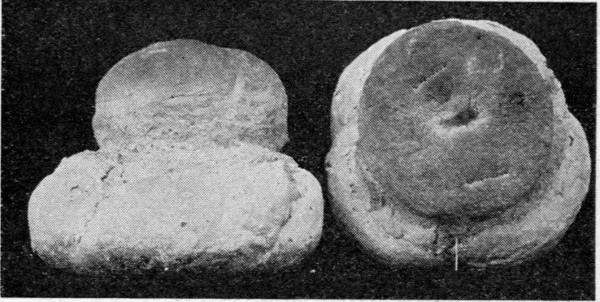
Fig. 7. Loaves made from No. 1 Manitoba. Strength 100
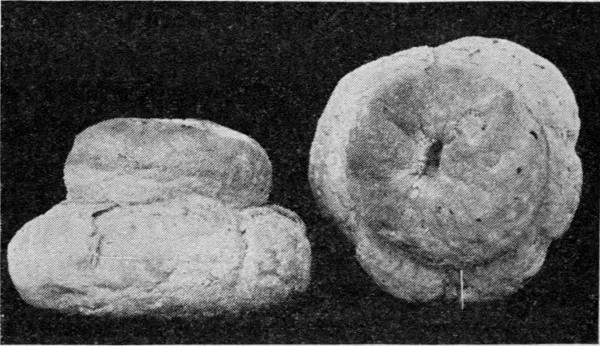
Fig. 8. Loaves made from average English wheat. Strength 65
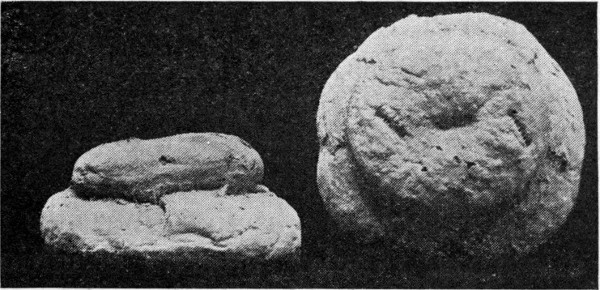
Fig. 9. Loaves made from Rivet wheat. Strength 20
In order to make flour which will bake bread to
suit the taste of the general public of the present
day, the miller finds it necessary to include in the
mixture or blend of wheats which he grinds a certain
proportion of strong wheats such as Canadian,
American, or Russian. The quantity of strong wheat
available is limited. Consequently strong wheat
commands a relatively high price. The average
difference in price of say No. 1 Manitoban and home
grown wheat is about 5s. per quarter. It is possible
of course that the public taste in bread may change,
and damp close textured bread may become fashionable.
In this case no doubt the difference in price
would disappear. Under present conditions the
necessity of including in his grinding mixture a considerable
proportion of strong foreign wheat is a
distinct handicap against the inland miller as compared
with the port miller. The latter gets his
foreign wheat direct from the ship in which it is
imported, whilst the former has to pay railway carriage
from the port to his mill. The question naturally
arises—is it not possible to grow strong wheats at
home and sell them to the inland miller?
This question has been definitely answered by
the work of the Home Grown Wheat Committee
during the last 12 years. The committee collected
strong wheats from every country where they are
produced, and grew them in England. From the
first crop they picked out single plants of every
type represented in the mixed produce, for strong
wheats as imported are usually grades and not pure
varieties. From the single plants they have established
pure strains of which they have grown enough
to mill and bake. From most of the strong wheats
they were unable to find any strain which would
produce strong wheat in England. Thus the strong
wheat of Hungary when grown in England was no
stronger than any of the ordinary typical home grown
wheats. But from the strong wheat of Canada was
isolated the variety known as Red Fife, which makes
up a very large proportion of the higher grades of
American and Canadian wheats, and this variety when
grown in England was found to continue to produce
wheat as strong as the best Canadian. Year after
year it has been grown here, and when milled and
baked its strength has been found to be 100 or thereabouts
on the scale above described. Finally it was
found that a strain of Red Fife which had been
brought over from Canada 20 years ago, and grown
continuously in the western counties ever since, under
the name of Cook’s Wonder, was still producing wheat
which when ground and baked possessed a strength
of about 100. Thus it was conclusively proved that
in the case of Red Fife at any rate the English climate
was capable of producing really strong wheat. The
strength of Hungarian and Russian wheats appear to
be dependent on the climate of those countries. Red
Fife, however, produces strong wheat wherever it is
grown. It is interesting to note that this variety
although first exploited in Canada and the States is
really of European origin. It was taken out to
Canada by an enterprising Scotchman called Fife in
a mixed sample of Dantzig wheat. He grew it for
some time and distributed the seed. Pure strains
have from time to time been selected by the American
and Canadian experiment stations.
But the discovery that Red Fife would produce
strong wheat in England by no means solved the
problem, for when the Home Grown Wheat Committee
distributed seed of their pure strain of that variety
for extended testing throughout the country, it was
soon found to be only a poor yielder except in a few
districts. A yield of three quarters of strong grain,
even if it makes 40s. per quarter on the market, only
gives to the farmer a return of £6 per acre, as compared
with a return of nearly £8 from 4½ quarters of
weak grain worth 35s. per quarter, which can usually
be obtained by growing Square Head’s Master, or
some other standard variety.
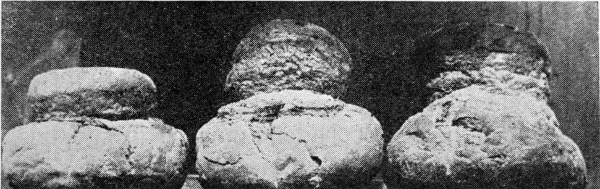
Fig. 10. The left-hand loaf was made from average English wheat.
The loaf in the centre was made from Burgoyne’s Fife, and is
practically identical in size and shape with the right-hand loaf
which was made from imported No. 1 Manitoba
It was at this point that Mendel’s discoveries came
to the rescue. Working on the Mendelian lines
already explained, Biffen at Cambridge crossed Red
Fife with many of the best English varieties. From
one of the crosses he was able to isolate a new variety
in which are combined the strength of Red Fife and
the vigour and cropping power of the English parent.
This variety, known as Burgoyne’s Fife, has been
grown and distributed by members of the Millers’
Association. In 1911 on the average of 28 separate
trials it yielded 38 bushels per acre, which is well above
the average of the best English varieties. It has
been repeatedly milled and baked, and its strength is
between 90 and 100, practically the same as that of
Red Fife. It has been awarded many prizes at
agricultural shows for quality, and it commands on
markets where the local millers have found out its
baking qualities about the same price as the best
foreign strong wheats, that is to say from 4s. to 5s.
per quarter more than the average price of home
grown wheat. Taking a fair average yield of
wheat as four quarters per acre, Burgoyne’s Fife
gives to the farmer an increased return over the
ordinary varieties of about 16s. per acre. The introduction
of such a variety makes the production of
strong wheat in England a practicable reality, and
will be a boon both to the farmer and to the inland
miller. It is likely too that the possibility of obtaining
a better return per acre will induce farmers
to grow more wheat. Anything that tends to increase
the production of home grown wheat and makes
Great Britain less dependent on foreign supplies is
a national asset of the greatest value.
It is of the greatest importance to the miller that
he should be able to determine the strength of the
wheats he buys. Obviously the method mentioned
above, which entails milling enough of the sample to
enable him to bake a batch of bread, is far too lengthy
to be of use in assessing the value of a sample with a
view to purchase. The common practice is for the
miller or corn merchant to buy on the reputation of
the various grades of wheat, which he confirms by
inspection of the sample. Strength is usually associated
with certain external characters which can
readily be judged by the eye of the practised wheat
buyer. Strong wheats are usually red in colour, their
skin is thin and brittle, the grain is usually rather
small, and has a very characteristic horny almost
translucent appearance. The grains are extremely
hard and brittle, and when broken the inside looks
flinty. On chewing a few grains the starch is removed
and there remains in the mouth a small pellet of
gluten, which is tough and elastic like rubber, but
not sticky.
Weak wheats as a rule possess none of these
characters. Their colour may be either red or white,
their skin is commonly thick and tough, the grain is
usually large and plump, and often has an opaque
mealy appearance. It is soft and breaks easily, and
the inside is white, soft and mealy. Very little gluten
can be separated from it by chewing, and that little
is much less tough and elastic than the gluten of a
strong wheat.
These characters, however, are on the whole less
reliable than the reputation of the grade of wheat
under consideration. To make a reliable estimate
of strength from inspection of a sample of wheat
requires a natural gift cultivated by continual practice.
Even the best commercial judges of wheat
have been known to be deceived by a sample of white
wheat which subsequent milling and baking tests
showed to possess the highest strength. The mistake
was no doubt due to the great rarity of strength
among white wheats. This rarity will doubtless soon
disappear now that a pure strain of White Fife has
been isolated and shown to possess strength quite
equal to that of Red Fife. Sometimes too the
ordinary home grown varieties produce most deceptive
samples which show all the external characters
of strong wheats. Such samples, however, on milling
and baking are invariably found to possess the usual
strength of home grown wheat, about 65 on the scale.
These considerations show the great need of a scientific
method of measuring strength, which can be
carried out rapidly and on a small sample of grain.
This need is felt at the present time not only by the
miller and the merchant, but by the wheat breeder.
For instance, in picking out the plants possessing
strong grain from cultures of the second generation
after making his crosses, the plant breeder up to the
present has had to rely on inspection by eye, and on
the separation of gluten by chewing, for a single plant
obviously cannot yield enough grain to mill and bake.
This fact no doubt explains the differences of opinion
among plant breeders on the inheritance of strength,
for it is not every one who can acquire the power of
judging wheat accurately by his senses. Such a faculty
is a personal gift, and is at best apt to fail at
times.
The search for a rapid and accurate method of
measuring strength has for many years attracted
the attention of investigators. As might be expected
most of the investigations have centred round the
gluten, for as mentioned above the gluten of a strong
wheat is much more tough and elastic than that of a
weak wheat. Gluten is a characteristic constituent
of all wheats, and it is the presence of gluten which
gives to wheat flour the power of making bread.
The other cereals, barley, oats, maize and rice are
very similar to wheat in their general chemical
composition, but they do not contain gluten. Consequently
they cannot make bread.
In making bread flour is mixed with water and
yeast. The yeast feeds on the small quantity of
sugar contained in the flour, fermenting it and
forming from it alcohol and carbon dioxide gas.
The gluten being coherent and tough is blown into
numberless small bubbles by the gas, which is thus
retained inside the bread. On baking, the high temperature
of the oven fixes these bubbles by drying
and hardening their walls, and the bread is thus
endowed with its characteristic porous structure.
If a cereal meal devoid of gluten is mixed with
water and yeast, fermentation will take place with
formation of gas, but the gas will escape at once,
and the product will be solid and not porous. Evidently
from the baking point of view gluten is of
the greatest importance. One of the most obvious
methods that have been suggested for estimating the
strength of wheat depends on the estimation of the
percentage of gluten contained in the flour. The
method has not turned out very successfully, for
strength seems to depend rather on the quality than
on the quantity of gluten in the wheat. Much attention
has been given to the study of the causes of the
varying quality of the gluten of different wheats.
Gluten for instance has been shown to be a mixture
of two substances, gliadin and glutenin, and the suggestion
has been made that its varying properties are
dependent on the varying proportions of these two
substances present in different samples. This suggestion
however failed to solve the problem.
After seven years of investigation the author has
worked out the following theory of the strength of
wheat flours, which has finally enabled him to devise
a method which promises to be both accurate and
rapid, and to require so little flour that it can readily
be used by the wheat breeder to determine the
strength of the grain in a single ear. It has already
been mentioned that a strong wheat is one that will
make a large loaf of good shape and texture. The
strength of a wheat may therefore be defined as the
power of making a large loaf of good shape and texture.
Evidently strength is a complex of at least two
factors, size and shape, which are likely to be quite
independent of each other. Not infrequently, for
instance, wheats are met with which make large
loaves of bad shape, or on the other hand, small
loaves of good shape. Probably therefore the size
of the loaf depends on one factor, the shape on
another; and the failure of the many attempts to
devise a method of estimating strength have been
caused by the impossibility of measuring the product
of two independent factors by one measurement.
It seemed a feasible idea that the size of the loaf
might depend on the volume of gas formed when
yeast was mixed with different flours. On mixing
different flours with water and yeast it was found
that for the first two or three hours they all gave
off gas at about the same rate. The reason of this
is that all flours contain about the same amount of
sugar, approximately one per cent., so that at the
beginning of the bread fermentation all flours provide
the yeast with about the same amount of sugar
for food. But this small amount of sugar is soon
exhausted, and for its subsequent growth the yeast
is dependent on the transformation of some of the
starch of the flour into sugar. Wheat like many
other seeds contains a ferment or enzyme called
diastase, which has the power of changing starch
into sugar, and the activity of this ferment varies
greatly in different wheats. The more active the
ferment in a flour the more rapid the formation of
sugar. Consequently the more rapidly the yeast
will grow, and the greater will be the volume of gas
produced in the later stages of fermentation in the
dough. As a rule it is not practicable to get the
dough moulded into loaves and put into the oven
before it has been fermenting for about six or eight
hours. If the flour possesses an active ferment it
will still be rapidly forming gas at the end of this
time, and the loaf will go into the oven distended
with gas under pressure from the elasticity of the
gluten which forms the walls of the bubbles. The
heat of the oven will cause each gas bubble to
expand, and a large loaf will be the result. If
the ferment of the flour is of low activity it will
not be able to keep the yeast supplied with all the
sugar it needs, the volume of gas formed in the
later stages of the fermentation of the dough will be
small, the dough will go into the oven without any
pressure of gas inside it, little expansion will take
place as the temperature rises, and a small loaf will
be produced.
From these facts it is quite easy to devise a method
of estimating how large a loaf any given flour will
produce. The following method is that used by the
author. A small quantity of the flour, usually 20
grams, is weighed out and put into a wide mouthed
bottle. A flask of water is warmed to 40° C., of this
100 c.c. is measured out, and into it 2½ grams of
compressed yeast is intimately mixed, 20 c.c. of the
mixture being added to the 20 grams of flour in the
bottle. The flour and yeast-water are then mixed
into a cream by stirring with a glass rod. The bottle
is then placed in a vessel of water which is kept by a
small flame at 35° C. The bottle is connected to an
apparatus for measuring gas, and the volume of gas
given off every hour is recorded. As already mentioned
all flours give off about the same volume of gas
during the first three hours. After this length of time
the volume of gas given off per hour varies greatly
with different flours. Thus a flour which will bake
a large loaf gives off under the conditions above
described about 20 c.c. of gas during the sixth hour
of fermentation, whilst a flour which bakes a small
tight loaf gives off during the sixth hour of fermentation
only about 5 c.c. of gas.
Having devised a feasible method of estimating
how large a loaf any given flour will make, the problem
of the shape and texture still remains. Previous
investigators had exhausted almost every possible
chemical property of gluten in their search for a
method of estimating strength. The author therefore
determined to study its physical properties.
Now gluten is what is known as a colloid substance,
like albumen the chief constituent of white of egg,
casein the substance which separates when milk is
curdled, or clay which is a well known constituent
of heavy soils. Such colloid substances can scarcely
be said to possess definite physical properties of their
own, for their properties vary so largely with their
surroundings. The white of a fresh egg is a thick
glairy liquid. On heating it becomes a white opaque
solid, and the addition of certain acids produces a
similar change in its properties. Casein exists in
fresh milk in solution. The addition of a few drops
of acid causes it to separate as finely divided curd.
If, however, the milk is warmed before the acid is
added the casein separates as a sticky coherent
mass. Every farmer knows that lime improves the
texture of soils containing much clay, because the
lime causes the clay to lose its sticky cohesive
nature.
Such instances show that the properties of colloid
substances are profoundly modified by the presence
of chemical substances. Wheat, like almost all plant
substances, is slightly acid, and the degree of acidity
varies in different samples. Accordingly the effect of
acids on the physical properties of gluten was investigated,
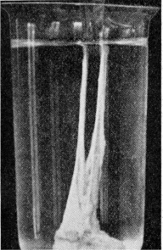
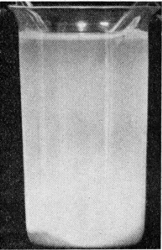
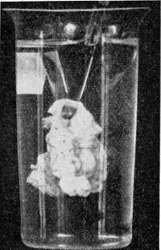
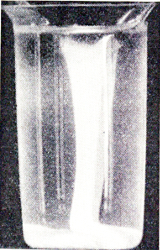
and it was found that by placing bits of gluten
in pure water and in acid of varying concentration it
could be made to assume any consistency from a state
of division so fine that the separate particles could
not be seen, except by noticing that their presence
made the water milky, to a tough coherent mass
almost like indiarubber (Fig. 11). It was found,
however, that the concentration of acid in the wheat
grain was never great enough to make the gluten
really coherent.
But wheat contains also varying proportions of
such salts as chlorides, sulphates and phosphates,
which are soluble in water, and the action of such
salts on gluten was next tried. It was at once found
that these salts in the same concentration as they
exist in the wheat grain were capable of making
gluten coherent, but that the kind of coherence
produced was peculiar to each salt. Phosphates
produce a tough and elastic gluten such as is found
in the strongest wheats. Chlorides and sulphates on
the other hand make gluten hard and brittle, like the
gluten of a very weak wheat (Fig. 12).
The next step was to make chemical analyses to
find out the amount of soluble salts in different
wheats. Strong wheats of the Fife class were found
to contain not less than 1 part of soluble phosphate
in 1000 parts of wheat, whilst Rivet wheat, the weakest
wheat that comes on the market, contained only half
that amount. Rivet, however, was found to be comparatively
rich in soluble chlorides and sulphates,
which are present in very small amounts in strong
wheats of the Fife class. Ordinary English wheats
resemble Rivet, but they contain rather more phosphate
and rather less chlorides and sulphates. After
making a great many analyses it was found that the
amount of soluble phosphate in a wheat was a very
good index of the shape and texture of the loaf
which it would make. The toughness and elasticity
of the gluten no doubt depend on the concentration
of the soluble phosphate in the wheat grain, the more
the soluble phosphate the tougher and more elastic
the gluten, and a tough and elastic gluten holds the
loaf in shape as it expands in the oven, and prevents
the small bubbles of gas running together into large
holes and spoiling the texture.
Fig. 12.
Gluten in water containing
both acid and phosphate;
very tough and elastic
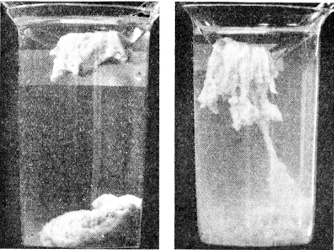
Gluten in water containing both acid and sulphates.
It shows varying degrees of coherence, but is brittle or
“short”
These facts suggest at once a method for estimating
the shape and texture of the loaf which can be made
from any given sample of wheat. An analysis showing
the amount of soluble phosphate in the sample should
give the desired information. But unfortunately such
an analysis is not an easy one to make, and requires
a considerable quantity of flour. In making these
analyses it was noticed that when the flours were
shaken with water to dissolve the phosphate, and
the insoluble substance removed by filtering, the
solutions obtained were always more or less turbid,
and the degree of turbidity was found to be related
to the amount of phosphate present and to the shape
of loaf produced. On further investigation it was
found that the turbidity was due to the fact that
the concentration of acid and salts which make
gluten coherent, also dissolve some of it, and gluten
like other colloids gives a turbid solution. It was
also found that the amount of gluten dissolved, and
consequently the degree of turbidity, is related to
the shape of the loaf which the flour will produce.
Now it is quite easy to measure the degree of
turbidity of a solution by pouring the solution into
a glass vessel below which a small electric lamp is
placed, and noting the depth of the liquid through
which the filament of the lamp can just be seen.
The turbidities were, however, so slight that it was
found necessary to increase them by adding a little
iodine solution which gives a brown milkiness with
solutions of gluten, the degree of milkiness depending
on the amount of gluten in the solution. In this way
a method was devised which is rapid, easy, and can be
carried out with so little wheat that the produce of
one ear is amply sufficient. It can therefore be used
by the plant breeder for picking out from the progeny
of his crosses those individual plants which are likely
to give shapely loaves. The method is as follows:
An ear of wheat is rubbed out and ground to powder
in a small mill. One gram of this powder, or of flour
if that is to be tested, is weighed out and put into a
small bottle. To it is added 20 c.c. of water. The
bottle is then shaken for one hour. At the end of
this time the contents are poured onto a filter. To
15 c.c. of the solution 1½ c.c. of a weak solution of
iodine is added, and after standing for half an hour
the turbidity test is applied. Working in this way
it is possible to see through only 10 c.m. of the
solution thus obtained from such a wheat as Red
Fife, as compared with 25 c.m. in the case of Rivet.
Other wheats yield solutions of intermediate opacity.
This method is now being tested in connection with
the Cambridge wheat breeding experiments.
 THE STORY OF