The chemistry of the rare earth elements begins in the
year 1794, with Gadolin’s discovery of the new oxide ‘Ytterbia,’
for which the name Yttria was subsequently proposed by
Ekeberg, and generally adopted (see Chapter I, and under
Gadolinite, p. 35). The discovery of Ceria followed in 1804
(see under Cerite, p. 32). The classical work of Mosander,
carried out between 1838 and 1842, showed the complex
nature of the new oxides. From ceria he separated three new
earths, Ceria proper, Lanthana, and Didymia. Yttria was
shown to be a mixture of at least three oxides, for which the
names Yttria, Erbia, and Terbia were proposed. These oxides
were believed to have the general formula RO, by analogy
with the alkaline earths, which they were found to resemble
in many respects, notably in their strongly basic character.
The properties of the new oxides were examined during
the next twenty years by many chemists, the chief workers
being Marignac, Rammelsberg, and Hermann, but the next
important advance was the investigation of the absorption
spectra of solutions of the rare earth salts, first suggested by
Gladstone in 1856, and developed more fully by Bunsen and
Kirchhoff in 1860 and the following few years. The introduction
of the methods of spectrum analysis furnished a very
delicate and valuable method of examining and identifying
the various oxides, and so greatly assisted the laborious processes
of separation.
Sixteen elements (excluding thorium and zirconium) are
at the present time recognised as belonging to the rare earth
group. With one or two exceptions, these show the closest
resemblance to one another, both in chemical behaviour and
in the properties of their compounds, so that the difficulties
of separating and purifying them are very great. They may
be said to form a series, in which the properties vary continuously
but gradually from member to member, so that no
sharp differences are anywhere perceptible. The method of
division into groups is, therefore, almost entirely one of
convenience, and has arisen from the course which the
separations have followed.
The elements are divided into two chief families or groups,
that of the cerium metals and that of the yttrium metals
respectively. The cerium elements are separated by a process
depending on the relative insolubility of their alkali double
sulphates; in this group are included cerium, lanthanum,
praseodymium, neodymium, and samarium. The yttrium
family is further divided into four sub-groups: the first
consists of scandium and yttrium; the second or terbium
group of europium, gadolinium, and terbium; the third or
erbium group of dysprosium, holmium, erbium, and thulium;
and the fourth or ytterbium group of ytterbium and lutecium—the
element celtium, recently discovered by Urbain,
will also fall into this sub-group, but the discovery awaits
confirmation. Whilst scandium and yttrium fall into somewhat
abnormal positions, corresponding to their low atomic
weights, the terbium elements occupy an intermediate position
between the cerium elements and the remaining yttrium
elements, or yttrium group proper, and so are frequently
classified as a third or intermediate group.
This list does not include all the names which have been
put forward to designate what have been claimed from time
to time as new elements; whilst the individuality of some of
those included is not yet fully established, and the homogeneity
of others has been called in question. The uncertainty is
more pronounced among the yttrium elements than among
the cerium elements; owing to the opportunities for investigation
furnished by the commercial treatment of monazite, the
chemistry of the cerium group may be regarded as complete.
In the following table the elements are arranged in order
of increasing atomic weight, and it can be seen at once how
closely the division into groups follows this order:
| |
Element |
Atomic
Wt. |
Colour of Salts |
| |
- |
|
Scandium, Sc |
44·1 |
Colourless |
| Yttrium, Yt |
89·0 |
Colourless |
| |
| Cerium Group. |
- |
|
Lanthanum, La |
139·0 |
Colourless |
| Cerium, Ce |
140·25 |
Cerous, colourless; ceric, orange to red |
| Praseodymium, Pr |
140·6 |
Green |
| Neodymium, Nd |
144·3 |
Red to reddish-violet |
| Samarium, Sa |
150·4 |
Topaz yellow |
| |
| Terbium Group. |
- |
|
Europium, Eu |
152·0 |
Faint rose |
| Gadolinium, Gd |
157·3 |
Colourless |
| Terbium, Tb |
159·2 |
Colourless |
| |
| Erbium Group. |
- |
|
Dysprosium, Dy |
162·5 |
Bright green |
| Holmium, Ho |
163·5 |
Yellow to orange |
| Erbium, Er |
167·7 |
Deep rose |
| Thulium, Tm |
168·5 |
Bluish-green |
| |
| Ytterbium Group. |
- |
|
Ytterbium, Yb |
172·0 |
Colourless |
| Lutecium, Lu |
174·0 |
Colourless |
In their chemical relations, the rare earth elements may
be placed between the metals of the alkaline earths, and the
trivalent metals iron, aluminium, and chromium. With the
exceptions of cerium in the ceric salts, and of samarium and
europium in the recently discovered dichlorides, they are
uniformly trivalent, but the oxides are very strong bases,
and the salts very slightly hydrolysed in dilute solutions;
generally, therefore, they resemble the calcium family rather
than the aluminium group. Among the common salts, the
oxalates, phosphates, chromates, iodates, fluorides, carbonates,
tartrates, and borates are almost insoluble; the sulphates are
only sparingly soluble at ordinary temperatures. Among the
double salts, the alkali double sulphates are of great importance
from their employment for separations; the tendency to the
formation of complex salts is greater among the yttrium than
among the cerium elements, increasing with the atomic weight,
and with the decrease in basic strength of the oxides.
The great similarity in chemical behaviour of the rare
earth elements is apparent not only in the similarity in composition,
solubility and chemical properties of the salts—which
is so great that the general account of the compounds
which follows applies almost in its entirety to each member of
the group—but also in the crystallographic relations between
corresponding compounds. Many of the salt hydrates form
isomorphous series; the sulphate octohydrates, for example,
appear to be isomorphous throughout the whole group, and
probably the relation would be found to apply even more
completely than is generally accepted, if the necessary data were
forthcoming. Of great interest and practical importance is the
isomorphism between the nitrates and double nitrates of the
cerium elements and bismuth, which has been utilised with such
valuable results in the processes of fractional crystallisation.
The Metals.
—The earlier attempts to reduce compounds
of the rare earth elements to the metallic condition, by means
of metallic sodium or potassium, did not yield pure products;
nor did the use of aluminium or magnesium lead to results of
practical importance. The metals were first obtained in a
coherent physical condition by Hillebrand and Norton,[147] by
electrolysis of the fused chlorides. These investigators obtained
cerium, lanthanum, and the so-called didymium, and
measured their specific heats; their results confirmed the
atomic weights assigned to the elements by Mendelejeff,
except in the case of lanthanum. Their method has since
been elaborated by Muthmann, Hofer and Weiss,[148]
who have
prepared large quantities of the cerium elements in the pure
state. More recently, Hirsch has prepared metallic cerium
in large quantities,[149] and has studied its properties.
By electrolytic reduction of the mixed chlorides of the
cerium elements, a mixture known as ‘Misch metal’ is
obtained; this has powerful reducing properties, and, like
aluminium, reduces the oxides of iron, chromium, etc., with
great development of heat.[150] The yttrium metals have not
yet been obtained in the pure state, the electrolytic method
giving unsatisfactory results on account of the high melting-points
of the metals, and the volatile nature of their chlorides.
The cerium metals are white or slightly yellowish in colour,
and are moderately stable in dry air. In moist air they tarnish
slowly, lanthanum, as the most positive, being most readily
oxidised. The melting-points and specific gravities are as
follows:
| Element |
Melting-
point |
Specific
Gravity |
| Cerium |
623° |
7·0242 |
| Lanthanum |
810° |
6·1545 |
| Praseodymium |
940° |
6·4754 |
| Neodymium |
840° |
6·9563 |
| Samarium |
1300°-1400° |
7·7-7·8 |
The metals decompose water slowly in the cold, but rapidly
at the boiling-point, with evolution of hydrogen. They have
a great affinity for oxygen, the heats of formation of the
oxides being of the order of those of alumina and magnesia:
| |
Heat of Formation
per Equivalent Weight
of
Oxide[151] |
| 1⁄3La₂O₃ |
74·1 |
K |
| 1⁄3Nd₂O₃ |
72·5 |
„ |
| 1⁄3Pr₂O₃ |
68·7 |
„ |
| 1⁄4CeO₂ |
56·1 |
„ |
| 1⁄3Al₂O₃ |
64·3 |
„ |
| 1⁄2MgO |
71·9 |
„ |
In consequence of the high values of the heats of combustion,
the metals have powerful reducing properties.
The cerium metals form alloys with magnesium, zinc,
aluminium, and iron, and combine with boron and silicon.
The alloys of cerium, and the metal itself, are remarkable for
their property of emitting brilliant sparks when scratched (see
Chapter XXI). Cerium also forms an amalgam with mercury.
The metals burn brilliantly when heated in oxygen, and
dissolve readily in dilute mineral acids. When heated to a
temperature of 200°-300° in a current of hydrogen, they
absorb the gas very readily, forming the hydrides. These
compounds are also obtained by heating the oxides with
magnesium in a current of hydrogen. They were first prepared
by Winkler,[152] who deduced from his analyses the general formula
RH₂; the more recent work of Muthmann and Beck,[153] however,
points to the formula RH₃.
If nitrogen be substituted for hydrogen in either of the
above methods of preparation, nitrides of the general formula
RN are obtained; cerium nitride, however, cannot be obtained
by heating the element in the gas.[154] These compounds are
also obtained when the carbides are heated in ammonia.
They are amorphous solids, which yield ammonia when acted
upon by water.
Hydroxides.
—The hydroxides are thrown down as
gelatinous precipitates on the addition of alkalies to hot dilute
solutions of the salts; precipitation in the cold, or in strong
solution, usually gives a basic salt, or an hydroxide mixed
with a large quantity of basic salt. The hydroxides are
insoluble in excess of precipitant, but the precipitation is
inhibited by the presence of some organic hydroxy-acids.[155]
The hydroxides are insoluble in water, but dissolve very
readily in acids. The most basic of them absorb carbon
dioxide from the air; lanthanum hydroxide is exceptional
in that it colours litmus blue.
Whilst hydrogen peroxide in neutral solution does not
react with rare earth salts,[156] alkalies in presence of this reagent
precipitate gelatinous hydrated peroxides, which are very
unstable, decomposing on standing, or on treatment with acids,
with evolution of oxygen. The general formula R₄O₉ + xH₂O
was proposed for these compounds by Cleve, but more recently
the formula R(OOH)(OH)₂ has been advanced.[157]
Oxides.
—In their most stable state of oxidation, the
rare earth elements are generally trivalent. In the case of
cerium, the dioxide, CeO₂, is more stable than the sesquioxide
Ce₂O₃, but the ceric salts are unstable, and are very readily
reduced to cerous compounds, corresponding to the oxide
Ce₂O₃. Higher oxides are known with certainty among the
other elements only in the cases of praseodymium and terbium,
but these do not give rise to salts.
The oxides R₂O₃ are fairly strong bases, being comparable
in strength to the alkaline earths, and far more strongly basic
than alumina and oxides of other trivalent elements; thus
they liberate ammonia from ammonium compounds, whilst
the salts they form with strong acids are not easily hydrolysed.
Their relative strengths as bases are expressed in the following
series, in which the elements are placed in order of diminishing
electropositive character:[158]
La, Ce´´, Pr, Nd, Yt, Eu, Gd, Sa, Tb, Dy, Ho, Er, Tm, Yb,
Lu, Sc, Ceiv.
It will be seen that, with the exception of scandium and yttrium,
the metals of the cerium and yttrium groups become less
electropositive as the atomic weight increases.
This arrangement is obtained by ascertaining the order in
which the various hydroxides are precipitated from a solution
by gradual addition of a dilute solution of a strong base. The
weakest base is precipitated first, and the strongest last;
those intermediate in strength are thrown down in ascending
order of strength. Similar results may be obtained by the
fractional decomposition of the nitrates by heat; in this case
the nitrate of the weakest base is decomposed at the lowest
temperature. This order is also confirmed, as far as the data
are available, by measurements of the equivalent conductivities
of solutions of the salts (see, for example, p. 122).
Quite recently, a very different order has been obtained
from a consideration of the dissociation tensions, and of the
heats of dissociation of the anhydrous sulphates.[159] In the
following table the elements are arranged in the order of the
increase of the dissociation tension (T) measured at 900°,
which is the same as the order of decrease of the heats of
dissociation (Q):
| Element |
At. Wt. |
T. (Mm. Hg.) |
Q. |
| La |
139 |
·0 |
2 |
|
59·8 |
| Yt |
89 |
·0 |
3 |
|
58·9 |
| Lu |
174 |
·0 |
3 |
·5 |
58·5 |
| Yb |
172 |
·0 |
4 |
|
58·2 |
| Er |
167 |
·7 |
5 |
|
57·6 |
| Pr |
140 |
·6 |
5 |
·5 |
57·4 |
| Nd |
144 |
·3 |
6 |
|
57·2 |
| Gd |
157 |
·3 |
7 |
|
56·9 |
| Sa |
150 |
·4 |
8 |
|
56·5 |
| Sc |
44 |
·1 |
11 |
|
54·5 |
| Ce |
140 |
·25 |
|
52·4 |
It will be observed that the order is very different from the
order of increase of atomic weight, the positions of lutecium
and ytterbium being especially surprising; these elements are
generally considered to be among the least electropositive of
the whole series. The anomalous position of cerium is probably
due to the fact that the sulphate on decomposition leaves the
dioxide, and not the sesquioxide, as with the other elements;
this would undoubtedly affect the values. The heats of dissociation
are the greatest yet observed for the sulphates of
trivalent metals, a further evidence of the strongly basic
nature of the oxides.
Ignited lanthana resembles quicklime in that it readily
absorbs carbon dioxide from the air, and hisses when slaked
with water; as the basicity becomes weaker, the affinity for
water and carbon dioxide becomes less marked. All the
oxides are soluble in dilute acids, even after prolonged ignition;
but the ease with which solution occurs is naturally much
influenced by the treatment to which the oxide has been
subjected, as well as by its strength as a base.
The rare earth oxides are capable of existing in more than
one modification, the compounds obtained by ignition of
the hydroxides differing in appearance and reactivity from
those prepared by ignition of the oxalates or nitrates, and so
on; they are probably highly polymerised. Cerium dioxide,
CeO₂, is remarkable for its power of combining with the other
oxides, R₂O₃, of the rare earth metals. The pure dioxide is
insoluble in nitric acid, but mixtures of earths containing up
to 50 per cent. of the dioxide dissolve readily. The various
colours of mixtures of the ceria earths may sometimes be
attributed to a similar combination,[160] and there can be little
doubt that the dioxide sometimes functions as an acid in the
rare earth minerals.
Sulphides.
—These compounds cannot be prepared in the
wet way, that is, by the action of hydrogen sulphide or ammonium
sulphide on the salts in solution; the former reagent
gives no precipitate, the latter throws down the hydroxides.
In this behaviour, the rare earth elements resemble aluminium
and chromium.
The normal sulphides, R₂S₃, are obtained by reduction of
the anhydrous sulphates, or from the oxides at high temperatures,
by treatment with hydrogen sulphide. They are strongly
coloured compounds, fairly stable towards cold water, but
readily hydrolysed on boiling.
Disulphides, RS₂, are known in the cases of cerium,
lanthanum, and praseodymium; these are to be regarded as
polysulphides, since on treatment with dilute acids they
yield hydrogen persulphide, H₂S₂.
Carbides.
—By reduction of the oxides with carbon in the
electric furnace, Moissan obtained the carbides in the form
of microscopic yellow crystals. They have the general formula
RC₂, and are attacked by water and dilute acids, with evolution
of very complex mixtures of gases.[161] The principal product
is acetylene, with various higher homologues, and in smaller
quantities ethylene and ethane and their homologues. No
methane is formed,[162] but hydrogen is always present, the olefines
and paraffins probably arising from its action on the acetylenic
hydrocarbons. The relation of the rare earth elements to
the calcium group is here very close; calcium carbide when
attacked by water yields pure acetylene, whereas aluminium
carbide gives pure methane.
Halogen Salts.
—The halides of the rare earth elements
show a close analogy with the corresponding compounds of the
alkaline earth elements. The fluorides are insoluble in water
and dilute mineral acids, and are obtained as gelatinous precipitates
by the addition of hydrofluoric acid, or a soluble
fluoride, to solutions of the salts. They may be prepared in
the crystalline condition by heating the carbides in a stream
of fluorine, or by the action of hydrofluoric acid upon the
hydroxides in aqueous suspension. The rare earth elements,
as well as thorium, may be separated from zirconium by
taking advantage of the insolubility of their fluorides in excess
of hydrofluoric acid or alkali fluorides, since zirconium fluoride
is readily soluble in excess of the precipitant. The solubility
of the fluorides in a large excess of concentrated acid increases
with the electropositive character of the metal, the fluorides
of the more negative elements being the least soluble. Thorium
and scandium may, therefore, be concentrated to a large
extent by repeated precipitation with hydrofluoric acid in
acid solution.
The silicofluorides of the rare earth elements have been
used by R. J. Meyer in the extraction of scandium from
wolframite (see Chapter I and under Scandium, p. 215). They
are thrown down as gelatinous precipitates on addition of
potassium or sodium silicofluoride to boiling, neutral solutions
of rare earth salts. In presence of mineral acids, however,
they are not thrown down in the cold; on boiling, the cerium
metals are precipitated as fluorides, by hydrolysis of the
silicofluorides—the yttrium elements, with the exception of
scandium, being held in solution by the mineral acid.
With the exception of the fluorides, the halogen salts of
the rare earth metals are readily soluble in water, and crystallise
from the concentrated solutions in the hydrated form. The
bromides and iodides have not been so fully studied as the
chlorides; they are hygroscopic salts, and decompose rather
easily. The iodides have been obtained by Moissan in the
anhydrous state, by the action of iodine vapour on the carbides
at high temperature.
The anhydrous chlorides may be obtained by the application
of any of the ordinary methods, e.g. by heating the oxides
with carbon in a stream of chlorine, by heating the carbides in
the same gas, by heating the sulphides or hydrated chlorides
in hydrogen chloride, or by evaporating the solutions of the
hydrated salts to dryness in presence of ammonium chloride,
and then igniting till the latter has all been removed. As
obtained by any of these methods, they are fusible at a red
heat, but only slightly volatile; they are easily soluble in
water or alcohol, with disengagement of heat. They are
insoluble in most organic solvents, but dissolve to some extent
in some bases; the chlorides of the yttrium elements, for
example, are readily soluble in pyridine. With such solvents,
the chlorides form compounds which may be considered as
derived from the hydrated forms, by replacement of the so-called
water of crystallisation by the organic base.
Conductivity measurements show that the salts are not
perceptibly hydrolysed in moderately dilute aqueous solutions,
though the values for the equivalent conductivities vary
somewhat with the variations in the electropositive character of
the elements. In the following table, the equivalent conductivities
of the chlorides in solutions of dilution 32 and 1024 at
25°C. are given. It will be seen that the value (λ₁₀₂₄ - λ₃₂) ÷ 10
is in all cases (except for the highly hydrolysed scandium
salt) very close to 3, an experimental proof of the trivalent
nature of the elements. The values for the chlorides of iron,
aluminium and chromium are included; it will be seen that
these elements are considerably less positive than the rare
earth metals (with the exception, of course, of scandium).
| Salt |
λ₃₂ |
λ₁₀₂₄ |
λ₁₀₂₄ - λ₃₂ |
| LaCl₃ |
105·8 |
131·5 |
25·7 |
| CeCl₃ |
107·8 |
135·2 |
27·6 |
| PrCl₃ |
105·5 |
135·9 |
30·4 |
| NdCl₃ |
103·8 |
134·3 |
30·5 |
| YtCl₃ |
98·8 |
123·4 |
24·6 |
| YbCl₃ |
107·4 |
140·4 |
33·0 |
| ScCl₃ |
116·9 |
257·9 |
141·0 |
| AlCl₃ |
99·9 |
138·0 |
38·1 |
| CrCl₃ |
98·4 |
152·6 |
54·2 |
| FeCl₃ |
117·2 |
200·7 |
83·5 |
From aqueous solutions the chlorides crystallise with six
molecules of water, except praseodymium chloride, which has
seven. The hydrated salts, when heated to 120° in the air,
form insoluble oxychlorides of the general formula ROCl.
The chlorides do not show a great tendency to form double
salts with other metallic chlorides; on the other hand, they
readily form complex compounds with the chlorides of the less
electropositive metals, e.g. tin, bismuth, gold, and platinum.
Subchlorides of samarium and europium have recently
been obtained; in these compounds, for the first time, rare
earth metals have been shown to be capable of functioning
as divalent elements.
Cyanides of the rare earth elements are not known; addition
of potassium cyanide to solutions of the salts throws down the
hydroxides. The platinocyanides may be obtained by double
decomposition of the sulphates with barium platinocyanide.
They are very stable and characteristic bodies, of the general
formula R₂[Pt(CN)₄]₃, with 18 or 21 molecules of water. The
compounds of the cerium elements are yellow, with a strong
blue fluorescence; they crystallise in the monoclinic system.
The platinocyanides of the yttrium metals are red or crimson,
with a splendid green fluorescence, and crystallise in the
rhombic system. Scandium platinocyanide is of great interest
from the fact that it exists in two modifications, which show
the characteristic appearance of the two groups of compounds
respectively.
Potassium ferrocyanide precipitates potassium earth ferrocyanides
of the general formula KR(FeC₆N₆),3H₂O, from
neutral solutions;[163] the precipitate is somewhat soluble in
excess. The ferrocyanides have been proposed for the purification
of yttrium; the method is useful where rapid concentration
of the element is required, yttrium ferrocyanide being
far more soluble than the analogous compounds of the erbium
and ytterbium metals, but the precipitates are gelatinous,
and very difficult to handle.
Halogen Oxy-salts.
—Perchlorates and periodates of the
rare earth elements, of the general formula R(XO₄)₃,xH₂O,
have been obtained. The existence of chlorates has been
observed only in the yttrium group; yttrium chlorate,
Yt(ClO₃)₃,8H₂O, has been prepared by double decomposition
of the sulphate with barium chlorate. The bromates are also
prepared in this way. They are readily soluble compounds,
of which several hydrated forms are known. They are of
considerable importance for purposes of separation in the
yttrium group.
The iodates are sparingly soluble bodies, precipitated by
addition of the alkali compound to solutions of the rare earth
salts. The rare earth iodates are soluble in nitric acid, the
solubility increasing as the electropositive character of the
element becomes stronger. A method for the purification of
yttrium has recently been based upon this property of the
iodates, whilst the fact that thorium iodate is completely
insoluble in nitric acid allows of the easy separation and
estimation of thorium in minerals or mixtures containing rare
earth elements.
Sulphates.
—The sulphates of the rare earth elements are
obtained by dissolving the oxides or hydroxides in sulphuric
acid. From the solutions so obtained, various hydrated salts
separate according to the temperature of crystallisation. By
heating the hydrated salts to a temperature of 300°-400°,
the anhydrous salts are prepared. These are extremely
soluble in water at 0°, having a great tendency, which is
indeed to be observed in the hydrated forms also, to form supersaturated
solutions. When the temperature of such a solution
is allowed to rise, larger or smaller quantities of an hydrated
form separate out, the differences of solubility among the
sulphate hydrates of the various elements being sometimes
considerable.
The hydrated sulphates of the cerium elements have been
very closely studied in connection with the purification of
thorium. Cerium sulphate itself forms hydrates with 12, 9,
8, 5, and 4 molecules of water, but sulphates of the other
elements generally form fewer hydrates; the commonest
have 12, 8, or 4 molecules of water, and numerous cases of
isomorphism are known among them. The solubility curve
of the cerium sulphate hydrates is shown in the diagram.
Fig. 3. The sulphates of the yttrium elements have not
yet been systematically investigated, and in most cases only
the octohydrates are known. Scandium sulphate is notably
different from the other sulphates, in that it is considerably
more soluble, and crystallises with six molecules of water.
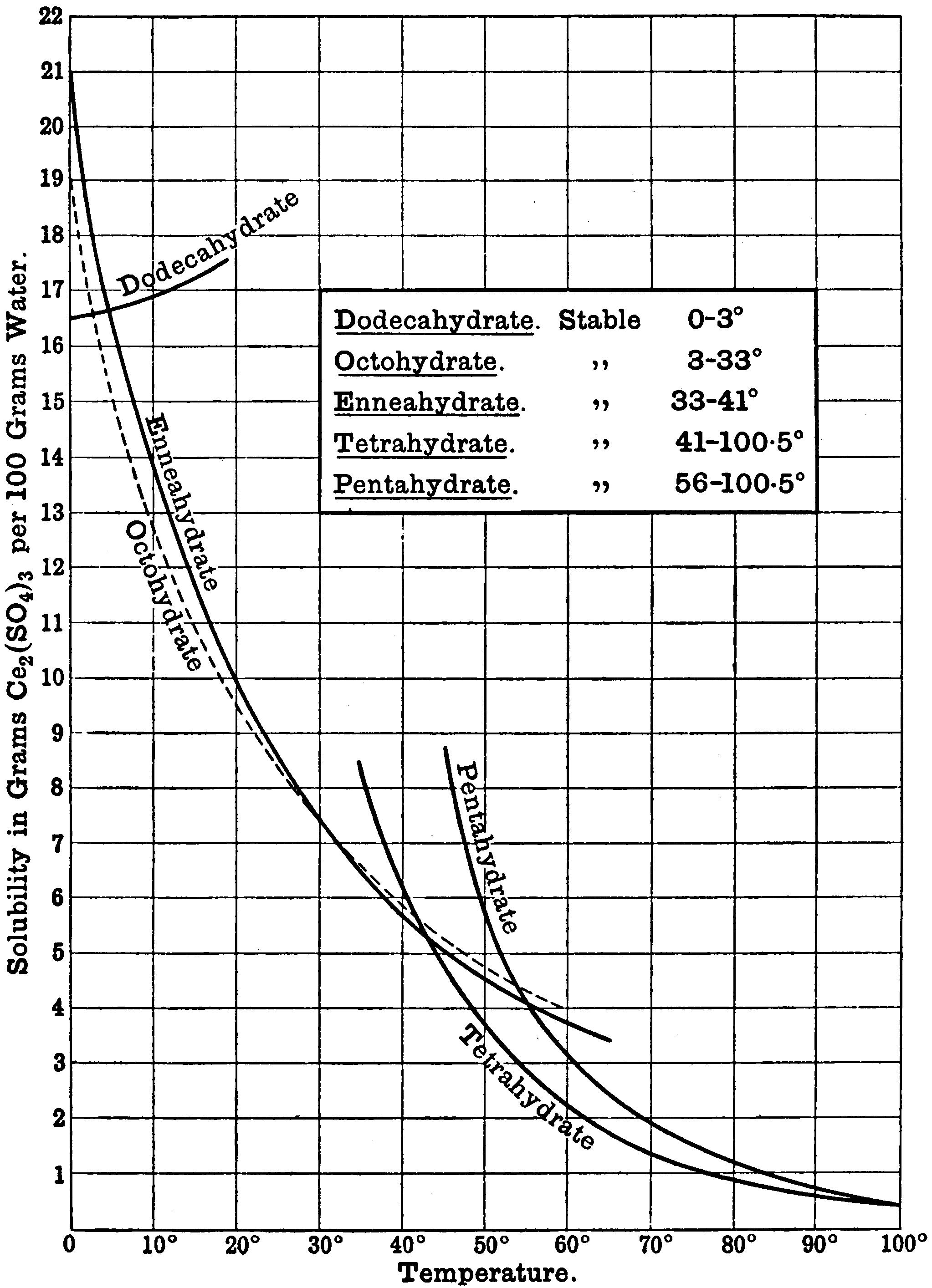
Fig. 3.
It is an important characteristic of the rare earth elements
that the solubility of the sulphates diminishes rapidly as the
temperature rises. The study of the various equilibrium
conditions is greatly complicated by the tendency to form
supersaturated solutions, and the fact that many hydrates
can exist throughout considerable ranges of temperature in
the metastable condition; in consequence of this, also, the
solubilities of many hydrates are known for temperatures
far beyond the transition points. Foreign elements may be
separated by taking advantage of the very great solubility of
the anhydrous sulphates at 0°, and the rapid decrease in
solubility with rise of temperature. For this purpose, a solution
of the anhydrous sulphates saturated at 0° is prepared,
and after filtration is slowly allowed to come to room temperature;
the hydrated rare earth sulphates then separate, leaving
in solution the foreign sulphates. This method may indeed
be used instead of the oxalate separation (see p. 147).
In presence of excess of sulphuric acid, acid sulphates of
the general formula R(HSO₄)₃ are formed. These are fairly
stable, and must be heated to a temperature of 400°-500° to
decompose them completely to the normal salts; even at that
temperature, traces of acid are tenaciously retained, a fact
which renders the determination of the equivalents by the
sulphate method unreliable, unless special precautions are
taken. On further heating, the normal sulphates pass into
basic salts, R₂O₃,SO₃, and finally, at the temperature of the
blowpipe flame, into the oxides. The temperatures at which
these decompositions occur vary with the positive character
of the elements; the most basic oxide clings most tenaciously
to sulphuric anhydride, and forms the most stable acid salt.
Lanthanum sulphate, for example, requires to be heated for
a considerable time at a white heat if the pure oxide is required,
whilst the sulphates of the less positive elements are easily
decomposed at a red heat. The order of basic strength of the
oxides, as determined by the ease with which the sulphates
are decomposed, seems, however, to be very different from the
order determined by decomposition of the nitrates (see p. 118).
With the alkali sulphates, the sulphates of the rare earth
elements readily form double salts, which are of great importance
in separation, on account of the great differences in
solubility. The double sulphates of the cerium group are
almost insoluble in excess of alkali sulphate, whereas the
yttrium double sulphates, with the exception of those of the
terbium metals, which occupy an intermediate position, are
very easily soluble. This method of separating the elements
into the two main groups was first employed by Berzelius,
and though a century has elapsed, it remains to-day the most
efficient method of effecting the separation.
The ethylsulphates have been employed by Urbain and
others in effecting separations, especially in the erbium and
terbium groups. The solubilities of these salts are in the same
general order as those of the alkali double sulphates, and they
are especially convenient for separating the metals into the
three groups of the cerium, terbium, and yttrium elements
respectively. They may be prepared by double decomposition
of the rare earth sulphates with barium ethylsulphate, but
on account of the ease with which the alkylsulphates are
hydrolysed by acids, it is essential that the solutions should
be quite neutral. A more convenient method, according
to James, is the treatment of the anhydrous chlorides in
alcohol solution with sodium ethylsulphate dissolved in
the same medium; sodium chloride is precipitated, whilst
the ethylsulphates of the rare earth elements remain in
solution.
The sulphites of the rare earth elements are sparingly
soluble crystalline salts, of the general formula R₂(SO₃)₃,xH₂O.
They are obtained by passing sulphur dioxide into a suspension
of the hydroxides in water, or by double decomposition of
soluble salts with alkali sulphite. They dissolve in excess of
sulphurous acid, and on evaporation of the solution are
deposited unchanged. They are distinguished from thorium
sulphite by the fact that they form no alkali double salts.
The strongly electropositive character of the rare earth metals
is shown by the fact that they form normal and not basic
sulphites.
The thiosulphates are readily soluble, crystalline bodies.
With the exception of the ceric and scandium salts, they are
not hydrolysed in boiling solution, a fact which allows of a
complete separation from the readily hydrolysed thiosulphates
of zirconium and thorium.
Dithionates of the commoner rare earth elements, of the
general formula R₂(S₂O₆)₃,xH₂O, have been prepared by double
decomposition of the sulphates with barium dithionate. They
are readily soluble, crystalline salts.
The selenates are soluble, crystalline salts, which separate
from aqueous solutions in various hydrated forms. They
resemble the sulphates in being less soluble in hot than in
cold water, and numerous cases of isomorphism have been
observed among the corresponding sulphate and selenate
hydrates. Several alkali double selenates have been described;
they show a close resemblance to the analogous double sulphates.
The selenites are amorphous, insoluble compounds, obtained
by the action of selenious acid on the carbonates, or on solutions
of neutral salts. Basic and acid selenites are also known.
Nitrates.
—The nitrates are crystalline, deliquescent
compounds, readily soluble in water and alcohol, but less
easily in nitric acid, a fact which has been of considerable
importance for purposes of separation. The solubility is
greatest in the case of lanthanum nitrate, diminishing through
the cerium group to a minimum in gadolinium nitrate, and
then increasing again. They separate from aqueous solution
in the form of crystalline hydrates; in the cerium group,
these have commonly the formula R(NO₃)₃,6H₂O, whilst the
nitrates of the yttrium elements usually crystallise with 3
or 5 molecules of water. By carefully heating the hydrated
salts, basic nitrates may be obtained, which in the yttrium
group are soluble in water, and may be obtained crystalline;
in the cerium group, the basic nitrates are insoluble. By
further heating, insoluble ‘superbasic salts,’ and finally the
oxides, are obtained in all cases. The temperatures at which
these basic and superbasic compounds are formed vary with
the electropositive character of the element; this fact affords
a method of separation which has been very frequently
employed.
An interesting series of addition compounds of the rare
earth nitrates with antipyrine (dimethylphenylpyrazolone,
C₁₁H₁₂ON₂) has been described recently by Kolbe.[164] Those of the
cerium metals have the general formula R(NO₃)₃,3C₁₁H₁₂ON₂;
the yttrium nitrates appear to combine with four molecules
of the base.
The tendency to form double nitrates with nitrates of the
metals of Group Ia and Group IIa also varies with the basic
strength of the hydroxides. In the most positive elements
of the cerium group, the tendency is very pronounced, and
there are a large number of stable, crystalline double salts;
but the stability decreases rapidly as the atomic weight of
the element rises, and in the terbium and yttrium groups
crystallised double nitrates cannot be obtained. The solubility
of these double salts increases rapidly in the same
direction, the lanthanum double nitrates being the least
soluble. For this reason, these compounds are of great importance
for the purpose of separation, especially in the cerium
group. Bismuth nitrate and the various bismuth double
nitrates are isomorphous with the corresponding compounds of
the cerium group, and the double bismuth ammonium and bismuth
magnesium salts have been largely used by Urbain in the
separation of samarium and the elements of the terbium group.
Phosphates.
—Addition of phosphoric acid, or an alkali
phosphate to solutions of rare earth salts throws down the
phosphates as gelatinous precipitates, which slowly become
crystalline on standing. The precipitate is soluble in excess
of phosphoric acid, and in other mineral acids, a fact of great
importance in the commercial treatment of monazite. The
composition of the precipitate is not known with certainty;
both neutral and acid phosphates can probably be obtained
according to the conditions. Double salts with the alkali
phosphates can be prepared by fusion methods. The naturally
occurring phosphates, monazite and xenotime, are mixtures
of the orthophosphates of the cerium and yttrium elements
respectively.
Phosphites are known in a few cases only; arsenates and
arsenites of lanthanum have been prepared. Vanadates of
some of the rare earth elements have been described.
Chromates.
—The rare earth chromates are, as a rule,
sparingly soluble in water, and show considerable differences
of solubility amongst themselves; for this reason, they have
been of some use in the separation of the cerium elements.[165]
They are obtained by addition of potassium chromate to
neutral solutions of rare earth salts as crystalline precipitates,
of the general formula R₂(CrO₄)₃,8H₂O; with a large excess
of alkali chromate, double chromates are obtained, which are
more readily formed, and more soluble, in the yttrium series
than in the cerium group. Addition of chromic acid or
alkali bichromate to solutions of the soluble salts gives no
precipitate, a fact which allows of the separation of zirconium
and thorium, and of cerium in the tetravalent state, since the
tetravalent elements are precipitated by both these reagents.
Ammonium molybdate throws down from neutral solution
of rare earth salts gelatinous precipitates of the molybdates;
the formula La₂2(HMoO₄)₆ is assigned to the lanthanum compound
obtained in this way. No precipitation occurs if the
solution be strongly acid; on this fact a process has recently
been based for the volumetric estimation of thorium, in presence
of rare earth salts, by means of ammonium molybdate (see
p. 289).
Various silicotungstates and double tungstates have been
described.
Carbonates.
—The more pronounced electropositive character
of the rare earth elements, as contrasted with other
trivalent metals, is well illustrated by the fact that they form
stable neutral carbonates of the formula R₂(CO₃)₃,xH₂O.
These may be obtained by passing a current of carbon dioxide
through an aqueous suspension of the hydroxides, or by
addition of an alkali carbonate to neutral solutions of the
salts. Basic carbonates are known in the case of the less
positive yttrium elements only; both these and the neutral
carbonates are insoluble in water.
In presence of a large excess of alkali carbonate, double
carbonates are formed. The stability as well as the solubility
of these compounds increases in passing from the cerium to
the yttrium group, i.e. as the electropositive character becomes
weaker. The double carbonates of the cerium elements are
sparingly soluble, and are decomposed by water, especially
on warming; they may, however, be recrystallised from alkali
carbonate solution. The sodium and ammonium double salts
are less soluble than the potassium compounds. The latter
have the general formula R₂(CO₃)₃,K₂CO₃,12H₂O, and are of
considerable importance in many processes of separation.
The yttrium elements can be separated from the cerium metals,
and the latter from one another, by taking advantage of the
differences of solubility shown by the potassium double
carbonates. If a concentrated solution of the salts in potassium
carbonate solution be fractionally diluted with water, the
cerium elements separate in the order: lanthanum, praseodymium,
cerium, neodymium, and samarium; the more
soluble yttrium compounds remain in the solution. Thorium
forms double alkali carbonates which are very readily soluble
in excess of alkali carbonate; this property is of great importance
for the technical separation of the element.
Oxalates.
—The oxalates of the rare earth elements are
of the greatest importance, on account of the fact that they
are not only insoluble in water, but are also very sparingly
soluble in dilute mineral acids, and in excess of oxalic acid.
They can be completely precipitated even from strongly acid
solutions by addition of sufficient excess of oxalic acid, or
alkali oxalate, and thus afford a means of easily and completely
separating the rare earth group from the commoner elements.
They are thrown down by addition of oxalic acid, or alkali
oxalate, as amorphous precipitates, which rapidly become
crystalline, especially if the solution is warmed. From water
at normal temperatures they usually separate as the decahydrates,
R₂(C₂O₄)₃,10H₂O, but hydrates with 7, 9, and
11 molecules of water of crystallisation are also known.
From strongly acid solutions, mixed oxalo-salts of the general
formula R(C₂O₄)X, where X = Cl, NO₃, HSO₄, etc., may be
obtained. These mixed salts may also be prepared by dissolving
the oxalates in concentrated solutions of the chlorides,
nitrates, etc., whilst nitro-sulphates, R(SO₄)NO₃, have been
obtained by recrystallising the sulphates from strong nitric
acid. The tendency to form salts with mixed acid radicles
appears to be general.[166]
The solubilities of the oxalates in mineral acids of various
concentrations have been examined by Hauser and Wirth.[167]
Whilst the solubilities in water are exceedingly slight, and
increase with increasing atomic weight of the elements, i.e.
from the cerium to the yttrium group, in mineral acids of
concentration 3-4N the solubility becomes noticeable, and
is greatest for the oxalates of the most positive elements.
The solubility is greatly lessened, however, if considerable
excess of oxalic acid be present.
Double oxalates with the alkali oxalates can be obtained
with the salts of the yttrium elements only, the oxalates of
the cerium elements being almost insoluble in excess of alkali
oxalate in the cold. Of the alkali double oxalates, the potassium
compounds are the most soluble, but the ammonium
compounds show the greatest differences in solubility; von
Welsbach has employed the method of fractional crystallisation
of these salts from a saturated solution of ammonium oxalate
for separations in the yttrium group. The sodium double
oxalates are the least soluble of these double salts.
Since the rare earth elements are almost always separated
in the form of the oxalates, the methods for transforming
these into soluble compounds become important. They may
be ignited to oxides, and these dissolved in nitric acid; if
the content of ceria is very high, the oxide mixture may become
insoluble, but this difficulty may be overcome by addition of
a reducing agent—hydrogen peroxide is very convenient for
this purpose. The oxalates may also be dissolved directly
in fuming nitric acid, care being taken to avoid loss; if the
mixture contains cerium, the oxidation is hastened, ceric
salts having the property of acting as oxygen carriers. By
boiling for a short time with potash, the oxalates may be
easily transformed into the hydroxides, which can be dissolved
in dilute acids.
Formates.
—On account of the considerable differences in
solubility by which they are characterised, these salts have
been employed for separations. The formates of the cerium
group are considerably less soluble than those of the yttrium
group. They may be partly precipitated from solutions of
rare earth salts by addition of alkali formate—formic acid
itself causes precipitation only with salts of weak acids, e.g.
the acetates—but are best prepared by dissolving the oxides
in formic acid; on concentration of the solution, the formates
of the cerium and terbium elements successively separate,
the salts of the yttrium group remaining in solution. The
separation of the terbium earths by this method was attempted
by Delafontaine; his ‘new’ element, Philippium, obtained
from the mother-liquors, was in reality a mixture of the terbium
and yttrium elements, which cannot be completely separated
by the formate method.[168]
The acetates are readily soluble in water, the yttrium salts
being rather less easily soluble than those of the cerium group.
They are therefore obtained by dissolving the oxides in acetic
acid; addition of alkali acetate to a solution of a rare earth
salt gives no precipitate, even on boiling, behaviour which is
in marked contrast to the ease with which the salts of other
trivalent metals are hydrolysed under these conditions. In
this respect the rare earth elements differ also from the tetravalent
elements zirconium and thorium (and from cerium in
the tetravalent state); soluble salts of the latter, on boiling
with sodium acetate, give insoluble basic acetates. Even
sparingly soluble compounds of the rare earth elements are
as a rule taken into solution by digestion with ammonium
acetate.
Tartrates.—Addition of ammonium tartrate to a neutral
solution of rare earth salts throws down an amorphous precipitate,
which dissolves easily in acids, and in excess of the
precipitant. In the presence of tartaric acid, precipitation of
the earths by addition of sodium hydroxide is completely
inhibited. Potassium hydroxide under these conditions gives
a precipitate in the case of the yttrium elements, though only
on boiling; ammonia gives a crystalline precipitate even
in the cold with this group. These precipitates are alkali
double tartrates of the yttrium metals; the cerium elements
give no precipitate at all. In all cases, therefore, the precipitation
of the hydroxides is inhibited by the presence of
tartaric acid.
A very large number of organic salts of the rare earth
elements has been prepared and examined during the past
two decades, in the endeavour to find some class of compounds
which will allow of an easy separation of the group. The
benzoates, succinates, hippurates, citrates and similar relatively
simple salts first received attention, but less common acids,
as e.g. the hydroxynaphthalenesulphonic acids, have also
been employed.[169] The use of various organic acids for the
separation and estimation of thorium in presence of the rare
earths is outlined in that connection (see p. 288). More
recently, the glycollates and cacodylates have been prepared.
The glycollates[170] of the cerium elements have the general
formula R(C₂H₃O₃)₃, and crystallise in crusts; they are more
soluble than the yttrium compounds, which have the formula
R(C₂H₃O₃)₃,2H₂O, and crystallise in needles. The
cacodylates,[171]
R₂[As(CH₃)₂O₂]₆, crystallise with 16 or 18 molecules of water,
and have similar solubility relations.
The phthalates of the yttrium group have been found to
be very valuable for purposes of separation by Meyer and
Wuorinen.[172] The salts are readily obtained in solution by
shaking together cold aqueous suspensions of the rare earth
hydroxides, and phthalic acid; the clear solutions when
warmed become cloudy, the organic salts hydrolysing very
easily, with separation of the hydroxides. The most positive
elements naturally remain longest in the solution, the weakly
basic oxides accumulating in the first precipitates.
An organic compound which has proved very useful
in the treatment of the rare earths is acetylacetone,
CH₃.CO.CH₂.CO.CH₃.[173] In its enolic form, this substance
forms salts with metals, which in the case of the rare earth
elements are especially characterised by the ease with which
they may be obtained, and their high crystallising power.
They may be prepared by double decomposition of neutral
solutions of rare earth salts with ammonium acetylacetone,
and crystallise readily from dilute alcohol. They have been
used by Urbain in the fractionation of the yttrium group,
and for determination of molecular weights by the boiling
point method; Biltz[174] has shown that in solution they generally
have the double formula R₂(C₅H₇O₂)₆.
At the time of the introduction of the periodic classification
the rare earth elements were generally believed to be divalent.
This belief, which has persisted until quite recently,[175] was
based chiefly on the electropositive character of the metals,
and their general chemical resemblance to the elements of
the alkaline earths; the isomorphism of the tungstates of
calcium and the cerium elements, and of the molybdates
of lead and the cerium elements, also supports this view. The
physical evidence in favour of Mendelejeff’s view, however,
is quite overwhelming; the specific heats of the metals, the
equivalent conductivities of the chlorides, and molecular
weight determinations by means of vapour densities and the
boiling point method, prove beyond doubt that the elements
are in fact trivalent.
In deciding in favour of the trivalent nature of the rare
earth metals, Mendelejeff was influenced chiefly by the fact
that there was no room in the table for divalent elements with
the equivalent weights then assigned to the cerium and yttrium
elements. At that time, only the six oxides obtained by
Mosander were known; of these the accepted equivalents
and atomic weights were as follows:
| Element. |
Equivalent. |
Atomic
Weight. |
| Lanthanum |
46 |
92 |
| Cerium |
46 |
92 |
| Didymium |
48 |
96 |
| Yttrium |
31 |
62 |
| Erbium |
56 |
112 |
the values for terbium being uncertain. If cerium be considered
trivalent in the cerous salts, its atomic weight becomes
138, that of barium being 136. Mendelejeff placed cerium
in Group IV, series 8, in the position which it still occupies;
he pointed out that the accepted equivalent must be too low,
and suggested that the atomic weight should be at least 140,
almost exactly the value accepted to-day.
This choice left the positions in Group III, series 8, horizontally
before cerium, and in Group IV, series 10, vertically
below it (see figure), to be filled by the two elements, lanthanum
and didymium. No chemical evidence being available to
decide the choice, he provisionally assigned didymium to the
first (Group III, series 8), and lanthanum to the second (Group
IV, series 10) position, at the same time expressing the opinion
that didymium was probably a mixture of closely related
elements. Yttrium then fell into place in Group III, series 6,
above didymium, and erbium in Group III, series 10, below
it. To the vacant space above yttrium in Group III, series 4,
he assigned the hypothetical element Eka-boron, with atomic
weight 44; this space is now occupied by scandium, which
corresponds almost exactly in properties to the metal described
by the Russian chemist. A part of the table illustrating these
positions is shown in Fig. 4.
The determination of the specific heats of the metals by
Hillebrand and Norton in 1875, whilst confirming the trivalency
of the elements, rendered it necessary to alter the position of
lanthanum, which was placed in Group III, series 8, instead of
didymium, which was thus left without a place. This first
indication that all the rare earth elements could not be fitted
into the table without difficulties was soon followed by the
discovery of several other members of the group, for which
places could not easily be found.
| Group |
0 |
I |
II |
III |
IV |
V |
| |
|
A |
B |
A |
B |
A |
B |
A |
B |
A |
|
| Series |
1 |
|
|
H |
|
|
|
|
|
|
|
|
| „ |
2 |
|
Li |
Be |
B |
C |
|
| „ |
3 |
|
Na |
Mg |
Al |
Si |
|
| „ |
4 |
|
K |
|
Ca |
|
Eka-
boron |
Ti |
|
|
| „ |
5 |
|
|
Cu |
|
Zn |
|
|
|
| „ |
6 |
|
|
Sr |
|
Yt |
|
Zr |
|
|
| „ |
7 |
|
|
Ag |
|
Cd |
|
|
Sn |
|
| „ |
8 |
|
|
Ba |
|
Di? |
|
Ce |
|
|
| „ |
9 |
|
|
|
|
|
|
| „ |
10 |
|
|
|
Er |
|
La? |
|
|
| „ |
11 |
|
|
Au |
|
Hg |
|
|
Pb |
|
| „ |
12 |
|
|
|
|
Th |
|
|
Fig. 4.—Part of the Periodic Table, showing the positions originally
assigned to the Rare Earth Elements by Mendelejeff
It was first pointed out by Brauner in 1881 that, with the
exception of scandium (44·1) and yttrium (89·0), the rare
earth elements form a zone of increasing atomic weight between
barium (137·37) and tantalum (181·5). In 1902 he proposed[176]
to consider the rare earth metals as a kind of zone or belt
among the elements, comparable to the asteroids in the solar
system, extending from cerium in Group IV to tantalum in
Group V in a continuous series. The suggestion seems at
first sight contrary to the whole principle of periodic
classification, but it accords very well with the anomalous
position of the rare earth group among the other elements;
it is very well illustrated in the accompanying Fig. 5, which
shows an helical or space representation of the table.
Fig. 5.—helical representation of the periodic law
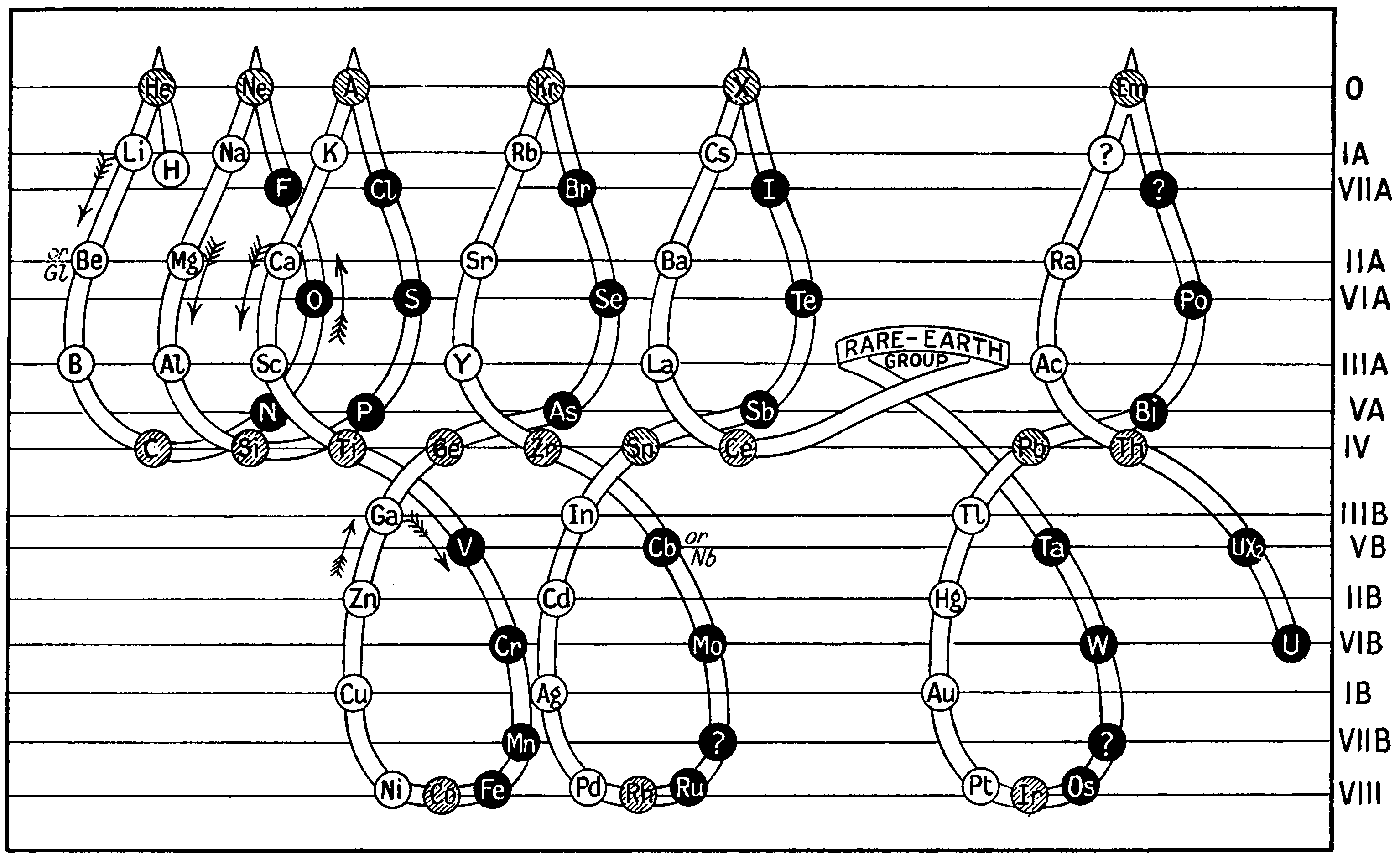
Electropositive Elements, above plane of paper, black letters on white ground. Electronegative Elements, below
plane of paper, white letters on black ground. Intermediate Elements, in plane of paper, black letters on sectioned
ground.
| Group |
III. |
IV. |
V. |
VI. |
VII. |
VIII. |
| |
A |
B |
A |
B |
A |
B |
A |
B |
A |
B |
|
| Series |
6 |
Yt |
|
Zr |
|
Cb |
|
Mo |
|
|
Ru |
Rh |
Pd |
| „ |
7 |
|
In |
|
Sn |
|
Sb |
|
Te |
|
I |
|
| „ |
8 |
La |
|
Ce |
|
Pr |
|
Nd |
|
Sa |
|
Eu |
|
| „ |
9 |
|
Gd |
|
Tb |
|
Dy |
|
Ho |
|
Er |
Tm |
|
Yb |
| „ |
10 |
Lu |
|
|
Ta |
|
W |
|
|
Os |
Ir |
Pt |
| „ |
11 |
|
|
|
|
|
|
Fig. 6.—Part of the Periodic Table,
showing the Positions assigned
to the Rare Earth Elements by Brauner in 1908
Brauner’s conception is also in accord with the physical
properties of the elements and their compounds. These vary
continuously throughout the group, and show nowhere the
sudden transitions which are characteristic of other series in
the table. Benedicts[177] has collected all the data bearing on
the atomic volumes, and finds that those also vary continuously,
with rise in the atomic weights, within quite small limits, all
lying between the values for barium and tantalum. In face
of all the evidence furnished by physical and chemical properties,
however, Brauner[178] has recently reverted to an idea
which he put forward in 1881, according to which lanthanum
and cerium are placed as usual in Groups III and IV, series 8,
whilst the other elements are distributed in order throughout
the remaining groups, as shown in Fig. 6.
In support of this arrangement, he quotes the fact that
some of the elements appear to be able to form higher oxides
in the presence of other oxides, which act as oxygen carriers
(see pp. 174, 177-8), though these higher oxides are certainly not
salt-forming. He also deduces, from the rates of hydrolysis
of the sulphates, that the elements fall into two parallel series,
according to the strengths of the hydroxides as bases, on
which ground he justifies the distribution throughout series 8
and 9. There can be no doubt, however, that this disposition
is far less in accordance with the behaviour and properties
of the rare earth elements than is the first arrangement, which
places them in a transition zone between barium and tantalum;
it is impossible, for example, to reconcile the properties of
praseodymium with those of columbium and tantalum, or to
find the slightest analogy between neodymium and molybdenum
or tungsten, as the second arrangement requires.
The analogy of the rare earth group to the elements of
Group VIII has been pointed out by many authors.[179] On the
ground that the rare earth elements cannot be spread over the
table in series 8-10, Steele[180] favours the early classification of
Thomsen, according to which the elements are divided into
three groups. The first, corresponding to Groups I and II
of Mendelejeff’s table, consists of two sub-groups, each containing
seven elements[181]; the second, corresponding to the
first two long series of the periodic table, has two sub-groups,
each of seventeen elements, of which the first and last seven
are analogous—these elements fall into the same groups in
the periodic table—whilst the middle three are interperiodic.
These interperiodic elements are those which Mendelejeff
places in Group VIII. The third division consists of one (or
two) group(s) of thirty-one elements; here again, the first
and last seven are analogous, whilst the interperiodic elements,
which are seventeen in number, include the rare earth metals.
Steele’s idea has been extended by Werner,[182] who has
drawn up a table to illustrate it. In this classification, the
elements are arranged in order of atomic weight, but arbitrary
gaps are left in such a way that similar elements may fall
into the same vertical columns, as in the periodic table. The
arrangement has the advantage that the interperiodic elements,
consisting of the rare earth elements and the elements placed
in Group VIII of the periodic table, here do fall in the middle
of their respective periods, but it has several drawbacks, and
does not represent the transition of properties from element
to element so well as the helical representation of the periodic
table, which brings out most clearly the true relations between
the elements, and the anomalous position of the rare earth metals.
Mention must be made at this point of the theory of ‘Meta-elements’
put forward in 1888 by Sir William Crookes.[183] From
his work on the cathode luminescence of some of the oxides
(see next chapter), that author was led to the conclusion that
several of the then-accepted rare earth elements, notably
samarium and yttrium, were in reality heterogeneous, consisting
of large numbers of very closely related bodies, differing
so very slightly in properties that only the most refined methods
could perceive the variations; for these he proposed the
name Meta-elements. Though it has been proved that the
differences observed by Crookes in the luminescence spectra
were really due to the presence of very small quantities of
impurities, his paper is of great interest, in that it contains
a theory of evolution of the elements, and postulates the
possibility of their decay. Modern developments in radioactivity
have not only lent a curious force to these speculations,
but even support his contention that a chemical element, in
the ordinary sense of the word, is not necessarily homogeneous.[184]
In the field of the rare earths, also, the homogeneity of elements
is even now continually being called into question (see Thulium,
p. 204). In any case, we have in the rare earth elements a
series of bodies in which the change of properties from one
member to another—and the consequent possibility of easy
separation—is so very slight, and so far without parallel in
the whole field of chemistry, that we are at least justified in
asking whether some extension of our ordinary conception of
an element is not required.
The chemist who sets out to prepare a pure compound of
a rare earth element is faced by a great difficulty. The rare
earth compounds occur in nature, as one might expect from
their great similarity, as mixtures of very complex composition.
After the relatively simple separation from foreign elements
has been accomplished, the enormously greater difficulty of
separating the elements from one another has to be encountered.
So great is this difficulty, by reason of the fact that, with the
sole exception of cerium, the elements show no variation in
property sufficient to allow of the use of ordinary analytical
methods, that even at the present day it is extremely doubtful
if all the elements in the yttrium group are known to us.
The methods which can be adopted in attempting a separation
are of two kinds. The first includes those processes which
take advantage of the gradual variation in basic strength of
the hydroxides as the atomic weight changes; the most
important of these are fractional precipitation of the hydroxides,
and fractional decomposition of the nitrates. Fractional precipitation
of the hydroxides is generally effected by gradual
addition of ammonia, soda, magnesia, or other base, to a solution
of the mixed salts; such a solution may also be digested
with the oxides obtained by ignition of another fraction of
the rare earth compounds. If the digestion be sufficiently
complete, the precipitate in each case will be richer in the
less basic hydroxides, whilst the solution will be richer in
the salts of the more electropositive elements.
The fractional decomposition of the nitrates is based on
the fact that when a mixture of the salts is heated gradually,
the nitrate of the least positive element begins to decompose
first. The temperature is maintained for some time at the
point at which decomposition begins; when nitrous fumes
cease to be evolved the mixture is cooled, and extracted with
water or dilute acids. The insoluble portion—basic or superbasic
nitrate (see p. 128)—will then be richer in the less electropositive
elements; the solution is evaporated, and the solid
so obtained subjected to a somewhat higher temperature,
and the process repeated several times. In this way, a series
of fractions is obtained, in which the elements tend to distribute
themselves in order of electropositive character. By a sufficient
number of systematic repetitions of such steps, the elements
may eventually be obtained in the form of compounds of
approximate purity, which may then be refined by one of the
methods of the second kind described below. Experience has
shown, however, that a quicker and more complete separation
may generally be effected by combining two or more methods
of separation; one method will give the best separation up
to certain limits, but then becomes much less valuable; the
separation at this point is therefore taken up by another
process. A process depending on differences of basic strength
of the hydroxides is generally supplemented by a method of
the second class, i.e. a process of fractional crystallisation;
where the basicity method is not used (as, for example, in
most of the recent processes for separation of the cerium
elements), two or more different methods of fractional crystallisation
will supplement one another.
The methods of the second class, which are processes of
fractional crystallisation, depend on the differences in solubility
which are observed in analogous compounds in passing
from one member of the group to another. The value of these
methods, as opposed to the methods depending on differences
in basic strength, was clearly shown by Auer von Welsbach,
who in 1885 succeeded in resolving Mosander’s ‘Didymium’
into two new elements, praseodymium and neodymium, by
fractional crystallisation of the ammonium double nitrates;
since that date, much attention has been devoted to the task
of finding rare earth compounds which will lend themselves
to such processes. The method is extremely laborious, and
may involve several thousand recrystallisations, in consequence
of the generally very slight differences of solubility, and the
ease with which the rare earth compounds, being almost always
isomorphous with one another, form mixed crystals.
Whilst the method of fractional crystallisation has come
into general use for the separation of one element from another
only within the last thirty years, processes for the separation
of the cerium group from the yttrium elements, depending
on differences of solubility, have long been known and used.
The most important of these, the double sulphate method,
depends on the fact that the potassium double sulphates of
the cerium metals are almost insoluble, whilst those of the
terbium group are sparingly, and of the yttrium group readily
soluble in a concentrated solution of potassium sulphate.
The cerium elements may be thus completely removed from
a solution of mixed salts by addition of a crust of potassium
sulphate crystals, or of an hot concentrated solution of the
same reagent. In other cases, e.g. in the double carbonate
and double oxalate processes, separation is effected by taking
advantage of the greater tendency to the formation of double
salts possessed by the yttrium metals.
In effecting a separation of closely related bodies by
fractional processes, in which a large number of repetitions
of the same operation are necessary, only the most careful
and systematic procedure can avoid much waste of valuable
material; in these processes, the object of the chemist is to
obtain pure end fractions, whilst keeping the middle fractions
as small as possible. One method of procedure generally
adopted is illustrated in Fig. 7, which represents a fractional
crystallisation of a mixture of four or five substances, α, β,
... φ; the separations being usually conducted in such a
way that subgroups of three, four or five elements are first
obtained, these being then further fractionated to obtain the
pure elements. In the diagram, crops of crystals are represented
by crosses, the mother-liquors by circles; for the sake
of illustration, the process is made to appear as simple as
possible.
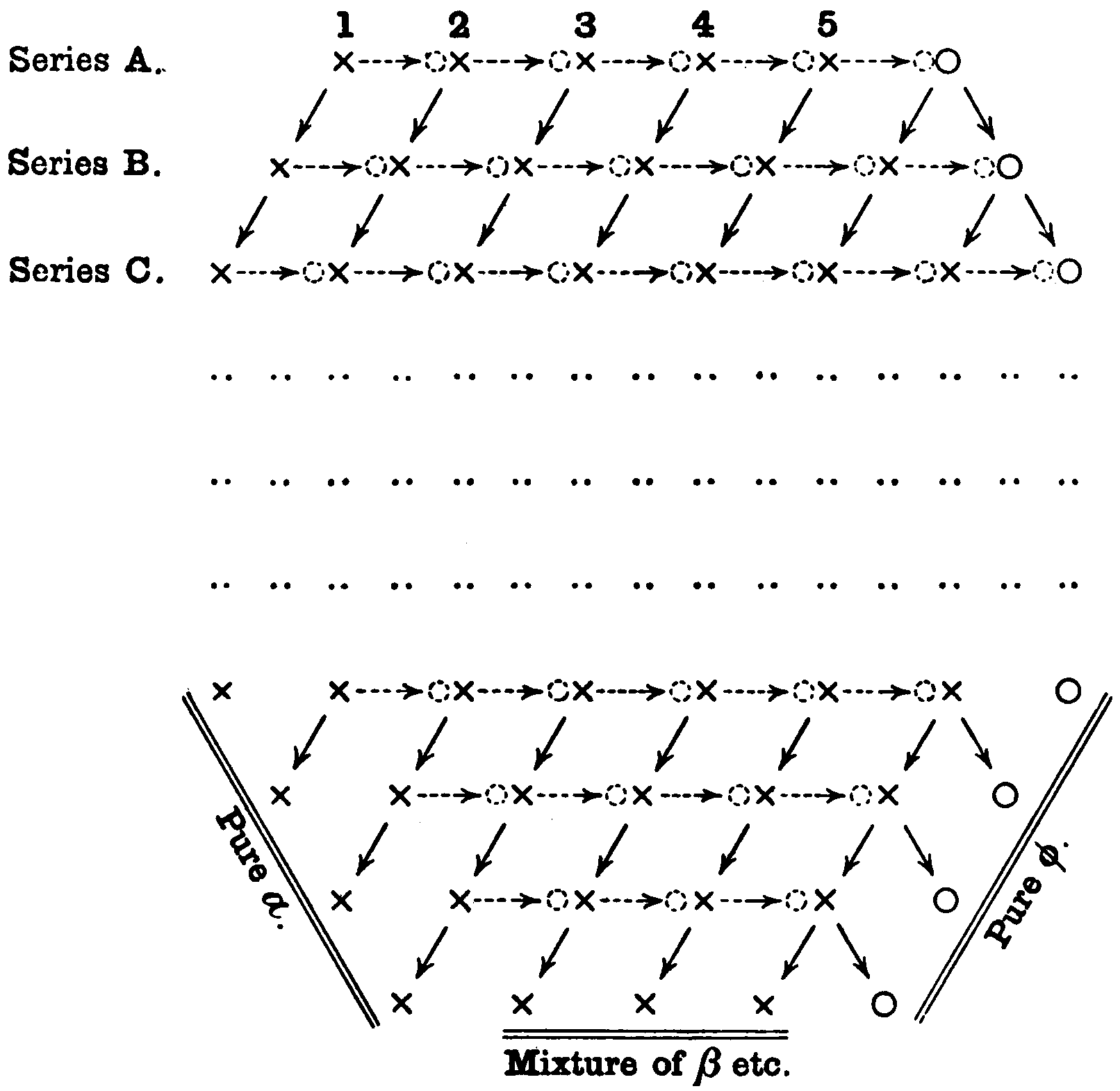
Fig. 7
The mixture is dissolved up, and allowed to crystallise;
the crystals are filtered off, the filtrate concentrated, and a
second crop obtained; this is repeated until five or six crops
of crystals have been obtained. These, with the mother-liquor,
constitute series A. The first fraction is now recrystallised;
it yields a crop of crystals, fraction 1 of series B,
and a mother-liquor, which is added to fraction 2 of series A,
as indicated by the dotted arrow and circle; on recrystallisation
of this mixture, a crop of crystals, fraction 2 of series B,
is obtained, together with a mother-liquor, which is recrystallised
with fraction 3 of series A. In this way, by continued
repetition, series are obtained, of which each contains one
fraction more than its predecessor; the least soluble constituent
is thus concentrated in the fractions represented on
the left of the diagram, whilst the most soluble accumulates
in the mother-liquors. After a greater or smaller number of
series have been traversed, according to the differences in
solubility, the end fractions in each series will be pure. These
are no longer fractionated, and the number of fractions in
each series begins to diminish, as shown on the diagram.
The middle fractions will contain the compounds of intermediate
solubility; these may be separated by further fractionation
on the same lines, or may perhaps be better treated
by a different or modified process.
In a modification of the method, each fraction of series A
is recrystallised separately, yielding a crop of crystals, and
a mother-liquor; series B is then built up by adding to the
crystals from fraction 2 the mother-liquor from fraction 1, to
the crystals from fraction 3 the mother-liquor from fraction 2,
and so on; the fractions in this series are then recrystallised
separately, and the third series built up by the similar combination
of the crystals and mother-liquors.
Similar systematic methods of procedure must be adopted
in working out any method of fractional separation; it can
at once be seen that where, as in the rare earth group, only
small variations in properties exist, much time and care must
be expended, if pure products are required.
Since the development of the methods of spectrum analysis,
the difficulty of testing the efficiency of a method of separation,
and of examining the purity of the products obtained, has
been greatly lessened. The only reliable test at the disposal
of the earlier chemists was the determination of the equivalent
weight, which still constitutes an important check on the
modern methods. Some account of the methods available
for the control of the methods of separation is essential in
a general account of the rare earths; but before describing
these, it will be convenient to give a short description of the
methods used in the extraction of the elements from the rare
earth minerals.
With the exception of those containing large proportions
of columbium, tantalum, and titanium, the rare earth minerals
are easily decomposed by acids. The silicates, as a general
rule, can be satisfactorily treated with hydrochloric acid in
the ordinary way, but for large quantities, the use of sulphuric
acid is more desirable. The more refractory minerals are
completely decomposed by fused alkali hydrogen sulphate;
sodium bisulphate is more suitable for this purpose than the
potassium compound, the sodium double sulphates of the
rare earth elements being more soluble than the potassium
salts. Hydrofluoric acid also attacks the refractory minerals
very readily; the rare earths, in this case, are left as the
insoluble fluorides.
After decomposition with sulphuric acid or bisulphate, the
cold residue is extracted with water, the rare earth sulphates
or double sulphates being removed in solution. Digestion
with nitric acid may be necessary at this stage, if titanium,
columbium, etc., are present; after filtration, the solution is
evaporated to dryness, and the residue extracted with dilute
hydrochloric acid. The solution is saturated with sulphuretted
hydrogen to remove lead, copper, bismuth, molybdenum, etc.,
and treated in the usual way with ammonium chloride and
ammonia. The precipitate is washed, and dissolved in hydrochloric
acid, the solution heated to about 60°, and the rare
earths precipitated by addition of excess of oxalic acid, which
holds in solution any zirconium which may be present. In
the presence of phosphates, e.g. in the treatment of monazite
or xenotime, the precipitate of oxalates should be ignited to
the oxides, these dissolved in acid, and a second precipitation
with oxalic acid effected; this treatment is necessary to
remove phosphoric acid completely.
Preliminary examination of the earth mixture.
—Before
a method of separation can be decided upon, some knowledge
of the composition of the mixture to be treated
must be obtained. The nature of the mineral used for the
extraction will, as a rule, afford useful information. It is
known that in some minerals the cerium group, in others the
yttrium group, predominates more or less completely; certain
minerals, also, are known to be rich in elements of one or
another subgroup. An approximate knowledge of the relative
proportions of the cerium, terbium, and yttrium groups will
be afforded by a rough double sulphate separation; thorium,
zirconium, and scandium come down with the cerium earths.
For approximate separation, Urbain[185] proposes the use of the
ethylsulphates. The yttrium elements can be quickly separated
in an approximate manner by fractional precipitation
of the hydroxides with magnesia. The successive fractions
obtained by these methods are examined spectroscopically;
from the results, the composition of each, and so of the original
mixture, may be roughly deduced.
In no department of chemistry have the methods of
spectrum analysis proved of more value than in the field
of the rare earths. They provide the chemist with a means of
following and controlling his processes of separation which is
far more delicate and decisive than the older method of determining
the equivalent weight. Whilst the examination of emission
spectra, and especially of arc spectra, is of decisive value
in every case, it has the disadvantage of requiring delicate and
complicated apparatus and great experimental skill; wherever
possible, therefore, the examination of the absorption spectra is
preferred, though this is useful only for a few of the elements,
and varies considerably with the conditions employed.
The Absorption Spectra.
—Absorption in the visible region
of the spectrum is observed only with those rare earth compounds
which are coloured, and is of value, therefore, chiefly
for identification in the case of praseodymium and neodymium
among the cerium elements, and of erbium among the yttrium
metals; these give characteristic absorption bands, even in
dilute solution. The absorption spectra of the rare earth
compounds are highly characteristic, the bands being well
defined and sharply bounded, whereas coloured compounds
of the common elements show general absorption, or at best
diffuse bands, under the same conditions.
In observing an absorption spectrum, the light from a
Nernst lamp, or incandescent burner, is passed through a
layer of a suitable solution of the coloured compound, of
known concentration and thickness, and after collimation
is analysed by a suitable prism; the spectrum is observed
by a telescope in the ordinary way. Where accurate readings
are not required, as, for example, in testing for the presence
or absence of a particular element, the position of the bands
may be read to a sufficient degree of accuracy by means of a
scale, the image of which is adjusted to coincide with the
spectrum as seen through the eyepiece; but in mapping a
spectrum accurately, more refined methods must of course
be used. The photographic method, in which a photograph
of the spectrum is taken on a plate which bears, for purposes
of measurement, a comparison spectrum of known lines, is
very convenient for examining the absorption in the violet
and ultraviolet regions.
The intensity, and to some extent also the position, of
bands in an absorption spectrum may vary considerably,
according to the conditions employed. Of the various factors
which must be considered, the concentration of the solution,
the thickness of the layer used, the nature of the solvent, and
of the acid radicle, and the presence of other earths are the
most important. The concentration of the solution, and the
thickness of the layer, which together constitute the Optical
Density, must be so adjusted that the absorption is neither
too strong nor too weak; in the first case the sharp bands
tend to merge into broad diffusion areas, and details are
obscured, whilst in the second case the presence of coloured
compounds which do not show strong absorption bands may
be overlooked.
The nature of the acid radicle has considerable influence
on the position of the absorption maxima, the general rule
being that the bands are shifted towards the red end of the
spectrum as the molecular weight of the compound used
increases. Naturally, also, the nature of the solvent has an
important effect, all the usual phenomena which must be
considered in the measurement of the physical properties
of substances in solution coming into play; electrolytic dissociation,
hydration, dissociation and the formation of complexes,
for example, are all important factors. The presence
of colourless earths has also been found to cause important
differences. It follows, therefore, that for the chemist, the
absorption spectra can be considered as a valuable aid only
in detecting the presence or absence of the three elements
which give the strongest and most characteristic absorption
bands, viz. praseodymium, neodymium, and erbium, and that
conclusions regarding the quantitative composition of mixtures
must be drawn with the utmost caution.
The Emission Spectra: Spark Spectra.
—The factors
which tend to limit the value of the absorption spectra for
analytical purposes, for the most part disappear when the
emission spectra are employed. In the case of the spark
spectra, indeed, great differences are observed according to
the conditions and method of experiment; but the arc spectra
are practically invariable under all conditions, and hence they
constitute the ultimate test in all cases. The spark spectra
are observed when one terminal—the cathode—of an induction
coil is embedded in the oxides to be examined, and the discharge
then passed. The discharge is also frequently passed
between platinum poles partly immersed in a strong solution
of a salt of the element under examination; a form of
apparatus very suitable for this method of observation has
been described by Sir W. Crookes.[186] The spectra so obtained
are in a high degree characteristic, but they vary very considerably
with the form and dimensions of the coil, the
length and cross-section of the wires, the potential difference
employed, and so on. An entirely new spectrum also
is obtained in many cases by mere reversal of the current;
under these conditions, a phosphorescent appearance is
observed, the spectrum of which—reversed spark spectrum
of de Boisbaudran—has been found in many cases to resemble
the cathode luminescence spectra of Crookes.
The Arc Spectra.
—The final criterion of purity in the
examination of a rare earth element is in almost all cases the
arc spectrum. Since for some of the elements, especially in
the yttrium group, the entire spectrum has not yet been accurately
mapped out, spectra are generally observed frequently
throughout the course of a fractionation; by this means, the
separation can be followed by the disappearance of some
lines, and the appearing or strengthening of others, and such
examinations have led occasionally to the discovery of new
elements (see, for example, under Separation of ytterbium
earths, p. 205). Such determinations, however, require much
time and extensive and complicated apparatus.
Carbon electrodes are generally employed, and it is immaterial
in this case which is the anode, and which the cathode.
The lower carbon is hollowed out, and the space filled with
the oxide or sulphate of the element or mixture to be examined;
or the electrode may be impregnated with a concentrated
solution of a salt. The light is examined by means of a
diffraction grating, and the spectrum photographed on a plate
which bears a comparison spectrum for measurement. The
lines are most numerous in the violet and ultraviolet regions,
and the most characteristic spectra are given by the colourless
earths. The method is naturally more delicate for some
elements than for others; the great persistency of the scandium
line 3613·984, for example, was found very valuable by Crookes
and by Eberhard in the examination of various rocks and
minerals for that element, whilst other intense and persistent
lines have served for the detection of various rare earth elements
in the sun and many stars.
The Cathode Luminescence Spectra.
—The phenomenon of
cathode luminescence, which was observed and very fully
investigated by Sir William Crookes, and which led that
author to his theory of Meta-elements, is one of the greatest
scientific interest. Crookes observed that certain of the rare
earths, when subjected to the action of cathode rays in a
vacuum tube, exhibit a brilliant phosphorescence, which,
when examined by the spectroscope, show characteristic
spectra, which differ greatly for fractions of apparently
identical chemical composition, and are otherwise distinguishable
by physical properties. The researches of Lecoq de
Boisbaudran, and the more recent work of Baur and Marc,[187]
have shown that this luminescence is observed when a
small quantity of a coloured earth is present with a very
large quantity of a colourless earth, the maximum phosphorescence
being produced by about 1 per cent. of the coloured
earth, or ‘phosphorogen.’ The question has recently been very
fully examined by Urbain.[188] He shows that the sensitiveness
of the phenomenon is so great that it cannot be employed
for the ordinary purposes of chemical analysis, one part in a
million of the phosphorogen being sufficient to cause a clearly
perceptible luminescence in a pure colourless oxide.
The Magnetic Susceptibility.
—The fact that the rare
earths differ very considerably from one another in their
magnetic properties has been known for several years,[189] and
has recently been employed by Urbain and Jantsch[190] as a
means of identification, and a test of purity, and for following
processes of fractionation. The magnetic susceptibility
reaches a minimum at samarium, and rises very sharply on
either side of that element, so that the presence of the closely
related elements, neodymium on the one side, and europium
and gadolinium on the other, which differ only very slightly
from samarium in atomic weight and solubility, can easily
be detected by this means. The property is highly additive,
and can be used, therefore, to estimate the relative proportions
of two oxides in a mixture; the determinations are said to be
easily and quickly carried out.
When the elements are considered in order of atomic
weight, the coefficient reaches a maximum at neodymium in
the cerium group, and again at dysprosium (or holmium) in
the yttrium group:—[191]
| Element. |
Atomic
Weight. |
Coefficient of
magnetisation
for the oxide.
x × 10⁻⁶ |
| Scandium |
44·1 |
-0 |
·05 |
| Yttrium |
89·0 |
-0 |
·14 |
| Lanthanum |
139·0 |
-0 |
·18 |
| Neodymium |
144·3 |
33 |
·5 |
| Samarium |
150·4 |
6 |
·5 |
| Europium |
152·0 |
33 |
·5 |
| Gadolinium |
157·3 |
161 |
|
| Terbium |
159·2 |
237 |
|
| Dysprosium |
162·5 |
290 |
|
Erbium, thulium, ytterbium, and lutecium appear in descending
order at the end of the series, but no figures are given.
The most interesting application of the property has been
Urbain’s discovery of the new element Celtium (see p. 207).
The determination of the mean equivalent weight, which
was for the earlier chemists the only reliable method of controlling
their fractionations, is still of considerable importance
for this purpose, especially in the yttrium group, in which
the differences in atomic weights are more considerable than
among the cerium metals. Great importance, moreover, still
attaches to these determinations, since they serve to fix the
atomic weights; save that the methods used in an atomic
weight determination are somewhat more elaborate and
refined than those used when it is desired merely to test a
fractionation, the same processes apply in both cases.
The methods which have been most commonly used are
those based on a determination of the ratio R₂O₃ : R₂(SO₄)₃,
and these are of two kinds, the synthetic and the analytical.
The first, in which a known weight of the oxide is converted
into the sulphate, has been most used for the most strongly
basic oxides, since with these it is difficult to remove the last
traces of sulphuric anhydride from the oxide by heat. The
oxides are best obtained from the oxalates, which are precipitated
from an acid solution of the nitrates, washed thoroughly
with water, alcohol and ether in succession, dried, and ignited
in a tarred platinum crucible. The oxide is best dissolved
in dilute hydrochloric or nitric acid on the waterbath, a slight
excess of sulphuric acid being added only when a clear solution
has been obtained; the liquid is then heated gradually
to 300°, and finally in the electric furnace at 450°-550° until
constant in weight. If sulphuric acid be added directly to the
weighed oxide, particles of the latter may become completely
coated with the insoluble sulphate, and so escape the action of
the acid.
In the analytical method, a known weight of sulphate is
ignited to the oxide, and weighed as such. This method is
most suitable for the less basic members of the yttria earths,
of which the sulphates can be completely decomposed without
difficulty at a red heat. By the use of the microbalance, a
sufficiently accurate determination can be carried out by either of
these methods in little more than half an hour, as the chemical
changes are exceedingly rapid where only small quantities
are employed, and no time is required to allow the vessels
and solids to cool. Using the microbalance, Brill[192] has carried
out a series of experiments to determine the limits of
temperature within which the various steps of the process
should be carried out. He finds that a temperature of
400°-550° is required to decompose the last traces of acid
sulphate, and give the pure neutral sulphate. Between the
temperatures of 850° and 950°, basic salts are formed, from
which the last trace of sulphuric anhydride is expelled
at 900°-1150°; the precise temperature required in each
case depends, of course, on the basic strength of the oxide
in question.
The determination of equivalents by means of the ratio
R₂O₃ : R₂(C₂O₄)₃, has been brought to a high degree of accuracy
by Brauner.[193] A weighed quantity of the carefully prepared
oxalate is ignited, with suitable precautions, to the oxide, in
a tarred platinum crucible. A second weighed specimen of the
same oxalate preparation is dissolved in dilute sulphuric acid,
and titrated at 60° with permanganate, which is standardised
against pure ammonium oxalate.
Of the methods of volumetric analysis which have been
proposed, that put forward by Feit and Przibylla appears to
be the most suitable. A convenient quantity of oxide, which
has been ignited until constant in weight, is dissolved by gently
heating with a known excess of N
2 sulphuric acid, in a conical
flask of Jena glass. The excess of acid is titrated with
N10
sodium hydroxide, using methyl orange as indicator. This
method, which has the advantages of ease and quickness,
is very reliable, if suitable precautions are taken, in the case of
the more strongly basic oxides; but with the least strongly
basic members of the yttria group, the erbia and ytterbia
oxides, the end point is not very sharp, whilst with the weakly
basic scandia, the method breaks down entirely.[194]
The extraction of the rare earth elements from minerals,
by which they are obtained in the form of the oxalates, and the
methods of bringing these into solution, have already been
described. From the solution, before any separation of the
rare earths is attempted, thorium should be removed; for
this purpose, any of the methods described under estimation
of thorium (see p. 286) may be used, the most convenient being
the peroxide precipitation of Wyrouboff and Verneuil.
The solution is then treated with potassium sulphate until
the absorption bands of didymium (praseodymium and neodymium)
can no longer be observed, or appear only very faintly,
when a layer of the solution is examined with a spectroscope;
the precipitate then consists of the potassium double sulphates
of the cerium with some of the terbium elements. If the
mixture is very rich in the cerium elements, and correspondingly
poor in the yttrium elements—as, for example, the mixture
of earths obtained from monazite—Drossbach[195] recommends
a preliminary separation by means of the double carbonates;
the double sulphate method may then be employed to remove
the last of the yttrium and most of the terbium elements.
The sparingly soluble double sulphates of the cerium metals
may be transformed into the hydroxides by digestion with
potassium hydroxide, and these taken into solution, after
washing, by hydrochloric or nitric acid.
Of all the rare earth elements, cerium, by virtue of its
property of forming ceric salts corresponding to the dioxide
CeO₂, is the one most easily separated and obtained in the
pure state. In those compounds in which it is tetravalent,
cerium functions as a much less strongly electropositive element
than in the cerous compounds, and all the methods of separation
are based on this fact. Mosander, who first demonstrated
that the old ‘ceria’ was a mixture, separated the element by
treating a suspension of the hydroxides in potassium hydroxide
with chlorine; yellow ceric hydroxide remains undissolved,
whilst the other elements go into solution as the chlorides
and hypochlorites. This method was extensively used until
quite recently; it has the advantage of separating the cerium
completely, but the product is very impure, and several repetitions
are required to give good results. The basic nitrate
method, which is now used on the commercial scale in
extracting cerium from monazite (see p. 284), is also due to
Mosander, though it has been employed subsequently by many
workers.
Several methods take advantage of the ease with which
the ceric salts, as compared with salts of the trivalent elements,
may be hydrolysed. Brauner[196] dissolves the oxides in nitric
acid, and after removal of excess of acid, boils with a large
volume of water—basic ceric nitrate is thrown down, the other
elements remaining in solution as nitrates. The precipitate
is redissolved, and the process repeated until the cerium is
found spectroscopically to be free from didymium. The hydrolysis
of the ceric salt may be effected more quickly and completely
by the addition of ammonium sulphate or magnesium acetate.[197]
James[198] boils the solution of the nitrates with potassium
bromate, keeping the whole neutral by addition of powdered
marble; the cerium is completely and very quickly precipitated
as basic nitrate.
An interesting method is due to Koppel[199]; the oxides are
dissolved in a solution of hydrogen chloride in methyl alcohol,
and treated with pyridine, when the sparingly soluble double
chloride, (C₅H₅NH)₂CeCl₆, separates, and may be obtained
pure by recrystallisation from alcohol and ether. The permanganate
method of Drossbach, which is used on the commercial
scale, is described on p. 285.
The cerium compounds obtained by these methods are
purified by transformation into the anhydrous sulphate,
which is dissolved in ice-water; when this solution is
allowed to come slowly to room temperature, the pure octohydrate
separates. Pure cerium salts should show no trace
of absorption when concentrated solutions are examined
spectroscopically; on ignition, the oxide obtained should be
almost colourless, having at most a faint yellow tinge. A
reddish or brownish-red shade indicates the presence of praseodymium.
An arc spectrum examination will generally show the
presence of lanthanum, which occurs in traces even in the most
carefully purified cerium preparations.
The preparation and properties of metallic cerium have
already been described (see p. 114); for an account of the
pyrophoric alloys, see p. 314.
The Cerous Compounds
The salts of trivalent cerium are very similar to those of
the other rare earth elements, and a detailed description of
them is therefore unnecessary. The sesquioxide, Ce₂O₃, cannot
be obtained by ignition of the oxalate, nitrate, or other similar
salt, since these decompose at high temperatures with formation
of the dioxide, CeO₂. It has been prepared by the reduction
of the dioxide with calcium;[200] it has a great affinity for oxygen,
and readily absorbs the gas when exposed to moist air. Cerous
hydroxide, Ce(OH)₃, obtained by addition of alkali to solutions
of cerous salts, has also strong reducing properties,[201] and can
only be prepared and preserved when oxygen is carefully
excluded. It has been obtained as a perfectly white solid
by the action of water on the carbide;[202] when dried in an inert
atmosphere, it yields a perfectly white oxide. In presence of
air, it darkens, assuming a reddish-violet colour, which passes
into yellow as the oxidation becomes complete. The oxidation
proceeds more quickly in presence of potash or soda, ceric
hydroxide, Ce(OH)₄, being formed; in presence of potassium
carbonate, however, a dark-coloured peroxyhydrate is formed
by autoxidation. The colour so produced disappears on shaking
if an ‘acceptor’ is present, ceric hydroxide being left; if the
acceptor cannot reduce this, the solution after shaking loses the
power of re-forming the dark peroxide, but if the acceptor can
reduce the ceric compound to cerous hydroxide, the solution
after shaking regains the power of forming the peroxide which
is a property of the lower hydroxide.
Cerous nitride, CeN, has been prepared by Moissan[203] by
the action of ammonia on the heated carbide; it can also be
obtained by heating the hydride in a stream of nitrogen.[204]
Muthmann and Kraft also state[205] that it can be prepared by
heating metallic cerium in the gas, the metal burning with the
liberation of much energy in the form of heat and light; but
Dafert and Miklanz[206] deny that it can be obtained in this
way. Cerium nitride is a lustrous, brass yellow to bronze
coloured solid, stable in dry air, but at once attacked by
moist air, with evolution of ammonia, and formation of the
dioxide. When moistened in air with a few drops of water,
the substance reacts violently, becoming heated to redness.
Alkalies and acids decompose it, with formation of cerous
compounds.
The sulphide, Ce₂S₃, has been prepared by Biltz[207] by
heating the sulphate to a red heat in a current of sulphuretted
hydrogen; he describes it as a red powder. The chloride,
CeCl₃, combines with ammonia with evolution of heat even
at a temperature of -80°. Five additive compounds are
described;[208] they are white powders, decomposed by water.
The solubility curve of the various sulphate hydrates has
already been given (see p. 125). Various double sulphates with
ammonium sulphate, and the sulphates of sodium, potassium,
thallium and cadmium are known. The cadmium double
compound has the composition Ce₂(SO₄)₃,CdSO₄,6H₂O,
and is prepared by mixing solutions of the simple salts
in presence of sulphuric acid. Many double nitrates have
been prepared; these are for the most part stable, highly
crystalline compounds, easily soluble in water and alcohol.
With the nitrates of the common divalent metals, cerous
nitrate forms a series of double salts of the general formula
2Ce(NO₃)₃,3R(NO₃)₂,24H₂O, where R = Mg, Mn, Co, Ni, or Zn;
these form an isomorphous series, crystallising in the hexagonal
system. The acetylacetone compound melts at 131°-132°.
In the presence of hydrogen peroxide in the cold, ammonia
throws down from solutions of cerous salts a reddish-brown
peroxyhydrate, Ce(OOH)(OH)₃,[209] which on heating loses
oxygen, and yields ceric hydroxide. The reaction is very
delicate, and may be used as a test for cerium. If the precipitate
be treated with acids in the cold, ceric salts are first
obtained, but these are at once reduced, in the acid solution,
by the hydrogen peroxide formed, so that cerous salts remain;
ceric salts may be obtained by first boiling the suspension of
the peroxyhydrate and treating the ceric hydroxide so obtained
with acids.
The Ceric Compounds
The ceric salts are much more readily hydrolysed than the
cerous salts, and show a great tendency, in dilute solution,
to pass over into the latter. So great is this tendency that a
solution of a ceric salt acts as if it were supersaturated with
oxygen; ceric sulphate, for example, in dilute solution slowly
evolves oxygen, whilst the chloride evolves chlorine. In
consequence of this behaviour, ceric compounds have a very
powerful oxidising action. The ceric salts are yellow to red
in colour; their solutions are strongly acid, owing to the
ease with which the salts hydrolyse, and on boiling deposit
insoluble basic salts.
Beside the methods which have already been mentioned,
ceric compounds may be prepared from cerous by oxidation
with sodium peroxide, bismuth tetroxide, ammonium persulphate,
etc. In electrolysis of cerous salts, also, ceric compounds
are obtained at the anode.
Ceric hydroxide, Ce(OH)₄, is obtained as a gelatinous
yellow precipitate on the addition of alkali to a solution of a
ceric salt, or by the oxidation of cerous hydroxide. The
freshly prepared precipitate dissolves in nitric acid with a
reddish colour; hydrochloric acid reduces it, with evolution
of chlorine, and formation of cerous chloride, whilst sulphuric
acid dissolves it with partial reduction, oxygen being evolved.
If a solution of a ceric compound be dialysed for some days,
a clear neutral solution is obtained, which contains the hydroxide
in the colloidal condition; by evaporation of the solution,
a gummy mass is obtained, which dissolves again in water
to a clear solution. Electrolytes rapidly cause coagulation.
Cerium dioxide, CeO₂, is obtained by the ignition of any
salt of cerium with a volatile acid, or by burning the element
in oxygen; the latter reaction produces a very intense and
blinding light, on account of which cerium compounds are
often suggested for use in flashlight powders (see p. 319). The
pure oxide should be almost white, or at most a very faint
yellow, but the exact shade and appearance vary according
to the method and temperature employed in preparation,
doubtless by reason of the possibility of different degrees of
polymerisation.[210] The oxide can act as an oxygen carrier
towards other substances, notably towards other oxides of the
rare earth group,[211] but the phenomena have not been fully
elucidated. In virtue of this property, the dioxide has been
proposed as a substitute for platinised asbestos in Dennstedt’s
method for the combustion of organic bodies.[212]
The ignited oxide is soluble in nitric or hydrochloric acid
only in presence of a reducing agent. Concentrated sulphuric
acid converts it into ceric sulphate; fused bisulphate attacks
it more readily. In the crystalline form, obtained by fusing
the amorphous form with borax, or a suitable salt,[213] it is
extremely resistant to acids and to alkalies.
By heating the dioxide in a stream of hydrogen, care being
taken to exclude air, a dark blue oxide, of which the composition
corresponds approximately to that required by the formula
Ce₄O₇, is obtained.[214] This substance has strong reducing
properties; when warmed in air, it glows, forming the dioxide,
and reduces carbon dioxide when heated in a current of that
gas. This intermediate oxide is said to correspond in
composition to the violet hydroxide which is obtained as an
intermediate product in the oxidation of cerous to ceric
hydroxide, and which is said to yield the blue oxide, Ce₄O₇,
when dried in vacuo.
The disulphide, CeS₂, has been obtained by Biltz[215] by
prolonged heating of anhydrous cerous sulphate in a current
of sulphuretted hydrogen at a dull red heat; it is a dark,
yellowish-brown, crystalline solid, which on treatment with
hydrochloric acid yields hydrogen persulphide.
Halogen salts.—No halogen compounds are known in the
free state, except the fluoride, CeF₄,H₂O, which was obtained
by Brauner as a yellowish-brown mass, by the action of
hydrofluoric acid on the hydroxide. A double fluoride,
2CeF₄,3KF,2H₂O, was prepared by the same author by
dissolving the hydroxide in potassium hydrogen fluoride; it
is insoluble in water. By dissolving a ceric salt in concentrated
hydrochloric acid, a dark red solution is obtained, which is
believed to contain the unstable complex acid, H₂CeCl₆; this
decomposes slowly in the cold, more quickly on warming, with
evolution of chlorine, and formation of cerous chloride.
Several double compounds of ceric chloride with hydrochlorides
of organic bases have, however, been obtained.
Ceric sulphate, Ce(SO₄)₂, is obtained by the action of concentrated
sulphuric acid on the dioxide. It is a deep yellow
crystalline powder, dissolving readily in water to a brown
solution, which has a strongly acid reaction; on warming or
diluting, a basic sulphate separates. The solution slowly
evolves oxygen, and therefore always contains cerous
compounds. On evaporation, a cero-ceric acid sulphate of
the formula HCeiiiCeiv(SO₄)₄,12(13 ?)H₂O first separates;
the hydrated sulphate Ce(SO₄)₂,4H₂O, being more soluble,
separates on further concentration.[216] The relative amounts
of the two compounds obtained depends on the temperature and
the concentration of acid in the solution; if both these factors
are kept low, the almost pure hydrated sulphate can be at once
obtained. This separates in yellow crystals belonging to the
rhombic system; it is readily soluble in water. The mixed
acid salt is less soluble, and forms orange prisms and needles,
which cling tenaciously to sulphuric acid. Other complex
and double salts have also been obtained. When, for example,
silver nitrate is added to a warm solution of the sulphate in
concentrated sulphuric acid, a bright orange-yellow precipitate
of the salt 10Ce(SO₄)₂,6Ag₂SO₄ is obtained.[217]
Neutral ceric nitrate is unknown. A basic nitrate,
Ce(NO₃)₃OH,3H₂O, is obtained in red crystals by evaporation
of a solution of ceric hydroxide in strong nitric acid. The
solid is readily soluble in water, forming a yellow, acid solution,
which becomes paler by hydrolysis, on warming or on standing.
The course of the hydrolysis is also indicated by the action
towards acids, and towards hydrogen peroxide.[218] A freshly
prepared ceric salt, on addition of acid, becomes immediately
much darker in colour, whereas the colour change is very
slow, if considerable hydrolysis has occurred. Similarly,
hydrogen peroxide at once reduces a freshly prepared solution,
forming colourless cerous salts, whilst if much hydrolysis has
occurred, deeply coloured higher oxidation products are at
first formed, and these lose their colour only slowly.
The double ceric nitrates[219] are a large and very important
class of compounds; they are the most stable of the ceric
salts. With nitrates of the monovalent metals, ceric nitrate
forms double nitrates of the type R₂Ce(NO₃)₆; these are deep
red hygroscopic substances, crystallising in the monoclinic
system, readily soluble in water and alcohol, but dissolving
only sparingly in nitric acid. The ammonium salt is important
for the separation of cerium. A series of double nitrates
with the nitrates of manganese, magnesium, zinc, nickel, and
cobalt has the general formula RCe(NO₃)₆,8H₂O, but these are
much less stable in solution than the alkali double salts.
Atomic Weight of Cerium
No less than twenty-eight separate determinations of
the atomic weight of cerium have been carried out. The
earlier determinations are rendered unreliable by the almost
certain presence of other elements, and Brauner[220] has shown
that some of the methods employed in later work give erroneous
results.
A very careful determination was made by Robinson in
1884.[221] Cerium oxalate was heated in a stream of dry hydrogen
chloride, mixed with carbon dioxide, and the anhydrous
chloride freed from traces of acid in a vacuum over chalk.
The weighed chloride was then dissolved in water, and titrated
with silver nitrate. He obtained the value 140·26; recalculation
from his data with the modern values for silver and
chlorine give 140·19. Brauner points out that this result
is too low, since no account was taken of the solubility of
silver chloride in water. In the following year, Brauner[222]
determined the ratio Ce₂(SO₄)₃ : 2CeO₂, and obtained the
atomic weight 140·22. Wyrouboff and Verneuil[223] in 1897
disputed Brauner’s work, and as a result of several determinations
gave the values 139·21, 139·43, and 139·50; their determinations,
however, varied very considerably, and the work
has been severely criticised by Brauner. In 1903, the latter
author and Batěk[224] obtained the values 140·21 and 140·27 by
the sulphate and oxalate methods respectively; whilst in the
same year, using the same methods, Brauner[225] obtained from
three independent series of determinations the values 140·25,
140·24, and 140·25.
The International Atomic Weight Committee have accepted
the value 140·25 since 1904.
Detection and Estimation of Cerium
The detection of cerium in a mixture of earths is a comparatively
simple matter, as it has several distinctive reactions.
The brown colour of the peroxy-compounds has been suggested
as a convenient test by several authors. This may be observed
when ammonia is added to a cerous salt in presence of
hydrogen peroxide. In the presence of a large excess of
foreign earths, very dilute ammonia should be added, drop
by drop, with continuous shaking, until a small permanent
precipitate remains; this will be rich in the weakly basic
ceric hydroxide, and on addition of the peroxide solution will
show the colour clearly.[226] For very small quantities of cerium,
the neutral solution is added to warm concentrated potassium
carbonate solution, and one or two drops of dilute hydrogen
peroxide added to the clear liquid; the yellow colour is then
very characteristic.[227]
Biltz and Zimmerman[228] employ the reducing powers of
cerous hydroxide; ammoniacal silver nitrate is added to the
neutral solution of the cerous salt, and the mixture warmed.
Dilute solutions (1-2 mgms. per litre) give a brown colour,
concentrated solutions a black precipitate. The oxidation of
an ammoniacal solution of the tartrate by air or hydrogen
peroxide, by which an intense yellowish brown colour is developed,
has been recently suggested by Wirth[229] as a very
delicate test for the element.
Spectrum analysis.—Cerous salts show no absorption,
ceric salts general absorption of the violet end of the spectrum.
Arc spectrum—see Exner and Haschek,[230]
Eder and Valenta,[231]
and Cooper.[232] The emission spectrum of cerium is especially
rich in lines; for identification, the following may be used:
| 4150·11 |
4386·95 |
4539·90 |
| 4186·78 |
4460·40 |
4562·52 |
| 4222·78 |
4479·52 |
4572·45 |
| 4296·88 |
4487·06 |
4594·11 |
| 4337·96 |
4527·51 |
4628·33 |
| 4382·32 |
4528·64 |
5512·72 |
The estimation of cerium cannot be carried out accurately
by gravimetric methods in the presence of other earths; volumetric
methods, however, will give reasonably accurate results,
if the necessary precautions are taken. In Bunsen’s method
the ignited oxides are treated with hydrochloric acid in presence
of potassium iodide, the iodine set free from the hydriodic
acid by reduction of the cerium dioxide being estimated by
means of sodium thiosulphate, in the usual way. This method
gives very inaccurate results, since in the presence of cerium
dioxide, other oxides of the group can be converted into higher
oxides which will also liberate iodine under these conditions.
The most reliable method is that of v. Knorre.[233] The
solution to be estimated is acidified with sulphuric acid, and
oxidised by means of ammonium persulphate. The excess
of the oxidising agent having been destroyed by boiling, the
cooled solution is treated with a slight excess of hydrogen
peroxide, which reduces the ceric salt according to the equation:
2Ce(SO₄)₂ + H₂O₂ = Ce₂(SO₄)₃ + H₂SO₄ + O₂
The excess of hydrogen peroxide is then estimated by means
of a dilute permanganate solution. Permanganate is itself
reduced by the cerous salt formed, but the action is so
slow in acid solution at the ordinary temperature that
the excess of peroxide can be accurately determined without
unduly hurrying the titration. In this form the method
is generally employed for the estimation of cerium in
monazite sands, and in the incandescent mantle industry.
The greatest difficulty is the adjustment of the concentration
of the sulphuric acid required. If this be too low, basic
ceric sulphate separates on boiling, and the estimation fails;
if it be too high, oxidation to the ceric salt is hindered, and
may even be inhibited. This difficulty disappears in the
modified method of Waegner and Muller,[234] in which the oxidation
to the ceric condition is effected by means of bismuth
tetroxide in nitric acid solution. A similar method, in which
reduction to the cerous state is effected by a ferrous salt,
in place of hydrogen peroxide, has been employed by Metzger.[235]
Many attempts have been made to estimate cerium compounds
by means of permanganate, which in alkaline solution
oxidises cerous salts to the ceric condition, but the autoxidation
of cerous hydroxide in the air introduces errors, unless
suitable precautions are taken. Meyer and Schweitzer[236]
show that if the solution of the cerous salt be added, with
constant shaking, to a known volume of a standard permanganate
solution, in presence of excess of magnesia, the liquid
being kept warm, this difficulty is overcome; the results
are usually a little high, however, probably by reason of the
oxidising action of the cerium dioxide on the other oxides
present.
Good results have also been obtained by the use of potassium
ferricyanide in alkaline solution,[237] oxidation taking
place according to the equation:
Ce₂O₃ + 2K₃Fe(CN)₆ + 2KOH = 2K₄Fe(CN)₆ + 2CeO₂ + H₂O
The ceric hydroxide is filtered off, and the ferrocyanide formed
estimated by means of permanganate in acid solution.
In his examination of the ceria earths in 1839, Mosander
discovered a new constituent, which he called Lanthana; the
new oxide was removed in solution when the ignited mixture
was extracted with dilute nitric acid, which leaves cerium
dioxide undissolved. On examination, the new oxide was
found to be heterogeneous; by fractional precipitation with
ammonia, and subsequent recrystallisation of the sulphates, he
obtained two oxides, which he called respectively Lanthana
(λανθανειν, to be hidden), from the absence of colour and
specific reactions, and Didymia, (διδυμοι, twins) from their
similarity and the occurrence of the two together.
Samaria was isolated by Lecoq de Boisbaudran, in 1879,
from a specimen of didymia extracted from the mineral samarskite.
Two years previously, Delafontaine had shown that the
didymia separated from this mineral was not spectroscopically
identical with the oxide obtained from other sources, and in
1878 had isolated an oxide which he called Decipia; this was
shown later, however, to be a mixture of which samaria was one
component. The samaria obtained by de Boisbaudran was by
no means pure, being associated with terbia earths; several
investigators claimed to have separated from it new oxides,
most of these being proved afterwards to have been more or
less impure specimens of Europia.
In 1885, Auer von Welsbach[238] employed for the first time
the method which has now become of paramount importance for
the separation of the cerium group, viz. the fractional crystallisation
of the double nitrates. By this method he succeeded in
resolving Mosander’s didymia into two new oxides, for which
he proposed the names Praseodidymia (πρασινος, leek-green),
from the colour of the salts, and Neodidymia
respectively; the shorter names praseodymia and neodymia
are, however, now generally adopted.
GROUP A
Mixed Double Nitrates.
2R(NO₃)₃,3Mg(NO₃)₂,24H₂O.
1 La, Pr Compounds. Fractionate as R(NO₃)₃,2NH₄NO₃,4H₂O.
2 Pr, Nd Compounds. Fractionate as 2R(NO₃)₃,3Mn(NO₃)₂,24H₂O.
3 Crude Nd Compounds. Continue the Separation.
4 Mother-liquors. Sa, Eu, Gd, etc. Crystallise with Bismuth magnesium nitrate.
Terbium elements.
5 Pure La Compound. Refine by Sulphate crystallisation.
6 Pr with La. Continue.
7 Impure Pr Compound. Continue.
8 Pure Nd Compound. Refine by Sulphate crystallisation.
9 Pure Sa Compound.
Mixture of Pr, La.
Pr. Refine by Sulphate crystallisation.
Fig. 8.—Separation of the Cerium Elements
The modern methods for the separation of these elements
are based almost entirely on the differences in solubility of the
various double nitrates.[239]
The mixed double sulphates separated
by saturation of a solution of the chlorides with sodium sulphate,
which contain the cerium and most of the terbium elements, are
transformed into nitrates, and the neutral solution boiled with
potassium bromate, in presence of powdered marble, till all
the cerium is precipitated as basic ceric nitrate. From the
filtered solution the other elements are thrown down as oxalates,
transformed into the magnesium double nitrates (A in Fig. 8),
and fractionated from nitric acid solution[240] until a rough
separation has been effected (fractions 1, 2, 3, and 4). The
separation, which is somewhat long and tedious, is followed by
means of the absorption spectra, and by the colour changes of
the fractions. Fraction 1, containing lanthanum and some
praseodymium, should be faint green to colourless; fraction 2
is colourless by the complementary action of the coloured salts
of neodymium and praseodymium; fraction 3, which should
contain the crude neodymium salt, is amethyst; and fraction 4,
the mother-liquor, is yellow from the presence of the samarium
compound.
Fraction 1 is now converted to the double ammonium
nitrates, which allow of a readier separation at this stage;
two fractions are obtained, of which the less soluble, fraction 5,
is the fairly pure lanthanum compound, whilst the more soluble,
fraction 6, contains the praseodymium with a little lanthanum.
The lanthanum ammonium nitrate, fraction 5, is converted
into the anhydrous sulphate, which is dissolved in ice-water;
when the solution is gradually warmed, the enneahydrate,
La₂(SO₄)₃,9H₂O, separates, and may be obtained perfectly
pure by recrystallisation. It is of interest that the radioactive
element actinium is chemically very similar to lanthanum, and
follows it closely through the process of separation.
The mixed praseodymium and neodymium magnesium
nitrates which constitute fraction 2 are transformed into the
double manganese nitrates, and the crystallisation from nitric
acid continued.[241] The less soluble part, fraction 7, is fairly free
from neodymium, and the separation is continued with that of
fraction 6, until both lanthanum and neodymium have been
completely removed. The more soluble part, fraction 8,
yields the pure neodymium compound, as does also the crude
neodymium magnesium nitrate which constitutes fraction 3,
if the crystallisation be continued.
The mother-liquors, fraction 4, are treated with bismuth
magnesium nitrate,[242] which is intermediate in solubility between
the analogous compounds of samarium and europium, and the
crystallisation continued. The less soluble fraction contains the
samarium compound, in which bismuth is the only impurity;
this is easily removed by treatment with sulphuretted hydrogen.
The remaining fractions are used as a source of the terbium
elements (see p. 186).
The double carbonate method[243] is very suitable for the
preparation of pure lanthanum compounds after the removal
of cerium. The mixture of salts is added to a warm 50%
solution of potassium carbonate, and to the clear liquid, water
is added gradually, with constant stirring. The double carbonates
of the most positive elements are the least soluble,
and are first thrown down, so that the precipitate is rich in
lanthanum; it is collected and washed with a 25% potassium
carbonate solution, and the process repeated. A few repetitions
suffice to separate lanthanum completely from the other members
of the group. The method may also be used for the purification
of praseodymium salts.
As the most electropositive element of the rare earth group,
lanthanum is the most similar in its chemical properties to the
metals of the alkaline earths. The metal itself (see p. 115)
oxidises even in dry air, and in moist air rapidly becomes coated
with a white layer of hydroxide; it attacks water, and burns
vigorously when heated in the air. An alloy with aluminium,
of the formula LaAl₄, has been prepared by Muthmann and
Beck[244]; it forms lustrous white crystals, very stable in the air
and very resistant towards acids.
The hydroxide is of interest from the fact that, if precipitated
under suitable conditions, it has the power of taking up solid
iodine to form a deep blue adsorption compound[245]; colloidal
solutions of basic lanthanum acetate are also coloured blue
by addition of a few drops of iodine solution. If precipitation
with alkali be carried out in presence of hydrogen peroxide,
an hydrated peroxide of the composition La₂O₅,nH₂O is
obtained.[246]
This compound partially decomposes with evolution
of oxygen at ordinary temperatures; towards carbon dioxide
and acids it acts as a true peroxide, with formation of hydrogen
peroxide.
The oxide is colourless, and forms colourless salts with
those acids in which the anion is not coloured. The oxide is
distinguished from the other rare earth oxides in that it turns
moistened litmus paper blue; it resembles lime, in hissing
when slaked, absorbing carbon dioxide from the air, and
liberating ammonia from ammonium salts. By fusion with
alkali carbonates, and by digestion with concentrated alkali
hydroxides, Baskerville and Catlett[247] claim to have obtained
lanthanates and metalanthanates, but their work has not yet
been confirmed.
The sulphate, La₂(SO₄)₃,9H₂O, is the least soluble of all
the rare earth sulphates. The enneahydrate is the only
form stable at ordinary temperatures,[248] though under special
conditions, hydrates with 6 and with 16 molecules of water
of crystallisation have been obtained. It separates in needles
belonging to the hexagonal system; 100 parts of water dissolve
at 0°, 3·01, and at 100°, 0·69 parts of the salt. The
acetylacetone compound melts at 185°.
A large number of other lanthanum compounds have
been prepared, but these are so typical of the rare earth salts
generally that no detailed treatment is required; for a full
account of them, the reader is referred to Abegg’s classical
handbook.
Atomic Weight.
—A large number of determinations of this
constant have been made, but the results even of recent investigations
do not agree so closely as might be desired. The value
adopted by the International Committee, 139·0, is based on the
work of Brauner and Pavliček,[249] carried out in 1902. These
authors give an account of all the determinations made up to
that date, with critical discussion of the methods employed
and the possible sources of error. The more important investigations
have been based on the ratio La₂O₃ : La₂(SO₄)₃,
for the determination of which the most stringent precautions
must be taken. The synthetic method has generally been
employed, on account of the tenacity with which the oxide
clings to traces of sulphuric anhydride. In this method, the
total decomposition of the acid sulphate, and the protection
of the very hygroscopic sulphate, La₂(SO₄)₃, from atmospheric
moisture, constitute the chief difficulties. By this method,
H. C. Jones[250] in 1902 obtained a result (138·76) considerably
lower than the value found by Brauner and Pavliček (loc. cit.)
A later research by Brill,[251] who carried out a synthetic sulphate
determination on a minute scale, using a Nernst microbalance,
gave the value 139·5, which, whilst considerably higher than
either of the other figures, shows that Brauner and Pavliček’s
number can hardly be too high.
Detection.
—Pure lanthanum compounds show no absorption
in the visible region, and the pure oxide gives no
cathode luminescence. The emission spectra show
very characteristic lines in the violet and ultraviolet.
The chief lines are:
| 3949·27 |
4238·55 |
6250·14 |
6394·46 |
| 3988·69 |
4333·98 |
6262·52 |
|
For arc spectra see Exner and Haschek; Eder and
Valenta.[252]
This element occurs only in small quantities in the commoner
rare earth minerals, and its separation in the pure state is in
consequence a matter of very great difficulty. The salts and
their solutions have a characteristic green colour. The salts
are derived from the sesquioxide, Pr₂O₃, but a dioxide, PrO₂,
and an intermediate oxide of uncertain composition are known.
The absorption spectrum has five absorption bands, one of
which coincides with a band in the absorption spectrum of
neodymium; this fact has been interpreted as an indication of
the non-elementary nature of both metals.[253] Difference in the
absorption spectra have been put forward by several workers
as indicating the complex nature of praseodymium, but an
exhaustive examination by Stahl[254] in 1909 showed that there
is no reason to doubt that the metal is really an element.
The metal is prepared by electrolysis of the fused chloride;
in order to attain the temperature required to fuse the element,
a very thin cathode is employed; if too powerful a current be
used, the dioxide is formed. The metal is purified by remelting
it in crucibles of magnesia, under a layer of anhydrous barium
chloride. It has a yellowish shade, and is more stable in the
air than lanthanum and cerium. For physical properties, see
p. 115. No alloys have been prepared.
The hydroxide is thrown down by alkalies as a gelatinous
green precipitate; in the presence of hydrogen peroxide, an
hydrated peroxide, which closely resembles the corresponding
lanthanum compound, is thrown down.
The Oxides.—By ignition of salts of volatile acids, Auer
von Welsbach[255] obtained an oxide to which he assigned the
formula Pr₄O₇. More recent work[256] has shown that the composition
of the oxide obtained depends upon the conditions
under which the various salts are decomposed. By fusing the
nitrate in presence of potassium nitrate at 400-450°C., Meyer
obtained the dioxide, PrO₂; at higher temperatures this decomposes,
giving the intermediate oxides. The formation of the
dioxide is greatly influenced by the presence of other
oxides,[257]—ceric
oxide, acting as an oxygen carrier, favouring whilst
the other oxides hinder. The pure dioxide is a brownish-black
powder, which resembles manganese dioxide, but is
less stable. It liberates halogens from the halogen acids,
and oxidises manganese salts to permanganates, but does not
completely oxidise ferrous or stannous salts, losing instead
a part of its oxygen in the gaseous form. The dioxide cannot
be obtained in the wet way.
When heated in a stream of hydrogen, the dioxide yields
the sesquioxide, Pr₂O₃, as a greenish-yellow powder,which readily
absorbs oxygen from the air, becoming brown, with formation
of the intermediate oxide.
The chloride, PrCl₃,7H₂O, forms large green prisms,
very readily soluble in water; 100 parts of the solvent
at 13° take up 334·2 parts of the hydrated salt, the solution
having the specific gravity 1·687. The anhydrous
chloride is a pale green deliquescent powder, which melts
at a red heat to a clear green liquid; ebullioscopic measurements
show that in alcoholic solution it has the simple
molecular formula PrCl₃.
The Bromate, Pr(BrO₃)₃,9H₂O, has been obtained by James
and Langelier[258] by dissolving the oxide in aqueous bromic
acid, and also by double decomposition. It forms greenish
hexagonal prisms, melting at 56·5°, and is readily soluble;
100 parts of water dissolve 190 parts of this salt at 25°. At
100° it loses five molecules of water, forming the tetrahydrate
Pr(BrO₃)₃,4H₂O, which loses all its water at 130°. The
anhydrous salt begins to decompose at 150°.
The sulphate crystallises with 8 molecules of water of
crystallisation at ordinary temperatures, but hydrates with
151⁄2, 12, and 5 molecules of water respectively have been
described. The octohydrate is considerably more soluble
than lanthanum sulphate enneahydrate. The anhydrous
salt is a bright green powder.
Praseodymium acetylacetone melts at 146°.
Atomic Weight.
—The value 140·6, adopted by the International
Committee, is based on the work of Jones, v. Scheele,
Auer von Welsbach, and Feit and Przibylla; the work of
Brauner, however, points consistently to a higher atomic
weight. Most of these investigators have used the sulphate
method. The first determinations of von Welsbach for the
newly discovered element[259]
gave the value 140·8 (see p. 179);
another series of determinations published in 1903[260] gave the
mean value 140·57. Jones[261] obtained the sesquioxide for the
synthetic sulphate operation by reduction of the peroxide
in a current of hydrogen; according to Brauner, this method
gives an oxide which is not perfectly pure, probably by absorption
of water vapour and carbon dioxide from the air. Jones’
mean value was 140·466. v. Scheele[262] used the same method,
as well as a combined oxalate-sulphate method; his figures
vary considerably, the mean value being 140·55. Feit and
Przibylla,[263] using their volumetric method, obtained the value
140·54.
Brauner’s earlier work,[264] carried out in 1898, gave the
value 140·95. In 1901 this author[265] carried out an extensive
research on the atomic weight of praseodymium, employing
four different methods with spectroscopically pure material;
the mean value of his very concordant results was 140·97,
almost the value he obtained in 1901. A further investigation
into the value of this constant appears desirable.
Detection.
—The maxima of the absorption bands are
given by Rech[266] as follows:
| Yellow |
596·4 and 588·2, weak. |
| Blue |
481·3 very intense. |
| |
468·3 coincident with a neodymium band. |
| Violet |
444·2 |
The arc spectrum is very rich in lines.[267] The most
intense, which may be used also for identification,
are the following:
| 4008·90 |
4189·70 |
4305·99 |
| 4100·91 |
4206·88 |
4429·38 |
| 4118·70 |
4223·18 |
4496·60 |
| 4143·33 |
4225·50 |
4510·32 |
| 4179·60 |
4241·20 |
|
Neodymium is, after cerium, the commonest constituent
of the cerium group in the more important rare earth minerals,
and its separation is therefore by no means so difficult as
that of praseodymium. The compounds of the element
obtained by von Welsbach in 1885 were not pure, being admixed
with samarium compounds which had not been completely
separated. Neodymium salts were first prepared
free from samarium by Demarçay[268] in 1898; they are of a
violet-rose colour, and show in solution a well-marked and
characteristic absorption spectrum, the bands being very
numerous and sharply defined, and extending over the whole
optical region. In chemical as well as in physical and crystallographic
properties, they show an extremely close resemblance
to the compounds of praseodymium.
On account of the high melting-point, the preparation of
the metal presents the same difficulties as that of praseodymium.
A current of 90-100 ampères is employed at a
potential difference of 15-22 volts; this suffices to raise the
thin carbon cathode to a bright white heat, and to fuse the
liberated metal. For the properties of the element, see p. 115.
The sesquioxide, Nd₂O₃, when perfectly pure, has a light
blue or lilac colour, with a faint reddish fluorescence; the
shade varies somewhat according to the method of and temperature
employed for the preparation. A bluish or violet-red
fluorescence is highly characteristic of the salts, and is particularly
noticeable if the powdered recrystallised oxalate be viewed
in a good light. The greyish or brownish colour of the oxide
observed by some authors is probably due to traces of impurity.[269]
The existence of higher oxides of the formulæ Nd₂O₄ and Nd₂O₅
respectively, which Brauner[270] put forward, has been disputed by
other writers, though it is found[271] that in the presence of ceria
and praseodymia, the sesquioxide can take up more oxygen.
Waegner[272] claimed to have obtained the compound Nd₄O₇ by
heating the oxalate in a stream of oxygen, though his material,
as well as that of Brauner, contained praseodymia. More
recently, Joye and Garnier[273] have shown that the spectrum
attributed by Waegner to the hypothetical Nd₄O₇ was in
reality that of an hydrated oxide, 2Nd₂O₃,2H₂O; these authors
have also prepared a second hydrated oxide of the formula
2Nd₂O₃,3H₂O.
The chloride, NdCl₃,6H₂O, is obtained by crystallisation
from aqueous solutions; it is also precipitated by addition
of water to an alcoholic solution. It forms large deliquescent
rose-coloured crystals; 100 parts of water at 13° dissolve
246·2 parts of the salt, the saturated solution having the
density 1·741; at 100°, 511·6 parts are dissolved. The
solution resembles those of the other chlorides of the group
in that it readily dissolves the rare earth oxalates. When
heated in a current of hydrogen chloride of 130°, the hexahydrate
yields a monohydrate, NdCl₃,H₂O; at 160° the
anhydrous chloride is obtained as a very deliquescent rose-coloured
powder, which melts at a red heat to a clear red
liquid. The anhydrous chloride forms an additive compound
NdCl₃,12NH₃, when exposed to the action of ammonia at low
temperatures;[274] by gradually heating this, a large number
of other additive compounds are formed, containing smaller
quantities of ammonia.
The anhydrous iodide, NdI₃, has been obtained[275] by passing
hydrogen iodide over the heated anhydrous chloride, and also
by heating the carbide in iodine vapour. It fuses to a black
liquid, which at a higher temperature suddenly becomes
transparent.
The bromate, Nd(BrO₃)₃,9H₂O, which is exactly similar
to the analogous compound of praseodymium, forms rose-coloured
hexagonal prisms, melting at 66·7°.
The sulphate, Nd₂(SO₄)₃,8H₂O, is isomorphous with the
corresponding salt of praseodymium, but is considerably less
soluble. Only the one hydrate is known.
The nitrates show an interesting case of isomorphism with
the corresponding bismuth nitrate hydrates.[276] The stable form
of the neodymium salt is the hexahydrate, Nd(NO₃)₃,6H₂O,
whilst the pentahydrate, Nd(NO₃)₃,5H₂O, is labile. Of the
bismuth salts, on the other hand, the pentahydrate is stable
whilst the hexahydrate is labile; but mixed crystals of both
pairs may be obtained, the stable neodymium hexahydrate with
the unstable bismuth compound, and the stable bismuth
pentahydrate with the labile neodymium salt.
Many double carbonates are obtained by dissolving the
normal carbonate in excess of the precipitant. The absorption
spectra of these solutions, which have a blue colour, are abnormal
and very intense, and have been suggested as a basis of quantitative
estimation.[277]
The acetylacetone derivative forms violet crystals, melting
at 144°-145°.
A large number of organic salts of neodymium have been
prepared by James, Hoben, and Robinson.[278]
Atomic Weight.
—The earlier determinations of this constant
were carried out by the sulphate method, the synthetic process
being usually employed. Auer von Welsbach, at the time of
the discovery of praseodymium and neodymium,[279] gave the
values 143·6 and 140·8 respectively for their atomic weights.
Brauner, who carried out a determination in 1898,[280] showed
that these numbers should be interchanged, and gave the
value 143·63 for neodymium. Boudouard,[281] employing the
analytical sulphate method, obtained the value 143·05, whilst
in the same year Jones[282] gave the value 143·6. A second
determination by Brauner[283] gave the value 143·89. All
these values are undoubtedly too low, the material being
probably contaminated with other earths.
In his second determination in 1908, Auer von Welsbach[284]
gave the value 144·54 as the mean of three determinations.
Feit and Przibylla,[285] using their volumetric method, gave the
value 144·52, whilst Holmberg,[286] using material which he
considered to have been the purest obtained up to that time,
obtained the figure 144·11. More recently, Baxter and
Chapin[287] have made determinations by treating the chloride
with pure silver nitrate, and weighing the precipitated
silver chloride, as well as by titration. The mean value obtained
by the first method—ratio NdCl₃ : 3AgCl—was 144·272
(extremes 144·250 and 144·298), and by the second method—ratio
NdCl₃ : 3Ag—was 144·268 (extremes 144·249 and
144·283), giving the mean value for the whole series of 144·270.
The value adopted by the International Committee is
144·3.
Detection.
—The absorption spectra of neodymium
compounds have been examined by Demarçay, Forsling,
von Welsbach, Rech, Schäfers, and Baxter and Chapin,
with concordant results. The positions of the absorption
maxima as given by Holmberg[288] from the measurements
of Forsling are as follows, the weaker bands
being omitted:
| 677·5 |
|
532·3 |
|
- |
468·7 |
| 621·7 |
521·6 |
461·0 |
| 578·5 |
|
- |
520·4 |
427·1 |
| 575·4 |
512·4 |
|
| 573·5 |
508·7 |
| 571·6 |
474·5 |
|
The arc spectrum is given by Exner and Haschek,
Bertram,[289]
and Eder and Valenta.[290] The most intense
lines are as follows:
| 3863·52 |
4375·11 |
5923·35 |
| 3951·32 |
4385·81 |
5319·98 |
| 4061·27 |
4400·96 |
5594·58 |
| 4156·30 |
4446·51 |
5620·75 |
| 4247·54 |
4451·71 |
6310·69 |
| 4282·67 |
4463·09 |
6314·69 |
| 4303·78 |
4920·84 |
6385·32 |
| 4325·87 |
|
The samarium of the earlier chemists (see p. 168) contained
a large proportion of the terbium elements, from which a fairly
complete separation was first effected by Demarçay in 1900.[291]
By the fractional crystallisation of the double magnesium
nitrate in presence of bismuth magnesium nitrate, Urbain and
Lacombe[292] succeeded in preparing samarium compounds, which
were shown by spectroscopic examination[293] to be free from
other earths. The element is intermediate in electropositive
character and in the solubility relations of its salts between
neodymium and the terbium earths; its salts are topaz-yellow
in colour, and in concentrated solutions show absorption
in the blue and violet regions. The oxide is almost white in
colour, with only a faint yellow tinge. A systematic
investigation of samarium compounds was carried out by
Cleve,[294] but his work was vitiated by the fact that his
material was very impure. More recently, the pure salts have
been examined by Matignon and his pupils.
The melting-point of the metal lies between 1300° and
1400°C., so that its preparation by the electrolytic method
is a matter of great difficulty. A mixture of the chloride
with one-third of its weight of barium chloride is electrolysed
by means of a current of 100 ampères, using a cathode of
only 2·5 mm. thickness; the metal so obtained is greyish
white in colour, and is the hardest of the cerium elements.
The chloride separates from aqueous solution as the hexahydrate,
SaCl₃,H₂O, in large tabular yellow crystals. The
anhydrous chloride is white, but fuses to a chocolate-brown
liquid; it forms a large number of additive compounds with
ammonia. When heated in an atmosphere of dry hydrogen
or ammonia, air and moisture being carefully excluded, it
yields the subchloride,[295] SaCl₂, as a dark brown crystalline
solid, insoluble in alcohol and all organic solvents. Samarous
chloride dissolves in water, forming a deep brownish-red
solution, which rapidly becomes colourless, with evolution of
hydrogen, and precipitation of the oxide and oxychloride.
Samarous iodide, SaI₂, may be obtained by a similar
process, and closely resembles the chloride.
The bromate, Sa(BrO₃)₃,9H₂O, melts at 75°, and closely
resembles the corresponding compounds of the didymium
metals. The sulphate crystallises with 8, and the nitrate
with 6 molecules of water. The carbonate, Sa₂(CO₃)₃,3H₂O,
can be obtained only by passing carbon dioxide through an
aqueous suspension of the hydroxide; addition of alkali
carbonate to a solution of a samarium salt precipitates hydrated
double carbonates.
The acetylacetone compound melts at 146°-147°C.
Many organic salts have been prepared by James, Hoben,
and Robinson (loc. cit.).
Atomic Weight.
—The earlier determinations of this constant
were carried out with material not entirely free from europium.
Demarçay[296] carried out a synthetic sulphate operation with
the material which he obtained free from europium in 1900,
and found values between the limits 147·2 and 148·0. The
International Committee has adopted the value 150·4, which
is based on the work of Urbain and Lacombe[297] in 1904. These
authors made determinations of three series of ratios, obtained
by (a) conversion of sulphate octohydrate to anhydrous
sulphate, (b) conversion of anhydrous sulphate to oxide, and (c)
conversion of sulphate octohydrate to oxide; these gave the
values 150·314, 150·533, and 150·484 respectively, from which
the mean atomic weight is 150·44.[298]
Detection.
—The absorption spectrum of samarium compounds
is only visible in fairly concentrated solutions,
so that the element cannot usually be detected in a
mixture by this means. The position of the maxima
of the strongest bands (Demarçay, loc. cit.) are:
These are all in the blue and violet regions; the first
and second are in the neighbourhood of neodymium
and europium bands (q.v.), and in concentrated
solutions the bands would partially coincide. Since
these are the two elements from which the separation is
most difficult, and are moreover the most constant in
their occurrence with samarium, the absorption spectrum
is of very little use as a test.
The arc spectrum is very rich in lines,[299] of which the
most intense are:
| 3739·30 |
4319·12 |
4424·55 |
4519·80 |
| 4152·38 |
4329·21 |
4434·07 |
4524·08 |
| 4203·18 |
4334·32 |
4434·52 |
4544·12 |
| 4225·48 |
4347·95 |
4452·92 |
4566·38 |
| 4229·83 |
4391·03 |
4454·84 |
4577·88 |
| 4236·88 |
4420·72 |
4458·70 |
4642·41 |
| 4256·54 |
4421·32 |
4467·50 |
4674·79 |
In his examination of the yttria earths in 1842, Mosander
described two new oxides isolated from the old yttria. To one
of these, an orange-yellow earth which yielded colourless
salts, he gave the name Erbia; the second earth, which was
colourless and gave rose-coloured salts, he called Terbia.
Bahr and Bunsen examined the yttria oxides in 1866, and
obtained only the latter earth, which gave rose-coloured salts;
to this they applied Mosander’s name Erbia, and stated that
the earth to which Mosander had given that name had no
existence. Delafontaine, however, confirmed Mosander’s work,
showing that the orange-yellow earth which yielded colourless
salts (Mosander’s Erbia) had been fractionated out of their
material by Bahr and Bunsen in the double sulphate separation
of the cerium group; to avoid further confusion, however, he
proposed to give to this oxide (Mosander’s Erbia) the name
Terbia, leaving for the colourless oxide, which forms rose-coloured
salts (which Mosander had called Terbia) the name
Erbia applied to it by Bahr and Bunsen. This reversed
nomenclature has been generally accepted.
Delafontaine,[300] continuing his work on the earths from
samarskite (see p. 168) announced in 1878 the discovery of a
new oxide, Philippia, intermediate between terbia and yttria;
but this was subsequently shown to be a mixture of yttria
and terbia (see p. 133). In the same year,
Lawrence Smith[301]
announced the discovery of another oxide, Mosandria, from
the samarskite earths; this was afterwards shown by Lecoq de
Boisbaudran to be a mixture of terbia with gadolinia.[302]
In 1880
Marignac[303] announced the discovery of two more new oxides,
Yα and Yβ from the same mineral; Yβ was afterwards found
to be identical with samaria, whilst Yα was subsequently
separated from the old terbia earths by Lecoq de Boisbaudran,
who proposed, with the assent of Marignac, the name Gadolinium.[304]
The terbia left after removal of the erbia earths and
gadolinia was believed by that author to be still a mixture, a
conclusion supported by the work of Hofmann and Kruss
in 1893.[305]
In 1886 Demarçay[306] isolated from samaria a new oxide,
which he designated S₁. From his work on this oxide in 1892-1893,
de Boisbaudran[307] concluded that samaria consisted of
at least three oxides, samaria proper, and two new oxides
Zξ and Zε. In 1896, Demarçay[308]
separated an earth Σ, which
showed the spark-spectrum of Zε and the reversal spectrum
of Zξ, and finally in 1901[309]
he obtained the new oxide in a
fairly pure condition, and gave it the name Europia.
The complicated history of the terbium group has been
entirely cleared up by the work of Urbain and his co-workers
during the early years of the present century, and processes
have been devised by which the separation of the three members
of the group from one another, and from the related elements
of the erbium group on the one side, and samarium on the
other, can be satisfactorily accomplished. The chemistry
of this group, therefore, may be regarded as satisfactorily
settled, though relatively little is known of the properties
of the elements and their compounds.
In their general chemical relations, elements of the terbium
group occupy an intermediate position between the cerium
group and the elements of the yttrium group in the narrower
sense. In the solubility relations of the double salts, they are
bounded on the one side by samarium and the less soluble
cerium group, on the other by dysprosium and holmium and
the more soluble yttrium group. They show only very slight
differences in electropositive character, and methods based on
differences in basic strength of the oxides, therefore, are of very
little use for separating them from one another. Fractional
precipitation with ammonia separates them in the order
terbium, samarium, gadolinium, and europium—samaria being
less strongly basic than the oxides of gadolinium and europium;
this constitutes an exception to the general rule regarding
the solubilities of the double nitrates and sulphates with
increasing electropositive character.[310] The difficulties of
separation are greatly increased by the very small proportions
in which the elements are usually found in rare earth minerals.
Gadolinium usually occurs in the largest quantities; in consequence
of this, there is little doubt that most of the material
described by the earlier workers as terbia consisted very largely
of gadolinia.
The group is not characterised by well-marked absorption
spectra; europium and terbium show weak absorption in the
blue region. Terbium, of which the salts are colourless, forms
a very strongly coloured peroxide, analogous to that of praseodymium;
small quantities of this give to the mixed oxides
obtained by ignition the characteristic yellow colour, whilst
mixtures richer in the peroxide become correspondingly darker
and darker.
In the double sulphate separation of the yttrium and
cerium groups, the terbium elements divide themselves between
the soluble and the insoluble portions; if the separation is
made as complete as possible by addition of a large excess of
alkali sulphate under suitable conditions, the larger part of
the compounds of the group will be precipitated with the
cerium elements. In the separation of the cerium elements
the terbium elements collect in the most soluble fractions,
and the mother-liquors of the double nitrate crystallisations
therefore form a very convenient source of these elements.
A considerable proportion, however, will usually remain in
solution with the double sulphates of the yttrium group; in
the bromate separation of these (see p. 198), the terbium
elements collect in the least soluble fractions. By careful
fractionation under suitable conditions, the double sulphate
method may be used to separate the terbium group completely
from the cerium and yttrium elements. A very convenient
method of separating the terbium group from a rare earth
mixture is the ethylsulphate process of Urbain. By fractional
crystallisation of these salts from alcohol or water, the separation
into three groups can be satisfactorily accomplished.
For the separation of the terbium elements from one
another, the nitrate and double nitrate methods are most
suitable. Samarium can readily be separated by crystallisation
of the double magnesium nitrates in presence of bismuth
magnesium nitrate; by continuing the fractionation, europium
magnesium nitrate can be separated in a pure state, as there
is a considerable difference between the solubility of this
salt and the corresponding compound of gadolinium;[311] the
process, however, is somewhat long and tedious. For the
separation of gadolinium and terbium, the double nitrates
are converted into the simple nitrates, and these fractionated
from nitric acid in presence of bismuth nitrate. The gadolinium
nitrate separates before the bismuth nitrate, and may
be obtained fairly pure in this way, though the process is
extremely tedious, and several thousand recrystallisations
are required.[312] Terbium nitrate has almost the same solubility
as bismuth nitrate, and the two separate together in
the middle fractions. The more soluble nitrates of the erbia
earths collect in the mother-liquors.
This element is one of the rarest of the whole group, and
occurs only in extremely small quantities. Monazite sand is said
to contain about 0·002 per cent. of the oxide, though on account
of the remarkable intensity of some of the stronger lines in
the arc spectrum, Eberhard[313]
was able to detect europium
with ease in a mixture of rare earth oxides from that mineral,
after the separation of cerium. The oxide has a pale rose
colour; the salts are also faintly coloured, and in solution
show weak absorption bands.
Europium sulphate, Eu₂(SO₄)₃,8H₂O, separates in pink
crystals, which are completely dehydrated at 375°; europic
chloride, EuCl₃, in the anhydrous state forms fine yellow
needles; europium oxychloride, EuOCl, prepared by heating
europic chloride in dry air to 600°, is a white solid, insoluble
in water, but soluble in strong acids; europous chloride, EuCl₂,
prepared by reduction of the higher chloride in hydrogen, is a
white amorphous solid, soluble in water to a neutral solution,
which on boiling throws down the oxide, Eu₂O₃.[314] Several
organic salts have been prepared by James and Robinson.[315]
Atomic Weight.
—Using the material isolated from samaria,
Demarçay[316] in 1900, by the synthetic sulphate method, found
the atomic weight of europium to be about 151. Urbain and
Lacombe[317] determined the value in 1904, with material free
from gadolinium and samarium, using the three ratios which
they employed in the case of the latter element (see p. 182);
their values, corrected by Brauner, were 152·00, 151·93 and
151·94 respectively. Another series of determinations was
carried out by Jantsch[318] in 1908, the same method being
employed; he obtained the mean value 152·03, with an error
of ±·02. The International Committee have adopted the
value 152·0.
Detection.
—The absorption spectrum was determined by
Demarçay,[319] but is not sufficiently intense or characteristic
for ordinary purposes of detection. The spark
spectrum has been investigated by the same author
(loc. cit.); it is very bright, and shows the three blue
rays which characterised Lecoq de Boisbaudran’s Zε.
The reversal spectrum shows the characteristic band
of Zξ.
The pure oxide, according to Urbain,[320] shows no
luminescence under the influence of cathode rays, but
when impure, or very largely diluted with lime or
gypsum, it gives very bright and characteristic spectra.
The arc spectrum[321] is very characteristic, and contains
some exceedingly intense lines, by means of which
Lunt[322] has detected europium in the sun and in many
stars. The lines most suited for identification of the
element are the following:
| 3688·57 |
3972·16 |
4594·27 |
| 3725·10 |
4129·90 |
4627·47 |
| 3819·80 |
4205·20 |
4662·10 |
| 3907·28 |
4435·75 |
6645·44 |
| 3930·66 |
4522·76 |
|
Gadolinia is the commonest of the terbia oxides, and occurs
in considerable quantities in some of the rare earth minerals,
notably in samarskite and gadolinite; its separation from
the neighbouring oxides, europia and terbia, is, however,
exceedingly difficult, and has only been satisfactorily
accomplished in recent times. The gadolinium compounds
prepared and examined by the earlier workers, as appears
from the atomic weight determinations, must have been
associated with earths of lower atomic weight, and undoubtedly
also with small quantities of terbium. After the isolation of
Marignac’s Yα, and the examination of the element by Lecoq
de Boisbaudran, to whom the name gadolinium is due, further
investigations were carried out by Bettendorff[323] and by
Benedicts.[324] Pure gadolinia was probably first obtained by
Demarçay,[325] by fractional crystallisation of the magnesium
double nitrate; the oxide obtained by Urbain and Lacombe[326]
by crystallisation of the nitrates in presence of bismuth nitrate,
was proved to be spectroscopically pure by Eberhard.[327]
The gadolinia obtained by ignition of the salts of volatile acids
should be perfectly white; presence of terbia causes it to assume
a yellow colour.[328] The salts are colourless, and their solutions
show no absorption in the visible region, though Urbain[329] has
shown that there are four strong bands in the ultraviolet.
The hydroxide, Gd(OH)₃, is a gelatinous precipitate with
strongly basic properties, rapidly absorbing carbon dioxide
from the air. The oxide, Gd₂O₃, also absorbs carbonic
anhydride from the air, and is easily soluble in acids,
even after strong ignition. The element is therefore strongly
electropositive. Its position among the yttrium elements,
however, is justified by the properties of the platinocyanide,
2Gd(CN)₃,3Pt(CN)₂,18H₂O, which forms long, pointed red
crystals, with a green metallic lustre, belonging to the rhombic
system, and isomorphous with the corresponding yttrium
and erbium salts; the cerium elements, on the other hand,
give yellow platinocyanides, with a blue metallic lustre, which
crystallise in the monoclinic system.
The nitrate, Gd(NO₃)₃,6H₂O, separates from aqueous solutions
at the ordinary temperatures in large crystals belonging to
the anorthic system, and is isomorphous with the corresponding
compounds of praseodymium and neodymium.[330] From solutions
in strong nitric acid, a pentahydrate is obtained, which
melts at 92°; the hexahydrate melts at 91°. The sulphate
separates from aqueous solution as the octohydrate,
Gd₂(SO₄)₃,8H₂O, isomorphous with the corresponding salts
of both groups. The anhydrous sulphate is much less soluble
in water at 0° than the corresponding compounds of the cerium
elements. The selenate forms hydrates with 10 and 8 molecules
of water of crystallisation respectively; these are isomorphous
with the corresponding selenates of yttrium and the erbium
metals.
Atomic Weight.
—The determinations of this constant
made by the earlier workers were all carried out with impure
material and gave results which were considerably too low.
The International Committee have adopted the value 157·3,
which is based on the work of Urbain.[331] In employing the
analytical sulphate method, that author observed that the
anhydrous sulphate did not remain constant in weight when
allowed to remain in a desiccator, and that it could not be
accurately weighed. He therefore determined the ratio
Gd₂(SO₄)₃,8H₂O : Gd₂O₃, by converting the octohydrate
directly to oxide, and obtained the mean value 157·24.
Detection.
—Pure gadolinium compounds show no absorption
in the visible spectrum, but there are four
strong bands[332] in the ultraviolet, viz. 311·6-310·5;
306·0-305·7; 305·6-305·5; and 305·4-305·0. The
arc spectrum[333] is very rich in lines, of which the most
intense are the following:
| 3082·15 |
3719·63 |
4050·05 |
4184·48 |
| 3100·66 |
3743·68 |
4063·62 |
4251·90 |
| 3422·62 |
3768·60 |
4070·51 |
4262·24 |
| 3545·94 |
3796·62 |
4073·99 |
4325·83 |
| 3549·52 |
3814·18 |
4085·73 |
4327·29 |
| 3585·12 |
3852·65 |
4098·80 |
4342·35 |
| 3646·36 |
3916·70 |
4130·59 |
6114·26 |
| 3671·39 |
4037·49 |
|
The spark spectra have been examined by Demarçay,[334]
Baur and Marc,[335]
Urbain[336]
and Crookes.[337]
Terbia occurs among the rare earth oxides in exceedingly
small quantities, and its separation has in consequence presented
such great difficulties that only within the last few years
have terbium compounds been completely freed from gadolinium
and neighbouring elements. In 1886 Lecoq de Boisbaudran,[338]
by fractional precipitation of the hydroxides with
ammonia, and subsequent fractional crystallisation of the
double sulphates, obtained an oxide much richer in terbia
than any specimen previously prepared; it was dark yellow
in colour. In 1902 Marc[339] obtained from monazite a very dark
oxide containing about 15 per cent. of terbia, whilst Feit[340] in
1905 obtained a dark brown oxide consisting of gadolinia with
about 13 per cent. of terbia. Pure terbium compounds were
obtained by Urbain in 1904,[341] by fractional crystallisation of
the nitrate from nitric acid, in presence of bismuth nitrate,
and by crystallisation of the double nickel nitrates, and
precipitation with ammonia; he showed that the element
was identical with the Zδ and Zβ of de
Boisbaudran,[342] with
the Γ of Demarçay,[343]
and with the Gβ and possibly the Gζ of
Crookes[344] (see p. 193).
The element gives the white sesquioxide, Tb₂O₃, and colourless
salts.[345] The peroxide, of which the composition corresponds
approximately to the formula Tb₄O₇, is obtained as a brownish-black
powder by ignition of suitable salts. Its presence, even
in small quantities, gives so deep a colouration to the other
earths that some kind of salt formation seems probable. It
is insoluble in cold acids; it dissolves in hot nitric acid with
evolution of oxygen, forming a solution from which the nitrate,
Tb(NO₃)₃,6H₂O, melting at 89·3°, separates on cooling. In
hot hydrochloric acid, the peroxide dissolves with evolution of
chlorine, forming solutions from which the chloride, TbCl₃,6H₂O,
can be isolated with difficulty; this salt is extremely deliquescent,
and easily forms supersaturated solutions. The sulphate,
Tb₂(SO₄)₃,8H₂O, can be precipitated from a sulphuric acid
solution of the oxide by addition of considerable quantities
of alcohol; it is isomorphous with the other sulphate octohydrates,
and is completely dehydrated at 360°.
Atomic Weight.
—The value adopted by the International
Committee is 159·2, which was obtained by Urbain in 1905
(loc. cit.) from the ratio Tb₂(SO₄)₃,8H₂O : Tb₂(SO₄)₃. This is
the only determination on which reliance can be placed, as
the material of the earlier workers was seldom even approximately
pure.
Detection.
—Solutions of terbium salts show only one
band in the visible spectrum, at 487·7 in the blue.
This band was observed by Lecoq de Boisbaudran in
a specimen of terbia containing dysprosia, and assumed
by him to belong to a new element, Zδ (loc. cit.) In
the ultraviolet nine absorption bands have been observed
(Urbain, loc. cit.)
The spark spectrum shows the lines observed by
Demarçay in 1900, and attributed by him to the new
element Γ. Lecoq de Boisbaudran’s element Zβ showed
a green fluorescence with the reversed spark, a phenomenon
which Urbain has found to be exhibited by pure
terbium compounds.
The arc spectrum of Urbain’s pure terbia was
examined by Eberhard[346]—see also Exner and Haschek,
and Eder and Valenta.[347] The element may be detected
in minerals and earth mixtures by the following lines:
| 3523·82 |
3704·01 |
| 3676·52 |
4005·62 |
| 3703·05 |
4278·71 |
The chief lines in the arc spectrum (Exner and
Haschek) are the following:
| 3324·53 |
3628·53 |
3874·33 |
4005·70 |
| 3509·34 |
3650·60 |
3899·34 |
4012·99 |
| 3531·86 |
3659·02 |
3925·60 |
4278·70 |
| 3561·90 |
3704·10 |
3939·75 |
4752·69 |
| 3568·69 |
3711·91 |
3977·01 |
|
| 3600·60 |
3848·90 |
3982·07 |
Pure terbia does not exhibit the phenomenon of
cathode luminescence, but gadolinia containing a trace
of terbia shows a marked green fluorescence, which was
attributed by Crookes to a new Meta-element, Gβ. A
trace of terbia in aluminium oxide causes the
latter to exhibit a highly characteristic intense white
luminescence.
In his examination of the ‘Yttria’ of Gadolin and Ekeberg,
during the years 1839 to 1843, Mosander, by methods based on
differences in strength of the oxides as bases, separated the
earth into three new oxides, yttria proper, the most strongly
basic, terbia, intermediate in strength, and erbia,[348] the least
basic. No further separation was effected until 1878, when
Marignac, by fractional decomposition of the nitrates, separated
from erbia a new oxide, for which he proposed the name
Ytterbia; the new oxide was the least basic of the erbia earths.
In the following year, Nilson[349] isolated from ytterbia a still
less basic oxide, by the same method; he proposed the name
Scandia, to recall the fact that it occurred in gadolinite and
euxenite, which up to that time had been found only in Scandinavia.
In 1879 also, Soret[350] announced the discovery of a new
element X, evidence for the existence of which he had obtained
during a spectroscopic examination of a mixture of erbia and
terbia earths; the oxide of X was isolated in the same year by
Cleve[351] from the old erbia, by fractional decomposition of the
nitrates, and the name Holmium, from the town of Stockholm,
was proposed for the new element. The same investigation led
to the discovery of Thulium, which derives its name from
Thule, an old name for Scandinavia.
Lecoq de Boisbaudran[352] in 1886 showed Cleve’s Holmia
to be a mixture of at least two oxides; he retained the name
Holmium for the element which gave the most characteristic
absorption bands of the old holmium, and proposed the name
Dysprosium (from δυσπροσιτος, difficult of access) for the
second element. The name Erbia was retained for the oxide
remaining after the removal of holmia, thulia, and dysprosia
from the old erbia; the homogeneity of this erbia has been
called in question, but is now fairly firmly established. The
individuality of dysprosium[353]
and holmium[354] may also be
regarded as definitely established; that of thulium remains
doubtful (see p. 204).
The homogeneity of ytterbia was questioned by Auer von
Welsbach[355] in 1906; by fractionation of the ammonium
double oxalates, that author isolated the oxides of two new
elements, for which he proposed the names Aldebaranium
and Cassiopeium. By fractionation of the nitrates from
nitric acid solution, Urbain[356] arrived at the same result, and
proposed the names Ytterbium (Neoytterbium) and Lutecium,
which have been adopted by the International Committee.
The latter author, employing the same method in the fractionation
of the gadolinite earths, has recently obtained very
strong evidence of the existence in this group of another
element, for which he proposes the name Celtium;[357] the
discovery, however, awaits confirmation.
In the separation of the yttrium elements, methods based
on differences in electropositive character are of much greater
importance than in the separation of the cerium and terbium
groups, and the method of nitrate fusion has been very largely
employed even in comparatively recent work. This method,
which was introduced by Berlin in 1860, has been of great
value in the separation of yttrium and the ytterbium elements
from the erbium group; it was employed in the isolation of
ytterbium by Marignac, and of scandium by Nilson.
If a concentrated solution of the nitrates be evaporated
down, and the syrupy residue subjected to gradually increasing
temperature, the nitrates of the ytterbium elements and
scandium are converted first into the basic nitrates; at somewhat
higher temperatures the erbium salts are decomposed,
whilst yttrium nitrate and the nitrates of any cerium elements
present are the last to break up. If the mixture of basic and
neutral nitrates be dissolved in boiling water, the former, being
less soluble, crystallise out on cooling, and may be separated
by this means, the process being repeated with the filtrate
containing the unchanged nitrates. In this way, the weakly
basic scandia and ytterbia quickly collect in the first fractions,
whilst the oxides of the erbia group are easily separated from
the more strongly basic yttria. The presence of the intermediate
terbium group renders the process much less easily
workable.
The process may be modified by raising the temperature
to such an extent that the soluble basic nitrates are converted
into insoluble superbasic nitrates, the temperatures at which
this change occurs increasing from element to element as the
positive character becomes more marked; the mixture of
basic and superbasic salts is then extracted with dilute nitric
acid which leaves that latter undissolved and removes the more
positive elements in solution.
Fractional precipitation of the hydroxides by means of
ammonia, alkalies, or alkaline earths has also been frequently
employed. A modification of this process is the precipitation
with aniline, carried out by Kruss;[358] in this method, the
solution of the chloride in warm dilute alcohol is treated with
an alcoholic solution of the organic base. Another modification
is the ‘Oxide process’ employed by Auer von Welsbach[359]
for the separation of the cerium elements, and by Drossbach[360]
in the yttrium group. The concentrated solution of the mixed
salts is thoroughly digested with the oxides obtained by precipitating
a fraction of the earths; the more strongly basic
oxides tend to displace the less basic, so that these accumulate
in the insoluble part. The solution is filtered from the undissolved
oxides, another fraction precipitated, and the oxides
obtained from the precipitate digested with the concentrated
solution as before.
GROUP B
Yttrium Double Suplhates.
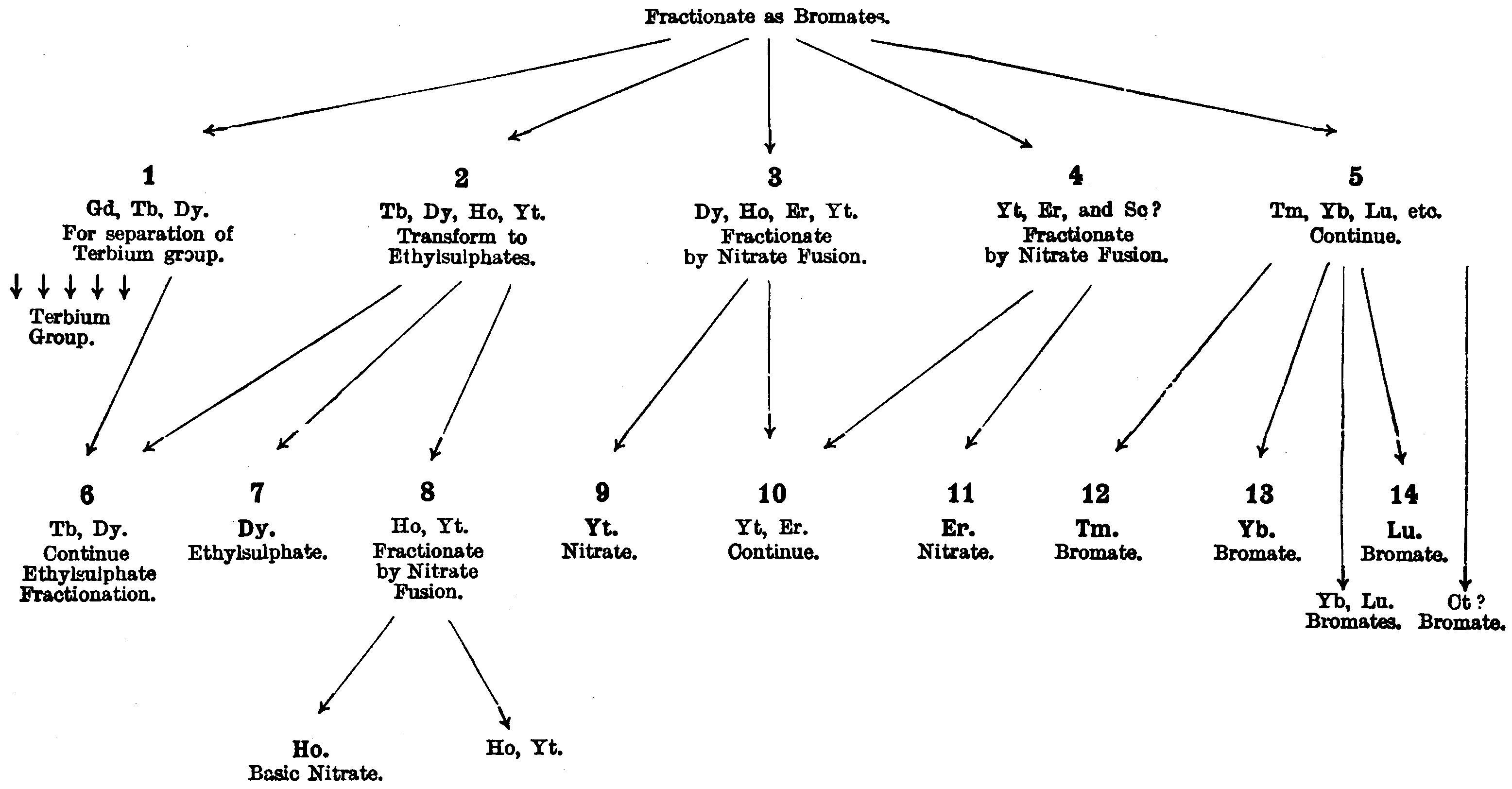
Fractionate as Bromates.
1 Gd, Tb, Dy. For separation of Terbium group.
2 Tb, Dy, Ho, Yt. Transform to Ethylsulphates.
3 Dy, Ho, Er, Yt. Fractionate by Nitrate Fusion.
4 Yt, Er, and Sc? Fractionate by Nitrate Fusion.
5 Tm, Yb, Lu, etc. Continue.
Terbium Group.
6 Tb, Dy. Continue Ethylsulphate Fractionation.
7 Dy. Ethylsulphate.
8 Ho, Yt. Fractionate by Nitrate Fusion.
9 Yt. Nitrate.
10 Yt, Er. Continue.
11 Er. Nitrate.
12 Tm. Bromate.
13 Yb. Bromate.
14 Lu. Bromate.
Yb, Lu. Bromates.
Ct? Bromate.
Ho. Basic Nitrate.
Ho, Yt.
Fig. 9.—Separation of the Yttrium Elements
The more modern methods of separation combine the
above processes with the methods of fractional crystallisation,
for which the bromates and alkylsulphates of these elements
are well adapted. The procedure[361] which experience shows
will lead to a fairly rapid separation is roughly represented
in Fig 9. The double sulphates (B), left in solution after
removal of the cerium and part of the terbium group, are
transformed into the bromates, which are separated by
fractional crystallisation into five main fractions. The least
soluble portion, fraction 1, contains the terbium elements
with some dysprosium; in the fractionation of the terbium
group by means of the nitrates and double nitrates, the dysprosium,
with some terbium, collects in the final fractions
(fraction 6). Fraction 2 contains terbium, dysprosium, holmium,
and yttrium as the bromates; these are converted into
the anhydrous chlorides, from which, by treatment with
sodium ethylsulphate in alcoholic solution, the ethylsulphates
are obtained. By fractional crystallisation, dysprosium may
be obtained in a fairly pure condition (fraction 7), the least
soluble part (fraction 6) containing the terbium with some
dysprosium. Holmium and yttrium collect in the most
soluble part (fraction 8), from which pure holmium can be
obtained by the method of nitrate fusion. Fraction 3 contains
yttrium and erbium, with small quantities of dysprosium and
holmium; the latter are readily separated by the nitrate
fusion, which will also allow of a fairly complete separation
of yttrium (fraction 9). Fraction 4 contains yttrium and
erbium; scandium if present will also collect here. Erbium
can be obtained pure by the nitrate fusion; the second fraction
from this process contains both yttrium and erbium, and may
be further worked up with the fraction of similar composition
(fraction 10) from fraction 3.
The mother-liquors from the bromate separation (fraction 5)
contain thulium and the ytterbium elements; the crystallisation
is continued, and allows of complete separation of
thulium and ytterbium, and probably of lutecium, though the
most soluble fractions do not seem to have been fully separated.
The oxides of this group, as contrasted with the ytterbia
oxides, give rise to coloured salts, which in solution show
definite absorption spectra in the optical region; the spectrum
of erbium salts is particularly definite and characteristic.
Erbium has among the yttrium elements the place of
neodymium among the cerium elements; after yttria, erbia
is the commonest oxide of the yttria group, though on account
of the difficulties of separation the chemistry of erbium is
by no means so complete and definite as that of neodymium.
The oxides in order of decreasing basicity, as shown by the
order in which they are thrown down by ammonia, are:
dysprosia, holmia, erbia, thulia; the electropositive character
becomes weaker, therefore—as generally in the rare earth
series—as the atomic weight of the elements increases.
Dysprosium, Dy = 162·5
Compounds of this element were probably prepared in the
pure state for the first time by Urbain[362] in 1906, by the fractional
crystallisation of the ethylsulphate. He showed that after
fourteen recrystallisations, the absorption spectrum of the
salts and the mean atomic weight of the element remain
unaltered, and that after removal of terbium by the very
efficient ethylsulphate method, all remaining traces of yttrium
could be rapidly removed by crystallisation of the nitrate.
The salts have generally a more or less pronounced yellow
colour.
The oxide, Dy₂O₃, is a white powder which does not alter
in composition when strongly heated in reducing or oxidising
atmospheres. It is remarkable in that it is the most strongly
paramagnetic oxide known, having a coefficient of susceptibility
much greater than that of ferric oxide.[363]
The chloride crystallises
with 6, the sulphate with 8, and the nitrate with 5 molecules
of water of crystallisation. The bromate, Dy(BrO₃)₃,9H₂O,[364]
obtained by double decomposition, melts at 78°. The
platinocyanide, Dy₂[Pt(CN)₄]₃,21H₂O, forms bright red cubic
crystals, with greenish fluorescence.
Several other salts are described by Urbain, and by Jantsch
and Ohl (loc. cit.).
Atomic Weight.
—Urbain and Demenitroux[365] determined
this constant from the ratio Dy₂(SO₄)₃,8H₂O : Dy₂O₃. The
mean value of six determinations carried out with material
obtained by fractional crystallisation of the nitrate was 162·52;
with material purified by the ethylsulphate crystallisation,
the mean of six determinations gave the value 162·54. The
International Atomic Weight is 162·5.
Detection.
—Lecoq de Boisbaudran[366]
and Urbain[367] give
the position of the following absorption maxima in the
visible and ultraviolet regions respectively:
| |
╵ |
| |
| 753 |
368·5 |
338 |
| 475 |
379·5 |
332·5 |
| 451·5 |
365 |
|
| 427·5 |
351 |
The arc spectrum of Urbain’s material was examined
by Eberhard,[368] who gives as most suitable for detection
of the element in a mineral or oxide mixture the following
lines:
| 3385·16 |
3898·69 |
4187·00 |
| 3531·86 |
3944·83 |
4211·82 |
| 3536·17 |
4000·59 |
|
| 3645·54 |
4078·11 |
See also Exner and Haschek, and Eder and Valenta.[369]
The ultraviolet arc spectrum and the cathode
phosphorescence have also been examined by
Urbain.[370]
Holmium, Ho = 163·5
The individuality of this element can hardly be regarded
as perfectly established, though Holmberg[371] has prepared
salts which in solution show only faint indications of erbium
and dysprosium, when tested spectroscopically. That author
fractionated the yttrium elements obtained from euxenite by
a long process of separation, which involved crystallisation
of the m-nitrobenzenesulphonates, of the simple nitrates
(two series), of the double ammonium oxalates, and finally
fractional precipitation of the hydroxides by ammonia.
He determined the Atomic Weight as 163·5, which is the
value accepted by the International Committee, and mapped
the absorption spectrum. The oxide, Ho₂O₃, is a pale yellow
powder; the salts are yellow, with a faint orange tinge.
Erbium, Er = 167·7
Although erbia was separated by Mosander seventy years
ago, it is doubtful if the perfectly pure oxide has ever been
prepared. Whilst the individuality of the element is well
established, its homogeneity has frequently been called in
question. The name ‘Neo-Erbia’ was given by Cleve[372] to the
residue left after the separation from the old erbia of ytterbia,
scandia, thulia, and holmia (with which dysprosia (q.v.) was
also separated), but the spectrum examination of Kruss
and Nilson[373] led them to regard Cleve’s oxide as still complex.
Their results, however, were explained by the work of Hofmann
and his pupils,[374] who consider erbia to be a homogeneous
product; the homogeneity of the element, therefore, may be
considered as established, though it would be strengthened
by a more complete knowledge of the neighbouring elements,
holmium and thulium.
The element forms a rose-coloured oxide, and rose-coloured
salts, which give to the compounds of the mixed erbia earths
their characteristic colour. The oxide gives a very definite
and characteristic reflection spectrum, but the salts do not
possess this property;[375] the reflection spectrum remains
unchanged in the presence of foreign oxides, provided no
combination occurs. From the atomic weight determinations,
it seems clear that the salts described by Cleve and his pupils[376]
were not pure erbium compounds; a few salts only appear to
have been recently obtained in the pure state for the atomic
weight determination (q.v.).
The sulphate separates from aqueous solutions at ordinary
temperatures as the octohydrate, Er₂(SO₄)₃,8H₂O, which
forms rose-coloured monoclinic crystals isomorphous with the
corresponding sulphates of the whole group. The anhydrous
sulphate is formed by long heating at 400°, more quickly at
475°, and can be heated to 630° without decomposition. At
845° a basic salt, Er₂O₃,SO₃, is formed, which begins to decompose
at 950°; at 1055° the transformation to the oxide is
complete. The ammonium and potassium double sulphates
are easily soluble in cold water.
The oxalate is thrown down in rosettes of bright rosy
plates, which according to Hofmann[377] have the formula
Er₂(C₂O₄)₃,10H₂O, even when dried in the air. Cleve believed
the salt to be thrown down as the enneahydrate. When kept
in vacuo over phosphoric anhydride, the decahydrate passes
into the trihydrate, which when heated decomposes, passing
into the oxide at a temperature of 575°. The nitrate,
Er(NO₃)₃,5H₂O, separates from aqueous solution as the pentahydrate,
in large stable red crystals. The platinocyanide,
Er₂[Pt(CN)₄]₃,21H₂O, has the characteristic red colour with
green fluorescence. The formate, Er(HCOO)₃—Cleve, loc. cit.—is
a red powder, obtained by dissolving the oxide in formic
acid; it crystallises from water as the dihydrate.
Atomic Weight.
—The determinations of the earlier workers,
being carried out with impure material, gave results which
differ very widely, and are quite unreliable. Cleve’s value
of 1880, for material free from ytterbia, but not apparently
free from earths of lower equivalent, was 166·25; Brauner,[378]
using the same material in 1905, obtained the much higher
value 167·14. The determinations of Hofmann and Burger[379]
in 1908 gave the mean value 167·38; with purer material,
Hofmann in 1910[380] obtained the mean value 167·68, on which
is based the value accepted by the International Committee,
167·7.
Detection.
—Salts of erbium give in solution absorption
spectra which are well defined and highly characteristic,
though not so intense as those of praseodymium and
neodymium. Hofmann and Bugge[381] give the following
absorption maxima for a 10 per cent. solution of their
pure nitrate in a layer of 15 mm. thickness:
| 667 |
weak |
492 |
|
| 654 |
strong |
487 |
strong |
| 541 |
very weak |
450 |
|
| 523 |
very strong |
442 |
weak |
| 519 |
shadowy |
|
The arc spectrum has been mapped by Eder and Valenta[382]
and Exner and Haschek. The following lines are used
by Eberhard[383] for purposes of detection:
| 3230·73 |
3692·85 |
| 3264·91 |
3896·40 |
| 3312·56 |
3906·47 |
| 3372·92 |
3938·79 |
| 3499·28 |
|
Thulium, Tm = 168·5
The thulia isolated in 1879 was described by Cleve[384] as
pale rose in colour; in the following year, having obtained
it in larger quantity, he found that it was white, and dissolved
in acids to form colourless solutions which showed absorption
bands in the red and blue. The spectra of the thulium compounds
prepared by Cleve were examined by Thalèn,[385] who
concluded that a new element was certainly present, though
it had not been freed from ytterbium and erbium. Incidental
observations on the new oxide were made by various investigators,
but no extensive researches were carried out upon it
until 1911, when James[386] published an account of the separation
and purification by the bromate method, stating that after
some 15,000 operations, his products remained unaltered;
he gives, however, no spectroscopic determinations, though
part of his material, spectroscopically examined by Sir William
Crookes, was described as ‘Very good thulium, with a trace
of ytterbium.’ In the same year Auer von Welsbach[387] published
an account of a spectroscopic investigation, as a result
of which he concludes that thulium is a mixture of at least
three elements, of which the second, Tm II, agrees fairly well
in properties, so far as the two accounts allow of comparison,
with the thulium of James.
Thulia is described by James as a dense white powder,
with a greenish tinge, which ‘emits a carmine coloured glow,
when carefully made to incandesce.’ The salts have a greenish
tint, very susceptible to traces of erbium; addition of erbium
compounds turn the solution first yellowish-green, then colourless,
and finally pink. von Welsbach describes Thulium II as
forming an almost white sesquioxide, which, when heated
in the flame, gives a purplish light quickly succeeded by a
splendid characteristic glow; the salts are pale yellowish-green
by daylight, emerald-green by artificial light, the colour
being almost complementary to that of erbium salts. In
solution, salts of Tm II give the bands at 685 and 464 ascribed
by James and other workers to thulium.
Until further researches on these interesting results are
published, the elementary nature of thulium cannot be considered
definitely settled; it appears probable, however, that
homogeneous salts of a definite element were obtained by
James. The following salts are described by James (loc. cit.).
The chloride, TmCl₃,7H₂O, separates at ordinary temperatures
from the concentrated solution of the oxide in
hydrochloric acid as greenish crystals, very soluble in alcohol
and water. The bromate, Tm(BrO₃)₃,9H₂O, forms pale bluish-green
hexagonal prisms, isomorphous with the analogous
salts of the group. The sulphate and nitrate separate as
the octohydrates. The precipitated oxalate has the formula
Tm₂(C₂O₄)₃,6H₂O, and is soluble in excess of alkali
oxalate. The acetylacetone derivative was prepared by dissolving
the precipitated and well-washed hydroxide in
alcoholic acetylacetone; it recrystallises from absolute (?)
alcohol as the dihydrate, Tm₂(C₅H₇O₂)₆,2H₂O. The phenoxyacetate,
Tm₂(C₆H₅·O·CH₂·COO)₆,6H₂O, was obtained in a
similar manner by addition of the hydroxide to a solution
of phenoxyacetic acid in dilute alcohol.
Atomic Weight.
—Cleve gave the value 170·7 for this
constant, but his material was very impure. In a footnote
to a paper published in 1907, Urbain[388] pointed out that the
value could not be above 168·5. Analyses of the salts prepared
by James agree fairly well with the theoretical values calculated
on this basis, but a systematic determination with pure material
has not yet been made. The International Committee (1912)
have adopted the value 168·5.
Detection.
—The element can be detected in solution by
its absorption spectrum, the most intense bands being
in the neighbourhood of λ = 685, and λ = 464. For
provisional arc spectra see Exner and Haschek, and
for spark spectra Auer von Welsbach (loc. cit.) and
Eder and Valenta.[389]
Ytterbium (Neoytterbium, Aldebaranium), Yb = 172·0.
Lutecium (Cassiopeium), Lu = 174·0.
The first indication of the complexity of Marignac’s Ytterbium
was furnished on spectroscopic grounds by Auer von
Welsbach in 1905;[390] he showed that a separation could be
effected by the fractional crystallisation of the ammonium
double oxalates from concentrated ammonium oxalate. Three
years later[390] he published a full account of his method, gave
atomic weight determinations, and mapped the spectra of the
two new elements. In 1907, Urbain[391]
independently effected
a separation by the fractional crystallisation of the nitrates
from nitric acid, and proposed the names Lutecium (from the
old name for Paris) and Neoytterbium for the elements.
The two new elements resemble one another so closely in
chemical properties that the account given by Astrid Cleve
in 1902[392] of the compounds of the old ytterbium applies in
practically every detail to the new elements. The oxides are
white, and yield colourless salts, showing in solution no absorption
bands in the visible region.
The oxides, R₂O₃, though perfectly white, are coloured
yellow or brown by the faintest traces of thulium. They are
attacked by acids only slowly in the cold, but dissolve readily
on warming; lutecia is slightly the less strongly basic. The
chlorides crystallise with six molecules of water, and are extremely
soluble and deliquescent; when heated in a stream
of hydrogen chloride, they form oxychlorides of the type ROCl.
The platinocyanides crystallise with 18 molecules of water,
and have the characteristic appearance of the analogous
compounds of the yttrium elements. The sulphates crystallise
at all temperatures as the normal octohydrates, and are
moderately easily soluble in water; conductivity measurements
show that they are partially hydrolysed in solution. The
nitrates crystallise from concentrated aqueous or nitric acid
solutions as the tetrahydrates; by evaporation of the aqueous
solutions over sulphuric acid, the trihydrates are obtained.
These compounds are anomalous among the rare earth nitrates,
by reason of their low water content. The neutral carbonates
are thrown down by ammonium carbonate as the tetrahydrates;
if a stream of carbon dioxide be led into aqueous
suspension of the hydroxides, basic carbonates of the formula
R(OH)CO₃,H₂O, are obtained. The oxalates are precipitated
as the decahydrates; they are readily soluble in excess of
alkali oxalate.
Many other salts of the old ytterbium have been prepared.
Atomic Weights.
—The values determined by Urbain
(loc. cit.) for the fractions obtained by the nitrate method
gave the number 170·1 for the least soluble fraction free from
terbium, and 173·4 for the most soluble fraction. Auer
von Welsbach (loc. cit.) obtained the values 172·9 and 174·2
for the least soluble and most soluble fractions from the double
oxalate crystallisation respectively. More recently[393] he has
determined these constants with highly purified material,
employing a modified method. The weighed anhydrous
sulphates are transformed into the oxalates, which are then
ignited to the oxides. He obtained the values Yb = 173·00,
Lu = 175·00.
The values adopted by the International Committee are
Yb = 172·0 and Lu = 174·0.
Spectra.
—The spark spectra are of more use in
distinguishing the two elements than the arc spectra. The
spark spectrum of the old ytterbium was mapped by Exner
and Haschek,[394] and of the two compounds by both discoverers
(loc. cit.). See also Eder and Valenta.[395]
The arc spectra have been mapped by Eder and Valenta
(loc. cit.) and by Exner and Haschek; the latter authors
give as the most intense lines the following:
| Yb |
Lu |
| |
╵ |
| |
| 3031·26 |
2615·50 |
3397·21 |
4124·87 |
| 3107·99 |
2911·53 |
3472·65 |
4184·40 |
| 3289·50 |
3077·75 |
3507·57 |
4518·74 |
| 3464·47 |
3198·27 |
3508·55 |
5476·88 |
| 3988·16 |
3254·45 |
3554·58 |
5983·92 |
| 5556·67 |
3281·89 |
3568·00 |
5984·32 |
| |
3312·30 |
3624·10 |
6222·10 |
| 3359·74 |
3636·41 |
6463·40 |
| 3376·69 |
3876·80 |
|
Celtium
The separation of Marignac’s ytterbium into the two
elements described above was accomplished by Urbain with
the yttria earths extracted from xenotime. In carrying out
the same process with the ytterbia earths from gadolinite,
that author[396] obtained from the mother-liquor an earth for
which the coefficient of magnetisation was found to be 4·1 ×
10⁻⁶; lutecia has a coefficient three to four times as great.
A spectroscopic examination revealed the presence of lines
which did not correspond with those of any known body,
and Urbain considered that a new element, for which he
proposed the name Celtium, with the symbol Ct, must be
present. Lutecia from xenotime shows no trace of the new
element.
Spectroscopic evidence for the existence of a third ytterbium
element had previously been brought forward by Auer von
Welsbach[397] and also by Exner
and Haschek.[398]
The new element appears to be intermediate between lutecium
and scandium, and therefore may be expected to have
a higher atomic weight than the former element. Its chloride
is more volatile than that of lutecium, less volatile than that
of scandium; its hydroxide is more feebly basic than that of
lutecium, but more strongly basic than that of scandium.
Urbain (loc. cit.) gives the following as the principal lines
in the spectrum; strong lines are denoted by a single, very
strong by a double, asterisk:
| 2459·4 |
|
2765·8 |
** |
2949·5 |
* |
| 2469·3 |
|
2834·3 |
* |
3080·7 |
** |
| 2481·6 |
* |
2837·3 |
* |
3118·6 |
** |
| 2536·9 |
* |
2845·2 |
* |
3171·4 |
* |
| 2677·7 |
|
2870·2 |
|
3197·9 |
** |
| 2685·2 |
** |
2885·1 |
* |
3326·0 |
* |
| 2729·1 |
* |
2903·9 |
* |
3391·5 |
* |
| 2737·9 |
|
2931·9 |
|
3665·6 |
|
Yttrium, Yt = 89·0
Since the separation of yttria proper from the old yttria
earths by Mosander, in 1842, the individuality of yttrium
has been well established. The yttria of the workers of the
sixties and seventies, to judge from the atomic weight determinations,
must have been very impure, but no doubts were
raised as to its homogeneity. By examination of the cathode
luminescence spectra, Crookes[399] concluded that the oxide was
of a complex nature; Lecoq de Boisbaudran, however, showed
that the phenomena observed by Crookes were due to traces
of impurity in his material, a conclusion confirmed by the
work of Baur and Marc.[400]
The oxide is the most strongly basic of all the yttria earths;
in the basicity methods of separation, therefore, it collects
in the end fractions, and is easily separated from the erbia
and ytterbia earths by the nitrate fusion and similar processes.
The terbia earths, however, which are comparable to it in
basic strength, cannot be easily separated by such methods;
processes of fractional crystallisation are very convenient in
this case, since yttrium falls, with regard to the solubility of
its simple salts, among the erbium group—between holmium
and erbium generally—which is easily separated from the less
soluble terbium elements. The separation of yttrium, therefore,
affords an example of the combination of methods of
both kinds.
The methods for the separation and purification of yttrium
have recently been exhaustively examined by Meyer and
Wuorinen.[401] They consider the chromate method suitable only
if the terbium elements have already been removed. The
ethylsulphate method is said to be tedious, whilst the ferrocyanide
method indeed effects very rapid concentration, but with
great loss. For purposes of concentration they find the most
suitable method in the fractional hydrolysis of the phthalates;
these salts are soluble in cold water, but hydrolyse when the
solution is warmed, the most positive elements remaining of
course longest in solution. For the final purification, they
recommend fractional precipitation of the iodate from nitric
acid solution; yttrium iodate being more soluble than the
iodates of the erbium and ytterbium group, the latter collect
in the first precipitates.
Pure yttria is quite white, and gives rise to colourless salts,
which in solution show no absorption spectrum in the visible
region. A very large number of yttrium compounds have been
prepared, of which sufficiently detailed accounts have been
given in the general description of rare earth compounds. For
an exhaustive treatment, the reader is referred to Abegg’s
‘Handbuch.’
The metal has probably not been obtained in the pure
state; impure yttrium has been obtained by Winkler[402] by the
action of magnesium on the oxide, and by Cleve[403] by the
action of sodium on a mixture of the chloride with common
salt, and by electrolysis of the mixture of fused chlorides. It
is described as a greyish metal, resembling iron in appearance;
it oxidises in the air and readily decomposes boiling water.
The hydroxide is thrown down as a gelatinous precipitate by
alkalies; ammonia throws down basic salts, but in presence
of hydrogen peroxide an hydrated peroxide is obtained.
The oxide absorbs carbon dioxide from the air, and liberates
ammonia from ammonium salts.
The anhydrous chloride has been prepared by many authors;
it melts at a relatively low temperature, 680°, and is the most
easily volatilised of all the rare earth chlorides. After fusion,
it forms a mass of brilliant white lamellæ.[404] It is characterised
by the ease with which it dissolves in pyridine. From aqueous
solution it separates as the hexahydrate, YtCl₃,6H₂O, which
melts at 160°. The bromide separates from solution as the
enneahydrate, YtBr₃,9H₂O; the bromate[405] also separates with
9 molecules of water of crystallisation.
The nitrate cannot be obtained anhydrous; the normal
hydrate, Yt(NO₃)₃,6H₂O, loses 3 molecules of water at
100°, but further heating converts it into basic salts. A
basic nitrate, 3Yt₂O₃,4N₂O₅,20H₂O, is described by James and
Pratt[406]
as stable at ordinary temperatures, and in contact
with solutions of the normal nitrate. The sulphate octohydrate
is isomorphous with analogous compounds of the rare earth
elements, and with the selenate, Yt₂(SeO₄)₃,8H₂O; the latter
compound can also form an enneahydrate. The phosphate,
YtPO₄, occurs in nature in the mineral xenotime, and has been
obtained in the laboratory in the crystalline form; many
other phosphates have been prepared. The platinocyanide,
Yt₂[Pt(CN)₄]₃,21H₂O, has the characteristic red colour with
greenish-blue fluorescence.
Many organic yttrium salts have been prepared by James
and Pratt[407]
and by Tanatar and Voljanski.[408]
Atomic Weight.
—The numbers obtained by the investigators
who have determined this constant vary to such an
extent that considerable uncertainty attaches to the value,
89·0, at present accepted by the International Committee.
The determinations carried out prior to 1870 gave such diverse
results that they are of little use in fixing the constant; since
that date, all the investigations, with the exception of the
most recent, have given values below 90, the sulphate method
being generally employed.
Cleve and Höglund,[409] in 1883, carried out six determinations
by the synthetic method; their results were concordant,
and gave the mean value 89·57. Brauner considers this
result if anything too low, as traces of undecomposed acid
sulphate may have been present in the anhydrous sulphate.
The same method was employed again by Cleve in 1884;[410]
the mean of twelve very concordant results gave the
number 89·11.
Much stress is laid by Brauner[411] on an unpublished determination
of Marignac, carried out with material entirely
free from terbia, which gave the value 88·88. H. C. Jones
in 1895[412] carried out two series of determinations with material
purified by Rowland’s method, i.e. precipitation with potassium
ferrocyanide;[413] the results in both series were very concordant,
the synthetic method giving the value 88·95, the analytical
method the value 88·97. This work has been taken by the
International Committee as the basis for the accepted value.
According to Brauner, the ferrocyanide method does not give
perfectly pure material.[414]
Egan and Balke[415] have recently found the ratio Yt₂O₃ :
2YtCl₃ to be very suitable as a basis for atomic weight
determinations; the oxide is converted into the anhydrous
chloride in a quartz flask. In a preliminary experiment,
they obtain as a mean of three consistent determinations
the provisional value 90·12; the yttria employed was
considered to contain not more than one-half per cent.
of erbia.
Recent work by Meyer and his co-workers[416] indicates that
the accepted value is too high. Preliminary work with the
synthetic sulphate method gave the values (corrected) 88·71
and 88·73; the mean value of six analytical sulphate
determinations, made on material carefully purified by
the iodate method, was 88·75, the extreme values being
88·71 and 88·76. They consider that the true atomic weight
is 88·7, the value of the second decimal figure being a little
uncertain.
Detection.
—The spark spectrum of yttrium has been
examined by many authors, and the ultraviolet
as well as the visible regions have been mapped;
vide Exner and Haschek; Eder and Valenta, also
Becquerel.[417]
The arc spectrum has been examined by Kayser, Eberhard,[418]
and Eder and Valenta;[419] Exner and Haschek
give the following as the most intense lines:
| 3216·83 |
3774·52 |
4177·74 |
| 3242·42 |
3788·88 |
4302·45 |
| 3328·02 |
3950·52 |
4309·79 |
| 3600·92 |
3982·79 |
4348·93 |
| 3611·20 |
4077·54 |
4375·12 |
| 3621·10 |
4102·57 |
4883·89 |
| 3633·28 |
4128·50 |
6191·91 |
| 3664·78 |
4143·03 |
6435·27 |
| 3710·47 |
|
Pure yttrium compounds should be colourless, show no
absorption in the visible region, and yield a perfectly
white oxide.
Scandium, Sc = 44·1
The scandia obtained by Nilson in 1879 was isolated from
the minerals gadolinite and euxenite; it consisted very largely
of ytterbia, as shown by spectrum examination[420] and by
atomic weight determinations, which gave the value 90. In
the same year[421] Cleve prepared the oxide in a much purer state,
using as his source the minerals gadolinite and keilhauite;
he described several salts, carried out atomic weight determinations
by the analytical and synthetic sulphate methods, and
showed that scandium corresponds with the Eka-boron of which
the existence was predicted by Mendelejeff in 1871.[422] Starting
from a large quantity of euxenite, Nilson[423] in the following
year prepared several grams of approximately pure scandia,
which contained only traces of ytterbium.
The investigation of scandium, which occurs only in
extremely small quantities in the minerals employed by Nilson
and Cleve, and was therefore believed to be exceedingly rare,
was not continued until 1908, when Sir William Crookes[424]
made a systematic investigation of a large number of minerals
in order to find a convenient source of the element. He
showed that scandium is present in many rare earth minerals,
and selected as the most suitable for the extraction of the
element a complex mineral named Wiikite, some specimens of
which he found to contain over 1 per cent. of scandia (see p. 70).
The mineral was decomposed by fusion with potassium
hydrogen sulphate, and scandia extracted from the rare earths
by the nitrate fusion. The separation effected on these lines
was very thorough, Crookes considering a specimen of scandia
unsatisfactory if it showed any trace of the dominant ytterbium
line, 3694·344, on an over-exposed plate, or if it gave an atomic
weight for the element higher than 44·1.
A systematic investigation of the common rocks and
minerals for scandium was carried out by Eberhard in 1908,
as a result of which processes for the extraction of the oxide
from wolframite were worked out by R. J. Meyer (see pp. 3, 131).
Wolframite is a tungstate of iron and manganese, containing,
in addition to other oxides, small quantities of the rare earths,
of which considerable proportions are found to be scandia.
The mineral is fused with soda in the usual way, and the rare
earths concentrated by the oxalate method. Scandium is
precipitated as the fluoride by addition of sodium silicofluoride
to the boiling acid solution, and purified by precipitation as the
double ammonium tartrate.[425]
Whilst the researches of Crookes and Eberhard have shown
how widely distributed the element really is, the minerals
which they found richest in scandium still contained extremely
small quantities of the oxide. The discovery of the mineral
Thortveitite (see p. 44), which contains about 37 per cent.
of scandia, is therefore of the greatest scientific interest, and
will doubtless allow of a very searching examination of the
properties of this interesting element.
Whilst the low atomic weights of scandium and yttrium
place them, to some extent, apart from the other rare earth
elements, the latter element at least is so closely allied in
properties to the other members of the group that yttria is
one of the typical oxides of the family. Scandium and its
compounds, however, present many peculiarities of behaviour
when compared with the typical members, on the grounds of
which Urbain[426]
has contended that scandia should not be
classed among the rare earths at all. Whilst this contention
is perhaps rather extreme, especially in view of the fact that
in nature scandia always occurs with other yttria oxides, it
must be admitted that in many respects the element is anomalous.
The oxide is the weakest base of the whole group, yet
the oxalate is comparatively readily soluble in mineral acids
(compare p. 132), and the potassium double sulphate is almost
insoluble in potassium sulphate. The sulphate is altogether
exceptional in that it is very easily soluble in water, and
crystallises out with 6 molecules of water of crystallisation.
The fluoride and the carbonate both dissolve readily in excess
of precipitant, whilst sodium thiosulphate precipitates a basic
salt from neutral solutions.
Meyer has pointed out the close resemblance between
beryllium and scandium. The oxide and salts are colourless;
the latter have a peculiar sweet astringent taste, and readily
yield basic salts.
The hydroxide, Sc(OH)₃, is thrown down by alkalies as a
bulky white gelatinous mass; the oxide is a white powder, less
readily soluble in dilute acids than most of the rare earths.
The fluoride is important on account of its insolubility in
mineral acids, which exceeds that of all the other rare earth
fluorides, and approaches that of thorium. It is thrown down
from neutral or acid solutions by addition of hydrofluoric
acid or a soluble fluoride; if the solution be boiled, a soluble
silicofluoride will also precipitate scandium fluoride, though
no precipitate is obtained in the cold. This behaviour is
due to the ease with which the silicofluoride is hydrolysed at
high temperatures, according to the equation:
Sc₂(SiF₆)₃ + 6H₂O = 2ScF₃ + 3SiO₂ + 6H₂F₂
and is of great value in separating scandium from the other
earths. The fluoride is extremely resistant to acids, being
completely decomposed only by fused bisulphate. In the
absence of acids, the freshly precipitated fluoride dissolves
in excess of concentrated alkali fluoride, forming double salts;
in this behaviour, scandium resembles zirconium, but differs
from thorium and the cerium and yttrium elements.
The chloride separates from solution at ordinary temperatures
as the dodecahydrate, Sc₂Cl₆,12H₂O, which loses 9
molecules of water when kept for six hours at 100°. The
trihydrate Sc₂Cl₆,3H₂O, is converted into scandia at a red
heat, with the loss of 6 molecules of hydrogen chloride. The
iodate, Sc(IO₃)₃,18H₂O, is obtained as an almost insoluble
white crystalline powder by addition of ammonium iodate to a
salt in solution; hydrates with 15, 13, and 10 molecules of water
are known, and at 250° the anhydrous compound is obtained.
It resembles the iodates of the cerium and yttrium group in
being soluble in strong nitric acid, but the separation of thoria
and scandia by this method is tedious and unsatisfactory.[427]
The platinocyanide, Sc₂[Pt(CN)₄]₃,21H₂O, was obtained by
Crookes[428] by double decomposition of the sulphate with barium
platinocyanide, in crimson monoclinic prisms, with a green
fluorescence. It dissolves in water to a colourless solution.
Orlov[429] shows that it can occur also in a second form, stable
at higher temperatures; this is yellow, with a blue fluorescence
and crystallises with 18 molecules of water. The two modifications
resemble respectively the platinocyanides of the yttrium
and of the cerium elements; in this respect, therefore, scandium
occupies an intermediate position between the two groups.
The sulphate, Sc₂(SO₄)₃, is obtained anhydrous by evaporating
the excess of acid from a solution of the oxide in the
concentrated acid, care being taken to avoid too high a
temperature. The compound dissolves very easily in water,
and slowly hydrates itself with evolution of heat; no crystals
can be obtained from the solution until it has been concentrated
to the consistency of a syrup, when on cooling it slowly deposits
the hexahydrate. This effloresces in a dry atmosphere, forming
the pentahydrate, which appears to be the most stable
hydrate at ordinary temperatures. According to Nilson, the
hexahydrate loses 4 molecules of water when maintained
at 100°. At 250° it becomes anhydrous; above that
temperature, basic salts are formed. The potassium double
sulphate, 3K₂SO₄,Sc₂(SO₄)₃, was shown by Nilson to resemble
the analogous cerium compounds in being insoluble in a
saturated solution of potassium sulphate. The nitrate,
Sc(NO₃)₃,4H₂O, separates from concentrated solutions over
sulphuric acid as the tetrahydrate; it is very soluble in water
and alcohol, and extremely deliquescent.
The carbonate, Sc₂(CO₃)₃,12H₂O, is thrown down by addition
of ammonium carbonate as a bulky white precipitate, easily
soluble in a hot solution of the precipitant; the solubility
in excess may be used in the separation of scandia from yttria.
Addition of water to such solutions causes separation of a
basic carbonate, but crystalline double carbonates may be
obtained by evaporation of concentrated solutions containing
a large excess of alkali carbonate. The sodium compound,
Sc₂(CO₃)₃,4Na₂CO₃,6H₂O, is very sparingly soluble, and has
been used in the separation from thorium. The oxalate,
Sc₂(C₂O₄)₃,5H₂O, differs from other oxalates of the group,
which generally separate with 10 molecules of water of crystallisation,
not only in its water content, and in its solubility
in acids, but also in the ease with which it forms double oxalates
soluble in excess of alkali oxalate; in this latter property it
shows a further resemblance to zirconium and thorium. The
formate and acetate have the formulæ Sc(OH)(HCOO)₂,H₂O
and Sc(OH)(CH₃COO)₂,2H₂O, respectively. A large number
of organic salts have been described by Sir William Crookes.[430]
Atomic Weight.
—The mean values obtained by Cleve[431]
in 1879 were 44·96 and 45·20 by the analytical and synthetic
sulphate methods respectively. In the following year Nilson,[432]
using purer material, obtained the value 44·13 by the synthetic
method. Meyer and others (loc. cit.) have criticised Nilson’s
estimation on the ground of his empirical method of obtaining
the neutral anhydrous sulphate. Determinations made with
material purified from thorium by the iodic acid method gave
the values 44·11, 44·11, 44·20; material purified by the double
ammonium tartrate method gave the atomic weight 43·90.
Meyer has shown that small quantities of thoria in the oxide
cannot be detected spectroscopically; the value of the magnetisation
coefficient, however, showed the oxide obtained by the
last method to be free from thoria, and he considers another
determination of the atomic weight to be necessary.
The value accepted by the International Committee is 44·1.
Detection.
—Scandium gives no absorption spectrum in the
visible region. The spark spectrum has been examined
by Thalèn (loc. cit.) and Nilson;[433] see also Exner and
Haschek, Lockyer and Baxendall,[434] and Crookes (loc. cit.).
The arc spectrum has been examined by Fowler,[435]
Eder and Valenta,[436] and Exner and Haschek.
The most intense lines of the arc spectrum are the
following:
| 3353·90 |
3630·93 |
4314·31 |
| 3372·33 |
3642·99 |
4320·98 |
| 3558·69 |
3907·69 |
4325·22 |
| 3567·89 |
3912·03 |
4374·69 |
| 3572·73 |
4020·60 |
4400·63 |
| 3576·53 |
4023·88 |
4415·78 |
| 3614·00 |
4247·02 |
6305·94 |
Fowler (loc. cit.) examined the arc spectrum with
reference to solar spectra. For detection of the element
in minerals see Crookes (loc. cit.) and Eberhard (loc. cit.).
The purity of scandium preparations may be determined
by the following tests:
(1) Precipitation with thiosulphate in boiling solution
should remove all the rare earth content from
solution.
(2) The iodate test for thorium should give no result.
(3) The oxide must be perfectly white, and salt
solutions show no absorption.
(4) R. J. Meyer has found that whilst 0·5 per cent.
of thoria cannot be detected spectroscopically in
scandia, the magnetisation coefficient affords an exceedingly
delicate test. The value for pure scandia
is -0·12 × 10⁻⁶, the oxide being diamagnetic;
for scandia with 0·5 per cent. thoria the coefficient
was found to be +0·04 × 10⁻⁶, the mixture being
paramagnetic.
The oxides zirconia and thoria were generally classed among
the rare earths by the earlier chemists. This view was based
partly upon the mode of occurrence of the oxides, which are
very generally associated in nature with rare earths, and were
believed to be equally sparingly distributed, and partly on
fallacious chemical analogies. Thus Berzelius regarded thoria
as a monoxide, ThO, and classed it with the other earth
oxides, magnesia, lime, ceria, lanthana, etc., to all of which
the general formula RO was assigned. Zirconia was regarded
as a sesquioxide, Zr₂O₃, analogous to alumina, Al₂O₃, which
in turn showed many points of resemblance to the rare earths.
The introduction of the periodic classification, and a wider
knowledge of the chemical properties of the oxides, have
gradually altered the older conceptions, and zirconia and
thoria are now only classed under the head ‘Rare Earths’
when that term is used in its widest sense. More generally,
the term is restricted to the oxides of the cerium and yttrium
elements, which, whilst they cannot all be placed in Group III
of the table, yet constitute a series with properties which entitle
them to be considered in that relation.
The elements which fall into group IVA of Mendelejeff’s
classification are titanium, zirconium, cerium, and thorium;
the elements of lower atomic weight, carbon and silicon, are
placed by some authors in Group IVB, by others in Group IVA.
It is a feature of the periodic system that the members of the
A and B families show great differences in the end groups,
I and VII, II and VI, which disappear as the middle groups
are approached; in group IV the families A and B show only
slight differences in properties, corresponding to their amphoteric
character and electrochemical indifference, so that the
elements carbon and silicon may be placed as well in the one
as in the other. Generally they are placed in family B.
In its tetravalent condition, titanium shows a close relationship
to silicon; the similarity is manifested by the ease with
which the dioxide replaces silica in many minerals, and the
isomorphism of many titanates with corresponding silicates.
Yet the strengthening of electropositive character, which
always accompanies the change in atomic weight in descending
a vertical column of the table, is very apparent in the case of
titanium, and its ability to form salts in the tetravalent state
is a very important property. This strengthening of the
electropositive character is still more marked in the case of the
succeeding elements. The salts of zirconium are highly hydrolysed
in solution, but they are considerably more stable than
those of tetravalent titanium; the ceric salts show the same
change, whilst thorium salts are comparatively stable in
solution, and can be recrystallised from water without change.
Zirconium hydroxide will not dissolve in alkalies, though
zirconates may be obtained in the dry way; thorium hydroxide
shows no acidic properties whatever.
The change in electrochemical character is accompanied
by corresponding changes in physical properties of the elements
and their compounds. With the exception of cerium, which
has a very low melting-point (623°), the elements fuse only
at high temperatures; titanium is the most refractory,
zirconium melts at over 1500°, and thorium at about 1450°.
The boiling-points of the chlorides rise as the series is
descended; titanium tetrachloride boils at 136°, zirconium
and thorium chlorides at 400°-450° and 950° respectively;
zirconium chloride partly sublimes, whilst ceric chloride decomposes
when heated.
The elements of Group IVA are distinguished from the
rare earth elements by their much less strongly marked electropositive
character. This is apparent not only in the amphoteric
nature of the oxides, and in the ease with which the
salts are hydrolysed in solution, but in the more pronounced
tendency to the formation of complex salts. The complex
fluorides of the type K₂RF₆ are peculiarly characteristic, and
in the case of titanium and zirconium have been very important
for purposes of analysis and atomic weight determination.
The solubility of zirconium and thorium salts in excess of
alkali oxalate or carbonate is also in harmony with the less
pronounced electropositive character of these elements. The
sulphates of titanium and zirconium appear to be of complex
constitution, whilst their neutral chlorides cannot be obtained
from solution. As is to be expected from its high atomic weight,
thorium approaches most nearly to the rare earths in chemical
properties; thus it forms stable double nitrates of the type
R₂Th(NO₃)₆ and its salts, especially the sulphate, resemble
those of the rare earth elements in their solubility relations.
The elements titanium, zirconium, and thorium are distinguished
also by the fact that they form no definite hydroxides.
The precipitates thrown down from solutions of the salts, on
addition of alkali, are hydrated oxides, which lose water continuously
when dried, giving rise to no definite chemical individuals
until constant weight is reached with the anhydrous oxides.
The hydroxides have the further characteristic, common also
to the other members of Group IV, of readily forming colloidal
solutions and gels, a property possessed to some extent also by
the elements themselves, and particularly by zirconium, which,
when reduced from its compounds, shows a great tendency to go
into colloidal solution merely on washing. Highly characteristic
also is the property of forming ‘meta’-oxides (acids)
and ‘meta’-salts, which is common to all the Group IV elements
which have solid oxides.
In presence of hydrogen peroxide, alkalies throw down
characteristic hydrated peroxides, which have definite acidic
properties in the case of titanium: the zirconium compound
is less strongly acidic, the cerium compound shows no tendency
to salt formation, whilst if hydrogen peroxide be added to a
neutral or faintly acid solution of a thorium salt, the precipitate
is a peroxy-salt, containing some acid grouping, e.g. SO₄,NO₃.
With regard to valency, the elements in the typical compounds
are tetravalent. Titanium forms three series of
salts, in which the element is respectively di-, tri-, and tetravalent;
salts of the first two series have powerful reducing
properties, and the compounds in which the metal is tetravalent
are most stable. Zirconium is always, with the doubtful
exception of its peroxy-compounds and the lower oxides,
tetravalent. Cerium, as already described, can form two
series of compounds, in which it is respectively tri- and tetravalent;
thorium, like zirconium, is always tetravalent.
Though generally classed among the rare elements, titanium
is probably at least as widely distributed in nature as most
of the common metals. It occurs as the dioxide in small
quantities in all the common silicate rocks and minerals,
and in traces in the animal and vegetable kingdoms; the
element has been identified in the sun and in many stars,
and has been found in meteorites. Probably the commonest
mineral in which the element occurs in quantity is ilmenite,
or titaniferous ironstone, which occurs in enormous quantities
in many parts of the world (see p. 57). The pure dioxide
occurs in the three forms Rutile, Brookite, and Anatase (q.v.),
in which it is said to be isotrimorphous with tin dioxide.
Other important titanium minerals are Perovskite, Titanite
or Sphene, the Euxenite series, and other minerals of the
tantalo-columbate group (see Part I).
The commercial sources of titanium compounds are the
minerals rutile and ilmenite. These may be opened up
by fusion with alkali or alkali carbonate; the residue after
extraction with water is dissolved in acid, and precipitated
with ammonia; the mixture of iron and titanium oxides thrown
down may be separated by one of the methods outlined on
p. 339. Fusion with potassium bisulphate has also been
employed. A very satisfactory method is that of Stähler,[437]
in which the ore is fused with carbon in the electric furnace.
The carbides so obtained are heated in a stream of chlorine,
when the volatile titanium tetrachloride distils over, and
may be obtained quite pure by redistillation; by appropriate
methods, the required compounds may be obtained
from this. (See also pp. 326-7.)
The Metal.—The difficulty of isolating metallic titanium
in the pure state is very great, on account of its great affinity
for nitrogen, oxygen, hydrogen, carbon, etc., the ease with
which it forms alloys with all the common metals, and the
extremely high melting-point; in consequence, it is only
within recent times that the element has been obtained in a
state approximately approaching purity, and the accounts
given of its physical properties vary very widely.
Berzelius prepared an impure titanium (Ti = 86 per cent.)
by reduction of potassium titanofluoride with potassium;
the method was modified by Wöhler, who heated a tube containing
two boats, of which one was filled with the fluoride,
the other with sodium, reduction being effected by the sodium
vapour. Many authors have attempted the reduction of
titanium tetrachloride by means of hydrogen. By heating
the tetrachloride with sodium in a cast iron bomb, Nilson and
Pettersson obtained a product containing 95 per cent. of the
element. Reduction of the dioxide by means of sodium,
magnesium, silicon, or aluminium has not been found to yield
good results, by reason of the ease with which titanium alloys
with these elements. Reduction of the dioxide with carbon
yields good results only when precautions are taken to avoid
the formation of the compound which the element so readily
forms with carbon and nitrogen. Moissan[438] found that if temperatures
high enough to decompose this compound were used,
the product contained as the only impurity carbon, which could
be partly removed by fusing with the dioxide; the product
then contained 98 per cent. of titanium.
The element has been obtained in the fused condition by
Weiss and Kayser,[439] who pressed the amorphous form into
sticks, under a pressure of 70,000 atmospheres, and employed
these as pencils for the electric arc in vacuo; the metal fused,
forming globules on the ends of the electrodes, which were
detached after the apparatus had been allowed to cool.
The amorphous element is a dark powder, resembling
finely divided iron (Ferrum reductum), of density 3·5-3·6.
The specific heat rises rapidly with the temperature, so that
the atomic heat has the values 5·40 between 0° and 100°, 6·18
between 0° and 210°, 7·13 between 0° and 300°, and 7·77
between 0° and 440°. The amorphous element is said to be
paramagnetic.
The fused carbonaceous product of Moissan formed an
extremely brittle mass, with a shining white lustre on the
fractured surface, sufficiently hard to scratch quartz and
steel; its density was determined as 4·87. The product
of Weiss and Kayser was also extremely hard and brittle;
when rubbed against steel, it gave bright sparks. Its density
was found to be 5·174, and the heat of combustion for the
gram-atom, 97·79 K.
The amorphous variety is fairly stable in air, but burns
vigorously when heated in air, oxygen, or halogens. Heated
in nitrogen or ammonia, it reacts vigorously, forming the
nitride TiN; if carbon is present, a peculiar substance of
uncertain composition, known as titanium cyanonitride, is
formed. This substance is also obtained when air is passed
over a heated mixture of the dioxide with coke, and is found
in blast-furnaces in which ores containing small quantities
of titanium are worked; it forms brilliant red cubes, which
are extremely hard and resistant to acids. This substance,
as well as the nitride itself, yields ammonia when heated
in steam, and has been proposed as a medium for ‘fixing’
atmospheric nitrogen (see p. 337).
The amorphous element also absorbs hydrogen, when
heated in the gas, but no definite hydride is known. It combines
when heated with almost all the known non-metals,
and forms alloys with all the common metals. Moissan[440]
claims to have prepared a compound as hard as diamond by
heating titanium with boron in the electric furnace. The
element attacks steam at a red heat.
The element is fairly resistant to acids in the cold, but
is readily attacked, with evolution of hydrogen, on warming.
Hot dilute hydrochloric acid gives the trichloride; but dilute
sulphuric acid is variously reported to give the di- and
tri-salt. Hot nitric acid oxidises it readily, forming the so-called
metatitanic acid. Hydrofluoric acid attacks it very
readily, forming the tetrafluoride.
Compounds of Divalent Titanium.
The compounds of divalent titanium show resemblances
to those of divalent iron, chromium and vanadium, but on
account of the great difficulty of preparing them and protecting
them from oxidation, little is known of their properties and
behaviour; even the colour of the salts in solution is not
known with certainty. In its divalent state; the element does
not appear to act as a strongly positive metal; the salts
in solution are said to show an acid reaction, whilst the precipitates
thrown down with alkali oxalates and acetates are
soluble in excess of the precipitant, forming deeply coloured
solutions. With sodium phosphate the soluble salts give a bluish-black
precipitate, with potassium ferrocyanide and ferricyanide,
dark brown and reddish-brown precipitates respectively. They
are distinguished from salts of the higher oxides of titanium
by the brown colouration produced by potassium thiocyanate
in presence of hydrochloric acid.[441]
The hydroxide is thrown down from solutions by addition of
alkali, alkali carbonate, alkali cyanide, or ammonium sulphide,
as a black precipitate. It cannot be transformed to the
corresponding oxide by drying, since it attacks the water
with evolution of hydrogen, forming the dioxide. The monoxide,
TiO, has probably never been obtained in the pure state;
it is formed by reduction of the dioxide with zinc or magnesium.
Moissan[442] obtained it in the form of black prismatic crystals
by treating the dioxide with the calculated amount of charcoal
in the electric furnace. The sulphide, TiS, is an extremely
stable compound; it can be prepared by heating the higher
sulphides in a stream of hydrogen to a very high temperature,
and then forms pseudomorphs after these.[443] It is a dark red
metallic mass, which reacts in the air only when heated, forming
the dioxide; dilute acids and alkalies have no action on it,
concentrated nitric acid oxidises it slowly.
The dichloride, TiCl₂, is obtained in the impure state as a
black powder by decomposition of the trichloride at a red heat:
the tetrachloride is formed at the same time, and volatilises.[444]
According to v. d. Pfordten,[445] it is obtained by reduction of the
tetrachloride by sulphuretted hydrogen or sodium amalgam
in the cold. The latter author states that it dissolves in alcohol
or water in absence of air to a dark brown solution; Friedel
and Guérin, however, state that it acts energetically on these
solvents with evolution of hydrogen, forming a yellow solution.
When heated in the air it burns, evolving fumes of the
tetrachloride and leaving a residue of the dioxide. The iodide,
TiI₂, has been obtained by Defacq and Copaux[446] by reduction
of the tetraiodide with silver or mercury, as a black, lustrous,
infusible sublimate. It is insoluble in organic solvents, but
reacts with water and aqueous alkalies, and is readily attacked
by acids. Hydrogen at a bright red heat reduces it to
amorphous titanium.
Compounds of Trivalent
Titanium.[447]
These salts are obtained when the element is dissolved
in hydrochloric and sulphuric acids, and by reduction of the
compounds of tetravalent titanium in solution by means of
zinc and hydrochloric acid, or by electrolysis. According to
Diethelm and Forster[448] the reduction may also be effected by
hydrogen in presence of finely divided platinum. The salts
have strong reducing properties, transforming nitro-bodies to
amines and decolourising azo-derivatives very rapidly; they
reduce unsaturated bodies, and reduce dyes to the leuco-bases;
they reduce sulphurous acid to sulphur, precipitate gold, silver
and mercury from their salts, and reduce cupric and ferric
salts to cuprous and ferrous compounds respectively. The
salts are green or violet in solution, showing the phenomenon
of hydrate-isomerism which is exhibited by the chromic salts;
they are to some extent hydrolysed in aqueous solution, as
shown by the acid reaction of the chloride. They resemble
the salts of ferric iron and aluminium in giving precipitates of
basic salts when boiled with sodium acetate or sodium formate,
and in giving no precipitate with alkalies in the presence of
organic hydroxy-acids. Ferrocyanide and ferricyanide give
brown precipitates.
The hydroxide, Ti(OH)₃,xH₂O, is thrown down as a dark
precipitate with strong reducing properties; it attacks water
with evolution of hydrogen, forming the dioxide; when an
aqueous suspension is shaken with air, autoxidation occurs,
hydrogen peroxide being formed. The sesquioxide, Ti₂O₃, has
been prepared by Friedel and Guérin[449] by heating the dioxide
to a white heat in a current of hydrogen and titanium tetrachloride;
it forms black lustrous crystals, isomorphous with
hæmatite. The sulphide, Ti₂S₃, is best obtained by reduction
of the disulphide, at a moderate temperature, in a stream of
hydrogen or nitrogen, but is also prepared by the action of
a mixture of carbon disulphide and sulphuretted hydrogen on
the dioxide at a high temperature. It is a dark grey metallic
powder, stable towards air, water, alkalies and dilute acids.
Titanium Nitride, TiN, is obtained in all reduction processes
in which titanium compounds are used, if air or nitrogen is
admitted; it is formed when the element is heated in nitrogen,
and by the action of ammonia on the chloride. It forms lustrous,
bronze-coloured leaflets, which appear blue or violet when
powdered. It is extremely hard, and very stable, but is
attacked by alkalies with evolution of ammonia. It reduces
the oxides of copper and lead in the fused state. Ruff and
Eisner have shown that it is a true nitride of the trivalent
element, and that only one nitride exists.[450]
The fluoride, TiF₃, has been obtained as an insoluble violet
powder by reduction of potassium titanofluoride, K₂TiF₆, with
hydrogen. From a solution it may be obtained by reduction
of the same salt with zinc and hydrochloric acid, or sodium
amalgam. It forms complex salts with alkali or ammonium
fluoride, of which the compound (NH₄)₃TiF₆ is an example;
this salt appears to be isomorphous with the analogous
compounds, (NH₄)₃VF₆, (NH₄)₃CrF₆, and (NH₄)₃FeF₆. By
autoxidation in the air, the solutions form fluoroxypertitanates.
The complex salts appear to exist in two forms,
a violet insoluble form and a green soluble modification.
The chloride, TiCl₃, is obtained anhydrous by reduction of
the tetrachloride—mercury, silver, and hydrogen being the most
suitable agents. Heated in hydrogen, it breaks up, forming
the tetrachloride and the dichloride; heated in air it burns,
evolving the tetrachloride and leaving a residue of dioxide.
In solution, in combination with alkali chlorides, and as the
solid hydrate, it exists in the green and violet forms. Concentrated
aqueous solutions deposit the violet hexahydrate,
TiCl₃,6H₂O. If such a solution be covered with ether, and
saturated at 0° with hydrogen chloride, the green modification
is formed, and may be extracted by the ether; it is stable only
in the presence of hydrochloric acid. In the violet form, all the
chlorine is in the ionic condition, and can be removed by silver
nitrate; similar determinations have not been made with the
green form, but it is most probable, as in the case of the analogous
chromic salts, that only part of the chlorine content can
be removed by silver nitrate. Böck and Moser[451] have recently
described a brown substance, obtained by the action of the
silent electric discharge on a mixture of hydrogen and the vapour
of titanium tetrachloride at the ordinary temperature, which
they believe to be a monotropic modification of the ordinary
violet trichloride; the change of this brown form to the violet
form is irreversible.
The bromide and iodide resemble the chloride, but are very
unstable.
The sulphate, Ti₂(SO₄)₃, is obtained as a green crystalline
powder by heating with sulphuric acid the violet solution
obtained by reduction of a solution of the dioxide in sulphuric
acid. It dissolves in dilute acids, forming violet solutions.
With alkali sulphates it forms titanium alums, which can be
recrystallised from dilute sulphuric acid, and have the general
formulae, properties, and crystal form of the other alums. An
acid sulphate, 3Ti₂(SO₄)₃,H₂SO₄,25H₂O, is obtained by electrolytic
reduction of a strongly acid solution of the dioxide in sulphuric
acid, or by treating the chloride repeatedly with hot
dilute sulphuric acid. It forms a crystalline violet powder, with
silky lustre, insoluble in alcohol, ether, and 60 per cent, sulphuric
acid; it dissolves slowly in water, forming a violet solution.
When the aqueous solution is treated with excess (21⁄2 molecules)
of alkali sulphate, it forms sparingly soluble double sulphates,
which separate in bright blue crystals; the compounds
Ti₃(NH₄)(SO₄)₅,9H₂O, and Ti₃Rb(SO₄)₅,12H₂O, have been
obtained in this way.
The Use of Salts of Trivalent Titanium in Volumetric Analysis.—Owing
to their powerful reducing properties, these
salts have been proposed as very convenient reagents in volumetric
analysis,[452] the chloride being most useful in this respect.
The estimations must be carried out in absence of air, to
avoid atmospheric oxidation; generally the apparatus is filled
with carbon dioxide. The titanium solutions for use must
also be preserved from the oxidising action of the air.
For estimation of ferric salts, an aliquot quantity is titrated
directly with the titanium solution, ammonium thiocyanate
being used as indicator. Ferrous salts and ferric salts in the
same solution are easily estimated by titrating the former
with permanganate solution, or better with hydrogen peroxide,
and then estimating the total ferric salt with the titanium
solution. Oxidising agents like nitrates and chlorates can be
estimated in acid solution by treatment with an excess of a
ferrous salt, and estimation of the ferric compound formed by
means of titanium. Azo-bodies and organic dyes can be titrated
directly, if soluble in hydrochloric acid, the disappearance
of colour marking the end of the reaction; nitroso-compounds
can also be estimated in this way. If the compound is
insoluble, it may be reduced in hydrochloric acid suspension
with excess of the titanium salt, and the excess then determined
by means of ferric iron. Insoluble dyes may also be
converted into soluble sulphonic acids, and estimated directly
in solution. Ammonium persulphate may be estimated by
reduction with excess of the chloride, and back titration of the
excess with ferric iron. Hydrogen peroxide may be estimated
directly, the disappearance of the yellow colour formed at
the first addition marking the end of the reaction. Tin may
be estimated by addition of an excess of a ferric salt, and
estimation of the excess by titanium in the usual way. Cupric
salts also may be estimated directly,[453] the end point being
reached when the bluish-green solution becomes colourless.
Compounds of Tetravalent Titanium
The compounds of tetravalent titanium are much more
stable than the compounds in which the element has a lower
valency, and are very readily formed from them. The dioxide
is amphoteric in character, and acts as a weak acid as
well as a weak base; the salts it forms with acids as well
as those it forms with bases are very easily hydrolysed, with
separation of the hydrated oxide. Titanium salts, therefore,
can only be held in solution by a considerable excess of
acid. The tendency to the formation of complex compounds
is very pronounced, particularly in the case of the fluoride,
oxalate and tartrate.
The hydroxide, or hydrated oxide, is capable of existing in
two modifications, according to the conditions under which
it is thrown down, though the two can hardly be said to be
very definitely differentiated. The α or ortho form is obtained
as a voluminous white precipitate by the addition of ammonia
or alkali hydroxide in the cold to a freshly prepared solution
of a titanium salt. It is insoluble in water and alcohol, but
dissolves readily in dilute mineral acids, and to some extent
also in dilute alkalies. The water content is very variable,
and no definite hydrate or hydroxide can be prepared; when
the substance is heated, it loses water continuously, and at a
definite temperature glows, doubtless by reason of some
polymeric change. If it be maintained for some time at a
temperature somewhat below the normal temperature of
glowing, this phenomenon no longer occurs when the
temperature is further raised.
The β modification, or metatitanic acid, as it is called,
is obtained by hydrolysis of the salts by boiling, or by addition
of alkali at 100°, as a fine white precipitate. It is almost
insoluble in dilute acids and alkalies, but dissolves in water
to a colloidal solution; when heated it does not glow. The
β form is also obtained when the metatitanates are treated
with water; these compounds hydrolyse very readily, but
the precipitated dioxide carries down alkali by adsorption.
The dioxide, TiO₂, occurs crystalline in nature in the three
forms Rutile, Brookite, and Anatase, all of which can be
prepared by laboratory methods;[454] the amorphous form is
obtained by ignition of the hydrated oxide, and of suitable
salts. The oxide melts at 1560°, forming a mobile (?) liquid
of density 4·1; for the physical properties, see the accounts
of the naturally occurring forms in Chapter V. When heated
in a current of hydrogen or carbon monoxide, it gives rise
to intermediate oxides, Ti₃O₄, Ti₇O₁₂, etc., which are not very
well known, and are of doubtful individuality. It reacts
when heated in chlorine, and with many non-metallic chlorides,
forming the tetrachloride; with carbon disulphide at high
temperatures it gives the disulphide, ammonia at a red heat
forms the nitride. It is exceedingly resistant to acids, but
is attacked slowly by boiling sulphuric acid, more quickly
by fused bisulphate.
Titanium disulphide, TiS₂, is obtained in the pure state
when a mixture of the vapour of the tetrachloride and sulphuretted
hydrogen is led through a strongly heated porcelain
tube. It is a fairly stable substance, forming metallic crystals
which yield the dioxide when heated in air. When heated
in a stream of hydrogen or nitrogen it yields one or other
of the lower sulphides according to the temperature employed.
It is not attacked by water, but dissolves in acids, and is
decomposed by boiling potash, forming a titanate; it is
insoluble in alkali sulphides.
The carbide, TiC, was prepared by Moissan by heating the
oxide with carbon in the electric furnace; any excess of carbon
separates on cooling as graphite. It has the density 4·25, and
resembles the fused element in appearance. It dissolves in
nitric but not in hydrochloric acid.
Titanium tetrafluoride, TiF₄, is obtained by the action
of fluorine on the element or the carbide, and by the action
of anhydrous hydrofluoric acid on the element or the tetrachloride.
It is a white powder, and boils at 284°; it is
very hygroscopic, and dissolves easily in alcohol and water,
showing little tendency to form basic salts. From the concentrated
aqueous solution it separates as the dihydrate,
TiF₄,2H₂O; basic salts are obtained only by repeated evaporation
with water. The anhydrous compound forms additive
products with ammonia and with pyridine.
With aqueous hydrofluoric acid it forms the complex
H₂TiF₆, as shown by conductivity measurements, and the
fact that only a slow and incomplete precipitation of the
hydroxide is effected by addition of ammonia. The solution
dissolves metallic oxides and carbonates, forming titanofluorides,
which are for the most part isomorphous with the
corresponding silicofluorides, stannofluorides, and zirconofluorides.
They are very stable crystalline salts, of the general
formula R´₂TiF₆; many salts of the types R´´TiF₆, R´₃TiF₇, etc.,
have been prepared. The most important is the potassium
salt, K₂TiF₆, which crystallises from acid solutions in monoclinic
tablets; from aqueous solution it separates as the
monohydrate, K₂TiF₆,H₂O, isomorphous with the compounds
K₂CbOF₅,H₂O and K₂WO₂F₄,H₂O. The hydrate loses its
water at 100°, and melts at a white heat without decomposition.
It is moderately soluble in hot, very sparingly soluble in cold
water, and hence is readily recrystallised.
The tetrachloride, TiCl₄, is important, on account of its
low boiling-point, for the separation and purification of titanium
compounds. In physical as well as chemical properties,
it resembles the chloride of a non-metallic element rather
than a normal salt, and is distinguished by the ease with
which it combines or reacts with the most widely differing
organic compounds. It is prepared by the action of chlorine
upon the element, the carbide, or a mixture of the dioxide
with carbon, and by the action of chloroform or carbon tetrachloride
upon the dioxide at a bright red heat. It is a colourless,
transparent liquid, of density 1·76 at 0°; it freezes at -23°,
and boils at 136° under atmospheric pressure. In moist air
it fumes excessively, yielding hydrogen chloride by hydrolysis:
TiCl₄ + H₂O = TiOCl₂ + 2HCl, and is decomposed by water
with separation of the hydrated oxide. If the compound
be added slowly to a large quantity of cold water, and the
clear solution warmed, the oxide formed by hydrolysis remains
in colloidal solution.
The chloride dissolves in fuming hydrochloric acid, forming
a deep yellow solution, which becomes colourless when diluted.
The solution appears to contain the unstable complex acid
H₂TiCl₆, or its ions; by addition of ammonia, or organic bases,
salts of the type (NH₄)₂TiCl₆ can be obtained as yellow crystalline
solids. An interesting property of the chloride is its
ability to form stable additive compounds with the chlorides
of negative elements. A long series of these are known, of
which the compounds TiCl₄,PCl₃, TiCl₄,PCl₅, TiCl₄,POCl₃,
and TiCl₄,2POCl₃ may be considered examples; for the most
part, they can be distilled without decomposition. A very
long series of compounds, partly additive and partly condensation
products, with all kinds of organic substances, is
also known.
A series of oxychlorides, or basic chlorides, TiCl₃(OH),
TiCl₂(OH)₂, and TiCl(OH)₃, has been obtained by addition
of hydrochloric acid, in certain quantities and concentrations,
to the chloride; they are amorphous solids, of which little is
known.
The tetrabromide, TiBr₄, is a yellow crystalline solid, melting
at 39° and boiling at 230°. Its solutions in concentrated
hydrobromic acid are of a blood-red colour, and by treatment
with ammonia and organic bases yield deep red crystalline
salts of the type (NH₄)₂TiBr₆. The tetraiodide, TiI₄, is a reddish-brown
metallic-looking solid, melting at 150°, and boiling at
360°; no complex salts are known.
The sulphates.—Many compounds of doubtful composition
and individuality have been described as titanium sulphates,
but relatively little is known with certainty of this class of derivatives.
The most stable seems to be the titanyl sulphate,
TiOSO₄, obtained as a white powder, which is slowly hydrolysed
by water, by evaporating a solution of the dioxide in concentrated
sulphuric acid. Under suitable conditions, e.g. when
separated from acid or alcoholic solutions, it is said to form
hydrated compounds; the mono-, di- and penta-hydrate
have been described. When solutions of this compound in
concentrated sulphuric acid are treated with concentrated
aqueous solutions of alkali sulphates, salts of the formulæ
(NH₄)₂TiO(SO₄)₂,H₂O and K₄(TiO)₃(SO₄)₅,10H₂O, are obtained.
By treating solutions of the dioxide in a large excess
of concentrated acid with solutions of calcium or strontium
sulphate in sulphuric acid, salts of the type R´´Ti(SO₄)₃ are
obtained; the barium salt has the formula 3Ti(SO₄)₂,2BaSO₄.
All these compounds are rapidly hydrolysed by water.
Phosphoric Acid Derivatives.—Solutions of titanium compounds
are completely precipitated by the addition of phosphoric
acid, or soluble phosphates, even in presence of a large excess
of mineral acid, but the composition of the precipitate obtained
is unknown. By heating the oxide with orthophosphoric acid,
a crystalline compound, TiO₂,P₂O₅, is obtained, and various
alkali double phosphates may be prepared by suitable fusions.
Concentrated aqueous oxalic acid solutions readily dissolve
one equivalent of titanium dioxide, forming greenish-yellow
solutions which contain titanyl oxalate, TiO(C₂O₄). From
alcoholic solution, this substance can be precipitated by ether
as the alcoholate, TiO(C₂O₄),C₂H₅OH, a micro-crystalline
precipitate soluble in water and alcohol. Titanyloxalic acid,
TiO(HC₂O₄)₂,H₂O, and its salts are stable compounds; the
latter are obtained by dissolving the dioxide in alkali binoxalate,
the acid itself being obtained by treatment of the sparingly
soluble barium salt with sulphuric acid.
Complex acids are also formed with tartaric acid, and
other organic hydroxy-acids; from its solutions in these acids,
the dioxide cannot be again precipitated by boiling, or by
addition of alkalies.
Titanates and Pertitanates.—On account of the weakly
acid character of the dioxide, stable titanates can be prepared
only in the dry way. The dioxide resembles silica in the
conditions under which it forms salts, and in the nature, and
generally the crystallographic properties, of the products
obtained. The commonest salts are the metatitanates of the
formulae R´₂TiO₃ and R´´TiO₃, which are obtained by fusing
the dioxide with metallic oxides and carbonates, sometimes
with addition of a suitable agent to act as a crystallising
medium, e.g. sodium tungstate, calcium chloride, magnesium
chloride, etc. Calcium metatitanate, CaTiO₃, prepared by
heating titanium dioxide with calcium carbonate in presence
of calcium chloride, is identical in properties with the naturally
occurring compound, Perovskite (q.v.). Orthotitanates of
divalent metals only are known; these have the general
formula R´´₂TiO₄, and are prepared by similar methods. The
iron compound FeTiO₃ is also identical in properties with
the mineral ilmenite, and isomorphous with the sesquioxides
Fe₂O₃, Ti₂O₃. Magnesium titanates of both the ortho type
(Mg₂TiO₄) and the meta type (MgTiO₃) have been prepared
in the laboratory; the latter is identical with the mineral
Geikielite (q.v.).
The compounds prepared in this way are all insoluble in
water, doubtless by reason of the slowness with which such
compact solids can be attacked; they dissolve easily in dilute
acids. The weakly acid character of titanium dioxide is
shown by the fact that if the fusion with metallic carbonates
be carried out in vessels so adjusted that the carbon dioxide
exerts a pressure of one atmosphere, a condition of equilibrium
is reached, in which a considerable part of the carbonate
remains unattacked. In the presence of hydrogen peroxide,
however, the acidic properties are considerably strengthened,
and the per-salts can be obtained in the wet way.
Addition of hydrogen peroxide to a neutral or acid solution
of a titanium compound gives a yellow colour, due to the
formation of a peroxide, TiO₃,aq. Such solutions have the
same oxidising powers as hydrogen peroxide, but do not give
the blue colouration with chromium salts. By treatment of
the solution with dilute alkalies, an hydrated peroxide is
thrown down, which, when dried over phosphoric anhydride,
has the formula TiO₃,3H₂O, and forms a yellow, horny mass.
The freshly precipitated peroxide dissolves in acids and
alkalies; from the latter solutions, by addition of hydrogen
peroxide and alcohol, pertitanates of various composition
can be obtained, of which the following are examples :
Na₂O₂,TiO₃,3H₂O; (NH₄)₂O₂,TiO₃,H₂O₂; BaO₂,TiO₃,5H₂O;
K₂O₄,K₂O₂,TiO₃,10H₂O, etc. These salts lose hydrogen peroxide
when treated with dilute acids, and their constitutions
are unknown.
An interesting series of fluoroxypertitanates has been
prepared by oxidation of the solution of titanium dioxide in
hydrofluoric acid with hydrogen peroxide, and addition of
metallic fluorides. The ammonium compound, (NH₄)₃TiO₂F₅,
crystallises in yellow octahedra, isomorphous with the salts
ZrF₄,3NH₄F and CbOF₃,3NH₄F. The potassium salt, K₂TiO₂F₄,
crystallises well from water, and is easily obtained in the
pure state; various barium salts are known. Similar
compounds with oxalic acid have also been prepared.
Atomic Weight of Titanium.
—The first reliable determinations
of this constant were carried out by H. Rose in 1829.
He determined the ratio TiCl₄ : 4AgCl, by dissolving the pure
tetrachloride, weighed in sealed glass bulbs, in water in closed
flasks, precipitating the dioxide by ammonia, and weighing
the silver chloride obtained by adding silver nitrate to the
filtered and acidified solution. He obtained the values 48·27
and 48·13, which agree very well with the accepted value,
48·1. In the same year, Mosander, using a method not specified,
obtained the value 47·15. Determinations carried out by
Pierre (1847) and Demoly (1849) led to widely varying results.
A series of determinations carried out by Thorpe during the
years 1883-1885 gave consistent results. The method used
was the precipitation of silver halide from the tetrachloride
and tetrabromide, and the mean value of seven series of determinations
gave the number 48·08. The International Committee
have adopted this result as the basis of the accepted
value, 48·1.
Detection.
—The specific reactions for the element are
frequently masked by the presence of other metals,
especially of iron, columbium, tantalum, and vanadium,
which most frequently accompany it in nature, and
from which a quantitative separation is frequently
very difficult (see p. 338). The most characteristic
reactions are the following:
(1) Reduction in acid solution by means of tin or
zinc gives an intense violet colour, due to the
formation of trivalent titanium salts. Various
colours are given by vanadium, columbium, and
tungsten, so that the test is not decisive if these
are present.
(2) Hydrogen peroxide in acid solution gives a
reddish-yellow colour, which is very delicate, and
is used in quantitative estimation; vanadium
compounds interfere.
(3) In sulphuric acid solution, characteristic colours
are obtained with many phenolic compounds;
thymol gives a blood-red colour which is
exceedingly intense.
(4) A very characteristic and intense colour is
given in acid solution on the addition of
1:8-dihydroxynaphthalene-2:4-disulphonic acid
(chromotropic acid).
The methods for the estimation of titanium are given
in Chapter XXII.
The oxide zirconia was isolated as a new earth from zircon
from Ceylon by Klaproth in 1789; six years later the new
earth was obtained also from hyacinth, the gem-variety of
the same mineral. The new oxide was examined in 1818 by
Berzelius, who pointed out its resemblance to alumina, and
gave it the formula Zr₂O₃; during the next two decades he
thoroughly investigated its properties, preparing the element
itself, and determining its equivalent. In 1857 a determination
of the vapour density of the chloride, by Deville and
Troost, showed that the element is really tetravalent, and
that the formula ZrO₂ must be assigned to the oxide; this
formula was shown to accord with the isomorphism of rutile
(TiO₂) and zircon (ZrO₂,SiO₂) by Rose in 1859, whilst in the
following year Marignac observed the isomorphism between
the fluozirconates of zinc and nickel and the fluosilicates,
fluotitanates, and fluostannates of these metals. The homogeneity
of the oxide has been questioned; Svanberg in 1845
considered it to be a mixture of at least three earths, whilst
Sorby and Forbes in 1869 claimed to have discovered in it
a new oxide, ‘Jargonia.’ These claims, however, have been
shown to have been founded on inaccurate experimental work,
and the individuality of the element is at the present time
considered to be well established.
Zirconium is fairly widely distributed in nature, but
generally in very small quantities, and can be rightly classed
as one of the rarer elements. It occurs in some silicates,
and in small quantities in almost all the rare earth minerals.
The most important source of the element and its compounds
was until quite recently the mineral Zircon, with its gem-varieties
Hyacinth and Jargon, and the large number of
secondary altered zircon minerals. Since its discovery in
1892, however, the naturally occurring oxide, Baddeleyite,[455]
has become increasingly important for the extraction of
zirconium compounds, especially for the preparation of the
pure oxide for fire-resistant materials.
The minerals may be treated by any of the usual methods.
Zircon may be fused with alkali or alkali carbonate; the
cooled melt is extracted with water, and the insoluble alkali
zirconate decomposed by dilute acids; from the solution,
zirconia is thrown down by alkalies. Potassium hydrogen
fluoride and potassium hydrogen sulphate may be used for
the treatment either of zircon or of baddeleyite; in the first
case, the potassium fluozirconate formed may be dissolved
by boiling with dilute hydrofluoric acid, and separates out
readily on cooling, whilst the fluosilicate formed is not dissolved;
the second treatment yields the sulphate, which may
also be dissolved out by dilute acid. A very convenient method
consists in reducing with carbon, either alone or in presence
of lime, at the temperature of the electric arc; the infusible
zirconium carbide is formed, whilst silica, if present, is reduced
to the carbide, which is volatile at that temperature and is
therefore driven off. The zirconium carbide may be dissolved
in warm aqua regia.
In all these methods the compounds obtained are contaminated
with iron, which clings to zirconium very tenaciously.
Many methods have been devised for its removal. A very
suitable method is the thiosulphate precipitation. Zirconia
is thrown down quantitatively, mixed with sulphur, from a not
too strongly acid solution by addition of sodium thiosulphate
at the boiling-point, sulphur dioxide being at the same time
evolved, by decomposition of the potential thiosulphuric acid
formed by hydrolysis. Thorium and titanium accompany the
zirconium, but iron, aluminium, and the rare earths remain
in solution. Another method depends on the fact that zirconium
is not precipitated from alkaline solution by ammonium
sulphide in the presence of tartaric acid, whereas this reagent
does not inhibit the precipitation of ferrous sulphide. Iron
may also be removed from a solution in concentrated hydrochloric
acid by means of ether, in which medium ferric chloride
is easily soluble. Zirconium compounds may be obtained free
from iron by repeated crystallisations of the oxychloride.
Zirconium forms only one series of compounds, in which
the metal is tetravalent. Its chemical behaviour accords
well with its position in the periodic classification. It is
somewhat more electropositive than titanium, as shown by
the fact that the hydroxide will not dissolve in alkalies, though
zirconates may be obtained by the fusion methods; the oxide,
however, is still a weak base, and the salts are to a large extent
hydrolysed in solution. The formation of a stable oxychloride,
which can be recrystallised without change in composition,
shows clearly the strengthening of the electropositive character.
It has still, however, in a high degree, the property of forming
complex salts, which is characteristic of the less electropositive
metals.
The group relations are borne out by the isomorphism of
many related salts. The hydroxide and oxide show polymeric
modifications, and the former has the usual tendency of compounds
of this group to form colloidal solutions, a tendency
which extends to the element itself. The metal resembles
titanium in the eagerness with which it combines with other
elements, especially with oxygen, nitrogen, and carbon, whilst
the chloride closely resembles titanium tetrachloride in general
properties, and in the ease with which it forms addition and
condensation products with other substances.
The Metal.—All the difficulties which attend the attempts
to prepare metallic titanium in the pure state have to be
encountered in the preparation of metallic zirconium. The
attempts which have been made have used the same methods,
and obtained much the same kind of result as those employed
in the case of titanium.[456] The reduction of potassium fluozirconate
by metallic potassium, first employed by Berzelius,
gives an amorphous product of unknown metal-content; it
certainly contains a considerable percentage of oxygen. The
monoxide is obtained when zirconia is reduced by magnesium
(Winkler’s method). The reduction of the fluozirconates of
potassium by means of sodium gives better results if the reaction
is carried out in presence of sodium chloride in a sealed
iron bomb; the product after careful washing contains 97-98
per cent. of the metal. Reduction with aluminium leads
to the formation of alloys; Weiss and Neumann[457] have used
these in the form of pencils as electrodes between which they
pass the electric arc in vacuo, and so obtain an almost pure
zirconium. The 97-98 per cent. amorphous product obtained
by the sodium reduction also yields the practically pure metal
when treated in this way (compare Titanium, p. 223). A
very pure zirconium has been obtained by Wedekind[458] by
heating the oxide with fine calcium turnings in an evacuated
iron tube; the powdered product is washed, in absence of air,
and heated in an evacuated porcelain tube to 800°-1000°, at
which temperature the powder sinters into lumps which take
a brilliant polish and contain 99·1 per cent. of the metal.
Attempts to prepare a purer product from this by the method
of Weiss and Neumann were unsuccessful.
The amorphous metal is a dark powder, which when washed
with water on the filter paper passes through as a dark blue
colloidal solution; it burns readily when heated in the air.
According to Wedekind and Lewis,[459] amorphous zirconium is
really the colloidal form of the metal. The fused metal is
very hard (7-8, Mohs’ scale—it scratches quartz but not
topaz) and very brittle; it has the density 6·4, and is of a
whitish colour, with good metallic lustre on freshly broken
surfaces. The atomic heat is abnormally high, being approximately
7·3; the element is paramagnetic. The melting-point
was given by Wedekind and Lewis[460] as 2330°-2380°, but later
work of the former author[461] gives the much lower value of 1530°,
which seems more probable in view of the fact that the element
cannot be employed for electric lamp filaments (see p. 322).
Metallic zirconium is highly resistant to acids; it is attacked
only by hydrofluoric acid and by aqua regia. In the compact
form it burns in the air only at very high temperatures, though
when powdered it glows in the air at a red heat, forming
probably a mixture of lower oxides. It is attacked by chlorine
and by hydrogen chloride at a red heat, with formation of
the chloride; fused potash also oxidises it, with evolution
of hydrogen. When heated in a current of hydrogen at a
red heat, it forms the hydride, ZrH₂,[462]
as a velvet-black powder,
which burns with an intense bluish flame in oxygen, forming
the sesquioxide, Zr₂O₃. When heated in nitrogen or ammonia,
amorphous zirconium yields nitrides, which are also obtained
when any attempt is made to reduce zirconium compounds
to the metal in air. The most definite is the compound Zr₂N₃,[462]
which forms a bronze-coloured powder, resistant to all mineral
acids except hydrofluoric acid. Chlorine and bromine transform
this to the halide.
The hydroxide is of doubtful individuality, since on drying
it loses water progressively as the temperature is raised,
no definite stable compound being known; in this respect
zirconium resembles titanium. When heated to 100°, its
composition corresponds approximately with that required
by the formula ZrO₂,H₂O, but the percentage of water varies
with the history of the specimen. When precipitated by
alkalies in the cold, it forms the so-called α or ortho modification,
which, like the analogous titanium compound, is readily
soluble in dilute acids, and glows when heated. By precipitation
at the boiling point, the β form is obtained; this
is less soluble in acids, and does not glow when heated. The
differences between the two forms are by no means sharply
marked; they are rather the limiting forms of a continuously
varying series than distinct chemical individuals, and the
properties of any hydroxide precipitate depend very largely
on the conditions under which it is thrown down.
The hydroxide is insoluble in water, but can be obtained
in colloidal solution after it has been repeatedly heated with
dilute acids, which serve to break down the molecular complexes;
it can be also readily obtained in colloidal solution
by dialysis of the nitrate, chloride, or acetate. In these solutions
it is positively charged; electrolytes precipitate it with great
ease. The gel has a very high power of forming adsorption
products. When thrown down from solution by soda or
potash, it carries down considerable quantities of alkali, to
which it clings so tenaciously that the most careful washing
cannot entirely remove them. If the gel be placed in contact
with an ammoniacal solution of a cupric compound, it
removes the cuprammonium complex entirely from the solution,
becoming itself deep blue in colour, and leaving the liquid
quite clear and colourless. In colloidal solution it forms
adsorption compounds with negatively charged colloids,
especially metals, the gels obtained from such solutions containing
both colloids.
In the presence of hydrogen peroxide, ammonia throws
down an hydrated peroxide, which is also obtained[463] by electrolysis
of a brine solution in which the hydroxide is suspended,
oxidation being effected by the sodium hypochlorite formed.
This reaction is expressed by the equation:
Zr(OH)₄ + NaOCl = Zr(OOH)(OH)₃ + NaCl
It is an endothermic compound, and is very unstable,
losing oxygen on standing; by the action of acids it gives
hydrogen peroxide. It dissolves in alkalies containing hydrogen
peroxide; from such solutions, alcohol precipitates salts
of the formula R´₄Zr₂O₁₁,9H₂O.
Zirconium oxide, ZrO₂, occurs in nature; it can be obtained
in the laboratory as a voluminous white powder by ignition
of the hydroxide or a suitable salt. The physical properties
are described under the mineral Baddeleyite (p. 75) and in
Chapter XXI (p. 323),
in which an account of its technical
applications is given. The melting-point is probably about
2700°; at 3000° it begins to volatilise. It dissolves readily
in mineral acids, unless previously ignited very strongly;
all specimens dissolve easily in hydrofluoric acid, and are
readily converted by concentrated sulphuric acid into the
sulphate.
When fused with metallic oxides or carbonates, it gives
crystalline zirconates, of which a large number have been
prepared; the calcium compound, CaZrO₃, is said to be
isomorphous with perovskite, CaTiO₃.
A suboxide, ZrO, of somewhat doubtful individuality,[464] is
said to be obtained when the dioxide is reduced with magnesium;
it forms a dry black powder, which is not attacked
by acids, and when heated glows, forming the dioxide. A
sesquioxide, Zr₂O₃, is obtained as a greenish powder when the
hydride is burnt in oxygen; when heated in the air, it oxidises
very slowly, forming the dioxide.
An oxysulphide, ZrOS, is obtained when the anhydrous
sulphate is heated in a current of sulphuretted hydrogen;
it is a bright yellow powder, which ignites spontaneously in
the air. No disulphide is known. The carbide, ZrC, is obtained,
according to Moissan and Lengfeld,[465] when the oxide is heated
with carbon in any proportions, excess of carbon separating
on cooling as graphite; the process is hastened by addition
of lime. It is a hard, dark-grey solid, and is a very good
conductor of electricity. When heated in oxygen or nitrogen,
it reacts readily, forming the oxide and nitride respectively;
halogens attack it at quite low temperatures (250°-400°),
forming the halide compounds, which are indeed best prepared
in this way. Strong mineral acids, with the exception
of hydrochloric acid, attack it, and fused alkalies dissolve
it readily.
The fluoride, ZrF₄, is best obtained by the action of anhydrous
hydrofluoric acid on the chloride. It forms a white
crystalline mass, which readily sublimes, and is soluble in
hydrofluoric acid; from the solution it crystallises as the
trihydrate, ZrF₄,3H₂O. The anhydrous substance is very
slightly soluble in water in the cold; when warmed, it hydrolyses,
forming the hydroxide. The solution in hydrofluoric
acid dissolves metallic carbonates and oxides, forming the
numerous fluozirconates or zirconofluorides.
There are many types of these compounds, of which the
potassium salt, K₂ZrF₆, is the most important. The solubility
of this salt increases very rapidly with the temperature; 100
parts of water dissolve, at 15°, 1·41 parts, at 100°, 25 parts of
the compound. It has been frequently used for the purification
of zirconium compounds, for the preparation of the element, and
for analytical determinations. Other potassium salts, K₃ZrF₇ and
KZrF₅,H₂O, are obtained by using a large excess of potassium
fluoride and zirconium fluoride respectively. The ammonium
compounds are analogous in composition to the potassium
salts, but the sodium salt, Na₅ZrF₉, is obtained from mixtures
of the components in all proportions; on account of its very
low solubility, it can be obtained by double decomposition of
the potassium salt with sodium chloride. Of the salts with
divalent metals, the types R´´ZrF₆,xH₂O and R´´₂ZrF₈,xH₂O,
are the most common.
The chloride, ZrCl₄, is known, on account of the ease with
which it hydrolyses, in the anhydrous state only. It can
be obtained by all the usual methods, of which perhaps the
action of chlorine on the carbide, and of carbon tetrachloride, or
a mixture of chlorine and sulphur monochloride, on the oxide,
are the most convenient; an interesting method consists
in heating the oxide with phosphorus pentachloride in a
closed tube at 190°. It forms a volatile white sublimate,
which fumes strongly in air, and reacts vigorously with water;
it is soluble in ether. It forms a series of addition compounds
with ammonia and organic bases, as well as with the chlorides
of non-metallic elements; warmed with phosphorus pentachloride,
it forms a stable solid, 2ZrCl₄,PCl₅, which melts at
240°, and boils at 345°. With organic compounds, especially
with esters, acids, and phenols, it forms a long series of addition
and condensation products, of which the compounds
ZrCl₄(C₆H₅·COOC₂H₅)₂ and ZrCl₂[O·C₆H₅·CHO]₂ may be taken
as examples. By addition of organic bases to a solution of
the chloride in alcoholic hydrogen chloride, double chlorides
of the type (C₅H₅NH)₂ZrCl₆ are obtained.
The oxychloride, ZrOCl₂,8H₂O, separates in characteristic
tetragonal prisms when the tetrachloride is dissolved in water
or hydrochloric acid of any concentration. It is readily soluble
in water and alcohol, but sparingly soluble in hydrochloric
acid, from which therefore it is generally recrystallised. According
to Chauvenet,[466] it effloresces in dry air, forming the hexahydrate,
ZrOCl₂,6H₂O; when dried in a vacuum, it forms the
hydrate, ZrOCl₂,31⁄2H₂O, whilst the dihydrate, ZrOCl₂,2H₂O,
is obtained by heating at 100°-105° in hydrogen chloride.
When the dihydrate is heated to 230°, it forms another basic
chloride, ZrOCl₂ZrO₂,[467] which is stable up to 600°; above this
temperature, it breaks up, forming the volatile tetrachloride,
and leaving a residue of the dioxide.
By repeated evaporation of the oxychloride with small
quantities of water, a ‘metazirconium chloride’ is obtained,
which dissolves in water to a colloidal solution, and on dialysis
yields a colloidal solution of ‘metazirconic acid.’
The bromide, ZrBr₄, very closely resembles the chloride;
when treated with water it forms the oxybromide, which
separates from solution according to the conditions in various
hydrated forms, of which the commonest is the octohydrate,
ZrOBr₂,8H₂O. The iodide, ZrI₄, is a very reactive body,
which closely resembles the preceding; it forms an oxyiodide,
ZrOI₂,8H₂O.
Zirconyl chlorate, ZrO(ClO₃)₂,6H₂O, is obtained from the
sulphate by double decomposition with barium chlorate;
it forms very soluble colourless needles. Alkali iodates or
iodic acid throw down a voluminous oxyiodate, very sparingly
soluble, like the corresponding ceric and thorium salts, in
water and acids.
The Sulphates.—When zirconium dioxide is dissolved in
concentrated sulphuric acid, and the excess of acid removed
by heating to 400°, the ‘neutral’ sulphate, Zr(SO₄)₂, remains.
The compound dissolves in dilute sulphuric acid to form
solutions which contain various ‘complexes’ as shown by
conductivity measurements, and the behaviour towards
oxalic acid. Whilst solutions of the nitrate or chloride give
immediate precipitates with this reagent, solutions of the
‘sulphate’ give no precipitate, or at most a very gradual
one; moreover, addition of sulphuric acid or of alkali sulphates
to other zirconium salts inhibits the oxalate precipitation.
These facts are explained by regarding the ‘neutral’ sulphate,
Zr(SO₄)₂,4H₂O, as zirconylsulphuric acid, ZrOSO₄,H₂SO₄,3H₂O,
which in solution ionises to 2H. and ZrOSO₄,SO₄´´. This
conclusion is confirmed by the fact that whilst in solutions
of the chloride in hydrochloric acid, zirconium goes on electrolysis
to the cathode, on addition of sulphuric acid to the solution
it travels to the anode. The anhydrous compound and the
hydrate are extremely soluble in water, but much less readily
soluble in dilute sulphuric acid. Probably in solution more
complex salts are formed by further hydrolysis, for by addition
of concentrated alkali sulphate solution in the cold, double
salts of the formula Zr₂O₃(RSO₄)₂,8H₂O are obtained. When
the solution is kept for some time at 39°-40°, a basic sulphate,
4ZrO₂,3SO₃,14H₂O, separates slowly. When concentrated
solutions are boiled, a salt, 2ZrO₂,3SO₃,5H₂O, separates as a
crystalline precipitate; in contact with water it slowly hydrates
itself to the compound 2ZrO₂,3SO₃,14H₂O; when heated
to 300°, it becomes anhydrous without further change.
Various other basic, acid and complex salts have also been
described.
The nitrate, Zr(NO₃)₄,5H₂O, separates from concentrated
solutions of the oxide in nitric acid by evaporation over
sulphuric acid and sodium hydroxide; it is believed to be
a zirconylnitric acid, ZrO(NO₃)₂,2HNO₃,4H₂O by analogy
with the sulphate. When its aqueous solutions are warmed,
basic salts separate. Kolbe[468] has described an additive
compound with antipyrine, Zr(NO₃)₄,6C₁₁H₁₂ON₂, which is
soluble in water, and melts at 217°-218°.
When phosphoric acid or a soluble phosphate is added to
a solution of a zirconium salt, zirconium phosphates of doubtful
composition are thrown down; by fusion methods, various
double phosphates have been prepared. A hypophosphate,
Zr(PO₃)₂,H₂O, has recently been obtained by Hauser and
Herzfeld[469] by precipitation. The same authors have prepared a
hypophosphite, which is sensitive to light. When hypophosphorous
acid, H₃PO₂, is added to a solution of zirconium nitrate,
a precipitate is obtained, which dissolves in excess of the acid;
by addition of alcohol to the clear solution, the hypophosphite,
Zr(H₂PO₂)₄,H₂O, is thrown down in colourless, highly refracting
prisms, which on exposure to sunlight for a short time
become deep violet, without further perceptible change.
Zirconium carbonate has recently been obtained by
Chauvenet.[470]
Addition of sodium carbonate precipitates a basic
orthocarbonate, ZrCO₄,ZrO₂,8H₂O, soluble in excess; when
dried in vacuo, the precipitate loses water, forming the dihydrate,
ZrCO₄,ZrO₂,2H₂O. When the latter compound is treated
with carbon dioxide at a pressure of 30-40 atmospheres, the
neutral orthocarbonate, ZrCO₄,2H₂O, is formed. When the
compounds are heated, other basic salts are obtained.
Zirconyl oxalate, ZrO,C₂O₄, is obtained in the hydrated
form when oxalic acid is added to a zirconium salt in the
presence of hydrochloric or acetic acid. It is a white powder,
soluble in oxalic acid, and easily hydrolysed by water. If an
aqueous solution of oxalic acid be saturated with zirconium
hydroxide, an acid oxalate, ZrOH(HC₂O₄)₃,7H₂O, is obtained on
evaporation. Double oxalates are readily obtained by dissolving
zirconium hydroxide in solutions of alkali hydrogen oxalates,
the general form being Zr(C₂O₄R´)₄,xH₂O. The tartrate precipitated
when tartaric acid is added to a zirconium salt in
solution probably has the cyclic structure, 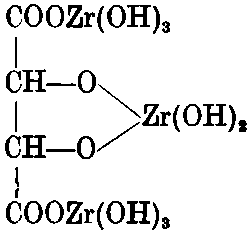 as shown by the great rise in the specific rotatory power of
solutions of alkali oxalates on addition of zirconium compounds.
The precipitate dissolves readily in alkalies, and various
double alkali tartrates have been prepared; the potassium
salt, ZrO(C₄H₄O₆K)₂,3H₂O, is analogous to the thorium alkali
tartrates. The solubility in alkalies is of great importance
for the separation of iron and zirconium.
Atomic Weight of Zirconium.
—The value of this constant is
not very accurately known. The International Committee has
adopted the value 90·6, but there is some uncertainty as to
the value of the decimal fraction. Berzelius in 1825 employed
the analytical sulphate method, and found Zr = 88·47. The
numbers of Hermann (1844), obtained by the analysis of the
oxychloride, 2ZrOCl₂,9H₂O,[471] were very discordant, the mean
giving the value 89·56. Marignac in 1860 analysed the potassium
salt, K₂ZrF₆; this he heated with strong sulphuric acid,
the residue being ignited until all the zirconium sulphate was
transformed to oxide; the weighed mixture was then freed
from potassium sulphate, and the residual oxide dried and
weighed. From the three ratios K₂ZrF₆ : ZrO₂, K₂ZrF₆ : H₂SO₄,
and K₂SO₄ : ZrO₂, he obtained the mean values 90·02, 91·55,
and 90·68 respectively. Weibull in 1881-1882 determined
the ratios Zr(SO₄)₂ : ZrO₂ and Zr(SeO₄)₂ : ZrO₂ by ignition
of the sulphate and selenate respectively; he obtained the
values 89·55 and 90·81.
Bailey carried out a series of analytical sulphate determinations
in 1890, obtaining the mean value 90·656. Brauner
criticises the method on the ground that the preparation of
the pure neutral anhydrous sulphate is almost impossible;
the sulphate heated to 400° is not yet anhydrous, so that
Bailey’s result, on this ground, is probably too low. Venable
in 1898 analysed the oxychloride; he claimed to have obtained
the compound ZrOCl₂,3H₂O, by heating the crystallised salt
at 100°-125° in hydrogen chloride, a method which Chauvenet
(loc. cit.) has found to lead to the dihydrate, ZrOCl₂,2H₂O.
His value was 90·803.
Detection and Estimation.
—The following reactions may
be employed to distinguish zirconium:
(1) The oxalate precipitated from neutral or faintly acid
solution dissolves readily in excess of oxalic acid; the oxalates
of thorium and of the rare earth elements are practically
insoluble under these conditions. The fluoride also dissolves
in excess of hydrofluoric acid or of alkali fluoride, behaviour
characteristic of this element alone among the group.
(2) By fusion with sodium carbonate in the oxidising
flame, a bead is obtained, which, when dissolved in boiling
hydrochloric acid, forms a solution which gives a voluminous
precipitate on addition of disodium hydrogen phosphate, if
zirconium is present. Iron, aluminium, titanium, thorium,
and rare earths have no influence on the test.[472]
(3) A solution of a zirconium salt in hydrochloric acid
gives an orange colouration with curcuma paper. Ferric and
titanium salts, if present, must be reduced by means of zinc
before the test is applied.
The estimation of zirconium is complicated by the difficulty
of separating it from the accompanying elements. The
solubility of the oxalate in oxalic acid allows of a rapid and
easy separation from thorium and rare earth elements, so that
iron, aluminium, and chromium only remain to be removed.
Iron may be separated by the thiosulphate method, or other
processes mentioned on p. 338; when free from that element,
zirconium may be separated from aluminium and chromium
by precipitation with alkali iodate in presence of the least
possible excess of acid. The precipitates in the thiosulphate
and iodate methods may be washed, and ignited directly to
the dioxide, which is weighed as such; if the zirconium is
left after separation in solution, it may be precipitated with
ammonia,[473] and after washing and drying, ignited and weighed
as dioxide.
The name Thoria (thorina) was proposed by Berzelius
in 1817 for what appeared to be a new earth, but which in
1824 was recognised as a basic yttria phosphate. In 1828 a
new mineral was discovered by Esmark near Brevig in Norway;
to the oxide isolated from this, Berzelius gave the name thoria,
from its resemblance to the substance he had obtained in 1817.
The homogeneity of the new element was questioned by Bergmann
in 1857, and also by Bahr in 1862, but the conclusions
of those authors have been shown to be quite unfounded.
Thorium occurs in traces in a large number of common
minerals, and in varying quantities in most of the uranium
and rare earth minerals. Its occurrence in monazite, and the
distribution of the latter mineral, have already been dealt
with; the commercial treatment of monazite is described in
Chapter XVIII. The oxide forms the chief constituent in
Thorite, with its gem-variety Orangite, and the various
secondary minerals, and in the mineral Thorianite, in which
the only other important constituent is uranous oxide. The
extraction from these minerals is a comparatively simple
matter. Decomposition is easily effected by hydrochloric
or sulphuric acid, thorianite dissolving easily also in nitric
acid; the solutions obtained, after appropriate treatment to
remove silica, excess of acid, etc., are treated with sulphuretted
hydrogen, to remove lead, bismuth, and similar foreign metals,
and freed from the rare earths by the carbonate, oxalate, or
sulphate methods. The last depends on the fact that thorium
sulphate and its hydrates are much less soluble than corresponding
compounds of the rare earth elements; the first
two on the fact that thorium salts dissolve readily in excess
of alkali carbonates or oxalates, whilst the rare earth compounds
are much less easily soluble.
Thorium, like zirconium, forms only one series of salts,
in which the metal is tetravalent. The formula ThO was
originally put forward by Berzelius for the oxide, from its
resemblance to the ceria and yttria oxides, and its general
occurrence with these. The true formula was deduced, when
the valency of zirconium had been decided by the vapour
density experiments of Troost and Deville, in 1857, from the
isomorphism of zircon and thorite, and the close relationship
between the compounds of the two elements, especially among
the double fluorides, and was confirmed by a determination
of the specific heat of the metal by Nilson in 1883.
In its chemical relations, the element resembles zirconium,
though, as is to be expected from the high atomic weight,
it shows a much more marked electropositive character,
approaching in this respect the elements of the yttrium group.
The oxide has no longer acid properties, and the neutral
salts, though they hydrolyse readily and are therefore acid
to indicators in solution, may be recrystallised unchanged from
aqueous solution. The tendency to form double salts is still
present, though diminished; the oxalate is soluble in a large
excess of alkali oxalate, but not in oxalic acid, and the double
fluorides are less numerous and varied than those of zirconium
and titanium. On the other hand, it forms a well-crystallised
and characteristic series of double nitrates, R´₂Th(NO₃)₆,
isomorphous with the analogous ceric salts. In the behaviour
of its sulphate it differs markedly from zirconium, and closely
approaches the rare earth elements. The hydroxide has the
characteristic tendency to form colloidal solutions and gels.
Thorium is peculiar, among the elements which have been
considered, through its property of giving characteristic
radiations, and disintegrating with formation of a whole
family of new elements; or, as it is commonly expressed,
through its radioactive properties.[474] The element has a
half-life period of the order of 4 × 10¹⁰ years; in the course
of decay, it gives rise to mesothorium 1, which is rayless,
but decays to mesothorium 2, with its product radiothorium,
both of which give powerful radiations. Mesothorium 1 of
course occurs in all thorium-containing minerals, and may be
separated from monazite by addition of a barium compound
during the sulphuric acid decomposition; in consequence of
the powerful radiating properties of its products, it is itself
of considerable importance, and proposals for extracting it
from monazite in the preparation of the thorium nitrate of
commerce have been put forward (see p. 276).
Mesothorium appears to be chemically identical with
radium; since monazite, like all other thorium-bearing minerals,
contains uranium and radium, the latter element is separated
with the mesothorium, and indeed, having a very much larger
half-life period, constitutes by far the greater part of such
‘mesothorium’ preparations. On account of the great
activity of the mesothorium products, the best preparations
from monazite, though estimated to contain only 1 per
cent. of mesothorium to 99 per cent. radium, are said to
be four times as active as pure radium compounds. The
chemical identity of the two products seems to preclude
any possibility of determining the physical properties and
constants of mesothorium.
The element radiothorium, which was discovered by Hahn
in 1905, in the mineral thorianite, is chemically identical
with the parent element thorium, but can be separated by
means of the intermediate element, mesothorium 1. The
latter is readily separated by the sulphate precipitation, and
the radiothorium to which it gives rise may be separated by
precipitation with ammonia. Thorium is also chemically
identical with ionium, the parent of radium, and the thorium
nitrate of commerce therefore contains important quantities
of ionium—important that is, in view of the high radiating
power of the latter element. The study of these relationships
constitutes one of the most important and interesting fields
in the province of radioactivity.
The Metal.—Elementary thorium has not yet been obtained
in the pure state, owing to the ease with which it forms compounds
and alloys with all the common elements, and to its
great affinity for oxygen; the high melting-point also increases
the difficulty of obtaining the pure metal. Berzelius
attempted to reduce the alkali double fluorides and double
chlorides with sodium or potassium; Nilson carried out the
same reaction in a closed iron cylinder, but his product still
contained 20 per cent. of thoria. Reduction of the oxide with
magnesium is never complete, and the carbon method gives
only a mixture of carbide and metal. Electrolytic methods
give no better results, since the metal liberated at the cathode
always encloses oxide and other impurities. Moissan and
Hönigschmid in 1906, by heating the carefully purified
anhydrous chloride with sodium in a sealed glass tube from
which air and moisture had been removed, claim to have
obtained a product containing only 3 per cent. of the oxide.
The element has recently been prepared in leaf form by forcing
the amorphous product into the bore of a copper tube, hammering
into sheets, and removing the copper by dilute nitric
acid.[475]
The amorphous impure metal is a dark grey powder, of
specific gravity 11·3; the hammered and strongly heated
leaf has the density 12·16. It burns readily in air with great
brilliance, and when finely powdered ignites if crushed
or rubbed. When heated in the electric furnace, it melts,
according to von Bolton,[476]
at about 1450°; von Wartenburg[477]
found the melting-point to be about 1700°; the fused beads
resemble platinum in physical properties. It is somewhat
resistant to acids, dissolving easily only in aqua regia, and
more slowly in fuming hydrochloric acid. It combines directly
when heated in sulphur or halogens, and in nitrogen and
hydrogen.
The hydride, ThH₄, is best obtained by heating the metal
in hydrogen, an energetic reaction taking place at a red heat.
Winkler observed that a mixture of the dioxide with magnesium
absorbs hydrogen readily when heated. The hydride is a
stable greyish-black powder, not attacked by water, but
dissolving readily in hydrochloric acid, with evolution of
hydrogen. The nitride, Th₃N₄, is prepared by heating the
metal in the gas, or the carbide in a stream of ammonia. It
is a brown powder, decomposed by water with evolution of
ammonia and formation of the dioxide. The azide has been
used for purposes of detection and estimation, since in boiling
solution it is hydrolysed with separation of the hydroxide;
zirconium and ceric salts also show this reaction, but the rare
earth salts give no precipitate.
The hydroxide, Th(OH)₄,xH₂O, is precipitated from solutions
of thorium salts by alkalies or ammonia, as a gelatinous white
precipitate, insoluble in excess. It dissolves readily in mineral
acids or in alkali carbonates. Hydrogen peroxide and ammonia
throw down an hydrated peroxide, Th₂O₇; from neutral
solutions hydrogen peroxide alone throws down peroxy-salts,
which contain acid groups. This peroxide may also be obtained
by the action of sodium hypochlorite or hydrogen peroxide on
the hydroxide, as in the case of the zirconium compound. It
readily gives up oxygen, passing into the more stable peroxide,
ThO₃. Since in neutral or faintly acid solutions zirconium
and the rare earths give no precipitate with hydrogen peroxide,
the reaction is extremely useful in the detection and estimation
of thorium.
Thorium dioxide, ThO₂, is obtained by the ignition of
the hydroxide or of suitable salts as a white powder, of which
the properties and appearance depend largely on the method
and temperature used in its formation. Whilst the residue
obtained by ignition of the nitrate is an extraordinarily voluminous
and light flaky mass, the sulphate yields a dense
thick powder; the nitrate was therefore always preferred
in the manufacture of incandescent mantles (q.v.), as it was
thought that the oxide obtained from it was the most suitable
for illumination. In the crystalline form the oxide has been
obtained in the laboratory by fusion with borax and with
potassium phosphate. The first method gives tetragonal crystals,
probably isomorphous with those of rutile and cassiterite;
the phosphate fusion is said to give cubic crystals (see p. 74).
The oxide is insoluble in acids, but can be transformed into
the sulphate by evaporation with concentrated sulphuric acid,
or fusion with alkali bisulphate. It does not liberate carbon
dioxide when fused with alkali carbonates.
By repeated evaporation with small quantities of acids,
thoria can be transformed into a gel soluble in water (thorium
meta-oxide). The sol is an opalescent fluid, orange-red by
transmitted light, and contains small quantities of the acid
employed. The hydroxide may also be obtained in this form
by carefully washing it, and boiling with small quantities of
acids, or with thorium or other salts, or even by long continued
washing with pure water; similarly, continued dialysis of
thorium salts eventually yields such gels. The colloid is
positively charged, and resembles the zirconium oxide gel
in its relation to negatively charged colloids. The gel is
easily precipitated by electrolytes.
Ignited thorium oxide has found considerable application
in recent years a catalyst in the preparation of ketones by
the contact method of Sabatier and Senderens.[478] By passing
mixtures of the vapours of appropriate acids over the catalyst
heated to the necessary temperature, good yields of the required
ketones are obtained.[479]
The sulphide, ThS₂, is obtained, together with the oxysulphide,
ThOS, according to Duboin,[480] by passing a current of
sulphuretted hydrogen over a mixture of thorium chloride
with excess of sodium chloride, at a red heat. The former
forms large brown crystals, from which the small orange-yellow
crystals of the oxysulphide may be separated by means
of a sieve; the latter is purified by treatment with warm
nitric acid, which dissolves the sulphide very readily. The
oxysulphide is also obtained when the anhydrous sulphate
is heated in sulphuretted hydrogen.[481]
The carbide, ThC₂, is obtained by the action of carbon on
the oxide in the electric furnace; it is a yellow crystalline
mass, decomposed slowly by water, energetically by dilute
acids in the cold, with evolution of a complex mixture of
hydrogen and hydrocarbons, in which many members of the
paraffin, olefine and acetylene series have been observed.[482]
Hydrogen constitutes over 50 per cent. of the mixture, the
next most important constituents being the acetylenic hydrocarbons,
followed by ethane.
Thorium fluoride, ThF₄, is obtained anhydrous by passing
hydrogen fluoride over the anhydrous chloride or bromide at
a temperature of 350°-400°. The tetrahydrate, ThF₄,4H₂O,
is precipitated by addition of hydrofluoric acid to a solution
of a thorium salt, or by the action of the acid on the hydroxide.
Hydrofluosilicic acid also throws down the fluoride, even in
the cold, from solutions of thorium salts. The fluoride is
insoluble in water and mineral acids, as well as in excess of
precipitant; this behaviour allows of a complete and easy
separation of thorium from titanium and zirconium. The
rare earth fluorides are also much more easily soluble in concentrated
mineral acids than thorium fluoride, so that this
compound may also be used in the separation from the rare
earths. When heated in a stream of the acid to 800°, the
hydrated salt yields the oxyfluoride, ThOF₂; ignited in the
air, it leaves the dioxide. Precipitation with potassium
fluoride gives the double fluoride, KThF₅,H₂O, which may be
obtained anhydrous by fusion of the mixed fluorides; it is
insoluble. An amorphous insoluble compound, K₂ThF₆,4H₂O,
is obtained by boiling the hydroxide with a mixture of potassium
hydrogen fluoride and hydrofluoric acid. Sodium and
ammonium fluorides throw down the simple fluoride.
Thorium chloride, ThCl₄, is obtained in the anhydrous
form by all the usual methods, the most convenient being
perhaps the action of chlorine and sulphur monochloride on
the heated dioxide. It almost invariably contains small
quantities of oxychloride. When pure, it forms colourless
needles fairly stable in dry air; the impure product gradually
darkens in colour. It dissolves in water with considerable
evolution of heat, and is soluble also in alcohol and moist
ether. It melts at about 820°, and sublimes unchanged at
somewhat higher temperatures; the vapour begins to dissociate
at about 1050°, the dissociation increasing rapidly as
the temperature rises. It resembles zirconium chloride in the
ease with which it forms additive compounds with ammonia and
organic bases, and addition and condensation products with
organic oxygen-compounds; many double and complex chlorides
are also known, among which the platinum compounds
ThPtCl₈,12H₂O and Th₂Pt₃Cl₁₄,24H₂O, and the pyridine salt
(C₅H₅NH)₂ThCl₆ may be mentioned.
From aqueous solution the octohydrate, ThCl₄,8H₂O,
separates at ordinary temperatures; a heptahydrate and an
enneahydrate have been described as precipitated from the
alcoholic solution by addition of water. The basic salts,
Th(OH)Cl₃,7H₂O and Th(OH)₂Cl₂,5H₂O, have been obtained
by addition of the hydroxide to alcoholic hydrogen chloride.
The oxychloride, ThOCl₂, may be obtained by the carefully
regulated action of carbon tetrachloride on the dioxide, according
to the equation:
ThO₂ + CCl₄ = ThOCl₂ + COCl₂
It is a colourless crystalline solid, which takes up moisture
from the air, forming the hexahydrate.
Thorium bromide, ThBr₄, is a volatile solid which boils
at 725°; it closely resembles the chloride. The iodide and a
basic iodide, Th(OH)I₃,10H₂O, are known.
No cyanide of thorium is known, addition of potassium
cyanide merely causing separation of the hydroxide. A
ferrocyanide, Th[Fe(CN)₆],4H₂O, is thrown down as a white
powder by potassium ferrocyanide; with potassium ferricyanide
no precipitate is obtained. The platinocyanide,
Th[Pt(CN)₄]₂,16H₂O, is obtained by double decomposition in
yellowish-brown prisms.
Among the halogen oxysalts, the perchlorate, chlorate,
bromate, and iodate were prepared by Cleve. The iodate is
of great importance for purposes of detection and estimation,
from the fact that, in presence of a large excess of alkali iodate,
it is insoluble in strong nitric acid, whilst the analogous compounds
of the rare earth elements dissolve readily in that
solvent.
The sulphate, Th(SO₄)₂, is obtained anhydrous by evaporating
the excess of acid from a solution of the dioxide in oil
of vitriol, or by heating the hydrates. It resembles the sulphates
of the rare earth elements, in that it dissolves in water
at 0° to form a highly supersaturated solution, from which
the hydrated forms separate out almost quantitatively when
the temperature is allowed to rise. The solubility relations
of the various hydrates, on account of their commercial importance,
are somewhat fully treated in Chapter XVIII. A
dihydrate, Th(SO₄)₂,2H₂O, is obtained by keeping the tetrahydrate
at 110°. The ennea- and octohydrates are isomorphous
with the corresponding thorium selenate hydrates, and the
ennea- and tetrahydrates with the analogous uranous sulphate
hydrates. The hydrates yield the anhydrous salt when heated
to 400°; the anhydrous sulphate has already a considerable
dissociation tension (15 mm.) at 575°. By treatment with
excess of acid, and subsequent heating to 130° in vacuo, the
acid sulphate, Th(SO₄),H₂SO₄, is obtained. An insoluble basic
salt, ThOSO₄,2H₂O, is formed by continued boiling of the
tetrahydrate in dilute solution, or more quickly by heating
the solution in a closed tube to 120°-125°; a monohydrate,
ThOSO₄,H₂O, is also known. Halla[483] has recently obtained
the hydrate, ThOSO₄,5H₂O, by boiling a solution of the
neutral sulphate with magnesium sulphate, and also by
treating the anhydrous sulphate with a little water in
presence of magnesium carbonate.
By precipitation with potassium sulphate the double salt,
Th(SO₄)₂,2K₂SO₄,2H₂O, is formed; this is soluble in water
but insoluble in potassium sulphate solution. The analogous
sodium and ammonium salts are soluble both in water and
excess of the corresponding alkali sulphate.
The sulphite, Th(SO₃)₂,H₂O, is obtained as a white amorphous
precipitate by warming a solution of a thorium salt
with sulphurous acid. Basic sulphites and double sulphites
are also known; the precipitates obtained by addition of
alkali sulphite dissolve readily in excess. The hydroxide
is almost insoluble in sulphurous acid, behaviour which distinguishes
thorium (and zirconium) from all the trivalent
metals. No thiosulphate is known, the hydroxide being thrown
down from boiling solution by addition of sodium thiosulphate:
this method of precipitation was formerly much used for
purposes of estimation, but it is more tedious and less accurate
than the modern methods.
Thorium nitrate, Th(NO₃)₄,12H₂O, crystallises at ordinary
temperatures in large hygroscopic tablets, very soluble
in water and alcohol. The hydrates, Th(NO₃)₄,6H₂O and
Th(NO₃)₄,5H₂O, have been obtained from hot solution and
from nitric acid solution respectively. Thorium is employed
in commerce almost entirely in the form of this salt, which is
dehydrated until it contains about 48 per cent. ThO₂, which
approximates to the formula Th(NO₃)₄,4H₂O; the commercial
product, however, is not a definite hydrate. Kolbe[484] has described
the additive product with antipyrine, 2Th(NO₃)₄,5C₁₁H₁₂ON₂,
which melts at 168°. The extent to which thorium salts are
hydrolysed in solution is very considerable, as is evident from
the fact that the nitrate may be titrated with standard potash
in presence of phenolphthalein as indicator; the solution
first becomes alkaline to this reagent when 3·5 molecules
of potash have been added for each molecule of thorium
nitrate present.[485] Of the large number of double nitrates
which have been prepared, the general types R´₂Th(NO₃)₆,
where R´ = NH₄,K,Rb,Cs, and R´´Th(NO₃)₆,8H₂O, where
R´´ = Mg,Mn,Zn,Ni,Co, are the most important.
Thorium phosphates.—The precipitates obtained by addition
of phosphoric acid or alkali phosphates to solutions of thorium
salts are gelatinous solids of doubtful composition; they
dissolve in mineral acids and in alkali carbonates, and their
behaviour is of great importance in the technical treatment
of monazite. Various phosphates and double phosphates
are obtained by fusion methods, but none of these are
important. The phosphite, Th(HPO₃)₂,3H₂O, and hypophosphite,
Th(H₂PO₂)₄, are insoluble solids obtained by
double decomposition. The hypophosphate ThP₂O₆,11H₂O,
is of great importance for purposes of detection and estimation,
since it is thrown down quantitatively from strongly
acid solutions; under these conditions the rare earths remain
in solution.
No neutral carbonate of thorium is known. Alkali carbonates
precipitate a basic salt, which dissolves readily in
excess; this fact is of very great importance in the commercial
extraction of thorium, the sodium and ammonium double
carbonates of the cerium elements being almost insoluble
in alkali carbonates. Addition of alcohol to the solution
throws down double carbonates, which can be washed with ice
water. The salts K₆Th(CO₃)₅,10H₂O, Na₆Th(CO₃)₅,12H₂O, and
(NH₄)₂Th(CO₃)₃,6H₂O have been obtained in this way; they
dissolve readily in water or dilute alkali carbonate, though
on warming or diluting the solution, the hydroxide separates.
The thallium compound, Tl₆Th(CO₃)₅, is sparingly soluble,
and is thrown down from a solution of the ammonium
compound on addition of a thallium salt; it has been
proposed for the microchemical detection of thorium. The
quantitative separation of thorium by means of pure moist
lead carbonate has been proposed for the purpose of estimation
(see p. 288).
Thorium oxalate, Th(C₂O₄)₂,6H₂O, is precipitated quantitatively
by means of oxalic acid, even in presence of considerable
quantities of mineral acids. It is less soluble in sulphuric
acid than any of the rare earth oxalates,[486] and is not attacked,
as are the latter compounds, by concentrated nitric acid. In
hydrochloric acid the solubility first increases rapidly with
the concentration of the acid, and then suddenly decreases;
this behaviour is due to the formation of an oxalochloride,
3Th(C₂O₄)₂,ThCl₄,20H₂O. When the amorphous oxalate obtained
by precipitation is allowed to remain for a considerable
time in contact with acids, it forms characteristic
tetragonal prisms of the more stable form. The dihydrate,
Th(C₂O₄)₂,2H₂O, is obtained when the hexahydrate is dried over
sulphuric acid, or heated to 100°. The salt dissolves easily
in excess of alkali oxalate, but is precipitated from the solutions
by mineral acids, a fact which allows of another means of
separation from zirconium, the double oxalates of which
are much more stable towards acids. The solubility of the
oxalate in alkali oxalate allows of separation from the rare
earth elements, whilst its insolubility in excess of oxalic acid
can be used for the separation from zirconium.
The formate and acetate can be obtained in the form of
neutral salts by the action of the acids on the hydroxide;
by double decomposition, amorphous precipitates of basic salts
are obtained. With tartaric acid stable complex compounds
are formed, as shown by the fact that alkalies will not precipitate
the hydroxide from a solution in presence of that
reagent, and by the elevation of the specific rotatory power.
Many complex salts are known, the simplest having the
composition ThO(C₄H₄O₆R´)₂,8H₂O, where R´ = K,Na,NH₄;
these are obtained by dissolving thorium hydroxide in concentrated
solutions of alkali hydrogen tartrates. Thorium acetylacetone,
Th(C₅H₇O₂)₄, is precipitated by addition of ammonia
to an aqueous solution of the nitrate mixed with acetylacetone
dissolved in ammonia; the solid is recrystallised from
alcohol, and melts at 171°.
Atomic Weight of Thorium.
—The value adopted by the
International Committee (1914) is 232·4, but most of the
determinations carried out within the last thirty years show
considerable discrepancies. The earlier work of Berzelius
(1829) and Chydenius (1861) led to very widely varying results,
and for the same reason little reliance can be placed on the
results of Delafontaine (1863) and Hermann (1864). In 1874
Cleve determined the constant by ignition of the sulphate,
obtaining the mean values 234·03 and 233·97; the figure 234
based on these results was for many years accepted as the true
atomic weight. A series of determinations carried out by
Nilson in 1882 led to much lower results. He employed
the sulphate ennea- and octohydrates, first dehydrating these,
and then igniting to oxide, and showed that Cleve’s value
must be too high on account chiefly of the hygroscopic nature
of the ignited oxide, which increases in weight when kept;
but his own values show considerable discrepancies. The
ratio Th(SO₄)₂,9H₂O-ThO₂ : ThO₂ (enneahydrate converted
to oxide) gave the figure (corrected to vacuo) 232·51, whilst
the ratio ThO₂ : 2SO₃ (anhydrous sulphate to oxide) gave
232·16; the ratio Th(SO₄)₂ : 9H₂O (hydrate to anhydrous
salt) gave, however, 233·75. The value obtained for the
ratio ThO₂ : 2SO₃ for anhydrous sulphate prepared from the
octohydrate was 232·49 (corrected to vacuo). Five years
later, Krüss and Nilson prepared the anhydrous sulphate
from the pure octohydrate, and ignited this to the oxide.
The ratio ThO₂ : 2SO₃ gave as a mean of very concordant
results the figure 232·49.
Brauner criticises these values on the ground that no details
are given as to the temperature required to obtain the anhydrous
salt from the hydrates, and that probably some traces of
sulphate must be decomposed at the temperatures required
(450°-500°) to drive off all the water. The results obtained
from the enneahydrate are to a great extent invalidated by
the doubts as to the purity of the hydrate, completeness of
dehydration, etc., which arise from the discrepancies in the
values deduced from the three ratios. He accepts, however,
the figure 232·49 obtained by Nilson and by Krüss and Nilson
from material separated as octohydrate, with some uncertainty
as to the second decimal figure.
Brauner himself employed the oxalate method in 1898;
the purified hexahydrate was used, the percentage of thoria
being determined by ignition, and of (C₂O₃) by titration with
permanganate. The ratio ThO₂ : 2C₂O₃ gave results varying
from 232·21 to 232·29, but as the value rose continuously as
purification was carried further and further, he did not feel
justified in taking a mean value. In 1900 Urbain determined
the constant with material purified by the acetylacetone
method. He prepared the octohydrate, heated it for ten hours
in a bath of sulphur vapour at 440°, and ignited the anhydrous
salt so obtained at a white heat. The ratio ThO₂ : 2SO₃ gave
the result (corrected to vacuo) Th = 233·67. Brauner criticises
the value on the ground that the hydrated salt was heated in a
vessel open to the air, and that at the high temperature obtained,
traces of moisture gaining access to the sulphate caused hydrolysis,
with loss of sulphuric acid; this would cause the results
to be too high. In 1905 Meyer and Gumperz employed the
same method, and obtained values varying from 232·2 to
232·7, with the mean 232·47. Finally Brauner carried out
an extended investigation to disprove the heterogeneity of
thorium which had been ‘discovered’ by Baskerville (1904),
in the course of which he showed the atomic weight of the
element to lie between the limits 232·34 and 232·52.
Detection of Thorium.
—The element is best detected in a
mixture of earths by the following reactions:
(1) Precipitation with hydrogen peroxide from warm,
faintly acid solution.
(2) Precipitation with sodium hypophosphate, Na₂H₂P₂O₆,
in concentrated hydrochloric acid solution. On boiling, a
perceptible precipitate is obtained if only traces of thorium
are present; but ceric and zirconium salts and titanium must
be absent. The latter element gives no precipitate under
these conditions if hydrogen peroxide is present; ceric salts
may be decomposed by boiling. The possible presence of
zirconium renders it necessary to boil the hypophosphate
precipitate with nitric acid; on addition of oxalic acid to
the clear solution, thorium is precipitated, whilst zirconium
remains in solution, and may be detected.
(3) Potassium azide, KN₃, throws down thorium hydroxide
from boiling neutral or faintly acid solutions. Ceric salts if
present must be previously reduced; zirconium must be
previously removed by oxalic acid.
(4) Precipitation may be effected with potassium iodate
in strong nitric acid solution. Here also ceric salts must be
reduced before applying the test. Zirconium also gives the
test; the precipitate must therefore be washed and warmed
with oxalic acid, in which thorium iodate is insoluble, whilst
zirconium iodate is soluble.
The methods of estimating thorium are given in Chapter
XVIII.