When the analysis of the mental functions involved in
arithmetical learning is made thorough it turns into the
question, 'What are the elementary bonds or connections
that constitute these functions?' and when the problem of
teaching arithmetic is regarded, as it should be in the light
of present psychology, as a problem in the development of a
hierarchy of intellectual habits, it becomes in large measure
a problem of the choice of the bonds to be formed and of the
discovery of the best order in which to form them and the
best means of forming each in that order.
The importance of habit-formation or connection-making
has been grossly underestimated by the majority of teachers
and writers of textbooks. For, in the first place, mastery
by deductive reasoning of such matters as 'carrying' in
addition, 'borrowing' in subtraction, the value of the digits
in the partial products in multiplication, the manipulation
of the figures in division, the placing of the decimal point
after multiplication or division with decimals, or the manipulation
of the figures in the multiplication and division of
fractions, is impossible or extremely unlikely in the case of
children of the ages and experience in question. They do
not as a rule deduce the method of manipulation from their
knowledge of decimal notation. Rather they learn about
decimal notation by carrying, borrowing, writing the last
figure of each partial product under the multiplier which
gives that product, etc. They learn the method of manipulating
numbers by seeing them employed, and by more or
less blindly acquiring them as associative habits.
In the second place, we, who have already formed and
long used the right habits and are thereby protected against
the casual misleadings of unfortunate mental connections,
can hardly realize the force of mere association. When a
child writes sixteen as 61, or finds 428 as the sum of
15
19
16
18
or gives 642 as an answer to 27 × 36, or says that 4 divided
by ¼ = 1, we are tempted to consider him mentally perverse,
forgetting or perhaps never having understood that he
goes wrong for exactly the same general reason that we go
right; namely, the general law of habit-formation. If we
study the cases of 61 for 16, we shall find them occurring
in the work of pupils who after having been drilled in writing
26, 36, 46, 62, 63, and so on, in which the order of the six
in writing is the same as it is in speech, return to writing the
'teen numbers. If our language said onety-one for eleven
and onety-six for sixteen, we should probably never find
such errors except as 'lapses' or as the results of misperception
or lack of memory. They would then be more
frequent before the 20s, 30s, etc., were learned.
If pupils are given much drill on written single column
addition involving the higher decades (each time writing
the two-figure sum), they are forming a habit of writing 28
after the sum of 8, 6, 9, and 5 is reached; and it should not
surprise us if the pupil still occasionally writes the two-figure
sum for the first column though a second column is
to be added also. On the contrary, unless some counter
force influences him, he is absolutely sure to make this
mistake.
The last mistake quoted (4 ÷ ¼ = 1) is interesting because
here we have possibly one of the cases where deduction from
psychology alone can give constructive aid to teaching.
Multiplication and division by fractions have been notorious
for their difficulty. The former is now alleviated by using of
instead of × until the new habit is fixed. The latter is still
approached with elaborate caution and with various means
of showing why one must 'invert and multiply' or 'multiply
by the reciprocal.'
But in the author's opinion it seems clear that the difficulty
in multiplying and dividing by a fraction was not that
children felt any logical objections to canceling or inverting.
I fancy that the majority of them would cheerfully invert
any fraction three times over or cancel numbers at random
in a column if they were shown how to do so. But if you
are a youngster inexperienced in numerical abstractions
and if you have had divide connected with 'make smaller'
three thousand times and never once connected with 'make
bigger,' you are sure to be somewhat impelled to make the
number smaller the three thousand and first time you are
asked to divide it. Some of my readers will probably confess
that even now they feel a slight irritation or doubt in saying
or writing that 16⁄1 ÷ 1⁄8 = 128.
The habits that have been confirmed by every multiplication
and division by integers are, in this particular of 'the
ratio of result to number operated upon,' directly opposed to
the formation of the habits required with fractions. And
that is, I believe, the main cause of the difficulty. Its
treatment then becomes easy, as will be shown later.
These illustrations could be added to almost indefinitely,
especially in the case of the responses made to the so-called
'catch' problems. The fact is that the learner rarely can,
and almost never does, survey and analyze an arithmetical
situation and justify what he is going to do by articulate
deductions from principles. He usually feels the situation
more or less vaguely and responds to it as he has responded
to it or some situation like it in the past. Arithmetic is
to him not a logical doctrine which he applies to various
special instances, but a set of rather specialized habits of
behavior toward certain sorts of quantities and relations.
And in so far as he does come to know the doctrine it is
chiefly by doing the will of the master. This is true even
with the clearest expositions, the wisest use of objective
aids, and full encouragement of originality on the pupil's
part.
Lest the last few paragraphs be misunderstood, I hasten to
add that the psychologists of to-day do not wish to make
the learning of arithmetic a mere matter of acquiring thousands
of disconnected habits, nor to decrease by one jot the
pupil's genuine comprehension of its general truths. They
wish him to reason not less than he has in the past, but more.
They find, however, that you do not secure reasoning in a
pupil by demanding it, and that his learning of a general
truth without the proper development of organized
habits back of it is likely to be, not a rational learning
of that general truth, but only a mechanical memorizing
of a verbal statement of it. They have come to
know that reasoning is not a magic force working in
independence of ordinary habits of thought, but an organization
and coöperation of those very habits on a higher
level.
The older pedagogy of arithmetic stated a general law or
truth or principle, ordered the pupil to learn it, and gave
him tasks to do which he could not do profitably unless he
understood the principle. It left him to build up himself
the particular habits needed to give him understanding and
mastery of the principle. The newer pedagogy is careful
to help him build up these connections or bonds ahead of
and along with the general truth or principle, so that he
can understand it better. The older pedagogy commanded
the pupil to reason and let him suffer the penalty of small
profit from the work if he did not. The newer provides
instructive experiences with numbers which will stimulate
the pupil to reason so far as he has the capacity, but will
still be profitable to him in concrete knowledge and skill,
even if he lacks the ability to develop the experiences into
a general understanding of the principles of numbers. The
newer pedagogy secures more reasoning in reality by not
pretending to secure so much.
The newer pedagogy of arithmetic, then, scrutinizes
every element of knowledge, every connection made in the
mind of the learner, so as to choose those which provide the
most instructive experiences, those which will grow together
into an orderly, rational system of thinking about numbers
and quantitative facts. It is not enough for a problem
to be a test of understanding of a principle; it must also
be helpful in and of itself. It is not enough for an example
to be a case of some rule; it must help review and
consolidate habits already acquired or lead up to and
facilitate habits to be acquired. Every detail of the pupil's
work must do the maximum service in arithmetical
learning.
As hitherto, I shall not try to list completely the elementary
bonds that the course of study in arithmetic should
provide for. The best means of preparing the student of
this topic for sound criticism and helpful invention is to let
him examine representative cases of bonds now often neglected
which should be formed and representative cases of
useless, or even harmful, bonds now often formed at considerable
waste of time and effort.
(1) Numbers as measures of continuous quantities.—The
numbers one, two, three, 1, 2, 3, etc., should be connected
soon after the beginning of arithmetic each with the appropriate
amount of some continuous quantity like length or
volume or weight, as well as with the appropriate sized
collection of apples, counters, blocks, and the like. Lines
should be labeled 1 foot, 2 feet, 3 feet, etc.; one inch, two
inches, three inches, etc.; weights should be lifted and called
one pound, two pounds, etc.; things should be measured in
glassfuls, handfuls, pints, and quarts. Otherwise the pupil
is likely to limit the meaning of, say, four to four sensibly
discrete things and to have difficulty in multiplication and
division. Measuring, or counting by insensibly marked off
repetitions of a unit, binds each number name to its meaning
as —— times whatever 1 is, more surely than mere counting
of the units in a collection can, and should reënforce the
latter.
(2) Additions in the higher decades.—In the case of all
save the very gifted children, the additions with higher
decades—that is, the bonds, 16 + 7 = 23, 26 + 7 = 33,
36 + 7 = 43, 14 + 8 = 22, 24 + 8 = 32, and the like—need to
be specifically practiced until the tendency becomes generalized.
'Counting' by 2s beginning with 1, and with 2,
counting by 3s beginning with 1, with 2, and with 3, counting
by 4s beginning with 1, with 2, with 3, and with 4, and so on,
make easy beginnings in the formation of the decade connections.
Practice with isolated bonds should soon be added to
get freer use of the bonds. The work of column addition
should be checked for accuracy so that a pupil will continually
get beneficial practice rather than 'practice in
error.'
(3) The uneven divisions.—The quotients with remainders
for the divisions of every number to 19 by 2, every number
to 29 by 3, every number to 39 by 4, and so on should be
taught as well as the even divisions. A table like the
following will be found a convenient means of making these
connections:—
10 = .... 2s
10 = .... 3s and .... rem.
10 = .... 4s and .... rem.
10 = .... 5s
11 = .... 2s and .... rem.
11 = .... 3s and .... rem.
.
.
.
89 = .... 9s and .... rem.
|
These bonds must be formed before short division can be
efficient, are useful as a partial help toward selection of the
proper quotient figures in long division, and are the chief
instruments for one of the important problem series in
applied arithmetic,—"How many xs can I buy for y cents
at z cents per x and how much will I have left?" That
these bonds are at present sadly neglected is shown by Kirby
['13], who found that pupils in the last half of grade 3 and the
first half of grade 4 could do only about four such examples
per minute (in a ten-minute test), and even at that rate
made far from perfect records, though they had been taught
the regular division tables. Sixty minutes of practice
resulted in a gain of nearly 75 percent in number done per
minute, with an increase in accuracy as well.
(4) The equation form.—The equation form with an
unknown quantity to be determined, or a missing number
to be found, should be connected with its meaning and with
the problem attitude long before a pupil begins algebra,
and in the minds of pupils who never will study algebra.
Children who have just barely learned to add and subtract
learn easily to do such work as the following:—
Write the missing numbers:—
4 + 8 = ....
5 + .... = 14
.... + 3 = 11
.... = 5 + 2
16 = 7 + ....
12 = .... + 5
|
The equation form is the simplest uniform way yet devised
to state a quantitative issue. It is capable of indefinite
extension if certain easily understood conventions about
parentheses and fraction signs are learned. It should be
employed widely in accounting and the treatment of commercial
problems, and would be except for outworn conventions.
It is a leading contribution of algebra to business and
industrial life. Arithmetic can make it nearly as well.
It saves more time in the case of drills on reducing fractions
to higher and lower terms alone than is required to learn
its meaning and use. To rewrite a quantitative problem
as an equation and then make the easy selection of the
necessary technique to solve the equation is one of the most
universally useful intellectual devices known to man. The
words 'equals,' 'equal,' 'is,' 'are,' 'makes,' 'make,' 'gives,'
'give,' and their rarer equivalents should therefore early
give way on many occasions to the '=' which so far surpasses
them in ultimate convenience and simplicity.
(5) Addition and subtraction facts in the case of fractions.—In
the case of adding and subtracting fractions, certain
specific bonds—between the situation of halves and thirds
to be added and the responses of thinking of the numbers
as equal to so many sixths, between the situation thirds and
fourths to be added and thinking of them as so many twelfths,
between fourths and eighths to be added and thinking of
them as eighths, and the like—should be formed separately.
The general rule of thinking of fractions as their equivalents
with some convenient denominator should come as an
organization and extension of such special habits, not as
an edict from the textbook or teacher.
(6) Fractional equivalents.—Efficiency requires that in
the end the much used reductions should be firmly connected
with the situations where they are needed. They may as
well, therefore, be so connected from the beginning, with
the gain of making the general process far easier for the dull
pupils to master. We shall see later that, for all save the
very gifted pupils, the economical way to get an understanding
of arithmetical principles is not, usually, to learn a rule
and then apply it, but to perform instructive operations and,
in the course of performing them, to get insight into the
principles.
(7) Protective habits in multiplying and dividing with fractions.—In
multiplying and dividing with fractions special
bonds should be formed to counteract the now harmful
influence of the 'multiply = get a larger number' and 'divide = get
a smaller number' bonds which all work with integers
has been reënforcing.
For example, at the beginning of the systematic work
with multiplication by a fraction, let the following be printed
clearly at the top of every relevant page of the textbook and
displayed on the blackboard:—
When you multiply a number by anything more than 1 the
result is larger than the number.
When you multiply a number by 1 the result is the same as the
number.
When you multiply a number by anything less than 1 the
result is smaller than the number.
Let the pupils establish the new habit by many such
exercises as:—
18 × 4 = ....
4 × 4 = ....
2 × 4 = ....
1 × 4 = ....
1⁄2 × 4 = ....
1⁄4 × 4 = ....
1⁄8 × 4 = ....
|
9 × 2 = ....
6 × 2 = ....
3 × 2 = ....
1 × 2 = ....
1⁄3 × 2 = ....
1⁄6 × 2 = ....
1⁄9 × 2 = ....
|
In the case of division by a fraction the old harmful habit
should be counteracted and refined by similar rules and
exercises as follows:—
When you divide a number by anything more than 1 the result
is smaller than the number.
When you divide a number by 1 the result is the same as the
number.
When you divide a number by anything less than 1 the result
is larger than the number.
State the missing numbers:—
| 8 = .... 4s | 12 = .... 6s | 9 = .... 9s |
| 8 = .... 2s | 12 = .... 4s | 9 = .... 3s |
| 8 = .... 1s | 12 = .... 3s | 9 = .... 1s |
| 8 = .... 1⁄2s | 12 = .... 2s | 9 = .... 1⁄3s |
| 8 = .... 1⁄4s | 12 = .... 1s | 9 = .... 1⁄9s |
| 8 = .... 1⁄8s | 12 = .... 1⁄2s |
| 12 = .... 1⁄3s |
| 12 = .... 1⁄4s |
| 16 ÷ 16 = | 9 ÷ 9 = | 10 ÷ 10 = | 12 ÷ 6 = |
| 16 ÷ 8 = | 9 ÷ 3 = | 10 ÷ 5 = | 12 ÷ 4 = |
| 16 ÷ 4 = | 9 ÷ 1 = | 10 ÷ 1 = | 12 ÷ 3 = |
| 16 ÷ 2 = | 9 ÷ 1⁄3 = | 10 ÷ 1⁄5 = | 12 ÷ 2 = |
| 16 ÷ 1 = | 9 ÷ 1⁄9 = | 10 ÷ 1⁄10 = | 12 ÷ 1 = |
| 16 ÷ 1⁄2 = | | | 12 ÷ 1⁄2 = |
| 16 ÷ 1⁄4 = | | | 12 ÷ 1⁄3 = |
| 16 ÷ 1⁄8 = | | | 12 ÷ 1⁄4 = |
| | | 12 ÷ 1⁄6 = |
(8) '% of' means 'hundredths times.'—In the case of percentage
a series of bonds like the following should be
formed:—
| 5 | percent | of | = .05 times |
| 20 | " " | " | = .20 " |
| 6 | " " | " | = .06 " |
| 25 | % | " | = .25 × |
| 12 | % | " | = .12 × |
| 3 | % | " | = .03 × |
Four five-minute drills on such connections between
'x percent of' and 'its decimal equivalent times' are worth
an hour's study of verbal definitions of the meaning of
percent as per hundred or the like. The only use of the
study of such definitions is to facilitate the later formation
of the bonds, and, with all save the brighter pupils, the
bonds are more needed for an understanding of the definitions
than the definitions are needed for the formation of the
bonds.
(9) Habits of verifying results.—Bonds should early be
formed between certain manipulations of numbers and
certain means of checking, or verifying the correctness of,
the manipulation in question. The additions to 9 + 9 and
the subtractions to 18 − 9 should be verified by objective
addition and subtraction and counting until the pupil has
sure command; the multiplications to 9 × 9 should be
verified by objective multiplication and counting of the
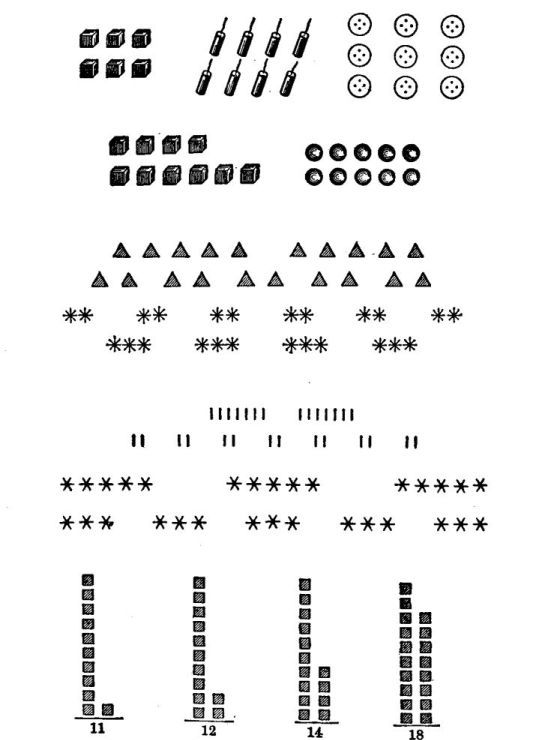
result (in piles of tens and a pile of ones) eight or ten times,[4]
and by addition eight or ten times;[4] the divisions to 81 ÷ 9
should be verified by multiplication and occasionally
objectively until the pupil has sure command; column
addition should be checked by adding the columns separately
and adding the sums so obtained, and by making two
shorter tasks of the given task and adding the two sums;
'short' multiplication should be verified eight or ten times by
addition; 'long' multiplication should be checked by
reversing multiplier and multiplicand and in other ways;
'short' and 'long' division should be verified by multiplication.
These habits of testing an obtained result are of threefold
value. They enable the pupil to find his own errors,
and to maintain a standard of accuracy by himself. They
give him a sense of the relations of the processes and the
reasons why the right ways of adding, subtracting, multiplying,
and dividing are right, such as only the very bright
pupils can get from verbal explanations. They put his
acquisition of a certain power, say multiplication, to a
real and intelligible use, in checking the results of his practice
of a new power, and so instill a respect for arithmetical
power and skill in general. The time spent in such verification
produces these results at little cost; for the practice in
adding to verify multiplications, in multiplying to verify
divisions, and the like is nearly as good for general drill
and review of the addition and multiplication themselves
as practice devised for that special purpose.
Early work in adding, subtracting, and reducing fractions
should be verified by objective aids in the shape of lines and
areas divided in suitable fractional parts. Early work with
decimal fractions should be verified by the use of the equivalent
common fractions for .25, .75, .125, .375, and the like.
Multiplication and division with fractions, both common and
decimal, should in the early stages be verified by objective
aids. The placing of the decimal point in multiplication
and division with decimal fractions should be verified by
such exercises as:—
20
1.23 ) 24.60
246 |
It cannot be 200; for 200 × 1.23 is much more than 24.6.
It cannot be 2; for 2 × 1.23 is much less than 24.6. |
The establishment of habits of verifying results and their
use is very greatly needed. The percentage of wrong
answers in arithmetical work in schools is now so high that
the pupils are often being practiced in error. In many
cases they can feel no genuine and effective confidence in the
processes, since their own use of the processes brings wrong
answers as often as right. In solving problems they often
cannot decide whether they have done the right thing or the
wrong, since even if they have done the right thing, they may
have done it inaccurately. A wrong answer to a problem
is therefore too often ambiguous and uninstructive to them.[5]
These illustrations of the last few pages are samples of
the procedures recommended by a consideration of all the
bonds that one might form and of the contribution that
each would make toward the abilities that the study of
arithmetic should develop and improve. It is by doing more
or less at haphazard what psychology teaches us to do deliberately
and systematically in this respect that many of the
past advances in the teaching of arithmetic have been made.
A scrutiny of the bonds now formed in the teaching of
arithmetic with questions concerning the exact service of
each, results in a list of bonds of small value or even no value,
so far as a psychologist can determine. I present here
samples of such psychologically unjustifiable bonds with
some of the reasons for their deficiencies.
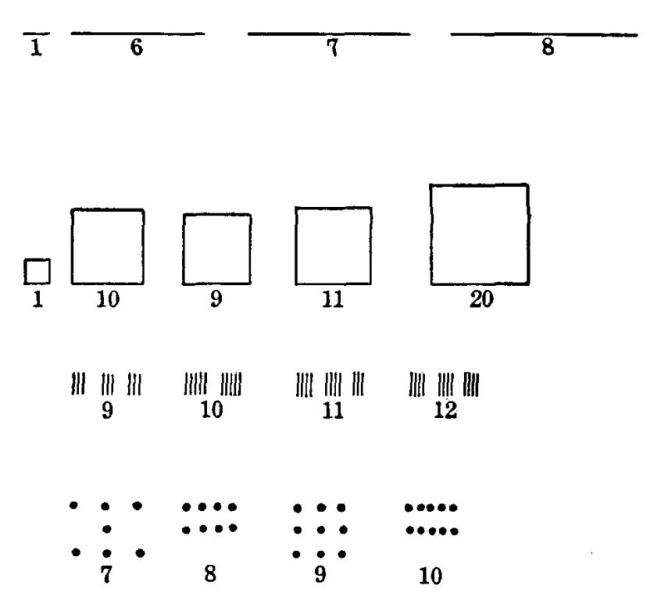
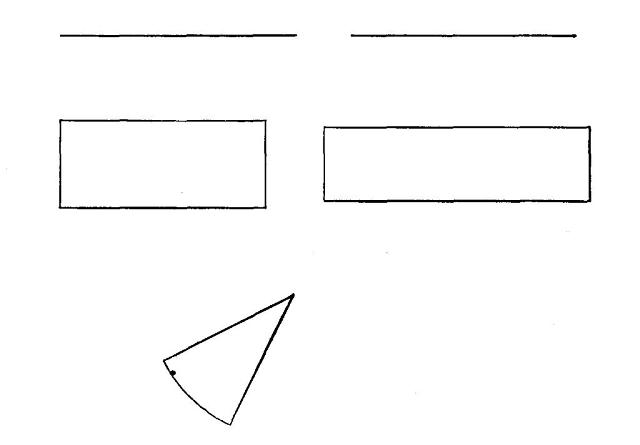
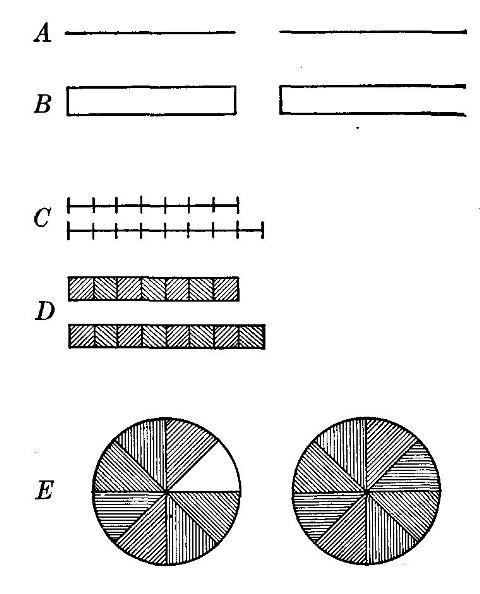
(1) Arbitrary units.—In drills intended to improve the
ability to see and use the meanings of numbers as names for
ratios or relative magnitudes, it is unwise to employ entirely
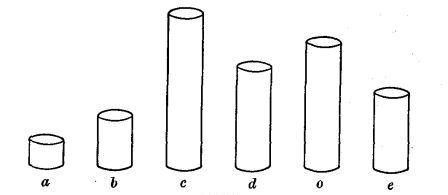
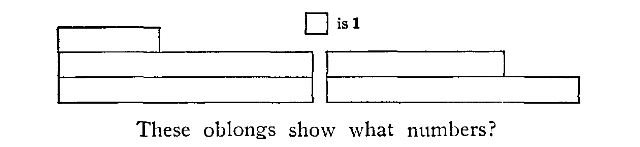
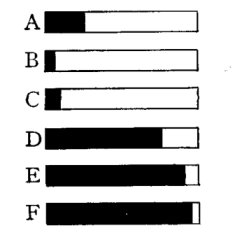
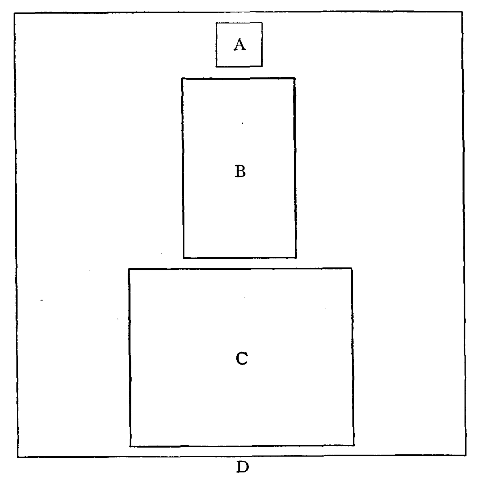
arbitrary units. The procedure in II (on page 84) is better
than that in I. Inches, half-inches, feet, and centimeters are
better as units of length than arbitrary As. Square inches,
square centimeters, and square feet are better for areas.
Ounces and pounds should be lifted rather than arbitrary
weights. Pints, quarts, glassfuls, cupfuls, handfuls, and
cubic inches are better for volume.
All the real merit in the drills on relative magnitude
advocated by Speer, McLellan and Dewey, and others can
be secured without spending time in relating magnitudes
for the sake of relative magnitude alone. The use of units
of measure in drills which will never be used in bona fide
measuring is like the use of fractions like sevenths, elevenths,
and thirteenths. A very little of it is perhaps desirable to
test the appreciation of certain general principles, but for
regular training it should give place to the use of units of
practical significance.
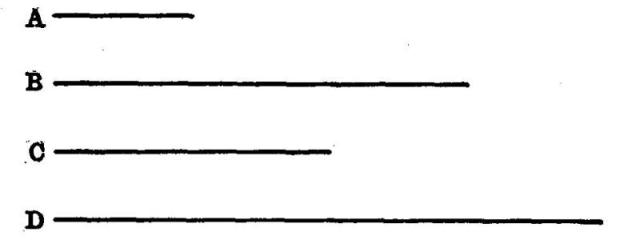 Fig. 3.
I. If A is 1 which line is 2? Which line is 4? Which line is 3?
A and C together equal what line? A and B together equal what
line? How much longer is B than A? How much longer is B
than C? How much longer is D than A?
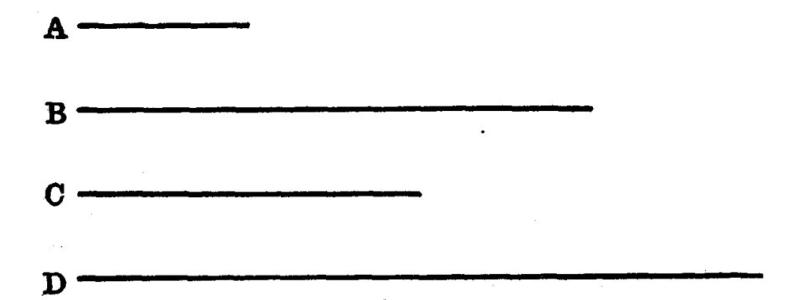 Fig. 4.
II. A is 1 inch long. Which line is 2 inches long? Which line
is 4 inches long? Which line is 3 inches long? A and C together
make ... inches? A and B together make ... inches? B is ...
... longer than A? B is ... ... longer than C? D is ...
... longer than A?
(2) Multiples of 11.—The multiplications of 2 to 12 by
11 and 12 as single connections should be left for the pupil
to acquire by himself as he needs them. These connections
interfere with the process of learning two-place multiplication.
The manipulations of numbers there required can
be learned much more easily if 11 and 12 are used as multipliers
in just the same way that 78 or 96 would be. Later
the 12 × 2, 12 × 3, etc., may be taught. There is less reason
for knowing the multiples of 11 than for knowing the
multiples of 15, 16, or 25.
(3) Abstract and concrete numbers.—The elaborate emphasis
of the supposed fact that we cannot multiply 726
by 8 dollars and the still more elaborate explanations of
why nevertheless we find the cost of 726 articles at $8 each
by multiplying 726 by 8 and calling the answer dollars are
wasteful. The same holds of the corresponding pedantry
about division. These imaginary difficulties should not be
raised at all. The pupil should not think of multiplying
or dividing men or dollars, but simply of the necessary
equation and of the sort of thing that the missing number
represents. "8 × 726 = .... Answer is dollars," or "8,
726, multiply. Answer is dollars," is all that he needs to
think, and is in the best form for his thought. Concerning
the distinction between abstract and concrete numbers, both
logic and common sense as well as psychology support the
contention of McDougle ['14, p. 206f.], who writes:—
"The most elementary counting, even that stage when the
counts were not carried in the mind, but merely in notches
on a stick or by DeMorgan's stones in a pot, requires some
thought; and the most advanced counting implies memory
of things. The terms, therefore, abstract and concrete number,
have long since ceased to be used by thinking people.
"Recently the writer visited an arithmetic class in a
State Normal School and saw a group of practically adult
students confused about this very question concerning abstract
and concrete numbers, according to their previous
training in the conventionalities of the textbook. Their
teacher diverted the work of the hour and she and the class
spent almost the whole period in reëstablishing the requirements
'that the product must always be the same kind of
unit as the multiplicand,' and 'addends must all be alike
to be added.' This is not an exceptional case. Throughout
the whole range of teaching arithmetic in the public schools
pupils are obfuscated by the philosophical encumbrances
which have been imposed upon the simplest processes of numerical
work. The time is surely ripe, now that we are readjusting
our ideas of the subject of arithmetic, to revise some
of these wasteful and disheartening practices. Algebra
historically grew out of arithmetic, yet it has not been
laden with this distinction. No pupil in algebra lets x
equal the horses; he lets x equal the number of horses, and
proceeds to drop the idea of horses out of his consideration.
He multiplies, divides, and extracts the root of the number,
sometimes handling fractions in the process, and finally
interprets the result according to the conditions of his
problem. Of course, in the early number work there have
been the sense-objects from which number has been perceived,
but the mind retreats naturally from objectivity to
the pure conception of number, and then to the number
symbol. The following is taken from the appendix to
Horn's thesis, where a seventh grade girl gets the population
of the United States in 1820:—
7,862,166
233,634
1,538,022
9,633,822
|
whites
free negroes
slaves |
In this problem three different kinds of addends are combined,
if we accept the usual distinction. Some may say
that this is a mistake,—that the pupil transformed the
'whites,' 'free negroes,' and 'slaves' into a common
unit, such as 'people' of 'population' and then added
these common units. But this 'explanation' is entirely
gratuitous, as one will find if he questions the pupil about
the process. It will be found that the child simply added
the figures as numbers only and then interpreted the result,
according to the statement of the problem, without so much
mental gymnastics. The writer has questioned hundreds
of students in Normal School work on this point, and he
believes that the ordinary mind-movement is correctly set
forth here, no matter how well one may maintain as an
academic proposition that this is not logical. Many classes
in the Eastern Kentucky State Normal have been given
this problem to solve, and they invariably get the same
result:—
'In a garden on the Summit are as many cabbage-heads
as the total number of ladies and gentlemen in this class.
How many cabbage-heads in the garden?'
And the blackboard solution looks like this each time:—
29
15
44
|
ladies
gentlemen
cabbage-heads |
So, also, one may say: I have 6 times as many sheep as you
have cows. If you have 5 cows, how many sheep have I?
Here we would multiply the number of cows, which is 5,
by 6 and call the result 30, which must be linked with the
idea of sheep because the conditions imposed by the problem
demand it. The mind naturally in this work separates the
pure number from its situation, as in algebra, handles it
according to the laws governing arithmetical combinations,
and labels the result as the statement of the problem demands.
This is expressed in the following, which is tacitly accepted
in algebra, and should be accepted equally in arithmetic:
'In all computations and operations in arithmetic, all
numbers are essentially abstract and should be so treated.
They are concrete only in the thought process that attends
the operation and interprets the result.'"
(4) Least common multiple.—The whole set of bonds involved
in learning 'least common multiple' should be left
out. In adding and subtracting fractions the pupil should
not find the least common multiple of their denominators
but should find any common multiple that he can find
quickly and correctly. No intelligent person would ever
waste time in searching for the least common multiple of
sixths, thirds, and halves except for the unfortunate traditions
of an oversystematized arithmetic, but would think
of their equivalents in sixths or twelfths or twenty-fourths
or any other convenient common multiple. The process of
finding the least common multiple is of such exceedingly
rare application in science or business or life generally that
the textbooks have to resort to purely fantastic problems
to give drill in its use.
(5) Greatest common divisor.—The whole set of bonds
involved in learning 'greatest common divisor' should
also be left out. In reducing fractions to lowest terms the
pupil should divide by anything that he sees that he can
divide by, favoring large divisors, and continue doing so
until he gets the fraction in terms suitable for the purpose
in hand. The reader probably never has had occasion to
compute a greatest common divisor since he left school.
If he has computed any, the chances are that he would have
saved time by solving the problem in some other way!
The following problems are taken at random from those
given by one of the best of the textbooks that make the
attempt to apply the facts of Greatest Common Divisor
and Least Common Multiple to problems.[6] Most of these
problems are fantastic. The others are trivial, or are better
solved by trial and adaptation.
1. A certain school consists of 132 pupils in the high school,
154 in the grammar, and 198 in the primary grades. If each group
is divided into sections of the same number containing as many
pupils as possible, how many pupils will there be in each section?
2. A farmer has 240 bu. of wheat and 920 bu. of oats, which
he desires to put into the least number of boxes of the same capacity,
without mixing the two kinds of grain. Find how many
bushels each box must hold.
3. Four bells toll at intervals of 3, 7, 12, and 14 seconds respectively,
and begin to toll at the same instant. When will they
next toll together?
4. A, B, C, and D start together, and travel the same way
around an island which is 600 mi. in circuit. A goes 20 mi. per
day, B 30, C 25, and D 40. How long must their journeying continue,
in order that they may all come together again?
5. The periods of three planets which move uniformly in circular
orbits round the sun, are respectively 200, 250, and 300 da.
Supposing their positions relatively to each other and the sun to
be given at any moment, determine how many da. must elapse
before they again have exactly the same relative positions.
(6) Rare and unimportant words.—The bonds between
rare or unimportant words and their meanings should not
be formed for the mere sake of verbal variety in the problems
of the textbook. A pupil should not be expected to solve
a problem that he cannot read. He should not be expected
in grades 2 and 3, or even in grade 4, to read words that he
has rarely or never seen before. He should not be given
elaborate drill in reading during the time devoted to the
treatment of quantitative facts and relations.
All
this is so obvious that it may seem needless to relate.
It is not. With many textbooks it is now necessary to
give definite drill in reading the words in the printed problems
intended for grades 2, 3, and 4, or to replace them by
oral statements, or to leave the pupils in confusion concerning
what the problems are that they are to solve. Many
good teachers make a regular reading-lesson out of every
page of problems before having them solved. There should
be no such necessity.
To define rare and unimportant concretely, I will say that
for pupils up to the middle of grade 3, such words as the
following are rare and unimportant (though each of them
occurs in the very first fifty pages of some well-known beginner's
book in arithmetic).
absentees
account
Adele
admitted
Agnes
agreed
Albany
Allen
allowed
alternate
Andrew
Arkansas
arrived
assembly
automobile
baking powder
balance
barley
beggar
Bertie
Bessie
bin
Boston
bouquet
bronze
buckwheat
Byron
camphor
Carl
Carrie
Cecil
Charlotte
charity
Chicago
cinnamon
Clara
clothespins
collect
comma
committee
concert
confectioner
cranberries
crane
currants
dairyman
Daniel
David
dealer
debt
delivered
Denver
|
department
deposited
dictation
discharged
discover
discovery
dish-water
drug
due
Edgar
Eddie
Edwin
election
electric
Ella
Emily
enrolled
entertainment
envelope
Esther
Ethel
exceeds
explanation
expression
generally
gentlemen
Gilbert
Grace
grading
Graham
grammar
Harold
hatchet
Heralds
hesitation
Horace Mann
impossible
income
indicated
inmost
inserts
installments
instantly
insurance
Iowa
Jack
Jennie
Johnny
Joseph
journey
Julia
Katherine
|
lettuce-plant
library
Lottie
Lula
margin
Martha
Matthew
Maud
meadow
mentally
mercury
mineral
Missouri
molasses
Morton
movements
muslin
Nellie
nieces
Oakland
observing
obtained
offered
office
onions
opposite
original
package
packet
palm
Patrick
Paul
payments
peep
Peter
perch
phaeton
photograph
piano
pigeons
Pilgrims
preserving
proprietor
purchased
Rachel
Ralph
rapidity
rather
readily
receipts
register
remanded
|
respectively
Robert
Roger
Ruth
rye
Samuel
San Francisco
seldom
sheared
shingles
skyrockets
sloop
solve
speckled
sponges
sprout
stack
Stephen
strap
successfully
suggested
sunny
supply
Susan
Susie's
syllable
talcum
term
test
thermometer
Thomas
torpedoes
trader
transaction
treasury
tricycle
tube
two-seated
united
usually
vacant
various
vase
velocipede
votes
walnuts
Walter
Washington
watched
whistle
woodland
worsted
|
(7) Misleading facts and procedures.—Bonds should not
be formed between articles of commerce and grossly inaccurate
prices therefor, between events and grossly improbable
consequences, or causes or accompaniments thereof,
nor between things, qualities, and events which have no
important connections one with another in the real world.
In general, things should not be put together in the pupil's
mind that do not belong together.
If the reader doubts the need of this warning let him examine
problems 1 to 5, all from reputable books that are
in common use, or have been within a few years, and consider
how addition, subtraction, and the habits belonging
with each are confused by exercise 6.
1. If a duck flying 3⁄5 as fast as a hawk flies 90 miles in an hour,
how fast does the hawk fly?
2. At 5⁄8 of a cent apiece how many eggs can I buy for $60?
3. At $.68 a pair how many pairs of overshoes can you buy for
$816?
4. At $.13 a dozen how many dozen bananas can you buy for
$3.12?
5. How many pecks of beans can be put into a box that will
hold just 21 bushels?
6. Write answers:
537
365
?
36
1000
|
Beginning at the bottom say 11, 18, and 2 (writing it in
its place) are 20. 5, 11, 14, and 6 (writing it) are 20, 5, 10. The number, omitted, is 62.
|
| a. | 581
97
364
?
1758 |
b. | 625
?
90
417
2050 |
c. | 752
414
130
?
2460 |
d. | 314
429
?
76
1000 |
e. | ?
845
223
95
2367 |
(8) Trivialities and absurdities.—Bonds should not be
formed between insignificant or foolish questions and the
labor of answering them, nor between the general arithmetical
work of the school and such insignificant or foolish
questions. The following are samples from recent textbooks
of excellent standing:—
On one side of George's slate there are 32 words, and on the
other side 26 words. If he erases 6 words from one side, and 8
from the other, how many words remain on his slate?
A certain school has 14 rooms, and an average of 40 children
in a room. If every one in the school should make 500 straight
marks on each side of his slate, how many would be made in all?
8 times the number of stripes in our flag is the number of years
from 1800 until Roosevelt was elected President. In what year
was he elected President?
From the Declaration of Independence to the World's Fair in
Chicago was 9 times as many years as there are stripes in the flag.
How many years was it?
(9) Useless methods.—Bonds should not be formed between
a described situation and a method of treating the
situation which would not be a useful one to follow in the case
of the real situation. For example, "If I set 96 trees in
rows, sixteen trees in a row, how many rows will I have?"
forms the habit of treating by division a problem that in
reality would be solved by counting the rows. So also "I
wish to give 25 cents to each of a group of boys and find
that it will require $2.75. How many boys are in the
group?" forms the habit of answering a question by division
whose answer must already have been present to give the
data of the problem.
(10) Problems whose answers would, in real life, be already
known.—The custom of giving problems in textbooks which
could not occur in reality because the answer has to be known
to frame the problem is a natural result of the lazy author's
tendency to work out a problem to fit a certain process and
a certain answer. Such bogus problems are very, very
common. In a random sampling of a dozen pages of
"General Review" problems in one of the most widely
used of recent textbooks, I find that about 6 percent of the
problems are of this sort. Among the problems extemporized
by teachers these bogus problems are probably still
more frequent. Such are:—
A clerk in an office addressed letters according to a given
list. After she had addressed 2500, 4⁄9 of the names on the list
had not been used; how many names were in the entire list?
The Canadian power canal at Sault Ste. Marie furnished
20,000 horse power. The canal on the Michigan side furnished
2½ times as much. How many horse power does the latter furnish?
It may be asserted that the ideal of giving as described
problems only problems that might occur and demand the
same sort of process for solution with a real situation, is too
exacting. If a problem is comprehensible and serves to
illustrate a principle or give useful drill, that is enough,
teachers may say. For really scientific teaching it is not
enough. Moreover, if problems are given merely as tests
of knowledge of a principle or as means to make some fact
or principle clear or emphatic, and are not expected to be of
direct service in the quantitative work of life, it is better
to let the fact be known. For example, "I am thinking
of a number. Half of this number is twice six. What is
the number?" is better than "A man left his wife a certain
sum of money. Half of what he left her was twice as much
as he left to his son, who receives $6000. How much did
he leave his wife?" The former is better because it makes
no false pretenses.
(11) Needless linguistic difficulties.—It should be unnecessary
to add that bonds should not be formed between
the pupil's general attitude toward arithmetic and needless,
useless difficulty in language or needless, useless, wrong
reasoning. Our teaching is, however, still tainted by both
of these unfortunate connections, which dispose the pupil
to think of arithmetic as a mystery and folly.
Consider, for example, the profitless linguistic difficulty
of problems 1-6, whose quantitative difficulties are simply
those of:—
1. 5 + 8 + 3 + 7
2. 64 ÷ 8, and knowledge that 1 peck = 8 quarts
3. 12 ÷ 4
4. 6 ÷ 2
5. 3 × 2
6. 4 × 4
1. What amount should you obtain by putting together 5
cents, 8 cents, 3 cents, and 7 cents? Did you find this result by
adding or multiplying?
2. How many times must you empty a peck measure to fill a
basket holding 64 quarts of beans?
3. If a girl commits to memory 4 pages of history in one day,
in how many days will she commit to memory 12 pages?
4. If Fred had 6 chickens how many times could he give away
2 chickens to his companions?
5. If a croquet-player drove a ball through 2 arches at each
stroke, through how many arches will he drive it by 3 strokes?
6. If mamma cut the pie into 4 pieces and gave each person a
piece, how many persons did she have for dinner if she used 4
whole pies for dessert?
Arithmetically this work belongs in the first or second
years of learning. But children of grades 2 and 3, save a
few, would be utterly at a loss to understand the language.
We are not yet free from the follies illustrated in the lessons
of pages 96 to 99, which mystified our parents.
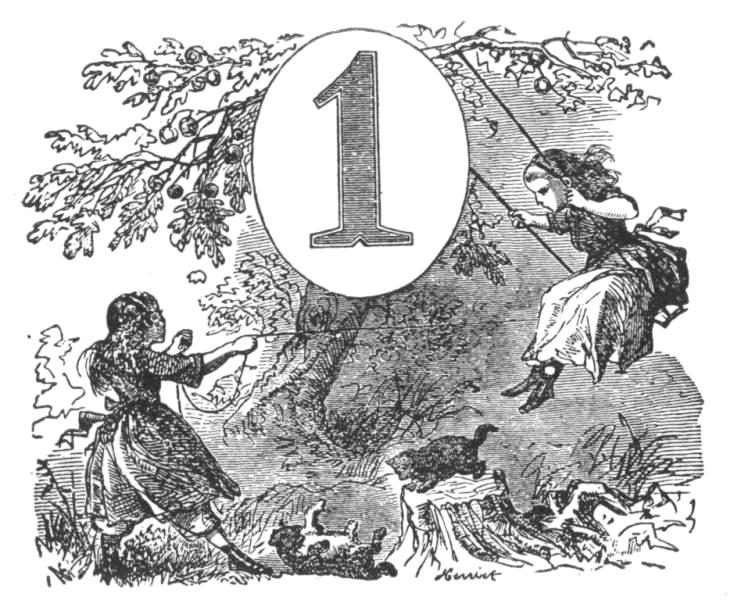 Fig. 5.
LESSON I
1. In this picture, how many girls are in the swing?
2. How many girls are pulling the swing?
3. If you count both girls together, how many are they?
One girl and one other girl are how many?
4. How many kittens do you see on the stump?
5. How many on the ground?
6. How many kittens are in the picture?
One kitten and one other kitten are how many?
7. If you should ask me how many girls are in the swing, or
how many kittens are on the stump, I could answer aloud, One;
or I could write One; or thus, 1.
8. If I write One, this is called the word One.
9. This, 1, is named a figure One, because it means the same
as the word One, and stands for One.
10. Write 1. What is this named? Why?
11. A figure 1 may stand for one girl, one kitten, or one anything.
12. When children first attend school, what do they begin to
learn? Ans. Letters and words.
13. Could you read or write before you had learned either
letters or words?
14. If we have all the letters together, they are named the
Alphabet.
15. If we write or speak words, they are named Language.
16. You are commencing to study Arithmetic; and you can
read and write in Arithmetic only as you learn the Alphabet and
Language of Arithmetic. But little time will be required for this
purpose.
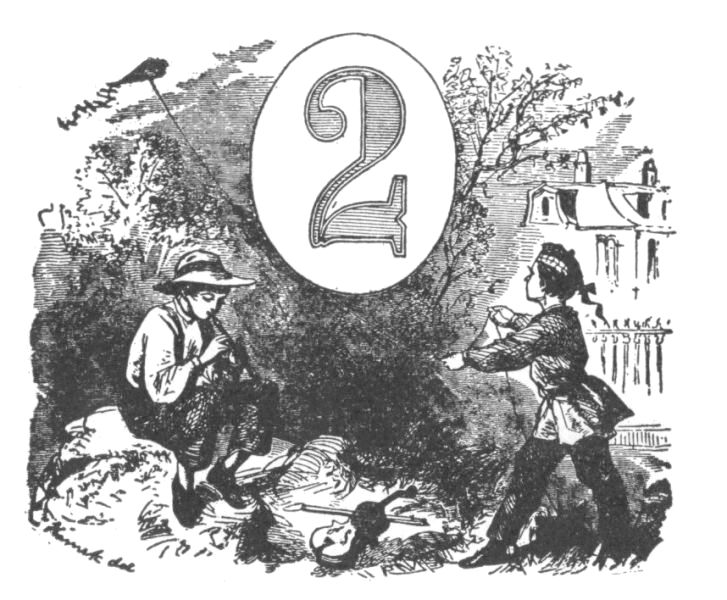 Fig. 6.
LESSON II
1. If we speak or write words, what do we name them, when
taken together?
2. What are you commencing to study? Ans. Arithmetic.
3. What Language must you now learn?
4. What do we name this, 1? Why?
5. This figure, 1, is part of the Language of Arithmetic.
6. If I should write something to stand for Two—two girls,
two kittens, or two things of any kind—what do you think we
would name it?
7. A figure Two is written thus: 2. Make a figure two.
8. Why do we name this a figure two?
9. This figure two (2) is part of the Language of Arithmetic.
10. In this picture one boy is sitting, playing a flageolet.
What is the other boy doing? If the boy standing
should sit down by the other, how many boys would be
sitting together? One boy and one other boy are how many
boys?
11. You see a flageolet and a violin. They are musical
instruments. One musical instrument and one other musical
instrument are how many?
12. I will write thus: 1 1 2. We say that 1 boy and 1 other
boy, counted together, are 2 boys; or are equal to 2 boys. We
will now write something to show that the first 1 and the other 1
are to be counted together.
13. We name a line drawn thus,—, a horizontal line. Draw
such a line. Name it.
14. A line drawn thus, | , we name a vertical line. Draw such
a line. Name it.
15. Now I will put two such lines together;
thus, +. What kind of a line do we name the
first (—)? And what do we name the last?
(|)? Are these lines long or short? Where
do they cross each other?
16. Each of you write thus: —, | , +.
17. This, +, is named Plus. Plus means
more; and + also means more.
18. I will write.
One and One More Equal Two.
19. Now I will write part of this in the Language of Arithmetic.
I write the first One thus, 1; then the other One thus,
1. Afterward I write, for the word More, thus, +, placing the +
between 1 and 1, so that the whole stands thus: 1 + 1. As I
write, I say, One and One more.
20. Each of you write 1 + 1. Read what you have written.
21. This +, when written between the 1s, shows that they are
to be put together, or counted together, so as to make 2.
22. Because + shows what is to be done, it is called a Sign.
If we take its name, Plus, and the word Sign, and put both words
together, we have Sign Plus, or Plus Sign. In speaking of this
we may call it Sign Plus, or Plus Sign, or Plus.
23. 1, 2, +, are part of the Language of Arithmetic.
Write the following in the Language of Arithmetic:
24. One and one more.
25. One and two more.
26. Two and one more.
(12) Ambiguities and falsities.—Consider the ambiguities
and false reasoning of these problems.
1. If you can earn 4 cents a day, how much can you earn in
6 weeks? (Are Sundays counted? Should a child who earns 4
cents some day expect to repeat the feat daily?)
2. How many lines must you make to draw ten triangles and
five squares? (I can do this with 8 lines, though the answer the
book requires is 50.)
3. A runner ran twice around an 1⁄8 mile track in two
minutes. What distance did he run in 2⁄3 of a minute? (I do not
know, but I do know that, save by chance, he did not run exactly
2⁄3 of 1⁄8 mile.)
4. John earned $4.35 in a week, and Henry earned $1.93.
They put their money together and bought a gun. What did it
cost? (Maybe $5, maybe $10. Did they pay for the whole of it?
Did they use all their earnings, or less, or more?)
5. Richard has 12 nickels in his purse. How much more than
50 cents would you give him for them? (Would a wise child
give 60 cents to a boy who wanted to swap 12 nickels therefor, or
would he suspect a trick and hold on to his own coins?)
6. If a horse trots 10 miles in one hour how far will he travel
in 9 hours?
7. If a girl can pick 3 quarts of berries in 1 hour how many
quarts can she pick in 3 hours?
(These last two, with a teacher insisting on the 90 and 9,
might well deprive a matter-of-fact boy of respect for
arithmetic for weeks thereafter.)
The economics and physics of the next four problems speak for
themselves.
8. I lost $15 by selling a horse for $85. What was the value
of the horse?
9. If floating ice has 7 times as much of it under the surface
of the water as above it, what part is above water? If an iceberg
is 50 ft. above water, what is the entire height of the iceberg?
How high above water would an iceberg 300 ft. high have to be?
10. A man's salary is $1000 a year and his expenses $625.
How many years will elapse before he is worth $10,000 if he is
worth $2500 at the present time?
11. Sound travels 1120 ft. a second. How long after a cannon
is fired in New York will the report be heard in Philadelphia, a
distance of 90 miles?
The reader may be wearied of these special details concerning
bonds now neglected that should be formed and
useless or harmful bonds formed for no valid reason. Any
one of them by itself is perhaps a minor matter, but when we
have cured all our faults in this respect and found all the
possibilities for wiser selection of bonds, we shall have
enormously improved the teaching of arithmetic. The
ideal is such choice of bonds (and, as will be shown later,
such arrangement of them) as will most improve the functions
in question at the least cost of time and effort. The
guiding principles may be kept in mind in the form of seven
simple but golden rules:—
1. Consider the situation the pupil faces.
2. Consider the response you wish to connect with it.
3. Form the bond; do not expect it to come by a miracle.
4. Other things being equal, form no bond that will have
to be broken.
5. Other things being equal, do not form two or three
bonds when one will serve.
6. Other things being equal, form bonds in the way that
they are required later to act.
7. Favor, therefore, the situations which life itself will
offer, and the responses which life itself will demand.