As has been stated in the previous chapter, our knowledge of
the chemistry of tannins is not sufficiently advanced to render
possible any strictly chemical classification, while an additional
complication arises from the fact that very different tannins may
coexist in the wood, bark, fruit, galls, etc. of the same plant. It
therefore seems best to follow the example of Prof. Bernardin
in his ‘Classification de 350 matières tannantes,’[130] and arrange the
plants under the orders of the natural system of botany, as has
already been done by von Höhnel[131] and A. de Lof.[132] In the
following pages, only those materials which from their high percentage
of tannin, or from some other cause, are of commercial
interest or value, are included, as the tannins are so widely distributed
in the vegetable kingdom, that any exhaustive list
would be quite out of the question.
Tannins are not confined to any particular part of the plant,
though they are usually most abundant in barks and fruits.
Insect-galls are often very rich in tannin, usually gallotannic
acid; while in several cases woods are of commercial importance
from their cheapness, though the percentage of tannin they
contain is not generally high. The function of tannins in the
vegetable economy is not well understood. In some cases they
are probably a waste product of plant-life, and may help to
ward off attacks of insects. They usually exist as cell-contents,
and as vegetable cells have frequently thick and impermeable
walls, and the diffusive power of tannins is low, much time is
required for extraction, unless the cells have been previously
crushed or broken.
It would be beyond the scope of this text-book to describe
in detail the structures of the tannin-yielding parts of plants;
but barks are of such general importance, that some particulars
seem desirable.
The detailed structure of bark varies greatly in different trees,
though its general principles remain unaltered. One of the best
short accounts of these is given by Prof. H. Marshall Ward on
page 199 of his little book on ‘Timber and some of its Diseases,’[133]
and further information may be found in Van Tieghem’s ‘Traité
de Botanique’ and other works on structural botany.
With regard to detailed structure of various tanning barks,
‘Die Gerberinden’ of von Höhnel[134] is one of the best authorities.
The inner surface bark of a young tree, or twig, consists of a
layer of soft and living cells resting on the outer surface of the
wood, and called the cambium. These cells multiply by division
(cp. p. 12) and produce from their inner surface the successive
annual layers of wood, and on their outer a fibrous tissue called
the bast (phloem), consisting of lengthened cells, and tubes with
perforated divisions (sieve-tubes) which convey sap, and mostly run
in the direction of the branch, but are crossed transversely by
cells in a line with the medullary rays of the wood. All these
cells when first produced in the cambium-layer have thin and
soft cellulose walls, but the inner layer forming the wood becomes
lignified, or hardened, by deposits of lignine on the interior of the
cell-walls, while their contents of living protoplasm disappear.
The outer layer forming bast remains much softer and more
fibrous, and retains its vitality longer. The outer surface of the
young branch is covered by a thin layer of flat cork-like cells
forming the epidermis, developed from the growing tissue of the
bud, beneath which is a layer of growing cells frequently called
the cork-cambium. This produces, on its inner side, a layer of
soft, juicy, thin-walled cells (parenchym), which are living and
capable of growth, and contain protoplasm and often chlorophyll,
to which the green colour of young twigs is due. This layer at
first rests on the bast. On the outer side, the cork-cambium
produces corky layers beneath the epidermis. The section of an
oak-twig is shown in Fig. 43.
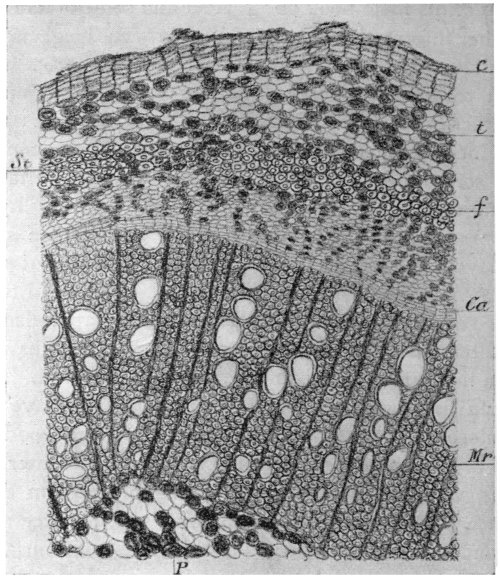
Fig. 43.—Section of Oak Twig, drawn by Prof. Bastin: c, corky
layer; t, tannin-cells; St, stone-cells; Ca, cambium; Mr, medullary
ray; P, pith.
As the tree grows, it is obvious that the corky epidermis
which grows in thickness, but not in breadth, must become distended
and finally ruptured. In some cases the surface is
renewed by fresh corky layers constantly developed below it,
and then the bark remains smooth and unfurrowed, as in the
beech and young oak, or in the birch, from which thin corky
layers are continually peeling; or it may produce a thick layer
of cork, as in the cork-oak. In many cases, and especially in
older trees, the outer or primary layer of cork-cambium ultimately
dies for want of nourishment, and a fresh cork-producing
layer is developed in the still living parenchym. As cork is
practically air- and water-proof, the new layer cuts off from its
source of nourishment and kills all the parenchym exterior to it.
In some cases this peels off, as in the Oriental plane (Platanus),
but usually it forms a constantly increasing coat of dead tissue
forming the “ross” or “crap” (Ger. Borke), which as it cannot
increase in breadth, becomes deeply fissured as the tree becomes
old. In some cases the new growing layer or secondary cork-cambium
forms a complete coating parallel with the first, but
more often it consists of a series of arcs convex towards the tree
and cutting the primary cork-cambium at various places, so as to
divide the tissue outside itself into scales. Later on the process
repeats itself, new arcs forming inside the first, and cutting off
further portions of the parenchym. In this way the cork-forming
layer gradually sinks deeper and deeper into the bark, till it
frequently passes even into the bast-layer, and very complicated
arrangements of tissue result, in which corky layers from the
secondary cork-cambium are interspersed with bast-cells and
sieve-tubes.
As a rule the outer and dead part of the bark contains but
little tannin, though to this there are exceptions, as, for instance,
in the hemlock and Aleppo pines. It always contains a large
proportion of dark colouring matters (reds, phlobaphenes, p. 297).
Cork consists of thin, and often roughly cubical cells, which
are filled with air, while tannin is usually contained in somewhat
similar cells with thicker walls. The walls of many vegetable
cells are perforated with fine holes, and become thickened by internal
deposits of hard ligneous matter which sometimes almost
fill the entire cell (“stone-cells”). Bark-cells often contain starch-granules,
frequently of peculiar and characteristic forms (which
are easily recognised by the blue colour produced on treating
the preparation under the microscope with a drop of a
solution of iodine in potassium iodide), as well as crystals of
oxalate of lime and other matters. These, and the form and
arrangement of the cells as seen in sections under the microscope,
form useful marks of recognition of the various barks. Tannin
is most easily detected by staining, before cutting sections, with
a solution of ferric chloride in absolute alcohol.
Apart from microscopic characteristics, the external appearance
of barks, both to the naked eye and by the aid of a lens,
forms a valuable means of recognition. The arrangement of the
bast and corky layers, the remains of epidermis, or the form
and character of the fissures, and of the lenticels or small corky
protuberances which take the place of stomata in the epidermis,
should be observed.
Space does not permit of any detailed account of the structure
of fruits, wood and leaves, which are also cellular structures
in many respects resembling the bark. The cuticles of leaves,
and especially the stomata or breathing pores, and the hairs are
often very characteristic. (Cp. Plates III. and IV., and p. 272.)
Valuable hints may also be obtained from the chemical
reactions which are described on p. 70 et seq., L.I.L.B.
Abies excelsa, Lam. (Pinus Abies, Pinus Picea, Picea vulgaris,
Link.), Norway Spruce. Fr. Faux sapin; Ger. Fichte, Rottanne.
The source of the so-called larch-extract, and a principal tanning
material of Austria. Contains 7-13 per cent. of a catechol-tannin
and much fermentable sugar, and on this account is useful for
swelling and colouring, but does not tan heavily. English and
Scandinavian bark does not seem much utilised. Best bark
2-8 mm. thick; smooth, yellow inside, with reddish-brown ross
outside. For detailed description of structure see von Höhnel,
‘Die Gerberinden,’ p. 35.
Abies pectinata, Silver Fir. Fr. Sapin; Ger. Edeltanne,
Silbertanne, Weisstanne. Used to a limited extent, but apt to
be confused with spruce. Contains 6-15 per cent. iron-blueing
tannin. Used in Styria, Austria, Russia. Without “ross,” but
silver-grey and smooth outside. (Von Höhnel, ‘Die Gerberinden,’
p. 40; ‘Gerber,’ 1875, p. 375.)
Abies (Pinus, Tsuga) canadensis, Hemlock Fir (Fig. 44).
The principal American tanning material, and source of hemlock
extract; averages 8-10 per cent. of a catechol-tannin, but variable,
18 per cent. reported, possibly from a different species. Abundant
in Canada and the Northern and North-western States of
America. The bark of old trees, which is principally used for
tanning and extract-making, is 2-4 cm. thick, smooth and yellow
within, greyish and deeply fissured without. The ross, which is red
and thick, contains a considerable quantity of tannin, with much
dark-red phlobaphen. It does not differ in structure from the
inner living and yellow “flesh.” The bark is easily recognisable
by its well-marked concave lamellæ of cork, cutting off successive
layers of “ross” of several millimetres in thickness. (Von Höhnel,
ibid., p. 42.)
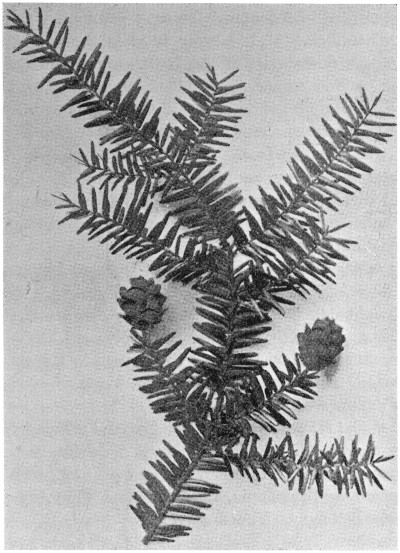
Fig. 44.[136]—Hemlock Fir (Tsuga canadense).
Abies alba (Picea alba), White Spruce, North America. In
character of tree and bark very similar to Norway spruce.
Larix europæa D.C. (Abies or Pinus Larix), Larch. Fr.
Mélèze; Ger. Lärche. Contains 9-10 per cent. pale
catechol-tannin,
mild and suitable for light leathers. Used, especially in
Scotland, for basil tannage.
Pinus halepensis, Aleppo Pine. An important tanning
material of the Mediterranean coasts. The outer bark, stripped
like cork from the living tree (Scorza or Cortegia rossa), is a
deep red tannage, and contains about 15 per cent. of tannin very
similar to hemlock. It is largely used in the island of Syra.
The inner and fleshy part of the bark, only obtained when the
tree is cut, is Snoubar or Snobar bark, containing up to 25 per
cent. of lighter coloured tannin. This bark is reddish brown,
and pretty smooth on both sides, except for shell-like depressions
on the outer surface. The “scorza rossa” is dark red-brown
internally, grey and irregular outside, frequently very
thick, and divided into successive layers of 1-2 mm. thickness
by cork lamellæ. (Von Höhnel, ibid., p. 44.) In appearance
the tree resembles the Scotch fir.
Pinus tæda, America; P. Laricio, Austrian Pine; P. maritima,
Mediterranean; P. Cembra, Alps, Tyrol, 3-5 per cent.;
P. sylvestris, Scotch Fir. Ger. Kiefer; Fr. Pin sauvage, 4-5 per
cent. P. longifolia Roxb., India, 11-14 per cent.
Juniperus communis, Juniper. Bark used in Russia.
Podocarpus elongata and Thunbergii, Cape of Good Hope;
Geelhout, Yellow woods.
Phyllocladus trichomanoides, New Zealand; Tanekahi, Tarsekahi,
Kiri-toa-toa, “Golden Tan.” Used in dyeing glove-leather.
Tannin, 30 per cent., gives green blacks with iron.
P. asplenifolia, Tasmania, Celery-topped Pine; 23 per cent.
Phyllocladus belongs to Yew family.
Scilla maritima, Squill. Tannin stated from 2-24 per cent.
More valuable for pharmacy.
Areca catechu, Betel-Nut Palm of India. Yields a species of
cutch of no importance for tanning.
Sabal serrulata, Saw Palmetto of Florida (Trimble).
(“Dwarf” palmetto is S. Adansonia.) Palmetto root has been
much talked of as a tanning material; and makes a light-coloured
leather.
An extract is now made from the roots of the Saw Palmetto,
which grows freely in the Southern States of America, and is
especially abundant on the east coast of Florida. The plant is
an evergreen, the stem growing flat along the ground, being held in
place by numerous roots each the size of a pipe-stem. The leaves
are fan-shaped and ribbed, and two to three feet in diameter. In
its hardihood the palmetto resembles a weed, as the leaves may
be cut off quite close to the stem without damaging the plant,
which will grow freely on poor sandy land which is worthless
for other purposes. The average yield is stated to be about
10 cwt. to the acre, but in good seasons and with rich land, over
a ton per acre has been obtained.
The air-dried leaves contain about 13 per cent. of tannin, but
the results obtained by different chemists vary from 5 to 20 per
cent. Possibly these variations are caused by the different
amounts of moisture in the various samples.
The leaves must be treated with a solution of caustic soda,
to remove the glossy siliceous shield which covers them and
prevents their being easily extracted. After the tanning matter
has been extracted the remaining fibre can be profitably disposed
of to paper and rope manufacturers.
As the supply of palmetto is very large it is likely that it
will, to a considerable extent, substitute the employment of
gambier, and in the United States the extract has already met
with a considerable sale. Samples of the extract examined by
the Author analysed from 16-22 per cent. of tanning matter,
and several per cent. of mineral matter, and produced a very
soft and mellow leather of good colour. The extract contains
noticeable quantities of common salt, and organic salts of soda
which leave sodium carbonate on ignition.
Cocos nucifera, the Cocoa-nut Palm, also contains tannin in
roots.
Casuarina equisetifolia L. (laterifolia Lam.); Filao bark,
Reunion; Tjamara laut, Java; Casagha or Tinian Pine, Ceylon.
Widely distributed in Southern Asia, bark used for tanning and
dyeing. Tannin gives blue-blacks with iron. Several other
species very similar in structure and properties. (Von Höhnel.)
Hooper found 11-18 per cent. of tannin.
Myrica Gale, Sweet Gale, or bog-myrtle.
Myrica (Comptonia) asplenifolia, U.S.A.; “Sweet Fern.”
Covers millions of acres in Michigan. Yields 40 per cent. of
“extract.” Leaves 4-5 per cent., roots 4-6 per cent. tannin,
according to season (Trimble). Has been much talked of, but in
Prof. Trimble’s opinion is not likely to prove of much importance.
Myrica nagi (Hind. Kaiphal), India, contains 13-27 per cent. of
tannin in the bark, and a colouring matter, myricetin, identical
with that of sumach.[137] Leather tanned with it is of a somewhat
reddish colour which is much brightened by sumaching, and converted
into a pale yellow by treatment with alum. It promises
to be a valuable tanning material.
Alnus glutinosa, Common Alder. Fr. Aulne; Ger. Erle.
Contains 16-20 per cent. iron-green tannin, with much red
colouring matter; old barks as low as 10 per cent. Colour
develops during and after tannage. Used alone it gives a red,
hard and brittle leather, but with galls, valonia, etc. it produces
a satisfactory tannage. Its principal use is to furnish gunpowder-charcoal,
and it is possible the bark might be obtained from
powder-factories, if the use of gunpowder is not superseded by
nitro-compounds. (Von Höhnel.)
Alnus maritima, Hannoki, Japan; and A. firma, Minibari.
Fruits (yashi) contain 25 per cent. tanning matter (iron-blueing),
and little colouring matter. Used in Japan for dyeing and
tanning. A. nepalensis and A. nitida used in India. Several
other species of Alnus contain tannin.
Betula alba, White or Common Birch. Fr. Bouleau blanc;
Ger. Birke. Inner bark used in Scotland (in conjunction with
larch for tanning sheep-skins), Norway, Russia, etc. It contains
only 2-5 per cent. of iron-greening tannin, and much
fermentable sugar. By far the most important use of birch bark
in tanning is to produce the birch-bark tar used to give scent
and insect-resisting power to “Russia” leather (Youft; Ger.
Juchten). The outside bark consists of thin layers of cork, often
white with a crystalline deposit of betulin, which when distilled
yields the odorous oil. The distillation is a dry one, and tarry
products accompany the true oil, and at first give a strong
empyreumatic smell to the leather, which it loses by keeping,
while the true “Russia” odour remains. This “ageing” may
be hastened by hanging the leather in a hot stove. If the oil
is distilled in a current of steam, or with petroleum ether, the
tarry matter passes over, while the matter giving the true odour
remains in the retort (p. 372).
Betula lenta, American Black Birch. The bark and twigs
distilled with water yield an essential oil, which is almost pure
salicylate of methyl, and largely substituted for oil of wintergreen
(Gaultheria procumbens), with which it is chemically identical.
Used for perfumery, and as a rheumatism remedy. Often
erroneously spoken of as the source of “Russia” oil. A mixture
of a trace of wintergreen oil with sandal-wood oil considerably
resembles the “Russia” scent (p. 373).
Castanea vesca, True or Spanish Chestnut. Fr. Châtaignier;
Ger. Kastanie. Abundant in Italy, South of France and Corsica,
where it forms great forests. Bark said to be nearly as strong
in tannin as oak (up to 17 per cent., de Lof), but not much used
in tanning.
Wood only contains 3-6 per cent. tannin, but is the source
of the valuable chestnut extract, first employed for dyeing, and
introduced as a tanning agent by Aimé Koch. The strength
of extract is of course very variable, even for the same density
(see p. 339), but it usually contains from 28 to 32 per cent. of
tannin.
The tannin gives blue-black with iron, but is not identical
with either oak-bark or gall tannins, but apparently a mixture,
or possibly a methylated derivative of the latter, and identical
with oakwood tannin, or so nearly so as to be indistinguishable;
it may also be identical with divi tannin. Decolorised chestnut
extracts, sometimes mixed with quebracho and other materials,
are often sold as “oakwood” or “oak-bark” extracts. The extract
gives a firm leather, with a good deal of bloom if used strong,
and a more reddish tint than valonia. The extract often contains
dark colouring matters, and the colour of leather tanned
with it is readily darkened by traces of lime derived from
calcareous waters or imperfectly delimed hides. Like all wood-extracts
it tans rapidly, the colour penetrating first, and the tan
following, but, according to Eitner, it does not, alone, make full or
solid tannage, perhaps from want of acid-forming matters, but
answers particularly well in combination with spruce-bark. It is
largely used in England for sole-leather in combination with
valonia, myrobalans and other materials.
The higher the temperature of extraction, the more
colouring matter is contained in the extract in proportion to
tannin matter and the greater is its viscosity. Much colouring
matter remains undissolved if the extract is dissolved in cold
water, but there is, in addition, a loss of tanning power, the
colouring matter being also capable of combining with hide. It
has in fact been used for tanning by dissolving it in solutions of
borax or alkaline salts. By improved methods of manufacture
the colouring matter has been much reduced.
The chestnut is an important food tree, the nuts forming a
considerable part of the food of the inhabitants of Corsica and
Sardinia, and even of Italy.
Almost all species of oak contain useful quantities of tannin
in the bark, and probably in the wood. Most if not all oaks
yield catechol-tannins with, probably, some mixture of ellagitannic
acid.
Quercus robur, Common Oak. Fr Chêne; Ger. Eiche. It is
frequently separated into the two subspecies:—
Quercus pedunculata. Commonest oak of lowlands, England,
Ireland and Scotland. Acorns in bunches or spikes on a stalk
1⁄6 inch long, hence Ger. name, Stiel-Eiche. Leaves sessile or
short-stalked. In favourable situations, said to yield about
2 per cent. more tannin than Q. sessiliflora, but this is doubtful.
It is the commonest oak in Slavonia, and the source of commercial
oakwood-extract.
Q. sessiliflora, Ger. Traubeneiche. Common in hilly districts,
and scattered throughout the country. Acorns in bunch on the
branch, or with very short stalk; leaves on stalk 1⁄2-1 inch long.
Of English barks, Sussex and Hampshire are considered the
best, and contain up to 12-14 per cent. of tanning matter; a
coppice bark from Wastdale, Cumberland, is however, recorded
to have yielded 19 per cent. tanning matter (Hellon).
Probably each of the two varieties of oak gives best bark
where it thrives best (v. Höhnel).
Belgian bark is sometimes equal to English, and contains
10-12 per cent. tanning matter. Dutch bark as exported is
generally inferior and not cleaned; Swedish is bright, but very
poor.
Oak-bark contains a tanning matter, quercitannic acid,
giving green-blacks with iron salts, and possibly containing both
catechol and pyrogallol groups, but its constitution is not fully
understood. It yields both red anhydrides and ellagic acid; and
gallic acid has been obtained by the action of hydrochloric acid,
though not by fermentation in the tannery. The tannin is not a
glucoside, but the fact that a sugar, lævulose, is also present in
the bark has led some observers to erroneous conclusions regarding
the constitution of the tannin. The unpurified infusion
of the bark of Q. robur gives a blue-black with iron-salts, from
the presence of a colouring matter; but those of most other oaks
give green-blacks.
Most tannin is contained in the living part of the bark. The
yield diminishes in trees over twenty-five years, and coppice
barks, from absence of ross, are often strong, and also contain
less colouring matter and more fermentable sugar.
Warm and rich soils seem to yield the best barks.
The brighter the colour of the fresh cut “flesh,” the better
the bark. Dark brown inner side shows that bark has been
exposed to rain, which deteriorates strength and colour; but a
very light colour is thought by some to indicate poorness in
tannin. White lichen is said to be a mark of poor bark, and
probably indicates a damp and unfavourable situation.
Oaks are generally cut when the sap is rising (15th April to
15th June), and the buds open and new soft cells begin to grow,
for the bark is then more easily detached.
Experiments in France have shown that the bark of timber
felled at other seasons may be loosened by steaming, and it is
said there is no practical loss of tannin. Superheated steam,
produced in a small boiler in the woods, is used.
The bark is peeled with tools of various forms, the branch
and knotted places being loosened by beating with a mallet.
The bark must be peeled immediately the tree has been felled.
The peeled bark, in pieces up to three feet long, is laid on
hurdles sloped in such a way that the rain runs off as much as
possible, and in this way it is dried, but in wet seasons is much
damaged. Bark so dried in the woods often retains 40-50 per
cent. water, and must be stacked or stored so as to allow of
further drying.
English bark is sometimes sold in “long rind,” and sometimes
“hatched” or chopped in pieces about four inches long. Belgian
and Dutch barks are generally hatched. Belgian tree bark is
“cleaned” (and cleanings often mixed back with bulk), Dutch
bark is not cleaned. Much sand and dirt is contained in most
Continental bark: screenings of Belgian bark yielded a black
liquor, and contained so much sand that they would not even
burn!
Oak-bark extract is occasionally offered for sale, but is not
usually genuine or of good quality, except that of the American
chestnut-oak, Q. prinus, from which an excellent extract has been
manufactured in the Alleghanies. Factitious extracts often contain
myrobalans and quebracho.
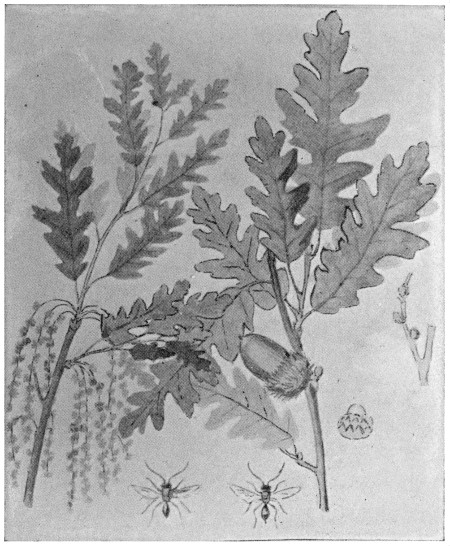
Fig. 45.—Turkey Oak (Quercus cerris).
Oakwood contains only a very small percentage (from 2-4
per cent.) of a tannin, practically identical with that of chestnut,
but different to that of oak-bark. It is stated by de Lof to reach
9-14 per cent. in old heart-wood; but this is doubtful. The wood
retains the tannin in its interior for a long time. Wood of a
Roman bridge built at Mainz 55 B.C. is stated by de Lof to have
still contained 2·14 per cent. tannin in 1881 A.D. A good deal
of imitated oakwood extract is undoubtedly made from chestnut
wood, and unfortunately no very satisfactory way of distinguishing
it is known, though oak-bark extract can be distinguished
from oakwood by giving a precipitate at once, even
in dilute solution, with bromine-water, while the wood gives a
brown precipitate only after long standing. Precipitation by
bromine-water is a general characteristic of catechol tannins,
and hence a mixture of quebracho (a cheap catechol tan) with
chestnut would simulate oak-bark in this respect. If a few
drops of the non-tannin solution or an alcoholic extract from
the “total soluble” of extracts containing quebracho or other
catechol tannins be treated with concentrated sulphuric acid in
a test-tube, a deep crimson will be produced, especially at the
surface of the acid, which remains pink on dilution with water.
With pyrogallol derivatives, such as genuine oakwood, a yellow
or brown only is produced (J. Hughes). The test is very delicate.
Another distinction is that bark extracts contain perceptible traces
of manganese, but this cannot be relied on as many wood extracts
also contain some, probably derived from the twig and branch
bark which is used along with the wood. Oakwood extract is
now manufactured on an enormous scale in Slavonia, and is
used both by sole- and dressing-leather tanners, chiefly to increase
the strength of the layer liquors. The extract is also
used to increase the weight of leather after tannage by mopping
on the flesh-side. All the best oakwood extract manufacturers
contract to sell on analysis and colour estimation, and good
Slavonian oakwood extract generally contains 26-28 per cent.
of tanning matter, giving a tintometer measurement of 4-5° red,
and 20-25° yellow, when a solution containing 1⁄2 per cent. of
tanning matter is measured in a 1 cm. cell. For particulars of
the manufacture of concentrated extracts see p. 337.
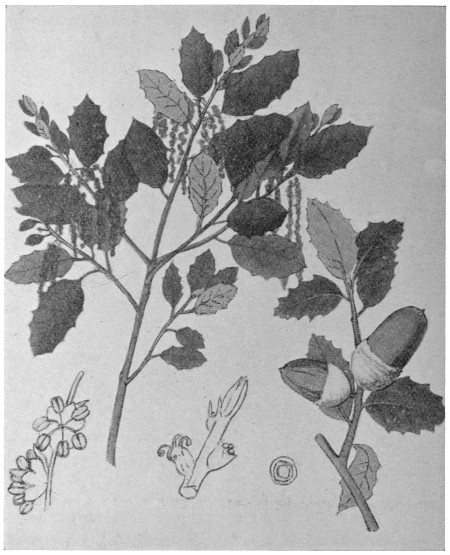
Fig. 46.—Cork Oak (Quercus suber).
Q. cerris, Turkey Oak. Ger. Zerreiche. Common in southern
Europe, a fine tree, but bark inferior to Q. robur. Fig. 45.
Q. pubescens. Fr. Chêne velu; Ger. Weiss- or Schwarzeiche.
In mountain districts and scattered in Southern Europe, about
equal to Q. robur.
Q. ilex, Evergreen Oak. Fr. Chêne vert, Chêne yeuse; Ger.
Grüneiche, Steineiche; Span. and Ital. Encina. South Europe,
Algeria. Said to be somewhat stronger in tannin than common
oak, yielding 5-11 per cent. of a rather darker coloured tannin,
but well adapted to sole-leather. Good bark is smooth outside,
without fissures, short in fracture.
Q. Suber, Cork Oak. F. Chêne liège; Ital. Sughero, Suvero.
(Figs. 46, 47.) The outer bark is cork; the interior bark contains
12-15 per cent. of tannin which is redder than that of ordinary
oak. Trees at first produce an irregular cork, sold as “virgin
cork” for ferneries, etc. After this is stripped, later growths
are more uniform, and fit for use; tanning bark is only obtained
when the tree is cut down. Bark is rough but pale-coloured on
both sides and about 1 cm. thick; interior like ordinary oak,
but more strongly furrowed. Produced chiefly on Mediterranean
coasts, and formerly largely used in Ireland.
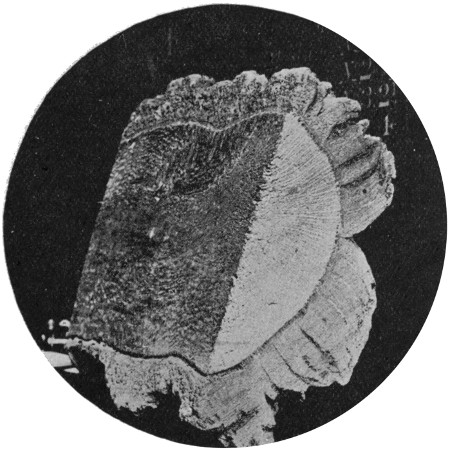
Fig. 47.—Section of Cork Oak, showing cork, inner bark and wood.
Q. pseudosuber, African Oak. Fr. Chêne faux liège. Algeria.
Not stronger than English oak, but with more colouring matter,
hence strikes quickly through leather. Bark very thick.
Q. Mirbecki. Fr. Chêne Zeen. Algeria. Rapid growth.
Bark contains 8 per cent. of tannin.
Q. Tozæ. Fr. Chêne tauzin. Pyrenees and S. France.
Bark contains 14 per cent. of tannin.
Q. coccifera, Kermes Oak. Fr. Kermes, Garouille (Fig. 48).
South Europe and Algeria. Root bark is called “rusque” or
“garouille”; averages 10-18 per cent. tannin, but trunk bark does
not exceed 11 per cent. This tree is the food of the kermes insect,
used for dyeing scarlet before the introduction of cochineal.
Garouille is principally used in the south of France, giving a firm
sole-leather of a disagreeable odour and dark brown colour.
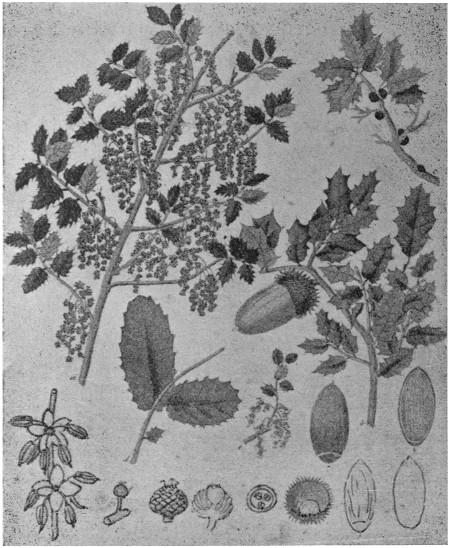
Fig. 48.—Kermes Oak (Quercus coccifera).
Q. Ægilops (and probably other species—Q. macrolepis,
græca, Ungeri, coccifera), Valonia. Fr. Valonée; Ger. Valonea,
Ackerdoppen, Orientalische Knoppern. Best Smyrna contains up
to 40 per cent., Greek 19-30 per cent., Candia valonias up to 41
per cent., and Caramanian (probably not Q. Ægilops) 17-22
per cent. of tannins which are at least principally pyrogallol
derivatives and which give blue-blacks with iron, no precipitate
with bromine-water, and which deposit a great deal of bloom
consisting of ellagic acid.
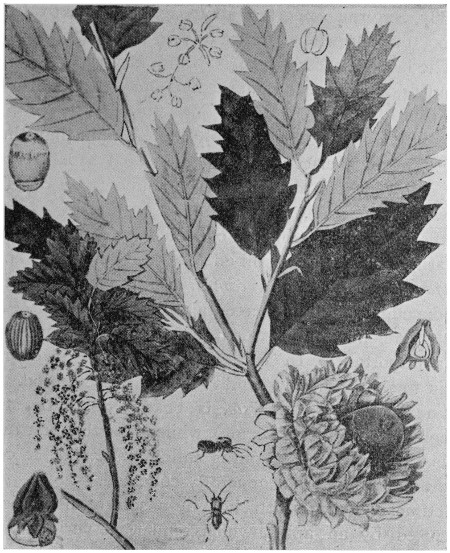
Fig. 49.—Valonia Oak (Q. Ægilops).
Q. Ægilops (Fig. 49) is said to be most abundant in the highlands
of Morea, Roumelia, Greek Archipelago, Asia Minor and
Palestine, while macrolepis forms large forests in many parts of
Greece, and especially on the lower slopes of Mount Taygetos.
In Asia Minor the fruit ripens in July-August, when the trees
are beaten and acorns left on the ground to dry. They are afterwards
gathered, and carried on camels to stores in the towns,
and thence by camel and rail to Smyrna, where they are placed
in heaps 5-6 feet deep in large airy stores, and allowed to ferment
and heat for some weeks, when the acorn, which contains
but little tannin, contracts and falls from the cup, and is used for
feeding pigs. This fermentation is risky, and if carried too far
the cups become dark-coloured and damaged. The acorn contains
a considerable amount of fermentable sugar.
When ready for shipment, the valonia is hand-picked, the
largest and finest cups (prima) going to Trieste, the second
selection to England (Inglese), and the remainder, known as
“natural,” also coming largely to England. The “Inglese,”
although inferior in appearance to the very large selected cups,
is, of course, less costly, and gives an equal yield of tannin.
In 1887, Smyrna exported about 23,000 tons to England,
and 16,000 tons elsewhere, principally to Austria, Germany and
Italy. The largest known crop is stated at 70,000 tons in Asia
Minor, and 14,000 in Greece, but the average yield is considerably
less than this.
The beard contains considerably more tannin than the cups,
sometimes over 40 per cent. It is often sold separately at the
same or a lower price, and in Smyrna is known by the Turkish
name tirnac (Ital. trillo).
In Greece the best valonia is collected (in April?) before the
cup is matured and while it still encloses the acorn, and is known
as chamada (It. camata and camatina). The colour of these
kinds is excellent and the percentage of tannin high. Mainly
used by dyers, but often worth attention for tanning where
colour is important. In camatina the acorn is completely
covered in the cup, while in camata it is partly exposed.
The next quality, rhabdisto, is beaten down by sticks in
September-October (hence name), while after the first rains the
fruit falls and turns black, and is called charcala. It contains
but little tannin, and is not generally collected.
Sometimes valonia is attacked by a sort of honeydew, probably
caused by an aphis, which renders it very sticky, and
perhaps more liable to heat, but does not in itself damage its
tanning properties.
The lighter the colour, the heavier the weight, and the thicker
the scales of the beard, the better the quality usually proves,
but analysis is the best guide. Caramanian valonia is very
inferior.
The tannin contained in valonia is especially suitable in the
manufacture of sole-leather. It deposits much bloom, and if
used as a dusting material, has the characteristic of making the
leather solid and compact, but leaves the grain somewhat rough
and hard to work. In mixture with gambier and other materials,
it is an excellent tannage for dressing leather, and with proper
management deposits little or no bloom (cp. p. 231).
Q. infectoria (Fig. 50) is the source of the “Turkish” or
Aleppo galls. Galls are caused by insects, principally of the
genus Cynips, or gall-wasps, which lay their eggs in different
parts of plants, and in some way cause an abnormal growth of
the bud, leaf, or other part.
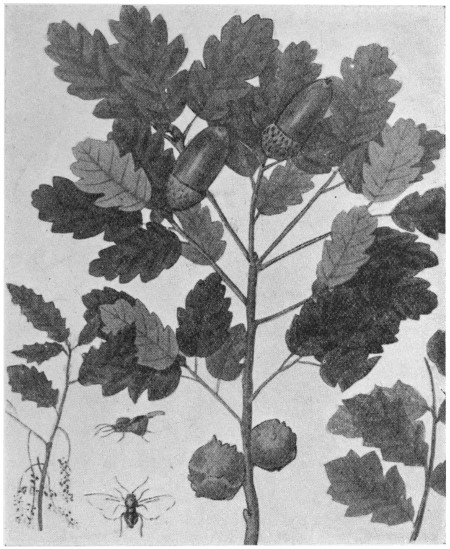
Fig. 50.—Gall Oak (Q. infectoria).
Aleppo galls are developed from the young shoot of the oak,
are best before the insect has escaped, and contain in this stage
up to 50 or 60 per cent. of gallotannic acid. When the insect has
developed and escaped, the galls are of course perforated, much
lighter, and more porous. These galls and those of Rhus semialata
are the principal sources of the tannin of commerce.
The Q. infectoria also bears a large gall like an apple,
“Apples of Sodom,” or “rove,” caused by a different insect.
This, in a crushed condition, has been somewhat largely used as
a tanning material, and contains 24-34 per cent. gallotannic
acid.
English oaks have several species of galls and oak-apples,
but they do not seem to be of much value for tanning.
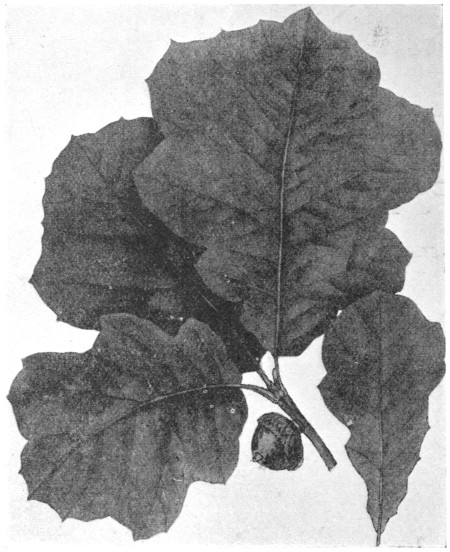
Fig. 51.—Chestnut Oak (Q. prinus).
Knoppern are galls produced on the immature acorns of
various species of oaks, principally Q. Cerris in Hungary, and
were formerly largely used there for tanning, as they contain
up to 35 per cent. gallotannic acid. They are now less abundant,
and have been largely replaced by valonia, sometimes called
orientalische Knoppern. Like all purely gallotannic materials,
they naturally give a soft and porous tannage, ill-adapted for
sole-leather purposes, which has led to the Austrian practice of
drying, or rather stewing, the leather in very hot and damp
stoves, which make it hard and brittle.
Chinese and Japanese galls are the product of the action of
an aphis on a species of sumach, and will be mentioned again
under sumachs (Rhus).
Djaft, dchift, jift, or jaft is a material apparently of Eastern
origin, and said to be derived from an oak of Kurdistan. Dark
red scales or fragments, origin uncertain, very astringent and
darkish tannage, liquor when spilt dries whitish, apparently from
crystallisation of some sort. It contains a large amount of
tannin. It appears very irregularly in commerce and the writer
would be glad to obtain further samples and details of origin.
He once used 6 or 7 tons successfully in sole-leather tannage.
It has also been attributed to a shrub allied to the Cæsalpinias
(p. 286).
The most important American oaks are—Q. prinus (castanea,
monticola), the Chestnut or Rock Oak (Fig. 51). About equal to
our oak in strength, bark very thick, and infusion strongly fluorescent,
especially in presence of ammonia. Source of chestnut-oak
extract. The most important tanning oak-bark of the
United States.
Q. alba, or “white oak,” is perhaps the most widely distributed
and abundant of any of the American oaks, and very
closely resembles the European Q. robur.
Q. tinctoria or nigra, Black or Quercitron Oak. Poor as a
tanning material, but used for dyeing yellow, and for modifying
the colour of hemlock tannages. The dyestuff, quercetin, is
closely allied to that of fustic, and gives yellows with alum and
tin mordants.
A good deal of information is given by Trimble[138] on American
oaks and other tanning materials.
Important Indian oaks are Q. glauca, Q. lamellosa and Q. incana;
bark of last said to yield 22 per cent. of tannin.
The bark of various willows, especially Salix arenaria and
Russeliana, is used for tanning in Russia, and for Danish glove-leather.
Some contain up to 12-14 per cent. of an iron-blueing
tannin. They impart a strong odour to leather, but different to
that of birch-tar oil, and the scent of genuine Russia leather is
due to a combination of both. In many cases the bark peeled
off osiers for basket-making is employed. A Russian willow
(species unknown), in the form of thin bark of osiers or small
branches, gave 9·5 per cent. tannin when examined in the
Leather Industries Laboratory of the Yorkshire College; and
willow barks certainly demand more attention than they have
received in England as tanning materials for fine leathers. Salix
caprea has been used in France for glove leathers, but is weaker
than S. arenaria.
Poplars belong to the same natural order, and have been
used for tanning, but their barks at the most contain 2-3 per cent.
Most members of this family contain tannin.
Rumex hymenosepalum, Canaigre, Gonagra (Cana agria), Red
Dock, wild pie-plant (Fig. 52). Common in sandy alluvial plains
of Mexico and Texas, and considerably resembling rhubarb. Its
tuberous roots resemble those of the dahlia, and contain, when
air-dried, 25-30 per cent. of a catechol tannin, probably allied to
that of mimosa. Undried, the roots contain about 68 per cent.
of water and only 8 per cent. of tannin. When well harvested
by slicing thin and rapidly drying, it gives leather a bright
orange colour, and, it is said, considerable weight and firmness,
and is thus specially suitable for use in retanning and finishing
light goods and harness leather. Besides tannin, the root contains
a yellow colouring matter, and about 8 per cent. of starch,
of which the granules are very variable in form and size, but
mostly oval or elongated. They do not stain readily with iodine
till they have been well washed, or treated with dilute sulphuric
acid. Both the starch and tannin are contained in large and
somewhat thin-walled cells, and the sliced material is easily
extracted at low temperatures. Greater heat gelatinises the
starch, and extracts a darker colour. The best temperature for
extraction is between 30° and 50° C. (see p. 348).
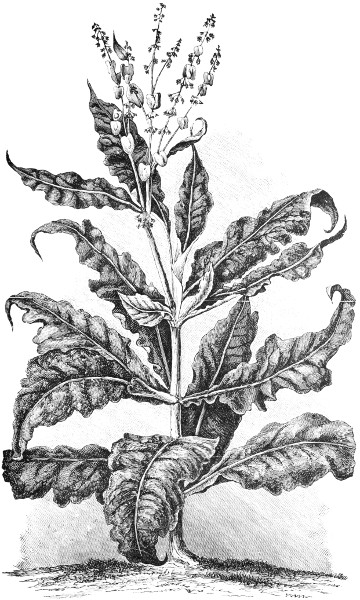
Fig. 52.—Canaigre (Rumex hymenosepalum).
‘New Commercial Drugs and Plants,’ T. Christy.
The root is most readily grown from tubers or portions including
the crown, as the plant seeds sparingly. Sandy soils,
subject to inundation or irrigation, seem best suited to its culture.
In California and Arizona the growth begins in October or
November with the winter rains, blooming about the end of
January, while the leaves die down in May and the roots remain
dormant during the summer. It is not important at what time
the roots are harvested, and they seem to improve in percentage
of tannin up to the second year, after which they become darker
and deteriorate.
The harvested crop should be sliced into thin pieces and
rapidly dried at a low temperature, or still better, converted at
once into extract. This is already done on a considerable scale
at Deming, New Mexico. The residue after extraction is used
in America as cattle-food; and might no doubt be also applied
to the production of alcohol.
Planting takes place in autumn, in rows, say 30 inches apart,
with 10 inches between each root. Roots for “seed” should be
kept in the ground or stored in dry sand. This should yield a
crop of 10 tons per acre in an average season.
References.—Report U.S. Commissioner of Agriculture,
1878, pp. 119 et seq.; Trimble, Am. Jour. of Pharmacy, p. 395,
1889; Canaigre, Bull. No. 7, Arizona Agr. Expt. Station, 1893;
‘Canaigre or Tanner’s Dock,’ Bull. No. 105, University of California,
Berkeley, Cal.; ‘Canaigre Tannin,’ Trimble and Peacock,
Philadelphia, 1893; ‘Report to the German Leather Trades
Association,’ by V. Schroeder, 1894; ‘Il Canaigre,’ E. Andrieis,
Turin, 1899.
Rumex maritima, or maritimus. Central Europe, England,
Ireland. It is said by de Lof to be found in California, where
it is used by the Indians for tanning; but he probably confounds
it with canaigre. De Lof found its roots, wet, to contain 6 per
cent. and after drying, 22 per cent. of tannin, together with
starch and an acid allied to malic.
Several English docks contain tannin; the writer had a
sample of leather tanned with dock-root (very possibly R. aquaticus),
many years old, but still soft and close in texture, and of
excellent quality.
Polygonum amphibium. Said to grow on thousands of
acres (?) on the lower Missouri. Roots contain 22 per cent.,
branches 17 per cent. of tannin. P. amphibium is a common
English and European plant, with spikes of pink flowers, growing
in marshes and ponds. Probably this is the Polygonum analysed
by Fraas, who found 20-26 per cent. tannin.
Polygonum Bistorta. Common in damp places in England.
Bistort, Snakeweed, called “Eastermer giants” in Cumberland,
where the young leaves are used for making herb-puddings.
Fraas found 16-21 per cent. tannin in the roots.
Other species are known to contain much tannin. Perkin
found a red colouring matter in P. cuspidatum, a native of India
and China, commonly grown in gardens as a foliage plant
(Journ. Chem. Soc., 1895, p. 1084). P. tinctorium, used as a source
of indigo in China and Japan.
Coccoloba uvifera, Seaside Grape of West Indies; source of
West Indian kino. Whole plant rich in tannin.
Persea, or Laurus lingue. Bark used in Chili for tanning
Valdivia leather. (According to Arata, Laurus caustica.) A
tree 25-30 feet high and 2 feet in circumference. Bark rough
outside, and whitish, with an aromatic smell and taste, brittle
and easily ground, contains 17-19 per cent. of a catechol-phloroglucol
tannin, greening iron salts (Journ. Chem. Soc., 1881,
p. 600). About 60,000 heavy hides are tanned yearly with this
bark in Valdivia and district, and mostly sent to Hamburg. The
hides are thick and scarcely tanned through, colour fair, leather
soft and porous.
Persea Meyerina N. and Laurus Pneumo. Said to be also
used in Chili.
Osyris compressa (Fusanus compressus, Colpoon compressum,
Thesium Colpoon), “Cape Sumach,” “Pruim Bast,” leaves and
bark, Cape of Good Hope. Leaves contain about 23 per cent.
of tannin and form a useful substitute for sumach; but the tannin
is not identical, and is of the catechol class, resembling gambier.
O. arborea. Northern India. Leaves rich in tannin.
Fusanus acuminatus (Santalum acuminatum), “Quandony.”
Australia. 18-19 per cent. tannin, dark coloured.
Exocarpus cupressiformis. Australia. Bark contains 15 per
cent. tannin.
Daphne Cnidium L., “Garou.” Algeria. Used for dyeing and
tanning.
Banksia serrata, Heath Honeysuckle. Australia. Specimen
examined contained 11 per cent. tannin; according to Maiden
it reaches 23 per cent.
Banksia integrifolia. Queensland. Bark contains 11 per
cent. tannin.
Grevillia striata. Australia. Bark contains 18 per cent.
tannin.
Leucospermum conocarpum. Kruppelboom. Knotted Tree.
Cape of Good Hope. Said by de Lof to contain 22 per cent. of
tannin; but a specimen examined by the Author yielded 10·9
per cent. on analysis.
Protea mellifera. Sugarbush. Suikerbosch. Cape of Good
Hope. Contains 25 per cent. tannin, according to de Lof; but
Palmer found 18·8 per cent.
Protea grandiflora. Waagenboom. Cape. Contains 25 per
cent. tannin (de Lof); 15·9 per cent. (Palmer); 15·6 per cent.
(Procter).
Protea speciosa. Cape of Good Hope.
Leucadendron argenteum, Silver Tree, Silverboom, Witteboom
Cape of Good Hope. Bark said to contain 16 per cent.
tannin (de Lof); a specimen examined by the Author yielded
9·2 per cent.
Brabium stellatifolium, Wilde Amandelboom, Wild Almond.
Plumbago Europea, Leadwort. Fr. Dentelaire. A garden
plant in England, native in France; contains much tannin, especially
in the root-bark.
Statice coriaria, Marsh Rosemary. South of Russia. Roots
up to 3 metres long and 2-12 cm. thick; used by Kalmucks for
tanning sheep-skins; contain 22 per cent. of tannin (de Lof).
Statice limonum, Sea Lavender. Coasts and salt marshes
of Europe and America. Richer in tannin than S. coriaria;
used in France, Spain and Portugal.
Several other species contain tannin. These plants are allied
to “Thrift” (Armeria).
Byrsonima spicata, Antilles, “Tamwood.”
Byrsonima coriacea, Jamaica, “Golden Spoon.”
Byrsonima chrysophylla, etc.
Malpighia punicifolia, Nicaragua, “Nancite”; “Mangrutta.”
Bark contains 20-30 per cent. of light-coloured tannin.
Krameria triandria, Rhatany, Peru.
The root is used in medicine, and is stated to contain 40 per
cent. of tannin.
Wittstein found only 20 per cent. of an iron-greening catechol-phloroglucol
tannin allied to tormentil tannin, in the root-bark,
the only active part of root.
Loxopteryngium Lorenzii. Span. Quebracho colorado. South
America, especially Argentine Republic; the highest proportion
of tannin occurring in the wood from Gran Chaco district. Wood
contains on an average about 20 per cent. of a red, difficultly-soluble
tannin, yielding “reds,” and containing catechol and
phloroglucol. The tannin is not very soluble in water, and
hence can only be used in weak liquors, but is very astringent,
and gives a firm, reddish leather. The wood also contains a
catechin[139]
and a colouring matter, fustin, identical with that of
“young fustic.” It is imported into England, and more largely
to Havre and Hamburg, in logs, which are there chipped like
logwood, and either used direct for tanning, or made into extract.
A very cheap tan. With alum it gives a yellow colour. The
extract usually dissolves to a fawn-coloured turbid solution.
Many quebracho extracts are now made completely soluble by
treatment with alkalies or sulphites (cp. p. 338).
“Quebracho” means “axebreaker,” and is consequently
applied to a variety of hard woods. Its specific gravity is
1·27-1·38, and it therefore sinks in water.
Pistacia lentiscus, Ital. Pistacio, Fr. Lentisque. Sicily, Cyprus,
Algeria. Small myrtle-like leaves contain from 12-19 per cent.
of a catechol-tannin, and are very largely used in the adulteration
of sumach. Leather tanned with sumach adulterated with
this material darkens and reddens on exposure to light and air,
and for this reason its use in many cases is decidedly injurious.
In Cyprus and the East it is known as “Skens,” Ital.
Schinia, Fr. Poudre de Lentisque, in England, often called Cyprus
sumach. (Cp. p. 272.)
P. orientalis, terebinthus, vera, etc., India, Mediterranean.
Various aphis galls, 30-40 per cent. tannin. A sample of galls of
Pistacia vera, “Gool-i-pista,” India, recently examined in the
Author’s laboratory, contained 30 per cent. of a light-coloured
tannin.
Schinus molle, “Molle,” Buenos Ayres. Leaves only used;
said to contain 19 per cent. tannin.
S. Aroeira, Brazil. Said to contain 14 per cent. tannin.
Rhus coriaria, Sicilian sumach.
Ital. Somacco. (Fig. 53.)
A shrubby bush, of which leaves
and small twigs are used.
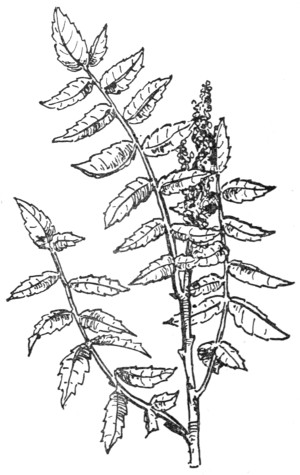
Fig. 53.—Sicilian Sumach
(Rhus coriaria).
Mostly propagated by suckers
from older plants, which are
planted in rows about two feet
apart in early spring, and pruned
to 6-8 inches. Bushes begin to
bear the year after planting,
though the strength is not so
good as from more mature
plants. Cropping is either by
pruning off shoots, or gathering
leaves by hand; in the latter
case shrubs are pruned in
winter. The leaves are dried
either in the fields, or on covered
threshing floors, where they are
afterwards separated from the
stems by beating. Some is exported in this state, as “leaf” or
“baling” sumach, but most is ground to fine powder under edge-runners.
“Ventilated” sumach is winnowed to remove dust and
sand, which often contains iron. “Mascolino” is the best sumach
from Palermo and district; “feminella” consists of weaker sorts
from other parts, and is generally used for mixing.
The different varieties of sumach are classed as follows:—
| |
Relative
Market
Value. |
| Sumach |
for |
baling |
2·5 |
| „ |
„ |
grinding |
2·3 |
| „ |
from |
yearling plants |
1·5 |
| „ |
„ |
ends of branches collected in autumn |
1·0 |
To prepare these different grades for ultimate consumption,
they are ground in mills similar to those employed for crushing
olives, that is, in which two large stone wheels follow each other,
revolving upon a circular bed, the whole construction being
about the same as the Spanish or Mexican arrastre. The sumach
thus pulverised is passed through bolting-screens to separate
the finer from the coarser particles.
After the sumach leaf has been subjected to the first process
of trituration, the coarse remaining portions are re-ground and
the product added to that which has been already obtained.
The still unpulverised residue known as peduzzo is sifted, and
the coarser and ungrindable parts are used as fuel, while the
finer are mixed with the partially-ground, small, leaf-bearing
branches (gambuzza, gammuzza), and ground again.
Palermo is the principal seat of the sumach trade. The material
is generally bought from the small growers by middlemen,
who hold it till market conditions are favourable. The quotations
are always in tarì of 42·5 centimes per cantar of 79·342
kilos, which are obsolete even in Sicily, and have to be reckoned
into lire (francs) and kilos. Consequently 1 tarì per cantar
equals 0·53565 lira per 100 kilos.
In 1894, the prices delivered at the mills were about 41-42
tarì for mascolino, 37-38 tarì for femminello, 14-18 tarì for brusca,
and 10 tarì for stinco, per cantar; the lira being worth about
9d.[140]
Sumach has been introduced into Australia, and is said to
thrive well in the dry plains of the Wimmera district.
Sumach often contains much sand, and sometimes particles
of magnetic iron ore, which cause black stains, and may be collected
by a magnet, and which dissolve in dilute hydrochloric acid
without evolution of hydrogen, to a yellow solution. Metallic
iron, which is also attracted by the magnet, dissolves in hydrochloric
acid with effervescence to a colourless or green solution.
Good sumach contains at least 25-27 per cent. of tannin. The
Author has analysed samples of undoubted genuineness containing
as much as 32 per cent. of a tannin, principally gallotannic,
with some ellagitannic acid, and a colouring matter (myricetin)
identical with that of Myrica nagi (p. 250), which gives yellows
with alumina and tin mordants, and is fugitive to light.
Sumach is the best tanning material known for pale colour
and soft tannage, and is hence used for moroccos, roans, skivers,
etc., and also for brightening leathers of darker tannages, such
as mimosa, gambier, the colouring matters of which warm sumach
liquors seem able to dissolve.
In the report of the Society of Arts Committee on bookbinding
leathers,[141] it is stated on abundant evidence, that
sumach-tanned leathers are less affected by light and gas-fumes,
and less liable to decay than those of any other known
tannage.
Sumach is frequently adulterated with the ground leaves and
twigs of Pistacia lentiscus (“schinia” or “skens”), Coriaria
myrtifolia (“stinco”), Tamarix africana (“brusca”), Ailantus
glandulosa, Vitis vinifera (leaf of the common grape vine) and
some other species of the Rhus family, but Pistacia lentiscus is
used to a much larger extent than any of the others. Pistacia,
coriaria, and tamarix all contain considerable quantities of tannin,
though less than genuine sumach, and of a different chemical
constitution.
The most satisfactory method of detecting these adulterants
is by microscopic examination, none of the chemical methods
proposed being very satisfactory; though, as many of the added
matters contain catechol tannins, while those of sumach are purely
pyrogallol derivatives, the method proposed by Hughes for the
detection of quebracho in oakwood by the reaction of concentrated
sulphuric acid (p. 296) might render good service, and any
sumach infusion which was rendered turbid by bromine-water
would at least be open to grave suspicion.
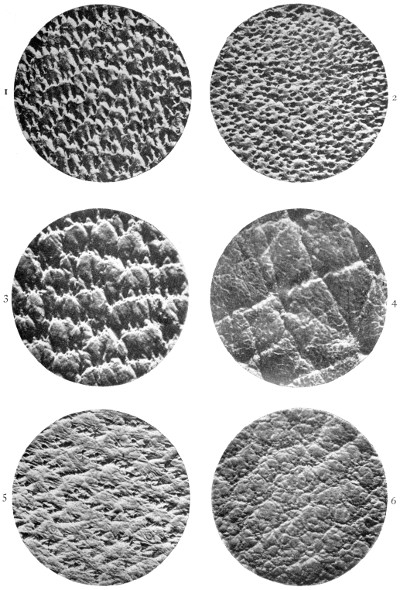
PLATE III.
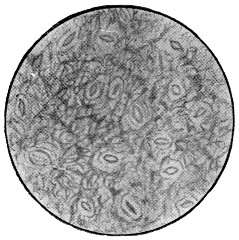
Ailantus glandulosa.
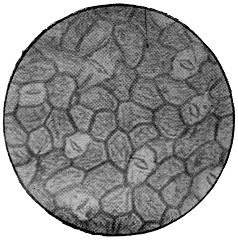
Coriaria myrtifolia.
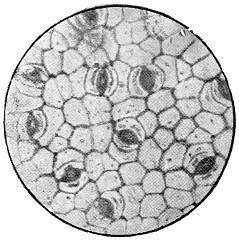
Colpoon compressa.
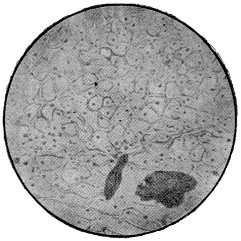
Rhus cotinus.
PLATE IV.
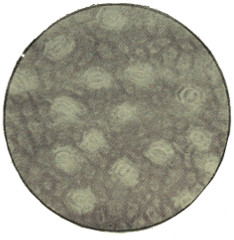
Pistacia lentiscus.
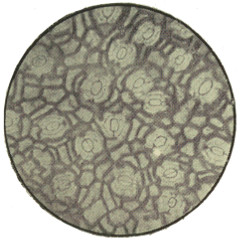
Rhus metopium.
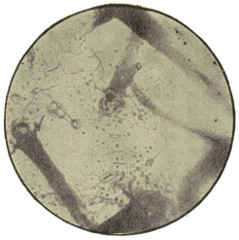
Rhus coriaria.
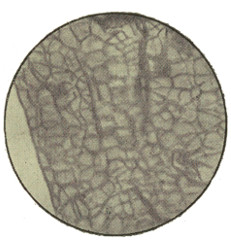
Tamarix Africana.
The most important work on the microscopic structure of
the tissues of sumach and its adulterants was done by Andreasch,
when during the later stages of his last illness he was obliged to
winter in Sicily.[142] His work will well repay study, but unfortunately
does not admit of useful abstraction here. A very useful
investigation was also made in the Author’s laboratory by Messrs.
M. C. Lamb and W. H. Harrison,[143] as regards the treatment and
examination of the leaf-cuticles, which renders the detection of
mixture comparatively easy. For details, the original memoir
must be consulted, but if the suspected sumach be gently
warmed for a few minutes with strong nitric acid, its more
delicate leaf structure is entirely destroyed, and after washing
and neutralising with sodium carbonate the strong cuticles of
the leaves of the more common adulterants, “schinia” (Pistacia
lentiscus), “stinco” (Coriaria myrtifolia), “brusca” (Tamarix
africana), and Ailantus glandulosa
are uninjured, and easily
recognised. Examination is
rendered easier by dyeing the
cuticles; safranine, acid green,
Bismarck brown, and naphthol
yellow being suitable for the
purpose. Mr. Lamb’s photographs
of the cuticles are reproduced
on Plates III. and IV., but
if possible, it is most satisfactory
to compare the suspected sample
direct with known specimens of
the adulterants.
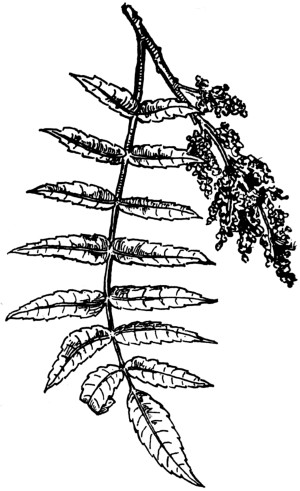
Fig. 54.—American Sumach
(Rhus glabra).
R. glabra, Southern States,
U.S.A. (Fig. 54). Very largely
used in the States to take the
place of Sicilian sumach. A
sample collected by the late Professor
Trimble, and analysed in
the Leather Industries Laboratory,
contained 25 per cent. of tannin and produced a leather
of very much darker colour than Sicilian.
R. typhina, “staghorn” or Virginian sumach, contains 10-18
per cent. of tannin. A sample from same source as above
contained 13 per cent.
R. cotonoides, U.S.A. The analysis of a sample of this
material gave 21 per cent. of tanning matter, and leather tanned
with it was almost equal in colour to that from R. glabra.
Other sorts found in States: R. semialata (5 per cent. tannin);
R. aromatica (13 per cent. tannin); R. metopium (8 per cent.);
R. copallina, R. pumila, R. canadensis; R. toxicodendron is the
well-known “poison ivy,” a climbing plant which causes a severe
and irritating eruption if touched.
R. glabra and R. copallina are chiefly recommended for extended
cultivation in the United States.
In Virginia, the leaves are collected and cured by the country
people, and sold and delivered to owners of mills for grinding.
Their particular object being to secure the largest possible quantity
of product at the lowest cost, little attention is given to the
quality obtained, or the manner of collecting. The most intelligent
dealers in the raw material urge upon collectors to observe
the following particulars:—To ensure a maximum value for
tanning purposes, the leaf should be taken when full of sap,
before it has turned red, has begun to wither, or has been affected
by frost. Either the leaf-bearing stems may be stripped off, or
the entire stalk may be cut away, and the leaves upon it allowed
to wither before being carried to the drying shed; but care must
be observed that they are neither scorched nor bleached by the
sun. When wilted, they are carried to a covered place, and
spread upon open shelving or racks to dry, avoiding the deposit
in any one place of a quantity so great as to endanger the quality
of the product by overheating and fermentation. Sumach should
be allowed to remain in the drying-house for at least one month
before sending to the market; in case of bad weather, a longer
period may be required. When ready for packing for shipment,
it should be perfectly dry and very brittle, otherwise it is likely
to suffer injury in warehouses from heating and fermentation.
Buyers of sumach leaves for grinding depend largely upon
colour for the determination of the value; the leaves should,
therefore, when ready for market, present a bright-green colour,
which is evidence that they have suffered neither from rain after
being gathered, nor from heating during the process of drying.
Leaves having a mouldy odour or appearance are rejected. The
Virginian crop reaches 7000-8000 tons, and is collected at any
time between July 1st and the appearance of frost.
There is an important difference in the value of the European
and American products. The proportion of tannic acid in the
latter is generally lower than that found in the former, which
is much preferred by tanners and dyers. By using Sicilian
sumach it is possible to make the finest white leathers, while by
the employment of the American product, the leather has a
disagreeable yellow or dark colour, apparently due to a colouring
matter, which exists in larger quantity in the American
variety than in the Sicilian.
Experiments upon the presence of colouring matters made
by treating an infusion of sumach with a solution of gelatine,
gave the following results:—
| Virginia, |
mixed, |
collected in |
June, |
gave |
A nearly white precipitate. |
| „ |
„ |
„ |
July, |
„ |
A decidedly yellowish-white precipitate. |
| „ |
R. copallina |
„ |
August, |
„ |
A dirty-yellow precipitate. |
| „ |
R. glabra |
„ |
„ |
„ |
A very dirty-white precipitate. |
| Fredericksburg, |
mixed |
„ |
„ |
„ |
A dirty-yellow precipitate. |
| Sicilian |
„ |
„ |
„ |
A slightly yellowish-white precipitate. |
For the purpose of tanning white and delicately coloured
leathers, therefore, the collection should be made in June;
while for tanning dark-coloured leathers, and for dyeing and
calico-printing in dark colours, where the slightly yellow shade
will have no injurious effect, the collection may be made in
July. It appears that for all purposes, the sumach collected
after the 1st of August is inferior in quality.
Experimental results as regards percentage of tannin obtained
by collecting sumach at different seasons showed:—
| |
Per Cent. of
Tannic Acid. |
| Virginia, |
mixed, |
collected in |
June, |
gave |
22·75 |
| „ |
„ |
„ |
July, |
„ |
27·38 |
| „ |
R. glabra |
„ |
August, |
„ |
23·56 |
| „ |
R. copallina |
„ |
„ |
„ |
16·99 |
| Sicilian, |
R. coriaria |
„ |
„ |
„ |
24·27 |
It is evident, therefore, that in order to secure the maximum
amount of tannic acid, the sumach should be collected in July,
but the colouring matter of the leaves has an important influence
upon the value of the product. The leaves of the upper extremities
of the stalks are always richer in tannic acid than those of
the base; and the increase of age of the plant is accompanied
by a general diminution of this acid.
The mill used for grinding sumach leaves consists of a heavy,
solid, circular, wooden bed, 15 feet diameter, with a depression
around the edge a few inches deep and 1 foot wide, for the reception
of the ground sumach from the bed, and two edge-rollers,
weighing about 2500 lb. each, 5-6 feet diameter, and provided
with numerous teeth of iron or
wood, thickly inserted. In
Europe and in some parts of
the Southern States, sumach is
still ground by stones revolving
on a stone bed, and the sifting
is often done by hand.
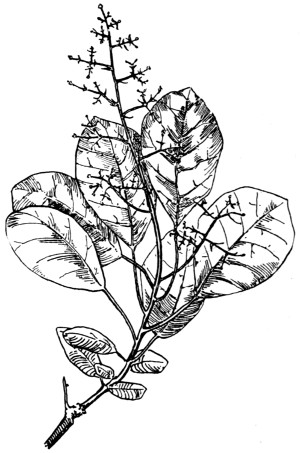
Fig. 55.—Venetian Sumach
(Rhus cotinus).
R. cotinus, Venetian sumach.
Fr. Arbre à perruques; Ger.
Perrukenstrauch (Fig. 55).
More important as a dyeing
than as a tanning material, its
twigs and wood, “young fustic,”
containing a large proportion
of a colouring matter (fisetin),
which with tin and alumina
mordants dyes bright yellows;
and much resembles, but is not
identical with the myricetin
present in R. coriaria.[144] Its
leaves, known as Turkish or
Venetian sumach, contain about 17 per cent. of tannin, and are
used for tanning.
R. pentaphylla, “Tezera,” Algeria, is used by the Arabs for
tanning goat-skins.
R. Thunbergii, Kliphout, Cape of Good Hope. A sample of
the bark analysed in the Author’s laboratory contained 28 per
cent. of tanning matter. A valuable tanning material, of reddish
colour. The tannin is of the catechol class.
Several other species of Rhus are used in tanning. R. semialata
yields Chinese and Japanese galls, containing up to 70 per
cent. gallotannic acid. They are caused, not by a fly, but by the
attack of an aphis, as are those of the allied Pistacia.[145] The
aphides pass their asexual stage inside the gall, which is large
and thin-walled. A similar aphis-gall is found on the American
sumach. A specimen of the leaves examined at the Yorkshire
College yielded only 5 per cent. of tannin.
Mangifera indica, Mango, widely distributed in the Tropics.
Bark and leaves rich in tannin, which gives green-blacks with
iron.
Coriaria myrtifolia, French sumach (of which there are four
kinds—fauvis, douzère, redoul or redon, and pudis). A poisonous
shrub of South of France; leaves used for tanning, and as a
sumach adulterant under the name of “stinco”; contain about
15 per cent. tannin. (Cp. p. 272.)
Coriaria ruscifolia bark, the tutu of New Zealand, contains
16-17 per cent. of tannin.
Other Coriarias merit examination, and are known to contain
much tannin.
Rubia, Madder, allied to Galiums, which are almost the only
English representatives of the family. The coffee- and cinchona-plants
are foreign representatives.
Nauclea, or Uncaria gambir. East Indies. (Fig. 56.) A
climbing shrub, source of “gambier,” or “Terra Japonica”;
also called “Catechu,” in common with several other solid extracts.
Gambier is first described by the Dutch trader Couperus,
in 1780; plant introduced in Malacca, 1758; plantations established
in Singapore in 1819.
Culture is mainly by Chinamen, and is very rude; it yields
rapid return, but under the treatment to which it is subjected a
plantation is worn out in ten to fifteen years. Cropping commences
three years after planting, and is continued two to four
times annually, with little regard to fitness of shrubs, the plant
being cropped till it has barely leaves left to support existence.
It is found advantageous to combine pepper-culture with that of
gambier, the spent leaves form a good protection for the pepper-plant
roots, but they have little actual manurial value.
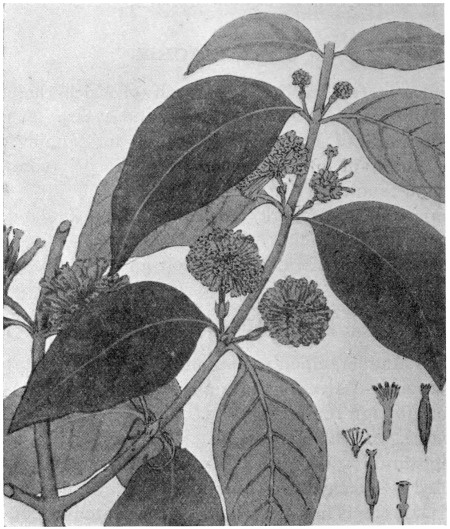
Fig. 56.—Gambier Shrub (Nauclea gambir).
Cropping is done with a knife called a parang, while a larger
knife is used for chopping the leaves and twigs before they are
put in a boiler, in which they are heated with water till the liquid,
which is constantly stirred during the operation with a wooden
five-pronged stirrer, becomes syrupy. The leaves are then
brought out with a wooden fork, and allowed to drain on a tray,
so that the liquor runs back into the boiler. The coarser matter
still remaining in the boiler is removed with a strainer like a
racquet, and the finer by straining the liquor through a perforated
cocoanut shell into small shallow tubs, where it is allowed
to cool with constant stirring with a cylindrical wooden bar,
which is worked up and down with a rotary motion until the
catechin crystallises. When quite cool the pasty mass is turned
out of the tub, cut into cubes with sides 1 inch long with a
hoop-iron knife, and dried on bamboo trays in racks under sheds,
or sometimes smoke-dried with wood fires.
Good cube gambier is an earthy-looking substance and is
dark outside, but pale within from crystallisation of catechin.
Catechin is not itself a tanning material, but is apparently converted
into a tannin by drying at 110°-126° C., when it parts with
a molecule of water. It is very probable that a similar change
occurs in the tannery. The tannin is a catechol-phloroglucol
derivative, less astringent than most of this series, and of pale
colour. (See p. 297.)
A commoner quality, called “block-gambier,” instead of
being cut into cubes, is run into large oblong blocks of about
250 lb. weight, which are wrapped in matting and exported in
a pasty condition. These contain 35-40 per cent. of tannin,
as estimated by the hide-powder method, while the best cubes
reach 50-65 per cent. Besides the forms named, various others
are made, principally for native use in chewing with betel-nut
in the form of small biscuits, or in thin discs (“wafer gambier”)
by running the pasty mass into bamboos and cutting the
cylinder so formed into thin slices. These forms are usually
light in colour, and very rich in catechin.
For details of the chemistry and employment of gambier,
see pp. 228, 231, 239, etc.
Aspidospermum quebracho. Sp. Quebracho blanco. Brazil. Bark
contains aspidospermin, an alkaloid used in medicine, but both
bark and wood are poor in tannin.
Quebracho colorado, see Anacardiaceæ, p. 269.
Arctostaphylos (or Arbutus) uva-ursi, Bearberry. Used in
Russia, Finland; twigs and leaves said to contain 14 per cent.
tannin. Often adulterated with leaves of Vaccinium vitis-idæ
or Cowberry.
Arbutus unedo, Common Arbutus. Leaves, fruit and bark
used on Mediterranean coasts.
Vaccinium Myrtillus, Bilberry. Used in Piedmont.
Weimannia glabra L., “Curtidor” bark. Venezuela.
Weimannia macrostachys D.C. Reunion.
Weimannia racemosa, New Zealand Towai or Tawheri bark.
These species contain 10-13 per cent. of iron-blueing tannin,
and have been practically used, but are not of much importance.
Most of the members of this group are poor in tannin, but
several species have galls which are rich.
Tamarix africana; Egypt, Algeria. Galls containing 26-56
per cent. tannin. The small twigs are collected in Tunis, and
when dried and ground are imported into Sicily to be used for
the adulteration of sumach under the name of “Brusca,” and
contain about 9 per cent. of tannin. (Cp. p. 272.)
T. articulata, Morocco, yields galls produced by aphides,
called in Arabia Takout, and stated by Vogel to contain 43 per
cent. of tannin.
Tamarix gallica, used in Spain and Italy.
Oxalis gigantea, source of churco bark, Chili. A thin, brittle,
dark red bark, mostly about 2 mm. thick, cork and ross entirely
absent. The bark is brittle, and the cells thin. It contains
about 25 per cent. of an easily extracted, dark red tannin, giving
green-blacks with iron. The bark has been incorrectly attributed
to Fuchsia macrostemma. (Cp. Von Höhnel, ‘Die Gerberinden,’
p. 125, and this book, p. 284.)
Several families of this genus contain trees rich in tannin,
but most important are the Myrobalans (often, but incorrectly,
written Myrabolams or Myrabolans), the unripe fruit of various
species of Indian Terminalia.
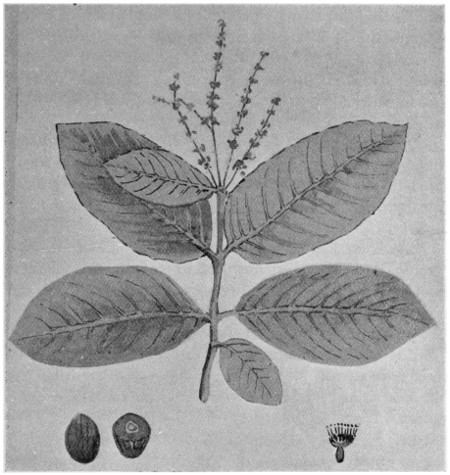
Fig. 57.—Myrobalan Tree (Terminalia Chebula).
T. Chebula (Fig. 57), a tree 40-50 feet high, and yielding
good timber, is the source of all the ordinary varieties, which differ
only in the district from which they are obtained, and the state
of maturity of the fruit. The nuts contain from 30 to 40 per
cent. of tannin. Of the various sorts, probably those known as
Bombays are least unripe, while “lean greens” are the most so.
The unripe fruit is the richest in tannin. “Bombays” have a
smooth skin in coarse wrinkles, and when cut are porous and
light coloured. “J’s” (Jubbalpores) and “V’s” (Vingorlas),
have finer and shallower wrinkles, and are harder, solider and
consequently darker looking, but do not give a darker liquor,
while “lean greens” are greener, have less yellow colouring
matter, and consequently more nearly approach in character
to sumach, which the tannin in many respects resembles,
though probably containing more ellagitannic acid in proportion
to gallotannic acid than the latter.
The “nuts” should be bright in colour, not worm-eaten, nor
“waxy” or soft. If kept in a damp place they rapidly absorb
moisture, and fall into the “waxy” condition, in which they are
very difficult to grind, sticking to and choking the cutters or
beaters of the mill.
Neither the large hard stones nor their kernels contain tannin,
but the latter have an oil which gives a peculiar odour to leather.
The tannin exists in large and rather thickly-walled cells, and is
not very easily extracted; the skin is wrinkled, but the uncrushed
nuts swell up to their original plum-like form when
placed in water for some time. The bark is almost as rich as
the fruit, and the tree also yields galls.
T. Belerica yields Beleric or “Bedda nuts,” which are
downy, rounder and larger than ordinary myrobalans, and
contain about 12 per cent. of tannin, used as adulterant of ground
myrobalans. A sample of solid extract made from the bark of
T. Belerica contained 70 per cent. of tannin.
T. tomentosa has downy nuts, containing about 10 per cent.
of tannin, bark stated by de Lof to contain 36 per cent. of
tannin. A sample of solid extract contained 56 per cent. of
tannin. The bark contains about 11 per cent.
There are several other Indian species.
T. Catappa, “Badamier bark” of Mauritius, contains 12 per
cent. of tannin.
T. mauritiana, “Jamrosa bark,” said to contain 30 per cent.
of tannin.
T. Oliveri, Malay Archipelago, yields “Thann leaves,” from
which an extract is made as a cutch substitute. A sample of the
extract from Burmah examined recently in the Author’s laboratory,
contained 62 per cent. of tannin. The tannin is a catechol
derivative, differing from that of Acacia catechu in containing no
phloroglucol (p. 297).
A sample of bark from Mandalay contained 31 per cent. of
tannin, while the leaves from the same tree contained 14 per
cent.
Emblic myrobalans, see p. 293.
Rhizophora Mangle, and other allied species, Mangrove or
Mangle, Manglier, Paletuvier, Cascalote, grows on tropical coasts
all round the world. The barks vary much in strength, from 15
up to 40 per cent. in different species (see Ceriops). Leaves,
used in Havana, are said to contain 22 per cent. tannin. According
to Eitner, the younger plants contain the highest proportion
of tannin. R. Mangle seems to yield a bark inferior to several
other species.
All trees growing in swamp, and of the same character of
growth as mangrove, are called “Bakau” in the East Indies
(Anglice, mangrove) and various species of Ceriops yield the best
tanning bark. A tidal mangrove swamp at low water is a tangle
of arched roots like inverted branches on which the trees are
supported.
The catechol-tannin, which is easily extracted, is of deep red
colour and allied to that of the mimosas. In admixture with
other materials the red colour has a much smaller effect, and mangrove
bark is now largely used in combination with pine, oak
and mimosa.
Several other species are also rich in tannin, and used in
different parts of the world under the name of mangle, as are
also several species of Conocarpus belonging to the Combretaceæ.
Rhizophora mucronata. India and Burmah. Bark varies
considerably; David Hooper, Indian Museum, Calcutta, gives
26·9 per cent. of tannin. Dr. Koerner (Deutschen Gerberschule,
Freiberg) analysed two samples in 1900, one containing 48
per cent. and the other 21 per cent. of tannin; two samples
from the British Imperial Institute recently examined by the
Author showed only 4·5 and 6·1 per cent. of tannin respectively.
Ceriops Candolleana, Bakau or Tengah Bark, East Indies.
Goran, Bengal. Contains up to 27 per cent. of tannin and yields
an extract which promises well as a substitute for cutch, to which,
for dyeing purposes it is nearly or quite equal. The solid extract
contains up to 65 per cent. tannin, making a good but dark red
leather.
Ceriops Roxburghiana, a somewhat larger tree, also growing
in the Sunderbans, bark very similar in strength and character
to the above.
Fuchsia excorticata, the only deciduous tree of New Zealand.
Contains 5 per cent. tannin.
Fuchsia macrostemma, Chili. Yields Tilco or Chilco bark.
Churco bark has been incorrectly attributed to this plant, but it
is certainly derived from an oxalis, as stated by the Kew
authorities. (Cp. von Höhnel, ‘Die Gerberinde,’ p. 125.)
Gunnera scabra (Pangue?), Pauke, Chili. Used occasionally
in the tanning of goat-skins.
Eucalyptus globulus, and other species of E. common in
Australia, and introduced into Algeria and Southern Europe
(gum-trees), are more or less rich in catechol-tannins, their sap
being the source of Botany Bay or Australian kinos, which contain
up to 79 per cent. tannin. Several species of Eucalyptus afford
astringent extracts; those from the “red,” “white,” or “flooded”
gum (E. rostrata), the “blood-wood” (E. corymbosa), and E.
citriodora, being quite suitable for replacing the officinal kind.
The gum is chiefly obtained by woodcutters, being found in a
viscid state in flattened cavities in the wood, and soon becoming
inspissated, hard and brittle. Minor quantities are procured by
incising the bark of living trees; a treacly fluid yielding 35 per
cent. of solid kino on evaporation is thus obtained. The gum
is imported from Australia, but there are no statistics to show
in what quantity.[146]
Eucalyptus longifolia bark, the “woolly-butt” of Australia,
contains 8·3 per cent. of tannic acid, and 2·8 of gallic. The
“peppermint” tree contains 20 per cent. of tannic acid in its
bark. The “stringy-bark” (E. obliqua) gives 131⁄2 per cent. of
kinotannic acid. The Victorian “iron-bark” (E. leucoxylon) contains
22 per cent. of kinotannic acid, but is available only for
inferior leather.
Myrtus communis, and several other myrtle species, contain
a considerable amount of tannin in the bark and leaves.
Punica Granatum, Pomegranate. Peel of fruit employed in
Spain and the East as substitute for sumach, containing up to 25
per cent. of tannin. Bark said to contain 22 per cent. tannin.
Balaustines, wild pomegranates, East Indies. Fruit, said to
contain 46 per cent. tannin.
Tormentilla erecta, Potentilla tormentilla. Root variously
stated to contain 20-46 per cent. tannin. Red coloured leather,
formerly used in Orkneys, Shetland, and Faroe Islands, and in
some parts of Germany.
Sorbus or Pyrus Aucuparia, Mountain Ash. Bark said to be
stronger than oak.
Many other plants of the family contain tannin, among
others the strawberry.
Butea frondosa.[147] This (with Pterocarpus marsupium)[148] furnishes
East Indian kino. The flowers are used in India as a dye,
under the name of Tesu. Bark fairly rich in tannin.
Pterocarpus or Drepanocarpus senegalensis is the source of
African kino, which contains up to 75 per cent. of tannin.
Cæsalpinia coriaria, Divi-divi. A tree of 20-30 feet, native
in Central America, introduced successfully in India, but principally
imported from Maracaibo, Paraiba and Rio Hache. The
dried pods contain 40-45 per cent. of a pyrogallol-tannin, mainly
ellagitannic acid, and would be a most valuable tanning material,
but for a liability to fermentation and sudden development of a
deep red colouring matter. The causes are not well understood,
but apparently the risk can be materially lessened by use of
antiseptics. If used in strong liquors it gives a heavy and firm
leather, but is principally employed as a partial substitute for
gambier on dressing leather. Used in rapid drum-tannage for
light leathers, an excellent colour may be obtained. It is said
to give an especially firm and glossy flesh. Leather tanned
with it, even when of outwardly good colour, has often a blueish-violet
shade within, perhaps due to the development of a colouring
matter allied to that of logwood. The seeds do not contain
tannin, which lies almost free in the husk of the pod. The pods
are about 3-4 cm. long, dark outside, and curl up in drying to
an S-shape.
C. digyna, Tari or teri pods. Occurs in Prome, Toungoo,
Bassin, Mynang and other parts of India and Burmah, where it
is used as a drug. The pod-case is said to yield over 50 per
cent. of tanning matter. A sample from Burmah, kindly sent
by the Imperial Institute, examined by the Author in 1900,
contained 24 per cent. of tannin, but after removing the seeds
the remaining pod-cases yielded 44 per cent. of tannin on
analysis. C. digyna promises to become a valuable tanning
material if it proves free from the tendency to ferment which
is so troublesome in divi-divi. It has been introduced into
England under the name of “white tan,” which yields a leather
quite as white as sumach; but the supply seems at present
uncertain.
C. cacolaco, Cascalote, Mexico. Pods rich in tannin (up to
55 per cent., Eitner). Pods larger and fleshier than divi, seeds
smaller, tannin similar.
The pods of several other Cæsalpinias are used in tanning,
sometimes under the name of “Algarobilla,” which is simply a
diminutive of Algaroba, the carob, or locust-bean, derived from
Arabic al Kharroba, and applied to several small pods. (See
Balsamocarpon and Prosopis.)
C. (or Balsamocarpon) brevifolia, Chili, ordinary Algarobilla.
Fig. 58. One of the strongest tanning materials known, containing
an average of 45 per cent. of a tannin very like that of
divi, but less prone to discoloration. The tannin lies loose in a
very open skeleton of fibre, and is easily soluble in cold water;
the seeds contain no tannin. If not allowed to ferment it produces
a very bright-coloured leather.
Algarobilla has been attributed to Prosopis pallida, but this
appears incorrect. Several species of P. are known to yield
tanning pods; those of P. Stephaniana of the desert of Kaschan,
in Persia, are dschigh dschighe, perhaps identical with dchift or
jaft. (See p. 263.) Bark of P. spicigera used in Punjab.
C. (or Hæmatoxylon) campechianum, Logwood, Central
America. In addition to colouring matter, and a glucoside
which it yields on oxidation, this wood contains about 3 per
cent. tannin. Its principal use is in dyeing blacks with iron or
chrome mordants. (See p. 413.)
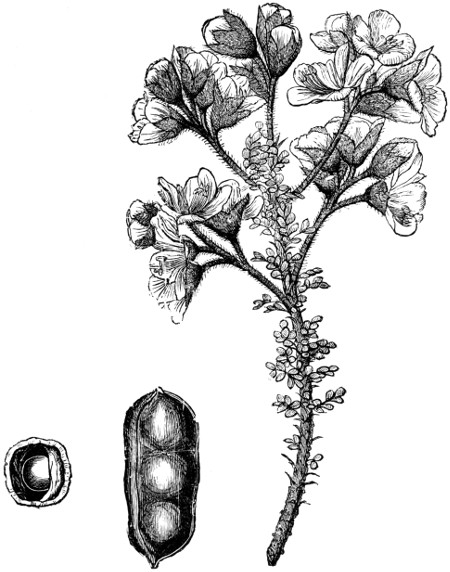
Fig. 58.[149]—Algarobilla (Cæsalpinia brevifolia).
C. echinata yields “Brazil-wood.” (See p. 413.)
C. Sappan, Sappan-wood, India.
Cassia auriculata, Turwar or Tanghadi bark, Southern India.
Used for tanning so-called “Persian” sheep- and goat-skins,
contains about 17 per cent. of a catechol tannin. Leather
tanned with it is of a pale yellow colour, but rapidly reddens in
sunlight. Cp. p. 235.
C. fistula, India. Husk of pod, 17 per cent. tannin. The
pulp of pod is used as an aperient.
C. elongata and lanceolata. Senna leaves. Upper Egypt.
C. Sophora, “Bali-babilan.”
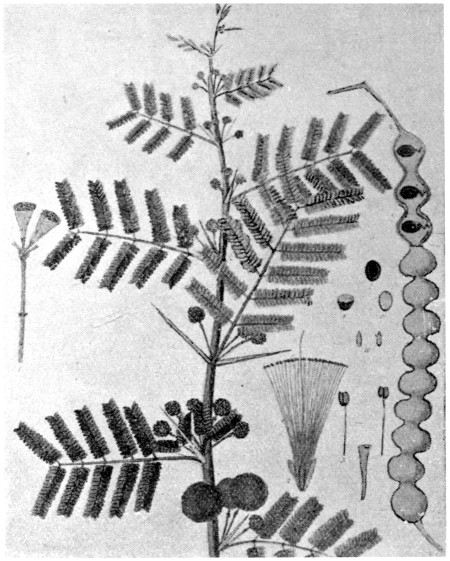
Fig. 59.—Babool (Acacia arabica).
Acacia arabica, “Babool,” “Babul,” India, Egypt. Fig. 59.
Bark contains about 12-20 per cent. of catechol tannin; one of
the principal Indian tanning materials, used for kips and heavier
leathers. Pods, used in India for bating, contain about same
amount of tannin as bark, but of a different kind, that of the bark
being a catechol-tannin, with a good deal of red colouring matter,
while the pods contain a paler tannin allied to divi, which is not
precipitated by lime-water. In Egypt the pods are called bablah,
a name which is also applied to pods of A. cineraria and A.
vera, and others. They are used for dyeing glove-leathers.
A. nilotica, Egypt. Pods called neb-neb or bablah.
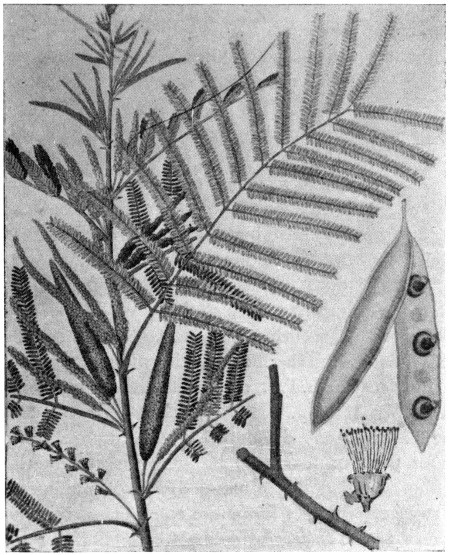
Fig. 60.—Cutch Tree (Acacia catechu).
A. catechu, India. The wood yields cutch or “dark catechu.”
A lighter coloured variety called kath, containing much crystallised
catechin, is also made in India, and principally used for
chewing with betel. A. catechu is a tree 30-40 feet high, common
in India and Burma, and also in tropical East Africa, where,
however, it is not utilised. In Southern India, A. suma is also
used for the same purpose.
Trees of about 1 foot diameter are cut down, and the wood
(some state the heart-wood only) is reduced to chips, and boiled
with water in earthen jars over a mud-fireplace. As the liquor
becomes thick and strong, it is decanted into another vessel, and
the evaporation continued till the extract will set on cooling,
when it is poured into moulds made of leaves or clay, the drying
being completed by exposure to the sun and air. “Kath,” or pale
cutch, is made in Northern India, by stopping the evaporation at
an earlier point, and allowing the liquor to cool, and crystallise
over twigs and leaves thrown into pots for the purpose. It contains
a large proportion of catechin, apparently identical with
that of gambier, but its tannin is much redder. Good cutch
contains about 60 per cent. tanning matter, but is principally
used for dyeing browns and blacks with chrome and iron
mordants. It contains quercetin, a yellow colouring matter
(p. 263).
A. leucophlea, India and Java “Pilang.” Pods and bark
equal to A. arabica.
Australia abounds in acacias (mimosas), many of which are
used in tanning, but vary greatly in strength, not only according
to species, but probably also by situation and growth. Probably
the best information is to be found in a pamphlet on ‘Wattles
and Wattle-Bark,’ by J. H. Maiden, F.L.S., published by the
Department of Public Instruction at Sydney, 1890. His analyses
were made by the Löwenthal process, and can only be roughly
compared with those by the hide-powder method. The analyses
given are by the I.A.L.T.C. method, and mostly on samples
furnished by Mr. Maiden.
A peculiarity largely developed in the mimosa family is the
tendency for the true leaves to be suppressed, and their place
taken by the flattened and expanded midrib (phyllode). Thus
leaves of two very distinct forms are common in the genus, and
some acacias, as A. heterophylla, may have both forms on the
same branch. Compare A. pycnantha and A. decurrens.
The Australian mimosas have been naturalised in India, and
grow freely in the Nilgiri Hills, but the bark does not appear to
be utilised.
The most important species are as follows:—
A. pycnantha. (Fig. 61.) “Broad-leaved” or “Golden
Wattle,” South Australia. One of the strongest tanning barks
known. A sample marked “special,” analysed in the Yorkshire
College, contained 50 per cent. of tannin; another sample
marked “ordinary” contained 40 per cent.
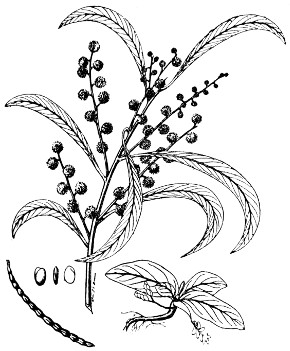
Fig. 61.—Broad-leaved Wattle
(Acacia pycnantha).
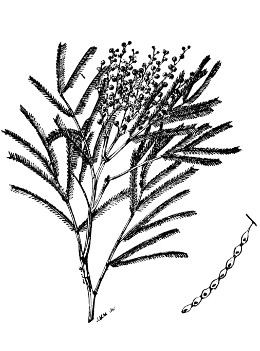
Fig. 62.—Green Wattle
(Acacia decurrens).
A. longifolia, the Golden Wattle of New South Wales, only
contains half as much tannin as A. pycnantha.
A. mollissima, with its two varieties A. decurrens (Fig. 62) and
A. dealbata, are among the most important of the Wattle family
commercially. Two samples of the former marked “Green
Wattle” showed 36-39 per cent. of tanning matter; another
sample marked “Sydney Green Wattle,” contained 41 per cent.
A sample of A. decurrens, the second variety, was much weaker,
showing only 12 per cent. on analysis.
A. penninervis (Hickory bark) is said to be particularly
hardy, but its strength seems to vary. A sample from Bateman’s
Bay contained 38 per cent. of tanning matter.
A. binervata, another “Black Wattle” contains up to 30 per cent.
tanning matter, as does also the “Weeping Willow,” A. saligna.
The latter is poisonous, and is said to be used for killing fish.
A. prominens, the bark of which resembles that of the Golden
Wattle, A. longifolia, in appearance contains only 14 per cent.
tannin.
The cultivation of wattles in Australia has been somewhat
neglected, but would render possible the utilisation of many
acres of land lying waste, or which have already been exhausted
and rendered unfit for the growth of cereals. It requires so little
attention as to make it very profitable, and wattle-growing and
sheep-grazing can be combined satisfactorily after the first year,
when the young trees in the plantation have reached the height
of 3-4 feet. In Natal the Australian wattles, especially A.
mollissima, have been acclimatised and cultivated with success,
and large quantities of excellent bark are now exported to
England. African wattle-barks usually contain about 30 per
cent. of tannin.
Wattles grow in almost any soil, even the poorest, but their
growth is most rapid on loose, sandy patches, or where the surface
has been broken for agricultural purposes. When the soil
is hard and firm, plough-furrows should be made at a regular
distance of 6-8 feet apart, and the seeds dropped into these.
The seed should be sown in May, having been previously soaked
in hot water, a little below boiling temperature, in which they
may be allowed to remain for a few hours. It should be
dropped at an average distance of 1 foot apart along the furrow,
in which case, about 7200 seeds would suffice for one acre of
land. The seed should not be covered with more than about
1⁄4 inch of soil.
On loose sandy soil, it might even be unnecessary to break
up the ground in any way; the furrows may be dispensed with,
and the seed sown broadcast after the land has been harrowed.
After the plants have come up, they should be thinned so that
they stand 6-8 feet apart. When the young trees have attained
the height of 3-4 feet, the lower branches should be pruned off,
and every effort afterwards made to keep the stem straight and
clear, in order to facilitate the stripping, and induce an increased
yield of bark. It is advisable that the black and broad-leaved
kinds should be grown separately, as the black wattle, being
of much larger and quicker growth, would oppress the slower-growing
broad-leaved one. Care should be taken to replace
every tree stripped by re-sowing, in order that there should be
as little variation in the yield as possible. In Victoria, the
months of September-December are those in which the sap
rises without intermission, and the bark is charged with tannin.
Analysis proves that the bark from trees growing on limestone
is greatly inferior in tannin to that obtained from other formations,
differing 10-25 per cent.
The following are South American mimosas:—
A. cavenia, Espinillo. Bark, contains 6 per cent., pods, 18-21
per cent., or more of tannin.
A. cebil, Red Cebil. Bark, contains 10-15 per cent.; leaves,
6-7 per cent. tannin. Argentine Republic.
A. Guarensis, Algarobilla of Argentine Republic. Bark, pods
and flowers said to be used for tanning.
A. timbo, Buenos Ayres.
A. curupi, Curupy bark.
A. angico, or Piptadenia macrocarpa, Brazil, yields “angica
bark,” a sample of which contained 20 per cent. of tanning matter
when analysed recently in the Author’s laboratory.
“White Bark,” South America, probably an acacia, bark internally
very similar to angica, if not identical.
A. horrida, “Doornbosch,” Cape of Good Hope, contains
8 per cent. of tannin.
Inga feuillei, “Paypay,” Peru. Pods said to contain 12-15
per cent. of tannin (doubtful). Several other species of Inga
known to contain tannin.
Elephantorrhiza Burchellii, Elandsboschjes, Tugwar, or Tulwah,
South Africa; a papilionaceous plant. The air-dry root
contains 12 per cent. of tannin, and a great deal of red colouring
matter. The roots are several feet long, and about 2 inches in
diameter, growing by the sides of rivers.
The following additions may be made to the above list:—
Cleistanthus collinus, “Kodarsi,” Deccan. Bark stated to
contain 33 per cent. of tannin.
Phyllanthus emblica, India, yields emblic myrobalans, which
in immature condition contain considerable tannin. Leaves
(18 per cent.) and bark used for tanning.
Phyllanthus distichus and nepalensis both yield tanning barks.
Anogeissus latifolia, India. Bark and leaves rich in tannin.
Garcinia mangostana, India. The rind of the mangosteen
fruit contains much tannin.