BOOK III. — Concerning Petitions and Axioms.
COMMENTARIES
OF
PROCLUS.
[1]Since the principles of geometry are triply divided into
Hypotheses, Petitions, and Axioms, the difference between these we
have explained in the preceding books. But we now intend to discourse
more accurately of petition and axiom, as especially necessary to our
present design. For hypotheses, which are also called definitions, we
have already explained. It is common, therefore, as well to axioms as
to petitions, to require no demonstration, and no geometrical faith:
but to be received as manifest, and to become the principles of the
rest. But they differ mutually from each other, in the same manner in
which we have distinguished theorems from problems. For as in theorems
we propose to perceive and know that which follows a subject; but
in problems we are ordered to compare and do something: in the same
manner also in axioms, we must receive whatever is manifest of itself,
and easily apprehended by our untaught conceptions; but in petitions
we must receive whatever is easy to be done and compared, (since in
admitting these, thought is not fatigued) and whatever requires no
variety, and no kind of construction. Hence evident and indemonstrable
cognition, and unconstructed assumption, distinguish petitions from
axioms. Just as demonstrative cognition, and an assumption of things
sought, together with construction, separates theorems from problems.
For it is every where requisite, that principles in simplicity,
indemonstrability, and self-evidence, should excel things posterior
to principles. For universally (says Speusippus) of the things which
cogitation pursues, some of its energies it produces without a various
progression, prepares them for future enquiry, and has a more evident
apprehension of these than of visible objects: but others which it is
not able immediately to follow, by a transition proceeding from their
nature, these it endeavours by consequence to pursue. Thus for
example, to draw a right line from one point to another, it
receives as evident, and easy to be done. For since in this case the
line is composed from the indeclinable flux of a point, and at the
same time advances in an orderly progression, because it no where more
or less declines, it necessarily falls in another point. Again, if
one extremity of a right line abiding, the other is moved about it,
it will describe a circle without any labour. But if any one wishes
to describe a helix of one revolution, it requires a more various
operation. For it is generated by various motions. Likewise if any one
wishes to construct an equilateral triangle, he will require a certain
method for its construction. For the geometrical intellect says,
when I understand a right line, which abides according to one of its
extremities, but is moved about it according to the other, and at the
same time conceive a point, which is moved in the line from the abiding
extreme, I have described a helix of one revolution. For when at the
same time both the extremity of the right line, which describes the
circle, and the point which is moved in the right line, arrive at the
same point, and coincide, they produce for me such a helix. And again,
when I describe equal circles, and draw right lines from the common
section to the centre of the circles, and a right line from one centre
to the other, I shall have an equilateral triangle. The production
of these, therefore, is very remote from a simple apprehension, and
primary notion. For we are content to pursue the progressions of their
origin. Hence it happens that these are compared with greater ease or
difficulty, and are exhibited with many or fewer mediums, according to
the habit of those who enter on this undertaking: but that they require
demonstration and construction, on account of the property of the
things sought, which wants the evidence of petitions and axioms.
Petition, therefore, and axiom, are simple and easy to be apprehended.
But petition, indeed, commands us to fabricate, and provide a certain
matter, in order to the assignation of the symptom, which
possesses an easy and simple apprehension: but axiom pronounces a
certain essential accident, of itself known to the hearers. As that
fire is hot, or any other of those manifest truths, he who
doubts of which, we consider as either wanting sense or punishment.
Hence, petition and axiom are of the same genus; but they differ in
the above-mentioned manner. For each is an indemonstrable principle,
but this after one mode, and that after another, as we have already
observed. But some think that all these should be called petitions, in
the same manner as all problems, things sought. For Archimedes
beginning his book of Equiponderants, we desire it may be
granted (says he) that things equally heavy, from equal lengths,
will equally ponderate; though some would rather chuse to call
this an axiom. But others call all these axioms, in the same manner as
they denominate every thing a theorem, which requires demonstration.
For, according to the same proportion, as it seems they pass from
proper names to such as are common. Nevertheless, as a problem differs
from a theorem, so petition from axiom: though both these last are
indemonstrable, and the former require demonstration. And the one,
indeed, is assumed as easy to be done, but the other is granted as
easy to be known by the common consent of all men. After this manner,
therefore, Geminus distinguishes petitions from axioms.
But others will perhaps say, that petitions are indeed proper to
the geometrical matter: but that axioms are common to the universal
theory, which is conversant about the how-much, and the
how-many. For the geometrician knows that which requires
that all right angles are equal, and that every finite right
line may be produced straight forwards: but that which says,
things equal to one and the same are equal to each other, is a
common conception, which not only the arithmetician employs, but every
one endued with science, accommodating that which is common to his
own particular matter. But Aristotle (as we have before observed[2])
says, that petition, since it is demonstrable, is not granted by the
hearer, yet is received as a principle: but that axiom is of itself
indemonstrable, and that this is confessed by all, according to habit,
though some, for the sake of disputation, have doubted its evidence.
Since then, there are these three differences, according to the first,
which by operating, and knowledge only distinguishes petition from
axiom, it is manifest that which says all right angles are
mutually equal, is not a petition. Nor the fifth, which says,
if a right line falling on two right lines makes the internal
angles towards the same parts less than two right, those right lines
infinitely produced, shall coincide towards the parts in which the
angles less than two right subsist. For these are neither assumed
in construction, nor do they command any thing to be done: but they
exhibit a certain symptom, inherent in right angles, and in
right lines, departing from angles less than two right. But, according
to the second difference, that will not be an axiom which says, that
two right lines cannot comprehend space, which some at present
consider as an axiom. For this is proper to the geometric matter, as
likewise that which affirms that all right angles are equal.
But according to the third difference, which is Aristotelic, all those
which produce their own credibility by a certain demonstration, are
petitions; but whatever are indemonstrable, are axioms. Apollonius,
therefore, in vain endeavours to deliver the demonstrations of
axioms: for Geminus very properly observes, that some have attempted
demonstrations of indemonstrables, and have endeavoured from more
unknown mediums, to prove things manifest to all, into which error
Apollonius has fallen, who wishes to prove the axiom true, which
says, that things equal to one, and the same, are equal to each
other: but that others assume in the place of indemonstrables,
things requiring demonstration. As is the case with Euclid himself,
in the fourth and fifth petition. For some say, that this last, as
ambiguous, requires demonstration. Indeed, is it not ridiculous, that
theorems should be assigned as indemonstrable, the converse of which
are demonstrable? For that the internal angles of coincident right
lines are less than two right, Euclid himself shews in the theorem,
which says, that two angles of every triangle, however taken, are
less than two right: besides, it may be perspicuously shewn, that
not every thing equal to a right angle is a right angle. Hence, says
Geminus, the converse of these are not to be granted indemonstrable. It
seems therefore, according to the ordination of this man, that there
are, indeed, three petitions: but that the other two, and the converse
of these, require demonstrating science: and that in the axioms,
the one which says, that two right lines cannot comprehend space,
is superfluously added, since its credibility must be derived from
demonstration. And thus much concerning the difference of petitions and
axioms. Again, of axioms, some are proper to arithmetic, but others
to geometry; and others are common to both: for that which says,
every number is measured by unity, is an arithmetical axiom.
But that which says equal right lines agree amongst themselves,
as also this which affirms that every magnitude is divisible in
infinitum, are geometrical axioms: but the one which says that
things equal to the same, are mutually equal, and all of this kind
are common to both. However, it must be observed, that each science
uses such as the last, according to its proper subject; as geometry in
magnitudes, but arithmetic in numbers. In like manner of petitions,
some are peculiar to particular sciences, but others are common to all.
For you must call the petition which requires to be granted, that a
number may be divided into the least parts, peculiar to arithmetic:
but this, that every finite straight line may be produced straight
forwards, peculiar to geometry; and the one which desires us
to grant, that quantity may be infinitely increased, common
to both; for this passion is equally found to reside in number and
magnitude.
PETITIONS or POSTULATES.
I.
Let it be granted that a straight line may be drawn from any one
point to any other point.
II.
That a terminated straight line may be produced to any length in
a straight line.
III.
And that a circle may be described from any centre, at any
distance from that centre.
According to the opinion of Geminus, these three are necessarily
placed among petitions, as well on account of their facility, as
because they command us to do something. For this, to draw a right
line from every point, to every point, follows the definition,
which says, that a line is the flux of a point, and a right
line an indeclinable and inflexible flow. If then we conceive
a point to be moved with an uninclined, and the shortest motion, we
shall fall upon another point, and the first petition will be produced,
and we shall understand nothing various or difficult. But if when the
right line itself is terminated by a point, we conceive its extremity
moved with the shortest indeclinable motion, the second petition will
arise from an easy and simple apprehension. But if we again imagine
that the terminated right line abides according to its other extreme,
but that it moves about that which abides according to the rest, the
third petition will be produced; for the centre is the point which
abides, but the interval the right line. Since the distance of the
centre, from all parts of the circumference, is always equal to the
quantity of this interval. But if any one should doubt how we apply
motion in geometrical concerns, which have an immoveable existence;
and how we can move impartibles, (since this is impossible) we request
him to call to mind what we have demonstrated in the beginning of
these Commentaries. I mean that the reasons of things subsisting in
the phantasy, describe there all the images of cogitation, of which
cogitation itself possesses the reason: for an intellect of this kind
is an unwritten, ultimate, and passive tablet. Hence, it receives forms
from another, accompanied with motion; but we must not understand a
corporeal but imaginative motion, and must by no means admit that
impartibles are moved with corporeal motions, but that they suffer
imaginative progressions. For intellect, though impartible, is moved,
yet not according to place, and the phantasy has a proper motion
according to the impartible which it contains: but we only regarding
corporeal motions, neglect those which are made in things destitute
of interval. Impartibles, therefore, are pure from corporeal place,
and external motions: but another species of motion, and another place
congenial to such motions, is considered in their progressions. For,
indeed, we should say, that a point also has position in the phantasy,
and should not enquire how an impartible can abide, which is at the
same time moved elsewhere, and comprehended by place. Since the place
of things, with dimension, possesses itself dimension; but the place
of impartibles is destitute of all dimension. The proper species
therefore of geometrical concerns, are different from the things they
produce; and the motion of bodies is different from that of the forms
in the phantasy; and the place of partible is different from that of
impartible natures; and it is requisite, by distinguishing these,
neither to confound nor disturb the essences of things. But it appears
that the first of these three petitions declares to us in images, how
the things which are, are contained in their own impartible
causes, and are terminated by their immaterial bound; and that previous
to their constitution, they are on all sides comprehended in their
indivisible embrace: for the points existing, a right line is drawn
from the one to the other, is terminated by, and received between them.
But the second indicates how the things which are by possessing
proper causes proceed to all things, preserving in them a continuation
not derived from the natures into which they proceed; but that through
a cause of infinite power, they endeavour to permeate every where,
with a never-failing progression. And the third petition shadows forth
the manner in which these progressions return again to their proper
principles: for the convolution of a point producing a circle, by
moving about an abiding point, imitates a circular regression. But it
is requisite to know, that every line cannot be infinitely produced,
for the circle and cissoid, and all such as describe figure, are
incapable of this property; as likewise some which produce no figure.
For the helix of one revolution cannot be infinitely produced, since
it is constituted between two points; nor any other lines similarly
formed. But neither is it possible to extend every line from every
point, to every point; for every line cannot subsist between all
points: and thus much for the three first petitions; let us now proceed
to the rest.
IV.
All right angles are equal to each other.
If the present petition is considered by us as manifest, and as
requiring no demonstration, it is not a petition according to the
opinion of Geminus, but an axiom; for it affirms a certain essential
accident of right angles, not commanding us to perform any thing
according to a simple conception. But neither is it a petition
according to the division of Aristotle: for petition, according to
his opinion, requires some demonstration. But if we should say it is
demonstrable, and enquire after its demonstration, yet according to
the opinion of Geminus, it ought not to be placed among petitions.
The equality, therefore, of right angles, appears from our common
conceptions; for since a right angle has the relation of unity or bound
to the infinite increase and decrease of the angles on each side, it is
equal with respect to every right angle, since we constitute the first
right angle after this manner, by a right line making angles on each
side of the right line on which it stands equal to each other; but if
it be requisite to produce a linear demonstration of this, let there be
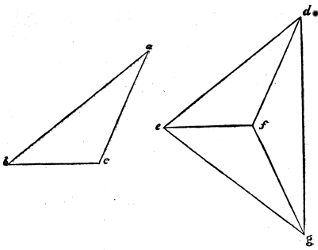
two right angles, one a b c, the other d e f.
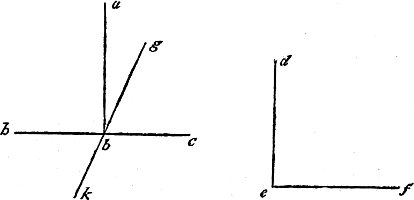
I say that they are equal; for if they are not equal,
one of them must be greater, suppose the angle at b. If then
the line d e be adapted to the line a b, the line e
f shall fall within. Let it fall as b g, and let the line
b c be produced to h; because, then a b c is a
right angle, a b h also shall be a right angle, and they shall
be mutually equal to each other, from the tenth Definition: the angle
a b h therefore, is greater than the angle a b g. Let
again the line g b be produced to k, because, therefore
a b g is a right angle, the successive angle a b k shall
be a right one, and consequently equal to a b g. Hence, the
angle a b h, shall be less than the angle a b g; but
it was also greater, which is impossible: but this has been shewn by
other expositors, and requires no great consideration. But Pappus very
properly admonishes us, that the converse of this Petition is not true;
I mean, that every thing equal to a right angle, is a right angle;
though if it be rectilinear, it is without doubt a right angle. But a
curvilinear angle may also be exhibited equal to one that is right:
for let there be conceived two equal right lines, a b, and b
c, making the angle at the point b, right;
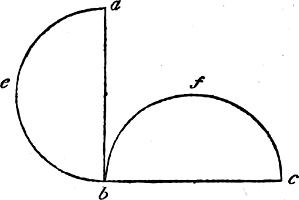
and on them let the semicircles a e b, b f
c, with a proper centre and interval be described; because,
therefore, the semicircles are equal, they shall have a mutual
congruence, and the angle e b a, is equal to the angle f b
c, and a b f is common: the whole right angle, therefore,
is equal to the lunular, i.e. to e b f, and yet the lunular is
not a right angle. In the same manner, if the angle a b c should
be obtuse or acute, a lunular angle may be shewn equal to it (for this
is that genus of curvilinear angles which agrees with such as are
rectilinear), only this is to be observed, that in a right and obtuse
angle, it is requisite to add the middle angle, which is contained by
the line a b, and the circumference b f; but in an acute
angle to take this away: for the right line c b, in these cases,
cuts the circumference b e. The truth of which, will be evident
from the following figures:
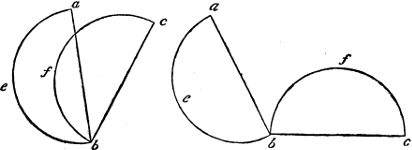
And hence, it appears, that all right angles are mutually
equal to each other, and that not every thing equal to a right angle,
is consequently a right angle: for if it be not rectilinear, how
can it be called right. But it is also manifest from this Petition,
that angular rectitude is allied to equality, in the same manner as
acuteness and obtuseness are related to inequality. For rectitude
and equality, as also similitude, are of the same co-ordination,
(for each exists under bound): but acuteness and obtuseness, as also
dissimilitude, are of the same series with inequality. For they are all
produced from bound and infinite. Hence some, regarding
the quantity of angles, say, that a right angle is equal to a right:
but others, considering their quality, affirm that one is similar
to another. For similitude in qualities is the same as equality in
quantities.
V.
If a right line falling upon two right lines, makes the internal
angles towards the same part less than two right, those right
lines, if infinitely produced, shall coincide in that part, in
which the angles less than two right, are placed.
This ought to be entirely blotted out from the number of Petitions,
for it is a theorem including many doubts, which Ptolemy in one of his
books proposes to solve; but it requires in its demonstration both
many definitions and theorems; and Euclid also exhibits its converse
as a theorem. But perhaps some, from an erroneous conception, may
think that this should be placed among the petitions, as that which
produces credibility of itself, respecting the inclination of right
lines, on account of the diminution of two right angles. To such as
these, Geminus rightly answers, that from the authors of this science,
we learn not entirely to give credit to imaginative probabilities, for
the purpose of accomplishing geometrical reasons: for it is similar
(says Aristotle) to require demonstrations from a rhetorician, and
patiently listen to a geometrician, disputing from probability. And
Simmeas in the Phædo of Plato, says, “I know that those who demonstrate
from appearances, are vain.” Hence, in the present instance, it is
true and necessary that right lines should incline, while right
angles are diminished: but this, that the inclining lines, while they
are more produced, should at length coincide, is probable, but
not necessary, unless some reason demonstrates that this is true in
right lines: for there are certain lines infinitely inclining, and
never coinciding, and though this appears incredible and admirable,
yet it is true, and has been observed in other forms of a line. Is
it therefore possible that this can be accomplished in right lines
which takes place in others? For before we procure conviction of this,
from demonstration, the properties exhibited in other lines molest
the phantasy by the contrary images they produce. But if the reasons
doubting against the coincidence of lines are very strong, ought we
not much more to expel this improbable and irrational supposition from
our doctrine? And thus it appears that a demonstration is to be sought
for of the present theorem, and that it is foreign from the property
of Petitions: but how it is to be demonstrated, and by what reasons
the objections urged against it are to be removed, we shall shew in
our comment on the proposition, where it is used by the institutor of
the elements as manifest. For then it will be necessary to exhibit
its evidence, since it does not present itself to our view with
indemonstrable clearness, but becomes manifest through the medium of
demonstration alone.
AXIOMS.
I.
Things which are equal to the same, are equal to one another.
II.
If equals be added to equals, the wholes are equal.
III.
If equals be taken from equals, the remainders are equal.
IV.
If equals are added to unequals, the wholes are unequal.
V.
If equals be taken from unequals, the remainders are unequal.
VI.
Things which are double of the same, are equal to one another.
VII.
Things which are halves of the same, are equal to one another.
VIII.
Things which coincide with each other, are mutually equal.
IX.
The whole is greater than its part.
X.
Two right lines cannot comprehend space.
These are the things which, according to the opinion of all men, are
called indemonstrable axioms, so far as their certainty is admitted
by all, and no one disputes their evidence. For propositions also are
often simply called axioms, of whatever kind they may be, whether
they are immediately proper, or require some declaration; and the
Stoics, indeed, are accustomed to call every simple enunciative speech
an axiom: and when they write on dialectic arts, they say that they
discourse on axioms. But some, distinguishing more accurately axioms
from other propositions, give this appellation to a proposition
immediate, and producing credibility of itself, on account of its
evidence: as also Aristotle and geometricians themselves affirm.
For, according to the opinion of these, an axiom is the same as a
common conception. By no means, therefore, must we praise Apollonius
the geometrician, who writ (as it appears) demonstrations of axioms,
because he performs the very opposite to Euclid: for he, indeed,
enumerates that which is demonstrable among Petitions; but Apollonius
endeavours to find out demonstrations of indemonstrables. But these
naturally differ from each other, and the genus of the sciences is
different: I mean of the things which take place about immediate
propositions, which are entirely subject to our knowledge, on account
of their evidence; and of things which use demonstrations, which
receive principles from them; and which, when received, they orderly
employ in their proper conclusions. But that the demonstration of
the first axiom, which Apollonius persuades himself he has invented,
possesses a medium, not more known, but more dubious than the
conclusion may be known by any one from a slight inspection. For let
(says he) a be equal to b, and b to c, I
say that a also is equal to c.
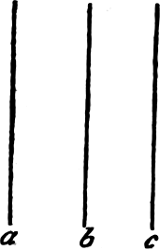
For since a is equal to b, it occupies
the same place as b. And because b is equal to c,
it occupies the same place as c; and so a occupies
the same place as c, they are therefore equal. Now in this
demonstration it is requisite that two things must be previously
assumed; one, that things occupying the same place, are mutually equal;
but the other, that things occupying the same place, with the same
thing, mutually occupy the same place: but these are evidently more
obscure than the present axiom. For it is proper to enquire how are
things, which fill the same place equal, according to the whole, or
according to a part; or according to a figure of speech: hence we must
by no means admit a transition to place,[3] which is more unknown than
the natures it contains; for the invention of its essence is difficult
and ambiguous. That we may avoid prolixity, therefore, all axioms are
to be delivered as things immediate and self-manifest, since they are
of themselves known and credible; for he who brings demonstration to
things the most manifest, does not confirm their truth, but diminishes
the evidence we possess in the untaught and innate conceptions of the
soul: but this is to be received concerning axioms, as a judgment of
their peculiarity; and that all of them are of the common kind of the
mathematical sciences; and that each of them is said to be verified,
not only in magnitudes, but also in numbers, and motions, and times:
and this indeed is necessary. For equal and unequal, the whole and
part, and the more and the less, are common to discreet and continued
quantities. The contemplation, therefore, which is conversant with
times and motions, numbers and magnitudes, requires all these, as
things evident by their own intrinsic light; and in all of them both
that is true, which says, things equal to the same, are equal to one
another; as likewise each of the axioms we have assumed: but as
they exist in common, each science uses them according to its proper
matter, and one indeed, as in magnitudes; but another, as in numbers;
and another, as in times; and after this manner in each science, the
conclusions become peculiar and apposite, though the axioms are common.
Besides, it is likewise requisite not to contract the number of these
to the least, as is done by Heron, who only establishes three axioms;
for this also is an axiom, the whole is greater than its part,
and the geometrician every where assumes this in his demonstrations; as
also, that things which mutually coincide, are equal; for this
is employed with advantage in the solution of the fourth Proposition.
Nor is it proper to join some with others, of which some are proper
to the geometric matter, as that two right lines cannot comprehend
space, (since axioms are, as we have said, of a common kind);
but others are consequent to things established, as that which says,
things double of the same, are equal. For this is consequent to
the axiom, affirming, that if to equals you add equals, the wholes
are equal, since things equal to the half, because they assume
the half, become double to the same, and mutually equal, on account
of an equal addition: and according to this reason, not only the
doubles, but also the triples, and all multiples of the same quantity
will appear equal. But with these axioms, Pappus says, that certain
others are to be classed, as if unequals are added to equals, the
excess of the whole, will be equal to the excess of the adjuncts.
And on the contrary, if equals are added to unequals, the excess
of the wholes is equal to the excess or difference of the unequals
themselves. And these also are manifest from themselves, yet they
may be made manifest as follows.
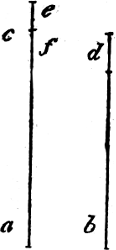
Let a be equal to b, and add to each the unequals
c d, but let c be greater than d by
e, and the remainder be f; because, therefore, a
is equal to b, and also f to d; a f will
be equal to b d. For if equals are added to equals, the wholes
are equals: a c, therefore, exceeds b d, by e
only, by which alone c exceeds d. Again, c and
d are unequals, to which, let the equals a and b
be added, and let e be the excess of c, above d,
and the remainder be f; because, therefore, a is equal
to b, and f to d a f will be equal to
b d; the whole, therefore, a c, will exceed b d,
by e only, by which c also exceeds d. These,
therefore, are consequent to the aforesaid axioms, and are, not
undeservedly, in many copies, omitted. But whatever others he adds to
these, have been previously assumed by definitions, to which they are
consequent. As for example: that all the parts of a plane and a
right line mutually agree; for things placed in their extremities,
possess a nature of this kind; and that a point divides a line, but
a line a superficies, and a superficies a solid. For all things
are divided by the natures by which they are proximately bounded; and
that infinite subsists in magnitudes, by addition and diminution,
but according to capacity only, in both these respects: for
every thing continuous may be infinitely divided and increased. But,
as we have summarily spoken concerning these, it remains that we
consider things consequent to principles; for thus far principles
extend themselves. But of those who oppose geometry, some very much
doubt concerning principles, endeavouring to shew that the terms have
no subsistence, whose arguments, indeed, are known in common, who
endeavour to take away all science, and, like hostile foes from a
foreign region, demolish the fruits and fecundity of philosophy, as is
the case with the Pyrrhonian philosophers; but others only propose to
themselves the subversion of geometrical principles, as the Epicureans.
Others, again, admitting the principles, affirm, that things consequent
to the principles cannot be demonstrated, unless something else is
granted, which was not previously assumed in the principles. Zeno
exercised this mode of contradiction, who was a Sidonian by birth,
but of the Epicurean sect, against whom Possidonius wrote an entire
book, exhibiting the whole of his imbecile opinion; and thus much may
suffice for the difference of opinions concerning principles. We shall
shortly consider the troublesome objection of Zeno: but now, after we
have briefly resumed the consideration of theorems and problems, their
difference, and the divisions they receive, we shall proceed, to an
exposition of the things exhibited by the institutor of the elements,
gathering the more beautiful observations upon the propositions found
in the writings of the antients, and contracting the infinite prolixity
of their discourses; but delivering such things as are more artificial,
and full of methods producing science, dwelling more on an accurate
treatise of things than on the variety of cases and assumptions, to
which young men, for the most part, eagerly incline.
PROPOSITION I. Problem.
Upon a given terminated right line to describe an equilateral triangle.
Since all science is two-fold, and one is conversant about immediate
propositions, but another about things, which are exhibited and
provided from the propositions, and universally about the consequents
to principles; this, again, divides itself in geometrical discourses,
into the solution of problems, and the invention of theorems. And
problems, indeed, geometry denominates things in which it proposes to
procure, manifest, and fabricate that, which, in a certain respect,
has no existence; but it calls theorems, things in which it appoints
to perceive, know, and demonstrate that which either exists, or
does not exist. For problems command us to undertake the origin,
positions, applications, descriptions, inscriptions, circumscriptions,
coaptations, and contacts of figures, and every thing of this kind:
but theorems endeavour to procure our assent to symptoms, and things
essentially inherent in the subjects of geometry, and to convince by
demonstrations. For geometry discourses concerning every object of
enquiry, which is possible to be effected, referring some things to
problems, but others to theorems; since it enquires concerning the
what, in a two-fold respect: for it either seeks for the reason
and intelligence of the thing; or for intelligence, and the essence of
the subject. I say, for example, as when it requires what a line of
similar parts may be: for in an enquiry of this kind, it either desires
to find the definition of such a line, as, that a line of similar
parts is that which has all its parts agreeing with all; or to
receive the species of lines of similar parts, as that it is either
right, or circular, or a cylindric helix. Besides,
prior to this, it enquires, by itself, concerning the if, and
this especially in its determinations, agitating, whether the object
of its enquiry is possible or impossible, what place it possesses, and
in how many ways. It likewise seeks concerning the what kind;
for when it considers the essential accidents of a triangle, circle,
and parallels, it is manifest, that in such cases it seeks after the
what kind; but many have thought that geometry very little
contemplated the cause, and the why. And of this opinion
is Amphinomus, led by the decisions of Aristotle: but (says Geminus)
an enquiry into these may be found in geometry. For does it not belong
to geometry to enquire for what cause infinite equilateral
multangles may be inscribed in circles, but to describe solid
equilateral and equiangular multangles, and constructed from similar
planes, in spheres, is impossible? To whom does an investigation
of this kind belong, except to a geometrician? When, therefore, to
geometricians the syllogism is by an impossibility, they alone desire
to find the symptom; but when by a principal demonstration, then again
if the demonstrations are in that which is particular or partial, the
cause is not yet manifest; but if in that which is universal, and in
all similars, the why becomes immediately manifest: and thus
much concerning objects of enquiry.
But every problem and theorem which receives its completion from
its own perfect parts, ought to possess in itself all the following
parts: proposition, exposition, determination,
construction, demonstration, and conclusion. But
of these, proposition informs us what the object of enquiry is
from a given datum; for a perfect proposition is composed from both;
but exposition receiving the datum essentially, prepares for
the question. Again, determination separately explains the
thing sought for according to the what; but construction
adds to the datum what is wanting to the investigation of the thing
sought; and demonstration skilfully collects the proposition
from the concessions. But the epilogue, or conclusion, is again
converted to the proposition, by confirming that which is exhibited.
And so many, indeed, are all the parts of problems and theorems; but
proposition, demonstration, and conclusion,
are especially necessary, and exist in all; for it is requisite
that the thing sought for should be previously known; and that
this should be shewn by proper mediums, and that what is exhibited
should be concluded; and it is not possible that any one of these
three can be wanting; but the rest are, indeed, received in many
places; but in many, because they produce no utility, are omitted.
For determination and exposition are not found in the
problem, which says, to construct an isosceles triangle, which
will have each of the angles at the base double of the other; but
construction has frequently no subsistence in many theorems,
the demonstration being sufficient to exhibit the thing proposed from
the data, without any addition. When, therefore, shall we say that
exposition fails, when no datum is given in a proposition?
Because, though proposition, for the most part, is divided into
datum, and the thing sought for, yet this is not always
the case; but sometimes the thing sought for, alone affirms that
which it is requisite to know or effect, as in the aforesaid problem;
for it does not previously say from what datum it is requisite to
construct an isosceles triangle, which shall have each of the angles
at the base, double of the remaining one; but that it is required to
effect this. And here, indeed, the admission of the proposition takes
place from things previously known; for we must know the meaning of
the terms isosceles, equal and double (since
this, as Aristotle observes, is the property of all ratiocinative
discipline[4]), yet nothing is subjected to us as in other problems,
as in that which says, to bisect a given terminated right line.
For here the right line is given, but we are ordered to divide it into
two parts; and the datum is separately determined from the object
of enquiry. When, therefore, a proposition has both of these, then
also determination and exposition are found; but when
the datum is deficient, these also fail, since exposition and
determination belong to the datum: for this will be the same
with the proposition. Indeed, what else do we say, when determining
in the aforesaid problem, unless that it is requisite to find an
isosceles of this kind? But such was the proposition: if then the
proposition has neither this datum, nor thing sought,
exposition will, indeed, be silent, because there is no datum;
but determination will be neglected, lest it should become the
same with the proposition: but you may find many other problems
of this kind, especially in arithmetic, and in the tenth book of
these Elements, as, to find a medium comprehending two right lines
commensurable in power, and every thing of this kind.
But every datum may be given in these four modes, either in
position, or proportion, in magnitude or
form; for a point, indeed, is given in position only, but
a line and the rest in all the four. Thus, when we say, to bisect
a given rectilineal angle, we declare the species of the angle
given, as that it is right lined, lest we should also seek to bisect
a curvilinear angle by the same methods. But when we say, from the
greater of two unequal right lines, to cut off a part equal to the
less, the lines are given in magnitude; for the less and the more,
finite and infinite, are the proper predications of magnitude. But
when we say, that if four magnitudes are proportional, they shall
be also alternately proportional, the same proportion is given in
the four magnitudes: but when it is requisite, from a given point
to place a right line equal to a given right line, then the point
is given in position. From whence, since position may be various,
construction also receives variety; for the point is given either
without the right line, or in the right line, and in the extremity,
or without the extremity of the right line. Since, therefore, a datum
has a four-fold acceptation, it is manifest, that exposition also is
four-fold; but sometimes it connects two or three modes. Again, we find
that demonstration sometimes possesses things proper to demonstration,
exhibiting the thing sought for from mediate definitions; for this is
the perfection of demonstration, but that sometimes it argues from
certain signs. And it ought not to be concealed, that geometrical
discourses have every where that which is necessary, on account of the
subject matter, but are not every where perfected by demonstrative
methods. For when, because the external angle of a triangle is equal
to the two internal and opposite ones, it is shewn, that the
three internal angles of the triangle are equal to two right, how
is this demonstration from the cause? And is not a sign the medium in
this case? For the external angle not yet existing, since the internal
angles exist, they are equal to two right, since it is a triangle,
though the side is not produced; but when, by a description of circles,
the triangle, which is constituted, is shewn to be equilateral,
the apprehension takes place from the cause. For we say, that the
similitude and equality of the circles is the cause of the triangle’s
equality with respect to its sides.
But geometrical discourses are likewise accustomed to make the
conclusion, in a certain respect, two-fold. And this, when they exhibit
things agreeable to the data, and reason universally, recurring from
a particular conclusion to that which is universal; for when they do
not use the property of the subjects, but placing the data before
our eyes, describe an angle or right line, they think that which is
concluded in this, is to be concluded in every thing similar: they
pass on therefore to universal, lest we should think that the
conclusion is particular. But their transition is effected in the best
manner, since they employ, in demonstration, the things placed,
not considered as such, but considered as similar to others: for it
is not because such a particular angle is proposed that they effect a
bipartite section, but because it is rectilineal only. But quantity,
is indeed, proper to the proposed angle; but rectilineal is common to
all right lines: let then the given angle be a right one. If therefore,
we receive rectitude in the demonstration, we cannot pass to every
species of right lines; but if we do not subjoin its rectitude, or
being right angled, but alone consider its being rectilineal, the
discourse may be adapted to all right lined angles; and all that we
have previously observed we may contemplate in this first problem. For
that it is a problem, is evident, since it commands us to construct
an equilateral triangle: but proposition in this, consists
from a datum and thing sought. For a terminated right
line is given, but it is enquired how an equilateral triangle
may be constructed upon it, and the datum indeed precedes, but the
thing sought follows; so that we may say, by conjoining the two, if
there be a terminated right line, it is possible to construct upon
it an equilateral triangle; for a triangle cannot be constructed
without the existence of a right line, since it is comprehended by
right lines; nor upon an unlimited line, for an angle cannot be
constructed unless it is made on one point, but in an infinite line
there can be no extremity or bounding point. But after proposition,
exposition follows, as, let there be given a terminated right
line. And here we may see that exposition alone pronounces
the datum, but by no means subjoins the thing sought;
but after this we shall find determination: it is required
upon the given terminated right line to construct an equilateral
triangle; and here we may observe that determination is
in a certain respect, the cause of attention, for it makes us more
attentive to the demonstration, by pronouncing the thing sought, as
exposition causes us to be more docile, by placing the datum
before our eyes. Again, after determination, construction
follows, from one extremity of the right line, as a centre, but with
the remainder as an interval, let a circle be described. And again,
with the other extremity, as a centre, and with the same interval,
let a circle be described; and from the common point of the sections
of the circles, to the extremities of the right line, let right lines
be continued. And here we may observe, that Petitions are used in
the construction, this for one, from every point to every point, to
draw a right line; and also this, with every centre and interval
to describe a circle; for universally Petitions are the sources of
utility to constructions, but Axioms to demonstrations;
demonstration therefore follows, because, then each extremity
of the given right line is the centre of the circle surrounding it, the
right line which reaches to the common section is equal to the given
right line; hence, because the other extremity of the right line is
the centre of its containing circle, the right line reaching to the
common section of the circles, is also equal to the given line. And
the admonition of these, is derived from the definition of the circle,
which says, that all lines from the centre to the circumference
are equal. Each of these lines, therefore, is equal to the same;
but things equal to the same, are equal among themselves,
by the first axiom. The three right lines, therefore, are mutually
equal; hence, upon this given right line an equilateral triangle is
constructed; and this, indeed, is the first conclusion which
follows the exposition. But after this, that universal one; upon a
given right line, therefore an equilateral triangle is constructed:
for whether you make the line double of the one now proposed, or
triple; or receive any one greater or less, the same constructions and
demonstrations will accord. But to these he adds the particle which
was required to be done, shewing from hence, that the conclusion
is problematical; for in theorems, he adds the particle which was
required to be shewn; the former announcing the production of
something, but this the ostension and invention of a thing required.
He therefore subjoins this to the conclusions, for the purpose of
shewing that every part of the proposition is accomplished by this
means, uniting the end with the beginning, and imitating intellect
convolved, and again returning to its principle. But he does not always
add the same, but sometimes the particle which was required to
be done, and sometimes the particle which was required to be
shewn, on account of the difference between problems and theorems:
and thus, in this one problem, we have exercised and made perspicuous
all this variety of considerations. But the reader ought to make a
similar enquiry in the rest; investigating what propositions receive
these leading properties, and in what they are omitted. Likewise in
how many ways a datum is given, and from what principles we
receive either constructions or demonstrations; for a perspicacious
contemplation of these affords no small exercise and meditation of
geometrical discourses.
But here it is necessary that we should briefly determine the
nature of assumption, case, corollary,
instance, (ενϛασις) and induction. They say therefore
that assumption is often predicated of every proposition assumed
in the construction of another proposition, affirming at the same
time that the demonstration of such a proposition is composed from so
many assumptions. But assumption, properly considered
by those who are conversant in geometry, is a proposition indigent
of credibility; for when either in construction or demonstration we
assume any thing which has not been exhibited, but requires a reason
for its admission, then that which is assumed, as of itself ambiguous,
being considered as worthy of enquiry, we call an assumption;
and this differs from Petition and Axiom, because it is demonstrable,
but they are assumed without demonstration, for the purpose of
giving credibility to others. But the best aid in the invention of
assumptions, is an aptitude of cogitation; for we may see
many naturally acute in solutions, and discovering them without any
method, as was the case with our Cratistus, who was adapted to the
investigation of a thing sought from the first and shortest methods
possible; and had a natural promptitude for invention; but there are
nevertheless certain most excellent methods delivered, one which
reduces the thing sought, by resolution to its explored principle,
which, as they say, Plato delivered to Leodamas, and from which he
is reported to have been the inventor of many things in geometry:
but the second is that which has a power of division; because it
distributes the proposed genus into articles, but affords an occasion
of demonstration, by an ablation of other things from the proposed
construction. And this likewise is praised by Plato, as that which
affords assistance to all sciences; but the third is that which by
a deduction to an impossibility, does not of itself shew the thing
sought, but confutes its opposite, and discovers the truth by accident;
and thus far is the contemplation of assumption extended.
But case enunciates different modes of construction, and the
mutation of position, points, or lines, superficies, or solids being
transposed; and in fine, all its variety is beheld about description:
hence, it is also called case, because it is the transposition of
construction. Again, Corollary is affirmed, indeed, of certain
problems, as the Corollaries which are ascribed to Euclid; but
Corollary is properly predicated, when, from the things demonstrated,
a certain unexpected theorem appears, which on this account they have
denominated Corollary, as a certain gain, exceeding the intention of
demonstrative science; but instance impedes the whole passage of
the discourse, either opposing the construction or the demonstration:
and here it is not necessary, that as he who proposes a case, ought
to shew the proposition true; so he who proposes an instance:
but it is requisite to destroy the instance, and convict its
employer of falsehood. Lastly, induction is a transition from
one problem or theorem to another, which being known or compared, the
thing proposed is also perspicuous. For example: when the duplication
of the cube is investigated, geometricians transfer the question into
another to which this is consequent, i.e. the invention of two mean
proportionals, and afterwards they enquire how between two given right
lines two means may be found. But Hippocrates Chius is reported to
have been the first inventor of geometrical induction; who also made
a quadrangle equal to a lunula, and invented many other things in
geometry, and excelled all in his ingenuity respecting appellations;
and thus much for these.
But let us return to the proposed problem: that an equilateral
triangle, therefore, is the best among triangles, and is particularly
allied to a circle, having all lines from the centre to the
circumference equal, and one simple line for its external bound, is
manifest to every one; but the partial comprehension of two circles
in this problem, seems to exhibit in images how things which depart
from principles, receive from them perfection, identity, and equality.
For after this manner, things moving in a right line, roll round in
a circle, on account of continual generation; and souls themselves,
since they are indued with transitive intellections, resemble by
restitutions and circumvolutions, the stable energy of intellect. The
zoogonic or vivific fountain of souls too, is said to be contained by
two intellects. If, therefore, a circle is an image of the essence of
intellect, but a triangle of the first soul, on account of the equality
and similitude of angles and sides; this is very properly exhibited
by circles, since an equilateral triangle is included in their
comprehension. But if also every soul proceeds from intellect, and to
this finally returns and participates intellect in a two-fold respect;
on this account also it will be proper that a triangle, since it is
the symbol of the triple essence of souls, should receive its origin
comprehended by two circles. But speculations of this kind, as from
bright images in the mirror of phantasy, recall into our memory the
nature of things. And here, because some object to the constitution of
an equilateral triangle, thinking by this means to overthrow the whole
of geometry, let us briefly answer and confute them. Zeno then, whom we
have mentioned before, says, that if any one admits the principles of
geometry, yet he will not obtain from common consent, things consequent
to the principles, while this is not admitted, that there are not
the same segments of two right lines: for unless this is given an
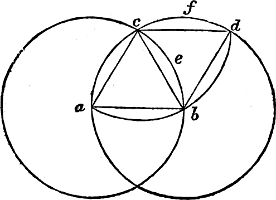
equilateral triangle cannot be constructed. For let there be (says he)
a right line a b, upon which an equilateral triangle is to be
constructed.
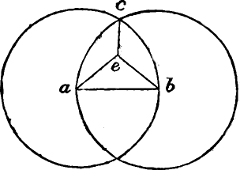
But let circles be described, and from their common section let the
right lines c e a, c e b, be extended, having the common
segment c e. It will therefore happen, that the lines extended
from the common section, will be equal to the given line a b,
and yet the sides of the triangle will not be also equal, but two will
be less than the remainder, that is, than a b. And so this not
being constituted, neither can the rest be constructed. Can then (says
Zeno) the rest follow, though the principles are given, unless this
also is previously received, that there are no common segments either
of circles or of right lines? Against this objection then, we must
affirm in the first place, that it was in a certain respect previously
understood, that two right lines have no common segment. For the
definition of a right line comprehends this property, since that is
a right line which is equally situated between its bounding points;
and the equality of the interval between the points to the right line,
causes that which joins the points to be one, and the shortest line;
so that if any one adapts it to another line, according to one of its
parts, it must also agree with the line according to its remaining
part; for since it is constituted in its extremities, because it is the
shortest line, it is necessary that the whole should fall on the whole.
But again, this was manifestly received in the Petitions: for the
Petition which says, that a terminated right line may be produced
straight forwards, perspicuously shews that the produced line ought
to be one, and produced by one motion;
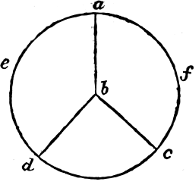
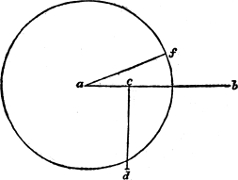
but if any one is desirous to receive a demonstration of this
assumption, let, if possible, a b be the common segment of a
c and a d, and with the centre b, and interval b
d, let the circle a c d be described; because therefore the
right line a b c, is drawn through the centre, a f c is a
semicircle; and because the right line a b d likewise is drawn
through the centre, a e d is a semicircle. The semicircles,
therefore, a f c, a e d, are equal to each other, which
is impossible. But against this demonstration Zeno will perhaps say,
that it is likewise requisite to demonstrate that the diameter bisects
the circle, because we previously assume that there is not a common
segment of two circumferences. Thus too we take for granted, that one
circumference coincides with another, or if it does not coincide, that
it either falls externally or internally. But nothing hinders (he will
say) that the whole may not coincide with the whole, but according to
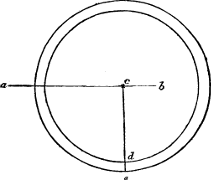
some part. But to this Possidonius rightly answers, who laughs at the
acute Epicurean, as if conscious that though the circumferences do not
coincide according to a part, yet the demonstration will succeed; for
according to that part in which they do not coincide, the one will
fall within, and the other without, and the same absurdities will
follow when right lines are extended from the centre to the external
circumference; for those from the centre will be equal, as well the
greater which is drawn to the external, as the less which is extended
to the internal circle: either therefore the whole will coincide
with the whole, and they will be equal; or coinciding according to
a part, it will alternately vary according to the remainder, or no
part will coincide with no part; and in this case it either falls
within or without: but of this, enough. But Zeno also condemns the
following demonstration of this particular:
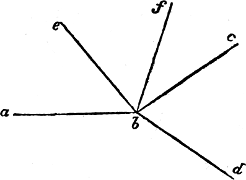
Let a b be the common segment of two right lines a c,
a d, and let be b e erected at right angles to a
c, the angle e b c, therefore, is a right one. Hence, if
the angle e b d is also right, they shall be equal, which is
impossible; but if not, let b f be erected at right angles to
a d. The angle f b a, therefore, is right; but the angle
e b a was also right; and they are therefore mutually equal,
which is impossible. This is the demonstration which Zeno opposes,
as assuming that which is to be exhibited afterwards; I mean from a
given point to raise a right line, at right angles, to a given right
line. However, Possidonius observes, that indeed, a demonstration of
this kind is never to be introduced into elementary institutions; but
that Zeno calumniates Geometricians using their own as a flagitious
demonstration; though there is some reason in their conduct. For there
are right lines existing at right angles; since any two right lines are
capable of forming a right angle; and this is previously assumed in
our definition of a right angle. For we alone constitute a right angle
from such an inclination; and it may perhaps be this which we have
erected. Indeed, Epicurus himself, and all other philosophers admit,
that not only many things possible may be supposed, but likewise many
of an impossible matter, for the purpose of contemplating something
consequent; and thus much concerning an equilateral triangle.
But it is requisite to construct other triangles, and in the first
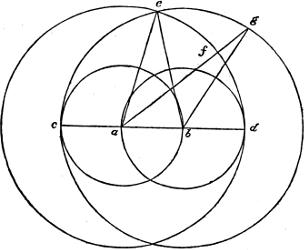
place an isosceles. Let a b, therefore, be a right line, upon
which it is required to construct an isosceles triangle. Describe
circles as in the construction of an equilateral triangle, and produce
the line a b on each side to the points c d; the line
c b, therefore, is equal to a d. Again, with the centre
b, and interval c b, let the circle c e be
described; and with the centre a, and the interval d a,
the circle d e; and from the point e, in which the
circles intersect each other, to the points a and b, let
the lines e a, e b, be extended. Because therefore, e
a is equal to a d; but e b to b c, and a
d is equal to b c, e a will also be equal to e
b; but they are also greater than a b. The triangle a b
e, therefore, is isosceles, which it was required to constitute.
But let it be ordered to construct a scalene triangle upon the given
right line a b. Describe circles with centres and intervals,
as before, and let there be taken in the circumference of the circle,
whose centre is a, the point f, and let the right line
a f be extended and produced to the point g; and likewise
let the right line g b be extended. Because, therefore, a
is a centre, a f is equal to a d; and hence, a g
is greater than a d, that is, than g b. But b also
is a centre, g b, therefore, is equal to c b; and hence,
g b is greater than b a: but g a is greater than
g b; the three lines therefore g b, b a, a
g, are unequal; and hence, the triangle a b g is scalene.
Hence too, three triangles are constructed; but these things are
commonly known: however, this is beautiful in these triangles, that the
equilateral existing on all sides equal, is constructed by one mode
alone; but the isosceles, endued with equality in two sides only, has
a two-fold construction: for the given right line is either less than
both the equal ones (according to our present construction), or it is
greater than both; but the scalene being unequal in all its sides,
receives a triple construction; for the given right line is either
the greatest of the three, or the least; or greater than the one,
and less than the other; and indeed, it is proper to be exercised in
each supposition, either by enlarging or contracting; but to us, what
is already delivered, is sufficient. Let us now contemplate problems
universally, some of which are produced simply, but others manifoldly,
and others according to infinite modes. But (as Amphinomus observes)
those which are simply constructed are ordinate: but those
which receive a manifold composition, and are constructed according to
number, are middle; and those which are varied in infinite ways,
are inordinate. The manner, therefore, in which problems are
constructed, simply or manifoldly, becomes manifest in the preceding
triangles; for the equilateral is constituted simply; but of the other
two, the one receives a two-fold, and the other a triple construction.
But problems of the following kind, may take place in infinite modes; I
mean to divide a given right line in three proportional parts;
for if it be divided in a duple ratio, and the deficient quadrangular
form, resulting from the less, be applied to the greater, it will be
divided into three equal parts; but if the greater segment be more
than double of the less, as for instance, triple, and a deficient
quadrangular form, equal to that which results from the less, be
applied to the greater, the line will be divided into three unequal
parts. Because, therefore it may be divided into two parts, in infinite
ways, the greater of which is either double or triple, (for multiplex
proportion proceeds in infinitum), hence, it may be divided into three
parts, according to infinite variations.
But it is requisite to know, that problem also is manifoldly
predicated; for whatever is proposed may be called a problem,
whether it is proposed for the sake of learning or operating. But in
mathematical disciplines, that is properly called a problem, which is
proposed for the purpose of contemplative energy. Since that which is
performed in these, has contemplation for its end; and often, indeed,
certain things, impossible to be executed, are called problems: but
more properly that which is possible to be done, and neither exceeds,
nor is deficient, is allotted an appellation of this kind; and the
problem exceeds, which says, to construct an equilateral
triangle, having its vertical angle two thirds of one right; for
this is superfluous, and is added in vain: since it is a property
inherent in every equilateral triangle. But of those which exceed,
whatever are redundant with incongruous and non-existent symptoms, are
called impossibles; but whatever are redundant with accidents,
are called greater problems. But a defective problem
(which is also called a less problem) is that which requires
some addition, that it may be reduced from inordination into order
and scientific bound, as if any one should say, to constitute an
isosceles triangle: for this is mutilated and indeterminate, and
requires some one who may subjoin, what kind of an isosceles triangle,
whether that which has its base greater than either of the equal
sides; or that which has it less. Likewise, whether that which has the
vertical angle double of each at the base, as a semiquadrangle; or
that which has each of the angles at the base double of the vertical
angle; or that which possesses these angles according to some other
proportion, as triple or quadruple: for it is possible that it may
be varied in infinite modes. From hence, therefore, it is manifest,
that such things as are properly denominated problems, ought to avoid
indetermination, and not to be of the number of things capable of
infinite variation; though such as these are also called problems,
through an equivocation of the word problem. The first problem,
therefore, of these elements, excels the rest in the manner we have
explained; for it neither exceeds, nor is deficient; it
is neither constructed in a variety, nor according to infinite modes;
and such ought to be the conditions of that which is to be the element
of the rest.
PROPOSITION II. Problem II.
To a given point to place a right line equal to a given right line.
Of problems, as well as of theorems, some are without case, but
others possess a multitude of cases. Whatever, therefore, have the
same power acceding to many descriptions, and when their positions are
changed, preserve the same mode of demonstration, these are said to
have case; but such as proceed according to one position only,
and one construction, are without case; for simply, case,
appears about the construction both of theorems and problems. The
second problem, therefore, has many cases; but a point is given in
it in position, since it can only be given in this manner;
but a right line, both in form and position, (for it is not simply
line, but of such a kind.) For it is here enquired, how to
a given point to place a right line equal to a given right line.
But it is manifest that the point is entirely in the subject plane,
in which the right line exists, and not in one more elevated. For in
all problems and theorems respecting planes, we must conceive that
one plane is subjected. But if any one should doubt how a line is to
be placed equal to a given right line, for what if the given line be
infinite? Since the present datum pertains both to finite and infinite:
for every datum signifies that which is proposed and supposed by us for
the sake of investigation. But this Euclid himself declares sometimes,
saying, upon a given terminated right line to construct an
equilateral triangle; but at other times, upon a given infinite
right line to let fall a perpendicular. In answer then to this
doubt, we must say, that when he orders us to place the line equal to
a given right line, at a given point, he sufficiently evinces that the
given line is finite; for every thing placed at a point, is terminated
according to that point. Hence, the line equal to that which is given,
must have a much prior termination. At the same time, therefore, in
which he says to a given point, he terminates both the given
right line, and its equal which is investigated.
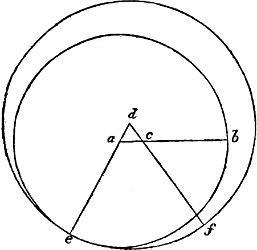
But that the cases of the present problem are formed from the
various position of a point, is manifest. For the given point is either
placed external to, or in the given right line; and if in it, it will
either be one of its extremities, or it will be situated within the
extremes; and if external, it will either have a lateral position, so
that a line drawn from it to the extremity of the given line will form
an angle, or a direct position; so that if the line were produced, it
would coincide with the external point. But the geometrician, indeed,
considers the point as external, and receives it according to a lateral
position; however, for the sake of exercise, all the positions are to
be assumed, the more difficult of which we shall exhibit. For let there
be given a right line a b, and a given point c, which
lies between its extremes, and let there be constituted according to
the doctrine of the elements, an equilateral triangle upon the right
line a c, and let d c, d a, be produced; then,
with the centre a, and the interval a b, let the circle
b e be described. And again, with the centre d, but
with the interval d e, let the circle d f be designed.
Because, therefore, a is the centre, b a is equal to
a e; and hence, d e is equal to d f, the parts
of which, d a, d c, are equal: for the triangle d a
c was established as equilateral. The remainder, therefore, a
e, is equal to c f; but a e, as it was shewn, is
equal to a b, and hence, c f is equal to a b. To
a given point, therefore, c, a right line c f is placed
equal to a b. With respect to the position of the point then,
so many cases arise. But there are many more with respect to the
constitution of the equilateral triangle, the extension of its sides,
and the description of circles.
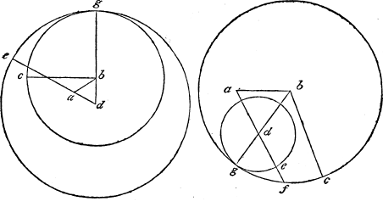
For let there be assumed, as in this element, a point a, and a
right line b c, but let b a be extended. The equilateral
triangle, therefore, will not be constituted on b a, with its
vertex above (because there is no place for it), but beneath; let it,
therefore, be a d b; a d, therefore, is either equal to
b c, or greater or less. If then it be equal that which was
required is performed. But if less with the centre b, and the
interval b c, let a circle be described, and let a d,
d b be produced to the points e and g; and with
the centre d, but the interval d g, let a circle g
a be designed. Because, therefore, d g is equal to d
e, for they are drawn from the centre; and likewise because a
d is equal to d b, for the triangle is equilateral, the
remainder a e is equal to the remainder b g. But b
g is also equal to b c, for they proceed from the centre;
and hence, a e is equal to b c, which was required to be
done.
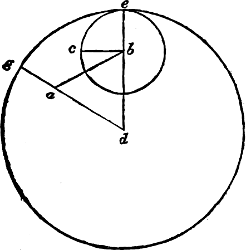
But if a d is greater than b c (for this is the
last case), then with the centre b, and the interval b c,
let a circle e c be described. The line d b, therefore,
shall cut the circle e c. Again, with the centre d, and
interval d e, let the circle e g be described. Because
therefore, d is the centre of the circle g e, g d
is equal to d e. But d a was also equal to d b;
the remainder, therefore, a g is equal to the remainder b
e. But b e is equal to b c, for both proceed from the
centre. Hence, a g is equal to b c; and it is placed at
the point a, as was required to be done. And though there are
many other cases, the description of the above is sufficient for our
present purpose. For from these it is possible for the more curious
to exercise themselves in the rest. But formerly some destroying the
construction and variety of this problem, reasoned thus.
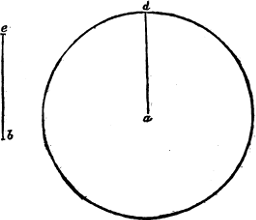
Let a be a given point, but b e a given right line, and
with the centre a, but with an interval equal to b e,
let a circle d e be described. Then let a certain right line
a d be extended from the point a to the circumference;
and this shall be equal to b e: for the magnitude of the line
from the centre, was equal to that of b e: and so that is done
which was required. But he who thus reasons, begs, in the very
beginning. For when he says with the centre a, but interval
b e describe a circle e d, he receives, in a certain
manner, a line equal to b e, placed at the extremity a;
and preserving the Petition, he makes one extremity of the interval a
centre, but with the other describes a circle: however, in this case,
the centre is in one place, but the interval in another. We by no
means, therefore, approve this method of demonstration.
PROPOSITION III. Problem III.
Two unequal right lines being given, from the greater to cut off a part
equal to the less.
This third problem, likewise, has a variety of cases. For the given
unequal right lines are either mutually distant from each other, as
with the institutor of the elements, or they are united according
to one extreme; or the one cuts the other according to one of its
extremities, and this in a two-fold manner. For either the greater cuts
the less, or the less the greater. But if they are united according to
one extreme, the demonstration is manifest. For employing the common
extremity as a centre, and the lesser of the lines for an interval, you
will describe a circle, and cut off from the greater, a part equal to
the less; since as much as the circle intercepts within itself, will
be equal to the less. But if the one cuts the other according to its
extreme, either the greater will cut the greater, or the contrary. And
if they mutually cut each other, they will either be mutually cut into
equal parts, or into unequal; or the one will be cut into equal, and
the other into unequal parts, and this in a two-fold respect. For all
these present us with an admirable variety of exercise, some of which,
out of a many, we shall exhibit.
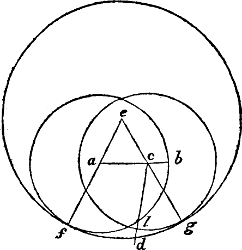
Let there be given the unequal right lines a b, c d,
the greater of which is c d, and let it cut a b in
one of its extremities c; then with the centre a, but
interval a b, let a circle b f be described, and let an
equilateral triangle a e c be constructed upon a c, and
produce e a, e c. Again, with the centre e, but
interval e f, let the circle g f be described; and with
the centre c, and interval c g, the circle g l.
Because therefore, e f is equal to e g (for the centre
is e) of which e a is equal to e c, the remainder
a f, shall be equal to the remainder c g. But a f
is likewise equal to a b; for the centre is a. Hence,
c g will be equal to a b, and this is equal to c
l, for the centre is the point c: a b, therefore, is
equal to c l, which was required to be done.
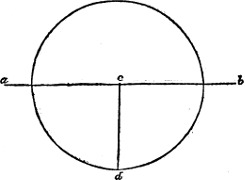
But let c d be less than a b, and let it cut a b
according to its extremity c; either, therefore, it will cut it
in the middle, or not in the middle. Let it in the first place cut it
in the middle; c d, therefore, is either the half of a b,
and a c is equal to c d, or it is less than half. And in
this case with the centre c, and interval c d, describe
a circle, and you will cut off from a b a part equal to c
d: Or it is greater than half;
and then at the point a, placing a f, equal to c
d, and describing a circle with the centre a, and interval
a f, you will cut off from a b a part equal to a
f, that is to c d. But if c d does not cut a b
in the middle, c d shall either be its half, or greater than
the half, or less.
If therefore c d is the half, or less than the half of a
b, employing c as a centre, and c d as an interval,
you will cut off from a b, a part equal to e d, as was
required to be done. But if c d is greater than the half, again
at the point a[5] placing a f equal to c d, you
will accomplish the same.
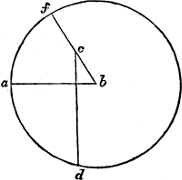
For with the centre a, but interval a f, you will
describe a circle, cutting off from a b a line equal to a
f, that is, to c d. But if they mutually intersect, as
c d, a b, then with the centre b, but interval
b a, describe the circle a f, and let b c be
extended to the point f. Because therefore, b f, c
d, are the two unequal right lines, and c d cuts b f,
according to its extremity, it is possible from c d to make a
line equal to b f; for this has been shewn in the first case
of this problem. It is therefore possible, that a line equal to a
b may be cut off from c d; for a b and b f are
mutually equal. Having, therefore, received these cases from division,
we have endeavoured to exhibit their variety. But the demonstration of
the elementary institutor is admirable, since it accords with all the
preceding constructions. And it is possible, in every position, at the
extremity of the greater, to place a line equal to the less, and using
the same extreme as a centre, and placing the interval to describe a
circle, which shall cut off from the greater, a line equal to the less,
whether they mutually intersect, or one cuts the other, or they are
constituted in a still different position.
PROPOSITION IV. Theorem I.
If two triangles have two sides equal each to each; and have
likewise the angles equal; which are comprehended by the equal
sides; then they shall have their bases equal; and the two
triangles shall be equal; and the remaining angles opposite to
the equal sides shall be equal.
This is the first theorem in the institution of the elements, for
all those which preceded were problems. The first, indeed, treating
concerning the origin of triangles: but the second and third proposing
to procure one right line equal to another. And of these the one
produced an equal from an unequal line, but the other discovered an
equal line by an ablation from one unequal. Since, therefore, equality,
which is the first symptom in quantity, is to be constructed by us in
a triangle and right line, it is delivered in the following theorem.
For how can he who has not previously constructed triangles, and
procured their origin, be learned in their essential accidents, and
in the equality of angles and sides which they contain? How can he
receive sides equal to sides, and right lines to other right lines,
who has neither problematically investigated these, nor fabricated the
invention of equal right lines? For if he should say it may happen
before they are fabricated, that if two triangles have this
for a symptom, they shall likewise have this particular
symptom; would it not, in this case, be easy to object to him,
that we by no means know whether a triangle can be constructed? And
should it be afterwards inferred, that if there are two triangles,
they may have two sides equal to two sides, may we not also doubt
this, whether it is possible that right lines may be mutually equal?
And this particularly in geometrical forms, in which inequality
not entirely existing, equality is likewise inherent. For we must
learn that the cornicular is always unequal to an acute angle, and
the same is true of the semicircular angle, and the transition from
the greater to the less does not entirely take place through that
which is equal. The institutor of the elements, therefore, first of
all removing these objections, delivers also the construction of
triangles (for it is common to three forms) and the origin of equal
right lines, in a two-fold order. For he produces the one, not yet
existing: but he acquires the other by an ablation from an unequal
line. But after these he very properly subjoins the theorem, by which
it is shewn how triangles having two sides equal to two, each to each,
and the angles comprehended by the equal sides equal, have also the
base equal to the base, the area equal to the area, and the remaining
angles to the remaining angles. For there are three particulars
exhibited in these triangles: but two data. Hence, the equality of
the two sides is given, or two equal sides (and it is manifestly
given in proportion) and the equality of the angle contained by the
equal sides: but three particulars are investigated, the equality of
base to base, of triangle to triangle,
and of the remaining angles. But because it is possible that
triangles may have two sides equal to two, and yet the theorem not be
true, because the one is not equal to the other, but both together,
on this account he adds in the data, that the sides are equal not
simply, but one to the other. For if one of the triangles should have
one of its sides of three units, but the other of four; and again, if
the sides of the other triangle are respectively two, and five units,
the angle comprehended by these being right, the two sides of the one
triangle, will, indeed, taken together, be equal to the two sides of
the other, or to seven units, yet the two triangles will not be equal.
For the area of the one is six units[6], but of the other five. And
the reason of this is, because the sides are not equal each to each.
Hence, many, not observing this in the division of land, when they
have received a greater, have thought just the same as if they had
received an equal field; and this because both the sides containing
one field, have been together equal to both the sides containing the
other field. It is requisite, therefore, to receive the one equal to
the other, and to mark wherever the institutor of the elements subjoins
this, because he does not add it without occasion. For discoursing on
the equality of equal angles, he adds the particle comprehended by
equal sides, lest by speaking indeterminately we should assume some
one of the angles at the bases. Besides, when in triangles no side is
previously named, we must conceive the base to be the side opposite to
our sight; but when two are previously received, the remaining side is
necessarily the base. Hence, here too, the institutor of the elements
having previously assumed two sides equal to two, calls the remainder
the bases of the triangles. But a triangle is then said to be equal
to a triangle, when their areas are equal. For it is possible, that
though the ambits are equal, yet the areas may be unequal, on account
of the inequality of angles. But I call the area, the space intercepted
by the sides of the triangle: as also I denominate the ambit, the
line composed from the three triangular sides. Each, therefore, is
different, and it is requisite, indeed, that besides the equality of
the ambits, according to each side, the angles should also be equal,
if also area ought to be equal to area. But it happens in certain
triangles, that though the areas are equal, yet the ambits are unequal;
and that the ambits being equal, the areas are unequal. For if there be
two isosceles triangles, each of whose equal sides contains five units,
but the base of the one is eight, and of the other six units; he who
is ignorant of geometry, will say that the greater triangle is that
whose base contains eight units. For the whole ambit will be eighteen.
But the geometrician will say, that the area of each triangle contains
twelve units, and this he will demonstrate, by drawing in each triangle
a perpendicular from the vertex, and multiplying this with either part
of the segments of the base[7]. But it happens (as I have said) that
though the ambits are equal, the spaces are unequal. Hence, certain
persons formerly fraudulently deceived their partners in the division
of fields, on account of the equality according to ambit, receiving
a larger field. But one base is said to be equal to another, and one
right line to another, when their extremes conjoined make the whole
coincide with the whole. For every right line, indeed, agrees with
every right line; but equal right lines mutually coincide according
to their extremes. Again, one right-lined angle is said to be equal
to another, when one of the comprehending sides of one angle being
placed upon one of the other, the remaining side also coincides with
the remainder: but when one of the remaining sides falls external to
the other, the greater angle is that whose side falls externally; and
the less whose side falls within. For there, indeed, the one contains,
but in this case it is contained.
But we must assume the equality of angles according to the convenience
of sides in right lines, and in all of the same species, as in
lunulars and systroides[8], and figures on both sides convex;
because, it is possible that they may be equal, and yet the sides not
mutually coincide. For a right angle is equal to a certain lunular
angle, and yet it is not possible that right lines can coincide with
circumferences. Besides, this also must be previously understood, that
the angles are said to subtend the opposite sides. For every triangular
angle is contained by two sides of the triangle, but is subtended by
the remaining side. Hence, the geometrician, when he says that the
angles are equal, adds, which are opposite to the equal sides,
lest we should conceive it of no consequence whatever angle is
received, and should think that he denominated any other two angles of
the triangles equal, but we must call those equal which subtend equal
sides. For equal sides mutually subtend equal angles. And such are the
considerations necessary to the declaration of the present theorem.
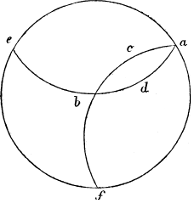
But against the objection of our adversary[9], this must be previously
assumed, that two right lines cannot comprehend space. For this the
geometrician receives as evident. For if (says he) the extremes of
the bases mutually coincide, the bases also shall coincide: but if
not two right lines, will comprehend space. From whence, therefore,
is the impossibility of this derived? Let there then be two right
lines comprehending space a c b, a d b, and let them be
infinitely produced. Then with the centre b, and interval a
b, let a circle a e f be described. Because, therefore, the
line a c b f is a diameter, a c f is the half of the
circumference. Again, because the line a d b e is a diameter,
a e, likewise, is one half of the circumference. Hence, a
e, and a c f are equal to the circumference, which is
impossible. Two right lines therefore, cannot comprehend space; which
the institutor of the elements knowing said, in the first Petition,
from every point, to every point, to draw a right line, because
one right line is always capable of uniting two points, but this is
impossible for two right lines to effect. Many circumferences, indeed,
may conjoin two points, both in the same, and in contrary parts: for by
this means the extremities of a diameter conjoin two circumferences,
but only one right line. But it is possible that both within and
without semicircles, infinite circumferences conjoining given points
may be described. And the reason of this is, because a right line is
the least of lines, having the same extremes. But there is every where
one minimum, and this always becomes the measure of the infinity
of others. As therefore a right line; since it is one, becomes the
measure of the infinity of right-lined angles (for by this we discover
their quantity) so likewise a right line procures us the greatest
utility in the mensuration of such as are non-rectilineal. And thus
much may suffice concerning these.
But that the whole demonstration of the present theorem depends on
common conceptions, rising as it were spontaneously, and emerging
from the evidence of hypotheses, is manifest to every one. For since
two sides are equal to two sides, each to each, they will mutually
coincide. But since the angles contained by the equal sides are equal,
they also shall mutually coincide. And when angle is placed on angle,
and sides on sides, so as to touch, in every part, the extremities of
the sides beneath shall also coincide. But if these, then base,
shall agree with base. And if three with three, the whole
triangle shall accord with the whole triangle, and all shall be equal
to all. Hence, therefore, equality considered in things of the same
species, appears to be the cause of the whole demonstration. For here
are two axioms endued with a power of containing the whole method of
the proposed theorem. One, indeed, affirming, that things which
mutually coincide, are equal; and this is simply true, requiring no
limitation, and is employed by the institutor of the elements both in
the base, and in the space, and in the other angles. For these, says
he, are equal, because they mutually coincide. But the other affirming
that things which are equal mutually coincide. This, however,
is not true in all, but in those of a similar species. But I call
things similar in species, such as a right line when compared with a
right line, one circumference with another of the same circle, and the
angles comprehended by similar lines endued with a similar position.
But of these, I say, that such as are equal, mutually coincide: so
that in short, the whole demonstration is of this kind. These equals,
therefore, are given, viz. two sides equal to two sides, and the angles
which they comprehend, and these accord among themselves. But if these
mutually coincide, the base also shall agree with the base, and all
coincide with all. And if these accord, they are also equal. If then
these are equal, it may at the same time be shewn that all are equal to
all. And this appears to be the first mode of knowing triangles on all
sides equal. And thus much concerning the whole demonstration.
But Carpus, the mechanist, who, in an astrological treatise,
discourses of problems and theorems, says, “that they must not be
passed over in silence, since they opportunely present themselves
for investigation;” and lastly, entering on their distinction, he
observes, “that the problematical genus precedes theorems in order.
For in problems (says he) the invention of subjects is investigated
prior to symptoms. Likewise, a problematical proposition is simple,
and requires no artificial intelligence. For this commands us to
accomplish something evident, as to construct an equilateral
triangle, or from two given unequal right lines, to cut off
from the greater a part equal to the less. For what is there in
these difficult and obscure. But he affirms that the proposition of
a theorem is difficult, and requires the most accurate power, and a
judgment productive of science, that it may appear neither to exceed,
nor to be deficient from truth; such, indeed, as the present, which is
the first of theorems. Add too, that in problems, there is one common
way invented by resolution, by proceeding according to which, we can
happily accomplish our purpose. For after this manner the more easy
kind of problems are investigated. But the treatise of theorems is so
very difficult, that even to our time (says he) no one has been able
to deliver any common method of their invention. Hence, on account
of facility also, the problematical genus is more simple. But these
being distinguished, it is on this account (says he) that in the
elementary institution problems precede theorems, and from these the
institution of the elements begins; and the first theorem is in order
the fourth, not because the fourth is exhibited from the preceding,
but because it is necessary they should precede as being problems,
and this a theorem, though it should require none of the antecedent
propositions for its demonstration. For the present theorem entirely
employs common conceptions; and in a certain respect receives the same
triangle in a different position. Since coincidence, and its consequent
equality possess a sensible and manifest apprehension. But such being
the demonstration of the first theorem, problems with great propriety
precede, because they are universally allotted the primary place.” And
perhaps, indeed, problems antecede theorems in order; and particularly
among those who ascend to contemplation from the arts, which are
conversant with sensible particulars: but theorems excel problems in
dignity of nature. And it appears, that all geometry, so far as it
conjoins itself with a variety of arts, energizes problematically: but
so far as it coheres to the first science, it proceeds theorematically
from problems to theorems, from things secondary to such as are first,
and from things which more regard the arts, to such as are endued
with a greater power of producing science. It is, therefore, vain to
accuse Geminus, for affirming that theorems are prior to problems.
For Carpus assigns a precedency to problems, according to order: but
Geminus to theorems, according to a more perfect dignity. But of this
fourth theorem, we have already observed, that in a certain respect it
is indigent of the preceding problems, in which we learn the origin of
triangles, and the invention of equality. But we now add, that since it
is the most simple and principle of theorems (for it is naturally, as
I may say, exhibited from primary conceptions alone), but demonstrates
a certain symptom appearing about triangles, having two sides equal
to two, each to each, and the two angles equal contained by the equal
sides, it is with great propriety placed the first after problems,
in which things subject to this symptom, and the data themselves are
constructed.
PROPOSITION V. Theorem II.
The angles at the base of an isosceles triangle are mutually equal; and
the equal right lines being produced, the angles under the base shall
be mutually equal.
Of theorems some are simple, but others composite. I
call those simple, which, both according to hypotheses and
conclusions, are indivisible, possessing one datum, and one
object of investigation. Thus for example, if the institutor of the
elements had said, every isosceles triangle has the angles at the
base equal, it would have been a simple theorem. But theorems are
composite, which are composed from many particulars, either having
composite hypotheses, or conclusions from a simple hypothesis, or both.
And of these, some are complex, but others incomplex. The
incomplex are such composites as cannot be divided into simple
theorems, as the fourth proposition. For in this, both the datum
is a composite, and its consequent, yet it is impossible that the
datum can be divided into things simple, and become theorems.
For if a triangle has its sides alone equal, or the angle at the
vertex, the same consequences will not ensue. But the complex
are such as may be divided into things simple, as the theorem which
says, triangles and parallelograms of the same altitude, have
the same proportion as their bases. For it is possible to say
by division, that triangles of the same altitude, have the same
proportion as their bases, and in parallelograms after a similar
manner. But of all composites, some are composed according to the
conclusion, being excited from the same hypothesis: but others have
their conclusion according to hypotheses, and infer the same conclusion
in all: and others, lastly, are composed both according to the
conclusion, and according to hypotheses. Composition, therefore,
in the present case, is according to the conclusion, for there
are three particulars concluded in this theorem, that the bases are
equal, that the triangles are equal, and that the remaining angles,
under the base, are equal to the remaining angles. But composition,
according to hypothesis, is found in the common theorem of
triangles and parallelograms of the same altitude. And according
to both, in the theorem that the diameters both of circles
and ellipses, bisect as well the spaces as the lines containing the
spaces. But of complex theorems, some are universal:
but others conclude that which is universal from particulars. For
if we should say that a diameter divides a circle, ellipsis, and
parallelograms, we receive, indeed, every part of the complex, not
universally, but we make that universal which is composed from all.
But if we should say, that in a circle, all lines passing through
the centre, mutually bisect each other, and make equal angles of all
the segments, we should affirm a universal. For in an ellipsis all
the angles of the segments are not equal, but those only which are
formed by the diameter. But these compositions are entirely fabricated,
for the sake of geometrical brevity and resolutions. For many things
incomposite are not resolved, but composites alone afford convenience
to a resolution tending to principles.
In consequence of these previous considerations then, we must call
the fifth theorem a composite, and a composite, both with
respect to the datum, and the object of investigation;
and this the institutor of the elements exhibiting, divides this
theorem, being one, and gives a separate position to the data,
and the things to be investigated, for he says that the
angles at the base of an isosceles triangle are equal; and again,
that the equal sides being produced, the angles under the base are
equal. For we must not think that there are two theorems, but one;
and that this is a composite, both according to the data, and
thing sought: and that each of these composites is perfect and
true. Hence, conversion also is true in each. For if the angles at
the base are equal, the triangle is isosceles: but if those under the
base are equal, the equal right lines are produced, and the triangle
is isosceles. But the institutor of the elements converts the
equality of the angles at the base; but not the equality of those under
the base, though this is likewise true; the reason of which we shall
shortly explain. But we shall now, in the first place, enquire on what
account he demonstrates that the angles under the base are equal. For
he never employs this in the construction or demonstration of other
problems or theorems. It may be doubted, therefore, why, since it is
useless, it was requisite to insert it in the present theorem? To this
we must reply, that though it is never employed in the elements, yet
it is most useful for the destruction of objections, and the solution
of oppositions to theorems[10]. But it is artificial, and belongs to
science to prepare solutions of things resisting its propositions, and
to provide subsidies of answers; that not only true demonstrations may
be fabricated from things previously demonstrated, but that from hence
confutations of error may be produced. And from this geometrical order,
you will likewise receive a rhetorical emolument. For he who can effect
this in the discourses of rhetoric, who can foresee the oppositions to
his following heads, and previous to their delivery, can first of all
prepare solutions of them to others, he, indeed, will fabricate in a
wonderful manner, a most excellent mode of disputation. The institutor
of the elements, therefore, teaching us this in reality, previous to
the theorems by which we solve opposing objections, employing such
as are now exhibited, at the same time demonstrates, that the angles
under the base of an isosceles triangle, are equal, and thus prepares
a confutation of the falsehood such objections contain. But that from
the present theorem we may solve the objections urged in the seventh
and ninth propositions, will be perspicuous as we proceed. Hence, it
appears, why Euclid does not convert the latter part of this theorem in
the sixth, because it does not produce a principal utility, but confers
to our advantage, accidentally, with respect to the whole of science.
But if any one should desire us without producing the equal right
lines, to prove the angles at the base of an isosceles triangle equal,
(for it is not requisite to demonstrate the equality of these, by
those under the base) by transposing, in a manner, the construction,
and fabricating those constructions within, which are made without
the isosceles triangle, we may exhibit the thing proposed.
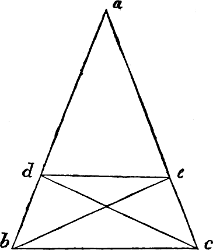
Thus let a b c be an isosceles triangle, and in the side a
b, take any point d, and from a c, take a e,
equal to a d, and draw the lines b e, d c, d
e. Because, therefore, a b is equal to a c, and a
d to a e, and the angle a is common, b e
also shall be equal to c d, and the remaining angles to the
remaining angles. Hence, the angle a b e, is equal to the angle
a c d. Again, because d b is equal to e c, and
b e to d c, and the angle d b e to e c d;
hence, the base, since it is common to both, is equal to itself, and
all are equal to all. The angle, e d b, therefore, is equal to
the angle d e c: and the angle d e b, is equal to the
angle e d c. Hence, since the angle e d b, is equal to
the angle d e c, from which the equal angles d e b, e
d c, are taken, the remaining angles b d c, c e b
are equal. But the sides also b d, d c, are equal to the
sides c e, e b, each to each, and the base b c is
common. All, therefore, are equal to all. Hence, the remaining angles
also, subtending equal sides, are equal. The angle, therefore, d b
c, is equal to the angle e c b. For the angle d b c,
subtends the line d c: but the angle e c b, the line e
b. The angles, therefore, at the base of an isosceles triangle, are
equal, the equal right lines not being produced.
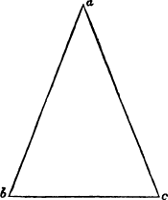
But Pappus demonstrates this yet shorter, without any addition in the
following manner. Let a b c be an isosceles triangle, having
a b, equal to a c. We must conceive, therefore, this one
triangle as if it was two, and reason thus. Because a b is equal
to a c, and a c to a b, the two sides a b,
a c, are equal to the two a c, a b, and the angle
b a c, is equal to the angle c a b, (for it is the same.)
All, therefore, are equal to all. The base b c, to the base c
b. But the triangle a b c, to the triangle a c b;
and the angle a b c, to the angle a c b, and the angle
a c b, to the angle a b c. For they subtend equal sides,
i.e. a b, a c. The angles, therefore, at the base of an
isosceles triangle, are equal. And it seems that Pappus invented this
mode of demonstration, when he considered that the institutor of the
elements also, in the fourth theorem, when he had united two triangles,
and had made them mutually coincide, thus forming one of two, by
this means observed their equality throughout. In like manner it is
possible, that we also, by an assumption contemplating two triangles in
one, may demonstrate the equality of the angles at the base. Thanks,
therefore are to be given to the ancient Thales for the invention of
this theorem, as well as a multitude of others. For he, first, is said
to have perceived and affirmed, that the angles at the base of every
isosceles triangle are equal: and after the manner of the ancients, to
have called them similar. But still more deserving of praise are those
moderns, who have yet more universally demonstrated (among which number
is Geminus) that equal right lines falling from one point, on a line
of similar parts, form equal angles. For Geminus using this theorem,
shews, that there are only three lines, and not more of similar parts,
the right, the circular, and the cylindric helix;
and this is properly universal, to which this symptom first agrees,
just as the possession of two sides greater than the third, is shewn to
be essentially inherent in every triangle. It is not, therefore, the
property universally of every isosceles, though it belongs to every
one, to possess angles at the base equal: but of equal right lines
falling on a line of similar parts. For to subtend equal angles, is in
these primarily inherent.
PROPOSITION VI. Theorem III.
If two angles of a triangle be equal to each other, the sides
also which subtend the equal angles, shall be equal to one
another.
The present theorem exhibits these two properties of theorems,
conversion, and a deduction to an impossibility. For it
is converted, indeed, in the preceding theorem, but its certainty is
evinced by a deduction to an impossibility. It is requisite, therefore,
to speak of each, whatever belongs to the present treatise. One kind of
conversion then, among geometricians, is denominated principally
and properly, when the conclusions and hypotheses alternately receive
theorems; so that the conclusion of the former becomes hypothesis in
the latter; and hypothesis is inferred as the conclusion. As that
the angles at the base of an isosceles triangle are equal.
For here the isosceles triangle is the hypothesis: but the
conclusion, the equality of the angles at the base. And
that where the angles at the base are equal, the triangles are
isosceles, which the present 6th theorem affirms. For here the
equality of the angles at the base is the hypothesis; but
the conclusion, the equality of the sides subtending the
equal angles. But another kind of conversion, is alone according to
a certain mutation of composites. For if the theorem be composite,
beginning from many hypotheses, and ending in one conclusion, by
receiving the conclusion, and one or more of the hypotheses, we infer
some one of the other hypotheses as a conclusion. And after this
manner the eighth theorem is the converse of the fourth. For the one
says, that equal bases subtend equal sides and angles: but the
other, that equal sides being placed on equal bases, contain equal
angles. Of which the predication concerning equal bases
in the latter proposition, is the conclusion of the former:
but the predication concerning the position of equal sides,
is one of the previously assumed hypotheses in the former theorem;
and the comprehension of equal angles is another hypothesis
which this fourth proposition contains. In consequence therefore of
these two conversions, the one which is called the principle,
is uniform and determinate: but the other is various, advancing into
a great number of theorems, and not converting in one, but in many,
on account of the multitude of hypotheses, in composite theorems. But
oftentimes in that which begins from two hypotheses, there is one which
is converted, when the hypotheses are not all determinate, but some of
them indeterminate.
It is here, however, requisite to observe, that many false and
improper conversions take place. As that every sexangular is a
triangular number[11]. For the converse is not also true, that
every triangular number is sexangular. But the reason of this
is, because the one is more common, but the other more particular. And
one is alone predicated totally[12] of the other. But things
in which, that which is primary, is inherent, and according to
which it is received, in these, conversion also follows. And these
observations, indeed, were not unknown to those mathematicians, the
familiars of Menæchmus, and Amphinomus. But of theorems receiving
conversion, some are usually called precedents, but others
converse. For when supposing a certain genus, they demonstrate
some symptom of its nature, they call this a precedent theorem.
But when on the contrary, they make the hypothesis a symptom, and
the conclusion a genus, they denominate the theorem to which this
happens converse. As for instance, the theorem which says,
every isosceles triangle has the angles at the base equal, is
a precedent. For that is subjoined which precedes by nature.
I mean the genus itself, or the isosceles triangle. But that which
says, every triangle possessing two equal angles, has likewise the
sides subtending those equal angles equal, and is isosceles, is a
converse theorem. For it changes the subject, and its passion,
supposing the latter, and from this exhibiting the former. And thus
much concerning geometrical conversions.
But deductions to an impossibility, entirely end in an evident
impossible, the contrary of which is confessed by all. It happens,
however, that some of them end in such things as are opposed to Axioms,
or Petitions, or Hypotheses; but others in things contradicting prior
demonstrations. For the present sixth theorem shews that which happens
to be impossible, because it destroys the common conception, affirming
that the whole is greater than its part. But the eighth theorem
falls, indeed, on an impossible, yet not on that endued with a power
of destroying a common conception, but that exhibited by the seventh
theorem. For what the seventh denies, this affirming exhibits to such
as do not admit the object of investigation. But every deduction to an
impossibility, which being received, opposes the thing sought,
and on this hypothesis advances, until it falls upon the explored
absurdity, and by this means destroys the hypothesis, corroborates that
which was investigated from the first. But it is requisite to know,
that all mathematical proofs are either from principles, or
to principles, as Porphyry in a certain place affirms. And the
proofs from principles, are two-fold. For they either emanate
from common conceptions, and things self-evident: or from things
previously exhibited. But proofs to principles are endued with
a power of either establishing or destroying principles.
And those, endued with a power of establishing principles, are
called resolutions; and to these compositions are opposed.
For it is possible that we may proceed in an orderly method from
those principles to the object of investigation; and this is nothing
else than composition. But those possessing a power of destroying
principles, are called deductions to an impossibility. For
it is the business of this mode to destroy some of the concessions,
and objects of investigation. And in this, also, there is a certain
ratiocination, though not the same as in resolution. For in deductions
to an impossibility, complexion is according to the second
mode of hypothetical reasonings. As if in triangles possessing
equal angles, the sides subtending the equal angles are unequal; and
the whole is equal to its part: but this is impossible. In
triangles, therefore, possessing two equal angles, the sides subtending
the equal angles are equal. And thus much concerning what is called
by geometricians, deduction to an impossibility.
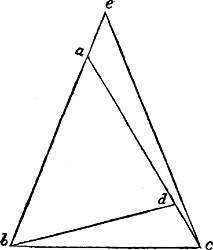
But the institutor of the elements uses conversion in the
present proposition, for he receives the conclusion of the fifth as
a datum, and adds its hypothesis as an object of enquiry: but he
employs deduction to an impossibility, in the construction and
demonstration. But if any should rise up, and assert that it is not
necessary by taking a part from a c equal to a b, to
make the ablation at the point c, but at the point a,
upon this hypothesis, we shall fall into the same impossibility. For
let a b be equal to a d, and having produced b a,
let a e be placed equal to d c. The whole b e,
therefore, is equal to the whole a c.
Let e c be connected. Because, therefore, a c is equal
to b e, but b c is common, the two are equal to the two,
and the angle at the point b, is equal to the angle a c
b. For so it was established in the hypothesis. All, therefore, are
equal to all, by the fourth theorem. Hence, the triangle e b c,
is equal to the triangle a b c, the whole to the part, which
is impossible. But because this also is manifest, it remains that we
exhibit the rest of the conversion. For the institutor of the Elements
converts the whole sixth theorem from a part of the fifth. But it is
requisite to adjoin the remaining conversion. This, then, he receives
as an hypothesis, that the angles at the base of a certain triangle
are equal: but he shews that the triangle is isosceles.
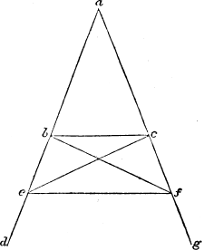
Let a c b, therefore, be a triangle, and let a b, a
c, be produced to the points d g, and let the angles under
the base be equal. I say that the triangle a b c, is isosceles.
For let there be assumed in the line a d, the point e,
and let b e be taken equal to c f; and connect the lines
e c, b f, e f. Because, therefore b e is
equal to c f, but b c is common, the two will be equal
to the two. And the angle e b c, is equal to the angle f c
b; for they are under the base. All, therefore, are equal to all,
by the fourth theorem. Hence the base e c, is equal to the base
f b, and the angle b e c, to the angle c f b; and
the angle c b f, to the angle b c e: for they subtend
equal sides. But the whole angle e b c, was equal to the whole
f c b, of which the angle f b c, is equal to the angle
e c b. The remainder, therefore, e b f, is equal to the
remainder f c e. But b e is equal to c f, and b
f to c e, and they contain equal angles. All, therefore,
are equal to all. Hence, also, the angle b e f, is equal to the
angle c f e. Wherefore, the side a e, is equal to the
side a f (for it is shewn by the sixth) of which b e, is
equal to c f. The remainder, therefore, a b, is equal
to the remainder a c. And hence, the triangle a b c, is
isosceles. It is, therefore, as well isosceles, if it possesses angles
at the base equal: as if the sides being produced it has the angles
under the base equal. Why then did not the institutor of the Elements
convert the remaining part? Shall we say it was because the equality
of the angles under the base in the fifth theorem, was exhibited
for the sake of solving other doubts. But that proving the triangle
to be isosceles, from the equality of the angles under the base,
neither confers to a principal demonstration, nor to the solution of
things investigated, the truth of which is confirmed in the following
theorems, and that from the equality of the angles under the base, he
is enabled to demonstrate that the triangle is isosceles? For if every
right line, standing upon a right line, and forming two angles, makes
them equal to two right; when the angles under the base are equal,
those upon the base will be equal. And these being equal, the sides
subtending them shall be equal. Euclid, therefore, having used this in
the whole elementary institution, was enabled to conclude, that when
the angles under the base are equal, the triangle is isosceles. Indeed
he requires this also, for the demonstration of certain theorems: For
shortly a theorem will appear, evincing, that if a right line standing
on a right line, forms angles, it will either make two right, or angles
equal to two right. And the theorems, indeed, preceding this, require
no such conversion; but those which follow, are indigent of this, and
establish their credibility from the present theorem.
PROPOSITION VII. Theorem IV.
[13]Upon the same right line, two right lines cannot be
constituted equal to two other right lines each to each,
drawn to different points, to the same parts, and having
the same extremes with the two right lines first drawn.
The present theorem possesses a rare property, which is not
frequently found in propositions producing science. For to be formed
by negation, and not by affirmation, is not their sufficiently
distinguishing property. Indeed, the propositions, as well of
geometrical as of arithmetical theorems, are for the most part
affirmations. But the reason of this is, (as Aristotle says) because,
an affirmative universal, especially agrees with sciences, as more
proper, and not indigent of negation: but a universal negative requires
affirmation, in order to produce evidence; for from negatives alone,
there is neither demonstration nor reasoning. Hence, demonstrative
sciences exhibit a multitude of affirmations, but rarely employ
negative conclusions. However, the proposition of this theorem is full
of admirable diligence, and is bound with every addition, by which it
is rendered so certain and indubitable, that it cannot be confuted and
overturned by the efforts of opposing calumniators. For in the first
place, the particle upon the same right line, is assumed, lest
we should exhibit upon another, two right lines equal each to
each, and employ the proposition for the purpose of circumvention. In
the second place, he does not say upon what right line, to constitute
two right lines simply equal to two (for this is possible) but each
to each. For what wonderful thing is it, that he should take both
equal to both, who extends one of the constituted lines, and contracts
the other? But each to each, (says he) is impossible. In the third
place, he adds the particle, to different points. For what, if
some one, when he has formed two lines equal to the first two, each to
each, should connect these with those in the same point, which joins
the subject right lines in the vertex; and should constitute these? For
the extremes of equal right lines perfectly coincide. In the fourth
place, he adds the particle to the same parts[14]. For what if
one subject right line being given, we should place two of the right
lines on one side, and the other two on the opposite side, so that
this common right line should be the basis of the two triangles with
opposite vertexes? Lest, therefore, we should form an erroneous figure,
and charge our deception on the institutor of the Elements, he adds the
particle to the same parts. In the fifth place, he subjoins,
having the same extremes with the two right lines first drawn.
For it is possible to constitute upon the same right line, two right
lines equal to two, each to each, drawn to different points, and to the
same parts, by employing the whole right line, and constructing
upon it, these two right lines; but then the lines last drawn, will
not have the same extremes with those constituted at first. For if we
conceive in a quadrangle two diagonals drawn on one of its sides, two
lines shall be equal to two; a side and diameter to its parallel side,
and the other diameter. But in this case the equal right lines will not
have the same extremes. For neither the parallel sides, nor the
diameters, will mutually possess the same extremes; and yet they will
be equal. These distinctions, therefore, being preserved, the truth of
the proposition, and the certainty of the reasoning, is evinced.
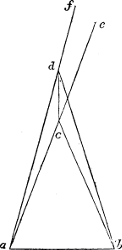
But perhaps, some, notwithstanding all these terms producing science,
will dare to object, that these hypotheses being admitted, it is
possible to effect what the geometrician affirms to be impossible. For
let there be a right line a b, and upon this two lines a
d, d b, equal to two a c, c b, and let the
former be external to the latter, being drawn to different points d
c, and terminated in the same extremes a and b. Let
a c too, be equal to a d: but b c to b d.
This objection, then, we shall confute, by connecting the line d
c, and producing the lines a c, and a d, to the
points e f. For these being constructed, it is manifest that the
triangle a c d is isosceles, a d, being equal to a
c, from hypothesis; and the angles under the base e c d,
f d c are equal. The angle f d c, therefore, is greater
than the angle b d c. Much more then is the angle b c d
greater than the angle b d c. But again, because the line d
b, is equal to the line b c, the angles also at the base
are equal, i.e. the angle b c d, to the angle b d c. The
same angle, therefore, is both greater and equal, which is impossible.
And this is what we said in our exposition of the fifth theorem, that
though the equality of the angles under the base, was not useful to the
demonstrations of the following theorems, yet it procured the greatest
utility in the solution of objections. For in the present instance we
have confuted the objection, by inferring that, because a c, and
a d, are equal, the angles e c d, and f d c, are
also equal. In a similar manner in other theorems, it will appear to be
peculiarly useful for the solution of doubts[15].
But if any one should say that there may be constituted upon the
right line a b, right lines b d, b c, equal to
the right lines a c, a d, of which b c may be
equal to a c, but b d to a d; and that in this
case they will be drawn to different points a and b, to
the same parts, and will have the same extremes with a c, and
a d, viz. c, and d, what shall we reply to this
assertion? Shall we say that it is requisite to constitute the first
lines, upon the right line a b, and their equals upon the same
right line? For this is what the institutor of the Elements affirms
in the proposition. But here, a c, and a d, are not
constituted upon the right line a b, but only on one of its
points. Hence, the lines a c, c b, and a d, d
b, which stand on the right line a b, are different from
the right lines, which were placed in the beginning, and to which they
ought to be constituted equal. Though at the same time it is necessary
that the right lines constituted upon a b, should be equal
to those constituted upon a b. And thus much may suffice for
objections against the present question, But that the present theorem
is exhibited by the institutor of the elements, by a deduction to an
impossibility, and that this impossible opposes the common conception,
affirming that the whole is greater than its part; and that
the same thing cannot be both greater and equal, is sufficiently
manifest. But this theorem seems to have been assumed for the sake of
the eighth theorem. For it confers to its demonstration, and is neither
simply an element, nor elementary: since it does not extend its utility
to a multitude. And hence, we find it very rarely employed by the
geometrician.
PROPOSITION VIII. Theorem V.
If two triangles have two sides equal to two, each to each, and
have the base equal to the base: then the angles contained by
the equal right lines, shall be equal to each other.
This eighth theorem is the converse of the fourth: but it is not
assumed according to a principal conversion. For it does not make the
whole of its hypothesis a conclusion; and the whole conclusion an
hypothesis. But connecting together some part of the hypothesis of the
fourth theorem, and some part of the objects of enquiry, it exhibits
one of the data which it contains. For the equality of two sides to
two, is in each an hypothesis; but the equality of base to base, is,
in the fourth, an object of investigation, but in the present a datum;
and the equality of angle to angle, is, in the former, a datum, but
in the latter, an object of enquiry. Hence, a change alone of data,
and objects of investigation, produces conversion. But if any one
desires to learn the cause why this theorem is placed in the order of
the eighth proposition, and not immediately after the fourth, as its
converse, in the same manner as the sixth after the fifth, of which
it is the converse, since many converted propositions follow their
precedents, and are exhibited after them without any intervening
medium, to this we must reply, that the eighth, indeed, is indigent
of the seventh proposition. For its truth is evinced by a deduction
to an impossibility, but the nature of an impossible becomes known
from the seventh. And, this again, in its demonstration, is indigent
of the fifth. Hence, the seventh and fifth theorems were necessarily
assumed, previous to the present. But because the converse to
the fifth obtained a demonstration easy, and from things first,
it was very properly placed after the fifth, on account of its alliance
with that theorem; and because, since it is shewn by a deduction
to an impossibility, it confutes that which is impossible from
common conceptions, and not as the eighth from another theorem. For
things opposing common conceptions, are more evident for the purpose
of confutation than such as contradict theorems: since these are
assumed by demonstration, but the knowledge of axioms is better than
demonstration. But the institutor of the elements exhibits what is now
proposed from the previously demonstrated seventh theorem.
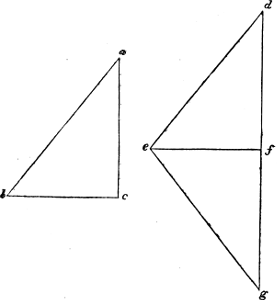
But the familiars of Philo assert, that they can demonstrate this
theorem, without being indigent of any other. For let there be
conceived (say they) two triangles, a b c, d e f, having
two sides equal to two, and the base b c equal to the base e
f. Likewise let the bases coincide with each other; and let the two
triangles a b c, d e f, be so placed in the same plane,
that their vertices may be opposite, and so that e f g may be
the equal substitute of a b c. And let e g be equal to
d e, but f g to d f. Hence, f g will either
be placed in a right line with d f, or not in a right line. And
if not in a right line, it will either make with it an angle according
to the internal part, or according to the external. Let it first be
placed in a right line. Because, therefore, d e is equal to e
g, and d f g is one line, the triangle d e g, is
isosceles, and the angle at the point d, is equal to the angle
at the point g. But if it does not lie in a right line, it will
make an angle inward; and in this case let d g be connected.
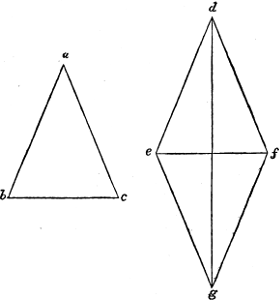
cause, therefore e d, e g, are equal, and
the base is d g, the angle e d g also, is equal to the
angle e g d. Again, because d f is equal to f g,
and the base is d g, the angle, also, f d g, is equal to
the angle f g d. But the angle e d g was also equal to
the angle e g d. Hence, the whole e d f, is equal to the
whole f g e, which was required to be demonstrated. But in the
third place, let f g make an angle with d f, externally,
and let the right line d g be connected.
Because, therefore d e, e g, are equal, and the base is
d g, the angles e d g, d g e, are equal. Again,
because d f, f g, are equal, and the base is d g,
the angle f d g, is equal to the angle f g d. But the
whole angles e d g, d g e, were mutually equal. Hence,
the remaining angles e d f, f g e, will be equal to
each other. And thus the thing proposed is invented according to any
position of the right line f g, and we may demonstrate the
theorem, without employing the seventh proposition.
Is, then (say they), the seventh proposition introduced in vain by
the institutor of the elements? For if we only assume it on account
of the eighth, but the eighth may be exhibited without it, does not
the seventh appear entirely useless? To these enquiries we must reply
in the words of our predecessors, that the seventh theorem, being
demonstrated, is of the greatest utility to such as are skilled in
astronomical concerns, when they discourse concerning the eclipses of
the sun and moon. For, employing this theorem, they shew that three
consequent eclipses, distant from each other by an equal space, cannot
subsist. I say, in such a manner, that the second may be distant from
the first by as great a space of time as the third from the second. For
example, if the second is produced after the first, when six months
and twenty days are elapsed; the third, will by no means be produced
after the second, by the same, but by either a greater or less interval
of time. But that this is the case may be demonstrated by the seventh
theorem. And the institutor of the elements has not only exhibited
the present as conferring to astronomy, but a multitude of other
theorems and problems. For to what other end shall we say that the
last problem of the fourth book was proposed, by which we are taught
how to inscribe the side of a figure of fifteen angles in a circle,
than for its relation to astronomy? For those who describe in a circle
a quindecangle passing through the poles, will, by this means, obtain
the distance of the poles of the equator from the poles of the zodiac.
Since they are distant from each other by the side of a quindecangle.
The institutor of the elements, therefore, appears by regarding
astronomy, to have previously exhibited many things preparative to our
advancement in that science. But when, at the same time, he saw that
this seventh theorem is exhibited from the fifth, and proves the eighth
without any variety, he assigned it the present place. The addition of
Philo is, indeed, beautiful, but is not sufficiently adapted by its
variety of cases to an elementary institution. And thus much in reply
to the present question.
But if any one should doubt why he does not add so much in the eighth
as in the fourth theorem, I mean, that the triangles and the
remaining angles are equal; we must say, that because the equality
of the vertical angle is demonstrated, it follows, that all are equal
to all, by the fourth theorem. It was therefore alone necessary to
demonstrate this by itself, but to assume all the rest as consequents.
But it seems that the equality of the vertical angles causes the
equality of the bases, and of the sides comprehending those angles. For
when the bases are unequal, the same angles will not remain, though the
containing equal sides are supposed, but while the base becomes less,
the angle is at the same time diminished, and while that increases,
the angle also receives a correspondent increase. Nor while the same
bases remain, but the sides become unequal, will the angle remain; but
while they are diminished, it will be increased; and while they are
increased, it will be diminished: for angles, and their containing
sides, suffer a contrary passion. Thus, if upon the same base, you
conceive the sides descending to the lower part, you will diminish
the sides, but increase the angle which they comprehend, and enlarge
their distance from each other. But if you conceive the sides to be
elevated, and to receive an addition as they rise, you will diminish
the angle which they contain: for they will coincide the longer, when
their vertex is more remote from the base. We may therefore certainly
affirm that the identity of the basis and equality of the sides, in a
triangle, determine the equality of its angle.
PROPOSITION IX. Problem IV.
To bisect a given rectilineal angle.
Our author mingles theorems with problems, and connects problems
with theorems, and through both completes the whole of his elementary
institution, comparing as well subjects as the symptoms
subsisting about subjects themselves. Since, therefore, he had shewn
in the preceding propositions, both in one triangle, from the equality
of the sides, the consequent equality of the angles, and the contrary:
and in a similar manner in two triangles, with this exception, that
the mode of conversion in one and two triangles is different, he now
passes to problems, and orders us to bisect a rectilineal angle. And
it is manifest, that the angle here is given according to form: for
it is called right-lined, and not of any kind whatever. Indeed, we
cannot bisect every angle by the elementary institution; since it is
doubtful whether every triangle can be bisected. For, perhaps, you
may doubt whether it is possible to bisect a cornicular angle. But
the ratio of the section is also distinguished in this problem, and
this again not in vain. For to divide an angle in any given ratio,
transcends the present construction: as, for example, into three, four,
or five equal parts. Indeed, to trisect a right angle is possible, by
employing a few of the propositions which are afterwards delivered[16]:
but this cannot be effected in an acute angle, without passing on
to other lines of a mixt species.[17] And this is manifested by the
geometricians who propose to trisect a given rectilineal angle. For
Nichomedes, indeed, from conchoidal lines, the origin, order,
and symptoms of which, he delivers, as he was the inventor of their
properties, trisects every right-lined angle. But others effect this
from the quadrantal lines of Hippias and Nichomedes, by
employing mixt quadrantal lines. Others, again, being incited from
the Helices of Archimedes, divide a given rectilineal angle,
in a given ratio. But the consideration of these, because difficult
to learners, we shall for the present omit; as it will, perhaps, be
more convenient to examine this in the third book[18], where the
institutor of the Elements bisects a given circumference. For there
the same mode of enquiry presents itself with respect not only to
bisection, but also trisection; and the ancients endeavoured, by
employing the same lines, to divide every circumference into three
equal parts. With great propriety, therefore, he who only mentions
a right line and a circumference, alone bisects a right angle and a
circumference. But conceiving that the species composed from these,
through mixture, are difficult to explain and enumerate, without a
curious examination, he omits all such enquiries as involve mixt lines
in their consideration, and proposes to investigate in first and simple
forms alone, such things as can either be produced or considered from
these. And such, indeed, is the proposition of the present problem,
to bisect a given right lined angle. For in the construction
of this he uses one petition, and the first and third problem: but in
the demonstration he employs the eighth theorem alone. Since problems
entirely require demonstration (as we have already observed[19]) and
through this they obtain a power of producing science. But perhaps,
some may oppose the geometrician, by asserting that an equilateral
triangle may be constituted by him, not having its vertex within the
two right lines, but either upon, or external to each; and that this
may be manifested by the elements. For let there be an angle b a
c, which it is required to bisect.
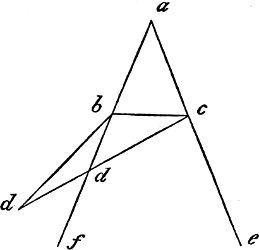
Then let b a be taken equal to a c, and let b c
be connected, and upon it, let an equilateral triangle b c d
be constructed. This point d, therefore, is either within the
right lines a b, a c, or upon a b, or a c,
or external to both. Now the institutor of the Elements assumes them
within; and hence, those who oppose the demonstration, will say the
point is either placed on one of the right lines, or external to both.
Let the point d then be placed on the line a b, so that
the triangle b c d may be equilateral: d b, therefore,
is equal to d c, and the angles at the base c b d, b
c d, are equal. Hence, the whole, b c e, is greater than
the angle c b d. Again, because a b, c a, are
equal, the triangle a b c, is isosceles, and the angles under
the base b c, will be equal. The angle, therefore, b c e,
is equal to the angle c b d. But it was also greater, which is
impossible. Hence, the vertex of the equilateral triangle cannot be in
the right line a b d. In like manner we may shew that it cannot
be in the right line a c e. Let it therefore, if possible be
placed externally. Because, then b d is equal to c d,
the angles at the base are equal, viz. b c d, and c b d.
Hence, the angle b c d, is greater than the angle c b f.
Much more, therefore, is the angle b c e, greater than c
b f: but it is also equal, because these angles are under the
base b c, of an isosceles triangle a b c, and this is
impossible. Hence, the point cannot fall in these parts external to the
two right lines; and it may be similarly shewn that this is impossible
in other parts. Here too you may again observe, that we destroy
objections by using the second part of the fifth proposition, that
the angles under the base of an isosceles triangle are equal. And
this is what we have previously observed, that many things opposing
science, are shewn to be debile, and easy of confutation, by the
assistance of this theorem; and that such is the utility it affords to
geometry.
But if any one should say that there is no place under the base, and
yet that it is requisite to constitute the equilateral triangle at the
same parts, in which the lines b a, a c, are situated; it
will be necessary that the lines which are constituted should either
coincide with b a, a c, if they also are equal to the
base c b: or that they should fall external to them, if they are
less than the base b c: or within, if b a, a c,
are greater than b c.
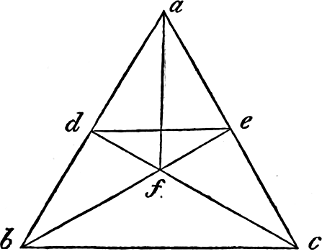
Let them, in the first place, coincide, and let b a c be anequilateral
triangle, and let there be taken in the side a b,
the point d, and make a e in the side a c, equal
to a d, and connect the lines d e, b e, c
d, a f. Because, therefore, a b is equal to a
c, and a d to a e, the two b a, a e,
are equal to the two c a, a d, and they comprehend the
same angle. Hence, they are all equal to all, and the angle d b
e, is equal to the angle e c d. But d b is also equal
to e c, and b e to c d. All, therefore, are equal
to all. Hence, the angle d e b, is equal to the angle e d
c: for they subtend equal sides. And d f is equal to e
f, (by the sixth.) Because, therefore, a e is equal to a
d, and a f is common, and the base d f, is equal to
the base e f, the angle d a e is bisected, which was
required to be done.
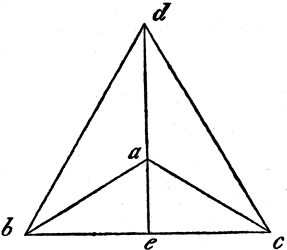
But if the sides of the equilateral triangle fall external to the right
lines b a, a c, let them be b d, d c, and
having connected d a, let it be produced to the point e.
Because, therefore b d, d c, are equal, but d a
is common, and the bases b a, a c, are equal, the angle,
also, b d a, (by the eighth) is equal to the angle c d a.
Again, b d, d c, are equal, and d e is common, and
they contain equal angles as we have shewn, the base also b e,
is equal (by the fourth) to the base e c. Because, therefore,
a b is equal to a c, and a e is common, the angle,
also b a e, is equal to the angle c a e, which was to be
shewn.
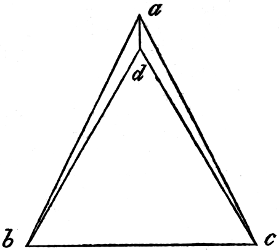
But if the sides of the equilateral triangle fall within the right
lines a b, a c, as b d, d c, let again
a d be connected. Because, therefore, b a, is equal to
a c, and a d is common, but the base b d, is
equal to the base c d, hence, the angle b a d (by the
eighth) is equal to c a d. The angle, therefore, at the point
a, is bisected, in whatever manner the equilateral triangle may
be constituted. And having thus summarily spoken concerning these, we
shall now proceed to the following theorems, only adding, that the
given angle may be given in a four-fold respect. In position,
as when we say to this right line, and to this point to place an
angle: for after this manner it is given. But in form,
as when we call the angle right, or acute, obtuse, right-lined, or
mixed. And in proportion, as when we call it double, or triple,
greater, or less. And lastly, in magnitude, as when we call it
the third part of a right angle. But the present angle is only given in
form.
PROPOSITION X. Problem V.
To bisect a given finite right line.
This, also, is a problem which supposes a finite right line, since we
cannot terminate a line on both sides infinite. But the section of a
line infinite on one side only, wherever the point is assumed, is made
in unequal parts. For that part of the section which takes place on
the infinite side, is necessarily greater than the remainder, because
finite. Hence, the line required to be bisected, must be necessarily
both ways finite. But perhaps, some excited by this problem, may think,
that the doctrine of a line, not being composed from impartibles, is
only previously received by geometricians as an hypothesis. For if
it consists from impartibles, it either becomes finite, and receives
its completion from odd, or from even parts. But if
from such as are odd, it will appear that an impartible also
may be cut, while a right line is bisected. And if from such as are
even, the section will be unequal, because, one part, as composed from
more impartibles, will be greater than the remainder. It is therefore
impossible to bisect a given right line, if magnitude consists from
impartibles. But if it be not composed from impartibles, it may be
divided in infinitum. It appears, therefore, (say they) to be received
by common consent, and to be a geometrical principle, that magnitude
is among the number of things infinitely divisible. Against these we
reply in the words of Geminus, that geometricians previously receive
according to a common conception, that continued quantity is divisible.
For we call that continuous, which is composed from conjoined
parts, and this it is in every respect possible to divide. But that
continued quantity may be infinitely divided, they do not previously
assume, but demonstrate from proper principles. For when they shew
that incommensurability is found in magnitudes, and that all are not
commensurable with each other, what else can we say they evince by this
means, except this, that every magnitude may be divided into parts
always divisible, and that we can never arrive at an impartible, by
the most unwearied analysis, since this minimum would be the common
measure of all magnitudes? This then is demonstrable, but that which
says, every thing continuous is divisible, is an axiom. Hence,
since a finite line also is continuous, it is divisible. And from this
conception the institutor of the Elements cuts a finite right line
into equal parts, but not as pre-assuming, that it is divisible in
infinitum. For to be merely divisible, and to be infinitely divisible
is not the same.
But the discourse of Xenocrates inferring indivisible lines, is
confuted by this problem. For if it be a line, it is either right,
and may be bisected; or circular, and it is greater than a certain
right line; (since every circular has a certain right line less than
itself); or it is mixt, and on this account is the more divisible,
since composed from simple divisible lines. But this must be deferred
to some posterior speculation. However, the geometrician bisects a
finite right line, employing in the construction the first and ninth
propositions; but using in the demonstration the fourth alone; for
by the angles he shews the equality of the bases. But Apollonius
Pergæus bisects a given finite right line after the following manner.
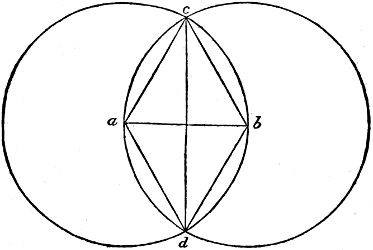
Let there be (says he) a finite right line a b, which we are
required to bisect, and with the centre a, but interval a
b, let a circle be described. And again, with the centre b,
but interval b a, let another circle be described, and let the
right line c d, connect the common sections of the circles; this
shall bisect the right line a b. For let the equal lines d
a, d b, c a, c b, be connected; these being
equal, because each is equal to a b. But c d is common,
and d a is equal to d b on the same account. Hence the
angle a c d, is equal to the angle b c d; and so (by the
fourth) a b is bisected. Such then, according to Apollonius, is
the demonstration of this problem, assumed, also, from an equilateral
triangle; but instead of exhibiting the bisection of the line, from the
bisection of the angle at the point c, it shews this from the
equality of the bases. The demonstration, therefore, of the institutor
of the Elements, is much better, since it is both more simple, and
emanates from principles.
PROPOSITION XI. Problem VI.
To raise a right line at right angles, to a given right line, from a
given point in that line.
Whether we receive a right line on both sides finite, or on both
sides infinite, or on one side infinite but on the other finite, and a
point in it, the construction of the present problem will conveniently
succeed to the geometrician. For though the given point should be on
the extremity of the right line, by producing it we can accomplish our
purpose. But it is manifest that the point in the present problem is
given in position, since it can only be placed in position in
a right line. But the right line is given according to form;
since its magnitude is not distinguished either by proportion or
position. Hence, the institutor of the Elements, employing the first
and third problem, together with the eighth proposition, and the tenth
definition, exhibits the thing proposed. But if any placing the point
on the extremity of the right line, should ask us without producing the
line, to erect upon this a right line at right angles, we can likewise
shew that this is possible to be effected.
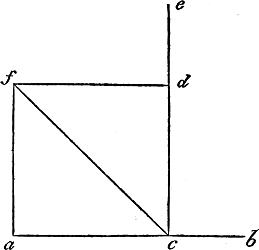
For let there be a right line a b, and a given point in it a, and let there be
assumed in the line a b, any point
c, and from this (as the present element teaches us) let a right
line c e be erected at right angles to a b. Then from
c e, let c d be taken equal to a c, and let the
angle at the point c be bisected by the line c f, and
at the point d let a right line be erected at right angles,
coinciding with f c in f; and lastly from the point
f, to the point a, let f a be connected. I say
that the angle at the point a is right. For since d c
is equal to c a, but c f is common, and contains equal
angles, (for the angle at the point c was bisected) hence, d
f is equal to f a, and all in like manner (by the fourth)
are equal to all. The angle, therefore, at the point a, is
equal to the angle at d. But the angle at the point d
is right; and so consequently is the angle at a. And thus the
thing required is effected. But the institutor of the Elements was not
indigent of any such artifice: for he commands us to raise a line at
right angles, but not at one right. It is requisite, therefore, not
to receive the point in the extremity of the right line, because the
perpendicular line forms angles with its subject right line, but not
one angle alone.
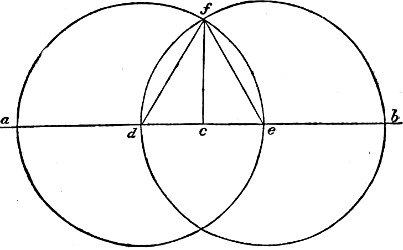
But Apollonius raises a perpendicular as follows. Let the given right
line, says he, be a b, and a given point in it c, but
let there be assumed in a c any point d, and from c
b, take away c e, equal to c d. Then with the centre
d, but interval d e, let a circle be described; and
again with the centre e, but interval e d, let another
circle be described, and let a right line be drawn from f to
c. I say that f c is a perpendicular. For if f d,
f e, are connected, they shall be equal. But d c, c
e, are equal, and f c is common. Hence, also, the angles at
the point c (by the eighth) are equal. They are therefore right.
And here, is it not again obvious, that this demonstration is more
various than that of Euclid, and requires the description of circles,
that by this means an equilateral triangle may be described upon d
e, and the problem exhibited? For all the rest are common to the
demonstrations. But the demonstration by a semicircle is not worthy
to be remembered, since it supposes many things which are afterwards
exhibited, and entirely falls from the order of an elementary
institution.
PROPOSITION XII. Problem VII.
Upon a given infinite[20] right line, and from a given point which is
not in that line, to let fall a perpendicular.
Oenopides first investigated this problem, believing it useful
for astrological purposes. But he calls a perpendicular, after the
manner of the ancients, a gnomon, because a gnomon, also, is at right
angles to the horizon, but the same line is at right angles with a
perpendicular, from which it differs only in habitude, since, as he
observes a gnomon has the same subject with a perpendicular. But again,
a perpendicular is two-fold, that is, it is either plane or solid.
Hence, when the point from which the perpendicular right line is drawn,
is in the same plane, the perpendicular is called plane; but when the
point is on high, and external to the subject plane, it is called
solid. And the plane perpendicular, indeed, is drawn to a right line:
but the solid to a plane. Hence, it is necessary, that this last should
not only form right angles, with one right line, but with all right
lines in the same plane. For the perpendicular is let fall on a plane.
In the present problem, therefore, the institutor of the Elements
proposes to let fall a plane perpendicular. For the deduction is
proposed to a right line, and the discourse proceeds, so far as all are
supposed to be in the same plane. Hence, in the line at right angles we
do not require infinity, because the point is supposed to be in that
right line. But in the present problem, respecting a perpendicular, he
supposes the given right line infinite, because the point from which
the perpendicular is to be drawn is placed external to the right line.
For if it was not infinite, the point might be received externally, and
yet in a direct position, so that the protracted right line would fall
upon it, and the problem not succeed. Hence, he places the right line
infinite, so that the point may be received at either of its parts; and
that no place may be left, in which it can be in the same direction
with the given right line, unless it is in the line, and has not an
external position. And on this account the right line to which the
perpendicular is to be drawn is considered as infinite.
But in what manner infinite can subsist, is a matter well worthy our
contemplation. For it is manifest that a right line existing infinite,
a plane also will be infinite, and this in energy, if the thing
proposed by Euclid be true. That among sensible particulars, therefore,
there can be no magnitude infinite, according to any distance, both
the dæmoniacal Aristotle, and those who received their philosophy from
him, have abundantly shewn. For neither that which is moved circularly,
nor any other simple body can be infinite; since the place of each is
limited. But neither in separate and impartible reasons is an infinite
of this kind possible. For if they neither contain dimension, nor
magnitude, much less can they contain infinite magnitude. It remains,
therefore, that infinite can alone subsist in the phantasy, which at
the same time the phantasy does not comprehend. For as soon as it
understands, it induces form and bound to that which is understood,
stops the transit of the phantasm by its intellection, pursues its
progress, and infolds it in its shadowy embrace. The phantasy,
therefore, is not infinite by intellection, but rather by advancing
infinitely about that which is understood; and calling whatever it
leaves innumerable, and incomprehensible by intelligence, infinite. For
as the sight by not seeing understands darkness; so the phantasy by
not understanding perceives infinite. Hence it pursues the progress of
the infinite, because it is endued with an impartible power, capable
of perpetually advancing: but it understands as if stopping in its
progression, because infinite surpasses its comprehension. For it
calls that infinite, which it leaves as unable to pass over in its
pursuit. On this account when we place a given infinite line in the
phantasy, in the same manner as we establish all other geometrical
species, viz. triangles, circles, angles, lines, and all of this kind,
we must not wonder how a line is infinite in energy, and how advancing
infinitely, it applies itself to finite intellections. But cogitation,
in which reasons and demonstrations reside, does not use infinite for
the purpose of science, since infinite is by no means perceptible by
science, but receiving it from hypothesis, it employs finite alone in
its demonstrations, and assumes infinite not for the sake of infinite,
but of that which is bounded and finite. For if we should grant to
cogitation, that the given point, neither lies in a right line with the
given finite right line, nor yet is so distant from it, that no part of
the right line is subjected to the point, we shall no longer require
an infinite line. That cogitation, therefore, when employing a right
line, may use it without controversy and reproof, she supposes it to be
infinite; and employs the infinity of the phantasy, as the foundation
of infinite generation. And thus much may suffice for the present
concerning the nature of infinite.
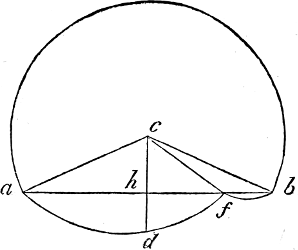
But it is now requisite that we should consider the objections
which are urged against the construction of this problem. Let there
be received, say they, an infinite right line a b, and let
the given point be c, from which it is required to let fall a
perpendicular, and let d be a point on the other side, according
to the geometrician. But the circle which cuts the right line a
b, in the points a and b, will cut it also in
f, and will have a situation according to the figure. In answer
to this, we must say, that it affirms an impossible case. For let the
right line a b be bisected in h, and let c h be
connected, and produced to the circumference, to the point d,
and let c a, c b, c f, be connected. Because,
therefore, these lines are from the centre, and a h, is equal
to h b, but c h is common, all are equal to all. Hence
c h forms right angles at the point h. Again, because
c a, c b, are equal, they form equal angles at the points
a and b. But c a also, is equal to c f,
on which account the angle c a f, is equal to the angle c
f a. In like manner the angle c b f is equal to the angle
c f b. Because, therefore, the angles at the points a and
b, are equal, the angle, also, c f a, is equal to the
angle c f b, and they are successive, and consequently right.
But each of the angles at the point h is right. Hence, c
h is equal to c f. But c f is also equal to c
d, since they are from the centre. Therefore c h is equal
to c d, which is impossible. Hence, the circle does not cut the
right line in any other points than a and b.
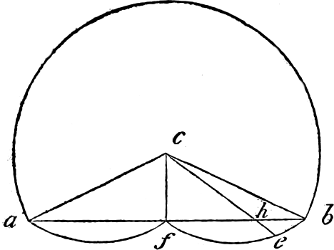
But if any one should say, that he who describes a circle will bisect
a b in f, we can again shew that this is impossible. For
let all be described as before, and let the right line f b, be
bisected in the point h. Because, therefore, a f, f
b, are equal, but c f common, and the base c a, is
equal to the base c b, all are equal to all. Hence, the angles
at the point f are right. Again, because f h is equal to
h b, and c h being connected, is common, and the base
c f is equal to the base c b, for they are from the
centre, the angles at the point h, are right; for they are equal
and successive. Because, therefore, each of the angles c f h,
c h f, is right, c f is equal to c h. But c
f is equal to c e, for they are from the centre, and hence
c h is not unequal to c e, which is impossible.
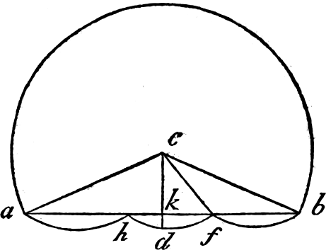
It now remains that we run over the third objection. For the circle
which is described (say they) will cut the right line in the points
a, b, and in the points f, h. We therefore
bisecting the right line a b in the point k, and
connecting the lines c a, c f, c k, c b,
can shew that this is impossible. For since k a, k b, are
equal, and c k is common, and the bases c a, c b,
are equal, hence the angles at the points a and b are
equal, and those at the point k right. But each of the lines is
equal to c f; and hence, the angles at the point f, are
right; for they are equal, because successive. Therefore, c f is
equal to c k: for they subtend right angles. But c f is
equal to c d, since they are from the centre; and hence, c
d is equal to c k, which is impossible. Hence then, it is
impossible that the circle which is described should cut the line a
b in one, two, or in more points than a b. And such are the
objections against the present problem.
But there are also cases of the construction of this problem, which
are to be distinguished from the objections. For case is not the same
with objection; since the former shews the same thing differently,
but the latter leads the objection to an inconvenience. But other
expositors, not distinguishing these from one another, bring all into
the same, so that it is uncertain, whether they enunciate to us in
their writings, cases, or objections. We therefore distinguishing
these, having enumerated the objections, shall now describe the cases
of the problem.
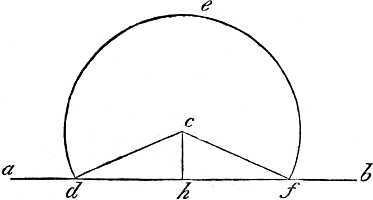
Let there be then an infinite right line a b, and a given point
c. Now it may be said that there is no farther place in the
other part of the perpendicular right line, but in that only where
the point c lies. Taking, therefore, in the right line a
b a point d, with the centre c, and interval c
d, let us describe the circumference of a circle d e f, and
bisecting d f in h, let us connect the lines c d,
c h, c f. Because, therefore, d h is equal to
h f, but c h is common, and c d is equal to c
f, (for they are from the centre,) hence, the successive angles at
the point h, are equal. They are, therefore, right. And hence,
c h is a perpendicular to d f.
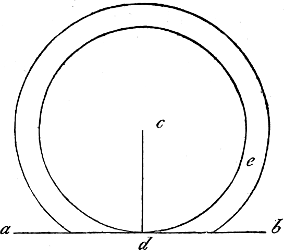
But if any one should also say that the described circle does not cut
the right line a b, but touch it as the circle d e, by
taking the point e externally, and using the centre c, and
interval c e, as in the preceding, we shall obtain the object
of our enquiry. And thus much we have said concerning the cases of the
problem, for the sake of exercising the attention of the reader.
But if we are desirous of adding contemplation likewise to these
two problems, a right line erected at right angles, seems to imitate
a life tending on high from inferior concerns, ascending purely,
and without contamination, and abiding inflexibly with regard to
natures subordinate to its own. But a perpendicular is the image of
a life perpendicularly descending, and the least of all replete with
generative infinity. For a right angle is the symbol of an energy
inflexible, and restrained in the comprehension of equality, bound, and
finite. From whence, indeed, Timæus also calls the other circle
in the divine soul, possessing the reasons of sensible natures,
right; for in our souls it is bent with flexions of every kind,
and suffers various contortions and perturbations from the unceasing
whirls of generation: but among wholes it resides immaculate,
uncontaminated, firm, and indeclinable, prior to sensible forms. But
if likewise an infinite right line is the symbol of the whole of
generation, which is moved infinitely and indeterminately, and besides
this, of matter itself, which is deprived of bound and form: and if a
point placed externally bears an image of an essence impartible, and
separate from material natures, doubtless the deduced perpendicular
will imitate that life which proceeds into generation with an undefiled
progress from unity, and an impartible essence. But if a perpendicular
cannot be shewn without circles, this also will be the symbol of an
inflexibility inherent in life, through the medium of intellect. For
life, indeed, since it subsists by itself as motion, is indeterminate:
but it becomes terminated, and is filled with a pure and immaculate
power, by participating and adhering to the circulations of intellect.
PROPOSITION XIII. Theorem VI.
When a right line standing upon a right line forms angles, it either
forms two right, or angles equal to two right.
Euclid again passes on to theorems, consequent to things exhibited by
problems. For after a perpendicular had been drawn to a right line,
and a right line erected at right angles, it remained, to enquire if
it should not be a perpendicular, what angles it would form, and how
it would be affected to the line upon which it stands. This then he
proves universally, that every right line standing upon a certain
line, and forming angles, either forms two right, if its state be
indeclinable, firm, and never verging: or angles equal to two right,
if it declines in one part, but is more distant from its subject line,
in the other part. For as much as it takes away from a right angle
by its declination in one part, so much it adds by its distance in the
other. But it is requisite to take notice, that in this proposition
also, the Geometrician employs diligent care. For he does not simply
say that every right line, standing upon a right line, forms either two
right angles, or angles equal to two right, but he adds, if it forms
angles. For what if standing on the extremity of a right line, it
should form one angle, will it happen that this may be equal to two
right? This certainly is impossible. Since every rectilineal angle
is less than two right, as also every solid angle is less than four
right. Hence, though you should receive that which appears to be the
greatest of all obtuse angles, this also will increase, as that which
does not yet receive the measure of two right angles. It is requisite,
therefore, that the right line should stand in such a manner, that it
may form angles. And these observations regard the productive diligence
of science.
But what does he mean by adding the particle, either two right,
or equal to two right? For when he has constituted two right, he
forms angles equal to two right; since right angles are equal to each
other. Shall we say that one of the equal angles is also common, but
that the other of the equals is only proper? But we are accustomed when
both proper and common is verified, to express every
particular from that which is proper, but when we cannot effect this,
we are content with that which is common for the explication of the
subject concerns. This then, the equality of the successive angles,
is common to right angles, but is not predicated of these alone: but
this, that they are right, is peculiar to their equality. Hence, the
assertion, equal to two right, alone signifies the inequality of
the angles. For in these it is alone verified, but by no means in such
as are equal. And this also the institutor of the Elements divides in
opposition to two right. For since it is predicated by itself, it has
a power of signifying that the angles on each side are unequal. But
through these observations we may also perceive, that equality is the
measure and bound of inequality. For though the increase and decrease
of an obtuse and acute angle is indeterminate and infinite, yet it is
said to receive limitation, and bound from a right angle; and each of
them, indeed, separately, recedes from a similitude to the right; but
both, according to one harmonizing union, are reduced to its bound.
But as they can by no means perfectly equal the simplicity of a right
angle, they receive an equality to it when doubled, the duad being
the exemplar of their infinity, as of itself endued with an infinite
nature. And this seems to procure a manifest image of the progression
of primary causes; and of their abiding according to one boundary, in
a manner perpetually the same, about the infinity of generation. For
how could otherwise generation, which participates of the more and the
less, and is carried in indefinite whirls, agree with intelligibles,
and be equalled with them in a certain respect, unless by participating
their natures, whilst they advance with prolific powers, and only
multiply themselves in their progressions? For things which abide in
their own simplicity and impartibility, are entirely separated from
generable natures. And thus much is assumed from the present theorem,
and applied to the knowledge of universals.
PROPOSITION XIV. Theorem VI.
If to any right line, and at a point in it, two right lines
being placed in a consequent order, and not towards the same
parts, make the successive angles equal to two right, those
right lines shall be in a direct position to each other.
The present theorem is the converse of the foregoing: for such as are
converse are always consequent to preceding theorems. Since, therefore,
the former had constituted a right line upon a right line, and had
shewn that it made the successive angles either two right, or equal
to two right; in the present theorem he receives the equality of the
angles to two right, which are formed at some right line, but he shews
that it is one right line which produces their equality. Hence, that
which was a datum in the former, is in the present theorem an
object of enquiry; and is shewn by a deduction to an impossibility. For
after this manner the converse of theorems ought to be exhibited; but
in problems they should receive principal demonstrations. But in this
theorem we may also perceive the greatest and most admirable diligence
of this proposition producing science. For in the first place, after he
had said, if to any right line, he adds, and at a point in
it; for what if the two extremes of the right line existing, one
of the right lines should be drawn from the one extreme, but the other
from the remaining one, and should form angles at the right line, equal
to two right, would they on this account have a direct position? And
how can this take place in lines drawn from different points of the
right line? It is on this account also, that he adds, and at a point
in it, since he is willing that both should be in the same point.
But in the second place, because it is possible that the right lines
which are drawn, may be at the same point, and not consequent (since we
may receive infinite right lines placed at the same point) he adds the
particle, in a consequent order. And in the third place, because
the word consequent may be considered as well at the same parts
as on both sides: but because it is impossible that lines which are
consequent at the same parts should be mutually in a direct position,
this indeed he explains, but affords us an opportunity of considering
that consequent right lines are to be received in position on both
sides; since these also can be shewn to be in a right line.
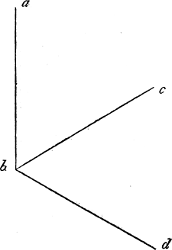
Let there be placed at the right line a b, and at a point in
it b, towards the same parts, two right lines b c,
b d, these, therefore, shall be consequent to each other. For
no other right line is situated between them. But those things are
successive, between which there is nothing similar. Thus we call
the columns consequent, between which there is no other column:
for though the air intervenes, yet nothing of the same kind is situated
in the middle. Because, therefore, they lie towards the same parts,
they are by no means in a direct position, although they form two
angles equal to two right; I mean the angles at the point b. For
nothing hinders but that the angle a b d, may contain in itself,
one right, and a third part of a right angle: and that the angle a b
c, may be two thirds of a right angle. And thus much concerning the
proposition.
But one petition is employed in the construction, viz. the second,
which begs to produce a right line straight forwards, as in
the demonstration he uses the preceding theorem, and two axioms; i.e.
the one which says, things equal to the same, are equal to one
another; and also the one which affirms, that if from equal
things equals are taken away, the remainders shall be equal. But at
the collection of the impossibility, he employs the axiom, which says,
the whole is greater than its part. For it is equal one common
angle being taken away, which is impossible. But that it is possible
to the same right line, and at a point in it, two right lines in a
consequent position, and yet, towards the same parts, may form angles
belonging to that one right line, equal to two right, we may shew with
Porphyry, as follows. Let there be a certain right line a b, and
any point in it c, and let c d be raised at right angles
to a b, and let the angle d c b be bisected, by the line
c e. Then from the point e, to the line a b, let
there be drawn the perpendicular e b, and let e b be
produced, and place f b equal to e b, and connect c
f. Because, therefore, e b is equal to b f, but b
c is common, and they contain equal angles (for they are
right), hence, the base e c, is equal to the base c f.
All, therefore, are equal to all. Hence, the angle e c b, is
equal to the angle f c b. But the angle e c b is the half
of a right angle: because the right angle d c b was bisected by
the line e c.
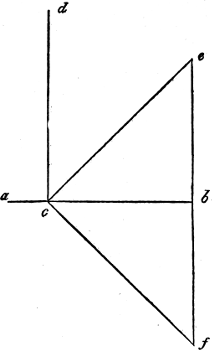
Hence, also the angle f c b, is the half of one right. The
angle, therefore, d c f, is equal to one right, and the half
of a right angle. But the angle d c e, also, is the half of a
right angle. Hence to the right line c d, and to a point in it
c, two right lines are consequently placed towards the same
parts, viz. c e and c f, forming angles equal to two
right, c e causing the half of a right angle, and c f one
and a half. Lest, therefore, we should enquire after things impossible
to be effected, viz. how the right lines c e, c f,
forming angles at the right line d c, equal to two right, can be
in a direct position to one another, the Geometrician adds the particle
not towards the same parts. It is requisite, therefore, that the
right lines which form angles equal to two right, should be placed on
both sides of the right line, being raised, indeed, from one point, but
drawn to different parts of the right line.
PROPOSITION XV. Theorem VIII.
If two right lines cut one another, they will form the angles at the
vertex equal.
We must call successive angles different from such as are
vertical. For these last originate from the section of two
right lines: but the former from the mere dissection of the one by
the other. Thus, if a right line remaining itself without section,
but cutting another in its extremity, forms two angles, we denominate
these successive angles. But if the two right lines mutually
cut each other, they form vertical angles. And they are so
called, because they have their vertices conjoined in the same point.
But their vertices are the points, at which the planes, while they
are contracted, form angles. This, therefore, is what the present
theorem evinces, that when two right lines mutually cut each other,
the vertical angles are equal. And it was first invented (according
to Eudemus) by Thales: but was thought worthy of a demonstration
producing science by the institutor of the Elements. But it is not
exhibited from all the particulars requisite to a perfect proposition.
For construction is wanting in the present theorem: but demonstration,
which must be necessarily inherent, depends on the thirteenth theorem.
But he uses two axioms, one of which is, that things equal to the
same, are equal among themselves: and the other, if from equal
things equals are taken away, the remainders will be equal. The
theorem, indeed, of Euclid, is manifest, but another such is converted
to the present theorem. If to any right line, and at a point in
it, two right lines, not assumed towards the same parts, make the
vertical angles equal, those right lines shall be in a direct position
to each other.
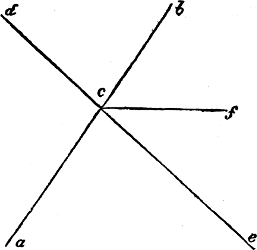
For let there be a certain right line a b, and any point in it
c, and at the point c, let two right lines c d,
c e, not towards the same parts be assumed, forming equal angles
a c d, b c e. I say that c d, c e, are in a
right line. For since the right line c d, insists upon the right
line a b, it forms angles equal to two right, i.e. d c a,
d c b. But the angle d c a, is equal to the angle b c
e. Therefore, the angles d c b, b c e, are equal to
two right. Because, therefore, to a certain right line b c, and
at a point in it c, two consequent right lines c d, c
e, not placed towards the same parts, form the successive angles
equal to two right, those right lines c d, c e, are in a
direct position to each other. The converse, therefore, to the present
theorem, is exhibited. But the Geometrician seems to have neglected
this, because it is easy to evince its truth, by the same method
of deduction to an impossibility as we employed in exhibiting the
fourteenth proposition. For the same things being supposed, I say that
the right line c d, is in a direct position to c e. For
if it be not, let c f be taken in a right line with c d.
Because, therefore, two right lines a b, d f, intersect
each other, they will form the angles at the vertex equal. Hence, the
angles a c d, b c f, are equal. But a c d, b c
e, were also equal. The angle, therefore, b c e, is equal to
the angle b c f, the greater to the less, which is impossible.
Hence, no other right line, besides c d, is in a direct position
to c e. The right lines, therefore, c d, c e, are
in a direct position to each other, the angles at the vertex being
supposed equal. Since then, there is the same demonstration which
was pre-assumed in the fourteenth theorem, would it not have been
superfluous to have produced this conversion? But for the sake of
exercise, we have proved it as well by a deduction to an impossible, as
by an ostensive method. However, this fifteenth theorem seems to rest
upon the similitude of the parts of right lines, and their situation in
their extremities. Because lines with these conditions, and mutually
cutting each other, must necessarily possess similar inclinations
on both sides to each other. Since circumferences, and universally
non-right lines cutting one another, do not necessarily form the
vertical angles equal, but sometimes equal, and sometimes unequal. For
if two equal circles cut each other through the centres, or even not
through the centres, they will form the lunular angles at the vertex
equal: but not likewise the remaining angles, viz. those on both sides
concave, and on both sides convex, but the one will be greater than the
other. But in right lines, the situation in the extremities, causes the
distance of one segment, to be equal to the distance of another.
COROLLARY.
From hence it is manifest that if two right lines cut each other, they
will make four angles equal to four right.
Corollary is one of the geometrical appellations, but it has a
two-fold signification. For they denominate corollaries, whatever
theorems are proved together with the demonstrations of others,
becoming as it were the unexpected gain and emolument of the
investigator: and likewise, whatever is the object of enquiry, but is
indigent of invention, and is neither investigated for the sake of
generation alone, nor of simple contemplation. For that the angles
at the bases of isosceles triangles are equal, it is requisite to
contemplate, and the knowledge of things in existence is of this kind.
But to bisect an angle, or constitute a triangle, to cut off, or place
an equal right line, all these demand that something may be performed.
And again, to find the centre of a given circle, or two commensurable
magnitudes being given to find their greatest common measure, with
every thing of this kind, are, after a manner, situated between
problems and theorems. For neither is the origin of objects of
enquiry inherent in these, nor contemplation alone, but invention.
Since it is requisite to place the object of enquiry conspicuously and
before our eyes. Such then are whatever corollaries Euclid wrote, for
he constructed a book of corollaries. But we must now omit to speak
of corollaries of this kind. However, such as occur in the elementary
institution, appear at the same time with the demonstrations of other
things, but they themselves are not principally investigated, as is
evident in that which is proposed at present. For the design of the
proposition is to enquire whether if two right lines mutually cutting
each other, the angles at the vertex are equal. But whilst this is
evinced, it is at the same time demonstrated, that the four angles
which are formed, are equal to four right.
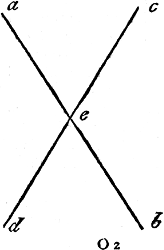
For when we say let there be two right lines, a b, c d,
cutting each other in the point e: because a e stands
upon c d, it makes the successive angles equal to two right. And
again, because b e stands upon c d, it also makes the
successive angles equal to two right; then together with the object of
enquiry we demonstrate, that the angles about the point e, are
equal to four right. A corollary, therefore, is a theorem, unexpectedly
emerging from the demonstration of another problem, or theorem. For
we seem to fall upon corollaries, as it were, by a certain chance;
and they offer themselves to our inspection, without being proposed,
or investigated by us. Hence, we assimilate these also to gains. And
perhaps those skilled in mathematical concerns, have imposed on them
this appellation, shewing the vulgar, who rejoice in apparent gain,
that these are the true gifts of divinity, and true gains, and not
the objects of their sordid estimation. For this indeed produces that
faculty resident in our nature, and adds the prolific power of science,
to principal enquiries, manifesting the copious riches of theorems. And
such is the property of corollaries.
But they are to be divided in the first place, according to sciences.
For of corollaries, some are geometrical, but others arithmetical.
Thus the present corollary is geometrical: but that which is added at
the end of the second theorem of the seventh book of the arithmetical
elements, is arithmetical. But afterwards they must be divided
according to the principal objects of enquiry. For some things are
consequent to problems, but others to theorems. Thus, the present is
consequent to a theorem: but that which is placed in the second of the
seventh book, is consequent to a problem. But in the third place, they
must be divided according to their ostensions. For some are exhibited,
together with ostensive methods, but others together with deductions
to an impossible. Thus the present is shewn by a direct ostension:
but that which is at the same time exhibited in the first of the
third book, appears, together with a deduction to an impossible. But
corollaries may also be divided in many other modes, but these may
suffice our present purpose. The present corollary, however, teaching
us that the place about one point is distributed into angles equal to
four right, is subservient to that admirable theorem, which shews that
the following three multangles about one point, can alone fill place,
viz. the equilateral triangle, the quadrangle, and an equilateral, and
equiangular sexangle. But the equilateral triangle must be six times
assumed; since six two-thirds, form four right angles. But the sexangle
must be three times formed; for every sexangular angle is equal to one
right, and a third part of a right. And a quadrangle must be four times
assumed: for every quadrangular angle is right. Hence, six equilateral
triangles conjoined according to their angles, fill four right
angles, as also three sexangles, and four quadrangles. But all other
multangles, however composed, according to angles, are either deficient
from four right, or exceed four right angles[21]; while these alone,
according to the aforesaid numbers, are equal to four right. And this
theorem is Pythagoric. But by the present corollary, if even more than
two right lines should cut each other in one point, as for instance,
three or four, or any other number, all the angles which they form,
may be shewn to be equal to four right. For they will vindicate to
themselves the place of four right angles. But it is manifest that the
angles always become double to the number of right lines. And thus two
right lines intersecting each other, there will be four angles equal
to four right: but from the intersection of three lines, there will
be six angles; and from four, eight, and so on, in infinitum. For the
multitude of the right lines is always doubled: but the angles increase
according to multitude, and are diminished according to magnitude,
because it is the same four right angles, which is perpetually divided.
PROPOSITION XVI. Theorem IX.
In every triangle having one side produced, the external angle
is greater than either of the internal and opposite angles.
Those who enunciated this proposition, and at the same time omitted
the particle, having one side produced, perhaps afforded an
occasion of objection to many others, as well as to Philip, (according
to the narration of the mechanist Heron.) But such as were desirous
of entirely removing this calumny, enunciated the theorem, with the
proposed addition, corresponding with the general manner of the
geometrician. For in the fifth theorem, being desirous to shew, that
the angles under the base of an isosceles triangle are equal, he adds,
when the equal right lines are produced, the angles under the
base are equal. Hence we infer, that though this proposition might
be defective and imperfect it various copies, yet it was perfect and
written entire, by the institutor of the Elements. What then does
the proposition assert? That in every triangle, if you produce
one of its sides, you will find the angle constituted external to
the triangle, greater than either of the internal and opposite
angles. For a little after, this angle will be shewn equal to
both, but it is proved to be greater than either in the present;
and he necessarily compares it with the opposite angles, and not
with the successive angle. For to this last it may be both
equal and less: but it is greater than either of the former. Thus,
if this triangle should be right angled, and you conceive one of the
sides comprehending the right angle to be produced, the external
will be equal to the successive angle. But if it should happen to be
obtuse-angled, the internal angle may be greater than the external;
and it is on this account that he does not compare the external with
the successive angle, but with the opposite angles. For of the angles
within a triangle, the successive angle borders on the external, but
the two others are opposite. Hence, the external angle is greater than
either of the successive, but may not exceed the successive angle to
which it is proximate. But some conjoining these two theorems, I mean
the present, and the following, enunciate the proposition thus. In
every triangle having one side produced, the external angle is greater
than either of the internal and opposite angles; and any two of the
internal angles, are less than two right. But there is occasion for
the connection of these theorems, because the geometrician himself,
a little after, enunciates the proposition after this manner, in
equal angles, for he says: In any triangle having one of its sides
produced, the external angle is equal to the two interior, and opposite
angles; and the three internal angles of a triangle, are equal to two
right. Hence, they think it proper in the present similar case, to
connect the objects of investigation, and to make the proposition a
composite. But if the datum be enunciated with this addition, it also
will be a composite, (since it is requisite to understand two things,
viz. the subject triangle, and one side produced:) and if the datum
be given without this, it will be a composite in capacity, but
simple in energy; for this must be received at the same time as
a datum; since while we suppose an external angle, we must pre-suppose
the side as produced.
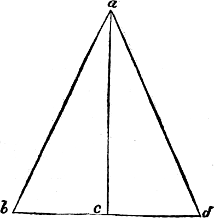
But we may assume from the present theorem, that it is impossible
from the same point, for three equal right lines to fall on the same
right line. Thus let there be drawn from one point a, three
equal right lines, a b, a c, a d, to the right
line b d. Because, therefore, a b is equal to a c,
the angles at the base are equal. Hence, the angle a b c, is
equal to the angle a c b. Again, because a b is equal
to a d, the angle a b d, is equal to the angle a d
b. But the angle a b c, was equal to the angle a c b.
Hence, the angle a c b, is equal to the angle a d b, the
external, to the internal and opposite, which is impossible. From the
same point therefore, to the same right line, three equal right lines
cannot be drawn. But by the present theorem, we can also demonstrate,
that if a right line falling on two right lines, makes the external
angle equal to the internal and opposite, those right lines will by
no means make a triangle, nor coincide, because the same thing would
be both greater and equal, which is impossible.
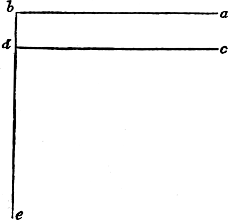
Thus for example, let a b, c d, be right lines, and let
the right line e b falling on them make the equal angles a b
d, c d e, the right lines a b, c d, will not
coincide. For if they coincide, the equal angles remaining, the angle
c d e, will be equal to the angle a b d. And since it
is external, it will be greater than the internal and opposite angle.
Hence, it is necessary, if they coincide, that the angles remain no
longer equal, but that the angle at the point d, be augmented.
For whether a b remaining immoveable, we conceive that c
d is moved towards it, so as to coincide in the point c, we
shall produce a greater distance in the angle c d e; since c
d approaches to a b, in the same proportion as it recedes
from d e. Or whether c d, abiding, we conceive that a
b is moved towards it, in a similar manner, we shall by this means
diminish the angle a b d; for it is at the same time carried
towards c d, and to b d. Or whether we conceive both of
them tending to each other, we shall find that a b by tending
to c d, contracts the angle a b e; and that c d,
by receding from d e, on account of the motion to the line a
b, increases the angle c d e. Hence, it is necessary, if it
be a triangle, and if the right lines a b, c d, coincide,
that the external angle must be also greater than the internal and
opposite angle. For either the internal angle remaining, the external
is increased, or the external abiding, the internal is diminished, or
the internal is contracted, and the external is more dilated. But the
cause of these consequences is the motion of the right lines, the one
tending to those parts, where it diminishes the internal angle, but
the other to the parts where it increases the external. And from this
the reader should consider, how the origin of things produces the true
causes of enquiries, which we have previously surveyed.
PROPOSITION XVII. Theorem X.
The two angles of every triangle, taken all possible ways, are less
than two right.
In the present theorem he shews indeterminately, that any two angles
of a triangle, are less than two right, but in the following theorems
he determines how much they are less, and that they are deficient by
the remaining angle of the triangle: for its three angles are equal to
two right; and on this account the two remaining angles are less than
two right. And, indeed, the demonstration of the elementary institutor
proceeds in a manifest order; for it uses the preceding theorem. But
if is necessary, as in the last proposition, by regarding the origin
of triangles, to find the cause of the present symptom. Let then the
right lines a b, c d, be at right angles to b d.
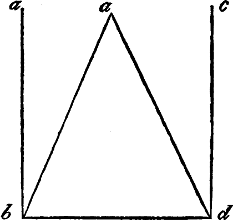
If these lines then are to form a triangle, it is requisite they
should incline to each other. But their inclination diminishes the
internal angles, on which account they become less than two right:
for they were right before their inclination. In like manner, if we
conceive right lines standing at right angles, on the side a b,
the same consequences will ensue respecting the inclination of the
right lines; and the angles at the points a, b, will
be less than two right; and so of the other side. This then is the
cause of the proposition, and not the external angle being greater
than either of the internal, and opposite angles: since it is not
necessary that the side should be produced, nor that any angle should
be constituted external to the triangle; but it is necessary that any
two of the internal angles should be less than two right. Hence, it is
necessary, as I have said, that the cause of this theorem should be
the inclination of the right lines diminishing the angles at the base.
But as the institutor of the elements exhibits the object of enquiry,
by the external angle, we may accomplish this, without producing any
one of the sides.
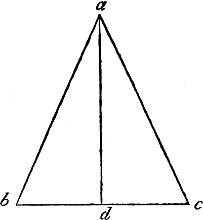
Thus let there be a triangle a b c, and let there be taken
in the side b c, any point d, and let a d be
connected. Because, therefore, one side of the triangle a b d,
is produced, viz. b d, the external angle a d c, is
greater than the internal a b d. Again, because one side of
the triangle a d c is produced, viz. c d, the external
angle a d b, is greater than the internal a c d. But the
angles about the right line a d, are equal to two right, by the
thirteenth of this. Hence, the angles a b c, a c b, are
less than two right. In like manner, we may shew, that the angles b
a c, and b c a, are less than two right, by taking a point
in the side a c, and by connecting the point b with the
assumed point. And again, we may affirm, that the angles c a b,
a b c, are less than two right, by taking a point in the side
a b, and by connecting a right line, from the point c,
and the received point. And thus the thing proposed, is exhibited by
the same theorem, without producing any side of the triangle. Hence, it
is possible, that by this, the theorem may be proved, which asserts,
that from the same point, two perpendiculars cannot be drawn, to one
right line. For let there be drawn, if possible, from the point
a, two perpendiculars a b, a c, to the right line
b c. Then the angles a b c, a c b, are right. But
because a b c is a triangle, two of its angles are less than
two right. The angles, therefore, a b c, a c b, are less
than two right. But they are also equal to two right, because they are
perpendiculars, which is impossible. Hence, from the same point, to the
same right line, two perpendiculars cannot be drawn.
PROPOSITION XVIII. Theorem XI.
The greater side of every triangle, subtends the greater angle.
That the equality of the sides in every triangle, forms the equality
of the angles which they subtend, and that in like manner the equality
of the angles shews the equality of their subtending sides, we learn
from the fifth and sixth theorems. But that the equality of those
angles, which are subtended by the sides, follows the inequality of
the sides, and the contrary we now learn by the present eighteenth
and nineteenth theorems. For the one shews that the greater angle is
contained under the greater side, but the other, that the greater side
subtends the greater angle; because these are mutually converted, but
the same symptoms are contemplated in things contrary, as in the fifth
and sixth theorems. But it is manifest, that we proportionally assume
the greater and less side, in scalene triangles, that we distinguish
the greatest, middle, and least, and the angles in a similar manner:
but in isosceles triangles, the greater and less, simply assumed, are
sufficient; for there is one side which is unequal to two, because
it is either greater or less, as these theorems cannot take place in
equilateral triangles. And here you may observe, that the theorems
which exhibit the equality of angles or sides, agree with equilateral
and isosceles triangles: but these which exhibit inequality to such
as are isosceles and scalene. But the cause of this is, because
of triangles, some are produced from equality alone, others from
inequality alone, and others from the conjunction of both, which are
partly constituted from equality, and partly through inequality. And
some are allied to bound, others to infinity, and others
are generated from the mixture of both. Hence the ternary permeates
through all geometrical forms, as through lines, angles, and figures;
and among figures, through such as are trilateral, quadrilateral,
and all the rest in a consequent order. But bound, likewise,
must be considered as inherent in geometrical forms, as well through
similitude, as equality; and infinite, both by dissimilitude,
and inequality; and that which is mixt, sometimes from the junction
of similitudes, and dissimilitudes, and sometimes from the union of
equalities, and inequalities. But the reason of this also, is because
geometrical forms regard both quantity and quality. And we have
assigned these, because, when we have determined these two, it will be
manifest to us, that when the institutor of the Elements says, of
every triangle, he does not also speak of the equilateral, but of
that which has a greater and less side: for it is necessary to consider
the object of enquiry, as consequent to the preceding datum; and that
the triangle which has a greater and less side, contains a greater
angle, under the greater side.
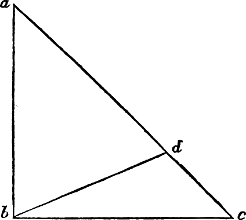
But because the geometrician, when in the construction he receives
the triangle a b c, and the side a c, greater than the
side a b, in order that he may shew, that the angle at the
point b is greater than at the point c, from the side
a c, he cuts off a right line a d, equal to the side
a b: on this account it may be said that it is necessary to
make the ablation at the point c, let us therefore exhibit the
thing proposed upon this hypothesis, according to Porphyry, as follows.
Let d c be equal to a b, and produce a b to the
point e, and place b e equal to d a. The whole,
therefore, a e, is equal to the whole a c. Connect e
c.
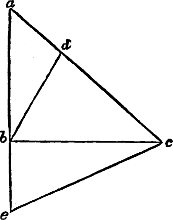
Because, therefore, a e is equal to a c, the angle, also,
a e c, is equal to the angle a c e, (by the fifth).
Hence, the angle a e c is greater than the angle a c b.
But the angle, also, a b c is greater than the angle a e
c; because one side of the triangle c b e is produced, viz.
b e, and so the angle a b c, since it is external, is
greater than the internal and opposite angle. Much more, therefore, is
the angle a b c, greater than the angle a c b, which was
to be shewn. And such are the geometrical exhibitions of the present
theorem.
But it is manifest that the cause of this symptom is the
amplification, or diminution according to magnitude, of the side
subtending the angle. For when it is greater, it more amplifies the
angle; but when less, at the same time it diminishes, and gives a
greater contraction to the angle. And this takes place on account of
the right line being situated in its extremities: for through its
being placed in its extremities, it changes likewise the magnitudes of
the angles, according to the increase and decrease which it receives.
And this we affirm in one triangle, since it is possible that the
same angle may be subtended by a greater or less right line; and that
the same right line may subtend a greater and less angle.
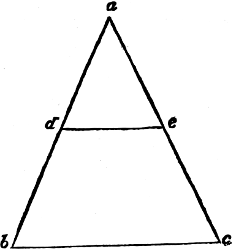
For let the triangle happen to be an isosceles one, a b c, and
let there be taken in the side a b, a point a, and let
a e be taken equal to a d, and connect d e. The
right lines therefore, d e, b c, subtend the angle at the
point a, of which the one is greater, but the other less. And
in the same manner infinite right lines, greater and less subtending
the angle a.
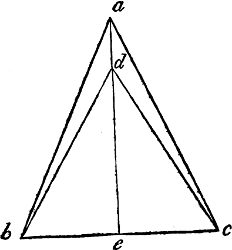
Again, let the triangle a b c, be isosceles, and let b c
be less than b a, a c, and construct upon b c, an
equilateral triangle b d c, and connect a d, and produce
it to e. Because, therefore, the angle b d e, of the
triangle a b d, is external, it is greater than the angle b
a d. In like manner the angle c d e, is greater than the
angle c a d. The whole, therefore, b d c, is greater than
the whole b a c, and the same right line subtends both, viz.
the greater and the less angle. But it is shewn, that likewise greater
and less right lines subtend the same angle. But in one and the same
triangle, one right line subtends one angle, and the greater always
the greater, and the less always the less, the cause of which we have
contemplated.
PROPOSITION XIX. Theorem XII.
The greater side of every triangle subtends the greater angle.
This is the converse of the preceding theorem; and the datum, as well
as the object of enquiry, is simple in each. Add too, that what was
conclusion there, is hypothesis here: and what was hypothesis there
is conclusion in this. But the former precedes, because it has the
inequality of the sides given; and this follows, because it supposes
unequal angles. For sides, indeed, seem to contain right-lined
figures, but the angles appear to be contained; and the mode of
demonstration in the former is ostensive, but in this it concludes the
thing proposed by a deduction to an impossibility. The geometrician,
therefore, by division, reasons concerning that which is impossible:
for the angles being unequal, I say, (says he) that the
sides also subtending the unequal angles are unequal; and the greater
subtends the greater given angle. For if that which subtends the
greater angle is not greater, it is either equal, or less. But if it be
equal, the angles also which they subtend, are equal by the fifth. But
if less, the angle also which it subtends, is less by the preceding:
for it was shewn that the greater side subtends the greater angle,
and the less the lesser. But the angles have a contrary position; and
hence, the one side is greater than the other.
But it is possible that we may exhibit the thing proposed, without
this division. For if the angle of a triangle be bisected, and the
right line drawn to the base, cutting the angle, divides it into
unequal parts, the sides containing that angle will be unequal, and the
greater will be that which coincides with the greater segment of the
base, but the less that which coincides with the lesser.
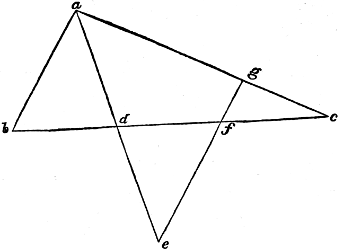
Let there be a triangle a b c, and let the angle at a
be bisected, by the right line a d, and let a d cut the
base b c, into unequal parts, and let c d be greater than
b d. I say that the side a c is greater than the side
a b. Produce a d to the point e, and place d
e equal to a d. And because d c is greater than d
b, place d f equal to b d, and connect e f,
and produce it to the point g. Because, therefore, a d is
equal to d e, and b d to d f, the two are equal
to the two, and they comprehend equal angles at the vertex. Hence, the
base b a, is equal to the base e f, and all, therefore,
are equal to all. On this account also the angle d e f, is equal
to the angle d a b. But this is not unequal to d a g.
Hence, the side a g, is equal to the side e g, by the
sixth. The side, therefore, a c, is greater than the side e
f. But the side f e, is equal to the side a b; and
hence, the side a c, is greater than the side a b, which
was to be demonstrated.
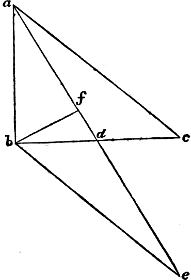
This being pre-assumed, we can shew that the greater side subtends the
greater angle. Let there be a triangle a b c, having the angle
at the point b, greater than the angle at the point c.
I say that the side a c, is greater than the side a b.
Let b c be bisected in the point d, and connect a
d, and draw d e, equal to a d, and connect b
e. Because, therefore, b d, is equal to d c, and
a d, to d e, the two are equal to the two, and they
comprehend equal angles at the vertex. Hence, the base b e, is
equal to the base a c, and all are equal to all. Hence too,
the angle d b e, is equal to the angle at the point c,
but less than the angle a b d. The angle, therefore a b
e, is bisected by the right line b f. Hence, e f, is
greater than f a. Because, therefore, the angle at the point
b, of the triangle a b e, is bisected by the right line
b f, and e f is greater than f a, it follows from
what has been previously shewn, that the side b e, is greater
than the side b a. But b e has been shewn to be equal
to a c. The side, therefore, a c, is greater than the
side a b; and the object of enquiry is exhibited. And it is
manifest that the institutor of the Elements, avoiding a variety of
demonstration, refrains from this mode of demonstrating, and employs a
method of proof, which leads from division to an impossibility, because
he was willing to fabricate the converse to the preceding, without
any intervening medium. For the eighth theorem, indeed, which is the
converse of the fourth, brings great disturbance, because it makes
conversion difficult to be known. For it is more excellent to exhibit
converse theorems, by preserving the continuity through an impossible,
than to destroy the continuity by a principal demonstration. And
hence, Euclid shews almost all converse theorems by a deduction to an
impossibility.
PROPOSITION XX. Theorem XIII.
Two sides of every triangle, however taken, are greater than the
remaining one.
The Epicureans oppose the present theorem, asserting that it is
manifest even to an ass; and that it requires no demonstration: and
besides this, that it is alike the employment of the ignorant, to
consider things manifest as worthy of proof, and to assent to such
as are of themselves manifest and unknown; for he who confounds
these, seems to be ignorant of the difference between demonstrable
and indemonstrable. But that the present theorem is known even to an
ass, they evince from hence, that grass being placed in one extremity
of the sides, the ass seeking his food, wanders over one side, and
not over two. Against these we reply, that the present theorem is
indeed manifest to sense, but not to reason producing science: for
this is the case in a variety of concerns. Thus for example, we are
indubitably certain from sense, that fire warms, but it is the business
of science to convince us how it warms; whether by an incorporeal
power, or by corporeal sections; whether by spherical, or pyramidal
particles. Again, that we are moved is evident to sense, but it is
difficult to assign a rational cause how we are moved; whether over an
impartible, or over an interval: but how can we run through infinite,
since every magnitude is divisible in infinitum? Let, therefore, the
present theorem, that the two sides of a triangle are greater than the
remainder, be manifest to sense, yet it belongs to science to inform us
how this is effected. And thus much may suffice against the Epicureans.
But it is requisite to relate the other demonstrations of the present
theorem, such as Heron, and the familiars of Porphyry have fabricated,
without producing the right line, after the manner of Euclid.
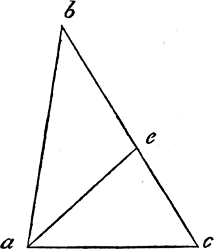
Let there be a triangle a b c, it is requisite, therefore, to
shew, that that the sides a b, a c, are greater than the
side b c. Bisect the angle at a, by the right line a
e. Because, therefore, the angle a e c, is external to the
triangle a b e, it is greater than the angle b a e. But
the angle b a e, was placed equal to the angle e a c.
The angle, therefore, a e c, is greater than the angle e a
c. Hence, the side also a c, is greater than the side c
e. And for the same reason the side a b, is greater than the
side b e. For the angle a e b is external to the triangle
a e c, and is greater than the angle c a e; that is than
the angle e a b. And on this account the side a b, is
greater than the side b e. The sides, therefore, a b,
a c, are greater than the whole side b c. And the like
may be shewn of the other sides.
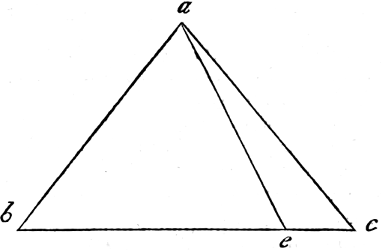
Let there again be a triangle a b c. If therefore the triangle
a b c, be equilateral, two sides will be doubtless greater than
the remaining one: for when there are three equal quantities, any two
are double of the remainder. But if it be isosceles, it will have a
base either less, or greater than each of the equal sides. If therefore
the base be less, the two sides are given greater than the remainder.
But if the base be greater, let it be b c, and cut off from it a
part equal to either of the sides, which let be b e, and connect
a e. Because, therefore, the angle a e c, is external to
the triangle a e b, it is greater than the angle b a e.
On the same account the angle a e b, is greater than the angle
c a e. Hence, the angles about the point e, are greater
than the whole angle about the point a, of which b e a
is equal to b a e, since a b is equal to b e. The
remainder, therefore, a e c, is greater than the remainder c
a e. Hence, the side a c, is greater than the side c
e. But the side a b, was also equal to the side b e.
The sides, therefore, a b, a c, are greater than the side
b c.
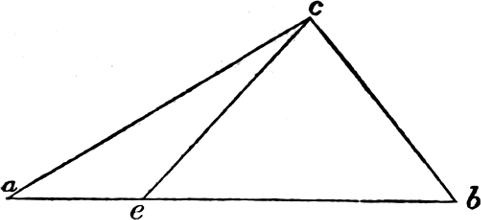
But if the triangle a b c, be scalene, let the greatest side
be a b, the middle a c, and the least c b. The
greatest side, therefore, assumed with either of the others, exceeds
the remainder: for by itself it is greater than either. But if we are
desirous of shewing that the sides a c, c b, are greater
than the greatest side a b, we must employ the same construction
as in the isosceles triangle, cutting off from the greater side, a part
equal to one of the other sides, and connecting the line c e,
and using the external angles of the triangles.
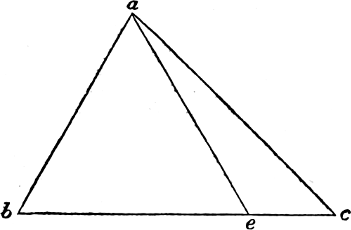
Let there be again any triangle a b c. I say that the sides
a b, a c, are greater than the side b c. For if
they are not greater, they are either equal or less. Let them be equal,
and cut off b e, equal to a b. The remainder, therefore,
e c, is equal to a c. Because then, a b, b
e, are equal, they subtend equal angles; and this is likewise true
of a c, e c, because they are equal. Hence, the angles
at the point e, are equal to the angles at the point a,
which is impossible. Again let the sides a b, a c, be
less than b c, and cut off b d, equal to a b, and
e c to a c.
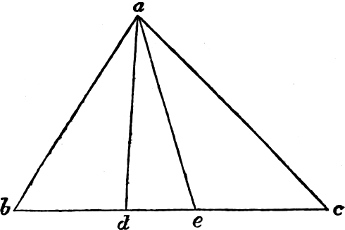
Because, therefore, a b is equal to b d, the angle b
d a, is not unequal to the angle b a d. And because a
c is equal to c e, the angle c e a, is equal to the
angle e a c. Hence, the two angles b d a, c e a,
are equal to the two b a d, and e a c. Again, because
the angle b d a is external to the triangle a d c, it
is greater than the angle e a c: for it is greater than c a
d. By a similar reason also, because the angle c e a, is
external to the triangle a b e, it is greater than the angle
b a d: for it is greater than the angle b a e. Hence,
the angles b d a, c e a, are greater than the two b
a d, e a c. But they were also equal to them, which is
impossible. The sides, therefore, a b, a c, are neither
equal to, nor less than the side b c, but greater. And the like
may be exhibited in others.
PROPOSITION XXIV. Theorem XIV.
If upon one side of a triangle, two right lines beginning from
the extremities, are internally constituted, the constituted
right lines will be less than the other sides of the triangle,
but they will contain a greater angle.
That which is expressed by the proposition, is, indeed, manifest; and
the demonstration adopted by the elementary institutor, is evident; and
the theorem is consequent to the first principles, since it depends
on two theorems, the one previously exhibited, and the sixteenth. For
in order to shew, that the lines internally constituted, are less
than the external, the theorem is required, which says, the two
sides of every triangle, are greater than the remaining one: but
for the purpose of confirming that the angle comprehended by them is
greater than that comprehended by the external sides, that theorem
procures the greatest utility, which says, the external angle of
every triangle, is greater than the internal and opposite angle.
But you will receive at the same time, conviction of geometrical
diligence, and a commemoration of things admirable in the mathematical
disciplines, if we shall shew that it is possible within a certain
triangle, upon one of its sides, not upon the whole, but upon some
one of its parts, to constitute two right lines greater than the
external right lines[22]; and again, others comprehending a less
angle, and comprehended in the angle made by the external lines.
For this being exhibited, it will at the same time be manifest, that
the institutor of the Elements necessarily adds, that the internally
constituted lines must begin from the extremities of the common basis;
and must be constituted upon one whole side, and not upon any one of
its parts: but likewise, as I have said, one of the admirable things
which geometry contains, will be manifest. For is it not, indeed,
admirable, that the lines constituted upon the whole side, should be
less than the external sides: but that those constituted upon a part
should be greater? Let there be then a right angled triangle a b
c, having the angle at the point b right, and take in the
side b c, any point d, and connect a d. Hence,
a d is greater than a b.
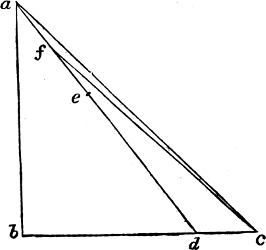
Take from a d, a part equal to a b, which let be d
e, and bisect e a, in the point f, and connect f
c. Because, therefore, a f c is a triangle, the lines a
f, f c, are greater than a c. But a f is equal
to f e. The right lines therefore, f e, f c, are
greater than a c. But d e is equal to a b. Hence,
the right lines f c, f d, are greater than the right
lines a b, a c, and they are internally constituted.
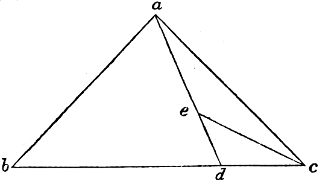
Let there be again an isosceles triangle a b c, having the base
b c, greater than either of the equal sides. Then from b
c, cut off b d, equal to a b, and connect a d,
and take in a d, any point e, and connect e c.
Because, therefore, a b, is equal to b d, the angle
b a d, is also equal to the angle b d a. And because
the angle b d a is external to the triangle e d c, it
is greater than the internal and opposite d e c. Hence, the
angle b a d, is greater than the angle d e c. Much more,
therefore, is the angle b a c, greater than the angle d e
c; and b a c is contained by the external lines, but d
e c by internal lines. Within a triangle, therefore, right lines
d e, e c, comprehending a lesser angle, are constituted
within the angle comprehended by the external lines; and the thing
proposed is shewn without employing the parallel lines of expositors.
Hence, it is necessary that the constituted right lines should begin
from the extremities of the basis: for those which are constituted
upon any one of its parts, are shewn to be sometimes greater than
the external lines, and to comprehend a lesser angle. But when they
are constituted in this manner, beginning from the extremities, the
species of triangles, called (ἀκιδοειδῆ) or, similar to the point of
a spear[23], presents itself to our view; and is one of the admirable
things contained in geometry, viz. to find a quadrilateral triangle. As
for example, the triangle A B C. For it is contained by the four sides
B A, A C, B D, D C; but it has three angles, one at B, the other at A,
and the other at C. And hence, the present figure is a quadrilateral
triangle.
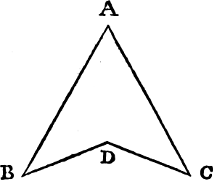
PROPOSITION XXII. Problem VIII.
To construct a triangle from three right lines, which are equal
to three given right lines. But it is requisite that two of the
lines must be greater than the remaining one, in whatever manner
they may be taken.
We again pass to problems, and Euclid commands us to construct a
triangle from three proposed right lines, two of which are greater than
the remaining one, equal to given right lines. Because he knew this in
the first place, that it was impossible to construct a triangle from
those same lines, which had already received the declared position: but
that this was possible to be effected from their equals. In the next
place, he knew it was necessary that two of the right lines about to
complete the triangle, should be greater than the remaining one: for
the two sides of every triangle are greater than the remaining one,
however assumed, as we have shewn. On this account he adds, that it
is necessary the first right lines remaining, to construct a triangle
from three equal to them: but that it is requisite, any two, however
taken, should be greater than the remainder, or there will not be a
triangle from three lines equal to the given right lines. But
by this means he also destroys all the objections which are urged
against the construction, and which may be perfectly dissolved by this
addition. Hence, the present problem ranks among things determined,
and not among such as are indetermined: For of problems as well as of
theorems, some are indeterminate, but others without termination. Thus
if we should simply say, from three right lines which are equal to
three given right lines, to construct a triangle, the problem is
indeterminate and impossible. But if we add, two of which, however
assumed, are greater than the remainder, the problem is determined
and possible. For as the division of theorems takes place, according
to true and false, so that of problems according to a possible and
impossible enunciation. But that the objections which are urged against
the construction, may be from hence dissolved, we shall learn from a
little inspection: for we shall follow the words of the geometrician.
Let there be three right lines, a b c, of which any two, however
taken, are greater than the third, and let it be required to accomplish
the thing proposed. Let there be placed a certain right line d
e, on one part finite, as at the point d: and on the other
part infinite. Then place d f equal to a, but f g
to b: and g h to c.
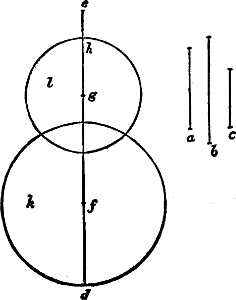
And from the centre f, but interval f d, let a circle
k be described. Again, with the centre g, but interval
g h, let the circle l be designed; and the circles
will intersect each other. For this is assumed by the institutor of
the Elements. But it may be asked how this takes place? For perhaps
they either only touch each other, or they do not even touch. Since
it is necessary that they should suffer some one of three cases, I
mean that they should either intersect or touch, or be distant from
each other. I say, therefore, that they necessarily intersect each
other. For let them in the first place, touch each other.
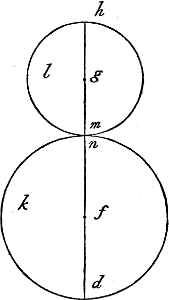
Because, therefore, the point f is the centre of the circle
k, d f is equal to f n. And because the point
g is the centre of the circle l, h g is equal
to g m. The two, therefore, d f, g h, are equal
to one, viz. to f g. But they were placed greater than one,
as also a, together with c, is greater than b.
They are therefore equal to it, and at the same time greater, which is
impossible. Again, if it be possible, let the circles be distant from
each other, as k and l.
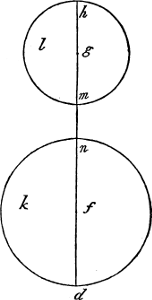
Because, therefore, the point f, is the centre of the circle
k, d f, is equal to f n. And because the point
g, is the centre of the circle l, h g is equal
to g m. The whole, therefore, f g, is greater than the
two, d f, h g: for f g, exceeds d f, g
h, by n m. But it was supposed that d f, h g,
were greater than f g, in the same manner as a and
c are greater than b. For d f was placed equal to
a, but f g, to b, and h g to c. It
is necessary, therefore, that the circles k l, should
intersect each other. Hence, the institutor of the Elements very
properly receives them cutting one another: since of the three right
lines, he supposes two greater than the third, however, they may be
assumed, but neither equal to, nor less than one. But it is necessary
that when the circles touch, two of the lines should be equal to the
third; and that when they are distant from each other, two should be
greater than the remainder.
PROPOSITION XXIII. Problem IX.
On a given right line, and at a given point in it, to constitute an
angle equal to a given right lined angle.
This also is a problem, whose invention according to Eudemus is
rather the gain of Oenopides than of Euclid: but it requires the
construction of an angle, on a given right line; and at a given
point in it equal to another right lined angle. This, then, Euclid
necessarily adds, that the given angle must be rectilineal; because
it is impossible that an angle can be construed on a right line equal
to every angle. For it has been shewn[24] that there are only two
curve-lined angles equal to right-lined angles, viz. the angle of a
lunular figure, which we have proved equal to every right-lined angle;
and the angle of that figure similar to an axe[25], which is equal
to two thirds of a right angle. But a lunular figure of this kind,
which is called (πελεκοειδὲς) Pelecoides, is formed from two circles
cutting each other through their centres. However, the construction
of an angle on a certain right line, causes the constituted angle to
become determinate, and not indifferent in species, but forms it either
right-lined, or mixt. But since no mixt can be equal to a right-lined
angle, it is manifest that this must be perfectly rectilineal. The
institutor of the Elements, therefore, simply using the present
problem, and constructing a triangle from three right lines, equal to
three given lines, accomplishes the thing proposed. But you may receive
a more exquisite construction of the triangle, by the following method.
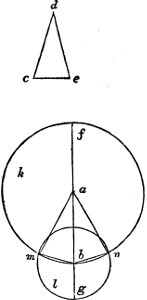
Let there be a given right line a b, and a given point in it
a, and a given right-lined angle c d e. It is required,
therefore, to accomplish the problem. Connect c e, and produce
a b on both sides to the points f, g. Then place
f a, equal to c d, and d e to a b, and b
g to e c. And with the centre a, but interval a
f, describe the circle k. And again, as in the preceding,
with the centre b, but interval b g, describe the circle
l. The circles, therefore, will cut each other, as we have
shewn in the last proposition. Let them cut each other in the points
m, n, and from these points draw right lines to the
centres as in the figure. Because, therefore, f a, is equal to
a m, and a n, but c d, is equal to f a;
a m, and a n, will be each equal to c d. Again,
because b g is equal to b m, and b n, but g
b is not unequal to c e; b m, and b n, will
be also equal to c e. But a b is equal to d e.
The two therefore, a b, a m, are not unequal to the two
d e, d c, and the base b m, is equal to the base
c e. Hence, the angle m a b, is equal to the angle at the
point d. And again, the two n a, a b, are equal to
the two c d, d e, and the base n b, is equal to
the base c e. The angle, therefore, n a b, is equal to
the angle c d e, and the thing proposed is doubly accomplished:
for we have not only constituted one, but two angles, equal to the
given angle, on each side of the right line a b; so that in
whatever part we may desire the construction to be made, it will be
indubitable, and without contradiction. And this we have added to the
construction of the elementary institutor.
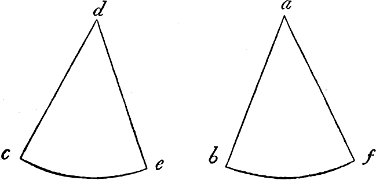
But we cannot praise the method of Apollonius, because it requires
the assistance of the third book. For he receives any angle c d
e, and a right line a b, and with the centre d, but
interval c d, he describes a circumference c e. In like
manner with the centre a, but interval a b, he describes
a circumference b f; and intercepting a circumference c
e, equal to b f, he connects the right line a f,
and affirms that the angles a and d, insisting on equal
circumferences, are equal. But it is necessary to pre-assume that a
b is equal to c d, in order that the circles may be also
equal. We therefore think that a demonstration of this kind requiring
posterior propositions, is foreign from an elementary institution; and
we give the preference to that of the geometrician, as consequent to
principles.
PROPOSITION XXIV. Theorem XV.
If two triangles have two sides equal to two, each to each, but
the one angle contained by the equal right lines greater than
the other: they shall also have the base of the one greater than
the base of the other.
Euclid again passes on to theorems, and speaks concerning inequality
in two triangles, in a manner similar to his discourse concerning
equality. For supposing two triangles, having two sides equal to two,
each to each, he sometimes places the vertical angle equal in each, and
sometimes unequal; and he proceeds in a similar manner with respect
to the base. Besides this, he demonstrates that the equality of the
bases is consequent to the equality of the vertical angle, and that the
equality of the vertical angles, is consequent to the equality of the
bases: but he now shews that the inequality of the one, follows the
inequality of the other. The present theorem, therefore, is opposite
to the fourth: for that, indeed, supposes the vertical angles of the
triangles equal, but this supposes them unequal. And that demonstrates
the equality of their bases; but this proves them unequal, in the
same manner as their angles. It precedes, however, the following
theorem: for that deduces its proof of inequality from the bases to
the angles subtending the bases: but this, on the contrary, reasons
from the angles to the bases, which are under the angles. Hence it
is, after this manner, the converse of its consequent proposition,
but opposite to the eighth theorem. For the one from the equality
of the bases, demonstrates the equality of the vertical angles, but
the other from the inequality of the bases, shews that the vertical
angles are unequal. It is, however, common to these four (two of which
are conversant with equality, I mean the fourth, and the eighth, but
two about inequality, the present and the following; and two begin
from angles, viz. the fourth, and the object of investigation in
the present, but two from bases, viz. the eighth, and the following
proposition); it is common, I say, to all these four, as well to the
fourth and the eighth, as to the twenty-fourth and twenty-fifth, to
have two sides equal to two, each to each. For these being unequal, all
enquiry is superfluous, and subject to deception. And thus much for a
universal speculation concerning the present theorem.
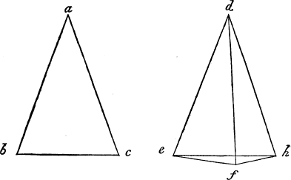
But let us now consider the construction of the elementary
institutor, and add to it where deficient. For Euclid receiving two
triangles, a b c, d e f, having the sides a b,
a c, equal to the sides d e, d f, each to each,
and the angle at the point a, being greater than the angle at
the point d, and willing to shew that the base b c, is
greater than the base e f, on the right line e d, and at
a point in it d, constitutes an angle e d h, equal to
the angle at the point a. For the angle at the point a,
is greater than the angle at the point d, and he connects d
h, equal to a c. The right line, therefore, e h,
produced to the point h, either falls above, or upon, or beneath
the line e f. The institutor of the Elements, indeed, considers
it as lying above the line. But let it be upon the right line. Again,
therefore, we may exhibit the same.
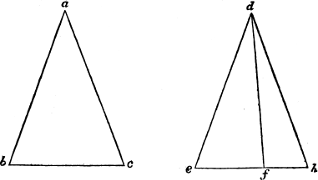
For the two a b, a c, are equal to the two d e,
d h, and they contain equal angles. Hence, the base b c,
is equal to the base e h. But e h is greater than e
f; and on this account b c is greater than e f.
Again, let it be placed beneath e f. Connecting, therefore, e
h, we must say, that since a b, a c, are equal to
d e, d h, and they comprehend equal angles, b c is
also equal to e h. Because, therefore, within the triangle d
e h, two right lines d f, f e, are constructed on the
side d e, they are less than the external sides. But d h,
is equal to d f: for it is equal to a c. Hence h e
is greater than e f. But h e is equal to b c.
And therefore, b c is greater than e f. The theorem,
therefore, is exhibited according to every position.
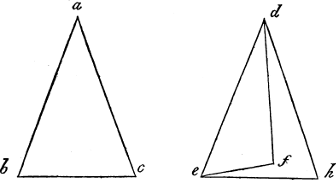
Why then, as is the fourth theorem, he at the same time demonstrated
that the areas of triangles are equal, does he not add in the present,
that besides the inequality of the bases, the areas also are unequal?
Against this doubt we must say, that there is not the same proportion
in equal, as in unequal angles and bases. For when the angles and
bases are equal, the equality also of the triangles follows: but when
they are unequal, it is not necessary that the inequality of the areas
should be consequent; since the triangles may as well be equal, as
unequal; and that may be greater, and likewise less, which contains
the greater angle, and the greater base. On this account, therefore,
the institutor of the Elements leaves the comparison of the triangles;
to which we may add, that the contemplation of these, requires the
doctrine of parallels.
But if it be requisite, that anticipating things which are afterwards
exhibited, we at present make a comparison of areas, we must say, that
if the angles a, d, are equal to two right, the triangles
may be shewn to be equal: but when they are greater than two right, the
lesser triangle will be that which contains the greater angle; and when
they are less than two right, this will be the case with the greater
triangle.
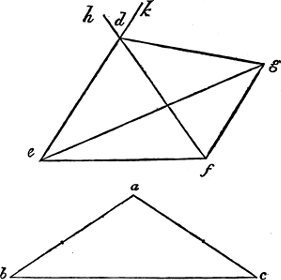
For let the construction in the element be given, and produce e
d, f d, to the points k, h; and let us suppose
the angles b a c, e d f, equal to two right. Because,
therefore, the angle b a c, is equal to the angle e d g,
the angles e d g, e d f, are equal to two right. But the
angles e d g, k d g, are also equal to two right. Let
the common angle e d g be taken away, and the remainder e d
f, will be equal to the remainder k d g. But e d f
is equal to h d k; for they are vertical angles. Hence, the
angle k d g, is equal to the angle h d k. And because the
angle g d h, is external to the triangle g d f, it is
equal to the two internal and opposite angles at the points g
and f. But these angles are equal to each other, because d
g is equal to d f. Hence, the angle g d h, is double
of the angle at the point g, and of the angle at the point
f. The angle, therefore, at the point g, is equal to
the angle g d k, and they are alternate; and consequently d
e is parallel to f g. The triangles, therefore, g d
e, f d e, are upon the same base d e, and between
the same parallels d e, g f; and are consequently equal.
But the triangle g d e, is equal to the triangle a b c;
and so the triangle d e f, is not unequal to the triangle a
b c. And here you may observe, that we require three theorems
belonging to the doctrine of parallels; one, indeed, affirming, that
the external angle of every triangle is equal to the two internal and
opposite angles: but the other, that if a right line falling
upon two right lines, makes the alternate angles equal, the right lines
are parallel; and the third, that triangles constituted upon
the same base, and between the same parallels, are equal, which
the institutor of the Elements also knowing, omits the comparison of
triangles.
But let the angles b a c, e d f, be greater than two
right, and let the same things be constructed. Because, therefore, the
angles b a c, e d f, i.e. the angles e d g, e d
f, are greater than two right; but the angles e d g, g d
k, are equal to two right, by taking away the common angle e d
g, the angle e d f, is greater than the angle g d k.
Hence, the angle g d h, is more than double of the angle g
d k; and so the angle g d k, is less than the angle at the
point g.
Let g d k be placed equal to d g l, and let e l,
and d l, be connected: g l, therefore, is parallel to
d e; and hence, the triangles g d e, l d e, are
equal. But the triangle l d e, is less than the triangle f d
e. The triangle, therefore, g d e, is less than the triangle
f d e. But the triangle g d e, is equal to the triangle
a b c; and hence, the triangle a b c, is less than the
triangle f d e, viz. is less than the triangle which contains
the greater angle.
In the third place, let the unequal angles be less than two right,
and let the same things be constructed. Because, therefore, the angles
e d g, g d k, are equal to two right, by taking away
the common angle e d g, the whole g d h, is less than
double of g d k. But it is double also of the angle at the point
g. Hence, the angle g d k, is greater than the angle at
the point g. Let the angle d g l, be placed equal to
the angle g d k, and let g l coincide with e l,
in the point l, and connect d l. Hence, g l is
parallel to d e; and consequently the triangles g d e,
l d e, are equal to each other. But the triangle l d e,
is greater than the triangle f d e; and the triangle g d
e, is equal to the triangle a b c. Hence, the triangle
a b c, is greater than the triangle d f e.
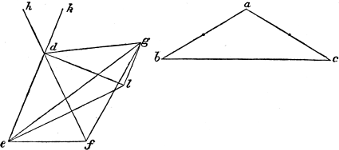
It is shewn, therefore, that the triangle a b c, is both equal
to, and is also greater and less than the triangle d e f, the
angles at the points a and d, being either equal to, or
greater or less than two right. And thus, all the hypotheses may be
accomplished. For what if the angle at the point a, should be
one right, and the half of a right angle, but the angle at the point
b, the half of one right, would not those two angles be equal to
two right? But what if the angle at the point a, should be one
right, and the half of a right, but the angle at the point b,
two thirds of one right, would they not be greater than two right
angles? And lastly, if the angle at the point a, should be
one right, and the half of a right angle, but the angle at the point
b, a third part of a right angle, would they not be less than
two right, and the angle a be greater than the angle d?
All these comparisons, therefore, are produced by the assistance of
parallels; and hence, they are necessarily not found in the present
elementary institution.
PROPOSITION XXV. Theorem XVI.
If two triangles have two sides equal to two, each to each, but
have the base of the one greater than the base of the other;
they shall likewise have the angle contained by the equal sides
in the one, greater than the angle contained by the equal sides
in the other.
The present theorem is the opposite to the eighth, but the converse
of the preceding. For the institutor of the Elements produces theorems
concerning the equality and inequality of angles and bases, according
to conjunction; in each of the conjunctions, receiving
some as precedents, but others as converse. And in such as are
precedent indeed, he employs direct ostensions: but in such as are
converse, he uses deductions to an impossibility. After this manner
he proceeds in some particular triangle, sometimes from the equality
of the sides which it contains, shewing the consequent equality of
the angles which they subtend: but sometimes from their inequality
evincing inequality. And again, on the contrary, affirming that
equality of sides is consequent to equality of angles, but inequality
to inequality. However, that we may proceed to the thing proposed,
we refer those who are desirous of learning how the geometrician
shews when this is manifest, to his books on this subject. But we
shall briefly relate the demonstrations which others produce of this
proposition; and in the first place, that which Menelaus Alexandrinus
invented and delivered.
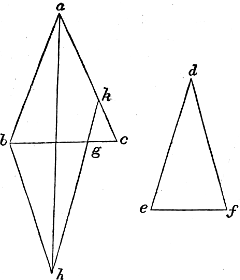
Let there be two triangles a b c, d e f, having the two
sides a b, a c, equal to the two d e, d f,
each to each, and the base b c, greater than the base e
f, I say that the angle at the point a, is greater than the
angle at the point d. For let there be cut from the base b
c, a line b g, equal to the base e f, and construct
at the point b, an angle g b h, equal to the angle d e
f, and place b h equal to d e. Lastly, connect h
g, and produce it to the point k, and connect a h.
Because, therefore, b g is equal to e f, but b h
to e d, the two are equal to the two, and they contain equal
angles. Hence, g h is equal to d f, and the angle b
h g, is not unequal to the angle e d f. And because g
h is equal to d f, but d f to a c, g h,
also, is equal to a c. Hence h k is greater than a
c, and consequently is much greater than a k. The angle,
therefore, k a h, is greater than the angle k h a. Again,
because b h, is equal to a b, for it is equal to d
e, the angle b h a, is equal to the angle b a h.
Hence, the whole angle b h k, is less than the whole, b a
c, but is shewn to be equal to the angle at the point d. The
angle, therefore, b a c, is greater than the angle at the point
d. And such is the demonstration of Menelaus.
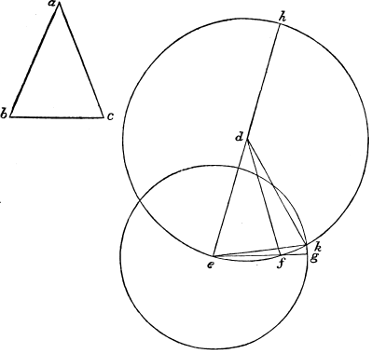
But Heron, the mechanist, shews the same thing, in the following
manner, without leading to an impossibility, as is the case with the
demonstration of Euclid. Let there be two triangles a b c, d
e f, with the same hypotheses as above. And because b c is
greater than e f, let e f be produced, and place e
g equal to b c; and in like manner extend d e, and
place d h equal to d f. The circle, therefore, which
is described with the centre d, and interval d f, will
pass also through the point h. Let it be described as f k
h. And because a c, a b, are together greater than
b c, but these are equal to e h, and b c is equal
to g e, hence the circle which is described with the centre
e, but interval e g, will cut e h. Let it cut e
h, as the circle g k, and connect from the common section
of the circles to the centres, the right lines k d, k e.
Because, therefore, the point d, is the centre of the circle
h k f, d k is equal to d h, i.e. to a c.
Again, because the point e, is the centre of the circle g
k, the line e k, is equal to e g, i.e. to b c.
Hence, since the two a b, a c, are equal to the two d
e, d k, and the base b c, is equal to the base e
k, the angle, also, b a c, is equal to the angle e d
k. And thus the angle b a c, is greater than the angle f
d e.
PROPOSITION XV. Theorem XVII.
If two triangles have two angles equal to two, each to each,
and one side equal to one side, either that which is adjacent
to the equal angles, or that which subtends one of the equal
angles: then they shall have the remaining sides equal to the
remaining sides, each to each, and the remaining angle equal to
the remaining angle.
It is necessary, that he who wishes to compare triangles with each
other, according to sides, angles, and areas, should either, by
receiving the sides alone equal, enquire after the equality of angles;
or by assuming the angles alone equal, investigate the equality of the
sides; or by mingling the angles and sides, scrutinize the equality of
angles and sides. Since, therefore, Euclid alone receives the angles
equal, he could not likewise shew that the sides of the triangles are
equal. For the least triangles are equiangular with the greatest,
though at the same time they are excelled by them, both according
to sides and comprehended space: but the angles of the former are
separately equal to the angles of the latter. However, as he supposes
the sides alone to be equal, he demonstrates that all are equal, by the
eighth theorem, in which there are two triangles having two sides equal
to two, each to each, and the base to the base, and these are shewn to
be equiangular, and to possess a power of comprehending equal spaces.
And the institutor of the Elements omits this addition, as necessarily
following from the fourth, and requiring no demonstration. But when
receiving sides and angles, he ought to receive either one side equal
to one, and one angle equal to one; or one side, and two angles of the
triangles, equal to two; or on the contrary, one angle and two sides;
or one angle and three sides; or one side and three angles; or more
than one side, and more than one angle. But when he had received one
angle, and one side, he could by no means shew the thing proposed. I
mean, the equality of the rest. For it is possible that two triangles
which are equal, according to one side only, and one angle, may be
entirely unequal as to the rest.
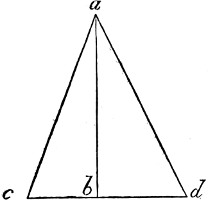
Thus let there be a right line a b, perpendicularly erected
upon the right line c d, but let b d be greater than
b c, and connect a c, a d. In these triangles,
therefore, there is one common side, and one angle equal to one, but
all the rest are unequal. But it is lawful to receive one side, and
two angles, and to prove the rest equal, and this he performs by the
present theorem: though again, to suppose one side, and three equal
angles, is superfluous; since from the equality of two alone, the
equality of the rest is exhibited. Again, receiving one angle, and two
equal sides, he demonstrates that the rest are equal in the fourth
theorem. But it is superfluous to receive one angle, and three equal
sides: for two equals being alone assumed, conclude the equality of
the rest. Besides, it is superfluous to assume two sides, and two
equal angles; or two sides, and three equal angles; or two angles and
three sides; or three angles and three sides. For the consequents
to fewer hypotheses attend likewise a greater multitude, while the
hypotheses are received with proper conditions. Hence, three hypotheses
requiring demonstration, present themselves to our view, one, which
alone receives three sides; and another which assumes one side, and
two angles, which the geometrician now proposes; and a third, the
opposite to this. On this account, we have only these three theorems,
concerning the equality of triangles, which are conversant in sides
and angles; since all the other hypotheses are either invalid for the
purpose of shewing the object of enquiry; or they are valid indeed, but
superfluous, because the same things may be readily procured by fewer
hypotheses. As, therefore, when he assumed two sides equal to two, and
one angle equal to one, he did not, indeed, assume every angle, but (as
it was proposed by him) that contained by equal right lines, in the
same manner when he assumes two angles equal to two, and one side to
one, he does not assume any side, but either that which is adjacent to
the equal angles, or that which subtends one of the equal angles. For
neither is it possible in the fourth theorem, by assuming any equal
angle, nor in the present by assuming any side, to shew the equality of
the rest.
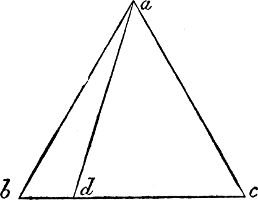
Thus for example, an equilateral triangle a b c, being
given, let the side b c be divided into unequal parts, by the
line a d. Hence, there will be formed two triangles, having
two sides a b, a d, equal to the two a c, a
d, and one angle at the point b, equal to one angle at the
point c, but the remaining sides will not also be equal, as
for instance, the side b d, to the side d c: for they
are unequal. But neither are the remaining angles equal: the reason
of which is, because we receive an angle equal to an angle, but not
the angle which is contained by equal sides. After the same manner,
indeed, the present theorem also will appear dubious, unless we assume,
according to the aforesaid condition, an equal side subtending one of
the equal angles, or adjacent to the equal angles.
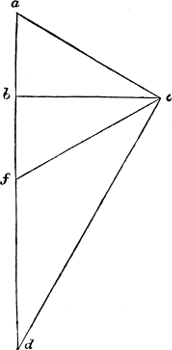
For let there be a right angled triangle a b c, having the angle
at the point b right, and the side b c, greater than the
side b a, and let there be constructed on the right line b
c, and at a point in it c, an angle b c d, equal
to the angle b a c, and let b d, c d, produced,
coincide in the point d. There are two triangles, therefore
a b c, b c d, having one side b c common, and two
angles equal to two, viz. a b c, to c b d (for they are
right), and b a c to b c d, according to construction.
Hence, as it appears the triangles are equal, and yet it may be shewn
that the triangle b d c, is greater than the triangle a b
c. But the reason of this is, because in the triangle a b c,
we assume the common side b c, subtending one of the equal
angles, viz. the angle at the point a: but in the triangle b
c d, we assume the equal side, adjacent to the equal angles. It
was requisite, therefore, in each, either to subtend one of the equal
angles, or to be adjacent to the equal angles. But not observing this,
we affirmed that triangle to be equal, which is necessarily greater:
for is not the triangle b c d, greater than the triangle a
b c? To be convinced of this, let there be constructed on the
right line b c, and at a given point in it c, an angle
f c b, equal to the angle a c b: for the angle b c
d, as well as the angle at the point a, is greater than the
angle a c b. Because, therefore, there are two triangles, a
b c, b c f, having two angles a b c, b c a,
equal to two c b f, b c f, each to each, and one side
common, adjacent to the equal angles, viz. b c, the triangles
are equal. But the triangle b c d is greater than the triangle
b c f, and consequently it is also greater than the triangle
a b c. But it was formerly shewn to be equal, on account of the
assumption of any side: And thus much the diligence of Porphyry has
supplied us on the present occasion. But Eudemus, in his Geometrical
Narrations, refers the present theorem to Thales. For he says it is
necessary to use this theorem in determining the distance of ships at
sea, according to the method employed by Thales in this investigation.
But from the preceding division we may briefly assume all the
contemplation concerning the equality of triangles, and are enabled
to relate the causes of things omitted, confuting those hypotheses,
as either false, or superfluous. And thus far we determine the limits
of the first section of the elementary institutor, because he forms
the constructions and comparisons of triangles, according to equal and
unequal. And by construction, indeed, he delivers their essence: but by
comparison, their identity and diversity. For there are three things
which are conversant about being, essence, same, and
different[26], as well in quantities, as in qualities, according
to the propriety of subjects. From these, therefore, as images it
may be shewn, that every thing is the same with itself, and
differs from itself, on account of the multitude which it
contains; and that all things are the same with one another,
and different from themselves. For both, in every triangle, and
in more triangles than one, equality and inequality has been found to
reside.
BOOK IV.
Whatever can be said in an elementary institution, concerning the
origin and equality of triangles, we may learn from the preceding
discourse. But after this, the narration of Euclid is concerning
quadrilateral figures, and he particularly teaches us concerning
parallelograms, together with the contemplation of these delivering
the doctrine of trapeziums. For a quadrilateral figure, (as we
have formerly observed in our discourse on hypotheses,) is divided
into parallelogram and trapezium; and a parallelogram into other
certain species, and in like manner a trapezium. But because a
parallelogram, on account of its participation of equality, possesses
disposition and order, but a trapezium has neither the same, nor
a similar order; Euclid’s principal discourse, is with propriety,
concerning parallelograms, but he also contemplates together with
these a trapezium. For from the section of parallelograms, the origin
of trapeziums will appear, as will be manifest as we proceed. But
because again, it is not possible that any thing can be said of the
construction or equality of parallelograms, without the consideration
of parallels, (for as it is manifest from the very name, that is,
a parallelogram, which is circumscribed by parallel right lines in
an opposite position,) hence, he necessarily assumes from parallels
the beginning of his doctrine, but having advanced a little from
these, he enters on the doctrine of parallelograms, employing one
middle theorem, between the elementary institution of each, because
he appears to contemplate a certain symptom inherent in parallels:
but he delivers the first origin of a parallelogram. For such is the
proposition, which says, that right lines which join equal and
parallel right lines towards the same parts, are themselves equal
and parallel. For in this theorem, indeed, a certain accident to
equal and parallel right lines is considered: but from the connection
a parallelogram appears, having its sides opposite and parallel. And
from hence it is manifest that the discourse concerning parallels,
was necessarily pre-assumed. But three things are to be assumed,
essentially inherent in parallels, which they essentially express,
and are converted with them, not only the three together, but every
one separately assumed from the rest. Of these, one is, that when
a right line cuts parallel lines, the alternate angles are equal;
but the second, that when a right line cuts parallel lines, the
internal angles are equal to two right; and the third, that in
consequence of a right line cutting parallel lines, the external is
equal to the internal and opposite angle. For when any one of these
symptoms is demonstrated, we have sufficient authority to affirm
that the right lines are parallel. But other mathematicians, also,
have been accustomed to discourse after this manner concerning lines,
delivering the symptoms of every species. For Apollonius, in each of
the conical lines, shews what a symptom is, as also Nicomedes in
his Treatise on Conchoids, and Hippias in his Quadratics, and Perseus
in his Spirals. Since after their origin, that which is essentially
inherent in these lines, and according to what it is inherent, being
assumed, distinguishes a constructed form from all others. After the
same manner, therefore, the institutor of the Elements, first of all
investigates, the symptoms of parallels.
PROPOSITION XXVII. Theorem XVIII.
If a right line falling upon two right lines, makes the
alternate angles equal to each other, those right lines shall be
parallel to each other.
In the present theorem it was not pre-assumed as evident that the
right lines are in one plane, but this ought rather to be previously
admitted in all theorems which are considered in a plane. This,
however, is added, because it does not universally follow, that when
the alternate angles are equal, the right lines will be parallel,
unless they are in the same plane. For nothing hinders, but that a
right line falling on right lines disposed in the shape of the letter
X, one of which is situated in one plane, but the other in a different
one, may make the alternate angles equal; and yet the right lines thus
disposed will not be parallel. It was pre-assumed[27], therefore,
that in a treatise on planes, we conceive every thing described in
one and the same plane: and on this account, he does not require this
addition in the present proposition. But it is requisite to know
that the geometrician considers the particle alternate, in a
two-fold respect, sometimes, indeed, according to a certain situation,
but sometimes according to a certain consequence of proportions. And
according to this last signification, the particle alternate is
used in the fifth book, and in such as are arithmetical: but agreeable
to the former, both in this, and in all the other books concerning
parallel right lines, and that which falls upon these. For he calls
the angles alternate, which are not formed at the same parts, and are
not successive to each other, which are distinct, indeed, from the
incident line, but both of them exist within parallels, and differ in
this, that the one has an upward, but the other a downward position.
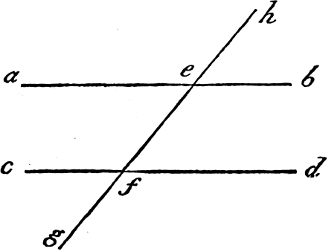
I say, for example, that when a right line e f, falls on the
right lines a b, and c d, he calls the angles a e
f, d f e, and also the angles c f e, b e f,
alternate, or altern, because they have an alternate, or
changed order, according to their position. But this too must be known,
that from such a situation of right lines, all the symptoms become by
division, six; three of which the geometrician alone receives; and
three he omits. For we either assume the angles at the same parts,
or not at the same. And if at the same parts, either both within the
right lines, which shews them to be parallels; or both without, or one
without, and the other within. And if not at the same parts, again,
after the same manner, they are either both without the right lines,
cutting the lines it is necessary to receive; or within; or one within,
and the other without. But what we have said will become manifest by
the same description as above. For let there be certain right lines
a b, c d, and let a right line e f, fall upon
them, and let it be produced to the points h and g. If
then you assume angles at the same parts, you will either place them
both within, as b e f, and e f d, or as a e f, and
e f c; or both without, as h e b, and d f g, or as
h e a, and c f g; or one within, and the other without,
as h e b, and e f d, or as g f d, and f e
b, or as h e a, and e f c, or as g f c, and
a e f: for these last are received in a quadruple respect. But
if you assume the angles not at the same parts, you will either place
both within, as a e f, and e f d, or as c f e,
and f e b; or both without, as a e h, and d f g,
or as h e b, and c f g; or one within, and the other
without, and this again in a quadruple respect. For they will either be
the angles a e h, and e f d; or h e b, and e f
c; or g f c and f e b; or g f d, and f e
a. And besides these, there is no other assumption.
As, therefore, angles are assumed according to six modes, the
geometrician combines three assumptions alone; and these consequent
symptoms, are naturally adapted to express parallels. But of these
three assumptions, one belongs to those angles which are not at the
same parts, viz. to those which are only assumed within; and these he
calls alternate, so that those, which are both external, and those, one
of which is external, but the other internal, are omitted: but two of
these assumptions belong to angles at the same parts, to those, indeed,
which are both internal, which he says are equal to two right, and
to those, one of which is internal, but the other external, which he
says are equal, leaving indeed one assumption which supposes both the
angles to be external. We therefore affirm that the same things will
be consequent to the three omitted hypotheses. Thus, in the preceding
figure, let both the external angles h e b, d f g, be
at the same parts, I say that these are equal to two right angles.
For the angle d f e, is equal to the angle h e b, and
the angle b e f, to the angle d f g. But if the angles
b e f, e f d, are equal to two right, the angles d f
g, h e b, are equal to two right. Let again the angles a
e h, e f d, not be towards the same parts, of which the one
is within, but the other external, I say that these also are equal to
two right angles. For if the angle a e h, is equal to the angle
b e f, but the angles b e f, and e f d, are equal
to two right, the angles, also, a e h, and e f d, are
equal to two right. Again, let them not be at the same parts, but both
without the right lines as a e h, d f g. I say that these
are equal to one another. For if the angles a e h, and b e
f, are equal to each other, but the angle d f g, is equal to
the angle b e f, hence the angle a e h, is not unequal
to the angle d f g. If, therefore, the things assumed by the
geometrician, in three hypotheses are verified, all the same follow in
the remaining three as indisputably true. Besides this too is to be
observed, that in such as the geometrician receives these, according
to two assumptions, the angles are supposed equal to each other, but
when according to one assumption, equal to two right: but in these
last on the contrary, according to two assumptions, they are supposed
equal to two right angles, but according to one equal to each other.
For since all the assumptions are six, it happens, indeed, from three,
that the angles are equal to two right, but from the other three, that
they are equal to each other. Hence, those which are omitted are not
undeservedly contrary to the assumptions which are reckoned worthy of
relation. But the geometrician appears to have chosen such hypotheses
as either abound in affirmation, or are more simple, and, on this
account of those angles which are not at the same parts, he assumed
alone the internal, which he calls alternate: but of those at the same
parts, he assumes as well the internal, as well as one internal and
the other external, but he avoids the rest, either because they are
more declared by negation, or because they are more various. However,
whether this or some other be the cause, the number of the consequents
to those hypotheses is from hence sufficiently manifest.
PROPOSITION XXVIII. Theorem XIX.
If a right line falling upon two right lines, makes the external
equal to the internal angle, placed opposite, and at the same
parts, or makes the angles internally situated, and at the same
parts equal to two right, those right lines shall be parallel to
each other.
The preceding theorem receiving the angles, not at the same parts,
but situated within right lines, shews that the right lines are
parallel among themselves: but the present theorem proposes the two
remaining hypotheses, of which one separates the angles according to
the particles without and within, but the other supposes
them both within, and exhibits the same conclusion. But it may seem,
perhaps, that the institutor of the Elements has inconveniently
distributed the theorems. For it was necessary either to receive three
hypotheses in a divided manner, and to make three theorems; or to
collect all into one theorem, as Æneas Hierapolites does, who wrote
a compendium of the Elements; or willing to divide them into two, to
make an orderly division, and to assume the hypotheses separately,
which contain equal angles, and separately that in which the angles are
equal to two right. But in the present propositions, in one theorem he
supposes the alternate angles equal, but in the other, the external to
the internal, and the internal angles situated at the same parts equal
to two right. What then is the cause of this division? Does he regard
the equality of the angles to each other, or to two right, and on this
account does not separate the proposed theorems from each other; or
does he respect the angles being received at the same, or not at the
same parts? For the preceding theorem does not respect angles at the
same parts, since such as these are alternate: but the present regards
such as are situated at the same parts, as is perspicuous from the
proposition. But how the institutor of the Elements shews, that from
the internal angles being equal to two right, the right lines are
parallel, appears from his writings on this subject. Ptolemy, however,
in the theorems in which he proposes to demonstrate that right lines
produced from angles less than two right, coincide at the same parts,
in which the angles less than two right are situated, shewing before
all his theorems, that from the internal angles being equal to two
right, the right lines are parallel, proves it in the following manner.
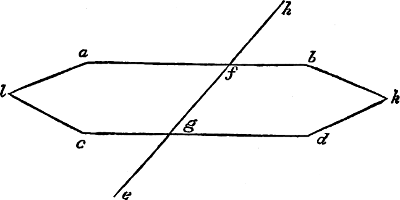
Let there be two right lines a b, c d, and let a certain
right line e g f h, so cut them, that it may make the angles
b f g, and f g d, equal to two right, I say that those
right lines are parallel, that is, will never coincide. For if it be
possible, let them coincide while the right lines b f, g
d, are produced in the point k. Because, therefore, the
right line e f, stands upon the right line a b, it makes
the angles a f e, b f e, equal to two right. In like
manner because f g stands upon c d, it makes the angles
c g f, d g f, equal to two right. Hence, the four angles
b f e, a f e, c g f, d g f, are equal to
four right, two of which b f g, f g d, are supposed equal
to two right. The remainders, therefore, a f g, c g f,
are equal to two right. If then the right lines f b, g d,
when produced, coincide, the internal angles being equal to two right,
f a, and g c, also, shall coincide when produced: for
the angles a f g, c g f, are also equal to two right.
Either therefore the right lines shall coincide in both parts, or in
neither, since these, as well as the former, are equal to two right.
Let the right lines then f a, g c, coincide in the point
l. But if this be admitted two right lines l a f k,
l c g k, will comprehend space, which is impossible. It is not
therefore possible, that the internal angles being equal to two right,
the right lines can coincide. They are therefore parallel.
PROPOSITION XXIX. Theorem XX.
A right line falling upon parallel right lines, makes the
alternate angles equal to each other; and the external equal to
the internal angle, oppositely situated, and at the same parts;
and the internal angles at the same parts equal to two right.
The present theorem is converted in both the preceding. For that
which is the object of investigation, in each of them, forms the
hypothesis: but what are data in the preceding, he proposes to
shew in the present. And this difference of converse theorems is not to
be passed over in silence. I mean that every thing which is converted,
is either converted as one to one, as the sixth proposition to the
fifth; or as one to a many, as the present to the preceding; or as many
to one, as will shortly be manifest[28]. But in the present theorem,
the institutor of the Elements first employs the petition, which says:
If a right line falling upon two right lines, makes the angles
situated internally, and at the same parts less than two right, those
right lines whilst they are infinitely produced, will coincide at those
parts in which the angles less than two right are situated. But
in our exposition of things prior to theorems[29], we have asserted,
that this petition is not allowed by all to be indemonstrably evident.
For how can this be the case when its converse is delivered among
the theorems as demonstrable? For the theorem which says that the two
internal angles of every triangle are less than two right, is the
converse of this petition. Besides, the perpetual inclination of right
lines, more and more, while they are produced, is not a certain sign
of coincidence, because other lines are found perpetually inclining,
and never coinciding, as we have already observed. Formerly, therefore,
some, when they had pre-ordained this as a theorem, considered that
which is assumed by the institutor of the Elements as a petition, to
be worthy of demonstration. But this seems to be shewn by Ptolemy
himself, in a book entitled: That right lines which are produced
from less than two right angles, coincide. And this he proves by
pre-assuming many things, which as far as to the present theorem, are
already demonstrated by the elementary institutor; and he supposes
that all are true (lest we should also superadd another confusion) and
that this, as a small assumption, may be exhibited from the preceding.
But this also is one of the things previously exhibited, which says,
that the right lines produced from two angles equal to two right,
will never coincide. I say, therefore, that the converse also is
true, which says, that right lines being parallel, if they are cut
by one right line, the angles situated internally, and at the same
parts, shall be equal to two right angles.
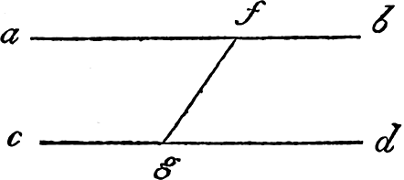
For it is necessary that a line cutting parallels, should either make
the angles internally situated, and towards the same parts, equal to
two right, or less, or greater than two right. Let the lines then, a
b, c d, be parallel, and let the right line, g f,
fall upon them, I say that it will not make the angles internal, and at
the same parts greater than two right. For if the angles a f g,
c g f, are greater than two right, the remainders b f g,
d g f, are less than two right. But the same are also greater
than two right. For a f, and c g, are not more parallel
than f b, and g d. Hence, if the line which falls upon
a f, c g, makes the internal angles greater than two
right, that also which falls upon f b, g d, will make
the internal greater than two right. But they are also less than two
right (since the four, a f g, c g f, b f g, d
g f, are equal to four right) which is impossible. In like manner
we may plainly shew, that the right line which falls upon parallels,
does not make the angles internal, and at the same parts, less than two
right. But if it makes them neither greater nor less than two right, it
remains that the incident line must make the angles internal, and at
the same parts equal to two right. This then being previously shewn,
the thing proposed, is doubtless demonstrated. For I say, that if a
right line falling upon two right lines, makes the angles situated
internally, and at the same parts, less than two right, if those right
lines are produced they will coincide at those parts in which the
angles less than two right are situated. For let them not coincide. But
if they are non-coincident at those parts in which the angles less than
two right are situated, much more will they be non-coincident at the
other parts, in which the angles greater than two right are situated.
Hence, the right lines will be non-coincident at both parts; and if
this be true, they will be parallel. But it was shewn that the right
line which falls on parallels, makes the angles internal and at the
same parts equal to two right. The same, therefore, are both equal to,
and less than two right, which is impossible.
Ptolemy having previously shewn this, and proceeding to the thing
proposed, wishes to add something more accurate, and to shew that if
a right line falling upon two right lines, makes the angles internal,
and at the same parts, less than two right, the lines are not only
coincident as has been shewn, but likewise that their coincidence takes
place at those parts, in which the angles less than two right, and not
at those in which the angles greater than two right are situated.
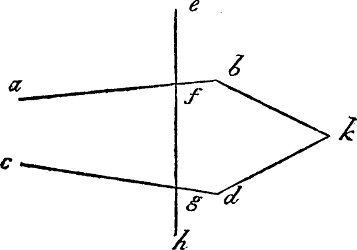
For let there be two right lines a b, c d, and let a
right line e f g h, falling upon them make the angles a
f g, and c g f, less than two right. The remainders,
therefore, are greater than two right; and thus it is shewn that the
right lines coincide. But if they coincide, they will either coincide
at the points a and c, or at the points b and
d. Let them coincide at the points b and d in the
point k. Because, therefore, the angles a f g, and c
g f, are less than two right, but the angles a f g, b f
g, are equal to two right, by taking away the common angle a
f g, the angle c g f, will be less than the angle b f
g. The external angle, therefore, of the triangle g f k, is
less than the internal and opposite angle, which is impossible. Hence
then, they do not coincide at these parts. But they do coincide; and
consequently they will be coincident at the other parts, in which the
angles less than two right are situated. And thus far Ptolemy.
But it is necessary to scrutinize this demonstration, lest perhaps
there should be any perverse and captious reasoning in the assumed
hypotheses, in those, I say, in which he affirms, that a right line
cutting non-coincident right lines, by forming four internal angles,
forms the angles at the same parts on each side, either equal to two
right, or greater, or less than two right. For the division is not
perfect; since nothing hinders our calling those lines non-coincident,
which are produced from angles less than two right, denominating,
indeed, the two angles at the same parts, greater than two right, but
the two at the remaining parts less than two right and not admitting in
these, one and the same proportion. But the division being imperfect,
the thing proposed is by no means demonstrated. Besides this, also,
is not to be passed over in silence against his demonstration, that
he does not essentially shew that which is impossible. For it is not
because a certain right line cutting parallels, makes the angles at
the same parts on each side, greater or less than two right, that an
absurdity on this account follows these hypotheses. Nevertheless,
because the four angles within the lines which are cut, are equal to
four right, on this account each of these hypotheses is impossible;
since, if parallel right lines are not assumed, yet, when the same
hypotheses are assumed, the same consequences will be the result. And
such are our animadversions against the demonstration of Ptolemy: for
the imbecility of his demonstration appears from what has been said.
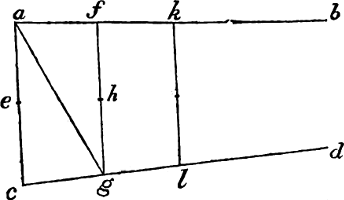
Let us now consider those, who say it is impossible that lines
produced from angles less than two right, should coincide. For when
they have assumed two right lines a b, c d, and a right
line a c, falling upon them, and making the two internal angles
less than two right, they say it is possible that the right lines a
b, c d, may be shewn to be non-coincident. For let a
c be bisected in e, and cut off from a b, a part a
f, equal to a e: but from c d, a part c g,
equal to e c. It is manifest, therefore, that the right lines
a f, c g, will not coincide in the points f and
g. For if they coincide, these two in the triangle will be equal
to a c, which is impossible. Let again f g be connected,
and bisected in h, and cut off equal parts. These, therefore,
will not coincide on the same account, and this will be the case, in
infinitum, by connecting the non-coincident points; and bisecting the
connecting line, and by cutting from the right lines, lines equal to
the halves of the connecting lines; for by this means they say, that
the right lines a b, c d, will never coincide. To such as
these we reply, that they indeed affirm that which is true, but not so
much as they imagine. For it is not true that the point of coincidence
is simply determined by this means, nor is it true that the lines
by no means coincide. Thus, when the angles b a c, and d
c a, are determined, the lines a b, and c d, will
not coincide in the points f and g, yet nothing hinders
their coinciding in the points k and l, though f
k and g l should be equal to f h, and h g.
For when a k and c l coincide, the angles k f h,
l g h, will not remain the same, and a certain part of the
right line f g, will be left external to the right lines a
k and c l; and so again the two lines f k, and g
l, are so much greater than the base, as the interior parts of the
right line f g, which they intercept. Besides this also is to
be said to such as affirm the non-coincidence of lines extended from
angles less than two right, that they destroy what they are unwilling
to destroy. For let the same description be given. Whether, therefore,
is it possible, or impossible to connect a right line from the point
a, to the point g? For if it be impossible, besides
destroying the fifth petition, they also destroy that which says,
that a right line may be drawn from every point to every point:
but if possible let it be connected. Because, therefore, the angles
f a c, g c a, are less than two right, it is manifest
that the angles also, g a c, g c a, are much less than
two right. The right lines, therefore, a g, c g, will
coincide in the point g, being produced from angles less than
two right. Hence, it is not possible to affirm indeterminately, that
lines produced from angles less than two right, will not coincide. It
is however manifest, that some right lines produced from angles less
than two right will coincide, though the present discourse seems to
investigate this in all. For it may be said, that when the diminution
of two right lines is indefinite, the lines will remain non-coincident
according to such a diminution: but will coincide according to another
less than this. But he who desires to behold a demonstration of this
affair, must be informed that it is requisite for this purpose to
pre-assume such an axiom as is employed by Aristotle[30] in proving
the world to be finite, viz. If from one point two right lines
forming an angle are produced in infinitum, the distance of the lines
infinitely produced will exceed every finite magnitude. For he
shews that when infinite right lines are produced from the centre to
the circumference, the interval also contained between them will be
infinite: since, if it be only finite, it is possible that the distance
may be increased; and on this account the right lines will not be
infinite. Right lines, therefore, infinitely produced, are distant from
each other by an interval greater than every finite magnitude.
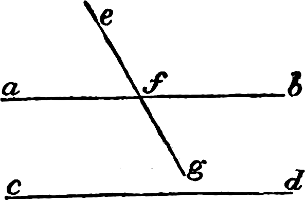
This being pre-supposed, I say that if any right line cuts the one of
parallel right lines, it will also cut the other. For let a b
and c d be parallels, and let the right line e f g cut
a b. I say that it will also cut c d. For since there
are two right lines, which are produced infinitely from the point
f, viz. b f, and f g, they shall have a distance
greater than every magnitude. Hence, they shall exceed the quantity of
the interval contained between the parallel lines. Since, therefore,
their distance from each other is greater than that of the parallels,
f g shall cut c d. But this being demonstrated, we can
exhibit the thing proposed in a consequent order. For let there be two
right lines a b, c d, and let a right line e f,
fall upon them, making the angles b e f, d f e, less than
two right.
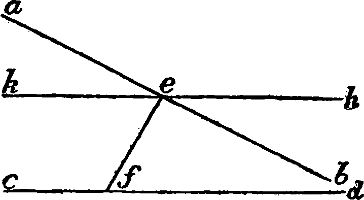
I say that the right lines will coincide in those parts, in which the
angles less than two right are situated. For since the angles b e
f, d f e, are less than two right, let the angle h e
b, be equal to the excess of two right angles above these angles,
and produce h e, to the point k. Because, therefore, a
right line e f, falls upon the right lines h k, c
d, and makes the internal angles equal to two right, viz. the
angles h e f, d f e, the right lines h k, c
d, are parallel; and a b cuts k h. It will therefore
also cut c d, by the assumption previously exhibited. Hence, the
right lines a b, c d, will coincide in those parts, in
which the angles less than two right are situated. And on this account
the thing proposed, is evinced[31].
PROPOSITION XXX. Theorem XXI.
Right lines parallel to the same right line, are parallel to each other.
The geometrician in these discourses which are conversant with
relation, is accustomed to shew identity permeating through all
quantities, having the same relation to the same. Thus among the
axioms also he says, things equal to the same, are equal to each
other: and in the following books he says, things similar to
the same, are similar to each other, and things having the same
proportion to the same, have the same proportion to each other.
After this manner, therefore, he now also demonstrates, that right
lines parallel to the same, are parallel to each other. But it
happens that this is not true in all respects. For quantities double
of the same, are not also double of each other: nor are those which
are sesquialter of the same, sesquialter likewise to each other,
but it appears to take place in those alone, which are univocally
converted in equality, similitude, identity, and parallel position.
For that which is parallel to a parallel, is itself also parallel. As
that which is equal to an equal, is itself equal; and that which is
similar to a similar, is itself similar. For the relation of parallels
to each other, is similitude of position. He affirms, therefore, and
shews, in the present theorem, that lines parallel to the same, are
entirely so related, that they are also parallel to each other. And he
also exhibits the parallels with an external position, and likewise a
medium, to which these have a similar relation, that what he asserts
may become manifest from a common conception. For if they coincide with
each other on either side, and coincide with that which is situated in
the middle, they will no longer be parallel to it.
But it is possible that he who changes the position may shew the
same thing, and by the same methods which the geometrician employs in
exhibiting his proposition.
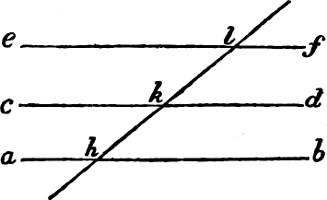
For instance, he assumes both c d, and e f, parallel to
a b, both of them situated above, and a b being beneath,
and not in the middle. For a right line h k l, falling upon
them, makes each of the angles h k d, k l f, equal to
a h k, because they are alternate; and on this account it
makes the angles h k d, k l f, equal to each other. The
right lines, therefore, c d, e f, are parallel. But if
any one should say that a h, h b, are parallel to c
d, and are therefore parallel to each other, we reply that a
h, h b, are parts of one parallel, and are not two parallel
lines. For parallels are conceived to be infinitely produced, but a
h, when produced, falls upon h b. It is therefore the same
with h b, and not a different line. Hence, all the parts of
a parallel, are parallel both to the right line, to which the whole
was parallel, and to its parts. As for example, a h is as well
parallel to k d, as h b, to c k. For if they
are infinitely produced, they will never coincide. And these remarks
must be considered as not foreign from the purpose, both on account
of sophistical importunities, and the juvenile habits of mathematical
auditors. For the vulgar rejoice to find captious reasonings of this
kind, and to procure vain molestation to the possessors of science. But
it is not requisite to convert the present theorem, and to shew that
lines parallel to each other, are also parallel to the same. For if we
again suppose one line parallel to some other, the remainder also of
these shall be parallel to it, and they will be parallel to the same,
and we shall again return to the same proposition.
PROPOSITION XXXI. Problem X.
Through a given point to draw a right line parallel to a given right
line.
It is requisite that we should not only learn the essential accidents
of parallels, in the discourses of the elementary institutor, but
also that we should relate their origin, and know how one right line
becomes parallel to another: for origin every where renders the essence
of subjects more known to us. And this the institutor of the Elements
effects by the present problem. For having received a point and a right
line, he draws through that point a line parallel to a right line. But
we ought to pre-assume as necessary, that the point should entirely
be placed external to the right line: for we must not place it in the
right line, because it is said, through a given point; since
no other, besides the given line, can be that which is drawn parallel
through the point. Since, therefore, the point and the right line is
divided, it indicates that the point is to be received external to
the right line, which he manifests in a perpendicular by addition,
commanding, upon a given infinite right line, and from a given
point which is not in it, to let fall a perpendicular. One thing,
therefore, which is common to both these problems, is, the external
position of the point: but the other, that from the same point two
perpendiculars cannot be let fall to the same right line, and that
through the same point, two lines cannot be drawn parallel to the same
right line. Hence, the institutor of the Elements commands in the
singular number to draw a right line, in the former problem,
a perpendicular, but in the present a parallel. And,
that indeed, has been shewn, but this is manifest, from
what is previously demonstrated. For if through the same point two
parallels are drawn to the same right line, they would be parallel to
each other, and coincide in the given point, which is impossible. But
it is requisite to observe the differences of these two propositions,
from a given point, and through a given point. For
sometimes the point is the beginning of the right line which is drawn,
and on this account the deduction is made from it: but sometimes the
point is in the drawn right line, and on this account the drawing
is made through the point. For the particle through, was not
asserted, because the right line cuts a given point, but because it
coincides with it, and terminates its own interval, in respect of that
right line, by the distance of the point and the right line. Since as
much as the given point is distant from the given right line, so much
also is the interval of the parallel between itself and the right line.
PROPOSITION XXXII. Theorem XXII.
One side of every triangle being produced, the external angle of
the triangle is equal to the two internal and opposite angles;
and the three internal angles of a triangle are equal to two
right angles.
As much as was deficient in the sixteenth and seventeenth theorem,
so much Euclid adds in the present. For we not only learn by this
theorem that the external angle of a triangle is greater than either
of the internal and opposite angles, but likewise how much it is
greater; since as it is equal to both, it is greater than either of the
remaining angles. Nor do we alone know from this theorem, that any two
angles of a triangle, are less than two right, but by how much they
are less: for they are deficient by the remaining third. The former,
therefore, were more indefinite theorems: but this brings with it, on
both sides, a boundary to science. We must not, however, call them on
his account superfluous: for they are of the greatest utility in many
demonstrations; and the present is proved by their assistance. And
besides this, it is necessary that our knowledge, proceeding from the
imperfect to the perfect, should pass from indeterminate apprehensions,
to determinate and certain propositions. But the institutor of the
Elements, by drawing a parallel externally, exhibits each of the
objects of investigation. It is, however, possible that the same thing
may be shewn without drawing the parallel externally; and this, by
only changing the order of the things exhibited. For Euclid first
shews, that the external angle is equal to the internal and opposite,
and from this he proves the remainder. But we shall demonstrate this
by a contrary mode of proceeding.
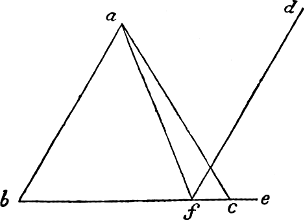
Let there be then a triangle a b c, and let the side b c
be produced to the point e. Then take a point f in b
c, and connect a f, and through the point f, let f
d be drawn parallel to a b. Because, therefore, f d
is parallel to a b, and a right line a f, falls upon
these parallels, as also a right line b c, hence, the alternate
angles are equal, and the external is equal to the internal angle. The
whole, therefore, a f c, is equal to f a b, added to a
b f. In like manner we may shew by drawing a parallel, that the
angle a f b, is equal to the angles f a c, a c f.
The two, therefore, a f b, a f c, are equal to the three
angles of the triangle: and hence, the three angles of a triangle are
equal to two right, viz. to a f b, added to a f c. But
a c f, a c e, are also equal to two right angles. Let,
therefore, the common angle a c f, be taken away; and then the
remaining external angle will be equal to the internal and opposite
angles. And after this manner may the present theorem be exhibited.
But Eudemus, the Peripatetic, ascribes the invention of this theorem
to the Pythagoreans, I mean that every triangle has its internal
angles equal to two right, and says that they demonstrate it in the
following manner.
Let there be a triangle a b c, and let there be drawn through
the point a, a line d e, parallel to b c. Because,
therefore, the right lines d e, b c, are parallel, the
alternate angles are equal. Hence, the angle d a b, is equal
to the angle a b c; and the angle e a c, to the angle
a c b. Let the common angle b a c, be added. The angles,
therefore, d a b, b a c, c a e, that is, the
angles d a b, b a e, and that is two right, are equal to
the three angles of the triangle. And such is the demonstration of the
Pythagoreans.
But it is here requisite to deliver such theorems as are converse to
the present theorem of the elementary institutor. For two are converted
to one, since this is a composite, both, according to the object of
enquiry, and the datum: for the datum is two-fold,
viz. the triangle, and one of its sides produced; and in like manner
the object of enquiry. For one part says, that the external
angle is equal to the internal and opposite angles: but the other,
that the three internal angles are equal to two right. If therefore,
we suppose that the external is equal to the internal and opposite
angles, we may shew that one side is produced, and that the right line
externally situated, is in a direct position with one of the sides of
the triangle: but if the three internal angles are equal to two right,
we may shew that the given figure is a triangle. And so the whole
object of enquiry, is converse to the whole datum.
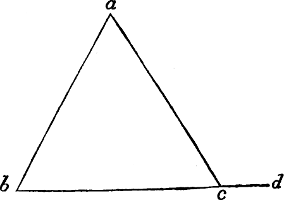
Let there be then a triangle a b c, and let the external angle
a c d, be equal to the internal and opposite angles, I say that
the side b c, is produced to the point d, and that b
c d, is one right line. For since the angle a c d, is equal
to the internal and opposite angles, let the common angle a c b
be added. The angles, therefore, a c d, a c b, are equal
to the three angles of the triangle a b c. But the three angles
of the triangle a b c, are equal to two right. And hence, the
angles a c d, a c b, are equal to two right. But if two
right lines being consequently placed, and not at the same parts to
any right line, and at a point in it, make the successive angles equal
to two right, those right lines shall be in a direct position to each
other. The right line, therefore, b c, is in a direct position
to c d.
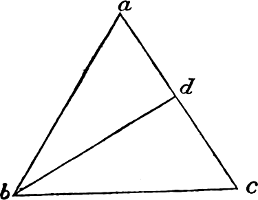
Let there be again, a certain right lined figure a b c, having
three angles alone equal to two right, viz. a, b, and
c, I say that the figure is a triangle, and that a c,
is one right line. For let the right line b d be connected.
Because, therefore, the three angles of each of the triangles a b
d, b d c, are equal to two right, of which the angles of
the figure a b c, are equal to two right, the remainders a d
b, c d b, are equal to two right, and they are placed about
a right line b d. Hence d c, is in the same direction
with d a; and so the side a c, is one right line. In like
manner we may shew that the side a b, and the side b c,
are each of them one right line. And consequently the figure a b
c, is a triangle. If then a figure having internal angles equal
to two right, is right-lined, it is perfectly a triangle: but it does
not follow that a figure is a triangle merely because it has internal
angles equal to two right. For you will find a figure constructed from
circumferences, having its internal angles equal to two right.
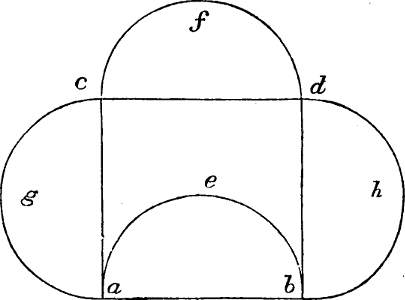
For let there be a quadrangle a b c d, and upon the side a
b, let a semicircle a e b, be internally described: but
upon the other sides, let the semicircles be externally described,
as f, g, h. The figure, therefore, which is
comprehended by the semicircles, has two angles g a e, e b
h, equal to two right, viz. to c a b, d b a. For this
was shewn in the petitions[32], and these angles alone are in this
figure. There is, therefore, a certain figure not a triangle, which
has its internal angles equal to two right. And thus much may suffice
concerning converse theorems.
But as we have discovered that the three angles of every triangle are
equal to two right, we ought to determine a certain method, by which
we may find how many angles, of all other multangles, are equal to so
many right angles; as for instance, of a quadrangle, quinquangle, and
of all consequent multilateral figures. In the first place, therefore,
it must be known, that every right-lined figure may be resolved into
triangles, since a triangle is the principle of the constitution of
all things, which Plato also asserts in the Timæus, when he teaches us
that the rectitude of a plane basis is composed from triangles. But
every figure is resolved into triangles less in number, by the binary,
than its proper sides. If a quadrilateral figure, into two triangles:
if a figure of five sides, into three: if of six sides, into four.
For two triangles composed together, immediately form a quadrilateral
figure. But the number of composite triangles by which the first
constituted figure differs from its sides, is the measure of difference
to the rest. Hence, every multilateral figure possesses more sides,
by the binary, than the triangles into which it may be dissolved. But
every triangle has been shewn to contain angles equal to two right.
And hence, if the number of the angles be made double to that of the
composite triangles, it will afford a multitude of right angles, to
which the angles of every multangle will be equal. On this account
every quadrilateral figure has angles equal to four right, since it
is composed from two triangles: but every figure of five sides has
angles equal to six right; and after the same manner of the rest in a
consequent order. This one thing, therefore, is to be assumed from the
present theorem, concerning all multangular and right-lined figures.
But there is another consequent to this, which is summarily as
follows. In every right-lined figure, each of its sides being at the
same time produced, the angles externally constituted are equal to four
right. For it is requisite, indeed, that the successive right angles
should be double of the multitude of the sides; because, in each they
are constituted equal to two right. But the right angles equal to the
internal angles being taken away, the remaining external angles are
equal to four right. As for example, if the figure is a triangle,
while every one of its sides is produced, at the same time internal
and external angles are constructed equal to six right angles, of
which the internal angles are equal to two right, but the remaining
external angles to four right. But if the figure be quadrilateral,
the angles are in all eight, since they are double of the sides,
of which the internal are equal to four right, and the external to
the four remaining angles, and the consequences will be similar in
infinitum. But after these observations we may also collect, that by
this theorem every angle of an equilateral triangle is two thirds of a
right angle; but that an isosceles triangle, when the vertical angle
is right, has each of its remaining angles the half of one right, as a
semiquadrangle; and that a scalene triangle, when it is the half of an
equilateral triangle, formed by a perpendicular drawn from any angle to
its opposite side, has one angle right, but the other (which likewise
belonged to the equilateral triangle) two thirds of a right angle,
and the remainder by a necessary consequence, a third part of a right
angle. For it is requisite that the three should be equal to two right.
But I do not conceive that these remarks are foreign from our purpose,
since they prepare us for the doctrine of Timæus. This also must be
observed, that the possession of internal angles equal to two right is
inherent essentially, and answering to the predication according
to what, in a triangle. And on this account, Aristotle in his
Treatise on Demonstration[33], employs this as an example, considering
it according to what. As therefore to be terminated, is
essentially and primarily inherent in every figure, so likewise the
possession of internal angles equal to two right, is essentially and
primarily inherent in a triangle, though not in every figure. And the
truth of this theorem seems to present itself to us according to common
conceptions. For if we conceive a right line, and two right lines
standing on its extremities, and inclining to each other, so as to form
a triangle, we shall find that in proportion to their inclination they
diminish the right angles, which they form with the right line. Hence,
obtaining as much angular quantity, by their inclination at the vertex,
as they take away from the base, they necessarily form three angles
equal to two right.
PROPOSITION XXXIII. Theorem XXIII.
The right lines which join equal and parallel right lines at the
same parts, are themselves also equal and parallel.
The present theorem is, as it were, the confine of the consideration
of parallels and parallelograms: for it seems to declare a certain
symptom of parallel right lines, and delivers the latent origin of
parallelograms. For a parallelogram is formed, as well from those equal
and parallel right lines, which are drawn in the beginning, as from
those which conjoin them, and which are in like manner shewn to be
equal and parallel. Hence, the proposition which immediately follows
the present, contemplates the properties essentially inherent in
these spaces, in a parallelogram as it were already constructed. And
these things are indeed manifest. But it is requisite to consider the
diligence which this preposition contains. In the first place, indeed,
that it is not sufficient, that the lines which are conjoined should
be equal: for the lines which connect equals, are not entirely equal,
unless they are also parallel. For a triangle being isosceles, and a
point being assumed in one of the equal sides, and through this a line
being drawn parallel to the basis, equal lines shall indeed conjoin
parallels to the basis, and the basis itself, yet these parallels shall
not also be equal; and the sides will not be parallel, because they
coincide at the vertex of the triangle.
In the second place, he considers that the subject right lines being
parallel, is not sufficient to constitute the equality of the lines
which conjoin them. For this is evident from the preceding construction
of the isosceles triangle; since the drawn right line, and the basis,
are parallel, and yet the lines which connect them are not parallel,
because they are parts of the sides of the isosceles triangle. The
parallel position, therefore, of the lines which are conjoined, is
requisite to the equality of the connecting lines: but the equality of
the latter is necessary to the parallel position of the former. On this
account the institutor of the Elements assumes each, in those which are
conjoined, for the purpose of exhibiting, that the connecting lines
are as well equal, as parallel to one another. But in the third place,
he intimates, that right lines being supposed both equal and parallel,
their connecting lines will not be universally equal and parallel. For
unless we make the conjunctions at the same parts as in this case, the
connecting lines cannot be parallel (since they will cut each other),
so they may be sometimes equal, and sometimes not.
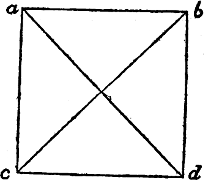
For if you assume a quadrangle, or oblong, as a b c d, and
connect the right lines a d, b c, the diameters are
indeed equal, but not parallel, and they conjoin the equal and parallel
opposite sides of the aforesaid spaces. But if the figure be a Rhombus,
or a Rhomboides, the diameters of these, are not only non-parallels,
but also unequal.
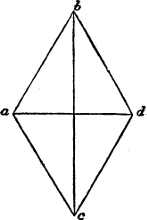
For since a b, is equal to c d, but a c is common,
and the angle b a c, is unequal to the angle a c d, the
bases also are unequal. The institutor of the Elements, therefore, very
properly considered, that the lines which conjoin equal and parallel
lines, ought to make the conjunction at the same parts, lest a
c, b d, being supposed equal and parallel, we should assume
a d, b c, as the connecting lines, and not a b,
and c d. For he shews that these latter are equal and parallel:
but that the former are, indeed, never parallel, but equal, as we
have observed in a quadrangle and oblong, but never in a rhombus and
rhomboides; as the opposite to this has been proved to be true, because
they are unequal, on account of the inequality of the angles internal,
and situated at the same parts.
PROPOSITION XXXIV. Theorem XXIV.
The opposite sides and angles of parallelogrammic spaces are
equal to each other and they are bisected by the diameter.
As from the preceding theorem, he had assumed a parallelogram already
constructed, he now contemplates its primarily inherent properties, and
such things as express its peculiar constitution. But these are the
following: that the sides and angles which are opposite, are equal,
and that the spaces themselves are bisected by the diameter. For
that part of the proposition relates to the spaces, which says: and
they are bisected by the diameter. So that the area itself, is that
whole which is bisected, and not the angles through which the diameter
passes. These three properties then, are essentially inherent in
parallelograms, the equality of the opposite sides and angles, and the
bisection of the spaces by the diameter. And you may observe that the
properties of parallelograms are investigated from all these, viz. from
the sides, from the angles, and from the areas. But as there are four
kinds of parallelograms, which Euclid defines in the hypotheses[34],
viz. a quadrangle, oblong, rhombus, and rhomboides, it deserves
to be remarked, that if we divide these four into rectangles, and
non-rectangles, we shall find, that not only the diameters bisect these
spaces, but that the diameters themselves, are, indeed, in rectangles
equal, but in non-rectangles unequal, as was observed in the preceding
theorem. But if we divide them into equilateral, and non-equilateral,
we shall again find that in the equilateral figures, not only the
spaces are bisected by the diameters, but likewise the angles through
which they are drawn: but in non-equilaterals this is never the case.
For in a quadrangle, and a rhombus, the diameters bisect the angles,
and not the spaces only: but in an oblong, and a rhomboides, they
alone bisect the spaces.
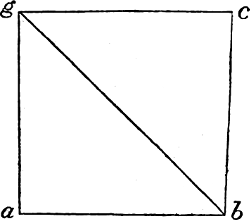
For let there be a quadrangle, or a rhombus, g c a b, and a
diameter g b. Because, therefore, the sides g c, c
b, are equal to the sides g a, a b (for they are
equilateral), and the angles g c b, g a b, are equal
(for they are opposite), and the basis also is common, hence, all
are equal to all; and on this account the angles c g a, a
b c, are bisected.
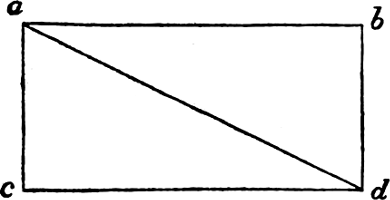
Again, let there be an oblong, or rhomboides given. If, therefore, the
angle b a c, and the angle c d b, is bisected by the
diameter, but the angle c a d, is equal to the angle a d
b, the angle also, b a d, will be equal to the angle a
d b. Hence, the side also, a b, will be equal to the side
b d. But they are unequal; and consequently the angle b a
c, is not bisected by the diameter, nor its equal the angle c d
b. That I may therefore comprehend the whole in a few words, in a
quadrangle the diameters are equal, on account of the rectitude of the
angles, and the angles are bisected by the diameters, on account of the
equality of the sides, and the areas are bisected by the diagonal, on
account of the common property of parallelograms: but in an oblong, the
diameters are indeed equal, because it is a rectangle, but the angles
are not bisected by the diameters, because it is not equilateral,
though the division of spaces into equal parts, is also inherent in
this figure, so far as it is a parallelogram: but in a rhombus the
diameters are unequal, because it is not a rectangle, but the spaces
are not only bisected by these, because it is a parallelogram, but the
angles also, because it is equilateral; and in the remaining figure,
i.e. a rhomboides, the diameters are unequal, because it is not a
rectangle, and the angles are cut by these into unequal parts, because
it is not equilateral, and the spaces alone situated at each part of
the diagonals, are equal, because it is a parallelogram. And thus much
concerning observations of this kind, which exhibit the diversity found
in the four divisions of parallelograms.
But we must not pass over in silence, the artificial consequence
appearing in this theorem, that of theorems, some are universals,
but others non-universals. But we shall speak concerning each of
these, when we divide the object of investigation, which has,
indeed, one part universal, but the other non-universal. For though
every theorem may seem to be universal, and every thing exhibited by
the elementary institutor may appear to be of this kind (as in the
present he may not only seem to assert, that in all parallelograms
universally, the opposite sides and angles are equal, but likewise that
each is bisected by the diameter), yet we must say that some things are
universally exhibited, but others not universally. For it is customary
to call the universal which affirms the truth concerning
every thing of which it is predicated, differently from that
universal, comprehending all things in which the same symptom is
inherent. Thus it is universal, that every isosceles triangle has
three angles equal to two right, because it is true of all isosceles
triangles: and it is universal that every triangle has three angles
equal to two right, because it comprehends all things, in which this is
essentially inherent. On which account we affirm that the possession
of three angles equal to two right, is to be primarily manifested of
a triangle. According to this signification, therefore, of theorems,
calling some universal, but others non-universal, we must affirm that
the present theorem, has, indeed, one of its objects of investigation
universal, but the other non-universal. For the possession of opposite
sides and angles that are equal, is a universal, since it is alone
inherent in parallelograms: but that the diameter bisects the space,
is not universal, because it does not comprehend all things in which
this symptom is beheld; for this is inherent in a circle and ellipsis.
And it appears, indeed, that primary conceptions of such like concerns,
are more particular, but that in their progress they comprehend the
whole. For when the ancients had contemplated that a diameter bisects
an ellipsis, circle, and parallelogram, they afterwards surveyed that
which was common in these. But we are deceived (says Aristotle[35])
when a non-universal is exhibited as universal, because that common
something in which the symptom is primarily inherent, is nameless. For
we cannot say what that is, which is common to numbers and magnitudes,
motions and sounds; and it is likewise difficult to express what is
common to an ellipsis, circle, and parallelogram. For one of these
figures is right-lined, but the other circular, and the third mixt;
and on this account we conceive that he exhibits universally, who
demonstrates that a diameter bisects every parallelogram, because we
do not at the same time perceive that common something, on account of
which, this is true. This then in parallelograms, is not an universal
of this kind, on account of the aforesaid cause; but the proposition
is universal, which asserts, that every parallelogram has its opposite
sides and angles equal. For if any figure is supposed, having its
opposite sides and angles equal, it may be shewn to be a parallelogram.
Thus let such a figure be a b c d[36], and its diameter a
d. Because, therefore, the sides a b, b d, are equal
to the sides a c, c d, and the angles comprehended by
them are equal, and the base common, all will be equal to all. The
angle, therefore, b a d, is equal to the angle a d c, and
the angle a d b, to the angle c a d. Hence, a b,
is parallel to c d, and a c to b d. And on this
account the figure a b c d, is a parallelogram. And thus much
may suffice for observations of this kind.
But the institutor of the Elements seems to have composed the name
of parallelograms, by taking an occasion from the preceding theorem.
For when he had shewn that right lines, which conjoin equal and
parallel right lines at the same parts, were themselves also equal and
parallel, it is evident that he pronounces as well the opposite sides
which conjoin, as those which are conjoined, to be parallel: but that
he very properly calls the figure which is contained by parallels,
a parallelogram, in the same manner as he denominates that which is
comprehended by right lines rectilineal. And it is evident that the
institutor of the Elements places a parallelogram among quadrilateral
figures. But it is worthy our observation and enquiry, whether every
right-lined figure, which is composed from equal sides, since it is
equilateral and equiangular, is to be called a parallelogram. For a
figure of this kind also, has its opposite sides equal and parallel,
as likewise the opposite angles equal. As for example, a sexangle, and
an octangle, and a decangle.
Thus, if you conceive a sexangle a b c d e f, and connect a
right line a c, you may shew that a f is parallel to
c d. For the angle at the point b, is one right, and
the third part of a right angle; and this is true of every angle of
a sexangle, since it is equiangular. Besides the side a b, is
equal to the side b c, for it is placed equilateral. Each of
the angles, therefore, b a c, b c a, is a third part of
a right angle. Hence, the angles f a c, a c d, are right
angles. And on this account a f, is parallel to c d. In
like manner we may shew that the other opposite sides are parallel, and
the same may be evinced in an octangle, and in the remaining figures of
this kind. If, therefore, that is a parallelogram which is comprehended
by parallels oppositely situated, a parallelogram will likewise
subsist among non-quadrilateral figures. But it appears that with the
institutor of the Elements a parallelogram is quadrilateral. And this
is particularly perspicuous in that theorem, in which he says, that
a parallelogram which has the same base with a triangle, and is between
the same parallels, is double of the triangle: for this is alone
true in quadrilateral figures.
PROPOSITION XXXV. Theorem XXV.
Parallelograms which are upon the same base, and between the same
parallels, are equal to each other.
As we have said that of theorems, some are universal, but others
particular, and as dividing these we have subjoined, that some are
also simple, but others composite, and have shewn the nature of each,
so according to another distinction, we assert that some of these are
local, but others non-local. But I call those local, to which the same
symptom happens in a certain place; and I denominate the place of a
line or a superficies, that situation, which produces one and the same
symptom. For of local theorems some are constructed in lines, but
others in superficies. And because of lines, some are plane, but others
solid, the plane being those of which there is a simple conception in
a plane, as of a right line: but the solid those whose origin appears
from a certain section of a solid figure, as of cylindric, spiric,
and conic lines, I should say, that of the local theorems which are
constructed in lines, some have a plane, but others a solid place. The
present theorem, therefore, is both local, and local in lines, and a
plane. For the whole space which lies between the parallels, is the
place of the parallelograms constructed upon the same base; and which
the institutor of the Elements shews to be equal to each other. But
of those local theorems which are called solid, let the following be
an example[37]. The parallelograms which are inscribed within the
asymptotes and the hyperbola, are equal: for it is evident that the
hyperbola is a solid line.
But Chrysippus, as we are informed by Geminus, assimilates theorems of
this kind to ideas. For as ideas comprehend the origin of infinites,
in terminated limits, so in these also there is a comprehension of
infinites, in terminated places, and by this boundary equality appears,
since the altitude of the parallels remaining the same, if infinite
parallelograms are conceived upon the same base, they may all be
shewn to be equal to each other. The present, therefore, is with the
institutor of the Elements, the first local theorem. And he appears,
when, agreeable to an elementary mode, he had distinguished theorems by
a variety, according to all possible divisions, with great propriety
not to have omitted, considering their idea of this kind. Nevertheless,
as his discourse, for the present, is concerning right lines, he
delivers local plane theorems in right lines: but in the third book,
as he treats concerning things which may be contemplated of circles,
and their symptoms, he likewise teaches the particulars, which are
constructed in circumferences belonging to local, and at the same time,
plane theorems. And such, among these, is the theorem, which says,
that angles in the same segment, are equal to one another. Also
this which asserts, that the angles in a semicircle are right.
For if infinite angles are constructed in a circumference, the same
base remaining, they are all shewn to be equal; but if that which is
comprehended by the base and the circumference, is a semicircle, they
are all shewn to be right. And these, indeed, correspond in proportion
to triangles and parallelograms upon the same base, and between the
same parallels. And such is the species of theorems called local, by
the ancient mathematicians.
But perhaps it may seem perfectly worthy of admiration, to such as
are unskilled in contemplations of this kind, that parallelograms
constructed upon the same base, and between the same parallels, should
be equal to each other. For it may be asked, how is this possible,
since the longitude of the spaces, constructed on the same base,
increases in infinitum? Since as much as we produce the parallels, by
so much we may also increase the longitudes of the parallelograms. But
some one may not improperly enquire how, while this takes place, the
equality of the spaces remains. For if the breadth is the same (since
the base is one), but the length is greater, will not the space also
be greater? The present theorem, therefore, and that which follows
concerning triangles, are among the number of mathematical theorems,
which are denominated admirable. For mathematicians in theorems, as
the Stoics in arguments, have established a place, which is
called admirable, and they place the present among theorems of this
kind. The vulgar, therefore, are immediately astonished, when they
hear that the multiplication of length does not destroy the equality
of spaces on the same base. We must nevertheless assert, that equality
and inequality possess the greatest power in increasing or diminishing
the spaces of angles. For in proportion as we make angles unequal,
in such proportion we diminish the space, if the length and breadth
remain the same. Hence, the increase of length is necessary, that we
may preserve equality. Thus, for example, let there be a parallelogram
a b c d, and let the side a c be produced in infinitum,
and let it be a right-angled parallelogram; and lastly, on the base
b d, construct another parallelogram b e f d.
That the length, therefore, is increased is evident: for the side
b e, is greater than the side a b, since the angle at
the point a, is right. But this necessarily takes place, as
the angles of the parallelogram b e f d, are unequal, and some
of them are acute, but others obtuse: and this happens, because the
side b e, approaches after a manner to the side b d,
and contracts the space. For let b g be taken equal to a
b, and through g, draw g h parallel to b d.
The length, therefore, of the parallelogram b d g h, is equal
to the length of the parallelogram a b c d, and the breadth is
the same, and yet one space is less than the other; for it is less
than b e f d. Hence, the inequality of angles diminishes the
area, but the increment of length adding as much as the inequality
of angles takes away, preserves the equality of the spaces. But the
boundary of the increase of length, is the place of the parallel lines.
For when both the parallelograms are rectangular, and have an equal
ambit, the quadrangle is shewn to be greater than the oblong[38]: but
when they are both equilateral, and have consequently an equal ambit,
that which is rectangular, is shewn to be greater than that which is
non-rectangular[39]. For the rectitude of angles, and the equality of
sides, possesses universal power in the augmentation of spaces. It is
on this account that a quadrangle is the greatest of all figures with
an equal ambit, and a rhomboides the least. And these observations we
shall demonstrate in another place[40]: for they more properly belong
to the hypotheses of the second book.
But with respect to the present theorem, it is requisite to know,
that when Euclid calls parallelograms equal, he means the spaces, and
not the sides: for he now discourses of areas. And we must likewise
observe, that he first mentions trapeziums in the demonstration of
this theorem: from whence also it is manifest, that he does not
improperly teach us concerning a trapezium, in the definitions, when
he informs us that it is indeed of a quadrilateral species, but is not
a parallelogram. For the figure which has not its opposite sides and
angles equal, falls from the order of parallelograms. The institutor
of the Elements, therefore, as he had chosen a more difficult case,
demonstrates the thing proposed. But if any one should say, let the
parallelograms a b c d, and b d c e, be upon the same
base d b, so that the side c d may be the diameter of the
parallelogram a b, we can shew that according to this position
they are equal. For the triangle b c d, is the half of each
parallelogram: because c d is the diameter of a b, but
c b of d e; and diameters bisect parallelograms.
Hence, a b is equal to the parallelogram d e. Again, if
any one should suppose that the side a c, of the parallelogram
a b, is cut by the side d c, and that the parallelograms
are situated as a d b e, b d c f, we can shew that these
also are equal.
For since the side a e, is equal to the side
c f (each because opposite being equal to d b), let
the common right line c e be taken away. Hence, a c is
equal to e f. But a d, also, is equal to e b, and
the angle c a d, to the angle f e b. For a d is
parallel to e b; and hence, the base c d, is equal to
the base f b, and the whole triangle a d c, is equal to
the whole triangle e b f. Let the common trapezium c b,
be added. The whole, therefore, a b, is not unequal to the
whole d f. And here you may observe that these are the only
three cases. For the side d c, either cuts the side e b,
according to the position of the elementary institutor; or it falls
on the point c, as in the penultimate description: or it cuts
the line a e, according to the present supposition. And thus
the theorem is shewn to be true according to all its cases. Lastly, as
there is a two-fold difference of trapeziums, and one kind has neither
of its opposite sides parallel, but the other has one side parallel
to one, this latter species of trapeziums is alone employed by the
geometrician throughout the elements, and in the present description:
for c e is parallel to d b.
PROPOSITION XXXVI. Theorem XXVI.
Parallelograms which are upon equal bases, and between the same
parallels, are equal to each other.
The preceding theorem assumed, indeed, the same bases, but this
receives them equal, and different from each other. But it is common
to both, to suppose the parallelograms between the same parallels. It
is requisite, therefore, that they should neither fall within, nor
without their subject parallel lines. For parallelograms are said to
be between the same parallels, when their bases and opposite sides are
adapted to the same parallels. As to the rest, the institutor of the
Elements, as he had assumed the bases entirely separate, exhibits the
theorem. But nothing hinders our receiving them with this hypothesis,
so that they may have a common part. For let a b, c d, be
parallelograms upon equal bases e b, f d, having a common
part, and constructed between the same parallels, I say that they are
equal.
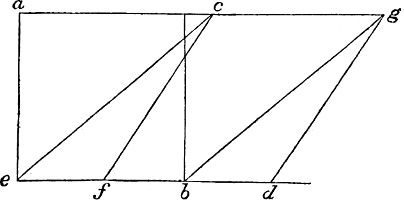
Let the lines e c, b g, be connected. Because, therefore,
e f, is equal to b d (for the base e b, was
supposed equal to the base f d), but the side c f, is
equal to the side d g, and the angle c f e, is equal to
the angle g d b, and hence, c e is equal to b g.
But it is also parallel to it. Hence, c b is a parallelogram,
and has the same base with each of the parallelograms a b, c
d, and is between the same parallels. The parallelogram, therefore,
a b, is equal to the parallelogram c d.
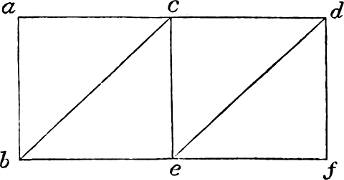
But if any one should suppose that the bases of the parallelograms
have neither a common part, nor are separate from each other, but
(which is the only remaining hypothesis) that they touch each other in
one point, as in the parallelograms a e, e d, we must say
that the base b e is equal to the base e f, and to the
side c d. Hence, also, the right line c b, is equal to
the right line d e, and is parallel to it. For the lines which
join equal and parallel lines, are themselves also equal and parallel.
Hence, b d is a parallelogram, and is upon the same base, and
between the same parallels, with the parallelograms c b, d
e. The parallelograms, therefore, c b, d e, are
equal. But according to the first conception of a theorem, we may
divide the constructions by asserting that the bases have either a
common part, or touch each other, or are distant from each other. It is
however possible, that though they may touch each other, as b e,
e f, yet the whole parallelogram d e may be supposed
external to the side c e; or one side of the parallelogram c
f, may be the diameter of the parallelogram a e; or the
side c e, may cut the side a c; or the side a c,
being produced beyond a, the side c e, may fall as the
diameter of the parallelogram increased towards a, when the side
d f becomes the same as a line drawn from a to f,
or the side c e, may cut the side a c, produced beyond
a; or the side a c, may be still farther produced beyond
a, so that the side c e may fall beyond the point, to
which a c was extended in the preceding case, and the side d
f, may cut the line produced beyond a[41]. * * *
PROPOSITION XXXVII. Theorem XXVII.
Triangles which are upon the same base, and between the same parallels,
are equal to each other.
The beginning of this Commentary is wanting.
***
* * for those being equal, the spaces are unequal; and when these
are unequal, those are shewn to be equal. And this is the case with
Chorographers, when they reason concerning the magnitudes of cities,
from their ambits. But formerly, certain persons deceived their
partners, in the distribution of their possessions, deluding them by
an excess of ambit, so as to make them believe that they received
a greater portion of land, when they received a greater ambit; and
that they were gainers, by changing spaces into areas of less ambit.
[42]Thus two isosceles triangles being proposed, one of which has
each of its equal sides, containing five parts, but the base six:
and the other has each of its equal sides five parts, but the base
eight; and let these parts be, for instance, cubits, or digits, these
triangles will very much deceive the ignorant in their choice. For
the ambit of the one is eighteen, and of the other sixteen measures.
But a geometrician is not ignorant that the spaces are equal, though
the ambits are unequal; since the area of each is twelve measures.
For if you draw a perpendicular from the vertex, you will bisect the
bases, and cause the half of the one to be three but of the other
four measures: but the perpendicular on the contrary, will be there
equal to four, but here equal to three; since it is requisite that
the square from the quinary, should be equal to the squares from
the perpendicular, and the half of the base. But if the base of the
one is equal to three, the perpendicular must be four; and if the
base of the other is equal to four, its perpendicular must be three.
When, therefore, you have multiplied the half of the base with the
perpendicular, you will have a space equal to the triangle: but this
is the same in each, whether you multiply the quaternary with the
ternary, or the ternary with the quaternary. And we have made these
observations for the purpose of shewing that the equality of spaces
is not to be entirely received from the ambits. Nor should we wonder,
that though triangles upon the same base, may be infinitely increased
between the same parallels, according to the remaining sides, yet the
equality of the spaces immutably remains. But those triangles are said
to be between the same parallels, which have their bases upon one of
the parallel lines, and fix their vertices on the remainder; and whose
vertices being connected, form one right line, parallel to the bases on
the same right line.
PROPOSITION XXXVIII. Theorem XXVII.
Triangles which are upon equal bases, and between the same parallels,
are equal to each other.
The present theorem also is local, because it corresponds in
proportion with parallelograms, and supposes the situation of triangles
upon equal bases. But Euclid seems, to me, to have delivered one
demonstration by the first proposition of the sixth book of these
four theorems, two of which are exhibited in parallelograms, and two
in triangles: and two of which are on the same base, and the other
two on equal bases. But that Euclid has performed this is unknown to
the vulgar. For after he had shewn that triangles and parallelograms,
which are under the same altitude, have the same proportion to each
other as their bases, nothing demonstrates all these four theorems
more universally, from proportion, than this theorem: since to possess
the same altitude, is nothing else than being constituted between
the same parallels. For all figures between the same parallels, are
under the same altitude, and the contrary: since the altitude is the
perpendicular, which extends itself from one parallel to the rest. In
that proposition, therefore, it is shewn by proportion, that triangles
and parallelograms, under the same altitude, that is, situated between
the same parallels, are to each other as their bases, and so when the
bases are equal, the spaces are equal; and when those are double,
these will be double; and when the bases have any other proportion,
the spaces also will have to each other the same proportion. But for
the present, because it is not proper that he should use proportion,
who has not yet explained its nature, he is content with equality and
identity alone: for the identity of bases is collected from equality.
Hence, these four theorems are comprehended in that one; not only
because he shews by one demonstration, whatever are contained in
these four, but likewise, because he adds what was wanting to their
perfection, viz. identity of proportion, though the bases are unequal.
But that this theorem, also, has many cases, and that it is possible
that the bases of the triangles may be assumed, either having the same
part as in parallelograms; or possessing no common part, but touching
each other according to one point; or entirely separate, so that a line
may intervene between them, is manifest, even to such as are endued
with slender capacities. And this too is evident, that according to all
cases, however the bases or vertices may be situated, the same method
of proceeding must be adopted as in parallelograms; viz. parallels to
the sides must be drawn, and produced both ways, and the equality of
the triangles exhibited.
PROPOSITION XXXIX. Theorem XXXIX.
Equal triangles, which are upon the same base, and at the same parts,
are between the same parallels.
When it was proposed to exhibit equality to us, then it was requisite
to make four theorems, receiving two in parallelograms, but the other
two in triangles, situated either upon the same, or upon equal bases.
But now by conversion, we neglect the theorems which are converse in
parallelograms, and esteem such as are converse in triangles worthy of
relation. And the reason of this is, because the mode of demonstration
in parallelograms, is the same indifferently, by a deduction to an
impossibility, and the construction is similar. But we are content when
we have exhibited the way in more simple figures, I mean triangles,
to leave to the more curious the same mode of reasoning in the rest:
since it is easy, at the same time, to perceive that there is the same
method in these. For when we assume equal parallelograms, upon the same
base, or upon equal bases, we must say that they are also between the
same parallels. For if they are not, either one of them falls within,
when the parallels which are in the other are produced; or without.
But which ever case is assumed, when we receive it and its parallels,
we may exhibit the same consequences as in triangles, I mean that the
whole will be equal to its part: but this is impossible. It is however
manifest, that the institutor of the Elements very properly adds the
particle, and at the same parts. For it is possible that equal
triangles, may be assumed upon the same base, one, indeed, at these
parts, but the other at different parts, and yet these will not be
entirely between the same parallels: for neither will they be contained
under the same altitude. And on this account he added the particle.
But since a parallel may be drawn in a two-fold respect, according
to an absurd hypothesis, i.e. either within or without, Euclid draws
it within: but we can exhibit the same consequences, by drawing it
without. For let the equal triangles a b c, d b c, be
upon base, and at the same parts, I say that they are between the
same parallels, and that the right line connected at their vertices,
is parallel to the base. Let the right line a d be connected.
But if this is not parallel, let the line, external to this, i.e.
a e be parallel, and let b d be produced to the point
e, and connect e c.
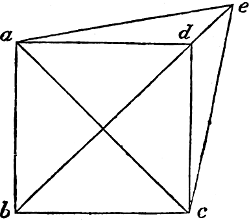
The triangle, therefore, a b c, is equal to the triangle e b
c, the whole to the part. But this is impossible; and hence, the
parallel line does not fall external to a d. But it is shewn
by the institutor of the Elements, that neither does it fall within:
and hence a d, is parallel to b c. Hence too, equal
triangles, which are at the same parts, and upon the same base are
parallel to each other. And thus the remaining part of the deduction
to an impossibility is demonstrated. But it is worthy of observation,
that since the conversion of theorems is triple (for either the whole
is converted to the whole, as we have noticed, in the eighteenth and
nineteenth theorems; or the whole to the part, as the sixth and fifth;
or the part to the part, as the eighth and the fourth: for the whole is
not a datum, in the one, and an object of investigation
in the other: nor is the object of investigation, a
datum, but a part) these triangular theorems appear to be of this
kind. For, that the triangles are equal, is an object of investigation
in the preceding; but this is not a datum alone in these, because
it assumes, besides this, a part of that which was hypothesis in
those. For to stand upon the same, or upon equal bases, is a datum in
these, as well as in those, except that in these hypotheses he adds
something which was neither an object of investigation, nor a datum in
these; since the particle at the same parts, is over and above
extrinsically assumed.
PROPOSITION XL. Theorem XXX.
Equal triangles which are upon equal bases, and at the same parts, are
between the same parallels.
There is the same mode of conversion too in the present theorem,
and a similar demonstration; and that part of the deduction to an
impossibility, which is omitted by the institutor of the Elements,
is demonstrated after the same manner, and there is no occasion for
repetition. But since these three conditions are in the aforesaid
propositions, situation upon equal, or on the same bases;
position between the same parallels; and equality of triangles and
parallelograms, it is manifest that we may variously convert, by
always connecting two, and leaving one. For we either supposed the
bases the same, or equal, and triangles and parallelograms between
the same parallels, and thus we form four theorems; or we consider
the triangles and parallelograms equal, and the bases the same, or
equal, and thus we produce another four, two of which the elementary
institutor omits, viz. those which respect parallelograms, but the
other two relative to triangles, he exhibits; or lastly, when we have
assumed them equal, and between the same parallels, we prove the
remainder, that they are either upon the same, or upon equal bases, and
produce another four, which the institutor of the Elements entirely
neglects. For there is the same demonstration in these, except that
two of these four are not essentially true. Thus, equal parallelograms
or triangles, between the same parallels, are not necessarily upon the
same base: but all this is true in these hypotheses, that they are
upon the same or equal bases; but the other does not entirely follow
the assumed hypotheses. Hence, as all these theorems are ten, the
geometrician speaks of six, and neglects four, lest he should labour in
vain, by repetition, since the demonstration is the same. For it may
be shewn in triangles, that if they are equal, and between the same
parallels, they will either be upon the same, or upon equal bases. For
let it be denied, and if possible, let the triangles a b c,
d e f, have these conditions, upon unequal bases b c,
e f.
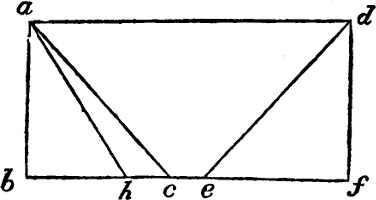
Let too, b c, be the greater, and cut off b h, equal
to e f, and connect a h. Because, therefore, the
triangles a b h, d e f, are upon equal bases, b
h, e f, and between the same parallels, they are equal. But
the triangles also, a b c, d e f, are supposed equal.
Hence, the triangles a b c, a b h, are equal, which is
impossible. The bases, therefore, of the triangles a b c, d e
f, are not unequal. And the mode of demonstration will be the same
in parallelograms. Since, therefore, the ostensive method is the same,
and the impossibility the same, viz. that the whole is equal to its
parts, it is not improperly omitted by the elementary institutor. And
thus we have shewn, that there are necessarily ten theorems, and have
enumerated what are omitted, and shewn the reason of their omission.
But let us now pass to the following propositions.
PROPOSITION XLI. Theorem XXXI.
If a parallelogram has the same base with a triangle, and is
between the same parallels, the parallelogram shall be double
the triangle.
The present theorem also is local, but it mingles the constructions
of triangles and parallelograms, situated under the same altitude. As,
therefore, we have separately surveyed parallelograms and triangles,
so when we assume each of them in conjunction, and with the same
condition, we contemplate their proportion to each other. In the
former, therefore, an equality of proportion is apparent, since all
upon the same bases, and between the same parallels, have a mutual
equality, whether they are triangles, or parallelograms. But in
these latter, the first of unequal proportions, I mean the duple,
is exhibited: for he demonstrates that a parallelogram is double of
a triangle, on the same base, and possessing the same altitude. But
the elementary institutor shews the thing proposed, by supposing the
vertex of the triangle external to the parallelogram. We can, however,
demonstrate the consequence, by assuming the line which is parallel
to their common base, in the other side of the parallelogram: for
these are two cases of the theorem. Since in consequence of the two
having the same base, it is necessary that the vertex of the triangle
should either be within, or without the parallelogram. Let there be,
therefore, a parallelogram a b e d, and a triangle e c d,
and let a point c be placed between the points a and
b, and connect the right line a d.
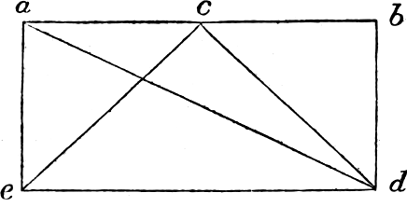
Because, therefore, the parallelogram is double of the triangle e
c d, but the triangle a d c, is equal to the triangle e
d c, hence, the parallelogram is double of the triangle e c
d. And hence it is evident that a parallelogram is double of a
triangle on the same base. But if the bases are equal, we can shew
the same by drawing the diameters of the parallelograms: for if the
triangles are equal, the parallelogram which is double of the one, will
also be double of the other. But triangles are equal, on account of
the equality of bases, and the identity of altitude. The geometrician,
therefore, very properly omits this, for the demonstration is the
same: since they will either have the same part, or they will be
conjoined in one point only, or they will be separate from each other.
But in whatever manner they may receive this variety, there is one
demonstration according to all the cases.
We can likewise demonstrate the converse propositions to this theorem,
after the same manner. One of which is: If a parallelogram is double
of a triangle, and they have the same or equal bases, and are at the
same parts, they shall be between the same parallels. For if they
are not the whole shall be equal to the part, and the same proportion
shall prevail: since it is necessary that the vertex of the triangle
should either fall within, or external to the parallels. But in either
case, the same impossibility will be the result, by drawing a parallel
to the base, through the vertex of the triangle. But the second
converse theorem is: If a parallelogram is double of a triangle, and
both are between the same parallels, they will either be situated upon
one base, or upon equal bases. For if they are upon unequal bases,
since we have assumed the figures to be equal, we may shew that the
whole will be equal to its part. Hence, all these theorems end in this
common impossible: and on this account, the institutor of the Elements
leaves us to investigate the variety they contain, as he himself, has
contracted his speculation to such as are more simple, and of a more
primary nature. However, as we have recognized these observations, let
us see for the sake of exercise, by not assuming a parallelogram, but
a trapezium, two of whose sides only are parallel (because it has the
same base with the triangle, while it is situated between the same
parallels), let us, I say, consider what proportion it possesses to the
triangle. That it has not, therefore, a duple proportion is evident:
for if it had a duple ratio, it would be a parallelogram, since it
is a quadrilateral figure. But I say that it is either greater than
double or less; for since the two sides are parallel, one is greater,
but the other less; because if equal, the sides conjoining them will
be parallel. If, therefore, the triangle has its greater side for
the base, the quadrilateral figure will be less than double of the
triangle: but if the lesser side, it will be more than double. For
let a b c d, be a quadrilateral figure, and let the side a
b, be less than the side c d, and produce the side a
b, in infinitum, and let the triangle e c d have the same
base with the quadrilateral figure, that is c d; and lastly,
through d, draw d f, parallel to a c.
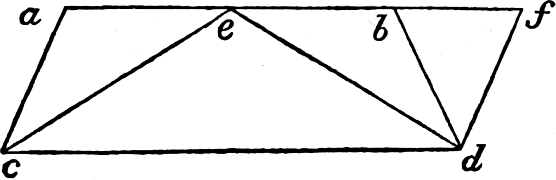
Hence, the parallelogram a c d f, is double of the triangle e
c d; and so the quadrilateral figure a b c d, is less than
double of the triangle.
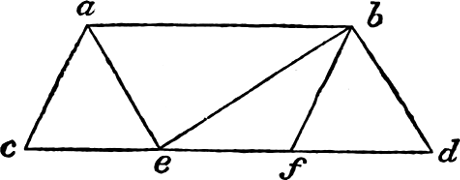
Again, let the triangle have the base a b, and draw b f,
parallel to a c. The parallelogram, therefore, a b f c,
is double of the triangle. And hence, the quadrilateral figure, a
b c d, is more than double of the triangle. This being shewn; we
affirm, that when there is a quadrilateral figure, whose two opposite
sides only, are parallel, if one of the parallel sides is bisected,
and right lines are drawn from it to the other side, the quadrilateral
figure, is either more or less than double of the triangle resulting
from such a construction. But if one of the sides by which the parallel
lines are conjoined, is bisected, and certain right lines are drawn
from it to the remaining side, the quadrilateral figure, will be
perfectly double of the triangle which is produced. And this may be
shewn as follows. Let there be a quadrilateral figure a b c d,
and let the side a d, be parallel to the side b c, and
bisect d c, in the point e, and connect the right lines
a e, e b, and produce b e, till it coincides with
a d, in some point, as f. Because, therefore, the angles
at the point e, are equal, for they are vertical; likewise,
because the angle f d e, is equal to the angle b c e,
the side also f e, will be equal to the side e b, and
the triangle d e f, will be equal to the triangle b c e.
Let the common triangle a d e, be added.
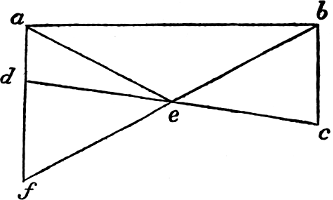
The whole triangle, therefore, a e f, is equal to the two
triangles a d e, b c e. But the triangle a e f,
is equal to the triangle a e b: for they are upon equal bases,
b e, e f, and between the same parallels, if a line
parallel to b f, is drawn[43]. Hence, the triangle a e
b, is equal to the triangles a d e, b c e, and the
quadrilateral figure a b c d, is double of the triangle a
e b, which was to be shewn. After the same manner, we may shew,
that if the side a b, is bisected, and certain right lines are
drawn from it, to the side e d, the quadrilateral figure will be
double of the triangle formed by such a construction. If, therefore,
one of the sides by which the parallel lines are conjoined is bisected,
and from it certain right lines are drawn to the remaining side, the
quadrilateral figure shall be double of the triangle. And these things
are demonstrated for the sake of geometrical exercise. Let us now
proceed to the subsequent propositions.
PROPOSITION XLII. Problem XI.
To construct a parallelogram equal to a given triangle, in a given
rectilineal angle[44].
****
PROPOSITION XLIII. Theorem XXXII.
The complements of parallelograms, situated about the diameter
of every parallelogram, are equal to each other.
The beginning of this commentary is wanting.
****
that parallelograms are not mutually conjoined according to one point,
and that the complements are not quadrilateral; it is requisite that
placing this also as a case, we should regard the same accident.
For let there be a parallelogram a b, having the parallelograms
c k, d l, about the same diameter, and let a certain
right line k l, which is a part of the diameter intervene
between them. Again, therefore, you may say the same, viz. that the
triangle a c d, is equal to the triangle b c d, and the
triangle e c k, to the triangle k c f; and likewise the
triangle d g l, to the triangle d h l. The remaining
figure, therefore, a g l k e, of five sides, is equal to the
remaining five-sided figure b f k l h. But these were the
complements. Again, if the parallelograms are neither conjoined
according to a point, nor distant from each other, but mutually cut
each other, on this hypothesis also, the demonstration will be the
same.
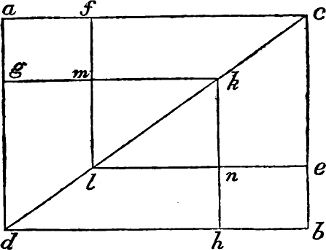
For let there be a parallelogram a b, and a diameter c
d, and let parallelograms be constructed about it, one of which
is e c f l, but the other, by which this also is intersected,
d g k h. I say that the complements f g, e h,
are equal. For since the whole triangle d g k, is equal to the
whole triangle d h k, but a part of it also, the triangle k
l m, is equal to the triangle k l n; (since l k is a
parallelogram); hence the remaining trapezium d l n h, is equal
to the remaining trapezium d l m g. But the triangle a d
c, is equal to the triangle b c d, and the triangle f c
l, in the parallelogram e f, to the triangle e c l,
and the trapezium d g m l, to the trapezium d h n l. The
remaining quadrilateral figure, therefore g f, is not unequal to
the remaining quadrilateral figure e h. And hence, the theorem
is exhibited according to all its cases. But there are three only, and
neither more nor less. For the parallelograms consisting about the same
diameter, either cut each other or touch each other, according to a
point, or are distant from each other by a certain part of the diameter.
But the institutor of the Elements assumes the appellation of
complements, from the thing itself, so far as these also,
besides two parallelograms, fill up the whole: and on this account,
it was not of itself thought worthy of being remembered in the
definitions. For, indeed, variety is requisite to its declaration, such
as the knowledge of a parallelogram, and what those parallelograms
are, which are about the diameter of the whole parallelogram; since,
when these are explained, this likewise becomes known. But those
parallelograms are about the same diameter, which have a part of the
whole diameter for their own: and those which have not this condition,
are by no means about the same diameter. For when the diameter of the
whole parallelogram is cut by the sides of an internal parallelogram,
then this parallelogram is not about the same diameter with the whole
parallelogram. As for example, in the parallelogram a b, let the
diameter c d, cut the side e h, of the parallelogram c
e. The parallelogram, therefore, e c, is not about the same
diameter with the parallelogram c d.
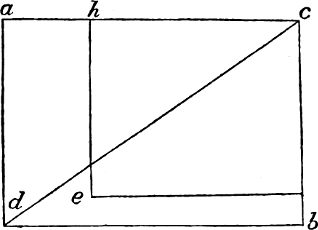
PROPOSITION XLIV. Problem XII.
To a given right line, to apply a parallelogram equal to a given
triangle, in an angle which is equal to a given right lined
angle.
According to the Familiars of Eudemus, the inventions respecting the
application, excess, and defect of spaces, is
ancient, and belongs to the Pythagoric muse. But junior mathematicians
receiving names from these, transferred them to the lines which are
called conic, because one of these they denominate a parabola, but
the other an hyperbola, and the third an ellipsis[45]; since, indeed
these ancient and divine men, in the plane description of spaces
on a terminated right line, regarded the things indicated by these
appellations. For when a right line being proposed, you adapt a
given space to the whole right line, then that space is said to be
applied; but when you make the longitude of the space greater
than that of the right line, then the space is said to exceed;
but when less, so that some part of the right line is external to the
described space, then the space is said to be deficient. And
after this manner, Euclid, in the sixth book, mentions both excess and
defect. But in the present problem he requires application, wishing to
apply to a given right line a parallelogram equal to a given triangle;
that we may not only have the construction of a parallelogram equal
to a given triangle, but also an application to a determinate right
line. As for example, a triangle being given, having an area of twelve
feet, but a right line being proposed, whose length is four feet, we
may apply to the right line a parallelogram equal to the triangle, if
when we assume the whole length of four feet, we find how many feet
the breadth ought to contain, that the parallelogram may become equal
to the triangle. When, therefore, we have discovered that the breadth
is three feet, and have multiplied the length with the breadth, the
proposed angle being right, we shall obtain the desired space. And such
is the verb to apply, formerly delivered by the Pythagoreans.
But there are three things given in the present problem; one, the right
line to which it is to be so applied, that it may become the whole
side of that space; but the other is the triangle to which that which
is applied ought to be equal; and the third is the angle to which it
is requisite that the angle of the space should be equal. And here it
is again perspicuous, that when the angle is right, the space which
is applied, is either a quadrangle, or an oblong; but when it is
either acute or obtuse, the space is either a rhombus, or rhomboides.
Besides, this too is manifest, that the right line ought to be finite;
since this cannot be accomplished on an infinite line. At the same
time, therefore, as he says, to apply to a given right line,
he indicates that the right line must be necessarily finite. But he
uses in the construction of the present problem, the construction of a
parallelogram equal to a given triangle; since, as we have observed,
application is not the same with construction. For the latter, indeed,
constructs both the whole space, and all the sides; but the former,
when it has one side given, constitutes on this the space, because it
is neither deficient, nor exceeds according to this extension, but uses
this one side which comprehends the area. But you may perhaps say, why
does he use theorems, when he shews triangles equal to triangles; but
problems, when he shews triangles equal to parallelograms? We reply, it
is because equality spontaneously arises in things of the same species;
but requires origin, and fabrication, in things of a dissimilar
species, on account of the mutation subsisting according to species,
since it is by itself difficult of invention.
PROPOSITION XLV. Problem XIII.
To construct a parallelogram equal to a given right-lined figure, in a
given rectilineal angle.
The present is more universal than the two problems, in which he
invented as well the construction, as the application of parallelograms
equal to a given triangle. For whether a triangle, or a quadrangle,
or any other quadrilateral figure is given, we may construct a
parallelogram equal to it, by the present theorem; since every
right-lined figure, as we have previously observed[46], may be
essentially resolved into triangles, and we have delivered a method
of discovering the multitude of triangles. When, therefore, we have
resolved a given rectangle into triangles, and have constructed a
parallelogram equal to one of them, and have applied to a given
right line, parallelograms equal to the rest; then, by assuming
that to which we have made the first application, we shall have
a parallelogram composed from these parallelograms, equal to the
right-lined figure composed from those triangles, and the thing
desired, will be accomplished. Hence, though such a rectangle should
be a figure of ten sides, yet, by resolving it into eight triangles,
and constructing a parallelogram equal to one of them, and seven times
applying parallelograms equal to the rest, we shall obtain the object
of investigation. But, as it appears to me, the ancients being incited
by this problem, sought how to describe a quadrangle equal to a circle.
For if a parallelogram can be found equal to any right-lined figure,
it deserves to be enquired whether right-lined figures also, can be
shewn equal to such as are curve-lined. And Archimedes shews that every
circle is equal to a right-angled triangle, one of whose radii is equal
to one of the sides which are about the right angle of the triangle;
but whose ambit is equal to the base. However, of this elsewhere: let
us now proceed to the consequent propositions.
PROPOSITION XLVI. Problem XIV.
To describe a quadrangle from a given right line.
Euclid requires this problem, most particularly, in the construction
of the following theorem. But he appears to have been desirous to
deliver the origin of the two best rectilineal figures, viz. the
equilateral triangle, and the quadrangle; because these right lined
figures are required in the constitution of the mundane figures, and
particularly of those four, to which origin and dissolution belong.
For the icosaedron and the octaedron, and the pyramid, are composed
from equilateral triangles; but the cube from quadrangles. And on this
account, as it appears to me, he has principally constructed
the former, but described the latter. For he has discovered
appellations adapted to these figures: since the equilateral triangle,
so far as its composition is various, requires construction;
but the quadrangle, so far as it originates from one side, requires
description. For we cannot produce a triangle in the same
manner as a quadrangle, by multiplying the number of a given right
line into itself; but when we have conjoined right lines produced by
other means, with the extremities of the given right line, we construct
from these one equilateral triangle: and the description of circles,
profits in discovering that point from which it is requisite to connect
right lines, to the extremes of the proposed right line. But these
observations are indeed perspicuous.
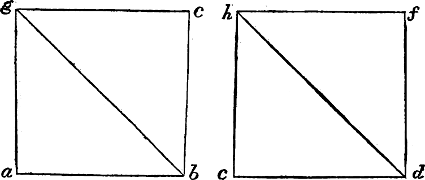
It may, however, be shewn, that the right lines, from which
quadrangles are described, being equal, the quadrangles also shall be
equal. For let the right lines a b, c d, be equal, and
from a b, describe the quadrangle a b c g, but from c
d, the quadrangle c d h f, and connect the right lines g
b, h d. Because, therefore, the right lines a b,
c d, are equal, a g, h c, are also equal; and
they comprehend equal angles, and the base g b, is equal to the
base h d, and the triangle a b g, to the triangle c d
h; and the doubles of these are equal. Hence the quadrangle a
c, is not unequal to the quadrangle c f. But the converse
of this also is true. For if the quadrangles are equal, the right
lines, also, from which they are described, will be equal. Thus let
the quadrangles a f, c g, be equal, and let them be so
placed, that the side a b, may be in a right line with the side
b c.
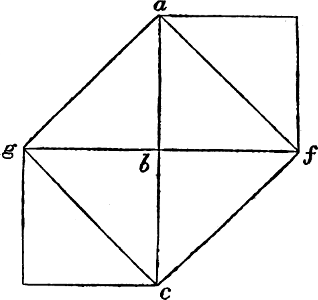
Since therefore, the angles are right, the right line also f b,
will be in a direct position, with the right line b g. Let
the right lines f c, a g, a f, c g, be
connected. Because, therefore, the quadrangle a f, is equal to
the quadrangle c g; the triangle, also, a f b, is equal
to the triangle c b g. Let the common triangle b c f, be
added. The whole triangle, therefore, a c f, is equal to the
whole triangle c f g.
Hence, a g is parallel to f c. Again, because, as well
a f g, as the angle c g b, is the half of a right angle,
a f, is parallel to c g. The right line, therefore,
a f, is equal to the right line c g, since they are the
opposite sides of a parallelogram. Because, therefore, there are two
triangles, a b f, b c g, which have the alternate angles
equal, since a f, c g, are parallel; likewise one side
a f, equal to the side c g, the side, also, a b,
shall be equal to the side b c, and the side b f, to the
side b g. And thus it is shewn, that the quadrangles a f,
c g, being equal, the sides, also, from which they are described
are equal.
PROPOSITION XLVII. Theorem XXXIII.
In right angled triangles, the quadrangle, which is described
from the side subtending the right angle, is equal to the
quadrangles which are described from the sides comprehending the
right angle.
If we attend to the historians of antiquity, we shall find them
referring the present theorem to Pythagoras, and asserting that he
sacrificed an ox or its invention. For my own part, I admire those
who first investigated the truth of this theorem: but I possess a
greater admiration for the elementary institutor, not only because he
establishes its truth by evident demonstration, but likewise, because
he persuades us by scientific reasons, which cannot be confuted of a
theorem more universal than this in his sixth book[47]. For in that
he shews universally, that in right-angled triangles, the figure
described from the side subtending the right angle, is equal to the
figures described from the sides comprehending the right angle, when
they are similar to the former figure, and are similarly described.
For every quadrangle is similar to every quadrangle; but all
right-lined figures similar to each other, are not quadrangles: since
in triangles, and other multangles, similitude is inherent. Hence,
the reason which demonstrates that the figure described from the side
subtending the right angle, whether it is quadrangular, or of some
other form, is equal to the figures subsisting about the right angle,
similar to the former, and similarly described; exhibits something
more universal, and which possesses a greater power of producing
science, than the reason exhibits, affirming a quadrangle alone,
equal to quadrangles. For in the former case, it becomes manifest by
an universal ostension, that the rectitude of the angle affords to
the figure described from its subtending side, equality, to all the
figures, subsisting about its comprehending sides, similar to the
former, and similarly described: just as obtuseness is the cause of
excess; but acuteness of diminution. But how this theorem is evinced,
will be perspicuous, when we comment on it in the sixth book.
But let us now consider the truth of the present theorem, only adding
this, that universal ought not to be shewn here, by him who has
taught nothing concerning the similitude of right-lined figures, and
the doctrine of proportion: for many things which are here exhibited
more particularly, are in that theorem shewn more universally by
the same method. The institutor of the Elements, therefore, shews
the thing proposed in the present, from the common contemplation
of parallelograms. But since right-angled triangles are two-fold,
i.e. either isosceles, or scalene; in isosceles triangles, we shall
never find numbers corresponding with the sides: for there is no
quadrangular number, exactly double of another quadrangular number;
since the square from the septenary is double of the square from the
quinary, by a deficience of unity. But in scalene triangles it is
possible, that numbers may be assumed, so as evidently to evince, that
the square from the side subtending the right angle, is equal to the
squares from the sides subsisting about the right angle. And of this
kind is the triangle in the republic, whose right angle is contained
by the ternary, and quaternary, but is subtended by the quinary. The
quadrangle, therefore, from the quinary, is equal to the quadrangles
from the other numbers: for this is twenty-five; but the quadrangle
from the ternary is nine, and from the quaternary sixteen. And thus
what we have asserted is perspicuous in numbers.
But there are delivered certain methods of inventing triangles of this
kind, one of which they refer to Plato, but the other to Pythagoras,
as originating from odd numbers. For Pythagoras places a given odd
number, as the least of the sides about the right angle, and when he
has received the quadrangle produced from this number, and diminished
it by unity, he places the half of the remainder, as the greatest of
the sides about the right angle; and when he has added unity to this,
he produces the remaining side which subtends the right angle. Thus
for example, when he has assumed the ternary, and has produced from
it a quadrangular number, and from this number nine, has taken unity,
he assumes the half of eight, that is four, and to this again he adds
unity, and makes five; and thus discovers a right-angled triangle,
having one of its sides of three, but the other of four, and the other
of five units. But the Platonic method originates from even numbers.
For when he has assumed a given even number, he places it as one of the
sides about the right angle, and when he has divided this into half,
and has produced a quadrangular number from the half, when he has added
unity to this quadrangle, he forms the subtending side, but when he has
taken unity from the quadrangle, he forms the remaining side about the
right angle. Thus for example, when he has assumed the number four, and
has multiplied the half of this into itself, and produced four, when he
takes away unity he forms the number three, but when he adds unity, he
produces the number five; and thus he has the same triangle effected,
as by the Pythagoric method. For the square from the number five, is
equal to the squares from the numbers three, and four. And thus much
for the digression of the present narration. But as the demonstration
of the elementary institutor is perspicuous, I do not think, that any
thing should be added, because it would be superfluous; but we should
be content with what is written. For those who have added any thing
more, as the familiars of Hero and Pappus, have been obliged to assume
in an affair of no difficulty, some of the propositions of the sixth
book; and the cause which regards this affair. We shall therefore pass
on to the following theorem.
PROPOSITION LXVIII. Theorem XXXIV.
If the quadrangle described from one side of a triangle, is
equal to the quadrangles described from the other two sides of
the triangle: then the angle comprehended by the remaining two
sides of the triangle, is right.
This theorem is the converse of the preceding, and the whole is
converted to the whole. For if the triangle is rectangular, the
quadrangle which is described, from the side subtending the right
angle, is equal to the quadrangles described from the other sides:
and if the square from this, is equal to the squares from the other
sides, the triangle is rectangular, because it has the angle right,
which is comprehended by the remaining sides. And the demonstration
of the Elementary institutor is indeed conspicuous.
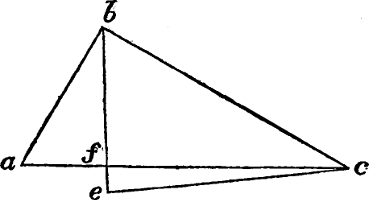
But when there is a triangle a b c, having the quadrangle, which
is described from the side a c, equal to the quadrangles from
the sides a b, b c, since in the triangle, a right line
from the point b, is raised at right angles to the side b
c, if it should be said, that the right line must be raised at
right angles, to other parts, and not at those to which the elementary
institutor raises it, we assert that this is an impossibility. For it
can neither fall within, nor without the triangle; and can be no other
than a b. For if possible, let it fall as b e. Because,
therefore, the angle e b c, is right, the angle c f b,
is doubtless acute; and hence, the remaining angle a f b, will
be obtuse. The side, therefore, a b, is greater than the side
b f. Let a line b e, be placed equal to a b, and
connect e c. Because, therefore, the angle e b c, is
right, the quadrangle described from the side e c, is equal to
the quadrangles from the sides e b, b c. But e b
is equal to b a. The quadrangle, therefore, from the side e
c, is equal to the quadrangles from the sides a b, b
c. But the quadrangle from the side a c, was also equal to
the same. Hence, the quadrangle from the side e c, is equal to
that which is described from the side a c; and so e c
is equal to a c. Two right lines, therefore, b e, e
c, are equal to the two b a, a c, each to each, and
are constructed upon the right line b c, which is impossible.
And hence, the line raised at right angles, does not fall within the
right line a b.
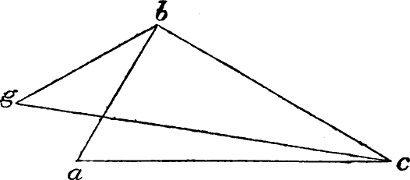
But neither can it fall without, towards other parts of the right
line a b. For if possible, let it fall as b g, and let
b g be equal to a b, and connect c g. Because,
therefore, the angle g b c, is right, the quadrangle described
from the side g c, is equal to the quadrangles from the sides
b g, b c. But the quadrangle also, from the side a
c, was equal to the quadrangles from the sides a b, b
c, but a b is equal to g b; and so g c is
equal to a c. But the right line g b, also, is equal
to the right line b a, upon one right line b c, which
is impossible. Hence, the right line which is raised from the point
b, at right angles to b c, neither falls within, nor
without the side a b; and therefore falls upon it. And so the
objection is dissolved. But the institutor of the Elements, thus far
completes his first book, in which he has delivered many species of
conversions; (for he often converts the whole of theorems to the whole,
and wholes to parts, and parts to parts) and has invented a great
variety of problems; (for he has delivered the sections, positions,
constructions, and applications of lines and angles). He likewise
touches upon that mathematical place which is called admirable; and
sufficiently brings local theorems into our remembrance. Besides,
he unfolds the elementary institution of universal and particular
theorems, and indicates the difference of indeterminate, and
determinate problems; all which, attending him in his progress, we have
orderly explained. Lastly, he refers the whole book to one purpose, I
mean the elementary institution, of the contemplation respecting the
more simple rectilineal figures; and finally, he investigates their
constructions, and considers their essential properties. But we,
indeed, shall give thanks to the gods, should we be able to comment
on the other books, in a similar manner. In the mean time, if other
cares should prevent the execution of our design, it is my opinion,
that such as are studious of these contemplations, ought to expound the
other books, after the same mode; by investigating that which is every
where difficult, and pertinent to the subject, and capable of an easy
division. For, indeed, the commentaries which are circulated at the
present period, are replete with great and various confusion, because,
at the same time, they neither infer any assignation of cause, nor
dialectic judgment, nor philosophic contemplation.
END OF THE COMMENTARIES.
SECT. I.
THE
HISTORY
OF THE
RESTORATION OF THE PLATONIC THEOLOGY.
By the latter Platonists.
The Grecian theology, the history of whose restoration by the latter
Platonists is the design of the present dissertation, did not originate
among the Greeks, but was the progeny of barbarian propagation.
This will be evident by considering that Orpheus was a Thracian;
Thales, a Phœnician; Hermes Trismegistus, an Egyptian; Zoroaster,
a Persian; Anacharsis, a Scythian; and Pherecydes, a Syrian. Yet
though Greece was not the parent of theology, she was notwithstanding
her benevolent nurse, by whom she was kindly educated, and received
the full perfection of her nature. Indeed, though illustrious men
flourished in the East, and theology was there particularly cultivated,
yet her education was limited and rough, entangled with inexplicable
ceremonies, and guarded by the sanctity of inviolable oaths. But
when she was removed into the Grecian soil, and experienced the
happy temperature of its climate, her genius became both elegant and
profound; her person magnificent and graceful; and her ceremonies
rational and sublime. Particular nations, indeed, seem to have been
distinguished for particular pursuits. Thus the Egyptians appear to
have excelled in the powers of invention; and the East, in general, has
been remarkable for its attachment to the most recondite and mystic
philosophy. Thus the Romans were famous for the arts of eloquence and
war; and the Greeks have ever been celebrated as a people by whom
every branch of knowledge received its ultimate perfection. They were
a nation equally favoured by the graces, the muses, and philosophy;
whose celestial union formed the divine genius of Homer, and inspired
that elegance and depth with which the works of Plato are replete. They
were, in short, the standards of excellence to the ancient, and are
the objects of imitation to the enlightened part of the present world;
and their theology, as well as their arts, will be admired when modern
systems are no more.
It appears at first view strange that this sublime theology should rise
to its pristine perfection during the decline of the Roman empire; and
at a period when a new religion (I mean the Christian) was continually
increasing in reputation, and advancing with rapid steps to a despotic
establishment. But if we attentively consider, we shall find that
the very causes which apparently threatened its destruction were the
natural and proper sources of its renovation. As every part of the
universe subsists by perpetual change, it is necessary that philosophy
and the sciences, with respect to their appearance or the contrary,
should share in the general mutability of things: but at the same time,
it is necessary to their preservation to after-ages, that the order of
their revolution should be retrograde to that of sensible particulars.
Hence we shall often find, that while kingdoms descend in the circle of
vicissitude, philosophy ascends, and perhaps attains to her ultimate
perfection, at the very period when the most powerful nations become
extinct. Thus the falling empire of the Romans was naturally connected
with the rising greatness of philosophy; and the foreign ceremonies of
a new religion, were the proper means of bringing to light the secret
mysteries of the old. We may add too, that the same circumstances
produced the great difference between the first and last appearance
of this sublime theology. While Greece maintained her independence
unconscious of the Roman yoke, and undisturbed by religious invasions,
she disdained to expose her genuine wisdom to vulgar inspection, but
involved it in the intricate folds of allegory; and concealed it from
the profane under the dark veil of impenetrable mystery. But when she
lost her liberty and submitted to foreign dominion, when her most
ancient rites were threatened with invasion, and her sacred mysteries
were treated with contempt, she found it necessary to change the dress
of theology and to substitute a simple and elegant garb, instead of one
highly marvellous and mystic.
Yet we must not imagine that theology, now stript of her ancient
concealments, became the object of open inspection to the profane and
vulgar eye. She had not lost her refulgence, though she had changed
her appearance: for the rays of celestial majesty yet beamed from her
countenance, with a light awful and terrific to the multitude, but
lovely and alluring to the wise. Hence the splendors of divinity no
less secured her person from impious curiosity than the dark symbols
in which she was formerly involved. The enchanting imagery of a
celestial phantasy, and the pure light of an exalted intellect, while
they captivated and converted the philosophical part of mankind, were
inaccessible to the vulgar, whose mental eye, yet lost in the night
of oblivion, was darkened by the splendid vision. However, though the
real person of theology was not the object of vulgar inspection, her
shadow at least was beheld by the benighted multitude, and became the
subject of ridiculous opinions, and idle investigation. Hence some of
these astonished with the majesty of her image, fondly fancied she
was the progeny of the Jewish religion; and that her sacred mysteries
were nothing but corrupt imitations of Mosaic divinity: while others,
measuring the obscurity of her real person by the darkness of her
shadow, considered her doctrines as delusions, and her sublimest truths
as the reveries of a distempered imagination. Thus was true theology
perverted and vilified by the multitude, when she appeared in her
natural dress to mankind; till, in a few centuries after, indignant of
the daring profanation, she ascended to her native heaven, and left the
sons of folly involved in the shades of midnight error, and the gross
delusions of fancied inspiration.
But let us contemplate her history more minutely, and mark the several
particulars which distinguished her appearance on the earth. Let us
survey the lives of the great geniuses who so largely participated her
celestial light; and who so admirably transfused it in their writings
for the benefit of hitherto ungrateful posterity. Let us view with
wonder how she rose in majesty, as Rome declined in power, and appeared
in full perfection invested with celestial honours, and surrounded
with a godlike band of philosophic heroes, while that mighty empire
was rapidly diminishing in bulk, and on every side nodding to its
dissolution.
We are informed by Proclus[48], that all the Grecian theology is
the progeny of the mystic discipline of Orpheus; and that Pythagoras
was the first who learned the orgies of the gods from Aglaophemus
the disciple of Orpheus. This sacred theology was fully displayed by
Orpheus, with all the graces of poetical diction, accompanied with the
fury of the muses and divine illumination, in a great work entitled,
The Sacred Discourse, which was divided into twenty-four
rhapsodies, and which has unhappily perished in the ruins of time.
In this inestimable work, if we may be allowed to conjecture from a
treatise of the same name composed by Pythagoras, and often mentioned
by Syrianus, all the orders of the gods were celebrated from the
highest principle of things, to the last processions of the mundane
divinities. But Pythagoras was no doubt deeply indebted for a part of
this knowledge to the doctrine of Zoroaster, whose dogmata, according
to Apuleius[49], he embraced, and whose profound mysteries involved
in oracular darkness, we may presume he communicated to his initiated
disciples. The whole of this recondite theology was afterwards
received by Plato from the writings of Archytas, Philolaus, and other
Pythagoreans, but was so concealed by poetical embellishments, and
mystical traditions, that, like the numbers of Pythagoras, it was alone
adapted to the comprehension of a penetrating and sagacious few.
It is, however, a remarkable historical fact that this theology
was lost for many centuries among the disciples of Plato, on the
death of their divine master. But we are informed by Numenius[50]
the Pythagorean that Plato’s successors, Speusippus, Zenocrates,
and Polemo, perverted his dogmata, and almost entirely changed the
whole of his philosophy. And Aristotle, it is well known, however
he might retain some essential doctrines of his master, altered
others of the highest importance; and confining himself chiefly to
natural disquisitions, ascended but rarely and feebly to theological
contemplations. However it was not irrecoverably lost; and it
disappeared for a time, only to shine with brighter splendors on its
return. Truth, like the light of the sun, may suffer concealment,
but cannot be destroyed; for it would rather have its rays broken by
resistance than bound to obscurity. About two hundred and fifty two
years, therefore, after the Christian religion had made its appearance,
this sublime theology was restored by one Ammonius Saccas an
Alexandrian. This extraordinary person, was, it seems, at first nothing
more than a porter: though by what methods he rose from this servile
employment to the summit of philosophy, and what happy circumstances
first affected this wonderful change, are enquiries which can never
be answered, but whose loss will always be regretted by the liberal
few. But though he was not Διογενεῖς, nobly born, his doctrines, as
transmitted to us by his disciples, eminently evince his possessing
in high perfection all the other endowments of a true philosopher:
such as a penetrating genius, a docile sagacity, a tenacious memory,
and every other ornament of the soul, requisite, according to Plato,
to form the philosophic character. Indeed he must have possessed
these qualifications in a most remarkable degree; or he could never
have emerged from the obscurity and servility of a porter, to the
splendor and liberty of an exalted and divine philosopher. The truth
of this observation is confirmed by the appellation of θεοδίδακτος, or
divinely-taught, which was unanimously conferred on him, by his
contemporary philosophers.
This great man opened a philosophical school at Alexandria, but with a
determination not to commit the more abstruse and theological dogmata
of his philosophy to writing. Indeed he was so fearful of profaning
these sublime mysteries, by exposing them to vulgar inspection, that he
revealed them to his disciples Erennius, Origen, and Plotinus, on the
conditions of inviolable secrecy, and under the guard of irrevocable
oaths. However, fortunately for posterity, Erennius dissolved the
compact, and Origen (different from the Christian father of that
name), imitating Erennius, disclosed a part of his master’s secrets,
in a curious treatise on dæmons, which, among many other valuable
productions, is lost in the ruins of time. But the publications of
these two great men were but trifling efforts to unveil the mystic
wisdom of antiquity: since a perfect revelation was reserved for the
divine genius of Plotinus, who considering himself now freed from
his engagements, by the examples of his fellow disciples, resolved
to bring theology from her dark concealments and to present her to
the astonished world, in all the celestial graces and irresistible
majesty of her natural appearance. This wonderful man (if he was not
something more, since his writings discover a genius superior to the
human), who was born to astonish and enlighten mankind, was the first
who committed to writing the secrets of theology, free from the obscure
enigmas in which she had been enveloped by the sages of antiquity. The
celestial vigor and profundity of his genius, render his conceptions
indeed, unavoidably abstruse: but he who has once fathomed his depth,
will find himself amply compensated for the labour of investigation,
by the rewards of uncommon knowledge and inexpressible delight. There
is a long and curious life of this high priest of theology, and dæmon
of wisdom, extant by his disciple Porphyry, the substance of which, as
it will not I presume be unacceptable to the reader, and as it will
throw great light on the history of theology, I have selected from that
invaluable work.
Plotinus, was an Egyptian by birth, and was a native of Lycopolis,
as we are informed by Eunapius, for Porphyry is wholly silent as to
this particular. Indeed this is not wonderful, if we consider what
Porphyry asserts in the beginning of his life, that he was ashamed,
that his soul was in body. Hence says he, he would neither tell the
race, nor the parents from which he originated, nor would he patiently
relate in what country he was born. This I know will be considered by
a genuine modern, as either rank enthusiasm, or gross affectation; but
he who has perused and fathomed his writings will immediately subscribe
to its truth. The same vehement love for intellectual pursuits, and
contempt for body, made him disdain to sit for his picture; so that
when one of his disciples Amelius, begged that he would permit his
likeness to be represented, his answer expressed the true greatness of
his mind: as if (says he) it was not sufficient to bear this image,
with which nature has surrounded us from the first, you think that a
more lasting image of this image should be left as a work worthy to be
inspected. However the desire of Amelius was at length accomplished,
by the ingenious contrivance of one Carterius a painter, who by
frequenting the school of Plotinus, and viewing his countenance with
fixed attention, produced at length from his memory a happy likeness
of the philosopher. Though he was often afflicted with the colic, he
always refused the assistance of clysters, asserting that cures of
this kind were not proper to a man advanced in years. Nor would he
ever receive the assistance of theriacal antidotes, since he said, his
nourishment was not derived from the bodies of even tamer animals. He
likewise abstained from baths: but daily used frictions at home. But
when a grievous pestilence raged[51] at Rome, and the servants who were
accustomed to rub him, fell victims to the disease, from neglecting
cures of this kind, he gradually became a prey to the pestilence. So
great was the violence of this distemper, and its effects so dreadful
on Plotinus, as Eustochius informed Porphyry who was absent, that
through a very great hoarseness, all the clear, and sonorous vigour of
his musical voice was lost; and what was still worse, his eyes were
darkened, and his hands and feet were covered with ulcers. Hence,
becoming incapable of receiving the salutations of his friends, he
left the city; and went to Campania, to the estate of one Zethus, an
ancient departed friend. Necessaries were here administered to him from
the hereditary possessions of Zethus, and were likewise brought from
Minturnus, from the fields of Castricius[52]. But when this divine man
drew near to his dissolution, that period which is no less the dread
of the vulgar than the transport of the philosopher, and which to
Plotinus must be the moment of extatic rapture, Eustochius who dwelt at
Puteolus, was not very hasty in his approaches; doubtless not imagining
he was on the point of making his triumphant exit from a corporeal
life. However when he came into the presence of this departing hero, he
was just in time to receive his dying words, and to preserve the sacred
sentence to posterity. Listen ye profane with reverence, and treasure
in your memories ye wise, the weighty truth it contains! As yet
(says he) I have expected you; and now I consent that my divine
part, may return to that divine nature, which flourishes throughout the
universe. Such were the last words of this mighty man, which like
those contained in his writings are great and uncommon, wonderful and
sublime. He died at the conclusion of the second year of the emperor
Claudius’ reign; and was at the time of his death in the sixty-sixth
year of his age, according to the information given by Eustochius
to Porphyry. The most trifling particulars relative to the life and
death of so extraordinary a man merit our attention; and indeed we may
presume without being guilty of either superstition or enthusiasm,
that scarcely any thing trifling could mark the existence of such a
powerful and celestial genius. There is nothing, properly speaking,
can be little which has any relation to a character truly great: for
such is the power of uncommon genius, that it confers consequence on
every thing within the sphere of its attraction, and renders every
surrounding circumstance significant and important. Thus immediately on
the death of Plotinus, we are informed by Porphyry that a dragon[53]
which had been concealed under his bed, wandered through a hole in
the wall, and disappeared. But how great must the grief of Porphyry
have been, to be separated from his beloved master, at the time of
his death: from a master by whom he had been esteemed beyond the rest
of his fellow-disciples; and whose loss no succeeding period was ever
likely to repair. Indeed his disciples seem to have been unaccountably
dispersed, at this important crisis: for Porphyry was at Lilybæum,
Amelius at Apamea in Syria, Castricius at Rome, and Eustochius was
alone present at his departure. Porphyry afterwards informs us, in
perfect agreement with the genius of Plotinus, that he never would tell
to any one, the month, or day in which he was born: because he by no
means thought it proper that his nativity should be celebrated with
sacrifices and banquets. Indeed we cannot suppose that he who had such
a vehement contempt for a corporeal life, would be anxious that his
entrance into mortality should be solemnized with festivity; but rather
considering himself with Empedocles, as
“Heaven’s exile straying from the orb of light,”
he would be disposed to lament his captivity, and mourn the degradation
of his nature. However he was not averse to celebrate the nativities of
Socrates and Plato; for he assisted at the sacred rites, and invited
his friends to a philosophic banquet, where it was required that every
guest should recite a written oration, adapted to the occasion of their
amicable association.
But the few particulars which this great man condescended to relate of
himself, in familiar discourse, are the following: When he was eight
years of age, and was even under the tuition of a literary preceptor,
he used to frequent his nurse, and to uncover her breasts, through an
avidity of sucking her milk. And this custom he continued, till being
accused of troublesomness, and covered with shame through the reproof,
he neglected this extraordinary custom. This story however trifling it
may appear, indicates in my opinion the native innocence, and genuine
simplicity of manners which marked the character of Plotinus. It is
a circumstance, which does not merely point to something uncommon;
but it was the harbinger as it were of that purity and sanctity of
life, which so eminently formed the conduct, and adorned the writings
of our philosopher. But when he was in the twenty-eighth year of his
age, being vehemently inflamed with the love of philosophy, he was
recommended to the most excellent masters of Alexandria: but he left
their schools with sorrow and disappointment. By a fortunate event,
however, he told a certain friend, who was well acquainted with the
disposition of his mind, the cause of his affliction, and he brought
him to the celebrated Ammonius, whose school Plotinus had probably
overlooked among the great multitude with which that illustrious city
abounded. But when he had entered the school of Ammonius, and had heard
him philosophize, he exclaimed in transport to his friend, this is
the man I have been seeking. From that day he gave himself up to
Ammonius with sedulous attention for eleven years; and made such rapid
advances in his philosophy, that he determined to study the philosophy
of the Persians, and the wisdom particularly cultivated by the Indian
sages. For this exalted purpose, when the emperor Gordian marched into
Persia, in order to war upon that nation, Plotinus joined himself to
the army, being at that time in the nine and thirtieth year of his
age. But after Gordian was destroyed about Mesopotamia, Plotinus fled
to Antioch, where he received a fortunate shelter from the dangers and
devastations of war; and in the reign of the emperor Philip came to
Rome, in the fortieth year of his age. It seems therefore that Plotinus
was disappointed in his purpose at that time of procuring the Persian
and Indian wisdom: it is however certain that he afterwards obtained
his desire; and most probably without the inconvenience of a long and
dangerous journey. This will be evident from perusing his works; and
attending to the latent dogmata they contain.
It was a long time before Plotinus committed his thoughts to writing;
and gave the world a copy of his inimitable mind. That light which was
shortly to illuminate mankind, as yet shone with solitary splendour;
or at best beamed only on a beloved few. It was now destined to emerge
from its awful sanctuary, and to display its radiance with unbounded
diffusion. But a disciple like Porphyry, was requisite to the full
perfection of its appearance. Amelius was indeed laborious, but he
was at the same time verbose: he neither appears to have possessed
the inquisitive spirit, nor the elegant genius of Porphyry; and his
commentaries were too voluminous to be exquisitely good. Porphyry
gives a singular specimen of his endurance of labour, when he informs
us, that he committed to writing almost all the dogmata of Numenius,
and retained a very considerable part in his memory. He was not
however, though an excellent philosopher, calculated to urge Plotinus
to write, or to assist him in its prosecution: but this important
task was reserved for Porphyry, who in the words of Eunapius, “like a
mercurial chain, let down for the benefit of mortals, by the assistance
of universal erudition, explained every thing with clearness and
precision.” Plotinus indeed began to write in the first year of the
emperor Galienus; and he continued just to note such questions as
occurred to him, for the ten following years, in the last of which he
became acquainted with Porphyry, who was at that time in the thirtieth
year of his age. He had then composed one and twenty books, which
were in the hands but of a few: for the edition was difficult to be
procured, and was not universally known. Besides Plotinus, was neither
hasty nor rash in his publications: but he gave those only to the
light, which had been approved, by a mature and deliberate, judgment.
The one and twenty books we have previously mentioned, after various
inscriptions, at length obtained the following titles:
- On the beautiful.
- On the immortality of the soul.
- On fate.
- On the essence of the soul.
- On intellect, and ideas, and being.
- On the descent of the soul into body.
- How that which is posterior to the first, proceeds from the first; and concerning the one.
- Whether all souls are one.
- Concerning the good itself, or the one.
- On the three principal hypostases.
- On the generation and order of things posterior to the first.
- On the two matters, intelligible and sensible.
- Various considerations.
- On the circular motion of the heavens.
- On every one’s peculiar Dæmon.
- On the rational exit, from the present life.
- On quality.
- Whether there are ideas of particulars.
- On virtues.
- On dialectic.
- How the soul is said to be a medium between an impartible and partible essence.
These one and twenty books were finished when Porphyry first became
acquainted with Plotinus; and when this great man was fifty-nine years
old. During the six years in which Porphyry was his companion as well
as disciple, many questions of a very abstruse nature, were discussed
in their philosophical conversations, which at the joint request of
Porphyry and Amelius, Plotinus committed to writing, and produced from
their investigation, two elaborate and admirable books, proving that
true being is totally present in every part of the universe.
He wrote besides two others; one of which asserts, that the
nature superior to being, is without intellection; and the other
distinguishes primary from secondary intelligence. He likewise
composed at the same period, the following books:
- Concerning that which exists in capacity, and energy.
- [54]That incorporeal natures are free from passivity.
- Two books concerning the soul.
- A third concerning the soul, or the manner in which we see.
- On contemplation.
- On intelligible beauty.
- That intelligibles are not external to intellect; and concerning intellect, and the good.
- Against the Gnostics.
- On numbers.
- Why things seen at a distance appear small.
- Whether felicity consists in length of time.
- Concerning total mixture.
- How the multitude of ideas subsists, and concerning the good.
- On that which is voluntary.
- On the world.
- On sense and memory.
- Three books on the genera of beings.
- On eternity and time.
But while Porphyry resided in Sicily, Plotinus composed the five
following books, which he sent to him for his revision:
- On felicity.
- Two books on providence.
- On gnostic essences, and that which is superior to their nature.
- On love.
These books were transmitted to Porphyry in the first year of the
emperor Claudius’ reign. And about the beginning of the second year, a
little before his death, he sent him the following, and the last:
- An enquiry into evil.
- Whether the stars operate on sublunary natures.
- What the nature is of man, and animal.
- On the first good, and other goods.
The whole amount therefore of the books written by Plotinus,
connecting the preceding with the present, is fifty-four, which
Porphyry has divided into six enneads, assigning agreeable to the
meaning of the word, nine books to every ennead. But they bear evident
marks (says Porphyry) of the different periods, at which they were
composed. For the first one and twenty, which were written in the
former part of his life, if compared with the next in order seem to
possess an inferior power, and to be deficient in strength. But those
composed in the middle of his life exhibit the vigour of power, and
the summit of perfection. And such with a few exceptions are the four
and twenty we have already enumerated. But the last nine, composed
in the decline of life, carry the marks of remitted energy, and
drooping vigor. And this the four last declare, more evidently than
the preceding five. It must however be observed that this difference
is only visible, when they are contrasted with one another. To an
impartial observer, zealous of truth, and not deeply read in Plotinus,
each of his books will appear to be what it really is, uncommonly
profound, and inimitably sublime. Each is an oracle of wisdom, and a
treasury of invaluable knowledge; and the gradations of excellence
consist in the power of composition, and not in the matter from which
they are composed.
Plotinus had many auditors, and likewise a multitude of zealous
partizans, and philosophic familiars. This indeed must necessarily be
the case, if we consider the reputation of philosophy at that golden
period, and the extraordinary abilities and celestial genius of its
godlike restorer. Among the latter of these, Amelius the Tuscan, and
Paulinus the Scythopolitan, a physician, held a distinguished rank.
To which may be added Eustochius of Alexandria, a physician, who
enjoyed the familiarity of Plotinus to the last, was present at his
death, and giving himself entirely to the institutes of Plotinus,
assumed the habit of a genuine philosopher. Besides these, Zothicus, a
critic and poet, was conversant with Plotinus, who amended the works
of Antimachus, and rendered the Atlantic history very poetically
in verse: but after this he became blind, and died a short space
of time prior to Plotinus. Zethus too, was very familiar with our
philosopher, who derived his origin from Arabia, and married the wife
of one Theodosius, the familiar of Ammonius. He was deeply skilled
in medicine, and very much beloved by Plotinus, who endeavoured to
dissuade him from engaging in the administration of public affairs.
Such indeed was his familiarity with our philosopher, that, as we have
already observed, Plotinus spent the last hours of his life at his
rural retreat. Porphyry likewise informs us, that not a few senators
were the sedulous auditors of Plotinus. Philosophy indeed, as it is the
most noble and liberal of all pursuits, ought never to be separated
from noble birth and exalted rank. It is naturally allied with every
thing great, and is calculated to confer dignity, even on greatness
itself. It exalts the majesty of the monarch, stamps nobility with
true grandeur, and raises the plebean to immortality. In the age of
philosophy, therefore, we cannot wonder that she was reverenced by the
senators of Rome. That illustrious body, even at this declining period,
retained a portion of its ancient independence; and the generous ardor
of unbounded liberty was not yet extinguished by the frozen hand of
despotic usurpation. The Roman manners and religion were not yet
destroyed; and nobility was not contaminated by the sordid occupations
of traffic. Meekness was not esteemed a virtue, nor
merchandize an honour!!! Among this illustrious body of
men, Marcellus Orontius diligently applied himself to philosophy, and
made rapid advances in its attainment. This too, was the case with
Sabinillus, and above all with the senator Rogatianus[55]. So deeply
enamoured was this last nobleman with the charms of wisdom, and the
discourses of Plotinus, and so attentive to the care of separating his
soul from his corporeal life, that he neglected his wealth, and secular
affairs, dismissed his servants, and rejected the dignities of the
state. Hence, when he was chosen prætor, and the lictors waited for
his appearance, he neither came into public, nor regarded the duties
of his office, nor dwelt in the house allotted for his reception: but
he supped and slept with certain of his friends and familiars, and
gave himself to absolute retirement in the day. By this negligence
and carelessness of life (says Porphyry), from being so vehemently
afflicted with the gout, that he was obliged to be carried in a chair,
he resumed his pristine strength and vigour. And from being so diseased
in his hands, that he could not extend them when necessary, he so
recovered their use by philosophic endurance, as to employ them with
greater expedition than the manual mechanic. This great man, as we may
suppose, possessed the principal place in the esteem of Plotinus, who
was not sparing in his praise of so uncommon a character, and proposed
him as an illustrious example to the pupils of philosophy. Happy
Rogatianus! who could relinquish power for knowledge, and prefer the
perpetual inheritance of wisdom to the gaudy splendors of title, and
the fleeting honours of command. Alexandrinus Serapion too, was one
of his associates, who was once a rhetorician, but afterwards, gave
himself to philosophical disputations; though, shameful to relate,
he was at the same time a slave to usury, and avarice. Besides all
these (says Porphyry), he reckoned me a native of Tyre, among his most
friendly adherents, whom he appointed to correct his writings.
The following particulars relative to composition are related by
Porphyry of this extraordinary man. He could by no means endure to
review twice what he had written, nor even to read his composition,
through the badness of his sight. But while he was writing, he neither
formed the letters with accuracy, nor exactly distinguished the
syllables, nor bestowed any diligent attention on the orthography:
but neglecting all these as trifles, he was alone intent to the
intelligence of his wonderful mind; and, to the admiration of all
his disciples, persevered in this custom to the end of his life. To
a man of mere words, Plotinus will doubtless appear inexcusable for
such important omissions: but to the sublime and contemplative
genius, his negligence will be considered as the result of vehement
conception, and profound cogitation. Such, indeed, was the power of his
intellect, that when he had once conceived the whole disposition of his
thoughts from the beginning to the end, and had afterwards committed
them to writing, his composition was so connected, that he appeared to
be merely transcribing from a book. Hence he would discuss his domestic
affairs without departing from the actual intention of his mind; and
at the same time transact the necessary negociations of friendship,
and preserve a perpetual intelligence of his thoughts. In consequence
of this uncommon power of intellection, when he returned to writing,
after the departure of the person with whom he had been conversing,
he did not review what he had written, owing, as we have observed,
to the defect of his sight; and yet he so connected the preceding
with the subsequent conceptions, as if his composition had never been
interrupted. Hence he was, at the same time present with others, and
with himself, so that, as Porphyry observes, the self-converted energy
of his intellect was never remitted, except perhaps in sleep, which
he very moderately indulged. And so vigorous and frequent was the
conversion of his soul to intellect, that he would often abstain from
bread, swallowed up, as it were, in the depths of contemplation.
Several women too, enamoured with the love of wisdom, were the
auditors of Plotinus. The Platonic philosophy, indeed, as it
necessarily combines truth with elegance, is naturally adapted to
captivate and allure the female mind, in which the love of symmetry
and gracefulness is generally pre-dominant. Hence, in every age,
except the present, many illustrious females have adorned the Platonic
schools, by the brilliancy of their genius, and as uncommon vigour and
profundity of thought. This too, would doubtless be the case in our
own country, if all the works of Plato and his disciples were but once
faithfully and elegantly translated into English: but till the obstacle
of Greek is removed, we may in vain expect thinking females[56], and
I had almost said Platonic philosophers among men. Porphyry adds,
that many men and women of noble birth, when at the point of death,
delivered up, and commended their children and all their substance
to Plotinus as to a sacred and divine guardian. Hence, says he, you
might see the house of Plotinus full, both of young men and virgins,
among the number of which was one Potamon, whom he educated with
diligence and care. Nor was he wearied in hearing the procurators of
his pupils, often rendering an account of their administration; nor
did he disdain to pay attention to their expences, affirming, that as
they did not yet philosophize, they ought to possess their own goods,
and to receive, without detriment, an increase of their estate. Yet
though he procured for so many pupils the chief necessaries of life,
the intellectual energy of his soul while he was awake, never suffered
any interruption from externals, nor any remission of vigour. He was
extremely mild, though not meek[57], in his manners, and was
easy of access to all his adherents and friends. Hence, so great was
his philosophic urbanity, that though he resided at Rome twenty-six
years, and had been the arbiter of many litigious causes, which he
amicably dissolved, yet he had no enemy throughout that great and
illustrious city. This last circumstance, indeed, reflects the highest
honour on the philosophic character of Plotinus; but, at the same time,
some merit is due to the age in which he fortunately lived. Had he been
destined to make his appearance in the present times, unsupported by
fortune, and with no other recommendation than an uncommon greatness
of mind, and an unequalled depth of thought; from being despised,
insulted, and distressed, he must surely have been indignant, though
not morose, and severe though not agitated with wrath. He would have
been scornful without pride, contemptuous without weakness, patient
without servility, and solitary without affectation. He would have
lived without notice, wrote with success, and died without regret. But
born to a happier fate, his genius was not doomed to languish in the
shades of obscurity, but attained to the blossom of perfection in the
sun-shine of philosophy, and through the liberal pains of Grecian and
Roman cultivation.
But though Plotinus was thus universally esteemed at Rome, and in
general by all who had the happiness of his acquaintance, yet he
had one vehement enemy in the person of Alexandrinus Olympius, who
had been for a short time the disciple of Ammonius, who desired to
arrogate to himself the chief place in philosophy, and endeavoured to
render Plotinus the object of general contempt. So deadly, indeed,
was his hatred of our philosopher, that he attempted to invade him,
by drawing down the baneful influences of the stars. The attempt
was, however, vain, and its effects noxious to their author. For the
sidereal defluctions, instead of being hurtful to Plotinus, were
reflected on Olympius. Hence he exclaimed to his companions, “that the
soul of Plotinus possessed such a mighty power, that it immediately
repelled malignant influences directed upon his person, on the
authors of the evil.” But Plotinus, when Olympius first machinated
his sidereal inchantments, was conscious of his design, and said to
his friends; “Now the body of Olympius is contracted like a purse,
and all his members are bruised together.” After Olympius, therefore,
had often found to his own detriment, that the baneful influences
intended for Plotinus were repelled on himself, he desisted from such
base and fruitless undertakings. Indeed, says Porphyry, Plotinus
naturally possessed something greater than the rest of mankind, which
the following extraordinary relation abundantly evinces. A certain
Egyptian priest, who at that time visited Rome, and who became suddenly
known to Plotinus by one of his friends (perhaps Porphyry himself),
desirous to exhibit his wisdom in that illustrious city, persuaded
our philosopher to attend him, for the purpose of beholding, through
his invocations, his familiar dæmon; to which request he readily
consented. But the invocation was performed in the temple of Isis;
this being the only pure place in Rome the Egyptian priest was able to
find. However, instead of a dæmon, as was expected, a god approached,
who was not (says Porphyry) in the genus of dæmons. The Egyptian
astonished at the unexpected event, exclaimed, “Happy Plotinus, who
hast a god for a dæmon, and whose familiar attendant does not rank
among the inferior-kind!” But this extraordinary and delightful
vision was of short duration: for the priest affirmed it was not then
lawful to interrogate any thing, nor any longer to enjoy the vision,
because a certain common contemplative friend, who was present at the
spectacle, suffocated some birds which he held in his hands for the
sake of safety, either impelled by envy, or terrified with fear. As
Plotinus, therefore, was allotted a dæmon belonging to the diviner
orders, the divine eye of his soul was perpetually elevated to this
guardian deity. On this account he composed a book concerning
every man’s familiar dæmon, in which he diligently endeavours to
assign the causes of the diversity subsisting among these attendants
on mankind. As a still farther proof of his uncommon greatness of
mind, Porphyry adds, that when Amelius who was an observer of sacred
rites, in which he officiated, according to the Roman calends, once
requested Plotinus to attend him in the discharge of these religious
ceremonies, he replied, “It becomes them to approach to me, and not me
to them.” But from what conceptions (says Porphyry), he spoke in such
an exalted manner of himself, we were unable to conceive, and afraid
to ask. We may, however, presume, that Plotinus meant to insinuate the
high degree of purity and perfection of his intellectual part, which
rendered him so superior to the use of corporeal sacrifices, and the
cultivation of material deities, and dæmons, that he ought rather to be
propitiated by others, than to propitiate himself. For a soul like his,
was, indeed, to use his own expression, ὕϛερος θεὸς, a posterior
god, ready winged for flight, and scarcely detained by the fetters
of body. This I know will pass for great arrogance and presumption
among the philosophers of the present day, who consider meekness
and humility as the highest ornaments of their nature, and the
truest characteristics of genuine worth. But surely a sublime and
godlike soul can never think meanly of its nature, or be willing
to suppress and extinguish the inevitable consciousness of its own
dignity and elevation. Humiliating conceptions flourish no where but in
the breasts of the servile, or the base; and are the ornaments of no
characters, but those of the impotent and the mean. Their influence is
baneful to the advancement of science, and destructive of all genuine
excellence and worth. They damp the glowing ardour of true theology,
curb the celestial flight of philosophy, and blast the vigourous
blossoms of genius. Let it, however, be remembered, that while we
banish meekness, we are by no means the advocates of arrogance and
conceit; but are alone desirous of vindicating the proper dignity of
the worthy soul, and of rescuing its generous and ardent confidence
from the frigid embraces of humiliating opinion. It is one thing to be
modest, and another to be meek: for the former is the
shadow attendant on genius, inseparable from its progress, and the
symbol of its reality; but the latter is the dæmon of traffic, the
inspirer of its projects, the support of its credit, and the harbinger
of its appearance. It flies from the face of genius like the shadows of
night before the beams of the morning, and, terrified at the approach
of the elevated mind, hides itself in the dark retreats of trembling
pusillanimity. But to return from this digression: Plotinus appears to
have possessed an unequalled skill in physiognomy, as the following
circumstance eminently evinces. A lady, named Chion, who, together with
her daughters resided in his house, and there happily passed a chaste
widowhood, was fraudulently deprived of a very valuable necklace. In
consequence of this, all the servants and domestics were summoned into
the presence of Plotinus, who regarded their several countenances,
selected one, and accused him of the theft. The man was immediately
chastised, and for a long time denied the fact, but at length confessed
his guilt, and restored the necklace. In a similar manner (says
Porphyry) he wonderfully predicted the destiny of the young men of his
acquaintance; as of one Polemo, he foretold, that he would be very
much addicted to love, and not arrive to the maturity of his age,
which happened according to his prediction. But the last instance of
his sagacity, related by Porphyry, excels all the rest, both in the
singular skill displayed in its execution, and the happy consequences
it produced. Porphyry, as we are informed by Eunapius, in his life,
on his first acquaintance with Plotinus, bade a final farewel to all
his preceptors, and totally applied himself to the friendship and
confidence of this wonderful man. Here he filled his mind with science,
and drew abundantly, without satiety, from the perennial fountain,
seated in the sanctuary of the soul of Plotinus. But afterwards being
conquered, as it were, by the magnitude of his doctrines, he conceived
a hatred of body, and human nature, and could no longer endure the
fetters of mortality. “Hence (says Porphyry) I formed an intention of
destroying myself, which Plotinus wonderfully perceived, and as I was
walking home, stood before me, and said, Your present design, O
Porphyry, is not the dictate of a sound intellect, but rather
of a soul raging with an atrabilious fury. In consequence of this,
he ordered me to depart from Rome, and accordingly I went into Sicily,
particularly when I heard that a certain worthy and elegant man dwelt
at that time about Lilybæum. And by this means, indeed, I was liberated
from this perturbation of soul, but was in the mean time hindered from
being with Plotinus till his death.”
But the great reputation of this divine man was not confined to the
senate and people of Rome, for the emperor Galienus, and his wife
Salonina, honoured his person, and reverenced his doctrine. Indeed,
so highly was he esteemed by the emperor, that, relying on his
benevolence, he requested that a city in Campania, which had been
formerly destroyed, might be restored, and rendered a fit habitation
for philosophers; and besides this, that it might be governed by the
laws of Plato, and called Platonopolis. Had this design succeeded,
Plotinus intended to have dwelt there with all his disciples, and
to have realized the beautiful republic, conceived by the godlike
genius of Plato. The emperor, indeed, assented to his wishes, and the
philosopher would have easily accomplished his intentions, if some of
the emperor’s familiars, impelled by envy or indignation, or some other
injust and selfish cause, had not warmly opposed its execution.
This extraordinary man (as we are informed by Porphyry) was strenuous
in discourse, sagacious in invention, and prompt in the most opportune
perceptions: but he was frequently incorrect in his speech, as well as
in writing; and this most probably owing to the vehemence and vigour
of his conceptions. Besides this, while he was engaged in discourse,
his intellect beamed through his corporeal frame, and diffused over his
countenance its intimate light. He was, indeed, of a most beautiful
aspect, but when he disputed (says Porphyry) he seemed far more
lovely to the view. Then a placid gentleness appeared in receiving
questions; and a vigour uncommonly robust was demonstrated in their
dissolution. When Porphyry once had interrogated him for three days,
by what means principally the soul was united with the body,
he persevered in demonstrating the manner of its conjunction. And
when a certain person, named Thaumasius, entered his school, for the
purpose of discussing common questions in philosophy, and premised
that he wished to hear the explanatory sentences of Plotinus, but that
the questions and answers of Porphyry were by no means adapted to a
disputation of this kind, Plotinus replied: unless we dissolve the
doubts arising from the interrogations of Porphyry, we shall not be
able to comment any thing, in an uninterrupted series of discourse.
But he wrote with a most intense acuteness of thought, and an abundant
intellect. His writings are remarkably sententious, and he abounds,
every where, more with profundity of sense than copiousness of words.
“He poured forth (says Porphyry) many things agitated by the impulse
of inspiring deity; and was often wonderfully affected with the object
of his investigation.” With me indeed every page of his works is a
volume, and every sentence an oracle. The latent dogmata
of the Stoics, and Peripatetics, are inserted in his books; and more
particularly the Sentences of Aristotle posterior to his Physics. He
was ignorant of nothing pertaining to geometry, arithmetic, optics,
and music, though he had never reduced these sciences to practice. The
commentaries of the Platonic philosophers, Cronius, Numenius, Gaius,
Atticus; as also of the Peripatetics, Aspasius, Alexander, Adrastus,
&c. were read in his schools: but nothing was repeated from these in
an uninterrupted series. For his conceptions were entirely his own;
and his contemplations were different from theirs. In interpretation,
and the discussion of questions, he bore the intellect of Ammonius.
As soon as he was sufficiently imbued with reading, and had given, in
a short discourse, sentences full of profound contemplation he arose,
and left the school. Having once read the book of Longinus concerning
principles, he said, that Longinus was indeed a philologist, but by
no means a philosopher; and this indeed, as it appears to me, by a
necessary consequence: for the knowledge of words is entirely
foreign from the study of things. When Origen (not the Christian
father of that name) once came into his school, Plotinus whose cheeks
were covered with blushes, wished to rise, and being sollicited by
Origen to continue his discourse, he replied “that discourse ought
to cease, when he who speaks perceives he addresses himself to those
who are well acquainted with his doctrine.” And thus after a short
dissertation he arose from thence.
When in the celebration of Plato’s nativity, Porphyry recited a poem
on the sacred marriage[58], and a certain person who was
present objected that Porphyry was mad, because many things were
said in the poem mystically, and inspired by a divine fury, Plotinus
openly exclaimed, “You have shewn yourself at the same time both a
philosopher and a priest.” On a certain time too an orator, named
Diophanes, read an apology for the intoxicated Alcibiades in the
banquet of Plato, endeavouring to prove that it was proper for the sake
of learning virtue that the lover should expose himself to the object
of his attachment, and not even refuse venereal congress. But while
he was reading this licentious defence, Plotinus often rose from his
seat, as if he would suddenly leave the assembly: but he restrained
himself till it was finished. However, when he left the company, he
commanded Porphyry to confute the oration. But when Porphyry desired
the orator to lend him his discourse, for this purpose, and was
refused, he answered him from recollection, and delivered his answer in
the presence of the same auditors as had attended Diophanes. On this
occasion Plotinus was so much rejoiced, that he often repeated in the
assembly
“Thus write, and you’ll illuminate mankind
[59].”
Our philosopher too, applied himself to the rules of astronomy, though
(says Porphyry) not according to a very mathematical mode. That is, as
we may presume, he very little regarded the calculation of eclipses,
or measuring the distance of the sun and moon from the earth, or
determining the magnitudes and velocities of the planets: for he
doubtless considered employments of this kind as more the province of
the mathematician than of the profound and intellectual philosopher.
The mathematical sciences are indeed the proper means of
acquiring wisdom, but they ought never to be considered as its
end. They are the bridge as it were between sense and intellect,
by which we may safely pass through the night of oblivion over the dark
and stormy ocean of matter, to the lucid regions of the intelligible
world: and he who is desirous of returning to his true country will
speedily pass over this bridge, without making any needless delays in
his passage. Plotinus also diligently applied himself to the judgments
of the astrologers; but when he found that their predictions were not
worthy of belief, he often confuted their presages in his writings.
At that time there were many Christians, and likewise some heathens,
who forsaking the ancient philosophers, became the followers of
Adelphius and Aquilinus. These men circulated a variety of books
of Alexander, Libycus, Philocomus, Demostratus, Lydus; and openly
exhibited certain revelations of Zoroaster, Zostrianus, Nicotheus,
Allogenes, Mesus, with others of a similar kind. By this means they
deceived many, and were themselves deceived, asserting that Plato had
by no means penetrated the depth of an intelligible essence. On this
occasion, Plotinus urged many arguments in his disputations against
these impostors, and composed a book in confutation of their tenets,
inscribed, against the Gnostics, leaving a farther discussion of
their errors to the labours of his disciples. Hence Amelius composed
forty books against the book of Zostrianus; and Porphyry shewed by
a variety of arguments, that the writings which they attributed to
Zoroaster, were adulterated and recent, and were composed by the
propagators of the heresy, that their institutions might pass for the
genuine doctrines of the ancient Zoroaster.
Many of the Greeks (says Porphyry) falsly accused Plotinus of
privately usurping the doctrines of Numenius, which calumny Tryphon,
a Stoic and Platonist, told to Amelius. On this occasion Amelius
composed a book, inscribed by Porphyry; Concerning the difference
between the dogmata of Plotinus and Numenius, which he dedicated to
Porphyry. Every one of the books, indeed, of this great man bear such
evident marks of original thought, and singular depth, the execution
in each is so similar, and the conceptions so uncommonly abstruse,
that no one can understand his meaning, and believe him indebted to
the labours of others. Porphyry adds, that he was likewise considered
by many as a mere trifler, and treated with contempt, because says he
they could by no means comprehend his sayings. Besides the manners of
Plotinus contributed to produce and increase this disdain, for he was
foreign (says Porphyry) from all sophistical ostentation, and pride;
and conducted himself in the company of disputants, with the same
freedom and ease as in his familiar discourses. With the superficial
and the vain, a haughty carriage and severe aspect are considered as
the badges of wisdom: but nothing in reality is more foreign from
its possession. For true wisdom when it is deeply possessed gives
affability and modesty to the manners, illumines the countenance with
a divine serenity, and diffuses over the whole external form an air of
dignity and ease. Add to this, that Plotinus did not hastily disclose
to every one, the syllogistic necessities, which were latent in his
discourse. “The same thing (says Porphyry) happened to me, when I
first heard Plotinus. On which account I endeavoured to provoke him,
by writing against him, endeavouring to shew that intellections are
not external to intellect.” But after the writings of Porphyry
on this subject were read to Plotinus, he said, smiling; “It must be
your employment Amelius, to dissolve these doubts, occasioned by his
ignorance of our opinion.” After Amelius, therefore, had composed
no small book against the objections of Porphyry, and Porphyry had
again contradicted his writings, and was once more answered by
Amelius: “At length (says Porphyry) having scarcely after all these
attempts fathomed the depth of Plotinus, I changed my opinion, wrote
a recantation of my error, which I recited in a general assembly,
considered the books of Plotinus ever after as most worthy of belief,
and provoked my master by every possible means to disclose his opinion
in a more particular and copious manner.” This relation is a most
egregious instance of the unequalled profundity, as well as excellence
of Plotinus’s writings: for who will presume to question the merit of
composition, which was at first so difficult to be comprehended, and
afterwards so greatly admired by such a genius as Porphyry? By a genius
equally accurate, elegant and profound, who knew how to combine the
Graces with Philosophy and Science, and to adorn the majestic brows of
truth with the flowers of enchanting elocution.
But the testimony of the celebrated Longinus concerning our
philosopher, sufficiently evinces his uncommon excellence and worth;
and in the present age will probably be more esteemed than the eulogium
of Porphyry. In a letter, therefore, which he wrote to Porphyry
desiring him to come from Sicily into Phœnicia where he resided,
and to bring with him the books of Plotinus, he writes among other
things as follows: “These books (meaning those of Plotinus) are not
moderately faulty, so that I have no means of using them, though I
desire above measure to consider what Plotinus has written concerning
the soul, and on being.” And again: “Do not send these
books but bring them with you, and not these alone, but any others
which may have escaped the notice of Amelius. For why should I not
enquire, with the greatest diligence, after the writings of this man,
which deserve the highest honour and veneration? This indeed I have
always signified to you, both when present and absent, and when you
resided at Tyre, that I could not understand many of the hypotheses of
Plotinus’s books, but that I immoderately loved and reverenced the
manner of his writing, the density of his conceptions, and the very
philosophic disposition of his questions. And indeed I judge that the
investigators of truth ought only to compare the books of Plotinus with
the most excellent works.”
This testimony of Longinus is the more remarkable, as, prior to this,
he had for a long time despised our philosopher, through the ignorant
aspersions of others. The wonderful genius of Plotinus, was indeed so
concealed under the garb of modesty, that before fame had announced
his worth, it was only visible to a penetrating and sagacious few. But
Longinus (says Porphyry) thought the works of Plotinus which he had
received from Amelius incorrect, through the fault of the transcribers,
because he was unacquainted with his usual elocution: for if any, the
books in the possession of Amelius were correct, because they were
transcribed from the manuscripts of Plotinus. Porphyry has likewise
preserved the preface of a book composed by Longinus, inscribed,
concerning the end, and dedicated to Plotinus and Amelius, in
the course of which he thus speaks of our philosopher. “Plotinus and
Gentilianus Amelius are replete with a copiousness of propositions,
which they studiously discuss, and have seriously chosen the employment
of writing, using a mode of contemplation peculiar, and their own.
And Plotinus indeed, as it seems, has more certainly explained the
Pythagoric and Platonic principles than his predecessors. For the
writings of Numenius, Cronius, Moderatus, and Thrasyllus, are not to be
compared, for accuracy in any part, with the books of Plotinus on the
same subjects.”
If such then is the decision of Longinus concerning the abilities and
writings of this extraordinary man: of Longinus who is celebrated by
one of our first poets, as inspired by all the Nine; and whose
literary reputation is universal; what judgment must we form of the
philosophic taste of the present age, when we find that the very name
of Plotinus is known but to a few, and his works scarcely to any? The
inference is obvious: let the reader draw it, and lament. But (says
Porphyry), if it be requisite to employ the testimony of the wise, who
is wiser than a god? Than a god, who truly said of himself:
[60]The number of the sands is known to me,
And the broad measure of the mighty sea.
I know the thoughts within the dumb conceal’d,
And words I hear, by language unreveal’d.
And this is no other than Apollo, who when Amelius enquired, where the
soul of Plotinus had emigrated, answered in divine numbers, as follows:
To strains immortal full of heav’nly fire,
My harp I tune well strung with vocal wire;
Dear to divinity a friend I praise,
Who claims those notes a god alone can raise.
For him a god in verse mellifluous sings,
And beats with golden rod the trembling strings.
Be present Muses and with general voice
And all the powers of harmony rejoice;
Let all the measures of your art be try’d,
In rapt’rous sounds, as when Achilles dy’d:
When Homer’s melody the band inspir’d,
And god like furies every bosom fir’d.
And lo! the sacred choir of Muses join,
And in one general hymn their notes combine.
I Phœbus in the midst to whom belong
The sacred pow’rs of verse, begin the song.
Genius sublime! once bound in mortal ties,
A dæmon now and more than mortals wise;
Freed from those members that with deadly weight
And stormy whirl inchain’d thy soul of late:
O’er lifes rough ocean thou hast gain’d that shore,
Where storms molest, and change impairs no more;
And struggling through its deeps with vig’rous mind,
Pass’d the dark stream, and left base souls behind.
Plac’d where no darkness ever can obscure,
Where nothing enters sensual and impure;
Where shines eternal minds unclouded ray,
And gilds the realms of intellectual day.
Oft merg’d in matter by strong leaps you try’d,
To bound aloft, and cast its folds aside;
To shun the bitter stream of sanguine life,
Its whirls of sorrow, and its storms of strife.
While in the middle of its boist’rous waves,
Thy soul robust, the deeps deaf tumult braves;
Oft beaming from the gods thy piercing sight,
Beheld in paths oblique a heav’nly light:
Whence rapt from sense with energy divine,
Before thy eyes immortal splendors shine;
Whose plenteous rays in darkness most profound,
Thy steps directed and illumin’d round.
Nor was the vision like the dreams of sleep,
But seen while vigilant you brave the deep;
While from your eyes you shake the gloom of night,
The glorious prospects burst upon your sight:
Prospects, beheld but rarely by the wise,
Tho’ men divine, and fav’rites of the skies.
But now set free from the lethargic folds,
By which th’ indignant soul dark matter holds;
The natal bonds deserted, now you soar,
And rank with Dæmon forms a man no more.
In that blest realm where love and friendship reign,
And pleasures ever dwell unmixt with pain;
Where streams ambrosial in immortal course
Irriguous flow, from Deity their source.
No dark’ning clouds those happy skies assail,
And the calm æther knows no stormy gale.
Supremely blest thy lofty soul abides,
Where Minos and his brother judge presides;
Just Æacus, and Plato the divine,
And fair Pythag’ras there exalted shine;
With other souls who form the general choir,
Of love immortal, and of pure desire;
And who one common station are assign’d,
With Genii of the most exalted kind.
Thrice happy thou! who life’s long labours past,
With holy Dæmons dost reside at last:
From body loosen’d, and from cares at rest,
Thy life perpetual, and divine thy feast.
Now ev’ry Muse who for Plotinus sings,
Here cease with me to tune the warbling strings;
For thus my golden harp with art divine,
Has told, Plotinus! endless bliss is thine.
“According to this oracle then (says Porphyry) Plotinus was worthy,
and mild, gentle and endearing, and such as we found him to be by
invariable experience. And again, it asserts that he was vigilant,
endued with a purified soul, and always elevated to divinity, which
he ardently loved. Likewise that he endeavoured by exerting all his
powers to emerge from the bitter waters of this sanguine life. Hence
when by the assistance of this blessed light, he had often raised
himself by intellectual conceptions, to that first god who is superior
to intellect, and had ascended according to all the gradations in the
banquet of Plato to an union with his ineffable nature, this supreme
principle suddenly appeared to him, neither possessing any form, nor
any idea, but established above intellect, and every intelligible
essence. And to this supreme god I Porphyry once approached, and was
united with his nature, when I was sixty-eight years of age. The end of
life therefore appeared to Plotinus: for the end and scope of existence
to him, was a conjunction with that deity who is every where present.
But he four times obtained this end, while I resided with him, not in
capacity, but by an ineffable energy. Besides the oracle adds, that the
gods often surrounding Plotinus with divine splendors, directed him in
the right path, while they benignantly extended to his eyes abundant
rays of celestial light: so that he may be said to have composed his
books from the contemplation, and intuition of divinity. But from
internal and external vigilance, he is said by the oracle, to have
seen many and most beautiful spectacles, which no other philosopher
has easily beheld. For human contemplation may indeed have various
degrees of excellence, but when compared with divine knowledge, cannot
fathom a depth, such as is penetrated by the gods. Hitherto the oracle
shews, what were the energies of Plotinus, and what he obtained, while
surrounded with body. But after his solution from body, it declares
that he arrived at the blessed society, where friendship, sweet desire,
joy, and love united with the deity, perpetually reign. Besides this,
how the sons of the divinity, Minos, Rhadamanthus, and Æacus, are
appointed the judges of souls; and that Plotinus departed to these,
not for the purpose of receiving their decisions of his conduct, but
to enjoy their conversation, with whom also other gods of the most
exalted order converse. Where Plato and Pythagoras reside, and other
sublime souls, who compose the choir of immortal love; and where the
most blessed dæmons have fixed their abode. And lastly, that the life
of the inhabitants, in these celestial regions is ever flourishing and
full of joy, and perseveres in perpetuity of bliss, from the benignant
communications of divinity.” And thus much for the life of Plotinus,
who was a philosopher unequalled for the strength and profundity of
his intellect, and the purity and elevation of his life. He was a
being, wise without the usual mixture of human darkness, and great
without the general combination of human weakness and imperfection. He
seems to have left the orb of light, solely for the benefit of
mankind; that he might teach them how to repair the ruin contracted by
their exile from good, and how to return to their true country, and
their proper kindred and allies. I do not mean that he descended into
mortality for the purpose of enlightening the vulgar part of mankind:
for this would have been a vain and ridiculous attempt. The splendour
of truth cannot be apprehended by eyes totally fixed in the dark night
of oblivion; but previous to this, punishment must be inflicted, and
purgation employed; the labours of Hercules must be accomplished,
and the sufferings of Ulysses endured. But he came as a guide to the
liberal few, who are struggling to gain the lost region of light, but
know not how to break the fetters by which they are detained; and
who are impatient to leave the obscure cavern of sense, where all is
delusion and shadow, and to ascend to the realms of intellect, where
all is substance and reality.
Let us now consider what were the principal tenets of the Platonic
theology, which this extraordinary man restored, and illustrated in
his writings. And, in the first place, he every where profoundly
and copiously proves the super-essential nature of the one,
or the supreme principle of things, which is one of the principal
doctrines in the Parmenides, and is more plainly asserted in the
Republic[61]. However prior to Plotinus[62], the interpreters of
Plato ascended no higher than to intellect and being, and by this
means placed a compound, and not a perfectly simple nature at the
summit of the universe. This doctrine, which is called by Cudworth,
high-flown, phantastical, and unsafe, will, I
am sure, be deemed no better than jargon and reverie,
by modern philosophers, who, so far from being able to conceive a
cause superior to being, scarcely possess a thought which is not the
progeny of body and sense. It is, however, sufficient for our present
purpose to prove that this is the opinion of Plato, and to shew how
it is defended by Plotinus. In the sixth book of the Republic then,
Plato most beautifully evinces the super-essential nature of the first
cause, whom he calls the good, by his analogy to the sun, as follows.
“Have you not observed, with respect to the author of the senses, in
how perfect a manner he has formed the power of sight, and of being
visible? I have not entirely perceived it, replied he. But consider
it in this manner. Do hearing and sound require any other species, in
order that the one may hear, and the other be heard, which third nature
when absent, the one shall not hear, nor the other be heard? There is
nothing, said he. It appears to me, indeed, that many others (that I
may not say none), require no such third species. Or are you able to
find any such power? By no means. Have you not perceived that sight,
and the object of sight, require such a nature? How? When sight is
present with the eyes, and they are directed to vision, when colour
also is present, unless a third species is present, naturally formed
for the purpose, the sight will be without vision, and the colours
will be invisible. But what do you call this? What you call light. You
speak the truth. Indeed, the sense of seeing, and the power of being
seen, are joined together by a bond the most honourable of all other
conjunctions, and by no trifling form, if light be not dishonourable.
Whom then of the celestial gods can you assign as the cause of this,
that light causes our sight to see in the best manner, and that objects
are perceived by the eyes? The same as you and others assign; for you
interrogate concerning the sun. But the sight is thus affected with
reference to this god. How? Neither is the sight the sun; nor is the
eye in which vision resides the sun. It is not. But of all the organs
of sense, the eye participates most of the sun. Greatly so. Does it
not preserve the power which it possesses, as infused from the sun?
Entirely. Besides, the sun is not sight, but its cause, and is on this
account beheld by sight. It is plainly so. This is what I called the
son of the good, which the good generated analogous to itself: that as
this in the intelligible place, is to intellect and the objects
of intelligence, so is that in the visible place to sight. How
is this? Explain yourself more largely. You know that the eyes as often
as they are not turned towards objects whose colours the splendour of
day irradiates and discloses, but to such as are faintly illuminated
by nocturnal rays, grow dim by the vision, and appear almost blind,
as if perfect sight was not resident in their nature. So it happens.
But as often as they are turned to objects which the sun illustrates,
they perspicuously perceive, and in the very same eyes, sight appears
to be contained. It is so. Thus think also concerning the soul. For
when it adheres to that in which truth, and being itself shines forth
to view, then it understands and knows this, and appears to possess
intelligence. But when it is carried to that which is mingled with
darkness, which is generated and destroyed, the sharpness of its sight
is blunted, it is conversant with various opinions, and it seems to
be destitute of intellect. So it appears. Hence, that which affords
truth to objects of intelligence, and extends the power of intellection
to him who understands, you may call the idea of the good, the cause
of science, and truth perceived by intellect. But since these two
are so beautiful, I mean knowledge and truth, if you esteem the good
itself, as something different from these, and far more beautiful,
you will think in a proper manner. And, as it is proper to believe,
that light and sight possess a certain form of the sun, but are by no
means the sun itself: so here it is proper to judge, that knowledge and
truth possess a certain form of the good itself, but are by no means
the good; for its majesty is far more venerable and august.” And a
little after he adds: “You may say therefore, that the good, not only
affords to objects of knowledge the power of being known, but likewise
distributes their being and essence, while in the mean time the good
itself is not essence, but above essence, excelling it both in
dignity and power.”
It is plain, therefore, from the words of Plato himself, that he
considered the supreme principle of things superior to being; and
consequently this doctrine was not devised by the latter Platonists,
contrary to the opinion of their divine master. But this is likewise
evident from the testimony of Speusippus, the immediate successor
of Plato, who, as we are informed by Proclus[63] confirmed this
doctrine from the most ancient authority, and asserted, “that the
ancients considered the one, as better than being, and that
the principle of being was free from all proportion to the subsequent
order of things, as the good itself is separated from every condition
of any particular good.” To this most respectable evidence we may also
add, that of the philosopher Moderatus, who, as we are informed by
Simplicius[64], declares, “that, according to the Pythagoreans (from
whom Plato, it must be observed, received the greater part of his
philosophy), the first one is above all essence.”
This sublime theory was supported by Plotinus, with all that truly
philosophic accuracy and depth, for which his writings are every where
so remarkable. Indeed, it appears to have been his favourite topic;
for he has employed considerable parts of many of his books in its
illustration and defence. Nor can we wonder at his partiality for this
exalted speculation, if we consider that a union with this ineffable
nature, was the great aim of all his desires, and the only end of all
his studies and pursuits. This was the divinely solitary light to
which his intellectual eye was ever directed, and which so abundantly
illumined the most secret recesses of his soul. Here he discovered the
true fountain of good, and drank deep of its perennial streams. And
lastly, here he derived those inestimable stores of knowledge, which
he so fortunately transmitted to future generations. That the English
reader, therefore, may have a specimen of his inimitable writings on
this abstruse subject, and may see some of the deepest mysteries of
the Greek theology disclosed, I shall present him with a paraphrased
translation of two books of Plotinus: the first of which is inscribed,
That Intelligibles are not external to Intellect, and concerning
the Good, and the other, Concerning intelligible Beauty. I
have particularly chosen these, not only because they admirably unfold
the depths of the Platonic philosophy and theology; but because the
first relates to the vision of the supreme, explaining the
wonderful manner in which it is accomplished; and the second describes
the method of becoming united with the intelligible world. The Platonic
reader will find in these books (if I have done justice to their divine
author), instances of sublimity beyond all comparison with any other
writings; and specimens of a profundity of thought unequalled by any
other philosopher. I am sensible that the great labour I have employed
in the translation, will be, most probably, lost on the present
generation: but though I write with no views nor desires of popular
renown, yet I flatter myself with the approbation of more equitable
posterity. The fifth book, therefore, of the fifth Ennead of Plotinus
is as follows:
“Is it possible any one can think that true intellect, possessing
true being, can at any time be deceived, and believe in things
which have no real existence? Certainly no one. For how could it
be intellect, if it is ever liable to deception? It is requisite,
therefore, that it should always understand, and that nothing should
ever be concealed from it, like those natures that are subject to
oblivion. But it is likewise necessary that knowledge should reside
in its essence, not like one imagining or doubting, or deriving
information from another. Nor yet again, like knowledge collected from
demonstration. For though it is granted that some things are collected
by demonstration, it cannot likewise be denied that something is of
itself known to intellect, at the same time that reason dictates, that
all knowledge is essential to its nature. But it is now necessary to
enquire after what manner we must distinguish the essential knowledge
of intellect, and that which it obtains by investigation. Likewise
from whence the certainty is derived to intellect, of its essential
knowledge? From whence its faith is derived, that it is in such a
condition? Because about things offered to the senses, the belief of
which appears more certain, it is usual to doubt whether they possess
their apparent nature in the subject things, or in certain passions
only; where certainly the judgment of intellect, or, at least, of
thought, is required. For though it should, perhaps, be granted,
that the natures of sensible objects are contained in their subject
bodies, yet what is known by sense, is nothing more than an image of
the object; for sense cannot apprehend the thing itself, since it
abides external to its perception. But intellect when it understands
and apprehends intelligibles, if it knows these as something different
from itself, after what manner is it connected with them? For it may
happen that it shall not meet with them, and consequently that it
may not understand: or perhaps then at last when it meets with them
it will immediately understand, and thus it will not always possess
intellection. And if it should be said, that intelligibles are
conjoined with intellect, it remains to enquire what such a conjunction
means. Besides the intellections themselves will be certain figures:
and, if this is the case, they will be adventitious, and nothing
more than certain pulsations. But after what manner will intellect
be figured; and what will be the form of intelligibles? Lastly, from
this hypothesis intelligence will be like sense, a perception of
externals. After what manner then do these disagree among themselves?
Shall we say in this, that one of them comprehends lesser concerns?
Also, how can intellect know that it perceives something in reality?
Or how will it be able to judge that this is good, or beautiful, or
just? For every one of these will be different from intellect, nor
will it contain the principles of judging by which it believes, but
these also will be external to its essence; and in the same manner
truth. Again, intelligibles themselves, are either destitute of
sense, life and intellect, or they possess intellect. If they possess
intellect, they will equally contain both, and this will be the true
and first intellect. But of this also we enquire how it contains truth,
intelligible itself, and intellect. Whether subsisting in the same and
together, or in some other manner? But if intelligibles themselves are
destitute of intellect and life, we must enquire what they are. For
they are neither certain propositions, nor axioms, nor dictions. For
if this were the case they would affirm something of other things, but
would not be things themselves: as if they should say, that what is
just is beautiful, when at the same time justice itself is different
from the beautiful itself. But if they should consider as simple
essences, the just itself, and the beautiful itself, apart from each
other: in the first place, intelligible itself will not be a certain
one; but every intelligible will be separate from others. In which
case we must enquire where they are, and in what places they are
separately disposed: afterwards in what manner intellect every where
running round in a discursive procession, is able to find these: also
how it abides: and again, how it abides or perseveres in the same; and
what form or figure it is endued with. Unless, perhaps, intelligibles
are situated like certain images formed from gold, or from some other
matter by a statuary or painter. But if this be the case, intellect
in its perceptions will be the same as sense. Besides in what respect
among these, is this intelligible, justice, but that,
something else. Lastly, this is the most powerful objection of all:
viz. if any one should entirely admit, that these are extrinsical,
and that intellect speculates them as having an external position,
it necessarily follows that intellect does not possess the truth of
these, but is deceived in the contemplation of each. For the object
of its contemplation will be truly external: it will therefore behold
them deprived of their intimate possession, and containing only their
images in a knowledge of this kind. Since, therefore, it does not
possess truth itself, but only contains certain images of truth, it
will possess what is false, and have nothing of truth. If then it knows
that it contains only what is false, it must undoubtedly confess itself
to be destitute of truth: but if it is ignorant of this, and thinks
that it participates of truth, when at the same time it is destitute
of its possession, it is deceived by a two-fold fallacy, and is very
far distant from truth. For it is on this account, as I think, that
truth is not to be found in sensible objects but opinion alone: because
opinion is conversant in receiving, from whence its name is derived. On
this account it receives something different from itself, since that
also is different from which it possesses what it receives. If then
truth is not resident in intellect, such an intellect cannot be truth,
nor a true intellect, nor intellect at all: nor indeed will truth be
resident in any other place.
Hence it is not proper either to investigate intelligibles separate
from intellect, or to confess that the figures of things only are
contained in intellect, or to deprive it of truth, while we admit it
is ignorant of intelligibles, and that the objects of its intellection
have no existence in the order of things. But it is necessary to
attribute all things to true intellect, if it is requisite to
induce knowledge and truth; to preserve beings themselves; and that
knowledge by which the essence of every thing is known; and no longer
to acquiesce in the resemblances and images of things, as when we
alone understand the particular mode of existence, and not the real
essence of a thing; in this case neither possessing the object itself,
nor dwelling with it, nor conspiring into one with its nature. For
intellect indeed truly knows, nor is any thing concealed from its
essential intelligence, nor is it liable to oblivion, nor does it
wander by investigation, but it contains truth, and the seat of
things in its essence, and is ever vital and intelligent. All which
properties, indeed, ought to reside in the most blessed nature, or
where can any thing honourable and venerable be found?
Hence it neither requires demonstration, nor the faith of persuasion,
that intellect is thus essentially intelligent: for it is entirely
manifest to itself, and there is nothing more worthy of faith than
its own essence. So that it contains real truth, not consonant to any
other but to itself, nor does it pronounce and exist any thing besides
itself: and that which it is, it pronounces. Who then can confute it?
And from whence can he bring his confutation? For the argument which
is adduced must revolve into the same with the former. And although
it is employed as different, it is nevertheless referred to the thing
proposed by the first argumentator, and is with it entirely one and the
same. For nothing can be found more true than truth.
This one nature intellect therefore is all beings: it is truth: it
is a great deity: or rather it is not any particular god: but is
deservedly every deity. And such is the nature of this second divinity,
appearing to beholders, before they survey that superior God, who is
seated in sublimer majesty on the illustrious throne of intellect,
depending from his ineffable nature. For it is highly proper that he
should not subsist in an inanimate seat, nor again immediately occur
to us moving in the circular chariot of soul, but that an inestimable
beauty should wonderfully shine before his appearance, as before the
presence of a mighty king. For to such as advance to his intuition it
is ordained that lesser things should first occur and afterwards that
such as are greater should gradually present themselves to the view;
and that such as surround the king should be more royal, and the rest
in a degree proportionate to their distance from his ineffable glory.
But after all these, the mighty king himself, suddenly shines forth
to the view: while the rest venerate the king, in a suppliant manner;
such I mean as do not depart from thence till they have proceeded
to the last spectacle of all, like those who are satisfied with the
splendor of the attendants on majesty. Another king, therefore, reigns
in this intelligible world, and his attendants are different from his
nature. But this supernal king does not rule over foreign subjects,
but he possesses a just and natural government, and a true kingdom:
since he is himself the king of truth, and is naturally the lord of his
offspring the universe, and of the divine company of immortal gods.
Hence he is the king of a king, and of kings, and is called by a juster
name, the father of the gods. Whom indeed Jupiter in this respect
imitates, since he does not acquiesce in the contemplation of his
Father, but proceeds beyond this to his grand-sire, as to an energy in
the very subsistence (ὑπόϛασις) of his essence.
But let us now ascend to the one itself, which is indeed truly one, not
like other things which at the same time that they are many, are also
one through the participation of unity. For we must now receive one
itself, which is not one by participation, like such things as are not
more truly one than many. We must likewise assert that the intelligible
world is more one than other things, and that nothing is nearer than
this to unity itself: at the same time that it is not purely one.
But for the present we desire to contemplate, if possible, the nature
of the pure and true one, which is not one from another, but from
itself alone. It is therefore here requisite, to transfer ourselves
on all sides to one itself, without adding any thing to its nature,
and to acquiesce entirely in its contemplation; being careful lest we
should wander from him in the least, and fall from one into two. But if
we are less cautious we shall contemplate two, nor in the two possess
the one itself; for they are both posterior to unity. And one will not
suffer itself to be numerated with another, nor indeed to be numbered
at all: for it is a measure free from all mensuration. Nor is it equal
to any others, so as to agree with them in any particular, or it would
inherit something in common with its connumerated natures; and thus
this common something, would be superior to one though this is utterly
impossible. Hence neither essential number, nor number posterior to
this, which properly pertains to quantity can be predicated of one:
not essential number whose essence always consists in intellection;
nor that which regards quantity, since it embraces unity, together
with other things different from one. For the nature pertaining to
number which is inherent in quantity, imitating the nature essential
to prior numbers, and looking back upon true unity, procures its own
essence, neither dispersing nor dividing unity, but while it becomes
the duad, the one remains prior to the duad, and is different from both
the unities comprehended by the duad, and from each apart. For why
should the duad be unity itself? Or one unity of the duad rather than
another, be one itself? If then neither both together, nor each apart
is unity itself, certainly unity which is the origin of all number,
is different from all these; and while it truly abides, seems after a
manner not to abide. But how are those unities different from the one?
And how is the duad in a certain respect one? And again, is it the same
one, which is preserved in the comprehension of each unity? Perhaps it
must be said that both unities, participate of the first unity, but
are different from that which they participate: and that the duad so
far as it is a certain one participates of one itself, yet not every
where after the same manner: for an army, and a house are not similarly
one; since these when compared with continued quantity, are not one,
either with respect to essence, or quantity. Are then the unities in
the pentad, differently related to one, from those in the decad? But is
the one contained in the pentad, the same with the one in the decad?
Perhaps also if the whole of a small ship is compared with the whole
of a large one, a city to a city, and an army to an army, there will
be in these the same one. But if not in the first instance, neither in
these. However, if any farther doubts remain, we must leave them to a
subsequent discussion.
But let us return to unity itself, asserting that it always remains
the same, though all things flow from it as their inexhaustible
fountain. In numbers, indeed, while unity abides in the simplicity
of its essence, number producing another is generated according to
this abiding one. But the one which is above beings, much more abides
in ineffable station. But while it abides, another does not produce
beings, according to the nature of one: for it is sufficient of itself
to the generation of beings. But as in numbers the form of the first
monad is preserved in all numbers, in the first and second degree while
each of the following numbers do not equally participate of unity;
so in the order of things, every nature subordinate to the first,
contains something of the first, as it were his vestige or form in its
essence. And in numbers, indeed, the participation of unity produces
their quantity. But here the vestige of one gives essence to all the
series of divine numbers, so that being itself, is as were the footstep
of ineffable unity. Hence he who asserts that τὸ εἶναι, which is a
denomination declarative of essence, is derived from τὸ ἕν, that is,
one, will not perhaps deviate from the truth. But that which is
called τὸ ὄν, that is, being, first of all shining forth from
the depths of unity, and as it were not far proceeding from thence,
is unwilling to advance beyond its original, but abides converted to
its most interior retreats, where it becomes essence, and the essence
of all things, and that which pronounces these; containing itself
as it were in its labouring with sound; and declaring by its speech
that it flows from one: and indeed τὸ ὄν thus pronounced, signifies
its origin as much as possible. So that what becomes οὐσία, that is
essence, and εἶναι or to be, imitate to the utmost their
author, from whose unwearied power they perpetually flow. But intellect
perceiving this, and being moved by the spectacle, and imitating
what it knows, suddenly produces with an energetic voice the words
ὄν, εἶναι, οὐσία, ἑστία. For these sounds endeavour to express the
substance of that which is generated, (the pronouncing nature labouring
with the expression;) and imitate as much as possible the origin of
being itself.
But this must be left to every one’s particular determination. But
since generated essence is form, (and that which is produced from
thence can have no other appellation,) it is not a particular form,
but universal, so that nothing else than this general form remains
to species; and therefore it is necessary that one itself should be
destitute of form. But since it is foreign from species neither can
it be essence: since it is requisite that essence should be something
determinate. But it is not lawful to consider unity itself as any
thing particular and bounded, otherwise it would not be the principle,
but that alone which you denominate something singular. If then all
things are contained in that nature which is generated from the first,
we must truly say that the author of all things, is not any one of
these, and that he can alone be called that which is above all. But the
natures produced from thence are beings, and being itself; and hence
the one itself is superior to being. And that which is above being,
does not say I am this, nor does it determine any thing concerning its
nature, nor does it tell its name, but it alone pronounces, I am not
this, i.e. I am nothing comprehensible and definite. But
it is impossible by this means, to comprehend its nature; since it is
ridiculous to attempt to comprehend immensity itself. So that whoever
attempts it, removes himself far from the least vestige of this nature.
For as he who desires to know intelligible essence, then only perceives
what is above sense, when he possesses no image of a sensible object:
so he who desires to contemplate a nature superior to intelligible
essence, will enjoy the ineffable vision, if he neglects every thing
intelligible, while merged in the most profound and delightful of
all contemplations; learning from hence, that he is, but neglecting
the enquiry into what he is, as impossible to investigate. For this
which is called such, signifies when applied to him, not such:
since the appellation of such cannot belong to a nature, to whom the
predication what, is not applied. But we labouring as it were
with our difficulty of conception, are ignorant what denomination is
proper to his nature, and desiring as much as possible to signify
something to ourselves give a name to that which is ineffable. But
perhaps this name which is called one derives its appellation from a
certain negation of many. On which account the Pythagoreans denominated
him Apollo, according to a more secret signification, which also
implies a negation of many. But if any one establishes this name one,
and affirms something according to its signification, both the name
and the thing named will be more obscure than if its appellation had
been entirely neglected. For perhaps the name was expressed that
the investigator beginning from something signifying the greatest
simplicity of all might arrive at that perfection of contemplation,
as even to deny him the appellation of one; convinced that the best
name indeed had been assigned him, but that it was unworthy to express
the superlative excellence of his nature. For this cannot be
reached by the hearing, nor be understood by any hearer: but if it is
manifest to any one, it must be to the profound beholder. But if he who
perceives, endeavours to behold form, he will lose the intuition of
this ineffable nature.
Again, the energy of vision is two-fold, as it happens with respect
to the eye. For one thing, indeed, is a spectacle to the eye, that
is, the form of the sensible object, but another, that by which it
perceives the form, and which though itself sensible, is different from
the sensible form. Hence it is the cause by which form is beheld, is
inherent in form, and is perceived connected with its nature: though on
this account it is not clearly perceived, since the eye more intently
directs itself to the illuminated object than to the illuminating
cause. But when there is nothing besides itself, it is beheld with
a sudden and universal vision, though it should then be perceived
adhering to some other object: for if it was entirely separate and
alone, it could not be subject to sensible inspection; since the light
of the sun flourishing in the sun itself, would perhaps escape our
sense, unless its more solid orb was the subject of its splendor.
But if it should be said that the whole sun is light, it is perhaps
only asserted for the sake of explanation: for light is in no form of
other visible objects, and is perhaps nothing else than that which
is visible[65], while other things are visible, but not light alone;
since their natures are various and composite. In like manner the eye
of intellect, sees from another light things illuminated by that first
nature, and in them it truly sees their illuminating source. But when
it too earnestly converts itself to the nature of the illuminated
objects, it perceives less their splendid original. And if at any time
it should dismiss the visible objects, and attentively survey the
light by which it perceives, it will then view light itself, and the
principle of light. But because it is requisite that intellect should
behold a light of this kind, not as any thing external; let us return
again to the example of the corporeal eye, which on a time does not
perceive external and foreign light, but previous to this beholds a
light more peculiarly its own, and by far more lucid, shining in a
certain inviolate and pure seat; either when it perceives before itself
a ray darting from its transparent receptacle, through the darkness of
night; or when not disposed to behold other objects, it confines itself
under the covering of the eye-lids, and in the mean time produces from
itself a purer light within; or lastly, when some one by pressing
the corners of his eye-lids, views the inward light of the eye. For
then, indeed, by not seeing he sees, and then sees in the most exalted
degree; for he views light itself: while other things which were the
objects of this vision before, were indeed lucid, without being light.
In like manner intellect concealing and separating itself from all
other concerns, and confining itself in its most inward retreats, and
perceiving nothing, will immediately behold light, not subsisting in
another, but by itself alone, perfectly pure, and suddenly shining from
itself, with a splendor ineffably sacred and divine.
But in this case it will be doubtful from whence such a light shines;
whether from something external, or rather from an internal source:
and again when it departs we may happen to say, this was something
intimate, and again not intimate. But, indeed, it is not lawful to
enquire from whence it originated, for it neither approached hither,
nor again departs from hence to some other place, but it either appears
to us, or does not appear. So that we ought not to pursue it, as if
with a view of discovering its latent original, but to abide in quiet,
till it suddenly shines upon us; preparing ourselves for this blessed
spectacle, like the eye waiting patiently for the rising of the sun,
until appearing above the horizon, and emerging, as the poets say,
from the bosom of the ocean, he presents himself to the sight. But
from whence does this light which the sun imitates supernally shine?
And what is the nature which it transcends, when it perspicuously
presents itself to our view? Indeed it illuminates intellect, intently
surveying its lustre. So that intellect stops itself in beholding,
as having now arrived at the desired end of its vision, looking upon
nothing else than the beautiful itself; converting itself wholly to its
contemplation, and dedicating itself entirely to its enjoyment. Hence
abiding in this delightful state, and as it were replete with divine
vigour, it beholds itself in the first place now become more beautiful
and refulgent, as being nearer to that which is highest and best. But
he will not approach in the manner some may expect; since he will come
as if not coming. For he will be present before and above all things,
even before intellect approaches to the vision. But it is intellect
which properly approaches and departs; which departs indeed when it
is ignorant where it should abide, and where this divine principle
abides: because indeed it truly abides in no being. And if intellect
could be no where (I do not mean with respect to place only since this
also is free from the affections of place) but entirely no where, it
would doubtless always behold his divinely solitary nature, although
it would become united with him, not as perceiving, but as abiding in
his nature; and this not as if intellect and this highest principle
were two. But now because it is intellect, it thus sees when it sees,
by that which it contains different from intellect, and which is the
very summit and flower of its essence. And, indeed, it is wonderful
in what manner this first god is present without approaching, and how
while he is no where, he is at the same time every where. This indeed
is wonderful from its very condition, but to him who profoundly knows
the thing itself, it would rather be admirable if the contrary should
be affirmed. Or rather, indeed, it cannot exist otherwise than as the
object of vehement admiration. For such is the nature of the supreme.
Whatsoever is produced by another, is either contained in its author,
or in some other nature, if any thing besides its author remains: for
since it is produced by another, and requires something different from
itself to its generation, it every where requires another nature for
its support, and consequently reposes in another, from the necessary
indigence of its being. And thus it is appointed by nature, that such
things as are last, should be established in such as are immediately
above them: and again things prior to these, in such as are similarly
prior, and always one thing in another up to the first principle of
all. But the highest principle, because he has nothing prior to his
nature, cannot subsist in any other. And hence because he is not in
another, but others subsist in their superiors, on this account he
comprehends all things in the immensity of his nature. But while he
embraces them, he is not dissipated into their essence, since he
contains them without being contained; yet in this case, there is
nothing exists, with which he is not present: for unless he was present
he could not contain: and again, if he did not contain, he could not be
present. So that he is present, and yet not present: for, because he is
not comprehended by any thing, he is by no means present; but because
he is free from all circumscription, he is not hindered from being
present every where: for if he were restrained, he would certainly be
defined by some particular being, and subsequent natures, would be left
destitute of his presence; and, thus far the first deity would reign,
nor would any thing farther subsist in his nature, nor would he abide
in himself, but become subservient to others. Whatever, therefore,
subsists in any thing different from itself, is properly there, where
it subsists. But such as are not any where, are on this account present
every where. For whatever is excluded from some particular place, is
comprehended in some other, so that it is false to affirm of such a
nature that it is not contained some where. If then it is true that the
supreme principle is not in any particular place, and false, that he
is somewhere (lest he should be contained in another), he is on this
account absent from no being or place. But if he is no where absent,
certainly because he is not somewhere, he will be every where present
in himself: for one part of him will not be here, and another there,
nor yet the whole of him in one particular place only, so that he will
be every where totally present; since no one being contains him, nor
yet in another sense does not contain him, since he is so contained,
that he may rather be said to contain. But in order to illustrate the
present subject, let us consider our visible universe, for if there
were no other world superior to this, it would neither be contained in
the world, nor yet in place. For what place could there be prior to
the existence of the world? But the parts of the world are reduced to
the universe, and are placed in its comprehensive bound. And soul is
not in the world, but rather the world is in soul: for neither is body
the place of soul, but soul is in intellect, and body in soul. Lastly,
intellect abides in another, which is no longer dependent on any thing
superior, and in which it is compelled to repose: so that the highest
principle is properly contained in no other, and is on this account
said to be no where. Where then do other things subsist? Doubtless in
that which is first. Hence he is neither absent from others, nor is
contained in them, while at the same time he contains all things in the
immensity of his nature. Hence too, on this account he is considered as
the good of the universe; because all things subsist by him, and are
referred to him as their divine original. But they are so referred to
him, that some are more excellent than others, because some are more
proximate than others to his ineffable nature.
But let me intreat you, not to endeavour to perceive him through the
medium of other natures, for otherwise you will not discover the
highest principle himself, but only a vestige of his divinity. But
consider with yourself what that is, which can alone be perceived
abiding in itself, perfectly pure and unmixt, and which is of such a
kind that all things participate yet none contain its nature; so that
nothing else can be such as he is, and yet it is necessary that such a
nature should subsist. What being then can at once apprehend the whole
of his power? For if any one apprehends the whole, in what respect
does he differ from his nature? Must he be received then according to
a part? But you who are intent on beholding him, should survey him
with a universal vision, and at the same time be cautious not to tell
yourself the whole of your perception, or you will become intellect,
intelligent: but he will immediately fly from your intuition, or rather
you will retire from him. But when you behold, behold him totally; and
when you energize with intellect concerning him, whatever you retain
in your memory of his nature, be careful to understand it as the good.
For he is the cause of a wise and intellectual life; since he is that
power itself, from which life and intellect is produced; and he is
the author of essence and being, because he is the one itself. And he
is perfectly simple, and the first, because he is the principle of
all. For all things flow from him as their original source; motion
first proceeded from him, yet is not contained in his nature; station
likewise originates from him, because he is superior to want: for he
is neither moved, nor at rest, since he contains nothing in which he
can either repose or revolve. For about what, or to what, or in what
can he either be moved, or repose, since he is the first? But neither
can he be defined, for what can bound his nature? Nor yet again, is he
infinite, like an immense bulk. And where can he be said to advance,
as if he were indigent, who is in want of nothing? But his power
contains infinity itself. Nor is he ever deficient, since beings who
are superior to defect derive this perfection from the inexhaustible
plenitude of his nature.
But this infinite is so called, because it is not more than one, and
because it does not contain any thing, by which any part as it were of
its nature can be bounded. Indeed, from its being one, it is neither
measured, nor proceeds into number; and therefore is neither terminated
by another, nor by itself: for if this were the case it would become
two. Nor again has it any figure, because it has no parts, nor form. Do
not, therefore, seek after its ineffable vision with mortal eyes; nor
attempt to perceive by any corporeal means, that which reason proves
to be so remote from the comprehension of sense. Do not, I say, think
it can be known in the manner they imagine, who consider all things
as sensibles; and thus entirely subvert that which Is, in the
most exalted degree. For those things, which some consider as having
the most real being, have the most unreal. And that which is great in
quantity is least in being: but that which is first in the principle of
being, and something more excellent that essence; so that our opinion
must become the very opposite to this, or we shall be destitute of
the union with this most exalted deity. Just as those who in solemn
festivals, through a shameful gluttony, fill themselves with food which
it is unlawful for those to touch who intend an entrance to the gods;
esteeming the aliment of the belly more certain than the contemplation
of the god whose rites are to be celebrated, and on this account they
depart destitute of the sacred visions. For in such holy rites when
the god is not beheld, his existence is denied by those who consider
as alone certain that which is tasted and perceived by the flesh. Just
as if any one should be lost in sleep through the whole of life, and
should therefore believe in the visions of sleep, as alone certain and
real. But if any one happens to rouse him, as one who does not believe
in objects beheld with open eyes, should suddenly return again to
sleep, and the delusions of dreams.
Again, it is requisite for the purpose of perceiving, to assume
that organ by which each particular ought to be beheld. The eyes for
some, the ears for others, and so of the rest. And it is necessary to
believe, that other things are the peculiar objects of intellect, and
that to understand is not the same as to hear and to see; for this
would be as absurd as if any one should command the ears to perceive,
and should on this account deny the existence of voices, because they
are not the objects of sight. Hence, we must consider such as these
ignorant of that which from the beginning to the present day they
desire and affect: for all things desire that which is first from a
necessity of nature, prophesying, as it were, that they cannot subsist
without the incomprehensible energies of his nature. Besides the
knowledge of beauty, happens to such souls as are roused and knowing;
and is attended with a stupor, and the excitation of love. But good,
because present from the beginning to our innate appetite, abides with
us even when asleep, and never seizes its spectators with astonishment,
because it is always present, and requires no peculiar reminiscence
to convince us of its presence. But the love of beauty, when it
first offers itself to the view, produces molestation, because it is
requisite to seek after beauty by knowledge: but a love of this kind
since it is the second, and belonging to those who are intelligent,
plainly indicates that beauty is itself the second; and the desire of
good, since it is more ancient, and does not require the assistance of
the senses, testifies that good itself is more ancient than beauty,
and is superior to its nature. Add to this, that all beings think they
shall be sufficient to themselves, if they obtain good; as if secretly
convinced they shall then at length arrive at the desired end: but
all do not think the possession of beauty, will be sufficient to the
completion of their wishes. Besides some judge that what is beautiful,
is beautiful to itself, but not to them, as is the case with this our
apparent beauty. For they judge that its possessor is beautiful; and
consider it sufficient to appear beautiful though deprived of its real
possession: but they do not desire to possess good in opinion, but in
reality. For all things especially strive to procure for themselves
that which is first; and contend with beauty, as it were with a desire
of victory, as if conscious it was generated, as well as themselves.
Just as if some one posterior to a king, should study to equal in
dignity another who immediately follows the king, and is the next to
him in royal pre-eminence; because he depends on one and the same
principle as his rival, being ignorant, indeed, that he himself depends
on the king, but that the other precedes him in priority and perfection
of nature. But the cause of the error is their both participating of
the same; and one itself being prior to both. Besides it appears that
good itself is by to means indigent of the beautiful, but the beautiful
cannot subsist without the good. Hence good is gentle, mild, placid,
delicate, and such as every one wishes it to occur. But beauty either
renders the soul stupid, or mingles the excited pleasure with grief.
Lastly, it often causes incautious souls to deviate from good, as the
beloved object often separates the lover from his parent. For beauty
is of a junior nature, but good is more ancient, not indeed in time,
but in truth, because it possesses a prior power: for it possesses
universal power. But that which is subordinate to the good, does not
receive all power, but such only as it is requisite for a nature
posterior to the first, and originating from him to receive. So that
he is the lord of this posterior power, and is in no respect indigent
of his offspring, the beautiful, since he existed such as he is prior
to its generation; and would have suffered no loss in the perfection
of his nature, if this had not been generated. And if some other could
be produced from his nature, he would not envy it the possession of
being. But now nothing farther can be generated: for nothing remains,
which has not been already produced, since the universe is complete.
But this highest principle is not all things, for in this case he would
be indigent of all: but surpassing all things, he is able to produce
and permit all things to themselves; while, at the same time, he is
eminently exalted above all by the incomprehensible dignity of his
nature.
But since the supreme principle is good itself and not merely good,
it is requisite he should contain nothing in himself, since he does
not even contain good. For if he possessed any thing, he would either
possess good, or that which is not good: but in that which is properly
the first good, non-good, can have no subsistence; nor yet can good
itself contain good. If then it neither possesses non-good, nor good,
it contains nothing; and if it contains nothing it is alone, dwelling
in solitary unity, retired from the universality of things. If then
other natures are either good (yet not good itself); or, perhaps,
such as are non-good, but he contains neither of these, certainly by
possessing nothing he is good itself. If then any one adds to his
nature either essence, or intellect, or beauty, by such an addition he
deprives him of being the good itself. As on the other hand by taking
away all things, and affirming nothing concerning his nature, nor
deceiving in any respect, as if something was present with his nature,
we shall permit him to be what he is; testifying concerning him none
of these properties of being, which are not present with a cause so
sublimely remote from essence itself. In which respect those for the
most part err, who, when they are ignorant how any one ought to be
praised, detract from the glory of the subject of their praise, while
they add such things to his nature, as are beneath its dignity; not
knowing how to accommodate true praise to its proper object. On this
account we ought also, in the first place, to beware, lest we add any
thing posterior, and unworthy to the divine object of our praise; and
to observe that he who surpasses all these, is, indeed, their proper
cause without possessing any of their properties and affections. For
the nature of good does not consist in being either all things, or some
one particular of all. Since, if he was some one particular of all, he
would be contained under one and the same nature together with all. But
if he is under one and the same nature together with others, he will
vary from others, only by a certain proper difference and addition.
Hence, in this case, he will be two and not one; one part of which two,
I mean that which is common to it with the rest, will be non-good:
and the other will be good. He will, therefore, be mixed from good
and non-good, and consequently will not be the pure and first good.
But that will be the first good, of which this participating becomes
good beyond the common condition. This then will be good by a certain
participation: but that of which this participates, will be none of
the universality of things; and such, therefore, must be the condition
of the good itself. But if this too contains good as a part, for it
is difference by which this is a composite good; it is necessary that
this should depend on another, which is entirely simple, and alone
good. And hence this which is various depends upon that which is good
alone. So that it appears, that what is first, and the good itself, is
above all beings, is good alone, and contains nothing in its nature,
but is perfectly free from all mixture; and that it is above all, and
is the divinely solitary cause of all. For neither does beauty nor
being originate from evil, nor yet from such things as are indifferent:
for the efficient is better than the effect; since it is more perfect
and divine.” And this much for the first book of Plotinus, which we
proposed to insert; the other on intelligible beauty is as follows:
“Since we must confess that the soul which contemplates the
intelligible world, and beholds the beauty of true intellect, may also
perceive the father of this divine world, who is superior to intellect:
let us now endeavour to the utmost of our ability to behold, and to
express to ourselves (as much as such things can be expressed) how we
may in the best manner survey the beauty of intellect, and the world
which it contains. Suppose then, two stony masses placed near each
other, one of which is incomposite, and destitute of artificial form:
but the other is fashioned by art into some divine, or human statue.
And if divine, let it be the statue of some Grace or a Muse: but if
human, not that of any particular man, but rather of some one which
art has collected together from all beautiful forms. The stone then
which is disposed by art into the beauty of form, will immediately
appear beautiful, but not because it is a stone; or other mass would
be similarly beautiful; it is therefore beautiful because it possesses
the form which art applies. Matter, therefore, had not this form, but
it existed in the thinking artist before it came into the stone. But
it was in the artificer, not on account of his possessing eyes and
hands, but because he was endued with art. This beauty, therefore,
existed in art in a much more excellent manner. For the form itself
which abides in art does not proceed into the stone, but this abides
in indivisible union, while an inferior form proceeds from this, which
neither remains in itself pure, nor is such as the artist wishes,
but such as the subject matter is capable of receiving. But if art
operates according to what it is, and to what it possesses, but it
fashions beautiful forms, according to the reason by which it acts:
hence reason is a much greater and truer beauty, since it contains the
beauty of art; and is greater and more excellent than every thing which
proceeds into external form. For so far as form proceeding into matter
is extended, so far it becomes more debile than that which abides in
one. Since whatever suffers distance in itself, departs from itself,
and the integrity of its nature; whether it is strength diffused
into some participant; or heat, or power, or beauty extended to some
subject, and divided about the fluctuating receptacle of matter. Again,
every efficient according to itself, ought to be more excellent than
its effect: for that which is unharmonious does not form a musician,
but this is the work of harmony; and that music which is above sense,
produces the harmony in sensible sound. But if any one despised the
arts, because they operate imitating nature, in the first place, it
must be confessed, that natures also imitate other things: and in the
next place, that arts do not simply imitate that which is perceived by
the eyes, but recur to those reasons from which the energy of nature
consists. Besides this, they produce many things from themselves, and
add something where any thing is wanting to the perfection of the
whole; because they contain beauty in themselves. Lastly, Phidias
himself fashioned his Jupiter, not by imitating any spectacle proper
to the senses; but conceiving the god such as he would appear, if he
should be willing to exhibit himself to our eyes.
But for the present let us neglect the arts, and consider those
beautiful natural effects, which art is said to imitate, i.e. all
rational and irrational animals; but especially whatever amongst these
are more exactly finished: I mean where the Demiurgus ruling over
matter, invests it with the form he desires it should participate.
What then is beauty in these? For it is not blood and menstrua, but
colour and figure different from these; or it is nothing; or something
destitute of figure; or it is that which, as it were, contains
something simple like matter. From whence arose the beauty of Helen,
for which so great a contest ensued? From whence shines the beauty of
other forms similar to Venus? And from whence did the form of Venus
herself arise? Or that of any man entirely beautiful, or of some god,
whether they are among the number of things subject to our sight,
or among those which are not subject, and yet have in themselves a
conspicuous beauty. Is not this every where form, descending into that
which is produced by the artificer, in the same manner, as it was said
that the beauty of artificial figures, proceeded from the arts. What
then? Are works beautiful indeed, and reason existing in matter? But
is reason separate from matter, which exists in the soul of the agent,
and which is first in dignity and rank, not beautiful, but is reduced
into one with its subject matter? But if bulk is beautiful, so far as
bulk, it follows that active reason, because it is not bulk, is not
beautiful: though if form, whether contained in a small or in a large
mass, moves and affects in a similar manner the mind of the beholder,
certainly beauty is not to be attributed to the magnitude of bulk.
Hence, so long as form is external to the soul, we do not perceive,
and are not moved by its power: but when it is well conceived in the
soul then it affects us with delight. Again, the form of things alone,
flows through the eyes, otherwise the most ample figures could not
penetrate through such narrow receptacles. But magnitude is contracted,
not from its being great in bulk, but rather because great in species
or form. Besides it is necessary that the cause itself of a beautiful
effect, should be either deformed, or indifferent, or beautiful. If
it is deformed, it cannot produce the contrary to deformity. If it is
indifferent, why should it rather produce any thing beautiful, than
deformed. But, indeed, it is necessary that nature the artificer of
things so beautiful, should possess a beauty more primary and exalted.
But with regard to us, when we behold nothing inward, and are entirely
ignorant of internal beauty, we follow what is external, unconscious
in the mean time that the cause of motion is profoundly latent in the
depths of the soul; just like one, who on perceiving his own image,
and being ignorant from whence it came, should follow its shadowy and
unreal progression. But that there is something else which allures
followers to itself, and that beauty does not consist in magnitude is
sufficiently testified, by the beauty inherent in disciplines, offices,
and the soul: where certainly a more true beauty flourishes; which is
then manifest, when we contemplate the wisdom in a worthy mind, and
are delighted with the contemplation, and in love with its beauty; not
then surveying the corporeal face, which perhaps is not beautiful, but
neglecting the whole form of the body and pursuing inward beauty to
its most sacred and profound retreats. But if such a soul does not yet
incite you to denominate it beautiful, neither on surveying yourself
inwardly, will you be delighted with yourself as with something
beautiful. Hence while so affected, you will vainly investigate true
and intimate beauty: for you will seek after the purity of beauty,
not with something pure, but with that which is base; and hence too,
a discourse on things of this kind is not to be addressed to all men.
Because if you behold yourself beautiful, you may obtain a reminiscence
of beauty itself.
The reason therefore of the beauty contained in nature is the exemplar
of the beauty appearing in body: but the exemplar of natural beauty,
is a more beautiful reason contained in soul, from which the beauty
of nature flows. But this shines brighter in a worthy soul, already
advanced in beauty, than in nature herself: since it adorns such a
soul, and affords a light, derived from one much greater; and which
is no other than the first beauty. Thus abiding in the soul, it leads
it to consider, what that superior reason of beauty may be, which is
no longer generated nor placed in another, but abides perpetually
in itself. Hence it is not reason, but the author of that reason
which is first: since indeed the first reason is a certain beauty
subsisting in soul as in matter. But its author is intellect, which
is always the same, and not sometimes intellect; because intelligence
does not happen extrinsical to this true and original intellect. But
what image are we able to receive of such an intellect? For whatever
is enquired after externally, is doubtless sought for from something
worse than intellect. An image therefore of intellect must be obtained
from intellect itself; so that we must not speak of it through the
medium of an image; but we must receive a certain portion of gold,
as a representative of universal gold. And unless this received gold
is pure, we must purify it either in reality, or at least in our
discourse; demonstrating that this which is received by us, is not
universal, but only a particular portion of gold. Thus then let us
ascend higher from our intellect now purified, to intellect itself;
and let us begin with the gods themselves, contemplating the intellect
which they possess. For all the gods are venerable and beautiful, and
endued with an inestimable gracefulness. But what is the cause of such
beauty? It is intellect, energising in the most exalted manner, which
produces their divinely beautiful appearance. For it is not because
their bodies are beautiful that they are gods, but from the possession
of intellect, since the participation of body, is not essential to
divinity. For they are not at one time wise, and at another time the
contrary; but they are perpetually wise, with a tranquil, stable,
and pure intellect, understanding all things, and knowing not human
concerns properly, but their own, that is such as are divine, and such
as intellect itself perceives. But the gods who inhabit this visible
heaven, for they abound in divine leisure, assiduously contemplate,
as if it were above them, what the primary and intelligible heaven
contains. But those who are stationed in this higher world, contemplate
its inhabitants possessing the whole of this diviner heaven. For all
things there are heaven. There the sea, animals, plants, and men are
heaven. Lastly every portion of this heaven is celestial. But the gods
who reside there, do not disdain men, nor any other of its inhabitants,
because every thing there is divine; and they comprehend the whole of
this intelligible region attended with the most perfect repose.
Hence the life of these divinities is easy, and truth is their
generator and nurse, their essence and nutriment: hence they perceive
all things, not such indeed as are subject to generation, but such as
abide in essence: they likewise perceive themselves in others. For
all things are there perfectly perspicuous. Nothing there is dark,
nothing opposing, but every thing is conspicuous to all, intrinsically
and universally. For light every where meets with light. Each thing
contains in itself all, and all things are again beheld in another. So
that all things are every where, and all is all. There every thing is
all. There an immense splendour shines. There every thing is great,
since even what is small is there great. There the sun is all the
stars; and every star is a sun, and at the same time all the stars.
But one thing excels in each, while in the mean time all things are
beheld in each. There motion is perfectly pure: for the proceeding
motion is not confounded by a mover foreign from the motion. Station
also there is disturbed by no mutation: for it is not mingled with an
unstable nature. Besides beauty there is beauty itself, because it
does not subsist in beauty. But every thing abides there not as if
placed in some foreign land; for the being of each is its own stable
foundation: nor is its essence different from its seat; for its subject
is intellect, and itself is intellect. Just as if any one should
conceive this sensible heaven, which is manifest and lucid to the eyes,
germinating into stars by its light. In corporeal natures indeed,
one part is not every where produced from another, but each part is
distinct from the rest. But there each thing is every where produced
from the whole; and is at the same time particular, and the whole. It
appears indeed as a part: but by him who acutely perceives, it will be
beheld as a whole: by him I mean, who is endued with a sight similar
to that of the lynx, the rays of whose eyes are reported to penetrate
the depths of the earth. For it appears to me that this fable, occultly
signifies the perspicuousness of supernal eyes. Besides the vision of
these blessed inhabitants is never wearied, and never ceases through
a satiety of perceiving. For there is no vacuity in any perceiver,
which when afterwards filled up, can bring intuition to an end. Nor
can pleasure ever fail through the variety of objects; or through
any discord between the perceiver and the thing perceived. Besides
every thing there is endued with an untamed and unwearied power. And
that which can never be filled, is so called, because its plenitude
never spurns at its replenishing object. For by intuition it more
assiduously perceives. And beholding itself infinite, and the objects
of its perception, it follows its own nature as its guide in unwearied
contemplation. Again, no life there is laborious, since it is pure
life: for why should that labour, which lives in the best manner? But
the life there is wisdom, a wisdom not obtained by arguments like ours,
because it is always total, nor is in any part deficient, from which it
might require investigation. But it is the first wisdom, not depending
on any other; and essence itself is there wisdom; yet not in such a
manner that essence is first, and then wisdom succeeds as secondary and
an adjunct. Hence, no wisdom is greater than this, but there science
itself is the associate of intellect, because they both germinate, and
beam with divine splendors together: in the same manner as by a certain
imitation they report that justice resides with Jupiter. For every
thing of this kind exists there like a lucid resemblance perspicuous
from itself, so as to become the spectacle of transcendently happy
spectators.
The magnitude and power therefore of wisdom itself, is sufficiently
evident from its containing with itself, and producing beings: for all
things which are true pursue wisdom, depend on it for their being,
originate together with it, and have one and the same essence: and
lastly essence there is no other than wisdom itself. But we do not
yet approach to this exalted knowledge, because we consider sciences,
as certain speculations, and rules, and a conflux of propositions,
which indeed ought not with propriety to be attributed to the sciences
we possess. But if any one doubts concerning our sciences, we must
neglect the discussion for the present, at the same time assuming an
occasion from hence let us dispute concerning that science, which Plato
beholding in the intelligible world says, that science there is not one
thing in another. And this investigation will be proper to us, if we
profess ourselves worthy an appellation of this kind.
Whatsoever is made by nature or art, is produced by a certain wisdom,
and every where wisdom is the leader of action. But wheresoever
a certain wisdom fabricates, there are indeed arts of this kind.
But the artificer himself is again referred into natural wisdom,
according to which art produces every work; not by being collected
from speculations, but as one certain whole; nor as composed from many
into one, but rather as resolving itself from one into many. If any
one therefore places this wisdom as the first in intelligible dignity,
it will be sufficient, since it does not originate from another, and
does not subsist in any other essence. But if he should say that
reason is placed in nature, and that the principle of this is nature,
we must enquire from whence nature possesses reason. Because if it is
said to possess it from another, we again enquire of that other; and
if it possesses it from itself, our investigation is finished. But if
they fly to intellect, there again we must enquire, whether intellect
generates wisdom. And if they confess it does, we ask from whence?
But if it conceives wisdom from itself, it could not accomplish this,
unless intellect is wisdom itself. True wisdom therefore is essence,
and true essence is wisdom; and the dignity of essence is derived
from wisdom. For it appears that true essence originates from wisdom.
Hence whatever things are destitute of the wisdom of essence; so far
indeed as they are made by a certain wisdom, they are essences; but
because they do not contain in themselves any wisdom, they are not true
essences. No one therefore ought to think that in the intelligible
world, either the gods themselves or any of its transcendently happy
inhabitants, contemplate certain rules of propositions; but that each
of the objects there contained, offers itself to the beholders, like
a beautiful spectacle, such as may be imagined to exist in the soul
of a man divinely wise. Not indeed like painted resemblances, but
true beings shining with intellectual splendors: on which account the
antients called ideas, beings and essences.
But the wise men of the Egyptians whether from a certain accurate
science, or from natural instinct, when they determined to signify
to us the mysteries of wisdom, appear to me not to have used figures
significant of letters, discourses, and propositions, nor things
imitating voices and axioms; but rather by describing and painting
the particular images of particular things in their sacred concerns,
to have occultly signified the discursive energy of the thing itself.
For indeed every image is a certain science and wisdom; it is likewise
a subject; and is a spectacle collected into one; and is neither
cogitation, nor counsel. But afterwards from this image, or wisdom
collected into one, an evolved resemblance is produced in something
else, speaking in a discursive transition, and finding out the causes
why things are thus instituted: while the thing thus beautifully
disposed, excites admiration. Hence it is said that he will admire
wisdom, who considers how without containing the causes of her essence,
she affords to others which are fashioned according to her nature,
their particular mode of existence. This beautiful disposition of
things then, which is scarcely manifest from enquiry, if any one should
discover, he must own it requisite that in the intelligible world,
things should subsist previous to all argument and enquiry, as in one
great nature which harmonizes the whole.
Can we think that this universe, which we confess to be derived
and to exist in this manner, from another, was so composed by its
artificer, that he thought within himself concerning the earth; and
considered that it ought to rest in the middle? And that afterwards he
reasoned concerning the connection of water with earth, and the orderly
disposition of things as far as to the heavens? But in the next place
concerning all animals, and such, and so many forms of particular vital
beings, as they are at present; and the disposition as well of the
inward as of the external parts and members? And lastly that he began
to produce things in energy, as they were disposed in himself? But such
a consideration could not subsist with the artificer of the universe.
For how could it take place in him, who had not as yet seen such things
in existence? Nor is it possible that he could fabricate, by receiving
external assistance, after the manner of human artificers, who operate
with hands and instruments: for hands and feet were posterior to his
energy. It remains therefore that all things must subsist in their
divine cause, and since no medium intervenes, that by the propinquity
of being itself, to another, its image and similitude should as it
were on a sudden shine forth, whether from itself alone, or through
the ministry of soul. For it is of no consequence at present whether
or not the world was fabricated properly through a certain soul, if
it is but admitted that all things emanated from thence, and subsist
there in greater beauty and perfection. For here they are mixt, but
there they are pure. But this universe proceeding, from thence, is
comprehended by forms from beginning to end. In the first place matter
is the receptacle of the elementary forms, and of others in continual
succession; so that it is difficult to find matter, thus concealed
under a multitude of forms. But since it possesses a certain ultimate
form, it easily becomes the subject of every form. Hence since the
exemplar of the universe is form, he produced all forms; and this
without any difficulty or violence, because the artificer there is a
divine universe, and essence, and form. Hence too his fabrication was
easy, and without labour: for there was no impediment; and on this
account he now rules over his work with absolute dominion. And although
some particulars are every where in opposition to others, yet they
cannot now oppose the universal fabric, for it abides as the whole.
Indeed I think if we were the first exemplars of things, and at the
same time essence, and forms, and if the form which operates here was
our essence, that our fabrication would rule without labour, though
man as at present should fabricate a form different from himself. For
becoming man he ceases to be the universe: but when he ceases to be
man as Plato says, he raises himself on high, and governs the world.
For being made of the whole, he also makes the whole. But that
we may return to our design, you may indeed produce a reason, why the
earth is placed in the middle, and why it is round, or why the zodiac
is situated in a certain place: but in the intelligible world it was
not deliberated so to be, because it was requisite; but rather because
it is as it exists, on this account it is constituted as it ought: just
as if previous to a syllogistic energy through causes, the conclusion
itself should remain indubitably certain, without any propositions.
For nothing there depends on consequences, nothing becomes certain
from consideration: but it subsists prior to consequence, and
all consideration. For all these are posterior, reason,
demonstration, faith. Since on account of the principle
all these exist, and are thus disposed. But it is rightly said that
the causes of the principle are not to be sought after; especially of
a perfect principle, which is the same with the end: for that which is
both principle and end, is at the same time the whole, and perfect in
every part.
Intellect itself, therefore, is the first beauty; it is total, and is
every where total, without suffering a defect of beauty in any part.
What then is the beautiful itself to be called? Certainly, not any
thing which is not the whole itself, but either possesses a part only,
or is entirely destitute of its participation. Indeed unless this is
the beautiful itself, what else can merit this appellation? For that
which is prior to intellect, does not will itself to be beautiful, but
is something ineffably more excellent. Hence that which first presents
itself to our view, because it is form, and a spectacle of intellect,
is by this means lovely, and pleasant to the sight. On this account
Plato wishing to intimate to us this truth, represents the demiurgus
of the universe, approving his own perfect work; willing from hence to
exhibit, by something more manifest to our apprehension, the beauty of
the exemplar, and of his great idea, as perfectly lovely. For as often
as any one admires a work, fabricated according to an exemplar, he must
particularly admire the exemplar itself. Nor ought it to seem wonderful
if in the mean time such a one, is ignorant of what he suffers: since
terrene lovers, and those who admire corporeal beauty, are ignorant
that they are thus affected, on account of supernal beauty. But that
Plato refers the demiurgus of the universe loving his work, to the
divine exemplar, is evident from hence: for he says, that he was
delighted with his work, and wished to render it still more similar to
its exemplar: evincing from this the beauty of the exemplar, for says
he its work is beautiful, because it is the image of its artificer.
For indeed unless that was inestimably beautiful, what would be more
beautiful than this universe, which is subject to our corporeal sight?
On which account they do not perceive rightly, who detract from the
beauty of this sensible world; unless in detracting they perceive that
this universe is not the intelligible world.
Let us then receive by cogitation this our sensible world, so disposed
that every part may remain indeed what it is, but that one thing
may mutually reside in another. Let us suppose that all things are
collected as much as possible into one, so that each particular object
may first present itself to the eyes; as if a sphere should be the
exterior boundary, the spectacle of the sun immediately succeeding, and
an image of the other stars, and the earth, the sea and all animals
should appear within, as in a diaphanous globe: and lastly let us
conceive that it is possible to behold all things in each. Let there
be then in the soul a lucid imagination of a sphere, containing all
things in its transparent receptacle; whether they are agitated, or at
rest; or partly mutable, and partly stable. Now preserving this sphere
receive another in your soul, removing from this last the extension
into bulk, take away likewise place, and banish far from yourself all
imagination of matter: at the same time being careful not to conceive
this second sphere, as something less than the first in bulk, for this
must be void of all dimension. After this invoke that divinity who is
the author of the universe, imaged in your phantasy, and earnestly
intreat him to approach. Then will he suddenly come, bearing with
him his own divine world, with all the gods it contains. Then will
he come, being at the same time one and all, and bringing with him
all things concurring in one. There indeed all the gods, are various
amongst themselves in gradations of power, yet by that one abundant
power they are all but one, or rather one is all: for the divinity
never fails, by which they are all produced. But all the gods abide
together, and each is again separate from the other in a certain state
unattended with distance, and bearing no form subject to sensible
inspection: or one would be situated differently from the other, nor
each be in itself all. Nor again does any one of these possess parts
different from others, and from itself: nor is every whole there a
divided power, and of a magnitude equal to its measured parts; but it
is indeed a universe, and a universal power, proceeding to infinity in
a power, which is the parent of energy. But this divine world is so
truly great, that its parts become infinite. For where can any thing
be said to exist, with which it is not extended? This sensible world
too is great, and all powers are contained in its ample bosom: but it
would be much greater, and that in a manner perfectly ineffable, if
it was free from the diminutive power of body. And if it should be
said that the power of fire and of other bodies is great, it must be
remembered that true powers are infinite, and that it is only from an
ignorance of these, that corporeal natures appear to have being, and
to operate by corrupting, separating, and ministring to the generation
of animals. But these indeed corrupt, because they are themselves
corrupted, and they generate because they are generated. But the
power which flourishes there, possesses being alone, and is alone
beautiful, without any external and adventitious qualities, which only
derogate from the dignity of essence. For where can there be any thing
beautiful, deprived of being? And where again can essence abide, if it
wants the presence of beauty? For while beauty is taken away, essence
is destroyed. On this account being itself is desirable, because being,
and beauty are the same: and the beautiful is lovely; because it is
being. But it is not proper to enquire which is the cause of the other,
since the nature of each is one and the same. The false essences indeed
of bodies, require a certain image of beauty, extrinsically acceding,
both that they may appear beautiful, and that they may inherit in
obscure portion of being. For they so far partake of essence as they
participate of beauty, consisting in form: and by how much the more
they receive of this kind of beauty, so much the more of perfection do
they inherit: for by this means a beautiful essence, and beauty itself
is more peculiar to their nature.
On this account Jupiter himself, who is the most ancient of the other
gods which he leads, proceeds first to the contemplation of the
intelligible world. But afterwards the subordinate gods, demons, and
souls follow him, who are able to perceive such transcendently lucid
objects. And this divine world shines upon them, from a certain occult
place, which is no other than the abode of ineffable unity. But it
illustrates all the divinities with its light: and excites to itself
superior souls who are afterwards converted to its splendid vision,
which before they were incapable of perceiving; and which like the sun
dazzles the eye unaccustomed to intellectual light. And while some with
elevated eyes, easily bear its intuition, others who are more distant
from its nature are disturbed with the vision. But since each of these
blessed inhabitants, perceives according to his ability, all of them
indeed behold this intelligible world, with its various contents, yet
they do not all retain the same spectacle, but while they are lost in
attentive vision, one beholds the lucid fountain and nature of the just
itself, while another abundantly perceives temperance itself, but not
such as that which resides with men, when they enjoy its possession.
For this our temperance imitates the supreme: but that diffusing
itself in all things, as if about all the magnitude of its nature, is
finally perceived by those, who have already beheld many perspicuous
spectacles. On this account the gods behold every thing separate, and
at the same time all things together: they perceive too divine souls
there, whose vision is universal; and their nature becomes such from
unbounded perception, that they contain all things from the beginning
to the end.
These divine objects therefore, Jupiter himself and those of us
who together with Jupiter love this intelligible world, happily
contemplate, together with that universal beauty shining from all, and
whatever participates of the beauty, which there abides. For every
thing there glitters, and illuminates the spectators with its light,
so that they become beautiful by its lustre: just as it happens to
those who ascend the highest mountains, where the earth is yellow:
for they are immediately infected with the colour, and become similar
to the earth, to which they ascend. But the colour which flourishes
in the divine world is beauty itself; or rather every thing there is
wholly colour, and profound beauty. For beauty there, is not like
that which flourishes in the superficies of bodies: but among those
who do not perceive the whole, that alone which is resplendent in
the superficies is considered as beauty. But those who are totally
filled with the intoxicating nectar of divine contemplation, since
beauty diffuses itself through every part of their souls do not become
spectators alone. For in this case the spectator is no longer external
to the spectacle: but he who acutely perceives, contains the object
of his perception in the depths of his own essence; though while
possessing, he is often ignorant that he possesses. For he who beholds
any thing as external, beholds it as something visible, and because he
wishes to perceive it attended with distance. But whatever is beheld
as perceptible, is beheld externally: but it is requisite we
should transfer the divine spectacle into ourselves, and, behold it
as one, and as the same with our essence: just as if any one hurried
away by the vigorous impulse of some god, whether Apollo or one of the
Muses, should procure in himself the intuition of the god; since in
the secret recesses of his own essence, he will behold the divinity
himself. But if any one of us who is not able to perceive himself
entirely comprehended by this divinity, should produce a spectacle into
his view, for the purpose of assisting his vision, he should produce
himself; and he will then perceive an image of the intelligible world,
now become more beautiful and divine. But afterwards neglecting the
image although beautiful, and conspiring with himself into one, and no
longer separating his essence, he will become one all together
with that deity, who silently flows into his soul; and he will be
present with him as far as he is able, and as much as he desires. But
if he should return from this divine union into two, and is in the
mean time pure, he will nevertheless dwell proximate to its essence;
so that by conversion, he may again be present and become united with
his divinity. But the gain of the soul will consist in this ineffable
conversion. Indeed, when it first attempts this union, it perceives
itself, as long as it is different from the god: but when it has
penetrated into its most intimate recesses, it will then find itself
in possession of the intelligible universe; and casting sense behind,
fearing lest it should become different, it will be one with this
divine world. And if it desires to perceive as something different, it
will place itself external to its object. But it is requisite that the
soul which is about to perceive a divinity of this kind, should possess
a certain figure of his nature, and assiduously persevere, while it
endeavours perspicuously to know him; and thus well understanding the
importance of its pursuit, and trusting it is about to enter on the
most blessed vision, should profoundly merge itself in contemplation,
till instead of a spectator, it may become another specimen of the
object of its intuition; such as it came from thence, abundantly
shining with intellectual conceptions. But how can any one reside in
the beautiful itself, unless he perceives it? Indeed, if he perceives
it as something different, he will not as yet abide in beauty. But
becoming beautiful, he will thus especially exist in beauty. If then
vision is directed to something external, it is not proper that vision
should be there, or if it is it should become one with the object of
perception. But a doubt of this kind is like a certain consciousness
of some one fearing, lest if he wished to perceive more vehemently, he
should depart from himself. For thus disease more vehemently impels
and excites our sensation: but health dwelling with us more quietly,
exhibits a truer knowledge of itself, since it is present with silence
and tranquillity, as something familiar and allied to us; and conspires
into one with our composition. On the contrary disease possesses
nothing domestic, but is entirely foreign from our nature; and hence
its presence is more manifest on account of its diversity: but such
things as are peculiarly our own, are present with us, without any
manifest sensation. So that when we are in this condition, we are then
most of all known to ourselves; since our science in this case is one
and the same with our essence. Hence, in the divine world, when we
are most knowing according to intellect, we appear to be ignorant,
expecting the passion of sense, which says it does not perceive; nor
indeed does it see; nor can it ever attain to the intuition of such
exalted objects. That which distrusts its vision then is sense: but it
is something else which perceives. And if this too should doubt, it
is no longer its true self. For neither can this last when it places
itself externally, behold that which is intelligible, as if it were
sensible, and to be seen with corporeal eyes.
But it has been shewn how the soul may be able to accomplish this as
different from its object, and how when the same. But what will the
perceiver relate whether abiding as different, or the same? He will
tell that he saw this god, who is the same with the intelligible world,
generating a beautiful son, and producing all things in his essence
without any labour and fatigue. For this deity being delighted with
his work, and loving his progeny, continues and connects all things
with himself, pleased both with himself, and with the splendors his
offspring exhibit. But since all these are beautiful, and those which
remain within are still more beautiful, Jupiter the son of intellect
alone shines forth externally, proceeding from the splendid retreats
of his father. From which last son, we may behold as in an image, the
greatness of his fire, and of his brethren those divine ideas, who
abide in occult union with their father. But this ultimate progeny does
not affirm in vain, that he proceeds from his parent intellect: for he
is another world, proceeding from this first, and becoming beautiful,
like an image of beauty. For it is not lawful that the image of beauty
and of essence, should not be beautiful. Hence, he in every respect
imitates his exemplars. For he possesses life, and the gift of essence
as a certain imitation of stable essence, and life ever vigilant: he
possesses also beauty, so far as he proceeds from thence; and perpetual
duration, as a moving image of the eternity of intellect abiding
in one: for if this is not admitted, he would at one time exhibit
his image and not at another. But he is not an image fabricated by
art; and every image formed by nature, lasts as long as its exemplar
endures. Hence they do not conceive rightly, who think this world may
be destroyed, that which is divine remaining in the full perfection of
its essence, and thus imagine the world generated, and that its author
on a certain time consulted concerning its production. Such as these
indeed neither wish to understand, nor are at all acquainted with the
mode of its formation, and are ignorant that so long as the splendors
of that divine world endure, so long will this visible universe beam
from thence, and will never be destroyed, since the original of each is
the same. But the intelligible world always was, and always will be:
appellations of this kind being adopted from necessity, for the purpose
of conveying the conceptions of our minds.
Saturn, therefore, who according to poetical fable is feigned bound,
because he always perseveres in the same divine energies of his nature:
who is also reported to have delivered the government of this universe
to his son Jupiter (for it was not proper that he having dismissed his
government, should follow a nature junior and posterior to himself,
since he comprehends in himself the plentitude of all beauty.) Saturn,
I say, omitting all subordinate natures established in himself his
father Cælum, and raised himself on high as far as to this ineffable
principle. He likewise established succeeding natures originated
posterior to him, from his son. And thus he possesses a middle
situation between both, through a diversity of section from that which
is above him, and from his abstaining from inferior concerns, while he
is fabled by a subordinate care to be bound in chains; thus obtaining a
middle situation between his greater father, and his inferior son. But
since his father Cælum, is something greater than beauty, hence Saturn
or intellect is the first beauty, though soul is likewise beautiful:
yet intellect is more beautiful than soul, because soul is only its
vestige; and is naturally beautiful through this, though it is far more
beautiful when it beholds the perfect nature of intellect. If then the
soul of the universe (that we may use words more generally known),
and Venus herself is beautiful, what must be the beauty of intellect?
For if soul and Venus possess this from themselves, how great must
be the splendor of intellect? But if from another, from whom does
soul possess the beauty as well acceding, as natural to her essence?
Indeed, whenever we are beautiful, we become so from the possession of
our own nature alone: but we are base, when we are precipitated into
an inferior nature. So that we are beautiful when we know, but base
when we are ignorant of ourselves. Beauty, therefore, shines in Saturn
or intellect, with primary splendors. But are these considerations
sufficient to a knowledge of the divine world the intelligible place?
Or must we proceed another way in its investigation?”
And thus much for the doctrine of Plotinus, as delivered by him in
the two preceding inestimable books. I shall only add the following
observations concerning the Platonic triad of principles, as conceived
and illustrated by this extraordinary man, and some reflections
concerning the Christian trinity, with which I shall take my leave of
Plotinus.
According to Plotinus then, as the divinely solitary principle of
things is perfectly simple, it necessarily follows that he must be
perfectly sufficient, and perpetually exuberant. Hence, he must be
a producing cause; and that which he first produces, must be the
most similar of all things to himself. And this is no other than
intellect, or the intelligible world, the nature of which has been
so divinely explained by this philosopher, in the preceding book.
Now this intelligible world on account of its perfect similitude
to the one, contains all multitude in occult and indistant union:
for it is requisite that multitude should exist occultly, before it
is scattered abroad and diffused into separate forms; and that it
should be concealed in the profound recesses of intellect, before it
emerges into the diffused splendors of multitude perfectly divided and
discreet. Just as the duad is posterior to unity, and contains number,
without being perfect number itself. But as it is necessary that this
occult multitude, should be perfectly diffused, in order to the actual
diversity of things, and the existence of the sensible world, hence a
third procession originates, in which multitude no longer subsists in
indivisible union, but proceeds from the sanctuary of intellect into
absolute diversity and separation. And this third principle is no other
than soul, which expands the impartibility of intellect, and unfolds
all that was involved in the unity of intellectual perception. Now,
besides these, there can be no other principles: for after the cause
by which multitude is perfectly evolved, nothing but the gradation
and diversities of multitude can subsist. Hence, as Plotinus justly
observes[66], “we ought not to entertain any other principles, but
having established the simple good as first, we should place the
supreme intellect as the next, and then the universal soul as the third
in descent. For this is the proper order according to nature, neither
to make more, nor less intelligibles than these three. For he who
contracts the number of these, must of necessity either suppose soul,
and intellect to be the same, or else intellect and the first good.
But that all these three are different from each other we have often
asserted and proved.”
It must here, however, be observed, as Dr. Cudworth justly
remarks[67], that this third hypostasis or principle, is not the
immediate soul of the world (according to Plotinus, and the best of
the Platonists) but ψυχὴ ὑπερκόσμιος, a super-mundane soul. For thus
Proclus plainly asserts[68], not only of Amelius, but also of Porphyry,
who followed Plotinus in this particular. “After Amelius, Porphyry,
thinking to agree with Plotinus, calls the super-mundane soul, the
demiurgus of the world, and that intellect to which it is converted
not the demiurgus, but the paradigm of the world.” Indeed, this
super-mundane soul must be too nearly allied to the supreme intellect,
to become the immediate animating principle of the world; and as the
gradation of things throughout the universe, subsists by the most
gentle and easy declension, the descent would be precipitate, to make
the highest soul connected with the mundane body. Besides as multitude
subsists retired and concealed in the supreme intellect, such an
intellect cannot be the artificer of the world, since all forms reside
there in stable and indivisible union: but a procession and extension
of these forms is requisite to the production of the visible universe.
And as every cause is superior to its effect, and as the mundane soul
must be connate with the world, hence the demiurgus of the world, must
be superior to the mundane soul.
Such then is the Platonic triad, composed from three distinct, and
different principles; and having no similitude except in name, to
the trinity of the Christian faith, as established by law.
The Platonic philosophers indeed took a bold flight, for they soared
to the principle of things, and drew abundantly from the ineffable
and eternal fountain of good: but they never rose so high as to
discover that the three persons of their triad were identically one.
As men merely assisted by the illuminations of intellect, they saw
the necessity of three principles, to the existence of the universe,
but they had not yet penetrated the awful veil of the most mystic
theology, and beheld the triple deity, seated on the tremendous throne
of unintelligible faith. They were capable of demonstrating
that the principle of all was perfectly simple and one:
but their eyes were not acute enough to survey the triplicity
of the one. Had they but been blest with the light of
the moderns, what wonders would have opened to their view! They would
then have understood the trinity in unity, and the godhead in the
manhood, absurdity involved in mystery, and mystery in absurdity. In
short, they would have discovered, that the supreme so far from being
separate from multitude, and superior to essence itself, as they fondly
imagined, took upon himself the actual form of a man, that he might
enlighten the vilest and most obscure of mankind, and that by suffering
an ignominious death, he might appease his own wrath, and satisfy the
vengeance of his injured deity. However, an impartial reader must
confess, that considering their ignorance of these sublime particulars,
their discoveries were admirable and profound; and a sagacious modern
will doubtless rejoice to find that they believed in a god, who was the
principle of things, though at the same time they were so blind, as not
to perceive that like Cerberus he was triple!
SECTION II.
Porphyry the favourite disciple of Plotinus next demands our attention:
but unfortunately we have scarcely any other particulars of his life,
worthy our attention, than those we have already delivered in the
history of Plotinus. I shall, therefore, only add, that he was born
at Tyre, in the twelfth year of the emperor Alexander Severus, and
of Christ 233; and that he died at Rome more than seventy years old,
in the latter part of the emperor Dioclesian’s reign. Of his great
abilities we have already given ample testimony: it now remains that we
shew how much he contributed to the restoration and perfection of the
Platonic theology. We are informed by Proclus[69], that it was usual
with Plato, and his most genuine associates, to call all beings, by
the appellation of intellect. “Hence (says he), in many places they
establish the good intellect, and soul, as the three principles
of things, calling intellect every being.” Now this was
eminently the case with Plotinus, who in intellect or the intelligible
world, comprehends all the intelligible gods, all true beings, and
the multiform variety of ideas. Hence, he was more anxiously employed
in profoundly investigating the nature of this divine world, than
in scientifically unfolding the order of the beings it contains.
Indeed, his genius on every subject was more adapted to an intimate
perception of the occult essence of a thing, than to explaining its
gradual evolution, and describing the mode of its participations.
However, though he did not prosecute the more particular processions
of divinity himself, yet he took care to insert the principles of this
sublime investigation, in his writings; and to lay the foundation of
that admirable and beautiful system, which was gradually revealed by
succeeding Platonists, and at last received its ultimate perfection, by
the subtile and elegant genius of Proclus.
Porphyry, however, appears to have been the first who wrote any
thing explicitly on this interesting subject. “For he composed (says
Proclus[70]) a treatise concerning principles, in which he demonstrates
by many and beautiful reasons, that intellect is indeed eternal, but
that it contains in itself something more ancient than intellect, which
is conjoined with the one.” Now this something which is more ancient
than intellect, but inferior to the one itself, can be nothing else
than an Henad, or posterior monad; and if so there must be an order
of Henades prior to that of intellects, which is most beautifully and
copiously proved by Proclus, in his books on Plato’s Theology, and is
demonstrated in the following theological institutions. But that this
was likewise the doctrine of Plotinus is plain from his own words[71].
“It is necessary (says he) that the principle and cause of intellect,
and the deity himself, should be present with the soul; and that this
supreme principle should be present, not in any divisible manner, but
perfectly stable, not indeed in place, but in himself. And, in the
mean time, he must be considered in each of the natures capable of
receiving him, as something different from their essence, just as the
centre also abides in itself. But every line in the circle terminates
its point in the centre, to which it tends. And by something analogous
to this, which our essence contains, we also may touch, coalesce,
and be conjoined with the supreme.” Hence it appears how egregiously
Dr. Cudworth[72] is mistaken, in asserting that the doctrine of the
Henades, was a figment of the Platonists posterior to Plotinus: for if
they are the summits of our souls, and intellects, they must likewise
be the very flowers, as it were, of universal souls and universal
intellects.
As the most valuable of Porphyry’s works are unfortunately lost, and
this most probably through the malice of sectaries, and the unjust
interposition of regal authority, we can scarcely give any other proof
of his great contributions to the advancement of the theology, than
by enumerating his writings on this occasion. And in the first place,
next to the two books on principles which we have already mentioned,
his treatise, Concerning the Philosophy from Oracles, merits our
attention. In this curious and valuable work (as we are informed by
Eusebius[73]) he collects, a variety of the answers, as well of Apollo,
as of other deities, and beneficient dæmons: proving by this means the
virtue of theology, and promoting theosophy, or the study of
divine wisdom.
2. In the next place, we may deservedly rank his Explanation of
many of Plotinus’s Books (according to the testimony of Eunapius.)
For surely nothing could more contribute to the restoration of this
theology, than a commentary on the writings of him who first uncovered
its veil, and happily penetrated into the mysteries it contains.
3. To these succeed his Commentaries on the Timæus of Plato,
which are every where cited by Proclus, with the praise they doubtless
deserved. Indeed, if we consider the sanctity of Porphyry’s genius,
his great abilities, and universal attainments, we cannot sufficiently
regret the loss of his writings on a dialogue which has ever been
esteemed uncommonly abstruse, and replete with the most mystical
theology.
4. Concerning the divine Names. This work is mentioned by
Suidas, and promises by its title, to have been an inestimable treasury
of recondite wisdom.
5. Concerning the Allegories of the Grecian and Egyptian
Theology. How much Porphyry, excelled in works of this kind, is
sufficiently evident from his explanation of the Cave of the Nymphs in
Homer, which is fortunately preserved; and the translation of which in
the following pages, will both adorn the present history, and, I doubt
not, be acceptable to the reader.
6. On the Regress or Re-ascent of the Soul. The design of
this excellent work, as we are informed by St. Augustin, who often
cites it, in his City of God[74], was to admonish us, that we should
fly from all body, that the soul may abide in felicity with the deity.
According to the same Augustin too, in this book there was a copious
discourse concerning the purgation of the soul by the theurgic
art, which we cannot wonder this reverend father should both
ridicule and disclaim: for how can the faith of a bishop agree
with the dogmata of a philosopher? But it is here necessary to
inform the reader that the theurgical art, explained and recommended
by Porphyry in this treatise, consists in purifying the imaginative
spirit or vehicle of the soul, which according to its various condition
either elevates the soul to a superior state, or draws it down into
the darkest recesses of the earth. Lucas Holstenius in his account
of the life and writings of Porphyry, is very diffuse in relating
and defending the opinions of Augustin on this particular, but takes
no notice of the Platonic Synesius[75], who in his admirable book
on dreams, speaks so appositely and fully on this most interesting
subject, that I cannot refrain from presenting the English reader with
a translation of his doctrine concerning this phantastic spirit, or
as he calls it spiritual soul. “In what the disease (says he) of this
spirit consists, by what means it languishes and is dulled, and how it
becomes purified and defecated, and restored to its natural simplicity
and perfection, must be learned from the arcana of philosophy; from
which being purified by the lustrations of mysteries it passes into a
divine condition of being. But it is requisite to banish all influxions
externally, before the phantastic spirit can superinduce the divinity.
And whoever preserves it pure by a life according to nature, will
render it prompt for this most exalted employment. For this spirit
understands the affection of the soul, and is not destitute of
sympathy towards it, like its testaceous vestment the body, which has
a condition opposite to the more excellent affections of the soul. But
the primary and proper vehicle of this phantastic spirit, when the soul
is in a flourishing condition, is attenuated and etherial: but when
the soul is badly affected, then this vehicle is dulled, and becomes
terrene. For this phantastic spirit is situated in the confines of the
rational and brutal nature, is of an incorporeal and corporeal degree;
and is the common boundary of both, and the medium which conjoins
divine natures with the lowest of all. On this account it is difficult
to comprehend its nature by philosophy: for it collects that which
accords with itself, as it were from neighbouring natures, and from the
extremes of each; and comprehends in one essence things separated by so
great an interval from its own. But nature extends the latitude of a
phantastic essence, through many conditions of things: for it descends
even to animals to whom intellect is not present. In this case,
however, it is no longer the vehicle of a diviner soul, but presides
over its subject powers, becomes the reason of the animal with which it
is connected, and is the occasion of its acting with much wisdom and
propriety.
“But this phantastic spirit may be even purified in brutes, so that
something better may be induced; and all the genera of dæmons derive
their essence from a life of this kind, for their whole essence is
composed from the phantasy, and from inward imaginations. But many of
the energies of the human nature consist from this alone, or if from
something else, yet this prevails the most: for we are not accustomed
to cogitate without imagination, unless some one should perhaps for a
moment be able to pass into contact with an immaterial form. But to
transcend the phantasy in rational energies, is not less difficult than
blessed. Hence (says Plato) the possession of intellect and wisdom in
old age is desirable above all things, signifying by this, intelligence
shining without imagination; because intelligence when conversant with
a common life, belongs to the phantasy, or at least to an intellect
energizing through the medium of the phantasy. Hence too, this animal
spirit which divine men have denominated the spiritual soul, becomes a
god, and an omniform dæmon, and an image, in which the soul suffers the
punishment of its guilt. And in conformity with this the oracles also
compare the life of the soul in this animal spirit to the imaginations
of dreams. Philosophy too, agrees in asserting, that preceding lives
are certain preparations to those in a subsequent order, while the
possession of the best habit in souls renders this spirit more adapted
to elevation, and wipes away the profound stains of a baser affection.
Hence by natural allurements, this spirit is either elevated on high,
on account of its heat and dryness, which Plato signifies by the
wings of the soul, and Heraclitus when he says, that a dry soul is
the wisest: or becoming bulky and humid, it merges itself in the
recesses of the earth by a natural gravity; and is thus concealed in
darkness, and hurled into a subterranean region[76]. For a place of
this kind is peculiarly adapted to humid spirits; and the life there is
unhappy, and obnoxious to punishment. It is however possible by labour
and time, and a transition into other lives, for the imaginative soul
when purified, to emerge from this dark abode: for it passes its course
through lives of a two-fold nature; and alternately approaches to
superior and subordinate conditions of being.
“But the soul in its first descent, derives this spirit from the
planetary spheres, and entering this as a boat associates itself
with the corporeal world, earnestly contending that it may either at
the same time draw this spirit after it, in its flight, or that they
may not abide in conjunction. Indeed it is rarely though possible
to be accomplished, that the one deserts the other in descending to
the earth: for it is unlawful not to believe in mysteries of known
credibility and truth. But the souls’ regression will be base, if she
neglects to restore, that which is foreign from her nature, and leaves
about the earth, what she had received from on high. And this indeed
one or two may obtain as a gift of divinity and initiation. For it is
instituted by nature, that the soul, once seated in this phantastic
spirit, should either follow, or draw, or be drawn, yet so as to
remain copulated with this spirit, till it again ascends from whence
it came. Hence when on account of its depravity this spirit grows
heavy, at the same time, it draws down the soul, which had yielded to
its gravitation. And the dread of this is what the oracles announce
to our intellectual conceptions, when they advise: Nor decline
beneath, into the obscure world, whose depth is always an unfaithful
bottom, and an infernal darkness, squalid, rejoicing in shadows, and
full of stupidity and folly. For how can a stupid and foolish
life be expedient to intellect? But the inferior region, accords with
the image, or spiritual soul, on account of an affection of spirit
corresponding with such a place: for like rejoices in like.
“On this account, if by conjunction, one is produced from the two,
intellect also will be merged in pleasure. But the extremity of all
evils consists in not perceiving the present evil: for this belongs to
such as have no desire to emerge, but like those whose skin is hardened
by disease, as they are no longer tormented with pain, so neither
are they anxious to be cured. Hence penitence possesses a peculiar
power of re-elevating the soul. For he who endures his present state
with sorrow and remorse, will meditate his flight: and the will
is the greatest part of purgation. Indeed through the means of
this both our deeds and discourses extend their hands to assist us in
our ascent: but this being taken away the soul is deprived of every
purifying machine, because destitute of assent, which is the greatest
pledge of reconciliation. Hence both here and elsewhere, punishments
bring with them the greatest utility to the order of things, while
they oppose molestation to delight, and banish stupid pleasure from
the soul. Misfortunes too, which are said to happen contrary to our
deserts, are of the greatest advantage in extirpating the affections
by which we are captivated with externals: and thus the doctrine of a
providence is confirmed to the intelligent, from the very circumstances
which produce diffidence in the ignorant. For no place would be left
for the soul to take her flight from the dominion of matter, if in the
present state she lived free from the incursions of evil: and hence
it is proper to believe, that the præfects of the infernal regions
have invented vulgar prosperities, as the snares of the soul. It may
therefore be said that souls emigrating from hence drink of oblivion:
but the cup of oblivion is extended to souls entering into the present
life, by pleasure and delight. For when the soul descends spontaneously
to its former life, with mercenary views, it receives servitude as the
reward of its mercenary labours. But this is the design of descent,
that the soul may accomplish a certain servitude to the nature of the
universe, prescribed by the laws of Adrastia, or inevitable fate.
Hence when the soul is fascinated with material endowments, she is
similarly affected to those, who though free born, are for a certain
time hired by wages to employment, and in this condition captivated
with the beauty of some female servant, determine to act in a menial
capacity under the master of their beloved object. Thus in a similar
manner, when we are profoundly delighted, with external, and corporeal
goods, we confess that the nature of matter is beautiful, who marks our
assent in her secret book: and if considering ourselves as free we at
any time determine to depart, she proclaims us deserters, endeavours
to bring us back, and openly presenting her mystic volume to the view,
apprehends us as fugitives from our mistress. Then indeed the soul
particularly requires fortitude, and divine assistance, as it is no
trifling contest, to abrogate the confession and compact which she
made. Besides in this case, force will be employed: for the material
inflicters of punishments will then be roused to revenge, by the
decrees of fate, against the rebels to her laws. And this is what the
sacred discourses (ἱεροὶ λόγοι)[77] testify by the labours of
Hercules, and the dangers which Hercules was required to endure; and
which every one must experience who bravely contends for liberty, till
the phantastic spirit becomes superior to the dominion of nature, and
is placed beyond the reach of her hands.
“But if this leap from matter should happen within the boundaries of
nature, the soul will be depressed, and require more weighty contests:
for matter now fully convinced that we are fugitives, will not be
sparing of punishment; and though we may despair of our ascent, she
will chastize us for the endeavour, and no longer propose our choice of
living from two urns, which Homer occultly intimates are two portions
of matter. And Jupiter himself in this place, according to the same
divine poet, is the moderator of matter, distributing a two-fold
condition of fate; from which good is never found sincere, and without
a mixture of evil, though it is possible that some unfortunate being
may participate of the worse condition without any portion of good.
“In short all lives are conversant with the fluctuations of error,
when the soul does not speedily return, after its first descent. But
consider with how great an interval, this spirit energizes in our
nature: for when the soul is inclined downwards, the spirit also
(according to the sacred discourse) grows heavy, and sinks, till it
falls into a region profoundly dark: but when the soul rises from
this obscurity, the phantastic spirit also attends it, as far as it
is able to follow. And it will attend, till the soul arrives at a
condition of being the most opposite from its nature. Hear too, what
the oracles declare on this occasion. Nor should you leave the most
abject part[78] in the precipice of matter: for there is a place for
the image in the region every where resplendent with light. But
this place is opposed to the region totally dark; and to him who
acutely perceives, a still deeper meaning will be found in the words.
For the oracle not only seems to recal into the spheres, the nature
which had proceeded from thence, but also intimates that whatever of
sublime fire or air, the soul descending from on high, had attracted
into a phantastic essence, before she was invested with this terrene
bark, must be elevated together with the more exalted part. For the
dregs of matter, or the most abject part, cannot signify a divine body.
But reason dictates that things which communicate, and conspire in
unity, cannot be destitute of mutual relation, and connection with each
other, particularly when the places of their residence have a kindred
position: as fire is proximate to an orbicular body, and does not like
the earth possess the extremity of things.
“Again, if better natures yielding to the subordinate, should at any
time unite in conjunction with these, they would produce in matter
an indissoluble body, from their superior dominion: and in this case
perhaps, the baser nature, no longer opposing the energy of the soul,
but becoming gentle, obedient, and obsequious, and exhibiting the
middle nature of the phantastic spirit without dissipation, may become
etherial together with the dominion of the rational soul; may be the
attendant of its elevation; and may ascend if not to the summit of all,
at least to the extremity of the elements, and arrive at the region
in every part lucid, and divine. For it possesses says the Oracle a
certain place in this region; i.e. it is received into a certain order
of an orbicular body. And thus much may suffice, concerning the parts
and condition of the elements, which the reader may either believe, or
reject as he pleases.
“But it cannot be denied that the corporeal essence of the phantastic
spirit, when arrived at this place, is at the same time elevated with
the returning soul, and adapted to the spheres; or in other words it
is brought back to its proper nature and pristine condition. These
two regions, therefore, are situated in perfect opposition to each
other: the one profoundly obscure, but the other every way lucid,
obtaining the extremities[79] of felicity and misery. But how many
middle regions do you think are situated in the concave space of this
mundane orb, partly lucid, and partly dark, in all which the soul
lives, with this phantastic spirit, and alternately changes its forms,
and manners, and life? When, therefore, it returns to its proper
nobility, it becomes the storehouse of truth: for it is then pure and
pellucid, and perfectly immaculate; and has power, if willing, to
become a god and a prophet. But when it falls from this elevation,
it becomes dark, erratic, and fictitious: for the obscurity of the
spirit, cannot perceive the perspicuity of true beings. Lastly, when
it possesses a middle situation, it partly wanders, and partly pursues
the truth. You may also by this means, explore a demoniacal nature,
and its order: for to pursue truth entirely, or to wander but a little
from its contemplation, is divine, or nearly divine. But a condition
of being, erroneous in predictions, necessarily belongs to such as
are assiduously inclined to nature, who are obnoxious to passion,
and perfectly ambitious: for by this means such a condition becomes
subterranean[80], and forsakes divinity, and its more ancient dæmon;
though by a contrary mode of proceeding it may resume its pristine
associations, and occupy the place prepared for a more excellent nature.
“And from hence we may apprehend the state of the soul while
connected with the present body: for he whose phantastic spirit, is
pure and composed, and who, both waking, and sleeping, receives true
resemblances of things, he indeed, possesses a token that the figure
of his soul will pass into a better condition of being. Nor is the
judgment trifling which we may form respecting the affection of the
animal spirit, from the imaginations which it principally produces, and
in which it is employed, when free from external pulsation; philosophy
supplying us with judgment and admonition, respecting its nutriment,
and the diligent care we should employ to prevent its deviation from
the right. But its best education, consists in always energizing
according to an intuitive and perceptive power, and in taking care
that the principal energy of the soul is always intellectual; and
that as much as possible we always pre-occupy the absurd and rash
impetuosities of the phantasy. But this is no other than a conversion
of the soul to that which is best, and forsaking all communion with
an inferior nature, except what the strongest necessity compels us
to adopt. But an intellectual perception above all things separates,
whatever is contrary to the true purity of the phantastic spirit:
for it attenuates this spirit in an occult and ineffable manner,
and extends it to divinity. And when it becomes adapted to this
exalted energy, it draws by a certain affinity of nature, a divine
spirit, into conjunction with the soul: as on the contrary when it
is so contracted and diminished by condensation, that it cannot fill
the ventricles of the brain, which are the seats assigned to it by
providence, then, nature not enduring a vacuum, an evil spirit
is insinuated in the place of one divine. And what will not the soul
suffer, when assiduously pressed by such an execrable evil? For such is
the constitution of things, that the regions of the phantastic spirit
must either be filled with a superior or subordinate nature: but the
latter is the punishment of the impious, who defile the divine part of
their essence; and the former is either the end of piety, of proximate
to the end.” Thus far the excellent Synesius, who, I doubt not, was
greatly indebted to Porphyry’s book on the regress of the soul, for
this admirable discourse; as it is evidently pregnant with the most
recondite theology. But let us consider this interesting subject more
minutely.
Though the theurgical art is unfortunately lost, by means of which
we might obtain the best method of purifying the phantastic spirit;
yet we must not suppose that it is utterly impossible to accomplish
this desirable end, without its assistance. Synesius in the preceding
beautiful quotation informs us, “that an intellectual perception
attenuates this spirit, in an occult and ineffable manner, and extends
it to divinity.” Indeed, nothing can so effectually contribute
to separate the phantasy from this terrene body, as a continual
intellectual illumination. Now this can only be acquired by long
habits of meditation, accompanied with a vehement thirst after truth,
which gradually withdraw the soul from sensible perturbations, produce
the contemplative virtues, and dispel the darkness of corporeal
imaginations. Science, indeed, is the first requisite in acquiring this
purification of the phantasy, I mean the mathematical science; by whose
assistance, we first recognize the glimmerings of truth, and discover
the dawning beams of intellect emerging, as it were, from the night of
oblivion. When the liberal soul first discovers this light, though but
feeble and transient, she rejoices at the happy event, and is anxious
to procure its continuance and increase. She now despises outward
corporeal form, and becomes deeply enamoured with those purer forms
in the phantasy, which she has found to be the receptacles of truth.
And this is the first degree of purification. But after this if by a
fortunate event, from contemplating universals in imaginative figures,
she should rise to speculate their subsistence in cogitation, and in
the rational soul, she will then discover a much brighter light; though
even this will not be constant and serene: for it will be present
only when she is deeply engaged in such middle contemplations.
Indeed, as cogitation is the medium between sense and intellect, so
the light attending its energies, has a middle subsistence between the
obscurity of the former, and the invariable splendors of the latter.
This light, however, will so purify the phantastic spirit, that all
its images will possess a considerable degree of perspicuity and
lustre. There now remains only the third step, in order to produce
the perfection of purity, and to conjoin the phantasy with divinity:
and this is no other than an intimate conversion of the soul to the
energies of intellect. For by a long and vigorous exercise of this
kind, a constant and ineffable light will continually illuminate
the phantasy, so as to render all its images pure and pellucid, and
perfectly abolish the obscurity of sensible impressions. We may add
too, as a symbol of this exalted purgation, that a perpetual serenity,
unceasing delight, and occasional rapture will be produced in the soul.
The will, now entirely free will be intimately converted to
that which is best; the desires will breathe nothing but the ardour of
intellectual energy; and the passions will no longer be at variance
with reason. In this delightful state, the vehicle of the phantastic
spirit will become so attenuated and etherial, that all sensible
harmony will waken the soul to an immediate recollection of ideal
harmony; all external figures will recall to her memory ideal form;
and all lucid bodies will represent with advantage to her inward eye
the brighter light reflected in the mirror of imagination. Indeed,
sensible light, will be found to possess a remarkable sympathy with
this purer light of the soul. For when this intellectual splendor is
firmly introduced, and illuminates every part of the phantasy, the
smallest spark, and the most glimmering ray of external light, will
call forth into energy that sacred light, which is now perfectly seated
in the sanctuary of the soul. Such too will be the temperament of the
soul in this case, that she will spontaneously utter musical sounds,
as indications of the harmony within; and as echoes of the perpetual
felicity she enjoys. And such are the methods of acquiring, and such
the tokens of possessing purity of imagination, which he who obtains
will understand; but which will appear incomprehensible, and ridiculous
to him, who is not advancing in its acquisition.
And here it may not be improper to observe, that the phantasy in
this purified state, affords indubitable tokens of the possession
of truth; and serves as an instrument by which we may discover
false opinions from such as are true. For the images attending the
perceptions of reality, will always be lucid; and this in proportion
to the certainty they contain. Hence, whenever the soul is full, and
as it were, pregnant with true conceptions, certain bright phantasms,
as the progeny of her rational energies, will drop into the mirror
of imagination, and appear like images clothed with light. For the
phantasy will now no longer be similar to the dark and irriguous
cavern of Calypso (which appears to be the emblem of imagination in an
unpurified state), illuminated by sense as by an artificial fire; but
it will be totally diaphanous and full of light. It will, indeed, in
every respect resemble the palace of Ithaca, when enlightened by the
golden lamp of Minerva, during the removal of the arms by Ulysses and
Telemachus. Of which we may say with the greatest propriety:
Not such the sickly beams which unsincere,
Gild the gross vapour of this nether sphere
[81].
And he who knows the truth of what I assert, may exclaim
with rapture, like Telemachus:
What miracle thus dazzles with surprise!
Distinct in rows the radiant columns rise:
The walls where-e’er my wond’ring sight I turn,
And roofs amidst a blaze of glory burn!
Some visitant of pure etherial race,
With his bright presence deigns the dome to grace.
7. In the last place, we may deservedly rank among the theological
writings of Porphyry, his treatise Concerning the Cave of the
Nymphs, in the 13th book of the Odyssey. This admirable work is
fortunately preserved: and as it contains some deep arcana of the
natural and symbolical theology of the ancients, together with some
beautiful observations respecting the allegory of Ulysses, I persuade
myself the following paraphrased translation of this work, will be
acceptable to the lovers of ancient learning and philosophy.
“[82]What are we to understand by the Cave, in the island of Ithaca,
which Homer describes in the following verses?
High at the head a branching olive grows,
And crowns the pointed cliffs with shady boughs.
A cavern pleasant, though involv’d in night,
Beneath it lies, the Naiades delight.
Where bowls and urns, of workmanship divine,
And massy beams in native marble shine;
On which the Nymphs amazing webs display,
Of purple hue, and exquisite array.
The busy bees, within the urns secure
Honey delicious, and like nectar pure.
Perpetual waters thro’ the grotto glide,
A lofty gate unfolds on either side;
That to the north is pervious by mankind:
The sacred south t’ immortals is consign’d.
i.e. “an olive with spreading branches stands at the
head of the Ithacensian port; and near it is a cave both pleasant and
obscure, which is sacred to the nymphs who are called Naiades. Within
the cavern, bowls and capacious amphora are formed from stone, in which
the bees deposit their delicious honey. There are likewise within the
cave long stony beams, on which the nymphs weave purple webs wonderful
to the sight. Perpetual waters flow within the grotto. But there are
two gates: one towards the north gives entrance to mortals descending:
but the other towards the south which is more divine, is impervious to
mankind; and alone affords a passage to ascending immortals.”
That the poet does not describe this cave according to truth, is
evident from hence, says Cronius, that none of those who have handed
down to us the situation of that island make any mention of such a
cave. This likewise, says he, is manifest, that it would be very absurd
for a mortal man, such as Homer, to expect, that in describing a cave
fabricated merely by poetical licence, and thus arbitrarily opening by
a new art a path to gods and men in the region of Ithaca, he should
gain the belief of mankind. It is equally as absurd to suppose, that
nature herself should point out in this place, one path for the descent
of all mankind, and again another path for all the gods. For indeed
the whole world is full of gods and men; but it is impossible to be
persuaded that in the Ithacensian cave men descend, and gods ascend.
Cronius, having promised thus much, affirms that it was evident not
only to the wise, but also to the vulgar and unlearned, that the poet
under the veil of allegory, concealed some mysterious signification.
But the investigation of the particular meaning of these gates, and
of the cave of the nymphs, he leaves to others more disposed to such
curious enquiries, as likewise why it is both pleasant and obscure;
since darkness is by no means delightful, but is rather productive of
aversion and horror. Also why it is not simply sacred to nymphs, but
it is accurately added, which are called Naiads. Why likewise the cave
is represented as containing bowls and urns, when no mention is made
of their receiving any liquor, but the bees are said to deposit their
honey in these vessels, as in hives? Then again, why are oblong beams
placed here for the nymphs; and these not formed out of wood, or any
other ductile matter, but from stone, as well as the bowls and urns?
Which last circumstance is indeed less obscure; but that on these stony
beams, the nymphs should weave purple garments, is wonderful not only
to the sight, but to the auditory sense. For who would believe that
goddesses weave garments in a cave involved in darkness, and on stony
beams; especially while he hears the poet affirming that the purple
webs of the goddesses were exposed to human inspection. Besides this
too is wonderful, that the cave should have a double entrance; one
prepared for the descent of men, the other for the ascent of gods. And
again, that the gate pervious by men should look to the north, but the
portal of the gods to the south. Since the reason of this distribution
affords just matter for surprize and enquiry: and why an eastern and
western situation was not preferred. For almost all temples have
their entrance and statues towards the east: but those who enter them
look towards the west, when standing with their faces turned to the
statues they honour and worship the gods. Hence since this narration
abounds with obscurities, it follows that it is neither a fable, rashly
devised for the purpose of procuring delight, nor contains a true and
certain description of a place: but that something is signified by the
poet, under its obscure disguise; who likewise places, with a mystic
intent, an olive at the entrance of the cave. All which particulars
the ancients thought very laborious to investigate and explain, and
we who succeed them are of the same opinion, while endeavouring from
our own inventions to unfold the concealed meaning of the allegory.
Hence those men appear to have written very negligently concerning the
situation of the place, who believe both the cave and its contents,
to be a mere poetical figment. But the best and most accurate writers
of geography, and among these Artemidorus the Ephesian, in the fifth
book of his work, which consists of eleven books, thus writes: “The
island of Ithaca, containing an extent of 85 stadii[83], is distant
from Panormus, a port of Cephalenia, about 12 stadii[84]. It has a
port named Phorcys; in which there is a shore, and on that shore a
cave sacred to the nymphs, in which the Phæacians are reported to have
placed Ulysses.”
By no means therefore is this cave a mere Homerical figment. But
whether the poet describes it according to its real nature, or adds
something of his own invention, yet the same questions remain to be
solved; whether you are disposed to investigate the intention of the
poet, or of those who consecrated the cave. Since neither did the
ancients consecrate temples without fabulous symbols; nor is it usual
with Homer to relate any thing rashly concerning their peculiarities.
For indeed, by how much the more any one endeavours to shew, that this
description of the cave is not an Homeric fiction, but was consecrated
to the gods, before Homer’s time; by so much the more he evinces, that
this sacred cave is filled with ancient wisdom. On which account it
is highly worthy our investigation, and necessary that its symbolical
consecration and obscure mysteries should be rendered evident by the
light of philosophical enquiry.
Antiquity then with great propriety consecrated caves and dens to
the world, whether taken collectively as the universe, or separately
according to its parts. Hence they considered earth as the symbol of
that matter from which the world is composed; so that, according to
the opinion of some, matter and earth are the same: by the symbol of
a cave, signifying the formation of the world from matter. For indeed
caves are most commonly spontaneous productions, congenial with the
earth herself, and comprehended by one uniform stone; whose interior
part is concave, and whose exterior parts are extended over an immense
space of earth. But the world being self-born, (i.e. produced by no
external cause but from a principle within,) and in perfect symphony
with itself, is allied to matter which they call, according to a secret
signification; a stone and a rock. For like these hard bodies it is
sluggish and inert, and receives the impression of ornamenting form: at
the same time they considered it as infinite on account of its formless
nature. But since it is continually flowing, and of itself destitute
of the supervening investments of species by which it is formed and
becomes visible, the flowing waters, darkness, or, as the poet says,
obscurity of the cavern exhibit apt symbols of what the world contains
on account of that matter with which it is connected. Hence through
the dark union of matter, the world is obscure and dark, but from the
presence and supervening ornaments of form (from which it derives it
name) it is beautiful and pleasant. The world therefore may with great
propriety be called a cave; agreeable indeed, at its first entrance,
on account of its participation of form, but involved in the deepest
obscurity to the intellectual eye which endeavours to discern its dark
foundation. So that its exterior and superficial parts are pleasant,
but its interior and profound parts obscure: and its very bottom
is darkness itself. After the same manner the Persians mystically
signifying the descent of the soul into an inferior nature, and its
ascent into the intelligible world, initiate the priest or mystic in a
place which they denominate a cave. For according to Eubulus, Zoroaster
first of all among the neighbouring mountains of Persia, consecrated a
natural cave, florid and watered with fountains, in honour of Mithras
the father of all things: a cave in the opinion of Zoroaster bearing
a resemblance of the world fabricated by Mithras. But the things
contained in the cavern, being disposed by certain intervals, according
to symmetry and order, were symbols of the elements and climates of
the world. We find too that after Zoroaster it was usual with others
to perform initiatory rites in caves and dens, whether natural or
artificial. For as they consecrated temples, groves, and altars to the
celestial gods; but to the terrestrial gods and to heroes altars alone,
and to the subterranean divinities vaults and cells; so to the world
they dedicated caves and dens; as likewise to nymphs, on account of the
waters trickling, and dispersed through caverns, in which the nymphs
called Naiads, as we shall shortly observe, preside. But the ancients
not only considered a cave as the symbol of this generated and sensible
world, but as the representative of every invisible power: because as
a cave is obscure and dark, so the essence of these powers is unknown.
Hence Saturn fabricated a cave in the ocean itself, and concealed his
children in its dark retreats. Thus Ceres educated Proserpine with her
nymphs in a cave; and many other particulars of this kind may be found
by any one who peruses the writings of Theologists. But that caves
are attributed to nymphs, and especially to Naiads, who dwell near
fountains, and are called Naiads from the waters over whose flowing
streams they preside, the hymn to Apollo indicates in these words:
[85]“The nymphs residing in caves shall deduce fountains of
intellectual waters to thee, (according to the divine voice of the
Muses,) which are the progeny of a terrene spirit. Hence waters
bursting through every river, shall exhibit to mankind perpetual
effusions of sweet streams.” From hence as it appears to me the
Pythagoreans, and after them Plato took occasion to call the world a
cave and a den. For the powers which are the leaders and guides of
souls thus speak in a verse of Empedocles.
“We will enter into this cave covered with rocks.”
And Plato in the seventh book of his Republic, speaking
of the condition of mankind in this sensible world, says, “Behold
men as if dwelling in a subterranean cavern, whose entrance opens
through the whole cave to the admission of the light.” But when the
other person in the dialogue says, you relate an absurd similitude, he
subjoins: “It is requisite, friend Glaucus, to apply this similitude to
all that has been previously said: assimilating this terrene habitation
which is the object of corporeal fight, to the dark residence of a
prison: but accomodating the fire shining in the recesses of the
cavern to the solar light.” And thus it is sufficiently evident, that
theologists have considered a cave as a symbol of the world, and of
the powers it contains. But we observed that they likewise considered
a cave as the symbol of an intelligible essence; led to this opinion
by reasons very different from the former. For they placed it as a
symbol of the sensible world, because caverns are dark, stony and
humid; resembling in all these respects the world on account of the
obscure nature of that matter from which it is composed, the continual
impression of forms to which it is obnoxious, and the constant flowing
of all its parts. But a cave resembles intelligible essence, both
because invisible to the eyes and sense, and because its substance is
solid, firm, and durable. And in the same manner particular virtues or
powers are inconspicuous, especially such as are united with matter.
For they did not consider a cave as the symbol of a material and
immaterial nature on account of its figure as some have suspected:
(since every cave is not circular as appears from this Homeric cavern
with a double entrance) but from surveying the natural condition of
caves, involved in the depths of obscurity and night, and formed from
the union of a hard and stony substance. Again, since a cave has a
two-fold similitude, it must agree in some particulars with sensible
substance, but in others with an intelligible essence. Thus the present
cave since it contains perpetual waters, in this respect resembles a
substance united with matter, and not that which is immaterial and
intelligible. On this account the cave is not sacred to mountain
divinities, to those who dwell on hills, or to other deities of this
kind, but to Naiads so called by the Greeks from νάματα, fountains;
because they preside over waters: and this term is commonly applied to
all souls passing into the humid and flowing condition of a generative
nature. These souls they considered as incumbent on the water, which is
nourished by a divine spirit as Numenius affirms: and hence a prophet
said, that the spirit of God moved on the waters. The Egyptians
likewise on this account place all dæmons, not connected with any
thing solid or stable, but raised on a sailing vessel; and it is known
that humor invades the sun itself, and all animals descending into
generation. Hence Heraclitus observes “that it appears delightful, and
not mortal to souls, when they are born connected with humidity.” And
he says in another place, speaking of unembodied souls, “we live their
death, and we die their life.” Hence the poet calls men existing in
generation διερούς, i.e. humid, because their souls are drenched in
moisture. On this account too, such souls delight in blood and humid
seed: but water administers nutriment to the souls of plants. Besides,
according to the opinions of some men aerial and celestial bodies, are
nourished by the vapours of fountains and rivers and other exhalations.
Thus the Stoics assert that the sun is nourished by the exhalation
of the sea; the moon from the effluvia of fountains and rivers; but
the stars from the exhalation of the earth. Hence according to them
the sun is a certain intellectual composition formed from the sea;
the moon from river waters; and the stars from terrene exhalations.
It is necessary therefore that souls, whether they are corporeal or
incorporeal, while they attract bodies, must verge to humidity, and be
incorporated with humid natures; especially such souls, as from their
material inclinations ought to be united with blood, and confined in
humid bodies as in a watery tegument. Hence the souls of the dead
are evocated by the effusion of bile and blood: and souls insnared
by corporeal love, and attracting to their nature a humid spirit,
condense this watery vehicle like a cloud; for a cloud is nothing
more than humour condensed in the air. But the pneumatic part thus
condensed, through too great an abundance of humour becomes the object
of corporeal sight. And among the number of these we must reckon those
apparitions of images, which from a spirit coloured by the influence
of imagination, present themselves to mankind. But pure souls are
averse from generation; on which account the same Heraclitus observes
“a dry soul is the wisest.” But souls thus desiring to be mingled with
body, and attracting a humid vapour, by their propensity to generation
render their pneumatic part moist and wet, and by thus verging to the
ever-flowing waters of generation, are deservedly called Naiads. Hence
it is customary with the Greeks to call nymphs γαμουμένας, or married,
as those who are copulated to generation; and to wash in a bath whose
waters are derived from fountains or perpetual rills. This world then
is sacred and pleasant to nymphs, i.e. to souls proceeding into a
material nature, and to genii participating of generation, although it
is naturally dark and opake; on which account some are of opinion that
souls are composed from a certain aerial opacity. Hence a cave is a
habitation peculiarly adapted to such souls; since it is both pleasant
and obscure, like this material region, in which souls reside. A cave
likewise through which perpetual waters flow is well adapted to nymphs,
the divinities of waters. The present cave therefore must be allowed
sacred to souls, and to those more particular powers denominated
nymphs, who from their being præfects of rivers and fountains are
called πεγαιαὶ and ναιδὲς, i.e. fountain and river divinities. What
then are the different symbols, some of which correspond to souls,
and others to the divinities of waters, by which it may be manifest
that this cave is at the same time dedicated and consecrated to both?
We reply that the stony bowls and urns are symbols of the aquatic
nymphs. For vessels of the same form are symbols of Bacchus; but their
composition is testaceous, that is, from baked earth. And indeed such
as these are correspondent to the gift of this god; since the fruit of
the vine is brought to a proper maturity by the celestial fire of the
sun. But the stony bowls and urns, are most admirably accommodated to
nymphs presiding over waters which flow from rocks. And what symbol
is more proper to souls descending into generation, and the tenacious
vestment of body, than as the poet says, “Nymphs weaving on stony beams
purple garments wonderful to behold?” For the flesh is generated in
and about the bones, which in the bodies of animals may be compared to
stones. On which account these textorial instruments, are fabricated
from stones alone. But the purple garments plainly appear to be the
flesh with which we are invested; and which is woven as it were and
grows by the connecting and vivifying power of the blood, diffused
through every part. Besides, purple garments are tinged with the blood
of animals; and flesh is produced and subsists from blood. Add too that
the body is a garment with which the soul is invested; a circumstance
indeed wonderful to the sight, whether we regard its composition,
or consider the connecting band by which it is knit to the soul.
Thus according to Orpheus, Proserpine who presides over every thing
generated from seed, is represented weaving a web; and the ancients
called heaven by the name of πέπλος, which is as it were the veil or
tegument of the celestial gods. But why are the amphora represented
filled with honey-combs, and not with water? For in these as he says
the bees deposit their honey. But the word τιθαιβώσσειν, signifies
nothing more than τιθέναι τὴν βόσιν, i.e. to deposit aliment. And honey
is the nutriment of bees.
Indeed, theologists have made honey subservient to many and various
symbols, because it is indued with a variety of powers: for it
possesses a purging and preserving quality. Hence bodies are kept from
putrefaction by its use, and ulcers of long standing are purified:
besides it is sweet to the taste, and bees produced from putrid oxen,
collect it by a wonderful art from flowers. On this account when in
the sacred rites called λεοντικά, those who are initiated, pour honey
instead of water on their hands, it is signified by this practice,
that their hands should be pure from every sorrowful, noxious, and
abominable concern. Thus, others purify the initiated by a purgatorial
rite from fire, but are averse from water as the enemy of fire. Besides
they purify the tongue from all the defilement of evil with honey. But
when the Persians offer honey to the guardian of fruits, they regard
its preserving power as a symbol of its similitude to divine nature. In
like manner when the poet pours nectar and ambrosia into the nostrils
of the slain, for the purpose of preserving the body from putrefaction,
some have interpreted honey as the aliment of the gods. For Homer in a
certain place calls nectar yellow; which is also the colour of honey.
But whether or not honey is to be taken for nectar, we shall hereafter
more accurately examine. Again, we find in Orpheus that Jupiter employs
stratagems against Saturn from honey. For Saturn full of honey is
intoxicated, his senses are darkened as if from the effects of wine,
and he sleeps: just as Porus, according to Plato, is distended with
nectar; for wine (says he) was not yet known. But night admonishes
Jupiter to employ the stratagem of honey, according to Orpheus, in
these words,
“As soon as you behold him spread under the lofty oaks, intoxicated
with the sweet honey produced by the bees, bind him in chains.”
Saturn, therefore, intoxicated with honey is bound by Jupiter; and
castrated in the same manner as Cælum. But the theological poet
intimates by this fable that the divine essences are, as it were,
bound, and drawn down by delight into the fluctuating empire of
generation; and that when resolved in pleasure, they produce certain
powers by their seminal virtue. Thus Saturn castrates Cælum, who,
by his desire of coition descends to earth. But the intoxication of
honey, signifies among theologists nothing more than the desire of
coition; by the ensnaring power of which Saturn is castrated. For
Saturn and his orb is the first of the celestial spheres, which moves
contrary to the course of Cælum or the heavens. But certain virtues
descend as well from the heavens as from the wandering stars, and
the influences of the heavens are received by Saturn, and those of
Saturn by Jupiter. Hence, since honey is assumed in purgations, and
as an antidote to putrefaction, and aptly represents the pleasure and
delight of descending into the fascinating realms of generation, it is
accounted a symbol well adapted to nymphs the divinities of waters;
signifying the nature of the waters over which they preside free
from putrefaction: intimating likewise the purgative quality of the
waters and their co-operating in the business of generation. For water
promotes generation. The poet, therefore, very properly represents the
bees as depositing their honey in bowls and urns: since bowls signify
fountains; and on this account a bowl or cup is placed next to Mythras
instead of a fountain. But we draw the waters of fountains in Amphora;
and fountains and rivers are proper to aquatic nymphs, and especially
to the nymphs called by the ancients souls, which antiquity likewise
peculiarly denominated μελίσσας, i.e. artificers of sweetness or bees:
for souls are, indeed, the authors of all the pleasure peculiar to our
nature.
Hence Sophocles does not speak improperly, when he says,
“The swarm of the dead utters a buzzing noise.”
But the priestesses of Ceres, as ministers to the terrene goddess
were formerly called bees; and her daughter Proserpine μελιττώδη, or
delicious, alluding to the sweetness of honey. Besides the moon who
is the queen of generation was denominated by the ancients a bee, and
likewise a bull: for the exaltation of the Moon is Taurus; and bees
are generated from oxen; on which account they are called βουγενεῖς,
which name is likewise attributed to souls proceeding into generation.
Also the god Mercury is esteemed a stealer of oxen, who is secretly
conscious of generation. Besides honey is considered as a symbol of
death, in the same manner as gall is of life; whether they indicated by
such similitudes that the life of the soul dies by the noxious embraces
of pleasure, but enjoys life from bitterness, which by its disgustful
sensation prevents the soul from sinking into that drowsy oblivion
produced by corporeal delight (on which account they sacrificed gall to
the gods); or whether the symbol originated from considering that death
is the end of evils, but that the present life is laborious and bitter.
But it is here necessary to observe that they did not promiscuously
call all souls descending into the whirl of generation bees; but only
those who, while residing in this fluctuating region, acted justly;
and who, after being in a manner acceptable to the divinities returned
to their pristine felicity. For the bee is an animal, accustomed to
return to its former place; and is studious of justice and sobriety,
on which account libations with honey are called νηφάλιοι, or sober.
The ancients likewise refrained from sitting on beans, which they
considered as a symbol of generation proceeding in a regular series
without being intercepted; because this leguminous vegetable is
almost the only one, amongst other fruits, whose stalk is perforated
throughout without any intervening knots. We must, therefore, admit
that honey-combs and bees are symbols, as well peculiar as common to
nymphs the divinities of waters; and at the same time to souls wedded
to the humid and fluctuating nature of generation.
But let us now return to the cave and consider its double entrance.
The most ancient of mankind then, before temples were raised to
divinity, consecrated caves and dens to the gods. Hence the Curetes
in Crete dedicated a cave to Jupiter; in Arcadia a cave was sacred to
the Moon, in Lyceum to Pan, and in the island Naxus to Bacchus. The
worship of Mithras too, wherever this god was known was performed in
caves. But with respect to this cave of the nymphs in Ithaca, Homer
was not alone content with saying that it had two gates, but he adds
that the one looks to the north, and the other, more divine, to the
south; concerning which he does not mention whether it is pervious to
the descent of either immortals or mankind, as is the case with the
northern entrance, but he only says,
“The other of these tends to the south, which is not pervious to men,
but is alone open to immortals.”
It remains, therefore, to investigate either the secret meaning
of those who first instituted this cave, according to the poet’s
description; or what occult signification Homer himself intended to
convey, if it is nothing more than a fiction of his own inventing.
Since then, the present cave in an eminent degree is a symbol and
image of the world, as Numenius and his familiar Cronius affirm, it
is necessary, in order to elucidate the reason of the position of the
gates, to observe that there are two extremities in the heavens; viz.
the winter-solstice, than which no part of heaven is nearer to the
south; and the summer-solstice which is situated next to the north.
But the summer tropic, that is, the solstitial circle is in Cancer,
and the winter tropic in Capricorn. And since Cancer is the nearest to
the earth, it is deservedly attributed to the moon, which is itself
proximate to the earth. But since the southern pole by its great
distance is inconspicuous to us, Capricorn is ascribed to Saturn, who
is the highest and most remote of all the planets. Again, the signs
from Cancer to Capricorn are situated in the following order; the
first is Leo called by astrologers the house of the sun; afterwards
Virgo, or the house of Mercury; Libra of Venus; Scorpius of Mars;
Sagittarius of Jupiter; and Capricornus or the house of Saturn. But
from Capricorn in an inverse order, Sagittarius is attributed to
Saturn; Pisces to Jupiter; Aries to Mars; Taurus to Venus; Gemini to
Mercury; and last of all Cancer to the Moon. From among the number of
these theologists consider Cancer and Capricorn as two ports; Plato
calls them two gates. Of these, they affirm that Cancer is the gate
through which souls descend, but Capricorn that through which they
ascend, and exchange a material for a divine condition of being[86].
Cancer is, indeed, northern and adapted to descent: but Capricorn,
is southern, and accommodated to ascent. And, indeed, the gates of
the cave which look to the north, are with great propriety said to
be pervious to the descent of men: but the southern gates, are not
the avenues of the gods, but of souls ascending to the gods. On this
account the poet does not say it is the passage of the gods, but of
immortals; which appellation is also common to our souls, whether in
their whole essence or from some particular and most excellent part
only, they are denominated immortal. It is reported that Parmenides
mentions these two ports in his book, concerning the nature of things:
as likewise that they were not unknown to the Egyptians and Romans. For
the Romans celebrate their Saturnalia when the sun is in Capricorn,
and during this festivity the servants wear the shoes of those who
are free, and all things are distributed among them in common; the
legislator intimating by this ceremony, that those who are servants at
present, by the condition of their birth, will be hereafter liberated
by the Saturnalian feast, and by the house attributed to Saturn,
i.e. Capricorn; when reviving in that sign, and being divested of
the material garments of generation, they return to their pristine
felicity, and to the fountain of life. But since the path beginning
from Capricorn is retrograde, and pertains to descent; hence the
origin of the word Januarius or January from Janua a gate, which is
the space of time measured by the sun while returning from Capricorn
towards the east, he directs his course to the northern parts. But
with the Egyptians the beginning of the year is not Aquarius, as among
the Romans, but Cancer. For the star, so this borders on Cancer, which
star the Greeks denominate Κύων, or the Dog. When this star rises they
celebrate the calends of the month, which begins their year; because
this is the place of the heavens where generation commences, by which
the world subsists. On this account the doors of the Homeric cavern,
are not dedicated to the east and west, nor to the equinoctial signs,
Aries and Libra, but to the north and south, and particularly to those
ports or celestial signs which are the nearest of all to these quarters
of the world: and this because the present cave is sacred to souls, and
to nymphs the divinities of waters. But these places are particularly
adapted either to souls descending into generation, or to such as are
separating from it. On this account they assigned a place congruous to
Mithras, near the equinoctial; and hence he bears the sword of Aries,
because this animal is martial, and is the sign of Mars: he is likewise
carried in the Bull the sign of Venus; because the Bull as well as
Venus is the ruler of generation. But Mithras is placed near the
equinoctial circle, comprehending the northern parts on his right, and
the southern on his left hand. Likewise to the southern hemisphere they
added the south, because it is hot, and to the northern hemisphere, the
north, on account of the coldness of the wind in that quarter. Again,
it was not without reason that they connected winds with souls sinking
to generation, and again separating themselves from its stormy whirl:
because, according to the opinion of some, souls attract a spirit, and
obtain a pneumatic substance. Indeed, Boreas is proper to souls passing
into generation: for the northern blasts recreate those who are on the
verge of death; and refresh the soul reluctantly detained in the body.
On the contrary, the southern gales dissolve life. For the north, from
its superior coldness, collects into one, detains and strengthens the
soul in the moist and frigid embraces of terrene generation: but the
south dissolves the humid bands, and by its superior heat, having freed
the soul from the dark and cold tenement of the body, draws it upward
to the incorporeal light and heat of divinity. But since our habitable
orb verges mostly to the north, it is proper that souls born in this
turbulent region should be conversant with the north wind; and those
who depart from hence with the south. It is, indeed, on this account
that wind blowing from the north, is immediately on its commencement
vehement; but the south, on the contrary, is more vehement towards
the end. For the former hangs directly over the inhabitants of the
north pole, but the latter is more distant, and the blast from places
very remote, is more tardy than from such as are near; but when it is
gradually collected it blows abundantly and with vigour. Hence, because
souls enter into generation, through the northern gate, they have
feigned this wind to be amatorial; and hence the poet:
[87]“Boreas changed into the form of a horse mingled himself with
the mares of Ericthonius; and they big with young produced twice six
foal.” And they report that he committed a rape on Orithyia, from whom
he begot Zetis and Calais. But attributing the south to the gods, when
the sun is at his meridian, they draw the curtains before the statues
of the Gods in temples; and conceal them from the view, observing the
Homeric precept, that it is not lawful for men to enter temples when
the sun is inclined to the south: “for this path is open to immortals
alone.”
[88]Hence when the god is at his meridian they place a symbol of
mid-day and of the south in the gate of the temple. Besides, in other
gates it was esteemed unlawful to speak at all times; because they
considered gates as sacred. On this account too the Pythagoreans, and
wise men among the Egyptians, forbade any person to speak while passing
through gates or portals; for at that time the divinity who is the
principle of the universe is to be worshipped in silence. But Homer was
not ignorant that gates are sacred, because he represents Oeneus in the
place of supplication knocking at the gate.
Before his gates the aged Oeneus came,
And suppliant shook their well-compacted frame
[89].
Besides he knew that the gates of heaven were committed to the care of
the hours, commencing in cloudy places; and which are opened and shut
by the clouds: for he says,
“Whether they unfold, or close a dense cloud
[90].”
Hence likewise they are said to resound because thunders roar through
the clouds.
Heaven’s gates spontaneous open to the powers,
Heavens sounding gates kept by the winged hours
[91].
Besides Homer elsewhere makes mention of the gates of the sun,
signifying by these Cancer and Capricorn: for the sun proceeds as far
as these signs, when he descends from the north to the south; and from
thence ascends again to the northern parts. But Capricorn and Cancer
are situated about the milky circle, Cancer occupying the northern
extremity of this circle, and Capricorn the southern. Again, according
to Pythagoras the people of dreams[92] are souls, which are
reported to be collected in the milky way; the appellation of which
is derived from souls, nourished with milk after their lapse into the
whirls of generation. Hence those who desire to evocate departed souls,
sacrifice to them with milk sweetened with honey: convinced that by
the allurements of pleasure, these souls would desire to pass into
generation, with the very beginning of which milk is generally produced.
Besides the southern regions produce small bodies, because being
attenuated by the heat they are diminished and dried up: and by a
contrary reason all bodies generated in the north are large, as is
evident in the Celtæ or Gauls, Thracians, and Scythians; and these
regions are humid and abound with much pasture. For the word Boreas
is derived from the Greek βορά, which signifies aliment. Hence also
the wind which blows from a land abounding in nutriments is called
βοῤῥᾶς or nutritive. From these causes therefore the northern parts
are properly adapted to the class of souls obnoxious to mortality and
generation; but the southern quarter to immortals, exempt from the
mutability inseparable from the flowing realms of generation: in the
same manner as the east is attributed to the gods, and the west to
demons. Hence since diversity is the origin of nature, the ancients
considered every thing with a double entrance, as the symbol of nature.
For the progression of things is either through an intelligible or
a sensible nature. And if through a sensible nature, either through
the sphere of the fixed stars, or through the orbs of the planets;
and again either with an immortal or a mortal motion. Likewise one
centre or hinge of the world is above the earth, but the other is
subterranean; and one part of the heavens is eastern, and another
western. In like manner some parts of the world have a dexter, and
others a sinister position. Thus to night is opposed to day; and the
harmony of the universe consists from the amicable junction of contrary
and not similar natures. Plato also makes mention of two gates, one of
which affords a passage to those ascending into the heavens, the other
to those descending on the earth: and theologists place the sun and
moon as the gates of souls, which ascend through the sun and descend
through the moon. So, according to Homer,
“Two urns by Jove’s high throne have ever stood,
The source of evil one, and one of good
[93].”
But Plato, in his Gorgias, by vases understands souls, some of which
are beneficent, and others malignant, and again some are rational and
others irrational. But souls are denominated vases because they are
capacious of certain energies and habits, after the manner of vessels.
In Hesiod too we find one vase shut, but the other opened by pleasure,
who diffuses its contents, and leaves nothing but hope behind. For in
whatever concerns a depraved soul diffused about the dark and turbulent
nature of matter, deserts the proper order of its essence; in all
these, it is accustomed to nourish itself with the pleasing though
delusive prospects of hope.
Since then every two-fold division is a symbol of nature, this Homeric
cavern has with great propriety two gates, numerically different; the
one peculiar to gods and pure souls; but the other to such as are
mortal and depraved. Hence Plato took occasion to speak of bowls, and
to substitute vases for Amphora, and two gates, as we have already
observed, in the place of two ports. Also Pherecydes Syrus, mentions
recesses, and dens, caves, gates, and ports, by which he insinuates the
generation of souls, and their separation from a material nature. And
thus much for an interpretation of Homer’s cave, which we appear to
have sufficiently explained, without adducing any farther testimonies
from ancient philosophers and theologists, which would give an
unreasonable extent to our discourse.
One particular however remains to be explained, and that is the symbol
of the olive at the top of the cavern; since Homer appears to insinuate
something egregious by giving such a position: for he does not merely
say that an olive grows in this place, but that it flourishes at the
head or vertex of the cave.
“High at the head a branching olive grows,
Beneath a gloomy grotto’s cool recess, &c.”
But the growth of the olive in such a situation is not fortuitous as
some may suspect, since it finishes and contains the ænigma of the
cave. For as the world was not produced by the blind concurrence of
chance, but is the work of divine wisdom and an intellectual nature,
hence an olive the symbol of divine wisdom, flourishes near the
present cavern, which is an emblem of the material world. For the
olive is the plant of Minerva, and Minerva is wisdom. And since this
goddess was produced from the head of Jupiter, the theological poet
gives a proper position to the olive, consecrated at the head of the
port: signifying by this symbol that the universe is the offspring of
an intelligible nature, separated indeed by a diversity of essence,
though not by distance of place from his work; and by unremitting and
ever present energies, not remote from any part of the universe, but
situated as it were on its very summit, that is governing the whole
with perfect wisdom from the dignity and excellence of his nature. But
since an olive always flourishes, it bears a similitude peculiar and
convenient to the revolutions of souls in this material region. For in
summer the white part of the leaves is upwards, but in winter it is
bent downwards. On this account also in prayers and supplications they
extend the branches of an olive, presaging from this omen that they
shall exchange the sorrowful darkness of danger for the fair light of
security and peace. But the olive is not only of an ever-flourishing
nature, it likewise bears fruit, which is the reward of labour, is
sacred to Minerva, supplies the victors in athletic labours with
crowns, and affords a friendly branch to the suppliant petitioner. Thus
too the world is governed by an intellectual nature, and a wisdom ever
flourishing and vigilant, who also bestows on the conquerors in the
athletic race of life, the crown of victory, as the reward of severe
toil, and patient perseverance: and the mighty builder who supports the
universe by his divine energies, invigorates miserable and suppliant
souls, contending for the most glorious of all prizes, the olympiad of
the soul.
In this cave therefore, says Homer, all external possessions must be
deposited; here, naked and assuming a suppliant habit, afflicted in
body, and casting aside every thing superfluous, sense too being averse
from needless possessions, it is requisite to sit at the foot of the
olive, and consult with Minerva, by what means we may most effectually
amputate and destroy that hostile rout of passions, which lurk in the
secret recesses of the soul. Indeed as it appears to me it was not
without foundation that Numenius thought the person of Ulysses in the
Odyssey represented to us a man who passes in a regular manner over the
dark and stormy sea of generation[94]; and thus at length arrives at
that region, where tempests and seas are unknown, and finds a nation
“Who ne’er knew salt, or heard the billows roar,”
Again, according to Plato, the deep, the sea, and a tempest are so
many symbols of the constitution of matter: and on this account, I
think, the poet called that port by the name of the marine-god Phorcys.”
“But it is the port of the ancient marine Phorcys
[95]”.
Likewise his daughter Thoosa, is mentioned in the beginning
of the Odyssey. But from Thoosa the Cyclops was born, whom Ulysses
deprived of sight that he might by this means while sailing over the
stormy ocean be reminded of his sins, till he was safely landed in his
native country. On this account too, a seat under the olive is proper
to Ulysses, as to one who supplicates divinity, and would please his
natal dæmon with a suppliant branch. For indeed it will not be lawful
for any one to depart from this sensible life in a regular way and
in the shortest time, who blinds and irritates his material dæmon;
but he who dares to do this, will be pursued by the anger of the
marine and material gods, whom it is first requisite to appease, by
sacrifices, labours, and patient endurance; at one time by contending
with perturbations, at another time by employing stratagems of various
kinds, by all which he transmutes himself into different forms;, so
that at length being stripped of the torn garments by which his true
person was concealed, he may recover the ruined empire of his soul.
Nor will he even then be freed from molestation, till he has entirely
passed over the raging sea, and taken a long farewell of its storms;
till though connected with a mortal nature, through deep attention to
intelligible concerns, he becomes so ignorant of marine and material
operations, as to mistake an oar for a corn-van.
Nor is it proper to believe that interpretations of this kind are
forced, and are nothing more than the conjectures of ingenious men:
but when we consider the great wisdom of antiquity; and how much Homer
excelled in prudence and in every kind of virtue, we ought not to
doubt, but that he has secretly represented the images of divine things
under der the concealments of fable. For it is not possible that this
whole exposition could be devised, unless from certain established
truths, an occasion of fiction had been given. But rejecting the
discussion of this to another work, we shall here finish our proposed
explication of the cave of the nymphs.
SECTION III.
It is now requisite that we should direct our attention to
Iamblichus, the celebrated disciple of Porphyry, who, on account of the
sublimity of his genius, and his admirable proficiency in theological
learning, was surnamed, the divine. This extraordinary man who
appears to have been born for the advancement of theology, though
zealously attached to the Platonic philosophy, yet explored the wisdom
of other sects, particularly of the Pythagoreans, Egyptians, and
Chaldeans; and formed one beautiful system of recondite knowledge, from
their harmonious conjunction. There is a short life of this philosophic
hero extant, by Eunapius, the substance of which is as follows;
Iamblicus was descended of a family equally illustrious, fortunate, and
rich. His country was Chalcis, a city of Syria, which they denominate
Cælen. He associated with Anatolius, who was the second to Porphyry,
but he far excelled him in his attainments, and ascended to the very
summit of philosophy. But after he had been for some time connected
with Anatolius, and most probably found him insufficient to satisfy the
vast desires of his soul, he applied himself to Porphyry, to whom (says
Eunapuis) he was nothing inferior, except in the structure and power of
composition. For his writings were not so elegant and graceful as those
of Porphyry: they were neither agreeable, nor conspicuous; nor free
from impurity of diction. And though they were not entirely involved
in obscurity, and perfectly faulty; yet, as Plato formerly said of
Zenocrates, he did not sacrifice to the mercurial Graces. Hence
he is far from detaining the reader with delight, or inviting him to
a perusal of his works; but he rather seems to avert and dull the
attention, and frustrate the reader’s expectation. However, though
the surface of his conceptions is not covered with the flowers of
elocution, yet his thoughts contain a most admirable depth, and his
imagination is truly divine. He shared in an eminent degree the favour
of divinity on account of his cultivation of justice; and obtained a
multitude of associates and disciples, who came from all parts of the
world, for the purpose of participating the streams of wisdom, which
so plentifully flowed from the sacred fountain of his wonderful mind.
Among these was Sopater[96] the Syrian, of the greatest eloquence, both
in composition and discourse; Eustathius the Cappadocian; and of the
Greeks, Theodorus and Euphrasius. All these were excellent for their
virtues and attainments, as well as many others of his disciples,
who were not much inferior to the former in eloquence; so that it
seems wonderful, how Iamblichus, could attend to them all, with such
gentleness of manners and benignity of disposition.
He performed some few particulars relative to the veneration of
divinity, by himself, without his associates and disciples; but was
inseparable from his familiars in most of his operations. He imitated
in his diet the frugal simplicity of the most ancient times; and during
his repast exhilerated those who were present by his behaviour, and
filled them as with nectar by the sweetness of his discourse. Some
of these inflamed with an unwearied desire of hearing his wisdom,
and incapable of being satiated with its pleasure, were his constant
guests, and once addressed him as follows: “Why, O divine master, do
you thus act alone, without communicating to us your most consummate
wisdom? Yet it has been reported to us by your servants, that you have
been seen, while engaged in prayer, elevated more than ten cubits from
the ground, your body and garments at the same time being changed into
a golden colour; and that when your prayers have been finished, your
body has returned to its pristine form, and descending to the earth you
have associated and discoursed with us as before.” Upon this Iamblichus
laughed (though he was not addicted to laughter) and replied: “He
who invented this false relation, was not unpleasant; but in future,
nothing shall be transacted without you.”
The two following circumstances, relative to the theurgical powers
of this wonderful man, are related by Eunapius, which the reader may
credit or reject as he pleases. At that season of the year, when the
sun rises in conjunction with the dog-star, Iamblichus went with his
disciples to sacrifice, in one of the suburbs of the city; and after
the sacrifice was performed they returned to town, gently walking
along, and discoursing concerning the gods, as a subject very proper
for the occasion. Then Iamblichus, who was perfectly lost in thought
in the midst of the discourse, whose voice was fallen, and eyes
immoveably fixed on the earth, turned to his companions and exclaimed:
“Let us take another road, for not far from hence there is a funeral
procession”. Iamblichus accordingly chose a purer way, and was
accompanied by some who were ashamed to forsake their master: but the
greater part, among whom was Aedesius, obstinately persisted in the
former road, ascribing the affair to the vanity and superstition of the
man, and tracing the event with avidity and caution. In the mean time,
those whose office consists in burying the dead approached, contrary
to the expectation of his disciples; and upon enquiring whether they
had taken that road from the first, they answered in the affirmative,
and that no other path led to the place of their destination. But the
second relation is far more wonderful than the present: for in the
first (says Eunapius) perhaps the sight and smell of Iamblichus was
more powerful than that of his disciples. His associates therefore,
not satisfied with this testimony of his extraordinary powers,
were desirous to try him in a greater affair, and upon solliciting
Iamblichus for this purpose, he replied that a proof of this kind
was not dependant on his own will, but must be referred to a proper
opportunity. In a short time after this, they all went to Gadara in
Syria, a place so famous for baths, that, after Baiæ in Campania, it is
the second in the Roman empire. Here a dispute concerning baths arising
while they were bathing, Iamblichus smiling, said to them: “Though what
I am about to disclose is not pious, yet for your sakes it shall be
undertaken;” and at the same time he ordered his disciples to enquire
of the natives, what appellations had been formerly given to two of
the hot fountains, which were indeed less than the others, but more
elegant and graceful. Upon enquiry, they found themselves unable to
discover the cause of their nomination; but were informed that the one
was called ἔρως, eros, or love, and the other ἀντέρως,
anteros, or the god who avenges the injuries of lovers.
Iamblichus immediately touching the water with his hand (for he sat
perhaps on the margin of the fountain) and murmuring a few words,
raised from the bottom of the fountain, a fair boy, of a moderate
stature, whose hair seemed to be tinged with gold, and the upper part
of whose breast was of a luminous appearance. His companions being
astonished at the novelty of the affair, let us pass on says he, to the
next fountain; and at the same time he arose, fixed in thought, and
performing the same ceremonies as before, called forth the other love,
who was in all respects similar to the former, except that his hair,
scattered in his neck was blacker, and was like the sun in refulgence.
At the same time both the boys, eagerly embraced Iamblichus, as if he
had been their natural parent: but he immediately restored them to
their proper seats, and when he had washed departed from the place.
After this affair, the astonishment of his familiars and disciples
was so great, that they submitted to the doctrines of Iamblichus with
implicit assent. Eunapius observes that other extraordinary particulars
were related of Iamblichus, but that they had too much the appearance
of fables to be combined with historical veracity. He adds that he
should fear the preceding relations, were delusive and fictitious, if
they had not been confirmed by men who were eye-witnesses of their
reality.
A celebrated philosopher named Alypius, lived at the same time as
Iamblichus, who was deeply skilled in dialectic; but was of such a
short stature, and so slender in body, that he exhibited the appearance
of a pygmy. However his great abilities amply compensated for this
trifling defect; and he might be said to have emigrated into soul
alone, by which he was possessed as by some inspiring god. This Alypius
had many followers, but his mode of philosophising, was confined to
private conference and disputation, without committing any of his
dogmata to writing. Hence his disciples gladly applied themselves to
Iamblichus, desirous to draw abundantly from his copious mind, as
from a perennial and overflowing fountain. The same therefore of each
continually increasing, they once accidentally met like two refulgent
stars, and were surrounded by so great a croud of auditors, that it
represented some mighty musæum. While Iamblichus on this occasion
waited rather to be interrogated than to propose a question himself,
Alypius, contrary to the expectation of every one, relinquishing
philosophical discussions, and seeing himself surrounded with a
theatre of men, turned to Iamblichus, and said to him: tell me O
philosopher, is the rich man unjust, or the heir of the unjust? For in
this case there is no medium. But Iamblichus hating the acuteness
of the question, replied, “This kind of disputation, O illustrious man,
relative to external concerns, is foreign from our philosophical mode;
since we alone propose as subjects of speculation, characters replete
with philosophic virtue.” After he had said this he departed, and at
the same time all the surrounding multitude was immediately dispersed.
But Iamblichus collecting himself when alone, and admiring the
acuteness of the question, often privately resorted to Alypius, whom he
vehemently extolled for the subtility of his judgment, and the sagacity
of his genius; and whose life he historically and copiously delineated.
This Alypius was an Alexandrian by birth, and died in his own country,
worn out with age: and after him Iamblichus[97], leaving behind him
many roots and fountains of philosophy; which, through the cultivation
of succeeding Platonists, produced a fair variety of vigorous branches
and copious streams.
The writings of this extraordinary man, though inestimably valuable,
are not numerous; and the greater part are unfortunately lost. The
only one which is preserved, relative to the Platonic theology, is the
following:
On the mysteries of the Egyptians, Chaldæans, and Assyrians:
or an answer to the epistle of Porphyry to the prophet Anebo. This
admirable book contains many of the greatest arcana, of the ancient
theology; respecting gods and dæmons, their cultivation and commerce,
and the conjunction of the soul with divinity. It fully solves all the
doubts concerning the impassivity of a divine nature; demonstrates its
omnipresence, and never-failing energy; shews that we are continually
surrounded with its light; and that all the divinities subsist in
indivisible union, and indissoluble consent. There is an excellent
Greek and Latin edition of this work, published, with copious notes, by
the learned Gale: and it is greatly to be wished, though but little to
be expected, that it was once translated into English, accompanied with
a philosophical comment, which might both disclose its beauties, and
reveal the sacred mysteries it contains.
Among the lost writings of Iamblichus, respecting theology, we
may reckon in the first place, three books, concerning the
physics, ethics, and theology of arithmetic: or φυσικὰ ἠθικὰ και
Θεολογούμενα Ἀριθμητικῆς. These three books, form the fifth, sixth,
and seventh, of a great work by Iamblichus, in ten books, entitled,
a collection of the Pythagoric dogmata. And the seventh book,
Fabricius thinks is still extant.
2. Concerning the gods. From this work the emperor Julian
derived most of the dogmata contained in his elegant oration to the sun.
3. Commentaries on the Parmenides, Timæus and Phædo of Plato.
The inestimable value of the first and second of these commentaries is
sufficiently evident from the frequent mention made of them by Proclus,
in his writings on these dialogues; and from the admirable passages
contained in them, which he has fortunately preserved.
4. Concerning the perfection of the Chaldaic philosophy. The
twenty-seventh book of this great work, is cited by Damascius, in his
MS. treatise περὶ ἀρχῶν: and this whole discourse was studied with
avidity by Proclus, and enabled him as we are informed by Marinus, to
ascend to the very summit of theurgic virtue. And thus much for the
works of Iamblichus relative to the Platonic theology.
But here we may observe with wonder how the deepest mysteries of this
theology, became more and more explicitly unveiled, in proportion as
the Roman empire was hastening to its dissolution; and Christianity to
an universal establishment. Though the works of Plotinus and Porphyry
contain all the arcana of theology, yet they contain them occultly
and concisely. Their depth is in a great measure latent, and their
fire condensed. But in Iamblichus we find greater copiousness and
precision: theology is rendered more easy of access, and her light is
more widely diffused. The profundity of barbarian theology is more
accurately explored, and its consent with that of Pythagoras and Plato
more abundantly and distinctly evinced. We find in his works, mystery
united with bright evidence, religion with sublime philosophy, and
science with divine illumination. Now this difference in the mode of
unveiling the Platonic theology, is perfectly agreeable to the state of
the Roman empire, and the new religion, at the periods when these modes
were adopted. In the times of Plotinus and Porphyry, when Galienus,
and Dioclesian swayed the sceptre of the world, Rome was in the middle
of her course to destruction and Christianity had nearly accomplished
one half of her journey to ecclesiastical empire. However as neither
the fall of Rome, nor the establishment of Christianity, were then
absolutely certain, these philosophers were cautious in disclosing all,
that a baser period might require. This period Iamblichus was destined
to see approach under the reign of the emperor Constantine; when the
new religion was established, and the old treated with ridicule and
contempt. Indeed the new religion had no sooner ascended the throne,
and assumed the reins of arbitrary power, but she was surrounded with
myriads of unphilosophic converts, and in her progress to despotism,
drew after her the capital of Rome; and at once fixed the destruction
of its ancient empire. And thus we may see that the writings of
Iamblichus were perfectly correspondent to the depravity of the times.
The most celebrated disciple of Iamblichus, appears to have been one
Œdesius a Cappadocian, who was of noble birth; but, as is generally the
case with philosophers, possessed but a slender estate. According to
Eunapius who wrote his life, he was not much inferior to Iamblichus,
except in a divine afflatus, which seems to have been peculiar to
that illustrious hero. To Œdesius we may add Maximus and Dexippus,
both disciples of Iamblichus; and frequently cited by Simplicius in
his elaborate commentary on the predicaments of Aristotle. But here
we must regret, that none of the immediate successors of Iamblichus,
contributed any thing to the advancement of the ancient theology. They
reverenced indeed the arduous flights, and divine genius of their
master; but never attempted even to imitate, what they could not equal,
and were content to gravel without presuming to soar. The iniquitous
times indeed of the emperor Constantine, may afford a reasonable
apology for the decay of genius, and the langour of philosophy. The
destructive rod of ecclesiastical empire was already extended; and
its lethargic influence was already felt on the active spirit of
liberal investigation. Religious faction had now started from the
bosom of delusion; and holy persecution, was hastening from the
infernal seats, to massacre the nations, and deluge Europe and Asia
in blood. The peaceful and instructive disputes of philosophers, were
now beginning to be exchanged for the jargon of orthodox and heterodox
sectaries; and the calm voice of ancient theology, was silenced by the
barbarous and tumultuous sounds, of Arian and Trinitarian clamours.
This alarming change however, checked only for a short period, the
generous ardour of the philosophic genius: for the æra was now at
hand in which theology was destined to display the full blaze of
her celestial light. Sacred zeal indeed presumed to hurl the
darts of faith, against her venerable person: but her arm was
destitute of vigour, and her weapons fell innocent to the ground. The
buckler of true theology was not to be transpierced, by such
imbecil darts; and the attempt was like that of weak old Priam, against
the strong and youthful Pyrrhus.
—— —— telumque imbelle fine ictu
Conjecit; rauco quod protenus ære repulsum,
Et summo clypei necquicquam umbone pependit.
But the order of discourse now brings us to a survey of the last
branch of the theological tree, in which we may discover amidst
numerous ramifications, and elegant foliage, exhaustless vigour, and
luxuriant fruit. The source of this illustrious branch was the great
Athenian Plutarch, of whom such honourable mention has been made, in
the preceding life of Proclus[98]. To Plutarch succeeded Syrianus
and Olympiodorus; and to these Hermeas and Proclus. It was by the
labours of this last philosophical hero, that theology received the
consummation of excellence, and exhibited diffused elegance, combined
with majesty and strength. This will be evident from perusing his life,
and studying his more abstruse writings, among which the following
elements may be deservedly ranked. Though Marinus as we have observed
in the life of Proclus, was his immediate successor, yet Asclepiodotus
the master of Damascius, was his best disciple; and was most capable
of receiving the exuberant streams of wisdom, which vigorously flowed
from his philosophic mind. After Asclepiodotus an illustrious series of
philosophers succeeded, who terminated the golden chain of Platonists,
and were the last advocates for the dignity of ancient wisdom and
theology. These great men were Zenodotus, Severianus, Ammonius Hermias,
Hierius, Asclepius, Simplicius, Isidorus, Damascius, Diogenes, Eulalius
and Priscian. But of all these, none except Damascius, appears to have
contributed any thing to the perfection of theology: for the works
of the rest consist for the most part in excellent commentaries on
Aristotle; but Damascius, in his book, on principles, has preserved
a most valuable store of recondite wisdom, and unfolded some of the
sublimest mysteries of ancient theology. This inestimable work is
however still in manuscript, and is not likely in the present age to
emerge from its shameful concealment.
Seven of the preceding illustrious heroes, who were united by
friendship as well as philosophy, Damascius the Syrian, Simplicius
of Cilicia, Eulalius the Phrygian, Priscian the Lydian, Hermias
and Diogenes of Phœnicia, and Isidorus of Gaza, disgusted with the
religion of their sovereign Justinian, determined to seek from
Chosroes the Persian king, that liberty of conduct which their native
country denied. Chosroes though a barbarian, was deeply skilled in
the philosophy of Plato and Aristotle; and was so imbued with the
dogmata of Plato, that not one of his abstruse dialogues escaped his
penetrating genius. The ill success however of these philosophers
in their journey to Persia, gives us reason to suspect that the
philosophic attainments of Chosroes, were influenced more by pride than
the love of truth: and that he affected the name without possessing the
requisites of a sage. The return of these philosophers was precipitate,
and their disappointment extreme. They derived however a considerable
advantage from their expedition; and the conduct of Chosroes in this
particular will confer immortal honour on his character and name. He
was the means of procuring for the seven sages, an exemption from the
barbarous penal laws of Justinian against the Pagans; and thus enabled
them to end their days in security and peace, and in the enjoyment of
that liberty of conscience which no religion before the Christian, ever
attempted to destroy.
The reign of Justinian, indeed, as it firmly established the Christian
religion, terminated the glorious empire of philosophy, by suppressing
the schools of Athens, and suspending the ecclesiastical sword over
the heads of heathen theologists. But the fall of philosophy was
naturally succeeded by the darkness of delusion and ignorance; by the
spirit of wild fanaticism, and intolerant zeal; by the loss of courage
and virtue; and by the final dissolution of the empire of the world,
She was ruined indeed but not without revenge. War, pestilence, and
famine, were the scourges of a prince who had presumed to demolish
her schools, and intercept the diffusion of her sacred light: and his
reign was disgraced by an irreparable decrease of mankind, in the
most fertile regions of the earth. We may add too that his dominions
were alarmed with the dreadful blaze of two mighty comets, whose
malignant light foretold approaching calamities and war; and signified
perhaps the establishment of religious anarchy, and the commencement
of barbarous impiety and folly. And to complete this catalogue
of prodigies and desolation, every year of his reign was marked with
violent earthquakes of uncommon duration, and incredible extent. The
whole surface of the Roman empire was agitated with horrid internal
convulsions; and enormous chasms were formed by the earth’s strong
vibrations. Large bodies were discharged into the air, and the sea
concurring in the general ruin, overflowed or deserted its natural
bounds, by alternately advancing and retreating with accumulated
majesty and strength: and a mountain was torn from Libanus, and hurled
into the waves, amidst the dreadful tossings of the deep. History after
this period exhibits nothing but religious dissensions, despicable
councils, and bigoted sects; the enmity of saints, and
the discord of Nestorians and Jacobites, Maronites and Armenians, Copts
and Abyssinians. Religious war, and pious rebellion
succeeded to philosophical theory; and Nestor and Cyril led the
confused and clamorous dance of ecclesiastical disputation.
It would neither be consistent with the design of this history,
pleasing to the author, nor entertaining to the Platonic reader
to trace the rapid increase of barbarism and ignorance, after the
abolition of the Athenian and Alexandrian schools. It will be
sufficient to observe that the jargon of innumerable sects, established
a tyranny unknown to the Pagan world, the tyranny of religious
despotism; and finally extirpated from the earth, the dominion of
ancient wisdom and virtue. From the incredible multitude of different
persuasions, Christianity lost all appearance of a revelation;
and by the conduct of its professors, seemed rather calculated to
confound than illuminate mankind. The same infatuated spirit has indeed
marked its progress to the present day; and we find that in proportion
as this baneful zeal prevails, knowledge retires, virtue droops,
and magnanimity is destroyed: hypocrisy becomes the substitute for
generosity; and whining cant succeeds the decent confidence, inspired
by genuine dignity and worth. As the rapidity of a river is increased
by the contraction of its channel; so its vigour is diminished by the
multiplication of its streams. In a similar manner, the influence of
any religion is lessened, when it is divided into various streams
of opinion, by the discord of party, and the zeal of profession.
The energy of the whole is lost by diffusion; and the river of the
Church is weakened by the numerous and narrow rivulets of
Dissenters. Experience unfortunately shews, that the professors
of a national religion, are generally men of greater integrity, than
those who compose the dissenting sects; and the fact may be supported
by a rational theory. The trifling employments, groveling cares, and
contemptible fame which are necessarily connected with religious
dissension, unavoidably debilitate the mind, and contract the heart.
The whole attention is engrossed in regarding the little concerns,
and supporting the narrow opinions of a party; and that strength of
understanding, and integrity of character, which are requisite to
acquire eminence in science and virtue, are lost in imbecile exertions
and hypocritical cant. It is on this account that I should prefer a
dissenter in Scotland, and a papist in France, to a dissenter and
catholic in England: for in those countries they cease to be sectaries,
and may consequently in some degree become virtuous and wise.
It seems at first sight surprising that there should be no sects
among the Grecian polytheists: they were unanimous in their belief of
a multitude of gods subordinate to one supreme: their mode of worship
was uniformly the same; and they appear to have had no conception
of religious innovation. Shall we say that a religion is false in
proportion to its unity; that truth may be branched out into an
endless variety of discordant streams; and that error alone resists
the power of copious and confused division? Such a speculation is
indeed curious, but not safe; and its result would perhaps be more
logical than orthodox, and more informing than discreet! Let
us therefore direct our attention, to a more important subject, and
consider the excellence of the Christian religion with respect to the
commercial interests of mankind. That Christianity is not favourable to
philosophy (I mean that of the ancients) is evident from its causing
the destruction of the ancient schools; which it has not yet restored,
though more than a thousand years have elapsed since their dissolution.
Indeed the wisdom of a sage, is not likely to coincide with
the doctrine of a fisherman; and implicit faith, ills suits
with liberal doubt, and severe investigation. However, the spirit of
meekness, which Christianity so admirably inculcates, though
opposite to the dignity of philosophy, promotes the humility of
merchandize, and facilitates the emoluments of trade. It enables men
to suppress their passions from considerations of interest; teaches
them to refer every thing to private advantage; and to consider
magnanimity as a dangerous and arrogant virtue. It is to this spirit,
that we must ascribe the great extent of commerce, in all the civilized
parts of the world; and that Europe is much richer, though less wise
than of old. The spirit of meekness by gradually suppressing the
noble ardour of ancient heroism, and withdrawing the attention from
abstract investigations, as daring and presumptuous, has given birth
to innumerable discoveries in the arts, unknown to the speculative
genius of antiquity. Hence the luxuries of life have received an
immense improvement; and the spirit of meekness though not calculated
to soar, has wandered over the surface of the earth, and diffused
its humble blessings even to the remote regions of the poles.
Penetrating and smooth, it has crept like oil, through the communities
of mankind; and increased the activity, by lubricating the joints of
the flexible body of Commerce. As oil too allays the fury of the sea,
and calms its agitated waves; so meekness suppresses the effervescence
of desire, restrains the restless spirit of enquiry, and calms the
impetuosity of genius. Hence though we are no longer surprised with
the daring exploits, and prodigious talents which distinguished the
ancient world, yet we can boast a greater uniformity of character, a
more general equality in moderate attainments, and a more interested
spirit. In consequence of this universal mediocrity, our capacity for
commerce increased, and our abilities enlarged, for accumulating wealth
by groveling pursuits. But the most important advantage acquired by
the spirit of meekness, is that mentioned by the great apostle of the
Gentiles, “of becoming all things to all men.” The benefits indeed
which such a pliability of temper confers on a commercial kingdom,
compose so great a part of the arcana of traffic, that revelation
alone could have made mankind sensible of their importance. Meekness
like Proteus assumes every possible appearance which the interest of
concealment may require; and philosophy alone can trace it, through its
multiform shapes, and vanquish its transforming power.
But though we excel the ancients in the virtue of meekness, and its
attendant arts, we are infinitely below them in the cultivation of
intellectual philosophy. By the invention of the microscope and
telescope, we have indeed discovered the structure of the subtile parts
of body, and beheld stars invisible to the ancient world. Hence our
knowledge of particulars has received, and is continually receiving an
immense increase: but we forget that particulars are infinite, and that
while they produce the fleeting fabric of opinion, they are incapable
of forming the steady and permanent basis of science. The doctrine
of causes, was the object of ancient investigation: the enumeration
of effects is the busy employment of the moderns. Experimental
inquiries have enabled the philosopher of the present day to solve
partial phænomena, and to deceive the importunities of doubt by the
intervention of secondary causes. However, arguments derived from the
modifications of matter, can only satisfy superficial enquirers; and
will be indignantly rejected, by the profound and contemplative genius.
So far from deriving any illumination by accumulated experiments, the
professors of this philosophy confess their ignorance of principles;
and neglect their investigation under the specious pretext of declining
hypotheses. On the contrary the philosophers of antiquity impelled
by intellectual dignity and strength, ascended to principles, as the
pillars of the universe, and the sources of conviction and repose.
Hence they glorified in asserting and vindicating the capacious powers
of the soul: and by severe investigation, experienced the serene
splendours of knowledge, and banished the anxieties of doubt. The
intellectual philosophy refines the morals while it enlightens the
mind, and improves the heart while it exalts the powers of imagination
and thought. On the contrary the mechanical philosophy produces
opposite consequences, by introducing the darkness of ignorance, and
debasing the energies of the soul.
But there cannot I think be a more egregious instance of the barren
state of philosophy at present, than the prevailing opinion that the
most valuable knowledge is derived from common life, and the general
conduct of mankind. The manners of the multitude, so far from affording
any really valuable information, exhibit nothing but specimens of
folly and vice, astonishingly various, and differently combined. A
knowledge of this kind may indeed be necessary to the man who wishes
to accumulate wealth, and acquire popular honours; but is infinitely
remote from the possession of true wisdom, and the true cultivation of
human understanding. The best, as well as the most exalted knowledge,
is as we have already proved[99], that which is desirable for its
own sake; which confers felicity on its possessor, and gives a final
respite to the arduous labour of mental investigation. The knowledge of
common things, is alone the province of common, or uncultivated minds;
and men of great genius in every age, have been distinguished by their
happy ignorance of the trifling pursuits, and empty attainments of
the vulgar. Indeed he who mixes much with the multitude, necessarily
imbibes false opinions and engages in puerile occupations: the strength
and activity of his mind, is continually weakened, or unworthily
exerted, by a general diffusion; and he at length loses all that
intellectual energy, which nature first implants, but retirement calls
forth into the blossoms of elegance, and the perfection of vigor.
The late Dr. Johnson is a striking instance of the truth of these
observations; and a lasting example of the wretchedness of a mind
unenlightened by philosophy. His talents were indeed vast and uncommon,
but degraded by false cultivation and ruined through neglect. Hence he
employed himself solely on subjects of vulgar speculation and thought
deeply on nothing but the vices and follies of the illiterate and the
base. Like a giant in the dark, his strokes were indeed powerful, but
often ineffectual; and were never directed by the hand of wisdom, or
assisted by the irradiations of truth. Thus he constantly displayed
strength without skill, and exertion without knowledge, abilities
without genius, and grandeur without a grace. He appears to resemble
indeed nothing so much as the eyeless Polypheme. Deprived of the
cheering light of science and philosophy, he wandered in the caverns
of sense, wretched through the want of sight, and avoided by the timid
multitude who trembled at his strength. To approach him too near was
generally destructive of the order of society, and often fatal to the
peace of bold but ignorant individuals.
His piety too as well as his literary talents shews how little of
felicity is to be expected where philosophy is wanting. For though
he professed to believe in the immortality of the soul, he was a
perpetual slave to the dread of death: and though he was continually
exercised in the externals of religion, he could find no consolation
when alone. There is nothing indeed whose certainty is so generally
admitted in discourse as the soul’s immortality; and yet nothing at
present is so generally disbelieved. For I will not disgrace the word
belief, by supposing it possible that a man can be firmly assured of
this important truth, and yet continually seek for arguments in defence
of its reality. This is however the case with modern believers. They
profess reverence for the decisions, and faith in the doctrines of
revelation; but are glad to seek for conviction in the arguments of
philosophy. Faith is found sufficient to support the mind, while it
reclines on the bosom of the church, or clings round the pillars of
orthodox opinion. But when it is once shaken by enquiry and staggered
by doubt; when it leaves the enchanted enclosure of faith, and ventures
on the wide ocean of enquiry; it can alone find security in the harbour
of reason, and rest in the embraces of philosophy.
Dr. Johnson is however celebrated by his female biographer as “a man
good beyond the imitation of mortals.” As if goodness could ever reside
in a soul perpetually harassed with fears, and agitated with passion;
distracted with the prospects of futurity, and afraid of retiring into
itself. Is it not ridiculous to suppose that a consciousness of virtue
and worth can ever be combined with misery and fear; or that the steady
and serene light of truth can ever dwell enshrined in the gloom of
despondence, or beam through a mind disturbed and clouded with care?
“The good man says Plotinus is ever tranquil and serene, undisturbed
by passion, and superior to grief:” and that religion is but of
little worth, which confers on its votary nothing but the torments of
anxiety from consciousness of inward folly or vice; and the dread of
dissolution from the uncertainty of its result. We may rest assured
that no one can be truly worthy who is wretched in himself: for to be
truly good is to resemble the divinity: and to suppose that misery
can be combined with such a character, is to ascribe imperfection to
deity, and unhappiness to the fountain of good. For the exemplar cannot
be contrary to its image, though it may be infinitely superior in
excellence and dignity of nature.
And thus much for a history of the restoration of the Platonic
theology by the latter Platonists. I only add, that I am in no respect
a debtor to the gratitude of the public: for my writings hitherto,
have neither been attentively studied, nor liberally received. Solely
influenced by the love of truth, I have endeavoured to disseminate
the wisdom of Greece, and to draw aside the mystic veil of recondite
theology: but experience has convinced me that the period of philosophy
is past; and that some fortunate revolution can alone restore its
fallen honours, and establish its original sway. Should the present
work survive the literary wreck, which will probably precede the
revival of philosophy, I shall consider myself amply rewarded for
the toil of its execution: and I am not ashamed of owning, that the
pleasing hopes of such an event have inspired me with the patience and
vigour requisite to so laborious an undertaking. In short whatever may
be its immediate or future success, my views have been liberal in the
publication, and my mental advantages considerable from the study of
ancient philosophy. Amidst the various storms of a life distinguished
by outrage and disease, it has been a never-failing support, and an
inviolable retreat. It has smoothed the brow of care, and dispelled
the gloom of despondence; sweetened the bitterness of grief, and
lulled agony to rest. After reaping such valuable advantages from
its acquisition, I am already rewarded, though my labours should be
unnoticed by the present and future generation. The lyre of true
philosophy is no less tuneful in the desert than in the city; and he
who knows how to call forth its latent harmony in solitude, will not
want the testimony of the multitude to convince him that its melody is
extatic and divine.
ON THE ONE. — CONCERNING UNITY. — Concerning PRODUCING CAUSES , and THINGS PRODUCED . — On the FIRST GOOD , which is called THE GOOD ITSELF . — Concerning that which is SUFFICIENT TO ITSELF . — CONCERNING CAUSE. — Concerning an IMMOVEABLE , and SELF-MOTIVE PRINCIPLE or CAUSE . — Concerning an INCORPOREAL ESSENCE , and its PROPERTIES . — Concerning the GRADATION OF BEINGS . — That INTELLECT is not the FIRST CAUSE . — Concerning the imparticipable [105] (or that which is without participation), and that which participates. — CONCERNING THE PERFECT. — CONCERNING THAT WHICH PRODUCES. — Concerning that which is Eternal, for the Purpose of demonstrating the Eternity of the World. — CONCERNING PROVIDENCE. — CONCERNING INTELLECT. — CONCERNING SOUL.
OF
THEOLOGY[100].
PROPOSITION I.
All multitude participates in a certain respect of the one.
For if it in no respect participates of the one, neither will
the whole be one whole, nor each of the many from which the multitude
is composed: but each of these will also be multitude, and this will
be the case in infinitum; and each of these infinites will again be
infinite multitude. For if it in no respect participates of the
one, neither according to its whole self, nor according to each
of its parts, every where, and throughout there will be infinite
multitude. For each of these manys, which ever you assume,
will either be one or not one, will either be multitude
or nothing. But if each of these manys be nothing, that which is
composed from them shall also be nothing. But if each be many, then
each shall consist from infinite infinites. But these consequencies are
impossible. Since no being is composed from infinite infinities[101].
For there is nothing greater than infinite. But that which is
constituted from all is greater than each particular. Nor can any thing
be composed from nothing. All multitude therefore participates in a
certain respect of the one.
PROPOSITION II.
Every thing which participates of the one, is both one and
not one.
For if it be not the one itself (αὐτοὲν) (since it participates
of the one) because it is something different from the
one, it suffers the one, by participation, and sustains
itself to become one. If then it be nothing else besides the
one, it is one alone, and does not participate of the one,
but is the one itself. But if it be something different from
the one, which is not the one, but its participant, it
is both not one and one, not indeed the self-subsisting
one, but one being, as participating of the one
itself. This then is neither one, nor does it subsist
as the one, but it is one being, at the same time
participating of the one, and on this account, since it is not
the self-subsisting one, it is both one and not one,
because it is something different from the one. For so far as
it abounds it is not one; but so far as it is passive from
participation, it becomes one. Every thing therefore which
participates of one, is both one, and not one.
PROPOSITION III.
Every thing which becomes one, becomes so through the
participation of one; and is one, so far as it suffers the
participation of one.
For if things which are not one, become one, it must be by a
conjunction, and communication with each other: and they will sustain
the presence of one, without being one itself. Hence they will
participate one, so far as they suffer themselves to become one. For if
they are already one, they will not become one: since that which is,
does not become that which it already is. But if they are formed from
non-one, and privation, they will in the first place possess one, from
some one, being ingenerated in their nature.
PROPOSITION IV.
Every thing united, is different from the one itself.
For if it is united it will participate of one, so far as it is called
united. And that which participates of one is both one, and non-one.
But one itself, is by no means one and non-one. For if this also
was both one and non-one, the one which it contains will also possess
both, and this in infinitum; since there is no one itself in
which the progression can stop; but every thing will be both one and
non-one. That which is united therefore is something different from
one. For if that which is united was the same with one, one would be
infinite multitude; and in like manner each of the parts from which the
united nature is composed.
PROPOSITION V.
All multitude is posterior to the one itself.
For if multitude is prior to the one, the one indeed will participate
of multitude, but the multitude which is prior to the one, will not
participate of the one: since it is multitude prior to the subsistence
of the one. For it cannot participate that which is not: because that
which participates of the one, is both one and non-one. But the one
does not yet subsist, since multitude is the first. It is however
impossible, that there should be any multitude, which in no respect
participates of the one. Multitude therefore is not prior to the one.
But if multitude subsists together with the one, it will be of the
same order with the one: for time cannot hinder such a conjunction.
Hence neither the one can be essentially many, nor multitude one,
because they are at the same time contra-distinguished; since neither
is prior, or posterior to the other. Multitude therefore will not be
essentially one, and every thing it contains will be a non-one, and
this in infinitum, which is impossible. Hence it naturally participates
of the one, nor can any part of it be assumed which is not one: for if
any part is not one, it will be an infinite composed from infinites,
as we have demonstrated. And hence it entirely participates of the
one. But if the one which is one itself, in no respect participates
of multitude, multitude will be perfectly posterior to the one;
participating indeed of the one, but not participated by the one. But
if the one should participate of multitude in such a manner as to
exist as one according to subsistence, but as not one according to
participation; the one itself will be multiplied, in the same manner
as multitude is united by the one. Hence the one will communicate with
multitude, and multitude with the one. But things which coalesce, and
communicate after a manner with each other, if they are congregated
by something else, that something must have a prior existence. But
if they connect themselves, they are not opposed to each other: for
opposites do not hasten to a mutual conjunction. But if the one, and
multitude have a contrary division, and multitude, so far as multitude,
is not one, and the one so far as one, is not multitude; hence the one
cannot subsist in the other: for they would be at the same time both
one and two. But if there be any thing prior to the one, and multitude
which collects them into one, this will either be one, or non-one. And
if non-one, it will either be many, or nothing. But it is not many;
lest multitude should be prior to the one. Nor is it nothing: for
how can that congregate which is nothing? Hence it is the one alone.
For this one is not also many, lest we should advance in an infinite
progression. It is therefore the one itself; and all multitude proceeds
from the one.
PROPOSITION VI.
Every multitude is either composed from things united, or from unities.
For that every one of things many is not multitude alone, is evident;
and it is likewise clear that each part of this multitude again, is not
multitude alone. But if it be not multitude alone, it is either united,
or unities. And indeed if it participates of unity it is united: but
if it be composed from things primarily united, it is unities. For if
there be one itself, there is also that which primarily participates
the one, and is primarily united. But this is composed from unities.
For if it is composed from things united, these are again united from
certain others, and this will take place in infinitum. But it is
requisite that a nature which is primarily united, should be composed
from unities. And thus we have discovered what we proposed in the
beginning.
PROPOSITION VII.
Every thing productive of another, is more excellent than the nature of
the thing produced.
For it is either more excellent, or worse, or equal. Let it be in the
first place, equal.
That which is produced from this therefore, will itself also, either
possess a power productive of some other, or it will be entirely
barren. But if it be barren, it will on this account be worse than its
producing cause: and because of its inefficacy, it will be unequal
to that which is prolific, and possesses a productive power. But if
it be productive of other natures, it will either produce that which
is equal to itself (and this will be the case in all things, and all
beings will be equal to each other, and nothing will be more excellent
than another, since the productive nature always constitutes the thing
produced equal to itself), or that which is unequal. But in this case,
it will not be equal to its producing cause: for it is the property of
equal powers to fabricate equal effects. But the productions of these
are unequal to each other, since on this hypothesis the producing
cause, is equal to that which is prior to itself, but that which is
posterior is unequal to it. It is requisite, therefore, that the thing
produced should not be equal to its producing cause.
But neither can the producing cause be over worse than the thing
produced. For if the producing cause, confers essence on the thing
produced, it bestows power also, according to essence. And if it is
productive of all the power which that posterior to itself possesses,
it can also make itself such as its production. But if it can do this,
it will also make itself more powerful: for impotence cannot hinder,
since a fabricative power is present, nor a defect of will: for all
things, naturally desire good. Hence if it can form any thing else more
prefect, it will also perfect itself, before it perfects that which is
posterior to itself. The thing produced, therefore, is neither equal
to, no more excellent than its producing cause: and hence the producing
cause is entirely more excellent than the nature of the thing produced.
PROPOSITION VIII.
The first good which is no other than good itself, precedes all the
participants of good.
For if all beings desire good, it is evident that the first good is
above beings. For if he is the same with any one being, either being is
the same with the good, and so this particular being, will no longer be
desirous of good, since it is the good itself; for that which desires
any thing, is indigent of that which it desires, and by its desire is
different and foreign: or being and the good are different; and the
good, will indeed participate of being, and being of the good. It is,
therefore, a particular good resident in some particular participant,
but not good simple and universal, and which all beings desire: for
this is the common object of desire to all beings. But that which
is generated in another, participates alone of that, in which it is
generated. The first good therefore is nothing besides good. For if you
add any thing else, by addition you diminish the good itself; effecting
a particular good, instead of good simple and universal. For that which
is added, since it is not good itself, but something less, diminishes
by its essence the good itself.
PROPOSITION IX.
Every thing sufficient to itself, either according to essence,
or according to energy, is more excellent than that which is
insufficient, and the cause of whose perfection depends on
another cause.
For if all beings, naturally desire good, and one thing supplies
itself with good, but another is indigent of something else; the
former, will indeed have the cause of good present, but the latter
separate and apart. By how much the nearer, therefore, that is which
affords the object of desire, by so much the more excellent will it be
than that which requires a separate cause, and externally receives the
perfection of its being or energy. Besides, that which is sufficient,
is both similar and diminished, and more similar to the good itself.
It is diminished, because it participates good, and because it is not
the first good. Yet it is in some respect allied to the good, because
it can possess good from itself. But that which participates, and
participates through another, is more distant from the first good,
which is nothing else than good.
PROPOSITION X.
Every thing sufficient to itself is worse than that which is simply
good.
For what is that which is sufficient, than that which from itself, and
in itself, possesses good? But this is now full of good, which also
it participates: but it is not the simply good. For that, as has been
demonstrated, is more excellent than the participation and repletion
of good. If then that which is sufficient fills itself with good, that
from which it fills itself will be more excellent than that which is
sufficient, and will be superior to sufficiency: for that which is
simply good is not indigent of any thing. For it does not desire any
other; since by desire it would be imperfect; and thus would be full of
good, and not the first good.
PROPOSITION XI.
All beings proceed from one first cause.
For either there is no cause of beings, or the causes of all
terminated beings revolve in a circle, or there is an infinite ascent
of causes; so that one thing is the cause of another, and the prior
subsistence (προυπόϛασις) of essence, no where stops its progression.
But if there be no cause of beings, neither will there be an order
of things second and first; of the perfecting, and perfect; of the
adorning, and adorned; of the generating, and generated; of the active
and passive: nor will there be any science of beings. For the knowledge
of causes is the employment of science: and we then assert that we
know, when we know the causes of beings. But if causes revolve in a
circle, the same causes will be both prior and posterior, more powerful
and more debile. For every thing which produces is more excellent than
the nature of the thing produced. But there is no difference, whether
we conjoin the cause with the thing caused by many, or fewer mediums,
and place the thing caused as subordinate. For the cause is more
excellent than all the intervening natures of which it is the cause:
and by how much the greater the number of mediums, by so much the more
is it a cause. But if there be an addition of causes in infinitum, and
one always proceeds from another; on this hypothesis likewise science
cannot subsist: for there is no knowledge of infinites. But causes
being unknown, neither can there be any science of things subsequent to
causes. If, therefore, it is requisite that there should be a cause of
beings, and causes are distinct from things caused, and there can be
no infinite ascent; there will be a first cause of beings, from which
as a root particulars proceed, some of which exist in propinquity, and
others at a distance from his nature. For that it is necessary there
should be one principle, is demonstrated; because all multitude is
secondary to the one.
PROPOSITION XII.
The principle and first cause of all beings is the good.
For if all things proceed from one cause, it is requisite to call
that cause, either the good, or more excellent than the good. But if
it be more excellent than the good, we ask whether any thing
emanates from this cause into beings, and into the nature of beings,
or nothing? And indeed if nothing, it will be absurd: for we
cannot, on this hypothesis, any longer preserve it in the order of
a cause; since it is every where requisite that something should be
present from the cause to the things caused, and especially from the
first cause, from which all things depend, and through which every
being exists. But if there is a participation of this first cause in
beings, in the same manner as there is of the good, there will be
something more excellent than goodness, penetrating into beings
from the first cause. For since it is more excellent, and superior to
the good, it cannot bestow on secondary natures any thing worse than
the benefits distributed by that which is posterior to itself. But what
can be more excellent than goodness itself? Since we apply the term
more excellent to that which participates more of the good. If then
that which is non-good, is not more excellent, it must be posterior to
the good. But if, likewise, all beings desire good, how can any thing
be prior to this cause? For if good also desires, how can it be good
in the most eminent degree? But if it does not desire, must not all
beings desire that cause of all, from which they proceed? And if it is
the good itself, from which all beings depend, the good must be the
principle and first cause of all.
PROPOSITION XIII.
Every Good is endued with a power of uniting its participants,
and every union is good; and the good itself, is the same
with the one.
For if the good itself is the preserver of all beings, and on this
account is desirable by all, but the one itself, preserves and contains
the essence of each: (for all things are preserved by the one, and
dispersion removes every thing from essence) hence the good causes
those things to be one, to which it is present, and contains them by
union. But if the one is endued with a congregating and containing
power, it perfects every being by its presence: and hence it is good to
all things to be united. But if union is essentially good, and good is
unific (or unifying), the simply good, and the simply one is the same:
at the same time uniting, and benefiting beings. Hence it is, that
things which in a certain respect fall from good, are also deprived
of the participation of one: and that things which are destitute of
the one, because they are replete with separation, are after the same
manner likewise deprived of good.
COROLLARY.
Hence both goodness is union, and union is goodness; and the good is
the one, and the one is the first good.
PROPOSITION XIV.
Every being is either immoveable, or moved; and if moved, it is either
moved by itself, or by another.
In the first place if it is moved by itself, it is self-motive, but if
by another, it is alter-motive (ἑτεροκίνητον.) Every being therefore,
is either immoveable, or self-motive, or alter-motive. For it is
necessary, that since there are alter-motive natures, there should
be something immoveable, and between these, a self-motive nature.
For if every thing alter-motive, when in motion is moved by another,
motions are either performed in a circle, or in infinitum. But they can
neither subsist in a circle, nor in infinitum, since all beings are
terminated by a principle, and the motive nature, is more excellent
than the thing moved. Something immoveable therefore will be the first
mover. But if this be the case, it is necessary that there should be
something self-motive. For should all things stand still, what will
that be which is first moved? It cannot be the immoveable itself, for
motion is not natural to this. Nor the alter-motive, for it is moved by
another. It remains therefore that the self-motive, must be that which
is first moved; since it is this which unites the alter-motive to the
immoveable, existing as a medium, moving, and at the same time moved.
For of those, the one moves alone, and the other is alone moved. Every
being therefore, is either immoveable, or self-motive, or alter-motive.
COROLLARY.
From hence also it is evident, that of things which are moved, a
self-motive nature is the first, but of things motive, an immoveable
nature.
PROPOSITION XV.
Every thing which is converted to itself, is incorporeal.
For no body is naturally adapted to be converted to itself. For if that
which is converted to any thing, is conjoined to that to which it is
converted, it is evident that all the parts of a body must be conjoined
with all the parts of that which is converted to itself: since
self-conversion then takes place, when that which is converted becomes
one with that to which it is converted. But this is impossible in body,
and in all partible natures. For the whole of that which is partible,
is not conjoined with the whole, on account of the separation of the
parts which are differently situated. No body therefore is naturally
adapted to self-conversion, so that the whole may be converted to
the whole. And hence whatever is self-convertive is incorporeal and
impartible.
PROPOSITION XVI.
Every thing which is converted to itself, has an essence separate from
all body.
For if it be inseparable from any body, it will not possess some action
separable from body. For if essence is inseparable from body, it is
impossible that an essential energy should be separable: since in this
case energy would be more excellent than essence; because the latter
would be indigent of bodies, but the former would be sufficient to
itself, without requiring the assistance of body. If then any thing
be inseparable according to essence, it must be so likewise according
to energy, or indeed more inseparable. But if this be the case, it is
not converted to itself. For that which is converted to itself, as
it is different from body, has an energy separate from body, neither
subsisting through body, nor in conjunction with its nature: since
action, and that to which action is directed, is not indigent of body.
Hence that which is converted to itself, is entirely separable from
bodies.
PROPOSITION XVII.
Every thing which moves itself primarily, is endued with a
self-convertive power.
For if it moves itself its motive energy also is resident in its
nature, and the thing moving is at the same time one with the thing
moved. For either it moves with a part, but is moved in a part, or
the contrary. But if one part is motive, and another part is moved,
it will not be essentially self-motive, because it will subsist from
non-self-motive natures: and it will appear indeed self-motive,
but will not be so essentially. But if the whole moves, and a part
is moved, or the contrary, there will be some part in each, which,
according to one, will be at the same time both moving and moved[102]:
and this will be primarily self-motive. But if one and the same moves
and is moved, it will possess with itself the energy of moving, because
it is self-motive; but it will be converted to that in which it
energises. Every thing therefore primarily self-motive is converted to
itself.
PROPOSITION XVIII.
Every thing which supplies being to others, is that primarily which it
bestows on the things supplied.
For if it gives being, it procures the communication from its own
essence. But that which it gives is worse than its own essence: and
that which it is, is more excellent and perfect. For every artificer of
any thing, is more excellent than the nature of the thing fabricated:
and hence that which pre-exists in the donor, is more sublime than the
gift; for the one is primary, but the other secondary and subordinate.
For it is necessary, either that both should be the same, and that
there should be one reason of both; or that nothing should be common,
or the same in both; or that this should be first, but that the second.
But if there be, one and the same reason, or definition, the one will
no longer be cause, and the other effect; nor this in itself, but
that in the thing given; nor will this be the efficient, but that the
effect. But if they have nothing the same, the remainder will not
subsist, in consequence of the existence of the other, because it will
communicate nothing to its being. It remains therefore, that this which
bestows is first; but that which is bestowed is second; among which
the being of the one is supplied from the other.
PROPOSITION XIX.
Every thing which is primarily inherent in any of the natures
among beings, is present to all the beings distributed according
to that nature, in one reason, and after the same manner.
For if it be not present to all after the same manner, but to these,
and not to those; it is evident that it will not be primarily inherent
in that nature. But it will be present with some primarily, and in
others which participate sometimes but not always, secondarily. For
that which sometimes subsists, and sometimes not, does not exist
primarily, nor essentially, but is adventitious, and extrinsically
accedes to the natures in which it resides.
PROPOSITION XX.
The essence of soul is superior to all bodies; and an
intellectual nature is superior to all souls: and the one itself
is superior to all intellectual essences.
For every body is moved by another, but is naturally incapable of
moving itself. But it is moved by itself, through the participation of
soul: it likewise lives through soul, and by means of its presence, is
after a manner self-motive; but when soul is absent it is alter-motive;
because it is essentially endued with this nature, but soul is allotted
a self-motive essence. For it imparts self-mobility to whatever it
supervenes. But soul is much prior to that which it essentially
imparts. It is therefore above bodies, as a self-motive essence: since
these become self-motive through participation. Again, soul which is
moved from itself has the second order from an immoveable nature,
existing immoveable in energy; because a self-motive nature precedes
all things that are moved, but an immoveable essence, all moving
natures. If therefore soul which is self-motive, moves others, it
is requisite that an immoveable mover, should be prior to soul. But
intellect moves, existing immoveable, and always energising according
to the same. For soul participates through intellect of eternal
intelligence; in the same manner as body participates through soul of a
self-motive nature. For if eternal intelligence, was primarily resident
in soul, it would be inherent in all souls; in the same manner as a
self-motive nature. And hence this is not primarily inherent in soul.
It is therefore requisite, that a first-intellective nature should be
prior to soul. Intellect therefore is prior to souls. But the one is
prior to intellect. For intellect though immoveable, is not the one:
since it understands, and energises about itself. But all beings of
whatever kind, participate of the one, but all do not participate of
intellect. For it is necessary that those natures should participate
of knowledge, to whom a portion of intellect is present; because
intellectual cognition, is the principle, and first cause of knowledge.
Hence the one is superior to intellect; nor is there any thing superior
to the one: for the one is the same with the good. But the good is the
principle of all things, as we have demonstrated.
PROPOSITION XXI.
Every order beginning from unity proceeds into some multitude
co-ordinate to unity: and multitude of every order is reduced to
one unity.
For unity possessing the relation of a principle, generates a
multitude proper to itself. Hence one series, and one universal order
descends from unity into multitude. For there would neither be any
order, nor series, if unity was essentially barren. But multitude is
again reduced into one common cause of all co-ordinates. For that
which is the same in every multitude, does not proceed from one of the
things which multitude contains: since that which emanates from one out
of many; is not common to all, but is alone peculiar to the property
of that one. Since therefore according to every order, there is both
a certain communion, coherence, and identity, on account of which
these are said to be co-ordinate, and those of another
order, it is evident that the sameness of every order proceeds from one
principle[103]. There is therefore in every order an unity prior to
multitude, affording one reason, and series to the things ordered in
itself, as well with respect to each other, as likewise to the whole.
For admitting that among things contained under the same series, one
thing is the cause of another, yet it is necessary that before all
things, there should be a cause that the series is one, and that from
it all things should be generated as co-ordinates; not that every thing
may be a particular something, but may exist of this particular order.
COROLLARY.
From hence it is evident that both one and multitude, is inherent in
the nature of body, and that one nature has many coherent natures, and
that many natures depend on the one nature of the universe. And this
property belongs to the order of souls, to begin from one first soul,
and to descend into a multitude of souls, and to reduce multitude
into one. And to an intellectual essence it is peculiar to possess
an intellectual unity, and a multitude of intellects proceeding from
one intellect, and intimately converted to its nature. And to the one
prior to all things, a multitude of unities is present, and to unities
themselves a return to the one. Hence after the first one, unities[104]
subsists; intellects after the first intellect; souls after the first
soul; and natures after universal nature.
PROPOSITION XXII.
Every thing which subsists primarily, and according to the
nature of a principle, is in every order one; and is neither
two, nor more than two, but is universally self-begotten.
For if possible let it be two; since the same absurdity will ensue
should more than two be admitted. Then if it be two, it is either that
which is composed from both unities; and in this case the first will be
one and not two: or it is each of the unities. But in this case, either
one of each, and not both, will be the first; or both will be equally
the first. But if equally, neither of them will be the first: for if
the one is first, but this one is not the same with the other, what
order will it possess? For that subsists primarily, which is nothing
else than what it is denominated. But each of these being different,
the one from the other, each at the same time is, and is not that
which it is said to be. But if these differ from each other, yet not
with respect to that which is called first (for this primarily suffers
identity), both will not be first; but that through the participation
of which, both are said to be first.
COROLLARY.
From hence it is evident that the first being is one alone, and that
there are not two, or more first beings. And that the first intellect
is one alone, but that there are not two first intellects. And that
the first soul is one; and in every particular species, the same
conclusion will result: as for instance the first beautiful, first
equal, and similarly in all the rest. In like manner there is the same
demonstration, with respect to one first form of animal and man.
PROPOSITION XXIII.
Every imparticipable produces from itself participants, and
all participated hypostases, or subsistencies, are reduced to
imparticipable essences.
For an imparticipable possessing the relation of unity, as depending
on itself, and not on another, and as separated from participants,
generates things able to participate. For either it remains in itself
barren, and possesses nothing honourable; or it gives something from
itself. And that which receives from this imparticipable participates,
and that which is given subsists in a participated manner. But every
thing participating of another by which it is generated, is posterior
to that nature which is similarly present to all things, and which
fills all things from itself. For that which subsists in one thing
is not in others: and that which is similarly present to all things,
that it may illustrate all is not in one thing, but before all. For it
either subsists in all, or in one of all, or before all. But that which
subsists in all, because distributed into all, again requires another,
which may unite its divided nature: and all things will no longer
participate of the same, but this will participate one thing, and
that another, if the one is distributed into many. But if it subsists
in one of all, it will no longer be common to all, but to one. If
therefore it is common to things capable of participating powers, and
is likewise common to all, it will be prior to all things. But this is
imparticipable.
PROPOSITION XXIV.
Every participant is inferior to that which it participates, and that
which is participated is subordinate to an imparticipable.
For the participant being imperfect prior to participation, but
becoming perfect through participation, is entirely posterior to that
which it participates; so far as it is perfect through participation.
For so far as it was imperfect, it is inferior to that which it
participates and which is the cause of its perfection. But that which
is participated because common to some one, and not to all, is on this
account allotted a subsistence inferior to that which is common to all,
and not to some particular one: for the latter is more allied, but the
former, less, to the cause of all things. Hence an imparticipable,
precedes things participated; and these last precede participants. And
in short that which is imparticipable is one prior to many; that which
is participated is one in many; and every participant is at the same
time non-one, and one.
PROPOSITION XXV.
Every thing perfect proceeds to the procreation of such offspring as it
is able to produce, imitating the one principle of the universe.
For as the principle of the universe, on account of his goodness is
uniformly constitutive of all beings (for the good is the same with the
one, and on this account that which is endued with the form of good,
is the same with that which is uniform); so things posterior to the
principle, on account of their proper perfection hasten to generate
other things subordinate to their own essence: and this perfection is a
certain portion of the good; and the perfect so far as perfect imitates
the good. But this is constitutive of all things. Hence the perfect
also is naturally productive of things within its power; and that which
is more perfect, by how much the more perfect it is, by so much the
more is it the cause of more numerous productions: for that which is
more perfect, participates more of the good. But this is nearer to the
good, is more allied to the cause of the universe, and is the cause
of more numerous productions. But the imperfect, by how much the more
imperfect it is, by so much the more is it the cause of less numerous
effects: for existing more remote from the producer of all things, it
becomes the cause of fewer effects. For to constitute and adorn, or
perfect, or contain, or vivify, or fabricate all things, and to effect
each of these in many, is allied to the principle of all. But if this
is accomplished in a few it becomes more foreign from the principle.
COROLLARY.
From hence it is evident that matter which is most distant from the
principle of the universe, is barren, and the cause of nothing. For
if it should generate any thing, it would have something posterior
to itself, and it would not be the most remote. But that which it
produces, would be more distant than itself, and because it produces
and imitates the productive cause of all beings, it would be nearer to
the principle of the universe.
PROPOSITION XXVI.
Every cause productive of other things, abiding in itself produces
natures posterior and subsequent to itself.
For if it imitates the one itself, but that immoveably generates
natures posterior to itself, hence every productive nature will in a
similar manner possess the cause of producing. But that the one itself
immoveable generates, is evident from hence. For if he generates
through motion, either motion will be resident or non-resident in his
nature, and that which is moved will be no longer one; because it will
be changed and moved from one. Hence the one will either produce in
infinitum[106], or immoveably. And every producing nature will imitate
the one productive cause of the universe. For from that which is first,
that which is not first every where emanates. And hence from that which
is productive of all things, that which is productive of some things
will proceed. Every producing cause, therefore, produces subsequent
natures, abiding in itself: and while productive natures abide in
themselves undiminished, secondary natures are produced from them. For
that which is in any respect diminished, cannot abide such as it is.
PROPOSITION XXVII.
Every producing nature, on account of its perfection, and abundance of
power is productive of secondary natures.
For if it produces, not on account of its perfection, but through a
defect of power, it cannot preserve its own proper order immovable.
For that which affords being to another, through its defect and
imbecillity, confers on it essence by a mutation and alteration of
itself: but every producing nature abides such as it is, and while
it abides, that which is posterior to itself proceeds into being.
Hence existing full and perfect, it procreates secondary natures
immovably, and without diminution: at the same time existing such as
it is, neither changing itself into its progeny, nor diminishing its
nature. For the thing produced is not a dissection of the parts of the
producing cause: since this is neither proper to generated natures,
nor to generating causes. Nor is it a transition; since it is not
the matter of that which proceeds to generation. For the producing
cause abides such as it is, and the production is different from
itself. That which generates therefore abides without alteration, and
without diminution, multiplying itself through its prolific power, and
supplying from itself secondary subsistencies.
PROPOSITION XXVIII.
Every producing nature generates things similar to itself, prior to
such as are dissimilar.
For since the producing cause is necessarily more excellent than the
thing produced, these can never be mutually the same simply considered,
or equal according to power. But if they are not the same and equal,
but different and unequal; they are either entirely separated from each
other, or they are both united and separate. But if they are entirely
separate, they cannot be conciliated with each other, and the thing
produced will not sympathize with its cause. Hence the one will not
participate of the other, because they are entirely different. For that
which is participated, imparts a communication to its participant,
with respect to that of which it participates. But it is necessary
that the thing caused should participate of the cause, as that from
which its essence is derived. But if that which is produced is in
one respect separated, and in another united to its producing cause;
if it equally suffers both, it equally participates and does not
participate of its producing cause. It will therefore both possess and
not possess an essence from it, after the same manner. But if it should
be more separated, the thing generated will be more foreign from its
generating cause than is proper, and will be to itself more inelegant
than elegant, and more deprived than endued with sympathy of nature.
If then generated natures, are both allied according to essence, and
in sympathy with their causes, naturally depending upon, and desiring
a contact with them, pursuing good and obtaining the object of desire
through cause, it is evident that things produced are more united with
their producing causes than separated from them. And things which are
more united are more similar than dissimilar to the natures with which
they are especially united. Every productive cause therefore generates
things similar prior to such as are dissimilar.
PROPOSITION XXIX.
Every progression is accomplished by a similitude of things secondary
to such as are first.
For if a producing cause generates similars prior to dissimilars,
similitude generates things produced from their producing causes.
For similars become similar through similitude, and not through
dissimilitude. If, therefore, progression in its diminution preserves
the identity of the thing generated to its generator, and exhibits that
which is posterior to itself secondarily, such as itself is primarily,
it will possess its essence through similitude.
PROPOSITION XXX.
Every thing immediately produced from another, both abides in its
producing cause, and proceeds from it.
For if every progression is effected while things first abide, and
is perfected through similitude, things similar subsisting prior to
the dissimilar, the thing produced will abide in a certain respect
in its producing cause: since that which has entirely proceeded from
its cause, possesses nothing the same with that which abides, but is
perfectly separated. But if it possesses any thing in common, and
united with its abiding cause, it will also abide in its cause, in the
same manner as that abides in itself. But if it abides only without
proceeding, it differs nothing from its cause, nor will it while that
abides, be effected something different: for if it is something else,
it will be distinct and separate. But if separate, and its cause
abides, it proceeds from its cause that it may be separated from its
abiding generator. So far, therefore, as the thing produced possesses
any thing the same with its producing cause, it abides in this cause:
but so far as it possesses something different, it proceeds from its
cause. But on account of its similitude, it is at the same time in a
certain respect both the same with, and different from its producing
cause. It abides therefore, and at the same time proceeds with its
cause, and neither is separate from the other.
PROPOSITION XXXI.
Every thing proceeding from another essentially, is converted to that
from which it proceeds.
For if it should indeed proceed, without being converted to the
cause of its progression, it will not desire this cause: since every
desiderative nature (τὸ ὀρεγόμενον) is converted to the object of
its desire. But every being desires good; and its acquisition takes
place through a cause proximate to particulars. Hence particulars
desire their cause. For well-being is distributed to any particular
being, through the same cause as being itself. But desire is primarily
directed to that cause from which well-being proceeds: and conversion
is directed to that, to which desire primarily tends.
PROPOSITION XXXII.
Every conversion is effected by a similitude of the converted natures
to the object of their conversion.
For every thing converting itself to another, hastens to conjoin itself
with the object of its conversion, and desires its communion and
conjunction. But similitude collects all things, in the same manner as
dissimilitude separates and divides. Conversion therefore is a certain
communion and contact. But every communion and every contract is caused
by similitude. And hence every conversion is effected by similitude.
PROPOSITION XXXIII.
[107]Every thing proceeding from, and returning to another, has a
circular energy.
For if it is converted to that from which it proceeds, it conjoins the
beginning with the end. And there is one and a continued motion: this
commencing from, and that proceeding to the abiding nature. Hence all
things proceed circularly, from causes to causes. But these circles
of regression are greater and less: since some conversions proceed
to things proximately placed above them, but others to things more
superior, and so on to the principle of all. For all things proceed
from this, and to this finally return.
PROPOSITION XXXIV.
Every thing which is naturally converted, converts itself to
that from which it derives the progression of its peculiar
subsistence.
For if it is naturally converted, it possesses an essential desire
towards that to which it is converted, and it directs all its being
towards that to which it makes an essential conversion. And it is
also essentially similar to the object of its conversion; and on this
account, is in sympathy with it according to nature, because allied
to it by essence. But if this be the case; either the essence of both
is the same; or the one proceeds from the other; or both derive their
similitude from some other one. But if the essence of both is the
same, how can the one be naturally converted to the other? And if both
proceed from one; both will be naturally converted to this one. It
remains therefore that the one must derive its essence from the other.
But if this be the case, progression also must originate from that to
which there is a conversion according to nature.
COROLLARY.
From hence it is evident that intellect is the object of desire to all
things: that all things proceed from intellect; and that the whole
world, though eternal, derives its essence from intellect. For it is
not because eternal excluded from proceeding from intellect. Nor is
it because established in perpetual order, excluded from conversion.
But it both perpetually advances and is eternal according to essence;
and it is perpetually converted and indissoluble according to its
invariable order.
PROPOSITION XXXV.
Every thing caused (or produced by a cause), both abides in its cause,
proceeds from, and is converted to it.
For if it alone abides, it will differ in nothing from its cause;
from which it will be indistinct. For progression subsists together
with distinction. But if it alone proceeds, it will be unconjoined
with its cause, and in no respect communicate with it according to a
sympathetic affection. But if it is alone converted, how can that which
does not derive its essence from its cause, be naturally converted to
that which is foreign from its nature? But if it abides and proceeds,
and is not converted, how can the natural desire of every thing to
well-being, and to good, and an excitation to its generator, arise?
But if it proceeds indeed, and is converted, but does not abide, how,
since it is distant from its cause, can it hasten to be conjoined with
it? Since it would be unconjoined prior to its departure. For if it was
conjoined, according to this conjunction it would entirely abide. But
if it should abide and be converted, but should not proceed, how, since
not separated, can it be converted? For every thing returning to its
cause, in the act of returning is assimilated to that from which it is
essentially divided. But it is necessary that the thing caused, should
either alone abide, or be alone converted, or alone proceed; or that
the extremes should be conjoined with each other; or that the medium
between these, should be united with each extreme; or that all these
should take place together. It remains, therefore, that every thing
caused must abide in, proceed from, and be converted to its cause.
PROPOSITION XXXVI.
Of all things which are multiplied in progression, such as are
first are more perfect than such as are second, and such as are
second than those of a posterior order, and so on in continual
succession.
For if progressions distinguish things produced from their causes, and
are the subordinations of secondary natures to such as are first; first
progressions will be more conjoined with their causes, from which they
are produced, and of which they may be considered as the blossoms. But
secondary progressions are more remote from their causes; and this will
be the case in a continual succession. But things nearer, and more
allied to their causes, are more perfect: for causes are more perfect
than things caused. But such as are more remote are more imperfect,
because on this account dissimilar to their causes.
PROPOSITION XXXVII.
Of all things which subsist according to conversion, the first
are more imperfect than the second; and the second than those in
succession. But the last are the most perfect.
For if conversions are produced in a circle, and conversion tends to
that from which the progression began; but progression is from the
most perfect, conversion also will tend to the most perfect. And if
that to which progression tends is the last, the first conversion will
originate from this. But progression to the last is the most imperfect;
and conversion commences from the most imperfect. In things, therefore,
subsisting according to conversion, the first are the most imperfect,
but the last the most perfect.
PROPOSITION XXXVIII.
Every thing proceeding from a certain number of causes, is
converted to them by the same number as it proceeds from
them; and every conversion subsists through the same cause as
progression.
For since both are produced through similitude, that which immediately
proceeds from any cause, is immediately converted to it: for the
similitude was immediate. But that which requires a medium in its
progression, requires also a medium in its conversion. For it is
requisite that both progression and conversion should subsist about
the same. It will, therefore, be first converted to the medium, and
afterwards to that which is more excellent than the medium. Hence
well-being is distributed to every thing through the same number of
causes as being; and the contrary of this is likewise true.
PROPOSITION XXXIX.
Every being is either alone essentially converted, or vitally, or
according to a gnostic mode (γνωϛικῶς).
For it either possesses being alone from its cause, or life together
with being, or it receives from thence a gnostic power. So far,
therefore, as it is being alone, it makes an essential
conversion. But so far as it likewise lives, a vital conversion.
And so far as it knows, a gnostic conversion. For according
to its progression, such is its conversion; and the measures of its
conversion are defined by the measures of its progression. Hence some
are endued with desire according to being alone; this desire being
adapted to the participation of causes. But others according to life;
and this vital desire is a motion to more excellent natures. And others
according to cognition, which desire is a perception of the goodness of
causes.
PROPOSITION XL.
Self-subsistent natures antecede all things proceeding from another
cause.
For if every thing sufficient, is more excellent, either according to
essence, or according to energy, than that which depends on another
cause, but that which produces itself, because productive of its own
being, is sufficient to itself. But that which is alone produced from
another is not sufficient. Likewise since that which is sufficient is
more allied to good; and things more allied and similar to causes,
subsist from cause prior to dissimilars: hence things self-productive,
and self-subsistent, are more ancient, than such as proceed to being
from another alone. For either nothing is self-subsistent; or the
good itself is such; or things which are the first subsistents from
the good. But if nothing is self-subsistent, there will not be a true
sufficiency in any thing. For this cannot reside in the good, since
that is more excellent than sufficiency, subsisting as the one; and
being the good, but not possessing good. But neither on this
hypothesis can sufficiency reside in natures posterior to the good. For
all things will be indigent of that which is prior to their nature. But
if the good is self-subsistent, because it produces itself, it will
not be one. For that which proceeds from one, is not one: and it will
proceed from itself, if it subsists by itself. And hence the one itself
will be at the same time one, and not one. It is necessary, therefore,
that a self-subsistent nature should be posterior to the first: and it
is evident, that it must likewise be prior to things alone proceeding
from another cause. For it is more principal than these, and, as we
have demonstrated, is more allied to the good.
PROPOSITION XLI.
Every thing residing in another is alone produced by another. But every
thing residing in itself, is self-subsistent.
For that which abides in another, and is indigent of a subject, can
never be generative of itself. For that which naturally generates
itself, does not require a foreign seat, since it is contained by
itself, and is preserved in itself separate from a superior. But that
which is capable of abiding, and of being established in itself, is
productive of itself: since it proceeds into itself, and contains its
own nature; and abides in itself; as a thing caused in its cause.
For it does not abide as in place, nor as in a subject. For place is
different from that which subsists in place, and that which resides
in a subject is different from its subject. But this is the same with
itself. For it is self-subsistent, and abides in itself, as the thing
caused in its cause.
PROPOSITION XLII.
Every thing self-subsistent is converted to itself.
For if it proceeds from itself, it will also return to itself. For
that which is the source of progression to particulars, is likewise the
end of a conversion co-ordinate to the progression. For if it should
alone proceed from itself, but should not be converted by a progression
into itself, it will never desire its own proper good, and that which
it is able to afford itself. But every cause is capable of conferring
on its progeny, together with the essence it affords, well-being,
which is conjoined to the essence which it distributes. Hence it can
confer this on itself. And, therefore, this is the proper good of a
self-subsistent nature. But this, according to the hypothesis, will
not be desired by that which is converted to itself: and because it
does not desire this, neither will it pursue it; and in consequence
of not pursuing, it will be imperfect and insufficient. But if
sufficiency and perfection belong to any thing, they must be proper to
a self-subsistent nature. And hence it will pursue and desire its own
proper good, and will be converted to itself.
PROPOSITION XLIII.
Every thing converted to itself, is self-subsistent.
For if it be naturally converted to itself, and is perfect in its
self-conversion, it will also possess essence from itself. For that
to which conversion according to nature tends; from this also the
essential progression of every thing proceeds. If, therefore, it
affords to itself well-being, it will also indeed afford to
itself being; and it will be the lord of its own subsistence.
Hence that which is capable of being converted to itself, is
self-subsistent.
PROPOSITION XLIV.
Every thing converted to itself according to energy, is also converted
to itself according to essence.
For if it can be converted to itself according to energy, but is not
converted essentially, it will be more excellent according to energy
than according to essence; since the former is convertible, and not
the latter. For that which depends on itself, is more excellent than
that which depends on another. And that which preserves itself, is more
perfect than that which is only preserved by another. If, therefore, it
is converted to itself, according to that energy which proceeds from
essence, it will likewise be allotted a convertive essence; so that it
will not only energize to itself, but will likewise depend on itself,
and will be contained and perfected by itself.
PROPOSITION XLV.
Every thing self-subsistent is without generation.
For if it be generated, because generated it will be essentially
imperfect, and indigent of that perfection which proceeds from another.
But because it produces itself, it is perfect and sufficient. For every
thing generated is perfected by another, which brings it into existence
from a non-existent state. Since generation is the passage from that
which is imperfect to its contrary, the perfect. But if any thing
produces itself, it is always perfect; because it always coheres to its
own cause, or rather inheres in that which is perfective of its essence.
PROPOSITION XLVI.
Every thing self-subsistent, is incorruptible.
For if it may be corrupted, it may desert itself, and exist separate
from itself. But this is impossible. For, on account of the unity of
its nature, it is at the same time both a cause and the thing caused.
But every thing which is corrupted, is corrupted by a departure from
its cause. For so far as any thing depends on that which contains and
preserves it, so far it is contained and preserved. But that which is
self-subsistent will never desert its cause, because it will not desert
itself. For it is its own cause. And hence every thing self-subsistent
is incorruptible.
PROPOSITION XLVII.
Every thing self-subsistent is impartible (i.e. without parts) and
simple.
For if that which is self-subsistent is partible, it will constitute
itself partible, and the whole will be converted to itself[108], and
all will be in all itself. But this is impossible. Hence that which
is self-subsistent is impartible. But it is likewise simple. For if
composite, it will contain both that which is excellent, and that
which is base[109]; and the more excellent will proceed from the more
base, and the more base from the more excellent, since, according
to hypothesis, the whole proceeds from the whole itself. Besides it
will not be sufficient to itself, because it requires the elements
of itself, from which it is composed. Every thing therefore which is
self-subsistent is simple.
PROPOSITION XLVIII.
Every thing not eternal, is either a composite, or subsists in another.
For it is either capable of being dissolved into its component parts,
and is entirely composed from the parts into which it is dissolved;
or being indigent of a subject, and deserting its subject, it passes
into non-entity. But if it is simple, and abides in itself, it will be
indissoluble and incapable of dissipation.
PROPOSITION XLIX.
Every thing self-subsistent is eternal.
For there are two modes according to which it is necessary, that any
thing should be non-eternal. The one flows from composition, and the
other from residing in a subject. But that which is self-subsistent,
is neither compound, but simple; nor does it abide in another, but in
itself. And hence it is eternal.
PROPOSITION L.
Every thing which is measured by time is generation,
either according to essence, or according to energy, so far as
it is measured according to time.
For if it is measured by time, essence or energy, according to time,
is proper to its nature. And it is likewise proper that the terms,
it was, and it will be, should be different from each
other. For if it was, and it will be, were numerically
the same, that which is measured by time would suffer nothing from
time proceeding, and always having something prior and posterior. If
then it was, and it will be differ from each other, that
which is measured by time is in generation (γινομενόν ἐϛὶ) and
never truly is[110], but proceeds together with time, by which it is
measured, existing in a state of tendency to being, or in becoming
to be (ἐν τῷ γίνεσθαι ὂν). Nor does it stop in the same state of
being, but always receives different being; so that its now
becomes perpetually different on account of the progression of time,
and prevents its existing totally at the same period of time. For it
subsists in a dispersion of temporal extension, and is co-extended
with time. But this is no other than to possess being, in non-being.
For that which is in generation, or a state of becoming to be, is not
generated. Generation, therefore, is that which subsists in a
flowing existence.
PROPOSITION LI.
Every thing self-subsistent is exempt from things measured by time
according to essence.
For if that which is self-subsistent is without generation, it cannot
be measured by time according to essence. For generation subsists about
a nature measured by time. Hence nothing self-subsistent subsists in
time.
PROPOSITION LII.
Every thing eternal, is at once total.
For whether it only possesses an external essence, it will possess
the whole at once present. Nor will it have one of its parts already
constituted, but another which remains to be constituted, because not
yet in existence; but as much as is possible it possesses the whole
without diminution, and without extension. Or whether it possesses
an energy with respect to essence, and this collected into one, and
abiding in the same measure of perfection, and established as it
were according to one and the same bound, immovably, and without
progression, it will still possess the whole at once present. For if it
be eternal, as its name denotes, it is a perpetual being (τὸ ἀεὶ ὄν).
But to be sometimes, and to have an existence in becoming
to be, is different from that which always is. And hence it is
requisite that an eternal nature should not possess any thing prior and
posterior: for in this case it would become generation and non-entity.
But where neither prior, nor posterior, not it was, and it
will be have any subsistence, but being alone, there an essence
at once total abides[111]. And every thing energizes according to its
essence.
COROLLARY.
From hence it is evident that eternity is the cause of total
existence. Since every thing eternal, has either its essence or its
energy totally present with itself, either according to essence, or
according to energy.
PROPOSITION LIII.
Eternity itself has an existence prior to all eternal natures,
and time itself exists before all temporal natures.
For if every where participated natures are prior to their
participants, and imparticipables before such as are participated,
it is evident that an eternal being is different from the eternity
in an eternal nature, and different from eternity itself. For the
first of these subsists as a participant, the second as a
thing participated, and the third as an In like manner with
respect to time, one thing exists as a participant, and the
time which it contains, as a thing participated, and the time
prior to this, as an imparticipable[112]. And each of these
consists from imparticipables every where, and in all things the same.
But participated time alone exists in the natures by which it is
participated. For there are many eternal and temporal natures, in all
of which eternity abides according to participation. And since such a
time is indivisible, there is also a divided time. And there is one
time prior to these. And eternity itself is an eternity of
eternities, but time itself, is a time of times; and
they are sustainers of participated natures.
PROPOSITION LIV.
Every eternity is the measure of eternal natures, and
every time of temporal natures; and these are the only
two measures of life and motion in beings.
For every thing which measures, either measures according to a part,
or measures the whole, when it is accommodated to that which is
measured. But that which measures according to the whole is eternity;
and that which measures according to parts is time. There are therefore
only two measures, this of eternal, and that of temporal natures.
PROPOSITION LV.
Every thing subsisting according to time, either subsists in an eternal
time, or has its subsistence in some part of time.
For if all progressions subsist by similitude, and prior to things
perfectly dissimilar, things similar are more proximate to first
natures than such as are dissimilar: and if it is impossible to
conjoin with eternals, things formed in a part of time: (for as things
generated differ from such as are self-subsistent, and things which
have a partial, from such as have a perpetual existence, but the middle
of these and those, are partly similar to them, and partly dissimilar.)
Hence between things which are sometimes generated, and such as are
eternal, the medium must either be that which is always in generation,
or that which is sometimes, or that which is not truly, or does not
possess true being. But it is impossible that the medium should be that
which sometimes truly is. And that which is not true being, is the same
with that which is sometimes in generation. Hence the medium cannot be
that which sometimes is. It remains therefore that that which is
always in generation, or in becoming to be, must be the middle of both:
for on account of its passing, or flowing existence, it is conjoined
with the worse nature, but on account of its perpetuity it imitates an
eternal nature.
COROLLARY.
From hence it is evident that eternity is two-fold: for some things are
of themselves eternal, but others according to time. And the former of
these, is an abiding eternity; but the other a flowing
eternity, or such as exists in becoming to be. And the former of these
has its being united, and at once total; but the latter diffused, and
unfolded according to temporal extension. And the former of these is
essentially total; but the latter is composed from parts, each of which
are separated according to prior, and posterior.
PROPOSITION LVI.
Every thing which is produced from secondary causes, is also
produced from those prior and more principal causes, from which
secondary causes are produced.
For if that which is secondary possesses its whole essence from that
which is prior to itself, its power of producing emanates also from
thence. For productive powers reside in producing causes according to
essence, and replenish the essence of these. But if they are allotted
a productive power from a superior cause, they possess from this the
cause of being, measured from thence according to an hypostatic, or
fabricative power. But if this be the case, the productions of this
secondary cause, are caused on account of that which is prior to its
nature: for that which perfects a cause perfects also the thing caused.
And that the thing caused is more perfected from thence, is manifest.
For if that which is first gives to the second, the cause of producing,
it will primarily possess this cause; and on this account that which is
second generates, receiving from thence a secondary generative power.
But if the one becomes productive through participation, but the other
by communication; on this hypothesis likewise that will be the primary
and more principal cause, which bestows a power of generating on
another proximate to its nature.
PROPOSITION LVII.
Every cause both energizes prior to the thing caused, and is productive
of more effects posterior to the things caused.
For so far as it is cause, it is more perfect and powerful than that
which is posterior to its nature. And if this be the case it is the
cause of more effects. For it is the property of a greater power
to produce more, of that which is equal, equal, and of that which
is less, less effects. And that which in things similar can effect
greater things, can also accomplish such as are less. But that which
can accomplish less effects, cannot necessarily effect greater. If,
therefore, the cause is more powerful than the thing caused, it is
also productive of more effects. But whatever the thing caused can
accomplish, the cause is much more capable of effecting. For every
thing which is produced from secondary causes, is much more produced
from prior and more principal causes. Whatever, therefore, the thing
caused is naturally adapted to produce, co-exists with the cause. But
if the cause produces prior to the thing caused, it is evident that it
energizes before the thing caused, according to its productive energy.
Every cause therefore energizes prior to the thing caused; and in
conjunction with, and posterior to its nature constitutes other effects.
COROLLARY.
From hence it is manifest, that whatever is caused by soul, is also
caused by intellect, but whatever is caused by intellect, is not also
caused by soul. For intellect energizes prior to soul; and whatever the
soul confers on secondary natures, intellect also confers in a more
ample manner. And when soul no longer energizes, intellect illuminates
with its gifts, natures to which soul does not communicate its essence.
For that which is inanimate, so far as it participates of form,
participates of intellect, and the formation of intellect. Besides,
this likewise follows that whatever is caused by intellect is also
caused by the good, but not the contrary. For the privations of forms
emanate from the good: since all things flow from this. But intellect
since it is form, is not the fabricator of privation.
PROPOSITION LVIII.
Every thing produced from many causes, is more compounded, than that
which is produced from a few.
For if every cause confers something on that which proceeds from it,
many causes will confer many gifts, but fewer causes will bestow fewer
gifts. Of participants, therefore, some will consist from many, but
others from a few of the things which each participates; the former
indeed on account of their progression from many causes, but the latter
on account of their progression from a few. But the former proceeding
from many causes are more composite: and things proceeding from a
few, are more simple than those which proceed from many causes. Hence
every thing produced from many causes, is more compounded; but that
which proceeds from a few is more simple. For the more compounded
participates of that which the more simple participates, but the
contrary to this, is not true.
PROPOSITION LIX.
Every thing essentially simple, is either more excellent, or worse than
composite natures.
For if the highest of beings are produced from things fewer
and more simple, but such as are in the middle, from a many,
these will be composite. And with respect to the extremes, some
are more simple, according to that which is more excellent, but others
according to that which is worse. But that the highest beings are
produced from fewer causes, is evident from their being superior, and
originating prior to inferiors, and extending themselves over beings,
beyond the progressions of subordinate natures, on account of their
diminution of power. For on this account the last of beings[113], is
most simple, as well as the first, because it proceeds from the first
alone. But one kind of simplicity subsists according to a nature more
excellent, but another kind, according to that which is more base than
every compound; and there will be the same proportion in all things.
PROPOSITION LX.
Every thing which is the cause of a multitude of effects, is
more excellent than that which is allotted a power productive of
a few; when the few are parts of the many.
For if this is the cause of a few, but that of a many, and the few
are parts of the many, that which forms the one, will also form the
rest, if fabricative of a many. It is, therefore, more powerful
and comprehensive of a greater multitude. For as production is to
production, so is one producing cause to another, according to a mutual
relation. But that which is capable of accomplishing more, possesses
a greater, and more universal power. And this is nearer to the cause
of all: but that which is nearer is a greater good: since the cause of
all, is the good itself. Hence that which is the cause of many effects,
is essentially more excellent than that which produces but a few.
PROPOSITION LXI.
Every power when impartible is greater, but when divided becomes less.
For if it is divided, it passes into multitude. And if this is the
case, it becomes more distant from unity; and on this account is
diminished in power; since it departs from unity by which it is
contained, and acquires imperfection. Since the good of every thing
subsists through the benefit of union.
PROPOSITION LXII.
Every multitude which is near to unity, is less in quantity than things
farther distant, but is greater in power.
For that which is near is more similar to unity. But unity is
constitutive of all things without multiplication. The cause,
therefore, of many effects, is more similar to unity. Since the cause
of all is the most uniform and impartible of all things; if the cause
of all is one. As, therefore, that which is less multiplied is
more allied to the one; so that which is productive of a multitude of
effects, is more allied to the cause of all. But a nature of this kind
is more powerful.
COROLLARY.
From hence it is evident, that there are more corporeal natures than
souls; more souls than intellects; and more intellects than divine
unities. And in all other natures there is the same proportion.
PROPOSITION LXIII.
Every imparticipable produces two-fold orders of things
participated; one in things which sometimes participate; but the
other in such as participate always, and in a connate manner.
For that which is always participated, is more similar to an
imparticipable than that which is sometimes participated. Hence that
which is always participable, will subsist prior to that which is
sometimes participated. Because it is participated indeed, differing
from that which is posterior to itself, but because it is always more
allied, it is also more similar to an imparticipable. Nor are there
alone things, which are sometimes participated: for prior to these
are the natures which are always participated; through which they are
conjoined with imparticipables according to a certain well ordered
progression. Nor are there alone natures which are always participated:
for these, since they possess an unextinguishable power (on account
of their perpetuity), bear other natures in their essence, viz. the
natures which are sometimes participated. And as far as to these
diminution and subjection extends.
COROLLARY.
From hence it is manifest, that of the unions, which illustrate beings
from the one, some are always participated, but others sometimes: and
that intellectual participations are in the same manner two-fold; and
likewise the animations of souls, and of other forms. For beauty, and
similitude, and station, and identity, are imparticipable, but they are
participated, through things which always participate, and by things
which sometimes participate in a secondary manner, according to the
same order.
PROPOSITION LXIV.
Every principal unity produces a two-fold number; one indeed
of self-perfect substances; but the other of illuminations,
possessing their subsistence in others.
For if its progression takes place by subjection, and through things
proper to fabricative causes; and if perfect natures proceed orderly
from the perfect, and things imperfect through these as mediums:
hence some will be self-perfect substances, but others imperfect; and
these last will become the forms of participants. For since they are
imperfect, they will be indigent of subjects to their existence. But
the perfect natures will make themselves their own participants: for
since they are perfect, they will replenish and establish themselves.
But they will require nothing of inferior natures, to their proper
subsistence. Self-perfect substances, therefore, on account of their
distinction into multitude, are diminished from their principal unity;
but on account of their self-perfect essence, they are in a certain
respect assimilated to it. But imperfect substances because they reside
in others, are remote from that which is self-subsistent; and because
they are imperfect, they are distant from that which perfects all
things. But progressions are accomplished by things similar, as far as
to things perfectly dissimilar. Hence every principal unity produces a
two-fold number.
COROLLARY.
From hence it is evident, that with respect to unities, some are
self-perfect proceeding from the one: but that others are
illuminations of unities and intellect. And again, that some of these
are self-perfect essences, but others nothing more than resemblances
of souls which are animated. And hence, neither is every unity a god,
but this is peculiar to a self-perfect unity alone. Nor is every
intellectual property an intellect, but that which is essential alone.
Nor is every illustration of soul, a soul: but there are likewise
images of souls.
PROPOSITION LXV.
Every thing which subsists in any manner whatever, either
subsists according to cause, in a primary manner (or
possessing the form of a principle ἀρχοειδῶς) or according to
hyparxis[114], or according to participation, after the manner
of an image (ἐικονικῶς.)
For either the thing produced is beheld in its producing cause, as
in a pre-existent cause: (because every cause previously assumes in
itself, the thing caused, being that primarily, which its effect is
secondarily) or the producer, is beheld in the thing produced. For
since that which is produced participates of its producing cause, it
exhibits in itself, in a secondary manner, that which its producer is
primarily. Or every thing is to be considered in its own order, and is
not to be contemplated either in its cause, or in the thing caused.
For the one so far as it exists, subsists after a more excellent mode;
but the other, so far as it is, in a subordinate manner. But it is
requisite that this last also, should be such as it is. And every thing
subsists in its own order, according to hyparxis.
PROPOSITION LXVI.
All beings are to one another either wholes, or parts, and are either
the same, or different.
For either one comprehends, but the remainder are comprehended; or they
neither comprehend, nor are comprehended. And they either suffer that
which is the same, as participating one; or they are distinguished from
one another. But if they comprehend they are wholes: and if they are
comprehended they are parts. But if many things participate one, they
are the same according to one. But if they are many only; so far as
many they are different from each other.
PROPOSITION LXVII.
Every totality is either prior to parts, or composed from parts, or
contained in a part.
For we either contemplate the form of every thing in its cause, and
affirm that the whole which subsists in its cause is prior to parts;
or we contemplate the form of a thing in the parts which participate
of that form. And this in a two-fold respect. For the form is either
collectively in all the parts; and this is a whole composed from parts,
any one of which when absent diminishes the whole itself. Or it is
in each of the parts; so that every part according to participation
becomes a whole, i.e. a partial whole. But the whole composed from
parts subsists on account of essence. But that which is prior to parts
according to cause: and that which subsists in a part, according to
participation. For this is a whole according to ultimate subjection, so
far as it imitates the whole consisting from parts; since it is not any
part indifferently, but that which is capable of being assimilated to a
whole, whose parts also are wholes.
PROPOSITION LXVIII.
Every whole contained in a part, is a part of that whole which is
composed from parts.
For if it is a part, it is a part of some whole: and is either a part
of that whole which abides in itself, according to which it is called
a whole in a part. But on this hypothesis the whole would be a part of
itself, and a part would be equal to the whole, and each would be the
same. Or it will be a part of some other whole; and if of some other,
it is either only a part of that other, in such a manner as again to
differ in no respect from the whole. Or it will be a part together with
some other whole. For the parts of every whole, are more than one;
and this will be a whole composed from many parts. And thus the whole
contained in a part, is a part of that whole which is composed from
parts.
PROPOSITION LXIX.
Every whole composed from parts, participates of that totality which is
prior to parts.
For if it is composed from parts, it becomes passive to a whole. For
the parts since, they are made one, suffer a whole, on account of their
union: and this is a whole subsisting in parts which are not wholes.
But that which is imparticipable has an existence prior to every thing
participated. An imparticipable totality, therefore, exists prior
to a participated totality. And hence there is a certain species of
totality, prior to that whole, which is composed from parts. And this
is not a passive whole, but is an essential totality; from which the
totality resulting from parts proceeds. Since likewise that whole which
is composed from parts, subsists in many places, and in various ways,
in many other things composed from parts. But it is requisite that
there should be an essential monad or unity of all totalities. For each
of these wholes is not sincere, because indigent of the parts from
which it is composed, and which are themselves different from wholes.
Nor if this whole was generated in any thing particular, could it be
the cause that all others are wholes. The cause, therefore, by which
all things are wholes, is prior to parts. For if this also was composed
from parts, it would be a certain whole, and not that which is
simply whole. And this again would subsist from another whole:
and this must either be the case in infinitum, or there must be a first
whole; a whole not composed from parts, but that which is a perfect
totality.
PROPOSITION LXX.
That which is more universal subsists in principal causes, and
prior to particulars illuminates participants; and leaves that
which participates as second in order from principal causes.
For a more universal cause begins its energy in secondary natures,
prior to that which is posterior to a more universal cause: and it is
present not only when that which is posterior is present, but even when
the energy of that which is posterior is no more; and it energises in a
more causal manner, and this not only in different subjects, but also
in each of the things which sometimes participate. Thus for example
it is requisite, that being should be first, afterwards animal, and
then man. And the species man no longer exists, when deserted by the
rational power: but animal, breathing and sentient, will still subsist.
And again, though life is taken away, being remains: for when man
ceases to live, being is present. And the same reasoning may be adopted
in all things. But a cause which is more efficacious, and which is on
this account more causal, energises first in a more causal nature: for
it suffers the same from a cause more powerful, and prior to itself;
and it co-energises with that which is secondary when in energy. For
every thing which generates that which is secondary, congenerates also
that which is more causal: and when that which is secondary deserts
the more causal nature, that which generates the secondary nature is
present. For the communication of a more powerful cause, when it is
more efficacious, leaves that which participates it, the last of all.
For through the communication of that which is second, it strengthens
its own illumination.
PROPOSITION LXXI.
All things which abide in principal causes, and which possess
a more universal and superior order in effects, according to
the illuminations proceeding from them, become in a certain
respect the subjects of the communications of particulars.
And the illustrations emanating from superior, receive the
progressions of secondary natures. And thus some participations
antecede others, and representations, or resemblances (ἐμφάσεις)
supernally coalesce one after another in the same subject:
things more universal energizing first, but particulars
posterior to the energy of universals, bestowing their
communications on their participants.
For if things which partake more of cause, energize prior to things
secondary, on account of their exuberance of power, and are present
with, and illuminate things endued with a more imperfect aptitude: but
if things more subordinate, and which are second in order, receive
their communications from these; it is evident that the illustrations
of superior natures pre-occupy that which participates of both,
and establish the communications of subordinate natures. But these
illustrations use the resemblances emanating from superior natures,
as supports and foundations, and operate in a participant prepared by
superior natures.
PROPOSITION LXXII.
All things which in their participants have the relation of a subject,
proceed from more perfect and universal causes.
For the causes of many effects are more powerful and universal, and
nearer to the one, than the causes of a few effects. But things
producing the subjects of others, are the causes of many effects,
because they likewise produce aptitudes, before forms are present. And
hence these are more universal and perfect in the order of causes.
COROLLARY.
From hence it is evident why matter which derives its subsistence
from the one, is essentially destitute of form. And why body is
effectually destitute of soul, although it participates of being. For
matter which is the subject of all things proceeds from the cause of
all[115]: but body which is the subject of animation, subsists from
that which is more universal than soul, because it participates of
being in a certain respect.
PROPOSITION LXXIII.
Every whole is at the same time a certain being, and participates of
being: but every being is not a whole.
For either being and whole is the same; or the one is
prior, and the other posterior. But a part also, so far as a part,
is a certain being (for that which is a whole consists from partial
beings), yet is not an essential whole. And hence being and
whole is not the same: for on this hypothesis, a part would be
a non-entity. But if the part is a non-entity, neither
can the whole be being. For every whole is a whole of parts,
either considered as existing prior to the parts[116], or as inherent
in the parts. But the part being a non-entity, it is impossible that
the whole can exist. But if the whole is prior to being, every being
will be immediately a whole; and so a part, will not be a part, which
is impossible. For if a whole is a whole, and is a whole of parts; the
part also existing as a part, will be a part of the whole. It remains
therefore that every whole is being, but not every
being a whole.
COROLLARY.
For hence it is evident that the first being is above totality, since
being is present to a multitude of things: for it affords essence to
parts, so far as parts. But totality is present to fewer natures. For
the cause of a multitude of effects is more excellent: but that of a
few is subordinate, as is demonstrated.
PROPOSITION LXXIV.
Every form is a certain whole.
For it is composed from a multitude of things, each of which
replenishes the form. But every whole is not a form. For that which is
particular, and an indivisible, is indeed a whole, so far as it is an
indivisible; but is not a form: For every whole consists from parts.
But form or species, is that which may be divided into many particular
forms. Hence whole, and form differ from each other: and
the former is inherent in more natures than the latter. That which is
whole, therefore, is above the forms of beings.
COROLLARY.
From hence it is evident that whole possesses a middle order
between being, and forms: and hence it follows that being is prior to
forms, and that forms, are beings; and yet every being is not a form.
From hence likewise in effects, privations are after a certain manner
beings, yet they are not forms[117]. But on account of the unifying
power of being, they likewise receive a certain debile representation
of being.
PROPOSITION LXXV.
Every thing which is called a cause properly, is exempt from its effect.
For if it subsisted in its effect, it must either replenish its effect,
or be indigent of it in a certain respect, in order to its being; and
thus be more imperfect than its effect. But that which abides in its
effect, is more an assistant-cause than cause itself: because it is
either a part of that which is made, or an instrument of that which
makes. For the part subsisting in that which is made, is more imperfect
than the whole: and the instrument which supplies the measures of
fabrication to the efficient, is not able to separate itself. Every
thing, therefore, which is properly a cause, if it is more perfect,
than that which proceeds from it, affords likewise a measure to
generation, and is exempt from instruments, and elements, and from
every thing which is simply called an assisting cause.
PROPOSITION LXXVI.
Every thing which is produced from an immoveable cause,
possesses an immutable hyparxis: but every thing which emanates
from a moveable cause, possesses a mutable hyparxis.
For if every thing which fabricates is entirely immovable, it produces
that which is second from itself, not by motion, but by being. But
if this be the case, that which emanates from it, concurs with its
essence. And if this be the case, as long as it exists, it will
produce. But it always is, and therefore will always produce that
which is posterior to itself. Hence too that which is posterior always
emanates from thence, and always is; conjoining its own progressive
ever, with the ever according to energy, of an immoveable
cause. If, therefore, the cause is moved, that also which is produced
by it will be essentially mutable. For that which derives its essence
through motion, when the motion is changed, changes its being. For
if that which is produced from motion abides immutable, it will be
more excellent than its producing cause: but this is impossible. It
will not, therefore, be immutable; and will consequently be changed,
and moved according to essence, imitating the motion by which it is
produced.
PROPOSITION LXXVII.
Every being in capacity, emanates from that which is
energy; and that which is in capacity proceeds into
energy. But that which is in a certain respect in capacity,
so far as it is in capacity, emanates from that which is in
a certain respect in energy. And that which is all things in
capacity proceeds from that which is all things in energy.
For that which is in capacity is not adapted to produce itself into
energy because it is imperfect. For if that which is imperfect should
become the cause of perfection to itself, and this in energy, the
cause will be more imperfect than that which it produces. Hence that
which is in capacity, so far as in capacity, will not be to itself,
the cause of subsisting in energy. For on this hypothesis, so far as
it is imperfect, it will be to itself the cause of the perfect: since
every thing in capacity, so far as in capacity, is imperfect. But every
thing which is in energy, so far as in energy, is perfect. If then that
which is in capacity becomes in energy, it will inherit perfection from
something else. And this again, will be either in capacity; (but then
again, the imperfect will be generative of the perfect), or it will be
in energy. And either something else, or this which is in capacity,
will rise into energy. But if something else in energy operates, acting
according to its propriety, it will produce into energy, that which
is in capacity, in another. Nor will this again be in energy; unless
it rises into energy from capacity. It remains, therefore, that from
that which is in energy, that which is in capacity must be changed into
energy.
PROPOSITION LXXVIII.
All power or capacity is either perfect, or imperfect.
For that which produces energy is a perfect power: for it makes other
things perfect through its energies. But that which is perfective of
others, is greater, because it is more self-perfect. But the power
which is indigent of something pre-existing in energy, according to
which it is something in capacity, is imperfect: for it is indigent of
the perfect abiding in another, that it may become prefect through its
participation. And hence such a power is essentially imperfect. Hence
too the power which subsists in energy is perfect, because prolific of
energy. But the power which subsists in capacity is imperfect; deriving
its perfection from power in energy.
PROPOSITION LXXIX.
Every thing which is generated, is generated from a two-fold power.
For it is requisite that it should be adapted to generation, and that
it should possess an imperfect power. It is likewise requisite that the
agent being in energy, such as that which is generated is in capacity,
should previously assume a perfect power. For every energy proceeds
from inherent power. For if the agent does not possess power, how can
it energise, and operate in another? But if that which is generated,
does not possess power according to aptitude, how can it be fabricated?
For that which produces, produces every thing, in that which possesses
a passive power; but not in every thing; nor in that which is not
naturally passive to the energies of the producing cause.
PROPOSITION LXXX.
Every body is naturally adapted to passivity: but every thing
incorporeal is naturally adapted to fabricate. And the former
is essentially inefficacious, but the latter is impassive. Yet
that which is incorporeal becomes passive through its communion
with body: just in the same manner, as bodies are enabled to
fabricate, through the participation of incorporeals.
For body, as body is divisible alone, and through this becomes
passive; being every way partible, and this every way in infinitum.
But that which is incorporeal, because it is simple, is impassive. For
neither can that which is impartible be divided, nor can that which
is incomposite be altered. Hence nothing will be fabricative, or this
must be affirmed of an incorporeal: since body so far as body, does not
operate, because it is alone exposed to division and passivity; while
on the contrary every agent possesses an active power. Hence it will
not fabricate so far as body, but according to a power of operating,
which it contains. But body is essentially inefficacious, and impotent:
and hence when it fabricates, it fabricates by a participation of
power. But incorporeals likewise participate of passions, when they
abide in bodies; because in this case they are divided in conjunction
with bodies, and enjoy their partible nature, though at the same time,
they are impartible according to their proper essence.
PROPOSITION LXXXI.
Every thing which is participated in a separable manner, is
present by a certain inseparable power, which it inserts in its
participant.
For if it is separable from its participant, and does not abide in it,
as that which possesses a subsistence in itself, a certain medium is
requisite, which may connect the one with the other, and which is more
similar to that which is participated, and to that which participates.
For if this medium is separable, how can it be participated by the
participant? Since neither the participant contains the medium nor any
thing proceeding from this medium. A power, therefore, and illumination
emanating from this medium, into its participant, conjoins both. One
thing, therefore, is that through which participation subsists, but the
second is that which is participated, and the third is the participant.
LXXXII.
Every thing incorporeal, because converted to itself, when it is
participated by others, is participated in a separable manner.
For if in an inseparable manner, its energy will not be separable from
its participant, any more than its essence. But if this be the case,
it will not be converted to itself. For if it is converted it will be
separable and different from its participant. If, therefore, it is
capable of being converted to itself, it is participated in a separable
manner, when it is participated by others.
PROPOSITION LXXXIII.
Every thing endued with a self-gnostic power, is entirely converted to
itself.
For that which is converted to itself, in energy, manifestly knows
itself: for that which knows is one and the same with that which is
known; and the knowledge of itself reverts to itself, as that which
is known. And as this knowledge belongs to that which knows, it is a
certain energy: but it is an energy of itself to itself, because it
possesses a power of knowing itself. But that this also subsists in
essence if in energy has been demonstrated. For every thing which is
converted to itself in energy, contains also an essence verging to
itself.
PROPOSITION LXXXIV.
Every thing which always is, possesses an infinite power.
For if its essence is never-failing, its power also, according to which
it is what it is, and is able ta be, must he infinite. For if the power
according to which it subsists was finite, it would some time or other
fail. But if it should fail, the being also of that which possesses
this power must fail; nor would it be any longer an eternal being. It
is requisite, therefore, that the power belonging to, and containing
that which always is, should be essentially infinite.
PROPOSITION LXXXV.
Every thing which is always in generation (ἀεὶ γινόμενον),
possesses an infinite power of being generated (του yίνεσθαι).
For if it is always in the act of becoming to be, it contains a
never-failing power of generation. For, if its power was finite, it
would cease in a infinite time. But if its power of being generated
ceases, that also which is in generation will cease; viz. that which
is in generation according to this power will cease; nor will it any
longer be always in generation[118]. But it is always in generation,
according to the hypothesis: and consequently it possesses an infinite
power of being generated.
PROPOSITION LXXXVI.
Every true being is infinite, not according to multitude, nor
according to magnitude, but according to power alone.
For every infinite is either in multitude, or in magnitude, or
in power. But true being is indeed infinite, as possessing an
inextinguishable life, a never-failing essence, and an undiminished
energy. Nor is it infinite on account of magnitude; since that which
is true being, is without magnitude, and self-subsistent. For every
self-subsistent being, is impartible, and simple. Nor is it infinite,
on account of multitude, for it is most uniform, on account of its
vicinity, and alliance to the one. But the one is infinite according
to power: and hence through this, true being will be impartible and
infinite. And indeed by how much the more it is one and impartible, by
so much the more will it be infinite. For power when distributed into
parts, becomes debile, and finite. And powers entirely partible, are
entirely finite. Far such as are last, and most distant from the one,
are after a certain manner finite: but first powers are on account of
their impartibility infinite. For partition dissipates and dissolves
the power of every thing. But impartibility, from its binding and
collective nature, contains in itself, that which is never-failing and
undiminished. But infinite according to magnitude and multitude, is
entirely a privation, and desertion of impartibility. For that which
is finite proximately approaches to that which is impartible; while
that which is infinite is most distant from an impartible nature,
because it on all sides departs from the one. Hence that which is
infinite according to power, does not belong to the infinite, either
of multitude, or magnitude: since infinite power is co-existent with
impartibility. But infinite, either in multitude or magnitude is most
distant from an impartible nature. If, therefore, true being was
infinite, either in magnitude, or multitude, it would not be endued
with infinite power. But it is endued with infinite power, and is,
therefore, not infinite, either according to magnitude, or multitude.
PROPOSITION LXXXVII.
Every thing eternal, is being; but not every being is
eternal.
For in generated natures the participation of being, is after a
certain manner inherent, so far as they are not that, which is in
no respect being. But if that which is in generation, is not that
which is in no respect being (οὐδαμῶς ὀν,) it is being, in
a certain respect (ἔστι πῶς ὀν.) But that which is eternal,
or eternity itself, is in no respect inherent in generated
natures; and is particularly separated from things which do not
participate of eternity, according to the whole of time. But every
thing eternal always is; for it participates of eternity itself, which
confers perpetual being, on the natures by which it is participated.
Being, therefore, is participated by more natures than
eternity: and hence being is above eternity. For
things which participate eternity, participate also of being; but not
all that participate of being, participate also of eternity.
PROPOSITION LXXXVIII.
Every true being, is either prior to eternity, or abides in eternity,
or participates of eternity.
But that it is above, or prior to eternity, is demonstrated in the
preceding proposition. And it likewise abides in eternity: for
eternity possesses perpetuity together with being. And this is also
true of that which participates of eternity: for every thing eternal,
is called eternal from its participation of perpetuity and being.
For this according to participation possesses both perpetuity and
being. But eternity possesses perpetuity the first of all; but
being, through participation[119]. And being itself, is the
first being.
PROPOSITION LXXXIX.
Every primary being (πρώτως ὅν) consists of bound, and
infinite.
For if it is endued with infinite power, it is evident that it is
infinite, and through this subsists from infinite. But if it is
impartible and uniform, through this it participates of bound.
For that which participates of the one, is bounded. But that which is
impartible, is at the same time endued with infinite power. Every true
being, therefore, consists from bound and infinite.
PROPOSITION XC.
First bound, and first infinity, have a self-subsistence
prior to all things which consist from bound and infinite.
For if beings which subsist from themselves, subsist prior to certain
beings, because common to all, and primary causes, and this not to some
in particular, but simply to all; it is requisite that there should
be a first bound, and a first infinity prior to that which consists
from both. For in that which is mixed, bound participates of
infinity, and infinity of bound. But the first of
each, is no other than that which it is. It is requisite, therefore,
that that which is primarily infinite should not possess the
form of bound, and that that which is primarily bound,
should not possess the form of infinite. And hence these subsist
primarily prior to that which is mixed.
PROPOSITION XCI.
Every power is either bounded, or infinite. But every terminated
power subsists from infinite power: and infinite power from
first infinity.
For powers which have a partial existence; or subsist sometimes, are
bounded; because they have fallen from the infinity of perpetual being.
But the powers of eternal beings, are infinite, because they never
desert their own hyparxis.
PROPOSITION XCII.
Every multitude of infinite powers, depends on one first
infinity, which is not as a participated power, and which does
not subsist in things endued with power, but is essential; not
existing as the power of any participant, but as the cause of
all beings.
For though the first being possesses power, yet it is not power
itself: for it likewise possesses bound. But the first power is
infinity: for infinite powers, are infinite, through the participation
of infinity. Infinity itself, therefore, will be before all powers;
through which being also possesses infinite power, and all things
participate of infinity. For that which is first, is not
infinity: for that is the measure of all things, because it is the
good; and the one. Nor is being infinity: for this is infinite,
but not infinity (or infinite itself.) Hence between that which is
first, and being itself, infinity subsists, as the cause of all things
endued with infinite power, and of all the infinity in beings.
PROPOSITION XCIII.
Every infinite subsisting in beings, is neither infinite with respect
to superior natures; nor is it infinite to itself.
For that by which every thing is infinite, by this also it is without
circumscription. But every thing in natures superior to beings, is
bounded in itself, and in all things prior to itself. It remains,
therefore, that the infinite belonging to inferior natures, belongs to
them alone, above which it is expanded in such a manner, that it is
incomprehensible by them all. For however they may extend themselves
towards this infinite, yet it possesses something entirely exempt from
their nature. And though all things enter into this infinite, yet it
possesses something occult, and incomprehensible by secondary natures.
And again, though it expands its powers, yet it contains something
on account of its union, invincible, convolved, and surpassing their
involutions. Likewise containing and bounding itself, it will not be
infinite to itself; and much less will it be infinite with respect
to superior natures, because it possesses a portion of the infinity
which they contain. For the powers of more universal natures are more
infinite[120], because they are more universal, and are placed nearer
to the first infinity.
PROPOSITION XCLV.
Every eternity is a certain infinity, but every infinity is not an
eternity.
For many infinites possess the infinite, not on account of
their perpetuity; as is evident in the infinity according to multitude,
and according to magnitude, and in the infinity of matter; and whatever
else may be infinite, either because it cannot be passed over, or on
account of the indefinite nature of its essence. But that eternity
is an infinity, is evident: for that which never fails is infinite:
and this because it possesses a never-failing subsistence. Infinity,
therefore, is prior to eternity. For that which constitutes a greater
multitude, and is more universal, is a more causal nature. First
infinity, therefore, is above eternity, and infinity itself,
is prior to eternity.
PROPOSITION XCV.
Every power which possesses more of the nature of the one
than of multitude, is more infinite than the power which is
multiplied.
For if the first infinity is the nearest to the one, hence of the
powers which are more allied to the one, that which is less distant
from the one, is more infinite. For when multiplied it loses its
uniform nature; in which when it abides, it will possess a superiority
among other natures, being contained by impartibility. For among
partible natures, collected powers are multiplied, but such as are
divided, are debilitated.
PROPOSITION XCVI.
The power of every finite body, when infinite is incorporeal.
For if this power is corporeal, since in this case it would be an
infinite body, infinite would reside in that which is finite. But if
this power is a finite body, it will not be an infinite power, on
account of body, but on account of something else. For if through body
it is finite, but through power infinite; it will not be power, on
account of body. Hence the infinite power, which resides in a finite
body is incorporeal.
PROPOSITION XCVII.
Every principal cause in every series, communicates its property
to all that series: and the series is that by remission, or
subjection, which this cause is after a primary manner.
For if it is the leader of the whole series, and all kindred natures,
are co-ordinated to this cause, it is manifest, that it confers on
all one idea, through which they are allotted an order under the same
series. For either all things participate of similitude with this
principal cause, without a cause; or the sameness which is in all,
proceeds from this principal cause. But that this should be the case,
without a cause, is impossible: for that which is without a cause is
fortuitous. But among things in which there is order, and a connection
with each other, and which always abide in the same state, chance can
never take place. From this principal cause, therefore, the whole
series receives the property of its subsistence. And if from this
cause, it is evident that it receives this property with remission,
and a descent accommodated to secondary natures. For either this
property subsists in a similar manner, in that which is principal,
and in things secondary, and the former presides, but the latter are
allotted a subsistence posterior to the principal; or it subsists in
a dissimilar manner. And if this is the case, it is manifest that
identity in multitude proceeds from one, and not the contrary; and
that the property which primarily pre-exists in one, is secondarily in
multitude, and is exempt from the series.
PROPOSITION XCVIII.
Every separate cause, is at once, every where, and no where.
For by the communication of its power, it is every where. For this
is a cause, which replenishes things naturally adapted to participate
of its nature, and is the leader of all secondary natures, and is
present to all the prolific progressions of illustrations. But, on
account of an essence unmingled with things in place, and through its
excellent purity, it is no where. For if it is separate from effects,
it is placed above all things. In like manner it resides in none of
the natures subordinate to itself. For if it was alone every where,
it would not indeed be hindered from being a cause, and it would be
in all participants: but it would not be in a separate manner prior
to all. But if it was no where, without being every where, it would
not indeed be restrained from being prior to all things, and it
would not be any one of subordinate natures, but it would not be in
all things; as causes are naturally in things caused, through their
abundant communications. On account of its being a cause, therefore,
it is in all things which are able to participate its nature: and from
its being separate in itself, it is prior to all the natures which it
replenishes; and is at once every where and no where. And indeed it is
not according to a part every where, and according to a part no where:
for thus it would suffer a divulsion and separation from itself: since
one part of itself would be every where in all things, and another part
would be no where, and prior to all things. But it is total, every
where and no where, after the same manner. For things which are able
to participate of this cause, abide in the whole, and find the
whole present with their nature; while this whole is exempt from
its participants. For its participant does not establish this whole in
itself, but participates of it as much as it is able to receive. Nor
in communicating does it contract itself, through the participations
of a multitude of things: for it is separate. Nor do the participants
participate in a defective manner: for that which communicates is every
where.
PROPOSITION XCIX.
Every imparticipable, so far as it is an imparticipable, does
not subsist from another cause, but is the principle and cause
of all participated natures. And in consequence of this every
principle in every series is without generation.
For if it is imparticipable, it is allotted a principality in its own
proper series, and does not proceed from others: for it would not be
the first, if it received that property on account of which it is
imparticipable, from any other. But if it is worse than others and
proceeds from them, it is not allotted a progression, so far as it is
imparticipable, but so far as it is a participant. For in this case
it participates of the natures from which it proceeds, and the things
which it participates, have not a primary subsistence. But that which
is imparticipable has a primary subsistence. And hence so far as it is
imparticipable it does not flow from a cause[121]. For if it proceeded
from a cause, it would be a participant, and not an imparticipable. But
so far as it is an imparticipable, it is the cause of participants, and
not that which participates of others.
PROPOSITION C.
Every series of wholes is extended to an imparticipable cause
and principle. But all imparticipables depend on one first
principle of all.
For if every series suffers a certain sameness, there is something
in every ruling nature, which is the cause of identity. For as all
beings proceed from the one, so likewise every series emanates
from one. But all imparticipable unities are reduced to the one
itself because all of them analogous to the one. So far, therefore, as
they suffer a certain sameness, through their analogy to the one, so
far they are reduced to the one itself. And so far as they all proceed
from the one, none of them is a principle, but they flow from
the one, as from a principle. But so far as each of them is
imparticipable, so far each of them is a principle. Because, therefore,
they are principles of certain things, they depend on the principle
of all: for that is the principle of all, of which all participate.
But the first is alone participated by all things; while some things
only participate of the rest. And hence the one is that which
is simply the first. But others are firsts with relation to a certain
order, but are not simply firsts.
PROPOSITION CI.
The leader of all things participating of intellect, is an
imparticipable intellect: of all things participating life, an
imparticipable life: and of all things participating being, an
imparticipable being. But of these, being is prior to life, and
life is prior to intellect.
For since in every order of beings, imparticipables are prior to
participants, it is requisite that there should be an intellect prior
to intellectuals, life prior to things vital, and being prior to
beings. But since that which is the cause of more effects precedes that
which is the cause of a fewer; hence among these being will be the
first: for it is present to all things, to which life and intellect is
present. For every thing vital and intellectual participates of being;
but the contrary is not a necessary consequence: since all beings are
not endued with life, and intellect. But the second in order is life:
for all things to which intellect is present, participate also of life;
but the contrary is not true. For many things are endued with life,
but are destitute of cognition. But the third is intellect. For every
thing which is endued in any respect with cognition, both lives, and
possesses being. If, therefore, being is the cause of more effects; but
life of fewer; and intellect of still fewer: hence being is the
first in order, life the second, and intellect the third.
PROPOSITION CII.
All beings, in whatever manner they may possess being, consist
from bound and infinite, through the first being.
But all vital natures, are self-motive, through the first life.
And all gnostic natures, participate of cognition, through the
first intellect.
For if that which is in every series imparticipable, communicates its
peculiar property, to all things under the same series; it is evident
that being first communicates to all things bound together
with infinite; since it is primarily mixed from these. And
life imparts the motion resident in its nature: for life is the first
progression and motion, from the stable subsistence of being. And
lastly, intellect imparts cognition: for the summit of all cognition,
is in intellect; and intellect is the first gnostic nature.
PROPOSITION CIII.
All things are in all, but subsist peculiarly in each.
For in being there is both life and intellect; and in life, being and
intellection; and in intellect, being and life. But in intellect all
things subsist intellectually, in life vitally, and in being, according
to true beings. For since every thing subsists, either, according to
cause, or according to essence, or according to participation: and
since in the first the rest subsist according to cause; and in the
second, the first subsists through participation, and the third through
cause: and in the third, natures prior to its own, subsist through
participation; hence in being, life and intellect
preside. But since every thing receives its characteristic, according
to hyparxis, and not according to cause (for cause pertains to other
things, or to effects); nor yet according to participation (for it
receives externally that which it participates): hence in being there
is true[122] life and true intelligence, essential life
and essential intellect. And in life, there is being according to
participation; but intelligence according to cause. But both of these,
are vitally inherent in life: for its hyparxis is according to life.
And in intellect there is both life and essence, through participation:
but both these subsist intellectually. For the being and life of
intellect is knowledge.
PROPOSITION CIV.
Every thing which is primarily eternal, has both its essence, and
energy eternal.
For if it is primarily allotted the perpetuity of eternity, it does
not partly participate of this, and partly not; but it entirely
participates of perpetuity. For either participating according to
energy, it does not participate according to essence: but this is
impossible, since in this case, energy would be more excellent than
essence. Or participating according to essence, it does not participate
according to energy. And thus that which is primarily eternal, will be
the same with that, which primarily participates of time[123]. And time
will primarily measure the essence of some things, but eternity which
is more excellent than all time, will be the measure of nothing; since
that which is primarily eternal, will not be contained by eternity
according to energy[124]. Every thing, therefore, primarily eternal,
has both its essence and energy eternal.
PROPOSITION CV.
Every thing immortal is eternal, but every thing eternal is not
immortal.
For if that is immortal which always participates of life, and that
which always participates of life, participates also of being, and
that which is always vital is perpetual; hence every thing immortal
is eternal. For that is immortal which does not receive death,
and perpetually lives: but that is eternal which cannot
receive non-being, and which always is. But if there are many
beings more excellent and worse than life, but which are not susceptive
of immortality, though they are perpetual beings; it follows that every
thing eternal is not immortal. But that many perpetual beings; are not
immortal is evident. For there are certain beings, destitute indeed of
life; yet perpetual and incorruptible[125]: since as being is to life,
so is that which is eternal to that which is immortal. For that life
which cannot be taken away, is immortality itself. And being
which cannot be destroyed, is eternity itself. But being is
more comprehensive than life: and hence that which is eternal is more
comprehensive than that which is immortal[126].
PROPOSITION CVI.
The medium of every thing entirely eternal, both according to
essence, and according to energy, and of that which has its
essence in time; is that which is in a certain respect eternal,
but which in a certain respect is measured by time.
For that which has its essence comprehended by time is entirely
temporal: for this in a most primary manner, is allotted a temporal
energy. But that which according to all things is temporal, is
perfectly dissimilar to that which is according to all things eternal.
But all progressions subsist through similars. There is, therefore,
some medium between these. Hence either that is the medium which is
eternal in essence, but temporal in energy; or the contrary. But
this is impossible: for energy on this latter hypothesis would be
more excellent than essence. It remains, therefore, that the former
hypothesis must be the medium.
PROPOSITION CVII.
Every thing which is in a certain respect eternal, but in a
certain respect temporal, is at the same time being and
generation.
For every thing eternal, is being, and that which is measured by time
is generation. And hence, if the same thing participates both of time
and eternity, yet not according to the same, or after the same manner;
this same thing will be, both being and generation, yet will not be
both according to one of these alone[127].
COROLLARY.
From hence it is evident that generation, since it has a temporal
energy, depends on that which partly participates of being, and partly
of generation; and which at once participates of eternity and time. But
this is related to that which is eternal according to all things. But
that which is eternal according to all things is related to eternity
itself: and eternity itself is related to being, which is prior
to eternity.
PROPOSITION CVIII.
Every thing which is particular in each order, is capable of
participating in a two-fold manner, that unity which is placed
in a proximate superior disposition; either by its own proper
totality, or through that which it contains, of a partial
nature, and which is allied to something particular, according
to an analogy to the whole series.
For if all things are converted through similitude, the particular
nature which subsists in an inferior order, is dissimilar to that which
in a superior order is monadic, and total; and is as that which is
particular to that which is universal, and as different orders are to
each other. But this particular nature is similar to a whole
of the same series, on account of a communion of peculiarity; and to
that superior proximately co-ordinated property, through an analogous
subsistence. It is, therefore, evident that through these mediums a
conversion from one to the other is effected, as through similars, to
that which is similar[128]. For particular, is similar to that
which is particular, but that which is of the same series is
peculiar. And the universal, or whole which is placed above the series,
is dissimilar according to each of these.
PROPOSITION CIX.
Every particular intellect participates of that unity, which
is above intellect, and is the first; both through that
which is universal, and through a particular
unity, co-ordinated to its nature. And every particular
soul, participates of universal intellect; both through
universal soul, and a particular intellect. And
every particular nature of body, participates of universal soul,
both through universal nature, and a particular
soul.
For every thing particular (by the preceding proposition) participates
of that unity placed in an order above it; either by its own proper
universality; or by that particular nature which it contains, and which
is co-ordinated to something particular.
PROPOSITION CX.
Of all things placed in order, according to every series,
such as are first, and are conjoined with their unity, may
participate of those which are proximately established in a
superior order, through analogy. But such as are more imperfect,
and remote from their proper principle, are not naturally
adapted to participate of their superiors.
For because some things are allied to their superiors being allotted in
their proper order, a more excellent and divine nature; but others are
more distant, because they are allotted a secondary and ministerial,
but not a primary and principal progression in every series: hence
some things are naturally conjoined with those of a superior order;
but others are not conjoined with a superior order. For all things are
not of equal dignity, though they belong to the same distribution. For
there is not one reason, of all things: but all things proceed from
one, and return to one, from their own proper unity. And hence they are
not allotted the same power. But some are able to receive continually
the participations of their superiors. But others of a dissimilar
nature, are deprived of such a power, through their far distant
progressions from their principles.
PROPOSITION CXI.
Of every intellectual series, some are divine intellects
receiving the participations of the gods; but others are
intellects alone. And of every animastic series (i.e. a series
composed of souls) some are intellectual souls, depending on
their proper intellects; but others are souls alone. And of
every corporeal nature, some have supernally-presiding souls,
but others are natures alone, destitute of the presence of souls.
For in every series the whole genus is not naturally adapted to depend
on that which is prior to itself; but this belongs to that more perfect
nature which the genus contains, and which is sufficient to coalesce
with superior natures. Hence every intellect is not connected with a
god; but this belongs to the highest and most uniform intellects, (i.e.
to intellects which participate most of unity). For these are allied
to the divine unities. Nor do all souls participate of participable
intellect; but this belongs to such as are most intellectual. Nor do
all corporeal natures enjoy the presence of soul, and of that soul
which is participated; but such only as are more perfect and rational.
And the mode of demonstration is the same in all.
PROPOSITION CXII.
First natures in every order, possess the form of things prior to
themselves.
For the highest genera in every order, are conjoined with their
superiors by similitude, and through a continuation of the progression
of universals. Hence such as superior natures are primarily, such is
the form which things first in every order are allotted, and which is
allied to the nature of superiors. And through the peculiarity of their
subsistence, they appear such as natures prior to themselves.
PROPOSITION CXIII.
Every divine number is unical (ἑνιαῖος), i.e. possesses the form
of unity.
For if a divine number has the one itself, as its preceding cause,
in the same manner as an intellectual number has intellect, and an
animastic number (ψυχικὸς, or number possessing the form of soul) soul
as its preceding cause, and if multitude is every where analogous to
its cause; it is evident that a divine number also, is uniform. Since
the one itself, is the deity: and this because the
good itself is the same with the one. For the good
itself, and the deity are the same: since that above which
there is nothing, and which all things desire, is the deity.
And that from which all things proceed, and to which all things tend,
is the good. If, therefore, there is a multitude of gods, it is
an uniform multitude. But that there is a multitude is evident: since
every principal cause is the leader of a proper multitude[129]; and to
this multitude it is similar and allied.
PROPOSITION CXIV.
Every god is a self-perfect unity: and every self-perfect unity is a
god.
For if there is a two-fold number of unities, as we have previously
demonstrated, and some of these are self-perfect, but others
illuminations emanating from the self-perfect unities; and if a divine
number is allied, and of a similar nature to the good; hence the gods
are self-perfect unities. And on the contrary every self-perfect unity
is a god. For as unity is most excellently allied to the one itself,
and that which is self-perfect to the good, and through both the one,
and the good, participates of a divine property; so likewise that which
is self-perfect is a god.
COROLLARY.
But if a god was a unity, yet not a self-perfect unity; or a
self-perfect hypostasis, yet not a unity, he would be placed in another
order, on account of a mutation of his property.
PROPOSITION CXV.
Every god is super-essential, supervital, and super-intellectual.
For if every god is a self-perfect unity, but each of these (viz.
essence, life, and intellect) is not a unity, but united; it is evident
that every god, is above essence, life, and intellect. For if these
differ from each other, but all are in all, every one of these being
all things will not be one alone. Besides, if the first
deity is super-essential, but every god, so far as a god is of the
first series[130]; hence every god will be super-essential. But that
the first deity is super-essential is evident: for essence is
not the same with unity; nor is to be, and to be
united one and the same. But if essence, is not the same
with unity, that which is first will either be both of these,
and so will not be one alone, but something besides one,
and will participate of the one, without being the one
itself; or it will be either of these. But if indeed it is essence,
it will be indigent of the one. But it is impossible that the
good, and the first should be indigent. It will, therefore,
be the one alone; and will consequently be super-essential. But
if every thing subsisting in a primary manner, confers the property
of its primary subsistence on the whole series; hence every divine
number is super-essential. For every principal cause produces similars
prior to dissimilars. If, therefore, the first god is super-essential,
all the gods, will be super-essential: for by this means they will be
perfectly similar. But if they were essences they would be produced
from the first essence, as the unities of essences.
PROPOSITION CXVI.
Every deity, except the one, is participable.
For that the one is imparticipable, is evident; since if he
participated any thing, and thus became dependant on some other nature,
he would no longer be the cause of all things; both of such as are
prior to beings, and of beings themselves. But that other unities are
participants we shall now demonstrate as follows: For if there is
another imparticipable unity after the first, in what does it differ
from the one? For it either subsists in the same manner as that:
but how in this case, is the one second, and the other first? Or it
does not subsist in the same manner. And so that will be the one
itself, but this will be both one, and non-one.
But this non-one, if it is no hypostasis (or subsistence) will be
one alone. But if it is some other hypostasis besides the one,
the one will be participated by non-one: and that will be a
self-perfect one, by which it is conjoined. Hence this again, will be
the deity. But that which subsists as non-one, will subsist in the
participation of the one. Every unity, therefore, which subsists after
the one is participable, and every god is participable.
PROPOSITION CXVII.
Every god is the measure of beings.
For if every god possesses the form of one (ἑνιαῖος), he defines and
measures all the multitudes of beings. For since all multitudes, are
naturally indefinite, they are bounded by the one. But that
which is one, measuring and bounding whatever it supervenes, is willing
to lead into bound, by its terminating power, whatever is indefinite.
For that which is one becomes uniform through participation: but that
which is indefinite recedes from the one, through its interminable and
infinite nature. And by how much the less it is uniform, by so much the
more is it indefinite and immense. And hence every multitude of beings,
is measured by the divine unities.
PROPOSITION CXVIII.
Every thing which is in the gods, according to their idioms (or
properties), pre-exists in their natures. And the property of
the gods, is uniform and super-essential. And hence all things
are contained in the gods, uniformly, and super-essentially.
For if every thing subsists in a three-fold manner, either through
cause, or through hyparxis, or through participation, but the first of
all numbers is the divine number; hence nothing will be inherent in the
gods according to participation. But all things will reside in them,
either through hyparxis, or through cause. But likewise, whatever the
gods, as the authors of all things previously receive, they previously
receive in a manner convenient, and apposite to their union. For
every thing which presides over secondary natures according to cause,
naturally contains the cause of inferiors. All things, therefore, are
in the gods uniformly, and super-essentially.
PROPOSITION CXIX.
Every god subsists according to a super-essential goodness, and is good
neither through habit, nor through essence.
For both habit and essence are allotted an order secondary and remote
from the gods: but these have a super-essential subsistence. For if the
first one, is also the good, and so far as the one is the good itself,
and so far as the good the one itself; hence every series of gods, is
both uniform, and beneficent (ἀγαθοειδὴς), on account of one property
alone, and not through more than one. But every god, so far as a unity
is also a goodness, and so far as a goodness is also a unity; and on
account of progression from the first is also beneficent and uniform.
For the first cause of all, is both the one itself, and the good; and
consequently all the gods are unities and goodnesses. As therefore
the one of the gods is super-essential, so likewise the
good, which they contain, is super-essential, and is nothing else
than one. For every god is not first of all something different
from good, and afterwards good; but is good alone. Nor is first
of all something besides one, and afterwards one; but is
one alone.
PROPOSITION CXX.
Every god contains in his hyparxis a providence of the universe; and
primary providence resides in the gods.
For all things posterior to the gods, provide through the communion
of the gods: but providence is connate with the gods. For if to
communicate good to things provided for, is the peculiar employment
of a providential property, but all the gods are goodnesses; hence
they will either communicate themselves to nothing, and so there will
be no good in secondary natures (for whence can that which subsists
by participation emanate, but from natures which are primarily endued
with properties); or if they communicate, they will communicate good,
and through this communication provide for the universe. Providence,
therefore, primarily subsists in the gods. For where can an energy
prior to intellect abide, but in super-essential natures? And hence
providence as the name indicates, is an energy prior to intellect.
The gods, therefore, on account of their being, and because they are
goodnesses, provide for all things[131]; and fill all things with that
goodness which is prior to intellect.
PROPOSITION CXXI.
Every thing divine has for its hyparxis goodness itself,
and possesses an uniform power, and a knowledge occult, and
incomprehensible by all secondary natures.
For if it provides for the universe, it contains a power comprehensive
of the things for which it provides; and by this invincible and
indiscribable power, it fills all things with itself; and subjects
every thing to its own nature. For every principal and ruling cause,
rules through its abundance of power, and contains according to nature.
There is, therefore, a primary power in the gods, which does not
govern some things, and not others, but it equally assumes in itself
in a primary manner, the powers of all beings: and this is neither
an essential power, nor much more unessential, but it is connate to
the hyparxis of the gods, and is super-essential. But likewise the
boundaries of all cognitions, pre-exist uniformly in the gods. For
all other cognitions subsist, on account of divine cognition, which
is abstracted from the universality of things. And this cognition is
neither intellectual, nor much less does it belong to the cognitions
posterior to intellect; but according to its divine property, it is
constituted above intellect. If then this knowledge is divine, it is
an occult and uniform cognition. But if the power is divine, it is
uncircumscribed by all things, and, in a similar manner, comprehensive
of all things. But if the goodness is divine, it gives bound to the
hyparxis of the gods. For if all things are contained in the gods,
and among these knowledge, power, and goodness; and if their hyparxis
is characterized with that which is best, the subsistence also of the
gods will take place according to the best: and this is no other than
goodness.
PROPOSITION CXXII.
Every thing divine both provides for secondary natures, and is
separated from the things for which it provides; providence
neither remitting its unmixed and uniform excellence, nor a
separate union obscuring providence.
For the gods abiding in their uniform nature, and hyparxis, fill all
things with their power. And every thing which is able to participate,
enjoys the goods, which it is capable of receiving according to the
measure of its proper subsistence; the gods in the mean time, through
being itself, or rather through a nature prior to being, pouring their
illuminations on every thing which exists. For since they are no other
than goodnesses, they abundantly confer good upon all things, through
being itself; not making a distribution according to a reasoning
energy, but because these receive according to their dignity, and
those confer according to their hyparxis. Hence, in their providential
operations, they receive no impediment from the natures for which they
provide: for they benefit all things through their very being itself.
But every thing which operates essentially, operates without habitude
or respect: for respect, is an addition to being itself: and is on
this account contrary to nature. Nor again, because they are separate,
do they take away their providential care; for thus they would remove
(which it is unlawful to say) their peculiar hyparxis whose property
is goodness. For the communication of good extends to every thing
capable of its participation: and that which is greatest, is not that
which is endued with a form of good, but that which is beneficent. This
beneficent nature, therefore, either no being will possess, or the
gods will possess it prior to beings. For to goods subsisting through
communication, it is impossible that a greater good should be present,
but a less good only, to such goods as are first.
PROPOSITION CXXIII.
Every thing divine, on account of its super-essential union,
is ineffable and unknown to all secondary natures; but it is
comprehensible, and knowable by its participants. And hence
that which is first, is alone entirely unknown, because
it is imparticipable.
For all knowledge subsisting through reason, belongs to beings,
and in beings possesses the apprehension of its truth: for it
is conversant with conceptions, and subsists in intellections.
But the gods are above all beings. Hence that which is divine, is
neither to be apprehended by opinion, nor by a rational energy, nor by
intellection. For every being, is either sensible, and on that account
the object of opinion, or true being, and on that account intelligible.
Or it subsists between these, and is at the same time being,
and generable, and is on this account the subject of a rational
energy. If, therefore, the gods are super-essential[132], and prior to
beings, there can neither be any opinion of their natures, nor science,
nor cogitation, nor intellection. But they are known by dependant
natures in a manner correspondent to their properties: and this by a
necessary consequence. For the diversities of participants are divided
together with the properties of the things participated. Nor does every
thing participate every thing: for neither is there a composition
of things perfectly dissimilar, nor does any thing participate
fortuitously of another: but a kindred nature is conjoined with every
thing kindred, and derives its progression from that to which it is
allied.
PROPOSITION CXXIV.
Every god knows partible natures, in an impartible manner,
things subsisting in time without time, things not necessary,
necessarily, things mutable, immutably; and universally, all
things, in a manner more excellent than the order of the things
known.
For if every thing which is present with the gods is present,
according to their characteristic; it is evident that the
knowledge of the gods will not subsist according to the nature of
things inferior, but according to the singular excellence which the
gods contain. Their knowledge, therefore, of multiplied, and passive
natures, will be uniform and without passion. Likewise if that which
is the object of cognition, is partible, divine knowledge will be
impartible. If the subjects are mutable, the gnostic energy of the gods
will be immutable: if contingent, divine knowledge will be necessary;
and if indefinite, definite. For that which is divine does not receive
knowledge into itself from subordinate natures, that so cognition may
correspond to the object of knowledge; but inferiors receive their
indefinite subsistence, about the terminated nature of the gods, are
changed about their immutability, receive with passivity that which is
impassive, and temporally, that which subsists without time. For it is
possible that subordinate, may be surpassed by more excellent natures:
but it is not lawful for the gods to receive in themselves any thing
from natures inferior to their own.
PROPOSITION CXXV.
Every god proceeds through all secondary natures, in the
order from which he begins to indicate himself. Always indeed
multiplying and dividing his communications, yet preserving the
characteristic of his own proper subsistence.
For since progressions are produced through remission, things first,
every where multiply into the decrements of secondary natures. But
proceeding according to a similitude to their producing causes, they
receive the same ordination; so that the whole, is in a certain
respect the same and different, and that which proceeds, with that
which abides. For on account of its remission, it appears different,
but on account of its coherence with the whole, it does not depart
from identity. But such as that is among first natures, such
is the subsistence of this among things secondary, and such is
its preservation of the indissoluble communion of the series. Every
god, therefore, appears in a manner adapted to the orders in which he
exhibits his presence: but he proceeds from thence even to the last of
things, through the generative power of primary natures. But he always
multiplies the progression from one into multitude: but preserves
identity, in the progression, on account of the similitude of the
progressions to the governing and first operative cause of every series.
PROPOSITION CXXVI.
Of every deity, he is the more universal, who is nearer to the one: but
he is more particular, who is more distant.
For he who is the cause of more effects, is nearer to the cause of all,
but he who produces fewer effects, is more distant. And he who is the
author of many is more universal, but he who produces fewer effects, is
more particular. And each of these is a unity. But the one is greater,
and the other less according to power. And the more particular goods
are generated from such as are more universal, without the latter
receiving any division, (for they are unities) of alteration (for they
are immoveable) or being multiplied according to habitude (for they
are unmixt). But they generate from themselves through an abundance of
power, secondary progressions, diminished from such as are first.
PROPOSITION CXXVII.
Every thing divine is primarily, and especially simple, and through
this is most sufficient.
For that it is simple, is evident from its unity: for the whole is
eminently uniform. But a nature of this kind, is most eminently simple.
But that it is likewise most sufficient, may be learnt by any one who
considers, that a composite, is indigent; though not of things external
to its nature, yet of those from which it is composed. But that which
is most simple, and uniform, and one, is the same with the good,
in which good establishing itself, it becomes most sufficient. But
every thing divine, is of this kind. And hence it is neither indigent
of externals, because it is goodness itself, nor of things requisite to
composition, because it is uniform.
PROPOSITION CXXVIII.
Every god, who is participated by natures nearer to his own, is
immediately participated: but when he is participated by
far distant natures, this is effected through mediums
more or less numerous.
For the former, since they are by their alliance uniform, are on this
account enabled to participate the divine unities. But such as through
their diminution, and extension into multitude become far distant, are
indigent of other things more united, that they may participate such as
are no longer united, but are essential unities. For multitude united,
subsists between essential unity, and divided multitude. And thus
united multitude is able to coalesce with unity, through union;
but is at the same time allied to divided multitude, through the
manifest appearance of multitude.
PROPOSITION CXXIX.
Every divine body is divine, through a divine soul. But every
soul, is divine, through a divine intellect. And every intellect
is divine through the participation of a divine unity. And
unity indeed, is a god from itself (αὐτόθεν θεὸς) but
intellect, is most divine: and soul is divine, but body deiform,
or endued with a divine form.
For if every number of gods is above intellect, but participations are
effected through kindred and similar natures, an impartible essence
will first of all participate the super-essential unities. But in the
second place things conjoined with generation. And in the third place,
generation itself. And each particular will participate through its
proximate superior; the peculiarity of the gods proceeding even to the
extremities of things in participants, through mediums allied to their
natures. For unity confers on the first intellect, its own illustrious
power among divine concerns, and causes this intellect to be like
itself, according to an uniform multitude. But through intellect it
is present also to soul, adapting and inflaming its conjunction with
intellect, when this intellect is participable. And by the resounding
echo[133] as it were of soul, it imparts its idiom or peculiarity to
body, if it is a body participating in any respect of soul. And thus
body becomes not only animated, and intellectual, but also divine. For
it receives life and motion from soul, but indissoluble permanency from
intellect, and divine union from participated unity. For each of these
communicates its subsistence to subsequent natures.
PROPOSITION CXXX.
In every divine order, things first, are more exempt from the
natures proximately placed under them, than these last are from
thing subsequent: and secondary natures are more dependant on
their proximate superiors, than following natures are dependant
on these.
For by how much the more uniform, and universal any thing is, by so
much the more it is allotted an excellence greater than subsequent
natures: and by how much the more it is diminished according to power,
by so much the more is its alliance encreased with things posterior to
its nature. And sublimer natures are indeed more united with their more
principal causes: but inferiors are less united. For it is the property
of a greater power to be more exempt from its inferiors, and to be more
united with more excellent natures. And on the contrary to recede more,
and to be passive together with these, implies a diminution of power.
And this indeed happens to secondary natures in every order, but not to
such as are first.
PROPOSITION CXXXI.
Every god begins his own proper energy from himself.
For he first exhibits in himself the peculiarity of his presence in
secondary natures, because he likewise communicates himself to others,
according to his own exuberant plenitude. For neither is defect, nor
plenitude alone, peculiar to the gods: since every thing deficient is
imperfect; and it is impossible that the imperfect, can cause any thing
to be perfect. But that which is full, is alone sufficient, and is not
yet prepared for communication. It is requisite, therefore, that the
nature which fills, and extends its beneficence to others, should be
above measure full. Hence, if that which is divine, fills all things
through itself, with the goods which it contains in itself, every
thing divine is beyond measure full. And if this be the case, it will
primarily possess in itself, the property which it confers on others.
For thus it will extend to others the communications of overflowing
goodness.
PROPOSITION CXXXII.
All the orders of the gods, are bound in union, by a medium.
For all the progressions of beings, are effected through similars; and
much more is it necessary that the orders of the gods, should possess
an indissoluble continuity, because they subsist uniformly, and are
terminated according to one principal cause of their subsistence. Their
remissions, therefore, take place in an united manner, and through
that similitude alone which is found among beings, of things secondary
to such as are first: and this because the subsistence of the gods,
much more consists in union, than the subsistence of beings. All the
divine genera, therefore, are bound together by proper mediums; so that
first natures do not immediately proceed into progressions entirely
different, but through genera common to each, and of which they are the
immediate causes. For these genera combine the extremes into one union,
being subjected to some, through an alliance of nature, but proximately
separated from others: and they preserve the well-ordered progeny of
divine causes.
PROPOSITION CXXXIII.
Every god is a beneficent unity, or a goodness unific
(ἑνοποιὸς); and each possesses this hyparxis, so far as a god.
But the first god is simply good, and simply one.
And every god posterior to the first, is a certain goodness, and
a certain unity.
For a divine property or idiom distinguishes the unities and goodnesses
of the gods: so that every god confers goodness on all things,
according to a certain characteristic of goodness; such as that of
perfecting, or containing, or defending. For each
of these is a certain good, but not every good. But that which is first
primarily establishes a uniform cause. And this is no other than the
good, constitutive as it were of all goodness. For all the hyparxes
of the gods are not together equal to the one; so great is the
super-eminence of the first, with respect to the multitude of
the gods.
PROPOSITION CXXXIV.
Every divine intellect, understands as intellect, but
provides as a god.
For to possess a knowledge of beings, and a perfection in intellectual
conceptions, is the property of intellect. But it is the province of
a god to exercise a providential care, and to fill all things with
good. But this communication, and replenishing, subsists through a
union of the things replenished, with natures prior to their own. And
intellect imitating this, becomes in its intellections the same with
intelligibles. So far, therefore, as a divine intellect provides, it
is a god; because providence is an energy prior to intellect. Hence,
as a god, it communicates itself to all things; but as intellect, it
is not present to all things. For a divine unity, extends beyond the
progressions of an intellectual property. And this will be evident by
considering, that natures void of intelligence, desire to provide, and
to participate something of good: and this because all things do not
desire intellect, even among such as are capable of its participation;
but all things desire good, and hasten to acquire its possession.
PROPOSITION CXXXV.
Every divine unity is immediately participated by some being;
and every thing which is deified, is extended to one divine
unity; and the number of the participating genera of beings is
the same as that of the participated unities.
For neither two, or more unities, are participated by one being[134].
For how is it possible, that when the properties, which the unities
contain, are changed, that which is connate to each, can remain without
alteration; since conjunction subsists through similitude? Nor is one
unity participated in a divisible manner by many beings: for many
beings are unconjoined with unity; both considered as beings, with
respect to that which is prior to beings, and as multitude to unity.
But it is requisite that the participant, should be partly similar
to that which it participates, and partly different and dissimilar.
Since, therefore, that which participates, is something belonging to
beings, but unity is super-essential, and the two are on this account
dissimilars; it is requisite that that which participates
should be one, that by this means it may become similar to the
participated one; though the latter is one, because it is a unity, but
the former is one, because it is passive to the communications of one,
and is united through its participation.
PROPOSITION CXXXVI.
Every god having a more universal subsistence, and being placed
nearer to the first, is participated by a more universal
genus of beings. But every god who is more particular and
remote, is participated by a more particular genus of beings.
And as being is to being, so is unity to divine unity.
For if the number of unities, is the same with that of beings, and on
the other hand one unity is participated by one being; it is evident
that the order of beings proceeds according to the order of unities,
assimilated to an order prior to that of beings. And more universal
beings coalesce with more universal unities, but more particular
beings, with more particular unities. For if this be not the case,
dissimilars will again be joined with dissimilars, and distribution
will not subsist according to dignity of nature: but both these cases
are impossible; since the one itself, and a proper measure, through
the divine unities illuminates and supervenes all other natures. Much
more, therefore, will there be an order of participation in the divine
unities; similars depending on similars according to the power which
they contain.
PROPOSITION CXXXVII.
Every unity, together with the one constitutes being
participating of its nature.
For the one, as it is hypostatic, (ὑποϛατικὸς) or constitutive
of all things, so likewise it is the cause of participated unities,
and of beings depending on unities. But the unity belonging to every
being, produces the property, which shines forth to view in that
particular being. And the one, indeed, is the cause of simple
being; but unity is the cause of alliance, because it is
connate to the one. Hence unity, is that which of itself defines
the being, which is its participant, and essentially exhibits
in it a super-essential characteristic. For universally, from
that which is primary, that which is secondary obtains its subsistence.
If, therefore, there is any super-essential property of deity, it must
belong to being, which participates it essentially.
PROPOSITION CXXXVIII.
Of all things which participate of a divine property, and which are
deified, the first and highest is being itself.
For if being is above intellect and life, as we have demonstrated, and
is the most abundant cause after the one; hence being will be
the highest after the one. For it is more uniform than intellect
and life, and is on this account more venerable. But there is no other
prior to this, except the one: for what besides the one,
can be prior to uniform multitude? But being itself is uniform
multitude; because it consists from bound and infinite.
And universally, super-essential being[135] is prior to essence. For
in the illuminations which are imparted to secondary natures, the
one alone extends beyond being. But being subsists
immediately after the one. For that which is being in
capacity, and is not as yet being in energy, is nevertheless
according to its nature one. And the being, which subsists after the
one, is being in energy. Among the principles of being, therefore,
non-being[136] subsists immediately above being, as something
more excellent, and no other than the one itself.
PROPOSITION CXXXIX.
All the participants of the divine unities originate from being,
and end in a corporeal nature.
For being is the first of participants, but body the last: for we
say that there are divine bodies. For the highest of all genera are
attributed to the gods, whether they are bodies, souls, or intellects;
as in every order, things analogous to the gods, contain and preserve
secondary natures, and every number is a whole, containing all things
in itself according to that whole which is contained in a part, and
possessing before all things a divine characteristic. The divine genus,
therefore, subsists both corporeally, and animastically
(or according to the nature of soul ψυχικῶς) and intellectually:
and it is evident that all these are divine through participation.
For that which is primarily divine subsists in the unities. The
participants, therefore, of the divine unities, originate from being,
but end in a corporeal nature.
PROPOSITION CXL.
All the powers of divine natures, having a supernal origin, and
proceeding through proper mediums, extend to the extremity of
things, and to places situated about the earth.
For nothing intercepts these powers, and restrains their universal
presence; because they are in no respect indigent of places and
intervals, on account of their invincible excellence in all things, and
a presence every where pure and unmixed. Nor is that which is adapted
to the participation of these powers, prohibited from participation:
but as soon as any thing is prepared for their communications, they are
immediately present, neither then approaching, nor being prior to this
absent, but always possessing themselves in the same uniform manner.
If, therefore, any terrene nature is adapted to the participation
of these divine powers, they are present to this; and fill all
things with themselves. And indeed they are more present to superior
natures, but they are present to such as are middle according to the
order of these, and to last natures, in an ultimate respect. They
supernally, therefore, extend themselves to the extremities of things:
and on this account last natures contain the images of such as are
first; and all things sympathise with all[137]. For secondary
pre-exist in first natures; and first natures manifestly appear in
such as are second. For every thing subsists in a three-fold manner;
either through cause, or through hyparxis, or through
participation.
PROPOSITION CXLI.
Every providence of the gods, is partly exempt from the natures for
which it provides, and is partly co-ordinated with them.
For one kind of providence is entirely extended above the things which
are illuminated, according to its subsistence, and the characteristic
of its order. But another kind provides for subjects of the same
co-ordination with itself; these subjects themselves imitating the
providential energy of the gods, who are separated from the concerns
for which they provide; and desiring to fill secondary natures with the
goods, they are capable of receiving.
PROPOSITION CXLII.
The gods are present to all things after the same manner,
but all things are not after the same manner present to the
gods. For every thing participates of their presence according
to its order and capacity. And this is accomplished by some
things uniformly, and by others variously; by some things
eternally, and by others according to time; and by some things
incorporeally, and by others in a corporeal manner.
For it is necessary that the different participation of these, should
either proceed from the participant, or from the thing participated.
But every thing divine always possesses the same order: and with
respect to all things, is without restraint, and without mixture. It
remains, therefore, that mutation must subsist through the participant;
and that in these that which is not perpetually the same must abide;
and that these are differently present to the gods. Hence the gods
are present to all things, in the same uniform manner, though all
things are not equally present to them, But particulars are present
according to their ability; and they enjoy the divinities, agreeable to
the manner in which they are present to their illuminations. For the
participation of these is according to the measure of their presence.
PROPOSITION CXLIII.
All inferior natures fail before the presence of the
gods, though a participant among these may be adapted to
participation. Indeed every thing foreign departs from divine
light, but all things are at once illuminated by the gods.
For divine natures always possess a more comprehensive capacity, and
are more powerful than their progressions. But the inaptitude of the
participants, is the cause of the privation of divine light: for it
obscures divine light by its debility[138]. But this obscured light,
appears to receive another domination, not according to its own power,
but according to the impotency of the participant, which seems to fail
and die away, before the illumination of a divine form.
PROPOSITION CXLIV.
All beings, and all the distributions of beings, extend as far in their
progressions as the orders of the gods.
For the gods produce beings together with themselves, nor is any thing
able to subsist, and to receive measure, and order beyond the influence
of the gods. For all things are perfected, disposed, and measured
through the power of the gods. Hence the gods have a subsistence prior
to the last genera of beings; who also dispose these, and impart to
them life, formation, and perfection; who convert them to the
good, and who are in like manner prior to middle, and primary
natures. And all things are bound, and stably rooted in the gods, and
through this derive the continuance, and preservation of their being.
But when any thing apostatizes, or recedes from the gods, and becomes
on this account solitary and destitute, it entirely departs into
non-entity, and perishes: because perfectly deprived of those natures,
by which it was contained.
PROPOSITION CXLV.
The characteristic of every divine order, pervades through all
secondary natures, and imparts itself to all the subordinate
genera of beings.
For if the distributions of beings, extend as far as the orders of the
gods, there must be in every genus of beings, a supernally-illuminated
property of the divine powers. For every thing receives from its
proximate cause, that characteristic, or property, by which it is
allotted its peculiar subsistence. I say, for example, if any deity
possesses a cathartic, or purgative power, there will also be a
purgation in souls and in animals, in plants and in stones. And in the
same manner with respect to a defensive, converting, perfective, and
vivifying power. And a stone indeed participates of a purgative virtue,
but in a corporeal manner only. But a plant participates it more
clearly according to life. An animal possesses this form, according to
the motion of appetite: but a rational soul, in a rational manner; and
intellect, intellectually. But the gods possess this super-essentially,
and uniformly. And the whole series is endued with this power, from one
divine cause: and there is the same mode of reasoning in the rest. For
all things depend on the gods. And different natures are illuminated by
different gods; the divine series, descending even to the extremity of
things. And some things are connected with the gods immediately, but
others through more or fewer mediums; while all things in the mean
time are full of gods. And whatever any being naturally possesses
it possesses from the gods.
PROPOSITION CXLVI.
The extremities of all the divine progressions, are assimilated
to their principles; preserving a circle without beginning and
end, through a conversion to their principles.
For if every progression returns to the principle from which it
proceeds, much more must total orders, proceeding from their summit,
be converted to it again. But the conversion of the extreme to its
principle, forms one whole, finite, and verging to itself; and
exhibiting through its inclination uniformity in multitude.
PROPOSITION CXLVII.
The summits of all the divine orders, are assimilated to the extremes
of their superiors.
For if it is requisite that there should be a coherence, and continuity
in a divine progression, and that every order should be connected by
proper mediums; it is necessary that the summits of secondary orders,
should be conjoined with the extremes of such as are first. But
conjunction subsists through similitude: and hence there will be a
similitude of the principles of an inferior order, to the extremes of
one superior.
PROPOSITION CXLVIII.
Every divine order is united to itself in a triple respect; by the
summit which it contains; and by its middle, and end.
For its summit possessing a most united power, transmits this
power into a total union, and unites every thing supernally flowing
into itself. But its middle extending to each extreme, connects
every thing about itself: transfusing the gifts of primary natures,
but extending the powers of such as are last; and inserting in all
things a communion and connection with each other. For by this means
one co-ordination is produced from replenishing and replenished
natures, mutually verging to the middle, as to a certain centre. But
the end returning again to the beginning, and reducing to this
the progressive powers, affords similitude and a mutual inclination to
the whole order. And thus the whole order is one, through the unifying
power of its primary parts; through the coherence subsisting in its
middle; and through the conversion of the extreme, to the principle of
the progressions.
PROPOSITION CXLIX.
Every multitude of divine unities, is bounded according to number.
For if it is proximate to the one, it is not infinite; since that
which is infinite is not connate to the one, but foreign from its
nature. For if multitude essentially recedes from the one, it
is evident that infinite multitude is perfectly destitute of the one:
and hence it is likewise impotent and inefficacious. The multitude of
the gods, therefore, is not infinite: and consequently, it is uniform
and bounded, and more bounded than any other multitude, because it is
more allied to the one. If, therefore, multitude was the principle of
things, it would be requisite that every thing nearer to, should be a
greater multitude than that which is more distant from the principle:
for that which is nearer is more similar. But since that which is first
is the one itself, the multitude conjoined with it must be less
multitude than that which is more remote from the one. But
infinite is not a less multitude, but multitude in the, most eminent
degree.
PROPOSITION CL.
Every thing progressive in the divine orders, is not naturally
adapted to receive all the powers of its producing cause. Nor
do secondary natures entirely receive all the powers of natures
prior to themselves: but these possess some powers abstracted
from inferiors; and incomprehensible by things posterior to
themselves.
For if there is a difference in the characteristics of the gods,
those of the inferior must pre-exist in the superior gods: but the
characteristics of the superior, as being more universal, do not reside
in the inferior divinities. But the more excellent characteristics
impart some powers to their productions, but eminently pre-occupy
others in themselves. For it has been demonstrated that those are more
universal, which are nearer to the one, but more particular, which are
more distant. But if the more universal possess powers comprehensive
of the more particular characteristics; hence those which possess a
secondary, and more particular order, will not contain the power of
such as are more universal. Hence in the superior, there is something
incomprehensible, and uncircumscribed by the inferior properties. For
every thing divine is truly infinite; nor does it exhibit itself to
itself; nor to things of a much prior superiority to itself: but to
all such as are posterior to its nature. But infinity resides in these
last, according to capacity. And infinite is incomprehensible by those
to whom it is infinite. Hence inferiors do no not participate of all
the powers, which more excellent natures pre-occupy in themselves. For
the latter are incomprehensible by the former. Hence things secondary,
from their more particular subsistence, will neither possess the whole
of superior natures, nor will they contain the properties which they
possess, in the same manner, as their superiors; on account of that
infinity through which superior excel subordinate natures.
PROPOSITION CLI.
Every thing paternal[139] in the gods has a primary subsistence,
and pre-exists in the order of the good, according to all
the divine distributions.
For that which is paternal, produces the hyparxes of secondary natures,
and universal powers, and essences, according to one ineffable
excellence. And on this account it is denominated paternal,
indicating the uniform and beneficent power of the one, and
the hypostatical, or procreative cause of secondary natures. And
in every order of the gods, that which is paternal, obtains the
principality, producing and adorning all things from itself; because it
is established analogous to the good. And with respect to these
divine fathers, some are more universal, but others more particular;
just as the orders of the gods differ in the proportion of cause,
according to more universal, and more particular. As many therefore
as are the universal progressions of the gods, so many also, are the
differences of fathers. For if in every order there is something
analogous to the good, it is requisite that the paternal should
reside in all, and that each order should proceed from a paternal union.
PROPOSITION CLII.
Every thing generative in the gods proceeds according to the
infinity of a divine power, multiplying itself, penetrating
through all things; and eminently demonstrating a never failing
energy, in the progressions of secondary natures.
For what else but the infinite power of the gods, through which
all divine natures are filled with prolific good, can multiply
progressions, and produce them into offspring from their occult
comprehension in causes? For that which is universally full, produces
other things from itself, through its overflowing power. Hence a
dominion of power, is the characteristic of generative deity: and this
absolute dominion multiplies the powers of generated natures, causes
them to be prolific, and excites them to the generation and production
of others. For if every thing imparts its primary characteristic to
others, every thing prolific must insert in natures posterior to
itself, a prolific progression, and form a figurative representation of
that infinity, which is the first progeny of the universe; from which
every generative power proceeds, and which eminently scatters as from a
fountain, the perennial progressions of divine natures.
PROPOSITION CLIII.
Every thing perfect in the gods, is the cause of divine perfection.
For as with respect to hypostases, or subsistences, some belong to
beings, and others are super-essential; so likewise of perfections,
some belong to the gods themselves according to hyparxis, but others
to secondary beings posterior to the gods. And the former indeed are
self-perfect, and first-artificers, because in these good is contained
in a primary manner: but the latter possess perfection through
participation. On this account, therefore, the perfection of the gods
is different from the perfection of things deified. But that which is
primarily perfect in the gods, is not only the cause of perfection to
things deified, but to the gods themselves. For if every thing perfect
is converted to its domestic principle, the cause of every divine
conversion, is the perfective genus of the gods.
PROPOSITION CLIV.
Every thing in the gods endued with a protecting power,
preserves every thing in its proper order; uniformly separating
secondary natures, and establishing them in such as are first.
For if the preservation of every order, preserves measure in an
immutable manner, and contains all the protected natures, in their
proper perfection, divine protection will insert in all things an
eminence above their inferiors, and will permanently establish in
itself every thing, without mixture. It will likewise be the cause
of immaculate purity, to protected natures, and will establish them
in their superiors. For every thing adhering to primary natures is
perfect; but at the same time it abides in itself, and is extended
above inferior natures.
PROPOSITION CLV.
Every thing vivific in the divine genera, is a generative cause; but
every prolific order is not also vivific.
For a generative power is more universal than that which is vivific,
and is nearer to the principle of all. For generation manifests a cause
producing beings into multitude: but vivifying (ζωογονία) represents
deity the supplier of universal life. If, therefore, the former
multiplies the hypostases of beings, but the latter the progressions
of life; it will be as being is to life, so is the
generative order to the vivific series. And hence the
generative order will be more universal, and the cause of more effects,
and on this account nearer to the principle of all.
PROPOSITION CLVI.
Every cause of purity, is contained in the protecting order. But the
protecting is not the same with the purifying genus.
For purity inserts an unmixed nature in every thing inferior to the
gods, and an unpolluted power, in the providence of secondary natures.
But protection likewise produces this, comprehending all things in
itself, and firmly establishing them in their superiors. Hence the
protecting is more universal than the purgative genus. For it is simply
the property of protection, to preserve the order of every thing,
both with respect to itself, and to things prior and posterior to
its nature. But it is the property of purity to separate things more
excellent from such as are more base[140]: and the former of these are
primarily contained in the gods. For it is requisite that there should
be one antecedent cause of that which is contained in all things.
And universally the uniform measures of every thing good, are first
received from the gods; and there is no good in secondary natures,
which does not pre-exist in the gods according to cause. For what other
origin, or cause, can this possess? In the gods, therefore, purity is
likewise a primary good, together with protection, and every thing of
this kind.
PROPOSITION CLVII.
Every paternal cause supplies every thing with being, and
constitutes the hyparxes of beings. But every demiurgic, or
fabricative cause of forms, precedes composite natures, together
with their order, and division according to number: and is of
the same order with a paternal cause, in the more particular
genera of things.
For each of these belongs to the order of bound, because both
hyparxis, and number, and form, are all of
them endued with the form of bound: and hence through this they are
co-ordinate to one another. But that which is a demiurgic cause,
deduces fabrication into multitude. And that which is uniform,
supplies the progressions of beings. And the former indeed is the
artificer of forms, but the latter produces essence. In whatever
respect, therefore, form and being[141] differ from each
other, in the same respect that which is demiurgic differs from
that which is paternal[142]. But form itself, is a certain one.
A paternal cause, therefore, is both more universal and causal, and is
superior to the demiurgic genus; in the same manner as being itself is
more universal than form.
PROPOSITION CLVIII.
Every reductorial cause (τὸ ἀναγωγὸν) in the gods differs both from a
cathartic or purifying cause, and from convertive genera.
For that a reductorial cause, ought to be primarily resident in
the gods, is evident; as in these all the causes of universal good
pre-exist. But it subsists prior to a cathartic cause; because that
liberates from baser, but a reductorial cause connects with more
excellent natures. It has, however, an order more particular than the
convertive genus; because every thing convertive, is either converted
to itself, or to a more excellent nature. But the operation of that
which is reductorial, is characterized according to a conversion to
that which is more excellent; because it leads that which is converted
to something superior, and more divine.
PROPOSITION CLIX.
Every order of the gods consists from the first principles,
bound and infinity. But one order consists more
from the cause of bound, and another from that of
infinity.
For every order indeed proceeds from both, because the communications
of primacy, penetrate through all secondary causes. But in some
orders bound predominates in the mixture, and in others
infinity. And hence that in which bound prevails, becomes
a genus possessing the form of bound; but that in which infinity
has the dominion, becomes a genus endued with the form of infinity.
PROPOSITION CLX.
Every divine intellect is uniform, and perfect; and is a primary
intellect subsisting from itself, and producing other intellects.
For if it be a god, it is full of divine unities, and is uniform. But
if this be the case it is also perfect, being full of divine goodness.
And again, if this be the case, it is a primary intellect, as being
united to the gods: for deified intellect is more excellent than
every intellect. But since it is a primary intellect, it also confers
subsistence on other intellects: for from first entities, all secondary
beings obtain their hyparxis.
PROPOSITION CLXI.
Every true being depending on the gods, is a divine intelligible, and
is imparticipable.
For since true being as we have demonstrated is that which first
participates a divine unity, it also fills intellect, from itself.
For intellect is being, as that which is replenished with being: and
consequently true being is a divine intelligible. It is divine indeed,
as that which is deified; but as that which is filled with intellect,
which it also participates, it is intelligible. And intellect indeed is
being, through the first being. But the first being is separated from
intellect, because intellect is posterior to being. And imparticipables
are prior to things participated. Hence being united with intellect,
pre-exists by itself, and is imparticipable. For it is intelligible,
not as co-ordinated with intellect, but as eminently perfecting
intellect; because it communicates being to intellect, and fills it
with essence substantial and real.
PROPOSITION CLXII.
Every multitude of unities illustrating true being, is occult
and intelligible. Occult indeed, as conjoined with the
one; but intelligible, as participated by being.
For all the gods are denominated from their dependants, because the
different hypostases of the gods may be known from these. For every
thing divine is of itself ineffable and unknown, because connate to
the ineffable one. But by the permutation of participants, it
happens that the properties of the gods become known to subordinate
natures. Indeed the unities which illustrate true being are
intelligible; because true being is a divine intelligible, and is
likewise imparticipable, as subsisting prior to intellect. For this
would not depend on the first gods, unless they possessed a primary
hypostasis, and a power perfective of other gods: since as participants
are to each other, so likewise are the hyparxes of participated natures.
PROPOSITION CLXIII.
Every multitude of unities participated by imparticipable intellect, is
intellectual.
For as intellect is to true being, so are these unities, to
intelligible unities. So far, therefore, as they illuminate divine and
imparticipable intellect, they are intellectual: but they are not so
intellectual, as subsisting in intellect, but as subsisting through
cause prior to, and generating intellect.
PROPOSITION CLXIV.
Every multitude of unities participated by imparticipable soul, is
super-mundane.
For since imparticipable soul, is primarily super-mundane, the gods
also participated by this soul, are super-mundane; possessing the same
proportion to the intellectual, and intelligible gods, which soul has
to intellect, and intellect to true being. As therefore every soul is
extended to intellect, and intellect is converted to that which is
intelligible; so likewise the super-mundane depend on the intellectual
gods, in the same manner as these last, on such as are intelligible.
PROPOSITION CLXV.
Every multitude of unities participated by any sensible body, is
mundane.
For it supernally illuminates the parts of the world, through the
mediums of intellect and soul. For neither is intellect present
without soul to any mundane body; nor are deity, and soul immediately
conjoined: for participations subsist through similars. And intellect
according to the intelligible which it contains, and the summit of its
nature, participates of unity. Unities, therefore, are mundane, so
far as they fill the whole world, and deify apparent bodies. For each
of these is divine, not through soul; (for soul is not the first god)
nor through intellect; (for this is not the same with the one),
but is animated and self-motive, through soul. But it always contains
itself in the same manner, and is carried in the best order through
intellect; being at the same time divine through a divine unity. And
if it possesses a providential power, it is such through unity as the
cause.
PROPOSITION CLXVI.
Every intellect is either imparticipable, or participable. And
if participable, it is either participated by super-mundane, or
mundane souls.
For an imparticipable intellect possessing a primary hyparxis presides
over every multitude of intellects. But of participated intellects,
some are super-mundane, and illustrate imparticipable soul; but others
are mundane. For multitude emanating from an imparticipable, is not
immediately mundane; since progressions subsist through similars.
But that which is separated from the world, is more similar to an
imparticipable, than that which is divided about it. And there is not
only a super-mundane, but likewise a mundane multitude. Since there
is likewise a mundane multitude of gods, and the world is at the
same time animated and endued with intellect. And the participation
of super-mundane gods by mundane souls, subsists through mundane
intellects as the connecting mediums.
PROPOSITION CLXVII.
Every intellect understands itself. But the first intellect
understands itself alone[143]. And in this, intellect and that
which is intelligible is one in number. But all succeeding
intellects, understand both themselves and prior intellects.
[144]And the intelligible to this first intellect, is partly
that which it is itself, and partly that from which it proceeds.
For every intellect either understands itself, or that which is above,
or that which is posterior to itself. But if it understands that which
is posterior to itself; since it is intellect it will be converted to
a worse nature, and will not even know that to which it is converted,
because the object of its intellection will not reside in its nature,
but will be external. And thus it will only possess in itself a
type, or figure, of this external object. For it knows that which it
possesses, and that to which it is passive, but not that which it does
not possess, and by which it is not affected. But if it understands
that which is above itself, since this is accomplished by the knowledge
of itself, it will both understand itself, and the nature superior to
its own. But if it knows that alone, it will at the same time that
it is intellect, be ignorant of itself. But by knowing that which is
superior to itself, it knows also that it is a cause, and of what it
is the cause: for if it is ignorant of these, it will also be ignorant
of that superior nature. And hence by knowing that which is prior
to itself, it will also know itself. If therefore any intellect is
intelligible, this by knowing itself will understand an intelligible,
and will be itself its own intelligible. But each of the intellects
posterior to this, will at the same time understand that which is
intelligible in itself, and that which is prior to itself. There is,
therefore, in intellect, that which is intelligible, and in that which
is intelligible intellect. But the one, is the same with that which is
intelligible[145]; and the other is the same with the intelligible in
itself, but is not the same with the intelligible prior to itself. For
the one is simply intelligible, and the other is an intelligible in an
intelligent nature.
PROPOSITION CLXVIII.
Every intellect knows in energy that which it understands. And
it is not the property of one part of its nature to know, and of
another to understand that which it knows.
For if it is intellect in energy, and knows itself as not different
from the object of its intellection[146]; it will both know and
perceive itself. But beholding that which is intelligent, and knowing
that which beholds, it will know that it is intellect in energy. And
knowing this, it will know that it understands, and will not alone know
the object of its intellection. It will, therefore, at the same time
both know that which is intelligible, and that it understands this: and
by intellection it will be understood by itself.
PROPOSITION CLXIX.
Every intellect possesses in eternity, its essence, power, and energy.
For if it understands itself, and intellect is the same with that
which is intelligible; intellection also is the same with intellect,
and intelligible. For since intelligence is a medium between that which
knows, and that which is known; and since these two are the same,
intelligence also will be one and the same with each of these. But
since the essence of intellect is eternal (for the whole subsists at
once) intelligence also will be eternal: for it is the same with the
essence of intellect. But if intellect is eternal, it will by no means
be measured by time, neither according to essence, nor according to
energy. And since these subsist in the same manner, the power also of
intellect is eternal.
PROPOSITION CLXX.
Every intellect, at once understands all things. But an
imparticipable intellect understands all things simply. And
each of the intellects posterior to this understands all things
according to one.
For if every intellect establishes its essence in eternity, and
together with its essence, its energy, it will understand all things
at once. And all things indeed exist according to parts, and a
successive energy, which do not subsist in eternity. For every thing
successive subsists in time; since it possesses prior and posterior,
which are successive, and do not subsist all at once. If, therefore,
all intellects understand similarly, they will not differ from each
other: for if they understand all things similarly, they are all
things similarly; since they are no other than the things which they
understand. But if they are all things similarly, one intellect will
not be imparticipable, and another not: for their essences are the
same with the objects of their intellections; since the intellection
of each is the same with its essence, and every intellect is both
intelligence and essence. It remains, therefore, either that every
intellect does not equally know all things but one or more, and
not all things together; or that it knows all things according to
one[147]. But to assert that intellect does not understand all
things, is to make it ignorant of some particular being. For if it
is affected with transition, and does not understand at once,
but according to prior and posterior, at the same time possessing an
immoveable nature, it will be inferior to soul, understanding all
things according to motion, or a mutable energy; because intellect
on this hypothesis, will only understand one thing by its permanent
energy. It will, therefore, understand all things according to one.
For it either understands all things; or one thing; or all things
according to one. And the intelligence indeed of all things perpetually
subsists in all intellects: but they terminate all things, according
to one intelligence of all. Hence there is something pre-dominant
in intellection, and the objects of intelligence; since all things
are at once understood as one, through the dominion of one, which
characterizes all things with itself.
PROPOSITION CLXXI.
Every intellect is an impartible, or indivisible essence.
For if it is without magnitude, incorporeal, and immoveable, it
is impartible. For every thing in any respect partible, is either
partible on account of magnitude, or multitude, or on account of
energies subsisting in time. But intellect is eternal according to all
things, and is beyond a corporeal nature; and the multitude which it
contains is united. It is, therefore, impartible. But that intellect is
incorporeal, is manifest, from its conversion to itself: for no body
possesses a self-convertive power. But that intellect is also eternal,
the identity of its energy with its essence evinces: for this we have
already demonstrated. And that its multitude is united, is evident
from the coherence of intellectual multitude, with the divine unities:
for these are the first multitude, and after these intellects subsist.
Hence though every intellect is a multitude, yet it is an united
multitude. For prior to that which is divided, that which is collected,
and is nearer to the one, subsists.
PROPOSITION CLXXII.
Every intellect is the proximate sustaining cause of natures eternal,
and immutable according to essence.
For every thing produced from an immoveable cause, is immutable
according to essence. But immoveable intellect being all things
eternally, and abiding in eternity, essentially produces that which it
produces. But if it is perpetual, and subsists after the same manner,
it will always produce, and according to one uniform energy. Hence it
is not the cause of things which are sometimes beings, and sometimes
not, but it is the cause of eternal beings.
PROPOSITION CLXXIII.
Every intellect is intellectually both the things which are prior and
posterior to itself.
For it is the same with things posterior to itself according to cause,
and with things prior to itself by participation; but still it is
intellect, and is allotted an intellectual essence. Hence it defines
all things according to its essence; both such as subsist according
to cause in another, and such as subsist according to participation.
For every thing according to its natural constitution, participates
of more excellent natures; but not according to the subsistence of
its superiors. For these indeed are participated by all things,
though in a different respect, according to the various natures of
the participants. And hence participations subsist according to the
characteristic and power of the participants: and consequently in
intellect things prior to its nature, subsist in an intellectual
manner. But intellect is likewise intellectually things posterior to
itself: for it does not consist from its effects, nor does it contain
these, but the causes of these in itself. But intellect is the cause
of all things by its essence, and its essence is intellectual; and
consequently it contains the causes of all things intellectually.
Hence every intellect possesses all things intellectually: both such
as are prior and such as are posterior to itself. As, therefore,
every intellect contains intelligibles intellectually, so likewise it
contains sensibles according to an intellectual subsistence.
PROPOSITION CLXXIV.
Every intellect constitutes through intelligence natures
posterior to itself: and its fabrication is contained in
intellection, and its intelligence in fabrication.
For if intelligible and intellect is the same; hence the being of every
intellect consists in self-intellection. Bur it fabricates that which
it fabricates by its essence, and produces that which is, according
to being; and consequently its productions arise from intelligence.
For in intellect being and intelligence are one; because intellect is
the same with every being which is contains. If, therefore, intellect
fabricates by its essences, and its essence is intellection, it will
operate through intelligence, and intelligence will subsist in energy
in intellection. But this is the same with its essence: and its essence
consists in operating. For that which operates immoveably, always
possesses its essence in operating: and consequently intellection
consists in fabrication.
PROPOSITION CLXXV.
Every intellect is primarily participated by those natures, which are
intellectual, both according to essence, and according to energy.
For it is necessary that it should either be participated by these,
or by other natures, which possess indeed an intellectual essence,
but are not always intelligent. But it is impossible that it should
be participated by these latter. For the energy of intellect is
immoveable. And hence the natures by which intellect is participated,
always participate of an intellectual energy, which always causes
the participants to be intellectual. For that which possesses its
energy in any part of time, cannot be conjoined with an eternity of
energy. But as in essences themselves, so also in the variations of
energies, between every eternal energy, and that energy which receives
its perfection in some period of time, that energy intervenes which
possesses its perfection through the whole of time. For progressions
subsist no where immediately, but are produced through kindred and
similar natures, both according to hypostases, and the perfections of
energies. Every intellect, therefore, is primarily participated by
those natures which are able to understand through the whole of time,
and which possess a perpetual intelligence; though their intellection
may subsist according to time, and not according to the stability of
eternity.
COROLLARY.
From hence it is evident that the soul which sometimes understands, and
at ether times is void of intellection, cannot proximately participate
of intellect.
PROPOSITION CLXXVI.
All intellectual forms subsist in one another, and each is at the same
time separate and distinct from the rest.
For if every intellect is impartible, and the multitude which it
contains is united through an intellectual impartibility: hence all
that intellect contains will entirely subsist in one, and impartibles
will be united to each other, and all intellectual forms will penetrate
through all. But if all intellectual forms subsist immaterially, and
incorporeally, they are without confusion with respect to each other,
and each separately preserves its own purity, and abides that which it
is. But the characteristic participation of each distinct participant,
declares the unconfused subsistence of intellectual forms. For if
participated natures were not distinguished, and separate from each
other, neither would their participants participate them distinctly,
but there would be a much greater indistinct confusion in subordinate
natures, from their subsisting in a more degraded order. For from
whence could distinction arise, if the natures which constitute and
perfect these, should be indistinct and confused? Again, the hypostasis
of that which contains impartibly, and an uniform essence, attest the
union of forms. For things possessing their hyparxis, in that which is
impartible and uniform, subsist impartibly in the same. For how can
that be divided, which is impartible and one? For natures of this kind
subsist together, and penetrate totally through each other, without
distance: since that which contains, is not distant; and one thing
is not in this place, and another in that, as in things separated by
interval from each other. But every thing at once subsists in that
which is impartible and one: and consequently they all subsist in each
other. All intellectual forms, therefore, subsist unitedly in each
other, and each is at the same time distinctly separate from the rest.
COROLLARY.
But if any one besides the above demonstrations requires examples,
let him contemplate the theorems resident in one particular soul;
all which subsist truly in the same soul, in an essence destitute of
magnitude, and are united to each other. For the soul does not contain
the things resident in its nature, according to magnitude, and locally,
but impartibly, and without distance, unitedly, and distinct. For the
soul produces all things distinctly, and each at the same time separate
and apart, without attracting any thing to itself from the rest, which
unless they were always distinguished according to habit, would not be
distinguished by the energy of the soul.
PROPOSITION CLXXVII.
Every intellect since it is a plenitude of forms, comprehends
either more universal or more particular forms. And superior
intellects contain in a more universal manner, whatever
posterior intellects contain in a more particular manner. But
inferior intellects, contain according to a more partial mode,
whatever prior intellects contain more universally.
For superior intellects employ greater powers, because they are more
uniform than secondary intellects. But inferior intellects, from their
being more multiplied, diminish the powers which they possess. For
such as are more allied to the one, being contracted in quantity, are
superior in power to such as are posterior; while such as are more
distant from the one possess a contrary property. Superior intellects,
therefore, establishing a greater power, but a less multitude, produce
more effects through forms, less according to quantity. [But[148]
intellects posterior to these, produce fewer effects, through a greater
multitude of forms, on account of their deficiency in power. If,
therefore, superior intellects produce more effects, through a less
number of forms, the forms which they contain are more universal.]
And if inferior intellects, produce fewer effects through a greater
multitude of forms, the forms which they contain, are more particular.
COROLLARY.
From hence it happens that the natures which are generated from the
superior orders according to one form, are produced in a divided manner
from secondary orders, according to a greater multitude of ideas.
And on the contrary those natures which are produced from things
subordinate, through many, and distinct forms, are produced by superior
natures, through fewer, and more universal forms. And that which is
universal and common, supernally accedes to all participants. But
that which is divided, and peculiar proceeds from secondary natures.
Hence secondary intellects by the more particular separation of
characteristics, articulately distinguish, and attenuate the formations
of primary intellects.
PROPOSITION CLXXVIII.
Every intellectual form, is the framer of eternal natures.
For if every intellectual form is eternal, and immoveable, it is
essentially the cause of immutable and eternal hypostases; but not
of such as subsist in generation, and are corruptible. And hence
every thing fabricated according to an intellectual form, is an
intellectual eternal. For if it produces all forms posterior to
such as are intellectual, through being; and if the being of
intellectual forms is eternally the same, their productions also will
subsist after the same manner, and will be eternal. Hence neither the
genera which according to some particular time, are fabricated by a
formal cause, nor things corruptible, so far as corruptible, possess a
pre-existent intellectual form. For they would be void of corruption
and generation, if they possessed their hypostasis, according to a
pre-existent intellectual form.
PROPOSITION CLXXIX.
Every intellectual number is bounded.
For if there is another multitude posterior to this diminished
according to essence, and so more remote from the one, while
intellectual number is nearer to the one: and if that which is nearer
to the one, is less according to quantity, and that which is far
distant is more according to quantity; intellectual number also will
be less than every multitude posterior to its nature. It is not,
therefore, infinite: and so the multitude of intellects is bounded. For
that which is less than another, is not infinite: because infinite, so
far as infinite, is not less than any thing.
PROPOSITION CLXXX.
Every intellect is a whole, as composed from parts, and is
united with others, and at the same time distinguished from
them. But imparticipable intellect is simply universal; and
contains in itself, as it were all parts universally. But each
particular intellect possesses the whole as in a part; and thus
contains all things particularly.
For if it is all things according to one thing; and if that which is
all things according to one, is something particular alone: hence, the
whole subsists in each of these particularly, on account of something
particular, determinately predominating in them all.
PROPOSITION CLXXXI.
Every intellect which is participated is ether divine, as depending on
the gods, or is intellectual only.
For if there is a divine and imparticipable intellect, that which
is primarily allied to this, does not differ from it in both these
respects; that it is not divine, and that it is not imparticipable.
For things dissimilar in both these respects, cannot be conjoined with
each ether. It is evident, therefore, that the medium between these, is
partly similar to the first intellect, and partly dissimilar. Either,
therefore, it is imparticipable, and not divine; or it is participated,
and divine. But every thing imparticipable is divine, as being allotted
an order in multitude, analogous to the one. And hence there will be
some one intellect, divine, and at the same time participated. But
it is requisite that there should be an intellect, not participating
the divine unities, but intelligent only. For in every series, first
natures, and which are conjoined with their unity, are able to
participate their proximate superiors. But such as are far distant from
their primary unity, cannot depend on the natures placed in an order
proximately superior to their own. There is, therefore, both a divine
intellect, and an intellect intellectual alone. And the latter subsists
according to an intellectual characteristic which it possesses from its
own unity, and from imparticipable intellect: but the former according
to a union, which it receives from participated unity.
PROPOSITION CLXXXII.
Every divine intellect, which is participated, is participated by
divine souls.
For if participation renders the participant similar, and causes it to
be allied to that which is participated; it is evident that that which
participates a divine intellect, must be a divine soul[149]. It is
likewise evident that it must depend on a divine intellect, and that it
must participate the deity which it contains, through intellect as a
medium. For[150] intellect connects with deity (θεότης) its participant
soul, and conjoins one divine nature with another.
PROPOSITION CLXXXIII.
Every intellect, which is participated indeed, but is
intellectual alone, is participated by souls neither divine, nor
subsisting in a mutation from intellect, into a privation of
intellect.
For neither are divine souls of this kind; nor such as participate
of intellect. For souls participate of the gods through a divine
intellect, as we have already demonstrated. Nor are such as participate
of an intellectual intellect susceptive of mutation. For every
intellect is participated by natures, which are always intellectual,
both according to essence, and according to energy; as is evident from
the preceding propositions.
PROPOSITION CLXXXIV.
Every soul is either divine, or capable of being changed from
intellect into a privation of intellect; or it always remains
as a medium between these, and is at the same time inferior to
divine souls.
For if a divine intellect is participated by divine souls, but an
intellectual intellect, by those souls alone, which are neither
divine, nor susceptive of a mutation from intellect into a privation
of intellect (for there are souls of this kind, which sometimes
understand, and are sometimes destitute of intelligence), it is
evident that there are three genera of souls. And the first indeed are
divine. But the second are not divine, yet they always participate of
intellect. And the third are those, which are sometimes changed into an
intellectual condition, and sometimes into a privation of intellect.
PROPOSITION CLXXXV.
All divine souls are gods animastically, (ψυχικῶς, or according
to the nature of soul). But all souls participating an
intellectual intellect, are the perpetual attendants of the
gods. And all souls susceptive of mutation, are some time or
other attendants of the gods.
For if some souls possess a divine light, supernally illustrating
their nature, but others are endued with perpetual intelligence, and
others again, are sometimes only allotted this perfection: hence the
first of these will among the multitude of souls, be analogous to the
gods; but the second, will perpetually attend the gods, on account
of their perpetually energizing intellect, and will depend on divine
souls, to which they will have the same proportion, as that which is
intellectual to that which is divine. And those which are sometimes
endued with intelligence, will also sometimes attend the gods; but they
will neither always participate intellect after the same manner, nor
will they always be conversant with divine souls. For that which is
only sometimes allotted intellect, cannot by any means always attend
the gods.
PROPOSITION CLXXXVI.
Every soul is both an incorporeal essence, and separable from body.
For if it knows itself, and if every thing self-gnostic, is converted
to itself, and every thing converted to itself is not a body (for every
body is incapable of self-conversion), nor inseparable from body; for
every thing inseparable from body, is not naturally adapted to be
converted to itself, since through this, it would be separated from
body; hence every soul, is neither a corporeal essence, nor inseparable
from body. But that the soul, knows itself, is manifest. For if it
knows things superior to itself, and is naturally adapted to know
itself, it will much more know itself, through causes prior to its own
nature[151].
PROPOSITION CLXXXVII.
Every soul is immortal and incorruptible.
For every thing which is capable in any respect of dissolution and
dispersion, is either corporeal and a composite, or is allotted an
hypostasis in a subject. And that indeed which is dissolved, is
corrupted, as subsisting from many things. But that which is naturally
adapted to subsist in another, when separated from its subject,
vanishes into non-entity. But soul is both incorporeal, and external to
every subject, residing in itself, and being converted to itself. It
is, therefore, immortal, and incorruptible.
PROPOSITION CLXXXVIII.
Every soul, is both life, and vital.
For that to which soul accedes necessarily lives; and that which is
deprived of soul, is immediately left destitute of life. For it either
lives through soul, or through something else, and not through soul.
But it is impossible, that it should live through something else alone.
For every thing which is participated, either communicates itself, or
something of itself to its participant. But if it should do neither
of these, neither will it be participated. But soul is participated
by that to which it is present: and that is called animated, which
participates of soul. If, therefore, that which is participated confers
life on animated natures, it is either life, or vital alone, or at
the same time both life and vital. But if it is vital alone, and not
also life, it will be composed from life, and non-life[152]: and
thus it will neither know, nor be converted to itself. For life
is knowledge[153]; and that which is gnostic, or endued with
knowledge, so far as it is gnostic, lives. If, therefore, there is any
thing in soul destitute of life, this something will not essentially
possess a self-gnostic power. But if soul, is life alone, it will no
longer participate an intellectual life. For that which participates of
life, is vital, and not life alone; since that which is life alone, is
first and imparticipable life. But life posterior to this, is vital,
and at the same time life. And soul is not imparticipable life. It is,
therefore, both life, and vital.
PROPOSITION CLXXXIX.
Every soul is self-vital.
For if it is converted to itself, and every thing self-convertive, is
self-subsistent, soul also is self-subsistent, and sustains itself.
But it is also both life, and vital, and its hyparxis is according
to vitality. For to whatever natures it is present, it communicates
life, through its essence. And if the participant is adapted to
participation, it immediately becomes animated and vital; soul neither
reasoning nor chusing, nor vivifying by reasoning and judgement, but
by its essence alone communicating life to the participant. Hence
the being of soul, is the same with its life. If, therefore, it
possesses being from itself, and this is the same with its life, it
will essentially possess life, and will afford life to itself, and
will possess life from itself. But if this be the case, soul will be
self-vital.
PROPOSITION CXC.
Every soul is a medium between natures impartible, and such as are
divisible about bodies.
For if it is self-vital, and self-subsistent, and has an hyparxis
separate from bodies, it is separated from, and is more excellent
than all partible natures, subsisting about bodies. For these are
entirely inseparable from their subjects; because they are divided
together with divisible weights, depart from themselves, and their
own impartibility, and are co-extended with bodies. And though they
subsist in vital natures, yet these are not the lives of partible
essences, but of their participants: and though they abide in essence
and forms, yet these are not their own forms, for they are forms of
formed natures. Soul, therefore, is a self-subsisting, and self-vital
essence; it is likewise a knowledge, gnostic of itself, and according
to all these separable from bodies. But it likewise participates of
life: and if this be admitted, it likewise participates of essence.
But it participates also of knowledge from other causes. And hence it
is evident, that it is worse than impartibles, because it is filled
with life externally: and if with life, it is evident that it is also
externally replenished with essence. For prior to every particular
life, imparticipable life, and imparticipable essence subsists. But it
is likewise manifest that soul, is not the first gnostic nature. For
every soul so far as soul, possesses life indeed, but not knowledge
also from its existing as soul. For certain souls, while they remain as
souls, are at the same time ignorant of beings. Soul, therefore, is not
the first gnostic nature, nor does it possess knowledge on account of
its essence. And hence it possesses an essence the second from those,
which are primarily, and essentially gnostic. Since, therefore, the
essence of soul is divided from its knowledge, it does not rank among
natures purely impartible. But it has been demonstrated, that neither
does it subsist in the order of things divisible about bodies. It is,
therefore, situated between both.
PROPOSITION CXCI.
Every participable soul possesses an eternal essence, but its energy
subsists in time.
For either it possesses both eternally, or both temporally; or one
eternally, but the other temporally. But it cannot possess both
eternally: for on this hypothesis, it would be an impartible essence;
and the nature of soul would differ nothing from an intellectual
hypostasis; viz. a self-motive from an immoveable nature. Nor can it
possess both its energy and essence in time: for thus it would be
generated alone; and would neither be self-vital, nor self-subsistent.
For nothing measured by time is essentially self-subsistent. But soul
is self-subsistent. For that which is converted to itself according
to energy, is also essentially converted to itself, and proceeds from
itself. It remains, therefore, that every soul is partly eternal,
and partly a participant of time. It is either, therefore, eternal
according to essence, but participating of time, according to energy;
or the contrary. But this latter hypothesis is impossible. Every
participable soul, therefore, is allotted an eternal essence, but
possesses an energy according to time.
PROPOSITION CXCII.
Every participable soul, ranks in the number of eternal beings, and
among the first of generated natures.
For if it is eternal according to essence, it is true being according
to its hyparxis, and is a perpetual being. For that which participates
of eternity, participates likewise of perpetual being. But if it
subsists in time according to energy, it is generated. For every thing
participating of time, is always in generation (or in becoming to be)
according to the prior and posterior of time, and is not at once, that
which it is, but the whole of it is generated. But if every soul, is in
a certain respect generated according to energy, it will be the first
of generated natures. For that which is entirely generated, is more
remote from eternal natures.
PROPOSITION CXCIII.
Every soul subsists proximate to intellect.
For if it possesses an eternal, and immutable essence, it proceeds
from an immoveable essence: since that which proceeds from a moveable
essence, is entirely changed according to essence. The cause,
therefore, of every soul is immoveable. But if it is proximately
perfected by intellect, it is also converted to intellect, and
participates the knowledge, which intellect confers on the natures able
to participate cognition. For all knowledge proceeding from intellect,
is inherent in all the natures, in which intellect resides. But that
to which all things are naturally converted, is the source of their
progression according to essence. Every soul, therefore, proceeds from
intellect.
PROPOSITION CXCIV.
Every soul possesses in a secondary manner, all the forms, which
intellect primarily contains.
For if it proceeds from intellect, and intellect is the fabricator of
soul; and if intellect subsisting immoveably produces all things; it
will also impart to soul, which it constitutes, the essential reasons
of all things which it contains. For every thing which operates through
essence, imparts secondarily to its production, that which it is
itself primarily. Soul, therefore, contains in a secondary manner the
representations of intellectual forms.
PROPOSITION CXCV.
Every soul is all things, containing sensible natures, after the
manner of an exemplar; (παραδείγματικῶς) but intelligibles after
the manner of images (είκονικῶς).
For subsisting as a medium between natures impartible, and such as are
divided about bodies; it produces and constitutes the latter of these;
but establishes in itself the prior causes from which it proceeds.
Hence it previously receives after the manner of an exemplar the
natures to which it is prior as their cause: but it possesses through
participation, and as the blossoms of first natures, the causes of its
subsistence. It previously receives in its essence, therefore, through
cause all sensible natures, and contains immaterial reasons of things
material, incorporeal of such as are corporeal, and indistant of such
as are distinguished by interval. But it contains intelligibles after
the manner of an image, and receives partibly, their impartible forms,
such as are uniform variously, and such as are immoveable according to
a self motive condition. Soul, therefore, is all beings; containing
such as are first through participation, but such as are posterior to
its nature, after the manner of an exemplar.
PROPOSITION CXCVI.
Every participable soul primarily uses an eternal body, which possesses
an unbegotten and incorruptible hypostasis.
For if every soul is eternal according to essence, and through its
essence first animates some particular body, it will always animate
this body: for the essence of every soul is immutable. But if this be
admitted, that which is animated must be always animated, and must
always participate life. But that which always lives, is perpetual
by far the first of all things[154]. And that which is perpetual is
eternal. Hence that body which is first animated, and which first
depends on soul, is eternal. But every participable soul is primarily
participated by some particular body; since it is not imparticipable,
and essentially animates its participant. Every participable, or
participated soul, therefore, uses a body primarily eternal, without
generation, and incorruptible according to essence.
PROPOSITION CXCVII.
Every soul is an essence vital and gnostic, and a
life essential, and gnostic, and is both knowledge,
essence, and life. It likewise contains all things together, the
essential, the vital, and the gnostic; and all in all, and each
separate and apart from the rest.
For if it has a middle subsistence between forms impartible, and
such as are divisible about bodies; it is neither so impartible as
all intellectual natures, nor so partible, as corporeal forms. Since,
therefore, both essences, lives, and cognitions, are distributed in
corporeal natures; all these subsist impartibly in souls, unitedly,
and incorporeally, and are at the same time all things, on account of
their immateriality, and impartibility. And since all things subsist
in intellects according to union, they are distinguished and divided
in souls. All things, therefore, subsist together, and apart in soul.
But if all impartibles subsist together and in one, they mutually
penetrate through each other: and if separate they are again divided
without confusion; so that each subsists by itself, and all in all.
For in essence there is both life and knowledge: since if essence was
essentially deprived of life and knowledge, every soul would not know
itself. And in life there is both essence and knowledge. For life
without essence and knowledge belongs to material lives, which are
neither able to know themselves, nor are sincere and pure essences. And
knowledge which is both destitute of essence and life, is incapable of
self subsistence. For all cognition belongs to that which is vital, and
which is allotted essence essentially.
PROPOSITION CXCVIII.
Every thing which participates of time, and is always moved, is
measured by periods.
For since it is measured by time it both participates a measure and
bound of motion, and proceeds according to number. But because it
is always moved, and this always, is not eternal[155], but
temporal, it is necessary that it should use periods. For motion
is a certain mutation from some things into others. But beings are
terminated by multitudes and magnitudes. And these being terminated,
there can neither be an infinite mutation, according to a right line,
nor can that which is always moved proceed according to a finished
progression. Hence that which is always moved will proceed from the
same to the same; and will thus form a period in its progression.
PROPOSITION CXCIX.
Every mundane soul uses periods and restitutions of its proper life.
For if it is measured by time it operates transitively, and possesses a
proper motion. But every thing which is moved and participates of time,
when it is eternal, uses periods, revolves periodically, and proceeds
from the same to the same. And hence every mundane soul, possessing
motion and energizing according to time, will both possess periods of
motion, and restitutions into its pristine state. For every period of
eternal natures, returns to its pristine state.
PROPOSITION CC.
Every period of soul is measured by time. But the period of
particular souls, is measured by some particular time: and the
period of the first soul, since it is measured by time, is
measured by universal time.
For if all motions contain prior and posterior, they participate of a
period, and on this account of time. And that which measures all the
periods of souls is time. But if the periods of all souls were the
same, and about the same; the time of all would be the same. But if
the restitutions of different souls are different, the periodic time
of their restitutions also, is different. That the soul, therefore,
which is first measured by time, is measured by universal time,
is evident. For if time is the measure of every motion; the first
motion, will entirely participate of time, and will be measured by
the whole of time. For if universal time, did not measure its first
participant, neither would it measure any thing else, according to the
whole of itself. But that all other souls are measured by the more
particular measures of universal time, is evident from what we have
now demonstrated. For if they are more particular than the soul which
first participates of time, they cannot accommodate their periods to
universal time. But the multitude of their restitutions, will be parts
of that one period and restitution, by which the first participant of
time, returns to its pristine state. For the participation of a lesser
power is more particular, but of a greater, more universal. Other
souls, therefore, are not naturally adapted to receive a universal
temporal measure, through one life; since they are allotted an order
more remiss than that which is first measured by time, because they are
allotted an inferior order.
PROPOSITION CCI.
All divine souls possess triple energies; one kind as souls;
another as receiving a divine intellect; and a third kind, as
depending on the gods. And they provide indeed for the universe,
as gods; but they know all things through an intellectual life;
and move bodies through a self-motive essence.
For since they naturally participate super-mundane natures, and
are not simply souls, but divine souls, bearing before themselves
an order analogous to the gods, in an animastic latitude; they will
energize not only animastically, but also divinely; because they are
allotted a deified summit in their essence, and possess an intellectual
hypostasis, through which they are spread under intellectual essences.
They energize, therefore, not only divinely, but also intellectually;
possessing one energy according to the one, which they
contain in the recesses of their natures, but another according
to an intellectual operation. There is likewise present to these
divine souls, an energy according to their proper hyparxis; which is
motive of natures moved by others, but vivific of such as possess an
adventitious life. For this is the proper employment of every soul;
but such energies as intelligence and providence, they receive through
participation.
PROPOSITION CCII.
All souls attending upon, and always following the gods, are inferior
to divine, but more eminent than particular souls.
For divine souls participate of intellect and deity. They are,
therefore, at the same time intellectual and divine, and preside
over other souls, in the same manner as the gods preside over the
universality of things. But particular souls are deprived of a
suspension from intellect, because they are not able to participate
proximately of a divine essence. For they would not fall from an
intellectual energy, if they essentially participated of intellect, as
we have previously demonstrated[156]. Hence the souls, which always
follow the gods, are of a middle condition; participating indeed a
perfect intellect, and through this surpassing particular souls, yet
not depending on the divine unities. For the intellect which they
participate is not a divine intellect.
PROPOSITION CCIII.
Of every animastic multitude, (i.e. a multitude belonging to
souls) divine souls since they are greater than others in power,
are contracted according to number. But such as always follow
the gods, retain a middle order among all souls, both in power,
and quantity. And particular souls, are inferior to others in
power, but proceed according to a greater number.
For divine souls are more allied to the one, on account of a divine
essence; but those of a middle order, through the participation of
intellect. And those of the last order, are essentially dissimilar to
those of the middle and first kind. But among eternal natures such
as are nearer to the one, are more united in number, and are more
contracted in multitude, than such as are more distant. But such as are
more remote, are more multiplied. Hence the powers of superior souls,
are greater, and have the same proportion to secondary souls, as that
which is divine to that which is intellectual, and as the intellectual
to the animastic nature. And the quantities of inferior souls, are more
in number. For that which is more distant from the one, is a greater,
and that which is nearer a less multitude.
PROPOSITION CCIV.
Every divine soul presides over many souls, the perpetual
attendants on the gods; and over a still greater number of such
as sometimes receive this order.
For if it is divine, it is requisite that it should be allotted an
order, generative of all things, and first-operative among souls.
For that which is divine, throughout all beings, presides over the
universality of things. And it is requisite that it should neither
alone preside over such souls, as perpetually follow the gods; nor
alone over such as are sometimes their attendants. For if any divine
soul alone presides over such souls as sometimes attend the gods,
how can these be united with a divine soul; since they are entirely
different from this, and neither proximately participate intellect,
nor (by a much stronger reason,) the gods? But if it alone presides
over such as perpetually follow the gods, how can the series proceed
to souls, the partial attendants on the gods? For thus intellectual
natures will be the last, and will be unable through their barrenness,
both to perfect other natures, and reduce them to their original.
It is necessary, therefore, that such souls as follow the gods, and
energize through intellect, and are reduced to intellects more partial
than divine intellects, should first depend from every divine soul.
But the second to these are partial or particular souls, which are
able through the former, as mediums, to participate intellect, and a
divine life. For through those which always participate, those which
sometimes participate a more excellent condition, are perfected. And
again, it is necessary, that about every divine soul, there should be
a greater number of souls which sometimes follow, than of those which
always attend on the gods. For the power of unity, always proceeds into
multitude, according to remission, and subjection; failing indeed in
power, but excelling in number. Since in a similar manner every soul
perpetually following the gods, presides over a greater multitude of
particular souls, imitating a divine soul; and elevates many souls
to the first-operative unity of the whole series. Every divine soul,
therefore, presides over a multitude of souls, the perpetual attendants
on the gods: but presides over a still greater multitude of such as are
sometimes allotted this order.
PROPOSITION CCV.
Every particular soul has the same proportion to the soul to
which it is subjected according to essence, as the vehicle of
the one to the vehicle of the other.
For if there is a natural distribution of vehicles in all souls, it is
necessary that the vehicle of every particular soul, should have the
same proportion to the vehicle of a universal soul, as the essence of
the one, to the essence of the other. But the distribution of vehicles
is according to nature: for first participants are naturally conjoined
with the things participated[157]. If, therefore, as a divine soul is
to a divine body, so is a particular soul to a particular body, each
being participated essentially; hence that is true, which was asserted
in the beginning, that vehicles also have the same proportion, as their
correspondent souls.
PROPOSITION CCVI.
Every particular soul, possesses a power of descending infinitely into
generation, and of ascending from generation to being.
For if it sometimes follows the gods, but sometimes falls from its
pursuit of a divine nature, and alternately participates of intellect,
and a privation of intellect; it is evident that it is conversant by
parts in generation, and with the gods. But since it does not reside
with the gods, through an infinite time, neither will it be conversant
with bodies, through the whole succeeding time. For that which has no
temporal beginning, cannot have any end: and that which has no end, is
necessarily without a beginning[158]. It remains, therefore, that every
soul must perform periods, both of ascensions from generation, and of
descensions into generation; and that this will never fail, through
an infinite time. Every particular soul, therefore, is capable of
descending and ascending in infinitum: and this passion never ceases to
take place about every particular soul.
PROPOSITION CCVII.
The vehicle of every particular soul is fabricated by an immoveable
cause.
For if it eternally depends on the soul, by which it is used, and is
by a natural sympathy immutable according to essence, it is allotted a
subsistence from an immoveable cause. For that which is produced from
moveable causes, is wholly changed according to essence. But every
soul possesses an eternal body, which is the first participant of its
nature. Hence the cause of every particular soul[159], and consequently
of its vehicle, is immoveable, and on this account super-mundane.
PROPOSITION CCVIII.
The vehicle of every particular soul, is immaterial, indivisible
according to essence, and impassive.
For if it proceeds from an immoveable fabrication, and is eternal, it
possesses an immaterial and impassive hypostasis. For such things as
are naturally passive according to essence, are all of them changed,
and material: and from their subsisting differently at different times
depend on mutable causes. And on this account they receive an all
various mutation, because they are moved with their primary causes. But
that this vehicle is indivisible is manifest. For every thing which is
divided, is corrupted so far as it is divided, because it relinquishes
the whole, and departs from continuity and conjunction. If, therefore,
the vehicle is essentially immutable, it will also be impassive, and
indivisible.
PROPOSITION CCIX.
The vehicle of every particular soul descends indeed with the
addition of material vestments[160]; but is conciliated with the
soul, by an ablation of every thing material, and by returning
to a form proper to its nature, and analogous to the soul by
which it is employed.
For the vehicle indeed descends, assuming irrational lives, but in its
ascent, casts aside all the powers of generation, with which it was
invested in its descent, and becoming [pure returns to its proper
form, and the pristine condition of its nature. It likewise[161]]
imitates the lives of the souls which employ it as an instrument,
and is every where moved in conformity, with their motions. And by
its circulations, it represents the intellections of some souls, but
the falling of others, through their inclination to the realms of
generation; and the purgations of others through the revolutions which
lead to an immaterial nature. But because it is essentially vivified
by, and is connate with souls, it is all-variously changed along with
their mutations; follows them every where; becomes passive, when they
are exposed to passivity; returns with them when they are purified; and
is elevated when they are elevated, and pursues its proper perfection.
For every thing is perfected, when it pursues the perfection of its
nature.
PROPOSITION CCX.
Every connate vehicle of the soul, possesses both a form and
magnitude perpetually the same. But it appears to be both
greater and less, and endued with a dissimilar figure, through
the additions and ablations of other bodies.
For if it derives its essence from an immoveable cause, it is evident
that both its figure and magnitude is derived from this cause: and each
is immutable and invariable. But it appears differently at different
times, as likewise greater, and less. Hence through the intervention of
other bodies added from the material elements and again taken way, it
exhibits a different appearance both in quantity and form.
PROPOSITION CCXI.
Every particular soul, descending into generation descends totally. Nor
does any part of it remain on high, and another part descend.
For if any thing belonging the soul remains in the intelligible
world, it either perpetually understands without transition, or
transitively. But if without transition, it will be intellect, and
not a part of the soul; and this particular soul will be that which
proximately participates of intellect. But this is impossible. And
if transitively, that which is perpetually, and that which is only
sometimes intelligent, will form one essence. But this likewise is
impossible: for all these differ, as we have previously shewn. Add too,
the absurdity which results from supposing that the summit of the soul
is perpetually perfect, and yet does not rule over the other powers,
and give them perfection. Every particular soul, therefore, totally
descends.
THE END.
APPENDIX. — FOOTNOTES:
When I first determined to give my labours to the public, in hopes of
contributing to the restoration of the Platonic philosophy, I embraced
the resolution of Dr. Johnson and Goldsmith, to set the Reviewers at
defiance. For I was fully convinced that neither able criticism,
nor candid attention could be expected, where composition is dictated
by the spirit of malevolence, and influenced by the views of pecuniary
reward. However, though contempt is the most philosophical mode of
revenge, yet as a certain author well observes severe retaliation is
sometimes requisite, in order to convince the subjects of our revenge,
that we do not stoop to the meanness of abject submission. This mode
of retaliation the defamation of the Monthly Reviewers in their
bundle of criticism for August last obliges me to adopt: and
they have afforded me in this review the most favourable opportunity I
could desire, of exposing their malevolence, ignorance,
and pride. I shall begin, therefore, with instancing their
malevolence, as it is the first in our list of their bad
qualities, and is the general characteristic of these assuming critics.
In my preface to the translation of Orpheus, after representing the
difficulty of well translating the compound epithets of the Greek, into
English, and the necessity of possessing the philosophic genius for
this purpose. I add: “If some sparks of this celestial fire, shall
appear to have animated the bosom of the translator, he will consider
himself as well rewarded for his laborious undertaking.” Upon which
these candid reviewers observe, (p. 138.) “Mr. Taylor was aware
of this difficulty, though he seems to claim the merit of subduing
it.” In the second place they assert, (p. 138.) that after lamenting,
that the Commentary of Proclus on Plato’s Cratylus is not likely to be
published, “I comfort myself with the hope that my own labours will in
some measure supply its place, by opening the pure sources of genuine
wisdom. And that to this end I promise copious and truly philosophic
notes.” Now the passage which furnished this malevolent assertion is
the following: “What farther light we have been able to throw on these
mysterious remains of antiquity, will appear in our following notes.
If the valuable Commentary of Proclus on the Cratylus of Plato, was
once published, I am persuaded we should find them full of the most
recondite theology: but as this is not to be expected in the present
age, the lovers of wisdom will I doubt not gratefully accept the
preceding and subsequent elucidations. For on a subject so full
of obscurity as the present, a glimmering light, is as conspicuous,
and as agreeable to the eye of the mind, as a small spark in profound
darkness, is to the corporeal sight.” Dissertation, p. 106.
The infamy of such misrepresentation is too glaring to require any
illustration, too shameful to admit of any excuse, and in any other
cause than that of verbal criticism, too contemptible either to rouse
resentment, or deserve the most trifling attention. Let us now examine
the specimens of ignorance which these Reviewers afford in
great abundance; and which as I presume will appear much to the credit
of my translation. In the first place I am charged with “universally
translating the epithets φιλένθεος, φίλοιϛτρος, and μανικός, by the
word fanatic, which I have employed in the sense of the Latin
word, from which it is derived.” To which I reply, that the former
part of this charge is false. For in the hymn to Minerva φιλοιϛρος is
translated rage; in the hymn to Diana, fierce; and in the
hymn to Dionysius Bassareus, μανικὸς is translated furious. [The
latter part of this assertion is true. For as the word fanatic
is immediately derived from the Latin word fanaticus, which
according to their own confession means numine afflatus, or
one inspired by a divine power; and as the great Scaliger,
whose authority is always decisive, constantly translates φιλένθεος,
fanaticus, I made no scruple of adopting it in my translation.
That, fanatic is never used in a good sense by any author of
repute may perhaps be true: but I see no reason why it should not
be employed according to the meaning of its original, especially as
there is no other word in our language so expressive of the words to
which it corresponds in the Greek. The example of Aristotle, and the
greatest men of antiquity sufficiently justifies both the invention
of new terms when the poverty of a language requires a supply, and
the adoption of old ones in a different sense, when the difficulty
of the subject demands verbal innovation. After this I am accused of
totally mistaking the meaning of various passages, the greater
part of which I shall expose to the view of the reader with a literal
translation, and comment; that the ignorance of the Reviewers
may appear without that veil which at present screens it from the eyes
of the unlearned in Greek. In the hymn to Pluto then, I have translated
the following line:
Μοῦνος ἔφυς ἀφανῶν ἔργων φανερῶν τε βραβευτής·
Of unapparent works thou art alone
The dispensator visible and known.
That is, literally, “Thou art alone the dispensator of apparent
and unapparent works.” Now there is nothing in my version can be
objected to, but the omission of the word apparent, which the
measure of the verse obliged me to neglect; and which the addition
of visible and known in the second line renders
superfluous, as the following observations will evince. According to
the Orphic theology, Pluto belongs to the same order as the
sun, and from his subsisting in occult union with this deity,
he is celebrated as one and the same: a custom frequent with the
Orphic theologists, as is well known to those who are skilled in their
writings. Hence considered as the sun, he is the dispensator of
apparent, and as Pluto, of unapparent works: and
thus I presume, I have not totally mistaken the meaning of this
line, in celebrating Pluto as a deity visible and known. But
that the reader may be fully convinced of the truth of this assertion,
concerning the occult union between Pluto and the sun, let him attend
to the following Orphic verse, preserved by Justin Martyr, (in
Cohortat. ad Gentes).
Εἷς ζεὺς, εἷς ᾄδης, εἷς ἥλιος, εἷς διόνυσος·——
i.e. “Jupiter, Pluto, the Sun, and Bacchus are one.”
Again, in the epithet ἀγλαότιμε, it seems I have totally
mistaken the meaning of my author, by translating it honor’d
light. This word means literally exceedingly honoured: and
the preceding exposition sufficiently proves the propriety of calling
Pluto, lucid. Every reader knows the necessity there is
in poetical translations of adding something to the original: and this
is always allowed, when the addition is not contrary to the sense of
the text, but either expands it, if condensed, or enlightens it, if
obscure. I am likewise charged with mistaking the meaning of λόγου
θνητοῖσι, προφῆτα, or, prophet of discourse to mortals, which I
have rendered,
——‘Prophet of discourse.’
Now as this is literal, the mistake must consist in not substituting
another word for prophet, which might express what the author
meant; the Reviewers never dreaming that this word, when
properly understood, is perfectly sufficient for the purpose. As they
appear, therefore, to be totally ignorant of the original
signification of a prophet, I shall subjoin its definition from Festus.
“Prophetas dicebant veteres antistites fanorum, oraculorumque
interpretes:” i.e. “the ancients called prophets the priests of fanes,
and the interpreters of oracles.” Prophet of discourse,
therefore, means interpreter of discourse: and as this epithet
is applied to Mercury, it is doubtless highly proper; if we consider
that he first reduced the infinity of voice into bound, by dividing
letters into species; and thus truly became the interpreter of speech
to mankind. In the hymn to Venus, I have translated,
Εἴτ’ ἐν Κύπρῳ, ἄνασσα τροφῷ σέο——
“Or if in Cyprus with thy mother fair.”
And it is literally “Or if in Cyprus O queen, with thy nurse”.
Fortunately for me, the metaphrase of Scaliger agrees with my version,
“Sive in Cupro, matre tua”. Perhaps the Reviewers forgot, or
perhaps they are ignorant, that a mother and a nurse are frequently
synonymous terms! I shall not trouble the reader with any more
instances of my mistakes, as I can faithfully assure him, that
the remaining passages adduced by the Reviewers, betray if
possible, more malevolence and ignorance than the present. I shall,
therefore, proceed to a defence of some epithets, and expressions which
I have employed; and in which these exquisite critics, can
neither discover beauty, nor even propriety.
In the first place then, they confess that they have too little
taste, or too little knowledge to discover either
beauty, or propriety, in my translation of the following line:
Νύμφαι θυγατέρες μεγαλήτορς Ὠκεανοῖο——
‘Nymphs, who from ocean’s stream derive your birth.’
i.e. literally, ‘Nymphs, daughters of the mighty ocean.’ Now as the
exceptionable part of this line, is ocean’s stream, as appears
by its being printed in italics; I can only assure the reader
that I can plead no less authority than that of both Homer,
Hesiod, Plato, and Milton for its propriety
and beauty. Thus Homer, (Iliad xviii. l. 606.) speaking of the
fabrication of Achilles’ shield by Vulcan, says:
Ἐν δ’ ἐτίθει ποταμοῖο μέγα σθένος ὠκεανοῖο.
i.e. ‘But he placed in it the mighty strength of the ocean’s stream.’
So likewise: (Iliad xx. l. 7.)
Οὔτε τις οὗν ποταμῶν ἀπέην νόσφ’ ὠκεανοῖο.
i.e. ‘No stream was absent, except the stream of the ocean.’
Thus again, in the Odyssey: (lib. xi. l. 637.)
Τὴν δὲ κατ’ Ὠκεανὸν ποταμὸν φέρε κῦμα ῥόοιο.
i.e. ‘But the waves of the current bore it (the vessel) through the
ocean stream.’ And Milton had doubtless an eye to this last
passage, when, speaking of the Leviathan, (Paradise Lost, book I.) he
says:
——or that sea beast
Leviathan, whom god of all his works
Created hugest, that swim th’ ocean stream.
For here, as the reader must observe, he uses the very same expression
with Homer. But Milton was not only a great poet, but a man of great
learning; and was doubtless much better acquainted with Homer than the
Reviewers.
Thus too Hesiod: (in Theog. l. 241. &c.):
——καὶ Δωρίδος ἠϋκόμοιο,
Κούρης Ὠκεανοῖο τελήεντος ποταμοῖο.
i.e. ‘and from the fair haired Doris, the daughter of the perfect
stream of the ocean.’ And the same epithet is used in
l. 959. of the same work. And lastly, Plato in the Phædo, thus speaks
of the ocean, as one of the four great rivers, of which
Tartarus is the source: τὰ μὲν οὖν δὴ ἄλλα πολλά τε καὶ μεγάλα καὶ
παντοδαπὰ ῥεύματά ἐϛι. τυγχάνει δ’ ἄρα ὄντα ἐν τούτοις τοῖς πολλοῖς
τέτταρ’ ἄττα ῥεύματα, ὦν τὸ μὲν μέγιϛον και ἐξωτάτω ῥέον περί κύκλῳ,
ὁ καλούμενος Ὠκεανός ἐϛι. i.e. ‘There are many other both great and
all-various rivers, but principally four; the greatest and
last of which, flowing round the earth in a circle, is called the
ocean.’
I only add that this expression is perfectly philosophical, as will
be evident from considering the ever-flowing condition of the
ocean, by means of which it admirably corresponds with the nature of
a stream. Homer indeed was so sensible of this truth, that he
generally (if not always) speaks of the ocean in this manner; and
there is no doubt, but he derived his conviction from the first and
most profound philosophy in the world. After this the expression, a
blameless tide of abundance is objected to. But if the epithet
blameless may be applied to abundance, which it is in
the original; (ἠδ’ ὄλβον ἀμεμφῆ) and if a tide of wealth, is
an usual expression, I see no reason why abundance, when conferred
with moderation, may not be said to be poured in a blameless
tide. The objections to the translations of (θνητῶν ϛήριγμα) ‘basis
of mankind,’ and the first part of the hymn to Protogonus, are too
contemptible to deserve any reply. This too would be the case with
the epithet ‘Bacchic King,’ which is literally translated from
the Greek; (Βακχεῖον ἄνακτα) but very fortunately these sagacious
critics have employed a correspondent expression, in their Review
of Wharton’s Milton: for in page 1. they speak of the Miltonic
muse, which I presume must fall under the same imputation of
impropriety, and want of beauty with Bacchic king.
I shall only adduce one instance more, and then proceed to take notice
of the pride of these uncandid and ignorant censors. In the
hymn to Boreas, that deity is requested to dissolve the all-misty
station of the air:
Λῦέ τε παννέφελον ϛάσιν ἠέρος——
Which I have accordingly translated,
‘The misty station of the air dissolve.’
And I must confess, that as I cannot find the least impropriety in
speaking of the air as being in a misty station, I must conclude
that this was exactly the station of the Reviewers, at the
time when they composed the present criticism; the whole of which
appears to have been the result of misty visions, clouded
conceptions, and uncertain conjectures.
Let us now proceed to a review of their pride. In the
first place then, they very pompously inform us of their natural
gravity as follows: ‘Grave though we be, our own risibility
has been provoked,’ &c. As if it was of any consequence to the
public, whether they are grave or facetious, solemn or
ludicrous, sanguine or bilious: whether they possess
the qualities of the owl, or the ape; and whether they laugh
like the tickled Hyæna, or like Milton’s death ‘grin horribly a
ghastly smile.’ In the next place, after having praised my paraphrase
of Plotinus on the Beautiful, they add: ‘this praise ought to convince
Mr. Taylor, that we are neither insensible to the real value of his
author’s work, nor blind to the merits of the translation’. As if
the praise of a Reviewer could be of any importance to a man, whose
writings, are not calculated for the multitude: or as if the censure
of ignorant judges, was not preferable to their most unbounded
approbation! I only add that from men who are critics by profession
on the writings of others, the most perfect composition may be justly
expected: and yet the Monthly Reviewers have grosly failed in
this respect, as the following instances will evince: Polybius makes
use of the expression, νεύειν πρὸς ἔνα καὶ τὸν αὐτόν σκοπόν, i.e.
‘to verge to one and the same end:’ and this our admirable critics
translate (p. 122.) ‘to verge to one point, and conspire
to one end:’ which is obviously a most ridiculous tautology.
For it is impossible that any thing can verge to one point,
and at the same time conspire to an end, different from
that point. Again, in their review of Bell’s Shakespeare,
(p. 156.) they make use of the following simile: ‘Shakespeare, now
stands (among the French) as a Colossus, while the most that
can be done by Voltaire, and indeed the very best of our modern
writers at home, is to creep under his feet.’ But
here we may very justly enquire, what similitude there is between
modern wits endeavouring to imitate Shakespeare, considered
as a dramatic writer, and men crawling under his feet,
considered as a Colossus? If Shakespeare indeed had been a
quadruped, men by creeping under his feet might be considered as his
groveling imitators: but I cannot conceive any similitude
between a creeping, and an upright figure. I only
add, that the Analytical Reviewers, are not more fortunate in their
review of my translation of Proclus. For after asserting that the
original is not remarkable for its elegance (though the contrary is
the opinion of the best ancient and modern writers) and that I have
too faithfully copied my author in this respect, they inform us, among
other interesting particulars, ‘that the employment of an
ancient philosopher did not consist in relieving the distresses
of the wretched, and the wants of the miserable!’
After such a specimen of tautology, we cannot wonder that Proclus
is considered as an inelegant writer: for though his language is
always overflowing and majestic, it never degenerates into weak
and needless repetition. While on the other hand, there is such a
perfect sameness, in the above sentence, that, ‘to relieve
the distresses of the wretched, and the wants
of the miserable,’ is indeed no other, than ‘to verge to one
point, and conspire to one end!’
And thus much for the Reviewers, whom in any other cause than that of
verbal criticism, I should consider as too mean for censure, and even
too insignificant for contempt. For what attention can those
writers deserve, who decide dogmatically on subjects they have never
studied; who endeavour by malevolent aspersions to ruin the reputation
of men they have never seen; and who abuse the credulity of the
ignorant, by a monthly compilation of criticisms, which originate from
vanity, and ultimately tend to illiberal gain?
THE END.
Transcriber’s Notes:
1. Obvious printers’ punctuation and spelling errors have been
corrected silently.
2. Where appropriate, the original spelling has been retained.
3. Some hyphenated and non-hyphenated versions of the same words have
been retained as in the original.