The Evolution-idea is a master-key that opens many doors. It is a luminous
interpretation of the world, throwing the light of the past upon the present.
Everything is seen to be an antiquity, with a history behind it—a
natural history, which enables us to understand in some measure how it
has come to be as it is. We cannot say more than "understand in some
measure," for while the fact of evolution is certain, we are only
beginning to discern the factors that have been at work.
The evolution-idea is very old, going back to some of the Greek
philosophers, but it is only in modern times that it has become an essential
part of our mental equipment. It is now an everyday intellectual tool. It was
applied to the origin of the solar system and to the making of the earth
before it was applied to plants and animals; it was extended from these to
man himself; it spread to language, to folk-ways, to institutions. Within
recent years the evolution-idea has been applied to the chemical elements,
for it appears that uranium may change into radium, that radium may produce
helium, and that lead is the final stable result when the changes of uranium
are complete. Perhaps all the elements may be the outcome of an inorganic
evolution. Not less important is the extension of the evolution-idea to the
world within as well as to the world without. For alongside of the evolution
of bodies and brains is the evolution of feelings and emotions, ideas and
imagination.
Organic evolution means that the present is the child of the past and the
parent of the future. It is not a power or a principle; it is a
process—a process of becoming. It means that the present-day animals
and plants and all the subtle inter-relations between them have arisen in a
natural knowable way from a preceding state of affairs on the whole somewhat
simpler, and that again from forms and inter-relations simpler still, and so
on backwards and backwards for millions of years till we lose all clues in
the thick mist that hangs over life's beginnings.
Our solar system was once represented by a nebula of some sort, and we may
speak of the evolution of the sun and the planets. But since it has been
the same material throughout that has changed in its distribution and
forms, it might be clearer to use some word like genesis. Similarly, our
human institutions were once very different from what they are now, and we
may speak of the evolution of government or of cities. But Man works with a
purpose, with ideas and ideals in some measure controlling his actions and
guiding his achievements, so that it is probably clearer to keep the good old
word history for all processes of social becoming in which man has been a
conscious agent. Now between the genesis of the solar system and the history
of civilisation there comes the vast process of organic evolution. The word
development should be kept for the becoming of the individual, the chick out
of the egg, for instance.
Organic evolution is a continuous natural process of racial change, by
successive steps in a definite direction, whereby distinctively new
individualities arise, take root, and flourish, sometimes alongside of, and
sometimes, sooner or later, in place of, the originative stock. Our
domesticated breeds of pigeons and poultry are the results of evolutionary
change whose origins are still with us in the Rock Dove and the Jungle Fowl;
but in most cases in Wild Nature the ancestral stocks of present-day forms
are long since extinct, and in many cases they are unknown. Evolution is a
long process of coming and going, appearing and disappearing, a long-drawn-out
sublime process like a great piece of music.
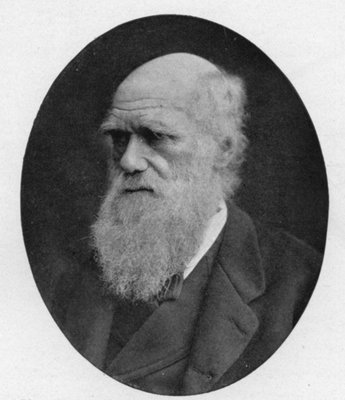
Photo: Rischgitz Collection.
CHARLES DARWIN
Greatest of naturalists, who made the idea of evolution
current intellectual coin, and in his Origin of Species (1859) made
the whole world new.
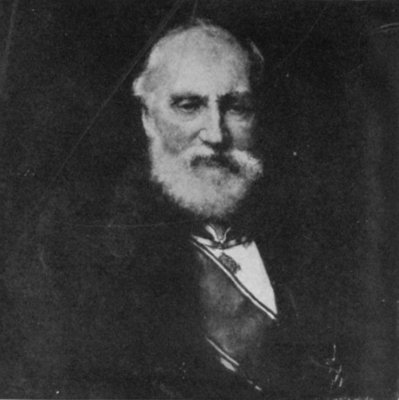
Photo: Rischgitz Collection.
LORD KELVIN
One of the greatest physicists of the nineteenth century.
He estimated the age of the earth at 20,000,000 years. He had not at his
disposal, however, the knowledge of recent discoveries, which have resulted
in this estimate being very greatly increased.
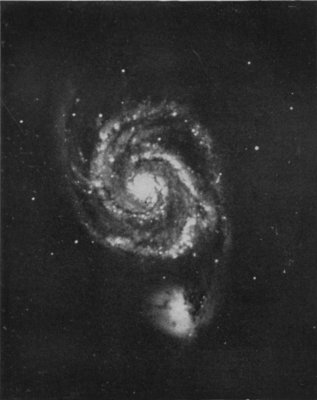
Photo: Lick Observatory.
A GIANT SPIRAL NEBULA
Laplace's famous theory was that the planets and the
earth were formed from great whirling nebulæ.
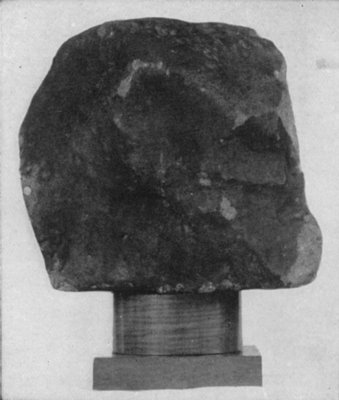
Photo: Natural History Museum.
METEORITE WHICH FELL NEAR SCARBOROUGH, AND IS NOW TO BE SEEN IN THE
NATURAL HISTORY MUSEUM
It weighs about 56 lb., and is a "stony" meteorite, i.e., an
aerolite.
When we speak the language of science we cannot say "In the
beginning," for we do not know of and cannot think of any condition of
things that did not arise from something that went before. But we may qualify
the phrase, and legitimately inquire into the beginning of the earth within
the solar system. If the result of this inquiry is to trace the sun and the
planets back to a nebula we reach only a relative beginning. The nebula has
to be accounted for. And even before matter there may have been a
pre-material world. If we say, as was said long ago, "In the beginning
was Mind," we may be expressing or trying to express a great truth, but
we have gone BEYOND SCIENCE.
One of the grandest pictures that the scientific mind has ever thrown upon
the screen is that of the Nebular Hypothesis. According to Laplace's
famous form of this theory (1796), the solar system was once a gigantic
glowing mass, spinning slowly and uniformly around its centre. As the
incandescent world-cloud of gas cooled and its speed of rotation increased
the shrinking mass gave off a separate whirling ring, which broke up and
gathered together again as the first and most distant planet. The main mass
gave off another ring and another till all the planets, including the earth,
were formed. The central mass persisted as the sun.
Laplace spoke of his theory, which Kant had anticipated forty-one years
before, with scientific caution: "conjectures which I present with all
the distrust which everything not the result of observation or of calculation
ought to inspire." Subsequent research justified his distrust, for it
has been shown that the original nebula need not have been hot and need not
have been gaseous. Moreover, there are great difficulties in Laplace's theory
of the separation of successive rings from the main mass, and of the
condensation of a whirling gaseous ring into a planet.
So it has come about that the picture of a hot gaseous nebula revolving as
a unit body has given place to other pictures. Thus Sir Norman Lockyer
pointed out (1890) that the earth is gathering to itself millions of
meteorites every day; this has been going on for millions of years; in
distant ages the accretion may have been vastly more rapid and voluminous;
and so the earth has grown! Now the meteoritic contributions are undoubted,
but they require a centre to attract them, and the difficulty is to account
for the beginning of a collecting centre or planetary nucleus. Moreover,
meteorites are sporadic and erratic, scattered hither and thither rather than
collecting into unit-bodies. As Professor Chamberlin says, "meteorites
have rather the characteristics of the wreckage of some earlier organisation
than of the parentage of our planetary system." Several other theories
have been propounded to account for the origin of the earth, but the one that
has found most favour in the eyes of authorities is that of Chamberlin and
Moulton. According to this theory a great nebular mass condensed to form the
sun, from which under the attraction of passing stars planet after planet,
the earth included, was heaved off in the form of knotted spiral nebulæ, like
many of those now observed in the heavens.
Of great importance were the "knots," for they served as
collecting centres drawing flying matter into their clutches. Whatever part
of the primitive bolt escaped and scattered was drawn out into independent
orbits round the sun, forming the "planetesimals" which behave like
minute planets. These planetesimals formed the food on which the knots
subsequently fed.
It has been calculated that the newborn earth—the
"earth-knot" of Chamberlin's theory—had a diameter of
about 5,500 miles. But it grew by drawing planetesimals into itself until
it had a diameter of over 8,100 miles at the end of its growing period. Since
then it has shrunk, by periodic shrinkages which have meant the buckling up
of successive series of mountains, and it has now a diameter of 7,918 miles.
But during the shrinking the earth became more varied.
A sort of slow boiling of the internally hot earth often forced molten
matter through the cold outer crust, and there came about a gradual
assortment of lighter materials nearer the surface and heavier materials
deeper down. The continents are built of the lighter materials, such as
granites, while the beds of the great oceans are made of the heavier
materials such as basalts. In limited areas land has often become sea, and
sea has often given place to land, but the probability is that the
distinction of the areas corresponding to the great continents and oceans
goes back to a very early stage.
The lithosphere is the more or less stable crust of the earth, which may
have been, to begin with, about fifty miles in thickness. It seems that the
young earth had no atmosphere, and that ages passed before water began to
accumulate on its surface—before, in other words, there was any
hydrosphere. The water came from the earth itself, to begin with, and it was
long before there was any rain dissolving out saline matter from the exposed
rocks and making the sea salt. The weathering of the high grounds of the
ancient crust by air and water furnished the material which formed the
sandstones and mudstones and other sedimentary rocks, which are said to
amount to a thickness of over fifty miles in all.
It is interesting to inquire how the callous, rough-and-tumble conditions
of the outer world in early days were replaced by others that allowed of the
germination and growth of that tender plant we call LIFE. There are very tough
living creatures, but the average organism is ill suited for violence. Most
living creatures are adapted to mild temperatures and gentle reactions. Hence
the fundamental importance of the early atmosphere, heavy with planetesimal
dust, in blanketing the earth against intensities of radiance from without,
as Chamberlin says, and inequalities of radiance from within. This was the
first preparation for life, but it was an atmosphere without free oxygen. Not
less important was the appearance of pools and lakelets, of lakes and seas.
Perhaps the early waters covered the earth. And water was the second
preparation for life—water, that can dissolve a larger variety of
substances in greater concentration than any other liquid; water, that in
summer does not readily evaporate altogether from a pond, nor in winter
freeze throughout its whole extent; water, that is such a mobile vehicle and
such a subtle cleaver of substances; water, that forms over 80 per cent. of
living matter itself.
Of great significance was the abundance of carbon, hydrogen, and oxygen
(in the form of carbonic acid and water) in the atmosphere of the cooling
earth, for these three wonderful elements have a unique ensemble of
properties—ready to enter into reactions and relations, making great
diversity and complexity possible, favouring the formation of the plastic and
permeable materials that build up living creatures. We must not pursue the
idea, but it is clear that the stones and mortar of the inanimate world are
such that they built a friendly home for life.
During the early chapters of the earth's history, no living creature
that we can imagine could possibly have lived there. The temperature was too
high; there was neither atmosphere nor surface water. Therefore it follows
that at some uncertain, but inconceivably distant date, living creatures
appeared upon the earth. No one knows how, but it is interesting to consider
possibilities.
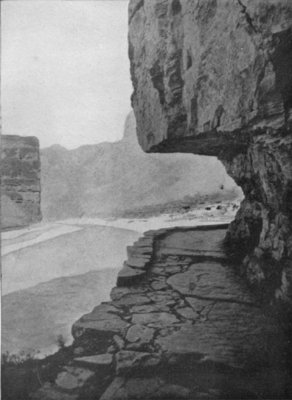
Reproduced from the Smithsonian Report, 1915.
A LIMESTONE CANYON
Many fossils of extinct animals have been found in such rock
formations.
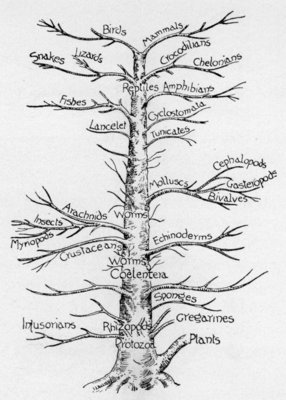
GENEALOGICAL TREE OF ANIMALS
Showing in order of evolution the general relations of the
chief classes into which the world of living things is divided. This scheme
represents the present stage of our knowledge, but is admittedly
provisional.
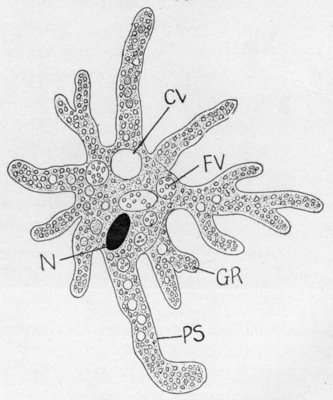
DIAGRAM OF AMŒBA
(Greatly magnified.)
The amœba is one of the simplest of all animals, and
gives us a hint of the original ancestors. It looks like a tiny irregular
speck of greyish jelly, about 1/100th of an inch in diameter. It is
commonly found gliding on the mud or weeds in ponds, where it engulfs its
microscopic food by means of out-flowing lobes (PS). The food vacuole (FV)
contains ingested food. From the contractile vacuole (CV) the waste matter
is discharged. N is the nucleus, GR, granules.
From ancient times it has been a favourite answer that the dust of the
earth may have become living in a way which is outside scientific
description. This answer forecloses the question, and it is far too soon to
do that. Science must often say "Ignoramus": Science should be slow
to say "Ignorabimus."
A second position held by Helmholtz, Lord Kelvin, and others, suggests
that minute living creatures may have come to the earth from elsewhere, in
the cracks of a meteorite or among cosmic dust. It must be remembered that
seeds can survive prolonged exposure to very low temperatures; that spores of
bacteria can survive high temperature; that seeds of plants and germs of
animals in a state of "latent life" can survive prolonged drought
and absence of oxygen. It is possible, according to Berthelot, that as long
as there is not molecular disintegration vital activities may be suspended
for a time, and may afterwards recommence when appropriate conditions are
restored. Therefore, one should be slow to say that a long journey through
space is impossible. The obvious limitation of Lord Kelvin's theory is
that it only shifts the problem of the origin of organisms (i.e. living
creatures) from the earth to elsewhere.
The third answer is that living creatures of a very simple sort may have
emerged on the earth's surface from not-living material, e.g. from some
semi-fluid carbon compounds activated by ferments. The tenability of this
view is suggested by the achievements of the synthetic chemists, who are able
artificially to build up substances such as oxalic acid, indigo, salicylic
acid, caffeine, and grape-sugar. We do not know, indeed, what in Nature's
laboratory would take the place of the clever synthetic chemist, but there
seems to be a tendency to complexity. Corpuscles form atoms, atoms form
molecules, small molecules large ones.
Various concrete suggestions have been made in regard to the possible
origin of living matter, which will be dealt with in a later chapter. So far
as we know of what goes on to-day, there is no evidence of spontaneous
generation; organisms seem always to arise from pre-existing organisms of the
same kind; where any suggestion of the contrary has been fancied, there have
been flaws in the experimenting. But it is one thing to accept the verdict
"omne vivum e vivo" as a fact to which experiment has not yet
discovered an exception and another thing to maintain that this must always
have been true or must always remain true.
If the synthetic chemists should go on surpassing themselves, if
substances like white of egg should be made artificially, and if we should
get more light on possible steps by which simple living creatures may have
arisen from not-living materials, this would not greatly affect our general
outlook on life, though it would increase our appreciation of what is often
libelled as "inert" matter. If the dust of the earth did naturally
give rise very long ago to living creatures, if they are in a real sense born
of her and of the sunshine, then the whole world becomes more continuous and
more vital, and all the inorganic groaning and travailing becomes more
intelligible.
We cannot have more than a speculative picture of the first living
creatures upon the earth or, rather, in the waters that covered the earth. A
basis for speculation is to be found, however, in the simplest creatures
living to-day, such as some of the bacteria and one-celled animalcules,
especially those called Protists, which have not taken any very definite step
towards becoming either plants or animals. No one can be sure, but there is
much to be said for the theory that the first creatures were microscopic
globules of living matter, not unlike the simplest bacteria of to-day, but
able to live on air, water, and dissolved salts. From such a source may have
originated a race of one-celled marine organisms which were able to
manufacture chlorophyll, or something like chlorophyll, that is to say, the
green pigment which makes it possible for plants to utilise the energy of the
sunlight in breaking up carbon dioxide and in building up (photosynthesis)
carbon compounds like sugars and starch. These little units were probably
encased in a cell-wall of cellulose, but their boxed-in energy expressed
itself in the undulatory movement of a lash or flagellum, by means of which
they propelled themselves energetically through the water. There are many
similar organisms to-day, mostly in water, but some of them—simple
one-celled plants—paint the tree-stems and even the paving-stones green
in wet weather. According to Prof. A. H. Church there was a long chapter in
the history of the earth when the sea that covered everything teemed with
these green flagellates—the originators of the Vegetable Kingdom.
On another tack, however, there probably evolved a series of simple
predatory creatures, not able to build up organic matter from air, water, and
salts, but devouring their neighbours. These units were not closed in with
cellulose, but remained naked, with their living matter or protoplasm flowing
out in changeful processes, such as we see in the Amœbæ in the ditch or
in our own white blood corpuscles and other amœboid cells. These were
the originators of the animal kingdom. Thus from very simple Protists the
first animals and the first plants may have arisen. All were still very
minute, and it is worth remembering that had there been any scientific
spectator after our kind upon the earth during these long ages, he would have
lamented the entire absence of life, although the seas were teeming. The
simplest forms of life and the protoplasm which Huxley called the physical
basis of life will be dealt with in the chapter on Biology in a later section
of this work.
However it may have come about, there is no doubt at all that one of the
first great steps in Organic Evolution was the forking of the genealogical
tree into Plants and Animals—the most important parting of the ways in
the whole history of Nature.
Typical plants have chlorophyll; they are able to feed at a low chemical
level on air, water, and salts, using the energy of the sunlight in their
photosynthesis. They have their cells boxed in by cellulose walls, so that
their opportunities for motility are greatly restricted. They manufacture
much more nutritive material than they need, and live far below their income.
They have no ready way of getting rid of any nitrogenous waste matter that
they may form, and this probably helps to keep them sluggish.
Animals, on the other hand, feed at a high chemical level, on the
carbohydrates (e.g. starch and sugar), fats, and proteins (e.g. gluten,
albumin, casein) which are manufactured by other animals, or to begin with,
by plants. Their cells have not cellulose walls, nor in most cases much wall
of any kind, and motility in the majority is unrestricted. Animals live much
more nearly up to their income. If we could make for an animal and a plant of
equal weight two fractions showing the ratio of the upbuilding, constructive,
chemical processes to the down-breaking, disruptive, chemical processes that
go on in their respective bodies, the ratio for the plant would be much
greater than the corresponding ratio for the animal. In other words, animals
take the munitions which plants laboriously manufacture and explode them in
locomotion and work; and the entire system of animate nature depends upon
the photosynthesis that goes on in green plants.
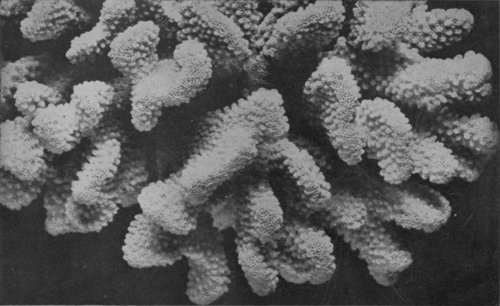
From the Smithsonian Report, 1917
A PIECE OF A REEF-BUILDING CORAL, BUILT UP BY A LARGE COLONY OF SMALL
SEA-ANEMONE-LIKE POLYPS, EACH OF WHICH FORMS FROM THE SALTS OF THE SEA A
SKELETON OR SHELL OF LIME
The wonderful mass of corals, which are very beautiful, are
the skeleton remains of hundreds of these little creatures.
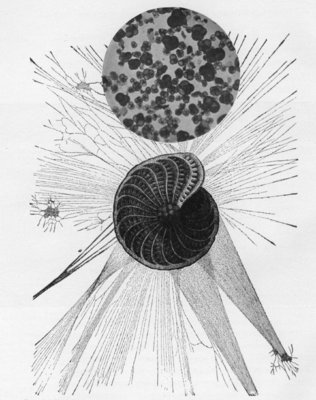
Photo: J. J. Ward, F.E.S.
THE INSET CIRCLE SHOWS A GROUP OF CHALK-FORMING ANIMALS, OR
FORAMINIFERA, EACH ABOUT THE SIZE OF A VERY SMALL PIN'S HEAD
They form a great part of the chalk cliffs of Dover and
similar deposits which have been raised from the floor of an ancient
sea.
THE ENORMOUSLY ENLARGED ILLUSTRATION IS THAT OF A COMMON FORAMINIFER
(POLYSTOMELLA) SHOWING THE SHELL IN THE CENTRE AND THE OUTFLOWING NETWORK
OF LIVING MATTER, ALONG WHICH GRANULES ARE CONTINUALLY TRAVELLING, AND BY
WHICH FOOD PARTICLES ARE ENTANGLED AND DRAWN IN
Reproduced by permission of the Natural History Museum (after
Max Schultze).
As the result of much more explosive life, animals have to deal with much
in the way of nitrogenous waste products, the ashes of the living fire, but
these are usually got rid of very effectively, e.g. in the kidney filters,
and do not clog the system by being deposited as crystals and the like, as
happens in plants. Sluggish animals like sea-squirts which have no kidneys
are exceptions that prove the rule, and it need hardly be said that the
statements that have been made in regard to the contrasts between plants and
animals are general statements. There is often a good deal of the plant about
the animal, as in sedentary sponges, zoophytes, corals, and sea-squirts, and
there is often a little of the animal about the plant, as we see in the
movements of all shoots and roots and leaves, and occasionally in the parts
of the flower. But the important fact is that on the early forking of the
genealogical tree, i.e. the divergence of plants and animals, there depended
and depends all the higher life of the animal kingdom, not to speak of
mankind. The continuance of civilisation, the upkeep of the human and animal
population of the globe, and even the supply of oxygen to the air we breathe,
depend on the silent laboratories of the green leaves, which are able with
the help of the sunlight to use carbonic acid, water, and salts to build up
the bread of life.
It is highly probable that for long ages the waters covered the earth, and
that all the primeval vegetation consisted of simple Flagellates in the
universal Open Sea. But contraction of the earth's crust brought about
elevations and depressions of the sea-floor, and in places the solid
substratum was brought near enough the surface to allow the floating plants
to begin to settle down without getting out of the light. This is how
Professor Church pictures the beginning of a fixed vegetation—a
very momentous step in evolution. It was perhaps among this early vegetation
that animals had their first successes. As the floor of the sea in these
shallow areas was raised higher and higher there was a beginning of dry land.
The sedentary plants already spoken of were the ancestors of the shore
seaweeds, and there is no doubt that when we go down at the lowest tide and
wade cautiously out among the jungle of vegetation only exposed on such
occasions we are getting a glimpse of very ancient days. This is the
forest primeval.
Animals below the level of zoophytes and sponges are called Protozoa. The
word obviously means "First Animals," but all that we can say is
that the very simplest of them may give us some hint of the simplicity of the
original first animals. For it is quite certain that the vast majority of the
Protozoa to-day are far too complicated to be thought of as primitive. Though
most of them are microscopic, each is an animal complete in itself, with the
same fundamental bodily attributes as are manifested in ourselves. They
differ from animals of higher degree in not being built up of the unit areas
or corpuscles called cells. They have no cells, no tissues, no organs, in the
ordinary acceptation of these words, but many of them show a great complexity
of internal structure, far exceeding that of the ordinary cells that build up
the tissues of higher animals. They are complete living creatures which have
not gone in for body-making.
In the dim and distant past there was a time when the only animals were of
the nature of Protozoa, and it is safe to say that one of the great steps in
evolution was the establishment of three great types of Protozoa: (a)
Some were very active, the Infusorians, like the slipper animalcule, the
night-light (Noctiluca), which makes the seas phosphorescent at night, and
the deadly Trypanosome, which causes Sleeping Sickness. (b) Others
were very sluggish, the parasitic Sporozoa, like the malaria organism which
the mosquito introduces into man's body. (c) Others were neither
very active nor very passive, the Rhizopods, with out-flowing processes of
living matter. This amœboid line of evolution has been very successful;
it is represented by the Rhizopods, such as Amœbæ and the chalk-forming
Foraminifera and the exquisitely beautiful flint-shelled Radiolarians of the
open sea. They have their counterparts in the amœboid cells of most
multicellular animals, such as the phagocytes which migrate about in the
body, engulfing and digesting intruding bacteria, serving as sappers and
miners when something has to be broken down and built up again, and
performing other useful offices.
The great naturalist Louis Agassiz once said that the biggest gulf in
Organic Nature was that between the unicellular and the multicellular animals
(Protozoa and Metazoa). But the gulf was bridged very long ago when sponges,
stinging animals, and simple worms were evolved, and showed, for the first
time, a "body." What would one not give to be able to account for
the making of a body, one of the great steps in evolution! No one knows, but
the problem is not altogether obscure.
When an ordinary Protozoon or one-celled animal divides into two or more,
which is its way of multiplying, the daughter-units thus formed float apart
and live independent lives. But there are a few Protozoa in which the
daughter-units are not quite separated off from one another, but remain
coherent. Thus Volvox, a beautiful green ball, found in some canals and the
like, is a colony of a thousand or even ten thousand cells. It has almost
formed a body! But in this "colony-making" Protozoon, and in others
like it, the component cells are all of one kind, whereas in true
multicellular animals there are different kinds of cells, showing
division of labour. There are some other Protozoa in which the nucleus or
kernel divides into many nuclei within the cell. This is seen in the Giant
Amœba (Pelomyxa), sometimes found in duck-ponds, or the beautiful
Opalina, which always lives in the hind part of the frog's food-canal. If
a portion of the living matter of these Protozoa should gather round each of
the nuclei, then that would be the beginning of a body. It would be
still nearer the beginning of a body if division of labour set in, and if
there was a setting apart of egg-cells and sperm-cells distinct from
body-cells.
It was possibly in some such way that animals and plants with a body were
first evolved. Two points should be noticed, that body-making is not
essentially a matter of size, though it made large size possible. For the
body of a many-celled Wheel Animalcule or Rotifer is no bigger than many a
Protozoon. Yet the Rotifer—we are thinking of Hydatina—has nine
hundred odd cells, whereas the Protozoon has only one, except in forms like
Volvox. Secondly, it is a luminous fact that every many-celled animal from
sponge to man that multiplies in the ordinary way begins at the beginning
again as a "single cell," the fertilised egg-cell. It is, of
course, not an ordinary single cell that develops into an earthworm or a
butterfly, an eagle, or a man; it is a cell in which a rich inheritance, the
fruition of ages, is somehow condensed; but it is interesting to bear in mind
the elementary fact that every many-celled creature, reproduced in the
ordinary way and not by budding or the like, starts as a fertilised egg-cell.
The coherence of the daughter-cells into which the fertilised egg-cell
divides is a reminiscence, as it were, of the primeval coherence of
daughter-units that made the first body possible.
A freshwater Hydra, growing on the duckweed usually multiplies by budding.
It forms daughter-buds, living images of itself; a check comes to nutrition
and these daughter-buds go free. A big sea-anemone may divide in two or
more parts, which become separate animals. This is asexual reproduction,
which means that the multiplication takes place by dividing into two or many
portions, and not by liberating egg-cells and sperm-cells. Among animals as
among plants, asexual reproduction is very common. But it has great
disadvantages, for it is apt to be physiologically expensive, and it is beset
with difficulties when the body shows great division of labour, and is very
intimately bound into unity. Thus, no one can think of a bee or a bird
multiplying by division or by budding. Moreover, if the body of the parent
has suffered from injury or deterioration, the result of this is bound to be
handed on to the next generation if asexual reproduction is the only
method.
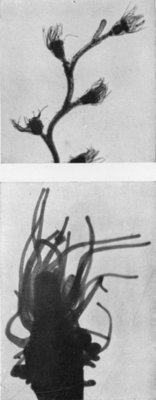
Photos: J. J. Ward, F.E.S.
A PLANT-LIKE ANIMAL, OR ZOOPHYTE, CALLED OBELIA
Consisting of a colony of small polyps, whose stinging
tentacles are well shown greatly enlarged in the lower photograph.
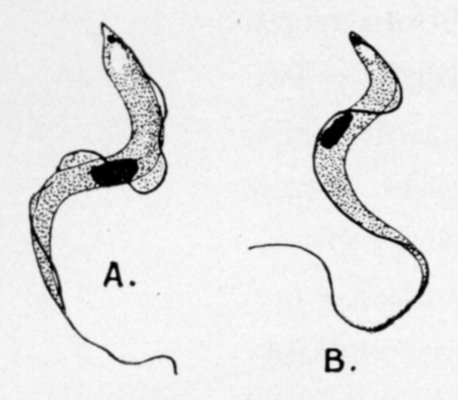
Reproduced by permission of "The Quart. Journ. Mic.
Sci."
TRYPANOSOMA GAMBIENSE
(Very highly magnified.)
The microscopic animal Trypanosome, which causes Sleeping
Sickness. The study of these organisms has of late years acquired an
immense importance on account of the widespread and dangerous maladies to
which some of them give rise. It lives in the blood of man, who is infected
by the bite of a Tse-tse fly which carries the parasite from some other
host.
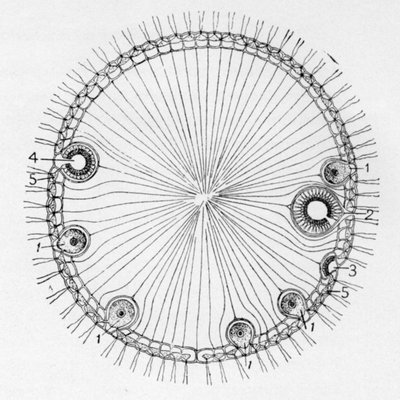
VOLVOX
The Volvox is found in some canals and the like. It is one
of the first animals to suggest the beginning of a body. It is a colony of
a thousand or even ten thousand cells, but they are all cells of one kind.
In multicellular animals the cells are of different kinds
with different functions. Each of the ordinary cells (marked 5) has two
lashes or flagella. Daughter colonies inside the Parent colony are being
formed at 3, 4, and 2. The development of germ-cells is shown at 1.
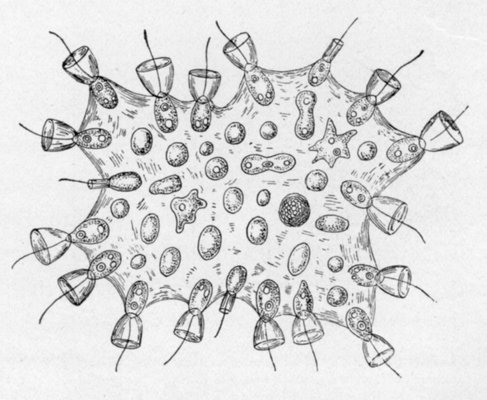
PROTEROSPONGIA
One of the simplest multicellular animals, illustrating the
beginning of a body. There is a setting apart of egg-cells and sperm-cells,
distinct from body-cells; the collared lashed cells on the margin are
different in kind from those farther in. Thus, as in indubitable
multicellular animals, division of labour has begun.
Splitting into two or many parts was the old-fashioned way of multiplying,
but one of the great steps in evolution was the discovery of a better method,
namely, sexual reproduction. The gist of this is simply that during the
process of body-building (by the development of the fertilised egg-cell)
certain units, the germ-cells, do not share in forming ordinary
tissues or organs, but remain apart, continuing the full inheritance which
was condensed in the fertilised egg-cell. These cells kept by themselves
are the originators of the future reproductive cells of the mature
animal; they give rise to the egg-cells and the sperm-cells.
The advantages of this method are great. (1) The new generation is started
less expensively, for it is easier to shed germ-cells into the cradle of the
water than to separate off half of the body. (2) It is possible to start a
great many new lives at once, and this may be of vital importance when the
struggle for existence is very keen, and when parental care is impossible.
(3) The germ-cells are little likely to be prejudicially affected by
disadvantageous dints impressed on the body of the parent—little likely
unless the dints have peculiarly penetrating consequences, as in the case of
poisons. (4) A further advantage is implied in the formation of two kinds of
germ-cells—the ovum or egg-cell, with a considerable amount of building
material and often with a legacy of nutritive yolk; the spermatozoon or
sperm-cell, adapted to move in fluids and to find the ovum from a distance,
thus securing change-provoking cross-fertilisation.
Another of the great steps in organic evolution was the differentiation of
two different physiological types, the male or sperm-producer and the female
or egg-producer. It seems to be a deep-seated difference in constitution,
which leads one egg to develop into a male, and another, lying beside it in
the nest, into a female. In the case of pigeons it seems almost certain, from
the work of Professor Oscar Riddle, that there are two kinds of egg, a
male-producing egg and a female-producing egg, which differ in their
yolk-forming and other physiological characters.
In sea-urchins we often find two creatures superficially
indistinguishable, but the one is a female with large ovaries and the other
is a male with equally large testes. Here the physiological difference does
not affect the body as a whole, but the reproductive organs or gonads only,
though more intimate physiology would doubtless discover differences in the
blood or in the chemical routine (metabolism). In a large number of cases,
however, there are marked superficial differences between the sexes, and
everyone is familiar with such contrasts as peacock and peahen, stag and
hind. In such cases the physiological difference between the sperm-producer
and the ovum-producer, for this is the essential difference, saturates
through the body and expresses itself in masculine and feminine structures
and modes of behaviour. The expression of the masculine and feminine
characters is in some cases under the control of hormones or chemical
messengers which are carried by the blood from the reproductive organs
throughout the body, and pull the trigger which brings about the
development of an antler or a wattle or a decorative plume or a capacity for
vocal and saltatory display. In some cases it is certain that the female
carries in a latent state the masculine features, but these are kept from
expressing themselves by other chemical messengers from the ovary. Of these
chemical messengers more must be said later on.
Recent research has shown that while the difference between male and
female is very deep-rooted, corresponding to a difference in gearing, it is
not always clear-cut. Thus a hen-pigeon may be very masculine, and a
cock-pigeon very feminine. The difference is in degree, not in kind.
What is the meaning of the universal or almost universal inevitableness of
death? A Sequoia or "Big Tree" of California has been known to live
for over two thousand years, but eventually it died. A centenarian tortoise
has been known, and a sea-anemone sixty years of age; but eventually they
die. What is the meaning of this apparently inevitable stoppage of bodily
life?
There are three chief kinds of death, (a) The great majority of
animals come to a violent end, being devoured by others or killed by sudden
and extreme changes in their surroundings. (b) When an animal enters a
new habitat, or comes into new associations with other organisms, it may be
invaded by a microbe or by some larger parasite to which it is unaccustomed
and to which it can offer no resistance. With many parasites a
"live-and-let-live" compromise is arrived at, but new parasites are
apt to be fatal, as man knows to his cost when he is bitten by a tse-tse fly
which infects him with the microscopic animal (a Trypanosome) that causes
Sleeping Sickness. In many animals the parasites are not troublesome as long
as the host is vigorous, but if the host is out of condition the
parasites may get the upper hand, as in the so-called "grouse
disease," and become fatal. (c) But besides violent death and
microbic (or parasitic) death, there is natural death. This is in great part
to be regarded as the price paid for a body. A body worth having implies
complexity or division of labour, and this implies certain internal
furnishings of a more or less stable kind in which the effects of wear and
tear are apt to accumulate. It is not the living matter itself that grows old
so much as the framework in which it works—the furnishings of the vital
laboratory. There are various processes of rejuvenescence, e.g. rest, repair,
change, reorganisation, which work against the inevitable processes of
senescence, but sooner or later the victory is with ageing. Another deep
reason for natural death is to be found in the physiological expensiveness of
reproduction, for many animals, from worms to eels, illustrate natural death
as the nemesis of starting new lives. Now it is a very striking fact that to
a large degree the simplest animals or Protozoa are exempt from natural
death. They are so relatively simple that they can continually recuperate by
rest and repair; they do not accumulate any bad debts. Moreover, their modes
of multiplying, by dividing into two or many units, are very inexpensive
physiologically. It seems that in some measure this bodily immortality of the
Protozoa is shared by some simple many-celled animals like the freshwater
Hydra and Planarian worms. Here is an interesting chapter in evolution, the
evolution of means of evading or staving off natural death. Thus there is the
well-known case of the Paloloworm of the coral-reefs where the body breaks up
in liberating the germ-cells, but the head-end remains fixed in a crevice of
the coral, and buds out a new body at leisure.
Along with the evolution of the ways of avoiding death should be
considered also the gradual establishment of the length of life best suited
to the welfare of the species, and the punctuation of the life-history to
suit various conditions.
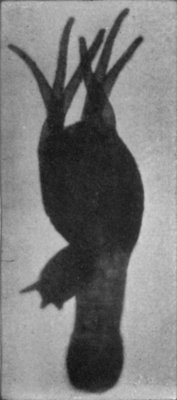
Photo: J. J. Ward, F.E.S.
GREEN HYDRA
A little freshwater polyp, about half an inch long, with a
crown of tentacles round the mouth. It is seen giving off a bud, a clear
illustration of asexual reproduction. When a tentacle touches some small
organism the latter is paralysed and drawn into the mouth.
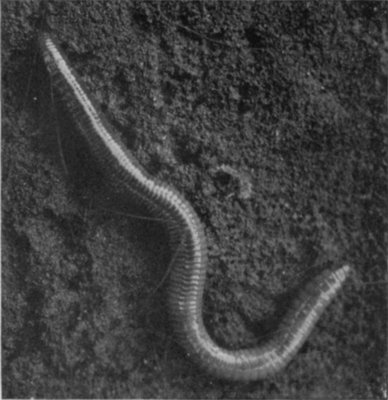
Photo: J. J. Ward, F.E.S.
EARTHWORM
Earthworms began the profitable habit of moving with one
end of the body always in front, and from worms to man the great majority
of animals have bilateral symmetry.
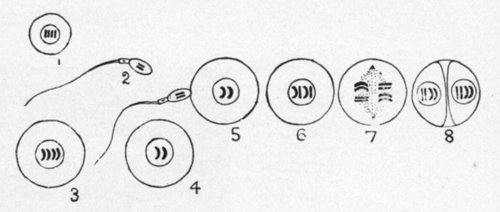
DIAGRAM ILLUSTRATING THE BEGINNING OF INDIVIDUAL LIFE
1. An immature sperm-cell, with 4 chromosomes
(nuclear bodies) represented as rods.
2. A mature sperm-cell, with 2 chromosomes.
3. An immature egg-cell, with 4 chromosomes represented as curved
bodies.
4. A mature egg-cell, with 2 chromosomes.
5. The spermatozoon fertilises the ovum, introducing 2 chromosomes.
6. The fertilised ovum, with 4 chromosomes, 2 of paternal origin and 2 of
maternal origin.
7. The chromosomes lie at the equator, and each is split longitudinally.
The centrosome introduced by the spermatozoon has divided into two
centrosomes, one at each pole of the nucleus. These play an important part
in the division or segmentation of the egg.
8. The fertilised egg has divided into two cells. Each cell has 2 paternal
and 2 maternal chromosomes.
Reproduced from the Smithsonian Report, 1917.
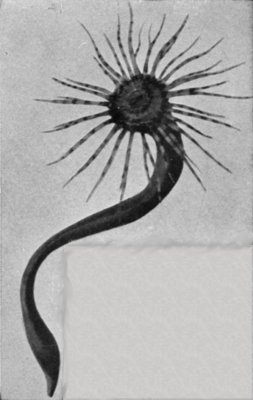
GLASS MODEL OF A SEA-ANEMONE
A long tubular sea-anemone, with a fine crown of tentacles
around the mouth. The suggestion of a flower is very obvious. By means of
stinging lassoes on the tentacles minute animals on which it feeds are
paralysed and captured for food.
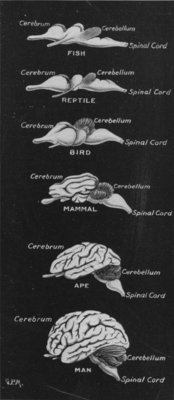
THIS DRAWING SHOWS THE EVOLUTION OF THE BRAIN FROM FISH TO MAN
The Cerebrum, the seat of intelligence, increases in
proportion to the other parts. In mammals it becomes more and more
convoluted. The brain, which lies in one plane in fishes, becomes gradually
curved on itself. In birds it is more curved than the drawing shows.
In animals like sea-anemones and jellyfishes the general symmetry of the
body is radial; that is to say, there is no right or left, and the body might
be halved along many planes. It is a kind of symmetry well suited for
sedentary or for drifting life. But worms began the profitable habit of
moving with one end of the body always in front, and from worms to man the
great majority of animals have bilateral symmetry. They have a right and a
left side, and there is only one cut that halves the body. This kind of
symmetry is suited for a more strenuous life than radial animals show; it is
suited for pursuing food, for avoiding enemies, for chasing mates. And
with the establishment of bilateral symmetry must be associated the
establishment of head-brains, the beginning of which is to be found in
some simple worm-types.
Among the other great acquisitions gradually evolved we may notice: a
well-developed head with sense-organs, the establishment of large internal
surfaces such as the digestive and absorptive wall of the food-canal, the
origin of quickly contracting striped muscle and of muscular appendages, the
formation of blood as a distributing medium throughout the body, from which
all the parts take what they need and to which they also contribute.
Another very important acquisition, almost confined (so far as is known)
to backboned animals, was the evolution of what are called glands of internal
secretion, such as the thyroid and the supra-renal. These manufacture subtle
chemical substances which are distributed by the blood throughout the body,
and have a manifold influence in regulating and harmonising the vital
processes. Some of these chemical messengers are called hormones, which
stimulate organs and tissues to greater activity; others are called chalones,
which put on a brake. Some regulate growth and others rapidly alter the pressure
and composition of the blood. Some of them call into active development
certain parts of the body which have been, as it were, waiting for an
appropriate trigger-pulling. Thus, at the proper time, the milk-glands of a
mammalian mother are awakened from their dormancy. This very interesting
outcome of evolution will be dealt with in another portion of this work.
Before passing to a connected story of the gradual emergence of higher and
higher forms of life in the course of the successive ages—the
procession of life, as it may be called—it will be useful to consider
the evolution of animal behaviour.
A human being begins as a microscopic fertilised egg-cell, within which
there is condensed the long result of time—Man's inheritance. The
long period of nine months before birth, with its intimate partnership
between mother and offspring, is passed as it were in sleep, and no one can
make any statement in regard to the mind of the unborn child. Even after
birth the dawn of mind is as slow as it is wonderful. To begin with, there is
in the ovum and early embryo no nervous system at all, and it develops very
gradually from simple beginnings. Yet as mentality cannot come in from
outside, we seem bound to conclude that the potentiality of it—whatever
that means—resides in the individual from the very first. The
particular kind of activity known to us as thinking, feeling, and willing is
the most intimate part of our experience, known to us directly apart from our
senses, and the possibility of that must be implicit in the germ-cell just as
the genius of Newton was implicit in a very miserable specimen of an infant.
Now what is true of the individual is true also of the race—there is a
gradual evolution of that aspect of the living creature's activity which we
call mind. We cannot put our finger on any point and say: Before this stage
there was no mind. Indeed, many facts suggest the conclusion that wherever
there is life there is some degree of mind—even in the plants. Or it
might be more accurate to put the conclusion in another way, that the
activity we call life has always in some degree an inner or mental
aspect.
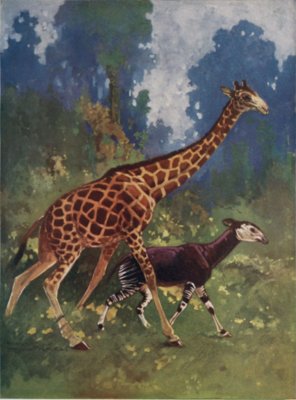
OKAPI AND GIRAFFE
The Okapi is one of the great zoölogical discoveries. It
gives a good idea of what the Giraffe's ancestors were like. The Okapi
was unknown until discovered in 1900 by Sir Harry Johnston in Central
Africa, where these strange animals have probably lived in dense forests
from time immemorial.
In another part of this book there is an account of the dawn of mind in
backboned animals; what we aim at here is an outline of what may be called
the inclined plane of animal behaviour.
A very simple animal accumulates a little store of potential energy, and
it proceeds to expend this, like an explosive, by acting on its environment.
It does so in a very characteristic self-preservative fashion, so that it
burns without being consumed and explodes without being blown to bits. It is
characteristic of the organism that it remains a going concern for a longer
or shorter period—its length of life. Living creatures that expended
their energy ineffectively or self-destructively would be eliminated in the
struggle for existence. When a simple one-celled organism explores a corner
of the field seen under a microscope, behaving to all appearance very like a
dog scouring a field seen through a telescope, it seems permissible to think
of something corresponding to mental endeavour associated with its activity.
This impression is strengthened when an amœba pursues another
amœba, overtakes it, engulfs it, loses it, pursues it again, recaptures
it, and so on. What is quite certain is that the behaviour of the animalcule
is not like that of a potassium pill fizzing about in a basin of water, nor
like the lurching movements of a gun that has got loose and "taken
charge" on board ship. Another feature is that the locomotor activity of
an animalcule often shows a distinct individuality: it may swim, for
instance, in a loose spiral.
But there is another side to vital activity besides acting
upon
the surrounding world; the living creature is acted on by influences from
without. The organism acts on its environment; that is the one side of the
shield: the environment acts upon the organism; that is the other side. If we
are to see life whole we must recognise these two sides of what we call
living, and it is missing an important part of the history of animal life if
we fail to see that evolution implies becoming more advantageously sensitive
to the environment, making more of its influences, shutting out profitless
stimuli, and opening more gateways to knowledge. The bird's world is a
larger and finer world than an earthworm's; the world means more to the
bird than to the worm.
Simple creatures act with a certain degree of spontaneity on their
environment, and they likewise react effectively to surrounding stimuli.
Animals come to have definite "answers back," sometimes several,
sometimes only one, as in the case of the Slipper Animalcule, which reverses
its cilia when it comes within the sphere of some disturbing influence,
retreats, and, turning upon itself tentatively, sets off again in the same
general direction as before, but at an angle to the previous line. If it
misses the disturbing influence, well and good; if it strikes it again, the
tactics are repeated until a satisfactory way out is discovered or the
stimulation proves fatal.
It may be said that the Slipper Animalcule has but one answer to every
question, but there are many Protozoa which have several enregistered
reactions. When there are alternative reactions which are tried one after
another, the animal is pursuing what is called the trial-and-error method,
and a higher note is struck.
There is an endeavour after satisfaction, and a trial of answers. When the
creature profits by experience to the extent of giving the right answer
first, there is the beginning of learning.
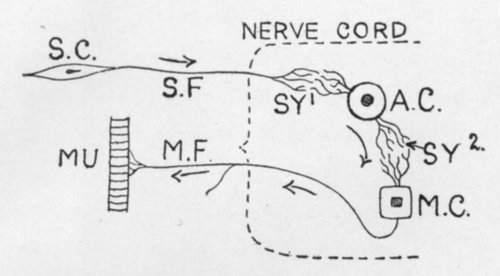
DIAGRAM OF A SIMPLE REFLEX ARC IN A BACKBONELESS ANIMAL LIKE AN
EARTHWORM
1. A sensory nerve-cell (S.C.) on the surface receives a
stimulus.
2. The stimulus travels along the sensatory nerve-fibre (S.F.)
3. The sensory nerve-fibre branches in the nerve-cord.
4. Its branches come into close contact (SY1) with those of an
associative or communicating nerve-cell (A.C.).
5. Other branches of the associative cell come into close contact
(SY2) with the branches or dendrites of a motor nerve-cell
(M.C.).
6. An impulse or command travels along the motor nerve-fibre or axis
cylinder of the motor nerve-cell.
7. The motor nerve-fibre ends on a muscle-fibre (M.F.) near the surface.
This moves and the reflex action is complete.
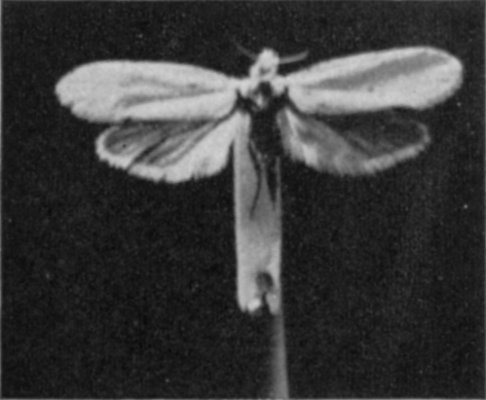
Photo: British Museum (Natural History).
THE YUCCA MOTH
The Yucca Moth, emerging from her cocoon, flies at night to
a Yucca flower and collects pollen from the stamens, holding a little ball
of it in her mouth-parts. She then visits another flower and lays an egg in
the seed-box. After this she applies the pollen to the tip of the pistil,
thus securing the fertilisation of the flower and the growth of the ovules
in the pod. Yucca flowers in Britain do not produce seeds because there are
no Yucca Moths.
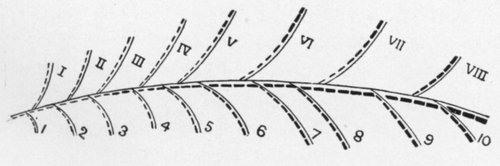
INCLINED PLANE OF ANIMAL BEHAVIOUR
Diagram illustrating animal behaviour. The main line
represents the general life of the creature. On the upper side are
activities implying initiative; on the lower side actions which are almost
automatic.
Upper Side.—I. Energetic actions. II. Simple
tentatives. III. Trial-and-error methods. IV. Non-intelligent experiments.
V. Experiential "learning." VI. Associative "learning."
VII. Intelligent behaviour. VIII. Rational conduct (man).
Lower Side.—1. Reactions to environment. 2.
Enregistered reactions. 3. Simple reflex actions. 4. Compound reflex
actions. 5. Tropisms. 6. Enregistered rhythms. 7. Simple instincts. 8.
Chain instincts. 9. Instinctive activities influenced by intelligence. 10.
Subconscious cerebration at a high level (man).
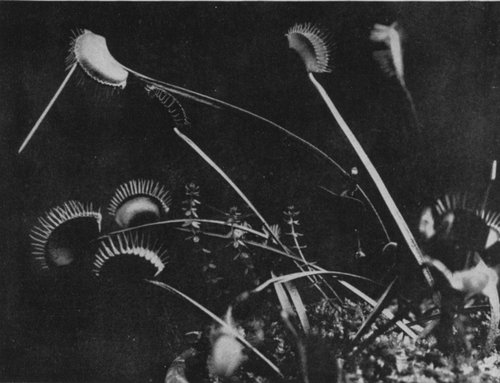
Photo: J. J. Ward, F.E.S.
VENUS' FLY-TRAP
One of the most remarkable plants in the world, which
captures its prey by means of a trap formed from part of its leaf. It has
been induced to snap at and hold a bristle. If an insect lighting on the
leaf touches one of six very sensitive hairs, which pull the trigger of the
movement, the two halves of the leaf close rapidly and the fringing teeth
on the margin interlock, preventing the insect's escape. Then follows
an exudation of digestive juice.
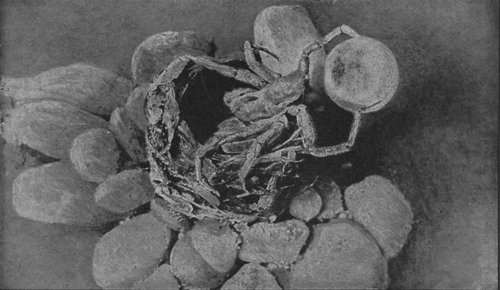
Reproduced by permission from "The Wonders of Instinct" by
J. H. Fabre.
A SPIDER SUNNING HER EGGS
A kind of spider, called Lycosa, lying head downwards at
the edge of her nest, and holding her silken cocoon—the bag
containing the eggs—up towards the sun in her hindmost pair of legs.
This extraordinary proceeding is believed to assist in the hatching.
Among simple multicellular animals, such as sea-anemones, we find the
beginnings of reflex actions, and a considerable part of the behaviour of the
lower animals is reflex. That is to say, there are laid down in the animal in
the course of its development certain pre-arrangements of nerve-cells and
muscle-cells which secure that a fit and proper answer is given to a
frequently recurrent stimulus. An earthworm half out of its burrow becomes
aware of the light tread of a thrush's foot, and jerks itself back into
its hole before anyone can say "reflex action." What is it that
happens?
Certain sensory nerve-cells in the earthworm's skin are stimulated by
vibrations in the earth; the message travels down a sensory nerve-fibre from
each of the stimulated cells and enters the nerve-cord. The sensory fibres
come into vital connection with branches of intermediary, associative, or
communicating cells, which are likewise connected with motor nerve-cells. To
these the message is thus shunted. From the motor nerve-cells an impulse or
command travels by motor nerve-fibres, one from each cell, to the muscles,
which contract. If this took as long to happen as it takes to describe, even
in outline, it would not be of much use to the earthworm. But the motor
answer follows the sensory stimulus almost instantaneously. The great
advantage of establishing or enregistering these reflex chains is that the
answers are practically ready-made or inborn, not requiring to be learned. It
is not necessary that the brain should be stimulated if there is a brain; nor
does the animal will to act, though in certain cases it may by means of
higher controlling nerve-centres keep the natural reflex response from being
given, as happens, for instance, when we control a cough or a sneeze on some
solemn occasion. The evolutionary method, if we may use the expression, has
been to enregister ready-made responses; and as we ascend the animal kingdom,
we find reflex actions becoming complicated and often linked together, so
that the occurrence of one pulls the trigger of another, and so on in a chain. The
behaviour of the insectivorous plant called Venus's fly-trap when it
shuts on an insect is like a reflex action in an animal, but plants have no
definite nervous system.
A somewhat higher level on the inclined plane is illustrated by what are
called "tropisms," obligatory movements which the animal makes,
adjusting its whole body so that physiological equilibrium results in
relation to gravity, pressure, currents, moisture, heat, light, electricity,
and surfaces of contact. A moth is flying past a candle; the eye next the
light is more illumined than the other; a physiological inequilibrium
results, affecting nerve-cells and muscle-cells; the outcome is that the moth
automatically adjusts its flight so that both eyes become equally illumined;
in doing this it often flies into the candle.
It may seem bad business that the moth should fly into the candle, but the
flame is an utterly artificial item in its environment to which no one can
expect it to be adapted. These tropisms play an important rôle in animal
behaviour.
On a higher level is instinctive behaviour, which reaches such remarkable
perfection in ants, bees, and wasps. In its typical expression instinctive
behaviour depends on inborn capacities; it does not require to be learned; it
is independent of practice or experience, though it may be improved by both;
it is shared equally by all members of the species of the same sex (for the
female's instincts are often different from the male's); it refers to
particular conditions of life that are of vital importance, though they may
occur only once in a lifetime. The female Yucca Moth emerges from the cocoon
when the Yucca flower puts forth its bell-like blossoms. She flies to a
flower, collects some pollen from the stamens, kneads it into a pill-like ball,
and stows this away under her chin. She flies to an older Yucca flower and
lays her eggs in some of the ovules within the seed-box, but before she does
so she has to deposit on the stigma the ball of pollen. From this the
pollen-tubes grow down and the pollen-nucleus of a tube fertilises the
egg-cell in an ovule, so that the possible seeds become real seeds, for it is
only a fraction of them that the Yucca Moth has destroyed by using them as
cradles for her eggs. Now it is plain that the Yucca Moth has no individual
experience of Yucca flowers, yet she secures the continuance of her race by a
concatenation of actions which form part of her instinctive repertory.
From a physiological point of view instinctive behaviour is like a chain
of compound reflex actions, but in some cases, at least, there is reason to
believe that the behaviour is suffused with awareness and backed by
endeavour. This is suggested in exceptional cases where the stereotyped
routine is departed from to meet exceptional conditions. It should also be
noted that just as ants, hive bees, and wasps exhibit in most cases purely
instinctive behaviour, but move on occasion on the main line of trial and
error or of experimental initiative, so among birds and mammals the
intelligent behaviour is sometimes replaced by instinctive routine. Perhaps
there is no instinctive behaviour without a spice of intelligence, and no
intelligent behaviour without an instinctive element. The old view that
instinctive behaviour was originally intelligent, and that instinct is
"lapsed intelligence," is a tempting one, and is suggested by the
way in which habitual intelligent actions cease in the individual to require
intelligent control, but it rests on the unproved hypothesis that the
acquisitions of the individual can be entailed on the race. It is almost
certain that instinct is on a line of evolution quite different from
intelligence, and that it is nearer to the inborn inspirations of the
calculating boy or the musical genius than to the plodding methods of
intelligent learning.
The higher reaches of the inclined plane of behaviour show intelligence in
the strict sense. They include those kinds of behaviour which cannot be
described without the suggestion that the animal makes some sort of
perceptual inference, not only profiting by experience but learning by ideas.
Such intelligent actions show great individual variability; they are plastic
and adjustable in a manner rarely hinted at in connection with instincts
where routine cannot be departed from without the creature being nonplussed;
they are not bound up with particular circumstances as instinctive actions
are, but imply an appreciative awareness of relations.
When there is an experimenting with general ideas, when there is
conceptual as contrasted with perceptual inference, we speak of
Reason, but there is no evidence of this below the level of man. It is not,
indeed, always that we can credit man with rational conduct, but he has the
possibility of it ever within his reach.
Animal instinct and intelligence will be illustrated in another part of
this work. We are here concerned simply with the general question of the
evolution of behaviour. There is a main line of tentative experimental
behaviour both below and above the level of intelligence, and it has been
part of the tactics of evolution to bring about the hereditary enregistration
of capacities of effective response, the advantages being that the answers
come more rapidly and that the creature is left free, if it chooses, for
higher adventures.
There is no doubt as to the big fact that in the course of evolution
animals have shown an increasing complexity and masterfulness of behaviour,
that they have become at once more controlled and more definitely free
agents, and that the inner aspect of the behaviour—experimenting,
learning, thinking, feeling, and willing—has come to count for more and
more.
Mammals furnish a crowning instance of a trend of evolution which
expresses itself at many levels—the tendency to bring forth the young
at a well-advanced stage and to an increase of parental care associated with
a decrease in the number of offspring. There is a British starfish called
Luidia which has two hundred millions of eggs in a year, and there are
said to be several millions of eggs in conger-eels and some other fishes.
These illustrate the spawning method of solving the problem of survival. Some
animals are naturally prolific, and the number of eggs which they sow
broadcast in the waters allows for enormous infantile mortality and obviates
any necessity for parental care.
But some other creatures, by nature less prolific, have found an entirely
different solution of the problem. They practise parental care and they
secure survival with greatly economised reproduction. This is a trend of
evolution particularly characteristic of the higher animals. So much so that
Herbert Spencer formulated the generalisation that the size and frequency of
the animal family is inverse ratio to the degree of evolution to which the
animal has attained.
Now there are many different methods of parental care which secure the
safety of the young, and one of these is called viviparity. The young ones
are not liberated from the parent until they are relatively well advanced and
more or less able to look after themselves. This gives the young a good
send-off in life, and their chances of death are greatly reduced. In other
words, the animals that have varied in the direction of economised
reproduction may keep their foothold in the struggle for existence if they
have varied at the same time in the direction of parental care. In other
cases it may have worked the other way round.
In the interesting archaic animal called Peripatus, which
has to
face a modern world too severe for it, one of the methods of meeting the
environing difficulties is the retention of the offspring for many months
within the mother, so that it is born a fully-formed creature. There are only
a few offspring at a time, and, although there are exceptional cases like the
summer green-flies, which are very prolific though viviparous, the general
rule is that viviparity is associated with a very small family. The case of
flowering plants stands by itself, for although they illustrate a kind of
viviparity, the seed being embryos, an individual plant may have a large
number of flowers and therefore a huge family.
Viviparity naturally finds its best illustrations among terrestrial
animals, where the risks to the young life are many, and it finds its climax
among mammals.
Now it is an interesting fact that the three lowest mammals, the Duckmole
and two Spiny Ant-eaters, lay eggs, i.e. are oviparous; that the Marsupials,
on the next grade, bring forth their young, as it were, prematurely, and in
most cases stow them away in an external pouch; while all the
others—the Placentals—show a more prolonged ante-natal life and
an intimate partnership between the mother and the unborn young.
There is another way of looking at the sublime process of evolution. It
has implied a mastery of all the possible haunts of life; it has been a
progressive conquest of the environment.
1. It is highly probable that living organisms found their foothold in the
stimulating conditions of the shore of the sea—the shallow water,
brightly illumined, seaweed-growing shelf fringing the Continents. This
littoral zone was a propitious environment where sea and fresh water, earth
and air all meet, where there is stimulating change, abundant oxygenation and
a copious supply of nutritive material in what the streams bring down and in
the rich seaweed vegetation.
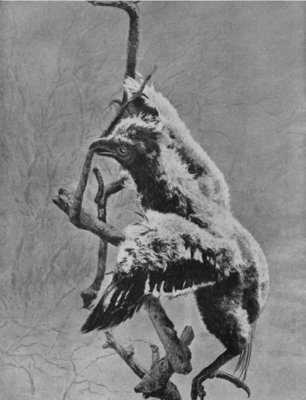
THE HOATZIN INHABITS BRITISH GUIANA
The newly hatched bird has claws on its thumb and first
finger and so is enabled to climb on the branches of trees with great
dexterity until such time as the wings are strong enough to sustain it in
flight.
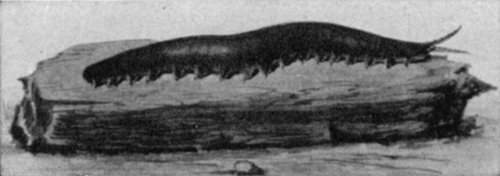
Photograph, from the British Museum (Natural History), of a drawing
by Mr. E. Wilson.
PERIPATUS
A widely distributed old-fashioned type of animal, somewhat
like a permanent caterpillar. It has affinities both with worms and with
insects. It has a velvety skin, minute diamond-like eyes, and short
stump-like legs. A defenceless, weaponless animal, it comes out at night,
and is said to capture small insects by squirting jets of slime from its
mouth.
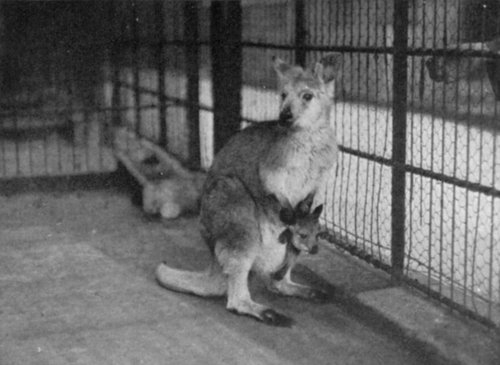
Photo: W. S. Berridge, F.Z.S.
ROCK KANGAROO CARRYING ITS YOUNG IN A POUCH
The young are born so helpless that they cannot even suck.
The mother places them in the external pouch, and fitting their mouths on
the teats injects the milk. After a time the young ones go out and in as
they please.
It is not an easy haunt of life, but none the worse for that, and it is
tenanted to-day by representatives of practically every class of animals from
infusorians to seashore birds and mammals.
2. The open-sea or pelagic haunt includes all the brightly illumined
surface waters beyond the shallow water of the shore area.
It is perhaps the easiest of all the haunts of life, for there is no
crowding, there is considerable uniformity, and an abundance of food for
animals is afforded by the inexhaustible floating "sea-meadows" of
microscopic Algæ. These are reincarnated in minute animals like the open-sea
crustaceans, which again are utilised by fishes, these in turn making life
possible for higher forms like carnivorous turtles and toothed whales. It is
quite possible that the open sea was the original cradle of life and perhaps
Professor Church is right in picturing a long period of pelagic life before
there was any sufficiently shallow water to allow the floating plants to
anchor. It is rather in favour of this view that many shore animals such as
crabs and starfishes, spend their youthful stages in the relatively safe
cradle of the open sea, and only return to the more strenuous conditions of
their birthplace after they have gained considerable strength of body. It is
probably safe to say that the honour of being the original cradle of life
lies between the shore of the sea and the open sea.
3. A third haunt of life is the floor of the Deep Sea, the abyssal area,
which occupies more than a half of the surface of the globe. It is a region
of extreme cold—an eternal winter; of utter darkness—an eternal
night—relieved only by the fitful gleams of "phosphorescent"
animals; of enormous pressure—2½ tons on the square inch at a depth of 2,500
fathoms; of profound calm, unbroken silence, immense monotony. And as there
are no plants in the great abysses, the animals must live on one another,
and, in the long run, on the rain of moribund animalcules which sink from the
surface through the miles of water. It seems a very unpromising haunt of
life, but it is abundantly tenanted, and it gives us a glimpse of the
insurgent nature of the living creature that the difficulties of the Deep Sea
should have been so effectively conquered. It is probable that the colonising
of the great abysses took place in relatively recent times, for the fauna
does not include many very antique types. It is practically certain that the
colonisation was due to littoral animals which followed the food-débris,
millennium after millennium, further and further down the long slope from the
shore.
4. A fourth haunt of life is that of the freshwaters, including river and
lake, pond and pool, swamp and marsh. It may have been colonised by gradual
migration up estuaries and rivers, or by more direct passage from the
seashore into the brackish swamp. Or it may have been in some cases that
partially landlocked corners of ancient seas became gradually turned into
freshwater basins. The animal population of the freshwaters is very
representative, and is diversely adapted to meet the characteristic
contingencies—the risk of being dried up, the risk of being frozen hard
in winter, and the risk of being left high and dry after floods or of being
swept down to the sea.
5. The terrestrial haunt has been invaded age after age by contingents
from the sea or from the freshwaters. We must recognise the worm invasion,
which led eventually to the making of the fertile soil, the invasion due to
air-breathing Arthropods, which led eventually to the important linkage
between flowers and their insect visitors, and the invasion due to
air-breathing Amphibians, which led eventually to the higher terrestrial
animals and to the development of intelligence and family affection. Besides
these three great invasions, there were minor ones such as that leading to
land-snails, for there has been a widespread and persistent tendency among
aquatic animals to try to possess the dry land.
Getting on to dry land had a manifold significance.
It implied getting into a medium with a much larger supply of oxygen than
there is dissolved in the water. But the oxygen of the air is more difficult
to capture, especially when the skin becomes hard or well protected, as it is
almost bound to become in animals living on dry ground. Thus this leads to
the development of internal surfaces, such as those of lungs, where
the oxygen taken into the body may be absorbed by the blood. In most animals
the blood goes to the surface of oxygen-capture; but in insects and their
relatives there is a different idea—of taking the air to the blood or
in greater part to the area of oxygen-combustion, the living tissues. A
system of branching air-tubes takes air into every hole and corner of the
insect's body, and this thorough aeration is doubtless in part the secret
of the insect's intense activity. The blood never becomes impure.
The conquest of the dry land also implied a predominance of that kind of
locomotion which may be compared to punting, when the body is pushed along by
pressing a lever against a hard substratum. And it also followed that with
few exceptions the body of the terrestrial animal tended to be compact,
readily lifted off the ground by the limbs or adjusted in some other way so
that there may not be too large a surface trailing on the ground. An animal
like a jellyfish, easily supported in the water, would be impossible on land.
Such apparent exceptions as earthworms, centipedes, and snakes are not
difficult to explain, for the earthworm is a burrower which eats its way
through the soil, the centipede's long body is supported by numerous hard
legs, and the snake pushes itself along by means of the large ventral scales
to which the lower ends of very numerous ribs are attached.
A great restriction attendant on the invasion of the dry land is that
locomotion becomes limited to one plane, namely, the surface of the earth.
This is in great contrast to what is true in the water, where the animal can
move up or down, to right or to left, at any angle and in three dimensions.
It surely follows from this that the movements of land animals must be rapid
and precise, unless, indeed, safety is secured in some other way. Hence it is
easy to understand why most land animals have very finely developed striped
muscles, and why a beetle running on the ground has far more numerous muscles
than a lobster swimming in the sea.
Land animals were also handicapped by the risks of drought and of frost,
but these were met by defences of the most diverse description, from the
hairs of woolly caterpillars to the fur of mammals, from the carapace of
tortoises to the armour of armadillos. In other cases, it is hardly necessary
to say, the difficulties may be met in other ways, as frogs meet the winter
by falling into a lethargic state in some secluded retreat.
Another consequence of getting on to dry land is that the eggs or young
can no longer be set free anyhow, as is possible when the animal is
surrounded by water, which is in itself more or less of a cradle. If the eggs
were laid or the young liberated on dry ground, the chances are many that
they would be dried up or devoured. So there are numerous ways in which land
animals secure the safety of their young, e.g. by burying them in the ground,
or by hiding them in nests, or by carrying them about for a prolonged period
either before or after birth. This may mean great safety for the young, this
may make it possible to have only a small family, and this may tend to the
evolution of parental care and the kindly emotions. Thus it may be understood
that from the conquest of the land many far-reaching consequences have
followed.
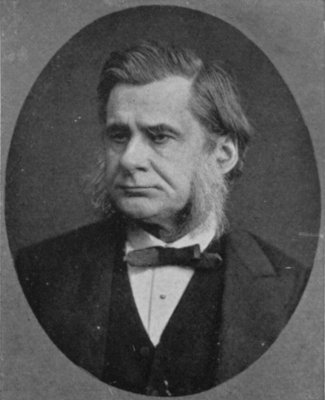
Photo: Rischgitz.
PROFESSOR THOMAS HENRY HUXLEY (1825-95)
One of the most distinguished of zoologists, with
unsurpassed gifts as a teacher and expositor. He did great service in
gaining a place for science in ordinary education and in popular
estimation. No one championed Evolutionism with more courage and skill.
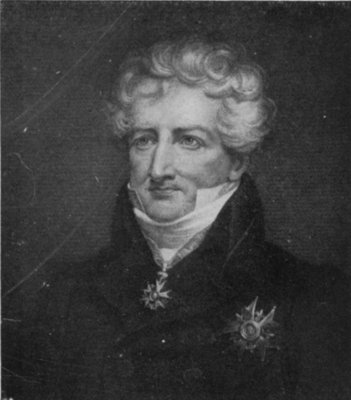
BARON CUVIER, 1769-1832
One of the founders of modern Comparative Anatomy. A man of
gigantic intellect, who came to Paris as a youth from the provinces, and
became the director of the higher education of France and a peer of the
Empire. He was opposed to Evolutionist ideas, but he had anatomical
genius.
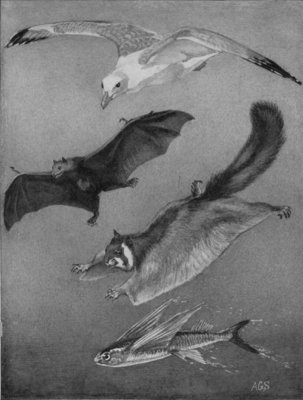
AN ILLUSTRATION SHOWING VARIOUS METHODS OF FLYING AND SWOOPING
Gull, with a feather-wing, a true flier. Fox-bat, with a
skin-wing, a true flier. Flying Squirrel, with a parachute of skin, able to
swoop from tree to tree, but not to fly. Flying Fish, with pectoral fins
used as volplanes in a great leap due to the tail. To some extent able to
sail in albatros fashion.
Finally, it is worth dwelling on the risks of terrestrial life, because
they enable us better to understand why so many land animals have become
burrowers and others climbers of trees, why some have returned to the water
and others have taken to the air. It may be asked, perhaps, why the land
should have been colonised at all when the risks and difficulties are so
great. The answer must be that necessity and curiosity are the mother and
father of invention. Animals left the water because the pools dried up, or
because they were overcrowded, or because of inveterate enemies, but also
because of that curiosity and spirit of adventure which, from first to last,
has been one of the spurs of progress.
6. The last great haunt of life is the air, a mastery of which must be
placed to the credit of insects, Pterodactyls, birds, and bats. These have
been the successes, but it should be noted that there have been many
brilliant failures, which have not attained to much more than parachuting.
These include the Flying Fishes, which take leaps from the water and are
carried for many yards and to considerable heights, holding their enlarged
pectoral fins taut or with little more than a slight fluttering. There is a
so-called Flying Frog (Rhacophorus) that skims from branch to branch,
and the much more effective Flying Dragon (Draco volans) of the Far
East, which has been mentioned already. Among mammals there are Flying
Phalangers, Flying Lemurs, and more besides, all attaining to great skill as
parachutists, and illustrating the endeavour to master the air which man has
realised in a way of his own.
The power of flight brings obvious advantages. A bird feeding on the ground is
able to evade the stalking carnivore by suddenly rising into the air; food
and water can be followed rapidly and to great distances; the eggs or the
young can be placed in safe situations; and birds in their migrations have
made a brilliant conquest both of time and space. Many of them know no winter
in their year, and the migratory flight of the Pacific Golden Plover from
Hawaii to Alaska and back again does not stand alone.
How do we know when the various classes of animals and plants were
established on the earth? How do we know the order of their appearance and
the succession of their advances? The answer is: by reading the Rock Record.
In the course of time the crust of the earth has been elevated into
continents and depressed into ocean-troughs, and the surface of the land has
been buckled up into mountain ranges and folded in gentler hills and valleys.
The high places of the land have been weathered by air and water in many
forms, and the results of the weathering have been borne away by rivers and
seas, to be laid down again elsewhere as deposits which eventually formed
sandstones, mudstones, and similar sedimentary rocks. Much of the material of
the original crust has thus been broken down and worked up again many times
over, and if the total thickness of the sedimentary rocks is added up it
amounts, according to some geologists, to a total of 67 miles. In most cases,
however, only a small part of this thickness is to be seen in one place, for
the deposits were usually formed in limited areas at any one time.
When the sediments were accumulating age after age, it naturally came
about that remains of the plants and animals living at the time were
buried, and these formed the fossils by the aid of which it is possible to
read the story of the past. By careful piecing together of evidence the
geologist is able to determine the order in which the different sedimentary
rocks were laid down, and thus to say, for instance, that the Devonian period
was the time of the origin of Amphibians. In other cases the geologist
utilises the fossils in his attempt to work out the order of the strata when
these have been much disarranged. For the simpler fossil forms of any type
must be older than those that are more complex. There is no vicious circle
here, for the general succession of strata is clear, and it is quite certain
that there were fishes before there were amphibians, and amphibians before
there were reptiles, and reptiles before there were birds and mammals. In
certain cases, e.g. of fossil horses and elephants, the actual historical
succession has been clearly worked out.
If the successive strata contained good samples of all the plants and
animals living at the time when the beds were formed, then it would be easy
to read the record of the rocks, but many animals were too soft to become
satisfactory fossils, many were eaten or dissolved away, many were destroyed
by heat and pressure, so that the rock record is like a library very much
damaged by fire and looting and decay.
The long history of the earth and its inhabitants is conveniently divided
into eras. Thus, just as we speak of the ancient, mediæval, and modern
history of mankind, so we may speak of Palæozoic, Mesozoic and Cenozoic eras
in the history of the earth as a whole.
Geologists cannot tell us except in an approximate way how long the
process of evolution has taken. One of the methods is to estimate how long
has been required for the accumulation of the salts of the sea, for all these
have been dissolved out of the rocks since rain began to fall on the earth.
Dividing the total amount of saline matter by what is contributed every year
in modern times, we get about a hundred million years as the age of the sea.
But as the present rate of salt-accumulation is probably much greater than it
was during many of the geological periods, the prodigious age just mentioned
is in all likelihood far below the mark. Another method is to calculate how
long it would take to form the sedimentary rocks, like sandstones and
mudstones, which have a total thickness of over fifty miles, though
the local thickness is rarely over a mile. As most of the materials
have come from the weathering of the earth's crust, and as the annual
amount of weathering now going on can be estimated, the time required for the
formation of the sedimentary rocks of the world can be approximately
calculated. There are some other ways of trying to tell the earth's age
and the length of the successive periods, but no certainty has been
reached.
The eras marked on the table (page 92) as before the Cambrian
correspond to about thirty-two miles of thickness of strata; and all the
subsequent eras with fossil-bearing rocks to a thickness of about twenty-one
miles—in itself an astounding fact. Perhaps thirty million years must
be allotted to the Pre-Cambrian eras, eighteen to the Palæozoic, nine to the
Mesozoic, three to the Cenozoic, making a grand total of sixty millions.
It is an astounding fact that at least half of geological time (the
Archæozoic and Proterozoic eras) passed before there were living creatures
with parts sufficiently hard to form fossils. In the latter part of the
Proterozoic era there are traces of one-celled marine animals (Radiolarians)
with shells of flint, and of worms that wallowed in the primal mud. It is
plain that as regards the most primitive creatures the rock record tells us
little.
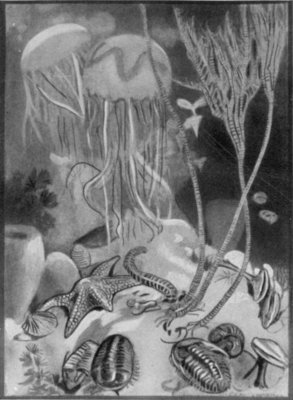
From Knipe's "Nebula to Man."
ANIMALS OF THE CAMBRIAN PERIOD
e.g. Sponges, Jellyfish, Starfish, Sea-lilies, Water-fleas, and
Trilobites
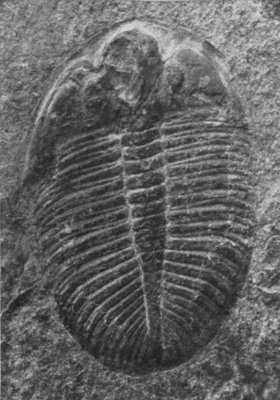
Photo: J. J. Ward, F.E.S.
A TRILOBITE
Trilobites were ancient seashore animals, abundant from the
Upper Cambrian to the Carboniferous eras. They have no direct descendants
to-day. They were jointed-footed animals, allied to Crustaceans and perhaps
also to King-crabs. They were able to roll themselves up in their
ring-armour.

Photo: British Museum (Natural History).
THE GAMBIAN MUD-FISH, PROTOPTERUS
It can breathe oxygen dissolved in water by its gills; it
can also breathe dry air by means of its swim-bladder, which has become a
lung. It is a double-breather, showing evolution in process. For
seven months of the year, the dry season, it can remain inert in the mud,
getting air through an open pipe to the surface. When water fills the pools
it can use its gills again. Mud-nests or mud encasements with the lung-fish
inside have often been brought to Britain and the fish when liberated were
quite lively.
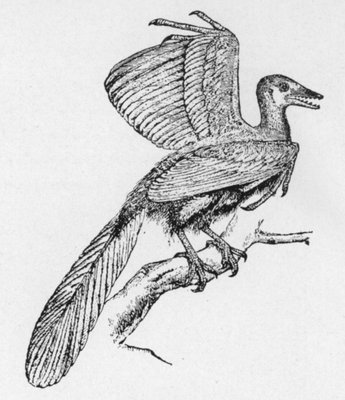
THE ARCHÆOPTERYX
(After William Leche of Stockholm.)
A good restoration of the oldest known bird, Archæopteryx
(Jurassic Era). It was about the size of a crow; it had teeth on both jaws;
it had claws on the thumb and two fingers; and it had a long lizard-like
tail. But it had feathers, proving itself a true bird.
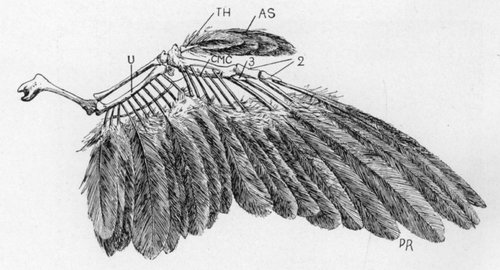
WING OF A BIRD, SHOWING THE ARRANGEMENT OF THE FEATHERS
The longest feathers or primaries (PR) are borne by the two
fingers (2 and 3), and their palm-bones (CMC); the second longest or
secondaries are borne by the ulna bone (U) of the fore-arm; there is a
separate tuft (AS) on the thumb (TH).
The rarity of direct traces of life in the oldest rocks is partly due to
the fact that the primitive animals would be of delicate build, but it must
also be remembered that the ancient rocks have been profoundly and repeatedly
changed by pressure and heat, so that the traces which did exist would be
very liable to obliteration. And if it be asked what right we have to suppose
the presence of living creatures in the absence or extreme rarity of fossils,
we must point to great accumulations of limestone which indicate the
existence of calcareous algæ, and to deposits of iron which probably indicate
the activity of iron-forming Bacteria. Ancient beds of graphite similarly
suggest that green plants flourished in these ancient days.
The Cambrian period was the time of the establishment of the chief
stocks of backboneless animals such as sponges, jellyfishes, worms,
sea-cucumbers, lamp-shells, trilobites, crustaceans, and molluscs. There is
something very eloquent in the broad fact that the peopling of the seas had
definitely begun some thirty million years ago, for Professor H. F. Osborn
points out that in the Cambrian period there was already a colonisation of
the shore of the sea, the open sea, and the deep waters.
The Ordovician period was marked by abundant representation of the
once very successful class of Trilobites—jointed-footed,
antenna-bearing, segmented marine animals, with numerous appendages and a
covering of chitin. They died away entirely with the end of the Palæozoic
era. Also very notable was the abundance of predatory cuttlefishes, the
bullies of the ancient seas. But it was in this period that the first
backboned animals made their appearance—an epoch-making step in
evolution. In other words, true fishes were evolved—destined in the
course of ages to replace the cuttlefishes (which are mere molluscs) in
dominating the seas.
| RECENT TIMES |
|
Human civilisation. |
|
|
{PLEISTOCENE OR GLACIAL TIME |
Last great Ice Age. |
| CENOZOIC ERA |
{MIOCENE AND PLIOCENE TIMES |
Emergence of Man. |
|
{EOCENE AND OLIGOCENE TIMES |
Rise of higher mammals. |
|
|
{CRETACEOUS PERIOD |
Rise of primitive mammals, flowering plants, and higher
insects. |
| MESOZOIC ERA |
{JURASSIC PERIOD |
Rise of birds and flying reptiles. |
|
{TRIASSIC PERIOD |
Rise of dinosaur reptiles. |
|
|
{PERMIAN PERIOD |
Rise of reptiles. |
|
{CARBONIFEROUS PERIOD |
Rise of insects. |
| PALÆOZOIC ERA |
{DEVONIAN PERIOD |
First amphibians. |
|
{SILURIAN PERIOD |
Land animals began. |
|
{ORDOVICIAN PERIOD |
First fishes. |
|
{CAMBRIAN PERIOD |
Peopling of the sea. |
|
| PROTEROZOIC AGES |
Many of the Backboneless stocks began. |
| ARCHÆOZOIC AGES |
Living creatures began to be upon the
earth. |
|
|
{Making of continents and ocean-basins. |
| FORMATIVE TIMES |
{Beginnings of atmosphere and
hydrosphere. |
|
{Cooling of the earth. |
|
{Establishment of the solar system. |
In the Silurian period in which the peopling of the seas went on
apace, there was the first known attempt at colonising the dry land. For in
Silurian rocks there are fossil scorpions, and that implies ability to
breathe dry air—by means of internal surfaces, in this case known as
lungbooks. It was also towards the end of the Silurian, when a period of
great aridity set in, that fishes appeared related to our mud-fishes or
double-breathers (Dipnoi), which have lungs as well as gills. This, again,
meant utilising dry air, just as the present-day mud-fishes do when the water
disappears from the pools in hot weather. The lung-fishes or mud-fishes of
to-day are but three in number, one in Queensland, one in South America, and
one in Africa, but they are extremely interesting "living fossils,"
binding the class of fishes to that of amphibians. It is highly probable that
the first invasion of the dry land should be put to the credit of some
adventurous worms, but the second great invasion was certainly due to
air-breathing Arthropods, like the pioneer scorpion we mentioned.
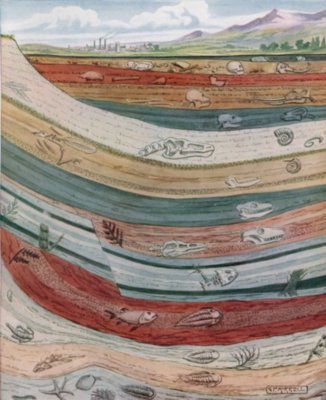
PICTORIAL REPRESENTATION OF THE SUCCESSIVE STRATA OF THE EARTH'S
CRUST, WITH SUGGESTIONS OF CHARACTERISTIC FOSSILS
E.g. Fish and Trilobite in the Devonian (red), a large
Amphibian in the Carboniferous (blue), Reptiles in Permian (light red), the
first Mammal in the Triassic (blue), the first Bird in the Jurassic
(yellow), Giant Reptiles in the Cretaceous (white), then follow the
Tertiary strata with progressive mammals, and Quaternary at the top with
man and mammoth.
The Devonian period, including that of the Old Red Sandstone, was
one of the most significant periods in the earth's history. For it was
the time of the establishment of flowering plants upon the earth and of
terrestrial backboned animals. One would like to have been the discoverer of
the Devonian foot-print of Thinopus, the first known Amphibian
foot-print—an eloquent vestige of the third great invasion of the dry
land. It was probably from a stock of Devonian lung-fishes that the first
Amphibians sprang, but it was not till the next period that they came to
their own. While they were still feeling their way, there was a remarkable
exuberance of shark-like and heavily armoured fishes in the Devonian
seas.
The Carboniferous period was marked by a mild moist climate and a
luxuriant vegetation in the swampy low grounds. It was a much less strenuous
time than the Devonian period; it was like a very long summer. There were no
trees of the type we see now, but there were forests of club-mosses and
horsetails which grew to a gigantic size compared with their pigmy
representatives of to-day. In these forests the jointed-footed invaders of
the dry land ran riot in the form of centipedes, spiders, scorpions, and
insects, and on these the primeval Amphibians fed. The appearance of insects
made possible a new linkage of far-reaching importance, namely, the
cross-fertilisation of flowering plants by their insect visitors, and from
this time onwards it may be said that flowers and their visitors have evolved
hand in hand. Cross-fertilisation is much surer by insects than by the wind,
and cross-fertilisation is more advantageous than self-fertilisation because
it promotes both fertility and plasticity. It was probably in this period
that coloured flowers—attractive to insect-visitors—began
to justify themselves as beauty became useful, and began to relieve the
monotonous green of the horsetail and club-moss forests, which covered great
tracts of the earth for millions of years. In the Carboniferous forests there
were also land-snails, representing one of the minor invasions of the dry
land, tending on the whole to check vegetation. They, too, were probably
preyed upon by the Amphibians, some of which attained a large size. Each age
has had its giants, and those of the Carboniferous were Amphibians called
Labyrinthodonts, some of which were almost as big as donkeys. It need hardly
be said that it was in this period that most of the Coal-measures were laid
down by the immense accumulation of the spores and debris of the club-moss
forests. Ages afterwards, it was given to man to tap this great source of
energy—traceable back to the sunshine of millions of years ago. Even
then it was true that no plant or animal lives or dies to itself!
As Amphibians had their Golden Age in the Carboniferous period we may
fitly use this opportunity of indicating the advances in evolution which the
emergence of Amphibians implied. (1) In the first place the passage from
water to dry land was the beginning of a higher and more promiseful life,
taxed no doubt by increased difficulties. The natural question rises why
animals should have migrated from water to dry land at all when great
difficulties were involved in the transition. The answers must be: (a)
that local drying up of water-basins or elevations of the land surface often
made the old haunts untenable; (b) that there may have been great
congestion and competition in the old quarters; and (c) that there has
been an undeniable endeavour after well-being throughout the history of
animal life. In the same way with mankind, migrations were prompted by the
setting in of prolonged drought, by over-population, and by the spirit of
adventure. (2) In Amphibians for the first time the non-digitate paired fins
of fishes were replaced by limbs with fingers and toes. This implied an
advantageous power of grasping, of holding firm, of putting food into the
mouth, of feeling things in three dimensions. (3) We cannot be positive in
regard to the soft parts of the ancient Amphibians known only as fossils, but
if they were in a general way like the frogs and toads, newts and salamanders
of the present day, we may say that they made among other acquisitions the
following: true ventral lungs, a three-chambered heart, a movable tongue, a
drum to the ear, and lids to the eyes. It is very interesting to find that
though the tongue of the tadpole has some muscle-fibres in it, they are not
strong enough to effect movement, recalling the tongue of fishes, which has
not any muscles at all. Gradually, as the tadpole becomes a frog, the
muscle-fibres grow in strength, and make it possible for the full-grown
creature to shoot out its tongue upon insects. This is probably a
recapitulation of what was accomplished in the course of millennia in the
history of the Amphibian race. (4) Another acquisition made by Amphibians was
a voice, due, as in ourselves, to the rapid passage of air over taut
membranes (vocal cords) stretched in the larynx. It is an interesting fact
that for millions of years there was upon the earth no sound of life at all,
only the noise of wind and wave, thunder and avalanche. Apart from the
instrumental music of some insects, perhaps beginning in the Carboniferous,
the first vital sounds were due to Amphibians, and theirs certainly was the
first voice—surely one of the great steps in organic evolution.
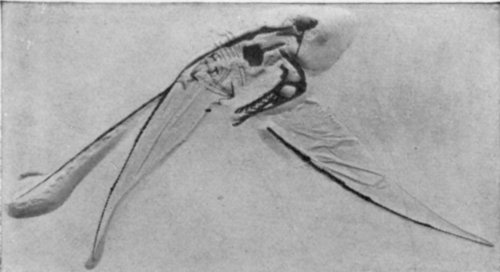
Photo: British Museum (Natural History).
FOSSIL OF A PTERODACTYL OR EXTINCT FLYING DRAGON
The wing is made of a web of skin extended on the
enormously elongated outermost finger. The long tail served for balancing
and steering. The Pterodactyls varied from the size of sparrows to a
wing-span of fifteen feet—the largest flying creatures.
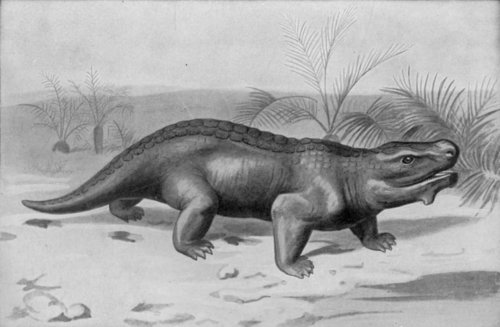
From Knipe's "Nebula to Man."
PARIASAURUS: AN EXTINCT VEGETARIAN TRIASSIC REPTILE
Total length about 9 feet. (Remains found in Cape Colony, South
Africa.)
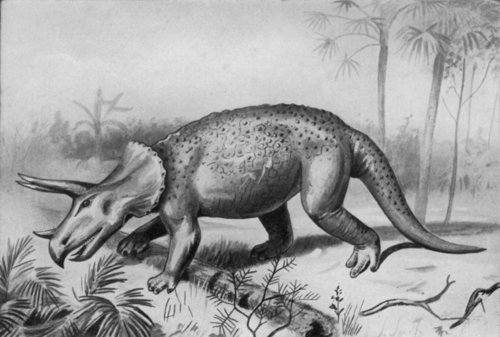
From Knipe's "Nebula to Man."
TRICERATOPS: A HUGE EXTINCT REPTILE
(From remains found in Cretaceous strata of Wyoming, U.S.A.)
This Dinosaur, about the size of a large rhinoceros, had a
huge three-horned skull with a remarkable bony collar over the neck. But,
as in many other cases, its brain was so small that it could have passed
down the spinal canal in which the spinal cord lies. Perhaps this partly
accounts for the extinction of giant reptiles.
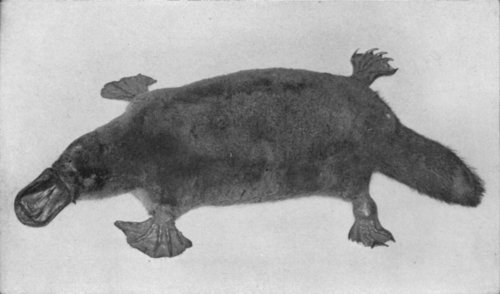
Photo: "Daily Mail."
THE DUCKMOLE OR DUCK-BILLED PLATYPUS OF AUSTRALIA
The Duckmole or Duck-billed Platypus of Australia is a
survivor of the most primitive mammals. It harks back to reptiles, e.g. in
being an egg-layer, in having comparatively large eggs, and in being
imperfectly warm-blooded. It swims well and feeds on small water-animals.
It can also burrow.
The first use of the voice was probably that indicated by our frogs and
toads—it serves as a sex-call. That is the meaning of the trumpeting
with which frogs herald the spring, and it is often only in the males that
the voice is well developed. But if we look forward, past Amphibians
altogether, we find the voice becoming a maternal call helping to secure the
safety of the young—a use very obvious when young birds squat
motionless at the sound of the parent's danger-note. Later on, probably,
the voice became an infantile call, as when the unhatched crocodile pipes
from within the deeply buried egg, signalling to the mother that it is time
to be unearthed. Higher still the voice expresses emotion, as in the song of
birds, often outside the limits of the breeding time. Later still, particular
sounds become words, signifying particular things or feelings, such as
"food," "danger," "home," "anger,"
and "joy." Finally words become a medium of social intercourse and
as symbols help to make it possible for man to reason.
In the Permian period reptiles appeared, or perhaps one should say,
began to assert themselves. That is to say, there was an emergence of
backboned animals which were free from water and relinquished the method of
breathing by gills, which Amphibians retained in their young stages at least.
The unhatched or unborn reptile breathes by means of a vascular hood spread
underneath the egg-shell and absorbing dry air from without. It is an
interesting point that this vascular hood, called the allantois, is
represented in the Amphibians by an unimportant bladder growing out from the
hind end of the food-canal. A great step in evolution was implied in the
origin of this ante-natal hood or fœtal membrane and another
one—of protective significance—called the amnion, which forms a
water-bag over the delicate embryo. The step meant total emancipation from
the water and from gill-breathing, and the two fœtal membranes, the
amnion and the allantois, persist not only in all reptiles but in birds
and
mammals as well. These higher Vertebrates are therefore called Amniota in
contrast to the Lower Vertebrates or Anamnia (the Amphibians, Fishes, and
primitive types).
It is a suggestive fact that the embryos of all reptiles, birds, and
mammals show gill-clefts—a tell-tale evidence of their distant
aquatic ancestry. But these embryonic gill-clefts are not used for
respiration and show no trace of gills except in a few embryonic reptiles and
birds where their dwindled vestiges have been recently discovered. As to the
gill-clefts, they are of no use in higher Vertebrates except that the first
becomes the Eustachian tube leading from the ear-passage to the back of the
mouth. The reason why they persist when only one is of any use, and that in a
transformed guise, would be difficult to interpret except in terms of the
Evolution theory. They illustrate the lingering influence of a long pedigree,
the living hand of the past, the tendency that individual development has to
recapitulate racial evolution. In a condensed and telescoped manner, of
course, for what took the race a million years may be recapitulated by the
individual in a week!
In the Permian period the warm moist climate of most of the Carboniferous
period was replaced by severe conditions, culminating in an Ice Age which
spread from the Southern Hemisphere throughout the world. With this was
associated a waning of the Carboniferous flora, and the appearance of a new
one, consisting of ferns, conifers, ginkgos, and cycads, which persisted
until near the end of the Mesozoic era. The Permian Ice Age lasted for
millions of years, and was most severe in the Far South. Of course, it was a
very different world then, for North Europe was joined to North America,
Africa to South America, and Australia to Asia. It was probably during the
Permian Ice Age that many of the insects divided their life-history into two
main chapters—the feeding, growing, moulting, immature, larval stages,
e.g. caterpillars, and the more ascetic, non-growing, non-moulting, winged
phase, adapted for reproduction. Between these there intervened the
quiescent, well-protected pupa stage or chrysalis, probably adapted to begin
with as a means of surviving the severe winter. For it is easier for an
animal to survive when the vital processes are more or less in abeyance.
We cannot leave the last period of the Palæozoic era and its prolonged ice
age without noticing that it meant the entire cessation of a large number of
ancient types, especially among plants and backboneless animals, which now
disappear for ever. It is necessary to understand that the animals of ancient
days stand in three different relations to those of to-day. (a) There
are ancient types that have living representatives, sometimes few and
sometimes many, sometimes much changed and sometimes but slightly changed.
The lamp-shell, Lingulella, of the Cambrian and Ordovician period has
a very near relative in the Lingula of to-day. There are a few
extremely conservative animals. (b) There are ancient types which have
no living representatives, except in the guise of transformed descendants, as
the King-crab (Limulus) may be said to be a transformed descendant of
the otherwise quite extinct race to which Eurypterids or Sea-scorpions
belonged. (c) There are altogether extinct types—lost
races—which have left not a wrack behind. For there is not any
representation to-day of such races as Graptolites and Trilobites.
Looking backwards over the many millions of years comprised in the
Palæozoic era, what may we emphasise as the most salient features? There was
in the Cambrian the establishment of the chief classes of backboneless
animals; in the Ordovician the first fishes and perhaps the first
terrestrial plants; in the Silurian the emergence of air-breathing
Invertebrates and mud-fishes; in the Devonian the appearance of the
first Amphibians, from which all higher land animals are descended, and the
establishment of a land flora; in the Carboniferous the great
Club-moss forests and an exuberance of air-breathing insects and their allies;
in the Permian the first reptiles and a new flora.
In a broad way the Mesozoic era corresponds with the Golden Age of
reptiles, and with the climax of the Conifer and Cycad flora, which was
established in the Permian. But among the Conifers and Cycads our modern
flowering plants were beginning to show face tentatively, just like birds and
mammals among the great reptiles.
In the Triassic period the exuberance of reptilian life which
marked the Permian was continued. Besides Turtles which still persist, there
were Ichthyosaurs, Plesiosaurs, Dinosaurs, and Pterosaurs, none of which
lasted beyond the Mesozoic era. Of great importance was the rise of the
Dinosaurs in the Triassic, for it is highly probable that within the limits
of this vigorous and plastic stock—some of them bipeds—we must
look for the ancestors of both birds and mammals. Both land and water were
dominated by reptiles, some of which attained to gigantic size. Had there
been any zoologist in those days, he would have been very sagacious indeed if
he had suspected that reptiles did not represent the climax of creation.
The Jurassic period showed a continuance of the reptilian
splendour. They radiated in many directions, becoming adapted to many haunts.
Thus there were many Fish Lizards paddling in the seas, many types of
terrestrial dragons stalking about on land, many swiftly gliding
alligator-like forms, and the Flying Dragons which began in the Triassic
attained to remarkable success and variety. Their wing was formed by the
extension of a great fold of skin on the enormously elongated
outermost finger, and they varied from the size of a sparrow to a
spread of over five feet. A soldering of the dorsal vertebræ as in our Flying
Birds was an adaptation to striking the air with some force, but as there is
not more than a slight keel, if any, on the breast-bone, it is unlikely that
they could fly far. For we know from our modern birds that the power of
flight may be to some extent gauged from the degree of development of the
keel, which is simply a great ridge for the better insertion of the muscles
of flight. It is absent, of course, in the Running Birds, like the ostrich,
and it has degenerated in an interesting way in the burrowing parrot
(Stringops) and a few other birds that have "gone back."
But the Jurassic is particularly memorable because its strata have yielded
two fine specimens of the first known bird, Archæopteryx. These were
entombed in the deposits which formed the fine-grained lithographic stones of
Bavaria, and practically every bone in the body is preserved except the
breast-bone. Even the feathers have left their marks with distinctness. This
oldest known bird—too far advanced to be the first bird—was about
the size of a crow and was probably of arboreal habits. Of great interest are
its reptilian features, so pronounced that one cannot evade the evolutionist
suggestion. It had teeth in both jaws, which no modern bird has; it had a
long lizard-like tail, which no modern bird has; it had claws on three
fingers, and a sort of half-made wing. That is to say, it does not show, what
all modern birds show, a fusion of half the wrist-bones with the whole of the
palm-bones, the well-known carpo-metacarpus bone which forms a basis for the
longest pinions. In many reptiles, such as Crocodiles, there are peculiar
bones running across the abdomen beneath the skin, the so-called
"abdominal ribs," and it seems an eloquent detail to find these
represented in Archæopteryx, the earliest known bird. No modern bird
shows any trace of them.
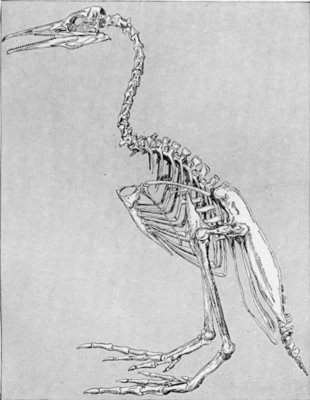
SKELETON OF AN EXTINCT FLIGHTLESS TOOTHED BIRD, HESPERORNIS
(After Marsh.)
The bird was five or six feet high, something like a
swimming ostrich, with a very powerful leg but only a vestige of a wing.
There were sharp teeth in a groove. The modern divers come nearest to this
ancient type.
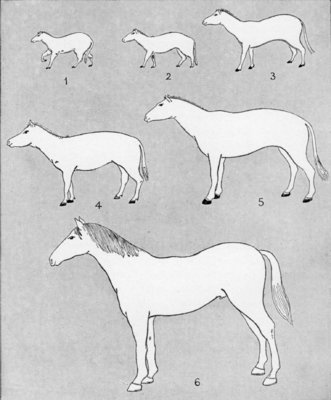
SIX STAGES IN THE EVOLUTION OF THE HORSE, SHOWING GRADUAL INCREASE IN
SIZE
(After Lull and Matthew.)
1. Four-toed horse, Eohippus, about one foot high. Lower
Eocene, N. America.
2. Another four-toed horse, Orohippus, a little over a foot high. Middle
Eocene, N. America.
3. Three-toed horse, Mesohippus, about the size of a sheep. Middle
Oligocene, N. America.
4. Three-toed horse, Merychippus, Miocene, N. America. Only one toe reaches
the ground on each foot, but the remains of two others are prominent.
5. The first one-toed horse, Pliohippus, about forty inches high at the
shoulder. Pliocene, N. America.
6. The modern horse, running on the third digit of each foot.
There is no warrant for supposing that the flying reptiles or Pterodactyls
gave rise to birds, for the two groups are on different lines, and the
structure of the wings is entirely different. Thus the long-fingered
Pterodactyl wing was a parachute wing, while the secret of the bird's
wing has its centre in the feathers. It is highly probable that birds evolved
from certain Dinosaurs which had become bipeds, and it is possible that they
were for a time swift runners that took "flying jumps" along the
ground. Thereafter, perhaps, came a period of arboreal apprenticeship during
which there was much gliding from tree to tree before true flight was
achieved. It is an interesting fact that the problem of flight has been
solved four times among animals—by insects, by Pterodactyls, by birds,
and by bats; and that the four solutions are on entirely different lines.
In the Cretaceous period the outstanding events included the waning
of giant reptiles, the modernising of the flowering plants, and the
multiplication of small mammals. Some of the Permian reptiles, such as the
dog-toothed Cynodonts, were extraordinarily mammal-like, and it was probably
from among them that definite mammals emerged in the Triassic. Comparatively
little is known of the early Triassic mammals save that their back-teeth were
marked by numerous tubercles on the crown, but they were gaining strength in
the late Triassic when small arboreal insectivores, not very distant from the
modern tree-shrews (Tupaia), began to branch out in many directions
indicative of the great divisions of modern mammals, such as the clawed
mammals, hoofed mammals, and the race of monkeys or Primates. In the Upper
Cretaceous there was an exuberant "radiation" of mammals, adaptive
to the conquest of all sorts of haunts, and this was vigorously continued in
Tertiary times.
There is no difficulty in the fact that the earliest remains of definite
mammals in the Triassic precede the first-known bird in the Jurassic. For
although we usually rank mammals as higher than birds (being mammals
ourselves, how could we do otherwise?), there are many ways in which
birds are pre-eminent, e.g. in skeleton, musculature, integumentary
structures, and respiratory system. The fact is that birds and mammals are on
two quite different tacks of evolution, not related to one another, save in
having a common ancestry in extinct reptiles. Moreover, there is no reason to
believe that the Jurassic Archæopteryx was the first bird in any sense
except that it is the first of which we have any record. In any case it is
safe to say that birds came to their own before mammals did.
Looking backwards, we may perhaps sum up what is most essential in the
Mesozoic era in Professor Schuchert's sentence: "The Mesozoic is the
Age of Reptiles, and yet the little mammals and the toothed birds are storing
up intelligence and strength to replace the reptiles when the cycads and
conifers shall give way to the higher flowering plants."
In the Eocene period there was a replacement of the small-brained
archaic mammals by big-brained modernised types, and with this must be
associated the covering of the earth with a garment of grass and dry pasture.
Marshes were replaced by meadows and browsing by grazing mammals. In the
spreading meadows an opportunity was also offered for a richer evolution of
insects and birds.
During the Oligocene the elevation of the land continued, the
climate became much less moist, and the grazing herds extended their
range.
The Miocene was the mammalian Golden Age and there were crowning
examples of what Osborn calls "adaptive radiation." That is to say,
mammals, like the reptiles before them, conquer every haunt of life. There
are flying bats, volplaning parachutists, climbers in trees like sloths and
squirrels, quickly moving hoofed mammals, burrowers like the moles,
freshwater mammals, like duckmole and beaver, shore-frequenting seals
and manatees, and open-sea cetaceans, some of which dive far more than full
fathoms five. It is important to realise the perennial tendency of animals to
conquer every corner and to fill every niche of opportunity, and to notice
that this has been done by successive sets of animals in succeeding ages.
Most notably the mammals repeat all the experiments of reptiles on a
higher turn of the spiral. Thus arises what is called convergence, the
superficial resemblance of unrelated types, like whales and fishes, the
resemblance being due to the fact that the different types are similarly
adapted to similar conditions of life. Professor H. F. Osborn points out that
mammals may seek any one of the twelve different habitat-zones, and that in
each of these there may be six quite different kinds of food. Living
creatures penetrate everywhere like the overflowing waters of a great river
in flood.
The Pliocene period was a more strenuous time, with less genial
climatic conditions, and with more intense competition. Old land bridges were
broken and new ones made, and the geographical distribution underwent great
changes. Professor R. S. Lull describes the Pliocene as "a period
of great unrest." "Many migrations occurred the world over, new
competitions arose, and the weaker stocks began to show the effects of the
strenuous life. One momentous event seems to have occurred in the Pliocene,
and that was the transformation of the precursor of humanity into
man—the culmination of the highest line of evolution."
The Pleistocene period was a time of sifting. There was a continued
elevation of the continental masses, and Ice Ages set in, relieved by less
severe interglacial times when the ice-sheets retreated northwards for a
time. Many types, like the mammoth, the woolly rhinoceros, the sabre-toothed
tiger, the cave-lion, and the cave-bear, became extinct. Others
which formerly had a wide range became restricted to the Far North or were
left isolated here and there on the high mountains, like the Snow Mouse,
which now occurs on isolated Alpine heights above the snow-line. Perhaps it
was during this period that many birds of the Northern Hemisphere learned to
evade the winter by the sublime device of migration.
Looking backwards we may quote Professor Schuchert again:
"The lands in the Cenozoic began to bloom with more and more
flowering plants and grand hardwood forests, the atmosphere is scented with
sweet odours, a vast crowd of new kinds of insects appear, and the places of
the once dominant reptiles of the lands and seas are taken by the mammals.
Out of these struggles there rises a greater intelligence, seen in nearly
all of the mammal stocks, but particularly in one, the monkey-ape-man. Brute
man appears on the scene with the introduction of the last glacial climate,
a most trying time for all things endowed with life, and finally there
results the dominance of reasoning man over all his brute
associates."
In man and human society the story of evolution has its climax.
Man stands apart from animals in his power of building up general ideas
and of using these in the guidance of his behaviour and the control of his
conduct. This is essentially wrapped up with his development of language as
an instrument of thought. Some animals have words, but man has language
(Logos). Some animals show evidence of perceptual inference, but man
often gets beyond this to conceptual inference (Reason). Many animals
are affectionate and brave, self-forgetful and industrious, but man
"thinks the ought," definitely guiding his conduct in the light of
ideals, which in turn are wrapped up with the fact that he is "a social
person."
Besides his big brain, which may be three times as heavy as that of a
gorilla, man has various physical peculiarities. He walks erect, he plants
the sole of his foot flat on the ground, he has a chin and a good heel, a big
forehead and a non-protrusive face, a relatively uniform set of teeth without
conspicuous canines, and a relatively naked body.
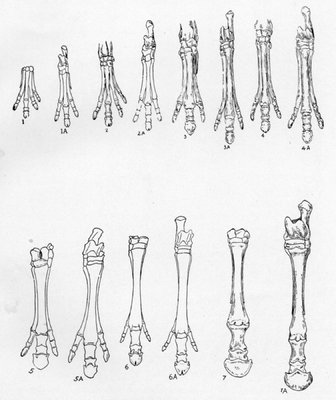
DIAGRAM SHOWING SEVEN STAGES IN THE EVOLUTION OF THE FORE-LIMBS AND
HIND-LIMBS OF THE ANCESTORS OF THE MODERN HORSE, BEGINNING WITH THE
EARLIEST KNOWN PREDECESSORS OF THE HORSE AND CULMINATING WITH THE HORSE OF
TO-DAY
(After Marsh and Lull.)
1 and 1A, fore-limb and hind-limb of Eohippus; 2 and 2A,
Orohippus; 3 and 3A, Mesohippus; 4 and 4A, Hypohippus; 5 and 5A,
Merychippus; 6 and 6A, Hipparion; 7 and 7A, the modern horse. Note how the
toes shorten and disappear.
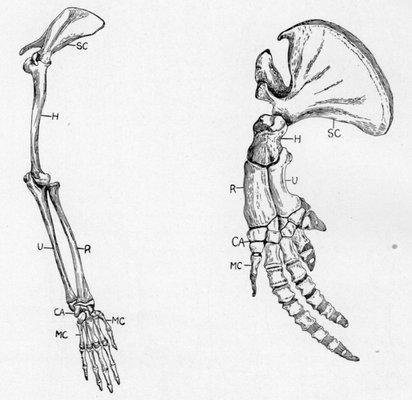
A. Fore-limb of Monkey B. Fore-limb of Whale
WHAT IS MEANT BY HOMOLOGY? ESSENTIAL SIMILARITY OF ARCHITECTURE, THOUGH
THE APPEARANCES MAY BE VERY DIFFERENT
This is seen in comparing these two fore-limbs, A, of
Monkey, B, of Whale. They are as different as possible, yet they show the
same bones, e.g. SC, the scapula or shoulder-blade; H, the humerus or upper
arm; R and U, the radius and ulna of the fore-arm; CA, the wrist; MC, the
palm; and then the fingers.
But in spite of man's undeniable apartness, there is no doubt as to
his solidarity with the rest of creation. There is an "all-pervading
similitude of structure," between man and the Anthropoid Apes, though it
is certain that it is not from any living form that he took his origin. None
of the anatomical distinctions, except the heavy brain, could be called
momentous. Man's body is a veritable museum of relics (vestigial
structures) inherited from pre-human ancestors. In his everyday bodily life
and in some of its disturbances, man's pedigree is often revealed. Even
his facial expression, as Darwin showed, is not always human. Some fossil
remains bring modern man nearer the anthropoid type.
It is difficult not to admit the ring of truth in the closing words of
Darwin's Descent of Man:
"We must, however, acknowledge, as it seems to me, that man, with
all his noble qualities, with sympathy which feels for the most debased,
with benevolence which extends not only to other men but to the humblest
living creature, with his God-like intellect which has penetrated into the
movements and constitution of the solar system—with all these exalted
powers—man still bears in his bodily frame the indelible stamp of his
lowly origin."
There is another side of evolution so obvious that it is often overlooked,
the tendency to link lives together in vital inter-relations. Thus flowers
and their insect visitors are often vitally interlinked in mutual dependence.
Many birds feed on berries and distribute the seeds. The tiny freshwater
snail is the host of the juvenile stages of the liver-fluke of the
sheep. The mosquito is the vehicle of malaria from man to man, and the
tse-tse fly spreads sleeping sickness. The freshwater mussel cannot continue
its race without the unconscious co-operation of the minnow, and the
freshwater fish called the bitterling cannot continue its race without the
unconscious co-operation of the mussel. There are numerous mutually
beneficial partnerships between different kinds of creatures, and other
inter-relations where the benefit is one-sided, as in the case of insects
that make galls on plants. There are also among kindred animals many forms of
colonies, communities, and societies. Nutritive chains bind long series of
animals together, the cod feeding on the whelk, the whelk on the worm, the
worm on the organic dust of the sea. There is a system of successive
incarnations and matter is continually passing from one embodiment to
another. These instances must suffice to illustrate the central biological
idea of the web of life, the interlinked System of Animate Nature. Linnæus
spoke of the Systema Naturæ, meaning the orderly hierarchy of classes,
orders, families, genera, and species; but we owe to Darwin in particular
some knowledge of a more dynamic Systema Naturæ, the network of vital
inter-relations. This has become more and more complex as evolution has
continued, and man's web is most complex of all. It means making Animate
Nature more of a unity; it means an external method of registering steps of
progress; it means an evolving set of sieves by which new variations are
sifted, and living creatures are kept from slipping down the steep ladder of
evolution.
It sometimes happens that the inter-relation established between one
living creature and another works in a retrograde direction. This is the case
with many thoroughgoing internal parasites which have sunk into an easygoing
kind of life, utterly dependent on their host for food, requiring no
exertions, running no risks, and receiving no spur to effort. Thus we see that
evolution is not necessarily progressive; everything depends on the
conditions in reference to which the living creatures have been evolved. When
the conditions are too easygoing, the animal may be thoroughly well adapted
to them—as a tapeworm certainly is—but it slips down the rungs of
the ladder of evolution.
This is an interesting minor chapter in the story of evolution—the
establishment of different kinds of parasites, casual and constant, temporary
and lifelong, external hangers-on and internal unpaying boarders, those that
live in the food-canal and depend on the host's food and those that
inhabit the blood or the tissues and find their food there. It seems clear
that ichneumon grubs and the like which hatch inside a caterpillar and eat it
alive are not so much parasites as "beasts of prey" working from
within.
But there are two sides to this minor chapter: there is the evolution of
the parasite, and there is also the evolution of counteractive measures on
the part of the host. Thus there is the maintenance of a bodyguard of
wandering amœboid cells, which tackle the microbes invading the body
and often succeed in overpowering and digesting them. Thus, again, there is
the protective capacity the blood has of making antagonistic substances or
"anti-bodies" which counteract poisons, including the poisons which
the intruding parasites often make.
There has often been slipping back and degeneracy in the course of
evolution, but the big fact is that there has been progress. For millions of
years Life has been slowly creeping upwards, and if we compare the highest
animals—Birds and Mammals—with their predecessors, we must admit
that they are more controlled, more masters of their fate, with more
mentality. Evolution is on the whole integrative; that is to say, it
makes against instability and disorder, and towards harmony and progress.
Even in the rise of Birds and Mammals we can discern that the evolutionary
process was making towards a fuller embodiment or expression of what Man
values most—control, freedom, understanding, and love. The advance of
animal life through the ages has been chequered, but on the whole it has been
an advance towards increasing fullness, freedom, and fitness of life. In the
study of this advance—the central fact of Organic Evolution—there
is assuredly much for Man's instruction and much for his
encouragement.
In all this, it may be said, the fact of evolution has been taken for
granted, but what are the evidences? Perhaps it should be frankly answered
that the idea of evolution, that the present is the child of the past and the
parent of the future, cannot be proved as one may prove the Law of
Gravitation. All that can be done is to show that it is a key—a way of
looking at things—that fits the facts. There is no lock that it does
not open.
But if the facts that the evolution theory vividly interprets be called
the evidences of its validity, there is no lack of them. There is
historical evidence; and what is more eloquent than the general fact
that fishes emerge before amphibians, and these before reptiles, and these
before birds, and so on? There are wonderfully complete fossil series, e.g.
among cuttlefishes, in which we can almost see evolution in process. The
pedigree of horse and elephant and crocodile is in general very convincing,
though it is to be confessed that there are other cases in regard to which we
have no light. Who can tell, for instance, how Vertebrates arose or from what
origin?
There is embryological evidence, for the individual
development often reads like an abbreviated recapitulation of the
presumed evolution of the race. The mammal's visceral clefts are
tell-tale evidence of remote aquatic ancestors, breathing by gills. Something
is known in regard to the historical evolution of antlers in bygone ages; the
Red Deer of to-day recapitulates at least the general outlines of the
history. The individual development of an asymmetrical flat-fish, like a
plaice or sole, which rests and swims on one side, tells us plainly that its
ancestors were symmetrical fishes.
There is what might be called physiological evidence, for many
plants and animals are variable before our eyes, and evolution is going on
around us to-day. This is familiarly seen among domesticated animals and
cultivated plants, but there is abundant flux in Wild Nature. It need hardly
be said that some organisms are very conservative, and that change need not
be expected when a position of stable equilibrium has been secured.
There is also anatomical evidence of a most convincing quality. In
the fore-limbs of backboned animals, say, the paddle of a turtle, the wing of
a bird, the flipper of a whale, the fore-leg of a horse, and the arm of a
man; the same essential bones and muscles are used to such diverse results!
What could it mean save blood relationship? And as to the two sets of teeth
in whalebone whales, which never even cut the gum, is there any alternative
but to regard them as relics of useful teeth which ancestral forms possessed?
In short, the evolution theory is justified by the way in which it works.
If it be said "So much for the fact of evolution, but what of
the factors?" the answer is not easy. For not only is the problem
the greatest of all scientific problems, but the inquiry is still very young.
The scientific study of evolution practically dates from the publication of
The Origin of Species in 1859.
Heritable novelties or variations often crop up in living creatures, and
these form the raw material of evolution. These variations are the outcome of
expression of changes in the germ-cells that develop into organisms. But why
should there be changes in the constitution of the germ-cells? Perhaps
because the living material is very complex and inherently liable to change;
perhaps because it is the vehicle of a multitude of hereditary items among
which there are very likely to be reshufflings or rearrangements; perhaps
because the germ-cells have very changeful surroundings (the blood, the
body-cavity fluid, the sea-water); perhaps because deeply saturating outside
influences, such as change of climate and habitat, penetrate through the body
to its germ-cells and provoke them to vary. But we must be patient with the
wearisome reiteration of "perhaps." Moreover, every many-celled
organism reproduced in the usual way, arises from an egg-cell fertilised by a
sperm-cell, and the changes involved in and preparatory to this fertilisation
may make new permutations and combinations of the living items and hereditary
qualities not only possible but necessary. It is something like shuffling a
pack of cards, but the cards are living. As to the changes wrought on the
body during its lifetime by peculiarities in nurture, habits, and
surroundings, these dents or modifications are often very important for the
individual, but it does not follow that they are directly important for the
race, since it is not certain that they are transmissible.
Given a crop of variations or new departures or mutations, whatever the
inborn novelties may be called, we have then to inquire how these are sifted.
The sifting, which means the elimination of the relatively less fit
variations and the selection of the relatively more fit, effected in many
different ways in the course of the struggle for existence. The organism
plays its new card in the game of life, and the consequences may
determine survival. The relatively less fit to given conditions will
tend to be eliminated, while the relatively more fit will tend to survive. If
the variations are hereditary and reappear, perhaps increased in amount,
generation after generation, and if the process of sifting continue
consistently, the result will be the evolution of the species. The sifting
process may be helped by various forms of "isolation" which lessen
the range of free intercrossing between members of a species, e.g. by
geographical barriers. Interbreeding of similar forms tends to make a stable
stock; out-breeding among dissimilars tends to promote variability. But for
an outline like this it is enough to suggest the general method of organic
evolution: Throughout the ages organisms have been making
tentatives—new departures of varying magnitude—and these
tentatives have been tested. The method is that of testing all things and
holding fast that which is good.
(The following short list may be useful to readers who desire to have
further books recommended to them.)
Clodd, Story of Creation: A Plain Account of
Evolution.
Darwin, Origin of Species, Descent of Man.
Deperet, Transformation of the Animal World
(Internat. Sci. Series).
Geddes and Thomson, Evolution (Home
University Library).
Goodrich, Evolution (The People's
Books).
Headley, Life and Evolution.
Hutchinson, H. Neville, Extinct Monsters
(1892).
Lull, Organic Evolution.
McCabe, A B C of Evolution.
Metcalf, Outline of the Theory of Organic
Evolution.
Osborn, H. F., The Evolution of Life
(1921).
Thomson, Darwinism and Human Life.
Wallace, Darwinism.


