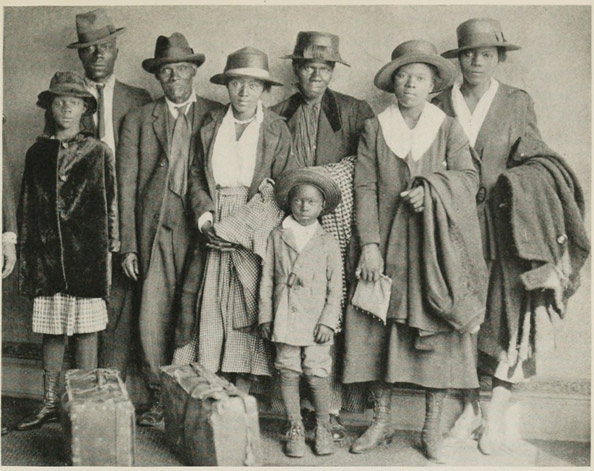
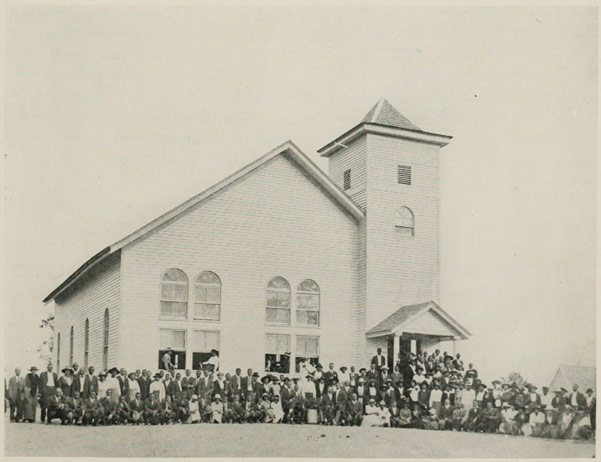
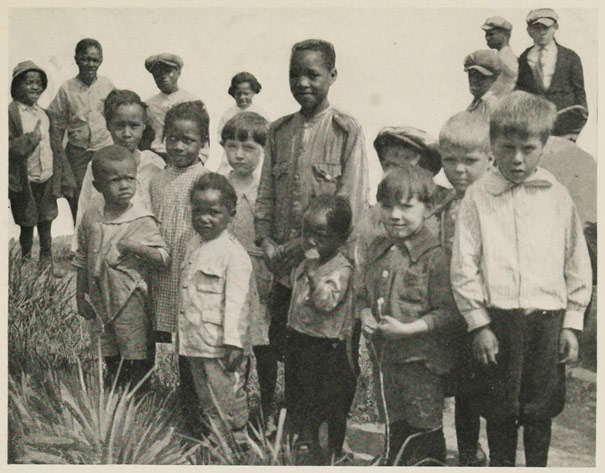
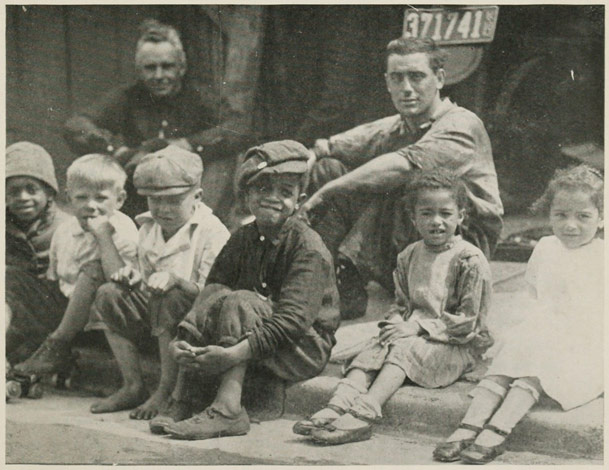
Consideration of the housing problem as a continuing factor in the experience
of Negro families led to an effort to study it from a new angle of approach—through
histories of typical families in the Negro community.
The data thus gathered afford an opportunity to present an interpretative
account of Negro family life, setting forth the intimate problems confronting
Negroes in Chicago, their daily social difficulties, the reflection in their home life
of their struggle for existence, just how they live, how they participate in the
activities of the Negro community and the community at large, their own
opinions concerning civic problems, their housing experience, how much they
earn and how much they save, how much they spend and what value they
receive from these expenditures, how they spend their spare time, and how
they seek to improve their condition in the community.
A selection was made of 274 Negro families living in all sections of Chicago.
Three Negro women, well equipped to deal intelligently and sympathetically
with these families, gathered this information. These 274 families lived in
238 blocks, the distribution being such that no type of neighborhood or division
of the Negro population was overlooked. The questionnaire employed contained
five pages of questions and required an interview of about two hours.
Special effort was made to secure purely social information without the aid
of leading questions.
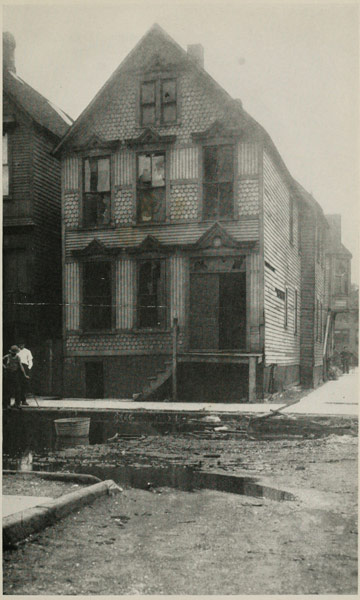
For the most part the physical surroundings of the Negro family, as
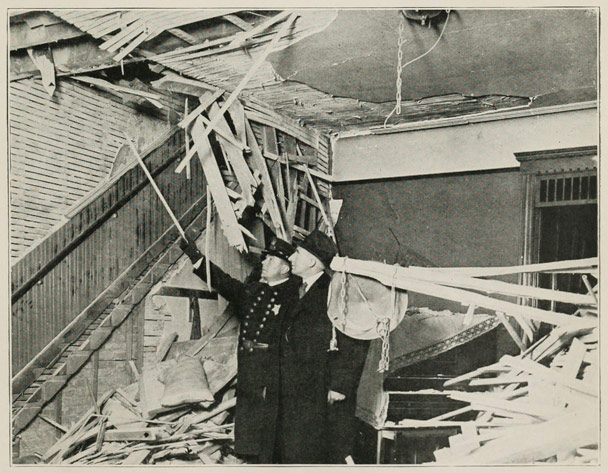
indicated by these family histories, are poor. The majority of these houses
fall within the classifications noted as Types "C" and "D" in the discussion
of the physical condition of housing.[22]
On the South Side, where most of the Negro population lives, the low
quality of housing is widespread, although there are some houses of a better
grade which are greatly in demand.
The ordinary conveniences, considered necessities by the average white
citizen, are often lacking. Bathrooms are often missing. Gas lighting is
common, and electric lighting is a rarity. Heating is commonly done by wood
or coal stoves, and furnaces are rather exceptional; when furnaces are present,
they are sometimes out of commission.
Under the heading of "Housing Conditions" such notations as these are
often found:
No gas, bath, or toilet. Plumbing very bad; toilet leaks; bowl broken; leak in
kitchen sink; water stands in kitchen; leak in bath makes ceiling soggy and wet all
the time. Plastering off in front room. General appearance very bad inside and out.
Had to get city behind owner to put in windows, clean, and repair plumbing. Heat
poor; house damp. Plumbing bad; leaks. Hot-water heater out of order. Needs
repairing done to roof and floors. In bad repair; toilet in yard used by two families.
Toilet off from dining-room; fixtures for gas; no gas; just turned off; no bath;
doors out of order; won't fasten. Sanitary conditions poor; dilapidated condition;
toilet won't flush; carries water to bathtub. Plumbing bad; roof leaks; plastering
off; no bath or gas; general repairs needed; very dirty. Plumbing bad; plastering
off in toilet; window panes broken and out; no bath or gas. Plastering off from water
that leaks from flat above; toilet leaks; does not flush; washbowl and bath leak
very badly; repairs needed on back porch; rooms need calcimining. No water in
hydrant in hall; no toilet, bath, or gas; general repair needed. Water not turned on
for sink in kitchen; water for drinking and cooking purposes must be carried in; toilet
used by four families; asked landlord to turn on water in kitchen; told them to move;
roof leaks; stairs and back porch in bad order. Sewer gas escapes from basement
pipes; water stands in basement. House dirty; flues in bad condition; gas pipes
leak; porch shaky. No heat and no hot water; no repairing done; no screens; gas
leaks all over house; stationary tubs leak. Water pipes rotted out; gas pipes leak.
Toilet leaks; plastering off; windowpanes out. Plastering off; large rat holes all
over; paper hanging from ceiling.
This is the common situation of the dweller in the districts mentioned.
The variations are in degree rather than kind. To dwellings a little better
in sanitation and repair than those just described, the adjective "fair" was
given.
Occasionally a Negro family manages to escape from this wretched type
of dwelling in the "Black Belt." Some who were financially able purchased
homes in Woodlawn, for example, where they live much as white residents do,
supplied with the comforts and conveniences of life and in fairly clean, wholesome
surroundings. There, as a rule, the physical equipment of their dwellings
is good and is kept in repair. In some instances they have hot-water heating,
electric lighting, and gas for cooking purposes. They ordinarily redecorate
once a year, take proper care of their garbage, keep the lawns cut and the
premises clean; and otherwise reveal a natural and normal pride of ownership.
In this respect the Negro residents of Woodlawn are far more fortunate
than many of their race brothers who have purchased dwellings in the "Black
Belt." Many of these purchases have been made by migrants on long-time
payments, and large expenditure would be required to put the houses in repair
and keep them so. Purchases made by Negroes in Woodlawn have been chiefly
of substantial dwellings, not necessarily new but in good condition and needing
only ordinary repairs from time to time.
Except where the property is owned by Negroes there is frequent moving.
The records obtained of these movements give a great variety of reasons.
A strong desire to improve living conditions appears with sufficient frequency
to indicate that it is the leading motive. Buying a home is one of the ways
of escape from intolerable living conditions, but removal to other houses or
flats is more often tried. For example, a man who now owns his home near
Fifty-first Street and South Wabash Avenue—living there with his two brothers
and five lodgers—has moved six times, "to live in a better house and a better
neighborhood." A family now living near Thirty-first Street and Prairie
Avenue, resident in Chicago since 1893, has moved four times, three times to
obtain better houses in better neighborhoods and once to get nearer to work.
A man and wife living near Fifty-third and South Dearborn streets have moved
four times since coming to Chicago in 1908. A family living on East Forty-fifth
Street and paying $60 a month rent for six rooms has moved twice since
1900 to "better and cleaner houses." Another family paying $65 a month
for eight rooms on East Bowen Avenue has moved twice since 1905 into
better houses and neighborhoods. "Better house" and "better neighborhood"
were the most frequently given reasons.
Of kindred nature are these: leaky roof; house cold; dirty; inconvenient; did
not like living in rear flat; to better conditions; better houses away from questionable
places; landlord would not clean; first floor not healthy; small and undesirable;
not desirable flat; poor plumbing; didn't like neighborhood; moved to better quarters;
landlord would not repair; house too damp; no windows; owner would not
fix water pipes; more room wanted; better environment for children; better street;
no yard for children; better people; house in bad condition; more conveniences for
roomers.
The normal family is generally recognized as consisting of five persons—two
parents and three children. Properly they should make up a single
group and live by themselves. The 274 families studied were chosen as
follows: in the most populous district, from Thirty-first to Thirty-ninth
streets and from Wentworth Avenue to Lake Michigan, ninety-nine family
histories were taken; in the district north of Thirty-first Street to Twelfth
Street and from Wentworth Avenue to the Lake, forty-six; in the narrow
strip in Hyde Park known as the Lake Park district, thirty-seven; in the district
from Thirty-ninth to Sixtieth streets and from Wentworth to Cottage Grove
Avenue, thirty-six; on the West Side, sixteen; in the Ogden Park district,
fifteen; on the North Side, fourteen; and in Woodlawn, eleven. For convenience,
as well as to show contrasts or like conditions, the material has been
analyzed and interpreted by districts.
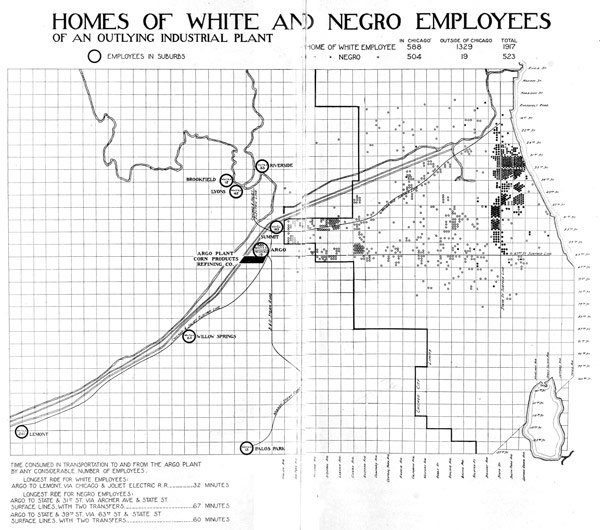
HOMES OF WHITE AND NEGRO EMPLOYEES
OF AN OUTLYING INDUSTRIAL PLANT
|
TIME CONSUMED IN TRANSPORTATION TO AND FROM THE ARGO PLANT
BY ANY CONSIDERABLE NUMBER OF EMPLOYEES. |
|
LONGEST RIDE FOR WHITE EMPLOYEES: |
| ARGO TO LEMONT, VIA CHICAGO & JOLIET ELECTRIC R.R. |
32 MINUTES |
|
LONGEST RIDE FOR NEGRO EMPLOYEES: |
ARGO TO STATE & 31ST ST. VIA ARCHER AVE. & STATE ST.
SURFACE LINES, WITH TWO TRANSFERS |
67 MINUTES |
ARGO TO STATE & 39TH ST. VIA 63RD ST. & STATE ST.
SURFACE LINES. WITH TWO TRANSFERS |
60 MINUTES |
There was found a wide variation in the family groups, comprising six
classifications, in three of which no lodgers appear. A lodger here means
an adult not a member of the immediate family. Thus relatives, unless
infants or children, are classed as lodgers. The three groups without lodgers
are: (1) man and wife; (2) two parents and children; (3) a parent and children.
The other three groups with lodgers are: (1a) man and wife and lodgers;
(2a) man, wife, children, and lodgers; (3a) man or woman, surviving head of
the family, with lodgers.
Of the total 274 family groups there were 104 without lodgers and 170,
or 62 per cent, with lodgers. For the most part the lodgers were found in
"2a" classification—in families. There were ninety-two such groups and only
sixty-one families with no lodgers. Forty-two couples had lodgers, and in
thirty-six instances a man or woman living alone had lodgers. Thirty-nine
couples were living alone, and in only four instances was there a parent alone
with a child.
The Negro colony in Woodlawn approaches most nearly the normal
family grouping. Home ownership in that district is fairly common, and the
houses for the most part are substantial and well fitted and suited to the
families. In the eleven Woodlawn families there was but one where the mother
or father was dead or not living with the family. Lodgers were found in only
four of the eleven families: two were couples, one a family, and the other a
single woman. In the eleven families there were seventeen children.
A marked contrast with this section is found in the congested Negro
district between Thirty-first and Thirty-ninth streets. Out of a total of
ninety-nine families seventy-two had lodgers, or 72 per cent as contrasted
with 36 per cent in Woodlawn and 62 per cent for the total 274 cases. In
this district there were forty-two families with children, thirteen couples
without children, and seventeen where a man or woman took lodgers. There
were only fourteen families without lodgers, and thirteen couples living
alone.
North of Thirty-first Street in this South Side area were similar conditions.
Of forty-six households studied, twenty-seven, or 58.7 per cent, had lodgers:
of these sixteen were families with children, nine were couples and two were
man or woman with children. Of the households without lodgers, there were
twelve families with children, five couples living alone, and two instances of
parent and child.
The percentage of families with lodgers was highest in the Lake Park
district, 75.6 per cent. On the West Side it was 68 per cent, a trifle higher
than for the entire 274 families. On the North Side it was 57 per cent, on
the South Side between Thirty-ninth and Sixtieth streets, 41.6 per cent, and
in the Ogden Park district 40 per cent.
The Ogden Park district, with a relatively low percentage of families having
lodgers, resembles the Woodlawn district in many respects. The houses are
built for single families and are largely owned by Negroes who have lived in
that locality for many years. Of the fifteen families there visited, nine had
no lodgers; and of the seven with lodgers, four were families and two were
couples without children.
Room crowding.—A study of Negro housing made in 1909 by the Chicago
School of Civics and Philanthropy brought out the fact that, although Negro
families find it extremely difficult to obtain a flat of three or four rooms,
they do not crowd together as much as white immigrants; that Negroes take
larger flats or houses and rent rooms to lodgers to help pay the rent, and thus
lessen crowding among the members of the family. Among the 274 families
studied by the Commission there was comparatively little overcrowding.
One room to a person is a standard of room occupancy generally accepted by
housing authorities as involving no overcrowding. Of these 274 Negro
households, only sixty-seven exceeded the standard. There were, of course,
wide divergences from the standard. For example, there were eight instances
of six persons living in five rooms; six of eight persons living in six rooms;
four of six persons living in four rooms; one of six persons living in three rooms;
one of seven persons living in three rooms; two of seven persons living in four
rooms; two of eight persons living in five rooms; one of nine persons living
in five rooms; and one of eleven persons living in five rooms.
In the cases of unusually large families, either in the number of children or
lodgers, there was a corresponding increase in the number of rooms. Thus in
the case of fourteen persons making up one family, they were living in ten rooms.
The five-room dwelling was the most common, with fifty-nine families; six-room,
forty-seven; seven-room, forty-two; four-room, forty-one.
In the Ogden Park district the standard of one person to one room was
most closely adhered to. All the fifteen families studied in that district were
housed in four-, five-, or six-room dwellings; ten of them in five-room dwellings.
In Woodlawn the tendency was toward somewhat larger dwellings. There
were no four- and five-room dwellings, but five of seven rooms and three of six
rooms, one each of eight and three rooms. The four-room dwelling was most
prevalent on the North Side. Of the fourteen families studied there, six were
in such dwellings. There were two dwellings of six rooms, two of seven,
one of five, two of three, and one of eleven rooms.
On the West Side, also, thirteen of the sixteen families were housed in four-,
five-, six-, or seven-room dwellings, the five-room type predominating. In the
Lake Park district the five-room type was most frequent, there being eleven
of these out of a total of thirty-seven, six of six rooms and seven of seven rooms,
the next largest group being five of eight rooms.
On the South Side in the district from Thirty-first to Thirty-ninth Street,
out of a total of ninety-nine there were eighteen families in five-room dwellings,
seventeen in four-room, nine in three-room, ten in six-room, fourteen in seven-room,
and eight in ten-room dwellings. In the district north of Thirty-first
Street the predominating size was six-room dwellings, of which there were
eleven, and there were nine of four rooms, seven of five rooms, and seven of
seven rooms, the rest scattering from one-room dwellings to one dwelling of
thirteen rooms. From Thirty-ninth to Sixtieth streets, six-room dwellings
were most frequent, there being eight of these out of a total of thirty-six, and
there were seven of five rooms, six of six rooms, and six of seven rooms. The
dwellings occupied by Negroes south of Thirty-ninth Street, it should be
noticed, are larger than those north of that street.
The grouping of the 274 families according to number of persons is as
follows:
| Families |
Persons to Family |
| 48 |
4 |
| 40 |
2 |
| 35 |
3 |
| 37 |
5 |
| 30 |
7 |
| 29 |
6 |
| 22 |
8 |
| 17 |
9 or more |
| 16 |
Not recorded |
| 274 |
Four persons to a "family" was the most common type, there being forty-eight
of these out of the 274. In the Woodlawn and Ogden Park districts
the group of three was predominant. The North Side district grouping of
two persons to a family is partly due to the inclusion of nine "groups" of one
person each who were interviewed mainly for data bearing upon industrial
relationships. The tables show a total of sixteen such groups in the eight
districts; but they are not deemed sufficient to vitiate the statistics.
Negroes have more space in their living quarters than do other Chicago
people housed in similar grades of dwellings. They were usually found in
dwellings of five rooms for each family, while the prevailing size among the
foreign groups was four rooms, as disclosed by the Chicago School of Civics
housing studies from 1909 to 1917. In the School's earliest study of the
Negroes it was said:
The colored families do not as a rule live in the small and cramped apartments in
which other nationalities are so often found. Even the families who apply to the
United Charities for relief are frequently living in apartments which would be considered
adequate, as far as the number of rooms is concerned, for families in comfortable
circumstances.
Some marked exceptions, of course, were found.
The four-room dwelling was found to prevail among the Slovaks of the
Twentieth Ward, the Lithuanians of the Fourth Ward, the Greeks and Italians
in the neighborhood of Hull-House, the various central and southern European
nationalities who work in the South Chicago steel mills and live near-by,
and among the Jews, Bohemians, and Poles of the West Side.
The lodger problem.—The prevalence of lodgers is one of the most conspicuous
problems in the Negro housing situation. It is largely a social question.
The difficulty of finding a home adequate for a family of four or five persons
at a reasonable rent has forced many Negroes to take over large buildings
in better localities and in better physical condition but with much higher rents.
To meet these rents they have taken lodgers. It was seldom possible to
investigate the character of the lodgers. The arrangement of these large
houses, originally intended for single-family use, prevents family privacy
when lodgers are added, making a difficult situation for families with children.
Again, the migration brought to the city many unattached men and women
who could find no other place to live except in families. Thus it happens that
in Negro families the lodger problem is probably more pressing than in any
other group of the community. Not only do lodgers constitute a social
problem for the family, but, having little or no interest in the appearance
and condition of the property, they are in many instances careless and irresponsible
and contribute to the rapid deterioration of the buildings.
As previously explained, the term "lodgers," in this report, includes
relations as well as other adults unrelated to the family. It was apparent in
the study that there was a large number of relative-lodgers in Negro families.
The recent migration from the South had a distinct bearing on this situation.
Many Negroes came to Chicago at the solicitation of relatives and remained
in their households until they could secure homes for themselves. The migration
further accounts for the accentuation of the lodger problem during the
period immediately following it. The 274 family histories include 1,319
persons, of whom 485, or 35 per cent, were lodgers, living in 62 per cent of the
households. The greatest number of households with lodgers were those
living in five-room dwellings. There were thirty-eight such households.
Living in six-and seven-room dwellings were thirty-four families with lodgers.
Families with only one lodger were most numerous. There were fifty-five
such families as compared with thirty-nine having two lodgers, twenty-five
with three lodgers, twenty-three with four lodgers, thirteen with six lodgers,
eight with five lodgers, and seven with more than six lodgers.
Naturally the lodger evil was found in its worst form in the congested
parts of the South Side. In the district from Thirty-first to Thirty-ninth
streets seventy-two of the ninety-nine families had lodgers. In twenty-two
families there was but one, however, as against twelve with three and four,
eleven with two, and six with five and six lodgers. Two families had ten each,
and one had thirteen. This last case was that of a widow who rented nine
sleeping-rooms in her ten-room house, in addition to catering at odd moments.
It was a typical rooming-house as distinguished from a family taking lodgers.
One family that had ten lodgers consisted of a man, his wife, and a son twenty-five
years old; they had eight bedrooms, seven opening into a hall. The other
family that had ten lodgers consisted of the parents and two children, a boy
of eight and a girl of seven, and had a ten-room house. The lodgers were
two men and three women, with five children. Five of the ten rooms were
used as sleeping-rooms.
In the district north of Thirty-first Street an increased number of lodgers
appeared in only one family, that of a man and his wife, without children.
They lived in a ten-room house, using eight of the rooms for sleeping purposes
and accommodating seven male and five female lodgers.
In the district from Thirty-ninth to Sixtieth Street was one instance of
seven male lodgers in a seven-room house with the man who owned the property.
Two of the lodgers were his brothers. There was no heat and no
bathroom. The house had been reported to the health department.
In the Lake Park district one, two, or three lodgers were the rule, only
five of the twenty-eight families with lodgers in that district being outside of
those three classes. Eight lodgers were found in an eight-room dwelling.
The family consisted of man and wife, and the only female lodger was their
niece. Five rooms were used for sleeping purposes.
In the other district no instances of excessive overcrowding due to lodgers
were found.
Complaint has often been made of the numerical preponderance of lodgers
over children among Chicago Negroes, and comment has been made on the
economic significance. It has been suggested, for example, that economic
pressure had lowered the birth-rate among Negroes and increased the infant-mortality
rate. As indicated by the 274 family histories, the number of lodgers
among the Negro population exceeds the number of children, that is, the number
of boys less than twenty-one years and girls less than eighteen. The School of
Civics and Philanthropy, in its housing studies, counted as children those less
than twelve years of age. On this basis it found in its study of the Negroes
of the South and West sides that there were less than half as many children
as lodgers on the South Side, but a more normal situation in the West Side.
Even extending the ages of children, as has been done in the present report,
the situation does not appear in a much better light.
The proportion of lodgers and of children in the districts covered by the
Commission is shown in Table IX.
TABLE IX
| District |
Percentage of Lodgers |
Percentage of Children |
| South Side: |
|
|
Thirty-first to Thirty-ninth |
45.9 |
15.4 |
|
Twenty-second to Thirty-first |
37.8 |
20.4 |
|
Thirty-ninth to Sixtieth |
30.1 |
21.4 |
| West Side |
21.8 |
32.0 |
| Lake Park |
42.1 |
16.9 |
| North Side |
15.2 |
25.0 |
| Woodlawn |
26.9 |
30.0 |
| Ogden Park |
12.3 |
45.0 |
| Total of 274 families |
35.0 |
22.7 |
By way of comparison similar figures from other housing studies of the
Chicago School of Civics might be mentioned, the children in each instance
being less than twelve years old.
Among the Slovaks of the Twentieth Ward, 13 per cent were lodgers and
32 per cent children; in South Chicago, 27.3 per cent lodgers and 25.7 per cent
children; among the Greeks and Italians near Hull-House, 13 per cent lodgers
and 30 per cent children; among the Lithuanians of the Fourth Ward, 28 per
cent lodgers and 27 per cent children.
As far as the South Side is concerned, the situation with regard to the
balance between lodgers and children has become aggravated since the earliest
School of Civics report was issued, whereas the situation on the West Side
has improved somewhat.
Where there were children and lodgers together, a considerable number of
instances were found which suggest probable injury to health or morals,
and sometimes both. Even where lodgers are relatives, impairment of health
and morals is threatened in certain circumstances, especially if the over-crowding
is flagrant. For example, a household on South Dearborn Street
near Thirty-fourth Street consisted of a father, mother, a son of nineteen
years, and a baby girl of four months, with three lodgers, two men and one
woman—seven persons living in seven rooms and sleeping in all parts of the
house. One of the lodgers was a sister-in-law, another a nephew by marriage,
and the third, a stranger, had a bedroom to himself. In a ten-room house in
East Thirty-second Street parents having a boy of eight years and a girl of
seven years were found to have taken in ten lodgers, two of whom were men.
In another instance five children, four of them boys of eight, five, four, and two
years and a girl of eleven, lived with their parents and two lodgers in a six-room
house.
In Ogden Park, a district which shows a high percentage of children,
lodgers sometimes are added to the family. In one house of five rooms, for
example, there were found living twelve persons—father, mother, two sons,
sixteen and seventeen years of age, four daughters, thirty-three, twenty-four,
twenty-two, and thirteen years of age, and four lodgers—a daughter, her
husband, and their two infants. There were only two bedrooms for the
twelve persons. Another instance was that of a family of father, mother,
four sons, nine, five, three, and two years, and two daughters, seven years and
three weeks, with a sister of one of the parents for a lodger. The nine persons
lived in five rooms. There were only two beds in the house, and one of the
bedrooms was not in use.
On the South Side near Thirty-first Street there was a case where a man
lodger occupied one bedroom, the other being used by the parents and their
eight-year-old daughter—four persons in a four-room flat. On South Park
Avenue near Twenty-ninth Street two lodgers, a son-in-law and a nephew,
occupied two of the six rooms, while the husband and wife, a son of twenty-three
years, and a daughter of twenty-one years lived in the other four rooms,
which included the kitchen and dining-room. A similar instance was found,
on Indiana Avenue near Thirtieth Street, where two male lodgers lived with
a family consisting of the parents, a son of twenty, and a daughter of eighteen,
all in six rooms, two of which were not sleeping-rooms. On Lake Park Avenue
near Fifty-sixth Street a family, including father, mother, and daughter of
twenty, slept in the kitchen in order that three lodgers, one male and two female,
might be accommodated in the five-room flat. In a five-room flat on Kenwood
Avenue near Fifty-third Street the two male lodgers occupied both bedrooms,
while the mother and her boy of nine and girl of seven years lived in the kitchen
and dining-room. Seven persons were found living in a six-room house on
East Fortieth Street; they were father, mother, a son of five years, a daughter
of seven years, and an infant, with a male and a female lodger, friends of the
parents. Virtually the whole house was used for sleeping purposes.
These are examples of the arrangements that sometimes occur when
children and lodgers are found in the same dwelling. The fact that in the
main Chicago Negroes live in more rooms per dwelling than immigrants,
whose standard of living has not yet risen, does not necessarily mean that the
Negroes have a greater appreciation of a house with more rooms. The explanation
in many cases is that the Negroes take whatever living quarters happen
to be available, which often are large residences abandoned by well-to-do
whites, and then adapt their mode of living to the circumstances. Lodgers
are one of the sources of revenue that aid in paying the rent. Negro families
often expressed a desire to live by themselves if they could find a dwelling of
suitable size for reasonable rent. They sometimes complained of lodgers
and declared that they would prefer not to take them at all, especially women
lodgers. The objection to married couples and unattached men was not so
pronounced.
Smaller houses thus would seem to be a factor in the solution of the lodger
problem. A Negro real estate dealer was asked if the Negro was as contented
or as much disposed to live in a cottage as white people, or whether he wanted
to live in spacious quarters where he could draw a revenue from roomers.
The reply was that the Negro would rather live by himself. This is
evidenced by the fact that many Negroes would rather live in an apartment
and rent two or three rooms than take a large house and have it full of roomers.
Lodgers are often found in the smaller dwellings occupied by Negroes.
Rent is often the determining factor in the selection of the smaller dwelling.
When it is so high that it forms too large a proportion of income, economic
necessity often drives the Negro family to admit one or more lodgers at the
expense of overcrowding and its attendant harmfulness. This was noted in
certain districts where the dwellings as a rule were small.
Rents and lodgers.—An effort was made to determine the economic necessity
for lodgers as expressed by the relation of the wages of heads of families to
the amounts of rent paid. It is assumed that in a normal family budget
rent should not exceed one-fifth of the income of the head of the family. Wide
variations from that proportion were revealed.
Facts as to both rent and wages were difficult to secure, owing to the
variable earnings of various members of the family, variable sums received
from lodgers, and other factors. For example, seventeen occupants owned
their houses. In seventy-eight other cases information obtained by the
investigators was not adequate or could not, for various reasons, be used in
calculations.
The remaining 179 cases out of the 274 provided data from which the
following facts are presented: In three instances the rent exceeded the income
of the head of the family; in thirty-one instances the rent equaled one-half
the income of the head of the family, and in an equal number it amounted
to one-third. In one case the rent was equal to three-fourths of the income,
and in twenty-three cases the rent equaled one-fourth. Thus eighty-nine
instances were disclosed in which the rent was in excess of one-fifth of the
income of the head of the family. In most of these cases, particularly the
extreme ones, the income of the head of the family was greatly supplemented
by money received from lodgers or from earnings of other members of the
family.
The remaining ninety families in which the rent amounted to one-fifth
or less of the income of the head of the family were divided as follows: Twenty-four
fell in the one-fifth column, twenty-seven in the one-sixth column, fourteen
in the one-seventh column, eleven in the one-eighth column, while fourteen
were in the "low" column. The last named included those ranging from
one-ninth to one-twenty-third.
On the South Side, in the district from Thirty-first to Thirty-ninth Street,
rents exceeded the one-fifth proportion in one-half of the sixty-two families
studied, two of them paying rent in excess of income, eight paying one-half of
income for rent, fourteen paying one-third, and seven paying one-fourth.
Of the remaining thirty-one families in that district, seven fell in the one-fifth
column, twelve in the one-sixth column, six in the one-seventh column, four
in the one-eighth column and two in the "low," being one-ninth and one-eleventh.
Rents were high also in the Lake Park district, where twenty-five families
of a total of thirty-six were paying in excess of the one-fifth proportion. Fourteen
of these paid one-half of the income for rent, five paid one-fourth, four
paid one-third, one paid three-quarters, and in one instance rent exceeded
income. In only five instances was the normal one-fifth paid, two paid one-sixth,
two paid one-seventh, while two paid one-ninth and one-eleventh
respectively.
In the district north of Thirty-first Street, eighteen out of a total of thirty-eight
families paid in excess of the one-fifth proportion, four paid one-half,
nine paid one-third, and five paid one-fourth. Six families paid the normal
one-fifth, five paid one-sixth, two paid one-seventh, one one-eighth, and six less
than that, running as low as one-twenty-third.
The Ogden Park area was found to be a district of low rents. None of
the eight families studied paid as much as the normal one-fifth. Two paid
one-sixth, one paid one-seventh, three one-eighth, one one-ninth, and one
one-twelfth.
The other districts did not show much variation from the normal proportion.
Examination was made of all the factors in instances where the rent equaled
one-half or more of the income of the head of the family or amounted to
one-third. With regard to the former it was assumed, for the purpose of the
study, that it compelled renting rooms to lodgers. With regard to the one-third
column, lodgers were assumed to be an economic necessity when they
offered the only source of income in addition to that of the head of the family.
On these bases it was found that in forty-six families supplementary income
afforded by lodgers was necessary, that in three instances they were the sole
source of the income, while one instance was presented of a widow whose
children partly supported her, but insufficiently for their common needs.
While in most instances of high rents and low income on the part of the
head of the family good reason appeared for taking lodgers, in not a few
instances further analysis revealed other sources of income which might
indicate that there was no economic necessity for lodgers. There was one
instance on Forest Avenue, for example, where the relation of the rent to the
father's income was one-third, but where his sons earned more than double
his income. In another family on South State Street near Thirtieth Street,
the father earned $125 a month and paid $50 a month rent, but additional
income was derived from the wife, son, and daughter, in addition to that
obtained from lodgers. There was likewise the case of a waiter living on
Lake Park Avenue whose rent was $30 a month as against wages of $10 a
week. In addition to the tips he doubtless received in his work, his wife
earned $18 a week, and $6 a week was derived from lodgers. In one instance
a man living near Fifty-sixth Street and Wabash Avenue paid rent equal to
one-third of his wages, but had considerable income from investments.
Such instances tend to explain why only forty-eight families were found
in which lodgers seemed to be an economic necessity in aiding to pay rents,
when eighty-nine cases were revealed in which the rent was in excess of one-fifth
of the wages of the head of the family. The family histories also showed
that various means besides lodgers supplemented the insufficient income of a
family head. In some cases the wife or children worked, and not infrequently
their incomes exceeded those of the father.
Lodgers were often found in families where the income from that source
did not appear to be needed. This was the case in a number of families with
unusually high wages and abnormally low rents. High wages and low rents
explain most of the cases shown where the rent ranges from one-ninth to
one-twenty-third of the income of the head of the family. In the one-twenty-third
case the couple lived in two rooms on South State Street for which they
paid $6 a month. The man earned $35 a week in an iron foundry, while the
wife added $18 a week to the common fund. Another instance was that of
a man who paid $16 a month rent and earned $48 weekly at the Stock Yards.
His wife and a relative added $23.60 a week to the family income. A man in
Ogden Park whose income as a contractor was $48 a week paid $16 a month
rent. A man living on the West Side earned $48 a week and paid $15 a month
rent. His children added $43.50 a week to the family income.
Even in circumstances such as these, lodgers were sometimes taken.
In one case where the rent was one-tenth of the wages of the head of the family
the man paid $15 a month rent for a five-room dwelling out of his $36 weekly
wages earned in a coke plant at Gary. His son and lodgers increased the
monthly income by $28. There was a teamster earning $30 a week who
paid $15 a month rent for a six-room dwelling in which nine persons lived.
The proportion of rent to his wages was as one to eight. His wife, one of his
children, and lodgers added to the income. As in numerous instances where
the income was high, a large amount was spent for food in this family.
An instance was found of a man earning $9.50 to $10.50 a day. His wife
was a caterer. There was a daughter of fifteen years. They took three
roomers. There was no need for the woman to work, but she said she wanted
the money. She was a good cook, having served in that capacity in the South,
and she said she earned $15 when she went out for a week-end of catering.
In this instance there seemed to be little need for lodgers.
Another case was that of a man and his wife and two grown children
living in a nine-room dwelling on Calumet Avenue and having nine lodgers.
The man was earning $40 a week, and the lodgers paid $33.50 a week. The
wife occasionally did day work, earning $3.65 a day. The monthly expenditure
for food was $100, clothing $33, and rent $60.
Another instance was that of a widow with three children who lived on
State Street near Thirty-seventh Street, in a three-room flat. Though the
children's earnings amounted to $78 a week, the inevitable lodger was present,
contributing $4 a week to the common fund. This little family spent $120
a month for food.
Large amounts spent for food were not uncommon in some families that
took lodgers. A typical instance was that of the man and wife with three
children and two lodgers who lived on Prairie Avenue. The man earned
$25 a week, while $82 a month was derived from the lodgers. Food for the
family alone cost $100 a month.
A man on North Wells Street earned $57 a week for the support of his
wife and three adopted children. They lived in an eleven-room house which
also accommodated the man's sister and brother. One of the sons earned
$75 a week, and the lodgers paid $45 a month. This family spent $180 a
month for food. Another earned $22 a week in the Stock Yards. Besides
his wife and child they had in their nine-room house on East Thirtieth
Street six lodgers paying $20 a week. This family spent $100 a month for
food and $34 for clothing. Another man and wife on Forest Avenue paid
$25 a month rent and spent $88 a month for food and $43 for clothing. They
derived $3.75 a week from their two lodgers. A similar case was that of a family
which lived on East Thirty-second Street. The man earned $30 a week in
a foundry. He and his wife have one child, and they had ten lodgers, who
paid $72 a week. In this family $80 was spent for food each month and $50
for clothing.
The heaviest expenditure for food in any one family was $330 a month.
This was explained by the fact that there were twenty table boarders. The
husband earned $22.50 a week, and there were three lodgers who paid $13 a
week. The boarders collectively paid $13 a day. Rent was $55 a month,
and $25 a month was spent for clothing.
Other reasons for the ready acceptance of lodgers in Negro dwellings
were apparent, among them friendship and the desire to be obliging and to
assist others in a new environment. Most Negroes would regard it as a breach
of good faith to encourage friends and relatives to come to Chicago from the
South and then fail to help them after their arrival. This accounts for the
frequent designation of "relatives" and "friends" among the lodgers. Sometimes
these lodgers seemed to be permanent, but often they were taken only
until they could adjust themselves.
During the period of greatest migration, 1915-20, hundreds of unattached
men and women could be seen on the streets as late as one or two o'clock in
the morning, seeking rooms shortly after their arrival in Chicago. One
instance was reported of a family to whose house four men came at midnight
looking for rooms. Lack of lodging-houses or of hotels where accommodations
could be had at reasonable prices was partly responsible for this swarm of
migrants seeking shelter in private homes. The meager provision of such
places for the accommodation of unattached Negroes has been a factor in the
lodger problem.
How Negroes earn their living in Chicago, what occupational changes
those from the South have undergone since arrival, how their present occupations
differ from those in their former homes—information on all these points
was gained from the family histories. Almost without exception, the Negroes
interviewed declared that their economic situation had improved in Chicago.
In most instances they were able to earn more; some said they were obliged
to work harder but felt well recompensed because of their improved economic
condition.
From the occupations of persons included in the study it appears that
there is a distinct departure from the domestic and personal service in which
Negroes were commonly found a few years ago. Among the 274 families
visited, the heads of 225 families were men. Of this number eighteen were
idle at the time of the investigation, in the summer of 1920, nine were professional
men, nineteen were in business, twenty-two were in some skilled trade
or work, 110 were doing unskilled work, and only forty-seven were engaged
in personal service. The latter term includes such occupations as doorman
in a hotel or club, bellboy, bootblack, cook, waiter, porter, elevator operator,
and chauffeurs who lack training as mechanics. These are chiefly functions
which bring employees in contact with the public or with white employers
in a more or less personal capacity.
Before coming to Chicago, forty-five of the 225 were farmers. Practically
all of these entered the field of unskilled occupations here. Only sixty-four
of the 225 had been doing unskilled work in their former home. Six more did
skilled work in their former homes than were doing such work in Chicago;
two more were in personal service; two less were in business; and one more was
in a profession.
Of these 225 family heads, 122 migrated to Chicago, chiefly from the South,
during the period from 1916 to 1920 inclusive. Three periods in the industrial
history of the family head were taken: (1) occupation in the former home;
(2) occupation on first arrival in Chicago; and (3) adjustment to new conditions
in Chicago and occupation at the time of investigation, during the spring and
early summer of 1920.
Many of these migrants had not yet made their adjustment to the new
occupations at that time. However, certain tendencies were manifest. For
example, in the former home thirty-one were farmers and forty-five were
unskilled workers. In the period of adjustment seventy-seven were doing
unskilled work. The unskilled occupations had apparently, in the shifting
about, absorbed the farmers. The difficulty of continuing in skilled occupations
in the North was evidenced. In the South fourteen of the 122 men
were engaged in skilled occupations of some sort; in the period of adjustment
there were fifteen; but at the time of the investigation there were but twelve.
In the South nineteen of the 122 were in personal-service occupations;
during the transition period, eighteen; and at the time of the investigation,
sixteen. In the South seven were in business; during the period of transition,
three; and at the time of the investigation, five. In the South four were in
practice as professional men; during the period of transition only three;
while at the time of the investigation there were five, one just beginning to
practice.
As to whether any previous occupational training was used or abandoned
after coming to the North, it appeared that of the 225 only 91 utilized such
training. In 134 cases previous training was not used, but these included
many who were farmers in the South.
Of forty-nine who had been engaged in personal-service occupations before
coming to Chicago, only twenty still continued in such work. Six were unemployed
at the time of the investigation, nineteen were in unskilled work, one
was doing skilled work, and three were in business.
Forty-nine women were heads of families as revealed by the 274 family
histories. This does not include all the Negro women shown by the histories
to be engaged in gainful occupations in Chicago. Often daughters were
working. There were thirty instances in which man and wife both worked
outside of the home. Before coming to Chicago 129 wives were employed,
while in Chicago sixty-seven wives were gainfully employed, including the
thirty who were working in addition to their husbands. During the period
of transition, it appears, they helped out, since the records show that 132
were then at work. But the tendency plainly is to abandon the practice as
soon as the family becomes settled in the new environment.
Of seventeen women who had worked as house servants in their former
homes, seven were found in factories, three in offices, two in stores, and five
in unskilled manual labor.
Some of the transitions in occupation are especially interesting. One
oil-field worker in the South had become a shoemaker. A farmer had become
a postal clerk. A former superintendent of a label factory attended high school
during the adjustment period and became an undertaker. One who was a
schoolboy in the South worked in a hotel on coming to Chicago but became a
grocer. A barber in Kansas City became first a painter in Chicago, then a
janitor. A bottler from Memphis, Tennessee, went to work in the Stock
Yards but became a canvasser. A farmer from Alabama worked first in the
Yards and later in woolen mills.
One man was a porter in a store in Mississippi. In Chicago he became a
chauffeur. A farmer from Louisiana on arriving worked as a butcher and then
secured employment in a tannery. A porter in a wholesale grocery in Memphis,
Tennessee, who worked first in Chicago as a lard maker in a packing-house,
later became a building laborer. A preacher from Tennessee worked at
Swift's packing-house until he could become established in a church.
A Mississippi plumber who served as a butter maker for a time after
reaching Chicago became a contractor within three years. A hotel porter
from Alabama came to Chicago in 1918 and went to work in a steel foundry
and later in a soap factory. A farmer who worked on shares in Georgia tried
work in the Stock Yards in Chicago, but changed to a paint shop. An Alabama
man who worked in a sawmill there found a job in a steel foundry in Chicago,
and later went to the Stock Yards. A man who worked in an ice plant
in Texas became a railroad porter after coming to Chicago and then found a
job as a butcher at the Stock Yards.
A man who began life as a bootblack in Atlanta came to Chicago in 1893
and sold newspapers until he could enter business for himself. For many years
he has been a jeweler. In the South his wife was a musician by profession.
To aid her husband in his struggle she worked in a box factory for a time after
arriving in Chicago.
Clergymen sometimes abandon their profession for more remunerative
employment. One of these came to Chicago from Boston in 1904. For a time
he worked as a fireman and later in a packing-house. One who served as a
waiter on first coming to Chicago became an insurance agent, and another,
who was a reporter on a Negro newspaper on arrival in Chicago, became the
manager of a manufacturing company.
Few migrants continued in Chicago the employment in which they worked
in the South.
The family histories show that the Stock Yards industry absorbed many
of the migrants, and a large number went to work in the steel mills and iron
foundries, as well as in lighter manufactures.
Many Negro women have become hairdressers and manicurists after a
course in a school of "beauty culture" which also teaches the use of cosmetics.
Considerable skill is often required in this work, and the earnings often supplement
very substantially the husband's income and may be sufficient to make
an individual self-sustaining in case of need. Hairdressing is most frequently
done in the homes.
An occasional teacher, cateress, or seamstress was found among the Negro
women. Some of them remained in personal-service occupations, but a decided
tendency was noticeable toward office and factory employment.
In summary it is scarcely necessary to remark that wages in the North
far exceed those in the South. The difference in some instances is so great
that many foolish expenditures are indulged in before the relatively higher
cost of living is appreciated, or other conditions are properly understood.
High wages, supplemented by income from other sources, often proved a
temptation to unnecessarily heavy expenditures for material comforts, such
as food and clothing. With relation to food it did not appear that Negroes
were deliberately taken advantage of in their buying, but that they frequently
bought articles without considering prices that had been refused by others
because they were deemed excessive.
Insurance of one kind or another was often carried in the families studied.
In spite of high living costs, a considerable number of families were found to
have bank accounts, Liberty bonds, War Savings stamps, and good interest-paying
investments.
The testimony of Negroes who at some time had lived in the South was
mainly that they were obliged to work harder for what they got North. They
also declared that they were unable to save as much as they hoped or expected,
because of high prices. But in the great majority of cases satisfaction was
expressed over the improvement in their economic situation. While their
movements in search of better housing in Chicago were extremely frequent,
they still felt that they were better housed than in their former homes, where
bathtubs, steam heat, and electric lighting were almost unknown. Being
accustomed to a certain measure of dilapidation in their home surroundings
in the South, the Negro is not necessarily dismayed by the extent of dilapidation in
Chicago's Negro housing, though usually it is not long before he begins to think
of more substantial dwellings in better surroundings than those he first obtains.
Also in Chicago he finds available and accessible to his home many churches,
some with large memberships and adequately housed; the best schools he
has ever known; fine hospitals and dispensaries at his command; some playgrounds,
bathing-beaches, parks, and similar facilities for his recreation and
that of his children; settlement houses; libraries; and many other civic and
recreational societies that make a strong appeal to his interest and promote
his ambition for physical and mental development. He finds many motion-picture
theaters and other amusements for his leisure hours.
Where the habit has not already been established, he is learning to make
liberal use of all these facilities through the guidance and direction of Negro
newspapers and organizations working especially for the improvement of the
Negro group. There are indications of improvement in moral standards,
health, and civic consciousness through these contacts and the use of these
up-building social agencies.
The opinions of migrants and their feeling toward the community were
solicited. It appeared that above all they prized the social and political
freedom of the North. Satisfaction was expressed over the escape from
"Jim Crow" treatment in the South. They valued the independence possible
in the North, and sometimes spoke of having come North "out of bondage."
They recalled frequently the "shameful treatment received by the Negroes
from the white people in the South," the "intimidation and discrimination,"
and they were surprised and sometimes amazed at the fact that they could go
and come at will in Chicago, that they could ride in the front of a street car
and sit in any seat. Satisfaction was also expressed over the fact that they
could get a job at good wages and did not have to buy groceries at plantation
stores where they felt they had been exploited.
Thus, while they may have to work harder and may find it difficult for a
long time to adjust themselves to the environment, few indicated any intention
of returning to the South. In some instances, where adjustments have not
been made, some discouragement was evidenced, and they sometimes expressed
the feeling that they were no better off in Chicago than in their former homes.
The prevailing sentiment, however, was in favor of remaining in spite of some
greater difficulties.
Often Negroes from the South said they missed the care-free social greetings
and relationships that prevail in the rural South. They thought that people
in the North were "colder," that they did not show sufficient hospitality.
Asked what conditions they would change if they could have their way,
the most frequently expressed desire was for more and better housing.
Improvement of social, moral, or political conditions followed. Some emphasized
the necessity of improving the management of the migrants from the
South, whose new-found freedom had led them to become offensive in their
conduct. Interviews with migrants, however, indicated that instruction was
being received without offense from many social agencies on how to act,
dress, and speak in such a manner as not to create unfavorable impressions.
There were some complaints of political exploitation and of being obliged
to live in proximity to gambling and vice that were encouraged by political
bosses in their neighborhoods.
The inquiry showed that membership in clubs, lodges, and kindred organizations
was almost as universal as church affiliation. There were only a few
families in which no member had any association with a fraternity or club.
The general statistical treatment of these 274 Negro families takes away
many of their human qualities. For this reason a selection has been made of
various types of Negro families in order that a rounded picture of the whole
unit may be given. The family stories that follow include typical migrant
Negroes from the South—common laborers, skilled laborers, salaried, business,
and professional men. They illustrate the commonplace experiences of
Negroes in adjusting themselves to the requirements of life in Chicago.
AN IRON WORKER
Mr. J——, forty-nine years old, his wife, thirty-eight years, and their daughter
twenty-one years, were born in Henry County, Georgia. The husband never went
to school, but reads a little. The wife finished the seventh grade and the daughter
the fifth grade in the rural school near their home.
They worked on a farm for shares, the man earning one dollar and the women
from fifty to seventy-five cents a day for ten hours' work. Their home was a four-room
cottage with a garden, and rented for five dollars a month. They owned pigs,
poultry, and a cow, which with their household furniture, were worth about $800.
The food that they did not raise and their clothing had to be bought from the commissary
at any price the owner cared to charge.
They were members of the Missionary Baptist Church and the wife belonged to
the missionary society of the church and the Household of Ruth, a secret order. Their
sole recreation was attending church, except for the occasional hunting expeditions
made by the husband.
Motives for coming to Chicago.—Reading in the Atlanta Journal, a Negro newspaper,
of the wonderful industrial opportunities offered Negroes, the husband came
to Chicago in February, 1917. Finding conditions satisfactory, he had his wife sell
the stock and household goods and join him here in April of the same year. He
secured work at the Stock Yards, working eight hours at $3 a day. Later, he was
employed by a casting company, working ten hours a day and earning $30 a week.
This is his present employment and is about forty minutes' ride from his home.
Both jobs were secured by his own efforts.
The family stayed in a rooming-house on East Thirtieth Street. This place
catered to such an undesirable element that the wife remained in her room with their
daughter all day. She thought the city too was cold, dirty, and noisy to live in.
Having nothing to do and not knowing anyone, she was so lonely that she cried daily
and begged her husband to put her in three rooms of their own or go back home.
Because of the high cost of living, they were compelled to wait some time before they
had saved enough to begin housekeeping.
Housing experience.—Their first home was on South Park Avenue. They bought
about $500 worth of furniture, on which they are still paying. The wife then worked
for a time at the Pullman Yards, cleaning cars at $1.50 a day for ten hours' work.
Their house leaked and was damp and cold, so the family moved to another house on
South Park Avenue, where they now live. The house is an old, three-story brick,
containing three flats. This family occupies the first flat, which has six rooms and
bath. Stoves are used for heating, and gas for light and cooking. The house is
warm, but dark and poorly ventilated. Lights are used in two of the rooms during
the day. The rooms open one into the other, and the interior, as well as the exterior,
needs cleaning. There are a living-room, dining-room, and three bedrooms. The
living-room is neatly and plainly furnished.
The daughter has married a man twenty-three years old, who migrated first to
Pittsburgh, Pennsylvania, then to Chicago. He works at the Stock Yards. They
occupy a room and use the other part of the house, paying half the rent and boarding
themselves. A nephew, who was a glazier in Georgia, but who has been unable to
secure work here, also boards with Mr. and Mrs. J——, paying $8 a week. He is now
unemployed, but has been doing foundry work. Mrs. J—— occasionally does laundry
work at $4 a day.
How they live.—The cost of living includes rent $25; gas $5.40 a month; coal
$18 a year; insurance $9.60 a month; clothing $500 a year; transportation $3.12 a
month; church and club dues $3 a month; hairdresser $1.50 a month. Little is spent
for recreation and the care of the health. The family carries insurance to the amount
of $1,700, of which $1,200 is on the husband.
The meals are prepared by the wife, who also does the cleaning. Greens, potatoes,
and cabbage are the chief articles of diet. Milk, eggs, cereals, and meat are also
used. Meat is eaten about four times a week. Hot bread is made daily, and the
dinners are usually boiled.
Relation to the community.—The whole family belongs to the Salem Baptist Church
and attends twice a week. The wife is a member of the Pastor's Aid and the Willing
Workers Club, also the Elk's Lodge. The husband is a member of the Knights of
Pythias. He goes to the parks, bathing-beaches, and baseball games for amusement.
The family spends much of its time in church and helped to establish the "Come and
See" Baptist Mission at East Thirty-first Street and Cottage Grove Avenue. They
have gone to a show only once or twice since they came to the city. During the
summer they spend Sunday afternoons at the East Twenty-ninth Street Beach.
Heavier clothes were necessary because of the change of climate, and more fresh
meat is used because of the lack of garden space and the high cost of green vegetables.
The wife thinks that northern Negroes have better manners, but are not as friendly
as the colored people in the South. She says people do not visit each other, and one
is never invited to dine at a friend's house. She thinks they cannot afford it with
food so high. She thinks people were better in the South than they are here and
says they had to be good there for they had nothing else to do but go to church.
She feels a greater freedom here because of the right to vote, the better treatment
accorded by white people, the lack of "Jim Crow" laws. She likes the North because
of the protection afforded by the law and the better working conditions. "You don't
have an overseer always standing over you," she remarked.
Life here is harder, however, because one has to work all the time. "In the South
you could rest occasionally, but here, where food is so high and one must pay cash,
it is hard to come out even." The climate is colder, making it necessary to buy more
clothes and coal. Rent also is very much higher here. They had to sell their two
$50 Liberty bonds.
Economic sufficiency.—With all this, Mrs. J—— gets more pleasure from her income
because the necessities of life here were luxuries in Georgia, and though such things
are dear here there is money to pay for them. Houses are more modern, but not
good enough for the rent paid. They had to pay $2 more than the white family that
moved out when they moved in.
Sentiments on the migration.—Mrs. J—— says "some colored people have come up
here and forgotten to stay close to God," hence they have "gone to destruction." She
hopes that an equal chance in industry will be given to all; that more houses will be
provided for the people and rent will be charged for the worth of the house; and the
cost of living generally will be reduced. She does not expect to return to Georgia
and is advising friends to come to Chicago.
A FACTORY HAND
In his home town in Kentucky, Mr. M—— was a preacher with a small charge.
Now, at the age of forty-nine, in Chicago, he works in a factory and is paid $130 a
month. He has an adopted son, twenty-three years of age, who is an automobile
mechanic in business for himself, drawing an income of $300 a month.
Mr. M—— might still be a preacher on small salary but for the intervention of his
wife. He came to Chicago about 1900. His wife came from Nashville, Tennessee,
in 1902, and they were married in 1904. Mrs. M—— felt that she was too independent
to "live off the people" and persuaded her husband to give up the ministry. He
got a job as foreman at a packing-house, where he earned $25 a week for a ten-hour
day. Next he worked for the Chicago Telephone Company, and finally secured the
position with a box-manufacturing company which he now holds.
Family life.—The M——s have adopted three children, having had none of their
own—the adopted son already mentioned, an adopted daughter now twenty years of
age, and another foster son of thirteen. The latter is in a North Side school. The
girl is in a normal school in Alabama. Both Mr. and Mrs. M—— completed high
school. All speak good English.
Wife and husband have separate banking accounts. Living expenses for such a
large family are, of course, heavy. For example, the bills for food aggregate from
$42 to $45 a week, and more than $200 a year is paid in insurance premiums. Frequently
a woman is hired to come in and help with the housework. Food in good
variety is used. Illness prevented adding to the bank accounts during the year of
1920. An operation performed on Mrs. M—— cost $650 and the illness of Mr. M—— and
the daughter consumed between $900 and $1,000.
Housing experience.—The M——s' first home in Chicago was a cottage in the
"Black Belt." They wanted a large house and found one on South State Street.
The neighborhood, however, was displeasing to them, and they moved to the North
Side to be near a brother's children. The house was too small, and they moved again
to another North Side address. Again the neighborhood proved distasteful, so
they bought the three-story dwelling on the North Side where they now live. It is
in good sanitary condition and is supplied with gas. As lodgers they have the wife's
sister and brother, who are actually members of the family.
Community participation.—They belong to the Baptist church. Affiliations of a
secular nature include the Masons, the Household of Ruth, the Court of Calanthe,
the Eastern Star, the Heroines of Jericho, the North Side Men's Progressive Club,
the Twentieth Century and Golden Leaf clubs, and the Young Matrons and Volunteer
Workers. Mrs. M—— is president of a settlement club and a member of the Urban
League. After coming to Chicago three years passed before she mingled much with
people. She had always done community work in her southern home and feels that
her reluctance here was due to the fact that she did not know what the northern people
were like. She found them friendly enough when at last she did associate with them.
Sentiments on community problems.—They came to Chicago because they had
visited here and liked it well enough to come back and settle. Conditions are not all
that they would like. They would like to see Negroes allowed to live anywhere they
choose without hindrance, they would suppress moving pictures that reveal murder,
drinking, and similar acts that lead young people to commit crimes. They would also
like to see newspapers abandon their habit of printing articles that are derogatory to
the Negro, thus creating prejudice, and of printing items unfit for children. Also
they would like to see better homes for Negroes.
For the Negroes, they feel, life in the North is considerably easier than in the
South, since they can always get plenty of work and do not have to work so hard as
in the South. The mixed schools in the North are especially appreciated because no
discrimination can creep in. The general lack of segregation on street cars, in parks,
and in similar public places also pleases them. Still they see difficulties for southern
Negroes who come North to live and are easily led astray. Southern Negroes are
not accustomed to the new kinds of work and are inclined to slight it. This is, of
course, unsatisfactory to their employers and accounts in some measure for the frequency
with which they change jobs. This may also account for the fact that white
people are averse to paying migrants well.
A RAILWAY MAIL CLERK
Mr. L—— was graduated from the Carbondale (Ill.) high school and the Southern
Illinois State Normal School, while Mrs. L—— was graduated from Hyde Park High
School and the Chicago Normal School. The latter is a music teacher. Before coming
to Chicago, Mr. L—— was a school principal in Mounds, Illinois, and Mrs. L——
also was a teacher. They are northern people, the husband having been born in
East St. Louis and the wife in Chicago. They have a daughter, three years of age,
and have living with them a niece and nephew, six and five years old, as well as two
adult women relatives.
Economic sufficiency.—As a railway mail clerk, Mr. L—— earns $125 a month. He
owns a house and lot in Carbondale and carries insurance on his life and property.
They spend $37.50 a month for rent, about $10 for miscellaneous items, $15 a week for
food, $4 a month for gas, $1 for barber's services, and always $10 a month is added to
the family's bank account.
Housing and neighborhood expenses.—In April, 1919, a flat building south of Sixty-third
Street, previously occupied by white people, was opened to Negroes. The
L—— family were the first of the Negroes to move in. A few white families wished to
remain and lived in the same building with the Negroes. Mr. L—— says: "We objected,
as they were not the kind of people we wanted to live with. My sister-in-law acted
as agent of the building, and the condition of some of the flats was terrible. The
owner was arrogant when the Negroes first came in, but he soon found that we would
not be pleased with just anything. He told us he saw that we were particular and
wanted things nice, and, said he, 'Seeing that you are that way, I'll do the best I
can for you, as I believe you will take care of the flat.' The Negroes insisted on the
laundry being cleaned and it is now being used."
The L—— family has had three stoves since moving in. After thoroughly renovating
the building and making many of the repairs themselves, the sanitary conditions
are good, and the owner makes no further objection to maintaining the good order of
things.
The white people of the neighborhood objected to having the building occupied
by Negroes. White boys of the neighborhood stoned the building, and its tenants
were obliged to call upon the police for protection. This antagonism now seems to
have disappeared. The white and Negro children play together amicably.
Community participation.—Mrs. L—— attends the First Presbyterian Church
regularly and Mr. L—— is a member and secretary of the board of trustees of the
A.M.E. Mission. He is a Mason and a member of the Woodlawn Community
Organization, which has the betterment of the neighborhood as its aim. He plays
tennis for recreation and goes to concerts and the movies for entertainment. The
children in the family have made use of public playgrounds and libraries. Bathing-beaches
have been sought occasionally, and contacts have been made with the
St. Lawrence Mission, a neighborhood institution.
Opinions on race relations.—Mr. L—— thinks that agitation is of no assistance to
the problem and draws attention to the fact that lack of agitation on the part of
newspapers averted a riot in connection with one recent racial disturbance. "Housing
is the greatest difficulty confronted by the migrant from the South." It is his
opinion, further, that the Negroes are not understood, that the white people fear them
until they become really acquainted with the Negroes. "Contact," he says, "is the
only thing that will help to make conditions better. It is just a question of understanding
each other."
A MULATTO
Mr. A—— was born in Chicago and his wife in Helena, Arkansas. He was educated
in the Chicago public schools, and his wife attended Fisk University, Nashville,
Tennessee, and afterward the Chicago Musical College.
Mr. A—— is light in complexion and is frequently mistaken for a white man.
Several years ago, without announcing his race, he obtained work in a label factory
and remained for some time until it was discovered that he was not a white man, and
therefore the only Negro in the establishment. The officials, being the first to learn
his racial identity, decided to keep him as long as no objection came from the other
white employees. In a few years he became superintendent of the factory, which
position he held for eight years. He was treated as an equal by members of the firm,
who visited him at his home and invited him to their club. He was also president of
the company's outing club.
A short time ago he decided to enter business for himself, and both he and his
wife took courses in an embalming school. He now has a business with stock and
fixtures valued at $10,000.
Economic sufficiency.—His business income affords a comfortable livelihood and
a surplus for investment. He has bought one house and built another. These
two are valued at $8,000 and yield $90 monthly. He also owns stock in the Pennsylvania
Railroad and a fire insurance company, has $300 invested in Liberty bonds
and owns a $1,000 automobile.
Community participation.—Mr. and Mrs. A—— attend Congregational church
services every Sunday and get much pleasure from concerts, lectures, and shows in
the "Loop." Their principal recreation is motoring. Mr. A—— is president of an
association of business men and of a charity organization. He is a member of several
fraternal organizations, contributes to Provident Hospital, United Charities, and the
Urban League. His wife is an active committee member of a charity organization.
Opinions on local race problems.—Mr. A—— thinks there would be no housing problem
if prejudice were not so marked. He mentioned a subdivision east of Stony
Island Avenue where it is specifically stated that Negroes are not desired. Homes
there are being sold for prices within the reach of Negroes, and he feels that at least
500 Negroes would be glad to pay cash for such homes anywhere in Chicago if they
were given the opportunity. He feels that proper protection should be given Negroes
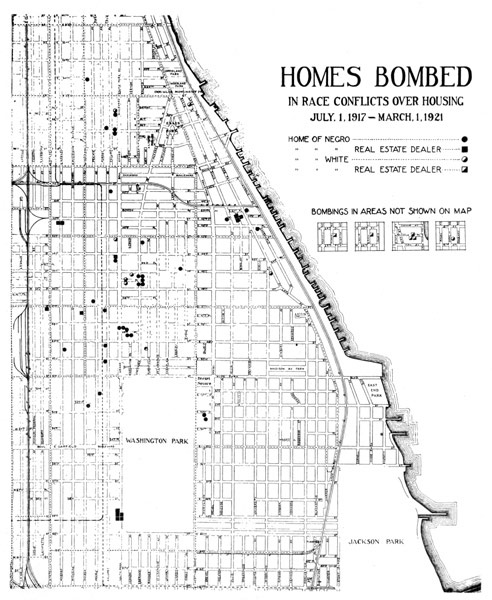
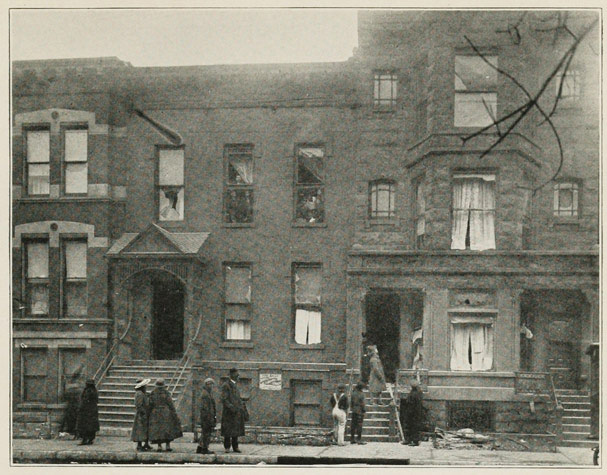
against bombers.
A TRANSPLANTED HOUSEHOLD
Mr. B—— is seventy-two years old and his wife sixty-four. They came to Chicago
during the migration. They had difficulty in finding work suited to their advanced
age and in accustoming themselves to the simplest changes in environment. Neither
of them can read or write.
Home life in the South.—In Alabama they owned an eight-acre farm and a four-room
house and raised hogs, chickens, and cows. They both had worked twelve
hours a day for years and by denying themselves even a comfortable home had
saved $2,000. They were members of a church, although they could not actively
participate in church or other affairs of their rural community. When the migration
fever struck them they sold their property, drew out their $2,000, and followed the
crowd.
Home life in Chicago.—They first secured rooms and began the search for work.
Mr. B—— finally secured a job in a livery stable at $18 a week, but the work was uncertain
and the wages insufficient. Mrs. B—— went to work cleaning taxicabs. Illness
and frequent lapses in work depleted their savings. They rented an eight-room house
and took in lodgers, hoping to insure a steady income. They have nine lodgers in
these eight rooms, in addition to themselves. There is no furnace heat; the bathroom
is out of repair, the halls dark and dirty, and they are using their old furniture brought
from the South. Three of the women lodgers came from the same Alabama community.
The habits and customs of this household are unchanged. They go out seldom, and
all of the women smoke pipes and use snuff.
Of the original $2,000 which Mr. B—— brought with him, he has $250 left.
They make no use of civic and social agencies and do not go to church because
they think Chicago Negroes are unsociable. They prize the fact, however, that
work is plentiful for the lodgers, and they have no intention of returning South.
A BARBER FROM MISSISSIPPI
Mr. D—— was a migrant and a member of a party of over a hundred Negroes who
left Hattiesburg, Mississippi, in the autumn of 1916.
He was a barber at home and earned an average of $25 a week. Mrs. D—— was
a good housewife. They owned a house and lot valued at $1,000 and furniture valued
at $500. They have two children.
Motive for coming to Chicago.—Mr. D—— had always read the Chicago Defender,
and usually got in a supply of these papers to sell to his customers and to supply
topics for barber-shop discussion. His daughter, then a student at Straight College in
New Orleans, was to be graduated that year, and he went to New Orleans to spend a
week. While there he worked in a barber shop. He found that the migration was
being much discussed. One day a man came into the shop and said he was a representative
of a northern industry that was anxious to get Negroes to come North
and work for it. He argued that the North had freed the Negroes, but had left them
in the South where they had not received good treatment, so that at this late date the
North was trying to right an old wrong and was now offering to Negroes a chance
to work. On the other hand the Negroes were indebted to the North for their freedom.
When Mr. D—— returned home he sold his barber shop and left for the North
with his wife and children.
Life in Chicago.—Opening a place of business in Chicago, he called it the Hattiesburg
Barber Shop. It is patronized largely by Hattiesburg people who came up in
his party. His earnings are larger here, but at first his wife was forced to work in
the Stock Yards at $10 a week to help meet the family budget. Occasionally now
she works as a hairdresser. They pay $46.50 a month for rent. Their clothing bill
amounts to $650 a year. Last year they spent $200 for medicine and an average of
$18 a week for food. Their insurance premiums total $6 a month.
Community participation.—In the South the entire family was active in church
affairs. In Chicago they have continued their church connections, and Mr. D——
is one of the officials at the Olivet Baptist Church. They go to church four times a
week.
Adjustments to Chicago.—They were quick to begin adjustment to their new surroundings,
profiting by the advice and instructions of their present pastor. At the
end of six months they felt themselves quite at home. They feel the need for
using more careful English and are more formal in their greetings and relations with
persons whom they meet. They enjoy the "freedom of speech and action" allowed
in Chicago, the privilege of voting, the freedom from segregation, and the absence of
Jim Crow laws. They think Chicago is fair to Negroes in so far as laws are concerned,
but believe there should be better enforcement of the laws. They find life
easier here, although there is more work to be done. They feel a great satisfaction in
the more modern homes and other comforts and pleasures they are able to obtain.
Each month they add a small amount to their bank account. They suggest that
Negroes who have become adjusted to Chicago should take pains in a kindly spirit to
inform newcomers concerning the proper deportment. They believe that if advice is
offered in the right manner it will always be gladly received. They do not intend to
return South.
A STOCK YARDS LABORER
A son-in-law of the B—— family, also from Mississippi, is employed at the Stock
Yards. His impressions throw light on the adjustment of migrants and on their
views. He said:
"A friend met me when I first came to Chicago and took me to the Stock Yards
and got me a job. I went to the front of the street car the first time I entered one
here because my friend told me to; I would not sit beside a white person at first, but
I finally got courage to do so.
"At Swift's the whites were friendly. There I was in the dry-salt department at
22½ cents an hour. The foreman, a northerner, had been there thirty-five years.
He was fair to all. I worked with Americans, Poles, and Irish. But the work was
very hard, and I had to leave. I carried my lunch with me. Negroes and whites
there eat together when they wish. I am now working at Wilson's. The Irish and
Poles are a mean class. They try to get the Negroes to join the union. When the
Negroes went to work Friday after the riot, most of the Irish and Poles quit and
didn't come back to work until Monday. They came back jawing because the
Negroes didn't join the union. White members of the union got paid when their
houses had been burned—$50 if they had families and $25 if they were single.
Colored members of the union got nothing when their houses had been burned.
That's why I won't join. You pay money and get nothing. The whites worked
during the riot; we had to lose that time. I lost two weeks. It seemed strange to me.
It looked unfair. They are still mean and 'dig ditches' for us. They go to the
foreman and knock us, just trying to get us out of jobs. The foreman so far hasn't
paid any attention to it. I am working in the fresh-pork department, handling
boxes.
"The Negroes stick together and tend to their business. Some of the Americans
and Polish are very friendly. Everybody does his own work. We use the same
showers and locker-rooms. They don't want us to work because we are not in the
union. One asked me yesterday to join. The Poles said non-union men would not
get a raise, but we got it."
Opinions on race relations.—"When I first came I thought the city was wide open—I
mean friendly and free. It seems that there is more discrimination and unfriendly
feeling than I thought. I notice it at work and in public places. Wages are not
increasing like the high cost of living. As soon as one gets a raise, the cost of living
goes up [May, 1920].
"The whites act just as disorderly on cars as the Negroes. Monday evening
two white laborers sitting beside a white woman cursed so much that I had to look
around. Nothing is ever said about such incidents.
"Rent goes up whenever people think of it. We have to pay $8 more since
April. Things are getting worse for us and we need to think about it. Still it is
better here than in the South."
AN OLD SETTLER
Mr. S—— was born in Baltimore in 1851. At the time of the gold rush to California,
his father took his family and started out to seek his fortune. They had got
as far as Chicago when his father was robbed and the journey ended. Mr. S—— has
lived here since. He has seen many changes during his sixty-three years' residence in
Chicago. When he came here the city limits were Twelfth Street on the South and
Chicago Avenue on the North, and there were no street cars. The Negro population
was 175. His parents took him on Sunday to the Railway Chapel Sunday School,
started in 1857 in two passenger cars by a Presbyterian minister, Father Kent.
The first building occupied by this congregation was on the site where the Board of
Trade now stands, 141 West Jackson Boulevard. This was destroyed in the fire of
1871. The second church was at the corner of State and Thirteenth streets, where
the Fair warehouse now stands. The next site of the church was that of the Institutional
Church at Thirty-eighth and Dearborn streets.
Early housing experience.—Prejudice, Mr. S—— says, was unknown in the early
days. He has lived south of Thirty-first Street for thirty-five years. They were the
first Negro family to enter the block in which they now live. He built his home
there and has been living there twenty years.
A BASEBALL "MAGNATE"
Mr. G—— was born in La Grange, Texas, the son of a minister. As a boy he worked
on his father's farm, went to school, and progressed as far as the eighth grade. He
was a good baseball player. He played first in Forth Worth, Texas, then in New York
and Philadelphia, and finally came to Chicago in 1907. The highest amount he had
been able to earn was $9 a week. His first job in Chicago netted him about $1,000
a year. In 1910 he had acquired ownership of the team, and now, at the age of
forty, it nets him $15,000 a year. His team has traveled extensively, having covered
the principal cities in the United States at least twenty-five times.
Home life.—Mrs. G—— was born in Sherman, Texas. She completed the first-year
high school at her home. She is a modest woman and a good housekeeper.
They have two children, a son of nine and a daughter of three. Mr. G—— has moved
four times in Chicago, seeking desirable living quarters for his family. He owns a
three-story brick building containing nine rooms, the house in which he now lives.
In addition he owns $7,000 worth of Liberty bonds and values his baseball team and
other personal property at about $35,000.
Community participation.—Both Mr. and Mrs. G—— were church members in the
South. This membership is continued in Chicago. Mrs. G—— belongs to an A.M.E.
church and is interested in and helps support Provident Hospital and Phyllis Wheatley
Home for Girls, while Mr. G—— is a member of several fraternal orders, City Federation
of Clubs, and the Appomattox Club. Their recreation is baseball and dancing,
and they find entertainment in attending theaters and orchestra concerts principally
in the "Loop." Mr. G—— is very much interested now in a playground which is
being established near his home and a tennis and croquet club for young people in the
same vicinity.
AN OLD RESIDENT
Before coming to Chicago in 1886 Mrs. L—— had lived in Washington and Detroit.
Mr. L—— was successively a railroad porter, a night watchman, and a janitor. There
are four children, three daughters and a son. Two of the daughters are married and
have families. One is a dressmaker, another a stenographer, and another an accomplished
musician. The son is a typist. Several years ago Mr. L—— purchased a lot
near Forty-seventh Street on Wells Street on which he built his home. In this
neighborhood the family was reared. Mr. L—— died several years ago.
Riot experience.—Although the L—— family has been living at Forty-seventh
and Wells streets for over thirty years, and relations between the family and the
white neighbors in the block were cordial, gangs of hoodlums from other districts
practically destroyed their property. The house was attacked, some of the furniture
was stolen, and some was destroyed. The heavy pieces of furniture were broken up
and burned in the street. The building was so badly damaged that they were forced
to move into a boarding-house for a time.
Community participation.—The L—— family lived in a section of the city in which
there were few Negroes, but maintained an active relationship with organizations of
the Negro community. They are members of the A.M.E. Church and Sunday
school and of two fraternal organizations. Mrs. L—— is a member of the Linen Club
of the Provident Hospital and is actively interested in the Old Folks Home. Miss L——,
one of the daughters, is well known in the community as a musician and composer.
A PHYSICIAN
Dr. W—— and family came to Chicago in 1910. He had lived in Mexico City
until the revolution made living there hazardous. He was in good circumstances,
maintaining a comfortable household with servants. Since he has been in Chicago
he has had considerable difficulty in finding a home in a neighborhood fit for rearing
his children. He finally purchased a home on Grand Boulevard which is valued at
more than $25,000. It is a three-story building with brown-stone front, ten rooms and
two baths, and many works of art installed by the artist, Holslag, who formerly owned
the house, and who himself painted some of the decorations. Dr. W—— has spent
several thousand dollars on the furnishings.
Home life.—Besides the doctor and his family there are two other relatives. The
physician's income is adequate to maintain this establishment and in addition two
high-class automobiles. Mrs. W—— is a social leader and does much entertaining.
She is a patron of community drama and attends grand opera and the leading theaters
in the "Loop." They were formerly Catholics but now attend the Bahai Assembly.
Dr. W—— is a member of two fraternal orders and two social clubs. Their recreation
is tennis, boating, motoring, and bathing. He is a director of the Chicago Health
Society. He is an examining physician and a member of the board of directors in a
life insurance company. Both are members of the Art Institute and are active in
supporting the settlements and hospitals of the community.
In addition to her social duties Mrs. W—— continues the study of music. She is
chaperon at the regular dances of a post of the American Legion held in the South
Side Community Center; a member of the Library Committee of the Y.W.C.A.,
and is interested in the entertainment of Negro students of the University of Chicago.
They are living in a neighborhood in which several bombings of homes of Negroes
have occurred, but Mrs. W—— says that their relations with the white neighbors are
friendly.
A NATIVE OF CHICAGO
Mr. C—— was born in Chicago in 1869. His grandmother was part Indian and his
grandfather of Scotch extraction. The grandfather was born in Cincinnati, and
was graduated from Oberlin College. His father's brother was a personal friend of
Owen Lovejoy and Wendell Phillips. In Leavenworth, Kansas, a monument had
been erected to him as the first Negro captain of a volunteer company. He fought
with General Buckner in New Orleans, was active as an abolitionist, and his wife
was one of the women sent to Kansas to establish schools among Negroes. She taught
school for thirty-six years and was one of the first women in the country who were
graduated as kindergarten teachers. His maternal grandfather bought a home in
Chicago in 1854 and lived where the Federal Building now stands. At the time of
Mr. C——'s birth his father lived on Plymouth Court, then called Diana Place. They
lived for thirty-one years on South La Salle Street, where they owned their home.
Economic sufficiency.—Mr. C—— is a graduate of the Chicago College of Dental
Surgery and practiced his profession until ill health forced him into other fields. He
has been a clerk in the county treasurer's office, assistant bookkeeper in a white bank
in Memphis, which position he held for two years, and assistant electrician for a telephone
company. Now, at fifty-one, he is superintendent of the Western Exposition
Company's building. Twice he has lost his savings by bank failures. He lost $9,000
through the failure of the Day and Night Bank in Memphis, Tennessee. He owns a
house and lot, oil and mining stocks valued at $4,600, Liberty bonds, Thrift stamps,
and carries a small bank balance. His present home is a four-room flat in a building
on South State Street, which contains forty apartments and two stores. With him
lives the family of his younger brother, who has a twelve-year-old son. He is a
member of the Baptist church and two fraternal orders. His chief recreation is
swimming, and he finds his entertainment in the "Loop" theaters and the city
library.
A MISSOURI FAMILY
Mr. and Mrs. T—— came to Chicago in 1919, the wife arriving one month before
her husband. They had been living in St. Louis, Missouri, where Mr. T—— was
employed as a roller in an aluminum works. Prior to that time he had been a houseman,
and before that a teamster.
There are two children. One is fourteen years old and in the first-year high school,
and the other is seven and in the first-grade grammar school.
Mrs. T—— has always been a substantial aid to her husband, and, as she says, she
"doesn't always wait for him to bring something to her, but goes out herself and helps
to get it." Accordingly, when reports were being circulated that Chicago offered
good jobs and a comfortable living, she came up to investigate while her husband held
his job in St. Louis.
Home life in Chicago.—The family lives on State Street over a store. They have
moved four times since coming to Chicago in 1919, once to be nearer work, once to
get out of a neighborhood that suffered during the riot, and twice to find a more desirable
neighborhood for their family. They are not satisfied with their present home
and are planning to move again as soon as a more suitable place can be found. With
them live a sister-in-law and her child, who are regarded as members of the family.
The house is in poor sanitary condition. The toilet is in the yard and used by two
families. There is no bath. The sister-in-law is a music teacher but does not earn
much. She pays board when she can afford it.
Mr. T—— is forty-seven and his wife forty-six years old. He is employed at the
International Harvester Company and earns $35 a week for a nine-hour day. He
consumes an hour and a half each day going to work.
Although Mr. T—— lived on a farm and too far from school to attend, he taught
himself to read and write. Mrs. T—— went as far as the eighth grade in grammar
school.
Community participation.—The entire family belongs to a Methodist church.
Mr. T—— is a member of the Knights of Pythias and Mrs. T—— is a member of the
Sisters of the Mysterious Ten. They have no active recreation. For amusement
they attend motion-picture shows in the neighborhood. The children regularly use
the playground near their home and the Twenty-sixth Street Beach.
Adjustment to Chicago.—Their most difficult adjustment has been in housing.
They think landlords should be forced to provide better homes for the people in view
of the high rents.
AN EMBALMER
Mr. B—— was born in Texas, lived for a number of years in Tuskegee, Alabama,
moved to Montgomery, and thence to Chicago in the summer of 1906. His first
position here was that of coachman for $30 a month, room, and board. His next
position was that of porter, working fifteen hours a day for $30 a week. He accumulated
a small amount of money, and, wishing to enter business for himself, and not
having sufficient funds to attend a specialized school, he secured a job with an
embalmer and worked for him four years. In 1913 he entered the undertaking business
for himself. He is now buying a two-story brick building on a five-year contract,
to serve as a place of business and a home. The business is young and was begun on
small capital. To establish himself he exhausted his little bank account and sold his
Liberty bonds. His equipment is still incomplete, and he rents funeral cars and other
equipment necessary for burials.
Community participation.—Both Mr. and Mrs. B—— are members of several local
improvement clubs; they attend Friendship Baptist Church, and each belongs to
three fraternal orders.
Sentiments on local conditions.—Mrs. B—— thinks the town too large for much
friendliness. Mr. B—— believes that there should be a segregated vice district. His
principal objection to the present scattering of houses of prostitution is that his wife,
who is frequently obliged to return home late at night, is subjected to insults from men
in the neighborhood. He thinks there should be a law requiring that landlords clean
flats at least once a year.
A YOUNG PHYSICIAN
Dr. C—— is a good example of the numbers of young Negro professional men in
Chicago. His office is on State Street near Thirty-fifth. He was born in Albany,
New York, and his wife in Keokuk, Iowa. They have lived in Chicago since 1915.
Early experiences in profession.—Through a civil-service examination Dr. C——
secured a place as junior physician at the Municipal Tuberculosis Sanitarium. At
the same time he passed with high rating an examination for interneship at the Oak
Forest Infirmary. At the latter place he was promptly rejected because of his
color, and at the former he was asked to leave nine hours after he reported for
duty.
Economic status.—Dr. C—— owns a house and lot in his former home, Albany, which
he values at $14,000 and other property and stock holdings valued at $13,000.
Education.—Dr. C—— was graduated from the Brooklyn Grammar School, the
Boys' High School of Brooklyn, and Cornell University, where he obtained his A.B.
and M.D. degrees. Mrs. C—— is a graduate nurse. He is at present an associate
surgeon and chief of the dispensary of a local hospital.
Community participation.—He has already assumed a position of leadership in
the social activities of the community, is a trustee of the new Metropolitan Church,
a thirty-second degree Mason, a member of the Knights of Pythias, Chicago Medical
Society, American Medical Association, Urban League, and a director of the Community
Service, and also an instructor at the Chicago Hospital College.
Opinions on race relations.—He believes that the recent migration of Negroes has
been an advantage in teaching Chicago Negroes the value of property ownership and
co-operation. He thinks the scarcity of homes for Negroes can be relieved by allowing
Negroes "as much freedom as the American dollar." Definite suggestions for
improving conditions within the race he gives as follows:
1. Establishment of a permanent medium for understanding between the two
races—a permanent commission to act in the adjustment of difficulties of any kind.
This body should be composed of Negroes and whites.
2. Rigid enforcement of existing laws.
3. A systematic campaign under the direction of the commission among Negroes
to teach them personal hygiene.
4. Negroes should join labor unions and refuse to serve as strike breakers.
5. When Negroes do act as strike breakers, the doctor thinks, race friction is
created and labor is cheapened. Negroes can obtain a square deal from the unions
only when they have joined them in sufficient numbers to demand justice by becoming
an important factor in the unions. If they are not permitted in certain unions
they should form groups of their own for collective bargaining.
A YOUNG LAWYER
Numbers of young Negro lawyers are establishing themselves in Chicago, and
their influence already is being felt in the community. A good example of this group
is Mr. J——, who, although only twenty-eight years old, has been actively practicing
law six years. He was born in Kentucky and has lived in Indiana, Kansas, Ohio,
New York, and Oklahoma.
Education.—He completed high school in Kansas, graduated from Oberlin
College, and then went to Columbia University, New York, and received the degrees
of Master of Arts and Bachelor of Laws. His wife completed the junior year in
college in New York, studied art in New York City, and is skilled in china painting.
Home life.—Mr. and Mrs. J—— have one child of four years. They live in one of
the 1,400 buildings owned by a real estate man of that district who "notoriously
neglects his property." The struggle to establish himself during the first few years
in Chicago was difficult. Now Mr. J—— has the confidence of a large number of
people, and a clientèle which provides a comfortable income.
Community participation.—Mr. J—— is a trustee of the institutional A.M.E.
Church, chairman of the United Political League, member of the Y.M.C.A., Knights
of Pythias, a Greek-letter fraternity and the Urban League, and is a member of the
Executive Committee of the Friends of Negro Freedom.
Civic consciousness.—He thinks that if working Negroes and working white men
can be led to regard one another as workingmen interested in the same cause the
color question will be forgotten. He believes that prejudice is based on the economic
system. With respect to housing he thinks a Negro should, as an American citizen,
be free to purchase real estate wherever he is able to make a purchase; that as long as
artificial barriers are set up there can be no successful solution of the color question;
that a man's respect for the rights of others increases in proportion to his intelligence,
and that the press can be a great source of evil or good in educating the people.
He believes that there should be clubs and educational meetings to instruct some of
the less refined classes of Negroes in conduct.
A MIGRANT PROFESSIONAL MAN
Mr. and Mrs. F—— lived in Jackson, Mississippi, until 1917, the year of the
migration, when they moved to Chicago. He followed his clientèle and established
an office on State Street near Thirty-first Street. Mr. F—— received his commercial
and legal training at Jackson College and Walden University. Mrs. F—— is a graduate
of Rust College and the University of Chicago.
Home life.—The F—— home evidences their economic independence. It contains
ten rooms and bath and is kept in excellent condition. They own six houses in the
South, from which they receive an income. Mr. F—— is the president of an insurance
company incorporated in Illinois in 1918, which has a membership of 12,000. He
has also organized a mercantile company, grocery and market on State Street, incorporated
for $10,000, of which $7,000 has been paid.
They have two sons, nineteen and twelve years of age, and three adult nephews
living with them. One nephew is a painter at the Stock Yards, another is a laborer,
and the third a shipping-clerk.
Community participation.—They are members of the Baptist church and of the
People's Movement, while Mr. F—— is a member of the Appomattox Club, an organization
of leading Negro business and professional men. In addition to membership
in three fraternal organizations, they are interested in and contribute to the support
of the Urban League and United Charities.
Opinions on race relations.—Concerning housing, Mr. F—— feels that some corporation
should build medium-sized cottages for workingmen. He thinks that the changes
in labor conditions make it hard for Negroes to grasp immediately the northern
industrial methods. Patience will help toward adjustment, he thinks.
He thinks that colored women receive better protection in Chicago than in the
South. His experience in the courts leads him to believe that Negroes have a fairer
chance here than in the South. Agitation by the press in his opinion can have no
other effect than to make conditions worse.
The purpose of this section of the report is to describe by a selection of
types the physical condition of houses occupied as residences by Negroes.
This description includes the structure, age, repair, upkeep, and other factors
directly affecting the appearance, sanitation, and comfort of dwellings available
for Negro use.
In 1909 the Chicago School of Civics and Philanthropy included Negro
housing in a series of general housing studies. This study was confined to
the two largest areas of Negro residence, those on the South and West sides.
Both of these were studied generally, and in each a selected area, of four blocks
in one case and three blocks in the other, was studied intensively.
The South Side area included parts of the Second, Third, and Thirteenth
wards between Fifteenth and Fifty-fifth streets, with State Street as the main
thoroughfare. The four blocks bounded by Dearborn Street, Twenty-seventh
Street, Armour Avenue, and Thirty-second Street were intensively studied.
It was found that within these four blocks 94 per cent of the heads of families
were Negroes. The buildings were one- and two-story, with a considerable
amount of vacant space in the lots. Half the lots had less than 50 per cent
of their space covered. The houses were for the most part intended for single
families but had been converted into two-flat buildings. Rooms were poorly
lighted and ventilated, the sanitation bad, and the alley and grounds about
the houses covered with rubbish and refuse.
Comparisons with other districts studied showed the following: Of houses
in a Polish district, 71 per cent were in good repair; in a Bohemian district,
57 per cent; Stock Yards district, 54 per cent; Jewish and South Chicago
districts, 28 per cent; and in the Negro district, 26 per cent. A study made
three years later by the School of Civics covering the same area showed a
decrease of 16 per cent of buildings in good repair. Five buildings had been
closed by the Department of Health as no longer fit for habitation. There
were leaks in the roofs, sinks, and windows of five-sixths of the dwellings.
In describing a typical house in this area, the report said:
There was no gutter and the roof leaked in two places, the sink drain in the
basement leaked, keeping it continually damp, the opening of the chimney let the
rain come down there, the windowpane in front rattled from lack of putty. The
conditions in these houses are typical; almost every tenant tells of rain coming in
through roof, chimney or windows, and cases of fallen plaster and windows without
putty were too common to be noted. One aspect of the situation that should not be
overlooked is the impossibility of putting these old houses in good condition. Leaks
may be repaired, plaster may be replaced, windows may be made tight, and these things
would certainly improve most of the houses, but when all were done it would not alter
the fact that these are old houses, poorly built, through which the wind can blow at will.
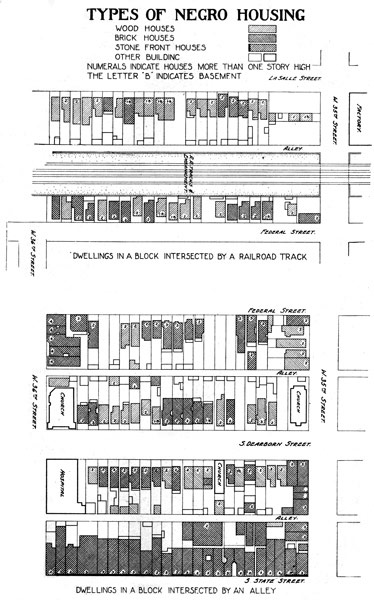
TYPES OF NEGRO HOUSING
Lack of repairs to the houses in the "Black Belt" is accounted for by the
fact that owners do not regard the buildings as worth repairing, and that
tenants can always be found, even though it is necessary to reduce rents somewhat.
This reduction is indeed notable. The School of Civics found that
while in 1909 50 per cent of the houses examined on the South Side rented
for as much as $16 a month, in 1917 only 13 per cent could command as high
a rental as that; that in 1909 the prevailing rents were $15 and $16 as against
$10 and $12 in 1917.
On the West Side the area studied generally was that bounded by Lake
Street, Ashland, Austin, and Western avenues. Here the situation was little
better. One-third of the families visited in the three selected blocks bounded
by Fulton and Paulina streets, Carroll Avenue and Robey Street were Negroes.
The remaining two-thirds represented sixteen nationalities. It was reported
that the white residents could get advantages and improvements for their
houses that a Negro could not. While 35 per cent of the houses were reported
in good repair, 31 per cent were described as "absolutely dilapidated" and in
a worse state of repair than those in any other districts studied except the Jewish
district. The report said:
Broken-down doors, unsteady flooring, and general dilapidation were met by the
investigators at every side. Windowpanes were out, doors hanging on single hinges
or entirely fallen off, and roofs rotting and leaking. Colored tenants reported that
they found it impossible to persuade their landlords either to make the necessary
repairs or to release them from their contracts; and that it was so hard to find better
places in which to live that they were forced either to make the repairs themselves,
which they could rarely afford to do, or to endure the conditions as best they might.
Several tenants ascribed cases of severe and prolonged illness to the unhealthful condition
of the houses in which they were living.
That there was a continuing demand even for the shacks and shanties of
the "Black Belt" is evidenced in a report made by the Urban League of Chicago
in 1917 that only one out of every thirteen Negro applicants for houses to rent
could be supplied. At the height of the demand applications for houses were
coming in at the rate of 460 to 600 a day, and only ninety-nine were available
for renting purposes. This was due, of course, to the growing stream of
Negroes arriving daily from the South.
Covering the same area on the South Side as that studied by the School
of Civics in 1917 a canvass was also made in 1917 by Caswell W. Crews, a
student at the University of Chicago. He found that tenants had remained in
these dwellings in some instances as long as twenty years after their unfitness
had become evident, because the rent was low and they could find nowhere
else to go. He mentioned the mass of migrants from the South who, because
of their ignorance of conditions in Chicago as to what was desirable and what
was to be had for a given sum, fell an easy prey to unscrupulous owners and
agents. Mr. Crew's description said:
With the exception of two or three the houses are frame, and paint with them is a
dim reminiscence. There is one rather modern seven-room flat building of stone
front, the flats renting at $22.50 a month and offering the best in the way of accommodations
to be found there. There is another makeshift flat building situated above
a saloon and pool hall, consisting of six six-room flats, renting at $12 per month, but
in a very poor condition of repair. Toilets and baths were found to be in no condition
for use and the plumbing in such a state as to constantly menace health. Practically
all of the houses have been so reconstructed as to serve as flats, accommodating two
and sometimes three families. As a rule there are four, five, and sometimes six rooms
in each flat, there being but five instances when there were more than six. It is often
the case that of these rooms not all can be used because of dampness, leaking roofs,
or defective toilets overhead.
The owners are in most instances scarcely better off than their tenants and can
ill afford to make repairs. One house in the rear of another on Federal Street near
Twenty-seventh had every door off its hinges, water covering the floor from a defective
sink, and windowpanes out. A cleaning of the house had been attempted, and the
cleaners had torn loose what paper yielded readily and proceeded to whitewash over
the adhering portion which constituted the majority of the paper. There were
four such rooms and for them the family paid $7 a month.
In 1920 a cursory examination by investigators from the Commission
showed that the only change in the situation was further deterioration in the
physical state of the dwellings.
The movement of the Negro population across State Street eastward into
the area once occupied by wealthy whites began as early as 1910. Wabash
Avenue was the first street into which they moved. Gradually they scattered
farther east toward Lake Michigan. Following the migration from the
South the Negro area east of State Street expanded to the lake and pushed
southward. The houses which they found in the new territory, although
from twenty to forty years old, were a vast improvement over those they had
left west of State Street. These houses do not permit of any general classification,
for some are very bad while others, though not new, are in a state of good
repair, largely according to the care taken by previous occupants. Along with
descriptions of Negro homes must be considered the tendency among those
Negroes who were able to move away from the congested areas of Negro
residence. Some of the best houses occupied by Negroes in 1920 were in
districts until recently wholly white.
A rough classification of Negro housing according to types, ranging from
the best, designated as "Type A," to the poorest, designated as "Type D,"
was made by the Commission on the basis of a block survey comprising 238
blocks, covering all the main areas of Negro residence, and data concerning
274 families, scattered through these 238 blocks, one or two to a block, whose
histories and housing experiences were intensively studied by the Commission's
investigators. Approximately 5 per cent of Chicago's Negro population live
in "Type A" houses, 10 per cent in "Type B," 40 per cent in "Type C," and
45 per cent in the poorest, "Type D."
Type A houses, with those of the other types, were not concentrated
wholly in any one section but were found widely scattered; there were none,
however, in the areas which in 1910 held practically the whole Negro population.
Examples of Type A were found on South Park Avenue between
Thirty-third and Thirty-fifth streets, where some Negroes had lived for six
years; on Grand Boulevard between Thirty-fifth and Thirty-eighth streets,
where a few had lived for three years; on Champlain, Evans, Vincennes,
and Langley avenues, between Forty-third and Forty-seventh streets, where
some Negroes had lived four and five years; and on Wabash Avenue between
Fifty-first and Fifty-third streets. In Woodlawn there are a few of recent
occupancy, one of which was built by its Negro owner.
Most of the Type A dwellings are of substantial construction, principally
of brick and stone. Some are old family residences in formerly high-class
neighborhoods, built to withstand the test of years. Consequently, although
they have been subject to the usual deterioration, they still afford a fairly
high standard of comfort and convenience. Some are large and exceptionally
well equipped with luxurious fittings and adornments installed by former
owners. Most of these houses were built and owned by people of wealth who
abandoned them. Many of them have since passed through several stages
of occupancy. Somewhat less permanent in their physical aspects perhaps
are the Type A houses in Woodlawn. Many of the houses in this district are
of frame structure, and they are not as commodious as those in the formerly
fashionable white districts. But they provide a desirable measure of comfort,
with less waste space and superfluous rooms.
Comforts and conveniences.—Type A dwellings are fitted with all the
conveniences required by well-to-do whites. Some of them have more than
the customary one bathroom, have electricity and gas, and are well heated
by steam or hot-air furnaces. One example of Type A housing is a three-story,
stone-front, ten-room house on South Park Avenue owned and occupied by
a lawyer and his family. There is a garage, and the place is kept in good
condition. A twelve-room house, also on South Park Avenue, owned and
occupied by a physician and his family, has two bathrooms, steam heat, and
electricity, and is in excellent repair. Another physician on the same street
owns a three-story brown-stone house, with a garage. It contains ten rooms
and two bathrooms, has steam heat and electric lights, and is in good condition.
For this property he paid $35,000. A three-story brick house on Vernon
Avenue is owned and occupied by a business man. In addition to other modern
conveniences there are lavatories in four of the bedrooms. The house is in
excellent condition. A nine-room house on Langley Avenue, in good repair,
owned by another business man, has gas, furnace heat, and a bathroom.
The occupants.—Although these buildings are occupied by the wealthier
Negroes, business or professional men, it often happens that others secure and
occupy such houses. High wages during the war and immediately afterward
permitted some Negroes who arrived in Chicago during the migration to live
in the best class of housing available for Negroes. For example, an undertaker
owns such a house on Langley Avenue, with seven rooms, with gas, a bathroom,
electricity, and hot-water heat. This building is ornate and in excellent
repair. A postal clerk who has been in Chicago since 1897 owns a seven-room
house on Champlain Avenue south of Sixty-sixth Street, where he lives with
his wife and child. In the block south of Forty-third Street on Prairie Avenue
is a nine-room house occupied by an employee of the American Express Company.
In order to help pay the rent, four lodgers are taken, who together
pay $20 a week. The house, which includes a bathroom, is furnace-heated
and lighted by electricity. A transfer man pays $65 a month rent for an
eight-room house of this class on Bowen Avenue. He earns $35 a week, and
two lodgers pay $50 a month. The house has bath, electricity, and furnace.
A railroad porter, who has been a doctor's assistant and has lived in Chicago
since 1886, owns a house on Rhodes Avenue near Sixty-sixth Street. It has
seven rooms and is provided with a furnace, gas, bathroom, and electricity.
Neighborhood conditions.—Surroundings of Type A houses are generally
far more pleasant than those in areas where the majority of Negroes live.
The streets and alleys are usually clean, except where Type A houses are
in neighborhoods surrounded by poorer houses. The premises are generally
well kept. This is especially true where the occupants are owners. When
space permits, there is a lawn or a garden that shows signs of pride and attention.
One block was noted, however, where the residents reported that the
street was watered twice a day until Negroes moved in, after which it received
no such attention.
Type B designates a class of houses which have not the size, durability,
permanence, architectural embellishments, or general standard of comfort
and convenience of those classed as Type A. They are usually flat buildings,
whether originally intended for that purpose or not. Frequently dwellings
are rearranged by landlords, when Negroes are given occupancy, to accommodate
two or more families in place of the one for which they were built. Type B
houses have less floor space, the average number of rooms is fewer, and they
have, as a rule, fewer modern conveniences. Still, they are good houses and
much superior to the habitations in which Negroes are most often found.
Occupants of Type B houses are frequently found to be clerical workers,
postal clerks, railway mail clerks, small tradesmen, artisans, and better-paid
workers in steel mills and Stock Yards.
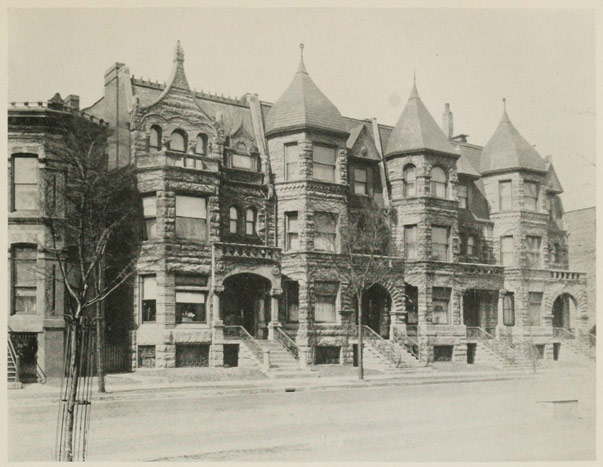
HOMES OWNED BY NEGROES ON SOUTH PARK AVENUE
Classified in text as "Type A."
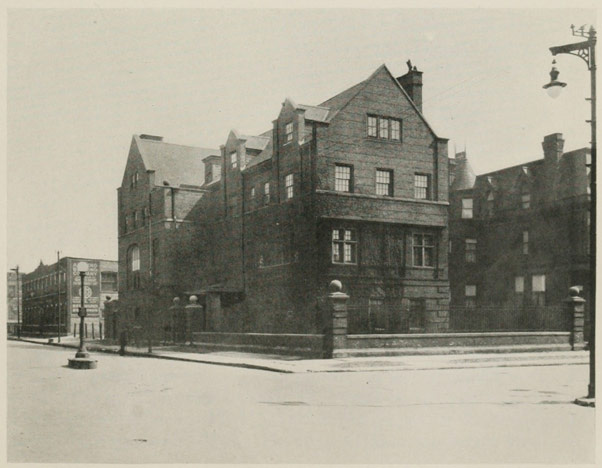
AN ABANDONED RESIDENCE IN THE PRAIRIE AVENUE BLOCK
WITH A FACTORY IN THE REAR
Most of the houses in the part of Woodlawn inhabited by Negroes are of
Type B. Another district in which this type of house is found extends from
Fortieth to Forty-seventh streets on Langley, Evans, Champlain, Vincennes,
and St. Lawrence avenues. Although in this area a few dwellings are of
Type A, the greater part of them fall under Type B. About 5 per cent of the
dwellings occupied by Negroes on the West Side—for example, some of those
on Oakley and Washington boulevards—might also be classed as Type B.
Brick or stone dwellings predominate in the districts where this type is found.
For example, the block survey made by the Commission covered twelve blocks
in the Negro residence in Woodlawn on which there were 190 brick or stone
and 119 frame houses. Practically all the Type B dwellings are one- and
two-family houses, and the majority are two-family houses. The Commission's
study shows that these dwellings are not overcrowded and house
their families comfortably. Many of the occupants own their homes.
Comforts and conveniences.—Most of these houses have baths, electric
lights, steam, hot-water or hot-air heating, and gas for cooking. Only a few
are heated by stoves or lack electrical fixtures. They were found to be in
good repair, well kept and clean. Special pride is taken by home owners
of this class in keeping the property presentable and preventing rapid deterioration.
Family histories reveal that most of the Woodlawn residents are long-time
residents of Chicago.
Neighborhood conditions.—In the neighborhoods where Type B houses
were found, no uniform standard of cleanliness was evident in streets and alleys
or in adjoining properties. They were as frequently unkempt as tidy.
Although the premises of Type B houses were generally kept neat, surrounding
untidiness often detracted from their appearance. But a block containing
a majority of this type usually had an appearance of being better kept, whether
the surrounding property was occupied by whites or Negroes. In the Woodlawn
area the surroundings of the houses were well cared for, and sanitary
measures were commonly observed. In some blocks in the Langley Avenue
neighborhood carelessness and neglect were evident. Vacant lots were no
more littered with rubbish than in white areas of a similar grade.
Type C houses are the most common in areas of Negro residence. In
this classification are included about 50 per cent of the houses on the South
Side east of State Street, most of those in the North Side area, about 60 per
cent of those in the West Side area, practically all those in the Ogden Park
area, and many dwellings in the little Lake Park district.
Heads of families occupying Type C houses were usually unskilled wage-earners,
or in personal service. Their incomes were such that they could rarely
afford more than $20 a month rent.
Types of houses.—Eleven blocks on the North Side were included in the
Commission's block survey. In these blocks 146 of the buildings were of
brick or stone, and 123 frame. Fifteen were single houses, four were double,
and 167 housed three or more families, the largest proportion of such buildings
in any district examined. There were also four rows of houses. They were
in a fair state of repair. Four-room houses or flats predominated among the
fourteen families whose histories were taken. In one instance seven persons
were living in four rooms, in another nine persons were living in seven rooms,
in another eleven persons were living in seven rooms. The dwellings were
mainly one- and two-story buildings, with a few three- and six-flat buildings.
A large proportion of buildings housing three or more families was found
also in Ogden Park. In eleven blocks there were 109 such buildings. There
were also sixty-eight single and no double houses. The frame buildings
numbered 189, and brick or stone forty-eight. Most of the houses were one-
and two-story frame buildings. The majority were in good or fair repair,
though one block showed gross neglect of repairs to exteriors, and practically
all needed painting. Five-room dwellings predominated among the fifteen
families whose histories were recorded. Overcrowding was frequent. In
one instance eleven persons lived in five rooms; in another nine persons in
five rooms.
In the part of the South Side area east of State Street and between Twenty-second
and Thirty-first streets forty-two blocks were surveyed. Michigan,
Indiana, and Prairie avenues have excellent dwellings, practically all of which
are still occupied by whites. Until a few years ago these were fashionable
residential streets, and the buildings are large, well built, and often ornate.
Surrounding them, however, are hundreds of houses, old and difficult to keep
in repair. In these forty-two blocks there were 767 buildings of which 163
were frame and 604 brick. About 37 per cent of these are of Type C.
The surroundings of these buildings appear in brief comments on some of
these blocks, taken from investigator's notes, as follows:
Property has been allowed to run down.
Five vacant houses; yards full of rubbish; lodgers transient; families do not move.
Vacant lot dirty.
Two vacant lots; yards well kept.
Garbage piled up on vacant lot; Negroes moving in.
Roomers move often; one poolroom; empty church building.
Vacant lot used as dump; yards well kept.
Two vacant houses robbed of plumbing fixtures.
Yards poorly kept; whites moved out three years ago, except one family.
Vacant lot used as dump; one poolroom, two hotels; yards well kept; Negroes
moving in.
Yards unkempt; mostly renters.
Formerly questionable houses for whites.
Mostly newcomers; property run down.
Yards well kept; boarding-houses.
People move in because they can't find anything better.
Between Thirty-first and Thirty-ninth streets east of State Street seventy-eight
blocks were surveyed. There were seventy-eight frame and 1,523 brick
and stone buildings, 620 single houses, 559 double, 254 accommodating three
or more families, and nine apartment houses. Of this group 51 per cent were
of Type C. The property and general surroundings showed age and the
beginning of rapid deterioration everywhere; in some cases there had been
attempts to care for the premises and in some cases neglect was obvious.
The streets, except Michigan Avenue and South Park Boulevard, showed
much neglect, and the alleys generally were dirty. Many of these houses
were occupied by their Negro owners. Negroes were found to occupy about
40 per cent of these Type C houses.
Conveniences.—In these two parts of the South Side area conveniences
and ordinary sanitary facilities are often absent. Gas is the common form of
lighting, and often it is not used. Family-history data revealed that there
were about as many homes without as with bathrooms. In a large number of
buildings families were obliged to use common toilets located in halls or back
yards. The dwellings were out of repair in some respects in nearly every
instance. Defects of this kind were often in the plumbing. Leaky toilets
or water pipes were common complaints. Some toilets did not flush. Some
sinks were leaky, as were some of the roofs. In some houses windows or doors
were broken, loose, or sagging. Some houses were very dirty.
On the West Side a situation not essentially different was found among
the Type C dwellings. Possibly baths were a little more frequent. Occasionally
there was a furnace, though stove heat was most common. Gas was the
usual means of lighting. The situation as to toilets was about the same, and
the buildings, being chiefly old, were usually out of repair in some respect.
The number of brick and frame dwellings was about equal. There were more
double houses in proportion to the single ones, and none that had three or
more families. Five-room dwellings were most numerous, and there was
little indication of overcrowding.
Neighborhood conditions.—Only two blocks in the West Side area were
rated as merely "fair," four in the North Side area were dirty, while only one
in the Ogden Park area was not cleaned. In the North Side and Ogden Park
areas distinct efforts were observed to keep yards clean. Premises showed
signs of care and attention, though an occasional vacant lot showed use for
dumping. Alleys in all three districts gave evidence of neglect. Some were
badly littered with garbage and rubbish.
Type D housing is the least habitable of all. The houses were usually
dilapidated, and in many cases extremely so. Most of the buildings are
among the oldest in the city. They were occupied only by Negroes at the foot
of the economic scale, many families living from hand to mouth, frequently in
extreme poverty.
This class of houses predominates in those parts of the South Side area
from Twelfth to Twenty-second Street along State Street and Wabash Avenue,
and from Twelfth to Thirty-ninth streets and Wentworth Avenue. Many
Negro dwellings in the North Side area and about 35 or 40 per cent of those in
the West Side area were of Type D. Even in the area of the South Side
between State Street and Lake Michigan many of the older frame and brick
buildings fall into this classification. It is safe to say that 43 per cent of the
housing for Negroes is of this type.
Most of these dwellings were frail, flimsy, tottering, unkempt, and some
of them literally falling apart. Little repairing is done from year to year.
Consequently their state grows progressively worse, and they are now even
less habitable than when the surveys quoted at the beginning of this section
were made. The surroundings in these localities were in a condition of extreme
neglect, with little apparent effort to observe the laws of sanitation. Streets,
alleys, and vacant lots contained garbage, rubbish, and litter of all kinds.
It is difficult to enforce health regulations.
Although there has been protest by Negroes against the necessity of living
in places so uncomfortable and unhealthful, improvement comes slowly.
Contentment with such insanitary conditions is usually due to ignorance of
better living. For the poorest buildings low rents are offered to encourage
continued occupancy and to forestall requests for repairs. Prompt vacating
of many of these houses usually follows when a family can secure better accommodations
in a better neighborhood.[23]
Among the more intelligent Negroes neighborhood organizations were
found similar to those of white people. Dissatisfaction with local conditions,
failure of authorities to sweep and sprinkle streets or to provide adequate
street lighting, corner signs, and similar equipment usually prompt these
efforts. Three or four such societies have been instituted by Negroes in
Chicago. One example is the Middlesex Improvement Club, organized
following the riots of 1919 in a neighborhood including three blocks on Dearborn
Street near Fiftieth. Among other things it seeks to promote a friendly
spirit among the people of both races in a neighborhood which was turbulent
during the riots. It has extended some financial aid to its members when
required. It is financed by Negro business men with some help from white
business men of the locality.
Woodlawn has a community organization which reflects the friendly
attitude between the races in that district. Both whites and Negroes are
members, with a common community interest. This organization goes
somewhat beyond the usual neighborhood improvement association in scope
and purpose. While it embodies the usual purposes, it also seeks to induce
full use by all the people of the district of all public and semi-public institutions
that contribute to good citizenship. One of the notices sent out by the association
urged attendance at night sessions of public schools. It briefly set forth
the advantages for both young and older people, suggesting that their usefulness
to the community might thus be enlarged, that they might be trained
for profitable employment, and incidentally that young people could be kept
off the streets and away from demoralizing places. Attention was drawn to
the fact that "business men of the city are seeking young people, both colored
and white, for positions as stenographers, clerks, and trades people."
The notice closed thus:
We are desirous that you use your influence to maintain a spirit of friendliness
and good will among all citizens, white and black, and especially among the school
children, paying especial attention to the conduct of pupils to and from school. We
earnestly seek your co-operation in these matters.
In the neighborhood of Fifty-sixth Street and Wabash Avenue is another
of these neighborhood leagues; all the members are Negroes. Meetings
take place periodically at the houses of members, and special attention is
given to such matters as the condition of their premises, care of lawns, etc.
Social agencies likewise have given considerable attention to the instruction
and encouragement of Negroes in better living. While this effort has been
directed mainly to the newer arrivals from the South, it has also had an effect
on many who have lived in the city for some time but have not yet adjusted
themselves to city life and more rigid standards of sanitation and deportment.
One of these agencies is the Urban League. Among other activities it
issued placards to be kept in sight in Negro homes, graphically contrasting good
and bad habits of living. Pictures showed the front porch of a Negro family
as it should and should not be used, with the pointed question, "Which?"
underneath. Then followed a sort of pledge of conduct:
I realize that our soldiers have learned new habits of self-respect and cleanliness.
I desire to help bring about a new order of living in this community.
I will attend to the neatness of my personal appearance on the street or when
sitting in front doorways.
I will refrain from wearing dust caps, bungalow aprons, house clothing, and
bedroom shoes out of doors.
I will arrange my toilet within doors and not on the front porch.
I will insist upon the use of rear entrances for coal dealers, hucksters, etc.
I will refrain from loud talking and objectionable deportment on street cars and
in public places.
I will do my best to prevent defacement of property either by children or adults.
The guidance and instruction given by the South Side Community Service,
pastors of churches and Negro newspapers have stimulated the Negro population
to efforts at improvement of their property. One newspaper, for example,
conducted a column containing hints on cleanliness, sanitation, and deportment.
It printed items concerning objectionable conditions at given addresses
and warned offenders that they were being watched by the neighborhood
organization, which might take action against them if they did not improve
their conduct.
Another way in which Negroes have been led to understand that habits
of orderliness and cleanliness are expected of them in Chicago has been through
a "Clean-up Week" in the spring of each year, when concerted efforts are made
to collect and dispose of tin cans and other rubbish on vacant lots and yards.
A "Tin Can Contest" was conducted by the Wabash Avenue Y.M.C.A.,
which offered prizes to the children collecting the greatest number of tin cans
beyond 300. The 1,000 youngsters who participated in the Second Ward
were divided into eight regiments. The eleven-year-old Negro girl who collected
the greatest number of tin cans had a total of 6,840 to her credit. Next in
order was Hyman Friedman, whose total was 5,347. More than 100,000 tin
cans in all were obtained.
Individual householders, especially those owning their homes, were found
to be trying to keep their premises presentable often in the face of discouraging
odds. Throughout the family histories appear repeated protests by tenants at
the failure of landlords to maintain a decent state of repairs and improvements.
None of the houses occupied by Negroes are of as high a standard, generally
speaking, as those occupied by whites of a similar economic status.
Negroes rarely live in new houses. Virtually all live in neighborhoods
where the housing is old. Negro houses, even of the best class, were built
from twenty to forty years ago. Conditions in these old neighborhoods do
not make for high standards of sanitation and cleanliness, nor the best habits
of living generally; and Negroes labor under a handicap in striving to attain
such standards.
Less attention is paid by public authorities to the condition of streets
and alleys in such neighborhoods than in localities where the housing is of a
higher grade. The streets are not cleaned and sprinkled as often and the
alleys are more likely to be dirty, unpaved, and generally uncared for.
In most of the localities where Negroes live, buildings that have not
already reached a state of great dilapidation are deteriorating rapidly because
of the failure of owners to make repairs and improvements.
Escape from undesirable housing conditions is difficult for any Negroes,
and for the vast majority it is practically impossible, particularly during a
period of acute general housing shortage.
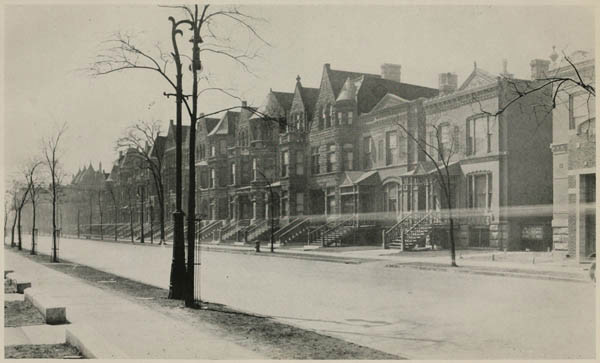
HOMES OCCUPIED AND IN PART OWNED BY NEGROES
Classified in the text as "Type B."
No single factor has complicated the relations of Negroes and whites in
Chicago more than the widespread feeling of white people that the presence
of Negroes in a neighborhood is a cause of serious depreciation of property
values. To the extent that people feel that their financial interests are affected,
antagonisms are accentuated.
When a Negro family moves into a block in which all other families are
white, the neighbors object. This objection may express itself in studied
aloofness, in taunts, warnings, slurs, threats, or even the bombing of their
homes.[24] White neighbors who can do so are likely to move away at the first
opportunity. Assessors and appraisers in determining the value of the property
take account of this general dislike of the presence or proximity of Negroes.
It matters little what type of citizens the Negro family may represent, what
their wealth or standing in the community is, or that their motive in moving
into a predominant white neighborhood is to secure better living conditions—their
appearance is a signal of depreciation. So it happens that when a Negro
family moves into a block, most of the white neighbors show resentment
toward both the Negro family and the owner or agent who rents or sells the
property. Whites owning homes in the neighborhood become much exercised
by fear of loss both of money and of neighborhood exclusiveness and desirability.
The Negro suffers under the realization that, for reasons which he
cannot control, he is considered undesirable and a menace to property values.
Wherever Negroes have moved in Chicago this odium has attached to their
presence. The belief that they destroy property values wherever they go is
now commonly taken as a valid explanation of any unfriendliness toward the
entire group. This feeling takes on the strength of a protective instinct
among the whites.
So wide and menacing, indeed, has this feeling grown that the Commission
deemed it necessary to make a thorough inquiry into its basis and to determine,
if possible, to what degree the presence of Negroes is a factor in the depreciation
of property values. Therefore it is essential to distinguish clearly between:
(1) general factors in depreciation; and (2) presence of Negroes as an influence
in these factors, and also as a direct factor.
What is meant by "depreciation"? Real estate men know it as "a loss
in market value." Market value is "the price which a buyer who wishes to
buy but is not forced to buy will pay to an owner who wishes to sell but is not
forced to sell." Depreciation is reflected, not only in market values, but also
in appraised or assessed valuations. Before purchasing property it is customary
to take into account the surrounding conditions that affect its value, as
well as its inherent value. Assessed valuations, fixed for taxing purposes by
authorized public officials, fluctuate to some extent in harmony with appraised
valuations. This analysis of the factors that tend to determine the value
of real estate for one purpose or another gives a fairly dependable rule for
finding whether it has risen or fallen in a given period. If property is thus
shown to have decreased in value, it is said to have depreciated.
The value of real estate is determined largely by the human factors involved.
This fact accounts for the striking differences in value of property, for example,
on Sixteenth Street, on State Street, in the "Loop," on Chicago Avenue, and
on Sheridan Road. Convenience, desirability, and other factors involving
individuals who make up the public enter into the determination of realty values.
It is necessary to distinguish between land values and improved-property
values. Usually buildings are erected that harmonize in cost with the value
of the land on which they stand. But this harmonious relationship may not
continue; developments in the neighborhood may increase materially the
value of the land, while the value of the improvements decreases as time goes
on. The values of the land and of the improvements do not necessarily rise
and fall together, though improvements generally tend to add to the value
of the land. Much, however, depends on the use to which the land is put,
and even more on the use of adjacent land. That use may be such as seriously
to impair the value of all the land within a given area or some particular tract
in that area. Such impairment is a chief reason advanced for zoning, so that
property values in various given districts may not be impaired through inharmonious
uses, and that property values throughout a city may thus be stabilized.
It is also necessary to distinguish between "deterioration" and "depreciation."
They are not interchangeable. Deterioration of improvements on
land affects the value of the improvement, not necessarily the value of the land.
The property as a whole may be depreciated by deterioration of improvements,
but an increase in the land value might more than offset this loss. This would
be accounted for by a possible change in the use of the land. For example,
the buildings on the North Side in which Negroes now live are uniformly
old and bad, yet the Negroes cannot buy them. The properties are in process
of change from residence to industrial use, and the values placed upon them
for the latter use are far beyond the financial capacity of the Negro residents.
Apart from any racial influence there are many causes of depreciation in
property values, the responsibility for all of which has often been thoughtlessly
placed upon Negroes. Throughout the city may be observed blocks, streets,
and neighborhoods running a declining course in desirability for residence
purposes, losing value, changing in character and, in short, depreciating, but
in or near which no Negroes live. The following are important factors of
depreciation not due to race:
Physical deterioration.—The natural wear of time and the elements is a
constant factor. Few houses are built to withstand these inroads over a long
course of years, even though they have the utmost care. Neglect and lack
of repairs and improvements hasten this deterioration sometimes greatly.
Character of occupancy is often a factor. Some occupants are highly destructive,
particularly in rented houses. Their careless or inept use of a house
often adds vastly to the wear and tear and hastens deterioration. Overcrowding
has a like effect.
Change in the character of a neighborhood.—Depreciation in property
values in large cities is due in marked degree to factors not purely physical.
There is always a continuing yet varying fluctuation in the character of neighborhoods;
a restless shifting of population and conditions due to growth
which rarely has been orderly or scientific. The psychological factor of
residential property values is such that they may change very rapidly with
the advent into a homogeneous neighborhood of a few families of a different
nationality or social status. Between Twelfth and Thirty-first streets in
the South Side Negro residence area, once the most fashionable white residence
section, property values based on residential uses slumped utterly, and then
later began to increase because of industrial uses. Such a change is often due
to an encroachment upon a residential district of commercial or industrial
enterprises. Neighbors will move away rather than endure such disturbance
of their peace and comfort. Their places may be taken by people less sensitive
to such influences who may be drawn to the neighborhood by reduced
rents resulting from the exodus of former residents. Then rapid deterioration
usually sets in as the tone of the neighborhood falls. A like result follows a
change from an exclusive residential district into one of rooming-and boarding-houses
and large residences remodeled into flats.
The shifting of fashionable neighborhoods soon leads persons of means
to abandon a high-grade residential section for some suburb or newer neighborhood
which they think better suited to their social positions.
Use of buildings for immoral purposes.—Such use, though clandestine,
eventually becomes known; and although the property yields high rents,
it lowers the standing and value of the block or neighborhood and of adjacent
areas. It not only deteriorates the buildings thus used, but also drives decent
people from the locality; and the deserted houses either remain vacant or
are taken by less desirable occupants. Depreciation inevitably results.
Public garages, theaters, and kindred nuisances.—People of a high-grade
residential district do not wish to live too near a public garage, theater, bathing-beach,
saloon, cabaret, dance hall, bowling-alley, or billiard room. If they are
unable to keep such enterprises out of their neighborhood they will sell their
property and find homes elsewhere.
Changes in transportation facilities.—These may depreciate property in
two ways: (a) they may themselves introduce obnoxious dirt or noise-making
features or bring in industries with such features; (b) new transportation
facilities often open up more desirable localities to which people are drawn
from the older localities. In both cases depreciation ensues.
Overbuilding.—Overbuilding is another and frequent cause of depreciation.
Building booms are often followed by years of depression due to an oversupply
of buildings.
The area from Thirty-first to Thirty-ninth Streets and State Street to the
lake is now the center of the largest Negro residential area in the city, having
approximately 20 per cent more Negroes than whites.
In the eighties and nineties this area was part of the most fashionable
residential district in Chicago and included some of the city's most prominent
families and business leaders. They lived in houses which they had built
for their homes, and which were the first fine residences erected after the
Chicago fire of 1871. Michigan, Prairie, and South Park avenues and Grand
Boulevard were the most fashionable streets with the best houses.
The Negro population then lived immediately west, between Wentworth
Avenue and State Street and north of Thirty-fifth Street.
The North Side and the North Shore had not yet developed as fashionable
neighborhoods. Indeed, the most prominent residence on Lake Shore Drive
and one of the earliest stood almost alone for many years before fashionable
people settled around it.
As the North Side grew in fashionable favor the South Side began to lose
its original exclusiveness, and its residences began to depreciate. These
properties, while their original owners occupied them, were worth, many of
them, from $30,000 to $100,000, including large grounds, elaborate interior
decorations, and sometimes works of art. The usual range of the original
costs of these houses was from $10,000 to $30,000. The change steadily
continued, and these houses were rented and sold by the first owners at reduced
prices to persons less prominent socially, until nearly all the original families
had gone. A few refused to sell their houses and left them in charge of caretakers;
and a very few still remain.
The gradual lowering of the market value of the property is pictured by
prominent real estate men well acquainted with the neighborhood for many
years:
It is a positive fact, an economic fact, that any time a poor class of people moves
into a neighborhood formerly occupied by people who had an earning capacity greater
than that of the people moving in, there is depreciation. That is true whether Italians
move in, or Poles, Negroes, Greeks, etc. If the people moving into the neighborhood
earn less and have less than the people formerly living in that neighborhood,
there is depreciation.
Between 1900 and 1910 a few Negroes moved into Wabash Avenue. The
houses were very old and built close together, with few single residences.
Negroes did not progress farther eastward in any large numbers because the
next street was Michigan Avenue, probably the most select of all the streets
in the area. With the pressure of increasing numbers and ascending economic
ability urging them out of the congested, uncomfortable, and unclean dwellings
west of State Street, Negroes could and would pay higher rents than the class
of white persons to which the oldest houses would next descend. In 1912,
in the area east of State Street, practically all of the original residents had
gone, and few Negroes had come in. Real estate men estimate that generally
natural depreciation proceeds at the rate of 2 to 2½ per cent a year. When
Negroes first came into the area the buildings were at least twenty years old,
and many were much older, representing at the lowest figure a very substantial
depreciation.
There was another important factor in the depreciation of the area. In
1912 the old vice district west of State Street and immediately northwest of
this area was broken up. The inmates numbered approximately 2,000 and
were by no means confined strictly within the recognized limits. They moved
into the nearest good houses available where they could continue to ply their
trade clandestinely. They could afford to pay high rents, and numbers of real
estate owners profited greatly by dealing with them. As many of these
houses stood, they again yielded rents almost as high as when they were new.
Cabarets, saloons, and amusement places packed the side streets, and buffet
flats opened up in the residence blocks. Raids and prosecution, night visits
from men who did not live in the district, called attention to the changed
character of the neighborhood, and property values sank lower. Pressure from
prosecuting agencies, as well as the attraction of better houses in less conspicuous
neighborhoods, urged the vice element southward. This southward
trend is indicated in the maps, facing pages 342 and 346, showing the environment
of the South Side Negro.
While property in this area could be bought cheaply it was also possible
to obtain proportionately high rents by placing Negroes or prostitutes in houses
not rented to either class before. Negroes were always charged higher rents
than were the whites who immediately preceded them.
The Juvenile Protective Association in 1913 made a study called The
Colored People of Chicago and published it in a small pamphlet. Concerning
the disposition of real estate men to profit in this way, the reports say:
... the dealer offers to the owner of an apartment house which is no longer
renting advantageously to white tenants cash payment for a year's lease on the
property, thus guaranteeing the owner against loss, and then he fills the building with
colored tenants. It is said, however, that the agent does not put out the white
tenants unless he can get 10 per cent more from the colored people.
The fact that for like quarters Negroes pay much higher rents than any
other group in the city was discussed by the Chicago School of Civics and
Philanthropy in a special study of housing for Negroes in 1911-12. The
report says:
The explanation for this condition of affairs among the colored people is comparatively
simple; the results are far-reaching. The strong prejudice among the
white people against having colored people living on white residence streets, colored
children attending schools with white children, or entering into other semi-social relation
with them, confines the opportunities for residence open to colored people of all
positions in life to relatively small and well-defined areas. Consequently the demand
for houses and apartments within these areas is strong and comparatively steady,
and since the landlord is reasonably certain that the house or apartment can be
filled at any time, as long as it is in any way tenantable, he takes advantage of his
opportunities to raise rents and to postpone repairs.
It was during this period that buildings could be easily purchased by
Negroes. One white real estate dealer whose interests are almost exclusively
in the area under discussion has purchased more than 1,000 such houses which
he rents to Negroes. These buildings were not purchased from Negroes but
from first, second, and third owners, and at a price much below the original value.
With an opportunity for renting or purchasing the houses in this area,
Negroes began to move in, first in small numbers and soon in larger numbers.
They naturally sought to abandon the generally and often extremely dilapidated
houses west of State Street.
Buildings twenty to thirty years old deteriorate rapidly unless expensive
repairs are made. As Negroes were often unable to make such repairs while
paying for the property, the depreciation continued.
Widespread buying of property in this district by Negroes began
during the period of the migration. Many home-owning Negroes, having
sold their property in the South and brought the money to Chicago, found it
easier to buy a house here on a first payment of $200 to $500, and on monthly
instalments thereafter, than to pay the rents demanded. Few, however,
knew anything of city property values; they were often exploited by agents
or assumed larger obligations than they could easily handle.
Many Negroes purchased fairly substantial dwellings on the long-time
instalment plan without providing for repairs and maintenance. Usually
the monthly payment to cover interest, taxes, and instalment on principal
was about all the Negro and his family could carry, even though his wife's
wages supplemented his. Thus nothing was left for upkeep.
Real estate agents before the Commission agreed that Negroes meet these
obligations with reasonable regularity. One white real-estate broker said:
"Those of us who have dealings with Negroes find that they make very fair
clients on the whole, pay their way, and ask no favors that any other human
being would not ask."
Another referred to Negroes as "wonderful instalment buyers" who have
a "tendency to invest in a home earlier than whites," and said that in fifteen
years' experience his firm had never foreclosed on a Negro home buyer; and
in only two cases, due to exceptional circumstances, had contracts been forfeited.
Two Negro real estate dealers said:
A colored man usually feels that he will go without food rather than not meet his
obligations. That is one reason why sometimes his home is run down, because he
has spent every dollar he can get to meet the payments on that property. He cannot
spare the money sometimes to buy a lawn mower or sprinkling hose.
A colored man who buys a piece of property in a neighborhood has no financial
connections. He meets his obligations promptly for three reasons: first, he wants
a home; second, he knows they may squeeze him; third, that mortgage is coming
due and he doesn't know where to go to get it renewed. We have no organization of
our own to back him. If the fence is to be fixed or the house is to be painted, and a
year from that date the mortgage is due, and he has $500 in the bank, he will not
paint his house for the simple reason that, if he did, when the mortgage is due he will
not be able to meet it. He saves, and when the mortgage comes due he has $500,
$600, or $700 set aside to meet it.
Frequently Negroes overreach themselves in purchasing property. Charles
Duke, a Negro, in a pamphlet on Negro housing in Chicago remarked:
A very harmful result of present tendencies is manifested in the acquisition of homes
by colored people beyond their social or economic advancement. The economic
waste in this particular has been especially great. They represent in many cases
a considerable outlay of capital. The domestic facilities they afford are years beyond
the needs of the people to whom they are allotted. In many instances it costs a
small fortune annually to maintain one of these establishments, and when this is
not done the depreciation is both rapid and spectacular.
There is such lack of hotels and lodging-houses for Negroes, especially for
single men, that many Negroes have bought or rented houses with the intention
of paying for them, in part at least, with income from lodgers or boarders.
Such use leads to overcrowding, with consequent rapid deterioration and
depreciation. This tendency is accentuated by the fact that the houses
that Negroes can buy are usually old and deteriorated.
While new arrivals from the South soon learn that the poorest city tenement
requires better care than plantation cabins, their carelessness meanwhile
contributes to the property depreciation of their dwellings and neighborhood.
There are other factors of depreciation in this district which became active
after the Negroes came, but for which they were not wholly responsible. One
was the remodeling of residences for business purposes. While the remodeled
property may bring larger returns, neighboring residence property declines
in value. Many fine old dwellings on Michigan Avenue and Grand Boulevard
have been transformed in recent years into lamp-shade factories, second-hand
fur shops, and small business houses; and these changes have depreciated
neighboring property for residence purposes.
Another factor of depreciation is the city's tolerance of gambling and
immorality in and near areas of Negro residence. In most cities where Negroes
are numerous a like tendency appears. Little consideration is given to the
desire of Negroes to live in untainted districts, and they have not been able
to make effective protest.
In 1916 the Chicago Daily News, in a series of articles on the Negroes,
described some of the disorderly saloons and cabarets in the South State and
Thirty-fifth streets region, with their vile associations of disreputable whites
and blacks:
Other resorts in the district are worse; some are better. These are typical of the
roistering saloons, a kind which would not be tolerated in any other part of the city
since the old Twenty-second Street levee was broken up. White proprietors have
brought them into the district, and many of them are patronized largely by crowds
from other parts of the city. The resorts are forced on the colored people. Those
colored families in good circumstances and desiring respectable surroundings move
away, only to find disorderly saloons trailing after them.
At 301 East Thirty-seventh Street, on the southeast corner of Forest Avenue, is the
saloon of C——. With this exception the district is a quiet, respectable residence
quarter. When it was known that this property was to be used for saloon purposes
a petition of protest was signed by 300 representative colored men and presented to
Mayor Harrison.
At night this saloon is an animated place. Reputable colored families object to
it chiefly on account of the numbers of disorderly white women who meet colored men
in its diminutive back room. In the barroom an automatic piano thumps through
the night until closing hours. On the mirrors are pasted chromos of "September
Morn" and other poses of nude women.
Buffet flats and disorderly hotels are adjuncts of the bad saloons. They make a
better harvest for the police than the saloons. The borderland of a colored residential
district is the haven for disorderly resorts. Protests of colored residents against the
painted women in their neighborhood, the midnight honking of automobiles, the
loud profanity and vulgarity are usually ignored by the police.
In one block between South State and South Dearborn streets which was canvassed
by the Daily News, five places were found openly admitted to be disorderly
houses. Some were in flat buildings, the other tenants of which apparently were
respectable, some raising families of children.
Many white owners of real estate who speak in horrified whispers of vice dangers
view such dangers with complacency when these are thrust among colored families.
Two years ago a woman of the underworld and her gambler husband decided to open
a "high-class" resort on the South Side. She got a location as a neighbor of reputable
colored people by purchasing the home of a former alderman and leader in a church,
the one of which the Rev. John P. Brushingham, secretary of Mayor Thompson's
Morals Commission, is the pastor. The woman was one of the most notorious of
the demimonde. An oil painting of her, as she was before her husband in a fit of
jealousy bit off a part of her nose, for years hung in a saloon of international reputation.
These are some of the influences which the colored population is forced to combat
in its fight for decency and good citizenship. A few secure political preferment and
others profit by catering to the city's vices, while the rank and file are hedged around
by demoralizing influences and the race is discredited unjustly.
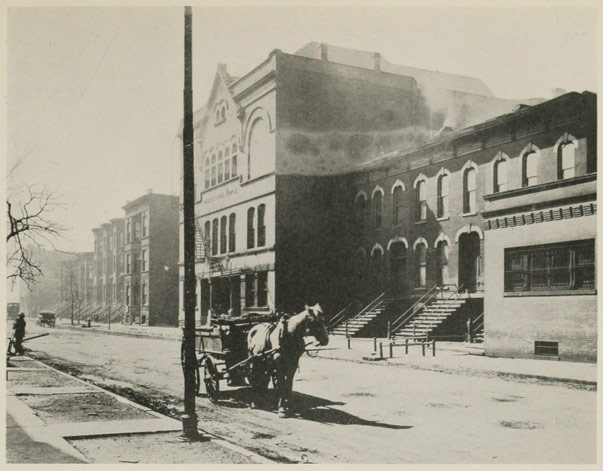
HOMES OCCUPIED BY NEGROES ON FOREST AVENUE
(Note pavement and smoke.)
Classified in text as "Type C."
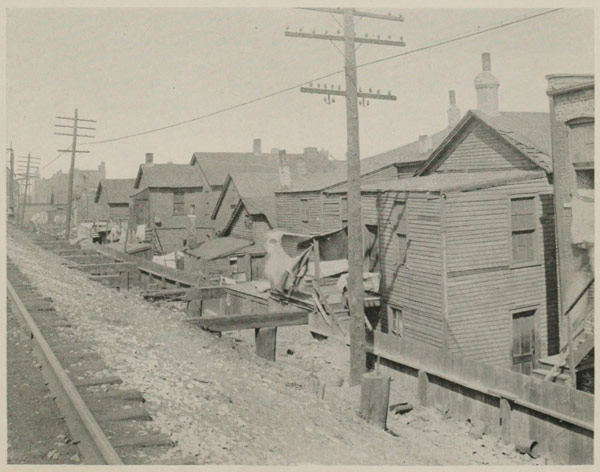
REAR VIEW OF HOUSES OCCUPIED BY NEGROES ON FEDERAL STREET
Classified in text as "Type D."
Another chapter of this series dealt with gambling in the South Side
district. Here are two excerpts:
Colored men are in active control of the gambling situation in the big part of their
district in the second ward. Back of them are white police officials at one end of the
line and white politicians who keep them in power at the other end of the line. When
second ward, and even some adjacent ward, gambling is discussed by gamblers on
the inside, certain colored men are always mentioned. They are called "the syndicate,"
and their approval is said to be necessary if the police are to let anybody run
in the ward.
Whether gambling is a more dangerous cause of demoralization of a community
than are disorderly saloons, buffet flats and dissolute women is an often discussed
question. Gambling is a man's game, is more open, and the connection between it,
the police, and politics easier to trace. In order to gamble the police must be evaded,
which is difficult, or made blind by a peculiar remedy for itching palms or by orders
from political powers that be. However, it usually is the same police and the same
politicians who are protecting both classes of vice.
The contamination of these influences depreciates property and casts a
blight upon all who live within their unrestricted range. The taint extends
beyond the blocks in which they exist and serves to promote prejudice and
ill feeling against the Negroes who are the unwilling sufferers from these
vicious resorts.
There are many landlords who exact high rentals from Negroes for the
use of run-down houses. All investigations of Negro housing on the South
Side indicated that as a rule the rents are excessive, considering the inferior
dwellings, their disrepair, and unsanitary conditions. This neglect by the
landlords not only directly depreciates the property but encourages a careless
use of it by tenants that leads to the same end. One can hardly expect tenants
to respect property that is not respected by its owners.
Owners and agents of property occupied by Negroes differ in their opinions
of Negroes as tenants and in their ways of handling them. Of course there are
differences in character, standing, and responsibility among Negroes as among
whites, and this fact partly explains the following differences of opinion
expressed by experienced real estate men:
One real estate firm, on Indiana Avenue, that makes leases to both white and
Negro clients, said that property occupied by Negroes was more likely to run down.
Another firm on East Fifty-first Street reported that it rented to Negroes on regular
leases and had no trouble about collections. A young Negro real estate agent on
Indiana Avenue said that he had no difficulty with collections: about half of his
tenants came to the office, and collectors called upon the other half. When a building
supports a janitor, he said, there is no trouble about repairs, but if the responsibility
is upon the tenants it is difficult to keep a building in repair. The office manager
for a firm on Cottage Grove Avenue said that the majority of its Negro tenants are
on leases; all pay the rent at the office; if they fall in arrears collectors are sent.
A firm which for many years has conducted a real estate business on the South
Side reported that 75 per cent of its Negro tenants are on a month-to-month basis
with thirty days' notice to terminate; and 95 per cent of them are north of Thirty
ninth Street. A firm on Indiana Avenue requires its tenants to sign leases; and in
districts where there is much shifting about, or where the property is for sale, a sixty
days' notice clause is inserted. It usually sends a collector, so that proper supervision
may be kept of the property. Its head expressed the opinion that Negroes are
just as good tenants as whites whose wages are on about the same scale.
The office manager of an owner with about 1,400 Negro tenants said that on the
whole they compared very favorably with the white tenants who preceded them;
while some Negroes are careless and ignorant, they all paid their rent promptly; his
office did not average one eviction a month, and when Negroes are evicted they rarely
cause trouble. Quite the contrary was the report of the office manager of a real
estate firm on East Thirty-first Street, which does an extensive business with Negroes.
Much depreciation, he said, can be attributed to Negro tenants; they are much harder
on houses than white tenants of the same station in life; they do not take proper care
of the furnaces or plumbing, and the higher rents paid by them merely cover the cost
of the additional repairs; the recent comers pay their rent promptly when they have
brought money with them or when they receive good wages, but later on become difficult
to manage because they find it hard to adjust themselves to city life.
A firm on East Forty-seventh Street reported that it has a large number of Negro
tenants, makes leases to them, has no difficulty in collecting rents, and considers
them more desirable than the whites who preceded them; a firm on Indiana Avenue
expressed the opinion that depreciation is very great in houses rented to Negroes.
That Negro tenants pay their rent promptly was the experience of a real estate agent
on Cottage Grove Avenue. He has many Negro tenants on leases and is well satisfied
with them, although he does not think they take as good care of the property
as do the whites; Negroes are usually occupants of old buildings, which are more
difficult to take care of.
Another real estate dealer on Cottage Grove Avenue who leases to Negroes finds
that usually they adhere to the terms of the lease, although they sometimes move
without notice. A dealer on Wabash Avenue, who rents flats to Negroes, said
that he looked up the housing record of Negroes carefully before letting them in, yet
he sometimes had trouble with them. Once he rented a flat to a mother and daughter,
and the next day he found another family living in it; but on the whole he was well
satisfied to have Negroes as tenants.
A prominent official of the Grand Boulevard district of the Kenwood and Hyde
Park Property Owners' Association, which seeks to keep Negroes out of Hyde Park,
stated that a fundamental fault in connection with the strained relations between
whites and Negroes was the failure of white owners to keep their property in good
condition so that it might be occupied "efficiently," that is, by white persons.
Another official of that organization said that Negro tenants could not be expected
to repair white men's property; that there are a great many dwellings in the South
Side Negro district that ought to be condemned by the city health department,
and that Negroes are compelled to live in them because they can get nothing better.
In analyzing responsibility for depreciation, in the area from Thirty-first
to Thirty-ninth Street and from State Street to the lake, it is difficult to determine
to just what extent the Negroes are there because of prior depreciation,
and to what extent present depreciation is due to their presence. It is certain,
however, that a large part of the depreciation is not justly chargeable to them,
and that their contribution is attributable partly to their economic status and
partly to the deep-seated prejudice against them. There are many instances in
which property occupied by them has appreciated in value. This will always be
true when the use by Negroes, or the demand for such use, is higher or greater
than any other use or demand. A symptom of the general prejudice is the
very prevalent belief that if Negroes have once occupied property its value is
thereby "destroyed" for white persons. This is true only until it has a value
for use by whites greater than its value for use by Negroes. So long and only
so long as Negroes as a class are, or are generally deemed to be, at the bottom
of the economic scale will their presence in a neighborhood depreciate values.
At present the fact stands out that Negro occupancy is an unmistakable
symptom of depreciation—an indication that the value of property has fallen
to their economic level, as well as an aid to depreciation in its last stages.
The area bounded by Thirty-ninth and Fifty-fifth streets and Michigan and
Cottage Grove avenues has several property owners' protective associations
for the purpose of preserving property values. Their dominant interest has
been the exclusion of Negroes because these associated property owners
believe that Negroes always depreciate the values of real estate. Negroes
have moved into the neighborhood and there has been depreciation. Therefore
Negroes are the cause.
A complete understanding of the situation requires that it be determined
to what extent property values decreased because Negroes moved in, and to
what extent Negroes moved in because property values had decreased. There
is no doubt that the thousands of protests against the "invasion" of Negroes
were sincere. It is also true that scarcely ten Negroes now living there could
have purchased their properties at the original prices.
A leading real estate dealer said that "when a Negro moves into a block
the value of the properties on both sides of the street is depreciated all the
way from $100,000 to $500,000, depending upon the value of the property in
the block"; that it was a fact and that there was no escaping it.
It's a condition that is inherent in the human race ... a man will not buy a
piece of property or put his money in or invest in it where he knows that he is liable
to be confronted the next day or the next year or even five years hence with the
problem of having colored people living alongside of his investment. This depreciation
runs all the way from 30 to 60 per cent. Some time ago a survey was made as a
result of which it was estimated that the influx of Negroes into white neighborhoods
during the last two years had depreciated property on the South Side about
$100,000,000.
He cited as evidences of this the increased difficulty of negotiating loans on
South Side realty on any terms, and the fact that some loan companies refused
to write them at all, and loan values there had dropped enormously.
The Grand Boulevard district of the Kenwood and Hyde Park Property
Owners' Association reported an even larger estimate of the depreciation
caused by the coming of Negroes into property near that boulevard. A
committee of the Association in a report made early in 1920 claimed that the
coming of Negro owners and tenants into that territory had depreciated
property values of $400,000,000 fully 50 per cent.
The advent of the first Negro families in a white district usually creates
something like a panic. The white residents, in a great many instances,
fearing contiguity with Negroes and property loss, hasten to offer their property
for sale and move elsewhere. Even a threat that Negroes intend to occupy
a certain block or neighborhood will cause an exodus of white people, and their
property is customarily sold at a sacrifice. When many properties are thus
thrown on the market low prices are the certain result.
When in recent years, Negroes moved into the Hyde Park district, animosity
was aroused, and numerous bombings of property occupied by Negroes
followed. One of the oldest South Side real estate dealers, quoted in the
Daily News' series of articles in the summer of 1919, expressed the tense
feeling of an association there that was seeking methods to drive out and keep
out the Negroes:
We want to be fair. We want to do what is right, but these people will have to
be more or less pacified. At a conference where their representatives were present I
told them we might as well be frank about it, "You people are not admitted to our
society," I said. Personally I have no prejudice against them. I have had experience
of many years dealing with them, and I'll say this for them: I have never had
to foreclose a mortgage on one of them. They have been clean in every way and
always prompt in their payments. But, you know, improvements are coming along
the lake shore, the Illinois Central, and all that; we can't have these people coming
over here. Not one cent has been appropriated by our organization for bombing
or anything like that.
They injure our investments. They hurt our values. I couldn't say how many
have moved in, but there's at least a hundred blocks that are tainted. We are not
making any threat, but we do say that something must be done. Of course, if they
come in as tenants, we can handle the situation fairly easily, but when they get a
deed, that's another matter.
This fear of Negro neighbors has been used by some real estate agents in
promoting speculative schemes. By sending a Negro to inquire about property,
they alarm the neighbors so that they will consider offers of purchase much
below the normal prices. When the excitement has abated values rise again,
and a profit is made.
In the actual depreciation of Hyde Park property there were several
factors, usually overlooked, that were in no wise attributable to the presence
of Negroes. Some of Chicago's finest residences were located on Michigan
Avenue and Grand Boulevard south of Thirty-ninth Street. This was an
extension of the early fashionable South Side district and had residences that
cost $350,000. But as in the case of the earlier South Side the neighborhood
long since had lost some of its first settlers and had begun to decline. The
World's Columbian Exposition, held in Chicago in 1893, was near the Hyde
Park neighborhood. To accommodate the millions of visitors at the Exposition
hotels and apartment houses were built in that district far in excess of
the normal need. The apartment houses, moreover, affected the exclusiveness
of the residence streets. The buildings were speculations. Large sums were
expended in the hope of immediate exceptional profits. Property on Sixty-third
Street sold at the Exposition time for three times the price it could
command today. This is typical of the speculative values that then prevailed
there. After the Exposition the removal of the first residents to the North
Side and to suburbs steadily increased.
The abnormal years just preceding the Exposition had brought in thousands
of workmen, who were thrown out of work when the Exposition buildings were
finished. This and the panic of 1893 made building costs very low and caused
further construction of dwellings in that district. Mr. L. M. Smith, a prominent
South Side real estate man, described this change at a meeting of the
Kenwood and Hyde Park Property Owners' Association:
The condition that existed after the World's Fair, if you will remember, in the
material yards and the labor market was this: Every yard was loaded up, and the
carpenters and the mechanics that were stranded here after the World's Fair were
glad to take jobs as janitors at $25 a month, in order that they could have good warm
places for their families, and buildings that were put up three and four years after
the Fair, along in 1894, 1895, and 1896, could be built at about 30 per cent cheaper
than those that were put up during the World's Fair. The consequences were that
you could rent a flat cheaper in a brand-new modern building than you could in a
building that was put up during the World's Fair, and as the older buildings could not
be rented, the owners finally had to come down in their rent more and more; they
got in less and less desirable tenants until finally the whole territory became undesirable.
These first "undesirables" were not Negroes, for Negroes had not then
moved across State Street. And there were other causes for the vacancies
and removals that admitted Hyde Park's first undesirables beside the overbuilding.
One was the proximity of the Stock Yards. Since the South
Siders could not have the Stock Yards moved, many of them moved themselves.
The railroads along the lake front, with their cinders, smoke, and noise, were
also a factor. Another was the creeping in of industrial plants that located
in and near the district, frequently in the face of protests. A striking instance
of this is the large assembly plant of an automobile company at Thirty-ninth
Street and Michigan Avenue. During recent years the automobile industry
has practically taken control of Michigan Avenue, once the most beautiful
street of the South Side.
The coming of apartment houses and boarding-houses was another signal
of declining values. It was shown that for twenty-five years scarcely a new
residence had been built on Grand Boulevard, once noted for its handsome
residences—due principally to the extensive building of apartment houses
there.
Racial prejudice other than that against Negroes has operated in many
instances to depress property values. The presence of Jews, Germans, Irish,
Italians, and Swedes has at times been objectionable to neighborhoods of
Americans or of another race. A leader in the movement to remove Negroes
from the Grand Boulevard area gave evidence of this, saying: "I know the
Irish killed a certain boulevard. I know the Jews hurt another one, and I
know the gambling element hurt another one."
On the South Side the Negroes were preceded by Irish. The original
settlers in the area around Thirty-first and Dearborn streets were mainly
Irish laborers who worked in the lumber yards and mills, the Stock Yards,
and other South Side industries. When they moved westward among their
own people, thirty-five years ago, the Negroes took their places.
Sometimes social or sentimental values are involved in the depreciation
brought about when a new race or nationality breaks down the exclusiveness
of a residence district. After the Exposition, for example, when wealthy
residents of Michigan Avenue, and Grand and Drexel boulevards deserted their
houses for more fashionable locations, many of them were bought by Jews.
This operated to depreciate adjacent property in the opinion of those who disliked
Jews as neighbors.
How the changes take place was well described by an experienced real
estate man: The original families have divided up and moved away; sons
and daughters have married; the servant problem has become acute, making
it difficult to maintain large houses; thus apartment houses have become
popular; houses are older and deteriorated, apartments are new and modern.
In 1915 when the number of apartments for rent was in excess of the demand,
a tenant would spend $25 or $30 in order to move into an apartment across
the street merely because it happened to be fitted with glass door knobs; a
high-class residence at Forrestville Avenue and Forty-fifth Street was sold
twenty years ago for $12,000; yet he told the purchasers ten years ago that the
property would not sell for more than $4,000 to $6,000; and that was before
Negroes had moved into the neighborhood. Apartments in that vicinity
still command a price approaching their original cost of building, because the
demand for them is stronger than for houses.
This real estate man made the broad statement that the depreciation has
taken effect, in the majority of cases, before a Negro family has moved into a
neighborhood. There is depreciation, he thought, due to prejudice, when a
Negro family moves into a good neighborhood that has been exclusively white,
but that there are very few such instances for the reason that Negroes prefer
to live where they are welcome, where there is no antagonism. With regard
to the district between Thirty-ninth and Fifty-fifth streets, State Street and
Cottage Grove Avenue, he stated that the entrance of the Negro had not
appreciably affected values.
Another real estate dealer, experienced in South Side property and in
selling to Negroes, expressed similar opinions. The greatest depreciation, he
felt, was in the expensive residences, and he doubted whether property as a
whole in the square mile centered at State and Thirty-fifth streets had been
depreciated much if at all.
There was agreement among the authorities consulted that in an exclusive
neighborhood of wealthy residents marked depreciation in large residences
has taken place, followed by the introduction of apartment buildings. One
of the men who had earnestly opposed Negro entrance into the Grand Boulevard
district recalled when valuations on Grand and Drexel boulevards were from
$400 to $600 a front foot; then they fell to $125 or $150 a foot; and then gradually
climbed back to $175 or $200 a foot on account of the introduction of
apartment buildings.
Such variations in value are the usual accompaniment of unguided growth
in a large city. This unguided development brought depreciation, which was
manifest before Negroes began to make their appearance in the area.
The spread of clandestine prostitution, discussed in connection with the
area north of Thirty-ninth Street, did not stop at Thirty-ninth Street. As the
environment maps indicate,[25] there was a noticeable increase from 1916 to
1918 in the number of houses or flats used by prostitutes in the area south of
Thirty-ninth Street. These changes occurred before the spread of the Negro
population reached the neighborhood. Two houses, for example, at 4404
and 4406 Grand Boulevard, bought by a Negro woman and bombed four times
after she moved in, had been occupied by prostitutes just prior to her purchase.
The coming of Negroes.—In 1916 hundreds of buildings in the Hyde Park
area stood vacant and had been so for some time. Owners and real estate
men were offering large concessions in the effort to get tenants. Values had
fallen greatly. A prominent real estate man closely in touch with the neighborhood
estimated that 25 per cent of the buildings there were vacant, and that
there was little prospect of renting or selling them. Coincident with this
oversupply in Hyde Park was an acute demand among Negroes for houses,
intensified by the sudden addition of about 50,000 migrants. Many of them
had sold their property in the South and brought the money with them. Hyde
Park landlords were willing to sell or rent to them rather than lose their property
entirely. Many Negroes, however, instead of renting, purchased the properties
because of the exceptional terms offered.
This continued for about two years, when a demand for houses again arose
among the white population. There was inactivity in building throughout the
war period. Chicago was sharing in the housing shortage which affected the
whole country, which was estimated in the early part of 1921 at 50,000 houses.
As the demand of whites for housing became acute, Hyde Park owners began
to feel that their property was at a disadvantage due to the presence of
Negroes.
Plans for beautifying the lake front and improving Hyde Park were
emphasized as a reason for holding on to property there. Alderman Schwartz,
in addressing a meeting of the Grand Boulevard district of the Kenwood and
Hyde Park Property Owners' Association, said:
The South Side, and Hyde Park and Kenwood in particular, in past years has been
the choice residential section of Chicago, the show place of Chicago. Grand Boulevard
is the most magnificent street in the world, the finest boulevard of our wonderful
boulevard system. I know that for many, many years, in this town, it was the
ambition of people living in other parts of the city to arrange matters so that they
could have their homes on the South Side in the place where you now live.
We have seen the rapid deterioration. In the council and in the committees we
have decided that we must do something. The law has some very definite limitations
written into our constitution and statutes. It cannot afford any relief. You yourselves
must resurrect the South Side.
As one instance of what we attempted to do in the way of assuring to the people
who reside here that the South Side can and will continue to be the great place we live
in, we passed the Lake Front Ordinance. You people probably never realized what
a wonderful thing that will be for the South Side. It will take in the lake front from
Twelfth Street south to Fifty-first; it will affect the very choicest residential district
in Chicago, the territory between Thirty-ninth Street and Forty-seventh Street—in
this portion of the ward where we now are, something like $125,000,000 will be
expended in reclaiming the lake front for you people, you men and women who must
stand together to save your homes, see that your homes are kept as fine places to
live in, that your neighbors are kept the most desirable neighbors in the city of Chicago,
so that you may enjoy the benefit of that wonderful improvement that is to come.
Think of that tremendous stretch, from Thirty-ninth to Forty-seventh, of bathing
facilities, the finest in the world. More than a year and a half ago an estimate was
made of the loss in property values in the Oakland district, north of Forty-third
Street, and that was estimated to be $100,000,000. Now it is not only the loss of
money that interests us. It means not only that somebody has lost a certain amount
of wealth, but it means that somebody has lost comfort in living; someone has lost
joy in his home; someone has lost the opportunity to give his children the environment
that he wanted to give.
A survey made by the Hyde Park Property Owners' Association in 1920
showed that there were then 3,300 property owners in the area bounded by
Thirty-ninth and Fifty-fifth streets, Michigan Avenue and Cottage Grove
Avenue, and that of this number 1,000 were Negroes. Then began the attempts
to move Negroes[26] back into "their own neighborhood."
Many of the Negroes who moved into this area had substantial resources
enabling them either to buy property outright or so to arrange for payments
through instalments and mortgages as to render themselves secure against
efforts to remove them. But in so doing they further complicated the status
of the neighborhood. Few white persons recognize the marked differences
among Negroes, so that in purely commercial dealings they are not as careful
in selecting Negro tenants as they would be among whites. As a result some
Negroes who secured property there proved damaging to property values, just
as would persons of a similar type from any other race.
Many of the houses for sale or rent were not suited to the incomes of
ordinary wage-earners. White persons whose incomes were sufficient to pay
the rental for such large houses preferred a different sort of house or neighborhood;
and whites of smaller incomes could find more suitable houses elsewhere;
while Negroes, hard pressed for houses, rented them, and took lodgers to fill
them and help pay the rent.
The exclusive occupancy of a block by Negroes is usually followed by less
care of streets and alleys. This neglect is general between Twenty-second
and Thirty-ninth streets and is beginning to appear in the territory between
Thirty-ninth and Forty-third streets where recently blocks have been "turned
over" to Negroes. Community associations are being formed in some of
these areas to protest against this laxity, and stimulate neighborhood interest
in neat premises.
Appreciation of property.—When values fall extremely due to a selling
panic among white owners, it is often followed by a decided recovery as the
Negro demand grows. Such a new market among Negroes, however, seems never
to have been strong enough to send prices for residence purposes back to original
levels. But many instances have shown that prices rarely stay at the
low "panic" level and frequently rebound to a level much above that at which
panic sales were made. Mr. Gates, a prominent South Side real estate dealer,
said: "If a Negro family locates in a street where the population is all white,
values are cut in two, but this would not be likely to occur if a large number
of Negroes were ready and willing to buy adjacent property at established
prices. Supply and demand would rule in such a market." Other real
estate dealers expressed the opinion that "if the white owners were not over-anxious
to sell when the Negro 'invasion' begins, they might later on obtain
as much or more for their property than they could have obtained before the
advent of the Negroes."
In numerous cases Negroes created a market for property when there was
none. A prominent white business man long resident on the South Side told
of a row of houses on South Park Avenue and Grand Boulevard that were
vacant for years until sold or rented to Negroes: they could not be sold at
all until they took on a value because Negroes were ready to buy them.
A prominent Negro physician bought a piece of property in an exclusive
white Hyde Park neighborhood. He lived there seven years and then sold
the property at an advance, and, to his knowledge, there had been no depreciation
in adjacent property.
A white real estate dealer bought a house in Grand Boulevard between
Thirty-fifth and Thirty-sixth streets about five years ago. When Negro
residents came some of the white people sold at a sacrifice. But he remained
and four years later sold the property for $2,000 above its cost to him.
An interesting instance related to property on Langley Avenue into which
a Negro family moved in 1919. The value of contiguous property remained
the same as of property two and three blocks east where no Negroes lived.
Six months later, across the street from this Negro family, a white man,
aware of their occupancy, bought a house and paid $1,500 more than it had
formerly been offered for.
Thus, notwithstanding the prejudice against Negro neighbors that usually
obtains, a block or neighborhood into which Negroes move is not always and
necessarily depreciated, so many and active are the other factors contributing
to depreciation (or sometimes preventing); and so frequently has it occurred
that these factors of depreciation have operated extensively prior to the arrival
of Negroes.
The fluctuation of values in response to sentiment, both inherent and
stimulated, manifested itself in a practice of certain real estate dealers on the
South Side. Although it was stated and believed that values were irrevocably
destroyed when a Negro family occupied a building, these agents boosted values
by announcing that another building had been "saved" or "redeemed,"
thoroughly renovated, and restored to its "rightful occupants." The Kenwood
and Hyde Park Property Owners' Association stated that this plan had
succeeded in sixty-eight instances of buildings "reclaimed" by the Association.
A Prairie Avenue block.—To study the processes and factors of depreciation
the Commission selected an obviously depreciated block on the once fashionable
Prairie Avenue, between Twenty-ninth and Thirtieth streets, into which no
Negroes had yet moved.
In 1885-90 Prairie Avenue was one of Chicago's most fashionable and
exclusive residential streets. Imposing brown- and gray-stone residences,
with balconies of stone and ornamental iron, broad bay-windows, and large
well-kept lawns behind high iron fences, gave evidence of the wealth and social
position of their owners.
The gradual decline of Prairie Avenue, as North Side and North Shore
neighborhoods became more fashionable places of residence, and long before
the approach of Negroes was even thought of, was exemplified in this block.
Chicago Blue Book, a broadly inclusive social directory, published annually,
shows that in 1890 the families living at forty-nine of the sixty-one addresses
in the block were listed; in 1900 there were eighteen of the forty-nine left;
in 1910 there were only ten, and in 1915 only two. Second and third occupants
of the houses took the places of fifteen of the original forty-nine in 1900, of
nine in 1910, and of four in 1915. The Blue Book listings at five-year intervals
are shown in the table on the following page.
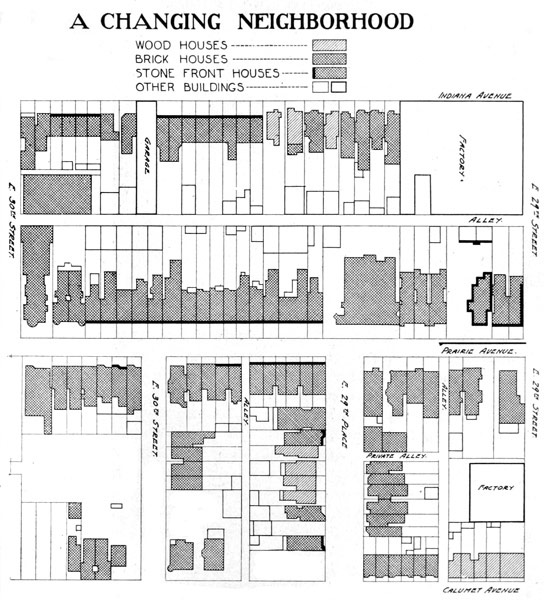
A CHANGING NEIGHBORHOOD
From 1895 on, those who moved away were to be found scattered all the
way from Lake Shore Drive to Lake Forest. The newcomers who took
their places appeared decreasingly in the Blue Book and more and more frequently
they had Irish or Jewish names.
A closer examination of the changing occupancy of the sixty-one houses
in the block shows strikingly the rapidity and extent of the decline and reveals
some of its causes.
"BLUE BOOK" LISTINGS IN PRAIRIE AVENUE BLOCK
| Year |
Number of Houses Listed with no Change in Occupants |
Number of Houses Not Listed |
Number of Houses with Second and Third Occupants Listed |
| 1890 |
49 |
12 |
..... |
| 1895 |
26 |
25 |
10 |
|
1900 |
18 |
28 |
15 |
|
1905 |
12 |
36 |
13 |
|
1910 |
10 |
41 |
9 |
|
1915 |
2 |
54 |
4 |
The residents.—In a house with fifty feet frontage on Prairie Avenue lived
a wealthy artist, son of a Chicago pioneer merchant and member of several
exclusive clubs. He lived there until a large brick factory was erected at the
rear of his residence which is now occupied by a medical fraternity. A prominent
Chicago family lived in another house which they had built in 1885.
In 1890, they moved to Cleveland and rented the property. For sentimental
reasons they kept the property, although it was fast sinking in value. In 1919
a son living in Lake Forest proposed to remodel and improve the property,
if by reasonable expenditures he could be assured by real estate men of "desirable"
tenants. No real estate man felt able to do this, however, and the
deterioration and depreciation were uninterrupted.
Another residence, formerly occupied by a capitalist and journalist since
1890, was a large two-story house with basement and attic and two-story brick
barn. The family long since moved to the North Side, and the old mansion on
Prairie Avenue is now a rooming-house of thirty-eight rooms, including the
garage.
At another address lived the president of a large business corporation,
in a two-story stone-front building. It is now cut up into flats; and in the
window recently was a sign: "4th Flat for Rent, 6 Rooms, $20.00, White Only."
Only one or two of the fine old residences in this block are still occupied
by Chicago's "first families" or owned by their estates.
There are now two relatively modern three- and four-story brick apartment
buildings in the block, and five old residences are rooming-houses. One is a
club for railroad men, and another is a fraternity house. About a third of the
places are in fairly good repair.
The altered character of the block is revealed also in the number of persons
now at each address. The polling lists for March, 1920, disclose that fourteen
persons are registered from one address, ten from another, seven from another,
six each from three others, and so on, indicating more adults than are usually
found in a single family. These are probably roomers.
The problem, however, is a complex one, for, although no Negroes moved
into this block, they occupied parts of neighboring blocks during that period,
and their occupancy contributed to the final stage of depreciation.
The picture in neighboring Calumet Avenue is not essentially different;
perhaps the early occupants represented fewer of the "first families," and the
deterioration is more obvious.
The evidences of the oncoming of commerce and industry from the north
are numerous and inescapable. In this and adjoining blocks are now garages,
an auto-repairing shop, the South Side Dispensary of the Municipal Tuberculosis
Sanitarium, a factory for grinding bearings, and a carpentry and glazing
shop. An auto-laundry occupies the old church building.
This area is a comparatively short distance from the "Loop." In real
estate parlance it is known as "close-in" property. A former president of
the Chicago Real Estate Board stated that a large part of this "close-in"
property depreciated because of its change from residential to commercial
property. He mentioned Prairie and Calumet avenues, north of Thirty-first
Street—which includes the block studied. The depreciation, he asserted, was
also due to the "departure of many owners of costly homes to other districts."
With the city's growth, transportation became an increasingly influential
factor. The automobile made it easy to reach the business center from
outlying and suburban regions. It thus became less desirable to live near the
"Loop," particularly as such districts are susceptible to changes that may
quickly destroy an exclusive residence district.
The rapidly developing automobile industry gravitated very largely to
this part of the South Side. Its salesrooms, shops for the sale of accessories,
and kindred business places spread along Michigan Avenue from Twelfth to
Thirty-fifth street. Michigan Avenue is only two blocks west of Prairie
Avenue and one block west of Indiana Avenue. Garages, repair shops,
welding factories, and the like accompanied this invasion, and spread into
adjoining streets. For instance, on an Indiana Avenue corner a large eight-story
factory was built immediately adjoining the rear of a handsome Prairie
Avenue residence, and a one and one-half story garage and repair shop was
built in the rear of 2900 Prairie Avenue. Just northeast of the block are
factories and breweries with their noise, smoke, and heavy traffic; and from
the west and south Negroes have recently been approaching—long after these
other factors were operating.
A peculiar fact about the property in this block and northward on Prairie
Avenue is that the lots are long and narrow, and the houses are built to the
side lines. These lots, when threatened with encroachment by factories and
the automobile industry, lost their residence value but did not easily take on
a new industrial value because they were individually owned and it required
several lots to make a suitable industrial site. The owners, though not desiring
to live there, were yet loath to sell as cheaply as the individual strip sales would
make necessary. And no investor would buy a single lot for industrial purposes
unless certain of getting two or three others adjoining.
In 1910 land values on Prairie Avenue between Twenty-sixth and Twenty-eighth
streets were $250 a front foot; and from Twenty-ninth to Thirtieth
streets, $200; on Indiana Avenue between Twenty-sixth and Twenty-eighth
streets, $200, and between Twenty-ninth and Thirtieth streets $175. In 1920,
however, values had dropped on Prairie Avenue to $60 a front foot while on
Indiana Avenue, a semi-business street, they were $150 and $180.[27] Negroes
first moved into the block on Prairie Avenue between Thirtieth and Thirty-first
streets about 1917, though very few lived there at the time of the inquiry
in 1920. In 1919 they purchased an abandoned church in this block which
at one time was valued at $125,000.
To summarize the results of this investigation of depreciation: Negro
occupancy depreciates the value of residence property in Chicago because of
the prejudice of white people against Negroes, and because white people will
not buy and Negroes are not financially able to buy, at fair market prices
property thrown upon the market when a neighborhood commences to
change from white to Negro occupancy; nevertheless a large part of the
depreciation of residence property often charged to Negro occupancy comes
from entirely different causes.
An important factor in the housing problem is the low security rating
given by real estate loan concerns to property tenanted by Negroes. Because
of this Negroes are charged more than white people for loans, find it more
difficult to secure them, and thus are greatly handicapped in efforts to buy or
improve property. The general opinion that condemns such property makes
the risk poor, even for Negroes. A Chicago Trust Company representative said:
A Negro called to buy a mortgage. Our first thought was to submit to him one
of the colored loans, which we did. We showed him a photograph; he liked the
appearance of the building, and then he inquired, "Is this anywhere near the colored
district?" He declined the loan on that account, showing that this uneasiness is
not confined to the white investor.
When districts become exclusively Negro this reluctance to invest or to
lend invariably appears. If there are sufficient Negroes with money to create
a market the loss is somewhat relieved. Yet, deprived of the usual facilities
for purchasing a home, they cannot relieve their housing shortage and are
forced to seek houses in unfriendly neighborhoods.
The factors are similar to those in depreciation, often based on prejudices
and erroneous beliefs concerning Negroes. Whatever depreciates real estate
necessarily depresses its security value—whether the cause be fact or opinion.
A South Side bank had difficulty in selling Negro loans to white people because
"they say they don't keep up the property; they let it deteriorate; they don't
improve it." The representative of another bank said:
I don't believe you could find enough colored people who could make a substantial
first payment. There are a few that I have talked with recently who are on the
police force, who wanted to know how we could help them out in buying places. One
had in mind the purchase of a three-flat building; the price was around eight or nine
thousand dollars. There was a first mortgage on it of about five. He had only
$300 cash to buy it with.
A former president of the Chicago Real Estate Board said:
The percentage of Negro people in Chicago who will buy homes is comparatively
small. The best evidence we have is that 85 per cent of the white people are tenants;
15 per cent of them are home owners. It follows, I think, that a smaller percentage of
the colored race will buy homes, not more than from 3 to 5 per cent of the colored
people at the present time.
A representative of a very large South Side realty business said: "There are
ever so many mortgage men not familiar with the colored belt. That's one
of their greatest reasons for refusing the loans—they are not familiar with the
values."
Real estate men, white and Negro, were invited to present their views,
and leading mortgage-loan houses and banks of the city were asked what they
knew about Negroes as borrowers, investors, tenants, and clients, and their
thrift and care of property. Their testimony, with the Commission's investigations,
yielded a fairly accurate picture.
The first house in Chicago was a rude cabin built by a Negro in 1790.
There were several Negro home owners when the city was incorporated in
1837. The first Negroes to settle near Thirtieth Street—long before the city
had extended its limits that far—owned their homes. Although prior to 1916
most Negroes did not own homes, there were many, especially business and
professional men, who had gradually acquired dwellings. The migration
brought thousands of Negroes with ready cash who found it easy to buy dwellings
on the South Side. The uncomfortable and inadequate dwellings of the
"Black Belt" could be avoided only by the purchase of property elsewhere.
Attention thus was directed, probably for the first time, to the question of home
buying by Negroes. Indeed home owning is an essential feature of any solution
of their housing difficulties.
Until the migration Chicago's Negroes had engaged chiefly in personal-service
occupations that governed somewhat the location of their homes;
when these were not in the "Black Belt" they were in shabby property in
undesirable streets near their employment. Men who worked on dining- and
sleeping-cars lived near the railroad stations—on State and Dearborn streets,
Plymouth Place, and the surrounding neighborhood; they were generally
renters and moved southward with the general trend.
Home buying stimulated by high wages and the migration.—The war brought
wages to the Negroes that seemed fabulous to many; and the wages brought
the migration. The first migrants were mostly drifters. Then came a great
many who had acquired considerable substance in the South, and having sold
out they came to Chicago with ready money, in some instances large amounts.
This class of Negroes bought dwellings. Several of them bought apartment
buildings, said a real estate dealer, and in one instance the buyer paid $10,000
in cash; and there were very many who were able and ready to pay from $1,000
to $3,000 on the purchase of a residence in a respectable neighborhood.
Another dealer said that he was not able to supply the buying demand:
"We have put renters on the side list; buyers are taking up the time. We
used to think $500 a good-sized payment for them, but now they often have
$3,000, $4,000, or $6,000. A Negro customer lately wanted a twelve-flat building
and would pay cash."
"The average newcomer is a home-owner," said another realty dealer;
"he has sold his home in the South to come here. Some say the high wages
are not attracting them so much as better schools."
Another dealer said that the average amount per family brought from the
South was from $300 to $500, and he knew of one family that brought $6,000.
It was the experience of another firm that three or four years ago Negro
purchasers paid down about $500, but that now (1920) they frequently make
first payments of $1,000 or more.
This sudden wave of home buying impressed Carl Sandburg, who wrote
(1919) in the Chicago Daily News:
Twenty years ago fewer than fifty families of the colored race were home owners
in Chicago. Today they number thousands, their purchases ranging from $200 to
$20,000, from tar paper shacks in the still district to brownstone and greystone establishments
with wealthy or well-to-do white neighbors. In most cases, where a colored
man has investments of more than ordinary size, it is in large part in real estate.
Realty investment and management seems to be an important field of operation
among those colored people who acquire substance.
Several other factors contributed to this house-buying movement. One
was that Hyde Park had many available houses in the early years of the war,
while the Negro was excluded from the market west of Wentworth Avenue,
with its smaller and less expensive houses, by the vigorous antagonism of the
Irish and other people living there. The southern Negroes were glad to find
that—at first, anyway—access was not denied them to districts having good
schools, churches, recreation and amusements, and convenient transportation
facilities. This feeling was reflected in their purchase of churches; two of
these, one on Washington Boulevard and one on Prairie Avenue, are in districts
of extensive home buying by Negroes.
The high war wages contributed to home buying. Though in many
instances they induced extravagant expenditures, a surplus remained for many,
and with the frugal the savings were large.
High rents were another primary contribution. Many of the ambitious
newcomers figured that they could buy a house for about the same monthly
amounts required for rent. In many instances they thriftily contrived to
make the property pay for itself. Two- and three-flat buildings would furnish
a family with a home while providing a considerable revenue from the rented
flats. When old-fashioned houses too large for one family were bought,
lodgers and boarders were often taken. Frequently wife and children added to
the family income so that they might own a home.
A real estate dealer in Hyde Park said: "The Negro has purchased
90 per cent of the property where he lives, and 75 per cent of these are 'high-class
colored men.'" This estimate is too high, but it shows the impression
made by the large number of Negro home buyers.
An inquiry in two blocks on Prairie and Forest avenues disclosed that
40 per cent of the Negroes living on Prairie Avenue were property owners,
in the intervening block on Thirty-seventh Street over 90 per cent were owners,
while on Forest Avenue the Negro property owners were few.
In 1920 the School of Civics canvassed a small area occupied by Negroes in
the district west of State Street, a district where, because of their low economic
status, they would not be expected to buy. Of 331 families, thirty, or 10 per
cent, were owners, and all but one had been owners for from four to twenty
years, so that they had not been influenced by the migration.
Of the impression made by the home-buying migrants a very intelligent
Negro real estate dealer said, referring to the Chicago Negroes:
I will dare say that 90 per cent or even a greater number did not own their property.
They rented. It seems there has been a different spirit instilled into the
northern colored man. We bow to the southern man because he is a home owner.
The northern man was satisfied to rent. I was born in Chicago and felt the same as
others do.
The present trend was indicated in these statements of two well-informed
white real estate dealers on the South Side: "The colored people are demanding
homes and the tendency is to buy"; and that Negroes were continuing to
buy homes in the district between Thirty-ninth and Forty-seventh streets,
Cottage Grove Avenue and State Street, more sales being made to Negroes in
that particular location than in any other. And this has been during a period
of acute and general housing famine in every large city.
Methods of purchase.—When Negroes first began to buy dwellings during
the migration years, the average price was $4,000 to $5,000, and the
initial payment, usually $500, ranged from $300 to $1,000. The time for
payment was ordinarily three years, though some contracts were for five
years. Later on Negroes began to buy houses or apartment buildings running
as high as $8,000 or $10,000, and the payments were increased proportionately.
That the Negro assumed a heavy load, sometimes more than he could
reasonably be expected to carry, was the opinion of several careful observers.
While the surplus from his wages might be expected to cover the monthly
payments, money for taxes, repairs, and insurance would have to come from
the wages of wife or children, or from lodgers.
In April, 1920, when work at high wages was abundant, a well-informed
Negro real estate dealer said that any Negro family head could then assume
payments of from $40 to $55 a month on purchased property. But many
Negroes made contracts calling for monthly payments of $65 to $75.
The opinions of experienced persons in close touch with the situation were
divided as to whether, in making such purchases, Negroes had assumed too
heavy obligations. One said his long experience showed that Negroes carry
out what they undertake to do; that very few default on their payments, and
when Negroes buy on the instalment plan "they pay out better than the whites
do, as a rule."
Another said, though Negroes buy only old properties—and generally
pay more than white people—they are careful in assuming their obligations
and make their payments promptly. They pay down to the mortgage, in
from three to five years, and sometimes within two years.
Another, who has been dealing with Negroes since 1907, gave his opinion
that they undertake their obligations seriously, and as instalment buyers of
property they are entirely satisfactory.
Still another South Side man who sells real estate to Negroes declared that
he had been getting better payments recently than he did three or four years
ago; in 1914, 1915, and 1916 he suffered considerable loss because of defaults
in payments on purchases or in rents.
A former president of the Chicago Real Estate Board remarked that
Negroes buy but do not build their houses, and are not yet sufficiently numerous
to create a market for real estate; that white people will not buy back
property once occupied by Negroes; that, as the numbers of Negroes increase,
this situation might be changed, but that the Negro who tries to sell old property,
on which he has put no improvements, will rarely find a buyer, because
there is so much old property available.
Certain banks and loan firms thought there would be a general foreclosure
of mortgages on recently purchased property as they fell due, that the Negroes
are carrying such heavy payments on their contracts that they cannot reduce
their mortgages and consequently renewals will be denied; that the Negro has
not yet acquired sufficient stability to carry on payments over a long term of
years, and if wage reductions become general they will fall most heavily on
unskilled workers and render difficult the meeting of payments by such Negroes,
who constitute the great majority.
Most of the firms that had dealings with Negroes, whether as buyers,
borrowers, or renters, expressed satisfaction with their transactions with them.
Typical of their comments was that of John A. Schmidt, who found Negroes
to be prompter than Jews in making payments, and of Milton Yondorf, who
said that Negroes, like the Italians, finish paying for one house before undertaking
to buy another, and are eager to make the final payment.
While the preponderance of opinion was that the Negroes do meet their
payments, it may be that experience is still too limited in Chicago and conditions
have thus far been too abnormal to afford the basis for final judgment and
future policy.
The first wave of buying by Negroes was stimulated by both Negro and
white real estate agents because many dwellings had been unremunerative for
several years. With the tightening up of the real estate market that ensued,
Negroes became home hunters, and they are continuing to search.
There has been a wide variation in the prices paid by Negroes for dwellings.
For some houses Negroes have undoubtedly paid more than could have been
obtained from a white purchaser. One dealer's opinion was that the Negroes
have paid full value. Another said that the Negro never pays higher for
property unless the price is measured by what has been paid for it by white
persons of the "fourth class"—referring to property that has descended from
the original owner through three classes of whites before coming into Negro
hands. Many purchases during the last two or three years have been made
direct from the owners. An attempt made by white real estate men to come
to an agreement regarding sales in new districts—whereby they would turn
over to Negro agents all inquiries as to blocks where Negroes already lived, and
Negro agents would not place Negroes in exclusively white districts—was
unsuccessful.
The most formidable stumbling-block in the way of home owning by
Negroes is the unsalability of their mortgages. Except in a limited field these
loans have no market. The Negro demand for home property has become
so large in recent years that the search for it has extended beyond the fringes
of the main existing districts on the South, West, and North sides into the outlying
territory adjoining Negro settlements in Blue Island, Woodlawn, Morgan
Park, and Robbins. How the Negro is to be financed in his effort to improve
his citizenship and home life through home ownership thus becomes a matter
of great concern.
The Commission sought to learn from banks, trust companies, brokerage
firms, and similar institutions their experience with Negro clients and property
and their purpose and plans as to future dealings. To thirty such institutions
questionnaires were sent, and twenty-three gave careful replies.
Only a few real estate firms that have a large number of Negro clients
have funds available for such loans. These meet but a small part of the demand.
The three banks that have large Negro deposits, the Lincoln State, the
Franklin State, and Jesse Binga's, make such loans when deemed desirable, but
they seem not a large factor in relieving the loan situation. Many of the
banks that are depositories for Negroes' funds do not make loans to them,
giving as their reason that they do not lend on the class of property purchased
by Negroes. Some of them have no real estate department. Only three
of the downtown investment bankers make no restrictions regarding Negro
borrowers that are not common to all; they have dealt with Negro clients for
many years and have found them entirely satisfactory. Possibly one reason
for this is that they educate their buyers of mortgages concerning the value of
these loans; and thus have succeeded, they say, in overcoming many objections
based upon race prejudice.
Most large real estate firms and loan companies decline to make loans on
property owned or occupied by Negroes. With some of them this is a blanket
provision that covers generally property in changing or depreciated districts.
Difficulty of disposing of such mortgages is one of the commonest reasons
given for refusing to handle them.
Even among the agencies that handle such loans opinion is not unanimous
on fundamental points involved. The Commission asked several brokers
representing large interests this question: "Does your experience indicate
that loans up to 50 per cent of the valuation on property in the residence
districts from Twenty-sixth to Sixtieth streets and from State Street to the lake
have a safe-and-sound investment value?" Among those favorable to Negroes
the answer of Yondorf & Company, a downtown firm, is perhaps typical:
It is necessary to consider each house separately, as conditions vary widely;
consideration must be given to future uses of the property, the present condition
of the improvements, and especially the stability of the person asking for
the loan. As a general rule, loans on old residence property are not as good
as those on houses in new districts; on an old house about $1,000 would be
loaned on a market value of $5,000, whereas in new districts the contractor can
borrow up to two-thirds of the cost of the house; no conscious discrimination
is made in the nature of higher rates because a borrower happens to be a Negro;
careful consideration is given to the margin of safety, and safeguards are
arranged in the way provided for payments.
Lionel Bell, another downtown loan broker, regarded this general type of
mortgages on old residence property as fully secured, and does not hesitate to
recommend mortgages in the district mentioned.
John A. Schmidt, who handles a large number of loans on Negro property
in that district, considers them of high value, though the risks are both physical
and moral; it is essential to know both the client and the property; the amount
of the loan asked on Negro property usually is not high as compared with its
value. No distinction is made as to the color of the borrower, the condition
and value of the property being the only basis for the loan; loans to Negroes
are less in amount than to whites, though clients thus far accepted are commonly
found satisfactory; the period of payment is about the same, varying
between three and five years, according to the amount paid monthly, the kind
of property involved, and so on. The usual range of amounts requested was
one-third to one-half of the value of the property.
R. M. O'Brien & Company, an active South Side real estate firm which
also deals largely in Negro mortgages, found that the average amount loaned
to Negroes was smaller, and that it is a smaller percentage of the value of the
property than in the case of loans to whites, and that the average period for
loans to Negroes was three years.
Mead & Coe, another real estate firm, found that the Negroes usually are
allowed $1,000 to the white man's $1,500; that only 35 per cent of the value
of the property is loaned to the Negro, whereas 50 per cent is granted to whites.
Maximum time of loan was five years for the white and three years for the Negro.
The Chicago Trust Company answered that the same requirements were
made of white and Negro; the range was from $2,000 to $6,000, limited to 50
per cent of conservative valuation, and five years.
In general it was found that property values in the districts where Negroes
usually buy are affected by more factors than is the property in districts where
whites usually buy. Where Negroes are buying the majority of white people
are renting.
It was sought to find out whether Negroes ask for renewals more often than
do white borrowers; whether there was any marked difference between Negroes
and other racial groups in the promptness of making payments, in asking for
additional time, in the difficulty of collections, and in compelling foreclosure.
Comparison of Negroes and whites was found to be difficult because of differences
between various nationalities as to repaying loans. The Poles pay
promptly when dealing through loan companies or banks conducted by
Poles. The Italians are eager to get their property cleared. Jews are likely
to ask for renewals and to expect the property to pay the mortgage out of
earnings. The Negroes pay if they can, but sometimes have difficulty because
they have arranged heavy payments on their contracts; during the period of
high wages there has been little trouble, but the feeling was that as yet there
had been no real test. Speaking generally, a representative of Yondorf &
Company said it was estimated that only about 25 per cent of working people
are thrifty and save anything; 75 per cent save nothing; and that proportion
holds true of the Negroes.
Firms that deal with Negroes ask for no larger reduction when a Negro
renews his loan, they say, than when a white person renews if the character of
the property is the same. The facts as to the reliability, character, and standing
of the borrower are established when the loan is first made. Negroes buy
old properties where deterioration is rapid, and when the renewal is asked the
value of the property has fallen in proportion. White persons do not buy the
same class of property. So it is necessary to ask the Negro to reduce his
mortgage considerably, except when his property is in a location of newer
houses, such as Morgan Park or Woodlawn.
Difficulty is experienced by mortgage bankers and brokers in selling Negro
mortgages to white clients. Yondorf & Company declared that while their
old clients would buy regardless of the color of the borrower, others had to be
convinced of the value of the property and of the earning power and stability
of the Negro borrower. The Negro mortgages are usually for smaller amounts
and hence within the reach of small investors. When white investors find
that Negroes' loans are promptly paid they continue to buy such securities.
Lionel Bell reported some difficulty in selling Negro mortgages to white
clients, though he generally succeeded, by showing their value and by inspection,
that the Negroes were keeping their houses in good condition as to both
sanitation and repair.
E. A. Cummings & Company have difficulty in selling such mortgages
because many of their clients are out-of-town buyers who are suspicious of
Negro property.
E. and S. Lowenstein find no market for such loans; non-resident buyers
and even local buyers fight shy of Negro property in particular, and property
in general that is undesirable because of overcrowding and consequent hard usage.
In general, the refusals to buy Negro loans are due to feeling against the
Negro, a disbelief in the Negro's ability to pay them, and distrust of the old
properties which Negroes commonly buy. The opinion was general that anything
which would tend to stabilize values on the South Side, especially in
the lower part of the district occupied by Negroes, would be desirable; that
improvements such as the widening of South Park Avenue would aid materially.
Real estate men who have Negroes for clients are finding it advantageous
to educate them in the meaning of mortgages, in the method of issuing and
renewing them, and in what is expected of the mortgagor and what the mortgagor
may expect. When the Negro is carefully informed of the processes
involved in financing the purchase of a home, and the terms are thoroughly
understood, there is much less likelihood of losing his property. Friendly
real estate men are constantly helping Negroes to carry their mortgages and to
find means of renewing when that contingency arises. It is helpful also to
remind Negroes of the necessity of paying their taxes and meeting other obligations
promptly, and of keeping their property in good condition. Some firms
stated that the "natural honesty of the Negro and his love of home life" have
been fostered by thoughtful friends and leaders, as well as by those who have
business transactions with him. This pays dividends in better citizenship.
Widening the market for Negro loans.—The white people need to know the
obstacles in the path of the Negro who wishes to establish a good home for
his family and thus improve his citizenship and serve as a good example to
others of his race. How to finance Negro home buyers is a large difficulty in
solving the Negro housing problem. The Commission held a conference
devoted almost entirely to this topic, at which various experts and authorities
were consulted. It was sought to ascertain the fundamentals for meeting the
needs of the future, assuming that the Negro population in Chicago is likely
to continue in normal growth, and that the demand for adequate housing for
the Negro population is not likely to lessen for several years. Particular
attention was given to the question of how a market might be created for the
Negro's loans.
An appraiser for the Fort Dearborn National Bank suggested that a system
involving partial payments represented by $25 bonds paying semiannual
interest might be helpful. Bonds of such low denominations might, he thought,
be purchased by Negroes. By such a system Negroes would learn to invest
their money wisely, and by putting money into substantial securities would
encourage real estate investments. These securities could be sold by Negro
bankers and real estate brokers. But he expressed confidence that not a few
white people would buy bonds of that character. They would be based on
about 60 per cent of the value of the property.
One real estate broker averred that success in financing Negro home buyers
would be contingent upon creating definite districts in any portion of the city
where the colored men may find it necessary to live in order to be able to reach
their business or their place of employment, districts to be known as their
exclusive territory. Then it would be possible to go to a mortgage loan house
and present a definite case when a mortgage falls due. Knowing that the
property was that of a Negro, and knowing the district, one would have a
definite basis for estimating future increase or depreciation of value. It was
his opinion that white people would support a market of that nature, because
it would not only protect the colored man and the white man alike but all of
the property interests of the city. He disclaimed any desire to promote
segregation. But he maintained that so long as the races mixed, clashes were
inevitable, and that the problem of selling Negro loans, erecting houses, and
renewing mortgages would solve itself under this plan, "because white men
will be very glad to come to the assistance of colored."
It happens, however, that some subdivisions developed "especially for
Negroes" present low standards as well as exploitation. One such subdivision
is called Lilydale. An investigator reported on it as follows:
Lilydale is on a flat prairie and was laid out as a subdivision for Negro residents
near the corner of Ninety-fifth and State streets several years ago. It is about five
blocks square. The developer is a prominent white real estate dealer active in subdivision
property generally. Another well-known real estate man, who is also a
prominent local politician, is interested in establishing a Negro colony on this property.
The latter is agent for a great deal of property on the South Side tenanted by Negroes.
Many Negroes purchased lots in Lilydale at fairly high prices, considering that
virtually no improvements had been made to the property. Water has since been
laid in some of the streets and some of them are supplied with sewers, but there is
no paving and no lighting. Sidewalks are few, mud holes many. Yards, streets,
and alleys are unkempt.
Those who promoted the subdivision set up the shells of a few houses, mainly of
the bungalow type. Most of these were sold and the inside finish was supplied by
the purchasers. Most of these sale houses, though, remain unfinished. The building
of houses in Lilydale has been half-hearted, and most of the structures are so poorly
constructed that they are conspicuously uncomfortable. Some of these were built by
piecemeal with any kind of waste building material that could be gathered. The
people in this isolated community apparently are making the best of a hopeless situation.
They express a desire to recover the money they have invested. Provisions
are obtained from two or three small stores. There is a church in the vicinity, but
at the time of the investigation no services were being held in it. The children attend
a branch of the Burnside School, which is conveniently located. The teacher is a
Negro woman, a graduate of a southern normal school. She reported that there is
apparently no prejudice between the white and Negro children; that their only differences
are those to which all children fall heir. She regards the Negro colony of Lilydale
as a bad mistake and would discourage other Negroes from making purchases
there. She regards the investment there as of doubtful value.
There is a car line on Ninety-fifth Street which connects with the industries of
South Chicago, where a number of the men of Lilydale are employed.
Adding to the loneliness of the general aspect is the fact that most of the surrounding
area is still what is termed "acreage."
Pertinent also is the statement of a man who for years has been interested
in the housing difficulties of Negroes.
Some people have suggested taking a vacant piece of property and building it up
for colored occupancy, but there is the biggest hubbub raised when any such attempt
is made. People complain: "You will ruin this whole neighborhood! You will ruin
the street car line! Everything out in that neighborhood will be ruined all along the
street, because if you build up a colored neighborhood in any one particular location
nobody else will want to go out that way." So that I have come to the point where
I say there is no solution. I can't do anything. I'd have been willing to put in a
million dollars in property anywhere where there would have been a chance to get
5 per cent return on my money. There isn't any use in doing a thing that isn't economically
sound. I wanted to bring this up to show that I had given it some thought,
and that I am very desirous of having somebody make a suggestion that is feasible
so that something can be done.
The difficulty of disposing of loans in a district inhabited by Negroes was
touched upon by a loan expert from the Chicago Trust Company, which handles
such loans. The trouble, he thought, centers on the character of the
property and of the district, rather than on the fact that the property happened
to be owned or occupied by Negroes. He said that even Negro investors
object to property in such a district for the reason that it is old, little in demand,
and generally a poor risk. He suggested the possibility of small mortgage
bond issues with separate notes. This would save the expense of printing the
bonds, which is considerable at present prices, and the investor would be
afforded the same security. He also suggested having "baby" bonds printed
in standard form, so that they could be simply filled in, thus saving expense.
Another real estate broker who had dealt in mortgages of South Side
Negroes for a number of years declared that the average mortgage buyer seems
to prefer those on new bungalows where the margin of security is less than
that on property in the Negro district. Since the bungalow's cost of construction
was less, the chance of revenue under adverse circumstances would be
less. He maintained that a ten- or twelve-room apartment house in the
Second Ward (South Side) affords a better margin of security than the ordinary
cheap bungalow, and that it was therefore a question of educating mortgage
buyers on the question of security. The best evidence on this, he maintained,
would be the number of foreclosures. He had never had to foreclose with
Negroes in the fifteen years of his experience. In that time only two contracts
had been forfeited, both because of disputes between the heirs and the buyers.
His firm had, however, made new contracts when illness or other adverse
circumstances had halted payments, thus allowing the buyers to start over
again. Means had also been taken to see that buyers paid their taxes, in
which process they had required education. White people must be depended
upon to buy the Negro's loans. Very few Negroes buy loans. Their tendency,
he said, is to invest in a home earlier in their career than the white people, and
they buy as soon as they have accumulated enough to make the initial
payment.
According to a bank appraiser's opinion Negroes do not understand values,
and they are often led to purchase a building at much more than its worth.
In consequence the amount of loans they need is much greater than it ought
to be. He had not found, however, that the Negroes allow their property to
deteriorate unduly. A different situation had been found where white people
lease to Negroes.
According to some real estate dealers, there are cases where houses are
allowed to deteriorate, where the payment has been larger than the purchaser
could carry conveniently. But "after he has taken care of the payment and
has his deed, he will give attention to the improvement of the house." Others
agreed that the Negro mortgage debtor is quite as reliable as a white debtor
of the same class.
The president of the Cook County Real Estate Board suggested that one
means of creating a market for Negro loans would be the passage of the "Home
Loan Bank Bill." Its provisions are that no loan would be made in excess of
$5,000, but loans would be made up to 80 per cent of the fair value of the
property. Many of the loan houses, he declared, do not consider small loans,
a fact confirmed by the Commission. He cited one house that will not consider
a loan of less than $500,000. For this reason he suggested that this business
should be handled by the building and loan associations, since they do business
on a smaller margin of operating cost and he regarded them as the proper
media for finding suitable markets for Negro mortgages.
Involved in the plan for funding the Negro's loans was the question of
segregation. It has been maintained that not much financing could be expected
from white people unless boundaries were allotted to the Negroes, so that
investors in loans would know definitely what to expect. Opinions, of course,
differed on segregation. It was admitted that a spreading out of the Negro
population in Chicago is to be expected, that Negroes can hardly be expected
to remain in the districts in which they have hitherto virtually segregated
themselves. But the opinion was also given that their tendency is to remain
among and near their own people.
The chief concern of investors, brokers, and real estate dealers is as to the
ability of Negroes to meet obligations. There is a common belief, not shaken
even by the satisfactory experiences of those who have dealt with them, that
Negroes have no financial resources, and are thriftless and improvident. Inasmuch
as a large part of the present housing difficulty hinges upon this point,
the Commission made inquiries as to the thrift of Negroes. A group of large
banks in the "Loop" and in neighborhoods of Negro residents were asked to
give their experiences with Negroes as depositors and investors. In spite of
contrary opinion it appears that the resources of Negroes in Chicago are
astonishingly large. In the summer of 1920 in one of the South Side banks
operated by white men Negroes had deposits of $750,000. One banker told of a
Negro banker who sold among the Negroes a bond issue of $150,000 on an old
building on Wabash Avenue, paying solicitors 10 per cent commission to make
sales. The savings deposits in his bank recently had grown very materially.
It was his experience that only a few Negroes buy bonds. They only inquire
casually about them.
The sales manager for bonds at a large savings bank, however, told of the
sale of $3,000 worth of bonds to a Negro woman who paid for them from a roll
of bills of $10 to $50. Another "downtown" broker told of a Negro porter
in a "Loop" hotel, who recently loaned $6,000 through his firm.
The information as to Negro deposits, sought by the Commission, was
provided by seven trust and savings banks, three state banks, two national
banks, and one trust company. These were able to isolate and check up their
Negro deposits. One of the banks had $1,500,000 on deposit for Negroes;
another $1,000,000. Still another had 4,000 Negro depositors. A state bank
had $650,000 on deposit for Negroes, another $150,000 and one of the national
banks had $47,000.
The average deposits of the Negroes are not so large as those of all the
depositors. The comparison, however, reveals a fair proportion when it is
considered that there are many very large individual depositors and business
houses among the whites. This is how the amounts run, by institutions:
Average Individual Savings Balance
(White and Negro Combined) |
Average Individual Balance
(Negroes Only) |
| $125.00 |
$ 50.00 |
| 108.88 |
66.76 |
| 545.00 |
332.00 |
| 400.00 |
200.00 |
| 120.00 |
60.00 |
| 235.00 |
100.00 |
| 125.00 |
10.00 |
| 196.00 |
105.00 |
| 186.82 |
300.00 |
| 230.00 |
186.00 |
It was the almost unanimous report that Negroes are more likely to withdraw
their accounts than are white people, that their accounts are less permanent.
In two instances only was the opinion expressed that they were about
the same with both races.
Accompanying the questionnaire to banks was a list of questions concerning
real estate loans. One of these was: "Does your bank make loans to Negroes
on real estate, collateral, commercial paper, or personal notes?" All except one
of the trust and savings banks replied in the affirmative. One of the state
banks buys commercial paper on proper security, but not real estate loans
because of the difficulty in selling them. One of the national banks buys
commercial or collateral paper on its merits, without regard to color. Indeed,
it appears that no color line is drawn in this line of business except by the
few institutions that decline all loans to Negroes.
In general it was found that the Negroes are showing strong tendencies to
open bank accounts, that they are steadily improving in the amount of deposits
made, in the steadiness of their accounts, and in thrift in general. However,
it appears that in only a few of the banks are they welcomed and in most of
them they are only tolerated. In banks located in neighborhoods in which
Negroes live there is an amazing number of Negro depositors, who receive,
as a rule, friendly advice and help in their financial transactions. Thus
Negroes are taught banking formalities, while thrift is encouraged, and a
good spirit is developed among the white employees toward Negro depositors.
In some instances, however, Negroes, like their white brothers, show suspicion
of banking institutions when they have suffered losses.
It appears also that, in addition to the growing desire to invest in homes
of their own, Negroes are showing a strong tendency to engage in business
ventures. They are developing insurance companies, co-operative stores,
retail stores of various kinds, and kindred enterprises.
Negroes' lack of opportunities for banking experience.—In order to carry
forward successfully their business undertakings Negroes need practical
personal experience and training in banking and financial methods. Yet there
is a strong tendency to bar Negroes from employment in banks, except as
porters or in some unskilled capacity, and they are thus denied the experience
needed in solving financial problems among their own race.
Bankers were asked: "If Negroes competent to learn practical banking
were available, could you employ them?" Here are some of the condensed
replies:
1. Other employees would refuse to co-operate with them and associate with
them.
2. They are not reliable as a rule.
3. Do not think so.
4. Yes.
5. No.
6. We have no objections beyond the fact that 95 per cent of our depositors are
white; consequently we would not care to employ colored tellers or clerks in handling
their business.
7. We could not have them in clerical positions.
8. In a general way we feel that the employment of Negroes by banking institutions
would cause trouble with certain classes of our depositors.
9. Very difficult to work white and colored in same office or cages. White
customers prefer to have white clerks wait upon them.
10. Clerks who were antagonistic to Negroes would bring about constant difficulties
through the misplacing of papers, mistakes, etc., which would seem to be the
fault of the Negroes.
11. Have found that a Negro will appear to be strictly honest for a period of
years and then turn around and prove not to be.
12. Our section of the city is entirely white, but with a fear of colored invasion.
There is, therefore, a strong prejudice against them. We have only about half a
dozen accounts with colored people. Two of these are in the savings department
and are maintained with large balances. These two customers are thrifty and careful
with their money. The others are not.
13. In former years a bank position was eagerly sought and considered exceptionally
good. At present, because of higher salaries which can be offered by concerns
which make greater earnings than banks and can therefore pay more, the banks are
not getting the same high grade of employees. With the former class it would have
been possible to appeal to their sense of duty to help educate the Negroes and to
overcome prejudice. With present conditions it is not likely that this appeal would
have the same effect, and prejudice against Negroes would make trouble in our routine.
14. Social factors enter. For instance, banks often have dinners or other events
for or among their employees. No "Loop" hotel would put on an affair for whites
and Negroes. There is also the difficulty of washrooms, and lockers, etc., where
prejudiced employees could make a great deal of trouble.
It would seem, then, that there is not much chance for the hundreds of
intelligent Negro high-school and college graduates in Chicago to obtain a
practical education in banking methods through direct experience. Banks
owned by Negroes are few and small, and there is scarcely any opportunity to
obtain similar experience in Negro building and loan, insurance, and other
companies, which are also limited in number.