PREFACE
TO
THE FIRST EDITION, 1772.
The subject of the following Essay being now in general
use among the inhabitants of this kingdom, as well as in many
other parts of Europe, and constituting a large part of our commerce,
it cannot but afford pleasure to the curious to possess
the history of a shrub, with the leaves of which they are so well
acquainted.
Many treatises have been published on the uses and effects of
Tea; a few writers have likewise given some circumstances relative
to its natural history and preparation, the indefatigable
Kæmpfer particularly; but these circumstances lie so dispersed,
and the accounts which have been given of the virtues and
efficacy of Tea are in general so contradictory, and void of true
medical observation, that it still seemed no improper subject for
a candid discussion. The reader may at least have the satisfaction
of seeing, in a narrow compass, the principal opinions
relative to this subject.
Within these three or four years we have been successful
enough to introduce into this kingdom a few genuine Tea plants.
There was formerly, I am told, a very large one in England,
the property of an East-India captain, who kept it some years,
and refused to part with either cuttings or layers. This died,
and there was not another left in the kingdom. A large plant
was not long since in the possession of the great Linnæus, but,
I am informed, it is now dead. I know several gentlemen,
who have spared neither pains nor expence to procure this ever-green
from China; but their best endeavours have, in general,
proved unsuccessful. For, though many strong and good plants
were shipped at Canton, and all possible care taken of them
during the voyage, yet they soon grew sickly, and but one, till
of late, survived the passage to England.
The largest Tea plant in this kingdom is, I believe, at Kew;
it was presented to that royal seminary by John Ellis, Esq. who
raised it from the seed. But the plant at Sion-house, belonging
to the Duke of Northumberland, is the first that ever
flowered in Europe; and an elegant drawing has been taken
from it in that state, with its botanical description. The engraver
has done justice to his original drawing, which is now in
the possession of that great promoter of natural history, Dr.
Fothergill, to whom I have been indebted for many dried specimens
and flowers of the Tea-tree from China. If the reader
compare this plate with the following description, he will have
as clear an idea of this exotic shrub, as can at present be exhibited.
A few young Tea plants have lately been introduced into
some of the most curious botanic gardens about London; hence
it seems probable that this very distinguished vegetable will become
a denizen of England, and such of her colonies as may
be deemed most favourable to its propagation.
In regard to the effects of Tea on the human constitution, one
might have imagined that long and general use would have furnished
so many indisputable proofs of its good and bad properties,
that nothing could be easier than to determine these with precision:
yet so difficult a thing is it to establish physical certainty in regard
to the operation of food or medicines on the human body, that
our knowledge in general, even with respect to this article, is
very imperfect. Nevertheless, I have endeavoured to avail
myself of what has been written on this subject by my predecessors
with the appearance of reason, as well as of the conversation
of learned and ingenious men now living, together
with such experiments and observations as have occurred to me,
so as to furnish the means of a more extensive knowledge of the
subject.
With respect to the present edition, subsequent information
has enabled me to enlarge it with some important additions.
Since the period of the original publication, the Tea-tree has
been introduced into many of our gardens, and afforded the
means of ascertaining its botanical characters. I have, at the
same time, the pleasure to observe, that the first edition has
received the approbation of some of the most distinguished
botanists. Linnæus, as well as Haller, as soon as they had perused
it, conveyed to me their approbation, in the kindest manner:
Murray and Cullen, and recently Schreber, have made frequent
references to its authorities. If these distinguished characters
have approved the former, I am encouraged to hope that the
present edition will not be less favourably received by the
publick.
SECTION III. AUTHORS UPON TEA.
Besides the Authors already mentioned, several others
have given some account of this exotic ever-green, the principal
of which are added for the farther information of those who
may be desirous of consulting these writers on the subject.
Johann. Petr. Maffeus Rerum Indicarum libro VI. pag. 108.
& lib. XII. pag. 242. Ludov. Almeyd. in eodem opere lib. IV.
select. epist.
Petr. Jarric. tom. III. lib. II. cap. XVII.
Matth. Ric. de Christian. exped. apud Sinas, lib. I. cap. VII.
L. Baptista Ramusio, le Navigationi e viaggi nelli quali si
Contienne la Descrittione dell’ Africa, del paese del prete Joanni
del mar Rosso, Calicut, isole Moluchese la Navigazione interno
il mondo. Venet. 1550. 1563. 1588. 3 Vol. Fol. Vol. III.
p. 15.
Translation in English of Giovanni Botaro,[14] an eminent
Italian author. Printed in 1590.
Texeira, Relaciones del origen de los Reyes de Persia y de
Hormuz. Amberes, 1610. p. 19.
Fischer’s Sibirische Geschichte, 1639. Vol. II. p. 694.
Alois Frois, in Relat. Japonicâ.
Nicol. Trigaut. de Regno Chinæ, Cap. III. p. 34.
Linscot. de Insulâ Japonicâ, Cap. XXVI. p. 35. Ha. 1599.
Fol. et Belgiæ Amst. 1644. Fol.
Bernhard. Varen. in descriptione Regni Japoniæ, Cap. XXIII.
p. 161.
Johan. Bauhin. Histor. Univers. Plantarum, 1597. Tom. III.
lib. XXVII. cap. I. p. 5. b.
Alex. Rhod. Sommaire des divers voyages et missions Apostoliques
du R. P. Alexandre de Rhodes de la compagnie de Jesus
à la Chine, et autres Royaumes de l’orient, avec son retour de
la Chine, à Rome; depuis l’année, 1618, jusques à l’année,
1653, p. 25.
Dionysii Joncquet, Stirpium aliquot paulò obscurius officinis,
Arabibus aliisque denominatarum, per Casp. Bauhin, explicat.
p. 25. Ed. 1612.
Simon Pauli, Quadripartitum Botanicum, classe secundâ,
pag. 44. Ibidemque classe tertiâ, pag. 493.
Simon Pauli, Comment. de abusu Tobaci et herbæ Theæ,
Rostock. 1635. 4to. Strasburgh. 1665. Argent. 1665. 4to.
Francf. 1708. 4to. London, 1746. 8vo.
Wilhelm. Leyl. epistol. apud Simon Pauli in Comment. de
abusu Tobaci, &c. p. 15. b.
Jacob. Bontii de Medicina Indorum, lib. IV. Leid. 1642.
12mo. et cum Pisone, Leid. 1658. Fol. Belgiæ, Oost en Westindische
waarande, Amstel. 1694. 8vo. Anglicè. An Account
of the Diseases, Natural History, and Medicines, of the East
Indies: London, 1769, 8vo.
Beginne ende voortgang van de Vereenighde Neederlande,
1646, 2 vol. et sub titulo, Recueil des Voyages faits pour
L’Etablissement de la Campagnie des Indes Orientales, Amstel.
1702. 12mo. 10 Vol.
Joann. Nieuzofs, Gezantschap an den Keizer van China,
p. 122. a.
Erasmi Franciss. Ost- und West-Indischer wie auch Sinesischer
Lust- und Stats-Garten, p. 291.
Nicol. Tulpii, Observ. Medic. lib. IV. cap. LX. p. 380.
Leidæ, 1641. 8vo.
Adam. Olearii, Persionische Reise-Beschreibung, 1633. p. 325.
lib. V. cap. XVII. p. 599. Fol. 1656. Hamburg. 1698. Amstel.
1666. 4to.
Johan. Albert, von Mandelslo, Morgenlandische Reise-Beschreibung,
lib. I. cap. XI. p. 39. Edit. 1656.
Olai Wormii, Mus. lib. II. cap. XIV. p. 165. Hafn. 1642. 4to.
Gulielm. Piso, in Itinere Brasilico, Cliviæ, 1661. 8vo.
Athanas. Kircher, Chin. Illustrat. Ed. 1658. cum figura Fruct.
Theæ.
Simon de Molinariis, Ambrosia Asiatica, sive de virtute et
usu Theæ, Genuæ, 1672. 12mo.
De Comiers, le bon usage du Thee, du Coffee, et du Chocolat,
pour la Preservation et pour la Guerison des Malades, Paris,
1687. 12mo.
Marcus Mappus, de Thea, Coffea, et Chocolata. Argent. 1675
et 1695. 4to.
Oliv. Dappers, Beschryvinge des Keizerryts van Taising of
Sina, Amstel. 1680. Fol. p. 226.
Nic. Blegny, du bon usage du Thé, du Caffé, et du Chocolat.
Lyon. 1680. 12mo. Abrégé du traité du Caffé, &c. Lyon. 1687.
12mo.
John Overton, Voyage to Surat, London, 1696. 8vo.
John Overton, Essay upon the Nature and Qualities of Tea,
London, 1735. 8vo.
Paul Sylvestre du Four, de l’usage du Thè, Caphè, et Chocolat.
London, 1671. et auctius, 1684. 1686. 12mo. Hunc
libellum Jacobus Sponius Latinè reddidit, et edidit cum titulo,
Tr. nov. de potu Theæ, Coffeæ, Chocolatæ, Paris. 1685. 12mo.
cum figuris.
Pechlin, Theophilus Bibaculus, Franckfort, 1684. 4to.
Franc. Mich. Disdier, Beschreibung des Caffée, The, Chocolate,
und Tobaks, Hamb. 1684. 12mo.
Bern. Albini, Disputatio de Thea, Francf. Viadr. 1684. 4to.
Arnold. Montan. Gudenswaerdige Gesandtchappen aen de
Kaisaren van Japan. 1684.
J. Chamberlane, manner of making Tea, Coffee, and Chocolate,
Lond. 1685. 12mo. p. 46.
Republiques des Lettres, tom. III. Fev. 1685.
Petri Petivi, Carmen de Thea; et Joh. Georg. Heinichen de
Theæ encomiis. Lugdun. 1685. 4to.
Corn. Bontekoe, van The, Coffy, en Chocolate. Haag. 1685.
8vo. Spanius de Thea, Coffea, et Chocolata.
Christian. Kursner, de potu Theæ. Marpurg, 1681.
Jan. Abraham. à Gehema, Weetstreit des Chinesisehen Thea
mit Warmen Wasser. Berlin, 1685, 8vo. Francf. 1696. 8vo.
sub titulo, Zwanzig gesundheits regeln.
Steph. Blankaart, gebrugk en misbruyk van de Thee. Haag.
1686. 8vo.
The Natural History of Coffee, Tea, Chocolate, and Tobacco,
with a Tract of the Elder and Juniper Berries. Lond.
1683. 4to.
Henrici Cosmii, magnæ naturæ œconomia cum demonstratione
Theæ, Coffeæ, Chocolatæ, Francf. Lips. 1687. 12mo.
Elias Comerarius, in disputationibus de Thea et Coffea,
Tubingae, 1694. 8vo.
Le Compte’s Journey through the Empire of China. Lond.
1697. 8vo. p. 228.
Joh. Ludov. Apinus, obs. 70. Decur. 3. Miscell. Curios.
1697. Andr. Cleyerus, Dec. 2. an. 4ti. pag. 7. Dan. Crugerus,
Dec. 2. Ann. 4ti. p. 141. Riedlinus Lin. Med. Ann. 4ti. Dom.
Ambros. Stegmann, de Decoct. Theæ. Vol. V. p. 36.
Sir Thomas Pope Blount’s Natural History, 8vo. London,
1693.
Wilh. Ulrich Waldschmidt, de usu et abusu Theæ in genere.
Kiel. 1692. 8vo.
Ejusdem, an potus herbæ Theæ ecsiccandi et emaciandi virtute
pollerat? Kiel, 1702. 4to.
P. Duncan, Avis Salutaire contre l’Abus du Coffè, du Chocolat,
et du Thè. Rotterdam, 1705. 8vo. London, 1766.
8vo.
Groot misbruyk van de Theæ en Coffæ. Haag, 1695. 4to.
Philosophical Transactions, V. I. an. 1665, 1666. Monday,
July 2, 1766.
Plukenetii, Amalth. Botan. Londini, 1705, p. 79. 139.
Renaudot, anciennes relations de la Chine et des Indes. Paris,
1718, p. 31.
Kæmpfer, Amœnit. Exotic. Lemgov. 4to. 1712, p. 618.
Les Lettres curieuses et edifiantes des Jesuites, passim.
Car. Frid. Luther, de potu Theæ, Kiel, 1712. 4to.
J. Cunningham, de variis speciebus Theæ, Agricultura Chinensi,
&c. n. 280.
Levuh. Frid. Meisner, Disputatio inaugur. de Thea, Coffea,
Chocolata. Nuremb. 1721, 8vo.
Botanicum Officinale, or a compendious Herbal of such Plants
as are used in Physic, by Joseph Miller. Lond. 1722. 8vo.
Labat, Nouveau Voyage aux Iles de l’Amerique. Paris, 1721.
Joh. Henricus Cohauson, Niewe Thee Tafel. et de Thea,
Coffea, &c. à Christ. Helwig. Amstel. 1719. 8vo. Germanicè,
1722. 8vo.
Short’s Dissertation upon the Nature and Properties of Tea,
&c. London, 1730. 4to.
Ancient Accounts of India and China, by two Mahommedan
Travellers. London, 1732.
L’Abbé Pluche, Le Spectacle de la Nature, à Paris, 1732.
Les Entretiens Physiques d’Ariste et d’Edoxe, par le pere
Reynault. Paris, 1732. tom. 3.
John Arbuthnot, M. D. Essay concerning the Nature of
Aliments. Lond. 1735. 8vo.
Casp. Neumann, vom Thee, Coffee, Bier und Wein, Leips. 1735.
J. Franc. le Fevre, de natura, usu, et abusu, Coffeæ, Theæ,
Chocolatæ. Vesuntione, 1737. 4to.
R. James, Treatise on Tea, Tobacco, Coffee, and Chocolate,
translated from Simon Pauli, Comment. &c. London,
1746, 8vo.
Barr. Rarior. 128. t. 904.
Du Halde, Description génerale Historique, Chronologique,
Politique, et Physique, de la Chine, Paris, 1735. Fol. 4 vol.
Haag. 1736. 4to. 4 vol. History of Japan, Lond. 1735. 8vo.
4 vol.
Astley’s Collection of Voyages, 4 vol. 4to. Lond. 1746.
The true Qualities of Tea. Anonymous. Lond. 1746. 8vo.
Petr. Kalms, Wästgöta Resa, Stockholm, 1746. 8vo. translated
by Forster, Lond. 1772. 8vo. 2 vol.
James Stevenson, Treatise on Tobacco, Tea, Coffee, and
Chocolate, Lond. 1746. 8vo.
Chambers’ Encyclopædia, Lond. 1752. Fol. Tom. II.
Mason on the Properties of Tea, 1756. 8vo.
The good and bad Effects of Tea considered, Anonymous,
Lond. 1758. 8vo.
Linnæi Amœnit. Acad. V. VII. p. 241.
Newmann’s Chemistry, by Lewis. Lond. 1759. 4to. p. 373.
Hanway’s Journal of eight Days Journey. London, 1759.
8vo. 2 vol. p. 21. vol. II.
Hanway’s Observations on the Causes of the Dissoluteness
amongst the Poor. Lond. 1772. 4to. p. 73. et passim.
L’Abbé Jacquin, de la Santé utile à tout le Monde, à Paris,
1763. 8vo. p. 190.
Burmanni Fl. Indica, Lugd. Bat. 1766. p. 122.
Linnæi Sp. Plant. Vindobonæ. 1746. p. 734. Syst. Nat.
Vind. 1770. Tom. II. p. 365.
Linnæi Mat. Med. Vind. 1773. p. 136. Conf. Murray, appar.
Med. Bergii Mat. Med. &c.
Encyclopedie, ou Dict. Raisonné, Neufch. 1765. Fol. Tom.
XVI. Thè.
M. de Begne de Presle, de Conservateur de la Santé, ou Avis
sur les Dangers, &c. à Paris. 1763. 12mo. Dangers du Thè,
p. 118.
Concorde de la Geographic, ouvrage postume de l’Abbé
Pluche, Paris, 1764. 12mo.
Will. Lewis, Experimental History of the Materia Medica,
Lond. 1768. 4to. p. 518.
Hart’s Essays on Husbandry. Lond. 1768. p. 166.
Tissot on Diseases incidental to literary and sedentary Persons,
by Kirkpatrick. Lond. 1769. 12mo. p. 145.
Romaire, Dictionaire d’Histoire naturelle. Paris, 1769. 8vo.
Milne’s Botanical Dictionary, Lond. 1770. 8vo.
Brookes’ Natural History. Lond. 1772. 6 vol. with a plate
of the Tea Plant.
Osbeck’s Voyage into China, by Forster. Lond. 1771. 8vo.
2 vol.
Young’s Farmer’s Letters, Vol. I. p. 202. & 299.
Buc’hoz, Dissertation sur le Thè sur la recolte, et sur les bons
et mauvais effets de son infusian. Paris.
Blackwell’s herbal. Lond. 1739. t. 351.
Thunberg, Flora Japon. Lipsiæ, 1784. p. 225.
Cullen’s Mat. Med. Edinb. 1789. Tom. II. p. 309.
Murray, Appar. Medic. Gotting. 1787. Tom. IV. p. 226.
Grozier’s general Description of China. London. 2 vol. 8vo.
Vol. I. p. 442.
Fougeroux de Bondaroi, in Rozier, obs. et mem. sur la Physique,
Tom. I. f. 1.
Woodville’s Supplement to Medical Botany. Lond. 1794.
p. 116, with a figure.
Sir George Staunton, An authentic Account of an Embassy,
Lond. 1797. Vol. I. p. 22. and particularly Vol. II. p. 464.
SECTION IV. ORIGIN OF TEA.
As China and Japan[15] are the only countries known to
us, where the Tea shrub is cultivated for use, we may reasonably
conclude, that it is indigenous to one of them, if not to both.
What motive first led the natives to use an infusion of Tea in
the present manner is uncertain; but probably in order to correct
the water, which is said to be brackish and ill-tasted in
many parts of those countries[16]. Of the good effects of Tea in
such cases, we have a remarkable proof in Kalm’s journey
through North America, which his translator gives us in the
following words:
“Tea is differently esteemed by different people, and I
think we would be as well, and our purses much better, if we
were without tea and coffee. However, I must be impartial,
and mention in praise of Tea, that if it be useful, it must certainly
be so in summer, on such journies as mine, through a
desart country, where one cannot carry wine, or other liquors,
and where the water is generally unfit for use, as being full
of insects. In such cases it is very pleasant when boiled, and
Tea is drank with it; and I cannot sufficiently describe the fine
taste it has in such circumstances. It relieves a weary traveller
more than can be imagined, as I have myself experienced, together
with a great many others, who have travelled through
the desart forests of America: on such journies Tea is found to
be almost as necessary as victuals[17].”
About the year 1600, Texeira, a Spaniard, saw the dried
Tea leaves in Malacca, where he was informed that the Chinese
prepared a drink from this vegetable; and, in 1633, Olearius
found this practice prevalent among the Persians, who procured
the plant under the name of Cha orchia, from China, by
means of the Usbeck Tartars. In 1639, Starkaw, the Russian
Ambassador, at the Court of the Mogul, Chau Altyn, partook
of the infusion of Tea; and, at his departure, was offered a
quantity of it, as a present for the Czar Michael Romanof,
which the Ambassador refused, as being an article for which he
had no use[18].
This article was first introduced into Europe by the Dutch
East India Company, very early in the last century; and a
quantity of it was brought over from Holland about the year
1666[19], by Lord Arlington and Lord Ossory. In consequence
of this, Tea soon became known amongst people of fashion, and
its use, by degrees, since that period, has become general.
It is, however, certain, that before this time, drinking Tea,
even in public coffee-houses, was not uncommon; for, in 1660,
a duty of four-pence per gallon was laid on the liquor made and
sold in all coffee-houses[20].
So early as 1678, Cornelius Bontekoe, a Dutch physician,
published a treatise, in his own language, on Tea, Coffee, and
Chocolate[21]. In this he shews himself a very zealous advocate
for Tea, and denies the possibility of its injuring the stomach,
although taken to the greatest excess, as far as one or two hundred
cups in a day. To what motive we are to impute the partiality
of Dr. Bontekoe, is uncertain at this period; but as he
was first physician to the Elector of Brandenburgh, and probably
of considerable eminence and character, his eulogium might
tend greatly to promote its use: however, we find its importation
and consumption were daily augmented; and, before the
conclusion of the last century, it became generally known
among the common people in England.
It is foreign to my subject, or it would perhaps afford to a
speculative mind no inconsiderable satisfaction, to trace the
consumption from its first entrance at the Custom-house to the
present amazing imports. At this time upwards of twenty-three
millions of pounds are annually allowed for home consumption;
and the East India Company have generally in their warehouses
a supply at least for one year.
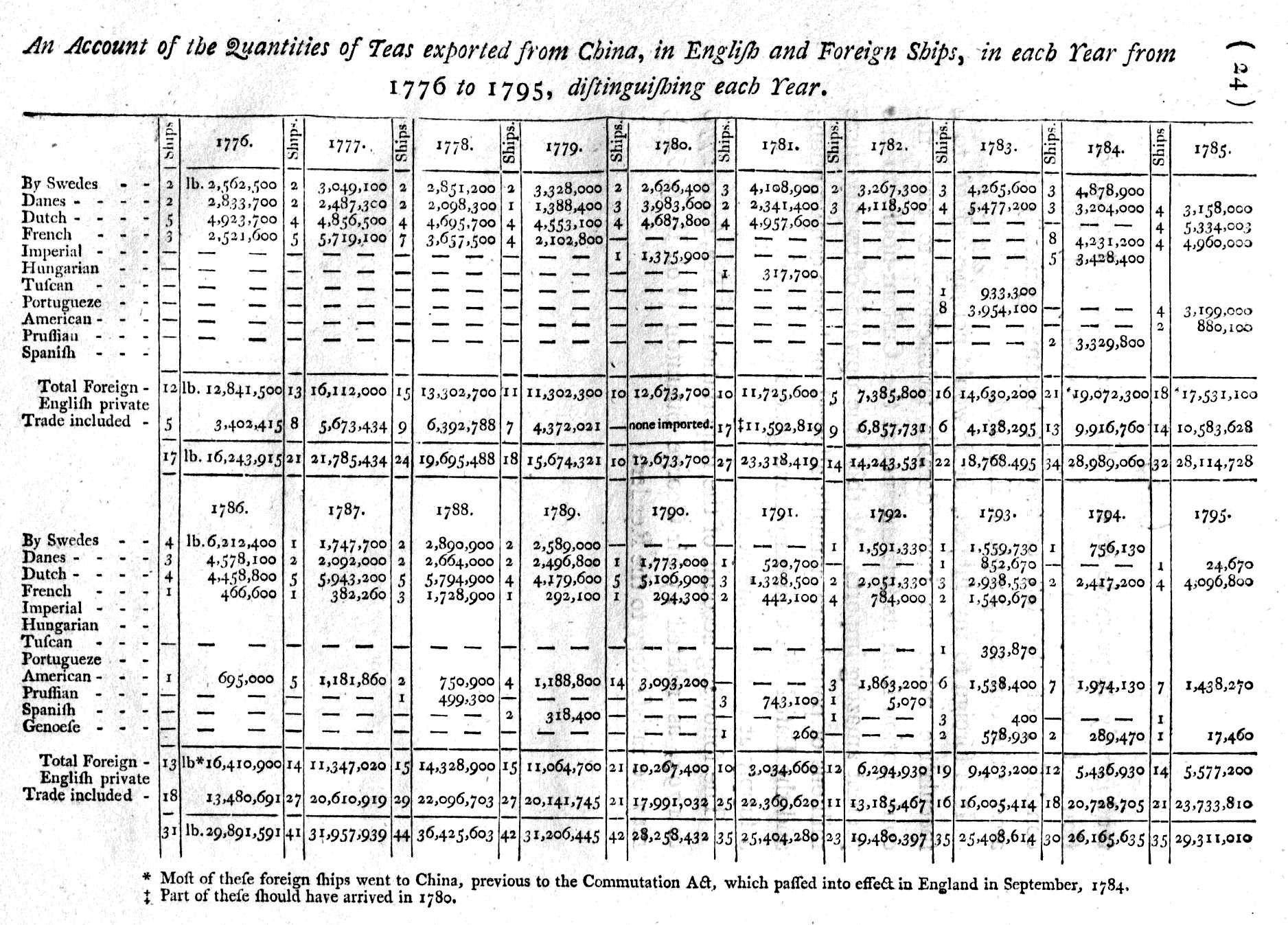
The following account of the importation of Tea, from 1776
to 1795, as related by Sir George Staunton (Vol. II. p. 624),
may be satisfactory to the Reader:
An Account of the Quantities of Teas exported from China, in English and Foreign Ships, in each Year from
1776 to 1795, distinguishing each Year.
| Legend: #S. = Number of Ships |
|
#S. |
1776. |
#S. |
1777. |
#S. |
1778. |
#S. |
1779. |
|
|
lb. |
| By Swedes |
2 |
2,562,500 |
2 |
3,049,100 |
2 |
2,851,200 |
2 |
3,328,000 |
| Danes |
2 |
2,833,700 |
2 |
2,487,300 |
2 |
2,098,300 |
1 |
1,388,400 |
| Dutch |
5 |
4,923,700 |
4 |
4,856,500 |
4 |
4,695,700 |
4 |
4,553,100 |
| French |
3 |
2,521,600 |
5 |
5,719,100 |
7 |
3,657,500 |
4 |
2,102,800 |
| Imperial |
— |
— — |
— |
— — |
— |
— — |
— |
— — |
| Hungarian |
— |
— — |
— |
— — |
— |
— — |
— |
— — |
| Tuscan |
— |
— — |
— |
— — |
— |
— — |
— |
— — |
| Portugueze |
— |
— — |
— |
— — |
— |
— — |
— |
— — |
| American |
— |
— — |
— |
— — |
— |
— — |
— |
— — |
| Prussian |
— |
— — |
— |
— — |
— |
— — |
— |
— — |
| Spanish |
| Total Foreign |
12 |
12,841,500 |
13 |
16,112,000 |
15 |
13,302,700 |
11 |
11,302,300 |
English private
Trade included |
5 |
3,402,415 |
8 |
5,673,434 |
9 |
6,392,788 |
7 |
4,372,021 |
|
17 |
16,243,915 |
21 |
21,785,434 |
24 |
19,695,488 |
18 |
15,674,321 |
|
#S. |
1780. |
#S. |
1781. |
#S. |
1782. |
| By Swedes |
2 |
2,626,400 |
3 |
4,108,900 |
2 |
3,267,300 |
| Danes |
3 |
3,983,600 |
2 |
2,341,400 |
3 |
4,118,500 |
| Dutch |
4 |
4,687,800 |
4 |
4,957,600 |
— |
— — |
| French |
— |
— — |
— |
— — |
— |
— — |
| Imperial |
1 |
1,375,900 |
— |
— — |
— |
— — |
| Hungarian |
— |
— — |
1 |
317,700 |
| Tuscan |
— |
— — |
— |
— — |
— |
— — |
| Portugueze |
— |
— — |
— |
— — |
— |
— — |
| American |
— |
— — |
— |
— — |
— |
— — |
| Prussian |
— |
— — |
— |
— — |
— |
— — |
| Spanish |
| Total Foreign |
10 |
12,673,700 |
10 |
11,725,600 |
5 |
7,385,800 |
English private
Trade included |
— |
none
imported. |
17 |
‡11,592,819 |
9 |
6,857,731 |
|
10 |
12,673,700 |
27 |
23,318,419 |
14 |
14,243,531 |
|
#S. |
1783. |
#S. |
1784. |
#S. |
1785. |
| By Swedes |
3 |
4,265,600 |
3 |
4,878,900 |
| Danes |
4 |
5,477,200 |
3 |
3,204,000 |
4 |
3,158,000 |
| Dutch |
— |
— — |
— |
— — |
4 |
5,334,003 |
| French |
— |
— — |
8 |
4,231,200 |
4 |
4,960,000 |
| Imperial |
— |
— — |
5 |
3,428,400 |
| Hungarian |
| Tuscan |
1 |
933,300 |
| Portugueze |
8 |
3,954,100 |
— |
— — |
4 |
3,199,000 |
| American |
— |
— — |
— |
— — |
2 |
880,100 |
| Prussian |
— |
— — |
2 |
3,329,800 |
| Spanish |
| Total Foreign |
16 |
14,630,200 |
21 |
†19,072,300 |
18 |
†17,531,100 |
English private
Trade included |
6 |
4,138,295 |
13 |
9,916,760 |
14 |
10,583,628 |
|
22 |
18,768,495 |
34 |
28,989,060 |
32 |
28,114,728 |
| Legend: #S. = Number of Ships |
|
#S. |
1786. |
#S. |
1787. |
#S. |
1788. |
#S. |
1789. |
|
|
lb. |
| By Swedes |
4 |
6,212,400 |
1 |
1,747,700 |
2 |
2,890,900 |
2 |
2,589,000 |
| Danes |
3 |
4,578,100 |
2 |
2,092,000 |
2 |
2,664,000 |
2 |
2,496,800 |
| Dutch |
4 |
4,458,800 |
5 |
5,943,200 |
5 |
5,794,900 |
4 |
4,179,600 |
| French |
1 |
466,600 |
1 |
382,260 |
3 |
1,728,900 |
1 |
292,100 |
| Imperial |
| Hungarian |
| Tuscan |
— |
— — |
— |
— — |
— |
— — |
— |
— — |
| Portugueze |
| American |
1 |
695,000 |
5 |
1,181,860 |
2 |
750,900 |
4 |
1,188,800 |
| Prussian |
— |
— — |
— |
— — |
1 |
499,300 |
— |
— — |
| Spanish |
— |
— — |
— |
— — |
— |
— — |
2 |
318,400 |
| Genoese |
— |
— — |
— |
— — |
— |
— — |
— |
— — |
| Total Foreign |
13 |
†16,410,900 |
14 |
11,347,020 |
15 |
14,328,900 |
15 |
11,064,700 |
English private
Trade included |
18 |
13,480,691 |
27 |
20,610,919 |
29 |
22,096,703 |
27 |
20,141,745 |
|
31 |
29,891,591 |
41 |
31,957,939 |
44 |
36,425,603 |
42 |
31,206,445 |
|
#S |
1790. |
#S. |
1791. |
#S. |
1792. |
| By Swedes |
— |
— — |
— |
— — |
1 |
1,591,330 |
| Danes |
1 |
1,773,000 |
1 |
520,700 |
— |
— — |
| Dutch |
5 |
5,106,900 |
3 |
1,328,500 |
2 |
2,051,330 |
| French |
1 |
294,300 |
2 |
442,100 |
4 |
784,000 |
| Imperial |
| Hungarian |
| Tuscan |
— |
— — |
— |
— — |
— |
— — |
| Portugueze |
| American |
14 |
3,093,200 |
— |
— — |
3 |
1,863,200 |
| Prussian |
— |
— — |
3 |
743,100 |
1 |
5,070 |
| Spanish |
— |
— — |
— |
— — |
1 |
— — |
| Genoese |
— |
— — |
1 |
260 |
— |
— — |
| Total Foreign |
21 |
10,267,400 |
10 |
3,034,660 |
12 |
6,294,930 |
English private
Trade included |
21 |
17,991,032 |
25 |
22,369,620 |
11 |
13,185,467 |
|
42 |
28,258,432 |
35 |
25,404,280 |
23 |
19,480,397 |
|
#S. |
1793. |
#S. |
1794. |
#S. |
1795. |
| By Swedes |
1 |
1,559,730 |
1 |
756,130 |
| Danes |
1 |
852,670 |
— |
— — |
1 |
24,670 |
| Dutch |
3 |
2,938,530 |
2 |
2,417,200 |
4 |
4,096,800 |
| French |
2 |
1,540,670 |
| Imperial |
| Hungarian |
| Tuscan |
1 |
393,870 |
| Portugueze |
| American |
6 |
1,538,400 |
7 |
1,974,130 |
7 |
1,438,270 |
| Prussian |
| Spanish |
3 |
400 |
— |
— — |
1 |
| Genoese |
2 |
578,930 |
2 |
289,470 |
1 |
17,460 |
| Total Foreign |
19 |
9,403,200 |
12 |
5,436,930 |
14 |
5,577,200 |
English private
Trade included |
16 |
16,005,414 |
18 |
20,728,705 |
21 |
23,733,810 |
|
35 |
25,408,614 |
30 |
26,165,635 |
35 |
29,311,010 |
† Most of these foreign ships went to China, previous to the Commutation
Act, which passed into effect in England in September, 1784.
‡ Part of these should have arrived in 1780.
It is probable that the Dutch, as they traded considerably to
Japan about the time Tea was introduced into Europe, first
brought this article from thence. But now China is the general
mart, and the province Fokien, or Fo-chen[22], the principal
country, that supplies both the Empire and Europe with this
commodity.
SECTION V. SOIL AND CULTURE.
To the ingenious Kæmpfer we are principally indebted for
any accurate information respecting the culture of the Tea Tree;
and, as his account was composed during his residence at Japan,
greater credit is certainly due to it. We shall give what he
says upon this subject, and then state the accounts we have
been able to collect of the Chinese method.
Kæmpfer tells us, that no particular gardens or fields are
allotted for this plant, but that it is cultivated round the borders
of rice and corn fields, without any regard to the soil. Any
number of the seeds, as they are contained in their seed vessels,
not usually less than six, or exceeding twelve or fifteen, are
promiscuously put into one hole, made four or five inches deep
in the ground, at certain distances from each other. The seeds
contain a large proportion of oil, which is soon liable to turn
rancid; hence scarce a fifth part of them germinate, and this
makes it necessary to plant so many together.
The seeds vegetate without any other care; but the more
industrious annually remove the weeds, and manure the land.
The leaves which succeed are not fit to be plucked before the
third year’s growth, at which period they are plentiful, and in
their prime.
In about seven years the shrub rises to a man’s height; but
as it then bears few leaves, and grows slowly, it is cut down to
the stem, which occasions such an exuberance of fresh shoots
and leaves the succeeding summer, as abundantly compensates
the owners for their former loss and trouble. Some defer
cutting them till they are of ten years growth.
So far as can be gathered from authors and travellers of
credit, this shrub is cultivated and prepared in China, in a
similar manner to what is practised in Japan; but as the Chinese
export considerable quantities of Tea, they plant whole fields
with it, to supply foreign markets, as well as for home consumption.
The Tea-tree delights particularly in vallies; or on the declivities
of hills, and upon the banks of rivers, where it enjoys
a southern exposure to the sun; though it endures considerable
variations of heat and cold, as it flourishes in the northern
clime of Pekin, as well as about Canton[23], the former of
which is in the same latitude with Rome; and from meteorological
observations it appears, that the degree of cold about
Pekin is as severe in winter, as in some of the northern parts
of Europe[24].
SECTION VI. GATHERING THE LEAVES.
At the proper seasons for gathering the Tea leaves, labourers
are hired, who are very quick in plucking them, being
accustomed to follow this employment as a means of their livelihood.
They do not pluck them by handfuls, but carefully
one by one; and, tedious as this may appear, each person is
able to collect from four to ten or fifteen pounds in one day.
The different periods in which the leaves are usually gathered,
are particularly described by Kæmpfer[25].
I. The first commences at the middle of the last moon, immediately
preceding the vernal equinox, which is the first month
of the Japanese year, and falls about the latter end of our
February, or beginning of March. The leaves collected at
this time are called Ficki Tsjaa, or powdered Tea, because
they are pulverised and sipped in hot water (Sect. IX. I).
These tender young leaves are but a few days old when they
are plucked; and, because of their scarcity and price, are
disposed of to princes and rich people only; and hence this
kind is called Imperial Tea.
A similar sort is also called Udsi Tsjaa, and Tacke Sacki
Tsjaa, from the particular places where it grows. The peculiar
care and nicety observed in gathering the Tea leaves in these
places deserve to be noticed here, and we shall therefore give
some account of one of them.
Udsi is a small Japanese town, bordering on the sea, and not
far distant from the city of Miaco. In the district of this little
town, is a pleasant mountain of the same name, which is
thought to possess the most favourable soil and climate for the
culture of Tea, on which account it is inclosed with hedges,
and likewise surrounded with a broad ditch for farther security.
The trees are planted upon this mountain in such a manner as
to form regular rows, with intervening walks. Persons are appointed
to superintend the place, and preserve the leaves from
injury or dirt. The labourers who are to gather them, for some
weeks before they begin, abstain from every kind of gross food,
or whatever might endanger communicating any ill flavour to
the leaves; they pluck them also with the same delicacy,
having on a thin pair of gloves[26]. This sort of imperial or
bloom Tea[27] is afterwards prepared, and then escorted by the
chief surveyor of the works of this mountain, with a strong
guard, and a numerous retinue, to the emperor’s court, for
the use of the Imperial family.
II. The second gathering is made in the second Japanese
month, about the latter end of March, or beginning of April.
Some of the leaves at this period are come to perfection, others
not arrived at their full growth; both however are promiscuously
gathered, and are afterwards sorted into different classes, according
to their age, size, and quality; the youngest particularly
are carefully separated, and are often sold for the first gathering
or Imperial Tea. The tea collected at this time is
called Tootsjaa, or Chinese Tea, because it is infused, and
drank after the Chinese manner (Sect. IX. I.) It is divided
by the Tea-dealers and merchants into four kinds, distinguished
by as many names.
III. The third and last gathering is made in the third Japanese
month, which falls about our June, when the leaves are
very plentiful and full grown. This kind of Tea, called Ban
Tsjaa, is the coarsest, and is chiefly drank by the lower class of
people (Sect. IX. III.)
Some confine themselves to two gatherings in the year, their
first and second answering the preceding second and third.
Others have only one general gathering[28], which they make
also at the same time with the preceding third or last gathering:
however, the leaves collected at each time, are respectively
separated into different sortments.
The Chinese collect the Tea at certain seasons[29], but whether
the same as in Japan, we are not so well informed, most probably,
however, the Tea harvest is nearly at the same periods,
as the natives have frequent intercourse, and their commercial
concerns with each other are very extensive[30].
SECTION VII. METHOD OF CURING OR PREPARING TEA IN JAPAN.
Public buildings, or drying houses, are erected for curing
Tea, and so regulated, that every person, who either has not
suitable conveniences, or wants the requisite skill, may bring
his leaves at any time to be dried. These buildings contain
from five to ten or twenty small furnaces, about three feet
high, each having at the top a large flat iron pan[31], either high,
square, or round, bent up a little on that side which is over
the mouth of the furnace, which at once secures the operator
from the heat of the furnace, and prevents the leaves from
falling off.
There is also a long low table covered with matts, on which
the leaves are laid, and rolled by workmen, who sit round it.
The iron pan being heated to a certain degree by a little fire
made in the furnace underneath, a few pounds of the fresh-gathered
leaves are put upon the pan; the fresh and juicy leaves
crack when they touch the pan, and it is the business of the
operator to shift them as quick as possible with his bare hands,
till they grow too hot to be easily endured. At this instant he
takes off the leaves, with a kind of shovel resembling a fan,
and pours them on the matts to the rollers, who, taking small
quantities at a time, roll them in the palms of their hands in
one direction, while others are fanning them, that they may
cool the more speedily, and retain their curl the longer[32].
This process is repeated two or three times, or oftener, before
the Tea is put in the stores, in order that all the moisture
of the leaves may be thoroughly dissipated, and their curl more
completely preserved. On every repetition the pan is less
heated, and the operation performed more slowly and cautiously[33].
The Tea is then separated into the different kinds,
and deposited in the store for domestic use or exportation.
As the leaves of the Ficki Tea (Sect. VI. and IX. II.), are
usually reduced into a powder before they are drank, they
should be roasted to a greater degree of dryness. As some of
these are gathered when very young, tender, and small, they
are first immersed in hot water, taken out immediately, and
dried without being rolled at all.
Country people cure their leaves in earthen kettles[34], which
answer every necessary purpose at less trouble and expence,
whereby they are enabled to sell them cheaper.
To complete the preparation, after the Tea has been kept
for some months, it must be taken out of the vessels, in which
it had been contained, and dried again over a very gentle fire,
that it may be deprived of any humidity which remained, or
might since have been contracted.
The common Tea is kept in
earthen pots with narrow
mouths; but the best sort of Tea used by the Emperor and
nobility is put in porcellane or China vessels. The Bantsjaa,
or coarsest Tea, is kept by the country people in straw baskets,
made in the shape of barrels, which they place under the roofs
of their houses, near the hole that lets out the smoke, and
imagine that this situation does not injure the Tea.
This is the relation we have from Kæmpfer of the method
in which the Japanese collected and cured their Tea. In the
accounts of China, authors have in general treated very slightly
of the cultivation and preparation of Tea. Le Compte[35] indeed
observes, that to have good Tea, the leaves should be gathered
while they are small, tender, and juicy. They begin commonly
to gather them in the months of March and April, according
as the season is forward; they afterwards expose them
to the steam of boiling water to soften them; and, as soon as
they are penetrated by it, they draw them over copper plates[36]
kept on the fire, which dries them by degrees, till they grow
brown, and roll up of themselves in that manner we see them.
However, it is certain, from the Chinese drawings, which
exhibit a faithful picture, though rudely executed, of the
whole process from beginning to end, that the Tea tree grows
for the most part in hilly countries, on their rocky summits,
and steep declivities; and it would seem by the pains the
Chinese are at, in making paths, and fixing a kind of scaffolds,
to assist them, that these places afford the finest Tea.
It appears from these drawings, that the trees in general are
not much taller than man’s height: The gatherers of the
leaves are never represented but on the ground; they make
use of hooked sticks indeed, but these seem rather intended
to draw the branches towards them, when they hang over
brooks, rivers, or from places difficult of access, than to
bend down the tops or upper branches of the trees on plain
ground.
They pick the leaves as soon as gathered into different sorts,
and cure them nearly in the manner described to be practised
by the Japanese. They build a range of stoves, like those in
a chemist’s laboratory, or great kitchen, where the men work,
and curl the leaves in the pans themselves. It seems also that
they repeat the drying. They dry it likewise, after having
spread it abroad in shallow baskets, in the sun; and, by the
means of sieves, separate the larger from the smaller leaves, and
these again from the dust.
The Chinese put the finer kinds of Tea into conic vessels,
like sugar loaves, made of tutenaque, tin, or lead, covered
with neat matting of bamboo; or in square wooden boxes lined
with thin lead, dry leaves and paper, in which manner it is exported
to foreign countries. The common Tea is put into
baskets, out of which it is emptied, and packed up in boxes or
chests as soon as it is sold to the Europeans[37].
One thing should be mentioned to their credit; when their
harvest of Tea is finished, each family fails not to testify, by
some religious rite, their gratitude to the Giver.
SECTION VIII. VARIETIES OF TEA. — I. Those of the former are, — II. The bohea Teas.
It has been already observed (Sect. VI.) that many
different sortments of Tea are made during the times of collecting
the leaves; and these are multiplied according to the
goodness of their preparation, by which the varieties of Tea
may be considerably augmented[38]. The distinctions with us are
much more limited, being generally confined to three principal
kinds of green, and five of bohea.
I. Bing, imperial, or bloom Tea, with a large loose leaf, of
a light green colour, and faint delicate smell.
II. Hy-tiann, hi-kiong, or hayssuen, known to us by the
name of Hyson Tea, so called after an East-India merchant of
that name, who first imported it into Europe. The leaves are
closely curled and small, of a green colour, verging towards
blue[39].
III. Singlo, or songlo, which name it receives, like many
other Teas, from the place where it is cultivated.
I. Soochuen, or sutchong, by the Chinese called saatyang,
and sact-chaon, or su-tyann, is a superior kind of long-fou Tea.
It imparts a yellowish green colour, by infusion[40].
II. Camho, or soumlo, called after the name of the place
where it is gathered; a fragrant Tea with a violet smell. Its
infusion is pale.
III. Cong-fou, congo, or bong-fo. This has a larger leaf
than the following, and the infusion is a little deeper coloured.
It resembles the common bohea in the colour of the leaf[41].
IV. Pekao, pecko, or pekoe, by the Chinese called back-ho,
or pack-ho. It is known by having the appearance of small
white flowers intermixed with it.
V. Common bohea, called moji by the Chinese, consists of
leaves of one colour[42].
III. There has also been imported a sort of Tea, in balls, of a
different form from any of the preceding, made up into
cakes or balls of different sizes, by the Chinese called Poncultcha.
I. The largest kind of this cake Tea, that I have seen, weighs
about two ounces; the infusion and taste resemble those of good
bohea Tea.
II. Another sort, which is a kind of green Tea, is called
tio tè: it is rolled up in a round shape, about the size of peas,
and sometimes as large as a nutmeg.
III. The smallest kind done in this form is called gun-powder
Tea.
IV. Sometimes the succulent Tea leaves are twisted into
cords like packthread, about an inch and a half or two inches
long; and usually three of these are tied together at the ends
by different-coloured silk threads. These resemble little bavins,
one of which might suffice for tea for one person. I have seen
them both of green and bohea Tea.
The Chinese likewise prepare an extract from Tea, which
they exhibit as a medicine dissolved in a large quantity of water,
and ascribe to it many powerful effects in fevers and other
disorders, when they wish to procure a plentiful sweat. This
extract is sometimes formed into small cakes, not much broader
than a sixpence, sometimes into rolls of a considerable size.
That there is only one species of Tea tree, has already been
mentioned (Sect. I.) from which all the varieties of Tea are
procured. Kæmpfer, who is of this opinion, attributes the
difference of Teas to the soil and culture of the plant, age of
the leaves when gathered, and method of curing them[43].
These circumstances will severally have more or less influence;
though whether they account for all the varieties observable in
Tea may be doubted. The bohea Tea trees, now introduced
into many botanic gardens near London, exhibit very obvious
varieties. The leaves are of a deeper green colour, and not
so deeply serrated; the stalk is usually of a darker colour, and
the whole shrub appears less luxuriant
as represented in the annexed plate of the bohea Tea; but the botanical characters
are the same.
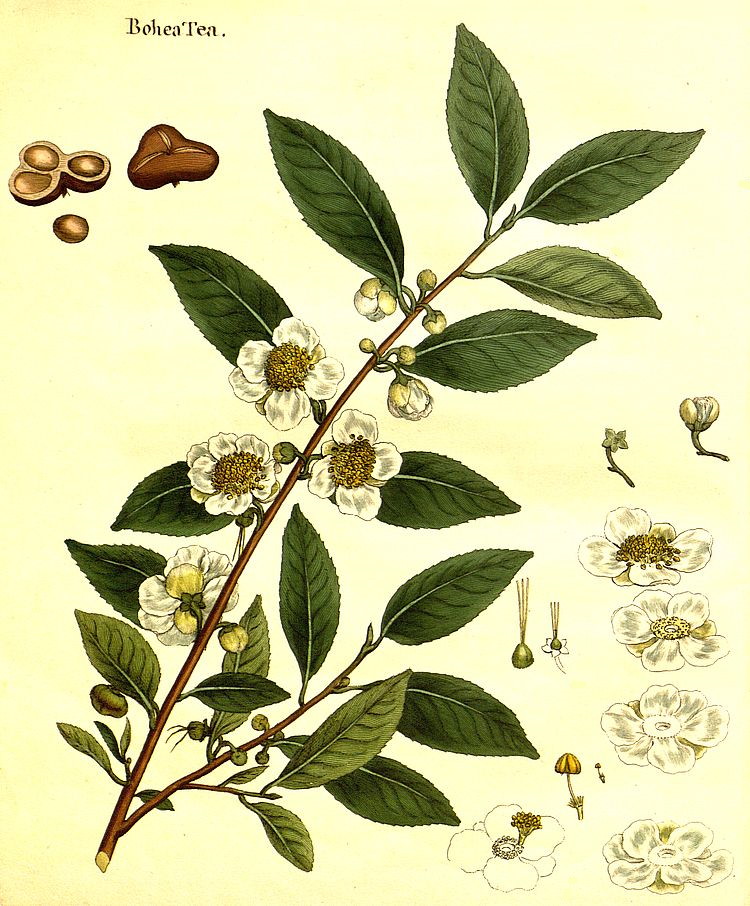
Bohea Tea.
I infused all the sorts of green and bohea Teas I could procure,
and expanded the different leaves on paper, to compare
their respective size and texture, intending thereby to discover
their age. I found the leaves of green Tea as large as those
of bohea, and nearly as fibrous; which would lead one to
suspect, that the difference does not so much depend upon
the age, as upon the other circumstances.
We know that in Europe the soil, culture, and exposure,
have great influence on all kinds of vegetables: but the same
species of plants differ in the same province, and even in the
same district; and in Japan, and particularly along the continent
of China, it must be much more considerable, where the air is
in some parts very cold, in others moderate, or warm almost to
an extreme. I am persuaded that the method of preparation
must also have no little influence. I have dried the leaves of
some European plants in the manner described (Sect. VI.)
which so much resembled the foreign Tea, that the infusion
made from them has been seen and drunk without suspicion.
In these preparations which I made, some of the leaves retained
a perfect curl, and a fine verdure like the best green
Tea; and others cured at the same time were more like the
bohea[44].
I would not, however, lay too much stress upon the result
of a few trials, nor endeavour to preclude further enquiries
about a subject which at some future period may prove of
more immediate concern to this nation.
We might still try to discover whether other arts, than are yet
known here, are not used with Tea before its exportation from
China, to produce the difference of colour[45], and flavour[46],
peculiar to different sorts. An intelligent friend of mine informs
me, that in a set of Chinese drawings, in his possession, representing
the whole process of manufacturing Tea, there are in one
sheet the figures of several persons apparently separating the
different kinds of Tea, and drying it in the sun, with several
baskets landing near them filled with a very white substance,
and in considerable quantity. To what use this may be applied
is uncertain, as well as what the substance is; yet there is no
doubt, he thinks, that it is used in the manufacturing of Tea,
as the Chinese seldom bring any thing into their pieces but such
as relate in some respect to the business before them.
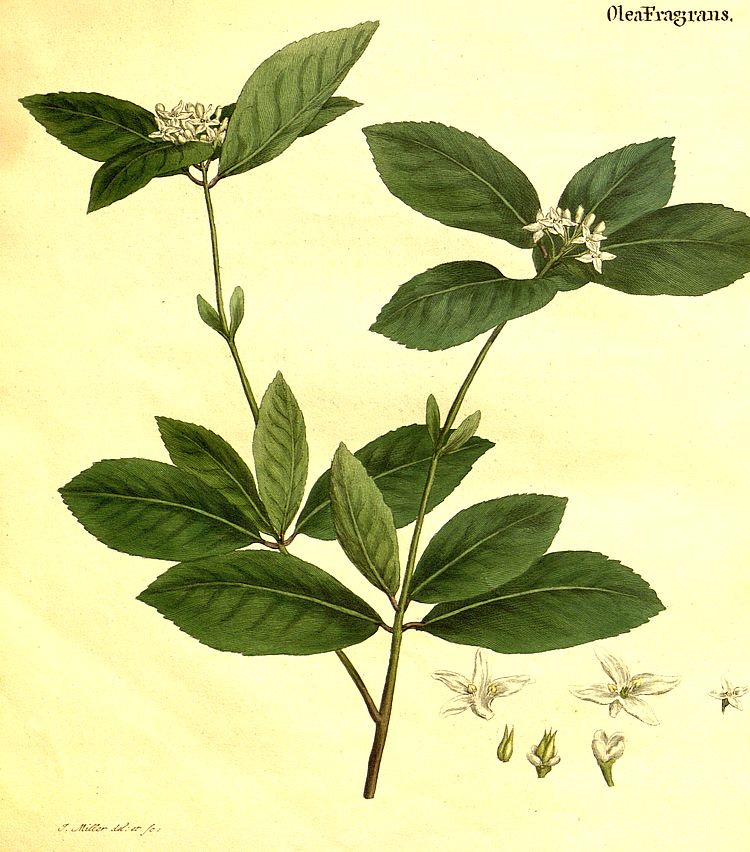
Olea Fragrans.
J. Miller del: et so:
We are better acquainted with a vegetable substance which
has been employed by the Asiatics in giving a flavour to Tea.
This is the Olea Fragrans, whose flowers are frequently to be
met with in Teas exported from China: and as the plant is now
not unfrequent in the gardens near the metropolis, I am enabled
to give an engraving of the plant and its botanical history[47].
Olea Fragrans.—Sweet-scented Olive.
Class and Order.
Diandria Monogynia.
Generic Character.
Cor. 4. fida: laciniis subovatis.
Drupa monosperma.
Corol. 4. cleft: segments
somewhat ovate. Drupe, one-seeded.
Specific Character and Description
from Thunberg.
Olea fragrans foliis lanceolatis
serratis, pedunculis lateralibus
aggregatis unifloris. Thunb.
Fl. Japon. p. 18, t. 2.
Caulis, arboreus vastus.
Rami et ramuli trichotomi,
obsolete tetragoni, glabri.
Folia decussata, petiolata oblonga,
acuta, serrata, margini
subreflexo, parallelo-nervosa, reticulata,
glabra, supra saturate
viridia, subtus pallidiora, patentia,
in ramulis frequentia, digitalia.
Petioli semiteretes, sulcati,
glabri, semiunguiculares.
Flores in ramulis umbellato-aggregati,
circiter 6 vel 8, pedunculati.
Pedunculi filiformes, uniflori,
glabri, albidi, unguiculares.
Perianthium, 1-Phyllum, minimum,
obsolete 4-dentatum,
albidum, glabrum.
Corolla, 1-petala, rotata, flavo-alba;
Tubus subnullus; Limbus
patens, quadrifidus: laciniæ
ovatæ, obtusæ, concavæ,
crassiusculæ.
Filamenta duo, ori tubi inserta,
alba, brevissima.
Antheræ ovatæ, grandiusculæ,
didymæ, flavescentes.
Germen superum, oblongum,
glabrum.
Stylus filiformis.
Stigmata simplicia, acuta.
Olive sweet-scented with
lanceolate serrated leaves, peduncles
lateral, cluttered, one-flowered.
Stem, a vast tree.
Branches both large and small
trichotomous, faintly four-cornered
and smooth.
Leaves growing cross-wise on
leaf-stalks, oblong, acute, serrated,
edge somewhat turned
back, ribs parallel, reticulated,
smooth above, of a deep green
colour, paler beneath, spreading
on the small branches, numerous,
about the length of
the finger.
Leaf-stalks, flat on one side,
round on the other, grooved,
smooth, half the length of the
finger nail.
Flower on the small branches
in clustered umbels, about 6 or
8 together, standing on peduncles.
Flower-stalks filiform, one-flowered,
smooth, whitish, a
finger nail in length.
Perianthium, one-leaved, very
minute, faintly four-toothed,
whitish and smooth.
Corolla of one petal, wheel-shaped,
of a yellowish-white
colour; Tube scarce any; Limb
spreading, quadrifid, segments
ovate, obtuse, concave, thickish.
Filaments two, inserted into
the mouth of the tube, white,
very short.
Antheræ ovate, somewhat
large, double, yellowish.
Germen above, oblong, and
smooth.
Style filiform.
Stigmata, simple and pointed.
Sir George Staunton, in his Embassy to China, Vol. II.
p. 467, describes another Plant, whose flowers are used for the
purpose of scenting Tea. The flower resembles the dog-rose,
and the leaves those of Tea; hence the Chinese call it Cha-whaw,
or flower of Tea. A Plate of this Plant is annexed,
with the following description, which this very accurate and
learned traveller has obligingly permitted me to introduce
here.
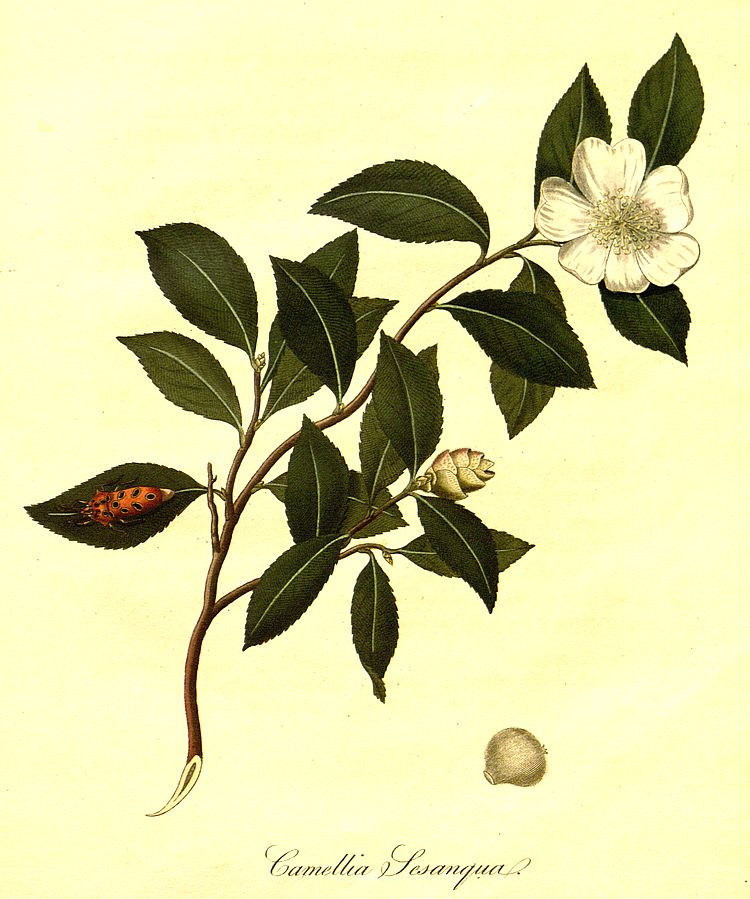
Camellia Sesanqua.
“A Plant very like the Tea flourished at this time on the tides
and the very tops of mountains, where the soil consisted of
little more than fragments of stone crumbled into a sort of
coarse earth by the joint action of the sun and rain. The
Chinese call this plant Cha-whaw, or Flower of Tea, on account
of the resemblance of one to the other; and because its
petals, as well as the entire flowers of the Arabian jessamine,
are sometimes mixed among the Teas, in order to increase
their fragrance.
“This plant, the Cha-whaw, is the Camellia Sesanqua of the
botanists, and yields a nut, from whence is expressed an esculent
oil equal to the best which comes from Florence. It is
cultivated on this account in vast abundance; and is particularly
valuable, from the facility of its culture, in situations fit
for little else.” It is delineated on the opposite page.
As green Tea is by some suspected to have been cured on
copper, they have attributed the verdure to be derived from
that metal (Sect. VII.); but, if there were any foundation
for this supposition, the volatile alkali, mixed with an
infusion of such Tea, would detect the least portion of copper,
by turning the infusion blue[48].
Others have, with less propriety, attributed the verdure to
green copperas[49]; but this ingredient, which is only salt of iron,
would immediately turn the leaves black, and the infusion made
from the Tea would be of a deep purple colour[50].
Is it not more probable, that some green dye, prepared from
vegetable substances, is used for the colouring?
SECTION IX. DRINKING OF TEA.
Neither the Chinese, nor natives of Japan, ever use Tea
before it has been kept at least a year; because when fresh it is
said to prove narcotic, and to disorder the senses[51]. The
former pour hot water on the Tea, and draw off the infusion
in the same manner as is now practised in Europe; but
they drink it simply without the addition of sugar or milk[52].
The Japanese reduce the Tea into a fine powder, by grinding
the leaves in a hand-mill; they then mix them with hot water
into a thin pulp, in which form it is sipped[53], particularly by the
nobility and rich people. It is made and served up to company
in the following manner: the Tea-table furniture, with
the powdered Tea inclosed in a box, are set before the company,
and the cups are then filled with hot water, and as much
of the powder as might lie on the point of a moderate-sized
knife is taken out of the box, put into each cup, and then
stirred and mixed together with a curious denticulated instrument
till the liquor foams, in which state it is presented to the
company, and sipped while warm[54]. From what Du Halde
relates, this method is not peculiar to the Japanese, but is also
used in some provinces of China[55].
The common people, who have a coarser Tea (Sect. VI. III.)
boil it for some time in water, and make use of the liquor for
common drink. Early in the morning the kettle, filled with
water, is regularly hung over the fire for this purpose, and the
Tea is either put into the kettle inclosed in a bag, or, by means
of a basket of a proper size, pressed to the bottom of the vessel,
that there may not be any hindrance in drawing off the water.
The Bantsjaa Tea (Sect. VI. III.) only is used in this manner,
whose virtues, being more fixed, would not be so fully extracted
by infusion.
And indeed Tea is the common beverage of all the labouring
people in China: one scarcely ever sees them represented at
work of any kind, but the Tea pot and Tea cup appear as
their accompaniments. Reapers, threshers, and all who work
out of doors, as well as within, have these attendants[56].
To make Tea, and to serve it in a genteel and graceful manner,
is an accomplishment, in which people of both sexes in
Japan are instructed by masters, in the same manner as Europeans
are in dancing, and other branches of polite education.
SECTION XI. PRESERVING THE SEEDS FOR VEGETATION.
Many attempts to introduce the Tea-tree into Europe
have proved unsuccessful, owing to the bad state of the seeds
when first procured, or to a want of judgement in preserving them
long enough in a state capable of vegetation. If this complaint
arise from the first cause, future precautions about such seeds
will be in vain; it is therefore necessary to procure fresh,
sound, ripe seeds, white, plump, and moist internally.
Two methods of preserving the seeds have put us in possession
of a few young plants of the true Tea-tree of China;
one is, by inclosing the seeds in bees wax, after they have been
well dried in the sun; and the other, by putting them, included
in their pods, or capsules, into very close cannisters made
of tin and tutenague[70].
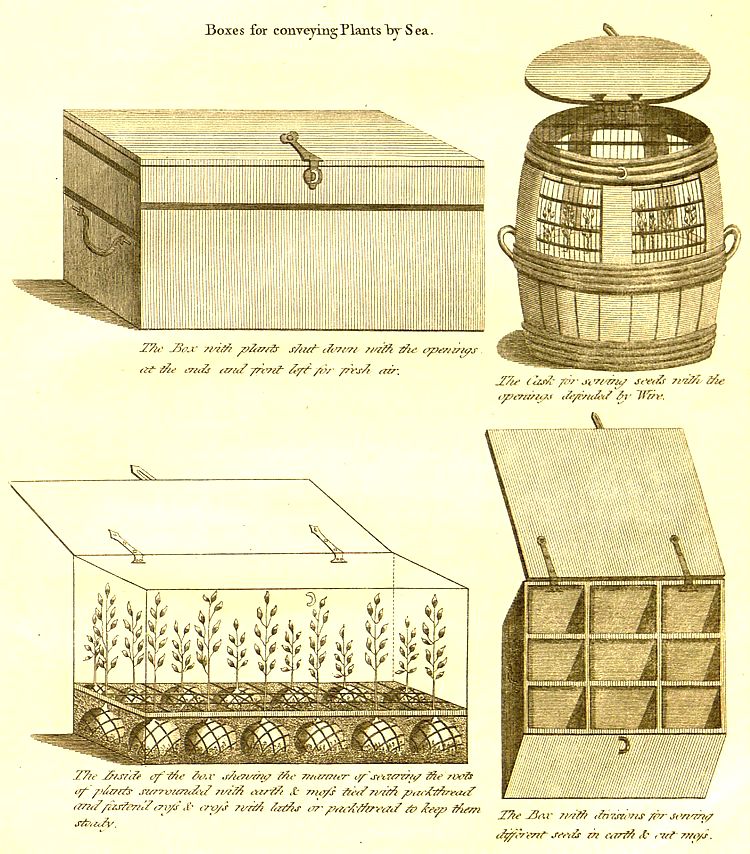
Boxes for conveying Plants by Sea.
The Box with plants shut down with the openings
at the ends and front left for fresh air.
The Cask for serving seeds with the
openings defended by Wire.
The Inside of the box shewing the manner of securing the roots
of plants surrounded with earth & moss tied with packthread
and fasten’d cross & cross with laths or packthread to keep them
steady.
The Box with divisions for serving
different seeds in earth & cut moss.
But neither of these methods have succeeded generally,
notwithstanding the utmost care, both in getting fresh seeds,
and in securing them in the most effectual manner. The best
method is to sow the ripe seeds in good light earth, in boxes,
at leaving Canton; covering them with wire, to prevent rats
and other such vermin coming to them. The boxes, plans of
which are annexed, should not be exposed to too much air, nor
to the spray of the sea, if possible. The earth should not be
suffered to grow dry and hard, but a little fresh or rain water
may be sprinkled over it now and then; and, when the seedling
plants appear, they should be kept moist, and out of the burning
sun[71]. Most of the plants now in England were procured by
these means; and though many of the seedlings will die, yet by
this kind of management we may probably succeed in bringing
over the most curious vegetable productions of China, of which
they have an amazing treasure, both in respect to use, shew, and
variety[72]. If young plants could be procured in China, they
might be sent over in a growing state in some of these boxes.
The young Tea-plants in the gardens about London thrive
very well in the green-houses in winter, and some bear the
open air in summer. The leaves of many of them are from
one to three inches long, not without a fine deep verdure;
and the young shoots are succulent. It is therefore probable,
that in a few years many layers may be procured from them,
and the number of plants considerably increased thereby.
It may not be improper to observe here, that many exotic
vegetables, like human constitutions, require a certain period
before they become naturalized to a change of climate; many
plants, which on their first introduction would not bear our
winters without shelter, now endure our hardest frosts; the
beautiful magnolia, among several others, is a proof of this
observation; and we have already taken notice (Sect. V.),
that the degree of cold at Pekin sometimes exceeds ours.
We have hence reason to expect, that the Tea-tree may in a
few years be capable of bearing our climate, or at least that of
our colonies; at length thrive, as if indigenous to the soil;
and, were labour cheaper, become an article of export[73], like
the common potatoe, for which we are indebted to America,
or Spain[74]. It is, however, better suited for the climates of
the Southern parts of Europe, and America; but hitherto
it has not been cultivated in an extensive manner, in either of
these quarters of the world; nor is it likely ever to be, whilst it
can be procured from Asia at the present reduced price. It
was introduced into Georgia about the year 1770. Hence the
ingenious author of Ouabi (Mrs. Morton) in her recent poem of
Beave-hill, in describing the products of this province, introduces
the exotic of China:
“Yet round these shores prolific plenty twines,
Stores the thick field, and swells the cluttering vines;
A thousand groves their glossy leaves unfold,
Where the rich orange rolls its ruddy gold,
China’s green shrub, divine Magnolia’s bloom,
With mingling odours fling their high perfume.”
It is indeed probable that the North American summers, in
the same latitude with Pekin, would suit this Tree better than
ours; for, in China and some parts of North America, the
heat in summer is such, that vegetables make quicker and more
early shoots, whereby they have time to acquire sufficient
strength and firmness before the winter commences: but, in
England, the tender shoots are puttied forth late, and, winter soon
after succeeding, they often perish, in a degree of cold much
less severe than at Pekin, or in colder latitudes of North
America.
THE MEDICAL HISTORY OF TEA . PART II. — SECTION I. — EXPERIMENT I. — EXPERIMENT II.
As the custom of drinking Tea is become general,
every person may be considered as a judge of its effects, at
least so far as it concerns his own health; but, as the constitutions
of mankind are various, the effects of this infusion must
be different also, which is the reason that so many opinions
have prevailed upon the subject.
Many, who have once conceived a prejudice against it, suffer
it to influence their judgement too far, and condemn the custom
as universally pernicious. Others, who are no less biassed
on the other extreme, would make their own private experience
a standard for that of all, and ascribe the most extensive virtues
to this infusion. This contrariety of opinion has been particularly
maintained among physicians[75]; which will ever be the case,
while mere suppositions are placed in the room of experiments
and facts impartially related.
Some physicians, however, avoid both extremes; who,
without commending it, or decrying it universally, admit its
use, while they are not insensible of the injuries it may produce.
It requires no small share of sagacity to fix the limits
of good and harm in the present case: multitudes of all ages,
constitutions, and complexions, drink it freely, during a long
life, without perceiving any ill effects. Others, again, soon
experience many inconveniences from drinking any considerable
quantity of this infusion.
It is difficult to draw certain conclusions from experiments
made on this herb. The parts which seem to produce these
opposite effects are very fugitive. We become acquainted
chiefly with the grosser parts by analysis. I made the following
experiments with considerable care; but, I own, they inform us
not sufficiently wherein consists that grateful relaxing sedative
property, which proves to the generality of mankind so refreshing;
nor from whence it is, that others feel from the pleasing
beverage so many disagreeable effects. Accurate observation
would instruct us in this difficult investigation, more than simple
experiments on the subject itself.
I took an equal quantity of an infusion of superfine green
Tea, and of common bohea Tea, made equally strong; and
also the same quantity of the liquor remaining after distillation
(Sect. III. I.), and of simple water; into each of which, contained
in separate vessels, I put two drachms of beef, that had
been killed about two days.
The beef, which was immersed in the simple water, became
putrid in forty-eight hours; but the pieces in the two infusions
of Tea, and in the liquor remaining after distillation, shewed
no signs of putrefaction, till after about seventy hours[76].
Into strong infusions of every kind of green and bohea Tea
that I could procure, I put equal quantities of salt of iron
(sal martis), which immediately changed the several infusions
into a deep purple colour[77].
It is evident from these experiments, that both green and
bohea Tea possess an antiseptic (Experiment I.), and astringent
power (Experiment II.), applied to the dead animal
fibre.
SECTION II. — EXPERIMENT III. — EXPERIMENT IV.
Nevertheless, as I have often observed that drinking
Tea, particularly the most highly-flavoured fine green, proves
remarkably relaxing to many persons of tender and delicate
constitutions, I was induced to prosecute my enquiries farther.
1. To this end I distilled half a pound of the best and
most fragrant green Tea with simple water[78], and drew off an
ounce of very odorous and pellucid water, free from oil, and
which on trial (Section I. Experiment II.) shewed no signs
of astringency.
2. That part of the liquor which remained after distillation,
was evaporated to the consistence of an extract; it was slightly
odorous, but had a very bitter, styptic, or astringent taste.
The quantity of the extract thus procured weighed about five
ounces and a half[79].
a. Into the cavity of the abdomen, and cellular membrane of a
frog, about three drachms of the distilled odorous water
(No. 1.) were injected.
In twenty minutes, one hind leg of the frog appeared
much affected, and a general loss of motion and sensibility
succeeded[80]. The affection of the limb continued for four
hours, and the universal torpidity remained above nine hours;
after this the animal gradually recovered its former vigor.
b. In like manner some of the liquor remaining after the distillation
of the green Tea (No. 1.) was injected; but this was
not productive of any sensible effect.
a. To the ischatic nerves laid bare, and to the cavity of the
abdomen of a frog, I applied some of the distilled odorous
water (No. 1. and Experiment III, 1.). In the space of
half an hour, the hindermost extremities became altogether
paralytic and insensible; and in about an hour afterwards the
frog died.
b. In like manner I applied the liquor remaining after distillation
(No. 1. and Experiment III. 2.) to another frog; but no
sedative or paralytic effect was observable.
3. From these experiments the sedative and relaxing effects
of Tea appear greatly to depend upon an odorous fragrant
principle, which abounds most in green Tea, particularly that
which is most highly flavoured[81]. This seems farther confirmed
by the practice of the Chinese, who avoid using this plant, till
it has been kept at least twelve months, as they find when
recent it possesses a soporiferous and intoxicating quality.
(Part I. Sect. IX.)
Thus often under trees supinely laid,
Whilst men enjoy the pleasure of the shade,
Whilst those their loving branches seem to spread }
To screen the sun, they noxious atoms shed, }
From which quick pains arise, and seize the head. }
Near Helicon, and round the learned hill
Grow Trees, whose blossoms with their odour kill
[82].
SECTION III.
Waving, however, any attempts to fix with precision
the effects of Tea from these experiments alone, let us endeavour
to collect from observation likewise, such facts as may
enable us to judge what its effects are on the human frame,
and from thence draw the clearest inferences we can, how far
it is salutary or otherwise.
The long and constant use of Tea, as a part of our diet,
makes us forget to enquire whether it is possessed of any medicinal
properties. We shall endeavour to consider it in both
respects.
The generality of healthy persons find themselves not apparently
affected by the use of Tea: it seems to them a grateful
refreshment, both fitting them for labour and refreshing them
after it. There are instances of persons who have drank it
from their infancy, to old age; have led, at the same time,
active, if not laborious lives; and yet never felt any ill effects
from the constant use of it.
Where this has been the case, the subjects of both sexes
were for the most part healthy, strong, active, and temperate.
Amongst the less hardy and robust, we find complaints, which
are ascribed to Tea, by the parties themselves. Some complain
that after a Tea breakfast, they find themselves rather
fluttered; their hands less steady in writing, or any other employment
that requires an exact command of spirits. This probably
soon goes off, and they feel no other injury from it.
Others again bear it well in the morning, but from drinking it
in the afternoon, find themselves very easily agitated, and
affected with a kind of involuntary trembling.
There are many people who cannot bear to drink a single
dish of Tea, without being immediately sick and disordered at
the stomach: To some it gives excruciating pain about that
part, attended with general tremours. But in general the most
tender and delicate constitutions are most affected by the free
use of Tea; being frequently attacked with pains in the stomach
and bowels; spasmodic affections; attended with a copious
discharge of limpid urine, and great agitation of spirits on the
least noise, hurry, or disturbance.
SECTION IV.
There is one circumstance, however, that renders it
more difficult to investigate the certain effects of Tea; which
is, the great unwillingness that most people shew, to giving us
a genuine account of their uneasy sensations after the free use
of it; from a consciousness that it would be extremely imprudent
to continue its use, after they are convinced from experience
that it is injurious.
That it produces watchfulness in some constitutions is most
certain, when drank at evening in considerable quantities.
Whether warm water, or any other aqueous liquor, would
have the same effect, is not certain.
That it enlivens, refreshes, exhilarates, is likewise well
known. From all which circumstances it would seem, that
Tea contains an active penetrating principle, speedily exciting
the action of the nerves; in very irritable constitutions, to
such a degree as to give very uneasy sensations, and bring on
spasmodic affections: in less irritable constitutions, it rather
gives pleasure, and immediate satisfaction, though not without
occasionally producing some tendency to disagreeable tremours
and agitation.
The finer the Tea, the more obvious are these effects. It
is perhaps for this, amongst other reasons, that the lower
classes of people, who can only procure the most common, are
in general the least sufferers. I say, in general, because even
amongst them there are many who actually suffer much by
it: they drink it as long as it yields any taste, and, to add to
its flavour, for the most part hot; and thus the quantity which
they take, and the degree of heat in which it is drank, conspire
to produce in them, what the finer kinds of Tea effect in their
superiors.
It ought not, however, to pass unobserved, that in a multitude
of cases the infusions of our own herbs, sage for instance,
mint, baum, even rosemary, and valerian itself, will
sometimes produce similar effects, and leave that sensation of
emptiness, agitation of spirits, flatulence, spasmodic pains, and
other symptoms, that are met with in people, the most of all
others devoted to Tea.
Besides the injuries which the stomach sustains, by taking
the infusion of Tea extremely hot; it is not improbable but
the teeth also are affected by it. Professor Kalm, in his
Travels into North America, observes, that such of the inhabitants
as took their Tea and food in general, in this state,
were frequently liable to lose half their teeth at the age of
twenty, without any hopes of getting new ones. This cannot
be attributed to the variations of weather in that clime, because
the Indians who enjoy the same air, but take their viands
almost cold, were to a great age possessed of fine white teeth;
as were likewise the Europeans who first settled in America,
before the use of Tea became general. It was no less remarkable,
that the Indian women, who had accustomed themselves
to drink this infusion after the European fashion, had
likewise lost their teeth prematurely, though they had formerly
been quite sound[83]. Kalm does not appear to suspect
any injury to the teeth from the sugar used with the
Tea.
SECTION V.
Many, from a supposition that Tea was dried in India
on copper, have attributed its pernicious properties to this
metal; but we have already observed (Part I. § VIII.), that, if
Tea were tinctured with the least quantity of copper, it might
easily be detected by chemical experiments.
Some have attributed the injurious qualities of this fashionable
exotic upon the stomach to the sugar usually drank with the
Tea; but I have had sufficient opportunities of observing in
the West Indies the good effects of drinking freely the juice of
the sugar-cane, to obviate this objection. I have known feeble
emaciated children, afflicted with worms, tumefied abdomen,
and a variety of diseases, soon emerge from their complicated
ailments, by drinking large draughts of this sweet liquor, and
become healthy and strong[84].
“While flows the juice mellifluent from the cane,
Grudge not, my friend, to let thy slaves, each morn,
But chief the sick and young, at setting day,
Themselves regale with oft-repeated draughts
Of tepid nectar, and make labour light
[85].”
That there is something in the finer green Teas, that produces
effects peculiar to itself, and not to be equalled by any
other substance we know, is, I believe, admitted by all who
have observed, either what passes in themselves, or the accounts
that others give of their feelings, after a plentiful use of this
liquor. Nor are the finer kinds of bohea Teas incapable of the
like influence. They affect the nerves, produce tremblings,
and such a state of body for the time, as subjects it to be agitated
by the most trifling causes, such as shutting a door too
hastily, the sudden entrance even of a servant, and other the
like causes.
I know people of both sexes, who are constantly seized with
great uneasiness, anxiety, and oppression, as often as they take
a single cup of Tea, who nevertheless, for the sake of company,
drink several cups of warm water, mixed with sugar and milk,
without the same inconvenience.
A physician, whose acquaintance I have long been favoured
with, and who, with some others, was present when the preceding
experiments were made at the college of Edinburgh,
has a remarkable delicacy in feeling the effects of a small quantity
of fine Tea. If drank in the forenoon, it affects his stomach
with an uneasy sensation, which continues for several hours,
and entirely takes away his appetite for food at dinner; though
at other times, when he takes chocolate for breakfast, he generally
makes a very hearty meal at noon, and enjoys the most
perfect health. If he drink a single dish of tea in the afternoon,
it affects him in the same manner, and deprives him of sleep
for three or four hours through the succeeding night; yet he
can take a cup of warm water with sugar and milk, without the
least inconvenience.
It may be remarked that opium has nearly the same effect
upon him as Tea, but in a greater degree; for he informs me,
that when he once accidentally took a quantity of the solution
of opium, it had not the least tendency to induce sleep, but
produced a very disagreeable uneasiness at his stomach, approaching
to nausea. The late celebrated Professor Whytt[86], of
Edinburgh, affords a striking example how injurious the effects
of Tea may be upon constitutions, which I shall relate in his
own words. “I once imagined Tea to be in a great measure
unjustly accused; and that it did not hurt the stomach more
than an equal quantity of warm water; but experience has
since taught me the contrary. Strong Tea drunk in any considerable
quantity, in a morning, especially if I eat little bread
with it, generally makes me fainter before dinner than if I had
taken no breakfast at all; at the same time it quickens my pulse,
and often affects me with a kind of giddiness. These bad effects
of Tea are most remarkable when my stomach is out of
order.”
SECTION VIII.
In treating of this substance, I would not be understood
to be either a partial advocate, or a passionate accuser. I have
often regretted that Tea should possess any pernicious qualities,
as the pleasure which arises from reflecting how many millions
of our fellow-creatures are enjoying at one hour the same
amusing repast; the occasions it furnishes for agreeable conversation;
the innocent parties of both sexes it daily draws together,
and entertains without the aid of spirituous liquors;
would afford grateful sensations to a social breast. But justice
demands something more. It stands charged by many able
writers, by public opinion, partly derived from experience,
with being the cause of many disorders; all that train of
distempers included under the name of NERVOUS are said to
be, if not the offspring, at least highly aggravated by the
use of Tea. To enumerate all these would be to transcribe
volumes. It is not impossible but the charges may be partly
true. Let us examine them with all possible candour.
The effect of drinking large quantities of any warm aqueous
liquor, according to all the experiments we are acquainted with,
would be, to enter speedily into the course of circulation, and
pass off as speedily by urine or perspiration, or the increase of
some of the secretions. Its effects on the solid parts of the
constitution would be relaxing, and thereby enfeebling. If this
warm aqueous fluid were taken in considerable quantities, its
effects would be proportionable; and still greater, if it were substituted
instead of nutriment[89].
That all infusions of herbs may be considered in this light
seems not unreasonable. The infusion of Tea, nevertheless,
has these two particularities. It is not only possessed of a
sedative quality (Sect. II. Exp. III. IV.), but also of a considerable
astringency (Sect. II. Exp. II.); by which the relaxing
power ascribed to a mere aqueous fluid is in some measure
corrected. It is, on account of the latter, perhaps less injurious
than many other infusions of herbs, which, besides a very slight
aromatic flavour, have very little if any stypticity, to prevent
their relaxing debilitating effects.
Tea, therefore, if not too fine, nor drank too hot, or in too
great quantities, is, perhaps, preferable to any other vegetable
infusion we know. And if we take into consideration likewise
its known enlivening energy, it will appear that our attachment
to Tea is not merely from its being costly or fashionable,
but from its superiority in taste and effects to most other
vegetables.
SECTION X.
Before the use of Tea, the general breakfast in this
country consisted of more substantial aliment[91]; milk in various
shapes, ale and beer, with toast, cold meat, and other additions.
The like additions, with sack, and the most generous wines,
found their way amongst the higher orders of mankind. And
one cannot suppose but that such a diet, and the usual exercise
they took, would produce a very different state of blood and
other animal juices, from that which Tea, a little milk or
cream, and bread and butter, affords.
It was not the breakfast only that seems to have contributed
its share towards introducing a material alteration in the animal
system, but the subsequent regale likewise in the afternoon.
Tea is a second time brought before company; it is drank by
most people, and often in no very small quantities. Before the
introduction of this exotic, it was not unusual to entertain afternoon
guests in a very different manner; jellies, tarts, sweet-meats;
nay, cold meat, wine, cyder, strong ale, and even spirituous
liquors under the title of cordials, were often brought
out on these occasions, and perhaps taken to excess, much to
the injury of individuals.
This kind of repast would tend to keep up the natural inflammatory
diathesis, which was the result of vigour, and a plenitude
of rich blood, as well as savour diseases originating from
such causes. It seems not unreasonable therefore to suppose,
that, as the diet of our ancestors was more generous, their exercises
more athletic, and their diseases more generally the produce
of a rich blood, than are observable in the present times,
these debilitating effects before-mentioned may in part be
attributed to the use of Tea, as no cause appears to be so general
and so probable.
SECTION XI.
If these suggestions are admitted, they will assist us in
determining when and to whom the use of Tea is salutary, and
to whom it may be deemed injurious. Those, for instance,
who either from a natural propensity to generate a rich inflammatory
blood, or from exercise, or diet, or climate, or all together,
are disposed to be in this situation: to these the use of
Tea would seem rather beneficial, by relaxing the too rigid
solids, and diluting the coagulable lymph of the blood, as a very
sensible and ingenious author very justly styles it[92].
There are idiosyncrases, certain particularities, which are
objections to general rules. There are, for instance, men of
this temperament, strong, healthy, vigorous, and with not only
the appearance, but the requisites of firm health, to whom a
few dishes of Tea would produce the agitations familiar to an
hysteric woman; but this is by no means general: in common
they bear it well, it requisites them, they endure fatigue after
it, as well as after the most substantial viands. Nothing refreshes
them more than Tea, after lasting and vehement exercise.
To such it is undoubtedly wholesome, and equal at least,
if not preferable, to any other kind of regale now in use.
But, if we consider what may reasonably be supposed to happen
to those who are in the opposite extreme of health and
vigour; that is, the tender, delicate, enfeebled, whose solids are
debilitated, their blood thin and aqueous, the appetite lost or
depraved, without exercise, or exercising improperly; in short,
where the disposition of the whole frame is altogether opposite
to the inflammatory; the free and unrestrained use of this infusion,
and such accompanyments, must unavoidably contribute
to sink the remains of vital strength still lower.
Between these two extremes there are many gradations; and,
every thing else being alike, Tea will in general be found more
or less beneficial or injurious to individuals, in proportion as their
constitutions approach nearer to these opposite extremes. To
descend into all the particulars would require experience and
abilities, more than I can boast. Suffice it to say, that, except
as a medicine, or after great fatigue, large quantities are seldom
beneficial, nor should it ever be drank very hot; and, as hath
been already mentioned, the finer Tea, the green especially, is
more to be suspected than the common or middling kinds.
SECTION XII.
The experiments and observations hitherto related render
it evident, that Tea possesses a fragrant volatile principle, which
in general tends to relax and enfeeble the system of delicate
persons, particularly when it is drank hot, and in large quantities.
I have known many of this frame of constitution, who
have been persuaded, on account of their health, to deny themselves
this fashionable infusion, and received great benefit
(Sect. VII.). Others, who have found their health impaired
by this indulgence, are unhappily induced to continue it for
want of an agreeable substitute, especially for breakfast.
But, if such cannot wholly omit this favourite regale, they
may certainly take it with more safety, by boiling the Tea a
few minutes, in order to dissipate this fragrant principle (Sect.
II. 1, and Exp. IV.) which is the most noxious; and extract
the bitter, astringent, and most stomachic part (Sect. II. 2, and
Exp. III.) instead of preparing it in the usual manner by infusion.
An eminent physician in the city, frequently experiencing
the prejudicial effects of Tea by drinking it in the usual form,
was induced, from reading a dissertation upon this subject,
published some time since at Leyden[93], to try the infusion prepared
after another manner. He ordered the Tea to be infused
in hot water, which after a few hours he caused to be poured
off, stand over night, and to be made warm again in the morning
for breakfast. By this means, he assures me, he can take,
without inconvenience, near double the quantity of Tea, which
formerly, when prepared in the usual method, produced many
disagreeable nervous complaints.
The same end is obtained by substituting the extract of Tea
(Sect. II. 2.) instead of the leaves. It may be used in the
form of Tea, by dissolving it in warm water; and, as the fragrancy
of the Tea is in this case dissipated, the nervous relaxing
effects, which follow the drinking it in the usual manner, would
be in great measure avoided. This extract has been imported
into Europe from China, in flat round dark-coloured cakes, not
exceeding a quarter of an ounce each in weight, ten grains of
which, dissolved in a sufficient quantity of water, might suffice
one person for breakfast. It might also be made here without
much expence or trouble (See Sect. II. 2.).
It is remarkable, that in all the forms which Du Halde relates,
for administering Tea as a stomachic medicine among the
Chinese, it is ordered to be boiled for some time, or prepared in
such a manner, as to cause a dissipation of its fragrant perishable
flavour; which practice, as it seems consonant to experiments
here (Sect. II. Exp. III.), may probably have taken its
rise in China, from long experience and repeated facts.
SECTION XIII.
Perhaps it will not be deemed foreign to an essay
upon this subject, to take a concise view of the manners
and dispositions of the Chinese, as we have done of their
diseases. Those who are best acquainted with human nature
seem to ascribe even to their food, and way of life, as
well as to their climate and education, certain propensities
at least to vice and virtue; and it may be of use to draw
what light we can in these respects, from the character of a
people, who have used the infusion of Tea for a long series
of years.
They are in general described to be a people of moderate
strength of body, not capable of much hard labour, rather
feeble when compared with the inhabitants of some nations,
excelling in some minute fabricks and manufactures, but exhibiting
no proofs of elevated genius in architecture, either civil
or military. They are said to be pusillanimous, cunning,
extremely libidinous, and remarkable for dissimulation and
selfishness[94], effeminate, revengeful, and dishonest[95].
It would be unjust to ascribe all these qualities to their manner
of living: other causes have undoubtedly their share:
but it may be suspected, that the manner of life, or kind of
diet, that tends to debilitate, virtually contributes to the increase
of the meaner qualities. When force of body is wanting,
cunning often supplies its place; and if not regulated
by other principles, it would discover its effects more universally;
and thus will take place whether the debility is natural,
or acquired by a diet that enfeebles the body. That there is a
probity, fortitude, and generosity, in female minds, not inferior
to the like qualities possessed by the other sex, is most certain;
but that it is generally so may perhaps be doubted;
though both
Not equal, as their sex not equal seem’d;
For contemplation he and valour form’d,
For softness she, and sweet attractive grace
[96].
Whether the present age exhibits as many instances of superior
excellence as the preceding, is beyond my abilities to
determine: that it is tarnished more than some others with
one vice at least, is generally confessed; and it may, perhaps,
be a problem not unworthy of consideration, whether the
general use of Tea may not gradually increase the disposition.
For whatever tends to debilitate, seems for the most part to
augment corporeal sensibility. The same person, who in health
does not start at the firing of a cannon, shall be extremely
disconcerted when sunk by disease to the border of effeminacy,
at the sudden opening of a door. Desire is not always proportioned
to bodily strength: it may sometimes be strongest when
the corporeal strength is at the lowest ebb; it is often found so;
and therefore another reason occurs, why the general use of
Tea ought not to be considered as the most indifferent of all
subjects.
From what has been said upon this subject, it will probably
be admitted, that children and very young persons in general
should be deterred from the use of this infusion. It
weakens their stomachs, impairs the digestive powers, and
favours the generation of many diseases. We seldom perceive
the rudiments of scrophulous diseases so often any where as
in the weak feeble offspring of the inhabitants of towns, and
whose breakfast and supper often consist of the weak runnings
of ordinary Tea, with its usual appurtenances. It ought by no
means to be the common diet of boarding-schools; if it be allowed
sometimes as a treat, the children should at the same
time be informed, that the constant use of it would be injurious
to their health, strength, and constitution in general.
SECTION XIV.
Thus far I have chiefly endeavoured to trace the effects
of Tea as a part of our diet. In medicine it has at present but
very little reputation amongst us. It is even scarcely ever recommended
as a part of the furniture of a sick chamber; it is
seldom mentioned even as a gentle diaphoretic: in cases, however,
where it is necessary to dilute and relax, to promote the
thinner secretions, it promises at least as much advantage as
most other infusions. For, besides its other effects, it seems to
contain something sedative in its composition (Sect. II. Exp.
III. IV.), not altogether unlike an opiate. Like this class of
medicines, it mitigates uneasiness, perhaps more than any
other merely aqueous infusion: and, like very small doses of
opium, it sometimes prevents rest, and gives a temporary flutter
to the spirits.
Where, therefore, large quantities of the infusion must be
taken, to produce or support a considerable diaphoresis, a decoction
of Tea, or a strong infusion, may be administered with
great propriety, particularly in inflammatory complaints; the
sedative power of Tea, assisted by the diluting effects of warm
water, generally producing a diaphoresis, without stimulating
the system. The Chinese most commonly give it as a medicine
in decoction, in a variety of diseases; but if the infusion were
drawn from a large proportion of fine Tea, and soon poured off,
that the finest part may be procured, and drank warm, it would
seem preferable as an attenuant and relaxant.
I have more than once given fine green Tea in substance with
some diluting vehicle, and observed the same effects nearly as
are produced from taking the infusion. Thirty grains of this
kind of Tea powdered, taken three or four times at as many
hours interval, generally relaxes the solids, diminishes heat and
restlessness, and induces perspiration. Such a dose as produces
a slight nausea, which this quantity usually does, more certainly
induces a perspiration, and a mitigation of the symptoms accompanying
inflammatory complaints. If this dose be doubled,
the nausea and sickness will be increased, and a disagreeable
sensation or load is felt for some time about the region of the
stomach, which usually goes off with a laxative stool.
SECTION XVI.
I shall finish these remarks with some reflections on
this herb, considered in another light.
As luxury of every kind has augmented in proportion to the
increase of foreign superfluities, it has contributed more or less
its share towards the production of those low nervous diseases,
which are now so frequent. Amongst these causes, excess in
spirituous liquors is one of the most considerable; but the first
rise of this pernicious custom is often owing to the weakness
and debility of the system, brought on by the daily habit of
drinking Tea[100]; the trembling hand seeks a temporary relief in
some cordial, in order to refresh and excite again the enfeebled
system; whereby such almost by necessity fall into a habit of
intemperance, and frequently intail upon their offspring a variety
of distempers, which otherwise probably would not have
occurred.
Another bad consequence resulting from the universal custom
of Tea-drinking, particularly affects the poor labouring people,
whose daily earnings are scanty enough to procure them the
necessary conveniences of life, and wholesome diet. Many
of these, too desirous of vying with their superiors, and imitating
their luxuries, throw away their little earnings upon this
foreign herb, and are thereby inconsiderately deprived of
the means to purchase proper wholesome food for themselves
and their families. In the words of Persius we may here justly
exclaim,
O curas hominum quantum est in rebus inane!
I have known several miserable families thus infatuated,
their emaciated children labouring under various ailments depending
upon indigestion, debility, and relaxation. Some at
length have been so enfeebled, that their limbs have become
distorted, their countenance pale, and a marasmus has closed
the tragedy[101].
These effects are not to be attributed so much to the
peculiar properties of this costly vegetable, as to the want
of proper food, which the expence of the former deprived
these poor people from procuring. I knew a family, confiding
of a mother and several children, whose fondness for
Tea was so great, that three times a day, as often as their
meals, which generally confided of the same articles, they
regularly sent for Tea and sugar, with a morsel of bread to
support nature; by which practice, and the want of a due
quantity of nutritious food, they grew more enfeebled; thin,
emaciated habits and weak constitutions characterised this
distressed family, till some of the children were removed from
this baneful nursery, by which they acquired tolerable health.
My valuable friend, Dr. Walker, of Leeds, in Yorkshire,
has noticed, in several parts of that extensive and commercial
county, and particularly in Leeds; that, “since the more
plentiful introduction of Tea into the families of the industrious
poor, by the late reduction of its price, the Atrophia Lactantium,
or Tabes Nutricum, a species of decline, has made an
unusually rapid progress. The difficulty with which animal food
is procured by the lower ranks of society, in quantity sufficient
for daily nutriment, has led many of them to substitute, in the
place of more wholesome provisions, a cheap infusion of this
foreign vegetable, whose grateful flavour (and perhaps narcotic
quality, which it possesses in a small degree in common with
most other ever-greens) is found to create an appetite for
itself, in preference to all other kinds of aliment that the scanty
income of poverty allows these deluded objects to procure;
though I am sorry to have occasion to add, that the lowering
effects of tea-drinking lead too many of these to seek relief
from spirits, and other pernicious cordials, at the expence of
health, and the sure consequences of penury and want.
“As this change, in the article of diet, has been very generally
made, especially by the females, and the younger
branches of the families of the manufacturing poor, their
constitutions have been rendered much less able to bear
evacuations of any sort, and particularly that of lactation. I
may, with great truth, aver, that more than two hundred
patients of this denomination have, within the last two years,
come under my notice: upon their application for relief, and
the consequent enquiry which I have been led to make
respecting the nature of their diet, their almost invariable
reply has been, that they have chiefly depended upon Tea for
their support, at the same time that they were permitting an
apparently healthy child to draw the whole of its nourishment
from them.
“That it is debility, and an impoverished state of the whole
system, arising from a deficiency in the due supply of proper
and sufficiently nutritious aliment, at a time when the constitution
particularly requires it, in consequence of the continual
waste which the mother sustains from the suckling of her infant,
which lay the foundation of this disease, and that the lungs are
but secondarily or symptomatically affected, is clearly evinced
from an attention to the symptoms.
“The patient first complains of languor, and general weakness;
loss of appetite; fatigue after exercise, though it be of the
gentlest kind; wearisome pains in the back and limbs; soon
after which, symptoms of general atrophy come on; the face,
in particular, grows thin, and is marked by a certain delicacy
of complexion; paleness about the nose; but with a small
degree of settled redness in the cheeks. In a short time, if
the patient still continues to give suck, she is seized with
transitory stitches in the sides, under the sternum, or in some
other part of the thorax; accompanied with a short dry cough,
and slight dyspnæa, upon any muscular exertion; the pulse also
becomes frequent, but seldom so hard as in the inflammatory
state of the genuine phthisis pulmonalis; morning sweats next
make their appearance; abscesses and ulcers are often formed
in the lungs; pus mixed with mucus is expectorated; the
general weakness increases; the emaciated patient is unable
to support an erect posture; and at last dies literally exhausted.”
An ingenious author observes, that as much superfluous money
is expended on Tea and Sugar in this kingdom, as would maintain
four millions more of subjects in bread[102]. And the author
of the Farmer’s Letters calculates, that the entertainment of
sipping Tea costs the poor each time as follows:
|
d. |
| The tea |
¾ |
| The sugar |
½ |
| The butter |
1 |
| The fuel and wear of the Tea equipage |
¼ |
|
—— |
|
2½ |
When Tea is used twice a day, the annual expence amounts
to 7l. 12s. a head. And the same judicious writer estimates
the bread, necessary for a labourer’s family of five persons, at
14l. 15s. 9d. per annum[103]. By which it appears, that the
yearly expence of Tea, Sugar, &c. for two persons, exceeds
that of the necessary article of bread, sufficient for a family of
five persons.
It appears also, from a moderate calculation, that twenty-one
millions of pounds of Tea[104] are annually imported into England.
In the beginning of the present century the annual
public sales by the East-India Company did not much exceed
50,000 pounds weight, independently of what little might be
clandestinely imported. The Company’s annual sales about this
time, 1797, approach to twenty millions of pounds; being an
increase of four hundred fold in less than 100 years, and answers
to the rate of more than a pound weight each in the
course of the year, for the individuals of all ranks, sexes, and
ages, throughout the British dominions in Europe and America[105].
Since the year 1797, it is probable, that the import of Tea
has increased in a much greater ratio; for the East-India Company,
at their sale in September 1798, put up 1,300,000
pounds of bohea; 3,500,000 pounds of congou and campoi;
400,000 pounds of souchong and pekoe; 600,000 pounds of
singlo and twankay; 400,000 of hyson; hyson skin 100,000;
making, in the whole, 6,300,000 pounds, the quantity sold in
the autumnal quarterly sale: and it may be presumed, from the
table annexed, (p. 1. Section IV.) and other documents, that at
least 30,000,000 of pounds are annually imported into Europe
and America!
FINIS.
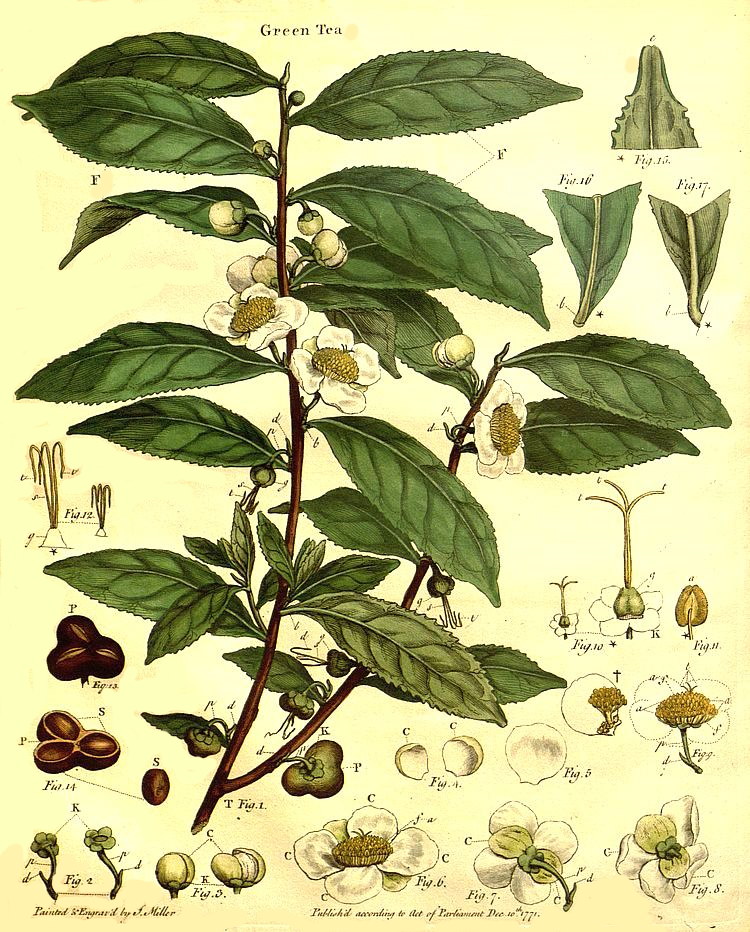 click here for larger image.