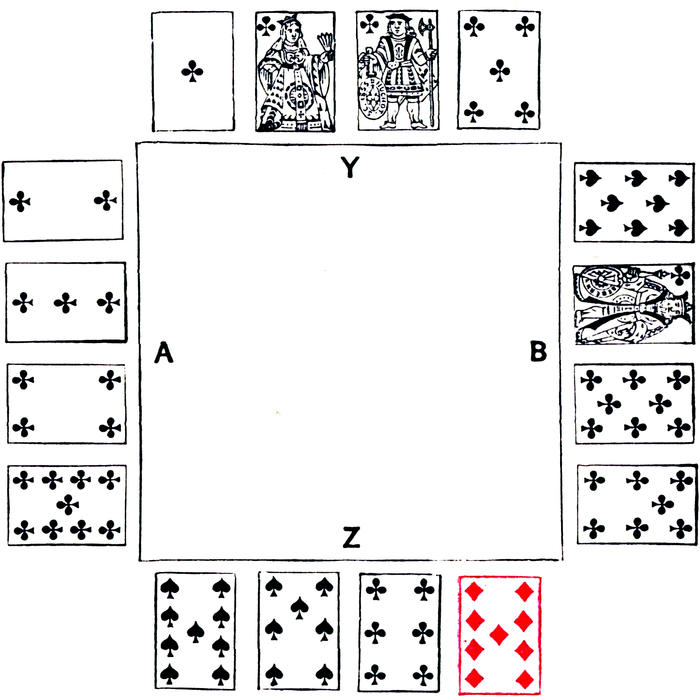
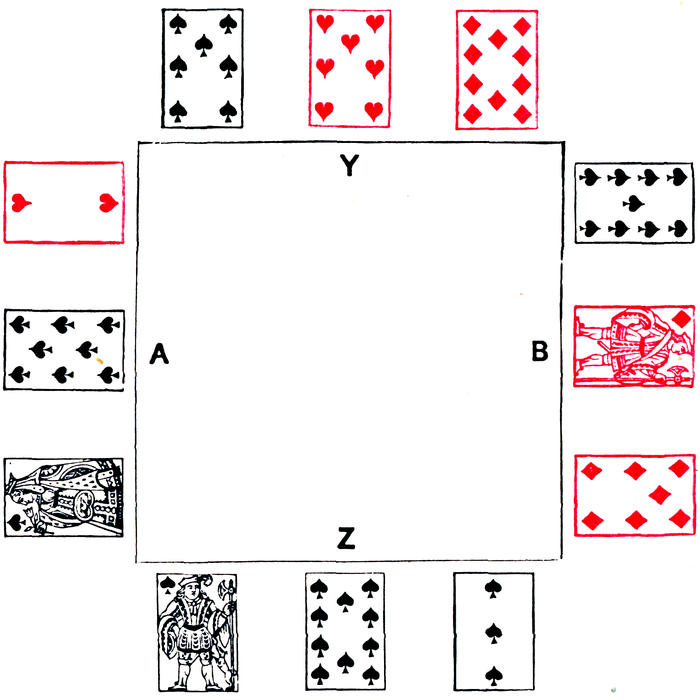
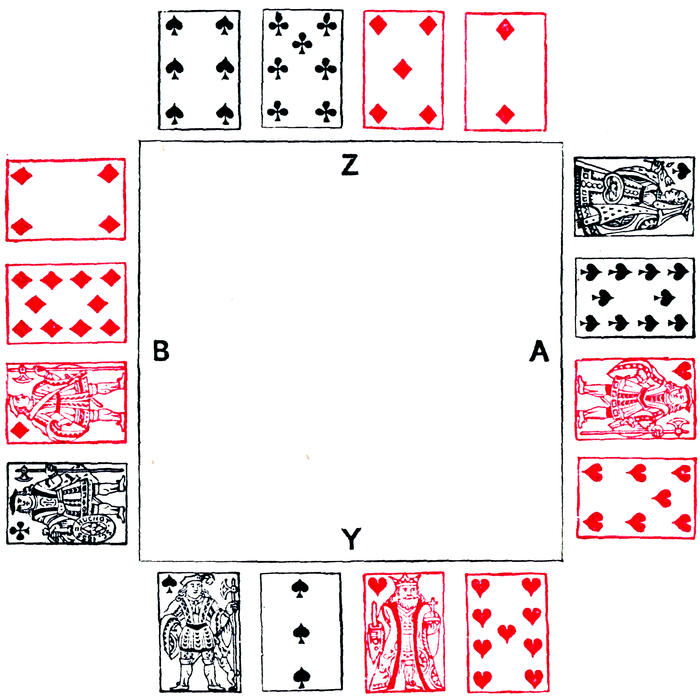
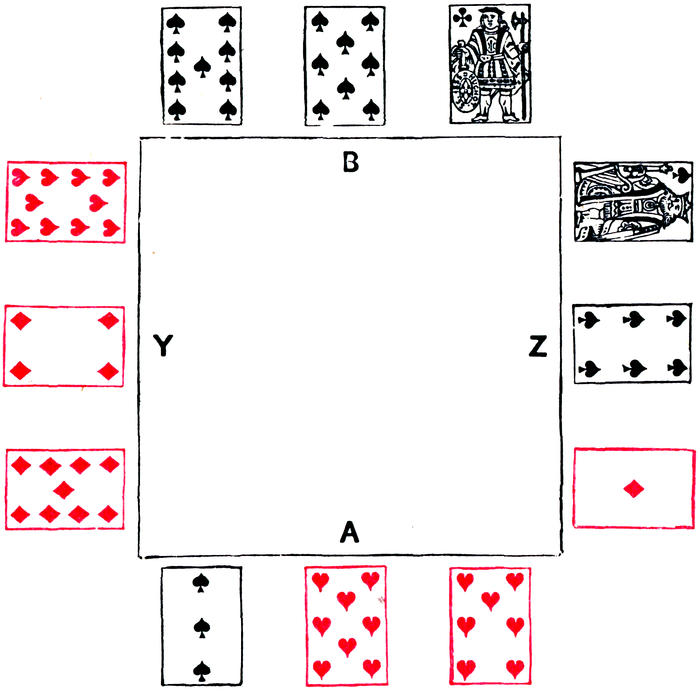
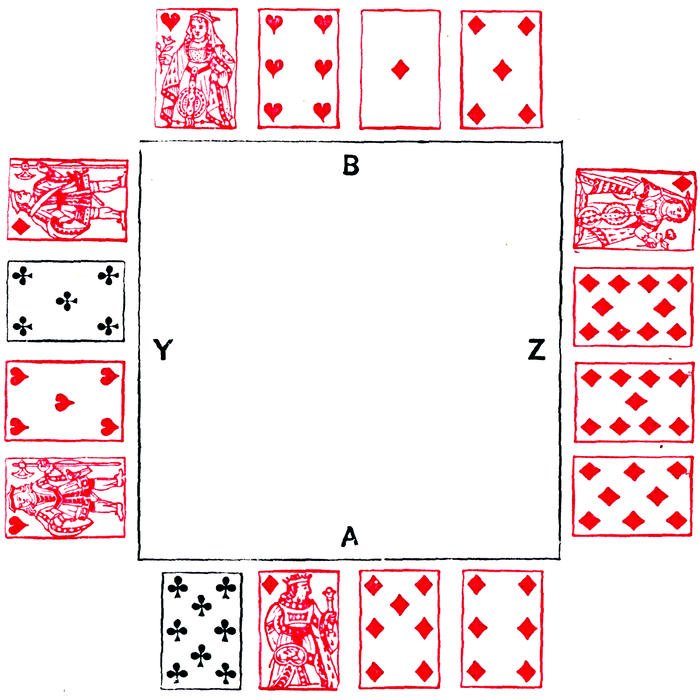
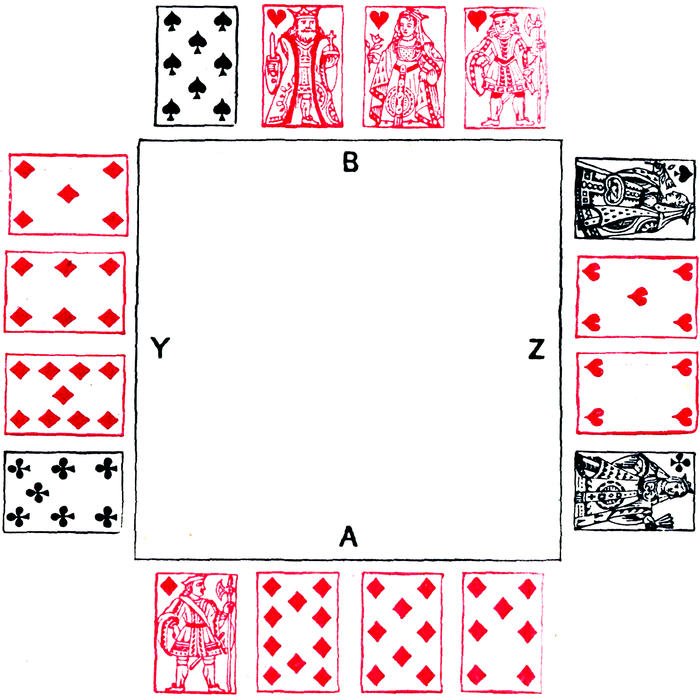
The following hands are given in illustration of the
general principles discussed in Part I. The plan
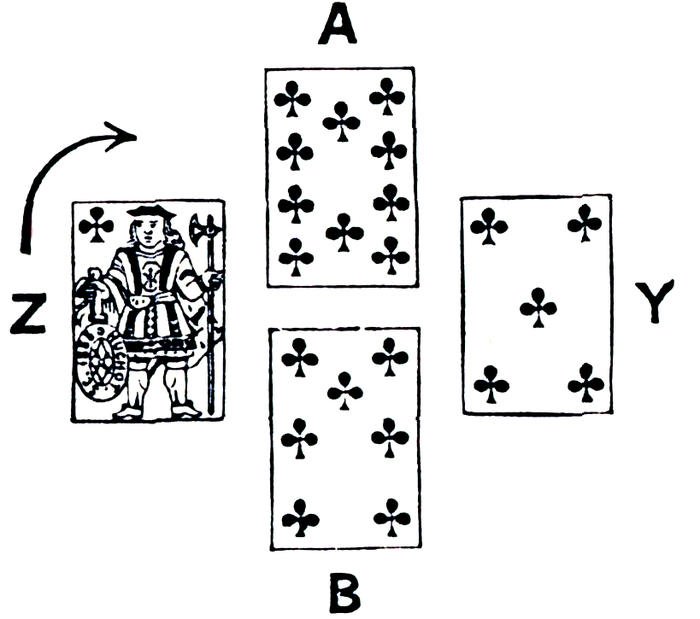
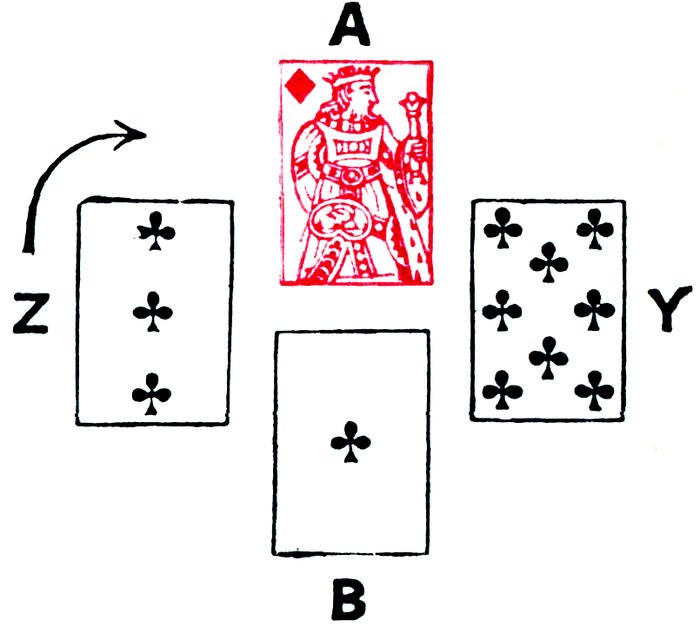
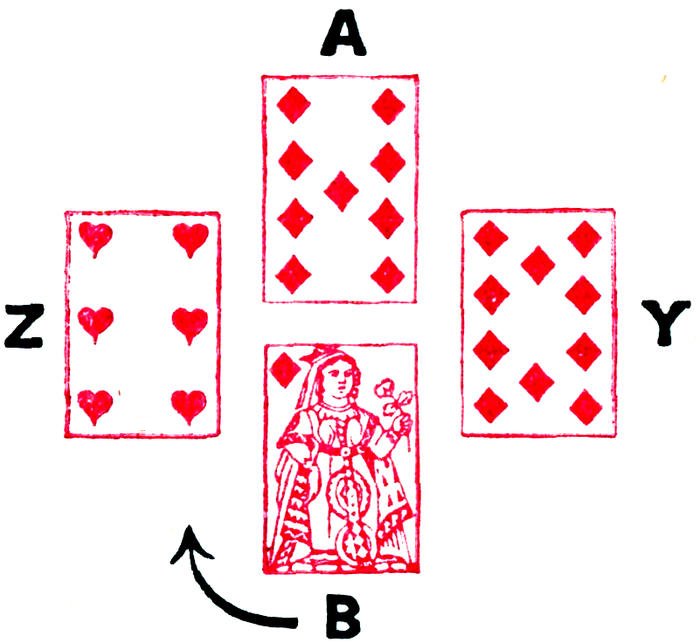
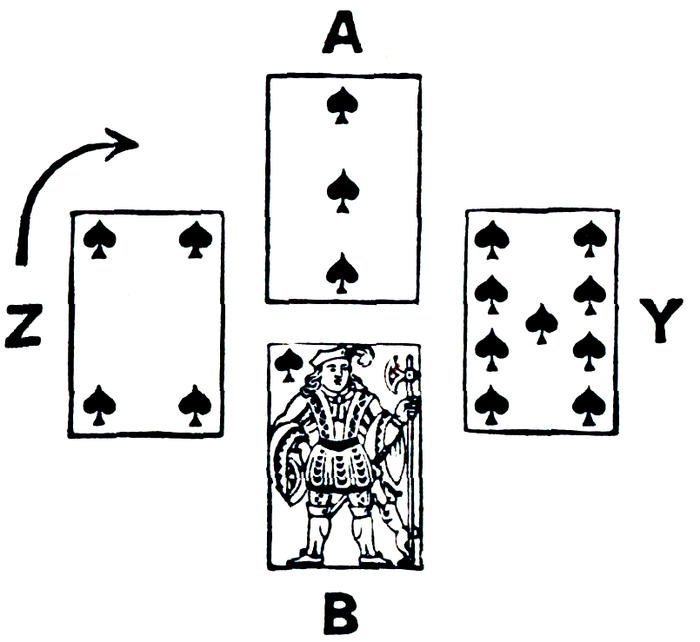
adopted in the arrangement of the hands is to imitate
closely the circumstances of actual play. Thus, at
starting, one player's hand is known, together with
the score and the turn-up card. Each player is then
caused to play a card in his turn, and at the end of
the trick, the one player whose hand is known makes
observations, and draws inferences from the play, as
though he were at the whist table.
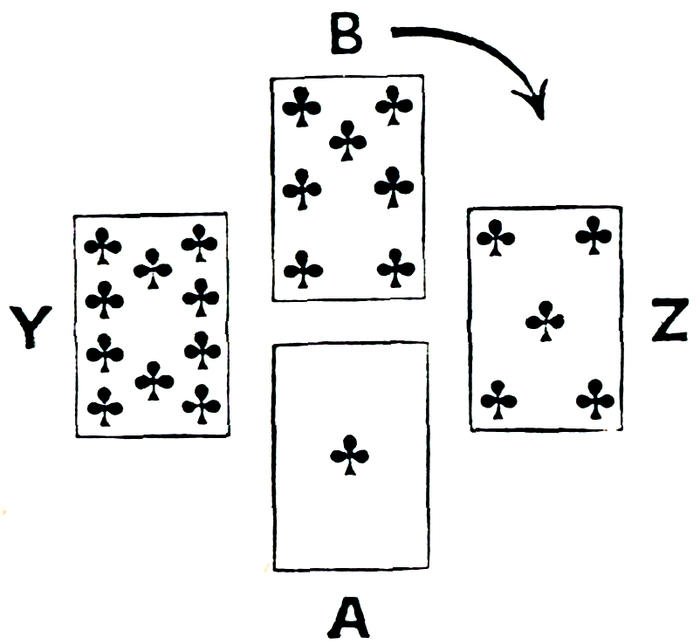
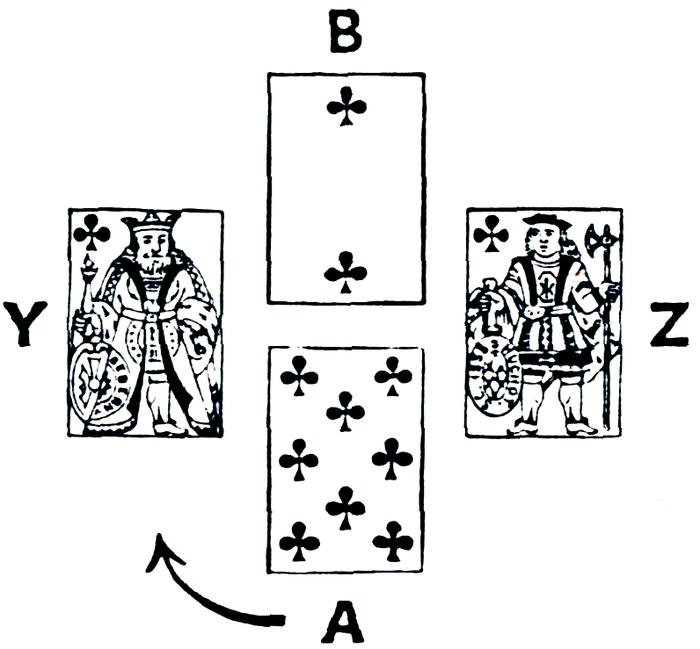
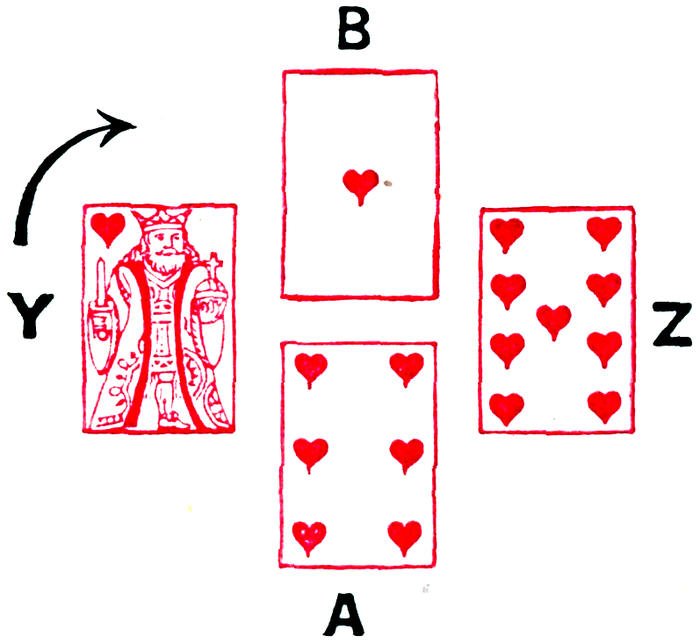
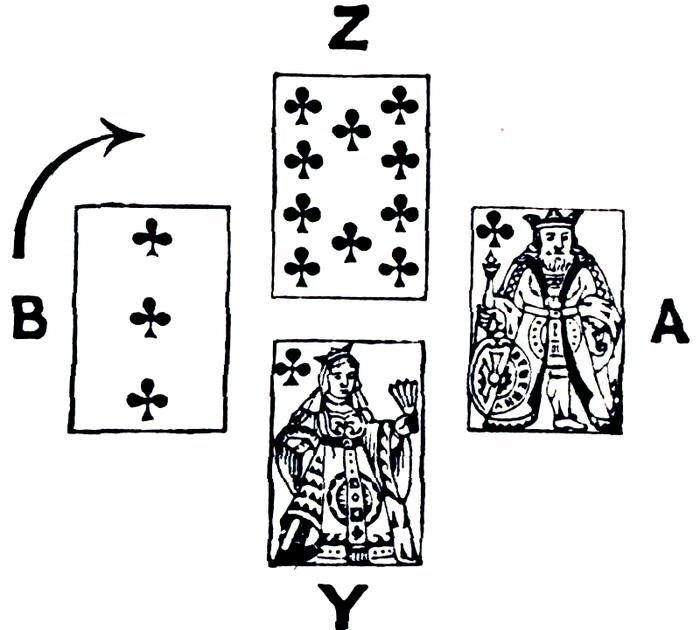
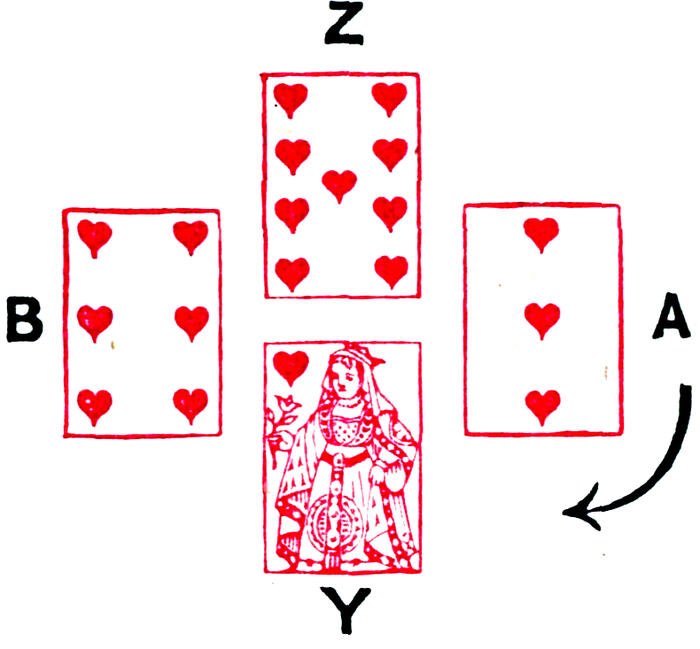
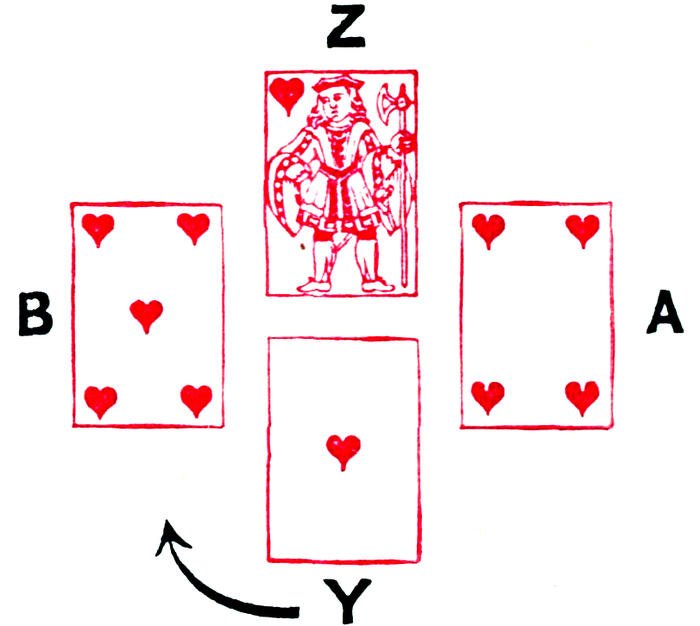
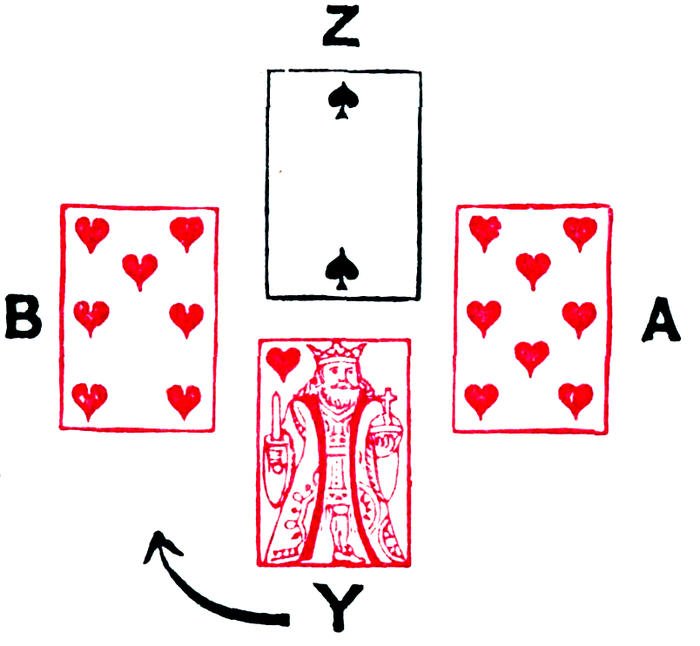
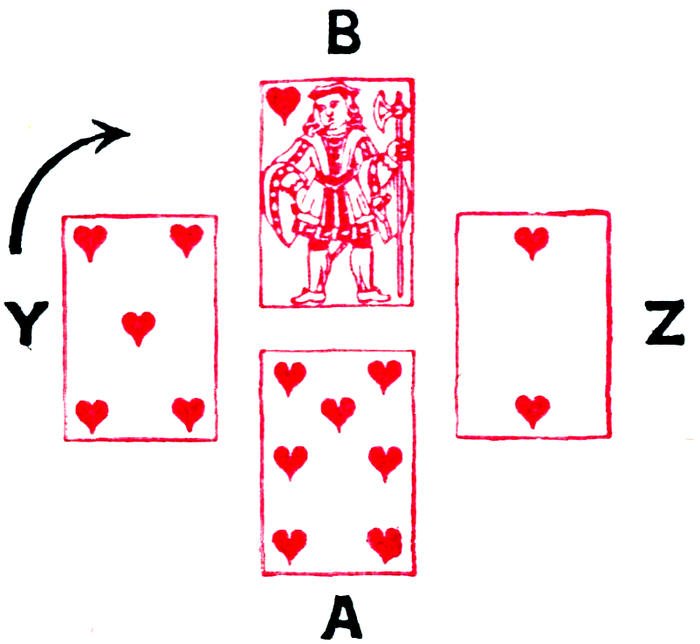
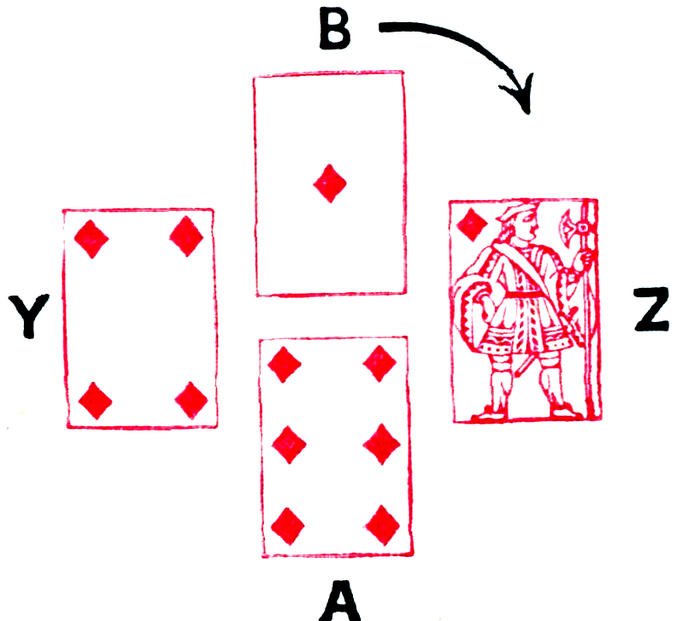
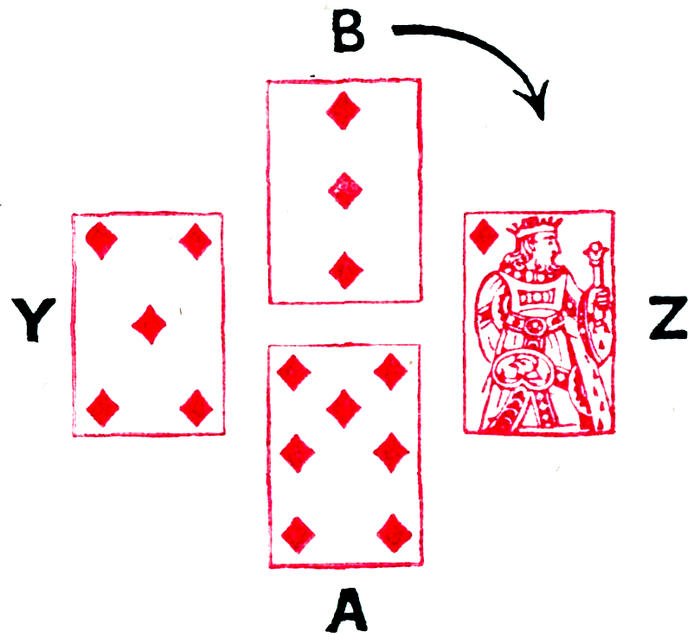
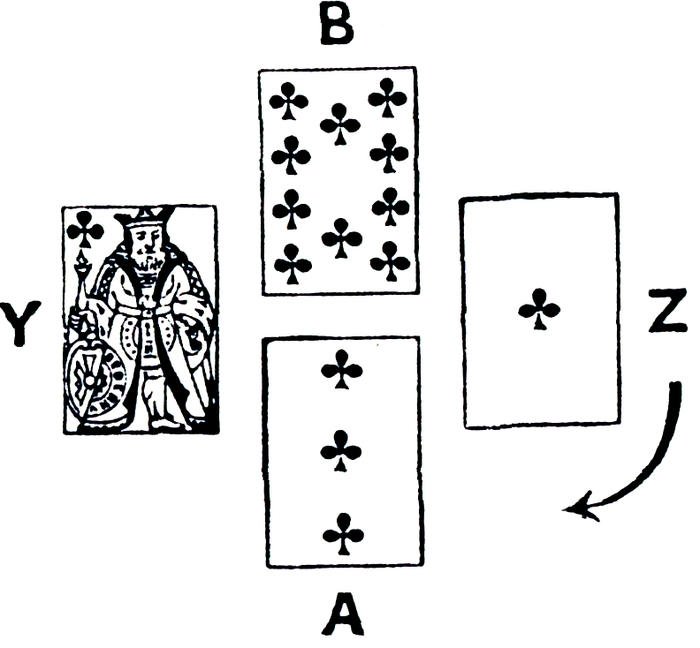
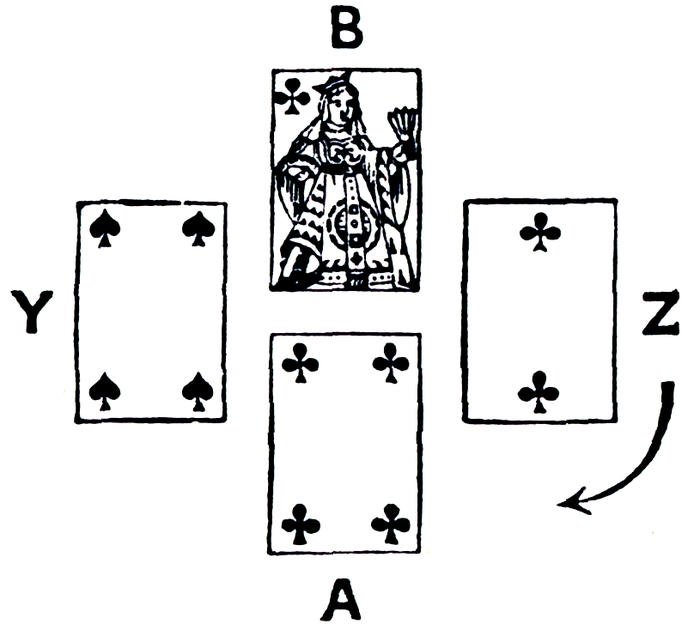
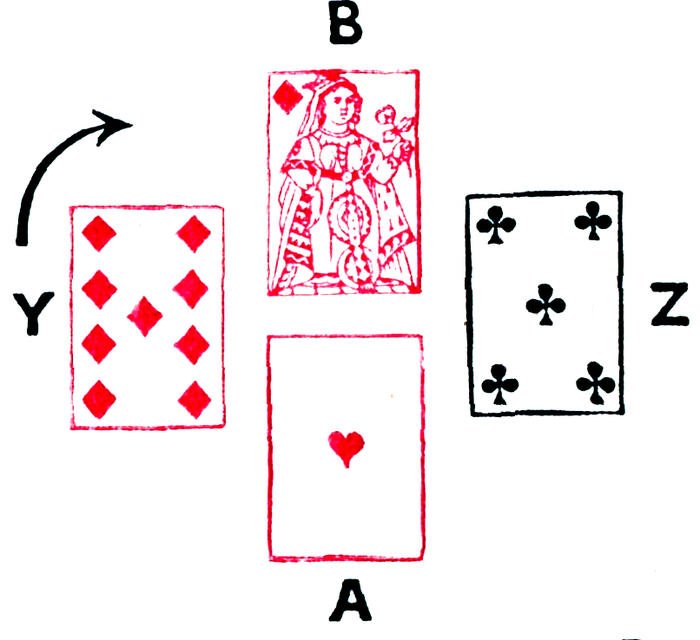
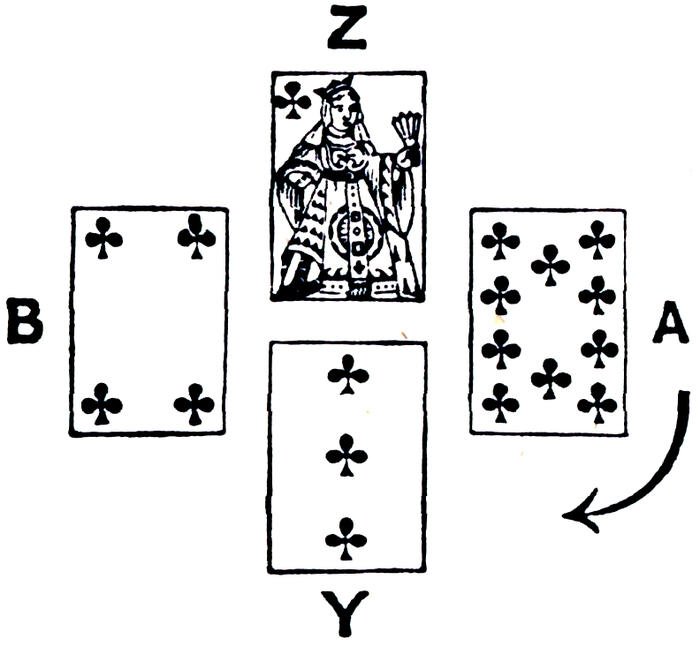
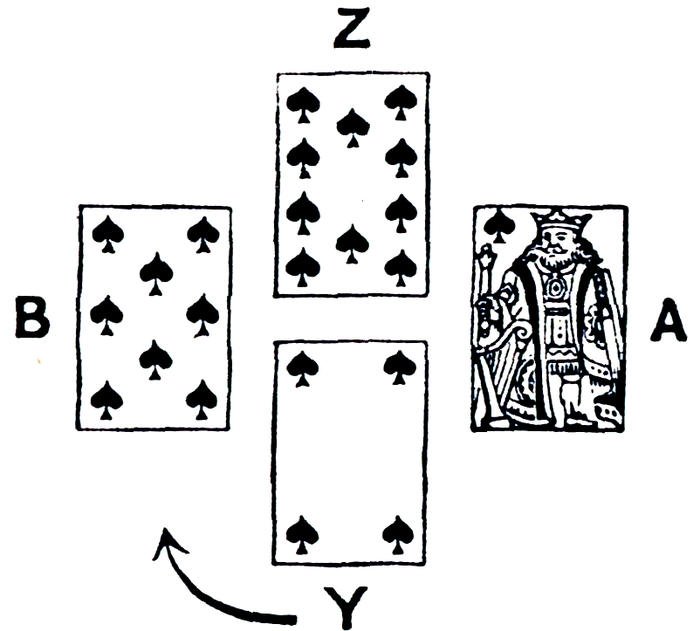
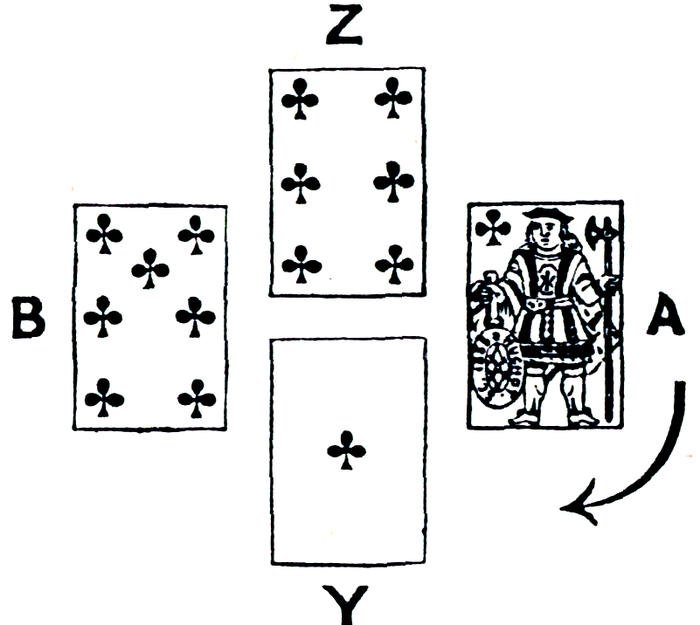
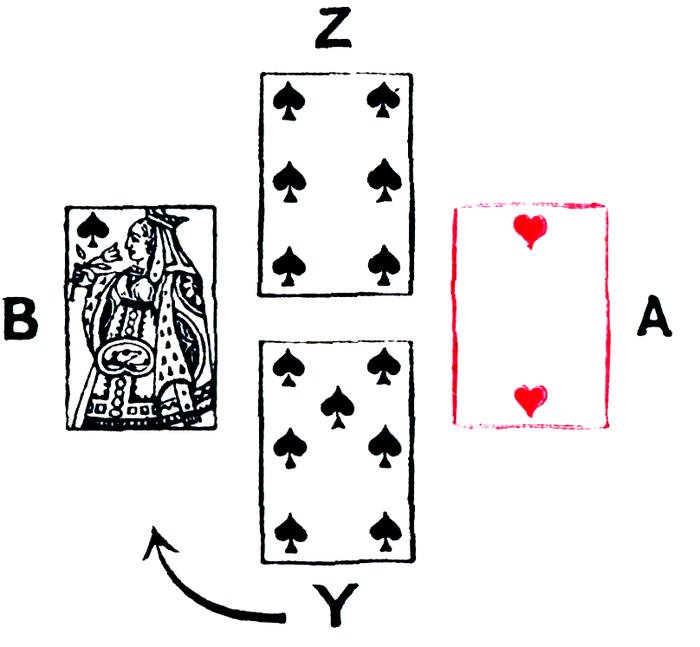
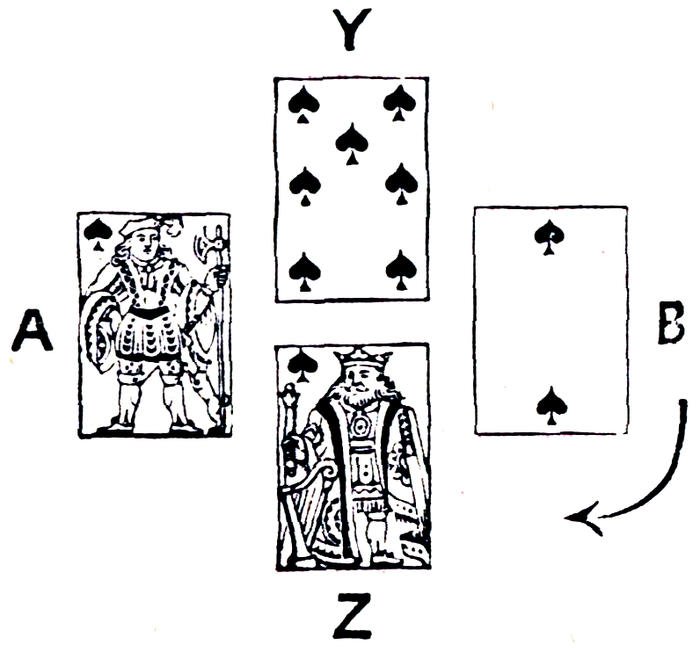
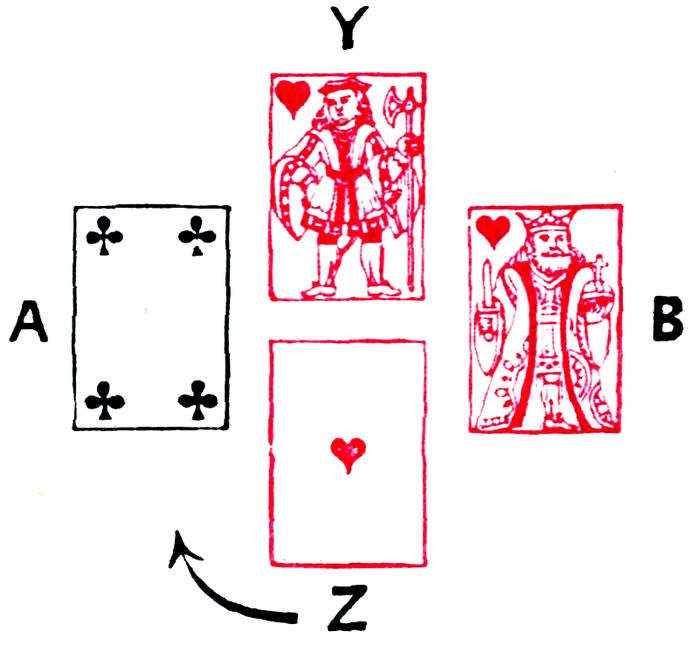
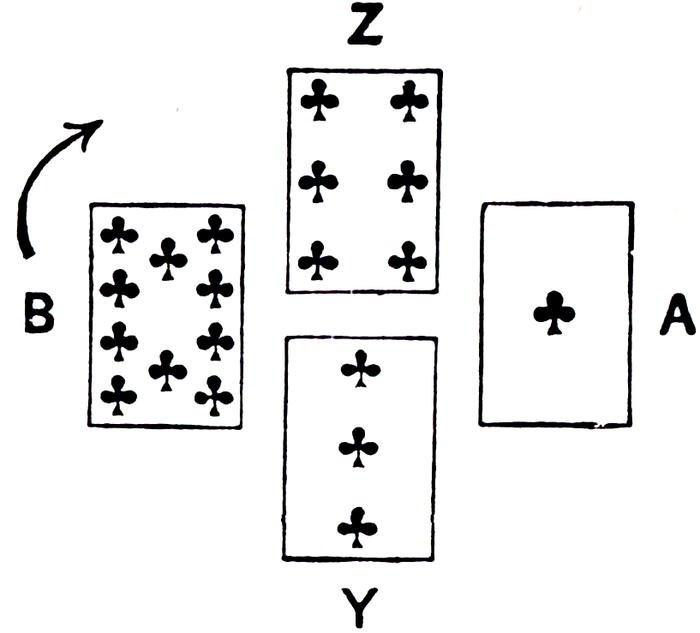
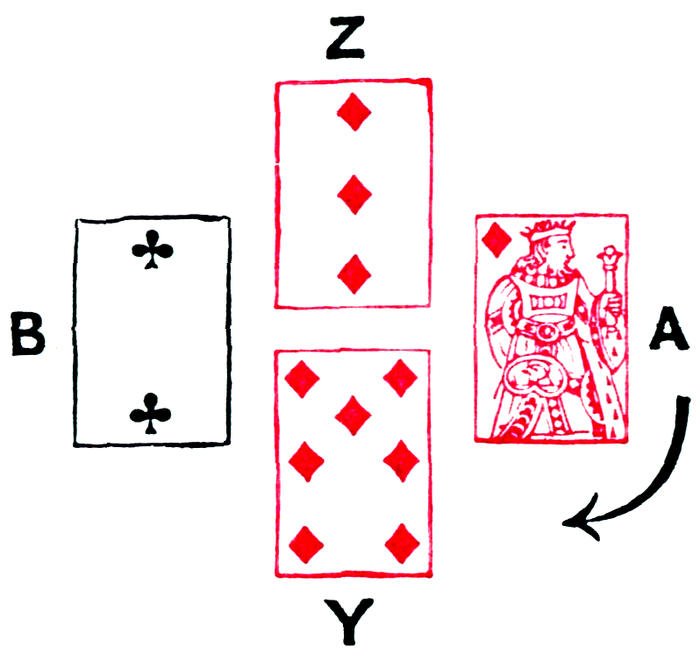
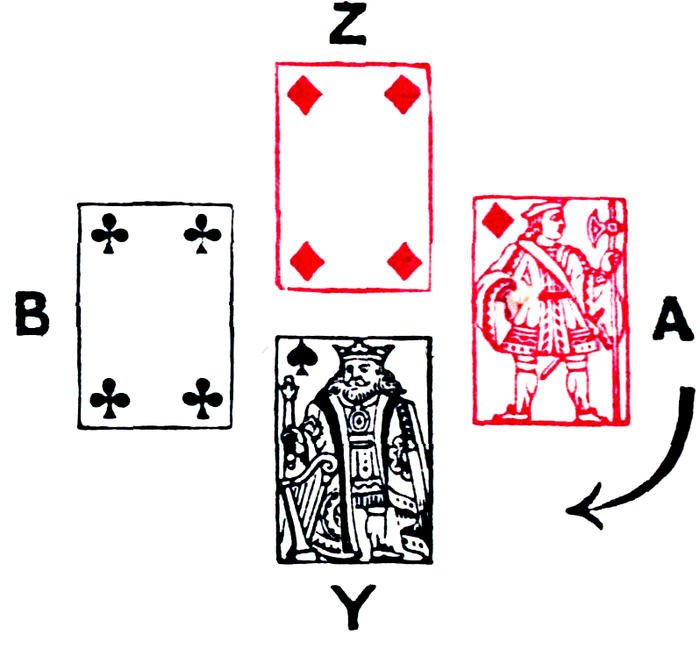
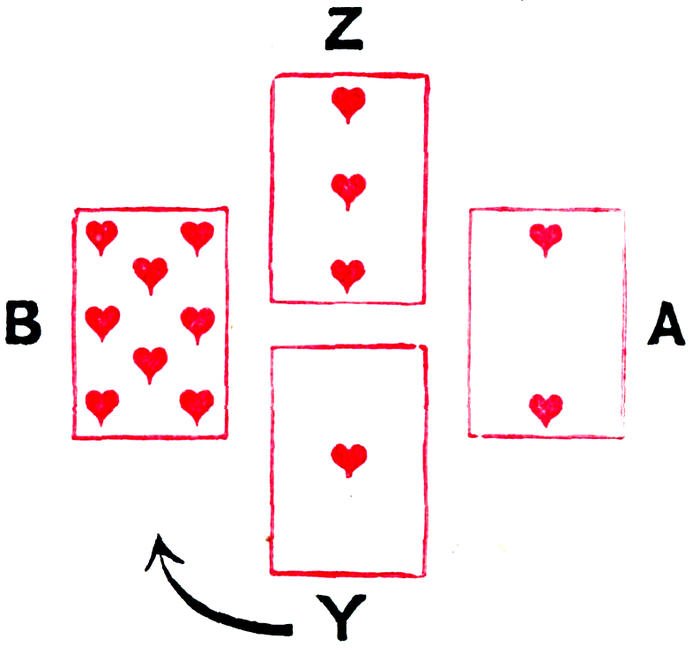
A, Y, B, and Z, are the four players throughout.
They are placed at the table in the above order, A and
B being partners against Y and Z. A is the first
leader, and Z the dealer. In "the play" the cards of
each trick are placed in the order in which the players
sit round the table, the card played by the person
whose hand is under consideration being the one
nearest to the reader. The capital letter by each card
shows to which player it belongs.
All the players are supposed to follow the ordinary
rules of play, as laid down in Part I. Thus, each
player is credited with leading originally from his
strongest suit, and with leading the card of it indicated
in the Analysis of Leads (pp. 64-71); with
playing the lowest of a sequence when not leading;
with returning the highest of a numerically weak
suit, the lowest of a strong suit, and so on.
It has been remarked by critics, that the players
are often made to play badly. Most of the hands
are taken from actual play; but, independently of
this, illustrations of indifferent play, with comments,
are obviously of value, as showing the kind of errors
that are likely to be made, and how and why to avoid
them.
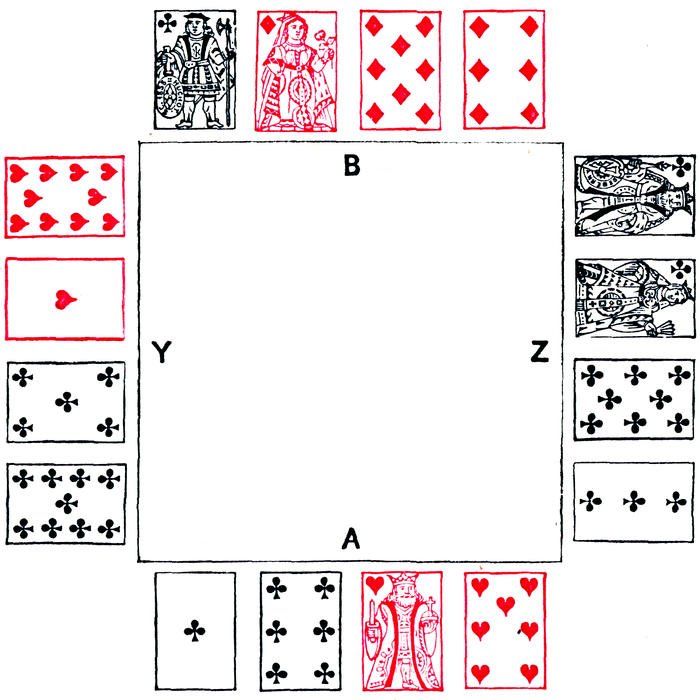
Trump lead from four trumps on establishment of suit.
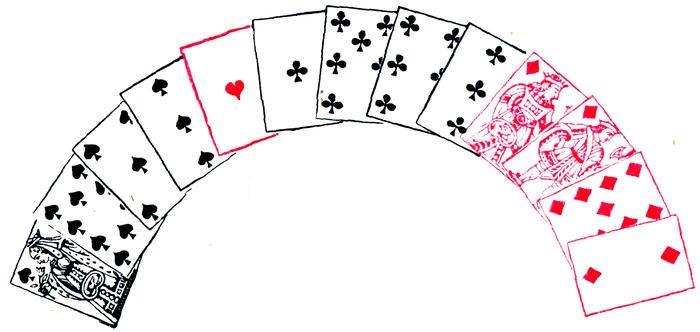
- Qn♠, 10♠, 5♠, 3♠
- A♥
- A♣, 7♣, 6♣, 3♣
- Kg♦, Knv♦, 9♦, 2♦
Score: Love-all.
Two of spades turned up.
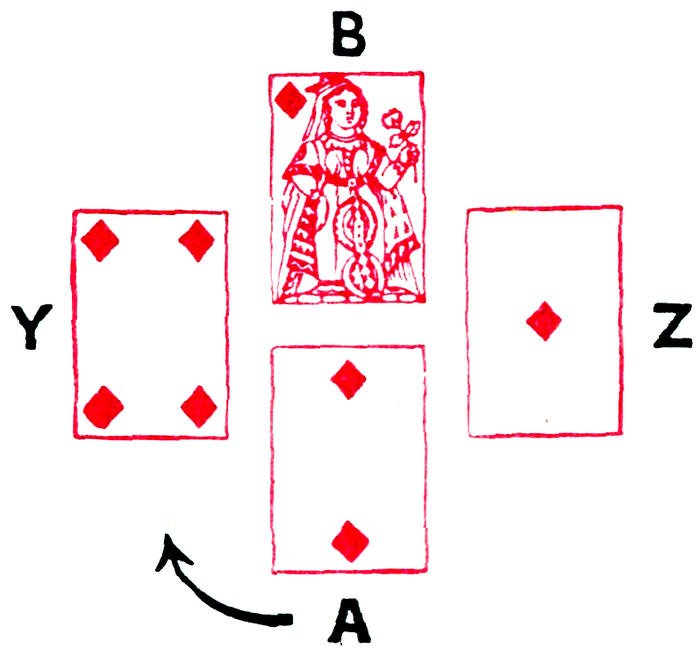
Tricks AB, 0
YZ, 1
1. Y B Z A↷
4♦ Qn♦ A♦ 2♦
Remark.—A leads from
his strongest suit (see p. 56).
Having no sequence, he leads
the lowest card of the suit
(see p. 60).
The fall of the queen and
ace in this round, leaves A
with the winning diamonds and a small one. His suit is
virtually established (see p. 57).
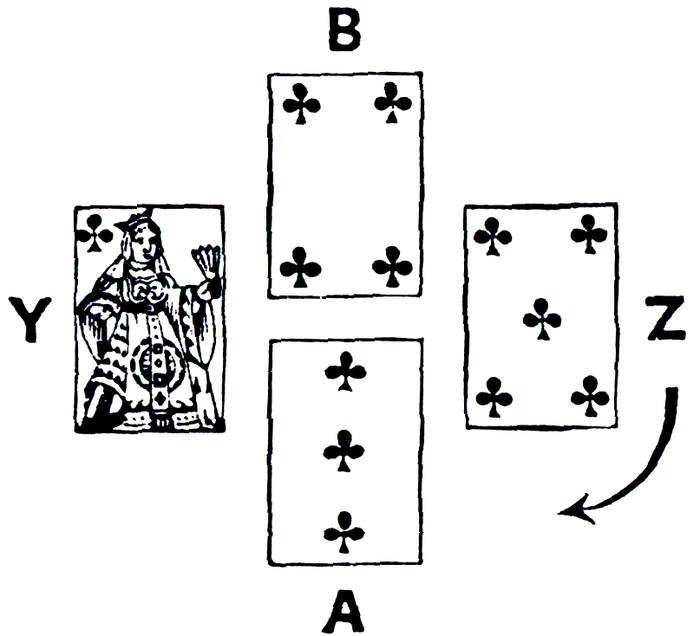
Tricks AB, 0
YZ, 2
2. Y B Z↷ A
Qn♣ 4♣ 5♣ 3♣
Remark.—A plays his
lowest card second hand
(see p. 82).
B allowing the queen to
win, may be presumed not
to have the king.
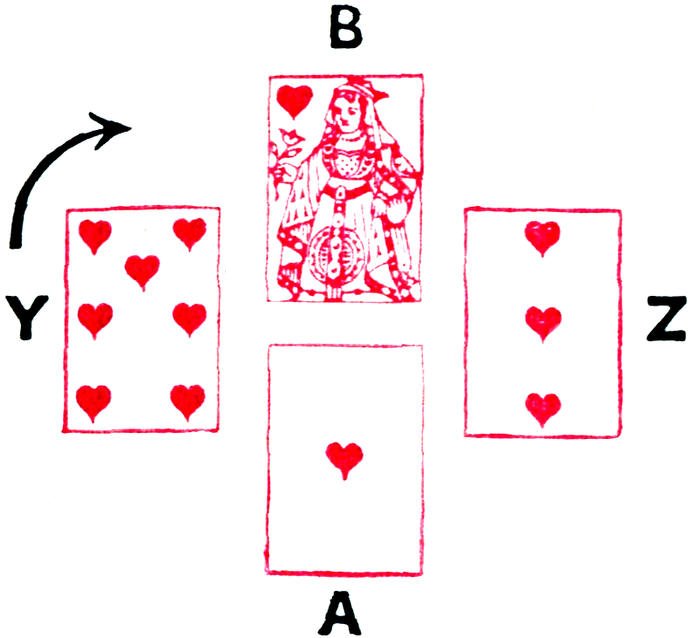
Tricks AB, 1
YZ, 2
3. Y↷ B Z A
7♥ Qn♥ 3♥ A♥
Remark.—It is unlucky
that A is obliged to win his
partner's queen. The king
of hearts is most probably
in B's hand, as it is not
likely that B has only one
heart, and with queen and
small ones B would pass.
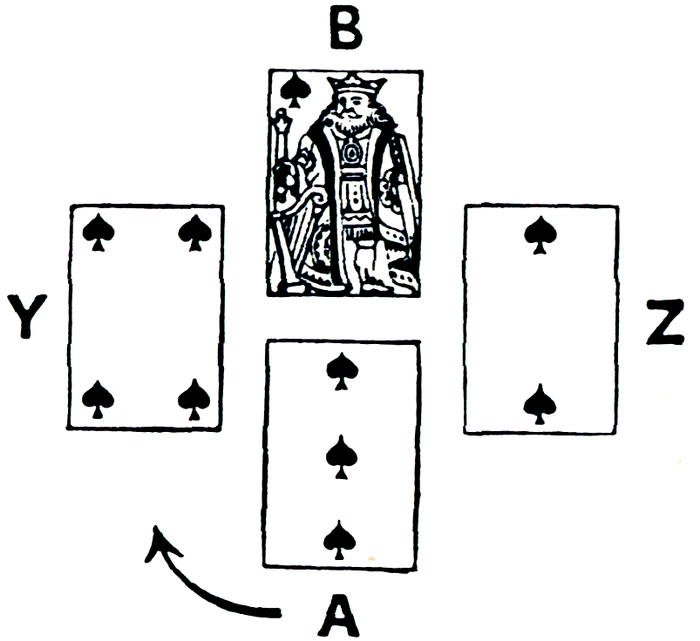
Tricks AB, 2
YZ, 2
4. Y B Z A↷
4♠ Kg♠ 2♠ 3♠
Remark.—This is an instructive
trump lead. A, at
the first start, with but four
trumps, and only one heart,
would not have been justified
in leading a trump.
But, his strong suit being
established, and his partner
having (probably) the best
heart, his game is now to lead trumps. Consider carefully
the Management of Trumps (pp. 119-23), and apply the
arguments there made use of to the present situation.
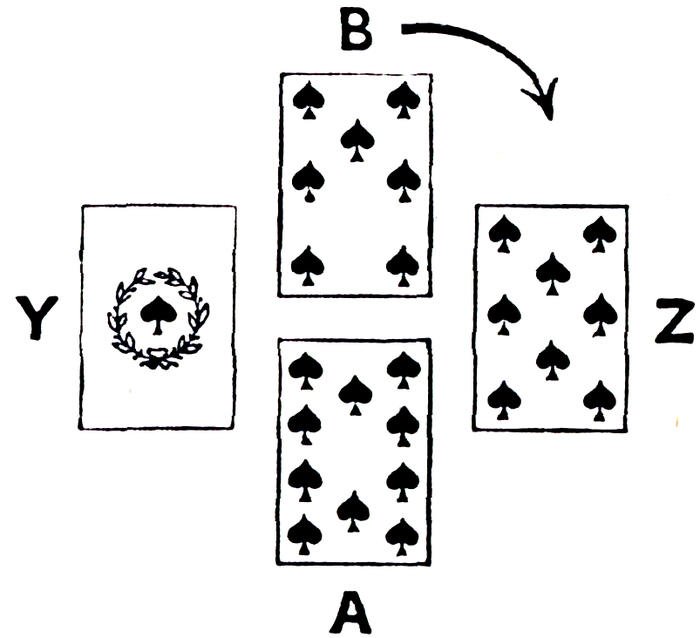
Tricks AB, 2
YZ, 3
5. Y B↷ Z A
A♠ 7♠ 8♠ 10♠
Remark (Trick 5).—A finesses the ten (see pp. 93-94).
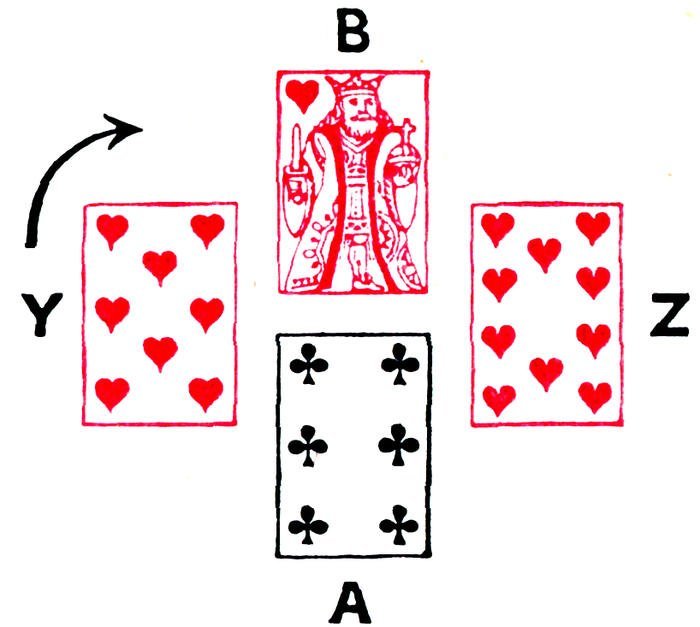
Tricks AB, 3
YZ, 3
6. Y↷ B Z A
8♥ Kg♥ 10♥ 6♣
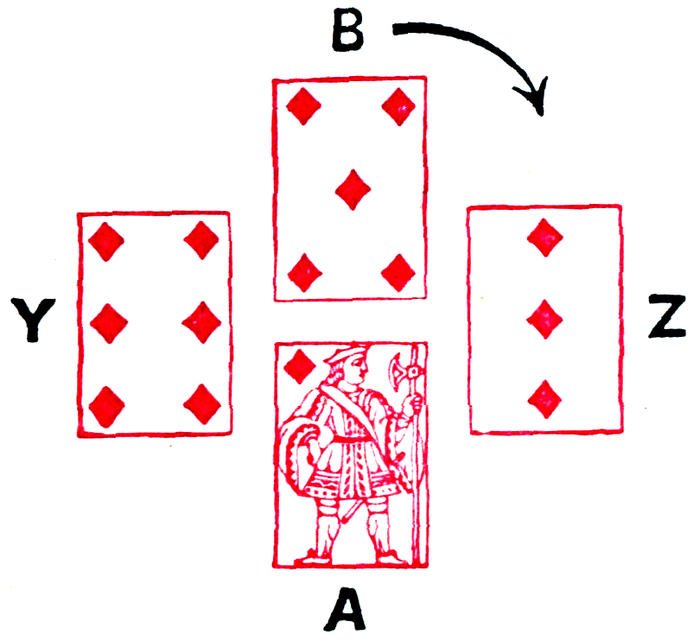
Tricks AB, 4
YZ, 3
7. Y B↷ Z A
6♦ 5♦ 3♦ Knv♦
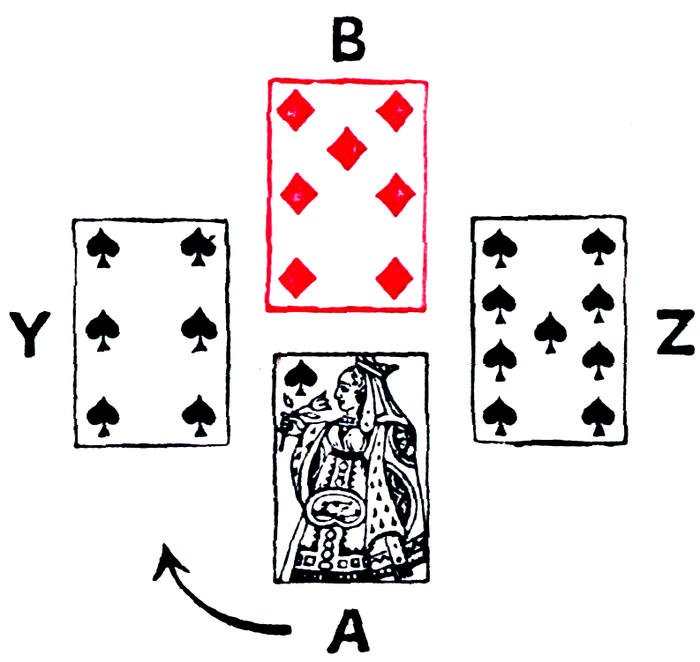
Tricks AB, 5
YZ, 3
8. Y B Z A↷
6♠ 7♦ 9♠ Qn♠
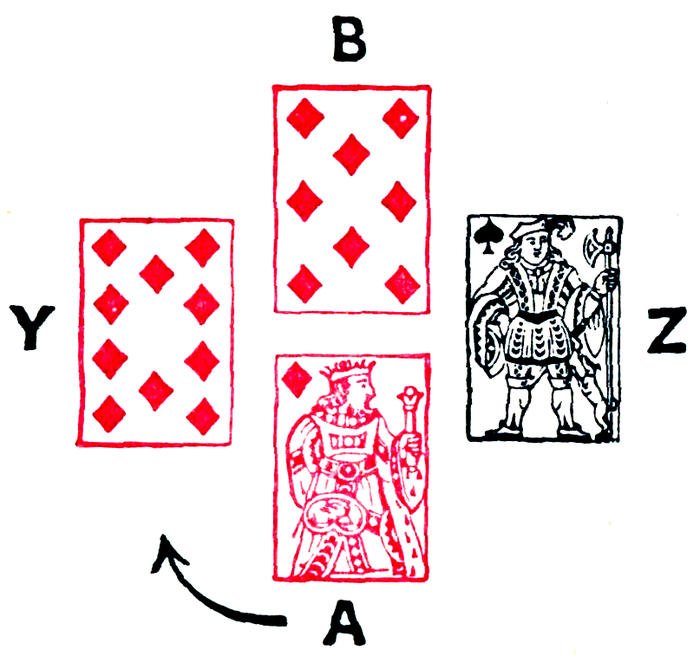
Tricks AB, 5
YZ, 4
9. Y B Z A↷
10♦ 8♦ Knv♠ Kg♦
Remarks.—At Trick 9, A forces the best trump, and
remains with the thirteenth to bring in the diamond. If
Z refuses the force, A (Trick 10) leads nine of diamonds
and (Trick 11) the losing trump.
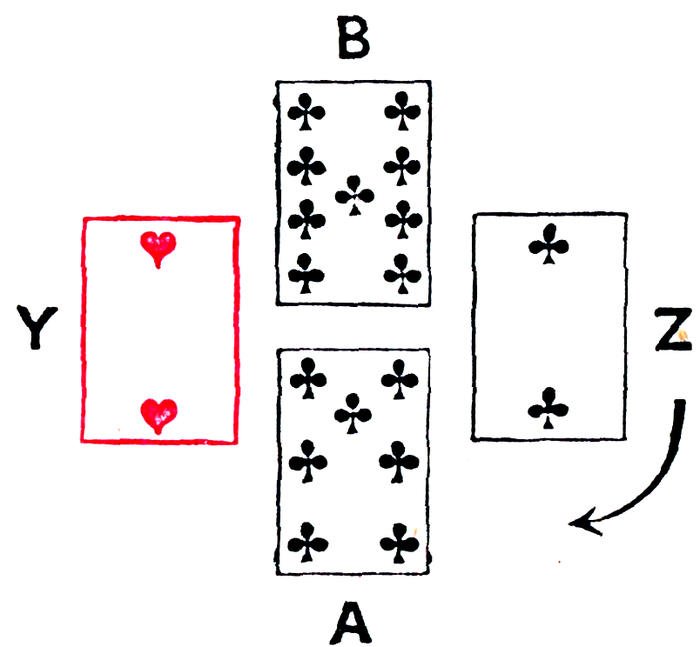
Tricks AB, 6
YZ, 4
10. Y B Z↷ A
2♥ 9♣ 2♣ 7♣
At Trick 10, if A plays ace of clubs he will be left with
a losing club. By passing, he gives B a chance of winning
the trick, and cannot lose even if Y has king of clubs. It
has been suggested that Z's best lead, at Trick 10, is king
of clubs, on the chance of catching ace and knave; but
Z's play is not under examination.
Tricks 11 to 13.—Whatever B leads, A makes the
remaining tricks, and
AB win three by cards.
(A's hand is given above.)
| Y's Hand. |
B's Hand. |
Z's Hand. |
| Ace, 6, 4 |
♠ |
Kg, 7 |
♠ |
Knv, 9, 8, 2 |
♠ |
| Knv, 9, 8, 7, 4, 2 |
♥ |
Kg, Qn, 6, 5 |
♥ |
10, 3 |
♥ |
| Qn |
♣ |
Knv, 9, 4 |
♣ |
Kg, 10, 8, 5, 2 |
♣ |
| 10, 6, 4 |
♦ |
Qn, 8, 7, 5 |
♦ |
Ace, 3 |
♦ |
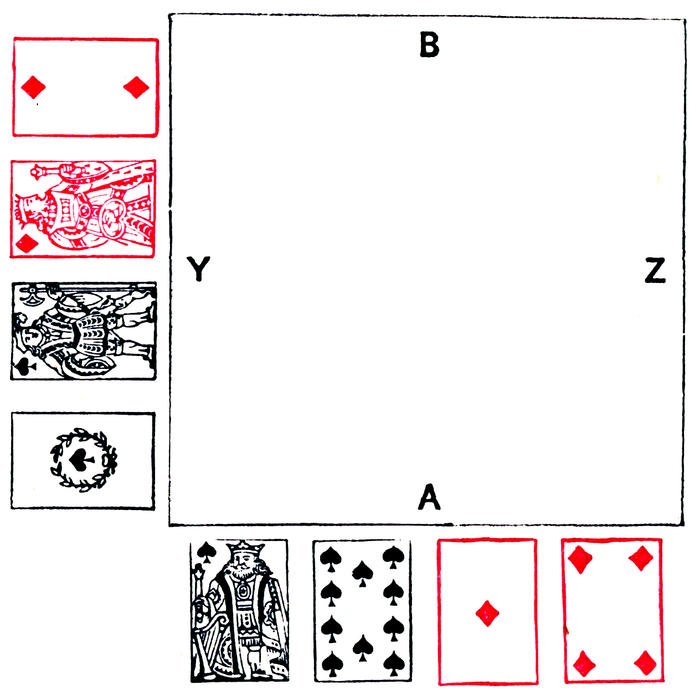
Trump lead from four moderate trumps.
- Knv♠, 10♠, 7♠, 5♠
- Kg♥, 6♥
- A♣, 8♣, 6♣
- A♦, 10♦, 9♦, 2♦
Score: Love-all.
Two of spades turned up.
Tricks AB, 1
YZ, 0
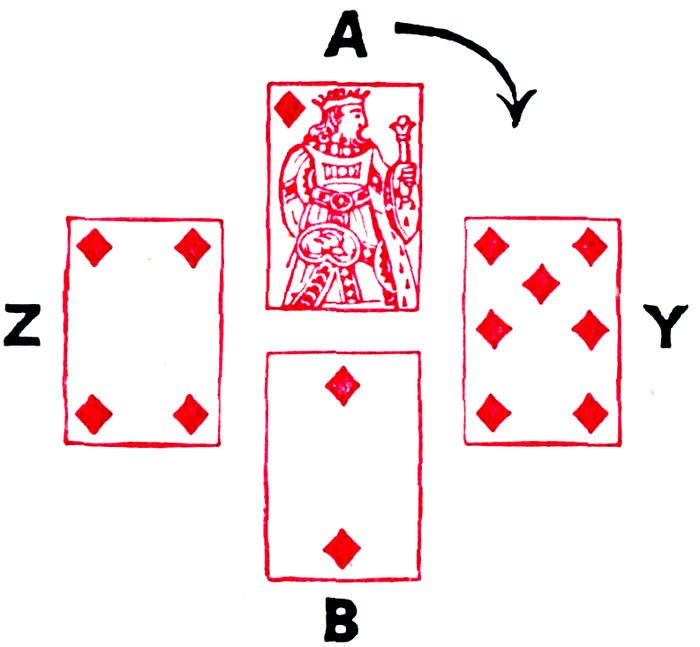
1. Z A↷ Y B
4♦ Kg♦ 7♦ 2♦
Tricks AB, 2
YZ, 0
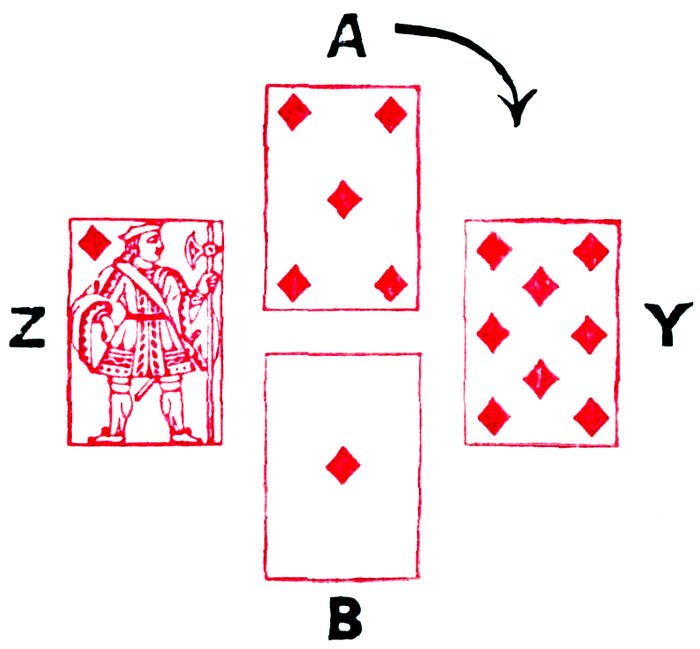
2. Z A↷ Y B
Knv♦ 5♦ 8♦ A♦
Tricks AB, 2
YZ, 1
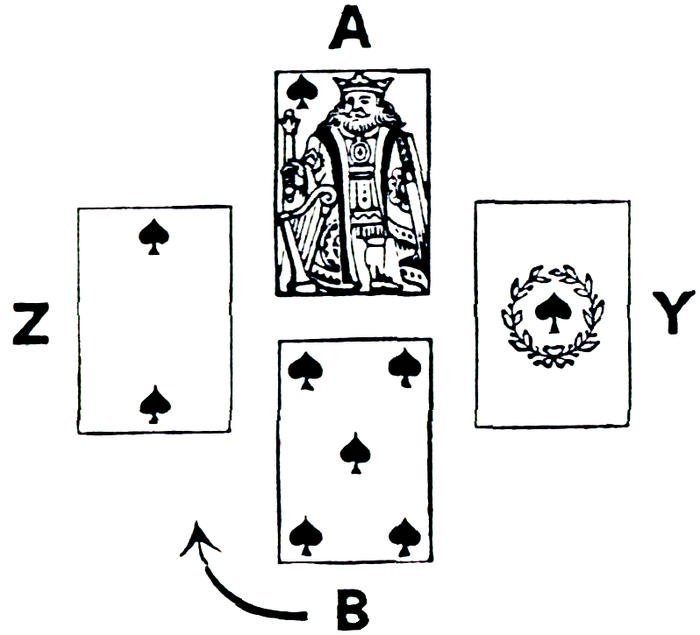
3. Z A Y B↷
2♠ Kg♠ A♠ 5♠
Remark (Trick 3).—B has four trumps, and defence in
hearts and clubs, his partner's suit is established, and no
adverse strength in trumps has been exhibited. B therefore
leads trumps. (Consider carefully the arguments at
pp. 122, 123, respecting leads from four trumps, and apply
them to this case.) To judge when to lead from four
moderate trumps is an important point in the game,
which hands such as this are given to illustrate and
explain.
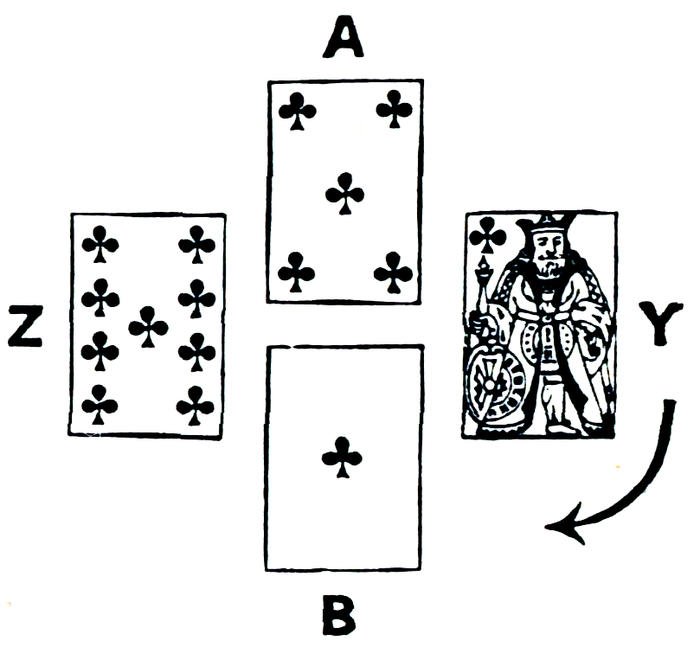
Tricks AB, 3
YZ, 1
4. Z A Y↷ B
9♣ 5♣ Kg♣ A♣
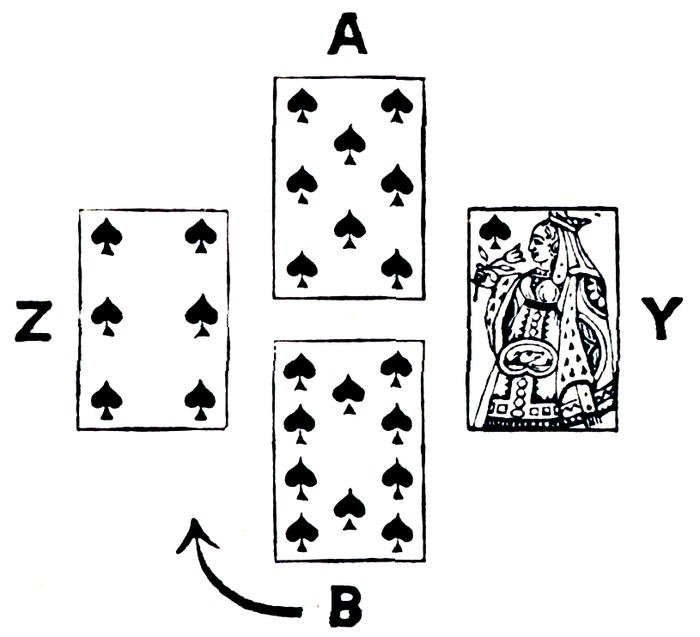
Tricks AB, 3
YZ, 2
5. Z A Y B↷
6♠ 8♠ Qn♠ 10♠
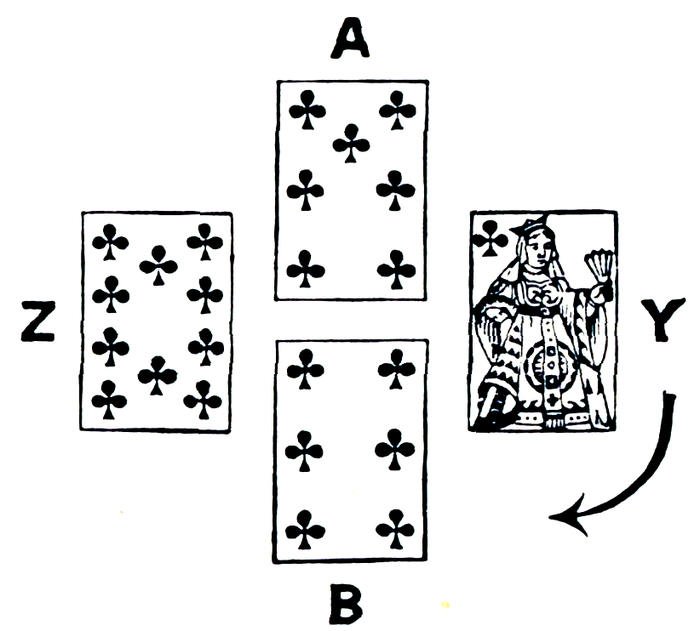
Tricks AB, 3
YZ, 3
6. Z A Y↷ B
10♣ 7♣ Qn♣ 6♣
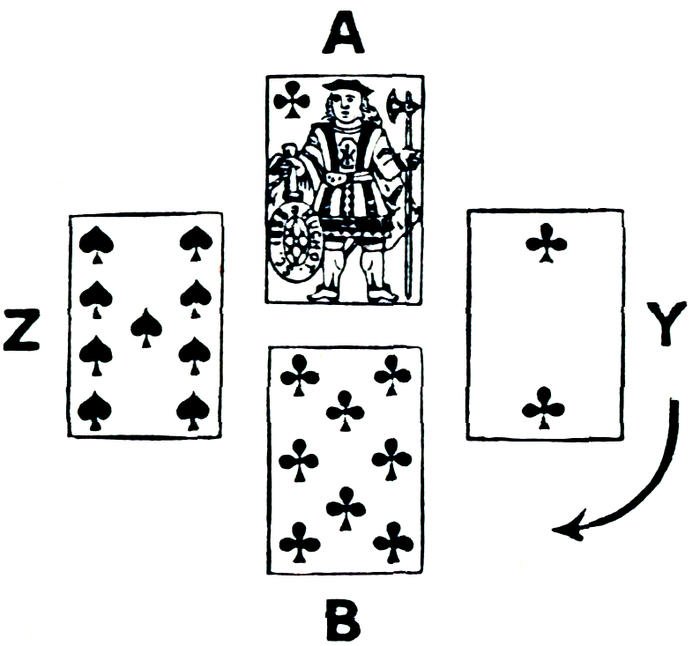
Tricks AB, 3
YZ, 4
7. Z A Y↷ B
9♠ Knv♣ 2♣ 8♣
Tricks AB, 3
YZ, 5
8. Z↷ A Y B
A♥ 2♥ 7♥ 6♥
Tricks 9 to 13.—Z leads knave of hearts which B wins.
B draws the two trumps (if he remembers down to the
seven) and brings in the diamonds, and
AB win two by cards.
(B's hand is given above.)
| A's Hand. |
Y's Hand. |
Z's Hand. |
| Kg, 8 |
♠ |
Ace, Qn, 4, 3 |
♠ |
9, 6, 2 |
♠ |
| 5, 3, 2 |
♥ |
10, 7 |
♥ |
Ace, Qn, Knv, 9, 8, 4 |
♥ |
| Knv, 7, 5 |
♣ |
Kg, Qn, 4, 3, 2 |
♣ |
10, 9 |
♣ |
| Kg, Qn, 6, 5, 3 |
♦ |
8, 7 |
♦ |
Knv, 4 |
♦ |
At Trick 2, A leads his original fourth-best diamond
(see Appendix A). In this hand it is immaterial whether
A makes the American lead or not.
A simple elementary hand, save in one point which
demands strict attention to the rule respecting returned
leads (see pp. 79-81).
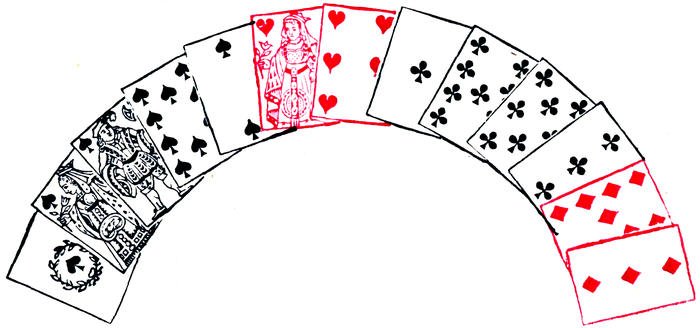
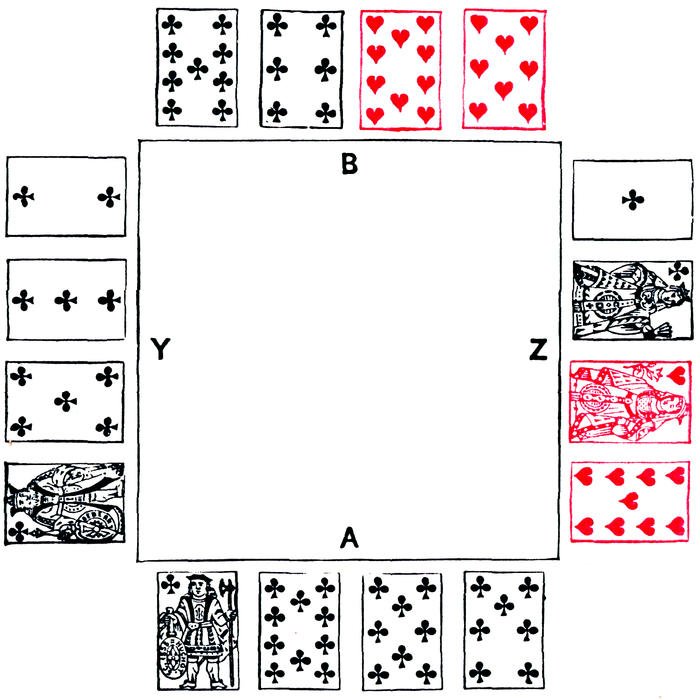
- A♠, Qn♠, Knv♠, 10♠, 2♠
- Qn♥, 6♥
- A♣, 9♣, 8♣, 3♣
- 9♦, 3♦
Score: AB, 2; YZ, Love.
Knave of clubs turned up.
Tricks AB, 1
YZ, 0
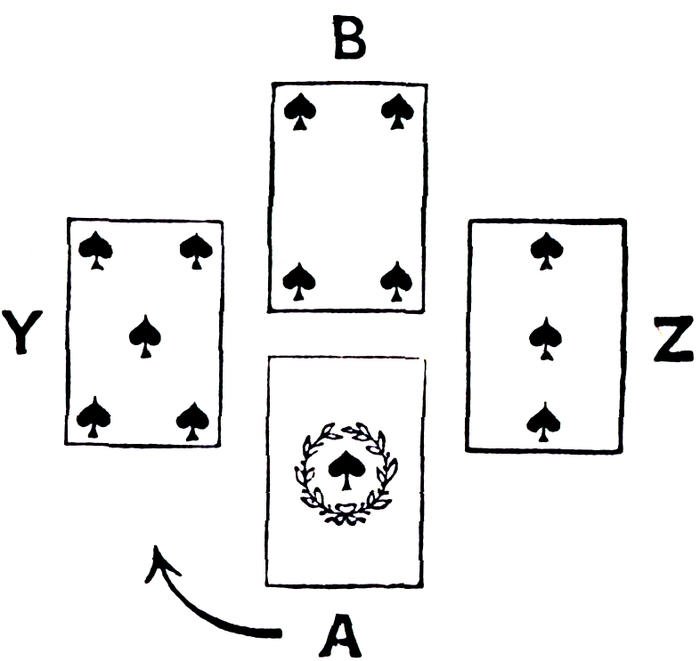
1. Y B Z A↷
5♠ 4♠ 3♠ A♠
Remark.—A leads from
his strongest suit (see p. 66).
Holding ace, queen, knave,
ten, he leads out ace and ten
(see Analysis of Leads, p. 66).
Tricks AB, 1
YZ, 1
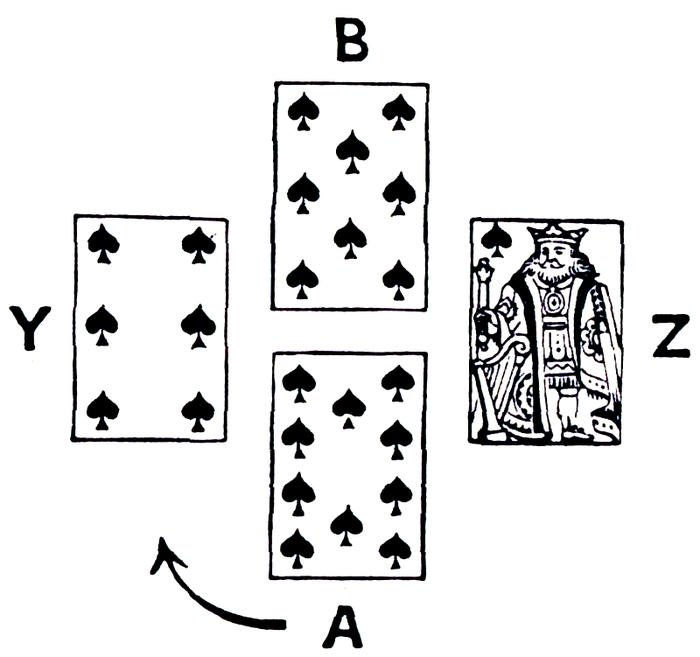
2. Y B Z A↷
6♠ 8♠ Kg♠ 10♠
Remark.—A continues
his suit (see p. 74).
As the cards happen to
lie A would have been able
to make a successful finesse
against the king of spades.
But A, not having seen Z's hand, can only play on general
principles.
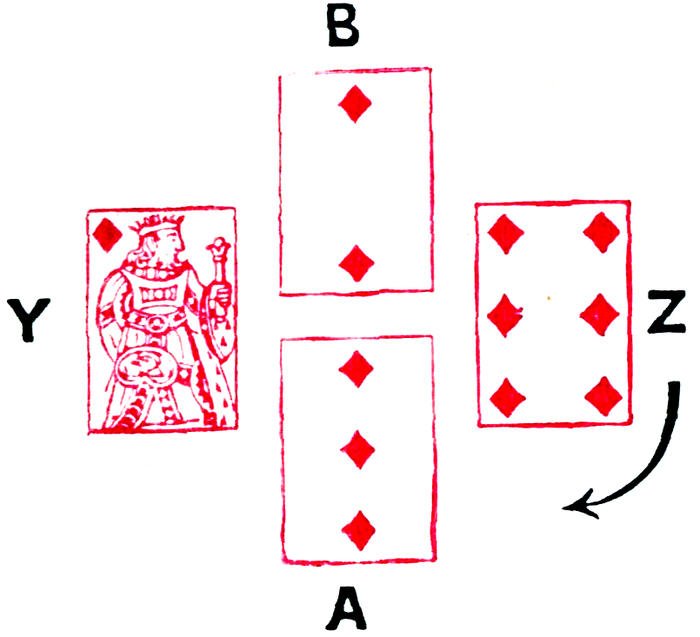
Tricks AB, 1
YZ, 2
3. Y B Z↷ A
Kg♦ 2♦ 6♦ 3♦
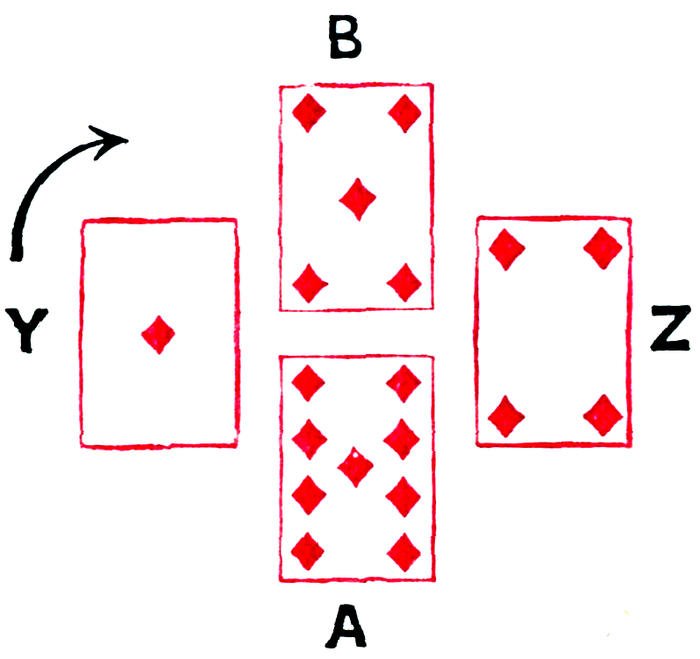
Tricks AB, 1
YZ, 3
4. Y↷ B Z A
A♦ 5♦ 4♦ 9♦
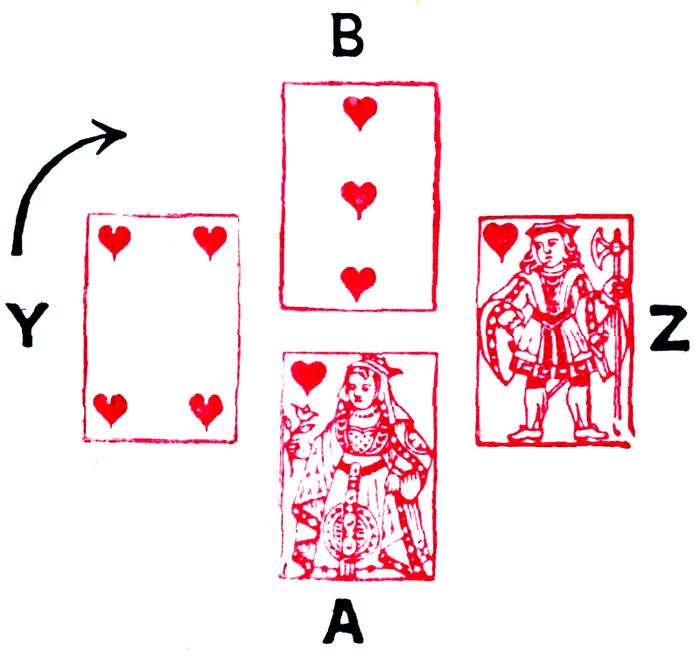
Tricks AB, 2
YZ, 3
5. Y↷ B Z A
4♥ 3♥ Knv♥ Qn♥
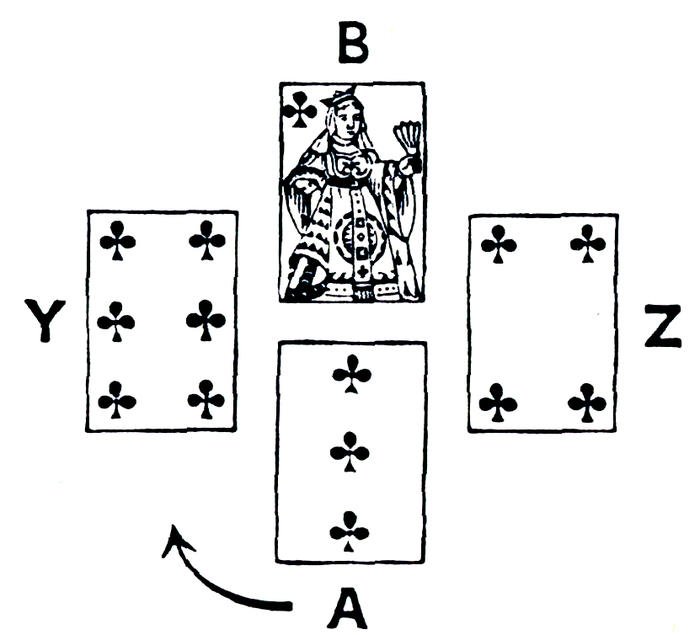
Tricks AB, 3
YZ, 3
6. Y B Z A↷
6♣ Qn♣ 4♣ 3♣
Remark (Trick 6).—A has now the command of his
suit, and four trumps. The adversaries have not shown
any particular strength in trumps, either by leading them
or by calling for them, though they have had the opportunity
of doing both, and A therefore assumes that the
trumps are pretty evenly divided, and leads a trump (see
pp. 122, 123). A is not deterred from opening the trump
suit because an honour was turned up (see p. 122).
B's winning the trick with the queen shows that Z has
not got the king.
Tricks AB, 4
YZ, 3
7. Y B↷ Z A
10♣ 7♣ 5♣ A♣
Remark (Trick 7).—B returns his partner's lead of
trumps (see p. 125).
This is the important trick of the hand. Note the card
returned by B, the seven, and if in doubt as to the fall of
the trumps, look at the previous trick (see Law 91, p. 18).
In that trick, the small clubs that fall are the three, six,
and four, and in the present one, the seven, five, and ten.
Nobody having played the two, A may place it by inference
in B's hand, for the adversaries not winning the trick may
be supposed to play their lowest cards. Assuming B to
hold the two, it may be inferred that he has that card and
no other left in the suit. For he returns the seven, a
higher card than the two; and the rule is to return the
higher of two remaining cards, the lowest if holding more
than two (see p. 80. Consider carefully the example given
there, and apply it to the present situation).
The king and knave are therefore in the opponents'
hands, and divided. Z has the knave (which he turned
up), and he has not the king, as he could not win the
queen in the previous trick. Y must consequently hold it.
It may be objected that this train of reasoning is too
close and elaborate to serve the purpose of inexperienced
players. It is, perhaps, a little difficult for an elementary
hand; but the careful observance of the rule of play
respecting returned leads is so important, that it has been
deemed advisable to insist strongly upon it. Of course,
when playing with those who do not attend to the conversation
of the game, all pains bestowed on working out
the position of the cards from such data as the preceding
is so much trouble thrown away.
Tricks AB, 4
YZ, 4
8. Y B Z A↷
Kg♣ 2♣ Knv♣ 8♣
Assuming, then, that A's partner can be depended on
to play according to rule, it is morally certain that the
trumps are evenly divided, and that a third round will
leave A with a long trump to bring in his spades.
Accordingly, A leads the eight of clubs (see Trick 8,
above).
Tricks AB, 5
YZ, 4
9. Y↷ B Z A
Kg♥ A♥ 9♥ 6♥
Tricks 10 to 13.—B (Trick
10) leads a small diamond,
though, as the cards happen
to lie, his lead is immaterial.
A trumps the diamond,
and brings in the
spades; and
AB win three by cards.
(A's hand is given above.)
| Y's Hand. |
B's Hand. |
Z's Hand. |
| 9, 6, 5 |
♠ |
8, 4 |
♠ |
Kg, 7, 3 |
♠ |
| Kg, 10, 8, 4, 2 |
♥ |
Ace, 7, 5, 3 |
♥ |
Knv, 9 |
♥ |
| Kg, 10, 6 |
♣ |
Qn, 7, 2 |
♣ |
Knv, 5, 4 |
♣ |
| Ace, Kg |
♦ |
Knv, 8, 5, 2 |
♦ |
Qn, 10, 7, 6, 4 |
♦ |
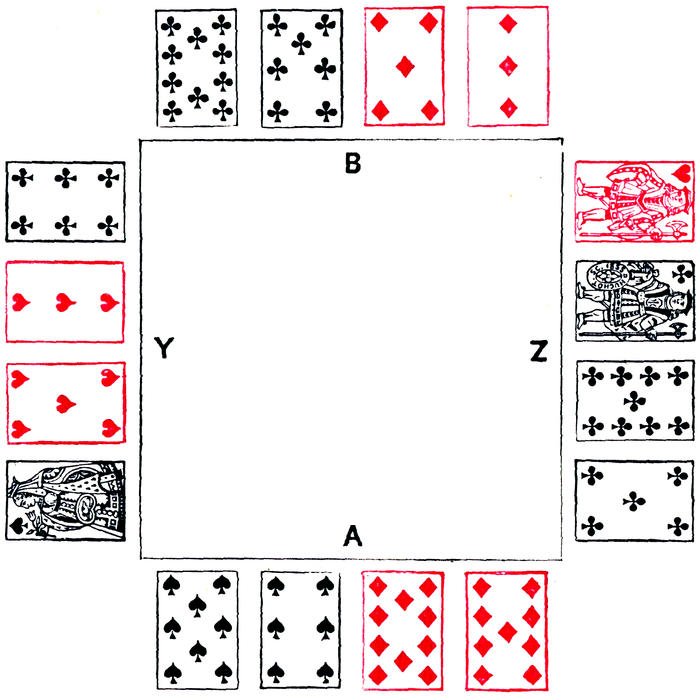
An instructive hand, illustrative of playing to
the score.
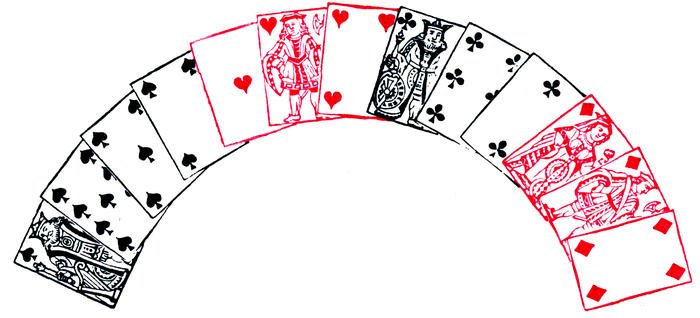
- Kg♠, 9♠, 5♠, 4♠
- A♥, Knv♥, 4♥
- Kg♣, 6♣, 2♣
- Qn♦, Knv♦, 4♦
Score: Love-all.
Queen of clubs turned up.
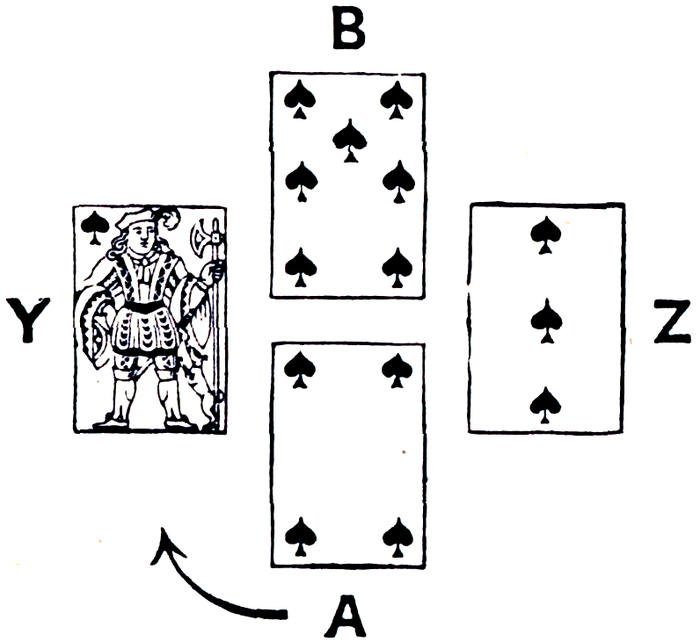
Tricks AB, 0
YZ, 1
1. Y B Z A↷
Knv♠ 7♠ 3♠ 4♠
Remark.—A leads from
his strongest suit (see p.
56).
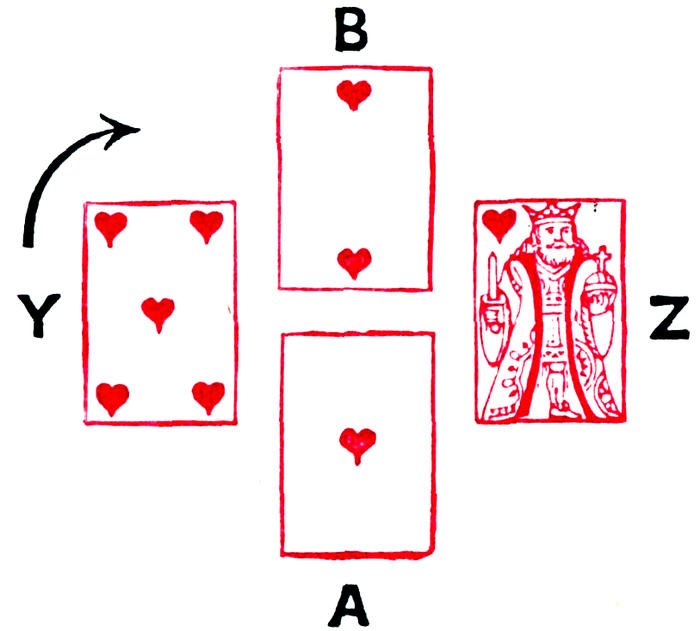
Tricks AB, 1
YZ, 1
2. Y↷ B Z A
5♥ 2♥ Kg♥ A♥
Remark.—It may be inferred
that hearts are Y's
strongest suit.
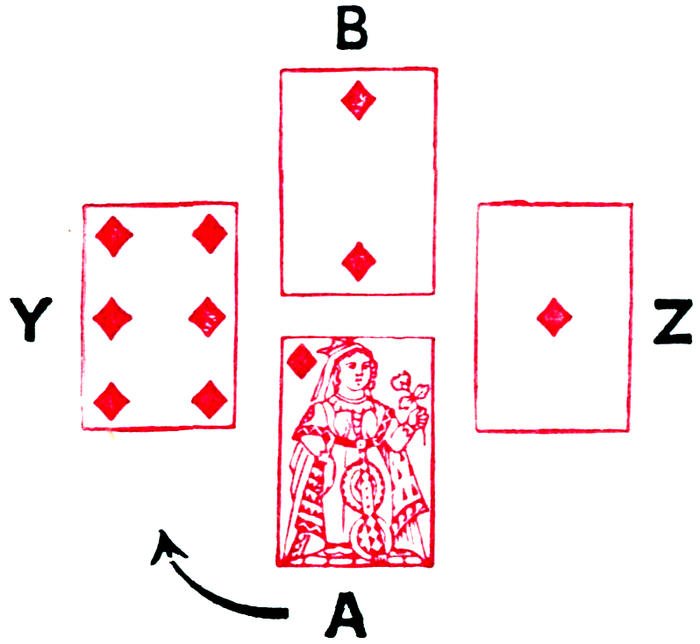
Tricks AB, 1
YZ, 2
3. Y B Z A↷
6♦ 2♦ A♦ Qn♦
Remark (Trick 3).—A having found his partner weak in
spades (see Trick 1), does not continue his suit (see p. 75).
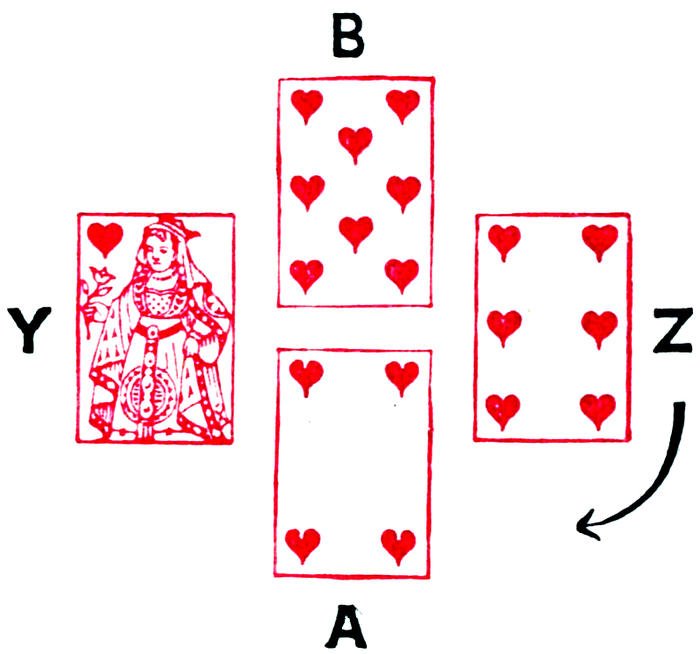
Tricks AB, 1
YZ, 3
4. Y B Z↷ A
Qn♥ 8♥ 6♥ 4♥
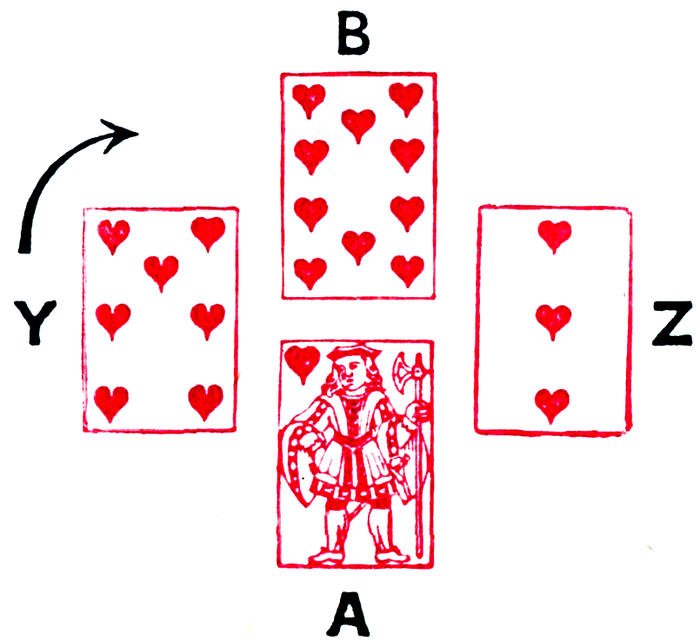
Tricks AB, 2
YZ, 3
5. Y↷ B Z A
7♥ 10♥ 3♥ Knv♥
Remark.—Presuming the
players are to be depended
on for following the elementary
rules of the game,
it is clear from the fall of
the cards that Y holds the
remaining heart, the nine.
B drops the ten, so he ought
not to have the nine, the
rule being to play the lowest card when not able to win the
trick. Z ought not to have another heart, for he returned
the six (see Trick 4), and now plays the three. Having
returned the higher card he can hold no more (see p. 80).
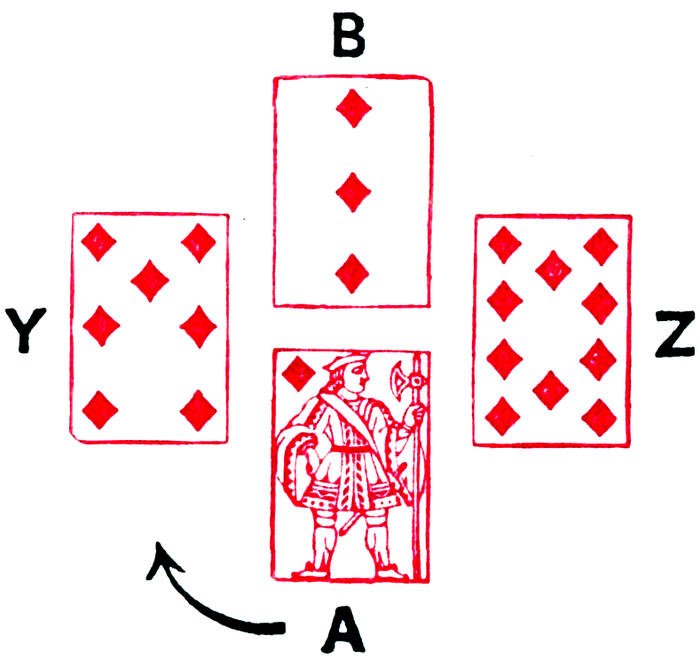
Tricks AB, 3
YZ, 3
6. Y B Z A↷
7♦ 3♦ 10♦ Knv♦
Remark.—It is evident
that Z, dropping the ten,
will trump the next round
of diamonds. Nevertheless,
A's game is to continue the
diamond (Trick 7), to give
Z the lead, and to make B
last player.
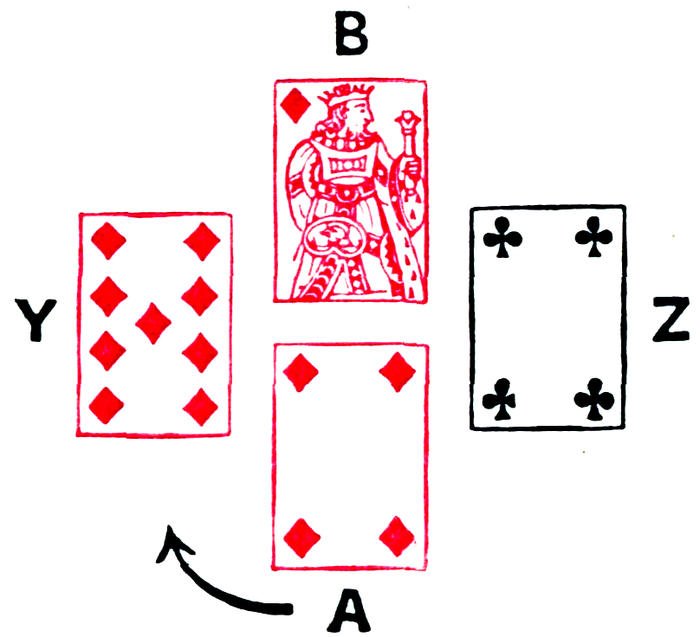
Tricks AB, 3
YZ, 4
7. Y B Z A↷
9♦ Kg♦ 4♣ 4♦
Remark (Trick 7).—Y, dropping the nine of diamonds,
may be taken to have no more, as, not being able to
win the trick, he is assumed to play his smallest. The
remaining diamonds are therefore with B.
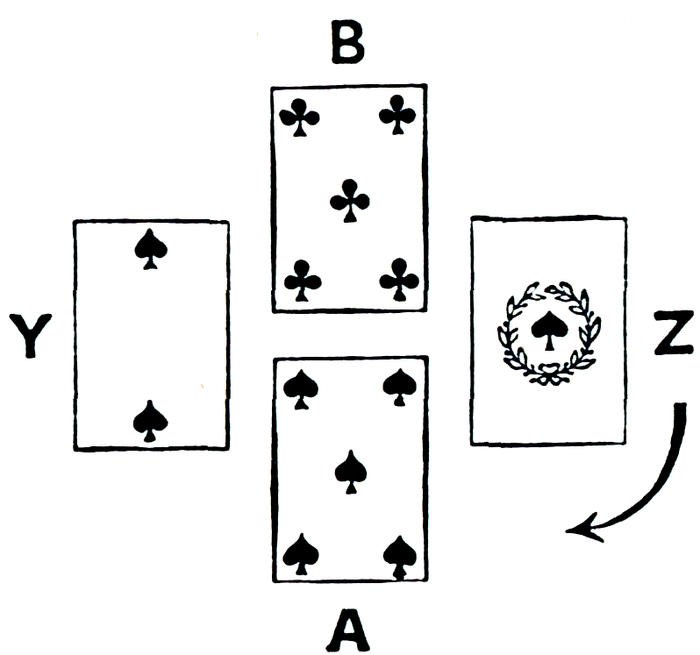
Tricks AB, 4
YZ, 4
8. Y B Z↷ A
2♠ 5♣ A♠ 5♠
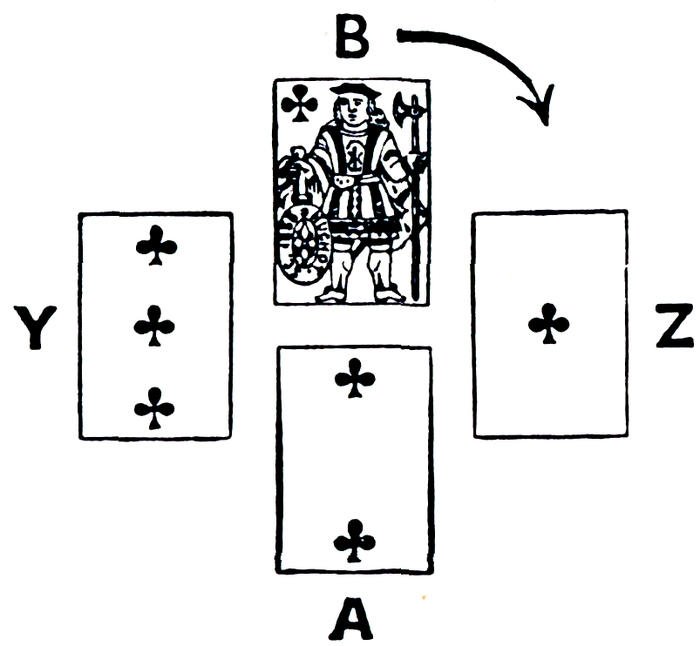
Tricks AB, 4
YZ, 5
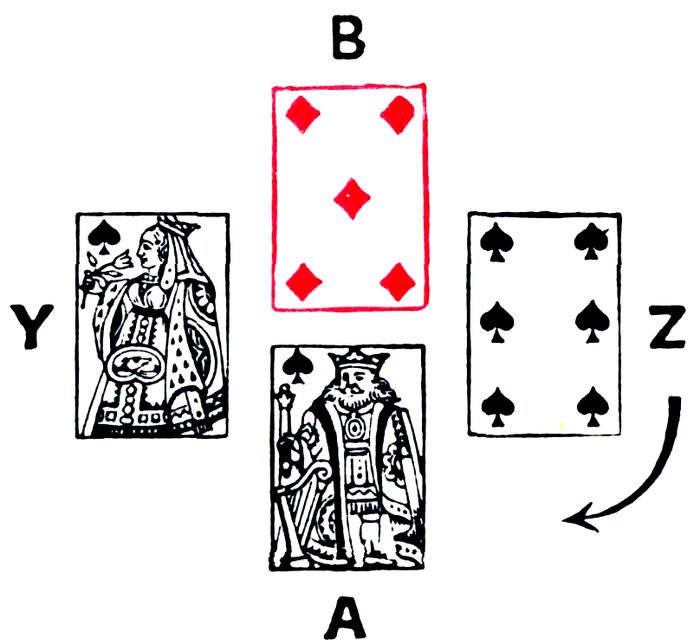
9. Y B↷ Z A
3♣ Knv♣ A♣ 2♣
Remark.—Z, with ace,
queen, second hand (see his
hand below), follows the
usual rule (see p. 86). It is
open to argument whether
Z should depart from rule
in this case. But Z's hand
is not the one under examination.
Tricks AB, 5
YZ, 5
10. Y B Z↷ A
Qn♠ 5♦ 6♠ Kg♠
Remark.—The fall of the
queen of spades from Y
shows A that the two remaining
spades are in Z's
hand. Z's third card is the
queen of clubs, which he
turned up.
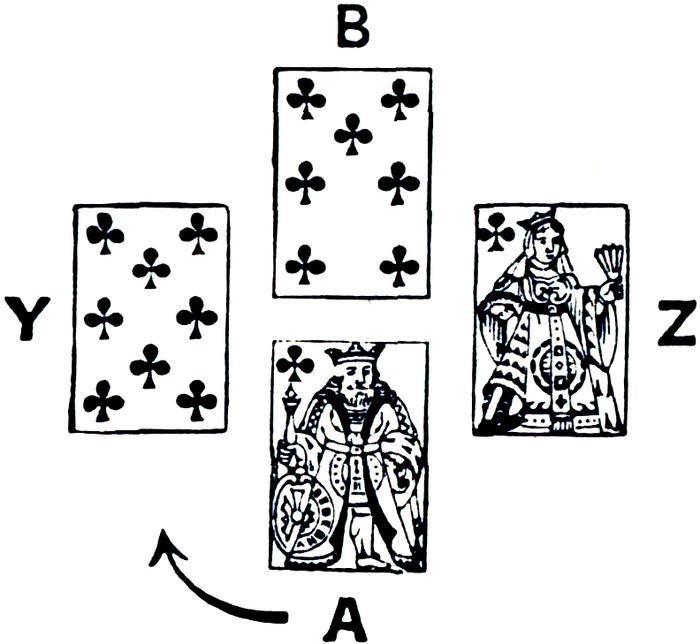
Tricks AB, 6
YZ, 5
11. Y B Z A↷
8♣ 7♣ Qn♣ Kg♣
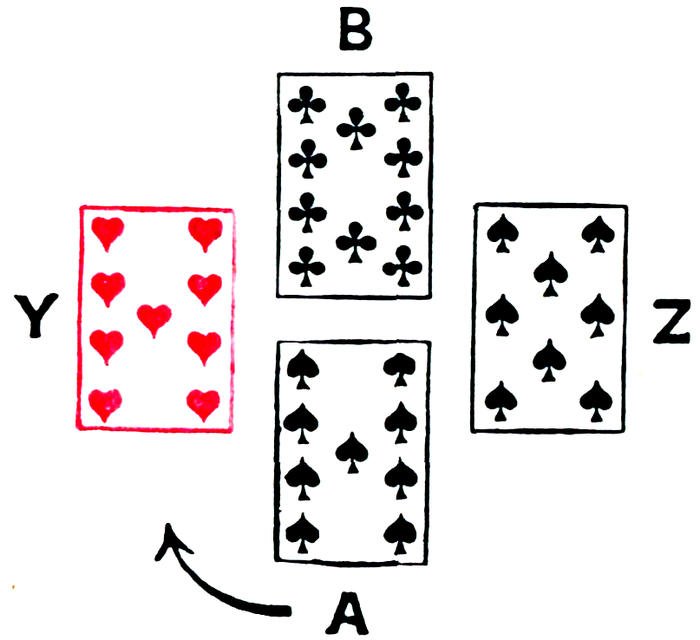
Tricks AB, 7
YZ, 5
12. Y B Z A↷
9♥ 10♣ 8♠ 9♠
Remark (Trick 12).—A's lead here is instructive. He
knows his partner (B) has one diamond and no spade and
no heart (see Tricks 5, 7, and 10). B's other card must therefore
be a club (trump). If it is the best trump, A wins two
by cards by leading a trump. But if it is not the winning
trump, a trump lead loses the odd trick. It is better to
make certain of the odd trick than to risk losing it for the
chance of winning two by cards; for the odd trick makes
a difference of two to the score. A therefore properly
ensures the odd trick by forcing his partner (see p. 134).
Suppose the score to be AB three, and YZ one. Then
A would be justified in leading the trump at Trick 12.
For, if B has the ten, AB win two by cards and the game;
and, if B has not the ten, AB lose the odd trick; the score
remaining AB three, YZ two. It is better to run the risk
of this score for the sake of the game, than to make certain
of scoring only four and of leaving the adversaries at one.
AB win the odd trick.
(A's hand is given above.)
| Y's Hand. |
B's Hand. |
Z's Hand. |
| Qn, Knv, 2 |
♠ |
7 |
♠ |
Ace, 10, 8, 6, 3 |
♠ |
| Qn, 9, 7, 5 |
♥ |
10, 8, 2 |
♥ |
Kg, 6, 3 |
♥ |
| 9, 8, 3 |
♣ |
Knv, 10, 7, 5 |
♣ |
Ace, Qn, 4 |
♣ |
| 9, 7, 6 |
♦ |
Kg, 8, 5, 3, 2 |
♦ |
Ace, 10 |
♦ |
In the following hands the comments will be fewer,
it being assumed that explanations of ordinary play
are unnecessary.
Illustrative of the advantage of returning the
highest of a short suit.
- A♠, 9♠, 6♠, 2♠
- 4♥, 2♥
- Kg♣, 10♣, 7♣, 4♣
- 8♦, 6♦, 4♦
Score: Love-all.
Three of spades turned up.
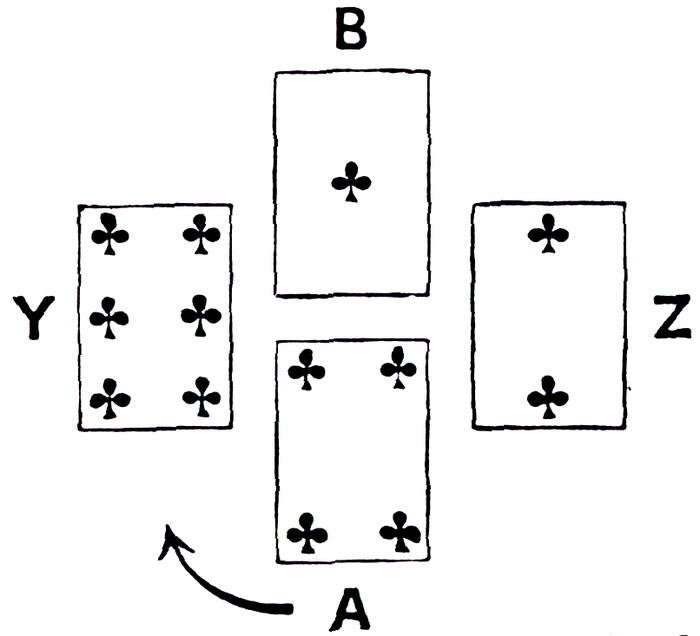
Tricks AB, 1
YZ, 0
1. Y B Z A↷
6♣ A♣ 2♣ 4♣
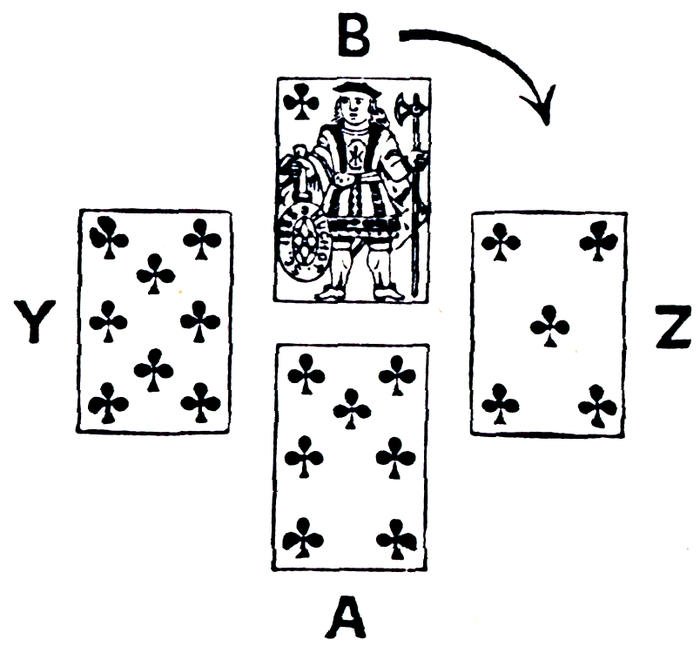
Tricks AB, 2
YZ, 0
2. Y B↷ Z A
8♣, Knv♣, 5♣, 7♣
Remark (Trick 2).—A's finesse here is justifiable, because
he has strength in trumps (see p. 94). With only three
trumps, A's better play would be to secure the trick at once.
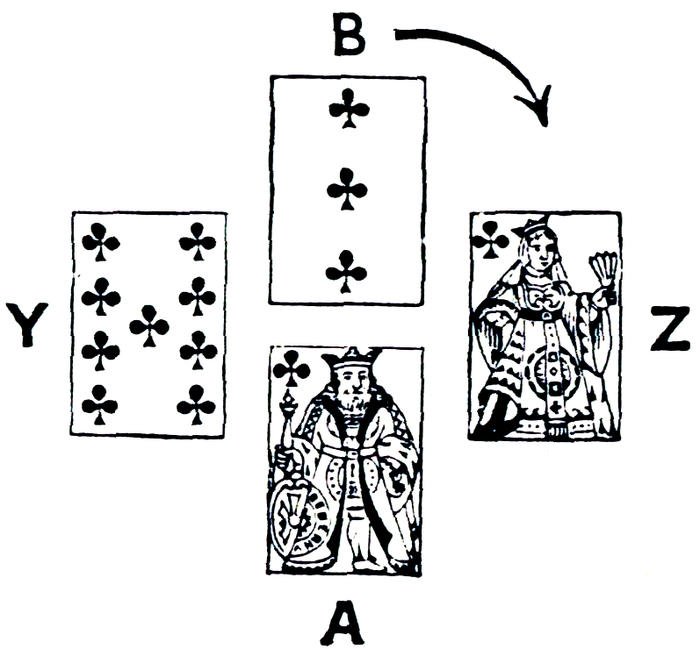
Tricks AB, 3
YZ, 0
3. Y B↷ Z A
9♣ 3♣ Qn♣ Kg♣
Remark.—Note the advantage
of the return of the
strengthening card at Trick
2, in accordance with General
Principle 5 (p. 79). The
command is left with the
presumably strong hand;
and the queen is completely
hemmed in. It is true the
queen might have been in
Y's hand. In that case the
queen must make whatever
card is returned. A similar
position occurs at Trick 9.
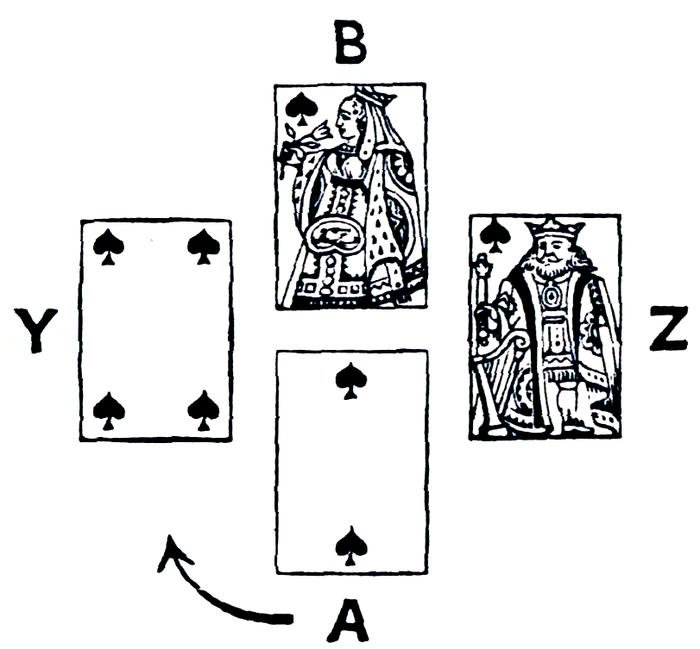
Tricks AB, 3
YZ, 1
4. Y B Z A↷
4♠ Qn♠ Kg♠ 2♠
Remark.—A did not lead
the trump at first; but now
he does so for these reasons:
he has the long card of his
suit; trumps are his strongest
suit (p. 119); and the
adversaries have had the
opportunity of calling for
trumps (see pp. 125, 126),
and have not made use of
it, which is negative evidence
that there is no very
great strength of trumps in
one hand.
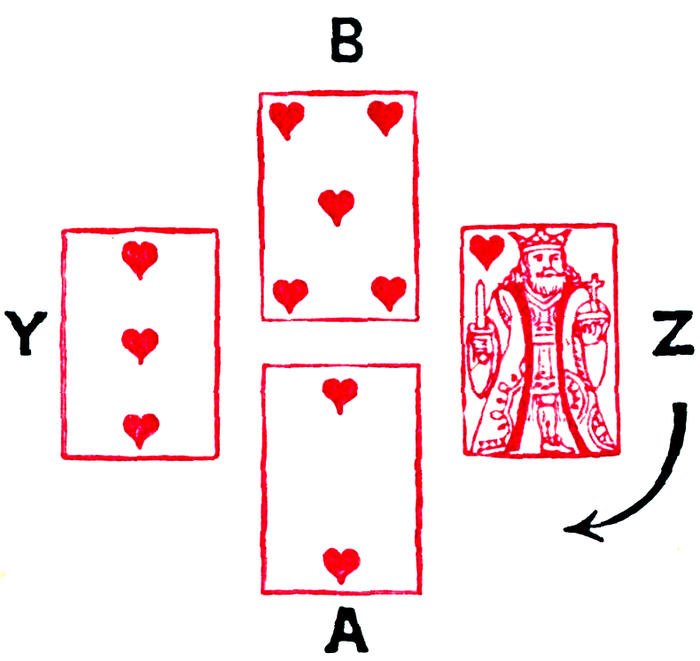
Tricks AB, 3
YZ, 2
5. Y B Z↷ A
3♥ 5♥ Kg♥ 2♥
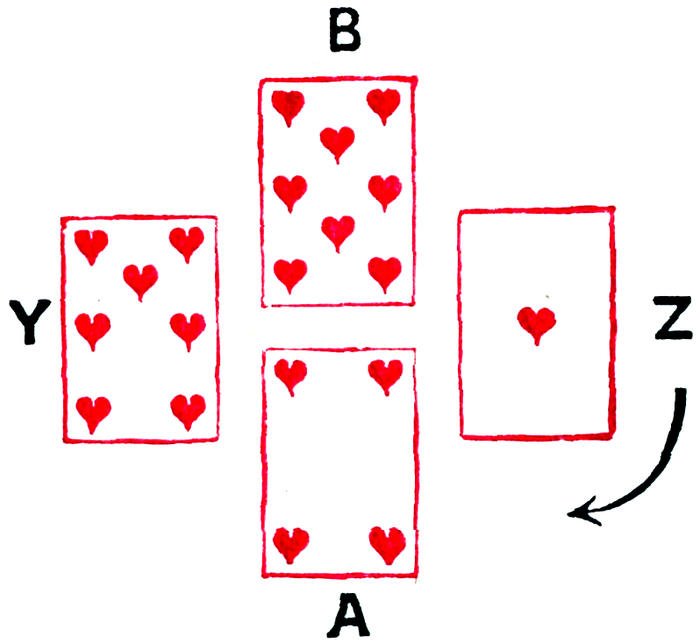
Tricks AB, 3
YZ, 3
6. Y B Z↷ A
7♥ 8♥ A♥ 4♥
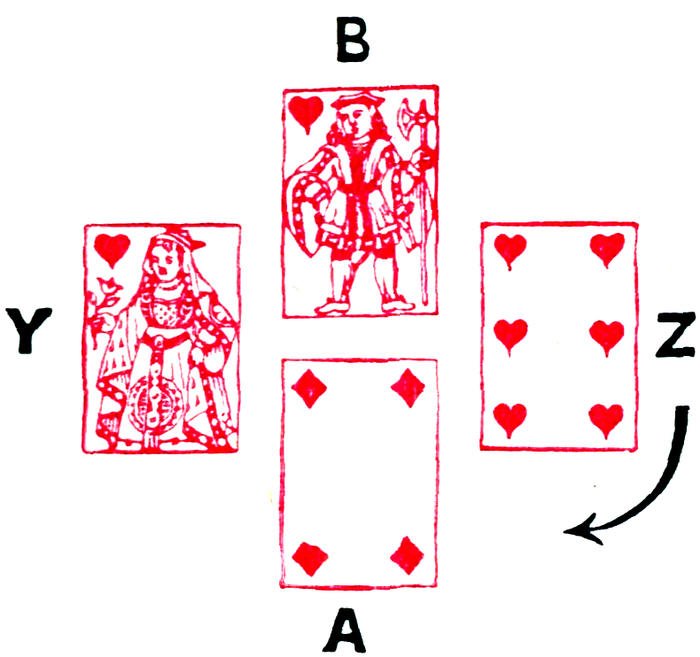
Tricks AB, 3
YZ, 4
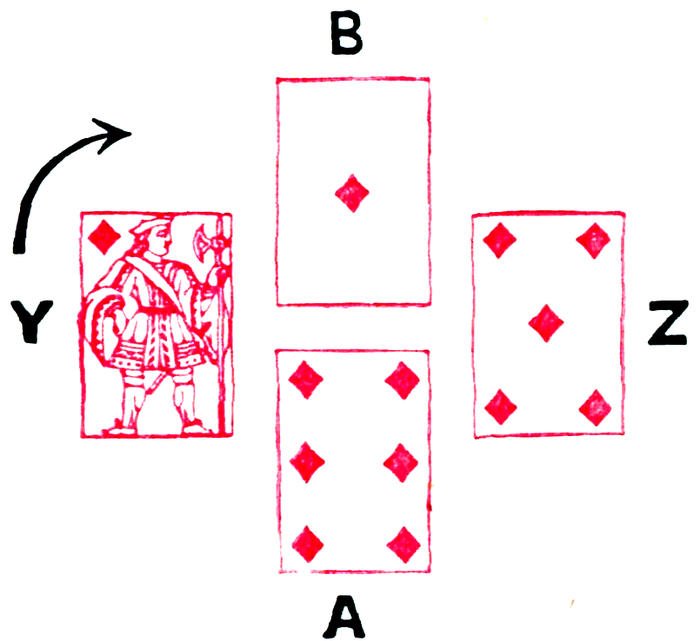
7. Y B Z↷ A
Qn♥ Knv♥ 6♥ 4♦
Remark (Trick 7).—A being strong in trumps passes
the doubtful card (see p. 129).
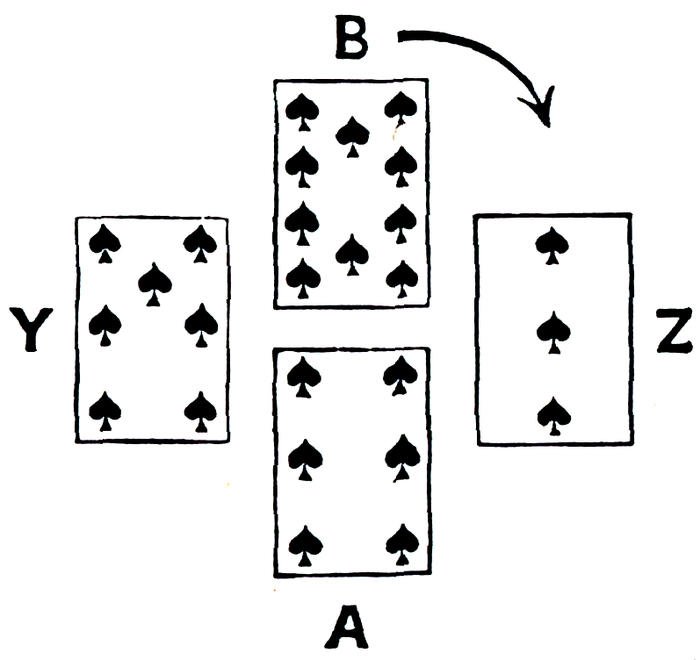
Tricks AB, 4
YZ, 4
8. Y↷ B Z A
Knv♦ A♦ 5♦ 6♦
Tricks AB, 5
YZ, 4
9. Y B↷ Z A
7♠ 10♠ 3♠ 6♠
Tricks 10 to 13.—B leads
the five of spades, which
brings down all the outstanding
trumps. A makes
the thirteenth club and the
trump; the adversary makes
the king of diamonds (see
the hands below).
AB win two by cards.
(A's hand is given above.)
| Y's Hand. |
B's Hand. |
Z's Hand. |
| 8, 7, 4 |
♠ |
Qn, 10, 5 |
♠ |
Kg, Knv, 3 |
♠ |
| Qn, 10 7, 3 |
♥ |
Knv, 8, 5 |
♥ |
Ace, Kg, 9, 6 |
♥ |
| 9, 8, 6 |
♣ |
Ace, Knv, 3 |
♣ |
Qn, 5, 2 |
♣ |
| Knv, 10, 9 |
♦ |
Ace, Qn, 3, 2 |
♦ |
Kg, 7, 5 |
♦ |
Playing to the score.
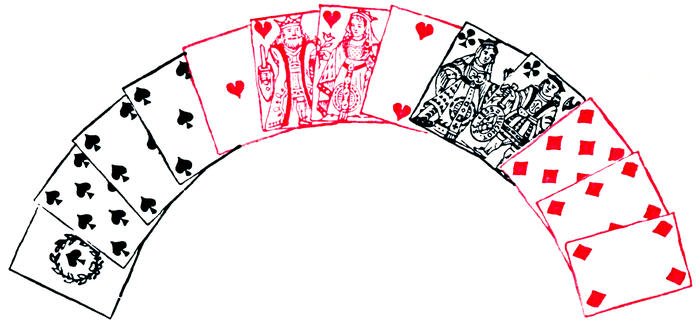
- A♠, 8♠, 6♠, 5♠
- A♥, Kg, Qn♥, 2♥
- Qn♣, Knv♣
- 8♦, 6♦, 4♦
Score: Love-all.
Two of diamonds turned up.
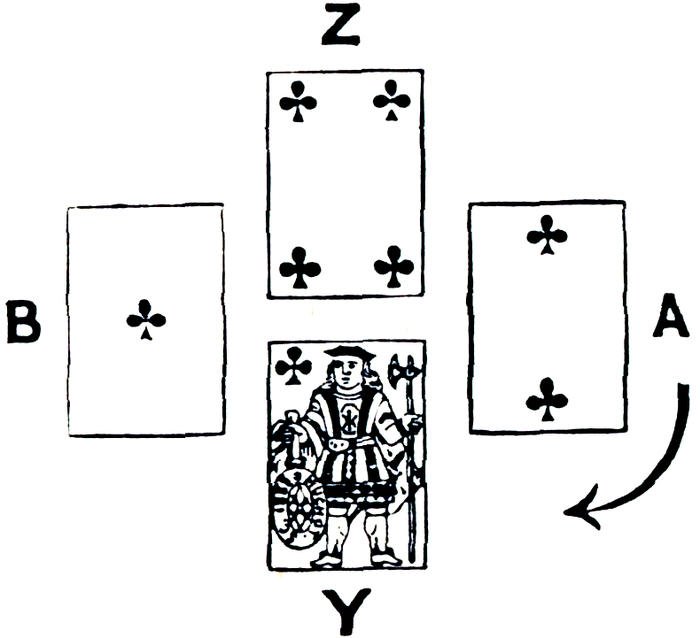
Tricks AB, 1
YZ, 0
1. B Z A↷ Y
A♣ 4♣ 2♣ Knv♣
Tricks AB, 2
YZ, 0
2. B↷ Z A Y
3♣ 10♣ Kg♣ Qn♣
Tricks AB, 2
YZ, 1
3. B Z A↷ Y
6♥ 9♥ 3♥ Qn♥
Tricks AB, 2
YZ, 2
4. B Z A Y↷
5♥ Knv♥ 4♥ A♥
Tricks AB, 2
YZ, 3
5. B Z A Y↷
7♥ 2♠ 8♥ Kg♥
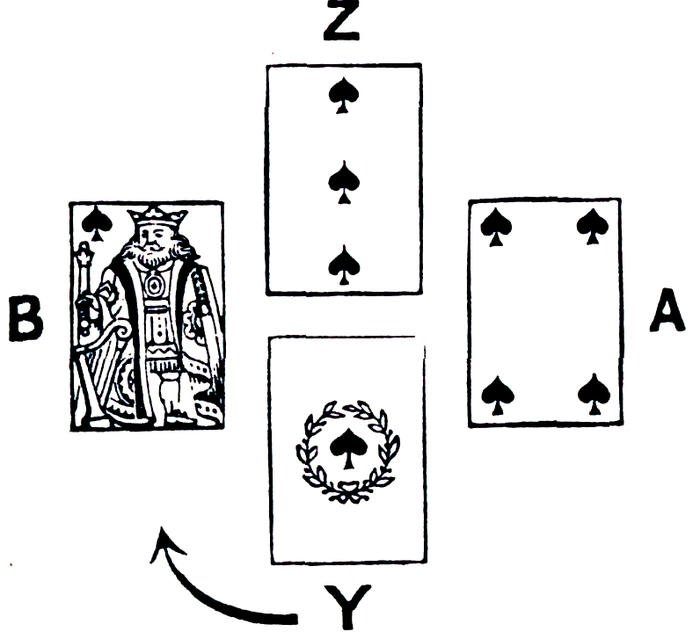
Tricks AB, 2
YZ, 4
6. B Z A Y↷
Kg♠ 3♠ 4♠ A♠
Remark (Trick 6).—The lead here is the point in the
hand. Y has three tricks up; there is a whole suit (clubs)
against him, and his adversary B has called for trumps (see
Tricks 3 and 4). It is, consequently, Y's duty to make five
tricks (which save the game if Z has an honour) as quickly
as possible. He therefore leads the ace of spades to make
the fourth trick, and (Trick 7) forces his partner (though
without any strength of trumps in his own hand, see
pp. 132, 133) to make the fifth.
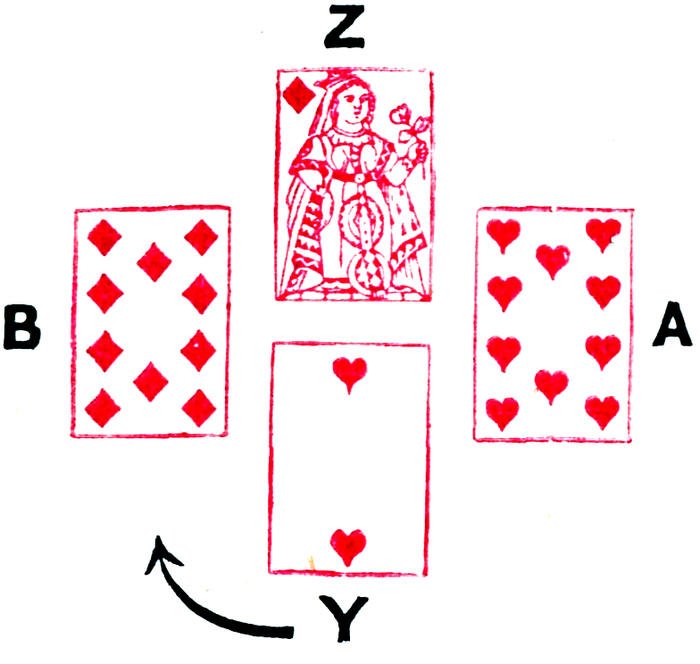
Tricks AB, 2
YZ, 5
7. B Z A Y↷
10♦ Qn♦ 10♥ 2♥
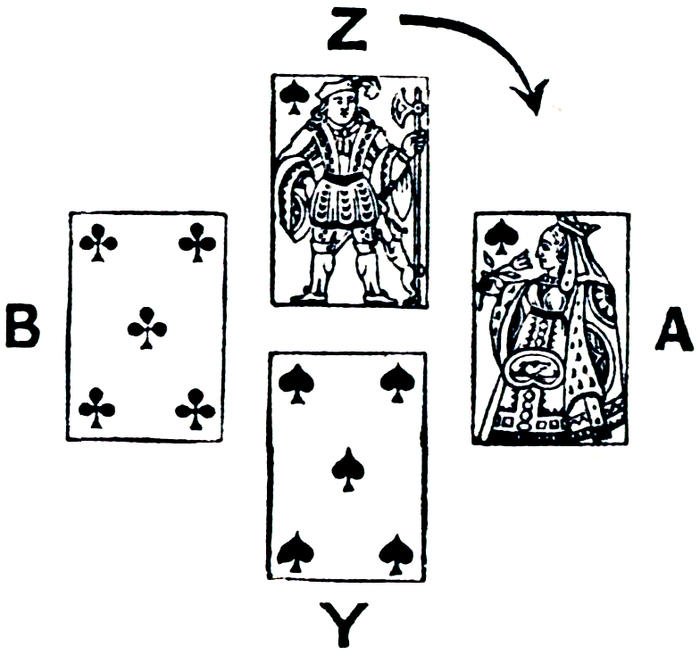
Tricks AB, 3
YZ, 5
8. B Z↷ A Y
5♣ Knv♠ Qn♠ 5♠
Tricks 9 to 13.—A leads a trump (the knave, see his
hand below), in obedience to the call, and
AB score two by cards and two by honours.
(Y's hand is given above.)
| A's Hand. |
B's Hand. |
Z's Hand. |
| Qn, 4 |
♠ |
Kg |
♠ |
Knv, 10, 9, 7, 3, 2 |
♠ |
| 10, 8, 4, 3 |
♥ |
7, 6, 5 |
♥ |
Knv, 9 |
♥ |
| Kg, 9, 7, 2 |
♣ |
Ace, 8, 6, 5, 3 |
♣ |
10, 4 |
♣ |
| Knv, 5, 3 |
♦ |
Ace, Kg, 10, 7 |
♦ |
Qn, 9, 2 |
♦ |
At Trick 2, B, with the club suit well nigh established
(assuming his partner to have led from strength), and four
trumps, two honours, should risk a trump lead. He cannot
lose the game; and if his partner has an average hand, a
trump lead will, in all probability, give AB a good score.
As a matter of fact it would win the game, but that proves
nothing.
The lead of the fourth-best (see Appendix A), and
counting the hands (see pp. 116-17).
- Qn♠, 10♠
- Ace, Qn♥, 6♥, 5♥, 4♥
- 9♣, 8♣
- Knv♦, 6♦, 5♦, 3♦
Score: AB, love; YZ, four.
Eight of clubs turned up.
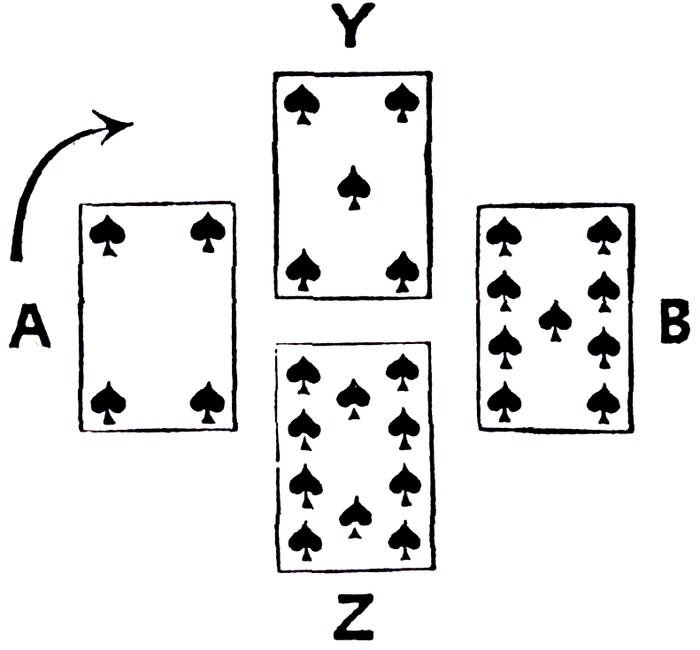
Tricks AB, 0
YZ, 1
1. A↷ Y B Z
4♠, 5♠, 9♠, 10♠
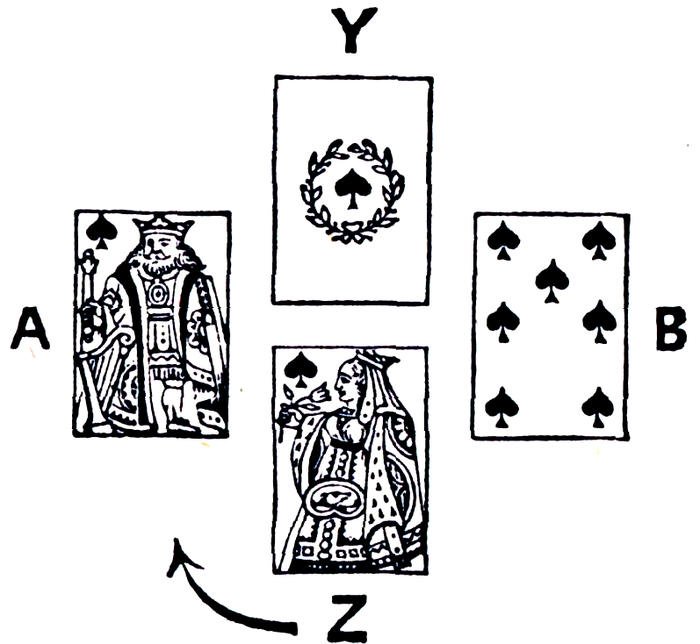
Tricks AB, 0
YZ, 2
2. A Y B Z↷
Kg♠, A♠, 7♠, Qn♠
Remark (Trick 2).—Z's better play would be to open the
heart suit.
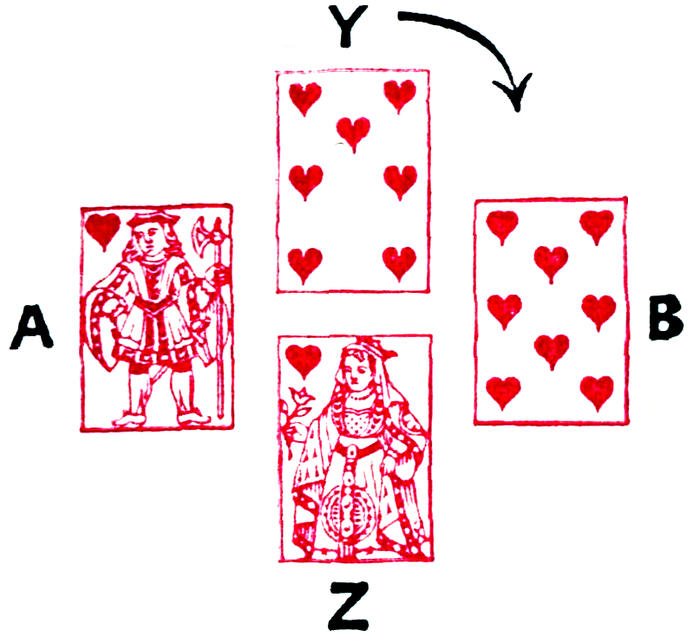
Tricks AB, 0
YZ, 3
3. A Y↷ B Z
Knv♥ 7♥ 8♥ Qn♥
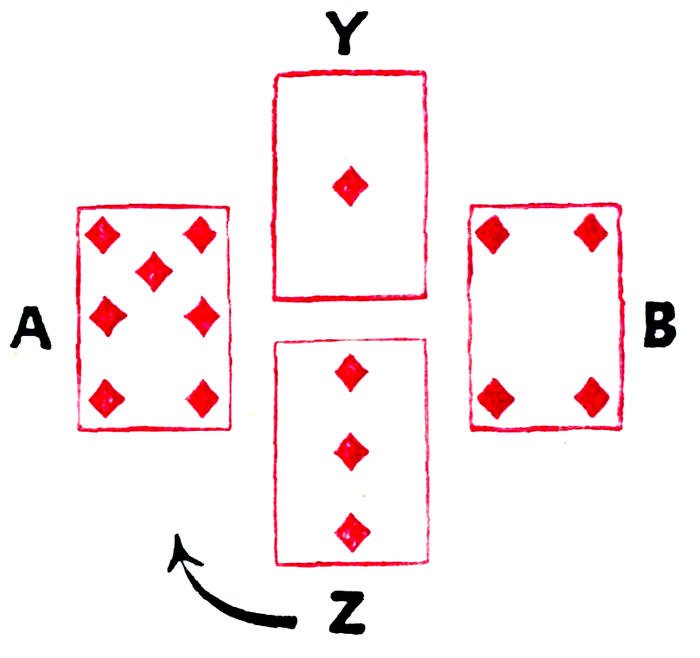
Tricks AB, 0
YZ, 4
4. A Y B Z↷
7♦ A♦ 4♦ 3♦
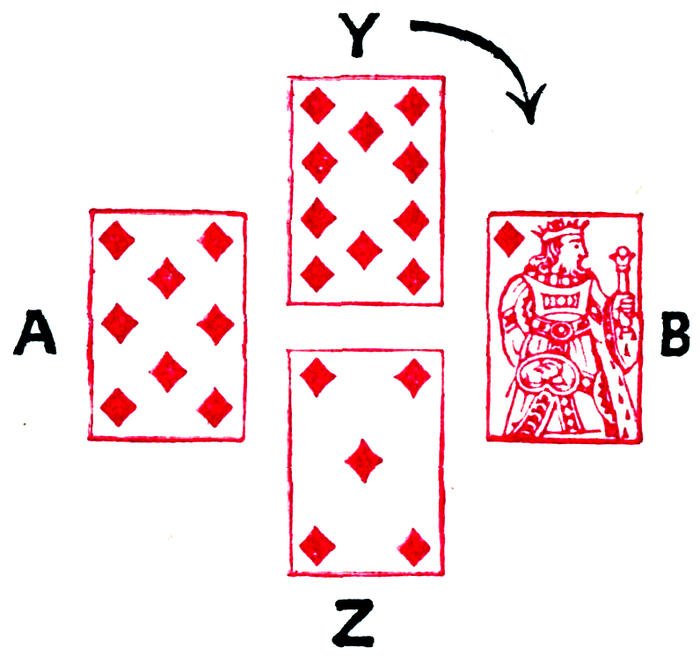
Tricks AB, 1
YZ, 4
5. A Y↷ B Z
8♦ 10♦ Kg♦ 5♦
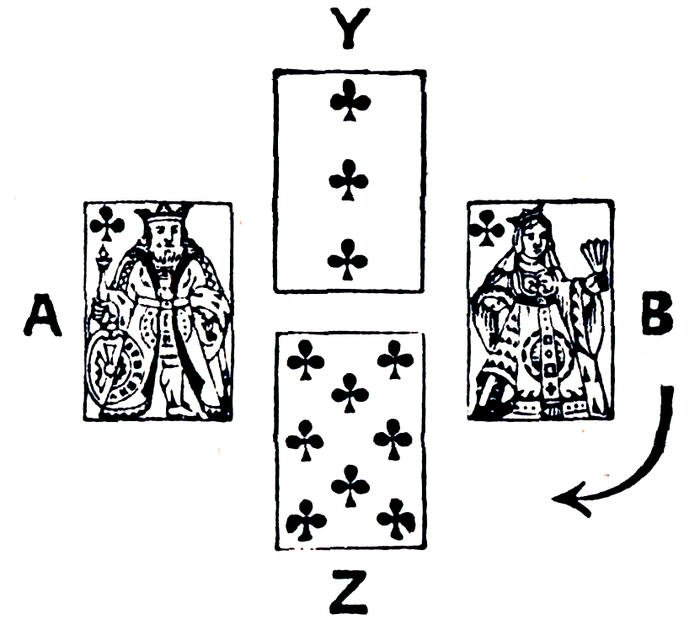
Tricks AB, 2
YZ, 4
6. A Y B↷ Z
Kg♣ 3♣ Qn♣ 8♣
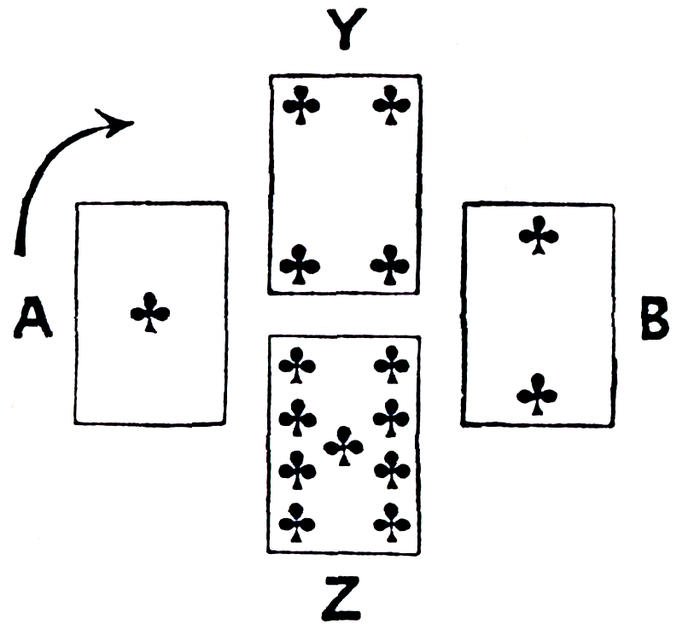
Tricks AB, 3
YZ, 4
7. A↷ Y B Z
A♣ 4♣ 2♣ 9♣
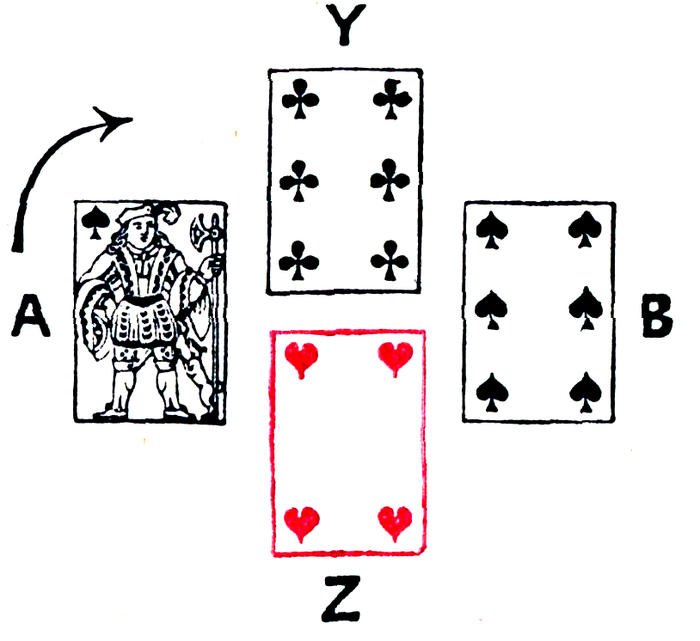
Tricks AB, 3
YZ, 5
8. A↷ Y B Z
Knv♠ 6♣ 6♠ 4♥
Tricks AB, 3
YZ, 6
9. A Y↷ B Z
2♠ 2♥ 3♥ 5♥
Remark.—It is now clear
that Y led from five hearts
originally (see his lead,
Trick 3, and p. 116). Consequently,
YZ have all the
remaining hearts between
them.
Tricks AB, 3
YZ, 7
10. A Y B Z↷
9♦ 7♣ 2♦ 6♦
Remark.—Z can count
his partner's hand, viz., three
more hearts (see Remark,
Trick 9) and one other card,
either the deuce of diamonds
(see the fall of the diamonds,
Tricks 4 and 5), or a trump.
If Y has the diamond, it
matters not what Z leads, as B must then hold four
trumps. Z therefore assumes that his partner has another
trump, and plays to force him.
But if Z could not tell that Y has three hearts, or rather
could tell that he has only two, Z's proper lead at
Trick 10 would be the ace of hearts. For then B must
have a heart, and if Z leads a losing diamond, B discards
his heart on it, and wins the game.
(Z's hand is given above.)
| A's Hand. |
Y's Hand. |
B's Hand. |
| Kg, Knv, 8, 4, 3, 2 |
♠ |
Ace, 5 |
♠ |
9, 7, 6 |
♠ |
| Knv |
♥ |
Kg, 10, 9, 7, 2 |
♥ |
8, 3 |
♥ |
| Ace, Kg |
♣ |
7, 6, 4, 3 |
♣ |
Qn, Knv, 10, 5, 2 |
♣ |
| Qn, 9, 8, 7 |
♦ |
Ace, 10 |
♦ |
Kg, 4, 2 |
♦ |
At Trick 6, B should play to force his partner in hearts
instead of leading trumps.
Playing to the score and to the fall of the cards.
Game won in spite of partner's bad play.
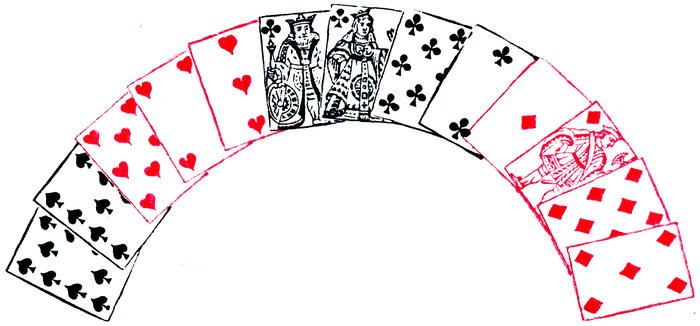
- 10♠, 9♠
- 8♥, 4♥, 3♥
- Kg, Qn♣, 8♣, 2♣
- A♦, Knv♦, 8♦, 5♦
Score: AB, one; YZ, three.
Eight of hearts turned up.
Tricks AB, 0
YZ, 1
1. A↷ Y B Z
6♠ A♠ 4♠ 9♠
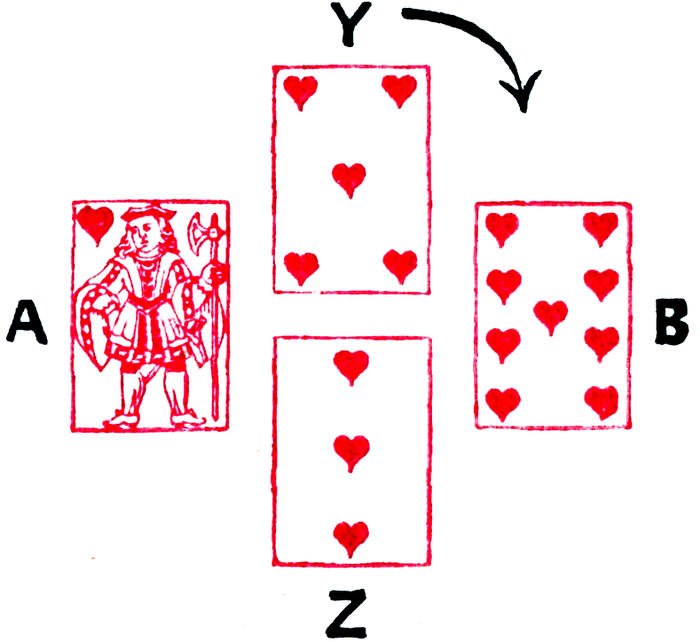
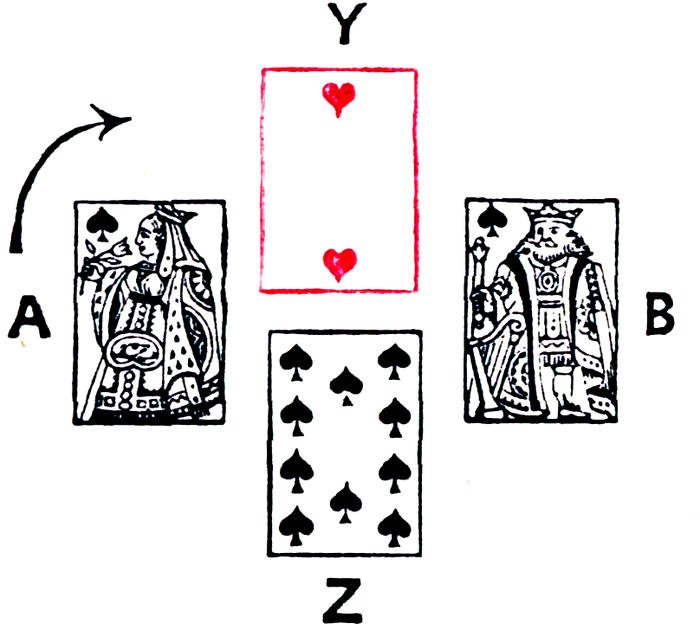
Tricks AB, 1
YZ, 1
2. A Y↷ B Z
Knv♥ 5♥ 9♥ 3♥
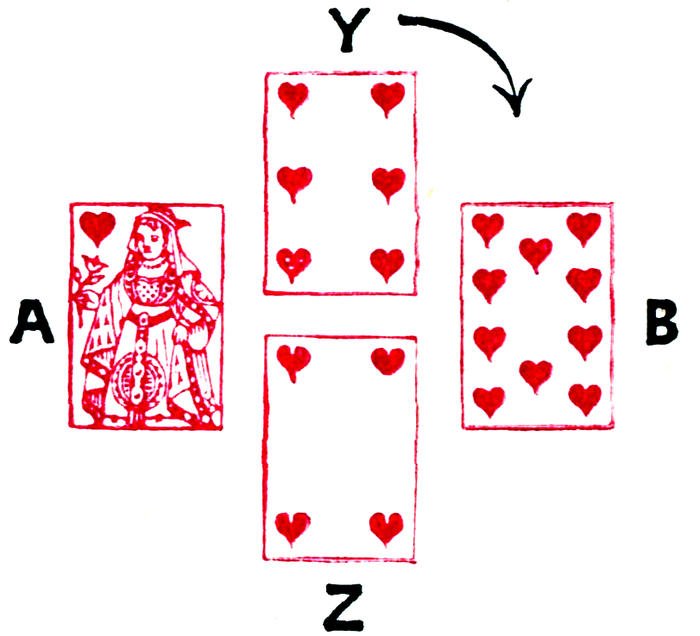
Tricks AB, 1
YZ, 2
3. A↷ Y B Z
Qn♠ 2♥ Kg♠ 10♠
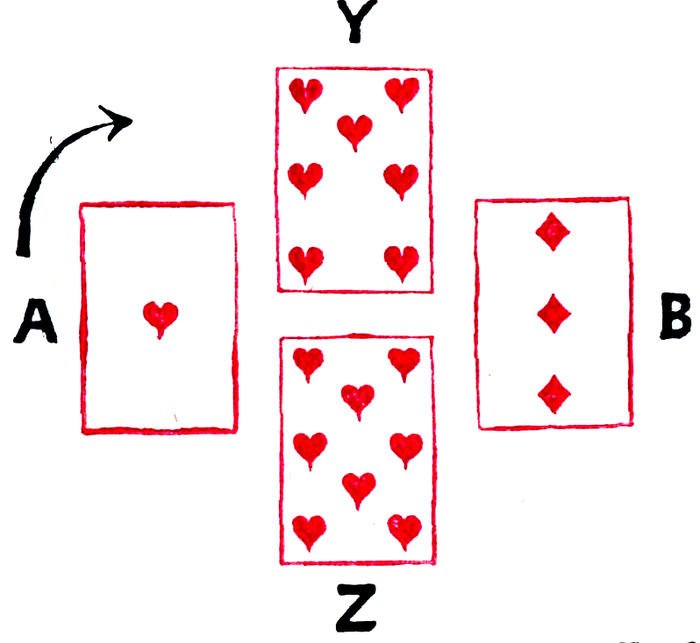
Tricks AB, 2
YZ, 2
4. A Y↷ B Z
Qn♥ 6♥ 10♥ 4♥
Tricks AB, 3
YZ, 2
5. A↷ Y B Z
A♥ 7♥ 3♦ 8♥
Remark.—Drawing two
for one.
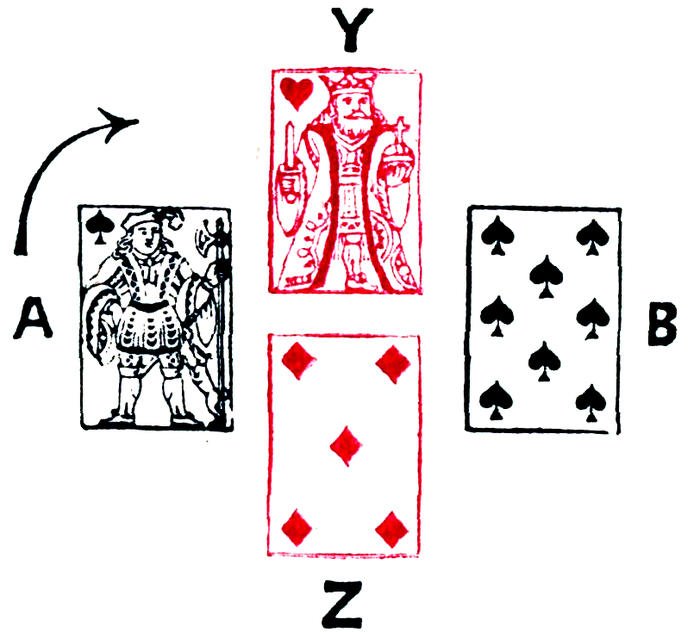
Tricks AB, 3
YZ, 3
6. A↷ Y B Z
Knv♠ Kg♥ 8♠ 5♦
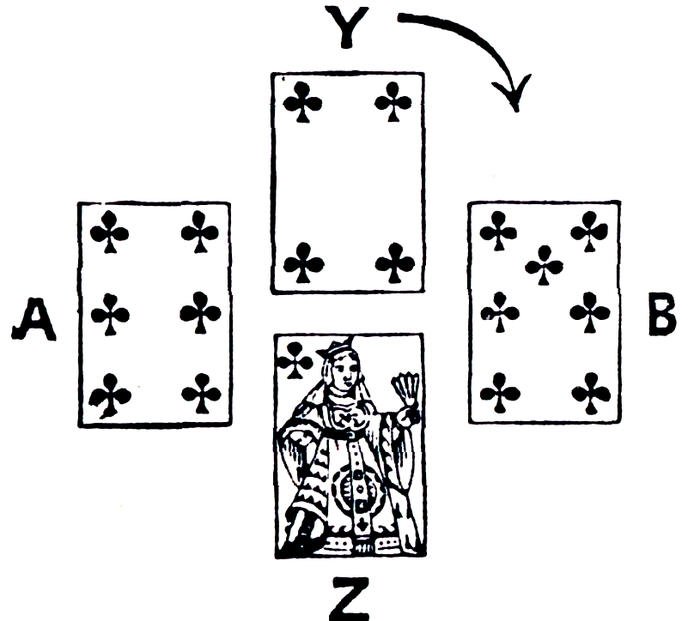
Tricks AB, 3
YZ, 4
7. A Y↷ B Z
6♣ 4♣ 7♣ Qn♣
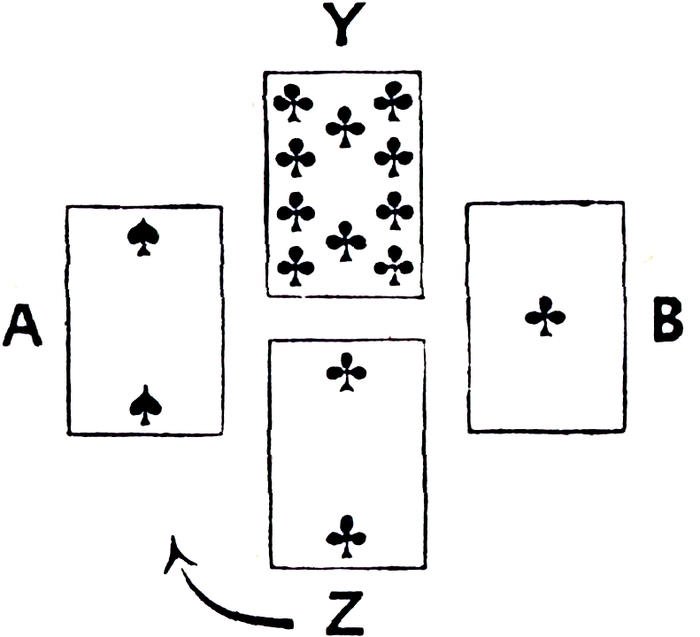
Tricks AB, 4
YZ, 4
8. A Y B Z↷
2♠ 8♣ A♣ 2♣
Remark.—Y must have
knave.
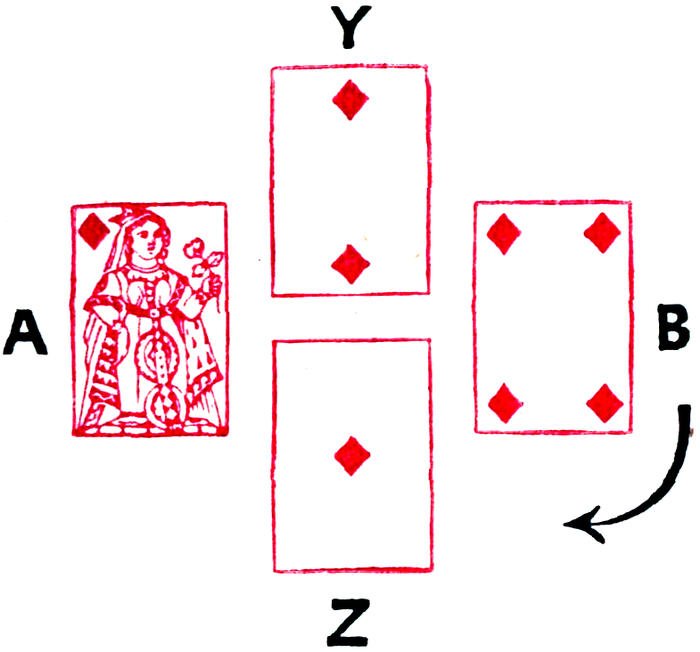
Tricks AB, 4
YZ, 5
9. A Y B↷ Z
Qn♦ 2♦ 4♦ A♦
Remark (Trick 9).—Z manages to win the game, in
spite of his partner, by putting on ace second hand and
leading a club.
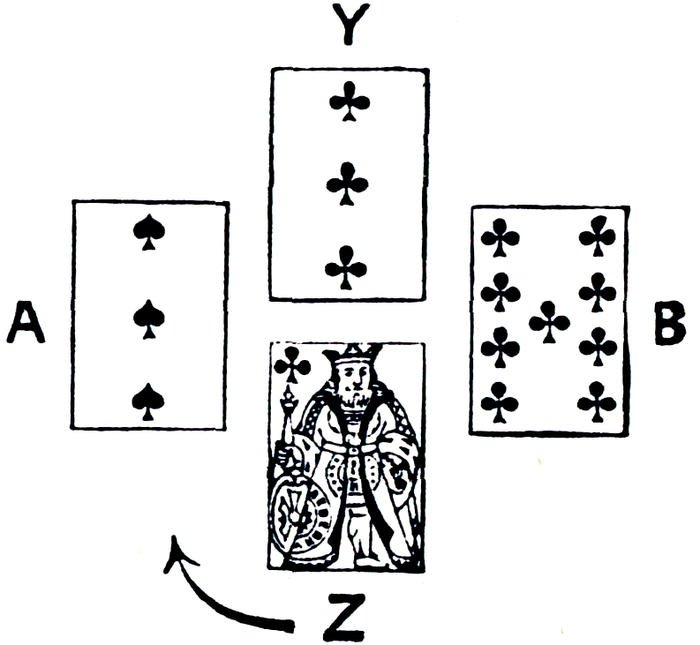
Tricks AB, 4
YZ, 6
10. A Y B Z↷
3♠ 3♣ 9♣ Kg♣
Tricks 11 to 13.—Z (Trick 11) leads a club; Y makes
two more tricks in clubs, and
YZ win two by cards.
(Z's hand is given above.)
| A's Hand. |
Y's Hand. |
B's Hand. |
| Qn, Knv, 7, 6, 5, 3, 2 |
♠ |
Ace |
♠ |
Kg, 8, 4 |
♠ |
| Ace, Qn, Knv |
♥ |
Kg, 7, 6, 5, 2 |
♥ |
10, 9 |
♥ |
| 6 |
♣ |
Knv, 10, 5, 4, 3 |
♣ |
Ace, 9, 7 |
♣ |
| Kg, Qn |
♦ |
7, 2 |
♦ |
10, 9, 6, 4, 3 |
♦ |
At Trick 3, Y plays badly to trump the doubtful spade
(see p. 129). At same trick, B plays well to get rid of the
command of his partner's suit (see p. 96), as A, from the
lead, must have knave of spades, and Z, from the previous
fall of the cards, must have the ten single.
At Trick 4, Y's continuing the trump is bad, after ruining
his numerical strength. For he has no particular strength
out of trumps (see his hand), and his partner is evidently
very weak in trumps.
As the cards happen to lie, if Z does not put on ace of
diamonds second hand at Trick 9, A brings in the spades,
and YZ lose the game instead of winning it.
Counting the cards.
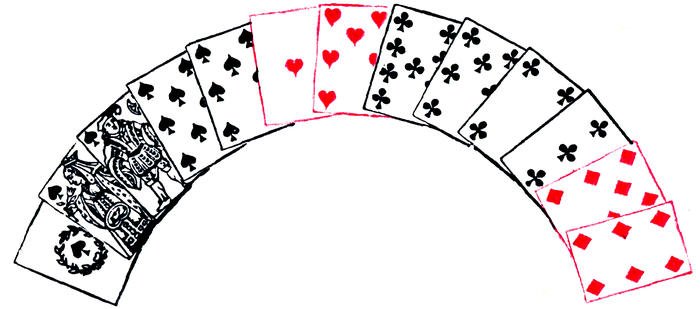
- A♠, Qn♠, Knv♠, 8♠, 7♠
- A♥, 7♥
- 9♣, 7♣, 4♣, 3♣
- 7♦, 6♦
Score: Love-all.
Five of spades turned up.
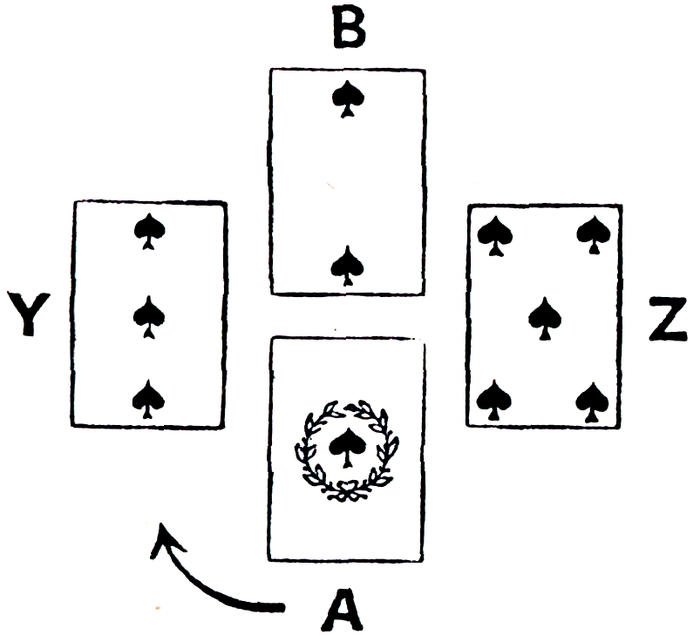
Tricks AB, 1
YZ, 0
1. Y B Z A↷
3♠ 2♠ 5♠ A♠
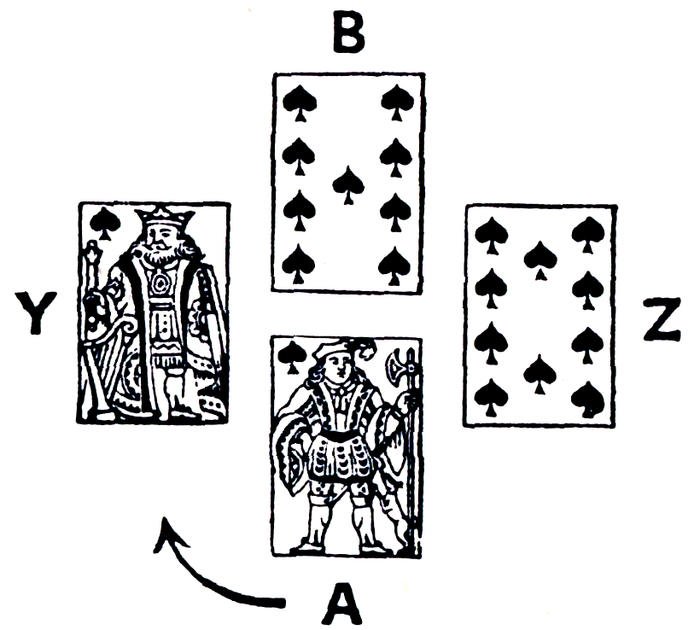
Tricks AB, 1
YZ, 1
2. Y B Z A↷
Kg♠ 9♠ 10♠ Knv♠
Tricks AB, 2
YZ, 1
3. Y↷ B Z A
5♥ Knv♥ 2♥ 7♥
Tricks AB, 3
YZ, 1
4. Y B↷ Z A
4♦ A♦ Knv♦ 6♦
Remark.—B has led from
a suit of at least five diamonds.
Tricks AB, 3
YZ, 2
5. Y B↷ Z A
5♦ 3♦ Kg♦ 7♦
Tricks AB, 3
YZ, 3
6. Y B Z↷ A
Kg♣ 10♣ A♣ 3♣
Tricks AB, 3
YZ, 4
7. Y B Z↷ A
4♠ Qn♣ 2♣ 4♣
Tricks AB, 4
YZ, 4
8. Y↷ B Z A
9♦ Qn♦ 5♣ A♥
Remark (Trick 8).—Well played by A. He can count
B's hand. The ten of diamonds is marked in Y's hand, so
B has two diamonds and three hearts. Therefore B must
have had four hearts originally, and as it is not the game
to put on knave, second hand, with four, holding less than
three honours (see Trick 3 and Analysis of Play of Second
Hand, p. 85), B must hold both king and queen of hearts.
Tricks 9 to 13.—B leads king, queen of hearts, to which
A discards clubs. A makes his three trumps, and
AB score three by cards and two by honours.
(A's hand is given above.)
| Y's Hand. |
B's Hand. |
Z's Hand. |
| Kg, 6, 4, 3 |
♠ |
9, 2 |
♠ |
10, 5 |
♠ |
| 10, 9, 6, 5 |
♥ |
Kg, Qn, Knv, 4 |
♥ |
8, 3, 2 |
♥ |
| Kg |
♣ |
Qn, 10 |
♣ |
Ace, Knv, 8, 6, 5, 2 |
♣ |
| 10, 9, 5, 4 |
♦ |
Ace, Qn, 8, 3, 2 |
♦ |
Kg, Knv |
♦ |
At Trick 7, Z does not lead his original fourth-best, as
great strength in trumps is declared against him. (See
Appendix A.)
At Trick 8, Y's play is difficult. He might have noticed
that his best chance of winning the game is for A to hold
only winning hearts and a losing club; and this being so,
Y should not lead a diamond.
Counting the hands. Simple instance of
departure from rule.
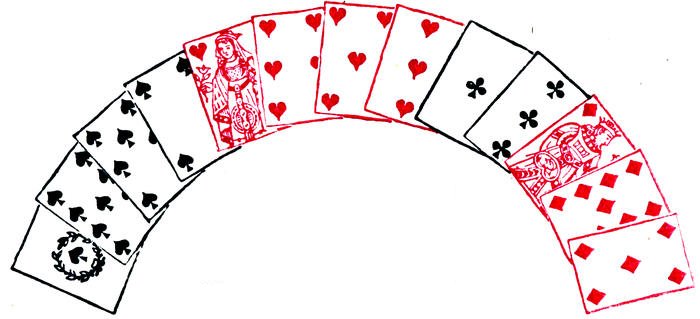
- A♠, 9♠, 7♠, 4♠
- Qn♥, 6♥, 5♥, 3♥
- A♣, 3♣
- Kg♦, 9♦, 5♦
Score: Love-all.
Six of spades turned up.
Tricks AB, 0
YZ, 1
1. B Z A↷ Y
4♣ Qn♣ 10♣ 3♣
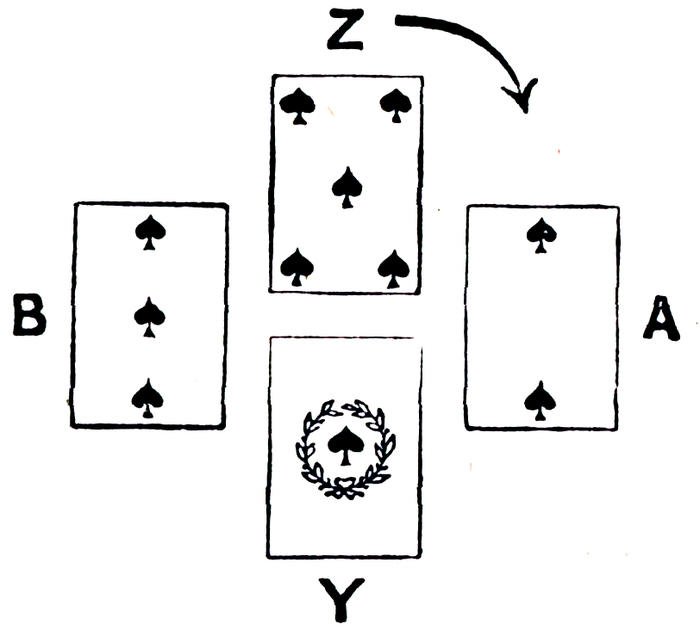
Tricks AB, 0
YZ, 2
2. B Z↷ A Y
3♠ 5♠ 2♠ A♠
Tricks AB, 1
YZ, 2
3. B Z A Y↷
8♠ 10♠ Kg♠ 4♠
Tricks AB, 1
YZ, 3
4. B Z A↷ Y
7♣ 6♣ Knv♣ A♣
Tricks AB, 2
YZ, 3
5. B Z A Y↷
Qn♠ 6♠ 2♥ 7♠
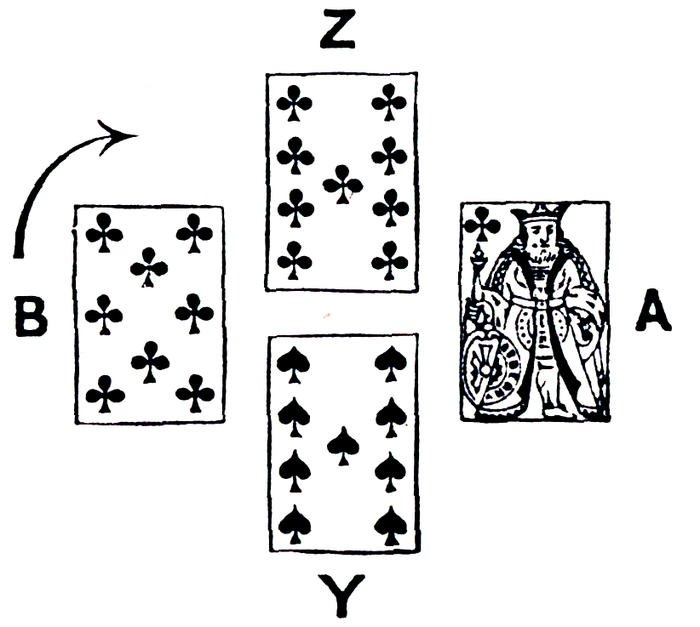
Tricks AB, 2
YZ, 4
6. B↷ Z A Y
8♣ 9♣ Kg♣ 9♠
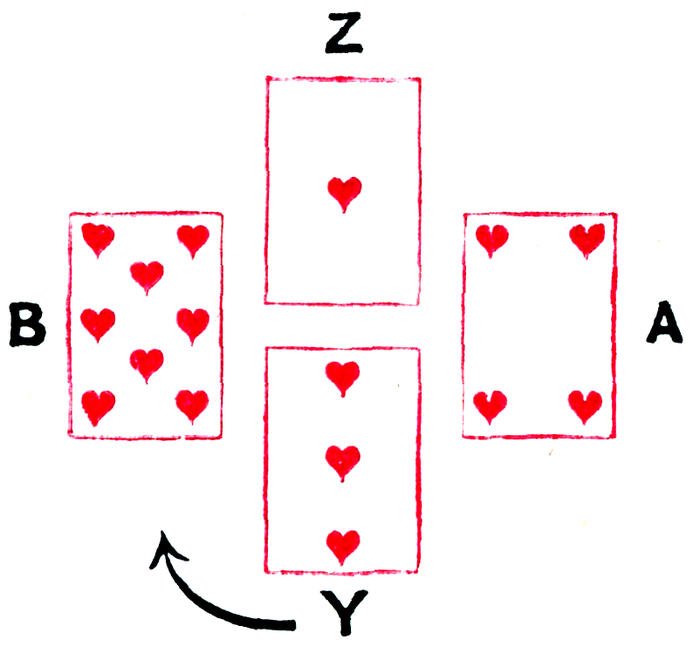
Tricks AB, 2
YZ, 5
7. B Z A Y↷
8♥ A♥ 4♥ 3♥
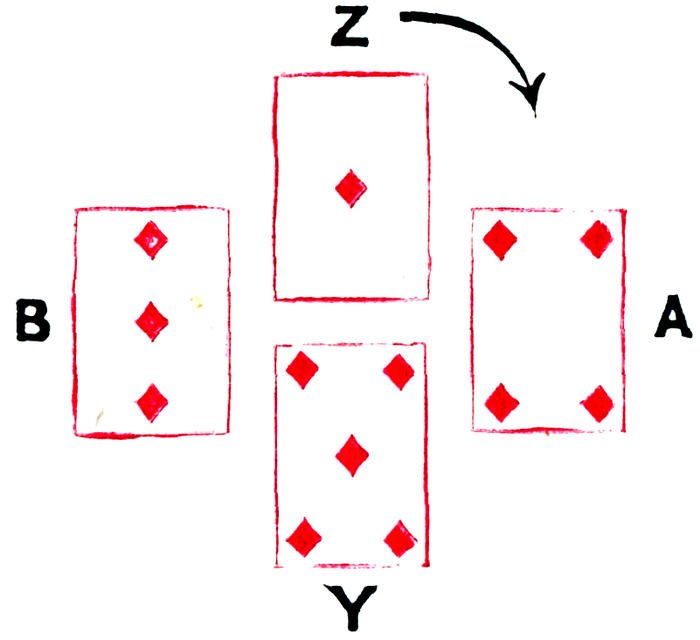
Tricks AB, 2
YZ, 6
8. B Z↷ A Y
3♦ A♦ 4♦ 5♦
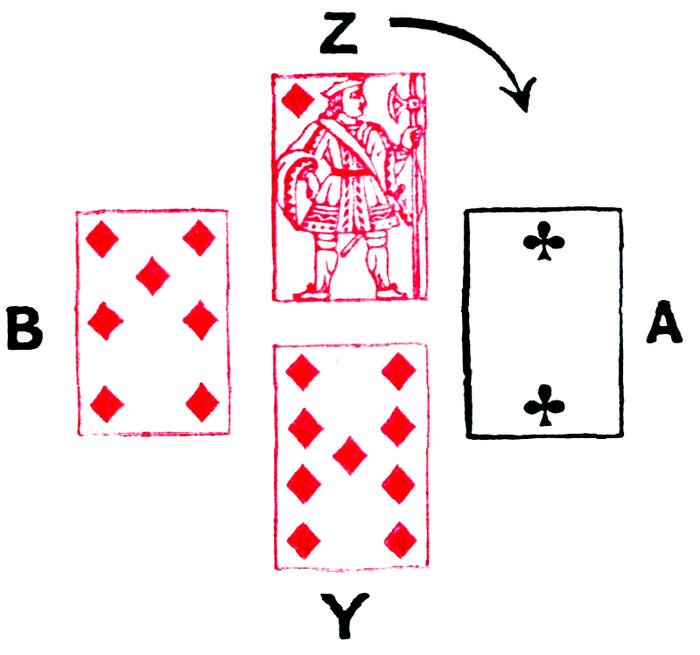
Tricks AB, 2
YZ, 7
9. B Z↷ A Y
7♦ Knv♦ 2♣ 9♦
Remark (Trick 9).—The lead of ace, followed by knave,
indicates a five card suit, headed by ace, queen, knave, and
a desire that partner, if he holds the king, should put it on
second round (see p. 101). But in this case Y can count the
hands, and therefore departs from rule, and does not put
on the king. Z has a trump, and three diamonds, the ten
guarded being in B's hand. If Y follows rule and puts on
king of diamonds, he loses a trick in diamonds; by passing
the knave, he ensures five by cards.
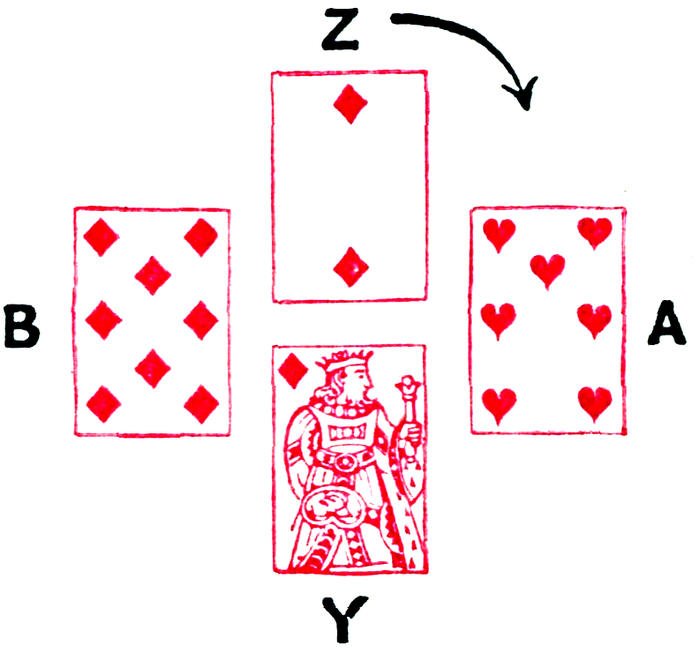
Tricks AB, 2
YZ, 8
10. B Z↷ A Y
8♦ 2♦ 7♥ Kg♦
Tricks 11 to 13.—Whatever Y leads, Z makes the remaining
tricks, and
YZ win five by cards.
(Y's hand is given above.)
| A's Hand. |
B's Hand. |
Z's Hand. |
| Kg, 2 |
♠ |
Qn, 8, 3 |
♠ |
Knv, 10, 6, 5 |
♠ |
| Knv, 9, 7, 4, 2 |
♥ |
Kg, 10, 8 |
♥ |
Ace |
♥ |
| Kg, Knv, 10, 5, 2 |
♣ |
8, 7, 4 |
♣ |
Qn, 9, 6 |
♣ |
| 4 |
♦ |
10, 8, 7, 3 |
♦ |
Ace, Qn, Knv, 6, 2 |
♦ |
At Trick 2 Z's trump lead is rather forward, but justifiable
with his hand at the score of love-all, especially as Y
must hold the ace of clubs.
Discarding, and playing to the score.
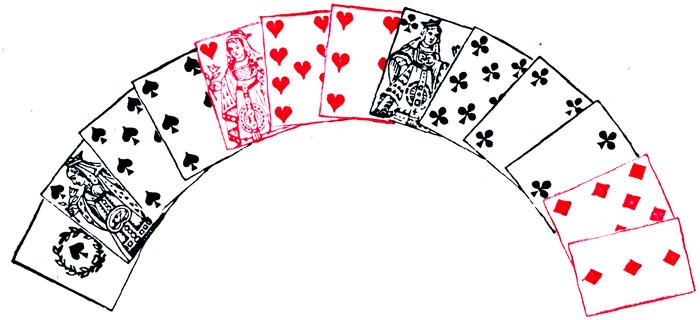
- A♠, Qn♠, 7♠, 6♠
- Qn♥, 9♥, 6♥
- Qn♣, 8♣, 4♣, 2♣
- 7♦, 3♦
Score: Love-all.
Six of hearts turned up.
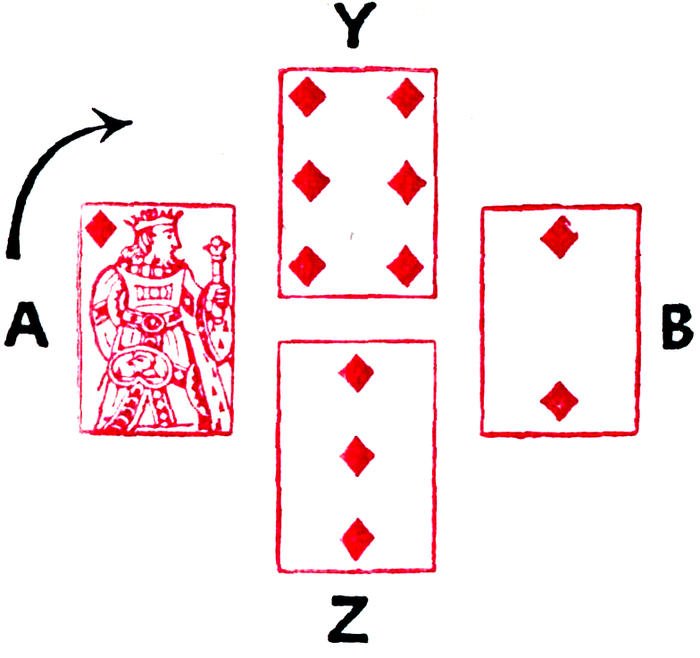
Tricks AB, 1
YZ, 0
1. A↷ Y B Z
Kg♦ 6♦ 2♦ 3♦
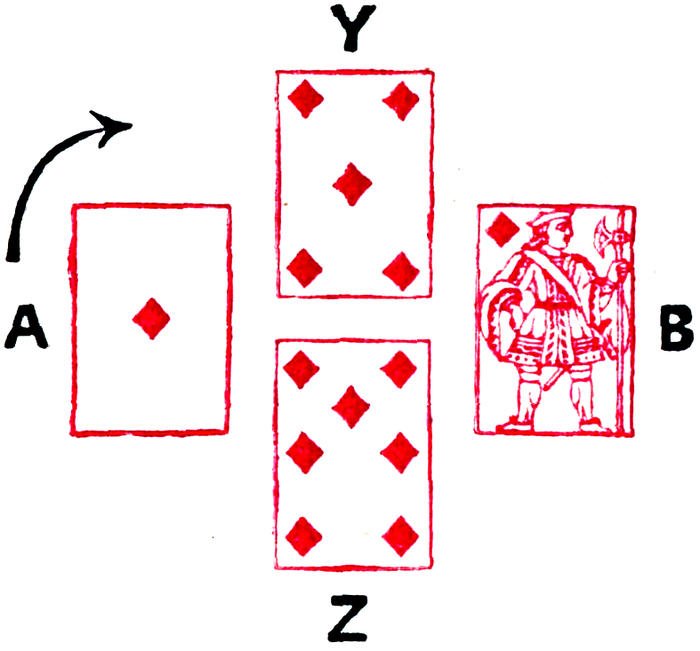
Tricks AB, 2
YZ, 0
2. A↷ Y B Z
A♦ 5♦ Knv♦ 7♦
Remark.—Y has called
for trumps.
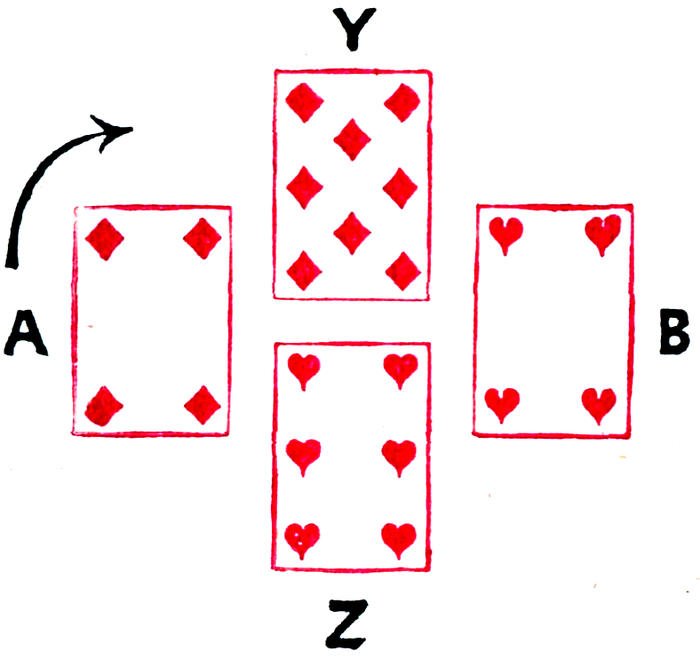
Tricks AB, 2
YZ, 1
3. A↷ Y B Z
4♦ 8♦ 4♥ 6♥
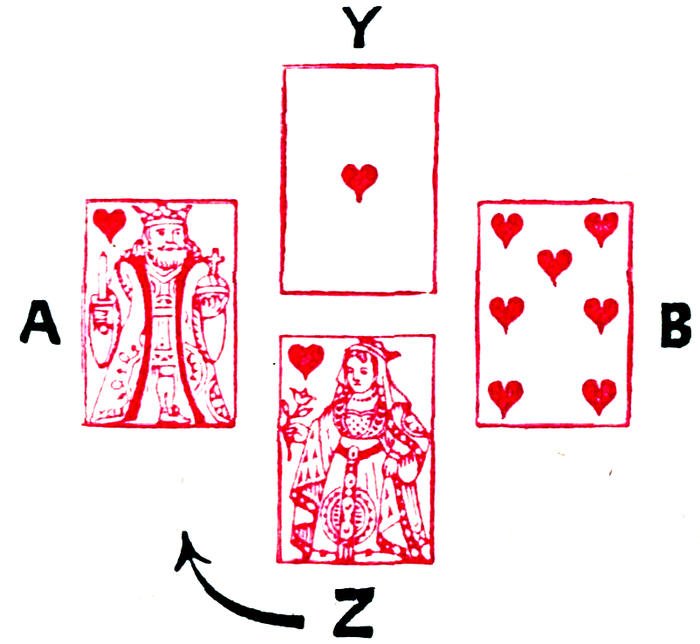
Tricks AB, 2
YZ, 2
4. A Y B Z↷
Kg♥ A♥ 7♥ Qn♥
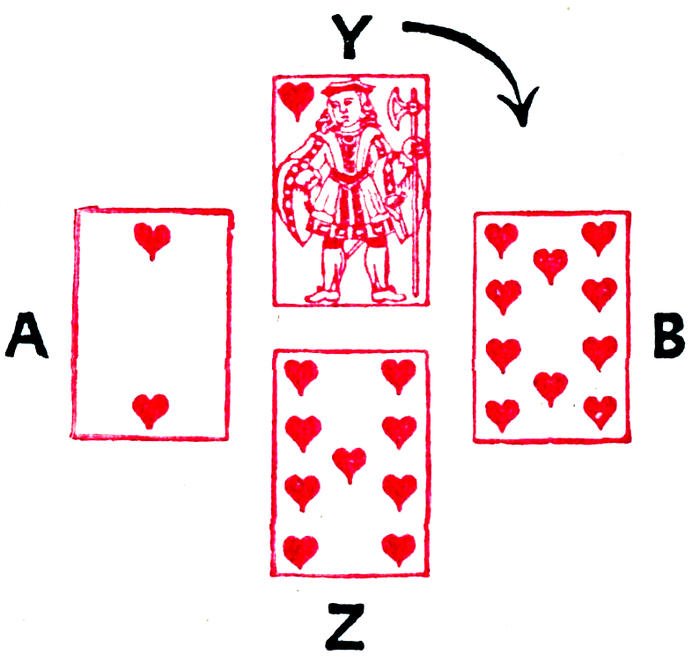
Tricks AB, 2
YZ, 3
5. A Y↷ B Z
2♥ Knv♥ 10♥ 9♥
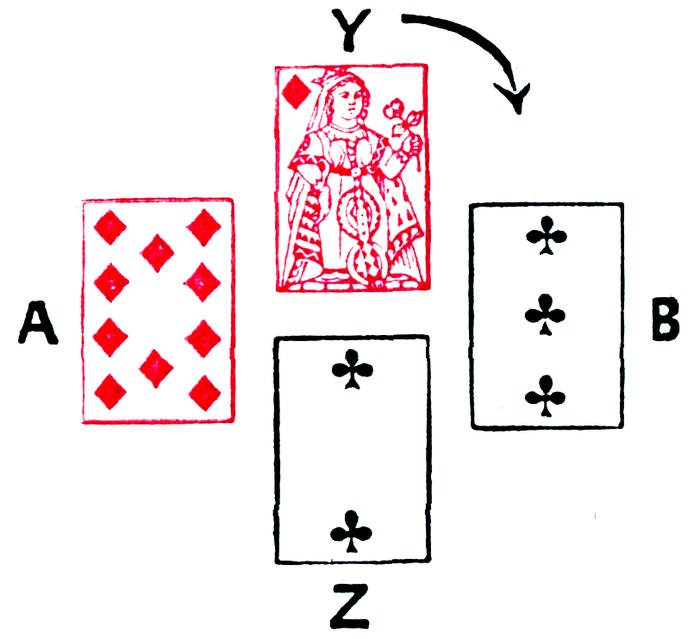
Tricks AB, 2
YZ, 4
6. A Y↷ B Z
10♦ Qn♦ 3♣ 2♣
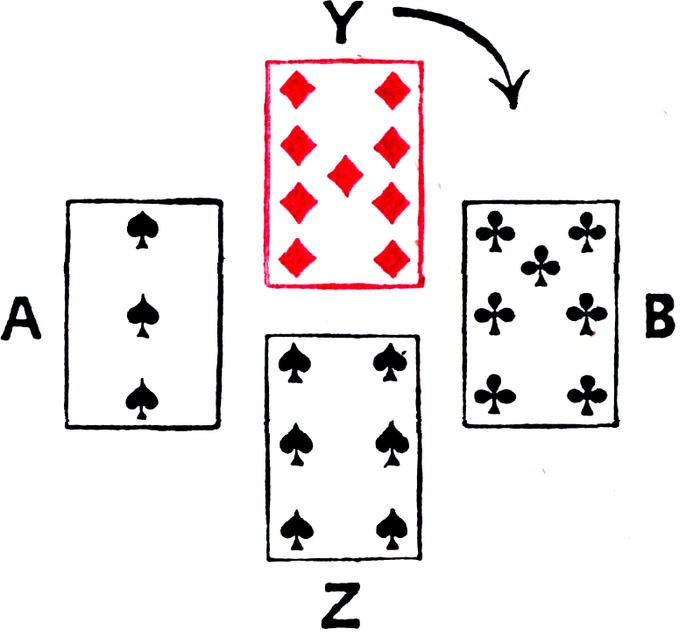
Tricks AB, 2
YZ, 5
7. A Y↷ B Z
3♠ 9♦ 7♣ 6♠
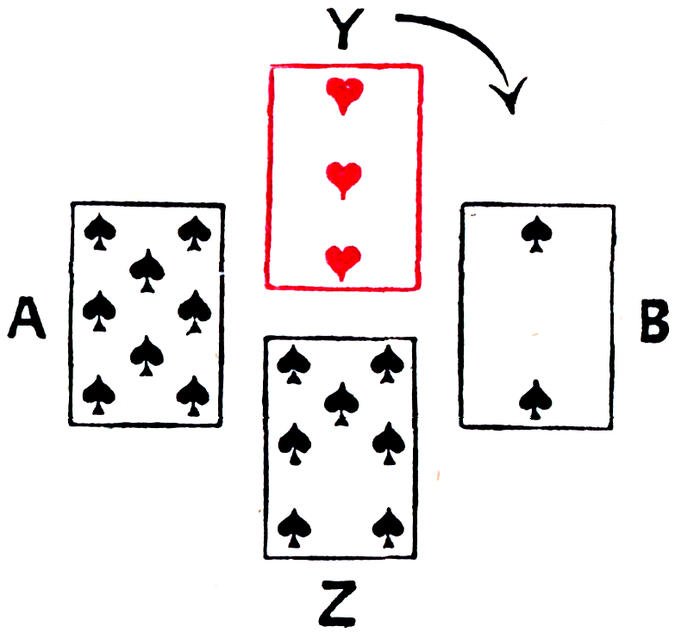
Tricks AB, 2
YZ, 6
8. A Y↷ B Z
8♠ 3♥ 2♠ 7♠
Tricks 9 to 13.—Y (Trick 9) leads a spade. He is
directed to the spade suit by Z's original discard of a
club at Trick 6 (see p. 104), notwithstanding that Z has
since discarded two spades. Z plays properly to keep his
queen of clubs guarded after his first discard, as he only
wants at most two tricks besides the two trumps which he
knows to be in Y's hand. Y, at Trick 8, leads a heart to
show he has all the other hearts, as it is possible that the
best heart may be held up by the adversary. Y thus tells
Z not to finesse if he has one trick certain (see score).
Z puts on the ace of spades, at Trick 9, as that card and
the two trumps in Y's hand make the game. If Z finesses
he only scores four, as will be seen by referring to the
hands below. Z's play would not be right if he had only
five tricks up, as he would then want one more trick to win
the game. In that case he should finesse. This is a good
illustration of playing to the score.
YZ score three by cards and two by honours.
(Z's hand is given above.)
| A's Hand. |
Y's Hand. |
B's Hand. |
| Kg, 9, 8, 3 |
♠ |
5 |
♠ |
Knv, 10, 4, 2 |
♠ |
| Kg, 2 |
♥ |
Ace, Knv, 8, 5, 3 |
♥ |
10, 7, 4 |
♥ |
| Kg, 9, 5 |
♣ |
Knv, 6 |
♣ |
Ace, 10, 7, 3 |
♣ |
| Ace, Kg, 10, 4 |
♦ |
Qn, 9, 8, 6, 5 |
♦ |
Knv, 2 |
♦ |
At Trick 3, A is justified in risking a force on his
partner, though weak in trumps himself. Strength in
trumps has been adversely declared by the call (see
pp. 132, 133), and there is nothing to show that B has
not the queen of diamonds.
At Trick 4, it is doubtful whether A should cover the
strengthening card led (see p. 88).
Discarding.
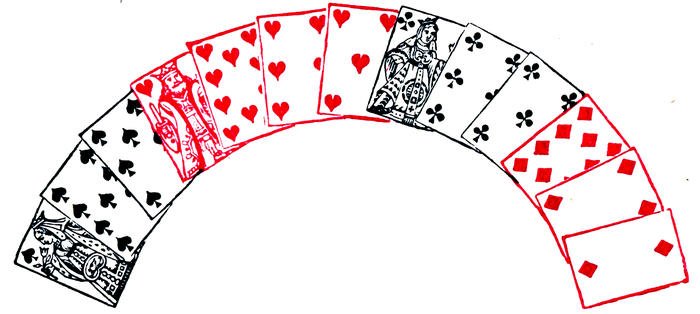
- Qn♠, 9♠, 7♠
- Kg♥, 10♥, 6♥, 5♥
- Qn♣, 6♣, 5♣
- 10♦, 4♦, 2♦
Score: AB, love; YZ, four.
Two of diamonds turned up.
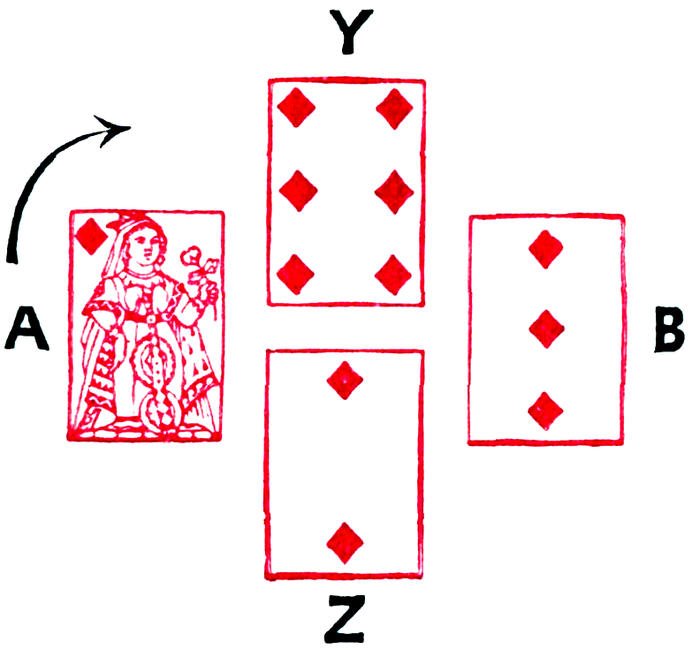
Tricks AB, 1
YZ, 0
1. A↷ Y B Z
Qn♦ 6♦ 3♦ 2♦
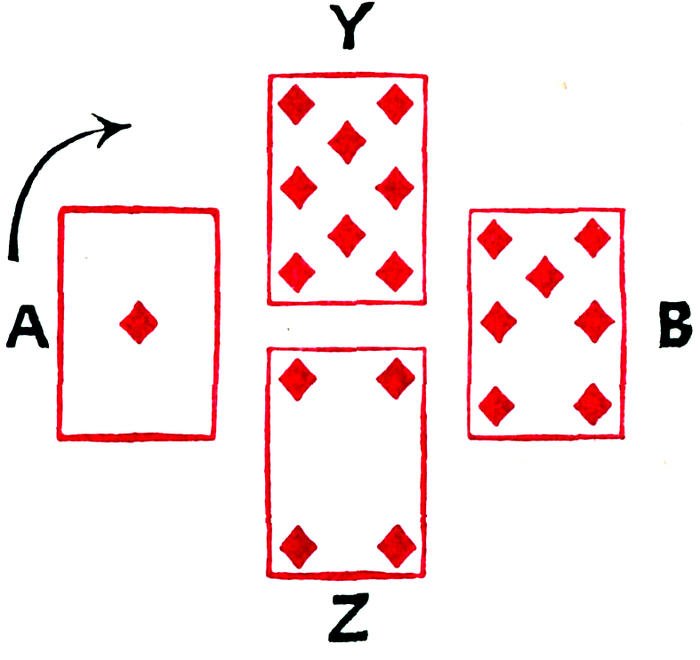
Tricks AB, 2
YZ, 0
2. A↷ Y B Z
A♦ 8♦ 7♦ 4♦
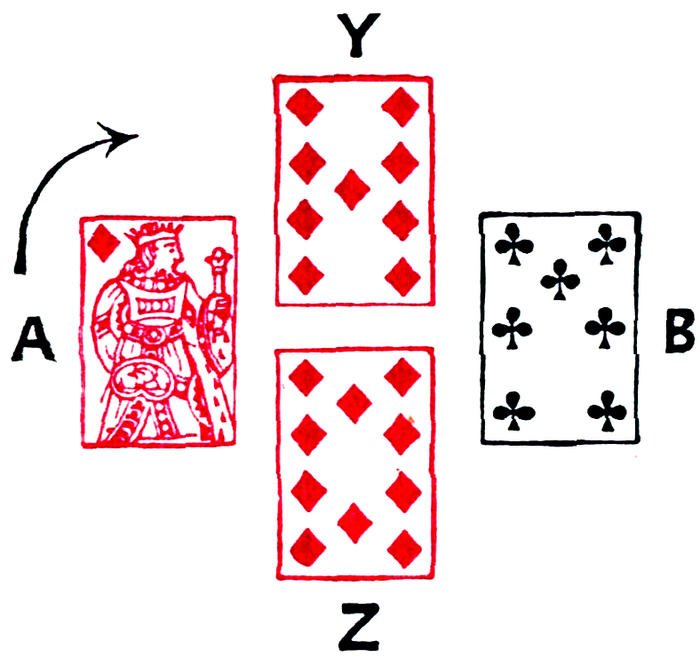
Tricks AB, 3
YZ, 0
3. A↷ Y B Z
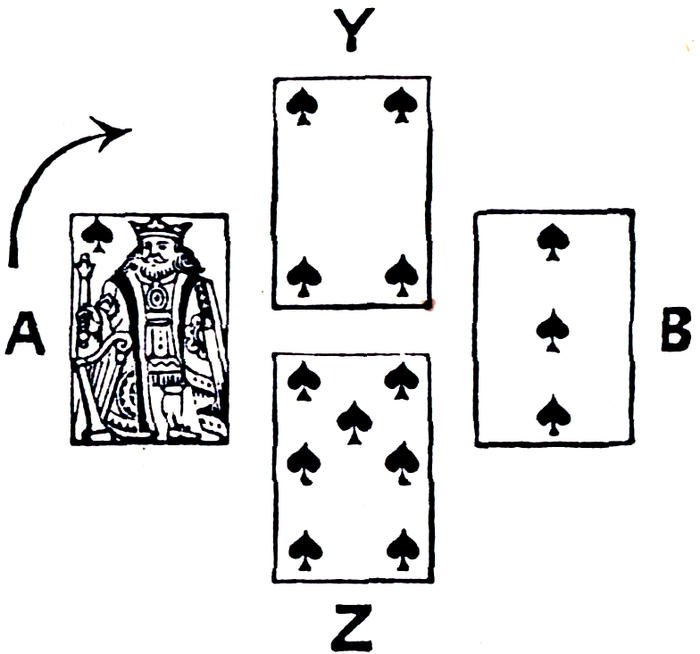
Kg♦ 9♦ 7♣ 10♦
Remark (Trick 3).—The knave of diamonds, and therefore
the command of trumps, is marked in Y's hand.
Tricks AB, 4
YZ, 0
4. A↷ Y B Z
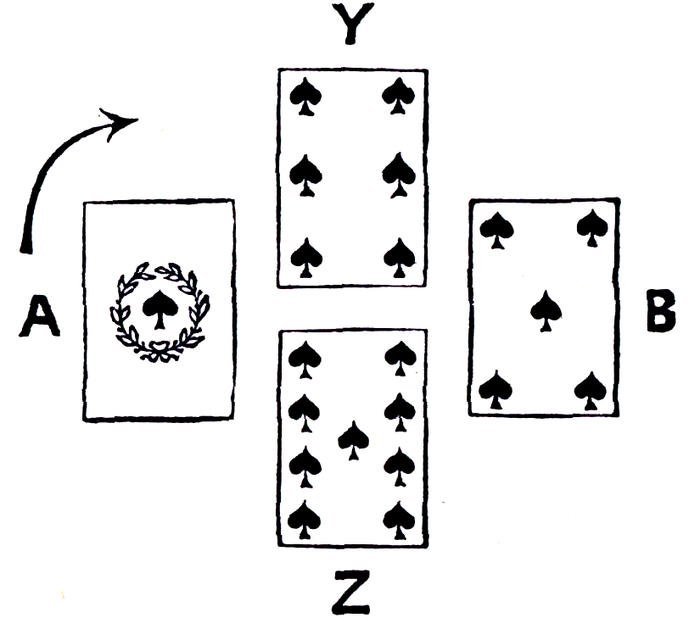
Kg♠ 4♠ 3♠ 7♠
Tricks AB, 5
YZ, 0
5. A↷ Y B Z
A♠ 6♠ 5♠ 9♠
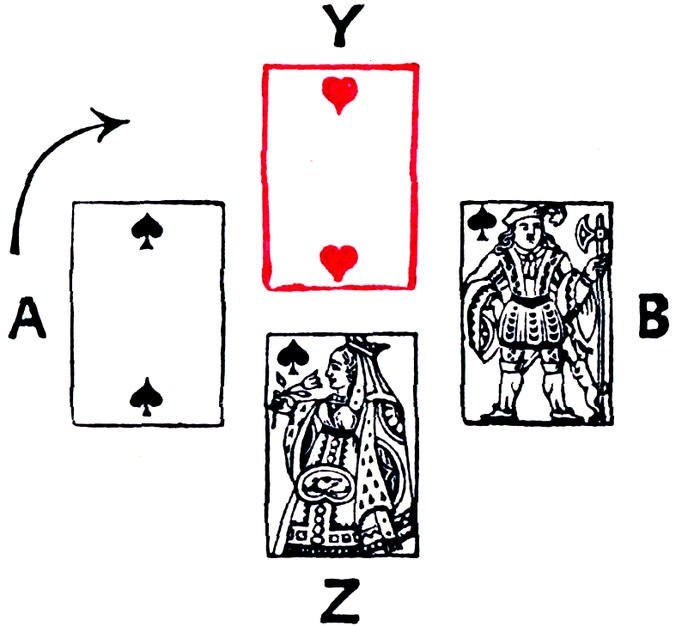
Tricks AB, 5
YZ, 1
6. A↷ Y B Z
2♠ 2♥ Knv♠ Qn♠
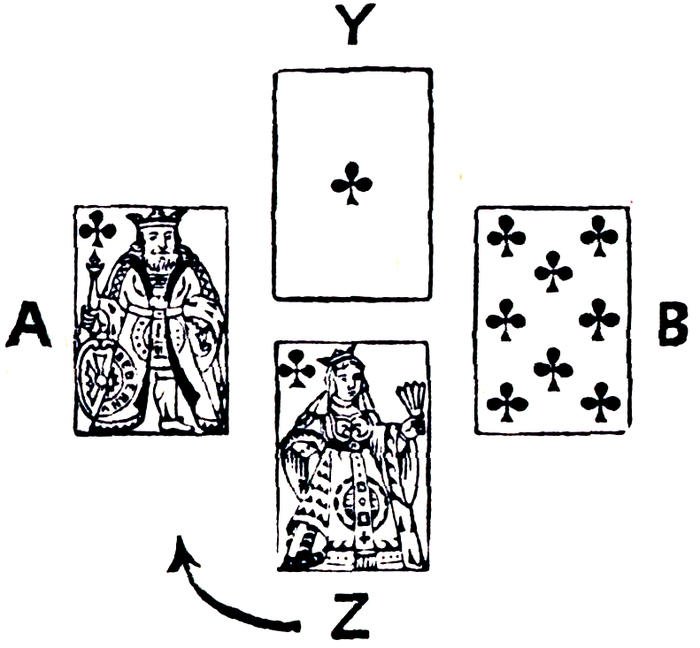
Tricks AB, 5
YZ, 2
7. A Y B Z↷
Kg♣ A♣ 8♣ Qn♣
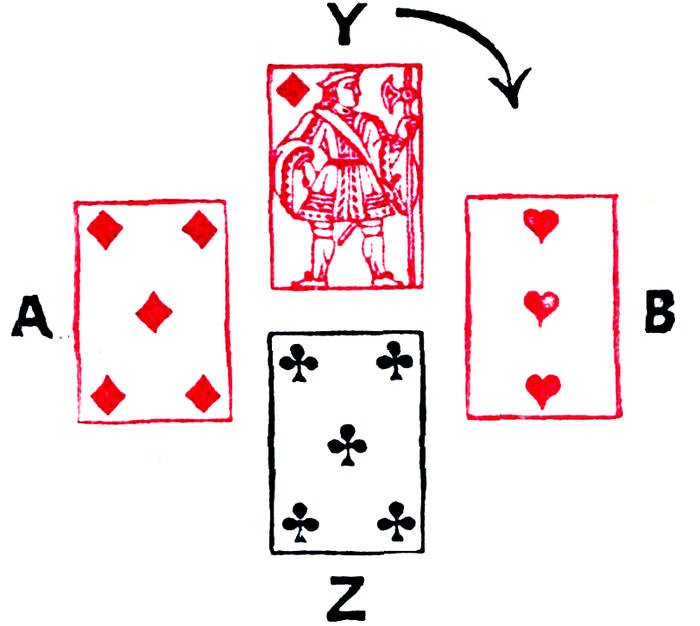
Tricks AB, 5
YZ, 3
8. A Y↷ B Z
5♦ Knv♦ 3♥ 5♣
Remark (Trick 7).—Z properly concludes, as his partner
has command of trumps (see Remark, Trick 3), that his
discard (Trick 6) was from his weakest suit, notwithstanding
the adverse trump lead, and therefore Z leads
clubs. If Z mistakes the character of his partner's discard,
and leads a heart, he loses the game (see pp. 105-6, and
apply the rules of play there stated to the present
situation).
Tricks 9 to 13.—Y brings in the clubs (see his hand
below), and
YZ win the odd trick.
(Z's hand is given above.)
| A's Hand. |
Y's Hand. |
B's Hand. |
| Ace, Kg, 10, 2 |
♠ |
6, 4 |
♠ |
Knv, 8, 5, 3 |
♠ |
| Ace, 9, 7 |
♥ |
4, 2 |
♥ |
Qn, Knv, 8, 3 |
♥ |
| King, 3 |
♣ |
Ace, Knv, 10, 4, 2 |
♣ |
9, 8, 7 |
♣ |
| Ace, Kg, Qn, 5 |
♦ |
Knv, 9, 8, 6 |
♦ |
7, 3 |
♦ |
At Trick 7, A is right to cover the queen of clubs (see
p. 88).
Getting rid of the command of partner's suit (see p. 97).
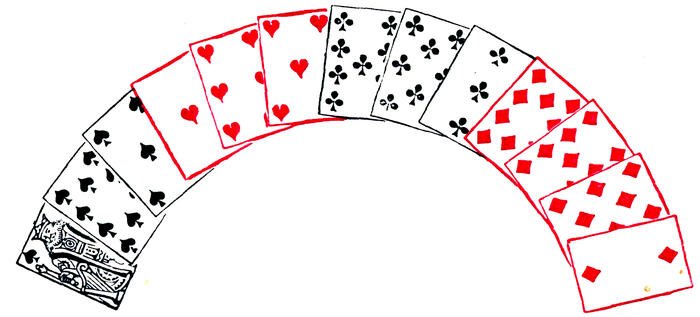
- Kg♠, 10♠, 5♠
- A♥, 6♥, 5♥
- 9♣, 8♣, 3♣
- 10♦, 9♦, 8♦, 2♦
Score: Love-all.
Five of hearts turned up.
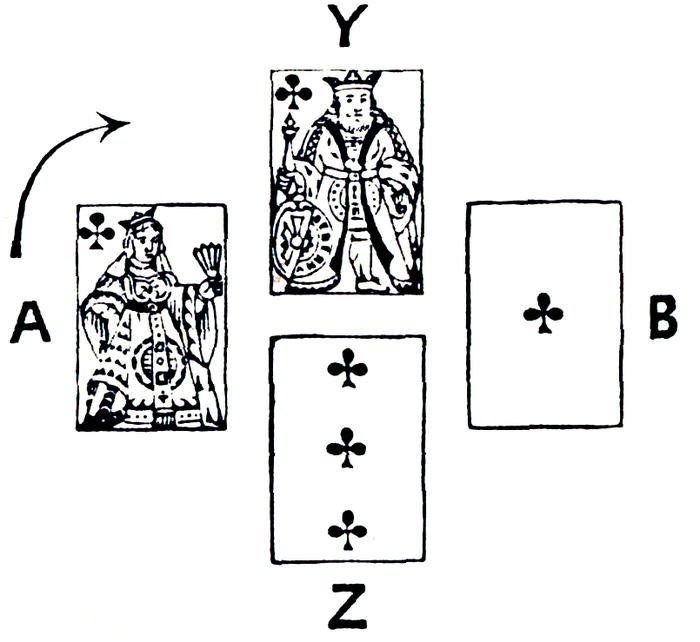
Tricks AB, 1
YZ, 0
1. A↷ Y B Z
Qn♣ Kg♣ A♣ 3♣
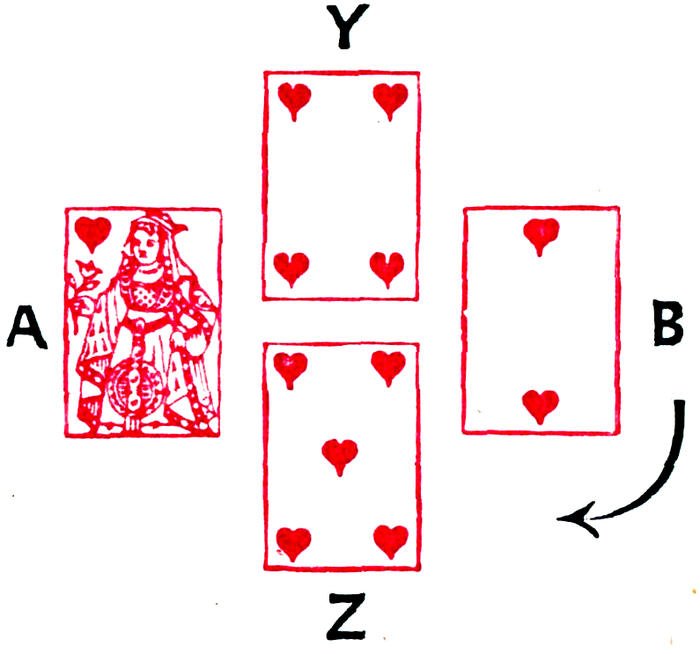
Tricks AB, 2
YZ, 0
2. A Y B↷ Z
Qn♥ 4♥ 2♥ 5♥
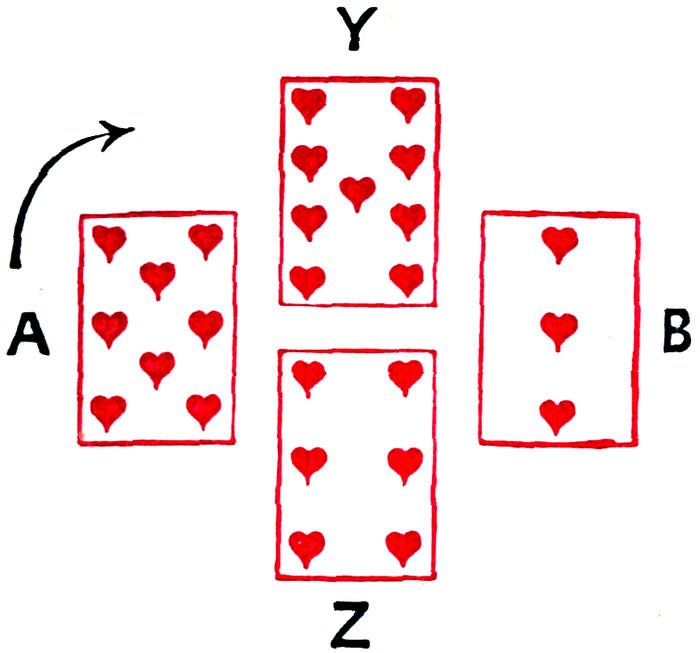
Tricks AB, 2
YZ, 1
3. A↷ Y B Z
8♥ 9♥ 3♥ 6♥
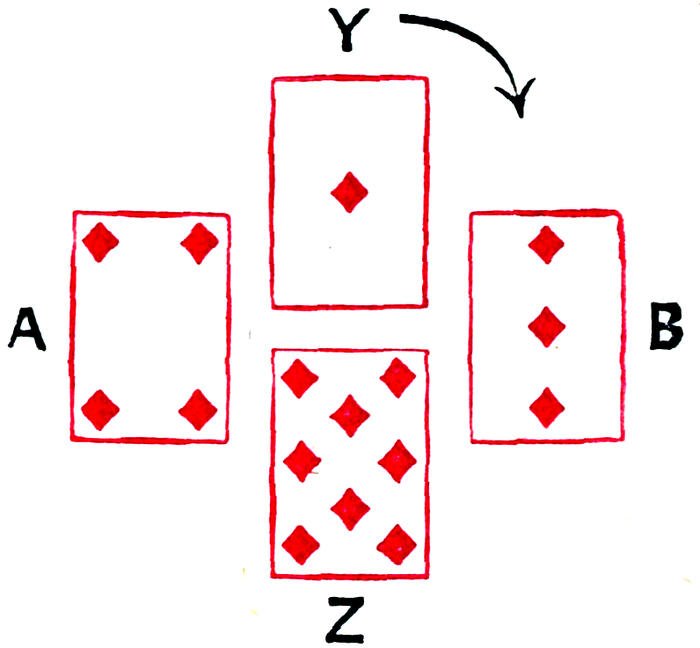
Tricks AB, 2
YZ, 2
4. A Y↷ B Z
4♦ A♦ 3♦ 8♦
Remark.—See p. 97.
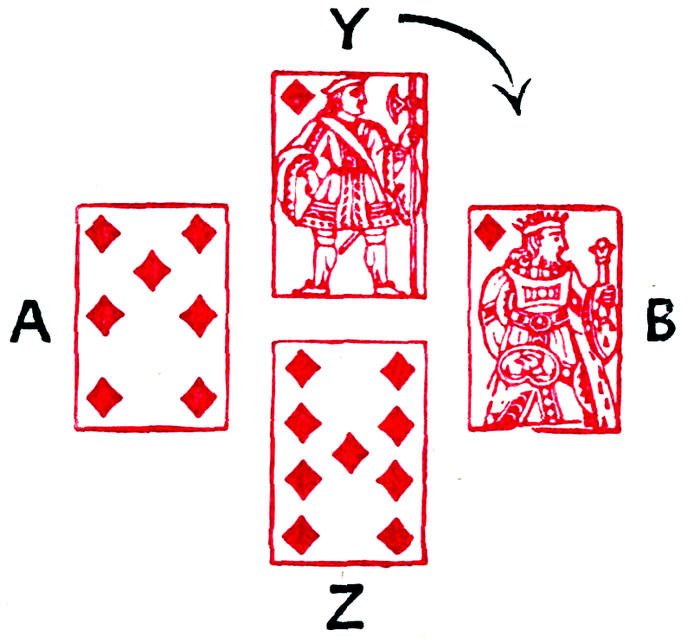
Tricks AB, 3
YZ, 2
5. A Y↷ B Z
7♦ Knv♦ Kg♦ 9♦
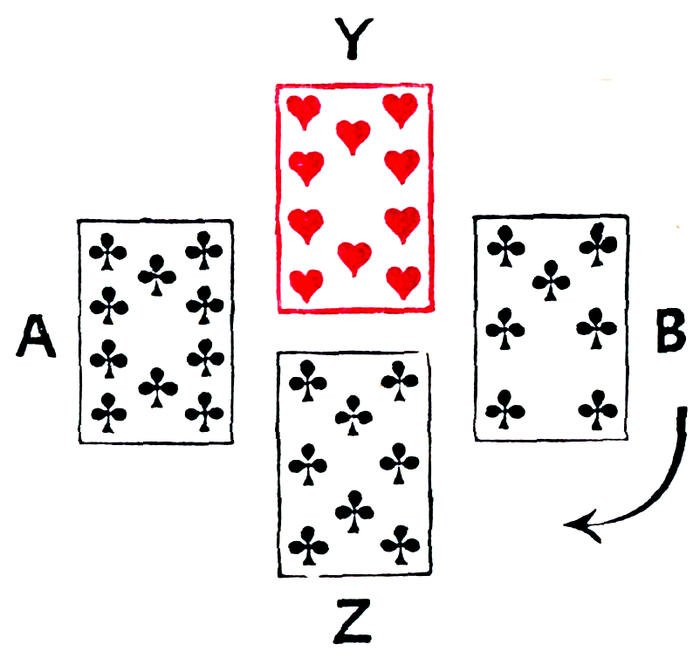
Tricks AB, 3
YZ, 3
6. A Y B↷ Z
10♣ 10♥ 7♣ 8♣
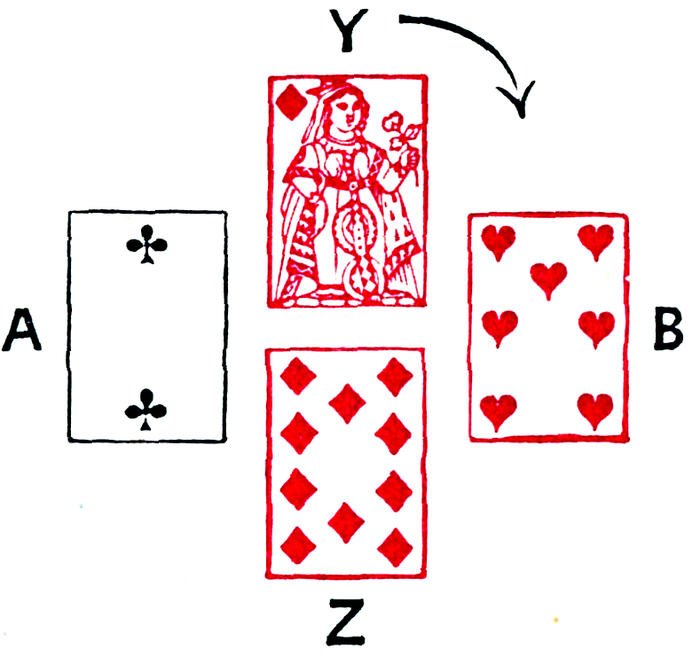
Tricks AB, 4
YZ, 3
7. A Y↷ B Z
2♣ Qn♦ 7♥ 10♦
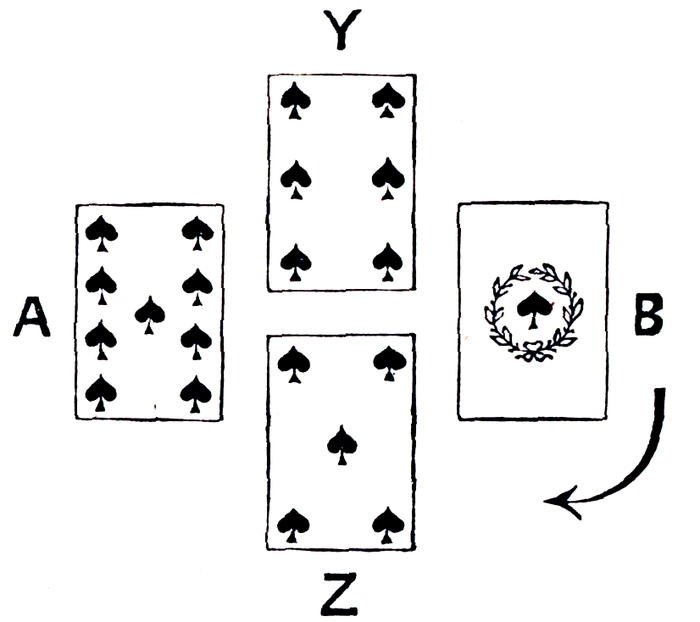
Tricks AB, 5
YZ, 3
8. A Y B↷ Z
9♠ 6♠ A♠ 5♠
Tricks AB, 5
YZ, 4
9. A Y B↷ Z
Knv♠ 7♠ 2♠ Kg♠
Tricks AB, 5
YZ, 5
10. A Y B Z↷
4♣ Knv♥ Kg♥ A♥
Tricks 11 to 13.—Z (Trick 11) leads deuce of diamonds.
Y makes two tricks in diamonds (note the advantage to
YZ of Z's having got rid of the command).
YZ win the odd trick.
(Z's hand is given above.)
| A's Hand. |
Y's Hand. |
B's Hand. |
| Knv, 9 |
♠ |
8, 7, 6 |
♠ |
Ace, Qn, 4, 3, 2 |
♠ |
| Qn, 8 |
♥ |
Knv, 10, 9, 4 |
♥ |
Kg, 7, 3, 2 |
♥ |
| Qn, Knv, 10, 6, 5, 4, 2 |
♣ |
Kg |
♣ |
Ace, 7 |
♣ |
| 7, 4 |
♦ |
Ace, Qn, Knv, 6, 5 |
♦ |
Kg, 3 |
♦ |
At Trick 2, Z plays the turn-up card (see p. 114).
At Trick 3, B passes the nine of trumps. If the tenace
is against him covering does no good; and there is a
reasonable chance that the ace will fall.
At Trick 6, B, having found A weak in trumps, and the
whole diamond suit being declared against him, alters his
tactics, and does not continue trumps.
At Trick 7, Y plays properly in attempting to force the
strong trump hand, keeping knave of hearts with which
to trump clubs. If B refuses the first force he wins two
or three by cards, as the cards happen to lie. But he
cannot place the diamonds, and probably his best play is
to trump.
Finessing.
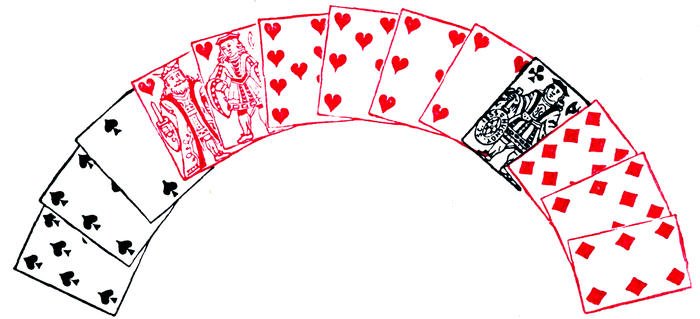
- 7♠, 6♠, 2♠
- Kg♥, Knv♥, 9♥, 7♥, 6♥, 4♥
- Knv♣
- 10♦, 7♦, 6♦
Score: Four-all.
Ten of clubs turned up.
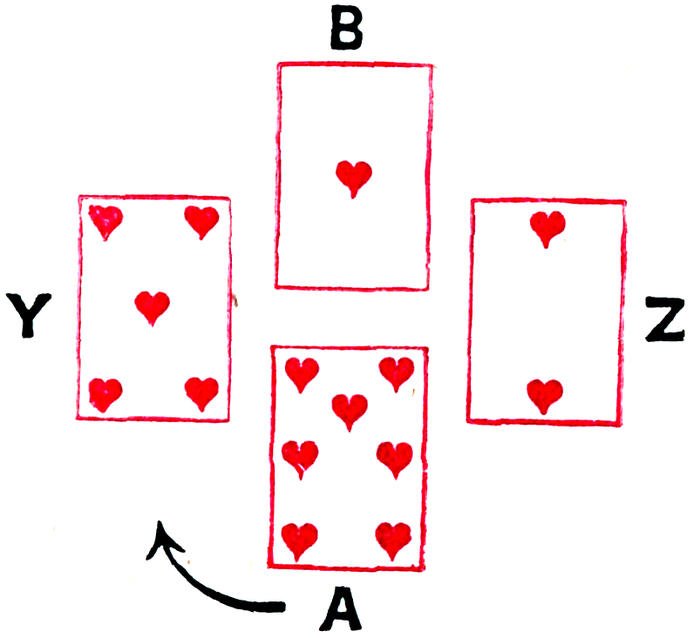
Tricks AB, 1
YZ, 0
1. Y B Z A↷
5♥ A♥ 2♥ 7♥
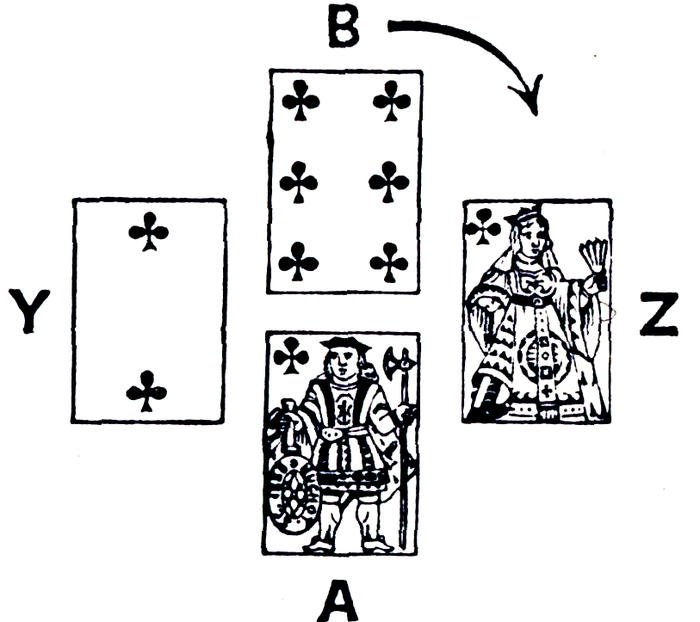
Tricks AB, 1
YZ, 1
2. Y B↷ Z A
2♣ 6♣ Qn♣ Knv♣
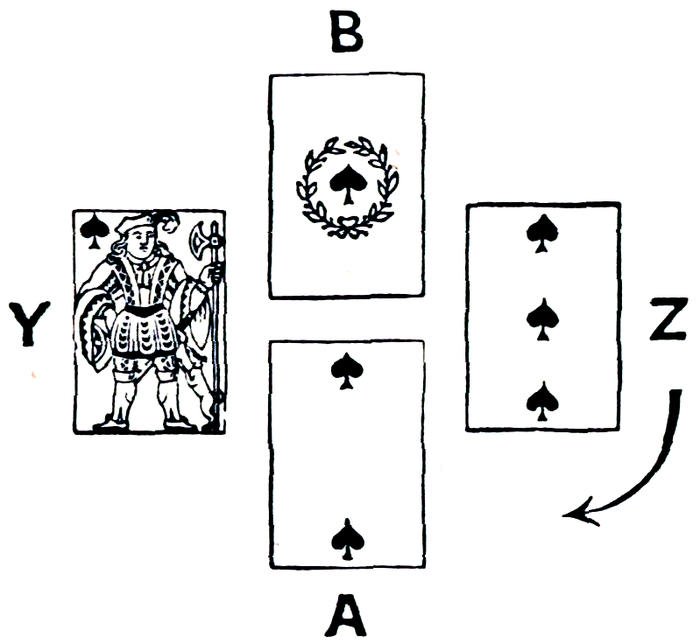
Tricks AB, 2
YZ, 1
3. Y B Z↷ A
Knv♠ A♠ 3♠ 2♠
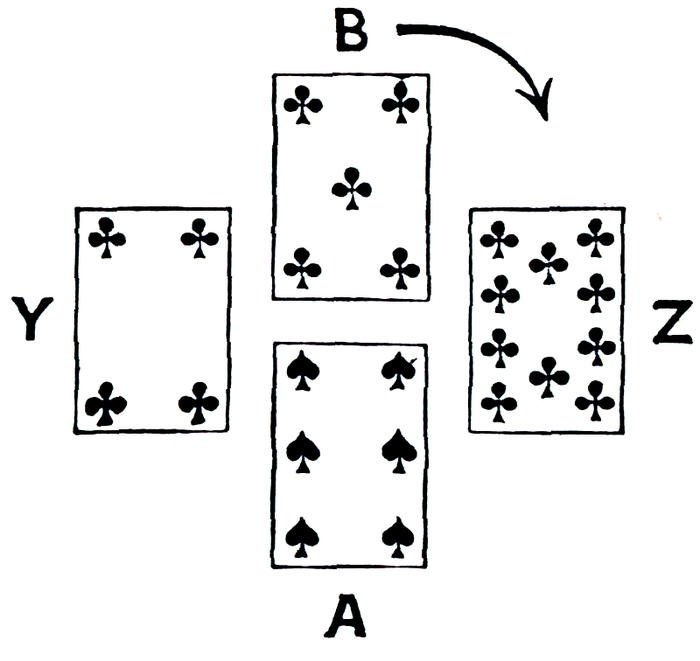
Tricks AB, 2
YZ, 2
4. Y B↷ Z A
4♣ 5♣ 10♣ 6♠
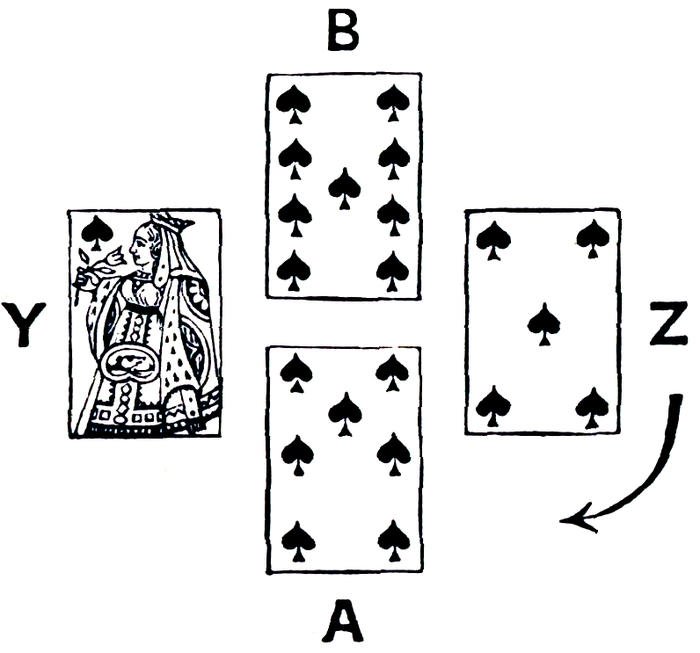
Tricks AB, 2
YZ, 3
5. Y B Z↷ A
Qn♠ 9♠ 5♠ 7♠
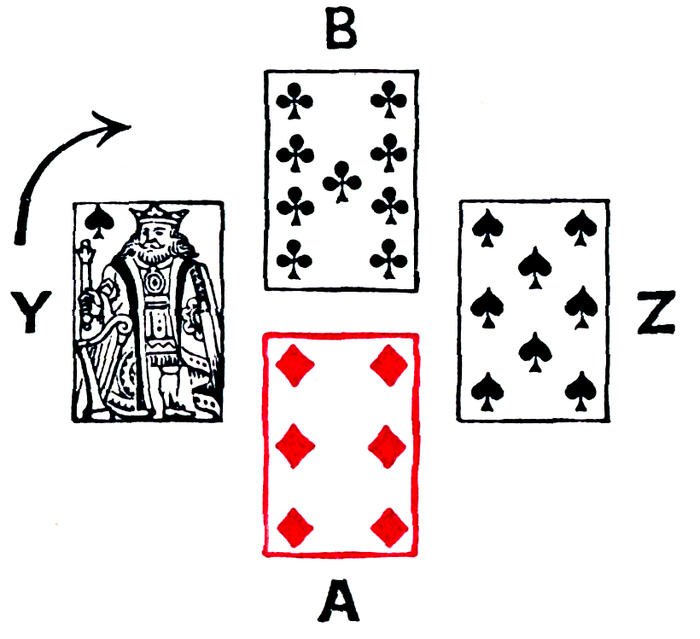
Tricks {AB, 3, YZ, 3
6. Y↷ B Z A
Kg♠ 9♣ 8♠ 6♦
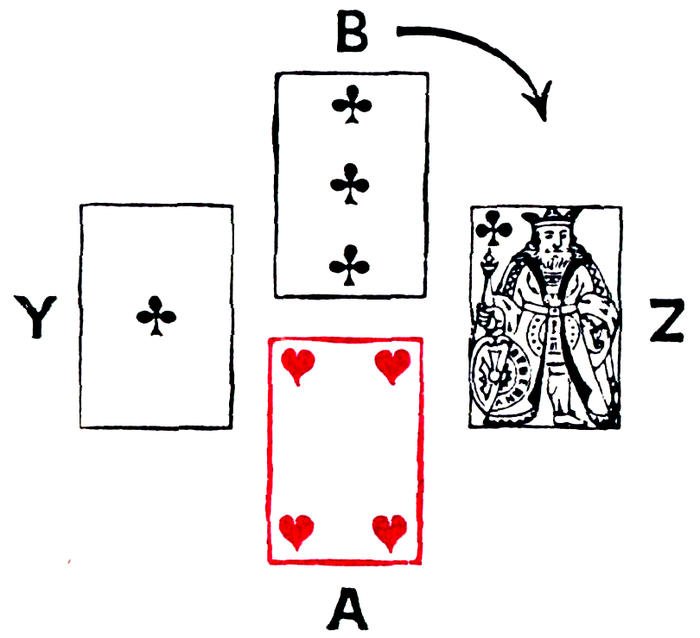
Tricks AB, 3
YZ, 4
7. Y B↷ Z A
A♣ 3♣ Kg♣ 4♥
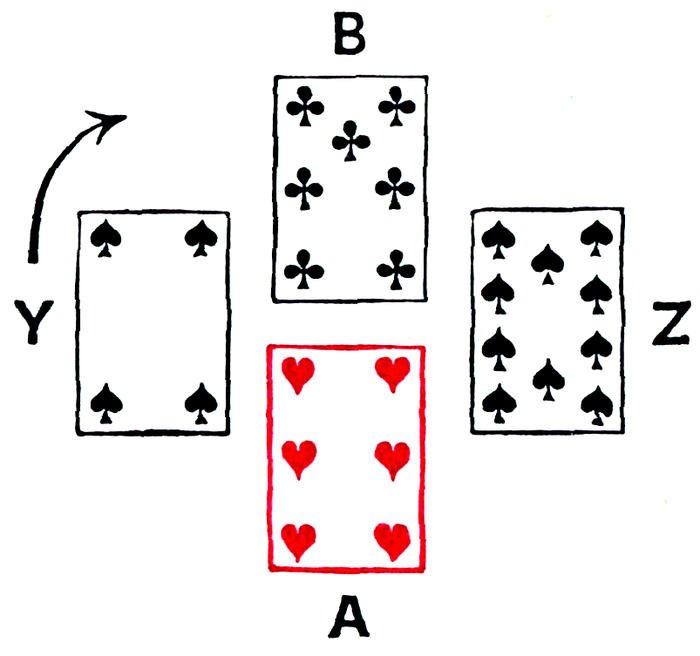
Tricks AB, 4
YZ, 4
8. Y↷ B Z A
4♠ 7♣ 10♠ 6♥
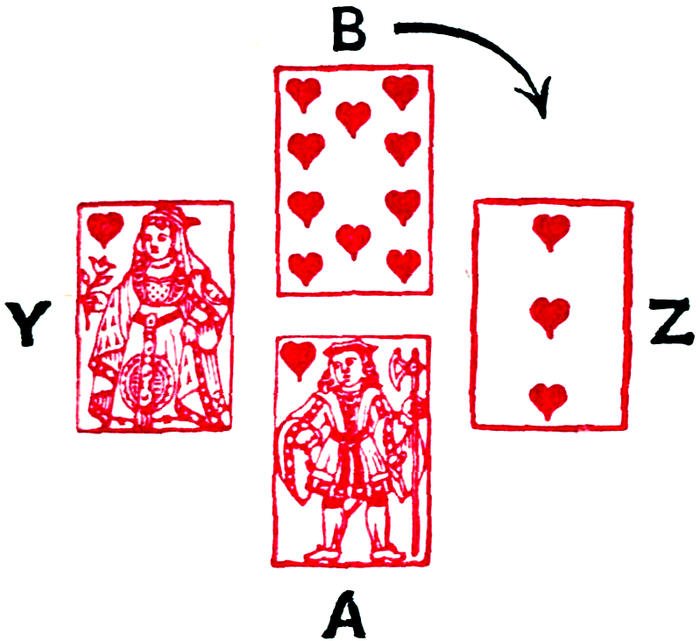
Tricks AB, 4
YZ, 5
9. Y B↷ Z A
Qn♥ 10♥ 3♥ Knv♥
Remark (Trick 9).—A's
finesse is unlucky. He has
no indication as to the position
of the queen. The finesse
must not be judged by
the result. It is generally
right against one card if the
success of the finesse wins
the game.
Tricks 10 to 13.—YZ make two tricks in diamonds
(see their hands below); and
YZ win the odd trick.
(A's hand is given above.)
| Y's Hand. |
B's Hand. |
Z's Hand. |
| Kg, Qn, Knv, 4 |
♠ |
Ace, 9 |
♠ |
10, 8, 5, 3 |
♠ |
| Qn, 5 |
♥ |
Ace, 10 |
♥ |
8, 3, 2 |
♥ |
| Ace, 4, 2 |
♣ |
9, 8, 7, 6, 5, 3 |
♣ |
Kg, Qn, 10 |
♣ |
| Kg, Knv, 8, 5 |
♦ |
Qn, 9, 3 |
♦ |
Ace, 4, 2 |
♦ |
At Trick 6, Y's lead is not well judged. He knows his
partner to hold king of clubs single, and his object should
be to prevent the two trumps from being drawn together.
Y's best lead appears to be queen of hearts; and if it
wins, a diamond.
Counting the hands, and refusing a finesse.
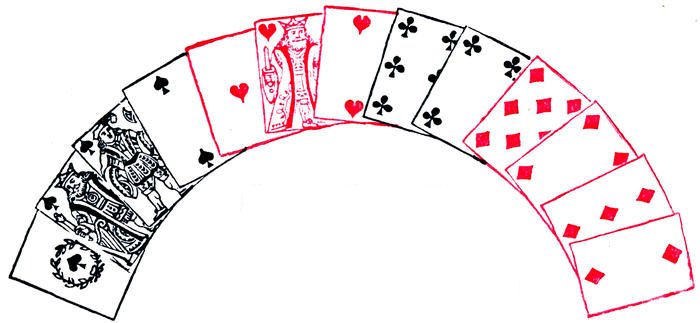
- A♠, Kg♠, Knv♠, 2♠
- A♥, Kg♥, 2♥
- 6♣, 4♣
- 8♦, 4♦, 3♦, 2♦
Score: Love-all.
King of hearts turned up.
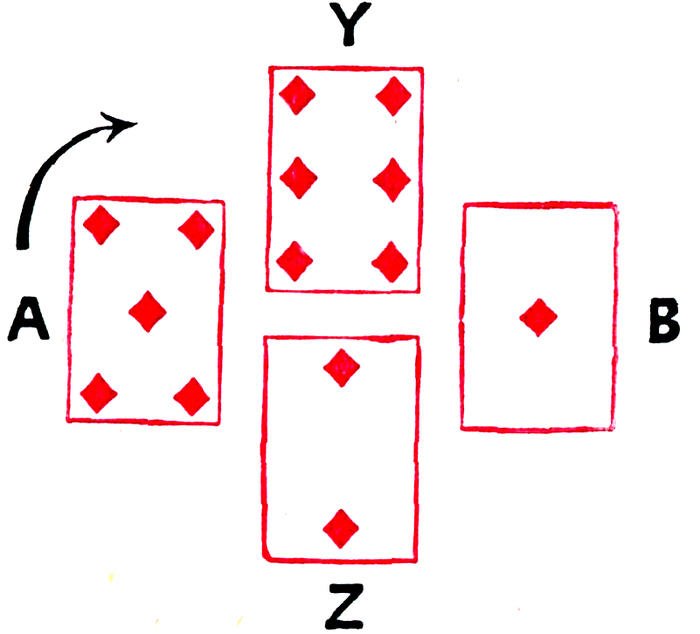
Tricks AB, 1
YZ, 0
1. A↷ Y B Z
5♦ 6♦ A♦ 2♦
Remark (Trick 1).—A has not both king and queen of
diamonds, or he would have led one. B has not either
king or queen of diamonds, or he would have played one
of them instead of the ace. Therefore, Y must have one
of those cards. Z draws this inference at the time. It will
not be of any use to him until near the end of the hand.
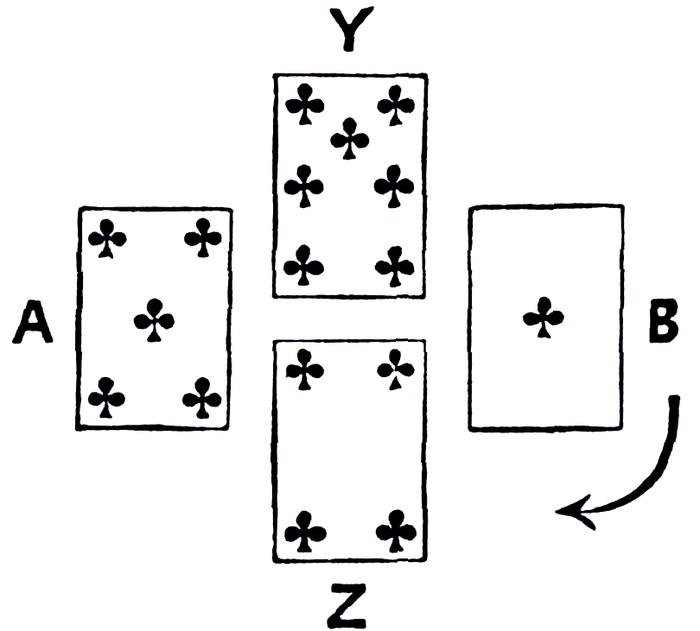
Tricks AB, 2
YZ, 0
2. A Y B↷ Z
5♣ 7♣ A♣ 4♣
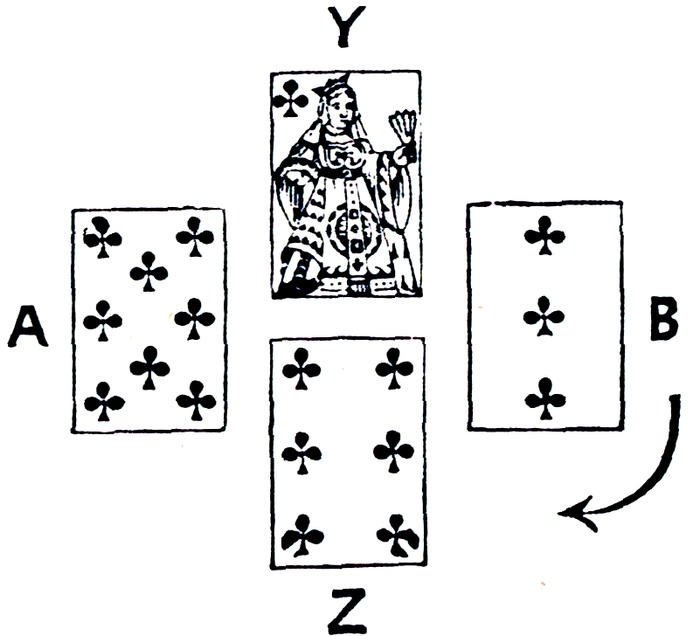
Tricks AB, 2
YZ, 1
3. A Y B↷ Z
8♣ Qn♣ 3♣ 6♣
Remark.—B has led from
exactly five clubs (see Appendix
A).
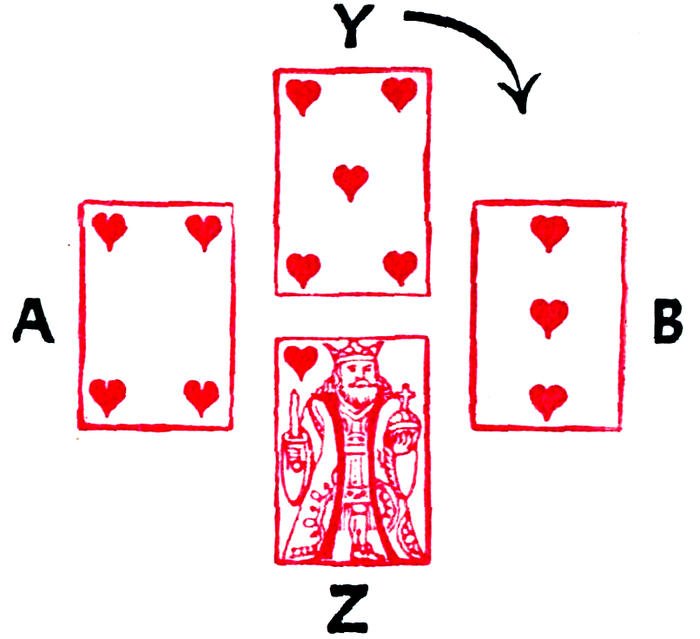
Tricks AB, 2
YZ, 2
4. A Y↷ B Z
4♥ 5♥ 3♥ Kg♥
Remark.—The ace would
be an echo (see p. 128).
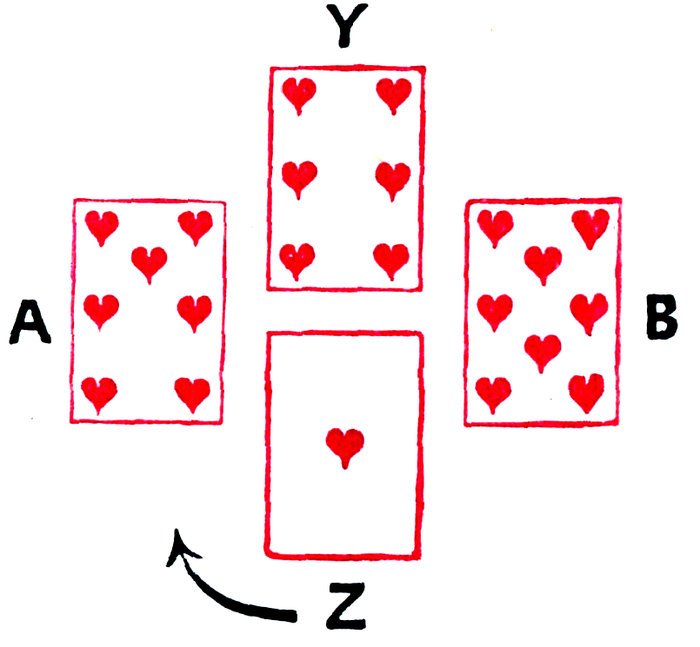
Tricks AB, 2
YZ, 3
5. A Y B Z↷
7♥ 6♥ 8♥ A♥
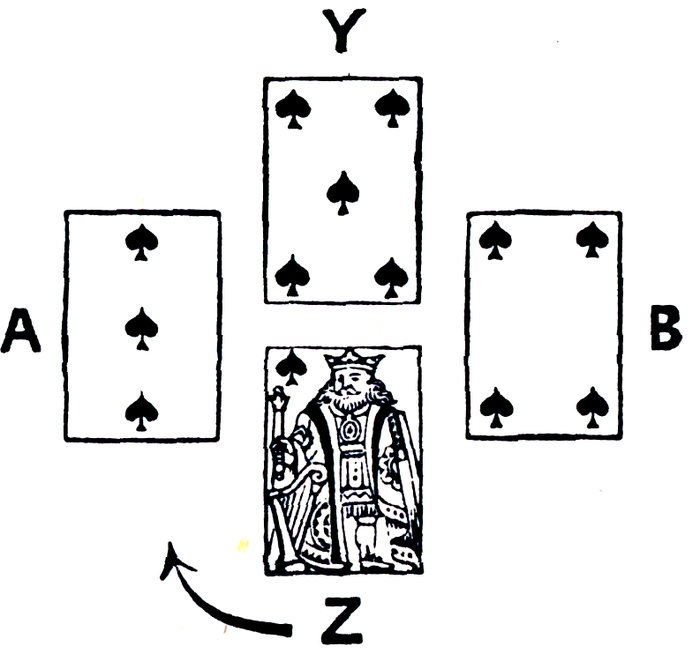
Tricks AB, 2
YZ, 4
6. A Y B Z↷
3♠ 5♠ 4♠ Kg♠
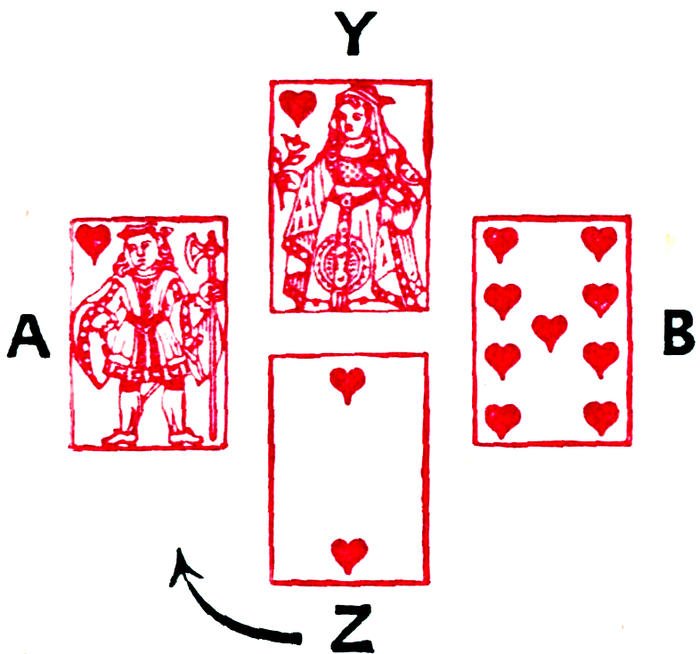
Remark (Trick 6).—The policy of this lead is doubtful.
Players are apt to show their suits in this manner. But it
is clear, the opponents having led diamonds and clubs,
that if Z has strength in any suit it is in spades. The
objections to showing a suit in this way are: 1, that it
may be trumped the first round; 2, that partner may
have only one card of it. In the latter case he cannot
return the lead, and must open or continue another suit
to a disadvantage.
Tricks AB, 2
YZ, 5
7. A Y B Z↷
Knv♥ Qn♥ 9♥ 2♥
Remark.—Y has the long
trump.
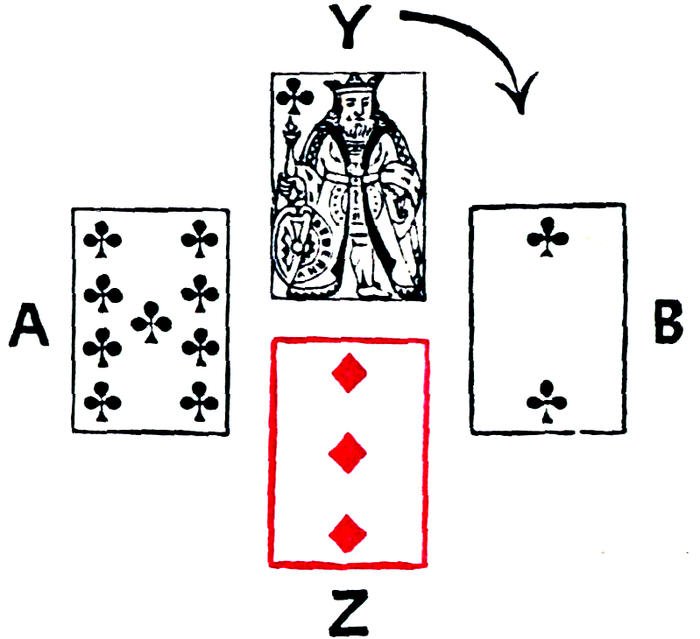
Tricks AB, 2
YZ, 6
8. A Y↷ B Z
9♣ Kg♣ 2♣ 3♦
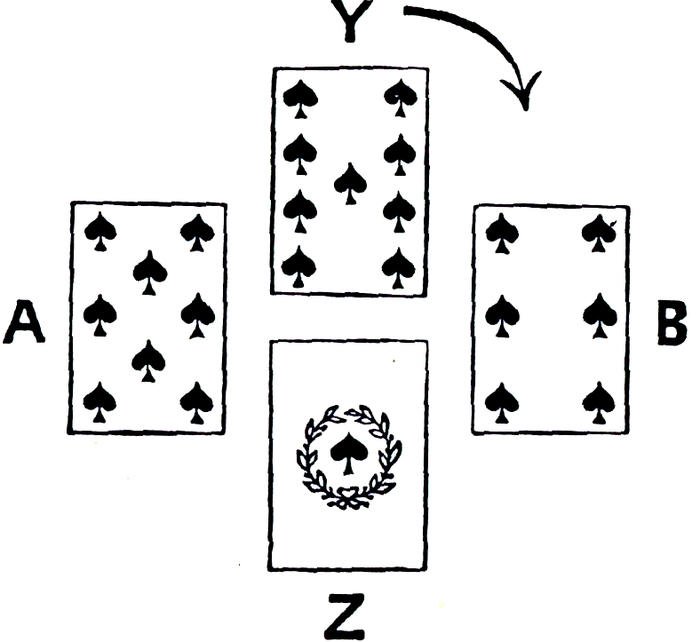
Tricks AB, 2
YZ, 7
9. A Y↷ B Z
8♠ 9♠ 6♠ A♠
Remark (Trick 9).—Z's play in not finessing is very good.
He can count Y's hand, thus: Y has no more clubs (see
Remark, Trick 3), he has the last trump, and three other
cards. These cards must either be queen, ten of spades,
and a diamond, in which case Z's play does not matter; or
the nine returned by Y must be his best spade, in which
case he can only have one more, as he would return the
higher of two remaining cards (see p. 79), and his other
cards must then be two diamonds. Therefore, assuming
the case in which Z's play does matter (i.e., of Y's nine
being his best spade), Y's diamond must be guarded.
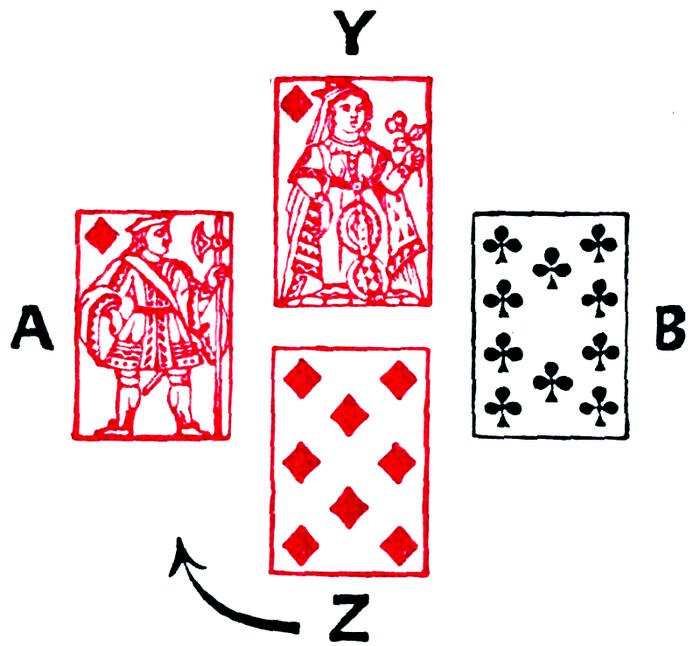
Tricks AB, 2
YZ, 8
10. A Y B Z↷
Knv♦ Qn♦ 10♣ 8♦
Consequently, Z, by not finessing, makes sure of the
game. He requires one more trick besides the ace of
spades and his partner's trump, and this trick Y is certain
to make in diamonds if Z leads through A's hand (see
Remark, Trick 1).
Tricks 10 to 13.—Z (Trick 10) leads a diamond, and,
however A plays,
YZ score three by cards and two by honours.
(Z's hand is given above.)
| A's Hand. |
Y's Hand. |
B's Hand. |
| Qn, 8, 3 |
♠ |
9, 5 |
♠ |
10, 7, 6, 4 |
♠ |
| Knv, 7, 4 |
♥ |
Qn, 10, 6, 5 |
♥ |
9, 8, 3 |
♥ |
| 9, 8, 5 |
♣ |
Kg, Qn, 7 |
♣ |
Ace, Knv, 10, 3, 2 |
♣ |
| Kg, Knv, 7, 5 |
♦ |
Qn, 10, 9, 6 |
♦ |
Ace |
♦ |
As the cards happen to lie, YZ only score four if Z
finesses at Trick 9, and A plays properly. A, on winning
this trick with the queen of spades, should see that his
only chance of making two more tricks is to be led up to
in diamonds. He should therefore (Trick 10) lead the
seven of diamonds, which Y is compelled to take, and AB
save the game.
Leading losing card to place the lead
(see pp. 147-151).
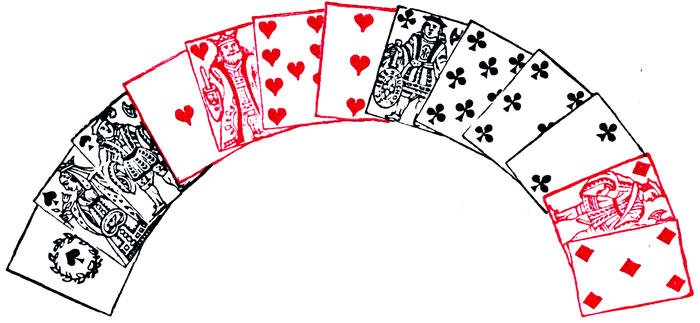
- A♠, Qn♠, Knv♠
- A♥, Kg♥, 9♥, 3♥
- Knv♣, 8♣, 6♣, 2♣
- Knv♦, 5♦
Score: Love-all.
Ten of hearts turned up.
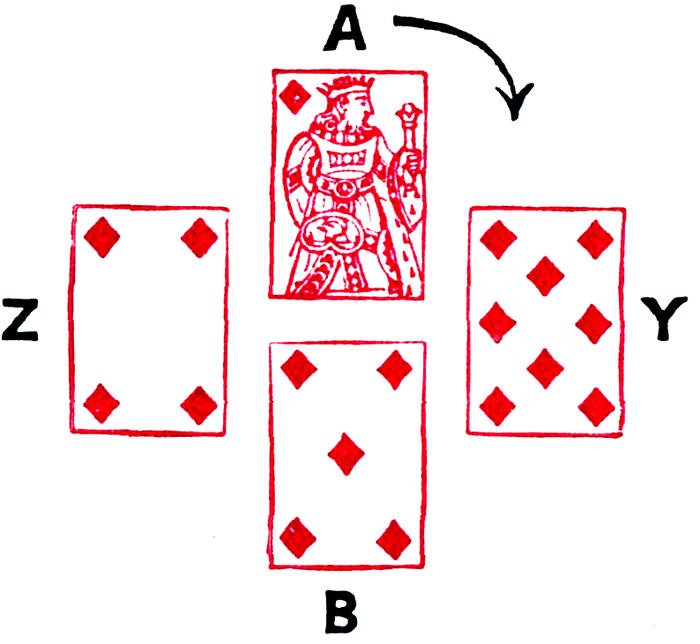
Tricks AB, 1
YZ, 0
1. Z A↷ Y B
4♦, Kg♦, 8♦, 5♦
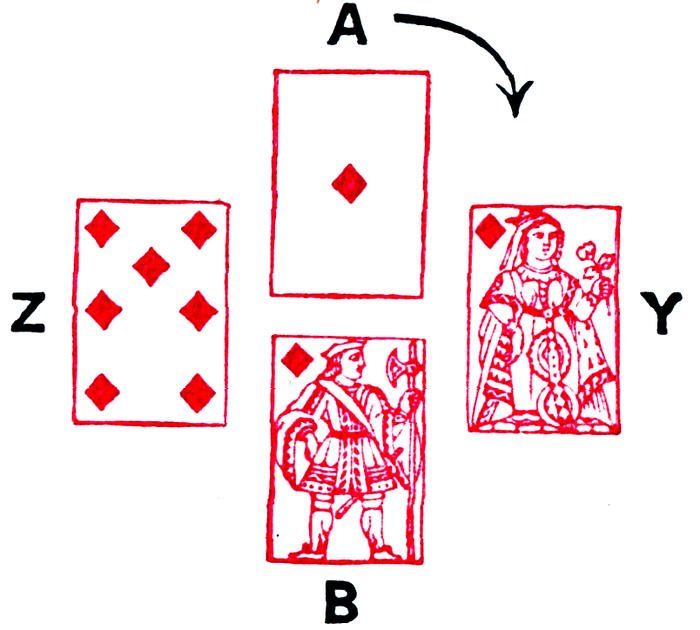
Tricks AB, 2
YZ, 0
2. Z A↷ Y B
7♦ A♦ Qn♦ Knv♦
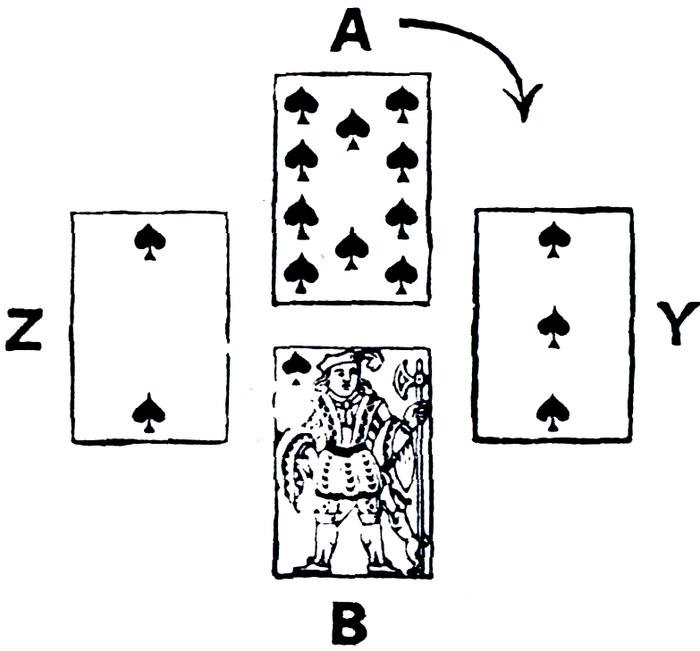
Tricks AB, 3
YZ, 0
3. Z A↷ Y B
2♠ 10♠ 3♠ Knv♠
Remark.—Y has the king
of spades.
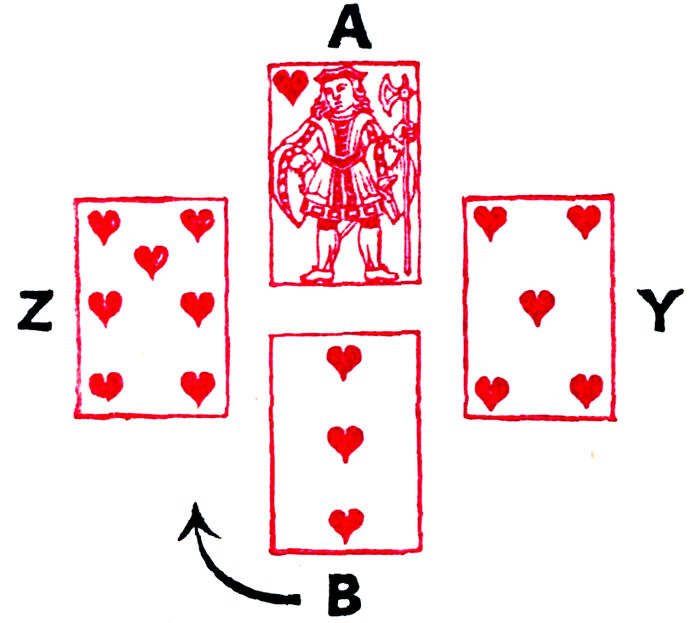
Tricks AB, 4
YZ, 0
4. Z A Y B↷
7♥ Knv♥ 5♥ 3♥
Remark.—It is probable
that A is weak in trumps,
as he refused to force his
partner in diamonds. Nevertheless, B leads a trump, as
he is well provided in spades, and has some defence in the
club suit.
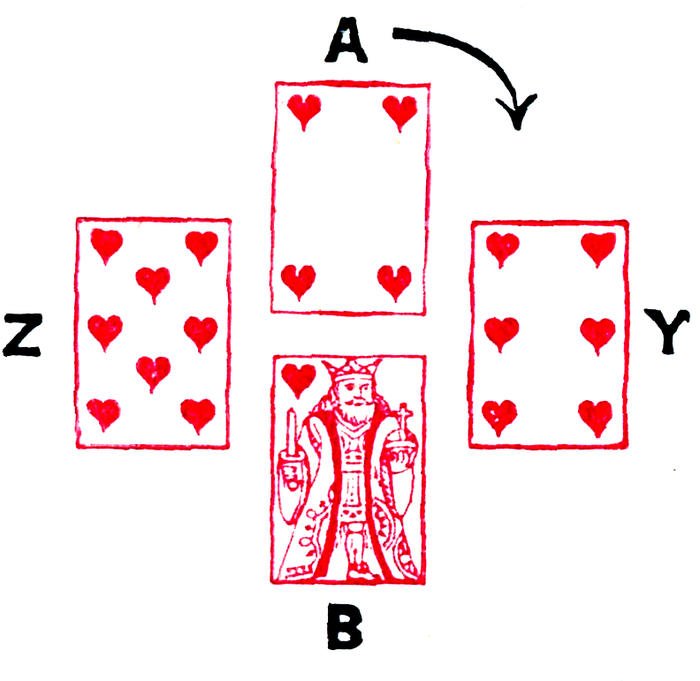
Tricks AB, 5
YZ, 0
5. Z A↷ Y B
8♥ 4♥ 6♥ Kg♥
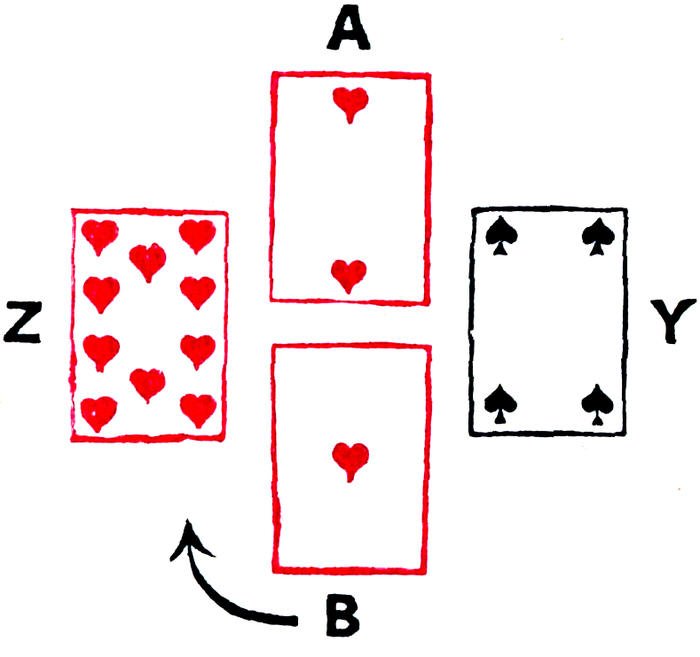
Tricks AB, 6
YZ, 0
6. Z A Y B↷
10♥ 2♥ 4♠ A♥
Remark (Trick 6).—The queen of hearts must be in
Z's hand, as A returned the four and now plays the two,
and Y renounces.
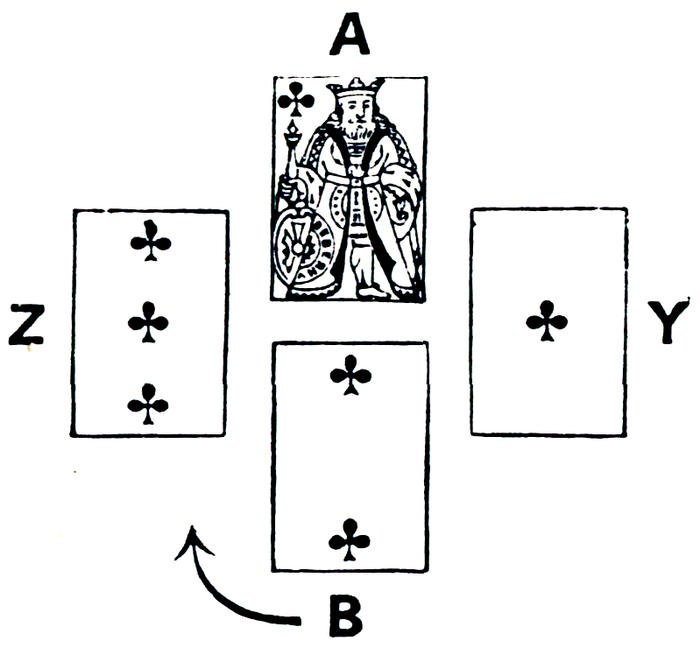
Tricks AB, 6
YZ, 1
7. Z A Y B↷
3♣ Kg♣ A♣ 2♣
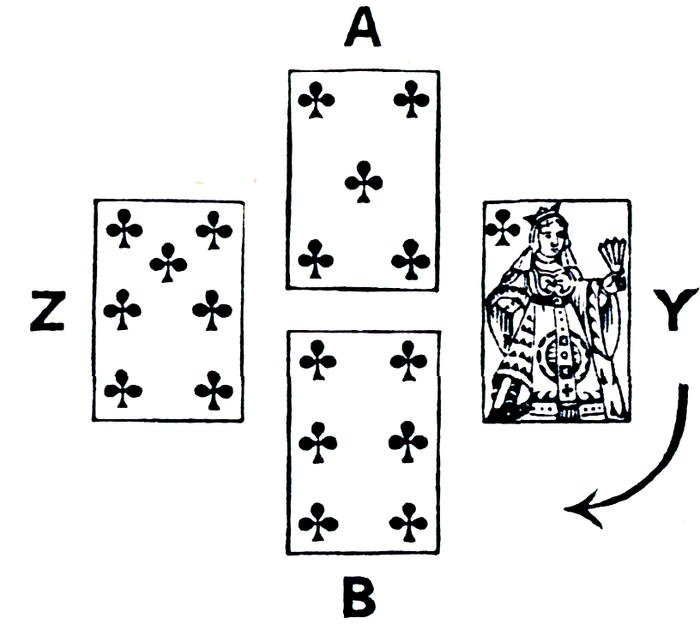
Tricks AB, 6
YZ, 2
8. Z A Y↷ B
7♣ 5♣ Qn♣ 6♣
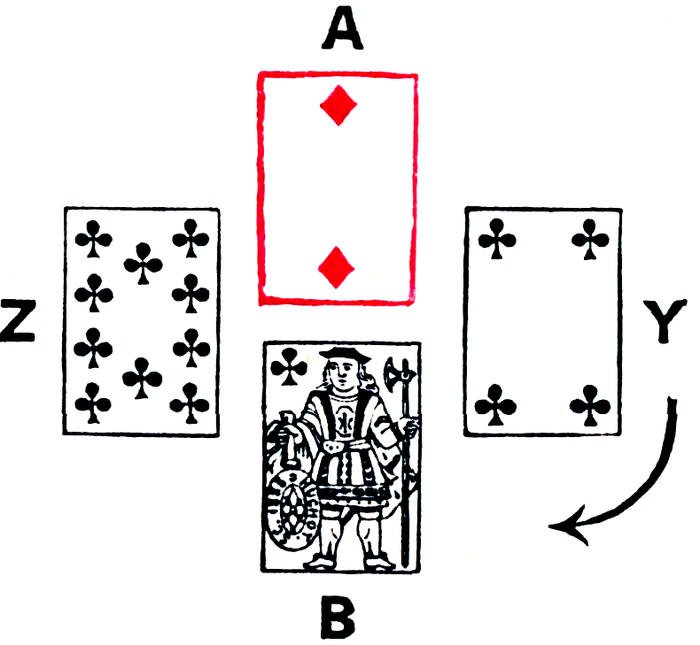
Tricks AB, 7
YZ, 2
9. Z A Y↷ B
10♣ 2♦ 4♣ Knv♣
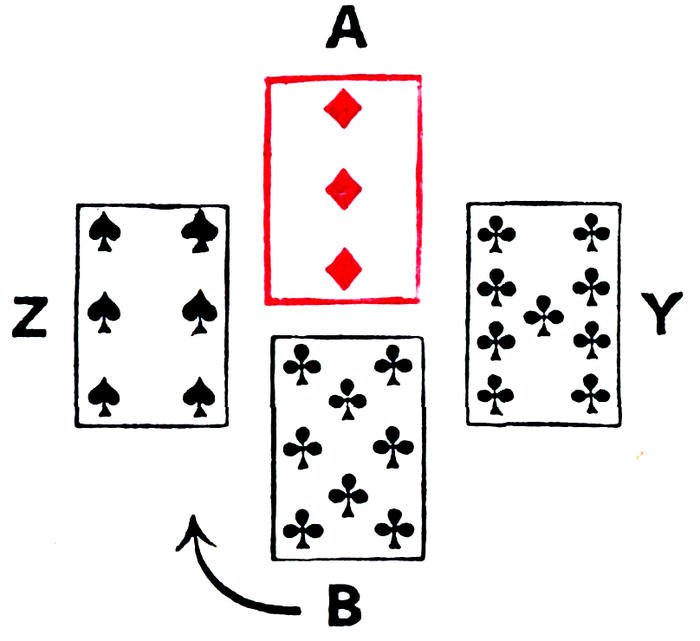
Tricks AB, 7
YZ, 3
10. Z A Y B↷
6♠ 3♦ 9♣ 8♣
Remark (Trick 10).—B leads the losing club to throw
the lead into Y's hand. Y will then be obliged to lead a
spade, as he has no other suit. Z will have to follow suit,
or will be forced with the queen of trumps, and B will
make the ace of spades and the last trump.
Tricks 11 to 13.—Y (Trick 11) leads a spade, B puts on
the queen, and
AB score three by cards and two by honours.
(B's hand is given above.)
| A's Hand. |
Y's Hand. |
Z's Hand. |
| 10, 9, 7 |
♠ |
Kg, 8, 5, 4, 3 |
♠ |
6, 2 |
♠ |
| Knv, 4, 2 |
♥ |
6, 5 |
♥ |
Qn, 10, 8, 7 |
♥ |
| Kg, 5 |
♣ |
Ace, Qn, 9, 4 |
♣ |
10, 7, 3 |
♣ |
| Ace, Kg, 6, 3, 2 |
♦ |
Qn, 8 |
♦ |
10, 9, 7, 4 |
♦ |
At Trick 8, Y should underplay in clubs.
Leading losing card to place the lead (see pp. 147-151).
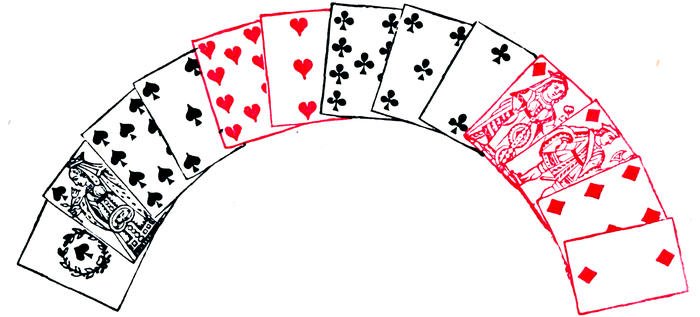
- A♠, Qn♠, 10♠, 5♠
- 10♥, 3♥
- 9♣, 5♣, 2♣
- Qn♦, Knv♦, 6♦, 2♦
Score: AB, love; YZ, one.
Four of clubs turned up.
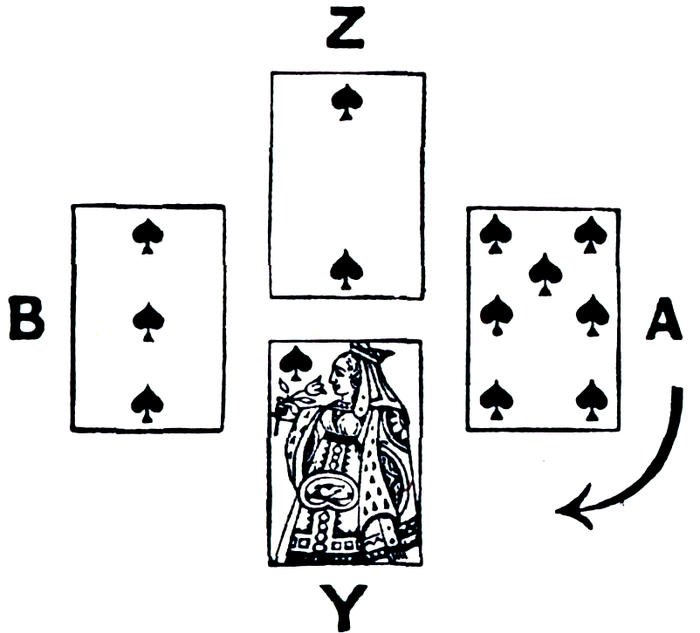
Tricks AB, 0
YZ, 1
1. B Z A↷ Y
3♠ 2♠ 7♠ Qn♠
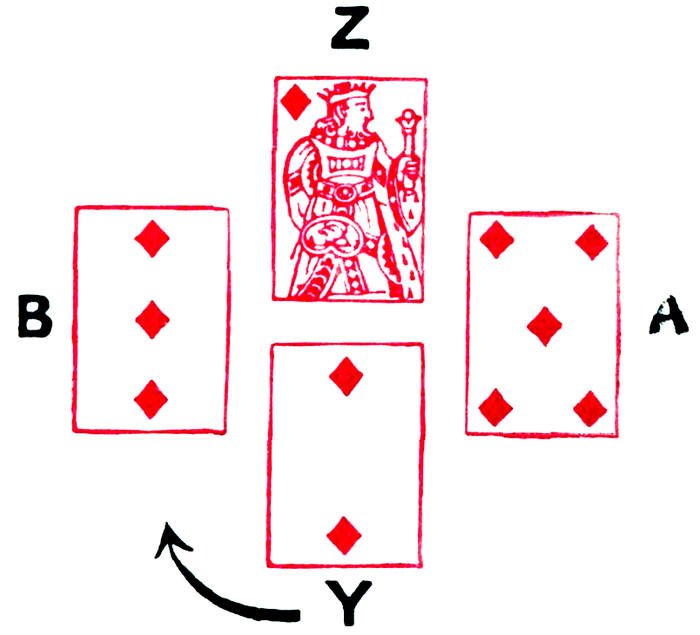
Tricks AB, 0
YZ, 2
2. B Z A Y↷
3♦ Kg♦ 5♦ 2♦
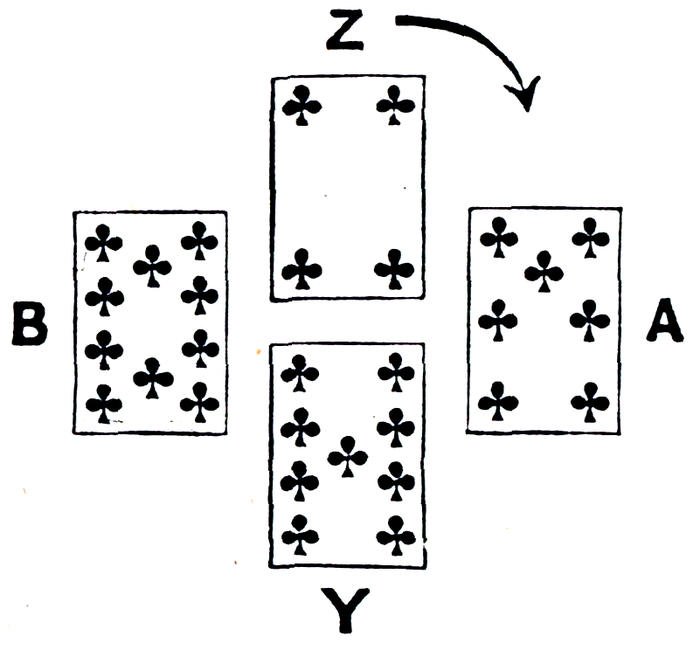
Tricks AB, 1
YZ, 2
3. B Z↷ A Y
10♣ 4♣ 7♣ 9♣
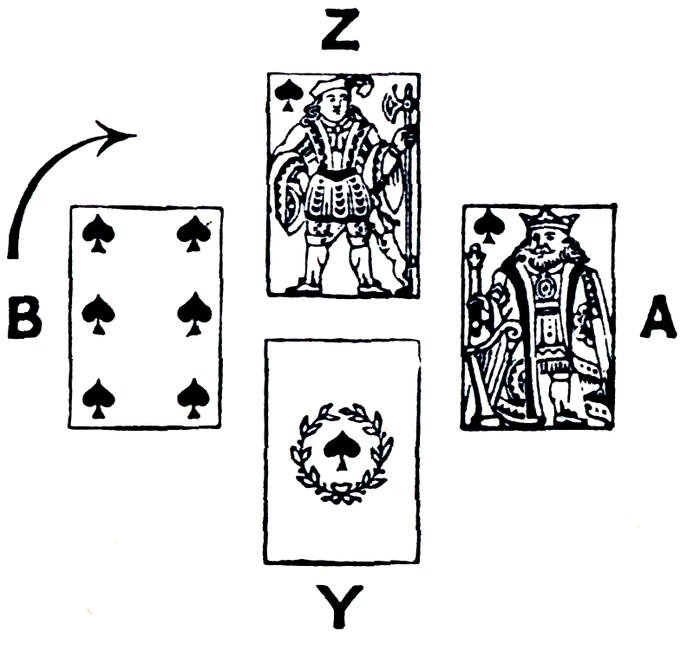
Tricks AB, 1
YZ, 3
4. B↷ Z A Y
6♠ Knv♠ Kg♠ A♠
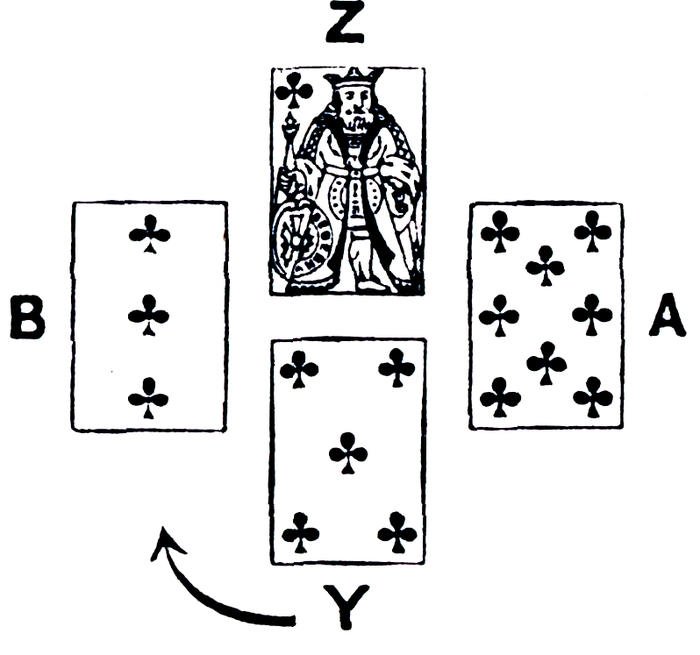
Tricks AB, 1
YZ, 4
5. B Z A Y↷
3♣ Kg♣ 8♣ 5♣
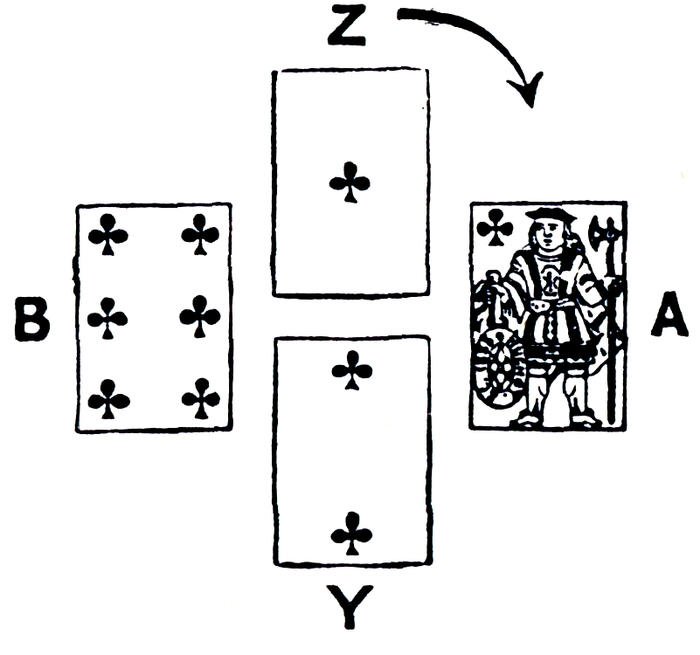
Tricks AB, 1
YZ, 5
6. B Z↷ A Y
6♣ A♣ Knv♣ 2♣
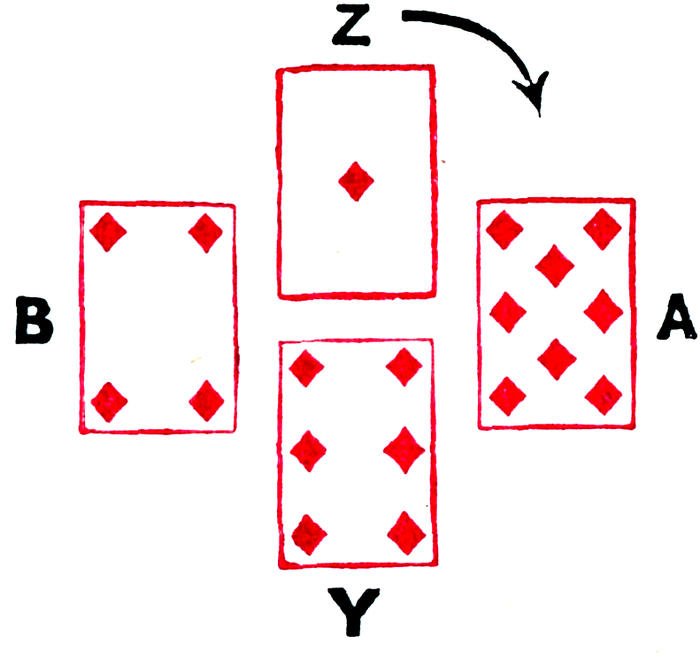
Tricks AB, 1
YZ, 6
7. B Z↷ A Y
4♦ A♦ 8♦ 6♦
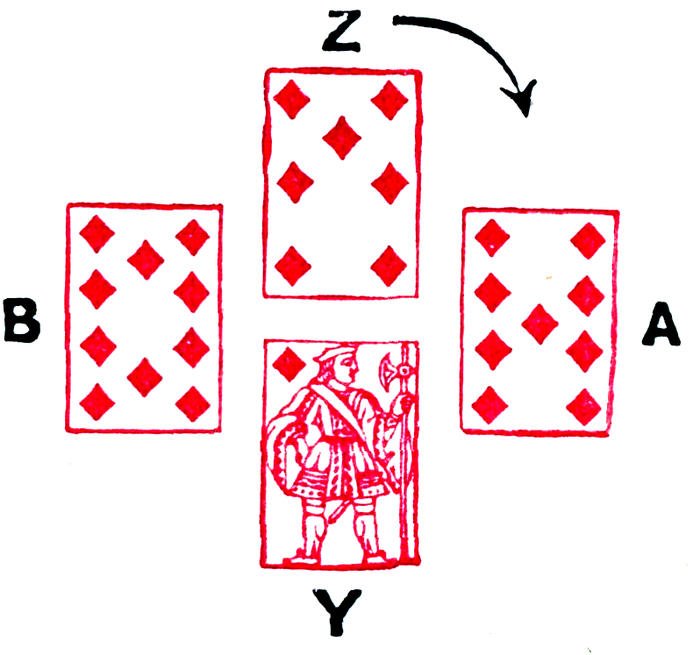
Tricks AB, 1
YZ, 7
8. B Z↷ A Y
10♦ 7♦ 9♦ Knv♦
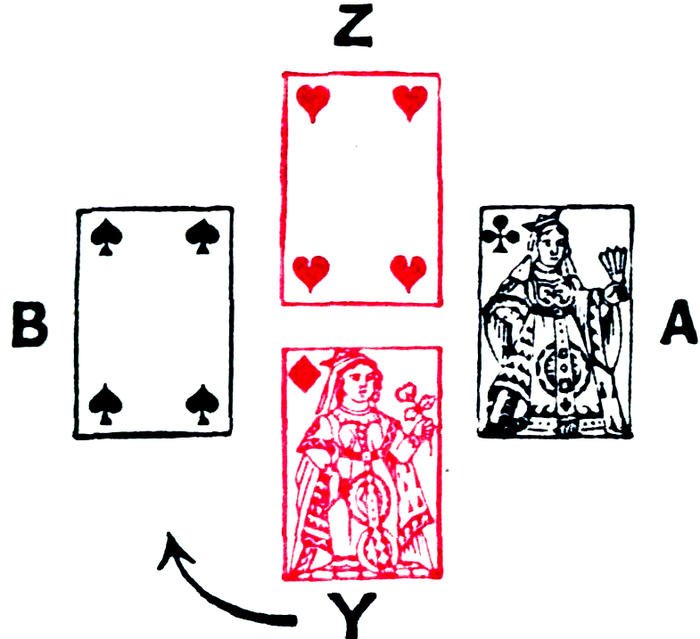
Tricks AB, 2
YZ, 7
9. B Z A Y↷
4♠ 4♥ Qn♣ Qn♦
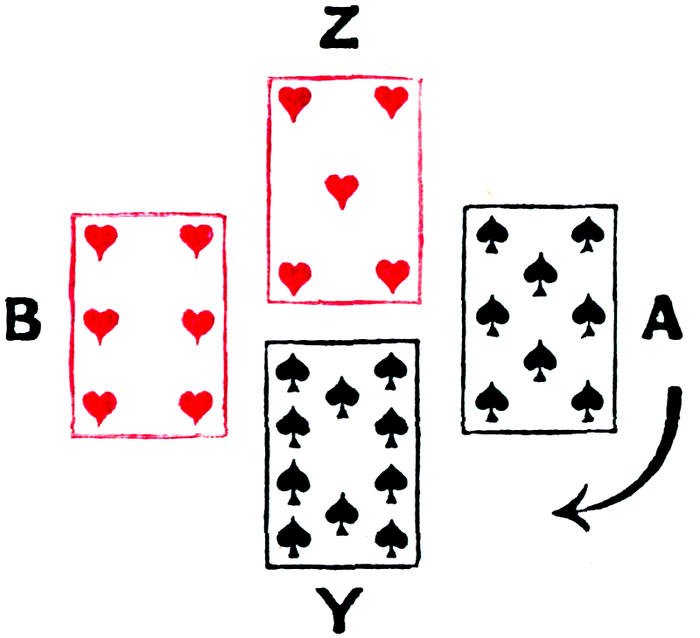
Tricks AB, 2
YZ, 8
10. B Z A↷ Y
6♥ 5♥ 8♠ 10♠
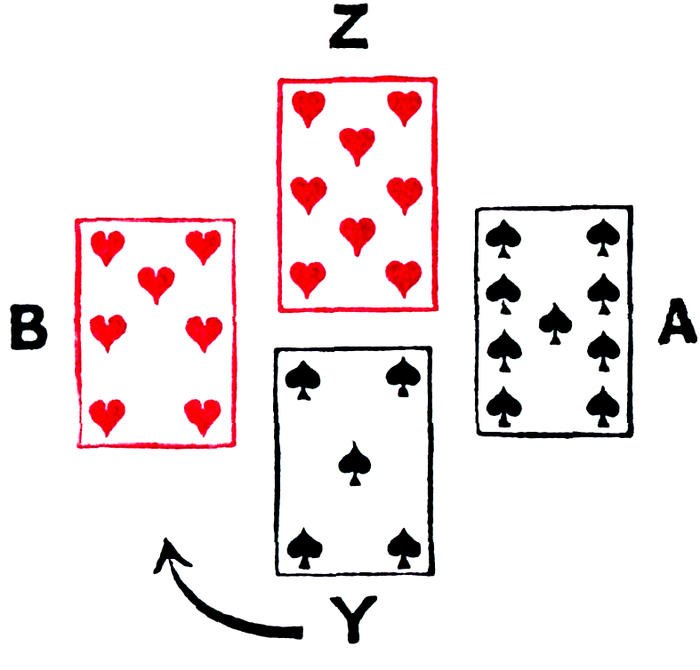
Tricks AB, 3
YZ, 8
11. B Z A Y↷
7♥ 8♥ 9♠ 5♠
Remark (Trick 11).—Y
leads the losing spade to put
the lead into A's hand (see
fall of the spades, Tricks 1,
4, and 10), and so compel A
to lead hearts up to Z. At
this score (YZ, one) this is
the best chance of four by
cards. If the score were
YZ, love, Y should lead a
heart, as leading the spade
gives up all chance of five
by cards.
Tricks 12 and 13.—Z has ace, queen of hearts; and
YZ win four by cards.
(Y's hand is given above.)
| A's Hand. |
B's Hand. |
Z's Hand. |
| Kg, 9, 8, 7 |
♠ |
6, 4, 3 |
♠ |
Knv, 2 |
♠ |
| Kg, 2 |
♥ |
Knv, 9, 7, 6 |
♥ |
Ace, Qn, 8, 5, 4 |
♥ |
| Qn, Knv, 8, 7 |
♣ |
10, 6, 3 |
♣ |
Ace, Kg, 4 |
♣ |
| 9, 8, 5 |
♦ |
10, 4, 3 |
♦ |
Ace, Kg, 7 |
♦ |
At Trick 4, B, having a weak hand, plays his partner's
game, in preference to planning an attack for himself by
opening his own poor suit of four to the knave.
Underplay.
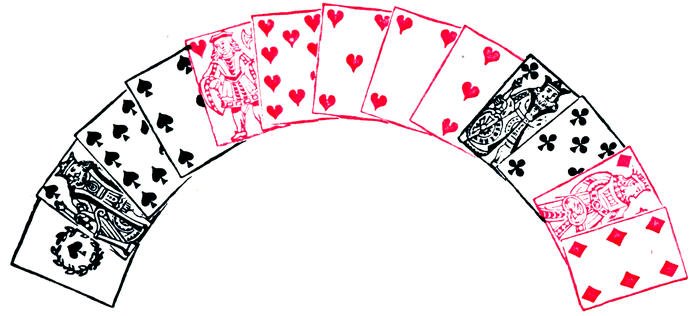
- A♠, Kg♠, 10♠, 6♠
- Knv♥, 10♥, 5♥, 4♥, 3♥
- Kg♣, 7♣
- Kg♦, 6♦
Score: Love-all.
Six of spades turned up.
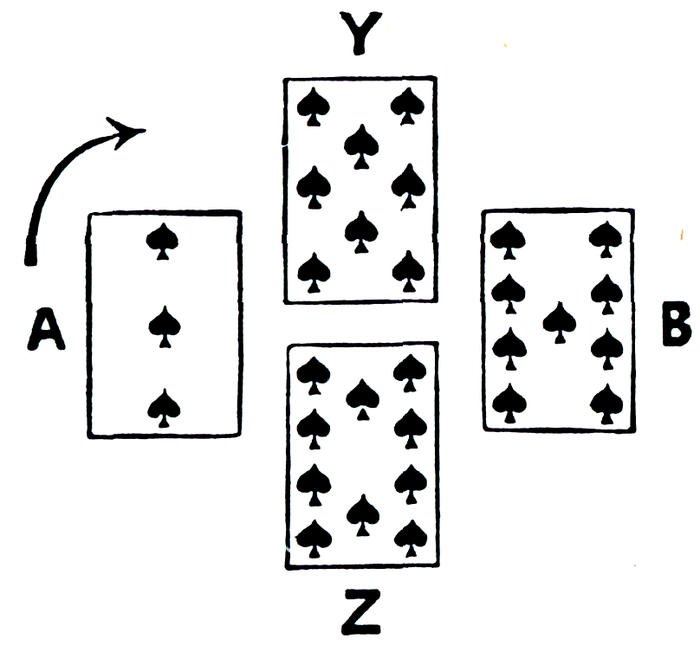
Tricks AB, 0
YZ, 1
1. A↷ Y B Z
3♠ 8♠ 9♠ 10♠
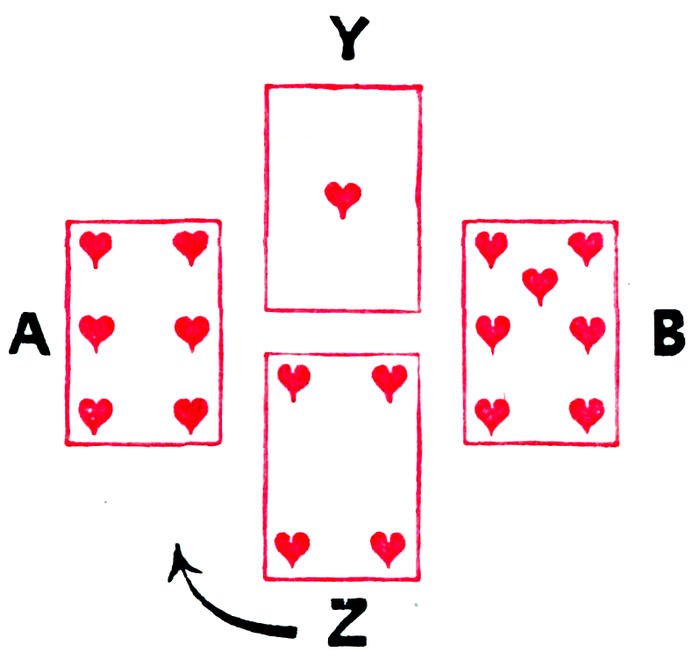
Tricks AB, 0
YZ, 2
2. A Y B Z↷
6♥ A♥ 7♥ 4♥
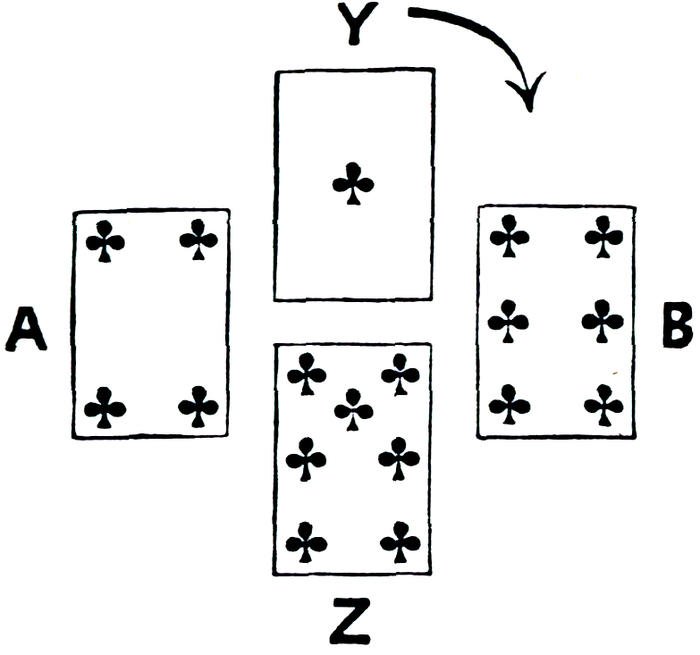
Tricks AB, 0
YZ, 3
3. A Y↷ B Z
4♣ A♣ 6♣ 7♣
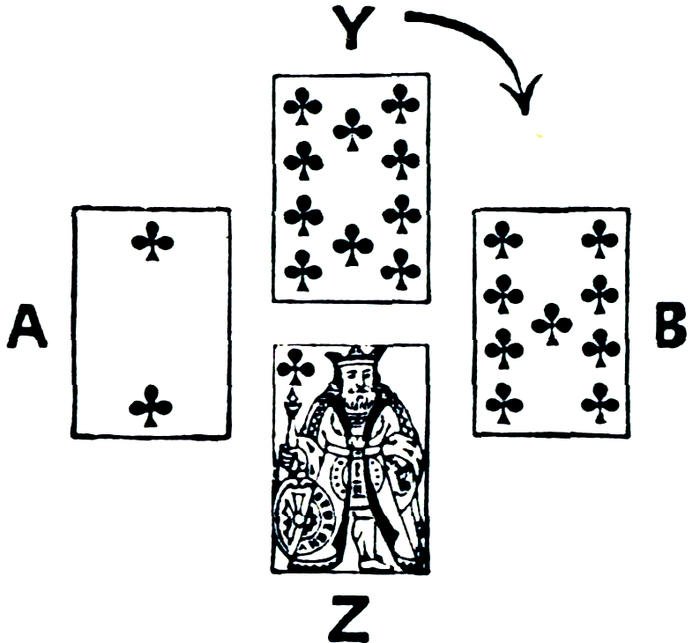
Tricks AB, 0
YZ, 4
4. A Y↷ B Z
2♣ 10♣ 9♣ Kg♣
Remark (Trick 4).—Y has led from ace, queen, knave,
ten; and B, the weak trump hand, has no more clubs.
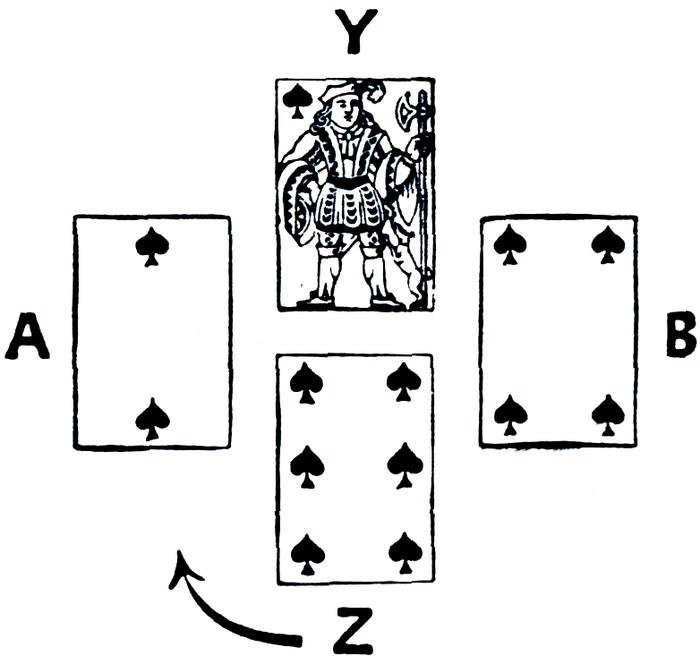
Tricks AB, 0
YZ, 5
5. A Y B Z↷
2♠ Knv♠ 4♠ 6♠
Remark (Trick 5).—Z underplays in trumps. To continue
hearts, with queen, king marked against him (see
Trick 2), or to open diamonds, would be very disadvantageous,
so a trump lead is forced, more especially as Y has
command of clubs, and B is about to trump that suit. The
lead of ace or king of trumps would leave the lead with
Z, who would then still be in a difficulty as to his next
lead. Further, it is of importance to endeavour to place
the lead in Y's hand, that he may continue clubs. Also, if
the underplay succeeds, it is not at all unlikely that YZ
will win the game.
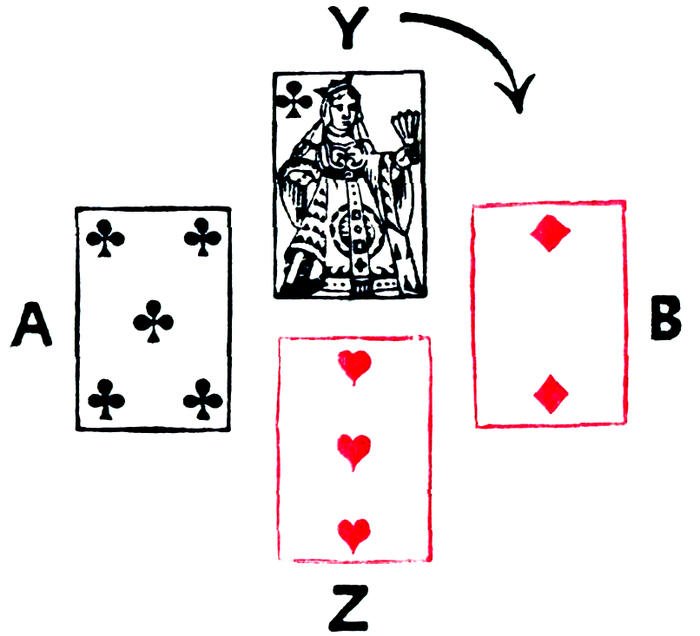
Tricks AB, 0
YZ, 6
6. A Y↷ B Z
5♣ Qn♣ 2♦ 3♥
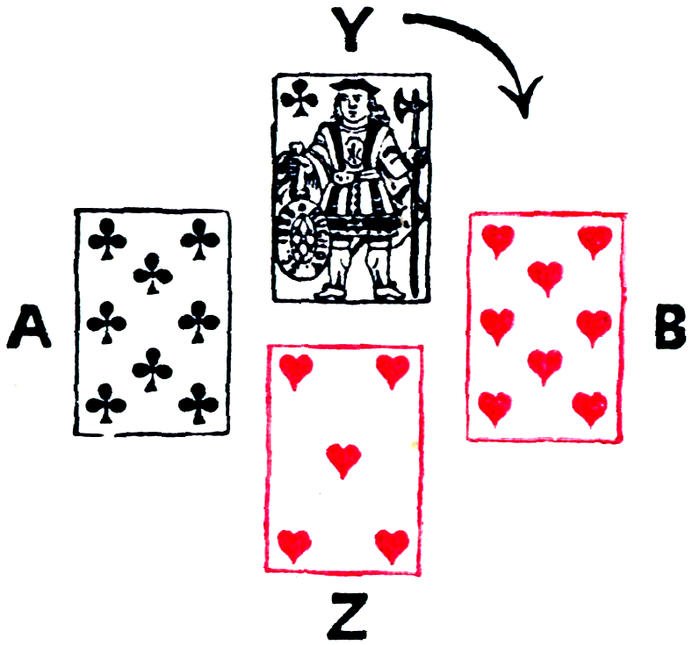
Tricks AB, 0
YZ, 7
7. A Y↷ B Z
8♣ Knv♣ 8♥ 5♥
Tricks 8 to 13.—Z makes
ace, king of trumps, and
YZ win the game.
(Z's hand is given above.)
| A's Hand. |
Y's Hand. |
B's Hand. |
| Qn, 7, 5, 3, 2 |
♠ |
Knv, 8 |
♠ |
9, 4 |
♠ |
| Kg, 6 |
♥ |
Ace, 2 |
♥ |
Qn, 9, 8, 7 |
♥ |
| 8, 5, 4, 2 |
♣ |
Ace, Qn, Knv, 10, 3 |
♣ |
9, 6 |
♣ |
| Ace, Qn |
♦ |
10, 5, 4, 3 |
♦ |
Knv, 9 8, 7, 2 |
♦ |
At Trick 5, if A puts on queen of spades, second hand,
he saves the game. May be, a very shrewd player would
have seen through the position, including the importance
of preventing Y from getting the lead if possible; but A
can hardly be blamed for passing, as it is unlikely that
both ace and king of spades are in Z's hand.
Underplay, and playing to the score.
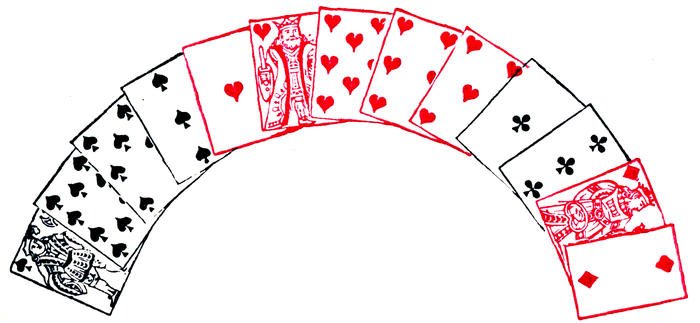
- Knv♠, 10♠, 7♠, 3♠
- A♥, Kg♥, 8♥, 6♥, 5♥
- A♣, 3♣
- Kg♦, 2♦
Score: Love-all.
Four of spades turned up.
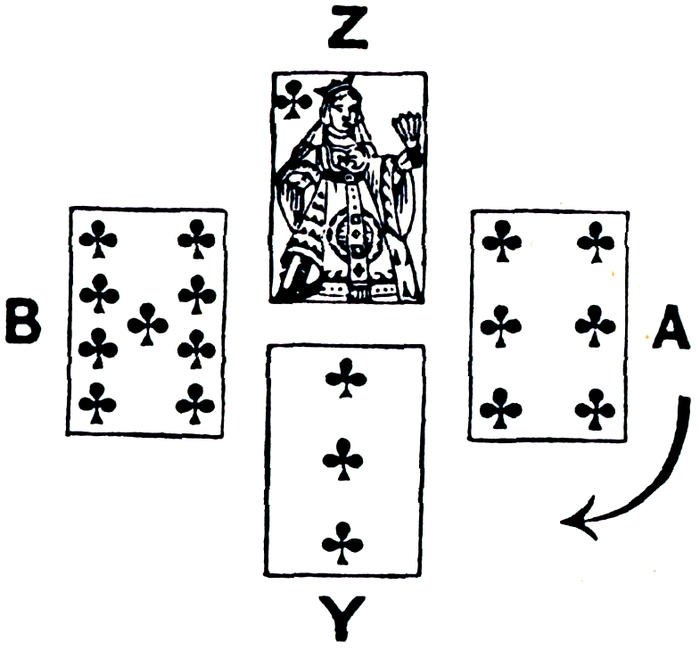
Tricks AB, 0
YZ, 1
1. B Z A↷ Y
9♣ Qn♣ 6♣ 3♣
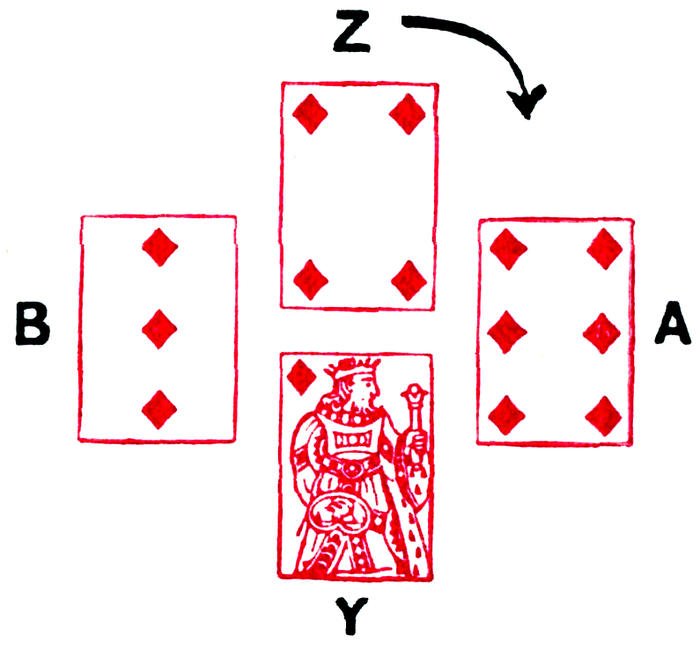
Tricks AB, 0
YZ, 2
2. B Z↷ A Y
3♦ 4♦ 6♦ Kg♦
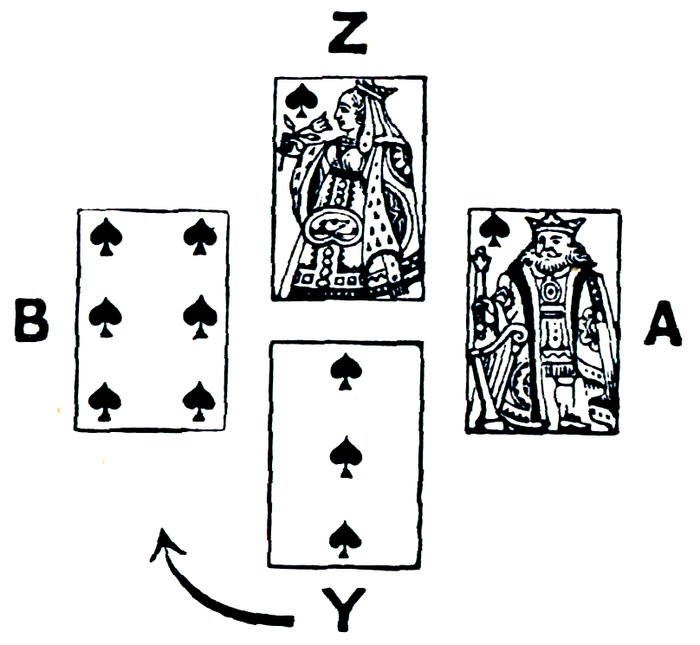
Tricks AB, 1
YZ, 2
3. B Z A Y↷
6♠ Qn♠ Kg♠ 3♠
Remark (Trick 3).—Y is justified in playing a forward
game. He has four trumps (see pp. 122, 123), ace of the
opponent's suit, and a fine heart suit: and his partner has
declared strength in diamonds by choosing that suit for his
original lead.
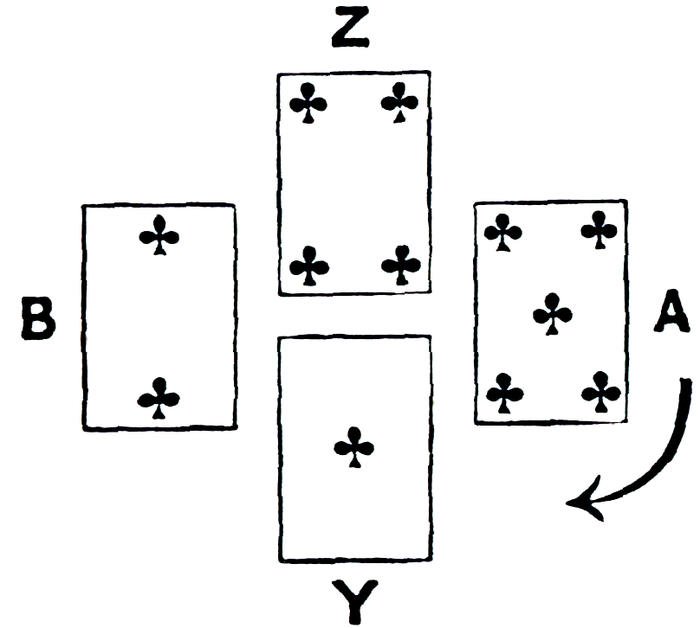
Tricks AB, 1
YZ, 3
4. B Z A↷ Y
2♣ 4♣ 5♣ A♣
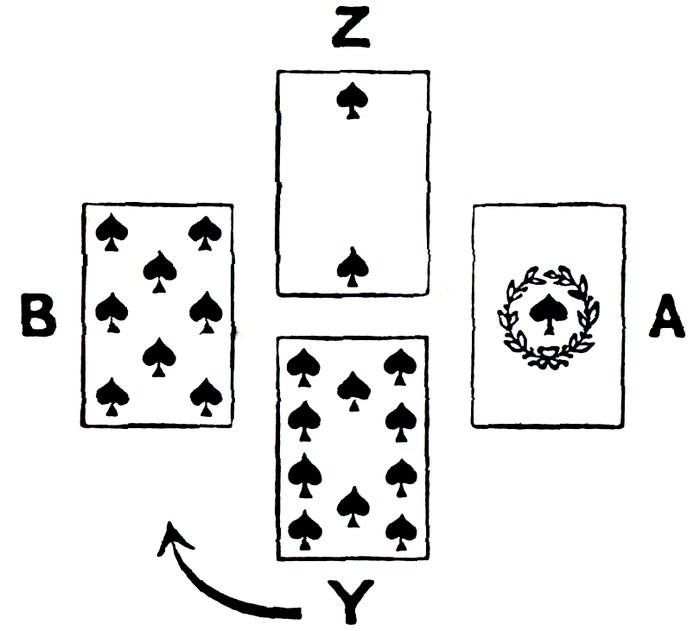
Tricks AB, 2
YZ, 3
5. B Z A Y↷
8♠ 2♠ A♠ 10♠
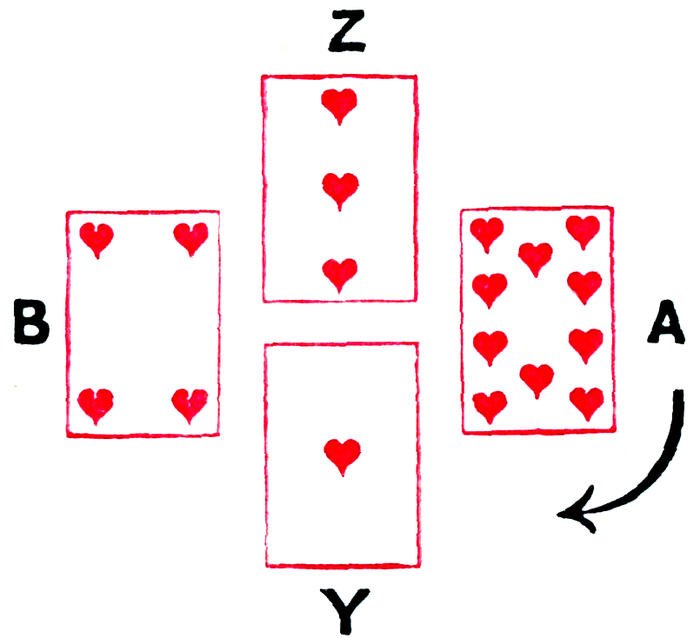
Tricks AB, 2
YZ, 4
6. B Z A↷ Y
4♥ 3♥ 10♥ A♥
Remark (Trick 6).—Y is justified in playing a false card
here, notwithstanding General Principle 12 (p. 108). The
heart is a forced lead, and the card led (the ten) is obviously
A's best. Y's scheme is to take another round
of trumps, and then to underplay in hearts (see p. 101); so
he puts on the ace to deceive B as to the position of the
king.
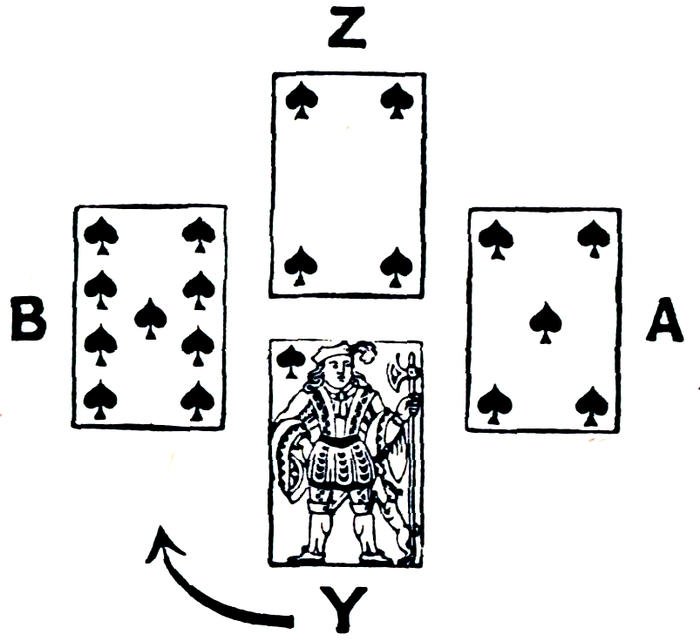
Tricks AB, 2
YZ, 5
7. B Z A Y↷
9♠ 4♠ 5♠ Knv♠
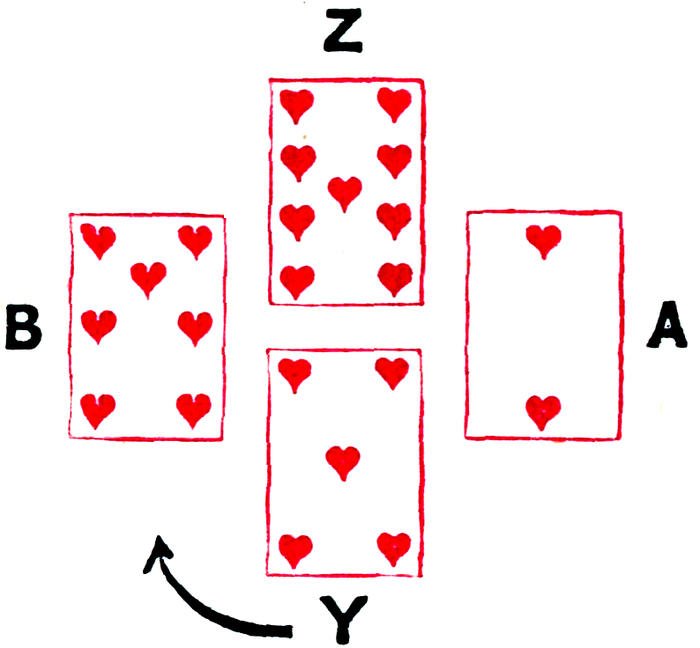
Tricks AB, 2
YZ, 6
8. B Z A Y↷
7♥ 9♥ 2♥ 5♥
Tricks 9 to 13.—Z leads the king of clubs, to which Y
discards the two of diamonds. Z then leads the knave of
hearts, on which Y puts the king; the queen falls (see the
hands below); Y brings in the hearts; and
YZ win five by cards.
(Y's hand is given above.)
| A's Hand. |
B's Hand. |
Z's Hand. |
| Ace, Kg, 5 |
♠ |
9, 8, 6 |
♠ |
Qn, 4, 2 |
♠ |
| 10, 2 |
♥ |
Qn, 7, 4 |
♥ |
Knv, 9, 3 |
♥ |
| Knv, 8, 7, 6, 5 |
♣ |
10, 9, 2 |
♣ |
Kg, Qn, 4 |
♣ |
| Ace, 8, 6 |
♦ |
10, 9, 7, 3 |
♦ |
Qn, Knv, 5, 4 |
♦ |
A and B both play the hand badly. At Trick 6, A, in
the face of an adverse trump lead and the command of his
suit (clubs) against him, should lead the ace of diamonds
to make the third trick and save the game. At Trick 8, B
should put on his queen of hearts. He is fairly taken in
by Y's dark play at Trick 6; but he ought not to have
allowed himself to be so. He should have argued that Y,
who has been playing a very strong game, would not be
likely to put on ace second hand merely for the purpose
of getting the lead or of making sure of a trick. Further,
if A's lead was a forced one, from weakness (hearts being
the only suit in which B can be strong), Z is sure to finesse
if he has king, knave, or even king, nine. So B's best
chance of making the queen is to put it on (see p. 102).
Defensive trump lead, and playing to the score.
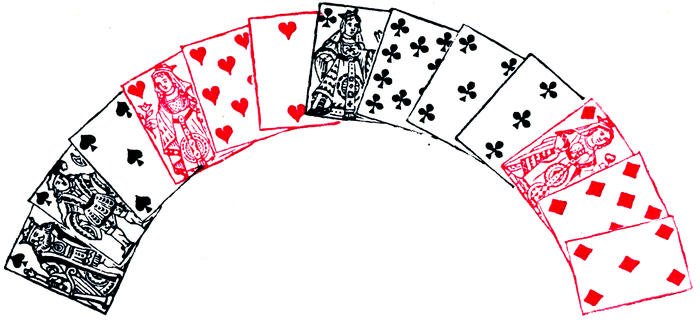
- Kg♠, Knv♠, 5♠
- Qn♥, 8♥, 2♥
- Qn♣, 10♣, 5♣, 3♣
- Qn♦, 7♦, 5♦
Score: Love-all.
Nine of clubs turned up.
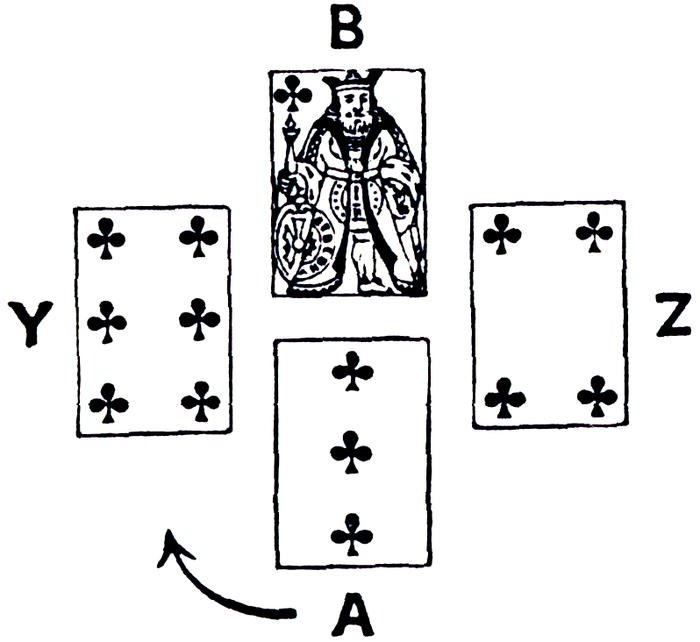
Tricks AB, 1
YZ, 0
1. Y B Z A↷
6♣ Kg♣ 4♣ 3♣
Remark (Trick 1).—A defensive trump lead, to avoid
opening a three card suit.
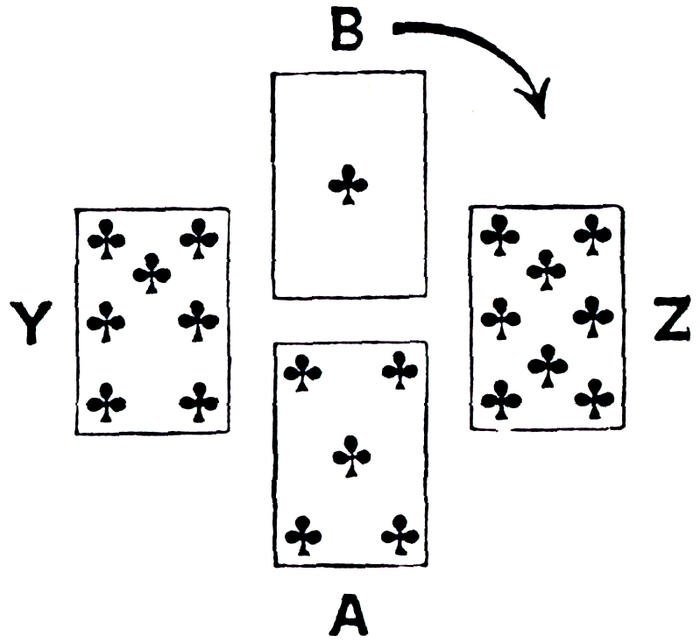
Tricks AB, 2
YZ, 0
2. Y B↷ Z A
7♣ A♣ 8♣ 5♣
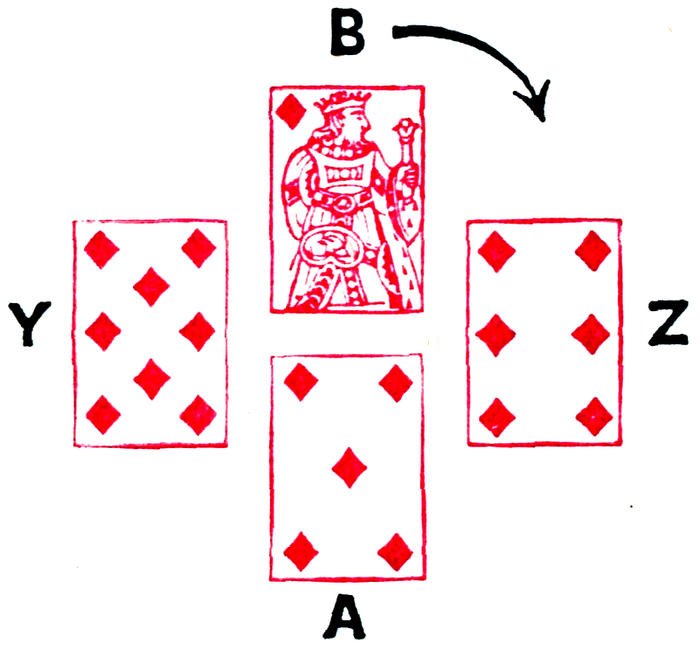
Tricks AB, 3
YZ, 0
3. Y B↷ Z A
8♦ Kg♦ 6♦ 5♦
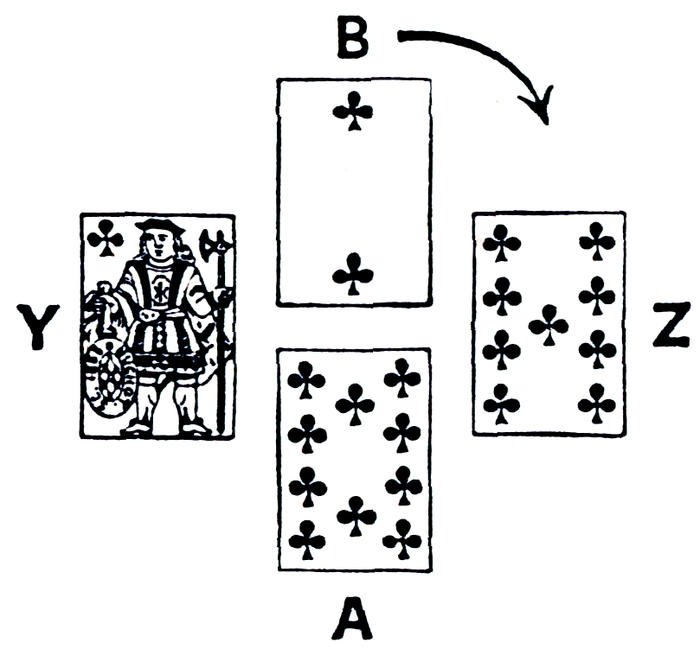
Tricks AB, 3
YZ, 1
4. Y B↷ Z A
Knv♣ 2♣ 9♣ 10♣
Remark (Trick 4).—A's finesse is unlucky. He is, however,
clearly justified in not parting with the command of
trumps, as, even if the finesse does not succeed, he remains
with the last trump, will be led up to in one of his
guarded suits, and will, in all probability, bring in his
partner's diamonds.
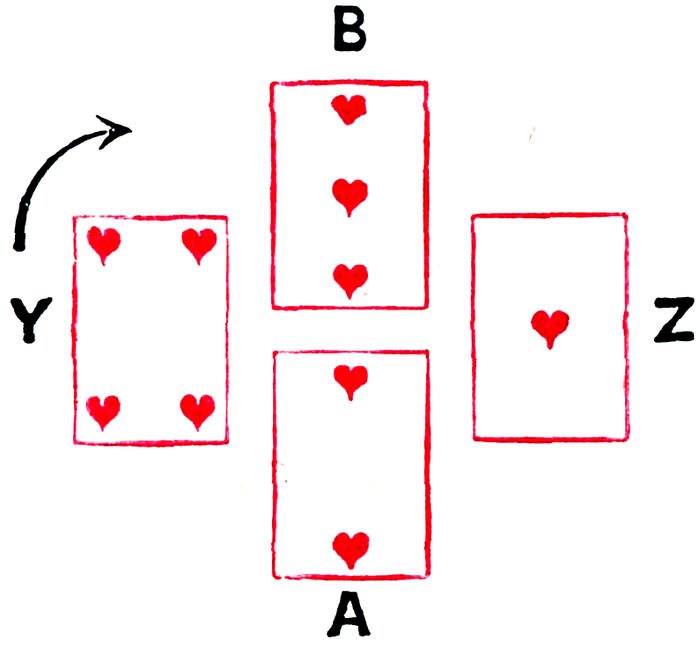
Tricks AB, 3
YZ, 2
5. Y↷ B Z A
4♥ 3♥ A♥ 2♥
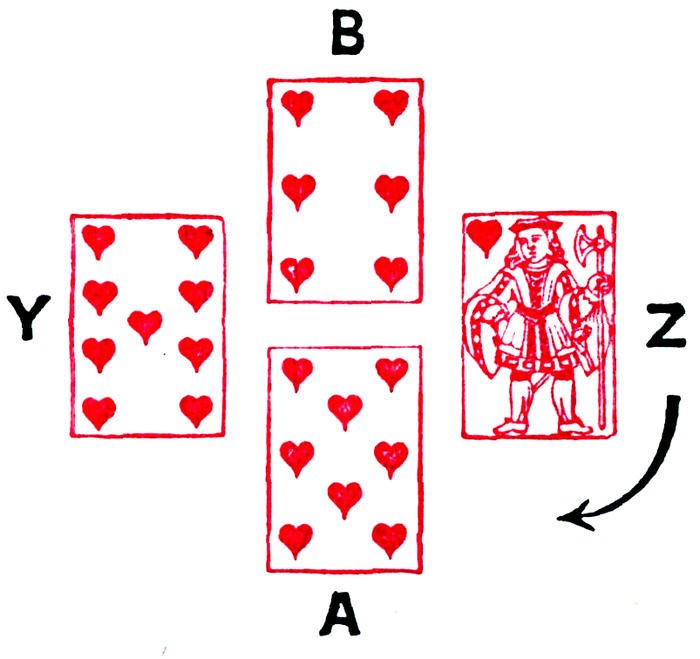
Tricks AB, 3
YZ, 3
6. Y B Z↷ A
9♥ 6♥ Knv♥ 8♥
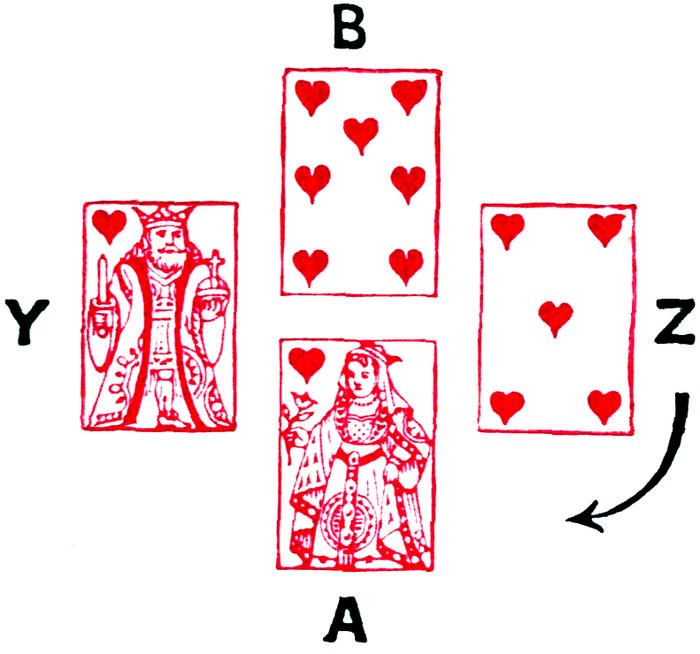
Tricks AB, 3
YZ, 4
7. Y B Z↷ A
Kg♥ 7♥ 5♥ Qn♥
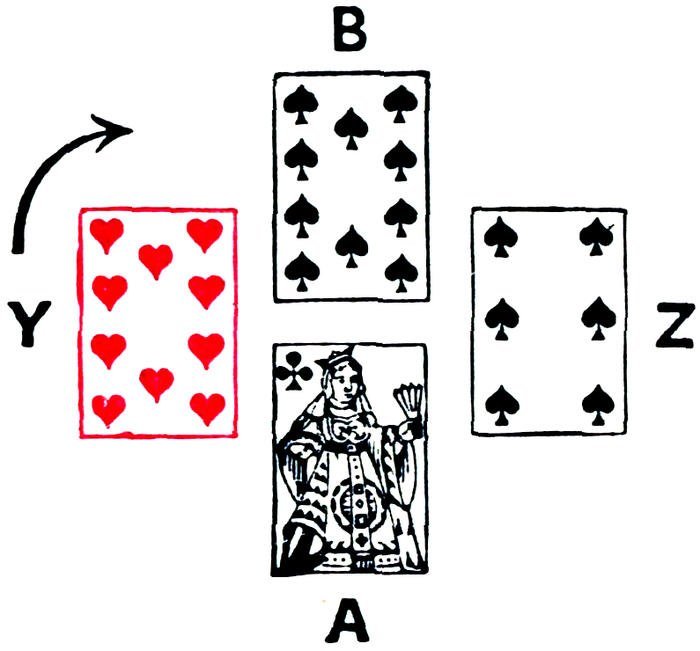
Tricks AB, 4
YZ, 4
8. Y↷ B Z A
10♥ 10♠ 6♠ Qn♣
Tricks 9 to 13.—A leads the queen of diamonds, and
finds his partner with the entire command of diamonds
(see B's hand below).
AB score three by cards and two by honours.
(A's hand is given above.)
| Y's Hand. |
B's Hand. |
Z's Hand. |
| 8, 7, 4, 3, 2 |
♠ |
10 |
♠ |
Ace, Qn, 9, 6 |
♠ |
| Kg, 10, 9, 4 |
♥ |
7, 6, 3 |
♥ |
Ace, Knv, 5 |
♥ |
| Knv, 7, 6 |
♣ |
Ace, Kg, 2 |
♣ |
9, 8, 4 |
♣ |
| 8 |
♦ |
A, Kg, Knv, 4, 3, 2 |
♦ |
10, 9, 6 |
♦ |
It may be observed that Z loses the game by bad play at
Trick 7. The fall of the cards in Tricks 5 and 6 shows
that A has the queen of hearts, and Y the king. Z should
therefore, at Trick 7, lead the ace of spades to make the
fourth trick, and then the heart, making the fifth trick
and saving the game.
At Trick 8, if Y leads a spade and Z does not finesse, the
game may be saved. To finesse at that point would be
very bad play, as the ace of spades makes the fifth trick.
But Y's play at Trick 8, though unfortunate, is not wrong;
for Y cannot tell that Z has the ace of spades; indeed, the
presumption is that he has not, or he would have led it.
Y properly plays to force the long trump, and to make
his partner fourth player.
An ill-judged call for trumps, and a well-judged third
round, notwithstanding the adverse strength.
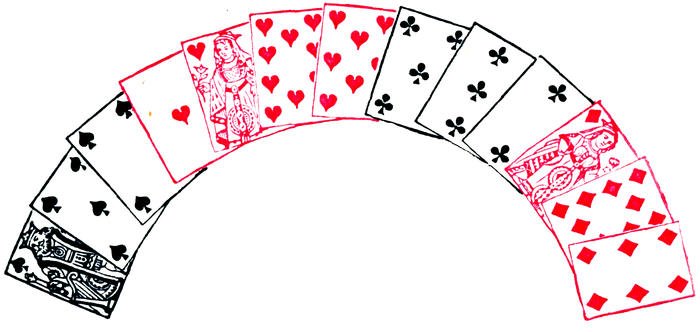
- Kg♠, 5♠, 4♠
- A♥, Qn♥, 10♥, 8♥
- 5♣, 3♣, 2♣
- Qn♦, 10♦, 6♦
Score: Four-all.
Queen of spades turned up.
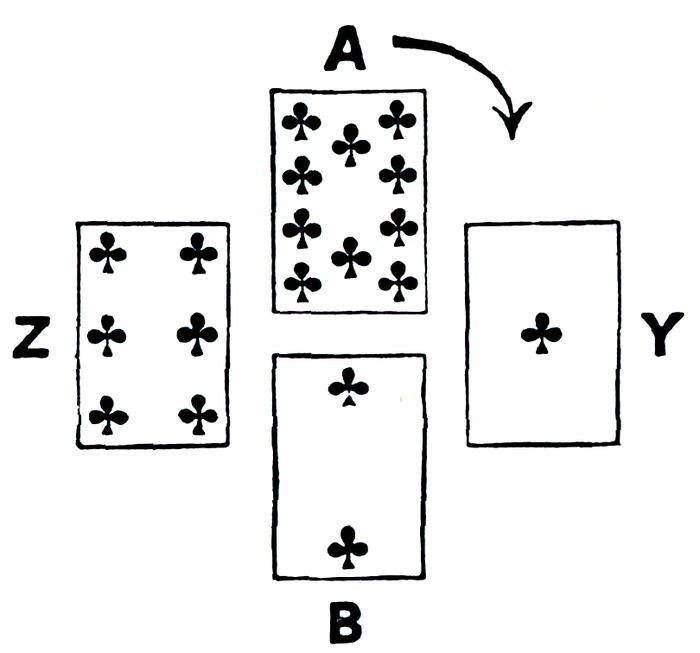
Tricks AB, 0
YZ, 1
1. Z A↷ Y B
6♣ 10♣ A♣ 2♣
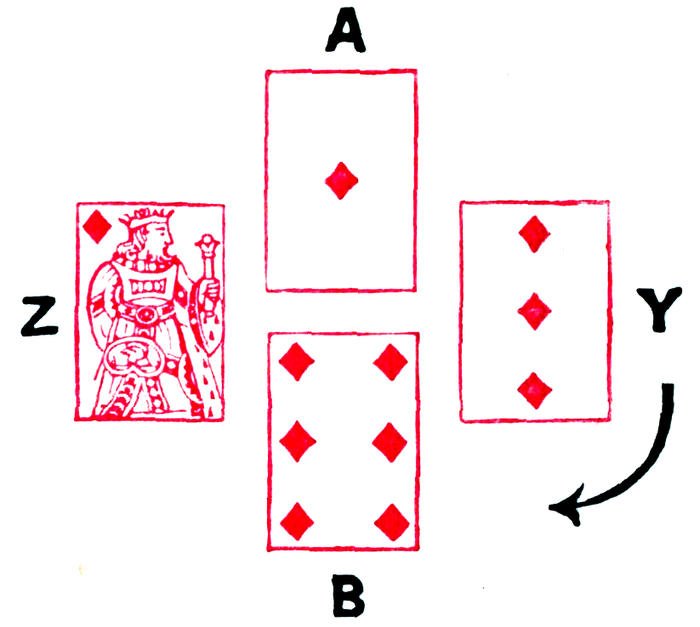
Tricks AB, 1
YZ, 1
2. Z A Y↷ B
Kg♦ A♦ 3♦ 6♦
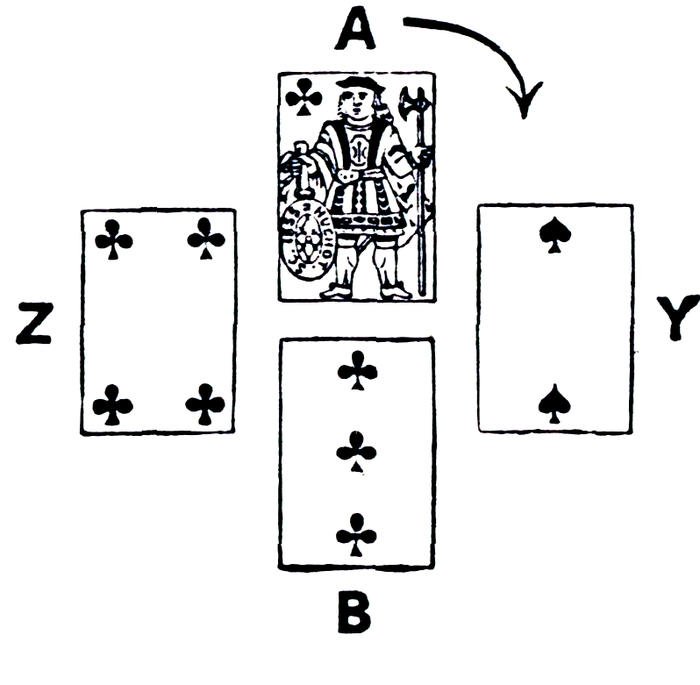
Tricks AB, 1
YZ, 2
3. Z A↷ Y B
4♣ Knv♣ 2♠ 3♣
Remark.—Z has called
for trumps.
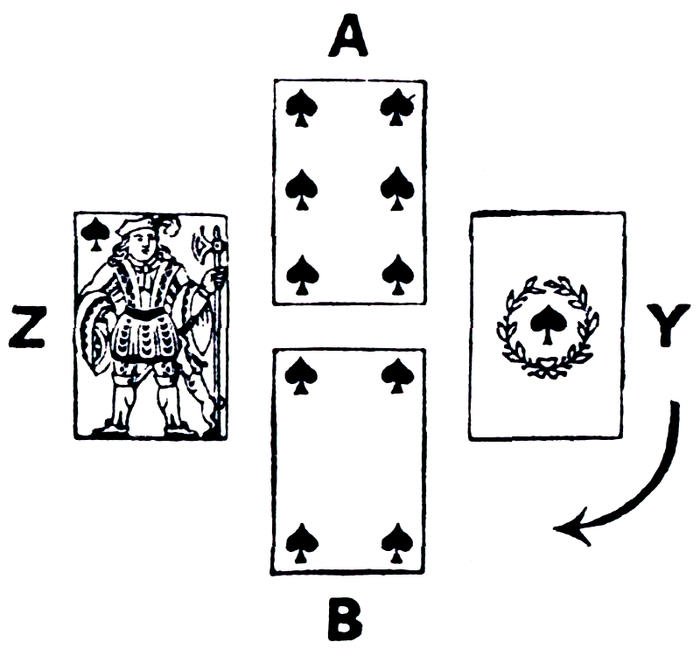
Tricks AB, 1
YZ, 3
4. Z A Y↷ B
Knv♠ 6♠ A♠ 4♠
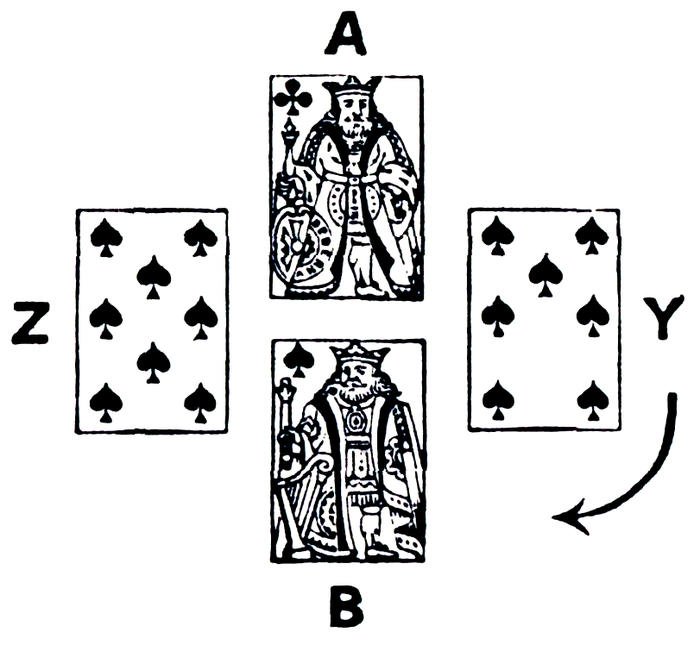
Tricks AB, 2
YZ, 3
5. Z A Y↷ B
8♠ Kg♣ 7♠ Kg♠
Remark.—The fall of the
spades (see Tricks 3, 4, and
5) shows that the three is
in Y's hand.
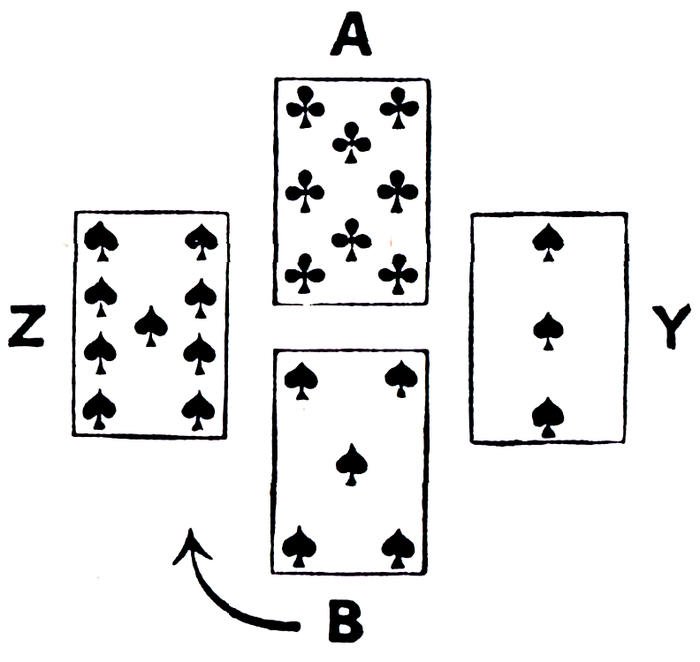
Tricks AB, 2
YZ, 4
6. Z A Y B↷
9♠ 8♣ 3♠ 5♠
Remark.—It is seldom
right to continue trumps
when led by the opponents;
but this is an exceptional
case. B plays well in drawing
two trumps for one, as it is evident that if Y and
Z make their trumps separately they must win the odd
trick.
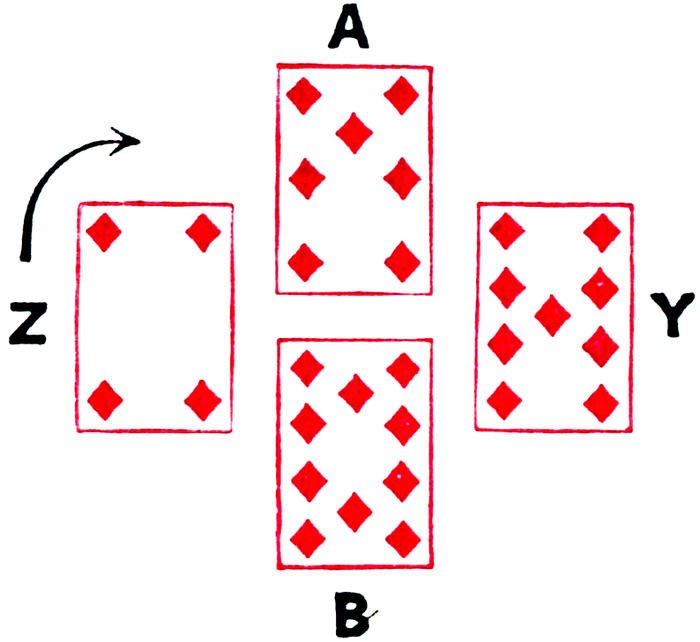
Tricks AB, 3
YZ, 4
7. Z↷ A Y B
4♦ 7♦ 9♦ 10♦
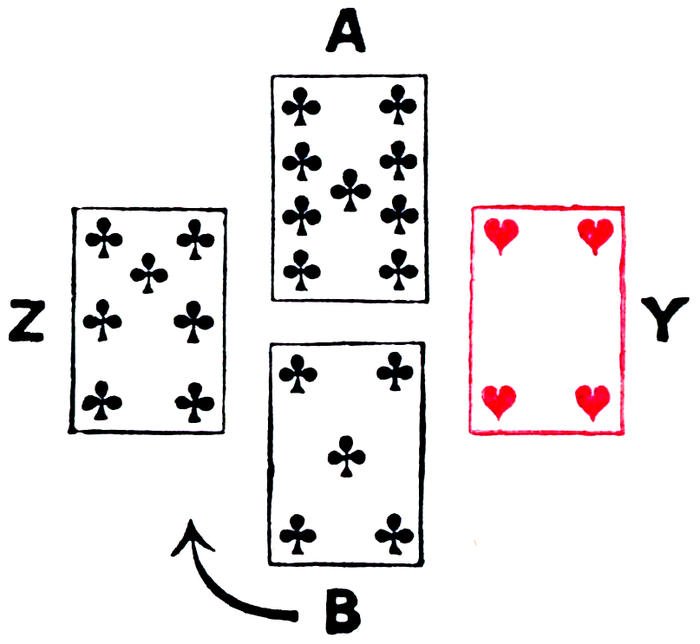
Tricks AB, 4
YZ, 4
8. Z A Y B↷
7♣ 9♣ 4♥ 5♣
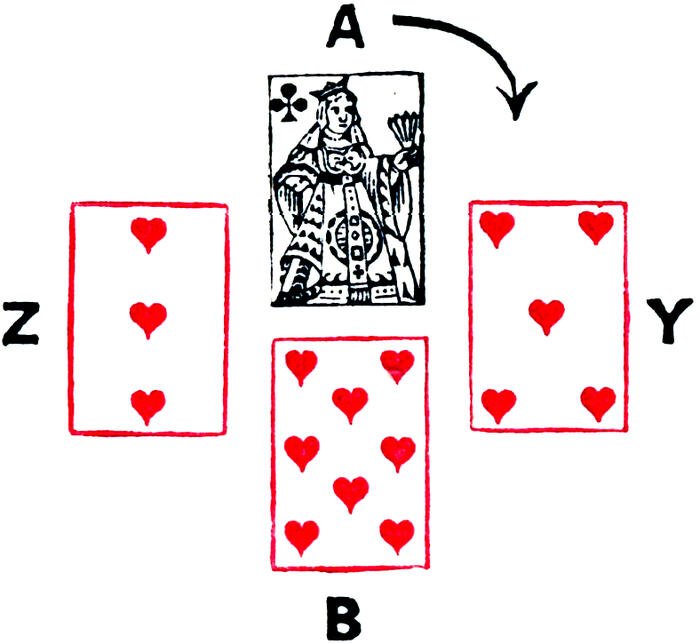
Tricks AB, 5
YZ, 4
9. Z A↷ Y B
3♥ Qn♣ 5♥ 8♥
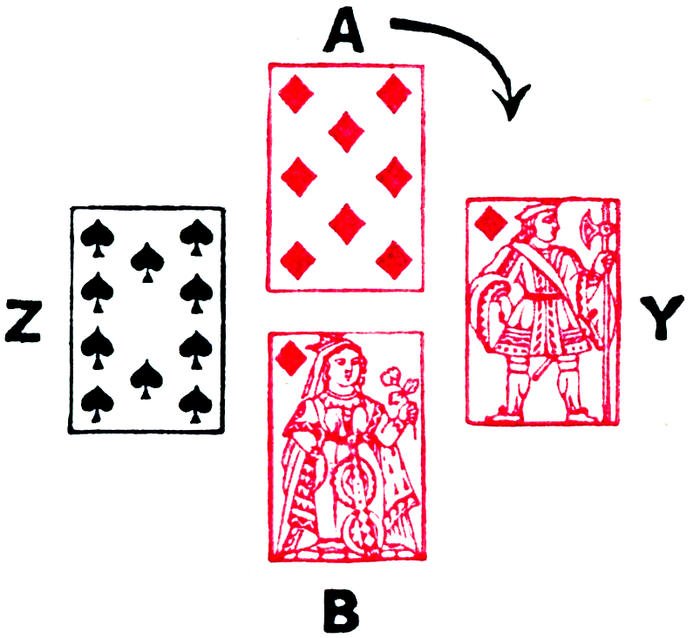
Tricks AB, 5
YZ, 5
10. Z A↷ Y B
10♠ 8♦ Knv♦ Qn♦
Tricks 11 to 13.—Whatever Z leads, B makes ace, queen
of hearts; and
AB win the odd trick.
(B's hand is given above.)
| A's Hand. |
Y's Hand. |
Z's Hand. |
| 6 |
♠ |
Ace, 7, 3, 2 |
♠ |
Qn, Knv, 10, 9, 8 |
♠ |
| 9, 6, 2 |
♥ |
7, 5, 4 |
♥ |
Kg, Knv, 3 |
♥ |
| Kg, Qn, Knv, 10, 9, 8 |
♣ |
Ace |
♣ |
7, 6, 4 |
♣ |
| Ace, 8, 7 |
♦ |
Knv, 9, 5, 3, 2 |
♦ |
Kg, 4 |
♦ |
Z's call for trumps is ill-judged, especially at the score
of four-all. The whole club suit is declared against him,
as Y, putting on ace, second hand, can have no more. If
Z does not call, he wins the game easily.
Returned lead, and refusing a force.
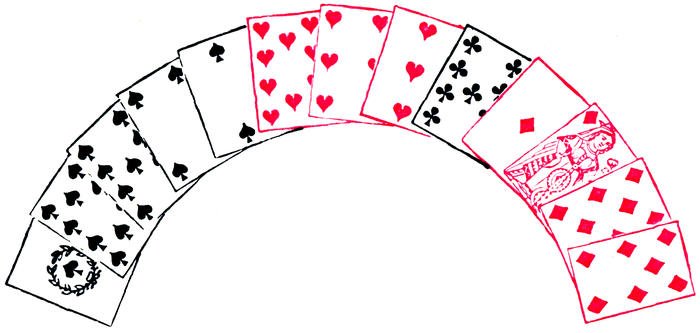
- A♠, 10♠, 9♠, 4♠, 2♠
- 10♥, 6♥, 3♥
- 9♣
- A♦, Qn♦, 8♦, 7♦
Score: AB, one; YZ, love.
Knave of spades turned up.
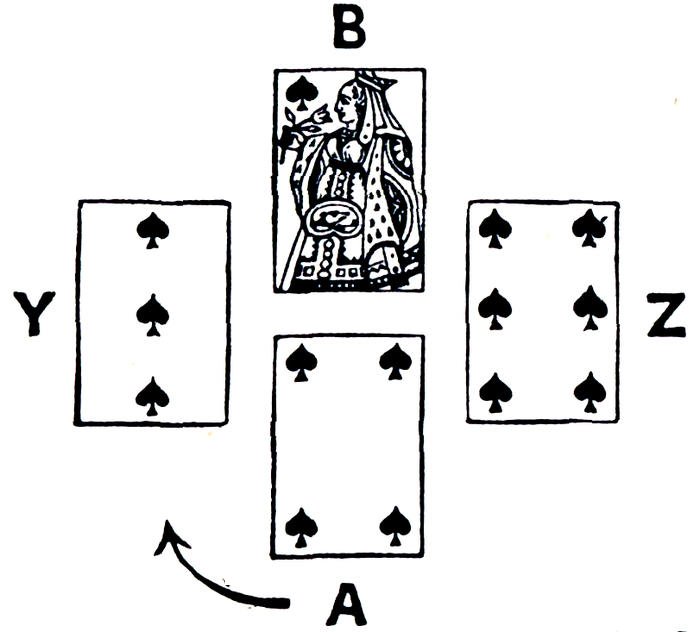
Tricks AB, 1
YZ, 0
1. Y B Z A↷
3♠ Qn♠ 6♠ 4♠
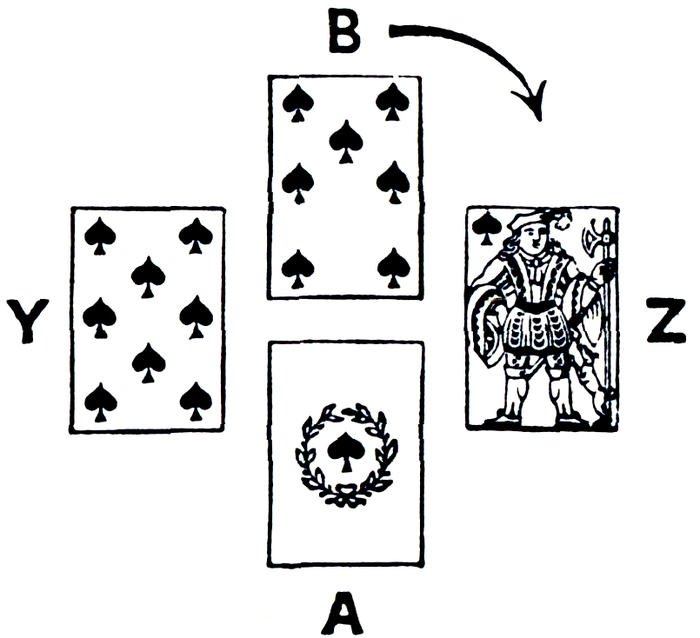
Tricks AB, 2
YZ, 0
2. Y B↷ Z A
8♠ 7♠ Knv♠ A♠
Remark (Trick 2).—B has the five of spades, and Y the
king. A, therefore, does not continue the trump, but
leaves the small spade in his partner's hand.
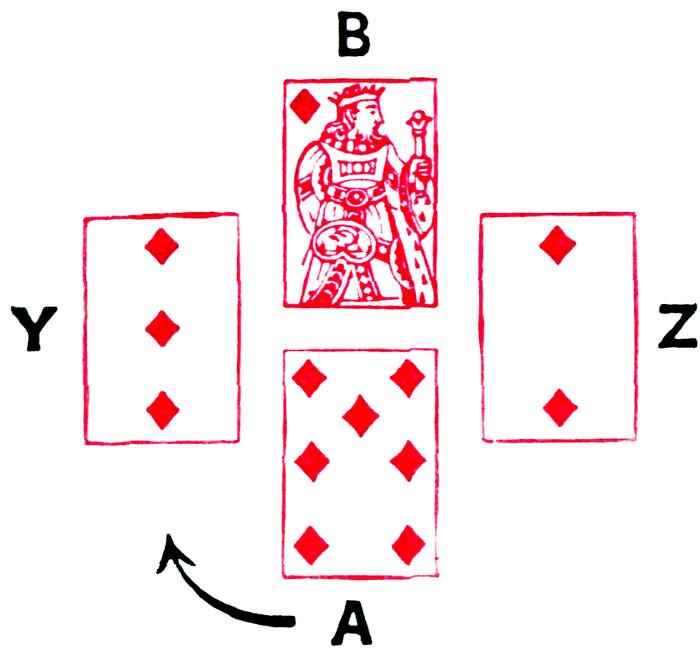
Tricks AB, 3
YZ, 0
3. Y B Z A↷
3♦ Kg♦ 2♦ 7♦
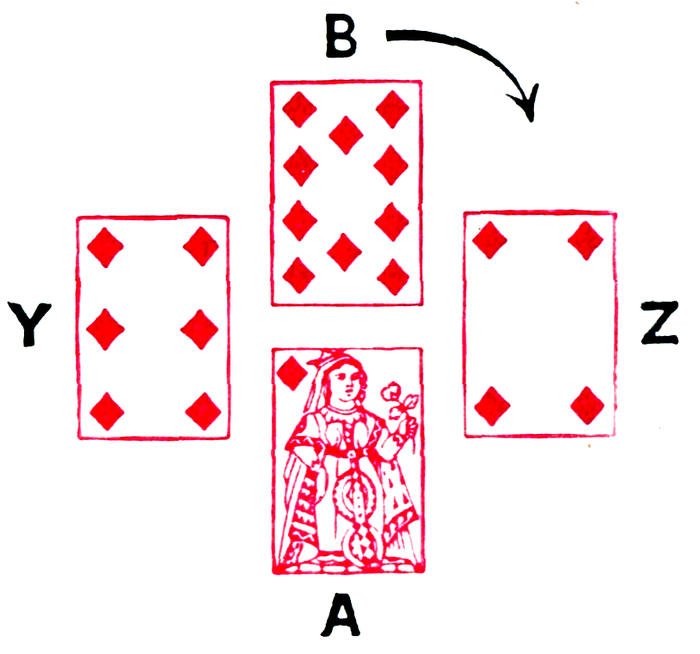
Tricks AB, 4
YZ, 0
4. Y B↷ Z A
6♦ 10♦ 4♦ Qn♦
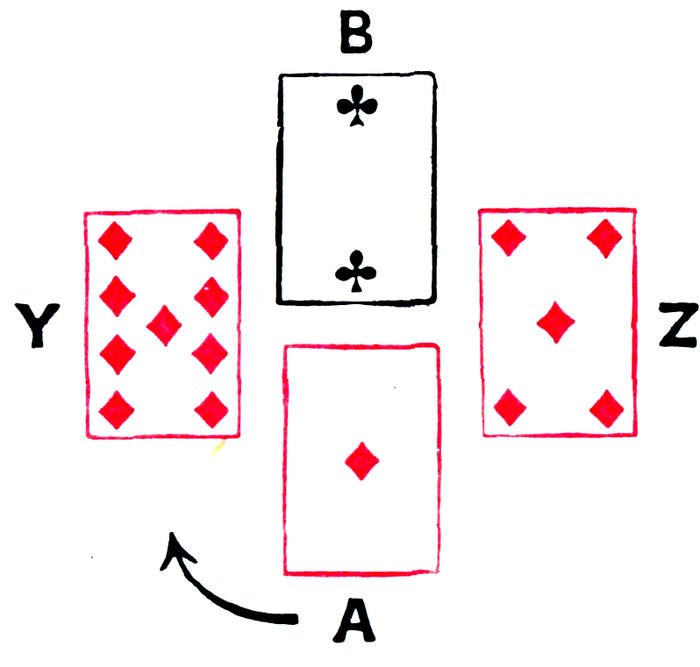
Tricks AB, 5
YZ, 0
5. Y B Z A↷
9♦ 2♣ 5♦ A♦
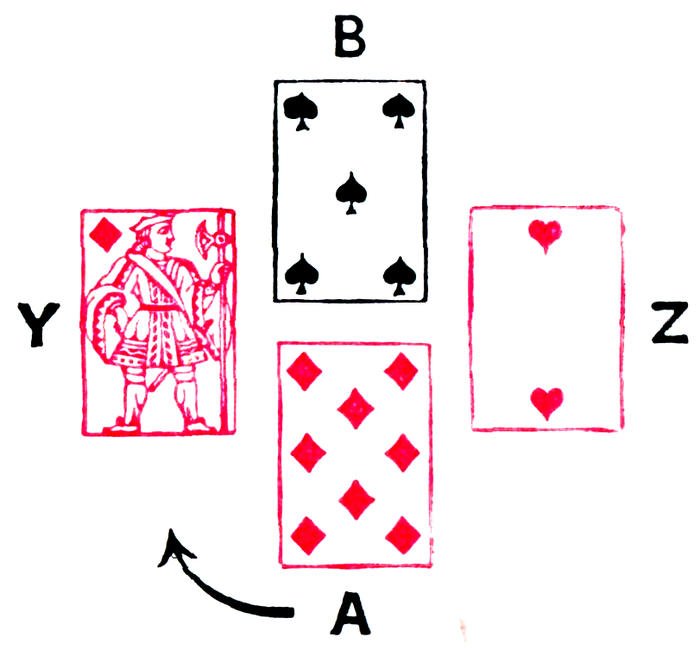
Tricks AB, 6
YZ, 0
6. Y B Z A↷
Knv♦ 5♠ 2♥ 8♦
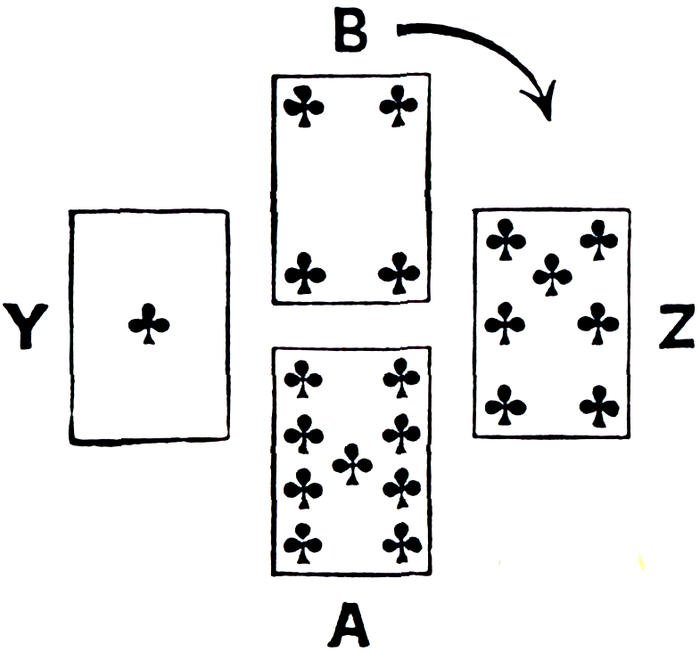
Tricks AB, 6
YZ, 1
7. Y B↷ Z A
A♣ 4♣ 7♣ 9♣
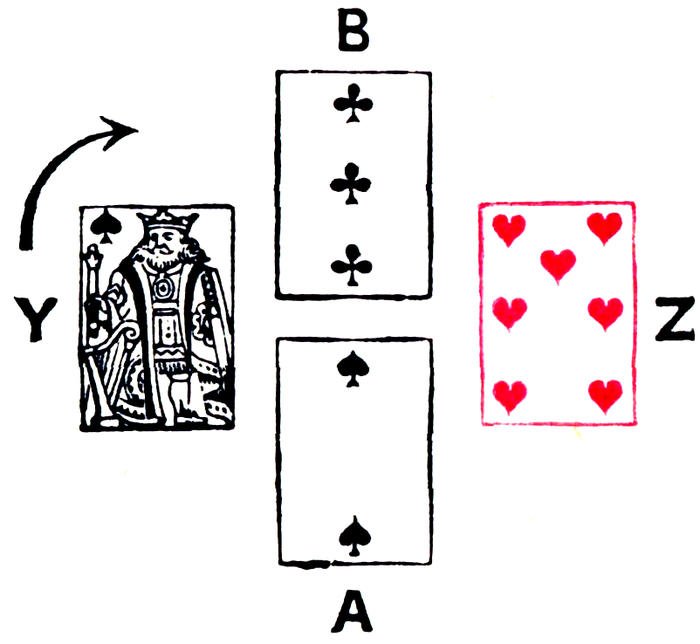
Tricks AB, 6
YZ, 2
8. Y↷ B Z A
Kg♠ 3♣ 7♥ 2♠
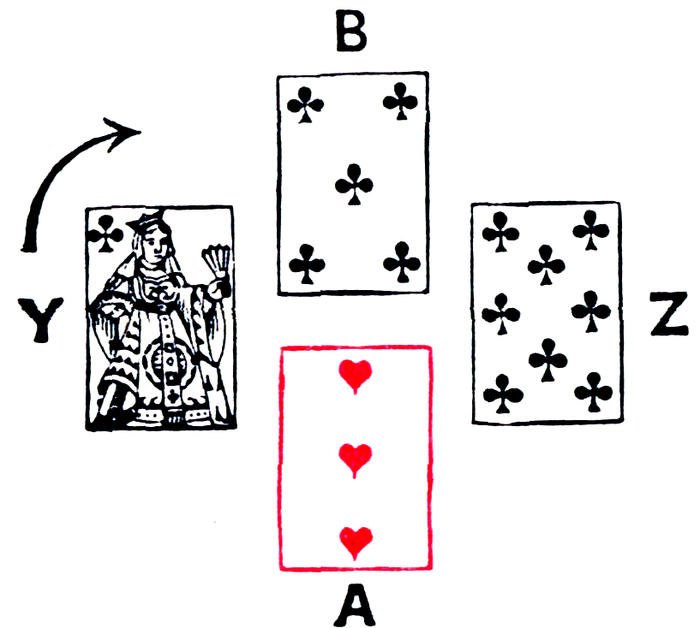
Tricks AB, 6
YZ, 3
9. Y↷ B Z A
Qn♣ 5♣ 8♣ 3♥
Remark (Trick 9).—A knows B has two more clubs
(see Tricks 7 and 8, and p. 106). A, therefore, desires to
leave the lead with Y, that he may go on with another
club, and so clear B's suit.
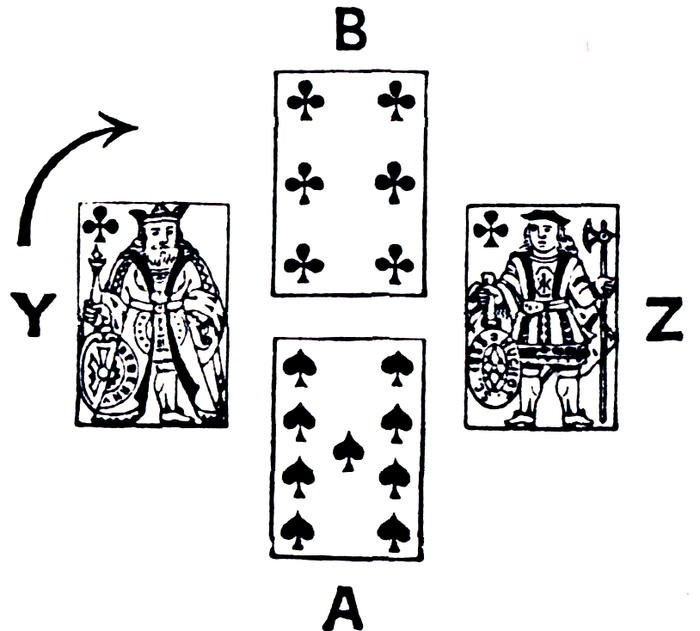
Tricks AB, 7
YZ, 3
10. Y↷ B Z A
Kg♣ 6♣ Knv♣ 9♠
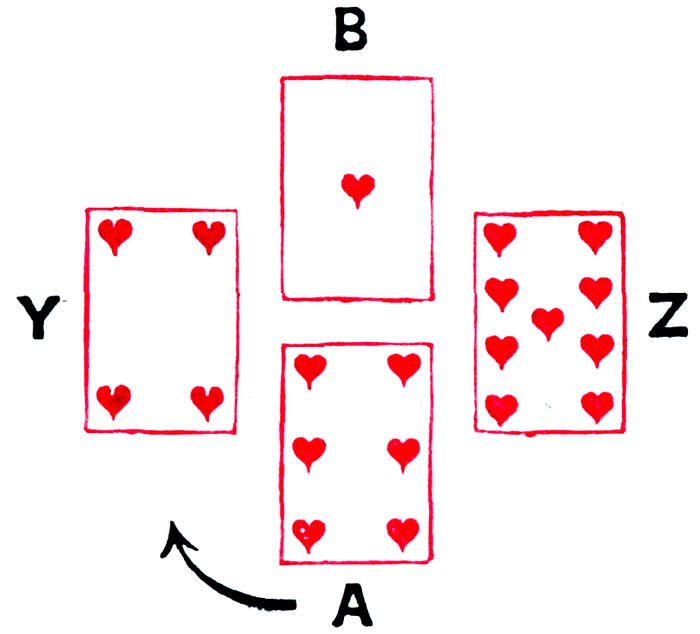
Tricks AB, 8
YZ, 3
11. Y B Z A↷
4♥ A♥ 9♥ 6♥
Remark (Trick 11).—A
leads his smallest heart, as
he does not want to tempt
B to finesse (see p. 142). B
has ace, queen of hearts (see
his hand below), but he does
not finesse, as the ace of
hearts, last club, and A's
trump make every trick.
AB win four by cards.
(A's hand is given above.)
| Y's Hand. |
B's Hand. |
Z's Hand. |
| Kg, 8, 3 |
♠ |
Qn, 7, 5 |
♠ |
Knv, 6 |
♠ |
| 8, 5, 4 |
♥ |
Ace, Qn |
♥ |
Kg, Knv, 9, 7, 2 |
♥ |
| Ace, Kg, Qn |
♣ |
10, 6, 5, 4, 3, 2 |
♣ |
Knv, 8, 7 |
♣ |
| Knv, 9, 6, 3 |
♦ |
Kg, 10 |
♦ |
5, 4, 2 |
♦ |
Y should play queen of clubs at Trick 7, and ace of clubs
at Trick 9, when A will not have sufficient materials for
his coup, as he will be uncertain as to the position of the
best club. Y gives his adversary too much information
by playing book (see p. 113). When the adversaries have
command of trumps, it is often advisable, towards the
end of a hand, to play so as not to enable them to count
the cards.
Refusing to overtrump.
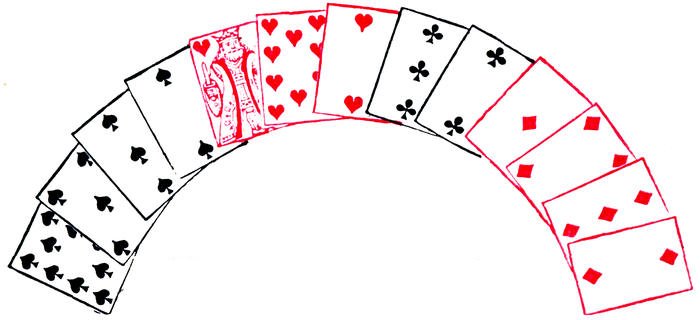
- 10♠, 5♠, 3♠, 2♠
- Kg♥, 10♥, 2♥
- 3♣, 2♣
- A♦, 4♦, 3♦, 2♦
Score: Three-all.
Five of diamonds turned up.
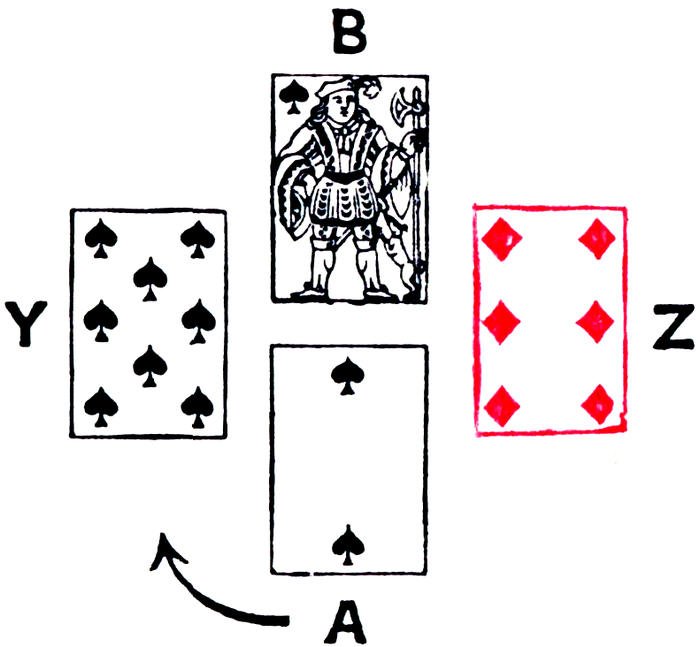
Tricks AB, 0
YZ, 1
1. Y B Z A↷
8♠ Knv♠ 6♦ 2♠
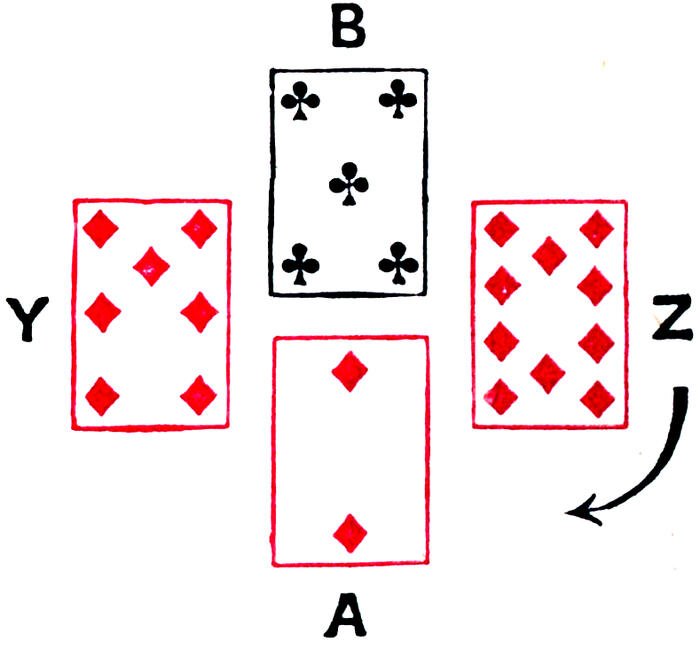
Tricks AB, 0
YZ, 2
2. Y B Z↷ A
7♦ 5♣ 10♦ 2♦
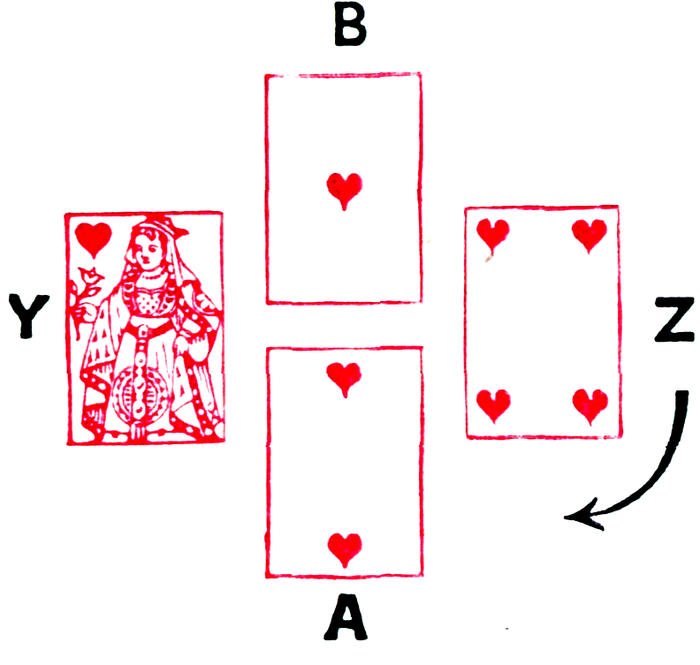
Tricks AB, 1
YZ, 2
3. Y B Z↷ A
Qn♥ A♥ 4♥ 2♥
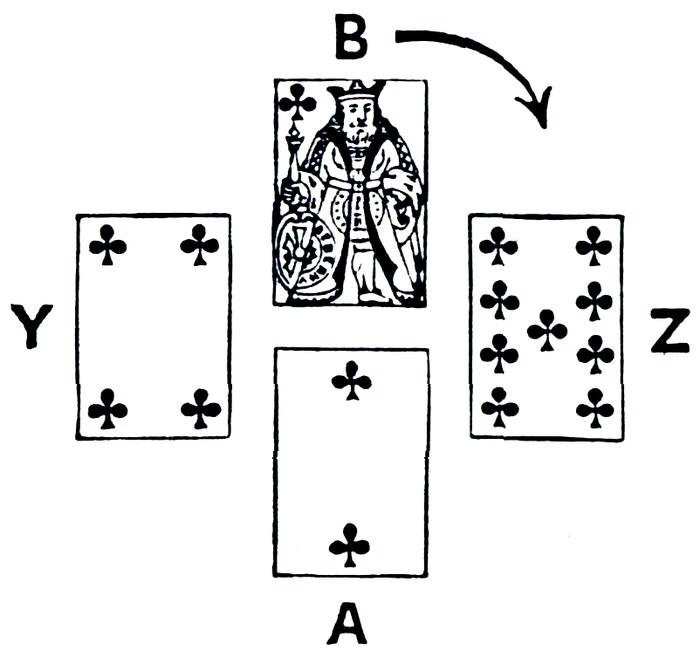
Tricks AB, 2
YZ, 2
4. Y B↷ Z A
4♣ Kg♣ 9♣ 2♣
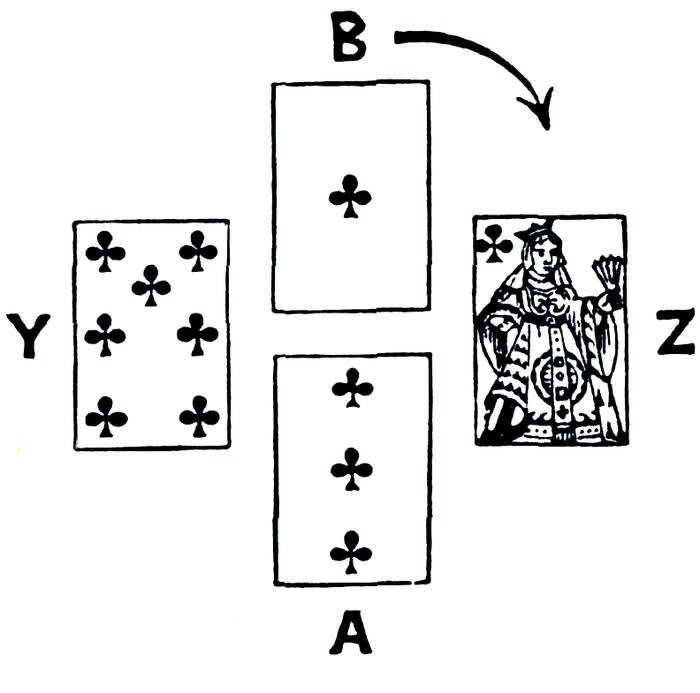
Tricks AB, 3
YZ, 2
5. Y B↷ Z A
7♣ A♣ Qn♣ 3♣
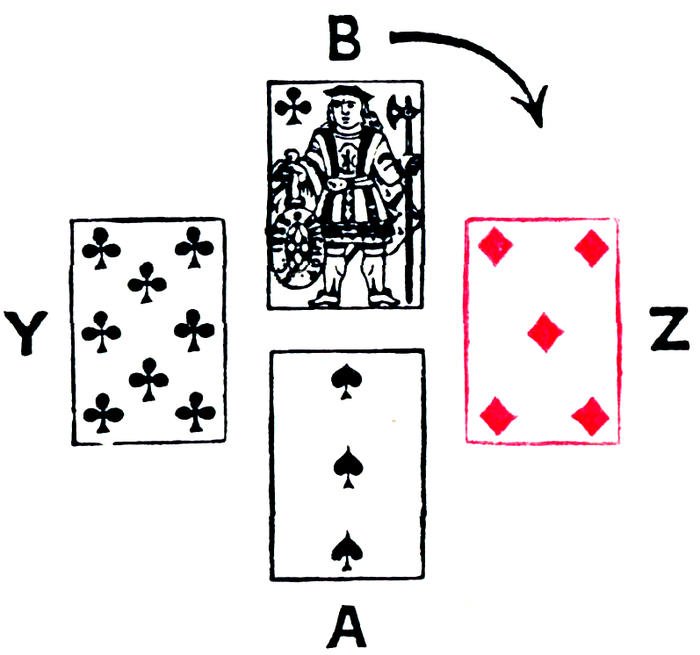
Tricks AB, 3
YZ, 3
6. Y B↷ Z A
8♣ Knv♣ 5♦ 3♠
Remark (Trick 6).-A does not overtrump. This is
the sort of coup for which no rule can be laid down in
a book, as it depends entirely on the state of the game
and the previous fall of the cards. A sees, that his only
chance of two by cards is for the remaining trumps to be
divided, and for him to be able to get two rounds before
he loses the command of hearts. If then his partner has
ace, queen of spades, he may win the game against two
by honours.
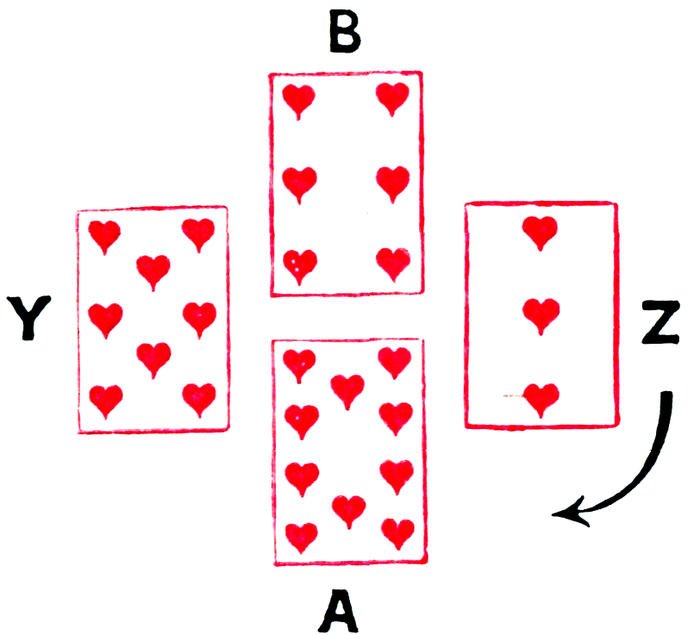
Tricks AB, 4
YZ, 3
7. Y B Z↷ A
8♥ 6♥ 3♥ 10♥
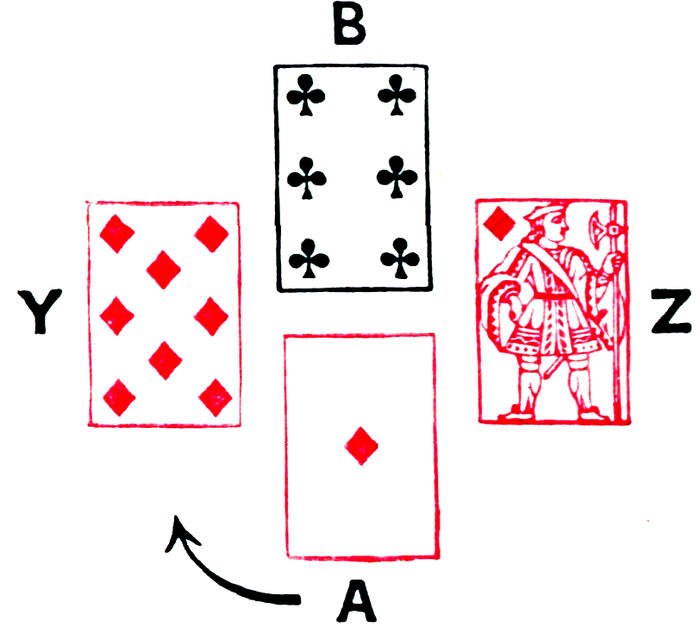
Tricks AB, 5
YZ, 3
8. Y B Z A↷
8♦ 6♣ Knv♦ A♦
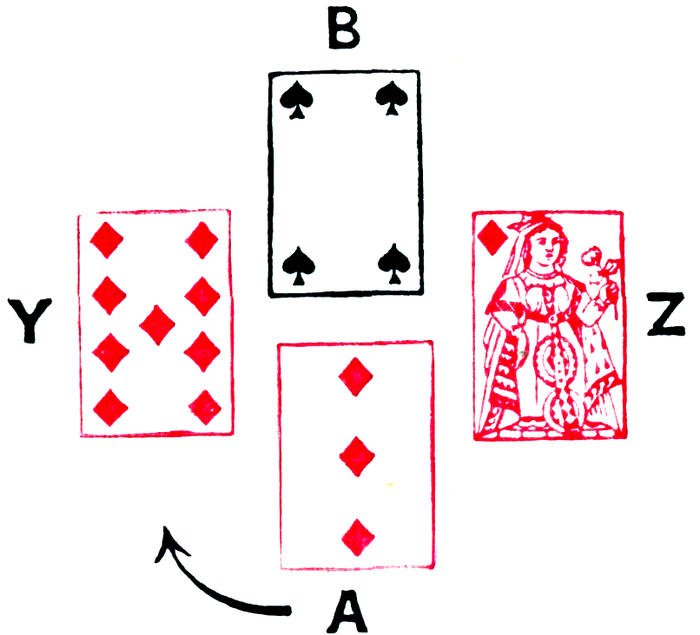
Tricks AB, 5
YZ, 4
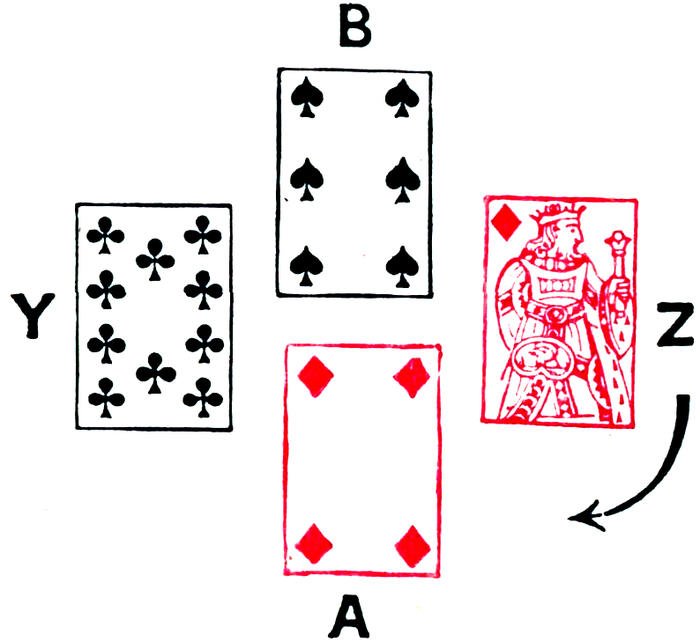
9. Y B Z A↷
9♦ 4♠ Qn♦ 3♦
Tricks AB, 5
YZ, 5
10. Y B Z↷ A
10♣ 6♠ Kg♦ 4♦
Tricks 11 to 13.—Z leads a heart which A wins. A
leads a spade, and finds his partner with ace, queen; and
AB win two by cards (which score before honours).
(A's hand is given above.)
| Y's Hand. |
B's Hand. |
Z's Hand. |
| Kg, 9, 8 |
♠ |
Ace, Qn, Knv, 7, 6, 4 |
♠ |
|
|
| Qn, 9, 8 |
♥ |
Ace, 6 |
♥ |
Knv, 7, 5, 4, 3 |
♥ |
| 10, 8, 7, 4 |
♣ |
Ace, Kg, Knv, 6, 5 |
♣ |
Qn, 9 |
♣ |
| 9, 8, 7 |
♦ |
|
|
Kg, Qn, Knv, 10, 6, 5 |
♦ |
Refusing to overtrump.
- Kg♠, 7♠, 6♠
- A♥, 9♥, 7♥, 6♥, 5♥, 4♥
- 5♣, 3♣
- Qn♦, 7♦
Score: Four-all.
Five of spades turned up.
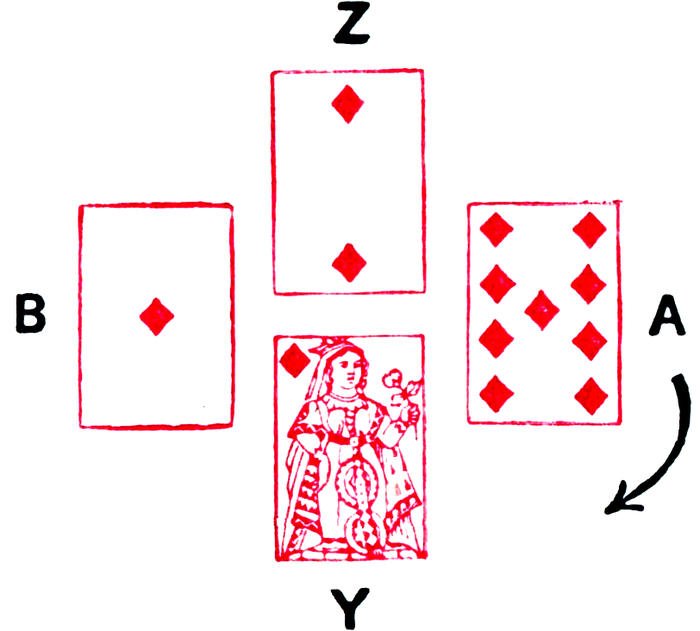
Tricks AB, 1
YZ, 0
1. B Z A↷ Y
A♦ 2♦ 9♦ Qn♦
Tricks AB, 2
YZ, 0
2. B↷ Z A Y
10♣ 6♣ A♣ 3♣
Tricks AB, 3
YZ, 0
3. B Z A↷ Y
2♣ 3♦ Kg♦ 7♦
Tricks AB, 3
YZ, 1
4. B Z A↷ Y
4♣ 4♦ Knv♦ Kg♠
Tricks AB, 3
YZ, 2
5. B Z A Y↷
8♥ 3♥ 2♥ A♥
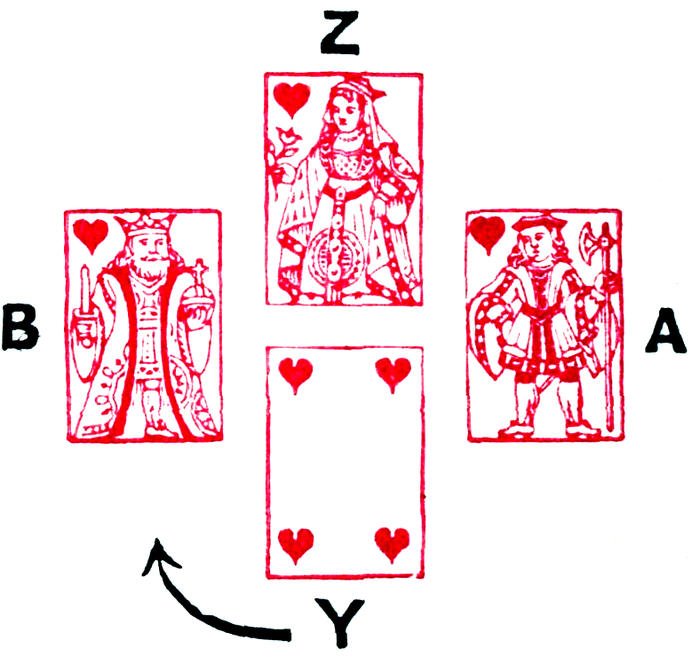
Tricks AB, 4
YZ, 2
6. B Z A Y↷
Kg♥ Qn♥ Knv♥ 4♥
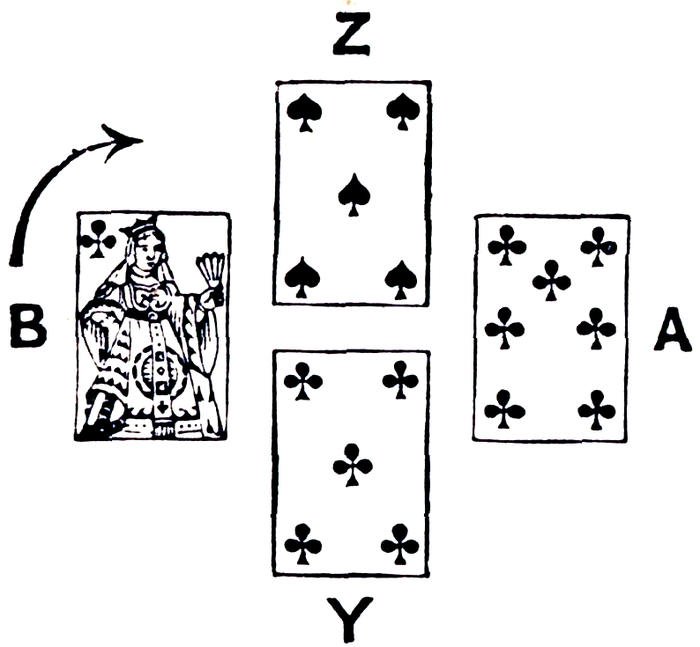
Tricks AB, 4
YZ, 3
7. B↷ Z A Y
Qn♣ 5♠ 7♣ 5♣
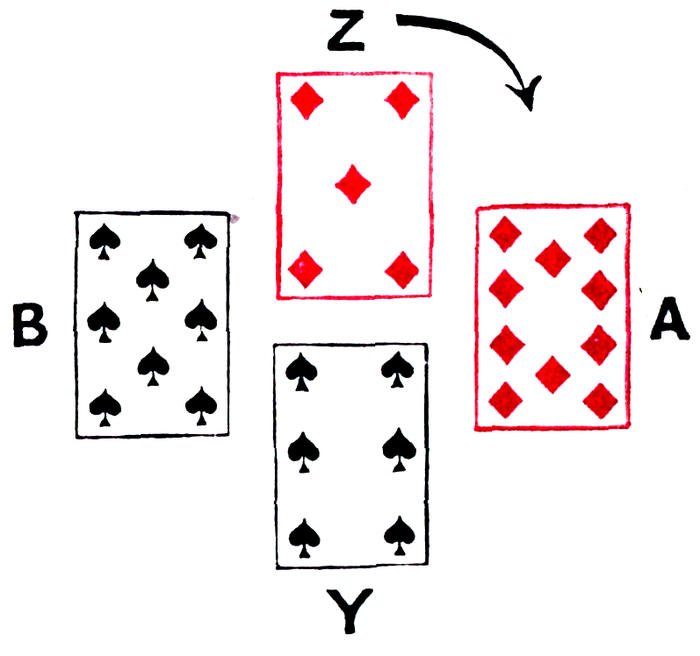
Tricks AB, 5
YZ, 3
8. B Z↷ A Y
8♠ 5♦ 10♦ 6♠
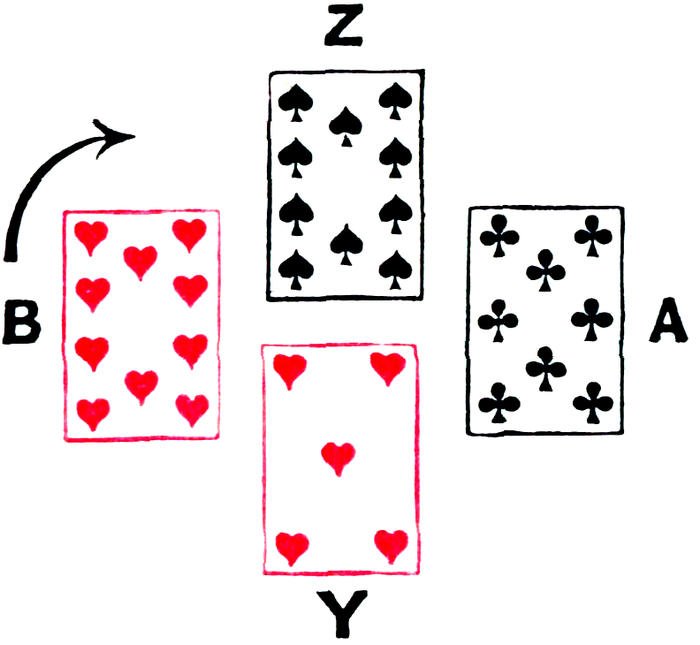
Tricks AB, 5
YZ, 4
9. B↷ Z A Y
10♥ 10♠ 8♣ 5♥
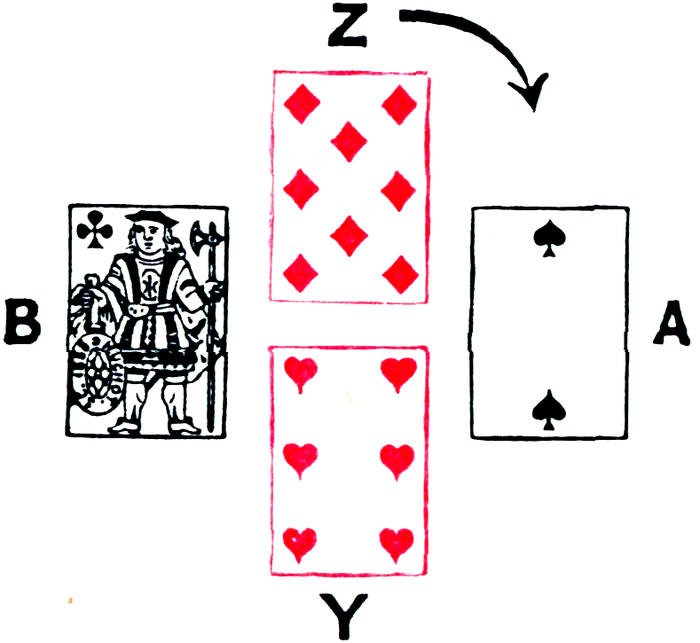
Tricks AB, 6
YZ, 4
10. B Z↷ A Y
Knv♣ 8♦ 2♠ 6♥
Remark (Trick 10).—Y's play in not overtrumping is
very good. He counts the hand thus: to save the game Z
must hold ace, queen, or ace, knave of spades; his third
card is evidently the remaining diamond. A has the nine
of clubs (see fall of the club suit in Tricks 2, 7, and 9), and
two trumps. B has two trumps, one being queen or knave
(see Trick 9), and king, knave of clubs. If the cards
remaining in each hand are placed face upwards on the
table, and the uncertain cards, viz., the nine, four, and
three of trumps are given two to A, and one to B, it will
be seen that, if Y overtrumps with the seven, he cannot
make the requisite three tricks; but that, if he leaves the
lead with A, YZ make the remaining tricks.
It may be added, that if, at Trick 10, A discards his club,
and keeps his three little trumps together, leaving the trick
to B, AB must win the odd trick if B leads a trump at
Trick 11 after trumping. This A might have reckoned.
(Y's hand is given above.)
| A's Hand. |
B's Hand. |
Z's Hand. |
| 4, 3, 2 |
♠ |
Qn, 9, 8 |
♠ |
Ace, Knv, 10, 5 |
♠ |
| Knv, 2 |
♥ |
Kg, 10, 8 |
♥ |
Qn, 3 |
♥ |
| Ace, 9, 8, 7 |
♣ |
Kg, Qn, Knv, 10, 4, 2 |
♣ |
6 |
♣ |
| Kg, Knv, 10, 9 |
♦ |
Ace |
♦ |
8, 6, 5, 4, 3, 2 |
♦ |
See Refusing to overtrump, pp. 146, 147.
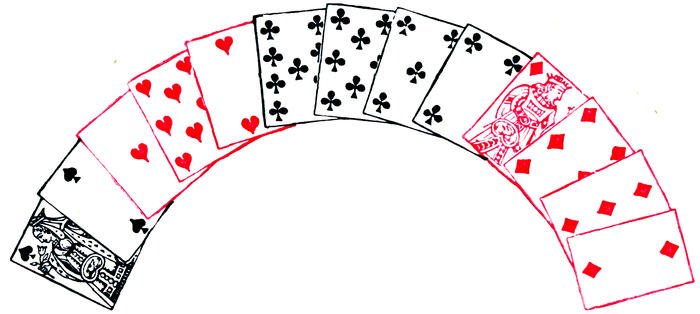
- Qn♠, 2♠
- A♥, 8♥, 2♥
- 9♣, 8♣, 5♣, 4♣
- Kg♦, 6♦, 3♦, 2♦
Score: AB, three; YZ, love.
Seven of hearts turned up.
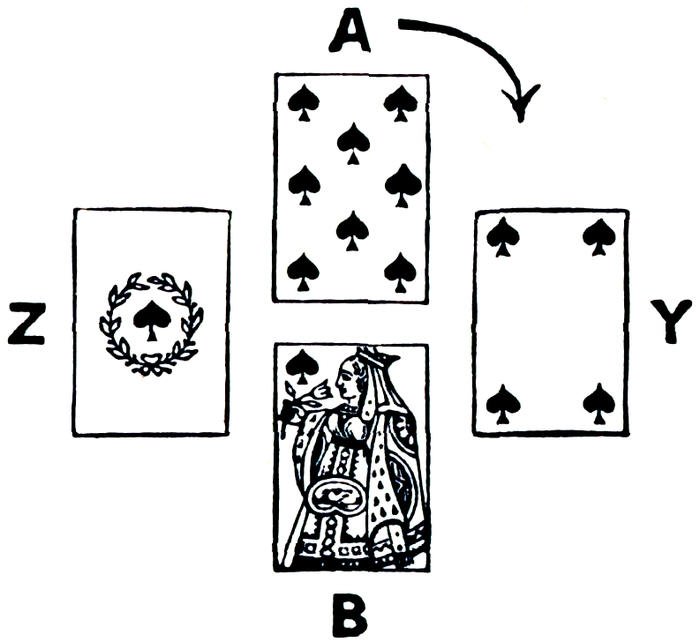
Tricks AB, 0
YZ, 1
1. Z A↷ Y B
A♠ 8♠ 4♠ Qn♠
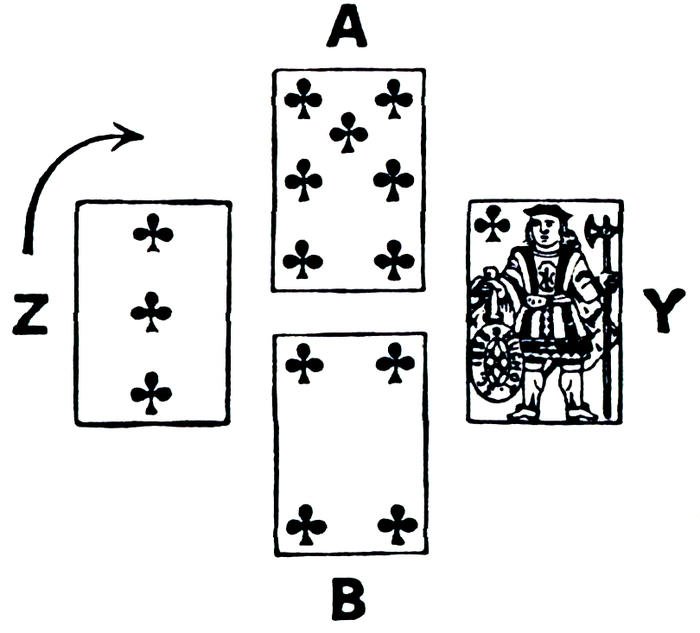
Tricks AB, 0
YZ, 2
2. Z↷ A Y B
3♣ 7♣ Knv♣ 4♣
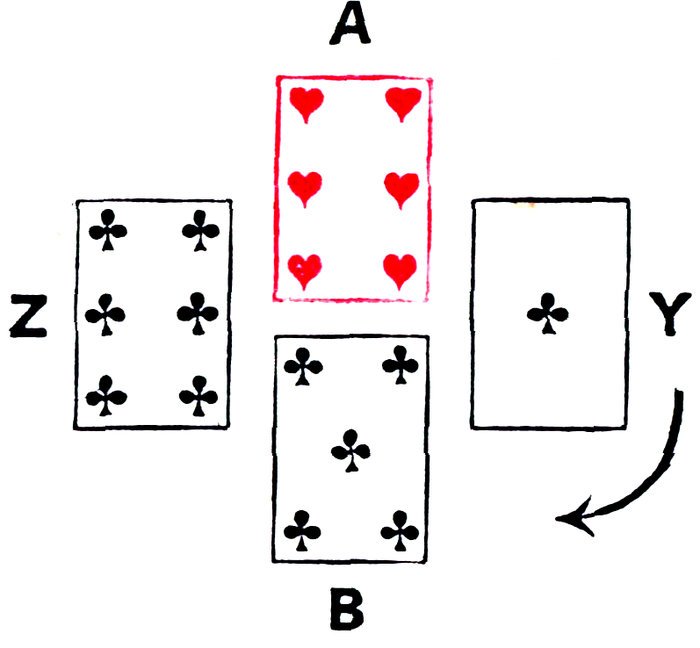
Tricks AB, 1
YZ, 2
3. Z A Y↷ B
6♣ 6♥ A♣ 5♣
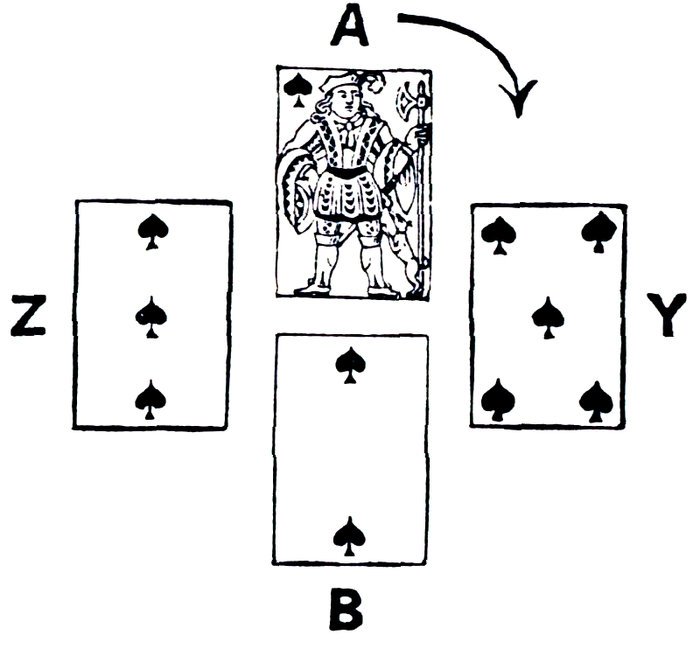
Tricks AB, 2
YZ, 2
4. Z A↷ Y B
3♠ Knv♠ 5♠ 2♠
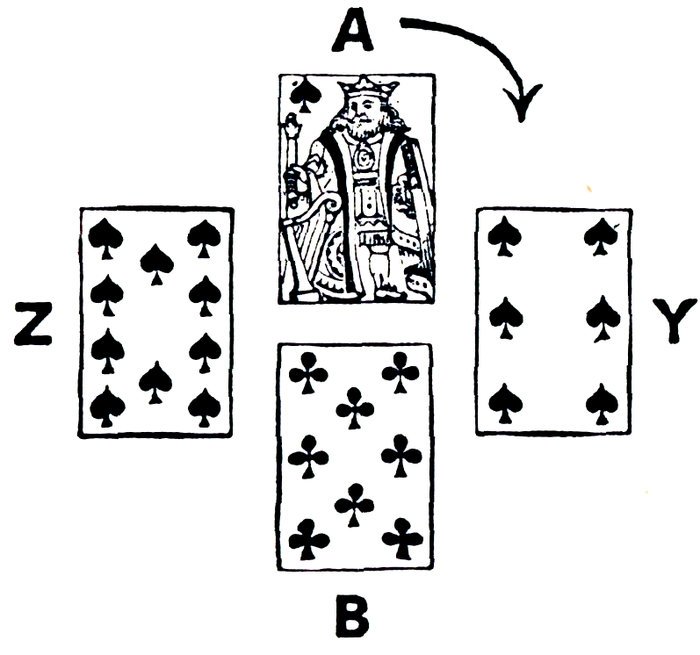
Tricks AB, 3
YZ, 2
5. Z A↷ Y B
10♠ Kg♠ 6♠ 8♣
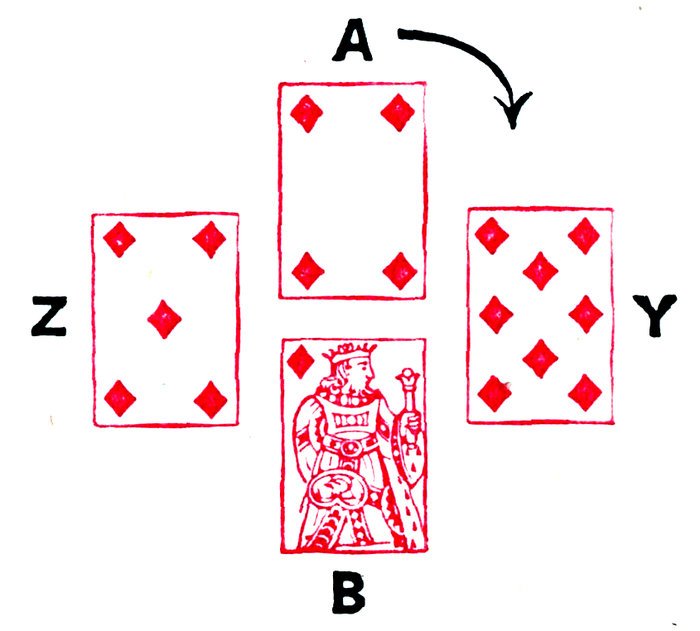
Tricks AB, 4
YZ, 2
6. Z A↷ Y B
5♦ 4♦ 8♦ Kg♦
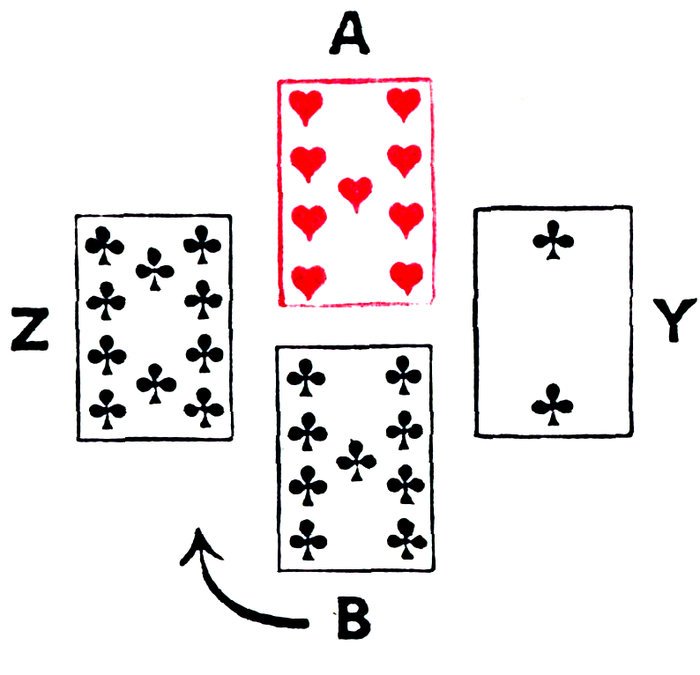
Tricks AB, 5
YZ, 2
7. Z A Y B↷
10♣ 9♥ 2♣ 9♣
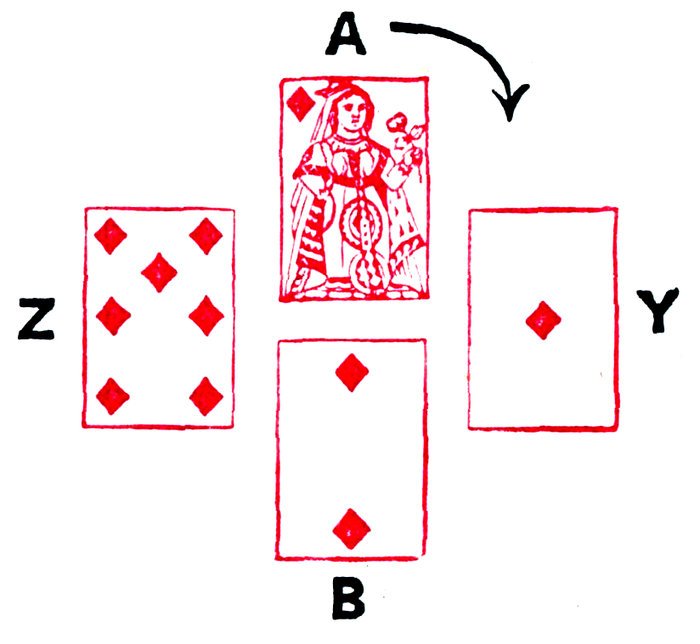
Tricks AB, 5
YZ, 3
8. Z A↷ Y B
7♦ Qn♦ A♦ 2♦
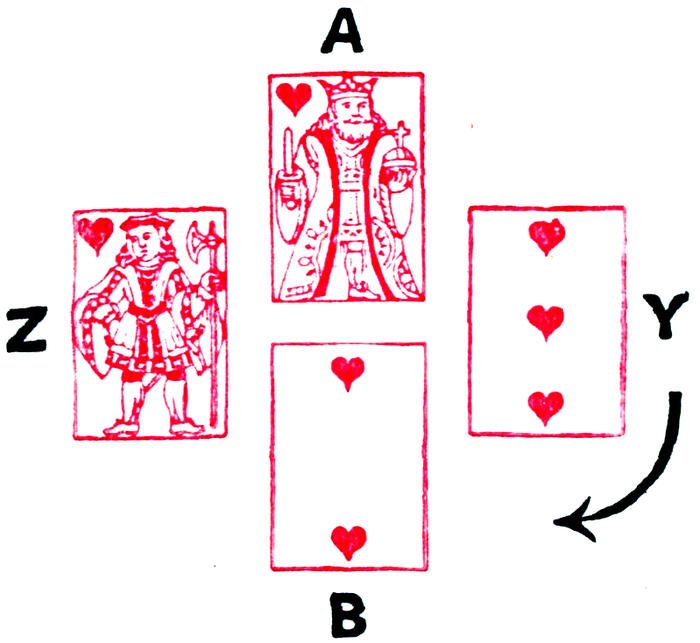
Tricks AB, 6
YZ, 3
9. Z A Y↷ B
Knv♥ Kg♥ 3♥ 2♥
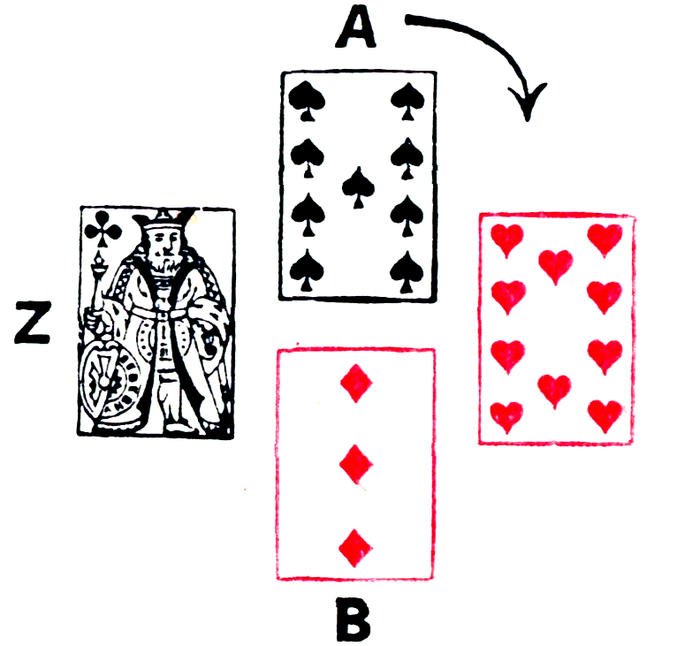
Tricks AB, 6
YZ, 4
10. Z A↷ Y B
Kg♣ 9♠ 10♥ 3♦
Remark (Trick 10).—B can count A's hand—viz., a
spade and two diamonds. Therefore, if B overtrumps he
cannot possibly win two more tricks.
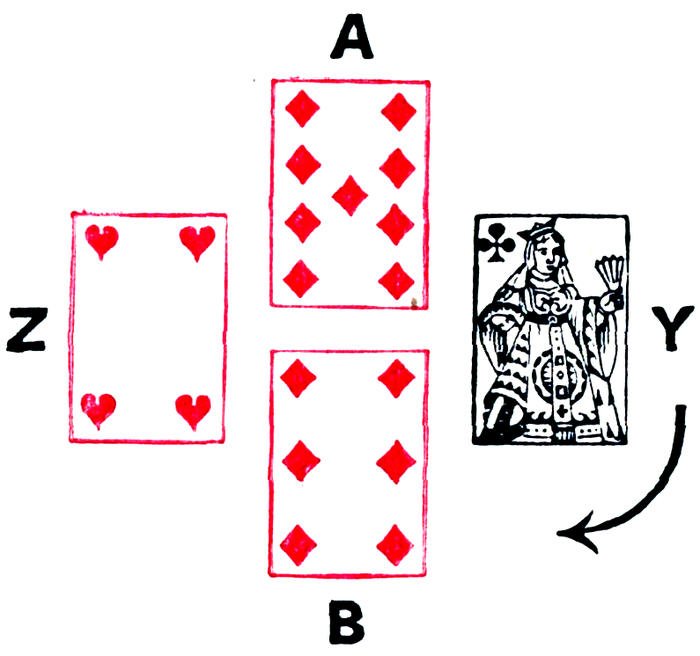
Tricks AB, 6
YZ, 5
11. Z A Y↷ B
4♥ 9♦ Qn♣ 6♦
Tricks 12 and 13.—Z
leads a trump (he has only
trumps in hand), and B
makes ace and eight.
AB win two by cards.
(B's hand is given above.)
| A's Hand. |
Y's Hand. |
Z's Hand. |
| Kg, Knv, 9, 8, 7 |
♠ |
6, 5, 4 |
♠ |
Ace, 10, 3 |
♠ |
| Kg, 9, 6 |
♥ |
Qn, 10, 3 |
♥ |
Knv, 7, 5, 4 |
♥ |
| 7 |
♣ |
Ace, Qn, Knv, 2 |
♣ |
Kg, 10, 6, 3 |
♣ |
| Qn, Knv, 9, 4 |
♦ |
Ace, 10, 8 |
♦ |
7, 5 |
♦ |
The end play of this hand is difficult. At Trick 9, Y
leads three of hearts in preference to the queen, as he can
count an honour single in A's hand. At Trick 10, A's
best lead is doubtful. At Trick 10, also, probably Y
should trump with the queen (see p. 147); but even then,
B must place ten of hearts in Y's hand.
Counting the hands, and consequent departure from
rule.
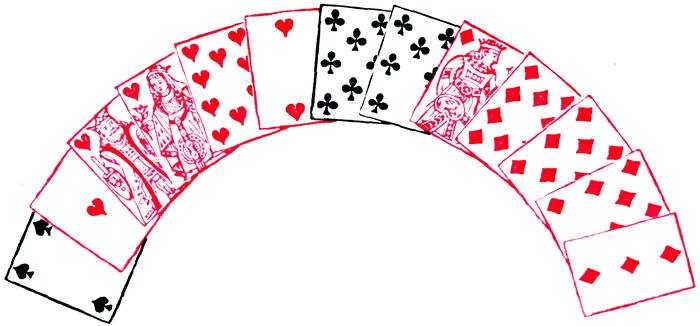
- 4♠
- A♥, Kg, Qn♥, 10♥, 2♥
- 8♣, 7♣
- Kg♦, 10♦, 8♦, 7♦, 3♦
Score: AB, three; YZ, one.
Five of diamonds turned up.
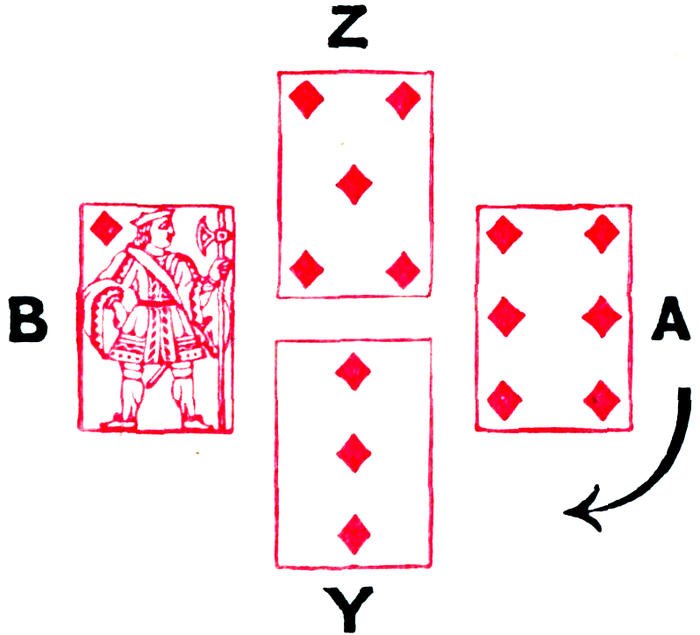
Tricks AB, 1
YZ, 0
1. B Z A↷ Y
Knv♦ 5♦ 6♦ 3♦
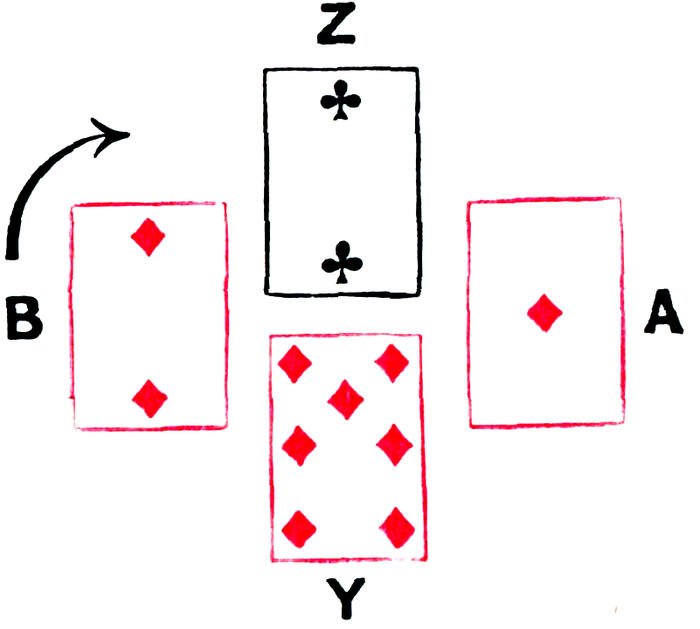
Tricks AB, 2
YZ, 0
2. B↷ Z A Y
2♦ 2♣ A♦ 7♦
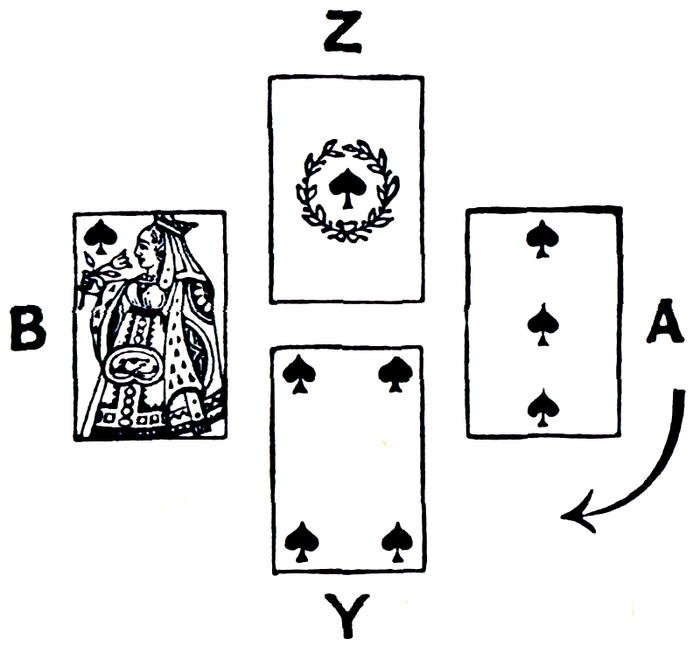
Tricks AB, 2
YZ, 1
3. B Z A↷ Y
Qn♠ A♠ 3♠ 4♠
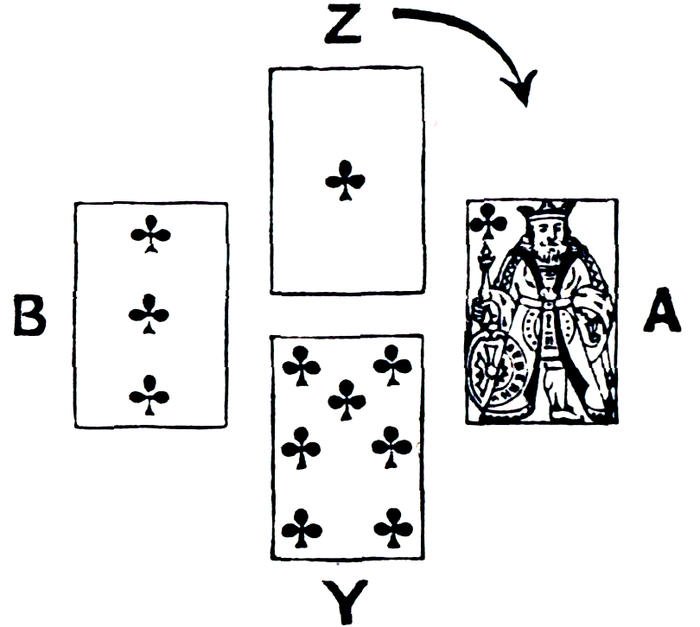
Tricks AB, 2
YZ, 2
4. B Z↷ A Y
3♣ A♣ Kg♣ 7♣
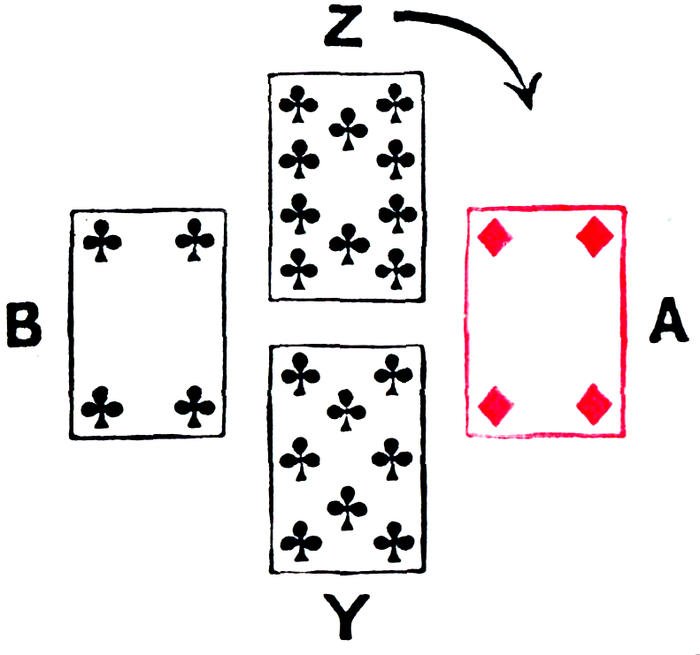
Tricks AB, 3
YZ, 2
5. B Z↷ A Y
4♣ 10♣ 4♦ 8♣
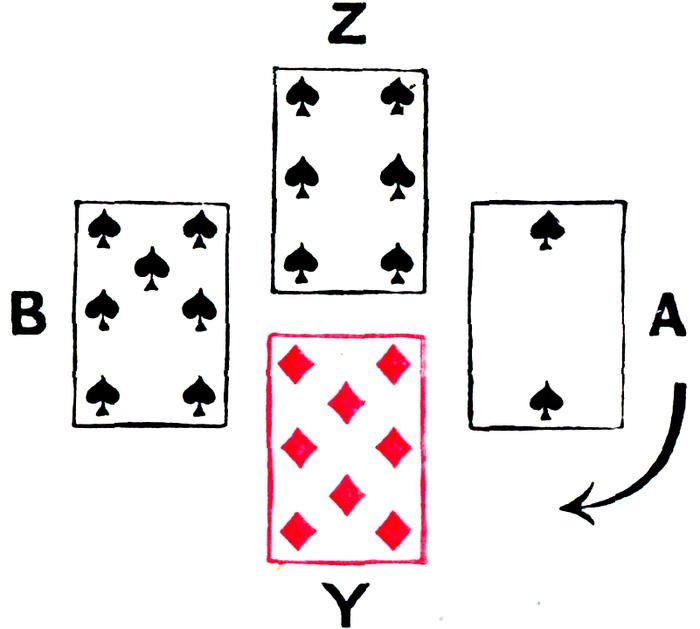
Tricks AB, 3
YZ, 3
6. B Z A↷ Y
7♠ 6♠ 2♠ 8♦
Tricks AB, 3
YZ, 4
7. B Z A Y↷
5♥ 9♥ 7♥ 2♥
Tricks AB, 3
YZ, 5
8. B Z↷ A Y
9♣ Qn♣ 5♠ 10♥
Remark (Trick 7).—This is strong illustration of a
case for departing from rule. Y can count two more
trumps, and three more spades in A's hand (see A's leads,
Tricks 3 and 6, and p. 116). It is clear that A can have
at most two hearts; consequently, if Y leads his tierce
major in hearts, he must lose the game, as the opponents
have two by honours. But, if Y can give his partner the
lead, and Z has four more clubs, or the winning club, and
A makes the mistake of trumping it, YZ may make every
trick, and win the game.
Y would be right to play as he does even if A had led
from only four spades. With a strong trump hand declared
against, and a long weak suit, it is doubtful whether A
should not have led the deuce of spades at Trick 3 (see
Appendix A); but the hand is given as it was played.
Tricks 9 to 13.—Z continues to lead clubs (see his
hand below), and whether A passes or trumps,
YZ score four by cards.
(Y's hand is given above.)
| A's Hand. |
B's Hand. |
Z's Hand. |
| Knv, 9, 5, 3, 2 |
♠ |
Kg, Qn, 10, 8, 7 |
♠ |
Ace, 6 |
♠ |
| 8, 7 |
♥ |
Knv, 6, 5 |
♥ |
9, 4, 3 |
♥ |
| Kg |
♣ |
9, 4, 3 |
♣ |
A, Qn, Knv, 10, 6, 5, 2 |
♣ |
| Ace, Qn, 9, 6, 4 |
♦ |
Knv, 2 |
♦ |
5 |
♦ |
See Leading from weakest suit, p. 141.
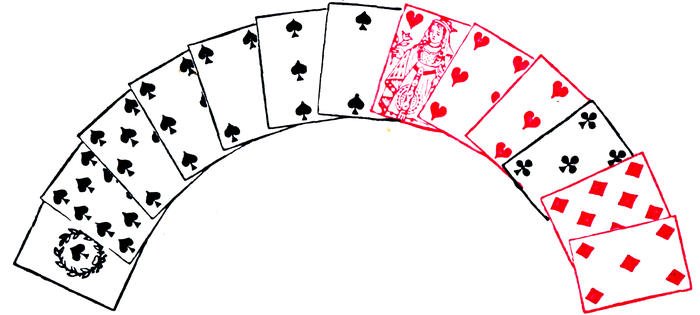
- A♠, 10♠, 7♠, 6♠, 4♠, 3♠, 2♠
- Qn♥, 6♥, 3♥
- 5♣
- 8♦, 5♦
Score: AB, three; YZ, four.
Five of clubs turned up.
Tricks AB, 1
YZ, 0
1. A↷ Y B Z
8♣ 3♣ A♣ 5♣
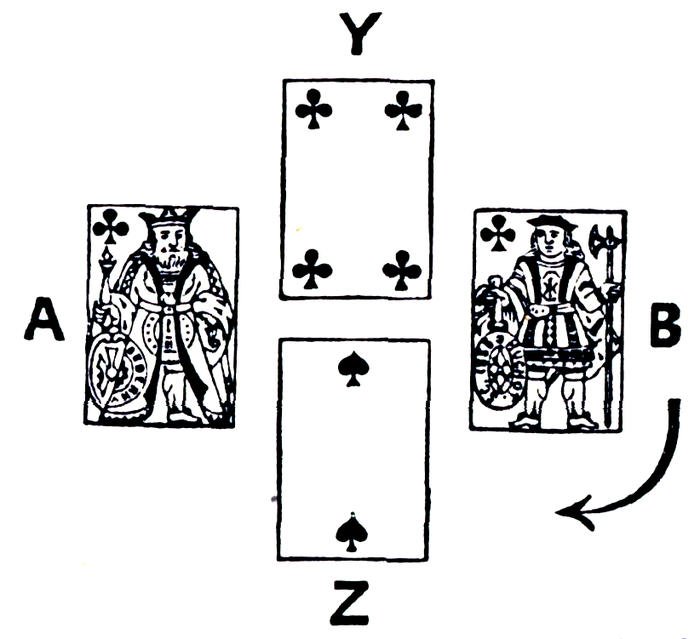
Tricks AB, 2
YZ, 0
2. A Y B↷ Z
Kg♣ 4♣ Knv♣ 2♠
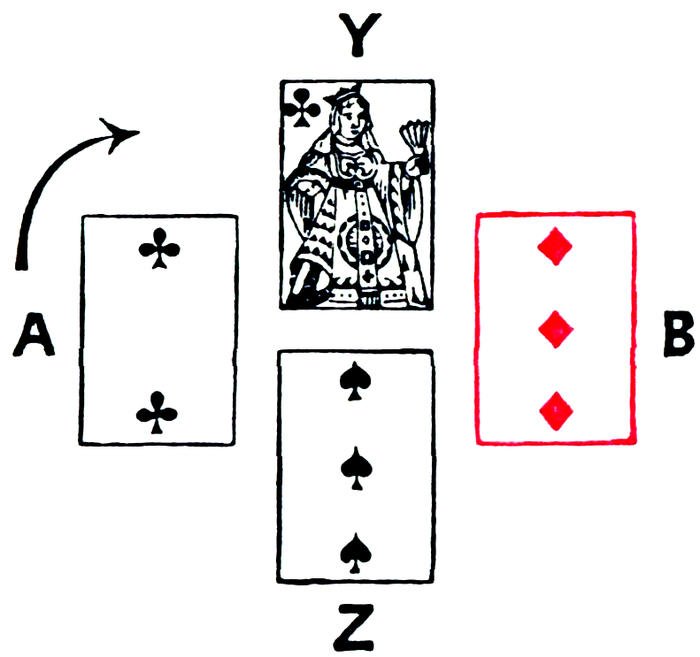
Tricks AB, 2
YZ, 1
3. A↷ Y B Z
2♣ Qn♣ 3♦ 3♠
Remark.—By the first
discard Z shows his strong
suit to be spades. In an
ordinary hand, Z might
afterwards throw a diamond.
But here, Y must
be strong in diamonds, in
order to save the game;
and it is important for Z
to keep the power of leading
that suit more than
once.
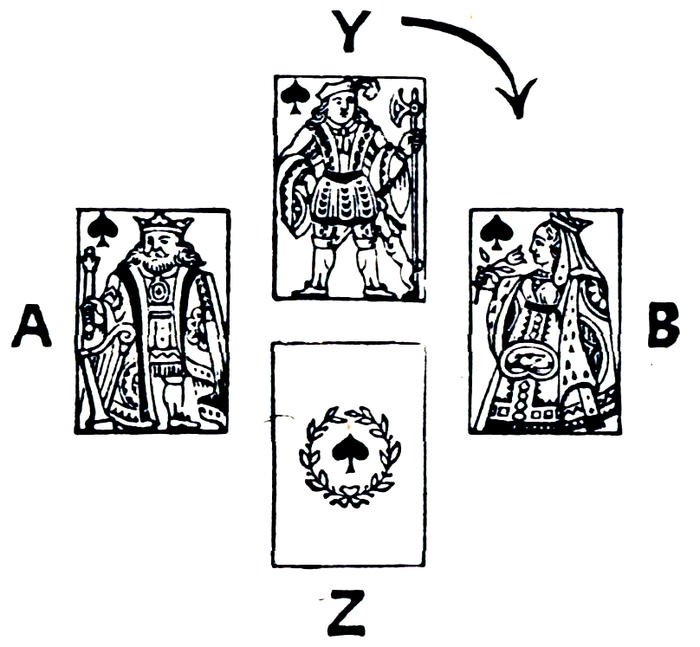
Tricks AB, 2
YZ, 2
4. A Y↷ B Z
Kg♠ Knv♠ Qn♠ A♠
Remark.—B covers the
honour, because the lead
was from weakness. B
plays badly; he should
have passed the knave.
For, A has shown four
more trumps, and only one
other trick is required.
Hence, if A has ace or
king of spades, the game is
won to a moral certainty;
if not, no good is got by
covering.
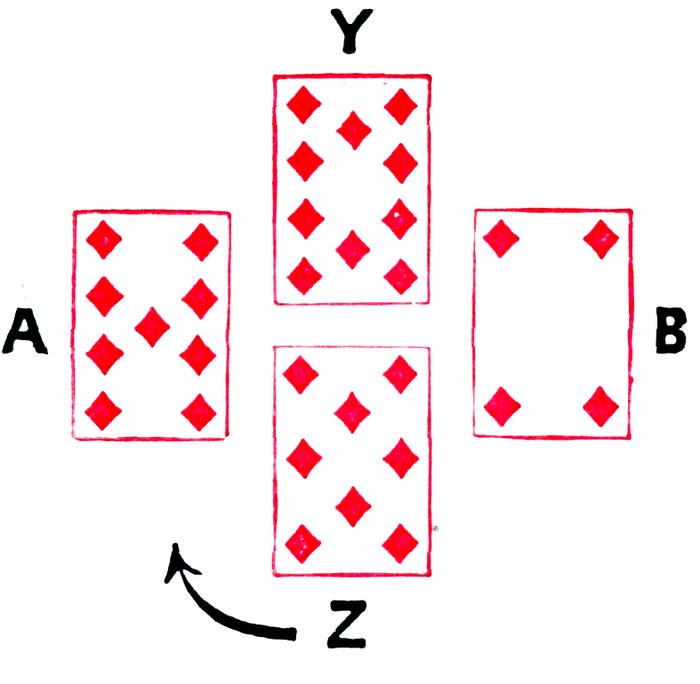
Tricks AB, 2
YZ, 3
5. A Y B Z↷
9♦ 10♦ 4♦ 8♦
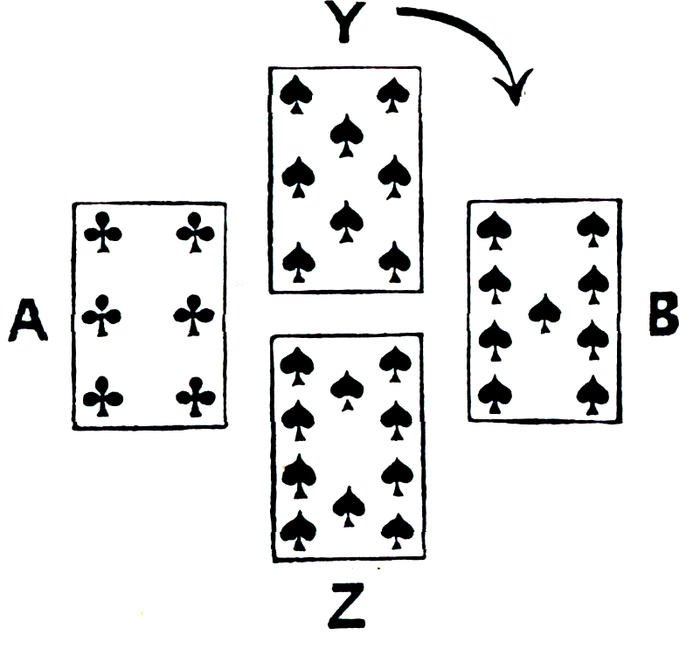
Tricks AB, 3
YZ, 3
6. A Y↷ B Z
6♣ 8♠ 9♠ 10♠
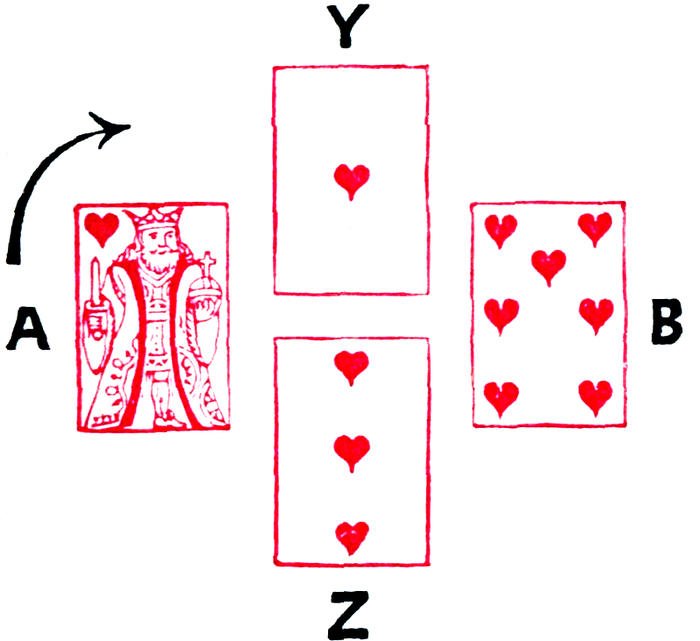
Tricks AB, 3
YZ, 4
7. A↷ Y B Z
Kg♥ A♥ 7♥ 3♥
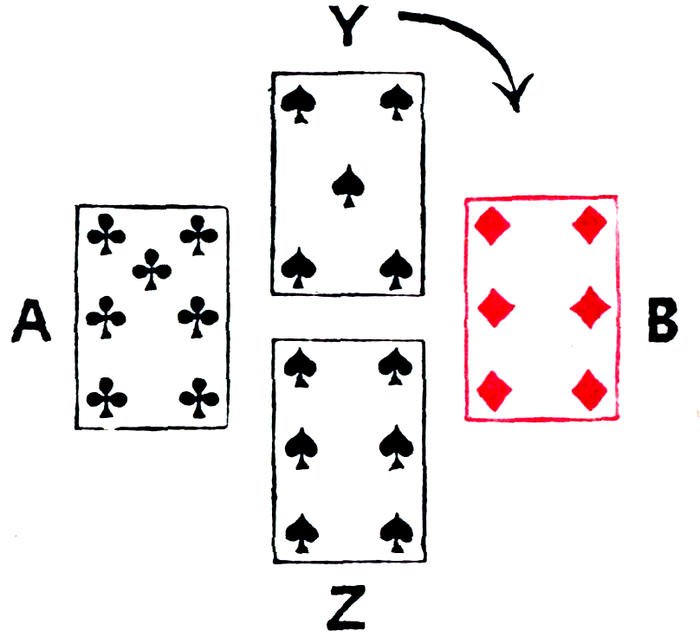
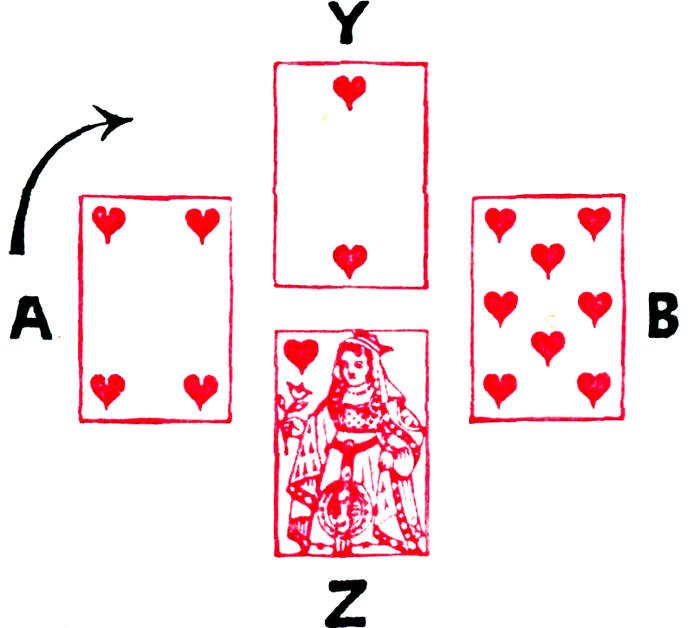
Tricks AB, 4
YZ, 4
8. A Y↷ B Z
7♣ 5♠ 6♦ 6♠
Tricks AB, 4
YZ, 5
9. A↷ Y B Z
4♥ 2♥ 8♥ Qn♥
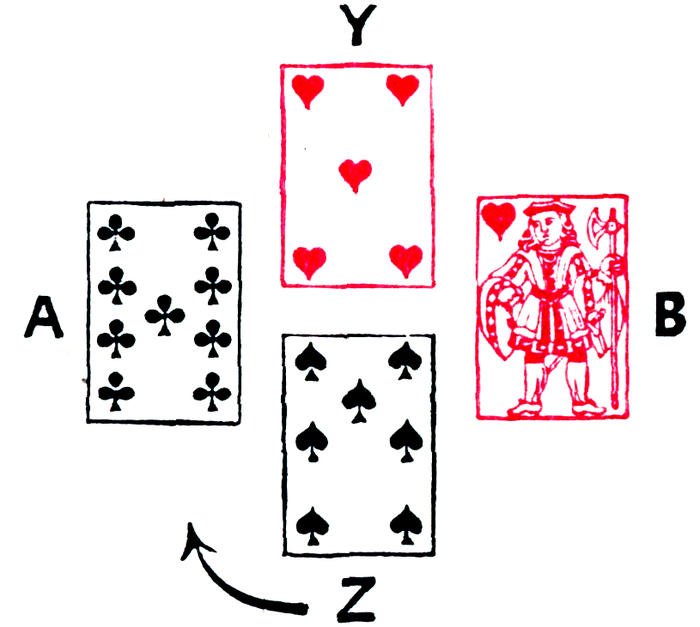
Tricks AB, 5
YZ, 5
10. A Y B Z↷
9♣ 5♥ Knv♥ 7♠
Tricks 11 to 13.—A, with the lead, remains with the
last trump and king, knave of diamonds. He (Trick 11)
leads the trump; but, whatever he plays,
YZ win the odd trick.
(Z's hand is given above.)
| A's Hand. |
Y's Hand. |
B's Hand. |
| Kg |
♠ |
Knv, 8, 5 |
♠ |
Qn, 9 |
♠ |
| Kg, 4 |
♥ |
Ace, 5, 2 |
♥ |
Knv, 10, 9, 8, 7 |
♥ |
| Kg, 10, 9, 8, 7, 6, 2 |
♣ |
Qn, 4, 3 |
♣ |
Ace, Knv |
♣ |
| Kg, Knv, 9 |
♦ |
Ace, Qn, 10, 2 |
♦ |
7, 6, 4, 3 |
♦ |
A plays well throughout, but he cannot prevent the
result. His lead of the trump at Trick 3 to show his
strength, and to tell his partner to make one trick
certain if he has the chance, is unlucky, as it puts the
adversaries on the only tack for saving the game.
See Treating long suits like short ones, pp. 142, 143.
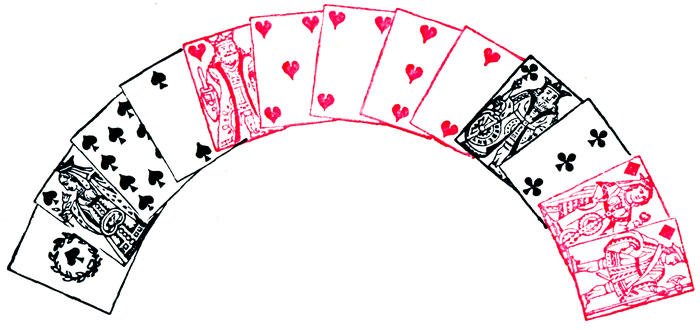
- A♠, Qn♠, 10♠, 2♠
- Kg♥, 5♥, 4♥, 3♥, 2♥
- Kg♣, 3♣
- Qn♦, Knv♦
Score: AB, one; YZ, love.
Nine of spades turned up.
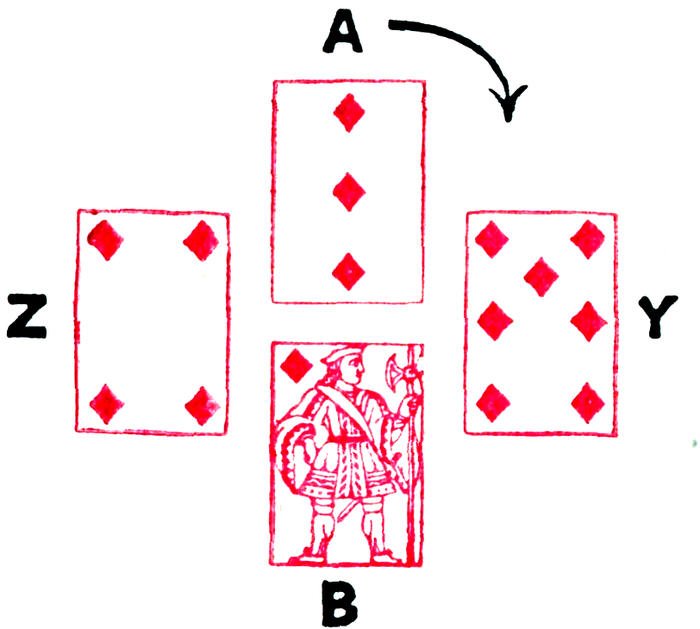
Tricks AB, 1
YZ, 0
1. Z A↷ Y B
4♦ 3♦ 7♦ Knv♦
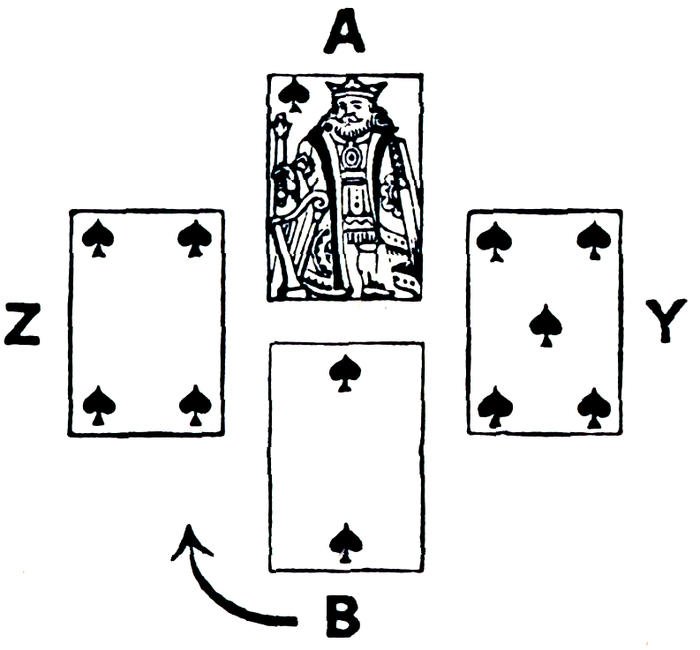
Tricks AB, 2
YZ, 0
2. Z A Y B↷
4♠ Kg♠ 5♠ 2♠
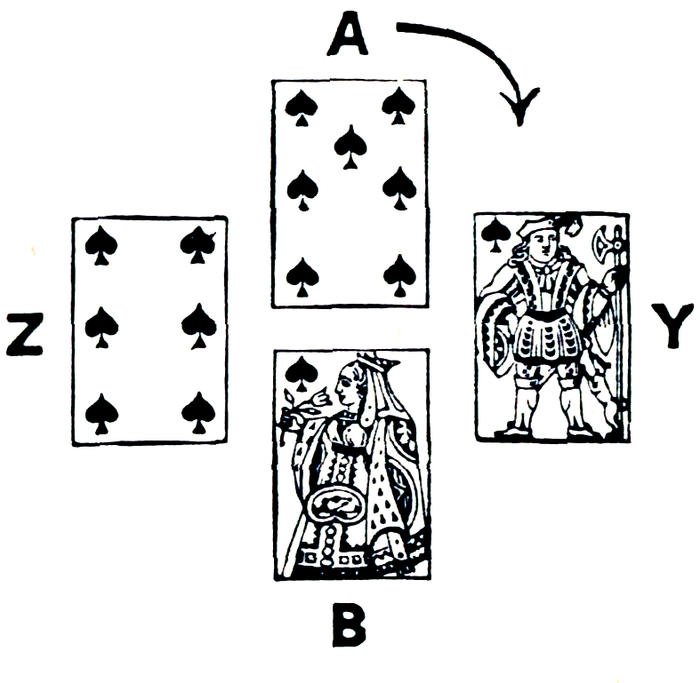
Tricks AB, 3
YZ, 0
3. Z A↷ Y B
6♠ 7♠ Knv♠ Qn♠
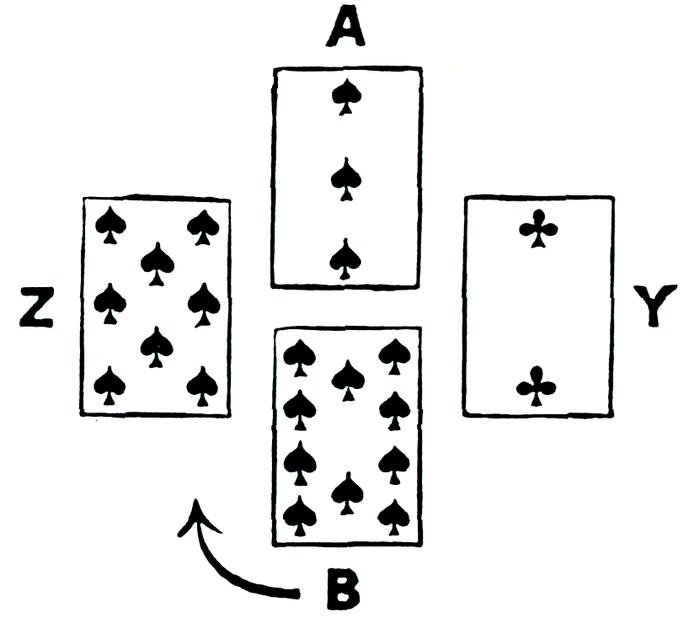
Tricks AB, 4
YZ, 0
4. Z A Y B↷
8♠ 3♠ 2♣ 10♠
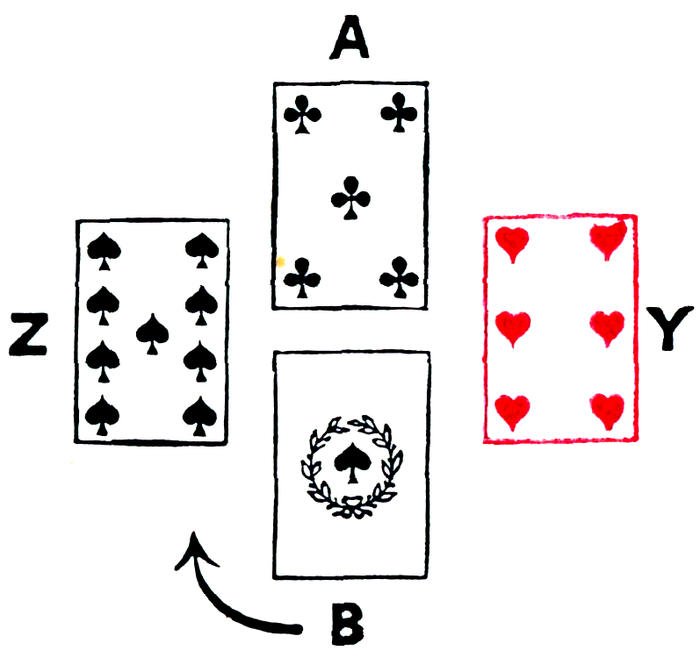
Tricks AB, 5
YZ, 0
5. Z A Y B↷
9♠ 5♣ 6♥ A♠
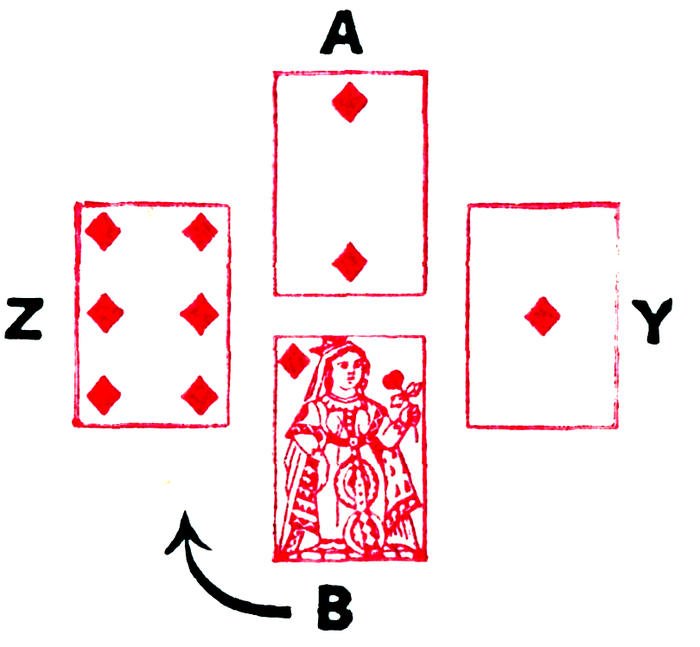
Tricks AB, 5
YZ, 1
6. Z A Y B↷
6♦ 2♦ A♦ Qn♦
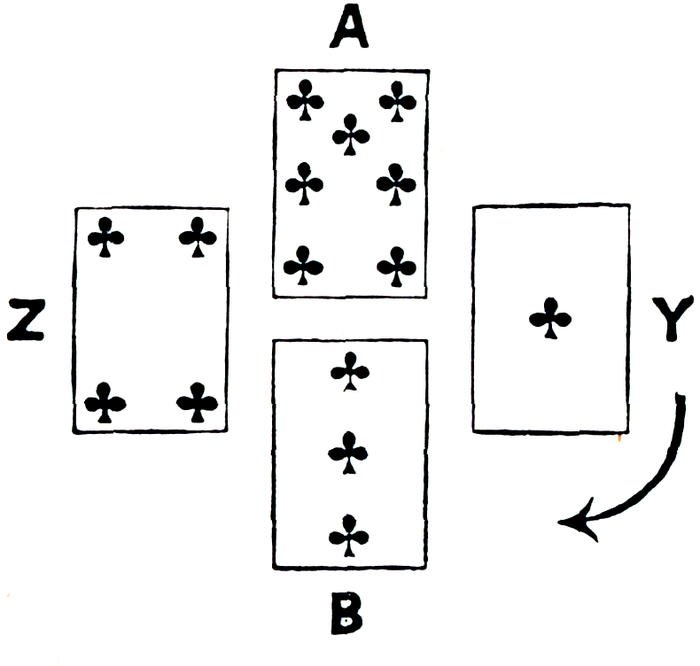
Tricks AB, 5
YZ, 2
7. Z A Y↷ B
4♣ 7♣ A♣ 3♣
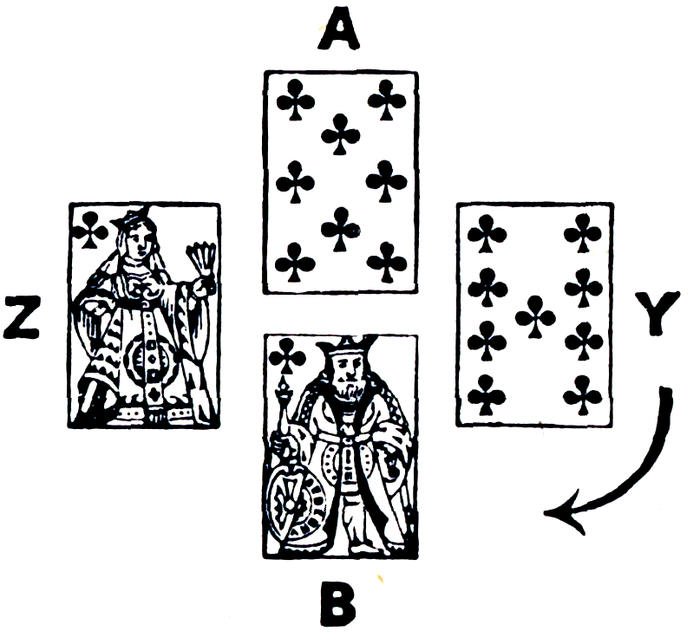
Tricks AB, 6
YZ, 2
8. Z A Y↷ B
Qn♣ 8♣ 9♣ Kg♣
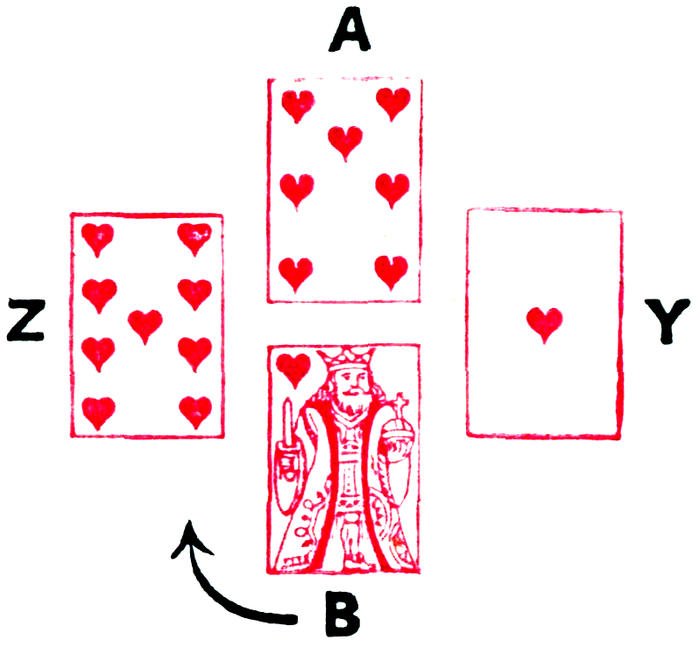
Tricks AB, 6
YZ, 3
9. Z A Y B↷
9♥ 7♥ A♥ Kg♥
Remark (Trick 9).—Deschapelles' Coup. B can count
A's hand, three diamonds and two hearts, for the ten,
nine of clubs are clearly with Y (see Tricks 7 and 8).
B therefore leads the king of hearts (see p. 142). If he
makes the usual lead of a small heart, he wins a trick less
as the cards happen to lie.
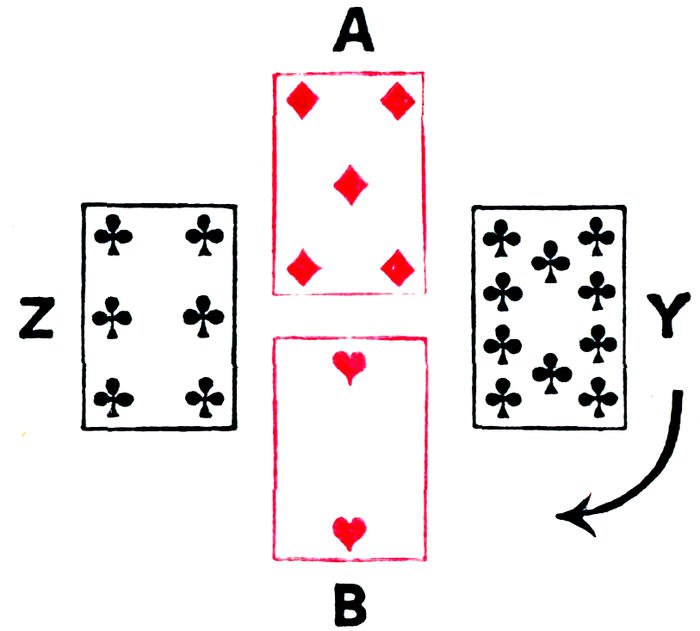
Tricks AB, 6
YZ, 4
10. Z A Y↷ B
6♣ 5♦ 10♣ 2♥
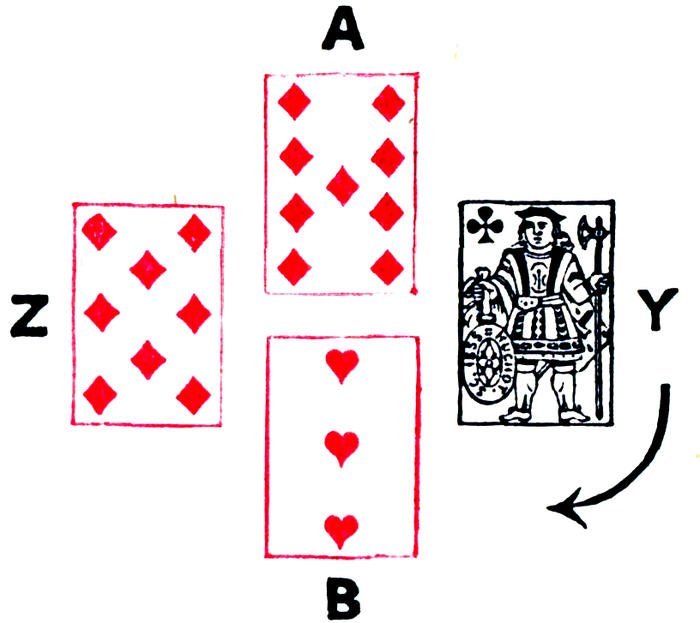
Tricks AB, 6
YZ, 5
11. Z A Y↷ B
8♦ 9♦ Knv♣ 3♥
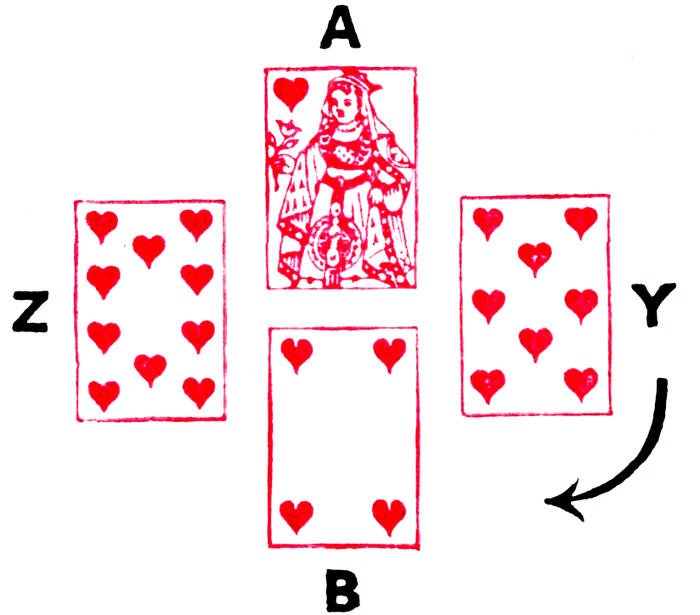
Tricks AB, 7
YZ, 5
12. Z A Y↷ B
10♥ Qn♥ 8♥ 4♥
Trick 13.—A makes the king of diamonds; and
AB score two by cards and two by honours.
If Y, at Trick 4, discards a heart, he saves the game.
Nevertheless, his proper discard is the club (see pp. 104-5).
(B's hand is given above.)
| A's Hand. |
Y's Hand. |
Z's Hand. |
| Kg, 7, 3 |
♠ |
Knv, 5 |
♠ |
9, 8, 6, 4 |
♠ |
| Qn, 7 |
♥ |
Ace, 8, 6 |
♥ |
Knv, 10, 9 |
♥ |
| 8, 7, 5 |
♣ |
Ace, Knv, 10, 9, 2 |
♣ |
Qn, 6, 4 |
♣ |
| Kg, 9, 5, 3, 2 |
♦ |
Ace, 10, 7 |
♦ |
8, 6, 4 |
♦ |
See Refusing to win the second round of a suit, p. 143.
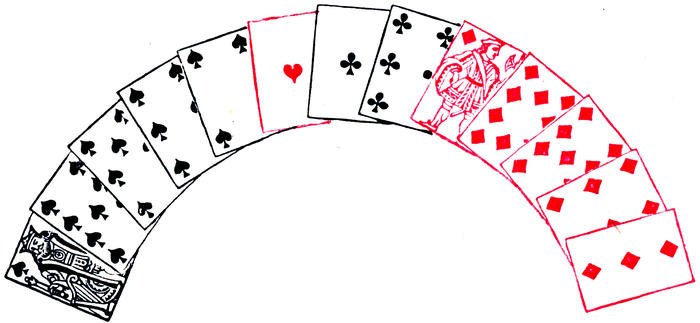
- Kg♠, 9♠, 7♠, 6♠, 4♠
- A♥
- A♣, 6♣
- Knv♦, 10♦, 9♦, 6♦, 3♦
Score: AB, four; YZ, two.
Four of spades turned up.
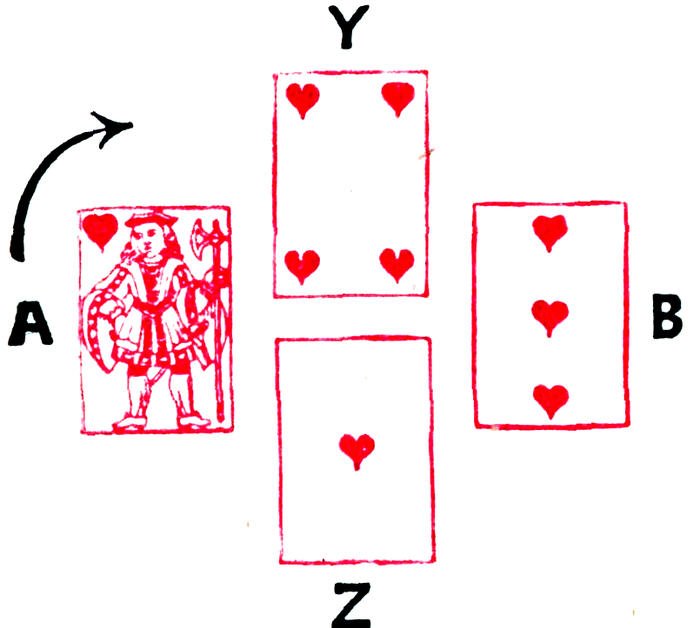
Tricks AB, 0
YZ, 1
1. A↷ Y B Z
Knv♥ 4♥ 3♥ A♥
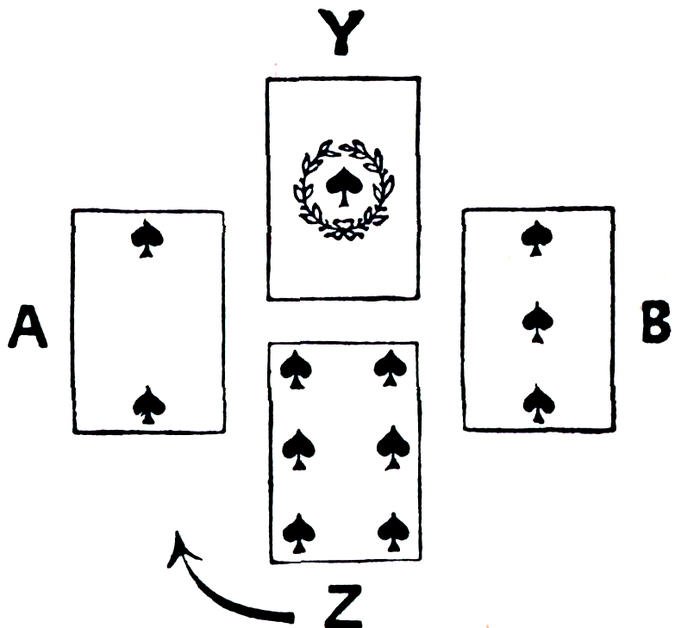
Tricks AB, 0
YZ, 2
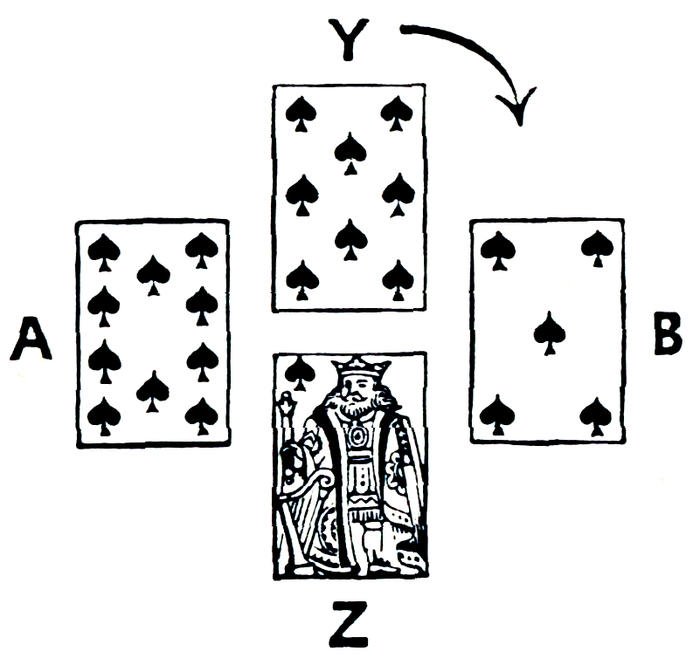
2. A Y B Z↷
2♠ A♠ 3♠ 6♠
Tricks AB, 0
YZ, 3
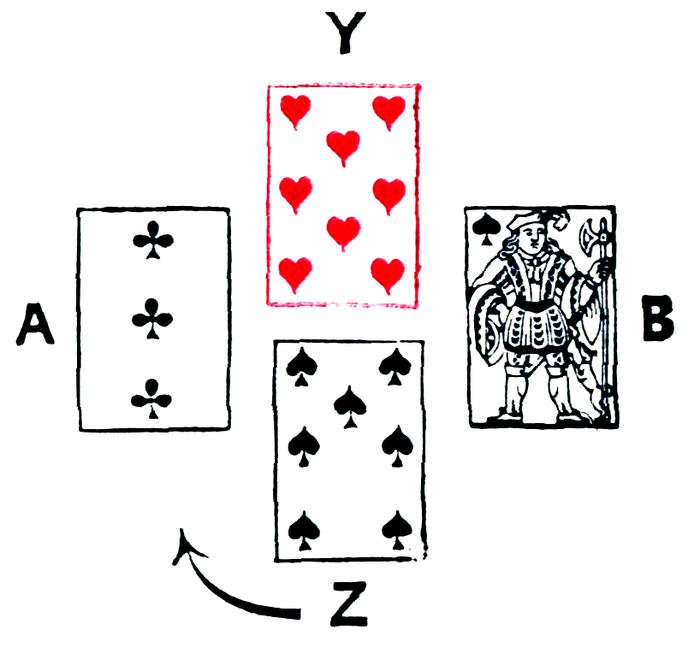
3. A Y↷ B Z
10♠ 8♠ 5♠ Kg♠
Tricks AB, 1
YZ, 3
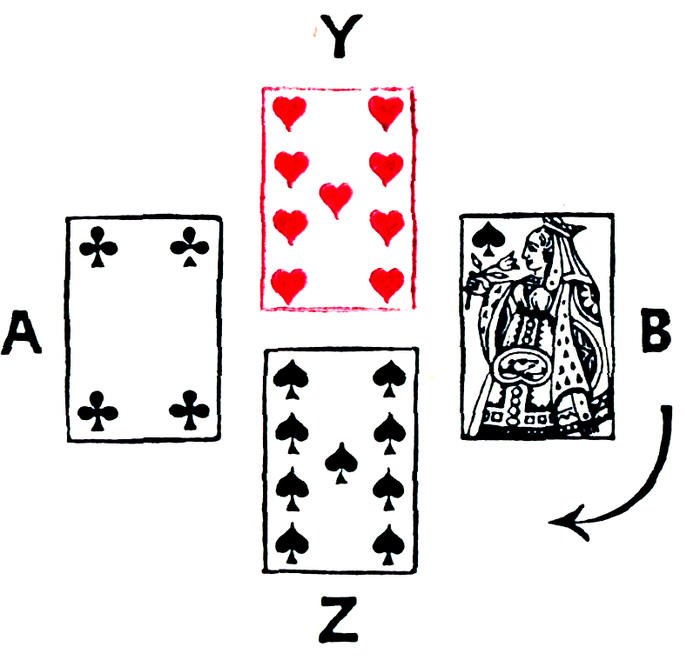
4. A Y B Z↷
3♣ 8♥ Knv♠ 7♠
Tricks AB, 2
YZ, 3
5. A Y B↷ Z
4♣ 9♥ Qn♠ 9♠
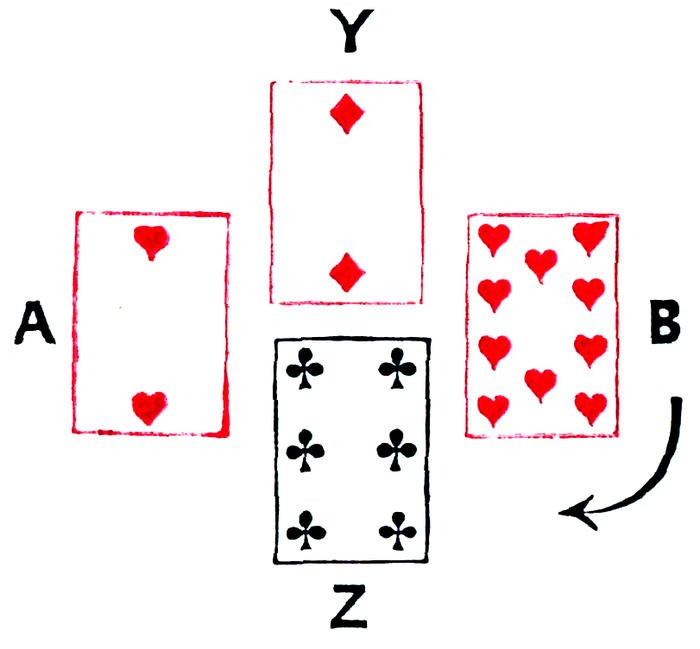
Tricks AB, 3
YZ, 3
6. A Y B↷ Z
2♥ 2♦ 10♥ 6♣
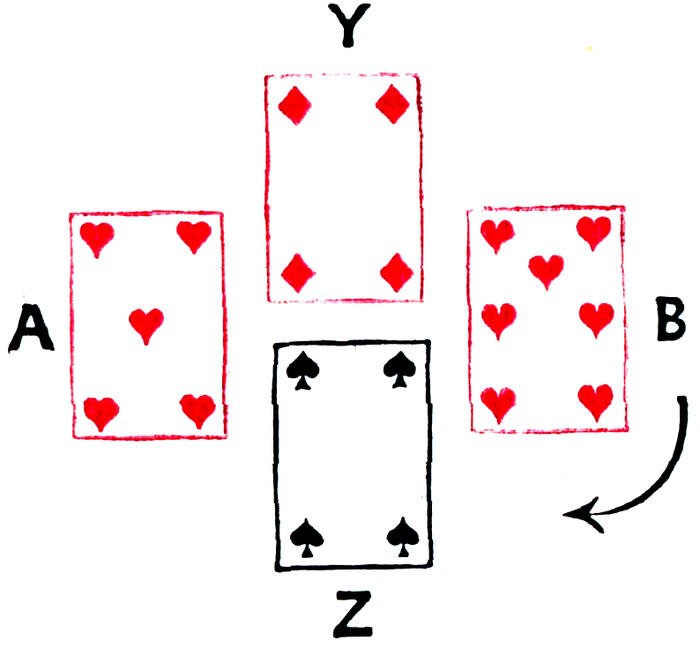
Tricks AB, 3
YZ, 4
7. A Y B↷ Z
5♥ 4♦ 7♥ 4♠
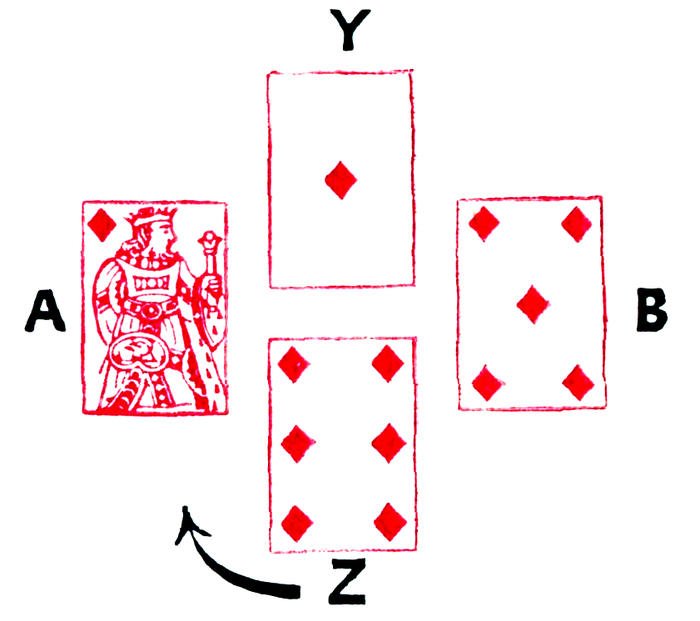
Tricks AB, 3
YZ, 5
8. A Y B Z↷
Kg♦ A♦ 5♦ 6♦
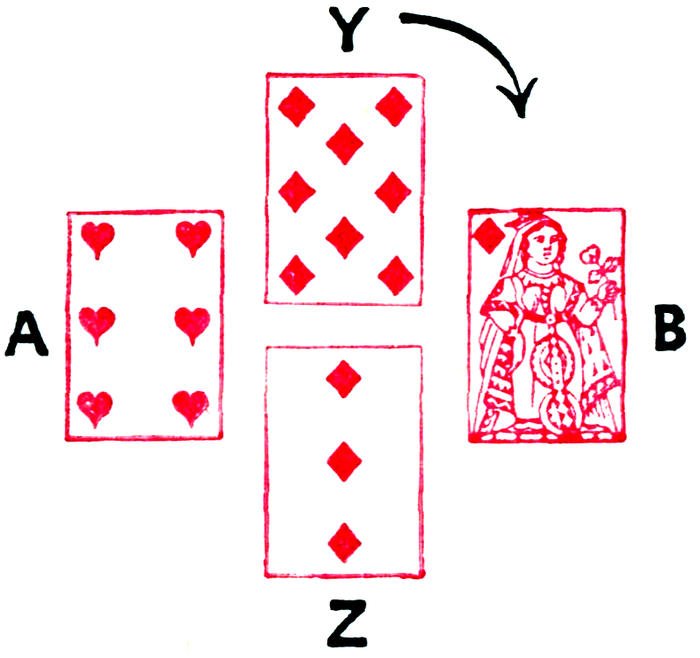
Tricks AB, 4
YZ, 5
9. A Y↷ B Z
6♥ 8♦ Qn♦ 3♦
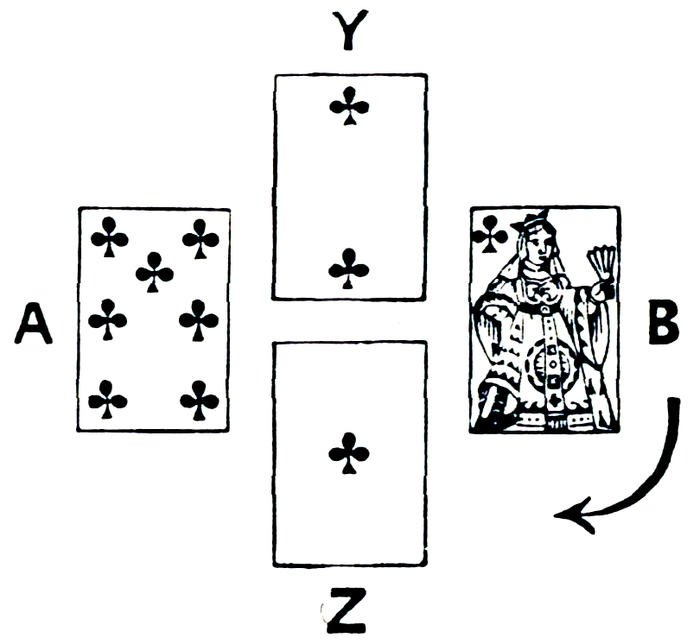
Tricks AB, 4
YZ, 6
10. A Y B↷ Z
7♣ 2♣ Qn♣ A♣
Tricks 10 to 13.—Z brings in the diamonds; and
YZ win three by cards.
(Z's hand is given above.)
| A's Hand. |
Y's Hand. |
B's Hand. |
| 10, 2 |
♠ |
Ace, 8 |
♠ |
Qn, Knv, 5, 3 |
♠ |
| Kg, Qn, Knv, 6, 5, 2 |
♥ |
9, 8, 4 |
♥ |
10, 7, 3 |
♥ |
| Kg, 7, 4, 3 |
♣ |
10, 9, 8, 2 |
♣ |
Qn, Knv, 5 |
♣ |
| Kg |
♦ |
Ace, 8, 4, 2 |
♦ |
Qn, 7, 5 |
♦ |
At Trick 4, A having already shown his suit does not
discard from it, as there is still a possibility of bringing
it in (see pp. 104-6), and his king of clubs is sufficiently
protected even after the discard.
If Z parts with the last trump at Trick 6, and leads
diamonds, A, on the second round of diamonds, will
unguard his king of clubs, knowing his partner to have
a heart to lead him (see fall of the heart suit, Tricks
1, 4, and 5), will bring in all the hearts, and win the
odd trick.
See Refusing to win the second round of a suit,
pp. 143, 144.
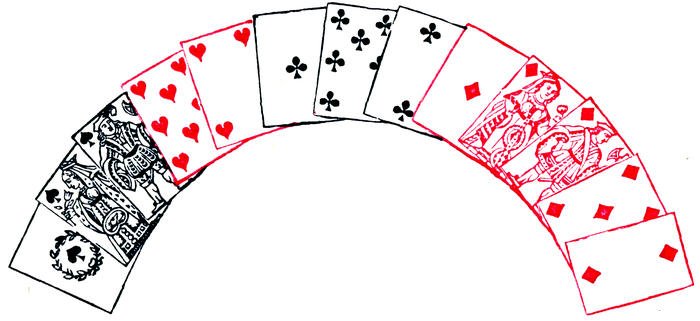
- A♠, Qn♠, Knv♠
- 8♥, 4♥
- A♣, 7♣, 2♣
- A♦, Qn♦, Knv♦, 5♦, 2♦
Score: Love-all.
Ten of hearts turned up.
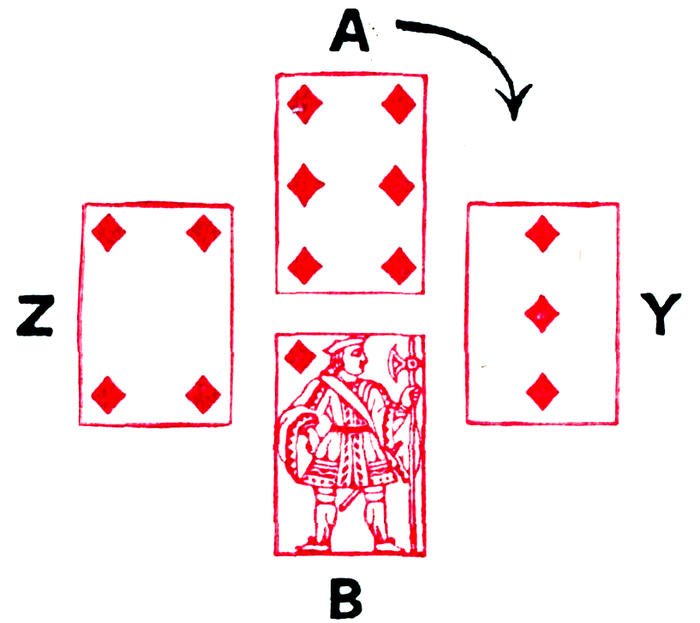
Tricks AB, 1
YZ, 0
1. Z A↷ Y B
4♦ 6♦ 3♦ Knv♦
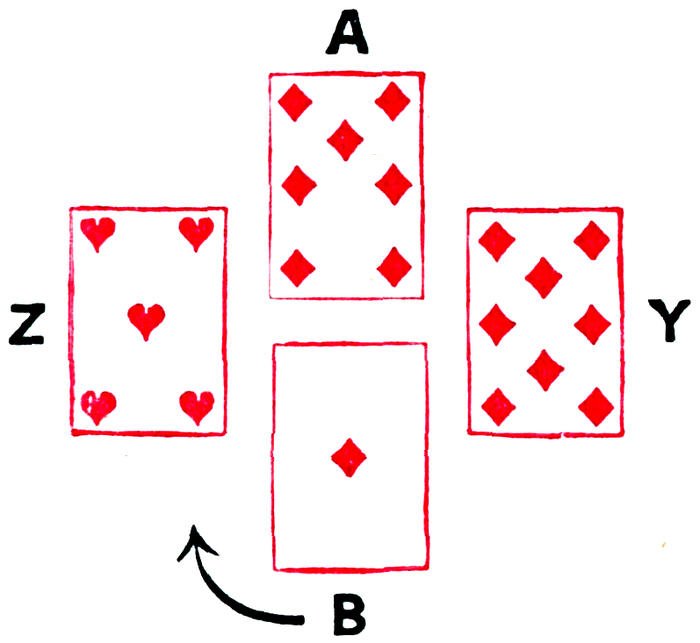
Tricks AB, 1
YZ, 1
2. Z A Y B↷
5♥ 7♦ 8♦ A♦
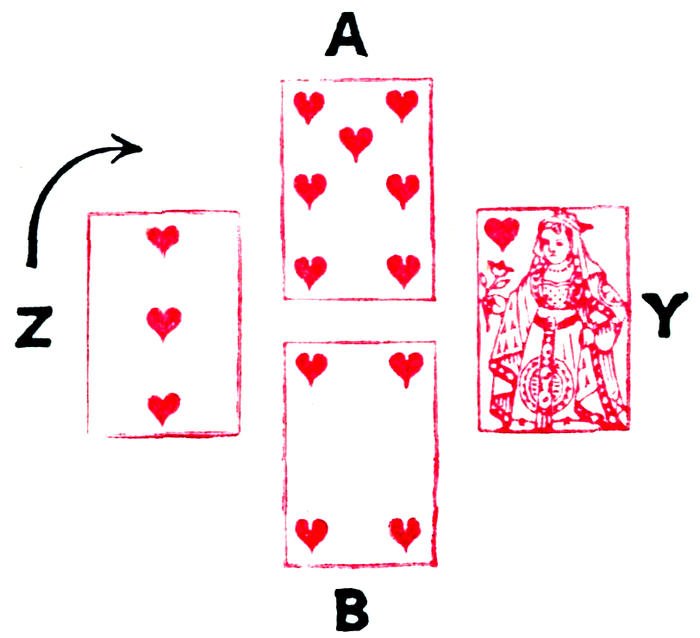
Tricks AB, 1
YZ, 2
3. Z↷ A Y B
3♥ 7♥ Qn♥ 4♥
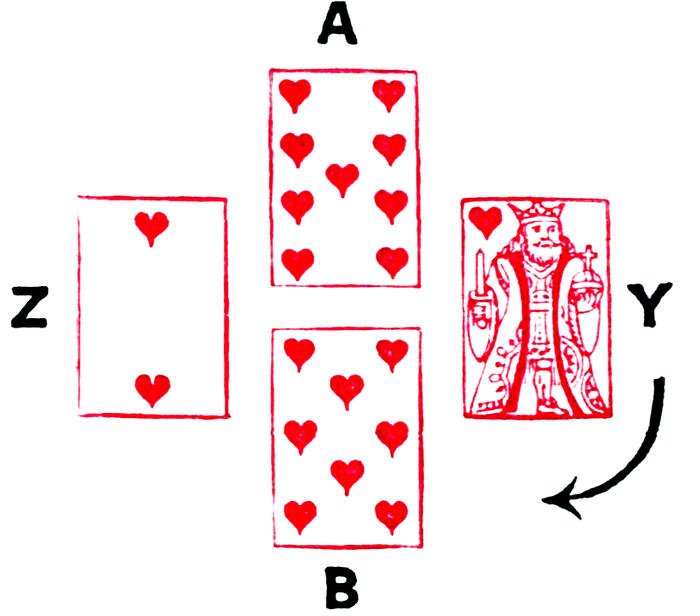
Tricks AB, 1
YZ, 3
4. Z A Y↷ B
2♥ 9♥ Kg♥ 8♥
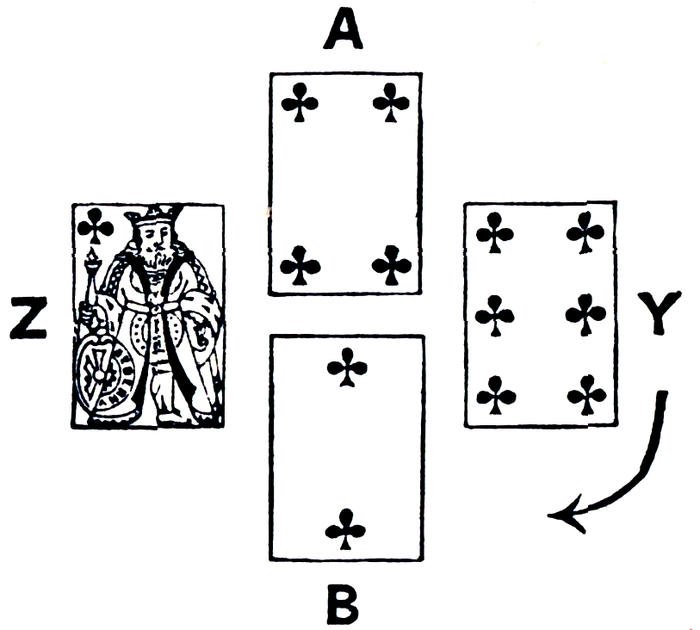
Tricks AB, 1
YZ, 4
5. Z A Y↷ B
Kg♣ 4♣ 6♣ 2♣
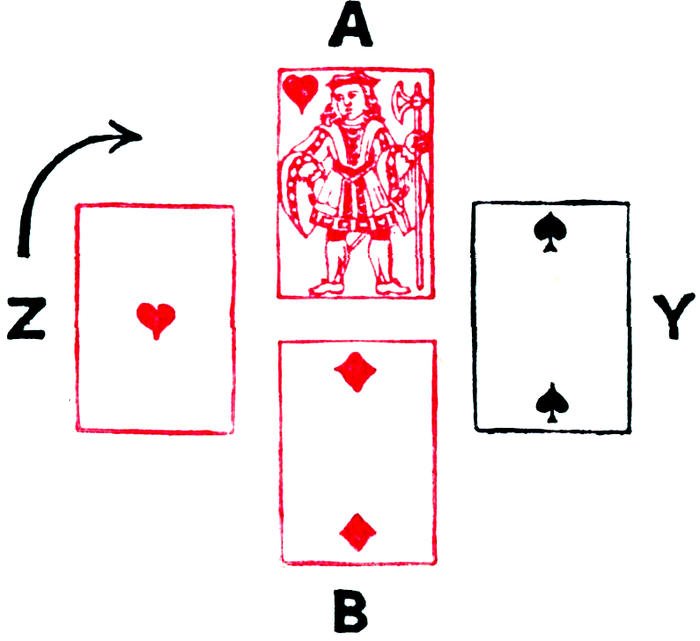
Tricks AB, 1
YZ, 5
6. Z↷ A Y B
A♥ Knv♥ 2♠ 2♦
Remark (Trick 6).—B has next to no chance of bringing
in the diamonds. He therefore plays to protect his short
suits (see pp. 104-6).
Tricks AB, 1
YZ, 6
7. Z↷ A Y B
Knv♣ 10♣ 5♣ 7♣
Tricks AB, 2
YZ, 6
8. Z↷ A Y B
3♣ Kg♦ 8♣ A♣
Remark (Trick 7).—B refuses to win this trick. The
three of clubs is clearly in Z's hand (see fall of the club
suit, Tricks 5 and 7), and the two long trumps. The
remaining clubs are evidently in Y's hand. If, therefore,
B parts with the ace of clubs while Z has a club to lead,
AB lose the game, unless A has the king of spades; and if
A has that card, B loses nothing by passing this trick, as
Z, having only one more club, must hold three spades.
Tricks AB, 2
YZ, 7
9. Z A Y B↷
6♥ 9♦ 10♦ Qn♦
Tricks AB, 3
YZ, 7
10. Z↷ A Y B
4♠ 3♠ 9♠ Knv♠
Tricks 11 to 13.—B (Trick 11) leads the last diamond,
and forces Z. Z (Trick 12) has only spades to lead; B
makes ace, queen of spades; and
YZ score two by cards and two by honours.
(B's hand is given above).
| A's Hand. |
Y's Hand. |
Z's Hand. |
| 10, 8, 7, 3 |
♠ |
9, 5, 2 |
♠ |
Kg, 6, 4 |
♠ |
| Knv, 9, 7 |
♥ |
Kg, Qn |
♥ |
Ace, 10, 6, 5, 3, 2 |
♥ |
| 10, 4 |
♣ |
Qn, 9, 8, 6, 5 |
♣ |
Kg, Knv, 3 |
♣ |
| Kg, 9, 7, 6 |
♦ |
10, 8, 3 |
♦ |
4 |
♦ |
See Declining to draw the losing trump,
pp. 144, 145.
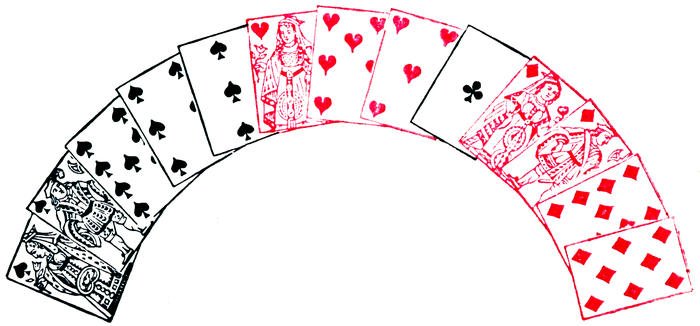
- Qn♠, Knv♠, 9♠, 6♠, 3♠
- Qn♥, 7♥, 5♥
- A♣
- Qn♦, Knv♦, 9♦, 8♦
Score:
AB, love; YZ, three.
Ace of diamonds turned up.
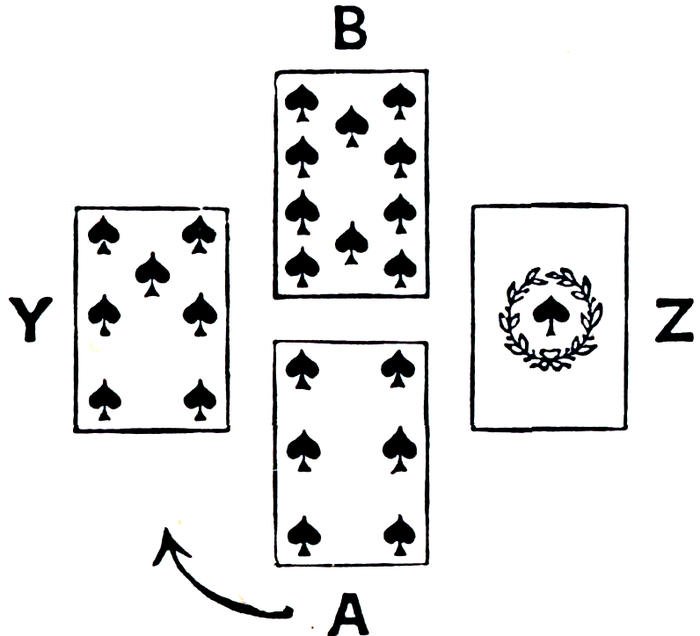
Tricks AB, 0
YZ, 1
1. Y B Z A↷
7♠ 10♠ A♠ 6♠
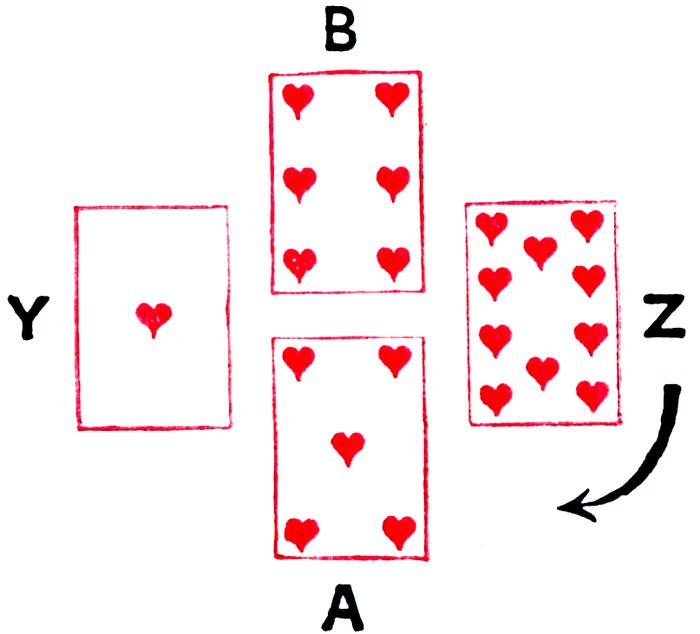
Tricks AB, 0
YZ, 2
2. Y B Z↷ A
A♥ 6♥ 10♥ 5♥
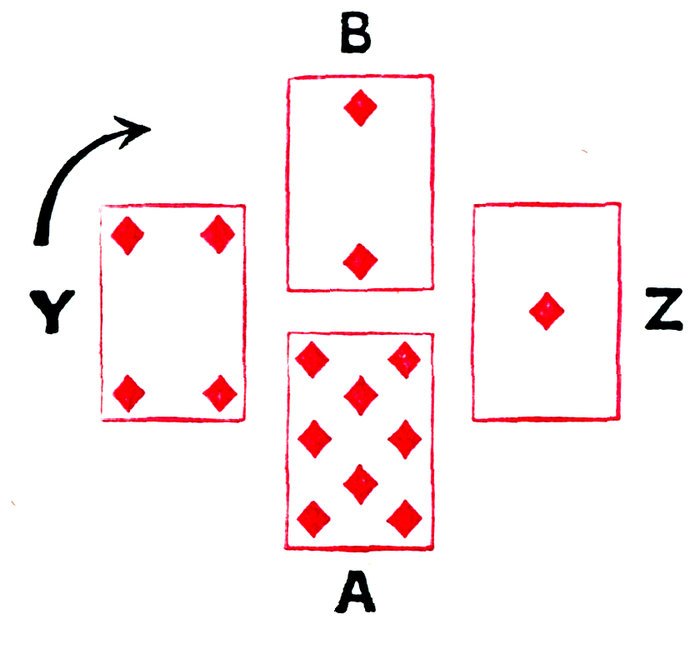
Tricks AB, 0
YZ, 3
3. Y↷ B Z A
4♦ 2♦ A♦ 8♦
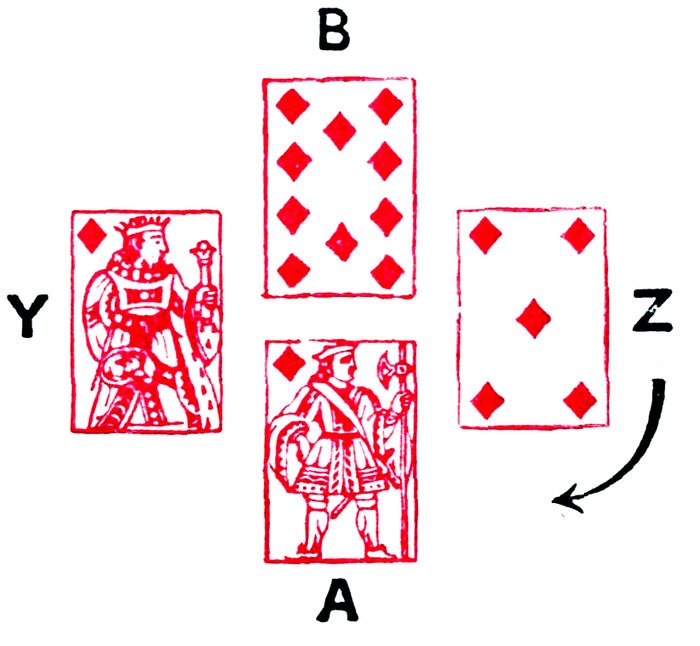
Tricks AB, 0
YZ, 4
4. Y B Z↷ A
Kg♦ 10♦ 5♦ Knv♦
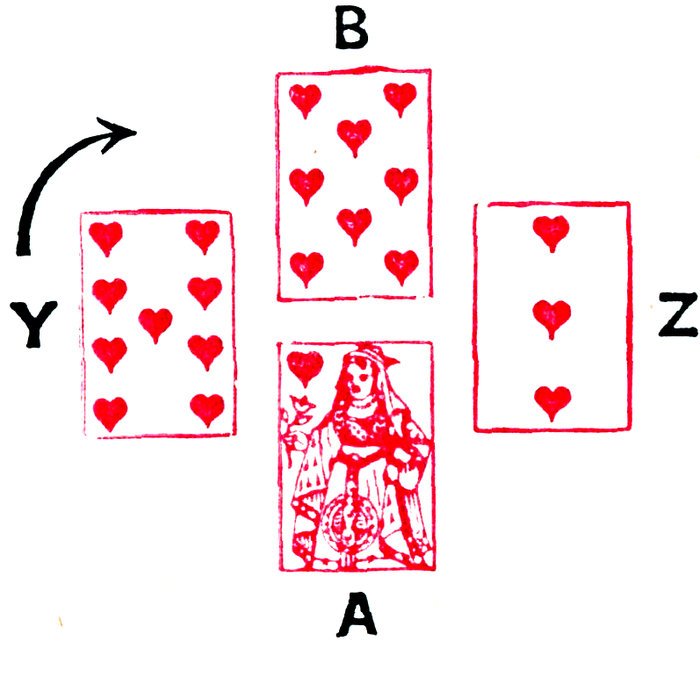
Tricks AB, 1
YZ, 4
5. Y↷ B Z A
9♥ 8♥ 3♥ Qn♥
Remark.—It is evident
that Z's lead was from
king, knave, ten, &c., and
that B has no more hearts.
Y returning the nine, and
the two not falling, must
have the two single, and
the other hearts are with
Z.
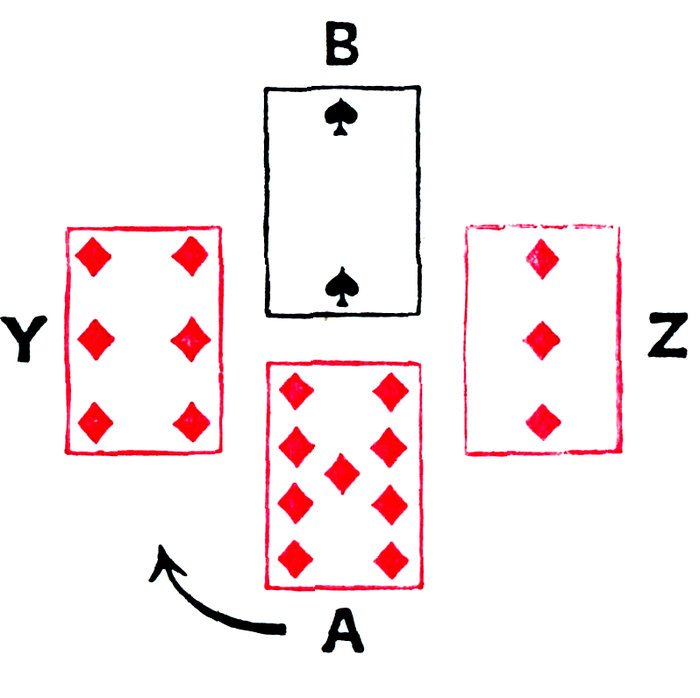
Tricks AB, 2
YZ, 4
6. Y B Z A↷
6♦ 2♠ 3♦ 9♦
Remark.—The case now
arises contemplated at p. 145.
A has the best trump and
the lead; Y the losing trump.
Y also has one card of his
partner's established suit
(see Remark, Trick 5). A
therefore (Trick 7) does not
draw the trump.
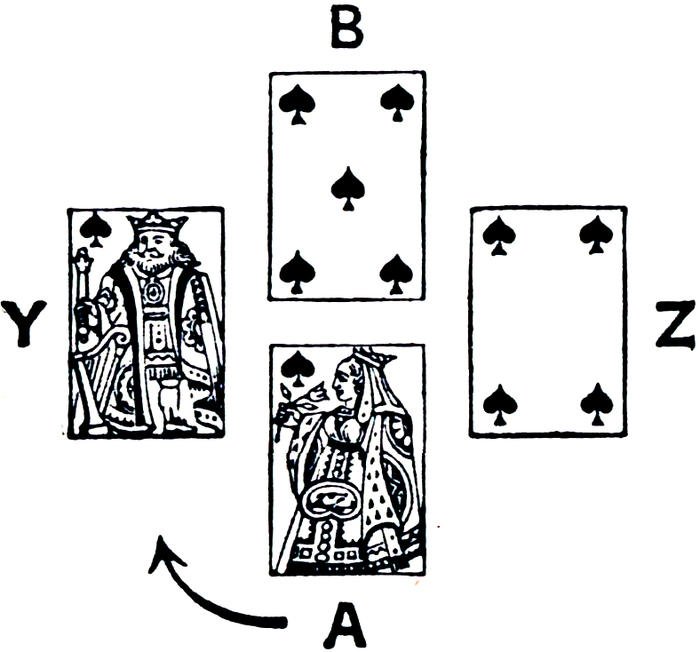
Tricks AB, 2
YZ, 5
7. Y B Z A↷
Kg♠ 5♠ 4♠ Qn♠
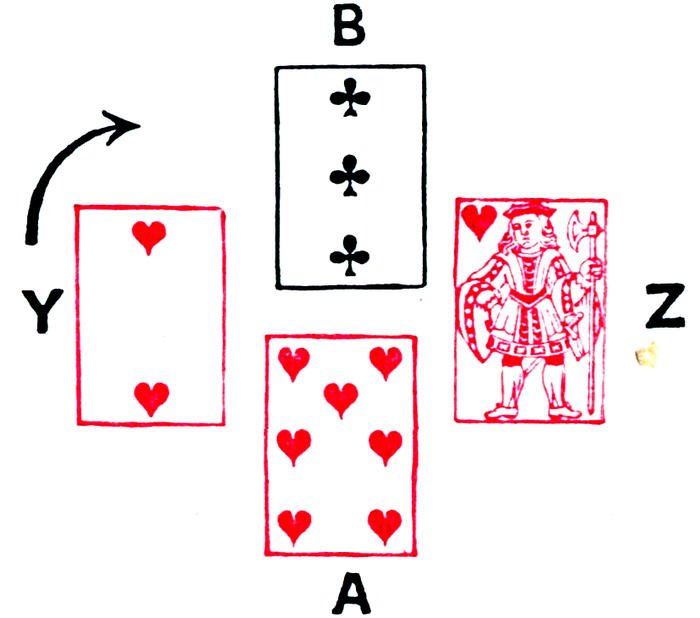
Tricks AB, 2
YZ, 6
8. Y↷ B Z A
2♥ 3♣ Knv♥ 7♥
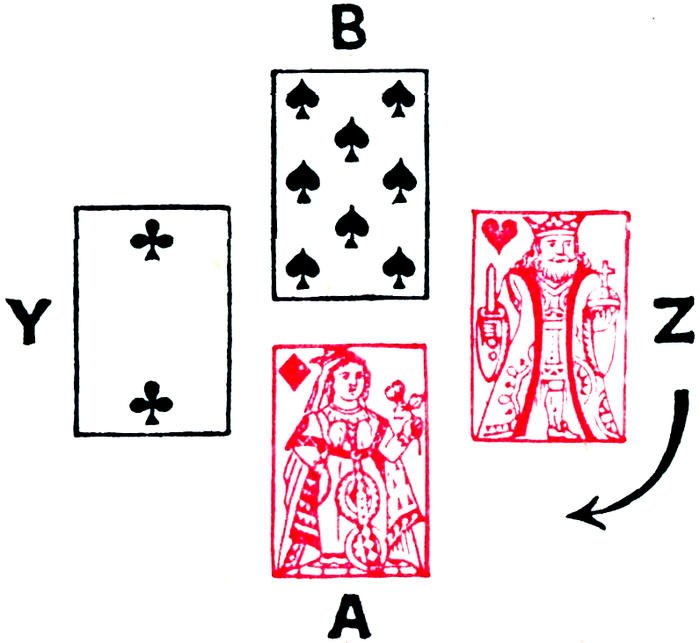
Tricks AB, 3
YZ, 6
9. Y B Z↷ A
2♣ 8♠ Kg♥ Qn♦
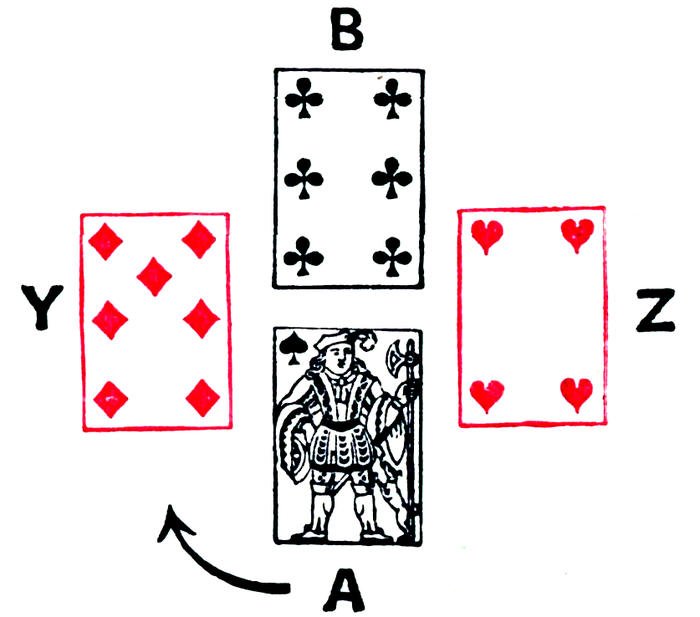
Tricks AB, 3
YZ, 7
10. Y B Z A↷
7♦ 6♣ 4♥ Knv♠
Tricks 11 to 13.—Y has nothing but clubs to lead.
A wins the three tricks; and
YZ win the odd trick.
If, at Trick 7, A draws the trump, YZ win two by
cards.
(A's hand is given above.)
| Y's Hand. |
B's Hand. |
Z's Hand. |
| Kg, 7 |
♠ |
10, 8, 5, 2 |
♠ |
Ace, 4 |
♠ |
| Ace, 9, 2 |
♥ |
8, 6 |
♥ |
Kg, Knv, 10, 4, 3 |
♥ |
| Kg, Qn, 4, 2 |
♣ |
Knv, 9, 8, 6, 3 |
♣ |
10, 7, 5 |
♣ |
| Kg, 7, 6, 4 |
♦ |
10, 2 |
♦ |
Ace, 5, 3 |
♦ |
See Throwing high cards to place the lead,
pp. 147-149.
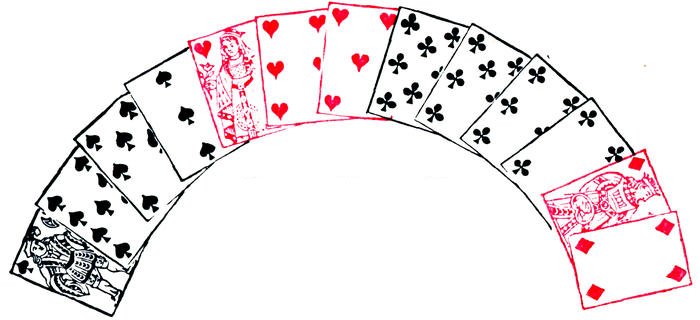
- Knv♠, 9♠, 7♠, 3♠
- Qn♥, 6♥, 5♥
- 8♣, 7♣, 6♣, 4♣
- Kg♦, 4♦
Score: Love-all.
Five of clubs turned up.
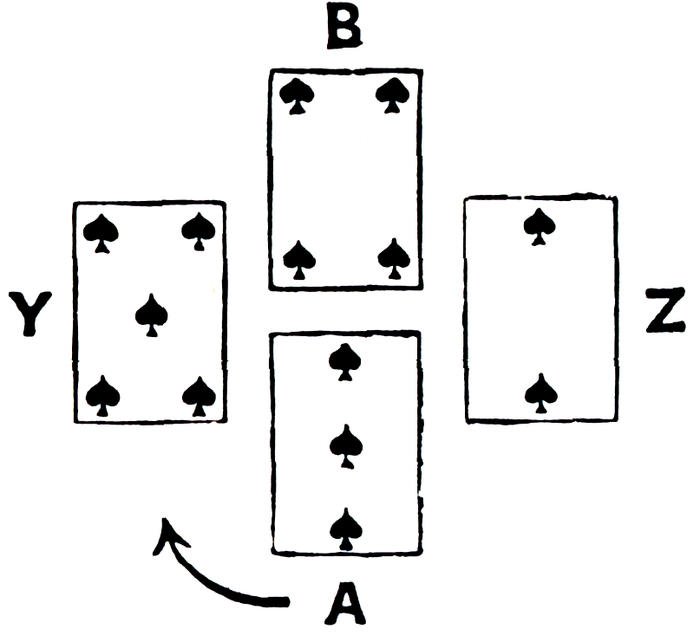
Tricks AB, 0
YZ, 1
1. Y B Z A↷
5♠ 4♠ 2♠ 3♠
Remark.—B has no more
spades.
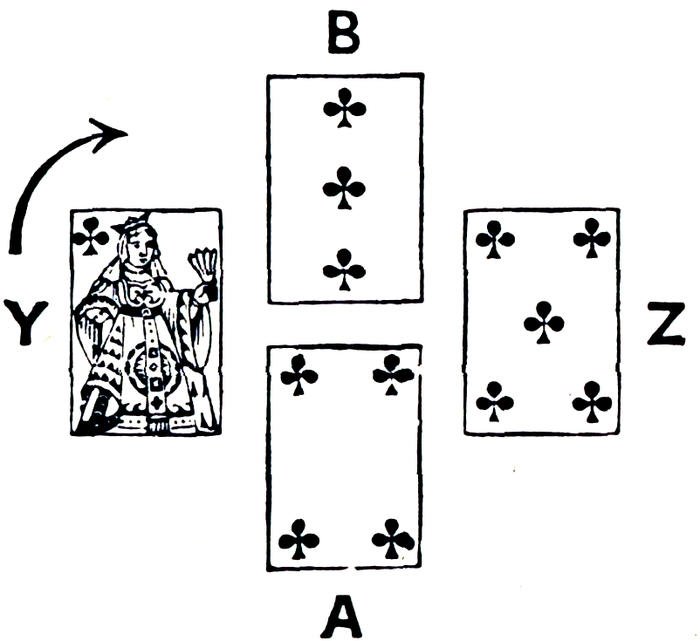
Tricks AB, 0
YZ, 2
2. Y↷ B Z A
Qn♣ 3♣ 5♣ 4♣
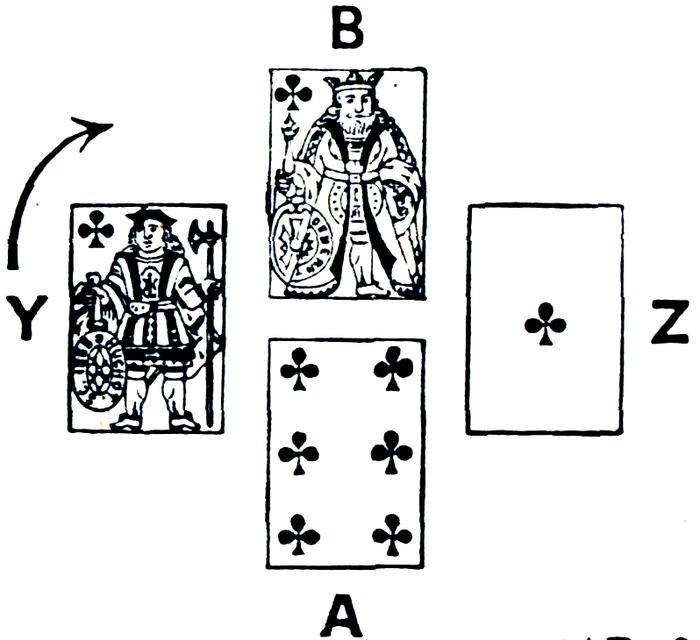
Tricks AB, 0
YZ, 3
3. Y↷ B Z A
Knv♣ Kg♣ A♣ 6♣
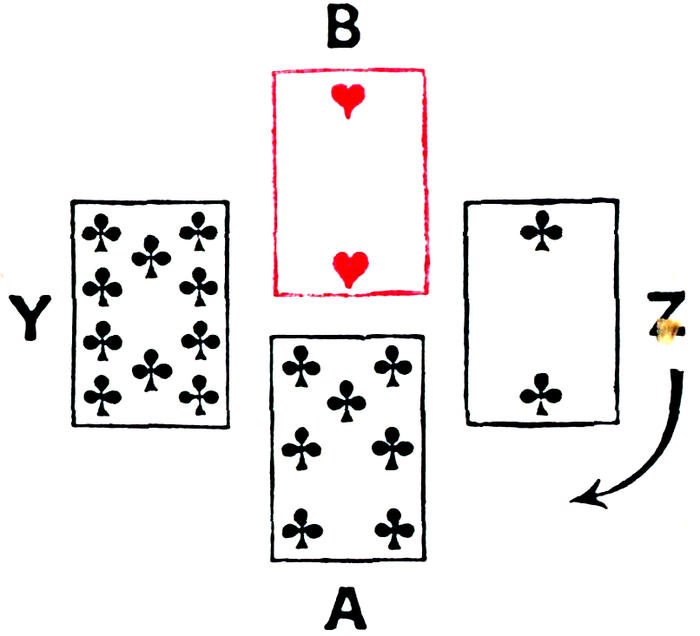
Tricks AB, 0
YZ, 4
4. Y B Z↷ A
10♣ 2♥ 2♣ 7♣
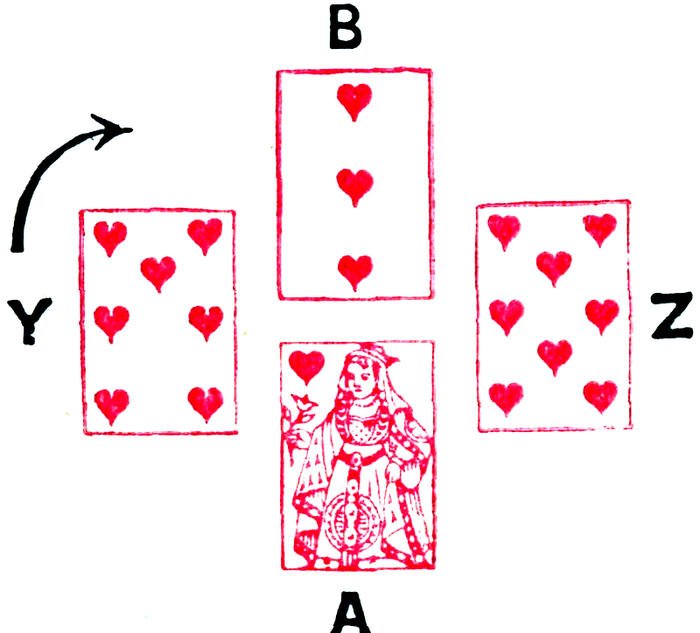
Tricks AB, 1
YZ, 4
5. Y↷ B Z A
7♥ 3♥ 8♥ Qn♥
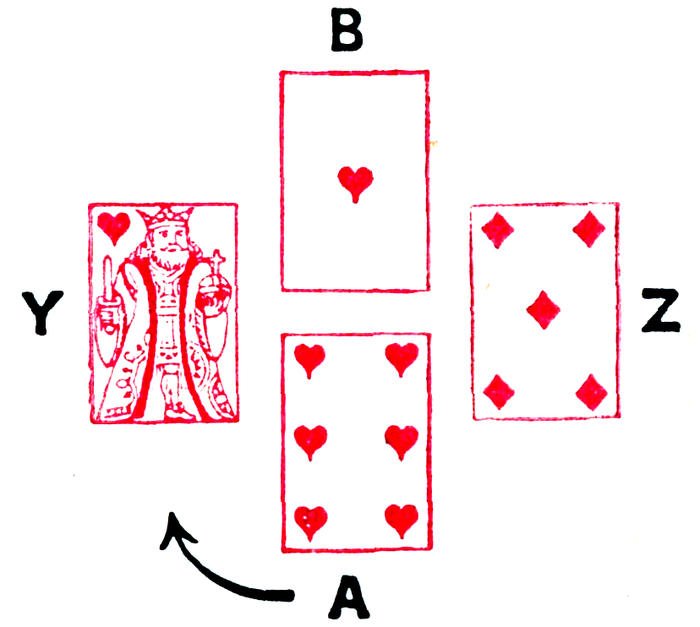
Tricks AB, 2
YZ, 4
6. Y B Z A↷
Kg♥ A♥ 5♦ 6♥
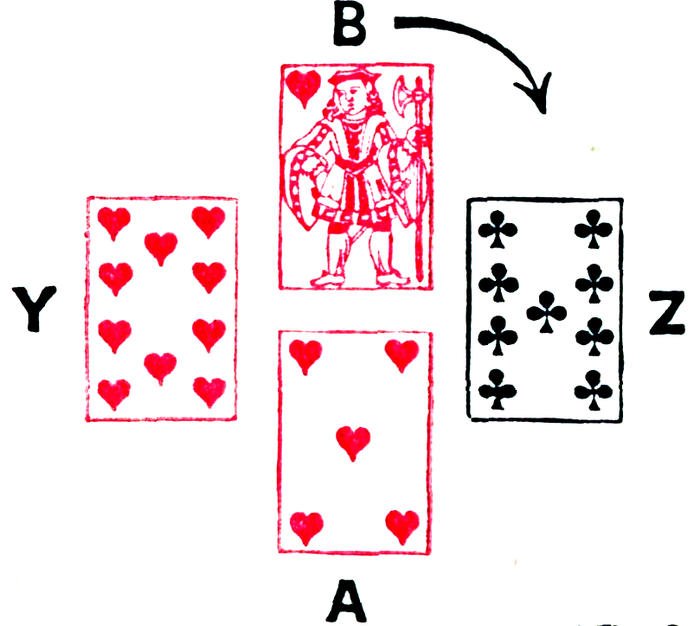
Tricks AB, 2
YZ, 5
7. Y B↷ Z A
10♥ Knv♥ 9♣ 5♥
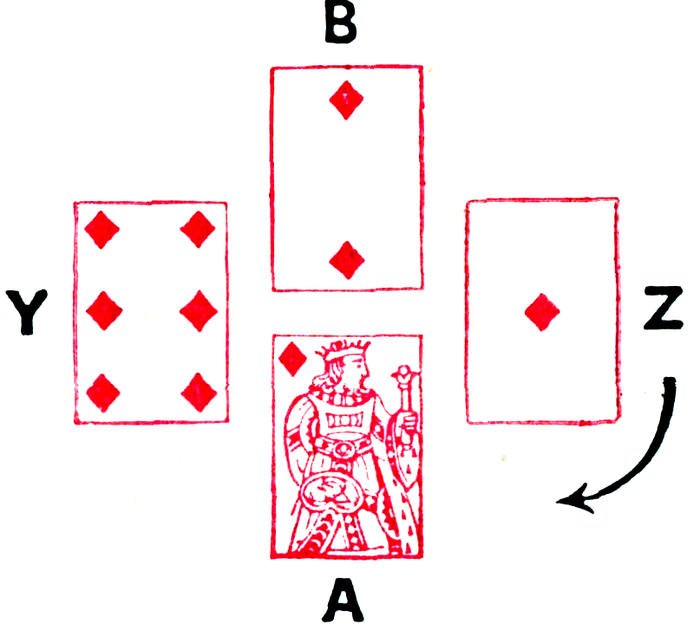
Tricks AB, 2
YZ, 6
8. Y B Z↷ A
6♦ 2♦ A♦ Kg♦
Remark (Trick 8).—Well played by A. He sees that if
he obtains the lead on the second round of diamonds
he must continue the spade suit, a course demonstrably
fatal to him, unless his partner has the queen of diamonds
together with the long hearts (see fall of hearts, Trick 7).
By throwing the king to the ace A avoids the lead, and
saves the game if his partner has either queen or knave of
diamonds (as may be seen by placing the cards), unless
the adversaries continue the spade suit, when the game
cannot be saved, by any course of play. This clever coup
occurred in actual play.
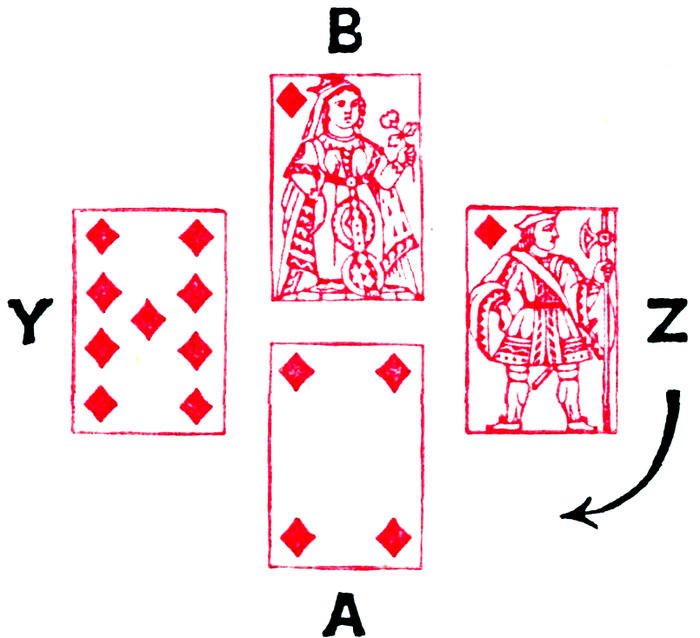
Tricks AB, 3
YZ, 6
9. Y B Z↷ A
9♦ Qn♦ Knv♦ 4♦
Tricks 10 to 13.—B
brings in the hearts, winning
two more tricks; A
makes his trump; and
YZ score the odd trick and two by honours.
(A's hand is given above.)
| Y's Hand. |
B's Hand. |
Z's Hand. |
| Kg, 10, 8, 6, 5 |
♠ |
4 |
♠ |
Ace, Qn, 2 |
♠ |
| Kg, 10, 7 |
♥ |
Ace, Knv, 9, 4, 3, 2 |
♥ |
8 |
♥ |
| Qn, Knv, 10 |
♣ |
Kg, 3 |
♣ |
Ace, 9, 5, 2 |
♣ |
| 9, 6 |
♦ |
Qn, 8, 3, 2 |
♦ |
Ace, Knv, 10, 7, 5 |
♦ |
At Trick 2, B does not cover (see p. 88).
See Throwing high cards to place the lead,
pp. 147-149
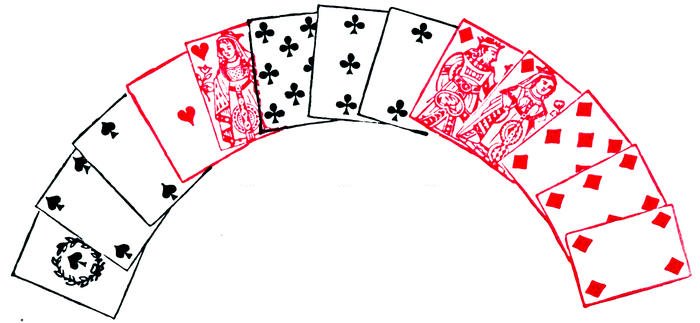
- A♠, 4♠, 2♠
- A♥, Qn♥
- 8♣, 3♣, 2♣
- Kg, Qn♦, 7♦, 6♦, 4♦
Score: Love-all.
Nine of clubs turned up.
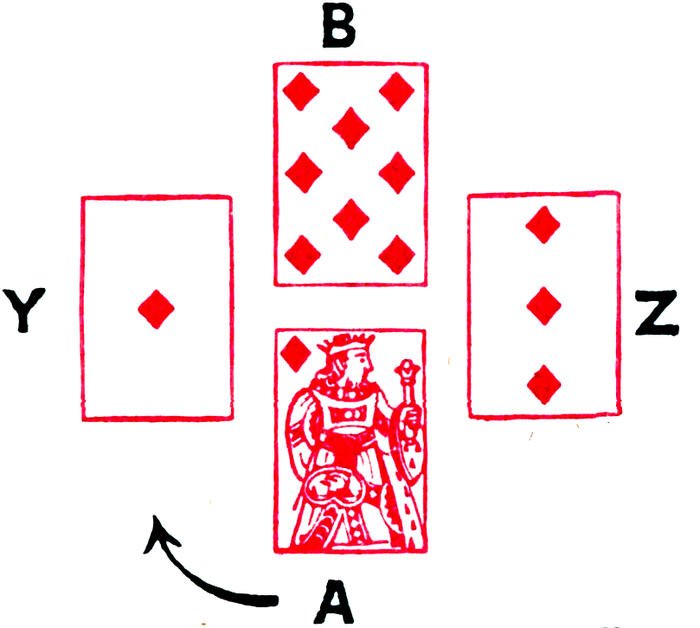
Tricks AB, 0
YZ, 1
1. Y B Z A↷
A♦ 8♦ 3♦ Kg♦
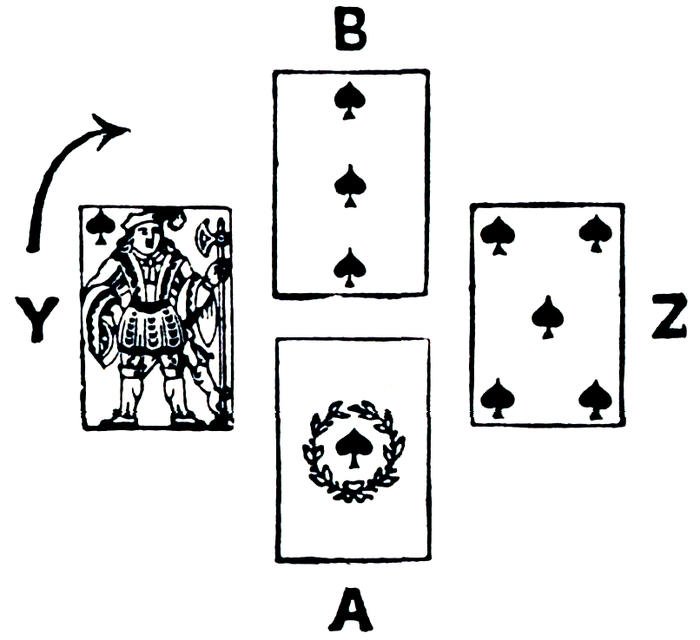
Tricks AB, 1
YZ, 1
2. Y↷ B Z A
Knv♠ 3♠ 5♠ A♠
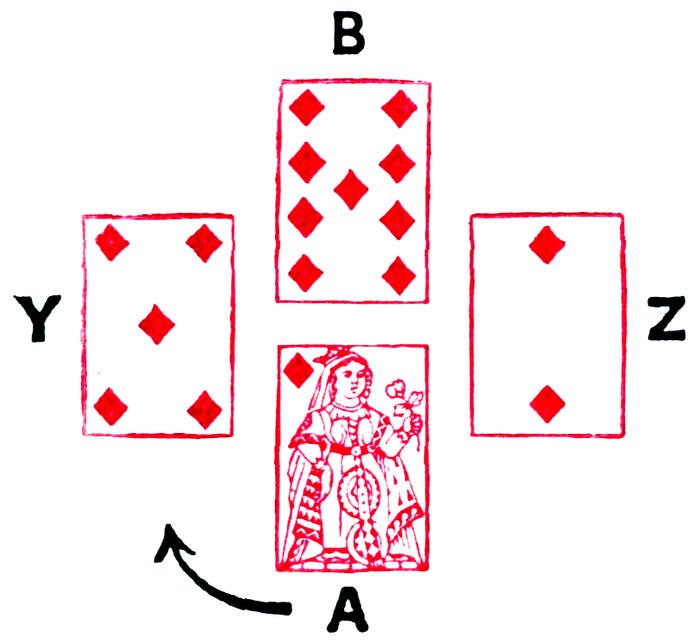
Tricks AB, 2
YZ, 1
3. Y B Z A↷
5♦ 9♦ 2♦ Qn♦
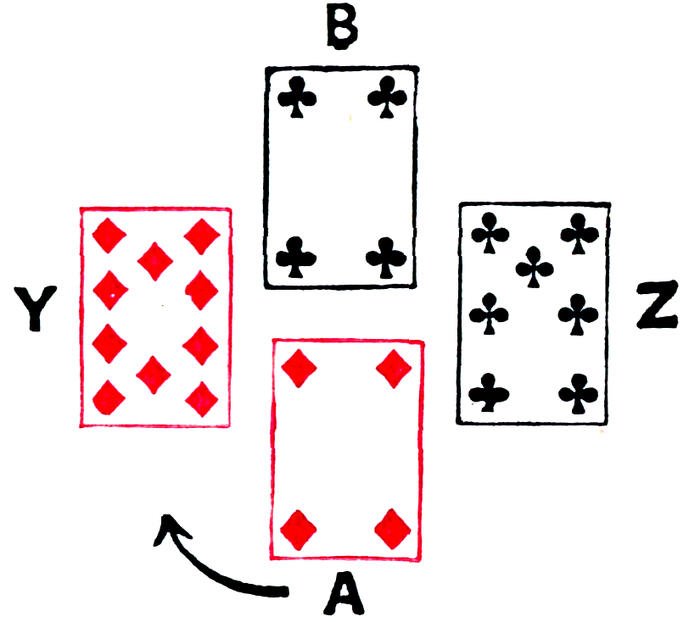
Tricks AB, 2
YZ, 2
4. Y B Z A↷
10♦ 4♣ 7♣ 4♦
Remark.—Y has the
knave of diamonds.
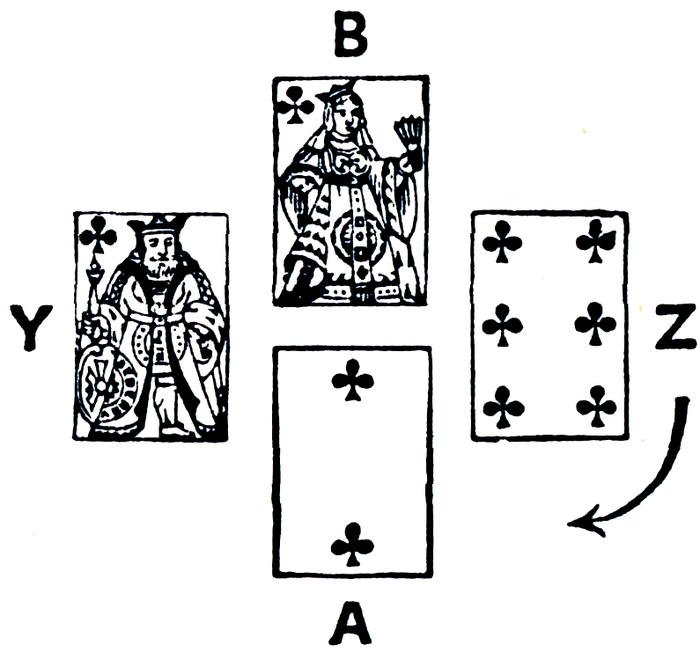
Tricks AB, 2
YZ, 3
5. Y B Z↷ A
Kg♣ Qn♣ 6♣ 2♣
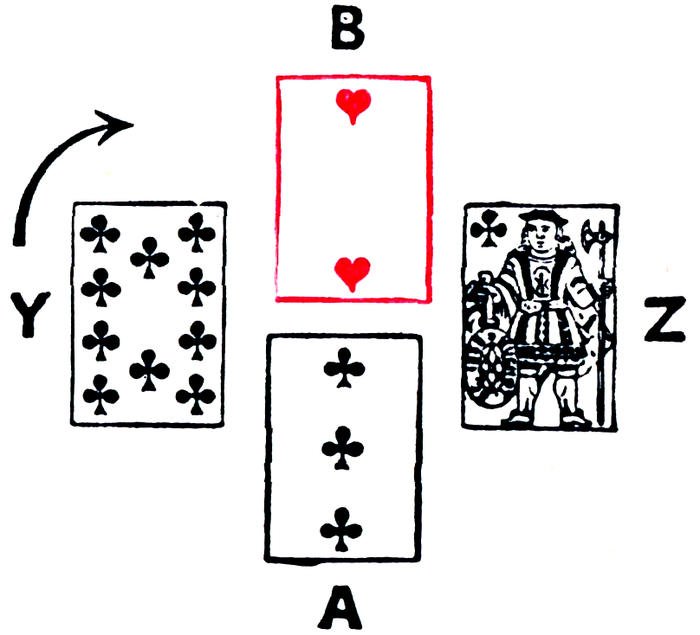
Tricks AB, 2
YZ, 4
6. Y↷ B Z A
10♣ 2♥ Knv♣ 3♣
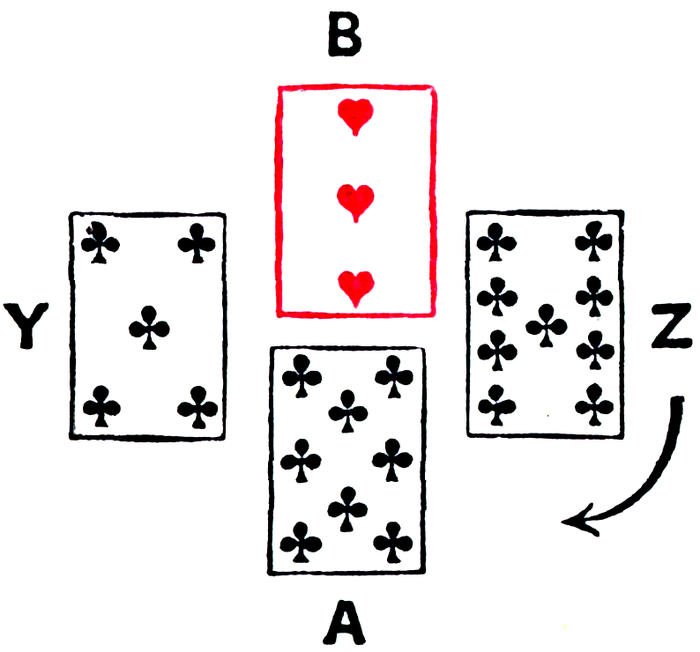
Tricks AB, 2
YZ, 5
7. Y B Z↷ A
5♣ 3♥ 9♣ 8♣
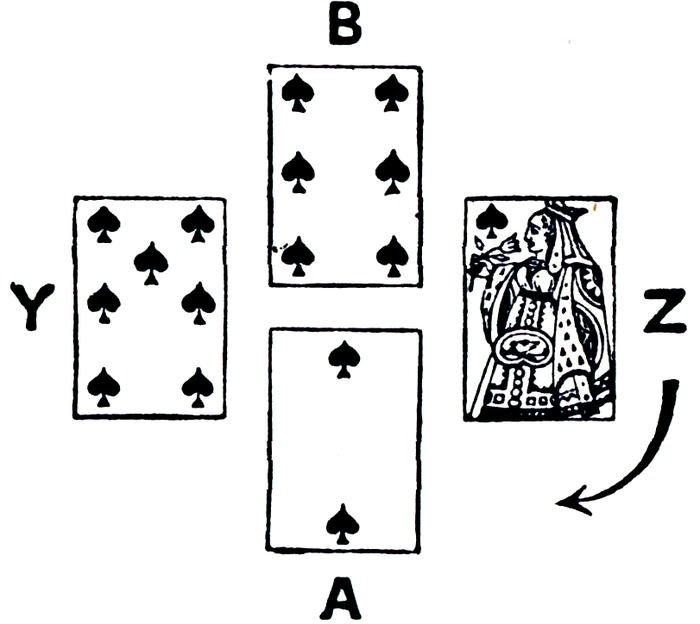
Tricks AB, 2
YZ, 6
8. Y B Z↷ A
7♠ 6♠ Qn♠ 2♠
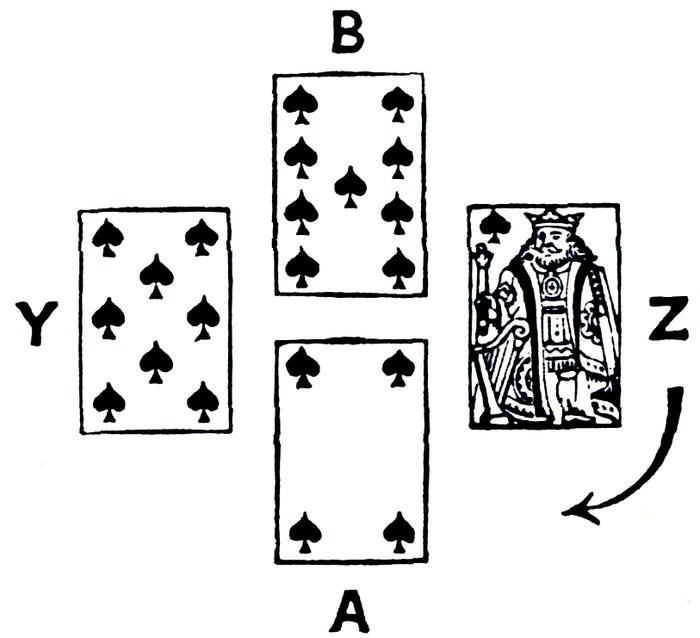
Tricks AB, 2
YZ, 7
9. Y B Z↷ A
8♠ 9♠ Kg♠ 4♠
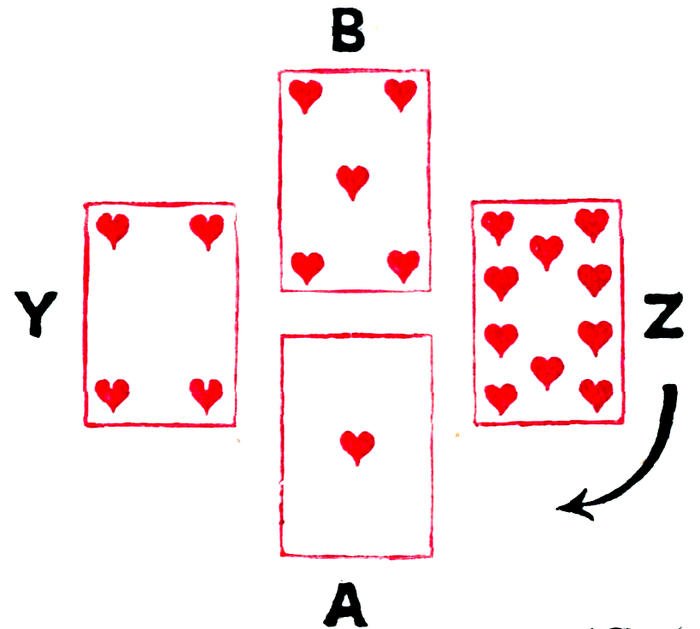
Tricks AB, 3
YZ, 7
10. Y B Z↷ A
4♥ 5♥ 10♥ A♥
Remark (Trick 10).—A plays very well in putting on
the ace. He wants two more tricks besides his ace of
hearts to save the game. The last trump and best
diamond are against him. It is clear, therefore, if A
has the lead after the second round of hearts (when he
must lead a diamond), he loses the game. It is also
clear that unless B has king, knave, and a small heart,
the game is gone.
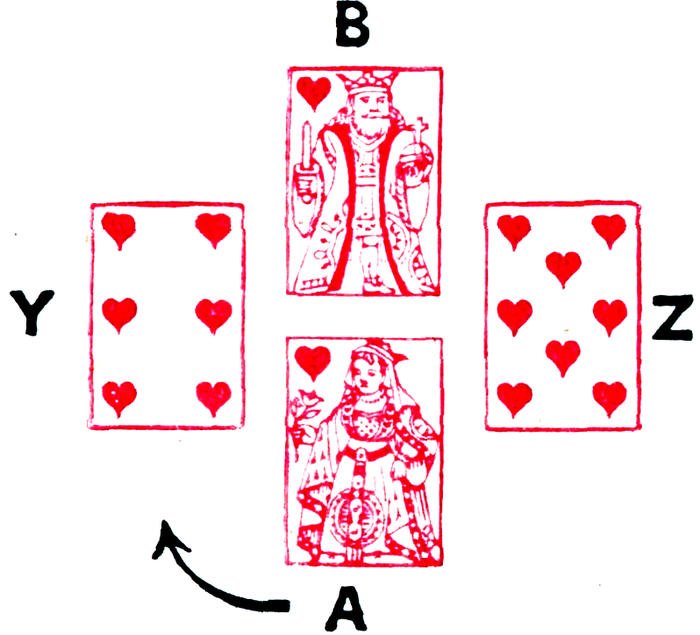
Tricks AB, 4
YZ, 7
11. Y B Z A↷
6♥ Kg♥ 8♥ Qn♥
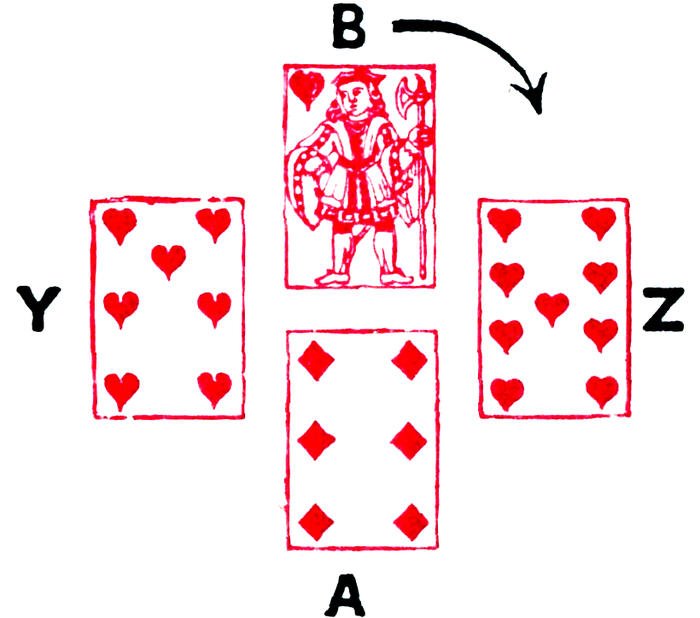
Tricks AB, 5
YZ, 7
12. Y B↷ Z A
7♥ Knv♥ 9♥ 6♦
YZ score two by cards and two by honours.
(A's hand is given above.)
| Y's Hand. |
B's Hand. |
Z's Hand. |
| Knv, 8, 7 |
♠ |
10, 9, 6, 3 |
♠ |
Kg, Qn, 5 |
♠ |
| 7, 6, 4 |
♥ |
Kg, Knv, 5, 3, 2 |
♥ |
10, 9, 8 |
♥ |
| Kg, 10, 5 |
♣ |
Qn, 4 |
♣ |
Ace, Knv, 9, 7, 6 |
♣ |
| Ace, Knv, 10, 5 |
♦ |
9, 8 |
♦ |
3, 2 |
♦ |
At Trick 2, Y is in difficulties. His strong suit has
been led by his right-hand adversary. Under these circumstances,
he leads from his strongest weak suit.
At Trick 6, Y's play in continuing the trump is open to
criticism. His better lead seems to be knave of diamonds.
Z wins his partner's ten of trumps in order to draw all the
trumps. It is very bad play, for if Z passes the ten, and
Y leads the knave of diamonds, the game is certain. This
is an example of the very common error of winning partner's
trick. It should seldom be done, and only if a
positive advantage can be well-nigh demonstrated from
doing it.
At Trick 11, the advantage of winning partner's trick—when
judiciously done—is shown. B, seeing A's anxiety
to get rid of the lead, rightly conjectures that A has two
more diamonds. He therefore takes the only course to
save the game, by winning his partner's queen of hearts.
Echo of the Call (see p. 128).
- 9♠, 7♠, 6♠, 2♠
- 9♥, 8♥, 5♥, 3♥
- 7♦, 6♦, 5♦, 4♦, 2♦
Score: Love-all.
Eight of hearts turned up.
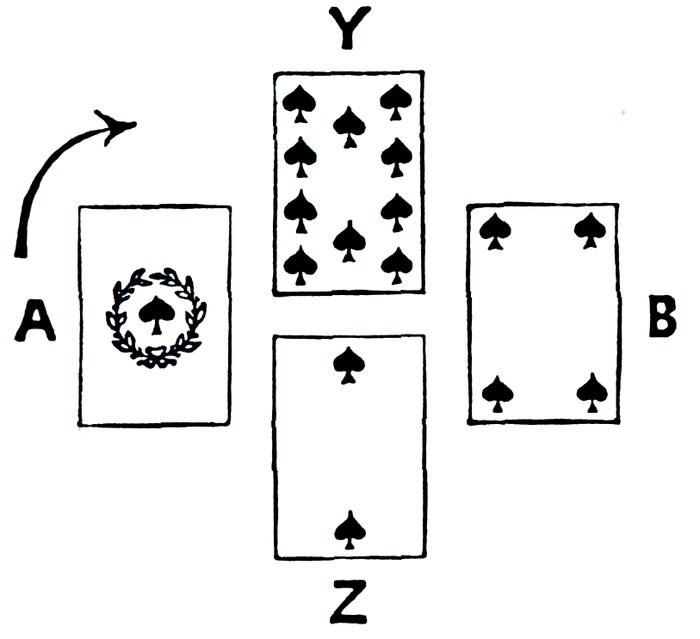
Tricks AB, 1
YZ, 0
1. A↷ Y B Z
A♠ 10♠ 4♠ 2♠
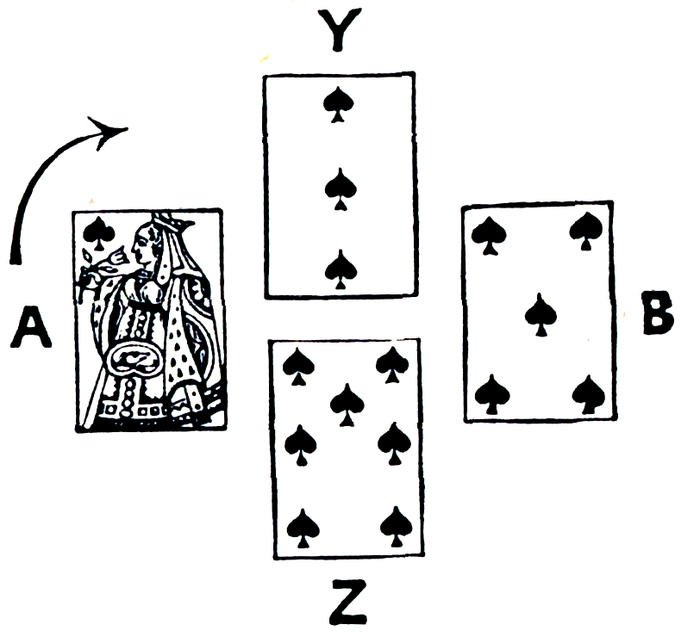
Tricks AB, 2
YZ, 0
2. A↷ Y B Z
Qn♠ 3♠ 5♠ 7♠
Remark (Trick 2).—Y has called for trumps. Z, having
four trumps himself, commences to echo his partner's call.
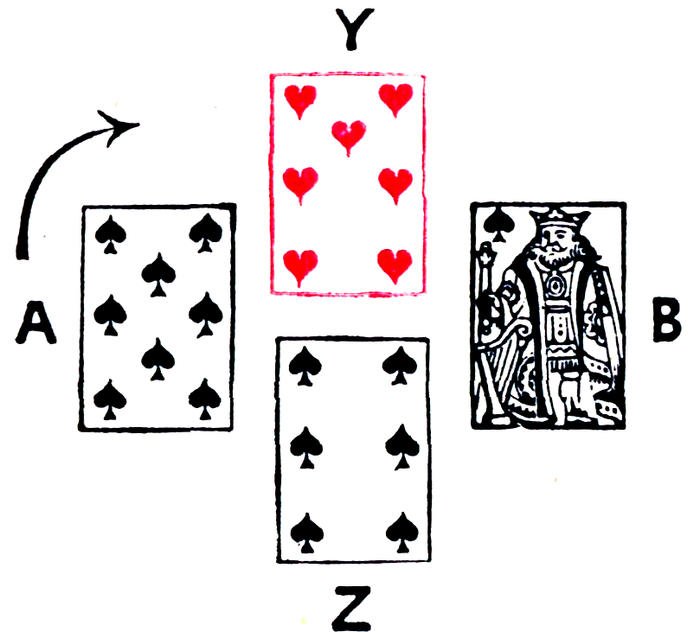
Tricks AB, 2
YZ, 1
3. A↷ Y B Z
8♠ 7♥ Kg♠ 6♠
Remark.—Z completes
the echo of the call.
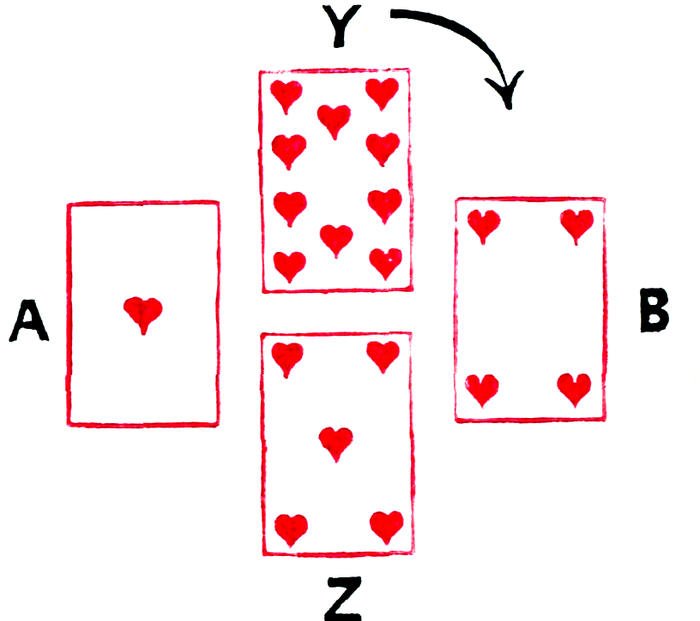
Tricks AB, 3
YZ, 1
4. A Y↷ B Z
A♥ 10♥ 4♥ 5♥
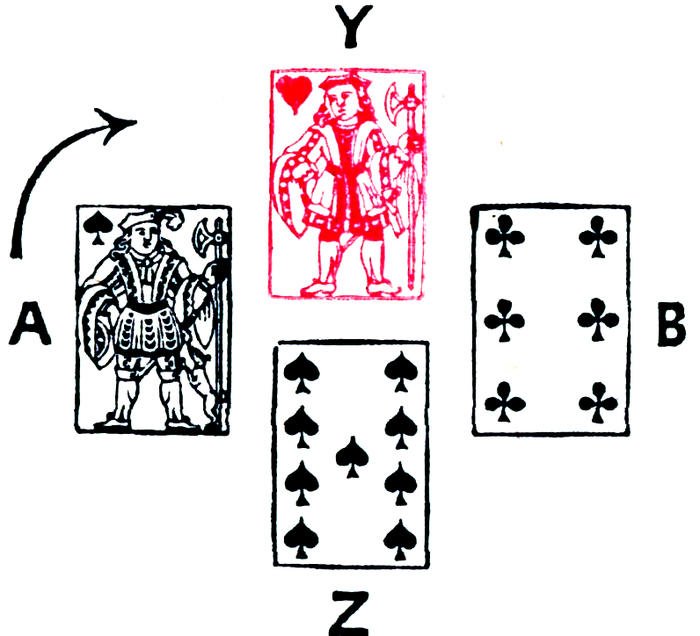
Tricks AB, 3
YZ, 2
5. A↷ Y B Z
Knv♠ Knv♥ 6♣ 9♠
Tricks AB, 3
YZ, 3
6. A Y↷ B Z
2♥ Kg♥ 6♥ 3♥
Remark (Trick 6).—Z having echoed, Y has no hesitation
in leading trumps again after being forced a second time.
Tricks AB, 3
YZ, 4
7. A Y↷ B Z
8♦ Kg♦ Knv♦ 2♦
Tricks AB, 3
YZ, 5
8. A Y↷ B Z
9♦ A♦ 7♣ 4♦
Tricks AB, 4
YZ, 5
9. A Y↷ B Z
10♦ 3♦ 8♣ 5♦
Tricks 10 to 13.—A
(Trick 10) leads queen of
diamonds, which analysis
shows is rather better than
a club, though, as the cards
happen to lie, his lead is
immaterial. Y trumps the
diamond, and
YZ score three by cards and two by honours.
But for the echo, the game might have been missed. If
after being forced a second time, at Trick 5, Y deems it
prudent not to continue trumps, and leads two rounds of
diamonds, B makes a small trump, and the game is saved.
(Z's hand is given above.)
| A's Hand. |
Y's Hand. |
B's Hand. |
| Ace, Qn, Knv, 8 |
♠ |
10, 3 |
♠ |
Kg, 5, 4 |
♠ |
| Ace, 2 |
♥ |
Kg, Qn, Knv, 10, 7 |
♥ |
6, 4 |
♥ |
| Knv, 4, 3 |
♣ |
10, 5, 2 |
♣ |
A, Kg, Qn, 9, 8, 7, 6 |
♣ |
| Qn, 10, 9, 8 |
♦ |
Ace, Kg, 3 |
♦ |
Knv |
♦ |
Leading losing trump, to place the lead.
- Knv♠, 10♠, 9♠, 8♠
- Knv♥, 9♥, 7♥, 6♥, 3♥, 2♥
- Knv♣
- Kg♦, 2♦
Score: Love-all.
King of hearts turned up.
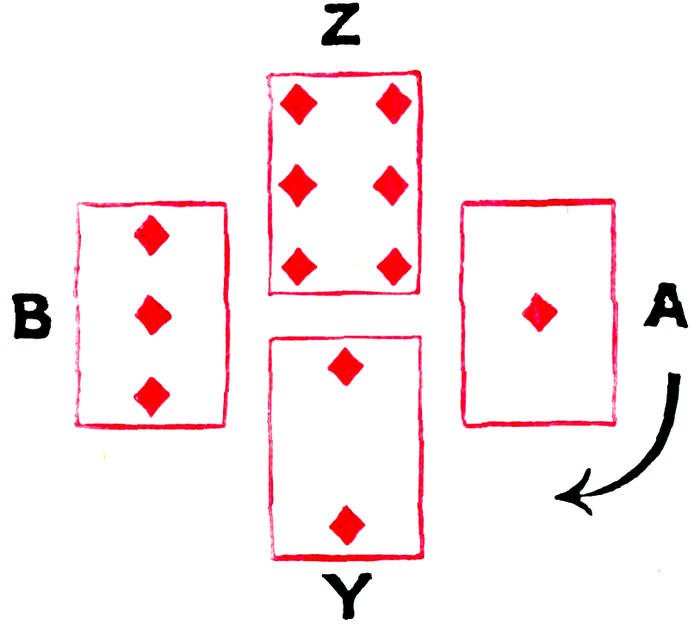
Tricks AB, 1
YZ, 0
1. B Z A↷ Y
3♦ 6♦ A♦ 2♦
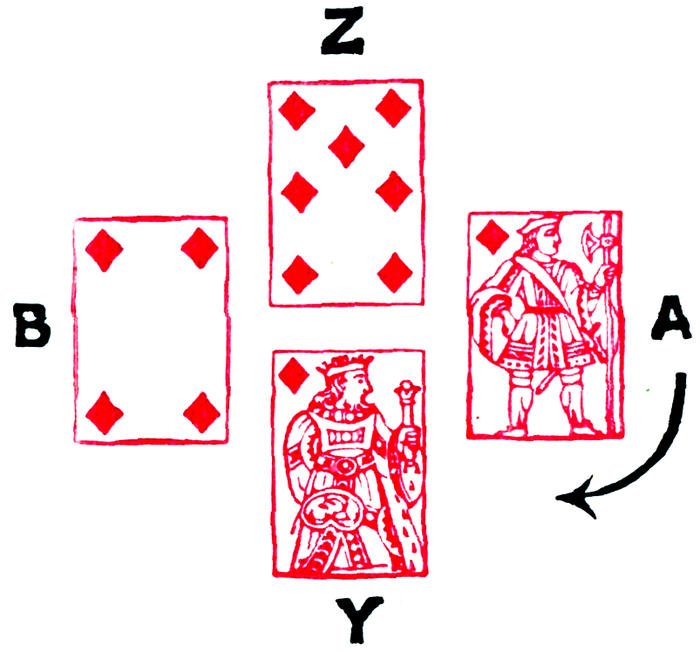
Tricks AB, 1
YZ, 1
2. B Z A↷ Y
4♦ 7♦ Knv♦ Kg♦
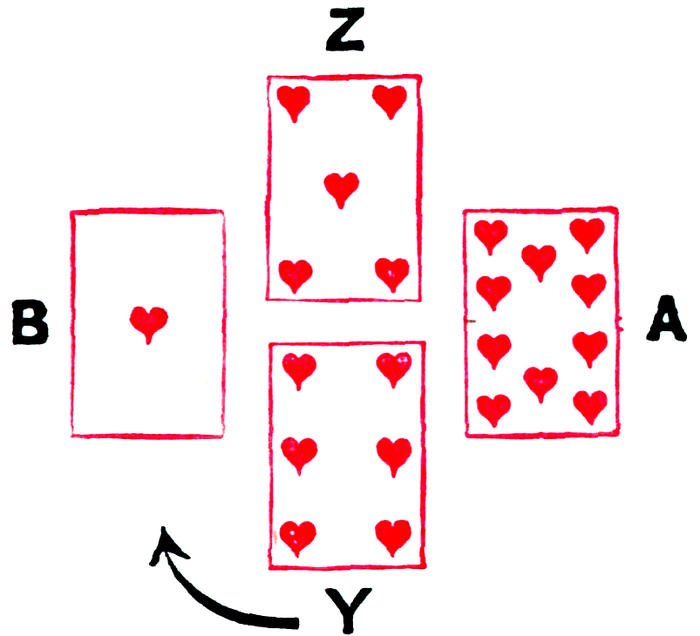
Tricks AB, 2
YZ, 1
3. B Z A Y↷
A♥ 5♥ 10♥ 6♥
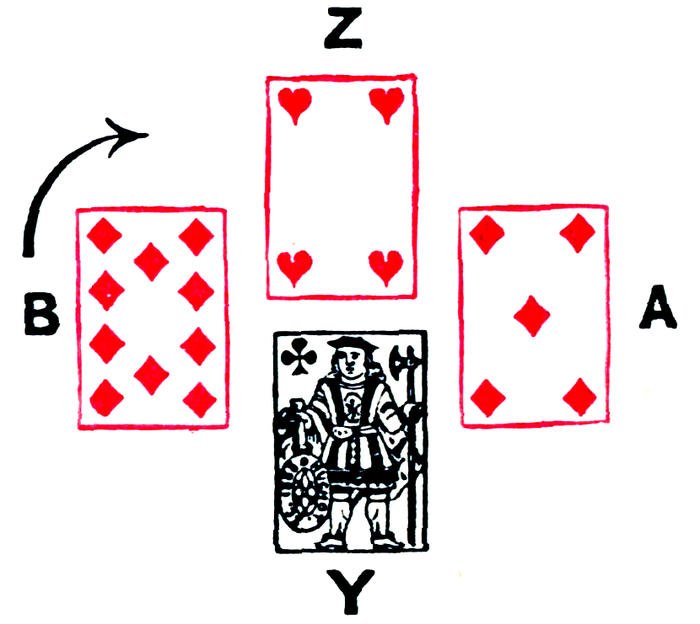
Tricks AB, 2
YZ, 2
4. B↷ Z A Y
10♦ 4♥ 5♦ Knv♣
Remarks (Tricks 3 and 4).—Y leads fourth-best; Z
echoes; but as the cards lie, it so happens that the position
of the hearts would be independently marked after Trick 5.
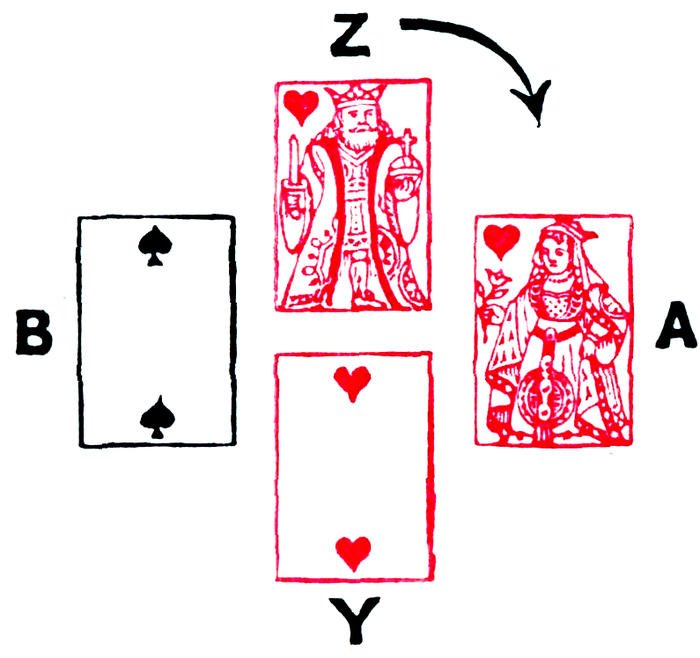
Tricks AB, 2
YZ, 3
5. B Z↷ A Y
2♠ Kg♥ Qn♥ 2♥
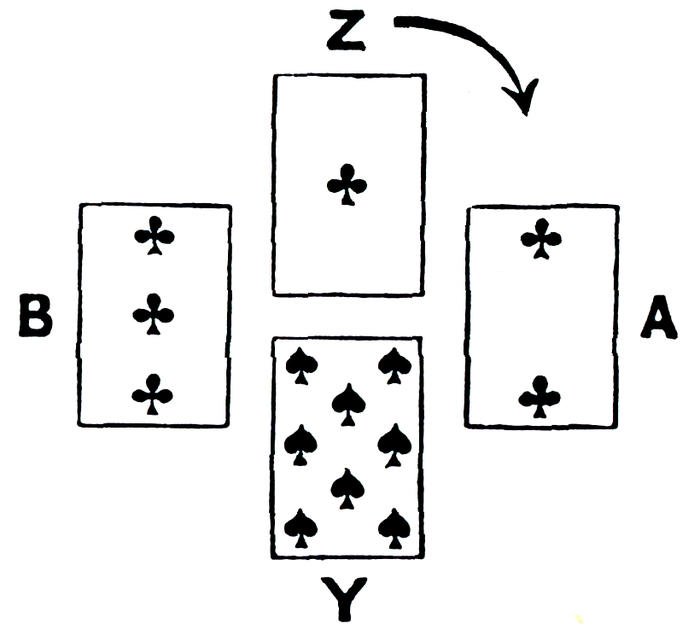
Tricks AB, 2
YZ, 4
6. B Z↷ A Y
3♣ A♣ 2♣ 8♠
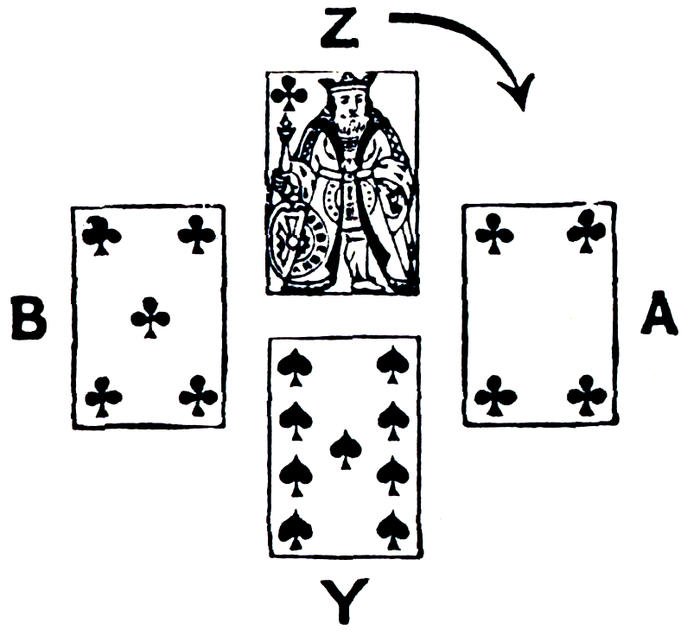
Tricks AB, 2
YZ, 5
7. B Z↷ A Y
5♣ Kg♣ 4♣ 9♠
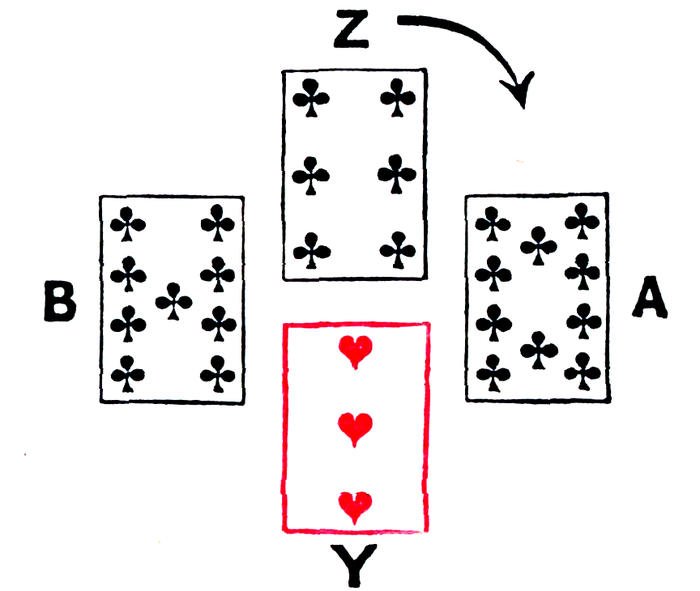
Tricks AB, 2
YZ, 6
8. B Z↷ A Y
9♣ 6♣ 10♣ 3♥
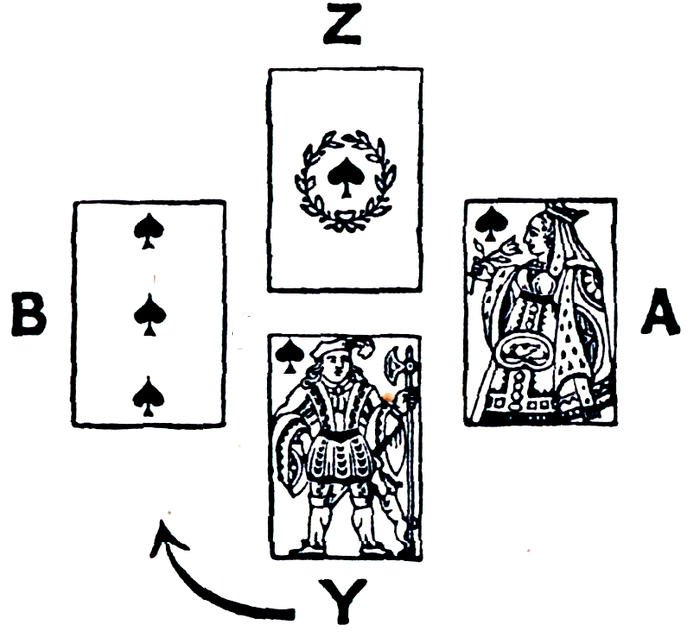
Tricks AB, 2
YZ, 7
9. B Z A Y↷
3♠ A♠ Qn♠ Knv♠
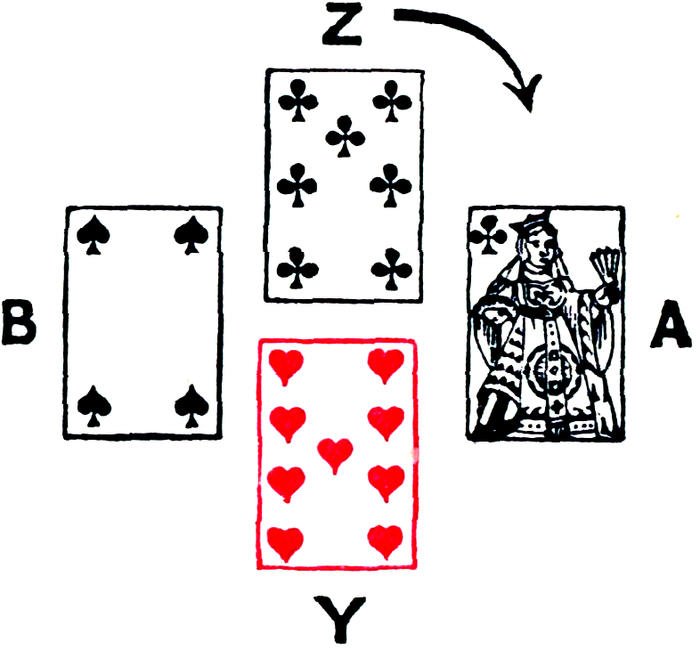
Tricks AB, 2
YZ, 8
10. B Z↷ A Y
4♠ 7♣ Qn♣ 9♥
Remark (Trick 10).—Well played by Y. He can count
his partner's hand, viz., the eight of trumps (see Remark,
Trick 4, and the fall of the hearts, Tricks 3, 4, and 5), the
last club, and a losing spade, as Z having put on the ace
of spades (Trick 9), cannot have the king. Y therefore
trumps with the nine, and (Trick 11) leads the seven of
hearts to put the lead in Z's hand. Z (Trick 12) leads the
club, to which Y discards the ten of spades; and
YZ win five by cards.
(Y's hand is given above.)
| A's Hand. |
B's Hand. |
Z's Hand. |
| Qn |
♠ |
Kg, 7, 5, 4, 3, 2 |
♠ |
Ace, 6 |
♠ |
| Qn, 10 |
♥ |
Ace |
♥ |
Kg, 8, 5, 4 |
♥ |
| Qn, 10, 4, 2 |
♣ |
9, 5, 3 |
♣ |
Ace, Kg, 8, 7, 6 |
♣ |
| A, Qn, Knv, 9, 8, 5 |
♦ |
10, 4, 3 |
♦ |
7, 6 |
♦ |
At Trick 4, B should have led a spade. A having
shown at least five diamonds by leading ace, then knave
(see p. 66), the diamond is sure to be trumped, and it may
force the weak trump hand, or may allow one adversary
to discard and the other to trump.
Echo after a force (see p. 129).
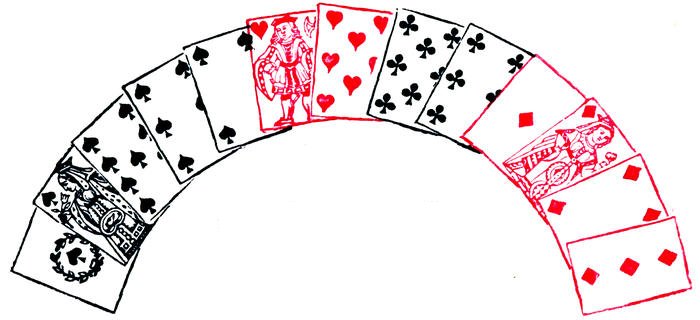
- A♠, Qn♠, 9♠, 6♠, 4♠
- Knv♥, 7♥
- 8♣, 6♣
- A♦, Qn♦, 4♦, 3♦
Score: AB, three; YZ, four.
Two of spades turned up.
Tricks AB, 0
YZ, 1
1. Z A↷ Y B
Kg♥ 6♥ 2♥ Knv♥
Tricks AB, 0
YZ, 2
2. Z↷ A Y B
Kg♣ 3♣ 2♣ 8♣
Tricks AB, 1
YZ, 2
3. Z↷ A Y B
Qn♣ 3♠ 4♣ 6♣
Remark.—B has called.
Tricks AB, 1
YZ, 3
4. Z A↷ Y B
Kg♠ 8♠ 10♠ Qn♠
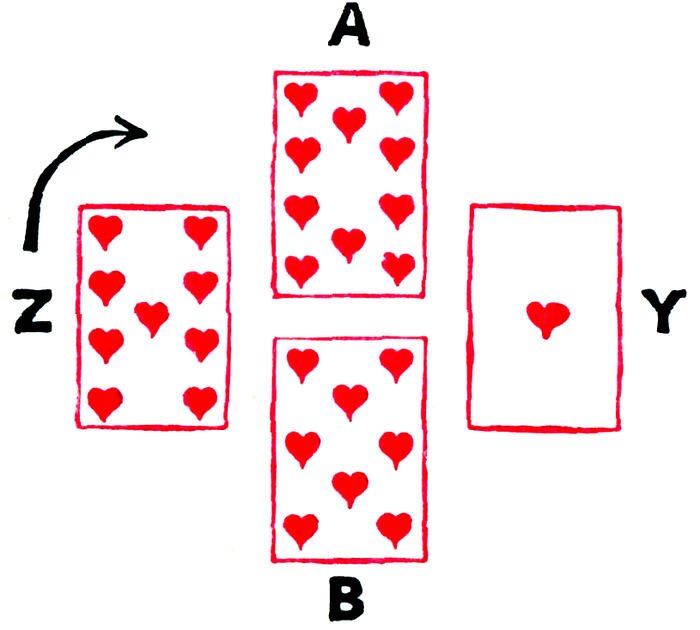
Tricks AB, 1
YZ, 4
5. Z↷ A Y B
9♥ 10♥ A♥ 8♥
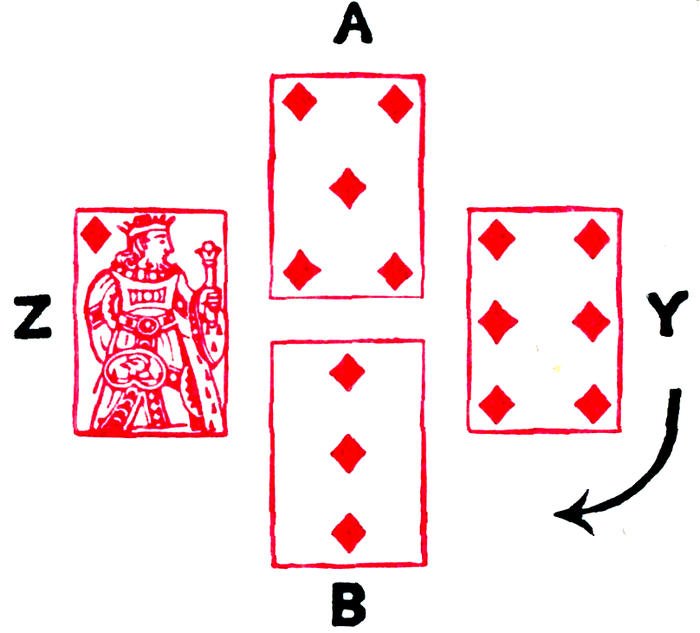
Tricks AB, 1
YZ, 5
6. Z A Y↷ B
Kg♦ 5♦ 6♦ 3♦
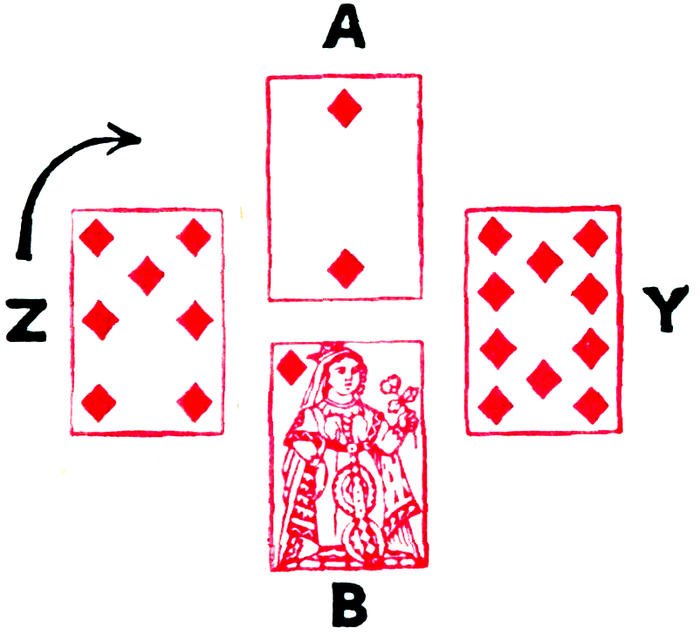
Tricks AB, 2
YZ, 5
7. Z↷ A Y B
7♦ 2♦ 10♦ Qn♦
Remark.—A has echoed.
He therefore had at least
four trumps originally.
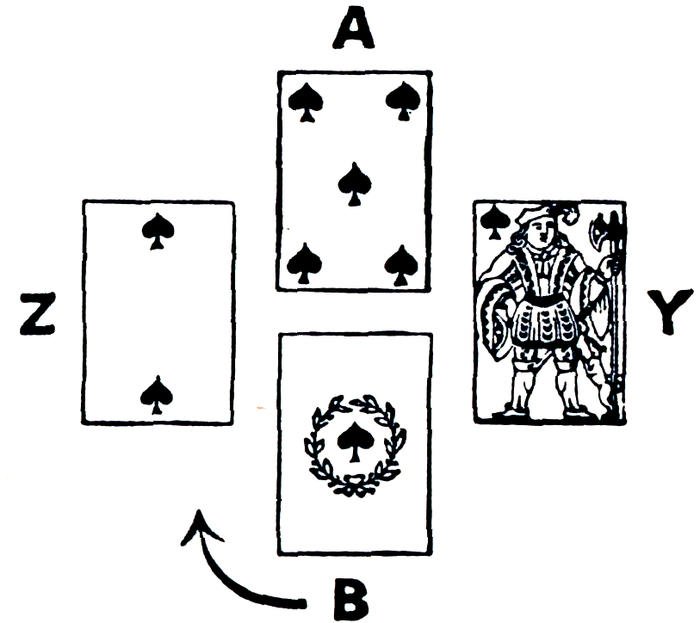
Tricks AB, 3
YZ, 5
8. Z A Y B↷
2♠ 5♠ Knv♠ A♠
Remark.—The remaining
trump is in A's hand.
But for the echo, it might
be in Z's hand.
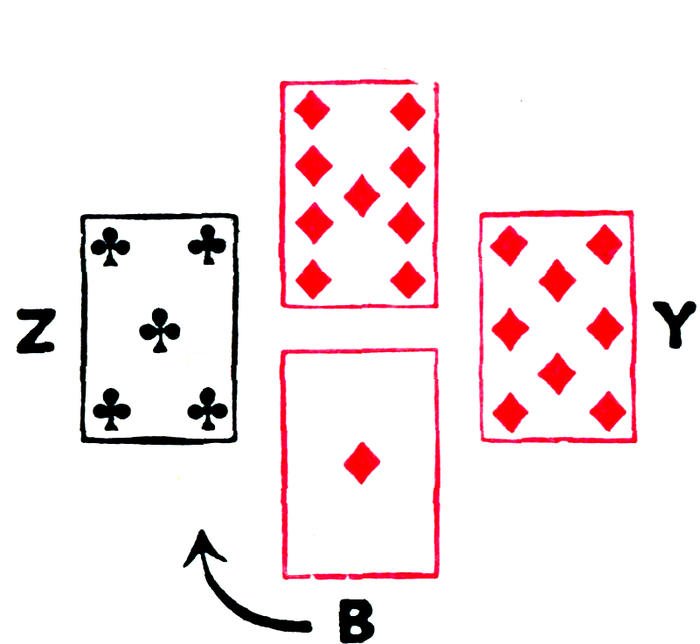
Tricks AB, 4
YZ, 5
9. Z A Y B↷
5♣ 9♦ 8♦ A♦
Remark (Trick 9).—B can now lead ace of diamonds, without
fear of its being trumped (see Remark, Trick 8). If the
position of the other trump were uncertain, the lead of the
ace of diamonds would be wrong. For, by leading nine
of trumps, B can make certain of saving the game (see
score); whereas, if Z has a trump, and trumps the ace
of diamonds, B loses the game, as Y will then make a
diamond.
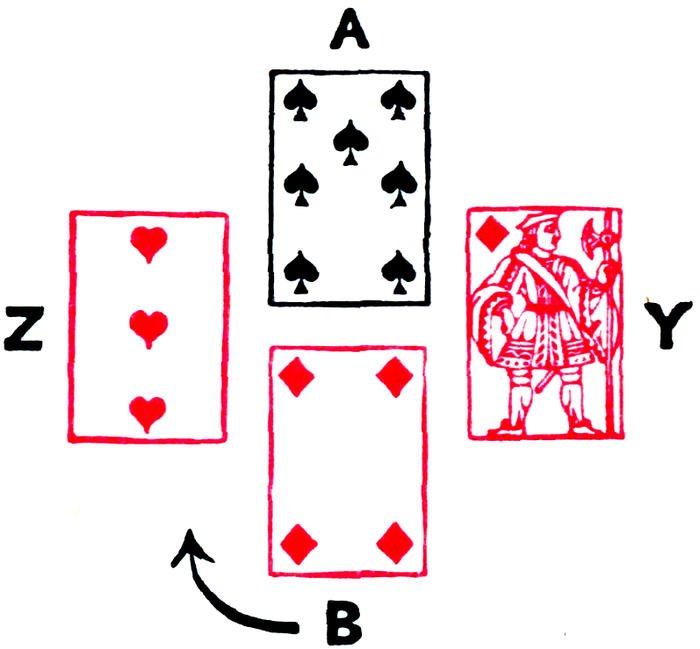
Tricks AB, 5
YZ, 5
10. Z A Y B↷
3♥ 7♠ Knv♦ 4♦
Tricks 11 to 13.—B makes his three trumps, and
AB win the game.
(B's hand is given above.)
| A's Hand. |
Y's Hand. |
Z's Hand. |
| 8, 7, 5, 3 |
♠ |
Knv, 10 |
♠ |
Kg, 2 |
♠ |
| Qn, 10, 7, 6, 5 |
♥ |
Ace, 4, 2 |
♥ |
Kg, 9, 3 |
♥ |
| 3 |
♣ |
Knv, 9, 4, 2 |
♣ |
A, Kg, Qn, 10, 7, 5 |
♣ |
| 9, 5, 2 |
♦ |
Knv, 10, 8, 6 |
♦ |
Kg, 7 |
♦ |
Coup of compelling a discard, same in principle as
the Vienna Coup.
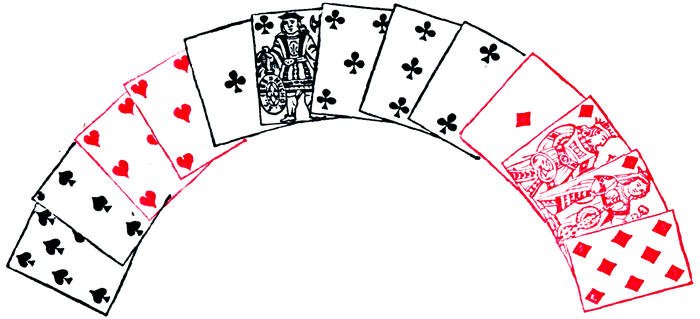
- 7♠, 3♠
- 6♥, 5♥
- A♣, Knv♣, 5♣, 3♣, 2♣
- A♦, Kg, Qn♦, 8♦
Score: Love-all.
King of clubs turned up.
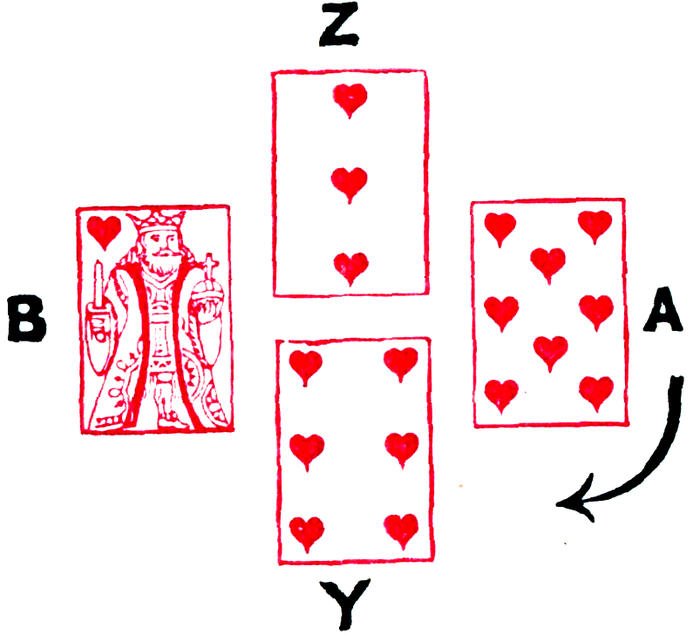
Tricks AB, 1
YZ, 0
1. B Z A↷ Y
Kg♥ 3♥ 8♥ 6♥
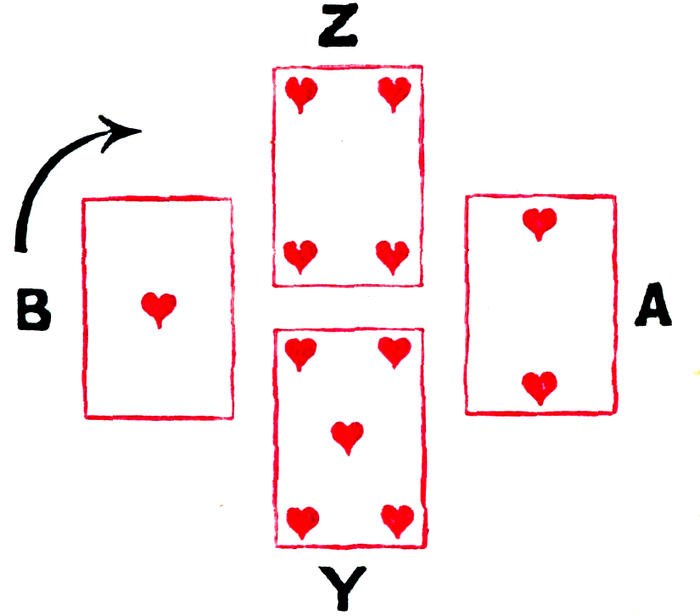
Tricks AB, 2
YZ, 0
2. B↷ Z A Y
A♥ 4♥ 2♥ 5♥
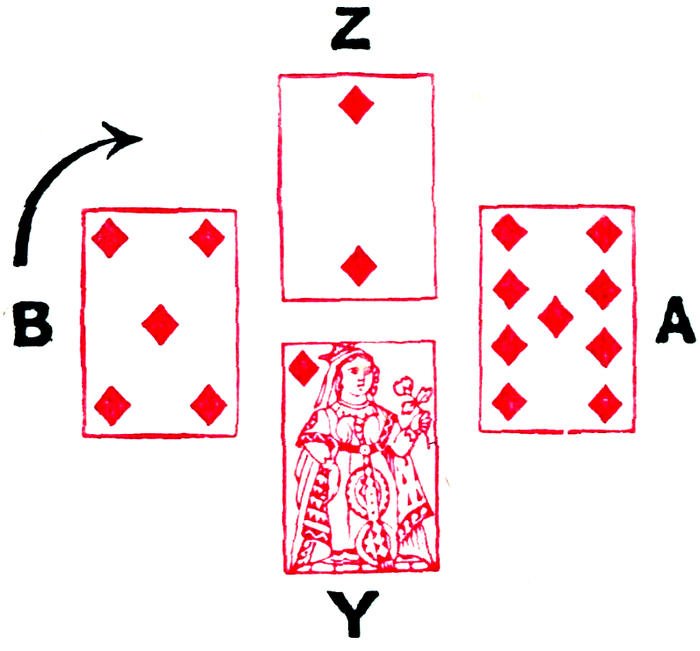
Tricks AB, 2
YZ, 1
3. B↷ Z A Y
5♦ 2♦ 9♦ Qn♦
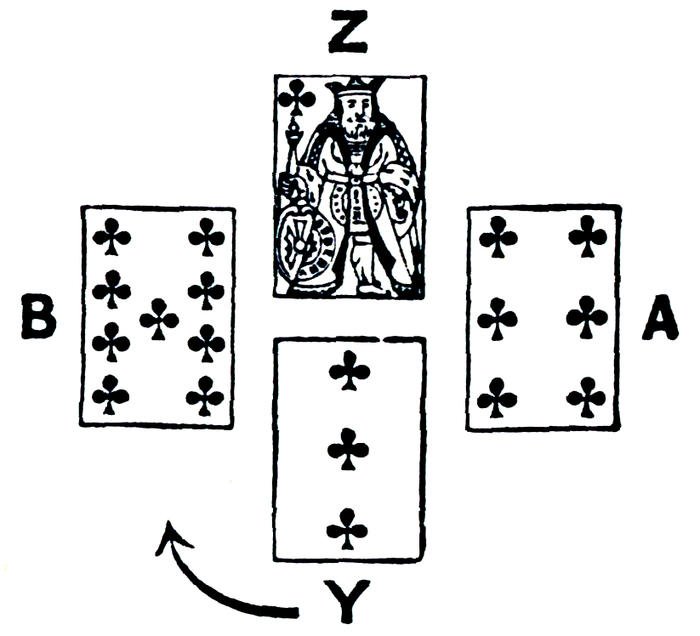
Tricks AB, 2
YZ, 2
4. B Z A Y↷
9♣ Kg♣ 6♣ 3♣
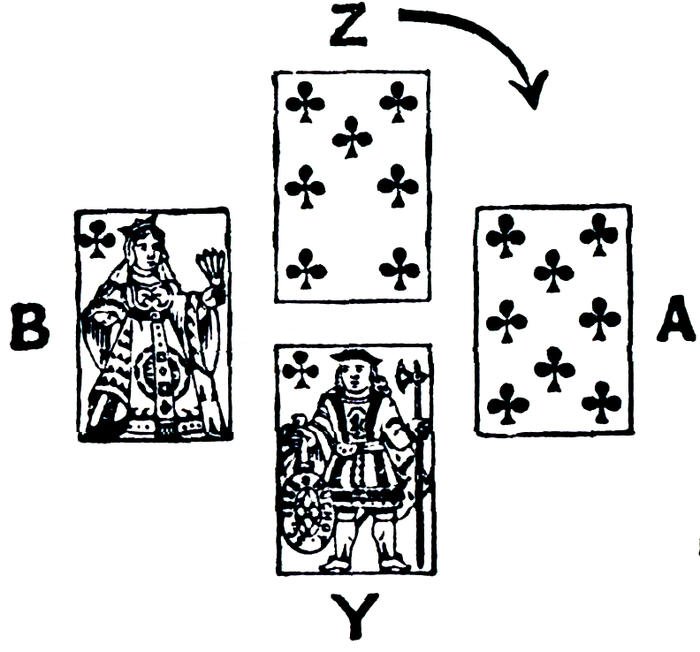
Tricks AB, 3
YZ, 2
5. B Z↷ A Y
Qn♣ 7♣ 8♣ Knv♣
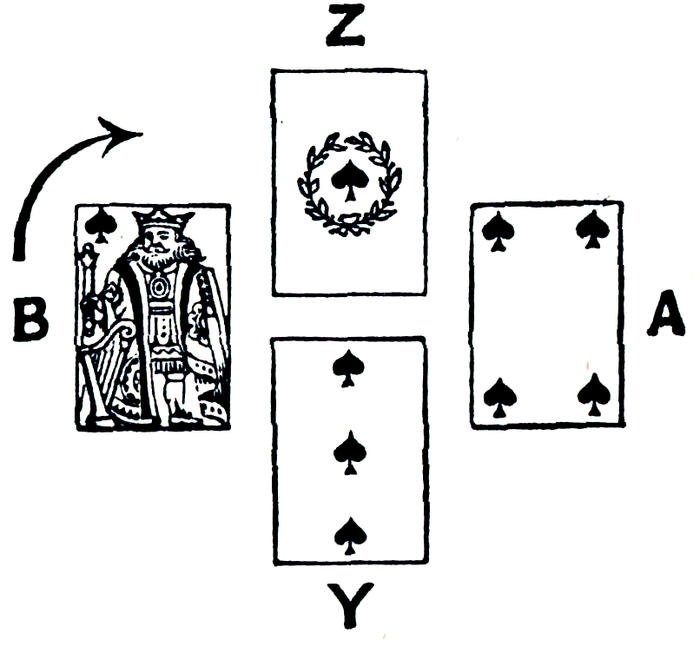
Tricks AB, 3
YZ, 3
6. B↷ Z A Y
Kg♠ A♠ 4♠ 3♠
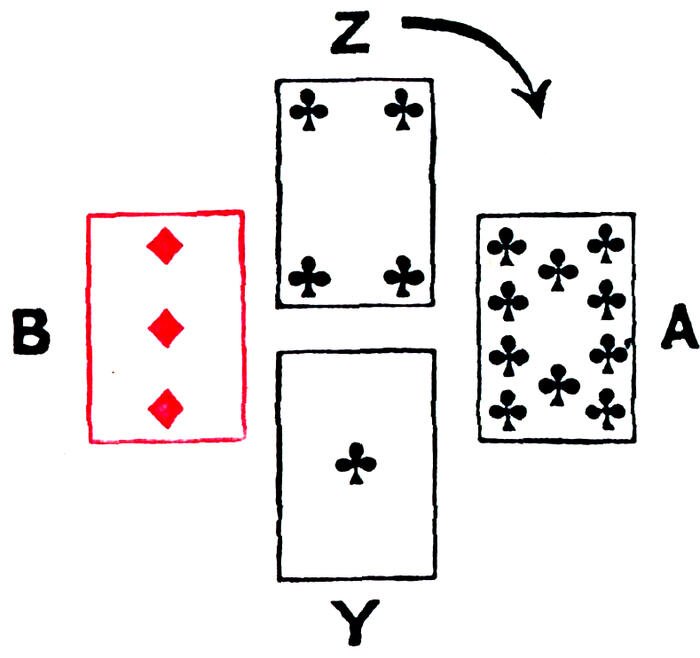
Tricks AB, 3
YZ, 4
7. B Z↷ A Y
3♦ 4♣ 10♣ A♣
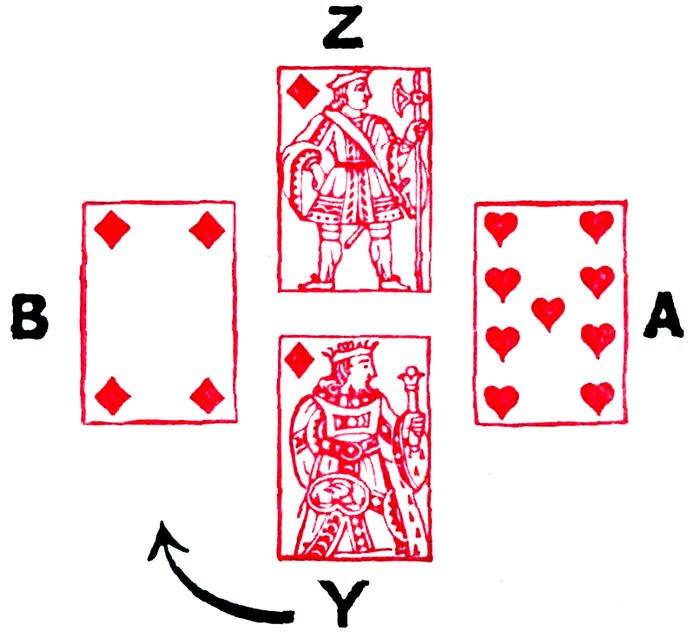
Tricks AB, 3
YZ, 5
8. B Z A Y↷
4♦ Knv♦ 9♥ Kg♦
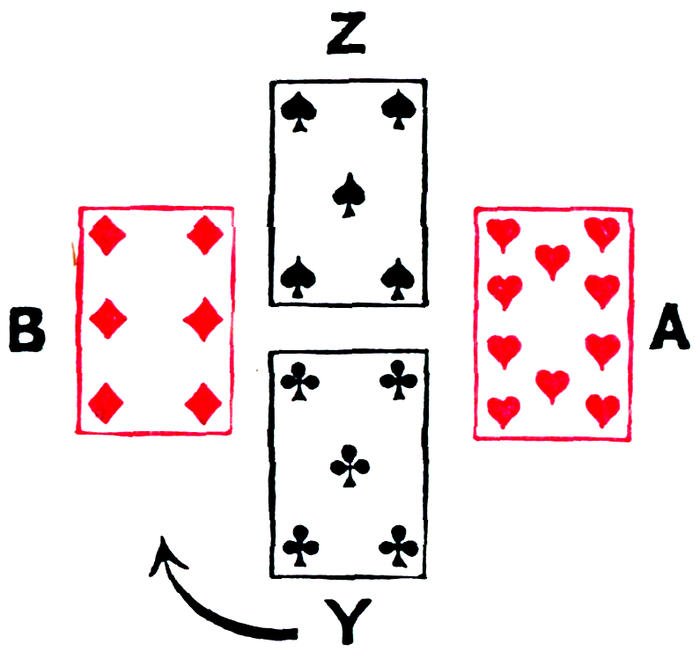
Tricks AB, 3
YZ, 6
9. B Z A Y↷
6♦ 5♠ 10♥ 5♣
Remark (Trick 9).—Well played by Y. He can count
B's hand as follows: ten and two small diamonds; queen
of spades (see Trick 6—the lead of the king could only be
from king, queen); and one other card, probably a small
spade, for had B another heart he would most likely have
continued his partner's original lead, instead of changing
the suit. Y now leads a trump in hopes that B will
discard the small spade, when Y will lead the seven of
spades to throw the lead into B's hand, and B will be
obliged to lead a diamond up to Y's tenace.
B, however, discards a diamond. Y continues his tactics
(see Trick 10), leading another trump. This compels
another discard from B. If B discards the small spade,
Y leads the losing spade; if B discards another diamond,
Y establishes the diamonds, and in either case wins the
game. This fine coup occurred in actual play.
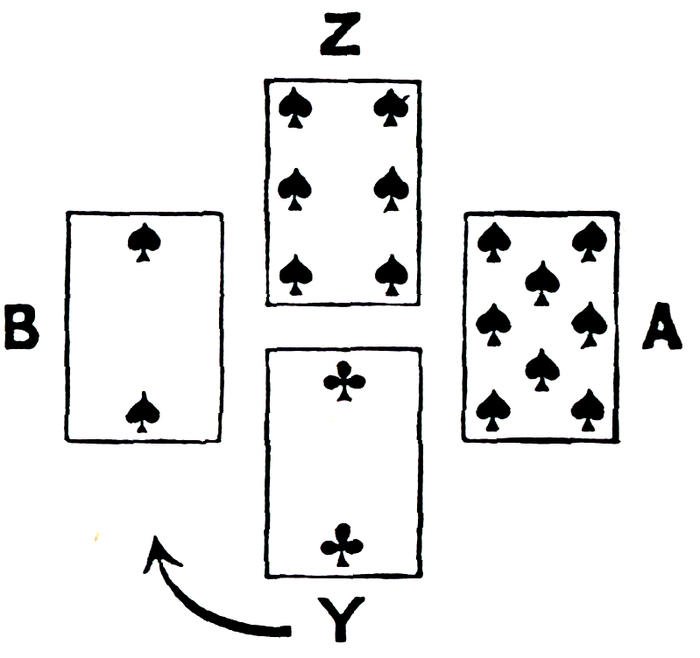
Tricks AB, 3
YZ, 7
10. B Z A Y↷
2♠ 6♠ 8♠ 2♣
Tricks 11 to 13.—Y (Trick 11) leads the spade. B is
obliged (Trick 12) to lead a diamond; and
YZ score three by cards and two by honours.
(Y's hand is given above.)
| A's Hand. |
B's Hand. |
Z's Hand. |
| Knv, 9, 8, 4 |
♠ |
Kg, Qn, 2 |
♠ |
Ace, 10, 6, 5 |
♠ |
| Qn, 10, 9, 8, 2 |
♥ |
Ace, Kg |
♥ |
Knv, 7, 4, 3 |
♥ |
| 10, 8, 6 |
♣ |
Qn, 9 |
♣ |
Kg, 7, 4 |
♣ |
| 9 |
♦ |
10, 7, 6, 5, 4, 3 |
♦ |
Knv, 2 |
♦ |
At Trick 10, B should notice that he must lose the game
if he retains the queen of spades. His only chance of
saving the game here is to discard the queen of spades, in
hopes of finding his partner with two tricks in spades, or
with a trick in spades and hearts. If A has not these
cards, the game is lost.
Grand Coup (see pp. 151-155).
- A♠, Kg♠
- 6♥
- Qn♣, Knv♣, 7♣, 6♣, 5♣, 4♣
- Kg♦, 5♦, 4♦, 3♦
Score: Love-all.
Ace of clubs turned up.
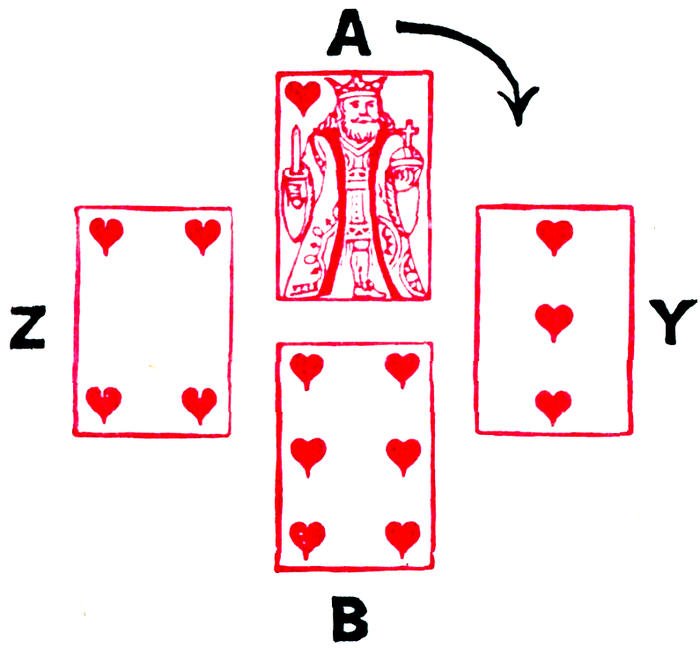
Tricks AB, 1
YZ, 0
1. Z A↷ Y B
4♥ Kg♥ 3♥ 6♥
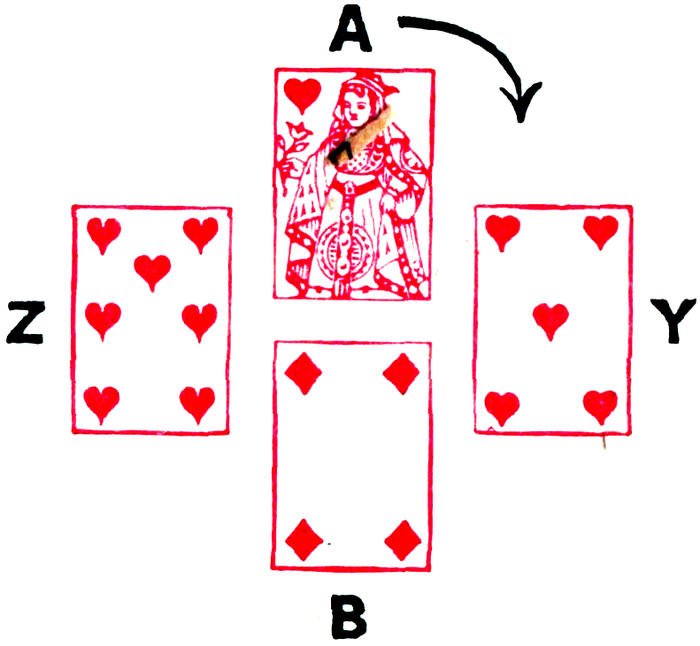
Tricks AB, 2
YZ, 0
2. Z A↷ Y B
7♥ Qn♥ 5♥ 4♦
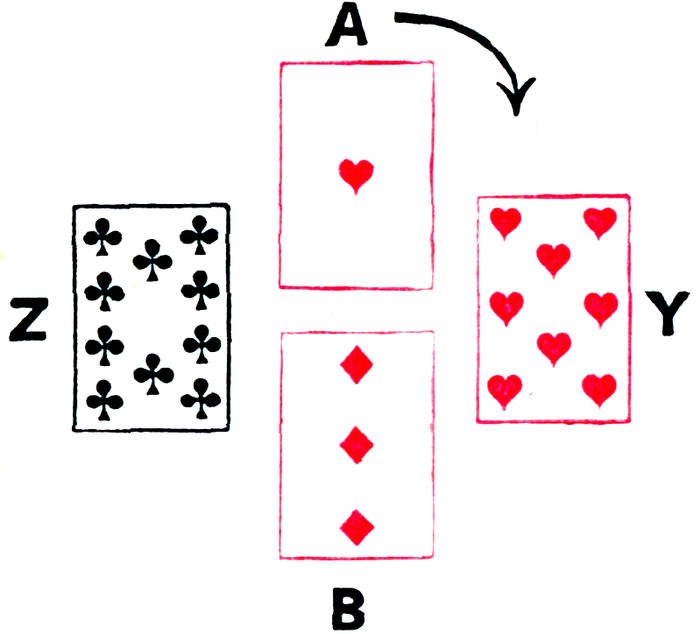
Tricks AB, 2
YZ, 1
3. Z A↷ Y B
10♣ A♥ 8♥ 3♦
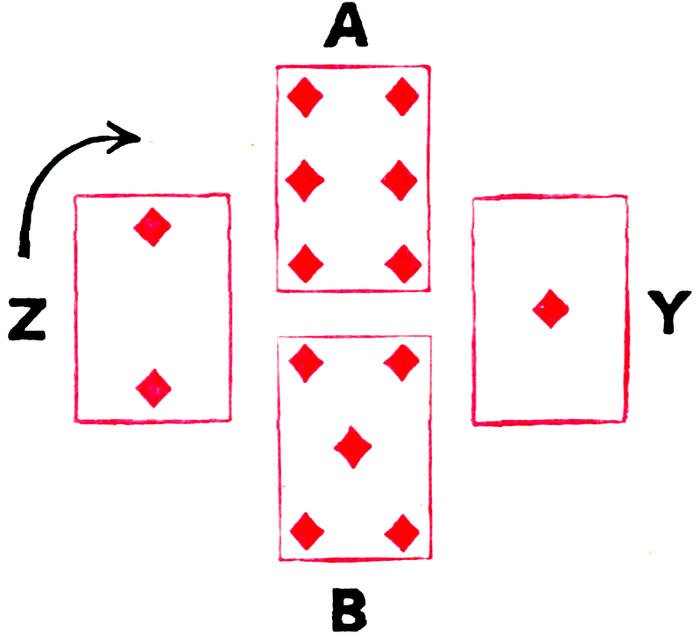
Tricks AB, 2
YZ, 2
4. Z↷ A Y B
2♦ 6♦ A♦ 5♦
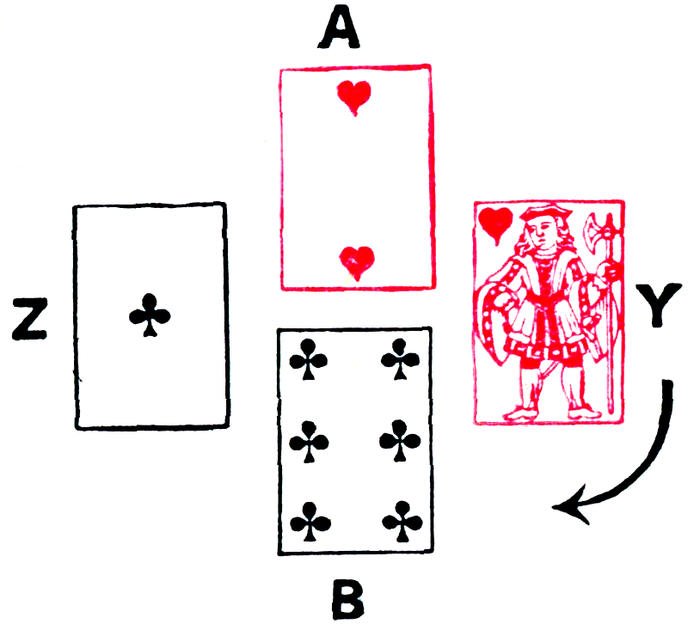
Tricks AB, 2
YZ, 3
5. Z A Y↷ B
A♣ 2♥ Knv♥ 6♣
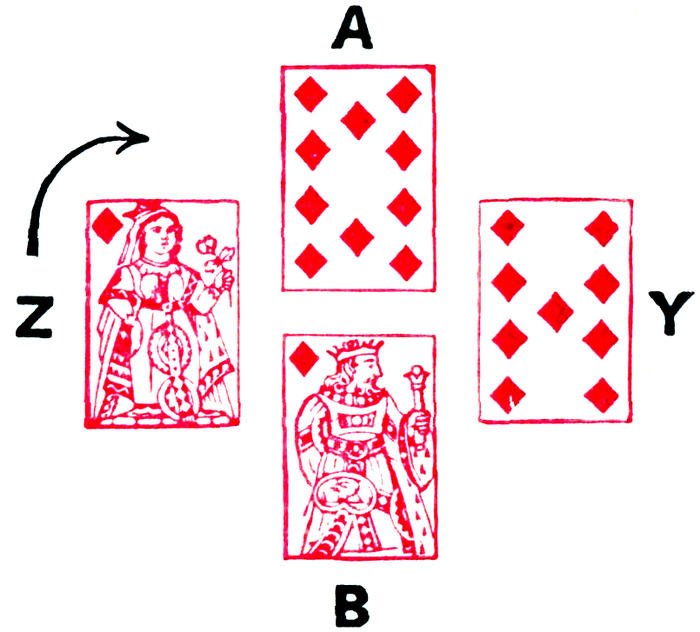
Tricks AB, 3
YZ, 3
6. Z↷ A Y B
Qn♦ 10♦ 9♦ Kg♦
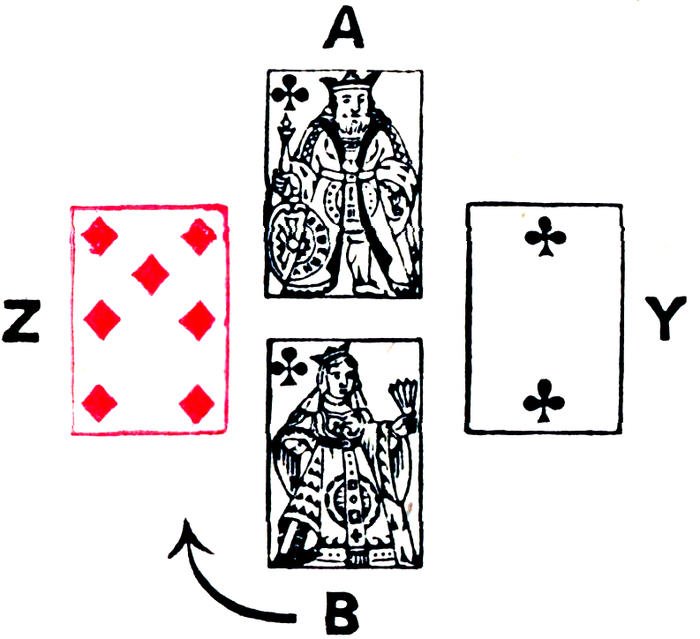
Tricks AB, 4
YZ, 3
7. Z A Y B↷
7♦ Kg♣ 2♣ Qn♣
Remark.—The fall of the
king shows that the remaining
clubs are in Y's hand.
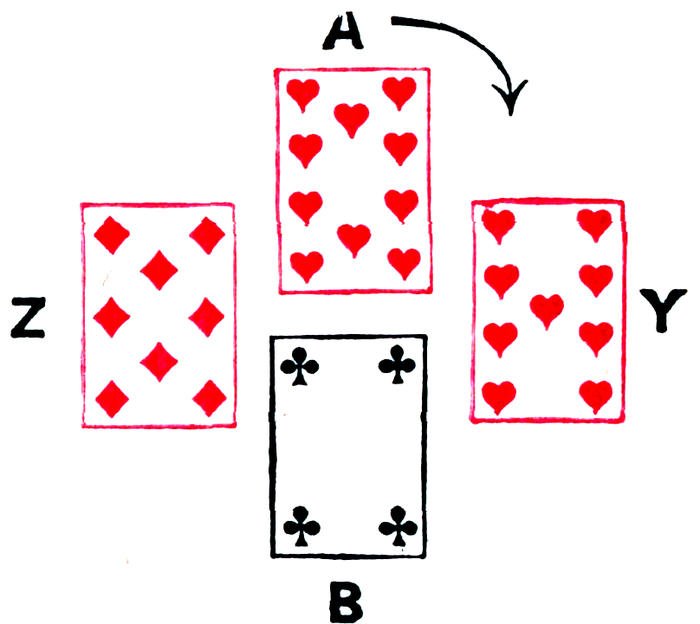
Tricks AB, 5
YZ, 3
8. Z A↷ Y B
8♦ 10♥ 9♥ 4♣
Remark.—Well played by
B. All the hearts are out;
the remaining diamonds are
in Z's hand (see fall of the
diamonds, Tricks, 2, 3, 4, 6, and 7), and all the clubs are
in Y's hand. Y must therefore have three trumps and
two spades. If B discards a spade to this trick, he cannot
avoid leading trumps twice up to Y. In that case Y will
make two tricks in trumps, saving the game, as will be
apparent by so playing the cards. The result is otherwise
if B trumps his partner's best heart. He can then lead
out ace and king of spades, to which Y must follow suit;
and by continuing with the five of clubs (the nine, eight,
and three are in against him), B secures the tenace, and
wins the game.
Tricks 9 to 13.—B (Tricks 9 and 10) leads spades, and
(Trick 11) the six of clubs. B makes the last two tricks,
and
AB score three by cards and two by honours.
(B's hand is given above.)
| A's Hand. |
Y's Hand. |
Z's Hand. |
| 9, 5, 4, 3, 2 |
♠ |
Qn, 6 |
♠ |
Knv, 10, 8, 7 |
♠ |
| Ace, Kg, Qn, 10, 2 |
♥ |
Knv, 9, 8, 5, 3 |
♥ |
7, 4 |
♥ |
| Kg |
♣ |
9, 8, 3, 2 |
♣ |
Ace, 10 |
♣ |
| 10, 6 |
♦ |
Ace, 9 |
♦ |
Qn, Knv, 8, 7, 2 |
♦ |
At Trick 4, Z leads his lowest diamond, though holding
five, because strength in trumps is declared against. (See
Appendix A).
Grand Coup (see pp. 151-155).
- 6♠, 4♠, 3♠
- A♥, 8♥
- Knv♣, 10♣, 7♣, 6♣, 2♣
- 6♦, 4♦, 2♦
Score: Four-all.
Knave of diamonds turned up.
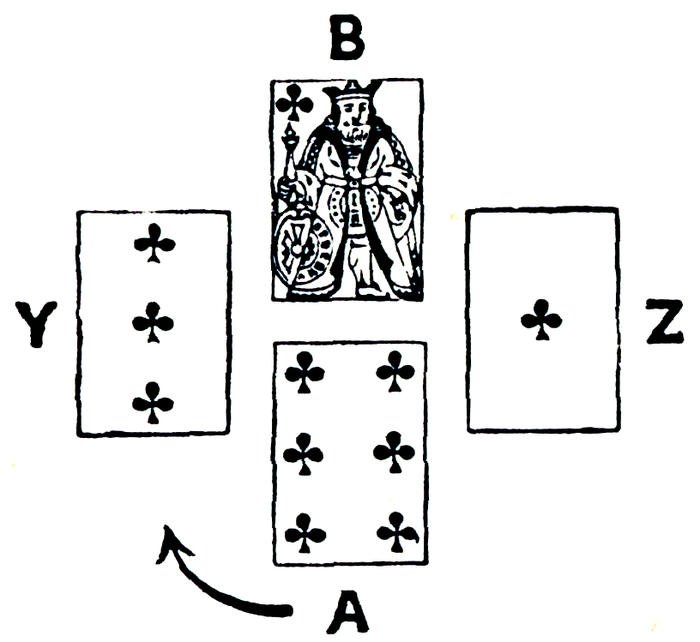
Tricks AB, 0
YZ, 1
1. Y B Z A↷
3♣ Kg♣ A♣ 6♣
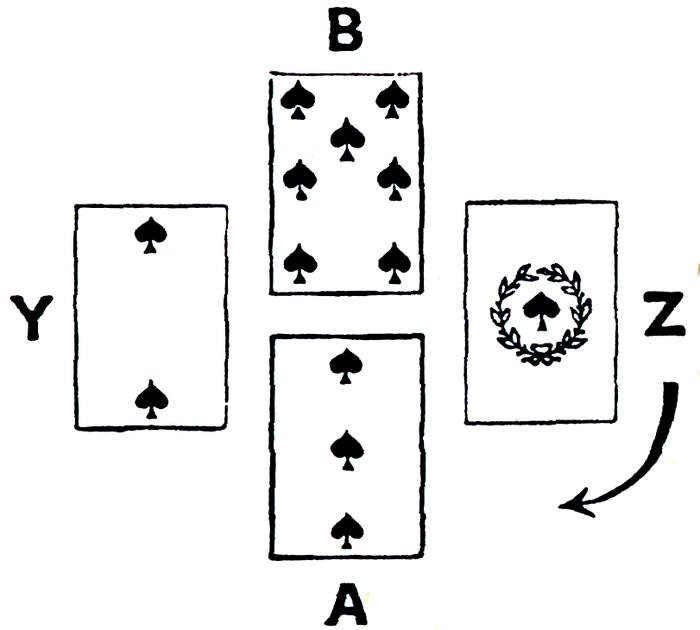
Tricks AB, 0
YZ, 2
2. Y B Z↷ A
2♠ 7♠ A♠ 3♠
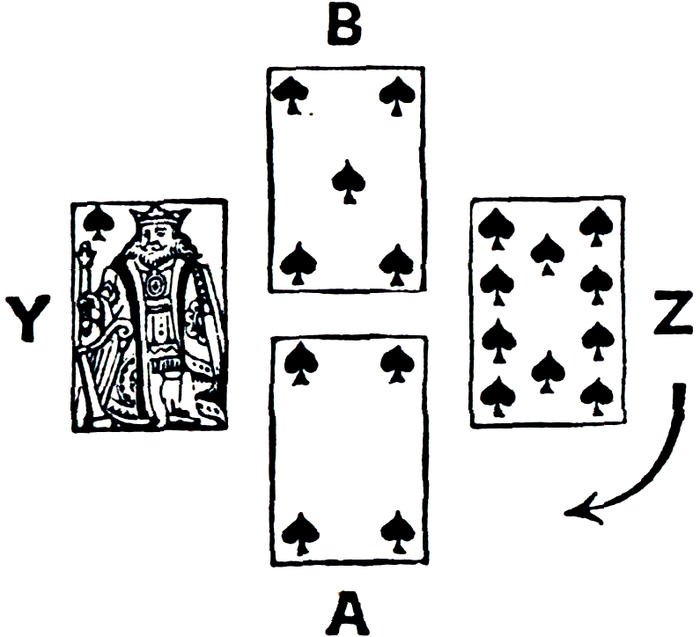
Tricks AB, 0
YZ, 3
3. Y B Z↷ A
Kg♠ 5♠ 10♠ 4♠
Remark.—B has called.
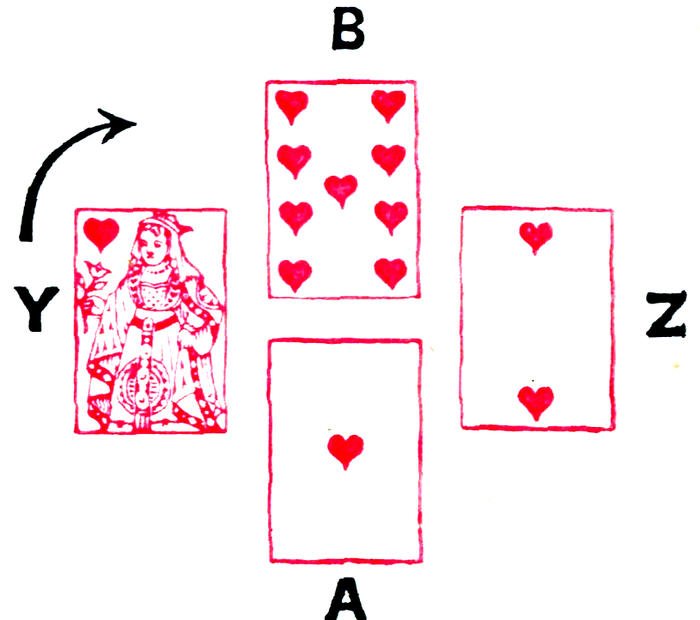
Tricks AB, 1
YZ, 3
4. Y↷ B Z A
Qn♥ 9♥ 2♥ A♥
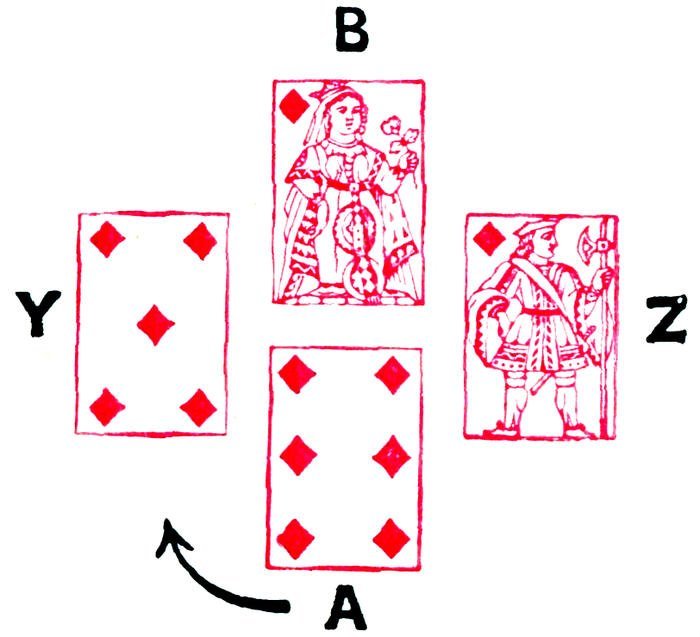
Tricks AB, 2
YZ, 3
5. Y B Z A↷
5♦ Qn♦ Knv♦ 6♦
Remark.—B has three of
trumps.
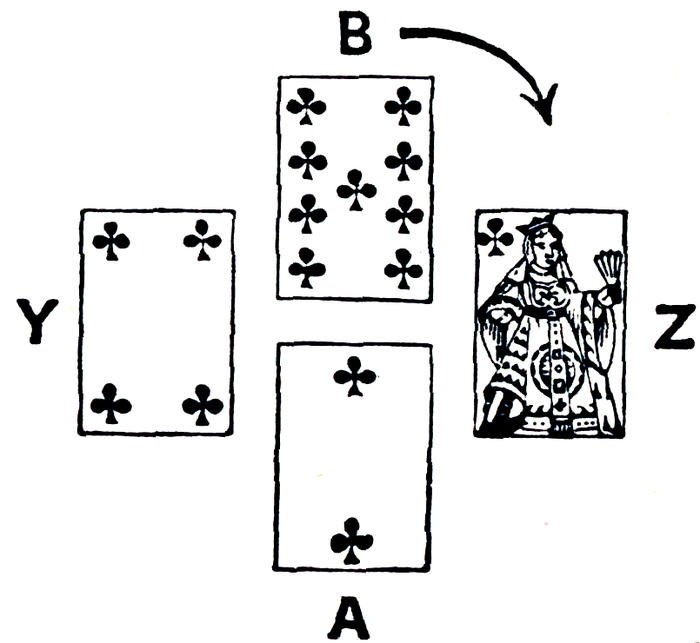
Tricks AB, 2
YZ, 4
6. Y B↷ Z A
4♣ 9♣ Qn♣ 2♣
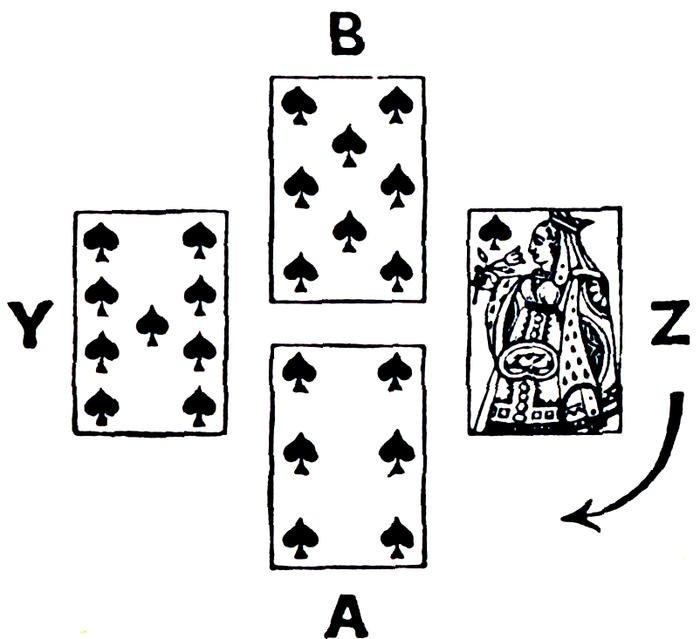
Tricks AB, 2
YZ, 5
7. Y B Z↷ A
9♠ 8♠ Qn♠ 6♠
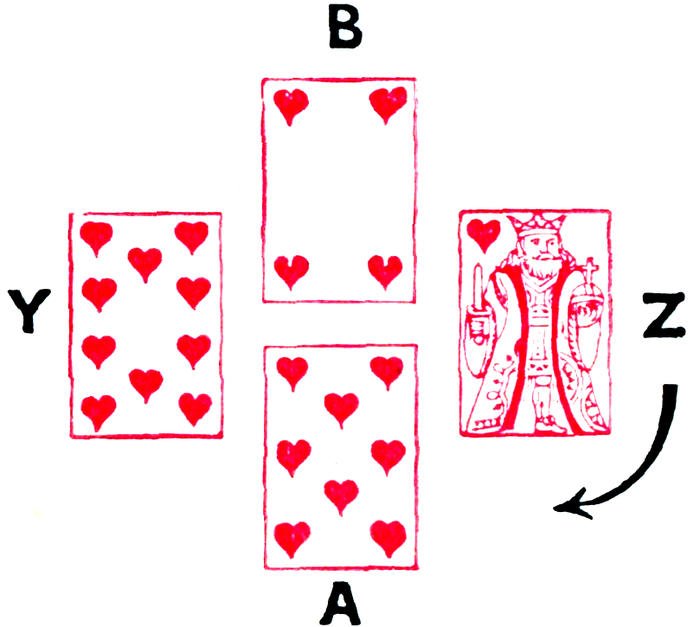
Tricks AB, 2
YZ, 6
8. Y B Z↷ A
10♥ 4♥ Kg♥ 8♥
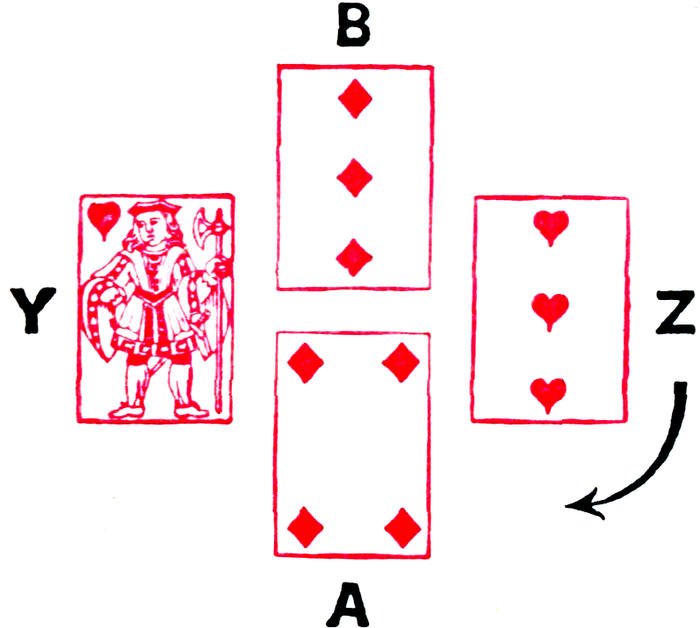
Tricks AB, 3
YZ, 6
9. Y B Z↷ A
Knv♥ 3♦ 3♥ 4♦
Remark.—A plays a masterly coup in trumping with
the four. He argues that B, having a weak hand, would
not call for trumps with less than five trumps, two
honours. If so, B has a trump too many, and Y must
make a trick in trumps, unless B can play the Grand
Coup with the three of trumps (see Remark, Trick 5).
B undertrumps his partner, the Grand coup.
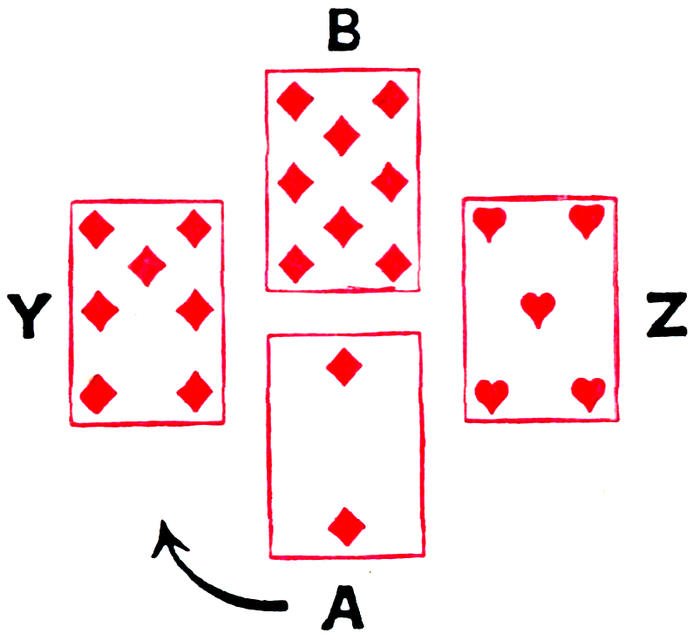
Tricks AB, 4
YZ, 6
10. Y B Z A↷
7♦ 8♦ 5♥ 2♦
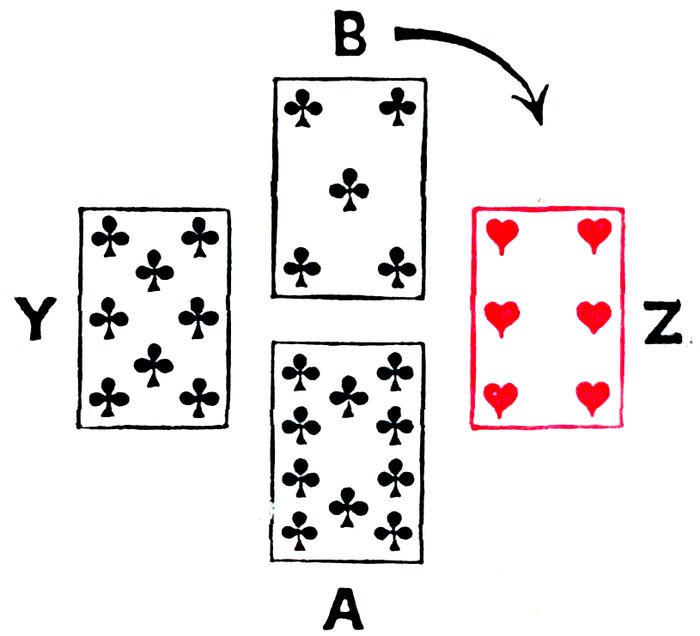
Tricks AB, 5
YZ, 6
11. Y B↷ Z A
8♣ 5♣ 6♥ 10♣
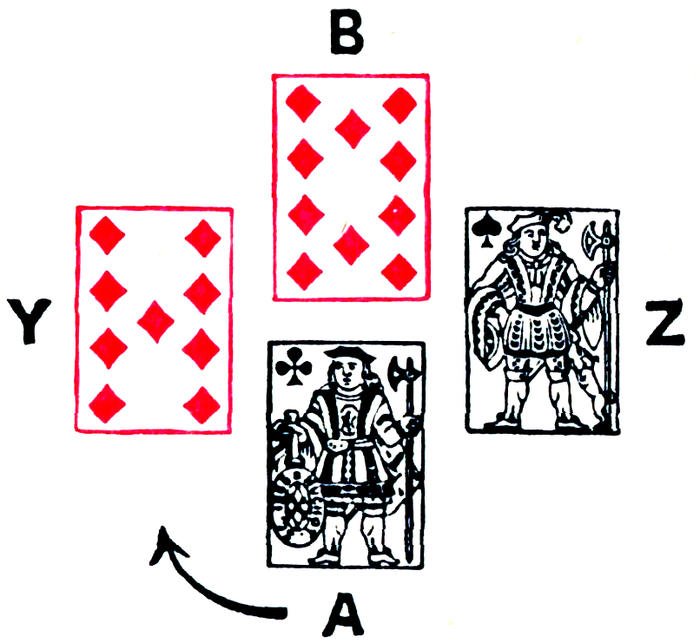
Tricks AB, 6
YZ, 6
12. Y B Z A↷
9♦ 10♦ Knv♠ Knv♣
and AB win the odd trick.
(A's hand is given above.)
| Y's Hand. |
B's Hand. |
Z's Hand. |
| Kg, 9, 2 |
♠ |
8, 7, 5 |
♠ |
Ace, Qn, Knv, 10 |
♠ |
| Qn, Knv, 10 |
♥ |
9, 4 |
♥ |
Kg, 7, 6, 5, 3, 2 |
♥ |
| 8, 4, 3 |
♣ |
Kg, 9, 5 |
♣ |
Ace, Qn |
♣ |
| Kg, 9, 7, 5 |
♦ |
Ace, Qn, 10, 8, 3 |
♦ |
Knv |
♦ |
At Trick 5 B can place all the remaining trumps; hence
he undertrumps his partner at Trick 10. Though his play
is very good, A's coup in trumping with the four, so as to
render B's coup possible, is entitled to the palm. Hence,
A's hand heads the example.
At Trick 9, Z ought to lead knave of spades, on which Y
should discard eight of clubs, when YZ win the game.