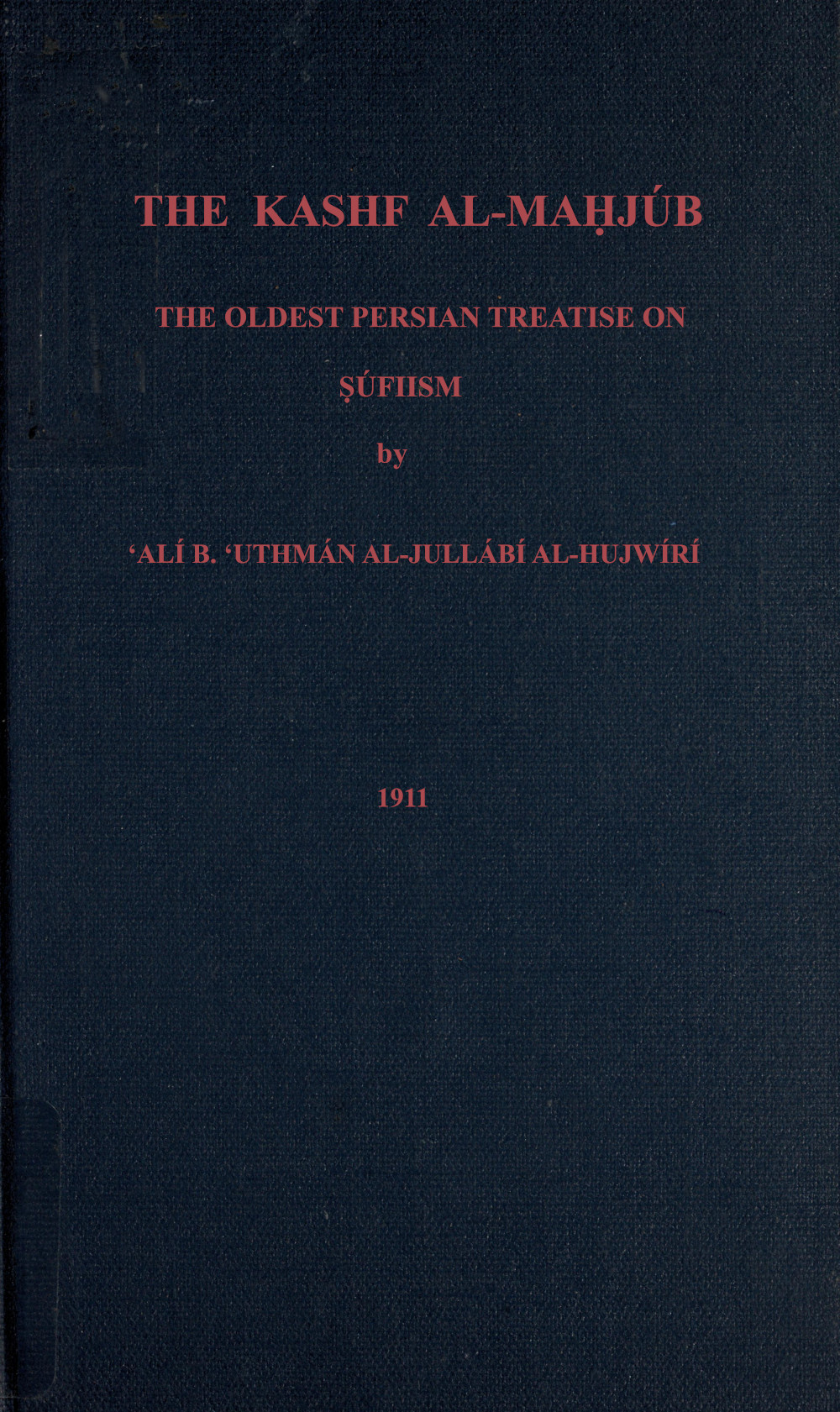
Footnotes have been collected at the end of each chapter, and are
linked for ease of reference.
There is an editorial list of corrections and additions. These,
along with the errors they mention, are retained in this version.
Minor errors, deemed attributable to the printer, have been corrected.
Please see the transcriber’s note at the end of this text
for details.
The cover image has been enhanced with basic information from the
title page, and, as modified, placed in the public domain.
Corrections are indicated using an underline
highlight. Placing the cursor over the correction will produce the
original text in a small popup.
Corrections are indicated as hyperlinks, which will navigate the
reader to the corresponding entry in the corrections table in the
note at the end of the text.
“E. J. W. GIBB MEMORIAL”
SERIES.
VOL. XVII.
THE OLDEST PERSIAN TREATISE ON
ṢÚFIISM
BY
‘ALÍ B. ‘UTHMÁN AL-JULLÁBÍ AL-HUJWÍRÍ
TRANSLATED FROM THE TEXT OF THE LAHORE EDITION,
COMPARED WITH MSS. IN THE INDIA OFFICE AND
BRITISH MUSEUM.
BY
REYNOLD A. NICHOLSON, Litt.D.
LECTURER IN PERSIAN IN THE UNIVERSITY OF CAMBRIDGE;
FORMERLY FELLOW OF TRINITY COLLEGE.
AND
PRINTED FOR THE TRUSTEES OF THE
“E. J. W. GIBB MEMORIAL”.
VOLUME XVII.
LEYDEN: E. J. BRILL, Imprimerie Orientale.
LONDON: LUZAC & CO., 46 Great Russell Street.
1911.
IPRINTED BY
STEPHEN AUSTIN AND SONS, LTD.
HERTFORD.
“E. J. W. GIBB MEMORIAL” SERIES.
PUBLISHED,
1. The Bábar-náma, reproduced in facsimile from a MS. belonging to the late Sir Sálár Jang of Ḥaydarábád, and edited with Preface and Indexes, by Mrs. Beveridge, 1905. (Out of print.)
2. An abridged translation of Ibn Isfandiyár’s History of Ṭabaristán, by Edward G. Browne, 1905. Price 8s.
3. Translation of al-Khazrají’s History of the Rasúlí Dynasty of Yaman, with introduction by the late Sir J. Redhouse, now edited by E. G. Browne, R. A. Nicholson, and A. Rogers. Vols. I and II of the Translation, 1906, 1907. Price 7s. each. Vol. III, containing the Annotations, 1908. Price 5s. (Vol. IV, containing the Text, in the Press.)
4. Umayyads and `Abbásids: being the Fourth Part of Jurjí Zaydán’s
History of Islamic Civilisation, translated by Professor D. S.
Margoliouth, D.Litt., 1907. Price 5s.
5. The Travels of Ibn Jubayr, the late Dr. William Wright’s edition of
the Arabic text, revised by the late Professor M. J. de Goeje, 1907.
Price 6s.
6. Yáqút’s Dictionary of Learned Men, entitled Irshádu’l-aríb ilá
ma‘rifati’l-adíb, or Mu‘jamu’l-Udabá: edited from the Bodleian MS.
by Professor D. S. Margoliouth, D.Litt. Vols. I, II, 1907, ’09.
Price 8s. each. Vol. III, part 1, 1910. Price 5s. (Further volumes
in preparation.)
7. The Tajáribu´l-Umam of Ibn Miskawayh: reproduced in facsimile
from MSS. Nos. 3116-3121 of Áyâ Sofia, with Preface and
Summary by the Principe di Teano. Vol. I (to A.H. 37), 1909.
Price 7s. (Further volumes in preparation.)
8. The Marzubán-náma of Sa`du´d-Dín-i-Waráwíní, edited by Mírzá
Muḥammad of Qazwín, 1909. Price 8s.
9. Textes persans relatifs à la secte des Ḥouroûfîs publiés, traduits,
et annotés par Clément Huart, suivis d’une étude sur la religion des
Ḥouroûfîs par “Feylesouf Rizá”, 1909. Price 8s.
10. The Mu`jam fí Ma`áyíri Ash`ári´l-`Ajam of Shams-i-Qays, edited from
the British Museum MS. (Or. 2814) by Edward G. Browne and
Mírzá Muḥammad of Qazwín, 1909. Price 8s.
11. The Chahár Maqála of Nidhámí-i-`Arúḍí-i-Samarqandí, edited, with
notes in Persian, by Mírzá Muḥammad of Qazwín, 1910. Price 8s.
12. Introduction à l’Histoire des Mongols de Fadl Allah Rashid ed-Din
par E. Blochet, 1910. Price 8s.
13. The Díwán of Ḥassán b. Thábit (d. A.H. 54), edited by Hartwig
Hirschfeld, Ph.D., 1910. Price 5s.
14. The Ta´ríkh-i-Guzída of Ḥamdu´lláh Mustawfí of Qazwín, reproduced
in facsimile from an old MS., with Introduction, Indices,
etc., by Edward G. Browne. Vol. I. Text. 1910. Price 15s.
15. The Earliest History of the Bábís, composed before 1852, by Ḥájji
Mírzá Jání of Káshán, edited from the unique Paris MS. (Suppl.
Persan, 1071) by Edward G. Browne. Price 8s.
16. The Ta´ríkh-i-Jabán-gushá of `Alá´u´d-Dín `Aṭá Malik-i-Juwayní,
edited from seven MSS. by Mírzá Muḥammad of Qazwín. Price 8s.
17. A translation of the Kashf al-Maḥjúb of `Alí b. `Uthmán al-Jullábí
al-Hujwírí, the oldest Persian manual of Ṣúfiism, by R. A. Nicholson.
Price 8s.
IN PREPARATION.
The History of the Mongols, from the Jámi`u´t-Tawáríkh of Rashídu´d-Din
Faḍlu´lláh, beginning with the account of Ogotáy, edited by
E. Blochet, comprising:—
Tome I: Histoire des tribus turques et mongoles, des ancêtres de
Tchinkkiz-Khan depuis Along-Goa, et de Tchinkkiz-Khan.
Tome II: Histoire des successeurs de Tchinkkiz-Khan, d’Ougédeï
à Témour-Kaan, des fils apanagés de Tchinkkiz-Khan, et des gouverneurs
Mongols de Perse d’Houlagou à Ghazan. (Sous presse.)
Tome III: Histoire de Ghazan, d’Oldjaïtou, et de Abou-Saïd.
An abridged translation of the Iḥyá´u´l-Mulúk, a Persian History of
Sístán by Sháh Ḥusayn, from the British Museum MS. (Or. 2779),
by A. G. Ellis.
The geographical part of the Nuzhatu´l-Qulúb of Ḥamdu´lláh Mustawfí
of Qazwín, with a translation, by G. Le Strange.
The Futúḥu Miṣr wa´l-Maghrib wa´l-Andalus of Abu´l-Qásim `Abdu´r-Raḥmán
b. `Abdu´lláh b. Abdu´l-Ḥakam al-Qurashí al-Miṣrí
(d. A.H. 257), edited by Professor C. C. Torrey.
The Qábús-náma, edited in the original Persian by E. Edwards.
Ta´ríkhu Miṣr, the History of Egypt, by Abú `Umar Muḥammad b. Yúsuf
al-Kindí (d. A.H. 350), edited from the unique MS. in the British
Museum (Add. 23,324) by A. Rhuvon Guest. (In the Press.)
The Ansáb of as-Sam`ání, reproduced in facsimile from the British
Museum MS. (Or. 23,355), with Indices by H. Loewe. (In the Press.)
The poems of four early Arabic poets. In two parts:—(1) The Díwáns of
`Ámir b. aṭ-Ṭufayl and `Abíd b. al-Abraṣ, edited by Sir Charles
J. Lyall, K.C.S.I.; (2) The Díwáns of aṭ-Ṭufayl b. `Awf and
Ṭirimmáḥ b. Ḥakím, edited by F. Krenkow.
The Kitábu´l-Raddi `alá ahli ´l-bida`i wal-ahwá´i of Makḥúl b. al-Mufaḍḍal
al-Nasafí (d. A.H. 318), edited from the Bodleian MS.
Pocock 271, with introductory Essay on the Sects of Islam, by
G. W. Thatcher, M.A.
A monograph on the Southern Dialects of Kurdish, by E. B. Soane.
This Volume is one
of a Series
published by the Trustees of the
“E. J. W. GIBB MEMORIAL”.
The Funds of this Memorial are derived from the interest accruing
from a sum of money given by the late MRS. GIBB of Glasgow, to
perpetuate the Memory of her beloved son
ELIAS JOHN WILKINSON GIBB,
and to promote those researches into the History, Literature, Philosophy,
and Religion of the Turks, Persians, and Arabs to which, from
his youth upwards, until his premature and deeply lamented death
in his 45th year on December 5, 1901, his life was devoted.
تِلْكَ آثَارُنَا تَدُلُّ عَلَيْنَا * فَٱنْظُرُوا بَعْدَنَا الي ٱلاَثَارِ
“The worker pays his debt to Death;
His work lives on, nay, quickeneth.”
The following memorial verse is contributed by `Abdu´l-Ḥaqq Ḥámid
Bey of the Imperial Ottoman Embassy in London, one of the Founders
of the New School of Turkish Literature, and for many years an
intimate friend of the deceased.
جمله يارانى وفاسيله ايدركن نطييب
کندی عمرنده وفاگورمدی اول ذاتِ اديب
گنج ايکن اولمش ايدی اوجِ کماله واصل
نه اولوردی ياشامش اولسه ايدی مستر گيب
“E. J. W. GIBB MEMORIAL.”
ORIGINAL TRUSTEES.
[JANE GIBB, died November 26, 1904],
E. G. BROWNE,
G. LE STRANGE,
H. F. AMEDROZ,
A. G. ELLIS,
R. A. NICHOLSON,
E. DENISON ROSS,
AND
IDA W. E. OGILVY GREGORY (formerly GIBB), appointed 1905.
CLERK OF THE TRUST.
JULIUS BERTRAM,
14 Suffolk Street, Pall Mall,
LONDON, S.W.
PUBLISHERS FOR THE TRUSTEES.
E. J. BRILL, LEYDEN.
LUZAC & CO., LONDON.
IICORRECTIONS AND ADDITIONS.
Page 2, penult. For (p. 3) read (p. 1).
p. 3, line 14 and l. 30. For (p. 3) read (p. 1).
p. 4, l. 18. For (p. 3) read (p. 1).
p. 4, l. 26. For just as the veil destroys revelation (mukáshafat) read just as
veiling destroys the unveiled object (mukáshaf).
p. 6, l. 4 and l. 16. For (p. 3) read (p. 1).
p. 51, l. 6. For Parg read Burk or Purg, and correct the note accordingly.
See Guy Le Strange, The Lands of the Eastern Caliphate, p. 292.
p. 54, l. 28. For the infectious cankers of the age read the cankers which
infect age after age.
p. 85, l. 19. For (sáḥib al-qulúb) read (ṣáḥi´l-qulúb). Ṣáḥí, “sober,” is the
antithesis of maghlúb, “enraptured.”
p. 127, l. 17. Foral-Inṭákíreadal-Anṭákí.
p. 130, l. 27. Although some writers give “Abu ´l-Ḥasan” as the kunya of
Núrí, the balance of authority is in favour of “Abu ´l-Ḥusayn”.
p. 131, n. 2. Add, See Goldziher in ZDMG., 61, 75 ff., and a passage in
Yáqút’s Irshád al-Aríb, ed. by Margoliouth, vol. iii, pt. i, 153, 3 ff.;
cited by Goldziher in JRAS. for 1910, p. 888.
p. 140, l. 19. ForAbú Muḥammad `AbdalláhreadAbú `Abdalláh.
p. 155, l. 26. OmitB.beforeDulaf.
p. 169, l. 1. OmitB.before`Alí.
p. 173, l. 11. For Pádsháh-i read Pádisháh-i.
p. 182, l. 26. Sháhmurghí is probably a mistake for siyáh murghí, “a blackbird.”
Cf. my edition of the Tadhkirat al-Awliyá, ii, 259, 23.
This translation of the most ancient and celebrated Persian
treatise on Ṣúfiism will, I hope, be found useful not only by the
small number of students familiar with the subject at first hand,
but also by many readers who, without being Orientalists
themselves, are interested in the general history of mysticism
and may wish to compare or contrast the diverse yet similar
manifestations of the mystical spirit in Christianity, Buddhism,
and Islam. The origin of Ṣúfiism and its relation to these great
religions cannot properly be considered here, and I dismiss such
questions the more readily because I intend to deal with them
on another occasion. It is now my duty to give some account
of the author of the Kashf al-Maḥjúb, and to indicate the
character of his work.
Abu ´l-Ḥasan `Alí b. `Uthmán b. `Alí al-Ghaznawí al-Jullábí
al-Hujwírí[1] was a native of Ghazna in Afghanistan.[2] Of his
life very little is known beyond what he relates incidentally in
the Kashf al-Maḥjúb. He studied Ṣúfiism under Abu ´l-Faḍl
Muḥammad b. al-Ḥasan al-Khuttalí[3] (p. 166), who was a pupil
of Abu ´l-Ḥasan al-Ḥuṣrí (ob. 371 A.H.), and under Abu ´l-`Abbás
Aḥmad b. Muḥammad al-Ashqání or al-Shaqání[4] (p. 168). He
xviiialso received instruction from Abu ´l-Qásim Gurgání[5] (p. 169)
and Khwája Muẕaffar[6] (p. 170), and he mentions a great number
of Shaykhs whom he had met and conversed with in the course
of his wanderings. He travelled far and wide through the
Muḥammadan empire from Syria to Turkistán and from the
Indus to the Caspian Sea. Among the countries and places
which he visited were Ádharbáyaján (pp. 57 and 410), the tomb
of Báyazíd at Bisṭám (p. 68), Damascus, Ramla, and Bayt
al-Jinn in Syria (pp. 94, 167, 343), Ṭús and Uzkand (p. 234),
the tomb of Abú Sa`íd b. Abi ´l-Khayr at Mihna (p. 235), Merv
(p. 401), and the Jabal al-Buttam to the east of Samarcand
(p. 407). He seems to have settled for a time in `Iráq, where
he ran deeply into debt (p. 345). It may be inferred from a
passage on p. 364 that he had a short and unpleasant experience
of married life. Finally, according to the Riyáḍ al-Awliyá, he
went to reside at Lahore and ended his days in that city. His
own statement, however, shows that he was taken there as
a prisoner against his will (p. 91), and that in composing the
Kashf al-Maḥjúb he was inconvenienced by the loss of the
books which he had left at Ghazna. The date of his death is
given as 456 A.H. (1063-4 A.D.) or 464 A.H. (1071-2 A.D.), but
it is likely that he survived Abu ´l-Qásim al-Qushayrí, who
died in 465 A.H. (1072 A.D.). Rieu’s observation (Cat. of the
Persian MSS. in the British Museum, i, 343) that the author
classes Qushayrí with the Ṣúfís who had passed away before
the time at which he was writing, is not quite accurate. The
author says (p. 161): “Some of those whom I shall mention in
this chapter are already deceased, and some are still living.”
But of the ten Ṣúfís in question only one, namely, Abu ´l-Qásim
Gurgání, is referred to in terms which leave no doubt that he
was alive when the author wrote. In the Safínat al-Awliyá,
No. 71, it is stated that Abu ´l-Qásim Gurgání died in 450 A.H.
If this date were correct, the Kashf al-Maḥjúb must have been
written at least fifteen years before Qushayrí’s death. On the
other hand, my MS. of the Shadharát al-Dhahab records the
xixdeath of Abu ´l-Qásim Gurgání under the year 469 A.H., a date
which appears to me more probable, and in that case the
statement that the author survived Qushayrí may be accepted,
although the evidence on which it rests is mainly negative, for
we cannot lay much stress on the fact that Qushayrí’s name is
sometimes followed by the Moslem equivalent for “of blessed
memory”. I conjecture, then, that the author died between
465 and 469 A.H.[7] His birth may be placed in the last decade
of the tenth or the first decade of the eleventh century of our
era, and he must have been in the prime of youth when Sultan
Maḥmúd died in 421 A.H. (1030 A.D.). The Risála-i Abdáliyya,[8]
a fifteenth century treatise on the Muḥammadan saints by
Ya`qúb b. `Uthmán al-Ghaznawí, contains an anecdote, for
which it would be hazardous to claim any historical value, to
the effect that al-Hujwírí once argued in Maḥmúd’s presence
with an Indian philosopher and utterly discomfited him by an
exhibition of miraculous powers. Be that as it may, he was
venerated as a saint long after his death, and his tomb at Lahore
was being visited by pilgrims when Bakhtáwar Khán wrote the
Riyáḍ al-Awliyá in the latter half of the seventeenth century.
In the introduction to the Kashf al-Maḥjúb al-Hujwírí complains
that two of his former works had been given to the
public by persons who erased his name from the title-page,
and pretended that they themselves were the authors. In
order to guard against the repetition of this fraud, he has
inserted his own name in many passages of the present work.
His writings, to which he has occasion to refer in the Kashf
al-Maḥjúb, are—
1. A díwán (p. 2).
2. Minháj al-dín, on the method of Ṣúfiism (p. 2). It comprised
a detailed account of the Ahl-i Ṣuffa (p. 80) and a full
biography of Ḥusayn b. Manṣúr al-Ḥalláj (p. 153).
xx3. Asrár al-khiraq wa ´l-ma´únát, on the patched frocks
of the Ṣúfís (p. 56).
4. Kitáb-i faná ú baqá, composed “in the vanity and rashness
of youth” (p. 60).
5. A work, of which the title is not mentioned, in explanation
of the sayings of Ḥusayn b. Manṣúr al-Ḥalláj (p. 153).
6. Kitáb al-bayán li-ahl al-`iyán, on union with God (p. 259).
7. Baḥr al-qulúb (p. 259).
8. Al-Ri`áyat li-ḥuqúq Allah, on the Divine unity (p. 280).
9. A work, of which the title is not mentioned, on faith
(p. 286).
None of these books has been preserved.
The Kashf al-Maḥjúb,[9] which belongs to the later years of
the author’s life, and, partly at any rate, to the period of his
residence in Lahore, was written in reply to certain questions
addressed to him by a fellow-townsman, Abú Sa`íd al-Hujwírí.
Its object is to set forth a complete system of Ṣúfiism, not
to put together a great number of sayings by different Shaykhs,
but to discuss and expound the doctrines and practices of the
Ṣúfís. The author’s attitude throughout is that of a teacher
instructing a pupil. Even the biographical section of the
work (pp. 70-175) is largely expository. Before stating his
own view the author generally examines the current opinions
on the same topic and refutes them if necessary. The
discussion of mystical problems and controversies is enlivened
by many illustrations drawn from his personal experience.
In this respect the Kashf al-Maḥjúb is more interesting than
the Risála of Qushayrí, which is so valuable as a collection of
sayings, anecdotes, and definitions, but which follows a somewhat
formal and academic method on the orthodox lines. No
one can read the present work without detecting, behind the
scholastic terminology, a truly Persian flavour of philosophical
speculation.
Although he was a Sunní and a Ḥanafite, al-Hujwírí, like
many Ṣúfís before and after him, managed to reconcile his
xxitheology with an advanced type of mysticism, in which the
theory of “annihilation” (faná) holds a dominant place, but
he scarcely goes to such extreme lengths as would justify us
in calling him a pantheist. He strenuously resists and pronounces
heretical the doctrine that human personality can be
merged and extinguished in the being of God. He compares
annihilation to burning by fire, which transmutes the quality
of all things to its own quality, but leaves their essence
unchanged. He agrees with his spiritual director, al-Khuttalí,
in adopting the theory of Junayd that “sobriety” in the mystical
acceptation of the term is preferable to “intoxication”. He
warns his readers often and emphatically that no Ṣúfís, not
even those who have attained the highest degree of holiness,
are exempt from the obligation of obeying the religious law.
In other points, such as the excitation of ecstasy by music and
singing, and the use of erotic symbolism in poetry, his judgment
is more or less cautious. He defends al-Ḥalláj from the
charge of being a magician, and asserts that his sayings are
pantheistic only in appearance, but condemns his doctrines as
unsound. It is clear that he is anxious to represent Ṣúfiism
as the true interpretation of Islam, and it is equally certain
that the interpretation is incompatible with the text.[10] Notwithstanding
the homage which he pays to the Prophet we
cannot separate al-Hujwírí, as regards the essential principles
of his teaching, from his older and younger contemporaries,
Abú Sa`íd b. Abi ´l-Khayr and `Abdalláh Anṣárí.[11] These
three mystics developed the distinctively Persian theosophy
which is revealed in full-blown splendour by Faríd al-dín `Aṭṭár
and Jalál al-dín Rúmí.
The most remarkable chapter in the Kashf al-Maḥjúb is the
fourteenth, “Concerning the Doctrines held by the different
sects of Ṣúfís,” in which the author enumerates twelve mystical
xxiischools and explains the special doctrine of each.[12] So far as
I know, he is the first writer to do this. Only one of the schools
mentioned by him, namely, that of the Malámatís, seems to
be noticed in earlier books on Ṣúfiism; such brief references
to the other schools as occur in later books, for example in the
Tadhkirat al-Awliyá, are probably made on his authority.
The question may be asked, “Did these schools really exist, or
were they invented by al-Hujwírí in his desire to systematize
the theory of Ṣúfiism?” I see no adequate ground at present
for the latter hypothesis, which involves the assumption that
al-Hujwírí made precise statements that he must have known
to be false. It is very likely, however, that in his account of
the special doctrines which he attributes to the founder of each
school he has often expressed his own views upon the subject
at issue and has confused them with the original doctrine.
The existence of these schools and doctrines, though lacking
further corroboration,[13] does not seem to me incredible; on
the contrary, it accords with what happened in the case
of the Mu`tazilites and other Muḥammadan schismatics.
Certain doctrines were produced and elaborated by well-known
Shaykhs, who published them in the form of tracts or
were content to lecture on them until, by a familiar process,
the new doctrine became the pre-eminent feature of a particular
school. Other schools might then accept or reject it. In some
instances sharp controversy arose, and the novel teaching gained
so little approval that it was confined to the school of its author
or was embraced only by a small minority of the Ṣúfí brotherhood.
More frequently it would, in the course of time, be
drawn into the common stock and reduced to its proper level.
Dr. Goldziher has observed that Ṣúfiism cannot be regarded
as a regularly organized sect within Islam, and that its dogmas
xxiiicannot be compiled into a regular system.[14] That is perfectly
true, but after allowing for all divergences there remains
a fairly definite body of doctrine which is held in common
by Ṣúfís of many different shades and is the result of gradual
agglomeration from many different minds.
It is probable that oral tradition was the main source from
which al-Hujwírí derived the materials for his work. Of extant
treatises on Ṣúfiism he mentions by name only the Kitáb
al-Luma` by Abú Naṣr al-Sarráj, who died in 377 or 378 A.H.
This book is written in Arabic and is the oldest specimen
of its class. Through the kindness of Mr. A. G. Ellis, who
has recently acquired the sole copy that is at present known
to Orientalists, I have been able to verify the reading of
a passage quoted by al-Hujwírí (p. 341), and to assure myself
that he was well acquainted with his predecessor’s work.
The arrangement of the Kashf al-Maḥjúb is partially based
on that of the Kitáb al-Luma`, the two books resemble each
other in their general plan, and some details of the former
are evidently borrowed from the latter. Al-Hujwírí refers in
his notice of Ma`rúf al-Karkhí (p. 114) to the biographies of
Ṣúfís compiled by Abú `Abd al-Raḥmán al-Sulamí and
Abu ´l-Qásim al-Qushayrí. Although he does not give the
titles, he is presumably referring to Sulamí’s ṭabaqát Al-ṣúfiyya
and Qushayrí’s Risála.[15] The Kashf al-Maḥjúb contains a
Persian rendering of some passages in the Risála of Qushayrí,
with whom al-Hujwírí seems to have been personally acquainted.
A citation from `Abdalláh Anṣárí occurs on p. 26.
Manuscripts of the Kashf al-Maḥjúb are preserved in several
European libraries.[16] It has been lithographed at Lahore, and
Professor Schukovski of St. Petersburg is now, as I understand,
engaged in preparing a critical text. The Lahore edition is
inaccurate, especially in the spelling of names, but most of
xxivits mistakes are easy to emend, and the text agrees closely
with two MSS. in the Library of the India Office (Nos. 1773
and 1774 in Ethé’s Catalogue), with which I have compared it.
I have also consulted a good MS. in the British Museum
(Rieu’s Catalogue, i, 342). The following abbreviations are
used: L. to denote the Lahore edition, I. to denote the India
Office MS. 1773 (early seventeenth century), J. to denote the
India Office MS. 1774 (late seventeenth century), and B. to
denote the British Museum MS. Or. 219 (early seventeenth
century). In my translation I have, of course, corrected the
Lahore text where necessary. While the doubtful passages
are few in number, there are, I confess, many places in which
a considerable effort is required in order to grasp the author’s
meaning and follow his argument. The logic of a Persian
Ṣúfí must sometimes appear to European readers curiously
illogical. Other obstacles might have been removed by means
of annotation, but this expedient, if adopted consistently, would
have swollen the volume to a formidable size.
The English version is nearly complete, and nothing of
importance has been omitted, though I have not hesitated to
abridge when opportunity offered. Arabists will remark an
occasional discrepancy between the Arabic sayings printed
in italics and the translations accompanying them: this is
due to my having translated, not the original Arabic, but the
Persian paraphrase given by al-Hujwírí.
Reynold A. Nicholson.
1KASHF AL-MAḤJÚB.
INTRODUCTION.
In the Name of God, the Merciful, the Compassionate.
O Lord, bestow on us mercy from Thyself and provide for us
a right course of action!
Praise be to God, who hath revealed the secrets of His kingdom
to His Saints, and hath disclosed the mysteries of His
power to His intimates, and hath shed the blood of Lovers
with the sword of His glory, and hath let the hearts of
Gnostics taste the joy of His communion! He it is that
bringeth dead hearts to life by the radiance of the perception
of His eternity and His majesty, and reanimates them
with the comforting spirit of knowledge by divulging His
Names.
And peace be upon His Apostle, Muḥammad, and his family and
his companions and his wives!
`Alí b. `Uthmán b. `Alí al-Jullábí al-Ghaznawí al-Hujwírí
(may God be well pleased with him!) says as follows:—
I have asked God’s blessing, and have cleared my heart of
motives related to self, and have set to work in accordance with
your invitation—may God make you happy!—and have firmly
resolved to fulfil all your wishes by means of this book. I have
entitled it “The Revelation of The Mystery”. Knowing what
you desire, I have arranged the book in divisions suitable to
your purpose. Now I pray God to aid and prosper me in its
completion, and I divest myself of my own strength and ability
in word and deed. It is God that gives success.
2Section.
Two considerations have impelled me to put my name at the
beginning of the book: one particular, the other general.[17] As
regards the latter, when persons ignorant of this science see
a new book, in which the author’s name is not set down in
several places, they attribute his work to themselves, and thus
the author’s aim is defeated, since books are compiled, composed,
and written only to the end that the author’s name may be kept
alive and that readers and students may pronounce a blessing
on him. This misfortune has already befallen me twice.
A certain individual borrowed my poetical works, of which
there was no other copy, and retained the manuscript in his
possession, and circulated it, and struck out my name which
stood at its head, and caused all my labour to be lost. May
God forgive him! I also composed another book, entitled
“The Highway of Religion” (Minháj al-Dín), on the method
of Ṣúfiism—may God make it flourish! A shallow pretender,
whose words carry no weight, erased my name from the
title page and gave out to the public that he was the author,
notwithstanding that connoisseurs laughed at his assertion.
God, however, brought home to him the unblessedness of
this act and erased his name from the register of those who
seek to enter the Divine portal.
As regards the particular consideration, when people see
a book, and know that its author is skilled in the branch of
science of which it treats, and is thoroughly versed therein,
they judge its merits more fairly and apply themselves more
seriously to read and remember it, so that both author and
reader are better satisfied. The truth is best known to God.God.
Section.
In using the words “I have asked God’s blessing” (p. 3),
I wished to observe the respect due to God, who said to His
3Apostle: “When you read the Koran, take refuge with God from
the stoned Devil” (Kor. xvi, 100). “To ask blessing” means
“to commit all one’s affairs to God and to be saved from the
various sorts of contamination”. The Prophet used to teach his
followers to ask a blessing (istikhárat) just as he taught them
the Koran. When a man recognizes that his welfare does not
depend on his own effort and foresight, but that every good and
evil that happens to him is decreed by God, who knows best
what is salutary for him, he cannot do otherwise than surrender
himself to Destiny and implore God to deliver him from the
wickedness of his own soul.
Section.
As to the words “I have cleared my heart of all motives
related to self” (p. 3), no blessing arises from anything in
which selfish interest has a part. If the selfish man succeeds in
his purpose, it brings him to perdition, for “the accomplishment
of a selfish purpose is the key of Hell”; and if he fails, he will
nevertheless have removed from his heart the means of gaining
salvation, for “resistance to selfish promptings is the key of
Paradise”, as God hath said: “Whoso refrains his soul from
lust, verily Paradise shall be his abode” (Kor. lxxix, 40-1).
People act from selfish motives when they desire aught except
to please God and to escape from Divine punishment. In
fine, the follies of the soul have no limit and its manœuvres
are hidden from sight. If God will, a chapter on this subject
will be found at its proper place in the present book.
Section.
Now as to the words “I have set to work in accordance
with your invitation, and have firmly resolved to fulfil all
your wishes by means of this book” (p. 3), since you thought
me worthy of being asked to write this book for your instruction,
it was incumbent on me to comply with your request.
Accordingly it behoved me to make an unconditional resolution
4that I would carry out my undertaking completely. When
anyone begins an enterprise with the intention of finishing it,
he may be excused if imperfections appear in his work; and
for this reason the Prophet said: “The believer’s intention
is better than his performance.” Great is the power of
intention, through which a man advances from one category
to another without any external change. For example, if
anyone endures hunger for a while without having intended
to fast, he gets no recompense (thawáb) for it in the next
world; but if he forms in his heart the intention of fasting,
he becomes one of the favourites of God (muqarrabán). Again,
a traveller who stays for a time in a city does not become a
resident until he has formed the intention to reside there. A
good intention, therefore, is preliminary to the due performance
of every act.
Section.
When I said that I had called this book “The Revelation
of the Mystery” (p. 3), my object was that the title of the
book should proclaim its contents to persons of insight. You
must know that all mankind are veiled from the subtlety of
spiritual truth except God’s saints and His chosen friends;
and inasmuch as this book is an elucidation of the Way of
Truth, and an explanation of mystical sayings, and an uplifting
of the veil of mortality, no other title is appropriate to it.
Essentially, unveiling (kashf) is destruction of the veiled
object, just as the veil destroys revelation (mukáshafat), and
just as, for instance, one who is near cannot bear to be far,
and one who is far cannot bear to be near; or as an animal
which is generated from vinegar dies when it falls into any
other substance, while those animals which are generated
from other substances perish if they are put in vinegar. The
spiritual path is hard to travel except for those who were
created for that purpose. The Prophet said: “Everyone finds
easy that for which he was created.” There are two veils:
one is the “veil of covering” (ḥijáb-i rayní), which can never
5be removed, and the other is the “veil of clouding” (ḥijáb-i
ghayní), which is quickly removed. The explanation is as
follows: one man is veiled from the Truth by his essence
(dhát), so that in his view truth and falsehood are the same.
Another man is veiled from the Truth by his attributes (ṣifat),
so that his nature and heart continually seek the Truth
and flee from falsehood. Therefore the veil of essence, which
is that of “covering” (rayní), is never removed. Rayn is
synonymous with khatin (sealing) and ṭab` (imprinting). Thus
God hath said: “By no means: but their deeds have spread a
covering (rána) over their hearts” (Kor. lxxxiii, 14); then He
made the sense of this manifest and said: “Verily it is all one to
the unbelievers whether thou warnest them or no; they will not
believe” (Kor. ii, 5); then he explained the cause thereof, saying:
“God hath sealed up their hearts” (Kor. ii, 6). But the veil
of attributes, which is that of “clouding” (ghayní), may be
removed at times, for essence does not admit of alteration,
but the alteration of attributes is possible. The Ṣúfí Shaykhs
have given many subtle hints on the subject of rayn and ghayn.
Junayd said: Al-rayn min jumlat al-waṭanát wa ´l-ghayn min
jumlat al-khaṭarát, “Rayn belongs to the class of abiding
things and ghayn to the class of transient things.” Waṭan
is permanent and khaṭar is adventitious. For example, it is
impossible to make a mirror out of a stone, though many
polishers assemble to try their skill on it, but a rusty mirror
can be made bright by polishing; darkness is innate in the
stone, and brightness is innate in the mirror; since the essence
is permanent, the temporary attribute does not endure.
Accordingly, I have composed this book for polishers of
hearts which are infected by the veil of “clouding” but in which
the substance of the light of the Truth is existent, in order that
the veil may be lifted from them by the blessing of reading it,
and that they may find their way to spiritual reality. Those
whose being is compounded of denial of the truth and perpetration
of falsehood will never find their way thither, and this
book will be of no use to them.
6Section.
Now with reference to my words “knowing what you desire,
I have arranged the book in divisions suitable to your purpose”
(p. 3), a questioner cannot be satisfied until he makes his
want known to the person whom he interrogates. A question
presupposes a difficulty, and a difficulty is insoluble until its
nature is ascertained. Furthermore, to answer a question in
general terms is only possible when he who asks it has full
knowledge of its various departments and corollaries, but with
a beginner one needs to go into detail, and offer diverse
explanations and definitions; and in this case especially,
seeing that you—God grant you happiness!—desired me to
answer your questions in detail and write a book on the
matter.
Section.
I said, “I pray God to aid and prosper me” (p. 3), because
God alone can help a man to do good deeds. When God
assists anyone to perform acts deserving recompense, this is
truly “success given by God” (tawfíq). The Koran and the
Sunna attest the genuineness of tawfíq, and the whole Moslem
community are unanimous therein, except some Mu`tazilites
and Qadarites, who assert that the expression tawfíq is
void of meaning. Certain Ṣúfí Shaykhs have said, Al-tawfíq
huwa ´l-qudrat `ala ´l-ṭá`at `inda ´l-isti`mál, “When a man is
obedient to God he receives from God increased strength.”
In short, all human action and inaction is the act and creation
of God: therefore the strength whereby a man renders obedience
to God is called tawfíq. The discussion of this topic, however,
would be out of place here. Please God, I will now return to
the task which you have proposed, but before entering on it
I will set down your question in its exact form.
Section.
The questioner, Abú Sa`íd al-Hujwírí, said: “Explain to
me the true meaning of the Path of Ṣúfiism and the nature
7of the ‘stations’ (maqámát) of the Ṣúfís, and explain their
doctrines and sayings, and make clear to me their mystical
allegories, and the nature of Divine Love and how it is
manifested in human hearts, and why the intellect is unable
to reach the essence thereof, and why the soul recoils from
the reality thereof, and why the spirit is lulled in the purity
thereof; and explain the practical aspects of Ṣúfiism which
are connected with these theories.”
Answer.
The person questioned, `Alí b. `Uthmán al-Jullábí al-Hujwírí—may
God have mercy on him!—says:—
Know that in this our time the science of Ṣúfiism is obsolete,
especially in this country. The whole people is occupied
with following its lusts and has turned its back on the path
of quietism (riḍá), while the `ulamá and those who pretend
to learning have formed a conception of Ṣúfiism which is quite
contrary to its fundamental principles.
High and low alike are content with empty professions:
blind conformity has taken the place of spiritual enthusiasm.
The vulgar say, “We know God,” and the elect, satisfied if
they feel in their hearts a longing for the next world, say,
“This desire is vision and ardent love.” Everyone makes
pretensions, none attains to reality. The disciples, neglecting
their ascetic practices, indulge in idle thoughts, which they call
“contemplation”.
I myself (the author proceeds) have already written several
books on Ṣúfiism, but all to no purpose. Some false pretenders
picked out passages here and there in order to deceive the
public, while they erased and destroyed the rest; others
did not mutilate the books, but left them unread; others read
them, but did not comprehend their meaning, so they copied
the text and committed it to memory and said: “We can
discourse on mystical science.” Nowadays true spiritualism
is as rare as the Philosopher’s Stone (kibrít-i aḥmar); for it
8is natural to seek the medicine that fits the disease, and
nobody wants to mix pearls and coral with common remedies
like shalíthá[18] and dawá al-misk.[19] In time past the works
of eminent Ṣúfís, falling into the hands of those who could
not appreciate them, have been used to make lining for
caps or binding for the poems of Abú Nuwás and the
pleasantries of Jáḥiẕ. The royal falcon is sure to get its
wings clipped when it perches on the wall of an old
woman’s cottage. Our contemporaries give the name of
“law” to their lusts, pride and ambition they call “honour
and learning”, hypocrisy towards men “fear of God”, concealment
of anger “clemency”, disputation “discussion”, wrangling
and foolishness “dignity”, insincerity “renunciation”, cupidity
“devotion to God”, their own senseless fancies “divine knowledge”,
the motions of the heart and affections of the animal soul
“divine love”, heresy “poverty”, scepticism “purity”, disbelief
in positive religion (zandaqa) “self-annihilation”, neglect of
the Law of the Prophet “the mystic Path”, evil communication
with time-servers “exercise of piety”. As Abú Bakr al-Wásiṭí
said: “We are afflicted with a time in which there are neither
the religious duties of Islam nor the morals of Paganism nor
the virtues of Chivalry” (aḥlám-i dhawi ´l-ṃuruwwa). And
Mutanabbí says to the same effect:—[20]
“God curse this world! What a vile place for any camel-rider to alight in!
For here the man of lofty spirit is always tormented.”
Section.
Know that I have found this universe an abode of Divine
mysteries, which are deposited in created things. Substances
accidents, elements, bodies, forms, and properties—all these
are veils of Divine mysteries. From the standpoint of
9Unification (tawḥíd) it is polytheism to assert that any such
veils exist, but in this world everything is veiled, by its
being, from Unification, and the spirit is held captive by
admixture and association with phenomenal being. Hence
the intellect can hardly comprehend those Divine mysteries,
and the spirit can but dimly perceive the marvels of nearness
to God. Man, enamoured of his gross environment, remains
sunk in ignorance and apathy, making no attempt to cast
off the veil that has fallen upon him. Blind to the beauty
of Oneness, he turns away from God to seek the vanities of
this world and allows his appetites to domineer over his
reason, notwithstanding that the animal soul, which the Koran
(xii, 53) describes as “commanding to evil” (ammáratun bi
´l-sú´), is the greatest of all veils between God and Man.
Now I will begin and explain to you, fully and lucidly, what
you wish to know concerning the “stations” and the “veils”,
and I will interpret the expressions of the technicologists
(ahl-i ṣaná´i`), and add thereto some sayings of the Shaykhs
and anecdotes about them, in order that your object may be
accomplished and that any learned doctors of law or others
who look into this work may recognize that the Path of
Ṣúfiism has a firm root and a fruitful branch, since all the
Ṣúfí Shaykhs have been possessed of knowledge and have
encouraged their disciples to acquire knowledge and to
persevere in doing so. They have never been addicted to
frivolity and levity. Many of them have composed treatises
on the method of Ṣúfiism which clearly prove that their
minds were filled with divine thoughts.
1. Julláb and Hujwír were two suburbs of Ghazna. Evidently he resided for some
time in each of them.
2. Notices occur in the Nafaḥát al-Uns, No. 377; the Safínat al-Awliyá, No. 298
(Ethé’s Cat. of the Persian MSS. in the Library of the India Office, i, col. 304); the
Riyáḍ al-Awliyá, Or. 1745, f. 140a (Rieu’s Cat. of the Persian MSS. in the British
Museum, iii, 975). In the khátimat al-ṭab` on the last page of the Lahore edition
of the Kashf al-Maḥjúb he is called Ḥaḍrat-i Dátá Ganj-bakhsh `Alí al-Hujwírí.
3. Nafaḥát, No. 376. Through al-Khuttalí, al-Ḥuṣrí, and Abú Bakr al-Shiblí the
author of the Kashf al-Maḥjúb is spiritually connected with Junayd of Baghdád
(ob. 297 A.H.).
4. Ibid., No. 375. The nisba Shaqqání or Shaqání is derived from Shaqqán,
a village near Níshápúr.
7. The date 465 A.H. is given by Ázád in his biographical work on the famous men
of Balgrám, entitled Ma´áthir al-Kirám.
8. See Ethé’s Cat. of the Persian MSS. in the India Office Library, No. 1774 (2).
The author of this treatise does not call al-Hujwírí the brother of Abú Sa`íd b. Abi ´l-Khayr,
as Ethé says, but his spiritual brother (birádar-i ḥaqíqat).
9. Its full title is Kashf al-maḥjúb li-arbáb al-qulúb (Ḥájjí Khalífa, v, 215).
10. The author’s view as to the worthlessness of outward forms of religion is
expressed with striking boldness in his chapter on the Pilgrimage (pp. 326-9).
11. Many passages from the Kashf al-Maḥjúb are quoted, word for word, in Jámí’s
Nafaḥát al-Uns, which is a modernized and enlarged recension of `Abdalláh Anṣárí’s
Ṭabaqát al-Ṣúfiyya.
12. A summary of these doctrines will be found in the abstract of a paper on “The
Oldest Persian Manual of Ṣúfiism” which I read at Oxford in 1908 (Trans. of the
Third International Congress for the History of Religions, i, 293-7).
13. Some of al-Hujwírí’s twelve sects reappear at a later epoch as orders of dervishes,
but the pedigree of those orders which trace their descent from ancient Ṣúfís is
usually fictitious.
16. See Ethé’s Cat. of the Persian MSS. in the India Office Library, i, col. 970,
where other MSS. are mentioned, and Blochet, Cat. des manuscrits persans de la
Bibliothèque Nationale, i, 261 (No. 401).
17. The author’s meaning appears to be that one consideration has a special reference
to connoisseurs and competent persons, while the other has a general reference to the
public at large.
18. An electuary used as a remedy for paralysis of the tongue or mouth.
20. Mutanabbí, ed. by Dieterici, p. 662, l. 4 from foot.
CHAPTER I. On the Affirmation of Knowledge.
11
God hath said, describing the savants (`ulamá): “Of those
who serve God only the savants fear Him” (Kor. xxxv, 25).
The Prophet said: “To seek knowledge is obligatory on every
Moslem man and woman;” and he said also: “Seek knowledge
even in China.” Knowledge is immense and life is short:
therefore it is not obligatory to learn all the sciences, such
as Astronomy and Medicine, and Arithmetic, etc., but only
so much of each as bears upon the religious law: enough
astronomy to know the times (of prayer) in the night,
enough medicine to abstain from what is injurious, enough
arithmetic to understand the division of inheritances and
to calculate the duration of the `idda,[21] etc. Knowledge is
obligatory only in so far as is requisite for acting rightly.
God condemns those who learn useless knowledge (Kor. ii,
96), and the Prophet said: “I take refuge with Thee from
knowledge that profiteth naught.” Much may be done by
means of a little knowledge, and knowledge should not be
separated from action. The Prophet said: “The devotee
without divinity is like a donkey turning a mill,” because
the donkey goes round and round over its own tracks and
never makes any advance.
Some regard knowledge as superior to action, while others
put action first, but both parties are wrong. Unless action
is combined with knowledge, it is not deserving of recompense.
Prayer, for instance, is not really prayer, unless performed
with knowledge of the principles of purification and those
12which concern the qibla,[22] and with knowledge of the nature
of intention. Similarly, knowledge without action is not
knowledge. Learning and committing to memory are acts
for which a man is rewarded in the next world; if he gained
knowledge without action and acquisition on his part, he
would get no reward. Hence two classes of men fall into
error: firstly, those who claim knowledge for the sake of
public reputation but are unable to practise it, and in reality
have not attained it; and secondly, those who pretend that
practice suffices and that knowledge is unnecessary. It is
told of Ibráhím b. Adham that he saw a stone on which was
written, “Turn me over and read!” He obeyed, and found
this inscription: “Thou dost not practise what thou knowest;
why, then, dost thou seek what thou knowest not?” Ánas
b. Málik says: “The wise aspire to know, the foolish to
relate.” He who uses his knowledge as a means of winning
power and honour and wealth is no savant. The highest
pinnacle of knowledge is expressed in the fact that without
it none can know God.
Section.
Knowledge is of two kinds: Divine and Human. The
latter is worthless in comparison with the former, because
God’s knowledge is an attribute of Himself, subsisting in
Him, whose attributes are infinite; whereas our knowledge
is an attribute of ourselves, subsisting in us, whose attributes
are finite. Knowledge has been defined as “comprehension
and investigation of the object known”, but the best definition
of it is this: “A quality whereby the ignorant are made wise.”
God’s knowledge is that by which He knows all things existent
and non-existent: He does not share it with Man: it is not
capable of division nor separable from Himself. The proof of
it lies in the disposition of His actions (tartíb-i fi`lash), since
action demands knowledge in the agent as an indispensable
condition. The Divine knowledge penetrates what is hidden
13and comprehends what is manifest. It behoves the seeker to
Contemplate God in every act, knowing that God sees him and
all that he does.
Story. They relate that a leading man in Baṣra went to
his garden. By chance his eye fell upon the beautiful wife
of his gardener. He sent the fellow away on some business
and said to the woman: “Shut the gates.” She replied:
“I have shut them all except one, which I cannot shut.” He
asked: “Which one is that?” “The gate,” said she, “that
is between us and God.” On receiving this answer the man
repented and begged to be forgiven.
Ḥátim al-Aṣamm said: “I have chosen four things to know,
and have discarded all the knowledge in the world besides.”
He was asked: “What are they?” “One,” he answered, “is
this: I know that my daily bread is apportioned to me,
and will neither be increased nor diminished; consequently
I have ceased to seek to augment it. Secondly, I know that
I owe to God a debt which no other person can pay instead
of me; therefore I am occupied with paying it. Thirdly,
I know that there is one pursuing me (i.e. Death) from
whom I cannot escape; accordingly I have prepared myself
to meet him. Fourthly, I know that God is observing me;
therefore I am ashamed to do what I ought not.”
Section.
The object of human knowledge should be to know God
and His Commandments. Knowledge of “time” (`ilm-i waqt)[23],
and of all outward and inward circumstances of which the
due effect depends on “time”, is incumbent upon everyone.
This is of two sorts: primary and secondary. The external
14division of the primary class consists in making the Moslem’s
profession of faith, the internal division consists in the
attainment of true cognition. The external division of the
secondary class consists in the practice of devotion, the internal
division consists in rendering one’s intention sincere. The
outward and inward aspects cannot be divorced. The exoteric
aspect of Truth without the esoteric is hypocrisy, and the
esoteric without the exoteric is heresy. So, with regard to
the Law, mere formality is defective, while mere spirituality
is vain.
The Knowledge of the Truth (Ḥaqíqat) has three pillars—
(1) Knowledge of the Essence and Unity of God.
(2) Knowledge of the Attributes of God.
(3) Knowledge of the Actions and Wisdom of God.
The Knowledge of the Law (Sharí`at) also has three
pillars—
(1) The Koran.
(2) The Sunna.
(3) The Consensus (ijmá`) of the Moslem community.
Knowledge of the Divine Essence involves recognition, on
the part of one who is reasonable and has reached puberty,
that God exists externally by His essence, that He is infinite
and not bounded by space, that His essence is not the cause
of evil, that none of His creatures is like unto Him, that
He has neither wife nor child, and that He is the Creator
and Sustainer of all that your imagination and intellect can
conceive.
Knowledge of the Divine Attributes requires you to know
that God has attributes existing in Himself, which are not
He nor a part of Him, but exist in Him and subsist by
Him, e.g. Knowledge, Power, Life, Will, Hearing, Sight,
Speech, etc.
Knowledge of the Divine Actions is your knowledge that
God is the Creator of mankind and of all their actions, that
He brought the non-existent universe into being, that He
15predestines good and evil and creates all that is beneficial
and injurious.
Knowledge of the Law involves your knowing that God
has sent us Apostles with miracles of an extraordinary nature;
that our Apostle, Muḥammad (on whom be peace!), is a
true Messenger, who performed many miracles, and that
whatever he has told us concerning the Unseen and the Visible
is entirely true.
Section.
There is a sect of heretics called Sophists (Súfisṭá´iyán), who
believe that nothing can be known and that knowledge itself
does not exist. I say to them: “You think that nothing
can be known; is your opinion correct or not?” If they
answer “It is correct”, they thereby affirm the reality of
knowledge; and if they reply “It is not correct”, then to
argue against an avowedly incorrect assertion is absurd.
The same doctrine is held by a sect of heretics who are
connected with Ṣúfiism. They say that, inasmuch as nothing
is knowable, their negation of knowledge is more perfect than
the affirmation of it. This statement proceeds from their
folly and stupidity. The negation of knowledge must be
the result either of knowledge or of ignorance. Now it is
impossible for knowledge to deny knowledge; therefore
knowledge cannot be denied except by ignorance, which is
nearly akin to infidelity and falsehood; for there is no
connexion between ignorance and truth. The doctrine in
question is opposed to that of all the Ṣúfí Shaykhs, but is
commonly attributed to the Ṣúfís in general by people who
have heard it and embraced it. I commit them to God,
with Whom it rests whether they shall continue in their error.
If religion takes hold of them, they will behave more discreetly
and will not misjudge the Friends of God in this way and
will look more anxiously to what concerns themselves.
Although some heretics claim to be Ṣúfís in order to conceal
their own foulness under the beauty of others, why should it
16be supposed that all Ṣúfis are like these pretenders, and that
it is right to treat them all with disdain and contumely? An
individual who wished to pass for learned and orthodox, but
really was devoid of knowledge and religion, once said to
me in the course of debate: “There are twelve heretical
sects, and one of them flourishes amongst those who profess
Ṣúfiism” (mutaṣawwifa). I replied: “If one sect belongs
to us, eleven belong to you; and the Ṣúfís can protect
themselves from one better than you can from eleven.” All
this heresy springs from the corruption and degeneracy of
the times, but God has always kept His Saints hidden from
the multitude and apart from the ungodly. Well said that
eminent spiritual guide, `Alí b. Bundár al-Ṣayrafí[24]: “The
depravity of men’s hearts is in proportion to the depravity
of the age.”
Now in the following section I will cite some sayings of
the Ṣúfís as an admonition to those sceptics towards whom
God is favourably inclined.
Section.
Muḥammad b. Faḍl al-Balkhí says: “Knowledge is of three
kinds—from God, with God, and of God.” Knowledge of God
is the science of Gnosis (`ilm-i ma`rifat), whereby He is known
to all His prophets and saints. It cannot be acquired by
ordinary means, but is the result of Divine guidance and
information. Knowledge from God is the science of the Sacred
Law (`ilm-i sharí`at), which He has commanded and made
obligatory upon us. Knowledge with God is the science of
the “stations” and the “Path” and the degrees of the saints.
Gnosis is unsound without acceptance of the Law, and the Law
is not practised rightly unless the “stations” are manifested.
Abú `Alí Thaqafí[25] says: Al-`ilm ḥayát al-qalb min al-jahl
wa-núr al-`ayn min al-ẕulmat, “Knowledge is the life of the
17heart, which delivers it from the death of ignorance: it is the
light of the eye of faith, which saves it from the darkness of
infidelity.” The hearts of infidels are dead, because they are
ignorant of God, and the hearts of the heedless are sick, because
they are ignorant of His Commandments. Abú Bakr Warráq
of Tirmidh says: “Those who are satisfied with disputation
(kalám) about knowledge and do not practise asceticism (zuhd)
become zindíqs (heretics); and those who are satisfied with
jurisprudence (fiqh) and do not practise abstinence (wara`)become wicked.” This means that Unification (tawḥíd), without
works, is predestination (jabr), whereas the assertor of Unification
ought to hold the doctrine of predestination but to act
as though he believed in free will, taking a middle course
between free will and predestination. Such is the true sense
of another saying uttered by the same spiritual guide, viz.:
“Unification is below predestination and above free will.”
Lack of positive religion and of morality arises from
heedlessness (ghaflat). Well said that great master, Yaḥyá
b. Mu`ádh al-Rází: “Avoid the society of three classes of men—heedless
savants, hypocritical Koran-readers, and ignorant
pretenders to Ṣúfiism.” The heedless savants are they who
have set their hearts on worldly gain and paid court to
governors and tyrants, and have been seduced by their own
cleverness to spend their time in subtle disputations, and have
attacked the leading authorities on religion. The hypocritical
Koran-readers are they who praise whatever is done in
accordance with their desire, even if it is bad, and blame
whatever they dislike, even if it is good: they seek to ingratiate
themselves with the people by acting hypocritically. The
ignorant pretenders to Ṣúfiism are they who have never
associated with a spiritual director (pír), nor learned discipline
from a shaykh, but without any experience have thrown
themselves among the people, and have donned a blue mantle
(kabúdí), and have trodden the path of unrestraint.
Abú Yazíd Bisṭámí says: “I strove in the spiritual combat
for thirty years, and I found nothing harder to me than
18knowledge and its pursuit.” It is more easy for human nature
to walk on fire than to follow the road of knowledge, and an
ignorant heart will more readily cross the Bridge (Ṣiráṭ)
a thousand times than learn a single piece of knowledge; and
the wicked man would rather pitch his tent in Hell than put
one item of knowledge into practice. Accordingly you must
learn knowledge and seek perfection therein. The perfection
of human knowledge is ignorance of Divine knowledge. You
must know enough to know that you do not know. That is
to say, human knowledge is alone possible to Man, and
humanity is the greatest barrier that separates him from
Divinity. As the poet says:—
Al-`ajzu `an daraki ´l-idráki idráku
Wa ´l-waqfu fí ṭuruqi ´l-akhyári ishráku.
“True perception is to despair of attaining perception,
But not to advance on the paths of the virtuous is polytheism.”
He who will not learn and perseveres in his ignorance is
a polytheist, but to the learner, when his knowledge becomes
perfect, the reality is revealed, and he perceives that his
knowledge is no more than inability to know what his end
shall be, since realities are not affected by the names bestowed
upon them.
21. The period within which a woman, who has been divorced or whose husband has
died, may not marry again.
22. The point to which a Moslem turns his face when worshipping, viz. the Ka`ba.
23. “Time” (waqt) is used by Muḥammadan mystics to denote the spiritual state
in which anyone finds himself, and by which he is dominated at the moment. The
expression `ilm-i waqt occurs again in the notice of Abú Sulaymán al-Dárání
(chapter x, No. 17), where waqt is explained as meaning “the preservation of one’s
spiritual state”. According to a definition given by Sahl b. `Abdallah al-Tustarí,
waqt is “search for knowledge of the state, i.e. the decision (ḥukm) of a man’s state,
which exists between him and God in this world and hereafter”.
24. A famous Ṣúfí of Níshápúr, who died in 359 A.H. (Nafaḥát, No. 118).
25. Also a native of Níshápúr. He died in 328 A.H. (Nafaḥát, No. 248).
CHAPTER II. On Poverty.
19
Know that Poverty has a high rank in the Way of Truth,
and that the poor are greatly esteemed, as God said: “(Give
alms) unto the poor, who are kept fighting in God’s cause and
cannot go to and fro on the earth; whom the ignorant deem
rich forasmuch as they refrain (from begging).”[26] And again:
“Their sides are lifted from their beds while they call on their
Lord in fear and hope” (Kor. xxxii, 16). Moreover, the
Prophet chose poverty and said: “O God, make me live lowly
and die lowly and rise from the dead amongst the lowly!”
And he also said: “On the day of Resurrection God will say,
‘Bring ye My loved ones nigh unto Me;’ then the angels will
say, ‘Who are Thy loved ones?’ and God will answer them,
saying, ‘The poor and destitute.’” There are many verses
of the Koran and Traditions to the same effect, which on
account of their celebrity need not be mentioned here. Among
the Refugees (Muhájirín) in the Prophet’s time were poor men
(fuqará) who sat in his mosque and devoted themselves to the
worship of God, and firmly believed that God would give them
their daily bread, and put their trust (tawakkul) in Him. The
Prophet was enjoined to consort with them and take due care
of them; for God said: “Do not repulse those who call on their
Lord in the morning and in the evening, desiring His favour”
(Kor. vi, 52). Hence, whenever the Prophet saw one of them,
he used to say: “May my father and mother be your sacrifice!
since it was for your sakes that God reproached me.”
God, therefore, has exalted Poverty and has made it a special
distinction of the poor, who have renounced all things external
20and internal, and have turned entirely to the Causer; whose
poverty has become their pride, so that they lamented its going
and rejoiced at its coming, and embraced it and deemed all
else contemptible.
Now, Poverty has a form (rasm) and an essence (ḥaqíqat).
Its form is destitution and indigence, but its essence is fortune
and free choice. He who regards the form rests in the form
and, failing to attain his object, flees from the essence; but
he who has found the essence averts his gaze from all created
things, and, in complete annihilation, seeing only the All-One
he hastens towards the fullness of eternal life (ba-faná-yi kull
andar ru´yat-i kull ba-baqá-yi kull shitáft). The poor man
(faqír) has nothing and can suffer no loss. He does not
become rich by having anything, nor indigent by having
nothing: both these conditions are alike to him in respect of
his poverty. It is permitted that he should be more joyful
when he has nothing, for the Shaykhs have said: “The more
straitened one is in circumstances, the more expansive (cheerful
and happy) is one’s (spiritual) state,” because it is unlucky
for a dervish to have property: if he “imprisons” anything
(dar band kunad) for his own use, he himself is “imprisoned”
in the same proportion. The friends of God live by means
of His secret bounties. Worldly wealth holds them back from
the path of quietism (riḍá).
Story. A dervish met a king. The king said: “Ask a boon
of me.” The dervish replied: “I will not ask a boon from one
of my slaves.” “How is that?” said the king. The dervish
said: “I have two slaves who are thy masters: covetousness
and expectation.”
The Prophet said: “Poverty is glorious to those who are
worthy of it.” Its glory consists in this, that the poor man’s
body is divinely preserved from base and sinful acts, and his
heart from evil and contaminating thoughts, because his
outward parts are absorbed in (contemplation of) the manifest
blessings of God, while his inward parts are protected by
invisible grace, so that his body is spiritual (rúḥání) and his
21heart divine (rabbání). Then no relation subsists between him
and mankind: this world and the next weigh less than a gnat’s
wing in the scales of his poverty: he is not contained in the
two worlds for a single moment.
Section.
The Ṣúfí Shaykhs differ in opinion as to whether poverty
or wealth is superior, both being regarded as human attributes;
for true wealth (ghiná) belongs to God, who is perfect in all
His attributes. Yaḥyá b. Mu`ádh al-Rází, Aḥmad b. Abi ´l-Ḥawárí,
Ḥárith al-Muḥásibí, Abu ´l-`Abbás b. `Aṭá, Ruwaym,
Abu ´l-Ḥasan b. Sim`ún,[27] and among the moderns the Grand
Shaykh Abú Sa`íd Faḍlallah b. Muḥammad al-Mayhaní, all
hold the view that wealth is superior to poverty. They argue
that wealth is an attribute of God, whereas poverty cannot
be ascribed to Him: therefore an attribute common to God
and Man is superior to one that is not applicable to God.
I answer: “This community of designation is merely nominal,
and has no existence in reality: real community involves
mutual resemblance, but the Divine attributes are eternal and
the human attributes are created; hence your proof is false.”
I, who am `Alí b. `Uthmán al-Jullábí, declare that wealth is
a term that may fitly be applied to God, but one to which
Man has no right; while poverty is a term that may properly
be applied to Man, but not to God. Metaphorically a man
is called “rich”, but he is not really so. Again, to give
a clearer proof, human wealth is an effect due to various
causes, whereas the wealth of God, who Himself is the Author
of all causes, is not due to any cause. Therefore there is no
community in regard to this attribute. It is not allowable
to associate anything with God either in essence, attribute,
or name. The wealth of God consists in His independence
of anyone and in His power to do whatsoever He wills: such
He has always been and such He shall be for ever. Man’s
22wealth, on the other hand, is, for example, a means of
livelihood, or the presence of joy, or the being saved from sin,
or the solace of contemplation; which things are all of
phenomenal nature and subject to change.
Furthermore, some of the vulgar prefer the rich man to
the poor, on the ground that God has made the former
blest in both worlds and has bestowed the benefit of riches
on him. Here they mean by “wealth” abundance of worldly
goods and enjoyment of pleasures and pursuit of lusts.
They argue that God has commanded us to be thankful
for wealth and patient in poverty, i.e. patient in adversity
and thankful in prosperity; and that prosperity is essentially
better than adversity. To this I reply that, when God
commanded us to be thankful for prosperity He made thankfulness
the means of increasing our prosperity; but when
He commanded us to be patient in adversity He made
patience the means of drawing nigh unto Himself. He said:
“Verily, if ye return thanks, I will give you an increase”
(Kor. xiv, 7), and also, “God is with the patient” (Kor. ii, 148).
The Shaykhs who prefer wealth to poverty do not use
the term “wealth” in its popular sense. What they intend
is not “acquisition of a benefit” but “acquisition of the
Benefactor”; to gain union (with God) is a different thing
from gaining forgetfulness (of God). Shaykh Abú Sa`íd[28]—God
have mercy on him!—says: “Poverty is wealth in God”
(al-faqr huwa ´l-ghiná billáh), i.e. everlasting revelation of
the Truth. I answer to this, that revelation (mukáshafat)
implies the possibility of a veil (ḥijáb); therefore, if the
person who enjoys revelation is veiled from revelation by
the attribute of wealth, he either becomes in need of revelation
or he does not; if he does not, the conclusion is absurd, and
if he does, need is incompatible with wealth; therefore that
term cannot stand. Besides, no one has “wealth in God”
unless his attributes are permanent and his object is invariable;
wealth cannot coincide with the subsistence of an object or
23with the affirmation of the attributes of human nature, inasmuch
as the essential characteristics of mortality and phenomenal
being are need and indigence. One whose attributes still
survive is not rich, and one whose attributes are annihilated
is not entitled to any name whatever. Therefore “the rich
man is he who is enriched by God” (al-ghaní man aghnáhu
´lláh), because the term “rich in God” refers to the agent
(fá`il), whereas the term “enriched by God” denotes the
person acted upon (maf`úl); the former is self-subsistent,
but the latter subsists through the agent; accordingly self-subsistence
is an attribute of human nature, while subsistence
through God involves the annihilation of attributes. I, then,
who am `Alí b. `Uthmán al-Jullábí, assert that true wealth
is incompatible with the survival (baqá) of any attribute,
since human attributes have already been shown to be
defective and subject to decay; nor, again, does wealth
consist in the annihilation of these attributes, because a
name cannot be given to an attribute that no longer exists,
and he whose attributes are annihilated cannot be called
either “poor” or “rich”; therefore the attribute of wealth
is not transferable from God to Man, and the attribute of
poverty is not transferable from Man to God.
All the Ṣúfí Shaykhs and most of the vulgar prefer poverty
to wealth for the reason that the Koran and the Sunna
expressly declare it to be superior, and herein the majority
of Moslems are agreed. I find, among the anecdotes which
I have read, that on one occasion this question was discussed
by Junayd and Ibn `Aṭá. The latter maintained the superiority
of the rich. He argued that at the Resurrection they would
be called to account for their wealth, and that such an account
(ḥisáb) entails the hearing of the Divine Word, without any
mediation, in the form of reproach (`itáb): and reproach is
addressed by the Beloved to the lover. Junayd answered:
“If He will call the rich to account, He will ask the poor
for their excuse; and asking an excuse is better than calling
to account.” This is a very subtle point. In true love excuse
24is “otherness” (bégánagí) and reproach is contrary to unity
(yagánagí). Lovers regard both these things as a blemish,
because excuse is made for some disobedience to the command
of the Beloved and reproach is made on the same score;
but both are impossible in true love, for then neither does
the Beloved require an expiation from the lover nor does the
lover neglect to perform the will of the Beloved.
Every man is “poor”, even though he be a prince. Essentially
the wealth of Solomon and the poverty of Solomon are one.
God said to Job in the extremity of his patience, and likewise to
Solomon in the plenitude of his dominion: “Good servant that
thou art!”[29] When God’s pleasure was accomplished, it made
no difference between the poverty and the wealth of Solomon.
The author says: “I have heard that Abu ´l-Qásim Qushayrí—God
have mercy on him!—said: ‘People have spoken much
concerning poverty and wealth, and have chosen one or the
other for themselves, but I choose whichever state God chooses
for me and keeps me in; if He keeps me rich I will not be
forgetful, and if He wishes me to be poor I will not be covetous
and rebellious.’” Therefore, both wealth and poverty are
Divine gifts: wealth is corrupted by forgetfulness, poverty by
covetousness. Both conceptions are excellent, but they differ in
practice. Poverty is the separation of the heart from all but
God, and wealth is the preoccupation of the heart with that
which does not admit of being qualified. When the heart is
cleared (of all except God), poverty is not better than wealth
nor is wealth better than poverty. Wealth is abundance of
worldly goods and poverty is lack of them: all goods belong to
God: when the seeker bids farewell to property, the antithesis
disappears and both terms are transcended.
Section.
All the Ṣúfí Shaykhs have spoken on the subject of poverty.
I will now cite as many of their sayings as it is possible to
include in this book.
25One of the moderns says: Laysa ´l-faqír man khalá min
al-zád: innama ´l-faqír man khalá min al-murád, “The poor
man is not he whose hand is empty of provisions, but he whose
nature is empty of desires.” For example, if God gives him
money and he desires to keep it, then he is rich; and if he
desires to renounce it, he is rich no less, because poverty
consists in ceasing to act on one’s own initiative. Yaḥyá b.
Mu`ádh al-Rází says: Al-faqr khawf al-faqr, “It is a sign of
true poverty that, although one has reached the perfection of
saintship and contemplation and self-annihilation, one should
always be dreading its decline and departure.” And Ruwaym
says: Min na`t al-faqír ḥifṣu sirrihi wa-ṣiyánatu nafsihi wa-adá´u
faríḍatihi, “It is characteristic of the poor man that his heart is
protected from selfish cares, and that his soul is guarded from
contaminations, and that he performs the obligatory duties of
religion:” that is to say, his inward meditations do not
interfere with his outward acts, nor vice versâ; which is a sign
that he has cast off the attributes of mortality. Bishr Ḥáfí
says: Afḍal al-maqámát i`tiqád al-ṣabr `ala ´l-faqr ila ´l-qabr,
“The best of ‘stations’ is a firm resolution to endure poverty
continually.” Now poverty is the annihilation of all “stations”:
therefore the resolution to endure poverty is a sign of regarding
works and actions as imperfect, and of aspiring to annihilate
human attributes. But in its obvious sense this saying
pronounces poverty to be superior to wealth, and expresses
a determination never to abandon it. Sḥiblí says: Al-faqír
man lá yastaghní bi-shay´in dúna ´lláh, “The poor man does not
rest content with anything except God,” because he has no
other object of desire. The literal meaning is that you will not
become rich except by Him, and that when you have gained
Him you have become rich. Your being, then, is other than God;
and since you cannot gain wealth except by renouncing “other”,
your “you-ness” is a veil between you and wealth: when that is
removed, you are rich. This saying is very subtle and obscure.
In the opinion of advanced spiritualists (ahl-i ḥaqíqat) it means:
Al-faqr an lá yustaghná `anhu, “Poverty consists in never
26being independent of poverty.” This is what the Pír, i.e. Master
`Abdalláh Anṣárí[30]—may God be well-pleased with him!—meant
when he said that our sorrow is everlasting, that our aspiration
never reaches its goal, and that our sum (kulliyyat)
never becomes non-existent in this world or the next, because
for the fruition of anything homogeneity is necessary, but God
has no congener, and for turning away from Him forgetfulness
is necessary, but the dervish is not forgetful. What an endless
task, what a difficult road! The dead (fání) never become
living (báqí), so as to be united with Him; the living never
become dead, so as to approach His presence. All that His
lovers do and suffer is entirely a probation (miḥnat); but in
order to console themselves they have invented a fine-sounding
phraseology (`ibáratí muzakhraf) and have produced “stations”
and “stages” and a “path”. Their symbolic expressions,
however, begin and end in themselves, and their “stations” do
not rise beyond their own genus, whereas God is exempt from
every human attribute and relationship. Abu ´l-Ḥasan Núrí
says: Na`t al-faqír al-sukún `inda ´l-`adam wa ´l-badhl `inda ´l-wujúd;
and he says also: Al-iḍṭiráb `inda ´l-wujúd, “When
he gets nothing he is silent, and when he gets something he
regards another person as better entitled to it than himself, and
therefore gives it away.” The practice enunciated in this saying
is of great importance. There are two meanings: (1) His
quiescence when he gets nothing is satisfaction (riḍá), and his
liberality when he gets something is love (maḥabbat), because
“satisfied” means “accepting a robe of honour” (qábil-i khil`at),
and the robe of honour is a token of proximity (qurbat) whereas
the lover (muḥibb) rejects the robe of honour inasmuch as it is
a token of severance (furqat); and (2) his quiescence when he
gets nothing is expectation of getting something, and when he
has got it, that “something” is other than God: he cannot be
satisfied with anything other than God; therefore he rejects it.
Both these meanings are implicit in the saying of the Grand
27Shaykh, Abu ´l-Qásim Junayd: Al-faqr khuluww al-qalb `an
al-ashkál, “When his heart is empty of phenomena he is poor.”
Since the existence of phenomena is “other” (than God), rejection
is the only course possible. Shiblí says: Al-faqr baḥr al-balá
wa-balá´uhu kulluhu `izzun, “Poverty is a sea of trouble, and all
troubles for His sake are glorious.” Glory is a portion of
“other”. The afflicted are plunged in trouble and know
nothing of glory, until they forget their trouble and regard the
Author thereof. Then their trouble is changed into glory, and
their glory into a spiritual state (waqt), and their spiritual state
into love, and their love into contemplation, so that finally the
brain of the aspirant becomes wholly a centre of vision through
the predominance of his imagination: he sees without eye, and
hears without ear. Again, it is glorious for a man to bear the
burden of trouble laid upon him by his Beloved, for in truth
misfortune is glory, and prosperity is humiliation. Glory is that
which makes one present with God, and humiliation is that
which makes one absent from God: the affliction of poverty is
a sign of “presence”, while the delight of riches is a sign of
“absence”. Therefore one should cling to trouble of any
description that involves contemplation and intimacy. Junayd
says: Yá ma`shar al-fuqará innakum tu`rafúna billáh wa-tukra-múna
lilláh fa-´nẕurú kayfa takúnúna ma`a a ´lláh idhá khalawtum
bihi, “O ye that are poor, ye are known through God, and are
honoured for the sake of God: take heed how ye behave when
ye are alone with Him,” i.e. if people call you “poor” and
recognize your claim, see that you perform the obligations of
the path of poverty; and if they give you another name,
inconsistent with what you profess, do not accept it, but fulfil
your professions. The basest of men is he who is thought to be
devoted to God, but really is not; and the noblest is he who is
not thought to be devoted to God, but really is. The former
resembles an ignorant physician, who pretends to cure people,
but only makes them worse, and when he falls ill himself needs
another physician to prescribe for him; and the latter is like
one who is not known to be a physician, and does not concern
28himself with other folk, but employs his skill in order to
maintain his own health. One of the moderns has said:
Al-faqr `adamun bilá wujúdin, “Poverty is not-being without
existence.” To interpret this saying is impossible, because
what is non-existent does not admit of being explained. On
the surface it would seem that, according to this dictum, poverty
is nothing, but such is not the case; the explanations and
consensus of the Saints of God are not founded on a principle
that is essentially non-existent. The meaning here is not “the
not-being of the essence”, but “the not-being of that which
contaminates the essence”; and all human attributes are
a source of contamination: when that is removed, the result is
annihilation of the attributes (faná-yi ṣifat), which deprives the
sufferer of the instrument whereby he attains, or fails to attain,
his object; but his not-going to the essence (`adam-i rawish
ba-`ayn) seems to him annihilation of the essence and casts him
into perdition.
I have met with some scholastic philosophers who, failing
to understand the drift of this saying, laughed at it and
declared it to be nonsense; and also with certain pretenders
(to Ṣúfiism) who made nonsense of it and were firmly convinced
of its truth, although they had no grasp of the fundamental
principle. Both parties are in the wrong: one ignorantly
denies the truth, and the other makes ignorance a state (of
perfection). Now the expressions “not-being” (`adam) and
“annihilation” (faná), as they are used by Ṣúfís, denote the
disappearance of a blameworthy instrument (álat-i madhmúm)
and disapproved attribute in the course of seeking a praiseworthy
attribute; they do not signify the search for non-reality
(`adam-i ma`ní) by means of an instrument which exists.
Dervishhood in all its meanings is a metaphorical poverty,
and amidst all its subordinate aspects there is a transcendent
principle. The Divine mysteries come and go over the dervish,
so that his affairs are acquired by himself, his actions attributed
to himself, and his ideas attached to himself. But when his
affairs are freed from the bonds of acquisition (kasb), his actions
29are no more attributed to himself. Then he is the Way, not
the wayfarer, i.e. the dervish is a place over which something
is passing, not a wayfarer following his own will. Accordingly,
he neither draws anything to himself nor puts anything away
from himself: all that leaves any trace upon him belongs to
the essence.
I have seen false Ṣúfís, mere tonguesters (arbáb al-lisán),
whose imperfect apprehension of this matter seemed to deny
the existence of the essence of poverty, while their lack of
desire for the reality of poverty seemed to deny the attributes
of its essence. They called by the name of “poverty” and
“purity” their failure to seek Truth and Reality, and it looked
as though they affirmed their own fancies but denied all else.
Every one of them was in some degree veiled from poverty,
because the conceit of Ṣúfiism (pindár-i ín ḥadíth) betokens
perfection of saintship, and the claim to be suspected of Ṣúfiism
(tawallá-yi tuhmat-i ín ḥadíth) is the ultimate goal, i.e. this
claim belongs only to the state of perfection. Therefore the
seeker has no choice but to journey in their path and to traverse
their “stations” and to know their symbolic expressions, in
order that he may not be a plebeian (`ámmí) among the elect.
Those who are ignorant of general principles (`awámm-i uṣúl)
have no ground to stand on, whereas those who are ignorant
only as regards the derivative branches are supported by the
principles. I have said all this to encourage you to undertake
this spiritual journey and occupy yourself with the due fulfilment
of its obligations.
Now in the chapter on Ṣúfiism I will explain some of the
principles and allegories and mystic sayings of this sect. Then
I will mention the names of their holy men, and afterwards
elucidate the different doctrines held by the Ṣúfi Shaykhs.
In the next place, I will treat of the Verities, Sciences, and
Laws of Ṣúfiism. Lastly, I will set forth their rules of discipline
and the significance of their “stations”, in order that the truth
of this matter may become clear to you and to all my readers.
30. The celebrated mystic of Herát, who died in 481 A.H. See Professor Browne’s
Literary History of Persia, vol. ii, p. 269.
CHAPTER III. On Ṣúfiism.
30
God, Almighty and Glorious, has said: “And those who walk
meekly on the earth, and when the ignorant speak to them
answer ‘Peace’,” (shall be rewarded with the highest place in
Paradise).[31] And the Apostle has said: “He that hears the
voice of Ṣúfís (ahl al-taṣawwuf) and does not say Amen
to their prayer is inscribed before God among the heedless.”
The true meaning of this name has been much discussed
and many books have been composed on the subject. Some
assert that the Ṣúfí is so called because he wears a woollen
garment (jáma´-i ṣúf); others that he is so called because
he is in the first rank (ṣaff-i awwal); others say it is
because the Ṣúfís claim to belong to the Aṣḥáb-i Ṣuffa,[32]
with whom may God be well-pleased! Others, again, declare
that the name is derived from ṣafá (purity). These explanations
of the true meaning of Ṣúfiism are far from satisfying
the requirements of etymology, although each of them is
supported by many subtle arguments. Ṣafá (purity) is
universally praised, and its opposite is kadar. The Apostle—on
whom be peace!—said: “The ṣafw (pure part, i.e. the
best) of this world is gone, and only its kadar (impurity)
remains.” Therefore, since the people of this persuasion
have purged their morals and conduct, and have sought to
free themselves from natural taints, on that account they
are called Ṣúfís; and this designation of the sect is a proper
name (az asámi-yi a`lám), inasmuch as the dignity of the
Ṣúfís is too great for their transactions (mu`ámalát) to be
hidden, so that their name should need a derivation. In
this age, however, God has veiled most people from Ṣúfiism
31and from its votaries, and has concealed its mysteries from
their hearts. Accordingly some imagine that it consists
merely in the practice of outward piety without inward
contemplation, and others suppose that it is a form and a
system without essence and root, to such an extent that
they have adopted the view of scoffers (ahl-i hazl) and
theologians (`ulamá), who regard only the external, and have
condemned Ṣùfiism altogether, making no attempt to discover
what it really is. The people in general, blindly conforming
to this opinion, have erased from their hearts the quest for
inward purity and have discarded the tenets of the Ancients
and the Companions of the Prophet. Verily, purity is
characteristic of the Ṣiddíq,[33] if thou desirest a true Ṣúfí—because
purity (ṣafá) has a root and a branch: its root being
severance of the heart from “others” (aghyár), and its
branch that the heart should be empty of this deceitful
world. Both these are characteristic of the Greatest Ṣiddíq,
(the Caliph) Abú Bakr `Abdalláh b. Abí Quḥáfa, with whom
may God be well-pleased! He is the leader (imám) of all
the folk of this Path.
[The author then relates how, on Muḥammad’s decease,
when `Umar threatened to decapitate anyone who asserted
that the Prophet was dead, Abú Bakr stepped forth and
cried with a loud voice: “Whoever worships Muḥammad, let
him know that Muḥammad is dead; but whoever worships
Muḥammad’s Lord, let him know that He is living and
dieth not.” Those who regarded Muḥammad with the
eye of mortality ceased to venerate him as soon as he
departed from this world, but to those who regarded him
with the eye of reality his presence and absence were alike,
because they attributed both to God; and looked, not at
the particular change which had come to pass, but at the
Author of all change; and venerated Muḥammad only
32in proportion as God honoured him; and did not attach
their hearts to anyone (except God); and did not open
their eyes to gaze upon mankind, inasmuch as “he that
beholdeth mankind waneth, but he that returneth unto
God reigneth” (man naẕara ila ´l-khalq halak wa-man raja`a
ila ´l-ḥaqq malak). And Abú Bakr showed that his heart
was empty of this deceitful world, for he gave away all
his wealth and his clients (mawálí), and clad himself in
a woollen garment (gilím), and came to the Apostle, who
asked him what he had left for his family. Abú Bakr
replied: “Only God and His Apostle.” All this is characteristic
of the sincere Ṣúfí.]
I said that ṣafá (purity) is the opposite of kadar (impurity),
and kadar is one of the qualities of Man. The true Ṣúfí is he
that leaves impurity behind. Thus, human nature (bashariyyat)
prevailed in the women of Egypt as they gazed, enraptured,
on the wondrous beauty of Yúsuf (Joseph), on whom be peace!
But afterwards the preponderance was reversed, until at last
they beheld him with their human nature annihilated (ba-faná-yi
bashariyyat) and cried: “This is no human being” (Kor. xii, 31).
They made him their object and gave expression to their own
state. Hence the Shaykhs of this Path—God have mercy
on them!—have said: Laysa ´l-ṣafá min ṣifat al-bashar li´anna
´l-bashar madar wa´l-madar lá yakhlú min al-kadar, “Purity
is not one of the qualities of Man, for Man is clay, and clay
involves impurity, and Man cannot escape from impurity.”
Therefore purity bears no likeness to acts (af`ál), nor can the
human nature be destroyed by means of effort. The quality
of purity is unrelated to acts and states, and its name is
unconnected with names and nicknames—purity is characteristic
of the lovers (of God), who are suns without cloud—because
purity is the attribute of those who love, and the lover is he
that is dead (fání) in his own attributes and living (báqí) in
the attributes of his Beloved, and their “states” resemble the
clear sun in the opinion of mystics (arbáb-i ḥál). The beloved
33of God, Muḥammad the Chosen One, was asked concerning
the state of Ḥáritha. He answered: `Abd nawwara ´lláh
qalbahu bi ´l-ímán, “He is a man whose heart is illumined by
the light of faith, so that his face shines like the moon from the
effect thereof, and he is formed by the Divine light.” An
eminent Ṣúfí says: Ḍiyá al-shams wa´l-qamar idha ´shtaraká
namúdhajun min ṣafá al-ḥubb wa ´l-tawḥíd idha ´shtabaká, “The
combination of the light of the sun and moon, when they are
in conjunction, is like the purity of Love and Unification when
these are mingled together.” Assuredly, the light of the sun
and moon is worthless beside the light of the Love and
Unification of God Almighty, and they should not be compared;
but in this world there is no light more conspicuous
than those two luminaries. The eye cannot see the light of
the sun and moon with complete demonstration. During the
sway of the sun and moon it sees the sky, whereas the heart
(dil) sees the empyrean (`arsh) by the light of knowledge and
unification and love, and while still in this world explores the
world to come. All the Shaykhs of this Path are agreed
that when a man has escaped from the captivity of “stations”
(maqámát), and gets rid of the impurity of “states” (aḥwál),
and is liberated from the abode of change and decay, and
becomes endowed with all praiseworthy qualities, he is disjoined
from all qualities. That is to say, he is not held in bondage
by any praiseworthy quality of his own, nor does he regard it,
nor is he made self-conceited thereby. His state is hidden
from the perception of intelligences, and his time is exempt
from the influence of thoughts. His presence (ḥuḍúr) with
God has no end and his existence has no cause. And when
he arrives at this degree, he becomes annihilated (fání) in this
world and in the next, and is made divine (rabbání) in the
disappearance of humanity; and gold and earth are the same
in his eyes, and the ordinances which others find hard to keep
become easy to him.
[Here follows the story of Ḥáritha, who declared that he
had true faith in God. The Prophet asked: “What is the
34reality of thy faith?” Ḥáritha replied: “I have cut off and
turned myself away from this world, so that its stones and
its gold and its silver and its clay are equal in my sight.
And I have passed my nights in wakefulness and my days in
thirst until methinks I see the Throne of my Lord manifest,
and the people of Paradise visiting one another, and the
people of Hell wrestling with one another”[34] (or, according
to an alternative reading: “making sudden attacks on one
another”).[35] The Prophet said, repeating the words thrice:
“Thou knowest, therefore persevere.”]
“Ṣúfí” is a name which is given, and has formerly been
given, to the perfect saints and spiritual adepts. One of the
Shaykhs says: Man ṣaffáhu ´l-ḥubb fa-huwa ṣáfin wa-man
ṣaffáhu ´l-ḥabíb fa-huwa Ṣúfiyyun, “He that is purified by love is
pure, and he that is absorbed in the Beloved and has abandoned
all else is a ‘Ṣúfí’.” The name has no derivation answering to
etymological requirements, inasmuch as Ṣúfiism is too exalted
to have any genus from which it might be derived; for the
derivation of one thing from another demands homogeneity
(mujánasat). All that exists is the opposite of purity (ṣafá),
and things are not derived from their opposites. To Ṣúfís the
meaning of Ṣúfiism is clearer than the sun and does not need
any explanation or indication. Since “Ṣúfí” admits of no
explanation, all the world are interpreters thereof, whether they
recognize the dignity of the name or no at the time when they
learn its meaning. The perfect, then, among them are called
Ṣúfí, and the inferior aspirants (ṭálibán) among them are called
Mutaṣawwif; for taṣawwuf belongs to the form tafa``ul, which
implies “taking trouble” (takalluf),[36] and is a branch of the
original root. The difference both in meaning and in etymology
35is evident. Purity (ṣafá) is a saintship with a sign and a relation
(riwáyat), and Ṣúfiism (taṣawwuf) is an uncomplaining imitation
of purity (ḥikáyatun li´l-ṣafá bilá shikáyat). Purity, then, is
a resplendent and manifest idea, and Ṣúfiism is an imitation of
that idea. Its followers in this degree are of three kinds: the
Ṣúfí, the Mutaṣawwif, and the Mustaṣwif. The Ṣúfí is he
that is dead to self and living by the Truth; he has escaped
from the grip of human faculties and has really attained (to
God). The Mutaṣawwif is he that seeks to reach this rank by
means of self-mortification (mujáhadat) and in his search
rectifies his conduct in accordance with their (the Ṣúfís’)
example. The Mustaṣwif is he that makes himself like them
(the Ṣúfís) for the sake of money and wealth and power and
worldly advantage, but has no knowledge of these two things.[37]
Hence it has been said: Al-mustaṣwif `inda ´l-Ṣúfiyyat ka-´l-dhubáb
wa-`inda ghayrihim ka-´l-dhi´áb, “The Mustaṣwif in the
opinion of the Ṣúfís is as despicable as flies, and his actions are
mere cupidity; others regard him as being like a wolf, and his
speech unbridled (bé afsár), for he only desires a morsel of
carrion.” Therefore the Ṣúfí is a man of union (ṣáḥib wuṣúl),
the Mutaṣawwif a man of principles, (ṣáḥib uṣúl), and the
Mustaṣwif a man of superfluities (ṣáḥib fuḍúl). He that has
the portion of union loses all end and object by gaining his end
and reaching his object; he that has the portion of principle
becomes firm in the “states” of the mystic path, and steadfastly
devoted to the mysteries thereof; but he that has the portion of
superfluity, is left devoid of all (worth having), and sits down at
the gate of formality (rasm), and thereby he is veiled from
reality (ma`ní) and this veil renders both union and principle
invisible to him. The Shaykhs of this persuasion have given
many subtle definitions of Ṣúfiism which cannot all be
enumerated, but we shall mention some of them in this book,
if God will, who is the Author of success.
36Section.
Dhu ´l-Nún, the Egyptian, says: Al-Ṣúfí idhá naṭaqa bána
nuṭquhu `an al-ḥaqá´iq wa-in sakata naṭaqat `anhu ´l-jawáriḥ
bi-qaṭ` al-`alá´iq, “The Ṣúfí is he whose language, when he
speaks, is the reality of his state, i.e. he says nothing which
he is not, and when he is silent his conduct explains his
state, and his state proclaims that he has cut all worldly
ties;” i.e. all that he says is based on a sound principle and
all that he does is pure detachment from the world (tajríd);
when he speaks his speech is entirely the Truth, and when
he is silent his actions are wholly “poverty” (faqr). Junayd
says: Al-taṣawwuf na`tun uqíma ´l-`abd fíhi qíla na`tun li-´l-`abd
am li-´l-ḥaqq faqála na`t al-ḥaqq ḥaqíqatan wa-na`t al-`abd
rasman, “Ṣúfiism is an attribute wherein is Man’s subsistence.”
They said: “Is it an attribute of God or of mankind?” He
replied: “Its essence is an attribute of God and its formal
system is an attribute of mankind;” i.e. its essence involves
the annihilation of human qualities, which is brought about
by the everlastingness of the Divine qualities, and this is an
attribute of God; whereas its formal system involves on the
part of Man the continuance of self-mortification (mujáhadat),
and this continuance of self-mortification is an attribute of
Man. Or the words may be taken in another sense, namely,
that in real Unification (tawḥíd) there are, correctly speaking,
no human attributes at all, because human attributes are
not constant but are only formal (rasm), having no permanence,
for God is the agent. Therefore they are really the attributes
of God. Thus (to explain what is meant), God commands
His servants to fast, and when they keep the fast He gives
them the name of “faster” (ṣá´im), and nominally this
“fasting” (ṣawm) belongs to Man, but really it belongs to God.
Accordingly God told His Apostle and said: Al-ṣawm lí
wa-ana ajzí bihi, “Fasting is mine,” because all His acts are
His possessions, and when men ascribe things to themselves,
the attribution is formal and metaphorical, not real. And
Abu ´l-Ḥasan Núrí says: Al-taṣawwuf tarku kulli ḥaẕẕin37li-´l-nafs, “Ṣúfiism is the renunciation of all selfish pleasures.”
This renunciation is of two kinds: formal and essential.
For example, if one renounces a pleasure, and finds pleasure
in the renunciation, this is formal renunciation; but if the
pleasure renounces him, then the pleasure is annihilated, and
this case falls under the head of true contemplation (musháhadat).
Therefore renunciation of pleasure is the act of Man, but
annihilation of pleasure is the act of God. The act of Man
is formal and metaphorical, while the act of God is real.
This saying (of Núrí) elucidates the saying of Junayd which
has been quoted above. And Abu ´l-Ḥasan Núrí also says:
Al-Ṣúfiyyat humu ´lladhína ṣafat arwáḥuhum fa-ṣárú fi ´l-ṣaff
al-awwal bayna yadayi ´l-ḥaqq, “The Ṣúfís are they whose
spirits have been freed from the pollution of humanity,
purified from carnal taint, and released from concupiscence,
so that they have found rest with God in the first rank and
the highest degree, and have fled from all save Him.” And
he also says: Al-Ṣúfí alladhí lá yamlik wa-lá yumlak, “The
Ṣúfí is he that has nothing in his possession nor is himself
possessed by anything.” This denotes the essence of
annihilation (faná), since one whose qualities are annihilated
neither possesses nor is possessed, inasmuch as the term
“possession” can properly be applied only to existent things.
The meaning is, that the Ṣúfí does not make his own any
good of this world or any glory of the next world, for he
is not even in the possession and control of himself: he
refrains from desiring authority over others, in order that
others may not desire submission from him. This saying
refers to a mystery of the Ṣúfí’s which they call “complete
annihilation” (faná-yi kullí). If God will, we shall mention
in this work, for your information, the points wherein they
have fallen into error.
Ibn al-Jallá[38] says: Al-taṣawwuf ḥaqíqatun lá rasm lahu,
“Ṣúfiism is an essence without form,” because the form belongs
38to mankind in respect to their conduct (mu`ámalát), while the
essence thereof is peculiar to God. Since Ṣúfiism consists in
turning away from mankind, it is necessarily without form.
And Abú `Amr Dimashqí says: Al-taṣawwuf ru´yat al-kawn
bi-`ayn al-naqṣ, bal ghaḍḍ al-ṭarf `an al-kawn, “Ṣúfiism is: to
see the imperfection of the phenomenal world (and this shows
that human attributes are still existent), nay, to shut the eye
to the phenomenal world” (and this shows that human
attributes are annihilated; because the objects of sight are
phenomena, and when phenomena disappear, sight also disappears).
Shutting the eye to the phenomenal world leaves
the spiritual vision subsistent, i.e. whoever becomes blind to
self sees by means of God, because the seeker of phenomena
is also a self-seeker, and his action proceeds from and through
himself, and he cannot find any way of escaping from himself.
Accordingly one sees himself to be imperfect, and one shuts
his eye to self and does not see; and although the seer sees
his imperfection, nevertheless his eye is a veil, and he is veiled
by his sight, but he who does not see is not veiled by his
blindness. This is a well-established principle in the Path
of aspirants to Ṣúfiism and mystics (arbáb-i ma`ání), but to
explain it here would be unsuitable. And Abú Bakr Shiblí
says: Al-taṣawwuf shirkun li´annahu ṣiyánat al-qalb `an ru´yat
al-ghayr wa-lá ghayr, “Ṣúfiism is polytheism, because it is the
guarding of the heart from the vision of ‘other’, and ‘other’
does not exist.” That is to say, vision of other (than God) in
affirming the Unity of God is polytheism, and when “other”
has no value in the heart, it is absurd to guard the heart from
remembrance of “other”. And Ḥusrí says: Al-taṣawwuf ṣafá
al-sirr min kudúrat al-mukhálafat, “Ṣúfiism is the heart’s being
pure from the pollution of discord.” The meaning thereof is
that he should protect the heart from discord with God, because
love is concord, and concord is the opposite of discord, and the
lover has but one duty in the world, namely, to keep the commandment
of the beloved; and if the object of desire is one,
how can discord arise? And Muḥammad b. `Alí b. al-Ḥusayn
39b. `Alí b. Abí Ṭálib—may God be pleased with them all!—says:
Al-taṣawwuf khulqun fa-man záda `alayka fi ´l-khulq záda
`alayka fi ´l-taṣawwuf, “Ṣúfiism is goodness of disposition:
he that has the better disposition is the better Ṣúfí.” Now
goodness of disposition is of two kinds: towards God and
towards men. The former is acquiescence in the Divine
decrees, the latter is endurance of the burden of men’s society
for God’s sake. These two aspects refer to the seeker (ṭálib).
God is independent of the seeker’s acquiescence or anger, and
these two qualities depend on consideration of His Unity.
And Abú Muḥammad Murta`ish says: Al-Ṣúfí lá yasbiqu
himmatuhu khaṭwatahu, “The Ṣúfí is he whose thought keeps
pace with his foot,” i.e. he is entirely present: his soul is where
his body is, and his body where his soul is, and his soul where
his foot is, and his foot where his soul is. This is the sign of
presence without absence. Others say, on the contrary: “He
is absent from himself and present with God.” It is not so:
he is present with himself and present with God. The
expression denotes perfect union (jam` al-jam`), because there
can be no absence from self so long as one regards one’s self;
when self-regard has ceased, there is presence (with God)
without absence. In this particular sense the saying closely
resembles that of Shiblí: Al-Ṣúfí lá yará fi ´l-dárayn ma`a
´lláh ghayra ´lláh, “The Ṣúfí is he that sees nothing except
God in the two worlds.” In short, human existence is “other”,
and when a man does not see “other” he does not see himself;
and becomes totally void of self, whether “self” is affirmed
or denied. And Junayd says: Al-taṣawwuf mabniyyun `alá
thamán khiṣál al-sakhá wa ´l-riḍá wa ´l-ṣabr wa ´l-ishárat wa
´l-ghurbat wa-labs al-ṣúf wa ´l-siyáḥat wa ´l-faqr amma ´l-sakhá
fa-li-Ibráhím wa-amma ´l-riḍá fa-li-Ismá`íl wa-amma ´l-ṣabr
fa-li-Ayyúb wa-amma ´l-ishárat fa-li-Zakariyyá wa-amma
´l-ghurbat fa-li-Yaḥyá wa-ammawa-amma labs al-ṣúf fa-li-Músá wa-amma
´l-siyáḥat fa-li-`Ísá wa-amma ´l-faqr fa-li-Muḥammad
ṣalla ´lláhu `alayhi wa-sallama wa-`alayhim ajma`ín, “Ṣúfiism
is founded on eight qualities exemplified in eight Apostles:
40the generosity of Abraham, who sacrificed his son; the
acquiescence of Ishmael, who submitted to the command of
God and gave up his dear life; the patience of Job, who
patiently endured the affliction of worms and the jealousy of
the Merciful; the symbolism of Zacharias, to whom God said,
‘Thou shalt not speak unto men for three days save by signs’
(Kor. iii, 36), and again to the same effect, ‘When he called
upon his Lord with a secret invocation’ (Kor. xix, 2); the
strangerhood of John, who was a stranger in his own country
and an alien to his own kin amongst whom he lived; the
pilgrimhood of Jesus, who was so detached therein from worldly
things that he kept only a cup and a comb—the cup he threw
away when he saw a man drinking water in the palms of his
hands, and the comb likewise when he saw another man using
his fingers instead of a toothpick; the wearing of wool by
Moses, whose garment was woollen; and the poverty of
Muḥammad, to whom God Almighty sent the key of all the
treasures that are upon the face of the earth, saying: ‘Lay
no trouble on thyself, but procure every luxury by means of
these treasures;’ and he answered: ‘O Lord, I desire them
not; keep me one day full-fed and one day hungry.’” These
are very excellent principles of conduct.
And Ḥuṣrí says: Al-Ṣúfí la yújadu ba`da `adamihi wa-lá
yu`damu ba`da wujúdihi, “The Ṣúfí is he whose existence is
without non-existence and his non-existence without existence,”
i.e. he never loses that which he finds, and he never finds that
which he loses. Another meaning is this, that his finding (yáft)
has no not-finding (ná-yáft), and his not-finding has no finding
at any time, so that there is either an affirmation without
negation or a negation without affirmation. The object of all
these expressions is that the Ṣúfí’s state of mortality should
entirely lapse, and that his bodily feelings (shawáhid) should
disappear and his connexion with everything be cut off, in
order that the mystery of his mortality may be revealed and his
various parts united in his essential self, and that he may
subsist through and in himself. The effect of this can be shown
41in two Apostles: firstly, Moses, in whose existence there was no
non-existence, so that he said: “O Lord, enlarge my breast and
make my affair easy unto me” (Kor. xx, 26, 27); secondly, the
Apostle (Muḥammad), in whose non-existence there was no
existence, so that God said: “Did not We enlarge thy breast?”
(Kor. xciv, 1). The one asked for adornment and sought
honour, but the other was adorned, since he had no request
to make for himself.
And `Alí b. Bundár al-Ṣayrafí of Níshápúr says: Al-taṣawwuf
isqáṭ al-ru´yat li-´l-ḥaqq ẕáhiran wa-báṭinan, “Ṣúfiism is this, that
the Ṣúfí should not regard his own exterior and interior, but
should regard all as belonging to God.” Thus, if you look at
the exterior, you will find an outward sign of God’s blessing,
and, as you look, outward actions will not have the weight even
of a gnat’s wing beside the blessing of God, and you will cease
from regarding the exterior; and again, if you look at the
interior, you will find an inward sign of God’s aid, and, as you
look, inward actions will not turn the scale by a single grain in
comparison with the aid of God, and you will cease from
regarding the interior, and will see that all belongs to God; and
when you see that all is God’s, you will see that you yourself
have nothing.
Muḥammad b. Aḥmad al-Muqrí[39] says: Al-taṣawwuf istiqámat
al-aḥwál ma`a ´l-ḥaqq, “Ṣúfiism is the maintenance of right
states with God,” i.e. “states” do not seduce the Ṣúfí from his
(right) state, nor cast him into wrong, since he whose heart is
devoted to the Author of states (muḥawwil-i aḥwál) is not cast
down from the rank of rectitude nor hindered from attaining
to the Truth.
Section.
Maxims of Conduct (mu`ámalát).
Abú Ḥafṣ Ḥaddád of Níshápúr says: Al-taṣawwuf kulluhu
ádábun li-kulli waqtin adabun wa-li-kulli maqámin adabun wa-li-kulli
ḥálin adabun fa-man lazima ádáb al-awqát balagha mablagh42al-rijál fa-man ḍayya`a ´l-ádáb fa-huwa ba`ídun min ḥaythu
yaẕunnu ´l-qurb wa-mardúdun min ḥaythu yaẕunnu ´l-qabúl,
“Ṣúfiism consists entirely of behaviour; every time, place, and
circumstance have their own propriety; he that observes the
proprieties of each occasion attains to the rank of holy men;
and he that neglects the proprieties is far removed from the
thought of nearness (to God) and is excluded from imagining
that he is acceptable to God.” The meaning of this is akin to
the dictum of Abu ´l-Ḥasan Núrí: Laysa ´l-taṣawwuf rusúman
wa-lá `ulúman wa-lákinnahu akhláqun, “Ṣúfiism is not composed
of practices and sciences, but it is morals,” i.e. if it consisted of
practices, it could be acquired by effort, and if it consisted of
sciences, it could be gained by instruction: hence it is morals,
and it is not acquired until you demand from yourself the
principles of morals, and make your actions square with them,
and fulfil their just claims. The distinction between practices
(rusúm) and morals (akhláq) is this, that practices are ceremonial
actions proceeding from certain motives, actions devoid of
reality, so that their form is at variance with their spirit,
whereas morals are praiseworthy actions without ceremony or
motive, actions devoid of pretension, so that their form is in
harmony with their spirit.
Murta`ish says: Al-taṣawwuf ḥusn al-khulq, “Ṣúfiism is good
nature.” This is of three sorts: firstly, towards God, by
fulfilling His Commandments without hypocrisy; secondly,
towards men, by paying respect to one’s superiors and
behaving with kindness to one’s inferiors and with justice
to one’s equals, and by not seeking recompense and justice
from men in general; and thirdly, towards one’s self, by
not following the flesh and the devil. Whoever makes
himself right in these three matters is a good-natured man.
This which I have mentioned agrees with a story told of
`Á´isha the veracious (ṣiddiqa)—may God be well-pleased
with her! She was asked concerning the nature of the
Apostle. “Read from the Koran,” she replied, “for God
has given information in the place where He says: ‘Use43indulgence and order what is good and turn away from the
ignorant’ (Kor. vii, 198).” And Murta`ish also says: Hádhá
madhhabun kulluhu jiddun fa-lá takhliṭúhu bi-shay´in min
al-hazl, “This religion of Ṣúfiism is wholly earnest, therefore
do not mix jest with it, and do not take the conduct of
formalists (mutarassimán) as a model, and shun those who
blindly imitate them.” When the people see these formalists
among the aspirants to Ṣúfiism in our time, and become
aware of their dancing and singing and visiting the court
of sultans and quarrelling for the sake of a pittance or a
mouthful of food, their belief in the whole body of Ṣúfís is
corrupted, and they say: “These are the principles of Ṣúfiism,
and the tenets of the ancient Ṣúfís were just the same.”
They do not recognize that this is an age of weakness and
an epoch of affliction. Consequently, since greed incites
the sultan to acts of tyranny, and lust incites the savant to
commit adultery and fornication, and ostentation incites
the ascetic to hypocrisy, and vanity incites the Ṣúfí also to
dance and sing—you must know that the evil lies in the
men who hold the doctrines, not in the principles on which
the doctrines are based; and that if some scoffers disguise
their folly in the earnestness of true mystics (aḥrár), the
earnestness of the latter is not thereby turned to folly. And
Abú `Alí Qarmíni[40] says: Al-taṣawwuf huwa ´l-akhláq al-raḍiyyat,
“Ṣúfiism is good morals.” Approved actions are such
that the creature in all circumstances approves of God, and is
content and satisfied. Abu ´l Ḥasan Núrí says: Al-taṣawwuf
huwa ´l-ḥurriyyat wa-´l-futuwwat wa-tark al-taklíf wa-´l-sakhá
wa-badhl al-dunyá, “Ṣúfiism is liberty, so that a man is
freed from the bonds of desire; and generosity,” i.e. he
is purged from the conceit of generosity; “and abandonment
of useless trouble,” i.e. he does not strive after appurtenances
and rewards; “and munificence,” i.e. he leaves this world to
the people of this world.
44And Abu ´l-Ḥasan Fúshanja[41]—may God have mercy on
him!—says: Al-taṣawwuf al-yawma ´smun wa-lá ḥaqíqatun wa-qad
kána ḥaqíqatan wa-la ´sman, “To-day Ṣúfiism is a name
without a reality, but formerly it was a reality without a name,”
i.e. in the time of the Companions and the Ancients—may
God have mercy on them!—this name did not exist, but
the reality thereof was in everyone; now the name exists,
but not the reality. That is to say, formerly the practice
was known and the pretence unknown, but nowadays the
pretence is known and the practice unknown.
I have brought together and examined in this chapter
on Ṣúfiism a number of the sayings of the Shaykhs, in order
that this Path may become clear to you—God grant you
felicity!—and that you may say to the sceptics: “What
do you mean by denying the truth of Ṣúfiism?” If they
deny only the name it is no matter, since ideas are unrelated
to things which bear names; and if they deny the essential
ideas, this amounts to a denial of the whole Sacred Law
of the Apostle and his praised qualities. And I enjoin you
in this book—God grant you the felicity with which He has
blessed His Saints!—to hold these ideas in due regard and
satisfy their just claims, so that you may refrain from idle
pretensions and have an excellent belief in the Ṣúfís themselves.
It is God that gives success.
33. The name zaddíq (an Aramaic word meaning “righteous”) was given to
the ascetics and spiritual adepts among the Manichæans. Its Arabic equivalent,
siddíq, which means “veracious”, is a term that is frequently applied to Ṣúfís.
34. Yataṣára`ún. B. has yata`ádawn, and in marg. yatasára`ún. The true reading
is yata`áwawn, “barking (or ‘growling’) at one another.” Cf. Lisán, xix, 343, 3.
35. Yatagháwarún. This is the reading of J., I. has yata`áwarún, L. yata`áwadún,
B. yataghámazún, and in marg. yatafáwazún.
36. Examples of this signification of the form tafa``ul are given in Wright’s Arabic
Grammar, vol. i, p. 37, Rem. b.
40. IJ. Qazwíní. B. Abú `Alí Kirmánsháhí Qurayshí. The Shaykh in question is
probably Muẕaffar Kirmánsháhí Qarmíní (Nafaḥát, No. 270).
41. Generally written “Fúshanjí”. See Nafaḥát, No. 279.
CHAPTER IV. On the Wearing of Patched Frocks ( Muraqqa`át ).
45
Know that the wearing of a muraqqa`a (patched frock) is the
badge of aspirants to Ṣúfiism. The wearing of these garments
is a Sunna (custom of the Prophet), for the Apostle said:
`Alaykum bi-labs al-ṣúf tajidúna ḥaláwat al-ímán fí qulúbikum.
And, further, one of the Companions says: Kána ´l-nabí salla
´lláh `alayhi wa-sallama yalbasu ´l-ṣúf wa-yarkabu ´l-ḥimár.
And, moreover, the Apostle said to `Á´isha: Lá tuḍayyi`i ´l-thawb
ḥattá turaqqi`íhi. He said: “See that ye wear woollen
raiment, that ye may feel the sweetness of faith.” And it is
related that the Apostle wore a garment of wool and rode on
an ass, and that he said to `Á´isha: “O `Á´isha, do not let
the garment be destroyed, but patch it.” `Umar, the son of
Khaṭṭáb, wore, it is said, a muraqqa`a with thirty patches
inserted on it. Of `Umar, too, we are told that he said: “The
best garment is that which gives the least trouble” (ki ma´únat-i
án sabuktar buvad). It is related of the Commander of the
Faithful, `Alí, that he had a shirt of which the sleeves were
level with his fingers, and if at any time he wore a longer shirt
he used to tear off the ends of its sleeves. The Apostle also
was commanded by God to shorten his garments, for God said:
“And purify thy garments” (Kor. lxxiv, 4), i.e. shorten them.
And Ḥasan of Baṣra says: “I saw seventy comrades who fought
at Badr: all of them had woollen garments; and the greatest
Ṣiddíq (Abú Bakr) wore a garment of wool in his detachment
from the world” (tajríd). Ḥasan of Baṣra says further: “I saw
Salmán (al-Fárisí) wearing a woollen frock (gilím) with
patches.” The Commander of the Faithful, `Umar b. al-Khaṭṭáb,
and the Commander of the Faithful, `Alí, and Harim
b. Ḥayyán relate that they saw Uways Qaraní with a woollen
46garment on which patches were inserted. Ḥasan of Baṣra and
Málik Dínár and Sufyán Thawrí were owners of woollen
patched frocks. And it is related of the Imám Abú Ḥanífa
of Kúfa—this is written in the History of the Shaykhs composed
by Muḥammad b. `Alí Ḥakím Tirmidhí—that he at first clothed
himself in wool and was on the point of retiring from the
world, when he saw in a dream the Apostle, who said: “It
behoves thee to live amidst the people, because thou art the
means whereby my Sunna will be revived.” Then Abú Ḥanífa
refrained from solitude, but he never put on a garment of any
value. And Dáwud Ṭá´í, who was one of the veritable adepts
among the aspirants to Ṣúfiism (yakí az muḥaqqiqán-i
mutaṣawwifa), enjoined the wearing of wool. And Ibráhím
the son of Adham came to visit the most venerable Imám Abú
Ḥanífa, clad in a garment of wool. The latter’s disciples looked
at him with contempt and disparagement, until Abú Ḥanífa
said: “Our lord Ibráhím b. Adham has come.” The disciples
said: “The Imám utters no jests: how has he gained this lordship?”
Abú Ḥanífa replied: “By continual devotion. He has
been occupied in serving God while we have been engaged in
serving our own bodies. Thus he has become our lord.”
It may well be the case that at the present day some persons
wear patched frocks and religious habits (muraqqa`át ú khiraq)
for the sake of public honour and reputation, and that their
hearts belie their external garb; for there may be but one
champion in a host, and in every sect the genuine adepts are
few. People, however, reckon as Ṣúfís all who resemble the
Ṣúfís even in a single rule. The Apostle said: Man tashabbaha
bi-qawmin fa-huwa minhum, “He that makes himself akin to
a party either in conduct or in belief, is one of that party.” But
while some regard only the outward forms of their practice,
others direct attention to their spirit of inward purity.
Those who wish to associate with aspirants to Ṣúfiism fall
into four classes: (1) He whose purity, enlightenment, subtlety,
even balance of temperament, and soundness of character
give him insight into the hearts of the Ṣúfís, so that he
47perceives the nearness of their spiritual adepts to God and
the loftiness of their eminent men. He joins himself to them
in hope of attaining to the same degree, and the beginning of
his novitiate is marked by revelation of “states” (kashf-i
aḥwál), and purgation from desire, and renunciation of self.
(2) He whose health of body and continence of heart and
quiet peace of mind enable him to see their outward practice,
so that he fixes his gaze on their observance of the holy law
and of the different sorts of discipline, and on the excellence
of their conduct: consequently he seeks to associate with them
and give himself up to the practice of piety, and the beginning
of his novitiate is marked by self-mortification (mujáhadat)
and good conduct. (3) He whose humanity and custom of
social intercourse and goodness of disposition cause him to
consider their actions and to see the virtue of their outward
life: how they treat their superiors with respect and their
inferiors with generosity and their equals as comrades, and
how untroubled they are by thoughts of worldly gain and contented
with what they have; he seeks their society, and
renders easy to himself the hard path of worldly ambition,
and makes himself at leisure one of the good. (4) He whose
stupidity and feebleness of soul—his love of power without
merit and of distinction without knowledge—lead him to
suppose that the outward actions of the Ṣúfís are everything.
When he enters their company they treat him kindly and
indulgently, although they are convinced that he is entirely
ignorant of God and that he has never striven to advance
upon the mystic path. Therefore he is honoured by the
people as if he were a real adept and is venerated as if he
were one of God’s saints, but his object is only to assume
their dress and hide his deformity under their piety. He is
like an ass laden with books (Kor. lxxii, 5). In this age
the majority are impostors such as have been described.
Accordingly, it behoves you not to seem to be anything
except what you really are. It is inward glow (ḥurqat) that
makes the Ṣúfí, not the religious habit (khirqat). To the true
48mystic there is no difference between the mantle (`abá) worn
by dervishes, and the coat (qabá) worn by ordinary people.
An eminent Shaykh was asked why he did not wear
a patched frock (muraqqa`a). He replied: “It is hypocrisy
to wear the garb of the Ṣúfís and not to bear the burdens
which Ṣúfiism entails.” If, by wearing this garb, you wish to
make known to God that you are one of the elect, God knows
that already; and if you wish to show to the people that you
belong to God, should your claim be true, you are guilty of
ostentation; and should it be false, of hypocrisy. The Ṣúfís
are too great to need a special garment for this purpose.
Purity (ṣafá) is a gift from God, whereas wool (ṣúf) is the
clothing of animals. The Ṣúfí Shaykhs enjoined their disciples
to wear patched frocks, and did the same themselves,
in order that they might be marked men, and that all the
people might keep watch over them: thus if they committed
a transgression, every tongue would rebuke them, and if they
wished to sin while clad in this garment, they would be held
back by shame. In short, the muraqqa`a is the garb of God’s
saints. The vulgar use it merely as a means of gaining
worldly reputation and fortune, but the elect prefer contumely
to honour, and affliction to prosperity. Hence it is said
“the muraqqa`a is a garb of happiness for the vulgar, but
a mail-coat (jawshan) of affliction for the elect.” You must
seek what is spiritual, and shun what is external. The
Divine is veiled by the human, and that veil is annihilated
only by passing through the “states” and “stages” of the
mystic Way. Purity (ṣafá) is the name given to such
annihilation. How can he who has gained it choose one
garment rather than another, or take pains to adorn himself
at all? How should he care whether people call him a Ṣúfí
or by some other name?
Section.
Muraqqa`as should be made with a view to ease and lightness,
and when the original cloth is torn a patch should be inserted.
49There are two opinions of the Shaykhs as to this matter.
Some hold that it is improper to sew the patch on neatly
and accurately, and that the needle should be drawn through
the cloth at random,[42] and that no trouble should be taken.
Others again hold that the stitches should be straight and
regular, and that it is part of the practice of the dervishes
to keep the stitches straight and to take pains therein; for
sound practice indicates sound principles.
Now I, who am `Alí b. `Uthmán al-Jullábí, asked the Grand
Shaykh, Abu ´l-Qásim Gurgání at Ṭús, saying: “What is
the least thing necessary for a dervish in order that he may
become worthy of poverty?” He replied: “A dervish must
not have less than three things: first, he must know how
to sew on a patch rightly; second, he must know how to
listen rightly; third, he must know how to set his foot on
the ground rightly.” A number of dervishes were present
with me when he said this. As soon as we came to the door
each one began to apply this saying to his own case, and
some ignorant fellows fastened on it with avidity. “This,” they
cried, “is poverty indeed,” and most of them were hastening
to sew patches on nicely and to set their feet on the ground
correctly; and everyone of them imagined that he knew how
to listen to sayings on Ṣúfiism. Wherefore, since my heart
was devoted to that Sayyid, and I was unwilling that his words
should fall to the ground, I said: “Come, let each of us say
something upon this subject.” So everyone stated his views,
and when my turn came I said: “A right patch is one that is
stitched for poverty, not for show; if it is stitched for poverty,
it is right, even though it be stitched wrong. And a right word
is one that is heard esoterically (ba-ḥál), not wilfully (ba-munyat),
and is applied earnestly, not frivolously, and is
apprehended by life, not by reason. And a right foot is one
that is put on the ground with true rapture, not playfully and
formally.” Some of my remarks were reported to the Sayyid
(Abu ´l-Qásim Gurgání), who said: “`Alí has spoken well—God
50reward him!” The aim of this sect in wearing patched frocks
is to alleviate the burden of this world and to be sincere in
poverty towards God. It is related in the genuine Traditions
that Jesus, son of Mary—God bless him!—was wearing a
muraqqa`a when he was taken up to heaven. A certain Shaykh
said: “I dreamed that I saw him clad in a woollen patched
frock, and light was shining from every patch. I said: ‘O
Messiah, what are these lights on thy garment?’ He answered:
‘The lights of necessary grace; for I sewed on each of those
patches through necessity, and God Almighty hath turned into
a light every tribulation which He inflicted on my heart.’”
I saw in Transoxania an old man who belonged to the sect
of Malámatís. He neither ate nor wore anything in which
human beings had a hand. His food consisted of things thrown
away by men, such as putrid vegetables, sour gourds, rotten
carrots, and the like. His clothes were made of rags which he
had picked up from the road and washed: of these he had
made a muraqqa`a. And I have heard that among the mystics
of recent times there was an old man of flourishing condition
(qawí ḥál) and of excellent character, living at Marv al-Rúd,
who had sewn so many patches, without taking pains, on his
prayer-rug and cap, that scorpions brought forth their young
in them. And my Shaykh—may God be well pleased with
him!—wore for fifty-one years a single cloak (jubba), on which
he used to sew pieces of cloth without taking any pains.
I have found the following tale among the anecdotes of the
(holy) men of `Iráq. There were two dervishes, one a votary
of the contemplative life (ṣáḥib musháhadat), and the other
a votary of the purgative life (ṣáḥib mujáhadat). The former
never clothed himself except in the pieces of cloth which were
torn off by dervishes in a state of ecstasy (samá`) from their
own garments, while the other used for the same purpose only
the pieces torn off by dervishes who were asking forgiveness:
thus the outward garb of each was in harmony with his inward
disposition. This is observance of the “state” (pás dáshtan-i
ḥál). Shaykh Muḥammad b. Khafíf wore a coarse woollen
51frock (palás) for twenty years, and every year he used to
undergo four fasts of forty days’ duration (chilla), and every
forty days he would compose a work on the mysteries of the
Sciences of the Divine Verities. In his time there was an old
man,[43] one of the adepts learned in the Way (Ṭaríqat) and the
Truth (Ḥaqíqat), who resided at Parg[44] in Fárs and was called
Muḥammad b. Zakariyyá.[45] He had never worn a muraqqa`a.
Now Shaykh Muḥammad b. Khafíf was asked: “What is
involved in wearing a muraqqa`a, and who is permitted to do
so?” He replied: “It involves those obligations which are
fulfilled by Muḥammad b. Zakariyyá in his white shirt, and the
wearing of such a frock is permitted to him.”
Section.
It is not the way of the Ṣúfís to abandon their customs.
If they seldom wear garments of wool at the present day, there
are two reasons for this fact: (1) that wools have deteriorated
(pashmhá shúrída shuda ast) and the animals (which produce
wool) have been carried off from one place to another by
raiders; and (2) that a sect of heretics has adopted the woollen
garment as a badge (shi`ár). And it is praiseworthy to depart
from the badge of heretics, even although one departs at the
same time from a traditional practice (sunna).
To take pains (takalluf) in sewing muraqqa`as is considered
allowable by the Ṣúfís because they have gained a high
reputation among the people; and since many imitate them
and wear muraqqa`as, and are guilty of improper acts, and since
the Ṣúfís dislike the society of others than themselves—for
these reasons they have invented a garb which none but
52themselves can sew, and have made it a mark of mutual
acquaintance and a badge. So much so that when a certain
dervish came to one of the Shaykhs wearing a garment on
which the patch had been sewn with too wide stitches (khaṭṭ
ba-pahná áwarda búd) the Shaykh banished him from his
presence. The argument is that purity (ṣafá) is founded on
delicacy of nature and fineness of temperament, and undoubtedly
crookedness in one’s nature is not good. It is
natural to disapprove of incorrect actions, just as it is natural
to derive no pleasure from incorrect poetry.
Others, again, do not trouble themselves about clothes at all.
They wear either a religious habit (`abá) or an ordinary coat
(qabá), whichever God may have given them; and if He keeps
them naked, they remain in that state. I, who am `Alí b.
`Uthmán al-Jullábí, approve of this doctrine, and I have
practised it in my journeys. It is related that Aḥmad b.
Khaḍrúya wore a coat when he visited Abú Yazíd, and that
Sháh b. Shujá` wore a coat when he visited Abú Ḥafṣ. This
was not their usual dress, for sometimes they wore a muraqqa`a
and sometimes a woollen garment or a white shirt, as it might
happen. The human soul is habituated to things, and fond
of custom, and when anything has become habitual to the soul
it soon grows natural, and when it has grown natural it becomes
a veil. Hence the Apostle said: Khayr al-ṣiyám ṣawm akhí
Dáwud `alayhi ´l-salám, “The best of fasts is that of my brother
David.” They said: “O Apostle of God, what kind of fast is
that?” He replied: “David used to keep his fast one day and
break it on the next day,” in order that his soul should not
become accustomed either to keeping the fast or to breaking
it, for fear that he might be veiled thereby. And, as regards
this matter, Abú Ḥámid Dústán[46] of Merv was the most sound.
His disciples used to put a garment on him, but those who
wanted it used to seek him out when he was at leisure and
alone, and divest him of it; and he would never say to the
person who put it on him: “Why do you put it on?” nor to the
53person who took it off: “Why do you take it off?” Moreover,
at the present day there is at Ghazna—may God protect it!—an
old man with the sobriquet Mu´ayyad, who has no choice
or discrimination with respect to his clothes; and he is sound
in that degree.
Now, as to their garments being mostly blue (kabúd), one
of the reasons is that they have made wandering (siyáḥat) and
travelling the foundation of their Path; and on journeys
a white garment does not retain its original appearance, and
is not easily washed, and besides, everyone covets it. Another
cause is this, that a blue dress is the badge of the bereaved and
afflicted, and the apparel of mourners; and this world is the
abode of trouble, the pavilion of affliction, the den of sorrow,
the house of parting, the cradle of tribulation: the (Ṣúfí)
disciples, seeing that their heart’s desire is not to be gained
in this world, have clad themselves in blue and have sat down
to mourn union (with God). Others behold in the practice
(of devotion) only imperfection, in the heart only evil, in life
only loss of time: therefore they wear blue; for loss (fawt)
is worse than death (mawt). One wears blue for the death
of a dear friend, another for the loss of a cherished hope.
A dervish was asked why he wore blue. He replied: “The
Apostle left three things: poverty, knowledge, and the sword.
The sword was taken by potentates, who misused it; knowledge
was chosen by savants, who were satisfied with merely teaching
it; poverty was chosen by dervishes, who made it a means of
enriching themselves. I wear blue as a sign of mourning for
the calamity of these three classes of men.” Once Murta`ish
was walking in one of the quarters of Baghdád. Being thirsty,
he went to a door and asked for a drink of water. The
daughter of the householder brought him some water in a jug.
Murta`ish was smitten with her beauty and would not leave
the spot until the master of the house came to him. “O sir,”
cried Murta`ish, “she gave me a drink of water and robbed me
of my heart.” The householder replied: “She is my daughter,
and I give her to you in marriage.” So Murta`ish went into
54the house, and the wedding was immediately solemnized. The
bride’s father, who was a wealthy man, sent Murta`ish to the
bath, where they took off his patched frock (muraqqa`a) and
clothed him in a night-dress. At nightfall he rose to say his
prayers and engage in solitary devotion. Suddenly he called
out, “Bring my patched frock.” They asked, “What ails
you?” He answered, “I heard a voice within, whispering:
‘On account of one disobedient look We have removed thy
muraqqa`a, the garb of piety, from thy body: if thou lookest
again We shall remove the raiment of intimacy from thy
heart.’” Only two kinds of men are fitted to wear the
muraqqa`a: (1) those who are cut off from the world, and (2)
those who feel a longing for the Lord (mushtáqán-i mawlá).
The Ṣúfí Shaykhs observe the following rule. When a novice
joins them, with the purpose of renouncing the world, they
subject him to spiritual discipline for the space of three years.
If he fulfil the requirements of this discipline, well and good;
otherwise, they declare that he cannot be admitted to the
Path (Ṭaríqat). The first year is devoted to service of the
people, the second year to service of God, and the third year
to watching over his own heart. He can serve the people
only when he places himself in the rank of servants and all
other people in the rank of masters, i.e. he must regard all,
without any discrimination, as being better than himself, and
must consider it his duty to serve all alike; not in such
a way as to deem himself superior to those whom he serves,
for this is manifest perdition and evident fraud, and is one of
the infectious cankers of the age (az áfát-i zamána andar
zamána yakí ínast). And he can serve God Almighty only
when he cuts off all his selfish interests relating either to
this world or to the next, and worships God absolutely for
His sake alone, inasmuch as whoever worships God for any
thing’s sake worships himself and not God. And he can
watch over his heart only when his thoughts are collected
and cares are dismissed from his heart, so that in the presence
of intimacy (with God) he preserves his heart from the assaults
55of heedlessness. When these three qualifications are possessed
by the novice, he may wear the muraqqa`a as a true mystic, not
merely as an imitator of others.
Now as to the person who invests the novice with the
muraqqa`a, he must be a man of rectitude (mustaqím al-ḥál)
who has traversed all the hills and dales of the Path, and tasted
the rapture of “states” and perceived the nature of actions,
and experienced the severity of the Divine majesty and the
clemency of the Divine beauty. Furthermore, he must examine
the state of his disciples and judge what point they will
ultimately reach: whether they will retire (ráji`án), or stand
still (wáqifán), or attain (bálighán). If he knows that some day
they will abandon this Path, he must forbid them to enter upon
it; if they will come to a stand, he must enjoin them to practise
devotion; and if they will reach the goal, he must give them
spiritual nourishment. The Ṣúfí Shaykhs are physicians of
men’s souls. When the physician is ignorant of the patient’s
malady he kills him by his art, because he does not know how
to treat him and does not recognize the symptoms of danger,
and prescribes food and drink unsuitable to his disease. The
Apostle said: “The shaykh in his tribe is like the prophet in
his nation.” Accordingly, as the prophets showed insight in
their call to the people, and kept everyone in his due degree,
so the Shaykh likewise should show insight in his call, and
should give to everyone his proper spiritual food, in order that
the object of his call may be secured.
The adept, then, who has attained the perfection of saintship
takes the right course when he invests the novice with the
muraqqa`a after a period of three years during which he has
educated him in the necessary discipline. In respect of the
qualifications which it demands, the muraqqa`a is comparable
to a winding-sheet (kafan): the wearer must resign all his
hopes of the pleasures of life, and purge his heart of all sensual
delights, and devote his life entirely to the service of God and
completely renounce selfish desires. Then the Director (Pír)
ennobles him by clothing him in that robe of honour, while he
56on his part fulfils the obligations which it involves, and strives
with all his might to perform them, and deems it unlawful to
satisfy his own wishes.
Many allegories (ishárát) have been uttered concerning the
muraqqa`a. Shaykh Abú Ma`mar of Iṣfahán has written a
book on the subject, and the generality of aspirants to Ṣúfiism
display much extravagance (ghuluww) in this matter. My
aim, however, in the present work is not to relate sayings, but
to elucidate the difficulties of Ṣúfiism. The best allegory concerning
the muraqqa`a is this, that its collar (qabba) is patience,
its two sleeves fear and hope, its two gussets (tiríz) contraction
and dilation, its belt self-abnegation, its hem (kursí)[47]
soundness in faith, its fringe (faráwíz) sincerity. Better still
is the following: “Its collar is annihilation of intercourse (with
men), its two sleeves are observance (ḥifẕ) and continence
(`iṣmat), its two gussets are poverty and purity, its belt is
persistence in contemplation, its hem (kursí) is tranquillity
in (God’s) presence, and its fringe is settlement in the abode of
union.” When you have made a muraqqa`a like this for your
spiritual self it behoves you to make one for your exterior
also. I have composed a separate book on this subject, entitled
“The Mysteries of Patched Frocks and Means of Livelihood”
(Asrár al-khiraq wa-´l-ma´únát), of which the novice should
get a copy.
If the novice, having donned the muraqqa`a, should be forced
to tear it under compulsion of the temporal authority, this is
permissible and excusable; but should he tear it of free will
and deliberately, then according to the law of the sect he is not
allowed to wear a muraqqa`a in future, and if he do so, he stands
on the same footing as those in our time who are content to
wear muraqqa`as for outward show, with no spiritual meaning.
As regards the rending of garments the true doctrine is this,
that when Ṣúfís pass from one stage to another they immediately
change their dress in thankfulness for having gained a higher
57stage; but whereas every other garment is the dress of a single
stage, the muraqqa`a is a dress which comprises all the stages
of the Path of poverty and purity, and therefore to discard it
is equivalent to renouncing the whole Path. I have made
a slight allusion to this question, although this is not the proper
place for it, in order to settle the particular point at issue; but,
please God, I will give a detailed explanation of the principle
in the chapter on rending (kharq), and in the revelation of
the mystery of “audition” (samá`). Furthermore, it has been
said that one who invests a novice with the muraqqa`a should
possess such sovereign mystical powers that any stranger on
whom he looks kindly should become a friend, and any sinner
whom he clothes in this garment should become a saint.
Once I was travelling with my Shaykh in Ádharbáyaján,
and we saw two or three persons wearing muraqqa`as, who were
standing beside a wheat-barn and holding up their skirts in the
hope that the farmer would throw them some wheat. On seeing
this the Shaykh exclaimed: “Those are they who have purchased
error at the price of true guidance, but their traffic has not been
profitable” (Kor. ii, 15). I asked him how they had fallen into
this calamity and disgrace. He said: “Their spiritual directors
were greedy to gather disciples, and they themselves are greedy
to collect worldly goods.” It is related of Junayd that he saw
at the Báb al-Ṭáq[48] a beautiful Christian youth and said:
“O Lord, pardon him for my sake, for Thou hast created him
exceeding fair.” After a while the youth came to Junayd and
made profession of Islam and was enrolled among the saints.
Abú `Alí Siyáh was asked: “Who is permitted to invest novices
with the muraqqa`a?” He replied: “That one who oversees
the whole kingdom of God, so that nothing happens in the
world without his knowledge.”
42. Literally, “in whatever place it raises its head.”
43. This story is related in `Aṭṭár’s Tadhkirat al-Awliyá (pt. ii, p. 125, l. 17 sqq.),
where it is expressly said that the old man was not “learned in the Way”.
44. I. in margin has Park. The Nuzhat al-Quhúb gives the name as برک (Bark),
and refers it to a village in the district of Kirmán.
45. B., I., and J. have Dhakariyyá (Zakariyya), L. ذكرى. The MSS. of the
Tadhkirat al-Awliyá vary between Dhakírí and ذكرى.
CHAPTER V. On the Different Opinions held concerning Poverty and Purity.
58
The Doctors of the Mystic Path are not agreed as to the
respective merits of Poverty (faqr) and Purity (ṣafwat). Some
hold that Poverty is more perfect than Purity. Poverty, they
say, is complete annihilation in which every thought ceases to
exist, and Purity is one of the “stations” (maqámát) of Poverty:
when annihilation is gained, all “stations” vanish into nothing.
This is ultimately the same question as that touching Poverty
and Wealth, which has already been discussed. Those who set
Purity above Poverty say that Poverty is an existent thing
(shay ast mawjúd) and is capable of being named, whereas
Purity is the being pure (ṣafá) from all existing things: ṣafá
is the essence of annihilation (faná), and Poverty is the essence
of subsistence (baqá): therefore Poverty is one of the names
of “stations”, but Purity is one of the names of perfection.
This matter has been disputed at great length in the present
age, and both parties have resorted to far-fetched and amazing
verbal subtleties; but it will be allowed on all sides that Poverty
and Purity are not mere words and nothing else. The disputants
have made up a doctrine out of words and have neglected
to apprehend meanings: they have abandoned discussion of
the Truth. Negation of arbitrary will they call negation of
essence, and affirmation of desire they regard as affirmation
of essence. The Mystic Path is far removed from such idle
fictions. In short, the Saints of God attain to a place where
place no longer exists, where all degrees and “stations” disappear,
and where outward expressions fall off from the underlying
realities, so that neither “spiritual delight” (shurb) is left,
nor “taste” (dhawq), nor “sobriety” (ṣaḥw), nor “effacement”
59(maḥw). These controversialists, however, seek a forced name
with which to cloak ideas that do not admit of being named or
of being used as attributes; and everyone applies to them whatever
name he thinks most estimable. Now, in dealing with the
ideas themselves, the question of superiority does not arise, but
when names are given to them, one will necessarily be preferred
to another. Accordingly, to some people the name of Poverty
seemed to be superior and of greater worth because it is connected
with renunciation and humility, while others preferred
Purity, and held it the more honourable because it comes nearer
to the notion of discarding all that contaminates and annihilating
all that has a taint of the world. They adopted these
two names as symbols of an inexpressible idea, in order that
they might converse with each other on that subject and make
their own state fully known; and there is no difference of
opinion in this sect (the Ṣúfís), although some use the term
“Poverty” and others the term “Purity” to express the same
idea. With the verbalists (ahl-i `ibárat), on the contrary, who
are ignorant of the true meaning of these ideas, the whole
question is an affair of words. To conclude, whoever has made
that idea his own and fixed his heart upon it, heeds not whether
they call him “Poor” (faqír) or “Pure” (Ṣúfí), since both
these appellations are forced names for an idea that cannot be
brought under any name.
This controversy dates from the time of Abu ´l-Ḥasan Sumnún.
He, on occasions when he was in a state of revelation (kashf)
akin to subsistence (baqá), used to set Poverty above Purity;
and on being asked by spiritualists (arbáb-i ma`ání) why he did
so, he replied: “Inasmuch as I naturally delight in annihilation
and abasement, and no less in subsistence and exaltation,
I prefer Purity to Poverty when I am in a state akin to
annihilation, and Poverty to Purity when I am in a state
akin to subsistence; for Poverty is the name of subsistence
and Purity that of annihilation. In the latter state I annihilate
from myself the sight (consciousness) of subsistence, and in the
former state I annihilate from myself the sight of annihilation,
60so that my nature becomes dead both to annihilation and to
subsistence.” Now this, regarded as an explanation (`ibárat),
is an excellent saying, but neither annihilation nor subsistence
can be annihilated: every subsistent thing that suffers annihilation
is annihilated from itself, and every annihilated thing that
becomes subsistent is subsistent from itself. Annihilation is
a term of which it is impossible to speak hyperbolically. If
a person says that annihilation is annihilated, he can only be
expressing hyperbolically the non-existence of any vestige of
the idea of annihilation; but so long as any vestige of existence
remains, annihilation has not yet come to pass; and when it
has been attained, the “annihilation” thereof is nothing but
self-conceit flattered by meaningless phrases. In the vanity
and rashness of youth I composed a discourse of this kind,
entitled the “Book of Annihilation and Subsistence” (Kitáb-i
Faná ú Baqá), but in the present work I will set forth the
whole matter with caution, please God the Almighty and
Glorious.
This is the distinction between Purity and Poverty in the
spiritual sense. It is otherwise when Purity and Poverty are
considered in their practical aspect, namely, the denuding one’s
self of worldly things (tajríd) and the casting away of all one’s
possessions. Here the real point is the difference between
Poverty (faqr) and Lowliness (maskanat). Some Shaykhs
assert that the Poor (faqír) are superior to the Lowly (miskín),
because God has said, “the poor who are straitened in the way
of Allah, unable to go to and fro on the earth” (Kor. ii, 274):
the Lowly possess means of livelihood, which the Poor renounce:
therefore Poverty is honour and Lowliness abasement, for,
according to the rule of the Mystic Path, he who possesses
the means of livelihood is base, as the Apostle said: “Woe
befall those who worship the dínár and the dirhem, woe befall
those who worship garments with a nap!” He who renounces
the means of livelihood is honoured, inasmuch as he depends
on God, while he who has means depends on them. Others,
again, declare the Lowly to be superior, because the Apostle
61said: “Let me live lowly, and let me die lowly, and raise me
from the dead among the lowly!” whereas, speaking of Poverty,
he said, “Poverty is near to being unbelief.” On this account
the Poor are dependent on a means, but the Lowly are
independent. In the domain of Sacred Law, some divines
hold that the Poor are those who have a sufficiency ([s.]áḥib
bulgha), and the Lowly those who are free from worldly
cares (mujarrad); but other divines hold the converse of this
view. Hence the name “Ṣúfí” is given to the Lowly by
followers of the Path (ahl-i maqámát) who adopt the former
opinion: they prefer Purity (ṣafwat) to Poverty. Those Ṣúfís
who accept the latter view prefer Poverty to Purity, for a similar
reason.
CHAPTER VI. On Blame ( Malámat ).
62
The path of Blame has been trodden by some of the Ṣúfí
Shaykhs. Blame has a great effect in making love sincere.
The followers of the Truth (ahl-i ḥaqq) are distinguished by
their being the objects of vulgar blame, especially the eminent
ones of this community. The Apostle, who is the exemplar
and leader of the adherents of the Truth, and who marches at
the head of the lovers (of God), was honoured and held in good
repute by all until the evidence of the Truth was revealed to
him and inspiration came upon him. Then the people loosed
their tongues to blame him. Some said, “He is a soothsayer;”
others, “He is a poet;” others, “He is a madman;” others,
“He is a liar;” and so forth. And God says, describing the
true believers: “They fear not the blame of anyone; that is the
grace of God which He bestows on whomsoever He pleases; God
is bounteous and wise” (Kor. v, 59). Such is the ordinance of
God, that He causes those who discourse of Him to be blamed
by the whole world, but preserves their hearts from being preoccupied
by the world’s blame. This He does in His jealousy:
He guards His lovers from glancing aside to “other” (ghayr),
lest the eye of any stranger should behold the beauty of their
state; and He guards them also from seeing themselves, lest
they should regard their own beauty and fall into self-conceit
and arrogance. Therefore He hath set the vulgar over them
to loose the tongues of blame against them, and hath made the
“blaming soul” (nafs-i lawwáma) part of their composition, in
order that they may be blamed by others for whatever they do,
and by themselves for doing evil or for doing good imperfectly.
Now this is a firm principle in the Way to God, for in this
Path there is no taint or veil more difficult to remove than
63self-conceit. God in His kindness hath barred the way of
error against His friends. Their actions, however good, are not
approved by the vulgar, who do not see them as they really
are; and they themselves do not regard their works of mortification,
however numerous, as proceeding from their own strength
and power: consequently they are not pleased with themselves
and are protected from self-conceit. Whoever is approved by
God is disapproved by the vulgar, and whoever is elected
by himself is not among the elect of God. Thus Iblís was
approved by mankind and accepted by the angels, and he was
pleased with himself; but since God was not pleased with him,
their approval only brought a curse upon him. Adam, on the
other hand, was disapproved by the angels, who said: “Wilt
Thou place there [on the earth] one who will do evil therein?”
(Kor. ii, 28), and was not pleased with himself, for he said:
“O Lord, we have done ourselves a wrong” (Kor. vii, 22); but
since God was pleased with him, the disapproval of the angels
and his own displeasure bore the fruit of mercy. Let all men,
therefore, know that those accepted by us are rejected by the
people, and that those accepted by the people are rejected by us.
Hence the blame of mankind is the food of the friends of God,
because it is a token of Divine approval; it is the delight of the
saints of God, because it is a sign of nearness to Him: they
rejoice in it even as other men rejoice in popularity. There is
a Tradition, which the Apostle received from Gabriel, that God
said: “My friends (saints) are under My cloak: save Me, none
knoweth them except My friends.”
Section.
Now blame (malámat) is of three kinds: it may result
(1) from following the right way (malámat-i rást raftan), or
(2) from an intentional act (malámat-i qaṣd kardan), or (3) from
abandonment of the law (malámat-i tark kardan). In the first
case, a man is blamed who minds his own business and performs
his religious duties and does not omit any practice of
64devotion: he is entirely indifferent to the behaviour of the
people towards him. In the second case a man is greatly
honoured by the people and pointed out among them: his
heart inclines to the honour in which he is held, and becomes
attached to those by whom it is bestowed: he wishes to make
himself independent of them and devote himself wholly to God;
therefore he purposely incurs their blame by committing some
act which is offensive to them but which is no violation of
the law: in consequence of his behaviour they wash their hands
of him. In the third case, a man is driven by his natural
infidelity and erroneous beliefs to abandon the sacred law and
abjure its observances, and say to himself, “I am treading the
path of blame:” in this case his behaviour depends on himself
alone.
He who follows the right way and refuses to act hypocritically,
and refrains from ostentation, pays no heed to the
blame of the vulgar, but invariably takes his own course: it is
all one to him what name they call him by. I find among the
anecdotes (of holy men) that one day Shaykh Abú Ṭáhir
Ḥaramí was seen in the bazaar, riding a donkey and attended
by one of his disciples. Some person cried out, “Here comes
that old freethinker!” The indignant disciple rushed at the
speaker, trying to strike him, and the whole bazaar was filled
with tumult. The Shaykh said to his disciple: “If you will be
quiet, I will show you something that will save you from trouble
of this sort.” When they returned home, he bade the disciple
bring a certain box, which contained letters, and told him to
look at them. “Observe,” he said, “how the writers address me.
One calls me ‘the Shaykh of Islam’, another ‘the pure Shaykh’,
another ‘the ascetic Shaykh’, another ‘the Shaykh of the two
Sanctuaries’, and so on. They are all titles, there is no mention
of my name. I am none of these things, but every person gives
me the title which accords with his belief concerning me. If
that poor fellow did the same just now, why should you quarrel
with him?”
He who incurs blame purposely and resigns honour and
65withdraws from authority is like the Caliph `Uthmán who,
although he possessed four hundred slaves, one day came forth
from his plantation of date-palms carrying a bundle of firewood
on his head. On being asked why he did this, he answered:
“I wish to make trial of myself.” He would not let the dignity
which he enjoyed hinder him from any work. A similar tale
related of the Imám Abú Ḥanífa will be found in this treatise.
And a story is told about Abú Yazíd, that, when he was entering
Rayy on his way from the Ḥijáz, the people of that city ran to
meet him in order that they might show him honour. Their
attentions distracted him and turned his thoughts away from
God. When he came to the bazaar, he took a loaf from his
sleeve and began to eat. They all departed, for it was the
month of Ramaḍán. He said to a disciple who was travelling
with him: “You see! as soon as I perform a single article of the
law,[49] they all reject me.” In those days it was necessary, for
incurring blame, to do something disapproved or extraordinary;
but in our time, if anyone desires blame, he need only lengthen
a little his voluntary prayers or fulfil the religious practices
which are prescribed: at once everybody will call him a
hypocrite and impostor.
He who abandons the law and commits an irreligious act, and
says that he is following the rule of “blame”, is guilty of
manifest wrong and wickedness and self-indulgence. There
are many in the present age who seek popularity by this means,
forgetting that one must already have gained popularity before
deliberately acting in such a way as to make the people reject
him; otherwise, his making himself unpopular is a mere pretext
for winning popularity. On a certain occasion I was in the
company of one of these vain pretenders. He committed
a wicked act and excused himself by saying that he did it
for the sake of blame. One of the party said, “That is
nonsense.” He heaved a sigh. I said to him: “If you claim
to be a Malámatí and are firm in your belief, this gentleman’s
66disapproval of what you have done ought to encourage you to
persevere; and since he is seconding you in your chosen course,
why are you so unfriendly and angry with him? Your
behaviour is more like pretence than pursuit of blame. Whoever
claims to be guided by the Truth must give some proof
of his assertion, and the proof consists in observing the Sunna
(Ordinances of the Prophet). You make this claim, and yet
I see that you have failed to perform an obligatory religious
duty. Your conduct puts you outside the pale of Islam.”
Section.
The doctrine of Blame was spread abroad in this sect by
the Shaykh of his age, Ḥamdún Qaṣṣár. He has many fine
sayings on the subject. It is recorded that he said: Al-malámat
tark al-salámat, “Blame is the abandonment of welfare.” If
anyone purposely abandons his own welfare and girds himself
to endure misfortune, and renounces his pleasures and familiar
ties, in hope that the glory of God will be revealed to him,
the more he is separated from mankind the more he is united
to God. Accordingly, the votaries of Blame turn their backs
on that thing, namely welfare (salámat), to which the people
of this world turn their faces, for the aspirations of the former
are Unitarian (waḥdání). Aḥmad b. Fátik relates that Ḥusayn
b. Manṣúr, in reply to the question “Who is the Ṣúfí?” said:
“He who is single in essence” (waḥdání al-dhát). Ḥamdún
also said concerning Blame: “It is a hard way for the vulgar
to follow, but I will tell one part thereof: the Malámatí is
characterized by the hope of the Murjites and the fear of the
Qadarites.” This saying has a hidden meaning which demands
explanation. It is the nature of man to be deterred by
popularity more than any other thing from seeking access to
God. Consequently he who fears this danger is always striving
to avoid it, and there are two perils which confront him:
firstly, the fear that he may be veiled from God by the favour
of his fellow-creatures; and secondly, the fear of committing
some act for which the people will blame him and thereby
67fall into sin. Accordingly, the Malámatí must, in the first
instance, take care to have no quarrel with the people for
what they say of him, either in this world or the next, and
for the sake of his own salvation he must commit some act
which, legally, is neither a great sin (kabíra) nor a trivial
offence (ṣaghíra), in order that the people may reject him.
Hence his fear in matters of conduct is like the fear of the
Qadarites, and his hope in dealing with those who blame
him is like the hope of the Murjites. In true love there is
nothing sweeter than blame, because blame of the Beloved
makes no impression on the lover’s heart: he heeds not what
strangers say, for his heart is ever faithful to the object of
his love.
“’Tis sweet to be reviled for passion’s sake.”
This sect (the Ṣúfís) are distinguished above all creatures
in the universe by choosing to be blamed in the body on
account of the welfare of their souls; and this high degree
is not attained by the Cherubim or any spiritual beings,
nor has it been reached by the ascetics, devotees, and seekers
of God belonging to the nations of antiquity, but it is reserved
for those of this nation who journey on the path of entire
severance from the things of the world.
In my opinion, to seek Blame is mere ostentation, and
ostentation is mere hypocrisy. The ostentatious man purposely
acts in such a way as to win popularity, while the Malámatí
purposely acts in such a way that the people reject him.
Both have their thoughts fixed on mankind and do not pass
beyond that sphere. The dervish, on the contrary, never
even thinks of mankind, and when his heart has been
broken away from them he is as indifferent to their reprobation
as to their favour: he moves unfettered and free.
I once said to a Malámatí of Transoxania, with whom
I had associated long enough to feel at my ease: “O brother,
what is your object in these perverse actions?” He replied:
“To make the people non-existent in regard to myself.” “The
68people,” I said, “are many, and during a lifetime you will not
be able to make them non-existent in regard to yourself;
rather make yourself non-existent in regard to the people,
so that you may be saved from all this trouble. Some who
are occupied with the people imagine that the people are
occupied with them. If you wish no one to see you, do not
see yourself. Since all your evils arise from seeing yourself,
what business have you with others? If a sick man whose
remedy lies in abstinence seeks to indulge his appetite, he is
a fool.” Others, again, practise the method of Blame from
an ascetic motive: they wish to be despised by the people
in order that they may mortify themselves, and it is their
greatest delight to find themselves wretched and abased.
Ibráhím b. Adham was asked, “Have you ever attained your
desire?” He answered: “Yes, twice; on one occasion I was
in a ship where nobody knew me. I was clad in common
clothes and my hair was long, and my guise was such that
all the people in the ship mocked and laughed at me. Among
them was a buffoon, who was always coming and pulling my
hair and tearing it out, and treating me with contumely after
the manner of his kind. At that time I felt entirely satisfied,
and I rejoiced in my garb. My joy reached its highest pitch
one day when the buffoon rose from his place and super me
minxit. On the second occasion I arrived at a village in
heavy rain, which had soaked the patched frock on my body,
and I was overcome by the wintry cold. I went to a mosque,
but was refused admittance. The same thing happened at
three other mosques where I sought shelter. In despair, as
the cold strengthened its grip on my heart, I entered a bathhouse
and drew my skirt close up to the stove. The smoke
enveloped me and blackened my clothes and my face. Then
also I felt entirely satisfied.”
Once I, `Alí b. `Uthmán al-Jullábí, found myself in a difficulty.
After many devotional exercises undertaken in the hope of
clearing it away, I repaired—as I had done with success on
a former occasion—to the tomb of Abú Yazíd, and stayed
69beside it for a space of three months, performing every
day three ablutions and thirty purifications in the hope that
my difficulty might be removed. It was not, however; so
I departed and journeyed towards Khurásán. One night
I arrived at a village in that country where there was
a convent (khánaqáh) inhabited by a number of aspirants to
Ṣúfiism. I was wearing a dark-blue frock (muraqqa`-i
khishan), such as is prescribed by the Sunna;[50] but I had
with me nothing of the Ṣúfí’s regular equipment (álat-i ahl-i
rasm) except a staff and a leathern water-bottle (rakwa).
I appeared very contemptible in the eyes of these Ṣúfís,
who did not know me. They regarded only my external
habit and said to one another, “This fellow is not one of us.”
And so in truth it was: I was not one of them, but I had
to pass the night in that place. They lodged me on a roof,
while they themselves went up to a roof above mine, and set
before me dry bread which had turned green, while I was
drawing into my nostrils the savour of the viands with which
they regaled themselves. All the time they were addressing
derisive remarks to me from the roof. When they finished
the food, they began to pelt me with the skins of the melons
which they had eaten, by way of showing how pleased they
were with themselves and how lightly they thought of me.
I said in my heart: “O Lord God, were it not that they are
wearing the dress of Thy friends, I would not have borne
this from them.” And the more they scoffed at me the
more glad became my heart, so that the endurance of this
burden was the means of delivering me from that difficulty
which I have mentioned; and forthwith I perceived why the
Shaykhs have always given fools leave to associate with them
and for what reason they submit to their annoyance.
49. Abú Yazíd, being at that time on a journey, was not legally bound to observe
the fast.
CHAPTER VII. Concerning their Imáms who belonged to the Companions. — 2. The Caliph `Umar b. al-Khaṭṭáb. — 3. The Caliph `Uthmán b. `Affán. — 4. The Caliph `Alí b. Abí Ṭálib.
70
1. The Caliph Abú Bakr, the Veracious (al-Ṣiddíq).
He is placed by the Ṣúfí Shaykhs at the head of those who
have adopted the contemplative life (musháhadat), on account
of the fewness of the stories and traditions which he related;
while `Umar is placed at the head of those who have adopted
the purgative life (mujáhadat), because of his rigour and assiduity
in devotion. It is written among the genuine Traditions, and is
well known to scholars, that when Abú Bakr prayed at night
he used to recite the Koran in a low voice, whereas `Umar used
to recite in a loud voice. The Apostle asked Abú Bakr why
he did this. Abú Bakr replied: “He with whom I converse will
hear.” `Umar, in his turn, replied: “I wake the drowsy and
drive away the Devil.” The one gave a token of contemplation,
the other of purgation. Now purgation, compared with contemplation,
is like a drop of water in a sea, and for this reason
the Apostle said that `Umar, the glory of Islam, was only
(equivalent to) a single one of the good deeds of Abú Bakr
(hal anta illá ḥasanatun min ḥasanáti Abí Bakr). It is recorded
that Abú Bakr said: “Our abode is transitory, our life therein
is but a loan, our breaths are numbered, and our indolence is
manifest.” By this he signified that the world is too worthless
to engage our thoughts; for whenever you occupy yourself with
what is perishable, you are made blind to that which is eternal:
the friends of God turn their backs on the world and the flesh
which veil them from Him, and they decline to act as if they
were owners of a thing that is really the property of another.
And he said: “O God, give me plenty of the world and make
71me desirous of renouncing it!” This saying has a hidden
sense, viz.: “First bestow on me worldly goods that I may give
thanks for them, and then help me to abstain from them for
Thy sake, so that I may have the treble merit of thanksgiving
and liberality and abstinence, and that my poverty may be
voluntary, not compulsory.” These words refute the Director
of mystical practice, who said: “He whose poverty is compulsory
is more perfect than he whose poverty is voluntary;
for if it be compulsory, he is the creature (ṣan`at) of poverty, and
if it be voluntary, poverty is his creature; and it is better that
his actions should be free from any attempt to gain poverty for
himself than that he should seek to acquire it by his own effort.”
I say in answer to this: The creature of poverty is most
evidently that person who, while enjoying independence, is
possessed by the desire for poverty, and labours to recover it
from the clutches of the world; not that person who, in the
state of poverty, is possessed by the desire for independence
and has to go to the houses of evildoers and the courts of
governors for the sake of earning money. The creature of
poverty is he who falls from independence to poverty, not he
who, being poor, seeks to become powerful. Abú Bakr is the
foremost of all mankind after the prophets, and it is not
permissible that anyone should take precedence of him, for
he set voluntary poverty above compulsory poverty. This
doctrine is held by all the Ṣúfí Shaykhs except the spiritual
Director whom we have mentioned.
Zuhrí relates that, when Abú Bakr received the oaths of
allegiance as Caliph, he mounted the pulpit and pronounced
an oration, in the course of which he said: “By God, I never
coveted the command nor desired it even for a day or a night,
nor ever asked God for it openly or in secret, nor do I take any
pleasure in having it.” Now, when God causes anyone to
attain perfect sincerity and exalts him to the rank of fixity
(tamkín) he waits for Divine inspiration, that it may guide him;
and according as he is bidden, he will be either a beggar or
a prince, without exercising his own choice and will. Thus
72Abú Bakr, the Veracious, resigned himself to the will of God
from first to last. Hence the whole sect of Ṣúfís have made
him their pattern in stripping themselves of worldly things, in
fixity (tamkín), in eager desire for poverty, and in longing to
renounce authority. He is the Imám of the Moslems in
general, and of the Ṣúfís in particular.
He was specially distinguished by sagacity and resolution,
and is the author of many fine sayings on Ṣúfiism. The Apostle
said: “The Truth speaks by the tongue of `Umar;” and again,
“There have been inspired relaters (muḥaddathun) in the
peoples of antiquity, and if there be any such in my people,
it is `Umar.” `Umar said: “Retirement (`uzlat) is a means of
relieving one’s self of bad company.” Retirement is of two
sorts: firstly, turning one’s back on mankind (i`ráḍ az khalq),
and secondly, entire severance from them (inqiṭá` az íshán).
Turning one’s back on mankind consists in choosing a solitary
retreat, and in renouncing the society of one’s fellow-creatures
externally, and in quiet contemplation of the faults in one’s own
conduct, and in seeking release for one’s self from intercourse
with men, and in making all people secure from one’s evil
actions. But severance from mankind is a spiritual state, which
is not connected with anything external. When a person is
severed from mankind in spirit, he knows nothing of created
beings and no thought thereof can take possession of his mind.
Such a person, although he is living among the people, is isolated
from them, and his spirit dwells apart from them. This is
a very exalted station. `Umar followed the right path herein,
for externally he lived among the people as their Commander
and Caliph. His words show clearly that although spiritualists
may outwardly mix with mankind, their hearts always cling to
God and return to Him in all circumstances. They regard any
intercourse they may have with men as an affliction sent by
God; and that intercourse does not divert them from God, since
the world never becomes pure in the eyes of those whom God
73loves. `Umar said: “An abode which is founded upon affliction
cannot possibly be without affliction.” The Ṣúfís make him
their model in wearing a patched frock (muraqqa`a) and
rigorously performing the duties of religion.
It is related by `Abdalláh b. Rabáḥ and Abú Qatáda as
follows: “We were with the Commander of the Faithful,
`Uthmán, on the day when his house was attacked. His slaves,
seeing the crowd of rebels gathered at the door, took up arms.
`Uthmán said: ‘Whoever of you does not take up arms is a free
man.’ We went forth from the house in fear of our lives.
Ḥasan b. `Alí met us on the way, and we returned with him to
`Uthmán, that we might know on what business he was going.
After he had saluted `Uthmán and condoled with him he said:
‘O Prince of the Faithful, I dare not draw sword against
Moslems without thy command. Thou art the true Imám.
Give the order and I will defend thee.’ `Uthmán replied:
‘O my cousin, go back to thy house and sit there until God
shall bring His decree to pass. We do not wish to shed
blood.’”
These words betoken resignation in the hour of calamity,
and show that the speaker had attained the rank of friendship
with God (khullat). Similarly, when Nimrod lit a fire and put
Abraham in the sling (pala)[51] of a catapult, Gabriel came to
Abraham and said, “Dost thou want anything?” He answered,
“From thee, no.” Gabriel said, “Then ask God.” He answered,
“Since He knows in what plight I am I need not ask Him.”
Here `Uthmán was in the position of the Friend (Khalíl)[52] in
the catapult, and the seditious mob was in the place of the fire,
and Ḥasan was in the place of Gabriel; but Abraham was
saved, while `Uthmán perished. Salvation (naját) is connected
with subsistence (baqá) and destruction (halák) with annihilation
(faná): on this topic something has been said above. The
74Ṣúfís take `Uthmán as their exemplar in sacrificing life and
property, in resigning their affairs to God, and in sincere
devotion.
His renown and rank in this Path (of Ṣúfiism) were very
high. He explained the principles (uṣúl) of Divine truth with
exceeding subtlety, so that Junayd said: “`Alí is our Shaykh
as regards the principles and as regards the endurance of
affliction,” i.e. in the theory and practice of Ṣúfiism; for Ṣúfís
call the theory of this Path “principles” (uṣúl), and its practice
consists entirely in the endurance of affliction. It is related
that some one begged `Alí to give him a precept (waṣiyyat).
`Alí replied: “Do not let your wife and children be your chief
cares; for if they be friends of God, God will look after His
friends, and if they are enemies of God, why should you take
care of God’s enemies?” This question is connected with the
severance of the heart from all things save God, who keeps His
servants in whatever state He willeth. Thus Moses left the
daughter of Shu`ayb[53] in a most miserable plight and committed
her to God; and Abraham took Hagar and Ishmael and
brought them to a barren valley and committed them to God.
Both these prophets, instead of making wife and child their
chief care, fixed their hearts on God. This saying resembles
the answer which `Alí gave to one who asked what is the purest
thing that can be acquired. He said: “It is that which belongs
to a heart made rich by God” (ghaná al-qalb billáh). The
heart that is so enriched is not made poor by having no worldly
goods nor glad by having them. This subject really turns on
the theory regarding poverty and purity, which has been already
discussed. `Alí is a model for the Ṣúfís in respect to the truths
of outward expressions and the subtleties of inward meanings,
the stripping one’s self of all property either of this world or of
the next, and consideration of the Divine providence.
52. Abraham is called by Moslems “the Friend of God” (al-Khalíl).
53. Moses is said to have married one of the daughters of Shu`ayb. See Kor. xxviii,
22-8, where Shu`ayb, however, is not mentioned by name.
CHAPTER VIII. Concerning their Imáms who belonged to the House of the Prophet. — 1. Ḥasan b. `Alí. — 2. Ḥusayn b. `Alí — 3. `Alí b. Ḥusayn b. `Alí, called Zayn al-`Ábidín. — 4. Abú Ja`far Muḥammad b. `Alí b. Ḥusayn al-Báqir. — 5. Abú Muḥammad Ja`far b. Muḥammad Ṣádiq.
75
He was profoundly versed in Ṣúfiism. He said, by way of
precept: “See that ye guard your hearts, for God knows your
secret thoughts.” “Guarding the heart” consists in not turning
to others (than God) and in keeping one’s secret thoughts from
disobedience to the Almighty. When the Qadarites got the
upper hand, and the doctrine of Rationalism became widely
spread, Ḥasan of Baṣra wrote to Ḥasan b. `Alí begging for
guidance, and asking him to state his opinion on the perplexing
subject of predestination and on the dispute whether men have
any power to act (istiṭá`at). Ḥasan b. `Alí replied that in his
opinion those who did not believe in the determination (qadar)
of men’s good and evil actions by God were infidels, and that
those who imputed their sins to God were miscreants, i.e. the
Qadarites deny the Divine providence, and the Jabarites impute
their sins to God; hence men are free to acquire their actions
according to the power given them by God, and thus our
religion takes the middle course between free-will and predestination.
I have read in the Anecdotes that when Ḥasan b. `Alí
was seated at the door of his house in Kúfa, a Bedouin came
up and reviled him and his father and his mother. Ḥasan rose
and said: “O Bedouin, perhaps you are hungry or thirsty, or
what ails you?” The Bedouin took no heed, but continued to
abuse him. Ḥasan ordered his slave to bring a purse of silver,
and gave it to the fellow, saying: “O Bedouin, excuse me, for
there is nothing else in the house; had there been more, I should
not have grudged it to you.” On hearing this, the Bedouin
76exclaimed: “I bear witness that thou art the grandson of the
Apostle of God. I came hither to make trial of thy mildness.”
Such are the true saints and Shaykhs who care not whether
they are praised or blamed, and listen calmly to abuse.
He is the martyr of Karbalá, and all Ṣúfís are agreed that he
was in the right. So long as the Truth was apparent, he followed
it; but when it was lost he drew the sword and never rested
until he sacrificed his dear life for God’s sake. The Apostle
distinguished him by many tokens of favour. Thus `Umar
b. al-Khaṭṭáb relates that one day he saw the Apostle crawling
on his knees, while Ḥusayn rode on his back holding a string,
of which the other end was in the Apostle’s mouth. `Umar
said: “What an excellent camel thou hast, O father of
`Abdalláh!” The Apostle replied: “What an excellent rider
is he, O `Umar!” It is recorded that Ḥusayn said: “Thy
religion is the kindest of brethren towards thee,” because a
man’s salvation consists in following religion, and his perdition
in disobeying it.
He said that the most blessed man in this world and in the
next is he who, when he is pleased, is not led by his pleasure
into wrong, and when he is angry, is not carried by his anger
beyond the bounds of right. This is the character of those who
have attained perfect rectitude (kamál-i mustaqímán). Ḥusayn
used to call him `Alí the Younger (`Alí Aṣghar). When
Ḥusayn and his children were killed at Karbalá, there was
none left except `Alí to take care of the women; and he was
ill. The women were brought unveiled on camels to Yazíd
b. Mu`áwiya—may God curse him, but not his father!—at
Damascus. Some one said to `Alí: “How are ye this morning,
O `Alí and O members of the House of Mercy?” `Alí replied:
“We are in the same position among our people as the people
of Moses among Pharaoh’s folk, who slaughtered their sons
77and took their women alive; we do not know morning from
evening on account of the reality of our affliction.”
[The author then relates the well-known story of Hishám
b. `Abd al-Malik’s encounter with `Alí b. Ḥusayn at Mecca—how
the Caliph, who desired to kiss the Black Stone but was
unable to reach it, saw the crowd immediately make way for
`Alí and retire to a respectful distance; how a man of Syria
asked the Caliph to tell him the name of this person who was
held in so great veneration; how Hishám feigned ignorance,
for fear that his partisans should be shaken in allegiance to
himself; and how the poet Farazdaq stepped forward and
recited the splendid encomium beginning—[54]
“This is he whose footprint is known to the valley of Mecca,
He whom the Temple knows, and the unhallowed territory and the holy ground.
This is the son of the best of all the servants of God,
This is the pious, the elect, the pure, the eminent.”
Hishám was enraged and threw Farazdaq into prison. `Alí
sent to him a purse containing 12,000 dirhems; but the poet
returned it, with the message that he had uttered many lies
in the panegyrics on princes and governors which he was
accustomed to compose for money, and that he had addressed
these verses to `Alí as a partial expiation for his sins in that
respect, and as a proof of his affection towards the House of
the Prophet. `Alí, however, begged to be excused from taking
back what he had already given away; and Farazdaq at last
consented to receive the money.]
Some say that his “name of honour” was Abú `Abdalláh.
His nickname was Báqir. He was distinguished for his knowledge
of the abstruse sciences and for his subtle indications as
to the meaning of the Koran. It is related that on one occasion
a king, who wished to destroy him, summoned him to his
78presence. When Báqir appeared, the king begged his pardon,
bestowed gifts upon him, and dismissed him courteously. On
being asked why he had acted in this manner, the king replied:
“When he came in, I saw two lions, one on his right hand and
one on his left, who threatened to destroy me if I should attempt
to do him any harm.” In his explanation of the verse, “Whosoever
believes in the ṭághút and believes in God” (Kor. ii, 257),
Báqir said: “Anything that diverts thee from contemplation of
the Truth is thy ṭághút.” One of his intimate friends relates
that when a portion of the night had passed and Báqir had
finished his litanies, he used to cry aloud to God: “O my God
and my Lord, night has come, and the power of monarchs has
ceased, and the stars are shining in the sky, and all mankind
are asleep and silent, and the Banú Umayya have gone to rest
and shut their doors and set guards to watch over them; and
those who desired anything from them have forgotten their
business. Thou, O God, art the Living, the Lasting, the Seeing,
the Knowing. Sleep and slumber cannot overtake Thee. He
who does not acknowledge that Thou art such as I have
described is unworthy of Thy bounty. O Thou whom no thing
withholds from any other thing, whose eternity is not impaired
by Day and Night, whose doors of Mercy are open to all who
call upon Thee, and whose entire treasures are lavished on those
who praise Thee: Thou dost never turn away the beggar, and
no creature in earth or heaven can prevent the true believer who
implores Thee from gaining access to Thy court. O Lord,
when I remember death and the grave and the reckoning, how
can I take joy in this world? Therefore, since I acknowledge
Thee to be One, I beseech Thee to give me peace in the hour
of death, without torment, and pleasure in the hour of reckoning,
without punishment.”
He is celebrated among the Ṣúfí Shaykhs for the subtlety of
his discourse and his acquaintance with spiritual truths, and
he has written famous books in explanation of Ṣúfiism. It is
79related that he said: “Whoever knows God turns his back on
all else.” The gnostic (`árif) turns his back on “other” (than
God) and is cut off from worldly things, because his knowledge
(ma`rifat) is pure nescience (nakirat), inasmuch as nescience
forms part of his knowledge, and knowledge forms part of his
nescience. Therefore the gnostic is separated from mankind
and from thought of them, and he is joined to God. “Other”
has no place in his heart, that he should pay any heed to them,
and their existence has no worth for him, that he should fix the
remembrance of them in his mind. And it is related that he
said: “There is no right service without repentance, because God
hath put repentance before service, and hath said, Those who
repent and serve” (Kor. ix, 113). Repentance (tawbat) is the
first of the “stations” in this Path, and service (`ibádat) is the
last. When God mentioned the disobedient He called them to
repentance and said, “Repent unto God together” (Kor. xxiv, 31);
but when He mentioned the Apostle He referred to his
“servantship” (`ubúdiyyat), and said, “He revealed to His
servant that which He revealed” (Kor. liii, 10). I have read in
the Anecdotes that Dáwud Ṭá´í came to Ja`far Ṣádiq and said:
“O son of the Apostle of God, counsel me, for my mind is
darkened.” Ja`far replied: “O Abú Sulaymán, thou art the
ascetic of thy time: what need hast thou of counsel from me?”
He answered: “O son of the Apostle, thy family are superior to
all mankind, and it is incumbent on thee to give counsel to all.”
“O Abú Sulaymán,” cried Ja`far, “I am afraid that at the
Resurrection my grandsire will lay hold on me, saying, ‘Why
didst not thou fulfil the obligation to follow in my steps?’
This is not a matter that depends on authentic and sure affinity
(to Muḥammad), but on good conduct in the presence of the
Truth.” Dáwud Ṭá´í began to weep and exclaimed: “O Lord
God, if one whose clay is moulded with the water of Prophecy,
whose grandsire is the Apostle, and whose mother is Fáṭima
(Batúl)—if such a one is distracted by doubts, who am I that
I should be pleased with my dealings (towards God)?” One
day Ja`far said to his clients: “Come, let us take a pledge that
80whoever amongst us shall gain deliverance on the Day of
Resurrection shall intercede for all the rest.” They said: “O son
of the Apostle, how canst thou have need of our intercession
since thy grandsire intercedes for all mankind?” Ja`far replied:
“My actions are such that I shall be ashamed to look my
grandsire in the face on the Last Day.” To see one’s faults is
a quality of perfection, and is characteristic of those who are
established in the Divine presence, whether they be prophets,
saints, or apostles. The Apostle said: “When God wishes
a man well, He gives him insight into his faults.” Whoever
bows his head with humility, like a servant, God will exalt his
state in both worlds.
Now I shall mention briefly the People of the Veranda
(Ahl-i Ṣuffa). In a book entitled “The Highway of Religion”
(Minháj al-Dín), which I composed before the present work,
I have given a detailed account of each of them, but here it will
suffice to mention their names and “names of honour”.
CHAPTER IX. Concerning the People of the Veranda ( Ahl-i Ṣuffa ).
81
Know that all Moslems are agreed that the Apostle had
a number of Companions, who abode in his Mosque and engaged
in devotion, renouncing the world and refusing to seek a livelihood.
God reproached the Apostle on their account and said:
“Do not drive away those who call unto their Lord at morn
and eve, desiring His face” (Kor. vi, 52). Their merits are
proclaimed by the Book of God, and in many traditions of the
Apostle which have come down to us. It is related by Ibn
`Abbás that the Apostle passed by the People of the Veranda,
and saw their poverty and their self-mortification and said:
“Rejoice! for whoever of my community perseveres in the
state in which ye are, and is satisfied with his condition,
he shall be one of my comrades in Paradise.” Among the
Ahl-i Ṣuffa[55] were Bilál b. Rabáḥ, Salmán al-Fárisí, Abú `Ubayda
b. al-Jarráḥ, Abu ´l-Yaqẕán `Ammár b. Yásir, `Abdalláh b.
Mas`úd al-Hudhalí, his brother `Utba b. Mas`úd, Miqdád b.
al-Aswad, Khabbáb b. al-Aratt, Ṣuhayb b. Sinán, `Utba b.
Ghazwán, Zayd b. al-Khaṭṭáb, brother of the Caliph `Umar;
Abú Kabsha, the Apostle’s client; Abu ´l-Marthad Kinána b.
al-Ḥusaynal-Ḥusayn al-`Adawí; Sálim, client of Hudhayfa al-Yamání;
`Ukkásha b. Miḥṣan; Mas`úd b. Rabí` al-Fárisí; Abú Dharr
Jundab b. Junáda al-Ghifárí; `Abdalláh b. `Umar; Ṣafwán b.
Bayḍá; Abú Dardá `Uwaym b. `Ámír; Abú Lubába b. `Abd
al-Mundhir; and `Abdalláh b. Badr al-Juhaní.
Shaykh Abú `Abd al-Raḥmán Muḥammad b. al-Ḥusayn
al-Sulamí,[56] the traditionist (naqqál) of Ṣúfiism and transmitter
82of the sayings of the Ṣúfí Shaykhs, has written a separate history
of the Ahl-i Ṣuffa, in which he has recorded their virtues and
merits and names and “names of honour”. He has included
among them Misṭaḥ b. Uthátha b. `Abbád, whom I dislike
because he began the slanders about `Á´isha, the Mother of the
Believers. Abú Hurayra, and Thawbán, and Mu`ádh b. al-Ḥárith,
and Sá´ib b. Khallád, and Thábit b. Wadí`at, and Abú `Ísá
`Uwaym b. Sá`ida, and Sálim b. `Umayr b. Thábit, and Abu ´l-Yasar
Ka`b b. `Amr, and Wahb b. Ma`qal, and `Abdalláh b.
Unays, and Ḥajjáj b. `Umar al-Aslamí belonged to the Ahl-i
Ṣuffa. Now and then they had recourse to some means of
livelihood (ta`alluq ba-sababí kardandí), but all of them were
in one and the same degree (of dignity). Verily, the generation
of the Companions was the best of all generations; and they
were the best and most excellent of mankind, since God
bestowed on them companionship with the Apostle and preserved
their hearts from blemish.
55. I have corrected many of the following names, which are erroneously written in
the Persian text, by reference to various Arabic works.
CHAPTER X. Concerning their Imáms who belonged to the Followers ( al-Tábi`ún ). — 1. Uways al-Qaraní. — 2. Harim b. Ḥayyán. — 3. Ḥasan of Baṣra. — 4. Sa`íd b. al-Musayyib.
83
He lived in the time of the Apostle, but was prevented from
seeing him, firstly by the ecstasy which overmastered him, and
secondly by duty to his mother. The Apostle said to the
Companions: “There is a man at Qaran, called Uways, who at
the Resurrection will intercede for a multitude of my people, as
many as the sheep of Rabí`a and Muḍar.” Then turning to
`Umar and `Alí, he said: “You will see him. He is a lowly
man, of middle height, and hairy; on his left side there is a
white spot, as large as a dirhem, which is not from leprosy
(pístí), and he has a similar spot on the palm of his hand.
When you see him, give him my greeting, and bid him pray
for my people.” After the Apostle’s death `Umar came to
Mecca, and cried out in the course of a sermon: “O men of
Najd, are there any natives of Qaran amongst you?” They
answered, “Yes”; whereupon `Umar sent for them and asked
them about Uways. They said: “He is a madman who dwells
in solitude and associates with no one. He does not eat what
men eat, and he feels no joy or sorrow. When others smile he
weeps, and when others weep he smiles.” `Umar said: “I wish
to see him.” They replied: “He lives in a desert, far from our
camels.” `Umar and `Alí set out in quest of him. They found
him praying, and waited until he was finished. He saluted
them and showed them the marks on his side and the palm of
his hand. They asked his blessing and gave him the Apostle’s
greeting, and enjoined him to pray for the Moslem people.
After they had stayed with him for a while, he said: “You
84have taken trouble (to see me); now return, for the Resurrection
is near, when we shall see each other without having to say
farewell. At present I am engaged in preparing for the
Resurrection.” When the men of Qaran came home, they
exhibited great respect for Uways. He left his native place
and came to Kúfa. One day he was seen by Harim b. Ḥayyán,
but after that nobody saw him until the period of civil war. He
fought for `Alí, and fell a martyr at the battle of Ṣiffín.
It is related that he said: “Safety lies in solitude,” because
the heart of the solitary is free from thought of “other”, and
in no circumstances does he hope for anything from mankind.
Let none imagine, however, that solitude (waḥdat) merely
consists in living alone. So long as the Devil associates with
a man’s heart, and sensual passion holds sway in his breast, and
any thought of this world or the next occurs to him in such
a way as to make him conscious of mankind, he is not truly in
solitude; since it is all one whether he takes pleasure in the
thing itself or in the thought of it. Accordingly, the true
solitary is not disturbed by society, but he who is preoccupied
seeks in vain to acquire freedom from thought by secluding
himself. In order to be cut off from mankind one must become
intimate with God, and those who have become intimate with
God are not hurt by intercourse with mankind.
He went to visit Uways Qaraní, but on arriving at Qaran he
found that Uways was no longer there. Deeply disappointed,
he returned to Mecca, where he learned that Uways was living
at Kúfa. He repaired thither, but could not discover him for
a long time. At last he set out for Baṣra and on the way he
saw Uways, clad in a patched frock, performing an ablution on
the banks of the Euphrates. As soon as he came up from the
shore of the river and combed his beard, Harim advanced to
meet him and saluted him. Uways said: “Peace be with thee,
O Harim b. Ḥayyán!” Harim cried: “How did you know
that I am Harim?” Uways answered: “My spirit knew thy
85spirit.” He said to Harim: “Keep watch over thy heart”
(`alayka bi-qalbika), i.e. “Guard thy heart from thoughts of
‘other’”. This saying has two meanings: (1) “Make thy heart
obedient to God by self-mortification”, and (2) “Make thyself
obedient to thy heart”. These are two sound principles. It is
the business of novices (murídán) to make their hearts obedient
to God in order to purge them from familiarity with vain desires
and passions, and sever them from unseemly thoughts, and fix
them on the method of gaining spiritual health, on the keeping
of the commandments, and on contemplation of the signs of
God, so that their hearts may become the shrine of Love. To
make one’s self obedient to one’s heart is the business of adepts
(kámilán), whose hearts God has illumined with the light of
Beauty, and delivered from all causes and means, and invested
with the robe of proximity (qurb), and thereby has revealed to
them His bounties and has chosen them to contemplate Him
and to be near Him: hence He has made their bodies accordant
with their hearts. The former class are masters of their hearts
(ṣáḥib al-qulúb), the latter are under the dominion of their hearts
(maghlúb al-qulúb); the former retain their attributes (báqi ´l-ṣifat),
the latter have lost their attributes (fáni ´l-ṣifat). The
truth of this matter goes back to the words of God: Illá `íbádaka
minhumu ´l-mukhlaṣína, “Except such of them as are Thy
purified (chosen) servants” (Kor. xv, 40). Here some read
mukhliṣína instead of mukhlaṣína. The mukhliṣ (purifying
one’s self) is active, and retains his attributes, but the mukhlaṣ
(purified) is passive, and has lost his attributes. I will explain
this question more fully elsewhere. The latter class, who make
their bodies accordant with their hearts, and whose hearts
abide in contemplation of God, are of higher rank than those
who by their own effort make their hearts comply with the
Divine commandments. This subject has its foundation in
the principles of sobriety (ṣahw) and intoxication (sukr), and
in those of contemplation (musháhadat) and self-mortification
(mujáhadat).
86
His “name of honour” was Abú `Alí; according to others,
Abú Muḥammad or Abú Sa`íd. He is held in high regard and
esteem by the Ṣúfís. He gave subtle directions relating to the
science of practical religion (`ilm-i mu`ámalat). I have read in
the Anecdotes that a Bedouin came to him and asked him
about patience (ṣabr). Ḥasan replied: “Patience is of two
sorts: firstly, patience in misfortune and affliction; and secondly,
patience to refrain from the things which God has commanded
us to renounce and has forbidden us to pursue.” The Bedouin
said: “Thou art an ascetic; I never saw anyone more ascetic
than thou art.” “O Bedouin!” cried Ḥasan, “my asceticism is
nothing but desire, and my patience is nothing but lack of
fortitude.” The Bedouin begged him to explain this saying,
“for [said he] thou hast shaken my belief.” Ḥasan replied:
“My patience in misfortune and my submission proclaim my
fear of Hell-fire, and this is lack of fortitude (jaza`); and my
asceticism in this world is desire for the next world, and this is
the quintessence of desire. How excellent is he who takes no
thought of his own interest! so that his patience is for God’s
sake, not for the saving of himself from Hell; and his asceticism
is for God’s sake, not for the purpose of bringing himself into
Paradise. This is the mark of true sincerity.” And it is related
that he said: “Association with the wicked produces suspicion
of the good.” This saying is very apt and suitable to the
people of the present age, who all disbelieve in the honoured
friends of God. The reason of their disbelief is that they
associate with pretenders to Ṣúfiism, who have only its external
forms; and perceiving their actions to be perfidious, their
tongues false, their ears listening to idle quatrains, their eyes
following pleasure and lust, and their hearts set on amassing
unlawful or dubious lucre, they fancy that aspirants to Ṣúfiism
behave in the same manner, or that this is the doctrine of the
Ṣúfís themselves, whereas, on the contrary, the Ṣúfís act in
obedience to God, and speak the word of God, and keep the
love of God in their hearts and the voice (samá`) of God in
87their ears, and the beauty of Divine contemplation in their
eyes, and all their thoughts are fixed on the gaining of holy
mysteries in the place where Vision is vouchsafed to them. If
evildoers have appeared among them and have adopted their
practices, the evil must be referred to those who commit it.
Anyone who associates with the wicked members of a community
does so through his own wickedness, for he would
associate with the good if there were any good in him.
It is said that he was a man of devout nature who made
a show of hypocrisy, not a hypocrite who pretended to be
devout. This way of acting is approved in Ṣúfiism and is held
laudable by all the Shaykhs. He said: “Be content with
a little of this world while thy religion is safe, even as some
are content with much thereof while their religion is lost,”
i.e. poverty without injury to religion is better than riches with
heedlessness. It is related that when he was at Mecca a man
came to him and said: “Tell me a lawful thing in which there
is nothing unlawful.” He replied: “Praise (dhikr) of God is
a lawful thing in which there is nothing unlawful, and praise
of aught else is an unlawful thing in which there is nothing
lawful,” because your salvation lies in the former and your
perdition in the latter.
CHAPTER XI. Concerning their Imáms who lived subsequently to the Followers ( al-Tábi`ún ) down to our day. — 1. Ḥabíb al-`Ajamí. — 2. Málik b. Dínár. — 3. Abú Ḥalím Ḥabíb b. Salím [57] al-Rá`í. — 4. Abú Ḥázim al-Madaní. — 5. Muḥammad b. Wási`. — 6. Abú Ḥanífa Nu`mán b. Thábit al-Kharráz. — 7. `Abdalláh b. Mubárak al-Marwazí. — 8. Abú `Alí al-Fuḍayl b. `Iyáḍ. — 9. Abu ´l-Fayḍ Dhu ´l-Nún b. Ibráhím al-Miṣrí. — 10. Abú Isḥáq Ibráhím b. Adham b. Manṣúr. — 11. Bishr b. al-Ḥárith al-Ḥáfí. — 12. Abú Yazíd Ṭayfúr b. `Ísá al-Bisṭámí. — 13. Abú `Abdalláh al-Ḥárith b. Asad al-Muḥásibí. — 14. Abú Sulaymán Dáwud b. Nuṣayr al-Ṭá´í. — 15. Abu ´l-Ḥasan Sarí b. Mughallis al-Saqaṭí. — 16. Abú `Alí Shaqíq b. Ibráhím al-Azdí. — 17. Abú Sulaymán `Abd al-Raḥmán b.`Atiyya al-Dárání. — 18. Abú Maḥfúẕ Ma`rúf b. Fírúz al-Karkhí. — 19. Abú `Abd al-Raḥmán Ḥátim b. `Ulwán [73] al-Aṣamm. — 20. Abú `Abdalláh Muḥammad b. Idrís al-Sháfi`í. — 21. The Imám Aḥmad b. Ḥanbal. — 22. Abu ´l-Ḥasan Aḥmad b. Abi ´l-Ḥawárí. — 23. Abú Ḥámid Aḥmad b. Khaḍrúya al-Balkhí. — 24. Abú Turáb `Askar b. al-Ḥusayn al-Nakhshabí al-Nasafí. — 25. Abú Zakariyyá Yaḥyá b. Mu`ádh al-Rází. — 26. Abú Ḥafṣ `Amr b. Sálim [75] al-Níshápúrí al-Ḥaddádí. [76] — 27. Abú Ṣáliḥ Ḥamdún b. Aḥmad b. `Umára al-Qaṣṣár. — 28. Abu ´l-Sarí Manṣúr b. `Ammár. — 29. Abú `Abdalláh Aḥmad b. `Áṣim al-Inṭákí. — 30. Abú Muḥammad `Abdalláh b. Khubayq. — 31. Abu ´l-Qásim al-Junayd b. Muḥammad b. al-Junayd al-Baghdádí. — 32. Abu ´l-Ḥasan Aḥmad b. Muḥammad al-Núrí. — 33. Abú `Uthmán Sa`íd b. Ismá`íl al-Ḥírí. — 34. Abú `Abdalláh Aḥmad b. Yaḥyá al-Jallá. — 35. Abú Muḥammad Ruwaym b. Aḥmad. — 36. Abú Ya`qúb Yúsuf b. al-Ḥusayn al-Rází. — 37. Abu ´l-Ḥasan Sumnún b. `Abdalláh al-Khawwáṣ. — 38. Abu ´l-Fawáris Sháh Shujá` al-Kirmání. — 39. `Amr b. `Uthmán al-Makkí. — 40. Abú Muḥammad Sahl b. `Abdalláh al-Tustarí. — 41. Abú Muḥammad `Abdalláh Muḥammad b. al-Faḍl al-Balkhí. — 42. Abú `Abdalláh Muḥammad b. `Alí al-Tirmidhí. — 43. Abú Bakr Muḥammad b. `Umar al-Warráq. — 44. Abú Sa`id Aḥmad b. `Ísá al-Kharráz. — 45. Abu ´l-Ḥasan `Alí b. Muḥammad al-Iṣfahání. — 46. Abu ´l-Ḥasan Muḥammad b. Ismá`íl Khayr al-Nassáj. — 47. Abú Ḥamza al-Khurásání. — 48. Abu ´l-`Abbás Aḥmad b. Masrúq. — 49. Abú `Abdalláh Muḥammad [94] b. Ismá`íl al-Maghribí. — 50. Abú `Alí al-Ḥasan b. `Alí al-Júzajání. — 51. Abú Muḥammad Aḥmad b. al-Ḥusayn al-Jurayrí. — 52. Abu ´l-`Abbás Aḥmad b. Muḥammad b. Sahl al-Ámulí. — 53. Abu ´l-Mughíth al-Ḥusayn b. Manṣúr al-Ḥalláj. — 54. Abú Isḥáq Ibráhím b. Aḥmad al-Khawwáṣ. — 55. Abú Ḥamza al-Baghdádí al-Bazzáz. — 56. Abú Bakr Muḥammad b. Músá al-Wásiṭí. — 57. Abú Bakr b. Dulaf b. Jaḥdar al-Shiblí. — 58. Abú Muḥammad Ja`far b. Nuṣayr al-Khuldí. — 59. Abú `Alí Muḥammad b. al-Qásim al-Rúdbárí. — 60. Abu ´l-`Abbás Qásim b. al-Mahdí [98] al-Sayyárí. — 61. Abú `Abdalláh Muḥammad b. Khafíf. — 62. Abú `Uthmán Sa`íd b. Sallám al-Maghribí. — 63.Abu ´l-Qásim Ibráhím b. Muḥammad b. Maḥmúd al-Naṣrábádí. — 64. Abu ´l-Ḥasan `Alí b. Ibráhím al-Ḥuṣrí.
88
His conversion (tawbat) was begun by Ḥasan of Baṣra. At
first he was a usurer and committed all sorts of wickedness,
but God gave him a sincere repentance, and he learned from
Ḥasan something of the theory and practice of religion. His
native tongue was Persian (`ajamí), and he could not speak
Arabic correctly. One evening Ḥasan of Baṣra passed by
the door of his cell. Ḥabíb had uttered the call to prayer
and was standing, engaged in devotion. Ḥasan came in,
but would not pray under his leadership, because Ḥabíb was
unable to speak Arabic fluently or recite the Koran correctly.
The same night, Ḥasan dreamed that he saw God and said
to Him: “O Lord, wherein does Thy good pleasure consist?”
and that God answered: “O Ḥasan, you found My good
pleasure, but did not know its value: if yesternight you had
said your prayers after Ḥabíb, and if the rightness of his
intention had restrained you from taking offence at his pronunciation,
I should have been well pleased with you.” It is
common knowledge among Ṣúfís that when Ḥasan of Baṣra
fled from Ḥajjáj he entered the cell of Ḥabíb. The soldiers
came and said to Ḥabíb: “Have you seen Ḥasan anywhere?”
Ḥabíb said: “Yes.” “Where is he?” “He is in my cell.”
They went into the cell, but saw no one there. Thinking
that Ḥabíb was making fun of them, they abused him and
called him a liar. He swore that he had spoken the truth.
They returned twice and thrice, but found no one, and at last
departed. Ḥasan immediately came out and said to Ḥabíb:
89“I know it was owing to thy benedictions that God did not
discover me to these wicked men, but why didst thou tell
them I was here?” Ḥabíb replied: “O Master, it was not on
account of my benedictions that they failed to see thee, but
through the blessedness of my speaking the truth. Had I told
a lie, we both should have been shamed.” Ḥabíb was asked:
“With what thing is God pleased?” He answered: “With
a heart which is not sullied by hypocrisy,” because hypocrisy
(nifáq) is the opposite of concord (wifáq), and the state of
being well pleased (riḍá) is the essence of concord. There is
no connexion between hypocrisy and love, and love subsists
in the state of being well pleased (with whatever is decreed
by God). Therefore acquiescence (riḍá) is a characteristic of
God’s friends, while hypocrisy is a characteristic of His enemies.
This is a very important matter. I will explain it in another
place.
He was a companion of Ḥasan of Baṣra. Dínár was a slave,
and Málik was born before his father’s emancipation. His conversion
began as follows. One evening he had been enjoying
himself with a party of friends. When they were all asleep
a voice came from a lute which they had been playing:
“O Málik! why dost thou not repent?” Málik abandoned his
evil ways and went to Ḥasan of Baṣra, and showed himself
steadfast in repentance. He attained to such a high degree
that once when he was in a ship, and was suspected of stealing
a jewel, he no sooner lifted his eyes to heaven than all the
fishes in the sea came to the surface, every one carrying a jewel
in its mouth. Málik took one of the jewels, and gave it to
the man whose jewel was missing; then he set foot on the
sea and walked until he reached the shore. It is related that
he said: “The deed that I love best is sincerity in doing,”
because an action only becomes an action in virtue of its
sincerity. Sincerity bears the same relation to an action as
the spirit to the body: as the body without the spirit is
90a lifeless thing, so an action without sincerity is utterly unsubstantial.
Sincerity belongs to the class of internal actions,
whereas acts of devotion belong to the class of external actions:
the latter are completed by the former, while the former derive
their value from the latter. Although a man should keep his
heart sincere for a thousand years, it is not sincerity until his
sincerity is combined with action; and although he should
perform external actions for a thousand years, his actions do
not become acts of devotion until they are combined with
sincerity.
He was a companion of Salmán Fárisí. He related that
the Apostle said: “The believer’s intentions are better than
his acts.” He had flocks of sheep, and his home was on the
bank of the Euphrates. His religious Path (ṭaríq) was retirement
from the world. A certain Shaykh relates as follows:
“Once I passed by him and found him praying, while a wolf
looked after his sheep. I resolved to pay him a visit, since he
appeared to me to have the marks of greatness. When we had
exchanged greetings, I said: ‘O Shaykh! I see the wolf in
accord with the sheep.’ He replied: ‘That is because the
shepherd is in accord with God.’ With those words he held
a wooden bowl under a rock, and two fountains gushed from
the rock, one of milk and one of honey. ‘O Shaykh!’ I cried,
as he bade me drink, ‘how hast thou attained to this degree?’
He answered: ‘By obedience to Muḥammad, the Apostle of
God. O my son! the rock gave water to the people of Moses,[58]
although they disobeyed him, and although Moses is not equal
in rank to Muḥammad: why should not the rock give milk
and honey to me, inasmuch as I am obedient to Muḥammad,
who is superior to Moses?’ I said: ‘Give me a word of
counsel.’ He said: ‘Do not make your heart a coffer of
covetousness and your belly a vessel of unlawful things.’”
91My Shaykh had further traditions concerning him, but
I could not possibly set down more than this (andar waqt-i man
ḍíqí búd ú bísh az ín mumkin na-shud), my books having been
left at Ghazna—may God guard it!—while I myself had
become a captive among uncongenial folk (dar miyán-i nájinsán)
in the district of Laháwur, which is a dependency of Múltán.
God be praised both in joy and sorrow!
He was steadfast in poverty, and thoroughly versed in
different kinds of self-mortification. `Amr b.`Amr b. `Uthmán al-Makkí,
who shows great zeal on his behalf (andar amr-i way
ba-jidd báshad), relates that on being asked what he possessed
he answered: “Satisfaction (riḍá) with God and independence
of mankind.” A certain Shaykh went to see him and found
him asleep. When he awoke he said: “I dreamed just now
that the Apostle gave me a message to thee, and bade me
inform thee that it is better to fulfil the duty which is owed
to one’s mother than to make the pilgrimage. Return, therefore,
and try to please her.” The person who tells the story
turned back and did not go to Mecca. This is all that I have
heard about Abú Ḥázim.
He associated with many of the Followers and with some
of the ancient Shaykhs, and had a perfect knowledge of
Ṣúfiism. It is related that he said: “I never saw anything
without seeing God therein.” This is an advanced stage
(maqám) of Contemplation. When a man is overcome with
love for the Agent, he attains to such a degree that in looking
at His act he does not see the act but the Agent only and
entirely, just as when one looks at a picture and sees only
the painter. The true meaning of these words is the same as
in the saying of Abraham, the Friend of God (Khalíl) and the
Apostle, who said to the sun and moon and stars: “This is my
Lord” (Kor. vi, 76-8), for he was then overcome with longing
92(shawq), so that the qualities of his beloved appeared to him
in everything that he saw. The friends of God perceive that
the universe is subject to His might and captive to His
dominion, and that the existence of all created things is as
nothing in comparison with the power of the Agent thereof.
When they look thereon with longing, they do not see what
is subject and passive and created, but only the Omnipotent,
the Agent, the Creator. I shall treat of this in the chapter
on Contemplation. Some persons have fallen into error, and
have alleged that the words of Muḥammad b. Wási`, “I saw
God therein,” involve a place of division and descent (makán-i
tajziya ú ḥulúl), which is sheer infidelity, because place is
homogeneous with that which is contained in it, and if anyone
supposes that place is created the contained object must also
be created; or if the latter be eternal the former also must
be eternal: hence this assertion entails two evil consequences,
both of which are infidelity, viz., either that created things are
eternal (qadím) or that the Creator is non-eternal (muḥdath).
Accordingly, when Muḥammad b. Wási` said that he saw God
in things, he meant, as I have explained above, that he saw in
those things the signs and evidences and proofs of God.
I shall discuss in the proper place some subtle points connected
with this question.
He is the Imám of Imáms and the exemplar of the Sunnites.
He was firmly grounded in works of mortification and devotion,
and was a great authority on the principles of Ṣúfiism. At
first he wished to go into seclusion and abandon the society of
mankind, for he had made his heart free from every thought
of human power and pomp. One night, however, he dreamed
that he was collecting the bones of the Apostle from the tomb,
and choosing some and discarding others. He awoke in terror
and asked one of the pupils of Muḥammad b. Sírín[59] (to interpret
93the dream). This man said to him: “You will attain a high
rank in knowledge of the Apostle and in preserving his
ordinances (sunnat), so that you will sift what is genuine from
what is spurious.” Another time Abú Ḥanífa dreamed that
the Apostle said to him: “You have been created for the
purpose of reviving my ordinances.” He was the master of
many Shaykhs, e.g. Ibráhím b. Adham and Fuḍayl b. `Iyáḍ
and Dáwud Ṭá´í and Bishr Ḥáfí.
In the reign of the Caliph Manṣúr a plan was formed to
appoint to the office of Cadi one of the following persons:
Abú Ḥanífa, Sufyán Thawrí, Mis`ar b. Kidám, and Shurayḥ.
While they were journeying together to visit Manṣúr, who had
summoned them to his presence, Abú Ḥanífa said to his
companions: “I will reject this office by means of a certain
trick, Mis`ar will feign to be mad, Sufyán will run away, and
Shurayḥ will be made Cadi.” Sufyán fled and embarked in
a ship, imploring the captain to conceal him and save him from
execution. The others were ushered into the presence of the
Caliph. Manṣúr said to Abú Ḥanífa: “You must act as Cadi.”
Abú Ḥanífa replied: “O Commander of the Faithful, I am not
an Arab, but one of their clients; and the chiefs of the Arabs
will not accept my decisions.” Manṣúr said: “This matter has
nothing to do with lineage: it demands learning, and you are
the most eminent doctor of the day.” Abú Ḥanífa persisted
that he was unfit to hold the office. “What I have just said
shows it,” he exclaimed; “for if I have spoken the truth I am
disqualified, and if I have told a falsehood it is not right that
a liar should be judge over Moslems, and that you should
entrust him with the lives, property, and honour of your
subjects.” He escaped in this way. Then Mis`ar came forward
and seized the Caliph’s hand and said: “How are you, and
your children, and your beasts of burden?” “Away with him,”
cried Manṣúr, “he is mad!” Finally, Shurayḥ was told that he
must fill the vacant office. “I am melancholic,” said he, “and
light-witted,” whereupon Manṣúr advised him to drink ptisanes
and potions (`aṣídahá-yi muwáfiq ú nabídhhá-yi muthallath)
94until his intellect was fully restored. So Shurayḥ was made
Cadi, and Abú Ḥanífa never spoke a word to him again. This
story illustrates not only the sagacity of Abú Ḥanífa, but also
his adherence to the path of righteousness and salvation, and
his determination not to let himself be deluded by seeking
popularity and worldly renown. It shows, moreover, the
soundness of blame (malámat), since all these three venerable
men resorted to some trick in order to avoid popularity. Very
different are the doctors of the present age, who make the
palaces of princes their qibla and the houses of evildoers their
temple.
Once a doctor of Ghazna, who claimed to be a learned divine
and a religious leader, declared it heresy to wear a patched
frock (muraqqa`a). I said to him: “You do not call it heretical
to wear robes of brocade,[60] which are made entirely of silk and,
besides being in themselves unlawful for men to wear, have been
begged with importunity, which is unlawful, from evildoers
whose property is absolutely unlawful. Why, then, is it heretical
to wear a lawful garment, procured from a lawful place, and
purchased with lawful money? If you were not ruled by inborn
conceit and by the error of your soul, you would express a more
judicious opinion. Women may wear a dress of silk lawfully,
but it is unlawful for men, and only permissible (mubáḥ) for
lunatics. If you acknowledge the truth of both these statements
you are excused (for condemning the patched frock).
God save us from lack of fairness!”
Yaḥyá b. Mu`ádh al-Rází relates as follows: “I dreamed that
I said to the Apostle, ‘O Apostle of God, where shall I seek
thee?’ He answered: ‘In the science of Abú Ḥanífa.’”
Once, when I was in Syria, I fell asleep at the tomb of Bilál
the Muezzin,[61] and dreamed that I was at Mecca, and that the
Apostle came in through the gate of the Banú Shayba, tenderly
95clasping an old man to his bosom in the same fashion as people
are wont to carry children; and that I ran to him and kissed
the back of his foot, and stood marvelling who the old man might
be; and that the Apostle was miraculously aware of my secret
thought and said to me, “This is thy Imám and the Imám of
thy countryman,” meaning Abú Ḥanífa. In consequence of
this dream I have great hopes for myself and also for the people
of my country. It has convinced me, moreover, that Abú
Ḥanífa was one of those who, having annihilated their natural
qualities, continue to perform the ordinances of the sacred law,
as appears from the fact that he was carried by the Apostle.
If he had walked by himself, his attributes must have been
subsistent, and such a one may either miss or hit the mark; but
inasmuch as he was carried by the Apostle, his attributes must
have been non-existent while he was sustained by the living
attributes of the Apostle. The Apostle cannot err, and it is
equally impossible that one who is sustained by the Apostle
should fall into error.
When Dáwud Ṭá´í had acquired learning and become a famous
authority, he went to Abú Ḥanífa and said to him: “What shall
I do now?” Abú Ḥanífa replied: “Practise what you have
learned, for theory without practice is like a body without a
spirit.” He who is content with learning alone is not learned,
and the truly learned man is not content with learning alone.
Similarly, Divine guidance (hidáyat) involves self-mortification
(mujáhadat), without which contemplation (musháhadat) is unattainable.
There is no knowledge without action, since
knowledge is the product of action, and is brought forth and
developed and made profitable by the blessings of action. The
two things cannot be divorced in any way, just as the light of
the sun cannot be separated from the sun itself.
He was the Imám of his time and consorted with many eminent
Shaykhs. He is the author of celebrated works and famous
miracles. The occasion of his conversion is related as follows:
96He was in love with a girl, and one night in winter he stationed
himself at the foot of the wall of her house, while she came on to
the roof, and they both stayed gazing at each other until daybreak.
When `Abdalláh heard the call to morning prayers he
thought it was time for evening prayers; and only when the sun
began to shine did he discover that he had spent the whole
night in rapturous contemplation of his beloved. He took
warning by this, and said to himself: “Shame on thee, O son of
Mubárak! Dost thou stand on foot all night for thine own
pleasure, and yet become furious when the Imám reads a long
chapter of the Koran?” He repented and devoted himself to
study, and entered upon a life of asceticism, in which he attained
such a high degree that once his mother found him asleep in the
garden, while a great snake was driving the gnats away from him
with a spray of basil which it held in its mouth. Then he left
Merv and lived for some time in Baghdád, associating with the
Ṣúfí Shaykhs, and also resided for some time at Mecca. When
he returned to Merv, the people of the town received him with
friendship and founded for him a professorial chair and a lecture
hall (dars ú majlis nihádand). At that epoch half the population
of Merv were followers of Tradition and the other half
adherents of Opinion, just as at the present day. They called
him Raḍí al-faríqayn because of his agreement with both sides,
and each party claimed him as one of themselves. He built two
convents (ribáṭ) at Merv—one for the followers of Tradition and
one for the followers of Opinion—which have retained their
original constitution down to the present day. Afterwards he
went back to the Ḥijáz and settled at Mecca. On being asked
what wonders he had seen, he replied: “I saw a Christian monk
(ráhib), who was emaciated by self-mortification and bent double
by fear of God. I asked him to tell me the way to God. He
answered, ‘If you knew God, you would know the way to Him.’
Then he said, ‘I worship Him although I do not know him,
whereas you disobey Him although you know Him,’ i.e. ‘knowledge
entails fear, yet I see that you are confident; and infidelity
entails ignorance, yet I feel fear within myself.’myself.’ I laid this to
97heart, and it restrained me from many ill deeds.” It is related
that `Abdalláh b. Mubárak said: “Tranquillity is unlawful to
the hearts of the Saints of God,” for they are agitated in this
world by seeking God (ṭalab) and in the next world by rapture
(ṭarab); they are not permitted to rest here, while they are
absent from God, nor there, while they enjoy the presence,
manifestation, and vision of God. Hence this world is even as
the next world in their eyes, and the next world even as this
world, because tranquillity of heart demands two things, either
attainment of one’s aim or indifference to the object of one’s
desire. Since He is not to be attained in this world or the next,
the heart can never have rest from the palpitation of love; and
since indifference is unlawful to those who love Him, the heart
can never have rest from the agitations of seeking Him. This
is a firm principle in the path of spiritual adepts.
He is one of the paupers (ṣa`álík) of the Ṣúfís, and one of
their most eminent and celebrated men. At first he used to
practise brigandage between Merv and Báward, but he was
always inclined to piety, and invariably showed a generous
and magnanimous disposition, so that he would not attack
a caravan in which there was any woman, or take the property
of anyone whose stock was small; and he let the travellers
keep a portion of their property, according to the means of
each. One day a merchant set out from Merv. His friends
advised him to take an escort, but he said to them: “I have
heard that Fuḍayl is a God-fearing man;” and instead of doing
as they wished he hired a Koran-reader and mounted him on
a camel in order that he might read the Koran aloud day and
night during the journey. When they reached the place where
Fuḍayl was lying in ambush, the reader happened to be reciting:
“Is not the time yet come unto those who believe, that their hearts
should humbly submit to the admonition of God?” (Kor. lvii, 15).
Fuḍayl’s heart was softened. He repented of the business in
which he was engaged, and having a written list of those whom
98he had robbed he satisfied all their claims upon him. Then he
went to Mecca and resided there for some time and became
acquainted with certain saints of God. Afterwards he returned
to Kúfa, where he associated with Abú Ḥanífa. He has handed
down relations which are held in high esteem by Traditionists,
and he is the author of lofty sayings concerning the verities of
Ṣúfiism and Divine Knowledge. It is recorded that he said:
“Whoever knows God as He ought to be known worships Him
with all his might,” because everyone who knows God acknowledges
His bounty and beneficence and mercy, and therefore
loves Him; and since he loves Him he obeys Him so far as he
has the power, for it is not difficult to obey those whom one
loves. Accordingly, the more one loves, the more one is
obedient, and love is increased by true knowledge.[62] It is related
that he said: “The world is a madhouse, and the people
therein are madmen, wearing shackles and chains.” Lust is our
shackle and sin is our chain.
Faḍl b. Rabí` relates as follows: “I accompanied Hárún
al-Rashíd to Mecca. When we had performed the pilgrimage,
he said to me, ‘Is there any man of God here that I may visit
him?’ I replied, ‘Yes, there is `Abd al-Razzáq Ṣan`ání.’[63] We
went to his house and talked with him for a while. When we
were about to leave, Hárún bade me ask him whether he had
any debts. He said, ‘Yes,’ and Hárún gave orders that they
should be paid. On coming out, Hárún said to me, ‘O Faḍl,
my heart still desires to see a man greater than this one.’
I conducted him to Sufyán b. `Uyayna.[64] Our visit ended in the
same way. Hárún gave orders to pay his debts and departed.
Then he said to me, ‘I recollect that Fuḍayl b. `Iyáḍ is here;
let us go and see him.’ We found him in an upper chamber,
reciting a verse of the Koran. When we knocked at the door,
he cried, ‘Who is there?’ I replied, ‘The Commander of the
Faithful.’ ‘What have I to do with the Commander of the
99Faithful?’ said he. I said, ‘Is there not an Apostolic Tradition
to the effect that no one shall seek to abase himself in devotion
to God?’ He answered, ‘Yes, but acquiescence in God’s will
(riḍá) is everlasting glory in the opinion of quietists: you see
my abasement, but I see my exaltation.’ Then he came down
and opened the door, and extinguished the lamp and stood
in a corner. Hárún went in and tried to find him. Their
hands met. Fuḍayl exclaimed, ‘Alas! never have I felt
a softer hand: ’t will be very wonderful if it escape from
the Divine torment.’ Hárún began to weep, and wept so
violently that he swooned. When he came to himself, he
said, ‘O Fuḍayl, give me a word of counsel.’ Fuḍayl said:
‘O Commander of the Faithful, thy ancestor (`Abbás) was the
uncle of Muṣṭafá. He asked the Prophet to give him dominion
over men. The Prophet answered, “O my uncle, I will give thee
dominion for one moment over thyself,” i.e. one moment of thy
obedience to God is better than a thousand years of men’s
obedience to thee, since dominion brings repentance on the
Day of Resurrection’ (al-imárat yawm al-qiyámat nadámat).
Hárún said, ‘Counsel me further.’ Fuḍayl continued: ‘When
`Umar b. `Abd al-`Azíz was appointed Caliph, he summoned
Sálim b. `Abdalláh and Rajá b. Ḥayát, and Muḥammad b.
Ka`b al-Quraẕí, and said to them, “What am I to do in this
affliction? for I count it an affliction, although people in general
consider it to be a blessing.” One of them replied: “If thou
wouldst be saved to-morrow from the Divine punishment,
regard the elders of the Moslems as thy fathers, and their young
men as thy brothers, and their children as thy children. The
whole territory of Islam is thy house, and its people are thy
family. Visit thy father, and honour thy brother, and deal
kindly with thy children.“’ Then Fuḍayl said: ‘O Commander
of the Faithful, I fear lest that handsome face of thine fall into
Hell-fire. Fear God, and perform thy obligations to Him better
than this.’ Hárún asked Fuḍayl whether he had any debts.
He answered, ‘Yes, the debt which I owe to God, namely,
obedience to Him; woe is me, if He call me to account for it!’
100Hárún said, ‘O Fuḍayl, I am speaking of debts to men.’ He
replied, ‘God be praised! His bounty towards me is great, and
I have no reason to complain of Him to His servants.’ Hárún
offered him a purse of a thousand dinars, saying, ‘Use the
money for some purpose of thine own.’ Fuḍayl said, ‘O Commander
of the Faithful, my counsels have done thee no good.
Here again thou art behaving wrongly and unjustly.’ Hárún
exclaimed, ‘How is that?’ Fuḍayl said, ‘I wish thee to be
saved, but thou wouldst cast me into perdition: is not this
unjust?’ We took leave of him with tears in our eyes, and
Hárún said to me, ‘O Faḍl, Fuḍayl is a king indeed.’”
All this shows his hatred of the world and its people, and
his contempt for its gauds, and his refusal to abase himself
before worldlings for the sake of worldly gain.
He was the son of a Nubian, and his name was Thawbán.
He is one of the best of this sect, and one of the most eminent
of their hidden spiritualists (`ayyárán), for he trod the path of
affliction and travelled on the road of blame (malámat). All
the people of Egypt were lost in doubt as to his true state,
and did not believe in him until he was dead. On the night
of his decease seventy persons dreamed that they saw the
Apostle, who said: “I have come to meet Dhu ´l-Nún, the
friend of God.” And after his death the following words were
found inscribed on his forehead: This is the beloved of God,
who died in love of God, slain by God. At his funeral the birds
of the air gathered above his bier, and wove their wings together
so as to shadow it. On seeing this, all the Egyptians felt
remorse and repented of the injustice which they had done
to him. He has many fine and admirable sayings on the
verities of mystical knowledge. He says, for example: “The
gnostic (`árif) is more lowly every day, because he is
approaching nearer to his Lord every moment,” inasmuch
as he thereby becomes aware of the awfulness of the Divine
Omnipotence, and when the majesty of God has taken possession
101of his heart, he sees how far he is from God and that there is
no way of reaching Him; hence his lowliness is increased.
Thus Moses said, when he conversed with God: “O Lord,
where shall I seek Thee?” God answered: “Among those
whose hearts are broken.” Moses said: “O Lord, no heart
is more broken and despairing than mine.” God answered:
“Then I am where thou art.” Accordingly, anyone who
pretends to know God without lowliness and fear is an ignorant
fool, not a gnostic. The sign of true knowledge is sincerity
of will, and a sincere will cuts off all secondary causes and
severs all ties of relationship, so that nothing remains except
God. Dhu ´l-Nún says: “Sincerity (ṣidq) is the sword of
God on the earth: it cuts everything that it touches.” Now
sincerity regards the Causer, and does not consist in affirmation
of secondary causes. To affirm the latter is to destroy the
principle of sincerity.
Among the stories told of Dhu ´l-Nún I have read that one
day he was sailing with his disciples in a boat on the River
Nile, as is the custom of the people of Egypt when they desire
recreation. Another boat was coming up, filled with merry—makers,
whose unseemly behaviour so disgusted the disciples
that they begged Dhu ´l-Nún to implore God to sink the boat.
Dhu ´l-Nún raised his hands and cried: “O Lord, as Thou
hast given these people a pleasant life in this world, give them
a pleasant life in the next world too!” The disciples were
astonished by his prayer. When the boat came nearer and
those in it saw Dhu ´l-Nún, they began to weep and ask
pardon, and broke their lutes and repented unto God. Dhu ´l-Nún
said to his disciples: “A pleasant life in the next world
is repentance in this world. You and they are all satisfied
without harm to anyone.” He acted thus from his extreme
affection towards the Moslems, following the example of the
Apostle, who, notwithstanding the ill-treatment which he
received from the infidels, never ceased to say: “O God! direct
my people, for they know not.” Dhu ´l-Nún relates that as
he was journeying from Jerusalem to Egypt he saw in the
102distance some one advancing towards him, and felt impelled
to ask a question. When the person came near he perceived
that it was an old woman carrying a staff (`ukkáza[65]), and
wearing a woollen tunic (jubba). He asked her whence she
came. She answered: “From God.” “And whither goest
thou?” “To God.” Dhu ´l-Nún drew forth a piece of gold
which he had with him and offered it to her, but she shook
her hand in his face and cried: “O Dhu ´l-Nún, the notion
which thou hast formed of me arises from the feebleness of
thy intelligence. I work for God’s sake, and accept nothing
unless from Him. I worship Him alone and take from Him
alone.” With these words she went on her way.
The old woman’s saying that she worked for God’s sake is
a proof of her sincerity in love. Men in their dealings with
God fall into two classes. Some imagine that they work for
God’s sake when they are really working for themselves; and
though their work is not done with any worldly motive, they
desire a recompense in the next world. Others take no thought
of reward or punishment in the next world, any more than of
ostentation and reputation in this world, but act solely from
reverence for the commandments of God. Their love of God
requires them to forget every selfish interest while they do His
bidding. The former class fancy that what they do for the sake
of the next world they do for God’s sake, and fail to recognize
that the devout have a greater self-interest in devotion than the
wicked have in sin, because the sinner’s pleasure lasts only for
a moment, whereas devotion is a delight for ever. Besides,
what gain accrues to God from the religious exercises of mankind,
or what loss from their non-performance? If all the
world acted with the veracity of Abú Bakr, the gain would be
wholly theirs, and if with the falsehood of Pharaoh, the loss
would be wholly theirs, as God hath said: “If ye do good, it is to
yourselves, and if ye do evil, it is to yourselves” (Kor. xvii, 7);
and also: “Whoever exerts himself [in religion] does so for his103own advantage. Verily, God is independent of created beings”
(Kor. xxix, 5). They seek for themselves an everlasting
kingdom and say, “We are working for God’s sake”; but to
tread the path of love is a different thing. Lovers, in fulfilling
the Divine commandment, regard only the accomplishment of
the Beloved’s will, and have no eyes for anything else.
A similar topic will be discussed in the chapter on Sincerity
(ikhláṣ).
He was unique in his Path, and the chief of his contemporaries.
He was a disciple of the Apostle Khiḍr. He met a large
number of the ancient Ṣúfí Shaykhs, and associated with the
Imám Abú Ḥanífa, from whom he learned divinity (`ilm). In
the earlier part of his life he was Prince of Balkh. One day he
went to the chase, and having become separated from his suite
was pursuing an antelope. God caused the antelope to address
him in elegant language and say: “Wast thou created for this,
or wast thou commanded to do this?” He repented, abandoned
everything, and entered on the path of asceticism and abstinence.
He made the acquaintance of Fuḍayl b. `Iyáḍ and Sufyán
Thawrí, and consorted with them. After his conversion he
never ate any food except what he had earned by his own
labour. His sayings on the verities of Ṣúfiism are original and
exquisite. Junayd said: “Ibráhím is the key of the (mystical)
sciences.” It is related that he said: “Take God as thy
companion and leave mankind alone,” i.e. when anyone is
rightly and sincerely turned towards God, the rightness of his
turning towards God requires that he should turn his back on
mankind, inasmuch as the society of mankind has nothing to do
with thoughts of God. Companionship with God is sincerity in
fulfilling His commands, and sincerity in devotion springs from
purity of love, and pure love of God proceeds from hatred of
passion and lust. Whoever is familiar with sensual affections is
separated from God, and whoever is separated from sensual
affections is dwelling with God. Therefore thou art all mankind
104in regard to thyself: turn away from thyself, and thou hast
turned away from all mankind. Thou dost wrong to turn away
from mankind and towards thyself, and to be concerned with
thyself, whereas the actions of all mankind are determined by
the providence and predestination of God. The outward and
inward rectitude (istiqámat) of the seeker is founded on two
things, one of which is theoretical and the other practical. The
former consists in regarding all good and evil as predestined
by God, so that nothing in the universe passes into a state of
rest or motion until God has created rest or motion in that
thing; the latter consists in performing the command of God, in
rightness of action towards Him, and in keeping the obligations
which he Has imposed. Predestination can never become an
argument for neglecting His commands. True renunciation of
mankind is impossible until thou hast renounced thyself. As
soon as thou hast renounced thyself, all mankind are necessary
for the fulfilment of the will of God; and as soon as thou hast
turned to God, thou art necessary for the accomplishment of
the decree of God. Hence it is not permissible to be satisfied
with mankind. If thou wilt be satisfied with anything except
God, at least be satisfied with another (ghayr) for satisfaction
with another is to regard unification (tawḥíd), whereas satisfaction
with thyself is to affirm the nullity of the Creator (ta`tíl). For
this reason Shaykh Abu ´l-Ḥasan Sáliba[66] used to say that it is
better for novices to be under the authority of a cat than under
their own authority, because companionship with another is for
God’s sake, while companionship with one’s self is calculated
to foster the sensual affections. This topic will be discussed in
the proper place. Ibráhím b. Adham tells the following story:
“When I reached the desert, an old man came up and said to
me, ‘O Ibráhím, do you know what place this is, and where you
are journeying without provisions and on foot?’ I knew that
he was Satan. I produced from the bosom of my shirt four
dániqs—the price of a basket which I had sold in Kúfa—and
cast them away and made a vow that I would perform a prayer
105of four hundred genuflexions for every mile that I travelled.
I remained four years in the desert, and God was giving me
my daily bread without any exertion on my part. During that
time Khiḍr consorted with me and taught me the Great Name
of God. Then my heart became wholly empty of ‘other’
(ghayr).”
He associated with Fuḍayl and was the disciple of his own
maternal uncle, `Alí b. Khashram. He was versed in the
principal, as well as the derivative, sciences. His conversion
began as follows. One day, when he was drunk, he found on
the road a piece of paper on which was written: “In the name
of God, the Compassionate, the Merciful.” He picked it up with
reverence, perfumed it, and laid in a clean place. The same
night he dreamed that God said to him: “O Bishr, as thou hast
made My name sweet, I swear by My glory that I will make
thy name sweet both in this world and the next.” Thereupon
he repented and took to asceticism. So intensely was he
absorbed in contemplation of God that he never put anything
on his feet. When he was asked the reason of this, he said:
“The Earth is His carpet, and I deem it wrong to tread on His
carpet while there is anything between my foot and His carpet.”
This is one of his peculiar practices: in the concentration of his
mind on God a shoe seemed to him a veil (between him and
God). It is related that he said: “Whoever desires to be
honoured in this world and exalted in the next world, let him
shun three things: let him not ask a boon of anyone, nor speak
ill of anyone, nor accept an invitation to eat with anyone.” No
man who knows the way to God will ask a boon of human
beings, since to do so is a proof of his ignorance of God: if he
knew the Giver of all boons, he would not ask a boon from
a fellow-creature. Again, the man who speaks ill of anyone is
criticizing the decree of God, inasmuch as both the individual
himself and his actions are created by God; and on whom can
the blame for an action be thrown except on the agent? This
106does not apply, however, to the blame which God has commanded
us to bestow upon infidels. Thirdly, as to his saying,
“Do not eat of men’s food,” the reason is that God is the
Provider. If He makes a creature the means of giving you
daily bread, do not regard that creature, but consider that the
daily bread which God has caused to come to you does not
belong to him but to God. If he thinks that it is his, and that
he is thereby conferring a favour on you, do not accept it. In
the matter of daily bread one person does not confer on another
any favour at all, because, according to the opinion of the
orthodox, daily bread is food (ghidhá), although the Mu`tazilites
hold it to be property (milk); and God, not any created being,
nourishes mankind with food. This saying may be explained
otherwise, if it be taken in a profane sense (majáz).
He is the greatest of the Shaykhs in state and dignity, so that
Junayd said: “Abú Yazíd holds the same rank among us as
Gabriel among the angels.” His grandfather was a Magian, and
his father was one of the notables of Bisṭám. He is the author
of many trustworthy relations concerning the Traditions of the
Apostle, and he is one of the ten celebrated Imáms of Ṣúfiism.
No one before him penetrated so deeply into the arcana of this
science. In all circumstances he was a lover of theology and
a venerator of the sacred law, notwithstanding the spurious
doctrine which has been foisted on him by some persons with the
object of supporting their own heresies. From the first, his life
was based on self-mortification and the practice of devotion. It
is recorded that he said: “For thirty years I was active in self-mortification,
and I found nothing harder than to learn divinity
and follow its precepts. But for the disagreement of divines
I should have utterly failed in my endeavour. The disagreement
of divines is a mercy save on the point of Unification.” This is
true indeed, for human nature is more prone to ignorance than
to knowledge, and while many things can be done easily with
107ignorance, not a single step can be made easily with knowledge.
The bridge of the sacred law is much narrower and
more dangerous than the Bridge (Ṣiráṭ) in the next world.
Therefore it behoves thee so to act in all circumstances that,
if thou shouldst not attain a high degree and an eminent
station, thou mayst at any rate fall within the pale of
the sacred law. Even if thou lose all else, thy practices of
devotion will remain with thee. Neglect of those is the worst
mischief that can happen to a novice.
It is related that Abú Yazíd said: “Paradise hath no value in
the eyes of lovers, and lovers are veiled (from God) by their
love,” i.e. Paradise is created, whereas love is an uncreated
attribute of God. Whoever is detained by a created thing from
that which is uncreated, is without worth and value. Created
things are worthless in the eyes of lovers. Lovers are veiled
by love, because the existence of love involves duality, which
is incompatible with unification (tawḥíd). The way of lovers is
from oneness to oneness, but there is in love this defect, that it
needs a desirer (muríd) and an object of desire (murád). Either
God must be the desirer and Man the desired, or vice versâ. In
the former case, Man’s being is fixed in God’s desire, but if Man
is the desirer and God the object of desire, the creature’s search
and desire can find no way unto Him: in either case the canker
of being remains in the lover. Accordingly, the annihilation of
the lover in the everlastingness of love is more perfect than his
subsistence through the everlastingness of love.
It is related that Abú Yazíd said: “I went to Mecca and saw
a House standing apart. I said, ‘My pilgrimage is not accepted,
for I have seen many stones of this sort.’ I went again, and saw
the House and also the Lord of the House. I said, ‘This is not
yet real unification.’ I went a third time, and saw only the Lord
of the House. A voice in my heart whispered, ‘O Báyazíd, if
thou didst not see thyself, thou wouldst not be a polytheist
(mushrik) though thou sawest the whole universe; and since
thou seest thyself, thou art a polytheist though blind to the
whole universe.’ Thereupon I repented, and once more
108I repented of my repentance, and yet once more I repented of
seeing my own existence.”
This is a subtle tale concerning the soundness of his state, and
gives an excellent indication to spiritualists.
He was learned in the principal and derivative sciences, and
his authority was recognized by all the theologians of his day.
He wrote a book, entitled Ri`áyat,[67] on the principles of Ṣúfiism,
as well as many other works. In every branch of learning he
was a man of lofty sentiment and noble mind. He was the
chief Shaykh of Baghdád in his time. It is related that he said:
Al-`ilm bi-ḥarakát al-qulúb fí muṭála`at al-ghuyúb ashraf min
al-`amal bi-ḥarakát al-jawáriḥ, i.e. he who is acquainted with
the secret motions of the heart is better than he who acts with
the motions of the limbs. The meaning is that knowledge
is the place of perfection, whereas ignorance is the place
of search, and knowledge at the shrine is better than
ignorance at the door: knowledge brings a man to perfection,
but ignorance does not even allow him to enter (on the way
to perfection). In reality knowledge is greater than action,
because it is possible to know God by means of knowledge, but
impossible to attain to Him by means of action. If He could
be found by action without knowledge, the Christians and the
monks in their austerities would behold Him face to face and
sinful believers would have no vision of Him. Therefore knowledge
is a Divine attribute and action a human attribute. Some
relaters of this saying have fallen into error by reading al-`amal
bi-ḥarakát al-qulúb,[68] which is absurd, since human actions have
nothing to do with the motions of the heart. If the author
uses this expression to denote reflection and contemplation of
the inward feelings, it is not strange, for the Apostle said:
“A moment’s reflection is better than sixty years of devotion,”
109and spiritual actions are in truth more excellent than bodily
actions, and the effect produced by inward feelings and actions
is really more complete than the effect produced by outward
actions. Hence it is said: “The sleep of the sage is an act of
devotion and the wakefulness of the fool is a sin,” because the
sage’s heart is controlled (by God) whether he sleeps or wakes,
and when the heart is controlled the body also is controlled.
Accordingly, the heart that is controlled by the sway of God is
better than the sensual part of Man which controls his outward
motions and acts of self-mortification. It is related that Ḥárith
said one day to a dervish, Kun lilláh wa-illá lá takun, “Be God’s
or be nothing,” i.e. either be subsistent through God or perish
to thine own existence; either be united with Purity (ṣafwat)
or separated by Poverty (faqr); either in the state described by
the words “Bow ye down to Adam” (Kor. ii, 32) or in the state
described by the words “Did there not come over Man a time
when he was not anything worthy of mention?” (Kor. lxxvi, 1).
If thou wilt give thyself to God of thy own free choice, thy
resurrection will be through thyself, but if thou wilt not, then
thy resurrection will be through God.
He was a pupil of Abú Ḥanífa and a contemporary of
Fuḍayl and Ibráhím b. Adham. In Ṣúfiism he was a disciple
of Ḥabíb Rá`í. He was deeply versed in all the sciences and
unrivalled in jurisprudence (fiqh); but he went into seclusion
and turned his back on authority, and took the path of
asceticism and piety. It is related that he said to one of his
disciples: “If thou desirest welfare, bid farewell to this world,
and if thou desirest grace (karámat), pronounce the takbír[69] over
the next world,” i.e. both these are places of veiling (places
which prevent thee from seeing God). Every kind of tranquillity
(farághat) depends on these two counsels. Whoever would be
110tranquil in body, let him turn his back on this world; and whoever
would be tranquil in heart, let him clear his heart of all
desire for the next world. It is a well-known story that Dáwud
used constantly to associate with Muḥammad b. al-Ḥasan,[70] but
would never receive the Cadi Abú Yúsuf. On being asked why
he honoured one of these eminent divines but refused to admit
the other to his presence, he replied that Muḥammad b. al-Ḥasan
had become a theologian after being rich and wealthy,
and theology was the cause of his religious advancement and
worldly abasement, whereas Abú Yúsuf had become a theologian
after being poor and despised, and had made theology the
means of gaining wealth and power. It is related that Ma`rúf
Karkhí said: “I never saw anyone who held worldly goods in
less account than Dáwud Ṭá´í; the world and its people had no
value whatsoever in his eyes, and he used to regard dervishes
(fuqará) as perfect although they were corrupt.”
He was the maternal uncle of Junayd. He was well versed
in all the sciences and eminent in Ṣúfiism, and he was the first
of those who have devoted their attention to the arrangement
of “stations” (maqámát) and to the explanation of spiritual
“states” (aḥwál). Most of the Shaykhs of `Iráq are his pupils.
He had seen Ḥabíb Rá`í and associated with him. He was
a disciple of Ma`rúf Karkhí. He used to carry on the business
of a huckster (saqaṭ-firúsh) in the bazaar at Baghdád. When
the bazaar caught fire, he was told that his shop was burnt.
He replied: “Then I am freed from the care of it.” Afterwards
it was discovered that his shop had not been burnt, although
all the shops surrounding it were destroyed. On seeing this,
Sarí gave all that he possessed to the poor and took the
path of Ṣúfiism. He was asked how the change in him began.
He answered: “One day Ḥabíb Rá`í passed my shop, and
I gave him a crust of bread, telling him to give it to the poor.
111He said to me, ‘May God reward thee!’ From the day when
I heard this prayer my worldly affairs never prospered again.”
It is related that Sarí said: “O God, whatever punishment
Thou mayst inflict upon me, do not punish me with the
humiliation of being veiled from Thee,” because, if I am not
veiled from Thee, my torment and affliction will be lightened
by the remembrance and contemplation of Thee; but if I am
veiled from Thee, even Thy bounty will be deadly to me.
There is no punishment in Hell more painful and hard to bear
than that of being veiled. If God were revealed in Hell to the
people of Hell, sinful believers would never think of Paradise,
since the sight of God would so fill them with joy that they
would not feel bodily pain. And in Paradise there is no
pleasure more perfect than unveiledness (kashf). If the people
there enjoyed all the pleasures of that place and other pleasures
a hundredfold, but were veiled from God, their hearts would be
utterly broken. Therefore it is the custom of God to let the
hearts of those who love Him have vision of Him always, in
order that the delight thereof may enable them to endure every
tribulation; and they say in their orisons: “We deem all
torments more desirable than to be veiled from Thee. When
Thy beauty is revealed to our hearts, we take no thought of
affliction.”
He was versed in all the sciences—legal, practical, and
theoretical—and composed many works on various branches
of Ṣúfiism. He consorted with Ibráhím b. Adham and many
other Shaykhs. It is related that he said: “God hath made
the pious living in their death, and hath made the wicked dead
during their lives,” i.e., the pious, though they be dead, yet live,
since the angels utter blessings on their piety until they are
made immortal by the recompense which they receive at the
Resurrection. Hence, in the annihilation wrought by death
they subsist through the everlastingness of retribution. Once
an old man came to Shaqíq and said to him: “O Shaykh,
112I have sinned much and now wish to repent.” Shaqíq said:
“Thou hast come late.” The old man answered: “No, I have
come soon. Whoever comes before he is dead comes soon,
though he may have been long in coming.” It is said that
the occasion of Shaqíq’s conversion was this, that one year
there was a famine at Balkh, and the people were eating one
another’s flesh. While all the Moslems were bitterly distressed,
Shaqíq saw a youth laughing and making merry in the bazaar.
The people said: “Why do you laugh? Are not you ashamed
to rejoice when everyone else is mourning?” The youth said:
“I have no sorrow. I am the servant of a man who owns
a village as his private property, and he has relieved me of all
care for my livelihood.” Shaqíq exclaimed: “O Lord God,
this youth rejoices so much in having a master who owns
a single village, but Thou art the King of kings, and Thou
hast promised to give us our daily bread; and nevertheless
we have filled our hearts with all this sorrow because we are
engrossed with worldly things.” He turned to God and began
to walk in the way of the Truth, and never troubled himself
again about his daily bread. Afterwards he used to say: “I am
the pupil of a youth; all that I have learned I learned from
him.” His humility led him to say this.
He was held in honour by the Ṣúfís and was (called) the
sweet basil of hearts (rayḥán-i dilhá). He is distinguished by
his severe austerities and acts of self-mortification. He was
versed in the science of “time” (`ilm-i waqt)[71] and in knowledge
of the cankers of the soul, and had a keen eye for its hidden
snares. He spoke in subtle terms concerning the practice of
devotion, and the watch that should be kept over the heart and
the limbs. It is related that he said: “When hope predominates
over fear, one’s ‘time’ is spoilt,” because “time” is the preservation
of one’s “state” (ḥál), which is preserved only so long as one is
possessed by fear. If, on the other hand, fear predominates
113over hope, belief in Unity (tawḥíd) is lost, inasmuch as excessive
fear springs from despair, and despair of God is polytheism
(shirk). Accordingly, the maintenance of belief in Unity consists
in right hope, and the maintenance of “time” in right fear,
and both are maintained when hope and fear are equal. Maintenance
of belief in Unity makes one a believer (mu´min),
while maintenance of “time” makes one pious (muṭí`). Hope
is connected entirely with contemplation (musháhadat), in
which is involved a firm conviction (i`tiqád); and fear is connected
entirely with purgation (mujáhadat), in which is involved
an anxious uncertainty (iḍṭiráb). Contemplation is the fruit of
purgation, or, to express the same idea differently, every hope
is produced by despair. Whenever a man, on account of his
actions, despairs of his future welfare, that despair shows him
the way to salvation and welfare and Divine mercy, and opens
to him the door of gladness, and clears away sensual corruptions
from his heart, and reveals to it the Divine mysteries.
Aḥmad b. Abi ´l-Ḥawárí relates that one night, when he was
praying in private, he felt great pleasure. Next day he told
Abú Sulaymán, who replied: “Thou art a weak man, for thou
still hast mankind in view, so that thou art one thing in private
and another in public.” There is nothing in the two worlds
that is sufficiently important to hold man back from God.
When a bride is unveiled to the people, the reason is that
everyone may see her and that she may be honoured the more
through being seen, but it is not proper that she should see
anyone except the bridegroom, since she is disgraced by seeing
anyone else. If all mankind should see the glory of a pious
man’s piety, he would suffer no harm, but if he sees the
excellence of his own piety he is lost.
He is one of the ancient and principal Shaykhs, and was famed
for his generosity and devoutness. This notice of him should
have come earlier in the book, but I have placed it here in
accordance with two venerable persons who wrote before me,
114one of them a relater of traditions and the other an independent
authority (ṣáḥib taṣarruf)—I mean Shaykh Abú `Abd al-Raḥmán
al-Sulamí, who in his work adopts the arrangement which
I have followed, and the Master and Imám Abu ´l-Qásimal-Qushayrí,
who has put the notice of Ma`rúf in the same order
in the introductory portion of his book.[72] I have chosen this
arrangement because Ma`rúf was the master of Sarí Saqaṭí and
the disciple of Dáwud Ṭá´í. At first Ma`rúf was a non-Moslem
(bégána), but he made profession of Islam to `Alí b. Músá
al-Riḍá, who held him in the highest esteem. It is related that
he said: “There are three signs of generosity—to keep faith
without resistance, to praise without being incited thereto by
liberality, and to give without being asked.” In men all these
qualities are merely borrowed, and in reality they belong to
God, who acts thus towards His servants. God keeps unresisting
faith with those who love Him, and although they show
resistance in keeping faith with Him, He only increases His
kindness towards them. The sign of God’s keeping faith is
this, that in eternity past He called His servant to His presence
without any good action on the part of His servant, and that
to-day He does not banish His servant on account of an evil
action. He alone praises without the incitement of liberality,
for He has no need of His servant’s actions, and nevertheless
extols him for a little thing that he has done. He alone gives
without being asked, for He is generous and knows the state
of everyone and fulfils his desire unasked. Accordingly, when
God gives a man grace and makes him noble, and distinguishes
him by His favour, and acts towards him in the three ways
mentioned above, and when that man, as far as lies in his
115power, acts in the same way towards his fellow-creatures, then
he is called generous and gets a reputation for generosity.
Abraham the Apostle possessed these three qualities in very
truth, as I shall explain in the proper place.
He was one of the great men of Balkh and one of the ancient
Shaykhs of Khurásán, a disciple of Shaqíq and the teacher of
Aḥmad Khaḍrúya. In all his circumstances, from beginning
to end, he never once acted untruthfully, so that Junayd said:
“Ḥátim al-Aṣamm is the veracious one (ṣiddíq) of our time.”
He has lofty sayings on the subtleties of discerning the cankers
of the soul and the weaknesses of human nature, and is the author
of famous works on ethics (`ilm-i mu`ámalát). It is related that
he said: “Lust is of three kinds—lust in eating, lust in speaking,
and lust in looking. Guard thy food by trust in God, thy tongue
by telling the truth, and thine eye by taking example (`ibrat).”
Real trust in God proceeds from right knowledge, for those who
know Him aright have confidence that He will give them their
daily bread, and they speak and look with right knowledge, so
that their food and drink is only love, and their speech is only
ecstasy, and their looking is only contemplation. Accordingly,
when they know aright they eat what is lawful, and when they
speak aright they utter praise (of God), and when they look
aright they behold Him, because no food is lawful except what
He has given and permits to be eaten, and no praise is rightly
offered to anyone in the eighteen thousand worlds except to
Him, and it is not allowable to look on anything in the universe
except His beauty and majesty. It is not lust when thou
receivest food from Him and eatest by His leave, or when thou
speakest of Him by His leave, or when thou seest His actions
by His leave. On the other hand, it is lust when of thy own
will thou eatest even lawful food, or of thy own will thou
speakest even praise of Him, or of thy own will thou lookest
even for the purpose of seeking guidance.
116
While he was at Medína he was a pupil of the Imám Málik,
and when he came to `Iráq he associated with Muḥammad
b. al-Ḥasan. He always had a natural desire for seclusion, and
used to seek an intimate comprehension of this way of life,
until a party gathered round him and followed his authority.
One of them was Aḥmad b. Ḥanbal. Then Sháfi`í became
occupied with seeking position and exercising his authority as
Imám, and was unable to retire from the world. At first he
was not favourably disposed towards aspirants to Ṣúfiism, but
after seeing Sulaymán Rá`í and obtaining admission to his
society, he continued to seek the truth wherever he went. It is
related that he said: “When you see a divine busying himself
with indulgences (rukhaṣ) no good thing will come from him,”
i.e. divines are the leaders of all classes of men, and no one may
take precedence of them in any matter, and the way of God
cannot be traversed without precaution and the utmost self-mortification,
and to seek indulgences in divinity is the act of
one who flees from self-mortification and prefers an alleviation
for himself. Ordinary people seek indulgences to keep themselves
within the pale of the sacred law, but the elect practise
self-mortification to feel the fruit thereof in their hearts. Divines
are among the elect, and when one of them is satisfied with
behaving like ordinary people, nothing good will come from
him. Moreover, to seek indulgences is to think lightly of God’s
commandment, and divines love God: a lover does not think
lightly of the command of his beloved.
A certain Shaykh relates that one night he dreamed of the
Prophet and said to him: “O Apostle of God, a tradition has
come down to me from thee that God hath upon the earth
saints of diverse rank (awtád ú awliyá ú abrár).” The Apostle
said that the relater of the tradition had transmitted it correctly,
and in answer to the Shaykh’s request that he might see one
of these holy men, he said: “Muḥammad b. Idrís is one
of them.”
117
He was distinguished by devoutness and piety, and was the
guardian of the Traditions of the Apostle. Ṣúfís of all sects
regard him as blessed. He associated with great Shaykhs,
such as Dhu ´l-Nún of Egypt, Bishr al-Ḥáfí, Sarí al-Saqaṭí,
Ma`rúf al-Karkhí, and others. His miracles were manifest and
his intelligence sound. The doctrines attributed to him to-day
by certain Anthropomorphists are inventions and forgeries; he
is to be acquitted of all notions of that sort. He had a firm
belief in the principles of religion, and his creed was approved
by all the divines. When the Mu`tazilites came into power at
Baghdád, they wished to extort from him a confession that the
Koran was created, and though he was a feeble old man they
put him to the rack and gave him a thousand lashes. In spite
of all this he would not say that the Koran was created. While
he was undergoing punishment his izár became untied. His
own hands were fettered, but another hand appeared and tied it.
Seeing this evidence, they let him go. He died, however, of the
wounds inflicted on that occasion. Shortly before his death
some persons visited him and asked what he had to say about
those who flogged him. He answered: “What should I have
to say? They flogged me for God’s sake, thinking that I was
wrong and that they were right. I will not claim redress from
them at the Resurrection for mere blows.” He is the author of
lofty sayings on ethics. When questioned on any point relating
to practice he used to answer the question himself, but if it
was a point of mystical theory (ḥaqá´iq) he would refer the
questioner to Bishr Ḥáfí. One day a man asked him: “What
is sincerity (ikhláṣ)?” He replied: “To escape from the
cankers of one’s actions,” i.e. let thy actions be free from
ostentation and hypocrisy and self-interest. The questioner
then asked: “What is trust (tawakkul)?” Ahmad replied:
“Confidence in God, that He will provide thy daily bread.”
The man asked: “What is acquiescence (riḍá)?” He replied:
“To commit thy affairs to God.” “And what is love
(maḥabbat)?” Ahmad said: “Ask this question of Bishr
118Ḥáfí, for I will not answer it while he is alive.” Aḥmad b.
Ḥanbal was constantly exposed to persecution: during his life
by the attacks of the Mu`tazilites, and after his death by the
suspicion of sharing the views of the Anthropomorphists.
Consequently the orthodox Moslems are ignorant of his true
state and hold him suspect. But he is clear of all that is
alleged against him.
He was one of the most eminent of the Syrian Shaykhs and
is praised by all the leading Ṣúfís. Junayd said: “Aḥmad
b. Abi ´l-Ḥawárí is the sweet basil of Syria (rayḥánat al-Shám).”
He was the pupil of Abú Sulaymán Dárání, and associated
with Sufyán b. `Uyayna and Marwán b. Mu`áwiya the Koran-reader
(al-Qárí).[74] He had been a wandering devotee (sayyáḥ).
It is related that he said: “This world is a dunghill and a
place where dogs gather; and one who lingers there is less than
a dog, for a dog takes what he wants from it and goes, but the
lover of the world never departs from it or leaves it at any
time,” At first he was a student and attained the rank of the
Imáms, but afterwards he threw all his books into the sea, and
said: “Ye were excellent guides, but it is impossible to occupy
one’s self with a guide after one has reached the goal,” because
a guide is needed only so long as the disciple is on the road:
when the shrine comes into sight the road and the gate are
worthless. The Shaykhs have said that Aḥmad did this in the
state of intoxication (sukr). In the mystic Path he who says
“I have arrived” has gone astray. Since arriving is non-accomplishment,
occupation is (superfluous) trouble, and freedom
from occupation is idleness, and in either case the principle of
union (wuṣúl) is non-existence, for both occupation and its
opposite are human qualities. Union and separation alike
depend on the eternal will and providence of God. Hence it is
119impossible to attain to union with Him. The terms “nearness”
and “neighbourhood” are not applicable to God. A man is
united to God when God holds him in honour, and separated
from God when God holds him in contempt. I, `Alí b. `Uthmán
al-Jullábí, say that possibly that eminent Shaykh in using the
word “union” (wuṣúl) may have meant “discovery of the way
to God”, for the way to God is not found in books; and when
the road lies plain before one no explanation is necessary.
Those who have attained true knowledge have no use for
speech, and even less for books. Other Shaykhs have done
the same thing as Aḥmad b. Abi ´l-Ḥawárí, for example the
Grand Shaykh Abú Sa`íd Faḍlalláh b. Muḥammad al-Mayhaní,
and they have been imitated by a number of formalists whose
only object is to gratify their indolence and ignorance. It
would seem that those noble Shaykhs acted as they did from
the desire of severing all worldly ties and making their hearts
empty of all save God. This, however, is proper only in the
intoxication of commencement (ibtidá) and in the fervour of
youth. Those who have become fixed (mutamakkin) are not
veiled (from God) by the whole universe: how, then, by a sheet
of paper? It may be said that the destruction of a book signifies
the impossibility of expressing the real meaning (of an idea).
In that case the same impossibility should be predicated of the
tongue, because spoken words are no better than written ones.
I imagine that Aḥmad b. Abi ´l-Ḥawárí, finding no listener in
his fit of ecstasy, wrote down an explanation of his feelings on
pieces of paper, and having amassed a large quantity, did not
regard them as suitable to be divulged and accordingly cast
them into the water. It is also possible that he had collected
many books, which diverted him from his devotional practices,
and that he got rid of them for this reason.
He adopted the path of blame (malámat) and wore a soldier’s
dress. His wife, Fáṭima, daughter of the Amír of Balkh, was
renowned as a Ṣúfí. When she desired to repent (of her former
120life), she sent a message to Aḥmad bidding him ask her in
marriage of her father. Aḥmad refused, whereupon she sent
another message in the following terms: “O Aḥmad, I thought
you would have been too manly to attack those who travel on
the way to God. Be a guide (ráhbar), not a brigand (ráhbur).”
Aḥmad asked her in marriage of her father, who gave her to
him in the hope of receiving his blessing. Fáṭima renounced
all traffic with the world and lived in seclusion with her husband.
When Aḥmad went to visit Báyazíd she accompanied him, and
on seeing Báyazíd she removed her veil and talked to him
without embarrassment. Aḥmad became jealous and said to
her: “Why dost thou take this freedom with Báyazíd?” She
replied: “Because you are my natural spouse, but he is my
religious consort; through you I come to my desire, but
through him to God. The proof is that he has no need of
my society, whereas to you it is necessary.” She continued
to treat Báyazíd with the same boldness, until one day he
observed that her hand was stained with henna and asked her
why. She answered: “O Báyazíd, so long as you did not see
my hand and the henna I was at my ease with you, but now
that your eye has fallen on me our companionship is unlawful.”
Then Aḥmad and Fáṭima came to Níshápúr and abode there.
The people and Shaykhs of Níshápúr were well pleased with
Aḥmad. When Yaḥyá b. Mu`ádh al-Rází passed through
Níshápúr on his way from Rayy to Balkh, Aḥmad wished to
give him a banquet, and consulted with Fáṭima as to what
things were required. She told him to procure so many oxen
and sheep, such and such a quantity of sweet herbs, condiments,
candles, and perfumes, and added, “We must also kill twenty
donkeys.” Aḥmad said: “What is the sense of killing donkeys?”
“Oh!” said she, “when a noble comes as guest to the house
of a noble the dogs of the quarter have something too.”
Báyazíd said of her: “Whoever wishes to see a man disguised
in women’s clothes, let him look at Fáṭima!” And
Abú Ḥafṣ Ḥaddád says: “But for Aḥmad b. Khaḍrúya
generosity would not have been displayed.” He has lofty
121sayings to his credit, and faultless utterances (anfás-i muhadhdhab),
and is the author of famous works in every branch
of ethics and of brilliant discourses on mysticism. It is related
that he said: “The way is manifest and the truth is clear, and
the shepherd has uttered his call; after this if anyone loses
himself, it is through his own blindness,” i.e., it is wrong to seek
the way, since the way to God is like the blazing sun; do thou
seek thyself, for when thou hast found thyself thou art come to
thy journey’s end, inasmuch as God is too manifest to admit
of His being sought. He is recorded to have said: “Hide the
glory of thy poverty,” i.e., do not say to people, “I am a
dervish,” lest thy secret be discovered, for it is a great grace
bestowed on thee by God. It is related that he said: “A dervish
invited a rich man to a repast in the month of Ramaḍán, and
there was nothing in his house except a loaf of dry bread.
On returning home the rich man sent to him a purse of gold.
He sent it back, saying, ‘This serves me right for revealing my
secret to one like you.’ The genuineness of his poverty led him
to act thus.”
He was one of the chief Shaykhs of Khurásán, and was
celebrated for his generosity, asceticism, and devoutness. He
performed many miracles, and experienced marvellous adventures
without number in the desert and elsewhere. He was
one of the most noted travellers among the Ṣúfís, and used to
cross the deserts in complete disengagement from worldly things
(ba-tajríd). His death took place in the desert of Baṣra. After
many years had elapsed he was found standing erect with his
face towards the Ka`ba, shrivelled up, with a bucket in front
of him and a staff in his hand; and the wild beasts had not
touched him or come near him. It is related that he said:
“The food of the dervish is what he finds, and his clothing
is what covers him, and his dwelling-place is wherever he
alights,” i.e. he does not choose his own food or his own dress,
122or make a home for himself. The whole world is afflicted by
these three items, and personal initiative therein keeps us in
a state of distraction (mashghúlí) while we make efforts to
procure them. This is the practical aspect of the matter, but
in a mystical sense the food of the dervish is ecstasy, and
his clothing is piety, and his dwelling-place is the Unseen,
for God hath said, “If they stood firm in the right path, We
should water them with abundant rain” (Kor. lxxii, 16); and
again, “and fair apparel; but the garment of piety, that is
better” (Kor. vii, 25); and the Apostle said, “Poverty is to
dwell in the Unseen.”
He was perfectly grounded in the true theory of hope in God,
so that Ḥuṣrí says: “God had two Yaḥyás, one a prophet and
the other a saint. Yaḥyá b. Zakariyyá trod the path of fear so
that all pretenders were filled with fear and despaired of their
salvation, while Yaḥyá b. Mu`ádh trod the path of hope so that
he tied the hands of all pretenders to hope.” They said to
Ḥuṣrí: “The state of Yaḥyá b. Zakariyyá is well known, but
what was the state of Yaḥyá b. Mu`ádh?” He replied: “I have
been told that he was never in the state of ignorance (jáhiliyyat)
and never committed any of the greater sins (kabíra).” In the
practice of devotion he showed an intense perseverance which
was beyond the power of anyone else. One of his disciples said
to him: “O Shaykh, thy station is the station of hope, but thy
practice is the practice of those who fear.” Yaḥyá answered:
“Know, my son, that to abandon the service of God is to go
astray.” Fear and hope are the two pillars of faith. It is
impossible that anyone should fall into error through practising
either of them. Those who fear engage in devotion through
fear of separation (from God), and those who hope engage in it
through hope of union (with God). Without devotion neither
fear nor hope can be truly felt, but when devotion is there this
fear and hope are altogether metaphorical; and metaphors
(`ibárat) are useless where devotion (`ibádat) is required.
123Yaḥyá is the author of many books, fine sayings, and original
precepts. He was the first of the Shaykhs of this sect, after
the Orthodox Caliphs, to mount the pulpit. I am very fond
of his sayings, which are delicately moulded and pleasant to the
ear and subtle in substance and profitable in devotion. It is
related that he said: “This world is an abode of troubles
(ashghál) and the next world is an abode of terrors (ahwál),
and Man never ceases to be amidst troubles or terrors until he
finds rest either in Paradise or in Hell-fire.” Happy the soul
that has escaped from troubles and is secure from terrors, and
has detached its thoughts from both worlds, and has attained
to God! Yaḥyá held the doctrine that wealth is superior to
poverty. Having contracted many debts at Rayy, he set out
for Khurásán. When he arrived at Balkh the people of that
city detained him for some time in order that he might discourse
to them, and they gave him a hundred thousand dirhems. On
his way back to Rayy he was attacked by brigands, who seized
the whole sum. He came in a destitute condition to Níshápúr,
where he died. He was always honoured and held in respect
by the people.
He was an eminent Ṣúfí, who is praised by all the Shaykhs.
He associated with Abú `Abdalláh al-Abíwardí and Aḥmad
b. Khaḍrúya. Sháh Shujá` came from Kirmán to visit him.
He did not know Arabic, and when he went to Baghdád to
visit the Shaykhs there, his disciples said to one another:
“It is a great shame that the Grand Shaykh of Khurásán
should need an interpreter to make him understand what
they say.” However, when he met the Shaykhs of Baghdád,
including Junayd, in the Shúníziyya Mosque, he conversed
with them in elegant Arabic, so that they despaired of rivalling
his eloquence. They asked him: “What is generosity?” He
124said: “Let one of you begin and declare what it is.” Junayd
said: “In my opinion generosity consists in not regarding your
generosity and in not referring it to yourself.” Abú Ḥafṣ
replied: “How well the Shaykh has spoken! but in my opinion
generosity consists in doing justice and in not demanding
justice.” Junayd said to his disciples: “Rise! for Abú Ḥafṣ
has surpassed Adam and all his descendants (in generosity).”
His conversion is related as follows. He was enamoured of
a girl, and on the advice of his friends sought help from
a certain Jew living in the city (sháristán) of Níshápúr.
The Jew told him that he must perform no prayers for forty
days, and not praise God or do any good deed or form any
good intention; he would then devise a means whereby Abú
Ḥafṣ should gain his desire. Abú Ḥafṣ complied with these
instructions, and after forty days the Jew made a talisman as
he had promised, but it proved ineffectual. He said: “You
have undoubtedly done some good deed. Think!” Abú
Ḥafṣ replied that the only good thing of any sort that he
had done was to remove a stone which he found on the road
lest some one might stumble on it. The Jew said to him:
“Do not offend that God who has not let such a small act
of yours be wasted though you have neglected His commands
for forty days.” Abú Ḥafṣ repented, and the Jew became
a Moslem.
Abú Ḥafṣ continued to ply the trade of a blacksmith until
he went to Báward and took the vows of discipleship to Abú
`Abdalláh Báwardí. One day, after his return to Níshápúr,
he was sitting in his shop listening to a blind man who was
reciting the Koran in the bazaar. He became so absorbed
in listening that he put his hand into the fire and, without
using the pincers, drew out a piece of molten iron from the
furnace. On seeing this the apprentice fainted. When Abú
Ḥafṣ came to himself he left his shop and no longer earned
his livelihood. It is related that he said: “I left work and
returned to it; then work left me and I never returned to
it again,” because when anyone leaves a thing by one’s own act
125and effort, the leaving of it is no better than the taking of
it, inasmuch as all acquired acts (aksáb) are contaminated,
and derive their value from the spiritual influence which flows
from the Unseen without effort on our part; which influence,
wherever it descends, is united with the choice of Man and
loses its pure spirituality. Therefore Man cannot properly
take or leave anything; it is God who in His providence
gives and takes away, and Man only takes what God has
given or leaves what God has taken away. Though a disciple
should strive a thousand years to win the favour of God, it
would be worth less than if God received him into favour for
a single moment, since everlasting future happiness is involved
in the favour of past eternity, and Man has no means of
escape except by the unalloyed bounty of God. Honoured,
then, is he from whose state the Causer has removed all
secondary causes.
He belonged to the ancient Shaykhs, and was one of those
who were scrupulously devout. He attained the highest rank
in jurisprudence and divinity, in which sciences he was a follower
of Thawrí.[77] In Ṣúfiism he was a disciple of Abú Turáb
Nakhshabí and `Alí Naṣrábádí. When he became renowned
as a theologian, the Imáms and notables of Níshápúr urged
him to mount the pulpit and preach to the people, but he
refused, saying: “My heart is still attached to the world, and
therefore my words will make no impression on the hearts of
others. To speak unprofitable words is to despise theology
and deride the sacred law. Speech is permissible to him alone
whose silence is injurious to religion, and whose speaking
would remove the injury.” On being asked why the sayings
of the early Moslems were more beneficial than those of his
contemporaries to men’s hearts, he replied: “Because they
126discoursed for the glory of Islam and the salvation of souls
and the satisfaction of the Merciful God, whereas we discourse
for the glory of ourselves and the quest of worldly gain and
the favour of mankind.” Whoever speaks in accordance with
God’s will and by Divine impulsion, his words have a force
and vigour that makes an impression on the wicked, but if
anyone speaks in accordance with his own will, his words are
weak and tame and do not benefit his hearers.
He belonged to the school of `Iráq, but was approved by
the people of Khurásán. His sermons were unequalled for
beauty of language and elegance of exposition. He was learned
in all the branches of divinity, in traditions, sciences, principles,
and practices. Some aspirants to Ṣúfiism exaggerate his
merits beyond measure. It is related that he said: “Glory
be to Him who hath made the hearts of gnostics vessels of
praise (dhikr), and the hearts of ascetics vessels of trust
(tawakkul), and the hearts of those who trust (mutawakkilín)
vessels of acquiescence (riḍá), and the hearts of dervishes
(fuqará) vessels of contentment, and the hearts of worldlings
vessels of covetousness!” It is worth while to consider that
whereas God has placed in every member of the body and
in every sense a homogeneous quality, e.g., in the hands that
of seizing, in the feet that of walking, in the eye seeing, in
the ear hearing, He has placed in each individual heart
a diverse quality and a different desire, so that one is the seat
of knowledge, another of error, another of contentment, another
of covetousness, and so on: hence the marvels of Divine
action are in nothing manifested more clearly than in human
hearts. And it is related that he said: “All mankind may
be reduced to two types—the man who knows himself, and
whose business is self-mortification and discipline, and the
man who knows his Lord, and whose business is to serve and
worship and please Him.” Accordingly, the worship of the
former is discipline (riyáḍat), while the worship of the latter
127is sovereignty (riyásat): the former practises devotion in order
that he may attain a high degree, but the latter practises
devotion having already attained all. What a vast difference
between the two! One subsists in self-mortification (mujáhadat),
the other in contemplation (musháhadat). And it is
related that he said: “There are two classes of men: those
who have need of God—and they hold the highest rank
from the standpoint of the sacred law—and those who pay
no regard to their need of God, because they know that God
has provided for their creation and livelihood and death and
life and happiness and misery: they need God alone, and
having him are independent of all else.” The former, through
seeing their own need, are veiled from seeing the Divine
providence, whereas the latter, through not seeing their own
need, are unveiled and independent. The former enjoy felicity,
but the latter enjoy the Giver of felicity.
He lived to a great age and associated with the ancient
Shaykhs, and was acquainted with those who belonged to
the third generation after the Prophet (atbá` al-tábi`ín). He
was a contemporary of Bishr and Sarí, and a pupil of Ḥárith
Muḥásibí. He had seen Fuḍayl and consorted with him. It
is related that he said: “The most beneficial poverty is that
which you regard as honourable, and with which you are well
pleased,” i.e., the honour of the vulgar consists in affirmation
of secondary causes, but the honour of the dervish consists
in denying secondary causes and in affirming the Causer,
and in referring everything to Him, and in being well pleased
with His decrees. Poverty is the non-existence of secondary
causes, whereas wealth is the existence of secondary causes.
Poverty detached from a secondary cause is with God, and
wealth attached to a secondary cause is with itself. Therefore
secondary causes involve the state of being veiled (from God),
while their absence involves the state of unveiledness. This
is a clear explanation of the superiority of poverty to wealth.
128
He was an ascetic and scrupulously devout. He has related
trustworthy traditions, and in jurisprudence, as well as in the
practice and theory of divinity, he followed the doctrine of
Thawrí, with whose pupils he had associated. It is recorded
that he said: “Whoever desires to be living in his life, let him
not admit covetousness to dwell in his heart,” because the
covetous man is dead in the toils of his covetousness, which is
like a seal on his heart; and the sealed heart is dead. Blessed
is the heart that dies to all save God and lives through God,
inasmuch as God has made His praise (dhikr) the glory of
men’s hearts, and covetousness their disgrace; and to this
effect is the saying of `Abdalláh b. Khubayq: “God created
men’s hearts to be the homes of His praise, but they have
become the homes of lust; and nothing can clear them of lust
except an agitating fear or a restless desire.” Fear and desire
(shawq) are the two pillars of faith. When faith is settled in the
heart, praise and contentment accompany it, not covetousness
and heedlessness. Lust and covetousness are the result of
shunning the society of God. The heart that shuns the society
of God knows nothing of faith, since faith is intimate with God
and averse to associate with aught else.
He was approved by externalists and spiritualists alike. He
was perfect in every branch of science, and spoke with authority
on theology, jurisprudence, and ethics. He was a follower of
Thawrí. His sayings are lofty and his inward state perfect, so
that all Ṣúfís unanimously acknowledge his leadership. His
mother was the sister of Sarí Saqaṭí, and Junayd was the
disciple of Sarí. One day Sarí was asked whether the rank of
a disciple is ever higher than that of his spiritual director.
He replied: “Yes; there is manifest proof of this: the rank
of Junayd is above mine.” It was the humility and insight of
Sarí that caused him to say this. As is well known, Junayd
129refused to discourse to his disciples so long as Sarí was alive,
until one night he dreamed that the Apostle said to him:
“O Junayd, speak to the people, for God hath made thy words
the means of saving a multitude of mankind.” When he
awoke the thought occurred to him that his rank was superior
to that of Sarí, since the Apostle had commanded him to preach.
At daybreak Sarí sent a disciple to Junayd with the following
message: “You would not discourse to your disciples when
they urged you to do so, and you rejected the intercession of
the Shaykhs of Baghdád and my personal entreaty. Now that
the Apostle has commanded you, obey his orders.” Junayd
said: “That fancy went out of my head. I perceived that Sarí
was acquainted with my outward and inward thoughts in all
circumstances, and that his rank was higher than mine, since he
was acquainted with my secret thoughts, whereas I was ignorant
of his state. I went to him and begged his pardon, and asked
him how he knew that I had dreamed of the Apostle. He
answered: ‘I dreamed of God, who told me that He had sent
the Apostle to bid you preach.’” This anecdote contains a clear
indication that spiritual directors are in every case acquainted
with the inward experiences of their disciples.
It is related that he said: “The speech of the prophets gives
information concerning presence (ḥuḍúr), while the speech of
the saints (ṣiddíqín) alludes to contemplation (musháhadat).”
True information is derived from sight, and it is impossible to
give true information of anything that one has not actually
witnessed, whereas allusion (ishárat) involves reference to
another thing. Hence the perfection and ultimate goal of
the saints is the beginning of the state of the prophets. The
distinction between prophet (nabí) and saint (walí), and the
superiority of the former to the latter, is plain, notwithstanding
that two heretical sects declare the saints to surpass the
prophets in excellence. It is related that he said: “I was
eagerly desirous of seeing Iblís. One day, when I was standing
in the mosque, an old man came through the door and turned
his face towards me. Horror seized my heart. When he came
130near I said to him, ‘Who art thou? for I cannot bear to look
on thee, or think of thee.’ He answered, ‘I am he whom you
desired to see.’ I exclaimed, ‘O accursed one! what hindered
thee from bowing down to Adam?’ He answered, ‘O Junayd,
how can you imagine that I should bow down to anyone
except God?’ I was amazed at his saying this, but a secret
voice whispered: ‘Say to him, Thou liest. Hadst thou been
an obedient servant thou wouldst not have transgressed His
command.’ Iblís heard the voice in my heart. He cried out
and said, ‘By God, you have burnt me!’ and vanished.” This
story shows that God preserves His saints in all circumstances
from the guile of Satan. One of Junayd’s disciples bore him
a grudge, and after leaving him returned one day with the
intention of testing him. Junayd was aware of this and said,
replying to his question: “Do you want a formal or a spiritual
answer?” The disciple said: “Both.” Junayd said: “The
formal answer is that if you had tested yourself you would
not have needed to test me. The spiritual answer is that
I depose you from your saintship.” The disciple’s face immediately
turned black. He cried, “The delight of certainty
(yaqín) is gone from my heart,” and earnestly begged to be
forgiven, and abandoned his foolish self-conceit. Junayd said
to him: “Did not you know that God’s saints possess mysterious
powers? You cannot endure their blows.” He cast a breath
at the disciple, who forthwith resumed his former purpose and
repented of criticizing the Shaykhs.
He has a peculiar doctrine in Ṣúfiism and is the model of
a number of aspirants to Ṣúfiism, who follow him and are
called Núrís. The whole body of aspirants to Ṣúfiism is
composed of twelve sects, two of which are condemned
(mardúd), while the remaining ten are approved (maqbúl). The
latter are the Muḥásibís, the Qaṣṣárís, the Ṭayfúrís, the Junaydís,
the Núrís, the Sahlís, the Ḥakímís, the Kharrázís, the Khafífís,
and the Sayyárís. All these assert the truth and belong to the
131mass of orthodox Moslems. The two condemned sects are,
firstly, the Ḥulúlís,[78] who derive their name from the doctrine
of incarnation (ḥulúl) and incorporation (imtizáj), and with
whom are connected the Sálimí sect of anthropomorphists;[79]
and secondly, the Ḥallájís, who have abandoned the sacred law
and have adopted heresy, and with whom are connected the
Ibáḥatís[80] and the Fárisís.[81] I shall include in this book
a chapter on the twelve sects and shall explain their different
doctrines.
Núrí took a praiseworthy course in rejecting flattery and
indulgence and in being assiduous in self-mortification. It is
related that he said: “I came to Junayd and found him seated
in the professorial chair (muṣaddar). I said to him: ‘O Abu ´l-Qásim,
thou hast concealed the truth from them and they have
put thee in the place of honour; but I have told them the
truth and they have pelted me with stones,’” because flattery is
compliance with one’s desire and sincerity is opposition to it,
and men hate anyone who opposes their desires and love
anyone who complies with their desires. Núrí was the
companion of Junayd and the disciple of Sarí. He had
associated with many Shaykhs, and had met Aḥmad b. Abi ´l-Ḥawárí.
He is the author of subtle precepts and fine sayings
on various branches of the mystical science. It is related that
he said: “Union with God is separation from all else, and
separation from all else is union with Him,” i.e., anyone
whose mind is united with God is separated from all besides,
and vice versâ: therefore union of the mind with God is
separation from the thought of created things, and to be
rightly turned away from phenomena is to be rightly turned
towards God. I have read in the Anecdotes that once Núrí
stood in his chamber for three days and nights, never moving
132from his place or ceasing to wail. Junayd went to see him and
said: “O Abu ´l-Ḥasan, if thou knowest that crying aloud to
God is of any use, tell me, in order that I too may cry aloud;
but if thou knowest that it avails naught, surrender thyself
to acquiescence in God’s will, in order that thy heart may
rejoice.” Núrí stopped wailing and said: “Thou teachest me
well, O Abu ´l-Qásim!” It is related that he said: “The
two rarest things in our time are a learned man who practises
what he knows and a gnostic who speaks from the reality of
his state,” i.e., both learning and gnosis are rare, since learning
is not learning unless it is practised, and gnosis is not gnosis
unless it has reality. Núrí referred to his own age, but these
things are rare at all times, and they are rare to-day. Anyone
who should occupy himself in seeking for learned men and
gnostics would waste his time and would not find them. Let
him be occupied with himself in order that he may see learning
everywhere, and let him turn from himself to God in order that
he may see gnosis everywhere. Let him seek learning and
gnosis in himself, and let him demand practice and reality from
himself. It is related that Núrí said: “Those who regard
things as determined by God turn to God in everything,”
because they find rest in regarding the Creator, not created
objects, whereas they would always be in tribulation if they
considered things to be the causes of actions. To do so is
polytheism, for a cause is not self-subsistent, but depends on
the Causer. When they turn to Him they escape from trouble.
He is one of the eminent Ṣúfís of past times. At first he
associated with Yaḥyá b. Mu`ádh; then he consorted for
a while with Sháh Shujá` of Kirmán, and accompanied him
to Níshápúr on a visit to Abú Ḥafṣ, with whom he remained to
the end of his life. It is related on trustworthy authority that
he said: “In my childhood I was continually seeking the Truth,
and the externalists inspired me with a feeling of abhorrence.
I perceived that the sacred law concealed a mystery under the
133superficial forms which are followed by the vulgar. When
I grew up I happened to hear a discourse by Yaḥyá b. Mu`ádh
of Rayy, and I found there the mystery that was the object
of my search. I continued to associate with Yaḥyá until, on
hearing reports of Sháh Shujá` Kirmání from a number of
persons who had been in his company, I felt a longing to
visit him. Accordingly I quitted Rayy and set out for Kirmán.
Sháh Shujá`, however, would not admit me to his society.
‘You have been nursed,’ said he, ‘in the doctrine of hope
(rajá), on which Yaḥyá takes his stand. No one who has
imbibed this doctrine can tread the path of purgation, because
a mechanical belief in hope produces indolence.’ I besought
him earnestly, and lamented and stayed at his door for twenty
days. At length he admitted me, and I remained in his society
until he took me with him to visit Abú Ḥafṣ at Níshápúr. On
this occasion Sháh Shujá` was wearing a coat (qabá). When
Abú Ḥafṣ saw him he rose from his seat and advanced to meet
him, saying, ‘I have found in the coat what I sought in the
cloak (`abá).’ During our residence in Níshápúr I conceived
a strong desire to associate with Abú Ḥafṣ, but was restrained
from devoting myself to attendance on him by my respect for
Sháh Shujá`. Meanwhile I was imploring God to make it
possible for me to enjoy the society of Abú Ḥafṣ without
hurting the feelings of Sháh Shujá`, who was a jealous man;
and Abú Ḥafṣ was aware of my wishes. On the day of our
departure I dressed myself for the journey, although I was
leaving my heart with Abú Ḥafṣ. Abú Ḥafṣ said familiarly
to Sháh Shujá`, ‘I am pleased with this youth; let him stay
here.’ Sháh Shujá` turned to me and said, ‘Do as the Shaykh
bids thee.’ So I remained with Abú Ḥafṣ and experienced
many wonderful things in his company.” God caused Abú
`Uthmán to pass through three “stations” by means of three
spiritual directors, and these “stations”, which he indicated as
belonging to them, he also made his own: the “station” of
hope through associating with Yaḥyá, the “station” of jealousy
through associating with Sháh Shujá`, and the “station” of
134affection (shafaqat) through associating with Abú Ḥafṣ. It is
allowable for a disciple to associate with five or six or more
directors and to have a different “station” revealed to him by
each one of them, but it is better that he should not confuse his
own “station” with theirs. He should point to their perfection
in that “station” and say: “I gained this by associating with
them, but they were superior to it.” This is more in accordance
with good manners, for spiritual adepts have nothing to do with
“stations” and “states”.
To Abú `Uthmán was due the divulgation of Ṣúfiism in
Níshápúr and Khurásán. He consorted with Junayd, Ruwaym,
Yúsuf b. al-Ḥusayn, and Muḥammad b. Faḍl al-Balkhí, and no
Shaykh ever derived as much spiritual advantage from his
directors as he did. The people of Níshápúr set up a pulpit
that he might discourse to them on Ṣúfiism. He is the author
of sublime treatises on various branches of this science. It is
related that he said: “It behoves one whom God hath honoured
with gnosis not to dishonour himself by disobedience to God.”
This refers to actions acquired by Man and to his continual
effort to keep the commandments of God, because, even though
you recognize that it is worthy of God not to dishonour by
disobedience anyone whom He has honoured with gnosis, yet
gnosis is God’s gift and disobedience is Man’s act. It is
impossible that one who is honoured with God’s gift should
be dishonoured by his own act. God honoured Adam with
knowledge: He did not dishonour him on account of his sin.
He associated with Junayd and Abu ´l-Ḥasan Núrí and other
great Shaykhs. It is recorded that he said: “The mind of the
gnostic is fixed on his Lord; he does not pay attention to
anything else,” because the gnostic knows nothing except
gnosis, and since gnosis is the whole capital of his heart, his
thoughts are entirely bent on vision (of God), for distraction
of thought produces cares, and cares keep one back from God.
He tells the following story: “One day I saw a beautiful
135Christian boy. I was amazed at his loveliness and stood still
opposite him. Junayd passed by me. I said to him, ‘O master,
will God burn a face like this in Hell-fire?’ He answered:
‘O my son, this is a trick of the flesh, not a look by which one
takes warning. If you look with due consideration, the same
marvel is existent in every atom of the universe. You will soon
be punished for this want of respect.’ When Junayd turned
away from me I immediately forgot the Koran, and it did not
come back to my memory until I had for years implored God
to help me and had repented of my sin. Now I dare not pay
heed to any created object or waste my time by looking at
things.”
He was an intimate friend of Junayd. In jurisprudence he
followed Dáwud.[82] and he was deeply versed in the sciences
relating to the interpretation and reading of the Koran. He
was famed for the loftiness of his state and the exaltedness of
his station, and for his journeys in detachment from the world
(tajríd), and for his severe austerities. Towards the end of his
life he hid himself among the rich and gained the Caliph’s
confidence, but such was the perfection of his spiritual rank that
he was not thereby veiled from God. Hence Junayd said:
“We are devotees occupied (with the world), and Ruwaym is
a man occupied (with the world) who is devoted (to God).”
He wrote several works on Ṣúfiism, one of which, entitled
Ghalaṭ al-Wájidín,[83] deserves particular mention. I am
exceedingly fond of it. One day he was asked, “How are
you?” He replied: “How is he whose religion is his lust
and whose thought is (fixed on) his worldly affairs, who is
neither a pious God-fearing man nor a gnostic and one of
God’s elect?” This refers to the vices of the soul that is
subject to passion and regards lust as its religion. Sensual
men consider anyone to be devout who complies with their
136inclinations, even though he be a heretic, and anyone to be
irreligious who thwarts their desires, even though he be a
pietist. This is a widely spread disease at the present time.
God save us from associating with any such person! Ruwaym
doubtless gave this answer in reference to the inward state of
the questioner, which he truly diagnosed, or it may be that
God had temporarily allowed him to fall into that condition,
and that he described himself as he then was in reality.
He was one of the ancient Shaykhs and great Imáms of his
age. He was a disciple of Dhu ´l-Nún the Egyptian, and
consorted with a large number of Shaykhs and performed
service to them all. It is related that he said: “The meanest
of mankind is the covetous dervish and he who loves his
beloved, and the noblest of them is the veracious (al-ṣiddíq).”
Covetousness renders the dervish ignominious in both worlds,
because he is already despicable in the eyes of worldlings, and
only becomes more despicable if he builds any hopes on
them. Wealth with honour is far more perfect than poverty
with disgrace. Covetousness causes the dervish to incur the
imputation of sheer mendacity. Again, he who loves his beloved
is the meanest of mankind, since the lover acknowledges himself
to be very despicable in comparison with his beloved and
abases himself before her, and this also is the result of desire.
So long as Zulaykhá desired Yúsuf, she became every day more
mean: when she cast desire away, God gave her beauty and
youth back to her. It is a law that when the lover advances,
the beloved retires. If the lover is satisfied with love alone,
then the beloved draws near. In truth, the lover has honour
only while he has no desire for union. Unless his love diverts
him from all thought of union or separation, his love is weak.
He was held in great esteem by all the Shaykhs. They
called him Sumnún the Lover (al-Muḥibb), but he called
137himself Sumnún the Liar (al-Kadhdháb). He suffered much
persecution at the hands of Ghulám al-Khalíl,[84] who had made
himself known to the Caliph and courtiers by his pretended
piety and Ṣúfiism. This hypocrite spoke evil of the Shaykhs
and dervishes, hoping to bring about their banishment from
Court and to establish his own power. Fortunate indeed were
Sumnún and those Shaykhs to have only one adversary of
this sort. In the present day there are a hundred Ghulám
al-Khalíls for every true spiritualist, but what matter? Carrion
is fit food for vultures. When Sumnún gained eminence and
popularity in Baghdád, Ghulám al-Khalíl began to intrigue.
A woman had fallen in love with Sumnún and made proposals
to him, which he refused. She went to Junayd, begging him
to advise Sumnún to marry her. On being sent away by
Junayd, she came to Ghulám al-Khalíl and accused Sumnún
of having attempted her virtue. He listened eagerly to her
slanders, and induced the Caliph to command that Sumnún
should be put to death. When the Caliph was about to give
the word to the executioner his tongue stuck in his throat.
The same night he dreamed that his empire would last no
longer than Sumnún’s life. Next day he asked his pardon
and restored him to favour. Sumnún is the author of lofty
sayings and subtle indications concerning the real nature of
love. On his way from the Ḥijáz the people of Fayd
requested him to discourse to them about this subject. He
mounted the pulpit, but while he was speaking all his hearers
departed. Sumnún turned to the lamps and said: “I am
speaking to you.” Immediately all the lamps collapsed and
broke into small bits. It is related that he said: “A thing
can be explained only by what is more subtle than itself:
there is nothing subtler than love: by what, then, shall love
138be explained?” The meaning of this is that love cannot be
explained because explanation is an attribute of the explainer.
Love is an attribute of the Beloved, therefore no explanation
of its real nature is possible.
He was of royal descent. He associated with Abú Turáb
Nakhshabí and many other Shaykhs. Something has been
said of him in the notice of Abú `Uthmán al-Ḥírí. He composed
a celebrated treatise on Ṣúfiism as well as a book
entitled Mir´át al-Ḥukamá.[85] It is recorded that he said:
“The eminent have eminence until they see it, and the saints
have saintship until they see it,” i.e., whoever regards his
eminence loses its reality, and whoever regards his saintship
loses its reality. His biographers relate that for forty years
he never slept; then he fell asleep and dreamed of God.
“O Lord,” he cried, “I was seeking Thee in nightly vigils,
but I have found Thee in sleep.” God answered: “O Sháh,
you have found Me by means of those nightly vigils: if you
had not sought Me there, you would not have found Me here.”
He was one of the principal Ṣúfís, and is the author of
celebrated works on the mystical sciences. He became a
disciple of Junayd after he had seen Abú Sa`íd Kharráz and
had associated with Nibájí.[86] He was the Imám of his age
in theology. It is related that he said: “Ecstasy does not
admit of explanation, because it is a secret between God and
the true believers.” Let men seek to explain it as they will,
their explanation is not that secret, inasmuch as all human
power and effort is divorced from the Divine mysteries. It
is said that when `Amr came to Iṣfahán a young man
associated with him against the wish of his father. The
young man fell into a sickness. One day the Shaykh with
139a number of friends came to visit him. He begged the
Shaykh to bid the singer (qawwál) chant a few verses, whereupon
`Amr desired the singer to chant—
Má lí mariḍtu wa-lam ya`udní `á´id
Minkum wa-yamraḍu `abdukum fa-a`údu.
“How is it that when I fell ill none of you visited me,
Though I visit your slave when he falls ill?”
On hearing this the invalid left his bed and sat down, and
the violence of his malady was diminished. He said: “Give
me some more.” So the singer chanted—
Wa-ashaddu min maraḍí `alayya ṣudúdukum
Wa-ṣudúdu `abdikumú `alayya shadídu.
“Your neglect is more grievous to me than my sickness;
It would grieve me to neglect your slave.”
The young man’s sickness departed from him. His father
permitted him to associate with `Amr and repented of the
suspicion which he had harboured in his heart, and the youth
became an eminent Ṣúfí.
His austerities were great and his devotions excellent. He
has fine sayings on sincerity and the defects of human actions.
The formal divines say that he combined the Law and the
Truth (jama`a bayn al-sharí`at wa ´l-ḥaqíqat). This statement
is erroneous, for the two things have never been divided. The
Law is the Truth, and the Truth is the Law. Their assertion
is founded on the fact that the sayings of this Shaykh are more
intelligible and easy to apprehend than is sometimes the case.
Inasmuch as God has joined the Law to the Truth, it is
impossible that His saints should separate them. If they be
separated, one must inevitably be rejected and the other
accepted. Rejection of the Law is heresy, and rejection of the
Truth is infidelity and polytheism. Any (proper) separation
between them is made, not to establish a difference of meaning,
140but to affirm the Truth, as when it is said: “The words there
is no god save Allah are Truth, and the words Muḥammad is
the Apostle of Allah are Law.” No one can separate the one
from the other without impairing his faith, and it is vain to
wish to do so. In short, the Law is a branch of the Truth:
knowledge of God is Truth, and obedience to His command is
Law. These formalists deny whatever does not suit their fancy,
and it is dangerous to deny one of the fundamental principles
of the Way to God. Praise be to Allah for the faith which He
has given us! And it is related that he said: “The sun does
not rise or set upon anyone on the face of the earth who is
not ignorant of God, unless he prefers God to his own soul and
spirit and to his present and future life,” i.e., if anyone cleaves
to self-interest, that is a proof that he is ignorant of God,
because knowledge of God requires abandonment of forethought
(tadbír), and abandonment of forethought is resignation (taslím),
whereas perseverance in forethought arises from ignorance of
predestination.
He was approved by the people of `Iráq as well as by those
of Khurásán. He was a pupil of Aḥmad b. Khaḍrúya, and
Abú `Uthmán of Ḥíra had a great affection for him. Having
been expelled from Balkh by fanatics on account of his love
of Ṣúfiism, he went to Samarcand, where he passed his life.
It is related that he said: “He that has most knowledge of
God is he that strives hardest to fulfil His commandments, and
follows most closely the custom of His Prophet.” The nearer
one is to God the more eager one is to do His bidding, and the
farther one is from God the more averse one is to follow His
Apostle. It is related that he said: “I wonder at those who cross
deserts and wildernesses to reach His House and Sanctuary,
because the traces of His prophets are to be found there: why
do not they cross their own passions and lusts to reach their
hearts, where they will find the traces of their Lord?” That
141is to say, the heart is the seat of knowledge of God and is
more venerable than the Ka`ba, to which men turn in devotion.
Men are ever looking towards the Ka`ba, but God is ever
looking towards the heart. Wherever the heart is, my Beloved
is there; wherever His decree is, my desire is there; wherever
the traces of my prophets[87] are, the eyes of those whom I love
are directed there.
He is the author of many excellent books which, by their
eloquence, declare the miracles vouchsafed to him, e.g., the
Khatm al-Wiláyat,[88] the Kitáb al-Nahj,[89] the Nawádir al-Uṣúl,[90]
and many more, such as the Kitáb al-Tawḥíd[91] and the Kitáb
`Adháb al-Qabr[92]: it would be tedious to mention them all.
I hold him in great veneration and am entirely devoted to
him. My Shaykh said: “Muḥammad is a union pearl that
has no like in the whole world.” He has also written works
on the formal sciences, and is a trustworthy authority for the
traditions of the Prophet which he related. He began a
commentary on the Koran, but did not live long enough to
finish it. The completed portion is widely circulated among
theologians. He studied jurisprudence with an intimate friend
of Abú Ḥanífa. The inhabitants of Tirmidh call him
Muḥammad Ḥakím, and the Ḥakímís, a Ṣúfí sect in that
region, are his followers. Many remarkable stories are told of
him, as for instance that he associated with the Apostle Khiḍr.
His disciple, Abú Bakr Warráq, relates that Khiḍr used to visit
him every Sunday, and that they conversed with each other.
It is recorded that he said: “Anyone who is ignorant of the
nature of servantship (`ubúdiyyat) is yet more ignorant of the
nature of lordship (rubúbiyyat),” i.e., whoever does not know
the way to knowledge of himself does not know the way to
142knowledge of God, and whoever does not recognize the contamination
of human qualities does not recognize the purity of
the Divine attributes, inasmuch as the outward is connected
with the inward, and he who claims to possess the former
without the latter makes an absurd assertion. Knowledge of
the nature of lordship depends on having right principles of
servantship, and is not perfect without them. This is a very
profound and instructive saying. It will be fully explained in
the proper place.
He was a great Shaykh and ascetic. He had seen Aḥmad
b. Khaḍrúya and associated with Muḥammad b. `Alí. He
is the author of books on rules of discipline and ethics.
The Ṣúfí Shaykhs have called him “The Instructor of the
Saints” (mu´addib al-awliyá). He relates the following story:
“Muḥammad b. `Alí handed to me some of his writings with
the request that I should throw them into the Oxus. I had
not the heart to do so, but placed them in my house and came
to him and told him that I had carried out his order. He
asked me what I had seen. I replied, ‘Nothing.‘ He said,
‘You have not obeyed me; return and throw them into the
river.’ I returned, doubting the promised sign, and cast them
into the river. The waters parted and a chest appeared, with
its lid open. As soon as the papers fell into it, the lid closed
and the waters joined again and the chest vanished. I went
back to him and told him what had occurred. He answered,
‘Now you have thrown them in.’ I begged him to explain the
mystery. He said: ‘I composed a work on theology and
mysticism which could hardly be comprehended by the intellect.
My brother Khiḍr desired it of me, and God bade the waters
bring it to him.’”
It is related that Abú Bakr Warráq said: “There are three
classes of men—divines (`ulamá) and princes (umará) and
dervishes (fuqará). When the divines are corrupt, piety and
religion are vitiated; when the princes are corrupt, men’s
143livelihood is spoiled; and when the dervishes are corrupt, men’s
morals are depraved.” Accordingly, the corruption of the divines
consists in covetousness, that of the princes in injustice, and that
of the dervishes in hypocrisy. Princes do not become corrupt
until they turn their backs on divines, and divines do not become
corrupt until they associate with princes, and dervishes do not
become corrupt until they seek ostentation, because the injustice
of princes is due to want of knowledge, and the covetousness of
divines is due to want of piety, and the hypocrisy of dervishes
is due to want of trust in God.
He was the first who explained the doctrine of annihilation
(faná) and subsistence (baqá). He is the author of brilliant
compositions and sublime sayings and allegories. He had met
Dhu ´l-Nún of Egypt, and associated with Bishr and Sarí. It
is related that concerning the words of the Apostle, “Hearts
are naturally disposed to love him who acts kindly towards
them,” he said: “Oh! I wonder at him who sees none acting
kindly towards him except God, how he does not incline to
God with his whole being,” inasmuch as true beneficence
belongs to the Lord of phenomenal objects and is conferred
only upon those who have need of it; how can he who needs
beneficence from others bestow it upon anyone? God is the
King and Lord of all and hath need of none. Recognizing this,
the friends of God behold in every gift and benefit the Giver
and Benefactor. Their hearts are wholly taken captive by love
of Him and turned away from everything else.
According to others, his name is `Alí b. Sahl. He was
a great Shaykh. Junayd and he wrote exquisite letters to one
another, and `Amr b. `Uthmán Makkí went to Iṣfahán to visit
him. He consorted with Abú Turáb and Junayd. He followed
a praiseworthy Path in Ṣúfiism and one that was peculiarly his
own. He was adorned with acquiescence in God’s will and
144self-discipline, and was preserved from mischiefs and contaminations.
He spoke eloquently on the theory and practice
of mysticism, and lucidly explained its difficulties and symbolical
allusions. It is related that he said: “Presence (ḥuḍúr) is better
than certainty (yaqín), because presence is an abiding state
(waṭanát), whereas certainty is a transient one (khaṭarát),”
i.e., presence makes its abode in the heart and does not admit
forgetfulness, while certainty is a feeling that comes and goes:
hence those who are “present” (ḥáḍirán) are in the sanctuary,
and those who have certainty (múqinán) are only at the gate.
The subject of “absence” and “presence” will be discussed in
a separate chapter of this book.
And he said also: “From the time of Adam to the Resurrection
people cry, ‘The heart, the heart!’ and I wish that
I might find some one to describe what the heart is or how it
is, but I find none. People in general give the name of ‘heart’
(dil) to that piece of flesh which belongs to madmen and
ecstatics and children, who really are without heart (bédil).
What, then, is this heart, of which I hear only the name?”
That is to say, if I call intellect the heart, it is not the heart;
and if I call spirit the heart, it is not the heart; and if I call
knowledge the heart, it is not the heart. All the evidences of
the Truth subsist in the heart, yet only the name of it is to be
found.
He was a great Shaykh, and in his time discoursed with
eloquence on ethics and preached excellent sermons. He died
at an advanced age. Both Shiblí and Ibráhím Khawwáṣ were
converted in his place of meeting. He sent Shiblí to Junayd,
wishing to observe the respect due to the latter. He was a pupil
of Sarí, and was contemporary with Junayd and Abu ´l-Ḥasan
Núrí. Junayd held him in high regard, and Abú Ḥamza of
Baghdád treated him with the utmost consideration. It is
related that he was called Khayr al-Nassáj from the following
145circumstance. He left Sámarrá, his native town, with the
intention of performing the pilgrimage. At the gate of Kúfa,
which lay on his route, he was seized by a weaver of silk, who
cried out: “You are my slave, and your name is Khayr.”
Deeming this to come from God, he did not contradict the
weaver, and remained many years in his employment. Whenever
his master said “Khayr!” he answered, “At thy service”
(labbayk), until the man repented of what he had done and said
to Khayr: “I made a mistake; you are not my slave.” So he
departed and went to Mecca, where he attained to such a degree
that Junayd said: “Khayr is the best of us” (Khayr khayruná).
He used to prefer to be called Khayr, saying: “It is not right
that I should alter a name which has been bestowed on me by
a Moslem.” They relate that when the hour of his death
approached, it was time for the evening prayer. He opened his
eyes and looked at the Angel of Death and said: “Stop! God
save thee! Thou art only a servant who has received His
orders, and I am the same. That which thou art commanded
to do (viz. to take my life) will not escape thee, but that which
I am commanded to do (viz. to perform the evening prayer)
will escape me: therefore let me do as I am bidden, and then
do as thou art bidden.” He then called for water and cleansed
himself, and performed the evening prayer and gave up his
life. On the same night he was seen in a dream and was
asked: “What has God done to thee?” He answered: “Do
not ask me of this, but I have gained release from your world.”
It is related that he said in his place of meeting: “God hath
expanded the breasts of the pious with the light of certainty,
and hath opened the eyes of the possessors of certainty with
the light of the verities of faith.” Certainty is indispensable to
the pious, whose hearts are expanded with the light of certainty,
and those who have certainty cannot do without the verities of
faith, inasmuch as their intellectual vision consists in the light
of faith. Accordingly, where faith is certainty is there, and
where certainty is piety is there, for they go hand in hand
with each other.
146
He is one of the ancient Shaykhs of Khurásán. He
associated with Abú Turáb, and had seen Kharráz.[93] He was
firmly grounded in trust in God (tawakkul). It is a well-known
story that one day he fell into a pit. After three days
had passed a party of travellers approached. Abú Ḥamza said
to himself: “I will call out to them.” Then he said: “No; it
is not good that I seek aid from anyone except God, and
I shall be complaining of God if I tell them that my God
has cast me into a pit and implore them to rescue me.” When
they came up and saw an open pit in the middle of the road,
they said: “For the sake of obtaining Divine recompense
(thawáb) we must cover this pit lest anyone should fall into
it.” Abú Ḥamza said: “I became deeply agitated and
abandoned hope of life. After they blocked the mouth of the
pit and departed, I prayed to God and resigned myself to die,
and hoped no more of mankind. When night fell I heard
a movement at the top of the pit. I looked attentively. The
mouth of the pit was open, and I saw a huge animal like
a dragon, which let down its tail. I knew that God had sent it
and that I should be saved in this way. I took hold of its tail
and it dragged me out. A heavenly voice cried to me, ‘This
is an excellent escape of thine, O Abú Ḥamza! We have
saved thee from death by means of a death’” (i.e. a deadly
monster).
He was asked, “Who is the stranger (gharíb)?” He replied,
“He who shuns society,” because the dervish has no home or
society either in this world or the next, and when he is dissociated
from phenomenal existence he shuns everything, and
then he is a stranger; and this is a very lofty degree.
He was one of the great men of Khurásán, and the Saints of
God are unanimously agreed that he was one of the Awtád. He
147associated with the Quṭb, who is the pivot of the universe. On
being asked to say who the Quṭb was, he did not declare his
name but hinted that Junayd was that personage. He had
done service to the Forty who possess the rank of fixity
(ṣáḥib tamkín) and received instruction from them. It is related
that he said: “If anyone takes joy in aught except God, his joy
produces sorrow, and if anyone is not intimate with the service
of his Lord, his intimacy produces loneliness (waḥshat),” i.e.,
all save Him is perishable, and whoever rejoices in what is
perishable, when that perishes becomes stricken with sorrow;
and except His service all else is vain, and when the vileness
of created objects is made manifest, his intimacy (with them)
is wholly turned to loneliness: hence, the sorrow and loneliness
of the entire universe consist in regarding that which is other
(than God).
In his time he was an approved teacher and a careful guardian
of his disciples. Both Ibráhím Khawwáṣ and Ibráhím Shaybání
were pupils of his. He has lofty sayings and shining evidences,
and he was perfectly grounded in detachment from this world.
It is related that he said: “I never saw anyone more just than
the world: if you serve her she will serve you, and if you leave
her she will leave you,” i.e. as long as you seek her she will
seek you, but when you turn away from her and seek God she
will flee from you, and worldly thoughts will no more cling to
your heart.
He wrote brilliant works on the science of ethics and the
detection of spiritual cankers. He was a pupil of Muḥammad
b. `Alí al-Tirmidhí, and a contemporary of Abú Bakr Warráq.
Ibráhím Samarqandí was a pupil of his. It is related that
he said: “All mankind are galloping on the race-courses of
148heedlessness, relying upon idle fancies, while they suppose themselves
to be versed in the Truth and to be speaking from Divine
revelation.” This saying alludes to natural self-conceit and to
the pride of the soul. Men, though they are ignorant, have
a firm belief in their ignorance, especially ignorant Ṣúfí’s, who
are the vilest creatures of God, just as wise Ṣúfís are the noblest.
The latter possess the Truth and are without conceit, whereas
the former possess conceit and are without the Truth. They
graze in the fields of heedlessness and imagine that it is the field
of saintship. They rely on fancy and suppose it to be certainty.
They go about with form and think it is reality. They speak
from their own lust and think it is a Divine revelation. This
they do because conceit is not expelled from a man’s head save
by vision of the majesty or the beauty of God: for in the
manifestation of His beauty they see Him alone, and their
conceit is annihilated, while in the revelation of His majesty
they do not see themselves, and their conceit does not intrude.
He was an intimate friend of Junayd, and also associated with
Sahl b. `Abdalláh. He was learned in every branch of science
and was the Imám of his day in jurisprudence, besides being
well acquainted with theology. His rank in Ṣúfiism was such
that Junayd said to him: “Teach my pupils discipline and train
them!” He succeeded Junayd and sat in his chair. It is
related that he said: “The permanence of faith and the subsistence
of religions and the health of bodies depend on three
qualities: satisfaction (iktifá) and piety (ittiqá) and abstinence
(iḥtimá): if one is satisfied with God, his conscience becomes
good; and if one guards himself from what God has forbidden,
his character becomes upright; and if one abstains from what
does not agree with him, his constitution is brought into good
order. The fruit of satisfaction is pure knowledge of God, and
the result of piety is excellence of moral character, and the end
of abstinence is equilibrium of constitution.” The Apostle said,
149“He that prays much by night, his face is fair by day,” and he
also said that the pious shall come at the Resurrection “with
resplendent faces on thrones of light”.
He was always held in great respect by his contemporaries.
He was versed in the sciences of Koranic exegesis and criticism,
and expounded the subtleties of the Koran with an eloquence
and insight peculiar to himself. He was an eminent pupil of
Junayd, and had associated with Ibráhím Máristání. Abú
Sa`íd Kharráz regarded him with the utmost veneration, and
used to declare that no one deserved the name of Ṣúfí except
him. It is related that he said: “Acquiescence in natural
habits prevents a man from attaining to the exalted degrees
of spirituality,” because natural dispositions are the instruments
and organs of the sensual part (nafs), which is the centre of
“veiling” (ḥijáb) whereas the spiritual part (ḥaqíqat) is the
centre of revelation. Natural dispositions become attached to
two things: firstly, to this world and its accessories, and
secondly, to the next world and its circumstances: to the
former in virtue of homogeneousness, and to the latter
through imagination and in virtue of heterogeneousness and
non-cognition. Therefore they are attached to the notion of the
next world, not to its true idea, for if they knew it in reality,
they would break off connexion with this world, and nature
would then have lost all her power and spiritual things would
be revealed. There can be no harmony between the next
world and human nature until the latter is annihilated, because
“in the next world is that which the heart of man never
conceived”. The worth (khaṭar) of the next world lies in the
fact that the way to it is full of danger (khaṭar). A thing that
only comes into one’s thoughts (khawáṭir) has little worth;
and inasmuch as the imagination is incapable of knowing the
reality of the next world, how can human nature become
familiar with the true idea (`ayn) thereof? It is certain that
150our natural faculties can be acquainted only with the notion
(pindásht) of the next world.
He was an enamoured and intoxicated votary of Ṣúfiism.
He had a strong ecstasy and a lofty spirit. The Ṣúfí Shaykhs
are at variance concerning him. Some reject him, while others
accept him. Among the latter class are `Amr b. `Uthmán al-Makkí,
Abú Ya`qúb Nahrajúrí, Abú Ya`qúb Aqṭa`, `Alí b. Sahl
Iṣfahání, and others. He is accepted, moreover, by Ibn `Aṭá,
Muḥammad b. Khafíf, Abu ´l-Qásim Naṣrábádí, and all the
moderns. Others, again, suspend their judgment about him,
e.g. Junayd and Shiblí and Jurayrí and Ḥuṣrí. Some accuse
him of magic and matters coming under that head, but in our
days the Grand Shaykh Abú Sa`íd b. Abi ´l-Khayr and Shaykh
Abu ´l-Qásim Gurgání and Shaykh Abu ´l-`Abbás Shaqání
looked upon him with favour, and in their eyes he was a great
man. The Master Abu ´l-Qásim Qushayrí remarks that if
al-Ḥalláj was a genuine spiritualist he is not to be banned on
the ground of popular condemnation, and if he was banned by
Ṣúfiism and rejected by the Truth he is not to be approved on
the ground of popular approval. Therefore we leave him to
the judgment of God, and honour him according to the tokens
of the Truth which we have found him to possess. But of all
these Shaykhs only a few deny the perfection of his merit and
the purity of his spiritual state and the abundance of his
ascetic practices. It would be an act of dishonesty to omit his
biography from this book. Some persons pronounce his outward
behaviour to be that of an infidel, and disbelieve in him and
charge him with trickery and magic, and suppose that Ḥusayn
b. Manṣúr Ḥalláj is that heretic of Baghdád who was the master
of Muḥammad b. Zakariyyá[95] and the companion of Abú Sa`íd
the Carmathian; but this Ḥusayn whose character is in dispute
was a Persian and a native of Bayḍá, and his rejection by the
151Shaykhs was due, not to any attack on religion and doctrine,
but to his conduct and behaviour. At first he was a pupil of
Sahl b. `Abdalláh, whom he left, without asking permission, in
order to attach himself to `Amr b. `Uthmán Makkí. Then he
left `Amr b. `Uthmán, again without asking permission, and
sought to associate with Junayd, but Junayd would not receive
him. This is the reason why he is banned by all the Shaykhs.
Now, one who is banned on account of his conduct is not banned
on account of his principles. Do you not see that Shiblí said:
“Al-Ḥalláj and I are of one belief, but my madness saved me,
while his intelligence destroyed him”? Had his religion been
suspected, Shiblí would not have said: “Al-Ḥalláj and I are of
one belief.” And Muḥammad b. Khafíf said: “He is a divinely
learned man” (`álim-i rabbání). Al-Ḥalláj is the author of
brilliant compositions and allegories and polished sayings in
theology and jurisprudence. I have seen fifty works by him
at Baghdád and in the neighbouring districts, and some in
Khúzistán and Fárs and Khurásán. All his sayings are like
the first visions of novices; some of them are stronger, some
weaker, some easier, some more unseemly than others. When
God bestows a vision on anyone, and he endeavours to
describe what he has seen with the power of ecstasy and the
help of Divine grace, his words are obscure, especially if he
expresses himself with haste and self-admiration: then they
are more repugnant to the imaginations, and incomprehensible
to the minds, of those who hear them, and then people say,
“This is a sublime utterance,” either believing it or not, but
equally ignorant of its meaning whether they believe or deny.
On the other hand, when persons of true spirituality and insight
have visions, they make no effort to describe them, and do not
occupy themselves with self-admiration on that account, and
are careless of praise and blame alike, and are undisturbed by
denial and belief.
It is absurd to charge al-Ḥalláj with being a magician.
According to the principles of Muḥammadan orthodoxy, magic
is real, just as miracles are real; but the manifestation of magic
152in the state of perfection is infidelity, whereas the manifestation
of miracles in the state of perfection is knowledge of God
(ma`rifat), because the former is the result of God’s anger, while
the latter is the corollary of His being well pleased. I will
explain this more fully in the chapter on the affirmation of
miracles. By consent of all Sunnites who are endowed with
perspicacity, no Moslem can be a magician and no infidel can
be held in honour, for contraries never meet. Ḥusayn, as long
as he lived, wore the garb of piety, consisting in prayer and
praise of God and continual fasts and fine sayings on the subject
of Unification. If his actions were magic, all this could not
possibly have proceeded from him. Consequently, they must
have been miracles, and miracles are vouchsafed only to a true
saint. Some orthodox theologians reject him on the ground
that his sayings are pantheistic (ba-ma`ni-yi imtizáj ú ittiḥád),
but the offence lies solely in the expression, not in the meaning.
A person overcome with rapture has not the power of expressing
himself correctly; besides, the meaning of the expression may
be difficult to apprehend, so that people mistake the writer’s
intention, and repudiate, not his real meaning, but a notion
which they have formed for themselves. I have seen at Baghdád
and in the adjoining districts a number of heretics who pretend
to be the followers of al-Ḥalláj and make his sayings an
argument for their heresy (zandaqa) and call themselves Ḥallájís.
They spoke of him in the same terms of exaggeration (ghuluww)
as the Ráfiḍís (Shí`ites) apply to `Alí. I will refute their doctrines
in the chapter concerning the different Ṣúfí sects. In conclusion,
you must know that the sayings of al-Ḥalláj should not be taken
as a model, inasmuch as he was an ecstatic (maghlúb andar ḥál-i
khud), not firmly settled (mutamakkin), and a man needs to be
firmly settled before his sayings can be considered authoritative.
Therefore, although he is dear to my heart, yet his “path” is
not soundly established on any principle, and his state is not
fixed in any position, and his experiences are largely mingled
with error. When my own visions began I derived much
support from him, that is to say, in the way of evidences
153(baráhín). At an earlier time I composed a book in explanation
of his sayings and demonstrated their sublimity by proofs and
arguments. Furthermore, in another work, entitled Minháj,
I have spoken of his life from beginning to end; and now
I have given some account of him in this place. How can
a doctrine whose principles require to be corroborated with so
much caution be followed and imitated? Truth and idle fancy
never agree. He is continually seeking to fasten upon some
erroneous theory. It is related that he said: Al-alsinat mustanṭiqát
taḥta nuṭqihá mustahlikát,[96] i.e. “speaking tongues are the
destruction of silent hearts”. Such expressions are entirely
mischievous. Expression of the meaning of reality is futile.
If the meaning exists it is not lost by expression, and if it is
non-existent it is not created by expression. Expression only
produces an unreal notion and leads the student mortally astray
by causing him to imagine that the expression is the real
meaning.
He attained a high degree in the doctrine of trust in God
(tawakkul). He met many Shaykhs, and many signs and
miracles were vouchsafed to him. He is the author of excellent
works on the ethics of Ṣúfiism. It is related that he said: “All
knowledge is comprised in two sentences: ‘do not trouble yourself
with anything that is done for you, and do not neglect
anything that you are bound to do for yourself,’” i.e., do not
trouble yourself with destiny, for what is destined from eternity
will not be changed by your efforts, and do not neglect His
commandment, for you will be punished if you neglect it. He
was asked what wonders he had seen. “Many wonders,” he
replied, “but the most wonderful was that the Apostle Khiḍr
begged me to let him associate with me, and I refused. Not
that I desired any better companion, but I feared that I should
depend on him rather than on God, and that my trust in God
154would be impaired by consorting with him, and that in
consequence of performing a work of supererogation I should
fail to perform a duty incumbent on me.” This is the degree
of perfection.
He was one of the principal Ṣúfí scholastic theologians
(mutakallimán). He was a pupil of Ḥárith Muḥásibí, and
associated with Sarí and was contemporary with Núrí and
Khayr Nassáj. He used to preach in the Ruṣáfa mosque at
Baghdád. He was versed in Koranic exegesis and criticism,
and related Apostolic Traditions on trustworthy authority. It
was he who was with Núrí when the latter was persecuted and
when God delivered the Ṣúfís from death. I will tell this story
in the place where Núrí’s doctrine is explained. It is recorded
that Abú Ḥamza said: “If thy ‘self’ (nafs) is safe from thee,
thou hast done all that is due to it; and if mankind are safe
from thee, thou hast paid all that is due to them,” i.e., there are
two obligations, one which thou owest to thy “self” and one
which thou owest to others. If thou refrain thy “self” from
sin and seek for it the path of future salvation, thou hast
fulfilled thy obligation towards it; and if thou make others
secure from thy wickedness and do not wish to injure them,
thou hast fulfilled thy obligation towards them. Endeavour
that no evil may befall thy “self” or others from thee: then
occupy thyself with fulfilling thy obligation to God.
He was a profound theosophist, praiseworthy in the eyes of
all the Shaykhs. He was one of the early disciples of Junayd.
His abstruse manner of expression caused his sayings to be
regarded with suspicion by formalists (ẕáḥiriyán). He found
peace in no city until he came to Merv. The inhabitants of
Merv welcomed him on account of his amiable disposition—for
he was a virtuous man—and listened to his sayings; and he
passed his life there. It is related that he said: “Those who
remember their praise of God (dhikr) are more heedless than
155those who forget their praise,” because if anyone forgets the
praise, it is no matter; but it does matter if he remembers
the praise and forgets God. Praise is not the same thing as the
object of praise. Neglect of the object of praise combined with
thought of the praise approximates to heedlessness more closely
than neglect of the praise without thought. He who forgets, in
his forgetfulness and absence, does not think that he is present
(with God), but he who remembers, in his remembrance and
absence from the object of praise, thinks that he is present (with
God). Accordingly, to think that one is present when one is
not present comes nearer to heedlessness than to be absent
without thinking that one is present, for conceit (pindásht) is
the ruin of those who seek the Truth. The more conceit,
the less reality, and vice versâ. Conceit really springs from the
suspiciousness (tuhmat) of the intellect, which is produced by the
insatiable desire (nahmat) of the lower soul; and holy aspiration
(himmat) has nothing in common with either of these qualities.
The fundamental principle of remembrance of God (dhikr) is
either in absence (ghaybat) or in presence (ḥuḍúr). When
anyone is absent from himself and present with God, that state
is not presence, but contemplation (musháhadat); and when
anyone is absent from God and present with himself, that state
is not remembrance of God (dhikr), but absence; and absence is
the result of heedlessness (ghaflat). The truth is best known
to God.
He was a great and celebrated Shaykh. He had a blameless
spiritual life and enjoyed perfect communion with God. He
was subtle in the use of symbolism, wherefore one of the moderns
says: “The wonders of the world are three: the symbolical
utterances (ishárát) of Shiblí, and the mystical sayings (nukat)
of Murta`ish, and the anecdotes (ḥikáyát) of Ja`far.“[97] At first
he was chief chamberlain to the Caliph, but he was converted
in the assembly-room (majlis) of Khayr al-Nassáj and became
156a disciple of Junayd. He made the acquaintance of a large
number of Shaykhs. It is related that he explained the verse
”Tell the believers to refrain their eyes” (Kor. xxiv, 30) as follows:
“O Muḥammad, tell the believers to refrain their bodily eyes
from what is unlawful, and to refrain their spiritual eyes from
everything except God,” i.e. not to look at lust and to have no
thought except the vision of God. It is a mark of heedlessness
to follow one’s lusts and to regard unlawful things, and the
greatest calamity that befalls the heedless is that they are
ignorant of their own faults; for anyone who is ignorant here
shall also be ignorant hereafter: “Those who are blind in this
world shall be blind in the next world” (Kor. xvii, 74). In truth,
until God clears the desire of lust out of a man’s heart the
bodily eye is not safe from its hidden dangers, and until God
establishes the desire of Himself in a man’s heart the spiritual
eye is not safe from looking at other than Him.
It is related that one day when Shiblí came into the bazaar,
the people said, “This is a madman.” He replied: “You think
I am mad, and I think you are sensible: may God increase my
madness and your sense!” i.e., inasmuch as my madness is the
result of intense love of God, while your sense is the result of
great heedlessness, may God increase my madness in order that
I may become nearer and nearer to Him, and may He increase
your sense in order that you may become farther and farther
from Him. This he said from jealousy (ghayrat) that anyone
should be so beside one’s self as not to separate love of God
from madness and not to distinguish between them in this
world or the next.
He is the well-known biographer of the Saints. One of the
most eminent and oldest of Junayd’s pupils, he was profoundly
versed in the various branches of Ṣúfiism and paid the utmost
respect to the Shaykhs. He has many sublime sayings. In
order to avoid spiritual conceit, he attributed to different
persons the anecdotes which he composed in illustration of
157each topic. It is related that he said: “Trust in God is
equanimity whether you find anything or no,” i.e., you are
not made glad by having daily bread or sorrowful by not
having it, because it is the property of the Lord, who has
a better right than you either to preserve or to destroy: do
not interfere, but let the Lord dispose of His own. Ja`far
relates that he went to Junayd and found him suffering from
a fever. “O Master,” he cried, “tell God in order that He may
restore thee to health.” Junayd said: “Last night I was about
to tell Him, but a voice whispered in my heart, ‘Thy body
belongs to Me: I keep it well or ill, as I please. Who art
thou, that thou shouldst interfere with My property.’”
He was a great Ṣúfí and of royal descent. Many signs and
virtues were vouchsafed to him. He discoursed lucidly on the
arcana of Ṣúfiism. It is related that he said: “He who desires
(muríd) desires for himself only what God desires for him, and
he who is desired (murád) does not desire anything in this
world or the next except God.” Accordingly, he who is satisfied
with the will of God must abandon his own will in order that he
may desire, whereas the lover has no will of his own that he
should have any object of desire. He who desires God desires
only what God desires, and he whom God desires desires only
God. Hence satisfaction (riḍá) is one of the “stations”
(maqámát) of the beginning, and love (maḥabbat) is one of the
“states” (aḥwál) of the end. The “stations” are connected
with the realization of servantship (`ubúdiyyat), while ecstasy
(mashrab) leads to the corroboration of Lordship (rubúbiyyat).
This being so, the desirer (muríd) subsists in himself, and the
desired (murád) subsists in God.
He associated with Abú Bakr Wásiṭí and derived instruction
from many Shaykhs. He was the most accomplished (aẕraf)
of the Ṣúfís in companionship (ṣuḥbat) and the most sparing
158(azhad) of them in friendship (ulfat). He is the author of lofty
sayings and praiseworthy compositions. It is related that he
said: “Unification (al-tawḥíd) is this: that nothing should occur
to your mind except God.” He belonged to a learned and
influential family of Merv. Having inherited a large fortune
from his father, he gave the whole of it in return for two of
the Apostle’s hairs. Through the blessing of those hairs God
bestowed on him a sincere repentance. He fell into the
company of Abú Bakr Wásiṭí, and attained such a high degree
that he became the leader of a Ṣúfí sect. When he was on the
point of death, he gave directions that those hairs should be
placed in his mouth. His tomb is still to be seen at Merv, and
people come thither to seek what they desire; and their prayers
are granted.
He was the Imám of his age in diverse sciences. He was
renowned for his mortifications and for his convincing elucidation
of mystical truths. His spiritual attainments are clearly
shown by his compositions. He was acquainted with Ibn `Aṭá
and Shiblí and Ḥusayn b. Manṣúr and Jurayrí, and associated
at Mecca with Abú Ya`qúb Nahrajúrí. He made excellent
journeys in detachment from the world (tajríd). He was of
royal descent, but God bestowed on him repentance, so that he
turned his back on the glories of this world. He is held in high
esteem by spiritualists. It is related that he said: “Unification
consists in turning away from nature,” because the natures of
mankind are all veiled from the bounties and blind to the
beneficence of God. Hence no one can turn to God until he
has turned away from nature, and the “natural” man (ṣáḥib
ṭab`) is unable to apprehend the reality of Unification, which is
revealed to you only when you see the corruption of your
own nature.
He was an eminent spiritualist of the class who have attained
“fixity” (ahl-i tamkín), and was profoundly versed in various
159departments of knowledge. He practised austerities, and is
the author of many notable sayings and excellent proofs concerning
the observation of spiritual blemishes (ru´yat-i áfát).
It is related that he said: “Whenever anyone prefers association
with the rich to sitting with the poor God afflicts him with
spiritual death.” The terms “association” (ṣuḥbat) and “sitting
with” (mujálasat) are employed, because a man turns away from
the poor only when he has sat with them, not when he has
associated with them; for there is no turning away in association.
When he leaves off sitting with the poor in order to
associate with the rich, his heart becomes dead to supplication
(niyáz) and his body is caught in the toils of covetousness (áz).
Since the result of turning away from mujálasat is spiritual
death, how should there be any turning away from ṣuḥbat?
The two terms are clearly distinguished from each other in
this saying.
He was like a king in Níshápúr, save that the glory of kings
is in this world, while his was in the next world. Original
sayings and exalted signs were vouchsafed to him. Himself
a pupil of Shiblí, he was the master of the later Shaykhs of
Khurásán. He was the most learned and devout man of his
age. It is recorded that he said: “Thou art between two
relationships: one to Adam, the other to God. If thou claim
relationship to Adam, thou wilt enter the arenas of lust and the
places of corruption and error; for by this claim thou seekest to
realize thy humanity (bashariyyat). God hath said: ‘Verily, he
was unjust and foolish’ (Kor. xxxiii, 72). If, however, thou
claim relationship to God, thou wilt enter the stations of
revelation and evidence and protection (from sin) and saintship;
for by this claim thou seekest to realize thy servantship
(`ubúdiyyat). God hath said: ‘The servants of the Merciful are
those who walk on the earth meekly’ (Kor. xxv, 64).“ Relationship
to Adam ends at the Resurrection, whereas the relationship
160of being a servant of God subsists always and is unalterable.
When a man refers himself to himself or to Adam, the utmost
that he can reach is to say: ”Verily, I have injured myself“
(Kor. xxviii, 15); but when he refers himself to God, the son
of Adam is in the same case as those of whom God hath said:
”O My servants, there is no fear for you this day” (Kor. xliii, 68).
He is one of the great Imáms of the Ṣúfís and was unrivalled
in his time. He has lofty sayings and admirable explanations
in all spiritual matters. It is related that he said: “Leave me
alone in my affliction! Are not ye children of Adam, whom
God formed with His own hand and breathed a spirit into
him and caused the angels to bow down to him? Then He
commanded him to do something, and he disobeyed. If the
first of the wine-jar is dregs, what will its last be?” That is to
say: “When a man is left to himself he is all disobedience, but
when Divine favour comes to his help he is all love. Now
regard the beauty of Divine favour and compare with it the
ugliness of thy behaviour, and pass thy whole life in this.”
I have mentioned some of the ancient Ṣúfís whose example
is authoritative. If I had noticed them all and had set forth
their lives in detail and had included the anecdotes respecting
them, my purpose would not have been accomplished, and this
book would have run to great length. Now I will add some
account of the modern Ṣúfís.
59. A well-known divine, who died in 110 A.H. See Ibn Khallikán, No. 576. An
extant work on the interpretation of dreams is attributed to him (Brockelmann, i, 66).
60. The text has jáma-i ḥashíshí ú díbaqí. Apparently the former word should be
written “khashíshí”. It is described in Vullers’s Persian Dictionary as “a kind of
garment”.
61. Bilál b. Rabáḥ, the Prophet’s Muezzin, was buried at Damascus.
62. Here the author relates two anecdotes illustrating the devotion of Muḥammad.
63. He died in 211 A.H. See Ibn Khallikán, No. 409.
72. This statement is not accurate. The notice of Ma`rúf Karkhí is the fourth in
Qushayrí’s list of biographies at the beginning of his treatise on Ṣúfiism, and stands
between the notices of Fuḍayl b. `Iyáḍ and Sarí Saqaṭí. In the Ṭabaqát al-Ṣúfiyya,
by Abú `Abd al-Raḥmán al-Sulamí, the notice of Ma`rúf comes tenth in order, but
occupies the same position as it does here in so far as it is preceded by the article on
Abú Sulaymán Dárání and is followed by the article on Ḥátim al-Aṣamm. It
appears from the next sentence that al-Hujwírí intended to place the life of Ma`rúf
between those of Dáwud Ṭá´í and Sarí Saqaṭí (Nos. 14 and 15), but neither of the
two above-mentioned authorities has adopted this arrangement.
74. Marwán b. Mu`áwiya al-Fazárí of Kúfa died in 193 A.H. See Dhahabí’s
Ṭabaqát al-Ḥuffáẕ, ed. by Wüstenfeld, p. 63, No. 44. Al-Qárí is probably a mistranscription
of al-Fazárí.
75. Nafaḥát, No. 44, has “Salama”. Qushayrí calls him `Umar b. Maslama.
76. So LIJ. B. has “al-Ḥaddád”, which is the form generally used by his
biographers.
77. The words madhhab-i Thawrí dásht may refer either to Abú Thawr Ibráhím
b. Khálid, a pupil of al-Sháfi`í, who died in 246 A.H., or to Sufyán al-Thawrí.
See Ibn Khallikán, No. 143.
78. B. has “the Ḥulmánís”, i.e. the followers of Abú Ḥulmán of Damascus. See
Shahristání, Haarbrücker’s translation, ii, 417.
79. The Sálimís are described (ibid.) as “a number of scholastic theologians
(mutakallimún) belonging to Baṣra”.
80. “Ibáḥatí” or “Ibáḥí” signifies “one who regards everything as permissible”.
81. See the eleventh section of the fourteenth chapter.
82. Dáwud of Iṣfahán, the founder of the Ẓáhirite school (Brockelmann, i, 183).
84. Abú `Abdalláh Aḥmad b. Muḥammad b. Ghálib b. Khálid al-Baṣrí al-Báhilí,
generally known as Ghulám Khalíl, died in 275 A.H. He is described by Abu ´l-Maḥásin
(Nujúm, ii, 79, 1 ff.) as a traditionist, ascetic, and saint. According to
the Tadhkirat al-Awliyá (ii, 48, 4 ff.), he represented to the Caliph that Junayd,
Núrí, Shiblí, and other eminent Ṣúfís were freethinkers and heretics, and urged him
to put them to death.
98. Nafaḥát, No. 167, has “Qásim b. al-Qásim al-Mahdí”.
CHAPTER XII. Concerning the principal Ṣúfís of recent times. — 1. Abu ´l-`Abbás Aḥmad b. Muḥammad al-Qaṣṣáb. — 2. Abú `Alí Ḥasan b. Muḥammad al-Daqqáq. — 3. Abu ´l-Ḥasan `Alí b. Aḥmad al-Khurqání. — 4. Abú `Abdalláh Muḥammad b. `Alí, generally known as al-Dástání. — 5. Abú Sa`íd Faḍlalláh b. Muḥammad al-Mayhaní. — 6. Abu ´l-Faḍl Muḥammad b. al-Ḥasan al-Khuttalí. — 7. Abu ´l-Qásim `Abd al-Karím b. Hawázin al-Qushayrí. — 8. Abu ´l-`Abbás Aḥmad b. Muḥammad al-Ashqání. — 9. Abu ´l-Qásim b. `Alí b. `Abdalláh al-Gurgání (may God prolong his life for the benefit of us and of all Moslems!). — 10. Abú Aḥmad al-Muẕaffar b. Aḥmad b. Ḥamdán.
161
You must know that in our days there are some persons who
cannot endure the burden of discipline (riyáḍat) and seek
authority (riyásat) without discipline, and think that all Ṣúfís
are like themselves; and when they hear the sayings of those
who have passed away and see their eminence and read of their
devotional practices they examine themselves, and finding that
they are far inferior to the Shaykhs of old they no longer
attempt to emulate them, but say: “We are not as they, and
there is none like them in our time.” Their assertion is absurd,
for God never leaves the earth without a proof (ḥujjat) or the
Moslem community without a saint, as the Apostle said: “One
sect of my people shall continue in goodness and truth until the
hour of the Resurrection.” And he said also: “There shall
always be in my people forty who have the nature of Abraham.”
Some of those whom I shall mention in this chapter are
already deceased, and some are still living.
He associated with the leading Shaykhs of Transoxania. He
was famed for his lofty spiritual endowments, his true sagacity,
his abundant evidences, ascetic practices, and miracles. Abú
`Abdalláh Khayyáṭí, the Imám of Ṭabaristán, says of him: “It
is one of God’s bounties that He has made a person who was
never taught able to answer our questions about any difficulty
touching the principles of religion and the subtleties of Unification.”
Although Abu ´l-Abbás Qaṣṣáb was illiterate (ummí), he
discoursed in sublime fashion concerning the science of Ṣúfiism
and theology. I have heard many stories of him, but my rule
in this book is brevity. One day a camel, with a heavy burden,
162was going through the market-place at Ámul, which is always
muddy. The camel fell and broke its leg. While the lad in
charge of it was lamenting and lifting his hands to implore the
help of God, and the people were about to take the load off its
back, the Shaykh passed by, and asked what was the matter.
On being informed, he seized the camel’s bridle and turned his
face to the sky and said: “O Lord! make the leg of this camel
whole. If Thou wilt not do so, why hast Thou let my heart be
melted by the tears of a lad?” The camel immediately got up
and went on its way.
It is stated that he said: “All mankind, whether they will or
no, must reconcile themselves to God, or else they will suffer
pain,” because, when you are reconciled to Him in affliction, you
see only the Author of affliction, and the affliction itself does
not come; and if you are not reconciled to Him, affliction comes
and your heart is filled with anguish. God having predestined
our satisfaction and dissatisfaction, does not alter His predestination:
therefore our satisfaction with His decrees is a part
of our pleasure. Whenever anyone reconciles himself to Him,
that man’s heart is rejoiced; and whenever anyone turns away
from Him, that man is distressed by the coming of destiny.
He was the leading authority in his department (of science)
and had no rival among his contemporaries. He was lucid in
exposition and eloquent in speech as regards the revelation of
the way to God. He had seen many Shaykhs and associated
with them. He was a pupil of Naṣrábádi[99] and used to be
a preacher (tadhkír kardí). It is related that he said: “Whoever
becomes intimate with anyone except God is weak in his
(spiritual) state, and whoever speaks of anyone except God is
false in his speech,” because intimacy with anyone except God
springs from not knowing God sufficiently, and intimacy with
Him is friendlessness in regard to others, and the friendless man
does not speak of others.
163I heard an old man relate that one day he went to the
place where al-Daqqáq held his meetings, with the intention
of asking him about the state of those who trust in God
(mutawakkilán). Al-Daqqáq was wearing a fine turban manufactured
in Ṭabaristán, which the old man coveted. He said
to al-Daqqáq: “What is trust in God?” The Shaykh replied:
“To refrain from coveting people’s turbans.” With these words
he flung his turban in front of the questioner.
He was a great Shaykh and was praised by all the Saints in
his time. Shaykh Abú Sa`íd visited him, and they conversed
with each other on every topic. When he was about to take
leave he said to al-Khurqání: “I choose you to be my
successor.” I have heard from Ḥasan Mu´addib, who was the
servant of Abú Sa`íd, that when Abú Sa`íd came into the
presence of al-Khurqání, he did not speak another word, but
listened and only spoke by way of answering what was said by
the latter. Ḥasan asked him why he had been so silent. He
replied: “One interpreter is enough for one theme.” And
I heard the Master, Abu ´l-Qásim Qushayrí, say: “When I came
to Khurqán, my eloquence departed and I no longer had any
power to express myself, on account of the veneration with
which that spiritual director inspired me; and I thought that
I had been deposed from my own saintship.”
It is related that he said: “There are two ways, one wrong
and one right. The wrong way is Man’s way to God, and the
right way is God’s way to Man. Whoever says he has attained
to God has not attained; but when anyone says that he has
been made to attain to God, know that he has really attained.”
It is not a question of attaining or not attaining, and of
salvation or non-salvation, but one of being caused to attain or
not to attain, and of being given salvation or being not given
salvation.
164
He resided at Bisṭám. He was learned in various branches
of science, and is the author of polished discourses and fine
symbolical indications. He found an excellent successor in
Shaykh Sahlagí, who was the Imám of those parts. I have
heard from Sahlagí some of his spiritual utterances (anfás),
which are very sublime and admirable. He says, for example:
“Unification, coming from thee, is existent (mawjúd), but thou
in unification art non-existent (mafqúd),” i.e. unification, when
it proceeds from thee, is faultless (durust), but thou art faulty
in unification, because thou dost not fulfil its requirements. The
lowest degree in unification is the negation of thy personal
control over anything that thou hast, and the affirmation of
thy absolute submission to God in all thy affairs. Shaykh
Sahlagí relates as follows: “Once the locusts came to Bisṭám
in such numbers that every tree and field was black with them.
The people cried aloud for help. The Shaykh asked me:
‘What is all this pother?’ I told him that the locusts had
come and that the people were distressed in consequence. He
rose and went up to the roof and looked towards heaven. The
locusts immediately began to fly away. By the hour of the
afternoon prayer not one was left, and nobody lost even a blade
of grass.”
He was the sultan of his age and the ornament of the
Mystic Path. All his contemporaries were subject to him,
some through their sound perception, and some through their
excellent belief, and some through the strong influence of their
spiritual feelings. He was versed in the different branches
of science. He had a wonderful religious experience and an
extraordinary power of reading men’s secret thoughts. Besides
this he had many remarkable powers and evidences, of which the
effects are manifest at the present day. In early life he left Mihna
(Mayhana) and came to Sarakhs in order to study. He attached
165himself to Abú `Alí Záhir, from whom he learned in one day as
much as is contained in three lectures, and he used to spend in
devotion the three days that he had saved in this manner. The
saint of Sarakhs at that time was Abu ´l-Faḍl Ḥasan. One day,
when Abú Sa`íd was walking by the river of Sarakhs, Abu ´l-Faḍl
met him and said: “Your way is not that which you
are taking: take your own way.” The Shaykh did not attach
himself to him, but returned to his native town and engaged in
asceticism and austerities until God opened to him the door of
guidance and raised him to the highest rank. I heard the
following story from Shaykh Abú Muslim Fárisí: “I had
always,” he said, “been on unfriendly terms with the Shaykh.
Once I set out to pay him a visit. My patched frock was so
dirty that it had become like leather. When I entered his
presence, I found him sitting on a couch, dressed in a robe of
Egyptian linen. I said to myself: ‘This man claims to be
a dervish (faqír) with all these worldly encumbrances (`alá´iq),
while I claim to be a dervish with all this detachment from the
world (tajríd). How can I agree with this man?’ He read
my thoughts, and raising his head cried: ‘O Abú Muslim,
in what díwán have you found that the name of dervish is
applied to anyone whose heart subsists in the contemplation
of God?’ i.e. those who contemplate God are rich in God,
whereas dervishes (fuqará) are occupied with self-mortification.
I repented of my conceit and asked God to pardon me for such
an unseemly thought.”
And it is related that he said: “Ṣúfiism is the subsistence of
the heart with God without any mediation.” This alludes to
contemplation (musháhadat), which is violence of love, and
absorption of human attributes in realizing the vision of God,
and their annihilation by the everlastingness of God. I will
discuss the nature of contemplation in the chapter which treats
of the Pilgrimage.
On one occasion Abú Sa`íd set out from Níshápúr towards
Ṭús. While he was passing through a mountainous ravine his
feet felt cold in his boots. A dervish who was then with him
166says: “I thought of tearing my waist-cloth (fúṭa) into two
halves and wrapping them round his feet; but I could not
bring myself to do it, as my fúṭa was a very fine one. When
we arrived at Ṭús I attended his meeting and asked him to
tell me the difference between suggestions of the Devil (waswás)
and Divine inspiration (ilhám). He answered: ‘It was a Divine
inspiration that urged you to tear your fúṭa into two pieces for
the sake of warming my feet; and it was a diabolic suggestion
that hindered you from doing so.’” He performed a whole series
of miracles of this kind which are wrought by spiritual adepts.
He is the teacher whom I follow in Ṣúfiism. He was versed
in the science of Koranic exegesis and in traditions (riwáyát).
In Ṣúfiism he held the doctrine of Junayd. He was a pupil of
Ḥuṣrí[100] and a companion of Sírawání, and was contemporary
with Abú `Amr Qazwíní and Abu ´l-Ḥasan b. Sáliba. He spent
sixty years in sincere retirement from the world, for the most
part on Mount Lukám. He displayed many signs and proofs
(of saintship), but he did not wear the garb or adopt the
external fashions of the Ṣúfís, and he used to treat formalists
with severity. I never saw any man who inspired me with greater
awe than he did. It is related that he said: “The world is but
a single day, in which we are fasting,” i.e., we get nothing from
it, and are not occupied with it, because we have perceived its
corruption and its “veils” and have turned our backs upon it.
Once I was pouring water on his hands in order that he might
purify himself. The thought occurred to me: “Inasmuch as
everything is predestined, why should free men make themselves
the slaves of spiritual directors in the hope of having
miracles vouchsafed to them?” The Shaykh said: “O my son,
I know what you are thinking. Be assured that there is a cause
for every decree of Providence. When God wishes to bestow
a crown and a kingdom on a guardsman’s son (`awán-bacha),
He gives him repentance and employs him in the service of one
167of His friends, in order that this service may be the means of
his obtaining the gift of miracles.” Many such fine sayings he
uttered to me every day. He died at Bayt al-Jinn, a village
situated at the head of a mountain pass between Bániyás[101] and
the river of Damascus. While he lay on his death-bed, his head
resting on my bosom (and at that time I was feeling hurt, as
men often do, by the behaviour of a friend of mine), he said to
me: “O my son, I will tell thee one article of belief which, if
thou holdest it firmly, will deliver thee from all troubles.
Whatever good or evil God creates, do not in any place or
circumstance quarrel with His action or be aggrieved in thy
heart.” He gave no further injunction, but yielded up his soul.
In his time he was a wonder. His rank is high and his
position is great, and his spiritual life and manifold virtues are
well known to the people of the present age. He is the author
of many fine sayings and exquisite works, all of them profoundly
theosophical, in every branch of science. God rendered his
feelings and his tongue secure from anthropomorphism (ḥashw).
I have heard that he said: “The Ṣúfí is like the disease called
birsám, which begins with delirium and ends in silence; for
when you have attained ‘fixity’ you are dumb.“ Ṣúfiism
(ṣafwat) has two sides: ecstasy (wajd) and visions (numúd).
Visions belong to novices, and the expression of such visions
is delirium (hadhayán). Ecstasy belongs to adepts, and the
expression of ecstasy, while the ecstasy continues, is impossible.
So long as they are only seekers they utter lofty aspirations,
which seem delirium even to those who aspire (ahl-i himmat),
but when they have attained they cease, and no more express
anything either by word or sign. Similarly, since Moses was
a beginner (mubtadí) all his desire was for vision of God; he
expressed his desire and said, ”O Lord, show me that I may
behold Thee” (Kor. vii, 139). This expression of an unattained
168desire seemed like delirium. Our Apostle, however, was an
adept (muntahí) and firmly established (mutamakkin). When
his person arrived at the station of desire his desire was annihilated,
and he said, “I cannot praise Thee duly.”
He was an Imám in every branch of the fundamental and
derivative sciences, and consummate in all respects. He had
met a great number of eminent Ṣúfís. His doctrine was based
on “annihilation” (faná), and his recondite manner of expression
was peculiarly his own; but I have seen some fools who
imitated it and adopted his ecstatic phrases (shaṭḥhá). It is
not laudable to imitate even a spiritual meaning: mark, then,
how wrong it must be to imitate a mere expression! I was
very intimate with him, and he had a sincere affection for me.
He was my teacher in some sciences. During my whole life
I have never seen anyone, of any sect, who held the religious
law in greater veneration than he. He was detached from all
created things, and only an Imám of profound insight could
derive instruction from him, on account of the subtlety of his
theological expositions. He always had a natural disgust of
this world and the next, and was constantly exclaiming:
Ashtahí `adaman lá wujúd lahu, “I long for a non-existence
that has no existence.” And he used to say in Persian:
“Every man has an impossible desire, and I too have an
impossible desire, which I surely know will never be realized,
namely, that God should bring me to a non-existence that
will never return to existence.” He wished this because
“stations” and miracles are all centres of veiling (i.e. they
veil man from God). Man has fallen in love with that which
veils him. Non-existence in desire of vision is better than
taking delight in veils. Inasmuch as Almighty God is a
Being that is not subject to not-being, what loss would His
kingdom suffer if I become a nonentity that shall never be
endowed with existence? This is a sound principle in a real
annihilation.
169
In his time he was unique and incomparable. His beginning
(ibtidá) was very excellent and strong, and his journeys were
performed with punctilious observance (of the sacred law). At
that time the hearts of all initiates (ahl-i dargáh) were
turned towards him, and all seekers (ṭálibán) had a firm belief
in him. He possessed a marvellous power of revealing the
inward experiences of novices (kashf-i wáqi`a-i murídán), and
he was learned in various branches of knowledge. All his
disciples are ornaments of the society in which they move.
Please God, he will have an excellent successor, whose authority
the whole body of Ṣúfís will recognize, namely, Abú `Alí al-Faḍl
b. Muḥammad al-Fármadhí (may God lengthen his
days!),[102] who has not omitted to fulfil his duty towards his
master, and has turned his back on all (worldly) things, and
through the blessings of that (renunciation) has been made
by God the spiritual mouthpiece (zabán-i ḥál) of that venerable
Shaykh.
One day I was seated in the Shaykh’s presence and was
recounting to him my experiences and visions, in order that
he might test them, for he had unrivalled skill in this. He
was listening kindly to what I said. The vanity and enthusiasm
of youth made me eager to relate those matters, and the
thought occurred to me that perhaps the Shaykh, in his
novitiate, did not enjoy such experiences, or he would not
show so much humility towards me and be so anxious to
inquire concerning my spiritual state. The Shaykh perceived
what I was thinking. “My dear friend,” he said, “you must
know that my humility is not on account of you or your
experiences, but is shown towards Him who brings experiences
to pass. They are not peculiar to yourself, but common to all
seekers of God.” On hearing him say this I was utterly taken
170aback. He saw my confusion and said: “O my son, Man
has no further relation to this Path except that, when he is
attached to it, he imagines that he has found it, and when he
is deposed from it he clothes his imagination in words. Hence
both his negation and his affirmation, both his non-existence
and existence, are imagination. Man never escapes from the
prison of imagination. It behoves him to stand like a slave
at the door and put away from himself every relation (nisbat)
except that of manhood and obedience.” Afterwards I had
much spiritual conversation with him, but if I were to enter
upon the task of setting forth his extraordinary powers my
purpose would be defeated.
While he was seated on the cushion of authority (riyásat),
God opened to him the door of this mystery (Ṣúfiism) and
bestowed on him the crown of miracles. He spoke eloquently
and discoursed with sublimity on annihilation and subsistence
(faná ú baqá). The Grand Shaykh, Abú Sa`íd, said: “I was
led to the court (of God) by the way of servantship (bandagí),
but Khwája Muẕaffar was conducted thither by the way of lordship
and dominion (khwájagí),” i.e. “I attained contemplation
(musháhadat) by means of self-mortification (mujáhadat), whereas
he came from contemplation to self-mortification”. I have heard
that he said: “That which great mystics have discovered by
traversing deserts and wildernesses I have gained in the seat of
power and pre-eminence (bálish ú ṣadr).” Some foolish and
conceited persons have attributed this saying of his to arrogance,
but it is never arrogant to declare one’s true state, especially
when the speaker is a spiritualist. At the present time Muẕaffar
has an excellent and honoured successor in Khwája Aḥmad.
One day, when I was in his company, a certain pretender of
Níshápúr happened to use the expression: “He becomes
annihilated and then becomes subsistent.” Khwája Muẕaffar
said: “How can subsistence (baqá) be predicated of annihilation
(faná)? Annihilation means ‘not-being’, while subsistence
171refers to ‘being’: each term negates the other. We know what
annihilation is, but when it is not, if it becomes ‘being’, its
identity (`ayn) is lost. Essences are not capable of annihilation.
Attributes, however, can be annihilated, and so can secondary
causes. Therefore, when attributes and secondary causes are
annihilated, the Object invested with attributes and the Author
of secondary causes continues to subsist: His essence does not
admit of annihilation.” I do not recollect the precise words in
which Muẕaffar expressed his meaning, but this was the purport
of them. Now I will explain more clearly what he intended,
in order that it may be more generally understood. A man’s
will (ikhtiyár) is an attribute of himself, and he is veiled by his
will from the will of God. Therefore a man’s attributes veil
him from God. Necessarily, the Divine will is eternal and
the human will phenomenal, and what is eternal cannot be
annihilated. When the Divine will in regard to a man becomes
subsistent (baqá yábad), his will is annihilated and his personal
initiative disappears. But God knows best.
One day I came into his presence, when the weather was
extremely hot, wearing a traveller’s dress and with my hair in
disorder. He said to me: “Tell me what you wish at this
moment.” I replied that I wished to hear some music (samá`).
He immediately sent for a singer (qawwál) and a number of
musicians. Being young and enthusiastic and filled with the
ardour of a novice, I became deeply agitated as the strains of
the music fell on my ear. After a while, when my transports
subsided, he asked me how I liked it. I told him that I had
enjoyed it very much. He answered: “A time will come when
this music will be no more to you than the croaking of a raven.
The influence of music only lasts so long as there is no
contemplation, and as soon as contemplation is attained music
has no power. Take care not to accustom yourself to this, lest
it grow part of your nature and keep you back from higher
things.”
CHAPTER XIII. A brief account of the modern Ṣúfís in different countries. — 1. Syria and `Iráq. — 2. Fárs. — 3.Quhistán, Ádharbáyaján, Ṭabaristán, and Kish. [105] — 4. Kirmán. — 5. Khurásán (where now is the shadow of God’s favour). — 6. Transoxiana. — 7.Ghazna.
172
I have not space enough to give biographies of them all, and
if I omit some the object of this book will not be accomplished.
Now, therefore, I will mention only the names of individual
Ṣúfís and leading spiritualists who have lived in my time or are
still alive, excluding the formalists (ahl-i rusúm).
Shaykh Zakí b. al-`Alá was an eminent Shaykh. I found
him to be like a flash of love. He was endowed with wonderful
signs and evidences.
Shaykh Abú Ja`far Muḥammad b. al-Miṣbáḥ al-Ṣaydalání
was one of the principal aspirants to Ṣúfiism. He discoursed
eloquently on theosophy and had a great fondness for Ḥusayn
b. Manṣúr (al-Ḥalláj), some of whose works I have read to him.
Shaykh Abu ´l-Qásim Suddí[103] was a director who mortified
himself and led an excellent spiritual life. He cared tenderly
for dervishes and had a goodly belief in them.
The Grand Shaykh, Abu ´l-Ḥasan b. Sáliba,[104] spoke with the
utmost elegance on Ṣúfiism and with extreme lucidity on
Unification (tawḥíd). His sayings are well known.
The Shaykh and Director (murshid) Abú Isḥáq b. Shahriyár
was one of the most venerable Ṣúfís and had complete authority.
Shaykh Abu ´l-Ḥasan `Alí b. Bakrán was a great mutaṣawwif,
and Shaykh Abú Muslim was highly esteemed in his time.
173Shaykh Abu ´l-Fatḥ b. Sáliba is an excellent and hopeful
successor to his father.
Shaykh Abú Ṭálib was a man enraptured by the words of
the Truth.
I have seen all these except the Grand Shaykh, Abú Isḥáq.
Shaykh Faraj,[106] known as Akhí Zanjání, was a man of
excellent disposition and admirable doctrine.
Shaykh Badr al-Dín is one of the great men of this sect, and
his good deeds are many.
Pádsháh-i Tá´ib was profoundly versed in mysticism.
Shaykh Abú `Abdalláh Junaydí was a revered director.
Shaykh Abú Ṭáhir Makshúf was one of the eminent of
that time.
Khwája Ḥusayn Simnán is an enraptured and hopeful man.
Shaykh Sahlagí was one of the principal Ṣúfí paupers (ṣa`álík).
Aḥmad, son of Shaykh Khurqání, was an excellent successor
to his father.
Adíb Kumandí was one of the chief men of the time.
Khwája `Alí b. al-Ḥusayn al-Sírgání was the wandering
devotee (sayyáḥ) of his age and made excellent journeys. His
son, Ḥakím, is held in honour.
Shaykh Muḥammad b. Salama was among the eminent of the
time. Before him there have been hidden saints of God, and
hopeful youths and striplings are still to be found.
The Shaykh and Mujtahid Abu ´l-`Abbás was the heart of
spiritualism (sirr-i ma`ání) and had a goodly life.
Khwája Abú Ja`far Muḥammad b. `Alí al-Ḥawárí is one of
the eminent theosophists of this sect.
Khwája Abú Ja`far Turshízí was highly esteemed.
174Khwája Maḥmúd of Níshápúr was regarded as an authority
by his contemporaries. He was eloquent in discourse.
Shaykh Muḥammad Ma`shúq had an excellent spiritual state
and was aglow with love.
Khwája Rashíd Muẕaffar, the son of Abú Sa`íd, will, it may
be hoped, become an example to all Ṣúfís and a point to which
their hearts will turn.
Khwája Shaykh Aḥmad Ḥammádí of Sarakhs was the
champion of the time. He was in my company for a while,
and I witnessed many wondrous experiences that he had.
Shaykh Aḥmad Najjár Samarqandí, who resided at Merv,
was the sultan of his age.
Shaykh Abu ´l-Ḥasan `Alí b. Abí `Alí al-Aswad was an
excellent successor to his father, and was unique in the
sublimity of his aspiration and the sagacity of his intelligence.
It would be difficult to mention all the Shaykhs of Khurásán.
I have met three hundred in that province alone who had such
mystical endowments that a single man of them would have
been enough for the whole world. This is due to the fact that
the sun of love and the fortune of the Ṣúfí Path is in the
ascendant in Khurásán.
The Khwája and Imám, honoured by high and low, Abú
Ja`far Muḥammad b. al-Ḥusayn[107] al-Ḥaramí, is an ecstatic
(mustami`) and enraptured man, who has a great affection
towards the seekers of God.
Khwája Abú Muḥammad Bángharí[108] had an excellent spiritual
life, and there was no weakness in his devotional practices.
Aḥmad Íláqí was the Shaykh of his time. He renounced
forms and habits.
Khwája `Árif was unparalleled in his day.
`Alí b. Isḥáq was venerated and had an eloquent tongue.
I have seen all these Shaykhs and ascertained the “station”
of each of them. They were all profound theosophists.
175
Abu ´l-Faḍl b. al-Asadí was a venerable director, with
brilliant evidences and manifest miracles. He was like a flash
of the fire of love. His spiritual life was based on concealment
(talbís).
Ismá`íl al-Sháshí was a highly esteemed director. He followed
the path of “blame” (malámat).
Shaykh Sálár-i Ṭabarí was one of the Ṣúfí divines and had
an excellent state.
Shaykh Abú `Abdalláh Muḥammad b. al-Ḥakím, known as
Muríd, was a God-intoxicated man, and was not rivalled by
any contemporary in his own line. His state was hidden from
the vulgar, but his signs and evidences were conspicuous, and
his state was better in companionship (ṣuḥbat) than in casual
meeting (dídár).
Shaykh Sa`íd b. Abí Sa`íd al-`Ayyár was a recorder (ḥáfiẕ) of
Apostolic Traditions. He had seen many Shaykhs and was
a man of powerful spirituality and great knowledge, but he took
the way of concealment and did not exhibit his true character.
Khwája Abu ´l-`Alá `Abd al-Raḥím b. Aḥmad al-Sughdí is
honoured by all Ṣúfís, and my heart is well-disposed towards
him. His spiritual state is excellent, and he is acquainted with
various branches of science.
Shaykh Awḥad Qaswarat b. Muḥammad al-Jardízí has a
boundless affection for Ṣúfís and holds every one of them in
reverence. He has seen many Shaykhs.
In consequence of the firm convictions of the people and
divines of Ghazna, I have good hope that hereafter persons
will appear in whom we shall believe, and that those wretches
(parágandagán) who have found their way into this city and
have made the externals of Ṣúfiism abominable will be cleared
out, so that Ghazna will once more become the abode of saints
and venerable men.
108. This nisba is variously written “Bángharí” and “Báyghazí”.
CHAPTER XIV. Concerning the Doctrines held by the different sects of Ṣúfís. — 1.The Muḥásibís. — Discourse on the true nature of Satisfaction and the explanation of this doctrine. — The distinction between a “State” (ḥál) and a “Station” (maqám). — 2. The Qaṣṣárís. — 3. The Ṭayfúrís. — Discourse on Intoxication and Sobriety. — 4. The Junaydís. — 5. The Núrís. — Discourse on Preference (íthár). — 6. The Sahlís. — Discourse touching the true nature of the Lower Soul (nafs) and the meaning of Passion (hawá). — Discourse on the Mortification of the Lower Soul. — Discourse on the true nature of Passion (hawá). — 7. The Ḥakímís. — Discourse on the Affirmation of Saintship (wiláyat). — Discourse on the Affirmation of Miracles (karámát). — Discourse on the difference between Evidentiary Miracles (mu`jizát) and Miracles (karámát). — Discourse on the performance of miracles belonging to the evidentiary class by those who pretend to godship. — Discourse concerning their Miracles. — Discourse on the Superiority of the Prophets to the Saints. — Discourse on the Superiority of the Prophets and Saints to the Angels. — 8.The Kharrázís. — Discourse on Subsistence (baqá) and Annihilation (faná). — 9.The Khafífís. — Discourse on Absence (ghaybat) and Presence (ḥuḍúr). — 10. Sayyárís. — Discourse on Union (jam`) and Separation (tafriqa). — 11. The Ḥulúlís. — Discourse on the Spirit (al-rúḥ).
176
I have already stated, in the notice of Abu ´l-Ḥasan Núrí,
that the Ṣúfís are divided into twelve sects, of which two
are reprobated and ten are approved. Every one of these
ten sects has an excellent system and doctrine as regards
both purgation (mujáhadat) and contemplation (musháhadat).
Although they differ from each other in their devotional
practices and ascetic disciplines, they agree in the fundamentals
and derivatives of the religious law and Unification. Abú
Yazíd said: “The disagreement of divines is a mercy except
as regards the detachment (tajríd)[109] of Unification”; and
there is a famous tradition to the same effect. The real
essence of Ṣúfiism lies amidst the traditions (akhbár) of the
Shaykhs, and is divided only metaphorically and formally.
Therefore I will briefly divide their sayings in explanation
of Ṣúfiism and unfold the main principle on which the
doctrine of each one of them is based, in order that the
student may readily understand this matter.
They are the followers of Abú `Abdalláh Ḥárith b. Asad
al-Muḥásibí, who by consent of all his contemporaries was
a man of approved spiritual influence and mortified passions
(maqbúl al-nafas ú maqtúl al-nafs), versed in theology, jurisprudence,
and mysticism. He discoursed on detachment from
the world and Unification, while his outward and inward
dealings (with God) were beyond reproach. The peculiarity
of his doctrine is this, that he does not reckon satisfaction
177(riḍá) among the “stations” (maqámát), but includes it in
the “states” (aḥwál). He was the first to hold this view,
which was adopted by the people of Khurásán. The people of
`Iráq, on the contrary, asserted that satisfaction is one of the
“stations”, and that it is the extreme of trust in God (tawakkul).
The controversy between them has gone on to the present day.[110]
In the first place I will establish the true nature of
satisfaction and set forth its various kinds; then, secondly,
I will explain the real meaning of “station” (maqám) and
“state” (ḥál) and the difference between them.
Satisfaction is of two kinds: (a) the satisfaction of God
with Man, and (b) the satisfaction of Man with God. Divine
satisfaction really consists in God’s willing that Man should
be recompensed (for his good works) and in His bestowing
grace (karámat) upon him. Human satisfaction really consists
in Man’s performing the command of God and submitting to
His decree. Accordingly, the satisfaction of God precedes
that of Man, for until Man is divinely aided he does not
submit to God’s decree and does not perform His command,
because Man’s satisfaction is connected with God’s satisfaction
and subsists thereby. In short, human satisfaction is equanimity
(istiwá-yi dil) towards Fate, whether it withholds or bestows,
and spiritual steadfastness (istiqámat) in regarding events,
whether they be the manifestation of Divine Beauty (jamál)
or of Divine Majesty (jalál), so that it is all one to a man
whether he is consumed in the fire of wrath or illuminated
by the light of mercy, because both wrath and mercy are
evidences of God, and whatever proceeds from God is good
in His eyes. The Commander of the Faithful, Husayn b. `Alí,
was asked about the saying of Abú Dharr Ghifárí: “I love
poverty better than riches, and sickness better than health.”
178Ḥusayn replied: “God have mercy on Abú Dharr! but I say
that whoever surveys the excellent choice made by God for
him does not desire anything except what God has chosen
for him.” When a man sees God’s choice and abandons his
own choice, he is delivered from all sorrow. This, however,
does not hold good in absence from God (ghaybat); it requires
presence with God (ḥuḍúr), because “satisfaction expels
sorrows and cures heedlessness”, and purges the heart of
thoughts relating to other than God and frees it from the
bonds of tribulation; for it is characteristic of satisfaction to
deliver (rahánídan).
From the standpoint of ethics, satisfaction is the acquiescence
of one who knows that giving and withholding are in God’s
knowledge, and firmly believes that God sees him in all circumstances.
There are four classes of quietists: (1) those who are
satisfied with God’s gift (`aṭá), which is gnosis (ma`rifat);
(2) those who are satisfied with happiness (nu`má), which is this
world; (3) those who are satisfied with affliction (balá), which
consists of diverse probations; and (4) those who are satisfied
with being chosen (iṣṭifá), which is love (maḥabbat). He who
looks away from the Giver to the gift accepts it with his soul,
and when he has so accepted it trouble and grief vanish from
his heart. He who looks away from the gift to the Giver loses
the gift and treads the path of satisfaction by his own effort.
Now effort is painful and grievous, and gnosis is only realized
when its true nature is divinely revealed; and inasmuch as
gnosis, when sought by effort, is a shackle and a veil, such gnosis
is non-cognition (nakirat). Again, he who is satisfied with this
world, without God, is involved in destruction and perdition,
because the whole world is not worth so much that a friend of
God should set his heart on it or that any care for it should
enter his mind. Happiness is happiness only when it leads to
the Giver of happiness; otherwise, it is an affliction. Again, he
who is satisfied with the affliction that God sends is satisfied
because in the affliction he sees the Author thereof and can
endure its pain by contemplating Him who sent it; nay, he
179does not account it painful, such is his joy in contemplating
his Beloved. Finally, those who are satisfied with being chosen
by God are His lovers, whose existence is an illusion alike in
His anger and His satisfaction; whose hearts dwell in the
presence of Purity and in the garden of Intimacy; who have
no thought of created things and have escaped from the bonds
of “stations” and “states” and have devoted themselves to the
love of God. Their satisfaction involves no loss, for satisfaction
with God is a manifest kingdom.
Section.
It is related in the Traditions that Moses said: “O God, show
me an action with which, if I did it, Thou wouldst be satisfied.”
God answered: “Thou canst not do that, O Moses!” Then
Moses fell prostrate, worshipping God and supplicating Him,
and God made a revelation to him, saying: “O son of `Imrán,
My satisfaction with thee consists in thy being satisfied with
My decree,” i.e. when a man is satisfied with God’s decrees it
is a sign that God is satisfied with him.
Bishr Ḥáfí asked Fuḍayl b. `Iyáḍ whether renunciation (zuhd)
or satisfaction was better. Fuḍayl replied: “Satisfaction, because
he who is satisfied does not desire any higher stage,” i.e. there
is above renunciation a stage which the renouncer desires, but
there is no stage above satisfaction that the satisfied man should
wish for it. Hence the shrine is superior to the gate. This
story shows the correctness of Muḥásibí’s doctrine, that satisfaction
belongs to the class of “states” and Divine gifts, not to
the stages that are acquired (by effort). It is possible, however,
that the satisfied man should have a desire. The Apostle used
to say in his prayers: “O God, I ask of Thee satisfaction after
the going forth of Thy ordinance (al-riḍá ba`d al-qaḍá),”
i.e. “keep me in such a condition that when the ordinance comes
to me from Thee, Destiny may find me satisfied with its coming”.
Here it is affirmed that satisfaction properly is posterior to the
advent of Destiny, because, if it preceded, it would only be
a resolution to be satisfied, which is not the same thing as actual
180satisfaction. Abu ´l-`Abbás b. `Aṭá says: “Satisfaction is this,
that the heart should consider the eternal choice of God on
behalf of His creature,” i.e. whatever befalls him, he should
recognize it as the eternal will of God and His past decree, and
should not be distressed, but should accept it cheerfully. Ḥárith
Muḥásibí, the author of the doctrine, says: “Satisfaction is the
quiescence (sukún) of the heart under the events which flow
from the Divine decrees.” This is sound doctrine, because the
quiescence and tranquillity of the heart are not qualities acquired
by Man, but are Divine gifts. And as an argument for the view
that satisfaction is a “state”, not a “station”, they cite the story
of `Utba al-Ghulám, who one night did not sleep, but kept
saying: “If Thou chastise me I love Thee, and if Thou have
mercy on me I love Thee,” i.e. “the pain of Thy chastisement
and the pleasure of Thy bounty affect the body alone, whereas
the agitation of love resides in the heart, which is not injured
thereby”. This corroborates the view of Muḥásibí. Satisfaction
is the result of love, inasmuch as the lover is satisfied with what
is done by the Beloved. Abú `Uthmán Ḥírí says: “During the
last forty years God has never put me in any state that I disliked,
or transferred me to another state that I resented.” This
indicates continual satisfaction and perfect love. The story of
the dervish who fell into the Tigris is well known. Seeing that
he could not swim, a man on the bank cried out to him: “Shall
I tell some one to bring you ashore?” The dervish said, “No.”
“Then do you wish to be drowned?” “No.” “What, then,
do you wish?” The dervish replied: “That which God wishes.
What have I to do with wishing?”
The Ṣúfí Shaykhs have uttered many sayings on satisfaction,
which differ in phraseology but agree in the two principles that
have been mentioned.
You must know that both these terms are in common use
among Ṣúfís, and it is necessary that the student should be
181acquainted with them. I must discuss this matter here, although
it does not belong to the present chapter.
“Station” (maqám) denotes anyone’s “standing” in the Way of
God, and his fulfilment of the obligations appertaining to that
“station” and his keeping it until he comprehends its perfection
so far as lies in a man’s power. It is not permissible that he
should quit his “station” without fulfilling the obligations thereof.
Thus, the first “station” is repentance (tawbat), then comes
conversion (inábat), then renunciation (zuhd), then trust in God
(tawakkul), and so on: it is not permissible that anyone should
pretend to conversion without repentance, or to renunciation
without conversion, or to trust in God without renunciation.
“State” (ḥál), on the other hand, is something that descends
from God into a man’s heart, without his being able to repel
it when it comes, or to attract it when it goes, by his own effort.
Accordingly, while the term “station” denotes the way of the
seeker, and his progress in the field of exertion, and his rank
before God in proportion to his merit, the term “state”
denotes the favour and grace which God bestows upon the
heart of His servant, and which are not connected with any
mortification on the latter’s part. “Station” belongs to the
category of acts, “state” to the category of gifts. Hence the
man that has a “station” stands by his own self-mortification,
whereas the man that has a “state” is dead to “self” and stands
by a “state” which God creates in him.
Here the Shaykhs are at variance. Some hold that a “state”
may be permanent, while others reject this view. Ḥárith
Muḥásibí maintained that a “state” may be permanent. He
argued that love and longing and “contraction” (qabḍ) and
“expansion” (basṭ) are “states”: if they cannot be permanent,
then the lover would not be a lover, and until a man’s “state”
becomes his attribute (ṣifat) the name of that “state” is not
properly applied to him. It is for this reason that he holds
satisfaction to be one of the “states”, and the same view is
indicated by the saying of Abú `Uthmán: “During the last
forty years God has never put me in a ‘state’ that I disliked.”
182Other Shaykhs deny that a “state” can be permanent. Junayd
says: “‘States’ are like flashes of lightning: their permanence
is merely a suggestion of the lower soul (nafs).” Some have
said, to the same effect: “‘States’ are like their name,”
i.e. they vanish almost as soon as they descend (taḥillu) on
the heart. Whatever is permanent becomes an attribute, and
attributes subsist in an object which must be more perfect
than the attributes themselves; and this reduces the doctrine
that “states” are permanent to an absurdity. I have set forth
the distinction between “state” and “station” in order that
you may know what is signified by these terms wherever they
occur in the phraseology of the Ṣúfís or in the present work.
In conclusion, you must know that satisfaction is the end
of the “stations” and the beginning of the “states”: it is
a place of which one side rests on acquisition and effort, and
the other side on love and rapture: there is no “station”
above it: at this point mortifications (mujáhadát) cease.
Hence its beginning is in the class of things acquired by
effort, its end in the class of things divinely bestowed.
Therefore it may be called either a “station” or a “state”.
This is the doctrine of Muḥásibí as regards the theory of
Ṣúfiism. In practice, however, he made no difference, except
that he used to warn his pupils against expressions and acts
which, though sound in principle, might be thought evil. For
example, he had a “king-bird” (sháhmurghí), which used to
utter a loud note. One day Abú Ḥamza of Baghdád, who
was Ḥárith’s pupil and an ecstatic man, came to see him.
The bird piped, and Abú Ḥamza gave a shriek. Ḥárith rose
up and seized a knife, crying, “Thou art an infidel,” and would
have killed him if the disciples had not separated them. Then
he said to Abú Ḥamza: “Become a Moslem, O miscreant!”
The disciples exclaimed: “O Shaykh, we all know him to be
one of the elect saints and Unitarians: why does the Shaykh
regard him with suspicion?” Ḥárith replied: “I do not
suspect him: his opinions are excellent, and I know that he
is a profound Unitarian, but why should he do something
183which resembles the actions of those who believe in incarnation
(ḥulúliyán) and has the appearance of being derived from
their doctrine? If a senseless bird pipes after its fashion,
capriciously, why should he behave as though its note were
the voice of God? God is indivisible, and the Eternal does
not become incarnate, or united with phenomena or commingled
with them.” When Abú Ḥamza perceived the
Shaykh’s insight, he said: “O Shaykh, although I am right
in theory, nevertheless, since my action resembled the actions
of heretics, I repent and withdraw.”
May God keep my conduct above suspicion! But this is
impossible when one associates with worldly formalists whose
enmity is aroused by anyone who does not submit to their
hypocrisy and sin.
They are the followers of Abú Ṣáliḥ Ḥamdún b. Aḥmad
b. `Umára al-Qaṣṣár, a celebrated divine and eminent Ṣúfí.
His doctrine was the manifestation and divulgation of “blame”
(malámat). He used to say: “God’s knowledge of thee is
better than men’s knowledge,” i.e. thy dealings with God in
private should be better than thy dealings with men in public,
for thy preoccupation with men is the greatest veil between
thee and God. I have given some account of al-Qaṣṣár in
the chapter on “Blame”. He relates the following story:
“One day, while I was walking in the river-bed in the Ḥíra
quarter of Níshápúr, I met Núḥ, a brigand famous for his
generosity, who was the captain of all the brigands of Níshápúr.
I said to him, ‘O Núḥ, what is generosity?’ He replied, ‘My
generosity or yours?’ I said, ‘Describe both.’ He replied:
‘I put off the coat (qabá) and wear a patched frock and
practise the conduct appropriate to that garment, in order
that I may become a Ṣúfí and refrain from sin because of
the shame that I feel before God; but you put off the patched
frock in order that you may not be deceived by men, and that
men may not be deceived by thee: accordingly, my generosity
184is formal observance of the religious law, while your generosity
is spiritual observance of the Truth.’” This is a very sound
principle.
They are the followers of Abú Yazíd Ṭayfúr b. Ísá b. Surúshán
al-Bisṭámí, a great and eminent Ṣúfí. His doctrine is rapture
(ghalabat) and intoxication (sukr). Rapturous longing for God
and intoxication of love cannot be acquired by human beings,
and it is idle to claim, and absurd to imitate, anything that lies
beyond the range of acquisition. Intoxication is not an attribute
of the sober, and Man has no power of drawing it to himself.
The intoxicated man is enraptured and pays no heed to created
things, that he should manifest any quality involving conscious
effort (taklif). The Ṣúfí Shaykhs are agreed that no one is
a proper model for others unless he is steadfast (mustaqím) and
has escaped from the circle of “states”; but there are some
who allow that the way of rapture and intoxication may
be trodden with effort, because the Apostle said: “Weep, or
else make as though ye wept!” Now, to imitate others for the
sake of ostentation is sheer polytheism, but it is different when
the object of the imitator is that God may perchance raise him
to the rank of those whom he has imitated, in accordance with
the saying of the Apostle: “Whoever makes himself like
unto a people is one of them.” And one of the Shaykhs said:
“Contemplations (musháhadát) are the result of mortifications
(mujáhadát).” My own view is that, although mortifications
are always excellent, intoxication and rapture cannot be
acquired at all; hence they cannot be induced by mortifications,
which in themselves never become a cause of intoxication.
I will now set forth the different opinions of the Shaykhs concerning
the true nature of intoxication (sukr) and sobriety
(ṣaḥw), in order that difficulties may be removed.
You must know that “intoxication” and “rapture” are terms
used by spiritualists to denote the rapture of love for God, while
185the term “sobriety” expresses the attainment of that which is
desired. Some place the former above the latter, and some
hold the latter to be superior. Abú Yazíd and his followers
prefer intoxication to sobriety. They say that sobriety involves
the fixity and equilibrium of human attributes, which are the
greatest veil between God and Man, whereas intoxication
involves the destruction of human attributes, like foresight and
choice, and the annihilation of a man’s self-control in God, so
that only those faculties survive in him that do not belong to
the human genus; and they are the most complete and perfect.
Thus David was in the state of sobriety; an act proceeded from
him which God attributed to him and said, “David killed
Goliath” (Kor. ii, 252): but our Apostle was in the state of
intoxication; an act proceeded from him which God attributed
to Himself and said, “Thou didst not throw, when thou threwest,
but God threw” (Kor. viii, 17). How great is the difference
between these two men! The attribution of a man’s act to
God is better than the attribution of God’s act to a man, for in
the latter case the man stands by himself, while in the former
case he stands through God.
Junayd and his followers prefer sobriety to intoxication.
They say that intoxication is evil, because it involves the
disturbance of one’s normal state and loss of sanity and self-control;
and inasmuch as the principle of all things is sought
either by way of annihilation or subsistence, or of effacement or
affirmation, the principle of verification cannot be attained
unless the seeker is sane. Blindness will never release anyone
from the bondage and corruption of phenomena. The fact that
people remain in phenomena and forget God is due to their not
seeing things as they really are; for if they saw, they would
escape. Seeing is of two kinds: he who looks at anything sees
it either with the eye of subsistence (baqá) or with the eye of
annihilation (faná). If with the eye of subsistence, he perceives
that the whole universe is imperfect in comparison with his
own subsistence, for he does not regard phenomena as self-subsistent;
and if he looks with the eye of annihilation, he
186perceives that all created things are non-existent beside the
subsistence of God. In either case he turns away from
created things. On this account the Apostle said in his
prayer: “O God, show us things as they are,” because whoever
thus sees them finds rest. Now, such vision cannot be
properly attained except in the state of sobriety, and the
intoxicated have no knowledge thereof. For example, Moses
was intoxicated; he could not endure the manifestation of one
epiphany, but fell in a swoon (Kor. vii, 139): but our Apostle
was sober; he beheld the same glory continuously, with ever-increasing
consciousness, all the way from Mecca, until he stood
at the space of two bow-lengths from the Divine presence
(Kor. liii, 9).
My Shaykh, who followed the doctrine of Junayd, used to say
that intoxication is the playground of children, but sobriety is
the death-field of men. I say, in agreement with my Shaykh,
that the perfection of the state of the intoxicated man is sobriety.
The lowest stage in sobriety consists in regarding the powerlessness
of humanity: therefore, a sobriety that appears to be evil
is better than an intoxication that is really evil. It is related
that Abú `Uthmán Maghribí, in the earlier part of his life,
passed twenty years in retirement, living in deserts where he
never heard the sound of a human voice, until his frame was
wasted and his eyes became as small as the eye of a sack-needle.
After twenty years he was commanded to associate with mankind.
He resolved to begin with the people of God who dwelt
beside His Temple, since by doing so he would gain a greater
blessing. The Shaykhs of Mecca were aware of his coming and
went forth to meet him. Finding him so changed that he hardly
seemed to be a human creature, they said to him: “O Abú
`Uthmán, tell us why you went and what you saw and what you
gained and wherefore you have come back.” He replied: “I
went because of intoxication, and I saw the evil of intoxication,
and I gained despair, and I have come back on account of
weakness.” All the Shaykhs said: “O Abú `Uthmán, it is not
lawful for anyone after you to explain the meaning of sobriety
187and intoxication, for you have done justice to the whole matter
and have shown forth the evil of intoxication.”
Intoxication, then, is to fancy one’s self annihilated while the
attributes really subsist; and this is a veil. Sobriety, on the
other hand, is the vision of subsistence while the attributes are
annihilated; and this is actual revelation. It is absurd for
anyone to suppose that intoxication is nearer to annihilation
than sobriety is, for intoxication is a quality that exceeds
sobriety, and so long as a man’s attributes tend to increase he
is without knowledge; but when he begins to diminish them,
seekers (of God) have some hope of him.
It is related that Yaḥyá b. Mu`ádh wrote to Abú Yazíd:
“What do you say of one who drinks a single drop of the ocean
of love and becomes intoxicated?” Báyazíd wrote in reply:
“What do you say of one who, if all the oceans in the world
were filled with the wine of love, would drink them all and still
cry for more to slake his thirst?” People imagine that Yahyá
was speaking of intoxication, and Báyazíd of sobriety, but the
opposite is the case. The man of sobriety is he who is unable
to drink even one drop, and the man of intoxication is he who
drinks all and still desires more. Wine being the instrument of
intoxication, but the enemy of sobriety, intoxication demands
what is homogeneous with itself, whereas sobriety takes no
pleasure in drinking.
There are two kinds of intoxication: (1) with the wine of
affection (mawaddat) and (2) with the cup of love (maḥabbat).
The former is “caused” (ma`lúl), since it arises from regarding
the benefit (ni`mat); but the latter has no cause, since it arises
from regarding the benefactor (mun`im). He who regards the
benefit sees through himself and therefore sees himself, but he
who regards the benefactor sees through Him and therefore
does not see himself, so that, although he is intoxicated, his
intoxication is sobriety.
Sobriety also is of two kinds: sobriety in heedlessness
(ghaflat) and sobriety in love (maḥabbat). The former is the
greatest of veils, but the latter is the clearest of revelations.
188The sobriety that is connected with heedlessness is really
intoxication, while that which is linked with love, although
it be intoxication, is really sobriety. When the principle (aṣl)
is firmly established, sobriety and intoxication resemble one
another, but when the principle is wanting, both are baseless.
In short, where true mystics tread, sobriety and intoxication
are the effect of difference (ikhtiláf), and when the Sultan
of Truth displays his beauty, both sobriety and intoxication
appear to be intruders (ṭufaylí), because the boundaries of both
are joined, and the end of the one is the beginning of the
other, and beginning and end are terms that imply separation,
which has only a relative existence. In union all separations
are negated, as the poet says—
“When the morning-star of wine rises,
The drunken and the sober are as one.”
At Sarakhs there were two spiritual directors, namely,
Luqmán and Abu ´l-Faḍl Ḥasan. One day Luqmán came
to Abu ´l-Faḍl and found him with a piece (of manuscript)
in his hand. He said: “O Abu ´l-Faḍl, what are you seeking
in this paper?” Abu ´l-Faḍl replied: “The same thing as
you are seeking without a paper.” Luqmán said: “Then why
this difference?” Abu ´l-Faḍl answered: “You see a difference
when you ask me what I am seeking. Become sober from
intoxication and get rid of sobriety, in order that the difference
may be removed from you and that you may know what you
and I are in search of.”
The Ṭayfúrís and Junaydís are at variance to the extent
which has been indicated. As regards ethics, the doctrine of
Báyazíd consists in shunning companionship and choosing
retirement from the world, and he enjoined all his disciples
to do the same. This is a praiseworthy and laudable Path.
They are the followers of Abu ´l-Qásim al-Junayd b.
Muḥammad, who in his time was called the Peacock of the
189Divines (Ṭá´ús al-`Ulamá). He is the chief of this sect and
the Imám of their Imáms. His doctrine is based on sobriety
and is opposed to that of the Ṭayfúrís, as has been explained.
It is the best known and most celebrated of all doctrines, and
all the Shaykhs have adopted it, notwithstanding that there
is much difference in their sayings on the ethics of Ṣúfiism.
Want of space forbids me to discuss it further in this book:
those who wish to become better acquainted with it must
seek information elsewhere.
I have read in the Anecdotes that when Ḥusayn b. Manṣúr
(al-Ḥalláj) in his rapture broke off all relations with `Amr b.
`Uthmán (al-Makkí) and came to Junayd, Junayd asked him
for what purpose he had come to him. Ḥusayn said: “For
the purpose of associating with the Shaykh.” Junayd replied:
“I do not associate with madmen. Association demands
sanity; if that is wanting, the result is such behaviour as
yours in regard to Sahl b. `Abdalláh Tustarí and `Amr.”
Ḥusayn said: “O Shaykh, sobriety and intoxication are two
attributes of Man, and Man is veiled from his Lord until
his attributes are annihilated.” “O son of Manṣúr,” said
Junayd, “you are in error concerning sobriety and intoxication.
The former denotes soundness of one’s spiritual state in
relation to God, while the latter denotes excess of longing
and extremity of love, and neither of them can be acquired
by human effort. O son of Manṣúr, in your words I see much
foolishness and nonsense.”
They are the followers of Abu ´l-Ḥasan Aḥmad b. Muḥammad
Núrí, one of the most eminent and illustrious Ṣúfí divines.
The principle of his doctrine is to regard Ṣúfiism (taṣawwuf)
as superior to poverty (faqr). In matters of conduct he
agrees with Junayd. It is a peculiarity of his “path” that in
companionship (ṣuḥbat) he prefers his companion’s claim to
his own, and holds companionship without preference (íthár)
to be unlawful. He also holds that companionship is obligatory
190on dervishes, and that retirement (`uzlat) is not praiseworthy,
and that everyone is bound to prefer his companion to himself.
It is related that he said: “Beware of retirement! for it is in
connexion with Satan; and cleave to companionship, for therein
is the satisfaction of the Merciful God.”
Now I will explain the true nature of preference, and when
I come to the chapter on companionship and retirement I will
set forth the mysteries of the subject in order to make it
more generally instructive.
God said: “And they prefer them to themselves, although they
are indigent” (Kor. lix, 9). This verse was revealed concerning
the poor men among the Companions in particular. The
true nature of preference consists in maintaining the rights
of the person with whom one associates, and in subordinating
one’s own interest to the interest of one’s friend, and in taking
trouble upon one’s self for the sake of promoting his happiness,
because preference is the rendering of help to others, and the
putting into practice of that which God commanded to His
Apostle: “Use indulgence and command what is just and turn
away from the ignorant” (Kor. vii, 198). This will be explained
more fully in the chapter on the rules of companionship.
Now, preference is of two kinds: firstly, in companionship, as
has been mentioned; and secondly, in love. In preferring the
claim of one’s companion there is a sort of trouble and effort,
but in preferring the claim of one’s beloved there is nothing
but pleasure and delight. It is well known that when Ghulám
al-Khalíl persecuted the Ṣúfís, Núrí and Raqqám and Abú
Ḥamza were arrested and conveyed to the Caliph’s palace.
Ghulám al-Khalíl urged the Caliph to put them to death,
saying that they were heretics (zanádiqa), and the Caliph
immediately gave orders for their execution. When the
executioner approached Raqqám, Núrí rose and offered himself
in Raqqám’s place with the utmost cheerfulness and submission.
All the spectators were astounded. The executioner said:
191“O young man, the sword is not a thing that people desire to
meet so eagerly as you have welcomed it; and your turn
has not yet arrived.” Núrí answered: “Yes; my doctrine is
founded on preference. Life is the most precious thing in
the world: I wish to sacrifice for my brethren’s sake the few
moments that remain. In my opinion, one moment of this
world is better than a thousand years of the next world,
because this is the place of service (khidmat) and that is the
place of proximity (qurbat), and proximity is gained by
service.” The tenderness of Núrí and the fineness of his
saying astonished the Caliph (who was informed by a courier
of what had passed) to such a degree, that he suspended
the execution of the three Ṣúfís and charged the chief Cadi,
Abu ´l-`Abbás b. `Alí, to inquire into the matter. The Cadi,
having taken them to his house and questioned them concerning
the ordinances of the Law and the Truth, found them perfect,
and felt remorse for his indifference to their fate. Then Núrí
said: “O Cadi, though you have asked all these questions,
you have not yet asked anything to the point, for God has
servants who eat through Him, and drink through Him, and
sit through Him, and live through Him, and abide in contemplation
of Him: if they were cut off from contemplating
Him they would cry out in anguish.” The Cadi was amazed
at the subtlety of his speech and the soundness of his state.
He wrote to the Caliph: “If the Ṣúfís are heretics, who in
the world is a Unitarian?” The Caliph called them to his
presence and said: “Ask a boon.” They replied: “The only
boon we ask of thee is that thou shouldst forget us, and
neither make us thy favourites nor banish us from thy court,
for thy favour and displeasure are alike to us.” The Caliph
wept and dismissed them with honour.
It is related that Náfi`[111] said: “Ibn `Umar[112] desired to eat
a fish. I sought through the town, but did not find one until
several days had passed. Having procured it, I gave orders
192that it should be placed on a cake of bread and presented it
to him. I noticed an expression of joy on his face as he received
it, but suddenly a beggar came to the door of his house and
he ordered the fish to be given to him. The servant said:
‘O master, you have been desiring a fish for several days; let
us give the beggar something else.’ Ibn `Umar replied: ‘This
fish is unlawful to me, for I have put it out of my mind on
account of a Tradition which I heard from the Apostle:
Whenever anyone feels a desire and repels it and prefers another
to himself, he shall be forgiven.’“
I have read in the Anecdotes that ten dervishes lost their
way in the desert and were overtaken by thirst. They had
only one cup of water, and everyone preferred the claim of
the others, so that none of them would drink and they all died
except one, who then drank it and found strength to escape.
Some person said to him: “Had you not drunk, it would
have been better.” He replied: “The Law obliged me to drink;
if I had not, I should have killed myself and been punished
on that account.” The other said: “Then did your friends
kill themselves?” “No,” said the dervish; “they refused to
drink in order that their companions might drink, but when
I alone survived I was legally obliged to drink.”[113]
Among the Israelites there was a devotee who had served
God for four hundred years. One day he said: “O Lord, if
Thou hadst not created these mountains, wandering for religion’s
sake (siyáḥat) would have been easier for Thy servants.” The
Divine command came to the Apostle of that time to say to
the devotee: “What business have you to interfere in My
kingdom? Now, since you have interfered, I blot your name
from the register of the blest and inscribe it in the register
of the damned.” On hearing this, the devotee trembled with
joy and bowed to the ground in thanksgiving. The Apostle
193said: “O fool, it is not necessary to bow down in thanksgiving
for damnation.” “My thanksgiving,” the devotee replied: “is
not for damnation, but because my name is at least inscribed
in one of His registers. But, O Apostle, I have a boon to
ask. Say unto God, ‘Since Thou wilt send me to Hell, make
me so large that I may take the place of all sinful Unitarians,
and let them go to Paradise.’” God commanded the Apostle
to tell the devotee that the probation which he had undergone
was not for the purpose of humiliating him, but to reveal him
to the people, and that on the Day of Resurrection both he
and those for whom he had interceded would be in Paradise.
I asked Aḥmad Ḥammádí of Sarakhs what was the beginning
of his conversion. He replied: “Once I set out from Sarakhs
and took my camels into the desert and stayed there for a considerable
time. I was always wishing to be hungry and was
giving my portion of food to others, and the words of God—‘They‘Theyprefer them to themselves, although they areindigent’indigent’
(Kor. lix, 9)—were ever fresh in my mind; and I had a firm
belief in the Ṣúfís. One day a hungry lion came from the
desert and killed one of my camels and retired to some rising
ground and roared. All the wild beasts in the neighbourhood,
hearing him roar, gathered round him. He tore the camel to
pieces and went back to the higher ground without having
eaten anything. The other beasts—foxes, jackals, wolves, etc.—began
to eat, and the lion waited until they had gone away.
Then he approached in order to eat a morsel, but seeing a lame
fox in the distance he withdrew once more until the new-comer
had eaten his fill. After that, he came and ate a morsel.
As he departed he spoke to me, who had been watching from
afar, and said: ‘O Aḥmad, to prefer others to one’s self in the
matter of food is an act only worthy of dogs: a man sacrifices
his life and his soul.’ When I saw this evidence I renounced
all worldly occupations, and that was the beginning of my
conversion.”
Ja`far Khuldí says: “One day, when Abu ´l-Ḥasan Núrí was
praying to God in solitude I went to overhear him, for he
194was very eloquent. He was saying, ‘O Lord, in Thy eternal
knowledge and power and will Thou dost punish the people
of Hell, whom Thou hast created; and if it be Thy inexorable
will to make Hell full of mankind, Thou art able to fill that
Hell and all its limbos with me alone and to send them to
Paradise.’ I was amazed by his speech, but I dreamed that
some one came to me and said: ‘God bids thee tell Abu ´l-Ḥasan
that he has been forgiven on account of his compassion for
God’s creatures and his reverence for God.’”
He was called Núrí because when he spoke in a dark room
the whole room was illuminated by the light (núr) of his
spirituality. And by the light of the Truth he used to read
the inmost thoughts of his disciples, so that Junayd said:
“Abu ´l-Ḥasan is the spy on men’s hearts (jásús al-qulúb).“
This is his peculiar doctrine. It is a sound principle, and
one of great importance in the eyes of those who have insight.
Nothing is harder to a man than spiritual sacrifice (badhl-i
rúḥ) and to refrain from the object of his love, and God hath
made this sacrifice the key of all good, as He said: ”Ye
shall never attain to righteousness until ye give in alms of that
which ye love” (Kor. iii, 86). When a man’s spirit is sacrificed,
of what value are his wealth and his health and his frock
and his food? This is the foundation of Ṣúfiism. Some one
came to Ruwaym and asked him for direction. Ruwaym
said: “O my son, the whole affair consists in spiritual
sacrifice. If you are able for this, it is well; if not, do not
occupy yourself with the futilities (turrahát) of the Ṣúfís,”
i.e. all except this is futile; and God said: “Do not call
dead those who are slain in the way of God. Nay, they are
living” (Kor. ii, 149). Eternal life is gained by spiritual
sacrifice and by renunciation of self-interest in fulfilling God’s
commandment and by obedience to His friends. But from the
standpoint of gnosis (ma`rifat) preference and free choice are
separation (tafriqat), and real preference consists in union with
God, for the true basis of self-interest is self-abandonment.
So long as the seeker’s progress is connected with acquisition
195(kasb) it is pernicious, but when the attracting influence (jadhb)
of the Truth manifests its dominion all his actions are confounded,
and he loses all power of expression; nor can any
name be applied to him or any description be given of him
or anything be imputed to him. On this subject Shiblí says
in verse—
“I am lost to myself and unconscious,
And my attributes are annihilated.
To-day I am lost to all things:
Naught remains but a forced expression.”
They are the followers of Sahl b. `Abdalláh of Tustar, a great
and venerable Ṣúfí, who has been already mentioned. His
doctrine inculcates endeavour and self-mortification and ascetic
training, and he used to bring his disciples to perfection in
self-mortification (mujáhadat). It is related in a well-known
anecdote that he said to one of his disciples: “Strive to say
continuously for one day, ‘O Allah! O Allah! O Allah!’ and
do the same next day and the day after that,” until he became
habituated to saying those words. Then he bade him repeat
them at night also, until they became so familiar that he
uttered them even during his sleep. Then he said: “Do
not repeat them any more, but let all your faculties be
engrossed in remembering God.” The disciple did this, until
he became absorbed in the thought of God. One day, when
he was in his house, a piece of wood fell on his head and
broke it. The drops of blood which trickled to the ground
bore the legend “Allah! Allah! Allah!”
The “path” of the Sahlís is to educate disciples by acts of
self-mortification, and austerities; that of the Ḥamdúnís[114] is to
serve and reverence dervishes; and that of the Junaydís is to
keep watch over one’s spiritual state (muráqaba-i báṭin).
196The object of all austerities and acts of self-mortification is
resistance to the lower soul (nafs), and until a man knows
his lower soul his austerities are of no use to him. Now,
therefore, I will explain the knowledge and true nature of
the lower soul, and in the next place I will lay down the
doctrine concerning self-mortification and its principles.
You must know that nafs, etymologically, is the essence
and reality of anything, but in popular language it is used to
denote many contradictory meanings, e.g. “spirit”, “virility”
(muruwwat), “body”, and “blood”. The mystics of this sect,
however, are agreed that it is the source and principle of
evil, but while some assert that it is a substance (`ayn)
located in the body, as the spirit (rúḥ) is, others hold it to
be an attribute of the body, as life is. But they all agree
that through it base qualities are manifested and that it is
the immediate cause of blameworthy actions. Such actions
are of two kinds, namely, sins (ma`áṣí) and base qualities
(akhláq-i daní), like pride, envy, avarice, anger, hatred, etc.,
which are not commendable in law and reason. These
qualities can be removed by discipline (riyáḍat): e.g., sins
are removed by repentance. Sins belong to the class of
external attributes, whereas the qualities above mentioned
belong to the class of internal attributes. Similarly, discipline
is an external act, and repentance is an internal attribute.
A base quality that appears within is purged by excellent
outward attributes, and one that appears without is purged
by laudable inward attributes. Both the lower soul and the
spirit are subtle things (laṭá´if) existing in the body, just as
devils and angels and Paradise and Hell exist in the universe;
but the one is the seat of good, while the other is the seat
of evil. Hence, resistance to the lower soul is the chief of
all acts of devotion and the crown of all acts of self-mortification,
and only thereby can Man find the way to
197God, because submission to the lower soul involves his
destruction and resistance to it involves his salvation.[115]
Now, every attribute needs an object whereby it subsists,
and knowledge of that attribute, namely, the soul, is not
attained save by knowledge of the whole body, which knowledge
in turn demands an explanation of the qualities of
human nature (insániyyat) and the mystery thereof, and is
incumbent upon all seekers of the Truth, because whoever is
ignorant of himself is yet more ignorant of other things; and
inasmuch as a man is bound to know God, he must first
know himself, in order that by rightly perceiving his own
temporality he may recognize the eternity of God, and may
learn the everlastingness of God through his own perishableness.
The Apostle said: “He who knows himself already
knows his Lord,” i.e., if he knows himself as perishable he
knows God as everlasting, or if he knows himself as humble
he knows God as Almighty, or if he knows himself as a
servant he knows God as the Lord. Therefore one who
does not know himself is debarred from knowledge of all
things.
As regards the knowledge of human nature and the various
opinions held on that topic, some Moslems assert that Man
is nothing but spirit (rúḥ), of which this body is the cuirass
and temple and residence, in order to preserve it from being
injured by the natural humours (ṭabáyi`), and of which the
attributes are sensation and intelligence. This view is false,
because a body from which the soul (ján) has departed is still
called “a human being” (insán); if the soul is joined with it
it is “a live human being”, and if the soul is gone it is “a dead
human being”. Moreover, a soul is located in the bodies of
animals, yet they are not called “human beings”. If the spirit
(rúḥ) were the cause of human nature, it would follow that
198the principle of human nature must exist in every creature
possessed of a soul (ján-dárí); which is a proof of the falsity
of their assertion. Others, again, have stated that the term
“human nature” is applicable to the spirit and the body
together, and that it no longer applies when one is separated
from the other; e.g., when two colours, black and white, are
combined on a horse, it is called “piebald” (ablaq), whereas
the same colours, apart from each other, are called “black”
and “white”. This too is false, in accordance with God’s word:
“Did there not come over Man a space of time during which he
was not a thing worthy of mention?” (Kor. lxxvi, 1): in this
verse Man’s clay, without soul—for the soul had not yet been
joined to his body—is called “Man”. Others aver that “Man”
is an atom, centred in the heart, which is the principle of all
human attributes. This also is absurd, for if anyone is killed
and his heart is taken out of his body he does not lose the
name of “human being”; moreover, it is agreed that the heart
was not in the human body before the soul. Some pretenders
to Ṣúfiism have fallen into error on this subject. They declare
that “Man” is not that which eats and drinks and suffers
decay, but a Divine mystery, of which this body is the vesture,
situated in the interfusion of the natural humours (imtizáj-i
ṭab`) and in the union (ittiḥád) of body and spirit. To this
I reply, that by universal consent the name of “human being”
belongs to sane men and mad, and to infidels and immoral
and ignorant persons, in whom there is no such “mystery”
and who suffer decay and eat and drink; and that there is not
anything called “Man” in the body, either while it exists or
after it has ceased to exist. God Almighty has given the
name of “Man” to the sum of the substances which He
compounded in us, excluding those things which are not to
be found in some human beings, e.g. in the verses “And We
have created Man of the choicest clay,” etc. (Kor. xxiii, 12-14).
Therefore, according to the word of God, who is the most
veracious of all who speak the Truth, this particular form, with
all its ingredients and with all the changes which it undergoes,
199is “Man”. In like manner, certain Sunnís have said that Man
is a living creature whose form has these characteristics, and
that death does not deprive him of this name, and that he is
endowed with a definite physiognomy (ṣúrat-i ma`húd) and
a distinct organ (álat-i mawsúm) both externally and internally.
By “a definite physiognomy” they mean that he has either
good or ill health, and by “a distinct organ” that he is either
mad or sane. It is generally allowed that the more sound
(ṣaḥíḥ) a thing is, the more perfect it is in constitution. You
must know, then, that in the opinion of mystics the most
perfect composition of Man includes three elements, viz. spirit,
soul, and body; and that each of these has an attribute which
subsists therein, the attribute of spirit being intelligence, of
soul, passion, and of body, sensation. Man is a type of the
whole universe. The universe is the name of the two worlds,
and in Man there is a vestige of both, for he is composed of
phlegm, blood, bile, and melancholy, which four humours
correspond to the four elements of this world, viz. water, earth,
air, and fire, while his soul (ján), his lower soul (nafs), and his
body correspond to Paradise, Hell, and the place of Resurrection.
Paradise is the effect of God’s satisfaction, and Hell is the
result of His anger. Similarly, the spirit of the true believer
reflects the peace of knowledge, and his lower soul the error
which veils him from God. As, at the Resurrection, the
believer must be released from Hell before he can reach
Paradise and attain to real vision and pure love, so in this
world he must escape from his lower soul before he can attain
to real discipleship (irádat), of which the spirit is the principle,
and to real proximity (to God) and gnosis. Hence, whoever
knows Him in this world and turns away from all besides
and follows the highway of the sacred law, at the Resurrection
he will not see Hell and the Bridge (Ṣiráṭ). In short, the
believer’s spirit calls him to Paradise, of which it is a type
in this world, and his lower soul calls him to Hell, of which
it is a type in this world. Therefore it behoves those who
seek God never to relax their resistance to the lower soul, in
200order that thereby they may reinforce the spirit and the
intelligence, which are the home of the Divine mystery.
Section.
As regards what has been said by the Shaykhs concerning
the lower soul, Dhu ´l-Nún the Egyptian says: “Vision of
the lower soul and its promptings is the worst of veils,”
because obedience to it is disobedience to God, which is the
origin of all veils. Abú Yazíd Bisṭámí says: “The lower
soul is an attribute which never rests save in falsehood,”
i.e. it never seeks the Truth. Muḥammad b. `Alí al-Tirmidhí
says: “You wish to know God while your lower soul subsists
in you; but your lower soul does not know itself, how should
it know another?” Junayd says: “To fulfil the desires of
your lower soul is the foundation of infidelity,” because the
lower soul is not connected with, and is always striving to
turn away from, the pure truth of Islam; and he who turns
away denies, and he who denies is an alien (bégána). Abú
Sulaymán Dárání says: “The lower soul is treacherous and
hindering (one who seeks to please God); and resistance to it
is the best of actions.”
Now I come to my main purpose, which is to set forth
the doctrine of Sahl concerning the mortification and discipline
of the lower soul, and to explain its true nature.
God has said: “Those who strive to the utmost (jáhadú) for
Our sake, We will guide them into Our ways” (Kor. xxix, 69).
And the Prophet said: “The (mujáhid) is he who struggles
with all his might against himself (jáhada nafsahu) for God’s
sake.” And he also said: “We have returned from the lesser
war (al-jihád al-aṣghar) to the greater war (al-jihád al-akbar)”(al-jihád al-akbar)”.
On being asked, “What is the greater war?” he replied,
“It is the struggle against one’s self” (mujáhadat al-nafs).
Thus the Apostle adjudged the mortification of the lower
soul to be superior to the Holy War against unbelievers,
201because the former is more painful. You must know, then,
that the way of mortification is plain and manifest, for it is
approved by men of all religions and sects, and is observed
and practised by the Ṣúfís in particular; and the term “mortification”
(mujáhadat) is current among Ṣúfís of every class,
and the Shaykhs have uttered many sayings on this topic.
Sahl b. `Abdalláh Tustarí carries the principle to an extreme
point. It is related that he used to break his fast only once
in fifteen days, and he ate but little food in the course of his
long life. While all mystics have affirmed the need of
mortification, and have declared it to be an indirect means
(asbáb) of attaining contemplation (musháhadat), Sahl asserted
that mortification is the direct cause (`illat) of the latter, and
he attributed to search (ṭalab) a powerful effect on attainment
(yáft), so that he even regarded the present life, spent in
search, as superior to the future life of fruition. “If,” he said,
“you serve God in this world, you will attain proximity to
Him in the next world: without that service there would not
be this proximity: it follows that self-mortification, practised
with the aid of God, is the direct cause of union with God.”
Others, on the contrary, hold that there is no direct cause of
union with God, and whoever attains to God does so by
Divine grace (faḍl), which is independent of human actions.
Therefore, they argue, the object of mortification is to correct
the vices of the lower soul, not to attain real proximity,
and inasmuch as mortification is referred to Man, while contemplation
is referred to God, it is impossible that one should
be caused by the other. Sahl, however, cites in favour of
his view the words of God: “Those who strive to the utmost
for Our sake, We will guide them into Our ways” (Kor. xxix, 69),
i.e. whoever mortifies himself will attain to contemplation.
Furthermore, he contends that inasmuch as the books revealed
to the Prophets, and the Sacred Law, and all the religious
ordinances imposed on mankind involve mortification, they
must all be false and vain if mortification were not the cause
of contemplation. Again, both in this world and the next,
202everything is connected with principles and causes. If it is
maintained that principles have no causes, there is an end of
all law and order: neither can religious obligations be justified
nor will food be the cause of repletion and clothes the cause
of warmth. Accordingly, to regard actions as being caused
is Unification (tawḥíd), and to rebut this is Nullification (ta`ṭíl).
He who asserts it is proving the existence of contemplation,
and he who denies it is denying the existence of contemplation.
Does not training (riyáḍat) alter the animal qualities of a wild
horse and substitute human qualities in their stead, so that
he will pick up a whip from the ground and give it to his
master, or will roll a ball with his foot? In the same way,
a boy without sense and of foreign race is taught by training
to speak Arabic, and take a new language in exchange for
his mother tongue; and a savage beast is trained to go away
when leave is given to it, and to come back when it is called,
preferring captivity to freedom.[116] Therefore, Sahl and his
followers argue, mortification is just as necessary for the
attainment of union with God as diction and composition
are necessary for the elucidation of ideas; and as one is led
to knowledge of the Creator by assurance that the universe
was created in time, so one is led to union with God by
knowledge and mortification of the lower soul.
I will now state the arguments of the opposing party. They
maintain that the verse of the Koran (xxix, 69) cited by Sahl
is a hysteron proteron, and that the meaning of it is, “Those
whom We guide into Our ways strive to the utmost for Our
sake.” And the Apostle said: “Not one of you shall be saved
by his works.” “O Apostle,” they cried, “not even thou?”
“Not even I,” he said, “unless God encompass me with
His mercy.” Now, mortification is a man’s act, and his act
cannot possibly become the cause of his salvation, which
depends on the Divine Will, as God hath said: “Whomsoever
God wishes to lead aright, He will open his breast to receive203Islam, but whomsoever He wishes to lead astray, He will make
his breast strait and narrow” (Kor. vi, 125). By affirming His
will, He denies the (effect of the) religious ordinances which
have been laid upon mankind. If mortification were the cause
of union Iblís would not have been damned, or if neglect of
mortification were the cause of damnation Adam would never
have been blessed. The result hangs on predestined grace
(`ináyat), not on abundance of mortification. It is not the case
that he who most exerts himself is the most secure, but that
he who has most grace is nearest to God. A monk worshipping
in his cell may be far from God, and a sinner in the tavern
may be near to Him. The noblest thing in the world is
the faith of a child who is not subject to the religious law
(mukallaf) and in this respect belongs to the same category
as madmen: if, then, mortification is not the cause of the
noblest of all gifts, no cause is necessary for anything that
is inferior.
I, `Alí b. `Uthmán al-Jullábí, say that the difference between
the two parties in this controversy lies in expression (`ibárat).
One says, “He who seeks shall find,” and the other says, “He
who finds shall seek.” Seeking is the cause of finding, but
it is no less true that finding is the cause of seeking. The
one party practises mortification for the purpose of attaining
contemplation, and the other party practises contemplation
for the purpose of attaining mortification. The fact is that
mortification stands in the same relation to contemplation
as Divine blessing (tawfíq), which is a gift from God, to
obedience (ṭá`at): as it is absurd to seek obedience without
Divine blessing, so it is absurd to seek Divine blessing
without obedience, and as there can be no mortification without
contemplation, so there can be no contemplation without
mortification. Man is guided to mortification by a flash of the
Divine Beauty, and inasmuch as that flash is the cause of the
existence of mortification, Divine guidance (hidáyat) precedes
mortification.
Now, as regards the argument of Sahl and his followers
204that failure to affirm mortification involves the denial of all
the religious ordinances which have come down in the books
revealed to the Prophets, this statement requires correction.
Religious obligations (taklíf) depend on Divine guidance
(hidáyat), and acts of mortification only serve to affirm the
proofs of God, not to effect real union with Him. God has
said: “And though We had sent down the angels unto them and
the dead had spoken unto them and We had gathered before them
all things together, they would not have believed unless God had
so willed” (Kor. vi, 111), for the cause of belief is Our will,
not evidences or mortification. Accordingly, the revelations
of the Prophets and the ordinances of religion are a means
(asbáb) of attaining to union, but are not the cause (`illat) of
union. So far as religious obligations are concerned, Abú
Bakr was in the same position as Abú Jahl, but Abú Bakr,
having justice and grace, attained, whereas Abú Jahl, having
justice without grace, failed. Therefore the cause of attainment
is attainment itself, not the act of seeking attainment, for if
the seeker were one with the object sought the seeker would
be one, and in that case he would not be a seeker, because he
who has attained is at rest, which the seeker cannot be.
Again, in reference to their argument that the qualities of
a horse are altered by mortification, you must know that
mortification is only a means of bringing out qualities that are
already latent in the horse but do not appear until he has been
trained. Mortification will never turn a donkey into a horse
or a horse into a donkey, because this involves a change of
identity; and since mortification has not the power of transforming
identity it cannot possibly be affirmed in the presence
of God.
Over that spiritual director, namely, Sahl, there used to pass
a mortification of which he was independent and which, while
he was in the reality thereof, he was unable to express in
words. He was not like some who have made it their religion
to talk about mortification without practising it. How absurd
that what ought to consist wholly in action should become
205nothing but words! In short, the Ṣúfís are unanimous in
recognizing the existence of mortification and discipline, but
hold that it is wrong to pay regard to them. Those who deny
mortification do not mean to deny its reality, but only to deny
that any regard should be paid to it or that anyone should be
pleased with his own actions in the place of holiness, inasmuch
as mortification is the act of Man, while contemplation is a state
in which one is kept by God, and a man’s actions do not begin
to have value until God keeps him thus. The mortification of
those whom God loves is the work of God in them without
choice on their part: it overwhelms and melts them away; but
the mortification of ignorant men is the work of themselves in
themselves by their own choice: it perturbs and distresses them,
and distress is due to evil. Therefore, do not speak of thine
own actions while thou canst avoid it, and never in any
circumstances follow thy lower soul, for it is thy phenomenal
being that veils thee from God. If thou wert veiled by one act
alone, thou mightest be unveiled by another, but since thy whole
being is a veil thou wilt not become worthy of subsistence
(baqá) until thou art wholly annihilated. It is related in a well—known
anecdote that Ḥusayn b. Manṣúr (al-Ḥalláj) came to
Kúfa and lodged in the house of Muḥammad b. al-Ḥusayn al-`Alawí.
Ibráhím Khawwáṣ also came to Kúfa, and, having heard
of al-Ḥalláj, went to see him. Al-Ḥalláj said: “O Ibráhím,
during these forty years of your connexion with Ṣúfiism, what
have you gained from it?” Ibráhím answered: “I have made
the doctrine of trust in God (tawakkul) peculiarly my own.”
Al-Ḥalláj said: “You have wasted your life in cultivating your
spiritual nature: what has become of annihilation in Unification
(al-faná fi ´l-tawḥíd)?” i.e. “trust in God is a term denoting
your conduct towards God and your spiritual excellence in
regard to relying on Him: if a man spends his whole life in
remedying his spiritual nature, he will need another life for
remedying his material nature, and his life will be lost before he
has found a trace or vestige of God”. And a story is told of
Shaykh Abú `Alí Siyáh of Merv, that he said: “I saw my lower
206soul in a form resembling my own, and some one had seized it
by its hair and gave it into my hands. I bound it to a tree and
was about to destroy it, when it cried out, ‘O Abú `Alí, do not
trouble yourself. I am God’s army (lashkar-i khudáyam): you
cannot reduce me to naught.’” And it is related concerning
Muḥammad b. `Ulyán of Nasá, an eminent companion of
Junayd, that he said: “In my novitiate, when I had become
aware of the corruptions of the lower soul and acquainted with
its places of ambush, I always felt a violent hatred of it in my
heart. One day something like a young fox came forth from
my throat, and God caused me to know that it was my lower
soul. I cast it under my feet, and at every kick that I gave it,
it grew bigger. I said: ‘Other things are destroyed by pain and
blows: why dost thou increase?’ It replied: ‘Because I was
created perverse: that which is pain to other things is pleasure
to me, and their pleasure is my pain.’” Shaykh Abu ´l-`Abbás
Shaqání, who was the Imám of his time, said: “One day I came
into my house and found a yellow dog lying there, asleep.
Thinking it had come in from the street, I was about to turn it
out. It crept under my skirt and vanished.” Shaykh Abu ´l-Qásim
Gurgání, who to-day is the Quṭb—may God prolong
his life!—relates, speaking of his novitiate, that he saw his lower
soul in the form of a snake. A dervish said: “I saw my lower
soul in the shape of a mouse. ‘Who art thou?’ I asked. It
answered: ‘I am the destruction of the heedless, for I urge
them to evil, and the salvation of those who love God, for if
I were not with them in my corruption they would be puffed
up with pride in their purity.’”
All these stories prove that the lower soul is a real substance
(`ayní), not a mere attribute, and that it has attributes which
we clearly perceive. The Apostle said: “Thy worst enemy
is thy lower soul, which is between thy two sides.” When
you have obtained knowledge of it you recognize that it can
be mastered by discipline, but that its essence and substance
do not perish. If it is rightly known and under control, the
seeker need not care though it continues to exist in him.
207Hence the purpose of mortifying the lower soul is to destroy
its attributes, not to annihilate its reality. Now I will discuss
the true nature of passion and the renunciation of lusts.
You must know that, according to the opinion of some,
passion is a term applied to the attributes of the lower soul, but,
according to others, a term denoting the natural volition (irádat-i
ṭab`) whereby the lower soul is controlled and directed, just as
the spirit is controlled by the intelligence. Every spirit that is
devoid of the faculty of intelligence is imperfect, and similarly
every lower soul that is devoid of the faculty of passion is
imperfect. Man is continually being called by intelligence
and passion into contrary ways. If he obeys the call of
intelligence he attains to faith, but if he obeys the call of
passion he arrives at error and infidelity. Therefore passion
is a veil and a false guide, and man is commanded to resist
it. Passion is of two kinds: (1) desire of pleasure and lust,
and (2) desire of worldly honour and authority. He who
follows pleasure and lust haunts taverns, and mankind are
safe from his mischief, but he who desires honour and authority
lives in cells (ṣawámi`) and monasteries, and not only has
lost the right way himself but also leads others into error.
One whose every act depends on passion, and who finds
satisfaction in following it, is far from God although he be
with you in a mosque, but one who has renounced and
abandoned it is near to God although he be in a church.
Ibráhím Khawwáṣ relates this anecdote: “Once I heard that
in Rúm there was a monk who had been seventy years in
a monastery. I said to myself: ‘Wonderful! Forty years
is the term of monastic vows: what is the state of this man
that he has remained there for seventy years?’ I went to
see him. When I approached, he opened a window and said
to me: ‘O Ibráhím, I know why you have come. I have
not stayed here for seventy years because of monastic vows,
but I have a dog foul with passion, and I have taken my
208abode in this monastery for the purpose of guarding the dog
(sagbání), and preventing it from doing harm to others.’ On
hearing him say this I exclaimed: ‘O Lord, Thou art able
to bestow righteousness on a man even though he be involved
in sheer error.’ He said to me: ‘O Ibráhím, how long will
you seek men? Go and seek yourself, and when you have
found yourself keep watch over yourself, for this passion clothes
itself every day in three hundred and sixty diverse garments
of godhead and leads men astray.’“
In short, the devil cannot enter a man’s heart until he
desires to commit a sin: but when a certain quantity of
passion appears, the devil takes it and decks it out and
displays it to the man’s heart; and this is called diabolic
suggestion (waswás). It begins from passion, and in reference
to this fact God said to Iblís when he threatened to seduce
all mankind: ”Verily, thou hast no power over My servants”
(Kor. xv, 42), for the devil in reality is a man’s lower soul
and passion. Hence the Apostle said: “There is no one
whom his devil (i.e. his passion) has not subdued except
`Umar, for he has subdued his devil.” Passion is mingled
as an ingredient in the clay of Adam; whoever renounces it
becomes a prince and whoever follows it becomes a captive.
Junayd was asked: “What is union with God?” He replied:
“To renounce passion,” for of all the acts of devotion by
which God’s favour is sought none has greater value than
resistance to passion, because it is easier for a man to destroy
a mountain with his nails than to resist passion. I have
read in the Anecdotes that Dhu ´l-Nún the Egyptian said:
“I saw a man flying through the air, and asked him how
he had attained to this degree. He answered: ‘I set my
feet on passion (hawá) in order that I might ascend into
the air (hawá).’” It is related that Muḥammad b. Faḍl
al-Balkhí said: “I marvel at one who goes with his passion
into God’s House and visits Him: why does not he trample
on his passion that he may attain to Him?”
The most manifest attribute of the lower soul is lust (shahwat).
209Lust is a thing that is dispersed in different parts of the human
body, and is served by the senses. Man is bound to guard all
his members from it, and he shall be questioned concerning the
acts of each. The lust of the eye is sight, that of the ear is
hearing, that of the nose is smell, that of the tongue is speech,
that of the palate is taste, that of the body (jasad) is touch,
and that of the mind is thought (andíshídan). It behoves the
seeker of God to spend his whole life, day and night, in ridding
himself of these incitements to passion which show themselves
through the senses, and to pray God to make him such that this
desire will be removed from his inward nature, since whoever is
afflicted with lust is veiled from all spiritual things. If anyone
should repel it by his own exertions, his task would be long and
painful. The right way is resignation (taslím). It is related
that Abú `Alí Siyáh of Merv said: “I had gone to the bath
and in accordance with the custom of the Prophet I was using
a razor (pubis tondendæ causâ). I said to myself: ‘O Abú `Alí,
amputate this member which is the source of all lusts and keeps
thee afflicted with so much evil.’ A voice in my heart whispered:
‘O Abú `Alí, wilt thou interfere in My kingdom? Are not all
thy limbs equally at My disposal? If thou do this, I swear by
My glory that I will put a hundredfold lust and passion in every
hair in that place.’”
Although a man has no power over what is vicious in his
constitution, he can get an attribute changed by Divine aid and
by resigning himself to God’s will and by divesting himself of
his own power and strength. In reality, when he resigns himself,
God protects him; and through God’s protection he comes
nearer to annihilating the evil than he does through self-mortification,
since flies are more easily driven away with an
umbrella (mikanna) than with a fly-whisk (midhabba). Unless
Divine protection is predestined to a man, he cannot abstain
from anything by his own exertion, and unless God exerts
Himself towards a man, that man’s exertion is of no use. All
acts of exertion fall under two heads: their object is either to
avert the predestination of God or to acquire something in spite
210of predestination; and both these objects are impossible. It is
related that when Shiblí was ill, the physician advised him to be
abstinent. “From what shall I abstain?” said he, “from that
which God bestows upon me, or from that which He does not
bestow? It is impossible to abstain from the former, and the
latter is not in my hands.” I will discuss this question carefully
on another occasion.
They are the followers of Abú `Abdalláh Muḥammad b. `Alí
al-Ḥakím al-Tirmidhí, who was one of the religious leaders
of his time and the author of many works on every branch
of exoteric and esoteric science. His doctrine was based on
saintship (wiláyat), and he used to explain the true nature
of saintship and the degrees of the saints and the observance
of the proper arrangement of their ranks.
As the first step towards understanding his doctrine, you
must know that God has saints (awliyá), whom He has chosen
out of mankind, and whose thoughts He has withdrawn from
worldly ties and delivered from sensual temptations; and He
has stationed each of them in a particular degree, and has
opened unto them the door of these mysteries. Much might
be said on this topic, but I must briefly set forth several points
of capital importance.
You must know that the principle and foundation of Ṣúfiism
and knowledge of God rests on saintship, the reality of which
is unanimously affirmed by all the Shaykhs, though every one
has expressed himself in different language. The peculiarity
of Muḥammad b. `Alí (al-Ḥakím) lies in the fact that he applied
this term to the theory of Ṣúfiism.
Waláyat means, etymologically, “power to dispose” (taṣarruf),
and wiláyat means “possession of command” (imárat). Waláyat
also means “lordship” (rubúbiyyat); hence God hath said: “In
this case the lordship (al-waláyat) belongs to God who is the211Truth” (Kor. xviii, 42), because the unbelievers seek His
protection and turn unto Him and renounce their idols. And
wiláyat also means “love” (maḥabbat). Walí may be the form
fa`íl with the meaning of maf`úl, as God hath said: “And He
takes charge of (yatawallá) the righteous” (Kor. vii, 195), for God
does not leave His servant to his own actions and attributes,
but keeps him under His protection. And walí may be the
form fa`íl, equivalent to fá`il, with an intensive force, because
a man takes care (tawallí kunad) to obey God and constantly
to fulfil the obligations that he owes to Him. Thus walí in
the active meaning is “one who desires” (muríd), while in the
passive meaning it denotes “one who is the object of God’s
desire” (murád). All these meanings, whether they signify the
relation of God to Man or that of Man to God, are allowable,
for God may be the protector of His friends, inasmuch as He
promised His protection to the Companions of the Apostle,
and declared that the unbelievers had no protector (mawlá).[117]
And, moreover, He may distinguish them in an exclusive way
by His friendship, as He hath said, “He loves them and they
love Him” (Kor. v, 59), so that they turn away from the favour
of mankind: He is their friend (walí) and they are His friends
(awliyá). And He may confer on one a “friendship” (wiláyat)
that enables him to persevere in obedience to Him, and keeps
him free from sin, and on another a “friendship” that empowers
him to loose and bind, and makes his prayers answered and his
aspirations effectual, as the Apostle said: “There is many a one
with dirty hair, dust-stained, clad in two old garments, whom
men never heed; but if he were to swear by God, God would
verify his oath.” It is well known that in the Caliphate of
`Umar b. al-Khaṭṭáb, the Nile, in accordance with its usual
habit, ceased to flow; for in the time of Paganism they used
annually to adorn a maiden and throw her into the river to
make it flow again. `Umar therefore wrote on a piece of
paper: “O river, if thou hast stopped of thy own will, thou
212doest wrong, and if by command of God, `Umar bids thee flow.“
When this paper was thrown in, the Nile resumed its course.
My purpose in discussing saintship and affirming its reality
is to show you that the name of saint (walí) is properly
applied to those in whom the above-mentioned qualities are
actually present (ḥál) and not merely reputed (qál). Certain
Shaykhs formerly composed books on this subject, but they
became rare and soon disappeared. Now I will commend to
you the explanation given by that venerable spiritual director
who is the author of the doctrine—for my own belief in it is
greater—in order that much instruction may be gained, not
only by yourself, but also by every seeker of Ṣúfiism who
may have the good fortune to read this book.
Section.
You must know that the word walí is current among the
vulgar, and is to be found in the Koran and the Apostolic
Traditions: e.g., God hath said, ”Verily, on the friends
(awliyá) of God no fear shall come, and they shall not grieve“
(Kor. x, 63); and again, ”God is the friend (walí) of those who
believe” (Kor. ii, 258). And the Apostle said: “Among the
servants of God there are some whom the prophets and martyrs
deem happy.” He was asked: “Who are they? Describe
them to us that perchance we may love them.” He replied:
“Those who love one another, through God’s mercy, without
wealth and without seeking a livelihood: their faces are
luminous, and they sit on thrones of light; they are not afraid
when men are afraid, nor do they grieve when men grieve.”
Then he recited: “Verily, on the friends of God no fear shall
come, and they shall not grieve” (Kor. x, 63). Furthermore,
the Apostle said that God said: “He who hurts a saint (walí)
has allowed himself to make war on Me.”
These passages show that God has saints (awliyá) whom
He has specially distinguished by His friendship and whom He
has chosen to be the governors of His kingdom and has
marked out to manifest His actions and has peculiarly favoured
213with diverse kinds of miracles (karámát) and has purged of
natural corruptions and has delivered from subjection to their
lower soul and passion, so that all their thoughts are of Him
and their intimacy is with Him alone. Such have been in
past ages, and are now, and shall be hereafter until the Day
of Resurrection, because God has exalted this (Moslem)
community above all others and has promised to preserve the
religion of Muḥammad. Inasmuch as the traditional and
intellectual proofs of this religion are to be found among the
divines (`ulamá), it follows that the visible proof is to be found
among the Saints and elect of God. Here we have two parties
opposed to us, namely, the Mu`tazilites and the rank and file
of the Anthropomorphists (Ḥashwiyya). The Mu`tazilites deny
that one Moslem is specially privileged more than another;
but if a saint is not specially privileged, neither is a prophet
specially privileged; and this is infidelity. The vulgar Anthropomorphists
allow that special privileges may be conferred, but
assert that such privileged persons no longer exist, although
they did exist in the past. It is all the same, however, whether
they deny the past or the future, since one side of denial is no
better than another.
God, then, has caused the prophetic evidence (burhán-i
nabawí) to remain down to the present day, and has made the
Saints the means whereby it is manifested, in order that the
signs of the Truth and the proof of Muḥammad’s veracity may
continue to be clearly seen. He has made the Saints the
governors of the universe; they have become entirely devoted
to His business, and have ceased to follow their sensual
affections. Through the blessing of their advent the rain falls
from heaven, and through the purity of their lives the plants
spring up from the earth, and through their spiritual influence
the Moslems gain victories over the unbelievers. Among them
there are four thousand who are concealed and do not know
one another and are not aware of the excellence of their state,
but in all circumstances are hidden from themselves and from
mankind. Traditions have come down to this effect, and the
214sayings of the Saints proclaim the truth thereof, and I myself—God
be praised!—have had ocular experience (khabar-i `iyán)
of this matter. But of those who have power to loose and to
bind and are the officers of the Divine court there are three
hundred, called Akhyár, and forty, called Abdál, and seven,
called Abrár, and four, called Awtád, and three, called Nuqabá,
and one, called Quṭb or Ghawth. All these know one another
and cannot act save by mutual consent.
Here the vulgar may object to my assertion that they know
one another to be saints, on the ground that, if such is the case,
they must be secure as to their fate in the next world. I reply
that it is absurd to suppose that knowledge of saintship involves
security. A believer may have knowledge of his faith and
yet not be secure: why should not the same hold good of
a saint who has knowledge of his saintship? Nevertheless, it
is possible that God should miraculously cause the saint to
know his security in regard to the future life, while maintaining
him in a state of spiritual soundness and preserving him from
disobedience. The Shaykhs differ on this question for the
reason which I have explained. Those belonging to the four
thousand who are concealed do not admit that the saint can
know himself to be such, whereas those of the other class take
the contrary view. Each opinion is supported by many lawyers
and scholastics. Abú Isḥáq Isfará´iní[118] and some of the ancients
hold that a saint is ignorant of his saintship, while Abú Bakr
b. Fúrak[119] and others of the past generation hold that he is
conscious of it. I ask the former party, what loss or evil does
a saint suffer by knowing himself? If they allege that he is
conceited when he knows himself to be a saint, I answer that
Divine protection is a necessary condition of saintship, and one
who is protected from evil cannot fall into self-conceit. It is
a very common notion (sukhan-i sakht `ámiyána) that a saint,
to whom extraordinary miracles (karámát) are continually
vouchsafed, does not know himself to be a saint or these
215miracles to be miracles. Both parties have adherents among
the common people, but opinion is of no account.
The Mu`tazilites, however, deny special privileges and
miracles, which constitute the essence of saintship. They affirm
that all Moslems are friends (awliyá) of God when they are
obedient to Him, and that anyone who fulfils the ordinances
of the Faith and denies the attributes and vision of God and
allows believers to be eternally damned in Hell and acknowledges
only such obligations as are imposed by Reason, without
regard to Revelation, is a “friend” (walí). All Moslems agree
that such a person is a “friend”, but a friend of the Devil.
The Mu`tazilites also maintain that, if saintship involved
miracles, all believers must have miracles vouchsafed to them,
because they all share in faith (ímán), and if they share in
what is fundamental they must likewise share in what is
derivative. They say, further, that miracles may be vouchsafed
both to believers and to infidels, e.g. when anyone is
hungry or fatigued on a journey some person may appear in
order to give him food or mount him on an animal for riding.
If it were possible, they add, for anyone to traverse a great
distance in one night, the Apostle must have been that man;
yet, when he set out for Mecca, God said, “And they (the
animals) carry your burdens to a land which ye would not have
reached save with sore trouble to yourselves” (Kor. xvi, 7).
I reply: “Your arguments are worthless, for God said, ‘Glory to
Him who transported His servant by night from the sacred
mosque to the farther mosque’” (Kor. xvii, 1). Miracles are
special, not general; but it would have been a general instance
if all the Companions had been miraculously conveyed to
Mecca, and this would have destroyed all the principles of
faith in the unseen. Faith is a general term, applicable to
the righteous and the wicked alike, whereas saintship is special.
The journey of the Companions to Mecca falls under the former
category, but inasmuch as the case of the Apostle was a special
one, God conveyed him in one night from Mecca to Jerusalem,
and thence to a space of two bow-lengths from the Divine
216presence; and he returned ere the night was far spent. Again,
to deny special privileges is manifestly unreasonable. As in
a palace there are chamberlains, janitors, grooms, and viziers,
who, although they are equally the king’s servants, are not
equal in rank, so all believers are equal in respect of their
faith, but some are obedient, some wise, some pious, and some
ignorant.
Section.
The Shaykhs, every one, have given hints as to the true
meaning of saintship. Now I will bring together as many of
these selected definitions as possible.
Abú `Alí Júzajání says: “The saint is annihilated in his own
state and subsistent in the contemplation of the Truth: he cannot
tell anything concerning himself, nor can he rest with anyone
except God,” because a man has knowledge only of his own
state, and when all his states are annihilated he cannot tell
anything about himself; and he cannot rest with anyone else,
to whom he might tell his state, because to communicate one’s
hidden state to another is to reveal the secret of the Beloved,
which cannot be revealed except to the Beloved himself.
Moreover, in contemplation it is impossible to regard aught
except God: how, then, can he be at rest with mankind?
Junayd said: “The saint hath no fear, because fear is the
expectation either of some future calamity or of the eventual
loss of some object of desire, whereas the saint is the son of
his time (ibn waqtihi): he has no future that he should fear
anything; and as he hath no fear so he hath no hope, since
hope is the expectation either of gaining an object of desire
or of being relieved from a misfortune, and this belongs to
the future; nor does he grieve, because grief arises from the
rigour of time, and how should he feel grief who is in the
radiance of satisfaction (riḍá) and the garden of concord
(muwáfaqat)?” The vulgar imagine this saying to imply that,
inasmuch as the saint feels neither fear nor hope nor grief, he
has security (amn) in their place; but he has not security, for
217security arises from not seeing that which is hidden, and from
turning one’s back on “time”; and this (absence of security)
is characteristic of those who pay no regard to their humanity
(bashariyyat) and are not content with attributes. Fear and
hope and security and grief all refer to the interests of the
lower soul, and when that is annihilated satisfaction (riḍá)
becomes an attribute of Man, and when satisfaction has been
attained his states become steadfast (mustaqím) in vision of
the Author of states (muḥawwil), and his back is turned on
all states. Then saintship is revealed to his heart and its
meaning is made clear to his inmost thoughts. Abú `Uthmán
Maghribí says: “The saint is sometimes celebrated (mashhúr),
but he is not seduced (maftún),” and another says: “The saint
is sometimes hidden (mastúr), but he is not celebrated.”
Seduction consists in falsehood: inasmuch as the saint must
be veracious, and miracles cannot possibly be performed by
a liar, it follows that the saint is incapable of being seduced.
These two sayings refer to the controversy whether the saint
knows himself to be such: if he knows, he is celebrated, and
if he does not know, he is seduced; but the explanation of
this is tedious. It is related that Ibráhím b. Adham asked
a certain man whether he desired to be one of God’s saints,
and on his replying “Yes”, said: “Do not covet anything in
this world or the next, and devote thyself entirely to God,
and turn to God with all thy heart.” To covet this world
is to turn away from God for the sake of that which is
transitory, and to covet the next world is to turn away from
God for the sake of that which is everlasting: that which is
transitory perishes and its renunciation becomes naught, but
that which is everlasting cannot perish, hence its renunciation
also is imperishable. Abú Yazíd was asked: “Who is a saint?”
He answered: “That one who is patient under the command
and prohibition of God,” because the more a man loves God
the more does his heart revere what He commands and the
farther is his body from what He forbids. It is related that
Abú Yazíd said: “Once I was told that a saint of God was
218in such and such a town. I set out to visit him. When
I arrived at his mosque he came forth from his chamber and
spat on the floor of the mosque. I turned back without
saluting him, and said to myself: ‘A saint must keep the
religious law in order that God may keep him in his spiritual
state. Had this man been a saint his respect for the mosque
would have prevented him from spitting on its floor, or God
would have preserved him from marring the grace vouchsafed
to him.’ The same night I dreamed that the Apostle said
to me, ‘O Abú Yazíd, the blessing of that which thou hast
done is come to thee.’ Next day I attained to this degree
which ye behold.” And I have heard that a man who came
to visit Shaykh Abú Sa`íd entered the mosque with his left
foot foremost. The Shaykh gave orders that he should be
dismissed, saying: “He who does not know how to enter the
house of the Friend is not suitable for us.” Some heretics
who have adopted this perilous doctrine assert that service of
God (khidmat) is necessary only while one is becoming a saint,
but that after one has become a saint service is abolished.
This is clearly wrong. There is no “station” on the way to
the Truth where any obligation of service is abolished. I will
explain this matter fully in its proper place.
You must know that miracles may be vouchsafed to a saint
so long as he does not infringe the obligations of the religious
law. Both parties of the orthodox Moslems agree on this point,
nor is it intellectually impossible, because such miracles are
a species of that which is predestined by God, and their
manifestation does not contradict any principle of the religious
law, nor, on the other hand, is it repugnant to the mind to
conceive them as a genus. A miracle is a token of a saint’s
veracity, and it cannot be manifested to an impostor except
as a sign that his pretensions are false. It is an extraordinary
act (fi`lí náqiḍ-i `ádat), performed while he is still subject to the
obligations of religion; and whoever is able, through knowledge
219given him by God, to distinguish by the method of deduction
what is true from what is false, he too is a saint. Some Sunnís
maintain that miracles are established, but not to the degree
of an evidentiary miracle (mu`jizat[120]): they do not admit, for
example, that prayers may be answered and fulfilled, and so
forth, contrary to custom. I ask in reply: “What do you
consider wrong in the performance by a true saint, while he
is subject to religious obligations, of an act which violates
custom?” If they say that it is not a species of that which
is predestined by God, this statement is erroneous; and if they
say that it is a species of that which is predestined, but that its
performance by a true saint involves the annulment of prophecy
and the denial of special privileges to the prophets, this
assertion also is inadmissible, since the saint is specially
distinguished by miracles (karámát) and the prophet by
evidentiary miracles (mu`jizát); and inasmuch as the saint is
a saint and the prophet is a prophet, there is no likeness
between them to justify such precaution. The pre-eminence
of the prophets depends on their exalted rank and on their
being preserved from the defilement of sin, not on miracles or
evidentiary miracles or acts which violate custom. All the
prophets are equal so far as they all have the power of working
such miracles (i`jáz), but some are superior to others in degree.
Since, then, notwithstanding this equality in regard to their
actions, some prophets are superior to others, why should not
miracles (karámát) which violate custom be vouchsafed also to
the saints, although the prophets are superior to them? And
since, in the case of the prophets, an act which violates custom
does not cause one of them to be more exalted or more
specially privileged than another, so, in the case of the saints,
a similar act does not cause a saint to be more specially
privileged than a prophet, i.e. the saints do not become like in
kind (hamsán) to the prophets. This proof will clear away, for
reasonable men, any difficulties that this matter may have
220presented to them. “But suppose,” it may be said, “that
a saint whose miracles violate custom should claim to be
a prophet.” I reply that this is impossible, because saintship
involves veracity, and he who tells a falsehood is no saint.
Moreover, a saint who pretends to prophesy casts an imputation
on (the genuineness of) evidentiary miracles, which is infidelity.
Miracles (karámát) are vouchsafed only to a pious
believer, and falsehood is impiety. That being so, the miracles
of the saint confirm the evidence of the prophet. There is no
difficulty in reconciling the two classes of miracles. The
apostle establishes his prophecy by establishing the reality of
evidentiary miracles, while the saint, by the miracles which he
performs, establishes both the prophecy of the apostle and his
own saintship. Therefore the veracious saint says the same
thing as the veracious prophet. The miracles of the former are
identical with the evidentiary miracles of the latter. A believer,
seeing the miracles of a saint, has more faith in the veracity of
the prophet, not more doubt, because there is no contradiction
between the claims made by them. Similarly, in law, when
a number of heirs are agreed in their claim, if one of them
establishes his claim the claim of the others is established; but
not so if their claims are contradictory. Hence, when a prophet
adduces evidentiary miracles as evidence that his prophecy is
genuine, and when his claim is confirmed by a saint, it is
impossible that any difficulty should arise.
Inasmuch as it has been shown that neither class of miracles
can be wrought by an impostor, we must now distinguish more
clearly between them. Mu`jizát involve publicity and karámát
secrecy, because the result of the former is to affect others,
while the latter are peculiar to the person by whom they are
performed. Again, the doer of mu`jizát is quite sure that he has
wrought an extraordinary miracle, whereas the doer of karámát
cannot be sure whether he has really wrought a miracle or
221whether he is insensibly deceived (istidráj). He who performs
mu`jizát has authority over the law, and in arranging it he
denies or affirms, according as God commands him, that he is
insensibly deceived.[121] On the other hand, he who performs
karámát has no choice but to resign himself (to God’s will) and
to accept the ordinances that are laid upon him, because the
karámát of a saint are never in any way incompatible with the
law laid down by a prophet. It may be said: “If evidentiary
miracles are the proof of a prophet’s veracity, and if nevertheless
you assert that miracles of the same kind may be performed by
one who is not a prophet, then they become ordinary events
(mu`tád): therefore your proof of the reality of mu`jizát annuls
your argument establishing the reality of karámát.” I reply:
“This is not the case. The karámat of a saint is identical with,
and displays the same evidence as, the mu`jizat of a prophet:
the quality of i`jáz (inimitability) exhibited in the one instance
does not impair the same quality in the other instance.” When
the infidels put Khubayb on the gallows at Mecca, the Apostle,
who was then seated in the mosque at Medína, saw him and
told the Companions what was being done to him. God also
lifted the veil from the eyes of Khubayb, so that he saw the
Apostle and cried, “Peace be with thee!” and God caused
the Apostle to hear his salutation, and caused Khubayb to hear
the Apostle’s answer. Now, the fact that the Apostle at Medína
saw Khubayb at Mecca was an evidentiary miracle, and the fact
that Khubayb at Mecca saw the Apostle at Medína was likewise
an extraordinary act. Accordingly there is no difference
between absence in time and absence in space; for Khubayb’s
miracle (karámat) was wrought when he was absent from the
Apostle in space, and the miracles of later days were wrought
by those who were absent from the Apostle in time. This is
a clear distinction and a manifest proof that karámát cannot
possibly be in contradiction with i`jáz (miracles performed by
a prophet). Karámát are not established unless they bear
testimony to the truth of one who has performed a mu`jizat,
222and they are not vouchsafed except to a pious believer who
bears such testimony. Karámát of Moslems are an extraordinary
miracle (mu`jizat) of the Apostle, for as his law is
permanent so must his proof (ḥujjat) also be permanent. The
saints are witnesses to the truth of the Apostle’s mission, and it
is impossible that a miracle (karámat) should be wrought by
an unbeliever (bégána).
On this topic a story is related of Ibráhím Khawwáṣ, which is
very apposite here. Ibráhím said: “I went down into the
desert in my usual state of detachment from worldly things
(tajríd). After I had gone some distance a man appeared and
begged me to let him be my companion. I looked at him and
was conscious of a feeling of repugnance. He said to me:
‘O Ibráhím, do not be vexed. I am a Christian, and one of
the Ṣábians among them. I have come from the confines of
Rúm in the hope of being thy companion.’ When I knew that
he was an unbeliever, I regained my equanimity, and felt it
more easy to take him as my companion and to fulfil my
obligations towards him. I said: ‘O monk, I fear that thou
wilt suffer from want of meat and drink, for I have nothing
with me.’ ‘O Ibráhím,’ said he, ‘is thy fame in the world so
great, and art thou still concerned about meat and drink?’
I marvelled at his boldness and accepted him as my companion
in order to test his claim. After journeying seven days and
nights we were overtaken by thirst. He stopped and cried:
‘O Ibráhím, they trumpet thy praise throughout the world.
Now let me see what privileges of intimacy (gustákhíhá) thou
hast in this court (i.e. to what extent thou art a favourite with
God), for I can endure no more.’ I laid my head on the earth
and cried: ‘O Lord, do not shame me before this unbeliever,
who thinks well of me!’ When I raised my head I saw a dish
on which were placed two loaves of bread and two cups of
water. We ate and drank and went on our way. After seven
days had passed I resolved to test him ere he should again
put me to the proof. ‘O monk,’ I said, ‘now it is thy turn.
Let me see the fruits of thy mortification.’ He laid his head
223on the earth and muttered something. Immediately a dish
appeared containing four loaves and four cups of water. I was
amazed and grieved, and I despaired of my state. ‘This has
appeared,’ I said, ‘for the sake of an unbeliever: how can
I eat or drink thereof?’ He bade me taste, but I refused,
saying, ‘Thou art not worthy of this, and it is not in harmony
with thy spiritual condition. If I regard it as a miracle
(karámat), miracles are not vouchsafed to unbelievers; and if
I regard it as a contribution (ma`únat) from thee, I must
suspect thee of being an impostor.’ He said: ‘Taste, O Ibráhím!
I give thee joy of two things: firstly, of my conversion to
Islam (here he uttered the profession of faith), and secondly,
of the great honour in which thou art held by God.’ ‘How
so?’ I asked. He answered: ‘I have no miraculous powers,
but my shame on account of thee made me lay my head on
the earth and beg God to give me two loaves and two cups
of water if the religion of Muḥammad is true, and two more
loaves and cups if Ibráhím Khawwáṣ is one of God’s saints.’”
Then Ibráhím ate and drank, and the man who had been
a monk rose to eminence in Islam.
Now, this violation of custom, although attached to the
karámat of a saint, is identical with the evidentiary miracles
which are wrought by prophets, but it is rare that in a prophet’s
absence an evidence should be vouchsafed to another person, or
that in the presence of a saint some portion of his miraculous
powers should be transferred to another person. In fact, the end
of saintship is only the beginning of prophecy. That monk was
one of the hidden (saints), like Pharaoh’s magicians. Ibráhím
confirmed the Prophet’s power to violate custom, and his companion
also was endeavouring both to confirm prophecy and to
glorify saintship; a purpose which God in His eternal providence
fulfilled. This is a clear difference between karámat and i`jáz.
The manifestation of miracles to the saints is a second miracle,
for they ought to be kept secret, not intentionally divulged.
My Shaykh used to say that if a saint reveals his saintship and
claims to be a saint, the soundness of his spiritual state is not
224impaired thereby, but if he takes pains to obtain publicity he is
led astray by self-conceit.
The Shaykhs of this sect and all orthodox Moslems are
agreed that an extraordinary act resembling a prophetic miracle
(mu`jizat) may be performed by an unbeliever, in order that by
means of his performance he may be shown beyond doubt to be
an impostor. Thus, for example, Pharaoh lived four hundred
years without once falling ill; and when he climbed up to any
high ground the water followed him, and stopped when he
stopped, and moved when he moved. Nevertheless, intelligent
men did not hesitate to deny his pretensions to godship,
inasmuch as every intelligent person acknowledges that God is
not incarnate (mujassam) and composite (murakkab). You will
judge by analogy the wondrous acts related of Shaddád, who was
the lord of Iram, and Nimrod. Similarly, we are told on trustworthy
authority that in the last days Dajjál will come and will
claim godship, and that two mountains will go with him, one on
his right hand and the other on his left; and that the mountain
on his right hand will be the place of felicity, and the mountain
on his left hand will be the place of torment; and that he will
call the people to himself and will punish those who refuse to
join him. But though he should perform a hundredfold amount
of such extraordinary acts, no intelligent person would doubt
the falsity of his claim, for it is well known that God does not
sit on an ass and is not blind. Such things fall under the
principle of Divine deception (istidráj). So, again, one who
falsely pretends to be an apostle may perform an extraordinary
act, which proves him an impostor, just as a similar act performed
by a true apostle proves him genuine. But no such act
can be performed if there be any possibility of doubt or any
difficulty in distinguishing the true claimant from the impostor,
for in that case the principle of allegiance (bay`at) would be
nullified. It is possible, moreover, that something of the same
225kind as a miracle (karámat) may be performed by a pretender to
saintship who, although his conduct is bad, is blameless in his
religion, inasmuch as by that miraculous act he confirms the
truth of the Apostle and manifests the grace of God vouchsafed
to him and does not attribute the act in question to his own
power. One who speaks the truth, without evidence, in the
fundamental matter of faith (ímán), will always speak the
truth, with evidence and firm belief, in the matter of saintship,
because his belief is of the same quality as the belief of the saint;
and though his actions do not square with his belief, his claim of
saintship is not demonstrably contradicted by his evil conduct,
any more than his claim of faith could be. In fact, miracles
(karámát) and saintship are Divine gifts, not things acquired by
Man, so that human actions (kasb) cannot become the cause of
Divine guidance.
I have already said that the saints are not preserved from
sin (ma`ṣúm), for sinlessness belongs to the prophets, but
they are protected (maḥfúẕ) from any evil that involves the
denial of their saintship; and the denial of saintship, after
it has come into being, depends on something inconsistent
with faith, namely, apostasy (riddat): it does not depend on
sin. This is the doctrine of Muḥammad b. `Alí Ḥakím of
Tirmidh, and also of Junayd, Abu ´l-Ḥasan Núrí, Ḥárith
Muḥásibí, and many other mystics (ahl-i ḥaqá´iq). But those
who attach importance to conduct (ahl-i mu`ámalát), like
Sahl b. `Abdalláh of Tustar, Abú Sulaymán Dárání, Ḥamdún
Qaṣṣár, and others, maintain that saintship involves unceasing
obedience (ṭá`at), and that when a great sin (kabíra) occurs to
the mind of a saint he is deposed from his saintship. Now,
as I have stated before, there is a consensus of opinion
(ijmá`) among Moslems that a great sin does not put
anyone outside the pale of faith; and one saintship (wiláyat)
is no better than another. Therefore, since the saintship of
knowledge of God (ma`rifat), which is the foundation of all
miracles vouchsafed by Divine grace (karámathá), is not lost
through sin, it is impossible that what is inferior to that in
226excellence and grace (karámat) should disappear because of
sin. The controversy among the Shaykhs on this matter has
run to great length, and I do not intend to record it here.
It is most important, however, that you should know with
certainty in what state this miraculous grace is manifested
to the saint: in sobriety or intoxication, in rapture (ghalabat)
or composure (tamkín). I have fully explained the meaning
of intoxication and sobriety in my account of the doctrine
of Abú Yazíd. He and Dhu ´l-Nún the Egyptian and
Muḥammad b. Khafíf and Ḥusayn b. Manṣúr (al-Ḥalláj) and
Yaḥyá b. Mu`ádh Rází and others hold that miracles are not
vouchsafed to a saint except when he is in the state of
intoxication, whereas the miracles of the prophets are wrought
in the state of sobriety. Hence, according to their doctrine,
this is a clear distinction between mu`jizát and karámát, for
the saint, being enraptured, pays no heed to the people and
does not call upon them to follow him, while the prophet,
being sober, exerts himself to attain his object and challenges
the people to rival what he has done. Moreover, the prophet
may choose whether he will manifest or conceal his extraordinary
powers, but the saints have no such choice; sometimes
a miracle is not granted to them when they desire it,
and sometimes it is bestowed when they do not desire it,
for the saint has no propaganda, so that his attributes should
be subsistent, but he is hidden and his proper state is to
have his attributes annihilated. The prophet is a man of law
(ṣáḥib shar`), and the saint is a man of inward feeling (ṣáḥib
sirr). Accordingly, a miracle (karámat) will not be manifested
to a saint unless he is in a state of absence from himself and
bewilderment, and unless his faculties are entirely under the
control of God. While saints are with themselves and maintain
the state of humanity (bashariyyat), they are veiled; but when
the veil is lifted they are bewildered and amazed through
realizing the bounties of God. A miracle cannot be manifested
except in the state of unveiledness (kashf), which is the rank
of proximity (qurb); and whoever is in that state, to him
227worthless stones appear even as gold. This is the state of
intoxication with which no human being, the prophets alone
excepted, is permanently endowed. Thus, one day, Ḥáritha
was transported from this world and had the next world
revealed to him; he said: “I have cut myself loose from this
world, so that its stones and its gold and its silver and its
clay are all one to me.” Next day he was seen tending asses,
and on being asked what he was doing, he said: “I am trying
to get the food that I need.” Therefore, the saints, while they
are sober, are as ordinary men, but while they are intoxicated
their rank is the same as that of the prophets, and the whole
universe becomes like gold unto them. Shiblí says—
“Gold wherever we go, and pearls
Wherever we turn, and silver in the waste.”
I have heard the Master and Imám Abu ´l-Qásim Qushayrí
say: “Once I asked Ṭábarání about the beginning of his
spiritual experience. He told me that on one occasion he
wanted a stone from the river-bed at Sarakhs. Every stone
that he touched turned into a gem, and he threw them all
away.” This was because stones and gems were the same to
him, or rather, gems were of less value, since he had no desire
for them. And I have heard Khwája Imám Khazá´iní at
Sarakhs relate as follows: “In my boyhood I went to a certain
place to get mulberry leaves for silkworms. When it was
midday I climbed a tree and began to shake the branches.
While I was thus employed Shaykh Abu ´l-Faḍl b. al-Ḥasan
passed by, but he did not see me, and I had no doubt that
he was beside himself and that his heart was with God.
Suddenly he raised his head and cried with the boldness of
intimacy: ‘O Lord, it is more than a year since Thou hast
given me a small piece of silver (dángí) that I might have
my hair cut. Is this the way to treat Thy friends?’ No
sooner had he spoken than I saw all the leaves and boughs
and roots of the trees turned to gold. Abu ´l-Faḍl exclaimed:
‘How strange! The least hint that I utter is a backsliding
228(hama ta`ríḍ-i má í`ráḍ ast). One cannot say a word to Thee
for the sake of relieving one’s mind.’” It is related that
Shiblí cast four hundred dínárs into the Tigris. When asked
what he was doing, he replied: “Stones are better in the
water.” “But why,” they said, “don’t you give the money
to the poor?” He answered: “Glory to God! what plea
can I urge before Him if I remove the veil from my own
heart only to place it on the hearts of my brother Moslems?
It is not religious to wish them worse than myself.” All
these cases belong to the state of intoxication, which I have
already explained.
On the other hand, Junayd and Abu ´l-`Abbás Sayyárí and
Abú Bakr Wásiṭí and Muḥammad b. `Alí of Tirmidh, the
author of the doctrine, hold that miracles are manifested in
the state of sobriety and composure (ṣaḥw ú tamkín), not in
the state of intoxication. They argue that the saints of God
are the governors of His kingdom and the overseers of the
universe, which God has committed absolutely to their charge:
therefore their judgments must be the soundest of all, and
their hearts must be the most tenderly disposed of all towards
the creatures of God. They are mature (rasídagán); and
whereas agitation and intoxication are marks of inexperience,
with maturity agitation is transmuted into composure. Then,
and only then, is one a saint in reality, and only then are
miracles genuine. It is well known among Ṣúfís that every
night the Awtád must go round the whole universe, and if
there should be any place on which their eyes have not fallen,
next day some imperfection will appear in that place; and
they must then inform the Quṭb, in order that he may fix
his attention on the weak spot, and that by his blessing the
imperfection may be removed. As regards the assertion that
gold and earth are one to the saint, this indifference is a sign
of intoxication and failure to see truly. More excellent is the
man of true sight and sound perception, to whom gold is gold
and earth is earth, but who recognizes the evil of the former
and says: “O yellow ore! O white ore! beguile some one
229else, for I am aware of your corruptedness.” He who sees
the corruptedness of gold and silver perceives them to be
a veil (between himself and God), and God will reward him
for having renounced them. Contrariwise, he to whom gold
is even as earth is not made perfect by renouncing earth.
Ḥáritha, being intoxicated, declared that stones and gold were
alike to him, but Abú Bakr, being sober, perceived the evil of
laying hands on worldly wealth, and knew that God would
reward him for rejecting it. Therefore he renounced it, and
when the Apostle asked him what he had left for his family he
answered, “God and His Apostle.” And the following story is
related by Abú Bakr Warráq of Tirmidh: “One day Muḥammad
b. `Alí (al-Ḥakím) said that he would take me somewhere.
I replied: ‘It is for the Shaykh to command.’ Soon after we
set out I saw an exceedingly dreadful wilderness, and in the
midst thereof a golden throne placed under a green tree beside
a fountain of running water. Seated on the throne was a person
clad in beautiful raiment, who rose when Muḥammad b. `Alí
approached, and bade him sit on the throne. After a while,
people came from every side until forty were gathered together.
Then Muḥammad b. `Alí waved his hand, and immediately food
appeared from heaven, and we ate. Afterwards Muḥammad
b. `Alí`Alí asked a question of a man who was present, and he
in reply made a long discourse of which I did not understand
a single word. At last the Shaykh begged leave and took his
departure, saying to me: ‘Go, for thou art blest.’ On our
return to Tirmidh, I asked him what was that place and who
was that man. He told me that the place was the Desert of
the Israelites (tíh-i Baní Isrá´íl) and that the man was the
Quṭb on whom the order of the universe depends. ‘O Shaykh,’
I said, ‘how did we reach the Desert of the Israelites from
Tirmidh in such a brief time?’ He answered: ‘O Abú
Bakr, it is thy business to arrive (rasídan), not to ask
questions (pursídan).’“ This is a mark, not of intoxication,
but of sanity.
Now I will mention some miracles and stories of the Ṣúfís,
230and link thereto certain evidence which is to be found in the
Book (the Koran).
The reality of miracles having been established by logical
argument, you must now become acquainted with the evidence
of the Koran and the genuine Traditions of the Apostle. Both
Koran and Tradition proclaim the reality of miracles and
extraordinary acts wrought by saints. To deny this is to deny
the authority of the sacred texts. One example is the text,
”And We caused the clouds to overshadow you and the manna
and the quails to descend upon you” (Kor. ii, 54). If any sceptic
should assert that this was an evidentiary miracle (mu`jizat)
of Moses, I raise no objection, because all the miracles of the
saints are an evidentiary miracle of Muḥammad; and if he
says that this miracle was wrought in the absence of Moses,
although it occurred in his time, and that therefore it was not
necessarily wrought by him, I reply that the same principle
holds good in the case of Moses, when he quitted his people
and went to Mount Sinai, as in the case of Muḥammad; for
there is no difference between being absent in time and being
absent in space. We are also told of the miracle of Áṣaf b.
Barkhiyá, who brought the throne of Bilqís to Solomon in the
twinkling of an eye (Kor. xxvii, 40). This cannot have been
a mu`jizat, for Áṣaf was not an apostle; had it been a mu`jizat,
it must have been wrought by Solomon: therefore it was
a karámat. We are told also of Mary that whenever Zacharias
went into her chamber he found winter fruits in summer and
summer fruits in winter, so that he said: “‘Whence hadst thou
this?’ She answered, ‘It is from God’” (Kor. iii, 32). Everyone
admits that Mary was not an apostle. Furthermore, we have
the story of the men of the cave (aṣḥáb al-kahf), how their dog
spoke to them, and how they slept and turned about in the
cave (Kor. xviii, 17). All these were extraordinary acts, and
since they certainly were not a mu`jizat, they must have been
a karámat. Such miracles (karámat) may be, for example, the
231answering of prayers through the accomplishment of wishes
conceived by one who is subject to the religious law (ba-ḥuṣúl-i
umúr-i mawhúm andar zamán-i taklíf), or the traversing of
great distances in a short time, or the appearance of food from
an unaccustomed place, or power to read the thoughts of
others, etc.
Among the genuine Traditions is the story of the cave
(ḥadíth al-ghár), which is told as follows. One day the
Companions of the Apostle begged him to relate to them some
marvellous tale of the ancient peoples. He said: “Once three
persons were going to a certain place. At eventide they took
shelter in a cave, and while they were asleep a rock fell from
the mountain and blocked the mouth of the cave. They said
to one another, ‘We shall never escape from here unless we
make our disinterested actions plead for us before God.’ So
one of them began: ‘I had a father and mother and I had no
worldly goods except a goat, whose milk I used to give to
them; and every day I used to gather a bundle of firewood
and sell it and spend the money in providing food for them
and myself. One night I came home rather late, and before
I milked the goat and steeped their food in the milk they had
fallen asleep. I kept the bowl in my hand and stood there,
without having eaten anything, until morning, when they awoke
and ate; then I sat down.’ ‘O Lord’ (he continued), ‘if I speak
the truth concerning this matter, send us deliverance and come
to our aid!’” The Apostle said: “Thereupon the rock moved
a little and a crevice appeared. The next man said: ‘There
was a beautiful blind girl, with whom I was deeply in love,
but she would not listen to my suit. I managed to send to
her a hundred and twenty dínárs with a promise that she
should keep the money if she would be mine for one night.
When she came the fear of God seized my heart. I turned
from her and let her keep the money.’ He added, ‘O God,
if I speak the truth, deliver us!’” The Apostle said: “Then
the rock moved a little further and the crevice widened, but
they could not yet go forth. The third man said: ‘I had some
232labourers working for me. When the work was done they all
received their wages except one, who disappeared. With his
wages I bought a sheep. Next year there were two, and in the
year after that there were four, and they soon became a large
flock. After several years the labourer returned and asked
me for his wages. I said to him, “Go and take all these
sheep; they are your property.” He thought I must be
mocking him, but I assured him that it was true, and he went
off with the whole flock.’ The narrator added, ‘O Lord, if
I speak the truth, deliver us!’” “He had scarcely finished,”
said the Apostle, “when the rock moved away from the mouth
of the cave and let the three men come forth.”[122] It is related
that Abú Sa`íd Kharráz said: “For a long time I used to
eat only once in three days. I was journeying in the desert,
and on the third day I felt weak through hunger. A voice
from heaven cried to me, ‘Dost thou prefer food that will
quiet thy lower nature, or an expedient that will enable thee
to overcome thy weakness without food?’ I replied, ‘O God,
give me strength!’ Then I rose and travelled twelve stages
233without meat or drink.” It is well known that at the present
day the house of Sahl b. `Abdalláh at Tustar is called the
House of the Wild Beasts (bayt al-sibá`), and the people of
Tustar are agreed that many wild beasts used to come to him,
and that he fed and tended them. Abu ´l-Qásim of Merv tells
the following story: “As I was walking on the seashore with
Abú Sa`íd Kharráz, I saw a youth clad in a patched frock and
carrying a bucket (rakwa), to which an ink-bottle was fastened.
Kharráz said: ‘When I look at this youth he seems to be one
of the adepts (rasídagán), but when I look at his ink-bottle
I think he is a student. Let me question him.’ So he accosted
the youth and said, ‘What is the way to God?’ The youth
answered: ‘There are two ways to God: the way of the vulgar
and the way of the elect. Thou hast no knowledge of the latter,
but the way of the vulgar, which thou pursuest, is to regard
thine own actions as the cause of attaining to God, and to
suppose that an ink-bottle is one of the things that interfere
with attainment.’” Dhu ´l-Nún the Egyptian says: “Once
I embarked in a ship voyaging from Egypt to Jidda. Among
the passengers was a youth wearing a patched frock. I was
eager to be his companion, but he inspired me with such awe
that I did not venture to address him, for his spiritual state
was very exalted and he was constantly engaged in devotion.
One day a certain man lost a purse of jewels, and suspicion
fell on this youth. They were about to maltreat him, but
I said, ‘Let me question him courteously.’ I told him that
he was suspected of theft and that I had saved him from
maltreatment. ‘And now,’ I said, ‘what is to be done?’ He
looked towards Heaven and spoke a few words. The fishes
came to the surface of the sea, each with a jewel in its mouth.
He took a jewel and gave it to his accuser; then he set his
foot on the water and walked away. Thereupon the real thief
dropped the purse, and the people in the ship repented.”
Ibráhím Raqqí[123] is related to have said: “In my novitiate
I set out to visit Muslim Maghribí. I found him in his mosque,
234acting as precentor. He pronounced al-ḥamd incorrectly. I said
to myself, ‘My trouble has been wasted.’ Next day, when I was
going to the bank of the Euphrates to perform the religious
ablution, I saw a lion asleep on the road. I turned back, and
was faced by another lion which had been following me.
Hearing my cry of despair, Muslim came forth from his cell.
When the lions saw him they humbled themselves before him.
He took the ear of each one and rubbed it, saying, ‘O dogs
of God, have not I told you that you must not interfere
with my guests?’ Then he said to me: ‘O Abú Isḥáq, thou
hast busied thyself with correcting thy exterior for the sake
of God’s creatures, hence thou art afraid of them; but it has
been my business to correct my interior for God’s sake, hence
His creatures are afraid of me.’” One day my Shaykh set out
from Bayt al-Jinn to Damascus. Heavy rain had begun to
fall, and I was walking with difficulty in the mire. I noticed
that the Shaykh’s shoes and clothes were perfectly dry. On
my pointing this out to him, he said: “Yes; God has preserved
me from mud ever since I put unquestioning trust in Him and
guarded my interior from the desolation of cupidity.” Once an
experience occurred to me which I could not unravel. I set
out to visit Shaykh Abu `l-Qásim Gurgání at Ṭús. I found
him alone in his chamber in the mosque, and he was expounding
precisely the same difficulty to a pillar, so that I was answered
without having asked the question. “O Shaykh,” I cried, “to
whom art thou saying this?” He replied: “O son, God just
now caused this pillar to speak and ask me this question.” In
Farghána, at a village called Ashlátak,[124] there was an old man,
one of the Awtád of the earth. His name was Báb `Umar[125]—all
the dervishes in that country give the title of Báb to their
great Shaykhs—and he had an old wife called Fáṭima. I went
from Uzkand to see him. When I entered his presence he said:
“Why have you come?” I replied: “In order that I might
see the Shaykh in person and that he might look on me
with kindness.” He said: “I have been seeing you continually
235since such and such a day, and I wish to see you as long as
you are not removed from my sight.” I computed the day
and year: it was the very day on which my conversion began.
The Shaykh said: “To traverse distance (sipardan-i masáfat)
is child’s play: henceforth pay visits by means of thought
(himmat); it is not worth while to visit any person (shakhṣ),
and there is no virtue in bodily presence (ḥuḍúr-i ashbáḥ).”
Then he bade Fáṭima bring something to eat. She brought
a dish of new grapes, although it was not the season for them,
and some fresh ripe dates, which cannot possibly be procured
in Farghána. On another occasion, while I was sitting alone,
as is my custom, beside the tomb of Shaykh Abú Sa`íd at
Mihna, I saw a white pigeon fly under the cloth (fúṭa) covering
the sepulchre. I supposed that the bird had escaped from its
owner, but when I looked under the cloth nothing was to be
seen. This happened again next day, and also on the third
day. I was at a loss to understand it, until one night I dreamed
of the saint and asked him about my experience. He answered:
“That pigeon is my good conduct (ṣafá-yi mu`ámalat), which
comes every day to my tomb to feast with me (ba-munádamat-i
man).”[126] I might adduce many more of these tales without
exhausting them, but my purpose in this book is to establish
the principles of Ṣúfiism. As regards derivatives and matters
of conduct books have been compiled by the traditionists
(naqqálán), and these topics are disseminated from the pulpit
by preachers (mudhakkirán). Now I will give, in one or two
sections, an adequate account of certain points bearing on the
present discussion, in order that I may not have to return to
it again.
You must know that, by universal consent of the Ṣúfí
Shaykhs, the saints are at all times and in all circumstances
subordinate to the prophets, whose missions they confirm.
236The prophets are superior to the saints, because the end of
saintship is only the beginning of prophecy. Every prophet
is a saint, but some saints are not prophets. The prophets are
constantly exempt from the attributes of humanity, while the
saints are so only temporarily; the fleeting state (ḥál) of
the saint is the permanent station (maqám) of the prophet;
and that which to the saints is a station (maqám) is to the
prophets a veil (ḥijáb). This view is held unanimously by
the Sunní divines and the Ṣúfí mystics, but it is opposed by
a sect of the Ḥashwiyya—the Anthropomorphists (mujassima)
of Khurásán—who discourse in a self-contradictory manner
concerning the principles of Unification (tawḥíd), and who,
although they do not know the fundamental doctrine of Ṣúfiism,
call themselves saints. Saints they are indeed, but saints of
the Devil. They maintain that the saints are superior to the
prophets, and it is a sufficient proof of their error that they
declare an ignoramus to be more excellent than Muḥammad,
the Chosen of God. The same vicious opinion is held by
another sect of Anthropomorphists (mushabbiha), who pretend
to be Ṣúfís, and admit the doctrines of the incarnation of God
and His descent (into the human body) by transmigration
(intiqál), and the division (tajziya) of His essence. I will
treat fully of these matters when I give my promised account
of the two reprobated sects (of Ṣúfís). The sects to which
I am now referring claim to be Moslems, but they agree with
the Brahmans in denying special privileges to the prophets;
and whoever believes in this doctrine becomes an infidel.
Moreover, the prophets are propagandists and Imáms, and the
saints are their followers, and it is absurd to suppose that the
follower of an Imám is superior to the Imám himself. In short,
the lives, experiences, and spiritual powers of all the saints
together appear as nothing compared with one act of a true
prophet, because the saints are seekers and pilgrims, whereas
the prophets have arrived and have found and have returned
with the command to preach and to convert the people. If
any one of the above-mentioned heretics should urge that an
237ambassador sent by a king is usually inferior to the person
to whom he is sent, as e.g. Gabriel is inferior to the Apostles,
and that this is against my argument, I reply that an
ambassador sent to a single person should be inferior to
him, but when an ambassador is sent to a large number
of persons or to a people, he is superior to them, as the
Apostles are superior to the nations. Therefore one moment
of the prophets is better than the whole life of the saints,
because when the saints reach their goal they tell of contemplation
(musháhadat) and obtain release from the veil of
humanity (bashariyyat), although they are essentially men.
On the other hand, contemplation is the first step of the
apostle; and since the apostle’s starting-place is the saint’s
goal, they cannot be judged by the same standard. Do not
you perceive that, according to the unanimous opinion of all
the saints who seek God, the station of union (jam`) belongs
to the perfection of saintship? Now, in this station, a man
attains such a degree of rapturous love that his intelligence
is enraptured in gazing upon the act of God (fi`l), and in
his longing for the Divine Agent (fá`il) he regards the whole
universe as that and sees nothing but that. Thus Abú `Alí
Rúdbárí says: “Were the vision of that which we serve to
vanish from us, we should lose the name of servantship
(`ubúdiyyat)” for we derive the glory of worship (`ibádat)
solely from vision of Him. This is the beginning of the
state of the prophets, inasmuch as separation (tafriqa) is
inconceivable in relation to them. They are entirely in the
essence of union, whether they affirm or deny, whether they
approach or turn away, whether they are at the beginning
or at the end. Abraham, in the beginning of his state,
looked on the sun and said: “This is my Lord,” and he
looked on the moon and stars and said: “This is my Lord”
(Kor. vi, 76-8), because his heart was overwhelmed by the
Truth and he was united in the essence of union. Therefore
he saw naught else, or if he saw aught else he did not see
it with the eye of “otherness” (ghayr), but with the eye of
238union (jam`), and in the reality of that vision he disavowed
his own and said: “I love not those that set” (Kor. vi, 76).
As he began with union, so he ended with union. Saintship
has a beginning and an end, but prophecy has not. The
prophets were prophets from the first, and shall be to the
last, and before they existed they were prophets in the knowledge
and will of God. Abú Yazíd was asked about the state
of the prophets. He replied: “Far be it from me to say!
We have no power to judge of them, and in our notions of
them we are wholly ourselves. God has placed their denial
and affirmation in such an exalted degree that human vision
cannot reach unto it.” Accordingly, as the rank of the saints
is hidden from the perception of mankind, so the rank of the
prophets is hidden from the judgment of the saints. Abú
Yazíd was the proof (ḥujjat) of his age, and he says: “I saw
that my spirit (sirr) was borne to the heavens. It looked at
nothing and gave no heed, though Paradise and Hell were
displayed to it, for it was freed from phenomena and veils.
Then I became a bird, whose body was of Oneness and whose
wings were of Everlastingness, and I continued to fly in the
air of the Absolute (huwiyyat), until I passed into the sphere
of Purification (tanzíh), and gazed upon the field of Eternity
(azaliyyat) and beheld there the tree of Oneness. When
I looked I myself was all those. I cried: ‘O Lord, with my
egoism (maní-yi man) I cannot attain to Thee, and I cannot
escape from my selfhood. What am I to do?’ God spake:
‘O Abú Yazíd, thou must win release from thy “thou-ness”
by following My beloved i.e. (Muḥammad). Smear thine eyes
with the dust of his feet and follow him continually.‘” This
is a long narrative. The Ṣúfís call it the Ascension (mi`ráj)
of Báyazíd;[127] and the term “ascension” denotes proximity to
God (qurb). The ascension of prophets takes place outwardly
and in the body, whereas that of saints takes place inwardly
and in the spirit. The body of an apostle resembles the heart
239and spirit of a saint in purity and nearness to God. This is
a manifest superiority. When a saint is enraptured and
intoxicated he is withdrawn from himself by means of a
spiritual ladder and brought near to God; and as soon as he
returns to the state of sobriety all those evidences have taken
shape in his mind and he has gained knowledge of them.
Accordingly, there is a great difference between one who is
carried thither in person and one who is carried thither only
in thought (fikrat), for thought involves duality.
The whole community of orthodox Moslems and all the Ṣúfí
Shaykhs agree that the prophets and such of the saints as are
guarded from sin (maḥfúẕ) are superior to the angels. The
opposite view is held by the Mu`tazilites, who declare that the
angels are superior to the prophets, being of more exalted rank,
of more subtle constitution, and more obedient to God. I reply
that this is not as you imagine, for an obedient body, an exalted
rank, and a subtle constitution cannot be causes of superiority,
which belongs only to those on whom God has bestowed
it. Iblís had all the qualities that you mention, yet he is
universally acknowledged to have become accursed. The
superiority of the prophets is indicated by the fact that God
commanded the angels to worship Adam; for the state of one
who is worshipped is higher than the state of the worshipper.
If they argue that, just as a true believer is superior to the Ka`ba,
an inanimate mass of stone, although he bows down before it, so
the angels may be superior to Adam, although they bowed down
before him, I reply: “No one says that a believer bows down
to a house or an altar or a wall, but all say that he bows
down to God, and it is admitted by all that the angels bowed
down to Adam (Kor. ii, 32). How, then, can the Ka`ba be
compared to Adam? A traveller may worship God on the back
of the animal which he is riding, and he is excused if his face
be not turned towards the Ka`ba; and, in like manner, one who
240has lost his bearings in a desert, so that he cannot tell the
direction of the Ka`ba, will have done his duty in whatever
direction he may turn to pray. The angels offered no excuse
when they bowed down to Adam, and the one who made an
excuse for himself became accursed.” These are clear proofs to
any person of insight.
Again, the angels are equal to the prophets in knowledge of
God, but not in rank. The angels are without lust, covetousness,
and evil; their nature is devoid of hypocrisy and guile, and
they are instinctively obedient to God; whereas lust is an
impediment in human nature; and men have a propensity
to commit sins and to be impressed by the vanities of this
world; and Satan has so much power over their bodies that he
circulates with the blood in their veins; and closely attached
to them is the lower soul (nafs), which incites them to all
manner of wickedness. Therefore, one whose nature has all
these characteristics and who, in spite of the violence of his lust,
refrains from immorality, and notwithstanding his covetousness
renounces this world, and, though his heart is still tempted by
the Devil, turns back from sin and averts his face from sensual
depravity in order to occupy himself with devotion and persevere
in piety and mortify his lower soul and contend against the
Devil, such a one is in reality superior to the angel who is not
the battle-field of lust, and is naturally without desire of food
and pleasures, and has no care for wife and child and kinsfolk,
and need not have recourse to means and instruments, and is
not absorbed in corrupt ambitions. A Gabriel, who worships
God so many thousands of years in the hope of gaining a robe
of honour, and the honour bestowed on him was that of acting as
Muḥammad’s groom on the night of the Ascension—how should
he be superior to one who disciplines and mortifies his lower
soul by day and night in this world, until God looks on him with
favour and grants to him the grace of seeing Himself and
delivers him from all distracting thoughts? When the pride of
the angels passed all bounds, and every one of them vaunted the
purity of his conduct and spoke with an unbridled tongue
241in blame of mankind, God resolved that He would show to
them their real state. He therefore bade them choose three
of the chief among them, in whom they had confidence, to go to
the earth and be its governors and reform its people. So three
angels were chosen, but before they came to the earth one of
them perceived its corruption and begged God to let him return.
When the other two arrived on the earth God changed their
nature so that they felt a desire for food and drink and were
inclined to lust, and God punished them on that account, and
the angels were forced to recognize the superiority of mankind
to themselves.[128] In short, the elect among the true believers are
superior to the elect among the angels, and the ordinary
believers are superior to the ordinary angels. Accordingly
those men who are preserved (ma`ṣúm) and protected (maḥfúẕ)
from sin are more excellent than Gabriel and Michael, and
those who are not thus preserved are better than the Recording
Angels (ḥafaẕa) and the noble Scribes (kirám-i kátibín).
Something has been said on this subject by every one of the
Shaykhs. God awards superiority to whom He pleases, over
whom He pleases. You must know that saintship is a Divine
mystery which is revealed only through conduct (rawish).
A saint is known only to a saint. If this matter could be made
plain to all reasonable men it would be impossible to distinguish
the friend from the foe or the spiritual adept from the careless
worldling. Therefore God so willed that the pearl of His love
should be set in the shell of popular contempt and be cast into
the sea of affliction, in order that those who seek it may hazard
their lives on account of its preciousness and dive to the bottom
of this ocean of death, where they will either win their desire or
bring their mortal state to an end.
They are the followers of Abú Sa`íd Kharráz, who wrote
brilliant works on Ṣúfiism and attained a high degree in
242detachment from the world. He was the first to explain the
state of annihilation and subsistence (faná ú baqá), and he
comprehended his whole doctrine in these two terms. Now
I will declare their meaning and show the errors into which
some have fallen in this respect, in order that you may know
what his doctrine is and what the Ṣúfís intend when they
employ these current expressions.
You must know that annihilation and subsistence have one
meaning in science and another meaning in mysticism, and that
formalists (ẕáhiriyán) are more puzzled by these words than by
any other technical terms of the Ṣúfís. Subsistence in its
scientific and etymological acceptation is of three kinds:
(1) a subsistence that begins and ends in annihilation, e.g. this
world, which had a beginning and will have an end, and is now
subsistent; (2) a subsistence that came into being and will
never be annihilated, viz. Paradise and Hell and the next world
and its inhabitants; (3) a subsistence that always was and
always will be, viz. the subsistence of God and His eternal
attributes. Accordingly, knowledge of annihilation lies in
your knowing that this world is perishable, and knowledge
of subsistence lies in your knowledge that the next world is
everlasting.
But the subsistence and annihilation of a state (ḥál) denotes,
for example, that when ignorance is annihilated knowledge is
necessarily subsistent, and that when sin is annihilated piety
is subsistent, and that when a man acquires knowledge of his
piety his forgetfulness (ghaflat) is annihilated by remembrance
of God (dhikr), i.e., when anyone gains knowledge of God and
becomes subsistent in knowledge of Him he is annihilated from
(entirely loses) ignorance of Him, and when he is annihilated
from forgetfulness he becomes subsistent in remembrance of
Him, and this involves the discarding of blameworthy attributes
and the substitution of praiseworthy attributes. A different
signification, however, is attached to the terms in question by
243the elect among the Ṣúfís. They do not refer these expressions
to “knowledge” (`ilm) or to “state” (ḥál), but apply them solely
to the degree of perfection attained by the saints who have
become free from the pains of mortification and have escaped
from the prison of “stations” and the vicissitude of “states”, and
whose search has ended in discovery, so that they have seen all
things visible, and have heard all things audible, and have
discovered all the secrets of the heart; and who, recognizing
the imperfection of their own discovery, have turned away from
all things and have purposely become annihilated in the object
of desire, and in the very essence of desire have lost all desires
of their own, for when a man becomes annihilated from his
attributes he attains to perfect subsistence, he is neither near
nor far, neither stranger nor intimate, neither sober nor
intoxicated, neither separated nor united; he has no name,
or sign, or brand, or mark.
In short, real annihilation from anything involves consciousness
of its imperfection and absence of desire for it, not merely that
a man should say, when he likes a thing, “I am subsistent
therein,” or when he dislikes it, that he should say, “I am
annihilated therefrom”; for these qualities are characteristic of
one who is still seeking. In annihilation there is no love or
hate, and in subsistence there is no consciousness of union or
separation. Some wrongly imagine that annihilation signifies
loss of essence and destruction of personality, and that subsistence
indicates the subsistence of God in Man; both these notions
are absurd. In India I had a dispute on this subject with
a man who claimed to be versed in Koranic exegesis and
theology. When I examined his pretensions I found that he
knew nothing of annihilation and subsistence, and that he
could not distinguish the eternal from the phenomenal. Many
ignorant Ṣúfís consider that total annihilation (faná-yi kulliyyat)
is possible, but this is a manifest error, for annihilation of the
different parts of a material substance (ṭínatí) can never take
place. I ask these ignorant and mistaken men: “What do
you mean by this kind of annihilation?” If they answer,
244“Annihilation of substance” (faná-yi `ayn), that is impossible;
and if they answer, “Annihilation of attributes,” that is only
possible in so far as one attribute may be annihilated through
the subsistence of another attribute, both attributes belonging
to Man; but it is absurd to suppose that anyone can subsist
through the attributes of another individual. The Nestorians
of Rúm and the Christians hold that Mary annihilated by self-mortification
all the attributes of humanity (awṣáf-i násútí) and
that the Divine subsistence became attached to her, so that she
was made subsistent through the subsistence of God, and that
Jesus was the result thereof, and that he was not originally
composed of the stuff of humanity, because his subsistence is
produced by realization of the subsistence of God; and that,
in consequence of this, he and his mother and God are all
subsistent through one subsistence, which is eternal and an
attribute of God. All this agrees with the doctrine of the
anthropomorphistic sects of the Ḥashwiyya, who maintain that
the Divine essence is a locus of phenomena (maḥall-i ḥawádith)
and that the Eternal may have phenomenal attributes. I ask
all who proclaim such tenets: “What difference is there between
the view that the Eternal is the locus of the phenomenal and the
view that the phenomenal is the locus of the Eternal, or between
the assertion that the Eternal has phenomenal attributes and
the assertion that the phenomenal has eternal attributes?”
Such doctrines involve materialism (dahr) and destroy the
proof of the phenomenal nature of the universe, and compel
us to say that both the Creator and His creation are eternal
or that both are phenomenal, or that what is created may
be commingled with what is uncreated, and that what is
uncreated may descend into what is created. If, as they cannot
help admitting, the creation is phenomenal, then their Creator
also must be phenomenal, because the locus of a thing is like
its substance; if the locus (maḥall) is phenomenal, it follows
that the contents of the locus (ḥáll) are phenomenal too. In
fine, when one thing is linked and united and commingled with
another, both things are in principle as one.
245Accordingly, our subsistence and annihilation are attributes
of ourselves, and resemble each other in respect of their being
our attributes. Annihilation is the annihilation of one attribute
through the subsistence of another attribute. One may speak,
however, of an annihilation that is independent of subsistence,
and also of a subsistence that is independent of annihilation:
in that case annihilation means “annihilation of all remembrance
of other”, and subsistence means “subsistence of the
remembrance of God” (baqá-yi dhikr-i ḥaqq). Whoever is
annihilated from his own will subsists in the will of God,
because thy will is perishable and the will of God is everlasting:
when thou standest by thine own will thou standest
by annihilation, but when thou art absolutely controlled by the
will of God thou standest by subsistence. Similarly, the power
of fire transmutes to its own quality anything that falls into it,
and surely the power of God’s will is greater than that of fire;
but fire affects only the quality of iron without changing its
substance, for iron can never become fire.
Section.
All the Shaykhs have given subtle indications on this
subject. Abú Sa’íd Kharráz, the author of the doctrine, says:
“Annihilation is annihilation of consciousness of manhood
(`ubúdiyyat), and subsistence is subsistence in the contemplation
of Godhead (iláhiyyat),” i.e., it is an imperfection to be conscious
in one’s actions that one is a man, and one attains to real
manhood (bandagí) when one is not conscious of them, but is
annihilated so as not to see them, and becomes subsistent
through beholding the action of God. Hence all one’s actions
are referred to God, not to one’s self, and whereas a man’s
actions that are connected with himself are imperfect, those
which are attached to him by God are perfect. Therefore,
when anyone becomes annihilated from things that depend on
himself, he becomes subsistent through the beauty of Godhead.
Abú Ya`qúb Nahrajúrí says: “A man’s true servantship
(`ubúdiyyat) lies in annihilation and subsistence,” because no
246one is capable of serving God with sincerity until he renounces
all self-interest: therefore to renounce humanity (ádamiyyat)
is annihilation, and to be sincere in servantship is subsistence.
And Ibráhím b. Shaybán says: “The science of annihilation
and subsistence turns on sincerity (ikhláṣ) and unity (wáḥid—iyyat)
and true servantship; all else is error and heresy,”
i.e., when anyone acknowledges the unity of God he feels
himself overpowered by the omnipotence of God, and one who
is overpowered (maghlúb) is annihilated in the might of his
vanquisher; and when his annihilation is rightly fulfilled on
him, he confesses his weakness and sees no resource except
to serve God, and tries to gain His satisfaction (riḍá). And
whoever explains these terms otherwise, i.e. annihilation as
meaning “annihilation of substance” and subsistence as
meaning “subsistence of God (in Man)”, is a heretic and
a Christian, as has been stated above.
Now I, `Alí b. `Uthmán al-Jullábí, declare that all these
sayings are near to each other in meaning, although they differ
in expression; and their real gist is this, that annihilation
comes to a man through vision of the majesty of God and
through the revelation of Divine omnipotence to his heart, so
that in the overwhelming sense of His majesty this world and
the next world are obliterated from his mind, and “states”
and “stations” appear contemptible in the sight of his aspiring
thought, and what is shown to him of miraculous grace vanishes
into nothing: he becomes dead to reason and passion alike,
dead even to annihilation itself; and in that annihilation of
annihilation his tongue proclaims God, and his mind and
body are humble and abased, as in the beginning when
Adam’s posterity were drawn forth from his loins without
admixture of evil and took the pledge of servantship to God
(Kor. vii, 171).
Such are the principles of annihilation and subsistence.
I have discussed a portion of the subject in the chapter on
Poverty and Ṣúfiism, and wherever these terms occur in the
present work they bear the meaning which I have explained.
247
They are the followers of Abú `Abdalláh Muḥammad b.
Khafíf of Shíráz, an eminent mystic in his time and the author
of celebrated treatises on various branches of Ṣúfiism. He was
a man of great spiritual influence, and was not led by his lusts.
I have heard that he contracted four hundred marriages. This
was due to the fact that he was of royal descent, and that
after his conversion the people of Shíráz paid great court to
him, and the daughters of kings and nobles desired to marry
him for the sake of the blessing which would accrue to them.
He used to comply with their wishes, and then divorce them
before consummation of the marriage. But in the course of his
life forty wives, who were strangers to him (bégána), two or
three at a time, used to serve him as bed-makers (khádimán-i
firásh), and one of them—she was the daughter of a vizier—lived
with him for forty years. I have heard from Abu ´l-Ḥasan
`Alí b. Bakrán of Shíráz that one day several of his wives were
gathered together, and each one was telling some story about
him. They all agreed sese nunquam eum vidisse libidini
obsequentem. Hitherto each of them had believed that she was
peculiarly treated in this respect, and when they learned that
the Shaykh’s behaviour was the same towards them all, they
were astonished and doubted whether such was truly the case.
Accordingly, they sent two of their number to question the
vizier’s daughter, who was his favourite, as to his dealings with
her. She replied: “When the Shaykh wedded me and I was
informed that he would visit me that night, I prepared a fine
repast and adorned myself assiduously. As soon as he came
and the food was brought in, he called me to him and looked
for a while first at me and then at the food. Then he took my
hand and drew it into his sleeve. From his breast to his navel
there were fifteen knots (`aqd) growing out of his belly. He
said, ‘Ask me what these are’; so I asked him and he replied,
‘They are knots made by the tribulation and anguish of my
abstinence in renouncing a face like this and viands like these.’
248He said no more, but departed; and that is all my intimacy
with him.”
The form of his doctrine in Ṣúfiism is “absence” (ghaybat)
and “presence” (ḥuḍúr). I will explain it as far as possible.
These terms, although apparently opposed to each other,
express the same meaning from different points of view.
“Presence” is “presence of the heart”, as a proof of intuitive
faith (yaqín), so that what is hidden from it has the same force
as what is visible to it. “Absence” is “absence of the heart
from all things except God” to such an extent that it becomes
absent from itself and absent even from its absence, so that it no
longer regards itself; and the sign of this state is withdrawal
from all formal authority (ḥukm-i rusúm), as when a prophet is
divinely preserved from what is unlawful. Accordingly, absence
from one’s self is presence with God, and vice versâ. God is
the lord of the human heart: when a divine rapture (jadhbat)
overpowers the heart of the seeker, the absence of his heart
becomes equivalent to its presence (with God); partnership
(shirkat) and division (qismat) disappear, and relationship
to “self” comes to an end, as one of the Shaykhs has said in
verse—
“Thou art the Lord of my heart,
Without any partner: how, then, can it be divided?”
Inasmuch as God is sole lord of the heart, He has absolute
power to keep it absent or present as He will, and, in regard to
the essence of the case, this is the whole argument for the
doctrine of His favourites; but when a distinction is made, the
Shaykhs hold various opinions on the subject, some preferring
“presence” to “absence”, while others declare that “absence” is
superior to “presence”. There is the same controversy as that
concerning sobriety and intoxication, which I have explained
above; but these terms indicate that the human attributes
are still subsistent, whereas “absence” and “presence” indicate
249that the human attributes are annihilated: therefore the latter
terms are in reality more sublime. “Absence” is preferred to
“presence” by Ibn `Aṭá, Ḥusayn b. Manṣúr (al-Ḥalláj), Abú
Bakr Shiblí, Bundár b. al-Ḥusayn, Abú Ḥamza of Baghdád,
Sumnún Muḥibb, and a number of the Shaykhs of `Iráq.
They say: “Thou thyself art the greatest of all veils between
thee and God: when thou hast become absent from thyself, the
evils implicit in thy being are annihilated in thee, and thy state
undergoes a fundamental change: the ‘stations’ of novices
become a veil to thee, and the ‘states’ of those who seek God
become a source of mischief to thee; thine eye is closed to
thyself and to all that is other than God, and thy human
attributes are consumed by the flame of proximity to God
(qurbat). This is the same state of ‘absence’ in which God
drew thee forth from the loins of Adam, and caused thee to hear
His exalted word, and distinguished thee by the honorary robe
of Unification and the garment of contemplation; so long as
thou wert absent from thyself, thou wert present with God
face to face, but when thou becamest present with thine own
attributes, thou becamest absent from thy proximity to God.
Therefore thy ‘presence’ is thy perdition. This is the meaning
of God’s word, ‘And now are ye come unto us alone, as We
created you at first’” (Kor. vi, 94). On the other hand, Ḥárith
Muḥásibí, Junayd, Sahl b. `Abdalláh, Abú Ja`far Ḥaddád,[129]
Ḥamdún Qaṣṣár, Abú Muḥammad Jurayrí, Ḥuṣrí, Muḥammad
b. Khafíf, who is the author of the doctrine, and others hold
that “presence” is superior to “absence”. They argue that
inasmuch as all excellences are bound up with “presence”, and
as “absence” from one’s self is a way leading to “presence”
with God, the way becomes an imperfection after you have
arrived at the goal. “Presence” is the fruit of “absence”, but
what light is to be found in “absence” without “presence”?
A man must needs renounce heedlessness in order that, by
means of this “absence”, he may attain to “presence”; and
250when he has attained his object, the means by which he attained
it has no longer any worth.
“The ‘absent’ one is not he who is absent from his country,
But he who is absent from all desire.
The ‘present’ one is not he who hath no desire,
But he who hath no heart (no thought of worldly things),
So that his desire is ever fixed on God.”
It is a well-known story that one of the disciples of
Dhu ´l-Nún set out to visit Abú Yazíd. When he came to
Abú Yazíd’s cell and knocked at the door Abú Yazíd said:
“Who art thou, and whom dost thou wish to see?” He
answered: “Abú Yazíd.” Abú Yazíd said: “Who is Abú
Yazíd, and where is he, and what thing is he? I have been
seeking Abú Yazíd for a long while, but I have not found him.”
When the disciple returned to Dhu ´l-Nún and told him what
had passed, Dhu ´l-Nún said: “My brother Abú Yazíd is lost
with those who are lost in God.” A certain man came to
Junayd and said: “Be present with me for a moment that
I may speak to thee.” Junayd answered: “O young man,
you demand of me something that I have long been seeking.
For many years I have been wishing to become present with
myself a moment, but I cannot; how, then, can I become
present with you just now?” Therefore, “absence” involves
the sorrow of being veiled, while “presence” involves the joy
of revelation, and the former state can never be equal to the
latter. Shaykh Abú Sa`íd says on this subject—
Taqashsha`a ghaymu ´l-hajri `an qamari ´l-ḥubbi
Wa-asfara núru ´l-ṣubḥi `an ẕulmati ´l-ghaybi.
“The clouds of separation have been cleared away from the moon of love,
And the light of morning has shone forth from the darkness of the Unseen.”
The distinction made by the Shaykhs between these two
terms is mystical, and on the surface merely verbal, for they
251seem to be approximately the same. To be present with God
is to be absent from one’s self—what is the difference?—and
one who is not absent from himself is not present with God.
Thus, forasmuch as the impatience of Job in his affliction did
not proceed from himself, but on the contrary he was then
absent from himself, God did not distinguish his impatience
from patience, and when he cried, “Evil hath befallen me”
(Kor. xxi, 83), God said, “Verily, he was patient.” This is
evidently a judgment founded on the essential nature of the
case (ḥukm ba-`ayn). It is related that Junayd said: “For
a time I was such that the inhabitants of heaven and earth wept
over my bewilderment (ḥayrat); then, again, I became such that
I wept over their absence (ghaybat); and now my state is such
that I have no knowledge either of them or of myself.” This
is an excellent indication of “presence”.
I have briefly explained the meaning of “presence” and
“absence” in order that you may be acquainted with the
doctrine of the Khafífís, and may also know in what sense
these terms are used by the Ṣúfís.
They are the followers of Abu ´l-`Abbás Sayyárí, the Imám
of Merv. He was learned in all the sciences and associated
with Abú Bakr Wásiṭí. At the present day he has numerous
followers in Nasá and Merv. His school of Ṣúfiism is the only
one that has kept its original doctrine unchanged, and the cause
of this fact is that Nasá and Merv have never been without
some person who acknowledged his authority and took care
that his followers should maintain the doctrine of their founder.
The Sayyárís of Nasá carried on a discussion with those of
Merv by means of letters, and I have seen part of this
correspondence at Merv; it is very fine. Their expositions
are based on “union” (jam`) and “separation” (tafriqa).
These words are common to all scientists and are employed
by specialists in every branch of learning as a means of
rendering their explanations intelligible, but they bear different
252meanings in each case. Thus, in arithmetic jam` denotes the
addition and tafriqa the subtraction of numbers; in grammar
jam` is the agreement of words in derivation, while tafriqa is the
difference in meaning; in law jam` is analogy (qiyás) and tafriqa
the characteristics of an authoritative text (ṣifát-i nuṣṣ), or
jam` is the text and tafriqa the analogy; in divinity jam`
denotes the essential and tafriqa the formal attributes of God.[130]
But the Ṣúfís do not use these terms in any of the significations
which I have mentioned. Now, therefore, I will explain the
meaning attached to them by the Ṣúfís and the various opinions
of the Shaykhs on this subject.
God united all mankind in His call, as He says, “And God
calls to the abode of peace”; then He separated them in respect
of Divine guidance, and said, “and guides whom He willeth into
the right way” (Kor. x, 26). He called them all, and banished
some in accordance with the manifestation of His will; He
united them all and gave a command, and then separated
them, rejecting some and leaving them without succour, but
accepting others and granting to them Divine aid; then once
more he united a certain number and separated them, giving to
some immunity from sin and to others a propensity towards
evil. Accordingly the real mystery of union is the knowledge
and will of God, while separation is the manifestation of
that which He commands and forbids: e.g., He commanded
Abraham to behead Ishmael, but willed that he should not
do so; and He commanded Iblís to worship Adam, but willed
the contrary; and He commanded Adam not to eat the corn,
but willed that he should eat it; and so forth. Union is that
which He unites by His attributes, and separation is that which
He separates by His acts. All this involves cessation of human
volition and affirmation of the Divine will so as to exclude all
personal initiative. As regards what has been said on the
subject of union and separation, all the Sunnís, except the
253Mu`tazilites, are in agreement with the Ṣúfí Shaykhs, but at
this point they begin to diverge, some applying the terms in
question to the Divine Unity (tawḥíd), some to the Divine
attributes, and some to the Divine acts. Those who refer to
the Divine Unity say that there are two degrees of union,
one in the attributes of God and the other in the attributes
of Man. The former is the mystery of Unification (tawḥíd),
in which human actions have no part whatever; the latter
denotes acknowledgment of the Divine Unity with sincere
conviction and unfailing resolution. This is the opinion of
Abú `Alí Rúdbárí. Those, again, who refer these terms to the
Divine attributes say that union is an attribute of God, and
separation an act of God in which Man does not co-operate,
because God has no rival in Godhead. Therefore union can be
referred only to His substance and attributes, for union is
equality in the fundamental matter (al-taswiyat fi ´l-aṣl), and no
two things are equal in respect of eternity except His substance
and His attributes, which, when they are separated by expository
analysis (`ibárat ú tafṣíl), are not united. This means that God
has eternal attributes, which are peculiar to Him and subsist
through Him; and that He and His attributes are not two, for
His Unity does not admit difference and number. On this
ground, union is impossible except in the sense indicated above.
Separation in predicament (al-tafriqat fi ´l-ḥukm) refers to
the actions of God, all of which are separate in this respect.
The predicament of one is being (wujúd); of another, not-being
(`adam), but a not-being that is capable of being; of another,
annihilation (faná), and of another subsistence (baqá). There
are some, again, who refer these terms to knowledge (`ilm) and
say that union is knowledge of the Divine Unity and separation
knowledge of the Divine ordinances: hence theology is union
and jurisprudence is separation. One of the Shaykhs has said,
to the same effect: “Union is that on which theologians
(ahl al-`ilm) are agreed, and separation is that on which they
differ.” Again, all the Ṣúfí mystics, whenever they use the
term “separation” in the course of their expositions and
254indications, attach to it the meaning of “human actions”
(makásib), e.g. self-mortification, and by “union” they signify
“divine gifts” (mawáhib), e.g. contemplation. Whatever is
gained by means of mortification is “separation”, and whatever
is solely the result of Divine favour and guidance is “union”.
It is Man’s glory that, while his actions exist and mortification
is possible, he should escape by God’s goodness from the
imperfection of his own actions, and should find them to be
absorbed in the bounties of God, so that he depends entirely on
God and commits all his attributes to His charge and refers all
his actions to Him and none to himself, as Gabriel told the
Apostle that God said: “My servant continually seeks access to
Me by means of works of supererogation until I love him; and
when I love him, I am his ear and his eye and his hand and his
heart and his tongue: through Me he hears and sees and speaks
and grasps,” i.e., in remembering Me he is enraptured by the
remembrance (dhikr) of Me, and his own “acquisition” (kasb) is
annihilated so as to have no part in his remembrance, and My
remembrance overpowers his remembrance, and the relationship
of humanity (ádamiyyat) is entirely removed from his
remembrance: then My remembrance is his remembrance, and
in his rapture he becomes even as Abú Yazíd in the hour when
he said: “Glory to me! how great is my majesty!” These
words were the outward sign of his speech, but the speaker was
God. Similarly, the Apostle said: “God speaks by the tongue
of `Umar.” The fact is that when the Divine omnipotence
manifests its dominion over humanity, it transports a man out
of his own being, so that his speech becomes the speech of God.
But it is impossible that God should be mingled (imtizáj) with
created beings or made one (ittiḥád) with His works or become
incarnate (ḥáll) in things: God is exalted far above that, and
far above that which the heretics ascribe to Him.
It may happen, then, that God’s love holds absolute sway
over the heart of His servant, and that his reason and natural
faculties are too weak to sustain its rapture and intensity, and
that he loses all control of his power to act (kasb). This state
255is called “union”.[131] Herewith are connected all extraordinary
miracles (i`jáz) and acts of miraculous grace (karámát). All
ordinary actions are “separation”, and all acts which violate
custom are “union”. God bestows these miracles on His
prophets and saints, and refers His actions to them and theirs
to Himself, as He hath said: “Verily, they who swear fealty
unto thee, swear fealty unto God” (Kor. xlviii, 10), and again:
“Whosoever obeys the Apostle has obeyed God” (Kor. iv, 82).
Accordingly, His saints are united (mujtami`) by their inward
feelings (asrár) and separated (muftariq) by their outward
behaviour, so that their love of God is strengthened by the
internal union, and the right fulfilment of their duty as servants
of God is assured by their external separation. A certain great
Shaykh says—
“I have realized that which is within me, and my tongue hath conversed with Thee in secret,
And we are united in one respect, but we are separated in another.
Although awe has hidden Thee from the glances of mine eye,
Ecstasy has made Thee near to my inmost parts.”[132]
The state of being inwardly united he calls “union”, and the
secret conversation of the tongue he calls “separation”; then
he indicates that both union and separation are in himself, and
attributes the basis (qá`ida) of them to himself. This is very
subtle.
Section.
Here I must notice a matter of controversy between us and
those who maintain that the manifestation of union is the
denial of separation, because the two terms contradict each
256other, and that when anyone passes under the absolute sway
of Divine guidance he ceases to act and to mortify himself.
This is sheer nullification (ta`ṭíl), for a man must never cease to
practise devotion and mortify himself as long as he has the
possibility and power of doing so. Moreover, union is not
apart from separation, as light is apart from the sun, and
accident from substance, and attribute from object: therefore,
neither is self-mortification apart from Divine guidance, nor
the Truth from the Law, nor discovery from search. But
mortification may precede or follow Divine guidance. In the
former case a man’s tribulation is increased, because he is in
“absence” (ghaybat), while in the latter case he has no trouble
or pain, because he is in “presence” (haḍrat). Those to whom
negation is the source (mashrab) of actions, and to whom it
seems to be the substance (`ayn) of action, commit a grave
error. A man, however, may attain such a degree that he
regards all his qualities as faulty and defective, for when he
sees that his praiseworthy qualities are vicious and imperfect,
his blameworthy qualities will necessarily appear more vicious.
I adduce these considerations because some ignorant persons,
who have fallen into an error that is closely akin to infidelity,
assert that no result whatever depends upon our exertion, and
that inasmuch as our actions and devotions are faulty and our
mortifications are imperfect a thing left undone is better than
a thing done. To this argument I reply: “You are agreed in
supposing that everything done by us has an energy (fi`l), and
you declare that our energies are a centre of defect and a source
of evil and corruption: consequently you must also suppose
that things left undone by us have an energy; and since in
both cases there is an energy involving defect, how can you
regard that which we leave undone as better than that which
we do?” This notion evidently is a noxious delusion. Here we
have an excellent criterion to distinguish the believer from the
infidel. Both agree that their energies are inherently defective,
but the believer, in accordance with God’s command, deems
a thing done to be better than a thing left undone, while the
257infidel, in accordance with his denial of the Creator (t`aṭíl),
deems a thing left undone to be better than a thing done.
Union, then, involves this—that, although the imperfection of
separation is recognized, its authority (ḥukm) should not be let
go; and separation involves this—that, although one is veiled
from the sight of union, he nevertheless thinks that separation
is union. Muzayyin the Elder[133] says in this sense: “Union is
the state of privilege (khuṣúṣiyyat) and separation is the state
of a servant (`ubúdiyyat), these states being indissolubly
combined with each other,” because it is a work of the
privileged state to fulfil the duties of servantship; therefore,
although the tediousness and painfulness of self-mortification
and personal effort may be removed from one who performs all
that is required of him in this respect, it is impossible that the
substance (`ayn) of self-mortification and religious obligation
should be removed from anyone, even though he be in the
essence of union, unless he has an evident excuse that is
generally acknowledged by the authority of the religious law.
Now I will explain this matter in order that you may better
understand it.
Union is of two kinds: (1) sound union (jam`-i salámat), and
(2) broken union (jam`-i taksír). Sound union is that which
God produces in a man when he is in the state of rapture and
ecstasy, and when God causes him to receive and fulfil His
commandments and to mortify himself. This was the state
of Sahl b. `Abdalláh and Abú Ḥafṣ Ḥaddád and Abu ´l-`Abbás
Sayyárí, the author of the doctrine. Abú Yazíd of Bisṭám,
Abú Bakr Shiblí, Abu ´l-Ḥasan Ḥuṣrí, and a number of great
Shaykhs were continually in a state of rapture until the hour of
prayer arrived; then they returned to consciousness, and after
performing their prayers became enraptured again. While thou
art in the state of separation, thou art thou, and thou fulfillest
the command of God; but when God transports thee He has
the best right to see that thou performest His command, for
two reasons: firstly, in order that the token of servantship may
258not be removed from thee, and secondly, in order that He may
keep His promise that He will never let the law of Muḥammad
be abrogated. “Broken union” (jam`-i taksír) is this: that
a man’s judgment becomes distraught and bewildered, so that
it is like the judgment of a lunatic: then he is either excused
from performing his religious obligations or rewarded (mashkúr)
for performing them; and the state of him who is rewarded is
sounder than the state of him who is excused.
You must know, in short, that union does not involve any
peculiar “station” (maqám) or any peculiar “state” (ḥál), for
union is the concentration of one’s thoughts (jam`-i himmat)
upon the object of one’s desire. According to some the
revelation of this matter takes place in the “stations”
(maqámát), according to others in the “states” (aḥwál), and
in either case the desire of the “united” person (ṣáḥib jam`) is
attained by negating his desire. This holds good in everything,
e.g., Jacob concentrated his thoughts on Joseph, so that he had
no thought but of him; and Majnún concentrated his thoughts
on Laylá, so that he saw only her in the whole world, and
all created things assumed the form of Laylá in his eyes.
One day, when Abú Yazíd was in his cell, some one came
and asked: “Is Abú Yazíd here?” He answered: “Is anyone
here except God?” And a certain Shaykh relates that
a dervish came to Mecca and remained in contemplation of
the Ka`ba for a whole year, during which time he neither ate
nor drank, nor slept, nor cleansed himself, because of the
concentration of his thoughts upon the Ka`ba, which thereby
became the food of his body and the drink of his soul. The
principle in all these cases is the same, viz. that God divided
the one substance of His love and bestows a particle thereof,
as a peculiar gift, upon every one of His friends in proportion
to their enravishment with Him; then He lets down upon that
particle the shrouds of humanity and nature and temperament
and spirit, in order that by its powerful working it may
transmute to its own quality all the particles that are attached
to it, until the lover’s clay is wholly converted into love, and all
259his actions and looks become so many indispensable conditions
of love. This state is named “union” alike by those who
regard the inward meaning and those who regard the outward
expression. Ḥusayn b. Manṣúr (al-Ḥalláj) says in this sense:
“Thy will be done, O my Lord and Master!
Thy will be done, O my purpose and meaning!
O essence of my being, O goal of my desire,
O my speech and my hints and my gestures!
O all of my all, O my hearing and my sight,
O my whole and my element and my particles!”
Therefore, to one whose qualities are only borrowed from
God, it is a disgrace to affirm his own existence, and an act
of dualism (zunnár) to pay any heed to the phenomenal
universe; and all created objects are despicable to his soaring
thought. Some have been led by their dialectical subtlety and
their admiration of phraseology to speak of “the union of
union” (jam` al-jam`). This is a good expression as phrases
go, but if you consider the meaning, it is better not to predicate
union of union, because the term “union” cannot properly be
applied except to separation. Before union can be united it
must first have been separated, whereas the fact is that union
does not change its state. The expression, therefore, is liable
to be misunderstood, because one who is “united” does not
look forth from himself to what is above or to what is below
him. Do not you perceive that when the two worlds were
displayed to the Apostle on the night of the Ascension he paid
no heed to anything? He was in “union”, and one who is
“united” does not behold “separation”. Hence God said:
“His gaze swerved not, nor did it stray” (Kor. liii, 17). In my
early days I composed a book on this subject and entitled it
Kitáb al-bayán li-ahl al-`iyán,[134] and I have also discussed the
matter at length in the Baḥr al-qulúb[135] in the chapter on
260“Union”. I will not now burden my readers by adding to what
I have said here.
This sketch of the doctrine of the Sayyárís concludes my
account of those Ṣúfí sects which are approved and follow the
path of true theosophy. I now turn to the opinions of those
heretics who have connected themselves with the Ṣúfís and
have adopted Ṣúfiistic phraseology as a means of promulgating
their heresy. My aim is to expose their errors in order that
novices may not be deceived by their pretensions and may
guard themselves from mischief.
Of those two reprobate sects which profess to belong to
Ṣúfiism and make the Ṣúfís partners in their error, one follows
Abú Ḥulmán of Damascus.[136] The stories which his adherents
relate of him do not agree with what is written about him in
the books of the Shaykhs, for, while the Ṣúfís regard him as
one of themselves, these sectaries impute to him the doctrines
of incarnation (ḥulúl) and commixture (imtizáj) and transmigration
of spirits (naskh-i arwáḥ). I have seen this statement
in the book of Muqaddasí,[137] who attacks him; and the same
notion of him has been formed by theologians, but God knows
best what is the truth. The other sect refer their doctrine to
Fáris,[138] who pretends to have derived it from Ḥusayn b. Manṣúr
(al-Ḥalláj), but he is the only one of Ḥusayn’s followers who
holds such tenets. I saw Abú Ja`far Ṣaydalání[139] with four
thousand men, dispersed throughout `Iráq, who were Ḥallájís;
and they all cursed Fáris on account of this doctrine. Moreover,
in the compositions of al-Ḥalláj himself there is nothing
but profound theosophy.
261I, `Alí b. `Uthmán al-Jullábí, say that I do not know who
Fáris and Abú Hulmán were or what they said, but anyone who
holds a doctrine conflicting with Unification and true theosophy
has no part in religion at all. If religion, which is the root,
is not firmly based, Ṣúfiism, which is the branch and offspring
of religion, must with more reason be unsound, for it is inconceivable
that miracles and evidences should be manifested
except to religious persons and Unitarians. All the errors
of these sectaries are in regard to the spirit (rúḥ). Now,
therefore, I will explain its nature and principles according
to the Sunní canon, and in the course of my explanation I will
notice the erroneous and delusive opinions of the heretics in
order that your faith may be strengthened thereby.
You must know that knowledge concerning the existence
of the spirit is intuitive (darúrí), and the intelligence is unable
to apprehend its (the spirit’s) nature. Every Moslem divine
and sage has expressed some conjectural opinion on this point,
which has also been debated by unbelievers of various sorts.
When the unbelievers of Quraysh, prompted by the Jews, sent
Naḍr b. al-Ḥárith to question the Apostle concerning the
nature and essence of the spirit, God in the first place affirmed
its substance and said, “And they will ask thee concerning the
spirit”; then He denied its eternity, saying, “Answer, ‘The
spirit belongs to that which (i.e. the creation of which) my Lord
commanded’” (Kor. xvii, 87). And the Apostle said: “The
spirits are hosts gathered together: those that know one
another agree, and those that do not know one another
disagree.” There are many similar proofs of the existence
of the spirit, but they contain no authoritative statement as
to its nature. Some have said that the spirit is the life
whereby the body lives, a view which is also held by a number
of scholastic philosophers. According to this view the spirit is
an accident (`araḍ), which at God’s command keeps the body
alive, and from which proceed conjunction, motion, cohesion.
262and similar accidents by which the body is changed from one
state to another. Others, again, declare that the spirit is not
life, but that life does not exist without it, just as the spirit
does not exist without the body, and that the two are never
found apart, because they are inseparable, like pain and the
knowledge of pain. According to this view also the spirit is
an accident, like life. All the Ṣúfí Shaykhs, however, and
most orthodox Moslems hold that the spirit is a substance,
and not an attribute; for, so long as it is connected with the
body, God continually creates life in the body, and the life of
Man is an attribute and by it he lives, but the spirit is
deposited in his body and may be separated from him while
he is still living, as in sleep. But when it leaves him,
intelligence and knowledge can no longer remain with him,
for the Apostle has said that the spirits of martyrs are in the
crops of birds: consequently it must be a substance; and the
Apostle has said that the spirits are hosts (junúd), and hosts
are subsistent (báqí), and no accident can subsist, for an
accident does not stand by itself.
The spirit, then, is a subtle body (jismí laṭíf), which comes
and goes by the command of God. On the night of the
Ascension, when the Apostle saw in Heaven Adam, Joseph,
Moses, Aaron, Jesus, and Abraham, it was their spirits that he
saw; and if the spirit were an accident, it would not stand by
itself so as to become visible, for it would need a locus in
substances, and substances are gross (kathíf). Accordingly, it
has been ascertained that the spirit is subtle and corporeal
(jasím), and being corporeal, it is visible, but visible only to the
eye of intelligence (chashm-i dil). And spirits may reside in
the crops of birds or may be armies that move to and fro, as
the Apostolic Traditions declare.
Here we are at variance with the heretics, who assert that the
spirit is eternal (qadím), and worship it, and regard it as the
sole agent and governor of things, and call it the uncreated
spirit of God, and aver that it passes from one body to another.
No popular error has obtained such wide acceptance as this
263doctrine, which is held by the Christians, although they express
it in terms that appear to conflict with it, and by all the Indians,
Tibetans, and Chinese, and is supported by the consensus
of opinion among the Shí`ites, Carmathians, and Ismá`ílís
(Báṭiniyán), and is embraced by the two false sects abovementioned.
All these sectaries base their belief on certain
propositions and bring forward proofs in defence of their
assertion. I ask them this question: “What do you mean by
‘eternity’ (qidam)? Do you mean the pre-existence of a non-eternal
thing, or an eternal thing that never came into being?”
If they mean the pre-existence of a non-eternal thing, then
there is no difference between us in principle, for we too say
that the spirit is non-eternal (muḥdath), and that it existed
before the body, as the Apostle said: “God created the spirits
two thousand years before the bodies.” Accordingly, the spirit
is one sort of God’s creatures, and He joins it to another sort
of His creatures, and in joining them together He produces
life through His predestination. But the spirit cannot pass from
body to body, because, just as a body cannot have two lives,
so a spirit cannot have two bodies. If these facts were not
affirmed in Apostolic Traditions by an Apostle who speaks
the truth, and if the matter were considered purely from the
standpoint of a reasonable intelligence, then the spirit would
be life and nothing else, and it would be an attribute, not
a substance. Now suppose, on the other hand, they say that
the spirit is an eternal thing that never came into being. In
this case, I ask: “Does it stand by itself or by something
else?” If they say, “By itself,” I ask them, “Is God its
world (`álam) or not?” If they answer that God is not its
world, they affirm the existence of two eternal beings, which is
contrary to reason, for the eternal is infinite, and the essence of
one eternal being would limit the other. But if they answer
that God is its world, then I say that God is eternal and His
creatures are non-eternal: it is impossible that the eternal
should be commingled with the non-eternal or made one with
it, or become immanent in it, or that the non-eternal should be
264the place of the eternal or that the eternal should carry it;
for whatever is joined to anything must be like that to which
it is joined, and only homogeneous things are capable of being
united and separated. And if they say that the spirit does not
stand by itself, but by something else, then it must be either
an attribute (ṣifat) or an accident (`araḍ). If it is an accident,
it must either be in a locus or not. If it is in a locus, its locus
must be like itself, and neither can be called eternal; and to
say that it has no locus is absurd, for an accident cannot stand
by itself. If, again, they say that the spirit is an eternal
attribute—and this is the doctrine of the Ḥulúhs and those
who believe in metempsychosis (tanásukhiyán)—and call it an
attribute of God, I reply that an eternal attribute of God
cannot possibly become an attribute of His creatures; for, if
His life could become the life of His creatures, similarly His
power could become their power; and inasmuch as an attribute
stands by its object, how can an eternal attribute stand by
a non-eternal object? Therefore, as I have shown, the eternal
has no connexion with the non-eternal, and the doctrine of the
heretics who affirm this is false. The spirit is created and is
under God’s command. Anyone who holds another belief is
in flagrant error and cannot distinguish what is non-eternal
from what is eternal. No saint, if his saintship be sound, can
possibly be ignorant of the attributes of God. I give praise
without end to God, who hath guarded us from heresies and
dangers, and hath bestowed on us intelligence to examine and
refute them by our arguments, and hath given us faith in order
that we may know Him. When men who see only the exterior
hear stories of this kind from theologians, they imagine that
this is the doctrine of all aspirants to Ṣúfiism. They are
grossly mistaken and utterly deceived, and the consequence is
that they are blinded to the beauty of our mystic knowledge
and to the loveliness of Divine saintship and to the flashes of
spiritual illumination, because eminent Ṣúfís regard popular
applause and popular censure with equal indifference.
265Section.
One of the Shaykhs says: “The spirit in the body is like fire
in fuel; the fire is created (makhlúq) and the coal is made
(maṣnú`).” Nothing can be described as eternal except the
essence and attributes of God. Abú Bakr Wásiṭí has discoursed
on the spirit more than any of the Ṣúfí Shaykhs. It is related
that he said: “There are ten stations (maqámát) of spirits:
(1) the spirits of the sincere (mukhliṣán), which are imprisoned
in a darkness and know not what will befall them; (2) the
spirits of pious men (pársá-mardán), which in the heaven of this
world rejoice in the fruits of their actions and take pleasure in
devotions, and walk by the strength thereof; (3) the spirits of
disciples (murídán), which are in the fourth heaven and dwell
with the angels in the delights of veracity, and in the shadow
of their good works; (4) the spirits of the beneficent (ahl-i
minan) which are hung in lamps of light from the Throne of
God, and their food is mercy, and their drink is favour and
proximity; (5) the spirits of the faithful (ahl-i wafá), which
thrill with joy in the veil of purity and the station of electness
(iṣṭifá); (6) the spirits of martyrs (shahídán), which are in
Paradise in the crops of birds, and go where they will in its
gardens early and late; (7) the spirits of those who yearn
(mushtáqán), which stand on the carpet of respect (adab) clad
in the luminous veils of the Divine attributes; (8) the spirits of
gnostics (`árifán), which, in the precincts of holiness, listen at
morn and eve to the word of God and see their places in
Paradise and in this world; (9) the spirits of lovers (dústán),
which have become absorbed in contemplation of the Divine
beauty and the station of revelation (kashf), and perceive
nothing but God and rest content with no other thing;
(10) the spirits of dervishes, which have found favour with
God in the abode of annihilation, and have suffered a transformation
of quality and a change of state.”
It is related concerning the Shaykhs that they have seen the
spirit in different shapes, and this may well be, because, as
I have said, it is created, and a subtle body (jismí laṭíf) is
266necessarily visible. God shows it to every one of His servants,
when and as it pleases Him.
I, `Alí b. `Uthmán al-Jullábí, declare that our life is wholly
through God, and our stability is through Him, and our being
kept alive is the act of God in us, and we live through His
creation, not through His essence and attributes. The doctrine
of the animists (rúḥiyán) is entirely false. Belief in the
eternity of the spirit is one of the grave errors which prevail
among the vulgar, and is expressed in different ways, e.g. they
use the terms “soul” and “matter” (nafs ú hayúlá), or “light”
and “darkness” (núr ú ẕulmat), and those Ṣúfí impostors speak
of “annihilation” and “subsistence” (faná ú baqá), or “union”
and “separation” (jam` ú tafriqa), or adopt similar phrases as
a fair mask for their infidelity. But the Ṣúfís abjure these
heretics, for the Ṣúfís hold that saintship and true love of God
depend on knowledge of Him, and anyone who does not know
the eternal from the non-eternal is ignorant in what he says,
and the intelligent pay no attention to what is said by the
ignorant. Now I will unveil the portals of the practice and
theory of the Ṣúfís, furnishing my explanation with evident
proofs, in order that you may the more easily comprehend my
meaning, and that any sceptic possessed of insight may be led
back into the right way, and that I may thereby gain a blessing
and a Divine reward.
109. i.e. the detachment of all phenomenal attributes from the Unity of God.
110. According to Qushayrí (105, 21 ff.) the `Iráqís held the doctrine which is here
ascribed to the Khurásánís, and vice versâ.
111. A well-known traditionist, who died about 120 A.H.
113. Here follow two stories illustrating the same topic: the first relates how `Alí
slept in the Prophet’s bed on the night of the latter’s emigration from Mecca, when
the infidels were seeking to slay him; the second, how on the battle-field of Uḥud
the wounded Moslems, though parched with thirst, preferred to die rather than
drink the water which their comrades asked for.
114. The followers of Ḥamdún al-Qaṣṣár, who are generally called Qaṣṣárís.
115. Here the author cites Kor. lxxix, 40, 41; ii, 81 (part of the verse); xii, 53; and
the Traditions: “When God wishes well unto His servant He causes him to see the
faults of his soul,” and “God said to David, ‘O David, hate thy soul, for My love
depends on thy hatred of it.’”
116. Here follows an account of the mortification which the Prophet imposed on
himself.
119. See Ibn Khallikán, No. 621; Brockelmann, i, 166.
120. The name mu`jizat is given to a miracle performed by a prophet, while one
performed by a saint is called karámat.
121. B. omits the words “that he is insensibly deceived”.
122. Here follow (1) a Tradition, related by Abú Hurayra, of three infants who were
miraculously endowed with speech: (a) Jesus, (b) a child who exculpated the monk
Jurayj (George) when he was falsely accused by a harlot, (c) a child who divined the
characters of a horseman and a woman. (2) A story of Zá´ida, the handmaid of the
Caliph `Umar: how a knight descended from heaven and gave her a message from
Riḍwán, the keeper of Paradise, to the Prophet; and how, when she could not lift
a bundle of firewood from a rock on which she had laid it, the Prophet bade the rock
go with her and carry the firewood to `Umar’s house. (3) A story of `Alá b. al-Ḥaḍramí,
who, having been sent on a warlike expedition by the Prophet, walked
dry-shod across a river with his company. (4) A story of `Abdalláh b. `Umar, at
whose bidding a lion decamped and left the way open for a party of travellers.
(5) A story of a man who was seen sitting in the air, and when Abraham asked him
by what means he had obtained such power, replied that he had renounced the world
and that God had bestowed on him an aerial dwelling-place where he was not
disturbed by any thought of mankind. (6) A story of the Caliph `Umar, who was
on the point of being killed by a Persian, when two lions suddenly appeared and
caused the assassin to desist. (7) A story of Khálid b. Walíd, who said “Bismillah”
and drank a deadly poison, which did him no harm. (8) A story, related by Ḥasan
of Baṣra, of a negro who turned the walls of a tavern into gold. (9) A story, related
by Ibráhím b. Adham, of a shepherd who smote a rock with his staff and caused water
to gush forth. (10) A story of a cup which pronounced the words “Glory to God”
in the hearing of Abú Dardá and Salmán Fárisí.
123. Died in 326 A.H. See Abu ´l-Maḥásin, Nujúm, ii, 284, 13.
126. Here the author tells the story, which has already been related (p. 142 supra),
of Abú Bakr Warráq, who was commanded by Muḥammad b. `Alí of Tirmidh to
throw some of the latter’s mystical writings into the Oxus.
127. A full account of Báyazíd’s ascension is given in the Tadhkirat al-Awliyá,
i, 172 ff.
130. For the distinction between ṣifát-i dhát and ṣifát-i fi`l see Dozy, Supplément, ii, 810.
131. Here the author illustrates the meaning of “union” and “separation” by the
action of Muḥammad when he threw gravel in the eyes of the unbelievers at Badr,
and by that of David when he slew Goliath. See p. 185supra.
132. The last words are corrupt and unmetrical in all the texts. I have found the
true reading, من الأَحْشآءِ دانى, in a MS. of the Kitáb al-Luma` by Abú Naṣr
al-Sarráj, which has recently come into the possession of Mr. A. G. Ellis.
139. This person, whom the author has already mentioned at the beginning of
Chapter XIII, is not identical with the Ṣúfí of the same name who was a contemporary
of Junayd (Nafaḥát, No. 197).
CHAPTER XV. The Uncovering of the First Veil: Concerning the Gnosis of God ( ma`rifat Allah ).
267
The Apostle said: “If ye knew God as He ought to be
known, ye would walk on the seas, and the mountains would
move at your call.” Gnosis of God is of two kinds: cognitional
(`ilmí) and emotional (ḥálí). Cognitional gnosis is the foundation
of all blessings in this world and in the next, for the most
important thing for a man at all times and in all circumstances
is knowledge of God, as God hath said: “I only created the genii
and mankind that they might serve Me” (Kor. li, 56), i.e. that
they might know Me. But the greater part of men neglect this
duty, except those whom God hath chosen and whose hearts
He hath vivified with Himself. Gnosis is the life of the heart
through God, and the turning away of one’s inmost thoughts
from all that is not God. The worth of everyone is in
proportion to gnosis, and he who is without gnosis is worth
nothing. Theologians, lawyers, and other classes of men give
the name of gnosis (ma`rifat) to right cognition (`ilm) of God,
but the Ṣúfí Shaykhs call right feeling (ḥál) towards God by
that name. Hence they have said that gnosis (ma`rifat) is
more excellent than cognition (`ilm), for right feeling (ḥál) is
the result of right cognition, but right cognition is not the same
thing as right feeling, i.e. one who has not cognition of God is
not a gnostic (`árif), but one may have cognition of God
without being a gnostic. Those of either class who were
ignorant of this distinction engaged in useless controversy, and
the one party disbelieved in the other party. Now I will
explain the matter in order that both may be instructed.
268Section.
You must know that there is a great difference of opinion
touching the gnosis and right cognition of God. The Mu`tazilites
assert that gnosis is intellectual and that only a reasonable
person (`áqil) can possibly have it. This doctrine is disproved
by the fact that madmen, within Islam, are deemed to have
gnosis, and that children, who are not reasonable, are deemed
to have faith. Were the criterion of gnosis an intellectual one,
such persons must be without gnosis, while unbelievers could
not be charged with infidelity, provided only that they were
reasonable beings. If reason were the cause of gnosis, it would
follow that every reasonable person must know God, and that
all who lack reason must be ignorant of Him; which is
manifestly absurd. Others pretend that demonstration (istidlál)
is the cause of knowledge of God, and that such knowledge is
not gained except by those who deduce it in this manner. The
futility of this doctrine is exemplified by Iblís, for he saw
many evidences, such as Paradise, Hell, and the Throne of
God, yet they did not cause him to have gnosis. God hath said
that knowledge of Him depends on His will (Kor. vi, 111).
According to the view of orthodox Moslems, soundness of
reason and regard to evidences are a means (sabab) to gnosis,
but not the cause (`illat) thereof: the sole cause is God’s will
and favour, for without His favour (`ináyat) reason is blind.
Reason does not even know itself: how, then, can it know
another? Heretics of all sorts use the demonstrative method,
but the majority of them do not know God. On the other hand,
whenever one enjoys the favour of God, all his actions are so
many tokens of gnosis; his demonstration is search (ṭalab), and
his neglect of demonstration is resignation to God’s will
(taslím); but, in reference to perfect gnosis, resignation is no
better than search, for search is a principle that cannot be
neglected, while resignation is a principle that excludes the
possibility of agitation (iḍṭiráb), and these two principles do not
essentially involve gnosis. In reality Man’s only guide and
enlightener is God. Reason and the proofs adduced by reason
269are unable to direct anyone into the right way. If the infidels
were to return from the place of Judgment to this world, they
would bring their infidelity back with them (cf. Kor. vi, 28).
When the Commander of the Faithful, `Alí, was asked concerning
gnosis, he said: “I know God by God, and I know
that which is not God by the light of God.” God created the
body and committed its life to the spirit (ján), and He created
the soul (dil) and committed its life to Himself. Hence,
inasmuch as reason and human faculties and evidences have no
power to make the body live, they cannot make the soul live, as
God hath said: “Shall he who was dead and whom We have
restored to life and to whom We have given a light whereby he
may walk among men...?” (Kor. vi, 122), i.e. “I am the
Creator of the light in which believers are illumined”. It is God
that opens and seals the hearts of men (Kor. xxxix, 23; ii, 6):
therefore He alone is able to guide them. Everything except
Him is a cause or a means, and causes and means cannot
possibly indicate the right way without the favour of the
Causer. He it is that imposes the obligation of piety, which is
essentially gnosis; and those on whom that obligation is laid,
so long as they are in the state of obligation, neither bring it
upon themselves nor put it away from themselves by their own
choice: therefore Man’s share in gnosis, unless God makes him
know, is mere helplessness. Abu ´l-Ḥasan Núrí says: “There
is none to point out the way to God except God Himself:
knowledge is sought only for due performance of His worship.”
No created being is capable of leading anyone to God. Those
who rely on demonstration are not more reasonable than was
Abú Ṭálib, and no guide is greater than was Muḥammad; yet
since Abú Ṭálib was preordained to misery, the guidance of
Muḥammad did not avail him. The first step of demonstration
is a turning away from God, because demonstration involves the
consideration of some other thing, whereas gnosis is a turning
away from all that is not God. Ordinary objects of search are
found by means of demonstration, but knowledge of God is
extraordinary. Therefore, knowledge of Him is attained only
270by unceasing bewilderment of the reason, and His favour is not
procured by any act of human acquisition, but is miraculously
revealed to men’s hearts. What is not God is phenomenal
(muḥdath), and although a phenomenal being may reach another
like himself he cannot reach his Creator and acquire Him
while he exists, for in every act of acquisition he who makes the
acquisition is predominant and the thing acquired is under his
power. Accordingly, the miracle is not that reason should be
led by the act to affirm the existence of the Agent, but that
a saint should be led by the light of the Truth to deny his own
existence. The knowledge gained is in the one case a matter of
logic, in the other it becomes an inward experience. Let those
who deem reason to be the cause of gnosis consider what reason
affirms in their minds concerning the substance of gnosis, for
gnosis involves the negation of whatever is affirmed by reason,
i.e. whatever notion of God can be formed by reason, God is in
reality something different. How, then, is there any room for
reason to arrive at gnosis by means of demonstration? Reason
and imagination are homogeneous, and where genus is affirmed
gnosis is denied. To infer the existence of God from intellectual
proofs is assimilation (tashbíh), and to deny it on the same
grounds is nullification (ta`ṭíl). Reason cannot pass beyond
these two principles, which in regard to gnosis are agnosticism,
since neither of the parties professing them is Unitarian
(muwaḥḥid).
Therefore, when reason is gone as far as possible, and the
souls of His lovers must needs search for Him, they rest
helplessly without their faculties, and while they so rest they
grow restless and stretch their hands in supplication and seek
a relief for their souls; and when they have exhausted every
manner of search in their power, the power of God becomes
theirs, i.e. they find the way from Him to Him, and are eased of
the anguish of absence and set foot in the garden of intimacy
and win to rest. And reason, when it sees that the souls have
attained their desire, tries to exert its control, but fails; and
when it fails it becomes distraught; and when it becomes
271distraught it abdicates. Then God clothes it in the garment of
service (khidmat) and says to it: “While thou wert independent
thou wert veiled by thy faculties and their exercise, and when
these were annihilated thou didst fail, and having failed thou
didst attain.” Thus it is the allotted portion of the soul to be
near unto God, and that of the reason is to do His service.
God causes Man to know Him through Himself with a knowledge
that is not linked to any faculty, a knowledge in which
the existence of Man is merely metaphorical. Hence to the
gnostic egoism is utter perfidy; his remembrance of God is
without forgetfulness, and his gnosis is not empty words but
actual feeling.
Others, again, declare that gnosis is the result of inspiration
(ilhám). This also is impossible, because gnosis supplies
a criterion for distinguishing truth from falsehood, whereas the
inspired have no such criterion. If one says, “I know by
inspiration that God is in space,” and another says, “I know
by inspiration that He is not in space,” one of these contradictory
statements must be true, but a proof is necessary in
order to decide where the truth lies. Consequently, this
view, which is held by the Brahmans and the inspirationists
(ilhámiyán), falls to the ground. In the present age I have met
a number of persons who carried it to an extreme and who
connected their own position with the doctrine of religious men,
but they are altogether in error, and their assertion is repugnant
to all reasonable Moslems and unbelievers. If it be said that
whatever conflicts with the sacred law is not inspiration, I reply
that this argument is fundamentally unsound, because, if
inspiration is to be judged and verified by the standard of the
sacred law, then gnosis does not depend on inspiration, but on
law and prophecy and Divine guidance.
Others assert that knowledge of God is intuitive (ḍarúrí).
This also is impossible. Everything that is known in this way
must be known in common by all reasonable men, and inasmuch
as we see that some reasonable men deny the existence of God
and hold the doctrines of assimilation (tashbíh) and nullification
272(ta`ṭíl), it is proved that knowledge of God is not intuitive.
Moreover, if it were so, the principle of religious obligation
(taklíf) would be destroyed, for that principle cannot possibly
be applied to objects of intuitive knowledge, such as one’s self,
the heaven and the earth, day and night, pleasure and pain, etc.,
concerning the existence of which no reasonable man can have
any doubt, and which he must know even against his will. But
some aspirants to Ṣúfiism, considering the absolute certainty
(yaqín) which they feel, say: “We know God intuitively,”
giving the name of intuition to this certainty. Substantially
they are right, but their expression is erroneous, because
intuitive knowledge cannot be exclusively restricted to those
who are perfect; on the contrary, it belongs to all reasonable
men. Furthermore, it appears in the minds of living creatures
without any means or evidence, whereas the knowledge of God
is a means (sababí). But Master Abú `Alí Daqqáq and Shaykh
Abú Sahl Ṣu`lúkí[140] and his father, who was a leading religious
authority at Níshápúr, maintain that the beginning of gnosis is
demonstrative and that its end is intuitive, just as technical
knowledge is first acquired and finally becomes instinctive.
“Do not you perceive,” they say, “that in Paradise knowledge
of God becomes intuitive? Why should it not become intuitive
in this world too? And the Apostles, when they heard the
word of God, either immediately or from the mouth of an angel
or by revelation, knew Him intuitively.” I reply that the
inhabitants of Paradise know God intuitively in Paradise,
because in Paradise no religious obligation is imposed, and
the Apostles have no fear of being separated from God at the
last, but enjoy the same security as those who know Him
intuitively. The excellence of gnosis and faith lies in their
being hidden; when they are made visible, faith becomes
compulsory (jabr), and there is no longer any free will in regard
to its visible substance (`ayn), and the foundations of the religious
law are shaken, and the principle of apostasy is annulled, so
273that Bal`am[141] and Iblís and Barṣíṣá[142] cannot properly be described
as infidels, for it is generally allowed that they had knowledge
of God. The gnostic, while he remains a gnostic, has no fear of
being separated from God; separation is produced by the loss
of gnosis, but intuitive knowledge cannot conceivably be lost.
This doctrine is full of danger to the vulgar. In order that you
may avoid its evil consequences you must know that Man’s
knowledge and his gnosis of God depend entirely on the
information and eternal guidance of the Truth. Man’s certainty
in gnosis may be now greater and now less, but the principle of
gnosis is neither increased nor diminished, since in either case
it would be impaired. You must not let blind conformity enter
into your knowledge of God, and you must know Him through
His attributes of perfection. This can be attained only through
the providence and favour of God, who has absolute control of
our minds. If He so will, He makes one of His actions a guide
that shows us the way to Himself, and if He will otherwise, He
makes that same action an obstacle that prevents us from
reaching Him. Thus Jesus was to some a guide that led them
to gnosis, but to others he was an obstacle that hindered them
from gnosis; the former party said, “This is the servant of
God,” and the latter said, “This is the son of God.” Similarly,
some were led to God by idols and by the sun and moon, while
others were led astray. Such guides are a means of gnosis, but
not the immediate cause of it, and one means is no better than
another in relation to Him who is the author of them all. The
gnostic’s affirmation of a means is a sign of dualism (zunnár),
and regard to anything except the object of knowledge is
polytheism (shirk). When a man is doomed to perdition in the
Preserved Tablet, nay, in the will and knowledge of God, how
can any proof and demonstration lead him aright? The most
high God, as He pleases and by whatever means He pleases,
shows His servant the way to Himself and opens to him the
274door of gnosis, so that he attains to a degree where the very
essence of gnosis appears alien (ghayr) and its attributes become
noxious to him, and he is veiled by his gnosis from the object
known and realizes that his gnosis is a pretension (da`wá).
Dhu `l-Nún the Egyptian says: “Beware lest thou make
pretensions to gnosis,” and it has been said in verse—
“The gnostics pretend to knowledge,
But I avow ignorance: that is my knowledge.”
Therefore do not claim gnosis, lest thou perish in thy pretension,
but cleave to the reality thereof, that thou mayest be saved.
When anyone is honoured by the revelation of the Divine
majesty, his existence becomes a plague to him and all his
attributes a source of corruption. He who belongs to God and
to whom God belongs is not connected with anything in the
universe. The real gist of gnosis is to recognize that to God is
the kingdom. When a man knows that all possessions are in
the absolute control of God, what further business has he with
mankind, that he should be veiled from God by them or by
himself? All such veils are the result of ignorance. As soon
as ignorance is annihilated, they vanish, and this life is made
equal in rank to the life hereafter.
Section.
Now, for instruction’s sake, I will mention some of the
numerous sayings which the Shaykhs have uttered on this
subject.
`Abdalláh b. Mubárak says: “Gnosis consists in not being
astonished by anything,” because astonishment arises from an
act exceeding the power of the doer, and inasmuch as God is
omnipotent it is impossible that a gnostic should be astonished
by His acts. If there be any room for astonishment, one must
needs marvel that God exalts a handful of earth to such a
degree that it receives His commands, and a drop of blood to
such an eminence that it discourses of love and knowledge of
Him, and seeks vision of Him, and desires union with Him.
275Dhu ´l-Nún the Egyptian says: “Gnosis is in reality God’s
providential communication of the spiritual light to our inmost
hearts,” i.e., until God, in His providence, illuminates the heart
of Man and keeps it from contamination, so that all created
things have not even the worth of a mustard-seed in his heart,
the contemplation of Divine mysteries, both inward and outward,
does not overwhelm him with rapture; but when God
has done this, his every look becomes an act of contemplation
(musháhadat). Shiblí says: “Gnosis is continual amazement
(ḥayrat).” Amazement is of two kinds: (1) amazement at
the essence and (2) amazement at the quality. The former is
polytheism and infidelity, because no gnostic can possibly be in
doubt concerning the essential nature of God; but the latter is
gnosis, because the quality of God lies beyond reason’s scope.
Hence a certain one said: “O Guide of the amazed, increase
my amazement!” In the first place, he affirmed the existence
of God and the perfection of His attributes, and recognized that
He is the object of men’s search and the accomplisher of their
prayers and the author of their amazement; then he asked for
increase of amazement and recognized that in seeking God the
reason has no alternative between amazement and polytheism.
This sentiment is very fine. It may be, again, that knowledge
of God’s being involves amazement at one’s own being, because
when a man knows God he sees himself entirely subdued by
the Divine omnipotence; and since his existence depends on
God and his non-existence proceeds from God, and his rest and
motion are produced by the power of God, he becomes amazed,
saying: “Who and what am I?” In this sense the Apostle
said: “He who knows himself has come to know his Lord,”
i.e. he who knows himself to be annihilated knows God to
be eternally subsistent. Annihilation destroys reason and all
human attributes, and when the substance of a thing is not
accessible to reason it cannot possibly be known without
amazement. Abú Yazíd said: “Gnosis consists in knowing
that the motion and rest of mankind depend on God,” and that
without His permission no one has the least control of His
276kingdom, and that no one can perform any action until He
creates the ability to act and puts the will to act in his heart,
and that human actions are metaphorical and that God is the
real agent. Muḥammad b. Wási` says, describing the gnostic:
“His words are few and his amazement perpetual,” because
only finite things admit of being expressed in words, and since
the infinite cannot be expressed it leaves no resource except
perpetual amazement. Shiblí says: “Real gnosis is the inability
to attain gnosis,” i.e. inability to know a thing, to the real
nature of which a man has no clue except the impossibility of
attaining it. Therefore, in attaining it, he will rightly take no
credit to himself, because inability (`ajz) is search, and so long
as he depends on his own faculties and attributes, he cannot
properly be described by that term; and when these faculties
and attributes depart, then his state is not inability, but
annihilation. Some pretenders, while affirming the attributes of
humanity and the subsistence of the obligation to decide with
sound judgment (taklíf ba-ṣiḥḥat-i khiṭáb) and the authority
maintained over them by God’s proof, declare that gnosis is
impotence, and that they are impotent and unable to attain
anything. I reply: “In search of what thing have you become
so helpless?” Impotence (`ajz) has two signs, which are not to
be found in you: firstly, the annihilation of the faculties of
search, and secondly, the manifestation of the glory of God
(tajallí). Where the annihilation of the faculties takes place,
there is no outward expression (`ibárat); and where the glory
of God is revealed, no clue can be given and no discrimination
is conceivable. Hence one who is impotent does not know
that he is so, or that the state attributed to him is called
impotence. How should he know this? Impotence is other
than God, and the affirmation of knowledge of other than God
is not gnosis; and so long as there is room in the heart for
aught except God, or the possibility of expressing aught except
God, true gnosis has not been attained. The gnostic is not
a gnostic until he turns aside from all that is not God. Abú
Ḥafṣ Ḥaddád says: “Since I have known God, neither truth
277nor falsehood has entered my heart.” When a man feels desire
and passion he turns to the soul (dil) in order that it may guide
him to the lower soul (nafs), which is the seat of falsehood;
and when he finds the evidence of gnosis, he also turns to the
soul in order that it may guide him to the spirit, which is
the source of truth and reality. But when aught except God
enters the soul, the gnostic, if he turns to it, commits an act of
agnosticism. There is a great difference between one who
turns to the soul and one who turns to God. Abú Bakr Wásiṭí
says: “He who knows God is cut off from all things, nay, he is
dumb and abject (kharisa wa-´nqama`a),” i.e. he is unable to
express anything and all his attributes are annihilated. So the
Apostle, while he was in the state of absence, said: “I am the
most eloquent of the Arabs and non-Arabs”; but when he was
borne to the presence of God, he said: “I know not how to
utter Thy praise.” Answer came: “O Muḥammad, if thou
speakest not, I will speak; if thou deemest thyself unworthy to
praise Me, I will make the universe thy deputy, that all its
atoms may praise Me in thy name.”
142. See Goldziher & Landberg, Die Legende vom Mönch Barṣīṣā (1896), and
M. Hartmann, Der heilige Barṣīṣā in Der Islamische Orient (1905), i, 23-8.]
CHAPTER XVI. The Uncovering of the Second Veil: Concerning Unification ( tawḥíd ).
278
God said, “Your God is one” (Kor. xvi, 23); and again,
“Say, ‘God is one’” (Kor. cxii, 1). And the Apostle said:
“Long ago there was a man who did no good work except that
he pronounced God to be one. When he was dying he said to
his folk: ‘After my death burn me and gather my ashes and
on a windy day throw half of them into the sea, and scatter
half of them to the winds of the earth, that no trace of me may
be left.’ As soon as he died and this was done, God bade the
air and the water keep the ashes which they had received until
the Resurrection; and when He raises that man from the dead,
He will ask him why he caused himself to be burnt, and he will
reply: ‘O Lord, from shame of Thee, for I was a great sinner,’
and God will pardon him.”
Real unification (tawḥíd) consists in asserting the unity of
a thing and in having a perfect knowledge of its unity. Inasmuch
as God is one, without any sharer in His essence and
attributes, without any substitute, without any partner in His
actions, and inasmuch as Unitarians (muwaḥḥidán) have
acknowledged that He is such, their knowledge of unity is
called unification.
Unification is of three kinds: (1) God’s unification of God,
i.e. His knowledge of His unity; (2) God’s unification of His
creatures, i.e. His decree that a man shall pronounce Him to
be one, and the creation of unification in his heart; (3) men’s
unification of God, i.e. their knowledge of the unity of God.
Therefore, when a man knows God he can declare His unity
and pronounce that He is one, incapable of union and separation,
not admitting duality; that His unity is not a number so as to
279be made two by the predication of another number; that He is
not finite so as to have six directions; that He has no space,
and that He is not in space, so as to require the predication of
space; that He is not an accident, so as to need a substance,
nor a substance, which cannot exist without another like itself,
nor a natural constitution (ṭab`í), in which motion and rest
originate, nor a spirit so as to need a frame, nor a body so
as to be composed of limbs; and that He does not become
immanent (ḥáll) in things, for then He must be homogeneous
with them; and that He is not joined to anything, for then
that thing must be a part of Him; and that He is free from
all imperfections and exalted above all defects; and that He
has no like, so that He and His creature should make two; and
that He has no child whose begetting would necessarily cause
Him to be a stock (aṣl); and that His essence and attributes
are unchangeable; and that He is endowed with those attributes
of perfection which believers and Unitarians affirm, and which
He has described Himself as possessing; and that He is
exempt from those attributes which heretics arbitrarily impute
to Him; and that He is Living, Knowing, Forgiving, Merciful,
Willing, Powerful, Hearing, Seeing, Speaking, and Subsistent;
and that His knowledge is not a state (ḥál) in Him, nor His
power solidly planted (ṣalábat) in Him, nor His hearing and
sight detached (mutajarrid) in Him, nor His speech divided in
Him; and that He together with His attributes exists from
eternity; and that objects of cognition are not outside of His
knowledge, and that entities are entirely dependent on His
will; and that He does that which He has willed, and wills
that which He has known, and no creature has cognisance
thereof; and that His decree is an absolute fact, and that
His friends have no resource except resignation; and that He
is the sole predestinator of good and evil, and the only being
that is worthy of hope or fear; and that He creates all benefit
and injury; and that He alone gives judgment, and His
judgment is all wisdom; and that no one has any possibility
of attaining unto Him; and that the inhabitants of Paradise
280shall behold Him; and that assimilation (tashbíh) is inadmissible;
and that such terms as “confronting” and “seeing
face to face” (muqábalat ú muwájahat) cannot be applied to
His being; and that His saints may enjoy the contemplation
(musháhadat) of Him in this world.
Those who do not acknowledge Him to be such are guilty of
impiety. I, `Alí b. `Uthmán al-Jullábí, said at the beginning
of this chapter that unification consists in declaring the unity of
a thing, and that such a declaration cannot be made without
knowledge. The Sunnís have declared the unity of God with
true comprehension, because, seeing a subtle work and a unique
act, they recognized that it could not possibly exist by itself,
and finding manifest evidences of origination (ḥudúth) in every
thing, they perceived that there must be an Agent who brought
the universe into being—the earth and heaven and sun and
moon and land and sea and all that moves and rests and their
knowledge and speech and life and death. For all these an
artificer was indispensable. Accordingly, the Sunnís, rejecting
the notion that there are two or three artificers, declared
themselves satisfied with a single artificer who is perfect, living,
knowing, almighty, and unpartnered. And inasmuch as an act
requires at least one agent, and the existence of two agents for
one act involves the dependence of one on the other, it follows
that the Agent is unquestionably and certainly one. Here we
are at variance with the dualists, who affirm light and darkness,
and with the Magians, who affirm Yazdán and Ahriman, and
with the natural philosophers (ṭabá´i`iyán), who affirm nature
and potentiality (quwwat), and with the astronomers (falakiyán),
who affirm the seven planets, and with the Mu`tazilites, who
affirm creators and artificers without end. I have briefly refuted
all these vain opinions in a book, entitled Al-Ri`áyat li-ḥuqúq
Allah,[143] to which or to the works of the ancient theologians
I must refer anyone who desires further information. Now
I will turn to the indications which the Shaykhs have given on
this subject.
281Section.
It is related that Junayd said: “Unification is the separation
of the eternal from that which was originated in time,” i.e. you
must not regard the eternal as a locus of phenomena, or
phenomena as a locus of the eternal; and you must know
that God is eternal and that you are phenomenal, and that
nothing of your genus is connected with Him, and that nothing
of His attributes is mingled in you, and that there is no
homogeneity between the eternal and the phenomenal. This is
contrary to the above-mentioned doctrine of those who hold the
spirit to be eternal. When the eternal is believed to descend
into phenomena, or phenomena to be attached to the eternal,
no proof remains of the eternity of God and the origination of
the universe; and this leads to materialism (madhhab-i dahriyán).
In all the actions of phenomena there are proofs of unification
and evidences of the Divine omnipotence and signs which
establish the eternity of God, but men are too heedless to
desire only Him or to be content only with keeping Him in
remembrance. Ḥusayn b. Manṣúr (al-Ḥalláj) says: “The first
step in unification is the annihilation of separation (tafríd),”
because separation is the pronouncement that one has become
separated from imperfections (áfát), while unification is the
declaration of a thing’s unity: therefore in isolation (fardániyyat)
it is possible to affirm that which is other than God, and this
quality may be ascribed to others besides God; but in unity
(waḥdániyyat) it is not possible to affirm other than God, and
unity may not be ascribed to anything except Him. Accordingly,
the first step in unification is to deny (that God has) a partner
(sharík) and to put admixture (mizáj) aside, for admixture on
the way (to God) is like seeking the highway with a lamp
(mizáj andar minháj chún ṭalab-i minháj báshad ba-siráj). And
Ḥuṣrí says: “Our principles in unification are five: the removal
of phenomenality, and the affirmation of eternity, and departure
from familiar haunts, and separation from brethren, and forgetfulness
of what is known and unknown.” The removal of
phenomenality consists in denying that phenomena have any
282connexion with unification or that they can possibly attain to His
holy essence; and the affirmation of eternity consists in being
convinced that God always existed, as I have already explained
in discussing the saying of Junayd; and departure from familiar
haunts means, for the novice, departure from the habitual
pleasures of the lower soul and the forms of this world, and for
the adept, departure from lofty stations and glorious states and
exalted miracles (karámát); and separation from brethren
means turning away from the society of mankind and turning
towards the society of God, since any thought of other than
God is a veil and an imperfection, and the more a man’s
thoughts are associated with other than God the more is he
veiled from God, because it is universally agreed that unification
is the concentration of thoughts (jam`-i himam), whereas to
be content with other than God is a sign of dispersion of
thought (tafriqa-i himmat); and forgetfulness of a thing which
is known or unknown means the unification of that thing,
for unification denies whatever the knowledge of mankind
affirms about it; and whatever their ignorance affirms about
it is merely contrary to their knowledge, for ignorance is not
unification, and knowledge of the reality of unification cannot
be attained without denying the personal initiative (taṣarruf)
in which knowledge and ignorance consist. A certain Shaykh
relates: “While Ḥuṣrí was speaking to an audience, I fell
asleep and dreamed that two angels came down from Heaven
and listened for some time to his discourse. Then one said
to the other, ‘What this man says is the theory (`ilm) of
unification, not unification itself (`ayn).’ When I awoke he
was explaining unification. He looked at me and said,
‘O So-and-so, it is impossible to speak of unification except
theoretically.’” It is related that Junayd said: “Unification
is this, that one should be a figure (shakhṣ) in the hands of
God, a figure over which His decrees pass according as He
in His omnipotence determines, and that one should be sunk
in the seas of His unity, self-annihilated and dead alike to
the call of mankind to him and his answer to them, absorbed
283by the reality of the Divine unity in true proximity, and lost
to sense and action, because God fulfils in him what He
hath willed of him, namely, that his last state should become
his first state, and that he should be as he was before he
existed.” All this means that the Unitarian in the will of
God has no more a will of his own, and in the unity of God
no regard to himself, so that he becomes like an atom as he
was in the eternal past when the covenant of unification was
made, and God answered the question which He Himself
had asked, and that atom was only the object of His speech.[144]
Mankind have no joy in such a one that they should call
him to anything, and he has no friendship with anyone
that he should respond to their call. This saying indicates
the annihilation of human attributes and perfect resignation
to God in the state when a man is overpowered by the
revelation of His majesty, so that he becomes a passive
instrument and a subtle substance that feels nothing, and his
body is a repository for the mysteries of God, to whom his
speech and actions are attributed; but, unconscious of all as
he is, he remains subject to the ordinances of the religious
law, to the end that the proof of God may be established.
Such was the Apostle when on the night of the Ascension
he was borne to the station of proximity; he desired that
his body should be destroyed and his personality be dissolved,
but God’s purpose was to establish His proof. He bade the
Apostle remain in the state that he was in; whereupon he
gained strength and displayed the existence of God from out
of his own non-existence and said, “I am not as one of you.
Verily, I pass the night with my Lord, and he gives me food
and drink”; and he also said, “I am with God in a state in
which none of the cherubim nor any prophet is capable of
being contained with me.” It is related that Sahl b. `Abdalláh
said: “Unification is this, that you should recognize that the
essence of God is endowed with knowledge, that it is not
comprehensible nor visible to the eye in this world, but that
284it exists in the reality of faith, infinite, incomprehensible,
non-incarnate; and that He will be seen in the next world,
outwardly and inwardly in His kingdom and His power;
and that mankind are veiled from knowledge of the ultimate
nature of His essence; and that their hearts know Him, but
their intellects cannot reach unto Him; and that believers
shall behold Him with their (spiritual) eyes, without comprehending
His infinity.” This saying includes all the principles
of unification. And Junayd said: “The noblest saying concerning
unification is that of Abú Bakr: ‘Glory to God, who
has not vouchsafed to His creatures any means of attaining
unto knowledge of Him except through impotence to attain
unto knowledge of Him.’” Many have mistaken the meaning
of these words of Abú Bakr and suppose that impotence to
attain to gnosis is the same thing as agnosticism. This is
absurd, because impotence refers only to an existing state,
not to a state that is non-existent. For example, a dead
man is not incapable of life, but he cannot be alive while he
is dead; and a blind man is not incapable of seeing, but he
cannot see while he is blind. Therefore, a gnostic is not
incapable of gnosis so long as gnosis is existent, for in that
case his gnosis resembles intuition. The saying of Abú Bakr
may be brought into connexion with the doctrine of Abú
Sahl Ṣu`lúkí and Master Abú `Alí Daqqáq, who assert that
gnosis is acquired in the first instance, but finally becomes
intuitive. The possessor of intuitive knowledge is compelled
and incapable of putting it away or drawing it to himself.
Hence, according to what Abú Bakr says, unification is the
act of God in the heart of His creature. Shiblí says:
“Unification veils the Unitarian from the beauty of Oneness,”
because unification is said to be the act of Man, and an act
of Man does not cause the revelation of God, and in the
reality of revelation that which does not cause revelation is
a veil. Man with all his attributes is other than God, for if
his attributes are accounted Divine, then he himself must be
accounted Divine, and then Unitarian, unification, and the
285One become, all three, causes of the existence of one another;
and this is precisely the Christian Trinity. If any attribute
prevents the seeker of God from annihilating himself in
unification, he is still veiled by that attribute, and while he
is veiled he is not a Unitarian, for all except God is vanity.
This is the interpretation of “There is no god but God”.[145]
The Shaykhs have discussed at large the terms by which
unification is denoted. Some say that it is an annihilation
that cannot properly be attained unless the attributes subsist,
while others say that it has no attribute whatever except
annihilation. The analogy of union and separation (jam` ú
tafriqa) must be applied to this question in order that it may
be understood. I, `Alí b. `Uthmán al-Jullábí, declare that
unification is a mystery revealed by God to His servants,
and that it cannot be expressed in language at all, much less
in high-sounding phrases. The explanatory terms and those
who use them are other than God, and to affirm what is
other than God in unification is to affirm polytheism.
145. Here the author cites an anecdote of Ibráhím al-Khawwáṣ and al-Ḥalláj which
has been related above. See p. 205.
CHAPTER XVII. The Uncovering of the Third Veil: Concerning Faith ( ímán ).
286
The Apostle said: “Faith is belief in God and His angels
and His (revealed) books.” Etymologically, faith (ímán)
means verification (taṣdíq). Concerning its principles in their
application to the religious law there is great discussion and
controversy. The Mu`tazilites hold that faith includes all acts
of devotion, theoretical as well as practical: hence they say
that sin puts a man outside the pale of faith. The Khárijites,
who call a man an infidel because he commits a sin, are of
the same opinion. Some declare that faith is simply a verbal
profession, while others say it is only knowledge of God, and
a party of Sunní scholastics assert that it is mere verification.
I have written a separate work explaining this subject, but
my present purpose is to establish what the Ṣúfí Shaykhs
believe. They are divided on this question in the same way
as the lawyers of the two opposite sects. Some of them,
e.g. Fuḍayl b. `Iyáḍ and Bishr Ḥáfí and Khayr al-Nassáj and
Sumnún al-Muḥibb and Abú Ḥamza of Baghdád and Muḥammad
Jurayrí and a great number of others, hold that faith is verbal
profession and verification and practice; but others, e.g. Ibráhím
b. Adham and Dhu ´l-Nún the Egyptian and Abú Yazíd of
Bisṭám and Abú Sulaymán Dárání and Ḥárith Muḥásibí and
Junayd and Sahl b. `Abdalláh of Tustar and Shaqíq of Balkh
and Ḥátim Aṣamm and Muḥammad b. al-Faḍl of Balkh and
a number besides, hold that faith is verbal profession and
verification. Some lawyers, i.e. Málik and Sháfi`í and Aḥmad
b. Ḥanbal, maintain the former view, while the latter opinion
is supported by Abú Ḥanífa and Ḥusayn b. Faḍl of Balkh
287and the followers of Abú Ḥanífa, such as Muḥammad b. al-Ḥasan,
Dáwud Ṭá´í, and Abú Yúsuf. The difference between
them is entirely one of expression and is devoid of substance,
as I will now briefly explain, in order that no one may be
charged with contradicting the principle of faith because he
takes the one view or the other in this dispute.
Section.
You must know that the orthodox Moslems and the Ṣúfís
are agreed that faith has a principle (aṣl) and a derivative
(far`), the principle being verification in the heart, and the
derivative being observance of the (Divine) command. Now
the Arabs commonly and customarily transfer the name of
a principle to a derivative by way of metaphor, e.g. they call
the light of the sun “the sun”. In this sense the former of
the two parties mentioned above apply the name of faith to
that obedience (ṭá`at) by which alone a man is made secure
from future punishment. Mere verification (i.e. belief), without
performance of the Divine commands, does not involve security.
Therefore, since security is in proportion to obedience, and
obedience together with verification and verbal profession is
the cause of security, they bestowed on obedience the name
of faith. The other party, however, asserted that gnosis, not
obedience, is the cause of security. Obedience, they said, is
of no avail without gnosis, whereas one who has gnosis but
lacks obedience will be saved at the last, although it depends
on the will of God whether he shall be pardoned by Divine
grace or through the intercession of the Apostle, or whether
he shall be punished according to the measure of his sin and
then be delivered from Hell and transported to Paradise.
Therefore, since those who have gnosis, although they are
sinners, by reason of their gnosis do not remain for ever in
Hell, while those who have only works without gnosis do not
enter Paradise, it follows that here obedience is not the cause
of security. The Apostle said: “None of you shall be saved
by his works.” Hence in reality, without any controversy
288among Moslems, faith is gnosis and acknowledgment and
acceptance of works. Whoever knows God knows Him by
one of His attributes, and the most elect of His attributes
are of three kinds: those connected with His beauty (jamál)
and with His majesty (jalál) and with His perfection (kamál).
His perfection is not attainable except by those whose perfection
is established and whose imperfection is banished.
There remain beauty and majesty. Those whose evidence in
gnosis is the beauty of God are always longing for vision, and
those whose evidence is His majesty are always abhorring their
own attributes and their hearts are stricken with awe. Now
longing is an effect of love, and so is abhorrence of human
attributes, because the lifting of the veil of human attributes
is the very essence of love. Therefore faith and gnosis are
love, and obedience is a sign of love. Whoever denies this
neglects the command of God and knows nothing of gnosis.
This evil is manifest among the aspirants to Ṣúfiism at the
present day. Some heretics, seeing their excellence and persuaded
of their high degree, imitate them and say: “Trouble
only lasts while you do not know God: as soon as you know
Him, all the labour of obedience is removed from the body.”
But they are wrong. I reply that when you know Him, the
heart is filled with longing and His command is held in greater
veneration than before. I admit that a pious man may reach
a point where he is relieved from the irksomeness of obedience
through the increase of Divine aid (tawfíq), so that he performs
without trouble what is troublesome to others; but this result
cannot be achieved without a longing that produces violent
agitation. Some, again, say that faith comes entirely from
God, while others say that it springs entirely from Man. This
has long been a matter of controversy among the people in
Transoxania. To assert that faith comes entirely from God
is sheer compulsion (jabr), because Man must then have no
choice; and to assert that it springs entirely from Man is pure
free-will, for Man does not know God except through the
knowledge that God gives him. The doctrine of unification
289is less than compulsion and more than free-will. Similarly,
faith is really the act of Man joined to the guidance of God,
as God hath said: “Whomsoever God wishes to lead aright,
He will open his breast to receive Islam; and whomsoever He
wishes to lead astray, He will make his breast strait and
narrow” (Kor. vi, 125). On this principle, inclination to believe
(girawish) is the guidance of God, while belief (girawídan) is
the act of Man. The signs of belief are these: in the heart,
holding firmly to unification; in the eye, refraining from
forbidden sights and looking heedfully on evidences; in the
ear, listening to His word; in the belly, being empty of what
is unlawful; in the tongue, veracity. Hence those persons
(who assert that faith comes entirely from God) maintain that
gnosis and faith may increase and diminish, which is generally
admitted to be false, for if it were true, then the object of
gnosis must also be liable to increase and diminution.
Accordingly, the increase and diminution must be in the
derivative, which is the act; and it is generally agreed that
obedience may diminish and increase. This does not please
the anthropomorphists (ḥashwiyán) who imitate the two parties
mentioned above, for some of them hold that obedience is an
element of faith, while others declare that faith is a verbal
profession and nothing else. Both these doctrines are unjust.
In short, faith is really the absorption of all human attributes
in the search of God. This must be unanimously acknowledged
by all believers. The might of gnosis overwhelms the attributes
of agnosticism, and where faith exists agnosticism is banished,
for, as it is said: “A lamp is of no use when the dawn
rises.” God hath said: “Kings, when they enter a city, ruin
it” (Kor. xxvii, 34). When gnosis is established in the heart
of the gnostic, the empire of doubt and scepticism and
agnosticism is utterly destroyed, and the sovereignty of gnosis
subdues his senses and passions so that in all his looks and acts
and words he remains within the circle of its authority. I have
read that when Ibráhím Khawwáṣ was asked concerning the
reality of faith, he replied: “I have no answer to this question
290just now, because whatever I say is a mere expression, and it
behoves me to answer by my actions; but I am setting out for
Mecca: do thou accompany me that thou mayest be answered.”
The narrator continues: “I consented. As we journeyed
through the desert, every day two loaves and two cups of
water appeared. He gave one to me and took the other for
himself. One day an old man rode up to us and dismounted
and conversed with Ibráhím for a while; then he left us.
I asked Ibráhím to tell me who he was. He replied: ‘This is
the answer to thy question.’ ‘How so?’ I asked. He said:
‘This was Khiḍr, who begged me to let him accompany me,
but I refused, for I feared that in his company I might put
confidence in him instead of in God, and then my trust in God
(tawakkul) would have been vitiated. Real faith is trust in
God.’” And Muḥammad b. Khafíf says: “Faith is the belief
of the heart in that knowledge which comes from the Unseen,”
because faith is in that which is hidden, and it can be attained
only through Divine strengthening of one’s certainty, which is
the result of knowledge bestowed by God.
Now I will come to matters of practice and will explain their
difficulties.
CHAPTER XVIII. The Uncovering of the Fourth Veil: Concerning Purification from Foulness. — Chapter concerning Repentance and its Corollaries.
291
After faith, the first thing incumbent on everyone is purification
(ṭahárat) and the performance of prayer, i.e. to cleanse
the body from filth and pollution, and to wash the three
members,[146] and to wipe the head with water as the law
prescribes, or to use sand in the absence of water or in severe
illness. Purification is of two kinds: outward and inward.
Thus prayer requires purification of the body, and gnosis requires
purification of the heart. As, in the former case, the water
must be clean, so in the latter case unification must be pure
and belief undefiled. The Ṣúfís are always engaged in purification
outwardly and in unification inwardly. The Apostle
said to one of his Companions: “Be constant in ablution,
that thy two guardian angels may love thee,” and God hath
said: “God loves those who often repent and those who purify
themselves” (Kor. ii, 222). And the Apostle used to say in
his invocations: “O God, purify my heart from hypocrisy.”
Even consciousness of the miraculous grace (karámát) vouchsafed
to him he regarded as an affirmation of other than God,
for in unification it is hypocrisy (nifáq) to affirm other than
God. So long as a disciple’s eye is obscured by a single
atom of the miracles of the Shaykhs, from the standpoint of
perfection that atom is a potential veil (between him and God).
Hence Abú Yazíd said: “The hypocrisy of gnostics is better
than the sincerity of disciples,” i.e. that which is a “station”
(maqám) to the novice is a veil to the adept. The novice
desires to gain miracles, but the adept desires to gain the
292Giver of miracles. In short, the affirmation of miracles, or of
anything that involves the sight of other than God, appears
hypocrisy to the people of the Truth (the Ṣúfís). Accordingly,
what is noxious to the friends of God is a means of deliverance
for all sinners, and what is noxious to sinners is a means of
salvation for all infidels, because, if infidels knew, as sinners
know, that their sins are displeasing to God, they would all be
saved from infidelity; and if sinners knew, as the friends of God
know, that all their actions are defective, they would all be
saved from sin and purged of contamination. Therefore,
outward and inward purification must go together; e.g., when
a man washes his hands he must wash his heart clean of
worldliness, and when he puts water in his mouth he must
purify his mouth from the mention of other than God, and
when he washes his face he must turn away from all familiar
objects and turn towards God, and when he wipes his head
he must resign his affairs to God, and when he washes his feet
he must not form the intention of taking his stand on anything
except according to the command of God. Thus he will be
doubly purified. In all religious ordinances the external is
combined with the internal; e.g. in faith, the tongue’s profession
with the heart’s belief. The method of spiritual purification is
to reflect and meditate on the evil of this world and to perceive
that it is false and fleeting, and to make the heart empty of it.
This result can be attained only by much self-mortification
(mujáhadat), and the most important act of mortification is to
observe the external rules of discipline (ádáb-i ẕáhir) assiduously
in all circumstances. It is related that Ibráhím Khawwáṣ said:
“I desire God to give me an everlasting life in this world, in
order that, while mankind are engrossed in the pleasures of the
world and forget God, I may observe the rules of religion
amidst the affliction of the world and remember God.” And
it is related that Abú Ṭáhir Ḥaramí lived forty years at Mecca,
and went outside of the sacred territory whenever he purified
himself, because he would not pour the water which he had
used for that purpose on ground that God had called His.
293When Ibráhím Khawwáṣ was ill of dysentery in the congregational
mosque at Rayy, he performed sixty complete
ablutions in the course of a day and night, and he died in the
water. Abú `Alí Rúdbárí was for some time afflicted with
distracting thoughts (waswás) in purification. “One day,” he
said, “I went into the sea at dawn and stayed there till sunrise.
During that interval my mind was troubled. I cried out:
‘O God, restore me to spiritual health!’ A voice answered
from the sea: ‘Health consists in knowledge.’” It is related
that when Sufyán Thawrí was dying, he purified himself sixty
times for one prayer and said: “I shall at least be clean when
I leave this world.” They relate of Shiblí that one day he
purified himself with the intention of entering the mosque. He
heard a voice cry: “Thou hast washed thy outward self, but
where is thy inward purity?” He turned back and gave away
all that he possessed, and during a year he put on no more
clothes than were necessary for prayer. Then he came to
Junayd, who said to him: “O Abú Bakr, that was a very
beneficial purification which you have performed; may God
always keep you purified!” After that, Shiblí engaged in
continual purification. When he was dying and could no
longer purify himself, he made a sign to one of his disciples
that he should purify him. The disciple did so, but forgot to
let the water flow through his beard (takhlíl-i maḥásin). Shiblí
was unable to speak. He seized the disciple’s hand and
pointed to his beard, whereupon the rite was duly performed.
And it is also related of him that he said: “Whenever I have
neglected any rule of purification, some vain conceit has always
arisen in my heart.” And Abú Yazíd said: “Whenever
a thought of this world occurs to my mind, I perform a purification
(ṭaháratí); and whenever a thought of the next world
occurs to me, I perform a complete ablution (ghuslí),” because
this world is non-eternal (muḥdath), and the result of thinking
of it is legal impurity (ḥadath), whereas the next world is the
place of absence and repose (ghaybat ú árám), and the result
of thinking of it is pollution (janábat): hence legal impurity
294involves purification and pollution involves total ablution. One
day Shiblí purified himself. When he came to the door of the
mosque a voice whispered in his heart: “Art thou so pure that
thou enterest My house with this boldness?” He turned back,
but the voice asked: “Dost thou turn back from My door?
Whither wilt thou go?” He uttered a loud cry. The voice
said: “Dost thou revile me?” He stood silent. The voice
said: “Dost thou pretend to endure My affliction?” Shiblí
exclaimed: “O God, I implore Thee to help me against
Thyself.”
The Ṣúfí Shaykhs have fully discussed the true meaning of
purification, and have commanded their disciples not to cease
from purifying themselves both outwardly and inwardly. He
who would serve God must purify himself outwardly with
water, and he who would come nigh unto God must purify
himself inwardly with repentance. Now I will explain the
principles of repentance (tawbat) and its corollaries.
You must know that repentance (tawbat) is the first station
of pilgrims on the way to the Truth, just as purification
(ṭahárat) is the first step of those who desire to serve God.
Hence God hath said: “O believers, repent unto God with
a sincere repentance” (Kor. lxvi, 8). And the Apostle said,
“There is nothing that God loves more than a youth who
repents”; and he also said, “He who repents of sin is even
as one who has no sin”; then he added, “When God loves
a man, sin shall not hurt him,” i.e. he will not become an
infidel on account of sin, and his faith will not be impaired.
Etymologically tawbat means “return”, and tawbat really
involves the turning back from what God has forbidden
through fear of what He has commanded. The Apostle said:
“Penitence is the act of returning” (al-nadam al-tawbat).
This saying comprises three things which are involved in
tawbat, namely, (1) remorse for disobedience, (2) immediate
abandonment of sin, and (3) determination not to sin again.
295As repentance (tawbat) involves these three conditions, so
contrition (nadámat) may be due to three causes: (1) fear of
Divine chastisement and sorrow for evil actions, (2) desire
of Divine favour and certainty that it cannot be gained by
evil conduct and disobedience, (3) shame before God. In the
first case the penitent is tá´ib, in the second case he is muníb,
in the third case he is awwáb. Similarly, tawbat has three
stations, viz., tawbat, through fear of Divine punishment;
inábat, through desire of Divine reward; and awbat, for the
sake of keeping the Divine command. Tawbat is the station
of the mass of believers, and implies repentance from great
sins (kabírat);[147] and inábat is the station of the saints and
favourites of God (awliyá ú muqarrabán);[148] and awbat is the
station of the prophets and apostles.[149]Tawbat is to return
from great sins to obedience; inábat is to return from minor
sins to love; and awbat is to return from one’s self to God.
Repentance (tawbat) has its origin in the stern prohibitions
of God and in the heart’s being aroused from the slumber of
heedlessness. When a man considers his evil conduct and
abominable deeds he seeks deliverance therefrom, and God
makes it easy for him to repent and leads him back to the
sweetness of obedience. According to the opinion of orthodox
Moslems and all the Ṣúfí Shaykhs, a man who has repented
of one sin may continue to commit other sins and nevertheless
receive Divine recompense for having abstained from that one
sin; and it may be that through the blessing of that recompense
he will abstain from other sins. But the Bahshamí[150] sect of the
Mu`tazilites hold that no one can properly be called repentant
unless he avoids all great sins, a doctrine which is absurd,
because a man is not punished for the sins that he does not
commit, but if he renounces a certain kind of sin he has no
fear of being punished for sins of that particular kind:
consequently, he is repentant. Similarly, if he performs some
296religious duties and neglects others, he will be rewarded for
those which he performed and will be punished for those
which he neglected. Moreover, if anyone should have repented
of a sin which he has not the means of committing at the
moment, he is repentant, because through that past repentance
he has gained contrition (nadámat), which is a fundamental
part of repentance (tawbat), and at the moment he has turned
his back on that kind of sin and is resolved not to commit
it again, even though he should have the power and means
of doing so at some future time. As regards the nature and
property of repentance, the Ṣúfí Shaykhs hold diverse opinions.
Sahl b. `Abdalláh (al-Tustarí) and others believe that repentance
consists in not forgetting your sins, but always regretting them,
so that, although you have many good works to your credit,
you will not be pleased with yourself on that account; since
remorse for an evil action is superior to good works, and one
who never forgets his sins will never become conceited.
Junayd and others take the opposite view, that repentance
consists in forgetting the sin. They argue that the penitent
is a lover of God, and the lover of God is in contemplation
of God, and in contemplation it is wrong to remember sin,
for remembrance of sin is a veil between God and those who
contemplate Him. This controversy goes back to the difference
of opinion concerning mortification (mujáhadat) and contemplation
(musháhadat), which has been discussed in my
account of the doctrine of the Sahlís. Those who hold the
penitent to be self-dependent regard his forgetfulness of sin
as heedlessness, while those who hold that he is dependent
on God deem his remembrance of sin to be polytheism.
Moses, while his attributes were subsistent, said, “I repent
towards Thee” (Kor. vii, 140), but the Apostle, while his
attributes were annihilated, said, “I cannot tell Thy praise.”
Inasmuch as it behoves the penitent not to remember his
own selfhood, how should he remember his sin? Indeed,
remembrance of sin is a sin, for sin is an occasion of turning
away from God, and so is the remembrance of it or the
297forgetting of it, since both remembrance and forgetfulness
are connected with one’s self. Junayd says: “I have read
many books, but I have never found anything so instructive
as this verse:—
‘Idhá qultu má adhnabtu qálat mujíbatan
ḥayátuka dhanbun lá yuqásu bihi dhanbu.’
When I say: ‘What is my sin?’ she says in reply:
‘Thy existence is a sin with which no other sin can be compared.’“
In short, repentance is a Divine strengthening and sin is a
corporeal act: when contrition (nadámat) enters the heart the
body has no means of expelling it; and as in the beginning no
human act can expel repentance, so in the end no human act
can maintain it. God hath said: ”And He turned (tába) unto
him (Adam), for He is the Disposer towards repentance (al—tawwáb),
the Merciful” (Kor. ii, 35). The Koran contains many
texts to the same effect, which are too well known to require
citation.
Repentance is of three kinds: (1) from what is wrong to
what is right, (2) from what is right to what is more right,
(3) from selfhood to God. The first kind is the repentance of
ordinary men; the second kind is the repentance of the elect;
and the third kind of repentance belongs to the degree of Divine
love (maḥabbat). As regards the elect, it is impossible that
they should repent of sin. Do not you perceive that all the
world feel regret for having lost the vision of God? Moses
desired that vision and repented (Kor. vii, 140), because he
asked for it with his own volition (ikhtiyár), for in love personal
volition is a taint. The people thought he had renounced the
vision of God, but what he really renounced was his personal
volition. As regards those who love God, they repent not only
of the imperfection of a station below the station to which they
have attained, but also of being conscious of any “station” or
“state” whatsoever.
298Section.
Repentance does not necessarily continue after the resolution
not to return to sin has been duly made. A penitent who in
those circumstances returns to sin has in principle earned the
Divine reward for repentance. Many novices of this sect (the
Ṣúfís) have repented and gone back to wickedness and then
once more, in consequence of an admonition, have returned to
God. A certain Shaykh relates that he repented seventy times
and went back to sin on every occasion, until at the seventy-first
time he became steadfast. And Abú `Amr b. Nujayd[151]
tells the following story: “As a novice, I repented in the
assembly-room of Abú `Uthmán Ḥírí and persevered in my
repentance for some while. Then I fell into sin and left the
society of that spiritual director, and whenever I saw him from
afar my remorse caused me to flee from his sight. One day
I met him unexpectedly. He said to me: ‘O son, do not
associate with your enemies unless you are sinless (ma`ṣúm),
for an enemy will see your faults and rejoice. If you must sin,
come to us, that we may bear your affliction.’ On hearing
his words, I felt surfeited with sin and my repentance was
established.” A certain man, having repented of sin, returned
to it and then repented once more. “How will it be,” he said,
“if I now turn to God?” A heavenly voice answered, saying:
“Thou didst obey Me and I recompensed thee, then thou didst
abandon Me and I showed indulgence towards thee; and if
thou wilt return to Me, I will receive thee.”
Section.
Dhu ´l-Nún the Egyptian says: “Ordinary men repent of
their sins, but the elect repent of their heedlessness,” because
ordinary men shall be questioned concerning their outward
behaviour, but the elect shall be questioned concerning the real
nature of their conduct. Heedlessness, which to ordinary men
is a pleasure, is a veil to the elect. Abú Ḥafṣ Ḥaddád says:
299“Man has no part in repentance, because repentance is from
God to Man, not from Man to God.” According to this
saying, repentance is not acquired by Man, but is one of
God’s gifts, a doctrine which is closely akin to that of Junayd.
Abu ´l-Ḥasan Búshanjí says: “When you feel no delight in
remembering a sin, that is repentance,” because the recollection
of a sin is accompanied either by regret or by desire: one who
regrets that he has committed a sin is repentant, whereas one
who desires to commit a sin is a sinner. The actual sin is not
so evil as the desire of it, for the act is momentary, but the
desire is perpetual. Dhu ´l-Nún the Egyptian says: “There
are two kinds of repentance, the repentance of return (tawbat
al-inábat) and the repentance of shame (tawbat al-istiḥyá):
the former is repentance through fear of Divine punishment,
the latter is repentance through shame of Divine clemency.”
The repentance of fear is caused by revelation of God’s majesty,
while the repentance of shame is caused by vision of God’s
beauty. Those who feel shame are intoxicated, and those who
feel fear are sober.
CHAPTER XIX. The Uncovering of the Fifth Veil: Concerning Prayer ( al-ṣalát ). — Chapter concerning Love and matters connected therewith.
300
Etymologically, prayer (namáz) means remembrance (of God)
and submissiveness (dhikr ú inqiyád), but in the correct usage
of lawyers the term is specially applied to the five prayers
which God has ordered to be performed at five different times,
and which involve certain preliminary conditions, viz.: (1) purification
outwardly from filth and inwardly from lust; (2) that
one’s outward garment should be clean and one’s inner garment
undefiled by anything unlawful; (3) that the place where one
purifies one’s self should be outwardly free from contamination
and inwardly free from corruptness and sin; (4) turning towards
the qibla, the outward qibla being the Ka`ba and the inward
qibla being the Throne of God, by which is meant the mystery
of Divine contemplation; (5) standing outwardly in the state of
power (qudrat) and inwardly in the garden of proximity to
God (qurbat); (6) sincere intention to approach unto God;
(7) saying “Allah akbar” in the station of awe and annihilation,
and standing in the abode of union, and reciting the Koran
distinctly and reverently, and bowing the head with humility,
and prostrating one’s self with abasement, and making the
profession of faith with concentration, and saluting with
annihilation of one’s attributes. It is recorded in the Traditions
that when the Apostle prayed, there was heard within him
a sound like the boiling of a kettle. And when `Alí was about
to pray, his hair stood on end and he trembled and said: “The
hour has come to fulfil a trust which the heavens and the
earth were unable to bear.”[152]
301Section.
Prayer is a term in which novices find the whole way to God,
from beginning to end, and in which their stations (maqámát)
are revealed. Thus, for novices, purification takes the place of
repentance, and dependence on a spiritual director takes the
place of ascertaining the qibla, and standing in prayer takes
the place of self-mortification, and reciting the Koran takes the
place of inward meditation (dhikr), and bowing the head takes
the place of humility, and prostration takes the place of self-knowledge,
and profession of faith takes the place of intimacy
(uns), and salutation takes the place of detachment from the
world and escape from the bondage of “stations”. Hence, when
the Apostle became divested of all feelings of delight (mashárib)
in complete bewilderment, he used to say: “O Bilál, comfort us
by the call to prayer.” The Ṣúfí Shaykhs have discussed this
matter and each of them occupies a position of his own. Some
hold that prayer is a means of obtaining “presence” with God
(ḥudúr), and others regard it as a means of obtaining “absence”
(ghaybat); some who have been “absent” become “present” in
prayer, while others who have been “present” become “absent”.
Similarly, in the next world where God is seen, some, who are
“absent”, when they see God shall become “present”, and vice
versâ. I, `Alí b. `Uthmán al-Jullábí, assert that prayer is
a Divine command and is not a means of obtaining either
“presence” or “absence”, because a Divine command is not
a means to anything. The cause of “presence” is “presence”
itself, and the cause of “absence” is “absence” itself. If prayer
were the cause or means of “presence”, it could be performed
only by one who was “present”, and if it were the cause of
“absence”, one who was “absent” would necessarily become
“present” by neglecting to perform it. But inasmuch as it must
be performed by all, whether they be “present” or “absent”,
prayer is sovereign in its essence and independent.
Prayer is mostly performed and prescribed by those who are
engaged in self-mortification or who have attained to steadfastness
(istiqámat). Thus the Shaykhs order their disciples to
302perform four hundred bowings in prayer during a day and
night, that their bodies may be habituated to devotion; and the
steadfast likewise perform many prayers in thanksgiving for
the favour which God has bestowed upon them. As regards
those who possess “states” (arbáb-i aḥwál), their prayers, in
the perfection of ecstasy, correspond to the “station” of union,
so that through their prayers they become united; or again,
when ecstasy is withdrawn, their prayers correspond to the
“station” of separation, so that thereby they become separated.
The former, who are united in their prayers, pray by day and
night and add supererogatory prayers to those which are
incumbent on them, but the latter, who are separated, perform
no more prayers than they need. The Apostle said: “In
prayer lies my delight,” because prayer is a source of joy to the
steadfast. When the Apostle was brought nigh unto God on
the night of the Ascension, and his soul was loosed from the
fetters of phenomenal being, and his spirit lost consciousness of
all degrees and stations, and his natural powers were annihilated,
he said, not of his own will, but inspired by longing: “O God,
do not transport me to yonder world of affliction! Do not
throw me under the sway of nature and passion!” God
answered: “It is My decree that thou shalt return to the world
for the sake of establishing the religious law, in order that
I may give thee there what I have given thee here.” When he
returned to this world, he used to say as often as he felt
a longing for that exalted station: “O Bilál, comfort us by the
call to prayer!” Thus to him every time of prayer was an
Ascension and a new nearness to God. Sahl b. `Abdalláh says:
“It is a sign of a man’s sincerity that he has an attendant angel
who urges him to pray when the hour of prayer is come, and
wakes him if he be asleep.” This mark (of sincerity) was
apparent in Sahl himself, for although he had become palsied
in his old age he used to recover the use of his limbs whenever
the hour of prayer arrived; and after having performed his
prayers he was unable to move from his place. One of the
Shaykhs says: “Four things are necessary to him who prays:
303annihilation of the lower soul (nafs), loss of the natural powers,
purity of the inmost heart, and perfect contemplation.” Annihilation
of the lower soul is to be attained only by concentration
of thought; loss of the natural powers only by affirmation of
the Divine majesty, which involves the destruction of all that is
other than God; purity of the inmost heart only by love; and
perfect contemplation only by purity of the inmost heart. It is
related that Ḥusayn b. Manṣúr (al-Ḥalláj) used to lay upon
himself the obligation of performing four hundred bowings of
prayer in a day and a night. On being asked why he took so
much trouble in the high degree which he enjoyed, he answered:
“Pain and pleasure indicate your feelings, but those whose
attributes are annihilated feel no effect either of pleasure or of
pain. Beware lest you call remissness maturity and desire of
the world search for God.” A certain man relates: “I was
praying behind Dhu ´l-Nún. When he began to pronounce the
takbír, he cried ‘Allah akbar’ and fell in a swoon like a lifeless
body.” Junayd, after he had grown old, did not omit any item
of the litanies (awrád) of his youth. When he was urged to
refrain from some of these supererogatory acts of devotion to
which his strength was unequal, he replied that he could not
abandon at the last those exercises which had been the means
of his acquiring spiritual welfare at the first. It is well known
that the angels are ceaselessly engaged in worship, because they
are spiritual and have no lower soul (nafs). The lower soul
deters men from obedience, and the more it is subdued the
more easy does the performance of worship become; and when
it is entirely annihilated, worship becomes the food and drink of
Man, even as it is the food and drink of the angels. `Abdalláh
b. Mubárak says: “In my boyhood I remember seeing a female
ascetic who was bitten by a scorpion in forty places while she
was praying, but no change of expression was visible in her
countenance. When she had finished, I said: ‘O mother, why
didst not thou fling the scorpion away from thee?’ She
answered: ‘Ignorant boy! dost thou deem it right that while
I am engaged in God’s business I should attend to my own?’”
304Abu ´l-Khayr Aqṭa`[153] had a gangrene in his foot. The
physicians declared that his foot must be amputated, but he
would not allow this to be done. His disciples said: “Cut it
off while he is praying, for at that time he is unconscious.”
The physicians acted on this advice. When Abu ´l-Khayr
finished his prayers he found that his foot had been amputated.[154]
Some Ṣúfís perform obligatory acts of devotion openly, but
conceal those which are supererogatory in order that they may
escape from ostentation (riyá). Anyone (they say) who desires
that others should take notice of his religious practices becomes
a hypocrite; and if he says that although other people see
his devotions he himself is unconscious of them, that too is
hypocrisy. Other Ṣúfís, however, exhibit both their obligatory
and supererogatory acts of devotion, on the ground that
ostentation is unreal and piety real: therefore, it is absurd to
hide reality for the sake of unreality. “Do not let any thought
of ostentation (they say) enter your heart, and worship God
wherever you will.” The Shaykhs have observed the true
spirit of the rules of devotional practice, and have enjoined
their disciples to do the same. One of them says: “I travelled
for forty years, and during that time I did not miss a single
public service of prayer, but was in some town every Friday.”
The corollaries of prayer belong to the stations of love, of
which I will now set forth the principles in full.
God hath said, “O believers, whosoever among you apostatize
from their religion, God will assuredly bring in their stead
a people whom He will love and who will love Him” (Kor. v, 59);
and He hath also said, “Some men take idols beside God and
love them as they love God, but the believers love God best”
(Kor. ii, 160). And the Apostle said: “I heard Gabriel say
305that God said, ‘Whoever despises any of My friends has
declared war against Me. I do not hesitate in anything as
I hesitate to seize the soul of My faithful servant who dislikes
death and whom I dislike to hurt, but he cannot escape
therefrom; and no means whereby My servant seeks My
favour is more pleasing to Me than the performance of the
obligations which I have laid upon him; and My servant
continuously seeks My favour by works of supererogation until
I love him, and when I love him I am his hearing and his sight
and his hand and his helper.’” And the Apostle also said,
“God loves to meet those who love to meet Him, and dislikes
to meet those who dislike to meet Him”; and again, “When
God loves a man He says to Gabriel, ‘O Gabriel, I love such
and such a one, so do thou love him’; then Gabriel loves him
and says to the dwellers in Heaven, ‘God loves such and such
a one,’ and they love him too; then he bestows on him favour
in the earth, so that he is loved by the inhabitants of the earth;
and as it happens with regard to love, so does it happen with
regard to hate.”
Maḥabbat (love) is said to be derived from ḥibbat, which are
seeds that fall to the earth in the desert. The name ḥubb (love)
was given to such desert seeds (ḥibb), because love is the source
of life just as seeds are the origin of plants. As, when the seeds
are scattered in the desert, they become hidden in the earth,
and rain falls upon them and the sun shines upon them and cold
and heat pass over them, yet they are not corrupted by the
changing seasons, but grow up and bear flowers and give fruit,
so love, when it takes its dwelling in the heart, is not corrupted
by presence or absence, by pleasure or pain, by separation or
union. Others say that maḥabbat is derived from ḥubb, meaning
“a jar full of stagnant water”, because when love is collected in
the heart and fills it, there is no room there for any thought
except of the beloved, as Shiblí says: “Love is called maḥabbat
because it obliterates (tamḥú) from the heart everything except
the beloved.” Others say that maḥabbat is derived from ḥubb,
meaning “the four conjoined pieces of wood on which a water-jug
306is placed, because a lover lightly bears whatever his beloved
metes out to him—honour or disgrace, pain or pleasure, fair
treatment or foul”. According to others, maḥabbat is derived
from ḥabb, the plural of ḥabbat, and ḥabbat is the core of the
heart, where love resides. In this case, maḥabbat is called by
the name of its dwelling-place, a principle of which there are
numerous examples in Arabic. Others derive it from ḥabáb,
“bubbles of water and the effervescence thereof in a heavy
rainfall,” because love is the effervescence of the heart in longing
for union with the beloved. As the body subsists through the
spirit, so the heart subsists through love, and love subsists
through vision of, and union with, the beloved. Others, again,
declare that ḥubb is a name applied to pure love, because the
Arabs call the pure white of the human eye ḥabbat al-insán,
just as they call the pure black (core) of the heart ḥabbat
al-qalb: the latter is the seat of love, the former of vision.
Hence the heart and the eye are rivals in love, as the poet says:
“My heart envies mine eye the pleasure of seeing,
And mine eye envies my heart the pleasure of meditating.”
Section.
You must know that the term “love” (maḥabbat) is used by
theologians in three significations. Firstly, as meaning restless
desire for the object of love, and inclination and passion, in
which sense it refers only to created beings and their mutual
affection towards one another, but cannot be applied to God,
who is exalted far above anything of this sort. Secondly, as
meaning God’s beneficence and His conferment of special
privileges on those whom He chooses and causes to attain the
perfection of saintship and peculiarly distinguishes by diverse
kinds of His miraculous grace. Thirdly, as meaning praise
which God bestows on a man for a good action (thaná-yi jamíl).[155]
Some scholastic philosophers say that God’s love, which He
has made known to us, belongs to those traditional attributes,
307like His face and His hand and His settling Himself firmly on
His throne (istiwá), of which the existence from the standpoint
of reason would appear to be impossible if they had not been
proclaimed as Divine attributes in the Koran and the Sunna.
Therefore we affirm them and believe in them, but suspend our
own judgment concerning them. These scholastics mean to
deny that the term “love” can be applied to God in all the
senses which I have mentioned. I will now explain to you the
truth of this matter.
God’s love of Man is His good will towards him and His
having mercy on him. Love is one of the names of His will
(irádat), like “satisfaction”, “anger”, “mercy”, etc., and His
will is an eternal attribute whereby He wills His actions. In
short, God’s love towards Man consists in showing much favour
to him, and giving him a recompense in this world and the next,
and making him secure from punishment and keeping him safe
from sin, and bestowing on him lofty “states” and exalted
“stations” and causing him to turn his thoughts away from all
that is other than God. When God peculiarly distinguishes
anyone in this way, that specialization of His will is called love.
This is the doctrine of Ḥárith Muḥásibí and Junayd and a large
number of the Ṣúfí Shaykhs as well as of the lawyers belonging
to both the sects; and most of the Sunní scholastics hold the
same opinion. As regards their assertion that Divine love is
“praise given to a man for a good action” (thaná-yi jamíl bar
banda), God’s praise is His word (kalám), which is uncreated;
and as regards their assertion that Divine love means
“beneficence”, His beneficence consists in His actions. Hence
the different views are substantially in close relation to each
other.
Man’s love towards God is a quality which manifests itself in
the heart of the pious believer, in the form of veneration and
magnification, so that he seeks to satisfy his Beloved and
becomes impatient and restless in his desire for vision of Him,
and cannot rest with anyone except Him, and grows familiar
with the remembrance (dhikr) of Him, and abjures the
308remembrance of everything besides. Repose becomes unlawful
to him and rest flees from him. He is cut off from
all habits and associations, and renounces sensual passion and
turns towards the court of love and submits to the law of love
and knows God by His attributes of perfection. It is impossible
that Man’s love of God should be similar in kind to the love of
His creatures towards one another, for the former is desire to
comprehend and attain the beloved object, while the latter is
a property of bodies. The lovers of God are those who devote
themselves to death in nearness to Him, not those who seek
His nature (kayfiyyat), because the seeker stands by himself,
but he who devotes himself to death (mustahlik) stands by his
Beloved; and the truest lovers are they who would fain die
thus, and are overpowered, because a phenomenal being has no
means of approaching the Eternal save through the omnipotence
of the Eternal. He who knows what is real love feels no more
difficulties, and all his doubts depart. Love, then, is of two
kinds—(1) the love of like towards like, which is a desire
instigated by the lower soul and which seeks the essence
(dhát) of the beloved object by means of sexual intercourse;
(2) the love of one who is unlike the object of his love and who
seeks to become intimately attached to an attribute of that
object, e.g. hearing without speech or seeing without eye. And
believers who love God are of two kinds—(1) those who regard
the favour and beneficence of God towards them, and are led
by that regard to love the Benefactor; (2) those who are so
enraptured by love that they reckon all favours as a veil
(between themselves and God) and by regarding the Benefactor
are led to (consciousness of) His favours. The latter way is the
more exalted of the two.
Section.
Among the Ṣúfí Shaykhs Sumnún al-Muḥibb holds a peculiar
doctrine concerning love. He asserts that love is the foundation
and principle of the way to God, that all “states” and “stations”
are stages of love, and that every stage and abode in which the
309seeker may be admits of destruction, except the abode of love,
which is not destructible in any circumstances so long as the
way itself remains in existence. All the other Shaykhs agree
with him in this matter, but since the term “love” is current and
well known, and they wished the doctrine of Divine love to
remain hidden, instead of calling it “love” they gave it the
name of “purity” (ṣafwat), and the lover they called “Ṣúfí”; or
they used the word “poverty” (faqr) to denote the renunciation
of the lover’s personal will in his affirmation of the Beloved’s will,
and they called the lover “poor” (faqír). I have explained the
theory of “purity” and “poverty” in the beginning of this book.
`Amr b. `Uthmán Makkí says in the Kitáb-i Maḥabbat[156]
that God created the souls (dilhá) seven thousand years
before the bodies and kept them in the station of proximity
(qurb), and that he created the spirits (jánhá) seven thousand
years before the souls and kept them in the degree of
intimacy (uns), and that he created the hearts (sirrhá) seven
thousand years before the spirits and kept them in the degree
of union (waṣl), and revealed the epiphany of His beauty to
the heart three hundred and sixty times every day and
bestowed on it three hundred and sixty looks of grace, and
He caused the spirits to hear the word of love and manifested
three hundred and sixty exquisite favours of intimacy to the
soul, so that they all surveyed the phenomenal universe and
saw nothing more precious than themselves and were filled
with vanity and pride. Therefore God subjected them to
probation: He imprisoned the heart in the spirit and the
spirit in the soul and the soul in the body; then He mingled
reason (`aql) with them, and sent prophets and gave commands;
then each of them began to seek its original station. God
ordered them to pray. The body betook itself to prayer,
the soul attained to love, the spirit arrived at proximity to
God, and the heart found rest in union with Him. The
explanation of love is not love, because love is a feeling (ḥál),
and feelings are never mere words (qál). If the whole world
310wished to attract love, they could not; and if they made the
utmost efforts to repel it, they could not. Love is a Divine
gift, not anything that can be acquired.
Section.
Concerning excessive love (`ishq) there is much controversy
among the Shaykhs. Some Ṣúfís hold that excessive love
towards God is allowable, but that it does not proceed from
God. Such love, they say, is the attribute of one who is
debarred from his beloved, and Man is debarred from God,
but God is not debarred from Man: therefore Man may love
God excessively, but the term is not applicable to God.
Others, again, take the view that God cannot be the object
of Man’s excessive love, because such love involves a passing
beyond limits, whereas God is not limited. The moderns
assert that excessive love, in this world and the next, is
properly applied only to the desire of attaining the essence,
and inasmuch as the essence of God is not attainable, the
term (`ishq) is not rightly used in reference to Man’s love
towards God, although the terms “love” (maḥabbat) and
“pure love” (ṣafwat) are correct. They say, moreover, that
while love (maḥabbat) may be produced by hearing, excessive
love (`ishq) cannot possibly arise without actual vision:
therefore it cannot be felt towards God, who is not seen in
this world. The essence of God is not attainable or perceptible,
that Man should be able to feel excessive love towards Him;
but Man feels love (maḥabbat) towards God, because God,
through His attributes and actions, is a gracious benefactor
to His friends. Since Jacob was absorbed in love (maḥabbat)
for Joseph, from whom he was separated, his eyes became
bright and clear as soon as he smelt Joseph’s shirt; but since
Zulaykhá was ready to die on account of her excessive love
(`ishq) for Joseph, her eyes were not opened until she was
united with him. It has also been said that excessive love
is applicable to God, on the ground that neither God nor
excessive love has any opposite.
311Section.
I will now mention a few of the innumerable indications
which the Ṣúfí Shaykhs have given as to the true nature of
love. Master Abu ´l-Qásim Qushayrí says: “Love is the
effacement of the lover’s attributes and the establishment of
the Beloved’s essence,” i.e. since the Beloved is subsistent
(báqí) and the lover is annihilated (fání) the jealousy of
love requires that the lover should make the subsistence of
the Beloved absolute by negating himself, and he cannot
negate his own attributes except by affirming the essence of
the Beloved. No lover can stand by his own attributes, for
in that case he would not need the Beloved’s beauty; but
when he knows that his life depends on the Beloved’s beauty,
he necessarily seeks to annihilate his own attributes, which
veil him from his Beloved; and thus in love for his Friend
he becomes an enemy to himself. It is well known that the
last words of Ḥusayn b. Manṣúr (al-Ḥalláj) on the scaffold
were Ḥasb al-wájid ifrád al-wáḥid, “It is enough for the
lover that he should make the One single,” i.e. that his
existence should be cleared away from the path of love and
that the dominion of his lower soul should be utterly destroyed.
Abú Yazíd Bisṭámí says: “Love consists in regarding your
own much as little and your Beloved’s little as much.” This
is how God Himself deals with His servants, for He calls
“little” that which He has given to them in this world
(Kor. iv, 79), but calls their praise of Him “much”—“the
men and women who praise God much” (Kor. xxxiii, 35)—in
order that all His creatures may know that He is the
real Beloved, because nothing is little that God bestows on
Man, and all is little that Man offers to God. Sahl b.
`Abdalláh al-Tustarí says: “Love consists in embracing acts
of obedience (mu`ánaqat al-ṭá`át) and in avoiding acts of
disobedience,” because a man performs the command of his
beloved more easily in proportion to the strength of love
in his heart. This is a refutation of those heretics who
312declare that a man may attain to such a degree of love that
obedience is no longer required of him, a doctrine which is
sheer heresy. It is impossible that any person, while his
understanding is sound, should be relieved of his religious
obligations, because the law of Muḥammad will never be
abrogated, and if one such person may be thus relieved
why not all? The case of persons overcome with rapture
(maghlúb) and idiots (ma`túh) is different. It is possible,
however, that God in His love should bring a man to such
a degree that it costs him no trouble to perform his religious
duties, because the more one loves Him who gives the command
the less trouble will he have in executing it. When
the Apostle abandoned himself entirely to devotion both by
day and night, so that his blessed feet became swollen, God
said: “We have not sent down the Koran to thee in order
that thou shouldst be miserable” (Kor. xx, 1). And it is also
possible that one should be relieved of the consciousness of
performing the Divine command, as the Apostle said: “Verily,
a veil is drawn over my heart, and I ask forgiveness of God
seventy times daily,” i.e. he asked to be forgiven for his
actions, because he was not regarding himself and his actions,
that he should be pleased with his obedience, but was paying
regard to the majesty of God’s command and was thinking
that his actions were not worthy of God’s acceptance. Sumnún
Muḥibb says: “The lovers of God have borne away the glory
of this world and the next, for the Prophet said, ‘A man is
with the object of his love.’” Therefore they are with God
in both worlds, and those who are with God can do no wrong.
The glory of this world is God’s being with them, and the
glory of the next world is their being with God. Yaḥyá
b. Mu`ádh al-Rází says: “Real love is neither diminished by
unkindness nor increased by kindness and bounty,” because
in love both kindness and unkindness are causes, and the
cause of a thing is reduced to nothing when the thing itself
actually exists. A lover delights in the affliction that his
beloved makes him suffer, and having love he regards kindness
313and unkindness with the same indifference. The story is well
known how Shiblí was supposed to be insane and was confined
in a madhouse. Some persons came to visit him. “Who are
you?” he asked. They answered: “Thy friends,” whereupon
he pelted them with stones and put them to flight. Then he
said: “Had you been my friends, you would not have fled
from my affliction.”
152. Here the author cites a description given by Ḥátim al-Aṣamm of his manner
of praying.
154. Here follows a story, already related in the notice of Abú Bakr (p. 70),
concerning the different manner in which Abú Bakr and `Umar recited the Koran
when they performed their prayers.
CHAPTER XX. The Uncovering of the Sixth Veil: Concerning Alms ( al-zakát ).
314
Alms is one of the obligatory ordinances of the faith. It
becomes due on the completion of a benefit; e.g., two hundred
dirhems constitute a complete benefit (ni`matí tamám), and
anyone who is in possession of that sum ought to pay five
dirhems; or if he possesses twenty dínárs he ought to pay half
a dínár; or if he possesses five camels he ought to pay one
sheep, and so forth. Alms is also due on account of dignity
(jáh), because that too is a complete benefit. The Apostle said:
“Verily, God has made it incumbent upon you to pay the
alms of your dignity, even as He has made it incumbent
upon you to pay the alms of your property”; and he said
also: “Everything has its alms, and the alms of a house is
the guest-room.”
Alms is really thanksgiving for a benefit received, the thanks
being similar in kind to the benefit. Thus health is a great
blessing, for which every limb owes alms. Therefore healthy
persons ought to occupy all their limbs with devotion and
not yield them to pleasure and pastime, in order that the
alms due for the blessing of health may be fully paid.
Moreover, there is an alms for every spiritual blessing, namely,
outward and inward acknowledgment of that blessing in
proportion to its worth. Thus, when a man knows that the
blessings bestowed upon him by God are infinite, he should
render infinite thanks by way of alms. The Ṣúfís do not
consider it praiseworthy to give alms on account of worldly
blessings, because they disapprove of avarice, and a man
must needs be extremely avaricious to keep two hundred
dirhems in his possession for a whole year and then give
315away five dirhems in alms. Since it is the custom of the
generous to lavish their wealth, and since they are disposed
to be liberal, how should almsgiving be incumbent upon them?
I have read in the Anecdotes that a certain formal theologian,
wishing to make trial of Shiblí, asked him what sum ought
to be given in alms. Shiblí replied: “Where avarice is present
and property exists, five dirhems out of every two hundred
dirhems, and half a dínár out of every twenty dínárs. That
is according to thy doctrine; but according to mine, a man
ought not to possess anything, in which case he will be saved
from the trouble of giving alms.” The divine asked: “Whose
authority do you follow in this matter?” Shiblí said: “The
authority of Abú Bakr the Veracious, who gave away all
that he possessed, and on being asked by the Apostle what
he had left behind for his family, answered, ‘God and His
Apostle.’” And it is related that `Alí said in an ode—
“Almsgiving is not incumbent on me,
For how can a generous man be required to give alms?”
But it is absurd for anyone to cultivate ignorance and to
say that because he has no property he need not be acquainted
with the theory of almsgiving. To learn and obtain knowledge
is an essential obligation, and to profess one’s self independent
of knowledge is mere infidelity. It is one of the evils of the
present age that many who pretend to be pious dervishes
reject knowledge in favour of ignorance. The author says:
“Once I was giving devotional instruction to some novices
in Ṣúfiism and was discussing the chapter on the poor-rate of
camels (ṣadaqat al-ibil) and explaining the rules in regard to
she-camels that have entered on their third or second or fourth
year (bint-i labún ú bint-i makháḍ ú ḥiqqa). An ignorant
fellow, tired of listening to my discourse, rose and said:
‘I have no camels: what use is this knowledge to me?’
I answered: ‘Knowledge is necessary in taking alms no less
than in giving alms: if anyone should give you a she-camel
in her third year and you should accept her, you ought to
316be informed on this point; and even though one has no
property and does not want to have any property, he is not
thereby relieved from the obligation of knowledge.’”
Section.
Some of the Ṣúfí Shaykhs have accepted alms, while others
have declined to do so. Those whose poverty is voluntary
(ba-ikhtiyár) belong to the latter class. “We do not amass
property,” they say, “therefore we need not give alms; nor
will we accept alms from worldlings, lest they should have
the upper hand (yad-i `ulyá) and we the lower (yad-i suflá).“
But those who in their poverty are under Divine compulsion
(muḍtarr) accept alms, not for their own wants but with the
purpose of relieving a brother Moslem of his obligation. In
this case the receiver of alms, not the giver, has the upper
hand; otherwise, the words of God, ”And He accepteth the
alms” (Kor. ix, 105), are meaningless, and the giver of alms
must be superior to the receiver, a belief which is utterly
false. No; the upper hand belongs to him who takes something
from a brother Moslem in order that the latter may
escape from a heavy responsibility. Dervishes are not of
this world (dunyá´í), but of the next world (`uqbá´í), and if
a dervish fails to relieve a worldling of his responsibility,
the worldling will be held accountable and punished at the
Resurrection for having neglected to fulfil his obligation.
Therefore God afflicts the dervish with a slight want in order
that worldlings may be able to perform what is incumbent
upon them. The upper hand is necessarily the hand of the
dervish who receives alms in accordance with the requirement
of the law, because it behoves him to take that which
is due to God. If the hand of the recipient were the lower
hand, as some anthropomorphists (ahl-i ḥashw) declare, then
the hands of the Apostles, who often received alms due to
God and delivered it to the proper authority, must have been
lower (than the hands of those who gave the alms to them).
This view is erroneous; its adherents do not see that the
317Apostles received alms in consequence of the Divine command.
The religious Imáms have acted in the same manner
as the Apostles, for they have always received payments due
to the public treasury. Those are in the wrong who assert
that the hand of the receiver is the lower and that of the
giver is the higher.
Chapter on Liberality and Generosity.
In the opinion of theologians liberality (júd) and generosity
(sakhá), when regarded as human attributes, are synonymous;
but God, although He is called liberal (jawád), is not called
generous (sakhí), because He has not called Himself by the
latter name, nor is He so called in any Apostolic Tradition.
All orthodox Moslems are agreed that it is not allowable to
apply to God any name that is not proclaimed in the Koran
and the Sunna: thus He may be called knowing (`álim), but
not intelligent (`áqil) or wise (faqíh), although the three
terms bear the same signification. Hence God is called
liberal, since that name is accompanied by His blessing;
and He is not called generous, since that name lacks His
blessing. Men have made a distinction between liberality
(júd) and generosity (sakhá), and have said that the generous
man discriminates in his liberality, and that his actions are
connected with a selfish motive (gharaḍ) and a cause (sabab).
This is a rudimentary stage in liberality, for the liberal man
does not discriminate, and his actions are devoid of self-interest
and without any secondary cause. These two qualities were
exhibited by two Apostles, viz., Abraham, the Friend of God
(Khalíl), and Muḥammad, the Beloved of God (Ḥabíb). It is
related in the genuine Traditions that Abraham was accustomed
not to eat anything until a guest came to him. Once, after
three days had passed without the arrival of a guest, a fire—worshipper
appeared at the door, but Abraham, on hearing who
he was, refused to give him entertainment. God reproached
him on this account, saying: “Wilt not thou give a piece of
bread to one whom I have nourished for seventy years?”
318But Muḥammad, when the son of Ḥátim visited him, spread
his own mantle on the ground for him and said: “Honour
the noble chieftain of a people when he comes to you.”
Abraham’s position was generosity, but our Apostle’s was
liberality.
The best rule in this matter is set forth in the maxim that
liberality consists in following one’s first thought, and that
it is a sign of avarice when the second thought prevails over
the first; for the first thought is unquestionably from God.
I have read that at Níshápúr there was a merchant who used
regularly to attend the meetings held by Shaykh Abú Sa`íd.
One day a dervish who was present begged the Shaykh to
give him something. The merchant had a dínár and a small
piece of clipped money (quráḍa). His first thought was:
“I will give the dínár,” but on second thoughts he gave the
clipped piece. When the Shaykh finished his discourse the
merchant asked: “Is it right for anyone to contend with
God?” The Shaykh answered: “You contended with Him:
He bade you give the dínár, but you gave the clipping.”
I have also read that Shaykh Abú `Abdalláh Rúdbárí came
to the house of a disciple in his absence, and ordered that
all the effects in the house should be taken to the bazaar.
When the disciple returned he was delighted that the Shaykh
had behaved with such freedom, but he said nothing. His
wife, however, tore off her dress and flung it down, saying:
“This belongs to the effects of the house.” The husband
exclaimed: “You are doing more than is necessary and
showing self-will.” “O husband,” said she, “what the Shaykh
did was the result of his liberality: we too must exert ourselves
(takalluf kuním) to display liberality.” “Yes,” replied the
husband, “but if we allow the Shaykh to be liberal, that is
real liberality in us, whereas liberality, regarded as a human
quality, is forced and unreal.” A disciple ought always to
sacrifice his property and himself in obedience to the command
of God. Hence Sahl b. `Abdalláh (al-Tustarí) said: “The
Ṣúfí’s blood may be shed with impunity, and his property
319may be seized.” I have heard the following story of Shaykh
Abú Muslim Fárisí: “Once (he said) I set out with a number
of people for the Ḥijáz. In the neighbourhood of Ḥulwán
we were attacked by Kurds, who stripped us of our patched
frocks. We offered no resistance. One man, however, became
greatly excited, whereupon a Kurd drew his scimitar and
killed him, notwithstanding our entreaties that his life might
be spared. On our asking why he had killed him he answered:
‘Because he is no Ṣúfí and acts disloyally in the company
of saints: such a one is better dead.’ We said: ‘How so?’
He replied: ‘The first step in Ṣúfiism is liberality. This
fellow, who was so desperately attached to these rags that
he quarrelled with his own friends, how should he be a Ṣúfí?
His own friends, I say, for it is a long time since we have
been doing as you do, and plundering you and stripping
you of worldly encumbrances.’”[157] A man came to the house
of Ḥasan b. `Alí and said that he owed four hundred dirhems.
Ḥasan gave him four hundred dínárs and went into the house,
weeping. They asked him why he wept. He answered: “I have
been remiss in making inquiry into the circumstances of this
man, and have reduced him to the humiliation of begging.”
Abú Sahl Ṣu`lúkí never put alms into the hand of a dervish,
and always used to lay on the ground anything that he gave.
“Worldly goods,” he said, “are too worthless to be placed in
the hand of a Moslem, so that my hand should be the upper
and his the lower.”[158] I once met a dervish to whom a Sultan
had sent three hundred drachms of pure gold. He went to
a bath-house, and gave the whole sum to the superintendent
and immediately departed. I have already discussed the subject
of liberality in the chapter on preference (íthár), where I have
dealt with the doctrine of the Núrís.
157. Here follows a story of `Abdalláh b. Ja`far and an Abyssinian slave, who let
a dog eat the whole of his daily portion of food.
158. Here the author relates three short anecdotes illustrating the liberality of
Muḥammad.
CHAPTER XXI. The Uncovering of the Seventh Veil: On Fasting ( al-ṣawm ). — Chapter on Hunger and matters connected with it.
320
God hath said: “O believers, fasting is prescribed unto you”
(Kor. ii, 179). And the Apostle said that he was informed
by Gabriel that God said: “Fasting is mine, and I have the
best right to give recompense for it” (al-ṣawm lí wa-ana ajzá
bihi),[159] because the religious practice of fasting is a mystery
unconnected with any external thing, a mystery in which none
other than God participates: hence its recompense is infinite.
It has been said that mankind enter Paradise through God’s
mercy, and that their rank therein depends on their religious
devotion, and that their abiding therein for ever is the recompense
of their fasting, because God said: “I have the best right
to give recompense for it.” Junayd said: “Fasting is half of
the Way.” I have seen Shaykhs who fasted without intermission,
and others who fasted only during the month of
Ramaḍán: the former were seeking recompense, and the latter
were renouncing self-will and ostentation. Again, I have seen
others who fasted and were not conscious of anyone and ate only
when food was set before them. This is more in accordance
with the Sunna. It is related that the Apostle came to `Á´isha
and Ḥafṣa, who said to him: “We have kept some dates and
butter (ḥays) for thee.” “Bring it,” said he; “I was intending
to fast, but I will fast another day instead.” I have seen others
who fasted on the “white days” (from the 13th to the 15th of
every month), and on the ten (last nights) of the blessed month
(Ramaḍán), and also during Rajab, Sha`bán, and Ramaḍán.
Others I have seen who observed the fast of David, which the
321Apostle called the best of fasts, i.e. they fasted one day and
broke their fast the next day. Once I came into the presence
of Shaykh Aḥmad Bukhárí. He had a dish of sweetmeat
(ḥalwá) before him, from which he was eating, and he made
a sign to me that I should do the same. As is the way of
young men, I answered (without consideration) that I was
fasting. He asked why. I said: “In conformity with such
and such a one.” He said: “It is not right for human beings
to conform with human beings.” I was about to break my fast,
but he said: “Since you wish to be quit of conformity with
him, do not conform with me, for I too am a human being.”
Fasting is really abstinence, and this includes the whole method
of Ṣúfiism (ṭaríqat). The least degree in fasting is hunger,
which is God’s food on earth, and is universally commended
in the eye of the law and of reason. One month’s continual
fasting is incumbent on every reasonable Moslem who has
attained to manhood. The fast begins on the appearance of
the moon of Ramaḍán, and continues until the appearance of
the moon of Shawwál, and for every day a sincere intention
and firm obligation are necessary. Abstinence involves many
obligations, e.g., keeping the belly without food and drink, and
guarding the eye from lustful looks, and the ear from listening
to evil speech about anyone in his absence, and the tongue from
vain or foul words, and the body from following after worldly
things and disobedience to God. One who acts in this manner
is truly keeping his fast, for the Apostle said to a certain man,
“When you fast, let your ear fast and your eye and your tongue
and your hand and every limb;” and he also said, “Many
a one has no good of his fasting except hunger and thirst.”
I dreamed that I saw the Apostle and asked him to give me
a word of counsel, and that he replied: “Imprison thy tongue
and thy senses.” To imprison the senses is complete self-mortification,
because all kinds of knowledge are acquired
through the five senses: sight, hearing, taste, smell, and touch.
Four of the senses have a particular locus, but the fifth, namely
touch, is spread over the whole body. Everything that becomes
322known to human beings passes through these five doors, except
intuitive knowledge and Divine inspiration, and in each sense
there is a purity and an impurity; for, just as they are open to
knowledge, reason, and spirit, so they are open to imagination
and passion, being organs which partake of piety and sin and of
felicity and misery. Therefore it behoves him who is keeping
a fast to imprison all the senses in order that they may return
from disobedience to obedience. To abstain only from food
and drink is child’s play. One must abstain from idle pleasures
and unlawful acts, not from eating lawful food. I marvel at
those who say that they are keeping a voluntary fast and yet
fail to perform an obligatory duty. Not to commit sin is
obligatory, whereas continual fasting is an apostolic custom
(which may be observed or neglected). When a man is
divinely protected from sin all his circumstances are a fast.
It is related by Abú Ṭalḥa al-Málikí that Sahl b. `Abdalláh
of Tustar was fasting on the day of his birth and also on the
day of his death, because he was born in the forenoon and
tasted no milk until the evening prayer, and on the day of his
decease he was keeping a fast. But continual fasting (rúza-i
wiṣál) has been forbidden by the Apostle, for when he fasted
continually, and his Companions conformed with him in that
respect, he forbade them, saying: “I am not as one of you:
I pass the night with my Lord, who gives me food and drink.”
The votaries of self-mortification assert that this prohibition
was an act of indulgence, not a veto declaring such fasts to
be unlawful, and others regard them as being contrary to the
Sunna, but the fact is that continuance (wiṣál) is impossible,
because the day’s fast is interrupted by night or, at any rate,
does not continue beyond a certain period. It is related that
Sahl b. `Abdalláh of Tustar used to eat only once in fifteen
days, and when the month of Ramaḍán arrived he ate nothing
until the Feast, and performed four hundred bowings in prayer
every night. This exceeds the limit of human endurance, and
cannot be accomplished by anyone without Divine aid, which
itself becomes his nourishment. It is well known that Shaykh
323Abú Naṣr Sarráj,[160] the author of the Luma`,[161] who was surnamed
the Peacock of the Poor (Ṭá´ús al-fuqará), came to Baghdád in
the month of Ramaḍán, and was given a private chamber in the
Shúníziyya mosque, and was appointed to preside over the
dervishes until the Feast. During the nightly prayers of
Ramaḍán (taráwíḥ) he recited the whole Koran five times.
Every night a servant brought a loaf of bread to his room.
When he departed, on the day of the Feast, the servant found
all the thirty loaves untouched. `Alí b. Bakkár relates that
Ḥafṣ Miṣṣísí ate nothing in Ramaḍán except on the fifteenth
day of that month. We are told that Ibráhím Adham fasted
from the beginning to the end of Ramaḍán, and, although it
was the month of Tammúz (July), worked every day as
a harvester and gave his wages to the dervishes, and prayed
from nightfall to daybreak; they watched him closely and saw
that he neither ate nor slept. It is said that Shaykh Abú
`Abdalláh Khafíf during his life kept forty uninterrupted fasts
of forty days, and I have met with an old man who used
annually to keep two fasts of forty days in the desert. I was
present at the death-bed of Dánishmand Abú Muḥammad
Bángharí; he had tasted no food for eighty days and had
not missed a single occasion of public worship. At Merv
there were two spiritual directors; one was called Mas`úd and
the other was Shaykh Abú `Alí Siyáh. Mas`úd sent a message
to Abú `Alí, saying: “How long shall we make empty
pretensions? Come, let us sit fasting for forty days.” Abú
`Alí replied: “No; let us eat three times a day and nevertheless
require only one purification during these forty days.”
The difficulties of this question are not yet removed. Ignorant
persons conclude that continuance in fasting is possible, while
physicians allege that such a theory is entirely baseless. I will
now explain the matter in full. To fast continuously, without
infringing the Divine command, is a miracle (karámat).
Miracles have a special, not a general, application: if they
were vouchsafed to all, faith would be an act of necessity
324(jabr) and gnostics would not be recompensed on account of
gnosis. The Apostle wrought evidentiary miracles (mu`jizát)
and therefore divulged his continuance in fasting; but he
forbade the saints (ahl-i karámat) to divulge it, because
a karámat involves concealment, whereas a mu`jizat involves
revelation. This is a clear distinction between the miracles
performed by Apostles and those performed by saints, and
will be sufficient for anyone who is divinely guided. The
forty days’ fasts (chilla) of the saints are derived from the fast
of Moses (Kor. vii, 138). When the saints desire to hear the
word of God spiritually, they remain fasting for forty days.
After thirty days have passed they rub their teeth; then they
fast ten days more, and God speaks to their hearts, because
whatever the prophets enjoy openly the saints may enjoy
secretly. Now, hearing the word of God is not compatible
with the subsistence of the natural temperament: therefore the
four humours must be deprived of food and drink for forty days
in order that they may be utterly subdued, and that the purity
of love and the subtlety of the spirit may hold absolute sway.
Hunger sharpens the intelligence and improves the mind
and health. The Apostle said: “Make your bellies hungry
and your livers thirsty and your bodies naked, that perchance
your hearts may see God in this world.” Although hunger
is an affliction to the body, it illumines the heart and purifies
the soul, and leads the spirit into the presence of God. To
eat one’s fill is an act worthy of a beast. One who cultivates
his spiritual nature by means of hunger, in order to devote
himself entirely to God and detach himself from worldly ties,
is not on the same level with one who cultivates his body by
means of gluttony, and serves his lusts. “The men of old
ate to live, but ye live to eat.” For the sake of a morsel of
food Adam fell from Paradise, and was banished far from the
neighbourhood of God.
He whose hunger is compulsory is not really hungry, because
325one who desires to eat after God has decreed the contrary
is virtually eating; the merit of hunger belongs to him who
abstains from eating, not to him who is debarred from eating.
Kattání[162] says: “The novice shall sleep only when he is
overpowered by slumber, and speak only when he must, and
eat only when he is starving.” According to some, starvation
(fáqa) involves abstention from food for two days and nights;
others say three days and nights, or a week, or forty days,
because true mystics believe that a sincere man (ṣádiq) is only
once hungry in forty days; his hunger merely serves to keep
him alive, and all hunger besides is natural appetite and vanity.
You must know that all the veins in the bodies of gnostics
are evidences of the Divine mysteries, and that their hearts
are tenanted by visions of the Most High. Their hearts are
doors opened in their breasts, and at these doors are stationed
reason and passion: reason is reinforced by the spirit, and
passion by the lower soul. The more the natural humours are
nourished by food, the stronger does the lower soul become,
and the more impetuously is passion diffused through the
members of the body; and in every vein a different kind of
veil (ḥijábí) is produced. But when food is withheld from the
lower soul it grows weak, and the reason gains strength, and
the mysteries and evidences of God become more visible,
until, when the lower soul is unable to work and passion is
annihilated, every vain desire is effaced in the manifestation
of the Truth, and the seeker of God attains to the whole of
his desire. It is related that Abu ´l-`Abbás Qaṣṣáb said: “My
obedience and disobedience depend on two cakes of bread:
when I eat I find in myself the stuff of every sin, but when
I abstain from eating I find in myself the foundation of every
act of piety.” The fruit of hunger is contemplation of God
(musháhadat), of which the forerunner is mortification (mujáhadat).
Repletion combined with contemplation is better than
hunger combined with mortification, because contemplation is
the battle-field of men, whereas mortification is the playground
of children.
159. The usual reading is ajzí, “I give recompense,” but the Persian translation,
ba-jazá-yi án man awlátaram, is equivalent to ana ajzá bihi.
CHAPTER XXII. The Uncovering of the Eighth Veil: Concerning the Pilgrimage.
326
The pilgrimage (ḥajj) is binding on every Moslem of sound
mind who is able to perform it and has reached manhood. It
consists in putting on the pilgrim’s garb at the proper place,
in standing on `Arafát, in circumambulating the Ka`ba, and in
running between Ṣafá and Marwa. One must not enter the
sacred territory without being clad as a pilgrim (bé iḥrám).
The sacred territory (ḥaram) is so called because it contains
the Station of Abraham (Maqám-i Ibráhím). Abraham had
two stations: the station of his body, namely, Mecca, and the
station of his soul, namely, friendship (khullat). Whoever seeks
his bodily station must renounce all lusts and pleasures and put
on the pilgrim’s garb and clothe himself in a winding-sheet
(kafan) and refrain from hunting lawful game, and keep all his
senses under strict control, and be present at `Arafát and go
thence to Muzdalifa and Mash`ar al-Ḥarám, and pick up stones
and circumambulate the Ka`ba and visit Miná and stay there
three days and throw stones in the prescribed manner and cut
his hair and perform the sacrifice and put on his (ordinary)
clothes. But whoever seeks his spiritual station must renounce
familiar associations and bid farewell to pleasures and take
no thought of other than God (for his looking towards the
phenomenal world is interdicted); then he must stand on
the `Arafát of gnosis (ma`rifat) and from there set out for the
Muzdalifa of amity (ulfat) and from there send his heart to
circumambulate the temple of Divine purification (tanzíh), and
throw away the stones of passion and corrupt thoughts in
the Miná of faith, and sacrifice his lower soul on the altar of
mortification and arrive at the station of friendship (khullat).
327To enter the bodily station is to be secure from enemies
and their swords, but to enter the spiritual station is to be
secure from separation (from God) and its consequences.[163]
Muḥammad b. al-Faḍl says: “I wonder at those who seek
His temple in this world: why do not they seek contemplation
of Him in their hearts? The temple they sometimes attain
and sometimes miss, but contemplation they might enjoy always.
If they are bound to visit a stone, which is looked at only once
a year, surely they are more bound to visit the temple of the
heart, where He may be seen three hundred and sixty times in
a day and night. But the mystic’s every step is a symbol of
the journey to Mecca, and when he reaches the sanctuary he
wins a robe of honour for every step.” Abú Yazíd says: “If
anyone’s recompense for worshipping God is deferred until
to-morrow he has not worshipped God aright to-day,” for the
recompense of every moment of worship and mortification is
immediate. And Abú Yazíd also says: “On my first pilgrimage
I saw only the temple; the second time, I saw both the temple
and the Lord of the temple; and the third time I saw the Lord
alone.” In short, where mortification is, there is no sanctuary:
the sanctuary is where contemplation is. Unless the whole
universe is a man’s trysting-place where he comes nigh unto
God and a retired chamber where he enjoys intimacy with God,
he is still a stranger to Divine love; but when he has vision
the whole universe is his sanctuary.
“The darkest thing in the world is the Beloved’s house without the Beloved.”
Accordingly, what is truly valuable is not the Ka`ba, but
contemplation and annihilation in the abode of friendship, of
which things the sight of the Ka`ba is indirectly a cause.
But we must recognize that every cause depends on the author
of causes (musabbib), from whatever hidden place the providence
of God may appear, and whencesoever the desire of the
seeker may be fulfilled. The object of mystics (mardán) in
328traversing wildernesses and deserts is not the sanctuary itself,
for to a lover of God it is unlawful to look upon His sanctuary.
No; their object is mortification in a longing that leaves them
no rest, and eager dissolution in a love that has no end.
A certain man came to Junayd. Junayd asked him whence
he came. He replied: “I have been on the pilgrimage.”
Junayd said: “From the time when you first journeyed from
your home have you also journeyed away from all sins?”
He said: “No.” “Then,” said Junayd, “you have made no
journey. At every stage where you halted for the night did
you traverse a station on the way to God?” He said: “No.”
“Then,” said Junayd, “you have not trodden the road stage
by stage. When you put on the pilgrim’s garb at the proper
place did you discard the attributes of humanity as you cast
off your ordinary clothes?” “No.” “Then you have not
put on the pilgrim’s garb. When you stood on `Arafát did
you stand one instant in contemplation of God?” “No.”
“Then you have not stood on `Arafát. When you went to
Muzdalifa and achieved your desire did you renounce all sensual
desires?” “No.” “Then you have not gone to Muzdalifa. When
you circumambulated the Temple did you behold the immaterial
beauty of God in the abode of purification?” “No.” “Then
you have not circumambulated the Temple. When you ran
between Ṣafá and Marwa did you attain to the rank of
purity (ṣafá) and virtue (muruwwat)?” “No.” “Then you
have not run. When you came to Miná did all your wishes
(munyathá) cease?” “No.” “Then you have not yet visited
Miná. When you reached the slaughter-place and offered
sacrifice did you sacrifice the objects of sensual desire?”
“No.” “Then you have not sacrificed. When you threw the
stones did you throw away whatever sensual thoughts were
accompanying you?” “No.” “Then you have not yet thrown
the stones, and you have not yet performed the pilgrimage.
Return and perform the pilgrimage in the manner which I have
described in order that you may arrive at the station of
Abraham.” Fuḍayl b. `Iyáḍ says: “I saw at Mount `Arafát
329a youth who stood silent with bowed head while all the people
were praying aloud, and I asked him why he did not pray
like them. He answered that he was in great distress, having
lost the spiritual state (waqtí) which he formerly enjoyed,
and that he could by no means cry aloud unto God. I said:
‘Pray, in order that through the blessings of this multitude
God may accomplish thy desire.’ He was about to lift up
his hands and pray, when suddenly he uttered a shriek and
died on the spot.” Dhu ´l-Nún the Egyptian says: “At Miná
I saw a young man sitting quietly while the people were
engaged in the sacrifices. I looked at him to see what he
was doing. He cried: ‘O God, all the people are offering
sacrifice. I wish to sacrifice my lower soul to Thee; do Thou
accept it.’ Having spoken, he pointed with his forefinger to
his throat and fell dead—may God have mercy on him!”
Pilgrimages, then, are of two kinds: (1) in absence (from
God) and (2) in presence (of God). Anyone who is absent
from God at Mecca is in the same position as if he were absent
from God in his own house, and anyone who is present with
God in his own house is in the same position as if he were
present with God at Mecca. Pilgrimage is an act of mortification
(mujáhadat) for the sake of obtaining contemplation
(musháhadat), and mortification does not become the direct
cause of contemplation, but is only a means to it. Therefore,
inasmuch as a means has no further effect on the reality of
things, the true object of pilgrimage is not to visit the Ka`ba,
but to obtain contemplation of God.
Chapter on Contemplation.
The Apostle said: “Make your bellies hungry and your livers
thirsty and leave the world alone, that perchance ye may see
God with your hearts”; and he also said, “Worship God as
though thou sawest Him, for if thou dost not see Him, yet He
sees thee.” God said to David: “Dost thou know what is
knowledge of Me? It is the life of the heart in contemplation
of Me.” By “contemplation” the Ṣúfís mean spiritual vision of
330God in public and private, without asking how or in what
manner. Abu ´l-`Abbás b. `Aṭá says in reference to the words
of God: “As to those who say, ‘Our Lord is God,’ and who
become steadfast” (Kor. xli, 30), i.e. “they say ‘Our Lord is
God’ in self-mortification and they ‘become steadfast’ on the
carpet of contemplation”.
There are really two kinds of contemplation. The former
is the result of perfect faith (ṣihhat-i yaqín), the latter of
rapturous love, for in the rapture of love a man attains to such
a degree that his whole being is absorbed in the thought of
his Beloved and he sees nothing else. Muḥammad b. Wási`
says: “I never saw anything without seeing God therein,”
i.e. through perfect faith. This vision is from God to His
creatures. Shiblí says: “I never saw anything except God,”
i.e. in the rapture of love and the fervour of contemplation.
One sees the act with his bodily eye and, as he looks, beholds
the Agent with his spiritual eye; another is rapt by love of
the Agent from all things else, so that he sees only the Agent.
The one method is demonstrative (istidlálí), the other is ecstatic
(jadhbí). In the former case, a manifest proof is derived from
the evidences of God; in the latter case, the seer is enraptured
and transported by desire: evidences and verities are a veil to
him, because he who knows a thing does not reverence aught
besides, and he who loves a thing does not regard aught
besides, but renounces contention with God and interference
with Him in His decrees and His acts. God hath said of the
Apostle at the time of his Ascension: “His eyes did not swerve
or transgress” (Kor. liii, 17), on account of the intensity of his
longing for God. When the lover turns his eye away from
created things, he will inevitably see the Creator with his
heart. God hath said: “Tell the believers to close their eyes”
(Kor. xxiv, 30), i.e. to close their bodily eyes to lusts and
their spiritual eyes to created things. He who is most sincere
in self-mortification is most firmly grounded in contemplation
for inward contemplation is connected with outward mortification.
Sahl b. `Abdalláh of Tustar says: “If anyone shuts his
331eye to God for a single moment, he will never be rightly
guided all his life long,” because to regard other than God is
to be handed over to other than God, and one who is left at
the mercy of other than God is lost. Therefore the life of
contemplatives is the time during which they enjoy contemplation
(musháhadat): time spent in seeing ocularly (mu`áyanat)
they do not reckon as life, for that to them is really death.
Thus, when Abú Yazíd was asked how old he was, he replied:
“Four years.” They said: “How can that be?” He answered:
“I have been veiled (from God) by this world for seventy years,
but I have seen Him during the last four years: the period
in which one is veiled does not belong to one’s life.” Shiblí
cried in his prayers: “O God, hide Paradise and Hell in Thy
unseen places, that Thou mayest be worshipped disinterestedly.”
One who is forgetful of God nevertheless worships Him, through
faith, because human nature has an interest in Paradise; but
inasmuch as the heart has no interest in loving God, one who
is forgetful of God is debarred from contemplating Him. The
Apostle told `Á´isha that he did not see God on the night of
the Ascension, but Ibn `Abbás relates that the Apostle told
him that he saw God on that occasion. Accordingly, this
remains a matter of controversy; but in saying that he did
not see God the Apostle was referring to his bodily eye,
whereas in saying the contrary he was referring to his spiritual
eye. Since `Á´isha was a formalist and Ibn `Abbás a spiritualist,
the Apostle spoke with each of them according to their insight.
Junayd said: “If God should say to me, ‘Behold Me,’ I should
reply, ‘I will not behold Thee,’ because in love the eye is other
(than God) and alien: the jealousy of other-ness would prevent
me from beholding Him. Since in this world I was wont to
behold Him without the mediation of the eye, how should
I use such mediation in the next world?“
”Truly, I envy mine eye the sight of Thee,
And I close mine eye when I look on Thee.”
Junayd was asked: “Do you wish to see God?” He said:
332“No.” They asked why. He answered: “When Moses wished,
he did not see Him, and when Muḥammad did not wish, he
saw Him.” Our wishing is the greatest of the veils that hinder
us from seeing God, because in love the existence of self-will is
disobedience, and disobedience is a veil. When self-will vanishes
in this world, contemplation is attained, and when contemplation
is firmly established, there is no difference between this world
and the next. Abú Yazíd says: “God has servants who would
apostatize if they were veiled from Him in this world or in the
next,” i.e. He sustains them with perpetual contemplation and
keeps them alive with the life of love; and when one who enjoys
revelation is deprived of it, he necessarily becomes an apostate.
Dhu ´l-Nún says: “One day, when I was journeying in Egypt,
I saw some boys who were throwing stones at a young man.
I asked them what they wanted of him. They said: ‘He is
mad.’ I asked how his madness showed itself, and they told
me that he pretended to see God. I turned to the young man
and inquired whether he had really said this. He answered:
‘I say that if I should not see God for one moment, I should
remain veiled and should not be obedient towards Him.’”
Some Ṣúfís have fallen into the mistake of supposing that
spiritual vision and contemplation represent such an idea
(ṣúratí) of God as is formed in the mind by the imagination
either from memory or reflection. This is utter anthropomorphism
(tashbíh) and manifest error. God is not finite that
the imagination should be able to define Him or that the
intellect should comprehend His nature. Whatever can be
imagined is homogeneous with the intellect, but God is not
homogeneous with any genus, although in relation to the
Eternal all phenomenal objects—subtle and gross alike—are
homogeneous with each other notwithstanding their mutual
contrariety. Therefore contemplation in this world resembles
vision of God in the next world, and since the Companions of
the Apostle (aṣḥáb) are unanimously agreed that vision is
possible hereafter, contemplation is possible here. Those who
tell of contemplation either in this or the other world only say
333that it is possible, not that they have enjoyed or now enjoy it,
because contemplation is an attribute of the heart (sirr) and
cannot be expressed by the tongue except metaphorically.
Hence silence ranks higher than speech, for silence is a sign
of contemplation (musháhadat), whereas speech is a sign of
ocular testimony (shahádat). Accordingly the Apostle, when
he attained proximity to God, said: “I cannot tell Thy praise,”
because he was in contemplation, and contemplation in the
degree of love is perfect unity (yagánagí), and any outward
expression in unity is other-ness (bégánagí). Then he said:
“Thou hast praised Thyself,” i.e. Thy words are mine, and Thy
praise is mine, and I do not deem my tongue capable of
expressing what I feel. As the poet says:
“I desired my beloved, but when I saw him
I was dumbfounded and possessed neither tongue nor eye.”
163. Here follows the story of Abraham and Nimrod which has occurred before, p. 73.
CHAPTER XXIII. The Uncovering of the Ninth Veil: Concerning Companionship, together with its Rules and Principles. — Chapter on Companionship and matters connected therewith. — Chapter concerning the Rules of Companionship. — Chapter on the Rules of Companionship affecting Residents.
334
The Apostle said: “Good manners (ḥusn al-adab) are a part
of faith.” And he also said: “My Lord corrected me (addabaní)
and gave me an excellent correction.” You must know that
the seemliness and decorum of all religious and temporal
affairs depends on rules of discipline (ádáb), and that every
station in which the various classes of mankind are placed has
its own particular rule. Among men good manners consist
in the observance of virtue (muruwwat); as regards religion
they consist in the observance of the Apostolic custom (sunna);
and as regards love they consist in the observance of respect
(ḥurmat). These three categories are connected with each
other, because one who is without virtue does not comply with
the custom of the Apostle, and whoever fails to comply with
the custom of the Apostle does not observe due respect. In
matters of conduct the observance of discipline is the result
of reverence for the object of desire; and reverence for God
and His ordinances springs from fear of God (taqwá). Anyone
who disrespectfully tramples on the reverence that is due to
the evidences of God has no part or lot in the Path of
Ṣúfiism; and in no case are rules of discipline neglected by
seekers of God, because they are habituated to such rules,
and habit is second nature. It is impossible that a living
creature should be divested of its natural humours: therefore,
so long as the human body remains in existence men are
bound to keep the rules of obedience to God, sometimes
with effort (takalluf) and sometimes without effort: with effort
when they are ‘sober’, but when they are ‘intoxicated’ God
335sees that they keep the rules. A person who neglects the rules
cannot possibly be a saint, for “good manners are characteristic
of those whom God loves”. When God vouchsafes a miracle
to anyone, it is a proof that He causes him to fulfil the duties
of religion. This is opposed to the view of some heretics,
who assert that when a man is overpowered by love he is no
longer subject to obedience. I will set forth this matter more
lucidly in another place.
Rules of discipline are of three kinds. Firstly, those which
are observed towards God in unification (tawḥíd). Here the
rule is that one must guard one’s self in public and private
from any disrespectful act, and behave as though one were
in the presence of a king. It is related in the genuine
Traditions that one day the Apostle was sitting with his legs
drawn in (páy gird). Gabriel came and said: “O Muḥammad,
sit as servants do in their master’s presence.” Ḥárith Muḥásibí
is said never to have leaned his back against a wall, by day
or night, for forty years, and never to have sat except on his
knees. On being asked why he gave himself so much trouble
he replied: “I am ashamed to sit otherwise than as a servant
while I am contemplating God.” I, `Alí b. `Uthmán al-Jullábí,
was once in a village called Kamand,[164] at the extremity of
Khurásán. There I saw a well-known and very excellent
man, whose name is Adíb-i Kamandí. For twenty years
he had never sat down except in his prayers, when he was
pronouncing the profession of faith. I inquired the reason
of this, and he answered that he had not yet attained such
a degree that he should sit while contemplating God. Abú
Yazíd was asked by what means he had gained so high
spiritual rank. He answered: “By good companionship with
God,” i.e. by keeping the rules of discipline and behaving in
private as in public. All human beings ought to learn from
Zulaykhá how to observe good manners in contemplating
the object of their adoration, for when she was alone with
Joseph and besought him to consent to her wishes, she first
336covered up the face of her idol in order that it might not
witness her want of propriety. And when the Apostle was
borne to Heaven at the Ascension, his observance of discipline
restrained him from paying any regard either to this world
or to the next.
The second kind of discipline is that which is observed towards
one’s self in one’s conduct, and which consists in avoiding,
when one is in one’s own company, any act that would be
improper in the company of one’s fellow-creatures or of God,
e.g., one must not utter an untruth by declaring one’s self to
be what one is not, and one must eat little in order that one
may seldom go to the lavatory, and one must not look at
anything which it is not decent for others to see. It is related
that `Alí never beheld his own nakedness, because he was
ashamed to see in himself what he was forbidden to see in
others.
The third kind of discipline is that which is observed in
social intercourse with one’s fellow-creatures. The most
important rule for such intercourse is to act well, and to
observe the custom of the Apostle at home and abroad.
These three sorts of discipline cannot be separated from one
another. Now I will set them forth in detail as far as possible,
in order that you and all my readers may follow them more
easily.
God hath said: “Verily, the merciful God will bestow love on
those who believe and do good works” (Kor. xix, 96), i.e., He
will love them and cause them to be loved, because they do
their duty towards their brethren and prefer them to themselves.
And the Apostle said: “Three things render thy brother’s
love toward thee sincere: that thou shouldst salute him when
thou meetest him, and that thou shouldst make room for
him when he sits beside thee, and that thou shouldst call
him by the name that he likes best.” And God said, “The
believers are brethren: therefore reconcile your two brethren”
337(Kor. xlix, 10); and the Apostle said, “Get many brethren,
for your Lord is bashful (ḥayí) and kind: He will be ashamed
to punish His servant in the presence of his brethren on the
Day of Resurrection.”
But companionship must be for God’s sake, not for the
purpose of gratifying the lower soul or any selfish interest,
in order that a man may be divinely rewarded for observing
the rules of companionship. Málik b. Dínár said to his son-in-law,
Mughíra b. Shu`ba: “If you derive no religious benefit
from a brother and friend, abandon his society, that you may
be saved,” i.e. associate either with one who is superior or with
one who is inferior to yourself. In the former case you will
derive benefit from him, and in the latter case the benefit will
be mutual, since each will learn something from the other.
Hence the Apostle said, “It is the whole of piety to instruct
one who is ignorant;” and Yaḥyá b. Mu`ádh (al-Rází) said,
“He is a bad friend to whom you need to say, ‘Remember me
in thy prayers’” (because a man ought always to pray for
anyone with whom he has associated even for a moment); and
he is a bad friend with whom you cannot live except on condition
of flattering him (because candour is involved in the
principle of companionship); and he is a bad friend to whom
you need to apologize for a fault that you have committed
(because apologies are made by strangers, and in companionship
it is wrong to be on such terms). The Apostle said: “A man
follows the religion of his friend: take heed, therefore, with
whom you form a friendship.” If he associates with the good,
their society will make him good, although he is bad; and if
he associates with the wicked, he will be wicked, although he is
good, because he will be consenting to their wickedness. It
is related that a man said, while he was circumambulating the
Ka`ba, “O God, make my brethren good!” On being asked
why he did not implore a boon for himself in such a place, he
replied: “I have brethren to whom I shall return; if they are
good, I shall be good with them, and if they are wicked, I shall
be wicked with them.”
338The Ṣúfí Shaykhs demand from each other the fulfilment of
the duties of companionship and enjoin their disciples to require
the same, so that amongst them companionship has become
like a religious obligation. The Shaykhs have written many
books explaining the rules of Ṣúfí companionship; e.g., Junayd
composed a work entitled Taṣḥíḥ al-irádat,[165] and Aḥmad b.
Khaḍrúya of Balkh another, entitled Al-Ri`áyat bi-ḥuqúq[166]Allah,[167] and Muḥammad b. `Alí of Tirmidh another, entitled
Ádáb al-murídín.[168] Other exhaustive treatises on this subject
have been written by Abu ´l-Qásim al-Ḥakím,[169] Abú Bakr
al-Warráq, Sahl b. `Abdalláh (al-Tustarí), Abú `Abd al-Raḥmán
al-Sulamí, and Master Abu ´l-Qásim Qushayrí. All those
writers are great authorities on Ṣúfiism, but I desire that my
book should enable anyone who possesses it to dispense with
other books and, as I said in the preface, be sufficient in itself
for you and for all students of the Ṣúfí doctrine. I will now
classify in separate chapters their various rules of discipline
relating to conduct.
Since you have perceived that the most important thing for
the novice is companionship, the fulfilment of its obligations is
necessarily incumbent on him. Solitude is fatal to the novice,
for the Apostle said, “Satan is with the solitary, but he is
farther away from two who are together;” and God hath said,
“There is no private discourse among three persons but God is the
fourth of them” (Kor. lviii, 8). I have read in the Anecdotes
that a disciple of Junayd imagined that he had attained to the
degree of perfection, and that it was better for him to be alone.
Accordingly he went into retirement and withdrew from the
society of his brethren. At nightfall a camel used to appear,
and he was told that it would take him to Paradise; on
339mounting it, he was conveyed to a pleasant demesne, with
beautiful inhabitants and delicious viands and flowing streams,
where he stayed till dawn; then he fell asleep, and on waking
found himself at the door of his cell. These experiences filled
him with pride and he could not refrain from boasting of them.
When Junayd heard the story he hastened to the disciple’s cell,
and having received from him a full account of what had
passed, said to him: “To-night, when you come to that place,
remember to say thrice, ‘There is no strength or power but in
God, the High, the Great.’” The same night he was carried
off as usual, and though in his heart he did not believe Junayd,
by way of trial he repeated those words thrice. The crew
around him shrieked and vanished, and he found himself seated
on a dunghill in the midst of rotten bones. He acknowledged
his fault and repented and returned to companionship.
The principle of the Ṣúfís in companionship is that they
should treat everyone according to his degree. Thus they treat
old men with respect, like fathers; those of their own sort with
agreeable familiarity, like brothers; and young men with
affection, like sons. They renounce hate, envy, and malice,
and do not withhold sincere admonition from anyone. In
companionship it is not permissible to speak evil of the absent,
or to behave dishonestly, or to deny one another on account
of any word or deed, because a companionship which is begun
for God’s sake should not be cut short by human words or acts.
The author says: “I asked the Grand Shaykh Abu ´l-Qásim
Gurgání what obligations were involved in companionship.
He replied: ‘It involves this, that you should not seek your
own interest; all the evils of companionship arise from selfishness.
Solitude is better for a selfish man. He who neglects
his own interests and looks after the interests of his companion
hits the mark in companionship.’” A certain dervish relates
as follows: “Once I set out from Kúfa to visit Mecca. On
the way I met Ibráhím Khawwáṣ and begged him to let me
accompany him. He said: ‘In companionship it is necessary
that one should command and the other should obey: which
340do you choose?’ I answered: ‘You be the commander.’ He
said: ‘Now do not fail to comply with my orders.’ When we
arrived at the halting-place, he bade me sit down, and himself
drew water from the well and, since the weather was cold, he
gathered sticks and kindled a fire, and whenever I attempted
to do anything he told me to sit down. At nightfall it began
to rain heavily. He took off his patched frock and held it over
my head all night. I was ashamed, but could not say a word
on account of the condition imposed on me. When morning
came, I said: ‘To-day it is my turn to be commander.’ He
said: ‘Very well.’ As soon as we reached the halting-place,
he began to perform the same menial offices as before, and on
my telling him not to disobey my orders he retorted that it
was an act of disobedience to let one’s self be served by one’s
commander. He continued to behave in this way until we
arrived at Mecca; then I felt so ashamed that I fled from him.
He espied me, however, at Miná and said to me: ‘O son, when
you associate with dervishes see that you treat them in the
same fashion as I treated you.’”
Dervishes are divided into two classes: residents (muqímán)
and travellers (musáfirán). According to the custom of the
Shaykhs, the travelling dervishes should regard the resident
ones as superior to themselves, because they go to and fro in
their own interest, while the resident dervishes have settled
down in the service of God: in the former is the sign of search,
in the latter is the token of attainment; hence those who have
found and settled down are superior to those who are still
seeking. Similarly, the resident dervishes ought to regard
the travelling ones as superior to themselves, because they are
laden with worldly encumbrances, while the travelling dervishes
are unencumbered and detached from the world. Again, old
men should prefer to themselves the young, who are newer to
the world and whose sins are less numerous; and young
men should prefer to themselves the old, who have outstripped
them in devotion and service.
341Section.
Culture (adab) really means “the collection of virtuous
qualities”, though in ordinary language anyone is called
“cultured” (adíb) who is acquainted with Arabic philology and
grammar. But the Ṣúfís define culture as “dwelling with praiseworthy
qualities”, and say that it means “to act with propriety
towards God in public and private”; if you act thus, you are
“cultured”, even if you are a foreigner (i.e. a non-Arab), and if
not, you are the opposite. Those who have knowledge are in
every case more honoured than those who have intelligence.
A certain Shaykh was asked: “What does culture involve?”
He said: ”I will answer you by quoting a definition which I have
heard, ‘If you speak, your speech will be sincere, and if you act,
your actions will be true.’ An excellent distinction has been
made by Shaykh Abú Naṣr Sarráj, the author of the Luma`,
who says: “As regards culture (adab), there are three classes
of mankind. Firstly, worldlings, whose culture mainly consists
in eloquence and rhetoric and learning and knowledge of the
nightly conversations (asmár[170]) of kings and Arabic poetry.
Secondly, the religious, whose culture chiefly consists in
disciplining the lower soul and correcting the limbs and
observing the legal ordinances and renouncing lusts. Thirdly,
the elect (i.e. the Ṣúfís), whose culture consists for the most part
in spiritual purity and keeping watch over their hearts and
fulfilling their promises and guarding the ‘state’ in which they
are and paying no heed to extraneous suggestions and behaving
with propriety in the positions of search (for God), in the states
of presence (with God), and in the stations of proximity (to
God).” This saying is comprehensive. The different matters
which it includes are discussed in several places in this book.
Dervishes who choose to reside, and not to travel, are bound
to observe the following rules of discipline. When a traveller
342comes to them, they must meet him joyfully and receive him
with respect and treat him like an honoured guest and freely set
before him whatever food they have, modelling their behaviour
upon that of Abraham. They must not inquire whence he has
come or whither he is going or what is his name, but must deem
that he has come from God and is going to God and that his
name is “servant of God”; then they must see whether he
desires to be alone or in company: if he prefers to be alone,
they must give him an empty room, and if he prefers company,
they must consort with him unceremoniously in a friendly and
sociable manner. When he lays his head on his pillow at night
the resident dervish ought to offer to wash his feet, but if the
traveller should not allow him to do this and should say that
he is not accustomed to it, the resident must not insist, for fear
of causing him annoyance. Next day, he must offer him a bath
and take him to the cleanest bath available and save his clothes
from (becoming dirty in) the latrines of the bath, and not permit
a strange attendant to wait upon him, but wait upon him
zealously in order to make him clean of all stains, and scrape
(bikhárad) his back and rub his knees and the soles of his feet
and his hands: more than this he is not obliged to do. And
if the resident dervish has sufficient means, he should provide
a new garment for his guest; otherwise, he need not trouble
himself, but he should clean his guest’s clothes so that he may
put them on when he comes out of the bath. If the traveller
remains two or three days, he should be invited to visit any
spiritual director or Imám who may be in the town, but he
must not be compelled to pay such visits against his inclination,
because those who seek God are not always masters of their
own feelings; e.g., Ibráhím Khawwáṣ on one occasion refused
to accompany Khiḍr, who desired his society, for he was unwilling
that his feelings should be engaged by anyone except
God. Certainly it is not right that a resident dervish should
take a traveller to salute worldly men or to attend their entertainments,
sick-beds, and funerals; and if a resident hopes to
make travellers an instrument of mendicancy (álat-i gadá´í) and
343conduct them from house to house, it would be better for him
to refrain from serving them instead of subjecting them to
humiliation. Among all the troubles and inconveniences that
I have suffered when travelling none was worse than to be
carried off time after time by ignorant servants and impudent
dervishes of this sort and conducted from the house of such and
such a Khwája to the house of such and such a Dihqán, while,
though apparently complaisant, I felt a great dislike to go with
them. I then vowed that, if ever I became resident, I would
not behave towards travellers with this impropriety. Nothing
derived from associating with ill-mannered persons is more
useful than the lesson that you must endure their disagreeable
behaviour and must not imitate it. On the other hand, if
a travelling dervish becomes at his ease (munbasiṭ) with a
resident and stays for some time and makes a worldly demand,
the resident is bound immediately to give him what he wants;
but if the traveller is an impostor and low-minded, the resident
must not act meanly in order to comply with his impossible
requirements, for this is not the way of those who are devoted
to God. What business has a dervish to associate with devotees
if he needs worldly things? Let him go to the market and buy
and sell, or let him be a soldier at the sultan’s court. It is
related that, while Junayd and his pupils were sitting occupied
in some ascetic discipline, a travelling dervish came in. They
exerted themselves to entertain him and placed food before
him. He said: “I want such and such a thing besides this.”
Junayd said to him: “You must go to the bazaar, for you are
a man of the market, not of the mosque and the cell.” Once
I set out from Damascus with two dervishes to visit Ibn
al-Mu`allá,[171] who was living in the country near Ramla. On
the way we arranged that each of us should think of the
matter concerning which we were in doubt, in order that that
venerable director might tell us our secret thoughts and solve
our difficulties. I said to myself: “I will desire of him the
344poems and intimate supplications (munáját) of Ḥusayn b. Manṣúr
(al-Ḥalláj).” One of my companions said, “I will desire him
to pray that my disease of the spleen (ṭiḥál) may become
better;” and the other said, “I will wish for sweetmeat of
different colours” (ḥalwá-yi ṣábúní). As soon as we arrived,
Ibn al-Mu`allá commanded that a manuscript of the poems and
supplications of Ḥusayn should be presented to me, and laid his
hand on the belly of the invalid so that his illness was assuaged,
and said to the other dervish: “Parti-coloured sweetmeat is
eaten by soldiers (`awánán); you are dressed as a saint, and the
dress of a saint does not accord with the appetite of a soldier.
Choose one or the other.”
In short, the resident is not obliged to pay attention to the
travelling dervish unless the latter’s attention is paid entirely
to God. If he is devoted to his own interests, it is impossible
that another should help him to gratify his selfishness, for
dervishes are guides (ráhbarán), not brigands (ráhburán), to
each other. So long as anyone perseveres in a selfish demand,
his friend ought to resist it, but when he renounces it, then his
friend ought to satisfy it. In the Traditions of the Apostle
it is related that he made a brotherhood between Salmán
(al-Fárisí) and Abú Dharr Ghifárí, both of whom were leading
men among the People of the Veranda (ahl-i ṣuffa) and eminent
spiritualists. One day, when Salmán came to visit Abú Dharr
at his house, Abú Dharr’s wife complained to him that her
husband neither ate by day nor slept by night. Salmán told
her to fetch some food, and said to Abú Dharr: “O brother,
I desire thee to eat, since this fasting is not incumbent on thee.”
Abú Dharr complied. And at night Salmán said: “O brother,
I beg thee to sleep: thy body and thy wife have a claim upon
thee, as well as thy Lord.” Next day Abú Dharr went to the
Apostle, who said: “I say the same thing as Salmán said
yesterday: verily, thy body has a claim upon thee.” Inasmuch
as Abú Dharr had renounced his selfish pleasures, Salmán
persuaded him to gratify them. Whatever you do on this
principle is sound and impregnable. Once, in the territories
345of `Iráq, I was restlessly occupied (tápákí míkardam) in seeking
wealth and squandering it, and I had run largely into debt.
Everyone who wanted anything turned to me, and I was
troubled and at a loss to know how I could accomplish their
desires. An eminent person wrote to me as follows: “Beware
lest you distract your mind from God by satisfying the wishes
of those whose minds are engrossed in vanity. If you find
anyone whose mind is nobler than your own, you may justly
distract your mind in order to give peace to his. Otherwise,
do not distract yourself, since God is sufficient for His servants.”
These words brought me instant relief.
Chapter concerning their Rules in Travel.
When a dervish chooses to travel, not to reside, he ought to
observe the following rules. In the first place, he must travel
for God’s sake, not for pleasure, and as he journeys outwardly,
so he should flee inwardly from his sensual affections; and he
must always keep himself in a state of purity and not neglect
his devotions; and his object in travelling must be either
pilgrimage or war (against infidels) or to see a (holy) site or to
derive instruction or to seek knowledge or to visit a venerable
person, a Shaykh, or the tomb of a saint; otherwise his journey
will be faulty. And he cannot do without a patched frock and
a prayer-rug and a bucket and a rope and a pair of shoes
(kafsh) or clogs (na`layn) and a staff: the patched frock to
cover his nakedness, the prayer-rug to pray on, the bucket to
cleanse himself with, and the staff to protect him from attacks
and for other purposes. Before stepping on the prayer-rug he
must put on his shoes or clogs in a state of purity. If anyone
carries other articles, for the sake of keeping the Sunna
(Apostolic custom), such as a comb and nail-scissors and
a needle and a little box of antimony (mukḥula), he does
right. If, however, anyone provides himself with more utensils
than those which have been mentioned, we have to consider in
what station he is: if he is a novice every article will be
a shackle and a stumbling-block and a veil to him, and will
346afford him the means of showing self-conceit, but if he is
a firmly grounded adept he may carry all these articles and
more. I heard the following story from Shaykh Abú Muslim
Fáris b. Ghálib al-Fárisí. “One day (he said) I paid a visit
to Shaykh Abú Sa`íd b. Abi ´l-Khayr Faḍlalláh b. Muḥammad.
I found him sleeping on a couch with four cushions (takhtí
chahár-bálish), one of his legs thrown across the other; and he
was dressed in fine Egyptian linen (diqqí Miṣrí). My garment
was so dirty that it resembled leather, and my body was
emaciated by austerities. On looking at Abú Sa`íd a feeling
of scepticism overcame me. I said to myself: ‘He is a dervish,
and so am I, yet he is in all this luxury and I in this sore
tribulation.’ He immediately divined my thoughts and was
aware of my vainglory. ‘O Abú Muslim,’ said he, ‘in what
díwán have you read that a self-conceited man is a dervish?
Since I see God in all things, God sets me on a throne, and
since you see yourself in everything, God keeps you in
affliction: my lot is contemplation, while yours is mortification.
These are two stations on the Way to God, but God is far aloof
from them both, and a dervish is dead to all stations and free
from all states.’ On hearing these words my senses forsook
me, and the whole world grew dark in my eyes. When I came
to myself I repented, and he accepted my repentance. Then
I said: ‘O Shaykh, give me leave to depart, for I cannot bear
the sight of thee.’ He answered, ‘O Abú Muslim, you speak
the truth;’ then he quoted this verse:—
‘That which my ear was unable to hear by report
My eye beheld actually all at once.’”
The travelling dervish must always observe the custom of
the Apostle, and when he comes to the house of a resident
he should enter his presence respectfully and greet him; and
he should first take off the shoe on his left foot, as the Apostle
did; and when he puts his shoes on, he should first put on
the shoe belonging to his right foot; and he should wash his
right foot before his left; and he should perform two bowings
347of the head by way of salutation (in prayer) and then occupy
himself with attending to the (religious) duties incumbent on
dervishes. He must not in any case interfere with the residents,
or behave immoderately towards anyone, or talk of the hardships
which he may have suffered in travelling, or discourse
on theology, or tell anecdotes, or recite traditions in company,
for all this is a sign of self-conceit. He must be patient when
he is vexed by fools and must tolerate their irksomeness for
God’s sake, for in patience there are many blessings. If
residents or their servants bid him go with them to salute or
visit the townspeople, he must acquiesce if he can, but in his
heart he ought to dislike paying such marks of respect to
worldlings, although he should excuse the behaviour of his
brethren who act thus. He must take care not to trouble
them by making any unreasonable demand, and he must not
drag them to the court of high officials with the purpose of
seeking an idle pleasure for himself. Travelling, as well as
resident, dervishes must always, in companionship, endeavour
to please God, and must have a good belief in each other, and
not speak ill of any comrade face to face with him or behind
his back, because true mystics in regarding the act see the
Agent, and inasmuch as every human being, of whatever
description he may be—faulty or faultless, veiled or illuminated—belongs
to God and is His creature, to quarrel with a human
act is to quarrel with the Divine Agent.
Chapter concerning their Rules in Eating.
Men cannot dispense with nourishment, but moral virtue
requires that they should not eat or drink in excess. Sháfi`í
says: “He who thinks about that which goes into his belly
is worth only that which comes out of it.” Nothing is more
hurtful to a novice in Ṣúfiism than eating too much. I have
read in the Anecdotes that Abú Yazíd was asked why he
praised hunger so highly. He answered: “Because if Pharaoh
had been hungry he would not have said, ‘I am your Supreme
Lord,’ and if Qárún (Korah) had been hungry he would not
348have been rebellious.” Tha`laba[172] was praised by all so long
as he was hungry, but when he ate his fill he displayed
hypocrisy. Sahl b. `Abdalláh (al-Tustarí) said: “In my judgment,
a belly full of wine is better than one full of lawful food.”
On being asked the reason of this he said: “When a man’s
belly is filled with wine, his intellect is stupefied and the
flame of lust is quenched, and people are secure from his
hand and tongue; but when his belly is filled with lawful
food he desires foolishness, and his lust waxes great and his
lower soul rises to seek her pleasures.” The Shaykhs have
said, describing the Ṣúfís: “They eat like sick men, and sleep
like shipwrecked men, and speak like one whose children
have died.”
It is an obligatory rule that they should not eat alone, but
should unselfishly share their food with one another; and
when seated at table they should not be silent, and should
begin by saying “In God’s name”; and they should not put
anything down or lift anything up in such a way as to offend
their comrades, and they should dip the first mouthful in salt,
and should deal fairly by their friends. Sahl b. `Abdalláh
(al-Tustarí) was asked about the meaning of the verse: “Verily
God enjoins justice and beneficence” (Kor. xvi, 92). He replied:
“Justice consists in dealing fairly with one’s friend in regard
to a morsel of food, and beneficence consists in deeming
him to have a better claim to that morsel than yourself.” My
Shaykh used to say: “I am astonished at the impostor who
declares that he has renounced the world, and is anxious
about a morsel of food.” Furthermore, the Ṣúfí should eat
with his right hand and should look only at his own morsel,
and while eating he should not drink unless he is extremely
thirsty, and if he drinks he should drink only as much as
will moisten his liver. He should not eat large mouthfuls,
and should chew his food well and not make haste; otherwise
he will be acting contrary to the custom of the Apostle, and
349will probably suffer from indigestion (tukhama). When he
has finished eating, he should give praise to God and wash
his hands. If two or three or more persons belonging to
a community of dervishes go to a dinner and eat something
without informing their brethren, according to some Shaykhs
this is unlawful and constitutes a breach of companionship,
but some hold it to be allowable when a number of persons
act thus in union with each other, and some allow it in the
case of a single person, on the ground that he is not obliged
to deal fairly when he is alone but when he is in company;
consequently, being alone, he is relieved of the obligations
of companionship and is not responsible for his act. Now,
the most important principle in this matter is that the invitation
of a dervish should not be refused, and that the invitation of
a rich man should not be accepted. Dervishes ought not to
go to the houses of rich men or beg anything of them: such
conduct is demoralizing for Ṣúfís, because worldlings are not
on confidential terms (maḥram) with the dervish. Much
wealth, however, does not make a man “rich” (dunyá-dár), nor
does little wealth make him “poor”. No one who acknowledges
that poverty is better than riches is “rich”, even though he
be a king; and anyone who disbelieves in poverty is “rich”,
even though he be reduced to want. When a dervish attends
a party he should not constrain himself either to eat or not
to eat, but should behave in accordance with his feelings at the
time (bar ḥukm-i waqt). If the host is a congenial person
(maḥram), it is right that a married man (muta´ahhil) should
condone a fault; and if the host is uncongenial, it is not allowable
to go to his house. But in any case it is better not to commit
a fault, for Sahl b. `Abdalláh (al-Tustarí) says: “Backsliding
is abasement” (al-zillat dhillat).
Chapter concerning their Rules in Walking.
God hath said: “And the servants of the Merciful are they
who walk on the earth meekly” (Kor. xxv, 64). The seeker of
God, as he walks, should know at each step he makes whether
350that step is against God or of God: if it is against God, he
must ask for pardon, and if it is of God, he must persevere
in it, that it may be increased. One day Dáwud Ṭá´í had taken
some medicine. They said to him: “Go into the court of this
house for a little while, in order that the good result of the
medicine may become apparent.” He replied: “I am ashamed
that on the Day of Judgment God should ask me why I made
a few steps for my own selfish pleasure. God Almighty hath
said: ‘And their feet shall bear witness of that which they
used to commit’“ (Kor. xxxvi, 65). Therefore the dervish
should walk circumspectly, with his head bowed in meditation
(muráqabat), and not look in any direction but in front. If any
person meets him on the way, he must not draw himself back
from him for the sake of saving his dress, for all Moslems are
clean, and their clothes too; such an act is mere conceit and
self-ostentation. If, however, the person who meets him is an
unbeliever, or manifestly filthy, he may turn from him unobtrusively.
And when he walks with a number of people, he
must not attempt to go in front of them, since that is an excess
of pride; nor must he attempt to go behind them, since that
is an excess of humility, and humility of which one is conscious
is essentially pride. He must keep his clogs and shoes as clean
as he can by day in order that God, through the blessings
thereof, may keep his clothes (clean) by night. And when one
or more dervishes are with anyone, he should not stop on the
way (to talk) with any person, nor should he tell that person to
wait for him. He should walk quietly and should not hurry,
else his walk will resemble that of the covetous; nor should he
walk slowly, for then his walk will resemble that of the proud;
and he should take steps of the full length (gám-i tamám nihad).
In fine, the walk of the seeker of God should always be of such
a description that if anyone should ask him whither he is going
he should be able to answer decisively: ”Verily, I am going to
my Lord: He will direct me” (Kor. xxxvii, 97). Otherwise his
walking is a curse to him, because right steps (khaṭawát) proceed
from right thoughts (khaṭarát): accordingly if a man’s thoughts
351are concentrated on God, his feet will follow his thoughts. It
is related that Abú Yazíd said: “The inconsiderate walk
(rawish-i bé muráqabat) of a dervish is a sign that he is heedless
(of God), because all that exists is attained in two steps: one
step away from self-interest and the other step firmly planted
on the commandments of God.” The walk of the seeker is
a sign that he is traversing a certain distance, and since proximity
to God is not a matter of distance, what can the seeker do but
cut off his feet in the abode of rest?
Chapter concerning their Rules of Sleeping in travel and at home.
There is a great difference of opinion among the Shaykhs on
this subject. Some hold that it is not permissible for a novice
to sleep except when he is overpowered by slumber, for the
Apostle said: “Sleep is the brother of Death,” and inasmuch as
life is a benefit conferred by God, whereas death is an affliction,
the former must be more excellent than the latter. And it is
related that Shiblí said: “God looked upon me and said, ‘He
who sleeps is heedless, and he who is heedless is veiled.’”
Others, again, hold that a novice may sleep at will and even
constrain himself to sleep after having performed the Divine
commands, for the Apostle said: “The Pen does not record
(evil actions) against the sleeper until he awakes, or against
the boy until he reaches puberty, or against the madman until
he recovers his wits.” When a man is asleep, people are secure
from his mischief and he is deprived of his personal volition and
his lower soul is prevented from gaining its desires and the
Recording Angels cease to write; his tongue makes no false
assertion and speaks no evil of the absent, and his will places
no hope in conceit and ostentation; “he does not possess for
himself either bane or boon or death or life or resurrection.”
Hence Ibn `Abbás says: “Nothing is more grievous to Iblís
than a sinner’s sleep; whenever the sinner sleeps, Iblís says,
‘When will he wake and rise up that he may disobey God?’”
This was a point of controversy between Junayd and `Alí b.
352Sahl al-Iṣfahání. The latter wrote to Junayd a very fine epistle,
which I have heard, to the effect that sleep is heedlessness and
rest is a turning away from God: the lover must not sleep or
rest by day or by night, otherwise he will lose the object of his
desire and will forget himself and his state and will fail to attain
to God, as God said to David, “O David, he who pretends to
love Me and sleeps when night covers him is a liar.” Junayd
said in his reply to that letter: “Our wakefulness consists in
our acts of devotion to God, whereas our sleep is God’s act
towards us: that which proceeds from God to us without our
will is more perfect than that which proceeds from us to God
with our will. Sleep is a gift which God bestows on those who
love Him.” This question depends on the doctrine of sobriety
and intoxication, which has been fully discussed above. It is
remarkable that Junayd, who was himself a “sober” man, here
supports intoxication. Seemingly, he was enraptured at the
time when he wrote and his temporary state may have expressed
itself by his tongue; or, again, it may be that the opposite is
the case and that sleep is actually sobriety, while wakefulness
is actually intoxication, because sleep is an attribute of humanity,
and a man is “sober” so long as he is in the shadow of his
attributes: wakefulness, on the other hand, is an attribute of
God, and when a man transcends his own attribute he is
enraptured. I have met with a number of Shaykhs who agree
with Junayd in preferring sleep to wakefulness, because the
visions of the saints and of most of the apostles occurred during
sleep. And the Apostle said: “Verily, God takes pride in the
servant who sleeps while he prostrates himself in prayer; and
He says to His angels, ‘Behold My servant, whose spirit is
in the abode of secret conversation (najwá) while his body is on
the carpet of worship.’” The Apostle also said: “Whoever
sleeps in a state of purification, his spirit is permitted to circumambulate
the Throne and prostrate itself before God.” I have
read in the Anecdotes that Sháh Shujá` of Kirmán kept awake
for forty years. One night he fell asleep and saw God, and
afterwards he used always to sleep in hope of seeing the same
353vision. This is the meaning of the verse of Qays of the Banú
`Ámir[173]—
“Truly I wish to sleep, although I am not drowsy,
That perchance thy beloved image may encounter mine.”
Other Shaykhs whom I have seen agree with `Alí b. Sahl
in preferring wakefulness to sleep, because the apostles received
their revelations and the saints their miracles while they were
awake. One of the Shaykhs says: “If there were any good
in sleep there would be sleep in Paradise,” i.e., if sleep were
the cause of love and proximity to God, it would follow that
there must be sleep in Paradise, which is the dwelling-place
of proximity; since neither sleep nor any veil is in Paradise,
we know that sleep is a veil. Those who are fond of subtleties
(arbáb-i láṭá´if) say that when Adam fell asleep in Paradise
Eve came forth from his left side, and Eve was the source of
all his afflictions. They say also that when Abraham told
Ishmael that he had been ordered in a dream to sacrifice him,
Ishmael replied: “This is the punishment due to one who
sleeps and forgets his beloved. If you had not fallen asleep
you would not have been commanded to sacrifice your son.”
It is related that Shiblí every night used to place in front of
him a bowl of salt water and a needle for applying collyrium,
and whenever he was about to fall asleep he would dip the
needle in the salt water and draw it along his eyelids. I, `Alí
b. `Uthmán al-Jullábí, have met with a spiritual director who
used to sleep after finishing the performance of his obligatory
acts of devotion; and I have seen Shaykh Aḥmad Samarqandí,
who was living at Bukhárá: during forty years he had never
slept at night, but he used to sleep a little in the daytime.
This question turns on the view taken of life and death.
Those who prefer death to life must prefer sleep to waking,
while those who prefer life to death must prefer waking to
sleep. Merit belongs, not to the man who forces himself to
keep awake, but to the man who is kept awake. The Apostle,
whom God chose and whom He raised to the highest rank,
354did not force himself either to sleep or to wake. God commanded
him, saying: “Rise and pray during the night, except
a small part: half thereof or less” (Kor. lxxiii, 2-3). Similarly,
merit does not belong to the man who forces himself to sleep,
but only to the man who is put to sleep. The Men of the
Cave did not constrain themselves to sleep or to wake, but
God threw slumber upon them and nourished them without
their will. When a man attains to such a degree that his will
no longer exists, and his hand is withdrawn from everything,
and his thoughts are averted from all except God, it matters
not whether he is asleep or awake: in either case he is full
of honour. Now, as regards the sleep of the novice, he ought
to deem that his first sleep is his last, and repent of his sins
and satisfy all who have a claim against him; and he ought
to perform a comely purification and sleep on his right side,
facing the qibla; and having set his worldly affairs in order,
he ought to give thanks for the blessing of Islam, and make
a vow that if he should wake again he will not return to sin.
One who has set his affairs in order while he is awake has
no fear of sleep or of death. A well-known story is told of
a certain spiritual director, that he used to visit an Imám
who was engrossed in maintaining his dignity and was a prey
to self-conceit, and that he used to say to him: “O So-and-so,
you must die.” This offended the Imám, for “why (he said)
should this beggar be always repeating these words to me?”
One day he answered: “I will begin to-morrow.” Next day
when the spiritual director came in the Imám said to him:
“O So-and-so, you must die.” He put down his prayer-rug
and spread it out, and laid his head on it and exclaimed,
“I am dead,” and immediately yielded up his soul. The
Imám took warning, and perceived that this spiritual director
had been bidding him prepare for death, as he himself had
done. My Shaykh used to enjoin his disciples not to sleep
unless overpowered by slumber, and when they had once
awaked not to fall asleep again, since a second sleep is unlawful
and unprofitable to those who seek God.
355Chapter concerning their Rules in Speech and Silence.
God hath commanded His servants to speak well, e.g. to
acknowledge His lordship and to praise Him and to call
mankind to His court. Speech is a great blessing conferred
on Man by God, and thereby is Man distinguished from all
other things. Some interpreters of the text, “We have honoured
the sons of Adam” (Kor. xvii, 72), explain it as meaning “by
the gift of speech”. Nevertheless, in speech there are also
great evils, for the Apostle said: “The worst that I fear for
my people is the tongue.” In short, speech is like wine: it
intoxicates the mind, and those who begin to have a taste
for it cannot abstain from it. Accordingly, the Ṣúfís, knowing
that speech is harmful, never spoke except when it was
necessary, i.e. they considered the beginning and end of their
discourse; if the whole was for God’s sake, they spoke; otherwise
they kept silence, because they firmly believed that God
knows our secret thoughts (cf. Kor. xliii, 80). The Apostle
said: “He who keeps silence is saved.” In silence there are
many advantages and spiritual favours (futúḥ), and in speech
there are many evils. Some Shaykhs have preferred silence
to speech, while others have set speech above silence. Among
the former is Junayd, who said: “Expressions are wholly
pretensions, and where realities are established pretensions
are idle.” Sometimes it is excusable not to speak although
one has the will to do so, i.e. fear becomes an excuse for not
speaking in spite of one’s having the will and the power to
speak; and refusal to speak of God does not impair the
essence of gnosis. But at no time is a man excused for mere
pretension devoid of reality, which is the principle of hypocrites.
Pretension without reality is hypocrisy, and reality without
pretension is sincerity, because “he who is grounded in
eloquence needs no tongue to communicate with his Lord”.
Expressions only serve to inform another than God, for God
Himself requires no explanation of our circumstances, and
others than God are not worth so much that we should occupy
ourselves with them. This is corroborated by the saying of
356Junayd, “He who knows God is dumb,” for in actual vision
(`iyán) exposition (bayán) is a veil. It is related that Shiblí
rose up in Junayd’s meeting-place and cried aloud, “O my
object of desire!” and pointed to God. Junayd said: “O Abú
Bakr, if God is the object of your desire, why do you point to
Him, who is independent of this? And if the object of your
desire is another, God knows what you say: why do you
speak falsely?” Shiblí asked God to pardon him for having
uttered those words.
Those who put speech above silence argue that we are
commanded by God to set forth our circumstances, for the
pretension subsists in the reality, and vice versâ. If a man
continues for a thousand years to know God in his heart and
soul, but has not confessed that he knows God, he is virtually
an infidel unless his silence has been due to compulsion. God
has bidden all believers give Him thanks and praise and
rehearse His bounties, and He has promised to answer the
prayers of those who invoke Him. One of the Shaykhs has
said that whoever does not declare his spiritual state is without
any spiritual state, since the state proclaims itself.
“The tongue of the state (lisán al-ḥál) is more eloquent than my tongue,
And my silence is the interpreter of my question.”
I have read in the Anecdotes that one day when Abú Bakr
Shiblí was walking in the Karkh quarter of Baghdád he heard
an impostor saying: “Silence is better than speech.” Shiblí
replied: “Thy silence is better than thy speech, but my speech
is better than my silence, because thy speech is vanity and
thy silence is an idle jest, whereas my silence is modesty and
my speech is knowledge.” I, `Alí b. `Uthmán al-Jullábí, declare
that there are two kinds of speech and two kinds of silence:
speech is either real or unreal, and silence is either fruition or
forgetfulness. If one speaks truth, his speech is better than
his silence, but if one speaks falsehood, his silence is better
than his speech. “He who speaks hits the mark or misses it,
357but he who is made to speak is preserved from transgression.”
Thus Iblís said, “I am better than he” (Kor. xxxviii, 77), but
Adam was made to say, “O Lord, we have done wrong unto
ourselves” (Kor. vii, 22). The missionaries (dá`iyán) of this
sect are permitted or compelled to speak, and shame or
helplessness strikes them dumb: “he whose silence is shame,
his speech is life.” Their speech is the result of vision, and
speech without vision appears to them despicable. They prefer
silence to speech so long as they are with themselves, but
when they are beside themselves their words are written on
the hearts of men. Hence that spiritual director said: “He
whose silence to God is gold, his speech to another than God
is gilt.” The seeker of God, who is absorbed in servantship,
must be silent, in order that the adept, who proclaims Lordship,
may speak, and by his utterances may captivate the hearts
of his disciples. The rule in speaking is not to speak unless
bidden, and then only of the thing that is bidden; and the
rule in silence is not to be ignorant or satisfied with ignorance
or forgetful. The disciple must not interrupt the speech of
spiritual directors, or let his personal judgment intrude therein,
or use far-fetched expressions in answering them. He must
never tell a lie, or speak ill of the absent, or offend any Moslem
with that tongue which has made the profession of faith and
acknowledged the unity of God. He must not address
dervishes by their bare names or speak to them until they ask
a question. It behoves the dervish, when he is silent, not to
be silent in falsehood, and when he speaks, to speak only the
truth. This principle has many derivatives and innumerable
refinements, but I will not pursue the subject, lest my book
should become too long.
Chapter concerning their Rules in Asking.
God hath said: “They ask not men with importunity”
(Kor. ii, 274). Any one of them who asks should not be
repulsed, for God said to the Apostle: “Do not drive away
the beggar” (Kor. xciii, 10). As far as possible they should
358beg of God only, for begging involves turning away from
God to another, and when a man turns away from God there
is danger that God may leave him in that predicament. I have
read that a certain worldling said to Rábi`a `Adawiyya[174]:
“O Rábi`a, ask something of me that I may procure what
you wish.” “O sir,” she replied, “I am ashamed to ask anything
of the Creator of the world; how, then, should I not
be ashamed to ask anything of a fellow-creature?” It is
related that in the time of Abú Muslim, the head of the
(`Abbásid) propaganda, an innocent dervish was seized on
suspicion of theft, and was imprisoned at Chahár Ṭáq.[175]
On the same night Abú Muslim dreamed that the Apostle
came to him and said: “God has sent me to tell you that
one of His friends is in your prison. Arise and set him free.”
Abú Muslim leapt from his bed, and ran with bare head and
feet to the prison gate, and gave orders to release the dervish,
and begged his pardon and bade him ask a boon. “O prince,”
he replied, “one whose Master rouses Abú Muslim at midnight,
and sends him to deliver a poor dervish from affliction—how
should that one ask a boon of others?” Abú Muslim began
to weep, and the dervish went on his way. Some, however,
hold that a dervish may beg of his fellow-creatures, since
God says: “They ask not men with importunity,” i.e. they
may ask but not importune. The Apostle begged for the
sake of providing for his companions, and he said to us:
“Seek your wants from those whose faces are comely.”
The Ṣúfí Shaykhs consider begging to be permissible in
three cases. Firstly, with the object of freeing one’s mind
from preoccupation, for, as they have said, we should not
attach so much importance to two cakes of bread that we
should spend the whole day and night in expecting them;
and when we are starving we want nothing else of God,
because no anxiety is so engrossing as anxiety on account
of food. Therefore, when the disciple of Shaqíq visited
359Báyazíd, and in answer to Báyazíd’s question as to the state
of Shaqíq informed him that he was entirely disengaged from
mankind, and was putting all his trust in God, Báyazíd said:
“When you return to Shaqíq, tell him to beware of again
testing God with two loaves: if he is hungry, let him beg of
his fellow-creatures and have done with the cant of trust in
God.” Secondly, it is permissible to beg with the object of
training the lower soul. The Ṣúfís beg in order that they
may endure the humiliation of begging, and may perceive
what is their worth in the eyes of other men, and may not
be proud. When Shiblí came to Junayd, Junayd said to him:
“O Abú Bakr, your head is full of conceit, because you are
the son of the Caliph’s principal chamberlain and the governor
of Sámarrá. No good will come from you until you go to
the market and beg of everyone whom you see, that you
may know your true worth.” Shiblí obeyed. He begged in
the market for three years, with ever decreasing success. One
day, having gone through the whole market and got nothing,
he returned to Junayd and told him. Junayd said: “Now,
Abú Bakr, you see that you have no worth in the eyes of
men: do not fix your heart on them. This matter (i.e. begging)
is for the sake of discipline, not for the sake of profit.” It is
related that Dhu ´l-Nún the Egyptian said: “I had a friend
who was in accord with God. After his death I saw him in
a dream, and asked him how God had dealt with him. He
answered that God had forgiven him. I asked him: ‘On
account of what virtue?’ He replied that God raised him
to his feet and said: ‘My servant, you suffered with patience
much contumely and tribulation from base and avaricious
men, to whom you stretched out your hands: therefore I forgive
you.’” Thirdly, they beg from mankind because of their
reverence for God. They recognize that all worldly possessions
belong to God, and they regard all mankind as His agents,
from whom—not from God Himself—they beg anything that
is for the benefit of the lower soul; and in the eyes of one
who beholds his own want, the servant that makes a petition
360to an agent is more reverent and obedient than he that makes
a petition to God. Therefore, their begging from another is
a sign of presence and of turning towards God, not a sign of
absence and of turning away from Him. I have read that
Yaḥyá b. Mu`ádh (al-Rází) had a daughter, who one day
asked her mother for something. “Ask it of God,” said the
mother. “I am ashamed,” the girl replied, “to ask a material
want from Him. What you give me is His too and is my
allotted portion.” The rules of begging are as follows: If
you beg unsuccessfully you should be more cheerful than
when you succeed, and you should not regard any human
creature as coming between God and yourself. You should
not beg of women or market-folk (aṣḥáb-i aswáq), and you
should not tell your secret to anyone unless you are sure that
his money is lawful. As far as possible you should beg unselfishly,
and should not use the proceeds for worldly show
and for housekeeping, or convert them into property. You
should live in the present, and let no thought of the morrow
enter your mind, else you will incur everlasting perdition. You
should not make God a springe to catch alms, and you should
not display piety in order that more alms may be given to
you on account of your piety. I once met an old and venerable
Ṣúfí, who had lost his way in the desert and came, hunger-stricken,
into the market-place at Kúfa with a sparrow perched
on his hand, crying: “Give me something for the sake of
this sparrow!” The people asked him why he said this. He
replied: “It is impossible that I should say ‘Give me something
for God’s sake!’ One must employ the intercession
of an insignificant creature to obtain worldly goods.“
This is but a small part of the obligations involved in begging.
I have abridged the topic for fear of being tedious.
Chapter concerning their Rules in Marriage and Celibacy and
matters connected therewith.
God hath said: ”They (women) are a garment unto you and
ye are a garment unto them” (Kor. ii, 183). And the Apostle
361said: “Marry, that ye may multiply; for I will vaunt you
against all other nations on the Day of Resurrection, even in
respect of the still-born.” And he said also: “The women who
bring the greatest blessing are they who cost least to maintain,
whose faces are comeliest, and whose dowries are cheapest.”
Marriage is permitted to all men and women, and is obligatory
on those who cannot abstain from what is unlawful, and is
a sunna (i.e. sanctioned by the custom of the Apostle) for those
who are able to support a family. Some of the Ṣúfí Shaykhs
hold marriage to be desirable as a means of quelling lust, and
acquisition (of sustenance) to be desirable as a means of freeing
the mind from anxiety. Others hold that the object of marriage
is procreation; for, if the child dies before its father, it will
intercede for him (before God), and if the father dies first, the
child will remain to pray for him.[176] The Apostle said: “Women
are married for four things: wealth, nobility, beauty, and religion.
Do ye take one that is religious, for, after Islam, there is nothing
that profits a man so much as a believing and obedient wife
who gladdens him whenever he looks on her.” And the Apostle
said: “Satan is with the solitary,” because Satan decks out
lust and presents it to their minds. No companionship is equal
in reverence and security to marriage, when husband and wife
are congenial and well-suited to each other, and no torment
and anxiety is so great as an uncongenial wife. Therefore the
dervish must, in the first place, consider what he is doing and
picture in his mind the evils of celibacy and of marriage, in
order that he may choose the state of which he can more easily
overcome the evils. The evils of celibacy are two: (1) the
neglect of an Apostolic custom, (2) the fostering of lust in the
heart and the danger of falling into unlawful ways. The evils
of marriage are also two: (1) the preoccupation of the mind
with other than God, (2) the distraction of the body for the
sake of sensual pleasure. The root of this matter lies in retirement
and companionship. Marriage is proper for those who
362prefer to associate with mankind, and celibacy is an ornament
to those who seek retirement from mankind. The Apostle said:
“Go: the recluses (al-mufarridún) have preceded you.” And
Ḥasan of Baṣra says: “The lightly burdened shall be saved and
the heavily laden shall perish.” Ibráhím Khawwáṣ relates the
following story: “I went to a certain village to visit a reverend
man who lived there. When I entered his house I saw that
it was clean, like a saint’s place of worship. In its two corners
two niches (miḥráb) had been made; the old man was seated
in one of them, and in the other niche an old woman was sitting,
clean and bright: both had become weak through much
devotion. They showed great joy at my coming, and I stayed
with them for three days. When I was about to depart I asked
the old man, ‘What relation is this chaste woman to you?’
He answered, ‘She is my cousin and my wife.’ I said, ‘During
these three days your intercourse with one another has been
very like that of strangers.’ ‘Yes,’ said he, ‘it has been so for
five and sixty years.’ I asked him the cause of this. He replied:
‘When we were young we fell in love, but her father would not
give her to me, for he had discovered our fondness for each
other. I bore this sorrow for a long while, but on her father’s
death my father, who was her uncle, gave me her hand. On
the wedding-night she said to me: “You know what happiness
God has bestowed upon us in bringing us together and taking
all fear away from our hearts. Let us therefore to-night refrain
from sensual passion and trample on our desires and worship
God in thanksgiving for this happiness.” I said, “It is well.”
Next night she bade me do the same. On the third night
I said, “Now we have given thanks for two nights for your
sake; to-night let us worship God for my sake.” Five and sixty
years have passed since then, and we have never touched one
another, but spend all our lives in giving thanks for our
happiness.’” Accordingly, when a dervish chooses companionship,
it behoves him to provide his wife with lawful food and
pay her dowry out of lawful property, and not indulge in sensual
pleasure so long as any obligation towards God, or any part of
363His commandments, is unfulfilled. And when he performs his
devotions and is about to go to bed, let him say, as in secret
converse with God: “O Lord God, Thou hast mingled lust with
Adam’s clay in order that the world may be populated, and
Thou in Thy knowledge hast willed that I should have this
intercourse. Cause it to be for the sake of two things: firstly,
to guard that which is unlawful by means of that which is
lawful; and secondly, vouchsafe to me a child, saintly and
acceptable, not one who will divert my thoughts from Thee.”
It is related that a son was born to Sahl b. `Abdalláh al-Tustarí.
Whenever the child asked his mother for food, she used to bid
him ask God, and while he went to the niche (miḥráb) and
bowed himself in prayer, she used secretly to give him what
he wanted, without letting him know that his mother had given
it to him. Thus he grew accustomed to turn unto God. One
day he came back from school when his mother was absent,
and bowed himself in prayer. God caused the thing that he
sought to appear before him. When his mother came in she
asked, “Where did you get this?” He answered, “From the
place whence it comes always.”
The practice of an Apostolic rule of life must not lead the
dervish to seek worldly wealth and unlawful gain or preoccupy
his heart, for the dervish is ruined by the destruction of his
heart, just as the rich man is ruined by the destruction of his
house and furniture; but the rich man can repair his loss,
while the dervish cannot. In our time it is impossible for
anyone to have a suitable wife, whose wants are not excessive
and whose demands are not unreasonable. Therefore many
persons have adopted celibacy and observe the Apostolic
Tradition: “The best of men in latter days will be those who
are light of back,” i.e. who have neither wife nor child. It is
the unanimous opinion of the Shaykhs of this sect that the
best and most excellent Ṣúfís are the celibates, if their hearts
are uncontaminated and if their natures are not inclined to
sins and lusts. The vulgar, in gratifying their lusts, appeal
to the Apostle’s saying, that the three things he loved in the
364world were scent, women, and prayer, and argue that since he
loved women marriage must be more excellent than celibacy.
I reply: “The Apostle also said that he had two trades, namely,
poverty (faqr) and the spiritual combat (jihád): why, then, do
ye shun these things? If he loved that (viz. marriage), this
(viz. celibacy) was his trade. Your desires have a greater
propensity to the former, but it is absurd, on that ground, to
say that he loves what you desire. Anyone who follows his
desires for fifty years and supposes that he is following the
practice of the Apostle is in grave error.” A woman was the
cause of the first calamity that overtook Adam in Paradise,
and also of the first quarrel that happened in this world,
i.e. the quarrel of Abel and Cain. A woman was the cause of
the punishment inflicted on the two angels (Hárút and Márút);
and down to the present day all mischiefs, worldly and religious
have been caused by women. After God had preserved me
for eleven years from the dangers of matrimony, it was my
destiny to fall in love with the description of a woman whom
I had never seen, and during a whole year my passion so
absorbed me that my religion was near being ruined, until at
last God in His bounty gave protection to my wretched heart
and mercifully delivered me. In short, Ṣúfiism was founded
on celibacy; the introduction of marriage brought about a
change. There is no flame of lust that cannot be extinguished
by strenuous effort, because, whatever vice proceeds from
yourself, you possess the instrument that will remove it:
another is not necessary for that purpose. Now the removal
of lust may be effected by two things, one of which involves
self-constraint (takalluf) while the other lies outside the sphere
of human action and mortification. The former is hunger, the
latter is an agitating fear or a true love, which is collected by
the dispersion of (sensual) thoughts: a love which extends its
empire over the different parts of the body and divests all the
senses of their sensual quality. Aḥmad Ḥammádí of Sarakhs,
who went to Transoxania and lived there, was a venerable
man. On being asked whether he desired to marry, he
365answered: “No, because I am either absent from myself or
present with myself: when I am absent, I have no consciousness
of the two worlds; and when I am present, I keep my lower
soul in such wise that when it gets a loaf of bread it thinks
that it has got a thousand houris. It is a great thing to
occupy the mind: let it be anxious about whatsoever you will.”
Others, again, recommend that neither state (marriage or
celibacy) should be regarded with predilection, in order that
we may see what the decree of Divine providence will bring
to light: if celibacy be our lot, we should strive to be chaste,
and if marriage be our destiny, we should comply with the
custom of the Apostle and strive to clear our hearts (of worldly
anxieties). When God ordains celibacy unto a man, his
celibacy should be like that of Joseph, who, although he was
able to satisfy his desire for Zulaykhá, turned away from her
and busied himself with subduing his passion and considering
the vices of his lower soul at the moment when Zulaykhá was
alone with him. And if God ordains marriage unto a man,
his marriage should be like that of Abraham, who by reason
of his absolute confidence in God put aside all care for his
wife; and when Sarah became jealous he took Hagar and
brought her to a barren valley and committed her to the care
of God. Accordingly, a man is not ruined by marriage or by
celibacy, but the mischief consists in asserting one’s will and
in yielding to one’s desires. The married man ought to
observe the following rules. He should not leave any act of
devotion undone, or let any “state” be lost or any “time” be
wasted. He should be kind to his wife and should provide
her with lawful expenses, and he should not pay court to
tyrants and governors with the object of meeting her expenses.
He should behave thus, in order that, if a child is born, it may
be such as it ought to be. A well-known story is told of
Aḥmad b. Ḥarb of Níshápúr, that one day, when he was
sitting with the chiefs and nobles of Níshápúr who had come
to offer their respects to him, his son entered the room, drunk,
playing a guitar, and singing, and passed by insolently without
366heeding them. Aḥmad, perceiving that they were put out of
countenance, said: “What is the matter?” They replied:
“We are ashamed that this lad should pass by you in such
a state.” Aḥmad said: “He is excusable. One night my
wife and I partook of some food that was brought to us from
a neighbour’s house. That same night this son was begotten,
and we fell asleep and let our devotions go. Next morning
we inquired of our neighbour as to the source of the food that
he had sent to us, and we found that it came from a wedding-feast
in the house of a government official.” The following
rules should be observed by the celibate. He must not see
what is improper to see or think what is improper to think,
and he must quench the flames of lust by hunger and guard
his heart from this world and from preoccupation with
phenomena, and he must not call the desire of his lower soul
“knowledge” or “inspiration”, and he must not make the
wiles (bu ´l-`ajabí) of Satan a pretext (for sin). If he acts
thus he will be approved in Ṣúfiism.
170. Another reading is asmá, “names,” but I find asmár in the MS. of the Kitáb
al-Luma` belonging to Mr. A. G. Ellis, where this passage occurs on f. 63a.
175. A village, mentioned by Ibn al-Athír (x, 428, 24), in the vicinity of Baghdád.
176. Here a story is told of the Caliph `Umar, who asked Umm Kulthúm, the
Prophet’s granddaughter, in marriage from her father `Alí.
CHAPTER XXIV. The Uncovering of the Tenth Veil: explaining their phraseology and the definitions of their terms and the verities of the ideas which are signified. — Muḥáḍarat and Mukáshafat , and the difference between them. — Qabḍ and Basṭ , and the difference between them. — Musámarat and Muḥádathat , and the difference between them.
367
Those employed in every craft and business, while discussing
its mysteries with one another, make use of certain words and
expressions of which the meaning is known only to themselves.
Such expressions are invented for a double purpose: firstly,
in order to facilitate the understanding of difficulties and bring
them nearer to the comprehension of the novice; and secondly,
in order to conceal the mysteries of that science from the
uninitiated. The Ṣúfís also have technical terms for the
purpose of expressing the matter of their discourse and in
order that they may reveal or disguise their meaning as they
please. I will now explain some of these terms and distinguish
between the significations attached to various pairs of words.
Ḥál and Waqt.
Waqt (time) is a term with which Ṣúfís are familiar, and
concerning which much has been said by the Shaykhs, but my
object is to establish the truth, not to give long explanations.
Waqt is that whereby a man becomes independent of the past
and the future, as, for example, when an influence from God
descends into his soul and makes his heart collected (mujtami`)
he has no memory of the past and no thought of that which
is not yet come. All people fail in this, and do not know
what our past has been or what our future will be, except the
possessors of waqt, who say: “Our knowledge cannot
apprehend the future and the past, and we are happy with
God in the present (andar waqt). If we occupy ourselves
368with to-morrow, or let any thought of it enter our minds, we
shall be veiled (from God), and a veil is a great distraction
(parágandagí).” It is absurd to think of the unattainable.
Thus Abú Sa`íd Kharráz says: “Do not occupy your precious
time except with the most precious of things, and the most
precious of human things is the state of being occupied between
the past and the future.” And the Apostle said: “I have
a time (waqt) with God, in which none of the cherubim nor
any prophet rivals me,” that is to say, “in which the eighteen
thousand worlds do not occur to my mind and have no worth
in my eyes.” Therefore, on the night of the Ascension, when
the kingdom of earth and heaven was arrayed before him in
all its beauty, he did not look at anything (Kor. liii, 17), for
Muṣṭafá was noble (`azíz), and the noble are not engrossed save
by that which is noble. The “times” (awqát) of the Unitarian
are two: one in the state of loss (faqd) and one in the state
of gain (wajd), one in the place of union and one in the place
of separation. At both these times he is overpowered (maqhúr),
because both his union and his separation are effected by God
without such volition or acquisition on his part as would make
it possible to invest him with any attribute. When a man’s
power of volition is cut off from him, whatever he does or
experiences is the result of “time” (waqt). It is related that
Junayd said: ”I saw a dervish in the desert, sitting under
a mimosa-tree in a hard and uncomfortable spot, and asked
him what made him sit there so still. He answered: ‘I had
a “time” and lost it here; now I am sitting and mourning.’
I inquired how long he had been there. He answered: ‘Twelve
years. Will not the Shaykh offer up a prayer (himmatí kunad)
on my behalf, that perchance I may find my “time” again?’
I left him,” said Junayd, ”and performed the pilgrimage and
prayed for him. My prayer was granted. On my return
I found him seated in the same place. ‘Why,’ I said, ‘do
you not go from here, since you have obtained your wish?’
He replied: ‘O Shaykh, I settled myself in this place of
desolation where I lost my capital: is it right that I should
369leave the place where I have found my capital once more and
where I enjoy the society of God? Let the Shaykh go in
peace, for I will mix my dust with the dust of this spot, that
I may rise at the Resurrection from this dust which is the
abode of my delight.’ No man can attain to the reality of
“time” by exerting his choice, for “time” is a thing that does
not come within the scope of human acquisition, that it should
be gained by effort, nor is it sold in the market, that anyone
should give his life in exchange for it, and the will has no
power either to attract or to repel it. The Shaykhs have said,
“Time is a cutting sword,” because it is characteristic of
a sword to cut, and “time” cuts the root of the future and the
past, and obliterates care of yesterday and to-morrow from the
heart. The sword is a dangerous companion: either it makes
its master a king or it destroys him. Although one should
pay homage to the sword and carry it on one’s own shoulder
for a thousand years, in the moment of cutting it does not
discriminate between its master’s neck and the neck of another.
Violence (qahr) is its characteristic, and violence will not
depart from it at the wish of its master.
Ḥál (state) is that which descends upon “time” (waqt) and
adorns it, as the spirit adorns the body. Waqt has need of ḥál,
for waqt is beautified by ḥál and subsists thereby. When the
owner of waqt comes into possession of ḥál, he is no more
subject to change and is made steadfast (mustaqím) in his state;
for, when he has waqt without ḥál, he may lose it, but when
ḥál attaches itself to him, all his state (rúzgár) becomes waqt,
and that cannot be lost: what seems to be coming and going
(ámad shud) is really the result of becoming and manifestation
(takawwun ú ẕuhúr), just as, before this, waqt descended on
him who has it. He who is in the state of becoming (mutakawwin)
may be forgetful, and on him who is thus forgetful
ḥál descends and waqt is made stable (mutamakkin); for the
possessor of waqt may become forgetful, but the possessor of
ḥál cannot possibly be so. The tongue of the possessor of ḥál
is silent concerning his ḥál, but his actions proclaim the reality
370of his ḥál. Hence that spiritual director said: “To ask about
ḥál is absurd,” because ḥál is the annihilation of speech (maqál).
Master Abú `Alí Daqqáq says: “If there is joy or woe in this
world or the next world, the portion of waqt is that (feeling)
in which thou art.” But ḥál is not like this; when ḥál comes
on a man from God, it banishes all these feelings from his
heart. Thus Jacob was a possessor of waqt: now he was
blinded by separation, now he was restored to sight by union,
now he was mourning and wailing, now he was calm and joyful.
But Abraham was a possessor of ḥál: he was not conscious of
separation, that he should be stricken with grief, nor of union,
that he should be filled with joy. The sun and moon and stars
contributed to his ḥál, but he, while he gazed, was independent
of them: whatever he looked on, he saw only God, and he said:
“I love not them that set” (Kor. vi, 76). Accordingly, the world
sometimes becomes a hell to the possessor of waqt, because he
is contemplating absence (ghaybat) and his heart is distressed
by the loss of his beloved; and sometimes his heart is like
a Paradise in the blessedness of contemplation, and every
moment brings to him a gift and a glad message from God.
On the other hand, it makes no difference to the possessor of
ḥál whether he is veiled by affliction or unveiled by happiness;
for he is always in the place of actual vision (`iyán). Ḥál is an
attribute of the object desired (murád), while waqt is the rank
of the desirer (muríd). The latter is with himself in the pleasure
of waqt, the former with God in the delight of ḥál. How far
apart are the two degrees!
Maqám and Tamkín, and the difference between them.
Maqám (station) denotes the perseverance of the seeker in
fulfilling his obligations towards the object of his search with
strenuous exertion and flawless intention. Everyone who
desires God has a station (maqám), which, in the beginning
of his search, is a means whereby he seeks God. Although the
seeker derives some benefit from every station through which
he passes, he finally rests in one, because a station and the
371quest thereof involve contrivance and design (tarkíb ú ḥíla),
not conduct and practice (rawish ú mu`ámalat). God hath said:
“None of us but hath a certain station” (Kor. xxxvii, 164). The
station of Adam was repentance (tawbat), that of Noah was
renunciation (zuhd), that of Abraham was resignation (taslím),
that of Moses was contrition (inábat), that of David was sorrow
(ḥuzn), that of Jesus was hope (rajá), that of John (the Baptist)
was fear (khawf), and that of our Apostle was praise (dhikr).
They drew something from other sources by which they abode,
but each of them returned at last to his original station. In
discussing the doctrine of the Muḥásibís, I gave a partial
explanation of the stations and distinguished between ḥál and
maqám. Here, however, it is necessary to make some further
remarks on this subject. You must know that the Way to God
is of three kinds: (1) maqám, (2) ḥál, (3) tamkín. God sent
all the prophets to explain the Way and to elucidate the
principle of the different stations. One hundred and twenty-four
thousand apostles, and a few over that number, came
with as many stations. On the advent of our Apostle a ḥál
appeared to those in each station and attained a pitch where
all human acquisition was left behind, until religion was made
perfect unto men, as God hath said: “To-day I have perfected
your religion for you and have completed My bounty unto you”
(Kor. v, 5); then the tamkín (steadfastness) of the steadfast
appeared; but if I were to enumerate every ḥál and explain
every maqám, my purpose would be defeated.
Tamkín denotes the residence of spiritual adepts in the abode
of perfection and in the highest grade. Those in stations can
pass on from their stations, but it is impossible to pass beyond
the grade of tamkín, because maqám is the grade of beginners,
whereas tamkín is the resting-place of adepts, and maqámát
(stations) are stages on the way, whereas tamkín is repose
within the shrine. The friends of God are absent (from themselves)
on the way and are strangers (to themselves) in the
stages: their hearts are in the presence (of God), and in the
presence every instrument is evil and every tool is (a token of)
372absence (from God) and infirmity. In the epoch of Paganism
the poets used to praise men for noble deeds, but they did not
recite their panegyric until some time had elapsed. When
a poet came into the presence of the person whom he had
celebrated, he used to draw his sword and hamstring his camel
and then break his sword, as though to say: “I needed a camel
to bring me from a far distance to thy presence, and a sword
to repel the envious who would have hindered me from paying
homage to thee: now that I have reached thee, I kill my camel,
for I will never depart from thee again; and I break my sword,
for I will not admit into my mind the thought of being severed
from thy court.” Then, after a few days, he used to recite his
poem. Similarly, when Moses attained to tamkín, God bade
him put off his shoes and cast away his staff (Kor. xx, 12),
these being articles of travel and Moses being in the presence
of God. The beginning of love is search, but the end is rest:
water flows in the river-bed, but when it reaches the ocean
it ceases to flow and changes its taste, so that those who desire
water avoid it, but those who desire pearls devote themselves
to death and fasten the plummet of search to their feet and
plunge headlong into the sea, that they may either gain the
hidden pearl or lose their dear lives. And one of the Shaykhs
says: “Tamkín is the removal of talwín.” Talwín also is
a technical term of the Ṣúfís, and is closely connected in
meaning with tamkín, just as ḥál is connected with maqám.
The signification of talwín is change and turning from one
state to another, and the above-mentioned saying means that
he who is steadfast (mutamakkin) is not vacillating (mutaraddid),
for he has carried all that belongs to him into the presence of
God and has erased every thought of other than God from his
mind, so that no act that passes over him alters his outward
predicament and no state changes his inward predicament.
Thus Moses was subject to talwín: he fell in a swoon (Kor.
vii, 139) when God revealed His glory to Mount Sinai; but
Muḥammad was steadfast: he suffered no change, although he
was in the very revelation of glory from Mecca to a space of
373two bow-lengths from God; and this is the highest grade. Now
tamkín is of two kinds—one referring to the dominant influence
of God (sháhid-i ḥaqq), and the other referring to the dominant
influence of one’s self (sháhid-i khud). He whose tamkín is
of the latter kind retains his attributes unimpaired, but he
whose tamkín is of the former kind has no attributes; and
the terms effacement (maḥw), sobriety (ṣaḥw), attainment (laḥq),
destruction (maḥq),[177] annihilation (faná), subsistence (baqá), being
(wujúd), and not-being (`adam) are not properly applied to one
whose attributes are annihilated, because a subject is necessary
for the maintenance of these qualities, and when the subject is
absorbed (mustaghriq) he loses the capacity for maintaining them.
Muḥáḍarat denotes the presence of the heart in the subtleties
of demonstration (bayán), while mukáshafat denotes the presence
of the spirit (sirr) in the domain of actual vision (`iyán).
Muḥáḍarat refers to the evidences of God’s signs (áyát), and
mukáshafat to the evidences of contemplation (musháhadát).
The mark of muḥáḍarat is continual meditation upon God’s
signs, while the mark of mukáshafat is continual amazement
at God’s infinite greatness. There is a difference between one
who meditates upon the Divine acts and one who is amazed
at the Divine majesty: the one is a follower of friendship, the
other is a companion of love. When the Friend of God
(Abraham) looked on the kingdom of heaven and meditated
on the reality of its existence, his heart was made “present”
(ḥáḍir) thereby: through beholding the act he became a seeker
of the Agent; his “presence” (ḥuḍúr) made the act a proof
of the Agent, and in perfect gnosis he exclaimed: “I turn my
face with true belief unto Him who created the heavens and the
earth” (Kor. vi, 79). But when the Beloved of God (Muḥammad)
was borne to Heaven he shut his eyes from the sight of
all things; he saw neither God’s act nor created beings
374nor himself, but the Agent was revealed to him, and in that
revelation (kashf) his desire increased: in vain he sought vision,
proximity, union; in proportion as the exemption (tanzíh) of
his Beloved (from all such conceptions) became more manifest
to him the more did his desire increase; he could neither turn
back nor go forward, hence he fell into amazement. Where
friendship was, amazement seemed infidelity, but where love
was, union was polytheism, and amazement became the sole
resource, because in friendship the object of amazement was
being (hastí), and such amazement is polytheism, but in love
the object of amazement was nature and quality (chigúnagí),
and this amazement is unification (tawḥíd). In this sense
Shiblí used always to say: “O Guide of the amazed, increase
my amazement!” for in contemplation (of God) the greater
one’s amazement the higher one’s degree. The story of Abú
Sa`íd Kharráz and Ibráhím b. Sa`d `Alawí[178] is well known—how
they saw a friend of God on the seashore and asked him “What
is the Way to God?” and how he answered that there are two
ways to God, one for the vulgar and one for the elect. When
they desired him to explain this he said: “The way of the
vulgar is that on which you are going: you accept for some
cause and you decline for some cause; but the way of the elect
is to see only the Causer, and not to see the cause.” The true
meaning of these anecdotes has already been set forth.
Qabḍ (contraction) and basṭ (expansion) are two involuntary
states which cannot be induced by any human act or banished
by any human exertion. God hath said: “God contracts and
expands” (Kor. ii, 246). Qabḍ denotes the contraction of the
heart in the state of being veiled (ḥijáb), and basṭ denotes the
expansion of the heart in the state of revelation (kashf). Both
states proceed from God without effort on the part of Man.
The qabḍ of gnostics is like the fear of novices, and the basṭ
of gnostics is like the hope of novices. This is the sense in
375which the Ṣúfís use the terms qabḍ and basṭ. Some Shaykhs
hold that qabḍ is superior in degree to basṭ, for two reasons:
(1) it is mentioned before basṭ in the Koran, (2) qabḍ involves
dissolution and oppression, whereas basṭ involves nutrition and
favour: it is undoubtedly better to dissolve one’s humanity
and oppress one’s lower soul than to foster and favour them,
since they are the greatest veil (between Man and God).
Others, again, hold that basṭ is superior to qabḍ. The fact,
they say, that qabḍ is mentioned before basṭ in the Koran shows
the superiority of basṭ, for the Arabs are accustomed to mention
in the first place that which is inferior in merit, e.g. God hath
said: “There is one of them who injures his own soul, and one who
keeps the middle way, and one who outstrips the others in good
works by the permission of God” (Kor. xxxv, 29). Moreover,
they argue that in basṭ there is joy and in qabḍ grief; gnostics
feel joy only in union with the object of knowledge, and grief
only in separation from the object of desire, therefore rest in
the abode of union is better than rest in the abode of separation.
My Shaykh used to say that both qabḍ and basṭ are the result
of one spiritual influence, which descends from God on Man,
and either fills the heart with joy and subdues the lower soul
or subdues the heart and fills the lower soul with joy; in the
latter case contraction (qabḍ) of the heart is expansion (basṭ)
of the lower soul, and in the former case expansion of the heart
is contraction of the lower soul. He who interprets this matter
otherwise is wasting his breath. Hence Báyazíd said: “The
contraction of hearts consists in the expansion of souls, and
the expansion of hearts in the contraction of souls.” The
contracted soul is guarded from injury, and the expanded heart
is restrained from falling into defect, because jealousy is the
rule in love, and contraction is a sign of God’s jealousy; and
it is necessary that lovers should reproach one another, and
expansion is a sign of mutual reproach. It is a well-known
tradition that John wept ever since he was born, while Jesus
smiled ever since he was born, because John was in contraction
and Jesus in expansion. When they met John used to say,
376“O Jesus, hast thou no fear of being cut off (from God)?” and
Jesus used to say, “O John, hast thou no hope of God’s mercy?
Neither thy tears nor my smiles will change the eternal decree
of God.”
Uns and Haybat, and the difference between them.
Uns (intimacy) and haybat (awe) are two states of the
dervishes who travel on the Way to God. When God manifests
His glory to a man’s heart so that His majesty (jalál) predominates,
he feels awe (haybat), but when God’s beauty
(jamál) predominates he feels intimacy (uns): those who feel
awe are distressed, while those who feel intimacy are rejoiced.
There is a difference between one who is burned by His
majesty in the fire of love and one who is illuminated by His
beauty in the light of contemplation. Some Shaykhs have
said that haybat is the degree of gnostics and uns the degree
of novices, because the farther one has advanced in the presence
of God and in divesting Him of attributes the more his heart
is overwhelmed with awe and the more averse he is to intimacy,
for one is intimate with those of one’s own kind, and intimacy
with God is inconceivable, since no homogeneity or resemblance
can possibly exist between God and Man. If intimacy is
possible, it is possible only with the praise (dhikr) of Him,
which is something different from Himself, because that is
an attribute of Man; and in love, to be satisfied with another
than the Beloved is falsehood and pretension and self-conceit.
Haybat, on the other hand, arises from contemplating greatness,
which is an attribute of God, and there is a vast difference
between one whose experience proceeds from himself through
himself and one whose experience proceeds from the annihilation
of himself through the subsistence of God. It is related
that Shiblí said: “For a long time I used to think that I was
rejoicing in the love of God and was intimate with contemplation
of Him: now I know that intimacy is impossible
except with a congener.” Some, however, allege that haybat
is a corollary of separation and punishment, while uns is the
377result of union and mercy; therefore the friends of God must
be guarded from the consequences of haybat and be attached
to uns, for uns involves love, and as homogeneity is impossible
in love (of God), so it is impossible in uns. My Shaykh used
to say: ”I wonder at those who declare intimacy with God
to be impossible, after God has said, ‘Verily My servants,’ and
‘Say to My servants’, and ‘When My servants shall ask thee’,
and ‘O My servants, no fear shall come on you this day, and ye
shall not grieve’ (Kor. xliii, 68). A servant of God, seeing this
favour, cannot fail to love Him, and when he has loved he will
become intimate, because awe of one’s beloved is estrangement
(bégánagí), whereas intimacy is oneness (yagánagí). It is
characteristic of men to become intimate with their benefactors,
and inasmuch as God has conferred on us so great benefits
and we have knowledge of Him, it is impossible that we should
talk of awe.” I, `Alí b. `Uthmán al-Jullábí, say that both parties
in this controversy are right, because the power of haybat is
exerted upon the lower soul and its desires, and tends to
annihilate human nature, while the power of uns is exerted
upon the heart and tends to foster gnosis in the heart. Therefore
God annihilates the souls of those who love Him by
revealing His majesty and endows their hearts with everlasting
life by revealing His beauty. The followers of annihilation
(faná) regard haybat as superior, but the followers of subsistence
(baqá) prefer uns.
Qahr and Luṭf, and the difference between them.
These two expressions are used by the Ṣúfís in reference to
their own state. By qahr (violence) they signify the reinforcement
given to them by God in annihilating their desires and
in restraining the lower soul from its concupiscence; and by
luṭf (kindness) they signify God’s help towards the subsistence
of their hearts and towards the continuance of contemplation
and towards the permanence of ecstasy in the degree of steadfastness
(istiqámat). The adherents of luṭf say Divine grace
(karámat) is the attainment of one’s desire, but the others say
378that Divine grace is this—that God through His will should
restrain a man from his own will and should overpower him
with will-lessness (bémurádí), so that if he were thirsty and
plunged into a river, the river would become dry. It is related
that in Baghdád were two eminent dervishes, the one a believer
in qahr and the other a believer in luṭf, who were always
quarrelling and each preferring his own state to that of his
neighbour. The dervish who preferred luṭf set out for Mecca
and entered the desert, but never reached his destination. No
news of him was heard for many years, but at last he was seen
by a traveller on the road between Mecca and Baghdád.
“O my brother,” he said, “when you return to `Iráq tell my
friend at Karkh that if he wishes to see a desert, with all
its hardships, like Karkh of Baghdád, with all its marvels,
let him come here, for this desert is Karkh to me!” When
the traveller arrived at Karkh he delivered this message to
the other dervish, who said: “On your return, tell him that
there is no superiority in the fact that the desert has been
made like Karkh to him, in order that he may not flee from
the court (of God); the superiority lies in the fact that Karkh,
with all its wondrous opulence, has been made to me like
a painful desert, and that nevertheless I am happy here.”
And it is related that Shiblí said, in his secret converse with
God: “O Lord, I will not turn from Thee, although Thou
shouldst make the heaven a collar for my neck and the earth
a shackle for my foot and the whole universe athirst for my
blood.” My Shaykh used to say: “One year a meeting of
the saints of God took place in the midst of the desert, and
I accompanied my spiritual director, Ḥuṣrí, to that spot.
I saw some of them approaching on camels, some borne on
thrones, and some flying, but Ḥuṣrí paid no heed to them.
Then I saw a youth with torn shoes and a broken staff. His
feet could scarcely support him, and his head was bare and
his body emaciated. As soon as he appeared Ḥuṣrí sprang
up and ran to meet him and led him to a lofty seat. This
astonished me, and afterwards I questioned the Shaykh about
379the youth. He replied: ‘He is one of God’s saints who does
not follow saintship, but saintship follows him; and he pays
no attention to miracles (karámát).’” In short, what we
choose for ourselves is noxious to us. I desire only that God
should desire for me, and therein preserve me from the evil
thereof and save me from the wickedness of my soul. If He
keep me in qahr I do not wish for luṭf, and if He keep me in
luṭf I do not wish for qahr. I have no choice beyond His
choice.
Nafy and Ithbát, and the difference between them.
The Shaykhs of this Path give the names of nafy (negation)
and ithbát (affirmation) to the effacement of the attributes of
humanity by the affirmation of Divine aid (ta´yíd). By negation
they signify the negation of the attributes of humanity, and
by affirmation they mean the affirmation of the power of the
Truth, because effacement (maḥw) is total loss, and total
negation is applicable only to the attributes; for negation of the
essence is impossible while the Universal (kulliyyat) subsists.
It is necessary, therefore, that blameworthy attributes should
be negated by the affirmation of praiseworthy qualities, i.e. the
pretension to love of God is negated by affirmation of the
reality, for pretension is one of the vanities of the lower soul.
But the Ṣúfís, when their attributes are overpowered by the
might of the Truth, habitually say that the attributes of
humanity are negated by affirming the subsistence of God.
This matter has already been discussed in the chapter on
poverty and purity and in that on annihilation and subsistence.
They say also that the words in question signify the negation
of Man’s choice by the affirmation of God’s choice. Hence
that blessed one said: “God’s choice for His servant with
His knowledge of His servant is better than His servant’s
choice for himself with his ignorance of his Lord,” because
love, as all agree, is the negation of the lover’s choice by
affirmation of the Beloved’s choice. I have read in the
Anecdotes that a dervish was drowning in the sea, when
380some one cried: “Brother, do you wish to be saved?” He
said: “No.” “Then do you wish to be drowned?” “No.”
“It is a wonder that you will not choose either to die or to
be saved.” “What have I to do with safety,” said the dervish,
“that I should choose it? My choice is that God should
choose for me.” The Shaykhs have said that negation of one’s
own choice is the least grade in love. Now, God’s choice has
no beginning in time and cannot possibly be negated, but
Man’s choice is accidental (`araḍí) and admits of negation, and
must be trodden under foot, that the eternal choice of God
may subsist for ever.[179] There has been much debate on this
matter, but my sole aim is that you should know the signification
of the terms used by the Ṣúfís. I have mentioned some
of these, e.g., jam` and tafriqa, and faná and baqá, and ghaybat
and ḥuḍúr, and sukr and ṣaḥw, in the chapter treating of the
doctrines of the Ṣúfís, and you must look there for the
explanation of them.
These terms denote two states of the perfect Ṣúfí. Muḥádathat
(conversation) is really spiritual talk conjoined with
silence of the tongue, and musámarat (nocturnal discourse) is
really continuance of unrestraint (inbisáṭ) combined with
concealment of the most secret thoughts (kitmán-i sirr). The
outward meaning of musámarat is a spiritual state (waqtí)
existing between God and Man at night, and muḥádathat is
a similar state, existing by day, in which there is exoteric and
esoteric conversation. Hence secret prayers (munáját) by night
are called musámarat, while invocations made by day are called
muḥádathat. The daily state is based on revelation (kashf),
and the nightly state on occupation (satr). In love musámarat
is more perfect than muḥádathat, and is connected with the
state of the Apostle, when God sent Gabriel to him with
Buráq and conveyed him by night from Mecca to a space of
381two bow-lengths from His presence. The Apostle conversed
secretly with God, and when he reached the goal his tongue
became dumb before the revelation of God’s majesty, and his
heart was amazed at His infinite greatness, and he said:
“I cannot tell Thy praise.” Muḥádathat is connected with
the state of Moses, who, seeking communion with God, after
forty days came to Mount Sinai and heard the speech of God
and asked for vision of Him, and failed of his desire. There is
a plain difference between one who was conducted (Kor. xvii, 1)
and one who came (Kor. vii, 139). Night is the time when
lovers are alone with each other, and day is the time when
servants wait upon their masters. When a servant transgresses
he is reprimanded, but a lover has no law by the transgression
of which he should incur blame, for lovers cannot do anything
displeasing to each other.
`Ilm al-Yaqín and `Ayn al-Yaqín and Ḥaqq al-Yaqín, and the
difference between them.
According to the principles of theology, all these expressions
denote knowledge (`ilm). Knowledge without certain faith
(yaqín) in the reality of the object known is not knowledge,
but when knowledge is gained that which is hidden is as that
which is actually seen. The believers who shall see God on
the Day of Judgment shall see Him then in the same wise
as they know Him now: if they shall see Him otherwise,
either their vision will be imperfect then or their knowledge
is faulty now. Both these alternatives are in contradiction
with unification (tawḥíd), which requires that men’s knowledge
of God should be sound to-day and their vision of God should
be sound to-morrow. Therefore certain knowledge (`ilm-i yaqín)
is like certain sight (`ayn-i yaqín), and certain truth (ḥaqq-i
yaqín) is like certain knowledge. Some have said that `ayn
al-yaqín is the complete absorption (istighráq) of knowledge
in vision, but this is impossible, because vision is an instrument
for the attainment of knowledge, like hearing, etc.: since knowledge
cannot be absorbed in hearing, its absorption in vision is
382equally impossible. By `ilm al-yaqín the Ṣúfís mean knowledge
of (religious) practice in this world according to the Divine
commandments; by `ayn al-yaqín they mean knowledge of
the state of dying (naz`) and the time of departure from this
world; and by ḥaqq al-yaqín they mean intuitive knowledge
of the vision (of God) that will be revealed in Paradise, and of
its nature. Therefore `ilm al-yaqín is the rank of theologians
(`ulamá) on account of their correct observance of the Divine
commands, and `ayn al-yaqín is the station of gnostics (`árifán)
on account of their readiness for death, and ḥaqq al-yaqín is
the annihilation-point of lovers (dústán) on account of their
rejection of all created things. Hence `ilm al-yaqín is obtained
by self-mortification (mujáhadat), and `ayn al-yaqín by intimate
familiarity (mu´ánasat), and ḥaqq al-yaqín by contemplation
(musháhadat). The first is vulgar, the second is elect, and the
third is super-elect (kháṣṣ al-kháṣṣ).
`Ilm and Ma`rifat, and the difference between them.
Theologians have made no distinction between `ilm and
ma`rifat, except when they say that God may be called `álim
(knowing), but not `árif (gnostic), inasmuch as the latter epithet
lacks Divine blessing. But the Ṣúfí Shaykhs give the name
of ma`rifat (gnosis) to every knowledge that is allied with
(religious) practice and feeling (ḥál), and the knower of which
expresses his feeling; and the knower thereof they call `árif.
On the other hand, they give the name of `ilm to every knowledge
that is stripped of spiritual meaning and devoid of
religious practice, and one who has such knowledge they call
`álim. One, then, who knows the meaning and reality of
a thing they call `árif (gnostic), and one who knows merely the
verbal expression and keeps it in his memory without keeping
the spiritual reality they call `álim. For this reason, when the
Ṣúfís wish to disparage a rival they call him dánishmand
(possessing knowledge). To the vulgar this seems objectionable,
but the Ṣúfís do not intend to blame the man for having
acquired knowledge, they blame him for neglecting the practice
383of religion, because the `álim depends on himself, but the `árif
depends on his Lord. This question has been discussed at
length in the chapter entitled “The Removal of the Veil of
Gnosis”, and I need not say any more now.
Sharí`at and Ḥaqíqat, and the difference between them.
These terms are used by the Ṣúfís to denote soundness of
the outward state and maintenance of the inward state. Two
parties err in this matter: firstly, the formal theologians, who
assert that there is no distinction between sharí`at (law) and
ḥaqíqat (truth), since the Law is the Truth and the Truth is
the Law; secondly, some heretics, who hold that it is possible
for one of these things to subsist without the other, and declare
that when the Truth is revealed the Law is abolished. This is
the doctrine of the Carmathians (Qarámiṭa) and the Shí`ites
and their satanically inspired followers (muwaswisán). The
proof that the Law is virtually separate from the Truth lies
in the fact that in faith belief is separate from profession; and
the proof that the Law and the Truth are not fundamentally
separate, but are one, lies in the fact that belief without
profession is not faith, and conversely profession without belief
is not faith; and there is a manifest difference between
profession and belief. Ḥaqíqat, then, signifies a reality which
does not admit of abrogation and remains in equal force from
the time of Adam to the end of the world, like knowledge of
God and like religious practice, which is made perfect by
sincere intention; and sharí`at signifies a reality which admits
of abrogation and alteration, like ordinances and commandments.
Therefore sharí`at is Man’s act, while ḥaqíqat is God’s
keeping and preservation and protection, whence it follows that
sharí`at cannot possibly be maintained without the existence of
ḥaqíqat, and ḥaqíqat cannot be maintained without observance
of sharí`at. Their mutual relation may be compared to that
of body and spirit: when the spirit departs from the body the
living body becomes a corpse and the spirit vanishes like wind,
for their value depends on their conjunction with one another.
384Similarly, the Law without the Truth is ostentation, and the
Truth without the Law is hypocrisy. God hath said: “Whosoever
mortify themselves for Our sake, We will assuredly
guide them in Our ways” (Kor. xxix, 69): mortification is
Law, guidance is Truth; the former consists in a man’s
observance of the external ordinances, while the latter consists
in God’s maintenance of a man’s spiritual feelings. Hence the
Law is one of the acts acquired by Man, but the Truth is one
of the gifts bestowed by God.
Another class of terms and expressions are used by the
Ṣúfís metaphorically. These metaphorical terms are more
difficult to analyse and interpret, but I will explain them
concisely.
Ḥaqq. By ḥaqq (truth) the Ṣúfís mean God, for ḥaqq is one
of the names of God, as He hath said: “This is because God is
the Truth” (Kor. xxii, 6).
Ḥaqíqat. By this word they mean a man’s dwelling in the
place of union with God, and the standing of his heart in the
place of abstraction (tanzíh).
Khaṭarát. Any judgments of separation (aḥkám-i tafríq)
that occur to the mind.
Waṭanát. Any Divine meanings that make their abode in
the heart.
Ṭams. Negation of a substance of which some trace is left.
Rams. Negation of a substance, together with every trace
thereof, from the heart.
`Alá´iq. Secondary causes to which seekers of God attach
themselves and thereby fail to gain the object of their desire.
Wasá´iṭ. Secondary causes to which seekers of God attach
themselves and thereby gain the object of their desire.
Zawá´id. Excess of lights (spiritual illumination) in the
heart.
Fawá´id. The apprehension by the spirit of what it cannot
do without.
Malja´. The heart’s confidence in the attainment of its
desire.
385Manjá. The heart’s escape from the place of imperfection.
Kulliyyat. The absorption (istighráq) of the attributes of
humanity in the Universal (kulliyyat).
Lawá´iḥ. Affirmation of the object of desire, notwithstanding
the advent of the negation thereof (ithbát-i murád bá wurúd-i
nafy-i án).
Lawámi`. The manifestation of (spiritual) light to the heart
while its acquirements (fawá´id) continue to subsist.
Ṭawáli`. The appearance of the splendours of (mystical)
knowledge to the heart.
Ṭawáriq. That which comes into the heart, either with glad
tidings or with rebuke, in secret converse (with God) at night.
Laṭá´if. A symbol (isháratí), presented to the heart, of
subtleties of feeling.
Sirr. Concealment of feelings of love.
Najwá. Concealment of imperfections from the knowledge
of other (than God).
Ishárat. Giving information to another of the object of
desire, without uttering it on the tongue.
Ímá. Addressing anyone allusively, without spoken or
unspoken explanation (bé `ibárat ú ishárat).
Wárid. The descent of spiritual meanings upon the heart.
Intibáh. The departure of heedlessness from the heart.
Ishtibáh. Perplexity felt in deciding between truth and
falsehood.
Qarár. The departure of vacillation from the reality of one’s
feeling.
Inzi`áj. The agitation of the heart in the state of ecstasy
(wajd).
Another class of technical terms are those which the Ṣúfís
employ, without metaphor, in unification (tawḥíd) and in
setting forth their firm belief in spiritual realities.
`Álam. The term `álam (world) denotes the creatures of
God. It is said that there are 18,000 or 50,000 worlds.
Philosophers say there are two worlds, an upper and a lower,
386while theologians say that `álam is whatever exists between
the Throne of God and the earth. In short, `álam is the
collective mass of created things. The Ṣúfís speak of the
world of spirits (arwáḥ) and the world of souls (nufús), but
they do not mean the same thing as the philosophers. What
they mean is “the collective mass of spirits and souls”.
Muḥdath. Posterior in existence, i.e. it was not and
afterwards was.
Qadím. Anterior in existence, i.e. it always was, and its
being was anterior to all beings. This is nothing but God.
Azal. That which has no beginning.
Abad. That which has no end.
Dhát. The being and reality of a thing.
Ṣifat. That which does not admit of qualification (na`t),
because it is not self-subsistent.
Ism. That which is not the object named (ghayr-i
musammá).
Tasmiyat. Information concerning the object named.
Nafy. That which entails the non-existence of every object
of negation.
Ithbát. That which entails the existence of every object of
affirmation.
Siyyán. The possibility of the existence of one thing with
another.
Ḍiddán. The impossibility of the existence of one thing
simultaneously with the existence of another.
Ghayrán. The possibility of the existence of either of two
things, notwithstanding the annihilation of the other.
Jawhar. The basis (aṣl) of a thing; that which is self-subsistent.
`Araḍ. That which subsists in jawhar (substance).
Jism. That which is composed of separate parts.
Su´ál. Seeking a reality.
Jawáb. Giving information concerning the subject-matter of
a question (su´ál).
Ḥusn. That which is conformable to the (Divine) command.
387Qubḥ. That which is not conformable to the (Divine)
command.
Safah. Neglect of the (Divine) command.
Ẓulm. Putting a thing in a place that is not worthy of it.
`Adl. Putting everything in its proper place.
Malik. He with whose actions it is impossible to interfere.
Another class of terms requiring explanation are those which
are commonly used by the Ṣúfís in a mystical sense that is not
familiar to philologists.
Kháṭir. By kháṭir (passing thought) the Ṣúfís signify the
occurrence in the mind of something which is quickly removed
by another thought, and which its owner is able to repel from
his mind. Those who have such thoughts follow the first
thought in matters which come directly from God to Man. It
is said that the thought occurred to Khayr Nassáj that Junayd
was waiting at his door, but he wished to repel it. The same
thought returned twice and thrice, whereupon he went out and
discovered Junayd, who said to him: “If you had followed the
first thought it would not have been necessary for me to stand
here all this time.” How was Junayd acquainted with the
thought which occurred to Khayr? This question has been
asked, and has been answered by the remark that Junayd was
Khayr’s spiritual director, and a spiritual director cannot
fail to be acquainted with all that happens to one of his
disciples.
Wáqi`a. By wáqi`a they signify a thought which appears in
the mind and remains there, unlike kháṭir, and which the seeker
has no means whatever of repelling: thus they say, khaṭara
`alá qalbí, “it occurred to my mind,” but waqa`a fí qalbí, “it
sank into my mind.” All minds are subject to kháṭir (passing
thought), but wáqi`a is possible only in a mind that is entirely
filled with the notion of God. Hence, when any obstacle appears
to the novice on the Way to God, they call it “a fetter” (qayd)
and say: “A wáqi`a has befallen him.” Philologists also use
the term wáqi`a to signify any difficult question, and when it is
388answered satisfactorily they say, wáqi`a ḥall shud, “the difficulty
is solved.” But the mystics say that wáqi`a is that which is
insoluble, and that whatever is solved is a kháṭir, not a wáqi`a,
since the obstacles which confront mystics are not unimportant
matters on which varying judgments are continually being
formed.
Ikhtiyár. By ikhtiyár they signify their preference of God’s
choice to their own, i.e. they are content with the good and
evil which God has chosen for them. A man’s preference of
God’s choice is itself the result of God’s choice, for unless God
had caused him to have no choice, he would never have let his
own choice go. When Abú Yazíd was asked, “Who is the
prince (amír)?” he replied, “He to whom no choice is left,
and to whom God’s choice has become the only choice.” It is
related that Junayd, having caught fever, implored God to give
him health. A voice spoke in his heart: “Who art thou to
plead in My kingdom and make a choice? I can manage My
kingdom better than thou. Do thou choose My choice instead
of coming forward with thine.”
Imtiḥán. By this expression they signify the probation of
the hearts of the saints by diverse afflictions which come to
them from God, such as fear, grief, contraction, awe, etc. God
hath said: “They whose hearts God hath proved for piety’s sake:
they shall win pardon and a great reward” (Kor. xlix, 3). This
is a lofty grade.
Balá. By balá (affliction) they signify the probation of the
bodies of God’s friends by diverse troubles and sicknesses and
tribulations. The more severely a man is afflicted the nearer
does he approach unto God, for affliction is the vesture of the
saints and the cradle of the pure and the nourishment of the
prophets. The Apostle said, “We prophets are the most
afflicted of mankind;” and he also said, “The prophets are the
most afflicted of mankind, then the saints, and then other men
according to their respective ranks.” Balá is the name of
a tribulation, which descends on the heart and body of a true
believer and which is really a blessing; and inasmuch as
389the mystery thereof is concealed from him, he is divinely
recompensed for supporting the pains thereof. Tribulation
that befalls unbelievers is not affliction (balá), but misery
(shaqáwat), and unbelievers never obtain relief from misery.
The degree of balá is more honourable than that of imtiḥán,
for imtiḥán affects the heart only, whereas balá affects both the
heart and the body and is thus more powerful.
Taḥallí. Imitation of praiseworthy people in word and deed.
The Apostle said: “Faith is not acquired by taḥallí (adorning
one’s self with the qualities of others) and tamanní (wishing),
but it is that which sinks deep into the heart and is verified
by action.” Taḥallí, then, is to imitate people without really
acting like them. Those who seem to be what they are
not will soon be put to shame, and their secret character will
be revealed. In the view of spiritualists, however, they are
already disgraced and their secret character is clear.
Tajallí. The blessed effect of Divine illumination on the
hearts of the blest, whereby they are made capable of seeing
God with their hearts. The difference between spiritual vision
(ru´yat ba-dil) and actual vision (ru´yat-i `iyán) is this, that
those who experience tajallí (manifestation of God) see or do
not see, according as they wish, or see at one time and do not
see at another time, while those who experience actual vision
in Paradise cannot but see, even though they wish not to see;
for it is possible that tajallí should be hidden, whereas ru´yat
(vision) cannot possibly be veiled.
Takhallí. Turning away from distractions which prevent
a man from attaining to God. One of these is the present world,
of which he should empty his hands; another is desire for the
next world, of which he should empty his heart; a third is
indulgence in vanity, of which he should empty his spirit; and
a fourth is association with created beings, of which he should
empty himself and from the thought of which he should disengage
his mind.
Shurúd. The meaning of shurúd is “seeking restlessly to
escape from (worldly) corruptions and veils”; for all the
390misfortunes of the seeker arise from his being veiled, and when
the veil is lifted he becomes united with God. The Ṣúfís apply
the term shurúd to his becoming unveiled (isfár) and his using
every resource for that purpose; for in the beginning, i.e. in
search, he is more restless; in the end, i.e. in union, he becomes
more steadfast.
Quṣúd. By quṣúd (aims) they signify perfect resolution to
seek the reality of the object of search. The aims of the Ṣúfís
do not depend on motion and rest, because the lover, although
he be at rest in love, is still pursuing an aim (qáṣid). In this
respect the Ṣúfís differ from ordinary men, whose aims produce
in them some effect outwardly or inwardly; whereas the lovers
of God seek Him without any cause and pursue their aim
without movement of their own, and all their qualities are
directed towards that goal. Where love exists, all is an aim.
Iṣṭiná`. By this term they mean that God makes a man
faultless through the annihilation of all his selfish interests and
sensual pleasures, and transforms in him the attributes of his
lower soul, so that he becomes selfless. This degree belongs
exclusively to the prophets, but some Shaykhs hold that it may
be attained by the saints also.
Iṣṭifá. This signifies that God makes a man’s heart empty
to receive the knowledge of Himself, so that His knowledge
(ma`rifat) diffuses its purity through his heart. In this degree
all believers, the vulgar as well as the elect, are alike, whether
they are sinful or pious or saints or prophets, for God hath said:
“We have given the Book as a heritage unto those of our servants
whom We have chosen (iṣṭafayná): some of them are they who
injure their own souls; some are they who keep the mean; and
some are they who excel in good works” (Kor. xxxv, 29).
Iṣṭilám. The manifestations (tajalliyát) of God which cause
a man to be entirely overpowered by a merciful probation
(imtiḥán), while his will is reduced to naught. Qalb-i mumtaḥan,
“a proved heart,” and qalb-i muṣṭalam, “a destroyed heart,”
bear the same meaning, although in the current usage of Ṣúfí
phraseology iṣṭilám is more particular and exquisite than imtiḥán.
391Rayn. A veil on the heart, i.e. the veil of infidelity and error,
which cannot be removed except by faith. God hath said,
describing the hearts of the unbelievers (Kor. lxxxiii, 14): “By
no means, but what they used to do hath covered their hearts”
(rána `alá qulúbihim). Some have said that rayn cannot possibly
be removed in any manner, since the hearts of unbelievers are
not capable of receiving Islam, and those who do receive it must
have been, in the foreknowledge of God, true believers.
Ghayn. A veil on the heart which is removed by asking
pardon of God. It may be either thin or dense. The latter is
for those who forget (God) and commit great sins; the former is
for all, not excepting saint or prophet. Did not the Apostle
say, “Verily, my heart is obscured (yughánu `alá qalbí), and
verily I ask pardon of God a hundred times every day.” For
removing the dense veil a proper repentance is necessary, and
for removing the thin veil a sincere return to God. Repentance
(tawbat) is a turning back from disobedience to obedience, and
return (rujú`) is a turning back from self to God. Repentance
is repentance from sin: the sin of common men is opposition to
God’s command, while the sin of lovers (of God) is opposition
to God’s will: therefore, the sin of common men is disobedience,
and that of lovers is consciousness of their own existence. If
anyone turns back from wrong to right, they say, “He is
repentant (tá´ib);” but if anyone turns back from what is right
to what is more right, they say, “He is returning (á´ib).“ All
this I have set forth in the chapter on repentance.
Talbís. They denote by talbís the appearance of a thing
when its appearance is contrary to its reality, as God hath said:
”We should assuredly have deceived them (lalabasná `alayhim)
as they deceive others” (Kor. vi, 9). This quality of deception
cannot possibly belong to anyone except God, who shows the
unbeliever in the guise of a believer and the believer in the guise
of an unbeliever, until the time shall come for the manifestation
of His decree and of the reality in every case. When a Ṣúfí
conceals good qualities under a mask of bad, they say: “He is
practising deception (talbís),” but they use this term in such
392instances only, and do not apply it to ostentation and hypocrisy,
which are fundamentally talbís, because talbís is not used except
in reference to an act performed by God.
Shurb. The Ṣúfís call the sweetness of piety and the delight
of miraculous grace and the pleasure of intimacy shurb
(drinking); and they can do nothing without the delight of
shurb. As the body’s drink is of water, so the heart’s drink is
of (spiritual) pleasure and sweetness. My Shaykh used to say
that a novice without shurb is a stranger to (i.e. unacquainted
with the duties of) the novitiate, and that a gnostic with shurb
is a stranger to gnosis, because the novice must derive some
pleasure (shurbí) from his actions in order that he may fulfil
the obligations of a novice who is seeking God; but the gnostic
ought not to feel such pleasure, lest he should be transported
with that pleasure instead of with God: if he turn back to his
lower soul he will not rest (with God).
Dhawq.Dhawq resembles shurb, but shurb is used solely in
reference to pleasures, whereas dhawq is applied to pleasure and
pain alike. One says dhuqtu ´l-ḥaláwat, “I tasted sweetness,”
and dhuqtu ´l-balá, “I tasted affliction;” but of shurb they say,
sharibtu bi-ka´si ´l-waṣl, “I drank the cup of union,” and sharibtu
bi-ka´si ´l-wudd, “I drank the cup of love,” and so forth.[180]
177. Maḥq denotes annihilation of a man’s being in the essence of God, while maḥw
denotes annihilation of his actions in the action of God (Jurjání, Ta`rífát).
179. Here the author refers to the example of Moses, whose prayer for vision of God
was refused (Kor. vii, 139), because he was exercising his own choice.
180. This distinction between shurb and dhawq is illustrated by citations from the
Koran, viz., lii, 19; xliv, 49; and liv, 48.
CHAPTER XXV. The Uncovering of the Eleventh Veil: Concerning Audition ( samá` ). — Chapter on the Audition of the Koran and kindred matters. — Chapter on the Audition of Poetry, etc. — Chapter on the Audition of Voices and Melodies. — Chapter on the Principles of Audition. — Chapter on the various opinions respecting Audition. — Chapter concerning their different grades in the reality of Audition. — Chapter on Wajd and Wujúd and Tawájud. — Chapter on Dancing, etc. — Chapter on the Rending of Garments (fi ´l-kharq). — Chapter on the Rules of Audition.
393
The means of acquiring knowledge are five: hearing, sight,
taste, smell, and touch. God has created for the mind these
five avenues, and has made every kind of knowledge depend on
one of them. Four of the five senses are situated in a special
organ, but one, namely touch, is diffused over the whole body.
It is possible, however, that this diffusion, which is characteristic
of touch, may be shared by any of the other senses. The
Mu`tazilites hold that no sense can exist but in a special organ
(maḥall-i makhṣúṣ), a theory which is controverted by the fact
that the sense of touch has no such organ. Since one of the
five senses has no special organ, it follows that, if the sense of
touch is generally diffused, the other senses may be capable of
the same diffusion. Although it is not my purpose to discuss
this question here, I thought a brief explanation necessary.
God has sent Apostles with true evidences, but belief in His
Apostles does not become obligatory until the obligatoriness of
knowing God is ascertained by means of hearing. It is hearing,
then, that makes religion obligatory; and for this reason the
Sunnís regard hearing as superior to sight in the domain of
religious obligation (taklíf). If it be said that vision of God is
better than hearing His word, I reply that our knowledge of
God’s visibility to the faithful in Paradise is derived from
hearing: it is a matter of indifference whether the understanding
allows that God shall be visible or not, inasmuch as we are
assured of the fact by oral tradition. Hence hearing is superior
to sight. Moreover, all religious ordinances are based on
hearing and could not be established without it; and all the
prophets on their appearance first spoke in order that those
394who heard them might believe, then in the second place they
showed miracles (mu`jiza), which also were corroborated by
hearing. What has been said proves that anyone who denies
audition denies the entire religious law.
The most beneficial audition to the mind and the most
delightful to the ear is that of the Word of God, which all
believers and unbelievers, human beings and perís alike, are
commanded to hear. It is a miraculous quality of the Koran
that one never grows weary of reading and hearing it, so that
the Quraysh used to come secretly by night and listen to the
Apostle while he was praying and marvel at his recitation, e.g.,
Naḍr b. al-Ḥárith, who was the most elegant of them in speech,
and `Utba b. Rabí`a, who was bewitchingly eloquent, and Abú
Jahl b. Hishám, who was a wondrous orator. One night `Utba
swooned on hearing the Apostle recite a chapter of the Koran,
and he said to Abú Jahl: “I am sure that these are not the
words of any created being.” The perís also came and listened
to the Word of God, and said: “Verily, we heard a marvellous
recitation, which guides to the right way; and we shall not
associate anyone with our Lord” (Kor. lxxii, 1-2).[181] It is related
that a man recited in the presence of `Abdalláh b. Ḥanẕala:
“They shall have a couch of Hell-fire, and above them shall be
quilts thereof” (Kor. vii, 39). `Abdalláh began to weep so
violently that, to quote the narrator’s words, “I thought life
would depart from him.” Then he rose to his feet. They bade
him sit down, but he cried: “Awe of this verse prevents me
from sitting down.” It is related that the following verse was
read in the presence of Junayd: “O believers, why say ye that
which ye do not?” (Kor. lxi, 2). Junayd said: “O Lord, if we
say, we say because of Thee, and if we do, we do because of
Thy blessing: where, then, is our saying and doing?” It is
related that Shiblí said, on hearing the verse “And remember395thy Lord when thou forgettest” (Kor. xviii, 23), “Remembrance
(of God) involves forgetfulness (of self), and all the world have
stopped short at the remembrance of Him;” then he shrieked
and fell senseless. When he came to himself, he said:
“I wonder at the sinner who can hear God’s Word and remain
unmoved.” A certain Shaykh says: “Once I was reading the
Word of God, ‘Beware of a day on which ye shall be returned
unto God’ (Kor. ii, 281). A heavenly voice called to me, ‘Do
not read so loud; four perís have died from the terror inspired
in them by this verse’.” A dervish said: “For the last ten
years I have not read nor heard the Koran except that small
portion thereof which is used in prayer.” On being asked why,
he answered: “For fear lest it should be cited as an argument
against me.” One day I came into the presence of Shaykh
Abu ´l-`Abbás Shaqání and found him reading: “God propoundeth
as a parable an owned slave who hath naught in his
power” (Kor. xvi, 77), and weeping and shrieking, so that he
swooned and I thought he was dead. “O Shaykh,” I cried,
“what ails thee?” He said: “After eleven years I have
reached this point in my set portion of the Koran and am
unable to proceed farther.” Abu ´l-`Abbás b. `Aṭá was asked
how much of the Koran he read daily. He answered:
“Formerly I used to read the whole Koran twice in a day and
night, but now after reading for fourteen years I have only
reached the Súrat al-Anfál.”[182] It is related that Abu ´l-`Abbás
Qaṣṣáb said to a Koran-reader, “Recite,” whereupon he recited:
“O noble one, famine hath befallen us and our people, and we are
come with a petty merchandise” (Kor. xii, 88). He said once
more, “Recite,” whereupon the reader recited: “If he stole,
a brother of his hath stolen heretofore” (Kor. xii, 77). Abu ´l-`Abbás
bade him recite a third time, so he recited: “No blame
shall be laid upon you this day: God forgiveth you,” etc.
(Kor. xii, 92). Abu ´l-`Abbás cried: “O Lord, I am more
unjust than Joseph’s brethren, and Thou art more kind than
Joseph: deal with me as he dealt with his wicked brethren.”
396All Moslems, pious and disobedient alike, are commanded to
listen to the Koran, for God hath said: “When the Koran is
recited hearken thereto and be silent that perchance ye may win
mercy” (Kor. vii, 203).[183] And it is related that the Apostle
said to Ibn Mas`úd: “Recite the Koran to me.” Ibn Mas`úd
said: “Shall I recite it to thee, to whom it was revealed?”
The Apostle answered: “I wish to hear it from another.” This
is a clear proof that the hearer is more perfect in state than the
reader, for the reader may recite with or without true feeling,
whereas the hearer feels truly, because speech is a sort of pride
and hearing is a sort of humility. The Apostle also said that the
chapter of Húd had whitened his hair. It is explained that
he said this because of the verse at the end of that chapter:
“Be thou steadfast, therefore, as thou hast been commanded”
(Kor. xi, 114), for Man is unable to be really steadfast in
fulfilling the Divine commandments, inasmuch as he can do
nothing without God’s help.[184]
Section.
Zurára b. Abí Awfá, one of the chief Companions of the
Apostle, while he was presiding over the public worship, recited
a verse of the Koran, uttered a cry, and died. Abú Ja`far
Juhaní,[185] an eminent Follower, on hearing a verse which Ṣáliḥ
Murrí[186] read to him, gave a loud moan and departed from this
world. Ibráhím Nakha`í[187] relates that while he was passing
through a village in the neighbourhood of Kúfa he saw an old
woman standing in prayer. As the marks of holiness were
manifest on her countenance, he waited until she finished
397praying and then saluted her in hope of gaining a blessing
thereby. She said to him, “Dost thou know the Koran?”
He said, “Yes.” She said, “Recite a verse.” He did so,
whereupon she cried aloud and sent her soul forth to meet the
vision of God. Aḥmad b. Abi ´l-Ḥawárí relates the following
tale. “I saw in the desert a youth, clad in a coarse frock,
standing at the mouth of a well. He said to me: ‘O Aḥmad,
thou art come in good time, for I must needs hear the Koran,
that I may give up my soul. Read me a verse.’ God inspired
me to read, ‘Verily, those who say, “God is our Lord,” and then
are steadfast’ (Kor. xli, 30). ‘O Aḥmad,’ said he, ‘by the Lord
of the Ka`ba thou hast read the same verse which an angel
was reading to me just now,’ and with these words he gave up
his soul.”
It is permissible to hear poetry. The Apostle heard it, and
the Companions not only heard it but also spoke it. The
Apostle said, “Some poetry is wisdom;” and he said, “Wisdom
is the believer’s lost she-camel: wherever he finds her, he has
the best right to her;” and he said too, “The truest word ever
spoken by the Arabs is the verse of Labíd,
‘Everything except God is vain,
And all fortune is inevitably fleeting.’”
`Amr b. al-Sharíd[188] relates that his father said: “The Apostle
asked me whether I could recite any poetry of Umayya b. Abi ´l-Ṣalt,
so I recited a hundred verses, and at the end of each verse
he cried, ‘Go on!’ He said that Umayya almost became
a Moslem in his poetry.” Many such stories are told of the
Apostle and the Companions. Erroneous views are prevalent
on this subject. Some declare that it is unlawful to listen to any
poetry whatever, and pass their lives in defaming their brother
Moslems. Some, on the contrary, hold that all poetry is lawful,
and spend their time in listening to love-songs and descriptions
398of the face and hair and mole of the beloved. I do not intend
to discuss the arguments which both parties in this controversy
bring forward against each other. The Ṣúfí Shaykhs follow the
example of the Apostle, who, on being asked about poetry,
said: “What is good thereof is good and what is bad thereof is
bad,” i.e., whatever is unlawful, like backbiting and calumny and
foul abuse and blame of any person and utterance of infidelity,
is equally unlawful whether it be expressed in prose or in verse;
and whatever is lawful in prose, like morality and exhortations
and inferences drawn from the signs of God and contemplation
of the evidences of the Truth, is no less lawful in verse. In fine,
just as it is unlawful and forbidden to look at or touch a beautiful
object which is a source of evil, so it is unlawful and forbidden
to listen to that object or, similarly, to hear the description of it.
Those who regard such hearing as absolutely lawful must also
regard looking and touching as lawful, which is infidelity and
heresy. If one says, “I hear only God and seek only God in
eye and cheek and mole and curl,” it follows that another may
look at a cheek and mole and say that he sees and seeks God
alone, because both the eye and the ear are sources of admonition
and knowledge; then another may say that in touching a person,
whose description it is thought allowable to hear and whom
it is thought allowable to behold, he, too, is only seeking God,
since one sense is no better adapted than another to apprehend
a reality; then the whole religious law is made null and void,
and the Apostle’s saying that the eyes commit fornication loses
all its force, and the blame of touching persons with whom
marriage may legally be contracted is removed, and the
ordinances of religion fall to the ground. Foolish aspirants to
Ṣúfiism, seeing the adepts absorbed in ecstasy during audition
(samá`), imagined that they were acting from a sensual impulse
and said, “It is lawful, else they would not have done so,” and
imitated them, taking up the form but neglecting the spirit,
until they perished themselves and led others into perdition.
This is one of the great evils of our time. I will set it forth
completely in the proper place.
399
The Apostle said, “Beautify your voices by reading the
Koran aloud;” and God hath said, “God addeth unto His
creatures what He pleaseth” (Kor. xxxv, 1), meaning, as the
commentators think, a beautiful voice; and the Apostle said,
“Whoso wishes to hear the voice of David, let him listen to the
voice of Abú Músá al-Ash`arí.” It is stated in well-known
traditions that the inhabitants of Paradise enjoy audition, for
there comes forth from every tree a different voice and melody.
When diverse sounds are mingled together, the natural temperament
experiences a great delight. This sort of audition is
common to all living creatures, because the spirit is subtle,
and there is a subtlety in sounds, so that when they are heard
the spirit inclines to that which is homogeneous with itself.
Physicians and those philosophers who claim to possess a
profound knowledge of the truth have discussed this subject
at large and have written books on musical harmony. The
results of their invention are manifest to-day in the musical
instruments which have been contrived for the sake of exciting
passion and procuring amusement and pleasure, in accord with
Satan, and so skilfully that (as the story is told) one day,
when Isḥáq of Mawṣil[189] was playing in a garden, a nightingale,
enraptured with the music, broke off its song in order to listen,
and dropped dead from the bough. I have heard many tales
of this kind, but my only purpose is to mention the theory that
the temperaments of all living creatures are composed of sounds
and melodies blended and harmonized. Ibráhím Khawwáṣ says:
“Once I came to an Arab tribe and alighted at the hospitable
abode of one of their chiefs. I saw a negro lying, shackled and
chained, at the tent door in the heat of the sun. I felt pity for
him and resolved to intercede with the chief on his behalf.
When food was brought for my entertainment I refused to eat,
knowing that nothing grieves an Arab more than this. The
400chief asked me why I refused, and I answered that I hoped his
generosity would grant me a boon. He begged me to eat,
assuring me that all he possessed was mine. ‘I do not want
your wealth,' I said, ‘but pardon this slave for my sake.’ ‘First
hear what his offence was,’ the chief replied, ‘then remove his
chains. This slave is a camel-driver, and he has a sweet voice.
I sent him with a few camels to my estates, to fetch me some
corn. He put a double load on every camel and chanted so
sweetly on the way that the camels ran at full speed. They
returned hither in a short time, and as soon as he unloaded
them they died one after another.’ ‘O prince,’ I cried in
astonishment, ‘a nobleman like you does not speak falsely,
but I wish for some evidence of this tale.’ While we talked
a number of camels were brought from the desert to the wells,
that they might drink. The chief inquired how long they had
gone without water. ‘Three days,’ was the reply. He then
commanded the slave to chant. The camels became so occupied
in listening to his song that they would not drink a mouthful of
water, and suddenly they turned and fled, one by one, and
dispersed in the desert. The chieftain released the slave and
pardoned him for my sake.”
We often see, for example, how camels and asses are affected
with delight when their drivers trill an air. In Khurásán and
`Iráq it is the custom for hunters, when hunting deer (áhú) at
night, to beat on a basin of brass (ṭashtí) in order that the deer
may stand still, listening to the sound, and thus be caught.
And in India, as is well known, some people go out to the open
country and sing and make a tinkling sound, on hearing which
the deer approach; then the hunters encircle them and sing,
until the deer are lulled to sleep by the delightful melody
and are easily captured. The same effect is manifest in young
children who cease crying in the cradle when a tune is sung to
them, and listen to the tune. Physicians say of such a child
that he is sensible and will be clever when he grows up. On
the death of one of the ancient kings of Persia his ministers
wished to enthrone his son, who was a child two years old.
401Buzurjmihr,[190] on being consulted, said: “Very good, but we
must make trial whether he is sensible,” and ordered singers to
sing to him. The child was stirred with emotion and began
to shake his arms and legs. Buzurjmihr declared that this was
a hopeful sign and consented to his succession. Anyone who
says that he finds no pleasure in sounds and melodies and
music is either a liar and a hypocrite or he is not in his right
senses, and is outside of the category of men and beasts. Those
who prohibit music do so in order that they may keep the
Divine commandment, but theologians are agreed that it is
permissible to hear musical instruments if they are not used for
diversion, and if the mind is not led to wickedness through
hearing them. Many traditions are cited in support of this
view. Thus, it is related that `Á´isha said: “A slave-girl was
singing in my house when `Umar asked leave to enter. As
soon as she heard his step she ran away. He came in and the
Apostle smiled. ‘O Apostle of God,’ cried `Umar, ‘what hath
made thee smile?’ The Apostle answered, ‘A slave-girl was
singing here, but she ran away as soon as she heard thy step.’
‘I will not depart,’ said `Umar, ‘until I hear what the Apostle
heard.’ So the Apostle called the girl back and she began to
sing, the Apostle listening to her.” Many of the Companions
have related similar traditions, which Abú `Abd al-Raḥmán
al-Sulamí has collected in his Kitáb al-Samá`[191]; and he has
pronounced such audition to be permissible. In practising
audition, however, the Ṣúfí Shaykhs desire, not permissibility as
the vulgar do, but spiritual advantages. Licence is proper for
beasts, but men who are subject to the obligations of religion
ought to seek spiritual benefit from their actions. Once, when
I was at Merv, one of the leaders of the Ahl-i ḥadíth[192] and the
most celebrated of them all said to me: “I have composed
a work on the permissibility of audition.” I replied: “It is
402a great calamity to religion that the Imám should have made
lawful an amusement which is the root of all immorality.” “If
you do not hold it to be lawful,” said he, “why do you practise
it?” I answered: “Its lawfulness depends on circumstances
and cannot be asserted absolutely: if audition produces a lawful
effect on the mind, then it is lawful; it is unlawful if the effect
is unlawful, and permissible if the effect is permissible.”
You must know that the principles of audition vary with the
variety of temperaments, just as there are different desires in
various hearts, and it is tyranny to lay down one law for all.
Auditors (mustami`án) may be divided into two classes: (1) those
who hear the spiritual meaning, (2) those who hear the material
sound. There are good and evil results in each case. Listening
to sweet sounds produces an effervescence (ghalayán) of the
substance moulded in Man: true (ḥaqq) if the substance be
true, false (báṭil) if the substance be false. When the stuff of
a man’s temperament is evil, that which he hears will be evil
too. The whole of this topic is illustrated by the story of
David, whom God made His vicegerent and gave him a sweet
voice and caused his throat to be a melodious pipe, so that
wild beasts and birds came from mountain and plain to hear
him, and the water ceased to flow and the birds fell from the
air. It is related that during a month’s space the people who
were gathered round him in the desert ate no food, and the
children neither wept nor asked for milk; and whenever the
folk departed it was found that many had died of the rapture
that seized them as they listened to his voice: one time, it is
said, the tale of the dead amounted to seven hundred maidens
and twelve thousand old men. Then God, wishing to separate
those who listened to the voice and followed their temperament
from the followers of the truth (ahl-i ḥaqq) who listened to the
spiritual reality, permitted Iblís to work his will and display
his wiles. Iblís fashioned a mandoline and a flute and took
up a station opposite to the place where David was singing.
403David’s audience became divided into two parties: the blest and
the damned. Those who were destined to damnation lent ear
to the music of Iblís, while those who were destined to felicity
remained listening to the voice of David. The spiritualists
(ahl-i ma`ní) were conscious of nothing except David’s voice,
for they saw God alone; if they heard the Devil’s music, they
regarded it as a temptation proceeding from God, and if they
heard David’s voice, they recognized it as being a direction from
God; wherefore they abandoned all things that are merely
subsidiary and saw both right and wrong as they really are.
When a man has audition of this kind, whatever he hears is
lawful to him. Some impostors, however, say that their audition
is contrary to the reality. This is absurd, for the perfection of
saintship consists in seeing everything as it really is, that the
vision may be right; if you see otherwise, the vision is wrong.
The Apostle said: “O God, let us see things as they are.”
Similarly, right audition consists in hearing everything as it is
in quality and predicament. The reason why men are seduced
and their passions excited by musical instruments is that they
hear unreally: if their audition corresponded with the reality,
they would escape from all evil consequences. The people of
error heard the word of God, and their error waxed greater
than before. Some of them quoted “The eyes attain not unto
Him” (Kor. vi, 103) as a demonstration that there shall be no
vision of God; some cited “Then He settled Himself on the
throne” (Kor. vii, 52) to prove that position and direction may
be affirmed of Him; and some argued that God actually
“comes”, since He has said, “And thy Lord shall come and
the angels rank by rank” (Kor. lxxxix, 23). Inasmuch as error
was implanted in their minds, it profited them nothing to hear
the Word of God. The Unitarian, on the other hand, when
he peruses a poem, regards the Creator of the poet’s nature
and the Disposer of his thoughts, and drawing an admonition
therefrom, sees in the act an evidence of the Agent. Thus he
finds the right way even in falsehood, while those whom we have
mentioned above lose the way in the midst of truth.
404Section.
The Shaykhs have uttered many sayings on this subject.
Dhu ´l-Nún the Egyptian says: “Audition is a Divine influence
(wárid al-ḥaqq) which stirs the heart to seek God: those who
listen to it spiritually (ba-ḥaqq) attain unto God (taḥaqqaqa),
and those who listen to it sensually (ba-nafs) fall into heresy
(tazandaqa).” This venerable Ṣúfí does not mean that audition
is the cause of attaining unto God, but he means that the
auditor ought to hear the spiritual reality, not the mere sound,
and that the Divine influence ought to sink into his heart and
stir it up. One who in that audition follows the truth will
experience a revelation, whereas one who follows his lower soul
(nafs) will be veiled and will have recourse to interpretation
(ta´wíl). Zandaqa (heresy) is a Persian word which has been
Arabicized. In the Arabic tongue it signifies “interpretation”.
Accordingly, the Persians call the commentary on their Book
Zand ú Pázand.[193] The philologists, wishing to give a name to
the descendants of the Magians, called them zindíq on the
ground of their assertion that everything stated by the Moslems
has an esoteric interpretation, which destroys its external sense.
At the present day the Shí`ites of Egypt, who are the remnant
of these Magians, make the same assertion. Hence the word
zindíq came to be applied to them as a proper name. Dhu ´l-Nún,
by using this term, intended to declare that spiritualists
in audition penetrate to the reality, while sensualists make
a far-fetched interpretation and thereby fall into wickedness.
Shiblí says: “Audition is outwardly a temptation (fitnat) and
inwardly an admonition (`ibrat): he who knows the mystic
sign (ishárat) may lawfully hear the admonition; otherwise, he
has invited temptation and exposed himself to calamity,”
i.e. audition is calamitous and a source of evil to anyone whose
whole heart is not absorbed in the thought of God. Abú `Alí
Rúdbárí said, in answer to a man who questioned him concerning
audition: “Would that I were rid of it entirely!” because Man
405is unable to do everything as it ought to be done, and when he
fails to do a thing duly he perceives that he has failed and
wishes to be rid of it altogether. One of the Shaykhs says:
“Audition is that which makes the heart aware of the things in
it that produce absence” (má fíhá mina ´l-mughayyibát), so that
the effect thereof is to make the heart present with God.
Absence (ghaybat) is a most blameworthy quality of the heart.
The lover, though absent from his Beloved, must be present
with him in heart; if he be absent in heart, his love is gone. My
Shaykh said: “Audition is the viaticum of the indigent: one
who has reached his journey’s end hath no need of it,” because
hearing can perform no function where union is; news is heard
of the absent, but hearing is naught when two are face to face.
Ḥuṣrí says: “What avails an audition that ceases whenever
the person whom thou hearest becomes silent? It is necessary
that thy audition should be continuous and uninterrupted.”
This saying is a token of the concentration of his thoughts
in the field of love. When a man attains so high a degree as
this he hears (spiritual truths) from every object in the
universe.
The Shaykhs and spiritualists hold different views as to
audition. Some say that it is a faculty appertaining to absence,
for in contemplation (of God) audition is impossible, inasmuch
as the lover who is united with his Beloved fixes his gaze on
Him and does not need to listen to him; therefore, audition is
a faculty of beginners which they employ, when distracted by
forgetfulness, in order to obtain concentration; but one who is
already concentrated will inevitably be distracted thereby.
Others, again, say that audition is a faculty appertaining to
presence (with God), because love demands all; until the whole
of the lover is absorbed in the whole of the Beloved, he is
deficient in love: therefore, as in union the heart (dil) has love
and the soul (sirr) has contemplation and the spirit has union
and the body has service, so the ear also must have such
406a pleasure as the eye derives from seeing. How excellent,
though on a frivolous topic, are the words of the poet who
declared his love for wine!
“Give me wine to drink and tell me it is wine.
Do not give it me in secret, when it can be given openly,”[194]
i.e., let my eye see it and my hand touch it and my palate taste
it and my nose smell it: there yet remains one sense to be
gratified, viz. my hearing: tell me, therefore, this is wine, that
my ear may feel the same delight as my other senses. And
they say that audition appertains to presence with God, because
he who is absent from God is a disbeliever (munkir), and those
who disbelieve are not worthy to enjoy audition. Accordingly,
there are two kinds of audition: mediate and immediate.
Audition of which a reciter (qárí) is the source is a faculty of
absence, but audition of which the Beloved (yárí) is the source
is a faculty of presence. It was on this account that a well-known
spiritual director said: “I will not put any created
beings, except the chosen men of God, in a place where I can
hear their talk or converse with them.”
You must know that each Ṣúfí has a particular grade in
audition and that the feelings which he gains therefrom are
proportionate to his grade. Thus, whatever is heard by
penitents augments their contrition and remorse; whatever is
heard by longing lovers increases their longing for vision;
whatever is heard by those who have certain faith confirms their
certainty; whatever is heard by novices verifies their elucidation
(of matters which perplex them); whatever is heard by lovers
impels them to cut off all worldly connexions; and whatever is
heard by the spiritually poor forms a foundation for hopelessness.
Audition is like the sun, which shines on all things but affects
407them differently according to their degree: it burns or illumines
or dissolves or nurtures. All the classes that I have mentioned
are included in the three following grades: beginners (mubtadiyán),
middlemen (mutawassiṭán), and adepts (kámilán).
I will now insert a section treating of the state of each of these
three grades in regard to audition, that you may understand
this matter more easily.
Section.
Audition is an influence (wárid) proceeding from God, and
inasmuch as this body is moulded of folly and diversion the
temperament of the beginner is nowise capable of (enduring) the
word of God, but is overpoweringly impressed by the descent
of that spiritual reality, so that some lose their senses in
audition and some die, and there is no one whose temperament
retains its equilibrium. It is well known that in the hospitals
of Rúm they have invented a wonderful thing which they call
angalyún;[195] the Greeks call anything that is very marvellous
by this name, e.g. the Gospel and the books (waḍ`) of Mání
(Manes). The word signifies “promulgation of a decree”
(iẕhár-i ḥukm). This angalyún resembles a stringed musical
instrument (rúdí az rúdha). The sick are brought to it two
days in the week and are forced to listen, while it is being
played on, for a length of time proportionate to the malady
from which they suffer; then they are taken away. If it is
desired to kill anyone, he is kept there for a longer period,
until he dies. Everyone’s term of life is really written (in the
tablets of destiny), but death is caused indirectly by various
circumstances. Physicians and others may listen continually
to the angalyún without being affected in any way, because it
is consonant with their temperaments. I have seen in India
a worm which appeared in a deadly poison and lived by it,
because that poison was its whole being. In a town of
Turkistán, on the frontiers of Islam, I saw a burning mountain,
from the rocks of which sal-ammoniac fumes (nawshádur) were
408boiling forth;[196] and in the midst of that fire was a mouse, which
died when it came out of the glowing heat. My object in
citing these examples is to show that all the agitation of
beginners, when the Divine influence descends upon them, is
due to the fact that their bodies are opposed to it; but when it
becomes continual the beginner receives it quietly. At first
the Apostle could not bear the vision of Gabriel, but in the end
he used to be distressed if Gabriel ever failed to come, even for
a brief space. Similarly, the stories which I have related above
show that beginners are agitated and that adepts are tranquil in
audition. Junayd had a disciple who was wont to be greatly
agitated in audition, so that the other dervishes were distracted.
They complained to Junayd, and he told the disciple that he
would not associate with him if he displayed such agitation
in future. “I watched that dervish,” says Abú Muḥammad
Jurayrí, “during audition: he kept his lips shut and was silent
until every pore in his body opened; then he lost consciousness,
and remained in that state for a whole day. I know not
whether his audition or his reverence for his spiritual director
was more perfect.” It is related that a man cried out during
audition. His spiritual director bade him be quiet. He laid
his head on his knee, and when they looked he was dead.
I heard Shaykh Abú Muslim Fáris b. Ghálib al-Fárisí say that
some one laid his hand on the head of a dervish who was
agitated during audition and told him to sit down: he sat
down and died on the spot. Raqqí[197] relates that Darráj[198] said:
“While Ibn al-Qúṭí[199] and I were walking on the bank of the
Tigris between Baṣra and Ubulla, we came to a pavilion and
saw a handsome man seated on the roof, and beside him a girl
who was singing this verse:—
409‘My love was bestowed on thee in the way of God;
Thou changest every day: it would beseem thee better not to do this.’
A young man with a jug and a patched frock was standing
beneath the pavilion. He exclaimed: ‘O damsel, for God’s
sake chant that verse again, for I have only a moment to live;
let me hear it and die!’ The girl repeated her song, whereupon
the youth uttered a cry and gave up his soul. The owner of the
girl said to her, ‘Thou art free,’ and came down from the roof
and busied himself with preparations for the young man’s funeral.
When he was buried all the people of Baṣra said prayers over
him. Then the girl’s master rose and said: ‘O people of Baṣra,
I, who am so-and-so, the son of so-and-so, have devoted all my
wealth to pious works and have set free my slaves.’ With these
words he departed, and no one ever learned what became of
him.” The moral of this tale is that the novice should be
transported by audition to such an extent that his audition
shall deliver the wicked from their wickedness. But in the
present age some persons attend meetings where the wicked
listen to music, yet they say, “We are listening to God;” and
the wicked join with them in this audition and are encouraged
in their wickedness, so that both parties are destroyed. Junayd
was asked: “May we go to a church for the purpose of
admonishing ourselves and beholding the indignity of their
unbelief and giving thanks for the gift of Islam?” He replied:
“If you can go to a church and bring some of the worshippers
back with you to the Court of God, then go, but not otherwise.”
When an anchorite goes into a tavern, the tavern becomes his
cell, and when a haunter of taverns goes into a cell, that cell
becomes his tavern. An eminent Shaykh relates that when he
was walking in Baghdád with a dervish, he heard a singer
chanting—
“If it be true, it is the best of all objects of desire,
And if not, we have lived a pleasant life in it.”
The dervish uttered a cry and died. Abú `Alí Rúdbárí says:
410“I saw a dervish listening attentively to the voice of a singer.
I too inclined my ear, for I wished to know what he was
chanting. The words, which he sang in mournful accents, were
these:—
‘I humbly stretch my hand to him who gives food liberally.’
Then the dervish uttered a loud cry and fell. When we came
near him we found that he was dead.” A certain man says:
“I was walking on a mountain road with Ibráhím Khawwáṣ.
A sudden thrill of emotion seized my heart, and I chanted—
‘All men are sure that I am in love,
But they know not whom I love.
There is in Man no beauty
That is not surpassed in beauty by a beautiful voice.’
Ibráhím begged me to repeat the verses, and I did so. In
sympathetic ecstasy (tawájud) he danced a few steps on the
stony ground. I observed that his feet sank into the rock as
though it were wax. Then he fell in a swoon. On coming to
himself he said to me: ‘I have been in Paradise, and you were
unaware.’“ I once saw with my own eyes a dervish walking in
meditation among the mountains of Ádharbáyaján and rapidly
singing to himself these verses, with many tears and moans:—
”By God, sun never rose or set but thou wert my heart’s desire and my dream.
And I never sat conversing with any people but thou wert the subject of my conversation in the midst of my comrades.
And I never mentioned thee in joy or sorrow but love for thee was mingled with my breath.
And I never resolved to drink water, when I was athirst, but I saw an image of thee in the cup.
And were I able to come I would have visited thee, crawling on my face or walking on my head.”
On hearing these verses he changed countenance and sat down
for a while, leaning his back against a crag, and gave up his soul.
411Section.
Some of the Ṣúfí Shaykhs have objected to the hearing of
odes and poems and to the recitation of the Koran in such
a way that its words are intoned with undue emphasis, and they
have warned their disciples against these practices and have
themselves eschewed them and have displayed the utmost zeal
in this matter. Of such objectors there are several classes, and
each class has a different reason. Some have found traditions
declaring the practices in question to be unlawful and have
followed the pious Moslems of old in condemning them. They
cite, for example, the Apostle’s rebuke to Shírín, the handmaid
of Ḥassán b. Thábit, whom he forbade to sing; and `Umar’s
flogging the Companions who used to hear music; and `Alí’s
finding fault with Mu`áwiya for keeping singing-girls, and his
not allowing Ḥasan to look at the Abyssinian woman who used
to sing and his calling her “the Devil’s mate”. They say,
moreover, that their chief argument for the objectionableness of
music is the fact that the Moslem community, both now and in
past times, are generally agreed in regarding it with disapproval.
Some go so far as to pronounce it absolutely unlawful, quoting
Abu ´l-Ḥárith Bunání, who relates as follows: “I was very
assiduous in audition. One night a certain person came to my
cell and told me that a number of seekers of God had assembled
and were desirous to see me. I went out with him and soon
arrived at the place. They received me with extraordinary
marks of honour. An old man, round whom they had formed
a circle, said to me: ‘With thy leave, some poetry will be
recited.’ I assented, whereupon one of them began to chant
verses which the poets had composed on the subject of
separation (from the beloved). They all rose in sympathetic
ecstasy, uttering melodious cries and making exquisite gestures,
while I remained lost in amazement at their behaviour. They
continued in this enthusiasm until near daybreak, then the old
man said, ‘O Shaykh, art not thou curious to learn who am
I and who are my companions?’ I answered that the reverence
which I felt towards him prevented me from asking that
412question. ‘I myself,’ said he, ‘was once `Azrá`íl and am now
Iblís, and all the rest are my children. Two benefits accrue to
me from such concerts as this: firstly, I bewail my own
separation (from God) and remember the days of my prosperity,
and secondly, I lead holy men astray and cast them into error.’
From that time (said the narrator) I have never had the least
desire to practise audition.”
I, `Alí b. `Uthmán al-Jullábí, have heard the Shaykh and
Imám Abu ´l-`Abbás al-Ashqání relate that one day, being in an
assembly where audition was going on, he saw naked demons
dancing among the members of the party and breathing upon
them, so that they waxed hot.
Others, again, refuse to practise audition on the ground that,
if they indulged in it, their disciples would conform with them
and thereby run a grave risk of falling into mischief and of
returning from penitence to sin and of having their passions
violently roused and their virtue corrupted. It is related that
Junayd said to a recently converted disciple: “If you wish to
keep your religion safe and to maintain your penitence, do not
indulge, while you are young, in the audition which the Ṣúfís
practise; and when you grow old, do not let yourself be the
cause of guilt in others.”
Others say that there are two classes of auditors: those who
are frivolous (láhí) and those who are divine (iláhí). The
former are in the very centre of mischief and do not shrink
from it, while the latter keep themselves remote from mischief
by means of self-mortification and austerities and spiritual
renunciation of all created things. “Since we” (so say the
persons of whom I am now speaking) “belong to neither of
these two classes, it is better for us to abstain from audition and
to occupy ourselves with something that is suitable to our
state.”
Others say: “Inasmuch as audition is dangerous to the
vulgar and their belief is disturbed by our taking part in it,
and inasmuch as they are unable to attain to our degree therein
and incur guilt through us, we have pity on the vulgar and give
413sincere advice to the elect and from altruistic motives decline
to indulge in audition.” This is a laudable course of action.
Others say: “The Apostle has said, ‘It contributes to the
excellence of a man’s Islam if he leaves alone that which
does not concern him.’ Accordingly, we renounce audition as
being unnecessary, for it is a waste of time to busy one’s self
with irrelevant things, and time is precious between lovers and
the Beloved.”
Others of the elect argue that audition is hearsay and its
pleasure consists in gratification of a desire, and this is mere
child’s play. What value has hearsay when one is face to face?
The act of real worth is contemplation (of God).
Such, in brief, are the principles of audition.
Wajd and wujúd are verbal nouns, the former meaning “grief”
and the latter “finding”. These terms are used by Ṣúfís to
denote two states which manifest themselves in audition: one
state is connected with grief, and the other with gaining the
object of desire. The real sense of “grief” is “loss of the
Beloved and failure to gain the object of desire”, while the real
sense of “finding” is “attainment of the desired object”. The
difference between ḥazan (sorrow) and wajd is this, that the
term ḥazan is applied to a selfish grief, whereas the term wajd
is applied to grief for another in the way of love, albeit the
relation of otherness belongs only to the seeker of God, for God
Himself is never other than He is. It is impossible to explain
the nature of wajd, because wajd is pain in actual vision,
and pain (alam) cannot be described by pen (qalam). Wajd
is a mystery between the seeker and the Sought, which only
a revelation can expound. Nor is it possible to indicate the
nature of wujúd, because wujúd is a thrill of emotion in contemplation
of God, and emotion (ṭarab) cannot be reached by
investigation (ṭalab). Wujúd is a grace bestowed by the
Beloved on the lover, a grace of which no symbol can suggest
the real nature. In my opinion, wajd is a painful affection of
414the heart, arising either from jest or earnest, either from sadness
or gladness; and wujúd is the removal of a grief from the
heart and the discovery of the object that was its cause. He
who feels wajd is either agitated by ardent longing in the
state of occultation (ḥijáb), or calmed by contemplation in the
state of revelation (kashf). The Shaykhs hold different views
on the question whether wajd or wujúd is more perfect. Some
argue that, wujúd being characteristic of novices (murídán), and
wajd of gnostics (`árifán), and gnostics being more exalted in
degree than novices, it follows that wajd is higher and more
perfect than wujúd; for (they say) everything that is capable of
being found is apprehensible, and apprehensibility is characteristic
of that which is homogeneous with something else: it
involves finiteness, whereas God is infinite; therefore, what
a man finds is naught but a feeling (mashrabí), but what he
has not found, and in despair has ceased to seek, is the Truth
of which the only finder is God. Some, again, declare that
wajd is the glowing passion of novices, while wujúd is a gift
bestowed on lovers, and, since lovers are more exalted than
novices, quiet enjoyment of the gift must be more perfect than
passionate seeking. This problem cannot be solved without
a story, which I will now relate. One day Shiblí came in
rapturous ecstasy to Junayd. Seeing that Junayd was sorrowful,
he asked what ailed him. Junayd said, “He who seeks shall
find.” Shiblí cried, “No; he who finds shall seek.” This
anecdote has been discussed by the Shaykhs, because Junayd
was referring to wajd and Shibli to wujúd. I think Junayd’s
view is authoritative, for, when a man knows that his object of
worship is not of the same genus as himself, his grief has no end.
This topic has been handled in the present work. The Shaykhs
agree that the power of knowledge should be greater than the
power of wajd, since, if wajd be more powerful, the person
affected by it is in a dangerous position, whereas one in whom
knowledge preponderates is secure. It behoves the seeker in
all circumstances to be a follower of knowledge and of the
religious law, for when he is overcome by wajd he is deprived
415of discrimination (khiṭáb), and is not liable to recompense for
good actions or punishment for evil, and is exempt from honour
and disgrace alike: therefore he is in the predicament of madmen,
not in that of the saints and favourites of God. A person
in whom knowledge (`ilm) preponderates over feeling (ḥál)
remains in the bosom of the Divine commands and prohibitions,
and is always praised and rewarded in the palace of glory; but
a person in whom feeling preponderates over knowledge is
outside of the ordinances, and dwells, having lost the faculty of
discrimination, in his own imperfection. This is precisely the
meaning of Junayd’s words. There are two ways: one of
knowledge and one of action. Action without knowledge,
although it may be good, is ignorant and imperfect, but
knowledge, even if it be unaccompanied by action, is glorious
and noble. Hence Abú Yazíd said, “The unbelief of the
magnanimous is nobler than the Islam of the covetous;” and
Junayd said, “Shiblí is intoxicated; if he became sober he
would be an Imám from whom people would benefit.” It is a
well-known story that Junayd and Muḥammad[200] b. Masrúq and
Abu ´l-`Abbás b. `Aṭá were together, and the singer (qawwál) was
chanting a verse. Junayd remained calm while his two friends
fell into a forced ecstasy (tawájud), and on their asking him
why he did not participate in the audition (samá`) he recited
the word of God: “Thou shall think them (the mountains)
motionless, but they shall pass like the clouds” (Kor. xxvii, 90).
Tawájud is “taking pains to produce wajd”, by representing to
one’s mind, for example, the bounties and evidences of God,
and thinking of union (ittiṣál) and wishing for the practices of
holy men. Some do this tawájud in a formal manner, and
imitate them by outward motions and methodical dancing and
grace of gesture: such tawájud is absolutely unlawful. Others
do it in a spiritual manner, with the desire of attaining to their
condition and degree. The Apostle said, “He who makes himself
like unto a people is one of them,” and he said, “When ye
recite the Koran, weep, or if ye weep not, then endeavour to
416weep.” This tradition proclaims that tawájud is permissible.
Hence that spiritual director said: “I will go a thousand leagues
in falsehood, that one step of the journey may be true.”
You must know that dancing (raqṣ) has no foundation either
in the religious law (of Islam) or in the path (of Ṣúfiism),
because all reasonable men agree that it is a diversion when it
is in earnest, and an impropriety (laghwí) when it is in jest.
None of the Shaykhs has commended it or exceeded due bounds
therein, and all the traditions cited in its favour by anthropomorphists
(ahl-i ḥashw) are worthless. But since ecstatic
movements and the practices of those who endeavour to induce
ecstasy (ahl-i tawájud) resemble it, some frivolous imitators have
indulged in it immoderately and have made it a religion.
I have met with a number of common people who adopted
Ṣúfiism in the belief that it is this (dancing) and nothing more.
Others have condemned it altogether. In short, all foot-play
(páy-bází) is bad in law and reason, by whomsoever it is
practised, and the best of mankind cannot possibly practise it;
but when the heart throbs with exhilaration and rapture
becomes intense and the agitation of ecstasy is manifested and
conventional forms are gone, that agitation (iḍtiráb) is neither
dancing nor foot-play nor bodily indulgence, but a dissolution
of the soul. Those who call it “dancing” are utterly wrong.
It is a state that cannot be explained in words: “without
experience no knowledge.”
Looking at youths (aḥdáth). Looking at youths and associating
with them are forbidden practices, and anyone who declares
this to be allowable is an unbeliever. The traditions brought
forward in this matter are vain and foolish. I have seen
ignorant persons who suspected the Ṣúfís of the crime in
question and regarded them with abhorrence, and I observed
that some have made it a religious rule (madhhabí). All the
Ṣúfí Shaykhs, however, have recognized the wickedness of such
practices, which the adherents of incarnation (ḥulúliyán)—may
417God curse them!—have left as a stigma on the saints of God
and the aspirants to Ṣúfiism. But God knows best what is
the truth.
It is a custom of the Ṣúfís to rend their garments, and they
have commonly done this in great assemblies where eminent
Shaykhs were present. I have met with some theologians who
objected to this practice and said that it is not right to tear an
intact garment to pieces, and that this is an evil. I reply
that an evil of which the purpose is good must itself be good.
Anyone may cut an intact garment to pieces and sew it together
again, e.g. detach the sleeves and body (tana) and gusset (tiríz)
and collar from one another, and then restore the garment to its
original condition; and there is no difference between tearing
a garment into five pieces and tearing it into a hundred pieces.
Besides, every piece gladdens the heart of a believer, when he
sews it on his patched frock, and brings about the satisfaction
of his desire. Although the rending of garments has no
foundation in Ṣúfiism and certainly ought not to be practised in
audition by anyone whose senses are perfectly controlled—for,
in that case, it is mere extravagance—nevertheless, if the
auditor be so overpowered that his sense of discrimination is
lost and he becomes unconscious, then he may be excused (for
tearing his garment to pieces); and it is allowable that all the
persons present should rend their garments in sympathy with
him. There are three circumstances in which Ṣúfís rend their
garments: firstly, when a dervish tears his own garment to
pieces through rapture caused by audition; secondly, when
a number of his friends tear his garment to pieces at the
command of a spiritual director on the occasion of asking God
to pardon an offence; and thirdly, when they do the same in
the intoxication of ecstasy. The most difficult case is that of
the garment thrown off or torn in audition. It may be injured
or intact. If it be injured, it should either be sewed together
and given back to its owner or bestowed on another dervish or
418torn to pieces, for the sake of gaining a blessing, and divided
among the members of the party. If it be intact, we have to
consider what was the intention of the dervish who cast it off.
If he meant it for the singer, let the singer take it; and if he
meant it for the members of the party, let them have it; and if
he threw it off without any intention, the spiritual director must
determine whether it shall be given to those present and divided
among them, or be conferred on one of them, or handed to the
singer. If the dervish meant it for the singer, his companions
need not throw off their garments in sympathy, because the
cast-off garment will not go to his fellows and he will have
given it voluntarily or involuntarily without their participation.
But if the garment was thrown off with the intention that it
should fall to the members of the party, or without any intention,
they should all throw off their garments in sympathy; and
when they have done this, the spiritual director ought not to
bestow the garment on the singer, but it is allowable that any
lover of God among them should sacrifice something that
belongs to him and return the garment to the dervishes, in
order that it may be torn to pieces and distributed. If
a garment drops off while its owner is in a state of rapture, the
Shaykhs hold various opinions as to what ought to be done,
but the majority say that it should be given to the singer, in
accordance with the Apostolic tradition: “The spoils belong to
the slayer;” and that not to give it to the singer is to violate
the obligations imposed by Ṣúfiism. Others contend—and
I prefer this view—that, just as some theologians are of opinion
that the dress of a slain man should not be given to his slayer
except by permission of the Imám, so, here, this garment should
not be given to the singer except by command of the spiritual
director. But if its owner should not wish the spiritual director
to bestow it, let no one be angry with him.
The rules of audition prescribe that it should not be practised
until it comes (of its own accord), and that you must not make
419a habit of it, but practise it seldom, in order that you may not
cease to hold it in reverence. It is necessary that a spiritual
director should be present during the performance, and that the
place should be cleared of common people, and that the singer
should be a respectable person, and that the heart should be
emptied of worldly thoughts, and that the disposition should
not be inclined to amusement, and that every artificial effort
(takalluf) should be put aside. You must not exceed the proper
bounds until audition manifests its power, and when it has
become powerful you must not repel it but must follow it as it
requires: if it agitates, you must be agitated, and if it calms,
you must be calm; and you must be able to distinguish a strong
natural impulse from the ardour of ecstasy (wajd). The auditor
must have enough perception to be capable of receiving the
Divine influence and of doing justice to it. When its might is
manifested on his heart he must not endeavour to repel it, and
when its force is broken he must not endeavour to attract it.
While he is in a state of emotion, he must neither expect
anyone to help him nor refuse anyone’s help if it be offered.
And he must not disturb anyone who is engaged in audition
or interfere with him, or ponder what he means by the
verse (to which he is listening),[201] because such behaviour
is very distressing and disappointing to the person who is
trying (to hear). He must not say to the singer, “You
chant sweetly;” and if he chants unmelodiously or distresses
his hearer by reciting poetry unmetrically, he must not say
to him, “Chant better!” or bear malice towards him, but he
must be unconscious of the singer’s presence and commit
him to God, who hears correctly. And if he have no part in
the audition which is being enjoyed by others, it is not proper
that he should look soberly on their intoxication, but he must
keep quiet with his own “time” (waqt) and establish its
dominion, that the blessings thereof may come to him. I, `Alí
420b. `Uthmán al-Jullábí, think it more desirable that beginners
should not be allowed to attend musical concerts (samá`há), lest
their natures become depraved. These concerts are extremely
dangerous and corrupting, because women on the roofs or
elsewhere look at the dervishes who are engaged in audition;
and in consequence of this the auditors have great obstacles to
encounter. Or it may happen that a young reprobate is one
of the party, since some ignorant Ṣúfís have made a religion
(madhhab) of all this and have flung truth to the winds. I ask
pardon of God for my sins of this kind in the past, and I implore
His help, that He may preserve me both outwardly and inwardly
from contamination, and I enjoin the readers of this book to
hold it in due regard and to pray that the author may believe
to the end and be vouchsafed the vision of God (in Paradise).
181. After a further eulogy of the inimitable style of the Koran, the author relates the
story of `Umar’s conversion.
182. The chapter of the Spoils, a title given to the eighth chapter of the Koran.
183. Here the author quotes a number of Koranic verses in which the faithful are
enjoined to listen heedfully to the recitation of the sacred volume, or are rebuked for
their want of attention.
184. I have omitted here a story related by Abú Sa`íd al-Khudrí concerning
Muḥammad’s interview with a party of destitute refugees (muhájirún), to whom the
Koran was being read.
196. The mountains referred to are the Jabal al-Buttam, to the east of Samarcand.
See G. Le Strange, The Lands of the Eastern Caliphate, p. 467.
197. IJ. Duqqí. Qushayrí, who relates this story (184, 22), has “al-Raqqí”.
The nisba Duqqí refers to Abú Bakr Muḥammad al-Dínawarí (Nafaḥát, No. 229),
while Raqqí probably denotes Ibráhím b. Dáwud al-Raqqí (ibid., No. 194).
199. So Qushayrí. The Persian texts have القرطى or القرظى. In the commentary on
Qushayrí by Zakariyyá al-Anṣárí the name is written al-Fúṭí.
200. Apparently a mistake for Aḥmad b. Muḥammad. See Nafaḥát, No. 83.
201. The text of this clause is uncertain. I have followed B.’s reading, ú murád-i
úrá badán bayt-i ú bi-na-sanjad, but I am not sure that it will bear the translation
given above. L. has badán niyyat-i ú, and J. badán nisbat-i ú.
INDEX. — I. Names of Persons, Peoples, Tribes, Sects, and Places. — II. Subjects, Oriental Words, and Technical Terms. — III. Books.
Occasional lapses of punctuation in the various indexes have been silently
corrected.
Other errors deemed most likely to be the printer’s have been corrected, and
are noted here. The references are either to the page and line, or, where
three numbers are employed, to the line within a footnote in the original.