When the culture of grain in Britain really commenced
we cannot possibly tell, but we know that
the Phœnicians traded with this island in very early
times for tin. All that we really know is from the
fragments of writing left by Pytheas, who may, in one
sense, be said to have been the discoverer of Britain.
About 340 B.C. the Greek colony which the Greeks
had planted at Massilia (Marseilles) wished to extend
their trade, and, whether at their expense or his own,
Pytheas, a learned man, a geographer and astronomer,
set sail for parts unknown in the Western Ocean.
Diodorus Siculus, who lived just before the
Christian era, must have taken his account of the
Britons from Pytheas. In Book V., c. 2, he says:
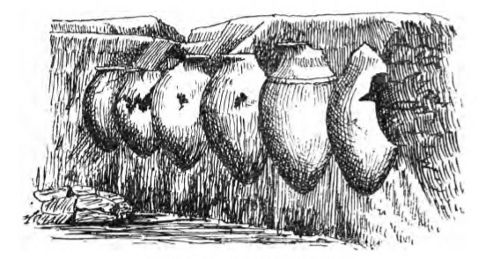
‘They dwell in mean cottages, covered for the most
part with reeds and sticks. In reaping their corn,
they cut the ears from off the stalk, and house them
in repositories under ground; thence they take and
pluck out the grains of as many of the oldest of them
as may serve them for the day, and, after they have
bruised the corn, make it into bread,’
It is said, also, that about this time the Britons
exported corn to Gaul and also up the Rhine. On
Cæsar’s arrival he found them an agricultural people,
with abundance of wheat and barley; and during the
time of the Roman occupation they made great
advances in agriculture. After their departure a hide
of land was 180 acres if it was cultivated on the
Roman three-field system, or 160 if on the English
plan of two-field course. In the former, one portion
was sown with winter wheat, a second with spring
wheat, whilst the third lay fallow. The English way
was to divide the hide, and in each half to sow
alternately spring and winter wheat, and the chief
crops raised were rye, oats, barley, wheat, beans and
peas. In social rank, the yeoman, or geneat (tenant
farmer), ranked next after the thegn and the priest,
whilst even the baker was an important member of
a thegn’s household—the bread being made in round
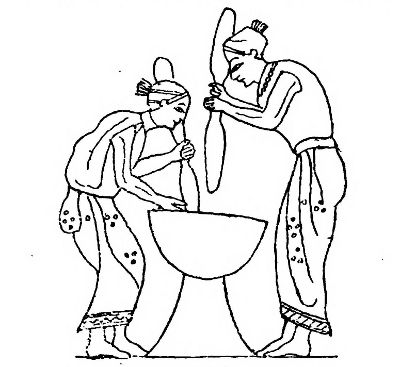
flat cakes from wholemeal (for there is no mention of
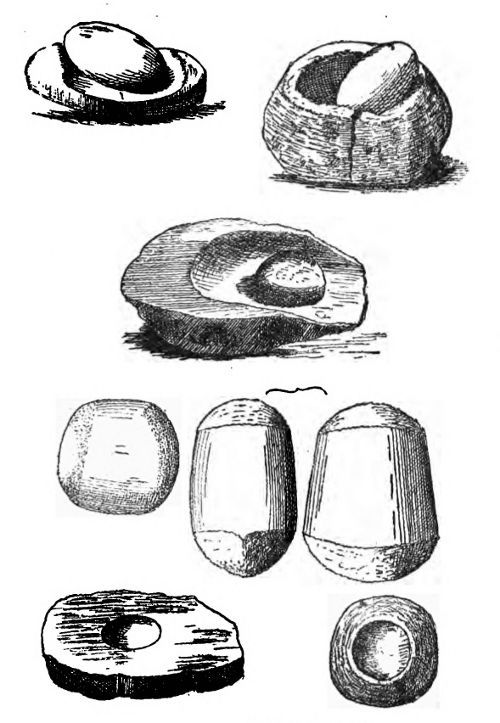
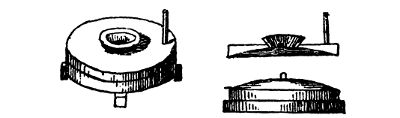
bolting it), ground in a hand-mill or quern. Such
were doubtless the storied cakes which Alfred watched
for the neatherd’s wife.
The peasants’ bread was principally made of rye,
oats, and beans, the wheat being used by the ‘gentry’
only—ordinary bread being made of barley; and,
connected with the latter, are derived our names of
Lord and Lady, the first from Llaford, originator of
bread, or bread-ward, the latter from Llæfdige, bread-maid,
or bread-maker. So, too, we owe our wedding
cake to the great loaf made by the bride to show her
inauguration into housewifery, which was partaken of
by the wedding guests.
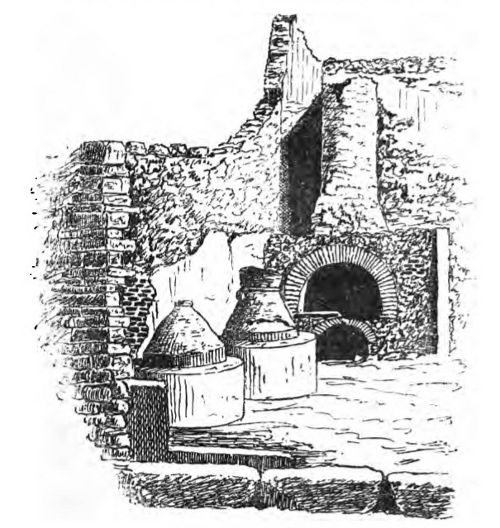
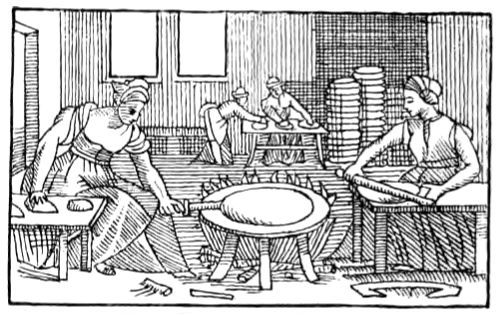
The peasant baked his bread on iron plates or in
rude ovens, and ground his coarse meal in hand-mills;
but in later times water was made the principal motive
power for grinding corn, and about 5000 mills are
mentioned in Domesday Book; but they are not
particularised as to what power they were worked by.
As a trade, the bakers of London rank from a
very early date. They formed a brotherhood, or guild,
in the reign of Henry II., about 1155. Stow says of
them: ‘The Company of White Bakers are of great
antiquity, as appeareth by their Records, and divers
other things of antiquity, extant in their Common
Hall. They were a Company of this City in the first
year of Edward II., and had a new Charter granted
unto them in the first year of Henry VII., the which
Charter was confirmed unto them by Henry VIII.,
Edward VI., Queen Mary, Queen Elizabeth, and
King James I. Their Arms were anciently borne;
the crest and supporters were granted to them by
Robert Cook, Clarencieux, the Letters Patent bearing
date November 8 (32 Eliz.), 1590. The Cloud on the
Chief thro’ which the Hand holding the Scales
Cometh, hath a Glory, omitted in the edition printed
1633; and on each side of the Hand are two Anchors,
here also omitted; as by the Visitation Book, Anno
1634, appears.’
Stow describes the Company of the Brown Bakers
as ‘A Society of long standing and continuance,
prevailed to have their Incorporating granted the
ninth day of June, in the 19th year of the Reign of
our Sovereign Lord King James I.’
The Arms of both White and Brown Bakers are
copied from Harl. MSS. 1464, 57e. (73), A.D. 1634—the
Arms of these and other Companies being copied
from the Herald’s Visitation of that year, by Rd.
Price, Armes-Painter.
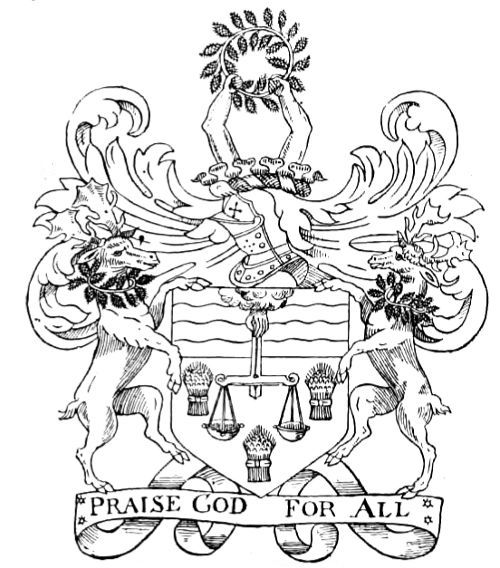
The Arms of the White Bakers.
Heraldically described, the Arms of the White
Bakers are—Gules, three Garbs Or, a chief barry
wavy of four, argent and azure, an arm issuing from
clouds radiated of the second, the hand holding a
pair of scales depending between the upper Garbs,
also of the second. Crest: Two Arms embowed
issuing out of clouds, proper, holding in the hands a
chaplet of wheat, or. Supporters: Two Stags, proper,
attired, or, each gorged with a chaplet of wheat, of
the last.
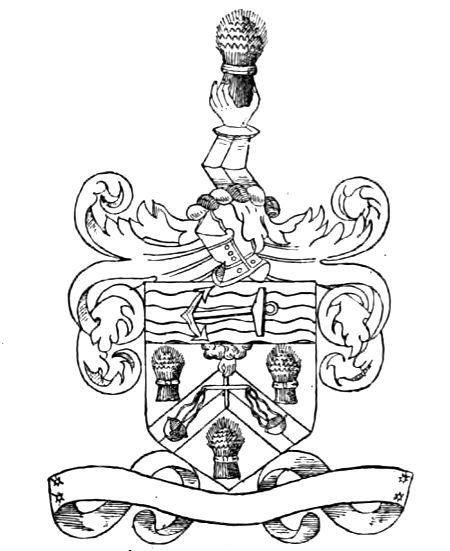
Arms of the Brown Bakers.
The Arms of the Brown Bakers closely resemble
those of their white brethren, but are not so dignified,
as lacking supporters and motto: Vert, a chevron
quarterly, or and gules, charged with a pair of
balances, azure, holden by a hand out of a cloud,
proper, between three garbs of beans, rye and wheat,
or. On a chief barry of five, wavy, argent and azure,
an Anchor couchant, or. Crest: An Arm quarterly
of the second, the hand holding a bean sheaf, proper.
W. Carew Hazlitt, in his Livery Companies of the
City of London (Lond. 1892) says: ‘In the Elizabeth,
as in the Henry VIII. Charter, the White Bakers
had taken the initiative in drawing the makers of
brown bread, whose business was far more limited
and unimportant, into union with them on unequal
terms, and the latter body dissented and renounced;
whereupon the Queen was advised by the Lords of
the Council to recall her patent. This proceeding
seems, for a time, to have caused the matter to drop;
but in 19 James I., June 6, 1622, the Brown Bakers
succeeded in securing separate incorporation, with a
common seal, a Master, three Wardens, and sixteen
Assistants, as well as all other usual rights and powers.
We hear nothing further of the matter till 1629,
when the two bodies were still separate, the White
Bakers being assessed for a levy by the City in that
year at £25 16s., the other at £4. 6s., a proof of the
relative weight and resources of the disputants, which
is confirmed by the proportions contributed by each
to the Ulster scheme a few years prior, namely, £480
and £90. In 1654 the Brown Bakers had apparently
relinquished their independent quarters at Founders’
Hall, Lothbury, as if an union had been arranged;
and in 2 James II. the charter was received with the
usual restrictions in regard to the oaths of allegiance
and supremacy, and conformity to the Church of
England, but otherwise in such a form as to lead to
the belief that it comprehended both sections of the
trade.’
The Bakers’ Company ranks very high after the
twelve great City Companies, on account of its great
antiquity. Its Hall, in Stow’s time, was in ‘Hart
Lane, or Harp Lane, which likewise runneth (from
Tower Street) into Thames Street. In this Hart
Lane is the Bakers’ Hall, some time the dwelling-house
of John Chichley, Chamberlain of London.’
And in Harp Lane it still is. According to Whitaker’s
Almanack for 1904 its livery numbers 152 and its
total income is only £1900.
Much early legislation was passed regarding
bakers and their calling, but, in spite of it all, some
bakers did not amend their ways, and an amusing
grievance was made by Fabyan as to their punishment.
In his Chronicles, under date of 1268, and speaking
of the harshness of Sir Hugh Bigod, justice, he says:
‘In processe of tyme after, the sayde syr Hughe, wt.
other, came to Guylde hall, and kepte his courte and
plees there withoute all ordre of lawe, and contrarye
to the lybertyes of the cytie, and there punysshed the
bakers for lacke of syze, by the tumberell, where
before tymes they were punysshed by the pyllery, and
orderynge many thynges at his wyll, more than by
any good ordre of lawe.’ And Holinshed repeats the
story.
Nor were their misdeeds confined to their trade,
as we may learn from the Archives of the City of
London. In fact, their evil deeds were so notorious
that the King himself had to take cognizance of them.
That the bakers wanted looking after is well
evidenced by the following extracts from the City
archives:
26 Edward I., A.D. 1298. ‘Be it remembered
that on Wednesday next after the Feast of St.
Lawrence (August 10), in the 26th year of the reign
of King Edward, Juliana, la Pestour of Neutone (the
baker of Newington), brought a cart laden with six
shillings’ worth of bread into West Chepe; of which
bread, that which was light bread was wanting in
weight, according to the assise of the halfpenny loaf,
to the amount of 25 shillings in weight. [The
shilling of silver being three-fifths of an ounce in
weight, this deficiency would be 15 ounces.] And of
the said six shillings’ worth, three shillings’ worth
was brown bread; which brown bread was of the
right assise. It was, therefore, adjudged that the
same should be delivered to the aforesaid Juliana, by
Henry le Galeys, Mayor of London, Thomas Romeyn,
and other Aldermen. And the other three shillings’
worth, by award of the said Mayor and Aldermen,
was ordered to be given to the prisoners in Newgate.’
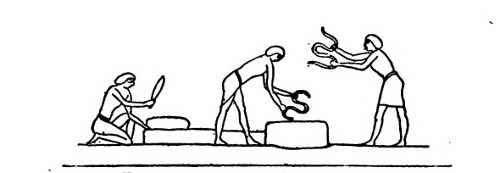
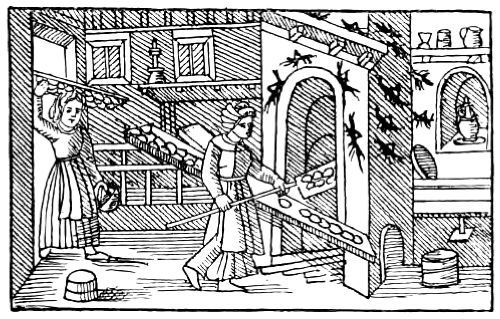
An Early Bakery.
3. Edward II., A.D. 1310. ‘On the Monday next
before the Feast of St Hilary (13th January), in the
third year of the reign of Edward, the son of King
Edward, the bread of Sarra Foting, Christina Terrice,
Godiyeva Foting, Matilda de Bolingtone, Christina
Pricket, Isabella Sperling, Alice Pegges, Joanna de
Cauntebrigge, and Isabella Pouvestre, bakeresses
of Stratford [The bread of London, in these times,
was extensively made in the villages of Bromley
(Bremble), Middlesex, and Stratford-le-Bow.] Stow
says, ‘And because I have here before spoken of the
bread carts coming from Stratford at the Bow, ye
shall understand that of old time the bakers of bread
at Stratford were allowed to bring daily (except the
Sabbath and principal feasts) divers long carts laden
with bread, the same being two ounces in the penny
wheat loaf heavier than the penny wheat loaf baked
in the City, the same to be sold in Cheape, three or
four carts standing there, between Gatheron’s Lane
and Fauster’s Lane end, one cart on Cornhill, by the
Conduit, and one other in Grasse Street. And I have
read that in the fourth year of Edward II., Richard
Reffeham being Mayor, a baker named John, of
Stratforde, for making bread less than the assise, was,
with a fool’s hood on his head and loaves of bread
about his neck, drawn on a hurdle through the streets
of the City. Moreover, in the 44th of Edward III.,
John Chichester being Mayor of London, I read in
the Visions of Piers Plowman, a book so called, as
followeth:
At Londone I leve,
Liketh wel my waires;
And louren whan thei lakken hem.
It is noght long y passed,
There was a careful commune,
Whan no cart came to towne
With breed fro Stratforde:
Tho gennen beggaris wepe,
And werkmen were agast a lite;
This wole be thought longe.
In the date of oure Drighte,
In a drye Aprill.
A thousand and thre hundred
Twies twenty and ten,
My waires were gesene
Whan Chichestre was Maire.’]
was taken by Roger le Paumer, Sheriff of London,
and weighed before the Mayor and Aldermen; and
it was found that the halfpenny loaf weighed less than
it ought by eight shillings. But, seeing that the
bread was cold, and ought not to have been weighed
in such state, by the custom of the City, it was
agreed that it should not be forfeited this time. But,
in order that such an offence as this might not pass
unpunished, it was awarded as to bread so taken
that three halfpenny loaves should always be sold for
a penny, but that the bakeresses aforesaid should this
time have such penny.’
5. Edward II., A.D. 1311. ‘The bread taken from
William de Somersete, baker, on the Thursday next
before the Feast of St. Laurence (10th August) in the
fifth year of the reign of King Edward, was examined
and adjudged upon befor Richer de Refham, Mayor,
Thomas Romayn, John de Wengrave, and other
Aldermen; and, because it was found that such
bread was putrid, and altogether rotten, and made
of putrid wheat, so that persons by eating that bread
would be poisoned and choked, the Sheriff was
ordered to take him, and have him here on the
Friday next after the Feast of St. Laurence; then
to receive judgment for the same.’
In the 1 Ed. III. (1327) a curious fraud was
brought to light, and John Brid and seven other
bakers, and two bakeresses, were tried before the
Mayor and Aldermen, ‘for that the said John, for
falsely and maliciously obtaining his own private
advantage, did skilfully and artfully cause a certain
hole to be made upon a table of his, called a molding
borde pertaining to his bakehouse, after the manner of
a mouse-trap, in which mice are caught, there being
a certain wicket warily provided for closing and
opening such hole.
‘And when his neighbours and others, who were
wont to bake their bread at his oven, came with their
dough, or material for making bread, the said John
used to put the said dough or other material upon
the said table, called a molding borde, as aforesaid,
and over the hole before mentioned, for the purpose
of making loaves therefrom for baking; and such
dough or material being so placed upon the table
aforesaid, the same John had one of his household,
ready provided for the same, sitting in secret beneath
such table; which servant of his, so seated beneath
the hole, and carefully opening it, piecemeal, and bit
by bit, craftily withdrew some of the dough aforesaid,
frequently collecting great quantities of such dough,
falsely, wickedly, and maliciously, to the great loss
of all his neighbours and persons living near, and of
others who had come to him with such dough to
bake, and to the scandal and disgrace of the whole
City, and, in especial, of the Mayor and Bailiffs for
the safe keeping of the assizes of the City assigned.
Which hole, so found in his table, aforesaid, was
made of aforethought; and, in like manner, a great
quantity of such dough that had been drawn through
the said hole was found beneath the hole, and
was, by William de Hertynge, serjeant-at-mace, and
Thomas de Morle, clerk of Richard de Rothynge,
one of the Sheriffs of the City aforesaid, who had
found such material, or dough, in the suspected
place before mentioned, upon oath brought here
into Court.’
All the prisoners pleaded Not Guilty; but the
case was too clear against them, and ‘It was agreed,
and ordained, that all those of the bakers aforesaid,
beneath whose tables with holes dough had been
found, should be put upon the pillory, with a certain
quantity of such dough hung from their necks; and
that those bakers in whose houses dough was not
found beneath the tables aforesaid, should be put
upon the pillory, but without dough hung from their
necks; and that they should so remain upon the
pillory until Vespers at St. Paul’s in London should
be ended.’ The women were committed to Newgate.
There was another punishment by which bakers,
in common with all who told lies, or libelled, or
scandalised their neighbour, had to stand in the
pillory with a whetstone hung round their neck.
England suffered much from dearth. Holinshed
tells us how, in 1149, ‘The great raine that fell in
the summer season did much hurt unto corne standing
on the ground, so that a great dearth followed.
1175.—The same yeare both England and the
countries adjoining were sore vexed with great
mortalitie of people, and immediatlie after followed
a sore dearth and famine. 1196.—Here is also to be
noted, that in this seventh yeare of King Richard,
chanced a dearth through this realme of England,
and in the coasts about the same. 1199.—Furthermore
I find that in the daies of this King Richard a
great dearth reigned in England, and also in France,
for the space of three or foure yeares during the wars
betweene him and King Philip, so that, after his
returne out of Germaine, and from imprisonment, a
quarter of wheat was sold at eighteen shillings eight
pence, no small price in those daies, if you consider
the alay of monie then currant.
‘1222.—Likewise on the day of the exaltation of
the Crosse, a generall thunder happened throughout
the realme, and thereupon followed a continuall
season of foule weather and wet, till Candlemas next
after, which caused a dearth of corne, so as wheat was
sold at twelve shillings the quarter.
‘1245.—Again the King, of purpose, had consumed
all the provision of corne and vittels which
remained in the marshes, so that in Cheshire, and
other parts adjoining, there was such dearth that the
people scarse could get sufficient vittels to susteine
themselves withall.
‘1258.—In this yeare was an exceeding great
dearth, insomuch that a quarter of wheat was sold
at London for foure and twentie shillings, whereas
within two or three yeares before, a quarter was sold
at two shillings. It had been more dearer, if great
store had not come out of Almaine; for in France
and in Normandie it also failed. But there came
fiftie great ships fraught with wheat and barlie, with
meale and bread out of Dutch land, by the procurement
of Richard, King of Almaine, which greatlie
releeved the poore; for proclamation was made, and
order taken by the King, that none of the citizens of
London should buy anie of that graine to laie it up
in store, whereby it might be sold at an higher price
unto the needie. But, though this provision did much
ease, yet the want was great over all the realme.
For it was certainlie affirmed that in three shires
within the realme there was not found so much graine
of that yeare’s growth as came over in those fiftie
ships. The proclamation was set forth to restrein the
Londoners from ingrossing up that graine, and not
without cause; for the wealthie citizens were evill
spoken of in that season, bicause in time of scarcitie
they would either staie such ships as, fraught with
vittels, were comming towards the citie, and send
them some other way forth, or else buy the whole,
that they might sell it by retaile, at their pleasure, to
the needie. By means of this great dearth and
scarcitie, the common people were constrained to live
upon herbs and roots, and a great number of the
poore people died through famine. They died so
thicke that there were great pits made in churchyards
to laie the dead bodies in, one upon another.
‘1289.—There insued such continuall raine, so
distempering the ground, that corne waxed verie
deare, so that whereas wheat was sold before at
three pence a bushell, the market so rose by little
and little that it was sold for two shillings a bushell,
and so the dearth increased still almost for the
space of 40 yeares, till the death of Edward the
Second, in so much that sometimes a bushel of
wheat, London measure, was sold at ten shillings.
1294.—This yeare in England was a great dearth and
scarcity of corne, so that a quarter of wheat in
manie places was sold for thirtie shillings; by reason
whereof poor people died in manie places for lack of
sustnance.
‘1316.—The dearth, by reason of the unseasonable
weather in the summer and harvest last past,
still increased, for that which with much ado was
inned, after, when it came to the proofe, yeelded
nothing to the value of that which in sheafe it seemed
to conteine, so that wheat and other graine which was
at a sore price before, now was inhanced to a farre
higher rate, the scarcitie thereof being so great that a
quarter of wheat was sold for fortie shillings, which
was a great price, if we shall consider the allaie of
monie then currant. Also, by reason of the murren
that fell among cattell, beefes and muttons were
unreasonablie priced.... In this season
vittles were so scant and deere, and wheat and other
graine brought to so high a price, that the poore
people were constreined through famine to eat the
flesh of horses, dogs, and other vile beasts, which is
wonderfull to beleeve, and yet, for default, there died
a great multitude of people in divers places of the
land. Foure pence in bread of the coarser sort
would not suffice one man a daie. Wheat was sold
at London for foure marks a quarter and above. Then
after this dearth and scarcitie of vittels issued a
great death and mortalitie of people; so that what by
warres of the Scots, and what by this mortalitie and
death, the people of the land were wonderfullie
wasted and consumed. O pitifull depopulation!
‘1335.—This yeare there fell great abundance of
raine, and thereupon insued morren of beasts; also
corne so failed this yeare that a quarter of wheat was
sold at fortie shillings. 1353.—In the summer of this
season and twentieth yeare, was so great a drought
that from the latter end of March fell little raine till
the latter end of Julie, by reason whereof manie
inconveniences insued; and one thing is specially to
be noted, that corne the yeare following waxed scant,
and the price began this yeare to be greatlie inhanced.
Also beeves and muttons waxed deare for the want
of grasse; and this chanced both in England and
France, so that this was called the deere summer.
The Lord William, Duke of Baviere or Bavaria,
and Earl of Zelund brought manie ships in London
fraught with rie for the releefe of the people, who
otherwise had, through their present pinching penurie,
if not utterlie perished yet pittifullie pined.
‘1370.—By reason of the great wet and raine that
fell this yeare in more abundance than had been
accustomed much corne was lost, so that the price
thereof was sore inhanced, in so much that wheat
was sold at three shillings four pence the bushell.
1389.—Herewith followed a great dearth of corne, so
that a bushell of wheat in some places was sold
at thirteen pence, which was thought to be a great
price. 1394.—In this yeare was a great dearth in all
parts of England, and this dearth or scarcitie of
corne began under the sickle, and lasted till the feast
of Saint Peter ad Vincula—to wit, till the time of
new corne. This scarcitie did greatly oppresse the
people, and chieflie the commoners of the poorer
sort. For a man might see infants and children in
streets and houses, through hunger, howling, crieing,
and craving bread, whose mothers had it not (God
wot) to breake unto them. But yet there was such
plentie and abundance of manie years before, that it
was thought and spoken of manie housekeepers and
husbandmen, that if the seed were not sowen in the
ground, which was hoorded up and stored in barnes,
lofts, and garners, there would be enough to find and
susteine all the people by the space of five years following....
The scarcity of victuals was of greatest
force in Leicestershire, and in the middle parts of
the realme. And although it was a great want, yet
was not the price of corne out of reason. For a
quarter of wheat, when it was at the highest, was sold
at Leicester for 16 shillings 8 pence at one time, and
at other times for a market of 14 shillings; at London
and other places of the land a quarter of
wheat was sold for 10 shillings, or for little more or
lesse. For there arrived eleven ships laden with
great plentie of victuals at diverse places of the land,
for the reliefe of the people. Besides this, the
citizens of London laid out two thousand marks to
buy food out of the common chest of orphans, and
the foure and twentie aldermen, everie of them put
in his twentie pounds apeece for necessarie provision,
for feare of famine likelie to fall upon the
cities. And they laid up their store in sundrie of the
fittest and most convenient places they could choose,
that the needie and such as were wrong with want
might come and buy at a certaine price so much as
might suffice them and their families; and they which
had not readie monie to paie downe presentlie in
hand, their word and credit was taken for a yeare’s
space next following, and their turn served. Thus
was provision made that people should be relieved,
and that none might perish for hunger.
‘1439.—This yeare (by reason of great tempests,
raging winds, and raine) there arose such scarsitie
that wheat was sold at three shillings foure pence
the bushell.... Whereupon Steven Browne, at
the same season maior of London, tendering the state
of the Citie in this want of bread corne, sent into
Pruse certeine ships, which returned laden with
plentie of rie; wherewith he did much good to the
people in that hard time, speciallie to them of the
Citie, where the want of corne was not so extreame
as in some other places of the land, where the poore
distressed people that were hunger-bitten made them
bred of ferne roots, and used other hard shifts, till
God provided remedie for their penurie by good successe
of husbandrie. 1527.—By reason of the great
wet that fell in the sowing time of the corne, and in
the beginning of the last yeare; now, in the beginning
of this, corne so failed, that in the Citie of London,
for a while, bread was scant, by reason that the commissioners
appointed to see order taken in shires
about, ordeined that none should be conveied out of
one shire into another. Which order had like to
have bred disorder, for that everie countrie and place
was not provided alike, and namelie London, that
maketh her provision out of other places, felt great
inconvenience thereby, till the merchants of the
Stillard and others out of the Dutch countries
brought such plentie that it was better cheape in
London than in anie other part of England, for the
King also releeved the citizens in time of their need
with a thousand quarters, by waie of lone, of his owne
provision.’
By the foregoing we see that the bad dearths
came at longer intervals, probably owing to better
husbandry, and the regular importation of foreign
corn before a scarcity could arise. But, on the other
side, I have to chronicle a few (unfortunately only too
few) years of exceeding plenty. The first one recorded
was in 1288, and is thus recorded by Stow: ‘The
summer was so exceeding hote this yeere that many
men died through heate, and yet wheate was solde at
London for three shillings foure pence the quarter when
it was dearest, and in other partes abroad the same was
sold for twentie pence or sixteen pence the quarter;
yea, for twelve pence the quarter, and in the west and
north parts for eight pence the quarter; barley for six
pence, and oats for foure pence the quarter, and such
cheapnesse of beanes and pease as the like had not
been heard. 1317.—This yeere was an early harvest,
so that all the corne was inned before St Giles day
(Sep. 1). A bushel of wheat that was before for
X shillings was solde for ten pence; and a bushel of
otes that before was eyght shillings was solde for
eyght pence.’
Holinshed tells us that in 1493 wheat was sold in
London at 6d. the bushel; and in 1557.—‘This yeare,
before harvest wheat was sold for foure marks the
quarter, malt at foure and fortie shillings the quarter,
and pease at six and fortie shillings and eight pence;
but, after harvest, wheat was sold for five shillings
the quarter, malt at six shillings eight pence, rie at
three shillings foure pence. So that the penie wheat
loafe that weied in London the last yeere but eleven
ounces Troie weied now six and fiftie ounces Troie.
In the countrie wheat was sold for foure shillings
the quarter, malt at foure shillings eight pence; and,
in some places a bushell of rie for a pound of candles,
which were foure pence.’