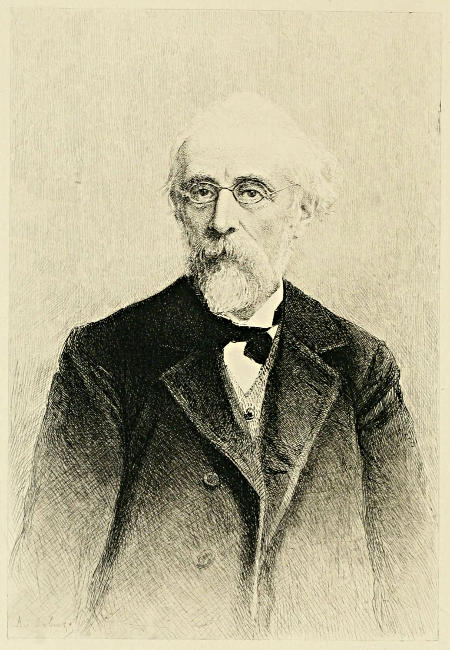
By the Rev. WILLIAM DENTON, M.A.[44]
The interest with which we continue to regard the Crusades is, in its
way, as significant as the enthusiasm which led to their being undertaken.
It is easy now to underrate the dangers which they averted, and to forget
the obligations which the civilised world is under to Charles Martel, to the
crusaders, to Don John of Austria, and to John Sobieski; yet to these men we
owe it that Europe is not now Bulgaria; and that Italy, France, and England—that
the whole of the countries from the Black Sea to the Atlantic, from
Archangel to Sicily, are not trampled upon and desolated as Syria is at this
moment. It is not easy for us to comprehend how recently the terror once
inspired by the Turk has ceased. We need to be reminded that down to the
time of the Stuarts the English and Irish channels were infested with Turkish
corsairs, and our ports blockaded by Turkish ships of war in quest of
slaves.
It is only indeed since the eighteenth century that collections of money to
redeem English captives from the intolerable evils of Turkish slavery have
ceased to be made in our churches. That such captivity is not national, and
only occasional and individual, is one of the inestimable fruits of the Crusades.
At the time when these were undertaken, the whole of Asia, from the borders
of China to the Bosporus, was subject to the Turks; and had these
people been able to cross into Europe, and to hold the countries on the south
of the Danube as a basis for military operations four hundred years earlier
than they succeeded in doing, or indeed at any time whilst the Moors of
Spain and of Sicily were in their full career of victory, the whole of Europe
would inevitably have fallen under the dominion of the Moslems, and industrial
progress had been stayed and civilisation extinguished. So recently
has this danger disappeared that, at the close of the seventeenth century, a
statesman as calm and unenthusiastic as Richelieu seriously meditated the
renewal of the Crusades, in order to avert the evil which even then threatened
to overwhelm the civilised world. That he did so is sufficient to remove
from the leaders and projectors of the Crusades the charge of being moved
by blind, unreflecting fanaticism.
In the eighteenth century, indeed, the school of historians represented by
Voltaire and Gibbon, which discredited all great efforts of past times when
prompted by religious zeal, treated the Crusades with unphilosophical ridicule.
It was an easy task to do this. We are arrested in every page of their history
with the lamentable consequences of popular ignorance, with the selfishness
of many of the leaders, with the record of personal ambition and
unworthy jealousy which too frequently hindered the success of these expeditions.
The whole, however, is not heard when we have listened to accounts
of popular fanaticism, of royal insincerity, of military ambition, and of papal
selfishness, which chequer the history of the crusaders, as these faults
chequered the history of Europe at the time when the Crusades were undertaken.
The great, the imminent danger of Turkish conquest inspired the
minds of the people with fear before it induced the chieftains to combine in
averting the danger. The anarchy which pervaded Europe in the ages of
feudalism was, indeed, the chief source of danger in any advance of the
Turkish forces, and this was in a great measure cured by the enthusiasm
communicated from the people to the great landed proprietors, who, more
jealous of their independence than careful of their obligations to their sovereign,
yet felt the necessity of union and of submission to military discipline
in the hour of peril.
The First Crusade was one undertaken without sufficient leaders, with but
little preparation, and with smaller knowledge of the countries to be traversed
and the difficulties to be overcome. It was a spontaneous effort of terror
and of zeal, in which we can at least satisfy ourselves of the reality of the fear
which pervaded all men, and which we know to have been warranted by the
merciless character of the horde which, having subjugated Asia, was on its
way to attempt the subjugation of Europe. Men have come to see that the
Turk is now what he always has been; it is well to bear in mind the correlative
truth that essentially he always was what he is now; and when we recall
the massacres of the last century, the bloody scenes of Scio and Aleppo, of
Jiddah and of Lebanon, of Bosnia and Bulgaria, we may without effort understand
what he was when Asia lay at his feet, and Europe was terrified at the
rumours of his attempt to cross the Bosporus.
It is too much the practice of those who would deprecate our obligation
to those who strove to arrest the progress of the Turks, to dwell upon some
instances of magnanimity or of mercy, of justice or chivalrous conduct which
lighten up the pages of the history of the Saracens, and to insinuate from
these instances that the Turks possess the same claim to our admiration.
The Turks, however, are not Arabs, neither have they ever manifested any of
that care for intellectual pursuits which has thrown a lustre on the career
of the Saracens of Asia and the Moors of the Spanish peninsula. On the
contrary, the career of the Osmanli has been marked by deeds of savage
atrocity, by an indifference to the obligations of oaths, as well as by his
brutal ignorance and hatred of all intellectual progress; and at the present
day his inferiority to the Arab in statesmanship, in honesty, and in intelligence
is acknowledged.
In estimating the effects of the Crusades the reader will do well to
consider the calm judgment and weighty words of a modern historian, who
thus expresses our obligation to the devotion and bravery of those men
whose deeds are here briefly recorded. “By arresting the progress of the
Turks,” says Mr. Sharon Turner, “by stunning them with blows which a less
hardy, fanatic, and profuse population could not have survived, and by protracting
their entry into Europe until its various states had grown up into
compacted kingdoms—until the feudal system had been substantially overthrown;
until free government and humanising law had blended and concentrated
individual energy and self-will into national unity and co-operating
strength; until polity had begun to be a science, and that order of men whom
we both venerate and revile (statesmen and politicians) had everywhere
arisen—the crusaders preserved Europe from Turkish desolation, if not
from conquest. And when the Ottoman power, recovering from its alarms
by their discontinuance, arose in renovated vigour to a new struggle for
the sovereignty of Europe in the fifteenth, sixteenth, and seventeenth
centuries—though it conquered Greece, overran Hungary, Transylvania,
Moldavia, and Wallachia, attempted Russia and Poland, and endangered
Vienna—yet the rest of Europe had then become prepared to resist its
further progress; and has hitherto successfully kept it at bay, notwithstanding
its mighty population and desperate fanaticism, until its political infirmity
has become decided, the period of its decrepitude arrived, and its
political dissolution has commenced.”
Since these words were written the decrepitude of the Turks has increased,
though their cruelty has not diminished; nay, in some instances, the
periodical massacres of their Christian subjects, which have ever marked
the rule of this race, have been carried out more systematically and with
circumstances of greater horror than of old. We are, indeed, no longer
alarmed at the progress of their arms, and have no fear for our own safety.
We may gather, however, from the accounts of the suffering of the Christians
dwelling in our own days among the Turks, how natural it was for
Europe to be terrified at the prospect of their invasion; and from the generous
indignation which thrilled the heart of England at the time of the
Armenian massacres, we may faintly understand why it was that Europe
was so moved at the rude eloquence of Peter the Hermit, as he detailed the
sufferings of the Christians of Asia Minor when first subjected to the yoke
of the Turk.
FOOTNOTES
[1096-1291 A.D.]
Pilgrimages to Jerusalem, which were in use from the earliest ages of
Christianity, had become very frequent about the beginning of the eleventh
century. The opinion which then very generally prevailed, that the end of
the world was at hand, induced vast numbers of Christians to sell their possessions
in Europe, in order that they might set out for the Holy Land, there
to await the coming of the Lord. So long as the Arabs were masters of
Palestine, they protected these pilgrimages, from which they derived no
small emoluments. But when the Seljukian Turks, a barbarous and ferocious
people, had conquered that country (1075), under the caliphs of Egypt,
the pilgrims saw themselves exposed to every kind of insult and oppression.
The lamentable accounts which they gave of these outrages on their return
to Europe excited the general indignation, and gave birth to the romantic
notion of expelling these infidels from the Holy Land.
Gregory VII was the projector of this grand scheme. He addressed
circular letters to all the sovereigns of Europe, and invited them to make
a general crusade against the Turks. Meantime, however, more pressing
interests, and his quarrels with the emperor Henry IV, obliged him to defer
the projected enterprise; but his attention was soon recalled to it by the
representation of a pilgrim, called Peter the Hermit, a native of Amiens in
Picardy. Furnished with letters from the patriarch of Jerusalem to the
pope and the princes of the West, this ardent fanatic traversed the whole of
Italy, France, and Germany; preaching everywhere, and representing, in the
liveliest colours, the profanation of the sacred places, and the miserable condition
of the Christians and poor pilgrims in the Holy Land. It proved no
difficult task for him to impart to others the fanaticism with which he was
himself animated. His zeal was powerfully seconded by Pope Urban II, who
repaired in person to France, where he convoked the council of Clermont
(1095), and pronounced, in full assembly, a pathetic harangue, at the close
of which they unanimously resolved on the Holy War. It was decreed that
all who should enrol their names in this sacred militia should wear a red
cross on their right shoulder; that they should enjoy plenary indulgence,
and obtain remission of all their sins.
From that time the pulpits of Europe resounded with exhortations to the
Crusades. People of every rank and condition were seen flocking in crowds
to assume the signal of the cross; and, in the following year, innumerable
bands of crusaders, from the different countries of Europe, set out, one after
another, on this expedition to the East. The only exception was the Germans,
who partook but feebly of this universal enthusiasm, on account
of the disputes which then subsisted between the emperor and the court of
Rome. The three or four first divisions of the crusaders [comprising about
273,000 men, under the leadership of Peter the Hermit, Walter de Pexejo,
and Walter the Penniless] marched without order and without discipline;
pillaging, burning, and wasting the countries through which they passed.
Most of them perished from fatigue, hunger, or sickness, or by the sword of
the exasperated nations whose territories they had laid desolate. [The four
thousand that crossed the Bosporus were annihilated by Kilidj Arslan, the
sultan of Rum, or Iconium.] To these unwarlike and undisciplined troops
succeeded regular armies, commanded by experienced officers, and powerful
princes: the Crusades proper were inaugurated.[45]
THE FIRST CRUSADE (1096-1099 A.D.)
1096 A well-organised military force of 200,000-300,000 men sets out by different routes.
Its leaders are:
(1) Godfrey de Bouillon—Duke of Lower Lorraine, with his brothers (2) Baldwin, (3) Eustace.
(4) Robert, Duke of Normandy, son of William the Conqueror.
(5) Robert, Count of Flanders.
(6) Stephen, Count of Chartres.
(7) Raymond IV, Count of Toulouse.
(8) Hugh of Vermandois.
(9) Bohemond, Duke of Tarentum.
(10) Tancred, his nephew.
Arriving at Constantinople, all except Raymond do homage to Alexius Comnenus,
the emperor. Crossing the Bosporus they invade the territory of Kilidj Arslan, sultan
of Rum, or Iconium.
1097 With the help of the crusaders, Alexius recovers Nicæa. Victory of the crusaders at
Dorylæum. Siege of Antioch is begun. Baldwin and Tancred attempt a private
war over question of precedence of their banners. Baldwin withdraws his troops
from the army, and answering an appeal for help from the Greek or Armenian ruler
of Edessa, marches thither, makes himself its master, and founds the Latin county
Edessa (q.v.).
1098 Surrender of Antioch, betrayed to Bohemond by the Armenian, Firuz. Kerboga,
emir of Mosul besieges the crusaders in Antioch but is defeated and driven off.
The crusaders rest in Antioch and quarrel among themselves.
1099 Siege and capture of Jerusalem. Foundation of the kingdom of Jerusalem (q.v.).
The county of Antioch founded (q.v.) with Bohemond at its head.
THE KINGDOM OF JERUSALEM (1099-1291 A.D.)
1099 Godfrey de Bouillon elected king of the Latin kingdom of Jerusalem. He makes
laws for its government. The military order of the Knights Hospitallers founded.
He defeats the Fatimites at Askalon.
1100 Death of Godfrey. His brother, Baldwin I, summoned from Edessa and made
king.
1101 A large body of crusaders, headed by Welf of Bavaria and William of Aquitaine
arrives in Asia Minor, but is destroyed and dispersed by Kilidj Arslan before it can
reach Jerusalem, together with another one that arrived the previous year. Death of
Stephen of Chartres at Ramla.
1104 Baldwin captures Acre (Ptolemais) from the Turks. The Turks fail in an attempt
to regain Jerusalem. Death of Raymond of Toulouse.
1109 Baldwin, with the assistance of a Venetian fleet, captures Tripolis. He afterwards
takes Berytus and Sidon.
1118 Death of Baldwin. His cousin, Baldwin (II) de Bourg, of Edessa succeeds. The
order of Knights Templar founded by Sir Hugh de Pagano.
1119 Baldwin defeats the Turks at Antioch. The Emperor Joannes Comnenus wins a
victory over the Knights Hospitaller on the Mæander.
1122 The Saracens take Baldwin prisoner.
1124 Conquest of Tyre by the crusaders, assisted by the Venetians. The latter have a
third of the city allotted them.
1127 Baldwin ransomed. He attacks Aleppo and is defeated.
1131 Death of Baldwin, after being defeated near Damascus. He bequeaths the kingdom
to his son-in-law, Fulk of Anjou.
1144 Death of Fulk, by accident. His young son, Baldwin III, succeeds, under the regency
of Queen Melusina.
1148 The Second Crusade besieges Damascus and Askalon, but is unable to take them.
1149 Defeat of the Christians by Nur ad-Din, near the Orontes.
1153 Capture of Askalon by Baldwin III. Nur ad-Din takes Jerusalem.
1162 Death of Baldwin. His brother, Almeric or Amaury I, succeeds.
1168 Almeric invades Egypt. Capture and sack of Heliopolis. He is defeated by the generals
Shirkuh and Saladin.
1173 Death of Almeric. His young son, Baldwin IV, a leper, succeeds under the guardianship
of Count Raymond III, of Tripolis.
1183 Baldwin IV is compelled by his disease to resign his crown in favour of his infant
nephew, Baldwin V, still under regency of Raymond.
1186 Death of Baldwin V. His mother, Sybilla, sister of Baldwin IV, inherits the crown,
which she shares with her husband, Guy de Lusignan.
1187 Saladin attacks the kingdom of Jerusalem. Great defeat and capture of Guy at Tiberias.
Saladin takes Jerusalem and then besieges Tyre, whence he is repelled by
Conrad of Montferrat.
1188 Liberation of Guy, who renounces his title to Saladin. Conrad defends Tripolis.
1189 The Third Crusade arrives. Guy besieges Acre, assisted by a fleet of Danes, Frisians,
and Flemings.
1191 Conquest of Cyprus by Richard Cœur de Lion, on his way to the Holy Land. He adds
it to the kingdom of Jerusalem. Surrender of Acre. Defeat of Saladin at Azotus.
Joppa and Askalon surrender to the Christians. Murder of Conrad of Montferrat,
who by marriage with Sybilla’s sister, Isabella, has acquired right of succession to
the kingdom. Foundation of the order of Teutonic Knights.
1192 Isabella marries Henry of Champagne, to whom Guy relinquishes his title, retaining
that of king of Cyprus.
1193 On death of Saladin, his sons give Acre to the Knights of St. John—hence called St.
John d’Acre.
1194 Death of Guy de Lusignan. His brother, Almeric succeeds as king of Cyprus.
1196 Death of Henry. His widow marries Almeric (II) de Lusignan, who reunites the
kingdoms of Cyprus and Jerusalem.
1206 Death of Almeric. His son, Hugo I, succeeds in Cyprus. Jerusalem falls to Mary,
daughter of Isabella and Conrad of Montferrat.
1210 Mary marries Jean de Brienne, who becomes king of Jerusalem.
1217 The Turks take Jerusalem from the Saracens.
1218 Jean de Brienne leads the Christians into Egypt and
1219 captures Damietta.
1221 Destruction of the Christian army in Egypt. The Turks regain Damietta.
1225 The emperor Frederick II declares that Jean de Brienne has, since Mary’s death, no
claim to his title, and that it belongs to himself, since he has married Yolande, the
daughter of Mary.
1228 After many delays, Frederick starts for the Holy Land.
1229 Frederick II makes a treaty with the sultan Malik al-Kamil, by which he recovers
Jerusalem and other cities. He is the recognised king of Jerusalem.
From this time on (see Seventh, Eighth, and Ninth Crusades) the Christian kingdom
in Palestine may be considered a part of the Holy Roman Empire until 1291, when
the sultan Khalil takes Acre and drives the last of the Christians out of Syria.
THE COUNTY OF ANTIOCH (1099-1268 A.D.)
A vassal state of the kingdom of Jerusalem founded 1099 by the crusaders with Bohemond
of Tarentum at its head. Bohemond is captured by the Turks (1105)
and Tancred goes to Antioch to govern. Bohemond released the following year.
The emperor Alexius claims Antioch, but Bohemond successfully resists him. He
goes to Europe, and after various adventures dies there in 1111. Tancred dies the
following year. For eight years the principality is united to the kingdom of Jerusalem,
but in 1126 Baldwin II of Jerusalem gives it to Bohemond II. Bohemond
III rules 1162 to 1201. Some of the princes of Antioch rule in virtue of their wives’
right to the throne. In 1268 Bibars, the sultan of Egypt, captures Antioch and the
principality comes to an end.
THE COUNTY OF TRIPOLIS (1109-1289 A.D.)
A vassal state or county of the kingdom of Jerusalem from 1109, when the city of
Tripolis is captured by the crusaders and Raymond of Toulouse placed at its
head. The Christians rule until 1289, when it falls into the hands of Kalaun, the
sultan of Egypt, who destroys the city.
THE COUNTY OF EDESSA (1097-1146 A.D.)
In 1097 Baldwin I, brother of Godfrey de Bouillon, in consequence of a quarrel with
Tancred, leaves the main body of the crusaders, conquers Edessa, and founds the
vassal state of that name.
1100 Baldwin, made king of Jerusalem, gives Edessa to his cousin, Baldwin (II) de
Bourg.
1118 Baldwin II is made king of Jerusalem and Jocelyn (I) de Courtenai takes his
place in the county of Edessa. He wins many victories over the Saracens.
1131 Jocelyn II succeeds.
1144 Capture of Edessa by Zenki, emir of Mosul.
1146 Jocelyn regains Edessa, but the same year Nur ad-Din, Zenki’s son and successor,
retakes and destroys it. End of the county of Edessa. On account of this event
Bernard of Clairvaux preaches.
THE SECOND CRUSADE (1147-1149 A.D.)
1146 In the council of Vézelay, Louis VII of France assumes the cross; the emperor, Conrad
III, follows his example some months later.
1147 The armies of Conrad and Louis start from Ratisbon and Metz respectively, marching
through Hungary to Asia Minor. The German army in advance is nearly annihilated
in Phrygia through the treachery of the Byzantine emperor, Manuel, by
Masud I, the sultan of Rum. Conrad, with the remnant of his force, joins the
French army along the seacoast.
1148 Unsuccessful attempt of the Second Crusade to capture Damascus and Askalon. Conrad,
in ill health, returns to Constantinople and thence to Germany.
1149 Louis returns to France. Bernard is reproached for the failure of the crusade.
THE THIRD CRUSADE (1189-1192 A.D.)
The disastrous defeat and capture of Guy de Lusignan at Tiberias by Saladin, and
the latter’s capture of Jerusalem (1187), reawakens the crusading spirit. Gregory
VIII urges a new crusade.
1188 William, archbishop of Tyre, induces Henry II of England and Philip Augustus of
France to assume the cross.
1189 Death of Henry. Richard (I) Cœur de Lion eagerly pursues his father’s project.
The emperor, Frederick (I) Barbarossa, sets out with an army through Hungary.
He spends the winter at Hadrianopolis.
1190 Frederick reaches Asia Minor with assistance of Isaac Angelus, and takes Iconium.
Sudden death of Frederick. His son, Frederick of Swabia, leads the crusaders to
Acre, which Guy de Lusignan, having regained his liberty, is besieging. Richard
and Philip Augustus start by sea for the Holy Land. They spend the winter in
Sicily, quarrel and are reconciled.
1191 Richard stops at and conquers Cyprus on his way to the Holy Land. Richard and
Philip arrive at Acre. Death of Frederick of Swabia during the siege. Surrender
of Acre. Compact with Saladin, binding him to surrender the true cross and pay
a large sum. Philip quarrels with Richard and returns to France.
1192 Richard makes unsuccessful attempt to take Jerusalem. He relieves Joppa and
makes truce with Saladin entitling pilgrims to visit Jerusalem unmolested, for a
short time. Richard sails for England. Is shipwrecked near Aquileia. Seized
near Vienna by Leopold, duke of Austria, who surrenders him (1193) to the
emperor, Henry VI. Henry imprisons him, and he is released for a large ransom
in 1194 and returns to England.
THE FOURTH CRUSADE (1195-1198 A.D.)
The Knights of St. John start in 1193 to organise a crusade. They are encouraged
by Pope Celestine III, who hopes that the troublesome emperor Henry VI will be
induced to take part in it. Henry also promotes the project, but has no idea of
taking part in it.
1195 Henry makes use of one division of the crusaders to conquer the kingdom of Sicily.
Two other divisions proceed to Syria.
1196 Defeat of the Turks between Tyre and Sidon.
1197 The crusaders besiege the fortress of Thoron, but make a disgraceful retreat on hearing
of the approach of an army from Egypt.
1198 The Saracens capture Joppa. The count of Montfort concludes a three years’ truce
with the Saracens. The crusade leaders return to Europe.
THE FIFTH CRUSADE (1201-1204 A.D.)
Pope Innocent III, on his elevation (1198), with the assistance of Fulk of Neuilly,
preaches a new crusade.
1201 The company is organised by Simon de Montfort, Walter de Brienne, and Geoffrey
de Villehardouin. Boniface of Montferrat chosen leader. The party proceeds
to Venice. Treaty between Venice and the leaders for transportation. Unable to
pay sum demanded, the doge, Dandolo, agrees to remit the sum lacking if the
crusaders will capture for him the town of Zara, taken from Venice by the king of
Hungary.
1202 Arrival at Venice of Alexius, son of the deposed emperor Isaac, with whom the crusaders
agree to restore Isaac. In spite of Innocent’s protests the fleet sails for Zara,
which is taken and handed over to Venice.
1203 The crusaders proceed to Constantinople. Alexius III, the reigning emperor, tries in
vain to treat with them. Flight of Alexius. The crusaders enter Constantinople.
Isaac II and Alexius IV restored. Constant friction between the emperor and crusaders
leads
1204 to the second capture of Constantinople. The reigning family driven out. Foundation
of the Latin Empire of Romania and other states. (See “History of the Eastern
Empire.”)
THE CHILDREN’S CRUSADE (1212 A.D.)
Seems to have arisen from the idea that the main cause of the failure of the Crusades
was the sinfulness of the pilgrims. None but the innocent and pure could accomplish
the mission. In 1212, thirty thousand boys and girls set out under the boy,
Stephen, and twenty thousand from Germany, under Nicholas, a peasant boy. Most
of them perish on the way; and others are sold into slavery.
THE SIXTH CRUSADE (1217-1229 A.D.)
When Innocent III crowns Frederick II emperor, in 1215, he extracts a promise from
Frederick to conduct a crusade, but the latter, seeing in the pope’s action a plan
to outwit him in the then imminent struggle between emperor and pope, defers his
departure.
1217 Andrew II of Hungary, incited by Honorius III, Innocent’s successor, sets out for
Jerusalem. He is joined by the king of Cyprus. The crusaders visit Tyre, Sidon,
Acre, and Tripolis, but the Saracens make such havoc in their numbers that Andrew
returns to Hungary.
1218-1221 Jean de Brienne’s expedition to Damietta. (See “Kingdom of Jerusalem”).
1228 Frederick II, after many disputes with the pope, sets out for Jerusalem, the throne of
which he claims through his marriage to Yolande.
1229 Frederick makes treaty with the sultan Kamil, receiving Jerusalem and other places.
Frederick crowns himself king of Jerusalem, and returns to Europe.
THE SEVENTH CRUSADE (1239-1240 A.D.)
Gregory IX preaches a new crusade (1238). The sultan Kamil dies that year.
1239 King Thibaut of Navarre leads an army to Palestine to break the truce made between
Kamil and the Templars. The sons of Kamil defeat him and capture Jerusalem.
1240 Richard, earl of Cornwall, proceeds to Acre, and receives offers of peace from the
sultan of Egypt. Jerusalem, and other places in Palestine, are restored to the
Christians. Richard returns to England.
THE EIGHTH CRUSADE (1248-1254 A.D.)
In 1244, Jerusalem is taken by the Khwarizmians, who have been driven from their
own country by Jenghiz Khan. This leads to a new crusade. Louis IX of France,
in a fit of illness, vows to lead an army against the Khwarizmians.
1248 Departure of Louis and his crusaders. He winters in Cyprus.
1249 Louis proceeds to Egypt, and takes Damietta. He then sets out for Cairo.
1250 Battle of Mansura. Defeat and capture of Louis by Turan Shah, sultan of Egypt.
Louis is released by the restoration of Damietta, and the promise to abstain from
further hostilities. The crusaders return to St. Jean d’Acre. Louis remains four
years in Syria, fortifying Acre and other cities, and
1254 returns to France.
THE NINTH CRUSADE (1270-1272 A.D.)
In 1260, the mamelukes, on the death of their sultan, Ibeg, choose Bibars as his successor.
This vigorous warrior at once drives the Khwarizmians out of Syria, and
takes Damascus and Jerusalem from them. He then proceeds to exterminate the
Christians in Syria; in consequence of which, by 1267, a new crusade has been
planned. Louis IX of France, and Prince Edward of England, are among those
who assume the cross.
1268 Antioch surrenders to Bibars without a siege.
1270 After many difficulties in raising an army, the crusaders sail for the Holy Land. Stopping
at Sardinia, Louis changes his plans, and proceeds against the king of Tunis.
Shortly after reaching there, the plague breaks out, and Louis dies. King Charles
of Naples arrives and makes a truce with the Tunisians, who pay him tribute. The
whole fleet returns to Europe, and is wrecked on the Sicilian coast. Charles plunders
the French and Genoese vessels. Prince Edward leaves the French in Tunis,
and proceeds to Acre.
1271 Edward besieged at Acre by Bibars. Edward drives the mamelukes away and seizes
Nazareth. An attempt is made to assassinate Edward.
1272 Edward concludes a ten years’ truce with Bibars, and returns to Europe.
1274 Gregory X fails in an attempt to start a new crusade. Bibars and his successors,
Kalaun and Khalil, continue the process of exterminating the Christians.
1289 Tripolis is taken. Acre is the last important possession of the Christians. The mamelukes
make a treaty with the king of Cyprus.
1291 Capture of Acre by Khalil. Tyre, Berytus, and other towns, submit. The last possessions
of the Christians in the Holy Land are abandoned. Other crusades are
planned, but they are never carried to execution. The military orders are eventually
suppressed.
FOOTNOTES
“God willeth it,” the whole assembly cry;
Shout which the enraptured multitude astounds!
The Council roof and Clermont’s towers reply;—
“God willeth it!” from hill to hill rebounds,
And, in awe-struck countries far and nigh,
Through “Nature’s hollow arch” that voice resounds.
[306-1096 A.D.]
The history of the Middle Ages presents no spectacle more imposing
than the Crusades, in which are to be seen the nations of Asia and of
Europe armed against each other, two religions contending for superiority,
and disputing the empire of the world. After having been several times
threatened by the Moslems, and a long time exposed to their invasions, all at
once the West arouses itself, and appears, according to the expression of a
Greek historian (Anna Comnena), to tear itself from its foundation, in order
to precipitate itself upon Asia. All nations abandon their interests and
their rivalries, and see upon the face of the earth but one single country
worthy of the ambition of conquerors. One would believe that there no
longer exists in the universe any other city but Jerusalem, or any other
habitable spot of earth but that which contains the tomb of Jesus Christ.
All the roads which lead to the Holy City are deluged with blood, and present
nothing but the scattered spoils and wrecks of empires.
In this general confusion we may contemplate the sublimest virtues
mixed with all the disorders of the wildest passions. The Christian soldiers
have at the same time to contend against famine, the influence of climate,
and enemies the most formidable; in the greatest dangers, in the midst of
their successes and their constant discords, nothing can exhaust either their
perseverance or their resignation. After four years of fatigue, of miseries,
and of victories, Jerusalem is taken by the crusaders; but as their conquests
are not the work of wisdom and prudence, but the fruit of blind enthusiasm
and ill-directed heroism, they create nothing but a transient power.
The banner of the cross soon passes from the hands of Godfrey de Bouillon
into those of his weak and imbecile successors. Jerusalem, now a
Christian city, is obliged again to apply for succour to the West. At the
voice of St. Bernard, the Christians take arms. Conducted by an emperor of
Germany and a king of France, they fly to the defence of the Holy Land;
but they have no longer great captains among them, they have none of the
magnanimity or heroic resignation of their fathers. Asia, which beholds
their coming without terror, already presents a new spectacle. The disciples
of Mohammed awaken from their apathy; they are at once seized with a frenzy
equal to that which had armed their enemies; they oppose enthusiasm to
enthusiasm, fanaticism to fanaticism, and in their turn burn with a desire
to shed their blood in a religious war.
[1147-1532 A.D.]
The spirit of discord which had destroyed their power is no longer felt
but among the Christians. Luxury and the manners of the East weaken
the courage of the defenders of the cross, and make them forget the object
even of the holy war. Jerusalem, which had cost the crusaders so much
blood, falls again into the power of the infidels, and becomes the conquest
of a wise and warlike prince, who had united under his banner the forces of
Syria and Egypt.
The genius and fortune of Saladin inflict a mortal blow upon the ill-assured
power of the Christians in the East. In vain an emperor of the
West, and two kings celebrated for their bravery, place themselves at the
head of the whole powers of their states to deliver Palestine; these new
armies of crusaders meet everywhere with brave enemies and invincible
barriers, and all their united efforts produce nothing but illustrious disasters.
The kingdom of Jerusalem, for whose ruins they contend, is no longer anything
but a vain name; soon even the captivity and the miseries of the Holy
City cease to inspire the sentiments of piety and enthusiasm that they had
given birth to among the Christians. The crusaders, who had taken up arms
for its deliverance, suffer themselves to be seduced by the wealth of Greece,
and stop short to undertake the conquest of Constantinople.
From that time the spirit of the crusaders begins to change; whilst a
small number of Christians still shed their blood for the deliverance of the
tomb of Jesus Christ, the princes and the knights are deaf to everything but
the voice of ambition. The popes complete the corruption of the true spirit
of the crusaders, by urging them on, by their preaching, against other Christian
people, and against their own personal enemies. The holy wars then degenerate
into civil wars, in which both religion and humanity are outraged.
These abuses of the Crusades, and the dire passions which had mixed
themselves with them, plunge Europe in disorder and anarchy; when a
pious king undertakes once more to arm the powers of the West against the
infidels, and to revive among the crusaders the spirit which had animated
the companions of Godfrey. The two wars directed by this pious chief are
more unfortunate than all the others. In the first, the world is presented
with the spectacle of a captive army and a king in fetters; in the second,
that of a powerful monarch dying in its ashes. Then it is that the illusion
disappears, and Jerusalem ceases to attract all the attention of the West.
Soon after, the face of Europe is changed; intelligence dissipates barbarism;
the Crusades no longer excite the same degree of enthusiasm, and the
first effect of the civilisation it begins to spread is to weaken the spirit of
the fanaticism which had given them birth. Some few useless efforts are at
times made to rekindle the fire which had burned so fiercely in Europe and
Asia. The nations are so completely recovered from the pious delirium of
the Crusades, that when Germany finds itself menaced by the Mussulmans
who are masters of Constantinople the banner of the cross can with difficulty
gather an army around it; and Europe, which had risen in a mass to attack
the infidels in Asia, opposes but a feeble resistance to them on its own
territories.
Such is, in a few words, the picture of the events and revolutions which
the historian of the Crusades has to describe.
We do not now require much sagacity to discover in our ancient chronicles
what is fabulous and what is not. A far more difficult thing is to reconcile,
upon some points, the frequent contradictory assertions of the Latins,
the Greeks, and the Saracens, and to separate, in the history of the Crusades,
that which belongs to religious fanaticism, to policy, or to human passions.
In an age in which some value is set upon an opinion of the Crusades, it
will be first asked if the wars of the Crusades were just. Upon this head
we have but little to answer. Whilst the crusaders believed that they were
obeying God himself by attacking the Saracens in the East, the latter, who
had invaded a part of Asia possessed by Christian people, who had got possession
of Spain, who threatened Constantinople, the coasts of Italy, and
several countries of the West, did not reproach their enemies with making an
unjust war, and left to fortune and victory the care of deciding a question
almost always useless.
We shall think it of more importance here to examine what was the
cause and the nature of these remote wars, and what has proved to be their
influence on civilisation. The Crusades were produced by the religious and
military spirit which prevailed in Europe during the Middle Ages. The
love of arms and religious fervour were two dominant passions which, mingling
in some way, lent each other a mutual energy. These two great principles,
united and acting together, gave birth to the holy war; and carried,
among the crusaders, valour, resignation, and heroism of character to the
highest degree of eminence. Some writers have seen nothing in these great
expeditions but the most deplorable excesses, without any advantage to the
ages that succeeded them; others, on the contrary, maintain that we owe
to them all the benefits of civilisation. It is not, at present, our business to
examine these two conflicting opinions. Without believing that the holy
wars have done either all the good or all the harm that is attributed to them,
it must be admitted that they were a source of bitter sorrow to the generations
that saw them or took part in them; but, like the ills and tempests of
human life, which render man better and often assist the progress of his
reason, they have forwarded the experiences of nations; and it may be said
that, after having for a time seriously agitated and shaken society, they
have, in the end, much strengthened the foundations of it. This opinion,
when stripped of all spirit of exaggeration or system, will perhaps appear
the most reasonable.
EARLY CHRISTIAN PILGRIMAGES
[306-335 A.D.]
From the earliest ages of the church, a custom had been practised of
making pilgrimages to the Holy Land. Judea, full of religious remembrances,
was still the promised land of the faithful; the blessings of heaven
appeared to be in store for those who visited Calvary, the tomb of Jesus
Christ, and renewed their baptism in the waters of the Jordan. Under the
reign of Constantine, the ardour for pilgrimages increased among the faithful;
they flocked from all the provinces of the empire to worship Jesus
Christ upon his own tomb, and to trace the steps of their God in that city
which had but just resumed its name, and which the piety of an emperor
had caused to issue from its ruins. The Holy Sepulchre presented itself to
the eyes of the pilgrims surrounded by a magnificence which redoubled their
veneration. An obscure cavern had become a marble temple, paved with
precious stones and decorated with splendid colonnades. To the east of the
Holy Sepulchre appeared the church of the Resurrection, in which they could
admire the riches of Asia, mingled with the arts of Greece and Rome.
Constantine celebrated the thirty-first year of his reign by the inauguration
of this church, and thousands of Christians came, on occasion of this solemnity,
to listen to the panegyric of Christ from
the lips of the learned and holy bishop Eusebius.
[335-493 A.D.]
St. Helena, the mother of the emperor, repaired
to Jerusalem, at a very advanced age,
and caused churches and chapels to be built
upon Mount Tabor, in the city of Nazareth, and
in the greater part of the places which Christ
had sanctified by his presence and his miracles.
From this period, pilgrimages to the Holy Land
became much more frequent. The pilgrims, no
longer in dread of the persecutions of the pagans,
could now give themselves up, without fear, to
the fervour of their devotion; the Roman eagles,
ornamented with the cross of Jesus Christ, protected
them on their march; they everywhere
trampled under foot the fragments of idols, and
they travelled amidst the abodes of their fellow-Christians.
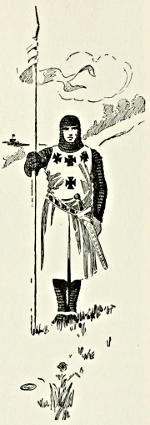
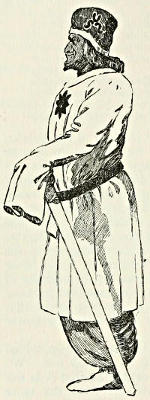
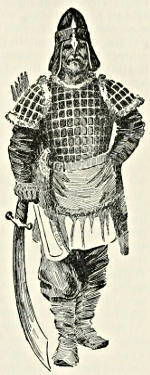
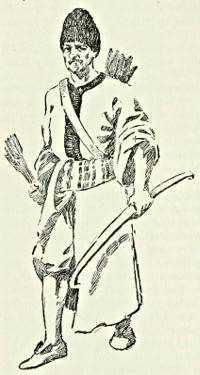
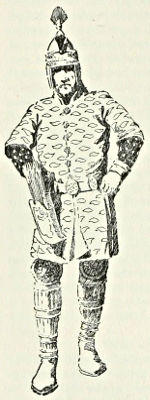
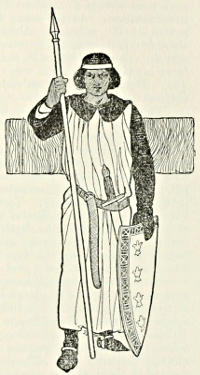
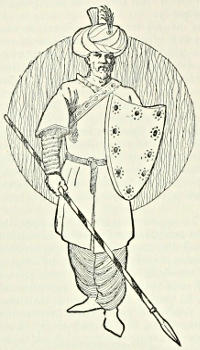
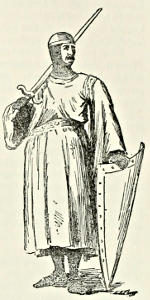
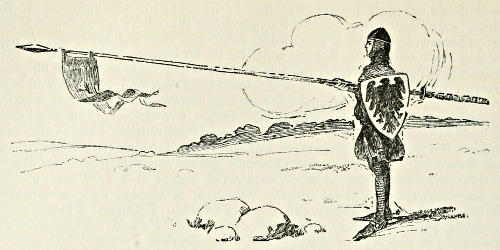
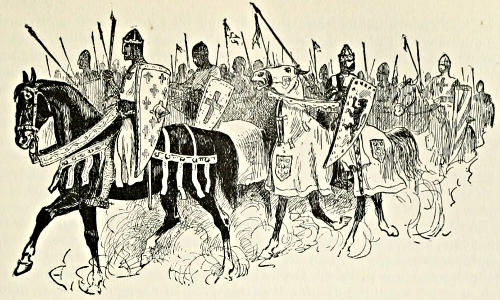
A French Crusader
When the emperor Julian, in order to weaken
the authority of the prophecies, undertook to
rebuild the temple of the Jews, numerous were
the prodigies related by which God confounded
his designs, and Jerusalem, for that attempt even,
became more dear to the disciples of Jesus Christ.
The Christians did not cease to visit Palestine.
St. Jerome, who, towards the end of the fourth
century, had retired to Bethlehem, informs us in
one of his letters that pilgrims arrived in crowds
in Judea, and that around the holy tomb the
praises of the Son of God were to be heard,
uttered in many languages. From this period,
pilgrimages to the Holy Land were so numerous
that several doctors and fathers of the church
thought it their duty to point out the abuses and
danger of the practice. They told Christians
that long voyages might turn them aside from
the path of salvation; that their God was not
confined to one city; that Jesus Christ was everywhere where faith and good
works were to be found; but such was the blind zeal which then drew the
Christians towards Jerusalem that the voice of the holy doctors was scarcely
heard. As soon as the people of the West became converted to Christianity,
they turned their eyes to the East. From the depths of Gaul, from the
forests of Germany, from all the countries of Europe, new Christians were to
be seen hastening to visit the cradle of the faith they had embraced.
[493-750 A.D.]
When the world was ravaged by the Goths, the Huns, and the Vandals,
pilgrimages to the Holy Land were not at all interrupted. Pious travellers
were protected by the hospitable virtues of the barbarians, who began
to respect the cross of Christ, and sometimes even followed the pilgrims to
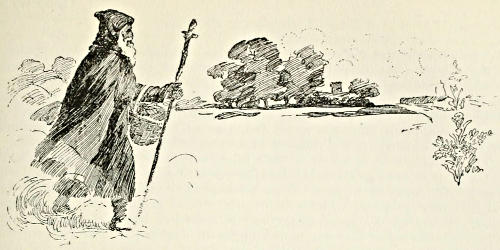
Jerusalem. In these times of trouble and desolation, a poor pilgrim who
bore his scrip and staff often passed through fields of carnage, and travelled
without fear amidst armies which threatened the empires of the East and the
West.
Illustrious families of Rome came to seek an asylum at Jerusalem, and
upon the tomb of Jesus Christ. Christians then found, on the banks of the
Jordan, that peace which seemed to be banished from the rest of the world.
This peace, which lasted several centuries, was not troubled before the reign
of Heraclius. Under this reign, the armies of Chosroes, king of Persia, invaded
Syria, Palestine, and Egypt; the Holy City fell into the hands of the
worshippers of fire; the conquerors bore away into captivity vast numbers
of Christians, and profaned the churches of Jesus Christ. All the faithful
deplored the misfortunes of Jerusalem, and shed tears when they learned
that the king of Persia had carried off, among the spoils of the vanquished,
the cross of the Saviour, which had been preserved in the church of the
Resurrection. Heraclius, after ten years of reverses, triumphed, and
brought back to Jerusalem the Christians whose chains he had broken.
Then was to be seen an emperor of the East, walking barefooted in the
streets of the Holy City, carrying on his shoulders to the summit of Calvary
the wood of the true cross, which he considered the most glorious trophy of
his victories.
But the joy of the faithful was not of long duration. Towards the beginning
of the seventh century there had arisen, in an obscure corner of
Asia, a new religion, opposed to all others which preached dominion and
war. Mohammed had promised the conquest of the world to his disciples,
who had issued almost naked from the deserts of Arabia. By his passionate
doctrine he was able to inflame the imagination of the Arabs, and on the
field of battle knew how to inspire them with his own impetuous courage.
His first successes, which must have greatly exceeded his hopes, were like so
many miracles, increasing the confidence of his partisans and carrying conviction
to the minds of the weak and wavering. After the death of the
prophet of Mecca, his lieutenants and the companions of his first exploits
carried on his great work.
JERUSALEM UNDER THE SARACENS
[750-860 A.D.]
Amidst the first conquests of the Saracens, they had turned their eyes
towards Jerusalem. According to the faith of the Moslems, Mohammed
had been in the city of David and Solomon; it was from Jerusalem that he
set out to ascend into heaven in his nocturnal voyage. The Saracens
considered Jerusalem as the house of God, as the city of saints and miracles.
The Christians had the grief of seeing the church of the Holy Sepulchre
profaned by the presence of the chief of the infidels. Although Omar had
left them the exercise of their worship, they were obliged to conceal their
crosses and their sacred books. The caliph ordered a mosque to be erected
on the spot whereon the temple of Solomon had been built. In the meantime,
the presence of Omar, of whose moderation the East boasts, restrained
the jealous fanaticism of the Moslems. After his death the faithful had
much more to suffer; they were driven from their houses, insulted in their
churches; the tribute which they had to pay to the new masters of Palestine
was increased, and they were forbidden to carry arms or to mount on horseback.
A leathern girdle, which they were never allowed to be without, was
the badge of their servitude; the conquerors would not permit the Christians
to speak the Arab tongue, sacred to the disciples of the Koran; and the
people who remained faithful to Jesus Christ had not liberty even to pronounce
the name of the patriarch of Jerusalem, without the permission of
the Saracens.
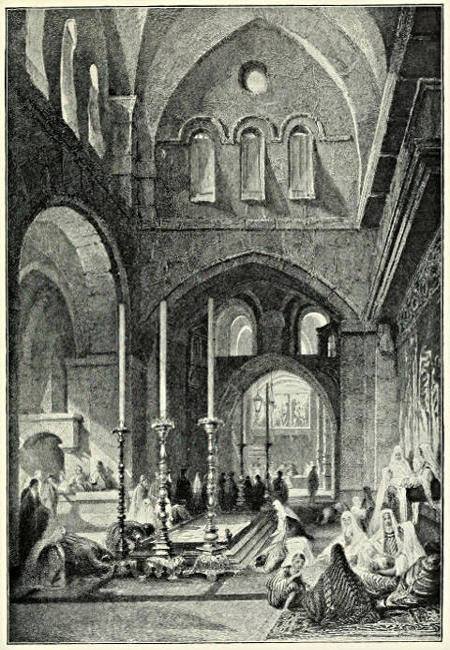
HOLY SEPULCHRE, JERUSALEM
All these persecutions could not stop the crowd of Christians who
repaired to Jerusalem, the sight of the Holy City sustaining their courage as
it heightened their devotion. There were no evils, no outrages, that they
could not support with resignation, when they remembered that Christ had
been loaded with chains and had died upon the cross in the places they were
about to visit. The Christians of Palestine, however, enjoyed some short
intervals of security during the civil wars of the Mussulmans. The dynasty
of the Omayyads, which had established the seat of the Moslem empire at
Damascus, was always odious to the ever-formidable party of the Alids, and
employed itself less in persecuting the Christians than in preserving its own
precarious power. Merwan II, the last caliph of this house, was the most
cruel towards the disciples of Christ; and when he, with all his family, sank
under the power of his enemies, the Christians and the infidels united in
thanks to heaven for having delivered the East from his tyranny.
The Abbasids, established in the city of Baghdad which they had
founded, persecuted and tolerated the Christians by turns. The Christians,
always living between the fear of persecution and the hope of a transient
security, saw at last the prospect of happier days dawn upon them with the
reign of Harun ar-Rashid, the greatest caliph of the race of Abbas. Under
this reign the glory of Charlemagne, which had reached Asia, protected the
churches of the East. His pious liberality relieved the indigence of the
Christians of Alexandria, of Carthage, and Jerusalem. The two greatest
princes of their age testified their mutual esteem by frequent embassies: they
sent each other magnificent presents; and, in the friendly intercourse of two
powerful monarchs, the East and the West exchanged the richest productions
of their soil and their industry. There was no doubt policy in the marks of
esteem which Harun lavished upon the most powerful of the princes of the
West. He was making war against the emperors of Constantinople, and
might justly fear that they would interest the bravest among Christian
people in their cause. To take from the Franks every pretext for a religious
war, which might make them embrace the cause of the Greeks, and draw
them into Asia, the caliph neglected no opportunity of obtaining the friendship
of Charlemagne; and caused the keys of the Holy City and of the
Holy Sepulchre to be presented to him.
Whilst the Arabians of Africa were pursuing their conquests towards
the West, whilst they took possession of Sicily, and Rome itself saw its
suburbs and its churches of St. Peter and St. Paul invaded and pillaged by
infidels, the servants of Jesus Christ prayed in peace within the walls of
Jerusalem. To the desire of visiting the tomb of Jerusalem was joined the
earnest wish to procure relics, which were then sought for with eagerness by
the devotion of the faithful. All who returned from the East made it their
glory to bring back to their country some precious remains of Christian
antiquity, and above all the bones of holy martyrs, which constituted the
ornament and the riches of their churches and upon which princes and
kings swore to respect truth and justice. The productions of Asia likewise
attracted the attention of the people of Europe.
[860-1050 A.D.]
In short, the Christians of Palestine and the Moslem provinces, the
pilgrims and travellers who returned from the East, seemed no longer to
have any persecutions to dread, when all at once new storms broke out in
the East. The children of Harun soon shared the fate of the posterity
of Charlemagne, and Asia, like the West, was plunged into the horrors of
anarchy and civil war. The gigantic empire of the Abbasids crumbled
away on all sides, and the world, according to the expression of an Arabian
writer, was within the reach of him who would take possession of it. The
Greeks then appeared to rouse themselves from their long supineness,
and sought to take advantage of the divisions and the humiliation of the
Saracens. Nicephorus Phocas took the field at the head of a powerful
army, and recaptured Antioch from the Moslems. Deprived of the powerful
stimulus of fanaticism, Nicephorus found among the Greeks more
panegyrists than soldiers, and could not pursue his advantages against the
Saracens. His triumphs were confined to the taking of Antioch, and only
served to create a persecution against the Christians of Palestine.
Zimisces resolved to avenge the outrage inflicted upon religion and the
empire. On all sides preparations were set on foot for a fresh war against
the Saracens. The nations of the West were no strangers to this enterprise,
which preceded, by more than a year, the first of the Crusades. After
having defeated the Mussulmans on the banks of the Tigris, and forced the
caliph of Baghdad to pay a tribute, Zimisces penetrated, almost without
resistance, into Judea, took possession of Cæsarea, of Ptolemais, of Tiberias,
Nazareth, and several other cities of the Holy Land.
After this first campaign, the Holy Land appeared to be on the eve of
being delivered entirely from the yoke of the infidels, when the emperor died
poisoned. His death at once put a stop to the execution of an enterprise of
which he was the soul and the leader. The Christian nations had scarcely
time to rejoice at the delivery of Jerusalem, when they learned that the
Holy City had again fallen into the hands of the Fatimite caliphs, who, after
the death of Zimisces, had invaded Syria and Palestine. Hakim, the third
of the Fatimite caliphs, signalised his reign by all the excesses of fanaticism
and outrage. Unfixed in his own projects, and wavering between two
religions, he by turns protected and persecuted Christianity.
The inconstancy of Hakim, in a degree, mitigated the misfortunes of
Jerusalem, and he had just granted liberty to the Christians to rebuild their
churches, when he died by the hand of the assassin. His successor, guided
by a wiser policy, tolerated both pilgrimages and the exercise of the Christian
religion. The church of the Holy Sepulchre was not entirely rebuilt till
thirty years after its destruction; but the spectacle of its ruins still inflamed
the zeal and the devotion of the Christians. In the eleventh century the
Latin church allowed pilgrimages to suffice instead of canonical penitences;
sinners were condemned to quit their country for a time, and to lead a wandering
life, after the example of Cain. There existed no crime that might
not be expiated by the pilgrimage to Jerusalem. Even the weak and timid
sex was not deterred by the perils of a long voyage.b
CHARACTER OF THE PILGRIMS
[1000-1050 A.D.]
Though pilgrimages were generally considered acts of virtue, yet some
of the leaders of the church accounted them useless and criminal. Gregory,
bishop of Nyssa, in the fourth century, dissuades his flock from these journeys.
They were not conscientious obligations, he said, for in the description of
persons whom Christ had promised to acknowledge in the next world the
name of pilgrim could not be found. A migratory life was dangerous to
virtue, particularly to the modesty of women.
The necessity of making a pilgrimage to Rome and other places was often
urged by ladies, who did not wish to be mewed in the solitary gloom of a
cloister, “chaunting faint hymns to the cold fruitless moon.” In the ninth
century, a foreign bishop wrote to the archbishop of Canterbury, requesting,
in very earnest terms, that English women of every rank and degree might
be prohibited from pilgrimising to Rome. Their gallantries were notorious
over all the continent. “Perpaucæ enim sunt civitates in Longobardia, vel in
Francia, aut in Gallia, in qua non sit adultera
vel meretrix generis Anglorum: quod scandalum
est, et turpitudo totius ecclesiæ.” Muratori,
Antiquitates Italiæ Med. Ævi, Dissert. 58, vol.
V., p. 58. “There are few cities in Lombardy,
in France, or in Gaul, in which there is not an
English adultress or harlot, to the scandal and
disgrace of the whole church.” Morality did
not improve as the world grew older. The
prioress in Chaucer, demure as she is, wears a
bracelet on which was inscribed the sentence,
“Amor vincit omnia.” The gallant monk, in
the same pilgrimage, ties his hood with a true-lover’s
knot.
Horror at spectacles of vice would diminish
with familiarity, and the moral principle would
gradually be destroyed. Malice, idolatry,
poisoning, and bloodshed disgraced Jerusalem
itself; and so dreadfully polluted was the city
that, if any man wished to have a more than
ordinary spiritual communication with Christ,
he had better quit his earthly tabernacle at
once than endeavour to enjoy it in places
originally sacred, but which had been since
defiled. Some years after the time of Gregory,
a similar description of the depravity at Jerusalem
was given by St. Jerome, and the Latin
father commends a monk who, though a resident
in Palestine, had but on one occasion travelled
to the city. The opinions of these two venerable
spiritual guides could not stem the torrent
of popular religion. The coffers of the church were enriched by the sale of
relics, and the dominion of the clergy became powerful in proportion to the
growth of religious abuses and corruptions. Pilgrims from India, Ethiopia,
Britannia, and Hibernia went to Jerusalem; and the tomb of Christ
resounded with hymns in various languages. Bishops and teachers would
have thought it a disgrace to their piety and learning if they had not adored
their Saviour on the very spot where his cross had first shed the light of his
Gospel.
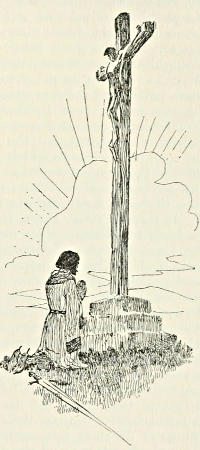
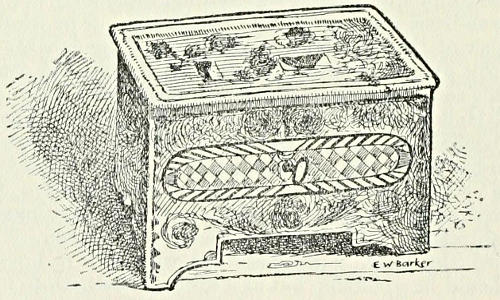
A Pilgrim and Shrine
The assertion, that “the coffers of the church were enriched by the sale
of relics,” requires some observations; because the sale of one relic in particular
encouraged the ardour of pilgrimages, and from the ardour the Crusades
arose. During the fourth century, Christendom was duped into the belief
that the very cross on which Christ had suffered had been discovered in
Jerusalem. The city’s bishop was the keeper of the treasure, but the faithful
never offered their money in vain for a fragment of the holy wood. They
listened with credulity to the assurance of their priests that a living virtue
pervaded an inanimate and insensible substance, and that the cross permitted
itself every day to be divided into several parts, and yet remained uninjured
and entire. Thus Erasmus says, in his entertaining dialogue on pilgrimages,
that “if the fragments of the cross were collected, enough would be found
for the building of a ship.” It was publicly exhibited during the religious
festivities of Easter, and Jerusalem was crowded with pious strangers to
witness the solemn spectacle. But after four ages of perpetual distribution,
the world was filled with relics, and superstition craved for a novel object.
Accordingly, the Latin clergy of Palestine pretended that on the vigil of
Easter, after the great lamps in the church of the Resurrection had been
extinguished, they were relighted by God himself. People flocked from the
West to the East in order to behold this act of the Divinity, and to catch
some portion of a flame which had the marvellous property of healing all
diseases, mental as well as bodily, if those who received it had faith.c
[1050-1076 A.D.]
The inclination to acquire holiness by the journey to Jerusalem became
at length so general that the troops of pilgrims alarmed by their numbers
the countries through which they passed, and although they came not as
soldiers they were designated “the armies of the Lord.” In the year 1054,
Litbert, bishop of Cambray, set out for the Holy Land, followed by more
than three thousand pilgrims from the provinces of Picardy and Flanders.
Ten years after, seven thousand Christians set out together from the
banks of the Rhine. This numerous caravan, which was the forerunner of
the Crusades, crossed Germany, Hungary, Bulgaria, and Thrace, and was
welcomed at Constantinople by the emperor Constantine Ducas. After
having visited the churches of Byzantium, the pilgrims of the West traversed
Asia Minor and Syria without danger; but when they approached
Jerusalem, the sight of their riches aroused the cupidity of the Bedouin
Arabs, undisciplined hordes, who had neither country nor settled abode, and
who had rendered themselves formidable in the civil wars of the East. The
Arabs attacked the pilgrims of the West, and compelled them to sustain
a siege in an abandoned village; and this was on a Good Friday. The
emir of Ramala, informed by some fugitives, came happily to their rescue,
delivered them from the death with which they were threatened, and permitted
them to continue their journey. After having lost more than three
thousand of their companions, they returned to Europe, to relate their
tragical adventures, and the dangers of a pilgrimage to the Holy Land.
THE TURKS IN POWER
[1076-1088 A.D.]
New perils and the most violent persecutions at this period threatened
both the pilgrims of the West and the Christians of Palestine. Asia was
once again about to change masters, and tremble beneath a fresh tyranny.
During several centuries the rich countries of the East had been subject
to continual invasions from the wild hordes of Tatary. The Turks,
issuing from countries situated beyond the Oxus, had rendered themselves
masters of Persia. Palestine yielded to the power of the Turks. The
conquerors spared neither the Christians nor the children of Ali, whom
the caliph of Baghdad represented to be the enemies of God. The Egyptian
garrison was massacred, and the mosques and the churches were delivered
up to pillage. The Holy City was flooded with the blood of Christians and
Mussulmans.
Other tribes of Turks, led by Suleiman, penetrated into Asia Minor.
They took possession of all the provinces through which pilgrims were
accustomed to pass on their way to Jerusalem. The standard of the prophet
floated over the walls of Edessa, Iconium, Tarsus, and Antioch. Thousands
of children had been circumcised. Everywhere the laws of the Koran took
the place of those of the Evangelists and of Greece. The black or white
tents of the Turks covered the plains and the mountains of Bithynia and
Cappadocia, and their flocks pastured among the ruins of the monasteries
and churches. The Greeks had never had to contend against more cruel and
terrible enemies than the Turks. In the midst of revolutions and civil wars,
the Greek Empire was hastening to its fall.
Whilst the empire of the East approached its fall and appeared sapped
by time and corruption, the institutions of the West were in their infancy.
The empire and the laws of Charlemagne no longer existed. Nations had
no relations with each other; and mistaking their political interests, made
wars without considering their consequences or their dangers, and concluded
peace without being at all aware whether it was advantageous or not. Royal
authority was nowhere sufficiently strong to arrest the progress of anarchy
and the abuses of feudalism. At the same time that Europe was full of
soldiers and covered with strong castles, the states themselves were without
support against their enemies, and had not an army to defend them.
Ten years before the invasion of Asia Minor by the Turks, Michael
Ducas, the successor of Romanus Diogenes, had implored the assistance of
the pope and the princes of the West. He had promised to remove all the
barriers which separated the Greek from the Roman church, if the Latins
would take up arms against the infidels. Gregory VII then filled the chair
of St. Peter. The hope of extending the religion and the empire of the
holy see into the East made him receive kindly the humble supplications of
Michael Ducas. Excited by his discourses, fifty thousand pilgrims agreed
to follow Gregory to Constantinople, and thence to Syria; but the affairs of
Europe suspended the execution of his projects.
Every day the power of the popes was augmented by the progress of
Christianity, and by the ever-increasing influence of the Latin clergy.
Rome was become a second time the capital of the world, and appeared
to have resumed, under the monk Hildebrand, the empire it had enjoyed
under the cæsars. Armed with the two-edged sword of Peter, Gregory
loudly proclaimed that all the kingdoms of the earth were under the dominion
of the holy see, and that his authority ought to be as universal as the
church of which he was the head. These dangerous pretensions, fostered by
the opinions of his age, engaged him immediately in violent disputes with
the emperor of Germany. He desired also to dictate laws to France, Spain,
Sweden, Poland, and England; and thinking of nothing but making himself
acknowledged as the great arbiter of states, he launched his anathemas even
against the throne of Constantinople, which he had undertaken to defend, and
gave no more attention to the deliverance of Jerusalem.
After the death of Gregory, Victor III, although he pursued the policy of
his predecessor and had to contend against the emperor of Germany and
the party of the anti-pope Guibert (Clement III), did not neglect the opportunity
of making war against the Mussulmans. The Saracens, inhabiting
Africa, disturbed the navigation of the Mediterranean, and threatened the
coast of Italy. Victor invited the Christians to take arms, and promised
them the remission of all their sins if they went to fight against the infidels.
The inhabitants of Pisa, Genoa, and several other cities, urged by
their zeal for religion and their desire to defend their commerce, equipped
fleets, levied troops, and made a descent upon the coasts of Africa,
where, if we are to believe the chronicles of the time, they cut in pieces an
army of one hundred thousand Saracens.b
PETER THE HERMIT
[1088-1095 A.D.]
The true story of the first Crusade is, as Kuglerd says, sufficiently marvellous.
It was a vast awakening in which religion, adventure, and design
forced the European peoples out of their narrow lines of life and brought
the West and East again in contact, and it grows in strangeness as we trace
the story in detail. But monkish, uncritical writings which record the
vague traditions of that great uprising have not rested satisfied with the marvellous
truth: they have added much that is legendary. Among the legends
that have failed to stand the test of recent scholarship, is the famous one which
made Peter the Hermit the originator of the first Crusade. We may now
feel sure that it was not Peter but Urban II who set going the great impetus;
but the legend of Peter the Hermit has grown into the story of the first Crusade,
and won its place in history from the belief of centuries. The reader
must, however, be aware, as he reads it, that we have no authentic account
of Peter’s preaching before the Council of Clermont. He was probably one
of the preachers who scattered the enthusiasm of that council in northeastern
France. His preaching was likely limited to the land where he could be
understood in the vernacular, and his real influence is rather to be estimated
by the rabble that followed him and Walter the Penniless, to leave their
bones by the Danube or Bosporus. So much prefaced, let us turn to the
story.
As the legend runs, Peter, an obscure hermit, came from his retreat, and
followed into Palestine the crowd of Christians who went to visit the holy
places.a The sight of Jerusalem excited him much more than any of the other
pilgrims, for it created in his ardent mind a thousand conflicting sentiments.
In the city, which exhibited everywhere marks of the mercy and the anger
of God, all objects inflamed his piety, irritated his devotion and his zeal, and
filled him by turns with respect, terror, and indignation. After having
followed his brethren to Calvary and the tomb of Christ he repaired to
the patriarch of Jerusalem. The white hairs of Simeon, his venerable
figure, and above all the persecution which he had undergone, bespoke
the full confidence of Peter, and they wept together over the ills of the
Christians. The patriarch resolved to implore, by his letters, the help of
the pope and the princes of Europe, and the hermit swore to be the interpreter
of the Christians of the East and to rouse the West to take arms
for their deliverance.
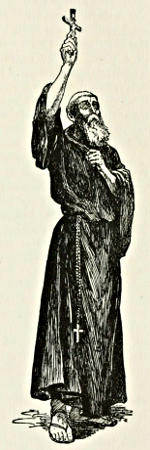
A Hermit of the Middle Ages
After this interview, the enthusiasm of Peter knew no bounds; he was
persuaded that heaven itself called upon him to avenge its cause. One day,
whilst prostrated before the Holy Sepulchre, he believed that he heard the
voice of Christ, which said to him: “Peter, arise! hasten to proclaim
the tribulations of my people; it is time that my servants should receive
help, and that the holy places should be delivered.” Full of the spirit of
these words, which sounded unceasingly in his ears, and charged with
letters from the patriarch, he quitted Palestine, crossed the seas, landed
on the coast of Italy, and hastened to cast himself at the feet of the pope.
The chair of St. Peter was then occupied by Urban II, who had been the
disciple and confidant of both Gregory and Victor. Urban embraced
with ardour a project which had been entertained by his predecessors; he
received Peter as a prophet, applauded his design, and bade him go forth
and announce the approaching deliverance of Jerusalem.
[1095-1096 A.D.]
Peter the Hermit traversed Italy, crossed the Alps, visited all parts of
France, and the greatest portion of Europe, inflaming all hearts with the
same zeal that consumed his own. He travelled
mounted on a mule, with a crucifix in his hand, his
feet bare, his head uncovered, his body girded with
a thick cord, covered with a long frock, and a
hermit’s hood of the coarsest stuff. The singularity
of his appearance was a spectacle for the people,
whilst the austerity of his manners, his charity, and
the moral doctrines that he preached caused him to
be revered as a saint wherever he went.
He went from city to city, from province to
province, working upon the courage of some and upon
the piety of others; sometimes haranguing from the
pulpits of the churches, sometimes preaching in the
high-roads or public places. His eloquence was
animated and impressive, and filled with those
vehement apostrophes which produce such effects
upon an uncultivated multitude. He described the
profanation of the holy places, and the blood of the
Christians shed in torrents in the streets of Jerusalem.
He invoked, by turns, heaven, the saints, the angels,
whom he called upon to bear witness to the truth of
what he told them. He apostrophised Mount Zion,
the rock of Calvary, and the Mount of Olives, which
he made to resound with sobs and groans. When
he had exhausted speech in painting the miseries of
the faithful, he showed the spectators the crucifix
which he carried with him; sometimes striking his
breast and wounding his flesh, sometimes shedding
torrents of tears. The people followed the steps of
Peter in crowds. The preacher of the holy war
was received everywhere as a messenger from God.
THE APPEAL OF THE EMPEROR ALEXIUS
In the midst of this general excitement, Alexius
Comnenus, who was threatened by the Turks, sent
ambassadors to the pope, to solicit the assistance of the Latins. “Without
the prompt assistance of all the Christian states,” he wrote, “Constantinople
must fall under the most frightful domination of the Turks.” He reminded
the princes of Christianity of the holy relics preserved in Constantinople,
and conjured them to save so sacred an assemblage of venerated objects from
the profanation of the infidels. After having set forth the splendour and the
riches of his capital, he exhorted the knights and barons to come and defend
them; he offered them his treasures as the reward of their valour, and
painted in glowing colours the beauty of the Greek women, whose love
would repay the exploits of his liberators. Thus, nothing was spared that
could flatter the passions or arouse the enthusiasm of the warriors of the
West.
COUNCILS OF PLACENTIA AND CLERMONT
In compliance with the prayers of Alexius and the wishes of the faithful,
the sovereign pontiff convoked a council at Placentia, in order there to
expose the dangers of the Greek and Latin churches in the East. The
preachings of Peter had so prepared the minds and animated the zeal of
the faithful, that more than two hundred bishops and archbishops, four thousand
ecclesiastics, and thirty thousand of the laity obeyed the invitation of
the holy see. The council was so numerous that it was obliged to be held
in a plain in the neighbourhood of the city. The Council of Placentia,
however, came to no determination upon the war against the infidels. The
deliverance of the Holy Land was far from being the only object of this
council: the declarations of the empress Adelaide, who came to reveal her
own shame and that of her husband, anathemas against the emperor of
Germany and the anti-pope Guibert, occupied, during several days, the
attention of Urban and the assembled fathers.
A new council assembled at Clermont, in Auvergne. Before it gave up
its attention to the holy war, the council at first considered the reform of the
clergy and ecclesiastical discipline; and it then occupied itself in placing a
restraint upon the license of wars among individuals. In these barbarous
times even simple knights never thought of redressing their injuries by any
other means than arms. It was not an uncommon thing to see families, for
the slightest causes, commence a war against each other that would last
during several generations; Europe was distracted with troubles occasioned
by these hostilities. In the impotence of the laws and the governments, the
church often exerted its salutary influence to restore tranquillity; several
councils had placed their interdict upon private wars during four days of the
week, and their decrees had invoked the vengeance of heaven against disturbers
of the public peace. The Council of Clermont renewed the Truce
of God, and threatened all who refused “to accept peace and justice” with
the thunders of the church. One of its decrees placed widows, orphans,
merchants, and labourers under the safeguard of religion. They declared,
as they had already done in other councils, that the churches should be so
many inviolable sanctuaries, and that crosses, even, placed upon the high-roads,
should become points of refuge against violence.
Humanity and reason must applaud such salutary decrees; but the sovereign
pontiff, although he presented himself as the defender of the sanctity
of marriage, did not merit the same praises when he pronounced in this
council an anathema against Philip I. But such was then the general infatuation,
that no one was astonished that a king of France should be
excommunicated in the very bosom of his own kingdom. The sentence of
Urban could not divert attention from an object that seemed much more
imposing, and the excommunication of Philip scarcely holds a place in the history
of the Council of Clermont. The faithful, gathered from all the
provinces, had but one single thought; they spoke of nothing but the evils
the Christians endured in Palestine, and saw nothing but the war which was
about to be declared against the infidels. Enthusiasm and fanaticism, which
always increase in large assemblies, were carried to their full height. Urban
at length satisfied the impatience of the faithful—impatience which he,
perhaps, had adroitly excited, and which was the surest guarantee of success.
The council held its tenth sitting in the great square or place of Clermont,
which was soon filled by an immense crowd. Followed by his cardinals, the
pope ascended a species of throne which had been prepared for him; at his
side was Peter the Hermit, clad in that whimsical and uncouth garb which
had everywhere drawn upon him the attention and the respect of the multitude.
Urban, who spoke after Peter, represented, as he had done, the holy
places as profaned by the domination of the infidels.
As Urban proceeded, the sentiments by which he was animated penetrated
to the very souls of his auditors. When he spoke of the captivity and the
misfortunes of Jerusalem, the whole assembly was dissolved in tears; when
he described the tyranny and the perfidy of the infidels, the warriors who
listened to him clutched their swords, and swore in their hearts to avenge
the cause of the Christians. Urban redoubled their enthusiasm by announcing
that God had chosen them to accomplish his designs, and exhorted
them to turn those arms against the Moslems which they now bore in conflict
against their brothers. They were not now called upon to revenge the
injuries of men, but injuries offered to divinity; it was now not the conquest
of a town or a castle that was offered to them as the reward of their valour,
but the riches of Asia, the possession of a land in which, according to the
promises of the Scriptures, flowed streams of milk and honey.
“Christian warriors,” he exclaimed, “who seek without end for vain pretexts
for war, rejoice, for you have to-day found true ones. You who have
been so often the terror of your fellow-citizens, go and fight against the barbarians,
go and fight for the deliverance of the holy places; you who sell for
vile pay the strength of your arms to the fury of others, armed with the
sword of the Maccabees, go and merit an eternal reward. If you triumph
over your enemies, the kingdoms of the East will be your heritage; if you
are conquered, you will have the glory of dying in the very same place as
Jesus Christ, and God will not forget that he shall have found you in his
holy ranks. This is the moment to prove that you are animated by a true
courage; this is the moment in which you may expiate so many violences
committed in the bosom of peace, so many victories purchased at the expense
of justice and humanity. If you must have blood, bathe your hands in the
blood of the infidels. I speak to you with harshness, because my ministry
obliges me to do so: soldiers of hell, become soldiers of the living God!
When Jesus Christ summons you to his defence, let no base affections detain
you in your homes; see nothing but the shame and the evils of the Christians;
listen to nothing but the groans of Jerusalem, and remember well what the
Lord has said to you: ‘He who loves his father and his mother more than
me, is not worthy of me; whoever shall abandon his house, or his father, or
his mother, or his wife, or his children, or his inheritance, for the sake of my
name, shall be recompensed a hundredfold, and possess life eternal.’”
At these words the auditors of Urban displayed an enthusiasm that
human eloquence had never before inspired. The assembly arose in one
mass as one man, and answered him with a unanimous cry, “It is the will
of God! It is the will of God!”[46] Pity, indignation, despair, at the same
time agitated the tumultuous assembly of the faithful; some shed tears over
Jerusalem and the fate of the Christians; others swore to exterminate the
race of the Moslems; but, all at once, at a signal from the sovereign pontiff,
the most profound silence prevailed. Cardinal Gregory, who afterwards
occupied the chair of St. Peter under the name of
Innocent II, pronounced, in a loud voice, a form of
general confession, the assembly all fell upon their
knees, beat their breasts, and received absolution
for their sins. All the faithful decorated their
garments with a red cross. From that time, all
who engaged to combat the infidels were termed
“bearers of the cross,”[47] and the holy war took the
name of “Crusade.” The faithful solicited Urban
to place himself at their head; but the pontiff,
who had not yet triumphed over the anti-pope
Guibert, who was dealing out at the same time
his anathemas against the king of France and
the emperor of Germany, could not quit Europe
without compromising the power and the policy of
the holy see. He refused to be chief of the crusade,
and named the bishop of Puy apostolic legate
with the army of the Christians.
THE FRENZY OF EUROPE
He promised to all who assumed the cross the
entire remission of their sins. Their persons, their
families, their property, were all placed under the
protection of the church and of the apostles St.
Peter and St. Paul. The council declared that
every violence exercised upon the soldiers of
Christ should be punished by anathema, and
recommended its decrees in favour of the bearers
of the cross to the watchful care of all bishops
and priests. It regulated the discipline and the
departure of those who had enrolled themselves in
the holy ranks, and for fear reflection might
deter any from leaving their homes, it threatened
with excommunication all those who did not fulfil
their vows.
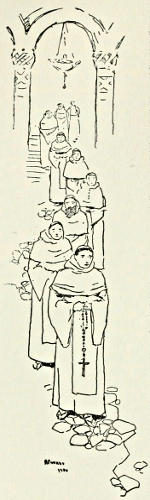
Monks of the Middle Ages
It might be said that the French had no longer
any other country than the Holy Land, and that
to it they were bound to sacrifice their ease, their
property, and their lives. This enthusiasm, which
had no bounds, was not long in extending itself
to the other Christian nations; the flame which
consumed France was communicated to England, still disturbed by the
recent conquest of the Normans; to Germany, troubled by the anathema
of Gregory and Urban; to Italy, agitated by its factions; to Spain, even,
although it had to combat the Saracens on its own territory.
The devotion for pilgrimages, which had been increasing during several
centuries, became a passion and an imperative want for most Christians;
everyone was eager to march to Jerusalem, and to take part in the crusade,
which was, in all respects, an armed pilgrimage. The situation in which
Europe was then placed no doubt contributed to increase the number of
pilgrims. “All things were in such disorder,” says William of Tyre, “that
the world appeared to be approaching to its end, and was ready to fall again
into the confusion of chaos.” Everywhere the people groaned under a horrible
servitude; a frightful scarcity of provisions, which had during several
years desolated France and the greater part of the kingdoms of the West,
had given birth to all sorts of brigandage and violence; and these proving
the destruction of agriculture and commerce increased still further the horrors
of the famine. Villages, towns even, became void of inhabitants, and
sank into ruins. The people abandoned a land which no longer nourished
them, or could offer them either repose or security: the standard of the
cross appeared to them a certain asylum against misery and oppression.
According to the decrees of the Council of Clermont, the crusaders were
freed from all imposts, and could not be pursued for debts during their
voyage. At the name of the cross the very laws suspended their menaces,
tyranny could not seek its victims, nor justice even the guilty, amidst those
whom the church adopted for its defenders. The assurance of impunity,
the hope of a better fate, the love of license, and a desire to shake off the
most sacred ties, actuated a vast proportion of the multitude which flocked
to the banners of the crusade.
Many nobles who had not at first taken the cross, and who saw their
vassals set out, without having the power to prevent them, determined to
follow them as military chiefs, in order to preserve some portion of their
authority. It was known that two or three hundred Norman pilgrims had
conquered Apulia and Sicily from the Saracens. The lands occupied by the
infidels appeared to be heritages promised to knights whose whole wealth
consisted in their birth, their valour, and their sword.
We should nevertheless deceive ourselves if we did not believe that religion
was the principle which acted most powerfully upon the greater number
of the crusaders. In ordinary times men follow their natural inclinations,
and only obey the voice of their own interest; but in the times of the
Crusades, religious fever was a blind passion which spoke louder than all
others. Religion permitted not any other glory, any other felicity to be
seen by its ardent defenders, but those which she presented to their heated
imagination. Love of country, family ties, the most tender affections of the
heart, were all sacrificed to the ideas and the opinions which then possessed
the whole of Europe. Moderation was cowardice, indifference treason,
opposition a sacrilegious interference. The power of the laws was reckoned
as nothing amongst men who believed they were fighting in the cause of God.
Subjects scarcely acknowledged the authority of princes or lords in anything
which concerned the holy war; the master and the slave had no other
title than that of Christian, no other duty to perform than that of defending
his religion, sword in hand.
They whom age or condition appeared to detain in Europe, and whom
the council had exempted from the labours and perils of the crusade, caused
the heaven which called them to the holy war to speak aloud. Women and
children imprinted crosses upon their delicate and weak limbs, to show the
will of God. Monks deserted the cloisters in which they had sworn to die,
believing themselves led by a divine inspiration; hermits and anchorites
issued from forests and deserts, and mingled with the crowd of crusaders.
What is still more difficult to believe, thieves and robbers, quitting their
secret retreats, came to confess their crimes, and promised, whilst receiving
the cross, to go and expiate them in Palestine.
Europe appeared to be a land of exile, which everyone was eager to quit.
Artisans, traders, labourers, abandoned the occupations by which they subsisted;
barons and lords even renounced the domains of their fathers. The
lands, the cities, the castles, for which they had but of late been at war, all at
once lost their value in the eyes of their possessors, and were given up, for
small sums, to those whom the grace of God had not touched, and who were
not called to the happiness of visiting the holy places and conquering the
East.
Contemporary authors relate several miracles which assisted in heating
the minds of the multitude. Stars fell from the firmament; traces of blood
were seen in the heavens; cities, armies, and knights decorated with the
cross were pictured in the clouds. We will not relate all the other miracles
reported by historians, which were believed in an age in which nothing was
more common than prodigies, in which, according to the remark of Fleury,
the taste for the wonderful prevailed greatly over that for the true. Our
readers will find quite enough of extraordinary things in the description of
so many great events for which the moral world, and even nature herself,
seemed to have interrupted their laws. What prodigy, in fact, can more
astonish the philosopher, than to see Europe, which may be said to have
been agitated to its very foundations, move all at once, and like a single
man march in arms towards the East?
The Council of Clermont, which was held in the month of November,
1095, had fixed the departure of the crusaders for the festival of the Assumption
of the following year. During the winter nothing was thought of but
preparations for the voyage to the Holy Land. As soon as the spring appeared,
nothing could restrain the impatience of the crusaders, and they
set forward on their march to the places at which they were to assemble.
The greater number went on foot; some horsemen appeared amongst the
multitude; a great many travelled in cars; they were clothed in a variety
of manners, and armed, in the same way, with lances, swords, javelins, iron
clubs, etc. The crowd of crusaders presented a whimsical and confused
mixture of all ranks and all conditions; women appeared in arms in the
midst of warriors, prostitution not being forgotten among the austerities of
penitence. Old age was to be seen with infancy, opulence next to misery;
the helmet was confounded with the frock, the mitre with the sword.
Around cities, around fortresses, in the plains, upon the mountains, were
raised tents and pavilions; everywhere was displayed a preparation for war
and festivity. Here was heard the sound of arms or the braying of trumpets;
whilst at a short distance the air was filled with psalms and spiritual
songs. From the Tiber to the ocean, and from the Rhine to the other side
of the Pyrenees, nothing was to be seen but troops of men marked with the
cross, who swore to exterminate the Saracens, and were chanting their songs
of conquest beforehand. On all sides resounded the war-cry of the crusaders:
“It is the will of God! It is the will of God!”
Families, whole villages, set out for Palestine, and drew into their ranks
all they met with on their passage. They marched on without forethought,
and would not believe that he who nourishes the sparrow would leave
pilgrims clothed with the holy cross to perish with want. Their ignorance
added to their illusion, and lent an air of enchantment to everything they
saw; they believed at every moment they were approaching the end of their
pilgrimage. The children of the villagers, when they saw a city or a castle,
asked if that was Jerusalem. Many of the great lords, who had passed their
lives in their rustic donjons, knew very little more on this head than their
vassals; they took with them their hunting and fishing appointments, and
marched with their falcons on their wrists, preceded by their hounds. They
expected to reach Jerusalem enjoying themselves on the road, and to exhibit
to Asia the rude luxury of their castles.
In the midst of the general delirium, no sage caused the voice of reason
to be heard; nobody was then astonished at that which now creates so much
surprise. These scenes so strange, in which everyone was an actor, could
only be a spectacle for posterity.b
FOOTNOTES
There, armed and mounted, goes the pilgrim knight,
To meet the Saracen on Acre’s field:
The Cross is on his shoulders and his shield,
And on his banner and his helmet bright:
He knoweth not to truckle or to yield,
But valiantly for his dear Lord to fight;
For on his heart is this high purpose sealed,—
To see Jerusalem; O glorious sight!
To quench his thirst at Siloa’s sacred fount;
To bathe in Jordan’s stream without control;
To stand on Calvary’s thrice honoured mount,
And there the standard of the Cross unroll;
On that blest spot those sufferings to recount
Which He endured who died to save his sinful soul.
[1096-1147 A.D.]
The 15th of August had been fixed in the Council of Clermont for the
departure of the pilgrims; but the day was anticipated by the thoughtless
and needy crowd of plebeians. Early in the spring, from the confines of
France and Lorraine, above sixty thousand of the populace of both sexes,
flocked round the first missionary of the Crusades, and pressed him with
clamorous importunity to lead them to the Holy Sepulchre. The hermit,
assuming the character, without the talents or authority, of a general, impelled
or obeyed the forward impulse of his votaries along the banks of the Rhine
and Danube. Their wants and numbers soon compelled them to separate, and
his lieutenant, Walter the Penniless, a valiant though needy soldier, conducted
a vanguard of pilgrims, whose condition may be determined from the
proportion of eight horsemen to fifteen thousand foot.
The example and footsteps of Peter were closely pursued by another
fanatic, the monk Godescal [or Gottschalk], whose sermons had swept away
fifteen or twenty thousand peasants from the villages of Germany. Their
rear was again pressed by a herd of two hundred thousand, the most stupid
and savage refuse of the people, who mingled with their devotion a brutal
license of rapine, prostitution, and drunkenness. Some counts and gentlemen,
at the head of three thousand horse, attended the motions of the multitude
to partake in the spoil; but their genuine leaders (may we credit such
folly?) were a goose and a goat, who were carried in the front, and to whom
these worthy Christians ascribed an infusion of the divine Spirit. Of these,
and of other bands of enthusiasts, the first and most easy warfare was against
the Jews, the murderers of the Son of God. In the trading cities of the
Moselle and the Rhine, their colonies were numerous and rich; and they
enjoyed, under the protection of the emperor and the bishops, the free exercise
of their religion. At Verdun, Trèves, Mainz, Speier, Worms, many
thousands of that unhappy people were pillaged and massacred; nor had
they felt a more bloody stroke since the persecution of Hadrian. A remnant
was saved by the firmness of their bishops, who accepted a feigned
and transient conversion; but the more obstinate Jews opposed their fanaticism
to the fanaticism of the Christians, barricaded their houses, and precipitating
themselves, their families, and their wealth into the rivers or the
flames, disappointed the malice, or at least the avarice, of their implacable
foes.
PETER THE HERMIT AND HIS RABBLE
Between the frontiers of Austria and the seat of the Byzantine monarchy
the crusaders were compelled to traverse an interval of six hundred miles—the
wild and desolate countries of Hungary and Bulgaria. Both nations
had imbibed the rudiments of Christianity: the Hungarians were ruled by
their native princes, the Bulgarians by a lieutenant of the Greek emperor;
but on the slightest provocation their ferocious nature was rekindled, and
ample provocation was afforded by the disorders of the first pilgrims. Agriculture
must have been unskilful and languid among a people whose cities
were built of reeds and timber, which were deserted in the summer season
for the tents of hunters and shepherds. A scanty supply of provisions was
rudely demanded, forcibly seized, and greedily consumed; and on the first
quarrel, the crusaders gave a loose rein to indignation and revenge. But
their ignorance of the country, of war, and of discipline exposed them to
every snare. The Greek prefect of Bulgaria commanded a regular force;
at the trumpet of the Hungarian king, the eighth or the tenth of his martial
subjects bent their bows and mounted on horseback; their policy was
insidious, and their retaliation on these pious robbers was unrelenting and
bloody. About a third of the naked fugitives, and the hermit Peter was of
the number, escaped to the Thracian Mountains; and the emperor, who
respected the pilgrimage and succour of the Latins, conducted them by
secure and easy journeys to Constantinople, and advised them to await the
arrival of their brethren.
For awhile they remembered their faults and losses; but no sooner were
they revived by the hospitable entertainment than their venom was again
inflamed; they stung their benefactor, and neither gardens, nor palaces, nor
churches were safe from their depredations. For his own safety, Alexius
allured them to pass over to the Asiatic side of the Bosporus; but their
blind impetuosity soon urged them to desert the station which he had
assigned, and to rush headlong against the Turks who occupied the road of
Jerusalem. The hermit, conscious of his shame, had withdrawn from the
camp to Constantinople; and his lieutenant, Walter the Penniless, who was
worthy of a better command, attempted without success to introduce some
order and prudence among the herd of savages. They separated in quest
of prey, and themselves fell an easy prey to the arts of the sultan. By a
rumour that their foremost companions were rioting in the spoils of his
capital, Suleiman tempted the main body to descend into the plain of
Nicæa; they were overwhelmed by the Turkish arrows; and a pyramid of
bones informed their companions of the place of their defeat. Of the first
crusaders, three hundred thousand[48] had already perished before a single city
was rescued from the infidels, before their graver and more noble brethren
had completed the preparations of their enterprise.
THE LEADERS OF THE FIRST CRUSADE
[1096-1097 A.D.]
None of the great sovereigns of Europe embarked their persons in the
First Crusade. The religious ardour was more strongly felt by the princes
of the second order, who held an important place in the feudal system.
The first rank both in war and council is justly due to Godfrey de Bouillon;
and happy would it have been for the crusaders, if they had trusted themselves
to the sole conduct of that accomplished hero, a worthy representative
of Charlemagne, from whom he was descended in the female line.
In the service of Henry IV, he bore the great standard of the empire,
and pierced with his lance the breast of Rudolf the rebel king; Godfrey
was the first who ascended the walls of Rome; and his sickness, his vow,
perhaps his remorse for bearing arms against the pope, confirmed an early
resolution of visiting the Holy Sepulchre, not as a pilgrim but a deliverer.
His valour was matured by prudence and moderation; his piety, though
blind, was sincere; and in the tumult of a camp he practised the real and
fictitious virtues of a convent. Superior to the private factions of the chiefs,
he reserved his enmity for the enemies of Christ; and though he gained a
kingdom by the attempt, his pure and disinterested zeal was acknowledged by
his rivals. Godfrey de Bouillon was accompanied by his two brothers—by
Eustace the elder, who had succeeded to the county of Boulogne, and by
the younger, Baldwin, a character of more ambiguous virtue.
In the parliament that was held at Paris, in the king’s presence, about
two months after the Council of Clermont, Hugh, count of Vermandois was
the most conspicuous of the princes who assumed the cross. But the appellation
of “the great” was applied, not so much to his merit or possessions
(though neither were contemptible) as to the royal birth of the brother
of the king of France. Robert, duke of Normandy, was the eldest son of
William the Conqueror; but on his father’s death he was deprived of the
kingdom of England by his own indolence and the activity of his brother
Rufus. For the trifling sum of ten thousand marks he mortgaged Normandy,
during his absence, to the English usurper; but his engagement and
behaviour in the holy war announced in Robert a reformation of manners,
and restored him in some degree to the public esteem. Another Robert was
count of Flanders; he was surnamed the Sword and Lance of the Christians;
but in the exploits of a soldier he sometimes forgot the duties of a
general. Stephen, count of Chartres, of Blois, and of Troyes, was one of
the richest princes of the age; and the number of his castles has been compared
to the 365 days of the year. His mind was improved by literature; and
in the council of the chiefs, the eloquent Stephen was chosen to discharge
the office of their president. These four were the principal leaders of the
French, the Normans, and the pilgrims of the British Isles; but the list
of the barons who were possessed of three or four towns would exceed,
says a contemporary, the catalogue of the Trojan War.
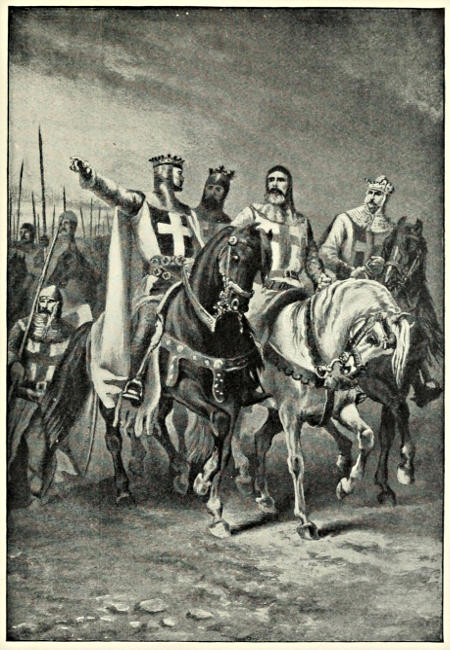
THE FOUR LEADERS OF THE FIRST CRUSADE
In the south of France, the command was assumed by Adhemar, bishop
of Puy, the pope’s legate; and by Raymond, count of St. Giles and Toulouse,
who added the prouder titles of duke of Narbonne and marquis of Provence.
The former was a respectable prelate, alike qualified for this world and the
next. The latter was a veteran warrior, who had fought against the Saracens
of Spain, and who consecrated his declining age not only to the deliverance
but to the perpetual service of the Holy Sepulchre. A mercantile, rather
than a martial spirit prevailed among his provincials—a common name which
included the natives of Auvergne and Languedoc—the
vassals of the kingdom of Burgundy
or Arles. From the adjacent frontier
of Spain, he drew a band of hardy adventurers;
as he marched through Lombardy, a crowd of
Italians flocked to his standard, and his united
force consisted of one hundred thousand horse
and foot. If Raymond was the first to enlist
and the last to depart, the delay may be
excused by the greatness of his preparation
and the promise of an everlasting farewell.
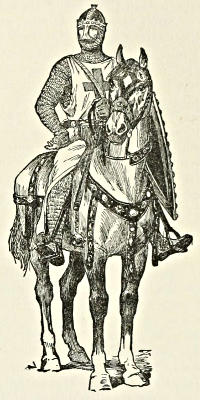
A Crusader
The name of Bohemond, the son of Robert
Guiscard, was already famous by his double
victory over the Greek emperor; but his
father’s will had reduced him to the principality
of Taranto and the remembrance of
his eastern trophies, till he was awakened by
the rumour and passage of the French pilgrims.
It is in the person of this Norman
chief that we may seek for the coolest policy
and ambition with a small alloy of religious
fanaticism. His conduct may justify a belief
that he had secretly directed the design of the
pope, which he affected to second with astonishment
and zeal. At the siege of Amalfi, his
example and discourse inflamed the passions
of a confederate army; he instantly tore his
garment to supply crosses for the numerous
candidates and prepared to visit Constantinople
and Asia at the head of ten thousand horse and twenty thousand foot.
Several princes of the Norman race accompanied this veteran general; and
his cousin Tancred was the partner, rather than the servant, of the war. In
the accomplished character of Tancred we discover all the virtues of a perfect
knight—the true spirit of chivalry, which inspired the generous sentiments
and social offices of man, far better than the base philosophy, or the baser
religion, of the times.
Between the age of Charlemagne and that of the Crusades, a revolution
had taken place among the Spaniards, the Normans, and the French, which
was gradually extended to the rest of Europe. The service of the infantry was
degraded to the plebeians; the cavalry formed the strength of the armies,
and the honourable name miles, or soldier, was confined to the gentlemen who
served on horseback and were invested with the character of knighthood.
The dukes and counts, who had usurped the rights of sovereignty, divided the
provinces among their faithful barons; the barons distributed among their
vassals the fiefs or benefices of their jurisdiction; and these military tenants,
the peers of each other and of their lord, composed the noble or equestrian
order, which disdained to conceive the peasant or burgher as of the same
species with themselves. The dignity of their birth was preserved by pure
and equal alliances; their sons alone who could produce four quarters or
lines of ancestry without spot or reproach, might legally pretend to the
honour of knighthood: but a valiant plebeian was sometimes enriched and
ennobled by the sword and became the father of a new race. A single knight
could impart, according to his judgment, the character which he received;
and the warlike sovereigns of Europe derived more glory from this personal
distinction than from the lustre of their diadem.
Such were the troops, and such the leaders, who assumed the cross for
the deliverance of the Holy Sepulchre. As soon as they were relieved by the
absence of the plebeian multitude, they encouraged each other, by interviews
and messages, to accomplish their vow and hasten their departure. Their
wives and sisters were desirous of partaking the danger and merit of the
pilgrimage; their portable treasures were conveyed in bars of silver and
gold; and the princes and barons were attended by their equipage of
hounds and hawks to amuse their leisure and to supply their table. The
difficulty of procuring subsistence for so many myriads of men and horses
engaged them to separate their forces; their choice or situation determined
the road; and it was agreed to meet in the neighbourhood of Constantinople,
and from thence to begin their operations against the Turks.
ALEXIUS COMPELS HOMAGE
[1097 A.D.]
In some oriental tale there is the fable of a shepherd, who was ruined
by the accomplishment of his own wishes: he had prayed for water; the
Ganges was turned into his grounds, and his flock and cottage were swept
away by the inundation. Such was the fortune, or at least the apprehension,
of the Greek emperor Alexius Comnenus. In the Council of Placentia,
his ambassadors had solicited a moderate succour, perhaps of ten thousand
soldiers; but he was astonished by the approach of so many potent chiefs and
fanatic nations. The promiscuous multitudes of Peter the Hermit were savage
beasts, alike destitute of humanity and reason; nor was it possible for
Alexius to prevent or deplore their destruction. The troops of Godfrey
and his peers were less contemptible, but not less suspicious, to the Greek
emperor. Their motives might be pure and pious; but he was equally
alarmed by his knowledge of the ambitious Bohemond, and his ignorance of
the Transalpine chiefs; the courage of the French was blind and headstrong;
they might be tempted by the luxury and wealth of Greece, and
elated by the view and opinion of their invincible strength; and Jerusalem
might be forgotten in the prospect of Constantinople.
After a long march and painful abstinence, the troops of Godfrey encamped
in the plains of Thrace; they heard with indignation that their
brother, the count of Vermandois, was imprisoned by the Greeks; and their
reluctant duke was compelled to indulge them in some freedom of retaliation
and rapine. They were appeased by the submission of Alexius;
he promised to supply their camp; and as they refused, in the midst of
winter, to pass the Bosporus, their quarters were assigned among the
gardens and palaces on the shores of that narrow sea. But an incurable
jealousy still rankled in the minds of the two nations, who despised each
other as slaves and barbarians. Ignorance is the ground of suspicion, and suspicion
was inflamed into daily provocations; prejudice is blind, hunger is
deaf; and Alexius is accused of a design to starve or assault the Latins in a
dangerous post, on all sides encompassed with the waters. Godfrey sounded
his trumpets, burst the net, overspread the plain, and insulted the suburbs;
but the gates of Constantinople were strongly fortified; the ramparts were
lined with archers; and after a doubtful conflict, both parties listened to
the voice of peace and religion. The gifts and promises of the emperor
insensibly soothed the fierce spirit of the western strangers; as a Christian
warrior, he rekindled their zeal for the prosecution of their holy enterprise,
which he engaged to second with his troops and treasures. On the return
of spring, Godfrey was persuaded to occupy a pleasant and plentiful camp in
Asia; and no sooner had he passed the Bosporus than the Greek vessels
were suddenly recalled to the opposite shore. The same policy was repeated
with the succeeding chiefs, who were swayed by the example and weakened
by the departure of their foremost companions. By his skill and diligence
Alexius prevented the union of any two of the confederate armies at the
same moment under the walls of Constantinople; and before the feast of
the Pentecost not a Latin pilgrim was left on the coast of Europe.
The same arms which threatened Europe might deliver Asia, and repel the
Turks from the neighbouring shores of the Bosporus and the Hellespont.
The fair provinces from Nicæa to Antioch were the recent patrimony of the
Roman emperor; and his ancient and perpetual claim still embraced
the kingdoms of Syria and Egypt. In his enthusiasm, Alexius indulged, or
affected, the ambitious hope of leading his new allies to subvert the thrones
of the East; but the calmer dictates of reason and temper dissuaded him
from exposing his royal person to the faith of unknown and lawless barbarians.
His prudence, or his pride, was content with extorting from the
French princes an oath of homage and fidelity, and a solemn promise that
they would either restore, or hold, their Asiatic conquests, as the humble
and loyal vassals of the Roman Empire. Their independent spirit was fired
at the mention of this foreign and voluntary servitude; they successively
yielded to the dexterous application of gifts and flattery; and the first
proselytes became the most eloquent and effectual missionaries to multiply
the companions of their shame.
The ceremony of their homage was grateful to a people who had long
since considered pride as the substitute of power. High on his throne, the
emperor sat mute and immovable; his majesty was adored by the Latin
princes; and they submitted to kiss either his feet or his knees, an indignity
which their own writers are ashamed to confess, and unable to deny.
NUMBERS OF THE CRUSADERS
The conquest of Asia was undertaken and achieved by Alexander, with
thirty-five thousand Macedonians and Greeks; and his best hope was in the
strength and discipline of his phalanx of infantry. The principal force of
the crusaders consisted in their cavalry; and when that force was mustered
in the plains of Bithynia, the knights and their martial attendants on horseback
amounted to one hundred thousand fighting men, completely armed
with the helmet and coat of mail. The value of these soldiers deserved
a strict and authentic account; and the flower of European chivalry might
furnish, in a first effort, this formidable body of heavy horse. A part of the
infantry might be enrolled for the service of scouts, pioneers, and archers;
but the promiscuous crowd were lost in their own disorder; and we depend
not on the eyes or knowledge, but on the belief and fancy of a chaplain of
Count Baldwin, in the estimate of six hundred thousand pilgrims able to bear
arms, besides the priests and monks, the women and children, of the
Latin camp. The reader starts; and before he recovers from his surprise,
we shall add, on the same testimony, that if all who took the cross had
accomplished their vow, above six millions would have migrated from Europe
to Asia. Under this oppression of faith we derive some relief from a more
sagacious and thinking writer, who, after the same review of the cavalry,
accuses the credulity of the priest of Chartres, and even doubts whether the
Cisalpine regions (in the geography of a Frenchman) were sufficient to produce
and pour forth such incredible multitudes. The coolest scepticism will
remember, that of these religious volunteers great numbers never beheld
Constantinople and Nicæa. Of enthusiasm the influence is irregular and
transient; many were detained at home by reason or cowardice, by poverty
or weakness; and many were repulsed by the obstacles of the way, the more
insuperable as they were unforeseen to these ignorant fanatics. The savage
countries of Hungary and Bulgaria were whitened with their bones; their
vanguard was cut in pieces by the Turkish sultan; and the loss of the first
adventure, by the sword, or climate, or fatigue, has already been stated at
three hundred thousand men. Yet the myriads that survived, that marched,
that pressed forwards on the holy pilgrimage, were a subject of astonishment
to themselves and to the Greeks. The copious energy of her language
sinks under the efforts of the princess Anna Comnena; the images of locusts,
of leaves and flowers, of the sands of the sea, or the stars of heaven, imperfectly
represent what she had seen and heard; and the daughter of Alexius
exclaims, that Europe was loosened from its foundations and hurled against
Asia. The ancient hosts of Darius and Xerxes labour under the same doubt
of a vague and indefinite magnitude; but we are inclined to believe that a
larger number has never been contained within the lines of a single camp
than at the siege of Nicæa, the first operation of the Latin princes. Their
motives, their characters, and their arms, have been already displayed. Of
their troops the most numerous portion were natives of France; the Low
Countries, the banks of the Rhine, and Apulia sent a powerful reinforcement;
some bands of adventurers were drawn from Spain, Lombardy, and
England, and from the distant bogs and mountains of Ireland or Scotland
issued some naked and savage fanatics, ferocious at home, but unwarlike
abroad.
THE SIEGE OF NICÆA
We have expatiated with pleasure on the first steps of the crusaders, as
they paint the manners and character of Europe; but we shall abridge the
tedious and uniform narrative of their blind achievements, which were performed
by strength, and are described by ignorance. From their first station
in the neighbourhood of Nicomedia, they advanced in successive divisions;
passed the contracted limit of the Greek Empire; opened a road through
the hills, and commenced, by the siege of his capital, their pious warfare
against the Turkish sultan. His kingdom of Roum extended from the
Hellespont to the confines of Syria, and barred the pilgrimage of Jerusalem;
his name was Kilij-Arslan, or Suleiman, of the race of Seljuk,
and son of the first conqueror; and in the defence of a land which the
Turks considered as their own, he deserved the praise of his enemies, by
whom alone he is known to posterity. Yielding to the first impulse of the
torrent, he deposited his family and treasure in Nicæa; retired to the mountains
with fifty thousand horse; and twice descended to assault the camps
or quarters of the Christian besiegers, which formed an imperfect circle of
above six miles.
The lofty and solid walls of Nicæa were covered by a deep ditch, and
flanked by 370 towers; and on the verge of Christendom, the Moslems
were trained in arms, and inflamed by religion. Before this city, the French
princes occupied their stations, and prosecuted their attacks without correspondence
or subordination; emulation prompted their valour; but their
valour was sullied by cruelty, and their emulation degenerated into envy
and civil discord. In the space of seven weeks, much labour and blood
were expended, and some progress, especially by Count Raymond, was made
on the side of the besiegers. But the Turks could protract their resistance
and secure their escape, as long as they were masters of the lake Ascanius,
which stretches several miles to the westward of the city. The means of
conquest were supplied by the prudence and industry of Alexius; a great
number of boats was transported on sledges from the sea to the lake; they
were filled with the most dexterous of his archers; the flight of the sultana
was intercepted; Nicæa was invested by land and water; and a Greek emissary
persuaded the inhabitants to accept his master’s protection, and to save
themselves, by a timely surrender, from the rage of the savages of Europe.
In the moment of victory, or at least of hope, the crusaders, thirsting for
blood and plunder, were awed by the imperial banner that streamed from
the citadel; and Alexius guarded with jealous vigilance this important conquest.
The murmurs of the chiefs were stifled by honour or interest; and
after a halt of nine days, they directed their march towards Phrygia, under
the guidance of a Greek general, whom they suspected of a secret connivance
with the sultan. The consort and the principal servants of Suleiman
had been honourably restored without ransom; and the emperor’s generosity
to the miscreants was interpreted as treason to the Christian cause.
BATTLE OF DORYLÆUM
Suleiman was rather provoked than dismayed by the loss of his capital;
he admonished his subjects and allies of this strange invasion of the western
barbarians; the Turkish emirs obeyed the call of loyalty or religion;
the Turkoman hordes encamped round his standard; and his whole force
is loosely stated by the Christians at 200,000, or even 360,000 horse.
Yet he patiently waited till they had left behind them the sea and the
Greek frontier; and hovering on the flanks, observed their careless and
confident progress in two columns beyond the view of each other. Some
miles before they could reach Dorylæum in Phrygia, the left, and least
numerous, division was surprised and attacked and almost oppressed, by
the Turkish cavalry. The heat of the weather, the clouds of arrows, and the
barbarous onset, overwhelmed the crusaders; they lost their order and
confidence; and the fainting fight was sustained by the personal valour,
rather than by the military conduct, of Bohemond, Tancred, and Robert of
Normandy. They were revived by the welcome banners of Duke Godfrey,
who flew to their succour with the count of Vermandois and sixty thousand
horse; and was followed by Raymond of Toulouse, the bishop of Puy, and
the remainder of the sacred army. Without a moment’s pause, they formed
in new order, and advanced to a second battle. They were received with
equal resolution; and, in their common disdain for the unwarlike people of
Greece and Asia, it was confessed on both sides, that the Turks and the
Franks were the only nations entitled to the appellation of soldiers.
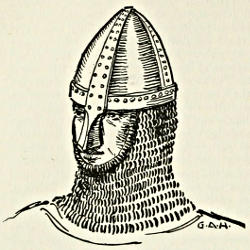
Helmet of a Crusader of the First Crusade
As long as the horses were fresh and the quivers full, Suleiman maintained
the advantage of the day; and four thousand Christians were pierced
by the Turkish arrows. In the evening, swiftness yielded to strength; on
either side, the numbers were equal,
or at least as great as any ground
could hold, or any generals could
manage; but in turning the hills,
the last division of Raymond and
his provincials was led, perhaps
without design, on the rear of an
exhausted enemy, and the long contest
was determined. Besides a
nameless and unaccounted multitude,
three thousand pagan knights
were slain in the battle and pursuit;
the camp of Suleiman was
pillaged. Reserving ten thousand
guards of the relics of his army,
Suleiman evacuated the kingdom
of Roum, and hastened to implore
the aid, and kindle the resentment,
of his eastern brethren. In a
march of five hundred miles, the
crusaders traversed the Lesser Asia,
through a wasted land and deserted towns, without either finding a friend or
an enemy. The geographer may trace the position of Dorylæum, Antioch
of Pisidia, Iconium, Archelais, and Germanicia, and may compare those classic
appellations with the modern names of Eskishehr the old city, Akshehr the
white city, Cogni, Erekli, and Marash.
PRINCIPALITY OF EDESSA FOUNDED
To improve the general consternation, the cousin of Bohemond and the
brother of Godfrey were detached from the main army with their respective
squadrons of five, and of seven, hundred knights. They overran in a rapid
career the hills and sea coast of Cilicia, from Cogni to the Syrian gates; the
Norman standard was first planted on the walls of Tarsus and Malmistra;
but the proud injustice of Baldwin at length provoked the patient and generous
Italian; and they turned their consecrated swords against each other in a
private and profane quarrel. Honour was the motive, and fame the reward,
of Tancred; but fortune smiled on the more selfish enterprise of his rival.
He was called to the assistance of a Greek or Armenian tyrant, who had been
suffered under the Turkish yoke to reign over the Christians of Edessa.
Baldwin accepted the character of his son and champion; but no sooner was
he introduced into the city than he inflamed the people to the massacre of
his father, occupied the throne and treasure, extended his conquests over the
hills of Armenia and the plain of Mesopotamia, and founded the first principality
of the Franks or Latins, which subsisted fifty-four years beyond
the Euphrates.
SIEGE OF ANTIOCH
[1097-1098 A.D.]
Before the Franks could enter Syria, the summer, and even the autumn,
were completely wasted. The siege of Antioch, or the separation and repose
of the army during the winter season, was strongly debated in their council.
At the head of the Turkish emirs, Baghi Sian, a veteran chief, commanded in
the place; his garrison was composed of six or seven thousand horse, and
fifteen or twenty thousand foot. Notwithstanding strong fortifications, the
city had been repeatedly taken by the Persians, the Arabs, the Greeks, and
the Turks; so large a circuit must have yielded many previous points of
attack; and in a siege that was formed about the middle of October, the
vigour of the execution could alone justify the boldness of the attempt.
Whatever strength and valour could perform in the field was abundantly
discharged by the champions of the cross; in the frequent occasions of
sallies, of forage, of the attack and defence of convoys, they were often victorious;
and we can only complain that their exploits are sometimes enlarged
beyond the scale of probability and truth. The sword of Godfrey divided
a Turk from the shoulder to the haunch; and one half of the infidel fell to
the ground, while the other was transported by his horse to the city gate.
But the reality or report of such gigantic prowess must have taught the
Moslems to keep within their walls; and against those walls of earth or stone,
the sword and the lance were unavailing weapons.
Indolence or weakness had prevented the Franks from investing the
entire circuit; and the perpetual freedom of two gates relieved the wants
and recruited the garrison of the city. At the end of seven months, after
the ruin of their cavalry, and an enormous loss by famine, desertion, and
fatigue, the progress of the crusaders was imperceptible, and their success
remote, if the Latin Ulysses, the artful and ambitious Bohemond, had not
employed the arms of cunning and deceit. The Christians of Antioch were
numerous and discontented; Firuz, a Syrian renegado, had acquired the
favour of the emir and the command of three towers. A secret correspondence
was soon established. Bohemond declared in the council of the
chiefs that he could deliver the city into their hands. But he claimed the
sovereignty of Antioch as the reward of his service; and the proposal which
had been rejected by the envy, was at length extorted from the distress, of
his equals. The nocturnal surprise was executed by the French and Norman
princes, who ascended in person the scaling ladders that were thrown from
the wall; their new proselyte, after the murder of his too scrupulous brother,
embraced and introduced the servants of Christ; the army rushed through
the gates; and the Moslems soon found, that, although mercy was hopeless,
resistance was impotent.
But the citadel still refused to surrender, and the victors themselves were
speedily encompassed and besieged by the innumerable forces of Kerboga,
prince of Mosul, who with twenty-eight Turkish emirs advanced to the
deliverance of Antioch. Five-and-twenty days the Christians spent on the
verge of destruction; and the proud lieutenant of the caliph and the sultan
left them only the choice of servitude or death. In this extremity they collected
the relics of their strength, sallied from the town, and in a single
memorable day annihilated or dispersed the host of Turks and Arabians,
which they might safely report to have consisted of six hundred thousand
men. Their supernatural allies we shall proceed to consider; the human
causes of the victory of Antioch were the fearless despair of the Franks,
and the surprise, the discord, perhaps the errors, of their adversaries.
In the eventful period of the siege and defence of Antioch, the crusaders
were alternately exalted by victory or sunk in despair; either swelled with
plenty or emaciated with hunger. A speculative reasoner might suppose
that their faith had a strong and serious influence on their practice; and that
the soldiers of the cross, the deliverers of the Holy Sepulchre, prepared
themselves by a sober and virtuous life for the daily contemplation of martyrdom.
Experience blows away this charitable illusion; and seldom does
the history of profane war display such scenes of intemperance and prostitution
as were exhibited under the walls of Antioch. The grove of Daphne
no longer flourished; but the Syrian air was still impregnated with the
same vices; the Christians were seduced by every temptation that nature
either prompts or reprobates; the authority of the chiefs was despised; and
sermons and edicts were alike fruitless against those scandalous disorders,
not less pernicious to military discipline, than repugnant to evangelic purity.
In the first days of the siege and the possession of Antioch, the Franks consumed
with wanton and thoughtless prodigality the frugal subsistence of
weeks and months; the desolate country no longer yielded a supply; and from
that country they were at length excluded by the arms of the besieging
Turks. Disease, the faithful companion of want, was envenomed by the
rains of the winter, the summer heats, unwholesome food, and the close
imprisonment of multitudes. The pictures of famine and pestilence are
always the same, and always disgustful.
The remains of treasure or spoil were eagerly lavished in the purchase of
the vilest nourishment; and dreadful must have been the calamities of the
poor, since, after paying three marks of silver for a goat, and fifteen for a
lean camel, the count of Flanders was reduced to beg a dinner, and Duke
Godfrey to borrow a horse. Sixty thousand horses had been reviewed in the
camp; before the end of the siege they were diminished to two thousand,
and scarcely two hundred fit for service could be mustered on the day of
battle. Weakness of body and terror of mind extinguished the ardent
enthusiasm of the pilgrims; and every motive of honour and religion was
subdued by the desire of life. Among the chiefs, three heroes may be found
without fear or reproach: Godfrey de Bouillon was supported by his magnanimous
piety; Bohemond by ambition and interest; and Tancred declared,
in the true spirit of chivalry, that as long as he was at the head of forty
knights he would never relinquish the enterprise of Palestine. But the
count of Toulouse and Provence was suspected of a voluntary indisposition;
the duke of Normandy was recalled from the sea shore by the censures of
the church; Hugh the Great, though he led the vanguard of the battle,
embraced an ambiguous opportunity of returning to France; and Stephen
count of Chartres basely deserted the standard which he bore, and the
council in which he presided. The soldiers were discouraged by the flight
of William, viscount of Melun, surnamed the Carpenter from the weighty
strokes of his axe; and the saints were scandalised by the fall of Peter the
Hermit, who attempted to escape from the penance of a necessary fast.[49]
A TYPICAL MIRACLE
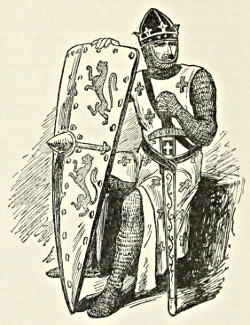
A Norman Crusader
In such a cause, and in such an army, visions, prophecies, and miracles
were frequent and familiar. In the distress of Antioch, they were repeated
with unusual energy and success; St. Ambrose had assured a pious ecclesiastic
that two years of trial must precede the season of deliverance and grace; the
deserters were stopped by the presence and reproaches of Christ himself;
the dead had promised to arise and combat with their brethren; the Virgin
had obtained the pardon of their sins; and their confidence was revived by
a visible sign, the seasonable and splendid discovery of the holy lance. The
policy of their chiefs has on this occasion been admired, and might surely
be excused; but a pious fraud
is seldom produced by the cool
conspiracy of many persons;
and a voluntary impostor
might depend on the support
of the wise and the credulity
of the people. Of the
diocese of Marseilles, there
was a priest of low cunning
and loose manners, and his
name was Peter Bartholemy.
He presented himself at the
door of the council-chamber
to disclose an apparition of
St. Andrew which had been
thrice reiterated in his sleep,
with a dreadful menace, if
he presumed to suppress the
commands of heaven. “At
Antioch,” said the apostle, “in
the church of my brother St.
Peter, near the high altar, is
concealed the steel head of the
lance that pierced the side of
our Redeemer. In three days,
that instrument of eternal, and
now of temporal salvation, will
be manifested to his disciples.
Search and ye shall find; bear it aloft in battle, and that mystic weapon shall
penetrate the souls of the miscreants.” The pope’s legate, the bishop of Puy,
affected to listen with coldness and distrust; but the revelation was eagerly
accepted by Count Raymond, whom his faithful subject, in the name of the
apostle, had chosen for the guardian of the holy lance.
The experiment was resolved; and on the third day after a due preparation
of prayer and fasting the priest of Marseilles introduced twelve trusty
spectators, among whom were the count and his chaplain; and the church
doors were barred against the impetuous multitude. The ground was
opened in the appointed place; but the workmen, who relieved each other,
dug to the depth of twelve feet without discovering the object of their
search. In the evening, when Count Raymond had withdrawn to his post,
and the weary assistants began to murmur, Bartholemy in his shirt, and
without his shoes, boldly descended into the pit; the darkness of the
hour and of the place enabled him to secrete and deposit the head of a Saracen
lance; and the first sound, the first gleam of the steel, was saluted with
a devout rapture. The holy lance was drawn from its recess, wrapped in a
veil of silk and gold, and exposed to the veneration of the crusaders; their
anxious suspense burst forth in a general shout of joy and hope, and the
desponding troops were again inflamed with the enthusiasm of valour.
Next day the gates of Antioch were thrown open; the battle array was
marshalled; the holy lance was carried by Raymond’s chaplain; and the
hosts of the enemy were annihilated or scattered.
In the season of danger and triumph, the revelation of Bartholemy of
Marseilles was unanimously asserted; but as soon as the temporary service
was accomplished, the personal dignity and liberal alms which the count of
Toulouse derived from the custody of the holy lance provoked the envy, and
awakened the reason, of his rivals. A Norman clerk presumed to sift, with
a philosophic spirit, the truth of the legend, the circumstances of the discovery,
and the character of the prophet; and the pious Bohemond ascribed
their deliverance to the merits and intercession of Christ alone. For a
while, the provincials defended their national palladium with clamours and
arms; and new visions condemned to death and hell the profane sceptics
who presumed to scrutinise the truth and merit of the discovery. The
prevalence of incredulity compelled the author to submit his life and veracity
to the judgment of God. A pile of dry fagots, four feet high, and fourteen
long, was erected in the midst of the camp; the flames burned fiercely to the
elevation of thirty cubits; and a narrow path of twelve inches was left for
the perilous trial. The unfortunate priest of Marseilles traversed the fire
with dexterity and speed; but his thighs and belly were scorched by the
intense heat; he expired the next day; and the logic of believing minds
will pay some regard to his dying protestations of innocence and truth.
Some efforts were made by the provincials to substitute a cross, a ring, or a
tabernacle, in the place of the holy lance, which soon vanished in contempt
and oblivion.
The prudence or fortune of the Franks had delayed their invasion till the
decline of the Turkish Empire. Under the manly government of the first
three sultans, the kingdoms of Asia were united in peace and justice; and
the innumerable armies which they led in person were equal in courage,
and superior in discipline, to the barbarians of the West. But at the time
of the crusade the inheritance of Malik Shah was disputed by his four sons.
The twenty-eight emirs, who marched with the standard of Kerboga, were
his rivals or enemies; their hasty levies were drawn from the towns and
tents of Mesopotamia and Syria; and the Turkish veterans were employed
or consumed in the civil wars beyond the Tigris. The caliph of Egypt
embraced this opportunity of weakness and discord, to recover his ancient
possessions; and his sultan Afdal besieged Jerusalem and Tyre, expelled
the children of Ortok, and restored in Palestine the civil and ecclesiastical
authority of the Fatimites. They heard with astonishment of the vast
armies of Christians that had passed from Europe to Asia, and rejoiced in
the sieges and battles which broke the power of the Turks, the adversaries
of their sect and monarchy. But the same Christians were the enemies of the
prophet; and from the overthrow of Nicæa and Antioch, the motive of
their enterprise, which was gradually understood, would urge them forwards
to the banks of the Jordan, or perhaps of the Nile. An intercourse of epistles
and embassies, which rose and fell with the events of war, was maintained
between the throne of Cairo and the camp of the Latins; and their
adverse pride was the result of ignorance and enthusiasm. The ministers
of Egypt declared in a haughty, or insinuated in a milder, tone, that their
sovereign, the true and lawful commander of the faithful, had rescued Jerusalem
from the Turkish yoke; and that the pilgrims, if they would divide
their numbers, and lay aside their arms, should find a safe and hospitable
reception at the sepulchre of Jesus. In either fortune the answer of the
crusaders was firm and uniform; they disdained to inquire into the private
claims or possessions of the followers of Mohammed; whatsoever was his
name or nation, the usurper of Jerusalem was their enemy; and instead of
prescribing the mode and terms of their pilgrimage, it was only by a timely
surrender of the city and province, their sacred right, that he could deserve
their alliance, or deprecate their impending and irresistible attack.
JERUSALEM BESIEGED
[1098-1099 A.D.]
Yet this attack, when they were within the view and reach of their
glorious prize, was suspended above ten months after the defeat of Kerboga.
The zeal and courage of the crusaders were chilled in the moment of victory;
and instead of marching to improve the consternation, they hastily dispersed
to enjoy the luxury of Syria. The causes of this strange delay may be
found in the want of strength and subordination. In the painful and
various service of Antioch, the cavalry was annihilated; many thousands of
every rank had been lost by famine, sickness, and desertion; the same abuse
of plenty had been productive of a third famine; and the alternation of
intemperance and distress had generated a pestilence, which swept away
above fifty thousand of the pilgrims. Few were able to command, and
none were willing to obey; and Count Raymond exhausted his troops
and treasures in an idle expedition into the heart of Syria. The winter was
consumed in discord and disorder. In the month of May, the relics of this
mighty host proceeded from Antioch to Laodicea; about forty thousand
Latins, of whom no more than fifteen hundred horse, and twenty thousand
foot, were capable of immediate service. Their easy march was continued
between Mount Libanus and the sea shore; their wants were liberally supplied
by the coasting traders of Genoa and Pisa; and they drew large contributions
from the emirs of Tripolis, Tyre, Sidon, Acre, and Cæsarea, who granted
a free passage and promised to follow the example of Jerusalem. From
Cæsarea they advanced into the midland country; their clerks recognised
the sacred geography of Lydda, Ramla, Emmaus, and Bethlehem, and as soon
as they descried the Holy City, the crusaders forgot their toils and claimed
their reward.
Jerusalem has derived some reputation from the number and importance
of her memorable sieges. It was not till after a long and obstinate contest
that Babylon and Rome could prevail against the obstinacy of the people,
the craggy ground that might supersede the necessity of fortifications, and the
walls and towers that would have fortified the most accessible plain. By
the experience of a recent siege, and a three years’ possession, the Saracens
of Egypt had been taught to discern, and in some degree to remedy, the
defects of a place, which religion as well as honour forbade them to resign.
Aladin, or Iftikhar, the caliph’s lieutenant, was entrusted with the defence;
his policy strove to restrain the native Christians by the dread of their own
ruin and that of the Holy Sepulchre. His garrison is said to have consisted
of forty thousand Turks and Arabians; and if he could muster twenty
thousand of the inhabitants, it must be confessed that the besieged were
more numerous than the besieging army. Their siege was more reasonably
directed against the northern and western sides of the city. Godfrey de
Bouillon erected his standard on the first swell of Mount Calvary; to the
left, as far as St. Stephen’s gate, the line of attack was continued by Tancred
and the two Roberts; and Count Raymond established his quarters from the
citadel to the foot of Mount Zion, which was no longer included within
the precincts of the city. On the fifth day, the crusaders made a general
assault. By dint of brutal force, they burst the first barrier, but they
were driven back with shame and slaughter to the camp; the influence of
vision and prophecy was deadened by the too frequent abuse of those pious
stratagems; and time and labour were found to be the only means of victory.
The time of the siege was indeed fulfilled in forty days, but they were forty
days of calamity and anguish. On a Friday, at three in the afternoon,
the day and hour of the passion, Godfrey de Bouillon stood victorious on the
walls of Jerusalem. His example was followed on every side by the
emulation of valour; and about 460 years after the conquest of Omar,
the Holy City was rescued from the Mohammedan yoke. In the
pillage of public and private wealth, the adventurers had agreed to respect
the exclusive property of the first occupant; and the spoils of the great
mosque, seventy lamps and massy vases of gold and silver, rewarded the
diligence, and displayed the generosity, of Tancred.
A bloody sacrifice was offered by his mistaken votaries to the God of
the Christians; resistance might provoke, but neither age nor sex could
mollify, their implacable rage; they indulged themselves three days in a
promiscuous massacre; and the infection of the dead bodies produced an
epidemical disease. After seventy thousand Moslems had been put to the
sword, and the harmless Jews had been burned in their synagogue, they
could still reserve a multitude of captives, whom interest or lassitude persuaded
them to spare. Of these savage heroes of the cross, Tancred alone
betrayed some sentiments of compassion; yet we may praise the more
selfish lenity of Raymond, who granted a capitulation and safe conduct to
the garrison of the citadel.
The Holy Sepulchre was now free; and the bloody victors prepared to
accomplish their vow. Bareheaded and barefoot, with contrite hearts, and
in a humble posture, they ascended the hill of Calvary, amidst the loud
anthems of the clergy; kissed the stone which had covered the Saviour
of the world, and bedewed with tears of joy and penitence the monument of
their redemption.b
THE ARAB ACCOUNT
It is well in a moment of such historic import as this to see how the
other side accepts the crisis. The Arab historian Ibn Guzid wrote as follows:
“The Franks, when they set out from Antioch, numbered one million men,
of whom five hundred thousand were fit for war. The rest consisted of
workmen and those employed on the swivel-guns and other instruments
of war. They marched along the sea shore. Jerusalem at that time belonged
to the Egyptians. Their commander was named Iftikhar ad-Daulah,
or ‘the glory of the empire.’
“The siege lasted forty days. The Franks built two towers to command
the walls of the town, one in the direction of the gate of Sidon, the other
in that of the gates of Asbat and Amud, or the gates of the Tribes and of
the Column. The besieged succeeded in burning the tower near the gate
of Sidon; the second was brought up close to the walls. Then the Franks
set all their machines to work at the same time; attacking like one single
man, they put the Moslems to flight and entered the town by force. The
inhabitants took refuge in the mosque Alacsa and its dependencies; the
Franks, following them there, killed it is said one hundred thousand persons,
and made an equal number prisoners. They did not even spare the aged
of both sexes.
“In this spot immense riches were stored. They found seventy lamps,
twenty of which were of gold and the others of silver; they also carried off
a tennur or large silver lamp, weighing forty Syrian pounds. The Jews
they shut up in their synagogue, and burned them there. Jerusalem had
been in the power of Islam without a break since the reign of Caliph
Omar, in the sixteenth year of the Hegira (637 A.D.). A Moslem author
named Ibn Zulak,d thinking no doubt to give greater importance to this
event, declares that at the moment when the Christians entered the Holy
City the sun was eclipsed, the earth was hidden in darkness, and the
stars appeared in broad daylight.”d
The Moslem poets describe the horrors of massacre in vehement terms,
bewailing the butchery of the women and the children and the fate of their
fathers who “but lately masters of Syria, now found no other refuge than
the backs of swift camels or even the entrails of the vultures!”a
GODFREY ELECTED KING (1099 A.D.)
[1099-1147 A.D.]
Eight days after this memorable event, which Pope Urban did not live
to hear, the Latin chiefs proceeded to the election of a king to guard and
govern their conquest in Palestine. The jealousy and ambition of Raymond
were condemned by his own followers; and the free, the just, the unanimous
voice of the army proclaimed Godfrey de Bouillon the first and most
worthy of the champions of Christendom. His magnanimity accepted a
trust as full of danger as of glory; but in a city where his Saviour had been
crowned with thorns, the devout pilgrim rejected the name and ensigns of
royalty; and the founder of the kingdom of Jerusalem contented himself
with the modest title of Defender and Baron of the Holy Sepulchre. His
government of a single year, too short for the public happiness, was interrupted
in the first fortnight by a summons to the field by the approach of
the vizir or sultan of Egypt, who had been too slow to prevent, but who was
impatient to avenge, the loss of Jerusalem. His total overthrow in the
battle of Askalon sealed the establishment of the Latins in Syria, and signalised
the valour of the French princes, who in this action bade a long farewell
to the holy wars.
After suspending before the Holy Sepulchre the sword and standard of
the sultan, the new king (he deserves the title) embraced his departing companions,
and could retain only, with the gallant Tancred, three hundred
knights and two thousand foot soldiers, for the defence of Palestine. His
sovereignty was soon attacked by a new enemy, the only one against whom
Godfrey was a coward. Adhemar, bishop of Puy, who excelled both in
council and action, had been swept away in the last plague of Antioch; the
remaining ecclesiastics preserved only the pride and avarice of their character;
and their seditious clamours had required that the choice of a bishop
should precede that of a king. The revenue and jurisdiction of the lawful
patriarch were usurped by the Latin clergy; the exclusion of the Greeks
and Syrians was justified by the reproach of heresy or schism; and, under
the iron yoke of their deliverers, the oriental Christians regretted the tolerating
government of the Arabian caliphs. Daimbert, archbishop of Pisa, had
long been trained in the secret policy of Rome; he brought a fleet of his
countrymen to the succour of the Holy Land, and was installed, without a
competitor, the spiritual and temporal head of the church. The new patriarch
immediately grasped the sceptre which had been acquired by the toil
and blood of the victorious pilgrims; and both Godfrey and Bohemond submitted
to receive at his hands the investiture of their feudal possessions.
Nor was this sufficient; Daimbert claimed the immediate property of Jerusalem
and Joppa; instead of a firm and generous refusal, the hero negotiated
with the priest; a quarter of either city was ceded to the church; and
the modest bishop was satisfied with an eventual reversion of the rest, on the
death of Godfrey without children, or on the future acquisition of a new seat
at Cairo or Damascus.
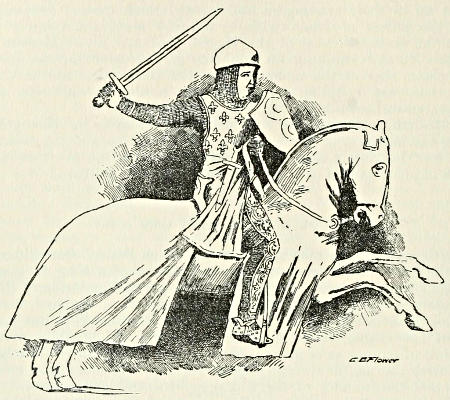
A Crusader
(From an effigy on a tomb in Florence)
Without this indulgence, the conqueror would have been almost stripped
of his infant kingdom, which consisted only of Jerusalem and Joppa, with
about twenty villages and towns of the adjacent country. Within this narrow
verge, the Mohammedans were still lodged in some impregnable castles;
and the husbandman, the trader, and the pilgrim were exposed to daily and
domestic hostility. By the arms of Godfrey himself, and of the two Baldwins,
his brother and cousin, who succeeded to the throne, the Latins
breathed with more ease and safety; and at length they equalled, in the
extent of their dominions, though not in the millions of their subjects,
the ancient princes of Judah and Israel. After the reduction of the maritime
cities of Laodicea, Tripolis, Tyre, and Askalon, which were powerfully
assisted by the fleets of Venice, Genoa, and Pisa, and even of Flanders and
Norway, the range of sea coast from Scanderoon to the borders of Egypt was
possessed by the Christian pilgrims. If the prince of Antioch disclaimed
his supremacy, the counts of Edessa and Tripolis owned themselves the vassals
of the king of Jerusalem; the Latins reigned beyond the Euphrates;
and the four cities of Hems, Hamah, Damascus, and Aleppo were the only
relics of the Mohammedan conquests in Syria.
The laws and language, the manners and titles, of the French nation and
Latin church, were introduced into these transmarine colonies. The whole
legal militia of the kingdom could not exceed eleven thousand men, a slender
defence against the surrounding myriads of Saracens and Turks. But the
firmest bulwark of Jerusalem was founded on the knights of the Hospital
of St. John, and of the Temple of Solomon; on the strange association of
a monastic and military life, which fanaticism might suggest, but which policy
must approve. The flower of the nobility of Europe aspired to wear
the cross, and to profess the vows of these respectable orders; their spirit
and discipline were immortal; and the speedy donation of twenty-eight
thousand farms, or manors, enabled them to support a regular force of cavalry
and infantry for the defence of Palestine. The austerity of the convent
soon evaporated in the exercise of arms; the world was scandalised by
the pride, avarice, and corruption of these Christian soldiers. But in their
most dissolute period, the knights of the Hospital and Temple maintained
their fearless and fanatic character; they neglected to live, but they were
prepared to die, in the service of Christ; and the spirit of chivalry, the
parent and offspring of the Crusades, has been transplanted by this institution
from the Holy Sepulchre to the Isle of Malta.
No sooner had Godfrey de Bouillon accepted the office of supreme magistrate,
than he solicited the public and private advice of the Latin pilgrims,
who were the best skilled in the statutes and customs of Europe. From
these materials, with the counsel and approbation of the patriarchs and
barons of the clergy and laity, Godfrey composed the Assize of Jerusalem—a
precious monument of feudal jurisprudence.
The justice and freedom of the constitution were maintained by two tribunals
of unequal dignity, which were instituted by Godfrey de Bouillon
after the conquest of Jerusalem. The king, in person, presided in the upper
court, the court of the barons. Of those the four most conspicuous were
the prince of Galilee, the lord of Sidon and Cæsarea, and the counts of Joppa
and Tripolis, who, perhaps with the constable and marshal, were in a special
manner the compeers and judges of each other. But all the nobles who held
their lands immediately of the crown were entitled and bound to attend the
king’s court; and each baron exercised a similar jurisdiction in the subordinate
assemblies of his own feudatories. The trial by battle was established
in all criminal cases which affected the life, or limb, or honour, of any
person; and in all civil transactions, of or above the value of one mark of
silver.
Among the causes which enfranchised the plebeians from the yoke of
feudal tyranny, the institution of cities and corporations is one of the most
powerful; and if those of Palestine are coeval with the First Crusade, they
may be ranked with the most ancient of the Latin world. Many of the pilgrims
had escaped from their lords under the banner of the cross; and it
was the policy of the French princes to tempt their stay by the assurance of
the rights and privileges of freemen. It is expressly declared in the Assize
of Jerusalem, that after instituting, for his knights and barons, the court of
peers, in which he presided himself, Godfrey de Bouillon established a second
tribunal, in which his person was represented by his viscount. The jurisdiction
of this inferior court extended over the burgesses of the kingdom;
and it was composed of a select number of the most discreet and worthy
citizens, who were sworn to judge, according to the laws, of the actions and
fortunes of their equals. In the conquest and settlement of new cities, the
example of Jerusalem was imitated by the kings and their great vassals;
and above thirty similar corporations were founded before the loss of the
Holy Land. Another class of subjects, the Syrians, or oriental Christians,
were oppressed by the zeal of the clergy, and protected by the toleration of
the state. Godfrey listened to their reasonable prayer, that they might be
judged by their own national laws. A third court was instituted for their
use, of limited and domestic jurisdiction; the sworn members were Syrians,
in blood, language, and religion; but the office of the president (in Arabic,
of the rais) was sometimes exercised by the viscount of the city. At
an immeasurable distance below the nobles, the burgesses, and the strangers,
the Assize of Jerusalem condescends to mention the villeins and slaves, the
peasants of the land and the captives of war, who were almost equally considered
as the objects of property. The relief or protection of these unhappy
men was not esteemed worthy of the care of the legislator; but he diligently
provides for the recovery, though not indeed for the punishment, of the
fugitives. Like hounds, or hawks, which had strayed from the lawful owner,
they might be lost and claimed; the slave and falcon were of the same value;
but three slaves, or twelve oxen, were accumulated to equal the price of the
war-horse; and a sum of three hundred pieces of gold was fixed, in the age
of chivalry, as the equivalent of the more noble animal.b
RESULTS OF THE FIRST CRUSADE
As if obeying the impetus it had received, the new state continued the
spirit of conquest under Godfrey’s first two successors—Baldwin I (1100-1118)
and Baldwin II of Bourg (1118-1131). But after these two reigns
decadence began in discord. The atabegs who ruled at Mosul and Damascus
took Edessa and massacred its people in 1144. There needed nothing
less than this bloody disaster, which left Palestine exposed, to drive Europe
to the renewal of crusade.
The First Crusade was very different from the seven others. It kindled
all Europe, profoundly stirred the masses, both people and peers, and was the
symptom of a great upheaval of sentiments and ideals. Those of the two
following centuries had not the same motive. They were almost all conducted
by kings who had kept aloof from the first; and even if faith were
never absent, politics was often superior.
The Second Crusade felt still a vivid reflection of the spirit of devotion
that animated the First; but it was no longer the work of the people but
of princes—the emperor Conrad III and King Louis VII of France, who
took the cross in spite of the prudent counsels of his minister, Abbé Suger.
This Crusade was preached in France and Germany by St. Bernard; but
already the zeal was somewhat chilled. A general tax levied on the whole
kingdom of France, and on every class—nobles, priests, or peasants—roused
much protest; at Sens the people killed the abbé of St. Pierre le Vif, ruler of
part of their city, because of an impost he had wished to collect. “The
king,” said a contemporary, “started on his way in the midst of curses.”
St. Bernard had been offered the command of the expedition, but remembering
Peter the Hermit, he refused.e
This Peter the Hermit, who for all his meek and lowly manner had
unhinged all Europe and led a huge rabble to the slaughter in Asia Minor,
had received an address of thanks in Jerusalem when the city had been
taken; and then retiring to his native France had built a monastery at Huy
on the Maas, where he lived quietly and died obscurely in 1115, recking
nothing of the series of bloody wars that were to follow as the aftermath
of his perfervid oratory and fanatic frenzy.a
FOOTNOTES
Horse Armour of the Thirteenth and Fourteenth Centuries
Winged is each heart, and winged every heel;
They fly, yet notice not how fast they fly;
But by the time the dewless meads reveal
The fervent sun’s ascension in the sky,
Lo, towered Jerusalem salutes the eye!
A thousand pointing fingers tell the tale;
“Jerusalem!” a thousand voices cry,
“All hail, Jerusalem!” hill, down, and dale
Catch the glad sounds, and shout, “Jerusalem, all hail!”
—Tasso (Jerusalem, Canto iii).
[1147-1189 A.D.]
The enthusiasm of the First Crusade is a natural and simple event, while
hope was fresh, danger untried, and enterprise congenial to the spirit of the
times. But the obstinate perseverance of Europe may indeed excite our
pity and admiration: that no instruction should have been drawn from constant
and adverse experience; that the same confidence should have repeatedly
grown from the same failures; that six succeeding generations should
have rushed headlong down the precipice that was open before them; and
that men of every condition should have staked their public and private
fortunes on the desperate adventure of possessing or recovering a tombstone
two thousand miles from their country. In a period of two centuries after
the Council of Clermont, each spring and summer produced a new emigration
of pilgrim warriors for the defence of the Holy Land; but the seven
great armaments or crusades were excited by some impending or recent
calamity; the nations were moved by the authority of their pontiffs and
the example of their kings; their zeal was kindled, and their reason
was silenced, by the voice of their holy orators; and among these, Bernard,
the monk or the saint, may claim the most honourable place.
ST. BERNARD
[1115-1147 A.D.]
About eight years before the first conquest of Jerusalem he was born of
a noble family in Burgundy; at the age of twenty-three he buried himself
in the monastery of Citeaux, then in the primitive fervour of the institution;
at the end of two years he led forth her third colony, or daughter, to the
valley of Clairvaux in Champagne; and was content till the hour of his
death with the humble station of abbot of his own community. A philosophic
age has abolished, with too liberal and indiscriminate disdain, the
honours of these spiritual heroes. The meanest among them are distinguished
by some energies of the mind; they were at least superior to their
votaries and disciples; and in the race of superstition, they attained the
prize for which such numbers contended. In speech, in writing, in action,
Bernard stood high above his rivals and contemporaries; his compositions
are not devoid of wit and eloquence; and he seems to have preserved as
much reason and humanity as may be reconciled with the character of a
saint. In a secular life he would have shared the seventh part of a private
inheritance; by a vow of poverty and penance, by closing his eyes against
the visible world, by the refusal of all ecclesiastical dignities, the abbot
of Clairvaux became the oracle of Europe, and the founder of 160 convents.
Princes and pontiffs trembled at the freedom of his apostolical censures;
France, England, and Milan consulted and obeyed his judgment in
a schism of the church; the debt was repaid by the gratitude of Innocent
II; and his successor, Eugenius III, was the friend and disciple of the
holy Bernard.
It was in the proclamation of the Second Crusade that he shone as the
missionary and prophet of God, who called the nations to the defence of
the Holy Sepulchre. At the parliament of Vézelay he spoke before the king;
and Louis VII, with his nobles, received their crosses from his hand. The
abbot of Clairvaux then marched to the less easy conquest of the emperor
Conrad; a phlegmatic people, ignorant of his language, was transported by
the pathetic vehemence of his tone and gestures; and his progress from
Constance to Cologne was the triumph of eloquence and zeal. Bernard applauds
his own success in the depopulation of Europe; affirms that cities
and castles were emptied of their inhabitants; and computes that only one
man was left behind for the consolation of seven widows. The blind fanatics
were desirous of electing him for their general; but the example of
the hermit Peter was before his eyes; and while he assured the crusaders
of the divine favour, he prudently declined a military command in which
failure and victory would have been almost equally disgraceful to his
character.b
In the consternation throughout Palestine which the fall of Edessa
occasioned, all classes of people beckoned their compatriots in the West.
The news of the loss of the eastern frontier of the Latin kingdom reached
France at a time peculiarly favourable for foreign war. After having
reduced his vassal the count of Champagne to obedience, Louis VII the
French king exceeded the usual cruelty of conquerors, and instead of sheathing
his sword, when the inhabitants of Vetri submitted, he set fire to a church,
to which more than thirteen hundred of them had fled for refuge. His sacrilegious
barbarity excited the indignation of the clergy and laity. A fit of
sickness calmed his passions; his conscience accused and condemned him,
and he resolved to expiate his sins by a pilgrimage to Jerusalem. Louis
VII was the first sovereign prince who engaged himself to fight under the
banner of the cross. The news of the calamities in Palestine quickened his
holy resolution, and like other men he was impetuously moved by the eloquence
of St. Bernard, the great oracle of the age.
The wish of Louis for a crusade was applauded by Pope Eugenius III.
His intention was pronounced to be holy; and Bernard was ordered to travel
through France and Germany, and preach a plenary indulgence to those who
followed the royal example. Eugenius wrote to the faithful sons of the
church, urging them to cross the seas to Palestine. The first crusaders had
provoked the wrath of heaven by their dissoluteness and folly; but the new
soldiers of Christ ought to travel simple in dress, and disdaining the luxury
of falcons and dogs of the chase. As Peter had represented the scandal
of suffering the sacred places to remain in the hands of the infidels,
the eloquent Bernard thundered from the pulpit the disgrace of allowing a
land which had been recovered from pollution again to sink into it. He was
admitted to the thrones of princes, as well as to the pulpits of their churches;
to public assemblies and to private meetings. In a parliament held at
Vézelay, in the season of Easter, 1146, Louis was confirmed in his pious
resolve; and having on his knees received the holy symbol, he joined with
Bernard in moving the barons and knights to save the sanctuary of David
from the hands of the Philistines. No house could contain the multitude;
they assembled in the fields and Bernard addressed them from a lofty pulpit.
As at the Council of Clermont, so on this occasion shouts of “Deus id vult”
rent the skies; the crosses which the man of God had brought with him
to the meeting fell far short of the number of enthusiasts; and he therefore
tore his simple monkish garment into small pieces, and affixed them to the
shoulders of his kneeling converts. The successful incendiary then crossed
the Rhine; and every city and village from Constance to Carinthia echoed the
call to war.
[1147-1148 A.D.]
But the emperor Conrad III made a long and firm denial. As politics
prevented the exercise of religious fervour, the preacher endeavoured to
impress him with the belief that were he in arms for the kingdom of God,
heaven would protect his kingdom in Europe. Still the emperor wanted
faith; but when the holy orator, in a moment of peculiar energy, drew
an animated picture of the proceedings of the day of judgment, of the punishments
which would be inflicted on the idle, and the rewards which would be
showered upon the Christians militant, then it was that conviction flashed
across the mind of the royal auditor; and the profession was made that the
lord of the Germans knew and would perform his duty to the church.
Encouraged by this example, the barons and people flew to arms.[50]
Mainz was the rendezvous of the French crusaders, and Ratisbon of
those from Germany. The French levies were of priests, of people, and of
soldiers; and of the last class the number of men armed with the helmet
and coat of mail was seventy thousand. The civil wars of England had
been closed by the weakness of all parties; but some of the nobility, restless
when not engaged in deeds of blood, joined themselves to the force of Louis.
Conrad had an army quite as large and formidable, with a due proportion of
light-armed men, and simple pilgrims. The enthusiasm of the crusade realised
the dreams of romancers, and heroines as well as heroes had prepared
themselves to make war upon the paynim brethren. A considerable troop
of women rode among the Germans; they were arrayed with the spear and
shield, but (like Virgil’s Camilla) some love of usual delights had mingled
itself with the desire of great exploits, for they were remarkable by the
splendour of their dress, and the bold leader was called “the golden-footed
dame.”[51] The emperor marched through Hungary and solicited the friendship
of the Grecian court.
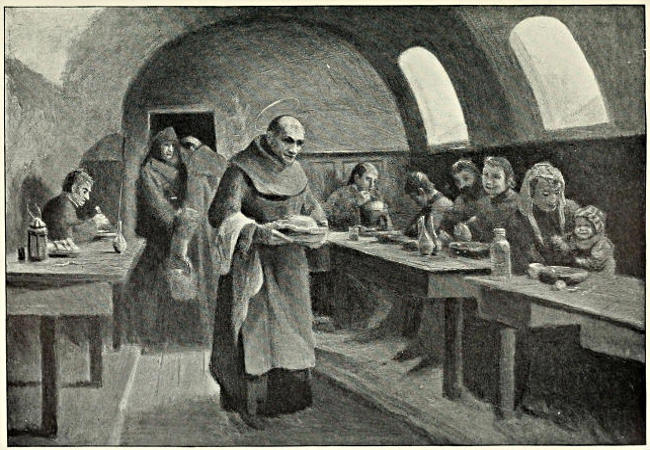
ST. BERNARD FEEDING THE POOR
Manuel, the grandson of Alexius, was on the throne, and although like
his ancestor he beheld with secret dread the armaments of Europe, yet for
the protection of his subjects he entered into a treaty with Conrad for the
regular purchase and sale of provisions. There was frequent matter of
charge and recrimination between the Greeks and the Germans in the march
of the latter to Constantinople; and circumstances occasioned many negotiations
between the two emperors. But Conrad apprehended the duplicity
of Manuel, and in indignation at the Grecian’s infraction of the treaty relating
to intercourse, he crossed the Bosporus without meeting or conferring
with the emperor.
Manuel received the king of France as an equal. He met him in the
court of his palace, and after mutual embraces conducted him into an apartment,
where they sat with equal dignity. In the midst of feasts and public
rejoicings the French monarch learned that the emperor and the sultan of
Iconium were in correspondence. The impatience of the barons and knights
to visit Jerusalem overcame every suggestion to revenge, and made them
think that the defence of the Holy Land, and not the destruction of the
Greek Empire, was the object for which they had taken up arms. But there
were not wanting men who urged that the time was arrived for removing the
barrier between Europe and Asia.
DISASTERS OF THE GERMANS
The passage through Bithynia completed, Conrad entered Lycaonia, the
heart of the dominions of the Seljuk Turks. The sultan had assembled from
every quarter of his states all the troops that could possibly be brought into
the field, and the number was so great that the rivers could not satisfy their
thirst or the country furnish provisions. The imperial guides conducted the
objects of their care either through deserts where the soldiers perished from
hunger, or led them into the jaws of the Moslems. In their occasional transactions,
the bread which the crusaders purchased was mixed with chalk,
and various other cruel frauds were practised by the Greeks. The assaults
of the Turks were incessant. The staff of the pilgrim was a poor defence
from a scimitar, and the heavily armed Germans could not retreat from the
activity of the Tatars. Only a tenth part of the soldiers and palmers that
had left the banks of the Danube and the Rhine escaped the arrows of the
Moslems, and with their commander secured their retreat to the French
army. Louis had been lulled into security by the flattering assurances of
Manuel that Conrad, so far from standing in need of succour, had even defeated
the Turks and taken Iconium. The French king was lying in camp
on the borders of the lake near Nicæa, when some wretched German fugitives
arrived with news of the perfidy of the Greeks, and the triumph of the
Moslems. The allied monarchs soon met and consulted on the road which
the champions of the cross should take. They united their crusaders, turned
aside from the path which had been trodden by the feudal princes of Europe,
and marched in concert as far as Philadelphia in Lydia; but the Germans
had lost their baggage, and on a prospect
of new calamities, many returned
to Constantinople, and near Ephesus
(to which place the army directed its
course) the emperor himself embarked,
and went to Jerusalem by ship.
THE FRENCH FAILURE
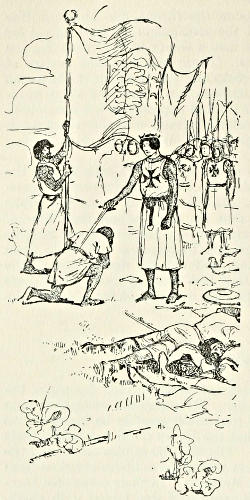
Dubbing a Knight on the Field of Battle
The French recruited themselves
on the shores of the Ægean Sea, and
pursued their march in an easterly
direction. They rejected with disdain
an offer of Manuel of a protection from
Moslem fury, and they gallantly kept
up their course with the usual portion
of suffering, till they arrived at the
banks of the Mæander. They found
there the Turks, who having safely deposited
their spoils came to dispute with
the Latins the passage of the river. The
battle was not of long duration; the
French made so great a slaughter of
their foe, that the bones of the Moslems
were conspicuous for years. The crusaders
proceeded in good order and discipline
through the town of Laodicea,
into the barrier mountains between
Phrygia and Pisidia. The vanguard
of the army advanced beyond the appointed
rendezvous. The rearguard, in
which was the king, moved forwards
with perfect confidence that the heights
before them were in possession of their
friends. Their ravenous enemy, who always hovered round them, seized the
moment when the ranks of the Christians were divided, and casting aside their
bows and arrows, fell upon them with tumultuous rapidity, sword in hand. It
was in a defile of the mountains that the Turkish tempest burst on the Latin
troops. Rocks ascending to the clouds were above the crusaders, and fathomless
precipices beneath them. The French could not recover from the shock
and horror of the surprise. Men, horses, and baggage were cast into the
abyss. The Turks were innumerable and irresistible. The life of the king
was saved more by fortune than by skill. He escaped to an eminence with a
few soldiers, and in the deep obscurity of the night made his way to the advanced
guard. The snows of winter, deficiency of stores, and the refusal of
the Greeks to trade with them, were the evils with which the French had to
contend. They marched, or rather wandered, for they knew not the roads,
and the discipline of the army was broken. They arrived at Attalia (Adalia),
the metropolis of Pamphylia, seated on the sea shore near the mouth of the
Cestrus. But the unchristian Greeks refused hospitality to the enemies of
the infidel name.
[1148-1149 A.D.]
Famine had so dreadfully thinned the ranks of the army, and so many
horses and other beasts of burden had perished, that the most sage and prudent
among the crusaders advised their companions to turn aside from scenes
of desolation, and proceed by sea to Antioch. The king and his soldiers
embarked for Antioch. The way-worn pilgrims and the sick were committed
to the charge of Thierry, count of Flanders, who was to march with
them to Cilicia. But when Louis quitted the harbour, the Turks fell upon
the Christians who were left behind, and the escort was found to be feeble
and ineffective. The people of Attalia not only declined to open their gates,
but even murdered the sick. Every day the Turks killed hundreds of the
pilgrims, and as it was evident that flight alone could save the remainder,
Thierry escaped by sea. Seven thousand wretched votaries of the cross
attempted to surmount the higher difficulties of the land journey to Jerusalem;
but the Holy City never opened to their view, and in perishing under
Moslem vengeance they thought that the loss of the completion of the pilgrimage
was compensated by the glories of martyrdom.
The nobility, the clergy, and people of Antioch received the French king
with every demonstration of respect; but no blandishments of persuasion or
petulant threats of divorce from his wife Eleanora, could move Louis from
his purpose of marching into Palestine. He repaired to the Holy City;
entered it in religious procession, while crowds of ecclesiastics and laymen
were singing the psalm, “Blessed is he that cometh in the name of the Lord.”
His arrival had been preceded by that of the emperor of Germany, the dukes
of Saxony and Bavaria, and the ruined German band.
A council was held at Ptolemais, composed of the princes, barons, and
prelates of Syria and Palestine, and the new commanders from Europe.
The misfortunes of the Edessenes were forgotten, or yielded to higher feelings,
for though the recapture of the principality of the Courtenais was the
great object of the crusade, yet there were Moslem cities in Syria far more
dangerous to Jerusalem than the remote city of Edessa. The decree for a
march to Damascus was passed, and the emperor of Germany and the kings
of France and Jerusalem brought their troops into the field; but the best
disciplined parts of the army were the knights of the Temple and St. John.
Eager to relieve Damascus from the yoke under which she had groaned for
nearly five centuries, the champions of Christianity soon arrived under her
walls. Numerous and of long continuance were the engagements between
the Latins and the Syrians. The city was apparently in the power of the
crusaders, and the people abandoned themselves to despair. But instead of
taking possession of Damascus the Latins anticipated the event and thought
only to whom the prize should be given. Much time was wasted in intrigues,
and after sustaining for a short time the sallies of reinforcements, and rejecting
in a council of war the advice of some unsubdued spirits for an attack
on Askalon, the Christian army raised the siege of Damascus, and retrograded
to Jerusalem in sorrow and in shame. Conrad soon returned to Europe with
the shattered relics of the German host, and his steps were a year afterwards
traced by the French king, the queen, and most of the French lords.
Among the few men whose virtues and abilities spread some rays of moral
and intellectual light over the twelfth century was Suger, the abbot of the
celebrated religious fraternity of St. Denis, in France. Strongly imbued
with the superstition of his time, his fondest wish was for the overthrow of
the Moslems. As minister of Louis VII, however, he had exposed to his
royal master the embarrassment of the state finances, the fierce and menacing
aspect of the crown vassals, and other circumstances of a political nature, to
deter him from quitting his dominions. But the spirit of romantic devotion
in the heir of Charlemagne could not be quenched, and Louis well consulted
the interests of his kingdom in delivering the sceptre to the charge of the
abbot of St. Denis. After his return from Palestine, the king ardently
wished to recross the seas, and by martial achievements to obliterate the
memory of former disasters. When all thoughts of a crusade had apparently
died away, France was astonished at the appearance of a martial missionary
in the person of him who had opposed the second holy war. The clergy of
the East implored Suger to restore the fortunes of the Holy Land, knowing
that he possessed more credit in France than all the other princes and prelates,
and that his piety equalled his authority. Papal benediction was bestowed
upon him, though the pope was at first amazed at the enthusiasm of a
man nearly seventy years of age; but his influence was exerted in vain.
Angry at the timidity of his countrymen, his own courage rose; he resolved
to conduct a small army to Palestine himself, and his reliance on the favour
of heaven made him hope that the vassals of St. Denis alone would be more
powerful than the congregated myriads of Europe. All aspirations for glory
were humbled by a fever; he died at St. Denis, and his successor in the
abbacy pursued the usual duties of his station, without superadding those of
a martial description.c
THE FALL OF THE KINGDOM OF JERUSALEM
[1149-1154 A.D.]
The very question that had proved a stumbling-block to the Germano-Roman
world, namely, the right of women to succeed to the throne, also kept
the knightly ecclesiastical colony of the kingdom of Jerusalem in perpetual
unrest. War broke out between Melusina—who, assuming the management
of public affairs at the death of her husband Fulk, gave great power
into the hands of her cousin, the constable of Manassa—and her son, King
Baldwin III, around whom rallied a number of barons, all ill-disposed to
acknowledge the new rule. The feud was fought out by the mother and son
near the Holy Sepulchre in 1152, with the result that Melusina was obliged
to relinquish all her pretensions.
Hodierna, Melusina’s sister, on the other hand, was given guardianship
over her youngest son, after the murder of her husband, Raymond I of Tripolis.
The remainder of the countship of Edessa passed to Greece, by reason
of a pact which assured to the widowed countess and her children a considerable
income; Jocelyn II was taken prisoner by the Turkomans and died in
captivity. Raymond of Antioch had also been killed while bravely fighting
in 1149, and his widow Constantia now became the object of the liveliest contention.
It was at first feared that she would listen to the many proposals
made to her by Greeks; but when she finally accepted the French knight,
Rainald de Chatillon, a struggle broke out between him and the patriarchs,
who had hitherto held the preponderance of power, laming the forces of both
sides. Under such circumstances there could be as little thought of establishing
one solid supremacy and power in the Orient as of accomplishing a
like result in France at the same period.
[1154-1163 A.D.]
The wonder was that there had actually risen to prominence on the side
of the Abbasids and Seljuks, during the late struggles for the possession of
Aleppo, Edessa, and Damascus, a well-consolidated might—that of the atabegs
of Mosul, who disposed of a particularly warlike element in the Kurds, with
whom their borders were overrun from the north. Nur ad-Din vigorously
pursued the policy laid down by his father, Zenki. He was by far the more
capable and enlightened of the two; since the days of the Omayyads,
so historians tell us, there had been no prince so liberal and law-abiding,
and there never reigned one more just. Four times each week he
sat in judgment. He made no personal use of the state revenues, looking
upon them as a sacred trust placed in his hands to be expended for the public
good. He was equally zealous in the conduct of the holy war. All the
dust that settled on his shoes and garments during his various battles against
unbelievers, he caused to be collected in a sack which was to be placed
under his head when he was dead. As already related, he conquered
Damascus (1154), which was under the rule of a weak prince who had in
vain sought safety on the side of the Christians, and took up his residence
in the immediate neighbourhood of that kingdom. He was a brave and
worthy representative of the Abbasid caliphate, which he had formerly
served in the capacity of Emir al-Omara. At times the Christians rallied
for a successful feat of arms, and under the sacred symbol of the cross,
which after preliminary worship in the king’s tent they gave into the keeping
of the archbishop of Tyre, they even inflicted defeat on Nur ad-Din
(1158). Also Baldwin III, who died in 1162 at the age of thirty-three,
achieved some fame and several victories. He was brave and circumspect—in
every way a fit man for the particular kind of warfare he was
obliged to carry on. Still it was not in these battles alone that the real
issue lay; the result was determined as much by the weakness of the Fatimites
in Egypt as by the strength of the atabegs in Syria.
Neither had the power of the Ismailite doctrines, founded on those in
circulation before the beginning of the Fatimite caliphate, suffered any diminution;
rather it had recently taken on a new form in the most singular
and hideous of all religious sects. Who has not heard of the Assassins and
of their leader, the Old Man of the Mountain? Unlike the Sunnite caliphate
which had been restored to power by the victories of the great Seljuk sultans,
the sect founded by the Persian, Hassan, towards the end of the eleventh
century, rose to prominence by reason of teachings based on the extremest
Ismailite beliefs, and compounded of fanaticism, sensuality, and blind obedience,
which raised up men to be assassins and general instruments of terror.
Mainly by the agency of that Ridwan of Aleppo who fought with the crusaders
before Antioch, and wavered in allegiance between the Abbasids and
the Fatimites, there was planted in northwestern Syria a colony of Assassins
which, under the rule of a certain sheikh, Al-Jebel, grew to occupy an important
place in history—if such can be said of a purely destructive principle.
It was by the Assassins that Raymond of Tripolis was slain. But their dagger
struck Moslem as well as Christian, Shiite as well as Sunnite, since a foe
of their nature lies outside all partisanship—is in fact beyond the pale of
any human ordinance.
That the Fatimite caliphate profited nothing by this latest religious
movement is apparent from the symptoms of decay that shortly afterward
began to be manifest. The caliphs themselves were given over to a life
of luxury and disorder, and vizirs, who bore the title of sultan, were constantly
engaged in quarrels with each other, in which right was decided by
might alone. The conditions were similar to those which preceded the fall
of the Abbasid caliphate in the tenth century. In the year 1163 the sultan
and vizir Shawer was deposed and supplanted by his rival Dargham, who
enjoyed for some time the fruits of his usurpation. But Shawer eventually
returned, and with him the emir and Kurd chieftain, Shirkuh, whom Nur
ad-Din, regardless of religious differences, had sent to his assistance.
Dargham was murdered and Shawer again assumed the sultanate, but he
could not reconcile himself to fulfilling
the promise he had made the Kurds,
that he would pay over to them one
third of the revenues of Egypt. To
protect himself more fully against his
extortionate allies, he besought assistance
of Almeric, king of Jerusalem,
brother and successor of Baldwin III.
[1163-1168 A.D.]
Inheriting the desire of Baldwin I
for ascendency in Egypt, Baldwin III
had besieged and taken Askalon in
1153. The garrison had defended itself
ably, even to the point of driving
back a body of Templars that had
penetrated within the walls, and the
king had reason to believe that all was
lost. But the support of the Jerusalem
patriarchs enabled him to press the
siege, and a successful sally on the part
of the knights of St. John, who with
their grand master had been particularly
active, finally placed Askalon at
his mercy. At this the inhabitants, in
despair, having received no reinforcements
from either Damascus or Egypt,
called upon their military commander
to surrender. Without doubt Almeric
(1162-1173) was the most important
of the later kings of Jerusalem. Like
Louis VII he was tireless, despite his
corpulence, in the hunt and in war, and
took no pleasure in any kind of diversion. In theological questions he often
revealed an acuteness that brought his prelates to confusion; with a firm
hand he held the troublesome barons in subjection, even giving precedence
over them to certain newly arrived Franks—Milo de Plancy, for example.
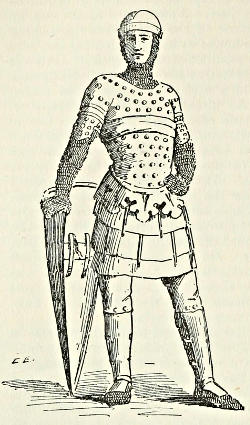
Italian Armour, Twelfth and Thirteenth Centuries
It could escape no one that there was danger to the kingdom in allowing
the Kurds of Nur ad-Din to become firmly established in Egypt. Losing no
time in reflection, Almeric took decisive steps at once, and fortune so far
favoured him that he succeeded in confining the Kurds within Pelusium
(1164); he was obliged to grant them a free withdrawal, however, in consequence
of domestic troubles that had befallen Nur ad-Din. A Christian
knight addressed Shirkuh, who was striding with uplifted axe behind his
followers: “Think you we do not mean to keep our pact with you?”
“You dare not break it!” was the reply.
No sooner had they returned home than the Kurds began preparations
for a second and greater expedition; Shirkuh incited the Sunnites to
wrath against the perfidious caliph in Cairo, and in 1167 he set out for
Egypt. Almeric also assembled his forces at the same time, and in Egypt
the native populations consolidated with the Pullanes in a formal alliance.
That the caliph might be encouraged by the support of their presence, the
Christian delegates were conducted into the palace. Scarcely could they
repress their admiration and astonishment at the wonders that everywhere
met their gaze. When they arrived in a splendid hall that was divided in
the middle by a curtain embroidered in gold and pearls, the vizir prostrated
himself and went through the form of taking a solemn oath; at the conclusion
of this ceremony the curtain was drawn aside and the figure of the
caliph was revealed. From his golden chair he extended his right hand to
the Christian knights, but the hand was enveloped in a veil. Hugo of
Cæsarea objected that in entering upon a pact both sides must act with
perfect fairness and good faith; whereupon the caliph uncovered his hand,
but with exceeding ill grace, as though his royal dignity had been affronted.
To the Christian knights was entrusted the defence of the walls and towers
of Cairo.
[1168 A.D.]
Compelled to abandon his position opposite Cairo on the left bank of
the Nile, Shirkuh withdrew his forces in the direction of Upper Egypt.
Almeric pursued him hotly at the head of a mixed band of Frankish and
oriental troops, such as were never again brought together in that land until
the time of Napoleon. The two armies met in the pass of Babein. Shirkuh
was about to cross over to the other side of the river with the intention
of fleeing into the regions beyond, when a mameluke of Nur ad-Din
overtook him and exclaimed: “What, you who rejoice in all the blessings
of Islam are about to fly from the enemy? Do you not know that the
atabegs will take from the Kurds all the lands they may find on the other
side?” Thus it came about that Shirkuh remained where he was, and taking
up his position with a picked band of men on the right flank of the main
body of his troops, he overcame the king while the latter was making an attack
on the enfeebled centre. So hard was Almeric beset that he could scarcely
cut his way back to his own forces. He retained sufficient power, however,
to surround and harass Alexandria, which Shirkuh had left in the charge of
his nephew, Saladin, the son of Eyyub. Shirkuh was induced to conclude a
peace, according to the terms of which both sides, Christians as well as Kurds,
were obliged to evacuate Egypt. As the price of this concession Shirkuh
received from Shawer fifty thousand pieces of gold, while to the Christians,
so Abulfeda tells us, were promised a special magistracy in Cairo and an
important yearly revenue.
It is well to contemplate closely these events, as they offer not only
the final standpoint from which to judge the kingdom of Jerusalem, but the
highest and best from which to take cognisance of the entire Christian world
of that time in its relation to Islam. The main fact derived by history is
that the establishment of the Franks in the Orient was made possible only
by the antagonism that subsisted between the Abbasid and Fatimite dynasties;
so long as this antagonism continued the colonial kingdom could be
upheld, but let it once subside and the whole structure would fall to the
ground. At the period of which we write the Cairo caliphate had sunk into a
state of impotency and demoralisation; in order to prevent its falling into
the hands of the Mohammedans of Syria the kings of Jerusalem must either
take forceful possession of Egypt themselves, or must sustain it in its present
show of independence by the most rigid political conjunction. For the first
course they were far too weak, as the sequel showed, and as might have been
expected from a study of the circumstances by which they were surrounded;
but for the second they possessed quite sufficient strength, as was evidenced by
the successes of Almeric. Indeed in all respects this was the better course to
pursue, since by the exercise of a moderate degree of wisdom affairs would
doubtless, even in the natural course of events, so have shaped themselves
that to the Christian element would gradually fall a peaceful sovereignty
over the whole realm of Egypt. What a position in the world would have
been gained to the Latin races by such a solution! Entrance into all the
Indian waters would have been open to the Italian sea powers, and it was
furthermore to be expected that northern Africa, cut off entirely from the
powers of the East, would eventually fall into the
hands of the Spaniards or of the Sicilian Normans.
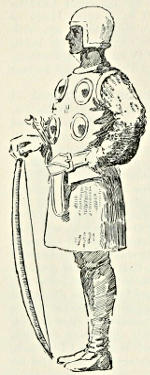
A Norman Archer of the Twelfth Century
It is not to be denied, however, that mankind
at that period was not yet ripe to exercise complete
ascendency either over the Orient or over
any other considerable portion of the world. The
religions of both divisions of humanity permitted
not the slightest compromise with unbelievers,
and the very factors that had brought about the
first amazing successes later acted as a check on
the progress of their cause towards complete fulfilment.
It seemed to be self-evident that no kind
of serious alliance could ever permanently subsist
between the crusaders and the caliphs; nay,
there was something almost against nature in
the thought of Christians defending the towers
of Cairo on behalf of infidels in a struggle of
Moslem against Moslem. Religious antagonism
was stronger in the guardians of the Holy Sepulchre
than loyalty and good faith.
Almeric united with Manuel of Byzantium,[52]
who had already formed a league with the Lombards
and the pope, and allowed himself to be
drawn into a joint scheme of conquest in Egypt.
This union between Greeks and Latins was
the more easily effected inasmuch as the king
had married a Greek and the emperor a Syrian
princess. The idea of the expedition seems to
have emanated from Manuel who, in his all-embracing
policy, kept a constant watch on both
East and West, in search of undertakings that
might promise him success. Influence was brought to bear on Almeric to
gain his consent by the grand-master of the knights of St. John; but the
Templars were strongly opposed to the project, seeing in it a shameful
violation of the peace.
Without waiting for the arrival of the Greek forces, the Christians of
Jerusalem opened the war in November, 1168. They took Pelusium, and
advanced on Cairo—at a very slow rate of progress, to be sure, as they
were awaiting ransom for a son of Shawer, whom they had taken prisoner.
The ransom was brought them, but at the same time they learned that the
invincible Shirkuh had set out from his desert in their direction. Both
Shawer and the caliph had overcome their former repugnance and had
addressed an appeal for aid to Nur ad-Din. Thus the supporters of the two
caliphs came together in a coalition similar to that formed by the Greeks and
Latins. The bravest and hardiest Turkomans composed the troops led by
Shirkuh and Saladin. Almeric had courageously advanced into the desert
to meet them, but Shirkuh passed him by; it was destined that the Franks
should depart from Egypt in dishonour. And now fate hurried events on to
the climax. Arrived in Jerusalem Shirkuh and Saladin opened hostilities
with the sultan, Shawer, who was accused of having plotted to murder the
Turkoman emirs. An opportunity was given Saladin to become possessed of
the sultan’s person on the occasion of a visit the latter made to the grave
of a Moslem saint. The caliph gave his consent to the captive’s execution,
and was further persuaded to appoint Shirkuh his vizir.
[1169-1174 A.D.]
On the death of Shirkuh, shortly after, Saladin acceded to the vacant
post (1169). He looked upon himself as in truth the chief power under
Nur ad-Din, who persistently urged him to overthrow the Fatimite caliphate.
But Saladin shrewdly withheld compliance[53] until he had obtained complete
possession of the capital and had rid himself of all his enemies, even delaying
until the Fatimite Aladid, who was still young, fell sick unto death. He
died in 1171 and Saladin, who had meanwhile repulsed an attack by Almeric
and a Byzantine fleet from Damietta, and torn from the Franks the harbour
of Ailah, on the Red Sea, took possession of the entire treasure of the
Fatimites and became master over all Egypt.
[1174-1181 A.D.]
A momentary advantage accrued to the Christians from this usurpation,
inasmuch as a continuance of friendly relations between the new master of
the Nile and his supreme chief, the atabeg in Damascus, was not to be
thought of. Saladin immediately sought to cut himself loose from all allegiance
to Nur ad-Din. That no hostages might be left in the hands of the
atabeg ruler, he caused his entire family to come to him in Egypt, giving to
his aged father, Eyyub, the post of guardian of his treasure. Nur ad-Din
first conceived suspicions as to his subordinate’s fealty when the latter refused
to assist him in conquering certain Frankish settlements that guarded the route
from Damascus to Egypt. He was stricken by death, however (1174), in the
midst of preparations for an expedition that was to punish the faithless emir.
Now Saladin’s plans took on wider expansion, and his aspirations soared to
greater heights. Nur ad-Din had left behind him but one minor son, Malik
as-Salih, and it was his name that appeared on the coins Saladin at first caused
to be struck off. But the Syrians were highly dissatisfied with the rule that
had succeeded that of Nur ad-Din, and were inclined to welcome Saladin
whenever he should present himself among them. Without drawing sword
he entered Damascus in 1174, and Emesa, Hama, and Baalbek also fell into
his power. Malik as-Salih was allowed to retain Aleppo on condition that
he should withdraw from Damascus. At his death (1181) Saladin gained
possession of Aleppo and little by little extended his territory as far as
Mesopotamia; eventually the entire heritage of Nur ad-Din fell into his
hands.
In this manner there arose in the course of a few years a might that,
springing as it did from a union of Egypt and Syria, threatened great
danger to the Christians, and even placed in question the further existence
of the many Frankish colonies that were scattered about the Orient. The
forces at the command of the consolidated power were trained to obey the
slightest gesture of a single chief, and were saturated with the doctrines of
a single religion. Of lateral religious branches there was no longer any
question, save as they still survived in the sect of the Assassins of Lebanon,
whose leader, the Old Man of the Mountain, occasionally instigated some
fresh disturbance. Saladin himself was one day set upon by three assailants,
but his strong arm successfully defended his life. He immediately
thereafter started out to exterminate the Assassins, and devastated their
entire domains, making his name a terror wherever he went. All Saladin’s
prowess and success was the outgrowth of a remarkable personality. Like
Zenki and Nur ad-Din, he was a devout Mohammedan; it was even his
custom to read the Koran to armies about to rush upon each other in battle.
He scrupulously made up for all fasts that he missed, and never failed to
say the five prayers through to the end. He drank nothing but water, wore
garments of harsh wool, and allowed himself to be summoned before the bar
of judgment. He personally instructed his children in the tenets of Islam;
but his own close observance of religion did not prevent him from unlawfully
usurping power. When fortune favoured him, as on the achievement
of some brilliant victory, he delighted in exhibiting a certain careless magnanimity
that greatly enhanced the majesty of his bearing. In misfortune
he was steadfast and patient, never once turning aside from the aim he had
in view. He was brave and crafty, contriving to win for himself supporters
even among the ranks of his enemies, and he governed his subjects with
justice and moderation. As a ruler he possessed all the qualities necessary
to accomplish the building up of a state and its conservation in prosperity
and power; and to a far greater degree than had the atabegs he became the
hero of reconstructed Islam, the man of fate in the destinies of the kingdom
of Jerusalem.
Had the Christians then but known how to make the most of the little
time that was left them, all might yet have been well; but it is not to be
denied that simultaneously with the rise of the new oriental might occurred
the rapid and shameful decay of the Christian administration in the East.
The western laws of succession which had been transplanted in full force,
and which secured the throne to the direct line of descent whether male or
female, dealt the finishing blow to the tottering kingdom. In a community
of which the head should be above all a military commander, where the
commonweal could be secured only by holding the whole state in constant
readiness for war, the rule frequently fell into the hands of feeble, incompetent
youths, the whole question of succession was repeatedly and violently
reopened by the marriages of female heirs to the throne; and regencies
were successively established, disputed, and destroyed. There was no
permanent, inflexible power to hold in check the inordinate ambition of the
knights, and a general lawlessness prevailed that penetrated to every rank
of political and religious life.
[1173-1185 A.D.]
Almeric died before Nur ad-Din in 1173. He was succeeded by his thirteen-year-old
son, Baldwin IV, who was a victim to the terrible disease of
leprosy, and up to the time of his early death in 1185 never really came into
possession of the rule. During the first part of his reign Raymond II of
Tripolis, son of Hodierna, acted as vicegerent, and in 1175 he concluded a
truce with Saladin by which he bound himself not to oppose the latter in
any of his struggles for the succession of Nur ad-Din. It was this act that
lost for Raymond all his authority in the realm. The knights now looked
towards the West for a ruler more to their liking, and Longaspada, marquis
of Montferrat, arrived among them in answer to their summons in October,
1176, shortly afterward marrying Sybilla, the eldest sister of the minor king.
He had firmly established himself in the respect and confidence of all when his
untimely death occurred (1177). His successor was Philip of Flanders and
Vermandois, a former adversary of Henry II of England and an adherent of
Becket, who was obliged to make this pilgrimage to Jerusalem in expiation
of certain violent acts he had committed. There was some reluctance
felt at placing the government in the hands of this prince, the general
opinion being that only one who was bound by self-interest to the kingdom
could effectually serve it. Philip was willing either to assume the authority
himself or to relinquish it into the hands of the count of Bethune, provided
the latter would cede to him certain possessions in the vicinity. The project
had been formed of organising, in alliance with the Greeks, an expedition
against Saladin; but Philip proved to be totally inadequate to the command
of such an enterprise, and returned home without having performed a single
act of moment.
A prince who fulfilled in all respects the requirements of the knights
next assumed the vicegerency, Rainald of Chatillon, who had taken part in
the siege of Askalon, and was afterwards chosen as husband and the guardian
of her son by Constantia, widow of Raymond of Antioch. In this noble were
represented all the warlike tendencies of the times. He defeated Saladin in
November, 1178, near Askalon, as he had only a short time previously
defeated Saladin’s brother, Turan Shah, near Damascus. A breathing space
fell to the kingdom after these victories that was utilised to construct near
Paneas, on the Jordan, a citadel which was entrusted to the Templars to
defend. Near this very place, however, Saladin achieved a victory over the
Christians in a battle wherein fell the grand master of the Templars, Odo
de St. Amand. On his death Saladin laid siege to the stronghold and carried
it by storm. The defeated Templars sought death by remaining behind in
the burning citadel, plunging into the waters of the Jordan, or precipitating
themselves from the top of a steep cliff.
About this time the bishops of the oriental Latin church began to assume
prominence in the Council of Lateran; among them being Archbishop
William of Tyre, historian of the kingdom, who in chronicling the defeat of
the Templars employed the language of the Bible: “The Lord, their God,
departed from them.” The eyes of all were now turned towards the West.
Nothing would have so fully met the aspirations of Alexander III as another
crusade, entered upon in the spirit that had marked that of Urban II;
shortly before his death he even caused a petition to be drawn up urging
the advisability of such an undertaking. It was then generally assumed that
in case the two great western monarchs, the kings of England and France,
should again decide to invade the Orient, they could count on the support
and assistance of the emperor Manuel, who had maintained friendly relations
with the Christians of Syria while engaging in fresh wars with the Seljuks
of Asia Minor. Most reluctantly had he given up the expedition against
Egypt, even after Saladin had made himself master of the land; he could not
have been induced to do so at all, in fact, had not the knights of Jerusalem
been so tardy in rendering aid. Unfortunately for the Christian cause he
died in the year 1180; conditions in the West at that time were also
unfavourable to the undertaking of any
important enterprise, Frederick I being
deeply engaged in war with Henry the
Lion and in negotiations for a treaty with
the Lombards while the sons of Henry II
kept France and England in a state of constant
turmoil. Thus the kingdom of Jerusalem,
being deprived of all hope of outside
aid, was thrown completely on its own resources.
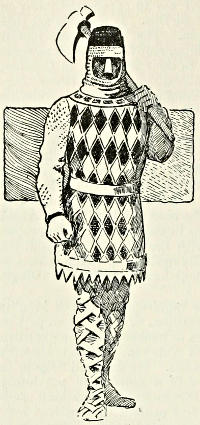
A Crusader of the Second Crusade
Life was not utterly intolerable there,
nor was hope definitively abandoned so long
as Saladin was kept from entering into
possession of the entire inheritance of
Nur ad-Din. The knights still gained an
occasional victory over him, as in the plain
of Belveir and Ferbelet in 1182; and he was
compelled to raise the siege of Berytus at
the approach of the Christian troops. The
daring Rainald de Chatillon even succeeded
in his bold attempt to reconquer the harbour
of Ailah, on the Mediterranean sea. The
Latin fleet proceeded thence to the coast
of Arabia, where it threatened Mecca and
Medina, but was finally overcome near
Haura, and the knights were slain in a battle
with the Arab prophet. By this defeat
Ailah was again lost to Jerusalem. Brave
to the point of foolhardiness as was Rainald
de Chatillon in his undertakings against
Saladin, and knightly as was the spirit by
which he was moved, he failed to achieve any serious result for the
cause to which he was devoted.
The affairs of the opposite side now took a decisive turn. In 1181 Malik
as-Salih, prince of Aleppo and Nur ad-Din’s son, had died, leaving no kinsman
worthy to succeed him. Imad ad-Din had essayed to fill the difficult post of
ruler, but was totally incompetent, and when Saladin marched against him
in 1183 he surrendered Aleppo without a struggle, and made no attempt to
regain any of the fortresses that had already been taken from him. Saladin
made his formal entry into Aleppo in June, 1183. He was universally
accepted as the bravest and mightiest warrior that had ever fought on
the side of Islam, and religious fervour, once more risen to great height
among the Mohammedans, further aided to smooth all difficulties from his
path.
[1185-1187 A.D.]
In contrast to this success disaster followed disaster in the Frankish
camp. In 1185 Baldwin IV succumbed to his fatal malady, and was succeeded
by his nephew, Baldwin V, the son of Sybilla and of William
Longaspada, who was but five years old. As if this misfortune were not
enough, Sybilla espoused in second marriage, contrary to the wishes of all
her advisers, a certain knight, Guy de Lusignan, of an ancient and noble
family of Poitou, whom no one believed capable of successfully defending
the kingdom in case of need.[54]
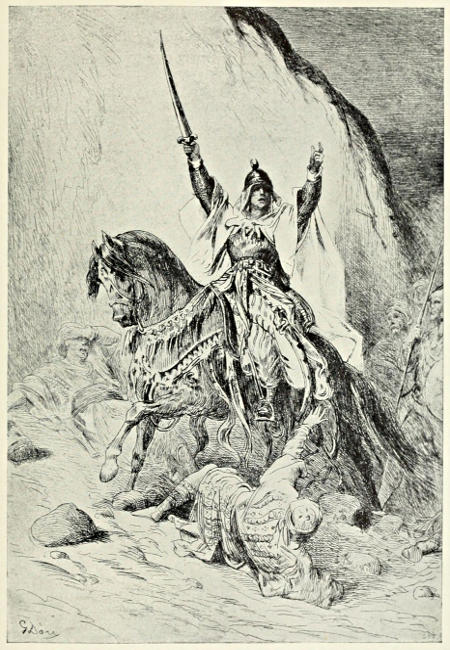
SALADIN
At this juncture Raymond of Tripolis again assumed the vicegerency,
and as before held a compact with Saladin to be the only means by which he
could preserve authority over the realm. A truce
was concluded on the only terms possible—the payment
by Raymond of a certain tribute. A fresh
disturbance arose when Sybilla gave the crown,
which she had claimed for herself on the death of
Baldwin V in 1186, over to her husband, Guy de
Lusignan. This was done in direct opposition to
Raymond, who had planned to usurp the crown
himself, and endangered his newly concluded pact
with Saladin. While Guy de Lusignan, at the head
of the whole body of knighthood which had gone
unhesitatingly over to the side of the rightful heiress,
was preparing to attack Raymond at Tiberias,
the latter appealed for aid to Saladin, who sent
him a band of Turkish horsemen. It had come,
then, to this, that a master Templar was obliged to
fly to Saladin in his distress, and march out, at the
head of an army of infidels, to do battle against
his fellow Templars of Jerusalem! All bonds of
honour and tradition were severed at a single blow.
The clergy made itself particularly obnoxious at
this crisis, being incited thereto by the patriarch
Heraclius of Jerusalem. Thus, eaten up by corruption
from within and left by its natural supporters
in the West to face alone an enemy that was practically
all-powerful, the kingdom that had once
given such rich promise for the future was now tottering
helplessly to its fall.
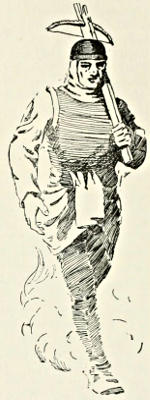
A Crossbow Man of the Second Crusade
Saladin, standing ready to seize the first favourable
opportunity, had some show of justice on his
side in choosing the present crisis as the most
suitable for attack, since Rainald de Chatillon, now in command of certain
citadels on the other side of the Jordan, had recently, in flagrant breach of
the truce, fallen upon and plundered a passing caravan in which was the
mother of the sultan. After in vain demanding indemnity of Rainald, Saladin
rallied all his forces for another great sacred war, and at head of countless
warriors made forcible irruption into Galilee.
As on many previous occasions the Christian army again assembled near
the spring of Saffuria. The grand master of the Templars had contributed
an important sum, sent him by Henry II of England, toward the preparations
for war, and Count Raymond of Tripolis was present in person. Once
more the holy cross of Jerusalem was worshipped by the Christian army on
the eve of battle. The very first day’s operations were disastrous, however,
as the army, impelled by the knights, hurried to the relief of beleaguered
Tiberias. On the evening of July 4th, 1187, after a battle that brought victory
to neither side, Saladin’s light horse drove the Christians back to a
parched and arid eminence in the neighbourhood of Hittin, named by tradition
as the scene of Christ’s sermon on the mount. Here, at the close of a
torrid summer day, they were obliged to pass the night in the tortures of
thirst. On July 5th Saladin resumed his attack on the enfeebled, exhausted
Christians, of whom very few survived the battle that ensued. Count Raymond
escaped, thanks to the clemency of the Saracens, who opened their ranks
before him and his body of knights, as before one who had once been their
friend. King Guy and as many of his followers as had not been slain, together
with the holy cross, fell into the hands of Saladin, who this time knew no
mercy. All the captured Templars and knights of St. John were put to death,
while with his own hand the angry monarch struck down Rainald de Chatillon,
the perjured violator of the truce.d
MOSLEM ACCOUNTS OF THE BATTLE OF TIBERIAS
[1187 A.D.]
Imad ad-Din, the Moslem historian, who took part in the battle, remarks
with astonishment that as long as the Christians kept in the saddle they
were unharmed, for they were covered from head to foot with a protecting
mail woven of iron rings; but when the horse fell, the rider was lost.
“That battle,” adds the writer, “took place on a Saturday. The Christians,
like lions at the beginning of the fray, were as scattered lambs at the
end. Of many thousands, but a small number survived. The battle-field
was covered with the dead and dying. I myself walked over Mount Hittin;
it was a horrible spectacle. I saw all that a happy nation had done to a
miserable people. I saw the condition of their leader—who could describe
it? I saw severed heads; dull, dead eyes; dust-covered bodies, twisted
limbs; severed arms; crushed bones; gashed and bloody necks; broken
thighs; feet no longer joined to the leg; bodies in two pieces; torn lips
and split foreheads. On seeing their faces strewn over the ground and
covered with blood and wounds, I recalled these words of the Koran: “The
infidel shall say ‘What am I but dust!’ What sweet odour is exhaled from
this victory!”
After these reflections, which show well the Arab taste, the writer presents
another picture: “The tent ropes,” he says, “did not suffice to bind
the prisoners. I saw thirty or forty men bound by the same rope; I saw
one or two hundred of them placed together and guarded by a single man.
These warriors, who formerly exhibited extraordinary prowess and enjoyed
might and power, now with lowered brows and naked bodies were indeed a
miserable sight. Counts and Christian lords had become the prey of the
hunter, the knights that of the lion. Those who had humiliated others
were humbled in their turn; the free man was in irons. Those who
accused the truth of falsehood and treated the Koran as imposture had
fallen into the hands of the true believers.”
After the battle Saladin retired to his tent and caused King Guy and the
principal prisoners to be brought before him. It was his will that the king
be seated at his side; and as the prince was suffering from thirst he had
melted snow brought to him. The king, after drinking, offered the cup to
Rainald, but Saladin cried: “It is not I who have asked that wretched man
to drink; I am in no way bound to him.” In fact, according to Imad
ad-Din’s statement, it was the custom with the Arabs never to kill a prisoner
to whom drink or food had been offered. Now Saladin had on two occasions
vowed to kill Rainald did the lord of Karak ever fall into his hands—the
first, when the knight planned to attack Mecca and Medina; the
second, when he captured a caravan in times of peace. The sultan turned
to Rainald and in terrible tones reproached him with these two deeds;
then rushed upon him with uplifted sword. Following his example the
emirs threw themselves upon Rainald and severed head from body. The
trunk rolled to the feet of the king, who at the sight trembled in great fear;
but Saladin hastened to reassure him and promised to respect his life.
Imad ad-Din relates later that what had most angered Saladin against
Rainald was that on the occasion of the above-mentioned seizure of the Moslem
caravan he called in jest to his captives to invoke Mohammed to see
whether the prophet would come to their assistance, and that before killing
him the sultan said to him: “Well, how does it seem to thee? Have
I not sufficiently avenged Mohammed for thy outrages?” Finally, adds
Imad ad-Din, he proposed to Rainald to become a Mohammedan; the latter
refused, saying that he preferred to die. Imad ad-Din relates on his own
side that when Saladin reproached Rainald with his perfidies and bad faith,
the lord replied by interpreter that such was the custom of princes and that
he in this respect had but followed the beaten path.
Finally the sultan had the king brought to Damascus, the captive lords
with him. With regard to the Templars and Hospitallers, Ibn al-Atir relates
that the sultan collected all he had in one place and cut off their heads.
He ordered also all those in his army who had any belonging to these
religious orders in their hands to put them to death; then judging that
the soldiers would not be sufficiently generous to make this sacrifice, he
offered fifty pieces of gold for each Templar or Hospitaller surrendered to
him. Two hundred of these warriors who were brought to him were at
once decapitated. What led the sultan to these extreme measures was that
the Templars and Hospitallers made war by profession upon Islam and were
its most cruel enemies. Thus Abul-Faraj in his Syrian Chronicle puts on this
occasion these words into Saladin’s mouth: “Since killing when it can be
turned to the good of their religion seems to them so sweet a thing, let
us kill them in their turn.” Saladin sent also to his lieutenant in Damascus
ordering to be put to death all the knights held in that city, whether they
were his own property or that of others; and this was done.
We read in Imad ad-Din, an eye-witness, that during the massacre of the
knights Saladin looked on with smiling countenance and that the victims
were sunk in hopeless despair. The Moslem army was drawn up in battle
array, the emirs in two rows. Some of the executioners performed their duty,
adds the author, with a degree of skill that brought deserved praises; some,
however, refused to act and left it to their companions. Before beheading,
a proposition was made to the prisoners to embrace Islamism but the opportunity
was taken by a very small number.
Such is the manner in which the Arabian chroniclers describe the battle
of Tiberias. The compiler of The Two Gardens gives several letters written
on that occasion. We read in one of them, sent to Baghdad, that of
the forty-five thousand men composing the Christian army scarcely one thousand
survived, and since one poor Mohammedan soldier, having taken a
prisoner, exchanged him for a pair of sandals, posterity may know that the
number of prisoners was so great that they were sold for footgear. Imad
ad-Din says in another place that all Islam rejoiced in this victory which
was but the prelude to the conquest of Jerusalem and the source of greater
triumphs.e
THE FALL OF JERUSALEM
A panic terror now overspread the land, and under its resistless impulse all
hastened to place themselves in subjection to the conqueror. Even the most
strongly fortified coast towns fell one after the other; Tyre, Tripolis, and Antioch
alone upheld their independence. Askalon demanded as the price
of its surrender the release of the captive king. Jerusalem held out in
its own defence a few days longer; but what could the few knights that
remained avail against an enemy so mighty? On the 2nd of October,
1187, Saladin took formal possession of the Christian capital, to shouts of
“Allah akbar!” instead of the “Christ victorious!” that had been heard
in former times.d
Jerusalem became the refuge for such of the Christians as had escaped the
swords or the chains of the Turks. One hundred thousand people are said
to have been in the place; but so few were the soldiers, and so feeble was
the government of the queen, that the Holy City was no object of terror.
Saladin declared his unwillingness to stain with human blood a spot which
even the Turks held in reverence, as having been sanctified by the presence
of many of God’s messengers. He offered the people, on condition of the
surrender of the city, money and settlements in Syria. Prudence suggested
the acceptance of this offer, but, clinging to that feeling of superstition
which had given birth to the holy wars, the Christians declared that they
would not resign to the infidels the place where the Saviour had died.
Saladin was indignant at this rejection of his kindness, and swore to enter the
place sword in hand, and retaliate the dreadful carnage which the Franks
had made in the days of Godfrey de Bouillon. The people cast their eyes
on Balean of Ibelin as their commander. The veteran organised the forces,
and put arms into the hands of the citizens.
During fourteen days there were various engagements; but the Christians,
though brave to desperation, could never destroy the military engines
of the Moslems. At the end of fourteen days the Latins discovered that the
walls near the gate of St. Stephen’s were undermined. From that moment
the defence of the city was abandoned; the clergy prayed for the miraculous
protection of heaven, the soldiers threw down their arms and crowded into
the churches. The consternation was augmented by the discovery of a
correspondence between some Greeks that were in the place and the Moslems.
The Latins then recollected the proffered clemency of Saladin, and
a deputation of them implored a renewal of it. But he urged the force of
the oath which he had taken, and that it was ridiculous to capitulate for a
fallen town. “But,” said he, “if you will surrender the city to me, I will
behave to you with mercy, and allow you to redeem the inhabitants.”
After some deliberation, the Christians resolved to trust the generosity
of the conqueror. Saladin stipulated that the military and nobles should be
escorted to Tyre, and that the Latin population should become slaves, if
they were not ransomed at the rate of ten crowns of gold for a man, five for
a woman, and one for a child. After four days had been consumed by
the miserable inhabitants in weeping over and embracing the Holy Sepulchre
and other sacred places, the Latins left the city and passed through
the enemy’s camp. Children of all ages clung round their mothers, and the
strength of the fathers was used in bearing away some little portion of their
household furniture. In solemn procession the clergy, the queen, and her
retinue of ladies followed. Saladin advanced to meet them, and his heart
melted with compassion, when they approached him in the attitude and
with the air of suppliants. The softened warrior uttered some words of
pity, and the women, encouraged by his sympathising tenderness, declared
that one word of his would remove their distress.
It is the generous remark of an enemy that Saladin was in nothing a
barbarian but in name. With courteous clemency he released all the prisoners
whom the women requested, and loaded them with presents. This
action, worthy of a gentle and Christian knight, was not the consequence of
a transient feeling of humanity; for when he entered the city of Jerusalem,
and heard of the tender care with which the military friars of St. John
treated the sick, he allowed ten of the order to remain in their hospital till
they could complete their work of humanity.
[1188-1189 A.D.]
The infidels were once more established in Jerusalem. The great cross
was taken down from the church of the sepulchre, and for two days dragged
through the mire of the streets. The bells of the churches were melted, and
the floors and walls of the mosque of Omar were purified with Damascene
rose-water. Prayers and thanksgivings were offered to heaven for the victory;
all individual merit was forgotten, and the conquest of Jerusalem was
attributed to the bounty of God, and his desire for the universal influence of
Islamism. Askalon, Laodicea, Gabala, Sidon, Nazareth, Bethlehem—all
those places and their territories fell when their great support was gone, and
Tyre was almost the only town of consequence which remained to the
Christians.
Saladin attacked it with all his efforts, but the spirit of freedom
triumphed over the thirst of conquest, and the Moslems were necessitated
to raise the siege. Some time after the capitulation of Askalon, Guy de
Lusignan, the grand master of the Templars, and others obtained their liberty;
and the husband of Sybilla solemnly renounced to Saladin his title
to the kingdom of Jerusalem. The unprincipled Guy took the road for
Tyre, and announced his resolve to enter the city as sovereign lord.
After the fall of Jerusalem, Saladin carried his conquering army into the
principality of Antioch. Five and twenty towns submitted, and Antioch itself
became tributary to the Moslems. The victories of Saladin and the loss
of Jerusalem were melancholy contrasts to those hopes of the triumphs of
Christianity over Islamism which the Council of Clermont had held out to
Europe. In the eighty-eight years that the crusaders possessed the Holy
City, peace seldom dwelt about her walls; surrounded by numerous hostile
nations, she was in a continual siege, and as great a number of her wars were
undertaken for the maintenance of her existence as for the purposes of conquest.
In the time of Godfrey de Bouillon, Asia was in a state of more than
usual imbecility. The Arabian and Tatarian storms were spent, the caliphs
were pontiffs rather than sovereign princes, and the great empire of their
predecessors was dismembered and scattered.
But states which are formed by arms, not by policy, are as quick in their
rise as rapid in their decay, and ruin and disorder are the scenes of ambition.
The passions and abilities of the enterprising lords of Syria raised several
powerful governments; the hostile aspect of the Moslems increased in terror
when the imperial and royal crowns of Germany and France were broken;
and the crescent triumphed over the cross when Saladin united and led the
Moslem nations to the conquest of Jerusalem. In the strength of body, and
personal and military prowess, the Turks and the Franks were equal; but the
Turks were in multitudes, the Franks were few; and as the twelfth century
was an age of war rather than of policy, the Latins did not by intellectual
superiority raise themselves above their enemies. The Christians
scrupled not to break treaties[55] with the Moslems; they never attempted
to conciliate the foe, or to live in terms of large and liberal intercourse.
Except in the case of Egypt, they allowed the Saracenian nations to unite,
without making any endeavour to break their force; and they were too proud
and too ignorant to win any members to their cause from the great confederacy
of atabegs. Conciliation could only be the result of weakness; a tender
pitying forbearance of error was held a criminal indifference by armed
saints. The Moslem contempt of infidels was not more sincere than was the
hatred which the Christians felt for the supposed enemies of God.c
FOOTNOTES
King Richard shall warrant,
There is no flesh so nourissant
Unto an Englishman,
Partridge, plover, haron, ne swan,
Cow ne ox, sheep ne swine,
As the head of a Sarezyn.
There he is fat and thereto tender;
And my men be lean and slender.
While any Saracen quick be,
Livand now in this Syrie;
For meat will we nothing care,
Abouten fast we shall fare,
And every day we shall eat
All so many as we may get.
To England will we nought gon,
Till they be eaten every one.
—Old Romance of Richard Cœur de Lion.
[1189-1193 A.D.]
Europe rang with invectives against the holy Bernard, when the thousands
of men whom his eloquence and miracles had roused to arms perished
in the rocks of Cilicia. A general or a statesman would have pointed out
errors in the policy or conduct of the crusaders; but the preacher sheltered
himself under the usual defence of impostors, and declared that the sins of
the people had merited divine punishment, and that the men of his day
resembled in morals the Hebrews of old, who perished in the journey from
Egypt to the Promised Land. This language was justly felt to be cruel and
insulting; it did not exculpate the saint in the opinion of the world, and the
nations of the West were not again disposed to make religious wars the common
concern of Christendom. In the third council of the Lateran, which
met twenty years after the return to Europe of Louis and Conrad, the policy
of King Almeric had been applauded; Egypt was more dreaded than Syria,
and the possession of Damietta was held out as the object to which all the
efforts of the Christians should tend.[56] The clergy called on the world to
arm, but the recollection of misery was too fresh, and the decrees of the
council were heard of with sullenness and discontent. Louis, however,
always cherished the hope of returning to the Holy Land, and of reviving
his faded glory; and at length he found his wishes met by a brother sovereign.
Since virtue was his policy as well as his duty, Henry II in the
height of his disputes with Thomas à Becket had professed great sanctity;
and following the example of the French king, he and his barons commanded
that for one year a tax of two-pence, and for four subsequent years a tax
of a penny in the pound should be levied on the movables of the people of
England. Among the deeds of virtue which washed from Henry the guilt
of Becket’s murder was the supporting of two hundred knights Templar in
Palestine for a year, and an agreement with the pope to go and fight the
infidels in Asia, or in Spain, for thrice that time if his holiness should require
it. In the year 1177, Henry and Louis agreed to travel together to the
Holy Land. But the English monarch was prudent and fond of peace,
and the illness and subsequent death of the French king terminated the
project.
[1177-1188 A.D.]
The count of Tripolis, while regent of Jerusalem, endeavoured to
strengthen his kingdom by new draughts of men from Europe. The importance
of the embassy which he sent to the West was apparent from
the dignity of the legates, for they were the patriarch of Jerusalem and the
grand masters of the Templars and Hospitallers.
While fanaticism was rekindling the torch of religious war, news arrived
in the West of the fall of Jerusalem into the hands of the infidels. The
event was felt as a calamity from one end of Europe to the other. Nothing
could exceed the terror which seized the court of Rome. In the moment
of weakness and humiliation, the cardinals acknowledged the dignity and
the force of virtue. They resolved to take no bribes in the administration
of justice, to abstain from all luxury of living and splendour of dress,
to go to Jerusalem with the scrip and staff of simple pilgrims, and never to
ride on horseback while the ground of their Saviour was trodden under the
feet of the pagans. Pope Urban III died about this period; and his death,
like every direful event of the time, was attributed to grief at the intelligence
of the Saracenian victories. William, archbishop of Tyre, our great
guide in history, was one of the messengers of the news; and his friend,
Gregory VIII, successor of Urban, not only endeavoured to deprecate the
wrath of heaven by ordaining fasting and prayer throughout Christendom,
but issued a bull for a new crusade, with the usual privileges to the
crusaders.
The emperor, Frederick Barbarossa, summoned a council at Mainz for
the purpose of considering the general propriety of a new crusade. Prelates
and barons were unanimous in the wish for it, and William of Tyre, and
Henry, bishop of Albano, legates of the papacy, arrived at the assembly in
time to confirm and approve its holy resolve. The emperor, and his son the
duke of Swabia, the dukes of Austria and Moravia, and sixty-eight temporal
and spiritual lords, were fired with the same enthusiasm.
At the solicitation of the archbishop of Tyre, Philip Augustus, king of
France, and Henry II, king of England, met at a place between Trie and
Gisors, in Normandy, February, 1188, in order to deliberate on the political
state of the times. The prelate of the eastern Latin church appeared, and
pleaded the cause of religion before the two monarchs. So pathetic was his
description of the miseries of the Latins in Syria, so touching were his reflections
on those who engaged in petty national wars, when even the stones of
the temple called on all people to avenge the cause of God, that Philip and
Henry wept, embraced, and vowed to go together to the Holy Land. They
received the cross from the hands of the archbishop. The count of Flanders
entered into their intentions. They agreed that the French crusaders should
wear red crosses, the English should be indicated by white ones, and the
Flemish by green.
THE SALADIN TITHE
[1188-1190 A.D.]
One opinion and one feeling influenced every breast; and, by universal
consent, a tax similar everywhere in name and in nature was imposed on
those who would not be crossed. This imposition was called the Saladin
tithe; it was to last for one year; and it extended both to movable and
unmovable property. Persons who actually assumed the cross were not
only exempted, but were even allowed to take the fiscal part of their tenants’
property. If the collectors of the tithe were dissatisfied with what a
man offered to pay, they were authorised to appoint four or six men of his
parish to make an assessment. The crusaders, too, might mortgage their
land for three years, and the mortgagee should receive the rents even to
the prejudice of former creditors. The English council forbade the pilgrims
from sensual pleasures,[57] from all manner of gaming, and from the luxury of
dressing in ermine and sables. Henry wrote to the king of Hungary and
the emperor of Constantinople requesting a safe passage for his troops. The
request was granted.
Though ships continually sailed from England and France, bearing martial
pilgrims to the Holy Land, the ambition and restlessness of Philip
Augustus, and of Prince Richard, diverted the government and the great
body of the people from the salvation of Palestine. The ignominious peace
which England was compelled to make with France, and his mental agony
at the rebellion and ingratitude of his sons, brought on the death of the
English monarch (July, 1189). The love of military honour inflamed the
French king, and the bold, ardent, and valiant Richard Cœur de Lion had
more of the warlike spirit than of the religious feelings of the age. None of
the principles which originally caused the Crusades influenced the actions
of either.
So eager was Richard to equip a large military force, that he sold the
crown lands, and offices of trust and dignity were no longer to be acquired
by desert or favour. The king of Scotland obtained for ten thousand marks
Richard’s renunciation of the fortresses of Roxburgh and Berwick, and of
the claims of England on the allegiance of Scotland. Richard crossed the
channel in December, and soon after Christmas met his brother sovereign.
The monarchs renewed their protestations of perpetual friendship, and swore
that in case of necessity they would defend each others’ territories with
all the warmth of self-interest. If either of the princes should die during
the Crusade, the survivor was to use his men and money for the accomplishment
of the great design. The period of departure was deferred from
Easter to the ensuing midsummer. During his stay in Normandy, Richard
made some singular laws for regulating the conduct of the pilgrims in their
passage by sea. Murder was to be punished by casting into the water the
deceased person, with the murderer tied to him. He that drew his sword in
anger should lose his hand. If a man gave another a blow, he was to be
thrice immersed; an ounce of silver was the penalty for using opprobrious
language. A thief was to have boiling pitch and feathers put upon his head,
and was to be set on shore at the first opportunity.
Philip Augustus received the staff and scrip at St. Denis, and Richard
at Tours (June, 1190). They joined their forces at Vézelay; the number
was computed at one hundred thousand soldiers, and the march to Lyons was
conducted in union and with harmony. At that city the monarchs parted;
the lord of France pursued the Genoese road; his noble compeer that of
Marseilles, and Sicily was named as the rendezvous.
BARBAROSSA’S CRUSADE AND DEATH
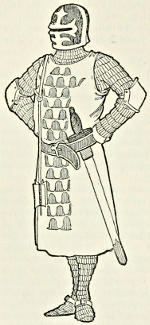
A Crusader of the Third Crusade
The heroic Frederick Barbarossa was among the first of those whose grief
rose into indignation after the fall of Jerusalem. In his letters to the
sacrilegious Saladin, he demanded restitution of the city, and threatened
him in the event of non-compliance to pour into Asia all the military force
of the German states. But the triumphant
infidel replied that he would oppose his Turkomans,
his Bedouins, and Syrians to the German
hordes. Tyre, Tripolis, and Antioch, he continued,
were the only places which at that time
belonged to the Christians, and if those cities
were resigned to him, he would restore the true
cross, and permit the people of the West to
visit Jerusalem as pilgrims. Germany was indignant
at this haughty reply; all the powers
took up arms against the man who had defied
them; but in prudent remembrance of the
disorders and calamities which popular impatience
had occasioned in the First and Second
Crusades, an imperial edict was issued, that
no one should go who could not furnish his own
viaticum for a twelvemonth. The consecrated
standards of the German princes were surrounded
by innumerable hosts of crusaders,
drawn out of every class of life, from honourable
knighthood down to the meanest vassalage.
Their emperor conducted them from Ratisbon,
their rendezvous, through the friendly Hungarian
states; but when he reached the territories
of the great lord of the East, he had to
encounter the hostility of a violent yet timid foe.
The emperor Isaac Angelus displayed both
enmity and cowardice. He did not deny the
Germans the liberty to purchase provisions,
but in his communications with Frederick he
carefully avoided giving him imperial titles;
and the Greek governors were perplexed by
one day receiving orders to preserve the fortifications of their towns, and
at another time by commands for their destruction, lest they should become
stations of the Germans. Barbarossa marched with prudence and humanity.
In his indignation at the haughtiness and duplicity of Isaac, he generally
spared the people, and passed the Hellespont without having deigned to
enter the imperial city. He entered the territories of the Mussulmans
in triumph, and not only defeated the Turks in a general engagement, but
took Iconium. The sultan then repented of his perfidy, and with the
independent emirs of Asia Minor, deprecated the further vengeance of the
Germans. They continued their march with more honour and dignity
than had ever accompanied the early crusaders, but they were deprived by
death of their venerable hero. It was in the spring of the year that they
passed the Isaurian mountains, from which issues the small river of the
Calycadnus. In this stream Frederick bathed, but his aged frame could
not sustain the shock.[58] His son, the duke of Swabia, was a brave and
experienced general, yet the death of the emperor so much revived the
courage of the Saracens, that the course of the Christians was continually
harassed. Saladin had been compelled to withdraw most of his soldiers
from Antioch, and the Germans had little difficulty in renewing a Christian
government in that city.
In the autumn of 1190, the duke of Swabia arrived at Acre, and importance
was given to the German force by the formation of a Teutonic order
of knighthood. The Vatican confirmed the establishment; Pope Celestine
III gave it the rule of St. Augustine for its general law, and accorded to it
the privileges which distinguished the other military fraternities. The service
of the poor and sick, and the defence of the holy places, were the great
objects which the pope commanded them to regard; and their domestic
economy was to be preserved by chastity and equal participation of property.
They were divided into three classes, knights, priests, and serving brothers.
All the members were to be Germans, and those of the first class could only
be men of noble birth and extraction. The order of the Teutonic knights
of the house of St. Mary in Jerusalem was their title, and their dress was a
white mantle with a black cross, embroidered with gold.
THE SIEGE OF ACRE OR PTOLEMAIS (1189-1191 A.D.)
[1189-1191 A.D.]
While the kings of England and France were marshalling their hosts for
a foreign war, the Christians in the Holy Land slowly recovered from their
panic, and joined Lusignan. Greeks, Latins, Syrians, Templars, and Hospitallers,
emerged from their places of secrecy, burning for revenge on the
infidel spoliators. Acre had opened its gates to the conqueror a few days
after the battle of Tiberias, and that city, by reason of its situation and
magnitude, was worthy the bravest efforts of its former lords. The sea
washed its fortifications on the north and west; a noble pier defended the
port from the storms and the enemy; and the city on the land side was fortified
by double walls, ditches, and towers.b
GEOFFREY DE VINSAUF’S ACCOUNT OF ACRE
If a ten-years’ war made Troy celebrated; if the triumph of the Christians
made Antioch more illustrious, Acre will certainly obtain eternal fame,
as a city for which the whole world contended. In the form of a triangle,
it is narrow on the western side, while it extends in a wider range towards
the east, and full a third part of it is washed by the ocean on the south and
west. The port, which is not so convenient as it should be, often deceives
and proves fatal to the vessels which winter there; for the rock which lies
over against the shore, to which it runs parallel, is too short to protect them
from the fury of the storm. And because this rock appeared a suitable
place for washing away the entrails, the ancients used it as a place for offering
up sacrifices, and on account of the flies which followed the sacrificial
flesh, the tower which stands above it was called the Tower of Flies.
There is also a tower called the Cursed, situated on the wall which surrounds
the city; and if we are to credit common report, it received its name
because it is said that the pieces of silver for which Judas betrayed his Lord,
were made there. The city, then named Ptolemais, was formerly situate
upon Mount Turon, which is close to the city, whence, by an error of antiquity,
some call Acre Ptolemais. There is a hill called the Mosque, near
Mount Turon, where the ancients say is the sepulchre of Memnon; but by
whose kind offices he was brought thither, we have learned neither by writing
nor by hearsay. The river which flows by the city is named Belus, and
although its bed is narrow, and not deep, Solinus has rendered it celebrated
by numbering it amongst the wonders of the world as being enriched with
glassy sand. For there was a certain sandy foss, the sand of which supplied
materials for making glass; these, if taken out, were altogether useless; but,
if let in, from the secret virtue of the place assumed a glassy nature.
Not far from the river is pointed out a low rock near the city, at which
it is said that the three divisions of the world, Asia, Europe, and Africa
meet; and though it contains separately the other parts of the world, the
place itself, dependent on none, is distinct from and independent of all three.
Mount Carmel rises aloft on the southern side of the city, where Elijah the
Tishbite is known to have had a habitation of modest cost, as his cave
still testifies; but although we are often wont in a description to wander away
to the pleasant parts of the circuit, we must at present overlook the attractions
of the surrounding places, while we turn our attention to the course of
the war.g
When Richard and Philip Augustus reached the Holy Land, the siege of
Acre had lasted twenty-two months. The most patient attention would be
exhausted by a minute detail of the operations of that period, and a liberal
curiosity will be satisfied by a notice of the chief and characteristic circumstances.
So perfect was the self-security of Saladin, that he did not attempt to
overwhelm the foe; and when he at length found the necessity of personally
attempting the relief of his city, the force of the king of Jerusalem was
appallingly numerous. The people of France and England could not wait
the tardy march of their organised armies; they answered with impatience the
signals of distress which Palestine hung out; indeed every country of Europe
poured forth its population with disorderly rapidity, and Lusignan was at
one time the commander of one hundred thousand soldiers. The Christians
were encamped on the plain to the south of Acre, and the general station
of Saladin was near the town and mountain of Kharuba, still further to
the south. Among the bravest of the Christian lords were the count of
Champagne, the duke of Gelderland, the landgraf of Thuringia, and James
d’Avesnes. Many of the clergy wore the casque and the cuirass; the archbishops
of Pisa and Ravenna, the bishops of Salisbury, Beauvais, Cambray,
Acre, and Bethlehem, deserved the honour of ecclesiastical knighthood; and
on one occasion the valour of Baldwin, archbishop of Canterbury, saved the
camp. The Christians plied the battering-rams and mangonels against
the walls, and they only ceased from their labour when Saladin called them
to battle on the plain.
The engagements were as sanguinary and obstinate as any which had
marked the holy wars. If the Latins at any time prevailed, they speedily
lost their advantages, by abandoning themselves to plunder, and allowing
the vigilant enemy to collect his broken battalions. When the Saracens
conquered, the Christians kept within the shelter of their fortified camp,[59]
and did not again take the field till pressed to action by some new bands
of crusaders. The conflicts between the Moslems and Christians were by
sea as well as by land; but the naval forces were so equally balanced, that
the Latins could not finally prevent the Egyptians from succouring Acre,
and Europe kept up its communications with the camp. In the last year
of the siege the deaths by famine and pestilence exceeded the destruction
which former battles had occasioned. Both armies were wasted by a swift
decay, for the presence of such numbers had exhausted the Mussulman as
well as the Christian neighbourhood. At the siege of Acre, as well as at
the old siege of Antioch, the morals of the holy warriors were as depraved
as their condition was miserable. Yet an appearance of holiness pervaded
the camp. Religious exercises were performed, and vice was reprehended.
The crusaders were seemingly devout, but in reality were dissolute,[60] and
compromised for personal excesses by pharisaical scrupulosity and uncharitableness.
Conrad, marquis of Tyre, had joined, and afterwards left his friends,
and to his departure all the miseries of the Christians from famine were
attributed. But his own principality was his most important charge, and
he could not furnish provisions for his people and for the whole of the army
at the same time. Disease reached and destroyed princes as well as plebeians;
and when Queen Sybilla and her two young children died, Guy de Lusignan
lost his principal political support. New competitors appeared for the visionary
kingdom. Isabel, the sister of Sybilla, had been married at the early
age of eight years to Humphry lord of Thoron; but when the warm passions
of youth succeeded the indifference of infancy, the gallantry and knightly
accomplishments of Conrad, marquis of Tyre, gained her affections. In the
Middle Ages consanguinity or some canonical impediment was always discovered,
when disgust or ambition urged the dissolution of the marriage
contract; and when the will is resolved the mind is not scrupulous in its
choice of arguments of justification. The church terminated the union of
Humphry and Isabel, and the day after the proclamation of the divorce the
bishop of Beauvais married the amorous fair one to the marquis of Tyre.
As husband of the princess, Conrad claimed the honours of respect which
were due to the king of Jerusalem; Humphry was too prudent to contend
for an empty distinction, but Lusignan, who had once enjoyed the crown
would not forego the hope of recovering it. The Christian cause was
scandalised and injured by these divisions among the chiefs, but the candidates
for the pageant sceptre were obliged to submit to the general opinion
of the army, and reserve the decision of their claims for the judgment of the
French and English monarchs.
RICHARD’S VOYAGE
[1190-1191 A.D.]
Richard’s fleet had not arrived at Marseilles at the appointed time; and
so great was his impatience that after waiting for it only eight days he hired
some galleys and put to sea. He went to Genoa, and conferred with the
French king, whose illness had kept him in that city. He then made a brief
stay at Pisa, and shortly afterwards an accident which happened to his vessel
compelled him to enter the Tiber.
He made some stay in Naples, and then travelled on horseback to Salerno,
where he resolved to wait till he should hear of the arrival of his navy
in the Mediterranean. The English fleet had been dispersed off Portugal by
a violent storm, but the ships finally reached Lisbon, and circumstances
enabled them to pay their obligation of gratitude. The Moors of Spain and
Africa were menacing Portugal, five hundred English soldiers joined the
king and marched to Santarem.
Their warlike aspect awed the Saracens,
and the fortunate death at this
juncture of the Moorish commander
broke the union of the enemy, and the
country was saved. The English fleet
coasted Portugal, and the southern
part of Spain, and arrived at Marseilles.
It then set sail for Messina,
and reached that place a few days before
the arrival of Philip and the French.
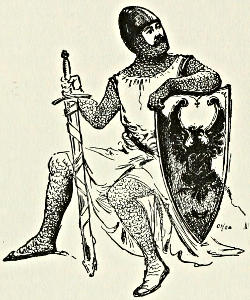
A Knight of the Third Crusade
Richard left Salerno on the 13th
of September, and on the 21st reached
Mileto. He then pursued his journey,
accompanied only by one knight. He
assembled all the English ships, and
entered the harbour of Messina with
so much splendour and such clangour
of horns and trumpets that the Sicilians
and French were astonished and
alarmed. Tancred, the illegitimate
son of Roger, duke of Apulia, was at
that period the king of the island.
Among the precautions which Tancred took for the establishing of his
authority was the imprisonment of the widow of William the Good, his immediate
predecessor. She was the sister of Richard, king of England, but
on the arrival of that monarch in Sicily, the usurper restored her to freedom.
But her dowry was still withheld, and her brother was resolved to avenge
her wrongs. In all his measures he was violent and unjust. He placed her
in a fortress which he seized from the Sicilians, and drove out the religious
inhabitants of a monastery in order that it might contain his stores. Those
circumstances and the dissoluteness of his people were the occasion of much
altercation between the natives and the strangers. Philip Augustus had
favoured the Sicilians’ cause, and the English monarch, therefore, regarded
him as an enemy, and planted his standard on the quarters of the French.
The mediation of the barons prevented a war between Philip and Richard,
and the latter showed his goodwill to his royal companion by delivering
Messina to the soldiers of the military orders till Tancred should equitably
settle the claims of his sister. Peace was then concluded. Richard
renounced all claims on Sicily. Messina was given to the French king,
and Richard encamped without the walls. Various regulations were made
for intercourse between the different nations during the winter months.
Merchants were not to purchase bread or corn in the army for the purpose
of re-sale, and the profits on their general transactions were restricted to
one denarius in ten. Gaming was permitted to the knights and clergy, to the
exclusion of the rest of the army. No individual, however, was to lose more
than twenty shillings in one day or night. For some time there was a frequent
interchange of good offices between the French and English. Richard
gave Philip several ships, and was so prodigal of his money among the
soldiers that it was commonly said he was more bountiful in a month than
his father had been in a year. But the disputes at Messina had rankled in
the mind of Philip, and contemporary English historians have charged him
with offering his assistance to Tancred for the expulsion of Richard.
THE FRENCH SAIL TO ACRE
In the month of March, 1191, Philip left Sicily and sailed to Acre. His
appearance was regarded as a divine blessing; in the moment of elation the
attacks were renewed; but orders were soon given for suspending them till
the arrival of Richard, and it is more rational to think that the improbability
of success without him was Philip’s motive, and not the specious reason that
as the cause was common, the victory should be common also. Before his
departure from Sicily, Richard avowed that he would lead a life of virtue,
and with all humility submitted his back to the scourges of his clergy. He
was detained for a short time on account of the expected arrival of his
mother Eleanor with the princess Berengaria of Navarre, to whom he had
been affianced, long before his treaty with Philip gave him liberty of marriage.
About a fortnight after the departure of his rival, the English monarch
set sail. In the absence of numerical statements concerning the strength of
his army, we can conjecture that it was formidable from the fact that his
soldiers, horses, and stores filled two hundred ships of various sizes. A storm
dispersed his fleet, and he heard at Rhodes that two of his vessels had been
stranded on the shores of Cyprus, and that the people of the island had plundered
and imprisoned such of the crews as had survived shipwreck. The
vessel which carried the dowager queen of Sicily had been refused entrance
into port. The English therefore landed on the shores of Cyprus; the archers
as usual preceded to clear the way; their barbed arrows fell like showers of
rain on the meadows, and supported by the heavily armed soldiers they drove
the emperor and his Greeks into the interior of the island. The ruler of
Cyprus was of the race of Comnenus, but he had changed his government
into a kingdom. Isaac was taken; the king of England became lord of
Cyprus; he taxed the people to the dreadful amount of the half of their
movables, and then accorded to them the rights they had enjoyed under the
dominion of the Byzantine emperors.
Richard reposed himself from the toil of conquest by celebrating his marriage
with Berengaria. But in a few weeks he roused himself to arms.
His fleet left Cyprus; a large troop ship[61] of Saladin crossed his way; the
light galleys surrounded and attacked her, but the lofty sides of the Turk
could not be mounted. “I will crucify all my soldiers if she should escape,”
exclaimed Richard. His men, more in dread of their sovereign’s wrath than
the swords of the foe, impelled the sharp beaks of their vessels against the
enemy; some of the soldiers dived into the sea, and seized the rudder; and
others came to close combat with the Saracens. In order to make the
capture an unprofitable one, the emir commanded his troops to cut through
the sides of their ship till the waters should rush in. They then leaped on
the decks of the English galleys. But the sanguinary and ungenerous
Richard killed or cast overboard his defenceless enemies, or, with an
avarice equally detestable, saved the commanders for the sake of their
ransom.
Shouts of warm and gratulatory acclamations saluted the English on
their arrival at Acre. The brilliant scene before them was calculated to
excite all the animating feelings of warriors. The martial youth of Europe
were assembled on the plain in all the pride and pomp of chivalry. The
splendid tents, the gorgeous ensigns, the glittering weapons, the armorial
cognisances, displayed the varieties of individual fancy and national peculiarities.
On the eminences in the distance the thick embattled squadrons of
the sultan were encamped. The mameluke Tatar was armed with his
bow; the people of the higher Egypt with their flails and scourges; and the
Bedouins with their spears and small round shields. The brazen drum
sounded the note of war; and the black banner of Saladin was raised in
proud defiance of the crimson standard of the cross.
DISSENSION BETWEEN THE FRENCH AND ENGLISH KINGS
The joy with which the French regarded the English was soon changed
for the bitter feelings of military envy and national hatred. The religious
objects of the war appeared to be forgotten. The Genoese and Templars
sided with Philip; and the Pisans and Hospitallers with Richard. The king
of France prepared his soldiers and their battering engines for a vigorous
and general assault on the walls of Acre; and murmured revenge when his
martial competitor declined co-operation on the ground of illness. The
choicest part of the French troops marched to the walls, eager to shame the
English.
But high as was the valour of the assailants, their numbers were not
adequate; and they were repulsed in every point. When Saladin, however,
attempted to carry destruction into the army and camp of his baffled foes, he
was driven back with loss. The French reappeared as assailants; but once
again displayed their imprudent spirit. In sickness and in convalescence
Richard was carried to his military engines on a mattress, and was so active
in making and using his petrariæ, that he soon destroyed half of one of the
Turkish towers. He preserved his machines from the Greek fire of the city;
and he rewarded his balistarii for every stone which they removed from the
walls. The ditch was filled up; the tower was completely levelled; and
the English heroes, particularly the earl of Leicester and the bishop of Salisbury,
prepared to enter the breach. The conflict was close and sanguinary.
The Pisans came to the assistance of the English, but the fury of the Turks
was irresistible and the walls were cleared of the enemy.
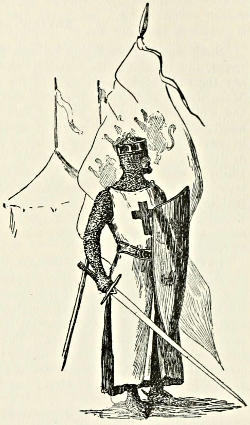
A Knight of the Third Crusade
The failure of the ambitious attempts of each of the monarchs at the
capture of Acre without the aid of his rival, evinced the necessity of their
co-operation.[62] A reconciliation in consequence was effected between Richard
and Philip: and they determined that one should attack the walls, while the
other guarded the camp from the approaches of Saladin. But Acre had
suffered so dreadfully from a two years’ siege, that the inhabitants were
reduced to the melancholy necessity of resolving to desist from defence.
Saladin endeavoured to infuse his own invincible spirit into the minds of his
people, and revived for a moment their languid courage, by directing their
hopes to succour from Egypt. The
expected aid from Cairo did not arrive;
and the citizens wrung from
Saladin his permission for them to
capitulate. Their safety was accordingly
purchased by their agreeing to
deliver unto the two kings the city
itself, and five hundred Christian
prisoners who were in it. The true
cross was to be resigned, and one
thousand other captives, and two hundred
knights selected by the allies
from those who were in the hands of
Saladin; and unless the Mussulmans
paid to Richard and Philip the sum
of two hundred thousand pieces of
gold within forty days, the inhabitants
of Acre should be at the mercy of the
conquerors.
These conditions were assented to,
and, before the city changed its lords,
a proclamation was made in the French
and English camps that no one should
injure or insult such of the Turks as
quitted the place. The Christians
entered Acre; the banners of the two
kings floated on the ramparts; but
precedence seems to have been given
to Richard, for he and his wife and
sister inhabited the royal palace, while
Philip occupied the house of the Templars.
They could not refuse the justice of their soldiers’ claim, founded on
the principle that those who had shared the labours should divide the reward;
but payment was so long deferred, that many persons were forced by poverty
to sell their military equipments, and return to Europe. The kings were
divided in opinion respecting the title to the sovereignty over Palestine.
The English monarch was persuaded to espouse the cause of the weak and
miserable Lusignan. The disputes were sometimes heard of during the siege;
but after the capture they raged with violence. Negotiations however were
entered into, and the agreement reached that Lusignan should be styled king
of Jerusalem, and lord of Joppa and Askalon; yet that if Conrad should be the
survivor, he and his heirs were to have perpetual sovereignty. The English
monarch afterwards generously surrendered the isle of Cyprus to Lusignan.
A few weeks after the capitulation of Acre, and before the time had
elapsed for the performance of all the conditions of the treaty, Philip
Augustus expressed his wish of returning to Europe. The duke of Burgundy,
and the largest portion of the French army, it was stipulated,
were to remain in Syria under the command of Richard. Philip Augustus
went to Tyre, gave to the marquis of that city his moiety, both of Acre and of
the Turkish prisoners, and then set sail for Europe.b
REVIEW OF THE SIEGE
[1189-1191 A.D.]
Such was the confusion of this famous siege, which lasted nearly three
years, and in which the crusaders shed more blood and exhibited more bravery
than ought to have sufficed for the subjugation of the whole of Asia.
More than a hundred skirmishes and nine great battles were fought before
the walls of the city; several flourishing armies came to recruit armies
nearly annihilated, and were in their turn replaced by fresh armies. The
bravest nobility of Europe perished in this siege, swept away by the sword
or disease. Among the illustrious victims of this war, history points out
Philip, count of Flanders, Guy de Chatillon, Bernard de St. Vallery, Vautrier
de Mory, Raoul de Fougères, Eudes de Gonesse, Renaud de Maguy, Geoffroi
d’Aumale, viscount de Châtellerault, Josselin de Montmorency, and
Raoul de Marle; the archbishops of Besançon and Canterbury; with many
other ecclesiastics and knights whose piety and exploits were the admiration
of Europe.
In this war both parties were animated by religion; each side boasted of
its miracles, its saints, and its prophets. Bishops and imams equally promised
the soldiers remission of their sins and the crown of martyrdom. Whilst
the king of Jerusalem caused the Book of the Evangelists to be borne before
him, Saladin would often pause on the field of battle to offer up a prayer or
read a chapter from the Koran. The Franks and the Saracens mutually accused
each other of ignorance of the true God and of outraging him by their
ceremonies. The Christians rushed upon their enemies crying, “It is the will
of God! It is the will of God!” and the Saracens answered by their war-cry,
“Islam! Islam!”
Fanaticism frequently augmented the fury of slaughter. The Mussulmans
from the heights of their towers insulted the religious ceremonies of
the Christians. They raised crosses on their ramparts, beat them with rods,
covered them with dust, mud, and filth, and broke them into a thousand
pieces before the eyes of the besiegers. At this spectacle the Christians
swore to avenge their outraged worship, and menaced the Saracens with the
destruction of every Mohammedan pulpit. In the heat of this religious animosity,
the Mussulmans often massacred disarmed captives; and in more than
one battle they burned their Christian prisoners in the very field of conflict.
The crusaders but too closely imitated the barbarity of their enemies; funeral
piles lighted up by fanatical rage were often extinguished in rivers of
blood.
The Mussulman and Christian warriors provoked each other during single
combats, and were as lavish of abuse as the heroes of Homer. Heroines
often appeared in the mêlée, and disputed the prize of strength and courage
with the bravest of the Saracens. Children came from the city to fight with
the children of the Christians in the presence of the two armies. But sometimes
the furies of war gave place to the amenities of peace, and Franks
and Saracens would for a moment forget the hatred that had led them to take
up arms. During the course of the siege several tournaments were held in
the plain of Acre, to which the Mussulmans were invited. The champions
of the two parties harangued each other before entering the lists; the conqueror
was borne in triumph, and the conquered ransomed like a prisoner of
war. In these warlike festivities, which brought the two nations together,
the Franks often danced to the sound of Arabian instruments, and their
minstrels afterwards played or sang to the dancing of the Saracens.
Most of the Mussulman emirs, after the example of Saladin, affected an
austere simplicity in their vestments and manners. An Arabian author
compares the sultan, in his court, surrounded by his sons and brothers, to
the star of night which sheds a sombre light amidst the other stars. The
principal leaders of the crusade did not entertain the same love of simplicity,
but endeavoured to excel each other in splendour and magnificence. As in
the First Crusade, the princes and barons were followed into Asia by their
hunting and fishing appointments, and the luxuries of their palaces and
castles. When Philip Augustus arrived before Acre, all eyes were for a
moment turned upon the falcons he had brought with him. One of these
having escaped from the hands of his keeper, perched upon the ramparts of
the city, and the whole Christian army was excited by endeavours to recapture
the fugitive bird. As it was caught by the Mussulmans, and carried to
Saladin, Philip sent an ambassador to the sultan to recover it, offering a sum
of gold that would have been quite sufficient for the ransom of many Christian
warriors.
The misery which so often visited the crusaders, did not at all prevent a
great number of them from indulging in excesses of license and debauchery.
All the vices of Europe and Asia were met together on one spot. If an
Arabian author may be believed, at the very moment in which the Franks
were a prey to famine and contagious diseases, a troop of three hundred
women from Cyprus and the neighbouring islands arrived in the camp.
These three hundred women, whose presence in the Christian army was a
scandal in the eyes of the Saracens, prostituted themselves among the soldiers
of the cross, and stood in no need of employing the enchantments of
the Armida of Tasso to corrupt them.
Nevertheless, the clergy were unremitting in their exhortations to the pilgrims
to lead them back to the morals of the Gospel. Churches, surmounted
by wooden steeples, were erected in the camp, in which the faithful were
every day called together. Not unfrequently the Saracens took advantage
of the moment at which the soldiers left their entrenchments unguarded to
attend mass, and made flying but annoying incursions. Amidst general corruption,
the siege of Acre presented many subjects of edification. In the
camp, or in the field of battle, charity hovered constantly around the Christian
soldier, to soothe his misery, to watch his sick pallet, or dress his wounds.
During the siege the warriors from the north were in the greatest distress,
and could gain little assistance from other nations. Some pilgrims from
Lübeck and Bremen came to their aid, formed tents of the sails of their vessels
to shelter their poor countrymen, and ministered to their wants and
tended their diseases. Forty German nobles took part in this generous
enterprise, and their association was the origin of the hospitable and military
order of the Teutonic knights.
When the crusaders entered Acre, they shared the sovereignty of it
amongst them, each nation taking possession of one of the quarters of the
city, which had soon as many masters as it had had enemies. The king of
Jerusalem was the only leader that obtained nothing in the division of the
first reconquered place of his kingdom.
The capitulation remained unexecuted; Saladin, under various pretexts,
deferring the completion of the conditions. Richard, irritated by a delay
which appeared to him a breach of faith, revenged himself upon the
prisoners that were in his hands. Without pity for disarmed enemies, or
for the Christians he exposed to sanguinary reprisals, he massacred five
thousand Mussulmans before the city they had so valiantly defended, and
within sight of Saladin, who shared the disgrace of this barbarity by thus
abandoning his bravest and most faithful warriors.[63]
This action, which excited the regret of the whole Christian army, sufficiently
exposed the character of Richard, and showed what was to be dreaded
from his violence; a barbarous and implacable enemy could not become
a generous rival. On the day of the surrender of Acre, he committed a
gross outrage upon Leopold, duke of Austria, by ordering the standard of
that prince, which had been planted on one of the towers, to be cast into the
ditch. Leopold dissembled his resentment, but swore to avenge this insult
whenever he should find an opportunity.c
THE CRUSADERS MOVE ON JERUSALEM
[1191-1192 A.D.]
It was with difficulty that the soldiers would leave the pleasures of Acre.
A historian tells us that the wine in the city had already changed the complexion
of the gravest Christian knights, and, for the preservation of discipline,
women were prohibited from marching with the army. The largesses of
Richard to the duke of Austria, the count of Champagne, and others, kept
them from following Philip to Europe, and Plantagenet was at the head
of nearly thirty thousand French, German, and English soldiers. These holy
warriors left Acre and marched in a southerly direction, generally within
sight of their ships, which coasted along the shores, bearing forage and provisions,
and military necessaries. Clouds of Turks overhung and burst on
the advancing army; the Red Cross knights in the van, and the military
friars in the rear, frequently broke the violence of the storm; but the safety
of the crusaders was principally owing to the indissoluble firmness of their
columns, and their resolute forbearance.[64]
Near Azotus a general engagement could no longer be avoided by Richard.
The right of his line was commanded by that heroic and hardy champion
of the cross, James d’Avesnes. The duke of Burgundy, a man of doubtful
virtue, headed the left; and Plantagenet himself was the stay and bulwark
of the centre. The hosts of Syria and Egypt, led by Saladin, made a general
and impetuous charge on their foe. The right wing of the Christians was
repulsed; the left drove back the Saracens, but it was drawn by the enemy
far from the other divisions of the army. Richard hastened with a select
band to the aid of the duke of Burgundy, and Saladin, in his endeavour to
strengthen his right wing, removed the weight of hostility from James
d’Avesnes. No deep impression had been made on the English lines. The
personal bravery of Richard achieved wonders; his countenance, his gestures,
his invocations to St. George, seconded the ardour of his troops, and the
Turks were driven back with great slaughter to Azotus. The loss of the
Christians, though not numerous, was severe, for James d’Avesnes perished,
and his death was justly regretted
by the king as the loss of a great
pillar of the Christian cause.
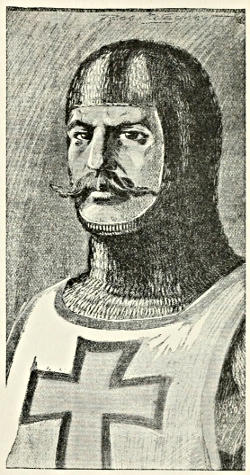
Richard the Lion-hearted
The progress of Cœur de Lion
was no longer molested, and he
quickly arrived at Joppa. That
city was now without fortifications,
for when the tide of victory
turned from the Mussulmans at
Azotus, Saladin commanded the
dismantling of all his fortresses
in Palestine. It was policy to
keep his enemies perpetually in
the field, and to exhaust them by
ceaseless skirmishes and engagements.
As the road to Askalon
was open, Richard wished to press
his advantages; but the spirit of
faction renewed its baneful influence,
and the French barons insisted
on the necessity of restoring
the works of Joppa. Their opinion
was in unfortunate accordance
with the inclinations of an army
already attenuated by incessant
marching, and who thought with
regret on the pleasures which had
been for a while familiarised and
endeared to them at Acre. It was
resolved, therefore, that Joppa
should be re-fortified. Plantagenet,
alive to every duty of a
general, urged the completion of
the works. The soldiers, however,
gradually sunk into that
state of luxury and idleness, from
which they had been with such
difficulty recovered by Richard.
The Mussulmans roused themselves
from the distress and panic of their late defeat at Azotus; they began
to collect in the vicinity of Joppa, and their military appearance awoke
the English and French from their disgraceful sleep of licentiousness.
Vinsaufg tells how Richard, as ardent in pleasure as in war, enjoyed the
amusement of falconry, heedless of the enemy. On one occasion the royal
party would have paid dearly for their temerity, if a Provençal gentleman,
named William de Pratelles, had not cried aloud, “I am the king”; and
by this noble lie the attention of the Saracens was drawn upon himself,
while the real sovereign escaped. Shortly afterwards a body of Templars
fell into an ambuscade of the Turks. Richard sent the earl of Leicester to the
aid of the brave but exhausted knights, and promised to follow straight.
Before he could buckle on his coat of steel, he heard that the enemy had
triumphed. Despising all personal solicitude, and generously declaring he
should not deserve the name of king if he abandoned those whom he had
vowed to succour, he flew to the place of combat, plunged into the thickest
of the fight, and his impetuosity received its usual reward of success.
The fortifications of Joppa were at length restored, a vigorous renewal
of the war was determined on, and Plantagenet declared to the Saracens that
the only way of averting his wrath would be to surrender to him the kingdom
of Jerusalem, as it existed in the reign of Baldwin the leper. Saladin
did not reject this proposal with disdain, but made a modification of the
terms, in offering to yield Palestine from the Jordan to the sea. The negotiation
lasted for some time. Richard was deceived and cajoled by the presents
and blandishments of Saphedin [Saif ad-Din], who was the brother of
Saladin, and the Christians were ashamed that their leader should be so
friendly with an infidel. The barons soon saw, and compelled their royal
lord to see, the artifice of the Turks, who resumed their attacks, and the
negotiation was broken off. But the Templars, Hospitallers, and Pisans,
dissuaded the king from attacking Jerusalem, on the argument that even if
it should be taken they would immediately have to fight with the Turks
in the neighbourhood. Richard commanded a retreat, and the army fell back
upon Ramula, and then continued its retrogression to Askalon, a city of high
consequence in the judgment of the Latins, because it was the link between
the Turks in Jerusalem and the Turks in Egypt.
Until the return of the spring, all commerce between Askalon and other
countries was cut off, and the army endured therefore the hardships of
famine in addition to the usual severities of the climate. The impatient
duke of Burgundy deserted the standard of Richard; some of the French
soldiers went to Acre and Joppa; and others found a welcome reception at
the court of the marquis of Tyre. But discontent gave place for a while to
better feelings; and, at the solicitation of Plantagenet, most of the deserters
returned to their duty. But Conrad disdained an answer to the royal summons.
The walls of Askalon were soon repaired, for the proudest nobles
and the most dignified clergy worked like the meanest of the people. The
duke of Austria was the only distinguished man who was wrapped in haughty
selfishness, and who could say that he was neither a carpenter nor a mason.
Before indeed the works were completed, Richard lost the aid of his French
allies, who, more mercenary than chivalric, retired to Acre, because the royal
coffers were exhausted, and the king could not give them their stipulated
pay. Commercial jealousy, as well as military envy, obstructed the Crusades.
The Genoese and Pisans made Acre the theatre of their animosities;
and an appearance of dignity and disinterestedness was given to their feuds,
when they fought in the name and for the interests of their respective
friends, Conrad and Guy. The marquis of Tyre joined his troops to the
Genoese, and the civil war would have spread through all the Christian
powers, if Plantagenet had not marched from Askalon to Acre. Conrad
prudently retraced his steps, and by the address of the English king the
breach between the republicans was closed. Richard endeavoured to conciliate
the marquis; but the young nobleman aspired to independence and sovereign
power, drew seven hundred French soldiers from Askalon to Tyre, and allied
himself with Saladin. When Richard had retired from Jerusalem, and his
army became broken, Saladin had dismissed many of his troops to their
families and homes; but when he heard of the defection of Conrad, he
thought that the moment of active hostility was arrived, and he accordingly
spread his standard, and summoned his hosts.
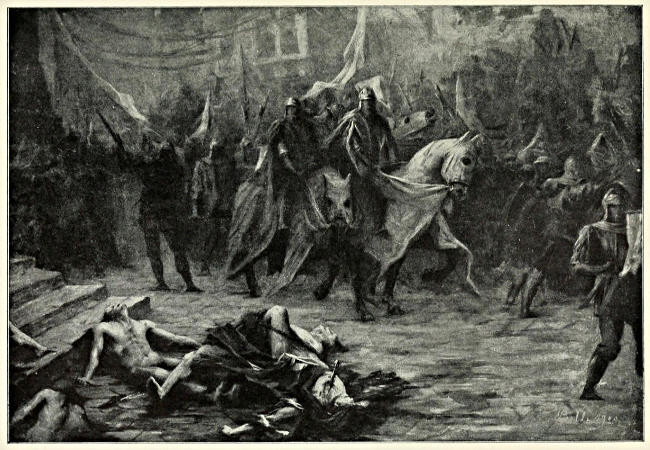
ARMY OF RICHARD IN THE EAST
Richard was cool and undismayed at the military port of his enemy, but
political disturbances in England demanded the presence of the monarch,
and he was compelled to yield to his necessities, and solicit his generous foe
to terminate the war. He declared that he required only the possession of
the sacred city, and of the true cross. But the Mussulman replied that
Jerusalem was as dear to the Moslem as to the Christian world, and that he
would never be guilty of conniving at idolatry by permitting the worship of
a piece of wood. Thwarted by the religious principles of his enemies,
Richard endeavoured to win upon their softer affections. He proposed a
consolidation of the Christian and Mohammedan interests, the establishment
of a government at Jerusalem, partly European and partly Asiatic; and
these schemes of policy were to be carried into effect by the marriage of
Saphedin with the widow of William king of Sicily. The Mussulman
princes would have acceded to these terms; but the marriage was thought
to be so scandalous to religion, that the imams and the priests raised a storm
of clamour, and Richard and Saladin, powerful as they were, submitted to
popular opinion.[65]
The necessity of Richard’s return to England grew stronger, and the
only cause of his delay was the choice of a military commander of the Christians.
The imbecile Guy had but few partisans, and the public voice was
in favour of the valiant Conrad; Richard generously overlooked the circumstance,
that the prince of Tyre was his enemy, and the friend of Saladin, and
consented to the public wish. But while preparations were making for the
coronation, Conrad was slain by two of the Assassins. In the first moments
of indignation, the French declared that Richard had instigated the murderers.
They demanded from the widow of Conrad the resignation of Tyre,
but she was too politic to encounter the anger of the king. Count Henry
of Champagne appeared in the midst of the tumult; he took the throne
upon the invitation of the people, and following the approved precedent, he
secured himself from opposition by marrying the widow of Conrad. Richard
confirmed the election of the people, and the civil war was closed. The duke
of Burgundy and the count of Champagne joined Richard.
Disregarding the calls from England, the king led his English and Normans
to the fortress of Darum, reduced it, and gave it to the French, whose
preparations for the attack had been rendered needless by the superior activity
of their allies. Some new messengers from England brought fresh accounts of
the increasing power of Prince John, and the treachery of Philip Augustus.
The army continued its march towards Jerusalem, and encamped in the valley
of Hebron. The generals and soldiers vowed that they would not quit Palestine
without having redeemed the sepulchre. Everything wore the face of
joy when this resolution was adopted; Richard participated in the feeling,
and although he thought that his presence in England would be the only
means of restoring affairs there, yet he professed to the duke of Burgundy,
and the count of Champagne, that no solicitation from Europe should prevail
with him to leave the allies until after the following Easter. Hymns and
thanksgivings testified the popular joy at this resolution.
The nearer the approach of the Christians the greater was the terror of the
Mussulmans in Jerusalem; many of them prepared to leave the city, and even
Saladin was alarmed for its safety. The crusaders were at Bethlehem; the
French nobility in the council were as clamorous as the people without to
press forward; but the mind of Richard vacillated, and he avowed his doubts
of the policy of the measure, as his force was not adequate to a siege, and to
the keeping up of communications with its stores on the coast. He proposed
that they should march to Berytus, to Cairo, or Damascus; but as the barons
of Syria, the Templars, and Hospitallers, had a perfect knowledge of Palestine,
he thought that their decision should regulate the proceedings of the army.
THE ENTERPRISE ABANDONED
A council of twenty was accordingly appointed from the military orders,
the lords of the Holy Land, and also the French knights. They learned
that the Turks had destroyed all the cisterns, which were within two miles
of the city; they felt that the heats of summer had begun; and for these
reasons it was decided that the siege of Jerusalem should be deferred, and that
the army should march to some other conquest. As a general, Richard was
fully aware of the impolicy of advancing against the sacred city, yet he
was unable to suppress his bitter feelings of mortification at a decision which
would probably blast the proud hopes that he had indulged of redeeming
the sepulchre. A friend led him to a hill which commanded a view of Jerusalem;
but, covering his face with a shield, he declared that he was not
worthy to behold a city which he could not conquer. The French soldiers
uttered invectives and complaints against the decision of the council; Cœur
de Lion offered them provisions, ships, and money, if they would obey its
decree, and march to Cairo; and although they acquiesced, yet as they were
not zealous, Richard remained in inactivity and indecision.
Active hostility against the Saracens was abandoned by the Christians for
the fiercer employment of civil rancour and dissensions; and if a retreat had
not been commanded, the army would have been totally destroyed by Saladin.
Richard could preserve but little order and discipline among the soldiers.
Some retired to Joppa, but Acre was the rendezvous of most of the army.
By the quickest marches Saladin reached Joppa, and so vigorous was his
siege of it that in a few days one of the gates was broken down, and such of
the people as could not defend themselves in the great tower, or escape by
sea, were destroyed. Before the morning, however, the brave Plantagenet
reached Joppa. Abandoning the hope of rescuing the Holy Land from
infidel subjection, he was on the point of quitting Acre and of returning to
Europe, when the precipitancy of his Moslem rival opened again all his
visions of glory and conquest. The French refused to march; but the
Templars and Hospitallers, the Pisans and Genoese, the earl of Leicester and
the other English nobles, vowed to save their friends. Richard and some of
his troops went by sea to Joppa; other soldiers took the land course, but
were badly distressed by those impediments which Saladin, in anticipation
of their approach, cast in their way. Plantagenet was the first who leaped
on shore, and the most active with his deadly sword.b
There have been few feats of arms more renowned than this all-day fight
of Richard, and the old chronicler, Geoffrey de Vinsauf, has written of it in
such strain of enthusiasm that we cannot forbear quoting the splendid pictures,
whose hyperbole is its own explanation and excuse.a
VINSAUF’S ACCOUNT OF RICHARD AT JOPPA
The king hearing of the danger to which the besieged were exposed and
pitying their condition interrupted the messengers.
“As God lives,” said he, “I will be with them, and give them all the
assistance in my power!” The words were hardly out of his mouth, before
a proclamation was made that the army should be got ready. But the
French would not vouchsafe even to honour the king with an answer,
exclaiming proudly that they should never again march under his command;
and in this they were not disappointed, for they never again marched under
anybody’s command, for in a short time they all miserably perished. Meanwhile,
however, the soldiers of all nations, whose hearts God had touched,
and the sufferings of their fellow-creatures excited to compassion, hastened
to set out with the king; namely, the Templars, the Hospitallers, and several
other valiant knights, all of whom marched by land to Cæsarea; but the
noble king trusting for his safety to his own valour, embarked on board his
fleet of galleys, which were equipped with everything that could be necessary.
A contrary wind arose, which detained the king’s ships three days at
Caiphas, where they had put in.
The king, vexed at this delay, exclaimed aloud, “O Lord God, why dost
thou detain us here? consider, I pray thee, the urgency of the case, and the
devoutness of our wishes.” No sooner had he prayed thus than God caused
a favourable wind to spring up, which wafted his fleet before it into the
harbour of Joppa, in the midst of the night of Friday immediately preceding
the Saturday on which they had agreed to surrender, and all of them
would have been given over to destruction. They fled up the fortress as
far as they were able, and there awaited the stroke of martyrdom, shedding
tears, and supplicating the mercy of the Almighty who at length was appeased,
and deigned to listen to their petition; their deliverer was already
come, his fleet was riding in the harbour, and his soldiers were eager to
land for their rescue!
The Turks, discovering the arrival of the king’s fleet, sallied down to the
seaside with sword and shield, and sent forth showers of arrows: the shore
was so thronged with their multitude that there was hardly a foot of ground
to spare. Neither did they confine themselves to acting on the defensive,
for they shot their arrows at the crews of the ships, and the cavalry spurred
their horses into the sea to prevent the king’s men from landing. The king,
gathering his ships together, consulted with his officers what was the best
step to take.
“Shall we,” said he, “push on against this rabble multitude who occupy
the shore, or shall we value our lives more than the lives of those poor
fellows who are exposed to destruction for want of our assistance?” Some
of them replied that further attempts were useless, for it was by no means
certain that anyone remained alive to be saved, and how could they land
in the face of so large a multitude?
The king looked around thoughtfully, and at that moment saw a priest
plunge into the water and swim toward the royal galley. When he was
received on board, he addressed the king with palpitating heart and spirits
almost failing him. “Most noble king, the remnant of our people, waiting
for your arrival, are exposed like sheep to be slain, unless the divine grace
shall bring you to their rescue.” “Are any of them still alive, then?”
asked the king, “and if so, where are they?” “There are still some of
them alive,” said the priest, “and hemmed in and at the last extremity in
front of yonder tower.” “Please God, then,” replied the king, “by whose
guidance we have come, we will die with our brave brothers in arms, and a
curse light on him who hesitates.”
The word was forthwith given, the galleys were pushed to land; the
king dashed forward into the waves with his thighs unprotected by armour,
and up to his middle in the water; he soon gained firm footing on the dry
strand; behind him followed Geoffrey du Bois and Peter de Pratelles, and
in the rear came all the others rushing through the waves. The Turks
stood to defend the shore, which was covered with their numerous troops.
The king, with an arbalest which he held in his hand, drove them back
right and left; his companions pressed upon the recoiling enemy, whose
courage quailed when they saw it was the king, and they no longer dared
to meet him. The king brandished his fierce sword, which allowed them no
time to resist, but they yielded before his fiery blows and were driven in
confusion with blood and havoc by the king’s men until the shore was
entirely cleared of them.
The king then, by a winding stair, which he had remarked in the house
of the Templars, was the first to enter the town, where he found more than
three thousand of the Turks turning over everything in the houses, and
carrying away the spoil. The brave king had no sooner entered the town
than he caused his banners to be hoisted on an eminence, that they might
be seen by the Christians in the tower, who, taking courage at the sight,
rushed forth in arms from the tower to meet the king, and at the report
thereof the Turks were thrown into confusion. The king, meanwhile, with
brandished sword, still pursued and slaughtered the enemy, who were thus
enclosed between the two bodies of the Christians, and filled the streets with
their slain. All were slain, except such as took to flight in time; and thus
those who had before been victorious were now defeated and received condign
punishment, whilst the king still continued the pursuit, showing no
mercy to the enemies of Christ’s cross, whom God had given into his hands;
for there never was a man on earth who so abominated cowardice as he.
But the king had only three horses with him, and what were three
among so many? If we examine the deeds of the ancients, and all the
records left us by former historians, we shall find that there never was a
man who so distinguished himself in battle as King Richard did this day.
When the Turks leaving the town saw his banners floating in the air, a cry
was raised on right and left as he sallied forth upon them, and no hail-storm
or tempest ever so densely concealed the sky, as it was then darkened by
the flying arrows of the Turks. Saladin, hearing of the king’s arrival, and
of his brilliant contest with the Turks, of whom he had slain all who opposed
him, was seized with sudden fear, and like that timid animal, the hare, put
spurs to his horse and fled from before his face. The king, with his men, still
continued the pursuit, slaying and destroying, whilst his arbalesters made
such havoc of the horses that for two miles the traces of their flight were
visible. He now therefore pitched his tent in the same place where those
of Saladin had been, and thus by the divine grace so small a body of men had
defeated this large army of the Turks. It was then given out among the Turks
what a reproach it was to them, and lasting scandal, that so large an army and
so many thousands of the Turks had been defeated by so small an army,
and that Joppa had been recovered from them by force of arms. In this
manner they murmured to one another at what had taken place, and trembled
with confusion.
Meanwhile a certain depraved set of men among the Saracens, called
Menelones of Aleppo and Cordivi, an active race, met together to consult
what should be done in the existing state of things. They spoke of the
scandal which lay against them, that so small an army, without horses, had
driven them out of Joppa, and they reproached themselves with cowardice
and shameful laziness, and arrogantly made a compact among themselves
that they would seize King Richard in his tent, and bring him before Saladin,
from whom they would receive a most munificent reward. But now, by the
providence of God, who had decreed that his holy champion should not be
seized whilst asleep by the infidels, a certain Genoese was led by the divine
impulse to go out early in the morning into the fields, where he was alarmed
at the noise of men and horses advancing, and returned speedily, but just
had time to see helmets reflecting back the light which now fell upon them.
He immediately rushed with speed into the camp, calling out “To arms! to
arms!” The king was awakened by the noise, and leaping startled from
his bed, put on his impenetrable coat of mail, and summoned his men to the
rescue.
God of all virtues! lives there a man who would not be shaken by such a
sudden alarm? The enemy rushed unawares, armed against unarmed, many
against few, for our men had no time to arm, or even to dress themselves.
The king himself therefore, and many others with him, on the urgency of
the moment, proceeded without their cuishes to the fight, some even without
their breeches, and they armed themselves in the best manner they could,
though they were going to fight the whole day. Whilst our men were thus
arming in haste, the Turks drew near, and the king mounted his horse with
only ten other knights. These alone had horses, and some even of those
they had were base and impotent horses unused to arms; the common men
were skilfully drawn out in ranks and troops, with each a captain to command
them. Oh, who could fully relate the terrible attacks of the infidels?
The Turks at first rushed on with horrid yells, hurling their javelins and shooting
their arrows. The king ran along the ranks and exhorted every man to
be firm and not to flinch. The Turks came on like a whirlwind, again and
again, making the appearance of an attack, that our men might be induced
to give way, and when they were close up, they turned their horses off in
another direction. The king and his knights, who were on horseback, perceiving
this, put spurs to their horses and charged into the middle of the
enemy, upsetting them right and left, and piercing a large number through
the body with their lances; at last they pulled up their horses, because they
found that they had penetrated entirely through the Turkish lines.
The king now looking about him, saw the noble earl of Leicester fallen
from his horse, and fighting bravely on foot. No sooner did he see this than
he rushed to his rescue, snatched him out of the hands of the enemy, and
replaced him on his horse. What a terrible combat was then waged! A
multitude of Turks advanced, and used every exertion to destroy our small
army; vexed at our success, they rushed towards the royal standard of a
lion, for they would rather have slain the king than a thousand others.
In the midst of the mêlée the king saw Ralph de Mauleon dragged off prisoner
by the Turks, and spurring his horse to speed, in a moment released him
from their hands, and restored him to the army; for the king was a very
giant in the battle, and was everywhere in the field—now here, now there,
wherever the attacks of the Turks raged the hottest. So bravely did he
fight, that there was no one, however gallant, that would not readily and
deservedly yield to him the pre-eminence.
On that day he performed the most gallant deeds on the furious army of
the Turks, and slew numbers with his sword, which shone like lightning;
some of them were cloven in two from their helmet to their teeth, whilst
others lost their heads, arms, and other members, which were lopped off at a
single blow. While the king was thus labouring with incredible exertions
in the fight, a Turk advanced towards him, mounted on a foaming steed.
He had been sent by Saphedin of Archadia, brother to Saladin, a liberal and
munificent man, if he had not rejected the Christian faith. This man now
sent to the king, as a token of his well-known honourable character, two
noble horses, requesting him earnestly to accept them, and make use of
them, and if he returned safe and sound out of that battle, to remember the
gift and recompense it in any manner he pleased. The king readily received
the present, and afterwards nobly recompensed the giver. Such is bravery,
cognisable even in an enemy; since a Turk, who was our bitter foe, thus
honoured the king for his distinguished valour.
The king, especially at such a moment of need, protested that he would
have taken any number of horses equally good from anyone, even more a foe
than Saphedin, so necessary were they to him at that moment. Fierce now
raged the fight, when such numbers attacked so few; the whole earth was
covered with the javelins and arrows of the unbelievers; they threw them
several at a time against our men, of whom many were wounded. Thus the
weight of the battle fell heavier upon us than before, and the galley-men
withdrew in the galleys which brought them, and so, in their anxiety to be
safe, they sacrificed their character for bravery. Meanwhile a shout was
raised by the Turks, as they strove who should first occupy the town, hoping
to slay those of our men whom they should find within.
The king, hearing the clamour, taking with him only two knights and
two cross-bow men, met three Turks, nobly caparisoned, in one of the principal
streets. Rushing bravely upon them, he slew the riders in his own royal
fashion, and made booty of two horses. The rest of the Turks who were
found in the town were put to the rout in spite of their resistance, and dispersing
in different directions, sought to make their escape even where there
was no regular road. The king also commanded the parts of the walls
which were broken down to be made good, and placed sentinels to keep
watch lest the town should be again attacked. These matters settled, the
king went down to the shore, where many of our men had taken refuge on
board the galleys. These the king exhorted by the most cogent arguments
to return to the battle and share with the rest whatever might befall them.
Leaving five men as guards on board each galley, the king led back the rest
to assist his hard-pressed army; and he no sooner arrived, than with all his
fury he fell upon the thickest ranks of the enemy, driving them back and
routing them, so that even those who were at a distance and untouched
by him, were overwhelmed by the throng of the troops as they retreated.
Never was there such an attack made by an individual. He pierced
into the middle of the hostile army, and performed the deeds of a brave and
distinguished warrior. The Turks at once closed upon him and tried to
overwhelm him. In the meantime our men, losing sight of the king, were
fearful lest he should have been slain, and when one of them proposed that
they should advance to find him, our lines could hardly contain themselves.
But if by any chance the disposition of our troops had been broken, without
doubt they would all have been destroyed. What however was to be
thought of the king who was hemmed in by the enemy, a single man
opposed to so many thousands?
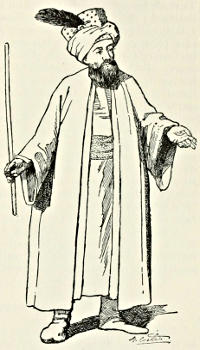
A Saracen Chief
The hand of the writer faints to tell it, and the mind of the reader to
hear it. Who ever heard of such a man? His bravery was ever of the
highest order, no adverse storm could sink it; his valour was ever blooming.
Why then do we speak of the valour of Antæus, who regained his
strength every time he touched his mother
earth, for Antæus perished when he was
lifted up from earth in the long wrestling
match. The body of Achilles also, who
slew Hector, was invulnerable, because
he was dipped in the Stygian waves;
yet Achilles was mortally wounded in
the very part by which he was held when
they dipped him. Likewise Alexander,
the Macedonian, who was stimulated by
ambition to subjugate the whole world,
undertook a most difficult enterprise, and
with a handful of choice soldiers fought
many celebrated battles, but the chief
part of his valour consisted in the excellence
of his soldiers. In the same
manner, the brave Judas Maccabæus, of
whose wars all the world discoursed, performed
many wonderful deeds worthy
forever to be remembered, but when he
was abandoned by his soldiers in the
midst of a battle, with thousands of
enemies to oppose him, he was slain, together
with his brothers.
But King Richard, inured to battle
from his tenderest years, and to whom
even famous Roland could not be considered
equal, remained invincible even
in the midst of the enemy, and his body,
as if it were made of brass, was impenetrable
to any kind of weapon. In his right hand he brandished his sword,
which in its rapid descent broke the ranks on either side of him. Such was
his energy amid that host of Turks that, fearing nothing, he destroyed all
around him, mowing men down with his sword as reapers mow down the corn
with their sickles. Who could describe his deeds? Whoever felt one of his
blows, had no need of a second. Such was the energy of his courage, that it
seemed to rejoice at having found an occasion to display itself. The sword
wielded by his powerful hand, cut down men and horses alike, cleaving
them to the middle.
The Turks were terror-struck at the sight, and giving way on all sides,
scarcely dared to shoot at him from a distance with their arrows. The king
now returned safe and unhurt to his friends, and encouraged them more
than ever with the hope of victory. How were their minds raised from
despair when they saw him coming safe out of the enemy’s ranks! They
knew not what had happened to him, but they knew that without him all
the hopes of the Christian army would be in vain. The king’s person was
stuck all over with javelins, like a deer pierced by the hunters, and the
trappings of his horse were thickly covered with arrows. Thus, like a
brave soldier, he returned from the contest, and a bitter contest it was, for
it had lasted from the morning sun to the setting sun. It may seem indeed
wonderful and even incredible that so small a body of men endured so long
a conflict; but by God’s mercy we cannot doubt the truth of it, for in that
battle only one or two of our men were slain. But the number of the
Turkish horses which lay dead on the fields is said to have exceeded fifteen
hundred; and of the Turks themselves more than seven hundred were
killed, and yet they did not carry back King Richard, as they had boasted,
as a present to Saladin; but, on the contrary, he and his brave followers
performed so many deeds of valour in the sight of the Turks, that the
enemy themselves shuddered to behold them. In the meantime, our men
having by God’s grace escaped destruction, the Turkish army returned to
Saladin, who is said to have ridiculed them by asking where Melek Richard
was, for they had promised to bring him a prisoner? “Which of you,”
continued he, “first seized him, and where is he? Why is he not produced?”
To whom one of the Turks that came from the farthest countries
of the earth replied; “In truth, my lord, Melek Richard, about whom
you ask, is not here; we have never heard since the beginning of the world
that there ever was such a knight so brave and so experienced in arms.
In every deed at arms, he is ever the foremost; in deeds, he is without a
rival, the first to advance and the last to retreat; we did our best to seize
him, but in vain, for no one can escape from his sword; his attack is dreadful;
to engage with him is fatal, and his deeds are beyond human nature.”
From the toil and exertion of the battle, King Richard and several
others who had exerted themselves the most, fell ill, not only from the
fatigue of the battle, but the smell of the corpses, which so corrupted the
neighbourhood, that they all nearly died.g
PEACE BETWEEN THE KINGS
Richard now wished for peace, and Saladin, exhausted by wars, submitted
to necessity. They exchanged expressions of esteem, and as the former
avowed his contempt of the vulgar obligation of oaths, they only grasped
each other’s hands in pledge of fidelity. A truce was agreed upon for three
years and eight months; the fort of Askalon was to be destroyed; but
Joppa and Tyre, with the country between them, were to be surrendered to
the Christians. The people of the West were also at liberty to make their
pilgrimages to Jerusalem, exempt from the taxes which the Saracenian
princes had in former times imposed.
The French soldiers at Acre prepared to return to Europe; but wished
first to behold the sepulchre which was so dear and sacred to the Christians.
But Richard was indignant at the audacity of men who claimed the benefit
of a treaty which no efforts of their own had procured. They had lost the
laurel of holy warriors, and they deserved not to bear the pilgrim’s palm.
The rest of the army visited the hallowed places, and Saladin, alive to every
honourable obligation, prevented his subjects from injuring the persons and
insulting the feelings of the devout palmers. In a familiar conversation
with the bishop of Salisbury Saladin expressed his admiration of the bravery
of Plantagenet, but thought that the skill of the general did not equal the
valour of the knight. The courteous
prelate complimented the Mussulman
by replying that there were not two
such warriors in the world as the
English and the Syrian monarchs.
Often have we had occasion to observe
the generosity of Saladin in the
moment of victory. At the solicitation
of the bishop he allowed establishments
of Latin priests in the
Holy Sepulchre, and in the churches
of Bethlehem and Nazareth. He had
pity, too, on the different barons
whom his conquests had dispossessed.
He gave to the lord of Sajetta a handsome
town near Tyre; to Belian of
Ibelin a castle, four miles from Acre;
and he restored Caiphas, Cæsarea, and
Azotus to their respective lords.
Count Henry of Champagne became
master of Joppa.
The loss of many thousand soldiers
on the plains of Acre, and the bravery
and conduct of the English monarch,
had prevented some of the anticipated
issues of the battle of Tiberias;
Palestine did not become a Mussulman
colony; and so much of the sea coast
was in the hands of the Christians,
and so enfeebled were the enemy,
that fresh hostilities could safely be
commenced whenever Europe should
again pour forth her religious fanatics,
and military adventurers. Richard
gained more honour in Palestine than
any of the emperors of Germany and
kings of France who had sought renown
in foreign war; and although
these distant ages may censure his
conduct as unprofitable to his country,
yet his actions were in unison with
that spirit of the times which looked
upon valour as more important than empire, and esteemed achievements in
battle more highly than the consequences of victory. In the month of
October, Richard, with his queen, the English soldiers, and pilgrims, set sail
for England. But storms of violence, uncommon even for the boisterous
season of autumn, soon scattered the fleet. Many of the vessels were
wrecked on hostile shores, and the warriors of England, now penniless,
naked, and famished, were led into Saracen prisons. Other ships fortunately
reached friendly ports, and in time returned to Britain.b
END AND REVIEW OF THE THIRD CRUSADE
[1189-1192 A.D.]
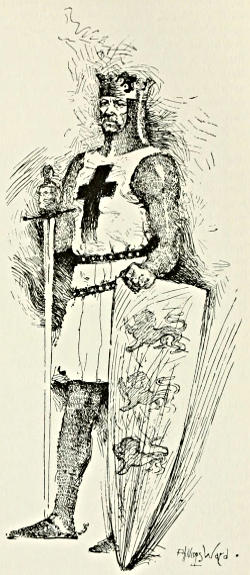
Richard the Lion-hearted as a Crusader
Thus finished this Third Crusade, in which all the western powers in arms
obtained no greater advantages than the taking of Ptolemais and the demolition
of Askalon; in it Germany lost, without glory, one of the greatest of its
emperors and the finest of its armies. If we may believe Arabian authors,
six hundred thousand crusaders appeared before Ptolemais, and scarcely one
hundred thousand of these warriors saw their native country again. Europe
had the greater reason to deplore the losses of this war, from the fact of her
armies having been so much better composed than in preceding expeditions;
criminals, adventurers, and vagabonds had been strictly excluded from the
ranks. All that the West could boast of the most noble and illustrious
of its warriors had taken up arms.
The crusaders that contended with Saladin were better armed and better
disciplined than any that preceded them in Palestine; the foot-soldiers
employed the cross-bow, which had been neglected or prohibited in the
Second Crusade. Their cuirasses, and their bucklers covered with thick
leather, defied the arrows of the Saracens; and on the field of battle, soldiers
were often seen bristling with arrows and darts, whom the Arabs compared
to porcupines, still keeping their ranks and fighting bravely. The Saracens
had likewise made some progress in the art of war, and began to resume the
use of the lance, which they did not employ when the first crusaders arrived
in Syria. The Mussulman armies were not confused multitudes; they
remained longer under their banners, and fought with less disorder. The
Kurds and Turks surpassed the Franks in the art of attacking and defending
cities and castles. The Mussulmans had, besides, more than one advantage
over the crusaders: they made war upon their own territories and in their
own climate; they were under the command of one single leader, who communicated
the same spirit to all, and only presented to them one cause to
defend.
In this crusade the Franks appeared to be more polished than they had
been till that time. Great monarchs making war against each other without
ceasing to give evidences of mutual esteem and generous feeling, was a new
spectacle for the world. Subjects followed the example of their princes, and
lost beneath the tent much of their barbarism. The crusaders were sometimes
admitted to the table of Saladin, and emirs received at that of Richard.
By thus mingling together, Saracens and Christians might make a happy
exchange of usages, manners, knowledge, and even virtues. The Christians,
rather more enlightened than during the first Crusades, stood in less need of
excitement from the visions of fanaticism. The passion for glory was for
them almost as powerful a principle as religious enthusiasm. Chivalry also
made great progress in this crusade; it was held in such honour, and the
title of knight was so glorious, even in the eyes of the infidels, that Saladin
did not disdain to be decorated with it.
In this crusade, in which so many knights rendered themselves illustrious,
two men acquired an immortal glory, one by a useless bravery and
qualities more brilliant than solid, the other by real successes and virtues
that might have served as models to Christians. The name of Richard
remained during a century the terror of the East, and the Saracens and
Turks celebrated him in their proverbs a long time after the Crusades. He
cultivated letters and merited a place among the troubadours; but the arts
did not at all soften his character; it was his ferocity as well as his courage
that procured him the surname of Cœur de Lion. Carried away by the
inconstancy of his inclinations, he often changed his projects, his affections,
and his principles of action; he sometimes braved religion, and very often
devoted himself to its service. Sometimes incredulous, as often superstitious;
measureless in his hatred as in his friendship, he was extravagant
in everything, and only showed himself constant in his love for war. The
passions which animated him scarcely ever permitted his ambition to have an
aim or a determinate object. His imprudence, his presumption, and the
unsteadiness of his plans, made him lose the fruits of his exploits. In a
word, the hero of this crusade is more calculated to excite surprise than
to create esteem, and appears to belong less to history than to the romances
of chivalry.
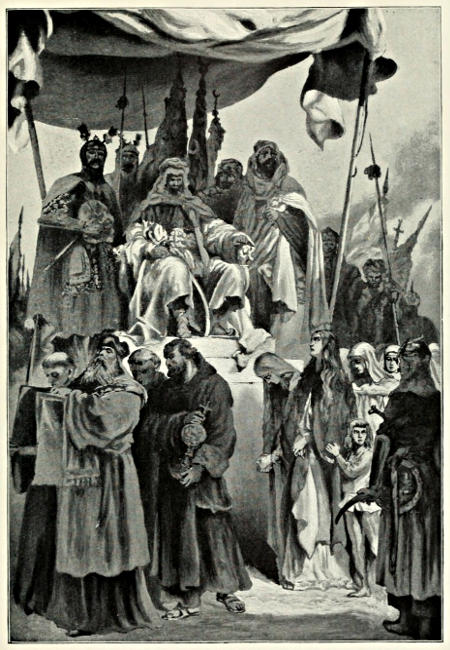
CHRISTIANS PASSING BEFORE SALADIN
With less rashness and bravery than Richard, Saladin possessed a more
firm character, one far better calculated to carry on a religious war. He
paid more attention to the results of his enterprises; more master of himself,
he was more fit to command others. When mounting the throne of the
atabegs, Saladin obeyed rather his destiny than his inclinations; but when
once firmly seated, he was governed by only two passions—that of reigning,
and that of securing the triumph of the Koran. On all other subjects he was
moderate, and when a kingdom or the glory of the prophet was not in
question, the son of Eyyub was admired as the most just and mild of Mussulmans.
We may add that the stern devotion[66] and ardent fanaticism that
made him take up arms against the Christians, only rendered him cruel and
barbarous in one single instance. He displayed the virtues of peace amidst
the horrors of war. “From the bosom of camps,” says an oriental poet, “he
covered the nations with the wings of his justice, and poured upon his cities
the plenteous showers of his liberality.” The Mussulmans, always governed
by fear, were astonished that a sovereign could inspire them with so much
love, and followed him with joy to battle. His generosity, his clemency,
and particularly his respect for an oath, were often the subjects of admiration
to the Christians, whom he rendered so miserable by his victories, and of
whose power in Asia he had completed the overthrow.
The Third Crusade, which was so glorious for Saladin, was not entirely
without advantages for Europe. Many crusaders, on the way to Palestine,
stopped in Spain, and by their victories over the Moors, prepared the deliverance
of the kingdoms situated beyond the Pyrenees. A great number of
Germans, as in the Second Crusade, prevailed upon by the solicitations of
the pope, made war upon the barbarous inhabitants of the shores of the Baltic,
and thus, by useful exploits, extended the limits of the Christian republic in
the West. As in this war the greater part of the crusaders went to Palestine
by sea, the art of navigation made a sensible advance; the maritime
nations of Europe acquired an accession of prosperity, their fleets became
more formidable, and they were able, with glory, to dispute the empire of the
sea with the Saracens.
In several states of Europe, commerce, and the spirit of the holy wars
contributed to the enfranchisement of the lower classes. Many serfs, upon
becoming free, took up arms. It was not one of the least interesting spectacles
of this crusade, to see the standards of several cities of France and Germany
floating in the Christian army amongst the banners of lords and
barons. This crusade was particularly beneficial to France, from which it
banished both civil and foreign wars. By prolonging the absence of the
great vassals and the enemies of the kingdom, it weakened their power, and
gave Philip Augustus authority to levy imposts, even upon the clergy. It
afforded him an opportunity of surrounding his throne with a faithful guard,
to keep up regular armies, and prepare, though at a distance, that victory of
Bouvines which proved so fatal to the enemies of France.
[1192-1194 A.D.]
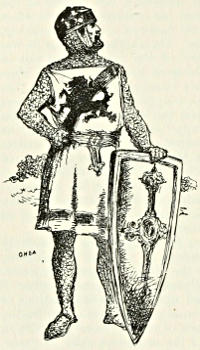
An English Crusader, Third Crusade
A long captivity awaited Richard on his return to Europe. The vessel
in which he embarked was shipwrecked on the coast of Italy, and fearing to
pass through France, he took the route of Germany, concealed under the
habit of a simple pilgrim. His liberality betrayed the monarch, and as he
had enemies everywhere, he was seized by the soldiers of the duke of Austria.
Leopold had not sufficient generosity to forget the outrages received from
Richard at the siege of Ptolemais, and detained him prisoner.[67] The duke of
Austria did not dare to detain his redoubtable captive in his own hands, and
gave him up to the emperor of Germany. Henry VI, who had likewise insults
to revenge, was rejoiced to get Richard in
his power, and kept him in chains, as if he had
made him a prisoner in the field of battle.
The hero of the crusade, who had filled the
world with his renown, was cast into a dark
dungeon, and remained a long time a victim
to the vengeance of his enemies—and they
were Christian princes. He was brought
before the German diet, assembled at Worms,
where he was accused of all the crimes that
hatred and envy could invent. But the
spectacle of a king in chains was so affecting,
that no one durst condemn Richard, and
when he offered his justification, the bishops
and nobles melted into tears, and besought
Henry to treat him with less injustice and
rigour.
Queen Eleanor implored all the powers
of Europe for the release of her son. The
complaints and tears of a mother touched the
heart of Celestine, who had recently ascended
the chair of St. Peter. The pope several
times demanded the liberty of the king of
England, and even excommunicated the duke
of Austria and the emperor; but the thunders
of the church had so often been launched
against the thrones of Germany, that they
no longer inspired fear. Henry braved the
anathemas of the holy see; the captivity of Richard lasted another year; and
he only obtained his liberty after engaging to pay a considerable ransom.
His kingdom, which he had ruined at his departure for the Holy Land,
exhausted itself to hasten his return; and England gave up even her sacred
vases to break the chains of her monarch. He was received with enthusiasm
by the English; his adventures, which drew tears, obliterated the remembrance
of his cruelties, and Europe only recollected his exploits and his
misfortunes.c
DEATH OF SALADIN; ARAB EULOGIES
In the year 589 (1193 A.D.), after the departure of the king of England,
Saladin having no longer anything to fear from the Christians, resolved to
pass some time at Damascus. This was always a favourite place of sojourn,
and he hoped there to recover his health, for he was feeling severely the
strain of so arduous a war. His plan, after resting a while in Damascus,
was to go to Egypt, which he had not visited for ten years. He left Jerusalem
and paid visits en route to Nablus, Tiberias, and other scenes of his
recent conquests. At Berytus, Bohemond, prince of Antioch, came to pay
allegiance. What most touched the sultan was that Bohemond came of his
own accord, without distrust, without escort, without even having requested
a safe conduct. As evidence of his satisfaction the sultan gave him a splendid
welcome, and granted him several fiefs contiguous to his own principality.
The lords who came with him also received presents. Saladin
finally arrived in Damascus amid the acclamations of the populace. Great
was the rejoicing, and poets exercised their art for the occasion. The sultan
immediately took in hand the welfare of the inhabitants and reformed
several abuses. In the meanwhile he betook himself with his brother Malik
Adil to the pleasures of the chase. He was away a fortnight; his health
seemed restored, and already he began to believe himself beyond all danger,
when suddenly he fell ill of a bilious fever of which he died on the thirteenth
day, March 5, 1193. Boha ad-Din, who at the time of Saladin’s death was in
the city, relates that grief was universal. “That day,” he says, “was the
most terrible that had ever dawned on Islam. The castle of Damascus,
the city, the whole universe was struck with a sorrow that God alone could
measure.”
Saladin was born at Tekrit, on the Tigris, and died at the age of fifty-seven
lunar years, after having reigned twenty-four years over Egypt and
nineteen over Syria. Arabian historians represent him as a most generous
prince, who would ever willingly deprive himself of the necessaries of life.
Boha ad-Din avows that finally his steward felt obliged, unknown to him, to
put aside money in order to meet future emergencies; at his death they
found in his treasury forty-seven silver pieces and one of gold. “This,”
adds Boha ad-Din, “was all that remained of the revenues of Egypt, Arabia,
Syria, and a part of Mesopotamia.”
It always happened that when Saladin took possession of a new province
he performed deeds of great generosity in order to win over the people.
When he entered Damascus after the death of Nur ad-Din, he did not take for
himself any of this prince’s treasures, but distributed everything among the
emirs. “Saladin,” says Abulfeda, “had gentle manners, he bore contradiction
easily, and showed great indulgence to those who served him. If anything
wounded his feelings he did not exhibit it. He was reserved in
speech; and his example inspired the same thing in others. No one dared
attack his neighbour’s honour in the sultan’s presence.
“He never could see an orphan without being moved. If one of its
parents were still alive he gave it into this parent’s keeping, but himself
provided for the child’s maintenance and kept watch over its education.
Whenever he met an aged person he wept tenderly and bestowed some
token of generosity. Such was his manner of life until God called him to
his merciful bosom.”
Saladin was not insensible to domestic affection. He loved to spend his
time with his family, surrounded by his children, and taking part in their
sports. He was sincerely devoted to his religion and brought up his children in
the same way. Boha ad-Din has preserved for us the sultan’s speech, a short
time before his death, on the occasion of the departure of his son Dhahir to
the post of governor of Aleppo. “O my son,” the sultan said, “I recommend
to thee the fear of God, source of all goodness. Do what God asks, and
thou shalt find in that thy salvation. Hold always the sight of blood in horror.
Take care not to shed or stain thyself with it, for the mark is never washed
away. Look to the well-being of thy subjects and inform thyself as to their
needs. Thou art for them God’s minister as well as mine. Take care to
please the emirs, the great men of the land, and the people of high estate. It
is by my righteous ways that I have reached this degree of power. Bear no
malice towards anyone whoever he may be, for we are all mortal. Be attentive
to thy duty to others, for in giving them satisfaction thou obtainest the
forgiveness of God better than looking to thy own account with him, for
repentance to cure all; for the Lord is good and merciful.”
He loved to read the Koran and he had the book read to his servitors and
all those around him. Noticing one day a little child reading the Koran to
his father, he was touched to tears by the sight and gave money and land
to both father and son. He admitted unreservedly all that religion teaches,
and hated philosophers and heretics. He once imprisoned and put to death
at Aleppo a young man named Sahraverdi, who mocked at and insulted
religion.
Boha ad-Din relates again: “Saladin was a great lover of justice; not
only was he strict on its being given, but he dispensed it himself as far as
his affairs would admit. He heard cases twice a week, Mondays and Thursdays,
assisted by cadis and people of the law. Great and small, everyone
found the door open. He did the same on his journeys as in his capital,
receiving all petitions presented to him, and rejecting no demands. When a
case demanded a great amount of attention he examined it at leisure, sometimes
in the day, sometimes at night, and judged it as God prompted him.
Never was his sense of justice invoked in vain; it was the same for the
princes of his family as for his other subjects, for he made exception of no
one.”
There would be no end were one to transcribe all that the Arab chroniclers,
particularly Boha ad-Din, relate concerning Saladin’s justice and piety.
The latter is especially devoted to bringing out these virtues of his hero,
and purposely omits to speak of the vices that stained them. In the whole
course of his reign Saladin encountered no great opposition except on the
part of the Christians, and especially those of the West. So he had come
to believe in no enemies but the Franks. These he treated as enemies of
God, and called the war they brought upon him, “the holy war.”
“When God shall have put into my hands the other Christian cities,” he
told Boha ad-Din,f “I shall share my states with my children, leave them my
last instructions, and bidding them farewell, embark upon that sea to subdue
the western isles and lands. I shall never lay down my arms while there
remains a single infidel upon the earth, at least if from here to there I am
not stopped by death.”
Thus Saladin’s ambitions reached as far as the conquest of France, Italy,
and the other Christian countries. And lest one should believe the words
reported by Boha ad-Din to be a vain threat, we find the same idea in the
sultan’s reply to a letter from the emperor Barbarossa. What is more
singular is that the hate of Saladin was directed towards the Christians only
as a body of nations. Once in his power, he looked at them through different
eyes. Thus we can explain the magnificent and even exaggerated eulogies
of certain contemporary Christian and especially Italian writers, eulogies
which perhaps no Mohammedan writer has exceeded. For example, there is
the following passage in the Arab history of the patriarchs of Alexandria,
whose author was one of the Coptic Christians:
“Saladin in all the surrenders he had from the Franks was faithful to his
word. When a town capitulated he left the inhabitants their liberty, with
their wives, their children, and their belongings. As to their Mohammedan
captives, Saladin offered to buy them back, and mentioned a sum greater
than their value. If the Franks refused this he let them keep their prisoners,
saying, ‘I don’t want to interfere with your captives; only treat them
well, as I treat your people.’ Whenever his policy would permit it Saladin
sought to please everybody. ‘I much prefer,’ he said, speaking of the
Christians, ‘that they should remain contented and happy.’”
Saladin’s two most glorious achievements in the eye of the majority of
the Mohammedan historians were the taking of Jerusalem and Palestine
from the Christians, and the destruction of the Fatimite caliphate in Egypt.
To these relate most of the titles and phrases in which they refer to him and
which may be found on many monuments of the period. “With Saladin,”
says Imad ad-Din, his secretary, “the great men perished, with him disappeared
people of true worth; good deeds diminished, and bad ones increased;
life became difficult, and earth was covered with shadows; the century had
its phœnix to deplore, and Islam lost its support.”k
FOOTNOTES
Bound for Holy Palestine,
Nimbly we brush’d the level brine,
All in azure steel array’d;
O’er the wave our weapons play’d,
And made the dancing billows glow;
High upon the trophied prow,
Many a warrior-minstrel swung
His sounding harp, and boldly sung.
[1195-1229 A.D.]
Wars and rebellions had filled all the thoughts of Saladin, and he had
established no principles of succession. Three of his numerous progeny
became sovereigns of Aleppo, Damascus, and Egypt; others had smaller possessions,
and the emirs and atabegs of Syria again struggled for independence.
The soldiers of the late sultan rallied round his brother Saphedin
[Saif ad-Din] whose wisdom and valour were familiar to them. Both by
stratagem and liberal policy he reared a large fabric of empire in Syria, and
he was the most powerful of all the Moslem princes, when the time for the
expiration of the peace arrived. The Saracenic power was, however, palsied
for a while by a dreadful famine in Egypt, and the Latins in Palestine
suffered also from the miserable state of this general granary.
The knights of St. John cast their regards towards Europe, and particularly
to England, for succour, and entreated that new armies would march
to Palestine, and destroy the exhausted Moslems.
POPE CELESTINE III PROMOTES A CRUSADE (1195 A.D.)
[1195-1198 A.D.]
Two years before this favourable moment, the daring and ambitious pope
Celestine III had again sounded the trumpet of war. France had not revived
from its losses in the Third Crusade, and Philip Augustus heard the
appeal with indifference. Many of the people of England enrolled their
names as holy warriors, obtained spiritual absolution, and then abandoned
their pious resolves. The pope hurled his thunders against those who
deserted their profession, except for some legitimate cause; but all thoughts
of a crusade gradually died away in England, for the king was too much
occupied in political concerns to encourage it. But wild schemes of war
were occasionally in his mind, and the early writers have ascribed to his
dauntless spirit the vast design of conquering Egypt and, after having
gained the Holy Land, of possessing himself of the throne of Constantinople.
Designs equally ambitious were entertained by the emperor Henry, the
enemy of Plantagenet. Seconded by imperial influence, the clergy successfully
preached the crusade through all the German states. The emperor
declared that he would provide a passage for both rich and poor who wished
to go. But, though influenced, he was not absorbed by the love of barren
glory, and when the possession of Sicily seemed an easy achievement, he
postponed the gathering of laurels in Palestine till he had added a great
state to his empire in Europe. Tancred, prince of Sicily, had lately died,
and Henry, in right of his wife Constanza, put in his claims. This defection
from the holy war was declared to be in accordance with the opinions of
his wisest princes and lords, and it did not quench the spirit of fanaticism
and romance.
THE FOURTH (OR GERMAN) CRUSADE (1195-1198 A.D.)
From the north to the south of Germany the frenzy of crusading had
spread, and it had infected the bishops of Bremen, Würzburg, Passau, and
Ratisbon; the dukes of Saxony, Brabant, Bavaria, and the son of the duke
of Austria; the marquis of Brandenburg and Moravia; the landgraf of
Thuringia; the count Palatine, and the counts of Habsburg and Schwembourg.
The son of Henry duke of Limburg and the archbishop of Mainz
led the vanguard of the holy warriors; and in the passage through Hungary
they were joined by Margaret, sister of the French king and queen of
Hungary, who, as one mode of consolation for the loss of her husband, had
vowed to pass the remainder of her life in the pains of pilgrimage. Though
the time of peace, as settled by the treaty between Richard and Saladin, had
expired, yet the Christians and Mussulmans continued to live in amity.
When the new champions of the cross arrived at Acre, no remonstrances of
the Latins against fresh wars, no suggestions that all new crusaders ought to
be obedient to the discretion of the residents in the Holy Land could abate
the furious desire of the Germans for hostility.
Their aggressions were quickly returned by the Mussulmans, civil feuds
were hushed, and Saphedin again headed the veteran forces of Syria and
of Egypt. The important city of Joppa was taken by him before the
Christian army from Acre could relieve it. The care and expense of
Richard were dissipated in a moment; the fortifications were destroyed,
and several thousands of the people of Joppa were put to the sword. In
these unhappy moments another portion of the German force, under the
command of the dukes of the lower Lorraine and Saxony, arrived at Acre.
They had made the voyage from the northern ports of Germany, and in their
route had chastised the Moors of Portugal. Confident in their strength, the
united forces of Europe and Palestine, led by the duke of Saxony, directed
their march towards the city of Berytus; but Saphedin, ever observant of
events, quitted the vicinity of Joppa, and overtook his foes between Tyre
and Sidon. The close columns of the duke of Saxony’s army were impenetrable
to his vigorous and continual attacks. The victory of the Christians
appeared to be decisive, the enemy’s force was scattered, and so extensive
was the panic that the Saracens abandoned Laodicea, Gabala, Joppa, Sidon,
and Berytus. Nine thousand prisoners were redeemed without ransom; and
the statement that there were three years’ provisions for the inhabitants
of Berytus in the storehouses of that town shows the importance of the day of
Sidon. The exultation of the crusaders was still further advanced by the
arrival of a third body of friends, headed by Conrad, bishop of Hidelsheim
and chancellor of the German Empire. By the usual process of ambitious
princes Henry had subjugated Sicily; and now, devoted to the conquest of
the Holy Land, he sent his third army as his immediate precursors.
It seemed that the hour was now at hand when Europe would receive
the reward of her invincible heroism. All the sea coast of Palestine was
already in the possession of the Christians: and even they who had generally
most desponded were now elevated with the conviction that the cross
must ere long surmount the walls of Jerusalem. But in their march from
Tyre towards the Holy City they made a fatal halt at the fortress of
Thoron. The lofty and solid pile of stones withstood the attacks of the
common engines of violence. But by a month’s labour of some Saxon miners
the rock itself which supported the fortress was pierced through; and the
battlements tottered to their foundation. The Saracens were now at the feet
of the Christians suing for clemency. A free passage into the Moslem territories
was all that they asked, and the fort might then be at the disposal
of the crusaders. After much time had been passed in balancing considerations
of revenge or mercy, a treaty founded on these terms was signed;
but although just principles of war prevailed with the majority, yet the
smaller party, who breathed nothing but slaughter, impressed their menaces
so deeply on the minds of the Saracens that the latter vowed to submit to
the last extremity, rather than confide in the agreements and oaths of champions
of the cross.
They gained resolution from despair; they met their foes in the passages
which had been mined in the rocks; and in every encounter the Moslem
scimitar reeked with Christian blood. Factious contentions disordered the
Latin council; insubordination and vice raged in the camp; and, to crown
their miseries, the crusaders heard that the infidel world had recovered from
its defeat at Sidon, and that the sultans of Egypt and Syria were concentrating
their levies. Daunted at the rumour of their march, the German
princes deserted their posts in the middle of the night, and fled to Tyre. In
the morning their flight was discovered by the soldiers, and horror and
despair seized every breast. The camp was deserted by those who had
strength to move; the feeble left their property, the cowardly their arms
behind them. The road to Tyre was filled with soldiers and baggage in
indiscriminate confusion; but so exhausted was the state of the Mussulmans
in Thoron, that the Christians were not molested in their retreat by
any accidents except those which their own imprudence and precipitation
occasioned (1197).
[1198-1201 A.D.]
When the fragments of the army were collected, and the soldiers were
at a distance from danger, everyone reproached the other as the cause of
the late disgraceful event. The Germans accused the Latins of cowardice;
and the barons of the Holy Land declared that they would not submit to the
domineering pride of the Germans. All the quarrels were conducted in scriptural
language. Treachery was the crime of which each party accused the
other; for the case of Judas was in the minds of all. Conrad and his soldiers
went to Joppa, and resolved to repair its fortifications and to await the moment
for revenge on the Latins of Syria. Saphedin marched against them,
and the Germans did not decline the combat. Victory was on the side of the
Christians; but it was bought by the death of many brave warriors, particularly
of the duke of Saxony, and of the son of the duke of Austria. But the
Germans did not profit by this success, for news arrived from Europe that
the great support of the Crusade, Henry VI, was dead. The archbishop of
Mainz, and all those princes who had an interest in the election of a German
sovereign, deserted the Holy Land. The queen of Hungary was the only
individual of consequence whose fanaticism was stronger than worldly considerations.
The remnants, and they were more than twenty thousand, of
this once powerful host fortified themselves in Joppa. But a new storm
arose in the Turkish states. It swept over Berytus and the land of the
Christians; and, on the 11th of November, while the Germans were celebrating
the feast of St. Martin, the Moslems entered the city of Joppa and slew
every individual whom they found.
Old Fullerf says, “At this time, the spring-tide of their mirth so
drowned their souls that the Turks, coming in upon them, cut every one of
their throats to the number of twenty thousand; and quickly they were
stabbed with the sword that were cup-shot before. A day which the Dutch
(the Germans) may well write in their calendars in red letters dyed with their
own blood, when the camp was their shambles, the Turks their butchers, and
themselves the Martinmasse beeves, from which the beastly drunkards differ
but a little.”
About the time of the massacre at Joppa, Henry, count of Champagne,
the acknowledged king of Jerusalem, died. The grand master of the Hospitallers
represented to Isabella the propriety of her marriage with Almeric
de Lusignan, king of Cyprus, who had lately succeeded his brother Guy. It
was thought that Acre and its vicinity could not remain in the hands of the
Latins unless they were governed by a king, and that, in every circumstance,
Cyprus, as a place of succour and retreat, would be a valuable ally to Jerusalem.
With equal truth it might have been argued that, if there were a
powerful king in Palestine, faction, the great foe of the state, could not raise
its head. Familiarised to the joys of royalty and love, the widowed queen
embraced with rapture new prospects of happiness, and in her eyes Almeric
was as estimable as she had found her divorced husband Humphry, or her
deceased lords Conrad and Henry. The union was approved of by the clergy
and barons, it was celebrated at Acre, and Almeric and Isabella were proclaimed
king and queen of Cyprus and Jerusalem.
THE FIFTH CRUSADE (1201-1204 A.D.)
[1201-1204 A.D.]
The Third and Fourth Crusades were created by the ordinary influence
of papal power and royal authority; but the Fifth sprang from genuine
fanaticism. At the close of the twelfth century a hero arose in France, worthy
of companionship with Bernard. Fulk, of the town of Neuilly, near Paris,
was distinguished by the vehemence and ability of his preaching, and as in
early life he had drank deeply of the cup of pleasure he was well qualified
to describe the different states of the sinner and the saint. He did not
involve himself in the speculative absurdities of the day, but declaimed
against the prevailing vices of usury and prostitution. For two years he
preached without success, but after that time “heaven lent its aid to the
efforts of the preacher, in order that his words, like arrows from a powerful
bow, might penetrate the depraved hearts of men.” Accordingly, miracles
attested celestial approbation, and his sermons were received as oracles.
With the extension of his fame his wishes for religious good increased, and
his soul was inflamed with the desire of accomplishing the great aim of
Christendom. He accordingly assumed the cross, and war with the infidels
became the copious matter of his sermons.c
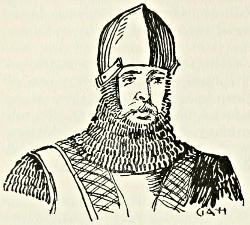
Thirteenth Century Crusader
The Fifth Crusade was an individual enterprise. Since the failure of
the Third, Jerusalem was forgotten and wars between kings and Christian
peoples took the place of the pious expeditions. England, Germany, and
France, once united for the recovery of the Holy Sepulchre, were now armed
one against the other. The emperor Otto IV was excommunicated; Philip
Augustus had been, John was to be. All
these excommunicants gave little thought
to the Holy Land. The great pope Innocent
III wanted to bring it back to their
minds and caused a new crusade to be
preached, promising the remission of all
sins to those who served God for one year.
Fulk the curé was the pope’s mouthpiece.
He visited a tournament that was being held
in Champagne, and his burning words made
all the princes and knights assembled there
assume the cross. This time, as on the first,
the kings held aloof, and the people did also.
Knighthood alone took part, and rather to
show strength of arms than any deep piety,
for the affair was nothing more, or little
more, than a plundering expedition. Baldwin IX, count of Flanders, and
Boniface II, count of Montferrat, were at its head. And it had been previously
proved that the sea route was much preferable to the land, the
crusaders sought ships at Venice.
That city was even then the Queen of the Adriatic. Driven by Attila’s
invasion to the lagoons, the people from the mainland had prospered in that
most remarkable situation in the world. None of the invasions that passed
over Italy had reached them. Their trade had extended, and the islands
and shores of Istria and Illyria recognised their superiority. When the
crusaders appeared, the Venetians encouraged them not only through piety
but the spirit of gain as well. The Mohammedans and Greeks were their
rivals in the eastern Mediterranean and they found this a good opportunity
to dispossess them. The interested services rendered the crusaders in 1130
had brought the Venetians the privilege of opening in each town of the new
kingdom of Jerusalem a quarter exclusively their own, and at the same
time they took possession of the Greek islands of Rhodes, Samos, Scio,
Mytilene, and Andros. In 1173 Venice had made its dogeship elective, and
established with its grand council that aristocratic government which kept
its power through many ages.
Such was Venice when the crusaders put in an appearance. Geoffrey de
Villehardouin,g seneschal to the court of Champagne, himself narrates the
mission in which he took part. It was a curious sight—that of the feudal
lords obliged, kneeling and in tears, to beg the people humbly for ships.
“We will grant them; we will grant them,” replied the sovereign people.
City of merchants and seamen, Venice could not but sell such a service,
and demanded 85,000 marks or 20,230 kilograms of silver, which to-day
would be equal to about £161,840 or $809,200, but in those days was worth
much more. The knights could not produce such a sum, and in place of
cash the Venetians offered to take in payment a hostile city if the crusaders
would capture it for them. They had already taken from the Greeks the
principal cities of the Dalmatian coast—Spalato, Ragusa, and Sebenico.
One alone remained to prevent their complete dominion over the Adriatic—Zara,
still occupied by the king of Hungary. In vain did Innocent III
thunder against this detour from the crusade; the Venetians got Zara and
Doge Dandolo, ninety years old, assumed the cross (1202).
The little account settled, they could go; but whither? The set-backs
of the last Crusades showed that it was necessary to have some point of
support in order to operate successfully in Palestine, and this point must be
either Egypt or the Greek Empire. The Venetians persuaded their allies
that the keys of Jerusalem were either at Cairo or Constantinople. There
was some truth in this idea, but there was much more commercial interest.
The possession of Cairo would give the Venetians the route to India; that
of Constantinople would assure them the commerce of the Black Sea and
the whole Grecian archipelago. The crusaders decided on Constantinople,
whither a young Greek prince, Alexius, offered to lead them provided they
would re-establish on the throne his father Isaac Angelus who had been
deposed (1203).
The account of the assault on Constantinople, given more fully in the history
of the Byzantine Empire, may be briefly sketched here. When the
French came in sight of Constantinople, saw its high walls, its innumerable
churches whose gilded domes glistened in the sun, and their glances wandered,
as Villehardouin says, “over the length and breadth of the city, sovereign
of all others, there was none so brave whose heart did not tremble, and each
one looked at the arms which he would soon need.” Along the shore there
was lined up a magnificent army of sixty thousand men. The crusaders
counted on a terrible battle. Barges brought them fully armed to the shore.
Before even touching the strand “the knights jumped into the water up to
their waists, fully armed, the lance men, the sword bearers, the good archers,
and the good sergeants, and the good cross-bowmen. And the Greeks made
much pretext to stop them. And when the crusaders came with lowered
lances, the Greeks turned their backs and fled, leaving them the shore. And
know that nothing more glorious ever took place.” The 18th of July (1203)
the city was carried by assault; the old emperor was brought from his cell
and put back on the throne. Alexius had made the crusaders the most
glowing promises; to keep them he imposed new taxes and so angered the
weakened people that they strangled their emperor, set up another, Mourzoufle,
and shut the city’s gates. The crusaders attacked at once. Three
days sufficed to get them in again (March, 1204); this time they put it to
the sack. One whole quarter, a square league of territory, was burned.
And what works of art perished! Four hundred thousand marks were collected
in a church for distribution.[68]
Then they divided the empire up. Baldwin IV, count of Flanders, was
elected emperor of Romania. He won against his opponents, Dandolo and
Boniface of Montferrat. The Venetians did not like the idea of seeing their
doge on the imperial throne. They took (which pleased them better) a
portion of Constantinople with the shore of the Bosporus and the Propontis,
and a majority of the Archipelago islands, Candia, etc., and dubbed themselves
lords of a quarter and a half of the Eastern Empire. The marquis
of Montferrat was elected king of Macedonia; Villehardouin, marshal of
Romania, and his nephew, prince of Romania. The count of Blois received
the Asiatic provinces. There were dukes of Athens and Naxos, counts of
Cephalonia, and lords of Thebes and of Corinth. A new France, with all
its feudal customs, arose at the eastern end of Europe. Members of the
Comnenus family, however, managed to keep several portions which they
divided into principalities—Trebizond, Napoli of Argolis, Epirus and Nicæa.
But the crusaders were too few to hold their conquest long. In 1261 this
Latin Empire fell to pieces. But, up to the end of the Middle Ages and the
conquests of the Turks, there still subsisted in certain parts of Greece
remnants of the feudal principalities so strangely established by the French
in the ancient land of Miltiades and Leonidas.b
[1204-1261 A.D.]
The establishment of the Latins in Constantinople was the important
though unlooked-for issue of the Fifth Crusade; but their dominion lasted
only fifty-seven years. The history of that period forms a part of the
annals of the Lower Empire, and not of the holy wars. But we may remark,
generally, that in a very few years fortune ceased to smile on the
conquerors. Their arrogant and encroaching temper awakened the jealousy
of the king of Bulgaria. The fierce mountaineers, who had so often
insulted the majesty of the Roman Empire, now redeemed themselves from
the sin of rebellion, by ceaseless war on the usurpers of their former master’s
throne. The change of the Greek ritual into the service of the Latin church,
was a subject of perpetual murmur and discontent. The feudal code of the
kingdom of Jerusalem was violently imposed on the people, in utter contempt
of their manners and opinions. The Greeks, too, were not admitted
into any places of confidence in the government, and the nobility gradually
retired from Constantinople, and associated themselves with the princes of
the deposed royal family. Several of those princes formed states out of the
ruins of the empire, and Manuel Palæologus, the emperor of Nicæa, descendant
of Lascaris, son-in-law of the usurper Alexius, had the glory of recovering
the throne of the Cæsars, and of finally expelling the usurpers from
Constantinople. On the Asiatic side of the Bosporus the Latins never had
much power.
The jealousy which Genoa entertained of her great rival, Venice, was
one of the most active causes of the fall of the Latin Empire. In the eleventh
and twelfth centuries, commercial concessions had often purchased for Constantinople
the military and naval aid of the sovereign of the Adriatic; and
at the time of the Fifth Crusade, the empire appeared to acknowledge the
equality of the republic. The imperial throne gained the friendship of
other Italian princes, and the Pisans as well as the Venetians had almost
unlimited commerce with the Grecian states. Each of these allies had its
church and its exchange in Constantinople; its consuls decided the causes
of their respective citizens, and both nations enjoyed the rare and blessed
privilege of exemption from payment of public taxes. In the middle of the
twelfth century, Genoa had obtained commercial immunities; but it does
not appear that they were so extensive as those which had been acceded to
the Venetians and Pisans. When the crusaders captured Constantinople,
the commerce of the Black Sea was open to the Venetians, a commerce,
which before that event had only been slightly enjoyed by the Italians. The
Genoese, alarmed at the maritime progress of the Venetians, took up arms
against them; fortune befriended the inferior power, and in the year 1215
a treaty was concluded, whereby the Genoese were confirmed in the commercial
privileges which they had enjoyed under the Greek emperor. But
the political situation of the Venetians continued a great source of superiority,
and their rivals incited and assisted the Greeks to throw off the Latin
yoke, and recapture Byzantium.c
RESULTS OF THE FIFTH CRUSADE
An old empire which moulders away, a new empire ready to sink into
ruins—such are the pictures that this crusade presents to us; never did any
epoch offer greater exploits for admiration, or greater troubles for commiseration.
The Greeks, a degenerate nation, honoured their misfortunes by
no virtue; they had neither sufficient courage to prevent the reverses of
war, nor sufficient resignation to support them. When reduced to despair,
they showed some little valour; but that valour was imprudent and blind;
it precipitated them into new calamities, and procured them masters much
more barbarous than those whose yoke they were so eager to shake off.
They had no leader able to govern or guide them; no sentiment of patriotism
strong enough to rally them; deplorable example of a nation left to itself,
which has lost its morals, and has no confidence in its laws or its government!
The Franks had just the same advantages over their enemies
that the barbarians of the north had over the Romans of the Lower Empire.
In this terrible conflict, simplicity of manners, the energy of a new people
for civilisation, the ardour for pillage, and the pride of victory, were sure to
prevail over the love of luxury, habits formed amidst corruption, and vanity
which attaches importance to the most frivolous things, and only preserves a
gaudy resemblance of true grandeur.
This spirit of conquest, which appeared so general among the knights,
might favour the expedition to Constantinople; but it was injurious to the
holy war, by turning the crusaders aside from the essential object of the
crusade. The heroes of this war did nothing for the deliverance of Jerusalem,
of which they constantly spoke in their letters to the pope. The conquest
of Byzantium, very far from being, as the knights believed, the road
to the land of Christ, was but a new obstacle to the taking of the Holy City;
their imprudent exploits placed the Christian colonies in greater peril, and
only ended in completely subverting, without replacing it, a power which
might have served as a barrier against the Saracens. To recapitulate in a
few words our opinion of the events and consequences of this crusade,
we must say that the spirit of chivalry and the spirit of conquest at first
gave birth to wonders, but that they did not suffice to maintain the crusaders
in their possessions. The crusaders evinced a profound contempt for
the Greeks, whose alliance and support they ought to have been anxious to
seek; they wished to reform manners and alter opinions, a much more
difficult task than the conquest of an empire, and only met with enemies in
a country that might have furnished them with useful allies.
We may add that the policy of the holy see, which at first undertook to
divert the Latin warriors from the expedition to Constantinople, became, in
the end, one of the greatest obstacles to the preservation of their conquests.
The counts and barons, who reproached themselves with having failed in
obedience to the sovereign pontiff, at length followed scrupulously his
instructions to procure by their arms the submission of the Greek church,
the only condition on which the holy father would pardon a war commenced
in opposition to his commands. To obtain his forgiveness and approbation,
they employed violence against schism and heresy, and lost their conquest
by endeavouring to justify it in the eyes of the sovereign pontiff. The pope
himself did not obtain that which he so ardently desired. The union of the
Greek and Roman churches could not possibly be effected amidst the terrors
of victory and the evils of war; the arms of the conquerors had less power
than the anathemas of the church, to bring back the Greeks to the worship
of the Latins. Violence only served to irritate men’s minds, and consummated
the rupture, instead of putting an end to it. The remembrance of
persecutions and outrages, a reciprocal contempt, an implacable hatred arose
and became implanted between the two creeds, and separated them forever.
History cannot affirm that this crusade made great progress in the civilisation
of Europe. The Greeks had preserved the jurisprudence of Justinian;
the empire possessed wise regulations upon the levying of imposts and the
administration of the public revenues; but the Latins disdained these monuments
of human wisdom and of the experience of many ages; they coveted
nothing the Greeks possessed but their territories and their wealth. Most
of the knights took a pride in their ignorance, and amongst the spoils of
Constantinople, attached no value to the ingenious productions of Greece.
Amidst the conflagrations that consumed the mansions and palaces of the
capital, they beheld with indifference large and valuable libraries given up
to the flames. We may add that the necessity for both conquerors and conquered
of intercommunication must have contributed to the spreading of the
Latin language among the Greeks, and that of the Greeks among the Latins.
The crusaders likewise profited by several useful inventions, and transmitted
them to their compatriots; and the fields and gardens of Italy and
France were enriched by some plants till that time unknown in the West.
Boniface sent into his marquisate some seeds of maize, which had never
before been cultivated in Italy; a public document, which still exists, attests
the gratitude of the people of Montferrat. The magistrates received the
innocent fruits of victory with great solemnity, and, upon their altars, called
down a blessing upon a production of Greece, that would one day constitute
the wealth of the plains of Italy.
Flanders, Champagne, and most of the provinces of France, which had
sent their bravest warriors to the crusade, fruitlessly lavished their population
and their treasures upon the conquest of Byzantium. We may say that
these intrepid fighters gained nothing by this wonderful war, but the glory
of having given, for a moment, masters to Constantinople, and lords to
Greece. And yet these distant conquests, and this new empire, which
drew from France its turbulent and ambitious princes, must have been
favourable to the French monarchy. Philip Augustus must have been pleased
by the absence of the great vassals of the crown, and had reason to learn
with joy that the count of Flanders, a troublesome neighbour, and a not very
submissive vassal, had obtained an empire in the East. The French monarchy
thus derived some advantage from this crusade; but the republic of
Venice profited much more by it. This republic, which scarcely possessed a
population of two hundred thousand souls, and had not the power to make
its authority respected on the continent, in the first place, made use of the
arms of the crusaders, to subdue cities, of which, without their assistance,
she could never have made herself mistress. By the conquest of Constantinople,
she enlarged her credit and her commerce in the East, and brought
under her laws some of the richest possessions of the Greek emperors.
She increased the reputation of her navy, and raised herself above all the
maritime nations of Europe. The Venetians never neglected the interests
or glory of their own country, whilst the French knights scarcely ever
fought for any object but personal glory and their own ambition. Of her
new possessions in the East, Venice only retained such as she judged necessary
to the prosperity of her commerce, or the maintenance of her marine.d
THE CHILDREN’S CRUSADE (1212 A.D.)
[1212 A.D.]
Some of the best witnesses for the history of the Middle Ages affirm
that, seduced by the preaching of fanatics, the children of France and
Germany, about the year 1212, thought themselves authorised by heaven
to attempt the rescue of the Sepulchre, and
ran about the country, crying, “Lord Jesus
Christ, restore thy cross to us.” Boys and
girls stole from their homes, “no bolts, no
bars, no fear of fathers or love of mothers,
could hold them back,” and the number
of youthful converts was thirty thousand.
They were organised by some fanatical
wretches, one of whom was taken and
hanged at Cologne. The children drove
down France, crossed the Alps, and those
who survived thirst, hunger, and heat, presented
themselves at the gates of the seaports
of Italy and the south of France.
Many were driven back to their homes;
but seven large ships full of them went
from Marseilles; two of the vessels were
wrecked on the isle of St. Peter, the rest
of the ships went to Bougie and Alexandria,
and the masters sold the children
to slavery. These singular events are
mentioned by four contemporary writers.
(1) Alberic, monk of Trois Fontaines, in
his chronicle. (2) Godfrey of St. Pantaleon,
in his annals. The editor cites in his
margin a Belgic chronicle as a testimony.
(3) Sicard, bishop of Cremona. (4) M.
Paris. Roger Bacon, who flourished in
the middle of the thirteenth century, thus
speaks of the Crusade of Children: “Forsan
vidistis aut audistis pro certo quod
pueri de regno Franciæ semel occurrebant
in infinita multitudine post quondam malignum
hominem, ita quod nec a patribus,
nec a matribus, nec amicis poterant detineri,
et positi sunt in navibus et Saracenis redditi, et non sunt adhuc 64 anni.”
Honest Fuller says: “This crusade was done by the instinct of the devil,
who, as it were, desired a cordial of children’s blood, to comfort his weak
stomach, long cloyed with murdering of men.”c

A German Noble, Thirteenth Century
This expedition beyond the seas, undertaken about 1212, and composed
entirely of children, if not one of the most striking events of the Crusades,
certainly appears not one of the least extraordinary. Whoever is acquainted
with the taste of the Middle Ages for the marvellous, and has only read the
incomplete account of the modern historians of the Crusades, is at first tempted
to range this expedition among fabulous adventures; and to procure it any
credit, it is necessary to produce evidences worthy of our confidence.
With regard to the date, contemporary historians all place this crusade
under the year 1212, or 1213 at the latest. It is only by an error very easy
to be reconciled, that others advance it twelve years, or put it back ten. As
to the places that witnessed the birth and growth of such an enterprise, it
appears that the crusaders belonged to two nations, and formed two troops,
which followed different routes; one, leaving Germany, traversed Saxony
and the Alps and arrived on the shores of the Adriatic Sea; France furnished
the others, who, after collecting in the environs of Paris, crossed
Burgundy, and arrived at Marseilles, the place of embarkation. Prestiges,
fanaticism, the announcement of prodigies, were all employed to rouse the
youth of these countries and put them in motion. It was reported, according
to Vincent de Beauvais, that the Old Man of the Mountain, who was
accustomed to educate arsacides from the tenderest age, detained two clerks
captives, and would only grant them their liberty upon condition that they
brought him back some young boys from France. The opinion then was,
that these children, deceived by false visions, and seduced by the promises
of these two clerks, marked themselves with the sign of the cross.
The promoter of the crusade in Germany was a certain Nicholas, a German
by nation. “This multitude of children,” says Bezarre, “were persuaded
by the help of a false revelation, that the drought would be so great that
year that the abysses of the sea would be dry; and they went to Genoa, with
the intention of passing over to Jerusalem, across the arid bed of the Mediterranean.”
The composition of these troops corresponded with the means
employed to seduce them. There were children of all ages and conditions,
and of both sexes; some of them were not more than twelve years old; they
set out from villages and towns, without leaders, without guides, without
provisions, and with empty purses. It was in vain their parents or friends
thought to dissuade them by showing them the folly of such an expedition;
the captivity to which they condemned them redoubled their ardour; breaking
through doors, or opening themselves passages through walls, they
succeeded in escaping, and went to rejoin their respective bands. If
they were questioned upon the object of their voyage, they answered that they
were going to visit the holy places. Although a pilgrimage commenced
under such auspices, and stained with all sorts of excesses, must have been
an object of scandal rather than of edification, there were people senseless
enough to see in it an act of the all-powerful God; men and women quitted
their houses and their lands to join these vagabond troops, believing they
pursued the way of salvation; others furnished them with money and food,
thinking they aided souls inspired by God, and guided by sentiments of
divine piety. The pope, when informed of their proceedings, exclaimed,
with a groan: “These children reproach us with being buried in sleep,
whilst they are flying to the defence of the Holy Land.” If some few of
the clergy, endowed with a little foresight, openly blamed this expedition,
their censures were at once attributed to motives of avarice and incredulity;
and, in order to avoid public contempt, wisdom and prudence were condemned
to silence.
The event, however, proved that all which man undertakes without
employing the balance of reason and earnest reflection, does not come to
a fortunate issue; “for soon,” says Bishop Sicard, “this multitude entirely
disappeared: quasi evanuit universa.” But we must carefully distinguish
between the fate of the German and that of the French crusaders, although
a part of the latter directed their course towards Italy. It required nothing
beyond wearing the cross to be admitted into the crusade; if the watchful
care of princes and prelates in expeditions directed by ecclesiastical and
secular power could not succeed in excluding from them men of bad morals,
what sort of people must have been mixed with a host got together without
the least care, and under the eye of no superior intelligence, the greater part
of whom fled, like the prodigal son, from the paternal dwelling, in order to
give themselves up, without restraint, to their vicious inclinations? The
account of Godfrey the Monk, therefore, does not at all astonish us when he
says that thieves insinuated themselves among the German pilgrims, and
disappeared after having plundered them of their baggage and the gifts the
faithful had bestowed upon them. One of these thieves, being recognised at
Cologne, ended his days on the rack.
To this first misfortune a crowd of evils quickly succeeded, the necessary
result of the want of foresight of the crusaders. The fatigue of a long journey,
heat, disease, and want, swept away a great number of them. Of those
who arrived in Italy, some, dispersing themselves over the country, and
plundered by the inhabitants, were reduced to servitude; others, to the
amount of seven thousand, presented themselves before Genoa. At first the
senate gave them permission to remain six or seven days in the city; but
reflecting afterwards upon the folly of the expedition, fearing that such a
multitude would produce famine, and, above all, apprehending that Frederick,
who was then in a state of rebellion against the holy see and at war
with Genoa, might take advantage of the circumstance to excite a tumult,
they ordered the crusaders to depart from the city. Some, finding their
error, turned back towards their own country again; and these crusaders,
who had been seen advancing in numerous troops, and singing animating
songs, returned singly, robbed of everything, walking barefooted, undergoing
the pangs of hunger, and subjected to the scoffs and derision of the
population of the cities and countries they passed through; it is not to be
wondered at, that in such circumstances many young girls lost the chastity
which had been their ornament in their homes.
The crusaders from France experienced a nearly similar fate; a very
slender portion of them returned; the rest either perished in the waves or
became an object of speculation for two Marseilles merchants. Hugh
Ferrers and William Porcus, so were they named, carried on a trade with
the Saracens, of which the sale of young boys formed a considerable branch.
No opportunity for an advantageous speculation could be more favourable;
they offered to transport to the East all the pilgrims who arrived at Marseilles,
without any kind of charge for the voyage; assigning piety as the
motive for this act of generosity. This proposition was joyfully accepted;
and seven vessels, laden with these pilgrims, set sail for the coast of Syria.
At the end of two days, when the ships were off the Isle of St. Peter, near
the Rock of the Recluse, a violent tempest arose, and the sea swallowed up
two of them, with all the passengers on board. The other five arrived at
Bougie and Alexandria, and the young crusaders were all sold to the Saracens
or to slave-merchants. The caliph bought forty of them, all of whom were
in orders, and caused them to be brought up with great care in a place set
apart for the purpose; twelve of the others perished as martyrs, being unwilling
to renounce their religion. None of the clerks purchased by the
caliph, according to the account of one of them who afterwards obtained his
liberty, embraced the worship of Mohammed; all faithful to the religion of
their fathers, practised it constantly in tears in slavery. Hugh and William,
having at a later period formed the project of assassinating Frederick, were
discovered, and perished in an ignominious manner, with three Saracens,
their accomplices, receiving, in this miserable end, the wages due to their
treachery.
Pope Gregory IX afterwards caused a church to be built in the island of
St. Peter, in honour of those who were shipwrecked, and instituted twelve
canonships to provide for the duties of it. In the time of Alberic the spot
was still pointed out where the bodies cast up by the waves were buried.
As for the crusaders who survived so many calamities, and remained in
Europe, with the exception of some old and infirm persons, the pope would
not release them from their vows; they were obliged either to perform the
pilgrimage at a maturer age, or to redeem it by alms.
Such was the issue of this crusade, so justly designated by two chronicles,
expeditio nugatoria, expeditio derisoria.
Two facts strike us as extraordinary in this account; the condition attached
by the Old Man of the Mountain to the liberty of the clerk of whom
Vincent de Beauvais speaks, and the trade in children carried on by the merchants
of Marseilles. Upon the first point we can offer nothing but the
opinion received among the nations of the West. It was generally believed
in the thirteenth century, that the Old Man of the Mountain kept up a connection
with Christian Europe; several princes were even accused of having
had recourse to the daggers of his Assassins to get rid of their enemies.
Frederick received ambassadors from him in Sicily. Roger Bacon complains
bitterly of the fascinations secretly employed by the Saracens to
seduce the young servants of Christ; the name of Assassins had already
passed into the vulgar tongue in the thirteenth century, and was the object
of general terror. In spite, then, of the opinion of some critics, a more extended
examination is necessary, before we reject the account of Vincent de
Beauvais. As to the trade in young boys, that is not at all a new fact;
many traces of it are found much anterior to this period. The Greeks and
Venetians practised it openly enough. Pope Zacharias repurchased, in 748,
many Christian slaves, who had been taken away from Rome by Venetian
merchants; the people of Verdun, as witnessed by Liutprand, were about to
sell to the Arabs of Spain some young boys they had mutilated, and who
were to serve as guards to the women of seraglios. Besides, the fate of the
young crusaders who embarked at Marseilles, and found degradation and
slavery instead of the sacred soil promised to their blind zeal, is attested by
two contemporary writers, worthy of perfect confidence: Thomas de Champré
and Roger Bacon.e
THE SIXTH CRUSADE (1217-1229 A.D.)
[1210-1215 A.D.]
The successful heroism of the French adventurers before Constantinople
alarmed the Mussulmans, and Saphedin had gladly concluded a treaty
for six years’ peace with the Christians. Palestine soon again became the
theatre of ambition and of glory. Almeric and his wife died, and Mary,
the daughter of Isabella and Conrad of Tyre, was the new ideal queen of
Jerusalem, while Hugh de Lusignan, son of Almeric by his first wife, was
proclaimed king of Cyprus. Hugh had married the princess Alice, half
sister of the young queen, and daughter of Henry count of Champagne, and
Isabella. There was not at that time any nobleman of rule or influence in
Palestine capable of governing the state; and the ecclesiastical and civil
potentates resolved that Philip Augustus of France should provide a
husband for Mary. Philip Augustus fixed his eyes on Jean de Brienne,
son of the count of Brienne in Champagne. Though the sovereignty over
Jerusalem was titular, yet the command of the Christian army in Palestine,
and the possession of a young queen so desirable as the ambassadors painted
the daughter of Almeric, were circumstances so flattering to the imagination
of an aspiring cavalier, that Jean de Brienne received
the gift with joy; and the deputies were dismissed
with the promise that in two years he would join them
in Palestine with a powerful band. The truce of six
years was on the point of expiring, and Saphedin offered
to renew it, and to resign to the regency any ten castles
or towns they might select, to be retained by them in
perpetuity if the Saracens broke their faith. The
knights of St. John, and those of the Teutonic order,
argued strenuously for the acceptance of this offer;
but the spirit of party was always the enemy of Palestine,
and the Templars and clergy declared for war.
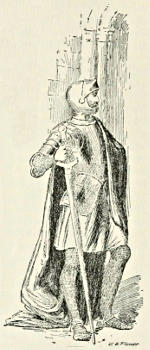
Thirteenth Century Crusader
At the appointed time Jean de Brienne arrived
at Acre; the next day he received the hand of Mary,
and shortly afterward was crowned, and received the
oaths of allegiance of the barons. Only three hundred
knights had participated in his hopes of restoring
the fortunes of the Holy Land, for the enthusiasm
and love of glory of the western chivalry were diverted
into new channels. England and Germany
were torn by internal disturbances, the court of
France was watching the turn of events, and Pope
Innocent employed the penitents in putting an end
to the heresy of the Albigenses. The destroyers of
heretics and of infidels were alike praiseworthy; and
a crusade into the south of France was less dangerous
than a voyage to Syria. From these
various causes the Mussulmans in Asia were
forgotten or disregarded.[69] As peace had been
refused, Saphedin marched an army to the
country round Tripolis. The king displayed
his valour in many a fierce encounter; and though he never conquered his
foes, yet he broke the impression of the enemy, and saved his states from
utter annihilation. He foresaw the approaching ruin of the holy cause;
every day the Saracens made some acquisition; and the Latin barons,
by every opportunity, and for every pretext, returned to Europe. He
wrote, therefore, to the pope that the kingdom of Jerusalem consisted only
of two or three towns, and that the civil wars between the sons of Saladin
alone suspended its fate.
[1215-1217 A.D.]
Every project of ambition which the daring genius of Gregory VII had
formed was embraced by the ardent spirit of Innocent III. In raising a
fabric of ecclesiastical policy on the ruins of gospel liberty, the importance of
guiding the military arm of Europe was not lost sight of. The commands of
the Vatican were hurled upon every part of Europe, calling men to exterminate
infidelity. The protection of St. Peter was promised to the families and
fortunes of the pilgrims. They who had bound themselves to pay usury were
released from their oaths; and secular power should compel the Jews to remit
their claims. The indulgences were revoked which had been granted to
those who quitted their homes in order to exterminate heresy in Provence,
and infidelity in Spain.
Among those who most loudly and successfully pleaded the cause of
religion was Robert de Courçon; a man inferior in talents and consideration
to St. Bernard, but whose fanaticism was as fervent as that of Peter
and Fulk. By parentage and birth he was an Englishman; but he had
been educated in the university of Paris, and in that famous seat of learning
had lived as a friend with a fellow student, who afterwards sat in the papal
chair, under the title of Pope Innocent III. The associate of his holiness
was promoted to various dignities in the church; his talents for business
were employed by Innocent in clerical embassies, and his abilities as a public
orator were matured under the care of Fulk de Neuilly. He was the papal
legate in France, and after having appeased the foreign and internal distractions
of that kingdom, he quitted Paris in 1215, descended by the way of
Burgundy to the southern provinces, left no quarter of the south unvisited;
and then, after having traversed with speed and success the western
provinces, the saint-errant returned to the capital. Twenty years before he
had preached the same theme to the same people, as the humble assistant of
Fulk. Clad in the Roman purple, and armed with the authority of the vicar
of Jesus Christ, the cardinal gave every possible dignity to the office of missionary.
But his prudence kept not pace with his zeal, for, like Peter the
Hermit, he admitted everyone to take the cross. Women, children, the old,
the blind, the lame, the lepers, all were enrolled in the sacred militia. The
multitude of the crusaders was innumerable, and the voluntary offerings of
money which was put into the charitable boxes in the churches were immense.
Philip Augustus contributed the fortieth part of his revenues; and it is singular
that this money was to be employed for purposes of the holy war, agreeably
to the directions of the kings and barons of France and England. But
the alms of the people of France were not applied exclusively to sacred purposes.
Robert de Courçon was openly convicted of peculation, and his papal
friend was obliged to remit his own dignity, and intercede with the French
prelates, in order to save the legate from punishment.
The pope, treading in the steps of his predecessors, convoked a general
council for the purpose of chastising vice, condemning heresy, and of inducing
the princes and people to undertake the sacred expedition. In the month
of November, 1215, the religious and political authorities assembled in the
church of the Lateran, and the greatness of their number, and their exalted
rank, testify the zealous preaching of the pope’s legates. All the clergy
(except those who were crusaders) were for three years to contribute
the twentieth part of their ecclesiastical revenues; tournaments during the
three years of the crusade were forbidden, lest the representation of war
should draw men’s attention from war itself. Civil dissensions were to be
suspended, and peace was to reign in the Christian world during all the time of
the holy contest.
The necessity of extirpating heresy, and quelling rebellion in the south
of France, was the pretence of the French king for not embracing the crusade.
The emperor Frederick II remained to establish his authority in
Apulia and Sicily, and to advance the favourite
project of himself and family, and of making Italy
the seat of the empire of the West.[70] The Hungarians
who had been the scourge of the first crusaders,
took the lead on this occasion. Their king, Andrew,
incited by the example of his mother Margaret, the
wish of his father, and certain political considerations,
made a vow to march to Jerusalem. The
dukes of Austria and Bavaria, and indeed all the
ecclesiastical and secular potentates of lower Germany,
joined their forces to those of the monarch.
The united army marched to Spalato. The ships
of Venice, and other ports of the Adriatic, transported
them to Cyprus; and after having enjoyed
for a while the pleasures of an island consecrated
to Venus, the holy warriors sailed for and arrived at
Acre, in company with fresh crowds of crusaders
from Marseilles, Genoa, and Brundusium. The
Mussulman powers were astonished at, and unprovided
for this sudden and large reinforcement of
the Latins. The sons of Saphedin were the lords
of Syria, while Saphedin himself, retired from the
constant toils of royalty, was contented with the respect
of the army and people in times of difficulty
and danger. The Saracens pressed to the country
about Nablus, but not in sufficient numbers to
meet the new crusaders, who ravaged the country
and slew thousands of their foes. But they did not
confine their cruelties to the infidels. The soil of
Palestine, in the year in which the present crusaders
landed, had been less productive than in
most seasons; the soldiers had carried thither no provisions, and when not
engaged in distant excursions into the enemy’s territories, they took the
shorter course of robbing the private and religious houses of the Latins
and Syrians.
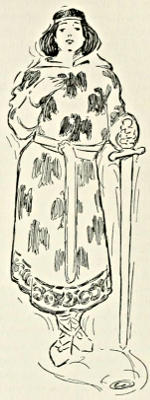
A Knight’s Esquire, Thirteenth Century
[1217-1219 A.D.]
Pious exercises, however, re-established order. The ecclesiastical chief of
the Latin Christians led the army in religious procession across the river
of Kishon, to the valley of Jezreel. They bathed in the Jordan, made their
pilgrimage to the Lake of Gennesaret, observed with devout awe the scenes of
various miracles performed by Christ, and returned to Acre. But they soon
repaired their wasted strength, and trod with holy reverence the road to the
scene of the transfiguration. The ascent to Mount Tabor, however, was
difficult; and the summit was defended by a strongly garrisoned tower.
Attached as much to pilgrimages as to war, the crusaders went in holy order
to Tyre and Sidon; but the inclemency of the season drove them into disorder,
and the Saracens made dreadful havoc on their divided parties.
The Christians separated for the remainder of the winter. The kings of
Cyprus and Hungary repaired to Tripolis; and if the people were grieved
at the death of the former of these princes, their feelings were quickly changed
into indignation against the latter. Neither the entreaties nor the threats
of the clergy could persuade the unstable Andrew to remain in Palestine.
Taking with him most of his soldiers and stores, he traversed Armenia and
the Greek Empire, and at last returned to his kingdom, which had been so
deeply exhausted by this expensive expedition, that it did not for years
recover its pristine strength.
The king of Jerusalem, the duke of Austria, and the master of the Hospitallers,
took up a strong position on the plains of Cæsarea. The Templars,
the Teutonic knights, and Walter d’Avesnes, occupied Mount Carmel, and
their station was defended by a tower which the Templars had formerly
erected, for the defence and protection of the Jerusalem pilgrims. In the
spring of the following year they were joined by new and zealous crusaders
from the north of Germany. Cologne had been the rendezvous, and nearly
three hundred vessels sailed from the Rhine. Many of the ships were
wrecked by the violence of the autumnal winds, and the remainder anchored
off the Portuguese shore. By the aid of the Germans, the queen of Portugal
took Alcacer from the Moors. Conscience and valour would be equally satisfied
by the slaughter of Saracens, in whatever country they might be.
As soon as the Cologne reinforcements arrived, the chiefs assembled in
council, and it was agreed that siege should be laid to Damietta, which was
looked upon as the key of Egypt. A voyage of a few days brought the
Christian army within sight of Damietta. The catapults and ballistæ shook
the walls of the citadel to their foundations, and the garrison was happy in
surrendering to the discretion of the besiegers.
Before the joy of the Christians had subsided, news arrived of the death
of Saphedin. The power of his house had lately been strengthened by
the death of the sultan of Mosul, the last great supporter of the name of the
atabegs. But Saphedin did not live to complete the addition of all Mosul to
his empire of Damascus and Egypt. The brother of Saladin has been variously
represented, according to the different feelings with which he was regarded.
But the crusaders had such a limited knowledge of oriental affairs,
that their invectives cannot be opposed to the reputation which he acquired
for virtue and ability. His second son, Coradin, the prince of Syria and
Palestine, did not proclaim the death of his father till he had secured himself
in the possession of the royal coffers. Discord and rebellion were universal
throughout Egypt, when the news arrived of the death of Saphedin; and his
son Kamil, lord of that country, was compelled to fly into Arabia for protection
from his mutinous people.
After the surrender of the castle of Damietta, the acquisition of the
city appeared so easy an achievement, that the besieging army sunk into
inertness and dissoluteness. The sultan of Syria had anticipated the fall of
Damietta, the sultan of Egypt despaired of its defence, and no wisdom could
calculate the magnitude of the effects which its capture might produce.
Prudence suggested the policy of negotiation, and the Latins were therefore
offered the piece of the true cross, the city of Jerusalem, and all the prisoners
in Syria and Egypt. The Mussulmans were to rebuild the walls of the
sacred city. Of the whole kingdom of Palestine they only proposed to
retain the castles of Karak and Montreal, as necessary for the safe passage
of the Meccan pilgrims and merchants. The evacuation of Egypt was the
equivalent expected from the Christians for these important concessions.
[1219-1220 A.D.]
All the legitimate consequences of the Crusades were at the command of
the soldiers of the cross. The king, the French, the earl of Chester, and the
Teutonic knights hailed with joy the prospect of the termination of the war.
But the legate, the bishops, the Italians, the Templars, and Hospitallers were
deaf to counsels of moderation. They contended that no faith could be
reposed upon the promises of infidels, unless peace was made at the point of
a victorious sword. The siege had already lasted seventeen months, and
it would be disgraceful to fly from the fair prospect of success. Unhappily
for the general interests of the Christian cause, the mild suggestions of
policy were disregarded amidst the clamours of thoughtless valour. Hostilities
were recommenced. The besiegers interrupted all communication
between the Egyptian army and the garrison of Damietta. Resistance was
fruitless, but the Mussulmans were too brave and too proud to surrender.
The legate and the king assaulted the walls, and soon entered the city, with
the same ruthless feelings as had maddened the early crusaders, when they
first leaped on the battlements of Jerusalem.
But revenge sought its victims in vain. Damietta was one vast charnel-house.
Of a population, which at the beginning of the siege consisted of
more than seventy thousand souls, three thousand only were the relics.
The conquerors marched through a pestilential vapour. The streets, the
mosques, and the houses were strewn with dead bodies. From scenes of
death the Christians turned to plunder. Damietta was as rich a city as
any in Islam, and the terrible anathemas of the legate could not prevent
self-appropriation of spoil. Dominion over the place was given to the king
of Jerusalem. The splendid mosque was converted into a Christian church,
and dedicated to the Virgin and all the apostles. But the soldiers were soon
compelled to return to the camp, for pestilence was in the city. Life
and liberty were granted to the surviving Mussulmans, on their performing
the horrid and melancholy task of cleansing the city from the remains of
their relations and friends.
So great was the terror which the loss of Damietta spread among the
Mussulmans, that the fortress of Tanis surrendered. By this acquisition,
the way into Palestine was open. But instead of urging their advantages,
the army passed the winter in luxury and in discord, and in the spring
more than half of the soldiers returned to Europe. The power of the
legate was supreme, and the king of Jerusalem retired in disgust to Acre.
The duke of Bavaria, and many knights from Germany and Italy, arrived,
as soon as the weather would permit the passage; but they disdained to
submit to the command of a bishop, and Pelagius was compelled to solicit
with humility the return of the king. Jean de Brienne repaired to Damietta,
and a council was held on the subject of hostile operations. The conquest
of Egypt was resolved upon, and the army marched by the eastern
side of the Fatimite branch of the Nile, till their progress was arrested by
the canal of Ashmun. On the southern side of that canal the Mussulman
forces were posted. Every sultan of Syria had sent assistance to their
brother in the faith, and the allied troops under Kamil could cope with
the Latins in the field.
The sultan, however, would not trust his kingdom to the caprice of fortune.
He offered peace to the Christians on nearly the same terms as those
which had been proposed previously to the last assault on Damietta. The
legate refused with indignation these noble offers; but instead of crossing
the canal and giving the enemy battle, he remained for more than a month
inactive on his post expecting the unconditional surrender of the sultan.
During this time the Nile had rapidly increased in height. The Mussulmans
opened the sluices and inundated their enemy’s camp. The
Christians could neither advance nor retreat; and, to use the humble
simile of a Templar, they were enclosed like a fish in a net. When the overflowings
of the Nile had swept away all the tents and baggage, Pelagius sent
an embassy to the Mussulman camp, imploring a safe return to Acre, and
offering to surrender Damietta and Tanis to the Mussulmans. The distress
of the Christian army was mitigated by the humanity of Kamil. The king of
Jerusalem was one of the hostages, and in an interview with the sultan,
he wept for the miserable state of his army. “Why do you weep?” inquired
the sultan. “I have reason to weep,” replied the king, “for the
people whom God has given into my charge, are perishing in the midst of the
waters, or dying of hunger.” The sultan shed tears of pity, and opened
the Egyptian granaries for their relief. When, after eight months’ possession
by the Latins, Damietta was delivered into the power of the Mussulmans, the
hostages were exchanged, and the Christian army retreated to the seacoast,
through the road by which they had advanced in full confidence of victory.
The barons of Syria, and the military orders, retired to Acre; and the
volunteers returned to Europe.
[1220-1227 A.D.]
The pope cast all the odium on the emperor Frederick, a man who had
thrice sworn to redeem the Holy Land, and had compromised with his conscience
by merely sending soldiers and provisions. Frederick despised the
thunders of the Vatican; but although he was not awed by force, he could
not resist papal artifice. Honorius soothed his irritated mind, and received
him again as a faithful son of the church. Hermann von Salza, master of the
Teutonic order, returned to Europe, and gave the emperor the hope of being
the redeemer of Palestine. Yolande, the daughter of the king of Jerusalem,
could easily be obtained in marriage, and her father would cede his rights,
which he was wearied of endeavouring to convert into an actual and firm
dominion. The emperor and the pope approved of this project. Frederick
accepted from the king of Jerusalem a renunciation of all his claims to
the Holy Land, as the dowry of Yolande; and he pledged his honour to the
pope, the cardinals, and the masters of the Hospitallers and Teutonic
knights, that he would within two years travel with a powerful army into
the East, and re-establish the throne of Godfrey de Bouillon. For the succeeding
five years, rebellions in Italy, and the insurrections of the Saracens
in Sicily, detained the emperor from his purpose. Honorius did not live to
witness the event of his exertions, but his successor, Gregory IX, was equally
furious in the cause.
At the time appointed for the sailing of the expedition, Brundusium
and its vicinity were crowded with soldiers. But the heats of summer destroyed
the health of the people of the north; thousands died, and of those
who endeavoured to return to their homes, the greatest part perished through
poverty or disease. Although the emperor did not escape the common illness,
yet he embarked at Brundusium. But after sailing for three days,
additional infirmity compelled him to return. Gregory inherited the papal
virtues of violence and ambition; he pronounced a sentence of excommunication
against the emperor, for declining to combat the enemy of God.[71]
[1227-1229 A.D.]
The thunders of the Vatican rolled again and again over the head of
the emperor, but the author of them suffered more than the object. The
emperor sent troops into the papal territories, who ravaged the march of
Ancona, and the patrimony of St. Peter. Such of the Hospitallers and
Templars (the firm friends of the pope) as had estates in the imperial dominions
in Italy, were plundered and dispossessed.[72] The emperor heavily taxed
his subjects, both churchmen and laity, for the expenses of the holy war. In
defiance of Gregory’s warnings against his entering on the crusade, till he
should be relieved from the censures of the church, Frederick embarked at
Brundusium in August, 1228, and arrived shortly afterwards at Acre. The
joy of the Christians at the arrival of the emperor was soon checked by letters
which the patriarch received from the pope, prohibiting the faithful from
obeying a rebellious son of the church. The Teutonic knights feared no
clerical censures; and at their head, and of some other soldiers, the emperor
quitted Acre, went to Joppa, and repaired the fortifications of that important
city. He then made further advances towards Jerusalem.
While matters were in this state, news was brought to the emperor of an
effectual method which the pope had taken of preventing him from continuing
the war in Palestine with the enemies of Christ. The pope’s troops,
of whom Jean de Brienne (the father-in-law of Frederick) was one of the
chief commanders, burned the imperial towns in Italy, imprisoned, tortured,
and robbed the people. The duke of Spalato, the emperor’s lieutenant, had
been unable successfully to resist, though the imperial army had been but
little impaired by Frederick’s foreign expedition. These circumstances made
the emperor anxious to return to Europe; a treaty was immediately signed.
For ten years the Christians and Mussulmans were to live upon terms of
brotherhood. Jerusalem, Joppa, Bethlehem, Nazareth, and their appendages,
were restored to the Christians. The Holy Sepulchre likewise was given to
them; and the people of both religions might offer up their prayers in the
place of devotion, which the former class called the temple of Solomon, and
the latter named the mosque of Omar. The address of Frederick more
effectually promoted the object of the holy wars than the heroic frenzy of
Richard; many of the disasters consequent on the battle of Tiberias were
wiped away, and the serious and habitual hopes of Europe, for a permanent
settlement in Asia, seemed to be realised. But the barons of the Holy
Land, breathing interminable war, and secretly envying superior genius,
avowed indignation that a Christian sovereign should accept the friendship of
the infidels. The patriarch and clergy hated an excommunicated prince;
a man too who had given licence to the Saracens to adore their God in
a Christian temple. With some appearance of reason, however, they contended
that the treaty was not binding on the Mussulmans while the
approbation of the sultan of Damascus was withheld. But, despising the
blood-thirstiness of the barons, and the cruel bigotry of the priests, Frederick
asserted his royal prerogatives; and, as he had acquired some of the
old possessions of the Bouillon family, he avowed his intention of having
the crown placed upon his head in the Holy City agreeably to constitutional
forms.
Some persons, discontented with the conditions of the treaty, wished to
betray him into the hands of the sultan of Egypt. The guilt of this treachery
lies between the Hospitallers and the Templars. Kamil read the letter which
conveyed to him the news, exclaimed to his associates, “See the fidelity of
these Christian dogs”; and despatched a friend to Frederick with the
paper which he had received. The emperor repaired to Jerusalem; but no
hosannas welcomed his approach. By the command of the patriarch no religious
ceremonies were performed in the churches during his stay. Even
the German prelates preferred their spiritual to their temporal allegiance;
and the emperor, accompanied only by his courtiers and the Teutonic
knights, went to the church of the sepulchre. He boldly took the crown
from the altar, and placed it on his own head, and Hermann von Salza pronounced
a laudatory oration. Orders were then given for the restoration
of the city’s walls, and the emperor returned to Acre. In that city too there
was every demonstration of sorrow at his appearance. Mass was performed
in secret; the churches were deprived of their ornaments; the bells were
not rung, and the dead were interred without any religious ceremony. But
by some well-measured acts of severity, a semblance of respect was at length
shown to the emperor; and he then returned to Europe, leaving the priests
and people to thank Heaven for his departure.
Few parts of the Crusades are more difficult to understand, and to reduce
into a clear and intelligible form, than the expedition of Frederick. He was
vilified by the Templars and Hospitallers, and other friends of the pope;
and their narratives of events are more numerous than those of the imperial
party. He gained more for the Christians than any prince had acquired
since the first establishment of the kingdom; and if the pope had not hated
him worse than his holiness hated the Saracens, and thereby caused his
return to Europe, there is every probability that after the death of the sultan
of Damascus, the emperor would have brought matters to an issue completely
triumphant. Gregory IX and his clergy had the effrontery to tell the world
that Frederick had left the sepulchre of Christ in the hands of the infidels.
But the fact was that it was given to the Christians. The temple of Solomon
indeed, or rather the mosque of Omar, was left in the hands of the Mussulmans;
a right of visiting it, however, being allowed to the Christians.c
FOOTNOTES
The poet, As-Sahib Jemal ad-Din ben Matrub made the following
verses on the failure of Saint Louis’ Crusade, his capture and ransom:
“Bear to the king of France, when you shall see him, these words,
traced by a partisan of truth: The death of the servants of the Messiah
has been the reward given to you by God.
“You have landed in Egypt, thinking to take possession of it. You
have imagined that it was only peopled with cowards! you who are a
drum filled with wind.
“You thought that the moment to destroy the Mussulmans was
arrived; and this false idea has smoothed, in your eyes, every difficulty.
“By your excellent conduct, you have abandoned your soldiers on
the plains of Egypt, and the tomb has gaped under their feet.
“What now remains of the seventy thousand who accompanied
you? Dead, wounded, and prisoners!
“May God inspire you often with similar designs! They will
cause the ruin of all Christians, and Egypt will have no longer to
dread anything from their rage.
“Without doubt your priests announced victories to you; their
predictions were false.
“Refer yourselves to a more enlightened oracle.
“Should the desire of revenge urge you to return to Egypt, be assured
the house of Lokman still remains, that the chain is ready prepared,
and the eunuch guard awake.”
[1239-1314 A.D.]
The council of Spoleto decreed that fresh levies should be sent into Asia
on the expiration of the truce with Kamil. The Franciscans and Dominicans
were the bearers of the resolutions to the princes and people of Christendom.
But it was soon apparent that the recovery of the Holy Land was
not the paramount consideration in the mind of Gregory IX, for the preaching
of the crusade once more became the means of filling the papal coffers.
By the different engines of persuasion and compulsion, the missionaries
gained numberless converts, and then allowed the unwilling, and compelled
the wealthy crusaders to give the church great largesses in exchange for the
vow. The once humble friars grew so rich by these exactions, that their
pride and magnificence were detestable in the eyes of the people. These disgraceful
scenes were acted in England for two years; but the indignation
of society at the avarice of the pope was so strong, that the preaching ceased.
Some of the English nobility were inflamed by the love of warlike praise,
and took the cross with no intention of submitting to a pecuniary commutation.
The earl of Chester, and also Richard, earl of Cornwall, brother to
King Henry II, prepared to measure lances with the Saracens.
RICHARD OF CORNWALL’S CRUSADE (THE SEVENTH)
[1236-1240 A.D.]
The desire of crusading was influenced by events in Palestine. A truce
between the sultan of Aleppo and the Templars expired with the life of the
Mussulman prince; and when his successor renewed the war with them, they
sustained so severe a defeat, that every commandery in Europe sent them
succours; and even the Hospitallers resolved to avenge the death of their
rivals. Three hundred knights and a considerable body of stipendiaries
went from London.
The spirit of crusading burned in France, particularly in the middle and
southern provinces; and many barons assembled at Lyons in order to concert
the means of giving effect to their common desire. But a legate of the pope
interrupted their councils with announcing the commands of his master for
the dissolving of the assembly, and the return of the members to their homes.
The barons remonstrated against this versatility of opinion in an infallible
guide. The nuncio was contumeliously dismissed. Most of the nobility
pressed forwards to Marseilles, and hoisted sail for the Holy Land. Indignant
at their contempt of his wishes, the emperor prohibited the governors of
Apulia and other countries from affording aid to the crusaders. This measure
prevented many parties of cavaliers from pursuing the voyage; but it did not
impede those fanatical and romantic warriors, the king of Navarre, the duke
of Burgundy, and the counts of Bar and Brittany, from continuing their
course to Acre.
News of the warlike preparations of Europe had been communicated to
the sultan of Egypt; and the first moment when the faith of treaties opposed
not a hostile course, he drove the Latins out of Jerusalem, and overthrew the
tower of David, which, until that time, had always been regarded as sacred
by all classes of religionists. After this capture Kamil died; various princes
of Syria and Egypt asserted their pretensions to the vacant throne; but the
military spirit was too active among the Mussulmans, to allow the Christians
rationally to hope that they should eventually profit by these dissensions.
The war began by a successful irruption of the count of Brittany into the
Damascene territories. But in the vicinity of Gaza three hundred Frenchmen,
who wished to imitate the glory of the cavaliers of Brittany, were
defeated by a smaller number of Turks.
[1240-1244 A.D.]
The pope renewed his endeavours to persuade the English to commute
their piety for gold, but his ministers, the Franciscans and Dominicans, were
treated only with contempt; and in the spring of the year 1240, Richard,
earl of Cornwall, William Longespee or Longsword, Theodore, the prior of
the Hospitallers, and many others of the nobility, embarked at Dover. The
arrival of Richard and the other barons at Acre, took place shortly after the
signature of the discordant treaties between the Templars and the emir of
Karak, and the Hospitallers with the sultan of Egypt. The English were
astonished to find that the king of Navarre and the count of Brittany had
fled from the plains of Syria, when they received intelligence of the departure
of reinforcements from Europe. The emir of Karak, too, could not fulfil
his treaty, or even restore to the Templars the prisoners which had been
made in the battle of Gaza. Richard marched to Joppa, but as the sultan of
Egypt (then at war with the sultan of Damascus) sent to offer him terms
of peace, he prudently seized the benefits of negotiation. With the consent of
the duke of Burgundy, the master of the Hospitallers, and other lords of high
degree, he accepted a renunciation of Jerusalem, Berytus, Nazareth, Bethlehem,
Mount Tabor, and most of the Holy Land. An exchange of prisoners
was to cement the union. The great object of the crusaders seemed now to
be accomplished. Palestine belonged to the Christians. Richard returned
to Europe, and was received in every town as the deliverer of the Holy Sepulchre.
From neglect or inability he had not induced the Templars to consent
to his completion of the hopes of the West; and in spleen and revenge the
cavaliers renewed those unfraternal altercations with other knights which
had hastened the ruin of the kingdom in the time of Saladin (1241).
The Hospitallers opened their treasury for the re-edification of the walls
of Jerusalem. The patriarch and clergy entered the sacred city, and reconsecrated
the churches. For two years Christianity was the only religion
administered in Jerusalem, and the faithful began to exult in the apparent
permanent downfall of infidelity, when a new enemy arose more dreadful
than even the Mussulmans.
THE TATAR CREVASSE
[1244 A.D.]
The great Tatarian princes, Jenghiz Khan and his successors, had obliterated
the vast empire of Khwarizm; and the expelled and defeated Tatars
fled to the south. The storm rolled on towards Egypt, the Khwarizmians
demanded a settlement; the sultan was the only Moslem prince who entered
into treaties with those barbarians; and he advised them to fix themselves
in Palestine. He sent one of his principal emirs, and a large body of troops
as their guides and coadjutors, and at the head of twenty thousand horse, Barbacan,
the Khwarizmian general entered the Holy Land. The Christians in
Jerusalem heard with dismay that the Tatarian tempest had reached their
territories. It was evident from the ruined state of the walls that Jerusalem
was no longer tenable. The cavaliers, and many of the inhabitants,
abandoned the sacred city.
The Khwarizmians entered it, spared neither lives nor property, and
violated both Christian and Mussulman sanctuaries. In the wantonness of
cruelty they disinterred the departed great, and made a cremation of venerable
remains. The insulting fanatics of savageness murdered priests round the
altars, exclaiming while they stabbed the holy men, “Let us pour their blood
on the place where they poured out wine in commemoration of their crucified
God.” As crafty as ferocious, they planted a banner of the cross upon the
walls, and, deceived by this joyful appearance, several thousands of the fugitives
returned to the city, but only to partake of the miserable doom of
their friends.
The repeated solicitations of the Templars at length brought four thousand
soldiers from their Syrian allies. The united Christian and Mussulman
forces were so far inferior to the Tatars, that policy required a course
of measures perfectly defensive. But the fury of the patriarch precipitated
the army into the gulf of destruction. The awful conflict raged for two
days. The soldiers of Damascus and Emesa were soon slain, or scattered.
The loss of every part of the army was great, almost beyond example.
Only sixteen Hospitallers, thirty-three Templars, and three Teutonic cavaliers
remained alive and free. These soldiers fled to Acre, and that city
became the refuge of the Christians. After having razed the fortifications
of Askalon, and the castle of Tiberias, the Khwarizmians and Egyptians
encamped on the plains of Acre, devastated the country, and slew or led
into captivity all straggling Franks.
A united force of Khwarizmians and mamelukes conquered Damascus,
and Europe heard with dismay that the Mussulman power was again consolidating.
But the members soon were separated,
for the sultan of Egypt, faithless as cruel, denied his
allies a permanent settlement on the shores of the
Nile. The soldiers of fortune flew to the banner of
the Damascene prince, and assisted him in his efforts
to recover his capital. But the cause of the mamelukes
was felt as the common interest of the Moslem
world, and all Syria, as well as all Egypt, was in
arms in order to exterminate the northern barbarians.
In a general engagement the Khwarizmians were
defeated and scattered. Barbacan was slain, and
southern Asia recovered from its panic and distress.
THE CRUSADE OF ST. LOUIS (THE EIGHTH)
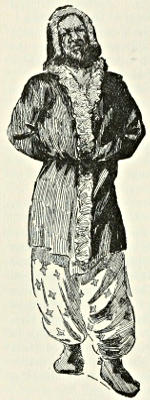
A Tatar
The superstition of a French king, and the
successes of the savage Khwarizmians, gave birth
to the Eighth Crusade. Pope Innocent IV convoked
a general council at Lyons; the Bishop of
Berytus described the effects of the Tatarian storm,
and left his ecclesiastical brethren to conclude,
whether one effort should not be made for a restoration
of things to the state in which Richard, earl
of Cornwall, had left them. It was accordingly
resolved that a crusade should be preached throughout
Christendom, and that for four years peace and
seriousness should reign over Europe. Such of the
faithful as did not expose their persons in the holy
cause were to give the subsidiary aid of treasure;
and the contribution to be made by the cardinals was fixed at a tenth, and
that of the other ecclesiastics at a twentieth part of their yearly revenues.
The pope wrote to Henry III, king of England, urging him to press on
his subjects the necessity of punishing the Khwarizmians. But the spirit of
crusading raged more strongly in France than in any other country of the
West; and it revived in all its fierceness of piety and chivalry in Louis IX.
Agreeably to the temper of the times, he had vowed, whilst afflicted by a
severe illness, that in case of recovery he would travel to the Holy Land. In
the delirium of his fever, he had beheld an engagement between the Christians
and the Saracens; the infidels were victorious, and the brave king of a valiant
nation fancied it his duty to avenge the defeat. The victories of the
Khwarizmians were a realisation of part of his dream, and his preparations
had anticipated the decrees of the Lyonese council. This vow was made
about the year 1244, according to Nangis and Chronicle of St. Denis, cited
in Du Cange’s notes. From the moment of his resolving to go to the Holy
Land, St. Louis quitted all pomp of dress; he exchanged his purple for
black, a royal for a religious habit. During the crusade he abstained from
wearing scarlet, vair, or ermine. The example of the monarch gave efficacy
to the laws regarding simplicity of dress, and the lord of Joinville assures us,
that, during the whole time he was attending the king on his crusade, he never
once saw an embroidered coat of arms. The French barons, however, when
resident in Damietta, were less rigid in morality than in dress. The cross was
likewise taken by the three royal brothers, the counts of Artois, Poitiers,
and Anjou, by the duke of Burgundy, the countess of Flanders, and her two
sons, the count of St. Paul, and many other knights.
Sentiments of respect for the king of France were not felt in his country
alone; the people of England revered his name, and avowedly in imitation
of his example, the bishop of Salisbury, William Longespee, Walter de Lucy,
and many other English nobles and gentlemen were crossed. William Longespee
was, or feigned himself, poor, and went to Rome to solicit the aid of the
pope. He returned to England, and extorted more than a thousand marks
from the religious, while the less scrupulous or more powerful earl of Cornwall
was insatiable in his avarice, and gained from one archdeacon alone, six
hundred pounds. Political circumstances detained St. Louis in France for
three years; but the money and troops which he sent to the Holy Land
invigorated the hopes of the Latin Christians. The ranks of the military
orders were recruited by hired troops and regular knights from the different
stations in Europe.
On the 12th of June, 1248, Louis, attended by his three brothers, went
to the abbey of St. Denis, and received from the pope’s legate the oriflamme,
the alms’ purse, and pilgrim’s staff. He sailed from France at the end of
August, and arrived in September at Cyprus, the appointed rendezvous for
his barons and their vassals. The king remained eight months in Cyprus,
employed in organising his troops, in works of piety, and particularly in healing
the breaches in charity between the military orders. The Venetians and
other people assisted the French with provisions; on one occasion the supplies
of the emperor Frederick preserved the army, and the grateful king implored
the pope to absolve a man who had been benevolent to the soldiers of the
church. The ambassadors of a Tatarian prince appeared before Louis, offering
their master’s aid to root the Saracens and pagans out of the Holy Land.
The king sent a magnificent present to his ally, in order to bribe him to become
a Christian. Two black monks, who understood the Arabic language, were
charged with the missionary office, and their eloquence and embroidered
representation of some of the mysteries of Christianity were to effect the conversion
of the Scythian savage and his court. In the spring of the year 1249,
the soldiers of Louis were mustered, and his ships prepared for sea; fifty
thousand men formed his military force, and eighteen hundred was the number
of his transports, palendars, and store ships. They set sail for Egypt;
a storm separated the fleet, and the royal division, in which were nearly
three thousand knights and their men-at-arms, arrived off Damietta.
[1249 A.D.]
The shores were lined by the sultan’s troops, who astonished the French
by the clangour of trumpets and brazen drums. The heralds of the king of
France instantly went to the sultan, Nejm ad-Din (a son of Kamil), near
Ashmun, and spared no language of exaggeration in describing the power
of their master. The only way to avoid the tempest was to receive priests
who would teach the Christian religion to the people of Egypt:[73] otherwise
he would pursue them everywhere, and God should decide to whom the
country should be given. The sultan replied that he also knew the use of
arms, and like the French, inherited valour. The cause of the Mussulmans
was that of justice; and the Koran declared, that they who made war
unjustly should perish.
Some of the knights wished to dissuade the king from landing, till the
appearance of their brethren in arms; but on the second day after their
arrival, Louis commanded the disembarkation; he himself leaped into the
water; his shield was suspended from his neck, his helmet was on his head,
and his lance on his wrist. His soldiers followed him to the shore; and the
Saracens, panic-struck at their boldness and determination, made but a slight
show of defence, and fled into the interior of the country. Although
Damietta was better prepared for a siege than in those days when it had
sustained an attack of eighteen months’ duration, yet the garrison sought
safety in the fleetness of their horses. They were received at Cairo with
the indignation which their cowardice merited; and the sultan (who had
repaired thither from Ashmun) strangled fifty of the chiefs. The people of
Damietta loaded themselves with their most valuable effects, set fire to the
part of the city in which their merchandise and plunder were collected, and
then took flight for Cairo. Louis fixed his residence in the city; a Christian
government was established; and the clergy, agreeably to old custom,
purified the mosques. According to ancient usage, one-third part of the
spoil should have been allotted to the general-in-chief, and the remaining
portions had been usually divided among the pilgrims; but, at the suggestion
of the patriarch of Jerusalem, Louis ordered that the corn and provisions
should form a magazine for the common benefit of the army; and he
retained to himself the rest of the movable booty.
Neither the religious character of the war, nor the importance of preserving
military discipline, had any effect on the conduct of the holy warriors.
So general was the immorality, that the king could not stop the foul and noxious
torrent. The hope of the reward of a piece of gold for an enemy’s head,
inspirited the Mussulmans to many enterprises of difficulty and danger;
but Louis prevented at length their incursions into his camp, for he surrounded
it with deep ditches, and his cross-bowmen galled the approaching
parties of Mussulman cavalry. The French looked with impatience for
the count of Poitiers and the arrière-ban of France, the remainder of the force
which had sailed from Cyprus, and had been driven to Acre in the tempest.
In October 1249 the count of Poitiers reached Egypt. The French also
were joined by two hundred English knights.
THE BATTLE OF MANSURA
[1250 A.D.]
At the close of November, the army commenced its march to the capital
of Egypt. Until their approach to the vicinity of Mansura, they overcame
the open and insidious enmity of the Saracens. Soon after his departure
from Damietta, the king accepted the proffered aid of five hundred horsemen
of the sultan, and commanded his army to respect their guides. Vainly
thinking that this order was inflexible to circumstances, the Saracens
attacked the Templars, who formed the van of the army. But the valiant
knights rallied round their grand master, and invoking God to aid them in
this perilous conjuncture, they rushed upon and destroyed their treacherous
foes. Fakhr ad-Din, the Egyptian emir, and his army were encamped on the
opposite side of the Ashmun canal, which the French in vain endeavoured
to cross. They commenced a causeway over the canal; but the Saracens
ruined in a day the work of a month; and even crossed the Nile by one of
the passages which were familiar to them and gave battle to the enemy.b
It is so hard for the layman to get a true idea of the chaos and disintegrated
nature of a battle, that a realistic account of how St. Louis fought
the Saracens is well worth quoting, especially from the pen of the lord of
Joinville whose sword was busy in these very scenes.a
DE JOINVILLE’S ACCOUNT OF THE BATTLE OF MANSURA
A Bedouin had lately come to say that if we would give him five hundred
golden besants, he would show a safe ford, which might easily be crossed on
horseback. The day appointed for this purpose was Shrove-Tuesday, which,
when arrived, we all mounted our horses, and armed at all points, followed
the Bedouin to the ford. On our way thither, some advanced too near the
banks of the river, which being soft and slippery, they and their horses
fell in and were drowned. The king seeing it, pointed it out to the rest,
that they might be more careful and avoid similar danger. Among those that
were drowned was that valiant knight Sir John d’Orleans, who bore the
banner of the army. When we came to the ford, we saw on the opposite
bank full three hundred Saracen cavalry ready to defend this passage. We
entered the river, and our horses found a tolerable ford with firm footing,
so that by ascending the stream we found an easy shore, and through God’s
mercy we all crossed over with safety. The Saracens, observing us thus cross,
fled away with the utmost despatch.
Before we set out, the king had ordered that the Templars should form
the van, and the count d’Artois his brother should command the second
division of the army; but the moment the count d’Artois had passed the
ford with all his people, and saw the Saracens flying, they stuck spurs into
their horses and galloped after them; for which those who formed the van
were much angered at the count d’Artois, who could not make any answer,
on account of Sir Foucquault du Melle, who held the bridle of his horse;
and Sir Foucquault, being deaf, heard nothing the Templars were saying to
the count d’Artois, but kept bawling out, “Forward, forward!” When the
Templars perceived this, they thought they should be dishonoured if they allowed
the count d’Artois thus to take the lead, and with one accord they
spurred their horses to their fastest speed, pursuing the Saracens through
the town of Mansura, as far as the plains before Babylon; but on their
return the Turks shot at them plenty of arrows and other artillery, as they
repassed through the narrow streets of the town. The count d’Artois and
the lord de Coucy, of the name of Raoul, were there slain, and as many as
three hundred other[74] knights. The Templars lost, as their chief informed
me, full fourteen score men at arms and horses. My knights, as well as
myself, noticing on our left a large body of Turks who were arming, instantly
charged them; and when we were advanced into the midst of them,
I perceived a sturdy Saracen mounting his horse, which was held by one of
his esquires by the bridle, and while he was putting his hand on the saddle
to mount, I gave him such a thrust with my spear, which I pushed as far as
I was able, that he fell down dead. The esquire, seeing his lord dead, abandoned
master and horse; but, watching my motions, on my return struck
me with his lance such a blow between the shoulders as drove me on my
horse’s neck, and held me there so tightly that I could not draw my sword,
which was girthed round me. I was forced to draw another sword which
was at the pommel of my saddle, and it was high time; but, when he saw I
had my sword in my hand, he withdrew his lance which I had seized and ran
from me.
It chanced that I and my knights had traversed the army of the Saracens,
and saw here and there different parties of them, to the amount of
about six thousand, who, abandoning their quarters, had advanced into the
plain. On perceiving that we were separated from the main body, they
boldly attacked us, and slew Sir Hugues de Trichatel, lord d’Escoflans, who
bore the banner of our company. They also made prisoner Sir Raoul de
Wanon, of our company, whom they had struck to the ground. As they
were carrying him off, my knights and myself knew him, and instantly
hastened, with great courage, to assist him, and deliver him from their hands.
In returning from this engagement the Turks gave me such heavy blows,
that my horse, not being able to withstand them, fell on his knees, and
threw me to the ground over his head. I very shortly replaced my shield
on my breast, and grasped my spear, during which time the lord Errart
d’Esmeray, whose soul may God pardon! advanced towards me, for he had
also been struck down by the enemy; and we retreated together towards an
old ruined house to wait for the king, who was coming, and I found means
to recover my horse. As we were going to this house, a large body of
Turks came galloping towards us, but passed on to a party of ours whom
they saw hard by; as they passed, they struck me to the ground, with my
shield over my neck, and galloped over me, thinking I was dead; and
indeed I was nearly so. When they were gone, my companion Sir Errart
came and raised me up, and we went to the walls of the ruined house.
Thither also had retired Sir Hugues d’Escosse, Sir Ferreys de Loppei, Sir
Regnault de Menoncourt, and several others; and there also the Turks
came to attack us, more bravely than ever, on all sides. Some of them
entered within the walls, and were a long time fighting with us at spear’s
length, during which my knights gave me my horse, which they held, lest
he should run away, and at the same time so vigorously defended us against
the Turks, that they were greatly praised by several able persons who witnessed
their prowess.
Sir Hugues d’Escosse was desperately hurt by three great wounds in the
face and elsewhere. Sir Raoul and Sir Ferreys were also badly wounded in
their shoulders, so that the blood spouted out just like to a tun of wine
when tapped. Sir Errart d’Esmeray was so severely wounded in the face by
a sword, the stroke of which cut off his nose, that it hung down over his
mouth. In this severe distress, I called to my mind St. James, and said,
“Good Lord St. James, succour me, I beseech thee; and come to my aid in
this time of need.” I had scarcely ended my prayer, when Sir Errart said to
me, “Sir, if I did not think you might suppose it was done to abandon you
and save myself, I would go to my lord of Anjou, whom I see on the plain,
and beg he would hasten to your help.” “Sir Errart,” I replied, “you will
do me great honour and pleasure, if you will go and seek succour to save our
lives; for your own also is in great peril”; and I said truly, for he died of
the wound he had received. All were of my opinion that he should seek for
assistance; and I then quitting hold of the rein of his bridle, he galloped
towards the count d’Anjou, to request he would support
us in the danger we were in. There was a great lord
with him who wished to detain him, but the good
prince would not attend to what he urged, but, spurring
his horse, galloped towards us followed by his men.
The Saracens, observing them coming, left us; but
when on their arrival they saw the Saracens carrying
away their prisoner, Sir Raoul de Wanon, badly
wounded, they hastened to recover him, and brought
him back in a most pitiful state. Shortly after, I saw
the king arrive with all his attendants, and with a
terrible noise of trumpets, clarions, and horns. He
halted on an eminence, with his men at arms, for something
he had to say; and I assure you I never saw so
handsome a man under arms. He was taller than any
of his troop by the shoulders; and his helmet, which
was gilded, was handsomely placed on his head; and he
bore a German sword in his hand. Soon after he had
halted, many of his knights were observed intermixed
with the Turks; their companions instantly rushed
into the battle among them; and you must know, that
in this engagement were performed, on both sides, the
most gallant deeds that were ever done in this expedition
to the Holy Land; for none made use of the bow,
cross-bow, or other artillery. But the conflict consisted
of blows given to each other by battle-axes, swords,
butts of spears, all mixed together. From all I saw, my
knights and myself, all wounded as we were, were very
impatient to join the battle with the others. Shortly
after, one of my esquires, who had once fled from my
banner, came to me, and brought me one of my Flemish
war-horses; I was soon mounted, and rode by the side of the king, whom I
found attended by that discreet man, Sir John de Valeri. Sir John seeing
the king desirous to enter into the midst of the battle, advised him to make
for the riverside on the right, in order that in case there should be any
danger, he might have support from the duke of Burgundy and his army,
which had been left behind to guard the camp; and likewise that his men
might be refreshed and have wherewith to quench their thirst; for the
weather was at this moment exceedingly hot.

Thirteenth Century Crusader
As this was doing, Sir Humbert de Beaujeu, constable of France, came
up, and told the king that his brother, the count d’Artois, was much pressed
in a house at Mansura, where, however, he defended himself gallantly, but
that he would need speedy assistance; and entreated the king to go to his aid.
The king replied, “Constable, spur forward, and I will follow you close.” All
of us now galloped straight to Mansura, and were in the midst of the Turkish
army, when we were instantly separated from each other by the greater power
of the Saracens and Turks. Shortly after, a serjeant at mace of the constable,
with whom I was, came to him, and said the king was surrounded by the Turks,
and his person in imminent danger. You may suppose our astonishment and
fears, for there were between us and where the king was full one thousand
or twelve hundred Turks, and we were only six persons in all. I said to the
constable, that since it was impossible for us to make our way through such
a crowd of Turks, it would be much better to wheel round and get on the
other side of them. This we instantly did. There was a deep ditch on
the road we took between the Saracens and us; and, had they noticed us,
they must have slain us all; but they were solely occupied with the king,
and the larger bodies; perhaps also they might have taken us for some of
their friends. As we thus gained the river, following its course downward
between it and the road, we observed that the king had ascended it, and that
the Turks were sending fresh troops after him. Both armies now met on the
banks, and the event was miserably unfortunate; for the weaker part of our
army thought to cross over to the division of the duke of Burgundy, but
that was impossible from their horses being worn down, and the extreme heat
of the weather. As we descended the river, we saw it covered with lances,
pikes, shields, men, and horses, unable to save themselves from death. When
we perceived the miserable state of our army, I advised the constable to remain
on this side of the river to guard a small bridge that was hard by; “for
if we leave it,” added I, “the enemy may come and attack the king on this
side; and if our men be assaulted in two places, they must be discomfited.”
There then we halted; and you may believe me when I say, that the
good king performed that day the most gallant deeds that ever I saw in any
battle. It was said, that had it not been for his personal exertions, the
whole army would have been destroyed; but I believe that the great courage
he naturally possessed was that day doubled by the power of God, for he
forced himself wherever he saw his men in any distress, and gave such
blows with battle-axe and sword, it was wonderful to behold. The lord
de Courtenai and Sir John de Salenai one day told me, that at this engagement
six Turks caught hold of the bridle of the king’s horse, and
were leading him away; but this virtuous prince exerted himself with such
bravery in fighting the six Turks, that he alone freed himself from them;
and that many, seeing how valiantly he defended himself, and the great
courage he displayed, took greater courage themselves, and abandoning the
passage they were guarding, hastened to support the king. After some little
time, the count Peter of Brittany came to us who were guarding the small
bridge from Mansura, having had a most furious skirmish. He was so
badly wounded in the face that the blood came out of his mouth, as if it had
been full of water, and he vomited it forth. The count was mounted on a
short, thick, but strong horse, and his reins and the pommel of his saddle
were cut and destroyed, so that he was forced to hold himself by his two
hands round the horse’s neck for fear the Turks, who were close behind him,
should make him fall off. He did not, however, seem much afraid of them,
for he frequently turned round, and gave them many abusive words by way
of mockery.
In our front were two of the king’s heralds; the name of one was Guillaume
de Bron, and that of the other John de Gaymaches; against whom the
Turks led a rabble of peasants of the country, who pelted them with clods
of earth and large stones. At last, they brought a villainous Turk, who
thrice flung Greek fires at them; and by one of them was the tabard of Guillaume
de Bron set on fire; but he soon threw it off, and good need had he, for
if it had set fire to his clothes, he must have been burned. We were also
covered with these showers of stones and arrows which the Turks discharged
at the two heralds. I luckily found near me a gaubison of coarse cloth which
had belonged to a Saracen, and turning the slit part inward, I made a sort of
shield, which was of much service to me; for I was only wounded by their
shots in five places, whereas my horse was hurt in fifteen. Soon after, as God
willed it, one of my vassals of Joinville brought me a banner with my arms,
and a long knife of war, which I was in want of; and then, when these Turkish
villains, who were on foot, pressed on the heralds, we made a charge on
them and put them instantly to flight. Thus when the good count de Soissons
and myself were returned to our post on the bridge, after chasing away these
peasants, he rallied me, saying, “Seneschal, let us allow this rabble to bawl and
bray; and, by the Cresse Dieu,” his usual oath, “you and I will talk over this
day’s adventures in the chambers of our ladies.”
It happened that towards evening, about sunset, the constable, Sir Humbert
de Beaujeu, brought us the king’s cross-bows that were on foot; and
they drew up in one front, while we horsemen dismounted under shelter of
the cross-bows. The Saracens observing this immediately took to flight, and
left us in peace. The constable told me that we had behaved well in thus
guarding the bridge; and bade me go boldly to the king, and not quit him
until he should be dismounted in his pavilion. I went to the king, and at
the same moment Sir John de Valeri joined, and requested of him, in the
name of the lord de Chastillon, that the said lord might command the rear
guard, which the king very willingly granted. The king then took the road
to return to his pavilion, and raised the helmet from his head, on which I gave
him my iron skull-cap, which was much lighter, that he might have more
air. Thus as we were riding together, Father Henry, prior of the hospital of
Ronnay, who had crossed the river, came to him and kissed his hand, fully
armed, and asked if he had heard any news of his brother the count d’Artois.
“Yes,” replied the king, “I have heard all”; that is to say, that he knew
well he was now in paradise. The prior, thinking to comfort him for the
death of his brother, continued, “Sire, no king of France has ever reaped such
honour as you have done; for with great intrepidity have you and your army
crossed a dangerous river to combat your enemies; and have been so very
successful that you have put them to flight and gained the field, together
with their warlike engines, with which they had wonderfully annoyed you,
and concluded the affair by taking possession this day of their camp and
quarters.” The good king replied that God should be adored for all the
good he had granted him; and then heavy tears began to fall down his
cheeks, which many great persons noticing, were oppressed with anguish
and compassion on seeing him thus weep, praising the name of God who
had enabled him to win the victory.f
RESULTS OF MANSURA
The count of Artois had rallied his forces in the town. The Egyptian
chief invested Mansura; and, with ability equal to his spirit, placed a body
of troops in such a station as to intercept the communication between the
count and the king. The soldiers in Mansura engaged the French. The
inhabitants partook of the perils of the day, and poured upon their enemy,
with deadly effect, burning coals, boiling water, and stones. The count did
not survive to witness all the dreadful issues of his rashness. William
Longespee and a numerous band of gallant men also perished. The grand
master of St. John fell into the enemy’s hands; and the master of the
Templars was happy in escaping with the loss of an eye. On the side of
the enemy Fakhr ad-Din was slain; but his station was quickly filled by a
chief of equal bravery and conduct. The king and his army had crossed the
ford, and prevented the total rout of the Christians. The valiant master of
the Templars was slain in this renewed engagement. Egyptian and Christian
annalists have claimed the honour and rewards of victory for their respective
sides; but in truth the result of the battle appears to have been indecisive.
The Saracens, however, cut off all communications between St. Louis
and Damietta. Famine and disease appeared in the Christian camp, and
the French described the latter of those evils as having sprung from a
pestilential air emitted from the dead bodies of their friends and foes, and
from eating eel pouts which had fed on corpses in the river.b “From this
poisonous diet,” says De Joinville, “and from the bad air of a country where it
scarcely ever rains, the whole army was infected by a shocking disorder,
which dried up the flesh on one’s legs to the bone, and our skins became
tanned as black as the ground, or like an old boot that has long lain behind
a coffer. In addition to this miserable disorder, those afflicted by it had
another sore complaint in the mouth, from eating eel pouts that rotted the
gums. Very few escaped death that were attacked, and the surest symptoms
of its being fatal was a bleeding at the nose. The barbers were obliged to cut
away large pieces of flesh from the gums to enable the patient to eat. It was
pitiful to hear the cries and groans of those on whom the operation was performed;
they seemed like to the cries of women in labour, and I cannot express
the great concern all felt who heard them.”f
ST. LOUIS A PRISONER
Negotiations for peace were opened between the contending powers, and the
exchange of the lordship of Jerusalem for that of Damietta formed the basis of
the treaty. The king offered either of his brothers as a hostage for the delivery
of Damietta to the Egyptians; but the sultan objected, and all hopes of peace
were abandoned, because the Christians would not consent to the delivery of
their king as the hostage. The miserable condition of the French army
forbade all thoughts of victory, and called for a retreat to Damietta.
The retreat was ordered; but those who attempted it by the river were
taken by the enemy, and the fate of such as proceeded by land was equally disastrous.
While they were occupied in constructing a bridge over the canal,
the Mussulmans entered the camp, and murdered the sick. The valiant Louis,
though oppressed with the general calamity of disease, sustained boldly, with
Sir Godfrey de Sergines, the shock of the enemy, and threw himself into the
midst of them, resolved to perish in defending his troops. The brave Sergines,
who never left him, succeeded at last in drawing him from the foe, and conducted
him to a village, where he sank into insensibility and helplessness.[75]
In that state the Mussulmans made him prisoner. Charles count of Anjou,
Alphonsus of Poitiers, and indeed all the nobility fell into the enemy’s hands.
The sultan clothed the king and the nobles with robes of honour, and treated
them with kindness and generosity. But many of the unfortunate men who
were ill, and therefore useless, were killed by their new masters in defiance of
the command of Saladin, and the general usage of oriental nations not to put
to death anyone to whom they had given bread and salt. Other prisoners
saved their lives by renouncing their religion; the Saracenic commander indulged
the fanaticism of his people by allowing the converts to be received,
though he well remembered the sage remark of Saladin, that a Christian was
never known to make a good Moslem, nor a good Saracen a Christian.[76] So
great were the calamities of the French in this attempted retreat, that twenty
thousand were made captives, and seven thousand were slain or drowned.b
The last battles and disasters of St. Louis made, it may well be believed, a
vivid impression on the Saracens. We may quote the account of Makrisi,
a Moslem historian.a
MOSLEM ACCOUNT OF ST. LOUIS’ CAPTURE
The day of Bairam (January 6th, 1250) a great lord and relative to the
king of France was made prisoner. Not a day passed without skirmishes on
both sides, and with alternate success. The Mussulmans were particularly
anxious to make prisoners, to gain information as to the state of the enemy’s
army, and used all sorts of stratagems for this purpose. A soldier from
Cairo bethought himself of putting his head withinside of a watermelon, the
interior of which he had scooped out, and of thus swimming towards the French
camp; a Christian soldier, not suspecting the trick, leaped into the Nile to seize
the melon; but the Egyptian was a stout swimmer, and catching hold of him,
dragged him to his general. On Wednesday, the 7th day of the moon Shawwal
(January 13th, 1250), the Mussulmans captured a large boat, in which
were a hundred soldiers, commanded by an officer of distinction. On Thursday,
the 15th of the same moon, the French marched out of their camp, and
their cavalry began to move. The troops were ordered to file off, when a
slight skirmish took place, and the French left on the field forty cavaliers
with their horses.
Some traitors having shown the ford over the canal of Ashmun to the
French, fourteen hundred cavaliers crossed it and fell unexpectedly on the
camp of the Mussulmans, on a Tuesday, the 15th day of the moon Dhul-Kadeh
(February 15th), having at their head the brother of the king of France.
The emir Fakhr ad-Din was at the time in the bath; he instantly quitted it
with precipitation and mounted a horse without a saddle or bridle, followed
only by some slaves. The enemy attacked him on all sides, and his slaves like
cowards, abandoned him when in the midst of the French; it was in vain
he attempted to defend himself; he fell pierced with wounds. The French,
after the death of Fakhr ad-Din, retreated to Jédilé; but their whole cavalry
advanced to Mansura, and, having forced one of the gates, entered the
town; the Mussulmans fled to the right and left. The king of France had
already penetrated as far as the sultan’s palace, and victory seemed ready to
declare for him, when the Baharite slaves, led by Bibars, advanced and
snatched it from his hands; their charge was so furious that the French were
obliged to retreat. The French infantry, during this time, had advanced to
cross the bridge; had they been able to join their cavalry, the defeat of
the Egyptian army, and the loss of the town of Mansura, would have
been inevitable.
Night separated the combatants, when the French retreated in disorder
to Jédilé, after leaving fifteen hundred of their men on the field. They surrounded
their camp with a ditch and wall, but their army was divided into
two corps; the least considerable body was encamped on the branch of the
Ashmun, and the larger on the great branch of the Nile that runs to Damietta.
A pigeon had been let loose to fly to Cairo the instant the French had
surprised the camp of Fakhr ad-Din, having
a note under its wing, to inform the inhabitants
of this misfortune. The melancholy
event had created a general consternation
in the town, which the runaways had augmented,
and the gates of Cairo were kept
open all the night to receive them. A
second pigeon bearing the news of the
victory over the French, had restored tranquillity
to the capital. Joy succeeded
sorrow; and each congratulated the other
on this happy turn of affairs, and public
rejoicings were made.
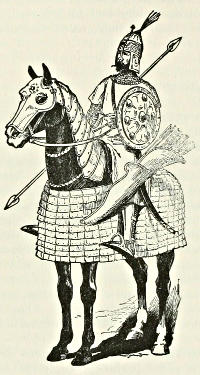
A Saracen
Boats sent from Damietta brought all
sorts of provisions to the French camp,
and kept it abundantly supplied. Turan
Shah caused many boats to be built which,
when taken to pieces, he placed on the backs
of camels, and had them thus carried to the
canal of Méhalé, when they were put together
again, launched on the canal, and
filled with troops for an ambuscade. As
soon as the French fleet of boats appeared
at the mouth of the canal of Méhalé, the
Mussulmans quitted their hiding-place and
attacked them. While the two fleets were
engaged, other boats left Mansura filled
with soldiers, and fell on the rear of the
French. It was in vain they sought to
escape by flight; a thousand Christians were killed or made prisoners. In
this defeat fifty-two of their boats laden with provisions were taken, and
their communication with Damietta by the navigation of the Nile was cut
off, so that within a short time the whole army suffered the most terrible
famine. The Mussulmans surrounded them on all sides, and they could
neither advance nor retreat.
On the first of the moon Dhul-hija (March 7th), the French surprised
seven boats; but the troops on board had the good fortune to escape. In
spite of the superiority of the Egyptians on the Nile, they attempted to bring
up another convoy from Damietta, but they lost it; thirty-two of their boats
were taken and carried to Mansura, on the ninth of the same moon. This
new loss filled the measure of their woes, and caused them to propose a truce
and send ambassadors to treat of it with the sultan. The emir Zain ad-Din
and the kadi Bedr ad-Din were ordered to meet and confer with them,
when the French offered to surrender Damietta, on condition that Jerusalem,
and some other places in Syria, should be given in exchange for it. This
proposal was rejected, and the conference broken up.
On Friday, the 27th of the moon Dhul-hija (April 2nd), the French set fire
to all their machines of war and timber for building, and rendered almost all
their boats unfit for use. During the night of Tuesday, the third day of the
moon Muharrem (April 7th), in the year of the Hegira 648, the whole of
the French army decamped, and took the road to Damietta. Some boats
which they had reserved fell down the Nile at the same time. The Mussulmans
having, at break of day of the Wednesday, perceived the retreat of
the French, pursued and attacked them.
The heat of the combat was at Fariskur. The French were defeated
and put to flight; ten thousand of their men fell on the field of battle, some
say thirty thousand. Upwards of one hundred thousand horsemen, infantry,
tradespeople, and others were made slaves. The booty was immense in
horses, mules, tents, and other riches. There were but one hundred slain
on the side of the Mussulmans. The Baharite slaves, under the command
of Bibars al-Bundukdari, performed in this battle signal acts of valour. The
king of France had retired, with a few of his lords, to a small hillock, and
surrendered himself, under promise of his life being spared, to the eunuch
Jemal ad-Din Mahsun as-Salih; he was bound with a chain, and in this state
conducted to Mansura, where he was confined in the house of Ibrahim ben
Lokman, secretary to the sultan, and under the guard of the eunuch Salih.
The king’s brother was made prisoner at the same time, and carried to the
same house. The sultan provided for their subsistence.
The number of slaves was so great, it was embarrassing, and the sultan
gave orders to Saif ad-Din Jusuf ben Tardi to put them to death. Every night
this cruel minister of the vengeance of his master had from three to four
hundred of the prisoners brought from their places of confinement, and after
he had caused them to be beheaded, their bodies were thrown into the Nile;
in this manner perished one hundred thousand of the French.
The sultan departed from Mansura, and went to Fariskur, where he had
pitched a most magnificent tent. He had also built a tower of wood over
the Nile; and, being freed from a disagreeable war, he there gave himself
up to all sorts of debauchery. The victory he had just gained was so brilliant
that he was eager to make all who were subjected to him acquainted
with it. He wrote with his own hand a letter, in the following terms, to the
emir Jemal ad-Din ben Jagmur, governor of Damascus: “Thanks be given to
the All-powerful, who has changed our grief to joy; it is to Him alone we
owe the victory. The favours He has condescended to shower upon us are innumerable,
but this last is most precious. You will announce to the people
of Damascus, or, rather, to all Mussulmans, that God has enabled us to gain
a complete victory over the Christians at the moment they had conspired our
ruin. On Monday, the first day of this year, we opened our treasury and
distributed riches and arms to our faithful soldiers. We had called to our
succour the Arabian tribes, and a numberless multitude of soldiers ranged
themselves under our standards. On the night between Tuesday and
Wednesday our enemies abandoned their camp, with all their baggage, and
marched towards Damietta; in spite of the obscurity of the night, we pursued
them, and thirty thousand of them were left dead on the field, not including
those who precipitated themselves into the Nile. We have, besides,
slain our very numerous prisoners, and thrown their bodies into the same
river. Their king had retreated to Minieh; he has implored our clemency,
and we have granted him his life, and paid him all the honours due to his
rank. We have regained Damietta.”
The sultan, with this letter, sent the king’s cap, which had fallen in the
combat; it was of scarlet, lined with a fine fur. The governor of Damascus
put the king’s cap on his own head when he read to the public the sultan’s
letter. A poet made these verses on the occasion: “The cap of the
French was whiter than paper; our sabres have dyed it with the blood of
the enemy, and have changed its colour.”g
As ransom for the noble prisoners the sultan offered to accept some of
the baronial castles in Palestine, or those which belonged to the Templars
and Hospitallers. But the king and his peers replied that the liege lord, the
emperor of Germany, would never consent that a pagan or Tatar should hold
any fief of him; and that no cession of the property of the knights could be
made, for the governors of their castles swore on their investiture that they
would never surrender their charge for the deliverance of any man. The
king was even threatened with torture, but as the Mussulmans saw in him
no symptoms of fear on which they could work, they proposed to make a
pecuniary ransom. Louis offered to pay ten thousand golden besants, which
were equal to five hundred thousand livres, for the deliverance of his army,
and that as the royal dignity could not be estimated by a vulgar scale, he
would for his own freedom surrender the city of Damietta. The sultan was
liberal in the fulness of his joy at such a completion of his victories, and
remitted a fifth part of the pecuniary ransom.[77] Peace was to continue for
ten years between the Mussulmans and the Christians, and the Franks were
to be restored to those privileges in the kingdom of Jerusalem which they
enjoyed before the landing of Louis at Damietta. The repose which succeeded
the treaty was interrupted by the murder of the sultan; but after
a few acts of hostility the successful emirs, and their mamelukes, renewed
with a few changes the condition of amity. One moiety of the ransom was
to be discharged before the king left the river, and the other on his arrival
at Acre. The sick at Damietta, with the stores and baggage, were to be
retained by the sultan till the last portion of the ransom should be paid.
Damietta was accordingly surrendered. But the mamelukes were more
savage and unprincipled than any preceding enemies of the Latin name.
They burned all the military engines, murdered the sick, and some of the
most ferocious thirsted for the blood of the Christian potentates. The
counsels of justice prevailed, and the Christians were relieved from their
fears that the treaty would not be acted upon. The counts of Flanders and
Brittany, the count of Soissons, and others embarked for France. The
royal treasure at Damietta could not furnish the stipulated portion of the
ransom. The new grand master of the Templars opposed the institutes
of his order to the king’s request for a loan of the funds of the society, and
contended that he could not divert them from their regular and appointed
purposes. But state necessity trampled over mere statutable forms, and the
chest of the Templars was seized by the royal officers. The king’s person
was redeemed, and the French went to Acre.
The expedition of St. Louis into Egypt resembles in many respects the
war in Egypt thirty years before. In both cases the Christian armies were
encamped near the entrance of the Ashmun canal; they could not advance,
and the surrender of Damietta was the price of safety.
[1250-1254 A.D.]
Many of Louis’ council were astonished at his resolution to remain in
Palestine while political affairs were calling him to his duty to France.
They were divided in their patriotism and their allegiance. The sultan
of Damascus, a relative of the murdered Egyptian lord, solicited the aid of
Louis to revenge the murder, and stimulated his virtue by the promise
that in the event of victory he would deliver to the Christians the city
of Jerusalem. The king replied that he would send to the mamelukes at
Damietta, to know whether they would repair their violations of the treaty,
and that, in case of their refusal, he would assist the sultan of Damascus.
On intelligence of this negotiation, the people of Damietta restored to the
king all the knights and common soldiers whom they had detained in prison.
Louis wisely profited by circumstances, and declared that he would not enter
upon a truce with the Egyptians, until they had absolved him from the payment
of the remaining moiety of the ransom, and restored to him the
heads of those Christians on the walls of Cairo, who had fallen in the battle
near Mansura, and such Christian children as they had forced to become
Mussulmans. The emirs and mamelukes complied with these terms, and,
on condition of the alliance of the French king, they engaged to deliver up
to him Jerusalem itself. The military force of Louis did not much exceed
four thousand men. The king’s two brothers returned to Europe; and, in
order to retain a respectable army, Louis was obliged to be liberal of his
treasure. Louis remained a year at Cæsarea, and rebuilt its houses and
repaired its fortifications. Joppa was the next object of his care. The war
between the Egyptians and Syrians raged with dreadful violence. By the
mediation of the caliph, the Mussulmans made peace; Egypt and Jerusalem
were to belong to the mamelukes; and the countries beyond the Jordan to
the sultan of Syria. But the united infidels did not pursue their schemes
of destruction with that vigour and ability which had distinguished the
fierce and dreadful movements of Nur ad-Din and Saladin. They might have
swept the feeble and exhausted Christians from the shores of Palestine; but
they merely ravaged the country round Acre, and then proceeded to Sajecte,
in whose strong castle were Louis and most of the army. The blood and
property of the citizens satisfied the Moslems, who departed without trying
the valour of the French in garrison.
Perpetual disappointment gradually desiccated the spring of hope, and
the king turned his mind to France. His friends marked his change of
purpose, and news from Europe of the death of his royal mother, the regent
of his kingdom, made him openly proclaim his resolution to return. The
patriarch and barons of Palestine offered him their humble thanks and praise
for the great good and honour he had conferred on the Holy Land; and,
shortly after Easter, he embarked for the West. Louis IX gathered no new
laurels in his transmarine expedition. All that was great and chivalric in
France had been spread out in martial array, and had met with little else
than discomfiture and defeat. In the course of Louis’ stay at Joppa, the
sultan of Damascus sent him permission to visit Jerusalem. The king
ardently desired to behold the sacred places, and was slow in allowing considerations
of policy to conquer selfish feelings. The reason which dissuaded
him from the journey, was, that if he should perform a pilgrimage to
Jerusalem without delivering it from the enemies of God, every subsequent
crusading monarch would think a similar proceeding sufficient, and would
not consider himself obliged to perform more than what the king of France
had done. St. Louis was also reminded that Richard Cœur de Lion refused
to behold Jerusalem as a pilgrim.
THE CHRISTIANS QUARREL AMONG THEMSELVES
[1255-1259 A.D.]
All the blood which had been shed, and all the treasure which France
had lavished for the crusade of St. Louis, did not long preserve the Christians
in Palestine from the hostilities of the Mussulmans, and, as no new
succours arrived from Europe, the barons and knights were compelled, in
some cases, to keep within the shelter of their fortresses, and at other times
to make disadvantageous treaties with their foe. Although it was evident
that nothing but unanimity in the holy warriors could preserve the remnants
of the kingdom of Godfrey de Bouillon from annihilation, yet the Christians
wasted their strength in party collisions, instead of watching the politics of
the Saracenian courts, and gathering those branches of power which their
enemies, in their ambitious feuds, continually broke from the tree of Islamism.
The haughty republicans of Italy would never enter into any common
bond of union, and the Venetians, the Pisans, and the Genoese had frequent
hostile encounters, respecting the possession of churches to which each
nation asserted her claims. The two great military orders only forgot their
mutual jealousies when in the field they were opposed to the Moslems, but
in every interval of peace, the knights, incapable of any exertions or thoughts
but those which war inspired, gratified their arrogance and restlessness in
disputes touching military prowess and precedency. As reason did not give
birth to these altercations, she did not control the decision.
A German Crusader, Thirteenth Century
The jealousy and rancour of the Hospitallers and Red Cross knights were
frequently aggravated by irregular skirmishes, and at length the kindred
squadrons met in a general engagement. Victory sat on the helms of the
cavaliers of St. John; few prisoners were taken, and scarcely a Templar
escaped alive. But new companions from Europe gradually filled the places
of the deceased brethren. New occasions demanded all their valour and
skill, and civil discord was lost amidst the more honourable war with the
real enemies of the state.
A blood-stained revolution in Egypt had placed the mameluke chief
Bibars, or Bundukdari, on the throne of that country; he was well disposed
to lead his savage mamelukes against the Christians, and his ferocity did not
want the excitement which the military orders gave it, of refusing, contrary
to treaty, to deliver to him some Mohammedan prisoners. His soldiers, as
savage as the Khwarizmians, demolished the churches of Nazareth, and the
fortress and church on Mount Tabor. They made their way to the gates
of Acre with fire and sword, and such of the Christians as were immediately
slain were not so much objects of compassion as the prisoners on whom the
Turks inflicted every description of torture, in order to force a change
of religion. Though Acre itself was saved for a few years, yet Cæsarea
did not escape the wide-spreading calamities. Through these dreadful
scenes the military orders fought with their usual heroism, and in the sieges
of the strong fortresses of Azotus and Saffuria, the spirit of devotion
which they manifested to their cause had never been equalled. The small
force of ninety Hospitallers held possession of the former of these places.
The number gradually diminished on each renewed assault, and when the
Turks mounted the breach, they trampled on the bodies of the last of
the knights.
After ravaging the neighbourhood of Acre, Tyre, and Tripolis, the
Egyptians laid siege to the fortress of Saffuria. The fall of that place was
inevitable, and the prior of the Templars therefore agreed to capitulate, and,
on the surrender being made, the knights and garrison, altogether amounting
to six hundred men, were to be conducted to the next Christian town.
The sultan was invested with lordship over the fortress, but he violated
the conditions of the surrender, and left the knights only a few hours to
determine on the alternative of death or conversion to Islam. The prior
and two Franciscan monks were earnest in fixing the faith of the religious
cavaliers, and, at the appointed time for the declaration of their choice,
they unanimously avowed their determination to die rather than incur the
dishonour of apostacy. The decree for the slaughter of the Templars
was pronounced and executed; and the three preachers of martyrdom were
flayed alive.
HISTORY OF ANTIOCH (1206-1268 A.D.)
[1206-1268 A.D.]
Before we continue our review of the calamities of Palestine, a retrospect
must be taken of a principality whose fate was closely connected with that
of the Latin kingdom of Jerusalem. Bohemond IV continued to be the
reputed lord of Antioch, from the year 1206 till the time of his death
in 1233. But for many years during this interval he did not exercise any
royal authority, for he was a tyrant, and was both hated by the people and
excommunicated by the clergy. His nephew Rupin, the right heir, was
aided by the papal legate, who was present at the great siege of Damietta,
in the year 1218, and made several attempts to recover his thrones of Antioch
and Tripolis; but he died some years before Bohemond, in a prison at
Tarsus, into which he had been cast by Constantius, nominal regent of
Antioch, and guardian of Isabella, daughter and successor of Livon, king
of Armenia. From Bohemond IV and his first wife Plaisance, daughter of
the lord of Gabala, Bohemond V descended. To him succeeded Bohemond
VI. It does not appear that the family of the Bohemonds were entire masters
of the principality and county from the year 1233 till their absorption
in the Egyptian power. It is certain that Bohemond V was reigning over
Antioch and Tripolis in 1244, when he became tributary to the Khwarizmians;
and that in 1253 Bohemond VI was made a knight by St. Louis, and
was considered lawful prince of Antioch, though he was a minor, and under
his mother’s tutelage. But it is equally certain that at times, from 1233 to
1288, Frederick and Conrad, a son and grandson of the emperor Frederick
II, had possession of all or part of the states of Antioch and Tripolis.
RAVAGES OF BIBARS
[1268-1269 A.D.]
We may now resume the thread of the general history. Joppa and the
castle of Beaufort were the mameluke conquests which succeeded in point of
time to those of Azotus and Saffuria.
The tempest at length burst upon the state of Antioch; and the city
of that principality yielded without even the formality of a siege (1268).
The reproach of treachery is alternately cast upon the patriarch and the inhabitants;
and heavy is the disgrace of causing an event which occasioned
the destruction of forty thousand, and the captivity of one hundred thousand
Christians. Bibars ravaged the country round Tyre; but being equally religious
and cruel, he gave the Franks a respite by pilgrimising to the holy places
in Arabia. He soon, however, resumed his fell purpose of exterminating
the Christians; Laodicea and many other places submitted to him; and the
knights of St. John gained immortal honour by their brave, though fruitless,
defence of the fortress of Karak, between Arca and Tortosa. The
prince of Tripolis preserved his title by the sacrifice of half of his territory.
Acre was saved in consequence of the reported succour of the king of Cyprus.
Bibars returned to Cairo, hastily fitted out a fleet for the conquest
of the island, which was without the presence of its monarch. But his
ships were lost in a tempest; Cairo was overwhelmed with sorrow, and none
of his efforts could re-establish affairs.
SECOND CRUSADE AND DEATH OF LOUIS IX
[1269-1270 A.D.]
Before the news of the capture of Antioch reached Europe, the people of
the West had contemplated a new crusade. St. Louis thought that his first
expedition to the Holy Land brought more shame on France than good on
the Christian cause; and he feared that his own personal fame had withered.
The pope encouraged his inclinations for a new attempt. England was at
that time in a state of repose, and her martial youth were impatient of indolence.
Prince Edward, with the earls of Warwick and Pembroke, received
the holy ensign. The assumption of the cross by the heir of the English
throne spread great joy throughout France. He was invited to Paris; the
co-operation of the English and French was determined upon; and Louis
lent his youthful ally thirty thousand marks on the security of the customs
of Bordeaux. The prelates and clergy of England agreed to contribute a
tenth of their revenue for three years; and by a parliamentary ordinance,
a twentieth part was taken from the corn and movables which the laity possessed
at Michaelmas. A crusade had for many years been popular in England.
During the first expedition of St. Louis, and soon after the departure
of William Longsword, Henry III engaged to fight under the sacred banners.
But he was slow in preparing to go to the Holy Land; and the public murmured
the suspicion that he had only assumed the cross as a pretence for collecting
money. It was found that five hundred knights had been crossed;
and the number of inferior people could not be counted. The holy warriors
resolved to commence their voyage at midsummer; but the king had anticipated
all their proceedings; and he declared that if they dared to march without
him the thunders of the Vatican should be hurled against them. Some
people submitted to, and others clamoured at this menace of papal interference;
and the religious ardour of the most enthusiastic was cooled by the
king’s delays, and the news of the disastrous events in Egypt. The pope and
king were deaf to the reproaches of the French nation that indifference
to Christianity could be the only motive for obstructing the pious wishes of
the English people.[78] The king’s poverty was ever the alleged cause of his
remissness; and two years after his dissolution of the association of English
knights, he endeavoured to extort money from the clergy on the pretence
of a journey to Syria. But they resisted his demands; and reproached him
with his avarice and violation of oaths.
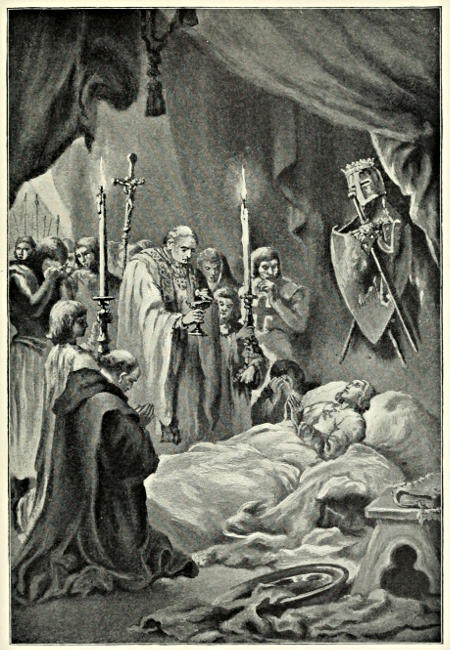
DEATH OF ST. LOUIS
Anticipating the laurel of victory, or the crown of martyrdom, St. Louis
spread his sails for the Holy Land in 1270. Sixty thousand soldiers were
animated by their monarch’s feelings of religious and military ardour; and
we may remark among the leaders the lords of Flanders, Champagne, and
Brittany. The fleet was driven into Sardinia; and at that place a great
change was made in the plan of operations. The king of Tunis had formerly
sent ambassadors to Louis, and expressed a wish to embrace the only
true religion. Northern Africa had formerly paid a pecuniary tribute to the
sovereign of the Two Sicilies; and Charles of Anjou, the reigning monarch,
concealing his selfishness under the garb of piety and justice, strongly urged
his brother to restore the rights of Christendom. The soldiers too, now
more greedy of plunder and revenge than zealous in bigotry, entreated to
be led to Tunis. The subjugation of the Mussulmans in Africa was declared
to be a necessary preliminary to successes in Palestine; the French soon
reached the first object of their hopes; and the camp and town of Carthage
were the earliest rewards of victory. But every sanguine expectation was
damped when a pestilential disease spread its ravages through the Christian
ranks.
The great stay of the Crusades fell August, 1270. During his illness
Louis ceased not to praise God, and supplicate for the people whom he
had brought with him. He became speechless; he then gesticulated what
he could not utter; he perpetually made signs of the cross, stretched himself
on the floor, which was covered with ashes; and in the final struggle of
nature he turned his eyes to heaven, and exclaimed, “I will enter thy house,
I will worship in thy sanctuary.”
PRINCE EDWARD LEAVES ENGLAND
Before this calamitous event Prince Edward, Edmund Crouchback, earl
of Lancaster, four earls, four barons, and the English division, had not only
arrived in Africa, but had left it for Sicily, in despair that their French
compeers would ever march to Palestine. The winter season was passed
by Prince Edward in military exercises, and in the various occupations of
chivalry, and in the following spring he turned his prow up the Mediterranean
and arrived at Acre.
The whole of the forces of Edward did not exceed one thousand men.
But the prowess of the Plantagenets was dreaded by the Mussulmans; and
they feared that another Cœur de Lion was come to scourge them. The sultan
of Egypt departed from the vicinity of Acre, which he had devastated with
fire and sword. All the Latins in Palestine crowded round the banner of
the English prince; and he took the field at the head of seven thousand
men. The city of Nazareth was redeemed; and he surprised and defeated a
large Turkish force. Edward was brave and provident, and owed his success
as much to his skill as to his courage. But he was not less cruel
than any preceding hero of the holy wars; and he gave a dreadful earnest
of that savage implacability which Scotland afterwards so often rued.
The barbarities which stained the entry of the Christians into Jerusalem,
two centuries before, were repeated in a smaller theatre of cruelty
in Nazareth.
[1271-1272 A.D.]
But the march of victory was closed, for the English soldiers were parched
by the rays of a Syrian sun, and their leader was extended on the bed of sickness.
The governor of Joppa was the apparent friend of Edward, but the
sultan’s threat of degradation, if further commerce were held with an infidel,
changed courtesy into malignity. He hired an assassin who, as the bearer
of letters, was admitted into the chamber of his intended victim. After
receiving two or three wounds, the vigorous prince threw the villain on the
floor and stabbed him to the heart. The dagger had been steeped in poison,
and for some hours Edward’s fate was involved in danger. The fairy hand
of fiction has ascribed his convalescence to his queen.[79]
After the English prince had been fourteen months in Acre, the sultan
of Egypt offered peace, for wars with the Moslem powers engrossed his military
strength. Edward gladly seized this occasion of leaving the Holy Land,
for his force was too small for the achievement of great actions, and his
father had implored his return to England. The hostile commanders signed
accordingly a treaty for a ten years’ suspension of arms; the lords of Syria
disarrayed their warlike front, and the English soldiers quitted Palestine for
their native country (July, 1272).
VAIN EFFORTS OF GREGORY X
[1274-1291 A.D.]
At the time when Palestine began to breathe from the horrors of war,
hope once more raised her head in consequence of the election to the chair
of St. Peter falling upon Theobald, archdeacon of Liège. The choice of the
cardinals was made known to him while he was in Palestine. He impatiently
transported himself to Italy, and so ardent was his zeal that his
endeavours for a crusade even preceded his introduction to the pontificate.
The trumpet of war again was heard among the nations. The blast was
however only faintly echoed. The republics of Pisa, Genoa, and Venice,
and the city of Marseilles, agreed to furnish a few galleys and twenty-five
thousand marks of silver were obtained from Philip the Hardy on mortgage
of the Templars’ estates in France. The masters of the military friars and
Red Cross knights went to Rome, and convinced their papal friend that
these succours would be too inconsiderable to enable the Christians to drive
infidels out of Palestine.
Again was the Christian world assembled, and the council of Lyons (May
1274) decreed the obligation of a new crusade. But Pope Gregory died
within two years after the sitting of the Lyonese council, and all thoughts
of a crusade were dropped when the life of its great promoter closed.
Palestine however was at peace. Hugh III, king of Cyprus, a lineal
descendant of the princess Alice, had been crowned king of Jerusalem at
Tyre, a short time before the death of Conradin, the last unhappy
descendant of that house of Germany, of which three emperors had supported
and adorned holy wars. The Templars befriended Charles of Anjou, but the
Hospitallers, with more virtue than was generally shown, declared that they
could not fight against any Christian prince, and contended that the claims
for succession to the kingdom ought to be deferred till the kingdom itself
should be recovered. In the fourth year of the peace which the valiant
prince Edward had gained for Palestine, the mameluke chief and king
Bundukdari, died.
In the reign of Kalaun, the third sultan in succession to him who had
torn so many cities from the Christians, the war was renewed (1280), and
after a few years of dreadful preparation the living cloud of war burst upon
the Christians. Margat was captured; but so brave had been the resistance
of the knights that it procured them a safe and honourable retreat to
the neighbouring town of Tortosa (1287), and the sultan, dreading even the
possibility of future opposition, razed the fortress.
PROGRESS OF THE MAMELUKES
With rapid and certain steps the power of the Latins approached its fatal
termination. The city of Tripolis, that last remaining satellite of the kingdom
of Jerusalem, was taken in 1289; its houses were burned, its works
dismantled, and its people murdered or retained in slavery. Acre once
more became the principal possession of the Christians. The sultan concluded
a treaty of peace with Henry II of Cyprus, who had driven away
the lieutenants and soldiers of Charles, and had been acknowledged king of
Jerusalem.
The grand-master crossed the Mediterranean in order to infuse his martial
spirit into the people of the West. Pope Nicholas IV heard with coldness
the dismal tale. He declined to open the treasury of St. Peter for the
advancement of the Christian cause, and he gave his noble friend only fifteen
hundred men—the offscourings of Italy. Circular letters were sent to
the different European potentates, but the light which once shone upon the
holy cause had waned; cavaliers no longer thronged round the cross, and
the grand-master was compelled to return to Palestine, accompanied only
by his Italian banditti. When they arrived at Acre, the city was in the
greatest state of turbulence. Within its walls were crowded the wretched
remains of those kingdoms and principalities which had been won by the
blood of the West. Every distinct people occupied a particular division, and,
in the assertion of individual privileges, general interests were forgotten.
[1291-1300 A.D.]
The sultan died before his preparations of vengeance were completed;
but his son Khalil was not less anxious than his father to exterminate the
infidel miscreants. In April, 1291, nearly two hundred thousand mameluke
Tatars of Egypt marched into Palestine, and encamped before Acre, exactly
on the same ground upon which a century before assembled Europe had stood.
To avoid the dreadful consequences of war, a large part of the population
embarked in the numerous vessels which at that time rode at anchor in the
harbour, and the defence of the place was left to the care of about twelve
thousand soldiers. The garrison was speedily reinforced by a few hundred
men, headed by Henry II of Cyprus, who boasted the ideal title of king of
Jerusalem. But the Christians beheld their towers yielding to the mines
and battering-rams. The pusillanimous monarch, seizing a few ships, sailed
to Cyprus. With the morn, the mamelukes renewed the attack. Most of
the German cavaliers died upon the breach; the others slowly left the walls,
and the firmness of their little phalanx checked the foe. The Hospitallers
chased back the mamelukes, and even forced them headlong into the ditch.
But the sultan was prodigal of blood. His battalions marched to the breach,
and in a few hours the entry into the city was repeatedly lost and won by
the Christians and infidels.
Under the cover of a few cross-bowmen, the knights of St. John, seven only
were the remnant, embarked, and left forever the scene of their virtue and
their valour. Their brethren in arms, the Templars, were equally brave,
and their fate was equally disastrous. Their resistance was so firm, that the
sultan was compelled to promise them a free and honourable departure. But
the insults of some low Saracenian people irritated the cavaliers; the sword
again was drawn, and such of the Templars as survived the conflict, fled
into the interior country. The unarmed population of Acre hurried to the
coast; but the elements co-operated with the devastating spirit of the Turks,
and the tempestuous waves refused shelter to the fugitives. While gnashing
with despair, the people beheld their town in flames. The ruthless hand of
death fell upon them, and the sea shore of Palestine again drank torrents
of Christian blood.
TOTAL LOSS OF THE HOLY LAND
Tyre, Berytus, and other towns, were awed into submission. The Turks
swept all Palestine, and murdered or imprisoned all the Christians who could
not fly to Cyprus. The memory of the Templars is embalmed, for the last
struggle for the Holy Land was made by the Red Cross knights. Such as
escaped from Acre went to Sis, in Armenia. A Mussulman general drove
them to the island of Tortosa, whence they escaped to Cyprus, and the cry
of religious war no longer rung through Palestine.
The loss of the Holy Land did not fill Europe with those feelings of grief
and indignation which the fall of Jerusalem, an hundred years before, had
occasioned. The flame of fanaticism had slowly burned out. During the
thirteenth century, the territorial possessions of the Christians in Palestine
gradually diminished; the expeditions and reinforcements were in consequence
less vigorous, for, both politically and personally, the people of the
West declined in their interest in respect of the affairs of the East. Pope
Nicholas IV endeavoured to revive holy undertakings; but the kings of
Europe were deaf or disobedient. As Genoa was allied to the Grecian
emperor, Venice sought the friendship of the Mussulmans. The mamelukes
gave their Christian brothers a church, an exchange, and a magazine in
Alexandria; and the Venetians carried on the lucrative but disgraceful
trade of furnishing the Egyptian market with male and female slaves from
Georgia and Circassia.
[1299-1413 A.D.]
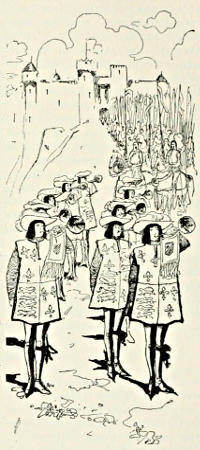
Heralds of the Crusaders
There was some pretence for the preaching of a crusade by Pope Boniface
VIII in the year 1300. Kazan, the Mongol sultan of Persia, resolved
to exterminate the mamelukes of Egypt. He allied himself with the kings of
Georgia, Armenia, and Cyprus. In 1299 the fortunes of war smiled on the
allies; but still the success not being so great as what he had expected,
Kazan sent to the pope, soliciting the more powerful alliance of the princes
of the West, and agreeing that when Palestine was recovered, it should be
retained by the Christians. The project, though warmly patronised by the
pope, proved abortive. In the interim, the tide of victory flowed in favour
of the Egyptians. Kazan died about the year 1303.
From the commencement, till past the middle of the fourteenth century,
the popes repeatedly sounded the charge; but the West in most cases disregarded
the summons of its ghostly instructor;
and it was evident that, although
the papal rulers could fan, they could not
create the sacred flame. At the time when
the loss of the Holy Land became known
in Europe, the people had not recovered
from the astonishment and terror with which
the victories of Jenghiz Khan and his successors
had filled the West. Part of Russia,
the whole of Poland, Silesia, Moravia,
Hungary and all the countries to the
eastward of the Adriatic Sea, fell a prey to
barbaric desolation. Several of the popes
attempted in vain to soften the ferocity of
these new foes; but the papal legates were
dismissed with the tremendous command,
for Rome herself to submit her neck to the
Mongol yoke.
Though Europe in general felt that in
the fall of Acre all was lost, yet despair
did not immediately complete his triumph,
for chivalry and policy sometimes endeavoured
to revive the religious spark. If Pope
John XXII had not been too open in the
display of his avarice, and too prodigal in
the commutation of vows for money, the
knights of Germany would once more have
fought under the glorious ensign of the
cross. A threatened invasion from England
(1328 A.D.) deterred Philip de Valois
from leaving his country for Palestine, and
a large body of crusaders was dispersed
when (1364 A.D.) John Le Bon of France
died, on whom the pope intended to have
conferred the title of commander of the new
crusaders. The politic Henry IV[80] of England wished to “busy giddy minds
with foreign quarrels,” in order to divert his people from looking too nearly
into his state, and to retain their newly sworn allegiance. Both his maritime
and military preparations were considerable; but the hand of nature stopped
him and it was his fate to succumb to death, before he could attempt to
commence his new religious career.
FATE OF THE MILITARY ORDERS
[1291-1600 A.D.]
Such were the last appearances of that martial frenzy which so long agitated
Europe; and here the history of the holy wars would naturally close,
if curiosity did not suggest an inquiry into some of those military and
religious orders which arose from the spirit of pilgrimages and crusades,
and whose existence forms one of the most prominent characteristics of the
Middle Ages. The knights of the Teutonic order were fixed in their conquest
of Prussia, some years before the loss of the Holy Land. Their love
of war was not extinguished; they carried both the sword and the Gospel
into Pomerania; and the eastern part of that country was definitively
ceded to the order by a treaty of peace in the year 1343. The town of
Dantzic, the capital of the new conquest, was considerably aggrandised
under the dominion of the knights, and became one of the principal places
of commerce on the Baltic. Pressed forward again by religion and ambition,
they made war on the infidel Lithuanians, but it was not till the beginning
of the fifteenth century, and after rivers of blood had flowed, that the
pagans lost their independence, and relinquished their national superstition.
But the oppressive government of the knights; their intestine divisions;
their heavy imposts, the unhappy result of wars continually reviving,
encouraged the nobility of Prussia and Pomerania to confederate, and to
seek the protection of the kings of Poland. The torch of war was rekindled,
the knights were defeated, and by the peace of Thorn in 1466 all Pomerania,
and indeed all the country which is generally called Polish Prussia, was
ceded to Poland. The order was allowed to preserve the west of Prussia
by the tenure of feudal service to the kings of Poland.
The Teutonic knights thus lost Prussia; their name appears on few
occasions in the history of Europe, and the order became only a “cheap
defence of nations.” Pope Innocent VIII in the year 1490 endeavoured to
suppress the order of the Knights of St. Lazarus. In Italy, perhaps he succeeded,
but not in any other country. The bull was resisted by the knights
of France and till the reign of Henry IV they were independent and elected
their own grand-masters.
KNIGHTS OF ST. JOHN
[1291-1310 A.D.]
After the loss of Acre, the knights of St. John and the Temple, from
every preceptory and commandery in Europe, flocked to Cyprus, impatient
for glory and revenge. The military friars soon quitted their settlements
in Cyprus. The grand-master of the Hospitallers gained the friendship and
the purse of Pope Clement V, and drew a flattering picture of Christian
prosperity, if the cavaliers of St. John could set up their banners in some
island in the Mediterranean. Rhodes was fixed upon. Fifteen years subsequently
to the loss of Acre, a new crusade was published, and the volunteers
were invited to repair to Brundusium. The king of Sicily and the
republic of Genoa furnished transports. The grand-master headed the army,
but it was not until after they had sailed, that the crusaders knew the object
of the armament. Rhodes was at that time in the power, partly of the
Greeks and partly of the Saracens. The soldiers landed; many battles were
fought, and the army of the invaders was at last reduced to the military
friars. Their chief hired new soldiers, recommenced his attacks, and the
whole island submitted to his authority (1310). The subsequent history of
the knights of St. John is interwoven with the general history of Europe.
THE TEMPLARS IN FRANCE
[1307-1311 A.D.]
While the military friars were planning the acquisition of an equivalent
to their loss in Palestine, most of the Red Cross knights gradually left
Cyprus, returned to their different commanderies, and lived in security and
indolence. But circumstances soon made the Templars repent that they
had not, like the Hospitallers, attempted a renewal of hostilities with the
infidels. Philip the Fair, king of France, acquainted Pope Clement V, that
the order of the knights Templar had been accused of heresy and various
other crimes against religion and morals. Some members had charged their
fraternity with the different abominations of treachery, murder, idolatry,
and Islamism. Philip the Fair took the bold step of imprisoning all the
knights Templar whom his officers could discover in France, and of sequestering
their property. Clement then circulated a bull throughout Christendom,
by which instrument of papal authority, nuncios and the resident clergy
were commanded to inquire into the conduct of the knights. His holiness
says that, pressed by public clamour and by the declarations of the king,
the barons, the clergy, and laity of France, he had examined seventy-two
members of the order, and had found them all guilty, though in various
degrees, of irreligion and immorality. Such of the knights as yielded to
blandishments and threats were pardoned, but the torture was applied
to those who denied the charges, and thirty-six knights in Paris heroically
braved the horrors of the rack, and maintained the innocence of the order,
till death closed their sufferings and their virtue. Others confessed in the
midst of corporeal agony, and afterwards recanted their confessions. The
knights Templar were accused of renouncing, at the time of their matriculation,
God, Jesus Christ, the Virgin, and all the saints. It was said that
the brethren used often to spit and trample on the cross, in proof of their
contempt of Christ, who was crucified for his own crimes and not for the
sins of the world. Out of their disdain of God and his Son, they adored a
cat, and certain wooden and golden idols. The master could absolve brethren
from sins. On the assurance that the king would destroy the order,
whether the result of the examinations were favourable or hostile to its continuance,
many knights had yielded to pain and hopelessness, stayed the
hand of the executioner, confessed every crime, upon their confessing of
which, royal pardon and protection were proffered. The court condemned
to perpetual imprisonment those from whom no confession of guilt had been
extorted. But such as had retracted their forced avowals were declared to
be relapsed heretics; they were delivered over to the secular power, and condemned
to the fire (May 11th, 1310). The number in the last-mentioned
class of the proscribed was fifty-four. All the historians who have spoken
of the event, whatever opinion they might have entertained on the general
question, friends or enemies, natives or strangers, have unanimously attested
the virtuous courage, the noble intrepidity, and the religious resignation,
which these martyrs of heroism displayed. Arrived at the place of punishment,
they beheld with firmness and placidity the piles of wood, and the
torches already lighted in the hands of the executioners. In vain a messenger
of the king promised pardon and liberty to those who did not persist
in their retractations; in vain their surrounding friends endeavoured to
touch their hearts by prayers and tears. Invoking God, the Virgin, and all
the saints, they sung the hymn of death; triumphing over the most cruel
tortures, they believed themselves already in the heavens, and died in the
midst of their songs.
IN OTHER COUNTRIES
[1311-1314 A.D.]
By royal command, the sheriffs of the different counties of England and
Wales seized the estates, and imprisoned the persons of the Templars. The
cavaliers were more than a year and a half in prison. At the end of that
time a papal bull was received in England; and the archbishop of Canterbury
appointed courts at London, York, and Lincoln, for the trial of the
Templars, July, 1311. The charges were the same in substance as those
which had been preferred against the order in France. Forty-seven of the
knights who had been incarcerated in the Tower were examined upon oath
before the bishop of London, some inferior clergy, and the representatives of
the pope. William de la Moore, the grand prior of England, was as earnest
as de Molay had been in defence of the French Templars.
Four knights made a general confession of crimes, when they were told
that the pope had authorised a full pardon to those who acknowledged their
iniquities; but that if they persisted in heresy, they should be considered and
punished as heretics. Thirteen newly admitted knights swore that they were
not acquainted with the secrets of the order, but that they were prepared to
renounce all the erroneous opinions in which it was possible the minds of
men could be stained. William de la Moore, the grand prior, was the only
man whom no fear of imprisonment or dread of ecclesiastical punishment
could induce to deny his first avowal of the innocence of the order. He was
requested to make a general confession; but he replied that he was not guilty
of heresy, and would never abjure crimes which he had not committed.
In Ireland about thirty Templars, in Scotland only two, were confined
and examined. In Lincoln the number somewhat exceeded twenty. There
were twenty-three in York. The general charges of apostasy and idolatry
were not proved in any case. However, all the knights made a general
confession of the offence of heresy, and avowed they could not cleanse themselves
from the crimes mentioned in the bull. The clergy pardoned them, and
received them again into the bosom of the church. They were then sent
into confinement in various monasteries until the decision of a general council
should be declared.
The fate of the Templars in other parts of the world remains to be told.
In Germany the innocence of the order was proved before the archbishops
of Mainz and Trèves, at councils held in their respective dioceses. In Italy
the pope had a little more success. Several Templars at Florence confessed
every species of abomination. Much blood was shed in Lombardy, Tuscany,
Sicily, Naples, and Provence, whenever the knights would not be guilty
of self-condemnation. In those parts of Spain where the conduct of the Templars
was inquired into, the result was an acquittal. Their military front
was powerful, and the ministers of papal vengeance did not dare to apply
the torture.
COUNCIL AT VIENNE
Four years after the first seizure of the Templars in France a council was
held at Vienne in Dauphiné, for the purpose of making some general decision
on the case of the order, October, 1311. The pope headed three hundred
bishops, and an untold number of inferior clergy. All men who desired to
defend the order were promised security and freedom. Nine cavaliers presented
themselves before the assembly in the character of representatives
of fifteen hundred of their brethren, who were living at Lyons, and in the
secret fastnesses of Savoy and Switzerland. Clement immediately violated
his promise of protection, and threw the nine knights into prison. He then
called upon the council for its opinion, whether in consequence of the confessions
of the Templars the society ought not to be dissolved? With the
disgraceful exception of one Italian prelate, and three French archbishops,
the whole body of churchmen declared that so illustrious an order as that
of the Red Cross knights ought not to be suppressed, until the grand-master
and the nine knights had been heard in its defence. The pope disregarded
the opinion of the majority; and tried in vain for six months to make a
change.
THE ORDER SUPPRESSED
The king of France arrived at Vienne, and sanctioned by his presence, the
pope declared that he should exercise the plenitude of papal authority. He
accordingly dissolved the order provisionally and not absolutely, and reserved
to himself the disposition of the persons and estates of the Templars.
When the subject of the distribution of the knights’ Templar estates was
debated in the council, the pope declared that they ought to be bestowed
upon the Hospitallers, because the original purpose of the order was the subjugation
of infidels, a purpose which the knights of Rhodes were earnestly
pursuing.
The decree of confiscation was executed throughout Christendom. The
Templars were robbed, but the Hospitallers did not enjoy the whole of the
plunder. Philip the Fair, and his successor Louis le Hutin, retained nearly
three hundred thousand livres [£12,000 or $60,000] for what they chose to
term the expenses of the prosecution. The landed estates were slowly and
unwillingly resigned, for the monarchs enjoyed the rents till the commissioners
of the knights of Rhodes established their rights. In Germany the
Teutonic knights assisted the Hospitallers in plundering those who had
formerly been their brethren in arms in Palestine. Dinis, king of Portugal,
preserved the order of the Red Cross knights, by changing their title from
the soldiers of the Temple to that of the soldiers of Christ. Edward of
England gave to different laymen much of the forfeited property. Numbers
of the nobility too as heirs of the original donors seized many of the
Templars’ estates. Indeed, so great was the injustice done to the Hospitallers,
that Pope John XXII censured both the clergy and laity, for their
disobedience to the decree of the council at Vienne.
The last circumstance which attended the fate of the Templars was the
condemnation of the grand-master, Jacques de Molay.[81] With his dying lips
he bore testimony to the virtue of the order; and his mental sufferings on
account of his former want of firmness appeared to be greater than his mere
corporeal pain. The brother of the prince of Dauphiné met with the same
unhappy but honourable end as that of his friend Jacques de Molay. The
two priors seem to have died in prison.b
THE CRUSADES IN THE WEST
[1230-1309 A.D.]
Having completed the survey of the vain efforts for the Holy Land, it
will be well to glance at the contests springing up elsewhere on the same
fanatic belief that orthodoxy was a matter of life and death.a
Though the Crusades met with failure in the East, in the West they
achieved their purpose; that is, certain expeditions were highly successful;
for example that of the Teutonic knights and sword-bearers into Prussia and
the neighbouring regions, where they founded a new state; also Simon de
Montfort’s war against the Albigenses which destroyed an ancient civilisation;
and the struggle between the Spaniards and the Moors, as a result of which
the latter were forced to surrender the peninsula over to Christianity and the
civilisation of Europe.
It will be observed that the scene of action of the European Crusades was
the two extremities of the continent; around the mouths of the Niemen the
pagans of the Baltic were to be converted, and in the country washed by
the Tagus, the Moslems of Spain.
THE TEUTONIC CRUSADE
In the interval between the First and Second Crusades some citizens of
Bremen and Lübeck had journeyed to the Holy Land and there founded a
hospital for their compatriots, which was exclusively under the management
of Germans. In Palestine all benevolent institutions were obliged to assume
the form of military organisations; thus the Hospitallers, or officials in
charge of the hospitals, became the knights of St. John, and the inmates
of the temple of Solomon, the knights Templar. The German hospitallers
also became transformed into an armed religious body that was called the
Teutonic order. Like both the others, this order soon acquired vast properties
in Europe, especially in Germany, and the emperor Frederick II raised
its grand-master to the rank of prince of the realm. In 1230 a Polish
prince made use of their zeal and arms, which could no longer be employed
in the Holy Land, by despatching them on a mission to subjugate and
convert the Prussians, a people who have since become so closely identified
with the Germans settled in the country as to be no longer distinguishable
from them. It was this idolatrous people, established between the Niemen
and the Vistula, whose language, history, and religion have now completely
disappeared, that gave its name to one of the largest and most prosperous
states of modern Europe.
The Teutonic order took up its station first at Kulm, whence it proceeded
to conquer the Prussians by the use of the means employed by Charlemagne
against the Saxons; that is, by destroying one portion of the population
and then building fortresses to contain the rest. It was this purpose that
Königsberg and Marienburg were intended to serve.
Several years earlier a prelate of Livonia had founded the order of the
Brothers of the Sword, known still as the knights of Christ, and the body
of the sword-bearers, which subdued Livonia and Esthonia. Disputes with
the bishops of Riga caused these organisations to unite in 1237 with the
Teutonic order, whose forces were thus doubled. Marienburg became
the capital of the order in 1309, and its grand-masters, who reigned over
Prussia, Esthonia, Livonia, and Courland, caused these countries to hold communion
with the rest of Europe, and planted in them the germs of civilisation.
They remain to-day the richest and most progressive of the Russian provinces.
As late as the fifteenth century the Teutonic knights retained the preponderance
of power in northern Europe, all the countries between the lower
Vistula and Lake Peipus being subject to them except Samogitia, a Lithuanian
province which separated the original possessions of the two orders.
THE ATTACK ON THE ALBIGENSES
[1167-1208 A.D.]
The crusade directed by Simon de Montfort against the populations of the
south of France was at first most disastrous in its effects. During all
the time that Christian warriors were being sent out to do battle with
miscreants at the opposite end of the Mediterranean Sea, many infidels were
awaiting conversion in the very heart of Europe. Not the Jews, who had
furnished the first cause for the Crusades in the fury with which they inspired
their early persecutors, but the mixed populations in the south of France,
composed of Iberians, Gauls, Romans, Goths, and Moors, whose religious
beliefs were far removed from orthodoxy. Just what name to give to their
heresy it is hard to decide; even contemporaries were at a loss in this respect
since they called the people simply Albigenses, from the town Albi, which
was their common centre. One thing only is certain—that in 1167 a council
was held near Toulouse, presided over by Nicetas, a Greek from Constantinople,
at which many oriental ideas were adopted; it has also been asserted
that ecclesiastics were treated with scorn in every part of the land, and even
St. Bernard himself was received there with derision. From this centre of
heresy missionaries were sent out in every direction, and already unseemly
doctrines were making themselves known in Flanders, Germany, England,
and even in Italy, while recently bands of marauders had spread out in the
direction of Auvergne, pillaging churches and profaning sacred objects.
Among the rich and brilliant cities of the south the most important was
Toulouse, where resided Count Raymond VI, one of the greatest nobles of
the south. Another prominent house was that of Barcelona, which had
lately obtained rule over Aragon and possessed Roussillon and Provence;
there were further the proud and adventurous nobles of the Pyrenees, who
lived free and independent lives, and owed not the least allegiance to either
church or king.
The south of France had long been separated from the north. Having
other customs and speaking a different tongue, it had made serious efforts
under Dagobert, Charles Martel, Pepin, Charlemagne, Charles the Bald, and
Hugh Capet, to constitute itself an independent state. Increase in commerce
had brought ease to its citizens and affluence to its nobles, and the two
classes united in peace and harmony to discharge municipal duties, thus
assuring the peace of the whole community. But in those wealthy cities and
brilliant courts, made gay by the songs of troubadours, religious doctrines
were accorded scant attention, and heresy leaked in from every side.
The all-powerful Innocent III resolved to stamp out this hotbed of impiety
that threatened to spread contagion far and wide. He began by
organising the Inquisition, which was to seek out and judge heretics, and
countless victims were immolated without in any way lessening the number
of unbelievers, the rack and the stake being but indifferent demonstrators of
the truth. The pope next sent to Raymond VI his legate, the monk Peter of
Castelnau, with the demand that the heretics be immediately expulsed. But
the heretics formed the main body of the population, and Castelnau accomplished
nothing. Raymond was excommunicated and threatened with
eternal fires, and the legate was murdered during his passage back over the
Rhone (1208).
[1208-1228 A.D.]
“Anathema on the count of Toulouse,” cried the pope, “and remission of
sins to all who will take up arms against these pestilent inhabitants of Provence!
Forward, soldiers of Christ! let the heretics be wiped out, and colonies
of Catholics spring up where their cities now stand!”
The doctrine of extermination was preached by all the organs of the pope:
and the duke of Burgundy, the counts of Nevers, Auxerre, Geneva, the
bishops of Rheims, Sens, Rouen, Autun, with many Germans and inhabitants
of Lorraine, massed forces, and set out on the crusade. Three armies made
irruption into the south of France, headed by Simon de Montfort, a feudal
lord of the environs of Paris, ambitious, fanatical, and cruel. The count of
Toulouse was not immediately attacked, the pope hoping to weaken his resistance
by appearing ready to extend a pardon, and hostilities were all directed
against the viscount of Béziers. When the latter’s town was taken,
the victors, not being able to distinguish the heretics, hesitated whom to
strike. “Kill all,” said the legate, “God will easily recognise his own.”
Thirty thousand are said to have perished. Carcassonne also succumbed,
and the knights of the Ile de France divided up the country under Simon de
Montfort, who was made suzerain over all.
Raymond hoped to be spared, now that so sanguinary a sacrifice had been
offered up on the altar of orthodoxy, and Innocent himself was inclined to
clemency, but the legates were without pity; they would extend mercy to
the count only on condition that he should cause all his subjects to don the
garb of penitents, degrade his nobles to the state of villeins, discharge his
hired troops, raze his castles to the ground, and himself start on a crusade.
The count laughed at these proposals, and again the legates gave the signal
for attack. There flocked to the banner of Simon de Montfort a multitude
from the north, rejoicing that the highly profitable campaign in the
south was not yet at an end. Raymond VI was vanquished at Castelnaudry,
and the victors divided up his domains among themselves: to the prelates
fell the bishoprics, and to the soldiers the fiefs. The defeated noble had no
resource but to seek the protection of Pedro II, king of Aragon, who at once
advanced to the rescue, and was joined by all the petty nobles of the Pyrenees,
being looked upon by them as their chief.
The battle of Muret, in which the king perished, decided the fate of the
south of France (1213). Two years afterward the Council of Lateran ratified
the dispossession of Raymond and of most of the other nobles; the
legates of the holy see offered their fiefs to the powerful barons who had
participated in the crusade; but all save Simon de Montfort refused to accept
gifts bought at the price of so much bloodshed. A harsh measure was
passed, forbidding widows of heretics who possessed noble fiefs to marry any
but Frenchmen during the next ten years. In the grasp of hands so ruthless
the civilisation of southern France perished, and all gaiety and poesy
disappeared. Innocent III, meanwhile, began to be troubled, fearing to
have committed a great iniquity. “Give me back my lands,” the count de
Foix said to him, “or I shall claim all of you—property, rights, and heritage,
on the Day of Judgment.” “I acknowledge,” answered the pope, “that
great wrong has been done you; but it was not done by my order, and I
owe no thanks to those who are responsible.”
In their extremity the people of Languedoc bethought themselves of the
king of France. Montpellier gave itself up to him, and Philip Augustus sent
his son Louis to plant the national standard in the south of France. Louis
returned thither at the death of Simon de Montfort, who was killed before
Toulouse—whither Raymond VII, son of the old count, had also returned;
and Montfort’s successor, Amaury, offered to cede to the king his father’s
conquered possessions, which he could no longer defend against the reprobation
of the people. Philip, at that time on the brink of the grave, refused
the offer, but five years later it was accepted.
WESTERN ASSAULTS ON THE ARABS
[732-1096 A.D.]
Before, during, and after the great Crusades which had the Orient for
their scene of action and all the peoples of Europe for their personages,
there was being carried on in the West another and smaller undertaking of
a similar nature, which won nothing like the renown attending the greater
expeditions, but which displayed a tenacity of purpose that kept it in operation
during at least eight centuries. When Charles Martel and Pepin le
Bref expelled the Arabs from France they simply drove them to the other
side of the Pyrenees, seeming to look upon that strong mountain barrier as
the confine of Europe and Christianity. Spain was a country to be sacrificed,
to be delivered over with Africa to the Moslem races by which it had been
invaded. Spain had been Christian, however, before the invasion, and the
mass of the people remained so after, by no means all having been subjected.
Outside the conquered districts there remained a point where the sacred
thought of independence could find safe harbour, and this point was gradually
to expand until it formed the nucleus of a new Christian domination.
The weakening of the power of the Cordovan caliphate in its northern
provinces, as a result of the revolt of the Beni Hassan in 864, was singularly
favourable to the development of the small Christian states. The tenth
century, however, did not continue to bring uninterrupted good fortune to
the Christian states. While discords were beginning to creep in among
their own number, the caliphate was restored by Abd ar-Rahman III, and
the adroit Al-Mansur under Hisham II. The terrible defeat suffered by the
Christians at Simancas in 940, the overthrow of Sancho the Great by the
count of Castile who declared himself independent, and the subsequent
reinstatement of Sancho by Abd ar-Rahman, reveal the kingdom of Leon as
having fallen into a state of demoralisation so deep that even its enemies had
power to dispose of the throne. Al-Mansur also weighed upon the Christians
with a ruthless hand. In 997 he found himself master of all the lands the
Christians had conquered south of the Douro and the Ebro. When he
came to be defeated himself, however, at Calatanazar, near the source of
the Douro, his chagrin was so great that he allowed himself to die by starvation,
and in him perished the mainstay of the caliphate (998).
We have seen at another point in this history that during the eleventh
century the Spanish Arabs fell into complete dissolution; the Christian
states, on the other hand, grew into closer and closer union by means of
frequent intermarriages and increased trade relations. This process of unification
and internal adjustment, as well as the necessity of closing all the
gaps left open by the sword of Al-Mansur, held in check the holy war for a
period of nearly a century. At the end of that time it was resumed with
greater brilliancy and success than before.
Not alone by reason of the fortunate alliances he was able to make did
Sancho II merit the title of Great; greatness was to be achieved in Spain
mainly by warring upon infidels, and many were the engagements during
which the Moors were made to feel the might of his sword. Not content to
rest here, he carried his victorious arms, in the intervals of preparing the
substitution of the Christian dynasty of Aznar for that of Pelayo, into
the heart of the Moslem country to the very walls of Cordova.
[1072-1146 A.D.]
At Sancho’s death Spain was divided into four kingdoms. But Alfonso
VI reunited Castile and Leon in 1072, and resumed in Spain the holy war
which had been made extremely popular in Europe by the preparations for
the First Crusade. The news of the Christian reverses in Jerusalem, and
also the growing influence of the holy see, had a powerful effect on Spain.
It was the desire of Gregory VII to bring under his domination the Spanish
Christian states which had hitherto enjoyed complete religious independence,
and in case of their failure to yield it was feared that some day he would
arm all Christianity against them.
Always characterised by boundless presumption, Gregory VII demanded
of Alfonso VI that he pay him tribute, on the pretext that all lands taken
from the infidels were by right the property of the church. Alfonso refused.
Then Gregory fell back on another point, the adoption by the Spanish
Christians of the Roman instead of the Gothic or Muzarabic ritual to which
they had been used. Eventually Alfonso adopted the Roman ritual.
Henceforth complete communion was held with Rome by the Spanish people
which eventually became the most pronouncedly Catholic, if not always the
most submissive to the holy see, of all the races of the earth.
Ferdinand I had profited by the divisions existing among the petty Arab
sovereigns to wrest from them many of their possessions. He took Viseu,
Lamego, Coimbra, and made the king of Toledo pay him tribute. In 1085
Alfonso VI was even more successful, gaining possession of the entire kingdom.
Toledo, formerly the capital and metropolis of the Goths, became once
more an important centre; and its restoration marks the fourth stage of the
progress of the Christians from the Asturias, where they began their onward
march, to the heart of the peninsula, where they were to take up a firm
position behind the barrier of the Tagus.
Five years later the Capetian, Henri de Bourgogne, great-grandson of
Robert king of France, who had distinguished himself at the conquest
of Toledo, took at the mouth of the Douro, Porto Cale, which Alfonso raised
to importance by making it the countship of Portugal. Simultaneously with
this the famous Cid, Rodrigo de Bivar, the hero of Spanish chivalry and romance,
achieved victory after victory along the coast of the Mediterranean, the
most important of which was the conquest of Valencia (1094). Finally in
1118 Alfonso I, king of Aragon, won for himself a capital after the manner
of the king of Castile, by taking possession of Saragossa, where a Moslem
dynasty had long been in power. Thus the Christian invasion, divided like
an army into three columns, was steadily advancing across the peninsula, one
column in the centre, one in the east and one in the west.
In the centre progress was suddenly arrested, and was later checked
along all the lines by unforeseen obstacles which the Christians were unable
to surmount until after the lapse of nearly a century. Two new Moslem
hordes poured in upon the land, surprising the Spanish conquerors in the
midst of their belief that the sources of these invading tides had long since
been exhausted. The Almoravids, and after them the Almohads, swarmed
out of Africa and revived in the Moslem provinces of Spain the ancient faith
of Islam. The names of these two sects signify, respectively, “close alliance
with the faith,” and “Unitarians.” The Almoravids steadily increased their
power and the extent of their dominion. At the death of the Cid (1099)
they retook Valencia, gained possession of the Balearic Isles, and in 1108
won, in a battle as sanguinary and hard-fought as that of Zallaka, a signal
victory over Alfonso VI. The Christians asked themselves in alarm if
Spain, but half reconquered, was about to be wrested from them again.
As the result showed, their fears were groundless. Toledo, repeatedly
besieged, defended itself with victorious energy; and the little earldom of
Portugal not only successfully resisted attack, but itself took several towns
and drove the invaders back whence they had come.
[1146-1270 A.D.]
The invasion of the Almohads was similar in its effects to that of the
Almoravids, which it immediately succeeded. The leader, Abdul-Mumin,
began hostilities by laying siege to Fez, which he took in 1146; the same year
he led his followers into Spain. As before, it was Castile that had to bear
the heaviest shock of the invasion, and at the battle of Alarcon (1195) Alfonso
VIII was badly defeated. Portugal, on the other hand, maintained
its superiority and placed a decided check upon the invaders at Santerem
(1184). The advancement made by Aragon and Portugal caused the thirteenth
century to open gloriously for Spain in its struggles against the Moslems.
It had, moreover, been given a second powerful instrument with
which to achieve victory in the four military bodies organised in the twelfth
century expressly for the Spanish Crusade, without prejudice to the great
Holy Land crusaders who also took part—the orders of Alcantara, of Calatrava,
and of St. James in Castile, and of Evora in Portugal.
In the year 1210 the news was spread throughout all Christendom that
four hundred thousand Almohads had crossed the Strait of Gibraltar.
Though deeply engaged in the war against the Albigenses, Pope Innocent
III could not contemplate the danger thus announced without calling
upon all Europe to succour Spain. Public prayers were ordered and indulgence
promised to all who would volunteer to fight in the peninsula.
The five Christian kings of Leon and Castile, temporarily separated at the
time, joined their forces and marched against Muhammed, the fanatical
leader of the Almohads. The encounter took place at Alacab, on the plateau
of the Sierra Morena, according to the Arabs; at Las Navas de Tolosa, according
to the Christians. After an obstinately contested battle the flight of the
Andalusians decided the day in favour of the Christians. Muhammed, who
had stationed himself on a height amid the serried ranks of his African guard,
holding the Koran in one hand and his sword in the other, looked on in
undisturbed passivity while his followers suffered the most terrible defeat.
“God alone,” he said, “is just and powerful, the demon is without truth or
greatness.” Muhammed was at last compelled to take flight on a swift
courser of the desert, which carried him far from his enemies. This battle
was decisive in the struggles between the Christians and the infidels. The
Almoravids and Almohads once definitely repulsed, there rose up in Africa
no more defenders of the Moslem faith sufficiently powerful to restore its
dominion in Spain.
During the whole of the thirteenth century the Christians reaped the
fruits of their victory, which was rendered the more complete by the anarchy
that prevailed among all ranks of the Almohads. Cordova (1236), Seville
(1266), and many other places fell into the hands of the king of Castile,
while James I, king of Aragon, brought the Balearic Isles under subjection,
and at the head of eighty thousand French and Spanish troops retook Valencia
(1238). Portugal reached its limit of expansion when in 1270 it united
the provinces of Algarve, and the outlines it then assumed have never since
been changed. The Moors now possessed only the little kingdom of Granada,
that was hemmed in on all sides by the sea and the domains of the king of
Castile. Yet even in this confined space, their numbers swelled by the refugees
that fled to them from the cities captured by the Christians, they contrived
to maintain a power that staved off their ultimate downfall for a period
of two hundred years. Save to repel certain incursions on the part of the
Merinids of Maghreb which never seriously endangered their conquered possessions,
the Christians had now no military operations to carry on; hence
the crusade in Spain was practically suspended until a later date, 1492.
COMPARISON OF THE TWO CRUSADES
The crusade to Jerusalem had undoubtedly brought forth general results
to civilisation, but its particular aim had not been accomplished. It founded
no important institutions in the Orient; it did not even succeed in delivering
the Holy Sepulchre, and millions of men had left their bones along its
route. The crusade in Spain, on the other hand, while it bore no consequences
to the social conditions of Europe in the Middle Ages, changed the
whole face of Spain and reacted powerfully upon the Europe of modern times.
It took the peninsula away from the Moors and gave it to the Christians; it
brought into being the little kingdom of Portugal which, carrying on a crusade
of its own beyond seas, discovered the Cape of Good Hope; and it made
great states of Aragon and Castile, whose kings were inspired with European
ambitions by their victories in Spain, and whose inhabitants gained, in the
eight centuries of warfare, military customs and knowledge which made of
them the condottieri of Charles V and Philip II, not the peaceful and industrious
heirs of the commerce and brilliant civilisation of the Moors.
There was still another point. What was the cause of this difference
between the two crusades? Jerusalem, situated far from the centre of
Catholic denomination, remained in the hands of the Moslems, by whom it
was surrounded, for precisely the same reason that Toledo, situated at the
limit of their zone of occupation, escaped them to become the possession of
the nearby Christians. The whole matter was simply a question of distance.
Palestine bordered on the territory of Mecca, as Spain lay in full view of
Rome. Geographical relationship is a powerful factor, even in matters that
seem to come the least under its influence—the theories and doctrines
of religion.e
FOOTNOTES
[1096-1291 A.D.]
No religious wars have ever been so long, so sanguinary, and so destructive
as the Crusades. Countless hosts of holy warriors fell the victims of
their own vindictive enthusiasm and military ardour. Fierceness and intolerance
were the strongest features in the character of the dark ages, and
it is, perhaps, not so much in the conduct, as in the object, of the Crusades,
that anything distinct and peculiar can be marked. It was not for the conversion
of people, nor the propagation of opinions, but for the redemption of
the sepulchre of Christ, and the destruction of the enemies of God, that the
crimson standard was unfurled. The western world did not cast itself into
Asia from any view of expediency, or in consequence of any abstract theoretical
principle of a right of hostility; men did not arm themselves from
any conviction that the co-existence of Christendom and Islamism was compatible
with the doctrines of the Koran, or that the countries of the West
would be precipitated into the gulf of destruction, if Asia Minor were not
torn from the Seljuk Turks, and restored to the emperor of Constantinople.
But the flame of war spread from one end of Europe to the other, for the
deliverance of the Holy Land from a state which was called pollution; and
the floodgates of fanaticism were unlocked for the savage and iniquitous purpose
of extermination. But popular madness would not listen to the calls
of generous policy and lofty ambition. The wish for the redemption of the
Holy Land was the feeling which influenced both Godfrey de Bouillon and
St. Louis, the first and last great champions of the cross; it was that wild
desire which moved Europe for two centuries, and without it the Crusades
would never have been undertaken.
The question of the justice of the holy wars is one of easy solution. The
crusaders were not called upon by heaven to carry on hostilities against
the Mussulmans. Palestine did not, of right, belong to the Christians in
consequence of any gift of God; and it was evident, from the fact of the
destruction of the second temple, that there was no longer any peculiar
sanctity in the ground of Jerusalem. There is no command in the Scriptures
for Christians to build the walls of the Holy City, and no promise of an earthly
Canaan as the reward of virtue. If the Christians had been animated by the
conviction that war with all the world was the vital principle of the Mohammedan
religion, then also a right of hostility would have been raised.
As Lord Bacon said in his War with Spain: “Forasmuch as it is a fundamental
law in the Turkish empire, that they may, without any other provocation,
make war upon Christendom for the propagation of their law; so
that there lieth upon Christians a perpetual fear of war, hanging over their
heads, from them; and therefore, they may at all times, as they think good,
be upon the preventive.” But before they could have been justified on
this last-mentioned argument, proof was necessary that the danger was imminent,
and that time and circumstances had not reduced the principle to a
mere dry, inoperative letter of the law. In the first hundred and fifty years
of Mohammedan history, the Mussulmans made continued and successful
attacks on the Christians; and the invasion of France by the Spanish and
African Moors, seemed to endanger Christendom as a world independent of
and not tributary to the Saracens. In all that long period the people of the
West might have instituted crusades on principles of self-defence. But as
they had acquiesced for ages in the existence of Islam, they could not afterwards
draw the sword, except for the purpose of preventing or repelling
new aggressions. No dangers hung over Christendom at the time when the
Crusades commenced.
MORAL EFFECTS
On principles of morals and politics the holy wars cannot be justified.
Yet war became a sacred duty, and obligatory on every class of mankind.
The fair face of religion was besmeared with blood, and heavenly attraction
was changed for demoniacal repulsiveness. The Crusades encouraged the
most horrible violences of fanaticism. They were the precedent for the military
contentions of the church with the Prussians and Albigenses; and as the
execrable Inquisition arose out of the spirit of clerical dragooning, the wars in
Palestine brought a frightful calamity on the world. Universal dominion
was the ambition of the Roman pontiffs; and the iniquity of the means was
in dreadful accordance with the audacity of the project. The pastors of
the church used anathemas, excommunications, interdicts, and every weapon
in the storehouse of spiritual artillery; and when the world was in arms for
the purpose of destroying infidels, it was natural that the soldiers of God
should turn aside and chastise other foes to the true religion. Crusades with
idolaters and erring Christians were considered as virtuous and as necessary
as crusades with Saracens; the south of France was saturated with heretical
blood; and those booted apostles, the Teutonic knights, converted, sword in
hand, the Prussians and Lithuanians from idolatry to Christianity.
The sword of religious persecution was not directed against Turks and
heretics only. The reader remembers the sanguinary enormities that
disgraced the opening of the First Crusade. Not only was this instance
of persecution of the Jews the earliest one upon record in the annals of the
West since the fall of the Roman Empire, but it is also true that that
wretched people met with most of their dreadful calamities during the time
of the holy wars. It is highly probable that the hatred which the Christians
felt against them was embittered by that fierce and mistaken zeal for religion
which gave birth to the Crusades; and as the chief object of those Crusades
was the recovery of the sepulchre at Jerusalem, it was natural that the
Christian belligerents should behold with equal detestation the nation which
had crucified the Saviour and the nation which continued to profane his tomb.
This conjecture is much confirmed by the circumstance, that the prevailing
prejudice in the Middle Ages against the Jews was that they often crucified
Christian children in mockery of the great sacrifice. If it be objected to this
reasoning that the crusading Cœur de Lion befriended the Jews, we reply
that the crusading king Edward I expelled them from England.
The penalties which the church inflicted on its members, as the temporal
punishments of sin, might have been unwarranted by Scripture, and were
doubtless often awarded by cruelty and caprice. But the practice of prayer,
fasting, and alms-giving, was in itself salubrious to the individual, and
beneficial to society. It softened pride; it subdued the sensual passions; it
diffused charity. Instead of these blessings, the slaughter of human beings
was made the propitiation of offence; and the Christian virtues of self-denial
and benevolence were considered an absurd and antiquated fashion. As the
discipline of the church had been broken in upon for one purpose, it could
be violated for another. The repentant sinner who could not take the cross
himself, might contribute to the charge of the holy expedition. When
offences were once commuted for money, the religious application of the
price of pardon soon ceased to be necessary. Absolutions from penance
became a matter of traffic, and holy virtues were discountenanced. For this
reason, and for many others, the Crusades conferred no benefits on morals.
The evils of a life free from domestic restraints, formed a strong argument
against pilgrimages in very early ages of the church, and it does not appear
that when the wanderers became soldiers their morals improved. The vices
of the military colonists in Palestine are the burden of many a page of the
crusading annalists. Something must be detracted from those representations
in consequence of their authors’ prejudice that the vices of the Christians
in the Holy Land effected the ruin of the kingdom. Yet enough
remains to show that the tone of morals was not at a higher pitch in Palestine
than in Europe. The decrees of the council at Nablus (Shechem or Neapolis)
prove that a difference of religion, although a barrier against the dearest
charities of life, was no impediment to a vicious sensual intercourse between
the Franks and the Moslems. The Latins lived in a constant course of
plunder on their Mussulman neighbours, and therefore on their return to
Europe could not spread around them any rays of virtue.[82]
POLITICAL EFFECTS
As the Crusades were carried on for holy objects, not for civil or national
ends, their connection with politics could only have been collateral and
indirect. The spirit of crusading, composed as it was of superstition and military
ardour, was hostile to the advancement of knowledge and liberty; and
consequently no improvement in the civil condition of the kingdoms of the
West could have been the legitimate issue of the principles of the holy wars.
The pope was the only monarch who mixed politics with his piety. The other
princes seem to have been influenced by the spirit of religion or of chivalry;
and it was only in the attempts again to disorder the intellect of Europe, that
we find one monarch, Henry IV of England, acting the part of a crafty
politician.
Great changes in the political aspect of Europe were coeval with but
were not occasioned by the holy wars. The power of the French crown
was much higher at the end of the thirteenth, than it had been at the same
period of the eleventh century; but the influence of the imperial throne was
materially depressed. These opposite effects could never have been the simple
results of the same cause; namely, the loss of the flower of the western
aristocracy in Palestine.
The causes of the depression of imperial authority were the aggrandisement
of the nobles (a natural effect of the feudal system); the improvident
grants of lands which the Swabian family made to the clergy; the contests
between the popes and emperors respecting their different jurisdictions, and,
above all the rest, the destructive wars which
the emperors waged in the north of Italy
for the reannexation of that country to the
throne of the descendants of the imperial
house of Charlemagne.
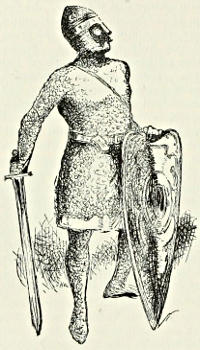
German Crusader of the Early Crusades
The political changes in England cannot
with justice be attributed to the Crusades.
Until the days of Richard I holy wars had
not become a general or a national concern.
The monarchy stood the same at the close
of his reign as at its commencement; and
the only favourable issue of Cœur de Lion’s
armament was an increase of military reputation.
His renunciation of feudal sovereignty
over Scotland had no influence on
politics. Edward I pressed his claim, although
Richard had deprived him of his
strongest support. The pusillanimous John
assumed the cross; but that circumstance
did not occur until after he had surrendered
his crown to the papal see, and until the
barons had formed a confederacy against
him. His assumption of the cross neither
retarded nor accelerated the progress of English
liberty. The pope was not linked to
him by stronger ties than those which had
formerly bound them; and the barons were
not deceived by the religious hypocrisy of
the king. The transmarine expeditions of the earls of Cornwall and Salisbury,
and of Prince Edward in the reign of Henry III, were the ebullitions
of religious and military ardour, but did not affect the general course of
events.
The great political circumstance of the twelfth and thirteenth centuries,
which was important above all others to civil liberty, was the appearance
of free and corporate towns. But the Crusades neither produced their
establishment nor affected their history. After various vicissitudes of
fortune, the battle of Legnano, and the Peace of Constance, established the
independence of the towns in the north of Italy. The Crusades did not
contribute to these events; for the two sacred expeditions which had taken
place were as disastrous to peasants as to princes, and drained Europe of
all ranks of society. Consequently it was not from the holy wars that the
people gained their liberties. We find that so ill regulated was the liberty
of the towns alluded to, that anarchy soon succeeded. Men of personal importance
and wealth aspired to sovereign honours; an overwhelming aristocracy
extinguished freedom, and at the end of the thirteenth century there
were as many princes in Tuscany and Lombardy as there had been free
towns at the end of the twelfth.
It is only in the maritime cities of Italy that any indisputable influence
of the Crusades can be marked. Trade with the Christian states in Palestine,
and the furnishing of transports to the pilgrims, increased the wealth
of the commercial cities. The capture of Constantinople by the French
and Venetians was important in its issues. Venice regained maritime
ascendency; but it was soon taken from her by the Genoese, who aided
the Greeks to recover their capital. Genoa then became a leading power
in the Mediterranean, and she subdued Pisa. The rapid increase of the
wealth and power of Venice and Genoa, and the eventual destruction of Pisa
seem, then, to form the principal circumstances in commercial history which
the Crusades were instrumental in producing. But how insignificant were
these events, both locally and generally, both in their relation to Italy and
to the general history of Europe, when compared with the discovery of a
maritime passage to India!
A view of the heroic ages of Christianity, in regard to their grand and
general results, is a useful and important, though a melancholy employment.
The Crusades retarded the march of civilisation, thickened the
clouds of ignorance and superstition; and encouraged intolerance, cruelty,
and fierceness. Religion lost its mildness and charity; and war its mitigating
qualities of honour and courtesy. Such were the bitter fruits of the
holy wars!c
INFLUENCE UPON COMMERCE
Trade with the East, at that time, embraced many more articles of commerce
than at the present day. Sugar and several other commodities sought
for as luxuries or used as medicine, which now come entirely from the new
world, were brought from Egypt or the Indies. Europeans looked to Asia for
precious gems, especially emeralds, whose worth equalled that of diamonds,
until the discovery of the rich mines in the mountains of America. Pearls
were then to be found only on the shores of oriental seas. The Crusades gave
the peoples of Europe a taste for delicacies and Asiatic ornaments, which
several of them had never before known. Vanity and enervation made
precious stones, silks, perfumes, and all the products less useful than pleasant
which nature has sown in profusion throughout the Orient, necessary to them.
Accustomed by their intercourse with the Orientals to the burning
savour of spices, soon they were not able to get along without them. They
could not prepare famous dishes without plentiful use of spice; wines even
were perfumed with them. Romancers of the era of the Crusades sang the
praises, on nearly every page, of cinnamon, musk, clove, and ginger. Did
these writers praise some exquisite odour, it was with spices they compared
it. Did their fertile imagination build some superb palace, the magic home
of the most powerful genii, they surrounded it with an odoriferous forest,
planted with spice-bearing trees. Several Italian towns, especially the
republics of Venice, Genoa, and Pisa, got from this, almost entirely, not only
the benefits of a commerce which embraced so many sought-for commodities,
but the other advantages of a sea-trade abandoned to the Franks, by the
Greeks and Arabs.
ENRICHMENT OF CITIES
Venice, who nourished amid her waters an enormous population, seems
through her natural environment to have been peopled only with merchants
and followers of the sea. The Crusades helped the proud city to the
accomplishment of her brilliant destiny, to make the Orient tremble at her
fleets, to enrich the Occident by her industry, and to command respect
through many ages for her military power. Genoa, less happily situated,
and less rich than Venice, was, however, powerful enough to have aroused
the Sea-Republic’s jealousy. Pisa had pushed herself too late into rivalry
with Genoa, and the destruction of her harbour was the work of implacable
Genoese hatred. Florence, never free from the throes of civil discord,
obtained nevertheless great wealth from her commerce, which she generously
consecrated to the culture of the fine arts.
The Crusades, therefore, enriched the great cities in giving the opportunity
to extend their trade, and also to raise to exorbitant prices charges
for their ships. The hardships and dangers which were inseparable from the
overland route made it less and less frequented after the first expeditions.
Crowds of pilgrims made their way to the ports, and several Italian
republics amassed, in the transportation of human freight, a degree of
wealth comparable for that time to that which the merchandise of the
new world had since brought to the most flourishing cities of modern
days.
COLONISATION
The establishment of colonies in the East gave more substantial foundation
to Italy’s prosperity. Several cities, whose own interest was a constant
stimulus, and whose industry grew with success, founded trading colonies
in Egypt, Africa, throughout the kingdom of Jerusalem; at Tyre, where
the Pisans had formed a celebrated commercial group; at Antioch, at Acre,
stronghold of the Christians; at several other places which the Crusades
had opened to them; and as a result the principal cause of the decline of
Venice and other powerful Italian cities was not alone the discovery of the
Cape of Good Hope, but to some extent the conquests which made Selim I
master of Egypt.
Before the days of the holy wars, some of the Italian towns already
possessed trading stations in the Greek Empire, but Constantinople having
fallen into the hands of the Latins, the active spirit of the Italians was no
longer disturbed by the defiant policy of the Eastern emperors. The Genoese
founded the colony of Kaffa, which became very prosperous; the Venetians
and Pisans multiplied their warehouses in many places. The subjects
of the doge, always mindful of their commerce, demanded the islands of
the archipelago, in dividing with the French the territory wrested from the
Eastern Empire; but at the moment of taking possession of their share they
feared to weaken themselves by occupying territory so remote and widely
separated. In the end, however, they could not bring themselves to let
go a maritime country so well adapted to trade, and the senate invited by
proclamation the rich citizens to take possession of these isles, promising to
give in fief those they succeeded in making subject to themselves. Thus it
happened that the descendants of the Greeks once so jealous of their political
independence saw, so to speak, their freedom at the auction block in the
public squares of Venice.
And thus it was that the Crusades ruined the Greeks and the Arabs, and
that traffic between the East and the West had to pass almost exclusively
through the hands of the Italians, then called Lombards, active, sharp
merchants and pitiless usurers, who have left their names as a monument to
their thrift, upon the commercial streets of many a great town; those
localities where the money lender, furnishing more often a passing aid to
extravagance than real assistance to misery, exhibits his insatiable greed.
They tried, in the twelfth century, to create merchant tribunals in several
towns, to decide commercial disputes and make treaties with strangers—the
first separation of commercial jurisprudence from common law. We
shall be forgiven doubtless for not entering into any minute description of
the Italian commercial establishments in Greece and Asia; it has been
sufficient to note the turn given by the Crusades to trade in general.
The flourishing condition to which Venice, Genoa, and Pisa in the south
of Europe were raised by trade with the East was almost equalled in the
north by that of the Hanseatic towns. Necessary commodities for use at
sea, all the products of colder climes, offered to the Teutonic Hansa large
and assured profits. As the Lombards brought into parts of Germany where
money was scarce the products of the south and east, there sprang up an
exchange of merchandise for merchandise. The Hanseatic League apparently
came into existence about the beginning of the thirteenth century, and it is
not hard to believe that the commercial activity stimulated by the Crusades
favoured the formation of the powerful federation which breathed nothing
but the love of gain, and which bartered for all the wealth of the south
with all the product of the north.
In infusing into trade a new activity, the Crusades necessarily perfected
the art of navigation. We may well admit that the sea held less of terror
for one who confronted it to perform a religious duty, and insensibly
this fear-inspiring element became less regarded as the inevitable tomb of all
who confided to it their life or fortune. Moreover vessels ceased to be
guided by blind instinct or the insufficient experience of pilots. The compass,
whose origin it is so difficult to establish (and indeed the instrument
may not have been invented before the time of the First Crusade), was in
general use on the ships that plied the Mediterranean. We must admire
the fortunate but rash industry of the Italians who overcame the caprices
and fury of the waves. These navigators gained experience more and more
in constantly transporting pilgrims, and proved that it was not impossible
to sail the seas in winter. Venice surpassed the whole world in the brilliance
of her maritime glory. She well deserved that a pope of this period, zealous
to show his gratitude to his defenders, presented the doge, with solemn ceremony,
the wedding ring which was for long ages the unique emblem of the
republic’s naval power.
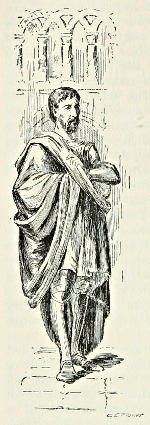
Crusader of the Last Crusade
Other fleets than those of Italy found their way to the Holy Land. One
might see on the Southern Sea vessels carrying those pirates and adventurers
which set out every year in great numbers from the countries in the north,
the Flemings, the Dutch, the Swedes, the Danes often rendered considerable
assistance to the Christians in the East. Norwegians fought under King
Baldwin at the taking of Sidon; the Flemings rescued Lisbon from the
Saracens. These northern people came in high-decked massive ships, while
the vessels in use on the Mediterranean were very light and shallow affairs;
a difference in structure which could not be noticed without a comparison
of advantages and disadvantages.
From the Crusades may be dated the establishment of the French navy.
Philip Augustus, on his return from the Holy Land, organised a national
fleet; before this the French fleets were composed of foreign vessels hired
for a certain time. The title of “admiral,” of which
the name and idea was borrowed from the Greeks
or the Arabs, came into constant use about the time of
the Second Crusade, whereas the rank was never bestowed
in former days except at the commencement
of a war, and went out of use at its close.
Very soon the ocean and the Mediterranean were
covered with vessels manned by prudent and intrepid
sailors. The great overland route from Antwerp to
Genoa, which was expensive, slow, and difficult, was
thenceforth given up.
Naval architecture learned a lesson from several
abuses which the Crusades momentarily had introduced
into the art. Ships of excessive capacity, too weak,
and of faulty proportions had been hastily built in
order to accommodate the crowd of pilgrims. Seamen
who wished their voyages to be more lucrative and
passengers desirous of travelling in companies began
to adopt these ungainly vessels. However, this departure
from the principles of shipbuilding caused the
loss of many fleets and brought about a fortunate innovation
in naval architecture. Experience taught that
a single mast was not sufficient in a vessel of great size,
and we may trace to this period the custom of furnishing
several masts to a single ship—a custom whose
antiquity is well proven, but whose origin is somewhat
shadowed in doubt.
An increase in the number of sails must of necessity
follow the adoption of more than one mast; ships were
no longer stopped in their course for lack of a directly
favourable wind,—by trimming the sails with skill the
seaman progressed nearly always towards his destination. The art of sailing
for a certain point with the wind nearly dead ahead must certainly be counted
as one of the most ingenious and important discoveries ever made.
INFLUENCE ON INDUSTRY
The same causes which gave a new activity to commerce served to
develop powerfully every resource of industry. At the time of the first
Crusades there were no manufactories of silken stuffs but those of the
Greeks, a species of industry they had taken from the Persians, but which
they themselves were soon forced to give over to Sicily. Then artisans leaving
the island taught the Italians the art of making silk. The industry
occupied principally the members of the religious order of the Humilies, who
invented, it is said, cloth of gold and of silver.
In the cities of the Orient the Saracens, also, had manufactures of goods,
and from them the crusaders bought textile fabrics of camels’ hair. These
industries and those of the Greeks, whether the latter was transported to
Palermo or remained in the Eastern Empire, were able to serve as models
or as incentive, in Europe, to many establishments where wool was worked.
There were some famous glass manufactories at Tyre. The sand which
covers the environs of that town has the property of giving a high degree
of transparence to the vitrified matter from which beautiful shapes were
fashioned. These productions excited probably the emulation of Venice
who drew great profit from her glassware, particularly in the fifteenth century
when the use of metal vessels was abandoned for that of glass. Here
are some particulars about inventions, the only ones we have been able to
gather. Mills, whose motive power is wind, were invented in Asia Minor
where running water is very scarce. It has been supposed that the crusaders
introduced them into Europe in the twelfth century—a conjecture
which would seem to be confirmed by the application of parts of windmills
on a great number of old armorial bearings, but which certain other evidence
does not permit us to adopt. Several writers have also presumed
that the crusaders spread a knowledge of the invention of paper, which they
had derived from the Greeks, throughout Europe.
The Arabs excelled at metal working and they knew how to chase and
encrust it. They invented the art of “damascening,” which gave to steel
the brilliance and splendour of gold and silver. Antiquaries have observed
that since the Crusades the stamping of coins and the imprint of seals seem
less incorrect and some attribute this improvement to lessons learned from
the Arabs. The crusaders, however indignant at the profanation of the
Temple of Jerusalem, could not but admire the ornamentation of precious
metals by which the columns and walls had been artistically treated in honour
of Mohammed. They brought away with them more than five hundred
silver vessels consecrated to the service of the false prophet. The process
of enamelling metals and the use in painting of solid, bright colours may
have been brought to perfection by the sight of these Arabian works of art.
They also brought back from the Orient a quantity of rubies, hyacinths,
emeralds, sapphires, and diamonds, and they found out how to set them in
gold and silver, so as to give an undying charm through the taste of their
mounting and their setting.
THE MASONS ORGANISE
The Crusades contributed indirectly to the progress of art in that they
caused religious orders and devout establishments to be multiplied. The
number of sacred edifices which rose up at that time throughout Europe is
truly prodigious. Nobles and even those who had little piety were ambitious
for the title of “founder of a church.” While they may have wrecked
temples in one place, it was often their pleasure to build them in others.
One extraordinary circumstance greatly favoured this eagerness to erect
edifices devoted to the religious cult. In France, in Italy especially, it had
been common rumour that the world was nearing its end and it was thought
unnecessary, in this event, to repair churches, and even more useless to build
new ones. But when the predicted period arrived and there were no signs
of the final catastrophe, alarm diminished, and ashamed to have been misled
by pusillanimous fear, people were anxious to make amends for the neglect
of altars and sacred places of which they had been guilty. They were not
satisfied to pay their debt to religion by rebuilding unsafe churches, but
those of whose stability there was no question were torn down on the specious
pretext that they were not sufficiently magnificent. To accomplish
their aims a society was formed composed of men of every degree, noble
and humble, who made themselves in their devotion into carpenters and
masons; they offered their services in every direction, hauling carts like
beasts of burden or binding themselves to certain religious devotions. The
cathedral of Chartres is a monument of the labour of these pious workmen.
These strange ideas having been developed towards the end of the eleventh
century, the Crusades found in men’s minds a passion for this sort of construction,
and they added to the general enthusiasm.
GOTHIC ARCHITECTURE
Several monuments of architecture which still excite our admiration are
the fruit of the artistic impulse received from contact with people more
devoted to its culture and from the growing fervour of devotion. The sight
of Greek and Arab monuments introduced into the West a new taste by
which that Syrian, Arab, or Saracen type of architecture, improperly called
Gothic, was brought to its highest degree of perfection. Delicately pointed
ogive arches replaced the low and ugly openings which timid builders were
afraid to raise higher and which presented but narrow outlooks to view.
Architects were judged skilful as they were able to astonish by the boldness
and daring of their own work. As in the mosques, they loaded upon light and
graceful columns enormous masses which seemed upheld by the support of an
invisible arm. They cut stones into a thousand different and often most
fanciful forms, and set into them painted glass whose brilliant colours were
admirably brought out by the rays of the sun. And as if they foresaw the
indifference of posterity to their work, they gave it a solidity which has
enabled it to go for great lengths of time without care and restoration.
At that time appeared the most magnificent offsprings of Gothic architecture.
Then was built the leaning tower of Pisa, which has become a
marvel through the injury of time. A Greek architect built at Venice the
church of St. Mark, strongly impressed with the degenerate taste of the
Greeks. A German conceived the plan of the tower of Strasburg, whose
delicate structure seems unable to hold it so high in the air. Suger did not
disdain to study architecture; he restored his own abbey church and left an
account of his labours. The foundations of Amiens, masterpiece of bold
and delicate construction, were laid. La Sainte Chapelle at Paris, less vast
but equally delicate in style, was the finest work of the favourite architect
whom St. Louis took with him to Asia. We should go on at too great a
length were we to enumerate all the superb edifices built in the glorious age
of Gothic architecture. Barbaric, perhaps, in ornamentation, these artists
have never been equalled in principle, in general design, stone-cutting, in
knowledge of arching, and in the majesty of their edifices as a whole.
SCULPTURE AND PAINTING
Sculpture made these temples alive with a host of statues. It has preserved
for us the images of many famous men, whose portraits, drawn from
nature, we often regret not to know.
Painting was cultivated with greater zeal. Cimabue developed his happy
faculties at Florence according to the teaching of some artists from Constantinople.
He was the first to show what wonders one could expect from an
almost forgotten art, and it is right that he should be placed at the head of
all the painters that have appeared since his time.
From what has been said it is certain that the Crusades helped to infuse
into the West a taste for painting, sculpture, and architecture. The spirit
of conquest has always awakened that of the fine arts. Though artists may
flee from the clash of arms, their souls, inspired by the commotion of great
warlike movements and the general emulation of courage and valour, exhibit
at such time a noble ambition for glory. The aspect of the theatre of desolation
and carnage, swept by the conqueror’s tread, kindles often the sacred
fire, which is extinguished in times of peace and tranquillity, and marvellous
productions, conceived and matured in deep thought, quickly follow the
imperfect and hastily finished sketch. Nations also wish to celebrate, by
public monuments, triumphs watered with their blood and tears. For this
reason painters display on heroes’ heads the wings of victory, are lavish with
palm and crown, and place on every side the emblems of fame. Cities
become filled with superb buildings, and public squares peopled with folk of
bronze and marble who seem to live and breathe.e
HERDER’S OPINION OF THE CRUSADES
It has been customary to ascribe so many beneficial effects to the Crusades,
that, conformably to this opinion, our quarter of the globe must require a similar
fever, to agitate and excite its forces, once in every five or six centuries;
but a closer inspection will show that most of these effects proceeded not from
the Crusades, at least not from them alone; and that among the various
impulses Europe then received, they were at most accelerating shocks, acting
upon the whole in collateral or oblique directions, with which the minds of
Europeans might well have dispensed. Indeed it is a mere phantom of the
brain to frame one prime source of events out of seven distinct expeditions,
undertaken in a period of two centuries, by different nations, and from
various motives, solely because they bore one common name.
Trade the Europeans had already opened with the Arabian states, before
the Crusades: and they were at liberty to have profited by it, and extended
it, in a far more honourable way than by predatory campaigns. By these,
indeed, carriers, bankers, and purveyors were gainers: but all their gain
accrued from the Christians, against whose property they were in fact the
crusaders. What was torn from the Greek Empire was a disgraceful traders’
booty, serving, by extremely enfeebling this empire, to render Constantinople
an easier prey at a future period to the Turkish hordes, who were continually
pressing more closely upon it. The Venetian Lion of St. Mark prepared
the way, by the Fourth Crusade, for the Turks to enter Europe and spread
themselves so widely in it. The Genoese, it is true, assisted one branch of the
Greek emperors to re-ascend the throne: but it was the throne of a weakened,
broken empire, which fell an easy prey to the Turks; then both the
Venetians and Genoese lost their best possessions, and finally almost all their
trade, in the Mediterranean and Euxine seas.
Chivalry arose not from the Crusades, but the Crusades from chivalry:
the flower of French and Norman knighthood appeared in Palestine in the
first campaign. The Crusades, indeed, contributed rather to rob chivalry
of its proper honours, and to convert real armed knights into mere armorial
ones. For in Palestine many assumed the crested helmet, which in Europe
they durst not have borne: they brought home with them armorial devices
and nobility, which they transmitted to their families, and thus introduced
a new class, the nobility of the herald’s office, and in time also nobility by
letters patent. As the number of the ancient dynasties, the true equestrian
nobility, lessened, these new men sought to obtain possessions and hereditary
prerogatives, like them: they carefully enumerated their ancestors, acquired
dignities and privileges, and in a few generations assumed the title of ancient
nobility; though they had not the slightest pretensions to rank with those
dynasties which were princes to them. Every man that bore arms in Palestine
might become a knight: the first Crusades were years of general jubilee
for Europe. These new nobles in right of military service were soon of great
use to growing monarchy, which cunningly knew how to avail itself of them
against such of the superior vassals as still remained. Thus passion balances
passion, and one appearance counteracts another: and at length the nobility
of the camp and the court totally obliterated the ancient chivalry.
The arts and sciences, too, were nowise promoted by the proper crusaders.
The disorderly troops that first flocked to Palestine had not the least notion
of them; and were not likely to acquire them in the suburbs of Constantinople,
or from the Turks and mamelukes in Asia. In the succeeding campaigns
we need not reflect on the short time the armies passed there, and
the wretched circumstances under which this time was often spent merely
on the confines of the country, to dissipate the splendid dream of great discoveries
imported thence. The pendulum clock, which the emperor Frederick
II received as a present from Kamil, did not introduce gnomonics into
Europe; the Grecian palaces, which the crusaders admired in Constantinople,
did not improve the style of European architecture. Some crusaders, particularly
Frederick I and II, laboured to promote the progress of knowledge: but
Frederick I did this ere he beheld Asia; and the short visit paid that country
by Frederick II served only as a fresh stimulus to urge him forward in that
course of government which he had long before chosen. Not one of the
spiritual orders of knighthood introduced any new knowledge into Europe,
or contributed to its cultivation.
All that can be said in favour of the Crusades, therefore, is confined to
a few occasions, on which they co-operated with causes already existing, and
involuntarily promoted them.
(1) As multitudes of wealthy vassals and knights repaired to the Holy
Land in the first campaigns, and many of them never returned, their estates
were of course sold or swallowed up by others. By this they profited who
could, the liege lord, the church, the cities already established, each after his
own manner: this promoted and accelerated the course of things, tending to
confirm the regal power by the erection of a middle class, but was by no means
its commencement.
(2) Men became acquainted with countries, people, religions, and constitutions
of which they were before ignorant; their narrow sphere of vision was
enlarged; they acquired new ideas, new impulses. Attention was drawn to
things which would otherwise have been neglected; what had long existed
in Europe was employed to better purpose; and as the world was found to
be wider than had been supposed, curiosity was excited after a knowledge
of its remotest parts. The mighty conquests made by Jenghiz Khan in the
north and east of Asia attracted men’s eyes chiefly towards Tatary; whither
Marco Polo the Venetian, Rubruquis (Guillaume de Rubrouck), the
Frenchman, and John de Plano Carpino (Giovanni Piano Carpini), an
Italian, travelled with very different views: the first, for the purpose of
trade; the second, to satisfy royal curiosity; the third, sent by the pope,
to make converts of the people. These travels, of course, have no connection
with the Crusades, before and after which they were undertaken.
The Levant itself is less known to us from these expeditions, than might
have been expected: the accounts the Orientals give of it, even in the period
when Syria swarmed with Christians, are still indispensable to us.
(3) Finally, in this holy theatre Europeans became better acquainted
with one another, though not in a manner much to be prized. With this more
intimate acquaintance kings and princes for the most part brought home an
implacable enmity: in particular the wars between England and France
derived from them fresh fuel. The unfortunate experiment, that a Christian
republic could and might contend in unison against infidels, formed a precedent
for similar wars in Europe, which have since extended to other quarters
of the globe. At the same time it cannot be denied that, while the neighbouring
powers of Europe obtained a closer inspection of their mutual weaknesses
and strength, some obscure hints were given for a more comprehensive
policy, and a new system of relationship in peace and war. Everyone was
desirous of wealth, trade, conveniences, and luxuries; as an uncultivated
mind is prone to admire these in strangers, and envy them in the hands of
another. Few, who returned from the East, could be satisfied with European
manners; even their heroism left much behind, awkwardly imitated Asia in
the West, or longed for fresh travels and adventures. For the actual and
permanent good produced by any event is always proportionate to its
consonancy with reason.
Unfortunate would it have been for Europe if, at the time its military
swarms were contending for the Holy Sepulchre in a corner of Syria, the
arms of Jenghiz Khan had been sooner and more powerfully turned toward
the West. Then probably our quarter of the globe would have been the
prey of the Mongols, like Poland and Russia; and its nations might have
dislodged, with the pilgrim’s staff in their hands, to tell their beads round
the object of their contention.b
GIBBON ON THE RESULTS OF THE CRUSADES
As soon as the arms of the Franks were withdrawn, the impression, though
not the memory, was erased in the Mohammedan realms of Egypt and Syria.
The faithful disciples of the prophet were never tempted by a profane desire
to study the laws or language of the idolaters; nor did the simplicity of
their primitive manners receive the slightest alteration from their intercourse
in peace and war with the unknown strangers of the West. The Greeks,
who thought themselves proud, but who were only vain, showed a disposition
somewhat less inflexible. In the efforts for the recovery of their empire,
they emulated the valour, discipline, and tactics of their antagonists. The
modern literature of the West they might justly despise; but its free spirit
would instruct them in the rights of man; and some institutions of public and
private life were adopted from the French. The correspondence of Constantinople
and Italy diffused the knowledge of the Latin tongue; and several of
the fathers and classics were at length honoured with a Greek version. But
the national and religious prejudices of the Orientals were inflamed by persecution;
and the reign of the Latins confirmed the separation of the two churches.
If we compare, at the era of the Crusades, the Latins of Europe with the
Greeks and Arabians, their respective degrees of knowledge, industry, and
art, our rude ancestors must be content with the third rank in the scale of
nations. Their successive improvement and present superiority may be
ascribed to a peculiar energy of character, to an active and imitative spirit,
unknown to their more polished rivals, who at that time were in a stationary
or retrograde state. With such a disposition, the Latins should have derived
the most early and essential benefits from a series of events which opened to
their eyes the prospect of the world, and introduced them to a long and frequent
intercourse with the more cultivated regions of the East. Yet in a
reign of sixty years the Latins of Constantinople disdained the speech and
learning of their subjects; and the manuscripts were the only treasures which
the natives might enjoy without rapine or envy. Aristotle was indeed the
oracle of the Western universities, but it was a barbarous Aristotle; and, instead
of ascending to the fountain head, his Latin votaries humbly accepted
a corrupt and remote version from the Jews and Moors of Andalusia.
The principle of the Crusades was a savage fanaticism; and the most
important effects were analogous to the cause. Each pilgrim was ambitious
to return with his sacred spoils, the relics of Greece and Palestine; and each
relic was preceded and followed by a train of miracles and visions. The
belief of the Catholics was corrupted by new legends, their practice by new
superstitions; and the establishment of the Inquisition, the mendicant orders
of monks and friars, the last abuse of indulgences, and the final progress of
idolatry flowed from the baleful fountain of the holy war. The active
spirit of the Latins preyed on the vitals of their reason and religion; and if
the ninth and tenth centuries were the times of darkness, the thirteenth and
fourteenth were the age of absurdity and fable.
The lives and labours of millions, which were buried in the East, would
have been more profitably employed in the improvement of their native country;
the accumulated stock of industry and wealth would have overflowed
in navigation and trade; and the Latins would have been enriched and
enlightened by a pure and friendly correspondence with the climates of the
East.
In one respect we can indeed perceive the accidental operation of the
Crusades, not so much in producing a benefit as in removing an evil. The
larger portion of the inhabitants of Europe was chained to the soil, without
freedom, or property, or knowledge; and the two orders of ecclesiastics and
nobles, whose numbers were comparatively small, alone deserved the name of
citizens and men. Among the cause that undermined that Gothic edifice,
a conspicuous place must be allowed to the Crusades. The estates of the
barons were dissipated, and their race was often extinguished, in these costly
and perilous expeditions. Their poverty extorted from their pride those
charters of freedom which unlocked the fetters of the slave, secured the farm
of the peasant and the shop of the artificer, and gradually restored a substance
and a soul to the most numerous and useful part of the community. The
conflagration, which destroyed the tall and barren trees of the forest, gave air
and scope to the vegetation of the smaller and nutritive plants of the soil.d
FOOTNOTES
[800-1450 A.D.]
To the average mind the term Middle Ages is a synonym for chaos.
And, compared with the periods before and after, it is indeed chaos. But,
in a sense, all human history is “without form,” even if not “void,” and the
comparative simplicity which we see in certain periods is arrived at chiefly
by a process of the cancellation of numberless confusing details and the concentration
of the attention on certain large and picturesque personages or
movements which were actually far from holding such stark and eminent
importance in the eyes of contemporaries.
Thus in the case of Alexander’s conquest of that little segment of space
which he called “the world,” to the contemporary Athenian, Alexander was
almost a myth lost in the wilderness of the East as in a fog. The Athenian
found his immediate troubles and triumphs in his own family, in his shop,
in his deme. To myriads of other peoples, however, Alexander’s very existence
was unknown; and splendid intrigues, superb politics, lofty feats of
statecraft and of warfare were taking place far from the orbit of Alexander.
These deeds were never chronicled, or the chronicles are lost, or perhaps
only waiting discovery. Consequently we are ignorant of these confusing
histories, and sum up in the exclusive phrase “Alexandrian epoch” a vast
web of what were chaos, did we but know more of it.
But still, taking history as we have it, the Middle Ages torment and
bewilder us with the variety and seeming unimportance of their events.
They are called the Dark Ages, though, upon a closer look, they deserve the
name no more than the Night herself with all her revelation of the stars
which the Day absorbs in the one central splendour of the sun.
Let the name of Dark Ages stand, however, though it must not be forgotten
that human history at least dreamed and walked in this apparent
sleep. There is no lack of chronicle and no lack of action. Nor, in spite of
the common idea, was there lack of progress. The barbarians had come
down in avalanches of stolid clay upon the gardens of civilisation. During
the seeming idleness the seeds were at work and ideals were busily thrusting
upward till of a sudden they burst forth in that springtime known as the
Renaissance.
The history of each major country is given, in this work, its own
chronicle, but for the better comprehension of the forces that were making
possible the Renaissance and driving mankind to cry aloud for a betterment
of conditions, it will be useful to set apart for brief consideration certain
special phases and forces of Middle Age life. It will make it the easier to
comprehend that life was by no means without the ferment of progress
during that period which we so arbitrarily cleave out of history and put
aside as the Middle Age.
Throughout the various histories of modern nations will be found a
discussion of the multiform phases of feudalism. It is desirable, however,
to give it some isolated discussion, though necessarily brief. A guide might
be found in the words of Bryce, whose definition of feudalism also makes a
good beginning; and in the words of the philosopher Hegel:a
BRYCE AND HEGEL ON FEUDALISM
“This is not the place for tracing the origin of feudality on Roman soil,
nor for showing how, by a sort of contagion, it spread into Germany, how it
struck firm root in the period of comparative quiet under Pepin and Charles,
how from the hands of the latter it took the impress which determined its
ultimate form, how the weakness of his successors allowed it to triumph
everywhere. Still less would it be possible here to examine its social and
moral influence. Politically it might be defined as the system which made
the owner of a piece of land, whether large or small, the sovereign of those
who dwelt thereon; an annexation of personal to territorial authority more
familiar to eastern despotism than to the free races of primitive Europe. On
this principle were founded, and by it are explained, feudal law and justice,
feudal finance, feudal legislation, each tenant holding towards his lord the
position which his own tenants held towards himself. And it is just because
the relation was so uniform, the principle so comprehensive, the ruling class
so firmly bound to its support, that feudalism has been able to lay upon
society that grasp which the struggles of more than twenty generations
have scarcely shaken off.”b
The three steps by which feudalism was reached are thus broadly summed
up by Hegel:
“While the first period of the German world ends brilliantly with a
mighty empire, the second is commenced by the reaction resulting from the
antithesis occasioned by that infinite falsehood which rules the destinies of
the Middle Ages and constitutes their life and spirit. This reaction is, first,
that of the particular nationalities against the universal sovereignty of the
Frankish Empire, manifesting itself in the splitting up of that great empire.
The second reaction is that of individuals against legal authority and the
executive power—against subordination, and the military and judicial
arrangements of the constitution. This produced the isolation and therefore
defencelessness of individuals. The universality of the power of the state
disappeared through this reaction; individuals sought protection with the
powerful, and the latter became oppressors. Thus was gradually introduced
a condition of universal independence, and this protecting relation was then
systematised into the feudal system.”c
COMMENCEMENT OF THE FEUDAL RÉGIME
The true heirs of Charlemagne were not the kings of France, nor those
of Germany and Italy, at first, but rather the feudal lords. Not only had
the empire been dismembered after the deposition of Charles the Fat, but its
composing kingdoms and even its great fiefs as well. Dukes and counts
had been quite as powerless as kings against the Northmen, Saxons, and
Hungarians, and quite as unable to maintain the vast domains under their
control. Populations whose leaders did not know how to bring them
together for concerted action had acquired, little by little, the habit of
depending upon themselves alone.
After having fled for a long time at the approach of the heathen to the
woods among the wild beasts, some stout-hearted people had turned their
heads and refused to abandon all their possessions without an attempt at
defence. Here and there in mountain gorges, at river fords, on the hill
overlooking the plain, entrenchments and walls were raised where the brave
and the strong held out. An edict of 853 directed the counts and vassals of
the king to repair their old castles and to build new ones. The country was
soon covered with fortresses against which invaders flung themselves in vain.
A few reverses quickly taught these bold adventurers prudence. They no
longer dared to venture so far, to where these strongholds had sprung up
from the ground on all sides, and the new invasion meeting with fresh
obstacles and difficulties came to an end in the following century. It was
not until afterwards that the masters of these castles became the terror of
the countryside they had once helped to save.
A Feudal Castle
Feudalism, so oppressive in its age of decline, had therefore its time of
lawful and just existence. All power is raised up by its virtues and falls by
its abuse.
But what was the new régime? We have seen the matter of acquiring
and holding property become more uniform among barbarian nations, by the
settlement of heredity upon lands ceded by the king, and the law’s sanction
given to another kind of usurpation—the heredity of the royal offices.
It was generally the owners of freehold property or of royal lands who
became the holders of these offices, which brought about the union of
sovereignty and proprietorship in the same hands. This is essentially what
constitutes feudalism.
In the absolute monarchy of the Roman Empire public offices in all
degrees of the hierarchy were bestowed directly by the ruler, and their
disposition remained always in his power, so that he could take them back
when and under what condition he pleased. Furthermore the public official
held neither the land of the province he governed nor the control of any
particular piece of property that he might happen to own as a private citizen.
He was bound therefore, as landlord, by the civil law applicable to the whole
empire, and as governor, to the voluntary will of his sovereign. In the
feudal régime it was exactly the opposite. The lord who enfeoffed, that is,
conceded by title of sub-fief some portion of his own fief, gave up entirely
to the grantee or vassal the property and its control, and it could not be
taken back unless the vassal failed to perform some part of the agreement
made at the time of receiving the investiture.
One lord might obtain land from another and thus become his vassal.
The former had to go to the latter, and between the two there took place
the ceremony known as homage. Kneeling before his future lord, with
their hands together, the future vassal proclaimed loudly that he would be
the other’s homme, or man, that is to say, that he would be attached and
devoted to him, defend him with his own life, somewhat as the ancient
leudes of Germany did towards their warrior chiefs. After this profession,
which is homage in the original sense of the word, he took an oath of fidelity
or faith to the lord, promising to fulfil the new duties required of him under
the new title of homme of the lord. When he had contracted this double
tie, the lord no longer feared to confide his land to a man so strongly bound
to him, and gave it to him by investiture or seizin, accompanied with
symbolic emblems—a sod of grass, a stone, or some other object according
to the custom of the fief. “It is the custom,” says Otto von Freising,e “to
deliver up kingdoms by the sword, and provinces by the standard.” This
three-part ceremony of homage once completed, the reciprocal obligations
began.
RECIPROCAL OBLIGATIONS OF VASSAL AND LORD
There were in the first place the moral obligations of the vassal towards
his lord, such as keeping his secrets, revealing the machinations of his enemies,
to give one’s horse to him in battle if he be unseated, to take his
place in captivity, to respect and to cause his honour to be respected, to assist
him with good counsel, etc. The material obligations, the services due from
the vassal, were of several kinds.
(1) Military service. This was the very basis of the feudal relation and
the principle of that state of society which does not contain permanent
and organised armies. The vassal on the requisition of his lord was bound
to follow him, either alone, or to bring such and such a number of men
according to the importance of his fief. The duration of this service also was
dependent on the same thing—it might be sixty, forty, or only twenty
days—a system which did not permit of distant expeditions and could be
employed only in neighbourhood or private wars. There were some fiefs
where military service held only within the feudal domain, or could be called
on only for purposes of defence.
(2) The “fiance,” or obligation to serve the lord in his court of justice.
As under the feudal régime the lord replaced the states general, and was
invested with the functions of public power, it was necessary in order to
exercise these to hold at his command the forces disseminated through the
hands of his vassals. War was one of these functions; justice was another.
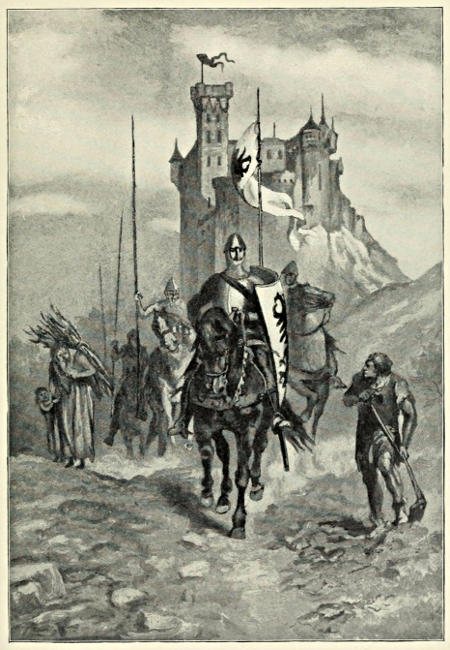
KNIGHTS AND PEASANTS
The lord summonsed his men to court, and they had to attend, either to
serve him with their advice or to take part in the judging of disputes
brought before him, and they thus bound themselves to assistance in carrying
out the judgments their own mouths had proclaimed.
(3) The “aids,” some legal and compulsory, others courteous and voluntary.
Legal aids were usually demanded under three conditions—when
the lord was a prisoner and required to pay a ransom, when he knighted
his eldest son, and when he gave his eldest daughter in marriage. This aid
took the place of the public imposts of ancient and modern legislatures, but
as may be seen was of a totally different character. It was not, in fact,
periodic or exacted in a regular manner for public needs; it had the appearance
of a voluntary gift under certain peculiar circumstances. An annual
tax would have seemed an affront to the vassals.
To these services must be added certain feudal rights by which the lord,
in virtue of his sovereignty, intervened in any important change the ceded
fief might undergo. Some of these were for him a new source of revenue.
These rights were the relief, a sum of money due from every major individual
who entered into possession of a fief by right of succession, and more
particularly if that succession did not take place in line of direct descent;
the right to the alienation tax, which he who sold or alienated his fief in any
fashion must pay; the right of disinheritance and confiscation by which
the fief reverted to the lord when the vassal died without heirs or when he
had forfeited his fief or deserved for any reason to be deprived of it; the
right of guardianship, by virtue of which the lord, during the minority of
his vassal, undertook his tutelage and the administration of his fief, and
enjoyed its revenue; the marriage right, that is to say, the right of the overlord
to provide a husband for the heiress of a fief, and oblige her to choose
from the suitors he presents.
The vassal who fulfilled his obligations fully and conscientiously was as
nearly as possible master of his own fief. He could in turn enfeoff the whole
or part of his domain, and become in turn the sovereign lord of vassals of a
lower rank, or vavasseurs, holding towards him the same obligations as he to
his own lord. Such was the fabric of the hierarchy.
If the vassal had his obligations, the lord also had his. He could not take
back a fief arbitrarily or without a legitimate reason from his vassal. He
must protect him if he were attacked, see that he received justice, etc.
Let us note that the feudal system in developing itself made a fief of
everything. Every concession—for hunting in the forests, for ferrying
across rivers, for acting as guides on the roads, for escorting merchants, for
running communal ovens in the towns—every useful employment, in fact,
conceded in return for fidelity and homage, became a fief.
Lords multiplied concessions of this kind in order to multiply the number
of men owing them military service. But the fief itself, to which the
rights of justice were attached, remained in general undivided and was
handed down according to the laws of primogeniture.
FEUDAL JUSTICE
The obligation of the vassals to attend the courts of their lord has made
it clear that the principle of feudal justice was trial by one’s peers, a principle
which was entirely in the customs and even the institutions of the Germanic
peoples, where freedmen were tried by an assembly of freedmen.
They called peers (pares, equals), vassals of the same lord settled around
him on his domain, and holding fiefs of the same rank. The king himself
had his peers who were those holding their estates directly from him, not
only as feudal lord but as king. Each had the right to be judged by his
peers before his lord. If the peers refused him justice or the vassal believed
that it had been unfairly rendered, he made a complaint “in default of
right,” and brought the matter to the attention of his lord’s suzerain. It
was to this higher tribunal that it was necessary always to bring disputes
which arose between a lord and his vassal.
But this right of appeal did not entirely satisfy the spirit of independence
which animated this warlike society. The lords preserved with jealous
care another right of appeal—that which is addressed to the power of
arms; they preferred to obtain justice for themselves rather than receive it
from the hands of others. So thoroughly was the custom enrooted in their
manners that the king regulated the formalities which preceded this species
of warfare and had for their object the warning of the party to be attacked
and the giving of an opportunity to place himself in a state of defence.
After all, our international wars proceed from the same principle and are no
better. The lords waged their wars with their little armies as we with our
greater ones. Only hostilities had a more individual character since the
states were much smaller.i
Besides the Fehde or right of private warfare—an old Germanic custom—there
was the “trial by combat,” which must not be confused with
it. The true “judicial combat,” in which champions fight for a cause, or
for the settlement of a quarrel, is a product of the Middle Ages, when
faith in God was as strong as faith in the strength of the human arm. This
custom became so universal a method of settlement of difficult questions
that it was even used by Alfonso, the great Spanish lawgiver, to decide upon
the introduction of new laws concerning inheritance. This much at least
may be said in favour of it, that it was less of an evil than the torture which
tended to supplant it in judicial proceedings in the later Middle Ages.a
Justice was not the prerogative of all the lords to the same extent. It
was distinguished in France by three degrees, high, low, and middle justice.
The first alone gave the right of life and death. In general it may be said
it was the largest and most important fiefs that had powers of justice to the
greatest extent. Still it was possible for a simple vavasseur to possess the
functions of “high justice,” and in some places the lord who could dispense
but “low justice” could punish with death the robber caught at his crime.
Within these variable limits the lord alone dispensed justice on his fief, and
when, later on, royalty usurped the right, there was a revolution.
To complete the enumeration of rights inherent in the sovereignty of the
lords it is necessary to mention two: first, that of recognising throughout the
whole extent of the fief no higher legislative power. We find in the last collection
of laws made in the ninth century by Charles the Simple the final manifestation
of law-bearing public power. After that, there were no laws, civil
or political, to be applied generally, but only local customs, isolated, independent,
and differing one from the other, in fact possessing a territorial character
in distinction from those of the barbaric nations, which were entirely personal.
Second, the right to coin money, which was always a sign of lordship.
Before Charlemagne it seems that some private individuals, who doubtless
possessed the privilege, coined money. After him this was one of the prerogatives
of the lords, and at the advent of Hugh Capet there were no less
than 150 who exercised this right.
Every political régime may be characterised by the place where the exercise
of power is bestowed. Ancient republics had their agora and fora.
The great monarchy of Louis XIV had its palace of Versailles. The feudal
lords had their castles. They were, as a usual thing, enormous edifices,
situated on high places, massive, round, or square, without architecture or
ornamentation, the walls pierced by a few loopholes for the discharge of
arrows. There was a single entrance giving on a great moat which could
only be passed by a drawbridge. The castle was crowned with parapets
and battlements, from which rocks, molten pitch, and lead could be thrown
down on the heads of too venturesome assailants at the foot of the walls.
To-day the gaping gray masses are but nests for crows, crumbled and eaten
away by time. Seen from afar they quite eclipse the small and light habitation
of modern days—these monuments at once of legitimate defence and
oppression. But they could have been nothing less than they were to provide
shelter from the northern incursions and the feudal wars. Everyone sought
refuge in them. Those who had not the right to live within the castle, who
were neither lords nor warriors, settled around its great walls, under their
powerful protection. This was the nucleus of many towns.
ECCLESIASTICAL FEUDALISM
Even the clergy had their place in this system. The bishop, formerly
“defender of the city,” had often become its count, by traditional usurpation
or by express royal concession when the king had united the county
and the bishopric, the temporal and the spiritual authority. This made
the bishop sovereign of all the lords of his diocese.
Besides her tithes the church possessed, through the donation of the
faithful, immense wealth, and in order to protect this from the brigandage
of the times she had recourse to secular arms. She chose laymen, men of
courage and wisdom, to whom she confided her property that they might
defend it, if necessary at the point of the sword. But these attorneys of the
monasteries and churches did as the counts of the king—made their functions
hereditary, and took for themselves the wealth entrusted to their care.
They condescended, however, to regard themselves as the vassals of those
whom they had despoiled, and to swear faith and homage under ordinary
conditions of natural right and personal service.
Abbés and bishops in consequence became suzerains, temporal lords
having numerous vassals ready to take up arms for their cause, courts of
justice—in fact all the prerogatives exercised by the great landlords.
There were bishops, dukes, and bishop-counts, vassals themselves of greater
lords and especially of the king, from whom they received the investiture
of the property attached to their churches, or, as it was called, their temporal
domain.
This ecclesiastical feudalism was so extensive, so powerful, that in France
and England it possessed during the Middle Ages more than a fifth of all the
land; in Germany nearly a third. For there was this difference between
the church and king, that the latter, a conquest once made, received nothing
more, but on the contrary constantly gave away until it came to pass that he
possessed nothing but the town of Laon; while the church, if she did lose
some of her land (a difficult thing since she had excommunication to defend
it with), was acquiring more every day, since few of the faithful died without
leaving her something. And so it was that she constantly got more and
never or very rarely gave anything up, and then only when it was wrested
from her by force.i
The manner in which the church often lost her property in feudal times
is described by Carl Spannagel:
THE CHURCH AND THE FEUDAL ARMY
The bishops and abbots as land proprietors went into the battle-field at
the head of their contingents. They often wore armour under their priestly
garments, and they did not shrink from actual fighting in action. The care
for souls (if such an expression can be used with regard to a priestly dignitary
of the Middle Ages) which even in peace made but a slight demand
upon them, must have nearly vanished under such circumstances in the
field. The account of Bishop Daniel of Prague attending to the wounded
and administering them spiritual comfort has a modern foreign tone about
it. Only special royal permission could exempt the bishops and their
respective abbots from appearing at the head of their men.
But the king did not make such frequent demands upon the participation
of the spiritual dignitaries in campaigns as we are inclined to think. This
idea arose from the command of Otto II in 981, which demanded the personal
command of their contingents of seven bishops and the seven abbots, whilst
twelve bishops and three abbots are told only to send their loricati to the
emperor. Substitutes for the bishops and abbots in this case would be
priests or vassals of rank of their diocese, or abbotship.
It is worthy of note that the immunity, the purport of which had so increased
in extent since the Carlovingian time, exercised no influence on the
military obligations of the churches to which it was addressed. In most of the
immunity documents military duty is not touched upon, so it was considered
something quite independent. In some it is expressly mentioned that no
index publicus should exercise the arrière-ban over the particular cloister, but
this made no change in the obligation of the abbots themselves. On the
contrary, in a privilege of Otto I for the bishopric of Worms, the sentence
from a document of Louis the Pious is retained which commands that the
military followers of the men of the church are only to be called upon in the
interest of the kingdom. The transfer of their service to the princes was of
greater import to the military obligations of the church than the immunity.
Such transfers, however, only refer to monasteries and not also to bishoprics.
There were two different kinds of exemption—either the king gives
the cloister in question to a lord of his kingdom as a favour or as his property,
so that (forever or for a time) it ceases to be a royal cloister, or he
takes away a part of its landed property and makes it over to lay princes
who thenceforward undertake the military duties hitherto pertaining to the
cloister. By this means the cloister remains royal, only it is exempt from
military obligations. A third possibility was added to these two. Very
often the great lords did not wait for the king’s initiative to enrich themselves
with church property, but they seized it on their own account and
obtained possession of the longed-for cloister by any means.
With such measures by force there was certainly no legal adoption of the
obligation which the cloister owed the kingdom. But there is no doubt that
the property thus gained was taken into account in the valuation of the service
due to the kingdom by the new owner. The documental protection
of the king generally proved most inefficient against such seizures. In more
ancient times, particularly under the later Carlovingians, we find taxations
of abbotships. The cases became rarer later on without quite disappearing.
The kingdom evidently did not depend upon increasing the power of
the princes which was continually developing by such means, so that the
seizures of the princes increased with the feudal system.d
SERFS AND VILLEINS
In the eleventh century, Carlovingian Europe was divided into a multitude
of fiefs which formed each its own state, having its own life, laws, customs,
and its almost perfectly independent lay or ecclesiastical chief.
We have described the community of the lords, but they were not the
only feudal community. That was the fighting and war-making community,
the community that ruled, judged, punished, and oppressed. Below this
was the community that worked, by which the other lived, got its clothes,
its arms, its castles, and its bread—the community of serfs, or rather craftsmen
(gens potestatis). We must not now look for free men, for they have
disappeared. Some have raised themselves and become the fortunate lords;
others have been pushed back into the lower regions of society and have
become serfs and villeins. That class of simple freemen which had been
nearly swept away in the invasion of the Roman Empire had been engulfed
a second time. There were no longer any freehold owners, or so few that
their mention is not worth while.
But the villeins were a numerous lot. The chief, the noble, had not only
vassals but subjects residing on that portion of his estate that he never
enfeoffed. And these were the serfs, properly called, men of the soil who were
entirely at their lord’s disposal. “The lord,” says Beaumanoir,f “can take
from them all that they have, put them in prison, rightly or wrongly, and as
often as he pleases, and has no account to give of them except to God.”
In spite of this the condition of the serf was better than that of the slave
of ancient times. The progress which slavery had made at the fall of the
Roman Empire was not entirely lost in the wreckage of invasion, but appeared
again in feudal society. The freeman of antiquity had been harder towards
his slave than was the barbarian in whom the leaven of Christianity had produced
some effect. The serf was recognised as a man having a family, sharing
the common ancestry of his lord, and made in the image of God. Serfs
finally entered the church, and sometimes mounted higher than the most
powerful lords.
Above the serfs were the inalienables (mainmortables), “more kindly
treated,” continues the old jurist of Beauvais,f “since the lord, if they did
no wrong, could ask nothing of them except their dues and rents and the
debts which they were accustomed to pay for their servitude.” But the inalienable
could not marry without the consent of his lord, and if he took a
free wife, or one outside the seigneury, there was a fine at the pleasure of the
lord. This was the right of “formarriage” (a tax for marriage out of rank
or condition), and the issue of such a marriage was divided between the
lords of the husband and of the wife. If there was but one child, it went
to the lord of the mother. At an inalienable’s death all his property went to
his lord. For these people there was no way of escape from the hand that
bent them to the furrow. Wherever they went the right of succession was
attached to their persons and their purse. The lord inherited on every hand
from his serfs.
In a higher degree still were to be found the free tenants known as villeins,
peasants, or commoners. Their condition was less precarious. They had
preserved the freedom the serf did not possess, and had hung on to it at the
sacrifice of an annual tax, a statute duty, and the rent of the land which
the landlord had ceded them and which they could transmit with all their
other property to their children. But while the beneficiary holdings or fiefs
were under the protection of a public and well-defined law, the land of the
villeins was under the absolute jurisdiction of the landlord and protected
only by private agreements. This is why the villeins, and especially those
in the country, where it was not necessary to oversee them as strictly as
those in the large towns, were often under the heel of absolute dominion.
One reads in ancient documents about the lords: “They are masters of
heaven and earth; they have jurisdiction above and beneath the ground,
over necks and heads, over the water, winds, and fields.” The villeins could
not escape their jurisdiction, for the feudal law said, “Between thee, lord,
and thee, villein, there is no judge but God.” “We recognise from our
gracious lords,” runs another formula, “both ban and convocation; the high
forest, the bird in the air, the fish in the stream, the beast in the bush, as far
as our sovereign lord, or the servants of his grace, can hold his own. For
this our gracious lord will take under his shelter and protection the widow
and orphan as well as the peasant.” Thus were all rights given over to the
lord, but in exchange he protected the weak. Such is the principle of feudal
society towards its subjects. Royalty no longer filled the office for which it
was instituted; bishops, counts, barons, and other powers were called upon
for the protection which could no longer be expected from the nominal head
of the state.
Everything belonged to the lord; but since there was no industry or
commerce, no luxury by which one alone could consume in a few moments
the fruit of the labour of many, the exactions of this lord were not at first
oppressive, and for the villeins these exactions were as systematically determined
as are to-day the rights of the landlord over his farmer-tenants. Only
in the Middle Ages was there always the element of arbitrariness and violence
which modern law does not allow. The villeins’ tax was paid either
in natural produce, as provisions, corn, cattle, and fowl, products of the soil
and the farm; or in work, or manual labour, as statute labour in the fields and
vineyards of the lord, in the building of his castle, or digging ditches, in
the repair of roads; or the making of furniture, utensils, horseshoes, ploughshares,
carts, etc. In towns and wherever money was scarce, the lord did
not make the mistake, it must be understood, of demanding his dues in coin,
or of imposing arbitrary taxes. But let us go back to the times themselves
and listen to the words of a scribe: “The lord who demands unjust rights
of his villein, does so at the peril of his soul.” If the fear of heaven did not
suffice, here were the commoners coming to the rescue, and the king’s officials
were not far behind.
There were some strange compensations to enliven the sad life of the
feudal lord, shut up the whole year within the sombre walls of his castle.
At Bologna, in Italy, the tenantry of the Benedictines of St. Procule paid
as a tax the steam from a boiled capon. Every year each man brought his
capon between two plates to the abbot, uncovered it, and, the steam having
all been given off, was quits, and took his capon back with him. Elsewhere
the peasants brought solemnly before their lord, in a carriage drawn
by four horses, a little bird, or perhaps a may-bush decorated with ribbons.
The man who owned a monkey was quits, according to an ordinance of St. Louis,
when he had caused the monkey to perform before the lord’s tax-gatherer;
the jongleur had to pay with one song. The lords themselves did not refuse,
sometimes, to play a rôle in these folk comedies. The markgraf of Jülich,
whenever he made a solemn entry, was mounted on a one-eyed horse, with
wooden saddle, and bridle of bark from the linden, and wearing two spires
of hawthorn, and carrying a white stick. When the abbé of Figeac came
into town the lord of Monbrun received him in a most grotesque costume
with one leg bare.
Feudalism, bored with itself, laughed sometimes with the poor people, as
did also the church when she authorised the celebration in the basilicas of the
feast of the Asses. The powerful and the fortunate, in this age so sad and
so stern, where misery was everywhere and security nowhere, owed much to
their villeins and peasants for giving them some moments of forgetfulness
and pleasure.
ANARCHY AND VIOLENCE; FRIGHTFUL CONDITION OF THE PEASANTS
AND SOME HAPPY RESULTS THEREFROM
They were in truth hard times for the poor people, these Middle Ages,
when in spite of all the formulæ and other conventions, the noble did not
believe in anything but the right of the sword. In theory the principles of
the feudal relation were very beautiful; in practise they nearly brought
matters to a state of anarchy, for its judicial institutions were too defective
to prevent the tie of vassalage from being constantly broken. Here lay the
cause of the interminable wars which broke out in all parts of feudal Europe,
and which were the great affliction of that epoch. Everyone could have
recourse to his sword in a proven wrong or a sentence he deemed unjust, and
a state of war was chronic in that society. Every hill became a fortress;
every plain a field of battle.
Shut up in strong castles, covered with mail, and surrounded by armed
men, the feudal lords, “the tyrants,” as a monk of the eleventh century calls
them, lived but to fight, and knew no other mode of enrichment than pillage.
There was no more commerce—the roads were no longer safe; no more industry,
for the lords, masters of the towns, levied upon the burghers as soon
as some little sign of wealth would appear. The most different customs were
established everywhere, since there was no longer any general legislation,
each noble having sole law-making power on his own fief.[83] Everywhere,
likewise, there was the deepest ignorance except perhaps in the heart of some
of the monasteries; and the clergy, guardians of moral law, were compelled
not to forbid violence, but to regulate it by the “Truce of God” [Treuga
Dei], which forbade killing and robbing from Wednesday evening to Monday
morning.
On whom fell all the burden of these feudal wars? They were not very
murderous for the nobles wrapped in steel, but they were so for the peasant
with scarcely any defensive armour. At Brenneville, where the kings of
France and England fought, nine hundred knights took part, and only three
were left on the battle-field. At Bouvines, Philip Augustus was thrown from
his horse and remained some time helpless amidst the foot-soldiers of the
enemy. They vainly sought some opening in his armour through which to
pass a dagger blade, and they dealt heavy blows which could not break his
cuirass. His knights took their time about rescuing and replacing him
in the saddle. After which he threw himself with them into the midst of
that rabble where their long lances and heavy axes did not deliver a single
blow in vain. The sovereign captured, another calamity; his ransom must
be paid. But who paid for the cottage and the burned fields of the poor
peasant—who stanched his wounds, who provided for his widow and
orphans?
Two contemporary writers, historians of the Crusades, paint thus these
direful times: “Before the Christians left for the countries beyond the sea,”
says Guibert de Nogent, “the kingdom of France was in the throes of constant
trouble and hostilities. One heard nothing but of brigandage on the
public roads. Fires were innumerable, and war was inflicted on every hand
for no other reason than insatiable cupidity. In short, grasping men respected
no right of property and gave themselves up to pillage with unrestrained
boldness.”
And William, archbishop of Tyre,h says: “There was no security for
property. Were a man regarded as rich, this was sufficient excuse for
throwing him into prison, keeping him in irons, and putting him to cruel
torture. Sword-girded brigands infested the roads, lay in ambush, and
spared neither strangers nor men devoted to the service of God. Cities and
fortified towns were not safe from such crimes. Cut-throats made the
streets and squares dangerous for the wealthy man.” In the seventy years
between 970 and 1040 there were forty of famine and pestilence.
However, the onward march of civilisation can never be so completely
suspended that these centuries were absolutely sterile for the progress of
humanity. In the church thought awakened, and in lay society poetry
made its appearance. There was even some progress in morals, at least
among the ruling classes. In the isolation in which each one lived, exposed to
all sorts of perils, the soul fortified itself to meet them. The feeling of the
dignity of man, which despotism managed to smother, was revived; and
the society which spilled blood with such deplorable facility showed often a
moral elevation which is to be found only in this age. The low vices and
cowardice of the decadent Romans or enslaved peoples were unknown to
them, and the Middle Ages have bequeathed to modern times the sentiment
of honour. The feudal nobility knew how to die, which is the first condition of
knowing how to get the most out of life.
Another beneficial consequence was the reorganisation of the family. In
ancient cities the head of the family lived outside his house, in the fields or
in the forum. He scarcely knew his wife and children, yet had over them
the right of life and death. In primitive times the custom of polygamy and
the facility for divorce prevented the family from establishing itself on any
better basis. In feudal society men lived in isolation, and the head of the
family was brought into close touch with it. When wars gave him leisure
in his castle, perched like an eagle’s nest on the mountain top, he had
nothing to occupy his life and his heart but his wife and children. The
church, which brought rough soldiers to the feet of a virgin and made them
for the sake of the mother of Christ respect female virtue, softened the temper
of the warrior and prepared him to come under the spell of the finer feelings
and more delicate sentiments with which nature had endowed the other sex.
Woman assumed, then, her place in the family and in society which the
Mosaic law had once given her. Things went even further—she became
the object of a cult which created new sentiments, which the poetry of troubadours
and minstrels seized upon and which chivalry expressed in action.
As in the beautiful legend of St. Christopher, the strong was conquered by
the weak, the giant by the little child.
Tower of a German Feudal Castle
This is seen in an institution of the times. Robert d’Arbrissel founded
near Saumur at Fontevrault, about the year 1100, an abbey which soon became
famous, and which opened its gates to recluses of both sexes. The
women were cloistered, and spent their time in prayer. The men worked in
the fields, drained the marshes,
cleared the land, and remained
the perpetual servants of the
women. The abbey was governed
by an abbess, “because,”
says the bull of confirmation,
“Jesus Christ in dying gave his
best beloved disciple to his
mother for a son.”
Outside the family, the state
was doubtless badly organised.
It is necessary to call attention,
in spite of all contradictory
facts, to the political theory
which this society represents.
If the serf had no rights, the
vassals had them, and well-defined
ones too. The feudal
tie was formed on conditions
well known and accepted by
him in advance; new conditions
could not be placed upon him
except by his own agreement.
From these come those grand
and strong maxims of common
law which, in spite of a thousand
violations, have come down to
us—no tax can be imposed
without the consent of the contributants;
no law is valid unless
accepted by those who must obey it;
no sentence is legal unless declared
by the peers of the accused. These
are the laws of feudalism which the states
general of 1789 buried under the débris of
absolute monarchy; and in guarantee of these rights
the vassal had the power of breaking the tie of
vassalage by giving up his fief or of responding by
war to a denial of justice from his lord. This right
of armed resistance, which St. Louis himself
recognised, led, it is true, to anarchy; it weakened
the social structure, but it strengthened the individual.
But it is with the individual that we
must commence. Before intelligently building up
the state, it is necessary to elevate the individual
and the family; this double work was the task of the Middle Ages.
The church worked with energy to establish the sanctity of marriage,
even for the serf; in preaching the equality of all men before God, which
was a threat to the great inequalities of this world; by proclaiming by
the principle of election that she reserved for herself at the very pinnacle of
hierarchy the rights of the intellect, in contradistinction to the feudal world
which recognised but the right of blood; and in crowning with the triple
crown and seating in the chair of St. Peter, where they had one foot on the
neck of kings, a serf like Adrian II and the son of a poor carpenter, like
Gregory VII.
GEOGRAPHIC OUTLINES OF THE KINGDOM OF GERMANY
Such were the principles that ruled in all the countries comprised within
the limits of Charlemagne’s empire, that is to say, almost the whole of the
Germanic peoples, France, Germany, Italy, and the north of Spain. The
political geography of the countries formed itself after the fashion of its
feudal organisations. As the fundamental axiom of feudalism expressed
itself, “No territory without its lord,” there did not exist throughout the
land a domain so small that it was not incorporated in some degree in the
hierarchy. Of all these superimposed suzerainties, the royal was the only
one whose limits served to determine the extent of the realms already formed
but still very vaguely outlined.i
The difference between feudalism and the politics both of antiquity and
of modern times lies, according to Paul von Roth,j chiefly in the absence of
a state power. There was no proper monarchy; public offices are hereditary
or belong to an estate. The impossibility of the permanence of feudalism
is shown, he says, most clearly in the feudal army by which even feudal justice
suffered. Von Roth draws a vivid comparison between France and
Germany at the end of the tenth century: France is much the more feudal
and anarchic under the powerless Hugh Capet; Germany is more centralised
under monarchic power. He compares them again three centuries later:
France is a consolidated monarchy; Germany weak with a lasting weakness.
The cause he finds above all is this—that the French kings had vigorously
and in every way worked for the uprooting of the feudal system.a
THE TRANSITION FROM FEUDALISM TO MONARCHY
The moral phenomena above mentioned, tending in the direction of a
general principle, were partly of a subjective, partly of a speculative order.
But we must now give particular attention to the practical political movements
of the period. The advance which that period witnessed presents a
negative aspect, in so far as it involves the termination of the sway of individual
caprice and of the isolation of power. Its affirmative aspect is the
rise of a supreme authority whose dominion embraces all—a political power
properly so called, whose subjects enjoy an equality of rights, and in which
the will of the individual is subordinated to that common interest which underlies
the whole.
This is the advance from feudalism to monarchy. The principle of feudal
sovereignty is the outward force of individuals—princes, liege lords; it is a
force destitute of intrinsic right. The subjects of such a constitution are
vassals of a superior prince or seigneur, towards whom they have stipulated
duties to perform; but whether they perform these duties or not depends upon
the seigneur’s being able to induce them so to do, by force of character or by
grant of favours. Conversely, the recognition of those feudal claims themselves
was extorted by violence in the first instance; and the fulfilment of
the corresponding duties could be secured only by the constant exercise
of the power which was the sole basis of the claims in question. The monarchical
principle also implies a supreme authority, but it is an authority over
persons possessing no independent power to support their individual caprice,
where we have no longer caprice opposed to caprice; for the supremacy implied
in monarchy is essentially a power emanating from a political body,
and is pledged to the furtherance of that equitable purpose on which the
constitution of a state is based.
Feudal sovereignty is a polyarchy—we see nothing but lords and serfs;
in monarchy, on the contrary, there is one lord and no serf, for servitude is
abrogated by it, and in it right and law are recognised; it is the source of
real freedom. Thus in monarchy the caprice of individuals is kept under,
and a common gubernatorial interest established. But since this monarchy
is developed from feudalism, it bears in the first instance the stamp of the
system from which it sprang. Individuals quit their isolated capacity and
become members of estates (or orders of the realm) and corporations; the
vassals are powerful only by combination as an order; in contraposition to
them the cities constitute powers in virtue of their communal existence.
Thus the authority of the sovereign ceases to be mere arbitrary sway. The
consent of the estates and corporations is essential to its maintenance; and
if the prince wishes to have it, he must will what is reasonable.
We now see a constitution embracing various orders, while feudal rule
knows no such orders. We observe the transition from feudalism to monarchy
taking place in three ways: (1) Sometimes the lord paramount
gains a mastery over his independent vassals, by subjugating their individual
power, thus making himself sole ruler. (2) Sometimes the princes free
themselves from the feudal relation altogether, and become the territorial
lords of certain states; or lastly (3) the lord paramount unites the particular
lordships that own him as their superior with his own particular suzerainty
in a more peaceful way, and thus becomes master of the whole.
These processes do not indeed present themselves in history in that pure
and abstract form in which they are exhibited here; often we find more
modes than one appearing contemporaneously, but one or the other always
predominates. The cardinal consideration is that the basis and essential
condition of such a political formation is to be looked for in the particular
nationalities in which it had its birth. Europe presents particular nations,
constituting a unity in their very nature, and having the absolute tendency
to form a state. All did not succeed in attaining this political unity; we
have now to consider them severally in relation to the change thus introduced.
First, as regards the Roman Empire, the connection between Germany
and Italy naturally results from the idea of that empire: the secular
dominion united with the spiritual was to constitute one whole; but this
state of things was rather the object of constant struggle than one actually
attained. In Germany and Italy the transition from the feudal condition to
monarchy involved the entire abrogation of the former; the vassals became
independent monarchs.
PROGRESS IN GERMANY
Germany had always embraced a great variety of stocks—Swabians,
Bavarians, Franks, Thuringians, Saxons, Burgundians; to these must be
added the Slavs of Bohemia, Germanised Slavs in Mecklenburg, in Brandenburg,
and in a part of Saxony and Austria; so that no such combination as
took place in France was possible. Italy presented a similar state of things.
The Lombards had established themselves there, while the Greeks still possessed
the exarchate and lower Italy; the Normans too established a kingdom
of their own in lower Italy, and the Saracens maintained their ground
for a time in Sicily. When the rule of the house of Hohenstaufen was terminated,
barbarism got the upper hand throughout Germany; the country
being broken up into several sovereignties, in which a forceful despotism prevailed.
It was the maxim of the electoral princes to raise only weak princes
to the imperial throne; they even sold the imperial dignity to foreigners.
Thus the unity of the state was virtually annulled.
A number of centres of power were formed, each of which was a predatory
state; the legal constitution recognised by feudalism was dissolved, and
gave place to undisguised violence and plunder; and powerful princes made
themselves lords of the country. After the interregnum the count of Habsburg
was elected emperor, and the house of Habsburg continued to fill the
imperial throne with but little interruption. These emperors were obliged
to create a force of their own, as the princes would not grant them an adequate
power attached to the empire. But that state of absolute anarchy
was at last put an end to by associations having general aims in view. In
the cities themselves we see associations of a minor order; but now confederations
of cities were formed with a common interest in the suppression of
predatory violence. Of this kind was the Hanseatic League in the north,
the Rhenish League consisting of cities lying along the Rhine, and the
Swabian League. The aim of all these confederations was resistance to
the feudal lords; and even princes united with the cities, with a view to the
subversion of the feudal condition and the restoration of a peaceful state of
things throughout the country.
Early Cannon with Protected Mounting
What the state of society was under feudal sovereignty is evident from
the notorious association formed for executing criminal justice; it was a
private tribunal, which, under the name of the Vehmgericht, held secret
sittings; its chief seat was the northwest of Germany. A peculiar peasant
association was also formed. In Germany the peasants were bondmen;
many of them took refuge in the towns, or settled down as freemen in
the neighbourhood of the towns (Pfahlbürger); but in Switzerland a peasant
fraternity was established. The peasants of Uri, Schwyz, and Unterwalden
were under imperial governors; for the Swiss governments were not the
property of private possessors, but were official appointments of the empire.
These the sovereigns of the Habsburg line wished to secure to their own
house. The peasants, with club and iron-studded mace (Morgenstern), returned
victorious from a contest with the haughty steel-clad nobles, armed
with spear and sword, and practised in the chivalric encounters of the
tournament.
INFLUENCE OF GUNPOWDER
Another invention also tended to deprive the nobility of the ascendency
which they owed to their accoutrements—that of gunpowder. Humanity
needed it, and it made its appearance forthwith. It was one of the chief
instruments in freeing the world from the dominion of physical force and
placing the various orders of society on a level. With the distinction
between the weapons they used, vanished also that between lords and serfs.
And before gunpowder, fortified places were no longer impregnable, so that
strongholds and castles now lost their importance. We may indeed be led
to lament the decay or the depreciation of the practical value of personal
valour—the bravest, the noblest may be shot down by a cowardly wretch at
safe distance in an obscure lurking-place; but, on the other hand, gunpowder
has made a rational, considerate bravery, spiritual valour, the essential
to martial success.
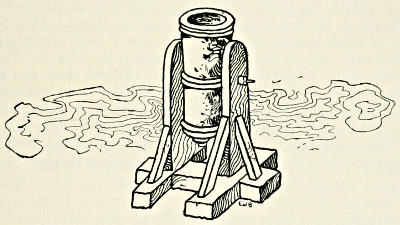
Early Type of Mortar
Only through this instrumentality could that superior order of valour be
called forth—that valour in which the heat of personal feeling has no share;
for the discharge of firearms is directed against a body of men—an abstract
enemy, not individual combatants. The warrior goes to meet deadly peril
calmly, sacrificing himself for the commonweal; and the valour of civilised
nations is characterised by the very fact that it does not rely on the strong
arm alone, but places its confidence essentially in the intelligence, the generalship,
the character of its commanders, and, as was the case among the
ancients, in a firm combination and unity of spirit on the part of the forces
they command.
MONARCHISM IN ITALY
In Italy, as already noticed, we behold the same spectacle as in Germany—the
attainment of an independent position by isolated centres of power.
In that country, warfare in the hands of the condottieri became a regular
business. The towns were obliged to attend to their trading concerns, and
therefore employed mercenary troops, whose leaders often became feudal
lords; Francis Sforza even made himself duke of Milan. In Florence, the
Medici, a family of merchants, rose to power. On the other hand, the
larger cities of Italy reduced under their sway several smaller ones and
many feudal chiefs. A papal territory was likewise formed. There, also,
a very large number of feudal lords had made themselves independent; by
degrees they all became subject to the one sovereignty of the pope.
How thoroughly equitable in the view of social morality such a subjugation
was, is evident from Machiavelli’s celebrated work The Prince. This
book has often been thrown aside in disgust, as replete with the maxims of
the most revolting tyranny; but nothing worse can be urged against it than
that the writer, having the profound consciousness of the necessity for the
formation of a state, has here exhibited the principles on which alone states
could be founded in the circumstances of the times. The chiefs who
asserted an isolated independence, and the power they arrogated, must be
entirely subdued; and though we cannot reconcile with our idea of freedom
the means which he proposes as the only efficient ones, and regards as
perfectly justifiable—inasmuch as they involve the most reckless violence,
all kinds of deception, assassination, and so forth—we must nevertheless
confess that the feudal nobility, whose power was to be subdued, were assailable
in no other way, since an indomitable contempt for principle and an
utter depravity of morals were thoroughly engrained in them.
IN FRANCE
In France we find the converse of that which occurred in Germany and
Italy. For many centuries the kings of France possessed only a very small
domain, so that many of their vassals were more powerful than themselves;
but it was a great advantage to the royal dignity in France that the principle
of hereditary monarchy was firmly established there. The consideration
it enjoyed was increased by the circumstance that the corporations and
cities had their rights and privileges confirmed by the king, and that the
appeals to the supreme feudal tribunal—the court of peers, consisting of
twelve members enjoying that dignity—became increasingly frequent. The
king’s influence was extended by his affording that protection which only
the throne could give. But that which essentially secured respect for royalty,
even among the powerful vassals, was the increasing personal power of
the sovereign. In various ways, by inheritance, by marriage, by force of
arms, etc., the kings had come into possession of many earldoms (Grafschaften)
and several duchies. The dukes of Normandy had, however, become
kings of England; and thus a formidable power confronted France,
whose interior lay open to it by way of Normandy. Besides this there were
powerful duchies still remaining; nevertheless, the king was not a mere
feudal suzerain (Lehnsherr) like the German emperors, but had become a
territorial possessor (Landesherr); he had a number of barons and cities
under him, that were subject to his immediate jurisdiction; and Louis IX
succeeded in rendering appeals to the royal tribunal common throughout his
kingdom.
The towns attained a position of greater importance in the state. For
when the king needed money, and all his usual resources, such as taxes and
forced contributions of all kinds, were exhausted, he made application to the
towns and entered into separate negotiations with them. It was Philip the
Fair who, in the year 1302, first convoked the deputies of the towns as a
third estate, in conjunction with the clergy and the barons. All indeed that
they were in the first instance concerned with was the authority of the sovereign
as the power that had convoked them, and the raising of taxes as the
object of their convocation; the states nevertheless secured an importance
and weight in the kingdom, and as a natural result, an influence on legislation
also.
A fact which is particularly remarkable is the proclamation issued by the
kings of France, giving permission to the bondsmen on the crown lands to
purchase their freedom at a moderate price. In the way we have indicated
the kings of France very soon attained great power; while the flourishing
state of the poetic art in the hands of the troubadours, and the growth of the
scholastic theology, whose especial centre was Paris, gave France a culture
superior to that of the other European states, and which secured the respect
of foreign nations.
IN ENGLAND
William the Conqueror, duke of Normandy, introduced the feudal system
into England, and divided the kingdom into fiefs, which he granted almost
exclusively to his Norman followers. He himself retained considerable
crown possessions; the vassals were under obligation to perform service in
the field, and to aid in administering justice; the king was the guardian of
all vassals under age; they could not marry without his consent. Only by
degrees did the barons and the towns attain a position of importance. It was
especially in the disputes and struggles for the throne that they acquired
considerable weight.
When the oppressive rule and fiscal exactions of the kings became
intolerable, contentions and even war ensued; the barons compelled King
John to swear to Magna Charta, the basis of English liberty, i.e., more particularly
of the privileges of the nobility. Among the liberties thus secured,
that which concerns the administration of justice was the chief; no Englishman
was to be deprived of personal freedom, property, or life without the
judicial verdict of his peers. Everyone, moreover, was to be entitled to
the free disposition of his property. Further, the king was to impose no
taxes without the consent of the archbishops, bishops, earls, and barons. The
towns, also, favoured by the kings in opposition to the barons, soon elevated
themselves into a third estate and to representation in the commons’ house
of parliament. Yet the king was always very powerful, if he possessed
strength of character: his crown estates procured for him due consideration;
in later times, however, these were gradually alienated, given away,
so that the king was reduced to apply for subsidies to the parliament.
We shall not pursue the minute and specifically historic details that
concern the incorporation of principalities with states, or the dissensions and
contests that accompanied such incorporations. We have only to add that
the kings, when by weakening the feudal constitution they had attained a
higher degree of power, began to use that power against each other in the
undisguised interest of their own dominion. Thus France and England carried
on wars with each other for a century. The kings were always endeavouring
to make foreign conquests; the towns, which had the largest share of
the burdens and expenses of such wars, were opposed to them, and in order
to placate them the kings granted them important privileges.
THE PAPACY AND FEUDALISM
The popes endeavoured to make the disturbed state of society, to which
each of these changes gave rise, an occasion for the intervention of their
authority; but the interest of the growth of states was too firmly established
to allow them to make their own interest of absolute authority valid against
it. Princes and peoples were indifferent to papal clamour urging them to
new crusades. The emperor Louis set to work to deduce from Aristotle, the
Bible, and the Roman law a refutation of the assumptions of the papal see;
and the electors declared at the diet held at Rense in 1338, and afterwards
still more decidedly at the imperial diet held at Frankfort, that they
would defend the liberties and hereditary rights of the empire, and that to
make the choice of a Roman emperor or king valid, no papal confirmation was
needed. So, at an earlier date, 1302, on occasion of a contest between Pope
Boniface and Philip the Fair, the assembly of the states convoked by the
latter had offered opposition to the pope. For states and communities had
arrived at the consciousness of independent moral worth.
Various causes had united to weaken the papal authority; the great
schism of the church, which led men to doubt the pope’s infallibility, gave
occasion to the decisions of the councils of Constance and Bâle, which
assumed an authority superior to that of the pope, and therefore deposed and
appointed popes. The numerous attempts directed against the ecclesiastical
system confirmed the necessity of a reformation. Arnold of Brescia, Wycliffe,
and Huss met with sympathy in contending against the dogma of the papal
vicegerency of Christ, and the gross abuses that disgraced the hierarchy.
These attempts were, however, only partial in their scope. On the one hand
the time was not yet ripe for a more comprehensive onslaught; on the other
hand the assailants in question did not strike at the heart of the matter, but
(especially the two latter) attacked the teaching of the church chiefly with
the weapons of erudition, and consequently failed to excite a deep interest
among the people at large.
HEGEL ON THE RISE OF MANKIND THROUGH FEUDALISM
But the ecclesiastical principle had a more dangerous foe in the incipient
formation of political organisations than in the antagonists above referred to.
A common object, an aim intrinsically possessed of perfect moral validity, presented
itself to secularity in the formation of states; and to this aim of community
the will, the desire, the caprice of the individual submitted itself. The
hardness characteristic of the self-seeking quality of “heart,” maintaining its
position of isolation—the knotty heart of oak underlying the national temperament
of the Germans—was broken down and mellowed by the terrible
discipline of the Middle Ages.
The two iron rods which were the instruments of this discipline were the
church and serfdom. The church drove the “heart” (Gemüth) to desperation—made
spirit pass through the severest bondage, so that the soul was
no longer its own; but it did not degrade it to Hindu torpor, for Christianity
is an intrinsically spiritual principle and, as such, has a boundless elasticity.
In the same way serfdom, which made a man’s body not his own
but the property of another, dragged humanity through all the barbarism
of slavery and unbridled desire, and the latter was destroyed by its own
violence.
It was not so much from slavery as through slavery that humanity was
emancipated. For barbarism, lust, injustice constitute evil: man, bound fast
in its fetters, is unfit for morality and religiousness; and it is from this intemperate
and ungovernable state of volition that the discipline in question
emancipated him. The church fought the battle with the violence of rude
sensuality in a temper equally wild and terroristic with that of its antagonist;
it prostrated the latter by dint of the terrors of hell, and held it in
perpetual subjection, in order to break down the spirit of barbarism and to
tame it into repose.
Theology declares that every man has this struggle to pass through, since
he is by nature evil, and only by passing through a state of mental laceration
arrives at the certainty of reconciliation. But granting this, it must on the
other hand be maintained that the form of the contest is very much altered
when the conditions of its commencement are different, and when that
reconciliation has had an actual realisation. The path of torturous discipline
is in that case dispensed with (it does indeed make its appearance at a later
date, but in quite a different form), for the waking up of consciousness finds
man surrounded by the elements of a moral state of society. The phase of
negation is, indeed, a necessary element in human development, but it has
now assumed the tranquil form of education, so that all the terrible characteristics
of that inward struggle vanish.c
FOOTNOTES
[The letter a is reserved for Editorial Matter.]
Chapter I. Origin of the Crusades
b J. F. Michaud, History of the Crusades.
c Charles Mills, History of the Crusades.
Chapter II. The First Crusade
b E. Gibbon, Decline and Fall of the Roman Empire.
c Fr. Wilken, Geschichte der Kreuzzüge.
d J. F. Michaud, Bibliothèque des Croisades (including many Arab accounts).
e Victor Duruy, Histoire du Moyen Age.
Chapter III. The Second Crusade
b E. Gibbon, op. cit.
c Charles Mills, History of the Crusades.
d L. von Ranke, Weltgeschichte.
e “Imad ad-Din” and others in Michaud’s Bibliothèque des Croisades.
Chapter IV. The Third Crusade
b Charles Mills, op. cit.
c J. F. Michaud, op. cit.
d “Imad ad-Din” quoted in Michaud’s Bibliothèque des Croisades.
e Richard Devizes, Chronicle Concerning the Deeds of King Richard the First, King of England.
f Boha ad-Din, Life of Saladin.
g Geoffrey de Vinsauf, Itinerary of Richard I and others to the Holy Land.
h Roger of Hoveden, Historia post Bedam.
i Thomas Fuller, Holy War.
j Abulfeda, History of the Human Race.
k J. F. Michaud, Bibliothèque des Croisades.
Chapter V. The Fourth to the Sixth Crusades
b V. Duruy, op. cit.
c Charles Mills, op. cit.
d J. F. Michaud, op. cit.
e A. Jourdain, A Letter to Michaud on the Children’s Crusade.
f Fuller, op. cit.
g Geoffrey de Villehardouin, Conquête de Constantinople.
Chapter VI. The Last Crusades
b C. Mills, op. cit.
c Matthew of Paris, Historia Major.
d Fuller, op. cit.
e V. Duruy, op. cit.
f John de Joinville, Memoirs of Louis IX.
g Makrizi, The Book of Paths for the Knowledge of Kings.
Chapter VII. Consequences of the Crusades
b J. G. von Herder, Philosophy of the History of Man.
c C. Mills, op. cit.
d E. Gibbon, op. cit.
e Choiseul d’Aillecourt, De l’influence des Croisades.
Appendix. Feudalism
b James Bryce, The Holy Roman Empire.
c G. W. F. Hegel, Philosophy of History.
d Carl Spannagel, Zur Geschichte des Deutschen Heerwesens vom X bis zum XII Jahrhundert.
e Otto von Freising, Chronik.
f Philippe de Beaumanoir, Coutumes de Beauvaisis.
g Guibert de Nogent, Gesta Dei per Francos.
h William of Tyre, Historia belli sacri.
i V. Duruy, Histoire du Moyen Age.
j Paul von Roth, Feudalität und Unterthanenverband.
THE BISHOPS OF ROME [42-590 A.D.]
The early history of the Papacy is involved in much obscurity. For the early centuries we
shall attempt little more than to repeat the names of the successive bishops, as
accepted by the traditions of the church of Rome. According to these traditions,
the Apostle Peter founded the Church in the year 42 (modern criticism does not
accept this date, which is almost surely too early by about a score of years); he was
martyred in 67, and succeeded by Linus, who was followed in 79 by Cletus or
Anacletus. 91, Clement I or Clemens Romanus. Some writers make him the
third bishop in 68 A.D. 100, Evarestus.
109 Alexander I. The political life of Rome extinguished by the empire, begins to revive
in the organisation of the Christian church. 119, Sixtus I. 129, Telesphorus.
139, Hyginus. 143, Pius I. 157, Anicetus. 168, Soter. 177, Eleutherius.
193, Victor I. The bishop of Rome is beginning to assume supremacy over other
bishops. This is resented in some quarters.
202 Zephyrinus. 219, Calixtus I. 223, Urban I. 230, Pontianus. 235, Anterius.
236, Fabianus. 251, Cornelius. 252, Lucius I. 253, Stephen I. 257, Sixtus II.
259, Dionysius. 269, Felix I. 275, Eutychianus. 283, Caius. 296, Marcellinus.
308 Marcellus I. 310, Eusebius. 311, Melchiades. 314, Silvester I. 325, The authority
of the metropolitan is distinctly recognised. The idea has been developing since
the primacy of Fabianus and Cornelius. 330, Removal of the capital from Rome to
Constantinople. This increases greatly the power of the Roman bishop, who henceforth
announces his supremacy in more decided tones. 336, Marcus I. 337, Julius I.
He is the recognised protector of the orthodox faith against Arianism and other
heresies. The church begins to organise landed properties by bequests from emperors
and nobles.
352 Liberius. 356, First instance of schism in the church of Rome. Felix maintains a
rival claim to the primacy.
366 Damasus I elected to the see, after a bitter and violent contest, over his rival, Ursinus.
Damasus represents the cause of orthodoxy. 384, Siricius. In his primacy the
decretals—pastoral letters—are begun.
398 Anastasius I. The papacy has emerged from obscurity. Paganism is in its death
throes.
402 Innocent I. He does much to free the church from political interference. 417, Zosimus.
He attempts to temporise with paganism.
418 Boniface I. His election is contested. Eulalius maintains a rival claim. The emperor
Honorius intervenes, and the provisions for election are revised. This is the first
instance of imperial interference.
422 Celestine I. 432, Sixtus III. 440, Leo (I) the Great, sometimes called the real
founder of the papacy. The precedence of the bishops of Rome is now fully recognised.
461, Hilarius. 468, Simplicius. 476, The fall of the Western Empire
increases the bishops’ authority. 483, Felix II (or III, if the rival bishop in 356 is
reckoned as Felix II). He feels himself powerful enough to summon the patriarch
of Constantinople to Rome, and excommunicates him on his refusal to obey.
492, Gelasius I. He enunciates the principle that his acts are not to be controlled
by synods. 496, Anastasius II. 498, Symmachus. The election is contested by
Laurentius, who maintains a rival claim. The Palmary synod disavows its own right
to sit in judgment on the acts of the Roman bishop.
514 Hormisdas. 523, John I. Theodoric sends John to Constantinople to obtain indulgence
for the Arians. Not entirely successful, Theodoric imprisons the bishop on
his return (525), and he dies the following year. 526, Felix III or IV. Dionysius
Exiguus collects and publishes the canons of the councils and the papal decretals.
530, Boniface II. His election contested by Dioscorus until the latter’s death, the
same year. Boniface obtains the power of appointing his own successor, but a
second synod annuls it.
532 John II. 535, Agapetus I. Theodotus sends him to Constantinople in his behalf.
536, Belisarius enters Rome; the pope becomes the vassal of the emperor. Silverius.
537, Through the intrigues of the empress Theodora and the deacon Vigilius,
Silverius is deposed and banished to the island of Pandataria. Vigilius becomes
bishop of Rome. The bishops now become mere puppets of the Eastern court.
552 Vigilius, resisting the will of Justinian, is imprisoned.
553 Vigilius again seized, and sent to exile.
554 Pelagius I. 560, John III. 574, Benedict I. 578, Pelagius II.
FROM GREGORY THE GREAT TO THE ESTABLISHMENT OF THE PAPACY AS
A LEGISLATIVE POWER [590-867 A.D.]
590 Gregory (I) the Great elected pope. He raises the papacy to eminence and determines
its future policy. Gregory’s work is of threefold character. (1) He perfects
the church ritual and introduces a new mode of chanting, and organises the revenues
of the church. (2) He exercises supreme authority over the churches of western
Europe. The Lombards are converted from Arianism, 599, and Britain is converted
by St. Augustine. (3) He makes the pope a temporal sovereign. By this time the
bishop of Rome has become the largest landholder in Italy. The Lombard invasion
has given the bishops opportunity for temporal control, and in Rome and its vicinity
the people recognise Gregory at the head of affairs.
604 Sabinianus.
607 Boniface III. The emperor Phocas bestows title of universal bishop on Boniface, but
the patriarch of Constantinople resumes it on Phocas’ death.
608 Boniface IV. He converts the Roman Pantheon into a Christian church.
615 Deusdedit.
618 Boniface V.
625 Honorius I. The monothelitic controversy begins.
638 Severinus. He is not confirmed until 640.
640 John IV. The monothelite doctrine condemned.
642 Theodore I.
649 Martin I. The whole West repudiates monothelitism. Martin condemns the Type of
Constans II.
653 Martin seized by the exarch and carried to Constantinople, by order of Constans.
654 Eugenius I elected in place of the absent Martin.
655 Martin banished to Cherson, where he soon dies.
657 Vitalianus.
672 Adeodatus.
676 Domnus or Donus I.
678 Agatho. Time of Wilfrid’s preaching in Britain and Gaul.
680 The Sixth Œcumenic Council at Constantinople settles the monothelitic question.
682 Leo II. 683, Benedict II. 685, John V. 686, Conon.
687 Sergius I. Paschal and Theodore are supported as anti-popes by different factions.
The exarch finally recognises Sergius.
701 John VI. He saves the life of the exarch in a rising of the army. He drives the
invading duke of Benevento back to his own territory.
705 John VII. The emperor Justinian II tries to force certain decrees objectionable in
the West upon the church of Rome.
708 Sisinnius lives but twenty days after election. Constantine. Justinian perseveres
in his aim to reduce the West to obedience.
710 Constantine goes to Constantinople at order of Justinian, who remains content with
this act of submission.
715 Gregory II. Time of Bede’s teaching.
725 Boniface establishes the German church.
726 The emperor Leo issues edict against image-worship. Italy rebels.
728 Rebellion of Ravenna over the iconoclastic edict. Liutprand, the Lombard king,
captures the city. The papacy begins to free itself from the Eastern Empire. The
popes are unwilling to submit themselves to the Lombards. Gregory appeals to
Charles Martel for aid against the Lombards.
731 Gregory III. He defies Leo in the matter of image-worship.
739 War with the Lombards. Appeal of Gregory to the Franks for help against them.
741 Zacharias. He is the first pope to be elected without obtaining the customary consent
of the exarch. The papacy is now free of the empire. It has become practically a
political dukedom.
742 Zacharias visits Liutprand and obtains treaty of peace. Many possessions of the
church restored by the Lombards.
749 The Lombards renew attacks on the pope.
751 Zacharias sanctions the transfer of the French crown to the Carlovingian line.
752 Stephen II dies before his consecration. Usually not reckoned in list of popes.
Stephen II or III.
755 Pepin of France forces Aistulf, the Lombard king, to relinquish all territory taken
from the exarch and the pope. Ravenna, Pentapolis, and other territory turned over
to the pope. “The Donation of Pepin.” The foundations of the papal states are
laid. Pepin bestows title of Patrician of Rome on the king of the Franks.
757 Paul I. The Lombards do not encroach upon the papacy.
767 On death of Paul, Toto, duke of Nepi, compels a bishop to ordain one of his brothers,
Constantine, a layman. He discharges all the offices of pontiff for a year, when
768 Desiderius, the Lombard king, sends a band to rescue Rome. Constantine is seized.
Election of Stephen III or IV. All of Constantine’s acts are declared null and
void. Cruel treatment of Constantine.
772 Adrian I. Troubles with the Lombards are renewed. Adrian appeals to Charlemagne.
774 Charlemagne captures Desiderius in Pavia, and assumes title of king of the Lombards.
End of the Lombard kingdom. Charlemagne gives a large amount of territory to
the pope. “Donation of Charlemagne.” Adrian takes possession of the exarchate,
with all power and privileges of a temporal prince.
780 The pope summons Charlemagne to protect him against a coalition of his Byzantine
enemies. Peace is purchased.
786 Charlemagne reduces Arichis of Benevento to subjection. The pope’s dominions
extend to Calabria.
795 Leo III. He recognises the supremacy of Charlemagne.
799 Assault, attempted mutilation, and imprisonment of Leo by an armed band headed by
his nephews. Leo escapes to Charlemagne, but returns to Rome.
800 Charlemagne goes to Rome to inquire into charges against Leo. Leo crowns him emperor.
Foundation of the empire of Charlemagne. The pope and emperor begin the upbuilding
of the fabric of the Middle Ages. The pope is subordinate to the emperor.
816 Stephen IV. He is unpopular, and makes the Romans swear fealty to the emperor.
Is compelled to take refuge with Louis le Débonnaire. Returns to Rome, and dies.
817 Paschal I. Assumes pontificate without imperial sanction. The Romans, admonished
by the emperor, agree not to allow this again.
824 Eugenius II.
827 Valentinus dies in five weeks. Gregory IV. He mediates between Louis le Débonnaire
and his sons. His pontificate is uneventful, but materially advances pretensions
of the hierarchy.
844 Sergius II consecrated without consent of the emperor Lothair. Lothair sends his
son, Louis, with an army to Rome, but his meeting with the pope is amicable. Louis
II made king of Lombardy.
847 Leo IV. The Saracens invade Italy as far as the gates of Rome. Driven off by
Louis. Leo fortifies a portion of Rome, henceforth known as the Leonine city,
including the Vatican and church of St. Peter.
850 The “False Decretals” come to light.
855 Benedict III. His election contested by Anastasius, who, at head of armed faction,
seizes the Lateran. The imperial legates decide in favour of Benedict, and Anastasius
is expelled. Beginning of the strife between Photius and Ignatius for the see
of Constantinople, which ends in the permanent schism between the eastern and
western churches.
858 Nicholas I. Under him the papacy makes a signal advance in power. He interferes
in the quarrel over the patriarchate of Constantinople, espousing the cause of Ignatius,
and pronouncing sentence of deposition upon Photius. He adopts and declares
authentic the “False Decretals,” thus establishing the principle of the sole legislative
power of the pope.
861-864 Humiliation of the archbishops of Cologne, Trèves, and Ravenna. The act of
archbishop Hincmar of Rheims in deposing Rothrad, bishop of Soissons, is reversed
by Nicholas, on authority of the “False Decretals.”
863 Nicholas forbids Lothair II to divorce his wife.
FROM THE DEATH OF NICHOLAS I TO THE BEGINNING OF THE ERA OF
PRACTICAL REFORM [867-1046 A.D.]
867 Adrian II.
868 On death of Lothair II of Lorraine, Adrian attempts to bestow that crown on the
emperor Louis II. This extension of the papal prerogatives is not welcome to
the German bishops, and they rebuke Adrian.
870 Hincmar renews his struggle with the pope, and the whole Frankish church arrays
itself against the power of the pope in dealing directly with bishops.
872 John VIII. During his pontificate, Rome is constantly in danger from the Saracens.
875 John bestows the imperial crown on Charles the Bald, not as his right, but as a gift.
Victory over Hincmar and the Frankish church by the appointment of Ansegis as
primate of France.
876 Beginning of quarrel with Formosus, bishop of Porto.
877 In league with Athanasius, duke-bishop of Naples, the Saracens reach the walls of
Rome. Charles the Bald ignores John’s appeals for help. The pope compelled
to pay the Saracens tribute.
878 Lambert, duke of Spoleto, in the interest of the imperial claimant, Carloman, enters
Rome, seizes John, and imprisons him. John escapes, and flees to Provence. He
returns to Rome.
881 John crowns Charles the Fat emperor.
882 Death of John, possibly murdered. Martin II.
884 Adrian III.
885 Stephen V.
887 On deposition of Charles the Fat the Carlovingian empire comes to an end.
891 Formosus elected by influence of Guido of Spoleto. The papacy enters a period of
anarchy. The popes are elevated by whichever rival party is in the ascendant,
“obtaining,” says Reichel, “their pontificate by crime, and vacating it by murder.”
896 Boniface VII dies in a few days. The Italian party elects Stephen VI. He mutilates
the dead body of Formosus.
897 Stephen imprisoned and strangled. Romanus occupies the see a few months. Theodore
II, who belongs to the faction of Formosus.
898 John IX, though of Formosus’ party, submits to the emperor Lambert. The right
of plundering the pope’s palace, on his decease, is prohibited.
900 Benedict IV.
901 He crowns Louis of Provence, the rival of Berengar.
903 Leo V. In a few months he is imprisoned by Christopher, one of his chaplains, who
secures his own election.
904 Christopher driven from Rome by the soldiers of Berengar. Election of Sergius III.
The infamous Theodora and her daughters, Marozia and Theodora, have complete
influence over Sergius. They further the aims of Berengar’s party. Complete degradation
of the papacy.
911 Anastasius III.
913 Lando.
914 John X, archbishop of Ravenna, is elected through influence of Theodora, whose paramour
he is. He proves an able pontiff, and forms a league among the Italian dukes
to resist the Saracens, and, in furtherance of this project,
916 crowns Berengar emperor; then, for the first time in the history of the papacy, the pope
goes forth to battle, defeats the Saracens, and destroys the fortress of Garigliano.
925 John expels the marquis Alberic, lover or husband of Marozia. Marozia’s power increases.
She seizes the castle of St. Angelo. On death of Alberic she marries Duke
Guido of Tuscany.
926 Treaty between Hugo of Provence and John.
928 John imprisoned by Marozia’s party, and dies, probably by violence. Leo VI.
929 Stephen VII.
931 John XI, son of Marozia and Sergius III or Alberic, elected through his mother’s
influence. Guido is dead, and Marozia marries Hugo of Provence.
932 Rome rebels at this. Alberic, brother of the pope, casts him and Marozia into prison,
and makes himself master of Rome. Alberic marries the daughter of Hugo.
936 Death of John in prison. He has exercised his spiritual functions, but the government
of Rome has been conducted by Alberic. Leo VII.
939 Stephen VIII.
941 Martin III.
946 Agapetus II. These four are appointed by the sole will of Alberic—they have no
power.
953 Death of Alberic, leaving his authority to his son, Octavian.
955 On death of Agapetus, Octavian is elected pope. He takes the name of John XII,
the first to take an ecclesiastical name.
961 John, threatened by Berengar II, appeals to King Otto I of Germany, who comes at
once to Germany and is crowned king at Pavia.
962 John crowns Otto emperor at Rome. Pope and Roman people take oath of allegiance
to Otto. Otto returns to Pavia, and learns that John, fearing his mastery, has
entered into correspondence with the deposed Italian king, Adalbert. He sends
officers to investigate this, and they return with a long list of crimes charged against
John by the Roman people.
963 Adalbert returns to Rome. Otto marches thither. The pope and Adalbert flee. Trial
and deposition of the pope by Otto. Leo VIII, the chief secretary of the Roman
see, is elected.
964 Otto leaves Rome. A rebellion forces Leo to flee, and the gates are opened to John,
who reassumes his office. The people embrace his cause. Death of John, probably
at the hands of an injured husband. Disregarding the emperor and Leo, the people
elect a new pope, Benedict V. Otto proceeds against the anti-pope, who submits and
is degraded. Leo, in council, recognises right of Otto and his successors in the kingdom
of Italy to elect his own successors to the empire.
965 John XIII (bishop of Narni). On account of his haughtiness the Romans expel him.
The prefect Rotfred assumes government of Rome.
966 Otto comes to Rome on appeal of John. Rotfred killed; John restored. Otto treats
the Romans barbarously. Overawed by Otto, the Romans let John reign in peace.
972 The see vacant for three months, on death of John, while Otto is consulted. Benedict
VI elected.
974 Bonifazio Francone, at the instigation of the Tuscan party, imprisons Benedict, strangles
him, and assumes the papacy as Boniface VII. This anti-pope compelled to flee
in a month to Constantinople. He carries off all the treasure from St. Peter’s.
Election of Benedict VII, who excommunicates Boniface and, under protection of
Otto II, rules in peace.
983 John XIV. Death of Otto in Rome.
984 Boniface suddenly reappears, imprisons John (who dies by starvation or poison), and
seats himself in the papal chair. Re-establishment of the Roman Republic with the
consul Crescentius at its head.
985 Sudden death of Boniface. John XV. Crescentius compels him to leave Rome, and
he appeals to Otto III.
987 John is permitted to return. He now rules, but in subjection to the consul and
senate.
996 On death of John, Otto brings about election of his kinsman, Gregory V (Bruno, duke
of Carinthia). He crowns Otto emperor. Crescentius condemned to exile, but pardoned
at intercession of Gregory, to whom he takes oath of fidelity. Crescentius
compels Gregory to flee, and puts John XVI (Philagathus) in the papal chair.
998 Otto, as soon as possible, comes to Italy. John escapes, but is brought back and
horribly punished. Crescentius surrenders, and is put to death. Gregory restored.
999 Death of Gregory, perhaps by poison. Silvester II (Gerbert). Otto and Gregory
plan together to restore the empire to its grandeur in the Augustan Age—the
emperor to have boundless temporal, and the pope boundless spiritual, power.
1001 The Roman nobles revolt at this idea, but are quickly brought to terms.
1002 Death of Otto, probably by poison administered by Stephania, widow of Crescentius.
1003 Death of Gregory, perhaps due also to poisoning by Stephania. The plans to rescue
the papacy from the patricians and populace of Rome have thus failed. John XVII
(Sicco) occupies the see six months. John XVIII (Fanasus).
1009 Sergius IV. Rome is again a republic, with the patrician John, son of Crescentius, at
its head. The Tuscan party is in the ascendency.
1012 Benedict VIII elected by the Tusculan party, to which the house of Crescentius has
yielded the power. An anti-pope, Gregory, is set up by the party of Crescentius.
Benedict has to flee, but soon returns to Rome, protected by the emperor Henry II.
1014 Benedict administers a defeat to the Saracens near Pisa.
1021 Benedict assists Henry II in his war against the Byzantines in southern Italy.
1024 On Benedict’s death the Tusculan party elevates his brother, John XIX, a layman, to
the papal chair.
1033 On John’s death the power of the Tusculan house secures the pontificate for his young
nephew, Benedict IX.
1042 The “Truce of God” sanctioned.
1044 Benedict, after leading a vicious and depraved life, is driven from Rome by the people.
They then elect Silvester III, but Benedict returns in triumph, and the anti-pope flees.
1045 Benedict sells the pontificate to Gregory VI (Johannes Gratianus) of the house of Tusculum,
a man of learning and unimpeachable chastity, who endeavours to institute
reforms.
1046 The scandal of Benedict’s act leads to Henry III assembling the Council of Sutri, which
deposes the three popes and elects Suidgar bishop of Bamberg, Clement II, to the
papal chair. The council gives the emperor the right of nominating future popes,
which displeases the Roman clergy and people.
THE AGE OF GREATNESS [1046-1305 A.D.]
A new era is inaugurated for the papacy. The power of the popes begins to overshadow
that of the emperors.
1047 Clement summons a council to condemn the all-pervading vice of simony. Death of
Clement. Benedict IX seizes the throne and holds it for nine months.
1048 Poppo, bishop of Brixen, Damasus II, appointed pope by the emperor. Benedict flees
on his appearance. Damasus dies in less than a month. Hildebrand voices the
objections of the Roman clergy as to the power of the emperor to appoint the popes.
Bruno, bishop of Toul, Leo IX, is the imperial choice for the next pope.
1049 With the assistance of Hildebrand, Leo plans many reforms, including prohibition of
marriage to the clergy, simony, etc. The synods of Rome, Rheims, and Mainz enact
reformatory canons. Leo forms the college of cardinals.
1049-1051 Leo visits France and Germany.
1052 Third visit of Leo to Germany to mediate between Henry III and Andrew of Hungary.
1053 Campaign of Leo against the Normans. Capture of Leo at Civitella. Treaty of Hildebrand
with Berengar of Tours.
1054 Leo returns to Rome and dies. Hildebrand goes to the emperor as plenipotentiary of
the Roman clergy and people.
1055 Gebhard of Eichstadt, Victor II, Hildebrand’s candidate, made pope. He carries on
Leo’s work of reform.
1056 Death of Henry III, leaving infant son, furthers plan of Hildebrand.
1057 The Romans reassert their right to create popes on death of Victor. Cardinal Frederick
of Lorraine, Stephen IX, made pope.
1058 Stephen dies. Ignoring the empress Agnes, the Roman party makes Giovanni di Velletri,
Benedict X, pope, getting the most lavish grants from him. The empress empowers
Hildebrand to proceed with new election.
1059 Gerard, archbishop of Florence, Nicholas II, is elected and Benedict declared deposed.
Hildebrand determines to deal a blow at the imperial prerogative. Second Lateran
Council. The election of pope is vested solely with the cardinal-bishops. Simony
and clerical marriage forbidden.
1061 Election of Anselmo Baggio, Alexander II, without consent of emperor, inaugurates
the great struggle between pope and emperor. The imperial party calls a council at
Bâle and elects Pietro Cadolaus Honorius II. He advances to Rome.
1063 The anti-pope driven by the Normans into the castle of St. Angelo, where he holds his
position until
1064 when the fall of Adalbert crushes his last hopes. The schism is healed by Hanno, and
Alexander universally acknowledged pope. Resistance to the decrees of celibacy is
strong.
1073 Hildebrand, Gregory VII. His election is confirmed by the emperor. His main
objects are the enforcement of celibacy among the clergy and the prohibition of
investiture by the laity which is the great cause of simony. He demands that Henry
IV shall acquiesce in all the newly assumed prerogatives of the papacy.
1075 Lay investiture prohibited. Breach between pope and Henry IV.
1076 Henry calls diet at Worms and declares pope deposed. Gregory excommunicates
Henry, who is suspended from his royal office by Diet of Tribur.
1077 Henry humbles himself before the pope at Canossa. Gregory establishes the principle
of the papal power to judge kings.
1080 Second excommunication of Henry. His adherents call a council and declare Gregory
deposed. Election of Guibert, archbishop of Ravenna, Clement III, as anti-pope.
1084 Henry finally takes Rome. Gregory shuts himself in the castle of St. Angelo. Clement
crowns Henry emperor. The Normans take Rome. Robert Guiscard releases Gregory,
who goes to Salerno and dies the following year. Clement III rules at Rome.
1086 The cardinals elect Desiderius, abbot of Monte Cassino, Victor III, pope. He lives
mostly at Monte Cassino.
1087 Death of Victor.
1088 Five months after Victor’s death Eudes, bishop of Ostia, Urban II, is elected pope. He
resides at Monte Cassino.
1094 Urban in Rome. Clement holds only the Vatican, St. Angelo, and the Lateran.
1095 Urban preaches the First Crusade in France. Council of Clermont.
1099 Paschal II. He expels Clement III from Rome, who dies the following year.
1100 On Clement’s death, Theodore, anti-pope, is elected by the imperial party. He falls
into Paschal’s hands and condemned to be a hermit.
1102 Albert anti-pope—he is thrust into a monastery.
1105 Silvester IV, anti-pope. He is eventually deposed by the emperor himself.
1106 On death of Henry IV, the question of investiture is renewed with Henry V.
1110 Henry V makes a warlike descent on Italy. Treaty of Sutri, compromising rights of
the church.
1111 Paschal refuses to crown Henry, who imprisons both pope and cardinals. Paschal
compelled to bestow the crown on Henry.
1115 Death of the countess Matilda, leaving her possessions to the pope. Henry threatens
another visit to Rome.
1116 Excommunication of Henry in the Lateran Council. Henry advances on Rome. The
pope retreats to Benevento.
1118 Paschal returns to Rome. He dies. The cardinals elect Giovanni da Gaeta, Gelasius II.
He is at once seized by Cencius Frangipani. The Transteverines compel his surrender.
Henry V arrives in Rome. The pope flees to Gaeta, where he is consecrated. Henry, with
the assent of the people, makes Maurice Bourdin, Gregory VIII, anti-pope. On Henry’s
departure, Gelasius returns to Rome, but, again attacked, leaves Rome for France.
1119 Death of Gelasius at Lyons. Election of Guido, archbishop of Vienne, Calixtus II.
He excommunicates Henry and the anti-pope, and sets out for Rome.
1120 Calixtus captures Gregory and submits him to great degradation.
1121 Death of Gregory in prison. Celestine II anti-pope.
1122 The Concordat of Worms settles the question of investiture. The emperor cedes the
right of investiture by ring and staff. The pope allows the election of bishops and
abbots according to canonical procedure in the presence of the emperor, but without
bribery or compulsion.
1124 Lambert di Fagnano, Honorius II, elected through the Frangipani influence. He
rules in peace with Germany, but heads the papal forces in the south of Italy.
1130 At death of Honorius, a portion of the cardinals elect Gregorio de’ Papi, Innocent II.
The remainder choose Peter Leonis, Anacletus II, who gains the support of Roger of
Sicily. Innocent wins over Bernard of Clairvaux, and, through him, Lothair II.
1132 Lothair goes to Italy against Anacletus and Roger.
1133 Coronation of Lothair by Innocent, who gives him the allodial possessions of the
countess Matilda as a fief.
1138 Death of Anacletus settles the disputed election. Gregorio Conti, Victor IV, the new
anti-pope, holds out for two months. All Rome acknowledges Innocent.
1139 Great Lateran Council. It condemns Arnold of Brescia. The pope asserts his unlimited
power over the episcopal order. Innocent goes to war with Roger of Sicily and
is taken prisoner. He is released on recognising Roger’s title and kingdom.
1143 Guido di Castello, Celestine II.
1144 Lucius II. The Roman people carry out the plans of Arnold of Brescia, institute a
republic, and accept only the spiritual authority of the pope. Lucius appeals to the
emperor, Conrad, in vain.
1145 Death of Lucius while storming the Capitol. The abbot, Bernard, of Pisa, Eugenius
III, succeeds. He recovers Rome from Arnold of Brescia. The republic capitulates.
1146 Arnold regains Rome. Eugenius flees to France. He becomes the satellite of Bernard
of Clairvaux. Council of Vézelay promotes Second Crusade.
1153 Conrad, bishop of Sabina, Anastasius IV.
1154 Nicholas Breakspear, Adrian IV.
1155 Rome put under religious interdiction. The clergy and people compel the senate to
yield. Banishment and execution of Arnold of Brescia. Coronation of Frederick
Barbarossa.
1156 Frederick retires to Germany. Alliance of Adrian with Sicily.
1157 Quarrel of Frederick and Adrian.
1158 Frederick goes to Italy to settle quarrel.
1159 Frederick threatened with excommunication. Adrian dies. The election divided:
Rolando Ranuci, Alexander III, and Octavian, cardinal of St. Cecilia, Victor IV.
1160 Frederick summons Council of Pavia to decide claim of the two popes. On account
of Alexander’s haughty attitude Frederick recognises Victor.
1162 After many struggles with Victor, Alexander takes refuge in France.
1164 Death of Victor. Guido of Crema, Paschal III, chosen by a small faction to succeed
as anti-pope. He does not dare enter Rome.
1165 Alexander returns to Rome where the senate receives him.
1167 Frederick takes Rome and installs Paschal. His second coronation by Paschal.
1168 The cause of Paschal much weakened by departure of Frederick. Death of Paschal.
John, bishop of Tusculum, Calixtus III succeeds as anti-pope. His power grows
weaker.
1176 Frederick makes armistice with pope and Lombards after defeat at Legnano.
1177 Reconciliation of Frederick and Alexander at Venice.
1178 Calixtus abdicates his title. End of the schism.
1181 Ubaldo Allucingoli, Lucius III.
1182 Rebellion in Rome drives Lucius out.
1185 Humbert Crivelli, Urban III. He lives chiefly at Verona. He quarrels with Frederick
over several matters.
1187 Death of Urban as he is about to excommunicate Frederick. Albert, cardinal of San
Lorenzo, Gregory VIII. He preaches a crusade. He goes to Pisa to settle quarrel
between Genoa and Pisa and dies. Paolo Scolari, Clement III.
1188 Clement makes peace with the Roman people.
1191 Giacinto Orsini, Celestine III. Surrender of Tusculum to the Romans.
1194 The pope excommunicates Henry VI for his cruelty to the Sicilians.
1198 Lothario Conti, Innocent III. His pontificate marks the culmination of the papal
power. Innocent preaches the Fifth Crusade. He compels the prefect of Rome to
swear allegiance to him, thus practically establishing the temporal sovereignty of
the pope over Rome. He orders the seneschal Markwald of Anweiler to surrender
the march of Ancona. Death of Constanza. Markwald lays claim to the administration
of Sicily. Association of Guelfs with papal party.
1199 Conrad of Lutzenberg, count of Spoleto, is forced to return to Germany. The Italian
cities welcome Innocent as a deliverer.
1201 Decision in favour of Otto IV, of Germany. Defeat of Markwald by Walter de
Brienne and the papal army. Innocent compels Philip Augustus to take back his
divorced wife.
1202 Alfonso IX refuses to annul his marriage to his cousin. Papal interdict in the kingdom
of Leon. Innocent protests against the crusaders’ expedition against Zara.
1204 Innocent sends legate to crown Joannice king of Bulgaria. Dominic begins to preach
in Languedoc.
1208 Resistance of King John of England to the consecration of Stephen Langton as archbishop
of Canterbury. Interdiction placed on England.
1209 Otto abandons the lands of the countess Matilda and other territories in Italy to the
pope. Innocent crowns him. Excommunication of King John. Crusade against
the Albigenses is begun.
1210 Excommunication of Otto who has not given up all the territories he promised.
Foundation of the Franciscan order.
1212 Innocent makes Frederick II king of Germany. He deposes King John and offers
crown of England to Philip Augustus.
1213 John submits to the pope.
1215 Innocent attempts to annul Magna Charta. Fourth Lateran Council. Transubstantiation
a doctrine. Auricular confession enforced. Coronation of Frederick II as
king of Germany, who promises to undertake a crusade.
1216 Confirmation of the Dominican order. Death of Innocent. Cencio Savelli, Honorius
III, elected.
1217 Honorius obliges Andrew of Hungary to undertake a crusade.
1220 Coronation of Frederick as emperor. He renews promises to go to the Holy Land.
1223 Congress at Ferentino. Frederick pledges himself to start within two years.
1225 Frederick obtains another delay. On account of trouble with the senate Honorius
goes to Tivoli.
1227 Ugolino Conti, Gregory IX. He excommunicates Frederick, who makes an unsuccessful
attempt to start for the Holy Land. Ezzelino da Romano drives the Guelfs
out of Verona and Vicenza.
1228 Second excommunication of Frederick for starting without absolution. The pope
sends his army into Apulia.
1229 The papal army ravages Apulia but Frederick hastens back from Syria to recover his
territory. He is excommunicated a third time. Close of the Albigensian Crusade.
Council of Toulouse forbids reading of Scripture by laymen and adopts severe
measures for the suppression of heresy.
1230 The pope and Frederick are reconciled. Great flood in Rome.
1231 Negotiations are opened for the union of the Greek and Latin churches.
1232 Tribunals of the Inquisition established in southern France.
1233 The Germans put to death the first inquisitor.
1234 Rising in Rome drives Gregory from the city.
1238 League of Venice, Genoa, and the pope against Frederick, on account of his growing
power and successes in Lombardy.
1239 Excommunication of Frederick and charges preferred against him.
1240 Gregory proclaims a crusade against Frederick, who invades the papal territory.
1241 Frederick’s fleets capture twenty-two Genoese galleys, containing many ecclesiastics on
their way to a council at Rome. They are imprisoned. Death of Gregory. Goffredo
Castiglione, Celestine IV, elected. He dies in eighteen days. The see is vacant.
1243 Frederick releases some of the imprisoned ecclesiastics that an election may take
place. Senibaldi di Fieschi, Innocent IV, is chosen. Peace negotiations fail.
1244 Innocent escapes to Lyons.
1245 Innocent calls the Thirteenth General Council at Lyons. Frederick is excommunicated
and deposed.
1246 Louis IX fails in an attempt to reconcile Innocent and Frederick. Innocent demands
large sums from England, France, and Italy, to prosecute his struggle with Frederick,
and this causes great discontent in those countries.
1247 Frederick besieges the papal forces in Parma.
1248 Frederick raises the siege.
1250 Death of Frederick.
1251 Return of Innocent to Italy. He goes to Perugia to reside. Excommunication of
Conrad. The pope incites Sicily and Apulia to rebellion. Manfred puts the rebels
down.
1252 Conrad IV and Manfred attack Naples, and capture Capua.
1253 Surrender of Naples to Conrad.
1254 The pope bestows the crown of Sicily on Prince Edmund of England. Death of Innocent,
at Naples, on an expedition against Manfred. Rinaldo di Segni, Alexander
IV. Rise of the Flagellants.
1255 The people of Messina expel the papal governor. The papal legate makes treaty with
Manfred, but Alexander will not ratify it, claiming that Edmund is king of Sicily.
The English parliament will not grant Edmund the money to take the throne.
1256 Manfred makes himself supreme in Sicily in the name of Conradin. Imprisonment of
the senator Brancaleone, who is released by the people (1258). Establishment of the
Augustine order of mendicant friars.
1257 Interdiction of Portugal on account of divorce of Alfonso III.
1258 Battle of Corticella. Ezzelino da Romano defeats the pope’s army, and captures Brescia.
1259 Excommunication of Manfred, who has been crowned the previous year. The pope
decides the question of emperorship in favour of Richard of Cornwall. Fall of the
Ghibelline champion, Ezzelino da Romano.
1260 The Ghibellines regain Florence. Execution of Alberic da Romano.
1261 Death of Alexander in exile. Jacques Pantaléon, patriarch of Jerusalem, Urban IV.
1262 Urban, to resist Conradin, offers crown of Sicily to Charles of Anjou. The Ghibellines
in Tuscany acknowledge Manfred.
1263 Milan refuses to accept Otto Visconti as archbishop of the city.
1264 Charles of Anjou appointed senator of Rome. Death of Urban.
1265 Guy Foulques, Clement IV. Coronation of Charles of Anjou as king of Sicily.
1269 Death of Clement. The see is vacant for over two years, owing to discord among the
cardinals.
1271 Teobaldo di Visconti, Gregory X. Rudolf of Habsburg acknowledges papal supremacy.
1273 Gregory excommunicates the inhabitants of many north Italian cities for banding
against Charles of Anjou.
1274 Fourteenth General Council at Lyons. A new crusade is preached, and a union of
the Greek and Latin churches is effected. The union is never fully accepted in the
Eastern Empire, and soon falls to pieces.
1276 Death of Gregory. Pietro di Tarantasia, Innocent V, dies in five months. Ottoboni
Fiesco, Adrian V, dies in six weeks. Pedro Juliani, John XX or XXI.
1277 Giovani Gaetano, Nicholas III, “Il Comperto.” He belongs to the Orsini family.
1278 Cession of Romagna, the exarchate of Ravenna, and other territory, by Rudolf of
Habsburg, to the pope, who acts as ruling sovereign over all his dominions.
Nicholas is hostile to Charles. Nepotism practised by Nicholas.
1280 Death of Nicholas in the midst of plans to establish his family in kingdoms in Italy.
Discord caused by Charles in the College of Cardinals.
1281 Simon de Brion, Martin IV, elected after six months, through influence of Charles.
The pope retires to Orvieto.
1282 Martin excommunicates Pedro of Aragon, who has been declared king of Sicily after
the “Sicilian Vespers.”
1283 The pope offers crown of Aragon to Charles of Valois.
1285 Death of Charles quiets the affairs of Sicily. Giacomo Savelli, Honorius IV.
1287 Honorius prevents ratification of treaty between Aragon and France. Death of
Honorius, and owing to disputes, the cardinals fail for ten months to elect a new pope.
1288 Girolamo d’Ascoli, Nicholas IV.
1289 After liberation of Charles the Lame of Naples, the pope absolves him from all conditions,
by which he obtains his freedom. The Guelf and Ghibelline contest continues
fiercely in the north. Nicholas becomes enslaved to the Colonnas.
1292 Death of Nicholas. The see vacant for over two years.
1294 Election of Pietro di Murrhone, Celestine V, a lowly hermit. The cardinals repent,
and compel him to abdicate. Benedict Cajetan, Boniface VIII, elected. He carries
the papal pretensions further than any other pope, and prepares the way for the
Reformation.
1296 Boniface begins his great struggle with Philip the Fair by issuing a bull excommunicating
all princes who tax the clergy. Edward I of England outlaws all the clergy
who obey this bull, and Philip retaliates by prohibiting the exportation of gold and
silver out of France. Interdiction of Sicily. The Sicilians invade Calabria.
1297 Excommunication of the entire Colonna family because a member of it plundered a
papal convoy.
1298 The pope proclaims a crusade against the Colonnas.
1299 Surrender of Palestrina to the papal army. It is razed to the ground.
1300 Plenary indulgence of Boniface.
1301 Boniface is prevented by the English parliament from interfering in the affairs of Scotland.
Renewed quarrel with Philip over his imprisonment of the bishop of Pamiers.
Charles of Valois is invited into Italy.
1302 Publication of the bull declaring that the church can have only one head.
1303 Philip burns a bull of excommunication issued by Boniface and refuses to acknowledge
him as pope. Capture of Boniface by Guillaume de Nogaret. Death of Boniface.
Niccolo Boccasini, Benedict XI. He attempts to conciliate France and the Colonna
family.
1304 Benedict excommunicates those who take part in the capture of Boniface. Death of
Benedict, probably by poison, at the hands of the French party.
THE “BABYLONISH CAPTIVITY” [1305-1378 A.D.]
1305 The influence of Philip the Fair in the College of Cardinals brings about the election
of Bertrand d’Agoust, Clement V. The pope does not interfere in Philip’s persecution
of the Templars.
1309 The pope removes his residence to Avignon, principally because of the strife between
the Orsini and Colonnas, in Rome. He pronounces a fearful ban of excommunication
against the Venetians, in a quarrel over the possession of Ferrara. The Venetians
driven from Ferrara, which is annexed to the papal states.
1310 Revolt of Ferrara and its severe punishment by the papal government.
1311 Suppression of the Templars at the Council of Vienne.
1314 The pope makes the king of Naples viceroy of Italy. The Guelf party is now in the
ascendant. Death of Clement. The see is vacant for over two years.
1316 Jacques d’Euse, John XXI or XXII, of the French party, elected.
1317 The people of Ferrara restore the city to the Este family.
1322 The Visconti capture Cremona, and the whole family is excommunicated. John
offers to recognise Frederick of Austria king of Germany, in return for his help.
Frederick sends an army to Italy, but withdraws it.
1323 Excommunication of Ludwig IV of Bavaria. The papal forces take Alessandria and
Tortona, and lay siege to Milan. Excommunication of Ludwig IV of Bavaria for
helping the Visconti.
1324 The papal and Sicilian forces defeated by Galeazzo Visconti at Vaprio.
1326 John incites the duke of Lithuania to attack the Teutonic knights. The papal forces
capture Parma and Reggio.
1328 Ludwig IV, crowned in Rome by Sciarra Colonna, obtains a decree from the Roman
people that the pope must reside in Rome. John is declared deposed, and Pietro di
Corvara, Nicholas V, made pope.
1329 The Ghibellines turn against Ludwig; the Visconti and Este families treat with the
pope. Nicholas abdicates, and is imprisoned at Avignon.
1332 John of Bohemia, who has settled the troubles of the Ghibellines, plots with the pope
to obtain Italy.
1333 The papal forces defeated at Ferrara. John abandons his designs on Italy, and returns
to Bohemia.
1334 The papal party loses most of its captured cities. Death of John, as he is about to be
tried for heresy. Jacques Fournier, Benedict XII. He begins to build the palace
of the popes at Avignon, and attempts to curb the luxury of the monastic orders.
1338 The German electors declare that the pope has no jurisdiction over Germany.
1342 Pierre Roger, Clement VI. The Romans send an embassy to urge him to return to
Rome. He appoints the Fifty Year Jubilee.
1343 Clement renews excommunication of Ludwig.
1347 Revolution of Rienzi in Rome. He is elected tribune, and carries out many reforms.
After a defeat of the nobles he commits many extravagant acts, and is compelled to
abdicate.
1348 Joanna of Naples sells Avignon to the pope.
1349 The Flagellants declared to be heretics.
1351 Rienzi delivered to the custody of the pope by Charles IV of Germany.
1352 Etienne d’Albert, Innocent VI.
1354 Cardinal Albornoz restores papal power in Rome. Rienzi made senator. He rules
badly, and is killed.
1356 The Golden Bull terminates the long strife between papacy and empire.
1362 Guillaume de Grimoard, Urban V. Most of the pope’s enemies have been quieted, but
the Visconti still remain in open hostility. The pope desires to return to Rome,
since the papal states are reduced to obedience.
1367 Urban removes to Rome. Death of Albornoz.
1370 Urban returns to Avignon and dies. Pierre Roger de Beaufort, Gregory XI. England
and France reject his offers of mediation with contempt. Italy, after the death of
Albornoz, attempts to free herself from the pope. The Visconti are all-powerful
in the north. The whole south revolts. The Free Companies ravage the country.
Sir John Hawkwood serves now the Guelfs and now the Ghibellines.
1376 Mission of St. Catherine of Siena to urge the pope to return to Rome.
1377 Arrival of Gregory at Rome.
1378 Death of Gregory.
THE GREAT SCHISM OF THE WEST [1378-1417 A.D.]
1378 The Romans urge the election of a Roman pope; under this pressure the cardinals choose
Bartolommeo Prignani, Urban VI. The French cardinals immediately band against
him, and, withdrawing to Fondi, pronounce the election invalid and elect Robert of
Geneva, Clement VII. Germany, England, Denmark, Sweden, Poland, Hungary, and
Italy (except Naples) support Urban. France, Naples, Scotland, Savoy, Lorraine,
and the Spanish kingdoms support Clement. Urban resides at Rome; Clement, at
Avignon. Urban excommunicates Clement. Wycliffe attacks the papal primacy.
1379 War between the two popes. Bloodshed and strife in Italy. Defeat of Clement’s
forces in Urban’s crusade against Naples. St. Angelo surrenders. Clement retreats
to Avignon.
1380 Joanna I of Naples attempts to poison Urban, who allies himself with Hungary.
Charles of Durazzo reaches Rome on his way to Naples.
1381 Conquest of Naples by Charles of Durazzo and the Hungarians. He takes the
throne.
1383 Urban VI goes to Naples, which Louis of Anjou, adopted by Joanna, has invaded.
Urban obtains many advantages there for himself and family.
1384 Hostilities arise between Urban and Charles, owing to the former’s arrogance. Louis
dies, and his forces are dispersed.
1385 Charles induces several cardinals to plot against Urban. They are seized and tortured.
Urban excommunicates Charles, who ignores the bull. Siege and capture of Nocera
by Charles’ army. Urban flees to Genoa. Charles goes to Hungary, leaving Naples
to his son, Ladislaus.
1386 Urban orders the imprisoned cardinals (except one) put to death. The doge of Venice
compels Urban to leave Genoa; he goes to Lucca.
1387 Urban moves to Perugia.
1388 Urban leaves Perugia for Naples, to which he has laid claim. His army breaks up, and
he retires to Rome.
1389 Death of Urban. Pietro Tomacelli, Boniface IX. Clement crowns Louis II of Anjou
king of Naples. Boniface adopts a conciliatory spirit and recognises Ladislaus.
1390 The Jubilee brings a great revenue into Boniface’s treasury. He recognises the many
dynasties within the papal states.
1392 Through influence of Boniface, who goes to Perugia, the warfare among the states of
northern Italy is terminated.
1394 Death of Clement VII. Pedro de Luna, Benedict XIII, anti-pope.
1395 The University of Paris tries without success to heal the schism.
1398 France withdraws its allegiance from Benedict, who resists all efforts to make him
abdicate. Scotland and Aragon alone remain faithful to him. Boniface makes
himself master of Rome.
1399 Surrender of Benedict, who has been besieged by the French in Avignon. He promises
to abdicate if Boniface will do the same.
1400 A reaction in favour of Benedict sets in. Rising of the Colonnas in Rome interferes
with the Jubilee. The plague destroys many pilgrims. Edicts against the
Bianchi.
1402 Boniface declares Ladislaus king of Hungary.
1403 The Visconti begin to lose their power. Boniface recovers Perugia, Bologna, and other
towns by treaty. Benedict escapes from Avignon and recovers the allegiance of
France.
1404 Death of Boniface, followed by a rising in Rome. The Orsini defeat the Colonnas.
Cosimo de’ Migliorati, Innocent VII. He possesses nothing in Rome but the
Vatican and St. Angelo. Ladislaus of Naples comes to Rome to settle differences
between pope and Romans.
1405 Innocent takes refuge at Viterbo. Sack of the Vatican by the Roman populace.
Ladislaus attempts to seize Rome, and the people return to the pope. Futile negotiations
between Innocent and Benedict, who leave France for Genoa.
1406 Benedict at Savona. The University of Paris proceeds against him. Innocent returns
to Rome and dies. Angelo di Corraro, Gregory XII.
1408 France, having tried in vain to end the schism, renounces obedience to either pope.
Benedict at Perpignan. Ladislaus seizes Rome. Gregory finally settles in Rimini.
The cardinals of both parties arrange for a council at Pisa.
1409 Council of Pisa. The two popes refuse to appear, and are deposed. Pietro Philarghi,
Alexander V, elected. The greater part of Christendom gives him allegiance, but
Gregory is obeyed in Bavaria, Naples, and Friuli, and Benedict in Aragon. The
three popes issue bulls of excommunication against each other. Alexander issues
bull against heresy in Bohemia.
1410 Rome is captured from Ladislaus by Alexander’s party. Death of Alexander. Baltasare
Cossa, John XXII or XXIII. He allies himself with the cause of Louis of
Anjou.
1411 On the election of the emperor Sigismund, Germany gives allegiance to John. The
pope, Louis, and the Orsini defeat Ladislaus at Roccasecca.
1412 Peace between the pope and Ladislaus, who abandons Gregory. The latter flees from
Gaeta to Rimini. John Huss protests against the sale of indulgences, and is
excommunicated.
1413 Ladislaus makes treaty, and seizes Rome and other papal possessions. John retreats
to Florence, and turns to Sigismund for help. The Council of Constance
is agreed on.
1414 Ladislaus enters Rome, but dies shortly after. The people restore Rome to John.
John goes to Constance, and opens council. Gregory and Benedict send representatives.
1415 Deposition of John by the council. He is imprisoned. Voluntary abdication of Gregory.
Benedict refuses to give up. Perfidious treatment and execution of John Huss.
1416 Execution of Jerome of Prague at Constance.
1417 The council considers measures of reform. Election of Otto di Colonna, Martin V, as
pope. Benedict still opposes him. Death of Gregory. Andrea Braccio takes
Rome. Sforza and the Neapolitans drive him out, and restore the papal governor.
FROM THE RESTORATION TO THE ERA OF THE PROTESTANT REFORMATION
[1417-1513 A.D.]
1418 Close of the Council of Constance. Martin goes to Italy, accompanied by Sigismund.
1419 Martin fixes his residence at Florence. John is pardoned, and dies.
1420 Martin Sforza assists Louis III of Anjou in his attempts on Naples. Reconciliation
of Martin and Braccio. The latter recovers Bologna for the pope. Martin goes to
Rome.
1424 Death of Benedict XIII. Some of the cardinals elect Gil de Munion (Ægidius Nuños),
Clement VIII, and a single French one elects Benedict XIV. Reform constitution
of Martin. Death of Braccio. Martin soon recovers all the papal possessions.
1429 Clement VIII submits to Martin. Cardinal Beaufort’s crusade against the Hussites.
1431 Gabriel Condolmieri, Eugenius IV. He quarrels with the Colonnas, and deprives them
of their offices. They take up arms against him, but peace is made. Eugenius
favours the Orsini. Opening of the Council of Bâle. It declares itself, in spiritual
matters, superior to the pope. Eugenius orders the council dissolved.
1432 The council refuses to dissolve, and accuses the pope of contumacy.
1433 Eugenius revokes his dissolution. Negotiations for a union with the Greek church are
begun.
1434 The limits of papal authority fixed by the council. Eugenius gives Francesco Sforza
the march of Ancona. Rising in Rome against Eugenius, Niccolo Fortebraccio
captures the city. Eugenius escapes to Florence.
1435 Defeat and death of Fortebraccio. Eugenius quarrels with the council.
1436 Eugenius removes to Bologna.
1437 The Council of Bâle summons Eugenius to answer charges; he replies with a bull
dissolving council and summoning another at Ferrara, to which the emperor of Constantinople,
Joannes VIII, is invited, that a union between the two churches may be
effected. The council ignores the bull, and continues its sittings.
1438 The Council of Bâle passes a decree suspending the pope. Opening of the Council of
Ferrara attended by the emperor and patriarch of Constantinople. The pope’s fiscal
rights annulled in France. The Council of Bâle is henceforth recognised only in
Germany.
1439 The council removed to Florence. Union of the Greek and Latin churches effected.
It comes to nothing, through hostile influences at Constantinople and the failure of
Eugenius to keep his promises. Deposition of Eugenius at Bâle. Amadeus VIII
of Savoy, Felix V, elected anti-pope. Eugenius excommunicates the Council of Bâle.
1440 Coronation of Felix.
1441 Felix quarrels with the council over questions of money. General peace in northern
Italy concluded at Cremona.
1443 Felix deserts the council, but retains allegiance of Germany. Henceforth it exists
only in name. Eugenius leaves Florence for Rome.
1445 Eugenius’ deposition of the archbishop of Cologne and Trèves brings his dispute
with the electors of Germany to a climax. The emperor Frederick III comes
to his aid.
1446 Treaty between Frederick and Eugenius. Two electors are deposed, and the electors
league against the pope.
1447 Through efforts of Æneas Sylvius Piccolomini the obedience of Germany is restored.
Death of Eugenius. Tommaso Parentucelli, Nicholas V. Under him the revival of
learning properly begins. The Vatican library is founded. Frederick III forbids
any allegiance to Felix in Germany.
1448 Nicholas recognised by the German electors. Dissolution of the Council of Bâle.
1449 Abdication of Felix.
1450 Francesco Sforza becomes lord of Milan. Peace restored in Italy.
1451 Nicholas begins great building operations.
1452 Nicholas crowns Frederick III emperor. Cardinal Isidore and a small force are sent
to the relief of Constantinople.
1453 Plot of Stefano Porcaro to re-establish the Roman Republic. It fails, and Porcaro is
exiled. The Ottoman conquest of Constantinople brings many learned men to
Rome, who assist in the Renaissance. Nicholas proclaims a crusade against the
Turks.
1454 League of Lodi.
1455 Alfonso Borgia, Calixtus III. His election is unpopular.
1456 Calixtus proclaims war against the Turks. The papal fleet is sent, but only wins a
few unimportant victories.
1458 At death of Alfonso of Naples, Calixtus claims Naples, which he wants for a fief for
his nephew, Pedro. These plans are terminated by Calixtus’ death. Æneas Sylvius
Piccolomini, Pius II. He recognises Ferdinand as king of Naples.
1459 Congress of Mantua. Pius dreams of converting Muhammed to Christianity.
1460 Publication of the bull “Execrabilis” in which appeals to future councils are condemned.
Revolt of Tiburzio in Rome. Pius returns from Mantua and subdues it.
1463 Excommunication of George of Bohemia. Pius issues bull retracting opinions he held
at the Council of Bâle.
1464 In league with Venice and Hungary, Pius starts a crusade against the Turks. He dies
at Ancona and the crusade is abandoned. Pietro Barbo, Paul II. He is apathetic
about the crusade. The moral corruption of the court begins to alienate the respect
of Germany.
1465 Paul recovers the patrimony from the sons of Everso di Anguillara.
1469 Departure of Frederick III from Rome—the last appearance of an emperor in Rome.
1470 Paul resigns his claim to Rimini. Publication of statutes for the government of Rome.
1471 Francesco della Rovere, Sixtus IV. He pursues a policy of family aggrandisement.
He attempts a new crusade.
1472 The papal fleet plunders the Turkish coast, but makes little effect.
1478 Sixtus tacitly abets the conspiracy against the Medici. Interdiction of Florence for
the execution of Archbishop Salviati. War declared on the Florentines who are in
alliance with the king of Naples. Louis XI of France fails in offers of mediation.
1480 Peace arranged. The conquest of Otranto by the Turks unites all Italy (except
Venice) against the invaders. Absolution of Florence.
1481 The Turks surrender Otranto after death of Muhammed II. Girolamo Riario seizes
Forlì.
1482 Sixtus goes to war with Ferrara. Feuds in Rome. Victory at Campo Morto of
Roberto Malatesta, the papal general. Peace with Ferrara.
1483 Excommunication of Venice for not making peace with Ferrara. Savonarola begins
to preach.
1484 Sixtus attacks the Colonnas in his designs to increase power of Girolamo Riario. Death
of Sixtus. The Romans attack Riario and other members of the pope’s family.
Giovanni Battista Cibo, Innocent VIII.
1485 Siege of Rome by Virginio Orsini in a quarrel at the instigation of Naples. Innocent
intimidated. Relief of Rome by Roberto Sanseverino.
1486 Rumours of French intervention lead the cardinals to urge the pope to make peace
with Ferdinand, which he does in a manner favourable to Naples.
1487 Alliance of Innocent with Lorenzo de’ Medici.
1489 Djem, brother of Bajazet II, arrives a prisoner in Rome. Innocent claims the kingdom
of Naples because Ferdinand will not pay tribute.
1492 Peace made between the pope and Naples after three years of bickering. Death of
Innocent. Rodrigo Borgia, Alexander VI. He suppresses the disorder in Rome
occasioned by Innocent’s death. Naples offers obedience.
1493 Lodovico Il Moro arrays the pope, Milan, and Venice against Florence and Naples and
invites Charles VIII of France to revive the Anjou claim to Naples. Alexander
divides the lands of the new world between the Spanish and Portuguese. Peace
made with Naples.
1494 Close alliance of the pope and Naples. Charles VIII arrives in Italy.
1495 Charles in Rome. The pope comes to terms with him and receives the obedience of
France. Djem is delivered to Charles. Death of Djem, probably due to natural
causes and not to poison administered by the pope, as usually believed. The pope
joins a league to expel Charles from Naples. Charles’ retreat. Inundation of Rome.
1496 Alexander makes war upon the Orsini.
1497 Excommunication of Savonarola. Peace with the Orsini. Divorce of Lucrezia Borgia
from Giovanni Sforza. Murder of Alexander’s son, the duke of Gandia, who has
been made duke of Benevento. Alexander’s mock plans for reform.
1498 The Orsini and Colonnas make peace in order to unite against the pope. Alexander
allies himself with France. His object is the consolidation of Italy. Execution of
Savonarola.
1499 Venice joins the pope and France against Milan. Louis XII captures Milan.
1500 Cesare Borgia captures Imola and Forlì. Murder of Lucrezia’s third husband, Alfonso
of Este, at instigation of Cesare. Year of Jubilee. Indulgences sold in foreign
countries.
1501 Conquest of the Romagna by Cesare Borgia completed. Conquest of Naples by the
French. The Colonnas submit to the pope.
1502 Cesare seizes Urbino and Sinigaglia.
1503 The pope takes violent measures against the Orsini family. Death of Alexander.
Francesco Piccolomini, Pius III. His great desire is for peace. Cesare’s dominions
begin to fall to pieces. Death of Pius after a rule of less than four weeks.
Giuliano della Rovere, Julius II. He imprisons Cesare.
1504 Liberation of Cesare, who is again imprisoned and sent to Spain. His domains are
restored to the papacy. Inquisition introduced into Naples. Julius begins to practise
nepotism.
1505 Treaty between the pope and Venice.
1506 Foundation of the present St. Peter’s cathedral laid. Capture of Perugia and Bologna
by Julius.
1507 The emperor Maximilian plans to unite the empire and papacy.
1508 League of Cambray against Venice.
1509 Julius joins the league and excommunicates the Venetians. Defeat of Venice at
Agnadello.
1510 Venice makes humiliating terms with Julius and is absolved. France placed under
the ban. At synod of Tours the French bishops withdraw obedience and seek to
depose Julius. Julius makes an alliance with the Swiss. The Swiss guard of the
pope still exists. Julius makes war on the duchy of Ferrara.
1511 Julius besieges and captures Mirandola. Failure of the expedition against Ferrara.
The “Holy League” of the papacy. Ferdinand and Venice to recover Bologna, captured
by the French. Gaston de Foix continues hostilities against Ferrara and
Venice.
1512 Successes of Gaston de Foix. His death at the battle of Ravenna. Many cities surrender
to the Holy League. Opening of the Lateran Council to consider the schismatic
French bishops. Julius recovers Bologna.
1513 Death of Julius.
THE POPES FROM THE DEATH OF JULIUS II. [1513-1903 A.D.]
(The main political events of the papacy during this period are treated in the History
of Italy; the list of popes is continued here for the sake of completeness.)
1513 Leo X, Giovanni de’ Medici. Concordat with Francis I concerning appointment of
French bishops (1515). Authorisation of sale of indulgences (1517) brings about
the Reformation. Annexes Urbino and Perugia to the papal states. Alliance with
Charles V against Francis I. A great patron of literature and art.
1522 Adrian VI, tutor of Charles V. Attempts reforms, but is unable to stay the progress
of the Reformation.
1523 Clement VII, Giulio de’ Medici. Enters the league against Charles V. Imprisoned
at the sack of Rome (1527). Forbids the divorce of Henry VIII (1534).
1534 Paul III, Alessandro Farnese. Approves the establishment of the Jesuits (1540) and
calls Council of Trent (1545). Makes his son duke of Parma and Piacenza.
1550 Julius III (Gianmaria de’ Medici).
1555 Marcellus II, Marcellus Cervius, dies in three weeks. Paul IV, Giovanni Pietro
Caraffa, intolerant and tyrannical. Quarrels with Philip II of Spain who besieges
Rome and makes Paul sue for peace.
1559 Pius IV, Giovanni Angelo de’ Medici.
1566 Pius V, Michele Ghislieri. A violent persecutor of dissenters.
1572 Gregory XIII, Ugo Buoncompagni. Introduces the Gregorian calendar.
1585 Sixtus V, Felice Peretti. Builds Vatican library and other great works.
1590 Urban VII, Giovanni Battista Castagna, lives thirteen days.
Gregory XIV, Niccolo Sfondrati.
1591 Innocent IX, Giovanni Antonio Facchinetti. Lives two months.
1592 Clement VIII, Ippolito Aldobrandini. The Molinist and Jansenist controversy
begins. Ferrara annexed to the papal states.
1604 Leo XI, Alessandro de’ Medici. Dies in four weeks. Paul V, Camillo Borghese.
Contest with Venice in regard to ecclesiastical authority.
1621 Gregory XV, Alessandro Ludovisi. Founds the congregation of the Propaganda.
1623 Urban VIII, Maffeo Barberini. Supports France in Thirty Years’ War; annexes
Urbino to his states.
1644 Innocent X, Giovanni Battista Pamfili. Condemns Treaty of Westphalia and the
Jansenists.
1655 Alexander VII, Fabio Chigi. Louis XIV takes Avignon from him (1662).
1667 Clement IX, Giulio Rospigliosi. Temporary peace between the French Jansenists
and Jesuits.
1670 Clement X, Emilio Altieri.
1676 Innocent XI, Benedetto Odescalchi. Controversy with Louis XIV over the ambassador’s
privileges at Rome.
1689 Alexander VIII, Pietro Ottoboni. Aids Venice against the Turks.
1691 Innocent XII, Antonio Pignatelli.
1700 Clement XI, Giovanni Francesco Albani. Jansenist controversy renewed in France.
Clement aids pretender to the English throne.
1721 Innocent XIII, Michelangelo Conti.
1724 Benedict XIII, Vincenzo Marco Orsini. Makes an ineffectual attempt to reconcile
all divisions of Christianity.
1730 Clement XII, Lorenzo Corsini.
1740 Benedict XIV, Prospero Lambertini.
1758 Clement XIII, Carlo della Torre di Rezzonico. The papacy loses Avignon for the
second time (1768). The Neapolitans seize Benevento.
1769 Clement XIV, Giovanni Vincenzo Antonio Ganganelli. He suppresses the Jesuits.
1775 Pius VI, Giovanni Angelo Braschi. The French seize his states and carry him to
France a prisoner.
1800 Pius VII, Gregorio Luigi Barnaba Chiaramonti. Ratifies concordat with France;
crowns Napoleon emperor (1804). The French take his states and imprison him
(1809). Is restored 1814.
1823 Leo XII, Annibale della Genga.
1829 Pius VIII, Francesco Castiglione.
1831 Gregory XVI, Bartolommeo Alberto Cappellari.
1846 Pius IX, Mastai Ferretti. Begins as a reformer but afterwards changes his policy.
In 1870 the last of his dominions are added to the kingdom of Italy.
1878 Leo XIII, Giacchino Pecci.
[42-842 A.D.]
Like almost all the great works of nature and of human power in the
material world and in the world of man, the papacy grew up in silence and
obscurity. The names of the earlier bishops of Rome are known only by
barren lists, by spurious decrees and epistles inscribed, centuries later, with
their names; by their collision with the teachers of heretical opinions, almost
all of whom found their way to Rome; by martyrdoms ascribed with the
same lavish reverence to those who lived under the mildest of the Roman
emperors, as well as those under the most merciless persecutors. Yet the
mythic or imaginative spirit of early Christianity has either respected, or was
not tempted to indulge its creative fertility by the primitive annals of Rome.
After the embellishment, if not the invention, of St. Peter’s pontificate, his
conflict with Simon Magus in the presence of the emperor, and the circumstance
of his martyrdom, it was content with raising the successive
bishops to the rank of martyrs without any peculiar richness or fullness
of legend.
The dimness and obscurity which veiled the growing church, no doubt
threw its modest concealment over the person of the bishop. He was but
one man, with no recognised function, in the vast and tumultuous population.
He had his unmarked dwelling, perhaps in the distant Transteverine
region, or in the then lowly and unfrequented Vatican. By the vulgar, he
was beheld as a Jew, or as belonging to one of those countless eastern religions,
which, from the commencement of the empire, had been flowing, each
with its strange rites and mysteries, into Rome. The emperor, the imperial
family, the court favourites, the military commanders, the consulars, the senators,
the patricians by birth, wealth, or favour, the pontiffs, the great lawyers,
even those who ministered to the public pleasures, the distinguished mimes
or gladiators, when they appeared in the streets, commanded more public
attention than the Christian bishop, except when sought out for persecution
by some politic or fanatic emperor. Slowly, and at long intervals, did the
bishop of Rome emerge to dangerous eminence.
Christianity itself might seem, even from the first, to have disdained
obscurity—to have sprung up or to have been forced into terrible notoriety
in the Neronian persecution and the subsequent martyrdom of one at least,
according to the vulgar tradition, of its two great apostles. What caprice of
cruelty directed the attention of Nero to the Christians, and made him suppose
them victims important enough to glut the popular indignation at the
burning of Rome, it is impossible to determine. The cause and extent of
the Domitian persecution is equally obscure. The son of Vespasian was not
likely to be merciful to any connected with the fanatic Jews. Its known
victims were of the imperial family, against whom some crime was necessary,
and an accusation of Christianity served the end.
At the commencement of the second century, under Trajan, persecution
against the Christians is raging in the East. That, however, was a local or
rather Asiatic persecution, arising out of the vigilant and not groundless apprehension
of the sullen and brooding preparation for insurrection among the
whole Jewish race (with whom Roman terror and hatred still confounded
the Christians), which broke out in the bloody massacres of Cyrene and
Cyprus, and in the final rebellion during the reign of Hadrian, under Barchochebas
(Bar Koziba). But while Ignatius, bishop of Antioch, is carried
to Rome to suffer martyrdom, the Roman community is in peace, and not
without influence. Ignatius entreats his Roman brethren not to interfere
with injurious kindness between himself and his glorious death.
The wealth of the Roman community, and their lavish Christian use of
their wealth, by contributing to the wants of foreign churches, at all periods,
especially in times of danger and disaster (an ancient usage which lasted till
the time of Eusebius), testifies at once to their flourishing condition, to their
constant communication with more distant parts of the empire, and thus incidentally,
perhaps, to the class, the middle or mercantile class, which formed
the greater part of the believers.
But the history of Latin Christianity has not begun. For some considerable
(it cannot but be an undefinable) part of the first three centuries,
the church of Rome, and most, if not all the churches of the West, were, if
we may so speak, Greek religious colonies. Their language was Greek, their
organisation Greek, their writers Greek, their Scriptures Greek; and many
vestiges and traditions show that their ritual, their liturgy, was Greek.
Through Greek the communication of the churches of Rome and of the West
was constantly kept up with the East; and through Greek every heresiarch,
or his disciples, having found his way to Rome, propagated with more or less
success his peculiar doctrines. Pope Leo I (440-461) was the first celebrated
Latin preacher, and his brief and emphatic sermons read like the first essays
of a rude and untried eloquence, rather than the finished compositions which
would imply a long study and cultivation of pulpit oratory. Compare them
with Chrysostom.
[42-312 A.D.]
Africa, not Rome, gave birth to Latin Christianity. Tertullian was the
first Latin writer, at least the first who commanded the public ear; and
there is strong ground for supposing that, since Tertullian quotes the sacred
writings perpetually and copiously, the earliest of those many Latin versions,
noticed by Augustine, and on which Jerome grounded his Vulgate, were
African. Cyprian kept up the tradition of ecclesiastical Latin. Arnobius,
too, was an African.
Thus the Roman church was but one of the confederation of Greek religious
republics, founded by Christianity. As of apostolic origin, still more
as the church of the capital of the world, it was, of course, of paramount dignity
and importance. It is difficult to exaggerate the height at which Rome,
before the foundation of Constantinople, stood above the other cities of the
earth; the centre of commerce, the centre of affairs, the centre of empire.
The Christians, like the rest of mankind, were constantly ebbing and flowing
out of Rome and into Rome. The church of the capital could not but assume
something of the dignity of the capital; it was constantly receiving, as it
were, the homage of all the foreign Christians, who, from interest, business,
ambition, curiosity, either visited or took up their residence in the Eternal
City.
But if Rome, or the church of Rome, was thus the centre of the more
peaceful influences of Christianity, and of the hopes and fears of the Christian
world, it was no less inevitably the chosen battle-field of her civil wars; and
Christianity has ever more faithfully recorded her dissensions than her conquests.
In Rome every feud which distracted the infant community reached
its height; nowhere do the judaising tenets seem to have been more obstinate,
or to have held so long and stubborn a conflict with more full and genuine
Christianity. In Rome every heresy, almost every heresiarch, found welcome
reception. All new opinions, all attempts to harmonise Christianity with the
tenets of the Greek philosophers, with the oriental religions, the cosmogonies,
the theophanies, and mysteries of the East, were boldly agitated, either
by the authors of the gnostic systems or by their disciples. Valentinus the
Alexandrian was himself in Rome, so also was Marcion of Sinope. The
Phrygian Montanus, with his prophetesses, Priscilla and Maximilla, if not
present, had their sect, a powerful sect, in Rome and in Africa. In Rome
their convert, for a time at least, was the pope; in Africa, Tertullian. Somewhat
later, the precursors of the great Trinitarian controversy came from
all quarters. Praxeas, an Asiatic; Theodotus, a Byzantine; Artemon, an
Asiatic; Noetus, a Smyrniote, at least his disciples the deacon Epigenes and
Cleomenes, taught at Rome. Sabellius, from Ptolemais in Cyrene, appeared
in person; his opinions took their full development in Rome. Not only do
all these controversies betray the inexhaustible fertility of the Greek or
eastern imagination, not only were they all drawn from Greek or oriental
doctrines, but they must have been still agitated, discussed, ramified into
their parts and divisions, through the versatile and subtile Greek. They
were all strangers and foreigners; not one of all these systems originated in
Rome, in Italy, or in Africa. On all these opinions the bishop of Rome was
almost compelled to sit in judgment; he must receive or reject, authorise
or condemn; he was a proselyte, whom it would be the ambition of all to
gain.
Thus, down to the conversion of Constantine, the biography of the
Roman bishops, and the history of the Roman episcopate, are one; the acts
and peculiar character of the pontiffs, the influence and fortunes of the see, excepting
in the doubtful and occasional gleams of light which have brought
out Victor, Zephyrinus, Calixtus, Cornelius, Stephen, into more distinct
personality, are involved in a dim and vague twilight. On the establishment
of Christianity, as the religion if not of the empire, of the emperor, the
bishop of Rome rises at once to the rank of a great accredited functionary;
the bishops gradually, though still slowly, assume the life of individual character.
The bishop is the first Christian in the first city of the world, and that
city is legally Christian. The supreme pontificate of heathenism might still
linger from ancient usage among the numerous titles of the emperor; but
so long as Constantine was in Rome, the bishop of Rome, the head of the emperor’s
religion, became in public estimation the equal, in authority and
influence immeasurably the superior, to all of sacerdotal rank. The schisms
and factions of Christianity now become affairs of state. As long as Rome
is the imperial residence, an appeal to the emperor is an appeal to the bishop
of Rome. It was the slow and imperceptible accumulation of wealth, the
unmarked ascent to power and sovereignty, which enabled the papacy to
endure for centuries.
[312-395 A.D.]
The obscurity of the bishops of Rome was not in this alone their strength.
The earlier pontiffs (Clement is hardly an exception) were men who of
themselves commanded no great authority, and awoke no jealousy. Rome
had no Origen, no Athanasius, no Ambrose, no Augustine, no Jerome. The
power of the hierarchy was established by other master-minds; by the
Carthaginian Cyprian, by the Italian Ambrose, the prelate of political
weight as well as of austere piety, by the eloquent Chrysostom. The names
of none of the popes, down to Leo and Gregory the Great, appear among
the distinguished writers of Christendom. This more cautious and retired
dignity was no less favourable to their earlier power, than to their later
claim of infallibility. If more stirring and ambitious men, they might have
betrayed to the civil power the secret of their aspiring hopes; if they had
been voluminous writers, in the more speculative times, before the Christian
creed had assumed its definite and coherent form, it might have been more
difficult to assert their unimpeachable orthodoxy.
The removal of the seat of empire to Constantinople consummated the separation
of Greek and Latin Christianity; one took the dominion of the East,
the other of the West. Greek Christianity has now another centre in the
new capital; and the new capital has entered into those close relations with
the great cities of the East, which had before belonged exclusively to Rome.
Alexandria has become the granary of Constantinople; her Christianity
and her commerce, instead of floating along the Mediterranean to Italy,
pour up the Ægean to the city on the Bosporus. The Syrian capitals,
Antioch, Jerusalem, the cities of Asia Minor and Bithynia, Ephesus, Nicæa,
Nicomedia, own another mistress. The tide of Greek trade has ebbed away
from the West, and found a nearer mart; political and religious ambition
and adventure crowd to the new eastern court. That court becomes the
chosen scene of Christian controversy; the emperor is the proselyte to gain
whom contending parties employ argument, influence, intrigue.
That which was begun by the foundation of Constantinople, was completed
by the partition of the empire between the sons of Constantine. There are
now two Roman worlds, a Greek, and a Latin. In one respect, Rome lost in
dignity, she was no longer the sole metropolis of the empire; the East no
longer treated her with the deference of a subject. On the other hand, she
was the uncontested, unrivalled head of her own hemisphere; she had no
rival in those provinces, which yet held her allegiance, either as to civil
or religious supremacy. The separation of the empire was not more complete
between the sons of Constantine or Theodosius, than between Greek
and Latin Christianity.b
[42-395 A.D.]
The advance of Christianity involved an emancipation of religion from
all political elements, and this was inevitably followed by the establishment
of a distinct ecclesiastical body, with a constitution peculiar to itself. In
this separation of the church from the state consists, perhaps, the most
important and most effectually influential peculiarity of Christian times.
The spiritual and temporal powers may come into close contact—they may
remain in the most intimate communion; but a perfect coalition can only
take place occasionally, and for short periods of time. In their reciprocal
relations and position with regard to each other, has since then been involved
one of the most important questions presented by all history.
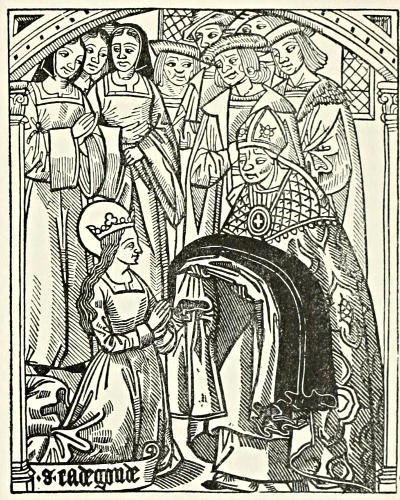
St. Radegonde, Wife of King Clotaire, receiving
Religious Robes from St. Medard
(From an old woodcut)
It was nevertheless imperative on the ecclesiastical body to form their
constitution on the model of that of the empire; and accordingly the hierarchy
of the bishops, metropolitan patriarchs, was formed in close correspondence
with the degradations of the civil power. No long time had
elapsed before the bishops of Rome acquired the supremacy. It is, indeed,
a vain pretence to assert that this supremacy was universally acknowledged
by East and West, even in the first century, or, indeed, at any time; but
it is equally certain that
they quickly gained a pre-eminence,
raising them far
above all other ecclesiastical
dignitaries. Many
causes concurred to secure
them this position; for
if the relative importance
of each provincial capital
secured to its bishop a
corresponding weight and
dignity, how much more
certainly would this result
take place as regarded the
ancient capital of the empire—that
city whence the
whole had derived its name?
Rome was, besides, one of
the most illustrious seats
of the apostles; here had
the greater number of the
martyrs shed their blood.
The bishops of Rome had
displayed the most undaunted
firmness throughout
the different persecutions,
and had sometimes
been scarcely installed in
their sacred office before
they followed their predecessor
in the path of that
martyrdom by which his seat had been vacated. In addition to all this, the
emperors now found it advisable to favour the advancement of a great
patriarchal authority. In a law that became decisive for the predominance
of Rome as well as of Christianity, Theodosius the Great commands that
all nations claiming the protection of his grace should receive the faith as
propounded by St. Peter to the Romans. Valentinian also forbade the
bishops, whether of Gaul or of other provinces, to depart from the received
customs of the church without the sanction of that venerable man, the pope
of the Holy City. Thenceforth the power of the Roman bishops advanced
beneath the protection of the emperor himself. But in this political
connection lay also a restrictive force; had there been but one emperor, a
universal primacy might also have established itself; but this was prevented
by the partition of the empire. The emperors of the East were too eagerly
tenacious of their ecclesiastical rights to make it possible that they should
promote the extension of power desired by the western patriarchs in their
dominions. In this respect also the constitution of the church presents the
closest resemblance to that of the empire.
THE PAPACY IN CONNECTION WITH THE FRANKISH EMPIRE
[312-754 A.D.]
Scarcely was this great change completed, the Christian religion established,
and the church founded, when new events of great importance took
place; the Roman Empire, so long conquering and paramount, was now to see
itself assailed by its neighbours; in its turn it was invaded and overcome.
Amidst the general convulsion that ensued, Christianity itself received a
violent shock. In their terror, the Romans bethought themselves once more
of the Etruscan mysteries, the Athenians hoped to be saved by Achilles and
Minerva, the Carthaginians offered prayers to the genius Cœlestis; but these
were only temporary waverings, for even whilst the empire was shattered in
the western provinces, the church remained firm and undisturbed throughout
all. But she fell, as was inevitable, into many embarrassments, and found
herself in an entirely altered condition. A pagan people took possession of
Britain; Arian kings seized the greater part of the remaining West; while
the Lombards, long attached to Arianism, and as neighbours most dangerous
and hostile, established a powerful sovereignty before the very gates of
Rome.
The Roman bishops meanwhile, beset on all sides, exerted themselves
with all the prudence and pertinacity which have remained their peculiar
attributes to regain the mastery—at least in their ancient patriarchal diocese;
but a new and still heavier calamity now assailed them. The Arabs—not
conquerors merely, as were the Germans, but men inspired even to
fanaticism by an arrogant and dogmatising creed, in direct opposition to the
Christian faith—now poured themselves over the West as they had previously
done over the East. After repeated attacks, they gained possession of
Africa; one battle made them masters of Spain, their general Musa boasting
that he would march into Italy by the passes of the Pyrenees and
across the Alps, and cause the name of Mohammed to be proclaimed from
the Vatican.
This position was all the more perilous for the western portion of Roman
Christendom, from the fact that the iconoclastic dissensions were at that
time raging with the most deadly animosity on both sides. The emperor of
Constantinople had adopted the opposite party to that favoured by the pope
of Rome; nay, the life of the latter was more than once in danger from the
emperor’s machinations. The Lombards did not fail to perceive the advantages
derivable to themselves from these dissensions; their king Aistulf took
possession of provinces that till then had always acknowledged the dominion
of the emperor, and again advancing towards Rome, he summoned that city
also to surrender, demanding payment of tribute with vehement threats.
The Roman see was at this moment in no condition to help itself, even
against the Lombards, still less could it hope to contend with the Arabs, who
were beginning to extend their sovereignty over the Mediterranean, and were
threatening all Christendom with a war of extermination.
But now the faith was no longer confined within the limits of the Roman
Empire. Christianity, in accordance with its original destiny, had long
overpassed these limits; more especially had it taken deep root among the
German tribes of the West; nay, a Christian power had already arisen among
these tribes, and towards this the pope had but to stretch forth his hands,
when he was sure to find the most effectual succour and earnest allies against
all his enemies.
[496-715 A.D.]
Among all the Germanic nations, the Franks alone had become Catholic
from their first rise in the provinces of the Roman Empire. This acknowledgment
of the Roman see had secured important advantages to the Frankish
nation. In the Catholic subjects of their Arian enemies, the western Goths
and Burgundians, the Franks found natural allies. We read so much of
the miracles by which Clovis was favoured—how St. Martin showed him the
ford over the Vienne by means of a hind, how St. Hilary preceded his armies
in a column of fire—that we shall not greatly err if we conclude these legends
to shadow forth the material succours afforded by the natives to those
who shared their creed, and for whom, according to Gregory of Tours,i they
desired victory “with eager inclination.” But this attachment to Catholicism,
thus confirmed from the beginning by consequences so important, was
afterwards renewed and powerfully strengthened by a very peculiar influence
arising from a totally different quarter.
It chanced that certain Anglo-Saxons, being exposed for sale in the slave
market of Rome, attracted the attention of Pope Gregory the Great; he at
once resolved that Christianity should be preached to the nation whence these
beautiful captives had been taken. Never, perhaps, was resolution adopted
by any pope whence results more important ensued; together with the
doctrines of Christianity, a veneration for Rome and for the holy see, such
as had never before existed in any nation, found place among the Germanic
Britons. The Anglo-Saxons began to make pilgrimages to Rome; they
sent their youth thither to be educated, and King Offa established the tax
called “St. Peter’s penny” for the relief of pilgrims and the education of
the clergy. The higher orders proceeded to Rome, in the hope that, dying
there, a more ready acceptance would be accorded to them by the saints in
heaven. The Anglo-Saxons appear to have transferred to Rome and the
Christian saints the old Teutonic superstition, by which the gods were
described as nearer to some spots of earth than to others, and more readily
to be propitiated in places thus favoured.
But besides all this, results of higher importance still ensued when the
Anglo-Saxons transplanted their modes of thought to the mainland, and
imbued the whole empire of the Franks with their own opinion. Boniface
(originally Winfrid or Winfrith), the apostle of the Germans, was an Anglo-Saxon;
this missionary, largely sharing in the veneration professed by his
nation for St. Peter and his successors, had from the beginning voluntarily
pledged himself to abide faithfully by all the regulations of the Roman
see; to this promise he most religiously adhered. On all the German churches
founded by him was imposed an extraordinary obligation to obedience.
Every bishop was required expressly to promise that his whole life should be
passed in unlimited obedience to the Romish church, to St. Peter and his
representative. Nor did he confine this rule to the Germans only. The
Gallican bishops had hitherto maintained a certain independence of Rome;
Boniface, who had more than once presided in their synods, availed himself
of these occasions to impress his own views on this western portion of the
Frankish church; thenceforward the Gallic archbishops received their
pallium from Rome, and thus did the devoted submission of the Anglo-Saxons
extend itself over the whole realm of the Franks.
The empire had now become the central point for all the German tribes
of the West. The fact that the reigning family, the Merovingian race, had
brought about its own destruction by its murderous atrocities had not
affected the strength of the empire. Another family, that of Pepin of
Heristal, had risen to supreme power—men of great energy, exalted force
of character, and indomitable vigour. While other realms were sinking
together into one common ruin, and the world seemed about to become the
prey of the Moslem, it was this race, the house of Pepin of Heristal, afterwards
called the Carlovingian, by which the first and effectual resistance
was offered to the Mohammedan conquerors.
[395-715 A.D.]
The religious development then in progress was also equally favoured by
the house of Pepin; we find it early maintaining the best understanding
with Rome, and it was under the special protection of Charles Martel and
Pepin le Bref that Boniface proceeded in his apostolic labours. Let us consider
the temporal condition of the papal power. On the one side the East
Roman Empire, weakened, fallen into ruin, incapable of supporting Christendom
against Islamism, or of defending its own domains in Italy against
the Lombards, yet continuing to claim supremacy even in spiritual affairs.
On the other hand, we have the German nations full of the most vigorous
life; victorious over the Moslem, attached with all the fresh ardour and trusting
enthusiasm of youth to that authority of whose protecting and restricting
influences they still felt the need, and filled with an unlimited and most
freely rendered devotion.
Already Gregory II perceived the advantages he had gained; full of a
proud self-consciousness, he writes thus to that iconoclast emperor, Leo the
Isaurian: “All the lands of the West have their eyes directed towards our
humility; by them are we considered as a God upon earth.” His successors
became ever more and more impressed with the conviction that it was needful
to separate themselves from a power (that of the Roman Empire) by
which many duties were imposed on them, but which could offer them no
protection in return. They could not safely permit a succession to the mere
name and empire to fetter them, but turned themselves rather towards those
from whom help and aid might also be expected. Thus they entered into
strict alliance with those great captains of the West, the Frankish monarchs;
this became closer and closer from year to year, procured important advantages
to both parties, and eventually exercised the most active influence on
the destinies of the world.c
With the division of the empire in the year 395, the question of the
Roman precedence of Constantinople was left for a time in abeyance; but
in the West the authority of the bishop of Rome became more and more
firmly established. In the following century the general conditions under
which he was called upon to act became so materially modified as to constitute
a new period in the history of our subject.
The characters of the men who filled the papal chair during this century,
most of them of exemplary life, some of commanding genius, would alone
suffice to constitute it a memorable era. “Upon the mind of Innocent I,”
says Milman,b “seems first distinctly to have dawned the vast conception
of Rome’s universal ecclesiastical supremacy.” Innocent I (402-417) seems
indeed to have been the first of the popes who ventured to repudiate those
political conceptions which threatened to circumscribe the extending influence
of his office. Innocent was succeeded by Zosimus (417-418) and
Boniface (418-422). The former, whose pontificate lasted only twenty-one
months, exhibits a noteworthy exception to the traditions of his see, in the
disposition he at one time showed to temporise with Pelagianism, and even
to set aside in its favour the decrees of his predecessor. The pontificate of
Boniface is notable as having been preceded by a contested election which
afforded the emperor Honorius an opportunity for the exercise of his intervention,
thereby establishing a precedent for imperial interference on like
occasions. At the instance of Boniface himself, Honorius enacted an ordinance
designed to avert the scandals incident to such contests. By the
new provisions, all canvassing for the vacant chair was strictly prohibited;
in the event of a disputed election both candidates were to be deemed
ineligible. The successor of Boniface was Celestine I (422-432). The evidence
afforded by the events of his pontificate is somewhat conflicting in
character. On the one hand, we find the churches of Africa putting forward
their latest recorded protest against the Roman pretensions, adducing
the sixth canon of the Council of Nicæa in support of their protest; on
the other hand, the success with which Celestine intervened in Illyricum, and
again in connection with the sees of Narbonne and Vienne, proves that the
papal jurisdiction was being accepted with increasing deference in other parts
of the empire.
[418-461 A.D.]
Barbaric invasion, although resulting in the overthrow of many of the
institutions of civilisation, and in widespread suffering and social deterioration,
served but to enhance the influence and importance of the Roman see.
The apparent fulfilment of prophecy, pagan as well as Christian, when the
city was taken and sacked by Alaric (410), seemed to complete the effacement
of the temporal power in Rome. Neither the western emperors nor
the Gothic conquerors held their court in the ancient capital, where the pope
was now at once the most important and conspicuous authority. In the
African provinces, the demoralisation occasioned by the fierce controversies
and dissensions concerning Pelagianism and Donatism compelled the Catholic
communities to exchange their former attitude of haughty independence for
one of suppliant appeal, and to solicit the intervention and counsel which
they had before rejected. Such was the aspect of affairs in the West when
Leo the Great (440-461), by some regarded as the true founder of the mediæval
popedom, succeeded to the primacy. A citizen of Rome by birth, he
exemplified in his own character many of the ancient Roman virtues—a
tenacious adherence to tradition in matters of religious belief, an indomitable
resolution in the assertion of the prerogatives of his office, and the austere
practice of the recognised duties of social life. This rigid maintenance of
orthodoxy had been instilled into him (or at least confirmed) by the
exhortations of Augustine, with whom he had become personally acquainted
when on a mission to the African province; and before his election to the
papal office the celebrated Cassian had conceived so high an opinion of his
virtues and abilities as to dedicate to him his treatise on the Incarnation.
Regarded, indeed, simply as the able antagonist of the Manichæan and
Eutychian heresies, and as the first author of the collect, Leo would fill
no unimportant place in the annals of Latin Christendom; but his influence
on church history in other respects is of a far deeper and more potent kind.
In none was it followed by more important results than by the success with
which he established the theory that all bishops who, in questions of importance,
demurred to the decision of their metropolitan should be entitled to
appeal to Rome. He obtained the recognition of this principle not only in
Illyricum, as his predecessor Innocent had done, but also in Gaul; and the
circumstances under which he did so in the latter province constitute the
whole proceedings a memorable episode in church history.
[461-532 A.D.]
The chief obstacle to the recognition of the supremacy of the Roman
pontiff was now to be found in the revival of Arianism, which, professed
alike by the Goth and the Vandal, represented the dominant faith in the chief
cities of northern Italy, as well as in Africa, Spain, and southern Gaul.
But the rivalry thus generated only increased the disposition of the Catholic
party to exalt the prerogatives of their head, and the attitude of Rome
towards other churches continued to be more and more one of unquestionable
superiority. In the year 483 Pope Felix II (or III)[84] ventured upon an
unprecedented measure in citing Acacius, the patriarch of Constantinople, to
Rome, to answer certain allegations preferred against him by John, patriarch
of Alexandria, whom he designated as “frater et coepiscopus noster” (Thiel,j
Epistolæ, p. 239). On Acacius’ refusing to recognise the legality of the
letter of citation, he was excommunicated by Felix. The successor of Felix,
Gelasius I (492-496), refused to notify, as was customary, his election to
the patriarch of Constantinople, and by his refusal implicitly put forward a
fresh assumption, viz., that communion with Rome implied subjection to
Rome. Throughout the pontificate of Gelasius the primacy of the Roman
see was the burden of his numerous letters to other churches, and he appears
also to have been the first of the pontiffs to enunciate the view that the
authority which he represented was not controllable by the canons of synods,
whether past or present. In Italy these assumptions were unhesitatingly
accepted. The Palmary synod, as it was termed, convened in Rome during
the pontificate of Symmachus (498-514), formally disavowed its own right
to sit in judgment on his administrative acts. Ennodius, bishop of Pavia,
(circa 510), declared that the Roman pontiff was to be judged by God alone,
and was not amenable to any earthly potentate or tribunal. It is thus evident
that the doctrine of papal infallibility, though not yet formulated, was
already virtually recognised.
During the Gothic rule in Italy (493-553), its representatives manifested
the utmost tolerance in relation to religious questions, and showed little disposition
to impose any restraints on the policy of the popes, although each
monarch, by virtue of his title of “king of the Romans,” claimed the right
to veto any election to the papal chair. In the year 483, when Odoacer sent
his first lieutenant, Basilius, from Ravenna to Rome, the latter was invested
with the titles eminentissimus and sublimis. The pope accordingly appeared
as politically the subject of his Arian overlord. The advantage thus gained
by the temporal power appears to have been the result of its intervention,
which Simplicius (468-483) had himself solicited, in the elections to the papal
office, and one of the principal acts of the Palmary synod (above referred to)
was to repudiate the chief measures of Basilius, which had been especially
directed against the abuses that prevailed on such occasions, and more particularly
against bribery by alienation of the church lands. The assertion
of this authority on the part of the civil power was declared by the synod to
be irregular and uncanonical, and was accordingly set aside as not binding
on the church. The fierce contests and shameless bribery which now accompanied
almost every election were felt, however, to be so grave a scandal that
the synod itself deemed it expedient to adopt the ordinance issued by Basilius,
and to issue it as one of its own enactments. In order more effectually
to guard against such abuses, Boniface II, in the year 530, obtained from a
synod specially convened for the purpose the power of appointing his own
successor, and nominated one Vigilius—the same who ten years later actually
succeeded to the office. But a second synod, having decided that such
a concession was contrary to the traditions of episcopal succession, annulled
the grant, and Boniface himself committed the former decree to the flames.
At his death, however, the recurrence of the old abuses in a yet more flagrant
form induced the senate to obtain from the court of Ravenna a measure
of reform of a more comprehensive character, and designed to check not only
the simoniacal practices within the church itself, but also the extortion of the
court officials.
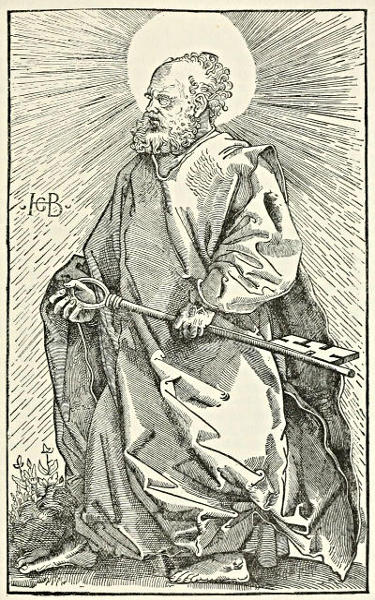
An Ancient Conception of St. Peter
(From a woodcut in the Bibliothèque Nationale, Paris)
[526-590 A.D.]
In the year 526 Dionysius Exiguus, a monk in Rome, undertook the
labour of preparing a new collection of the canons of the councils, and, finding
his production favourably received, proceeded also to compile a like
collection of the papal letters or decretals, from the earliest extant down to
those of Anastasius II in his own day. The letters of the popes were thus
placed on a level with the rescripts of the emperors, and in conjunction with
the canons formed the basis of the canon law, which afterwards assumed
such importance in connection with the history of the church. The negative
value of the collection formed by Dionysius may be said, however, almost to
equal that of its actual contents; for, from the simple fact that it does not
contain those yet earlier decretals subsequently put forth by the pseudo-Isidorus,
it affords the most convincing disproof of their genuineness.
The substitution of the rule of the Greek emperors for that of the Gothic
monarchs was inimical in almost every respect to the independence and reputation
of the popedom. For a short interval before Justinian landed in
Italy, Agapetus (535-536), appearing as the emissary of Theodotus to the
Eastern court, assumed a bearing which inspired the emperor himself with
respect, and his influence was sufficiently potent to procure the deposition of
one patriarch of the Eastern capital and to decide the election of another.
But, after Belisarius entered Rome and the city had been reduced to subjection,
the pontiff was seen to be the mere vassal of the emperor, and not only
of the emperor but of the courtesan on the imperial throne. The deposition of
Silverius (536-540), and his mysterious fate at Pandataria, together with
the elevation of Vigilius (540-555), the nominee of the abandoned Theodora
and her pliant slave, completed the degradation of the Roman see. Each
successive pope was now little more than a puppet which moved at the pleasure
of the Eastern court, and the apocrisiarius or deputy whom he maintained
at that court was generally (as in the case of Pelagius I, Gregory I, Sabinian,
Boniface III, Martin) his own successor—an honour purchased, it can
hardly be doubted, by systematic compliance with the imperial wishes. In
the career and fate of Vigilius the papal office was dishonoured as it had
never been before, at once by the signal unworthiness of its bearer and by
the indignities heaped upon him by the savage malice of his foes. So sinister,
indeed, had become the relations between the Roman bishop and the
eastern court that Pelagius I (555-560) is said to have besought Narses to
send him to prison rather than to Constantinople.
In the year 568 the Lombards invaded Italy. Like the Goths they became
converts to Arianism; but they were also far less civilised, and looked
with little respect on Roman institutions and Roman habits of thought, while
their arrogance, faithlessness, and cruelty gained for them the special detestation
of the Roman see. Their conquests did not extend over all Italy.
Ravenna and the Pentapolis, Venice, Rome, and its duchy (as the surrounding
district was then termed), Naples, Calabria, and Sicily, remained subject
to the empire. In the peninsula the pope was, after the exarch of Ravenna,
the most powerful potentate, and the presence of a common foe caused the
relations between himself and the empire to assume a more amicable character.
The emperor, indeed, continued to control the elections and to
enforce the payment of tribute for the territory protected by the imperial
arms; but on the other hand the pontiff exercised a definite authority
with the Roman duchy and claimed to have a voice in the appointment of
the civil officers who administered the local government. From the time
of Constantine the Great the church had possessed the right of acquiring
landed property by bequests, and the Roman see had thus become greatly
enriched. Some of its possessions lay far beyond the confines of Italy.f
GREGORY THE GREAT (590-604 A.D.)
[42-590 A.D.]
The papal monarchy thus rose insensibly upon the episcopal aristocracy.
From the first, the word of the successor of St. Peter as bishop of the Eternal
City had a high degree of authority. The title of “pope,” attributed in
theory to every bishop, was finally reserved for him of Rome alone, a change
already manifest under Leo the Great, but not completely brought about
until the time of Gregory VII. The bishop of Rome had possessed since the
days of the Roman Empire valuable property in the capital and throughout
Italy. He had even acquired some across the Alps, for example, in the province
of Arles, where he charged the bishop of that city with administering
it. Besides this he occupied in Rome itself, that is to say in the most famous
city in the world, that great estate which had been assigned to the
bishops by the municipal régime in the last days of the empire.
St. Leo (440-461) gave much prestige to his office by the great rôle he
played in public affairs and his successful intercession with Attila. He
obtained from Valentinian III a decree in which the emperor invited “the
entire church to recognise its head in order that peace might forever be preserved”;
and at the same period we see him restoring a Gallican bishop to
the see from which he had been driven, and transferring the metropolitan
seat from Arles to Vienne.
Under the Ostrogoths the church of Rome, treated elsewhere with leniency,
could make no progress. But when their power had fallen (553) and Rome
came once more under the authority of the emperor of Constantinople, the
great distance of her new master opened up a brighter future. The Lombard
invasion brought into the church’s territory a large number of refugees, and
the Roman population recovered some of its old energy in the double hatred
for barbarians and Arians. As for the exarch whom the eastern emperor
had charged with the government of his Italian provinces and invested with
direct authority over the dukes and military counts of Naples, Rome, Genoa,
etc., this official could scarcely make his authority felt in the western half of
Italy, relegated as he was to Ravenna, and separated from Rome by the
Lombard dominion which included Spoleto.
[590-604 A.D.]
It was at this juncture favourable, though dangerous in some respects,
that Gregory I appeared (590-604). Descended from the noble Anicia
family, Gregory added to distinction of birth every advantage of body and
mind. While under thirty he was prefect of Rome, but at the end of several
months he abandoned honours and thoughts of worldly things, and sought
the retirement of the cloister. But his reputation did not permit him the
obscurity he desired. Sent to Constantinople about 570 as secretary and
later as apocrisiary (a sort of grand almoner) by Pope Pelagius II, he rendered
valuable service to the holy see in its relations with the empire and in
its struggles with the Lombards. In 590 the clergy, the senate, and the
people raised him with one voice to the supreme pontificate, as successor to
Pelagius; but as all elections had to be confirmed by the emperor at Constantinople,
Gregory wrote in supplication that his might not be sanctioned.
The letter was intercepted, and Maurice’s orders of ratification
soon arrived. Gregory hid; he was discovered and brought back to Rome.
Pope in spite of himself, he used all his talent and power to fortify the
papacy,[85] propagate Christianity, and improve the discipline and organisation
of the church. Although he pleaded that the episcopacy, and especially his
own, “was the office of a shepherd of souls and not of a temporal prince,”
he did not neglect the temporal power of the holy see. It happened, since
the emperor was so little in touch with Italian affairs, that the soldiers
charged with defending Rome against the Lombards had received no pay.
Gregory paid them, took upon himself the work of defence, and armed
the clerics. When Agilulf, whose aggression had provoked these preparations,
was compelled to withdraw, Gregory treated with him in the name of
Rome, in spite of protests from the exarch.
Feeling thus strengthened in his position, he undertook to propagate
Christianity and orthodoxy both within and without the limits of the
ancient Roman Empire. Within its boundaries there were still some pagans
in Sicily, Sardinia, even at Terracina (Tarracina) at the very gates of Rome,
and doubtless also in some parts of Gaul, since there exists a decree of Childebert’s
dated 554, with the title For the Abolition of the Remainder of
Idolatry. There were Arians very close to Rome, the Lombards. By the
intervention of Queen Theudelinda, Gregory succeeded in having the heir
to the Lombard throne, Adalwald, raised in Catholicism. Since 587 the
Visigoths in Spain under Recared had been converted.
As for Great Britain, it was still entirely pagan, and Gregory sent thither
the monk Augustine and forty Roman missionaries (596). They landed on
the island of Thanet, and going from there sought Ethelbert, king of Kent,
who permitted them to preach their doctrines at Canterbury. From this
point Christianity spread rapidly towards the north and west, until by 627
it was firmly established in Northumberland. St. Augustine, archbishop of
Canterbury, had been named primate of England by Gregory the Great, with
whom he kept up a constant correspondence that is still in existence.
Ireland, “the isle of saints,” had already been converted, and now monks
were leaving it to win over the barbarians. At this period St. Columban,
the monk who denounced Brunehild’s crimes with such boldness, set out to
preach the Gospel to the mountaineers of Helvetia, and founded in their
midst abbeys surrounded by fertile fields. After him St. Rupert travelled
far into Bavaria and established the diocese of Salzburg.
Thus Christianity spread its spirit of proselytism, and St. Gregory fostered
it greatly by the mild precepts he inculcated in his missionaries, and
the skill with which he facilitated the transition from pagan to Catholic.
He wrote to St. Augustine: “You must take care not to destroy the pagans’
temples, but only their idols; use holy water in washing out the edifice, build
altars and deposit relics in them. If their temples are well built, so much
the better; for it is important that these same ones pass from the cult of
demons to that of the true God. When the nation sees its ancient places
of worship remain, it will be more disposed to visit them through habit and to
worship the true God.”
At home Gregory laboured with success to co-ordinate the powers of the
church, in making recognised above everything that of the holy see. We
find him bestowing the title of vicar of the Gauls upon the bishop of Arles,
to correspond with Augustine archbishop of Canterbury, with the archbishop
of Seville for Spain, and him of Thessalonica for Greece; and finally sending
secret legates to Constantinople. In his pastoral which he wrote on the
occasion of his election, and which became a general regulation throughout
the West, he prescribed the bishops their duties according to the decision of
several councils. To bind the hierarchy together he sought to prevent the
encroachments of one bishop upon another. “I have given you Britain to
direct spiritually,” he wrote to the ambitious Augustine, “and not Gaul.”
He favoured the monasteries, looked with vigilance after their discipline, and
reformed church singing, substituting for the Ambrosian chant, “which,”
according to a contemporary, “was like the distant sound of a chariot rolling
over the stones,” that Gregorian chant which bears his own name.d
The darkest stain on the name of Gregory is his cruel and unchristian
triumph in the fall of the emperor Maurice—his base and adulatory praise
of Phocas, the most odious and sanguinary tyrant who had ever seized the
throne of Constantinople. It is the worst homage to religion to vindicate or
even to excuse the crimes of religious men; and the apologetic palliation,
or even the extenuation of their misdeeds rarely succeeds in removing, often
strengthens, the unfavourable impression.
Gregory was spared the pain and shame of witnessing the utter falsehood
of his pious vaticinations as to the glorious and holy reign of Phocas. In
the second year of the tyrant’s reign he closed the thirteen important years
of his pontificate. The ungrateful Romans paid but tardy honours to his
memory. His death (March 10th, 604) was followed by a famine, which the
starving multitude attributed to his wasteful dilapidation of the patrimony
of the church—that patrimony which had been so carefully administered
and so religiously devoted to their use. Nothing can give a baser notion
of their degradation than their actions. They proceeded to wreak their
vengeance on the library of Gregory, and were only deterred from their barbarous
ravages by the interposition of Peter the faithful archdeacon. Peter
had been interlocutor of Gregory in the wild legends contained in the
Dialogues.k The archdeacon now assured the populace of Rome that he had
often seen the Holy Ghost in the visible shape of a dove hovering over the
head of Gregory as he wrote. Gregory’s successor therefore hesitated, and
demanded that Peter should confirm his pious fiction or fancy by an oath.
He ascended the pulpit, but before he had concluded his solemn oath he fell
dead. That which to a hostile audience might have been a manifest judgment
against perjury, was received as a divine testimony to his truth. The
Roman church has constantly permitted Gregory to be represented with the
Holy Ghost, as a dove, floating over his head.
The historian of Christianity is arrested by certain characters and certain
epochs, which stand as landmarks between the close of one age of religion
and the commencement of another. Such a character is Gregory the Great;
such an epoch his pontificate, the termination of the sixth century. Gregory,
not from his station alone, but by the acknowledgment of the admiring world,
was intellectually, as well as spiritually, the great model of his age. He was
proficient in all the arts and sciences cultivated at that time; the vast volumes
of his writings show his indefatigable powers; their popularity and
their authority, his ability to clothe those thoughts and those reasonings in
language which would awaken and command the general mind.
His epoch was that of the final Christianisation of the world, not in outward
worship alone, not in its establishment as the imperial religion, the rise
of the church upon the ruin of the temple, and the recognition of the hierarchy
as an indispensable rank in the social system, but in its full possession of the
whole mind of man, in letters, arts as far as arts were cultivated, habits, usages,
modes of thought, and in popular superstition.
Not only was heathenism, but, excepting in the laws and municipal
institutions, Romanity itself absolutely extinct. The reign of Theodoric
had been an attempt to fuse together Roman, Teutonic, and Christian usages.
Cassiodorus, though half a monk, aspired to be a Roman statesman, Boethius
to be a heathen philosopher. The influence of the Roman schools of rhetoric
is betrayed even in the writers of Gaul, such as Sidonius Apollinaris;
there is an attempt to preserve some lingering cadence of Roman poetry in the
Christian versifiers of that age. At the close of the sixth century all this
has expired; ecclesiastical Latin is the only language of letters, or rather
letters themselves are become purely ecclesiastical. The fable of Gregory’s
destruction of the Palatine library is now rejected as injurious to his fame;
but probably the Palatine library, if it existed, would have been so utterly
neglected that Gregory would hardly have condescended to fear its influence.
His aversion to such studies is not that of dread or hatred, but of religious
contempt; profane letters are a disgrace to a Christian bishop; the truly
religious spirit would loathe them of itself.
What, then, was this Christianity by which Gregory ruled the world?
Not merely the speculative and dogmatic theology, but the popular, vital,
active Christianity, which was working in the heart of man; the dominant
motive of his actions, as far as they were affected by religion; the principal
element of his hopes and fears as regards the invisible world and that future
life which had now become part of his conscious belief.
Christian Mythology
The history of Christianity cannot be understood without pausing at
stated periods to survey the progress and development of this Christian
mythology, which, gradually growing up and springing as it did from natural
and universal instincts, took a more perfect and systematic form, and at
length, at the height of the Middle Ages, was as much a part of Latin Christianity
as the primal truths of the Gospel. This growth, which had long
before begun, had reached a kind of adolescence in the age of Gregory, to
expand into full maturity during succeeding ages. Already the creeds of
the church formed but a small portion of Christian belief. The highest and
most speculative questions of theology, especially in Alexandria and Constantinople,
had become watchwords of strife and faction, had stirred the
passions of the lowest orders; the two natures, or the single or double will
in Christ, had agitated the workshop of the artisan and the seats in the circus.
Christ assumed gradually more and more of the awfulness, the immateriality,
the incomprehensibleness, of the Deity, and men sought out beings
more akin to themselves, more open, it might seem, to human sympathies.
Believers delighted in those ceremonials to which they might have recourse
with less timidity; the shrines and the relics of martyrs might deign to receive
the homage of those who were too profane to tread the holier ground. Already
the worship of these lower objects of homage begins to intercept that to the
higher; the popular mind is filling with images either not suggested at all, or
suggested but very dimly by the sacred writings; legends of saints are supplanting,
or rivalling at least, in their general respect and attention, the narratives
of the Bible.
Of all these forms of worship, the most captivating, and captivating to the
most amiable weaknesses of the human mind, was the devotion to the Virgin
Mary. The worship of the Virgin had first arisen in the East; and this
worship, already more than initiate, contributed, no doubt, to the passionate
violence with which the Nestorian controversy was agitated, while that controversy,
with its favourable issue to those who might seem most zealous for
the Virgin’s glory, gave a strong impulse to the worship. The denial of the
title “the mother of God,” by Nestorius, was that which sounded most offensive
to the general ear; it was the intelligible odious point in his heresy.
The worship of the Virgin now appears in the East as an integral part of
Christianity. Among Justinian’s splendid edifices arose many churches
dedicated to the mother of God. The feast of the Annunciation is already
celebrated under Justin and Justinian. Heraclius has images of the Virgin
on his masts when he sails to Constantinople to overthrow Phocas. Before
the end of the century the Virgin is become the tutelar deity of Constantinople,
which is saved by her intercession from the Saracens.
WORSHIP OF THE VIRGIN
In the time of Gregory the worship of the Virgin had not assumed that rank
in Latin Christianity to which it rose in later centuries, though that second
great impulse towards this worship, the unbounded admiration of virginity,
had full possession of his monastic mind. With Gregory celibacy was the
perfection of human nature; he looked with abhorrence on the contamination
of the holy sacerdotal character, even in its lowest degree, by any sexual
connection. No subdeacon, after a certain period, was to be admitted without
a vow of chastity; no married subdeacon to be promoted to a higher
rank. In one of his expositions he sadly relates the fall of one of his aunts,
a consecrated virgin; she had been guilty of the sin of marriage. Of all his
grievances against the exarch of Ravenna, none seems more worthy of complaint
than that he had encouraged certain nuns to throw off their religious
habits and to marry. Gregory does not seem to have waged this war against
nature, however his sentiments were congenial with those of his age, with his
wonted success.[86] His letters are full of appeals to sovereigns and to bishops
to repress the incontinence of the clergy; even monasteries were not absolutely
safe.
ANGELS AND DEVILS
It was not around the monastery alone, the centre of this preternatural
agency, that the ordinary providence of God gave place to a perpetual interposition
of miraculous power. Every Christian was environed with a world
of invisible beings, who were constantly putting off their spiritual nature and
assuming forms, uttering tones, distilling odours, apprehensible by the soul of
man, or taking absolute and conscious possession of his inward being. A
distinction was drawn between the pure, spiritual, illimitable, incomprehensible
nature of the Godhead, and the thin and subtile but bodily forms of
angels and archangels. These were perceptible to the human senses, wore
the human form, spoke with human language; their substance was the thin
air, the impalpable fire; it resembled the souls of men, but yet, whenever
they pleased, it was visible, performed the functions of life, communicated
not with the mind and soul only but with the eye and ear of man.
The hearing and the sight of religious terror were far more quick and
sensitive. The angelic visitations were but rare and occasional; the more
active demons were ever on the watch, seizing and making every opportunity
of beguiling their easy victims. They were everywhere present, and
everywhere betraying their presence. They ventured into the holiest places;
they were hardly awed by the most devout saints; but, at the same time
there was no being too humble, to whose seduction they would not condescend—nothing
in ordinary life so trivial and insignificant but that they
would stoop to employ it for their evil purposes. They were without the
man, terrifying him with mysterious sounds and unaccountable sights. They
were within him, compelling all his faculties to do their bidding, another indwelling
will besides his own, compelling his reluctant soul to perform their
service. Every passion, every vice, had its especial demon; lust, impiety,
blasphemy, vainglory, pride were not the man himself, but a foreign power
working within him. The slightest act, sometimes no act at all, surrendered
the soul to the irresistible indwelling agent. In Gregory’s
Dialoguesk a woman eats a lettuce without making the sign of the cross; she
is possessed by a devil, who had been swallowed in the unexorcised lettuce.
Another woman is possessed for admitting her husband’s embraces the night
before the dedication of an oratory.
MARTYRS AND RELICS
Happily there existed, and existed almost at the command of the clergy,
a counterworking power to this fatal diabolic influence, in the perpetual
presence of the saints, more especially in hallowed places, and about their
own relics. These relics were the treasure with which the clergy, above all
the bishops of Rome, who possessed those of St. Peter and St. Paul with
countless others, ruled the mind; for by these they controlled and kept in
awe, they repaired the evils wrought by this whole world of evil spirits.
Happy were the churches, monasteries, whose foundations were hallowed and
secured by these sacred talismans. To doubt their presence in these dedicated
shrines, in the scenes of their martyrdom, obstinately to require the
satisfaction of the senses as to their presence, was an impious want of faith;
belief, in proportion to the doubtfulness of the miracle, was the more meritorious.
Kings and queens bowed in awe before the possessors and dispensers
of these wonder-working treasures.
Relics had now attained a self-defensive power; profane hands which
touched them withered; and men who endeavoured to remove them were
struck dead. Such was the declaration of Gregory himself, to one who had
petitioned for the head or some part of the body of St. Paul. It was an awful
thing even to approach to worship them. Men who had merely touched the
bones of St. Peter, St. Paul, and St. Lawrence, though with the pious design
of changing their position or placing the scattered bones together, had fallen
dead, in one case to the number of ten. The utmost that the church of
Rome could bestow would be a cloth which had been permitted to touch
them; and even such cloths had been known to bleed. If, indeed, the chains
of St. Paul would yield any of their precious iron to the file, which they often
refused to do, this, he writes, he would transmit to the empress; and he
consoles her for the smallness of the gift by the miraculous power which it
will inherently possess.
Gregory doled out such gifts with pious parsimony. A nail which contained
the minutest filings from the chains of St. Peter was an inestimable
present to a patrician, or an ex-consul, or a barbaric king. Sometimes they
were inserted in a small cross; in one instance with fragments of the gridiron
on which St. Lawrence was roasted. One of the golden nails of the
chains of St. Peter had tempted the avarice of a profane, no doubt a heathen
or Arian, Lombard; he took out his knife to sever it off; the awe-struck
knife sprang up and cut his sacrilegious throat. The Lombard king
Authari and his attendants were witnesses of the miracle, and stood in
terror, not daring to lift the fearful nail from the ground. A Catholic was
fortunately found, by whom the nail permitted itself to be touched; and this
peerless gift, so avouched, Gregory sends to a distinguished civil officer.
SANCTITY OF THE CLERGY
That sanctity which thus dwelt in the relics of the saints, was naturally
gathered, as far as possible, around their own persons by the clergy, hallowed
as they were and set apart by their ordination from the common race of man;
and if the hierarchy had only wielded this power for self-protection, if they
had but arrayed themselves in this defensive awe against the insults and
cruelties of barbarians, such as the Lombards are described, it would be
stern censure which would condemn even manifest imposture. We might
excuse the embellishment, even the invention of the noble story of the bishop
Sanctulus, who offered his life for that of a captive deacon, before whom the
Lombard executioner, when he lifted up his sword to behead him, felt his
arm stiffen, and could not move it till he had solemnly sworn never to raise
that sword against the life of a Christian. But this conservative respect for
the sanctity of their order darkens too frequently into pride and inhumanity;
the awful inviolability of their persons becomes a jealous resentment against
even unintentional irreverence. A demoniac accused the holy bishop
Fortunatus of refusing him the rights of hospitality; a poor peasant
receives the possessed into his house, and is punished for this inferential
disrespect to the bishop by seeing his child cast into the fire and burned
before his eyes. A poor fellow with a monkey and cymbals is struck dead
for unintentionally interrupting a bishop Boniface in prayer.
The sacred edifices, the churches, especially, approachable to all, were yet
approachable not without profound awe; in them met everything which
could deepen that awe; within were the relics of the tutelar saint, the
mysteries, and the presence of the Redeemer, of God himself; beneath were
the remains of the faithful dead.
Burial in churches had now begun; it was a special privilege. Gregory
dwells on the advantage of being thus constantly suggested to the prayers
of friends and relatives for the repose of the soul. But that which was
a blessing to the holy was but more perilous to the unabsolved and the
wicked. The sacred soil refused to receive them; the martyrs appeared
and commanded the fetid corpses to be cast out of their precincts. They
were seized by devils, who did not fear to carry off their own even from
those holy places. But oblations were still effective after death. The consecrated
host has begun to possess in itself wonder-working powers. A child
is cast forth from his grave, and is only persuaded to rest in quiet by a piece
of the consecrated bread being placed upon his breast. Two noble women,
who had been excommunicated for talking scandal, were nevertheless buried
in the church; but every time the mass was offered, their spirits were seen
to rise from their tombs and glide out of the church. It was only after an
oblation had been “immolated” for them that they slept in peace.
STATE AFTER DEATH
The mystery of the state after death began to cease to be a mystery. The
subtile and invisible soul gradually materialised itself to the keen sight of
the devout. A hermit declared that he had seen Theodoric, the Ostrogothic
king, at the instant of death, with loose garments and sandals, led between
Symmachus the patrician and John the pope, and plunged into the burning
crater of Lipari. Benedict, while waking, beheld a bright and dazzling light,
in which he distinctly saw the soul of Germanus, bishop of Capua, ascend to
heaven in an orb of fire, borne by angels.
Hell was by no means the inexorable dwelling which restored not its
inhabitants. Men were transported thither for a short time, and returned to
reveal its secrets to the shuddering world. Gregory’s fourth book is entirely
filled with legends of departing and of departed spirits, several of which
revisit the light of day. On the locality of hell Gregory is modest, and
declines to make any peremptory decision. On purgatory, too, he is dubious,
though his final conclusion appears to be that there is a purgatorial fire which
may purify the soul from very slight sins. Some centuries must elapse before
those awful realms have formed themselves into that dreary and regular
topography which Dante partly created out of his own sublime imagination,
partly combined from all the accumulated legends.
The most singular of these earlier journeys into the future world are the
adventures of a certain Stephen, the first part of which Gregory declares he
had heard more than once from his own mouth, and which he relates, apparently
intending to be implicitly believed. Stephen had to all appearance died
in Constantinople, but, as the embalmer could not be found, he was left unburied
the whole night. During that time he went down into hell, where he
saw many things which he had not before believed. But when he came
before the Judge, the Judge said, “I did not send for this man, but for
Stephen the smith.” Gregory’s friend Stephen was too happy to get back,
and on his return found his neighbour Stephen the smith dead. But Stephen
learned not wisdom from his escape. He died of the plague in Rome,
and with him appeared to die a soldier, who returned to reveal more of these
fearful secrets of the other world, and the fate of Stephen. The soldier
passed a bridge, beneath it flowed a river, from which rose vapours, dark,
dismal, and noisome. Beyond the bridge (the imagination could but go
back to the old Elysian fields) spread beautiful, flowery, and fragrant
meadows, peopled by spirits clothed in white. In these were many mansions,
vast and full of light. Above all rose a palace of golden bricks; to
whom it belonged he could not read. On the bridge he recognised Stephen,
whose foot slipped as he endeavoured to pass. His lower limbs were immediately
seized by frightful forms, who strove to drag him to the fetid dwellings
below. But white and beautiful beings caught his arms, and there was
a long struggle. The soldier did not see the issue of the conflict.
Such were among the stories avouched by the highest ecclesiastical
authority, and commended it might seem by the uninquiring faith of the
ruling intellect of his age—such among the first elements of that universal
popular religion which was the Christianity of ages. This religion gradually
moulded together all which arose out of the natural instincts of man, the
undying reminiscences of all the older religions, the Jewish, the pagan, and
the Teutonic, with the few and indistinct glimpses of the invisible world
and the future state of being in the New Testament, into a vast system,
more sublime perhaps for its indefiniteness, which, being necessary in that
condition of mankind, could not but grow up out of the kindled imagination
and religious faith of Christendom. And such religion the historian
who should presume to condemn as a vast plan of fraud, or a philosopher who
should venture to disdain as a fabric of folly only deserving to be forgotten,
would be equally unjust, equally blind to its real uses, assuredly ignorant
of its importance and its significance in the history of man. For on this,
the popular Christianity, turns the whole history of man for centuries.
It is at once the cause and the consequence of the sacerdotal dominion
over mankind; the groundwork of authority at which the world
trembled; which founded and overthrew kingdoms, bound together or set
in antagonistic array nations, classes, ranks, orders of society. Of this, the
parent, when the time arrived, of poetry, of art, the Christian historian must
watch the growth and mark the gradations by which it gathered into itself
the whole activity of the human mind, and quickened that activity till at
length the mind outgrew that which had been so long almost its sole occupation.
It endured till faith, with the schoolmen, led into the fathomless depths
of metaphysics, began to aspire after higher truths; with the reformers,
attempting to refine religion to its primary spiritual simplicity, gradually
dropped, or left but to the humblest and most ignorant, at least to the more
imaginative and less practical part of mankind, this even yet prolific legendary
Christianity, which had been the accessory and supplementary Bible, the
authoritative and accepted, though often unwritten, Gospel of centuries.b
GREGORY’S SUCCESSORS
[604-649 A.D.]
Gregory left the papal chair far more securely settled on the lofty eminence
where it had been placed than it was when he ascended it. But
Sabinian, who succeeded him, expressed little gratitude for the service he
had thus performed; indignant at finding the treasury exhausted of its
gold, he accused him of having ruined the see by his liberality; and would
have proceeded, but for the menaces of both the clergy and the people, publicly
to burn his writings. He did not live long after this attempt; and his
sudden death was ascribed to a blow on the head inflicted by the angry
shade of the departed saint. A truer cause, however, may be found, perhaps,
in the fact that he had made himself hated by the populace, by withdrawing
the accustomed alms, that he might heal, as he pretended, the
injuries inflicted by the liberality of Gregory; a mode of proceeding so
little relished by his flock, that, whatever share they might have in his
death, they conveyed his breathless body with contempt out of the city.
It was during the pontificate of Boniface III, who resided as Gregory’s
legate at the court of Constantinople, and owed his elevation to the emperor,
that the Roman pontiff was first dignified with the much-disputed title of
universal bishop. For this honour Boniface was indebted to the enmity existing
between Phocas and the patriarch of his imperial city. He lived to enjoy
his triumph only a few months; and several of his successors seem to have
contented themselves with the duties of their station, without entering into
direct collision with any rival in authority. It is, however, a singular
circumstance, that to the attempts of Boniface IV, who obtained the papal
dignity immediately after the pontiff just named, to bring back the separatists
from Rome to her communion, a resistance was made by the celebrated
Irish apostle Columbanus, breathing much of the freedom and intelligence of
later days.
Honorius, who succeeded to the papacy after the two unimportant
pontificates of Deusdedit (Deodatus or Adeodatus I) and Boniface V, made
a vain attempt to influence the Lombards to restore their king, Adalwald
(Adalvaldus), whom they had deposed as a madman, and elected in his place
an Arian named Ariwald (Ariovaldus). But the most conspicuous circumstance
in his career was his agreement with Sergius, the patriarch of
Constantinople, in establishing the celebrated edict by which it was
intended to put an end to the monothelite controversy,[87] and render the
renewal of it a crime against the laws of the empire. Yet Honorius, in
the Sixth General Council, was solemnly anathematised, and classed with
the known and most violent supporters of the monothelite heresy.
The death of this pontiff was followed by the pillage of the palace of the
Lateran—an outrage which had its origin with the emperor, and was committed
by his own officers. Severinus was then placed in the papal chair,
but his pontificate was not marked by any important event. The same
observation applies to those of his successors, John IV and Theodore.
Theodore was succeeded by Martin I, the earliest act of whose pontificate
was the calling of a council to condemn the principles of the monothelites,
and the late acts of the emperors. The assembly held its first session
October 5th, 649; in the fifth and last, which was held on the 31st of
October, twenty articles were drawn up against the heresy in question, and
its authors, Theodorus, Cyrus, Sergius, Pyrrhus, and Paul, together with
all such as should embrace their opinions, were formally anathematised.
The Roman pontiff was by this proceeding brought into immediate
collision with the emperor; and the power of the greatest potentate of the
church was thus measured with that of the highest in the state. In this
respect the issue of the controversy deserves particular note. Martin was a
zealous and active churchman, learned and conscientious, strongly impressed
with a sense of the importance of unity, and disposed to exercise the
authority he possessed to the utmost in its favour. No sooner had
the council given its decision, than he despatched letters to all orders of the
clergy, acquainting them with the event and with the acts it had passed.
But the information which the emperor Constans received of these proceedings
filled him with the most violent indignation; and he at once resolved to
punish the contempt with which his edict, and that of his predecessor, had
been treated. He communicated his wishes to Calliopas, exarch of Italy,
who soon after made the pontiff a prisoner and conveyed him to the island
of Naxos. For three months he was kept nearly continually on board a ship,
and carried from one place to the other, without being allowed even the
commonest necessaries of life. At Naxos he remained twelve months in
captivity; and was then taken to Constantinople, being exposed, during his
passage thither, to a treatment which would have been cruel to a condemned
malefactor. On his arrival, fresh indignities and barbarities awaited him.
He was cast into a miserable prison, in which he lay apparently forgotten
for more than three months, and when carried before the tribunal of justice was
examined like a common criminal. The part he had taken in the late events,
so far as they strictly pertained to religion, was not considered even by his
fiercest opponents as involving a guilt sufficient to justify their severities.
He was, therefore, arraigned as an enemy of the state. Twenty witnesses,
of whom the greater part were soldiers, and who are said to have been
bribed for the occasion, appeared as his accusers.
[649-682 A.D.]
This mockery of a trial being concluded, the pontiff was carried to an
open terrace, where, exposed at once to the gaze of the emperor and the populace,
the base servants of the court insulted him in so gross a manner
that even the multitude pitied his fate. His outward mantle having been
torn off, the officers took him, and stripping off the best of his habits, left
only his tunic remaining, which they next rent down on each side, from top
to bottom. An iron collar was then fastened round his neck, and he was led
from the palace through the midst of the city, chained to one of the keepers
of the prison, and preceded by another bearing the sword with which he was
to be executed. As they dragged him along, his lacerated feet stained the
pavement with blood; and he presented an appearance of humiliation and
misery which might well humble the spirits of the haughtiest churchmen of
either Rome or Constantinople. But his sufferings did not terminate here.
Instead of being executed he was sent into the Chersonesus where he lingered
through four months of the severest hardship, then expired. He was succeeded
as pope by Eugenius, indebted for his elevation to the influence of the
imperial court and his too ready tolerance of its reigning errors. He was
consequently regarded at Rome with equal suspicion and dislike. Vitalian,
the successor of Eugenius, had the merit of being a strict disciplinarian, and
of sending Theodore to England as archbishop of Canterbury. At his death,
Adeodatus (Deodatus II) was elected. It was in the pontificate of his
successor Domnus that the church of Ravenna became permanently incorporated
with that of Rome.
Agatho, the next pope, was not less conspicuous for the devoutness of his
character; and the story which is told of his curing by a kiss some leprous
person whom he accidentally met, indicates not merely the growing superstition
of the age, but the influence which the pontiff’s piety had made upon
the minds of the people. At his request it was that the emperor Constantine
Pogonatus assembled the Sixth General Council; and it is somewhat singular
to find that one of the main objects which his legates laboured at obtaining
was a reduction of the sum usually paid by the newly elected pontiff
into the imperial treasury. For this indulgence, Agatho willingly confirmed
the ancient law, that no pope should be ordained till his election had been
formally recognised and confirmed at Constantinople. The harmony which
thus existed between the emperor and Agatho was happily continued through
the pontificate of Leo II, in whose favour the monarch decreed that the new
archbishop of Ravenna should receive his ordination at the hands of the
pope. He possessed sufficient interest at the court of the emperor to obtain
the important privilege for the Roman pontiffs, of being confirmed in their
authority by the exarch of Ravenna, instead of having to make the long and
difficult journey to Constantinople.
[682-701 A.D.]
The pontificate of John V was as unimportant as it was short; he was
succeeded by Conon. Next, Sergius occupied the papal chair to the beginning
of the eighth century; but, at the commencement of his pontificate,
he saw himself opposed by two powerful rivals, and the palace of the
Lateran was for some time
besieged with open force by
the partisans of these pretenders
to the papacy. The
contest was continued for
a considerable period. Sergius,
though supported by
imperial influence, had to
endure a seven years’ exile
before he could possess himself
of the dignity; and on
his refusal to recognise the
canons of the council in
trullo,[88] was assailed by Justinian
II with all the weapons
of imperial authority.
The conflict was thus renewed,
which had so long
disturbed the peace of
Christendom; and another
starting-point given, from
which the two great candidates
for universal and
unlimited power were to
begin the race. It is evident
that the pontiff had
not yet acquired strength
sufficient to oppose his rival
with certainty of success.
At the council of Toledo,
held in the year 688, the archbishop of that city obtained a resolution in
favour of his opinions, which not simply established his creed in opposition to
that of the pontiff, but was couched in terms of haughty defiance and rebuke.
The contest, therefore, was as yet unattended by palpable prognostics of the
final triumph of the papacy.
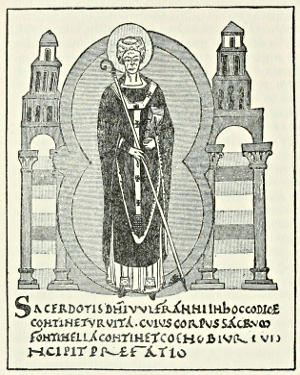
St. Wulfran, Bishop of Sens, who died in 720 A.D.
(From a miniature in the Bibliothèque du Havre)
The troubles which the church had suffered from the continual motions
of half-barbarian hordes were many and severe, but they produced an equivalent
advantage. Amid all the struggles to which churchmen were urged
by ambition, they displayed, as a body, some of the noblest instances of
charity, of care for the poor and distressed, which the world had seen.
Pressed by the frequent prospect of immediate ruin, they simultaneously
acquired the virtues of resignation and the skill of politicians. It was to
them the people owed their preservation when threatened on the one side
by foreign enemies, and on the other by the tyranny of their rulers; and
till they themselves became oppressors, popular liberty found its best champions
among the heads of the church. But when the progress of Christianity
itself is considered—that is, the very interests for which the church, with
all its attendant powers, was called into existence—doubt and dissatisfaction
are almost the invariable result of the inquiry. In Rome, piety was
shocked by the open contests which repeatedly took place by candidates for
the papal dignity, and by the little less disgraceful plots with which the
contending parties prepared for the onset. The provinces, perpetually appealed
to on the subject of obedience to the supreme pontiff, saw their own
pastors at one time yielding with submissive complacence to his decrees, at
another resisting them both openly and in secret.
[701-731 A.D.]
Sergius was succeeded by John VI (701), in whose pontificate Campania
was invaded by the Lombards, under Gisulf, duke of Benevento. His successor,
John VII (705), is noted only for having been guilty of the weakness
of returning the canons of the council in trullo to the emperor Justinian,
without a single alteration. In his pontificate, moreover, the king of the Lombards
restored the lands of which he had despoiled the church, and the deed
which contained the grant was written in letters of gold. Sisinius was the
next pontiff; but he died a few days after his election, and left the see to
Constantine, a native of Syria, who retained it about seven years. He was
summoned by Justinian to the capital of the East; but the object which the
emperor had in view is unknown, and the only result of his journey seems to
have been the restoration of Felix, the archbishop of Ravenna, to his diocese
and honours. That unfortunate prelate had made an effort to recover the
independence possessed by the former bishops of his see; but, though aided
by the warlike masters of the district, his attempt failed; and the emperor
sending a body of troops from Sicily, the walls of Ravenna were beaten down,
and Felix, loaded with chains, was carried a prisoner to Constantinople.
There he had to endure the punishment inflicted on the basest criminals.
His eyes were put out, and he was banished to the inhospitable shores of
Pontus—a punishment, it is said, which was regarded at Rome as the
infliction of divine justice.
Notwithstanding the want of positive evidence as to the express object
of Constantine’s journey, it is usually believed to have been occasioned by
the emperor’s unceasing anxiety to secure the co-operation of the Roman
hierarchy in the establishment of the late decrees. It is also argued, and
with seeming reason, that his attendance on the imperial commands is a proof
of the still unavoidable subjection which the pontiffs had to endure; while
his failing to oppose the canons so objectionable to his church affords a similar
proof of his weakness and his fears.
[715-741 A.D.]
Gregory II, by whom he was succeeded (715), pursued a bolder line of
conduct.[89] The part which he took in opposition to Leo the Isaurian has been
already stated; and his determined attack on the Lombards, who made
themselves masters of one of the Neapolitan fortresses, indicated the spirit
which, in later times, placed Christian prelates at the head of mail-clad
armies. Gregory was in all respects the firm defender and zealous advocate
of papal authority. At one moment engaged in open hostilities with the
emperor, he was at another employed in directing the labours of missionaries
and founding monasteries. Germany, at his direction, was traversed by the
ardent and pious Boniface; and in Italy the rule of St. Benedict became,
under his patronage, the universal canon of monastic institutions.
The pontificate of Gregory II lasted sixteen years, and he was succeeded
by a priest of the same name, whom the people elected by some sudden
impulse, while engaged in the obsequies of the former. Gregory III (731-741)
carried the principles which had actuated his predecessor to a far
greater extent. Unable to withdraw the emperor Leo, either by persuasion
or threats, from the vigorous persecution of iconoclasm, he proceeded to
the daring measure of excommunicating the sovereign, and then made known
to the celebrated Charles Martel his readiness to proclaim him consul of
Rome, on condition that he would enable him to support his separation from
the dominion of the empire. Leo resented the conduct of the pontiff, by
depriving him of part of his revenues and rejecting his legates. But the
step which Gregory had taken led directly to the establishment of the papacy
on the basis of temporal power and grandeur. A new career, new motives
to exertion, were opened to the politicians of the church; and it was no
longer with rival prelates the bishops of Rome were to contend, but with
states and princes. The prizes for which they were henceforth to strive
were to be tributary crowns and sceptres—the triumphs they were to celebrate,
not those of truth over heresy, but of arbitrary superstition over the
free-will, the natural sentiments, and the evangelical knowledge of Christian
nations.g
That reign of terror known as the struggle of the iconoclasts has been
alluded to already in the history of the Byzantine Empire. It may also be
summed up here with its consequences.
DRAPER ON THE ORIGIN OF ICONOCLASM
Three causes gave rise to iconoclasm, or the revolt against image-worship;
first, the remonstrances and derision of the Mohammedans; second, the good
sense of a great sovereign, Leo the Isaurian, who had risen by his merit from
obscurity, and had become the founder of a new dynasty at Constantinople;
third, the detected inability of these miracle-working idols and fetiches
to protect their worshippers or themselves against an unbelieving enemy.
Moreover, an impression was gradually making its way among the more
intelligent classes that religion ought to free itself from such superstitions.
So important were the consequences of Leo’s actions, that some have been
disposed to assign to his reign the first attempt at making policy depend on
theology; and to this period they therefore refer the commencement of the
Byzantine Empire. Through one hundred and twenty years, six emperors
devoted themselves to this reformation. But it was premature. They were
overpowered by the populace and the monks, by the bishops of Rome, and by
a superstitious and wicked woman.
It had been a favourite argument against the pagans how little their gods
could do for them when the hour of calamity came, when their statues and
images were insulted and destroyed; and hence how vain was such worship,
how imbecile such gods. When Africa and Asia, full of relics and crosses,
pictures and images, fell before the Mohammedans, those conquerors retaliated
the same logic with no little effect. There was hardly one of the fallen
towns that had not some idol for its protector. Remembering the stern
objurgations of the prophet against this deadly sin, prohibited at once by the
commandment of God and repudiated by the reason of man, the Saracen caliphs
had ordered all the Syrian images to be destroyed. Amid the derision
of the Arab soldiery and the tears of the terror-stricken worshippers, these
orders were remorselessly carried into effect, except in some cases where
the temptation of an enormous ransom induced the avengers of the unity of
God to swerve from their duty. Thus the piece of linen cloth on which
it was feigned that our Saviour had impressed his countenance, and which was
the palladium of Edessa, was carried off by the victors at the capture of that
town, and subsequently sold to Constantinople at the profitable price of twelve
thousand pounds of silver. This picture, and also some other celebrated ones,
it was said, possessed the property of multiplying themselves by contact with
other surfaces, as in modern times we multiply photographs. Such were the
celebrated images “made without hands.”
[726 A.D.]
It was currently asserted that the immediate origin of iconoclasm was due
to the caliph Yazid, who had completed the destruction of the Syrian images,
and to two Jews, who stimulated Leo the Isaurian to his task. However
that may be, Leo published an edict (726 A.D.), prohibiting the worship of
images. This was followed by another directing their destruction, and the
whitewashing of the walls of churches ornamented with them. Hereupon
the clergy and the monks rebelled; the emperor was denounced as a Mohammedan
and a Jew. He ordered that a statue of the Saviour in that part of
the city called Chalcopratia should be removed, and a riot was the consequence.
One of his officers mounted the ladder and struck the idol with an
axe upon its face; it was an incident like that enacted centuries before in
the temple of Serapis at Alexandria. The sacred image, which had often
arrested the course of nature and worked many miracles, was now found to
be unable to protect or to avenge its own honour. A rabble of women interfered
in its behalf; they threw down the ladder and killed the officer; nor
was the riot ended until the troops were called in and a great massacre perpetrated.
The monks spread the sedition in all parts of the empire; they
even attempted to proclaim a new emperor. Leo was everywhere denounced
as a Mohammedan infidel, an enemy of the mother of God; but with inflexible
resolution he persisted in his determination as long as he lived.h
MILMAN ON ICONOCLASM
Iconoclasm was an attempt by the Eastern emperor to change by his own
arbitrary command the religion of his subjects. No religious revolution has
ever been successful which has commenced with the government. Such
revolutions have ever begun in the middle or lower orders of society, struck
on some responsive chord of sympathy in the general feeling, supplied some
religious want, stirred some religious energy, and shaken the inert strength of
the established faith by some stronger counter emotion.
Whatever the motives of the emperor Leo the Isaurian (and on this subject,
as in all the religious controversies where the writings of the unsuccessful
party were carefully suppressed or perished through neglect, authentic
history is almost silent), whether he was actuated by a rude aversion to
what perhaps can hardly yet be called the fine arts with which Christianity
was associating itself, or by a spiritual disdain and impatience of the degrading
superstition into which the religion of the Gospel had so long been
degenerating, the attempt was as politically unwise and unseasonable as the
means employed were despotic and altogether unequal to the end. The time
was passed, if it had ever been, when an imperial edict could change, or
even much affect, the actual prevailing religion of the empire. For this was
no speculative article of belief, no question of high metaphysical theology,
but a total change in the universal popular worship, in the spirit and in the
essence, if not of the daily ritual, of countless observances and habitual
practices of devotion. It swept away from almost all the churches of the
empire objects hallowed by devotion, and supposed to be endowed with
miraculous agency; objects of hope and fear, of gratitude and immemorial
veneration. It not merely invaded the public church, and left its naked
walls without any of the old remembrancers of faith and piety; it reached
the private sanctuary of prayer. No one could escape the proscription;
learned or unlearned, priest or peasant, monk or soldier, clergyman or layman,
man, woman, and even child were involved in the strife. Something to
which their religious attachments clung, to which their religious passions were
wedded, might at any time be forcibly rent away, insulted, trampled under
foot; that which had been their pride and delight could only now be furtively
visited, and under the fear of detection.
Nor was it possible for this controversy to vent itself in polemic writings.
Here actual, personal, furious collision of man and man, of faction
and faction, of armed troops against armed troops, was inevitable. The
contending parties did not assail each other with mutual anathemas, which
they might despise, or excommunication and counter excommunication, the
validity of which might be questioned by either party. On one side it was
a sacred obligation to destroy, to mutilate, to dash to pieces, to deface the
objects on which the other had so long gazed with intense devotion, and
which he might think it an equally sacred obligation to defend at the sacrifice
of life. It was not a controversy, it was a feud; not a polemic strife,
but actual war declared by one part of Christendom against the other. It
was well perhaps for Christendom that the parties were not more equally
balanced; that, right or wrong, one party in that division of the Christian
world, where total change would have been almost extermination, obtained a
slow but complete triumph.b
Milman then goes on to plead eloquently for the encouragement of the
fine arts by the church which produced a Raphael and a Michelangelo, as
the Greek religion produced and employed its Phidias and Praxiteles. He
then proceeds to describe the ferocity of the dissension.a
THE WAR OF ICONOCLASM
[726-731 A.D.]
A formidable insurrection broke out in Greece and in the Ægean islands.
A fleet was armed, a new emperor, one Cosmas, proclaimed, and Constantinople
menaced by the rebels. The fleet, however, was scattered and
destroyed by ships which discharged the Greek fire; the insurrection was
suppressed, the leaders either fell or were executed, along with the usurper.
The monks here and throughout the empire, the champions of this as of
every other superstition, were the instigators to rebellion. Few monasteries
were without some wonder-working image; the edict struck at once at their
influence, their interest, their pride, their most profound religious feelings.
But the more eminent clergy were likewise at first almost unanimous in
their condemnation of the emperor. Constantine, bishop of Nacolia, indeed,
is branded as his adviser. Another bishop, Theodosius, son of Apsimarus,
metropolitan of Ephesus, is named as entering into the war against images.
But almost for the first time the bishops of the two Romes, Germanus of
Constantinople and Pope Gregory II, were united in one common cause.
Leo attempted to win Germanus to his views, but the aged patriarch (he
was now ninety-five years old) calmly but resolutely resisted the arguments,
the promises, the menaces of the emperor.
But the conduct of Gregory II, as leading to more important results,
demands more rigid scrutiny. The Byzantine historians represent him as
proceeding, at the first intimation of the hostility of the emperor to image-worship,
to an act of direct revolt, as prohibiting the payment of tribute by
the Italian province. This was beyond the power, probably beyond the
courage, of Gregory. The
great results of the final
separation of the West from
the inefficient and inglorious
sovereignty of the East
might excuse or palliate, if
he had foreseen them, the
disloyalty of Pope Gregory
to Leo. But it would be
to estimate his political and
religious sagacity too highly
to endow him with this gift
of ambitious prophecy, to
suppose him anticipating
the full development of
Latin Christianity when it
should become independent
of the East.
Mosaic, Representing the Temporal and Spiritual
Power of Jesus Christ
Like most ordinary
minds, and if we are to
judge by his letters Gregory’s
was a very ordinary
mind, he was merely governed
by the circumstances
and passions of his time
without the least foreknowledge
of the result of
his actions. The letter
of Pope Gregory to the emperor (729 A.D.) is arrogant without dignity,
dogmatic without persuasiveness; in the stronger part of the argument far
inferior, both in skill and ingenuity, to that of the aged Germanus, or the
writer who guided his pen. The strange mistakes in the history of the Old
Testament, the still stranger interpretations of the New, the loose legends
which are advanced as history, give a very low opinion of the knowledge
of the times.
[731-742 A.D.]
When Gregory addressed this and a second letter to the emperor Leo, the
tumult in Constantinople, the first public act of rebellion against iconoclasm,
had taken place; but the aged bishop Germanus was not yet degraded from
his see. Germanus, with better temper and more skilful argument, had
defended the images of the East. Before his death (731), he was deposed or
compelled to retire from his see. He died most probably in peace; his
extreme age may well account for his death. His personal ill treatment by
the emperor is the legend of a later age to exalt him into a martyr.
But these two powerful prelates were not the only champions of their
cause whose writings made a strong impression on their age. It is singular
that the most admired defender of images in the East was a subject not of
the emperor but of the Mohammedan sultan. John of Damascus was famed
as the most learned man in the East, and it may show either the tolerance,
the ignorance, or the contempt of the Mohammedans for these Christian
controversies, that writings which became celebrated all over the East should
issue from one of their capital cities, Damascus.
In the West, all power, almost all pretension to power, excepting over
Sicily and Calabria, expired with Leo;[90] and this independence partly arose
out of and was immeasurably strengthened by the faithful adherence of the
West to image-worship.
CONSTANTINE COPRONYMUS (741-775 A.D.)
Leo was succeeded by his son Constantine. The name by which this
emperor was known is a perpetual testimony to the hatred of a large part of
his subjects. Even in his infancy he was believed to have shown a natural
aversion to holy things, and in his baptism to have defiled the font. Constantine
Copronymus sounded to Greek ears as a constant taunt against his
filthy and sacrilegious character.
The accession of Constantine (741), although he had already been acknowledged
for twenty years with his father as joint emperor, met formidable
resistance. The contest for the throne was a strife between the two religious
parties which divided the empire. During the absence of Constantine,
on an expedition against the Saracens, a sudden and dangerous insurrection
placed his brother-in-law, Artavasdes, on the throne. Constantinople was
gained to the party of the usurper by treachery. The city was induced to submit
to Artavasdes only by a rumour, industriously propagated and generally
believed, of the death of Constantine. The emperor on one occasion had
been in danger of surprise, and escaped by the swiftness of his horses.
[742-746 A.D.]
In the capital, as throughout Greece and the European part of the empire,
the triumph of Artavasdes was followed by the restoration of the images.
Anastasius, the dastard patriarch of Constantinople, as he had been the slave
of Leo, now became the slave of the usurper, and worshipped images with the
same zeal with which he had destroyed them. He had been the principal
actor in the deception of the people by the forged letters which announced the
death of Constantine. He plunged with more desperate recklessness into
the party of Artavasdes. The monks, and all over whom they had influence,
took up the cause of the usurper; but the mass of the people, from royal
respect for the memory of Leo, or from their confidence in the vigorous
character of Constantine and attachment to the legitimate succession, from
indifference or aversion to image-worship, still wavered, and submitted rather
than clamorously rejoiced in the coronation of Artavasdes.
But Constantine Copronymus with the religious opinions inherited the
courage, the military abilities, and the popularity with the army which had
distinguished his father Leo. After some vicissitudes, a battle took place
near Ancyra, fought with all the ferocity of civil and religious war. After
an obstinate resistance, and after having suffered all the horrors of famine,
Constantinople was taken. Artavasdes was punished by the loss of his eyes.
Constantine was a soldier, doubtless of a fierce temper; the blinding and
mutilation of many, the beheading a few of his enemies, the abandonment
of the houses of the citizens to the plunder of his troops, was the natural
course of Byzantine revolution; and these cruelties have no doubt lost nothing
in the dark representations of the emperor’s enemies, the only historians
of the times. But they suffered as rebels in arms against their sovereign, not
as image-worshippers. The fate of the patriarch Anastasius was the most
extraordinary. His eyes were put out, he was led upon an ass, with his face
to the tail, through the city; and after all this mutilation and insult, for
which, considering his tergiversation and impudent mendacity, it is difficult
to feel much compassion, he was reinstated in the patriarchal dignity. The
clergy in the East had never been arrayed in the personal sanctity which, in
ordinary occasions, they possessed in the West; but could Constantine have
any other object in this act than the degradation of the whole order in
public estimation?
THIRD COUNCIL OF CONSTANTINOPLE (746 A.D.)
[746-766 A.D.]
For ten years Constantine refrained from any stronger measures against
image worship. In the tenth year of Constantine rumours spread abroad of
secret councils held for the total destruction of images. Either the emperor
must have prepared the public mind for this great change with consummate
address, or reverence for images must have been less deeply rooted in the East
than in the West, otherwise it can scarcely be supposed that so large a number
of the clergy as appeared at the Third Council of Constantinople (746) would
have slavishly assented to the strong measures of the emperor. Three hundred
and forty-eight bishops formed this synod.
Part of the proceedings of this assembly have been preserved in the
records of the rival council, the second held in Nicæa. The passages are
cited in the original words, followed by a confutation, sanctioned apparently
by the Nicene bishops. The Council of Constantinople proscribes the
lawless and blasphemous art of painting. The fathers of Constantinople
assume, as boldly as the brethren of Nicæa their sanctity, that all images are
the invention of the devil; that they are idols in the same sense as those
of the heathen. Nor do they hesitate to impute community of sentiment
with the worst heretics to their opponents. They thought that they held
the image-worshippers in an inextricable dilemma. If the painters represented
only the humanity of Christ, they were Nestorians; if they attempted to
mingle it with the divinity, they were Eutychians, circumscribing the infinite
and confounding the two substances. It was impiety to represent Christ
without his divinity, Arianism to undeify him, despoil him of his godhead.
The Council of Nicæa admits the perfect unanimity of the Council of
Constantinople. These 348 bishops concurred in pronouncing their anathema
against all who should represent the incarnate Word by material form
or colours, who should not restrict themselves to the pure spiritual conception
of the Christ, as he is seated, superior in brightness to the sun, on the right
hand of the Father; against all who should confound the two natures of
Christ in one human image, or who should separate the manhood from the
Godhead in the second person of the indivisible Trinity; against all who
should not implore the intercession of the Virgin in pure faith, as above
all visible and invisible things; against all who should set up the deaf and
lifeless images of saints, and who do not rather paint the living likenesses of
their virtues in their own hearts. All images, whether statues or paintings,
were to be forcibly removed from the churches; everyone who henceforth
should set up an image, if a bishop or priest, was to be degraded; if a layman,
excommunicated. They proceed to curse by name the principal asserters
of image-worship. “Anathema against the double-minded Germanus, the
worshipper of wood! Anathema against George (of Cyprus), the falsifier of
the traditions of the fathers! Anathema against Mansar (they called by this
unchristian-sounding name the famous John of Damascus), the Saracen in
heart, the traitor to the empire—Mansar the teacher of impiety, the false
interpreter of Holy Scripture!”
Thus was image-worship proscribed by a council, in numbers at least of
weight, in the severest and most comprehensive terms. The work of demolition
was committed to the imperial officers; only with strict injunctions, not
perhaps always obeyed, to respect the vessels, the priestly vestments, and
other furniture of the churches, and the cross, the naked cross without any
image. The crucifix was of a later period.
THE WAR ON MONASTERIES
[766-775 A.D.]
But if the emperor had overawed, or bought, or compelled the seemingly
willing assent of so large a body of the eastern clergy, the formidable monks
were still in obstinate implacable opposition to his will. It was now fanaticism
encountering fanaticism. Everywhere the monks preached resistance
to the imperial decree, and enough has been seen of their turbulent and
intractable conduct to make us conclude that their language at least would
keep no bounds. Stephen, the great martyr of this controversy, had lived
as a hermit in a cave near Sinope for thirty years.
The emperor sent the patriarch to persuade him to subscribe the decrees
of the Council of Constantinople. The patriarch’s eloquence was vain. The
emperor either allowed or compelled the aged monk to retire to the wild
rock of Proconnesus, where, to consummate his sanctity, he took his stand
upon a pillar. His followers assembled in crowds about him, and built their
cells around the pillar of the saint. But the zeal of Stephen would not be
confined within that narrow sphere. He returned to the city, and in bold
defiance of the imperial orders denounced the iconoclasts. He was seized,
cast into prison, and there treated with unusual harshness. But even there
the zeal of his followers found access. Constantine exclaimed, in a paroxysm
of careless anger, “Am I or this monk the emperor of the world?” The
word of the emperor was enough for some of his obsequious courtiers; they
rushed, broke open the prison, dragged out the old man along the streets
with every wanton cruelty, and cast his body at last into the common grave
of the public malefactors.
The emperor took now a sterner and more desperate resolution. He
determined to root out monkery itself. The monks were driven from their
cloisters, which were given up to profane and secular uses. Consecrated
virgins were forced to marry; monks were compelled, each holding the hand
of a woman, doubtless not of the purest character, to walk round the Hippodrome
among the jeers and insults of the populace. Throughout the whole
empire they were exposed to the lawless persecutions of the imperial officers.
Their zeal or their obstinacy was chastised by scourgings, imprisonments,
mutilations, and even death. The monasteries were plundered, and by no
scrupulous or reverent hands; churches are said to have been despoiled of
all their sacred treasures, the holy books burned, feasts and revels profaned
the most hallowed sanctuaries.
Multitudes fled to the neighbouring kingdoms of the less merciless barbarians;
many found refuge in the West, especially in Rome. The prefect
of Thrace was the most obsequious agent of his master’s tyranny. The
patriarch himself was accused of having used disrespectful language towards
the emperor. Already he had been required to acquit himself of imputing
Nestorianism to his master; now his accusers swore on the cross that they
had heard him hold conference with one of the conspirators. Constantine
ordered the imperial seal to be affixed on the palace of the patriarch, and
sent him into banishment.
For some new offence, real or supposed, the exiled patriarch was brought
back to the capital, scourged so cruelly that he could not walk, and then
carried in a litter, and exposed in the great church before all the people
assembled to hear the public recital of the charges made against him, and to
behold his degradation. At each charge the secretary of his successor smote
him on the face. He was then set up in the pulpit, and while Nicetas
read the sentence of excommunication, another bishop stripped him of his
metropolitan pall, and calling him by the opprobrious name Scotiopsis,
“face of darkness,” led him backwards out of the church. The next day his
head, beard, eyebrows were shaved; and as we have already said, he was put
upon an ass, and paraded through the circus (his own nephew, a hideous,
deformed youth, leading the ass), while the populace jeered, shouted, spat
upon him. He was then thrown down, trodden on, and in that state lay till
the games were over. Some days after the emperor sent to demand a formal
declaration of the orthodoxy of his own faith and of the authority of the
council. The poor wretch acknowledged both in the amplest manner; as a
reward he was beheaded, while still in a state of excommunication, and his
remains treated with the utmost ignominy.
This odious scene, blackened it may be by the sectarian hatred of the
later annalists, all of whom abhorred iconoclasm, has been related at length,
in order to contrast more fully the position of the bishop of Rome. This
was the second patriarch of Constantinople who had been thus barbarously
treated, and seemingly without the sympathy of the people; and now, in
violation of all canonical discipline, the imperial will had raised a eunuch
to the patriarchate. What wonder that pontiffs like Gregory II and
Gregory III should think themselves justified in throwing off the yoke of
such a government, and look with hope to the sovereignty of the less
barbarous barbarians of the north—barbarians who, at least, had more
reverence for the dignity of the sacerdotal character.
If the Byzantine historians, all image-worshippers, have not greatly exaggerated
the cruelties of their implacable enemy Constantine Copronymus,
they have assuredly not done justice to his nobler qualities, his valour, incessant
activity, military skill, and general administration of the sinking empire,
which he maintained unviolated by any of its formidable enemies, and with imposing
armies, during a reign of thirty-five years, not including the twenty
preceding during which he ruled as the colleague of his father Leo. Constantine
died, during a campaign against the Bulgarians, of a fever which, in
the charitable judgment of his adversaries, gave him a foretaste of the pains
of hell. His dying lips ordered prayers and hymns offered to the Virgin,
for whom he had always professed the most profound veneration, utterly inconsistent,
his enemies supposed, with his hostility to her sacred images.
HELENA AND IRENE
[775-787 A.D.]
A female had been the principal mover in the great change of Christianity
from a purely spiritual worship to that paganising form of religion which
grew up with such rapidity in the succeeding centuries; a female was the
restorer of images in the East, which have since, with but slight interruption,
maintained their sanctity. The first, Helena, the mother of Constantine the
Great, was a blameless and devout woman, who used the legitimate influence
of her station, munificence, and authority over her imperial son, to give that
splendour which to her piety appeared becoming to the new religion; to
communicate to the world all those excitements of symbols, relics, and sacred
memorials which she found so powerful in kindling her own devotion. The
second, the empress Irene, wife to the son and heir of Constantine Copronymus,
an ambitious, intriguing, haughty princess, never lost sight of political
power in the height of her religious zeal, and was at length guilty of the
most atrocious crime against God and womanhood.
Irene, during the reign of her husband Leo, surnamed the Khazar, did not
openly betray her inclination to the image-worship which she had solemnly
forsworn under her father-in-law Constantine. On his death (780) she at
once seized the government in the name of her son Constantine, who was but
ten years old. Her creature, Patriarch Tarasius, summoned a council on
image-worship.
The council met in Constantinople (785), but with the army and a large
part of the populace of Constantinople image-worship had lost its power.
The soldiery, attached to the memory and tenets of Constantine Copronymus,
broke into the assembly, and dispersed the affrighted monks and
bishops.
SECOND COUNCIL OF NICÆA (787 A.D.)
[787-842 A.D.]
Nicæa was chosen for the session of the council, no doubt on account of
the reverence which attached to that city, hallowed by the sittings of the first
great council of Christendom. Decrees issued from Nicæa would possess
peculiar force and authority; this smaller city, too, could be occupied by
troops on whom the empress could depend, and in the meantime Irene managed
to disband the more unruly soldiery. Thus, while the Bulgarians
menaced one frontier and the Saracens another, she sacrificed the safety of
the empire, by the dissolution of her best army, to the success of her religious
designs.
The council met at Nicæa. The number of ecclesiastics is variously
stated from 330 to 387. Among these were at least 130 monks or abbots,
besides many bishops, who had been expelled as monks from their sees, and
were now restored. They repudiated the so-called Council of Constantinople,
as a synod of fools and madmen, who had dared to violate the established
discipline of the church and impiously reviled the holy images. They
showered their anathemas on all the acts, on all the words, on all the persons
engaged in that unhallowed assembly.
The fathers of Nicæa impaired a doubtful cause by the monstrous fables
which they adduced, the preposterous arguments which they used, their unmeasured
invectives against their antagonists. With one voice they broke out
into a long acclamation: “We all believe, we all assent, we all subscribe.
This is the faith of the apostles, this is the faith of the church, this is the
faith of the orthodox, this is the faith of all the world. We, who adore
the Trinity, worship images. Whoever does not the like, anathema upon
him! Anathema on all who call images idols! Anathema on all who communicate
with them who do not worship images!”
Among the acclamations and the anathemas which closed the Second Council
of Nicæa, echoed loud salutations and prayers for the peace and blessedness
of the new Constantine and the new Helena. A few years passed and that
Constantine was blinded, if not put to death, by his unnatural mother, whom
religious faction had raised into a model of Christian virtue and devotion.
The controversy slept during the reign of Nicephorus, and that of Michael,
surnamed Rhangabé. The monks throughout this period seem to form an
independent power (a power no doubt arising out of and maintained by their
championship of image-worship), and to dictate to the emperor, and even to
the church. On the other hand, among the soldiery are heard some deep but
suppressed murmurs of attachment to the memory of Constantine Copronymus.
Leo the Armenian ascended the throne.
As Irene had promoted Tarasius, so Leo raised an officer of his household,
Theodotus Cassiteras, to the patriarchal throne. Image-worship was
again proscribed by an imperial edict. The worshippers are said to have
been ruthlessly persecuted; and Leo, according to the phraseology of the
day, is accused of showing all the blood-thirstiness without the generosity
of the lion. Yet no violent popular tumult took place; nor does the conspiracy
which afterwards cut short the days of Leo the Armenian appear to
have been connected with the strife of religious factions. Whatever hopes
the clergy, at least the image-worshippers, or the monks, might have conceived
at the murder of Leo, which they scrupled not to allege as a sign of
the divine disfavour towards the iconoclasts, were disappointed on the accession
of Michael the Stammerer. He favoured the Jews in the exaction of
tribute (perhaps he was guilty of the sin of treating them with justice), he
fasted on the Jewish Sabbath, he doubted the resurrection of the dead, and
the personality of the devil, as unauthorised by the religion of Moses. Image-worship
he treated with contemptuous impartiality. In a great public
assembly (assembled for the purpose), he proclaimed the worship of images a
matter altogether indifferent.
Theophilus could not but perceive the failure, and disdained to imitate
his father’s temporising policy, who endeavoured to tolerate the monks, while
he discouraged image-worship. He avowed his determination to extirpate
both at once. Leo the Armenian and Michael the Stammerer had attempted
to restrict the honours paid to images; Theophilus prohibited the making of
new ones, and ordered that in every church they should be effaced, and the
walls covered with pictures of birds and beasts. The sacred vessels, adorned
with figures, were profaned by unhallowed hands, sold in the public markets,
and melted for their metal. The prisons were full of painters, of monks and
ecclesiastics of all orders. The monks, driven from their convents, fled to
desert places; some perished of cold and hunger, some threw off the proscribed
dress, yet retained the sacred character and habits; others seized the
opportunity of returning to the pleasures as to the dress of the world.
The history of iconoclasm has a remarkable uniformity: another female
in power, another restoration of images. After the death of Theophilus his
widow Theodora administered the empire in the name of her youthful son
Michael, called afterwards the Drunkard. Theodora, like her own mother
Theoctista, had always worshipped images in private. No sooner was
Theophilus dead than the monks, no doubt in the secret of Theodora’s concealed
attachment to images, poured into Constantinople from all quarters.
She now ventured to send an officer of the palace to command the patriarch,
Joannes the Grammarian, either to recant his iconoclastic opinions, or to withdraw
from Constantinople. The patriarch is accused of a paltry artifice.
He opened a vein in the region of his stomach, and showed himself wounded
and bleeding to the people. The rumour spread that the empress had
attempted to assassinate the patriarch. But the fraud was detected, exposed,
acknowledged. The abashed patriarch withdrew, unpitied and despised,
into the suburbs (842). Methodius was raised to the dignity of the patriarchate.
The worshippers of images were in triumph.
But Theodora, still tenderly attached to the memory of her husband,
demanded, as the price of her inestimable services in the restoration of
images, absolution for the sin of his iconoclasm and his persecution of the
image-worshippers.
All was now easy; the fanaticism of iconoclasm was exhausted or rebuked.
A solemn festival was appointed for the restoration of images.
The whole clergy of Constantinople, and all who could flock in from the
neighbourhood, met in and before the palace of the archbishop, and marched
in procession with crosses, torches, and incense, to the church of St. Sophia.
There they were met by the empress and her infant son Michael, Feb. 19th,
842. They made the circuit of the church, with their burning torches, paying
homage to every image and picture, which had been carefully restored, never
again to be effaced till the days of later, more terrible iconoclasts, the Ottoman
Turks.
The Greek church from that time has celebrated the anniversary of this
festival with loyal fidelity. The successors of Methodius, particularly the
learned Photius, were only zealous to consummate the work of his predecessors,
and images have formed part of the recognised religious worship of the
Eastern world.b
FOOTNOTES
[740-985 A.D.]
From the East, powerless to render help, from an empire crumbling away
beneath the weight of its own greatness, Gregory III therefore turned away,
and fixed his gaze on the youthful greatness of a transalpine nation—the
Franks—brave, adventurous, full of promise, successful in warfare, and
destined to rise to future power. With Charles Martel, mayor of the palace,
and virtual ruler of the Frankish realm, Gregory II had already opened
communications. To Charles Martel, his successor Gregory III again
appealed, when, after eight years of doubtful peace, he suddenly found himself
involved in an open war with the Lombards. His appeal is truly touching:
“His tears are falling night and day for the destitute state of the
church; the Lombard king and his son are ravaging the last remains of
the property of the church, which no longer suffices for the sustenance of the
poor, or to provide lights for the daily service; they have invaded the territory
of Rome and seized all his farms; his only hope is in the timely succour
of the Frankish king.” The appeal was rendered still stronger by the
presents that accompanied it—the mystic keys of the sepulchre of St. Peter,
and filings of his chains, which no Christian could resist. The title of patrician
and consul of Rome was offered; and Gregory, as might be expected
after such presents, received a courteous answer and an embassy was despatched
to the imperial city.
[741-754 A.D.]
It is impossible to say what might have been the result of the negotiations
between the pope and the ambassadors had they been continued.
They were, however, interrupted by the death of both the potentates; of
Charles Martel in October, of Gregory III in November of the very same
year. Nevertheless these negotiations were the prelude to subsequent negotiations
which Pepin le Bref, the son of Charles Martel, carried on with
Pope Zacharias (Zachary), the successor of Gregory III; and this time the
negotiations led to most important results.
INDEPENDENCE OF THE ROMAN BISHOPS
At the election of Zacharias, the customary form of obtaining the consent
of the exarch was discarded, and discarded to be never afterwards revived.
Henceforth the popes may be considered as independent of the Eastern
Empire; henceforth begins their connection with the West; henceforth
they hold no longer an exclusive ecclesiastical position, but the papacy has
become a political dukedom. After the Sixth General Council, they had
claimed the title of “universal priest,” and vindicated that claim by soon
afterwards reducing to submission the last of the great archbishops of the
West. After the appeal to Charles Martel and the independent election of
Zacharias, they aspired to political sovereignty.b
THE APPEAL TO THE FRANKS
Zacharias, convinced of the advantage which Rome might derive from
intimate union with the rising power of the Franks, watched with careful
attention over the interests of the mayors of the palace; and it was at his
suggestion that the nation at length conferred on those powerful functionaries
the titles as well as the privileges of royalty. The Lombard princes
regarded him with corresponding reverence. Liutprand, whose reign lasted
above thirty years, was distinguished for his devout observance of the
maxims of the church. The charity of the pontiff was equal to his talents,
and the slaves which Venice offered to the Moors were purchased by
his agents and set free.
Stephen II,[91] who next occupied the pontifical chair, had to endure, from
the very commencement of his career, the troubles and dangers of domestic
wars. Aistulf, the new king of the Lombards, inherited the spirit of his earliest
predecessors, and it only required the appearance of a leader like Aistulf to
put an end forever to the rule of the Greeks in Italy. But the Lombard
monarch was not contented with the acquisition of Ravenna. He assailed
the duchy of Rome and the lands of the church, nor could Stephen, either
by the most solemn expostulations, or the offers which he made of money,
induce the conqueror to withdraw his troops. In this situation, and when
the Lombards had demanded as the price of their safety a tribute which the
citizens of Rome felt it would be impossible to pay, the pontiff sent messengers
to Constantinople requesting aid of the emperor; but his entreaties were
disregarded. He turned his eyes towards France, where Pepin, the father of
the heroic Charlemagne, was now at the head of a nation as warlike as the
Lombards, and as disposed to ally itself with Rome as the invaders were to
effect its ruin.
[754-755 A.D.]
Ambassadors were sent to Rome to treat with the Lombards for Stephen’s
safe passage into France, a negotiation which could scarcely fail in the hands
of the powerful sovereign by whom it was undertaken. The pontiff was
speedily on his way to the new protector of the church. He appeared with
all his attendants before the monarch, clad in sackcloth and ashes, and falling
at his knees he implored him, by the mercy of God and the merits of St.
Peter and St. Paul, to deliver Rome from the devastation of the Lombards.
Pepin in reply promised to grant the pontiff’s request, and speedily fulfilled
his promise by compelling the enemy to retreat and shut himself up in the
single town of Pavia. Aistulf, thus pressed, agreed to the terms proposed
by his conqueror, and the French army was withdrawn. But scarcely had
they left the district when he returned to the attack with renewed vigour,
laid waste the country round Rome with fire and sword, and at length
encamped before the gates of the city itself. The pontiff again sent a strong
appeal to his protector. He dictated his letter in the name of the apostle
Peter, closely imitating his epistles, and speaking in a language which implied
that he was possessed of an authority to anoint or dethrone kings, and to
perform the offices, not of a messenger, of a teacher sent from God, which
is the highest characteristic of an apostle, but of a delegated minister of his
power and justice.
The French monarch was moved to render the pontiff immediate succour,
and Aistulf was quickly deprived of the fruits of his numerous campaigns.
It now became a question to whom the district from which the Lombard was
driven ought of right to belong; and, before this point could be decided, the
envoy of the Greek emperor appeared, to claim for his master the restoration of
the territory which he had so completely abandoned to its fate. But Pepin was
both too politic and too conscious of his power to listen to such demands;
and sending his chief counsellor, the abbot Fulrade (Folrad), to perform the
investiture, he granted to Stephen, and to his successors forever, the undivided
sovereignty of the conquered territory.
Thus commenced the temporal dominion of the bishops of Rome—an
event which marks a distinct period in the history of the papacy, but the
importance of which we cannot but think has been somewhat overrated.
The power by which the pontiffs acquired their vast empire in the minds of
men, owed little or none of its vigour to the influence they possessed as
princes; it went on increasing till it reached the very boundaries of civilisation,
while their little seigniory remained confined within the narrowest
limits; and it declined, and became almost nominal, while their rights as
sovereigns continued to be acknowledged by all the states of Europe. In
point of wealth it plainly admits of being questioned whether they could
gain any advantage from an acquisition which obliged them to keep an army
in their pay; to support a countless train of emissaries and envoys; and to
engage in all the expensive arts of diplomacy with the monarchs of countries
whose treasures were perpetually supplied by the labours and the commerce
of their people.
As little was their new dominion advantageous to their dignity. The
pontiff was the first among the spiritual rulers of mankind, the lowest
almost of temporal princes. As the head of the church, he was rendered
venerable by all the associations and by many of the highest sanctions of
religion; as the successor of the exarchs of Ravenna, he was the dependent
of every prince who had an army at his command, and was but an item in
the catalogue of petty rulers, who were counted as make-weights in the
balance of power. In whatever designs he undertook as the supremely
endowed minister of God, he could appeal to the hearts and consciences of
men; could shake the confidence of the mightiest, and bring into alliance the
most contrary elements of society to effect his purpose; whatever attempts
he had to make in his temporal capacity required to be supported by the
pettiest inventions of secret policy, by contrivances and deceits which, in
time, rendered the proceedings of the court of Rome proverbial as examples
of cunning and duplicity.
[755-775 A.D.]
Stephen died, after a short but eventful pontificate of five years, and was
succeeded by his brother Paul (756 A.D.). The Greeks still continued to
proclaim their pretensions to the sovereignty of Italy; nor dared the Roman
pontiff, vain as were their claims, at once throw off the appearance of allegiance.
The Lombards, on the other hand, showed themselves little inclined
to preserve the treaty which had been formed with the church. A tumult,
equally dangerous to the state and to the respectability of the pontificate,
followed the death of Paul. Totona, a nobleman of wealth and influence,
formed the design of elevating his brother Constantine to the vacant chair,
and Constantine kept possession of his usurped authority nearly a year.
A strong effort was then made by the great body of the clergy and the people
to recover their invaded right of election. The pontiff was seized, and
deprived of his eyes. A new pope ascended the throne.
Stephen III enjoyed his honours about four years, and then left them to
be possessed by Adrian I. The Lombards still pressed close upon the boundaries
of Rome. It was at this period, moreover, that the controversy with
the iconoclasts approached its highest degree of virulence; and Adrian had
to employ all the prudence of which he was master to meet the dangers in
which it involved him. The measures pursued by the empress Irene were
as unfavourable to his views as they were in themselves violent and unjust.
The iconoclasts were as odious to him as to her; they were as opposed to
the system which it was his object to establish, as they were to her usurpations
and tyranny. While he expressed his doubts, therefore, as to the propriety
of the new patriarch’s consecration, and showed considerable backwardness
in recognising the Second Council of Nicæa, he attempted no vigorous resistance
to the invasion of those rules which were violated in her proceedings.
The establishment of image-worship promised effects more favourable to
his general interests than the assumption of authority by Tiresias, and his
patroness was offensive to his immediate feelings. But the church was now
to receive the support of a prince whose character and circumstances were
equally calculated to mark him for her champion.c
CHARLEMAGNE AND THE POPE
[775-776 A.D.]
Einhardl (Eginhard), the biographer of Charlemagne, informs us that the
strictest friendship subsisted between that monarch and Pope Adrian I. In
the still extant correspondence between them, we find the freest communication
of opinion and feeling both upon political and ecclesiastical affairs. In
exact conformity with the policy of his predecessors, Adrian regarded the
Frankish monarch as the covenanted protector of the holy see and its possessions,
and in that capacity bound to recover for her every debt the pope
might see fit to claim as her “righteous due.” Thus when Leo, archbishop
of Ravenna, refused to relinquish his metropolitan rights over certain districts
alleged to form part of the donation of Charlemagne, the pope expressed
his anxiety for the presence and support of his friend and protector. Adrian,
moreover, suspected the royal missi, or commissioners, of collusion with the
vassal dukes of Benevento and Spoleto, to the injury of the holy see; and,
whether from authentic information or with a view to alarm his correspondent
for the safety of his Italian conquests, he magnified the transactions
complained of into a criminal conspiracy against the crown. He told the
king that the outbreak was actually fixed to take place in the month of March
then next following (776 A.D.); that Adelchis (Adalgis), the son of Desiderius,
the captive king of the Lombards, was to appear on the coast with a
Greek fleet; that Rome was to be assailed both by sea and land, the churches
were to be plundered, the pope was to be carried into captivity, and the
Lombard dynasty to be reinstated.
Other motives were not wanting to induce Charlemagne to pay a second
military visit to his newly acquired dominions in Italy. It had become necessary
to take immediate steps for the dissolution of a long-suspected plot
between his disaffected subject, Duke Tassilo of Bavaria, and the partisans
of the late dynasty. In the winter, therefore, of the year 776, he crossed the
Alps at the head of a numerous army; the duke of Friuli, who appears to
have taken a principal part in the conspiracy, was expelled from his duchy;
and in a short time the presence of the conqueror appears to have dispelled
all apprehensions of further danger either to church or state. The pope
professed himself satisfied with the result, and returned thanks for the protection
afforded with great apparent warmth and cordiality.
THE DONATION FROM CONSTANTINE
[776-780 A.D.]
Yet all had not, it seems, been done for the satisfaction of the papal
claims. Another and a different title to an almost imperial power is brought
to light. Now, for the first time after the lapse of four centuries and a half,
it is discovered that all which Pepin or Charlemagne had conferred on the
church of Rome was an insignificant instalment of that more extensive
dominion originally granted to the chair of Peter by “the pious emperor
Constantine.”
The expressions used by the pope to denote the extent of this supposed
donation are not free from uncertainty and ambiguity. The endowment of
“supreme power over all the region of the West,” alleged to have been
granted by Constantine the Great, must have comprehended much more than
the territories conveyed by the deeds of Pepin and Charlemagne. It is
therefore insinuated that, though those princes had dealt liberally by the
church, they would, notwithstanding, not have done their whole duty until
they should have given possession of all that had been comprised in the original
deed of gift. Charlemagne, it seems, was to consider himself as the
mere executor of his predecessor Constantine the Great; and in that character
it is obvious he must stand in a position of far less observance than as
the spontaneous patron and benefactor.
The fictitious donation was presented to him as absolute in its terms;
therefore as at once discharging the estate conveyed in the execution of its
provisions from all dues, duties, and conditions whatsoever, claimable by the
hand through which it passed to the rightful owner. It was significantly
hinted that his past services were held by the pope to merge in his obligations
for the future; that he should think less of the benefits he had conferred
than of the duties he might rightfully be called upon to perform; and
that, as long as a single item of the infinite debt entailed upon him by his
great testator remained unpaid, he must consider himself as debtor to God
and St. Peter for the whole.
It would be hardly fair to presume that the impudent forgery, afterwards
known by the title of the Donation of Constantine, had as yet found its appropriate
niche in the archives of the Lateran, or that it was included among the
documents which the pope instructed his envoys to produce to Charlemagne.
But among the multitude of eager searchers, the thing wanted is generally
near enough at hand for the purposes of the less scrupulous among the number.
In the reign of Pope Adrian I the desire for territorial acquisition had
been stimulated by success to a degree of intensity scarcely paralleled in the
history of secular ambition. In such a disposition, a feather-light tradition
might stand as good ground for the most extravagant claims; and the fabrication
of the outward proof of what was already registered in men’s minds as
accredited fact, might appear as a mere venial condescension to the natural
adhesion of mankind to the usual and customary modes of proof.
Very Early Greek Manuscript of the Book of Genesis, given by Queen
Elizabeth to Sir John Fortescue
The transient visit of Charlemagne to Italy in the year 776 appears for
the moment to have dissipated the apprehensions of the pope. Four years
later an interval of peace on his Saxon frontier and the temporary submission
of his turbulent vassal Tassilo of Bavaria left Charlemagne at leisure to disentangle
by his presence the ravelled state of Italian affairs. He was probably
anxious to acquaint himself personally with the causes of the existing
disorders, as well as to obtain an explanation of the interruption in the harmony
of his correspondence with the pope, whom he sincerely honoured and
was well disposed to support. The critical state, however, of the coasts
and frontiers, as depicted to him by Adrian, appears to have made no serious
impression. No military preparations were thought necessary; and in the
winter of the year 780, Charlemagne, accompanied by his consort Hildegard,
his two infant sons Carloman and Louis, and escorted by no other force than
his ordinary household troops and followers, crossed the Alps into Italy.
The annalists of the age describe the expedition as a visit of devotion.
CHARLEMAGNE’S THIRD AND FOURTH ENTRANCES INTO ITALY
[780-786 A.D.]
In the spring of the year 781 Charlemagne arrived for the third time in
Rome, where he celebrated the great festival of Easter. Pope Adrian upon
this occasion conferred the right of baptism on the two young princes, changing
the name of the elder from that of Carloman to Pepin, in honour of
his grandfather; and at the same moment he crowned the elder “king of the
Lombards,” and the younger (Louis) king of Aquitaine. The honour was
accepted, probably solicited, by the king without any misgiving as to the
inferences that might thereafter be drawn from this or past condescendencies
of the like character. Charlemagne never scrupled to make use of church
or pontiff for the accomplishment of his political purposes; and he now called
upon Adrian to support the remonstrances he thought it necessary to address
to his nephew Tassilo by the aid of his spiritual authority.
Charlemagne could not but acknowledge that he had been greatly indebted
to the exertions of the churchmen for the pacification of his Saxon
acquisitions; and in requital of this co-operation he was not inclined to
deny to his spiritual allies an important share in the profits of victory. But
the consciousness of present power shut out any sinister view to the future.
The church was, after all, in his hands no more than an instrument for the
accomplishment of his purposes; that she should ever become his mistress
was remote from his contemplation; and it is not to be wondered at that
he should have identified her interests with those of his government in
that spirit of gratitude which might in the sequel be made to wear an aspect
of homage very conducive to the progress of hierarchical pretension.
Both parties were in the main inclined to regard each other as the means
and instruments for the promotion of their separate interests. But the
absence of any real reciprocity in the terms of compact could not but very
soon become apparent. No temporal benefit could be conferred by the pope
commensurate with the sacrifices the monarch was incessantly called upon
to make to the insatiate craving of the holy see for those substantial augmentations,
that costly support, that burdensome protection, to which he was held
to have pledged himself. Such an understanding could last no longer than
while either or both parties were actuated rather by religious than by merely
selfish motives. The views of Pope Adrian had nothing of a properly religious
character in them; his correspondence is but an echo of the one shrill
cry for “more.” “Give, grant, endow, restore, and the blessed Peter shall
surely send you victory and prosperity.” This is the burden of the papal
addresses from the birth to the consummation of the alliance. A certain
coincidence of interests, supported upon the religious and loyal character
of Charlemagne, had hitherto cemented the union; but, though the result
might be overlooked, it is clear that as soon as those interests should diverge
or cease to exist, there remained nothing behind to prevent them from falling
into irreconcilable opposition. Even within this period of apparent concord
and cordiality some symptoms of such a divergency may be detected.
[786-795 A.D.]
In the year 786 Charlemagne paid a fourth visit to Rome; and after performing
the customary devotional exercises at the principal shrines and
churches, he applied himself to the task of reducing the refractory duke of
Benevento to obedience. An accommodation was easily accomplished;
Charlemagne accepted the renewed oaths of allegiance of the duke and his
vassals, and carried away with him Grimwald (Grimoald), the second son
of Arichis (Arighis), as a pledge for the future obedience of the duke and his
subjects. No notice was taken of the papal claim upon the territory of
Benevento; and Pope Adrian once more saw his royal patron depart without
obtaining the object nearest to his heart. During the remainder of his pontificate
we trace no further attempt on the part of the pope to realise his
favourite project of aggrandisement. The momentary coolness which had
followed the defeat of the Calabrian Greeks produced no real estrangement
between him and his great patron; and Adrian died (795) in the full
enjoyment of the confidence and esteem of Charlemagne.
THE REALM OF THE POPES
At the close of the reign of Charlemagne the possessions of the church
of Rome may thus be identified with existing geographical divisions: (1) In
virtue of right, or pretension of right, originating prior to the donation of
Pepin, the pontiffs exercised temporal jurisdiction over the city and duchy
of Rome as it had existed under the Byzantine supremacy, comprehending,
as nearly as may now be ascertained, the modern district emphatically known
by the name of the “Patrimony Proper,” together with the greatest portion if
not the whole of the Campagna di Roma as far south as Terracina. (2) By
the donations of Pepin and Charlemagne the church of Rome had reduced into
possession the city and exarchate of Ravenna, comprising the modern legations
of Bologna, Romagna, Urbino, and Ferrara, with the duchies of Parma and
Modena and a portion of the Venetian terra-firma on the mouths of the Po.
But these extensive tracts of country were regarded by the popes as but
a portion of their claim under the treaties of Pontyon and Quierzy and the
donation of Charlemagne. That claim extended over the islands of Corsica
and Sardinia, the entire duchies of Benevento and Spoleto, and all the remaining
dependencies of the Byzantines in southern Italy, including both Calabrias
and the adjacent island of Sicily; thus constituting in the aggregate nearly
the whole of Italy south of the river Po, ranging thence along the eastern
declivity of the Apennines as far as the southernmost confine of the modern
grand duchy of Tuscany, and thence expanding over the breadth of the peninsula
to the extreme coasts, embracing all the greater adjoining islands and
the territory of Istria on the northeastern shores of the Adriatic Sea. Pope
Adrian I died on the 26th of December in the year 795, after the unusually
long pontificate of twenty-three years and upwards. When Charlemagne
heard of his demise, we are told that he wept for him as for a brother.
[795-800 A.D.]
On the occasion of Charlemagne’s first visit to Rome (774), Pope Adrian
conferred upon him the title and dignity of patrician, or official advocate and
protector of the holy see. When shortly after the death of that pontiff in
the year 795, Leo, archpriest of the church of St. Susanna, was elected to the
vacant chair by the title of Leo III, the new pope hastened to renew the patent
of the patriciate, as if it were an office expiring with the life of the grantor.
As matters stood at this moment between him and the king, it is safest to
conclude that the pope desired that the royal patrician should regard himself
as captain-general of the church, and that he should in that capacity be
entitled to the military services of its subjects, when called on by the church
to interfere for the protection of her temporal rights. But the act of Pope
Leo III, which placed his subjects under military obligation to a stranger, was
calculated to engender grave misunderstandings. The feudal principle, now
rapidly unfolding itself in the European polity, drew no distinction between
civil and military subjection; and the oath of the Romans to the protector
might be easily confounded with that of subject to sovereign.
The constitutional or political powers exercised at this period by the
pontiffs within the city and territory of the church are very obscurely indicated
in the documents of the age. From what we discern on the surface
of history, no very well-defined relation subsisted between the so-called
“republic of Rome” and the spiritual ruler. The bond which connected
them, as far as, at this distance of time and with such defective information,
we can discern, was the recognised participation of the richer and more
powerful families in all the offices of government and the dignities and
emoluments of ecclesiastical promotion. But by such an arrangement it is
obvious that every just limit between spiritual and temporal interests must
be speedily obliterated; the result was verified in the unutterable corruptions
of the tenth and eleventh centuries. Even at this point of time, and
for a long series of years past, many symptoms of a vicious and demoralising
relation between the constituents of the Roman state are apparent.
In the fifth year of the pontificate of Leo III two relatives of Pope
Adrian I, Paschal the primicerius and Campulus the sacellarius of the holy
see, conspired to depose the reigning pontiff. After suffering some personal
injuries at the hands of his rebellious subjects, Leo was expelled from
the city; and he resolved to solicit redress in person at the court of Charlemagne,
who was at that moment sojourning at Paderborn, within the confines
of the vanquished Saxons. The king received the suppliant pontiff
with the highest honours, and listened to his complaints with the profoundest
attention. Of the special subjects of the conference we are not informed;
but in the autumn of the year 799 Leo returned to Rome under an escort
sufficiently strong to insure his personal safety. In the interim, the faction
opposed to him had lost ground, and he was received by the citizens with
unusual tokens of joy and affection.
Pope Leo was, as it appears, accompanied to Rome by two German
prelates, Hildebrand archbishop of Cologne, and Arno archbishop of Salzburg,
as missi dominici, or royal commissioners, charged to make due inquisition
into the offences imputed to the pope by his adversaries. The
prelates are said to have examined the evidence on both sides with great
care and minuteness, and at the close of it to have come to the conclusion
that nothing criminal had been established against the pope; upon which
decision his rebellious accusers were taken into custody and carried away to
France.
THE TRIAL OF THE POPE AND THE CROWNING OF CHARLEMAGNE
[800 A.D.]
Within the twelvemonth of the reinstatement of the pope, Charlemagne
held a great diet of the realm at Mainz. “There,” says the annalist,m “he
assembled his great nobles, his bishops, and his abbots all; and having
reported to them that there was now peace in all his borders, he called to
their minds the evils which the Romans had done to the apostolic Leo; and
he set his face to go into the parts of Rome, and thither he accordingly
proceeded.” This simple notice of the annalist of Moissac is the only passage
in any original chronicle in which a motive for this fifth expedition of
Charlemagne to Rome is assigned. The king arrived at the gates of the
city on the 24th of November, 800, and was received by the pontiff under
the porch of St. Peter’s church, outside the walls, with all due devotion and
honour. Seven days afterwards a solemn assembly of the citizens was
convoked, at which the king acquainted them with the cause of his visit.
His next proceeding is not very intelligible. He assembled, we are told,
a solemn synod, still in the basilica of St. Peter, to inquire into the crimes
imputed to the pope; but whether the old or fresh inculpations is not said.
On this occasion the king and the pope sat beside each other, surrounded
by the nobility, the bishops, and the abbots of France and Italy. The
spiritual lords alone were seated; the inferior priests and the laity of all
ranks remained standing. Proclamation was then made for the accusers
to come forward and make their complaint; but no one answered to the
call. It is not apparent why this formality should have been observed at
all, inasmuch as the clergy had unanimously declared themselves incompetent
to sit in judgment upon a pontiff of the holy see. The pope, however,
intimated his intention to purge himself of all the offences laid to his charge
in the form established in like cases by his predecessors. On the following
day, therefore, he in full synod took the books of the Gospels in his hands,
and upon them he solemnly protested his innocence; whereupon “the prelates
and all the clergy burst simultaneously into a hymn of thanksgiving,
devoutly praising God, the holy Virgin, St. Peter, and all the saints.”
Within the first month of the residence of Charlemagne in Rome nothing
took place indicative of any ulterior purpose. During all that time the king
had appeared to be absorbed in regulating the political affairs of the church
and city. But on Christmas Day of the year 800, while he and the pope
devoutly knelt together at the altar of St. Peter’s church, engaged in the
preliminary prayer before mass, the pontiff, as if moved by a sudden impulse
of inspiration, placed upon his head an elaborately wrought and very costly
imperial crown. At the same time the people, as if prepared for the incident,
simultaneously and as with one voice exclaimed, “Long life to Charles,
augustus, the great and peace-giving emperor of the Romans, whom the hand
of God hath crowned!” The salutation was twice repeated; after which,
according to imperial custom, he was enthroned and anointed with holy oil,
and worshipped by the pope. “Whereby,” says the annalist,m “he was unanimously
constituted emperor; and dropping the title of patrician, he was
thenceforth called ‘imperator augustus.’”
Whether the crown was placed on his head with or without his consent,
the mode of conferring it was intended to imply that the king was a passive
party, that he accepted it as a boon or gift at the hands of the pope without
claim or pretence of right on his own part. The material crown itself was
of papal procurement and fabrication; the act of coronation was that of the
pontiff; he gave the crown, the Roman people ratified the act and proclaimed
the emperor. The transaction bears the character of a joint act, in which Leo
and the Romans performed the part of spontaneous electors and sovereign
depositaries of imperial power. The adoration was a simple ceremony of
recognition; it was unaccompanied with any new oath of allegiance; the
rights of the new emperor still resting upon the oath of obedience to him
as patrician. Ultimately the participation of the people was no doubt considered
as wholly accessory to the papal decision; and the pope might well
hold himself out to the world as the sole depositary and dispenser of imperial
authority. Upon this ground, indeed, the papacy cast anchor, and for all
future ages held on with amazing pertinacity and success.
[800-824 A.D.]
On the other hand, Charlemagne and his subjects did not concern themselves
with any curious inquiry into the origin of the powers which the
imperial crown brought along with it. Yet, in conformity with their general
notion of government, they believed that Rome and her pontiff had taken
upon them the relation of subjects to the emperor whom they had crowned
and anointed. It is certain that Charlemagne regarded himself as the
sovereign of Rome, if not of the pope; he was emperor in his own right as
fully as if he had placed the crown upon his own head. In conformity with
the opinion and practice of his age, he grounded that right upon possession.
In the mind of the warrior there was no place for any other derivation of
title; and Charlemagne and his successors took as little distinction between
the possession and the sovereignty of Rome and its appurtenant territories
as they did in the case of his newly acquired dominions in Germany, Lombardy,
or Spain.
A few days after the coronation of Charlemagne, he directed the persons
implicated in the plot of the preceding year against the life and government
of the pope to be brought before him for judgment; and, as supreme judge,
he condemned them to the death of traitors. This exercise of supreme
criminal judicature indicates at least the assumption of a power understood
in that age to be a distinguishing attribute of sovereign authority. The
condemned criminals were indeed respited at the intercession of the pope,
and their punishment was commuted for exile; but nothing occurred to
indicate any jealous feeling on the part of the pontiff; and throughout the
winter of the year 801 Charlemagne continued to exercise every prerogative
of imperial power in Rome with as free a hand as when he set up his migratory
throne upon the banks of the Seine, the Rhine, or the Elbe.
In the year 806 he executed a provisional settlement of the succession to
his vast dominions among his then surviving sons. During the whole course
of his life Charlemagne was anxious to invest his more important acts with
the sanction of religion. The settlement of 806, though provisional only,
was solemnly enacted and sworn to by his sons and the estates of the realm
assembled in diet at Thionville; and was soon afterwards sent by the hand
of the emperor’s secretary to Rome for the approval and signature of the
pope—a step which lay open to a construction probably far beyond the intent
of Charlemagne.d
PAPAL AMBITION AFTER CHARLEMAGNE
Almost immediately after Charlemagne’s death, Leo assumed to himself
a degree of authority which could not be exercised without equal injury to
the state and to the sacerdotal character. Stephen IV, his successor, took the
oath of allegiance, together with the whole of the people, as soon as he
ascended the pontifical throne; and announced to the monarch, Louis the
Pious, that he would attend him at whatever place he should appoint. But
the Christian meekness of the pontiff was exceeded by that of the sovereign,
who, on receiving his visit at Rheims, prostrated himself three times
at his feet. There is evidence, however, to prove that it still required a man
of equally powerful and ambitious mind to take full advantage of the means
of aggrandisement afforded by the present position of the church. During
the short reigns of several successive popes, we see the power of the emperor
distinctly at work, and his right acknowledged, in the management of ecclesiastical
affairs.
[824-847 A.D.]
In the year 824, and under the pontificate of Eugenius I, Louis sent his
son Lothair to Rome, to inquire into the truth of the complaints made by
the citizens against their sacerdotal chiefs; and when Gregory IV visited
France, for the purpose of
effecting a reconciliation
between Louis and his son,
the bishops of France, whom
he appears to have threatened
with his censures,
proudly dared him to a trial
of his power, by informing
him that if he did aught
against the canons, he should
himself be excommunicated
or deposed. The pernicious
counsel of one of his advisers
taught him to answer this
intimation by fresh assertions
of authority, and he
dared to commence the practice,
which subsequently
proved such a fruitful
source of disorder and
scandal in Christendom, of
declaring the sovereign deposed
because of his quarrel
with the ruler of the Roman
church. The emperor
Lothair was sufficiently
tenacious of his authority to
issue especial orders, on the
election of Sergius II without
his being consulted, that
for the future no candidate
for the papal throne should
be consecrated till he had
given his assent to the
election.
An Extract from Beza’s Testament of The
Gospel of St. Luke
In the midst of these
events, the victorious Saracens
were pursuing their
conquests over the most
fertile provinces of Europe,
Asia, and Africa. While
Calabria was overrun by
one division of the Saracens,
Rome itself was threatened
by another. In vain did
the terrified Romans look
to the descendants of Charlemagne
for help; in vain did they proffer again their broken allegiance to
the emperor of the East. Neither the one nor the other was in a condition
to render the required assistance, and the city appeared doomed to destruction.
The venerable churches of St. Peter and St. Paul, which inspired a feeling
of devotion by their antiquity, and of wonder by the magnificence of their
shrines, were situated a short distance from the walls; and the unfortunate
citizens witnessed from the ramparts the spoliation of these, the most sacred
of their temples, without the means of making a single effort for their defence.
But the rage produced by this spectacle, combined with the terror
with which the entrance of the enemy into the city was contemplated, roused
them to attempt some measure of resistance. The death of Sergius just at
this juncture greatly contributed to promote their success. In electing Leo
IV to the vacant office, they provided themselves with a skilful counsellor
and an energetic leader. The invader, after various assaults, was obliged to
retreat, in order to make the conquest of places less skilfully defended.
The death of Leo was succeeded by much confusion, and in this period
of excitement and difficulty, the vacant chair was said to have been ascended
by a woman, the celebrated papess Joan.c
THE MYTH OF THE WOMAN POPE
[847-855 A.D.]
Joan was the name given to a female pope, now regarded as a fictitious
personage, who under the title of John VII or VIII was said, according to
the most general accounts, to have occupied the papal chair between the
pontificate of Leo IV and Benedict III, although various other dates are
given. Tradition represents her as of English descent, but born in Ingelheim
or Mainz. By some her original name is given as Gilberta, by others
as Agnes. She was credited with having fallen in love with a young
Benedictine monk, and with having on that account assumed the male
monastic habit and lived for some time in the monastery of Fulda. Her
lover, it is affirmed, died while they were pursuing their studies together at
Athens, and after his death she went to Rome, where, according to the most
approved version of the story, she became a very successful professor. So
high indeed became her reputation for piety and learning that the cardinals
with one consent elected the supposed young monk the successor of Pope
Leo IV. In this position she comported herself so as to entirely justify
their choice, until the catastrophe of giving birth to a male child during a
procession to the Lateran palace suddenly and irrevocably blasted her reputation.
She is said to have died in childbirth or to have been stoned to
death.
The story of the pontificate of Joan was received as fact from the thirteenth
to the fifteenth century, but it has been discredited by later researches.
The circumstantial evidence around which it clung, and which may have
aided in suggesting it, was the observance of a circuit by the papal processions
so as to avoid passing through a certain street (a statue at one time
standing in that street, said to represent a woman and child, with a monumental
stone near it having a peculiar inscription), and the use of a pierced
seat at the enthronement of the popes. Of these facts other and more credible
explanations have, however, been given, although there is no sufficient
evidence to demonstrate beyond dispute the manner in which the story
originated. According to Dr. Döllinger,e the tradition finds no support
in the original text either of Marianus Scotus,n Sigebert of Gemblours,o or
Otto of Freysing.p She is first mentioned by Stephen de Bourbon,q who died
in 1261, and who took his information probably from the chronicle of the
Dominican Jean de Mailly, no copy of which is now known to be in existence.
The story is not found in any of the original manuscripts of Martinus Polus,r
and according to Döllinger was interpolated in that chronicle some time
between 1278 and 1312. He attributes the propagation of the myth chiefly
to its insertion in Martinus Polus, from which it was copied into the Flores
Temporum, a chronicle founded on Martinus, and its real originators he
supposes to have been the Dominicans and Minorites, who had a grudge
against the papacy on account of the persecutions they were experiencing
at the hands of Benedict VIII. So rapidly did the tradition spread that in
1400 a bust of the papess was placed in the cathedral of Siena along with
other popes, having the inscription, “John VIII, a woman from England.”
The statue occupied this position till the beginning of the seventeenth
century.f
[847-867 A.D.]
The eight years of Leo’s papacy were chiefly occupied in strengthening,
in restoring the plundered and desecrated churches of the two apostles, and
adorning Rome. The succession to Leo IV was contested between Benedict
III, who commanded the suffrages of the clergy and people, and Anastasius,
who, at the head of an armed faction, seized the Lateran, stripped
Benedict of his pontifical robes, and awaited the confirmation of his violent
usurpation by the imperial legates, whose influence he thought that he had
secured. But these commissioners, after strict investigation, decided in
favour of Benedict. Anastasius was expelled with disgrace from the Lateran,
his rival consecrated in the presence of the emperor’s representatives.
Anastasius, with unwonted mercy, was only degraded to lay communion.
The pontificate of Benedict III is memorable chiefly for the commencement
of the long strife between Ignatius and Photius for the see of Constantinople.
This strife ended in the permanent schism between the Eastern and Western
churches.
Nicholas I, the successor of Benedict, was chosen rather by the favour
of the emperor Louis and his nobles than that of the clergy (858). He has
been thought worthy to share the appellation of the Great with Leo I, with
Gregory I, with Hildebrand, and with Innocent III. At least three great
events signalised the pontificate of Nicholas I—the strife of Photius with
Ignatius for the archiepiscopal throne of Constantinople; the prohibition of
the divorce of King Lothair from his queen Theutberga; and the humiliation
of the great prelates on the Rhine, the successful assertion of the papal
supremacy even over Hincmar, archbishop of Rheims. In the first two of
these momentous questions, the contest about the see of Constantinople, and
that of Lothair, king of Lorraine, with his wife Theutberga, Nicholas took
his stand on the great eternal principles of justice, humanity, and sound
morals. These were no questions of abstruse and subtle theology nor the assertion
of dubious rights. In both cases the pope was the protector of the
feeble and the oppressed, the victims of calumny and of cruelty. The bishop
of Constantinople, unjustly deposed, persecuted, exiled, treated with the
worst inhumanity, implored the judgment of the head of western Christendom.
A queen, not only deserted by a weak and cruel husband, but wickedly
and falsely criminated by a council of bishops, obtained a hearing at the
court of Rome; her innocence was vindicated, her accusers punished, the king
himself compelled to bow before the majesty of justice, made more venerable
by religion. If in both cases the language of Nicholas was haughty and
imperious, it was justified to the ears of men by the goodness of his cause.
The lofty supremacy which he asserted over the see of Byzantium awoke no
jealousy, being exerted in behalf of a blameless and injured prelate. If he
treated the royal dignity of France with contempt, it had already become
contemptible in the eyes of mankind; if he annulled by his own authority
the decree of a national council, composed of the most distinguished prelates
of Gaul, that council had already been condemned by all who had
natural sympathies with justice and with innocence. Yet, though in both
cases Nicholas displayed equal ability and resolution in the cause of right,
the event of the two affairs was very different. The dispute concerning the
patriarchate of Constantinople ended in the estrangement, the alienation,
the final schism between the East and West. It was the last time that the
pope was permitted authoritatively to interfere in the ecclesiastical affairs of
the East. The excommunication of the Greek by the Latin church was the
final act of separation. In the West Nicholas established a precedent for control
even over the private morals of princes. The vices of kings, especially
those of France, became the stronghold of papal influence; injured queens
and subjects knew to what quarter they might recur for justice or for revenge.
And on this occasion the pope brought not only the impotent king,
but the powerful clergy of Lorraine, beneath his feet. The great bishops of
Cologne and of Trèves were reduced to abject humiliation.
RIVALRY OF NICHOLAS AND PHOTIUS
[860-867 A.D.]
The contention for the patriarchate of Constantinople was, strictly speaking,
no religious controversy—it was the result of political intrigue and
personal animosity. Ignatius, who became the patriarch, was of imperial
descent. In the revolution which dethroned his father, Michael Rhangabé,
he had taken refuge, under the cowl of a monk, from the jealousy of Leo the
Armenian. Photius was chosen as his successor. Rival councils met, and
the two patriarchs were alternately excommunicated by the adverse spiritual
factions.
Photius was the first to determine on an appeal to Rome. The pope, he
thought, would hardly resist the acknowledgment of his superiority, with the
tempting promise of the total extirpation of the hated iconoclasts. Not
merely did the pope address two lofty and condemnatory letters to the emperor
and to Photius, but a third also to “the faithful in the East,” at the close of
which he made known to the three Eastern patriarchs his steadfast resolution
to maintain the cause of Ignatius, to refuse the recognition of the usurper
Photius. The restoration of Ignatius was commanded even in more imperious
language, and under more awful sanctions. “We, by the power committed
to us by our Lord through St. Peter, restore our brother Ignatius to
his former station, to his see, to his dignity as patriarch, and to all the honours
of his office. Whoever, after the promulgation of this decree, shall presume
to disturb him in the exercise of his office, separate from his communion, or
dare to judge him anew, without the consent of the apostolic see, if a clerk,
shall share the eternal punishment of the traitor Judas; if a layman, he has
incurred the malediction of Canaan; he is excommunicate, and will suffer
the same fearful sentence from the eternal Judge.”
Never had the power of the clergy or the supremacy of Rome been
asserted so distinctly, so inflexibly. The privileges of Rome were eternal,
immutable, anterior to, derived from no synod or council, but granted
directly by God himself; they might be assailed, but not transferred; torn
off for a time, but not plucked up by the roots. An appeal was open to
Rome from all the world, from her authority lay no appeal. The emperor
and Constantinople paid no regard to these terrible anathemas of the pope.
SYNOD AT CONSTANTINOPLE
[867 A.D.]
In the year 867 Photius had summoned a council at Constantinople; the
obsequious prelates listened to the arraignment, and joined in the counter
excommunication of Pope Nicholas. Photius drew up eight articles inculpating
in one the faith, in the rest the departure, of the see of Rome from ancient
and canonical discipline. Among the dreadful acts of heresy and schism which
were to divide forever the churches of the East and West were: (1) the
observance of Saturday as a fast; (2) the permission to eat milk or cheese
during Lent; (4) the restriction of the chrism to the bishops; (6) the promotion
of deacons at once to the episcopal dignity; (7) the consecration of a
lamb, according to the hated Jewish usage; (8) the shaving of their beards
by the clergy. The fifth only of the articles objected to by Photius, the procession
of the Holy Ghost from the Father and the Son, was an error so awful
as to deserve a thousand anathemas. The third, condemning the enforced
celibacy of the clergy, was alone of high moral or religious importance.
“From this usage we see in the West,” says Photius, “so many children who
know not their fathers.” These, however, were but the pretexts for division.
The cause lay deeper, in the total denial of the papal supremacy by the
Greeks; their unequivocal assertion that with the empire that supremacy
had passed to Constantinople.
The decree of the council boasted the signature of the emperor (obtained,
it was said, in an hour of drunkenness); of Basil the Macedonian, averred
(most improbably) to have been forged; of the three eastern patriarchs;
of the senate and the great officers; of abbots and bishops to the number of
nearly one thousand. But the episcopal messenger who was to bear to Rome
this defiance of the church of Constantinople and the counter-excommunication
of the pope, had proceeded but a short way on his journey when he was
stopped by the orders of the new emperor. A revolution in the palace
was a revolution in the church of Constantinople. The first act of Basil
the Macedonian was to depose Photius. Photius is said to have refused the
communion to the murderer Basil. From this time a succession of changes
agitated the empire; Photius rose or fell at each successive change.
Leo the Philosopher, the son of Basil, once more ignominiously expelled
him from his throne. Yet, though accused of treason, Photius was acquitted
and withdrew into honoured retirement. He did not live to witness or
profit by another revolution. Though the schism of thirty years, properly
speaking, expired in his person, and again a kind of approximation to
Rome took place, yet the links were broken which united the two churches.
The articles of difference, from which neither would depart, had been defined
and hardened into rigid dogmas. During the dark times of the papacy
which followed the disruption, even the intercourse became more and more
precarious. The popes of the next century were too busy in defending
their territories or their lives to regard the affairs of the East. The
darkness which gathered round both churches shrouded them from each
other’s sight.
[860-867 A.D.]
Nicholas the Great had not lived to triumph even in the first fall of Photius.
In the West his success was more complete; he had the full enjoyment
of conscious power exercised in a righteous cause. Not merely did he behold
one of Charlemagne’s successors prostrate at his feet, obliged to abandon to
papal censure and to degradation even his high ecclesiastical partisans, but
in succession the greatest prelates of the West, the archbishop of Ravenna,
the archbishops of Cologne and Trèves, and even Hincmar, the archbishop
of Rheims, who seemed to rule despotically over the church and kingdom of
France, were forced to bow before his vigorous supremacy.
The matrimonial cause which for many years distracted part of France,
on which council after council met, and on which the great prelates of Lorraine
came into direct collision with the pope, and were reduced to complete
and unpitied humiliation under his authority, was that of King Lothair and
his queen Theutberga, as elsewhere described. He threatened the king with
immediate excommunication if he did not dismiss the concubine Waldrada,
and receive his repudiated queen. He then betook himself to Attigny, the
residence of Charles the Bald. He peremptorily commanded the restoration
of the bishop Rothrad, who had been canonically, as it was asserted, deposed
by Hincmar his metropolitan, and was now irregularly, without inquiry
or examination, replaced by the arbitrary mandate of the pope. Hincmar
murmured and obeyed; the trembling king acquiesced in the papal decree.
But Nicholas did not live to enjoy his perfect triumph; he died in November,
867 A.D.—a pontiff who, if he advanced no absolutely unexampled
pretensions to supremacy in behalf of the Roman see, yet, by the favourable
juncture and auspicious circumstances which he seized to assert and maintain
that authority, did more than all his predecessors to strengthen and confirm
it. During all his conflicts in the West with the royal and with the episcopal
power, the moral and religious sympathies of mankind could not but be
on his side. If his language was occasionally more violent, even contemptuous,
than became the moderation which, up to this time, had mitigated the
papal decrees, he might plead lofty and righteous indignation; if he interfered
with domestic relations, it was in defence of the innocent and defenceless,
and in vindication of the sanctity of marriage; if he treated kings with
scorn, it was because they had become contemptible for their weakness or
their vices; if he interfered with episcopal or metropolitan jurisdiction, the
inferior clergy, even bishops, would be pleased to have a remote, and possibly
disinterested tribunal, to which they might appeal from prelates, chosen only
from aristocratic connections, barbarians in occupation and in ferocity; if he
was inexorable to transgressors, it was to those of the highest order, prelates
who had lent themselves to injustice and iniquity, and had defied his power;
if he annulled councils, those councils had already been condemned for their
injustice, had deserved the reproachful appellation with which they were
branded by the pope, with all who had any innate or unperverted sentiment
of justice and purity. Hence the presumptuous usurpation even of divine
power, so long as it was thus beneficently used, awed, confounded all, and
offended few. Men took no alarm at the arrogance which befriended them
against the oppressor and the tyrant.
But this vast moral advancement of the popedom was not all which the
Roman see owes to Nicholas I; she owes the questionable boon of the recognition
of the False Decretals as the law of the church.
THE FALSE DECRETALS
[858-869 A.D.]
Nicholas I not only saw during his pontificate the famous False Decretals
take their place in the jurisprudence of Latin Christendom; if he did not
promulgate, he assumed them as authentic documents; he gave them the
weight of the papal sanction; and with their aid prostrated at his feet the one
great transalpine prelate who could still maintain the independence of the
Teutonic church, Hincmar archbishop of Rheims.
Up to this period the decretals, the letters or edicts of the bishops of
Rome, according to the authorised or common collection of Dionysius, commenced
with Pope Siricius, towards the close of the fourth century. To the
collection of Dionysius was added that of the authentic councils, which bore
the name of Isidore of Seville. On a sudden was promulgated, unannounced,
without preparation, not absolutely unquestioned, but apparently overawing
at once all doubt, a new code, which to the former authentic documents
added fifty-nine letters and decrees of the twenty oldest popes from Clement
to Melchiades (Miltiades), and the donation of Constantine; and in the third
part, among the decrees of the popes and of the councils from Silvester to
Gregory II, thirty-nine false decrees, and the acts of several unauthentic
councils. In this vast manual of sacerdotal Christianity the popes appear
from the first the parents, guardians, legislators of the faith throughout
the world. The False Decretals do not merely assert the supremacy of the
popes—the dignity and privileges of the bishop of Rome—they comprehend
the whole dogmatic system and discipline of the church, the whole hierarchy
from the highest to the lowest degree, their sanctity, and immunities, their
persecutions, their disputes, their right of appeal to Rome.
But for the too manifest design, the aggrandisement of the see of Rome
and the aggrandisement of the whole clergy in subordination to the see of
Rome; but for the monstrous ignorance of history, which betrays itself in
glaring anachronisms, and in the utter confusion of the order of events and
the lives of distinguished men—the former awakening keen and jealous
suspicion, the latter making the detection of the spuriousness of the whole
easy, clear, irrefragable—the False Decretals might still have maintained
their place in ecclesiastical history. They are now given up by all; not
a voice is raised in their favour; the utmost that is done by those who cannot
suppress all regret at their explosion, is to palliate the guilt of the forger, to
call in question or to weaken the influence which they had in their own day,
and throughout the later history of Christianity.
The author or authors of this most audacious and elaborate of pious frauds
are unknown; the date and place of its compilation are driven into such narrow
limits that they may be determined within a few years, and within a
very circumscribed region. The False Decretals came not from Rome; the
time of their arrival at Rome, after they were known beyond the Alps,
appears almost certain. In one year Nicholas I is apparently ignorant of
their existence, the next he speaks of them with full knowledge. They
contain words manifestly used at the Council of Paris (829 A.D.), consequently
are of later date; they were known to the Levite Benedict of Metz,
who composed a supplement to the collection of capitularies by Adgesil,
between 840-847 A.D. The city of Metz is designated with nearly equal
certainty as the place in which, if not actually composed, they were first
promulgated as the canon law of Christendom.
The state of affairs in the divided and distracted empire might seem almost
to call for, almost to justify, this desperate effort to strengthen the ecclesiastical
power. All the lower clergy, including some of the bishops, were
groaning, just at this time, under heavy oppression. By the constitution
of Charlemagne, which survived under Louis the Pious, and, so long as the
empire maintained its unity, asserted the independence of the transalpine
hierarchy of all but the temporal sovereign, the clergy were under strict
subordination to the bishop, the bishop to the metropolitan, the metropolitan
only to the emperor. Conflicting popes, or popes in conflict with Italian
enemies, or with their own subjects, had reduced the papacy to vassalage
under the empire. Conflicting kings, on the division of the realm of Charlemagne,
had not yet, but were soon about to submit the empire to the Roman
supremacy. All at present was anarchy. The Germans and the French
were drawing asunder into separate rival nations; the sons of Louis were
waging an endless, implacable strife. Almost every year, less than every
decade of years, beheld a new partition of the empire; kingdoms rose and
fell, took new boundaries, acknowledged new sovereigns; no government
was strong enough to maintain the law; might was the only law.
The hierarchy, if not the whole clergy, had taken the lead in the disruption
of the unity of the empire; they had abased the throne of Louis; they were
for a short disastrous period now the victims of that abasement. Their wealth
was their danger. They had become secular princes, they had become nobles,
they had become vast landed proprietors. But during the civil wars it was
not the persuasive voice, but the strong arm, which had authority; the mitre
must bow before the helmet,
the crosier before the sword.
Not only the domains, the
persons of the clergy had
lost their sanctity. The
persecution and oppression
of the church and the clergy
had reached a height unknown
in former times.
An Extract from St. Augustine’s Psalter
It might occur to the
most religious that for the
sake of religion; it might
occur to those to whom the
dignity and interest of the
sacerdotal order were their
religion, that some effort
must be made to reinvest
the clergy in their imperilled
sanctity. There must
be some appeal against this
secular, this ecclesiastical
tyranny; and whither
should appeal be? It could
not be to the Scriptures, to
the Gospel. It must be to ancient and venerable tradition, to the unrepealed,
irrepealable law of the church; to remote and awful Rome. Rome must be
proclaimed in an unusual, more emphatic manner, the eternal, immemorial
court of appeal. The tradition must not rest on the comparatively recent
names of Leo the Great, of Innocent the Great, of Siricius, or the right of
appeal depend on the decree of the Council of Sardica. It must come down
from the successors of St. Peter himself in unbroken succession. The whole
clergy must have a perpetual, indefeasible sanctity of the same antiquity.
So may the idea of this, to us it seems, monstrous fiction have dawned
upon its author; himself may have implicitly believed that he asserted no
prerogative for Rome which Rome herself had not claimed, which he did not
think to be her right. It is even now asserted, perhaps can hardly be disproved,
that the False Decretals advanced no pretensions in favour of the see
of Rome which had not been heard before in some vague and indefinite, but
not therefore less significant, language. The boldness of the act was in the
new authority in which it arrayed these pretensions. The new code was
enshrined, as it were, in a framework of deeply religious thought and language;
it was introduced under the venerated name of Isidore of Seville;
it was thus attached to the authentic work of Isidore, which had long
enjoyed undisputed authority. Hincmar, archbishop of Rheims, as the
most powerful, so, perhaps, the most learned transalpine ecclesiastic, who
might at once have exposed the fiction, which he could hardly but know to
be a fiction, co-operated more than anyone else to establish its authority.
So long as he supposed it to advance or confirm his own power, he suppressed
all intrusive doubts; he discovered too late that it was a trap (a mousetrap
is his own undignified word) to catch unwary metropolitans. Hincmar
was caught, beyond all hope of escape. In the appeal of Rothrad, bishop
of Soissons, against Hincmar, metropolitan of Rheims, Pope Nicholas I at
first alleges no word of the new decretals in favour of his right of appeal; he
seemingly knows no older authority than that of Innocent, Leo, Siricius,
and the Council of Sardica. The next year not merely is he fully master
of the pseudo-Isidorian documents, but he taunts Hincmar with now calling
in question, when it makes against him, authority which he was ready to
acknowledge in confirmation of his own power. Hincmar is forced to the
humiliation of submission. Rothrad, deposed by Hincmar, deposed by
the Council of Senlis, is reinstated in his see.
This immediate, if somewhat cautious, adoption of the fiction, unquestionably
not the forgery, by Pope Nicholas, appears less capable of charitable
palliation than the original invention. Nor did the successors of Nicholas
betray any greater scruple in strengthening themselves by this welcome, and
therefore only unsuspicious aid. It is impossible to deny that, at least by
citing without reserve or hesitation, the Roman pontiffs gave their deliberate
sanction to this great historic fraud.
Nor must be overlooked, perhaps, the more important result of the acceptance
of the pseudo-Isidorian statutes as the universal, immemorial, irrepealable
law of Christendom. It established the great principle which
Nicholas I had before announced, of the sole legislative power of the pope.
Every one of these papal epistles was a canon of the church; every future
bull therefore rested on the same irrefragable authority, commanded the
same implicit obedience. The papacy became a legislative as well as an administrative
authority. Infallibility was the next inevitable step, if infallibility
was not already in the power asserted to have been bestowed by the
Lord on St. Peter, by St. Peter handed down in unbroken descent, and in a
plenitude which could not be restricted or limited, to his successors.
ADRIAN II
Nicholas was succeeded (November, 867) by Adrian II, a rigid and lofty
churchman, who, though his policy at first appeared doubtful, resolutely
maintained, but not with equal judgment and success, the principles of his
predecessor. Adrian (he was now seventy-five years old) had been married
before he became a priest. At the intercession of the emperor Louis, he took
off the ban of excommunication from Waldrada, and restored her to the communion
of the church. By this lenity he might seem to lure King Lothair
to the last act of submission. The king of Lorraine arrived in Italy. The
pope seemed to yield to the influence of Louis and the empress Ingelberga;
at least he accepted the munificent presents of the king.
[869-876 A.D.]
From Monte Cassino, where they first met, Lothair followed the pope to
Rome. There, instead of being received as a king, and as one reconciled
with the see of Rome, when he entered the church all was silent and vacant;
not one of the clergy appeared; he retired to a neighbouring chamber,
which was not even swept for his reception. The next day was Sunday,
and he hoped to hear the mass chanted before him. The pope refused him
this honour. He dined, however, the next day with the pope, and an interchange
of presents took place. At length Adrian consented to admit him to
the communion.
Pope Adrian seized the occasion of the contest for the kingdom of
Lothair to advance still more daring and unprecedented pretensions. But
the world was not yet ripe for this broad and naked assertion of secular
power by the pope, his claim to interfere in the disposal of kingdoms.
Directly he left the strong ground of moral and religious authority, from
which his predecessor Nicholas had commanded the world, he encountered
insurmountable resistance. With all that remained of just and generous
sympathy on their side popes might intermeddle in the domestic relations
of kings; they were not permitted as yet to touch the question of royal
succession or inheritance. The royal and the episcopal power had quailed
before Nicholas; the fulminations of Adrian were treated with contempt or
indifference: and Hincmar of Rheims in this quarrel with Adrian regained
that independence and ascendency which had been obscured by his temporary
submission to Nicholas.
Nicholas I and Adrian II thus, with different success, imperiously dictating
to sovereigns, ruling or attempting to rule the higher clergy in foreign
countries with a despotic sway, mingling in the political revolutions of
Europe, awarding crowns, and adjudging kingly inheritances, might seem
the immediate ancestors of Gregory VII, of Innocent III, of Boniface VIII.
But the papacy had to undergo a period of gloom and degradation, even of
guilt, before it emerged again to its height of power.
The pontificate of John VIII (872) is the turning-point in this gradual,
but rapid and almost total change; among its causes were the extinction of
the imperial branch of the Carlovingian race and the frequent transference
of the empire from one line of sovereigns to another; with the growth of the
formidable dukes and counts in Italy, which overshadowed the papal power
and reduced the pope himself to the slave or the victim of one of the contending
factions. The pope was elected, deposed, imprisoned, murdered.
In the wild turbulence of the times not merely the reverence but the sanctity
of his character disappeared. He sank to the common level of mortals;
and the head of Christendom was as fierce and licentious as the petty princes
who surrounded him, out of whose stock he sprang, and whose habits he did
not break off when raised to the papal throne.
John VIII, however, still stood on the vantage ground occupied by
Nicholas I and Adrian II. He was a Roman by birth. He signalised his
pontificate by an act even more imposing than those of his predecessors, the
nomination to the empire, which his language represented rather as a
grant from the papal authority than as an hereditary dignity; it was a direct
gift from heaven, conveyed at the will of the pope. Already there appear
indications of a French and German interest contending for the papal influence
which grows into more and more decided faction, till the Carlovingian
empire is united, soon to be dissolved forever, in the person of Charles the
Fat. John VIII adopted the dangerous policy of a partial adherence to
France. But the historians are almost unanimous as to the price which
Charles was compelled to pay for his imperial crown. He bought the pope,
he bought the senators of Rome; he bought, if we might venture to take the
words to the letter, St. Peter himself.
[876-878 A.D.]
The imperial reign of Charles the Bald was short and inglorious. The
whole pontificate of John VIII was a long, if at times interrupted, agony of
apprehension lest Rome should fall into the hands of the unbeliever. The
reign of the late emperor Louis had been almost a continual warfare against
the Mohammedans, who had now obtained a firm footing in southern Italy.
He had successfully repelled their progress, but at the death of Louis Rome
was again in danger of becoming a Mohammedan city. The pope wrote
letter after letter in the most urgent and feeling language to Charles the
Bald soon after he had invested him with the empire. “If all the trees in
the forest,” such is the style of the pope, “were turned into tongues, they
could not describe the ravages of these impious pagans; the devout people
of God are destroyed by a continual slaughter; he who escapes the fire and the
sword is carried as a captive into exile. Cities, castles, and villages are
utterly wasted, and without an inhabitant. The bishops are wandering
about in beggary, or fly to Rome as the only place of refuge.”
Yet, if possible, even more formidable than the infidels were the petty
Christian princes of Italy. “The canker-worm eats what the locust has
left.” In many parts of Italy had gradually arisen independent dukedoms;
and none of these appear to have felt any religious respect for the pope, some
not for Christianity. On the vacancy after the death of Pope Nicholas,
Lambert of Spoleto had occupied and pillaged Rome, respecting neither
monastery nor church, and carrying off a great number of young females of
the highest rank. Adelchis, the duke of Benevento, had dared to seize in
that city the sacred person of the emperor Louis. He was only permitted
to leave the city after he had taken a solemn oath to Adelchis—an oath in
which his wife, his daughter, and all his attendants were compelled to join—that
he would neither in his own person nor by any other revenge this act
of insolent rebellion. No sooner, however, had Louis reached Ravenna in
safety than he sent to the pope to absolve him from his oath. Adrian II,
then pope, began to assert that dangerous privilege of absolution from solemn
and recorded oaths.
The bishop-duke of Spoleto did not scruple to return to the unhallowed
policy of his brother. He entered into a new league with the Saracens, gave
them quarters, and actually uniting his troops with theirs, defeated the
forces of Benevento, Capua, and Salerno, and opened a free passage for their
incursions to the gates of Rome.
The imperial crown was again vacant, and claimed by the conflicting
houses of France and Germany. But Carloman, son of Ludwig of Germany,
had been acknowledged as king of Italy. Probably as partisans of the
German, and to compel the pope to abandon the interest of the French line,
to which he adhered with unshaken fidelity, Lambert, duke of Spoleto, that
antichrist, as the pope described him, with his adulterous sister, Richildis,
and his accomplice, the treacherous Adalbert, count of Tuscany, at the head
of an irresistible force, entered Rome, seized and confined the pope, and
endeavoured to starve him into concession, and compelled the clergy and the
Romans to take an oath of allegiance to Carloman, as king of Italy. For
thirty days the religious services were interrupted; not a single lamp burned
on the altars.
[878-891 A.D.]
No sooner had they retired than the pope caused all the sacred treasures
to be conveyed from St. Peter’s to the Lateran, covered the altar of St. Peter
with sackcloth, closed the doors, and refused to permit the pilgrims from
distant lands to approach the shrine. He then fled to Ostia, and embarked
for France.
When he reached the shores of Provence, John VIII felt himself in
another world. Instead of turbulent and lawless enemies (such were the
counts and dukes of Italy) whose rapacity or animosity paid no respect to
sacred things, and treated the pope like an ordinary mortal, the whole kingdom
of France might seem to throw itself humbly at his feet. No pope
was more prodigal of excommunication than John VIII. Of his letters (above
three hundred) it is remarkable how large a proportion threaten, inflict, or at
least allude to this last exercise of sacerdotal power.
The indefatigable pope returned over the Alps by the Mont Cenis, to
Turin and Pavia; but of all whom he had so commandingly exhorted, and so
earnestly implored to march for his protection against the Saracens, and
no doubt against his Italian enemies, none obeyed but Duke Boson of Provence.
The Saracens, in the meantime, courted by all parties, impartially
plundered all, made or broke alliances with the same facility with the Christians,
while the poor monks, even of St. Benedict’s own foundation, lived
in perpetual fear of spoliation. The last days of John VIII were occupied in
writing more and more urgent letters for aid to Charles the Fat, in warfare,
or providing means of war against his Saracen and Christian foes, or dealing
excommunications on all sides; yet facing with gallant resolution the foes of
his person and his power. This violent pope is said (but by one writer only)
to have come to a violent end; his brains were beaten out with a mallet
by some enemy, covetous of his wealth and ambitious of the papal crown.
The short pontificate of Marinus (Marinus I or Martin II) was followed
by the still shorter rule of Adrian III, which lasted but fourteen months.
That of Stephen V, though not of longer duration, witnessed events of far
more importance to the papacy, to Italy, and to Christendom. On the death
of Charles the Fat, the ill-cemented edifice of the Carlovingian Empire, the
discordant materials of which had reunited, not by natural affinity but almost
by the force of accident, dissolved again and forever. The legitimate race of
Charlemagne expired in the person of his unworthy descendant, whose name,
derived from mere physical bulk, contrasted with the mental greatness, the
commanding qualities of military, administrative, and even intellectual
superiority which had blended with the name of the first Charles the appellation
of the Great.
POPE FORMOSUS
[891-897 A.D.]
The death of Stephen, September, 891, and the election of Formosus to
the papacy, changed the aspect of affairs, and betrayed the hostilities still
rankling at Rome. By the election of Formosus was violated the ordinary
canonical rule against the translation of bishops from one see to another
(Formosus was bishop of Porto), which was still held in some respect.
There were yet stronger objections to the election of a bishop who had been
excommunicated by a former pontiff, excommunicated as an accomplice in a
conspiracy to murder the pope. The excommunicated Formosus had been
compelled to take an oath never to resume his episcopal functions, never to
return to Rome, and never to presume but to lay communion. The successor
of John had granted absolution from these penalties, from this oath.
This election must have been a desperate measure of an unscrupulous
faction. Nor was Formosus chosen without a fierce and violent struggle.
The suffrages of a party among the clergy and people had already
fallen upon Sergius. He was actually at the altar preparing for the solemn
ceremony of inauguration, when he was torn away by the stronger faction.
Formosus, chosen, as his partisans declared, for his superior learning and
knowledge of the Scripture, was then invested in the papal dignity.
When Pope Formosus died, May 23rd, 896, the election fell to Boniface
VII. The new pontiff laboured under the imputation of having been twice
deposed for his profligate and scandalous life, first from the subdiaconate,
afterwards from the priesthood. Boniface died of the gout fifteen days after
his elevation. The Italian party hastened to the election of Stephen VI.
Probably the German governor
had withdrawn before Stephen
and his faction proceeded to
wreak their vengeance on the lifeless
remains of Formosus. Fierce
political animosity took the form
of ecclesiastical solemnity. The
body was disinterred, dressed in
the papal habiliments, and, before
a council assembled for the purpose,
addressed in these words:
“Wherefore wert thou, being
bishop of Porto, tempted by
ambition to usurp the Catholic
see of Rome?” The deacon who
had been assigned as counsel for
the dead maintained a prudent
silence. The sacred vestments
were then stripped from the body,
three of the fingers cut off, the
body cast into the Tiber. All who
had been ordained by Formosus
were reordained by Stephen.
Such, however, were the vicissitudes
of popular feeling in Rome,
that some years after a miracle
was said to have asserted the
innocence of Formosus. His body
was found by fishermen in the Tiber, and carried back for burial in the church
of St. Peter. As the coffin passed, all the images in the church reverentially
bowed their heads.
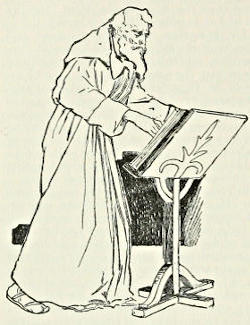
A Monk of the Middle Ages
The pontificate of Stephen soon came to an end. A new revolution
revenged the disinterment of the insulted prelate. And now the fierceness
of political rather than religious faction had utterly destroyed all reverence
for the sacred person of the pope. Stephen was thrown into prison by his
enemies, and strangled. The convenient charge of usurpation, always brought
against the popes whom their adversaries dethroned or put to death, may have
reconciled their minds to the impious deed, but it is difficult to discover in
what respect the title of Pope Stephen VI was defective.
[897-911 A.D.]
Pope now succeeded pope with such rapidity as to awaken the inevitable
suspicion, either that those were chosen who were likely to make a speedy
vacancy, or they received but a fatal gift in the pontificate of Rome. Romanus
and Theodore II survived their promotion each only a few months. The
latter, by his restoration of Formosus to the rights of Christian burial, and
by his reversal of the acts of Stephen VI, may be presumed to have belonged
to that faction. The next election was contested with all the strength and
violence of the adverse parties. John IX was successful; his competitor
Sergius, according to some accounts formerly the discomfited competitor of
Formosus, and his bitter and implacable enemy, fled to the powerful protection
of the marquis of Tuscany. Sergius was excommunicated, with several
other priests and inferior clergy, as accessory to the insults against the body
of Formosus. Sergius laughed to scorn the thunders of his rival, so long
as he was under the protection of the powerful house of Tuscany. With John
IX, who died July, 901, closed the ninth century of Christianity; the tenth,
in Italy at least the iron age, had already darkened upon Rome; the pontificate
had been won by crime and vacated by murder.
This iron age, as it has been called, opened with the pontificate of Benedict
IV (900-903), the successor of John IX. The only act recorded of
Benedict IV was the coronation of the unfortunate Louis of Provence, the
competitor of Berengar for the empire. Louis, according to imperial usage,
set up his tribunal and adjudged causes at Rome. On the death of Benedict,
the prudent precautions established by John IX to introduce some regularity
and control over the anarchy of an election by a clergy rent into factions
by a lawless nobility, and still more lawless people, during this utter
helplessness and the abeyance, or the strife for the empire between rival
princes, fell into utter neglect or impotency. The papacy became the prize
of the most active, daring, and violent. Leo V won the prize; before two
months he was ejected and thrown into prison by Christopher, one of his
own presbyters and chaplains. The same year, or early in the next, Christopher
was in his turn ignominiously driven from Rome.
It was under the protection of the powerful Tuscan prince Berengar that
the exiled Sergius, at the head of a strong force of Tuscan soldiers, appeared
in Rome, deposed Christopher, who had just deposed Leo V, and
took possession of the papal throne. Sergius had been seven years an exile
in Tuscany; for seven years he ruled as supreme but not undisputed pontiff.
This pope has been loaded with every vice and every enormity which can
blacken the character of man. Yet as to his reign there is almost total
obscurity. The only certain act which has transpired is his restoration of
the Lateran palace, which had fallen into ruins; an act which indicates a
period of comparative peace and orderly administration, with the command
of a large revenue. In these violent times Sergius probably scrupled at no
violence; but if he drove a pope from the throne of St. Peter, that pope had
just before deposed his patron, and with great cruelty.
THEODORA IN POWER
But during the papacy of Sergius rose into power the infamous Theodora,
with her daughters Marozia and Theodora, the prostitutes who, in the strong
language of historians, disposed for many years the papal tiara, and not
content with disgracing by their own licentious lives the chief city of
Christendom, actually placed their profligate paramours or base-born sons in
the chair of St. Peter. The influence obtained by Theodora and her daughters,
if it shows not the criminal connivance of Pope Sergius, or a still more
disgraceful connection with which he was charged by the scandal of the
times, proves at least the utter degradation of the papal power in Rome.
It had not only lost all commanding authority, but could not even maintain
outward decency. Theodora was born of a noble and wealthy senatorial
family, on whom she has entailed an infamous immortality. The women of
Rome seem at successive periods seized with a kind of Roman ambition to
surpass their sex by the greatness of their virtues and of their vices. These
females were to the Paulas and Eustochiums of the younger and severer
age of Roman Christianity, what the Julias and Messallinas of the empire
were to the Volumnias and Cornelias of the republic.
[911-928 A.D.]
It must be acknowledged that if the stern language of Tacitus and
Juvenal may have darkened the vices of the queens and daughters of the
cæsars, the bishop of Cremona,s our chief authority on the enormities of Theodora
and her daughters, wants the moral dignity, while he is liable to the same
suspicion as those great writers. Throughout the lives of the pontiffs themselves
we have to balance between the malignant license of satire and the
unmeaning phrases of adulatory panegyric. On the other hand it is difficult
to decide which is more utterly unchristian—the profound hatred which
could invent or accredit such stories; the utter dissoluteness which made them
easily believed; or the actual truth of such charges.
Liutprands relates that John, afterwards the tenth pope of that name,
being employed in Rome on some ecclesiastical matters by the archbishop of
Ravenna, was the paramour of Theodora, who not only allowed but compelled
him to her embraces. John was first appointed to the see of Bologna; but
the archbishopric of Ravenna, the second ecclesiastical dignity in Italy, falling
vacant before he had been consecrated, he was advanced by the same
dominant influence to that see. But Theodora bore with impatience the
separation of two hundred miles from her lover. Anastasius III had succeeded
Sergius (911) and occupied the papacy for rather more than two
years; after him Lando for six months (913). On the death of Lando (914)
by a more flagrant violation of the canonical rule than that charged against
the dead body of Formosus, John was translated from the archiepiscopate of
Ravenna to the see of Rome. But Theodora, if she indeed possessed this
dictatorial power, and the clergy and people of Rome, if they yielded to her
dictation, may have been actuated by nobler and better motives than her
gratification of a lustful passion, if not by motives purely Christian. For
however the archbishop of Ravenna might be no example of piety or holiness
as the spiritual head of Christendom, he appears to have been highly qualified
for the secular part of his office. He was a man of ability and daring,
eminently wanted at this juncture to save Rome from becoming the prey of
Mohammedan conquest, organising a powerful confederacy of neighbouring
dukes to accomplish this purpose.
He placed himself at the head of the army, and for the first time the successor
of St. Peter, the vicar of the Prince of peace, rode forth in his array
to battle. And if success, as it doubtless was, might be interpreted as a
manifestation of divine approval, the total discomfiture of the Saracens and
the destruction of the troublesome fortress on the Garigliano seemed to
sanction this new and unseemly character assumed by the pope. Even the
apostles sanctioned or secured by their presence the triumph of the warlike
pope.
For fourteen years (914-928), obscure as regards Rome and the pontificate,
this powerful prelate occupied the see of Rome. If he gained it (a
doubtful charge) by the vices and influence of the mother Theodora, he lost
it, together with his life, by the no less flagrant vices and more monstrous
power of the daughter Marozia.
THE INFAMOUS MAROZIA
[925-931 A.D.]
Theodora disappears; and Pope John X is found engaged in a fierce contest
for the mastery of Rome with Marozia and her lover or husband, the
marquis Alberic, by whom she had a son of the same name, afterwards tyrant
of the city. The vigorous and martial pontiff succeeds in expelling Alberic
from the city; Alberic probably met his death soon after (925). It is said
that he was murdered by the Romans in revenge for some secret alliance entered
into with the Hungarians, who were then wasting Italy, and had reached
the very frontiers of Calabria.
The death of her husband increased rather than weakened the power of
Marozia. Her personal charms, and her unscrupulous use of them, are said
to have multiplied to an infinite extent her adherents. Her paramours made
a strong party. The empire was vacant. There was no potentate to whom
the pope could appeal. Marozia seized the castle of St. Angelo, and with
this precious dowry, which commanded Rome, she sought to confirm her
power by some splendid alliance. Guido, the duke of Tuscany, the son of
Adalbert the marquis, did not disdain the nuptials with a profligate woman
who brought Rome as her marriage portion.
John X was left to contest alone the government of Rome with Marozia
and her Tuscan husband. Neither Rome nor the mistress of Rome regarded
the real services rendered by John X to Christendom and to Italy. The
former lover, as public scandal averred, of her mother, the saviour of Rome
from the Saracens, was surprised in the Lateran palace by this daring woman.
His brother Peter, as it appears, his great support in the contest for the government
of Rome, and therefore the object of peculiar hatred to Guido and
Marozia, was killed before his face. The pope was thrown into prison, where
some months after he died (929) either of anguish and despair, or by more
summary means. It was rumoured that he was smothered with a pillow.
No means were too violent for Marozia to employ even against a pope.
Marozia did not venture at once to place her son on the papal throne.
A Leo VI was pope for some months; a Stephen VII for two years and one
month. That son may as yet have been too young even for this shameless
woman to advance him to the highest ecclesiastical dignity; her husband
Guido may have had some lingering respect for the sacred office, some struggling
feelings of decency. But at the death of Stephen, Marozia again ruled
alone in Rome; her husband Guido was dead, and her son was pope. John
XI (according to the rumours of the time, of which Liutprand,s a follower of
Hugo of Provence, may be accepted as a faithful reporter) was the offspring
of Marozia by the pope Sergius; more trustworthy authorities make him
the lawful son of her husband Alberic. But the obsequious clergy and
people acquiesced without resistance in the commands of their patrician
mistress; the son of Marozia is successor of St. Peter.
But the aspiring Marozia, not content with having been the wife of a
marquis, the wife of the wealthy and powerful duke of Tuscany, perhaps the
mistress of one, certainly the mother of another pope, looked still higher in
her lustful ambition; she must wed a monarch. She sent to offer herself
and the city of Rome to the new king of Italy, Hugo of Provence, who was
not scrupulous in his amours, lawful or unlawful. Through policy or
through passion he was always ready to form or to break these tender connections.
The cautious Marozia would not allow his army to enter the city,
but received her royal bridegroom in the castle of St. Angelo. There was
celebrated this unhallowed marriage.
REBELLION OF ROME
[931-953 A.D.]
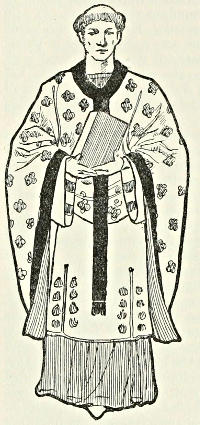
A Bishop of the Tenth Century
But though the Romans would brook the dominion of a Roman woman,
they would not endure that of a foreigner. The coarse vices, the gluttony
of the soldiers of Hugo offended the fastidious Italians. The insolence of
Hugo himself provoked a rebellion. The nobles were called upon to perform
menial offices, usual probably in the half feudal transalpine courts but alien
to Italian manners. Alberic, the son of Marozia, was commanded to hold
the water in which King Hugo washed his hands. Performing his office
awkwardly or reluctantly, he spilled the water, and received a blow on the
face from the king. Already may Alberic have
been jealous of the promotion of his brother to
the popedom, and have resented this devotion
of his mother to her new foreign connections.
He was a youth of daring; he organised a conspiracy
among the nobles of Rome; he appealed
to the old Roman pride: “Shall these Burgundians,
of old the slaves of Rome, tyrannise
over Romans?” At the tolling of the bell the
whole people flocked to his banner, and attacked
the castle of St. Angelo before Hugo could admit
his own troops. Alberic remained master
of the castle, of his mother, and of the pope.
These two he cast into prison, defied the king
of Italy, who made an ignominious retreat, and
from that time remained master of Rome.
For four years Pope John XI lingered in
fact a prisoner, at least without any share in the
government of Rome, only permitted to perform
his spiritual functions. Alberic ruled undisturbed.
King Hugo attempted to bribe him
to the surrender of Rome, by the offer of his
daughter in marriage; the more crafty Alberic
married the daughter, and retained possession
of Rome. After the death of John a succession
of popes, appointed, no doubt, by the sole
will of Alberic, Leo VII, Stephen IX, Marinus
II (or Martin III) Agapetus II, pass over
the throne of the popedom, with hardly a sign
of their power in Rome, no indication of their
dignity, still less of their sanctity. They are
still Popes beyond the Alps. Nor was the supreme pontiff alone depressed
in these turbulent times. The great ecclesiastics are mingled in most of
the treacherous and bloody transactions of the period. Individual energy
gave the bishops of the city great power, but as they acted with as little
restraint, so these prelates were treated with as little reverence as secular
princes.
During the whole reign of Hugo of Provence, notwithstanding the open
or treacherous assaults of that king, Alberic, whether as an armed tyrant
commanding Rome from the castle of St. Angelo, or as the head of a republic
and recognised by the voice of the Roman people, had maintained his authority.
He had ruled for twenty-two years; he bequeathed that authority, on his
death (953), to his son Octavian.
POPE JOHN XII
[953-963 A.D.]
Octavian, though only nineteen years old, aspired to unite, in his own
person, the civil and spiritual supremacy. He was already in holy orders;
two years after the death of his father Alberic, the pope Agapetus II died;
and Octavian, by the voluntary or enforced suffrages of the clergy and the
people, was elected pope. He was the first of the Roman pontiffs who
changed, or rather took a second ecclesiastical name; the civil government
seems to have been conducted in that of Octavian; the church was administered
under that of John XII.
In the meantime had arisen in Germany a monarch more powerful than had
appeared in Europe since the death of Charlemagne, Otto (Otho) the Great.
Otto made some disposition for a visit to Rome to receive the imperial crown
from the hands of the pope Agapetus. All Italy looked for the coming of the
new Charlemagne. On his appearance resistance vanished. Berengar and
Adalbert shut themselves up in their strongest fortresses. It was a triumphal
procession to Pavia—to Rome. At Pavia Otto the Great was crowned
king of Italy, at Rome the pope anointed him as emperor (962). Thenceforth
the king of Germany claimed to be Western emperor. Otto swore to
protect the church of Rome against all her enemies, to maintain her rights
and privileges, to restore her lands and possessions, when he should have
recovered them, and to make no change in the government of Rome without
the sanction of the pope. John XII and the Roman people took the oath of
allegiance to the emperor; they swore more particularly to abandon all connection
with Berengar and his son. The oath was taken on the body of
St. Peter.
Yet no sooner had the emperor returned to Pavia, than the perfidious
John, finding that he had unwarily introduced a master instead of an obsequious
ally, began to enter into correspondence with Adalbert, who, driven
from every Italian city, had found refuge with the Saracens. Rumours of
this treason reached the emperor. The noble German would not believe
the monstrous perfidy; he sent some trustworthy officers to inquire into the
truth; they returned with a fearful list of crimes, of license, and cruelty,
with which the son of Alberic, who seems entirely to have sunk the character
of pope in that of the young, warlike, secular prince, was charged by the
unanimous voice of Rome. In July, 963, Otto marched upon the capital; the
pontiff had reckoned on the cordial support of the people; they recoiled;
the pope and Adalbert fled together from Rome.
TRIAL OF THE POPE
[963-964 A.D.]
The emperor summoned an ecclesiastical council; it was attended by the
archbishops of Aquileia (by deputy), of Milan, of Ravenna, and Hamburg;
by two German and two French metropolitans; by a great number of
bishops and presbyters from Lombardy, Tuscany, and all parts of Italy.
The whole militia of Rome assembled as a guard to the council round the
church of St. Peter. The proceedings of the council mark the times.
Inquiry was made why the pope was not present. A general cry of astonishment
broke forth from the clergy and the people: “The very Iberians,
Babylonians, and Indians have heard the monstrous crimes of the pope.
He is not a wolf who condescends to sheep’s clothing; his cruelty, his
diabolical dealings are open, avowed, disdain concealment.” The calmer
justice of the emperor demanded specific charges. The cardinal presbyter
rose and declared that he had seen Pope John celebrate mass without himself
communicating. Another, that he had ordained a bishop in a stable; that
he had taken bribes for the consecration of bishops, and had ordained a
bishop of Todi who was but ten years old. “For his sacrileges, all eyes
might behold them;” they alluded, probably, to the dilapidation of the
churches, which were open to the weather, and so much out of repair that
the worshippers could not assemble from fear lest the roofs should fall on
their heads.
Darker charges followed, mingled with less heinous, in strange confusion,
charges of adultery, incest, with the names of the females, one his father’s
concubines, another a widow and her niece; he had made the Lateran palace
a brothel; he had been guilty of hunting; charges of cruelty, the blinding
of one dignified ecclesiastic, the castrating another, both had died under the
operation; he had let loose fire and sword, and appeared himself constantly
armed with sword, lance, helmet, and breast-plate. Both ecclesiastics and
laymen accused him of drinking wine for the love of the devil; of invoking,
when gambling, heathen deities, the devils Jove and Venus. He had perpetually
neglected matins and vespers, and never signed himself with the
sign of the cross.
The emperor could speak only German; he commanded the bishop of
Cremona to address the assembly in Latin. Liutprand warned the council,
he adjured them by the blessed Virgin and by St. Peter, not to bring vague
accusations, nor such as could not be supported by accredited testimony,
against the holy father. Bishops, deacons, clergy, and people with one voice
replied, “If we do not prove these and more crimes against the pope, may
St. Peter, who holds the keys of heaven, close the gates against us; may we
be stricken with anathema, and may the anathema be ratified at the day of
judgment!” They appealed to the whole army of Otto, whether they had
not seen the pope in full armour on the other side of the Tiber; but for the
river he had been taken in that attire.
Letters were sent summoning the pope to answer to these accusations;
accusations some of them so obscene that they would have been thought immodest
if made against stage-players. If the pope dreaded any assault from
the enraged multitude, the emperor answered for the security of his person.
The pope’s reply was brief, contemptuous: “John, the servant of God, to all
the bishops. We hear that you design to elect a new pope; if you do, in the
name of Almighty God, I excommunicate you; and forbid you to confer
orders or to celebrate mass!”
Thrice was Pope John cited before the council. Messengers were sent
to Tivoli; the answer was, “The pope was gone out to shoot.” Unprecedented
evils demand unprecedented remedies. The emperor was urged to
expel this new Judas from the seat of the apostle, and to sanction a new
election. Leo, the chief secretary of the Roman see, was unanimously chosen,
though a layman, in the room of the apostate John XII.
But the army of Otto, a feudal army, and bound to do service for a limited
period, began to diminish; part had been injudiciously dispersed on
distant enterprises; the Romans, as usual, soon grew weary of a foreign,
a German yoke. The emissaries of Pope John watched the opportunity; a
furious insurrection of the people broke out against the emperor and his
pope. The valour of Otto, who forced the barricades of the bridge over the
Tiber, subdued the rebellion (964). He took a terrible revenge. The supplications
of Leo with difficulty arrested the carnage. Otto soon after left
Rome, and marched towards Camerino (Camerinum) and Spoleto in pursuit
of King Adalbert. The king Berengar and his wife Willa were taken in the
castle of St. Leo, and sent into Germany.
[964-966 A.D.]
Hardly, however, had Otto left the city when a new rebellion, organised
by the patrician females of Rome, rose on the defenceless Leo, and opened
the gates of the city to John. Leo with difficulty escaped to the camp
of Otto. The remorseless John re-entered the city, resumed his pontifical
state, seized and mutilated the leaders of the imperial party; of one he cut
off the right hand, of another the tongue, the nose, and two fingers; in this
plight they appeared in the imperial camp. An obsequious synod reversed
the decrees of that which had deposed John. The Roman people had now
embraced the cause of the son of Alberic with more resolute zeal; for the
emperor was compelled to delay till he could reassemble a force powerful
enough to undertake the siege of the city. Ere this, however, his own vices
had delivered Rome from her champion or her tyrant, Christendom from her
worst pontiff. While he was pursuing his amours in a distant part of the
city, Pope John XII was struck dead (May 14th, 964), by the hand of God,
as the more religious supposed; others, by a more natural cause, the poniard
of an injured husband.
But it was a Roman or Italian, perhaps a republican feeling which had
latterly attached the citizens to the son of Alberic, not personal love or respect
for his pontifical character. They boldly proceeded at once, without
regard to the emperor, to the election of a new pope, Benedict V. Otto soon appeared
before the walls; he summoned the city, and ordered every Roman who
attempted to escape to be mutilated. The republic was forced to surrender.
Benedict, the new pope, was brought before the emperor. The cardinal
archdeacon, who had adhered to the cause of Leo, demanded by what right
he had presumed to usurp the pontifical robes during the life-time of Leo, the
lawful pope. “If I have sinned,” said the humbled prelate, “have mercy
upon me.” The emperor is said to have wept. Benedict threw himself
before the feet of Otto, drew off the sacred pallium, and delivered up his
crosier to Leo. Leo broke it, and showed it to the people. Benedict was
degraded to the order of deacon and sent into banishment in Germany.
He died at Hamburg.
The grateful, or vassal pope, in a council, recognises the full right of the
emperor Otto and his successors in the kingdom of Italy, as Adrian that of
Charlemagne, to elect his own successors to the empire and to approve the
pope. This right was to belong forever to the king of the Roman Empire,
and to none else.
Early in the next year the emperor Otto recrossed the Alps. Leo VIII
died March, 965, and a deputation from Rome followed the emperor to Germany
to solicit the reinstatement of the exiled Benedict to the popedom.
But Benedict was dead also. The bishop of Narni (John XIII), with the
approbation or by the command of the emperor, was elected to the papacy.
[966-974 A.D.]
Scarcely had John XIII assumed the pontificate than the barons and the
people began to murmur against the haughtiness of the new pontiff. They
expelled him from the city with one consent. The prefect Rotfred, not
without personal insult to the pope, assumed the government of Rome; for
ten months John XIII was an exile from his see, at first a prisoner, afterwards
in freedom. From his retreat in Campania he wrote with urgent
entreaty to the emperor. Otto made the cause of John his own; for the third
time he descended the Alps; the terror of his approach appalled the
popular faction. In a counter insurrection in favour of the pope, Rotfred
the prefect was killed, and the gates opened to the pontiff; he was received
with hymns of joy and gratulation. At Christmas Otto entered Rome; and
the emperor and the pope wreaked a terrible vengeance at that holy season
on the rebellious city. The proud Roman titles seemed but worthy of derision
to the German emperor and his vassal pope.
The body of the prefect who had expelled John
from the city was dug up out of his grave and
torn to pieces. The consuls escaped with banishment
beyond the Alps; but the twelve tribunes
were hanged; the actual prefect was set
upon an ass, with a wine-bag on his head, led
through the streets, scourged, and thrown into
prison. All Europe, hardened as it was to acts
of inhumanity, shuddered at these atrocities.
A Bishop of the Tenth and Eleventh Centuries
The rebellion was crushed for a time; during
the five remaining years of John’s pontificate
the presence of Otto overawed the refractory
Romans. He ruled in peace. At his death the
undisturbed vacancy of the see for three months
implies the humble consultation of Otto’s wishes
(he had now returned to Germany) on the appointment
of his successor.
The choice fell on Benedict VI, as usual of
Roman birth (January 19th, 973). The factions
of Rome now utterly baffle conjecture as
to their motives, as to the passions, not the principles,
which actuated their leaders. Twice
(the second time after an interval of ten years,
during which he was absent from Rome), the
same man, a cardinal deacon, seizes and murders
two popes; sets himself up as supreme
pontiff; but though with power to commit these
enormities, he cannot maintain on either occasion
his ill-won tiara.
The formidable Otto the Great died the year
of the accession of Benedict VI (December 25th, 967). Otto II, whose
character was as yet unknown, had succeeded to the imperial throne; he
had been already the colleague of his father in the empire. He had been
crowned at Rome by Pope John XIII.
[974-985 A.D.]
The year after the accession of Otto II, on a sudden, Boniface, surnamed
Francone, described as the son of Ferruccio, a name doubtless well known to
his contemporaries, seized the unsuspecting pope Benedict and cast him into
a dungeon (July, 974), where shortly after he was strangled. Boniface
assumed the papacy, but he had miscalculated the strength of his faction; in
one month he was forced to fly the city. Yet he fled not with so much haste
but that he carried off all the treasures, even the sacred vessels from the
church of St. Peter. He found his way to Constantinople, where he might
seem to have been forgotten in his retreat. The peaceful succession of
Benedict VII, the nephew or grandson of the famous Alberic, may lead to
the conclusion that the faction of that family still survived, and was opposed
to that of Boniface. The first act of Benedict, as might be expected, was the
assembling a council for the excommunication of the murderer and anti-pope
Boniface. This is the first and last important act in the barren annals of
Pope Benedict VII. Under the protection of the emperor Otto II, or by
the strength of his Roman faction, he retained peaceful possession of the see
for nine years, an unusual period of quiet. He was succeeded, no doubt
through the influence of the emperor, by John XIV, who was no Roman, but
bishop of Pavia. But in the year of John’s accession (983), Otto II
was preparing a great armament to avenge a terrible defeat by the Saracens.
He had hardly fled from the conquering Saracens, and made his escape from a
Greek ship by leaping into the sea and swimming ashore. He now threatened
with all the forces of the realm to bridge the Straits of Messina, and reunite
Sicily to the empire of the West. In the midst of his preparations he died
at Rome.
The fugitive Boniface Francone had kept up his correspondence with
Rome; he might presume on the unpopularity of a pontiff, if not of German
birth, imposed by foreign influence, and now deprived of his all-powerful protector.
With the same suddenness as before, he reappeared in Rome, seized
the pope, imprisoned him in the castle of St. Angelo, of which important
fortress he had become master, and there put him to death by starvation
or by poison (August 20th, 984). He exposed the body to the view of the
people, who dared not murmur. He seated himself, as it seems, unresisted,
in the papal chair. The holy see was speedily delivered from this murderous
usurper. He died suddenly. The people revenged themselves for their
own base acquiescence in his usurpation by cowardly insults on his dead
body; it was dragged through the streets, and at length buried, either by the
compassion or the attachment (for Boniface must have had a powerful faction
in Rome) of certain ecclesiastics. These bloody revolutions could not but
destroy all reverence for their ecclesiastical rulers in the people of Rome.g
CHARLES KINGSLEY ON TEMPORAL POWER
A united Italy suited the views of the popes then no more than it does
now. Not only did they conceive of Rome as still the centre of the western
world, but more, their stock in trade was at Rome. The chains of St. Peter,
the sepulchres of St. Peter and St. Paul, the catacombs filled with the bones
of innumerable martyrs—these were their stock in trade. By giving these,
selling these, working miracles with these, calling pilgrims from all parts of
Christendom to visit these in situ, they kept up their power and their
wealth.
Having obtained what they wanted from Pepin and Charlemagne, it was
still their interest to pursue the same policy; to compound for their own independence,
as they did with Charlemagne and his successors, by defending the
pretences of foreign kings to the sovereignty of the rest of Italy. This has
been their policy for centuries. It is their policy still; and that policy
has been the curse of Italy. This fatal gift of the patrimony of St. Peter—as
Dante saw, as Machiavelli saw, as all clear-sighted Italians have seen—has
kept her divided, torn by civil wars, conquered and reconquered by foreign
invaders. Unable, as a celibate ecclesiastic, to form his dominions into a
strong hereditary kingdom; unable as the hierophant of a priestly caste to
unite his people in the bonds of national life; unable, as Borgia tried to do,
to conquer the rest of Italy for himself, and form it into a kingdom large
enough to have weight in the balance of power, the pope was forced, again and
again, to keep himself on his throne by intriguing with foreign princes,
and calling in foreign arms; and the bane of Italy, from the time of
Stephen III to that of Pius IX, was the temporal power of the pope. But on
the popes, also, the Nemesis came. In building their power on the Roman
relics, on the fable that Rome was the patrimony of Peter, they had built on
a lie; and that lie avenged itself.
Having committed themselves to the false position of being petty kings
of a petty kingdom, they had to endure continual treachery and tyranny
from their foreign allies—to see not merely Italy, but Rome itself, insulted
and even sacked by faithful Catholics, and to become more and more, as
the centuries rolled on, the tools of those very kings whom they had wished
to make their tools.
True, they defended themselves long, and with astonishing skill and
courage. Their sources of power were two, the moral and the thaumaturgic,
and they used them both; but when the former failed, the latter became useless.
As long as their moral power was real; as long as they and their clergy
were on the whole, in spite of enormous faults, the best men in Europe,
so long the people believed in them, and in their thaumaturgic relics likewise.
But they became by no means the best men in Europe. Then they began to
think that after all it was more easy to work the material than the moral
power—easier to work the bones than to work righteousness. They were
deceived. Behold! when the righteousness was gone, the bones refused to
work. People began to question the virtue of the bones, and to ask, “We
can believe that the bones may have worked miracles for good men, but for
bad men? We will examine whether they work any miracles at all.” And
then, behold, it came out that the bones did not work miracles, and that
possibly they were not saints’ bones at all; and then the storm came; and
the lie, as all lies do, punished itself. That salt had lost its savour. They
who had been the light of Europe, became its darkness; they who had been
first, became last; a warning to mankind until the end of time, that on truth
and virtue depends the only abiding strength.h
FOOTNOTES
[985-1305 A.D.]
During the minority of Otto III the Tuscan party exercised undisputed
sway in Rome, without any check from without. No sooner was Otto II
dead than Boniface VII reappeared from exile, and having seized his rival
John XIV, and put him to death by starvation, for two years occupied unresisted
the papal chair. Nevertheless Boniface VII was not a friend of the
Tuscan party. By the people his dead body was treated with insults.
Boniface’s successor, John XV, not proving as pliant as Crescentius the
consul desired, was driven from Rome and reduced to the necessity of again
appealing to the imperial authority. He was permitted to return.b
At his death, Otto III obliged the clergy and the people to elect his nephew
Bruno, a German, and only twenty years of age. But the chief control of
the city was at present in the hands of the senator Crescentius (Cencius),
a man whom the emperor could not fail to view with feelings of fear and
jealousy. On visiting Rome, therefore, for the purpose of receiving consecration,
he undertook measures for his expulsion; but was prevented from
putting them in practice by the persuasions of his nephew, who had assumed
the appellation of Gregory V. The clemency of the pontiff was ill rewarded.
Crescentius, on the departure of the emperor, drove him from the city and
bestowed the pontifical dignity on a Greek, who took the name of John XVI.
Gregory in the meantime fled into Lombardy; and, having summoned the
several bishops to meet him at Pavia, he there excommunicated both Crescentius
and John, his sentence, it is said, being supported by nearly all Italy,
Germany, and France. The emperor, on his part, lost no time in proceeding
to the capital, where his appearance struck instant terror into the hearts of
the guilty Romans. John was apprehended when on the point of leaving the
city; and the officers of the emperor, dreading lest their master should show
any forbearance towards the culprit, immediately tore out his tongue and his
eyes. Crescentius suffered the gentler punishment of decapitation; and
Gregory, thus freed from his enemies, retained the papal dignity till the
year 999. He was succeeded by Gerbert, archbishop of Ravenna, whom
Otto caused to be elected in gratitude for the services he had rendered him
as his instructor.c
THE DREAM OF OTTO III
[999-1046 A.D.]
The emperor was victorious, and exercised undisputed sway in the city
of the cæsars. At this moment a grand scheme rose before his mental
vision. Rome was to occupy again her ancient place as the seat of empire.
An emperor was to sit on the throne of Constantine who would govern like
Constantine, and raise the empire once more to the pinnacle of power. A
truly apostolic pope was to be appointed, a second Silvester who would reform
the clergy and correct the infamous avarice and vice of the Roman church.
On the death of Gregory V that scheme seemed about to be realised.
The decree issued by Otto III for the election of his tutor Gerbert, who
assumed the name of Silvester II, in allusion to the relations of Constantine
and Silvester I, declared Rome to be the capital of the world, the Roman
church to be the mother of churches; it described how the dignity of the
Roman church had been obscured by her neglectful popes, how the property
of the church had been squandered on the dregs of mankind, how the prelates
had made everything venal, and so despoiled the very altars of the
apostles. It denounced the donations of Constantine and Charles the Bald
as void and forgeries; it assumed the power not only of electing, but, by
God’s grace, of creating and ordaining the pope, and it granted eight counties
for his support. The millennial period of the Christian era was to see all
old abuses swept away, and the new régime established. The new age was
to begin with a new Constantine and a new Silvester. The year 1000 was
to inaugurate the change. But how vain are the schemes of men! The
looked-for year came. It found Otto III indeed at Rome, with a palace built
on the Aventine, with a regular administrative system for the government
of the capital established. It found his tutor, Silvester II, on the chair of
St. Peter to second and direct him. Before three years both of them were
dead.
The death of Otto put an end to all attempts at reform. For none but
Otto in that lawless age rose above his surroundings, to project a new era
of improvement. None but his tutor, Silvester II, could sympathise with
his projects. When, comet-like, these two luminaries had darted across the
heaven and disappeared, the darkness of night grew thicker than before.b
With the disappearance of these two eminent men the popedom relapsed
into its former degradation. The feudal nobility—that very “refuse”
which, to use the expression of a contemporary writer, it had been Otto’s
mission “to sweep from the capital”—regained their ascendency, and the
popes became as completely the instruments of their will as they had once
been of that of the Eastern emperor. A leading faction among this nobility
was that of the counts of Tusculum, and for nearly half a century the popedom
was a mere appanage in their family. As if to mark their contempt for
the office, they carried the election of Theophylact, the son of Count Alberic,
a lad scarcely twelve years of age, to the office. Benedict IX (1033-1045),
such was the title given him, soon threw off even the external decencies of
his office, and his pontificate was disgraced by every conceivable excess. As
he grew to manhood his rule, in conjunction with that of his brother, who
was appointed the patrician or prefect of the city, resembled that of two captains
of banditti. The scandal attaching to his administration culminated
when it was known that, in order to win the hand of a lady for whom he
had conceived a passion, he had sold the pontifical office itself to another
member of the Tusculan house, John, the arch-presbyter, who took the name
of Gregory VI (1045-1046). His brief pontificate was chiefly occupied with
endeavours to protect the pilgrims to Rome on their way to the capital from
the lawless freebooters (who plundered them of their costly votive offerings
as well as of their personal property), and with attempts to recover by main
force the alienated possessions of the Roman church. Prior, however, to his
purchase of the pontifical office, the citizens of Rome, weary of the tyranny
and extortions of Benedict, had assembled of their own accord and elected
another pope, John, bishop of Sabina, who took the name of Silvester III
(rival pope, 1044-1046).
[1044-1054 A.D.]
In the meantime Benedict had been brought back to Rome by his powerful
kinsmen, and now reclaimed the sacred office. For a brief period,
therefore, there were to be seen three rival popes, each denouncing the other’s
pretensions and combating them by armed force. But even in Rome the
sense of decency and shame had not become altogether extinguished; and at
length a party in the Roman church deputed Peter, their archdeacon, to
carry a petition to the emperor Henry III, soliciting his intervention. The
emperor, a man of deep religious feeling and lofty character, responded to the
appeal. He had long noted, in common with other thoughtful observers,
the widespread degeneracy which, taking example by the curia, was growing
throughout the church at large, and especially visible in concubinage and
simony, alike regarded as mortal sins in the clergy. He forthwith crossed
the Alps and assembled a council at Sutri. The claims of the three rival
popes were each in turn examined and pronounced invalid, and a German,
Suidger (Suidgar or Suger), bishop of Bamberg, was elected to the office as
Clement II (1046-1047).
THE GERMAN POPES
The degeneracy of the church at this period would seem to have been in
some degree compensated by the reform of the monasteries, and from the
great abbey of Cluny in Burgundy there now proceeded a line of German
popes who in a great measure restored the dignity and reputation of their
office. But, whether from the climate, always ill adapted to the German
constitution, or from poison, as the contemporary chronicles not unfrequently
suggest, it is certain that their tenure of office was singularly brief. Clement
II died before the close of the year of his election. Damasus II, his successor,
held the office only twenty-three days. Leo IX, who succeeded, held it
for the exceptionally lengthened period of more than five years (1049-1054).
This pontiff, although a kinsman and nominee of the emperor, refused to
ascend the throne until his election had been ratified by the voice of the
clergy and the people, and his administration of the office presented the greatest
possible contrast to that of Benedict IX or Sergius III.
[1049-1064 A.D.]
In more than one respect it constitutes a crisis in the history of the popedom.
In conjunction with his faithful friend and adviser, the great Hildebrand,
he projected schemes of fundamental church reform, in which the
suppression of simony and of married life (or concubinage, as it was styled
by its denouncers) on the part of the clergy formed the leading features.
In the year 1049, at three great synods successively convened at Rome,
Rheims, and Mainz, new canons condemnatory of the prevailing abuses were
enacted, and the principles of monasticism more distinctly asserted in contravention
of those traditional among the secular clergy. Leo’s pontificate
closed, however, ingloriously.
In an evil hour he ventured to oppose the occupation by the Normans,
whose encroachments on Italy were just commencing. His ill-disciplined
forces were no match for the Norman bands, composed of the best warriors
of the age. He was himself made prisoner, detained for nearly a twelvemonth
in captivity, and eventually released only to die, a few days after, of
grief and humiliation. But, although his own career terminated thus ignominiously,
the services rendered by Leo to the cause of Roman Catholicism
were great and permanent; and of his different measures none contributed
more effectually to the stability of his see than the formation of the college
of cardinals.
THE COLLEGE OF CARDINALS
The title of “cardinal” was not originally restricted to dignitaries
connected with the church of Rome, but it had hitherto been a canonical
requirement that all who attained to this dignity should have passed
through the successive lower ecclesiastical grades in connection with one and
the same foundation; the cardinals attached to the Roman church had consequently
been all Italians, educated for the most part in the capital, having
but little experience of the world beyond its walls, and incapable of estimating
church questions in the light of the necessities and feelings of Christendom
at large. By the change which he introduced, Leo summoned the
leaders of the party of reform within the newly constituted college of cardinals,
and thus attached to his office a body of able advisers with wider views
and less narrow sympathies. By their aid the administration of the pontifical
duties was rendered at once more easy and more effective.
The pontiff himself was liberated from his bondage to the capital, and,
even when driven from Rome, could still watch over the interests of both his
see and the entire church in all their extended relations; and the popedom
must now be looked upon as entering upon another stage in its history—that
of almost uninterrupted progress to the pinnacle of power. According
to Anselmo of Lucca, it was during the pontificate of Leo, at the synod of
Rheims above referred to, that the title of “apostolic bishop” (apostolicus)
was first declared to belong to the pope of Rome exclusively.
The short pontificate of Nicholas II (1059-1061) is memorable chiefly for
the fundamental change then introduced in the method of electing to the
papal office. By a decree of the Second Lateran Council (1059), the nomination
to the office was vested solely in the cardinal bishops—the lower clergy,
the citizens, and the emperor retaining simply the right of intimating or withholding
their assent. It was likewise enacted that the nominee should always
be one of the Roman clergy, unless indeed no eligible person could be found
among their number. At the same time the direst anathemas were decreed
against all who should venture to infringe this enactment either in the letter
or the spirit.
The preponderance thus secured to the ultramontane party and to Italian
interests must be regarded as materially affecting the whole subsequent history
of the popedom. The manner in which it struck at the imperial influence
was soon made apparent in the choice of Nicholas’ successor, the line of
German popes being broken through by the election of Anselm, bishop of
Lucca (the uncle of the historian), who ascended the pontifical throne as Alexander
II (1061-1073) without having received the sanction of the emperor.
His election was forthwith challenged by the latter, and for the space of two
years the Roman state was distracted by a civil war, Honorius II being supported
as a rival candidate by the imperial arms, while Alexander maintained
his position only with the support of the Norman levies. The respective
merits of their claims were considered at a council convened at Mantua, and
the decision was given in favour of Alexander. Cadalous, such was the name
of his rival, did not acknowledge the justice of the sentence, but he retired
into obscurity; and the remainder of Alexander’s pontificate, though troubled
by the disputes respecting a married clergy, was free from actual warfare. In
these much vexed questions of church discipline Alexander, who had been
mainly indebted for his election to Hildebrand, the archdeacon of the Roman
church, was guided entirely by that able churchman’s advice, and in 1073
Hildebrand himself succeeded to the office as Gregory VII (1073-1085).d
MILMAN ON THE MISSION OF THE PAPACY
[1064-1073 A.D.]
Hildebrand was now pope; the great contest for the dominion over the
human mind, the strife between the temporal and spiritual power, which had
been carried on for some centuries as a desultory and intermitting warfare,
was now to be waged boldly, openly, implacably, to the subjugation of one
or of the other. Sacerdotal, or rather papal Christianity, had not yet fulfilled
its mission, for, the papal control withdrawn, the sacerdotal rule would
have lost its unity, and with its unity its authority must have dissolved
away. Without the clergy, not working here and there with irregular and
uncombined excitement on the religious feelings of man, awakening in one
quarter a vigorous enthusiasm, while in other parts of Europe men were left
to fall back into some new Christian heathenism, or into an inert habitual
Christianity of form; without the whole order labouring on a fixed and
determined system, through creeds sanctified by ancient reverence and a
ceremonial guarded by rigid usage; without this vast uniform, hierarchical
influence, where, in those ages of anarchy and ignorance, of brute force and
dormant intelligence, had been Christianity itself? And looking only to its
temporal condition, what had the world been without Christianity?
The papacy has still the more splendid part of its destiny to accomplish.
It has shown vital power enough to recover from its seemingly irrecoverable
degradation. It might have been supposed that a moral and religious deprivation
so profound, would utterly have destroyed that reverence of opinion
which was the one groundwork of the papal power. The veil had been
raised; and Italy at least, if not Europe, had seen within it, not a reflex of
divine majesty and holiness, but an idol not only hideous to the pure moral
sentiment, but contemptible for its weakness. If centuries of sanctity had
planted deeply in the heart of man his veneration for the successor of St.
Peter, it would have been paralysed (the world might expect) and extinguished
by more than a century of odious and unchristian vices. A spiritual
succession must be broken and interrupted by such unspiritual inheritors.
Could the head of Christendom, living in the most unchristian wickedness,
perpetuate his descent, and hand down the patrimony of power and authority,
with nothing of that piety and goodness which was at least one of his
titles to that transcendent power?
But that idea or that opinion would not have endured for centuries, had
it not possessed strength enough to reconcile its believers to contradictions
and inconsistencies. With all the Teutonic part of Latin Christendom, the
belief in the supremacy of the pope was coeval with their Christianity; it
was an article of their original creed as much as the redemption; their
apostles were commissioned by the pope; to him they humbly looked for
instruction and encouragement, even almost for permission to advance upon
their sacred adventure. Augustine, Boniface, Ebbo, Anskar, had been papal
missionaries. If the faith of Italy was shaken by too familiar a view
of that which the Germans contemplated with more remote and indistinct
veneration, the national pride, in Rome especially, accepted the spiritual as
a compensation for the loss of the temporal supremacy; it had ceased to be
the centre of the imperial, it would not endure not to be that of ecclesiastical
dominion. The jealousy of a pope elected, or even born, elsewhere
than in Italy, showed the vitality of that belief in the papacy, which was
belied by so many acts of violence towards individual popes.
The religious minds would be chiefly offended by the incongruity between
the lives and the station of the pope; but to them it would be a part
of religion to suppress any rebellious doubts. Their souls were deeply impressed
with the paramount necessity of the unity of the church; to them
the papacy was of divine appointment, the pope the successor of St. Peter;
all secret questioning of this integral part of their implanted faith was sin.
However then they might bow down in shame and sorrow at the inscrutable
decrees of heaven, in allowing its vicegerent
thus to depart from his original brightness,
yet they would veil their faces in awe, and
await in trembling patience the solution of
that mystery. In the Christian mind in
general, or rather the mind within the world
of Christendom, the separation between
Christian faith and Christian morality was
almost complete. Christianity was a mere
unreasoning assent to certain dogmatic
truths, an unreasoning obedience to certain
ceremonial observances.
A Pope of the Eleventh Century
(Based on an effigy)
Controversy was almost dead. In the
former century, the predestinarian doctrines
of Gottschalk, in general so acceptable to
the popular ear, had been entirely suppressed
by the sacerdotal authority. The tenets of
Berengar concerning the presence of Christ
in the Sacrament, had been restrained, and
were to be once more restrained, by the
same strong hand; and Berengar’s logic
was beyond his age. The Manichæan doctrines
of the Paulicians and kindred sects
were doubtless spreading to a great extent
among the lower orders, but as yet in secrecy,
breaking out now in one place, now in another,
yet everywhere beheld with abhorrence,
creating no wide alarm, threatening
no dangerous disunion. In all the vulgar of
Christendom (and that vulgar comprehended
all orders, all ranks) the moral sentiment, as
more obtuse, would be less shocked by that
incongruity which grieved and oppressed the more religious. The great
body of Christians in the West would no more have thought of discussing
the character of the pope than the attributes of God. He was to them the
apostle, the vicegerent of God, enveloped in the same kind of awful mystery.
They feared the thunders of the Lateran as those of heaven; and were no
more capable of sound discrimination as to the limits, grounds, and nature
of that authority than as to the causes of the destructive fire from the clouds.
Their general belief in the judgment to come was not more deeply rooted
than in the right of the clergy, more especially the head of the clergy, to
anticipate, to declare, or to ratify their doom.
The German line of pontiffs had done much to reinvest the papacy in its
ancient sanctity. The Italian Alexander II had been at least a blameless
pontiff, and now every qualification which could array the pope in imposing
majesty, in what bordered on divine worship, seemed to meet in Gregory
VII. His life verified the splendid panegyric with which he had been presented
by Cardinal Hugo to the Roman people. He had the austerest virtue,
the most simple piety, the fame of vast theologic knowledge, the tried ability
to rule men, intrepidity which seemed to delight in confronting the most
powerful; a stern singleness of purpose, which, under its name of churchmanship,
gave his partisans unlimited reliance on his firmness and resolution,
and yet a subtle policy which bordered upon craft. To them his faults were
virtues; his imperiousness the due assertion of his dignity; his unbounded
ambition zeal in God’s cause; no haughtiness could be above that
which became his station. The terror by which he ruled (he was so powerful
that he could dispense with love), as it was the attribute of the divinity now
exclusively worshipped by man, so was it that which became the representative
of God on earth.
The first, the avowed object of Gregory’s pontificate, was the absolute
independence of the clergy, of the pope, of the great prelates throughout
Latin Christendom, down to the lowest functionary, whose person was to
become sacred; that independence under which lurked the undisguised
pretension to superiority. His remote and somewhat more indistinct vision
was the foundation of a vast spiritual autocracy in the person of the pope,
who was to rule mankind by the consentient but subordinate authority of
the clergy throughout the world. For this end the clergy were to become
still more completely a separate, inviolable caste; their property equally
sacred with their persons. Each in his separate sphere, the pope above all
and comprehending all, was to be sovereign arbiter of all disputes; to hold
in his hands the supreme mediation in questions of war and peace; to adjudge
contested successions to kingdoms; to be a great feudal lord, to whom other
kings became beneficiaries. His own arms were to be chiefly spiritual,
but the temporal power was to be always ready to execute the ecclesiastical
behest against the ungodly rebels who might revolt from its authority; nor
did the churchman refuse altogether to sanction the employment of secular
weapons, to employ armies in his own name, or even to permit the use of arms
to the priesthood.
For this complete isolation of the hierarchy into a peculiar and inviolable
caste was first necessary the reformation of the clergy in two most important
preliminary matters; the absolute extirpation of the two evils, which the
more rigid churchmen had been denouncing for centuries, to the suppression
of which Hildebrand had devoted so much of his active energies. The war
against simony and the concubinage of the clergy (for under this ill-sounding
name was condemned all connection, however legalised, with the female
sex), must first be carried to a triumphant issue, before the church could
assume its full and uncontested domination.[92]
Simony
Like his predecessors, like all the more high-minded churchmen, Hildebrand
refused to see that simony was the inevitable consequence of the
inordinate wealth of the clergy. It was a wild moral paradox to attempt
to reconcile enormous temporal possessions and enormous temporal power
with the extinction of all temporal motives for obtaining, all temptations to
the misuse of these all-envied treasures. In the feudal system, which had
been so long growing up throughout western Europe, bishops had become, in
every respect, the equals of the secular nobles. In every city the bishop, if
not the very first of men, was on a level with the first; without the city he
was lord of the amplest domains. Archbishops almost equalled kings; for
who would not have coveted the station and authority of a Hincmar, archbishop
of Rheims, rather than the sovereignty of the feeble Carlovingian
monarch?
Charlemagne himself had set the example of advancing his natural sons
to high ecclesiastical dignities. His feebler descendants, even the more
pious, submitted to the same course from choice or necessity. The evil
worked downwards. The bishop, who had bought his see, indemnified himself
by selling the inferior prebends or cures. What was so intrinsically
valuable began to have its money-price; it became an object of barter and
sale. The layman who purchased holy orders bought usually peace, security
of life, comparative ease. Those who aspired to higher dignities soon repaid
themselves for the outlay, however large and extortionate. The highest
bishops confessed their own guilt; the bishopric of Rome had too often been
notoriously bought and sold.
According to the strict law, the clergy could receive everything, alienate
nothing. But the frequent and bitter complaints of the violent usurpation, or
the fraudulent alienation by the clergy themselves of what had been church
property, show that neither party respected this sanctity when it was the
interest of both to violate it. While, on the one hand, the clergy extorted
from the dying prince or noble some important grant, immunity, or possession,
the despoiled heir would scruple at no means of resuming his alienated
rights or property. The careless, the profligate, the venal, the warlike
bishop or abbot, would find means, if he found advantage, to elude the law;
to surrender gradually and imperceptibly; to lease out the land so as to
annihilate its value to the church; to grant in perpetuity for trifling
compensations or for valueless service the coveted estate; and so to relax the
inexorable grasp of the church. His own pomp and expenditure would reduce
the ecclesiastic to the wants and subterfuges of debtors and of bankrupts;
and so the estates would, directly or circuitously, return either to
the original or to some new owner.
Celibacy of the Clergy
With this universal simony was connected, more closely than may at
first appear, the other great vice of the age, as it was esteemed by Hildebrand
and his school, the marriage of the clergy. The celibacy of the clergy was
necessary to their existence, at the present period, as a separate caste. Hereditary
succession and the degeneracy of the order were inseparable. Great
as were the evils inevitable from the dominion of the priesthood, if it had
become in any degree the privilege of certain families, that evil would have
been enormously aggravated, the compensating advantages annulled. Family
affections and interests would have been constantly struggling against those
of the church. One universal nepotism, a nepotism not of kindred but of
parentage, would have preyed upon the vital energies of the order. Every
irreligious occupant would either have endeavoured to alienate to his lay descendants
the property of the church, or bred up his still more degenerate
descendants in the certainty of succession to their patrimonial benefice.
Celibacy may be maintained for a time by mutual control and awe; by
severe discipline; by a strong corporate spirit in a monastic community.
But in a low state of morals as to sexual intercourse, in an order recruited
from all classes of society, not filled by men of tried and matured religion;
in an order crowded by aspirants after its wealth, power, comparative ease,
privileges, immunities, public estimation; in an order superior to, or dictating
public opinion (if public opinion made itself heard); in a permanent
order, in which the degeneracy of one age would go on increasing in the
next, till it produced some stern reaction; in an order comparatively idle,
without social duties or intellectual pursuits; in an order not secluded in
the desert, but officially brought into the closest and most confidential relations
as instructors and advisers of the other sex, it was impossible to maintain
real celibacy; and the practical alternative lay between secret marriage,
concubinage without the form of marriage, or a looser and more corrupting
intercourse between the sexes.
Throughout Latin Christendom, throughout the whole spiritual realm of
Hildebrand, he could not but know there had been long a deep murmured,
if not an avowed doubt, as to the authority of the prohibitions against the
marriage of the clergy; where the dogmatic authority of the papal canons
was not called in question, there was a bold resistance or a tacit infringement
of the law. Italy has been seen in actual, if uncombined, rebellion
from Calabria to the Alps. The whole clergy of the kingdom of Naples has
appeared, under Nicholas II, from the highest to the lowest, openly living
with their lawful wives. The married clergy were still, if for the present
cowed, a powerful faction throughout Italy; they were awaiting their time
of vengeance. The memory of the married pope, Adrian II, was but recent.
In Germany the power and influence of the married clergy will make
itself felt, if less openly proclaimed, as a bond of alliance with the emperor
and the Lombard prelates. The French councils denounce the crime as
frequent, notorious. Among the Anglo-Saxon clergy before Dunstan, marriage
was rather the rule, celibacy the exception.
GREGORY’S SYNOD AT ROME
[1073-1074 A.D.]
Almost the first public act of Gregory VII was a declaration of implacable
war against these his two mortal enemies, simony and the marriage of
the clergy. He was no infant Hercules; but the mature ecclesiastical
Hercules would begin his career by strangling these two serpents—the
brood, as he esteemed them, and parents of all evil. The decree of the
synod held in Rome (March 9th, 10th, 1074) in the eleventh month of his
pontificate is not extant, but in its inexorable provisions it went beyond the
sternest of his predecessors. It absolutely invalidated all sacraments performed
by simoniacal or married priests; baptism was no regenerating rite;
it might almost seem that the eucharistic bread and wine in their unhallowed
hands refused to be transubstantiated into the body and blood of Christ.
The communicants guilty of perseverance at least in the sin shared in the
sacerdotal guilt. Even the priesthood was startled at this new and awful
doctrine, that the efficacy of the sacraments depended on their own sinlessness.
Gregory, in his headstrong zeal, was promulgating a doctrine used
afterwards by Wycliffe and his followers with such tremendous energy.
And this was a fearless, democratical provocation to the people; for it left
to notoriety, to public fame, to fix on anyone the brand of the hidden sin
of simony, or (it might be the calumnious) charge of concubinage; and so
abandoned the holy priesthood to the judgment of the multitude.[93]
But the extirpation of these two internal enemies to the dignity and the
power of the sacerdotal order was far below the holy ambition of Gregory;
this was but clearing the ground for the stately fabric of his theocracy. If,
for his own purposes, he had at first assumed some moderation in his intercourse
with the empire, over the rest of Latin Christendom he took at once
the tone and language of a sovereign. We must rapidly survey, before we
follow him into his great war with the empire, Gregory VII asserting his
autocracy over the rest of Latin Christendom.
[1074-1076 A.D.]
His letters to Philip I, king of France, are in the haughtiest, most
criminatory terms: “No king has reached such a height of detestable guilt
in oppressing the churches of his kingdom as Philip of France.” He puts
the king to the test; his immediate admission of a bishop of Mâcon, elected
by the clergy and people, without payment to the crown. Either let the
king repudiate this base traffic of simony, and allow fit persons to be
promoted to bishoprics, or the Franks, unless apostates from Christianity,
will be struck with the sword of excommunication, and refuse any longer to
obey him.
Hildebrand’s predecessor (and Alexander II did no momentous act without
the counsel of Hildebrand) had given a direct sanction to the Norman
conquest of England. Hildebrand may have felt some admiration, even
awe, of the congenial mind of the conqueror. He advances the claim to
Peter’s pence over the kingdom. William admits this claim; it was among
the stipulations, it was the price which the pope had imposed for his assent to
the conquest. But to the demand of fealty, the conqueror returns an answer of
haughty brevity: “I have not sworn, nor will I swear fealty which was never
sworn by any of my predecessors to yours.” And William maintained his
Teutonic independence—created bishops and abbots at his will, was absolute
lord over his ecclesiastical as over his feudal liegemen.
To the kings of Spain, in one of his earliest letters, Pope Gregory boldly
asserts that the whole realm of Spain is not only within the spiritual jurisdiction
of the holy see, but her property. No part of Latin Christendom
was so remote or so barbarous as to escape his vigilant determination to bring
it under his vast ecclesiastical unity. While yet a deacon he had corresponded
with Sweyn, king of Denmark; on him he bestows much grave and
excellent advice. In a letter to Olaf, king of Norway, he dissuades him
solemnly from assisting the rebellious brothers of the Danish king. Between
the duke of Poland and the king of the Russians he interposes his mediation.
The son of the Russian had come to Rome to receive his kingdom from the
hands of St. Peter. The kingdom of Hungary, as that of Spain, he treats as
a fief of the papacy; he rebukes the king Solomon for daring to hold it as a
benefice of the king of the Germans. He watches over Bohemia; his legates
take under their care the estates of the church; he summons the archbishop
of Prague to Rome. Even Africa is not beyond the care of Hildebrand.
The clergy and people of Carthage are urged to adhere to their archbishop—not
to dread the arms of the Saracens, though that once flourishing Christian
province, the land of Cyprian and Augustine, is so utterly reduced that three
bishops cannot be found to proceed to a legitimate consecration.
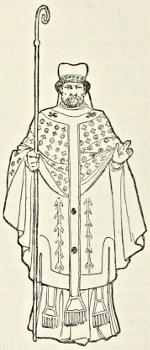
A Bishop of the Eleventh Century
But the empire was the one worthy, one formidable antagonist to Hildebrand’s
universal theocracy, whose prostration would lay the world beneath
his feet. The empire must acknowledge itself as a grant from the papacy,
as a grant revocable for certain offences against the ecclesiastical rights and
immunities; it must humbly acquiesce in the uncontrolled prerogative of the
cardinals to elect the pope; abandon all the
imperial claims on the investiture of the prelates
and other clergy with their benefices; release
the whole mass of church property from all
feudal demands, whether of service or of fealty;
submit patiently to rebuke; admit the pope to
dictate on questions of war and peace, and all
internal government where he might detect, or
suppose that he detected, oppression. This was
the condition to which the words and acts of
Gregory aspired to reduce the heirs of Charlemagne,
the successors of the western cæsars.
As a Christian, as a member of the church,
the emperor was confessedly subordinate to the
pope, the acknowledged head and ruler of the
church. As a subject of the empire, the pope
owed temporal allegiance to the emperor. The
authority of each depended on loose and flexible
tradition, on variable and contradictory precedents,
on titles of uncertain signification; each
could ascend to a time when they were not
dependent upon each other. The emperor
boasted himself the successor to the whole
autocracy of the cæsars, to Augustus, Constantine,
Charlemagne: the pope to that of St. Peter,
or of Christ himself.e But all-powerful as was
the pope abroad, in Italy his authority was
restricted. Even in Rome the prefect Cencius
dared to lay hands on Gregory VII, to tear
him from the sanctuary of a church during a
riot, and afterwards held him some time a
prisoner. At Milan the citizens expelled Herlembald and his tool Atto,
who exercised actual tyranny in the city under pretext of carrying out the
pope’s reforms, and demanded an archbishop of Henry IV, who sent them a
noble from Castiglione. This was the commencement of the struggle between
sacerdotal and imperial power that culminated in one of the greatest
and most stirring dramas of all history.
Events began auspiciously for Gregory, many points of support being
promised him in Germany. Feudal rebellions had kept that country in a
state of agitation during the minority of Henry IV, who was but six years
old when his father died in 1056. The regency and even the person of the
young king had been wrested from the empress Agnes by the dukes of
Saxony and Bavaria. Once arrived at man’s estate, Henry IV set about
suppressing the revolt that had, as usual, arisen among the Saxons. An
important victory won in Thuringia seemed to promise him a continuance of
success, when suddenly the voice of the pope thundered down upon him, ordering
him, with unexampled audacity, to suspend all warlike operations, and to
leave to the holy see the right of decision in his quarrel with the Saxons;
furthermore, to abandon all pretensions to ecclesiastical investiture, under
pain of excommunication. To this the legates joined the summons to appear
at Rome to answer certain personal charges that had been brought against
him. Henry IV replied to this furious attack with equal vigour, and in
the synod of Worms, composed of eighteen prelates, his partisans, he caused
sentence of deposition solemnly to be pronounced against Gregory VII
(1076).
[1076-1077 A.D.]
This decree, instead of alarming the pope, but excited him to fresh
aggression. No sooner was he delivered by a popular movement from the
hands of his enemy, Cencius, the Roman prefect, than he began once more to
thunder forth denunciations; he hurled a bull of excommunication at the
emperor, in which he proclaimed him a rebel to the holy see, and declared
his vassals free from all allegiance to him. This bull was mercilessly put
into execution by the Saxons and Swabians, all enemies of the house of
Franconia. At their head was Rudolf of Swabia and the Italian, Welf, of
the house of Este, whom Henry himself had created duke of Bavaria. They
convoked a diet at Tribur, suspended the functions of the emperor and menaced
him with deposition if he did not win absolution from the curse of
Rome. Henry acceded humbly, and promised to assemble a general diet at
Augsburg, which he begged the pope to attend for the purpose of absolving
him. Alive, however, to the danger of allowing his enemies to come together
in a body, he resolved to anticipate the action of the proposed diet and went
himself to Italy to implore pardon of the pope.
The price Gregory set upon this absolution was such as no other monarch
ever had to pay. The pope was inhabiting at the time the château of Canossa,
in the domains of the celebrated countess Matilda, a devout adherent of
the holy see and the most powerful sovereign in Italy, since she included
among her possessions the marquisates of Tuscany and Spoleto, Parma, Piacenza,
and several points in Lombardy, the Marches, etc. Henry IV came to
this castle to solicit an audience, but was compelled to wait barefooted in the
snow three days before he was received. At last on the fourth day he was
admitted and given absolution. Gregory, however, too adroit to lay down
arms at once, refused to decide the question relative to the German crown,
and deferred all consideration of it to a special diet, thereby reserving to
himself a means of throwing Henry into fresh embarrassment. Could the
king do other than tremble before a man who was the acknowledged representative
of divinity on earth, and who believed himself so secure in the
favour of heaven that, taking half of a “host,” he adjured God upon it to
annihilate him instantly if he were guilty of the crimes imputed to him?
When he presented the second half of the “host” to the king, asking him
to swear a similar oath, Henry shrank back affrighted (1077).
By this timely bowing of the head Henry IV avoided the blow that was
about to be aimed at him by a coalition of his enemies; the moment of danger
once passed, he straightened up like a bow relieved from tension. Indeed
he had no alternative save definitively to relinquish his hopes of the
crown or again to risk all upon a single chance, since the German rebels had
undertaken to answer the question left open by Gregory, and had appointed
to the throne Rudolf of Swabia, who had purchased the protection of the
legates by promising to abjure investiture (1077), and had been solemnly
acknowledged by the pope.
[1077-1125 A.D.]
Having gathered around himself a body of partisans, Henry IV began
to wage war with success. The battle of Wolksheim, in which Rudolf was
slain by the hand of Godfrey de Bouillon, duke of Lower Lorraine, who carried
the imperial standard, made him master of Germany (1080). He determined
to repeat this success in Italy, where a victory won by his son had
already paved the way; and the countess Matilda was stripped of a part
of her possessions, Rome was taken, and the archbishop of Ravenna was
appointed pope under the name of Clement III. Gregory himself would
have fallen into the hands of the man he had so deeply outraged, had not
Robert Guiscard and his Normans, faithful allies of the holy see, come to
his rescue. He died among them (1085) with the words: “For no other
reason than that I have loved justice and pursued iniquity, I must die in
exile.”
Up to the final moment he appeared to believe that universal dominance
was an inalienable right of the holy see, and his idea was certainly not
devoid of logic.
Gregory’s death came too soon; had he lived a few years longer he
would have seen his enemy expire in a condition far more miserable than
that in which he had been placed at Canossa. Urban II, made pope in
1088, found his main support in the Normans, and conferred upon Roger,
duke of Sicily, the title of king. He revealed the papacy in all its grandeur
on the occasion of the First Crusade, and revived most of Gregory’s old judgments
against the emperor. After a transitory triumph Henry IV was
successively attacked by his two sons, whom the church had armed against
him, and after having been stripped of all the imperial insignia, was made
prisoner by his younger son. In vain he invoked the succour of the king of
France, who had been his “most faithful friend”; all help was refused him,
and he was reduced to soliciting the post of under-choir-master in a church,
“having a considerable knowledge of music.” He died in 1106 at Liège in
the depths of poverty, calling down the “vengeance of God upon the parricide”;
and his body remained five years without sepulture.
It was, however, this very parricidal son Henry V who at last put a stop
to the quarrels resulting from the vexed question of investitures. The decision
was retarded some time by the opening of the succession of Countess
Matilda, who had bequeathed all her estates to the holy see. Henry laid
claim to the entire inheritance, to the fiefs as sovereign of the empire, to the
allodial lands as the countess’ nearest heir, and succeeded in entering upon
possession of them all. As can readily be believed, this was a cause for fresh
dissension in the future. The opening dispute being provisorily settled, the
two sides, recognising that a struggle would but weaken them while it confirmed
the independence of the feudal lords and of the Italian middle classes,
resolved to close the matter by an equitable and, as nearly as possible, an
equal division of the rights under dispute. The Concordat of Worms (1122)
was couched in the following terms: “I agree,” said Pope Calixtus II to the
emperor, “that the elections of the bishops and abbots of the Teutonic kingdom
shall take place without violence or simony in your presence, so that in
case any difference shall arise you can give your sanction and protection to
the side having greater holiness, according to the judgment of the metropolitan
and the co-provincials. The elect shall receive from you the prerogatives
of his office, and, except that duty that he owes the Roman church,
shall render you obedience in all things.”
“I remit to the pope,” said the king, “all right to confer investiture
by ring and cross, and in the churches of my kingdom and my empire, I
authorise canonical elections and free consecration.” This wise compromise,
which vested the temporal and spiritual power respectively in the temporal
and spiritual rulers, was accompanied by words of reconciliation. But the
design of Gregory VII was not yet fulfilled; the tie of vassalage that united
the clergy to the prince was by no means severed, and church remained a
part of the state in its main portion at least, if not in its outlying members.
The house of Franconia became extinct with Henry V (1125) after
having, by a provisory issue, dissolved the rivalry that existed between the
papacy and the empire. The reign of Lothair II, successor of Henry V,
was like an interlude between two acts of a drama; during the pause the
stage was cleared and reset for the scene that was to follow.f
BRYCE ON THE CONSEQUENCES OF THE CONCORDAT
The Concordat of Worms was in form a compromise designed to spare
either party the humiliation of defeat. Yet the papacy remained master of
the field. The emperor retained but one-half of those rights of investiture
which had formerly been his. At any moment his sceptre might be shivered
in his hand by the bolt of anathema, and a host of enemies spring up from
every convent and cathedral.
Two other results of this great conflict ought not to pass unnoticed.
The emperor was alienated from the church at the most unfortunate of all
moments, the end of the Crusades. The religious feeling which the
Crusades evoked turned wholly against the opponent of ecclesiastical claims
and was made to work the will of the holy see. A century and a half later
the pope did not scruple to preach a crusade against the emperor himself.
Again, it was now the first seeds were sown of that fear and hatred
wherewith the German people never thenceforth ceased to regard the
encroaching Romish court. Branded by the church and forsaken by the
nobles, Henry IV retained the affections of the faithful burghers of Worms
and Liège. It soon became a test of Teutonic patriotism to resist Italian
priestcraft.g
RIVAL CLAIMANTS
[1119-1155 A.D.]
On the death of Paschal (1118), the bishops of Porto, Ostia, and others
elected John of Gaeta, who was chancellor of Rome, to the vacant chair.
But his elevation was strongly opposed by the emperor’s minister, Cenzio
Frangipani, who, following him to the church where the investiture was to
take place, seized him by the throat, and after exposing him to every species
of violence from his attendants, dragged him by the hair of the head to his
house, and there left him chained, to await the orders of the emperor. He
subsequently made his escape to his native place, of which he was made
bishop; and Henry, in the meanwhile, raised Maurice Bourdin, by the name
of Gregory VIII, to the throne.
Gelasius, as John of Gaeta was called, attempted to recover his dignity,
but finding that he could not remain in Italy with safety, fled to Provence,
where he died the following year. The anti-pope Gregory, though the way
was now open for his accession to the throne, gained no advantage by the
death of his rival. Guido, archbishop of Ravenna, a man of considerable
powers of mind and vast influence, ascended the papal chair as Calixtus II.[94]
The contest which he was obliged to carry on with Gregory ended completely
in his favour; and the defeated pretender died, after suffering innumerable
miseries,[95] in a monastery. Calixtus himself died shortly after (1124); and
his successor, Honorius II, passed a reign of five years in fruitless contention
with Roger of Sicily, by whom his troops were entirely defeated. Innocent
II and Anacletus II both pretended to the dignity at his death; and the
former, before he could establish his sole claim to the prize, had to spend
several years as an exile in France.
We pass over the obscure pontificates of his immediate successors. But
in 1145, Bernard, abbot of St. Anastasius at Rome, and a favourite disciple
of the celebrated saint of the same name, was elected to the see as Eugenius
III. But whatever were the virtues of Eugenius, or the credit due to him
from his intimacy with a man so full of wisdom and holiness as St. Bernard,
the factious spirit which had long prevailed at Rome broke out into new excesses
at the period of his elevation. Urged on by the popular eloquence of
Arnold of Brescia, they were suddenly inflamed with the desire of restoring
the institutions and government of the ancient capital; but the tumult which
was commenced with this pretence soon carried its authors to the commission
of every species of violence; and the dazzling vision of Rome, restored to its
consular dignity, was lost in the clouds and thick darkness which rose from
the destruction of some of its finest buildings. Eugenius, by a timely exertion
of energy, quelled these disorders; and his return to Rome was attended
with all the marks of a triumph. The signs, however, of sedition were still
too manifest on the faces of the Romans to allow of his remaining secure
among them, and he retired for some time into France. He came back to
Italy about the year 1153, and died almost immediately after, at his residence
in the town of Tibur.
ADRIAN IV versus BARBAROSSA
[1155-1158 A.D.]
The successor of Eugenius was Adrian IV, by birth an Englishman,[96]
and strongly characterised by all the ruling passions of the dignified clergy
of this age.[97] Frederick Barbarossa had, in the meanwhile, ascended the
imperial throne, and his pride and ambition were fitting though dangerous
companions for the haughtiness of Adrian. It was not long before an opportunity
was afforded these two distinguished men to try the strength of their
resolution and principles. Frederick, having been crowned king of the
Lombards, hastened towards Rome; but before he arrived at the gate of the
city he was met by three cardinals, who acquainted him that the pontiff could
not hold any conference with a prince from whom he had as yet received no
assurance of obedience and of fidelity to the church. The monarch readily
accorded the required professions of allegiance; and a chevalier appointed
for the purpose swore solemnly in his name, and on the holy relics, the cross
and the Gospel, that he would preserve in safety the life, the liberty, and
honour of both the pope and the cardinals. Adrian then intimated his
readiness to crown him emperor, and was conducted with great pomp
towards the sovereign’s tent.
But here a new cause of contention arose. Frederick had too high a
sense of his imperial dignity to manifest any servile complaisance for papal
pride. Instead, therefore, of hastening, as some other princes had done, to
perform the part of an esquire to the pontiff, he quietly awaited him in his pavilion;
which so offended Adrian, that he positively refused to grant him the
kiss of peace, till he should perform the humiliating ceremonies to which
the pride of churchmen and the pusillanimity of princes had given a
species of legitimacy. A whole day was expended in disputing whether the
emperor should continue the practice or not. But Adrian was inflexible;
and the following morning the haughty Frederick in the presence of his army,
purchased the kiss of peace by standing like a menial at the side of the pope’s
horse, till he descended and freed him from his degrading situation.
A powerful faction at Rome hailed with joy the approach of Frederick.
The desire of limiting the despotism of the pope, and the expectation of
drawing large sums as a largess from the imperial treasury, appear to have
exercised an almost equal influence on their minds at this time. In their
address to Frederick the deputies of this party assumed the station of men
who had an unconquered country to present as a free-will offering to the
valour and noble qualities of the prince they sought. They had, however,
greatly mistaken the ideas of the emperor on the state of Italy. Frederick
told them, and with a sternness which presaged a coming storm, that their
country had been long and often conquered; that he was truly and lawfully
their master. He took possession forthwith of the church of St. Peter
(1155), and Adrian placed the imperial crown on the head of the sovereign
with far greater willingness than he would have done, had he not seen that
his agreement with the prince was now essential to his safety and to the
preservation of the church. The populace, finding themselves set at nought
by both the pope and the emperor, rose in a mass, and several of the German
soldiers fell slaughtered in the aisles of St. Peter. But their death was
amply revenged; the emperor attacked the Romans on all sides, and near
one thousand citizens paid with their lives the forfeit of their licentiousness
or their indiscretion.
Restless and ambitious minds, like those of Adrian and Frederick Barbarossa,
could not remain long at peace, when the power and privileges they possessed
in their dependence upon each other were so ill defined. The first cause
of dispute, after the pacification above related, was a letter which Adrian
wrote to the emperor, accusing him of ingratitude for the benefits he had
enjoyed through his ministration.
Adrian found it necessary to appease the anger which both Frederick
and his subjects expressed at these instances of assumption, and tranquillity
was for a brief space restored. But scarcely had the angry feelings generated
in the late dispute subsided, when the pontiff again manifested his
inclination to oppose the views of the emperor by refusing to confirm the archbishop
of Ravenna, whom Frederick had elevated to that station, in his
appointment. The fierceness with which the pontiff spoke and wrote on
this occasion, threatened Christendom with a rupture as injurious to its
peace as that between the unfortunate Henry and Gregory VII. But Frederick’s
firmness was unshaken; and a barrier was thus erected against the
attempts of the pope, which, intended only as a protection to particular
rights, did, in reality, afford support to the universal principles of civil government.
To Adrian’s threat that he would deprive him of his crown, he
replied that he held his crown, not from him but from his own royal predecessors.
“In the days of Constantine,” he asked, “had St. Silvester
anything to do with the royal dignity? Yet this was the prince to whom
the church was indebted for its peace and its liberty: and all that you enjoy
as pope, whence comes it but from the emperors?
Render unto God that which is
God’s, and to Cæsar the things that are
Cæsar’s. Our churches and our cities
are shut against your cardinals; because
they are not preachers but robbers, they
are not peacemakers but plunderers; we
see that instead of coming to preach the
Gospel and promote peace, their whole
desire and endeavour is to amass gold and
silver. When we find that they are what
the church would have them, we will refuse
them nothing good for their support. It
is horrible that pride, that monster so detestable,
should be able to steal even into
the chair of St. Peter.”c
ADRIAN’S FIRMNESS
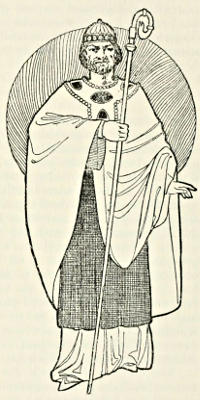
A Bishop of the Twelfth Century
[1158 A.D.]
Peace became more hopeless. As a last
resource, six cardinals on the part of the
pope, and six German bishops on that of
the emperor, were appointed to frame a
treaty. But the pope demanded the re-establishment
of the compact made with
his predecessor Eugenius. The imperial
bishops reproached the pope with his own
violation of that treaty by his alliance with
the king of Sicily; the Germans unanimously
rejected the demands of the pope:
and now the emperor received with favour a deputation from the senate and
people of Rome. These ambassadors of the republican party had watched;
had been present at the rupture of the negotiations. The pope, with the
embers of Arnold’s rebellions mouldering under his feet; with the emperor
at the head of all Germany, the prelates as well as the princes; with no ally
but the doubtful, often perfidious Norman, stood unshaken; betrayed no
misgivings. He threatened the emperor with a public excommunication.
Did the bold sagacity of Adrian foresee the heroic resolution with which
Milan and her confederate Lombard cities would many years afterwards,
and after some dire reverses and long oppression, resist the power of Barbarossa?
Did he calculate with prophetic foresight the strength of Lombard
republican freedom? Did he anticipate the field of Legnano, when the
whole force of the Teutonic empire was broken before the carroccio of
Milan? Already was the secret treaty framed with Milan, Brescia, and
Crema. These cities bound themselves not to make peace with the emperor
without the consent of the pope and his Catholic successor. Adrian was
preparing for the last act of defiance, the open declaration of war, the excommunication
of the emperor, which he was pledged to pronounce after the
signature of the treaty with the republics, when his death put an end to this
strange conflict, where each antagonist was allied with a republican party
in the heart of his adversary’s dominions. Adrian IV died at Anagni;
his remains were brought to Rome, and interred with the highest honours,
and with the general respect if not the grief of the city, in the church of
St. Peter. Even the ambassadors of Frederick were present at the funeral.
So ended the poor English scholar, at open war with perhaps the mightiest
sovereign who had reigned in transalpine Europe since Charlemagne.e
TWO RIVAL POPES
[1158-1164 A.D.]
The death of Adrian saved the church from the danger which had threatened
it during the government of that fierce and overbearing pontiff. But,
while delivered from one set of evils, it was surrounded by others little less
calculated to injure its interests. The cardinals, having assembled to elect
a new pope, chose by a large majority of their body Rolando, a cardinal, and
chancellor of the Roman church. Their vote, however, was opposed by Cardinal
Octavian, who had expected to be nominated by his colleagues to
the vacant dignity; and when Rolando, who assumed the name of Alexander
III, was invested with the pontifical cope, he rudely and sacrilegiously
pulled it from his shoulders, and, but for the interference of the persons
present, would have put it on himself. As he was disappointed in this, he
obtained, by signal, a cope of the same kind, which he suddenly threw over
his shoulders, placing, in his haste, the hind part before. Loud laughter
followed this mistake; but Octavian felt no shame at the mingled ridicule
and rebuke with which he was assailed. Going forth from the assembly,
which he awed into silence by a band of armed men, he exercised, under the
name of Victor IV, the part of sovereign pontiff; and for some days kept
Alexander in close confinement.
The emperor Frederick did not look with indifference on these occurrences.
A division in the church was equivalent to a great increase in his own
power; and he warmly espoused the cause of Octavian, chiefly, as it appears,
because he was the head of a faction. He at last, however, summoned a
council to consider the question between the rival popes. The council
assembled at Pavia, and Octavian was declared pope by the fifty bishops,
the numerous abbots, and other dignitaries, of whom the meeting was composed.
But Alexander was supported by the whole of that powerful party
which contended for the doctrine of papal supremacy; and despising the decree
of deposition passed against him at Pavia, he excommunicated the
emperor for the part he had taken, and absolved his subjects from their oath
of allegiance. Victor, on the other hand, was recognised as lawful pope,
not only in Germany, but in England and France; by the monarchs of which
countries he was received at Couci on the Loire, with all the pomp and
ceremony which had been demanded for his successors by the haughty
Adrian.
[1164-1198 A.D.]
He died in the year 1164; but the schism was continued by the immediate
election of Paschal III, who retained the semblance of authority about
three years. Alexander, on the death of Victor, had ventured to return to
Rome, which he did not dare to attempt during the life-time of that ecclesiastic.
A pestilence, which swept off the flower of Frederick’s army, saved the pope
from ruin; and the emperor, obliged as he was to make his escape into Germany
as he best might, at length expressed his willingness to heal the schism
which he had created in the church. Peace was accordingly restored, and
Alexander returned.
On the death of Alexander, Ubaldo, bishop of Ostia, was elected without
opposition, and assumed the name of Lucius III (1181-1185), and it has
been noted, that at his election the cardinals first appropriated the right of
choosing the supreme pontiff without the interference of the people, or of
the other orders of the clergy. Popular indignation was loudly expressed.
Obliged to seek safety by flight, he called upon the great European states
to furnish him with supplies for the support of his rights against the disaffected
citizens. His claims were allowed, and the riches of England and
other countries were poured freely into his treasury. With these he made
head against the insurgents; but such was the fierceness with which they
resisted him, that they tore out the eyes of the clergy whom they met beyond
the walls of the city; and obliged him to fix his residence at Verona, where
he died in 1185. Urban III, Gregory VIII, and Clement III, passed their
brief pontificates at a distance from Rome. The last-named pope, however,
made peace with the senate and the people; and his successor, Celestine III,
was enabled, by the strength of his position, to exercise the most important
of his assumed privileges without interruption. Henry VI, who at one time
received from his hands[98] the imperial crown, was at another punished by
him with the ban of excommunication.c On his death he was succeeded by
Innocent III.
INNOCENT III
[1198 A.D.]
Under Innocent III, the papal power rose to its utmost height.[99] The
thirteenth century is nearly commensurate with this supremacy of the pope.
Innocent III at its commencement calmly exercised as his right, and handed
down strengthened and almost irresistible to his successors, that which, at
its close, Boniface asserted with repulsive and ill-timed arrogance, endangered,
undermined, and shook to its base.
The essential inherent supremacy of the spiritual over the temporal power,
as of the soul over the body, as of eternity over time, as of Christ over Cæsar,
as of God over man, was now an integral part of Christianity. Ideas obtain
authority and dominion, not altogether from their intrinsic truth, but rather
from their constant asseveration, especially when they fall in with the common
hopes and fears, the wants and necessities of human nature. The mass of
mankind have neither leisure nor ability to examine them; they fatigue, and
so compel the world into their acceptance; more particularly if it is the duty,
the passion, and the interest of one great associated body to perpetuate them,
while it is neither the peculiar function, nor the manifest advantage of any
large class or order to refute them.
The unity of the vast Christian republic was an imposing conception,
which, even now that history has shown its hopeless impossibility, still
infatuates lofty minds; its impossibility, since it demands for its head not
merely that infallibility in doctrine so boldly claimed in later times, but
absolute impeccability, in every one of its possessors; more than impeccability,
an all-commanding, indefeasible, unquestionable majesty of virtue,
holiness, and wisdom. Without this it is a baseless tyranny, a senseless
usurpation. In those days it struck in with the whole feudal system, which
was one of strict gradation and subordination; to the hierarchy of church
and state was equally wanting the crown, the sovereign liege lord.
When this idea was first promulgated in all its naked sternness by Gregory
VII, it had come into collision with other ideas rooted with almost equal
depth in the mind of man, that especially of the illimitable Cæsarian power,
which though transferred to a German emperor, was still a powerful tradition,
and derived great weight from its descent from Charlemagne. The
humiliation of the emperor was degradation; it brought contempt on the
office, scarcely redeemed by the abilities, successes, or even virtues of new
sovereigns; the humiliation of the pope was a noble suffering in the cause
of God and truth, the depression of patient holiness under worldly violence.
In every schism the pope who maintained the loftiest churchmanship had
eventually gained the superiority which the imperialising popes had sunk
into impotence, obscurity, ignominy.
THE INFLUENCE OF THE CRUSADES ON PAPAL POWER
[1198-1201 A.D.]
The Crusades, as elsewhere described, had made the pope not merely the
spiritual, but in some sort the military suzerain of Europe; he had the power
of summoning all Christendom to his banner; the raising the cross, the
standard of the pope, was throughout Europe a general and compulsory levy,
the Heerbann of all who bore arms, of all who could follow an army. That
which was a noble act of devotion had become a duty; not to assume the cross
was sin and impiety. The Crusades thus became a kind of forlorn hope
upon which all the more dangerous and refractory of the temporal sovereigns
might be employed, so as to waste their strength, if not lose their lives, by
the accidents of the journey, or by the sword of the Mohammedan. If they
resisted, the fearful excommunication hung over them, and was ratified by the
fears and by the wavering allegiance of their subjects. If they obeyed and
returned, as most of them did, with shame and defeat, they returned shorn of
their power, lowered in the public estimation, and perhaps still pursued, on
account of their ill success, with the inexorable interdict. It was thus by
trammelling their adversaries with vows which they could not decline, and
from which they could not extricate themselves; by thus consuming their
wealth and resources on this wild and remote warfare, that the popes, who
themselves decently eluded, or were prevented by age or alleged occupations
from embarkation in these adventurous expeditions, broke and wasted away
the power and influence of the emperors.
The Crusades, too, had now made the western world tributary to the
popedom; the vast subventions raised for the Holy Land were to a certain
extent at the disposal of the pope. The taxation of the clergy on his authority
could not be refused for such an object; a tenth of all the exorbitant
wealth of the hierarchy passed through his hands. An immense financial
system grew up; papal collectors were in every land, papal bankers in every
capital to transmit these subsidies.
But after all none of these accessory and, in some degree, fortuitous aids,
could have raised the papal authority to its commanding height,[100] had it not
possessed more sublime and more lawful claims to the reverence of mankind.
It was still an assertion of eternal principles of justice, righteousness, and
humanity. However it might trample on all justice, sacrifice righteousness
to its own interests, plunge Europe in desolating wars, perpetuate strife in
states, set sons in arms against their fathers, fathers against sons, it was
still proclaiming a higher ultimate end. The papal language, the language
of the clergy, was still ostentatiously, profoundly religious; it professed,
even if itself did not always respect, even though it tampered with, the
awful sense of retribution before an all-knowing, all-righteous God. In his
highest pride, the pope was still the servant of the servants of God; in all
his cruelty he boasted of his kindness to the transgressor; every contumacious
emperor was a disobedient son; the excommunication was the voice of
a parent, who affected at least reluctance to chastise.
If this great idea was ever to be realised of a Christian republic with a
pope at its head—and that a pope of a high Christian character (in some
respects, in all perhaps but one, in tolerance and gentleness almost impossible
in his days, and the want of which, far from impairing, confirmed his
strength)—none could bring more lofty, more various qualifications for its
accomplishment, none could fall on more favourable times than Innocent III.
Innocent was Giovanni Lothario Conti, an Italian of noble birth, but not of
a family inextricably involved in the petty quarrels and interests of the
princedoms of Romagna. He was of the Conti,[101] who derived their name in
some remote time from their dignity. The elevation of his uncle to the
pontificate as Clement III paved the way to his rapid rise. He was elevated
in his twenty-ninth year to the cardinalate under the title vacated by his
uncle.
Celestine on his death-bed had endeavoured to nominate his successor;
he had offered to resign the papacy if the cardinals would elect John of
Colonna. But, even if consistent with right and with usage, the words
of dying sovereigns rarely take effect. Of twenty-eight cardinals, five only
were absent; of the rest the unanimous vote fell on the youngest of their
body, on the cardinal (Giovanni) Lothario. Lothario was only thirty-seven
years old, almost an unprecedented age for a pope.[102] The cardinals who proclaimed
him saluted him by the name of Innocent, in testimony of his
blameless life. In his inauguration sermon broke forth the character of the
man; the unmeasured assertion of his dignity, protestations of humility
which have a sound of pride. “Ye see what manner of servant that is
whom the Lord hath set over his people; no other than the vicegerent of
Christ, the successor of Peter. He stands in the midst between God and
man; below God, above man; less than God, more than man. He judges
all, is judged by none, for it is written, ‘I will judge.’ But he whom the
pre-eminence of dignity exalts is lowered by his office of a servant, that so
humility may be exalted, and pride abased; for God is against the high-minded,
and to the lowly he shows mercy; and he who exalteth himself
shall be abased. Every valley shall be lifted up, every hill and mountain
laid low!”
The letters in which he announced his election to the king of France,
and to the other realms of Christendom, blend a decent but exaggerated
humility with the consciousness of power; Innocent’s confidence in himself
transpires through his confidence in the divine protection.
The state of Christendom might have tempted a less ambitious prelate to
extend and consolidate his supremacy. Wherever Innocent cast his eyes
over Christendom and beyond the limits of Christendom, appeared disorder,
contested thrones, sovereigns oppressing their subjects, subjects in arms
against their sovereigns, the ruin of the Christian cause. In Italy the crown
of Naples on the brows of an infant; the fairest provinces under the galling
yoke of fierce German adventurers; the Lombard republics, Guelf or Ghibelline,
at war within their walls, at war or in implacable animosity against each
other; the empire, distracted by rival claimants for the throne, one vast
scene of battle, intrigue, almost of anarchy; the tyrannical and dissolute
Philip Augustus king of France, before long the tyrannical and feeble John
of England.
The Byzantine Empire is tottering to its fall; the kingdom of Jerusalem
confined almost to the city of Acre. Every realm seems to demand, or at
least to invite, the interposition, the mediation, of the head of Christendom;
in every land one party at least, or one portion of society, would welcome
his interference in the last resort for refuge or for protection.
Nor did Innocent shrink from that which might have crushed a less
energetic spirit to despair; from the Jordan to the Atlantic, from the Mediterranean
to beyond the Baltic, his influence is felt and confessed; his vast
correspondence shows at once the inexhaustible activity of his mind; he is
involved simultaneously or successively in the vital interests of every kingdom
in the western world.e
THE AUTOCRACY OF INNOCENT III
In order to secure Sicily for her son, the empress Constantia, pressed hard
by parties, was obliged to accept the papal investment under the new conditions
prescribed by the pontiff. After Constantia’s death (the 27th of
November, 1198) Innocent ruled over all Sicily in the character of guardian.
Still further the disputed imperial election, by which Germany was divided
between Philip, duke of Swabia, and Otto, duke of Saxony, encouraged the
pope to a larger extension of his power. Immediately after his accession,
Innocent had already taken the oath of fealty to the imperial præfectus urbis;
now he dislodged the vassals of the empire from the territory of Matilda, and
established in Tuscany a civic league.
[1201-1216 A.D.]
After he had thus consolidated his power in Italy, he commenced an
energetic interference in German politics; for he forthwith claimed the
right to decide on a disputed imperial election. He must naturally have been
inclined rather to the Guelf than to the Hohenstaufen candidate, so maintaining
his pretensions he actually decided (1201) in favour of Otto IV. However,
he was resisted with great energy by Philip’s party, and the flame of
discord only burned so much the brighter in Germany. As Philip continued
to gain more decisive advantages over his enemy, Innocent began negotiations
with him, which seemed fraught with danger to Otto. Meanwhile
Philip was murdered by Otto of Wittelsbach in Bamberg (1208). Otto IV
was then universally recognised as emperor, and after he had satisfied
the pope’s demands in all points he was crowned by him. But so soon
as Otto had reached this goal of his wishes, he began again to vindicate
the imperial rights in Italy, and to overthrow the pope’s new creations,
without suffering himself to be turned from his path by the sentence of
excommunication and dethronement which the deluded Innocent pronounced
against him in November, 1210. Now he himself encouraged the canvass of
the only surviving Hohenstaufen. Frederick appeared in Germany in 1212,
and, upheld as he was by the pope and the king of France, he quickly won
most of all ranks to his side. On the 25th of July, 1215, he received the
German king’s crown at Aachen, and Otto down to his death (1218) had
to content himself with his ancestral territories in Brunswick.
UNIVERSAL SWAY OF THE POPE
On every side, the thunder of Rome broke over the heads of princes.
A certain Swero is excommunicated for usurping the crown of Norway.
A legate, in passing through Hungary, is detained by the king: Innocent
writes in tolerably mild terms to this potentate, but fails not to intimate that
he might be compelled to prevent his son’s accession to the throne. The
king of Leon had married his cousin, a princess of Castile. Innocent
subjects the kingdom to an interdict. When the clergy of Leon petition
him to remove it, because when they ceased to perform their functions the
laity paid no tithes and listened to heretical teachers when orthodox mouths
were mute, he consented that divine service with closed doors, but not the
rites of burial, might be performed. The king at length gave way, and sent
back his wife.
But a more illustrious victory of the same kind was obtained over Philip
Augustus, who, having repudiated Ingeborg of Denmark, had contracted
another marriage. The conduct of the king, though not without the usual
excuse of those times, nearness of blood, was justly condemned; and Innocent
did not hesitate to visit his sins upon the people by a general interdict.
This, after a short demur from some bishops, was enforced throughout
France; the dead lay unburied, and the living were cut off from the offices
of religion, till Philip, thus subdued, took back his divorced wife. The submission
of such a prince, not feebly superstitious, like his predecessor Robert,
nor vexed with seditions, like the emperor Henry IV, but brave, firm, and
victorious, is perhaps the proudest trophy on the scutcheon of Rome.
Compared with this, the subsequent triumph of Innocent over the pusillanimous
John seems cheaply gained, though the surrender of a powerful
kingdom into the vassalage of the pope may strike us as a proof of stupendous
baseness on one side and audacity on the other.
A disputed election furnished Innocent with an opportunity of thrusting
forward the cardinal Stephen Langton into the archbishopric of Canterbury
against the king’s will. When John resisted with anger, the pope laid
England under an interdict, in 1208, and afterwards excommunicated the
king; the latter sought by reckless cruelty to avenge himself on the clergy,
and by severe oppression to make sure of his vassals. At last Innocent
deposed him from his kingdom, and handed it over to the king of France.
But while he was arming himself for the conquest, John, unable to trust his
vassals, yielded in all points, and even received his kingdom in fee from the
pope under circumstances of the greatest humiliation. Now was England
yielded up to the discretion of an arbitrary pope and a contemptible king;
this united the prelates and the barons to wrest Magna Charta from the king
in 1215. In vain the pope with spiritual and the king with temporal weapons
strove to effect its repeal; John’s death, however, in 1216, quickly put an end
to internal discord.
Still greater prospects seemed to open themselves before the pope in
Constantinople. Although the enthusiasm for crusades was already much
diminished, nevertheless Innocent had succeeded, by unwearied efforts, in
collecting a new army at Venice in 1202. The crafty doge, Enrico Dandolo,
notwithstanding all papal admonitions, had first made use of the army for the
reconquest of Zara (Jadera); it was then induced by the magnificent
promises of a Greek prince, Alexius, to undertake an expedition against
Constantinople; and when the reinstated emperor Isaac Angelus was unable
to fulfil these promises, Constantinople was conquered, and a Latin empire
established there, by the exaltation of Baldwin, count of Flanders, to the
throne. Thus the church of Constantinople seemed now to be brought into
subjection to the Roman see. However, even now, no one doubted the
precariousness of this acquisition. For the new empire already contained
the germ of dissolution; on the other hand it completely foiled the powerful
enterprise in behalf of Palestine.
In the latter year of his life Innocent devoted especial attention to the
Holy Land: King Frederick took the cross even at his coronation; and at
the Lateran council of the year 1215, one of the most brilliant which had ever
been held, the accomplishment of another crusade was one of the chief ends
in view. The enthusiasm for the Holy Land was indeed by no means
extinct; but in Germany the continuance of the twofold reign of Frederick
and Otto led to many unfavourable opinions of the Roman see, which necessarily
obstructed its readiness to undertake a fresh crusade.k
MILMAN’S ESTIMATE OF INNOCENT III
[1198-1216 A.D.]
In the full vigour of his manhood died Innocent III, 1216. He, of all
the popes, had advanced the most exorbitant pretensions, and those pretensions
had been received by an age most disposed to accept them with humble
deference. The high and blameless, in some respects wise and gentle, character
of Innocent might seem to approach more nearly than any one of the
whole succession of Roman bishops to the ideal height of a supreme pontiff;
in him, if ever, might appear to be realised the churchman’s highest conception
of the vicar of Christ.
Gregory VII and Boniface VIII, the first and the last of the aggressive
popes, and the aged Gregory IX, had no doubt more rugged warfare to
encounter, fiercer and more unscrupulous enemies to subdue. But in all
these there was a personal sternness, a contemptuous haughtiness; theirs
was a worldly majesty. The pride of Innocent was calmer, more self-possessed;
his dignity was less disturbed by degrading collisions with rude
adversaries; he died on his unshaken throne, in the plenitude of his seemingly
unquestioned power. Yet if we pause and contemplate, as we cannot
but pause and contemplate, the issue of this highest, in a certain sense
noblest and most religious contest for the papal ascendency over the world
of man, there is an inevitable conviction of the unreality of that papal power.
With all the grandeur of his views, with all the persevering energy of his
measures, throughout Innocent’s reign, everywhere we behold failure, everywhere
immediate discomfiture, or
transitory success which paved the
way for future disaster. The higher
the throne of the pope the more
manifestly were its foundations undermined,
unsound, unenduring.
Even Rome does not always
maintain her peaceful subservience.
Her obedience is interrupted, precarious;
that of transient awe, not
of deep attachment, or rooted reverence.
In the empire it is impossible
not to burden the memory of
Innocent with the miseries of the
long civil war. Otto without the
aid of the pope could not have
maintained the contest for a year;
with all the pope’s aid he had
sunk into contempt, almost insignificance;
he was about to be
abandoned, if not actually abandoned,
by the pope himself. The
casual blow of the assassin alone
prevented the complete triumph
of Philip. Already he had extorted
his absolution; Innocent was compelled
to yield, and could not yield
without loss of dignity. The triumph
of Otto leads to as fierce,
and more perilous resistance to the
papal power than could have been
expected from the haughtiness of
the Hohenstaufen. The pope has
an irresistible enemy in Italy itself. Innocent is compelled to abandon the
great object of the papal policy, the breaking the line of succession in the house
of Swabia, and to assist in the elevation of a Swabian emperor. He must yield
to the union of the crown of Sicily with that of Germany, and so bequeath to
his successors the obstinate and perilous strife with Frederick II.
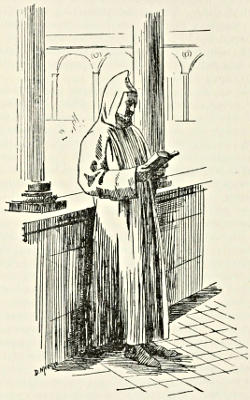
A Thirteenth Century Monk
In France, Philip Augustus is forced to seem, yet only seem, to submit;
the miseries of his unhappy wife are but aggravated by the papal protection.
The death of Agnes of Méran, rather than Innocent’s authority, heals the
strife. The sons of the proscribed concubine succeed to the throne of
France.
In England the barons refuse to desert John when under the interdict of
the pope; when the pope becomes the king’s ally, resenting the cession of
the realm, they withdraw their allegiance. Even in Stephen Langton, who
owes his promotion to the pope, the Englishman prevails over the ecclesiastic;
the Great Charter is extorted from the king when under the express
protection of the holy see, and maintained resolutely against the papal
sentence of abrogation; and in the Great Charter is laid the first stone of
the religious as well as the civil liberties of the land.
Venice, in the crusade, deludes, defies, baffles the pope. The crusaders
become her army, besiege, fight, conquer for her interests. In vain the pope
protests, threatens, anathematises; Venice calmly proceeds in the subjugation
of Zara. To the astonishment, the indignation of the pope, the crusaders’
banners wave not over Jerusalem, but over Constantinople. But for
her own wisdom, Venice might have given an emperor to the capital of the
East; she secures the patriarchate almost in defiance of the pope; only when
she has entirely gained her ends does she submit to the petty and unregarded
vengeance of the pope.
Even in the Albigensian war the success was indeed complete; heresy
was crushed, but by means of which Innocent disapproved in his heart. He
had let loose a terrible force, which he could neither arrest nor control.
The pope can do everything but show mercy or moderation. He could not
shake off, the papacy has never shaken off, the burden of its complicity in the
remorseless carnage perpetrated by the crusaders in Languedoc, in the
crimes and cruelties of Simon de Montfort. A dark and ineffaceable stain
of fraud and dissimulation too has gathered around the fame of Innocent
himself.[103] Heresy was quenched in blood; but the earth sooner or later
gives out the terrible cry of blood for vengeance against murderers and
oppressors.
The great religious event of this pontificate, the foundation of the
Mendicant orders, that which perhaps perpetuated, or at least immeasurably
strengthened, the papal power for two centuries, was extorted from the
reluctant pope. Both St. Dominic and St. Francis were coldly received,
almost contemptuously repelled. It was not till either his own more mature
deliberation or wiser counsel, which took the form of divine admonition,
prevented this fatal error and prophetically revealed the secret of their
strength and of their irresistible influence throughout Christendom, that
Innocent awoke to wisdom. He then bequeathed these two great standing
armies to the papacy; armies maintained without cost, sworn, more than
sworn, bound by the unbroken chains of their own zeal and devotion to
unquestioning, unhesitating service throughout Christendom, speaking all
languages. They were colonies of religious militia, natives of every land,
yet under foreign control and guidance. Their whole power, importance,
perhaps possessions rested on their fidelity to the see of Rome, that fidelity
guaranteed by the charter of their existence. Well might they appear so
great as they are seen by the eye of Dante, like the cherubim and seraphim
in paradise.e
FREDERICK II AT WAR WITH THE PAPACY
[1216-1244 A.D.]
Honorius III, previously called Cencio Savelli, who succeeded Innocent,
1216, and governed the Roman church more than ten years, did not perform
so many deeds worthy of being recorded; yet he was very careful that the
Romish power should receive no diminution. Pursuing this course, he had
a grievous falling out with the emperor Frederick II, a magnanimous prince,
whom he himself had crowned at Rome in the year 1220. Frederick, imitating
his grandfather, laboured to establish and enlarge the authority of the
emperors in Italy, to depress the minor states and republics of Lombardy, and
to diminish the immense wealth and power of the pontiffs and the bishops;
and to accomplish these objects, he continually deferred the crusade, which
he had promised with an oath. Honorius, on the other hand, continually
urged Frederick to enter on his expedition to Palestine; yet he secretly
encouraged, animated, and supported the cities and republics that resisted
the emperor, and raised various impediments to the latter’s increasing power.
Still, this hostility did not, at present, break out in open war.
But under Gregory IX—whose former name was Ugolino, and who was
elevated from the bishopric of Ostia to the pontificate, 1227, an old man,
but still bold and resolute—the fire, which had been long burning in
secret, burst into a flame.[104] In the year 1227 the pontiff excommunicated the
emperor, who still deferred his expedition to Palestine; but without proceeding
in due form of ecclesiastical law, and without regarding the
emperor’s excuse of ill health. In the year 1228 the emperor sailed
with his fleet to Palestine; but instead of waging war as he was bound to
do, he made a truce with Saladin on recovering Jerusalem. While he was
absent the pontiff raised war against him in Apulia, and endeavoured to
excite all Europe to oppose him. Therefore Frederick hastened back, in the
year 1229, and after vanquishing his enemies, made his peace with the pontiff
in the year 1230. But this peace could not be durable, as Frederick
would not submit to the control of the pontiff. Therefore, as the emperor
continued to press heavily on the republics of Lombardy, which were friendly
to the pontiff, and transferred Sardinia, which the pontiff claimed as part of
the patrimony of the church, to his son Enzio; and wished to withdraw Rome
itself from the power of the pontiff; and did other things very offensive to
Gregory—the pontiff, in the year 1239, again laid him under anathemas;
and accused him to all the sovereigns of Europe of many crimes and enormities,
and particularly of speaking contemptuously of the Christian religion.
The emperor, on the other hand, avenged the injuries that he received,
both by written publications and by his military operations in Italy, in which
he was for the most part successful; and thus he defended his reputation,
and also brought the pontiff into perplexity and difficulty. To rescue himself,
in some measure, in the year 1240 Gregory summoned a general council
to meet at Rome, intending to hurl the emperor from his throne by the
united suffrages of the assembled fathers. But Frederick, in the year 1241,
captured the Genoese fleet, which was carrying a great part of the fathers
to the council at Rome, and seizing as well their treasures as themselves, he
cast them into prison. Broken down by these calamities, and by others of
no less magnitude, Gregory shortly after sank into the grave.
The successor of Gregory, Goffredo Castiglione of Milan, who assumed
the name of Celestine IV, died before his consecration; and after a long
interregnum, in the year 1243, Senibaldi, a Genoese, descended from the
counts Fieschi, succeeded under the pontifical name of Innocent IV, a man
inferior to none of his predecessors in arrogance and insolence of temper.
Between him and Frederick there were at first negotiations for peace; but
the terms insisted on by the pontiff were deemed too harsh by the emperor.
Hence Innocent, feeling himself unsafe in any part of Italy, in 1244 removed
from Genoa to Lyons in France; and the next year assembled a council
there, in the presence of which, but without its approbation (whatever the
Roman writers may affirm to the contrary), he declared Frederick unworthy
of the imperial throne.
[1244-1274 A.D.]
This most unrighteous decision of the pontiff had such influence upon
the German princes, who were infected with the superstition of the times,
that they elected first Henry, landgraf of Thuringia, and on his death William,
count of Holland, to the imperial throne. Frederick continued the
war vigorously and courageously in Italy, and with various successes, until
a dysentery terminated his life in Apulia, on the 13th of December, 1250.
On the death of his foe, Innocent returned to Italy in the year 1251. From
this time especially (though their origin was much earlier) the two noted
factions of Guelfs and Ghibellines, of which the former sided with the pontiffs
and the latter with the emperors, most unhappily rent asunder and devastated
all Italy.
Alexander IV, whose name as count of Segni and bishop of Ostia was
Rinaldo, became pontiff on the death of Innocent (1254) and reigned six
years and six months. Excepting some efforts to put down a grandson
of Frederick II, called Conradin, and to quiet the perpetual commotions
of Italy, he busied himself more in regulating the internal affairs of the
church than in national concerns. The mendicant friars, Dominicans and
Franciscans, are under especial obligations to him. Urban IV, before his
election to the pontificate in 1261, was James, patriarch of Jerusalem, a man
born of obscure parentage at Troyes. He distinguished himself more by
instituting the festival of the Body of Christ than by any other achievement.
He indeed formed many projects: but he executed few of them, being
prevented by death, in the year 1264, after a short reign of three years. Not
much longer was the reign of Clement IV, a Frenchman and bishop of Sabina,
under the name of Guido Fulcodi (Guy Foulques), who was created pontiff
in the year 1265. Yet he is better known on several accounts, but especially
for conferring the kingdom of Naples on Charles of Anjou, brother to Louis
IX, the king of France. Charles is well known to have beheaded Conradin,
the only surviving grandson of Frederick II, after conquering him in battle,
and this, if not by the counsel, at least with the consent of the pontiff.[105]
On the death of Clement IV[106] there were vehement contests among the cardinals,
respecting the election of a new pontiff; which continued till the third
year, when, at last, 1271, Teobaldo of Piacenza, archdeacon of Liège, was
chosen, and assumed the name of Gregory X. He had been called from Palestine,
where he had resided; and having witnessed the depressed state of the
Christians in the Holy Land, nothing more engaged his thoughts than sending
them succour.
COUNCIL AT LYONS
[1274-1294 A.D.]
Accordingly, as soon as he was consecrated, he appointed a council to be
held at Lyons in France, and attended it in person in the month of May,
1274. The principal subjects discussed were the re-establishment of the
Christian dominion in the East, and the reunion of the Greek and Latin
churches. This has commonly been reckoned the fourteenth general council,
and is particularly noticeable for the new regulations it established for the
election of Roman pontiffs, and the celebrated provision which is still in force
requiring the cardinal electors to be shut up in conclave. Neither did the
pontiff, though of a milder disposition than many others, hesitate to repeat
and inculcate that odious maxim of Gregory VII, that the pontiff is supreme
lord of the world, and especially of the Roman Empire. For in the year 1271
he sent a menacing letter to the princes of Germany, admonishing them to
elect an emperor, and without regarding the wishes or the claims of Alfonso,
king of Castile; otherwise he would appoint a head of the empire himself.
Accordingly, the princes assembled, and elected Rudolf I, of the house of
Habsburg.
Gregory X died in the year 1276, and his three immediate successors
were all chosen and died in the same year. Innocent V, previously Pietro di
Tarantaisia, was a Dominican monk, and bishop of Ostia. Adrian V was
a Genoese, named Ottoboni, and cardinal of St. Adrian. John XXI,
previously Pedro, bishop of Tusculum, was a native of Portugal. The next
pontiff, who came to the chair in 1277, reigned longer. He was Giovanni
Gaetano, of the family of Ursini, a Roman, and cardinal of St. Nicholas, who
assumed the title of Nicholas III. He greatly enlarged what is called the
patrimony of St. Peter; and, as his actions show, had formed other great
projects, which he would undoubtedly have accomplished, as he was a man
of energy and enterprise, had he not prematurely died in the year 1280.
His successor, Martin IV, elected by the cardinals in 1281, was a French
nobleman, Simon de Brion, a man of equal boldness and energy of character
with Nicholas. For he excommunicated Michael Palæologus, the Greek
emperor, because he had violated the compact of union with the Latins,
which was settled at the Council of Lyons. Pedro of Aragon he deprived of
his kingdoms and of all his property, because he had seized upon Sicily; and
he bestowed them gratuitously on Charles, son to the king of France. He
was projecting many other things, consonant with the views of the pontiffs,
when he was suddenly overtaken by death in 1285. His plans were prosecuted
by his successor, Giacomo Savelli, who was elected in 1285 and took the
name of Honorius IV. But a distressing disease in his joints, of which he
died in 1287, prevented him from attempting anything further. Nicholas IV,
previously Girolamo d’Ascoli, bishop of Palestrina, who attained to the
pontifical chair in 1288, and died in 1292, was able to attend to the affairs
both of the church and of the nations with more diligence and care. Hence
he is represented in history sometimes as the arbiter in the disputes of
sovereign princes, sometimes as the strenuous asserter of the rights and
prerogatives of the church, and again as the assiduous promoter of missionary
labours among the Tatars and other nations of the East. But nothing
lay nearer his heart than the restoration of the dominion of the Christians
in Palestine, where their cause was nearly ruined. In this he laboured
strenuously indeed, but in vain; for death intercepted all his projects.
After his death the church was without a head till the third year, the
cardinals disagreeing exceedingly among themselves. At length, on the 5th
of July, 1294, they unanimously chose an aged man, greatly venerated for
his sanctity—Pietro, surnamed di Murrhone, from a mountain in which he
led a solitary and very austere life; he assumed the pontifical name of Celestine
V. But as the austerity of his life tacitly censured the corrupt morals
of the Romish court, and especially of the cardinals, and as he showed very
plainly that he was more solicitous to advance the holiness of the church
than its worldly grandeur, he was soon considered as unworthy of the office
which he had reluctantly assumed. Hence some of the cardinals, and especially
Benedict Cajetan, persuaded him very easily to abdicate the chair, in
the fourth month of his pontificate. He died, 1296, in the castle of Fumone,
where his successor detained him a captive, lest he should make some disturbance.
But afterwards Clement V enrolled him in the calendar of the
saints. To him the sect of Benedictine monks who were called, after him,
Celestines, owed its origin; a sect still existing in Italy and France, though
now nearly extinct, and differing from the other Benedictines by their more
rigid rules of life.
ACCESSION OF BONIFACE VIII
[1294-1301 A.D.]
He was succeeded in 1294 by Benedict, Cardinal Cajetan, by whose persuasions
he had been chiefly led to resign the pontificate, and who now
assumed the name of Boniface VIII. This was a man formed to produce
disturbance both in church and state, and eager for confirming and enlarging
the power of the pontiffs, to the highest degree of rashness. From his first
entrance on the office he arrogated to himself sovereign power over all things
sacred and secular; overawed kings and states by his fulminations; decided
important controversies at his will; enlarged the code of canon law by new
accessions, namely, by the sixth book of Decretals; made war, among others,
particularly on the noble family of Colonna, which had opposed his election—in
a word, he seemed to be another Gregory VII at the head of the
church. At the close of the century, he established the year of jubilee,
which is still solemnised at Rome.
That the governors of the church, as well of highest rank as of inferior,
were addicted to all those vices which are the most unbecoming to men in
their stations, is testified most abundantly. As for the Greek and oriental
clergy, many of whom lived under oppressive governments, we shall say
nothing; although their faults are sufficiently manifest. But of the faults
of the Latins silence would be the less proper, in proportion to the certainty
that from this source the whole community was involved in the greatest
calamities. All the honest and good men of that age ardently wished for a
reformation of the church, both in its head and in its members, as they themselves
expressed it. But to so desirable an event there were still many
obstacles. First, the power of the pontiffs was so confirmed by its long
continuance that it seemed to be immovably established. In the next place,
extravagant superstition held the minds of the majority of the people in
abject slavery. And lastly, the ignorance and barbarism of the times quickly
extinguished the sparks of truth that appeared from time to time. Yet the
dominion of the Roman pontiffs, impregnable and durable as it seemed to
be, was gradually undermined and weakened in this century, partly by the
rash insolence of the pontiffs themselves and partly by the occurrence of
certain unexpected events.
PHILIP THE FAIR OVERPOWERS THE PAPACY
[1301-1305 A.D.]
The commencement of this important change must be referred to the
contest between Boniface VIII, who governed the Latin church at the beginning
of this century, and Philip the Fair, king of France. This high-minded
sovereign first taught the Europeans what the emperors had in vain
attempted—that the Roman bishops could be vanquished, and be laid under
restraint. In a very haughty letter addressed to Philip, Boniface maintained
that all kings and persons whatever, and the king of France as well as others,
by divine command, owed perfect obedience to the Roman pontiff, and this
not merely in religious matters, but likewise in secular and human affairs.
The king replied with extreme bitterness. The pontiff repeated his former
assertions with greater arrogance, and published the celebrated bull called
Unam sanctam; in which he asserted that Jesus Christ had granted a twofold
power or sword to his church, a spiritual and a temporal; that the whole
human race was subjected to the pontiff; and that all who dissented from
this doctrine were heretics, and could not expect to be saved. The king, on
the contrary, in an assembly of his nobles, in 1303, through the famous lawyer,
Guillaume de Nogaret, publicly accused the pontiff of heresy, simony,
dishonesty, and other enormities; and urged the calling of a general council
to depose from his office a pontiff so very wicked. The pontiff, in return,
excommunicated the king and all his adherents the same year.
Soon after receiving this sentence, Philip again, in an assembly of the
states of his kingdom, entered a formal complaint against the pontiff, by
men of the highest reputation and influence; and appealed to the decision of
a future general council of the church. He then despatched Guillaume de
Nogaret, with some others, into Italy, to rouse the people to insurrection,
and to bring the pontiff prisoner to Lyons, where he wished the council
to be held. Nogaret, who was a resolute and energetic man, having drawn
over to his interest the Colonna family, which was at variance with the
pontiff, raised a small force, suddenly attacked Boniface, who was living
securely at Anagni, made him prisoner, wounded him, and, among other
severe indignities, struck him on the head with his iron gauntlet. The
people of Anagni, indeed, rescued the pontiff from the hands of his furious
enemy; but he died shortly after, at Rome, in the month of October, from
rage and anguish of mind.
Benedict XI, previously Nicolo of Trevigio, the successor of Boniface,
profiting by his example, restored the king of France and his kingdom to
their former honours and privileges, without even being solicited; but he was
unwilling to absolve from his crime Nogaret, who had so grievously offended
against the pontifical dignity. This daring man, therefore, prosecuted strenuously
the suit commenced against Boniface in the Romish court; and, in the
name of the king, demanded that a mark of infamy should be set upon the
deceased pontiff.
Benedict XI died in the year 1304; and Philip, by his secret machinations,
caused Bertrand d’Agoust, a Frenchman, and archbishop of Bordeaux, to
be created pontiff at Rome, on the 5th of June, 1305. For the contest of
the king against the pontiffs was not yet wholly settled, Nogaret not being
absolved, and it might easily break out again. Besides, the king thirsted
for revenge, and designed to extort from the court of Rome a condemnation
of Boniface; he also meditated the destruction of the Templars,
and other matters of great importance which he could hardly expect from
an Italian pontiff. He therefore wished to have a French pontiff, whom he
could control according to his pleasure, and who would be in a degree
dependent on him. The new pontiff, who took the name of Clement V,
remained in France, as the king wished, and transferred the pontifical court
to Avignon, where it continued for seventy years. This period the Italians
call the Babylonian Captivity.n
HALLAM ON THE CLIMAX OF PAPAL POWER
[1198-1305 A.D.]
The noonday of papal dominion extends from the pontificate of Innocent
III inclusively to that of Boniface VIII; or, in other words, through
the thirteenth century. Rome inspired during this age all the terror of her
ancient name. She was once more the mistress of the world, and kings
were her vassals. In her long contention with the house of Swabia, she
finally triumphed. After his deposition by the Council of Lyons, the affairs
of Frederick II went rapidly into decay. With every allowance for the
enmity of the Lombards and the jealousies of Germany, it must be confessed,
that his proscription by Innocent IV and Alexander IV was the main cause
of the ruin of his family.
This general supremacy effected by the Roman church over mankind in
the twelfth and thirteenth centuries, derived material support from the
promulgation of the canon law. By means of her new jurisprudence Rome
acquired in every country a powerful body of advocates who, though many
of them were laymen, would, with the usual bigotry of lawyers, defend
every pretension or abuse, to which their received standard of authority
gave sanction.
Next to the canon law, we should reckon the institution of the mendicant
orders among those circumstances which principally contributed to the
aggrandisement of Rome. By the acquisition, and in some respects the
enjoyment, or at least ostentation of immense riches, the ancient monastic
orders had forfeited much of the public esteem. No means appeared so
efficacious to counteract this effect as the institution of religious societies,
strictly debarred from the insidious temptations of wealth. These new
preachers were received with astonishing approbation by the laity, whose
religious zeal usually depends a good deal upon their opinion of sincerity
and disinterestedness in their pastors. And the progress of the Dominican
and Franciscan friars in the thirteenth century bears a remarkable analogy
to that of the English Methodists. Aware of the powerful support they
might receive in turn, the pontiffs of the thirteenth century accumulated
benefits upon the disciples of Francis and Dominic. They were exempted
from episcopal authority; they were permitted to preach or hear confessions
without leave of the ordinary, to accept of legacies, and to inter in their
churches. It was naturally to be expected that the objects of such extensive
favours would repay their benefactors by a more than usual obsequiousness
and alacrity in their service. Accordingly, the Dominicans and Franciscans
vied with each other in magnifying the papal supremacy.
We should not overlook, among the causes that contributed to the
dominion of the popes, their prerogative of dispensing with ecclesiastical
ordinances. The most remarkable exercise of this was as to the canonical
impediments of matrimony. Such strictness as is prescribed by the Christian
religion with respect to divorce was very unpalatable to the barbarous nations.
They in fact paid it little regard; under the Merovingian dynasty, even
private men put away their wives at pleasure. In many capitularies of
Charlemagne, we find evidence of the prevailing license of repudiation and
even polygamy. The principles which the church inculcated were in
appearance the very reverse of this laxity; yet they led indirectly to the
same effect. Marriages were forbidden, not merely within the limits which
nature, or those inveterate associations which we call nature, have rendered
sacred, but as far as the seventh degree of collateral consanguinity, computed
from a common ancestor. Not only was affinity, or relationship by marriage,
put upon the same footing as that by blood; but a fantastical connection,
called spiritual affinity, was invented in order to prohibit marriage between
a sponsor and godchild. A union, however innocently contracted, between
parties thus circumstanced, might at any time be dissolved, and their subsequent
cohabitation forbidden. Innocent III laid down as a maxim that out
of the plenitude of his power he might lawfully dispense with the law; and
accordingly granted, among other instances of this prerogative, dispensations
from impediments of marriage to the emperor Otto IV. Similar indulgences
were given by his successors, though they did not become usual for some
ages. The Fourth Lateran Council in 1215 removed a great part of the
restraint by permitting marriages beyond the fourth degree, or what we call
third cousins; and dispensations had been made more easy when it was discovered
that they might be converted into a source of profit. They served
a more important purpose by rendering it necessary for the princes of
Europe, who seldom could marry into one another’s houses without transgressing
the canonical limits, to keep on good terms with the court of Rome,
which, in several instances that have been mentioned, fulminated its censures
against sovereigns who lived without permission in what was considered an
incestuous union.
The dispensing power of the popes was exerted in several cases of a
temporal nature, particularly in the legitimation of children for purposes
even of succession. This Innocent III claimed as an indirect consequence
of his right to remove the canonical impediment which bastardy offered to
ordination; since it would be monstrous, he says, that one who is legitimate
for spiritual functions should continue otherwise in any civil matter. But
the most important and mischievous species of dispensations was from the
observance of promissory oaths. Two principles are laid down in the Decretals—that
an oath disadvantageous to the church is not binding; and that
one extorted by force was of slight obligation, and might be annulled by
ecclesiastical authority. As the first of these maxims gave the most
unlimited privilege to the popes of breaking all faith of treaties which
thwarted their interest or passion, a privilege which they continually
exercised, so the second was equally convenient to princes, weary of observing
engagements towards their subjects or their neighbours.
It must appear to every careful inquirer that the papal authority, though
manifesting outwardly more show of strength every year, had been secretly
undermined and lost a great deal of its hold upon public opinion, before the
accession of Boniface VIII, in 1294, to the pontifical throne. The clergy
were rendered sullen by demands of money, invasions of the legal right of
patronage, and unreasonable partiality to the mendicant orders; a part
of the mendicants themselves had begun to declaim against the corruptions of
the papal court; while the laity, subjects alike and sovereigns, looked upon
both the head and the members of the hierarchy with jealousy and dislike.
Boniface, full of inordinate arrogance and ambition, and not sufficiently
sensible of this gradual change in human opinion, endeavoured to strain to a
higher pitch the despotic pretensions of former pontiffs. As Gregory VII
appears the most usurping of mankind till we read the history of Innocent
III, so Innocent III is thrown into shade by the superior audacity of
Boniface VIII. But independently of the less favourable dispositions of the
public, he wanted the most essential quality for an ambitious pope—reputation
for integrity.
The sensible decline of the papacy is to be dated from the pontificate of
Boniface VIII, who had strained its authority to a higher pitch than any
of his predecessors. There is a spell wrought by uninterrupted good fortune,
which captivates men’s understanding, and persuades them, against reasoning
and analogy, that violent power is immortal and irresistible. The spell is
broken by the first change of success. In tracing the papal empire over
mankind, we have no marked and definite crisis of revolution. But slowly,
like the retreat of waters or the stealthy pace of old age, that extraordinary
power over human opinion has been subsiding for five centuries. As the
retrocession of the Roman terminus under Adrian gave the first overt proof
of decline in the ambitious energies of that empire, so the tacit submission of
the successors of Boniface VIII to the king of France might have been hailed
by Europe as a token that their influence was beginning to abate. Imprisoned,
insulted, deprived eventually of life by the violence of Philip, a
prince excommunicated, and who had gone all lengths in defying and
despising the papal jurisdiction, Boniface had every claim to be avenged by
the inheritors of the same spiritual dominion. When Benedict XI rescinded
the bulls of his predecessor, and admitted Philip the Fair to communion
without insisting on any concessions, he acted perhaps prudently, but gave a
fatal blow to the temporal authority of Rome.l
FOOTNOTES
[1305-1513 A.D.]
The period in the papal history has arrived which in the Italian writers
is called the Babylonish Captivity; it lasted more than seventy years (from
1305 to 1376). Rome is no longer the metropolis of Christendom; the pope
is a French prelate. The successor of St. Peter is not on St. Peter’s throne;
he is environed with none of the traditionary majesty or traditionary sanctity
of the Eternal City; he has abandoned the holy bodies of the apostles, the
churches of the apostles. It is perhaps the most marvellous part of its history
that the papacy, having sunk so low, sank no lower; that it recovered
from its degradation; that, from a satellite, almost a slave of the king of
France, the pontiff ever emerged again to be an independent potentate; and,
although the great line of mediæval popes, of Gregory, of Alexander III, and
the Innocents, expired in Boniface VIII, he could resume even his modified
supremacy. There is no proof so strong of the vitality of the papacy as that
it could establish the law that wherever the pope is, there is the throne of St.
Peter; that he could cease to be bishop of Rome in all but in name, and then
take back again the abdicated bishopric.
Never was revolution more sudden, more total, it might seem more enduring
in its consequences. The close of the last century had seen Boniface VIII
advancing higher pretensions, if not wielding more actual power than any
former pontiff; the acknowledged pacificator of the world, the arbiter between
the kings of France and England, claiming and exercising feudal as
well as spiritual supremacy over many kingdoms, bestowing crowns as in
Hungary, awarding the empire; with millions of pilgrims at the jubilee
in Rome, still the centre of Christendom, paying him homage which bordered
on adulation and pouring the riches of the world at his feet. The first
decade of the new century is not more than half passed; Pope Clement V
is a voluntary prisoner, but not the less a prisoner in the realm, or almost
within the precincts of France; struggling in vain to escape from the
tyranny of his inexorable master, and to break or elude the fetters wound
around him by his own solemn engagements. He is almost forced to condemn
his predecessor for crimes of which he could hardly believe him guilty;
to accept a niggardly, and perhaps never-fulfilled penance from men almost
murderers of a pope; to sacrifice, on evidence which he himself manifestly
mistrusted, the Templars, one of the great military orders of Christendom,
to the hatred or avarice of Philip. The pope, from lord over the freedom
of the world, has ceased to be a free agent.b
CLEMENT V
[1305-1311 A.D.]
The pontiffs being at a distance, the Ghibelline faction in Italy, which
was hostile to the pontiffs, assumed greater boldness than formerly, and not
only invaded and laid waste the territories of St. Peter, but also assailed the
pontifical authority by their publications. Hence a number of cities revolted
from the popes; Rome itself became the parent and fomenter of tumults, cabals,
and civil wars; and the laws and decrees sent thither from France were publicly
treated with contempt, and not merely by the nobles but also by the
common citizens. A great part of Europe followed the example of Italy;
and numberless examples show that the people of Europe attributed far less
power to the fulminations and decrees issued from France than to those issued
from Rome. Various seditions, therefore, were raised in one place and another
against the pontiffs, which they were unable to subdue and put down, notwithstanding
that the inquisitors were most active in the discharge of their
functions.
As the French pontiffs could derive but little revenue from Italy, which
was rent into factions, seditious, and devastated, they were obliged to devise
new modes of raising money. They, therefore, not only sold indulgences to the
people more frequently than formerly, to the great indignation of kings and
princes, but they likewise required enormous prices to be paid for their letters
or bulls of every kind. In this thing John XXII showed himself peculiarly
adroit and shrewd; for though he did not first invent the regulations and fees
of the apostolic chancery, yet the Romish writers admit that he enlarged them
and reduced them to a more convenient form. He also is said to have imposed
that tribute which under the title of annates is customarily paid to the
pontiffs; yet the first commencement of it was anterior to that age. Moreover,
these French pontiffs, subverting the rights of election, assumed the power of
conferring all sacred offices, whether high or low, according to their own pleasure;
by which means they raised immense sums of money. Hence, under
these pontiffs, those most odious terms reservation, provision, and expectative,
rarely used before, were now everywhere heard, and they called forth the
bitterest complaints from all the nations of Europe; and these complaints increased
immeasurably when some of the pontiffs, John XXII, Clement VI,
Gregory XI, publicly announced that they had reserved all churches to themselves,
and that they would provide for all without exception, by virtue of the
sovereign right which Christ had conferred on the vicars, or in the plenitude
of their power. By these and other artifices for filling their treasury and
amassing property these indiscreet pontiffs heaped additional odium on the
apostolic see, and thus weakened very considerably the papal empire, which
began to decline from the time of Boniface.
Clement V was governed all his life by the will and pleasure of Philip
the Fair, king of France. Guillaume de Nogaret, the implacable foe of Boniface
VIII, though excommunicated, resolutely prosecuted his own cause and
that of King Philip against Boniface in the papal court; a transaction
which, we believe, is without a parallel. Philip wished to have the body of
Boniface disinterred and publicly burned. With great difficulty Clement
averted this infamy by his entreaties and advice; but in everything else he
had to obey the king. Accordingly he abrogated the laws enacted by Boniface,
granted the king five years’ tithes, absolved Nogaret from all crime,
after imposing on him a slight penance, which he never performed; restored
the inhabitants of Anagni to their former reputable and good standing, and
held a general council at Vienne, 1311, that Philip’s pleasure might be
gratified in the suppression of the Templars.c
THE FATE OF THE TEMPLARS
[1311-1313 A.D.]
The end of Clement himself and of Clement’s master, the king of France,
drew near. But the pope and the king must be preceded into the realm of
darkness and to the judgment-seat of heaven by other victims. The tragedy
of the Templars had not yet drawn to its close.[107] The four great dignitaries of
the order, the grand-master De Molay, Guy the commander of Normandy,
son of the dauphin of Auvergne, the commander of Aquitaine Godfrey de
Gonaville, the great visitor of France Hugues de Peraud, were still pining
in the royal dungeons. It was necessary to determine on their fate. The
king and the pope were now equally interested in burying the affair forever
in silence and oblivion. So long as these men lived uncondemned, undoomed,
the order was not extinct. A commission was named. The grand-master
and the rest were found guilty, and were to be sentenced to perpetual
imprisonment.
Six years of dreary imprisonment had passed over their heads; of their
valiant brethren the most valiant had been burned alive, the recreants had
purchased their lives by confession; the pope in a full council had condemned
and dissolved the order. If a human mind, a mind like that of De
Molay, not the most stubborn, could be broken by suffering and humiliation,
it must have yielded to this long and crushing imprisonment. The cardinal-archbishop
of Albi ascended a raised platform; he read the confessions of the
knights, the proceedings of the court; he enlarged on the criminality of
the order, on the holy justice of the pope, and the devout, self-sacrificing
zeal of the king; he was proceeding to the final, the fatal sentence. At that
instant the grand-master advanced; his gesture implored silence; judges
and people gazed in awe-struck apprehension.
In a calm, clear voice De Molay spoke: “Before heaven and earth, on
the verge of death, where the least falsehood bears like an intolerable weight
upon the soul, I protest that we have richly deserved death, not on account
of any heresy or sin of which ourselves or our order have been guilty, but
because we have yielded, to save our lives, to the seductive words of the
pope and of the king; and so by our confessions brought shame and ruin on
our blameless, holy, and orthodox brotherhood.”
The cardinals stood confounded; the people could not suppress their
profound sympathy. The assembly was hastily broken up; the provost was
commanded to conduct the prisoners back to their dungeons: “To-morrow
we will hold further council.”
But on the moment that the king heard these things, without a day’s
delay, without the least consultation with the ecclesiastical authorities, he
ordered them to death as relapsed heretics. On the island in the Seine,
where now stands the statue of Henry IV, between the king’s garden on one
side and the convent of the Augustinian monks on the other, the two pyres
were raised (two out of the four had shrunk back into their ignoble confessions).
It was the hour of vespers when these two aged and noble men were
led out to be burned. Both, as the smoke rose to their lips, as the fire crept
up to their vital parts, continued solemnly to aver the innocence, the Catholic
faith of the order. The king himself beheld this hideous spectacle.
[1313-1316 A.D.]
The wonder and the pity of the times which immediately followed not only
arrayed De Molay in the robes of the martyr, but gave him the terrible
language of a prophet. “Clement, iniquitous and cruel judge, I summon
thee within forty days to meet me before the throne of the Most High.”
According to some accounts this fearful sentence included the king, by
whom, if uttered, it might have been heard. The earliest allusion to this
awful speech does not contain that striking particularity which, if part of it,
would be fatal to its credibility—the precise date of Clement’s death. It
was not till the year after that Clement and King Philip passed to their account.
The poetic relation of Godfrey de Paris simply states that De Molay declared
that God would revenge their death on their unrighteous judges. The rapid
fate of these two men during the next year might naturally so appal the
popular imagination as to approximate more closely the prophecy and its
accomplishment. At all events it betrayed the deep and general feeling
of the cruel wrong inflicted on the order; while the unlamented death of the
pope, the disastrous close of Philip’s reign, and the crimes of his family
seemed as declarations of heaven as to the innocence of their noble victims.
The health of Clement V had been failing for some time. From his
court, which he held at Carpentras, he set out in hopes to gain strength from
his native air at Bordeaux. He had hardly crossed the Rhone when he was
seized with mortal sickness at Roquemaure. The papal treasure was seized
by his followers, especially his nephew; his remains were treated with such
utter neglect that the torches set fire to the catafalque under which he lay,
not in state. His body, covered only with a single sheet, all that his rapacious
retinue had left to shroud their forgotten master, was half burned (not,
like those of the Templars, on his living body) before alarm was raised. His
ashes were borne back to Carpentras and solemnly interred.
Clement left behind him evil fame. He died shamefully rich. To his
nephew (nepotism had begun to prevail in its baleful influence) he bequeathed
not less than 300,000 golden florins, under the pretext of succour to the
Holy Land. He had died still more wealthy but that his wealth was drained
by more disgraceful prodigality. It was generally believed that the beautiful
Brunisand de Foix, countess of Talleyrand Périgord, was the pope’s mistress;
to her he was boundlessly lavish, and her influence was irresistible
even in ecclesiastical matters. Rumour ran that her petitions to the lustful
pontiff were placed upon her otherwise unveiled bosom. Italian hatred of a
transalpine pope, Guelfic hatred of a Ghibelline pope, may have lent a too
greedy ear to these disreputable reports; but the large mass of authorities is
against the pope; in his favour, hardly more than suspicious silence.b
JOHN XXII TO URBAN V
[1316-1333 A.D.]
On the death of Clement, 1314, there were violent contests among the
cardinals respecting the election of a successor, the French demanding a
French pontiff and the Italians an Italian. After two years the French gained
the victory; and in 1316, Jacques d’Euse of Cahors, cardinal of Porto, was
made head of the church, and assumed the pontifical name of John XXII. He
was not destitute of learning, but was crafty, insolent, weak, imprudent, and
avaricious, as even those who honour his memory do not positively deny.
He rendered himself notorious by many imprudent and unsuccessful enterprises,
but especially by his unfortunate
contest with the emperor, Ludwig of Bavaria.
There was a contest for the empire of Germany
between Ludwig of Bavaria and
Frederick of Austria, each being chosen
emperor by a part of the electors in the year
1314. John declared that the decision of
this controversy belonged to him. But Ludwig,
having conquered his rival in battle
and taken him prisoner, in the year 1322,
assumed the government of the empire, without
consulting the pontiff, and refused to
submit a cause which had been decided by the
sword to another trial before the pontiff.
John was greatly offended at this, and in
the year 1324 divested the emperor of all
title to the imperial crown. Ludwig, in
return, accused the pontiff of corrupting the
faith, or of heresy; and appealed to the decision
of a council. Exasperated by this and
other things, the pontiff, in the year 1327,
again divested the emperor of all his authority
and power, and laid him under excommunication.
In revenge for this injury the
emperor, in the year 1328, at Rome, publicly
declared John unworthy of the pontificate;
and substituted in his place Pietro di Corvara,
a Franciscan monk, and one of those who
disagreed with the pontiff; and he, assuming
the name of Nicholas V, crowned Ludwig
emperor. But in the year 1330, this imperial
pontiff voluntarily abdicated his office, and surrendered himself into the
hands of John, who kept him a prisoner at Avignon till his death. Thus
John continued to reign in spite of the emperor, as did the emperor in
spite of the pontiff.
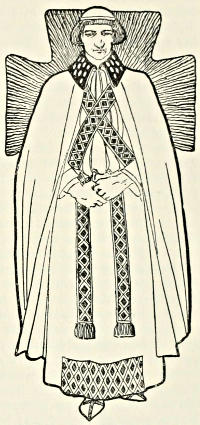
A Priest of the Fourteenth Century
On the side of Ludwig stood the whole mass of the Fratricelli, the
Beghards (or Beguins) of every description, and the Spirituals, or more
rigid among the Franciscans; and these, being scattered over a large part of
Europe, and supported by the protection of Ludwig, everywhere assailed
John with reproaches and criminations, both orally and in books, and charged
him with religious apostasy. The pontiff, however, was not greatly injured
by these private attacks; but towards the close of his life he fell under the
disapprobation and censure of nearly the whole church. For in the years
1331 and 1332, he taught in some public discourses that departed souls
would indeed behold Christ, but would not see the face of God or the divine
nature until their reunion with the body at the last day. With this doctrine,
Philip VI, the king of France, was highly displeased; the theologians
of Paris condemned it in 1333; and both the friends and the foes of the
pontiff were opposed to it. For it appeared to them that the pontiff
detracted much from the blessedness of departed spirits. To so great opposition
John, though naturally pertinacious, had to give way. He therefore
first apologised for the doctrine; and afterwards, when near the point of
death, 1334, he did not indeed abandon it, but he qualified it by saying that
he believed souls in the intermediate state saw the divine essence, as far as
the state and condition of the disembodied spirit would permit. But this
declaration did not satisfy his adversaries. Hence, after various disputes,
his successor Benedict XII terminated the controversy, according to the
decision of the Parisian doctors, by declaring the true faith to be that the
souls of the blessed, when separate from the body, fully and perfectly behold
the divine nature, or God himself. Benedict could do this without impeaching
his predecessor; for John, when dying, submitted his opinion to the
judgment of the church, lest, perhaps, he should after death be classed
among heretics.
[1333-1362 A.D.]
On the death of John, 1334, new contests between the French and the
Italians, respecting the choice of a pontiff, divided the college of cardinals.
But near the close of the year, Jacques de Nouveau called Fournier, a Frenchman,
cardinal of St. Prisca, was chosen, and assumed the name of Benedict
XII. Historians allow him the praise of being an upright and honest man,
no less free from avarice than from the lust of rule. During his reign the
controversy with the emperor Ludwig was at rest. For although he did not
restore him to church communion, being prevented, as is reported by the king
of France, yet he did not attempt anything against him. He saw the existing
evils in the church, and some of them, as far as he could, he removed;
in particular he laboured to reform by decrees and ordinances the orders of
the monks, both mendicant and opulent. But death removed him, when he
was contemplating more and greater changes, in 1342. Overlook superstition,
which was the common fault of his age, and we shall find nothing to
prevent us from declaring this pontiff to have been a right-spirited man.
Of a different spirit was his successor, Clement VI, who was likewise a
Frenchman, named Pierre Roger, and cardinal of St. Nereus and St. Achilles.
To say nothing of his other deeds, that are little to be commended, he trod
in the steps of John XXII by his provisions and reservations of churches,
which was evidence of a shameful avarice; further, he conferred the most
important spiritual offices on foreigners and Italians, which produced controversies
between him and the kings of France and England; and, lastly,
he demonstrated the arrogance and pride of his heart, among other things,
by renewing the war with Ludwig the Bavarian. For, in the year 1343, he
hurled new thunders at the emperor; and finding these to be contemned by
Ludwig, in the year 1346, he devoted him again to execration; and persuaded
the princes of Germany to elect Charles IV, grandson of Henry VII,
for their emperor. A civil war would now have broken out in Germany, had
not the death of Ludwig, in 1347, prevented it. Clement followed him to
the grave, in 1352, famous for nothing but his zeal for exalting the majesty
of the pontiffs, and for adding Avignon, which he bought of Joanna queen of
Naples, to St. Peter’s patrimony.
[1362-1378 A.D.]
There was more moderation and probity in Innocent VI, or Etienne d’Albert,
a Frenchman, previously bishop of Ostia, who governed the church ten
years, and died in 1362. He favoured his own relatives too much; but in
other respects encouraged the pious and the well-informed, held the monks to
their duty, abstained from reserving churches, and did many things worthy of
commendation. His successor, Guillaume de Grimoard, abbot of St. Victor,
at Marseilles, who assumed the name of Urban V, was also free from
great faults, if we except those which are almost inseparable from the office
of a pope. Overcome by the entreaties of the Romans, he removed to
Rome in the year 1367, but returned again to Avignon in 1370, in order
to make peace between the king of England and the king of France, and died
there the same year.
He was succeeded by Pierre Roger, a Frenchman of noble birth, under
the pontifical name of Gregory XI. He was inferior to his predecessors in
virtue, but exceeded them in energy and audacity. Under him great and
dangerous commotions disturbed Italy and the city of Rome. The Florentines,
especially, waged fierce war with the Romish church, and were successful
in it. To restore the tranquillity of Italy, and recover the territories and
cities taken from the patrimony of St. Peter, Gregory, in the year 1376,
transferred his residence from Avignon to Rome. One Catherine, a virgin
of Siena, whom that credulous age took to be a prophetess divinely inspired,
came to Avignon, and by her exhortations greatly contributed to this measure.
But Gregory soon after repented of his removal; for by their long
absence from Italy the authority of the pontiffs was so fallen there that the
Romans and the Florentines had no scruple to insult and abuse him in various
ways. He therefore purposed to return to Avignon, but was prevented by
death, which removed him from among living men in the year 1378.
After the death of Gregory XI, the cardinals being assembled to provide
a successor, the Roman people, fearing lest a Frenchman should be elected
who would remove to Avignon, demanded, with furious clamours and threats,
that an Italian should be placed at the head of the church without delay.
The terrified cardinals proclaimed Bartolommeo Prignani, who was a Neapolitan
by birth, and archbishop of Bari, to be elected pontiff; and he assumed
the name of Urban VI. This new pontiff, by his coarse manners, his injudicious
severity, and his intolerable haughtiness, alienated the minds of all from
him, but especially the cardinals. These, therefore, withdrew to Fondi, a
city in the kingdom of Naples, and there created another pontiff, Robert
count of Geneva, who took the name of Clement VII, alleging that Urban
was elected only in pretence, in order to quiet the rage of the people of Rome.
Which of these was the legitimate and true pontiff still remains uncertain,
nor can it be fully ascertained from the records and documents which have
been published in great abundance by both parties. Urban continued at
Rome; Clement removed to Avignon in France.
Thus the unity of the Latin church, as existing under one head, came to
an end at the death of Gregory XI; and that most unhappy disunion ensued,
which is usually denominated “the great schism of the West.” For during
fifty years the church had two or three heads; and the contemporary pontiffs
assailed each other with excommunications, maledictions, and insidious measures.
The calamities and distress of those times are indescribable. For
besides the perpetual contentions and wars between the pontifical factions,
which were ruinous to great numbers, involving them in loss of life or
of property, nearly all sense of religion was in many places extinguished, and
wickedness daily acquired greater impunity and boldness. The clergy, previously
corrupt, now laid aside even the appearance of piety and godliness,
while those who called themselves Christ’s vicegerents were at open war with
each other; and the conscientious people, who believed that no one could be
saved without living in subjection to Christ’s vicegerents, were thrown into
the greatest perplexity and anxiety of mind. Yet both the church and the
state received very considerable advantages from these great calamities. For
the very sinews of pontifical power were cut by these dissensions, and no art
could heal them any more; kings, too, and princes, who had before been in
a sense the servants of the pontiffs, now became their judges and masters.
Moreover, great numbers, possessing some measure of discernment, despising
and disregarding pontiffs, fighting for dominion, committed themselves and
their salvation to God alone, in full assurance that the church and religion
might be safe and continue so, although without any visible head.c
THE GREAT SCHISM OF THE WEST (1378-1417 A.D.)
[1378-1389 A.D.]
Clement was immediately recognised as pope in Scotland, Savoy, and
Lorraine, afterwards in Castile (1381), Aragon (1387), and Navarre (1390).
On the other hand Germany, England, Denmark, Sweden, Poland, and
Prussia remained on Urban’s side.
The war between the two popes was not only waged with sentences
of excommunication, but in Italy with secular weapons also. Urban declared
that Queen Joanna, by her secession from his side, had forfeited the
kingdom of Naples, and granted it in fee to Charles, duke of Durazzo. On
the other hand Joanna, under Clement’s influence, took Louis, duke of Anjou,
at that time regent of France, for her adopted son and successor (1380).
Charles meanwhile in a short time made himself master of the whole kingdom,
took Joanna prisoner in 1381, and had her put to death, when Louis
appeared in Italy at the head of an army (1382). Charles continued to
maintain his ascendency, and Louis’ death (1384) would have been decisive
as regards Naples in favour of Urban and Charles forever, had not differences
forthwith arisen between the two latter, which increased to such
a degree, when the headstrong pope went in person to Naples, that Urban
pronounced sentence of dethronement and excommunication against Charles,
and was consequently besieged by him in the castle of Lucera at Salerno
(1385). He escaped to Genoa (September, 1385) without becoming wiser.
By the cruel execution of five cardinals he made himself still more hateful.
After Charles’ death (1386) by his impolitic refusal to invest his son
Ladislaus (or Lancelot) with Naples, he exposed this kingdom afresh to the
danger of falling under the dominion of France. The capital city was
already conquered for the young Louis of Anjou (1387), and the whole
kingdom would have fallen to him and the French pope, had not Urban’s
successor, Boniface IX, at the right moment, invested Ladislaus (1390) and
rendered him his powerful support. With a view to secure the states of the
church against Louis, Boniface granted many towns and castles in fee to
powerful nobles, and thus roused afresh in Rome a struggle for independence,
which kept him long in banishment from the city. True, Louis was
forced to quit Italy altogether (1400), and Ladislaus remained king of
Naples. But this restless agitation in Rome increased, and was even supported
by Ladislaus, who wished to make himself master of the city.
[1389-1409 A.D.]
As the schism lessened the revenues of the popes and increased their
expenses, so it caused a fresh aggravation of those church oppressions which
were already intolerable. The French pontiff, Clement VII, was obliged
indeed to exercise the right of presentation to ecclesiastical offices, to which
now also were added the gratiæ exspectativæ, according to the nod of the
French court, upon which he was quite dependent; but in return for this
the church of France, so long as her grievances were not too loudly expressed,
was delivered over as a prey to his extortions. Tithes vacantiæ and annates
were now the standing income of the papal cabinet. In addition to these
Clement laid claim to the spoils of deceased prelates. His successor, Benedict
XIII, wherever it was possible, surpassed him in these systems of
impoverishment.
So long as Urban VI lived, the Roman curia was advantageously distinguished
in this respect from that of Avignon. His successor, Boniface IX,
on the contrary, imitated all the extortions of his rivals in France, but he
far surpassed them in the simony which was practised quite publicly by himself
and the members of his curia, and was even defended without any sense
of shame. Thus at the end of this period both obediences were groaning
under the weight of persecution. England alone repeatedly threw off every
papal oppression, and in 1404 Hungary also followed her example.
In consequence of these church oppressions, which were the result of the
schism, the religious scruples which were entertained with regard to it were
strengthened, and earlier steps demanded for its settlement. The university
of Paris in particular laboured with unshaken perseverance to bring the
schism to a close. After she had long waited in vain for a sound agreement
of the two popes betwixt themselves, she at last obtained permission from
the court of France to interpose her opinion upon these events (1394).
Benedict XIII, notwithstanding his promise made before his election, showed
even less inclination than his predecessor to take serious steps to close the
schism. To the urgent proposals of a French national synod in 1395 he
returned only an evasive answer. The university nevertheless persevered in
her endeavour, and at length contrived that Charles VI, king of France,
should join with the emperor Wenceslaus in forcing both the popes to
resign (1398).
The latter was in very truth too weak to keep his word; moreover he was
himself deposed by the secret machinations of his pope Boniface IX (1400).
On the other hand, by the decree of a new national synod France withdrew
from the obedience of Benedict; Castile followed her example (1398), and
this pope was kept a prisoner at Avignon. It was not till after the lapse of
many years, and the breach of express engagements, that Benedict succeeded
in regaining the church of France to his obedience (1403) by the help of the
duke of Orleans, who at that time had won the ascendency at court. It was
quickly manifest how little he meant to keep these promises; but as the
Italian cardinals imposed similar engagements upon their new pope Innocent
VII, on his election in 1404, even only with a view to save appearances, it
was necessary to open negotiations. The fruitlessness of this proceeding
increased the general discontent; France threatened her pope with a fresh
withdrawal of allegiance (national council of January, 1407), when at length
both the popes agreed upon a personal interview at Savona in September,
1407. Benedict appeared there in person; however, Gregory XII went
only as far as Lucca, and opened fresh negotiations for another place of congress.
This public breach of promise roused the Roman cardinals; they forsook
their pope Gregory, and renounced their allegiance to him, at the same
time that France withdrew from the obedience of Benedict. Benedict indeed
escaped the imprisonment with which he was threatened, by flight to Perpignan;
but the cardinals of both obediences united at Livorno (Leghorn)
and summoned a general council at Pisa in March, 1409, with a view to the
termination of the schism.
[1378-1417 A.D.]
The schism with its church oppression furnished the impulse, the weakness
of the papal see gave the long desired opportunity for an unbiased
trial of the existing state of the church; it led men to opinions which had
hitherto only been mooted in violent struggles with the popes, and so not
without an appearance of passion and party spirit; but now they struck
root so deeply, even among the most faithful adherents of the church, that
they could never again be entirely suppressed. Many an anxious gaze was
turned backwards to the earlier and better ages of the church, in order to
discover in its constitution the remedy for the scandals of the present.
This was a problem of learning. Its representatives, the universities, particularly
that of Paris, were listened to with eager attention, and attained
an influence which was formidable
even to the popes. This comparison
of the present with the earlier
ages of the church could not but lead
to many convictions unfavourable to
the papal see.
True there were but isolated individuals
who advanced so far upon
this line of thought as to wish
the papacy quite removed from the
church as the source of all her evils.
But even its truest adherents now
acknowledged the immoderate extension
of papal power, and the monstrous
exaggeration of the papal
dignity. They discovered in the
bent of the papacy to secular power
the prime cause of all mischief, and
even to the schism, and they wished
the times back again when the emperors
could convoke synods by their
own authority to strangle a schism
at its birth. No less general was
the discontent expressed against the
papal church oppressions, and the
wish to remove them by limitations
of the papal power. Hitherto only
adversaries of the popes, at open war
with them, had appealed to a general
council as a higher authority, but
during the schism circumstances led
to a general acknowledgment that such a council must rank above the pope.
After the Council of Pisa was summoned to terminate the contest between the
two popes, and set a limit to the abuses of papal power, the canonists vied with
each other in demonstrating this new opinion so injurious to the papacy, of
the superiority of general councils to the pope, and thus the papal system
of the last century seemed to be threatened with total overthrow.
RELATION OF THE NATIONAL CHURCHES TO THE STATE
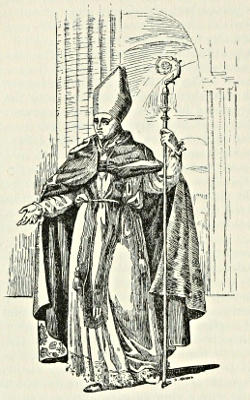
A Bishop of the Fourteenth Century
The jealousies betwixt the ecclesiastical and secular tribunals arising
from the immoderate extension of ecclesiastical jurisdiction still continued,
but they began more and more to result in favour of the latter. In Germany
the fundamental principle that secular causes belonged only to secular
tribunals had been recognised long before, even by the prelates, who were
themselves temporal lords of the land; it was, as a general rule, always
maintained, though in individual cases the ecclesiastical tribunals continually
overstepped their limits. But during the schism, the emperor Wenceslaus
could only execute his decisions in things temporal, against the higher
orders of the clergy, by deeds of violence. The cities continued to tax the
excessive revenues of the ecclesiastical sovereignty. They either forbade
altogether the increase of church property, or decreed that all fresh acquisitions
should be alienated again in a year and a day, or required from the
new revenues the customary taxes. Now that the parish priests, by their
management of people’s wills, provided too well for themselves and for the
church, it was determined that wills should only be made before the secular
authorities. Paderborn even prohibited the multiplication of masses for
souls. Still the popes wished to maintain a good understanding with the
cities, and bind them to themselves by means of privileges.
During the schism many concessions were made to the nobles also; thus
Boniface IX, in 1399 allowed Albert IV, duke of Austria, the jus primarum
precum. The free Swiss by the priests’ law (Pfaffenbrief) in 1370 put an
end to the encroachments of the ecclesiastical tribunals. In Italy the operation
of the ecclesiastical tribunals, like the condition of the whole country,
was very fluctuating. Under Ghibelline lords they were often quite suppressed.
In France ecclesiastical jurisdiction had reached its greatest
extension; the kings connived at it, because they wished to keep their
bishops well inclined to themselves, and knew how to tax any irregularities
of the ecclesiastical tribunals. On the other hand the barons were continually
at issue with the prelates on this point, and from both sides there were
unceasing complaints of usurpation. The remarkable negotiations which
were instituted by command of King Philip of Valois with the prelates
summoned before parliament (1329), owing to the king’s political aims,
failed of their intended result. Immediately afterwards the clergy sought
to establish their jurisdiction still firmer by decrees of councils. On the
other hand a powerful resistance to these proceedings was being developed
in parliament, which was now transforming itself into a standing corporation;
this was especially manifest from the time of Charles V. Henceforth
ecclesiastical jurisdiction was not only confined to its proper limits, but parliament
claimed a certain degree of superintendence over it, and drew to
itself the right of decision upon many points, which were at that time universally
held to be ecclesiastical.
The earlier encroachments of the popes upon episcopal rights were still
further increased by the fact that they now took to themselves entirely the
appointment to ecclesiastical offices, and exercised the right of exemption in
the highest degree, particularly during the schism. Thus the importance of
the bishops in the church was small; they compensated themselves for this
by secular honours and worldly enjoyment. The oppression which fell upon
them from above they knew how to discharge upon those below, and so the
lower orders of the clergy groaned beneath intolerable burdens.
MORAL CONDITION OF THE CLERGY
The moral condition of the clergy could not fail to degenerate still more
in this period, in consequence of the manner in which ecclesiastical offices
were generally bestowed, the example which the papal court gave, and the
method in which the ecclesiastical jurisdiction was administered. In
the chapters, where the stalls were for the most part benefices reserved for
the nobles, as well as among the parochial clergy, there prevailed a depth
of ignorance and an immorality which awakened indignation. The continued
struggle of the synods against the dissoluteness of priests remained
quite fruitless. The laity were only too glad to secure their wives and
daughters from the sacerdotal ravishers, and accordingly favoured, at times
even demanded, fixed alliances of their priests with concubines. Thus in
many countries concubinage was publicly allowed among the priests, who
were supposed to be too sacred for a matrimonial connection. The fines with
which these excesses were visited by many synods were quickly changed
into a welcome gratuity to the avarice of the bishops. Nevertheless, every
attempt of the secular power to check these scandals was resisted by the
church as an invasion of her rights.d
THE GREAT COUNCILS OF PISA AND CONSTANCE; JOHN HUSS
[1409-1429 A.D.]
The Council of Pisa, which was designed to heal the wounds of the
divided church, unexpectedly inflicted upon her a new wound. On the 5th
of June it passed a heavy sentence on each of the pontiffs; for it declared
them both to be heretical, perjured, contumacious, unworthy of any honour,
and no longer members of the church. As the next step, the council created
Pietro Philarghi of Candia sovereign pontiff in their place, on the 26th of
June; and he assumed the name of Alexander V. But the two pontiffs
spurned the decrees of this council, and continued still to perform their
functions. Benedict held a council at Perpignan, and Gregory assembled
another at Austria, near Aquileia; but fearing the resentments of the Venetians,
he went first to Gaeta, where he threw himself upon the protection of
Ladislaus, king of Naples, and then fled, in 1412, to Rimini.
The church was thus divided among three pontiffs, who fiercely assailed
each other with reciprocal excommunications, reproaches, and maledictions.
Alexander V, who was elected in the Council of Pisa, died at Bologna in
1410. The sixteen cardinals, who were present in the city, immediately
filled his place with Baltasare Cossa, a Neapolitan, who took the name of
John XXIII, a man destitute of principle and of piety. From this war
of the pontiffs vast evils arose which afflicted both the church and the state.
Hence the emperor Sigismund, the king of France, and other kings and
princes of Europe, spared no pains nor expense to restore harmony and bring
the church again under one head. From the pontiffs it was found quite
impossible to obtain any personal sacrifice for the peace of the church;
so that no course remained but to assemble a general council of the whole
church, to take cognisance of this great controversy. Such an assembly
John XXIII, being prevailed on by the entreaties of Sigismund and hoping
that it would favour his cause, appointed to be held at Constance in 1414.
In this council were present the pontiff John, the emperor Sigismund, many
princes of Germany, and ambassadors from the absent kings and princes of
Europe, and from the republics.
The principal object of this great council was to extinguish the discord
between the pontiffs; and this business was accomplished successfully. For
having established by two solemn decrees, in the fourth and fifth sessions,
that a pontiff is subject to a council of the whole church, and having most
carefully substantiated the authority of councils, the fathers, on the 29th of
May, 1415, removed John XXIII from the pontificate on account of various
offences and crimes; for he had pledged himself to the council to resign the
pontificate, and yet withdrew himself by flight. Gregory XII voluntarily
resigned his pontificate on the 4th of July in the same year, through Carlo
Malatesta. And Benedict XIII, on the 26th of July, 1417, was deprived of
his rank as a pontiff by a solemn decree of the council. After these transactions,
on the 11th of November, 1417, Otto Colonna was elected pontiff
by the unanimous suffrages of the cardinals, and assumed the name of Martin
V. Benedict XIII, who resided at Perpignan, resisted indeed, and
claimed the rights and the dignity of a pontiff till his death, 1423; and
after the death of this obstinate man, under the auspices of Alfonso, king of
Sicily, Ægidius (Giles) Nuños, a Spaniard, was appointed to succeed him,
by only two cardinals. He assumed the name of Clement VIII, and wished
to be regarded as the legitimate pontiff; but in the year 1429 he was persuaded
to resign the government of the church entirely to Martin V.
[1407-1416 A.D.]
The things done in this council for the repression and extirpation of
heretics are not equally commendable; some of them, indeed, are quite
inexcusable. Before the council sat, great religious commotions had arisen
in several countries, but especially in Bohemia. There lived and taught at
Prague, with much applause, an eloquent and learned man, by name John
Huss, who acted as a professor of theology in the university and as a minister
of holy things in the church. Vehemently did he declaim against priestly
vices of every kind; which was generally done in that age, and no good
man disapproved it. He likewise endeavoured, after the year 1408, to detach
the university from acknowledging as pontiff Gregory XII, whom Bohemia
had hitherto obeyed. This gave great offence to the archbishop of Prague
and to the rest of the clergy, who were devoted partisans of Gregory.
Hence arose great hostility between Huss and the archbishop, which the
former kept up and increased by his discourses against the Romish court and
the vices of the clergy.
To these first causes of hatred against Huss, which might easily have been
surmounted, others were added of greater magnitude. First, he took the
side of the Realists in philosophy, and, therefore, according to the usage of
the age, goaded and pressed the Nominalists to the utmost of his power; yet
their number was very considerable in the university of Prague, and their
influence was not small. Afterwards, in the year 1408, he brought it about
that, in the controversy between the Germans and the Bohemians respecting
the number of votes, the decision was in favour of the Bohemians. By the
laws of the university it was ordained that in academic discussions the
Bohemians should have three votes, and the other three nations but one.
The university was then divided into four nations, but the Bavarian, Polish,
and Saxon were comprehended under the general name of the German
nation. The usage had been that the Germans, who far exceeded the
Bohemians in numbers, gave three votes and the Bohemians but one. Huss,
therefore, either from partiality to his country or from hatred of the Nominalists,
whom the greatest part of the Germans preferred to the Realists,
obtained, by means of the vast influence at court which his eloquence gave
him, a decree that the Germans should be deprived of the three votes and
should be bidden to content themselves with one. This result of a long
contest so offended the Germans that a great multitude of them, with the
rector of the university, Johann Hofmann, at their head, left the university
of Prague and retired to Leipzig, where Frederick the Wise, elector of
Saxony, founded a university on their account in the year 1409. This event
contributed much to increase the odium against Huss and to work his ruin.
The Germans being ejected from Prague, Huss inveighed more freely than
before against the vices of the clergy, and also publicly preached and recommended
the opinions and the books of John Wycliffe, the Englishman.
[See the history of England.] Being accused before John XXIII, in the
year 1410, he was excommunicated by that pontiff. Spurning this thunderbolt,
he continued, with general applause, first by word of mouth, afterwards
in various writings, to lash the sores of the Roman church and of the priest
of every degree.
This good man, who was in love with real piety, but perhaps had sometimes
too much warmth and not sufficient prudence, being summoned to the
Council of Constance, went thither on the faith of a safe-conduct given by
the emperor Sigismund, with a view to demonstrate his innocence and prove
them liars who talked of him as an apostate from the Roman church. And
certainly he had not departed in things of any moment from the religion of
his times; but had only inveighed severely against the pontiffs, the court
of Rome, the more considerable clergy, and the monks; which in fact had the
sanction of his times, and was daily done in the Council of Constance itself.
Yet his enemies, who were numerous both in Bohemia and in the council,
managed the procedure against him so artfully and successfully that, in violation
of the public faith, he was cast into prison; and when he would not,
according to the council’s order, confess himself guilty, he was adjudged a
heretic, and burned alive, on the 6th day of July, 1415. Full of faith and
the love of God, he sustained this punishment with admirable constancy.
The same unhappy fate was borne with the same pious fortitude and constancy
by Jerome of Prague, the companion of John Huss, who had come to
Constance to support and aid his friend. He yielded at first through fear
of death to the mandates of the council, and renounced those opinions
which the council had condemned in him; but being retained still in prison,
he resumed courage, again avowed those opinions, and was, therefore, committed
to the flames on the 30th of May, 1416.
Before Huss and Jerome were condemned by the council, John Wycliffe,
who was considered, and not altogether without reason, as their teacher, had
been pronounced infamous, and condemned by a decree of the fathers. For
on the fourth day of May, 1415, the council declared a number of opinions
extracted from his writings to be abominable; and ordered all his books
to be destroyed, and his bones to be burned. Not long after, on the 14th
of June, they passed the famous decree that the sacred supper should be
administered to the laity under one kind of bread only, forbidding communion
under both kinds. For in the preceding year, 1414, Jacobellus
(James) of Mies, incumbent of St. Michael’s church at Prague, by the instigation
of a Parisian doctor, Peter of Dresden, had begun to celebrate the
communion under both kinds, at Prague; which example many other
churches followed. The subject being brought before the council by one of
the Bohemian bishops, it considered a remedy to be required even for this
heresy. By this decree at Constance, the communion of the laity under
one kind obtained the force and authority of law in the Roman church.
[1407-1431 A.D.]
In the same year, the council placed among execrable errors, or heresies,
an opinion of Jean Petit, a Parisian theologian, that tyrants might be lawfully
slain by any private person. The party however, from whom this opinion
came was not named, because he was supported by very powerful patrons.
John duke of Burgundy employed assassins, in the year 1407, to murder
Louis duke of Orleans. A great contest now arose, and Petit, an eloquent
and ingenious man, pleaded the cause of John of Burgundy at Paris; and in
order to justify his conduct he maintained that it is no sin to destroy a
tyrant, without a trial of his cause, by force or fraud, or in any other manner,
and even if the persons doing it are bound to him by an oath or covenant.
By a tyrant, however, Petit did not understand the sovereign of a nation,
but a powerful citizen, who abused his resources to the ruin of his king and
country. The university of Paris passed a stern and severe sentence upon
the author of so dangerous an opinion. The council, after several consultations,
struck at the opinion, without naming its author. The new pontiff,
however, Martin V, from fear of the Burgundian power, would not ratify
even this mild sentence.
After these and some other transactions the council proceeded avowedly
to the subject of a reformation of the church, in its “head and members,” as
the language of that age was. For all Europe saw the need of such a reformation,
and most ardently wished for it. Nor did the council deny that
chiefly for this important object it had been called together. But the cardinals
and principal men of the Romish court, for whose interest it was, especially,
that the disorders of the church should remain
untouched, craftily urged and brought
the majority to believe that a business of
such magnitude could not be managed advantageously,
until after the election of a
new pontiff. The new head of the church,
however, Martin V, abused his power to
elude the design of reformation; and manifested
by his commands and edicts that he
did not wish the church to be purged and
restored to a sound state. The council,
accordingly, after deliberating three years
and six months, broke up on the 22nd of
April, 1418, leaving the matter unaccomplished,
and putting off that reformation,
which all good men devoutly wished, to a
council which should be called five years
afterwards.
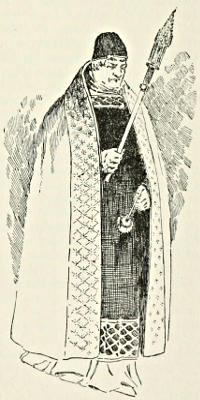
A Priest in his Mantle of Office, 1400
[1431-1439 A.D.]
Martin V, being admonished on the subject,
after a long delay appointed this other
council to be held at Pavia; and afterwards
removed it to Siena, and lastly to
Bâle. But at its very commencement, on
the 21st February, 1431, he died; and was
succeeded, in the month of March, by Gabriel
Condolmieri, a Venetian, and bishop
of Siena, who took the name of Eugenius
IV. He sanctioned all that Martin had
decreed about holding the council at Bâle;
and accordingly it commenced on the 23rd
of July, 1431, under the presidency of Cardinal
Julian, as representative of the pontiff. Two objects especially were
assigned to this celebrated council: first, a union between the Greeks and
the Latins; and secondly, the reformation of the church, both in its “head
and its members,” according to the resolution adopted in the Council of
Constance. Now that the head, namely the sovereign pontiff, and all
the members of the church, that is the bishops, priests, and monks, were
in a very unsound state no one doubted. But when the fathers, by the
very form of the council, by its mode and order of proceeding, and by
its first decrees, showed an intention of performing in earnest what was
expected of them, Eugenius IV became uneasy for a corrupt church under
such physicians, and twice attempted to dissolve the council. This the
fathers most firmly resisted; and they showed by the decrees of the Council
of Constance, and by other arguments, that the council was superior
in authority to a pontiff. This first contest between the pontiff and the
council was brought to a close in the month of November, 1433; for the
pontiff silently gave up the point, and in the month of December, by letters
sent from Rome, gave the council his approbation.
After this the council prosecuted with energy the business upon which
it had entered. The legates of the Roman pontiff were now admitted; but
not until they had promised under oath to obey the decrees of the council,
and particularly the decrees of the Council of Constance, asserting the dominion
and jurisdiction of councils over the pontiffs. These very decrees of
Constance, so odious to the pontiffs, were renewed in a public meeting of the
fathers on the 26th of June, 1434. And on the 9th of June, 1435, annates,
as they were called, were abolished, the pontifical legates in vain opposing it.
On the 25th of March, 1436, a profession of faith was read, intended for the
pope himself on the day of his election. The number of cardinals was reduced
to twenty-four; and expectatives, reservations, and provisions were abolished.
Other things coming on little agreeable to the pontiff, Eugenius concluded
that this very audacious and troublesome council must either be
removed into Italy or be curbed by another council in opposition to it.
Therefore, when these fathers decreed, on May 7th, 1437, that on account
of the Greeks the council should be held either at Bâle, or Avignon, or in
some city of Savoy, the pontiff, on the contrary, by his legates, decided that
the council should be held in Italy. Neither party would revoke its decision.
Hence a violent conflict, from this time onward, existed between the pontiff
and the council. On the 26th of July, 1437, the council ordered the pontiff
to appear before them at Bâle, and give account of his conduct. The
pontiff, on the other hand, dissolved the council, and appointed another at
Ferrara. But the fathers, with the approbation of the emperor, the king
of France, and other princes, continued their deliberations at Bâle; and on
the 28th of September of the same year pronounced the pontiff contumacious
for not obeying the decree of a council.
On the 10th of January of the next year, 1438, Eugenius IV, in person,
opened the council which he had summoned to meet at Ferrara; and in the
second session of it excommunicated the fathers assembled at Bâle. The
chief business of this council was to negotiate a union between the Greeks
and Latins. The Greek emperor himself, Joannes Palæologus, the patriarch
of Constantinople, Joseph, and the principal theologians and bishops of the
nation had come personally to Italy, in order to facilitate the success of this
important negotiation. For the Greeks, now reduced to extremities by the
Turks, indulged the hope that if their disagreements with the Roman pontiff
were removed the Latins would afford them succour. The business proceeded
tardily, and with little success at Ferrara; but afterwards rather
better at Florence. For Eugenius in the beginning of the year 1439, on
account of the pestilence at Ferrara, had ordered the council to remove to
Florence. The fathers at Bâle, provoked by these and other acts of Eugenius,
proceeded on the 25th of June, 1439, to deprive him of the pontificate; but
this bold procedure of theirs was not approved by the kings and princes of
Europe. Eugenius, on the 4th of September, by a very severe bull anathematised
the Basilian fathers and rescinded all their acts. Despising these
thunders, on the 17th of September, 1439, they elected a new pontiff, Amadeus,
duke of Savoy, who then led a retired life at Ripaille on the Leman
Lake (Lake of Geneva). He assumed the name of Felix V.
[1439-1449 A.D.]
Thus the lamentable schism, which had been extinguished after so much
labour and toil at Constance, returned with new and greater misfortunes.
For there were not only two pontiffs mutually condemning each other, but
likewise, what was worse, two opposing councils, that of Bâle and that of
Florence. The greater part of the church, indeed, adhered to Eugenius;
but most of the universities, and particularly the first among them, that of
Paris, as well as some kingdoms and provinces, chose to follow Felix V.
The Council of Bâle continued to deliberate and to pass laws and decrees till
the year 1443, notwithstanding all the opposition of Eugenius and his adherents.
And although the fathers separated in that year, they nevertheless
publicly declared that the council was not at an end, but would assemble again
at a proper time, either at Bâle, or Lyons, or Lausanne. The Council of
Florence was chiefly occupied in settling the disputes between the Latins and
the Greeks. This great business was committed to selected individuals of
both parties. The principal one on the part of the Greeks was Bessarion, a
very learned man, who was afterwards admitted into the order of cardinals
in the Roman church. This man, being gained by the favours bestowed on
him by the pontiff, exerted his influence, and the pontiff employed rewards,
threats, and promises to induce the other Greeks to accede to the proposed
terms of accommodation, and to acknowledge that the Holy Spirit proceeded
also from the Son, that departed souls undergo a purgation by fire before
they are admitted to the vision of God, that bread which is without leaven
may be used in the sacred supper, and lastly, what was most important of
all, that the Roman pontiff is the head and the judge of the church universal.
One of the Greeks, Mark of Ephesus, could not be persuaded, by entreaties
or by bribes, to give his assent. After all, this peace, which was extorted
by various artifices, was not stable. For the Greeks, on returning to Constantinople,
stated to their fellow-citizens that everything had been carried
at Florence by fraud, and they resumed their hostility. The Council of
Florence itself put an end to its deliberations on the 26th of April, 1442.
There were also negotiations in this council for bringing the Armenians,
and the Jacobites, but especially the Abyssinians, into union with the Romish
church; which were attended with the same result as those respecting the
Greeks.
[1447-1455 A.D.]
The author of this new pontifical schism, Eugenius IV, died in the
month of February, 1447, and was succeeded in the month of March by
Nicholas V, who was previously Tommaso Parentucelli of Sarzana, bishop
of Bologna, a man of learning himself and a great patron of learning, and
likewise moderate in temper and disposed for peace. Under him, by means
of the persevering labours and efforts of the kings and princes of Europe,
especially of the king of France, tranquillity was restored to the Latin
church. For Felix V, on the 9th of April, 1449, himself resigned the
supremacy of the church, and retired to his former quiet at Ripaille; and the
Basilian fathers, being assembled on the 16th of April at Lausanne, ratified
his voluntary abdication, and by a solemn decree directed the whole church
to obey Nicholas only. On the 18th of June Nicholas promulgated this
pacification; and, at the same time, confirmed by his sanction the acts and
decrees of the Council of Bâle. This Nicholas was particularly distinguished
for his love of literature and the arts, which he laudably exerted himself
to advance and encourage in Italy, especially by means of the Greeks that
came from Constantinople. He died on the 24th of March, 1455, principally
from grief, occasioned by the capture of Constantinople by the Turks.c
At this date Milman closes his splendid work on The History of Latin
Christianity. It will be profitable to quote his summing up of the point
reached by Nicholas V, eight and a half centuries after Gregory the Great.a
MILMAN ON NICHOLAS V AND THE FALL OF CONSTANTINOPLE
[1447-1458 A.D.]
The pontificate of Nicholas V is the culminating point of Latin Christianity.
The papal power indeed had long reached its zenith. From Innocent
III to Boniface VIII it had begun its decline. But Latin Christianity
was alike the religion of the popes and of the councils which contested their
supremacy. It was as yet no more than a sacerdotal strife whether the pope
should maintain an irresponsible autocracy, or be limited and controlled by
an ubiquitous, aristocratic senate. The most ardent reformers looked no
further than to strengthen the hierarchy. The prelates were determined to
emancipate themselves from the usurpations of the pope, as to their elections,
their arbitrary taxation by Rome, the undermining of their authority by
perpetual appeals; but they had no notion of relaxing in the least the
ecclesiastical domination. It was not that Christendom might govern itself,
but that themselves might have a more equal share in the government.
They were as jealously attached as the pope to the creed of Latin Christianity.
The council, not the pope, burned John Huss. Their concessions to
the Bohemians were extorted from their fears, not granted by their liberality.
The Vulgate was their Bible, the Latin service their exclusive liturgy, the
Canon Law their code of jurisprudence.
Latin Christianity had yet to discharge some part of its mission. It had
to enlighten the world with letters, to adorn it with arts. It had hospitably to
receive (a gift fatal in the end to its own dominion) and to promulgate to
mankind the poets, historians, philosophers of Greece. It had to break down
its own idols, the schoolmen, and substitute a new idolatry, that of classical
literature. It had to perfect Christian art. Already Christian architecture
had achieved some of its wonders. The venerable Lateran and St. Paul’s
without the Walls, the old St. Peter’s, St. Mark’s at Venice and Pisa, Strasburg
and Cologne, Rheims and Bourges, York and Lincoln, stood in their
majesty. Christian painting, and even Christian sculpture, were to rise to
their untranscended excellence.
The choice of Nicholas V was one of such singular felicity for his time
that it cannot be wondered if his admirers looked on it as overruled by the
Holy Spirit. “Who would have thought in Florence,” so said Nicholas to
his biographer Vespasiano,e “that a priest who rang the bells should become
supreme pontiff?” Yet it seems to have been a happy accident. In
Nicholas V, in three short years, the pope had become again a great Italian
potentate. The pilgrims carried back throughout Europe accounts of the
resuscitated majesty of the Roman pontificate, the unsullied personal dignity
of the pope, the re-enthronement of religion in the splendid edifices, which
were either building or under restoration. Nicholas V was to behold, as it
were, the final act of homage to the popedom, from the majesty of the empire.
He was to be the last pontiff who was to crown at Rome the successor of
Charlemagne; Frederick III the last emperor who was so to receive his
crown from the hands of the pope.
[1452-1455 A.D.]
Now came that event which, however foreseen by the few wiser prophetic
spirits, burst on Europe and on Christendom with the stunning and appalling
effect of absolute suddenness—the taking of Constantinople by the
Turks. On no two European minds did this disaster work with more profound
or more absorbing terror than on Pope Nicholas V and Æneas Sylvius
(Enea Silvio Piccolomini); nor could anyone allege more sound reasons for
that terror than the pope and the bishop of Siena. Who could estimate
better than Æneas, from his intimate knowledge of all the countries of
Europe, of Italy, Germany, France, England, the extent of the danger which
impended over the Latin world? Never since its earlier outburst might
Mohammedanism seem so likely to subjugate if not to swallow up distracted
and disunited Christendom, as under the Turks. By sea and land they
were equally formidable. If Christendom should resist, on what frontier?
All were menaced, all in danger. What city, what kingdom, would arrest
the fierce, the perpetual invasion? From this period throughout the affairs
of Germany (at Frankfort he preached a crusade) to the end of his legatine
power, of his cardinalate, of his papacy, of his life, this was the one absorbing
thought, one passion, of Æneas Sylvius. The immediate advance of the
victorious Muhammed through Hungary, Dalmatia, to the border, the centre
of Italy, was stopped by a single fortress, Belgrade; by a preacher, John
Capistrano; by a hero, John Hunyady. But it was not till, above a century
later, when Don John of Austria, at Lepanto by sea, and John Sobieski,
before Vienna, by land, broke the spell of Mohammedan conquest, that
Europe or Christendom might repose in security.
The death of Nicholas V was hastened, it was said, by the taking of Constantinople.
Grief, shame, fear, worked on a constitution broken by the
gout. But Nicholas V foresaw not that in remote futurity the peaceful, not
the warlike, consequences of the fall of Constantinople would be most fatal
to the popedom—that what was the glory of Nicholas V would become
among the foremost causes of the ruin of mediæval religion; that it would aid
in shaking to the base and in severing forever the majestic unity of Latin
Christianity.
Nicholas V aspired to make Italy the domicile, Rome the capital, of
letters and arts. No sooner was Nicholas pope than he applied himself to
the foundation of the Vatican library. Five thousand volumes were speedily
collected. The wondering age boasted that no such library had existed
since the days of the Ptolemies.
The scholars of Italy flocked to Rome, each to receive his task from the
generous pope, who rewarded their labours with ample payment. He
seemed determined to enrich the West with all that survived of Grecian
literature. The fall of Constantinople, long threatened, had been preceded
by the immigration of many learned Greeks. France, Germany, even England,
the Byzantine Empire, Greece, had been ransacked by industrious
agents for copies of all the Greek authors. No branch of letters was without
its interpreters.
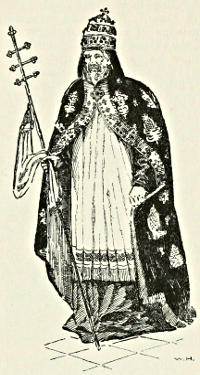
A Pope of the Fifteenth Century
To Nicholas V, Italy, or rather Latin Christianity, mainly owes her age
of learning, as well as its fatal consequence to Rome and to Latin Christianity,
which in his honest ardour he would be the last to foresee. It was
the splendid vision of Nicholas V that this revival of letters, which in certain
circles became almost a new religion, would not be the bond-slave but
the handmaid or willing minister of the old. Latin Christianity was to
array itself in all the spoils of the ancient world, and so maintain (there was
nothing of policy in his thought) her dominion over the mind of man. But
Rome under Nicholas V was not to be the centre of letters alone; she was
also to resume her rank as the centre of art, more especially of architectural
magnificence. Rome was to be again as of old the lawgiver of civilisation;
pilgrims from all parts of the world, from curiosity, for business, or from
religion, were to bow down before the confessed
supremacy of her splendid works.
The pope was to be a great sovereign
prince, but above the sovereign prince he
was to be the successor of St. Peter. Rome
was to be at once the strong citadel, and
the noblest sanctuary in the world, unassailable
by her enemies both without and
within from her fortifications; commanding
the world to awe by the unrivalled
majesty of her churches. The Jubilee had
poured enormous wealth into the treasury
of the pope; his ordinary revenues, both
from the papal territory and from Christendom
at large, began to flow in with peace
and with the revival of his authority. That
wealth was all expended with the most liberal
magnificence. Already had it dawned
upon the mind of Nicholas V that the
cathedral of the chief of the apostles ought
to rival, or to surpass, all the churches in
Christendom in vastness and majesty. It
was to be entirely rebuilt from its foundations.
Julius II and Leo X did but accomplish
the design of Nicholas V.
Thus in Nicholas V closed one great age
of the papacy. In Nicholas the sovereign
Italian prince and the pontiff met in serene
and amicable dignity; he had no temptation
to found a princely family. But before
long the pontiff was to be lost in the sovereign
prince. Nor was it less evident
that the exclusive dominion of Latin Christianity was drawing to a close,
though nearly a century might elapse before the final secession of Teutonic
Christianity, and the great permanent division of Christendom. Each successive
pontificate might seem determined to advance, to hasten that still
slow but inevitable revolution: the audacious nepotism of Sixtus IV, the
wickednesses of Alexander VI, which defy palliation; the wars of Julius II,
with the hoary pope at the head of ferocious armies; the political intrigues
and disasters of Clement VII.b
POPES TO 1503
[1458-1503 A.D.]
Nicholas’ successor, Alfonso Borgia (Borja), a Spaniard, whose pontifical
name was Calixtus III, performed nothing great or splendid, if no account
be taken of his anxiety to urge Christian princes upon a war against the
Turks. He died in the year 1458. Much more celebrated was his successor,
Æneas Sylvius Piccolomini, bishop of Siena, who ascended the papal
throne in 1458, and took the name of Pius II, a man of superior genius, and
renowned both for his achievements and for his various writings and publications.
Yet posterity would have accounted him a much greater man, if he
had not been guilty of gross inconsistency. For after strenuously maintaining
the rights of councils against the pontiffs, and boldly defending the
cause of the Council of Bâle against Eugenius IV, upon being made pontiff,
he apostatised from himself; and January 18th, 1460, denied that a council
is superior to a pontiff, and severely prohibited appeals to councils; and in
the year 1461 obtained from Louis XI, king of France, the abrogation of the
pragmatic sanction, which was favourable to councils; and finally, April
26th, 1463, he expressed a public disapproval of all that he had himself
written in favour of the Council of Bâle, and decreed that Pius II was to be
heard and obeyed, but that Æneas Sylvius was to be condemned. A
short time after making this declaration he fell ill and died in the month of
July, 1464.
Paul II, previously Pietro Barbo, a Venetian, who was raised to the chair
of St. Peter in 1464, and died in 1471, performed some acts not unworthy of
commendation, at least according to the views of that age; but he also did
many things that are scarcely excusable, if they are so at all, among the
least important of which is that he made a jubilee year come once in every
twenty-five years, in 1470. Hence his reputation with posterity has remained
equivocal.
The subsequent pontiffs, Sixtus IV, previously Francesco Albescola
della Rovere, who died in 1484, and Innocent VIII,[108] previously Giovanni
Battista Cibo, a Genoese, who died in 1492, were of the middle kind, being
distinguished as popes neither for great virtues nor for great faults. Each,
fearing for Italy and for all Europe, from the power of the Turks, both
prepared himself for a war upon them and very earnestly urged one on
the kings of Europe. But each met with such obstacles as disappointed
an object so dear to his heart. Nothing else was done by them with much
pretension to true greatness.
The pontifical series of this century is closed by Alexander VI, a Spaniard,
whose true name was Rodrigo Borgia. He may not improperly be called the
Nero of pontiffs. For the villainies, crimes, and enormities recorded of this
man are so many and so great as to make it seem clear that he was destitute,
we will not say of all religion, but even of decency and shame. Among the
things charged upon him, though some may be false and others overstated,
by his enemies, yet so many remain which are placed beyond all dispute as
are sufficient to render the memory of Alexander execrable in the view
of all who have even a moderate share of virtue. A large part of his crimes,
however, originated from his excessive partiality for his children; for he had
four sons by a concubine, among whom was the notorious Cesare Borgia,
infamous for his enormous vices, and likewise one daughter named Lucrezia;
and he was intent solely on bringing forward and enriching these, without
regarding honesty, reason, or religion.c
ALEXANDER VI, THE BORGIA
[1492-1503 A.D.]
The great object of Alexander through his whole life was to gratify his
inclination for pleasure, his ambition, and his love of ease. When at length
he had attained to the supreme spiritual dignity, he seemed also to have
reached the summit of happiness. Spite of his advanced years, the exultation
he felt seemed daily to impart to him a new life. No painful thought was
permitted to disturb his repose for a single night. His only care was to
seize on all means that might aid him to increase his power, and advance the
wealth and dignity of his sons; on no other subject did he ever seriously
bestow a thought. This one consideration was at the base of all his political
alliances, and of those relations by which the events of the world were at
that time so powerfully influenced. How the pope would proceed, in regard
to the marriages, endowments, and advance of his children, became a question
affecting the politics of all Europe.
The son of Alexander, Cæsar Borgia, followed close on the footsteps of
Riario. He began from the same point, and his first undertaking was to
drive the widow of Riario from Imola and Forlì. He pressed forward to the
completion of his designs with the most daring contempt of consequences;
what Riario had only approached, or attempted, Cæsar Borgia carried
forward to its utmost results. Let us take a rapid glance at the means by
which his purposes were accomplished.
The ecclesiastical states had hitherto been divided by the factions of the
Guelfs and Ghibellines, the first represented in Rome by the family of
Orsini, the second by the house of Colonna. The popes had usually taken
part with one or the other of these factions. Sixtus IV had done so, and his
example was followed by Alexander and his son, who at first attached themselves
to the Guelf, or Orsini party. This alliance enabled them very soon
to gain the mastery of all their enemies. They drove the house of Sforza
from Pesaro, that of Malatesta from Rimini, and the family of Manfredi from
Faenza. They seized on those powerful, well-fortified cities, and thus commenced
the foundation of an extensive lordship. But no sooner had they
attained this point, no sooner had they freed themselves from their enemies,
than they turned every effort against their friends. And it was in this that
the practice of the Borgias differed from that of their predecessors, who had
ever remained firmly attached to the party they had chosen; Cæsar, on the contrary,
attacked his own confederates, without hesitation or scruple. The duke
of Urbino, from whom he had frequently received important aid, was involved,
as in a network, by the machinations of Cæsar, and with difficulty saved his
life, a persecuted fugitive in his own dominions. Vitelli, Baglioni, and other
chiefs of the Orsini faction, resolved to show him that at least they were capable
of resistance. But Cæsar Borgia, declaring that “it is permitted to betray
those who are the masters of all treasons,” decoyed them into his snares with
profoundly calculated cruelty, and mercilessly deprived them of life. Having
thus destroyed both parties, he stepped into their place, gathered the inferior
nobility, who had been their adherents, around him, and took them into his
pay; the territories he had seized on were held in subjection by force of
terror and cruelty.
The brightest hopes of Alexander were thus realised—the nobles of the
land were annihilated, and his house about to found a great hereditary
dominion in Italy. But he had already begun to acquire practical experience
of the evil which passions, aroused and unbridled, are capable of
producing. With no relative or favourite would Cæsar Borgia endure the
participation of his power. His own brother stood in his way; Cæsar
caused him to be murdered and thrown into the Tiber. His brother-in-law
was assailed and stabbed, by his orders, on the steps of his palace.
The wounded man was nursed by his wife and sister, the latter preparing
his food with her own hands to secure him from poison; the pope set a
guard upon the house to protect his son-in-law from his son. Cæsar
laughed these precautions to scorn. “What cannot be done at noonday,”
said he, “may be brought about in the evening.” When the prince was on
the point of recovery, he burst into his chamber, drove out the wife and sister,
called in the common executioner, and caused his unfortunate brother-in-law
to be strangled. Towards his father, whose life and station he valued
only as means to his own aggrandisement, he displayed not the slightest
respect or feeling. He slew Peroto, Alexander’s favourite, while the unhappy
man clung to his patron for protection, and was wrapped within the
pontifical mantle. The blood of the favourite flowed over the face of the pope.
For a certain time the city of the apostles, and the whole state of the church,
were in the hands of Cæsar Borgia. He is described as possessing great personal
beauty, and was so strong that in a bull-fight he would strike off the
head of the animal at a single blow; of liberal spirit, and not without certain
features of greatness, but given up to his passions, and deeply stained with
blood. How did Rome tremble at his name! Cæsar required gold, and
possessed enemies; every night were the corpses of murdered men found in
the streets, yet none dared move; for who but might fear that his own turn
would be next? Those whom violence could not reach were taken off by
poison. There was but one place on earth where such deeds were possible—that,
namely, where unlimited temporal power was united to the highest
spiritual authority, where the laws, civil and ecclesiastical, were held in one
and the same hand. This place was occupied by Cæsar Borgia. Even
depravity may have its perfection. The kindred of the popes have often
distinguished themselves in the career of evil, but none attained to the eminence
of Cæsar Borgia. He may be called a virtuoso in crime. Was it not
in the first and most essential tendencies of Christianity to render such a
power impossible? And yet, Christianity itself, and the very position of
the supreme head of the church, were made subservient to its existence.
There needed, then, no advent of a Luther, to prove to the world that
these things were in direct opposition to the spirit of Christianity. Even at
that time men complained that the pope was preparing the way for antichrist,
and labouring for the interest of Satan rather than the kingdom of
God. We do not follow the history of Alexander in its minute details.
He once purposed, as is but too well authenticated,[109] to destroy one of the
richest cardinals by poison; but the latter contrived to win over the pope’s
chief cook by means of promises, entreaties, and gifts. The confection, prepared
for the cardinal, was set before the pontiff himself; and Alexander
expired from the effects of that poison which he had destined for another.f
Estimates of Alexander VI
It is the pastime of historians to practise their technic impartially in
besmirching the sanctified reputations of the saints of popular belief and
in whitewashing the traditional villains. Alexander VI is too historic a
monster to escape the efforts of some apologist, and in recent years Dr.
Richard Garnettg and Frederick Baron Corvoi have come to his rescue.
The former praises his great shrewdness, his learning and vigour, and finds
him no worse than his times, which is at best damning with faint praise one
who stood for St. Peter on earth. Dr. Garnett after his defence is however
compelled to admit the following flaws in the pope’s character:a
“Cardinal Borgia had simply bought up the Sacred College. Although
Alexander’s election was without question the most notorious of any for the
unscrupulous employment of illegitimate influences, it is difficult to affirm
that it was in principle more simoniacal than most of those which had lately
preceded it or were soon to follow. Men said that Alexander had bribed the
French ministers; probably he had. He had been tortuous, perfidious,
temporising under stress of circumstances. Unrestrained by moral scruples,
or by any spiritual conception of religion, he was betrayed into gross
sensuality of one kind, though in other respects he was temperate and
abstemious. In the more respectable guise of family affection it led him to
outrage every principle of justice. The general tendency of investigation,
which utterly shattering all idle attempts to represent him as the model pope,
has been to relieve him of the most odious imputations against his character.
There remains the charge of secret poisoning from motives of cupidity, which
indeed appear established, or nearly so, only in a single instance, but this may
imply others.”
In the same work Henry C. Leah is more severe. “It is no wonder that
Rome had become a centre of corruption whence infection was radiated
throughout Christendom. In the middle of the fourteenth century Petrarch
exhausts his rhetoric in describing the abominations of the papal city of
Avignon, where everything was vile; and the return of the curia to Rome
transferred to that city the supremacy in wickedness. In 1499 the Venetian
ambassador describes it as the sewer of the world, and Machiavelli asserts
that through its example all devotion and all religion had perished in Italy.
In 1490 it numbered 6000 public women—an enormous proportion for a
population not exceeding 100,000. The story is well known, how Cardinal
Borgia, who, as vice-chancellor, openly sold pardons for crime, when reproved
for this, replied, that God desires not the death of sinners but that they
should pay and live. If the diary of Infessuraj is suspect on account of
his partisanship, that of Burchard is unimpeachable, and his placid recital
of the events passing under his eyes presents to us a society too depraved
to take shame at its own wickedness. The public marriage, he says, of the
daughters of Innocent VIII and Alexander VI set the fashion for the clergy
to have children, and they diligently followed it; for all, from the highest to
the lowest, kept concubines, while the monasteries were brothels.”
And John Addington Symonds has been quite as emphatic:
“To describe him as the Genius of Evil, whose sensualities, as unrestrained
as Nero’s, were relieved against the background of flames and smoke
which Christianity had raised for fleshly sins, is justifiable. An epigram
gained currency: ‘Alexander sells the keys, the altars, Christ. Well, he
bought them; so he has a right to sell them.’ Having sold the scarlet to the
highest bidder, he used to feed his prelate with rich benefices. When he had
fattened him sufficiently, he poisoned him, laid hands upon his hoards, and
recommenced the game. His traffic in church dignities was carried on upon
a grand scale, twelve cardinals’ hats, for example, were put to auction in a
single day. This was when he wished to pack the conclave with votes in
favour of the cession of Romagna to Cesare Borgia. Carnal sensuality was
the besetting vice of this pope throughout his life. His relations to Vanozza
Catanei and to Giulia Farnese were open and acknowledged. These two
sultanas ruled him during the greater portion of his career, conniving meanwhile
at the harem, which, after true oriental fashion, he maintained in the
Vatican.”l
JULIUS II
[1503-1513 A.D.]
A pope followed who made it his object to assume a position in direct
contrast with that of the Borgias; but who pursued the same end, though he
took different, and from that very circumstance successful, means for his
purpose. Julius II (1503-1513 A.D.) enjoyed
the incalculable advantage of finding opportunity
for promoting the interests of his
family by peaceable means; he obtained for
his kindred the inheritance of Urbino. This
done, he could devote himself, undisturbed by
the importunities of his kindred, to the gratification
of that innate love for war and conquest
which was indeed the ruling passion
of his life. To this he was invited by the
circumstances of the times, and the consciousness
of his eminent position; but his
efforts were all for the church—for the benefit
of the papal see. Other popes had laboured
to procure principalities for their sons or their
nephews; it was the ambition of Julius to
extend the dominions of the church. He
must, therefore, be regarded as the founder
of the papal states.
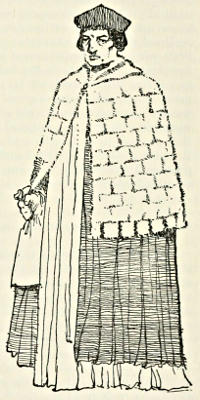
A Friar of the Sixteenth Century
He found the whole territory in extreme
confusion; all who had escaped by flight
from the hand of Cæsar had returned—the
Orsini, the Colonna, the Vitelli and Baglioni,
Varani, Malatesta, and Montefeltri—everywhere
throughout the whole land were the
different parties in movement; murderous
contests took place in the very Borgo of Rome.
Pope Julius has been compared with the Neptune
of Virgil, when rising from the waves,
with peace-inspiring countenance he hushes
their storms to repose. By prudence and
good management he disembarrassed himself even of Cæsar Borgia, whose
castles he seized and of whose dukedom he also gained possession. The
lesser barons he kept in order with the more facility from the measures to
this effect that had been taken by Cæsar, but he was careful not to give them
such cardinals for leaders as might awaken the ancient spirit of insubordination
by ambitious enterprise. The more powerful nobles, who refused him
obedience, he attacked without further ceremony. His accession to the papal
throne sufficed to reduce Baglioni (who had again made himself master of
Perugia) within the limits of due subordination. Nor could Bentivoglio offer
effectual resistance when required to resign that sumptuous palace which he
had erected in Bologna, and whereon he had too hastily inscribed the well-known
eulogy of his own good fortune; of this he saw himself deprived in
his old age. The two powerful cities of Perugia and Bologna were thus
subjected to the immediate authority of the pontifical throne.
But with all this, Julius was yet far from having accomplished the end he
had proposed to himself. The coasts of the papal states were in great part
occupied by the Venetians; they were by no means disposed to yield possession
of them freely, and the pope was greatly their inferior in military
power. He could not conceal from himself that his attacking them would
be the signal for a commotion throughout Europe. Should he venture to
risk this?
Old as Julius now was, worn by the many vicissitudes of good and evil
fortune experienced through a long life; by the fatigues of war and exile, and
most of all by the consequences of intemperance and licentious excess, he yet
knew not what fear or irresolution meant; in the extremity of age, he still
retained that grand characteristic of manhood, an indomitable spirit. He felt
little respect for the princes of his time, and believed himself capable of mastering
them all. He took the field in person, and having stormed Mirandola,
he pressed into the city across the frozen ditches and through the breach; the
most disastrous reverses could not shake his purpose, but rather seemed to
waken new resources within him. He was accordingly successful; not only
were his own baronies rescued from the Venetians, but in the fierce contest
that ensued, he at length made himself master of Parma, Piacenza, and even
Reggio, thus laying the foundation of a power such as no pope had ever
possessed before him. From Piacenza to Terracina the whole fair region
admitted his authority.
PREVALENCE OF SECULARISM IN THE CHURCH
[1471-1503 A.D.]
It was an inevitable consequence that the whole body of the hierarchy
should be influenced by the character and tendencies of its chief, that
all should lend their best aid to the promotion of his purposes, and be themselves
carried forward by the impulse thus given. Not only the supreme
dignity of the pontiff, but all other offices of the church, were regarded as
mere secular property. The pope nominated cardinals from no better motive
than personal favour, the gratification of some potentate, or even, and
this was no unfrequent occurrence, for actual payment of money! Could
there be any rational expectation that men so appointed would fulfil their
spiritual duties? One of the most important offices of the church, the Penitenziaria,
was bestowed by Sixtus IV on one of his nephews. This office
held a large portion of the power of granting dispensations; its privileges
were still further extended by the pope, and in a bull issued for the express
purpose of confirming them, he declares all who shall presume to doubt
the rectitude of such measures, to be a “stiff-necked people and children of
malice.” It followed as a matter of course that the nephew considered his
office as a benefice, the proceeds of which he was entitled to increase to the
utmost extent possible.
A large amount of worldly power was at this time conferred in most
instances, together with the bishoprics; they were held more or less as sinecures
according to the degree of influence or court favour possessed by the
recipient or his family. The Roman curia thought only of how it might
best derive advantage from the vacancies and presentations; Alexander
extorted double annates or first-fruits, and levied double, nay triple tithes;
there remained few things that had not become matter of purchase. The
taxes of the papal chancery rose higher from day to day, and the comptroller,
whose duty it was to prevent all abuses in that department, most commonly
referred the revision of the imposts to those very men who had fixed their
amount. For every indulgence obtained from the datary’s office, a stipulated
sum was paid; nearly all the disputes occurring at this period between the
several states of Europe and the Roman court arose out of these exactions,
which the curia sought by every possible means to increase, while the people
of all countries as zealously strove to restrain them.
Principles such as these necessarily acted on all ranks affected by the
system based on them, from the highest to the lowest. Many ecclesiastics
were found ready to renounce their bishoprics; but they retained the greater
part of the revenues, and not unfrequently the presentation to the benefices
dependent on them also. Even the laws forbidding the son of a clergyman
to procure induction to the living of his father, and enacting that no ecclesiastic
should dispose of his office by will, were continually evaded; for as all
could obtain permission to appoint whomsoever he might choose as his coadjutor,
provided he were liberal of his money, so the benefices of the church
became in a manner hereditary. It followed of necessity that the performance
of ecclesiastical duties was grievously neglected. In this rapid sketch,
we confine ourselves to remarks made by conscientious prelates of the Roman
court itself.
In all places incompetent persons were intrusted with the performance of
clerical duties; they were appointed without scrutiny or selection. The
incumbents of benefices were principally interested in finding substitutes at
the lowest possible cost, thus the mendicant friars were frequently chosen as
particularly suitable in this respect. These men occupied the bishoprics under
the title (previously unheard of in that sense) of suffragans; the cures
they held in the capacity of vicars. Already were the mendicant orders in
possession of extraordinary privileges, and these had been yet further extended
by Sixtus IV, who was himself a Franciscan. They had the right of
confessing penitents, administering the Lord’s Supper, and bestowing extreme
unction, as also that of burying within the precincts, and even in the habit
of the order. All these privileges conferred importance as well as profit,
and the mendicant friars enjoyed them in their utmost plenitude; the pope
even threatened the disobedient secular clergy, or others, who should molest
the orders, more particularly as regarded bequests, with the loss of their
respective offices.
The administration of parishes as well as that of bishoprics being now
in the hands of the mendicant orders, it is manifest that they must have
possessed enormous influence. The higher offices and more important dignities
were monopolised, together with their revenues, by the great families
and their dependants, shared only with the favourites of courts and of the
curia; the actual discharge of the various duties was confided to the mendicant
friars who were upheld by the popes. They took active part also in
the sale of indulgences, to which so unusual an extension was given at that
time, Alexander VI being the first to declare officially that they were capable
of releasing souls from purgatory. But the orders also had fallen into
the extreme of worldliness. What intrigues were set on foot among them
for securing the higher appointments! what eagerness was displayed at elections
to be rid of a rival, or of a voter believed unfavourable! The latter
were sent out of the way as preachers or as inspectors of remote parishes;
against the former, they did not scruple to employ the sword, or the dagger,
and many were destroyed by poison. Meanwhile the comforts men seek
from religion became mere matter of sale; the mendicant friars, employed
at miserably low wages, caught eagerly at all contingent means of making
profit.
While the populace had sunk into almost heathen superstition, and
expected their salvation from mere ceremonial observances, but half understood,
the higher classes were manifesting opinions of a tendency altogether
anti-religious. How profoundly astonished must Luther have been, on visiting
Italy in his youth! At the very moment when the sacrifice of the mass
was completed, did the priests utter blasphemous words in denial of its
reality! It was even considered characteristic of good society, in Rome, to
call the principles of Christianity in question. “One passes,” says P. Ant.
Bandino,m “no longer for a man of cultivation, unless one put forth heterodox
opinions regarding the Christian faith.” At court, the ordinances of
the Catholic church, and of passages from Holy Scripture, were made subjects
of jest—the mysteries of the faith had become matter of derision.
We thus see how all is enchained and connected—how one event calls
forth another. The pretensions of temporal princes to ecclesiastical power
awaken a secular ambition in the popes, the corruption and decline of religious
institutions elicit the development of a new intellectual tendency, till
at length the very foundations of the faith become shaken in the public
opinion.f
FOOTNOTES
[The letter a is reserved for Editorial Matter.]
Chapter I. Origin and Rise of the Papacy
b H. H. Milman, History of Latin Christianity.
c Leopold von Ranke, History of the
Popes.
d Victor Duruy, Histoire du Moyen Age.
e O. J. Reichel, The See of Rome in the Middle Ages.
f J. Bass Mullinger, article on “Popedom,” in the Encyclopædia Britannica.
g Henry Stebbing, History of the Christian Church.
h John Wm. Draper, History of the Intellectual Development of Europe.
i Gregory of Tours, Annales Francorum.
j Andreas Thiel, Epistolæ Romanorum Pontificorum.
k Gregory the Great, Letters and Dialogues.
l Edward Gibbon, Decline and Fall of the Roman Empire.
Chapter II. “The Night of the Papacy”—Charlemagne to Otto the Great
b O. J. Reichel, op. cit.
c H. Stebbing, op. cit.
d Thomas Greenwood, Cathedra Petri.
e J. J. I. Döllinger, Die Papst Fabel des Mittelalters.
f Article on Pope “Joan,” in the Encyclopædia Britannica.
g H. H. Milman, op. cit.
h Charles Kingsley, The Roman and the Teuton.
i B. Platina, Vitæ Pontificum Romanorum.
j C. Fleury, Histoire Ecclésiastique.
k C. Baronius, Annales Ecclesiastici.
l Einhard, Vita Caroli Magni.
m Chronicles of Moissiac.
n Marianus Scotus, Universal Chronicle from the Creation to the Year 1083.
o Sigebert of Gemblours, Chronique Universelle.
p Otto von Freysing, Chronik.
q Stephen de Bourbon, Chronicle.
r Martinus Polonus, Chronicon de Summis Pontificibus.
s Liutprand, Antapodosis.
Chapter III. The High Noon of the Papacy
b O. J. Reichel, op. cit.
c H. Stebbing, op. cit.
d J. B. Mullinger, op. cit.
e H. H. Milman, op. cit.
f V. Duruy, op. cit.
g James Bryce, The Holy Roman Empire.
h Roger of Hoveden, Historia post Bedam.
i K. F. Eichhorn, Deutsche Staats und Rechtsgeschichte.
j Ciacconius (Chacon), Vitæ Pontificanum.
k J. C. L. Gieseler, Compendium of Ecclesiastical History (translated by J. W. Hull).
l Henry Hallam, The State of Europe during the Middle Ages.
m Innocent III, Epistolarum liber I et ref.
n J. L. von Mosheim, Institutes of Ecclesiastical History (translated from the Latin by James Murdock).
o Anselmo di Lucca, Defensio pro Gregorio VII.
Chapter IV. From Exile to Supremacy
b H. H. Milman, op. cit.
c J. L. von Mosheim, op. cit.
d J. C. L. Gieseler, op. cit.
e Muratori, Annali d’Italia (including Vespasiano’s “Life of Nicholas V”).
f L. von Ranke, op. cit.
g Richard Garnett, on “Rome and the Temporal Power,” in Cambridge Modern History.
h Henry C. Lea, on “The Eve of the Reformation,” in Cambridge Modern History.
i F. B. Corvo, Chronicles of the House of Borgia.
j S. Infessiora, “Diarium” in Eccard’s Corpus Historicum Medii Ævi.
k J. Burcardus, Didrium (edited by L. Thuasne).
l J. Addington Symonds, The Age of the Despots.
m P. A. Bambino, in Carraciolo’s Life of Paul IV.
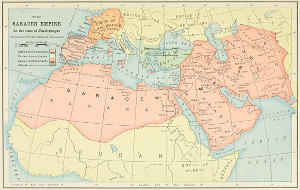
THE SARACEN EMPIRE
At the time of Charlemagne
BORMAY & CO.