Some of the most important histories of Greece, notably those of Mitford
and of Grote, have terminated with the death of Alexander; and in point
of fact one feels some logic in the contention that Greece as a factor in
civilisation disappeared with the close of the Alexandrian epoch. Yet as far
as mere chronology goes Greece continued a nation, and in some respects a
more closely unified nation than ever before, for a period after the death of
Alexander as long as the period of her prominence before that event. It was
in the year 500 B.C. that the Ionian cities of Asia Minor revolted against the
Persian power, and precipitated that conflict which had for its chief result
the bringing of the Greek nation, for the first time, into prominence as a
world power. From this memorable date to the death of Alexander in
323 B.C., is a period of 177 years; and, as it happened, another period of
exactly the same length intervened between the death of Alexander and the
final overthrow of Greece by the Romans, culminating in the destruction
of Corinth in the year 146 B.C.
But while equally extended in point of time, how utterly different are
these two periods in world-historic import! Into the first of them were
crowded the events which have made the name of Greece famous for all
time; the second was a mere period of senility, in which a once powerful
and still proud people struggled in vain to regain its former status, and
finally collapsed utterly under the blows of a superior power. Yet in mere
geographical extent the Greece of this later period was far larger than Greece
proper of the earlier time, for now it included, in addition to the original
Hellas, the territories of Macedonia and Epirus; but this was never an harmonious
coalition.
The old Greeks of the classical territory were never reconciled to the
domination of their northern neighbours, whom they preferred to consider
as barbarians, but they were obliged for much of the time to accept that
domination, however unwillingly; for the kings of Macedonia, though their
power fluctuated from time to time, always had more or less influence over
the entire territory of the new Greece.
The meteoric career of Alexander had been cut short at a time when that
hero, though he had accomplished conquests without precedent in history,
had not yet entered upon the full prime of manhood. It is known that his
ever active brain was teeming with plans for fresh conquests, and it is hardly
to be doubted that, had he lived, some of these would have been put into
almost immediate execution. What the final result would have been, is one
of those problems that must ever puzzle the mind of the thoughtful student
of history. Such conjectures are utterly futile; yet one cannot escape them.
Would the conqueror of the East have spread his power to the West also,
subjugating Europe as he had already subjugated Asia? Would he have
gone on throughout another half century, had that stretch of life been
granted to him, ruling with a firm hand the wide territories that he had
conquered, and holding his mighty empire under one unified government
with himself at its summit—or would his mighty ambition presently have
overstepped the bounds of reason, and would some reverse have presently
dashed him headlong from his pinnacle of power? As to this no man can
say, and all moralisings on the subject are but idle dreams.
[323-301 B.C.]
But turning from such visions to the realities, one is presented with an
extraordinary picture of a mighty empire, built up by a mere youth, held for
the moment, as it were, in the grasp of his hand, and then dashed suddenly
into fragments as that hand fell stricken by death. In twelve years the
youth Alexander had made himself absolute master of wider territories than
were probably ever ruled before by any one man in recorded history; but,
almost before the breath of life had left his body, and literally before that
body had been laid in the tomb, a strife had begun among the followers of
the great captain, which was to lead to almost immediate dismemberment of
his empire.
It is one of the surest tests of a great leader of men to be able to gather
about him great men as his assistants. Judged by this test Alexander looms
large indeed, for he had among his generals, as after events were to prove, a
whole company of men, each of whom acknowledged himself subordinate to
Alexander, but declined to bow to any lesser power; each of whom, indeed,
believed himself worthy to be a king, and determined to make that belief
good in practice, now that the great king was no more. Antipater and Craterus,
and Antigonus, and Cassander, and Ptolemy, and Eumenes—these
are but a few of the leaders among the men who at once began to quarrel
about Alexander’s possessions, even to the neglect of the burial of Alexander’s
body. It seems that Alexander had foreseen the inevitable faction, for
the story was told that on his death-bed, he had been asked to whom he
wished his empire to fall, and he had feebly answered, “to the best man!”
There was, indeed, a pretence of preserving the empire for Alexander’s
son, borne by Roxane after his death, and given the name of Alexander the
Younger; but a score of years is long to wait for a ruler of a newly formed
empire, which has within it so many elements of discord as were to be found
in the empire of Alexander; and, however sincere a certain number of the
leaders may have been, their original intentions of holding the empire for
the heir of its founder had vanished from the minds of every one almost
before that heir was born. There was indeed a royalist party, which for
a time attempted, perhaps in good faith, to uphold the rights of the royal
family of Macedonia; but, in the course of the intricate series of revolts and
wars in which the entire empire was soon involved, it became difficult, if
not impossible, to trace the motives that influenced the various principal
actors. But, whatever these motives, the results were very tangible and unmistakable.
Alexander’s heir was never destined to reach manhood. Both
he and his mother were ruthlessly killed by Cassander. Olympias, the
mother of Alexander, who, for a time, took an active part in the contests,
evincing qualities which explained many of the traits of her great son, met
a like fate.
The work of destruction went on until the royal family of Macedon,
which Philip and Alexander had made illustrious, was routed out to its
last member, and finally, after some twenty-two years of incessant warfare,
the vast empire of Alexander was divided into three chief parts: Macedonia,
including Greece proper, under the Antigonidæ, the descendants of
Antigonus; the Asiatic kingdom, under the Seleucidæ; and Egypt, under
the Ptolemies. The subsequent history of each of these three kingdoms
must be considered by itself, but first we must make a brief survey of that
great conglomerate struggle through which this dismemberment of the
empire of Alexander was brought about.a Of this Niebuhr says:
“The disputes among the generals of Alexander are to me the most confused
events in history. I have very often read them attentively, in order to
gain a clear insight into them; but, although I have had a tenacious memory
from my early youth, I never was able to gain a distinct recollection of the
detail of those quarrels and disputes: I always found myself involved in
difficulties. And such is the case still; I find it impossible to group the
events in such a manner as to afford an easy survey. This confusion arises
from the fact that we have to deal with a crowd of men among whom there
is not one that stands forth prominently on account of his personal character.
The question always is, whether one robber or another is to be master, and
it is impossible to take pleasure in any one of them. One is, indeed, better
than another, and Ptolemy is, in my opinion, the best: he was a blessing to
Egypt, which under him became happy and prosperous, for his government
was rational; but still he is morally a man in whom we can take little interest.
His personal character leaves us quite indifferent, when we have
once formed a notion of him. Eumenes is the only one who is important on
account of his personal character; all the rest are imposing through their
deeds of arms alone.
“In the earlier history of Greece we like to follow the great men step
by step; but all these Macedonians leave us perfectly indifferent; we feel
no interest whether the one is defeated or the other; not even the tragic
fall of Lysimachus can make an impression upon us; I look upon it with
greater indifference than I should feel at a bull-fight, in which a noble
animal defends itself against the dogs that are set at it. I could wish
that the earth had opened and swallowed up all the Macedonians. Everyone
intimately acquainted with ancient history will share this feeling of
indifference with me. And when we are under the influence of such a
feeling, it is not easy to dwell upon a history like this; it does not impress
itself upon our mind.
“It would be most easy to relate the history of the successors of Alexander
as minutely as it was given by Trogus Pompeius, and as we still have
it in Diodorus; but there would then be before us only a vast chaos. Even
where we have ample information, we must advance rapidly.
“Whoever wishes to investigate this history, must study the eighteenth,
nineteenth, and twentieth books of Diodorus; but he ought not to forget
that there are many gaps in Diodorus. The eighteenth book, in particular
is very much mutilated, and some of the gaps are concealed; for the
manuscripts of Diodorus were made with the intention to conceal the fact
that they are not complete. The student, however, must compare also the
Excerpts in Photius from Arrian’s lost work.”g
[323 B.C.]
The Macedonians passed the night after the king’s death under arms, as
if feeling themselves surrounded by enemies. The peaceable inhabitants of
Babylon, perhaps with better reason, dreaded lest their wealthy city should
become the scene of military tumult and licence. They hardly ventured to
creep out of their houses to gather news; lighted no lamps in the evening,
but watched for the morning in darkness and silence, eagerly listening, and
trembling at every sound they caught. The great officers on whom the care
of the state chiefly devolved, probably spent the same interval, together or
apart, in no less anxious deliberation. By Hephæstion’s death the number
of those who bore the title of somatophylax was reduced to seven: Leonnatus,
Lysimachus, Aristonous, Perdiccas, Ptolemy (the reputed son of Lagus, but,
according to a report rather widely spread, one of Philip’s bastards, his mother
having been the king’s mistress), Pithon, and Peucestas. When Alexander
died, they were all in Babylon.
The next day they summoned a council of the other Macedonian officers,
some of whom were but little inferior to them in rank and influence, to confer
on the great question of the succession. The soldiers wished to take
part in it also; and, though forbidden, forced their way into the palace, and
filled the avenues of the council hall, so that many witnessed the proceedings.
There a mournful object met their eyes, and revived the consciousness of
their loss—the vacant throne, on which had been laid the diadem, with the
royal robes and armour. The sight called forth a fresh burst of lamentation,
which however was hushed into deep silence, when Perdiccas came forward
to address the assembly. First he placed the ring, which he had received
from Alexander in his last moments, on the throne. “The ring,” he said,
“was the royal signet, which Alexander had used for the most important
state business; it had been committed to him by the dying king, but he
placed it at their disposal. It was however absolutely necessary for their
own safety that they should forthwith elect a chief, capable of guarding
them against the dangers to which they would be exposed without a head in
a hostile land. It was to be hoped that, in a few months, Roxane would give
them an heir to the throne. In the meanwhile it was for them to choose, by
whom they would be governed.” He had probably hoped that the wish
which he so modestly dissembled would have been anticipated by general
acclamation. But the meeting waited for advice.
Nearchus had a different plan to propose. He, as we have seen, had married
a daughter of Mentor’s widow, Barsine; and Barsine was also the
mother of a son by Alexander. He therefore pointed out to the Macedonians
“that there was no need to wait for the uncertain issue of Roxane’s
pregnancy; there was an heir to the throne already born—Hercules, the son
of Barsine: to him the diadem belonged.” But Nearchus was the only man
present who had any interest in this choice. The soldiers clashed their
spears and shields together, in token of vehement dissent; and Ptolemy gave
utterance to their feelings on this point: “Neither Barsine, nor Roxane,
could be mother of a prince whom the Macedonians would acknowledge as
their sovereign. Was it to be borne, that the conquerors of Asia should
become subject to the son of a barbarian captive? It was better that the
throne should remain vacant, and that the persons who had formed Alexander’s
council of state should continue to have the supreme management
of affairs, deciding all questions by a majority of votes.” This motion
however gained few partisans; its effect would have been permanently to
exclude the royal family from the succession: a step for which few were
prepared.
Thus most minds were turned towards the advice of Perdiccas; for there
was a clear distinction between Barsine, and Roxane, Alexander’s beloved
wife, who was then in the palace, while Mentor’s widow had been left with
her son at Pergamus. It was now the right time for some friend of Perdiccas
to come forward in his behalf, and Aristonous, perhaps according to
previous concert, undertook the task. He observed “that Alexander himself
had already decided who was worthiest to command, when, having cast
his eyes round all his friends who were at his bedside, he gave his royal signet
to Perdiccas. They had only to ratify Alexander’s choice.” Still the
assembly was not inclined to invest Perdiccas alone, under any title, with
supreme power. The result of the whole deliberation was a sort of compromise
between the proposals of Ptolemy and Aristonous. It seems to have
been decided, but not without clamorous opposition, that, if Roxane should
bear a son, he should succeed to the throne; and that in the meanwhile four
guardians should be appointed for the future prince to exercise the royal
authority in his name. Perdiccas and Leonnatus were to be regents in Asia,
Antipater and Craterus in Europe.
The cavalry—the aristocratical portion of the army—acquiesced in the
resolution of their chiefs. But it was very ill received by the whole body
of the infantry. No motive appears for their dissatisfaction, except that
they had not been consulted on the question, and that they wished to dispose
of the crown. Still it is not clear whether they acted quite of their own
accord, or were excited to resistance by Meleager, who seems to have been
impelled, partly by ambition, and partly by personal enmity to Perdiccas.
The accounts remaining of his conduct are contradictory as to details, but
agree in representing him as the leader and soul of the opposition. According
to some authors, he quitted the council of the officers after bitter invectives
against Perdiccas, declaring that the people was the true heir of the
monarchy, and alone could rightfully dispose of it, and hastened to instigate
the soldiery to insurrection and plunder. According to others, he was
deputed to appease their discontent, but took the opportunity to inflame it,
and placed himself at their head. We are left equally in doubt whether it
was he who first proposed another competitor for the throne, whose name
was soon mentioned in the popular assembly.
This was Arrhidæus, a son of Philip, by Philinna, a Thessalian woman,
who is commonly described as of low condition. Arrhidæus was either naturally
deficient in understanding, or had never recovered from the effects of
a potion, said to have been administered to him by Olympias, whom jealousy
rendered capable of every crime. It seems that Alexander, either through
prudence or compassion, had removed him from Macedonia, though he had
not thought him fit to be trusted with any command; and he was now in
Babylon. Most probably Meleager, perceiving that whoever should raise
such a prince to the throne would reign under his name, was the foremost to
recommend him as the sole legitimate heir. To the army Arrhidæus must
have been personally indifferent; but he was Philip’s son, without any mixture
of barbarian blood, and, which probably weighed more with them, he
would be purely their creature. The proposal therefore was agreeable to
their pride and their prejudices, which were stronger than their regard for
Alexander now, as they had been in his lifetime. After a short pause—perhaps
of surprise that a name so seldom heard should have been put forward
on such an occasion—all, as if some happy discovery had been made, broke
out into loud acclamations in favour of Arrhidæus; and Pithon, who, it
seems—having apparently been sent by the council to soothe them—endeavoured
to show the folly of their choice, only incurred their resentment.
Meleager was deputed to bring the prince into the assembly; and,
when he came, they saluted him as king, under the new name of Philip. He
immediately proceeded to the palace, accompanied by Meleager, and escorted
by the troops. The officers, it seems, were still in council there, and when
Arrhidæus appeared, some attempt was made to terminate the affair by discussion.
But as the chiefs refused to sanction the choice of the infantry,
they soon found themselves threatened with violence, and obliged to retire.
Arrhidæus mounted the throne, and was invested with the royal robes.
Perdiccas had ordered the
door of the room where Alexander’s
body lay to be locked,
and prepared to guard it with
six hundred chosen men; he was
joined by Ptolemy at the head
of the royal pages. They were
however soon overpowered by superior numbers.
The soldiers of the adverse party broke into the
chamber; blows were interchanged, Perdiccas himself
was attacked with missiles, and blood was
beginning to flow, when some of the elder among
the assailants interposed, and, taking off their helmets,
entreated Perdiccas and his followers to desist
from their useless resistance.
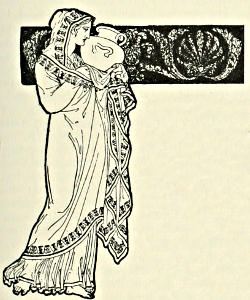
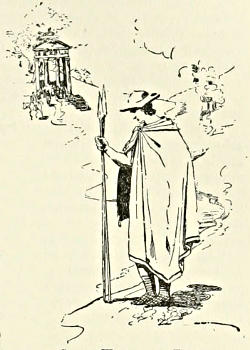
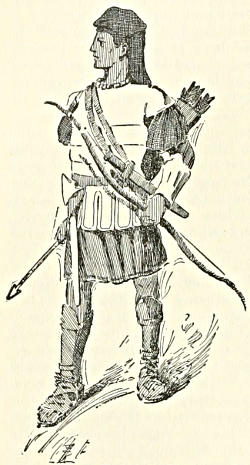
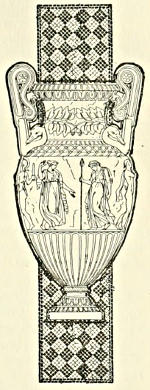
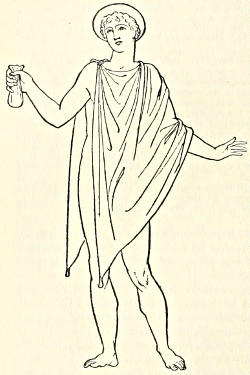
Water Carrier
(After Hope)
Their mediation put an end to this prelude of
the long contest which was to take place for Alexander’s
remains. But the greater part of the generals,
and the whole body of the cavalry, quitted
the city, and encamped outside the walls. Perdiccas
did not yet accompany them; he hoped, it
seems, that some change might happen in the disposition
of the multitude, which he might more
easily turn to his own advantage, if he stayed.
But Meleager, probably apprehending the same
thing, and eager to satisfy his hatred, urged the king to give an order for
the execution of Perdiccas. This he could not obtain; Arrhidæus was
perhaps too timid to strike so great a blow. Meleager therefore was forced
to interpret the silence of his royal puppet as consent, and sent an armed
band to the house of Perdiccas, with directions to bring him to the palace,
or to kill him if he should resist. Perdiccas had only about sixteen of the
royal pages with him, when his door was beset. He however appeared on
the threshold with a firm countenance, and overawed those who came to
arrest him by the severe dignity of his looks and his words. They probably
did not think Meleager’s authority a sufficient warrant for the murder of a
man of such high rank. When they had withdrawn, he and his attendants
mounted their horses, and hastened to the camp of their friends.
One eminent person of their party however remained in the city: Eumenes
the Cardian, who had already decided on the course which his own interests
required, and on this occasion gave proof of the sagacity and dexterity, which
afterwards carried him through so many dangers and even brought him so
near to the highest fortune. Eumenes, in his boyhood, had attracted Philip’s
notice by his promising talents; he was brought up at the Macedonian court,
and was employed by Alexander both as his principal secretary and keeper
of the records, and in military commands. He had risen so high in favour
with the king, that he could even venture on more than one occasion to
quarrel with Hephæstion; but, after the favourite’s death, he laboured, by
ingenious contrivances and profuse expense in honour of his memory, to remove
all suspicion that he viewed the event with pleasure. In this liberality,
he showed the greater self-command, as he was habitually parsimonious.
Such a man was formed for the times which followed Alexander’s death.
Eumenes felt that he could only be safe in the strife of parties, as long as he
could guard against the jealousy to which a foreigner in high station was
exposed among the Macedonians. He remained, as we have observed, in
Babylon after the flight of Perdiccas, under the pretext that he had no right
to take a part in disputes concerning the succession; secretly however purposing
to promote the interests of Perdiccas, as far as he could; for he probably
foresaw that this side would finally prevail. He assumed the character
of a peace-maker; and his seeming neutrality gave great weight to his mediation.
It was seconded by vigorous measures on the part of the seceders.
They began to stop the supply of provisions, and to threaten the Great City
with famine. Meleager found his condition growing every day more
embarrassing. He had been called to account by his own troops for the
attempt he had made against the life of Perdiccas, and could only shelter
himself under the royal authority. At length the soldiers came in a body
to the palace, and demanded that an embassy should be sent to the cavalry,
with overtures of peace. Three envoys were accordingly despatched: and
it is remarkable, that one of them was a Thessalian, another an Arcadian
of Megalopolis; so that probably the third, Perilaus, whose country is not
mentioned, was not a Macedonian. The negotiations which followed are
reported too obscurely to be described. It is said that the party of Perdiccas
refused to treat, until the authors of the quarrel had been given up to them;
and that this demand excited a violent tumult in the city, which was only
calmed when Arrhidæus, displaying more vigour than he had been believed
to possess, offered to resign the crown. Yet it does not appear that this
condition was granted.
The terms on which the treaty was concluded were, according to the most
authentic account, that Arrhidæus should share the empire with Roxane’s
child, if it should be a boy; that Antipater should command the forces in
Europe; that Craterus should be at the head of affairs in the dominions of
Arrhidæus; but that Perdiccas should be invested with the command of the
horse-guards, the chiliarchy, before held by Hephæstion, in which Alexander
would permit no one to succeed him. This, it seems, was a post which, at the
Persian court, had been equivalent to that prime minister, or grand vizier
of the whole empire. It was however stipulated that Meleager should be
associated with Perdiccas in the regency, though with a subordinate rank.
Of Leonnatus we hear no more as a member of the government. The compact
was ratified by a solemn reconciliation between the contending parties.
The cavalry returned to the city; the phalanx marched out to meet them;
Perdiccas and Meleager advanced between the lines to salute each other as
friends. The troops on each side followed their example, and were once more
united in one body.
It was however impossible, after what had happened, that Perdiccas and
Meleager should ever trust each other. Meleager probably relied on the
infantry for protection. But Perdiccas had now taken possession of the
imbecile king, who was as passive in his hands as he had been in his rival’s,
and had resolved to strike the first blow. Before he directly attacked his
enemy, he thought it necessary to deprive him of the support which he might
find in the army; and he seems to have devised a very subtle plan for this
end. He suborned emissaries to complain among the foot-soldiers that by
the recent arrangement Meleager had been elevated to an equality with himself—not
apparently for the purpose of exciting discontent, or of gaining a
party among these troops, but to lead Meleager himself blindfold into a snare.
Meleager was soon informed of the language that had been used against him
in the camp, and indignantly complained of it to Perdiccas, whom he probably
suspected to be its secret author. But Perdiccas was so great a master
of dissimulation, that he completely lulled his suspicions. He affected to
sympathise deeply with his resentment, and proposed to arrest the agitators.
It was agreed between them, the more safely and surely to effect their object,
that the whole army should be drawn out in the adjacent plain, under
the pretext of a solemn lustration, to be celebrated with the old Macedonian
rites, to purify it from the blood shed in the late quarrel. The usage on
such occasions was to kill a dog, and to carry its entrails, divided into two
parts, to opposite extremities of the field, so that the army might be drawn
up between them, the phalanx on one side, the cavalry on the other. Such
at least was the order now adopted by the two chiefs.
On the appointed day Perdiccas, with the king at his side, placed himself
at the head of the cavalry and the elephants, facing the infantry, which was
commanded by Meleager. After a short pause, he ordered them to advance.
Meleager’s troops were alarmed at the sight of this movement, for they now
observed that the ground was favourable for the operations of the cavalry,
and that, if they were attacked, they should not be able to make good their
retreat without great loss. But, as they received no orders from their chief,
and were quite uncertain as to the design of Perdiccas, they remained motionless,
until a very narrow interval was left between the two lines. The
king then rode up with a single squadron, and, having been previously
instructed by the regent, demanded that the authors of the late dissensions
should be given up to punishment; threatening, if they refused, to charge
with the whole force of the cavalry and the elephants.
The men were dismayed by the suddenness of the proceeding; and
Meleager, who now perceived his own danger, had not sufficient presence of
mind to make any attempt at self-defence. Perdiccas took advantage of
their consternation, to select about three hundred of those who had most
distinguished themselves as his adversary’s partisans, and immediately
caused them to be trampled to death by the elephants in the sight of the
whole army, and with the apparent consent of the king whose cause they
had maintained. After this execution Meleager could have no hope of
safety but in flight. He was not arrested on the field, but soon after took
refuge in a temple at Babylon, where he was despatched by order of
Perdiccas.
By this blow the regent’s authority was firmly established, as far as
related to the king and the army. A more difficult task remained. He
was still surrounded by rivals as ambitious as Meleager, and more formidable
from their ability and influence. His next care was to satisfy their pretensions,
so as least to weaken himself. A new distribution of the satrapies
was settled by general consent, but probably in most points under his
direction; in some at least we clearly trace his hand. It was not necessary
for any purpose to make a total change; and the general principle
adopted seems to have been to retain as many as possible of the satraps
appointed by Alexander in their governments. The provinces which lay
near the eastern and northeast frontier of the empire, were probably the
least coveted, and in these scarcely any alteration was made. There were
others from which, as they were more desirable, it might have been more
difficult to displace their actual occupants.
The most important part of the new arrangement was that which related
to the governments west of the Euphrates. Ptolemy, who was not only
honoured on account of his reputed connection with the royal family, but
also much beloved for his personal qualities, by the army, had fixed his eyes
on Egypt, and obtained it with the adjacent regions of Arabia and Libya.
Cleomenes was not removed, but placed under his orders. Laomedon
remained in Syria, Philotas in Cilicia, Asander in Caria, Menander in Lydia,
and Antigonus in the great province which included Phrygia proper, Lycia,
and Pamphylia. But since Lycia and Pamphylia are also said to have been
given to Nearchus, we may infer that he held these provinces with a subordinate
rank—a suspicion which is confirmed by his subsequent relations with
Antigonus. The Hellespontine Phrygia was assigned to Leonnatus—perhaps
as a compensation for his share in the regency, or for the sake of
removing him from court; and Eumenes, whom Perdiccas regarded as his
steady adherent, was rewarded with the title of satrap over Paphlagonia and
Cappadocia. But these countries, which Alexander had never subdued,
were still to be won by the sword from their native ruler, Ariarathes, who
had held them as an hereditary vassal of Persia.
In Europe the government of Macedonia and Greece, together with that
of the western countries on the coast of the Adriatic, which might afterwards
be annexed to the empire, was to be divided between Antipater and
Craterus—a partition in which Perdiccas may have seen a prospect of collision
between them likely to promote his ascendency. Thrace, or the whole
maritime region to the northeast of Macedonia, a province which had never
been reduced to tranquil submission, and where the Odrysians had lately
been roused to revolt by their chief Seuthes, was committed to Lysimachus,
a warrior of iron frame and unflinching hardihood. There are two other
names which might have been looked for in this list. Aristonous might
have been expected to occupy a prominent place in it, since he had shown
himself a decided partisan of Perdiccas; yet we hear of no provision made
for him. Hence it has been conjectured that Perdiccas retained him near
his person, as one of his staunchest friends. It was perhaps for a like reason
that he entrusted Seleucus—who was destined to act so great a part in the
history of the ensuing period—with the chiliarchy which had been assigned
to himself—a highly honourable and important post indeed, but one which
he might safely part with, as it could add little or nothing to the power he
possessed as regent.
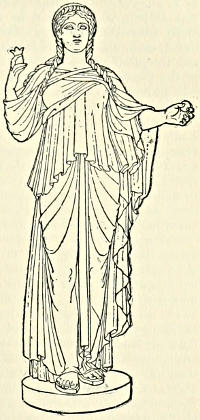
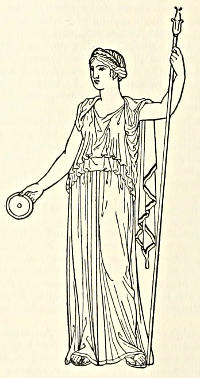
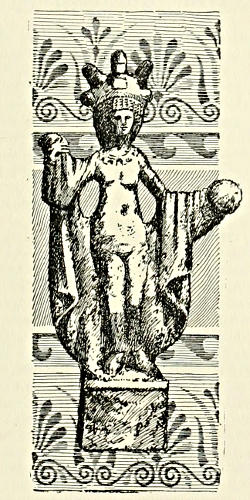
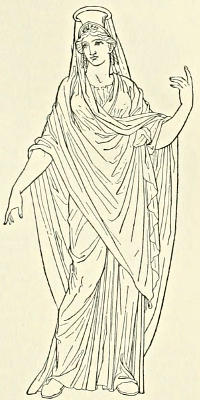
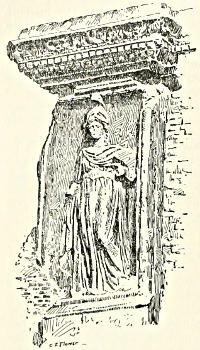
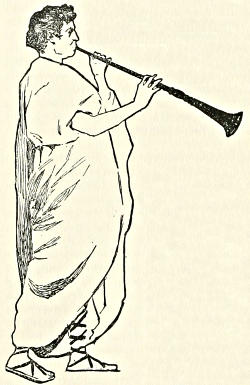
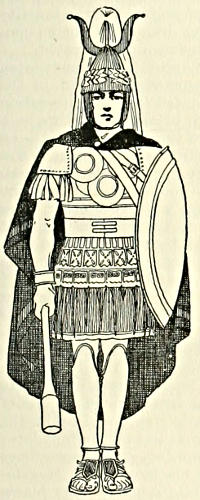
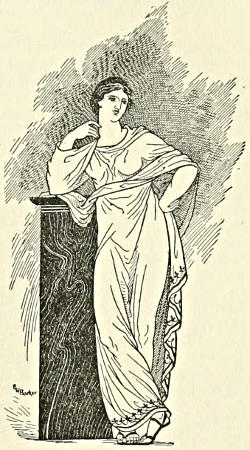
Priestess
(After Hope)
There still remained a question on which he felt it necessary to consult
the army, that he might relieve himself from a dangerous responsibility.
Papers had been found in Alexander’s cabinet, containing the outlines of
some vast projects. It would seem that they might easily have been suppressed;
but it was known that they corresponded in part with the instructions
which had been given to Craterus, and therefore they could not safely be
neglected without the general consent. Some related to the equipment of a
great armament—a thousand galleys, it is said, of the largest size—destined
for the conquest of Carthage, and of the whole coast of Africa on the Mediterranean
as far as the Straits, and those of Spain and the adjacent maritime
regions, as far as Sicily: for which end a road was to be made along the
African shore. Others were plans for new colonies, to be planted in Asia
with Europeans, and in Europe with Asiatics.
There were also directions for six new temples
to be built in Europe—at Delos, Delphi,
Dodona, Dium, Amphipolis, and Cyrrhus—each
at the cost of fifteen hundred talents,
beside one of extraordinary magnificence to
the goddess of Ilium, and for a monument to
his father in Macedonia, which was to equal
the largest of the Egyptian pyramids in its
dimensions.
It must be owned, that there are some
points in these schemes which look suspicious,
and which, even if they had crossed Alexander’s
mind, we should not have expected he
would have committed to writing. But the
part relating to the temples can scarcely have
been fabricated, and was probably contained
in the instructions given to Craterus. The
plan for an interchange of population between
Europe and Asia is also quite conformable to
the views which Alexander disclosed in his
life-time. This however, and that of the expedition
to Africa, could not any longer have
entered into any one’s thoughts, and might
have been silently dropped. But perhaps
Perdiccas apprehended that the sums destined
for the other objects might be demanded from
him by his colleagues, and therefore deemed
it advisable formally to annul the whole by
the highest authority. That he forged the
project of the expedition, to render the real
contents of the papers the less acceptable to the Macedonians, seems a very
improbable conjecture. All were laid before a military assembly, and rejected
as impracticable or useless.
During the tumultuous scenes which followed Alexander’s death, his
body had lain in the palace unburied. There are various reports as to the
place selected for its interment. According to one, it was to have been
transported to the sanctuary of Ammon. But the more probable is, that it
was determined it should be deposited in the sepulchre of his ancestors at
Ægæ. And Aristander the soothsayer is said to have declared that it had
been revealed to him, the land where it rested was destined to be ever prosperous
and secure from invasion: which however was no more than an
ancient Greek superstition as to the virtue of a hero’s relics. Orders were
now given to construct a funeral car worthy of these precious remains, and
the general Arrhidæus was appointed to escort them towards the western
coast.b
The description by Diodorus (XVIII, 3) of this funeral pomp is so gorgeous
that as a farewell sunset of Alexander’s day it merits insertion here:a
“First was provided a Coffin of beaten Gold, so wrought by the Hammer
as to answer to the Proportion of the Body; it was half fill’d with Aromatick
Spices, which serv’d as well to delight the Sense as to preserve the
Body from Putrefaction. Over the Coffin was a Cover of Gold, so exactly
fitted, as to answer the higher part every way: Over this was thrown a curious
Purple Coat embroider’d with Gold, near to which were plac’d the Arms
of the Deceas’d, that the whole might represent the Acts of his Life. Then
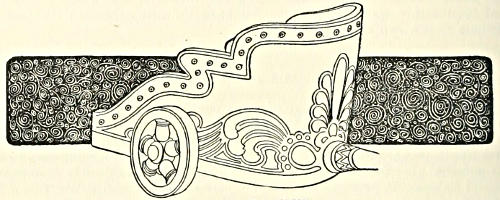
was provided the Chariot, in which the Body was to be convey’d, upon the
top of which was rais’d a Triumphant Arch of Gold, set thick and studded
over with precious Stones eight Cubits in breadth, and twelve in length:
Under this Roof was plac’d a Throne of Gold, join’d to the whole Work,
foursquare, on which were carv’d the Heads of Goat-Harts, and to these were
fastened Golden Rings of two Hands breadth in the diameter; at which hung,
for Show and Pomp, little Coronets of various beautiful Colours, which, like
so many Flowers, gave a pleasant Prospect to the Eye. Upon the top of the
Arch was a Fringe of Network, where hung large Bells, that the Sound of
them might be heard at a great distance.
“On both sides the Arch at the Corners stood an Image of Victory in
Gold, bearing a Trophy: A Peristthylium, of Gold supported the Arch-work,
the Chapiters of whose Pillars were of Ionian Workmanship: Within
the Peristthylium, by a Network of Gold of a finger’s thickness in the Workmanship,
hung four Tablets one by another equal to the Dimensions of the
Wall, whereupon were portray’d all sorts of living Creatures. At the
entrance into the Arch stood Lions in Gold, with their Faces towards them
that approach’d to enter. From the middle of every Pillar an Achanthus in
Gold, sprouted up in Branches spiring in slender Threads to the very Chapiters:
Over the Arch about the middle of the Roof on the outside was spread
Purple Carpet in the open Air, on which was plac’d a vast Golden Crown, in
form of an Olive Coronet, which by the reflection of the Sun-Beams darted
such an amazing Splendor and Brightness, that at a distance it appear’d as a
Flash of Lightning. Under the Seats or Bottom of the whole Work ran
two Axle-trees, about which mov’d four Persian Wheels, whose spokes and
Nathes were over-laid with Gold, but the Felloes were shod with Iron: The
Ends of the Axes were of Gold, representing the Heads of Lions, every one
holding a Dart in his Mouth. There were four Draught-Trees, to every
one of which were fix’d four Courses of Yoaks, and to every Course were
bound four Mules, so that the Mules were sixty four in number, the choicest
for Strength and Largeness that could be got: Every Mule was adorn’d
with a Crown of Gold, and Bells of Gold on either side their Heads; and
on their Necks were fitted Rich Collars set and beautified with precious
Stones. And suitable to so stately a Show, a vast Company of Workmen
and Pioneers (that plain’d the Ways for its Passage) attended it.
“And thus Arrhidæus (who had spent two Years in Preparations) brought
the King’s Body from Babylon to Ægypt. Ptolemy, in Honour of the
King met the Corps with his Army as far as Syria, where he receiv’d it,
and accompany’d it with great Care and Observance: For he had resolv’d
not as yet to conduct it to the Temple of Hammon, but to keep the Body in
the City which Alexander himself had built, the most Famous almost of any
City in the World. To this end he built a Temple in Honour of Alexander
in Greatness and Stateliness of Structure becoming the Glory and Majesty
of that King; and in this Repository he laid the Body, and honour’d the
Exequies of the Dead with Sacrifices and magnificent Shows, agreeable to
the State of a Demi-God.”c
[323-321 B.C.]
While such honours were paid to the conqueror’s corpse, two of the living
objects of his affection fell victims to the revenge of Roxane and the ambition
of Perdiccas. Roxane, with the agent’s concurrence, invited Statira and her
sister Drypetis to Babylon by a friendly letter, and when they came she
caused them to be assassinated and secretly buried. In the course of time
Roxane was delivered of a boy, who was acknowledged as partner of Philip
Arrhidæus in the empire, and bore the name Alexander (Ægus).b
The sham government of Arrhidæus was now to commence. He must
have been staying with the army. The phalanx no doubt did not believe
that Arrhidæus was an idiot, but probably considered him to be a wise ruler
who was only calumniated: just as even in Denmark, no one would believe
that Christian VII was mad, from fear of wronging the king’s majesty.
The king’s madness was in Holstein such a secret that persons at the utmost
whispered it to one another, and to believe it appeared to the people like
a culpable act; there is something mystic in the belief that such royal
aberration is not madness, but profundity of thought. This may have been
the feeling of the phalangites.
The cavalry were satisfied, as soon as they had him in their power.
Perdiccas was chiliarchus or administrator, and Craterus was to take care of
the king’s person, as the queen took care of the person of King George III,
while the successor managed the government. Craterus was assigned to
him as a kind of tutor, who took care of him, and always kept him in order;
this shows how imbecile he must have been. Arrhidæus disappears altogether
from history, and he was no more king than his nephew Alexander,
the son of Roxane, and is mentioned only as a name. But in order to
understand many coins and some inscriptions, we must bear in mind that
Arrhidæus assumed the name of Philip.
The satrapies were now distributed afresh.
But before proceeding to the history of the satraps, or governors, we
must relate the first of the horrible scenes of that time—viz., the insurrection
of the unfortunate Greeks in the ἄνω σατραπεῖαι (323 B.C.)—a term
comprising Khorasan in its widest extent, partly the province, properly so
called, and partly the whole of Persia, east of the great Median desert.
There Alexander had settled the captive Greeks, who had served as mercenaries
under Darius, as well as other Greeks from among his own allies;
he formed them into military colonies. These people were driven by despair
to revolt, probably when they heard the report of the Lamian War; they
assembled and determined to force their way to Greece. A Macedonian
army under Pithon was sent against them. The fearful demoralisation
among the mercenaries became manifest on that occasion; he would probably
have been unable to do anything against them, if he had not bribed
one of their commanders, who during the engagement deserted his post.
Being overpowered, they now capitulated. Pithon had received orders from
Perdiccas to put them all to the sword, that they might no longer be troublesome
to him. But Pithon had formed a different plan: he wanted to employ
those Greeks as a force, with the aid of which he hoped to play a prominent
part; he was a Macedonian, and had claims upon the empire which was
already beginning to be torn in pieces. Accordingly he spared their lives;
but now his Macedonians rebelled against him—here we see the effects of
the national hatred existing between the Greeks and Macedonians—for
they found that it would be much more advantageous to kill the Greeks and
seize the booty they had collected. They therefore made a general massacre
among them, and took their property. After this was done, Pithon returned
as if he had executed the orders of Perdiccas. It is as if we read a history of
Ali Pasha. Soon afterwards, the hostilities among the governors broke out.
The generals and satraps of Alexander, called in Greek the Diadochi
[διάδοχοι, or “successors”], were about twenty in number; none of them
was inclined to play a subordinate part, but a great many could not entertain
the thought of assuming supreme power. Some of them, therefore, at
first kept aloof from the disputes; these were the men who had no great
expectations for themselves. The great rupture at the beginning was between
Perdiccas on the one hand, and Antipater and Ptolemy on the other.
Perdiccas claimed the supreme power, because Alexander, by giving him
his seal-ring, had conveyed it to him; and Antipater claimed it as regent of
Macedonia, because he looked upon himself in that capacity as the representative
of the nation. He was joined by Ptolemy because he was far off,
for if they had been near each other, Antipater and Ptolemy could never
have become allies. But as it was, Ptolemy in a distant and inaccessible
kingdom considered himself safe, and Antipater could have no inclination
to deprive him of his kingdom.
Ptolemy showed himself as a very practical and intelligent man; for he
never thought for one moment of making himself master of the whole of
Alexander’s empire, while the others were more or less harbouring such
notions; but he was satisfied with the enormous prize he had carried off
from the lottery, the possession of Egypt; and he only sought such provinces
as could be maintained from his own kingdom, that is, Syria, Cyprus, and
the countries on the opposite coast of Asia, which formed the monarchy
under Philadelphus and Euergetes, who were masters of the opposite coast.
This was very natural, as he could not but wish to secure himself on all
sides.
Antipater aimed at power, but despised the diadem, still having the feelings
of a soldier of Philip. He was already very far advanced in years,
being the oldest of the generals; and Philip had had none who surpassed
him in ability, and he had honoured him more than any other, as, for example,
by the embassy to Athens. We recognise Antipater and Parmenion as the
greatest among Philip’s generals. Antipater was a man of the old school,
and affected great simplicity. While the other generals appeared in purple
chlamydes, he used the common Macedonian garment, and a stick, so that
no one could distinguish him from an ordinary Macedonian. Such an
affectation, combined with internal rudeness, is very often found in men of a
bloodthirsty disposition. Not even Plutarch is able to conceal his cruelty.
Perdiccas was the worst of all. He seems to have been a Macedonian
noble. Although we read little of a nobility and the like among the
Macedonians, and yet he appears in all circumstances as a person of great
pretensions. He was guilty of every license, even the greatest cruelties, without
being bloodthirsty like Antipater, who was another Duke of Alva.
Perdiccas was a purely oriental and unprincipled character; a man of very
moderate talents, to whom nothing was sacred.
He had no friends; Eumenes of Cardia alone was in connection with him,
and drew close to him. As Craterus was the most chivalrous and gallant
among the Macedonians, so Eumenes was the cleverest, and very much distinguished
by his great talents: he would have been a distinguished man at any
time. He is the only man of that period (if we except Craterus, who fell
early) in whom we can take a personal interest; he was a true Odysseus,
inexhaustible in resources. He never sacrificed a friend to his own interests.
He always obeyed the dictates of humanity, and whenever in his
life there occur actions which would be deplored in better times, still they
are praiseworthy in comparison with what others did at the time. Being
inexhaustible in counsel, he also had quite different ideas from those of the
Macedonians. Had he been a Macedonian, he would unquestionably have
gained the inheritance of Alexander, as far as it was possible, and as far as
it could be concentrated in one man’s hand. But he was a stranger, a native
of Cardia in Chersonesus, and this circumstance placed him in a position
among the Macedonians, which prevented his ever rising to the height which
he might otherwise have attained.
Eumenes had not risen, like the rest, by his military talents alone, but
more especially as a statesman. At the age of twenty he had entered the
cabinet of King Philip, and was employed by him for seven years as secretary;
he had then, without interruption, been with Alexander until the
king’s death, so that for twenty years he had been the organ of the royal
government. But he was by no means unfit for the calling, by which men
at that time rose to greatness, for he was also a good soldier. Alexander
had a horse-guard consisting of two squadrons, and one of them was commanded
by Eumenes. If he had been a native of Macedonia, he would unquestionably
have eclipsed all others. He afterwards displayed the very
greatest talent as a general, which is the more wonderful, as in the time of
Alexander he had never commanded an army: he had only acted the part
of a looker-on. He was then forty years old, but he was like the men of the
revolution who displayed their military skill, although no one had suspected
that they possessed any. Eumenes was appointed governor of Cappadocia
and Pontus, but had first to conquer them. Perdiccas, feeling that Eumenes
was very useful to him, assisted him in his conquests.
While Perdiccas was aiding Eumenes, the women of the family of Alexander
began a commotion with a view of taking possession of the reins of
government. Even during the life-time of Alexander, his sister, Cleopatra,
the widow of the Molossian, ambitious like her mother, Olympias, and
her whole race, had tried to interfere in the affairs of Macedonia. Even
before Alexander’s death, Olympias quarrelled with Antipater, and went to
her family in Epirus. Cleopatra now endeavoured to obtain influence with
Antipater, but he would not allow her any; it would, however, seem that
she acted on the authority of her brother, who wished to prevent Antipater
establishing himself too firmly, and therefore allowed her some influence
along with Antipater. She seems to have been the spy of her brother.
After Alexander’s death, Olympias remained in Epirus for several years, until
she unfortunately returned after Antipater’s
death. Cleopatra, fearing Antipater,
who was master in Macedonia, went to
Sardis, where she kept a princely court,
which became the centre of the intrigues
and endless complications of the time.
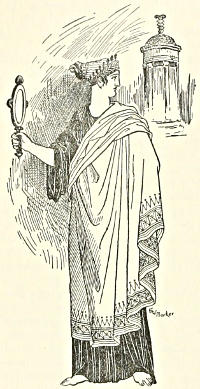
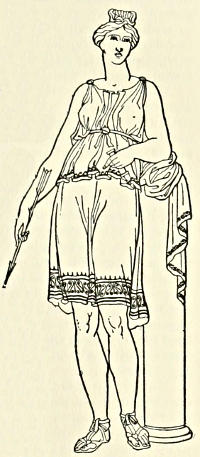
Female Costume
As Queen Elizabeth continued to deceive
many by allowing them to believe
that they might hope for her hand, so
Cleopatra held out hopes to several of the
generals, partly because she had no confidence
in her own situation, and partly
because she expected brilliant results from
her marrying one of the commanders.
Thus she contrived to keep up a hope
especially in the aged Perdiccas. This
was a cause of great alarm to Antipater,
who endeavoured to counteract the scheme,
and to connect Perdiccas with himself by
offering him his daughter, Nicæa, in marriage.
This double intrigue was quite in
the spirit of all the transactions of that
time; it has all its meanness and untruth.
The result was, that Perdiccas, through
these negotiations, was placed in great difficulties.
He thought it dangerous to offend
Antipater; but the latter was not in earnest,
wishing only to put off Perdiccas and
to gain time, and thus both negotiations
came to nothing.
About the same time there appeared in Asia Minor another daughter of
Philip, who is called by some Cyna, and by others Cynane, a Barbaro-Macedonian
name. She was a daughter of Audata, an Illyrian woman, for
King Philip, according to Macedonian custom, had lived in polygamy, like
other barbarian kings. The fate of this Cyna was very tragic. The fact
that no one has ever made the last misfortunes of the family of Alexander
the subject of a historical tragedy, shows how little the history of that time
is known; we have here a most excellent subject for a tragedy, and if
Shakespeare had known the fate of that princess and of Olympias, he would
unquestionably have seized it as a subject for his muse.
Cyna had been married to the pretender Amyntas, a cousin of Alexander,
and she had remained behind in Macedonia with her only daughter,
Adeia, who afterwards adopted the Greek name Eurydice, which had also
been assumed by her grandmother, the mother of Cyna, whose Illyrian
name was Audata; Eurydice was a common name in the family of Philip
(his mother also bore it), just as Laudice or Laodice was common in the
family of the Syrian dynasty. The names of the Macedonians are very often
confounded; it is remarkable, that among the Macedonian princes sometimes
even brothers have the same name; two brothers of Antigonus Gonatas, e.g.,
were called Demetrius.
Cynane was an Amazon character, having accompanied her father on his
last expedition, and she educated her daughter in the same way. She went
to Asia Minor for the purpose of creating a revolution; she belonged to
Antipater’s faction, and it was, no doubt, according to a preconcerted plan
with Cleopatra, that Perdiccas caused her to be murdered by his brother
Alcetas; she died like a heroine. This made a terrible impression upon the
Macedonians, and was the main cause of the fall of Perdiccas.
Soon afterwards, hostilities broke out between Perdiccas and Antigonus,
the satrap of Phrygia, during which Eumenes declared in favour of Perdiccas.
This was followed by a general contest in which Perdiccas was joined
by Eumenes alone; all the rest, not only Ptolemy, Antipater, and Antigonus,
but also Lysimachus and Craterus, were arrayed against Perdiccas.
Perdiccas, who was under the necessity of undertaking something, in
order to maintain himself, now (321) undertook an expedition against
Ptolemy, whom he wanted to drive out of Egypt, while Eumenes was
defending himself in Asia Minor.
This undertaking, which was indeed very difficult, failed; Ptolemy had
very prudently fortified himself behind the Nile, and made excellent preparations
for defending himself. The army followed Perdiccas very reluctantly,
and after having tried in vain for weeks and months to break through the
lines of Ptolemy, a rebellion broke out among his men, and he was murdered
by his own troops[41] (321). His power had lasted three years, beginning
with the death of Alexander; and during that period he had always carried
Arrhidæus with him. Antipater, who had even before gone to Asia
Minor, now came forward in the camp. The generals of Perdiccas gladly
concluded peace with Ptolemy.
Antipater now assumed the supreme power in the empire, which had
been possessed by Perdiccas, and all acquiesced in it, because he was at the
greatest distance.
The show-kings were now handed over to Antipater. The unfortunate
Philip Arrhidæus was married to Eurydice, the daughter of Cyna—a
circumstance which is of interest only in the tragic fate of the house of
Philip. Eurydice, on account of her ambition, now endeavoured to throw
matters into confusion, but Antipater took her and Arrhidæus, as well as
Roxane and her child, to Europe with him, and compelled them, as long as
he lived, to be more humble. It may in some respects have been disagreeable
to the ambitious Macedonian rulers in Asia, that the members of the
royal family were in Macedonia in the hands of Antipater; but at the same
time this very circumstance paved the way for their independence.
A new distribution of the satrapies also was then undertaken, which,
however, was soon set at nought by Ptolemy, who by force made himself
master of Phœnicia and Syria, and expelled the governors of these
provinces.
[321-301 B.C.]
In the meantime, there had been going on in Asia Minor the war between
Eumenes, the satrap of Cappadocia, and Antigonus, the satrap of Phrygia,
with the party of Antipater; and in that war Craterus had fallen. He had
come to the assistance of Antigonus, but Eumenes gained a brilliant victory
over him, and Craterus lost his life. But now a storm was rising against
Eumenes: a superior force, for which he was no match, was assembling
against him. He was sometimes successful, but he succumbed in the end.
The facts are these. After the death of Perdiccas, Eumenes, together
with the other partisans of Perdiccas, especially his brother Alcetas of Pisidia,
was declared an outlaw in an assembly of the Macedonian army, which on
such occasions represented the nation. Antigonus was commissioned to
carry the sentence into effect, and he also received the means necessary for
this object—but he employed them for the purpose of establishing for himself
a larger dominion.
Eumenes, after having lost a battle in Cappadocia, in the face of
Antigonus, shut himself up with five hundred men, in the mountain fortress
of Nora in Cappadocia, and disbanded his whole army, in the hope that if
circumstances should improve, his soldiers would be drawn towards him as
towards a magnet. He sustained the siege for half a year. Then, after
having been besieged in vain during the winter, he escaped from the besiegers,
having kept them engaged, until he had collected strength in other
parts. He fled into Syria, and then to the upper satrapies (which had taken
no part in the earlier war) to Antigenes of Susa, and Peucestas of Persia.
A second war then broke out between Eumenes and Antigonus.
The death of Antipater, which had taken place in the meantime, had
greatly altered all circumstances. He had appointed Polysperchon regent,
and the latter called upon Olympias to come forward again. Antigonus,
Cassander, and Ptolemy (though the last did not do so actively), declared
against him; Polysperchon, on the other hand, put himself in connection
with Eumenes, on behalf of Olympias and her grandson, and called upon
him to take the family of Alexander under his protection.
Eumenes now appeared in upper Asia with full authority from Olympias.
The argyraspidæ and most of Alexander’s veterans were likewise in those
parts, for what reason, we know not. They looked upon themselves as a
station of invalids, were in the enjoyment of perfect leisure, and lived in the
greatest abundance, like the followers of the Normans in England. They
were all seigneurs. They had hitherto joined no party, and lived like a
nation of Mamelukes, almost in the forms of a republic. Eumenes, provided
with the authorisation of Olympias, now applied to them, and gained them
over to his side. The satraps also declared themselves in his favour, and he
obtained possession of the royal treasures. With these means at his command,
Eumenes for years carried on the war on behalf of Olympias and
young Alexander. For years he overcame the jealousy of the Macedonian
commanders, who hated him as a foreigner, and controlled those old faithless
men of the sword. He induced them to quit their merry quarters for
the objects he stated to them, to follow him, and to risk their own existence
for his personal objects; he guided them all by assuming the appearance
that they were all equal, and by erecting a symbolical throne of Alexander.
All the Macedonian world was now divided into two masses, which fought
against each other both in Europe and in Asia. Cassander was engaged in
Greece against Polysperchon, and Antigonus in Asia against Eumenes, still
pretending that he was obliged to carry into effect the decrees of the Macedonian
army against Eumenes.
The power of Antigonus, however, increased immensely through the war
with which he was commissioned: he not only made himself master of
Eumenes’ satrapy of Cappadocia in western Asia, and of other satrapies in
Asia Minor, such as Pisidia and Lycia, but he also occupied Media and the
intermediate provinces, so that his rule extended from the Hellespont to
Persia. He took his headquarters at Ecbatana, whence he made war upon
the southern provinces. In order to attack them he had to pass through
the desert of Rhei and Kom, which separates Fars and Kerman from Media.
Antigonus there undertook the celebrated expedition through the desert, in
order to attack the allies in their winter quarters; but the manner in which
Eumenes discovered and thwarted his march, is much more brilliant, for he
deceived his enemy, and induced him to give up his plan, which could not
have failed, and to make his retreat. In the eighth year after Alexander’s
death, Antigonus concluded the war against Eumenes, by attacking him
with a far superior force. Peucestas had displayed a miserable character,
but Antigonus had conducted the war in a most able manner. In the end
(316 B.C.), he defeated the allies, and conquered the immense oriental train
and their harems, which they carried about with them; and in order to
recover these, they concluded peace with Antigonus. This was the price
for which the unfortunate Eumenes was delivered up by his own troops,
as Charles I was delivered up by the Scotch. Antigonus would willingly
have saved him, but he was obliged to sacrifice him to the national hatred of
the Macedonians against the Greeks.
This war established the dominion of Antigonus, who through his victory
over Eumenes and the satraps under him, obtained the supremacy over their
provinces, and now was in possession of a large empire. He was the first
who was courageous enough to drop all hypocrisy, and in 306 B.C. assumed the
diadem and the kingly title. No one had as yet ventured to do this, just as
Napoleon hesitated for a long time to assume the imperial title. Antigonus
was already advanced in years, being of about the same age as Perdiccas,
and somewhat younger than Antipater (who was the oldest among the
generals) if we take into consideration the age at which he died in 301 B.C.
He was one of the old officers of Philip, and a good one too. He was,
indeed, like most of them, nothing beyond a soldier, but in ability he was
superior to most of them. Among those who contended for the empire
(if we except Eumenes the stranger and Craterus who fell early), he and
Lysimachus were probably the best. Besides Antipater and his son Cassander,
they alone were true generals. Ptolemy distinguished himself only
by his skilful defence of Egypt against Perdiccas; subsequently in the war
against Antigonus, not much is to be said of him.
In the meantime great changes had taken place in Macedonia. Antipater
had been quiet during the latter years: he reigned in the name of
Arrhidæus, and of the little son of Alexander, who at his death was not
yet seven years old. Heracles was older, but illegitimate, and was regarded
as incapable of succeeding his father: he too was in Macedonia with his
mother Barsine. Antipater kept the royal family at Pella in a state of
splendid captivity, while he himself lived in the greatest simplicity.
[319-317 B.C.]
But when his end was approaching, he made a singular arrangement concerning
the regency (319 B.C.). Two of his sons were still alive: the one,
Iollas, who was said to have poisoned Alexander, was dead, but Cassander
and Philip were still living. Antipater did not give the regency and his
power to either of them, but to a petty Epirot prince of the name of Polysperchon
or Polyperchon.
This arrangement made Cassander and Polysperchon enemies. As soon
as the father had closed his eyes, and Polysperchon had entered upon the
administration, Cassander quitted Macedonia, went to Ptolemy in Egypt,
assembled troops, and prepared to attack Polysperchon. He was conscious
of his own superiority: he was a man who in great difficulties knew how to
extricate himself; he was a general who undertook little, but was very
cautious in what he did undertake, and a remarkable instrument in
taking revenge for Alexander’s cruelty against the Greeks. Antigonus
and Ptolemy, as we have already mentioned, joined him; though the latter
took no active part in the war, being desirous firmly to establish his own
dominion in the interior.
A war now arose which was carried on with the most fearful devastation
of unhappy Greece; the ravages were constantly repeated, until the country
was brought down so completely, that it was entirely annihilated.
This war between the two pretenders to the crown of Macedonia, and to
the guardianship of the unfortunate royal family, however, inflicted even
more suffering upon Macedonia than upon poor Greece.
Polysperchon favoured Olympias, with whom he was already connected
by his nationality. She was still living among her countrymen in Epirus,
whither she had gone even in the reign of Alexander. The fact that
Æacides, a petty prince of the Molossians, who had been expelled by her,
now supported her, and on this account brought great misery upon his
family, shows that national ties were stronger than those arising from
family connection. Polysperchon, as we said before, connected himself
with Olympias, and called upon her to return to Macedonia, and undertake
the government as the guardian of her grandson, Alexander, the son of
Roxane. She readily accepted this proposal, and both now formed connections
with Eumenes.
The latter obtained from Olympias full power to act as he thought fit,
as if he were Lieutenant du Roi, and this induced the argyraspidæ and the
satraps of Upper Asia to declare in his favour. Olympias, however, appears
still to have remained in Epirus. Eurydice, on the other hand, joined the
party of Cassander, and the feud between the two queens became the cause
of the civil wars in Macedonia. Polysperchon seems to have had less ambition,
and was satisfied with being the first general.
At the same time, however, Polysperchon also endeavoured to secure
the assistance of the Greeks, and in the name of the king he issued a proclamation
to them in which he declares, in the name of King Philip
Arrhidæus, employing the language of hearty sympathy, that the Greeks
ought not to impute the harsh cruelties which they had experienced from
the generals (Antipater and Craterus) to the king; that he had neither
approved nor known of them; that he disapproved of the change in their
constitutions, and that they should be restored just as they had been under
Philip and Alexander. All the exiled Greeks, moreover, with the exception
of a few, were to return. For the purpose of carrying this measure into
effect, Polysperchon proceeded to Greece.
[317 B.C.]
Cassander appeared with a few thousand soldiers, whom he had collected
in Asia. With this small force he commenced the war elsewhere described,
in which he recovered the dominion of his father and a great deal more.
When Cassander had established himself there, Polysperchon no longer
attacked him, but turned to Peloponnesus, to carry his decrees into effect.
While Polysperchon and Cassander were thus arrayed against each other
in Greece, Olympias ruled in Macedonia with a tragic fury. The Macedonians
hated and despised her both personally and because
she was a foreigner; and she knew this quite well. She
remembered that the old national party in Macedonia had
regarded Alexander as the son of a foreigner; that on the
other hand, the marriage of Philip with Cleopatra, the
niece of Attalus, had been hailed with general rejoicings,
and that she had been obliged to withdraw
with Alexander. She therefore looked upon
the real Macedonians as her personal enemies,
and the more terrible her natural disposition
was, the more she felt irritated, and the more
she abandoned herself to acts of infuriated
cruelty. The accounts of them are certainly not
exaggerated, for we are moving during this period
on perfectly historical ground, though it is indeed
a barren and exhausted ground, which does not produce
a single blossom of poetry. The history of
that time is quite authentic, but we may rejoice that
we have no very minute accounts of it.
Among the victims of Olympias, we find her
step-son, the poor Arrhidæus, and his unfortunate
wife Eurydice, the daughter of Cynane. This
Cynane was persecuted by her in every way as a
mortal enemy, and Eurydice was looked upon by
her as the granddaughter of a rival. In early life,
Philip had loved Olympias, but afterwards he was
shocked at her, and withdrew from her; she had
become detestable to him. He lived in wild polygamy,
and his mistresses were to her the objects
of a truly oriental hatred. Eurydice, the granddaughter
of such a rival, was young, lively, and equally ambitious. Olympias
cherished against her the hatred of fading age and a malign disposition
against the freshness of youth. It must also be borne in mind, that
Eurydice’s mother had been married to Amyntas, the champion of the party
which drove Olympias from Macedonia. Her mother, Cynane, was a bold
woman, and Eurydice was a person of the same character; she wanted to
rule in the name of her husband.
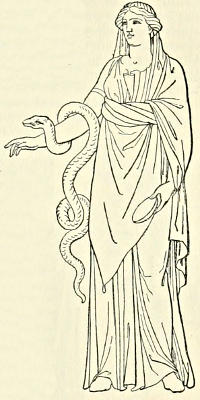
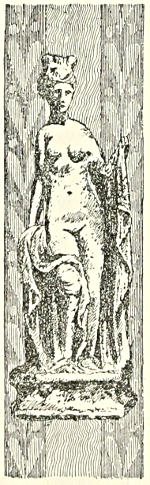
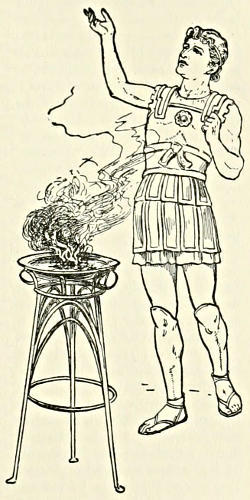
Hygeia
(After Hope)
While Polysperchon was forming a connection with Olympias, Eurydice
entered into a relation with Cassander. Olympias seems still to have been
staying in Epirus at the time when Polysperchon went to Phocis and thence
into Peloponnesus. He took Arrhidæus with him on this expedition, but he
must afterwards have sent him back to Pella. Olympias now returned to
Macedonia with an army of Epirots and Ætolians, which was opposed by
Eurydice and a Macedonian force. Olympias made use of the influence of
her own name and of that of her son, for the purpose of gaining over the followers
of Eurydice. The Macedonians were extremely untrustworthy, and
they seem to have been induced to desert to their opponents not only by bribery,
but often by mere caprice; and it is not till the time when the dominion
of the Antigonidæ had become established, that this faithlessness ceases.
Eurydice and Arrhidæus accordingly being deserted by the Macedonians,
fell into the hands of Olympias, who now ordered them to be put to death.
Wishing to enjoy their death, she first intended to kill them by hunger, and
ordered them to be walled up in a dungeon—and a little food to be given to
them. But as this lasted too long, Olympias becoming impatient, and fearing
lest a tumult should arise, ordered the dungeon to be broken open and
the harmless idiot to be murdered by Thracians. Eurydice was obliged to
choose the manner in which she was to die, and died with great firmness.
Olympias now put forward her little grandson Alexander with his mother
Roxane. In the same manner she raged against the whole house of Antipater,
one of whose sons was likewise killed.
[316 B.C.]
But the cruelties of Olympias excited discontent and rebellion among the
restless and mutinous Macedonians. When Polysperchon was obliged to
retreat from Megalopolis, most of the Greek cities declared
for Cassander. Cassander thus gained a firm
footing in Greece; and, while Polysperchon retreated,
Cassander followed him into Macedonia, where the
people declared for him, Pella, Pydna, and Amphipolis
alone declaring against him. Olympias, with
her grandson Alexander, Roxane, and others,
had fled to Pydna. Polysperchon was deserted
by his troops, who were bribed by
Cassander, and was obliged to flee with a few
faithful adherents into Ætolia.
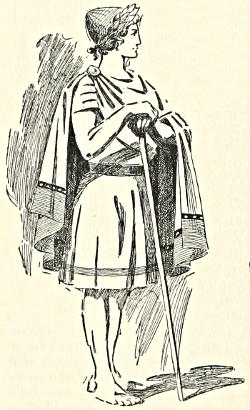
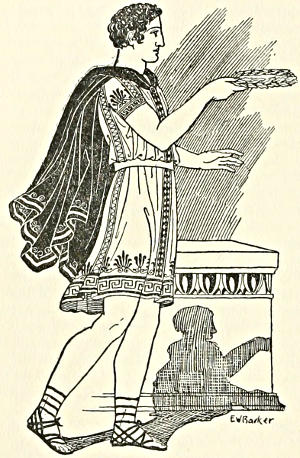
Costume of a Youth of the Upper Classes
Olympias was thus shut up in Pydna; it
was situated quite close to the sea, and there
was no one inclined to afford her assistance.
Eumenes was then in Upper Asia, engaged
in the war against Antigonus. If Antigonus,
as he himself wished, had become reconciled
to Eumenes, the latter would have been
able to act as mediator on behalf of Olympias;
but, at all events, the assistance from
that quarter would have come too late. The
party blockaded at Pydna were suffering
from the most terrible famine, and Olympias
was compelled to surrender. She stipulated
for her life, and Cassander promised
to spare her, but had no intention
of keeping his word. The widows and
orphans of those who had been murdered
by Olympias brought charges
against her before the Macedonians, who again formed a champ de Mars.
Olympias did not appear, and was sentenced to death. Afterwards, she
declared her willingness to appear before a court of Macedonians; but
Cassander ordered her to be executed, saying, that he must obey the will
of the nation.g Olympias received warning that she must prepare for death.
She put on her royal robes and came forward, leaning on two of her women,
to meet the soldiers. Even they were so overpowered by the majesty of
her presence, and by the numberless great recollections attached to her
name, that they could not bring themselves to execute Cassander’s order.
He was obliged to commit the deed of blood to the persons who had accused
her, and who were eager enough for revenge to undertake it themselves.
She submitted to her fate with unbending firmness, neither shrinking from
their swords nor uttering a word unworthy of her birth and fortunes.b
Young Alexander, and his mother, Roxane, were sent to Amphipolis,
where, for a time, they were kept in close confinement, and afterwards put
to death. Hercules, the son of Barsine, was likewise murdered, and that too
by Polysperchon; but when this happened cannot be accurately determined.
Polysperchon now disappears from history. His son, Alexander, continued
to play a part for some time, but it did not last long.
After the fall of Olympias, all the other places, which had till then held
out, opened their gates to Cassander; and he now was king of Macedonia,
without having the regal title.
About the same time Antigonus, by his conquest of Eumenes, became
master of all Asia, while Lysimachus ruled in Thrace, and Ptolemy in Egypt.
We need hardly observe, that Antigonus’ dominion in the most eastern
satrapies was merely nominal, or did not exist at all; but, in regard to
Babylonia, Persia, and other interior provinces, the case was different, for
there he really ruled as master. But none of the princes had yet assumed
the kingly title. This was the state of things in 316 B.C.
In the feuds which henceforth arise among the rulers, a younger generation
of men already appears on the stage, and they can in no way be compared
with the older men who had gone forth from the school of Philip. Seleucus
was one of these younger men; he had not yet distinguished himself, but
may have become acquainted with war as early as the time of Philip. He
was of about the same age as Alexander, and in every sense an enfant de la
fortune, who rose only through his extraordinary good fortune. [His realm
and his followers, known as the Seleucidæ, will be treated in a later chapter.]
Antigonus had conquered for himself an empire by campaigns, labours, and
hardships; he lost one eye, and, in the end, his life. Ptolemy had been a
companion in arms of Philip, and had greatly distinguished himself under
Alexander. Of Cassander we have already spoken; and Lysimachus had
been obliged to conquer Thrace, the possession of which he was now
enjoying.
It had been given to him to be conquered, for it was not a satrapy, having
been under the administration of Antipater. The country had become tributary
as early as the time of Philip, but had retained its ancient dynasties.
The princes of the Odrysians, though dependent on, and weakened by Philip,
still existed; and, in the reign of Alexander, Thrace was always united with
Macedonia. But, after his death Perdiccas separated the two countries, for
the purpose of weakening Antipater, and changed Thrace into a satrapy,
which he gave to Lysimachus, and which Lysimachus subdued.
It is uncertain whether Lysimachus was a Thessalian or a Macedonian.
He was captain of the king’s bodyguard, and very distinguished, especially
for his lion-like bravery. When Callisthenes was tortured by Alexander,
Lysimachus, on seeing his frightful condition, gave him poison out of compassion—a
bold thing to do under a tyrant of Alexander’s temperament.
This story shows that Lysimachus was considered as a man of independence of
mind, who preserved his free and proud spirit, when Alexander had already
become an eastern despot.
He established his empire with small means, and for the greater part of
his life he was reasonable enough to be satisfied with his dominion. It was
not till his old age that ambition overcame him and carried him away, though,
perhaps, not without some deeper motive and the desire to save himself.
He once crossed the Danube in the vain attempt to make conquests in the
country beyond the river; this may, perhaps, have been only an attempt to
keep off the invading nations of the north. He had a difficult problem to
solve, to conquer the wild and warlike Thracians, whose country appears
to us northern people as a fair southern sort of paradise, but was terrible to
the Greeks on account of the severe arctic cold; and the terror was increased
by the savage manners of the inhabitants. On the coast, however, there
were large and magnificent Greek cities, and the beautiful Chersonesus.
We know little of the reign of Lysimachus, and we are not even informed
whether he resided at Byzantium or elsewhere. In later times, during the
war against Antigonus, his residence seems to have been in Asia, at Sardis
or at Ephesus.
[316-307 B.C.]
When Cassander was once in possession of Macedonia, he extirpated the
family of Alexander, without a hand being raised in their defence. Aristobulus,
who wished to interfere, was delivered up and sacrificed. Hence it
is remarkable that he married Thessalonice, the only surviving daughter of
Philip; but this may have arisen from the pride of the usurper, or from the
hope of thereby establishing his dominion. His government of Macedonia
was at the same time a perfect dominion over Greece, with very few
exceptions, one of which was Sparta.
Thebes had been restored by Cassander immediately after the conquest of
Macedonia (316 B.C.), for, in his hatred of Alexander, he undid all that Alexander
had done. By their possession of the Theban territory the Bœotians
were so much bound up with the interests of Macedonia, that it became a
question as to whether it was prudent to restore Thebes. It is not certain
whether they had incurred the suspicion of Cassander. It was a matter of
great difficulty to induce the Bœotians to consent to the restoration; in all
of the rest of Greece it was regarded as an act of the greatest justice, and
it seems to have been a general national consolation.
About the same time Cassander founded Cassandrea, a remarkable proof
that he was a man of practical sagacity. Philip had extirpated or sold the
Greek population on the Macedonian coast, with the exception of that of
Amphipolis and Pydna. One of these destroyed cities was Potidæa, which
had at first been a Corinthian colony, but afterwards belonged to Athenian
cleruchi. Now, on that site, Cassander assembled, not only many strangers,
but all the Greeks, especially those Olynthians who were still surviving
from the destruction of their city, and built Cassandrea. On the site
of the insignificant town of Therma, he founded Thessalonica, which he
called after the name of his wife. This act also shows great practical
wisdom. Thessalonica, situated on a fine harbour, and in a fertile district,
being now extended, became the chief commercial place in Macedonia, a
rank which it has maintained down to the present day. Cassandrea (now
Cassandra) soon became great and powerful; it has often been destroyed,
but was always restored again; and its situation was so happily chosen,
that it naturally always recovered.
This was the condition of Greece at the time when the appearance of
Demetrius Poliorcetes, the son of Antigonus (307 B.C.), stirred up everything
without doing any good. He had even before been actively engaged
in a war against Ptolemy.
The defeat and death of Eumenes put Antigonus in possession of a vast
monarchy, extending from the Hellespont as far as India. According to the
early invented principle of the balance of power, the others now demanded
that he should give up a part of his conquests; they even thought it necessary,
for the sake of justice and for the balance of power, that the countries
of upper Asia should form a separate state.
Seleucus, the child of fortune, was destined to obtain that empire; a
man who was the pet of fortune, but in no way distinguished as a hero
or statesman. In the same year (316 B.C.) in which Cassander had conquered
Macedonia, and Antigonus, after the conquest of Eumenes, returned from
Upper Asia, Antigonus intended to order Seleucus to be arrested at Babylon.
But he escaped, and the Chaldeans now foretold Antigonus, that the fate of
his family was involved in the affair. It was easy to foretell the beginning,
but not the end, for the Seleucidæ did not overthrow Antigonus. Seleucus
now went to Ptolemy whom he urged on to wage war against Antigonus.
Thus arose, in 316 B.C., the second or third great internal war among
the Macedonian princes—we say the second or third, because the recommencement
of the war in 318 B.C. may either be regarded as a continuation
of the first or as a second war. In this war, Antigonus fell out with Cassander,
and Ptolemy allied himself with Cassander and Lysimachus against
Antigonus. Lysimachus, however, was cunning enough to keep aloof as
much as he could, and Cassander, too, at first took much less part in it than
Ptolemy. In the beginning it was, properly speaking, only Antigonus and
Ptolemy that were arrayed against each other.
The war was at first carried on especially in Syria and Cyprus. Ptolemy
had taken possession of Cœle-Syria and southern Phœnicia. Antigonus now
directed his arms against him, and at first generally with success, so that he
made himself master of Syria and a great part of Cyprus; until, in the
fourth year of the war, Demetrius Poliorcetes lost the battle of Gaza against
Ptolemy, of which we shall speak hereafter.
In the meantime, however, the generals of Antigonus were carrying on a
war in Greece against Cassander, from 315 B.C. till the end of 312 B.C. It
is worthy of remark that both Antigonus and Ptolemy considered the Greeks
of sufficient importance, to endeavour to gain their favour by proclaiming
the struggle a war of independence for the Greeks; neither of them, however,
had any serious intention of this kind. In the very first year of the
war, Antigonus sent Aristodemus of Miletus with a fleet and large sums of
money to Greece, probably with no other intention than to make a diversion
against Cassander and prevent him from crossing over into Asia.
[312-311 B.C.]
This brought unspeakable misery upon Greece. Each city was too
weak, and also but little inclined to defend itself; each threw itself into the
arms of the party that happened to be at its gates. Alexander, the son of
Polysperchon, had remained in Peloponnesus, establishing himself mainly at
Corinth and Sicyon; he now joined Antigonus, from whom he received
money and troops. He and Aristodemus also enlisted soldiers in Greece,
and the war now broke out, especially in Peloponnesus. Cassander, forcing
his way into the peninsula, conquered Cenchreæ, the port of Corinth.
But all on a sudden, Alexander deserted Antigonus, and faithlessly concluded
a peace with Cassander in his own name and that of his father. By
this means, Aristodemus was driven out of Peloponnesus, and now went to
Ætolia, whence he carried on the war against the opposite countries of
Peloponnesus, Achaia, and Elis. The watchword always was, “Liberty and
Autonomy for Greece;” but the towns were, notwithstanding, treated in a
most terrible manner. During the first campaign, the principal scene of
operations was Arcadia and Argolis, and in the second, Elis and Achaia.
Almost the whole of Achaia was laid waste during this campaign, and Patræ
and Ægium were taken. Alexander was then murdered, and Cratesipolis,
his widow, keeping possession of Corinth and Sicyon, ruled there almost as
an absolute queen.
A Scene in Syria
But Cassander transferred the war into Ætolia; these occurrences rendered
the conflict more and more important, and the Acarnanians, therefore,
beginning to be apprehensive, threw themselves into the arms of Cassander
and the Macedonians. Being now supported by Cassander, they endeavoured
to rid themselves of their connection with the Ætolians. The year
following saw the commencement of the war of Cassander against Ætolia.
In 312 B.C., Antigonus made great preparations, and under the command
of Ptolemy, a son of his sister, sent an army into Greece, more especially
into Bœotia, which was exasperated against Cassander, for having been
obliged by him to give up the territory of Thebes. In conjunction with
them, Ptolemy conquered Chalcis, and wherever they went, they were successful
in expelling the garrisons of Cassander, who had no other city in
Greece left that sided with him except Athens. But while Antigonus was
victorious there, he was losing ground in other parts; and thus he found himself
obliged, in 311 B.C., to conclude a peace with his opponents.
[312-308 B.C.]
In Syria, Antigonus had entrusted the supreme command against Ptolemy
and Seleucus to his son Demetrius, who was then still a very young
man. This Demetrius plays a very prominent part in history. He has the
honour of having his life described among the biographies in Plutarch—an
honour which we might reasonably grudge Demetrius, for he is a despicable
person. We know him, partly from Plutarch’s biographies, and partly from
a number of anecdotes in Athenæus, to have been the most unprincipled and
most detestable man in existence: the acts of faithlessness which he committed
against Alexander, the son of Cassander, are not the only things for
which he deserves our detestation. He was also a voluptuary of the vulgarest
and most abject description; the lowest crapule was the element in the
filth of which he revelled; and he was quite a heartless man, who knew no
friendship; the basest creatures, the companions of his lusts, were his only
friends. Cassander was, after all, capable of distinguishing persons deserving
of respect, as he showed in the selection of Demetrius Phalereus; and so
also was Ptolemy; but we know that Demetrius Poliorcetes lived at Athens
in intimacy with the most abject and abandoned persons of the time. He
also showed towards his soldiers an ingratitude and a heartlessness, which are
quite revolting; they were perfectly indifferent to him, and he regarded
them only as his tools. They accomplished great things for him, but he
always sacrificed them without any scruple, leaving to destruction on the
morrow those who had saved his life the day before. In addition to this, he
was a gambler, whose dull torpor could be excited only by great changes of
fortune, and who staked everything upon a card. He is remarkable for his
enormous good fortune: “fortune raised him beyond all conception, and
then deserted him, but when he seemed entirely lost, she again held out her
hand to him,” says Plutarch, in a verse which he applies to him.
Such a man would deserve no attention at all, were it not that he acted
a great part, and that nature had endowed him with great abilities, especially
in mechanics, according to the leaning of that age toward the mechanical
sciences. In this respect, as in many others, we may compare him with
a modern person, the regent Philip of Orleans, who, however, was a far better
man. Demetrius was a great inventor in mechanics, and he did much for
the improvement of military engineering: this is a merit which he did not
unfairly assume, but he is fully entitled to his reputation in this respect.
A short time before, a great impulse had been given to mechanics in the
affairs of war, and machines of every description were improved. Engines,
which for centuries had remained unchanged, were now, partly through the
progress of mathematics, and partly through the increased wealth that could
be employed upon them, improved in one year, more than they were formerly
in the course of centuries.
Demetrius was eighteen years old when Antigonus commissioned him to
undertake the command of an army against Ptolemy. The first attempt
failed, for at Gaza he was completely defeated, and Ptolemy again took possession
of Cœle-Syria. Ptolemy carried on the war in a generous spirit, for,
declaring it to be a civil war between Macedonians, he set the prisoners free
without ransom, whereby he gained the good will of the Macedonians.
Antigonus now undertook the command himself, and Ptolemy again evacuating
the towns of Cœle-Syria, ravaged them.
Peace was then concluded, but it lasted only for a short time. Cassander
succeeded in inducing Ptolemy, the nephew of Antigonus, who was stationed
in Bœotia, as well as another general on the Hellespont, to revolt. Yet Antigonus
soon recovered those countries. In the same year Ptolemy took
Cyprus and extended his power on the coast of Asia Minor.
In the year following Ptolemy appeared with a fleet in Greece, having
until then been the ally of Cassander. It was probably the Bœotians and
Peloponnesians that called in his assistance against Polysperchon, and he
had a fair opportunity of being able to say that he was coming to avenge
the murder of Roxane and Alexander. Cratesipolis surrendered to him her
principality of Argos and Sicyon, being unable to maintain those cities any
longer; but it was not without difficulty that the mercenaries were prevailed
upon to surrender: it was effected only by stratagem. The Peloponnesians
afterwards were slow in doing what they had promised, and Ptolemy himself
probably did not care much about the conquest. Hence he concluded a
treaty with Cassander, whereby he obtained possession of Peloponnesus with
the exception of Argos and Sicyon.
[308-306 B.C.]
Antigonus now sent his son Demetrius with a fleet to Greece. No one
there was willing to sacrifice himself for Cassander, who had no fleet, so
that he was unable to undertake anything against Demetrius. The latter
appeared unexpectedly before Piræus: the harbour not being closed, he
landed and quickly took Piræus, before the posts could be occupied. He
immediately proclaimed that the expedition had been undertaken for the
purpose of restoring to Athens her freedom and autonomy, and he was
accordingly received with enthusiasm. The Macedonian garrison under
Dionysius shut itself up in Munychia, and negotiations were commenced
between Demetrius Poliorcetes and the city. Demetrius Phalereus was sent
as ambassador down to the camp in Piræus: Demetrius promised the Athenians
an amnesty, the city was declared free, and the ancient democratic
constitution was restored; but Demetrius Phalereus was sent into exile.
Demetrius Poliorcetes now besieged the Macedonians in Munychia. He
would not go to Athens till he had taken that fortress; it was at first
blockaded, while the preparations for a siege were going on. While the
engines were building, Demetrius marched against Megara, where there
was a garrison of Cassander. The town was taken by storm and plundered,
and it was only at the urgent request of the Athenian ambassadors,
that its inhabitants were saved and not dragged away into slavery.
He then returned to Piræus, where he attacked Munychia, until the feeble
garrison being exhausted, was obliged, after several days, to surrender, and
then departed. The fortifications were razed to the ground, and the place
given up to the Athenians. Athens was now free, but Demetrius, for the
protection of the Athenians, gave them a garrison of his own troops. After
this he stayed for a time at Athens, where he was received with enthusiasm,
as elsewhere described.
If Demetrius had remained at Athens, and continued the war against
Cassander, he might easily have conquered all Greece; but he was called
away by his father Antigonus, because Ptolemy had made himself master of
Cyprus. About the month of Hecatombæon, Demetrius sailed to Cyprus;
and now, by a brilliant victory of Demetrius over Menelaus, the brother of
Ptolemy, near Salamis in Cyprus, Antigonus and Demetrius gained the mastery
at sea. Cyprus was reconquered. Menelaus, with all his forces in the
island, was obliged to capitulate; and thus the sea far and wide was in
the power of Antigonus and his son. But an expedition which the two
undertook against Egypt proved a failure.
[307-305 B.C.]
Until now, none of the princes had assumed the title of king, but after
the victory of Salamis, Antigonus took the diadem for himself and his son.
Immediately afterwards, Ptolemy, Cassander, Lysimachus, and Seleucus did
the same; and the years were now counted from their accession (306 B.C.):
these are what are called the Macedonian Eras.
Demetrius now remained absent from Athens for a period of three or
nearly four years; during this time the city was left to itself, and a hard
time it was. We may easily imagine that Cassander was not idle, and
endeavoured to recover Athens, which was of such importance to him. He
was in possession of Panactum and Phyle, and inflicted the severest sufferings
upon the city. This war must unquestionably be regarded as one of the
chief causes of the terrible poverty in which we afterwards find Athens, for
there can be no doubt that the whole territory was laid waste during the
incursions from Panactum and Phyle. In this war, Demochares was strategus
of Athens, and with her resources alone he operated against Cassander
for four years in a most able manner, until Demetrius returned.
According to the order observed by Trogus Pompeius—though not
according to that of Justin, who has here quite without judgment omitted
many things—we now come to the expedition of Demetrius against Rhodes,
one year after the unsuccessful undertaking against Egypt.
[305-304 B.C.]
The salted and dried fish of the Euxine were articles of great consumption
in Egypt, and it was for this trade that Rhodes was the natural
entrepôt. The consequence of this was, that the Rhodians and the Ptolemies
were natural friends and allies, and that Rhodes would on no account separate
itself from Egypt; its whole existence depended upon the commercial
advantages, which even the first Ptolemy conceded to them. Rhodes, therefore,
was a weak place, in which Demetrius Poliorcetes and Antigonus might
attack the Egyptians; and it would have been an immense loss to Egypt, if
the two princes had conquered the island, the possession of which was to them
of equal importance.
Hostilities commenced by Demetrius capturing the Rhodian merchant
vessels, which were sailing to Egypt; the first example in antiquity of neutral
vessels being seized upon. The Rhodians paying in equal coin, captured
the ships of Antigonus, who now declared this measure to be an act of open
hostility; and Demetrius was commissioned to lay siege to Rhodes. While
Antigonus was engaged in preparations, the Rhodians, seeing that Ptolemy’s
fleet had been defeated, made an attempt to obtain peace; but the terms
which were offered to them were such as to prevent their accepting them.
Antigonus demanded one hundred hostages, whom he himself was to select,
the right freely to use the harbour of Rhodes for his ships of war, and an
unconditional alliance against Ptolemy. These terms were rejected by the
Rhodians.
Demetrius then landed at Rhodes. His preparations were immense:
the determination of the Rhodians to defend themselves manfully could
not be doubted, and hence every effort was made to compel them by force.
Demetrius appeared with two hundred ships of war, one hundred and seventy
transports, and many small vessels; he is said to have embarked no less than
forty thousand men, partly sailors and partly soldiers. He assembled his
forces at Loryma, opposite to Rhodes, and during his passage across, the sea
between Caria and Rhodes was covered with his ships. He landed without
opposition, made a harbour for his ships of war, and approached with
besieging engines. The whole island was in the meantime overrun, the
country was laid waste, and all who had not fled into the city, were led away
into slavery.
While Demetrius was thus encamped before the walls of the city, the
Rhodians were making the most extraordinary preparations. Their citizens
were called to arms; in their enumeration only six thousand were found
capable of bearing arms, and not more than one thousand metœci and
strangers, who were willing faithfully to undertake the defence. At first
they do not appear to have employed mercenaries; but they allowed their
slaves to take up arms, and after the close of the war they rewarded them
with freedom and the franchise.
This siege is as interesting and as important as the siege of Rhodes under
Soliman against the noble Grand Master de l’Isle Adam in 1522, which was
one of the most heroic defences in modern history. In like manner, the
siege of ancient Rhodes is one of the most glorious achievements in the later
history of Greece.
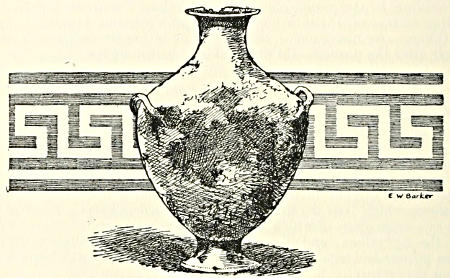
Terra-cotta Urn
(In the British Museum)
Demetrius at last became tired, observing that the game was not worth
the chase. The siege would have lasted a few months longer, and this prospect
made him impatient, as he was losing immense numbers of men and
ships. In addition to this, Cassander was completely gaining the upper
hand in Greece, and Antigonus found that all around, everybody was rising
against him. Demetrius accordingly, on the mediation of Athens and several
other Greek cities, concluded a peace, by which he hoped to save his
honour. It was based on the terms which the Rhodians had been willing to
accept from the first: they were to assist Antigonus and Demetrius in all
other wars, but not against Ptolemy, “and as the wars of the two princes
were chiefly directed against Ptolemy, the Rhodians had neutrality guaranteed
to them.” They were further to retain their city with perfect freedom, as
well as all their subjects.
Demetrius now returned to Greece. Cassander had been blockading
Athens, while Demetrius was besieging Rhodes; and the latter now appeared
with a very considerable fleet to relieve Athens. He landed at Aulis on the
Euripus, between Oropus and Chalcis, to come upon the rear of Cassander
and compel him to withdraw from Athens. Demetrius had a good harbour
at Aulis. Chalcis was in the hands of Cassander, and had a Bœotian garrison;
but it was a large, desolate place, and was easily taken. In order not
to be cut off, Cassander was obliged to break up, and proceeded through
Bœotia towards Thessaly. He succeeded in reaching Thermopylæ; Demetrius
pursued him, and Heraclea surrendered to him; while six thousand
Macedonian troops declared in his favour.
[304-301 B.C.]
Demetrius, then entering to Attica, conquered Panactum and Phyle,
which had been occupied by Cassander, and through which he had had
Attica under his control. The Athenians received Demetrius with enthusiasm,
as their benefactor. All that impertinent flattery could devise had
been exhausted; and what was done now had the character of caricature.
From Athens, Demetrius made several expeditions in different directions,
but the city remained his headquarters. During these expeditions, the desolation
of the country increased more and more, and it is surprising that
Attica did not become a complete wilderness as early as that time.
In the spring of 303 Demetrius entered Peloponnesus, which was in the
hands of Cassander and Ptolemy; and he again showed himself in the field
as an excellent and active commander. He conquered Corinth, Sicyon, Bura,
and Ægium. Then he undertook an expedition with his fleet to Leucas and
Corcyra. The Corcyræans were enemies of Cassander. While Demetrius
was engaged in those parts, the Romans had advanced to the extreme point
of Messapia, and accordingly were very near to Demetrius.
From thence Demetrius returned to Corinth, where he convened a congress
of the Greeks, the first after the time of Alexander. He was there
proclaimed hegemon of the Greeks, and in the spring, he proceeded to
Athens, where he was received as a god with incense and processions by the
Athenians, who, being adorned with wreaths, came out to meet him.
Afterwards Athens had to pay a war contribution of 250 talents, which
Demetrius under the very eyes of the people gave to his courtesans while he
ridiculed the Athenians. Things like these naturally goaded the people
into madness.
Demetrius was now master of the greater part of Greece. In the following
year he assembled a large army of his allies, and proceeded by way of
Chalcis into Thessaly with fifty-six thousand men, to meet Cassander. He
took from him a great part of Thessaly, and then after both had dragged
each other about without anything being decided, they separated, Demetrius
being called to Asia by his father, because a great coalition had there been
formed against him. In order, therefore, to withdraw honourably, Demetrius
concluded a peace with Cassander, in which Greece was declared free, and
then crossed over into Asia.
[301-300 B.C.]
Seleucus who was now master of Babylon and the upper satrapies, after
having subdued all Iran as far as India without any effort, had formed, together
with Ptolemy, Cassander, and Lysimachus, a coalition against Antigonus.
This is the first instance known in history, of a great coalition of
princes of equal rank and equal independence. Antigonus, who now possessed
only Asia Minor, Cyprus, a portion of Syria and the greater part
of Greece, was thus opposed by all the rest of the Macedonian world; and
it was against this coalition that Demetrius led his army into Asia Minor.
We know very little about the details of the war, but it appears that the
enemies pressed into Asia Minor from all sides. The decisive battle was
fought near Ipsus in Phrygia; it was decided especially by the admirable
infantry of Lysimachus and Cassander. Seleucus had only Asiatics; the
phalanx of Ptolemy was of little importance, and only his mercenaries fought
bravely; but the truth is that in reality he had no talent as a commander.
Antigonus fell in the battle, and the defeat was so complete, that his whole
empire was destroyed. Demetrius escaped with a small band to the maritime
towns of Ionia, but behaved in a praiseworthy manner.
The empire of Antigonus was now cut up: the western provinces were
divided between Cassander and Lysimachus, the upper provinces were assigned
to Seleucus, and Cyprus and Syria to Ptolemy, who, however, did
not maintain upper Syria, but confined himself to Phœnicia and Cyprus.
Plistarchus, a brother of Cassander obtained Cilicia as a special indemnification
for Cassander, who himself received Caria and Pamphylia, while Lysimachus
acquired Lydia, Ionia, Phrygia, and the north coast of Asia Minor.
After the battle of Ipsus, Demetrius had escaped with a few thousand
men to Ephesus, where he had a fleet; and he did not altogether despair of
the success of his cause. Cyprus, Sidon, and Tyre, as well as several of the
Ionian towns and islands, were still in his possession, and he was anything
but an insignificant man. He now displayed great skill, and drew all his
forces together, with a view to establish himself in Greece, and there again
to try his fortune. For he saw well, that the coalition of the generals who
had invaded his father’s empire must soon break up, and that then his assistance
would probably be sought by one or other of them, which was, in fact,
afterwards done by Seleucus and Ptolemy. He sent the great Pyrrhus first
as negotiator, and afterwards as hostage, to Ptolemy. Pyrrhus had been
his companion in arms; he had lost his kingdom through Cassander, and
was now wandering about in the world in the hope of conquering a kingdom
for himself. The expedition of the adventurer Cleonymus also belongs to
this time, or, rather, to a somewhat earlier one; he was a pretender to the
throne of Sparta, from which he was, perhaps unjustly, excluded.
From Ephesus, Demetrius sailed through the Cyclades to Athens, where
he wanted to establish himself first. But the Athenians were determined to
avail themselves of the jealousy of the princes among each other, to secure
their independence; and accordingly they sent an embassy to meet Demetrius,
and declare to him, that they would not receive him.
Athens was now spared for a time, and Demetrius, before attacking the
city, undertook several other expeditions. He first directed his course, with
his squadron, towards the coast of Thrace, gained a footing in the Thracian
Chersonesus, and made war upon Lysimachus, who, in the meantime, had
taken possession of Lydia, Caria, and Phrygia. Lysimachus was not supported
by the other princes, nor was it necessary, and Demetrius made no
conquests there. Meantime, however, a new lucky star was rising for him
through Seleucus, who, having fallen out with Ptolemy, and being dissatisfied
with his share, was ready to form a friendship with Demetrius. He sued
for the hand of Stratonice, a daughter of Demetrius, whom, however, he
afterwards gave up to his son, Antiochus. Demetrius now sailed with his
fleet to Cilicia and Syria, and, in passing, made himself master of Cilicia, and
the treasures which Plistarchus, the son of Cassander, was guarding there,
and then began to quarrel with Seleucus. For when Cilicia and the Phœnician
cities were in the power of Demetrius, Seleucus in vain asked that they
should be given up to him; and it was not without difficulty that Demetrius
escaped from his plots: a formal rupture, however, did not take place.
Demetrius then became reconciled with Ptolemy also, and that as we have
already mentioned, through the mediation of Pyrrhus. He now again
appeared in Greece, with increased forces. He gained a firm footing in
Peloponnesus, though it is uncertain how many towns he subdued there.
[300-295 B.C.]
In the mean time, Cassander died, and Demetrius, supported by a
newly-increased fleet, began the siege of Athens. He had then again
fallen out with Ptolemy, who now sent a fleet to assist the Athenians.
Demetrius blockaded the city by land and by sea, and the Athenians,
being cut off from the sea, were visited by a fearful famine. They fed
upon all kinds of animals, upon indigestible herbs, and the grass which
grew on the Acropolis. An Egyptian fleet, attempting to introduce provisions
into Piræus, was repelled by Demetrius. At length, after an obstinate
defence, they were compelled by the famine to surrender. Every
catastrophe brought the city nearer its downfall, though Demetrius, considering
that he was the conqueror, displayed great mildness. He convened
the Athenians, without their arms, in the theatre, and surrounded the building
with his hoplites. But he was satisfied with having struck them with
the horrors of death, and, having reproached them for their ingratitude, he
declared that he pardoned them. The Athenians were obliged at once to
concede to him the right to keep garrisons at Munychia and Piræus, but
otherwise they fared better under him now, than at the time when as their
friend he had revelled in his excesses. He even fed the Athenians, giving
them grain and other necessaries of life.
Demetrius now returned to Peloponnesus. During this expedition, he
was on the point of making himself master of Sparta. The Spartans,
ever since the battle of Megalopolis, had taken no part in the struggle
of the Greeks for independence. Sparta had during that period become
more and more powerless, although she was in the enjoyment of peace.
That which now emboldened and induced her to declare against Macedonia,
is left unnoticed by the historians of the time; and it would be
inexplicable, if we did not know that Ptolemy and Lysimachus continued
the war against Demetrius. We also know that down to the time of
Cleomenes, there existed a constant connection between Sparta and Alexandria;
whence we may suppose, that that alliance already existed, and that
all the Lacedæmonians received pay from Alexandria. Acts of hostility
had indeed occurred between Sparta and Demetrius, but they were not of
any importance. It is unknown what forces Archidamus possessed, and
what occasioned him to commence the war. All we know is that Archidamus
was defeated near Mantinea, that Demetrius advanced as far as
Laconia, and that Sparta was now surrounded for the second time with
palisades and trenches, and in some parts also with a wall: Pausanias at
least places the fortifications at this time. He also calls the defeat of
Mantinea, the third great blow to Sparta after the battle of Leuctra and
that of Agis. Demetrius might, no doubt, easily have crossed those fortifications,
if he had not at the moment received intelligence that all his affairs
were in a bad condition, and if he had not for this reason given up the war
with Sparta.
For Ptolemy had taken possession of all the places in Cyprus, with
the exception of Salamis, which city he was besieging, and which contained
the children of Demetrius. Lysimachus was making himself master of the
Ionian and other maritime Greek towns in Asia Minor, which had hitherto
been under the dominion of Demetrius. The Egyptian fleet seems to have
gained the ascendency; probably because Ptolemy had become master of
Tyre and Sidon, whereby Demetrius lost the means of obtaining timber
and troops. The Asiatic province henceforth disappears from the history
of Demetrius, and he was again in great difficulties.
But the death of Cassander, and the misfortunes of his family, opened
fresh prospects for Demetrius. Cassander died of dropsy in 297. His
eldest son Philip appears to have been his sole heir, but he died soon afterwards
at Elatea, 296; two other sons, Antipater and Alexander, then
divided the empire between themselves. Both were very young, and their
mother Thessalonice, a daughter of King Philip, was the only surviving
member of the family; they can scarcely have been more than grown up
boys, if the time of Cassander’s marriage with Thessalonice is correctly
stated in Diodorus. Thessalonice was appointed guardian, or she was commissioned
to divide the empire between her two sons. To do this fairly,
was a difficult task.
[295-286 B.C.]
Antipater, the elder, thinking himself wronged by his mother in the
division, murdered her; and applying to Lysimachus, his father-in-law,
he was supported by him. But Alexander, who was confined to western
Macedonia, applied to Pyrrhus, who in the meantime had returned to
his paternal kingdom, to obtain his assistance; for this purpose he ceded
to him the possessions which the Macedonian kings had in Epirus, together
with Ambracia and Acarnania. But distrusting Pyrrhus, he applied at the
same time to Demetrius. As Pyrrhus sold his assistance, we may suppose
that Demetrius did not give his without some selfish motive either; he
evidently caused Thessaly to be ceded to him, the whole of which had
belonged to Cassander. Demetrius now entering Thessaly, met Alexander
at Larissa. Both intrigued against each other, and aimed at each other’s
life. After many attempts, and repeated snares, Demetrius struck the blow
and caused Alexander to be murdered.
The Macedonian troops of the latter now had no king; Demetrius came
forward with a proclamation, in which he declared that he had acted only in
self-defence; that his life had been in danger (which was really true, but
all the Macedonian princes were equally bad); and called upon the Macedonians
to submit to him. The troops submitted to Demetrius and he was
proclaimed king. Lysimachus having put himself in possession of the
dominion of Antipater, his son-in-law, gave up his new Macedonian possession
and made peace with Demetrius, who thus became master of all
Macedonia. He now ruled over Macedonia, Thessaly, Attica, Megara, and
most of the towns of Peloponnesus. The Spartans, however, continued the
war against him.
During these struggles, Demetrius wanted to take from Pyrrhus that
portion of Macedonia which Alexander had ceded to him, and thus he began
to quarrel with his most faithful friend. During his residence in Alexandria,
Pyrrhus had married Antigone, a daughter of Ptolemy by his first wife; and
as long as he lived, he was sure of the friendship of the Alexandrian court.
The detail of the wars between Pyrrhus and Demetrius cannot form a part
of this history, for they are petty and insignificant. Pyrrhus was allied with
the Ætolians, and defended himself with great skill against an immensely
superior force; and after a few years he was victorious. It was fortunate
for him that Demetrius was just then planning
greater things; for he was thinking of
recovering the empire of his father—a senseless
idea under the circumstances of the time.
He built an enormous fleet, and enlisted an
army which is said to have amounted to one
hundred thousand men. His empire comprised
not only Macedonia and Thessaly, for
nominally he was also hegemon of the Greeks,
as Philip and Alexander had been before,
and possessed a number of coast towns in
Asia; the parts of his kingdom were very
much scattered about. But he collected his
army with immense exertions; his subjects
were fearfully oppressed, and all his dominion
was in a state of ferment. His government
was on the whole unbearable to the
Macedonians on account of his pride and his
cruelty; they were not a nation to allow
themselves to be governed in the Asiatic
fashion. He showed himself very rarely and
accepted no petitions; but once he behaved
with unusual kindness, receiving all petitions
and throwing them into the folds of his
garment. Everybody was highly delighted;
but when he rode over the bridge of the
Axius, he threw them all into the river.
Such things naturally exasperated all the people against him.
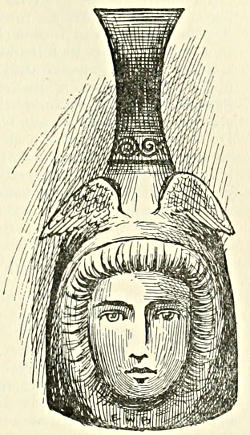
Grecian Oil Bottle
[286-285 B.C.]
In the end Pyrrhus, called upon by the more distant kings, and being no
doubt invited by the Macedonians themselves, availed himself of the ferment,
and invaded Macedonia with a small force. Demetrius marched against him;
Pyrrhus manœuvred and negotiated with the Macedonians, until they rose
in a general insurrection, refusing obedience to Demetrius and ordering him
to withdraw. He was glad to get away, and went, we believe, to Demetrias
in Magnesia, which he himself had built on the Gulf of Pagasæ, near the
ancient town of Iolcus, and which we afterwards find in the hands of his son
Antigonus. Thence he proceeded into Greece. He was a great general;
his keen discernment as a military commander is attested by the foundation
of Demetrias and of New-Sicyon: the fortress of Demetrias exercised an
important influence upon the fate of Greece. Demetrius had reigned over
Macedonia five or six years.
Demetrius soon concluded peace with Pyrrhus, and if he had waited
patiently, he would have been certain of his restoration; but he could not
wait, he wanted to decide everything at once, and thus in his restlessness he
crossed over into Asia. He left behind him in Greece his son Antigonus,
surnamed Gonatas, who remained master of a great part of Greece. His
father had retained possession of Thessaly and of some Greek towns, in
which he had garrisons, and the fortress of Demetrias, where he had established
arsenals and wharfs for ships of war, commanded Thessaly and Eubœa.
Demetrius landed in Asia Minor, wishing to undertake an expedition into
the interior of Asia, like a man who has no more to lose; heaven knows
what dreams he may have indulged in of overthrowing the empire of Lysimachus
and Seleucus. It was impossible for him to conceive anything else
but a successful result of his scheme. He accordingly first appeared with
his troops in the Asiatic provinces of Lysimachus, where he was met by
Agathocles, a son of Lysimachus, who successfully manœuvred him out of
those provinces, so that he was obliged to proceed to the interior. In this
manner he dragged his army into Armenia, just as Charles XII dragged
his into the Ukraine. His desponding troops at length delivered him up to
Seleucus, who had surrounded him and cut him off from the sea. He was
accordingly taken prisoner, but Seleucus treated him with great clemency.
He continued to live for a time very contentedly and happily as a perfectly
reckless man; Seleucus, who formed a correct estimate of him, having given
him a large Persian palace with hunting grounds, etc., in Syria. Seleucus
would perhaps have made use of him against Lysimachus, but Demetrius
died in the meantime.
[285-283 B.C.]
Lysimachus had, during this period, after the murder of Antipater, his
son-in-law, and the last heir of the elder Antipater (perhaps as a punishment
for an attempt upon his own life), been in possession of a portion of
Macedonia; but he had afterwards given it up to Demetrius. The Macedonians
now recognised Pyrrhus as their king; but Lysimachus invaded his
kingdom, and after having reigned alone for seven months, Pyrrhus was
obliged to divide his empire between himself and Lysimachus. The Macedonians
deserting him as a stranger, surrendered to Lysimachus, whom
they honoured as an ancient companion of Alexander, and whom they regarded
as being nearly related to themselves, being either a Thessalian or a
Macedonian. The division, however, between Lysimachus and Pyrrhus did
not last for any length of time; for shortly after Lysimachus drove Pyrrhus
out of his kingdom. He had reigned over Macedonia altogether five years
and six months, partly in conjunction with Lysimachus and partly alone.
The empire of Lysimachus had been gradually extended and consolidated.
Greece did not become subject to him; Antigonus Gonatas, who had received
the greater part of his father’s fleet, maintained himself there with the remnants
of his father’s forces, and from Demetrias he ruled over a part of
Greece, although many Greek cities asserted their independence. Besides
Macedonia proper and Thrace, Lysimachus ruled over Lydia, Mysia, Ionia,
Caria, and, no doubt over Phrygia Major also—an empire as beautiful as
he could have wished, “and just of that extent which Alexander ought to
have given to his empire in order to insure its stability.” His real residence
seems to have been Lysimachia in Chersonesus, in the neighbourhood of the
ancient Cardia. With the exception of Thessalonice, all those Macedonian
princes built new capitals for themselves; Alexandria was at least enlarged
by Ptolemy.
Previously to the conquest of Macedonia, Lysimachus had undertaken an
expedition across the Danube, against Dromichætes, a king of the Getæ.
In the plain of Bessarabia his retreat was cut off, and he, with all his
army, was taken prisoner. The generous conduct of the Dacian king,
Dromichætes, is celebrated in the collection of anecdotes; Lysimachus was
set free, and his power was not weakened by this defeat.
[283-282 B.C.]
But the royal house was soon to become the scene of a terrible tragedy,
the occasion of which came from the family of Ptolemy. Ptolemy had
divorced his first wife Eurydice, the daughter of Antipater; and his second
wife, the intriguing Berenice, employed every means to cajole Ptolemy, who
was enfeebled by age, and to get the succession decided in favour of her own
son. She succeeded so well that the aged Ptolemy, two years before his
death, resigned his throne to his younger son Ptolemy Philadelphus, and himself
took the oath of allegiance to him. The first-born Ptolemy, surnamed
Ceraunus, betook himself to Lysimachus, whose eldest son, Agathocles, was
married to his sister Lysandra, likewise a daughter of Ptolemy Soter, by his
first wife Eurydice. Lysimachus, who received him in a friendly manner,
was himself married to Arsinoe, a daughter of Ptolemy by his second wife,
by whom he had two sons. This Arsinoe now had recourse to the same
intrigues in the house of Lysimachus. His eldest son, Agathocles, was
already a man of very mature age (Lysimachus was seventy-four years old
at his death) and of great eminence. In many a campaign he had successfully
commanded his father’s armies; he was very popular throughout the
country, and it was he that was destined to succeed his father. But Arsinoe
hated him as the husband of her half-sister, against whom she entertained
a deadly enmity; and also because he was an obstacle in the way of her own
children. She accordingly determined to deprive him of both his throne
and his life. It must be borne in mind, that in case of Lysimachus’ death
she had reason to fear for her own life, and that according to the practice
of the age, the step-mother and her children would have been murdered by
Agathocles as soon as he had ascended the throne.
Arsinoe, therefore, calumniously informed Lysimachus that his life was
threatened by his son Agathocles. The latter was at first treated with insult
and persecuted by his father, and soon afterwards killed by poison. As this
made a great impression, Lysimachus caused several others of his sons to be
put to death, and began to rage against all whom Arsinoe pointed out as
partisans of Agathocles. These things produced a complete state of anarchy
both in the house of Lysimachus and in his kingdom. As everyone felt that
his life was in danger, his nobles began to apply for protection to Seleucus,
to whom Lysandra, the wife of Agathocles, had fled with one of her husband’s
brothers. Seleucus had no objection to being thus called upon to
interfere. He marched from Babylon across Mount Taurus down into
Western Asia, and, though chiefly by treachery, gained a decisive victory
over the aged king in Lower Phrygia. Lysimachus, as at all other times,
showed great valour, but fell in the battle. With the exception of Cassandrea,
where the widow Arsinoe resided with her children, the whole of the
Macedonian state surrendered to Seleucus.
The whole of Alexander’s empire, with the exception of Egypt, southern
Syria, a portion of Phœnicia, and Cyprus, was thus united under the sceptre
of Seleucus. As he had not seen his native country since the beginning of
Alexander’s expedition, Seleucus now crossed the Hellespont to take possession
of his native land, perhaps with the intention of there closing his days
in peace. But while sacrificing in the neighbourhood of Lysimachia, he was
murdered by Ptolemy Ceraunus, whom he had protected in his misfortunes
with the view, according to the policy of the time, of having a dangerous
pretender against Ptolemy Philadelphus. The state of dissolution was such
that Ptolemy, without any difficulty, was recognised as king by the Macedonian
troops of Seleucus, and by all Macedonia. He accordingly took
possession of the empire. There was no hereditary family—that was the
misfortune. Ptolemy Ceraunus had paved his way to the throne by murder
and ingratitude; but he was in himself no insignificant man: he was very
brave and resolute. What his morality was will be seen hereafter.
[281-280 B.C.]
The Asiatic provinces of Lysimachus were quite united with the Syrian
empire, of which Antiochus remained in undisturbed possession, Seleucus,
even in his lifetime, having assigned to him the upper provinces. Antiochus
endeavoured to avenge the death of his father; and a war broke out between
Ptolemy Ceraunus and this Antiochus, who is surnamed Soter, for all the
Macedonian kings bearing the same name are distinguished by surnames.
He was called Soter, for having conquered the Gauls in Asia Minor. Ptolemy
Ceraunus was also at war with Antigonus.
The war with Antiochus did not last long; for Antiochus was wise
enough to confine himself to Asia, and not to extend his power further.
He would not come to Europe, because he would have been unable to
defend his possessions there. He therefore soon listened to proposals of
peace.
No definite peace seems to have been concluded with Antigonus; he was
too weak to effect anything against Macedonia, and seems to have been reasonable
enough to avoid everything which might have called forth greater
efforts against him.
Ptolemy endeavoured to establish his power firmly by treaties; and here
our guide passes on to the history of Pyrrhus: Ptolemy tried to form alliances,
renounced his claims to Egypt, became reconciled with his brother
Ptolemy Philadelphus, and tried to win the friendship of Pyrrhus.
Throughout this period, Antigonus Gonatas was at war with Ptolemy
Ceraunus, Antiochus Soter, and Ptolemy Philadelphus, and carried on a petty
maritime war with them. But during the same period a general Greek war
was carried on against him “with the aid of Egypt.” This war is mentioned
only in a chapter of Justin, by means of which we must find our way by a
careful interpretation; and for this reason the war has been overlooked by
all who have written on the Amphictyons. It had its origin in the Amphictyony.
Justin, who mentions its date, 281, however, does not call it an
Amphictyonic war. The fact is that the Greeks sought a pretext for uniting
their forces, in order to rid themselves of the dominion of Antigonus,
and therefore engaged in a war against the Ætolians, who were allied with
Antigonus.
It is not difficult to understand that, under the Amphictyonic pretext,
the Spartans again obtained the assistance of the allies, and recovered the
supremacy. Sparta had the supreme command of the army. Areus (or as
the Latins call him, Areas), who was then king of Sparta, as well as his son
Acrotatus, was very different from the earlier Spartan kings. In his reign
Sparta again became a state of some importance, not through his power but
through his name, and perhaps more particularly through his good fortune.
The war was carried on with Egyptian money; with it Areus raised the
armies which he commanded, and the wars continued for a long time.
Egypt assisted with her fleet, but gave no land forces, which were furnished
by Areus.
This war forms the beginning of another interference of Egypt in the
affairs of Greece, for since the time when Demetrius Poliorcetes removed the
garrisons of Ptolemy Soter from Corinth and Sicyon, the Egyptian kings do
not seem to have interfered in the affairs of Greece. This new interference
tore Greece to pieces, and owing to the subsidies which Sparta received, the
power of that state rose again.
After the Amphictyonic War, Justin passes on to Ptolemy Ceraunus and
the affairs of Macedonia. He reigned two years, or one year and a half, and
during that period he committed crime upon crime. His sister Arsinoe,
the widow of Lysimachus, was living with two sons at Cassandrea; the
Macedonian princesses had such towns as
places in which they resided as widows, and
in which, in case of a change of dynasty,
they might be safe against any hostile machinations.
Cassandrea quickly rose to prosperity,
and its possession had an immense
charm for her brother. If Arsinoe had
placed herself under the protection of Ptolemy
Philadelphus, her step-brother, the latter
would have had a very strong place in
Macedonia, where his fleet might have been
stationed, and her sons might then have
placed themselves at the head of the malcontents
in Macedonia, and have come forward
as pretenders. The simplest way for Ptolemy
Ceraunus now was to cause his sister
and her sons to be murdered, and the question
as to whether this should be done or
not could not excite any scruples, according
to the principles of that time; the only doubt
was, how it should be done.
Greek Jug
In order to carry out his plan, Ptolemy
sued for the hand of his own sister, according to the notions of the family of
the Lagidæ, who had adopted the Egyptian views about marriage with a sister.
Arsinoe was at first very timid, and her eldest son, though still a child, foresaw
what was to come, and warned his mother, saying that the whole was a
treacherous scheme. But Arsinoe was a silly woman, who allowed herself to
be deceived by the prospect of becoming a queen, just as afterwards Nicæa
allowed herself to be gained over by Antigonus Gonatas. She confided in
him, opened the gates of the fortress, and admitted him into the town. But
now the clouds vanished from her eyes, and she discovered too late what his
intentions were. Ptolemy treacherously took possession of the gates of the
town, and the first thing he did was to murder the two boys before the eyes
of their mother; Arsinoe herself was stripped of all her ornaments (for the
avarice of those men was as great as their other vices), and ignominiously
sent to Samothrace. She afterwards returned to Egypt, where she spent
the remainder of her life. The history of that period reveals to us an
interesting but horrible spectacle; it is by no means as monotonous or as
unimportant as we are easily tempted to imagine.
This crime of Ptolemy Ceraunus was soon followed by its punishment—the
arrival of the Gauls as previously described.
Ptolemy drew his forces together, but foolishly declined the auxiliaries
offered to him by the Dardanians, and thoughtlessly ventured upon a battle,
the result of which was the same as that of the battle on the Allia. No army
could resist the vehemence of the Celts, without having been previously accustomed
to their appearance and their horrid war cries, and without having
learned to sustain the shock with which the intoxicated and infuriated Celts
rushed to battle. Familiarity with these things alone rendered resistance
possible. Ptolemy, with all his crimes, was an able warrior; he fought
bravely, until being severely wounded, he fell into the hands of the Gauls
who murdered him.
[280-277 B.C.]
We know nothing of the consequences of this victory, except that there
followed a state of anarchy in Macedonia, which lasted four years. A panic
spread over the whole country, and even a number of towns no doubt succumbed
to the Gauls; the open country was thoroughly inundated by the
Gauls, and all the population was put to the sword or dragged into slavery,
as is usually done by the Tartars and Turks, the latter of whom, in 1683,
carried away from Austria no less than two hundred thousand men. There
was no heir to the throne, for Ptolemy had left no issue; the families of
Cassander and Lysimachus were extirpated, and Pyrrhus happened to be in
Italy; civil disturbances breaking out among the Macedonians, whom the
death of their king had left to themselves, completed the misfortune. One
Meleager, a brother of Ptolemy Ceraunus, came forward as king, and then
Antipater, a son of Philip, the brother of Cassander; but neither was able to
maintain himself on account of the divisions among the Macedonians. What
became of Meleager is uncertain, but Antipater afterwards appears again.
In these circumstances, Sosthenes, as we have seen, assembled an army,
and successfully resisted the enemy. His exploits attracted so much attention
that the Macedonians proclaimed him their king. But he did not accept the
royal title for himself, but only demanded that they should take the oath of
allegiance to him as a strategus; he is, however, enumerated among the
kings of Macedonia. His modesty does him honour. When the barbarians
had murdered and plundered to their hearts’ content, they gradually retreated,
and Sosthenes restored a portion of Macedonia. But two years later, there
followed a fresh invasion of the barbarians on their expedition to Delphi;
he met them with all his forces, but the battle was lost, and the brave and
worthy man died in consequence of illness, 279.
There now followed again a state of anarchy. Several pretenders arose
against one another, who are mentioned in the fragments of Porphyrius on Macedonian
history; Antipater came forward again, then Ptolemy a son of Lysimachus,
Arrhidæus, and Antigonus. Antipater appears for a time to have had
the upper hand, at least he was in possession of Macedonia at the time when
Antigonus Gonatas gained the sovereignty. Among the pretenders we also
find Eurydice, the daughter of Lysimachus, and widow of Antipater, the son
of Cassander; she, being in possession of Cassandrea, restored its inhabitants
to freedom. This must have happened after 280, when it was yet in the
hands of Ptolemy Ceraunus, and before 277, in which year Antigonus
Gonatas overpowered his competitors. We should scarcely know anything
about that period, had not fortunately a kind providence preserved some
isolated statements here and there, and in Eusebius the excerpts from Porphyrius
on the chronology of the Macedonian kings.
Four years of perfect misery thus passed away, until Antigonus Gonatas,
after having concluded peace with Antiochus Soter, proceeded from Greece
and Thessaly to the coast of Macedonia, and was readily recognised by the
Macedonians (277). He restored the kingdom of Macedonia. From a
Greek point of view, as well as from that of common humanity, we can
only detest him; but, as far as the Macedonian nation is concerned, he was
a benefactor—a real Camillus, and he was even more to Macedonia than
Camillus was to Rome.
The expedition of the Gauls against Delphi was contemporary with the
second campaign of Pyrrhus against the Romans, and for years he did not
allow himself to be induced by these dangers to return across the Adriatic,
although he became more inclined to make peace. During that period Antigonus
made himself master of the vacant throne of Macedonia.
The reign of Antigonus Gonatas is quite obscure; there is scarcely any
other period in history which is equally so. It is a remarkable period, and
the long reign of thirty-six years was not without great events.
He was the son of Demetrius Poliorcetes and Phila, the daughter of
Antipater, so that through his mother he was a grandson of Antipater, and
a step-brother of Craterus, the son of Craterus. Antigonus had not recovered
Macedonia till after the lapse of ten years. In the interval he had
ruled over a very scattered empire, and he seems to have resided at
Demetrias in Magnesia. Whether during that period he was still in possession
of Corinth and Chalcis, or whether they were already in the hands
of Craterus, we cannot say with certainty. He was, however, master of a
part of Thessaly. It was not till 277 that he became king of Macedonia.
Chronology here is in the most terrible confusion.
[277-266 B.C.]
Even his conquest of Macedonia has not come down to us in any connected
narrative, and we can only guess the connection. Macedonia was overcome
by Gauls, and had no legitimate ruler, Antipater being only a usurper.
Antigonus must have come by sea, and have offered himself as king to the
Macedonians. After he was landed and was encamped near Lysimachia, he
came in contact with the Gauls, who were in possession of the open country.
While still encamped on the coast, he tried to conclude peace with them;
but they were as faithless as they were uncivilised, and at the most critical
moment he learned that they were treacherously marching against him.
Abandoning his camp, he withdrew to his ships, while a part of his army
remained concealed in a forest; they then fell upon his camp, intoxicated
themselves, and when they, engaged in plunder, had fallen into disorder, and
were overladen with food and drink, Antigonus attacked and defeated them.
This victory at once raised him very high in public estimation, and gained
for him great repute. He then conquered Antipater, and established himself
as king of Macedonia, though assuredly not of Macedonia in its whole extent.
The interior at first did not belong to him, and was still occupied by the
Gauls.
To Macedonia he was a very beneficent ruler, and he showed himself
to be an extremely prudent, thoughtful, and resolute character.
At the very beginning of his reign there occurred a war, which Antigonus,
for the recovery of Macedonia, carried on against Apollodorus, the
tyrant of Cassandrea, a man whose name is interesting at a time when
Greek history cannot point to any other person of importance.
This was the first success of Antigonus, and he also extended his dominion
in Greece; but the Athenians maintained themselves against him.
Pyrrhus then returned from Italy after an absence of seven years; he
was highly indignant at Antigonus, of whom he had demanded assistance
against Italy, and who had imprudently refused it. Antigonus went to meet
Pyrrhus as far as the passes of the Aous—where afterwards Antigonea was
founded. Pyrrhus defeated him in a battle of some importance; during his
retreat, the Gauls who were to protect Antigonus were nearly all cut to
pieces, and the Macedonian phalanx, deserting Antigonus, proclaimed Pyrrhus
king. Pyrrhus was thus, for a time, king of Macedonia, and Antigonus
was confined to a few places on the seacoast, Thessalonica, Cassandrea, and
Thessaly.
Pyrrhus now marched into Greece, and perished at Argos whither Antigonus
had followed him with an army.
Antigonus was then stationed in the heart of Peloponnesus with an
armed force. He availed himself of the opportunity of making himself master
of the peninsula and of constituting it anew according to his own mind.
Not being able to place garrisons everywhere, he gave the government in all
towns which surrendered to him, to his partisans, and established tyrants
who were ready to exert their power for his interests. Hence rebellions
sometimes occurred when Antigonus was absent. We may mention particularly
the overthrow of Aristotimus of Elis, which was brought about by a
heroic conspiracy headed by a childless old man; this is one of the noble
occurrences in dying Greece.
Athens, and Sparta under its king, Areus, were apparently allied with
the Ætolians and with king Ptolemy against Antigonus. The friendship
which the war of Pyrrhus had brought about between Antigonus and the
Spartans, was of short duration; the Antigonids and Ptolemies were and remained
mortal enemies, and thus the Spartans, being the allies of Ptolemy,
became again involved in a war against Antigonus. We do not know how
Athens was drawn into this war, whether she had imprudently formed an
alliance with Ptolemy, or whether Antigonus had sought a quarrel with
her. But an alliance did exist between Athens and Ptolemy, and an
Egyptian fleet was stationed near Attica to support Athens by sea. Attica
was cruelly ravaged by incursions from Bœotia, and Athens itself was besieged
and often blockaded. This war lasted for many years, and completed
the misery of Athens, as much as the siege and conquest of Totila completed
the destruction of Rome.
This war in Attica is called the Chremonidean War, because Chremonides,
an Athenian, was the soul of it.
We know only very little about this war. Ptolemy sent a fleet under
the admiral Patroclus to the assistance of the Athenians; and while he was
to land and relieve Athens from the sea side, Areus, with the Spartans and
his allies, was to attack the Macedonians and oblige them to raise the siege
on the land side. But Areus was too slow. The two parties thus being
unable to come to an understanding, returned home without having effected
anything. After a very long siege, during which Ptolemy Philadelphus, with
all his good intentions, effected nothing, Athens being completely exhausted
and helpless, was obliged to capitulate.
[265-239 B.C.]
Among the various changes of that period, we may mention the transitory
conquest of Macedonia by Alexander II, of Epirus, during the Chremonidean
war. This Alexander was the only one of the three sons of Pyrrhus
that survived his father, of whom he was not unworthy. After his father’s
death, he remained in the undisturbed possession of the country. He greatly
resembled his father, and was, in fact, almost a copy of him, although with
feebler features. He also possessed the intellectual culture of his father,
and was, like him, an author. Alexander had the same restlessness as his
father, but he was not a gambler in the same degree as his father, who
staked everything on one throw. While Antigonus was deeply involved in
the war with Greece, Alexander invaded Macedonia, which was then still so
weak (and it was not yet so much attached to the new dynasty as it was afterwards
under Philip, the grandson of Antigonus) that the Macedonian troops
deserted to him, and Alexander was recognised as king without difficulty.
But he did not maintain the new acquisition. Demetrius, the son of Antigonus,
who was then still very young, assembled a fresh army, attacked him,
and recovered Macedonia from him, just as Charles XII, in his youth, so
brilliantly repelled a similar attack. Demetrius pursued Alexander himself
into Epirus, so that the latter was obliged to take refuge in Acarnania, and
returned to his kingdom only with the assistance of the Ætolian towns.
Afterwards, Alexander of Epirus observed indeed a hostile policy towards
Macedonia, but took care not to become involved in a war with it. His
kingdom of Epirus was consolidated, and had the same extent in which
Pyrrhus had left it to him, and he was allied with the Ætolians.
Trogus says that after the subjugation of Athens, about 264, and after
the death of Areus, Antigonus had to carry on a war with Alexander,
the son of his brother. This Alexander was the son of Craterus, a half-brother
of Antigonus, by Phila.
We will not decide whether the statement that Antigonus poisoned Alexander,
is true or not; but there can be no doubt that he gained possession of
Corinth by treachery and gained a secure footing in the Peloponnesus. But
through the carelessness of the aged Antigonus, whose thoughts turned
away from Greece to the restoration of Macedonia, the league of the Achæan
towns was revived and gained fresh strength. Antigonus became the second
founder of the Macedonian kingdom, but the more he strengthened his own
country the more he neglected Greece. Aratus of Sicyon, as we have
already seen, surprised Corinth and expelled the Macedonian garrison. The
loss of Corinth was a death-blow to Antigonus, for through it he lost
his dominion over Peloponnesus. The Ætolians, thinking themselves thus
endangered, allied themselves with Antigonus. The Achæans had received
considerable support from Ptolemy Euergetes. Antigonus died at the age
of seventy-three and was succeeded by his son Demetrius, whose reign
was inglorious and unfortunate for Macedonia. The greatest event of the
reign of Demetrius is his great war for the possession of Epirus which he
fought with the Ætolians.
[242-232 B.C.]
Alexander of Epirus, the son of the great Pyrrhus, left behind him five
children—two sons, Pyrrhus and Ptolemy, and three daughters. At his
death his sons were yet very young, and his widow Olympias, who was at
once his sister and his wife, according to the detestable custom of the
Ptolemies, acted as guardian of the children. Alexander’s kingdom comprised
all Epirus to the extent which his father had possessed, and the part
of Acarnania which had fallen to his share at the time when the country was
divided between him and the Ætolians. But his relation to the Ætolians
was insecure, and Olympias was not without apprehensions; it is possible
that symptoms may have already been visible in Epirus of the ferment which
afterwards manifested itself in so fearful a manner, and it is not unlikely
that the malcontents may have applied to the Ætolians. Olympias alone
being unable to offer any resistance to the Ætolians, sought the protection of
the Macedonians by endeavouring to effect a marriage between one of her
daughters (whose name is misspelt Ptia; we must no doubt read Phthia)
with Demetrius of Macedonia. Demetrius accepted the offer, although he
was already married to the Syrian princess Stratonice, a sister of Antiochus
Theos, whom he now divorced in order to marry Phthia.
Stratonice, leaving Demetrius, went to Asia Minor, as Justin, our only
authority, relates; the divorce, however, did not lead to a war between
Macedonia and Syria, because the latter country was too weak. But in
Syria itself that fury of a woman created great mischief. She proceeded to
the court at Antioch, offering her hand to Seleucus Callinicus; and when
he rejected the offer, she induced the restless Antiochians by her intrigues to
recognise her as their queen. Seleucus happened to be engaged in an expedition
against the upper satrapies, and when he returned, he conquered
Stratonice. Being now deserted by the Antiochians, she was taken prisoner
and put to death.
The marriage of Phthia with Demetrius then became the occasion of
great confusion and misfortune, by dragging him into the war with the
Ætolians. The latter availed themselves of the forlorn state of Epirus for
the purpose of attacking the Epirot portion of Acarnania, and making themselves
masters of the whole country. Demetrius hastened to support the
Epirots, and thus arose a war between the Macedonians and Ætolians, in
which the latter joined the Achæans, against whom they otherwise entertained
an invincible aversion. This is the most brilliant war that was ever
carried on by the Greeks against the Macedonians, but we know nothing of
its separate occurrences. Whether the war was brought to a close by the
conclusion of a truce or otherwise, is unknown.
There never was a moment since the Lamian war, at which the recovery
of the national independence of the Greeks was so near at hand as after the
death of Demetrius. He died during an expedition against the Dardanians,
after a reign of ten years, leaving behind him Philip, a boy of between five
and six years old, just at the time when the Romans, for the first time,
appeared with their armies on the eastern coast of the Adriatic.g
CHAPTER LX. AFFAIRS IN GREECE PROPER AFTER ALEXANDER’S DEATH — THE LAMIAN WAR — RETURN OF DEMOSTHENES; DEATH OF LEOSTHENES — LEONNATUS — DEATH OF LEONNATUS; NAVAL WAR; WAR IN THESSALY — DISSOLUTION OF THE LEAGUE — THE CAPITULATION — THE END OF DEMOSTHENES — GROTE’S ESTIMATE OF DEMOSTHENES — ANTIPATER IN GREECE — THE DEATHS OF ANTIPATER AND OF DEMADES — POLYSPERCHON AND CASSANDER — OLYMPIAS AND EUMENES — IMPERIAL EDICT RECALLING EXILES — CONTEST AT ATHENS — INTRIGUES OF PHOCION — PHOCION’S DISGRACE — FOOTNOTES
The preceding chapter has dealt with the affairs of the post-Alexandrian
epoch, with chief reference to the outlying territories of the disrupting
empire. We must now take up the trend of affairs in Greece proper, and
from the Grecian standpoint. Something of this has necessarily been dealt
with incidentally in the preceding chapter, but a certain amount of repetition
is essential to clearness. We are now back in Greece, and are to
witness the effect produced at Athens by the death of Alexander.
[323 B.C.]
We have seen that the report of the great conqueror’s demise was at
first disbelieved. The hearers hoped, but doubted. When the report was
confirmed, the effect was electric.a At once there was an end of hesitation
and secrecy. The popular feeling burst forth, like a flood long pent up.
Phocion, and the orators of the Macedonian party, endeavoured in vain to
stem it. Their influence was gone—as Demades, before long, experienced
to his cost. None were listened to but those who recommended the most
decided and vigorous measures. It was resolved without delay to send a
supply of arms and money to Leosthenes for his levies at Tænarus, with
directions no longer to make a secret of the object for which they were
destined. The remainder of the treasure of Harpalus, and the penalties
which had been recovered, furnished the means.
It was very important, now that a prospect was once more opened of a
general confederacy among the Greeks for a national cause, that Athens
should immediately make her determination known as widely as possible.
By another decree, the people declared itself ready to assert the liberty of
Greece, and to deliver the cities which were held by Macedonian garrisons;
for this purpose a fleet was to be equipped of forty trireme galleys, and two
hundred of the larger size, with four banks of oars. All the citizens under
forty years of age were to arm: those of seven tribes to prepare for foreign
service, the rest to remain at home for the defence of Attica. Lastly,
envoys were appointed to the principal states of Greece, to announce that
Athens was again, as in the days of her ancient glory, about to place herself
in the front of the battle with the common enemy, and to set her last
resources, men, money, and ships, on the venture; and to exhort all who
wished for independence, to follow her example.
The success of the Athenian negotiations appears not to have been so
great in Peloponnesus as in the northern states, though these were exposed
to the enemy’s first attacks. Sparta, Arcadia, and Achaia kept aloof from
the struggle to the end—whether restrained by jealousy of Athens, or by
the remembrance of the last unfortunate contest with Macedonia. Messene,
Elis, Sicyon, Phlius, Epidaurus, Trœzen, and Argos joined the confederacy;
but even of these, several appear to have held back until they were encouraged
by the first success of the other allies. In northern Greece, Leosthenes
himself was one of the most active and successful envoys. As soon as he
had completed the equipment of his levies at Tænarus, leaving them, it
seems, under the command of an inferior officer, he went over to Ætolia.
He found the Ætolians, who had been alarmed and incensed by Alexander’s
threats about Œniadæ, heartily inclined to the national cause, and obtained
a promise of seven thousand men. He then proceeded to solicit aid from
Locris, Phocis, and others of the neighbouring states. Almost everywhere,
from the borders of Macedonia to Attica, a good spirit prevailed. The
Dolopians, the mountaineers of Œta, all the towns of Doris, Carystus in
Eubœa, the Locrians and Phocians, many of the tribes in the western valleys
of Pindus, as the Ænianians, Alyzæans, and Athamantians, the Leucadians,
and a part at least, it seems, of the Acarnanians, sent their contingents.
Even from beyond the borders of Greece, the allies received some auxiliaries:
from the Molossian chief, Aryptæus, who, however, afterwards deserted and
betrayed them, and in very small number from Illyria and Thrace. But the
policy by which Thebes had been destroyed, and its territory divided among
the Bœotian towns, was now attended with an effect more disastrous to
Greece than the conqueror could have foreseen. It was known that the
success of the Greeks would be followed by the restoration of Thebes—the
Theban exiles probably formed a strong body in the Greek army; and hence
the Bœotians, though surrounded on all sides by the forces of the confederacy,
zealously adhered to the Macedonian cause, which was that of their private
interest, and their inveterate hatred to the fallen city.
Antipater received the tidings of Alexander’s death—to him no mournful
event—nearly at the same time with those of the movements in Greece.
His situation was one of great difficulty and danger. The whole force immediately
at his disposal was small, and, if he marched against Greece,
it would be necessary to leave a part of it for the protection of Macedonia.
Nevertheless Antipater determined not to wait for reinforcements nor to
remain on the defensive, but to seek the enemy. The force which he was
able to bring into the field amounted to no more than thirteen thousand foot,
and six hundred horse. It might seem that he, rather than the Athenians,
was acting rashly, when, with so small an army, he ventured to invade
Greece: and perhaps he relied somewhat too confidently on the superiority
of the Macedonian discipline and tactics, and on the recollection of his victory
over Agis. It must however be observed, that he calculated on the
support of the Thessalians, and probably of some other northern states;
and he might hope by a rapid movement to crush the confederacy, before it
had collected its forces, or at least to prevent it from receiving fresh accessions
of strength. He had also ordered Sippas, whom he left to supply his
place in Macedonia, to levy troops with the utmost diligence, and may have
expected to be speedily reinforced by these recruits. His coffers were well
filled, for he had received a large supply of treasure from Alexander; and
the fleet which had brought it over, consisting of 110 galleys, remained with
him, and was now ordered to attend the operations of the army.
Leosthenes was elected commander-in-chief, not more in honour of
Athens than on account of the confidence which was reposed in his abilities.
The Athenians could spare no more than five thousand infantry, and five hundred
cavalry, of Attic troops; to these they added two thousand mercenaries.
But now the Bœotians, encouraged perhaps by the tidings of Antipater’s
approach, collected their forces to oppose the passage of this little army, and
encamped near Platæa, no doubt in very superior numbers, to watch the
passes of Cithæron. Leosthenes, apprised of their movement, hastened with
a division of his troops to the relief of his countrymen, effected a junction
with them, and gave battle to the enemy. He gained a complete victory,
raised a trophy, and returned, with this happy omen of more important
success, to his camp.
Antipater was joined on his march by a strong body of Thessalian cavalry,
under Menon of Pharsalus, which gave him, in this arm, a decided advantage
over the allies. He drew up his forces, it seems, in the vale of the Sperchius,
and offered battle. Leosthenes did not wait to be attacked. It is
possible that he may have had a secret understanding with the Thessalian
general. But his army was thirty thousand strong, and it may have
been the sight of his superior force that fixed Menon’s wavering inclination.
The fortune of the day was decided by the Thessalian cavalry, which went
over in the heat of the battle to the Greeks. We are not informed what
loss Antipater suffered, but he did not think it safe to attempt to retreat
through Thessaly. He looked about for the nearest place of refuge, and
threw himself into the town of Lamia—which stood in a strong position on
the south side of Mount Othrys, about three miles from the sea—began to repair
the fortifications, and laid in a supply of arms and provisions furnished
perhaps by the fleet. His only remaining hope was that he might be able
to sustain a siege, until succours should arrive. Leosthenes immediately
proceeded to fortify a camp near the town, and after having in vain challenged
the enemy to a fresh engagement, made several attempts to take it
by assault. But the place was too strong, the garrison too numerous: the
assailants were repulsed with the loss of many lives; and at length he found
himself obliged to turn the siege into a blockade.
It was the first advantage that had been gained for many years over the
Macedonian arms, which were beginning perhaps to be thought invincible;
and it had certainly reduced an enemy, late the master of Greece, to a state
of extreme distress and danger. The confidence of the people was raised
to its utmost height by an embassy from Antipater, by which he sued for
peace. We are not informed what terms he proposed, but his overtures were
probably treated as a sign of despair. The people looked upon him as already
in their power, and demanded that he should surrender at discretion. Yet
they did not relax their efforts, but made use of the advantage they had
gained to procure additional strength for the common cause. Polyeuctus
was sent with other envoys into Peloponnesus, to rouse the states which had
hitherto remained neutral, to action. Here he was opposed by some of the
traitors whom Athens had lately cast out from her bosom; but he was seconded
by the voluntary exertions of his old colleague Demosthenes.
As soon as Alexander’s death released the Athenians from the restraint
which his power had imposed on them, the orators of the Macedonian party
sank under the contempt and indignation of the people, and several of them
paid the penalty of their former insolence and baseness. Demades was perhaps
most mildly treated in proportion to his offences. Yet he was brought
to trial on several indictments—among others, as the author of the decree
which conferred divine honours on Alexander, for which he was condemned
to a fine of ten talents [£2000 or $10,000]. But he was partially disfranchised,
so as to be made incapable of taking part in public affairs. The
bronze statues also, with which he had been honoured, and the city disgraced,
were melted down, and applied to purposes the most expressive of contempt
and loathing for the original. He however remained at Athens in the enjoyment
of his ill-gotten wealth, waiting till the accomplishment of Phocion’s
denunciations should raise him once more out of his ignominious obscurity,
and should compel the people to listen to his voice. The time-serving Pytheas,
the prosecutor of Demosthenes, and the witty glutton Callimedon, who had
been accused by Demosthenes of a treasonable correspondence with the exiles
at Megara, were also convicted, we know not on what charges, and were obliged,
either by sentence of banishment, or to escape worse evils, to quit Athens.
They now threw aside the mask, openly entered into the service of Macedonia,
and were employed by Antipater to counteract the influence of the
Athenian envoys in Peloponnesus with all the power of their oratory.
[323-322 B.C.]
Demosthenes had not resigned himself so contentedly as Æschines to
perpetual exile. It was perhaps a weakness, but one which does not lower
him in our esteem, that he met the thought of it with less courage than that
of death. But when he heard of the successes of Leosthenes, when he learned
that an Athenian embassy was making the circuit of Peloponnesus to advocate
the cause of national independence, and that it was thwarted at every step by
Antipater’s hirelings, his despondency and resentment vanished; he quitted
his retreat, joined the envoys, and accompanied them to the end of
their mission. To him it owed its most important results. Sicyon, Argos,
and even Corinth are mentioned among the states which were brought over to
the league by his eloquence. His kinsman Demon took advantage of the
general feeling to propose a decree for his recall. It was passed, and not in
the form of an act of grace, but of a respectful invitation. A vessel was
sent by public authority, to bring him over from the place of his sojourn.
When it returned with him to Piræus, a solemn procession, headed by the
magistrates and the priests, came down to greet him, and to escort him back
to the city. He now again raised his hands—perhaps to the goddess whom
he had unjustly reproached—and congratulated himself on a return so much
happier than that of Alcibiades, as it was the effect of the free good will of
his fellow-citizens, not extorted from their fears. It was indeed a day of
glory so pure—not to be effaced by a thousand scandalous anecdotes—that
he might gladly have consented to the price which he afterwards paid for it.
The penalty to which he had been condemned still remained to be discharged,
and it was one of those obligations which it seems could not be legally
cancelled. But Demon carried a decree by which fifty talents were assigned
to Demosthenes from the treasury, nominally to defray the cost of an altar
which was annually adorned at the public expense for one of the festivals.
But these bright gleams of joy and hope were soon to be overcast.
Antipater’s fortune had sunk to the lowest point; it was now to be
gradually gaining the ascendant. The first disaster which befell the Greek
cause was the death of Leosthenes. Antipater had directed a sally against
the besiegers, who were employed in the work of circumvallation. A sharp
combat took place; and Leosthenes, hastening up to the support of his men,
was struck on the head by a stone from an engine, fell senseless, and was
carried back to the camp, where he died, the third day after.
It remained to be considered, who should take the place of Leosthenes.
The choice, we find, was left without dispute to Athens. Antiphilus, a
young man who had acquired high reputation for courage and military skill,
received the command.
[322 B.C.]
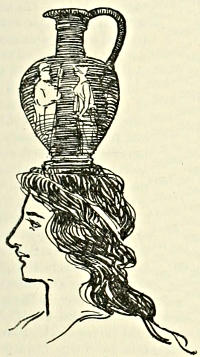
Water Carrier
But in the meanwhile succours were approaching for the relief of Antipater.
Leonnatus had come down to take possession of his satrapy, with
instructions from Perdiccas, to aid Eumenes in the conquest of Cappadocia.
But, if he was ever in earnest about this enterprise, he was soon diverted
from it by other projects. He had entered into a secret correspondence
with Olympias, who, being in open enmity with Antipater,
and very much dissatisfied with the recent arrangements,
desired to form an alliance, through her daughter
Cleopatra, the widowed queen of Epirus, with some one
powerful enough to protect her interests. The history
of such negotiations is seldom accurately known; it
only appears that Leonnatus received a letter from
Cleopatra, in which she promised him her hand—if he
came to Pella with a sufficient force, it must be supposed,
to overpower Antipater, and to secure the throne
of Macedonia for himself. He was a man of sanguine
temper, as well as of towering ambition, and eagerly
grasped at the offer. While he was occupied with this
scheme, he received a message from Antipater, now
blocked up in Lamia, to implore his speediest succour.
Antipater’s envoy was empowered to offer the hand of
one of Antipater’s daughters to Leonnatus. Eumenes
endeavoured to dissuade Leonnatus from compliance
with this request, and professed to consider his own
life as in danger from the enmity of Antipater and
Hecatæus. Leonnatus therefore thought he might
safely trust him with the secret, let him see
Cleopatra’s letters, and assured him that his
intentions were nothing less than friendly to
Antipater. But the project did not at all suit the views of Eumenes, who
saw that he should probably forfeit his satrapy with the patronage of Perdiccas,
and felt no confidence in the impetuous character of Leonnatus.
He therefore made his escape by night, accompanied only by three hundred
horse and two hundred armed slaves, with his treasure, which amounted to
five thousand talents, and fled to Perdiccas, whose favour he secured by
this proof of fidelity.
Leonnatus had now no choice left. It was in Macedonia alone that he
could hope to establish himself. But it seems that he thought it necessary
for his own sake, first to quell the insurrection of the Greeks, and then
to rid himself of Antipater. He therefore crossed over to Europe, and
marched towards the theatre of war. In Macedonia, he added a large
body of troops to his army, which then numbered no less than twenty thousand
foot and twenty-five hundred horse. When Antiphilus heard of the
approach of this formidable force, he immediately perceived that the siege
must be raised; and he seems to have taken his measures with great judgment
and energy. He fired his camp, sent the baggage and all his useless
people to Melitæa, a town on the Enipeus, which lay near his road, and
himself, crossing the chain of Othrys, advanced with his unencumbered
troops to meet Leonnatus, before he could be joined by Antipater.
Leonnatus charged with his wonted valour; but after a sharp combat, his
troops were broken, and put to flight, and driven into the marsh, where he
himself fell, pierced with many wounds. The Greeks remained masters of
the field, and erected their trophy, the third which they had won since the
beginning of the war.
To Antipater however the loss which he suffered through the defeat of
Leonnatus was more than compensated by the advantage he gained from the
death of a formidable rival; though he may not have known the whole extent
of his danger. He had followed the march of the Greeks, and it seems was
at no great distance when the battle took place; for the next day he effected
a junction with the army of Leonnatus, which immediately acknowledged him
as its chief. He now saw himself at the head of a force, before which the
allies, but for the superiority of their cavalry, would not have been able to
stand. Still, such was the terror inspired by the Thessalian horse, that he
did not venture to descend into the plain; and he had probably already received
intelligence of the approach of Craterus. He therefore advanced along
the higher ground on the skirts of the plain towards the borders of Macedonia.
Antiphilus and Menon could only watch his movements, and made no attempt
to obstruct them; but remained in the central vale of Thessaly.
In the meanwhile the Athenians, who had undertaken the whole burden
of the war on the sea, had been defeated on what they were used to consider
as their own element. The Macedonian admiral Clitus, with his 240 sail,
gained two victories over the Athenians, who were commanded by Eetion, and
destroyed a great number of their ships. Soon after, when the Macedonians
had become masters of the sea, a squadron was sent, with a strong body of
troops, Macedonians as well as mercenaries, under the command of Micion,
to invade Attica. Phocion led as strong a force as could be mustered to meet
the enemy, who had landed on the eastern coast, not far from Marathon,
and was overrunning the country. But the enemy was defeated, and driven
back to his ships with great loss, and Micion was left among the slain. So
that even this naval war, though it probably inflicted a severe injury on the
Athenians, terminated in a manner which reminded them of better days.
Not long after, the aspect of affairs in Thessaly was again changed by the
arrival of Craterus. He had brought, beside the veterans, four thousand
heavy-armed, one thousand Persian bowmen and slingers, and fifteen hundred
cavalry. He probably entered Thessaly by one of the western passes,
as this was the direction which Antipater had taken. When they had joined
their forces, Craterus resigned the supreme command to his colleague.
They then marched down into the plain, where the allies were posted, and
encamped near the banks of the Peneus. The Macedonian army now
amounted to between forty thousand and fifty thousand heavy infantry,
three thousand light troops, and five thousand cavalry. The Greeks were
little more than half as numerous; for the Ætolians had not returned
to the camp. It became evident to Antiphilus and Menon that they must
hazard a battle or soon be deserted by the greater part of their troops.
The engagement took place on the plain of Crannon, a little to the west of
the road between Larissa and Pharsalus, not far from the foot of a range of
low hills which stretch across from the Enipeus to the Peneus. It began, as
before, with the cavalry. That of the Macedonians was probably commanded
by Craterus, but it was still unable to cope with the Thessalians; and the
event of the day might have been similar to that in which Leonnatus fell, if
the Macedonians had not now had the advantage of two able and experienced
generals. Antipater, who was at the head of the phalanx, when he
saw his horse giving way, fell upon the enemy’s infantry. They were
quite unable to sustain the shock, but still were so ably commanded that
they retreated in good order to the adjacent high ground, and there took up
a position from which the Macedonians vainly attempted to dislodge them.
We seem to collect from this fact that Alexander was still more fortunate
in his enemies than in his officers. But Menon, perceiving the retreat of his
infantry, did not venture to prolong the combat, in which he was on the
point of gaining a decided victory; he drew off his troops, and the Macedonians
remained everywhere masters of the field.
The Greeks had not lost more than five hundred men; but though the
loss was trifling, it was the result of a defeat; and this, in such circumstances,
was inevitably fatal to their cause. Antiphilus and Menon thought
themselves forced to negotiate. Antipater at once saw that an opportunity
was presented to him of dissolving the confederacy without another blow.
When the Greek heralds came to him with proposals of peace, he declared
that he would enter into no treaty with the confederacy, but was willing to
receive envoys from the allied states separately. He knew that this would
be an irresistible temptation to each to renounce the common cause, that
it might make the better terms for itself. But to hasten their resolution, he
and Craterus laid siege to some of the Thessalian towns, among the rest to
Pharsalus, which the allies were compelled to abandon to their fate. This
proof of weakness, and the danger which extorted it, overpowered all reluctance
in the inferior states of the confederacy. One after another sent its
envoys to the Macedonian camp, and submitted to the terms dictated by
Antipater, which were unexpectedly mild. Their lenity attracted those
who still hesitated, and in a short time all had laid down their arms.
The two states which had excited and guided the insurrection, now
remained exposed to the conqueror’s vengeance, unable to afford any help to
one another—unable, had their forces been united, to offer any resistance
to him. Phocion now had the melancholy pleasure of exerting the influence
he had gained by his long connection with the enemies of his country, in her
behalf. For the readiness he showed on this occasion, we may well forgive
his gentle reproach—that if she had followed his counsels, she would not
have needed his aid; as in truth if she had followed those of Lycidas in the
Persian War, she would not have become an object of envy and hatred, and
would perhaps never have been subject to a Macedonian master. The
honour of his mediation he shared with Demades, to whom the eyes of all
were first turned in this emergency. While the storm of war was rolling
towards the frontiers of Attica, Demades sat aloof, like Achilles, an unconcerned
spectator, brooding over his dishonour, and could only be induced
to interpose by entreaties and gifts. He was a disfranchised man, who had
no right to offer his advice. But he was not inexorable; and when his
franchise was restored to him, proposed a decree, which was immediately
carried, to send envoys, Phocion and himself in the number, with full powers
to Antipater. They found the Macedonian army encamped on the site of
Thebes, and preparing to invade Attica. Antipater would be satisfied with
nothing but absolute submission.
The terms finally granted were, that they should deliver up a number of
their obnoxious orators, including Demosthenes and Hyperides; that they
should limit their franchise by a standard of property; that they should
receive a garrison in Munychia, and pay a sum of money for the cost of the
war. All the articles were accepted by the plenipotentiaries, and ratified by
the people; and soon after the Macedonian garrison marched into Munychia,
to settle the interpretation of those which had not been precisely defined.
We conclude that the Athenians had been induced to expect a revival of
the ancient limited democracy, perhaps as it existed in the time of Solon;
by which the poorest would indeed have been excluded from several offices,
but not from the privileges which they exercised in the assembly and the
courts of justice. Hopeless as the condition of the people was, it seems
doubtful whether they would have ratified the treaty, if they had known
beforehand how Antipater understood it on this point. The new regulation
which he decreed sounded very moderate, if not necessary or just; but its
practical effect was that nearly two-thirds of the citizens were disfranchised,
and many transported out of Greece. It provided that a qualification of
two thousand drachmæ should be required from every citizen, and this has
been commonly understood as the entire amount of property of every kind to
be possessed by each. If this was the case, it remains an inexplicable mystery
that out of twenty-one thousand persons then exercising the franchise, no
more than nine thousand could be found possessing that sum [£80 or $400].
To the disfranchised citizens Antipater offered a town and district in
Thrace. A great number of a higher class were formally banished.
It seems that the contribution which had been mentioned in the treaty
was not immediately exacted; perhaps was purposely reserved as an additional
security for their good behaviour. The question about Samos was
referred to the king’s council, and, by order of Perdiccas, the Athenian
colonists were soon after expelled from their possessions. The republic, it
appears, was also deprived of Lemnos, Imbros, and Scyros.
Demosthenes and his partners in misfortune had retired from the city
before the Macedonian garrison arrived, yet hardly so soon as it was heard
that Antipater was on his march against Athens. Demades proposed a decree
condemning Antipater’s victims to death. They had certainly escaped,
before they could be arrested under this decree; and their first place of refuge
was Ægina.
As the danger grew more pressing, the friends parted, seeking separate
asylums. Aristonicus and Himeræus took shelter in the Æaceum. Hyperides,
it seems, first sought refuge at the altar of Poseidon in the same
island, but afterwards passed over to Peloponnesus, and fled to the temple
of Demeter at Hermione, once deemed a shrine of awful sanctity. Demosthenes
chose the sanctuary of Poseidon in the isle of Calaurea near Trœzen.
There remained no hope of safety for the fugitives, but in the protection
of the gods. But Antipater had taken his measures to render even this
safeguard unavailing.
It was not in Athens alone that Antipater pursued the friends of liberty
to death. To carry out his purpose, he had engaged the services of a band
of men, who, from their infamous occupation, acquired the title of the
Exile-Hunters. The leader of this pack was an Italian Greek of Thurii,
named Archias. He had been a player, and afterwards, it seems, had
studied, perhaps practised, rhetoric; but we find no trace that he was connected
with any political party in Greece—where indeed, as a foreigner, he
could scarcely have been admitted into one. He served probably for
nothing but his hire; yet he displayed as much zeal in his commission, as
if he had been instigated by private enmity. He was attended on his circuit
by a guard of Thracians, and with their assistance dragged most of the
Athenian exiles—whom, as the prey for which his master most longed, he
had undertaken to seize himself—from the altars to which he found them
clinging. Aristonicus, Himeræus, and Hyperides were conveyed to Antipater,
who was then at Corinth or Cleonæ, and the first two at least were immediately
put to death. Hyperides, according to the more authentic report, was
reserved to be executed in Macedonia. But all seem to have agreed that
Antipater was not satisfied with his blood, but ordered his tongue to be
first cut out, and his remains to be cast to the dogs. His bones however
were secretly rescued by one of his kinsmen, and carried to Athens, where
they were buried in the grave of his fathers.
Demosthenes calmly awaited the coming of Archias in the temple at
Calaurea, well knowing that he would not be sheltered by the sanctity of
the place, and prepared for his end. He had dreamed, it is said, the night
before, that he was contending with Archias in a tragic part; that the
judgment of the spectators was in his favour, but that he lost the prize,
because he had not been furnished with the outward requisites of the exhibition—an
apt illustration at least of his failure in the real contest, which
was the task of his life. When Archias came to the door of the temple with
his satellites, he found Demosthenes seated. He at first addressed him in
the language of friendly persuasion, to inveigle him out of his retreat, and
offered to intercede with Antipater in his behalf.
Demosthenes listened for a time in silence to his bland professions, but
at length replied: “Archias, you never won me by your acting, nor will
you now by your promises.” When the player found that he was detected,
he flung away the mask, and threatened in earnest. “Now,” said Demosthenes,
“you speak from the Macedonian tripod; before you were only
acting: wait a little, till I have written a letter to my friends at home.”
And he took a roll, as to write, and as was his wont, when he was engaged
in composition, put the end of the reed to his mouth, and bit it; he then
covered his face with his robe, and bowed his head. According to another
report, he was seen to take something out of a piece of linen, and put it into
his mouth; the Thracians imagined that it was gold. In one way or other,
he had swallowed a poison which he had kept for this use. When he had
remained some time in this attitude the barbarians, thinking that he was
lingering through fear, began to taunt him with cowardice; and Archias,
going up to him, urged him to rise, and repeated his offers of mediation.
Demosthenes now felt the poison in his veins; he uncovered his face, rose,
and fixing his eyes on the dissembler, said, “It is time for you, Archias, to
finish the part of Creon, and to cast my body to the dogs. I quit thy
sanctuary, Poseidon, still breathing; though Antipater, and the Macedonians,
have not spared even it from pollution.” So saying, he moved with
faltering step towards the door, but had scarcely passed the altar, when he
fell with a groan, and breathed his last.
His end would undoubtedly have been more truly heroic, though not in
the sight of his own generation, if he had braved the insults and torture
which awaited him. But he must not be judged by a view of life which
had never been presented to him; according to his own, it must have
seemed base to submit to the enemy whom he had hitherto defied, for the
sake of a few days more of ignominious wretchedness. And even on
the principles of a higher philosophy he might think that the gods, who
were not able to protect him, had discharged him from their service, and
permitted him to withdraw from a post which he could no longer defend.
The ancients saw the finger of Heaven in the fate of the vile instruments
of his destruction. That of Demades will be afterwards related;
Archias ended his days in extreme indigence, under the weight of universal
contempt. It was later before Athens was permitted to do justice to
the services of her great citizen, who indeed had never lost her esteem. The
time at length came when his nephew Demochares might safely propose a
decree, by which the honours of the prytaneum and of the foremost seat at
public spectacles, were granted to his descendants, and a bronze statue was
erected in the agora to himself. It bore an inscription, corresponding in
its import to the dream which he was said to have had at Calaurea: “Had
but the strength of thy arm, Demosthenes, equalled thy spirit, never would
Greece have sunk under the foreigner’s yoke.” The statue itself was believed
in Plutarch’s time to have confirmed the general persuasion of his
innocence as to the only charge which ever threw a shade on the purity of
his political character.[42] The honours paid to his memory were not confined
to Athens. A monument was erected to him in the sanctuary where he
died, and both at Calaurea and in other parts of Greece he continued, down
to the age of Hadrian and probably as long as the memory of the past survived
there, to receive marks of public reverence approaching to the worship
of a hero.b
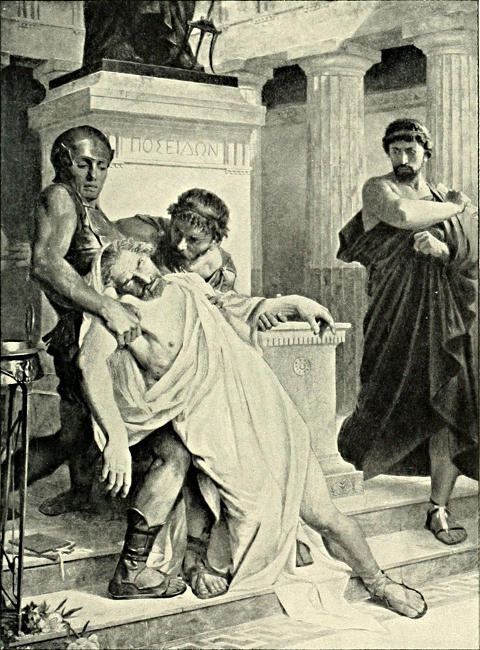
THE DEATH OF DEMOSTHENES
The violent deaths of these illustrious orators, the disfranchisement and
deportation of the Athenian demos, the suppression of the public dicasteries,
the occupation of Athens by a Macedonian garrison, and of Greece
generally by Macedonian Exile-Hunters—are events belonging to one and
the same calamitous tragedy, and marking the extinction of the autonomous
Hellenic world. Of Hyperides as a citizen we know only the general fact,
that he maintained from first to last, and with oratorical ability inferior only
to Demosthenes, a strenuous opposition to Macedonian dominion over
Greece; though his prosecution of Demosthenes respecting the Harpalian
treasure appears (so far as it comes before us) discreditable. Of Demosthenes,
we know more—enough to form a judgment of him both as citizen
and statesman. At the time of his death he was about sixty-two years of age,
and we have before us his first Philippic, delivered thirty years before (352-351
B.C.). We are thus sure that even at that early day he took a sagacious
and provident measure of the danger which threatened Grecian liberty
from the energy and encroachments of Philip. He impressed upon his
countrymen this coming danger, at a time when the older and more influential
politicians either could not or would not see it; he called aloud upon
his fellow-citizens for personal service and pecuniary contributions, enforcing
the call by all the artifices of consummate oratory, when such distasteful
propositions only entailed unpopularity upon himself. At the period when
Demosthenes first addressed these earnest appeals to his countrymen, long
before the fall of Olynthus, the power of Philip, though formidable, might
have been kept perfectly well within the limits of Macedonia and Thrace;
and would probably have been so kept, had Demosthenes possessed in 351
B.C. as much public influence as he had acquired ten years afterwards.
Throughout the whole career of Demosthenes as a public adviser, down
to the battle of Chæronea, we trace the same combination of earnest patriotism
with wise and long-sighted policy.
During the three years’ war which ended
with the battle of Chæronea, the Athenians
in the main followed his counsel;
and disastrous as were the ultimate military
results of that war, for which Demosthenes
could not be responsible, its
earlier periods were creditable and successful,
its general scheme was the best
that the case admitted, and its diplomatic
management universally triumphant. But
what invests the purposes and policy of
Demosthenes with peculiar grandeur, is,
that they were not simply Athenian, but
in an eminent degree Panhellenic also.
It was not Athens only that he sought
to defend against Philip, but the whole
Hellenic world. In this he towers above
the greatest of his predecessors for half a century before his birth—Pericles,
Archidamus, Agesilaus, Epaminondas; whose policy was Athenian, Spartan,
Theban, rather than Hellenic. He carries us back to the time of the invasion
of Xerxes and the generation immediately succeeding it, when the
struggles and sufferings of the Athenians against Persia were consecrated
by complete identity of interest with collective Greece. The sentiments to
which Demosthenes appeals throughout his numerous orations are those of
the noblest and largest patriotism—trying to inflame the ancient Grecian
sentiment of an autonomous Hellenic world, as the indispensable condition
of a dignified and desirable existence; but inculcating at the same time
that these blessings could only be preserved by toil, self-sacrifice, devotion
of fortune, and willingness to brave hard and steady personal service.
Decoration, from a Vase
From the destruction of Thebes by Alexander in 335 B.C., to the Lamian
War after his death, the policy of Athens neither was nor could be conducted
by Demosthenes. But condemned as he was to comparative inefficacy, he
yet rendered material service to Athens, in the Harpalian affair of 324 B.C.
If, instead of opposing the alliance of the city with Harpalus, he had supported
it as warmly as Hyperides, the exaggerated promises of the exile
might probably have prevailed, and war would have been declared against
Alexander. The Lamian War was not of his original suggestion, since he
was in exile at its commencement. But he threw himself into it with unreserved
ardour, and was greatly instrumental in procuring the large number
of adhesions with it obtained from so many Grecian states. In spite of its
disastrous result, it was, like the battle of Chæronea, a glorious effort for the
recovery of Grecian liberty, undertaken under circumstances which promised
a fair chance of success. There was no excessive rashness in calculating on
distractions in the empire left by Alexander; on mutual hostility among
the principal officers and on the probability of having only to make head
against Antipater and Macedonia, with little or no reinforcement from Asia.
Disastrous as the enterprise ultimately proved, yet the risk was one fairly
worth incurring, with so noble an object at stake; and could the war have
been protracted another year, its termination would probably have been very
different. We shall see this presently when we come to follow Asiatic events.
After a catastrophe so ruinous, extinguishing free speech in Greece, and dispersing
the Athenian demos to distant lands, Demosthenes himself could
hardly have desired, at the age of sixty-two, to prolong his existence as a
fugitive beyond sea.
Of the speeches which he composed for private litigants, occasionally also
for himself, before the dicastery, and of the numerous stimulating and admonitory
harangues on the public affairs of the moment, which he had addressed
to his assembled countrymen, a few remain for the admiration of posterity.
These harangues serve to us, not only as evidence of his unrivalled excellence
as an orator, but as one of the chief sources from which we are enabled
to appreciate the last phase of free Grecian life, as an acting and working
reality.
[322-319 B.C.]
The death of Demosthenes, with its tragical circumstances, is on the
whole less melancholy than the prolonged life of Phocion, as agent of
Macedonian supremacy in a city half depopulated, where he had been born
a free citizen, and which he had so long helped to administer as a free community.
The dishonour of Phocion’s position must have been aggravated
by the distress in Athens, arising both out of the violent deportation of one-half
of its free citizens, and out of the compulsory return of the Athenian
settlers from Samos—which island was now taken from Athens, after she
had occupied it forty-three years, and restored to the Samian people and to
their recalled exiles, by a rescript of Perdiccas in the name of Arrhidæus.
Occupying this obnoxious elevation, Phocion exercised authority with his
usual probity and mildness. Exerting himself to guard the citizens from
being annoyed by disorders on the part of the garrison of Munychia, he kept
up friendly intercourse with its commander Menyllus, though refusing all
presents both from him and from Antipater.
Throughout Peloponnesus, Antipater purged and remodelled the cities,
Argos, Megalopolis, and others, as he had done at Athens; installing in
each an oligarchy of his own partisans—sometimes with a Macedonian garrison—and
putting to death, deporting, or expelling hostile, or intractable,
or democratical citizens. Having completed the subjugation of Peloponnesus,
he passed across the Corinthian Gulf to attack the Ætolians, now the only
Greeks remaining unsubdued. It was the purpose of Antipater, not merely
to conquer this warlike and rude people, but to transport them in mass across
into Asia, and march them up to the interior deserts of the empire. His army
was too powerful to be resisted on even ground, so that all the more accessible
towns and villages fell into his hands. But the Ætolians defended themselves
bravely, withdrew their families into the high towns and mountain tops of
their very rugged country, and caused serious loss to the Macedonian invaders.
Nevertheless, Craterus, who had carried on war of the same kind with
Alexander in Sogdiana, manifested so much skill in seizing the points of communication,
that he intercepted all their supplies and reduced them to extreme
distress, amidst the winter which had now supervened. The Ætolians, in
spite of bravery and endurance, must soon have been compelled to surrender
from cold and hunger, had not the unexpected arrival of Antigonus from
Asia communicated such news to Antipater and Craterus, as induced them to
prepare for marching back to Macedonia, with a view to the crossing of the
Hellespont and operating in Asia. They concluded a pacification with
the Ætolians—postponing till a future period their design of deporting that
people—and withdrew into Macedonia; where Antipater cemented his alliance
with Craterus by giving to him his daughter Phila in marriage.
Another daughter of Antipater, named Nicæa, had been sent over to Asia
not long before, to become the wife of Perdiccas. That general, acting as
guardian or prime minister to the kings of Alexander’s family (who are now
spoken of in the plural number, since Roxane had given birth to a posthumous
son, called Alexander, and made king jointly with Philip Arrhidæus),
had at first sought close combination with Antipater, demanding his daughter
in marriage. But new views were presently opened to him by the intrigues
of the princess at Pella (Olympias, with her daughter Cleopatra, widow of the
Molossian Alexander)—who had always been at variance with Antipater,
even throughout the life of Alexander—and Cynane (daughter of Philip by
an Illyrian mother, and widow of Amyntas, first cousin of Alexander, but
slain by Alexander’s order) with her daughter Eurydice. It has been already
mentioned that Cleopatra had offered herself in marriage to Leonnatus, inviting
him to come over and occupy the throne of Macedonia; he had obeyed
the call, but had been slain in his first battle against the Greeks, thus relieving
Antipater from a dangerous rival. The first project of Olympias
being thus frustrated, she had sent to Perdiccas proposing to him a marriage
with Cleopatra. Perdiccas had already pledged himself to the daughter of
Antipater; nevertheless he now debated whether his ambition would not be
better served by breaking his pledge, and accepting the new proposition.
To this step he was advised by Eumenes, his ablest friend and coadjutor,
steadily attached to the interest of the regal family, and withal personally
hated by Antipater. But Alcetas, brother of Perdiccas, represented that it
would be hazardous to provoke openly and immediately the wrath of Antipater.
Accordingly Perdiccas resolved to accept Nicæa for the moment, but
to send her away after no long time, and take Cleopatra; to whom secret
assurances from him were conveyed by Eumenes. Cynane also (daughter of
Philip and widow of his nephew Amyntas), a warlike and ambitious woman,
had brought into Asia her daughter Eurydice for the purpose of espousing
the king Philip Arrhidæus. Being averse to this marriage, and probably
instigated by Olympias also, Perdiccas and Alcetas put Cynane to death.
But the indignation excited among the soldiers by this deed was so furious
as to menace their safety, and they were forced to permit the marriage of the
king with Eurydice.
All these intrigues were going on through the summer of 322 B.C., while
the Lamian War was still effectively prosecuted by the Greeks. About the
autumn of the year, Antigonus (called Monophthalmus), the satrap of Phrygia,
detected these secret intrigues of Perdiccas; who, for that and other
reasons, began to look on him as an enemy, and to plot against his life. Apprised
of his danger, Antigonus made his escape from Asia into Europe to
acquaint Antipater and Craterus with the hostile manœuvres of Perdiccas;
upon which news, the two generals, immediately abandoning the Ætolian
War, withdrew their army from Greece for the more important object of
counteracting Perdiccas in Asia.
In the spring of 321 B.C., Antipater and Craterus, having concerted
operations with Ptolemy governor of Egypt, crossed into Asia and began
their conflict with Perdiccas; who himself, having the kings along with
him, marched against Egypt to attack Ptolemy.
By the death of Perdiccas, and the defection of his soldiers, complete
preponderance was thrown into the hands of Antipater, Ptolemy, and Antigonus.
Antipater was invited to join the army, now consisting of the forces
both of Ptolemy and Perdiccas united. He was there invested with the
guardianship of the persons of the kings, and with the sort of ministerial
supremacy previously held by Perdiccas. He was however exposed to much
difficulty, and even to great personal danger, from the intrigues of the princess
Eurydice, who displayed a masculine boldness in publicly haranguing
the soldiers; and from the discontents of the army, who claimed presents,
formerly promised to them by Alexander, which there were no funds to liquidate
at the moment. At Triparadisus in Syria, Antipater made a second distribution
of the satrapies of the empire; somewhat modified, yet coinciding
in the main with that which had been drawn up shortly after the death of
Alexander. To Ptolemy was assured Egypt and Libya, to Antigonus the
Greater Phrygia, Lycia, and Pamphylia—as each had had before.
Antigonus was placed in command of the principal Macedonian army in
Asia, to crush Eumenes and the other chief adherents of Perdiccas; most of
whom had been condemned to death by a vote of the Macedonian army. After
a certain interval, Antipater himself, accompanied by the kings, returned to
Macedonia, having eluded by artifice a renewed demand on the part of his
soldiers for the promised presents. The war of Antigonus, first against
Eumenes in Cappadocia, next against Alcetas and the other partisans of Perdiccas
in Pisidia, lasted for many months, but was at length successfully
finished. Eumenes, beset by the constant treachery and insubordination of
the Macedonians, was defeated and driven out of the field. He took refuge
with a handful of men in the impregnable and well-stored fortress of Nora
in Cappadocia, where he held out a long blockade, apparently more than a
year, against Antigonus.
[319 B.C.]
Before the prolonged blockade of Nora had been brought to a close,
Antipater, being of very advanced age, fell into sickness, and presently died.
One of his latest acts was to put to death the Athenian orator Demades,
who had been sent to Macedonia as envoy to solicit the removal of the Macedonian
garrison at Munychia. Antipater had promised, or given hopes, that
if the oligarchy which he had constituted at Athens maintained unshaken
adherence to Macedonia, he would withdraw the garrison. The Athenians
endeavoured to prevail on Phocion to go to Macedonia as solicitor for the
fulfilment of this promise; but he steadily refused. Demades, who willingly
undertook the mission, reached Macedonia at a moment very untoward
for himself. The papers of the deceased Perdiccas had come into possession
of his opponents; and among them had been found a letter written to him
by Demades, inviting him to cross over and rescue Greece from her dependence
“on an old and rotten warp”—meaning Antipater. This letter gave
great offence to Antipater—the rather, as Demades is said to have been his
habitual pensioner—and still greater offence to his son Cassander; who
caused Demades with his son to be seized, first killed the son in the immediate
presence and even embrace of the father, and then slew the father himself,
with bitter invective against his ingratitude. All the accounts which
we read depict Demades, in general terms, as a prodigal spendthrift and a
venal and corrupt politician. We have no ground for questioning this statement;
at the same time, we have no specific facts to prove it.
Antipater by his last directions appointed Polysperchon, one of Alexander’s
veteran officers, to be chief administrator, with full powers on behalf
of the imperial dynasty; while he assigned to his own son Cassander only
the second place, as chiliarch, or general of the bodyguard. He thought
that this disposition of power would be more generally acceptable throughout
the empire, as Polysperchon was older and of longer military service
than any other among Alexander’s generals. Moreover, Antipater was especially
afraid of letting dominion fall into the hands of the princesses; all of
whom—Olympias, Cleopatra, and Eurydice—were energetic characters; and
the first of the three (who had retired to Epirus from enmity towards Antipater)
furious and implacable.
Promontory of Sunium
[319-318 B.C.]
But the views of Antipater were disappointed from the beginning, because
Cassander would not submit to the second place, nor tolerate Polysperchon
as his superior. Immediately after the death of Antipater, but before it
became publicly known, Cassander despatched Nicanor with pretended orders
from Antipater to supersede Menyllus in the government of Munychia. To
this order Menyllus yielded. But when after a few days the Athenian public
came to learn the real truth, they were displeased with Phocion for having
permitted the change to be made—assuming that he knew the real state of
the facts, and might have kept out the new commander. Cassander, while
securing this important post in the hands of a confirmed partisan, affected
to acquiesce in the authority of Polysperchon, and to occupy himself with a
hunting-party in the country. He at the same time sent confidential adherents
to the Hellespont and other places in furtherance of his schemes; and
especially to contract alliance with Antigonus in Asia and with Ptolemy in
Egypt. His envoys being generally well received, he himself soon quitted
Macedonia suddenly, and went to concert measures with Antigonus in Asia.
It suited the policy of Ptolemy, and still more that of Antigonus, to aid him
against Polysperchon and the imperial dynasty. On the death of Antipater,
Antigonus had resolved to make himself the real sovereign of the Asiatic
Alexandrine empire, possessing as he did the most powerful military force
within it.
Even before this time the imperial dynasty had been a name rather than
a reality; yet still a respected name. But now, the preference shown to
Polysperchon by the deceased Antipater, and the secession of Cassander,
placed all the real great powers in active hostility against the dynasty.
Polysperchon and his friends were not blind to the difficulties of their position.
The principal officers in Macedonia having been convened to deliberate,
it was resolved to invite Olympias out of Epirus, that she might assume
the tutelage of her grandson Alexander (son of Roxane); to place the
Asiatic interests of the dynasty in the hands of Eumenes, appointing him to
the supreme command; and to combat Cassander in Europe, by assuring of
themselves the general good will and support of the Greeks. This last object
was to be obtained by granting to the Greeks general enfranchisement, and by
subverting the Antipatrian oligarchies and military governments now paramount
throughout the cities.
The last hope of maintaining the unity of Alexander’s empire in Asia,
against the counter-interests of the great Macedonian officers—who were
steadily tending to divide and appropriate it—now lay in the fidelity and
military skill of Eumenes. At his disposal Polysperchon placed the imperial
treasures and soldiers in Asia; especially the brave, but faithless and disorderly
Argyraspides. Olympias also addressed to him a pathetic letter, asking
his counsel as the only friend and saviour to whom the imperial family
could now look. Eumenes replied by assuring them of his devoted adherence
to their cause. But he at the same time advised Olympias not to come
out of Epirus into Macedonia; or if she did come, at all events to abstain
from vindictive and cruel proceedings. Both these recommendations, honourable
as well to his prudence as to his humanity, were disregarded by the
old queen. She came into Macedonia to take the management of affairs;
and although her imposing title—of mother to the great conqueror—raised
a strong favourable feeling, yet her multiplied executions of the Antipatrian
partisans excited fatal enmity against a dynasty already tottering. Nevertheless
Eumenes, though his advice had been disregarded, devoted himself
in Asia with unshaken fidelity to the Alexandrine family, resisting the most
tempting invitations to take part with Antigonus against them. His example
contributed much to keep alive the same active sentiment in those around
him; indeed, without him, the imperial family would have had no sincere or
commanding representative in Asia. His gallant struggles for two years
against the greatly preponderant forces of Ptolemy, Antigonus, and Seleucus,
and against the never-ceasing treachery of his own officers and troops are
among the most memorable exploits of antiquity. While even in a military
point of view, they are hardly inferior to the combinations of Alexander himself,
they evince, besides, a flexibility and aptitude such as Alexander neither
possessed nor required, for overcoming the thousand difficulties raised by
traitors and mutineers around him. To the last, Eumenes remained unsubdued;
he was betrayed to Antigonus by the base and venal treachery of
his own soldiers, the Macedonian Argyraspides.
On learning the death of Antipater, most of the Greek cities had sent
envoys to Pella. To all the governments of these cities, composed as they
were of his creatures, it was a matter of the utmost moment to know what
course the new Macedonian authority would adopt. Polysperchon, persuaded
that they would all adhere to Cassander, and that his only chance of
combating that rival was by enlisting popular sympathy and interests in
Greece, or at least by subverting these Antipatrian oligarchies—drew up in
conjunction with his counsellors a proclamation which he issued in the name
of the dynasty.
This proclamation directed the removal of all the garrisons, and the subversion
of all the oligarchies, established by Antipater after the Lamian War.
It ordered the recall of the host of exiles then expelled. It revived the state
of things prevalent before the death of Alexander—which indeed itself had
been, for the most part, an aggregate of macedonising oligarchies interspersed
with Macedonian garrisons. To the existing Antipatrian oligarchies,
however, it was a death-blow; and so it must have been understood by
the Grecian envoys—including probably deputations from the exiles, as
well as envoys from the civic governments—to whom Polysperchon delivered
it at Pella. Not content with the general edict, Polysperchon addressed
special letters to Argos and various other cities, commanding that the Antipatrian
leading men should be banished with confiscation of property, and in
some cases put to death; the names being probably furnished to him by the
exiles. Lastly, as it was clear that such stringent measures could not be
executed without force—the rather as these oligarchies would be upheld by
Cassander from without—Polysperchon resolved to conduct a large military
force into Greece; sending thither first, however, a considerable detachment,
for immediate operations, under his son Alexander.
To Athens, as well as to other cities, Polysperchon addressed special
letters, promising restoration of the democracy and recall of the exiles. At
Athens, such change was a greater revolution than elsewhere, because
the multitude of exiles and persons deported had been the greatest. To the
existing nine thousand Athenian citizens, it was doubtless odious and alarming;
while to Phocion, with the other leading Antipatrians, it threatened
not only loss of power, but probably nothing less than the alternative of
flight or death. The state of interests at Athens, however, was now singularly
novel and complicated. There were the Antipatrians and the nine
thousand qualified citizens, there were the exiles, who, under the new
edict, speedily began re-entering the city, and reclaiming their citizenship
as well as their property. Polysperchon and his son were known to be
soon coming with a powerful force. Lastly, there was Nicanor, who held
Munychia with a garrison, neither for Polysperchon, nor for the Athenians,
but for Cassander; the latter being himself also expected with a force from
Asia. Here then were several parties—each distinct in views and interests
from the rest, some decidedly hostile to each other.
The first contest arose between the Athenians and Nicanor respecting
Munychia; which they required him to evacuate, pursuant to the recent
proclamation. Nicanor on his side returned an evasive answer, promising
compliance as soon as circumstances permitted, but in the meantime entreating
the Athenians to continue in alliance with
Cassander, as they had been with his father Antipater.
He seems to have indulged hopes of prevailing
on them to declare in his favour—and not
without plausible grounds, since the Antipatrian
leaders and a proportion of the nine thousand
citizens could not but dread the execution of
Polysperchon’s edict. And he had also what was
of still greater moment—the secret connivance
and support of Phocion: who put himself in intimate
relation with Nicanor, as he had before done
with Menyllus—and who had greater reason than
any one else to dread the edict of Polysperchon.
Foreseeing the gravity of the impending contest,
Nicanor had been secretly introducing fresh
soldiers into Munychia. Presently, making an
unexpected attack from Munychia and Salamis, he
took Piræus by surprise, placed both the town and
harbour under military occupation, and cut off its
communication with Athens by a ditch and palisade.
On this palpable aggression, the Athenians
rushed to arms. But Phocion as general damped
their ardour, and even declined to head them in an
attack for the recovery of Piræus before Nicanor
should have had time to strengthen himself in it.
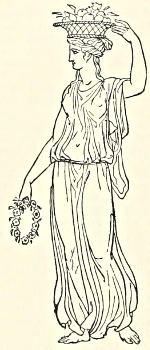
Greek Peasant
(After Hope)
The occupation of Piræus in addition to Munychia
was a serious calamity to the Athenians,
making them worse off than they had been even
under Antipater. Piræus, rich, active, and commercial,
containing the Athenian arsenal, docks,
and muniments of war, was in many respects more
valuable than Athens itself—for all purposes of
war, far more valuable. Cassander had now an excellent place of arms and
base, which Munychia alone would not have afforded, for his operations in
Greece against Polysperchon; upon whom therefore the loss fell hardly less
severely than upon the Athenians. Now Phocion, in his function as general,
had been forewarned of the danger, might have guarded against it, and
ought to have done so. This was a grave dereliction of duty, and admits
of hardly any other explanation except that of treasonable connivance. It
seems that Phocion, foreseeing his own ruin and that of his friends in the
triumph of Polysperchon and the return of the exiles, was desirous of favouring
the seizure of Piræus by Nicanor, as a means of constraining Athens
to adopt the alliance with Cassander; which alliance indeed would probably
have been brought about, had Cassander reached Piræus by sea sooner
than the first troops of Polysperchon by land. Phocion was here guilty, at
the very least, of culpable neglect, and probably of still more culpable
treason, on an occasion seriously injuring both Polysperchon and the Athenians;
a fact which we must not forget, when we come to read presently the
bitter animosity exhibited against him.
The news that Nicanor had possessed himself of Piræus, produced a
strong sensation. Presently arrived a letter addressed to him by Olympias
herself, commanding him to surrender the place to the Athenians, upon
whom she wished to confer entire autonomy. But Nicanor declined obedience
to her order, still waiting for support from Cassander. The arrival of
Alexander (Polysperchon’s son) with a body of troops, encouraged the Athenians
to believe that he was come to assist in carrying Piræus by force, for
the purpose of restoring it to them. Their hopes, however, were again disappointed.
Though encamped near Piræus, Alexander made no demand for
the Athenian forces to co-operate with him in attacking it; but entered into
open parley with Nicanor, whom he endeavoured to persuade or corrupt into
surrendering the place. When this negotiation failed, he resolved to wait
for the arrival of his father, who was already on his march towards Attica
with the main army.
[318 B.C.]
It was Phocion and his immediate colleagues who induced Alexander to
adopt this insidious policy; to decline reconquering Piræus for the Athenians,
and to appropriate it for himself. To Phocion, the reconstitution
of autonomous Athens—with its democracy and restored exiles, and without
any foreign controlling force—was an assured sentence of banishment, if
not of death. Not having been able to obtain protection from the foreign
force of Nicanor and Cassander, he and his friends resolved to throw themselves
upon that of Alexander and Polysperchon. They went to meet
Alexander as he entered Attica, represented the impolicy of his relinquishing
so important a military position as Piræus, while the war was yet
unfinished, and offered to co-operate with him for this purpose, by proper
management of the Athenian public. Alexander was pleased with these
suggestions, accepted Phocion with the others as his leading adherents at
Athens, and looked upon Piræus as a capture to be secured for himself.
Numerous returning Athenian exiles accompanied Alexander’s army. It
seems that Phocion was desirous of admitting the troops, along with the
exiles, as friends and allies into the walls of Athens, so as to make Alexander
master of the city; but that this project was impracticable in consequence
of the mistrust created among the Athenians by the parleys of Alexander
with Nicanor.
The strategic function of Phocion, however—so often conferred and re-conferred
upon him—and his power of doing either good or evil, now
approached its close. As soon as the returning exiles found themselves in
sufficient numbers, they called for a revision of the list of state officers, and
for the re-establishment of the democratical forms. They passed a vote to
depose those who had held office under the Antipatrian oligarchy, and who
still continued to hold it down to the actual moment. Among these Phocion
stood first: along with him were his son-in-law Charicles, the Phalerean
Demetrius, Callimedon, Nicocles, Thudippus, Hegemon, and Philocles.
These persons were not only deposed, but condemned—some to death, some
to banishment and confiscation of property. Demetrius, Charicles, and
Callimedon sought safety by leaving Attica; but Phocion and the rest
merely went to Alexander’s camp, throwing themselves upon his protection
on the faith of the recent understanding. Alexander not only received them
courteously, but gave them letters to his father Polysperchon, requesting
safety and protection for them, as men who had embraced his cause, and
who were still eager to do all in their power to support him. Armed with
these letters, Phocion and his companions went through Bœotia and Phocis
to meet Polysperchon on his march southward. They were accompanied by
Dinarchus and by a Platæan named Solon, both of them passing for friends
of Polysperchon.
The Athenian democracy, just reconstituted, which had passed the recent
condemnatory votes, was disquieted at the news that Alexander had espoused
the cause of Phocion and had recommended the like policy to his father.
It was possible that Polysperchon might seek, with his powerful army, both
to occupy Athens and to capture Piræus, and might avail himself of Phocion
(like Antipater after the Lamian War) as a convenient instrument of
government. It seems plain that this was the project of Alexander, and
that he counted on Phocion as a ready auxiliary in both. Now the restored
democrats, though owing their restoration to Polysperchon, were
much less compliant towards him than Phocion had been. Not only would
they not admit him into the city, but they would not even acquiesce in his
separate occupation of Munychia and Piræus. On the proposition of
Agnonides and Archestratus, they sent a deputation to Polysperchon accusing
Phocion and his comrades of high treason; yet at the same time claiming
for Athens the full and undiminished benefit of the late regal proclamation—autonomy
and democracy, with restoration of Piræus and Munychia free
and ungarrisoned.
As the sentiment now prevalent at Athens evinced clearly that Phocion
could not be again useful to him as an instrument, Polysperchon heard his
defence with impatience, interrupted him several times, and so disgusted him
that he at length struck the ground with his stick, and held his peace.
Hegemon, another of the accused, was yet more harshly treated. The sentence
could not be doubtful. Phocion and his companions were delivered
over as prisoners to the Athenian deputation, together with a letter from
the king, intimating that in his conviction they were traitors, but that he
left them to be judged by the Athenians—now restored to freedom and
autonomy.
The Macedonian Clitus was instructed to convey them to Athens as
prisoners under a guard. Mournful was the spectacle as they entered the
city; being carried along the Ceramicus in carts, through sympathising
friends and an embittered multitude, until they reached the theatre, wherein
the assembly was to be convened.
The common feeling of antipathy against him burst out into furious manifestations.
Agnonides the principal accuser, supported by Epicurus and
Demophilus, found their denunciations welcomed and even anticipated, when
they arraigned Phocion as a criminal who had lent his hand to the subversion
of the constitution, to the sufferings of his deported fellow-citizens, and
to the holding of Athens in subjection under a foreign potentate; in addition
to which, the betrayal of Piræus to Nicanor constituted a new crime—fastening
on the people the yoke of Cassander, when autonomy had been
promised to them by the recent imperial edict. After the accusation was
concluded, Phocion was called on for his defence; but he found it impossible
to obtain a hearing. Attempting several times to speak, he was as often
interrupted by angry shouts; several of his friends were cried down in like
manner; until at length he gave up the case in despair, and exclaimed:
“For myself, Athenians, I plead guilty; I pronounce against myself the
sentence of death for my political conduct; but why are you to sentence
these men near me, who are not guilty?”
Greek Terra-cotta Jar
(In the British Museum)
“Because they are your friends, Phocion,” was the exclamation of those
around. Phocion then said no more; while Agnonides proposed a decree, to
the effect that the assembled people should decide by show of hands, whether
the persons now arraigned were guilty or not; and that if declared guilty,
they should be put to death. Some persons present cried out that the penalty
of torture ought to precede death: but this savage proposition, utterly
at variance with Athenian law in respect to citizens, was repudiated not less
by Agnonides than by the Macedonian officer Clitus. The decree was then
passed; after which the show of hands was called for. Nearly every hand
in the assembly was held up in condemnation; each man even rose from his
seat to make the effect more imposing; and some went so far as to put on
wreaths in token of triumph.
After sentence, the five condemned persons, Phocion, Nicocles, Thudippus,
Hegemon, and Pythocles, were consigned to the supreme magistrates
of Police, called the Eleven, and led to prison for the purpose of having the
customary dose of poison administered. Hostile bystanders ran alongside,
taunting and reviling them. It is even said that one man planted himself
in the front, and spat upon Phocion; who turned to the public officers and
exclaimed, “Will no one check this indecent fellow?” This was the
only emotion which he manifested; in other respects, his tranquillity and
self-possession were resolutely maintained, during this soul-subduing march
from the theatre to the prison, amidst the wailings of his friends, the broken
spirit of his four comrades, and the fiercest demonstrations of antipathy from
his fellow-citizens generally. One ray of comfort presented itself as he
entered the prison. It was the day on which the Knights celebrated their
festal procession with wreaths on their heads in honour of Zeus. Several
of these horsemen halted in passing, took off their wreaths, and wept as they
looked through the gratings of the prison.
Being asked whether he had anything to tell his son Phocus, Phocion
replied: “I tell him emphatically, not to hold evil memory of the Athenians.”
The draught of hemlock was then administered to all five—to
Phocion last. Having been condemned for treason, they were not buried
in Attica; nor were Phocion’s friends allowed to light a funeral pile for the
burning of his body; which was carried out of Attica into the Megarid, by
a hired agent named Conopion, and there burned by fire obtained at Megara.
The wife of Phocion, with her maids, poured libations and marked the spot
by a small mound of earth; she also collected the bones and brought them
back to Athens in her bosom, during the secrecy of night. She buried them
near her own domestic hearth, with this address: “Beloved Hestia, I confide
to thee these relics of a good man. Restore them to his own family vault,
as soon as the Athenians shall come to their senses.”[43]
After a short time (we are told by Plutarch) the Athenians did thus
come to their senses. They discovered that Phocion had been a faithful and
excellent public servant, repented of their severity towards him, celebrated
his funeral obsequies at the public expense, erected a statue in his honour, and
put to death Agnonides by public judicial sentence; while Epicurus and
Demophilus fled from the city and were slain by Phocion’s son.
These facts are ostensibly correct; but Plutarch omits to notice the
real explanation of them. Within two or three months after the death
of Phocion, Cassander, already in possession of Piræus and Munychia, became
also master of Athens; the oligarchical or Phocionic party again
acquired predominance; Demetrius the Phalerean was recalled from exile,
and placed to administer the city under Cassander, as Phocion had administered
it under Antipater.
We cannot indeed read without painful sympathy the narrative of an
old man above eighty,—personally brave, mild, and superior to all pecuniary
temptation, so far as his positive administration was concerned,—perishing
under an intense and crushing storm of popular execration. But
when we look at the whole case—when we survey, not merely the details
of Phocion’s administration, but the grand public objects which those details
subserved, and towards which he conducted his fellow-citizens—we shall
see that this judgment is fully merited. In Phocion’s patriotism—for so
doubtless he himself sincerely conceived it—no account was taken of Athenian
independence; of the autonomy or self-management of the Hellenic
world; of the conditions, in reference to foreign kings, under which alone
such autonomy could exist. He had neither the Panhellenic sentiment of
Aristides, Callicratidas, and Demosthenes, nor the narrower Athenian sentiment,
like the devotion of Agesilaus to Sparta, and of Epaminondas to Thebes.
To Phocion it was indifferent whether Greece was an aggregate of autonomous
cities, with Athens as first or second among them, or one of the satrapies
under the Macedonian kings. Now this was among the most fatal defects
of a Grecian public man.
It was precisely during the fifty years of Phocion’s political and military
influence, that the Greeks were degraded from a state of freedom, into absolute
servitude. In so far as this great public misfortune can be imputed to
anyone man—to no one was it more ascribable than to Phocion. He was
strategus during most of the long series of years when Philip’s power was
growing; it was his duty to look ahead for the safety of his countrymen,
and to combat the yet immature giant. He heard the warnings of Demosthenes,
and he possessed exactly those qualities which were wanting to
Demosthenes—military energy and aptitude. Had he lent his influence
to inform the short-sightedness, to stimulate the inertia, to direct the armed
efforts, of his countrymen, the kings of Macedon might have been kept
within their own limits, and the future history of Greece might have been
altogether different. Unfortunately, he took the opposite side. He acted
with Æschines and the Philippisers; without receiving money from Philip,
he did gratuitously all that Philip desired—by nullifying and sneering
down the efforts of Demosthenes and the other active politicians. After
the battle of Chæronea, Phocion received from Philip first, and from Alexander
afterwards, marks of esteem not shown towards any other Athenian.
This was both the fruit and the proof of his past political action—anti-Hellenic
as well as anti-Athenian.
Having done much, in the earlier part of his life, to promote the subjugation
of Greece under the Macedonian kings, he contributed somewhat,
during the latter half, to lighten the severity of their dominion; and it is
the most honourable point in his character that he always refrained from
abusing their marked favour towards himself, for purposes either of personal
gain or of oppression over his fellow-citizens. Alexander not only wrote
letters to him, even during the plenitude of imperial power, in terms of respectful
friendship, but tendered to him the largest presents—at one time
the sum of one hundred talents [£20,000 or $100,000]; at another time the
choice of four towns on the coast of Asia Minor, as Xerxes gave to Themistocles.
He even expressed his displeasure when Phocion, refusing everything,
consented only to request the liberation of three Grecian prisoners
confined at Sardis. The intense and unanimous wrath of the people against
him is an instructive, though a distressing spectacle. It was directed, not
against the man or the administrator—for in both characters Phocion had
been blameless, except as to the last collusion with Nicanor in the seizure of
the Piræus—but against his public policy. It was the last protest of extinct
Grecian freedom, speaking as it were from the tomb in a voice of
thunder, against that fatal system of mistrust, inertia, self-seeking, and
corruption, which had betrayed the once autonomous Athens to a foreign
conqueror.e
CHAPTER LXI. THE FAILURE OF GRECIAN FREEDOM — HELLAS AT PEACE — ATHENS UNDER DEMETRIUS; SPARTA BEHIND WALLS — THE LAST ACTS OF OLYMPIAS’ POWER — PTOLEMY IN GREECE — ATHENS PASSIVE AND SERVILE — SUCCESS OF DEMETRIUS IN GREECE — BATTLE OF IPSUS
[318-309 B.C.]
We have already mentioned that Polysperchon with his army was in
Phocis when Phocion was brought before him, on his march towards Peloponnesus.
Before he reached Attica, Cassander arrived at Piræus to join
Nicanor with a fleet of thirty-five ships and four thousand soldiers obtained
from Antigonus. On learning this fact, Polysperchon hastened his march
also, and presented himself under the walls of Athens and Piræus with a
large force of twenty thousand Macedonians, four thousand Greek allies,
one thousand cavalry, and sixty-five elephants; animals which were now
seen for the first time in Greece. He at first besieged Cassander in Piræus,
but finding it difficult to procure subsistence in Attica for so numerous an
army, he marched with the larger portion into Peloponnesus, leaving his son
Alexander with a division to make head against Cassander. Either approaching
in person the various Peloponnesian towns, or addressing them by means
of envoys, he enjoined the subversion of the Antipatrian oligarchies, and the
restoration of liberty and free speech to the mass of the citizens. In most
of the towns, this revolution was accomplished; but in Megalopolis, the
oligarchy held out, not only forcing Polysperchon to besiege the city, but
even defending it against him successfully. His admiral Clitus was soon
afterwards defeated in the Propontis, with the loss of his whole fleet, by
Nicanor (whom Cassander had sent from Piræus) and Antigonus.
After these two defeats, Polysperchon seems to have evacuated Peloponnesus,
and to have carried his forces across the Corinthian Gulf into Epirus,
to join Olympias. His party was greatly weakened all over Greece, and that
of Cassander proportionally strengthened. The first effect of this was the
surrender of Athens. The Athenians in the city, including all or many of
the restored exiles, could no longer endure that complete severance from the
sea, to which the occupation of Piræus and Munychia by Cassander had
reduced them. Athens without a port was hardly tenable; in fact, Piræus
was considered by its great constructor, Themistocles, as more indispensable
to the Athenians than Athens itself. It was agreed that they should become
friends and allies of Cassander; that they should have full enjoyment of
their city, with the port Piræus, their ships and revenues; that the exiles
and deported citizens should be readmitted; that the political franchise
should for the future be enjoyed by all citizens who possessed one thousand
drachmæ of property and upwards; that Cassander should hold Munychia
with a governor and garrison, until the war against Polysperchon was
brought to a close; and that he should also name some one Athenian citizen,
in whose hands the supreme government of the city should be vested. Cassander
named Demetrius the Phalerean (i.e., an Athenian of the deme
Phalerum), one of the colleagues of Phocion.
This convention restored substantially at Athens the Antipatrian government;
yet without the severities which had marked its original establishment,
and with some modifications in various ways. It made Cassander
virtually master of the city (as Antipater had been before him), by means
of his governing nominee, upheld by the garrison, and by the fortification of
Munychia; which had now been greatly enlarged and strengthened, holding
a practical command over Piræus, though that port was nominally relinquished
to the Athenians. But there was no slaughter of orators, no expulsion of
citizens; moreover, even the minimum of one thousand drachmæ, fixed for
the political franchise, though excluding the multitude, must have been felt
as an improvement compared with the higher limit of two thousand drachmæ
prescribed by Antipater. Cassander was not, like his father, at the head of
an overwhelming force, master of Greece. He had Polysperchon in the field
against him with a rival army and an established ascendency in many of the
Grecian cities; it was therefore his interest to abstain from measures of
obvious harshness towards the Athenian people.b
Subsequent events, in Greece itself first of all, offer sufficient explanation
of what the Peace of 311 meant, so far as the freedom of the Grecian states
was concerned. And yet it appears the old magic of the word did not cease
to delude the mind and inflame the heart—for did not that word comprehend
everything they thought they now lacked and had once enjoyed?
Free their city republics could yet certainly be, or become—free after a
certain fashion; but independent, scarce one of them. Powers far superior
stood round on every side; and although full of active men ready to be hired
for fighting, these little states were too poor to bring up considerable armies,
too jealous and bitter about one another to make a reliable alliance, and
lastly the public spirit of their citizens was too decayed to permit any possible
hope of a radically better state of things. Their day was over. Only
the forms of a great monarchy could have held together this restless life
which was fretting itself away; but whatever attempt had been made in this
direction had taken no root among a people who were entirely separatist, and
whose ideas of citizenship never went beyond the limits of their various
cities. The very qualities that so peculiarly fitted the Greek spirit to serve
as the fermenting leaven that should work through the peoples of Asia and
forward their development, incapacitated it for the work of retaining its independent
politics and keeping pace with the new developments of the time.
The situation of Sparta in these times is a strange one. The laws of
Lycurgus and the old forms still linger there, but the old spirit has gone
out, even to the last trace. It is a reign of the basest immorality. The citizens
have dwindled to a few hundreds, the constitution of Lycurgus, formally
observed, is a lie. The narrower the intellectual circle in which
thought may move, the cruder must be the notions that obtain. Literature
and science, the comfort and hope of the rest of Greece, were still, even to
this day, proscribed in Sparta. Sparta had no other interest in the situation
except that in her dominion was the universal recruiting ground for all
parties—the peninsula of Tænarus—and distinguished Spartans were always
glad to take the field as mercenaries. Even the son of the aged king Cleomenes
II, Acrotatus, led a mercenary army to Tarentum and Sicily in 315,
revolting those in whose pay he fought by his bloodthirsty savagery and his
unnatural passions. He came home to Sparta dishonoured, and died before
he could inherit from his father.
At the death of Cleomenes (309), Cleonymus, a worthy brother to Acrotatus
in dissoluteness and arrogance, demanded the kingdom; the Gerousia
decided in favour of the young son of Acrotatus, Areus, and after a few
years Cleonymus entered the service of Tarentum with a force of mercenaries,
to bring the name of Sparta into ignominy by behaving even worse
than his brother. At home the power of the kings, since the state no longer
existed for its business of war, was as good as gone. The ephorate ruled
as an oligarchy, and the oligarchy wanted nothing but quiet and pleasure,
wrapped up in the dead laws of Lycurgus; nothing was further from their
thoughts than the idea of winning again their old hegemony, at least in the
Peloponnese—an idea which might now have been justified by the distraction
of Greece and the strife of parties that was bursting afresh into flames.
Athens affords us the most vivid glimpse into this unhappy time. How
often had the ruling party and the policy of the city changed since the
battle of Chæronea. At last in the autumn of 318, after the victory of Cassander,
the state was given a form which was anything but a democracy.
The man whom the people chose, and Cassander confirmed, as state administrator,
was Demetrius, the son of Phanostratus of Phalerus. He had grown up
in the house of Timotheus and had been educated in science and for a political
life by Theophrastus. He was a man as talented as he was vain, as versatile
in the realm of letters as he was politically characterless—for the rest, a
man of the world and its pleasures, who fell on his feet wherever he was.
It may be that in his early years he had lived like a philosopher, that
his table was laid very frugally, “only with olives in vinegar and cheese
from the islands.” And then too, when he became master of the state he
showed himself, according to some, a humane, clear-sighted, excellent statesman;
while others declare that he spent but a small proportion of the city’s
income (which with subsidies from Egypt and Macedonia he had raised
to twelve hundred talents) in administration and in keeping the city well
prepared for war; the rest went partly in public festivities and splendour,
and partly in his own riotous and dissolute living. He that would pose
in his ordinances as a reformer of Athenian morals, corrupted morals by
his more than doubtful example. Every day, it was said, he gave splendid
dinners to which a great number of guests were always invited; in his
expenditure on his table he surpassed even the Macedonians, in his elegance
he outdid Cyprians and Phœnicians; spikenard and myrrh were sprinkled
for perfume, the floor was strewn with flowers, costly carpets and paintings
decorated the rooms; he kept so extravagant, so luxurious, a table, that his
cook, who had what was left over, was able to buy three properties in two
years out of the profits he made by his sales. Demetrius spent the greatest
care upon his choice of dress, he dyed his hair fair, painted his face,
anointed his head with precious oils; he always showed a smiling countenance,
he wanted to please every one.
The most dainty and unbridled wantonness side by side with that subtle,
gracious, and witty culture, which has ever since been described by the epithet
Attic—both are characteristic of the life of Athens in those days. It
was the fashion to attend the schools of philosophy.
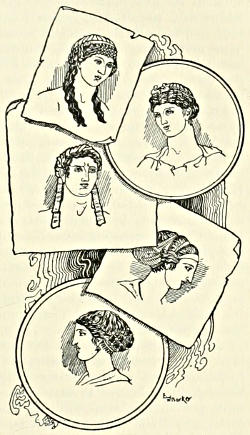
Grecian Head-dresses.
Such words as home, chastity, modesty, were no longer heard in the
Athens of that time, or they were only words. Life had all become phrases
and epigrams, ostentation and occupied idleness. Athens distributed flattery
and entertainment to the mighty ones of the earth, and permitted
herself to receive in return their gifts and gratuities. She grew more
servile as she grew more oligarchic. She played as a state the rôle of
parasite to kings and such as held power, a sponging flatterer not at all
ashamed to buy admiration and pleasures at the price of dignity. There
were only two things her people were afraid of; they were afraid of being
bored, and they were afraid of being ridiculous—and there were rich occasions
for being both. Religion had disappeared,
and with the indifference of
enlightenment superstition came in—magic,
witchcraft, astrology. Moral
conduct, out of an old habit (for morality
like the laws had been reasoned
away), was theoretically handled in the
schools and made a theme for debate and
literary duels. The two standard philosophies
of the next centuries, the Stoic
and the Epicurean, were evolving in
Athens at this period.
It was, of course, a proud thing for
Demetrius that the city was much and
profitably frequented. Trade itself was
probably livelier in Athens during these
years than at any other time and rivalled
that of Rhodes, Byzantium, and Alexandria.
According to a census which
was probably undertaken during the
year Demetrius was archon (309), the
population of Attica amounted to 21,000
citizens, 10,000 strangers, 400,000 slaves—certainly
a great number of inhabitants
for a territory of little more than
forty square miles.c
[318-317 B.C.]
The acquisition of Athens by Cassander,
followed up by his capture of
Panactum and Salamis, and seconded
by his moderation towards the Athenians,
procured for him considerable support in Peloponnesus, whither he
proceeded with his army. Many of the cities, intimidated or persuaded,
joined him and deserted Polysperchon; while the Spartans, now feeling for
the first time their defenceless condition, thought it prudent to surround
their city with walls. This fact, among many others contemporaneous,
testifies emphatically how the characteristic sentiments of the Hellenic
autonomous world were now dying out everywhere. The maintenance of
Sparta as an unwalled city was one of the deepest and most cherished of
the Lycurgean traditions; a standing proof of the fearless bearing and
self-confidence of the Spartans against dangers from without. The erection
of the walls showed their own conviction, but too well borne out by the
real circumstances around them, that the pressure of the foreigner had
become so overwhelming as hardly to leave them even safety at home.
[317-311 B.C.]
The warfare between Cassander and Polysperchon became now embittered
by a feud among the members of the Macedonian imperial family.
King Philip Arrhidæus and his wife Eurydice, alarmed and indignant at the
restoration of Olympias, which Polysperchon was projecting, solicited aid
from Cassander, and tried to place the force in Macedonia at his disposal.
In this however they failed.
Olympias, assisted not only by Polysperchon, but by the Epirot prince
Æacides, made her entry into Macedonia out of Epirus, apparently in the
autumn of 317 B.C. She brought with her Roxane and her child—the
widow and son of Alexander the Great. The Macedonian soldiers, assembled
by Philip Arrhidæus and Eurydice to resist her, were so overawed by her
name and the recollection of Alexander, that they refused to fight, and thus
insured to her an easy victory. Philip and Eurydice became her prisoners;
the former she caused to be slain; to the latter she offered only an option
between the sword, the halter, and poison. The old queen next proceeded
to satiate her revenge against the family of Antipater. One hundred leading
Macedonians, friends of Cassander, were put to death, together with his
brother Nicanor; while the sepulchre of his deceased brother Iollas, accused
of having poisoned Alexander the Great, was broken up.
During the winter, Olympias remained thus completely predominant in
Macedonia; where her position seemed strong, since her allies the Ætolians
were masters of the pass at Thermopylæ, while Cassander was kept employed
in Peloponnesus by the force under Alexander, son of Polysperchon. But
Cassander, disengaging himself from these embarrassments, and eluding Thermopylæ
by a maritime transit to Thessaly, seized the Perrhæbian passes
before they had been put under guard, and entered Macedonia without
resistance. Olympias, having no army competent to meet him in the field,
was forced to shut herself up in the maritime fortress of Pydna, with Roxane,
the child Alexander, and Thessalonice daughter of her late husband Philip,
son of Amyntas.
Here Cassander blocked her up for several months by sea as well as by
land, and succeeded in defeating all the efforts of Polysperchon and Æacides
to relieve her. In the spring of the ensuing year (316 B.C.), she was forced
by intolerable famine to surrender. Cassander promised her nothing more
than personal safety, requiring from her the surrender of the two great
fortresses, Pella and Amphipolis, which made him master of Macedonia.
Presently however the relatives of those numerous victims, who had
perished by order of Olympias, were encouraged by Cassander to demand
her life in retribution. They found little difficulty in obtaining a verdict of
condemnation against her from what was called a Macedonian assembly.
Nevertheless, such was the sentiment of awe and reverence connected with
her name, that no one except these injured men themselves could be found
to execute the sentence. She died with a courage worthy of her rank and
domineering character. Cassander took Thessalonice to wife, confined Roxane
with the child Alexander in the fortress of Amphipolis—where (after a
certain interval) he caused both of them to be slain.
While Cassander was thus master of Macedonia, and while the imperial
family were disappearing from the scene in that country, the defeat and
death of Eumenes (which happened nearly at the same time as the capture
of Olympias) removed the last faithful partisan of that family in Asia.
But at the same time it left in the hands of Antigonus such overwhelming
preponderance throughout Asia, that he aspired to become vicar and master
of the entire Alexandrine empire, as well as to avenge upon Cassander the
extirpation of the regal family. His power appeared indeed so formidable
that Cassander of Macedonia, Lysimachus of Thrace, Ptolemy of Egypt,
and Seleucus of Babylonia, entered into a convention, which gradually
ripened into an active alliance against him.
[317-315 B.C.]
During the struggles between these powerful princes, Greece appears
simply as a group of subject cities, held, garrisoned, grasped at, or coveted,
by all of them. Polysperchon, abandoning all hopes in Macedonia after the
death of Olympias, had been forced to take refuge among the Ætolians,
leaving his son Alexander to make the best struggle that he could in Peloponnesus;
so that Cassander was now decidedly preponderant throughout
the Hellenic regions. After fixing himself on the throne of Macedonia, he
perpetuated his own name by founding, on the isthmus of the peninsula of
Pallene and near the site where Potidæa had stood, the new city of Cassandrea.
Passing through Bœotia, he undertook the task of restoring the city of
Thebes, which had been destroyed twenty years previously by Alexander
the Great, and had ever since existed only as a military post on the ancient
citadel called Cadmea. The other Bœotian towns, to whom the old Theban
territory had been assigned, were persuaded or constrained to relinquish it;
and Cassander invited from all parts of Greece the Theban exiles or their
descendants. From sympathy with these exiles, and also with the ancient
celebrity of the city, many Greeks, even from Italy and Sicily, contributed
to the restoration. The Athenians, now administered by Demetrius Phalereus
under Cassander’s supremacy, were particularly forward in the work;
the Messenians and Megalopolitans, whose ancestors had owed so much to the
Theban Epaminondas, lent strenuous aid. Thebes was re-established in
the original area which it had occupied before Alexander’s siege; and was
held by a Cassandrian garrison in the Cadmea, destined for the mastery of
Bœotia and Greece.
After some stay at Thebes, Cassander advanced towards Peloponnesus.
Alexander (son of Polysperchon) having fortified the isthmus, he was
forced to embark his troops with his elephants at Megara, and cross over
the Saronic Gulf to Epidaurus. He dispossessed Alexander of Argos, of
Messenia, and even of his position on the isthmus, where he left a powerful
detachment, and then returned to Macedonia. His increasing power raised
both apprehension and hatred in the bosom of Antigonus, who endeavoured
to come to terms with him, but in vain. Cassander preferred the alliance
with Ptolemy, Seleucus, and Lysimachus—against Antigonus, who was now
master of nearly the whole of Asia, inspiring common dread to all of them.
Accordingly, from Asia to Peloponnesus, with arms and money Antigonus
despatched the Milesian Aristodemus to strengthen Alexander against
Cassander; whom he further denounced as an enemy of the Macedonian
name, because he had slain Olympias, imprisoned the other members of the
regal family, and re-established the Olynthian exiles. He caused the absent
Cassander to be condemned by what was called a Macedonian assembly,
upon these and other charges.
Antigonus further proclaimed, by the voice of this assembly, that all the
Greeks should be free, self-governing, and exempt from garrisons or military
occupation. It was expected that these brilliant promises would enlist partisans
in Greece against Cassander; accordingly Ptolemy, ruler of Egypt,
one of the enemies of Antigonus, thought fit to issue similar proclamations a
few months afterwards, tendering to the Greeks the same boon from himself.
These promises, neither executed nor intended to be executed, by either of
the kings, appear to have produced little or no effect upon the Greeks.
[315-312 B.C.]
The arrival of Aristodemus in Peloponnesus had reanimated the party
of Alexander (son of Polysperchon), against whom Cassander was again
obliged to bring his full forces from Macedonia. Though successful against
Alexander at Argos, Orchomenos, and other places, Cassander was not able
to crush him, and presently thought it prudent to gain him over. He offered
to him the separate government of Peloponnesus, though in subordination to
himself; Alexander accepted the offer—becoming Cassander’s ally—and
carried on war, jointly with him, against Aristodemus, with varying success,
until he was presently assassinated by some private enemies. Nevertheless
his widow Cratesipolis, a woman of courage and energy, still maintained
herself in considerable force at Sicyon.
Cassander’s most obstinate enemies were the Ætolians, of whom we now
first hear formal mention as a substantive confederacy. These Ætolians
became the allies of Antigonus as they had been before of Polysperchon,
extending their predatory ravages even as far as Attica. Protected against
foreign garrisons, partly by their rude and fierce habits, partly by their
mountainous territory, they were almost the only Greeks who could still be
called free. Cassander tried to keep them in check through their neighbours
the Acarnanians, whom he induced to adopt a more concentrated habit
of residence, consolidating their numerous petty townships into a few considerable
towns,—Stratus, Sauria, and Agrinium,—convenient posts for
Macedonian garrisons. He also made himself master of Leucas, Apollonia,
and Epidamnus, defeating the Illyrian king Glaucias, so that his dominion
now extended across from the Thermaic to the Adriatic Gulf. His general
Philippus gained two important victories over the Ætolians and Epirots,
forcing the former to relinquish some of their most accessible towns.
The power of Antigonus in Asia underwent a material diminution, by
the successful and permanent establishment which Seleucus now acquired
in Babylonia; from which event the era of the succeeding Seleucidæ takes
its origin. In Greece, however, Antigonus gained ground on Cassander. He
sent thither his nephew Ptolemy with a large force to liberate the Greeks,
or in other words, to expel the Cassandrian garrisons; while he at the same
time distracted Cassander’s attention by threatening to cross the Hellespont
and invade Macedonia. This Ptolemy (not the Egyptian) expelled the soldiers
of Cassander from Eubœa, Bœotia, and Phocis; having taken Chalcis,
Oropus, Eretria, and Carystus, he entered Attica and presented himself before
Athens. So much disposition to treat with him was manifested in the
city, that Demetrius the Phalerean was obliged to gain time by pretending
to open negotiations with Antigonus, while Ptolemy withdrew from Attica.
Nearly at the same epoch, Apollonia, Epidamnus, and Leucas, found means,
assisted by an armament from Corcyra, to drive out Cassander’s garrisons,
and to escape from his dominion. The affairs of Antigonus were now prospering
in Greece, but they were much thrown back by the discontent and
treachery of his admiral Telesphorus, who seized Elis and even plundered the
sacred treasures of Olympia. Ptolemy presently put him down, and restored
these treasures to the god.
[312-308 B.C.]
In the ensuing year, a convention was concluded between Antigonus, on
one side, and Cassander, Ptolemy (the Egyptian) and Lysimachus, on the
other, whereby the supreme command in Macedonia was guaranteed to Cassander,
until the maturity of Alexander son of Roxane; Thrace being at
the same time assured to Lysimachus, Egypt to Ptolemy, and the whole
of Asia to Antigonus. It was at the same time covenanted by all, that the
Hellenic cities should be free. Towards the execution of this last clause,
however, nothing was actually done. Nor does it appear that the treaty had
any other effect, except to inspire Cassander with increased jealousy about
Roxane and her child; both of whom (as has been already stated) he caused
to be secretly assassinated soon afterwards, by the governor Glaucias, in the
fortress of Amphipolis, where they had been confined. The forces of Antigonus,
under his general Ptolemy, still remained in Greece. But this general
presently (310 B.C.) revolted from Antigonus, and placed them in co-operation
with Cassander; while Ptolemy of Egypt, accusing Antigonus of having
contravened the treaty by garrisoning various Grecian cities, renewed the
war and the triple alliance against him.
Polysperchon—who had hitherto maintained a local dominion over various
parts of Peloponnesus, with a military force distributed in Messene and
other towns—was now encouraged by Antigonus to espouse the cause of
Heracles (son of Alexander by Barsine), and to place him on the throne
of Macedonia in opposition to Cassander. This young prince Heracles now
seventeen years of age, was sent to Greece from Pergamus in Asia, and his
pretensions to the throne were assisted not only by a considerable party in
Macedonia itself, but also by the Ætolians. Polysperchon invaded Macedonia,
with favourable prospects of establishing the young prince; yet he
thought it advantageous to accept treacherous propositions from Cassander,
who offered to him partnership in the sovereignty of Macedonia, with an independent
army and dominion in Peloponnesus. Polysperchon, tempted
by these offers, assassinated the young prince Heracles, and withdrew his
army towards Peloponnesus. But he found such unexpected opposition, in
his march through Bœotia, from Bœotians and Peloponnesians, that he was
forced to take up his winter quarters in Locris (309 B.C.). From this time
forward, as far as we can make out, he commanded in southern Greece as
subordinate ally or partner of Cassander.
The assassination of Heracles was speedily followed by that of Cleopatra,
sister of Alexander the Great, and daughter of Philip and Olympias. She
had been for some time at Sardis, nominally at liberty, yet under watch by
the governor, who received his orders from Antigonus; she was now preparing
to quit that place, for the purpose of joining Ptolemy in Egypt, and of
becoming his wife. She had been invoked as auxiliary, or courted in marriage,
by several of the great Macedonian chiefs, without any result. Now,
however, Antigonus, afraid of the influence which her name might throw
into the scale of his rival Ptolemy, caused her to be secretly murdered as
she was preparing for her departure; throwing the blame of the deed on
some of her women, whom he punished with death.
All the relatives of Alexander the Great (except Thessalonice wife of
Cassander, daughter of Philip by a Thessalian mistress) thus successively
perished, and all by the orders of one or other among his principal officers.
The imperial family, with the prestige of its name thus came to an end.
[308-307 B.C.]
Ptolemy of Egypt now set sail for Greece with a powerful armament.
He acquired possession of the important cities—Sicyon and Corinth—which
were handed over to him by Cratesipolis, widow of Alexander son of
Polysperchon. He then made known by proclamation his purpose as a liberator,
inviting aid from the Peloponnesian cities themselves against the garrisons
of Cassander. From some he received encouraging answers and
promises; but none of them made any movement, or seconded him by armed
demonstrations. He thought it prudent therefore to conclude a truce with
Cassander and retire from Greece, leaving however secure garrisons in
Sicyon and Corinth. The Grecian cities had now become tame and passive.
Feeling their own incapacity of self-defence, and averse to auxiliary efforts—which
brought upon them enmity without any prospect of advantage—they
awaited only the turns of foreign interference and the behests of the
potentates around them.
The Grecian ascendency of Cassander, however, was in the following
year exposed to a graver shock than it had ever yet encountered, by the
sudden invasion of Demetrius called Poliorcetes, son of Antigonus. This
young prince, sailing from Ephesus with a formidable armament, contrived
to conceal his purposes so closely, that he actually entered the harbour of
Piræus (on the 26th of the month Thargelion—May) without expectation,
or resistance from any one; his fleet being mistaken for the fleet of the Egyptian
Ptolemy. The Phalerean Demetrius, taken unawares, and attempting
too late to guard the harbour, found himself compelled to leave it in possession
of the enemy, and to retire within the walls of Athens; while Dionysius,
the Cassandrian governor, maintained himself with his garrison in Munychia,
yet without any army competent to meet the invaders in the field. This
accomplished Phalerean, who had administered for ten years as the viceroy
and with the force of Cassander, now felt his position and influence at
Athens overthrown, and even his personal safety endangered. He obtained
permission to retire to Thebes, from whence he passed over soon after to
Ptolemy in Egypt. The Athenians in the city declared in favour of Demetrius
Poliorcetes; who however refused to enter the walls until he should
have besieged and captured Munychia, as well as Megara, with their Cassandrian
garrisons. In a short time he accomplished both these objects.
Indeed energy, skill, and effective use of engines in besieging fortified
places, were among the most conspicuous features in his character; procuring
for him the surname whereby he is known to history. He proclaimed
the Megarians free, levelling to the ground the fortifications of Munychia,
as an earnest to the Athenians that they should be relieved for the future
from all foreign garrison.
[307-304 B.C.]
After these successes, Demetrius Poliorcetes made his triumphant entry
into Athens. He announced to the people, in formal assembly, that they
were now again a free democracy, liberated from all dominion either of soldiers
from abroad or oligarchs at home. He also promised them a further
boon from his father Antigonus and himself—150,000 medimni of corn for
distribution, and ship-timber in quantity sufficient for constructing one hundred
triremes. Both these announcements were received with grateful
exultation. The feelings of the people were testified not merely in votes of
thanks and admiration towards the young conqueror, but in effusions of
unmeasured and exorbitant flattery. Stratocles (who has already been
before us as one of the accusers of Demosthenes in the Harpalian affair) with
others exhausted their invention in devising new varieties of compliment and
adulation. Antigonus and Demetrius were proclaimed to be not only kings,
but gods and saviours; a high priest of these saviours was to be annually
chosen, after whom each successive year was to be named (instead of being
named after the first of the nine archons, as had hitherto been the custom),
and the dates of decrees and contracts commemorated; the month Munychion
was re-named as Demetrion; two new tribes, to be called Antigonias
and Demetrias, were constituted in addition to the preceding ten; the
annual senate was appointed to consist of six hundred members instead of
five hundred; the portraits and exploits of Antigonus and Demetrius were
to be woven, along with those of Zeus and Athene, into the splendid and
voluminous robe periodically carried in procession,
as an offering at the Panathenaic festival;
the spot of ground where Demetrius had
alighted from his chariot, was consecrated with
an altar erected in honour of Demetrius
Catæbates or the Descender. Several other
similar votes were passed, recognising, and
worshipping as gods, the saviours Antigonus
and Demetrius. Nay, we are told that temples
or altars were voted to Phila-Aphrodite,
in honour of Phila wife of Demetrius; and a
like compliment was paid to his two mistresses,
Leæna and Lamia. Altars are said to have
been also dedicated to Adimantus and others,
his convivial companions or flatterers. At the
same time the numerous statues which had
been erected in honour of the Phalerean Demetrius
during his decennial government, were
overthrown, and some of them even turned to
ignoble purposes, in order to cast greater scorn
upon the past ruler. The demonstrations of
servile flattery at Athens, towards Demetrius
Poliorcetes, were in fact so extravagantly overdone,
that he himself is said to have been
disgusted with them, and to have expressed
contempt for these degenerate Athenians of
his own time.
Greek Jug
The most fulsome votes of adulation proposed
in honour of Demetrius Poliorcetes by his partisans, though perhaps
disapproved by many, would hardly find a single pronounced opponent. One
man, however, there was, who ventured to oppose several of the votes—the
nephew of Demosthenes, Demochares; who deserves to be commemorated as
the last known spokesman of free Athenian citizenship. We know only that
such were his general politics, and that his opposition to the obsequious
rhetor Stratocles ended in banishment, four years afterwards. He appears to
have acted as a general during this period, and to have been active in
strengthening the fortifications and military equipment of the city.
The altered politics of Athens were manifested by impeachment against
Demetrius Phalereus and other leading partisans of the late Cassandrian government.
He and many others had already gone into voluntary exile; when
their trials came on, they were not forthcoming, and all were condemned to
death. But all those who remained, and presented themselves for trial, were
acquitted; so little was there of reactionary violence on this occasion.
The friendship of this obnoxious Phalerean, and of Cassander also,
towards the philosopher Theophrastus, seems to have been one main cause
which occasioned the enactment of a restrictive law against the liberty of
philosophising. It was decreed, on the proposition of a citizen named Sophocles,
that no philosopher should be allowed to open a school or teach,
except under special sanction obtained from a vote of the senate and people.
Such was the disgust and apprehension occasioned by the new restriction,
that all the philosophers with one accord left Athens. This spirited protest,
against authoritative restriction on the liberty of philosophy and teaching,
found responsive sympathy among the
Athenians. The celebrity of the schools
and professors was in fact the only characteristic
mark of dignity still remaining to
them—then their power had become extinct,
and when even their independence
and free constitution had degenerated into
a mere name.
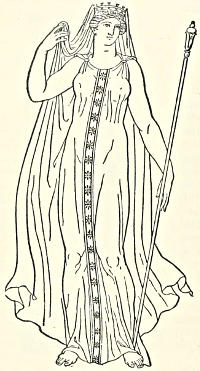
Ceres
(From a vase)
Athenian envoys were despatched to
Antigonus in Asia, to testify the gratitude
of the people, and communicate the recent
complimentary votes. Antigonus not
only received them graciously, but sent to
Athens, according to the promise made by
his son, a large present of 150,000 medimni
of wheat, with timber sufficient for one
hundred ships. He at the same time directed
Demetrius to convene at Athens a
synod of deputies from the allied Grecian
cities, where resolutions might be taken for
the common interests of Greece. It was
his interest at this moment to raise up
a temporary self-sustaining authority in
Greece, for the purpose of upholding the
alliance with himself, during the absence
of Demetrius—whom he was compelled
to summon into Asia with his army, requiring
his services for the war against
Ptolemy in Syria and Cyprus.
The following three years were spent
by Demetrius: (1) In victorious operations
near Cyprus, defeating Ptolemy and making himself master of that
island; after which Antigonus and Demetrius assumed the title of kings,
and the example was followed by Ptolemy, in Egypt, by Lysimachus, in
Thrace, and by Seleucus in Babylonia, Mesopotamia, and Syria; thus
abolishing even the titular remembrance of Alexander’s family. (2) In an
unsuccessful invasion of Egypt by land and sea, repulsed with great loss.
(3) In the siege of Rhodes. The brave and intelligent citizens of this
island resisted for more than a year the most strenuous attacks and the most
formidable siege-equipments of Demetrius Poliorcetes. All their efforts
however would have been vain had they not been assisted by large reinforcements
and supplies from Ptolemy, Lysimachus, and Cassander. Such
are the conditions under which alone even the most resolute and intelligent
Greeks can now retain their circumscribed sphere of autonomy. The siege
was at length terminated by a compromise; the Rhodians submitted to enrol
themselves as allies of Demetrius, yet under proviso not to act against Ptolemy.
Towards the latter they carried their grateful devotion so far as to
erect a temple to him, called the Ptolemæum, and to worship him (under
the sanction of the oracle of Ammon) as a god. Amidst the rocks and
shoals through which Grecian cities were now condemned to steer, menaced
on every side by kings more powerful than themselves, and afterwards by
the giant republic of Rome—the Rhodians conducted their political affairs
with greater prudence and dignity than any other Grecian city.
[304-302 B.C.]
Shortly after the departure of Demetrius from Greece to Cyprus, Cassander
and Polysperchon renewed the war in Peloponnesus and its neighbourhood.
We make out no particulars respecting this war. The Ætolians were
in hostility with Athens, and committed annoying depredations. The fleet
of Athens, repaired or increased by the timber received from Antigonus, was
made to furnish thirty quadriremes to assist Demetrius in Cyprus, and was
employed in certain operations near the island of Amorgos, wherein it suffered
defeat. But we can discover little respecting the course of the war,
except that Cassander gained ground upon the Athenians, and that about
the beginning of 303 B.C., he was blockading or threatening to blockade
Athens. The Athenians invoked the aid of Demetrius Poliorcetes, who,
having recently concluded an accommodation with the Rhodians, came again
across from Asia, with a powerful fleet and army, to Aulis in Bœotia. He
was received at Athens with demonstrations of honour equal or superior to
those which had marked his previous visit. He seems to have passed a year
and a half, partly at Athens, partly in military operations carried successfully
over many parts of Greece. He celebrated, as president, the great
festival of the Heræa at Argos; on which occasion he married Didamia, sister
of Pyrrhus, the young king of Epirus. He prevailed on the Sicyonians to
transfer to a short distance the site of their city, conferring upon the new
city the name of Demetrias. At a Grecian synod, convened in Corinth
under his own letters of invitation, he received by acclamation the appointment
of leader or emperor of the Greeks, as it had been conferred on Philip
and Alexander. He even extended his attacks as far as Leucas and Corcyra.
The greater part of Greece seems to have been either occupied by his garrisons,
or enlisted among his subordinates.
So much was Cassander intimidated by these successes, that he sent
envoys to Asia, soliciting peace from Antigonus; who, however, elate and
full of arrogance, refused to listen to any terms short of surrender at discretion.
Cassander, thus driven to despair, renewed his applications to
Lysimachus, Ptolemy, and Seleucus. All these princes felt equally menaced
by the power and dispositions of Antigonus, and all resolved upon an energetic
combination to put him down.
[302-301 B.C.]
After uninterrupted prosperity in Greece, throughout the summer of
302 B.C., Demetrius returned from Leucas to Athens, about the month of
September, near the time of the Eleusinian mysteries. He was welcomed
by festive processions, hymns, pæans, choric dances, and bacchanalian odes
of joyous congratulation. One of these hymns is preserved, sung by a
chorus of ithyphalli—masked revellers, with their heads and arms encircled
by wreaths—clothed in white tunics, and in feminine garments.
Effusions such as these, while displaying unmeasured idolatry and subservience
towards Demetrius, are yet more remarkable, as betraying a loss
of force, a senility, and a consciousness of defenceless and degraded position,
such as we are astonished to find publicly proclaimed at Athens. It is not
only against the foreign potentates that the Athenians avow themselves
incapable of self-defence, but even against the incursions of the Ætolians,—Greeks
like themselves, though warlike, rude, and restless. When such
were the feelings of a people—once the most daring, confident, and organising,
and still the most intelligent, in Greece, we may see that the history of
the Greeks as a separate nation or race is reaching its close; and that from
henceforward they must become merged in one or other of the stronger currents
that surround them.
After his past successes, Demetrius passed some months in enjoyment and
luxury at Athens. He was lodged in the Parthenon, being considered as
the guest of the goddess Athene. But his dissolute habits provoked the
louder comments, from their being indulged in such a domicile; while the
violences which he offered to beautiful youths of good family led to various
scenes truly tragical. The subservient manifestations of the Athenians
towards him, however, continued unabated. It is even affirmed that, in
order to compensate for something which he had taken amiss, they passed
a formal decree, on the proposition of Stratocles, declaring that everything
which Demetrius might command was holy in regard to the gods, and just
in regard to men. The banishment of Demochares is said to have been
brought on by his sarcastic comments upon this decree. In the month
Munychion (April) Demetrius mustered his forces and his Grecian allies
for a march into Thessaly against Cassander; but before his departure, he
was anxious to be initiated in the Eleusinian mysteries. It was however
not the regular time for this ceremony; the Lesser Mysteries being celebrated
in February, the Greater in September. The Athenians overruled
the difficulty by passing a special vote, enabling him to be initiated at once,
and to receive in immediate succession the preparatory and the final initiation,
between which ceremonies a year of interval was habitually required.
Accordingly, he placed himself disarmed in the hands of the priests, and
received both first and second initiation in the month of April, immediately
before his departure from Athens.
[301-294 B.C.]
Demetrius conducted into Thessaly an army of fifty-six thousand men,
of whom twenty-five thousand were Grecian allies—so extensive was his
sway at this moment over the Grecian cities. But after two or three months
of hostilities, partially successful, against Cassander, he was summoned into
Asia by Antigonus to assist in meeting the formidable army of the allies—Ptolemy,
Seleucus, Lysimachus, and Cassander. Before retiring from
Greece, Demetrius concluded a truce with Cassander, whereby it was stipulated
that the Grecian cities, both in Europe and Asia, should be permanently
autonomous and free from garrison or control. This stipulation
served only as an honourable pretext for leaving Greece; Demetrius had
little expectation that it would be observed. In the ensuing spring was
fought the decisive battle of Ipsus in Phrygia (300 B.C.), by Antigonus
and Demetrius, against Ptolemy, Seleucus, and Lysimachus; with a large
army and many elephants on both sides. Antigonus, completely defeated,
was slain; his age was more than eighty years. His Asiatic dominion was
broken up, chiefly to the profit of Seleucus, whose dynasty became from
henceforward ascendant, from the coast of Syria eastward to the Caspian
Gates and Parthia; sometimes, though imperfectly, farther eastward, nearly
to the Indus.
The effects of the battle of Ipsus were speedily felt in Greece. The
Athenians passed a decree proclaiming themselves neutral, and excluding
both the belligerent parties from Attica. Demetrius, retiring with the
remnant of his defeated army, and embarking at Ephesus to sail to Athens,
was met on the voyage by Athenian envoys, who respectfully acquainted
him that he would not be admitted. At the same time, his wife Didamia,
whom he had left at Athens, was sent away by the Athenians under an
honourable escort to Megara, while some ships of war which he had left in
the Piræus were also restored to him. Demetrius, indignant at this unexpected
defection of a city which had recently heaped upon him such fulsome
adulation, was still further mortified by the loss of most of his other possessions
in Greece. His garrisons were for the most part expelled, and the
cities passed into Cassandrian keeping or dominion. His fortunes were
indeed partially restored by concluding a peace with Seleucus, who married
his daughter. This alliance withdrew Demetrius to Syria, while Greece
appears to have fallen more and more under the Cassandrian parties. It
was one of these partisans, Lachares, who, seconded by Cassander’s soldiers,
acquired a despotism at Athens such as had been possessed by the Phalerean
Demetrius, but employed in a manner far more cruel and oppressive.
Various exiles from his tyranny invited Demetrius Poliorcetes, who
passed over again from Asia into Greece, recovered portions of Peloponnesus,
and laid siege to Athens. He blocked up the city by sea and
land, so that the pressure of famine presently became intolerable. Lachares
having made his escape, the people opened their gates to Demetrius, not
without great fear of the treatment awaiting them. But he behaved with
forbearance, and even with generosity. He spared them all, supplied them
with a large donation of corn, and contented himself with taking military
occupation of the city, naming his own friends as magistrates. He put
garrisons, however, not only into Piræus and Munychia, but also into the
hill called Museum, a part of the walled circle of Athens itself (298 B.C.).
While Demetrius was thus strengthening himself in Greece, he lost all
his footing both in Cyprus, Syria, and Cilicia, which passed into the hands
of Ptolemy and Seleucus. New prospects however were opened to him in
Macedonia by the death of Cassander (his brother-in-law, brother of his
wife Phila) and the family feuds supervening thereupon. Philippus, eldest
son of Cassander, succeeded his father, but died of sickness after something
more than a year. Between the two remaining sons, Antipater and Alexander,
a sanguinary hostility broke out. Antipater slew his mother Thessalonice,
and threatened the life of his brother, who in his turn invited aid
both from Demetrius and from the Epirotic king Pyrrhus. Pyrrhus being
ready first, marched into Macedonia, and expelled Antipater; receiving as
his recompense the territory called Tymphæa (between Epirus and Macedonia)
together with Acarnania, Amphilochia, and the town of Ambracia,
which became henceforward his chief city and residence. Antipater sought
shelter in Thrace with his father-in-law Lysimachus; by whose order, however,
he was presently slain. Demetrius, occupied with other matters, was
more tardy in obeying the summons; but, on entering into Macedonia, he
found himself strong enough to dispossess and kill Alexander (who had
indeed invited him, but is said to have laid a train for assassinating him),
and seized the Macedonian crown; not without the assent of a considerable
party, to whom the name and the deeds of Cassander and his sons were
alike odious.
[294-279 B.C.]
Demetrius became thus master of Macedonia, together with the greater
part of Greece, including Athens, Megara, and much of Peloponnesus. He
undertook an expedition into Bœotia, for the purpose of conquering Thebes;
in which attempt he succeeded, not without a double siege of that city.
But Greece as a whole was managed by Antigonus (afterwards called Antigonus
Gonatas) son of Demetrius, who maintained his supremacy unshaken
during all his father’s life-time; even though Demetrius was deprived of
Macedonia by the temporary combination of Lysimachus with Pyrrhus, and
afterwards remained (until his death in 283 B.C.) a captive in the hands of
Seleucus. After a brief possession of the crown of Macedonia successively
by Seleucus, Ptolemy Ceraunus, Meleager, Antipater, and Sosthenes—Antigonus
Gonatas regained it in 277 B.C. His descendants, the Antigonid
kings, maintained it until the battle of Pydna in 168 B.C.; when Perseus,
the last of them, was overthrown, and his kingdom incorporated with the
Roman conquests.
Of Greece during this period we can give no account, except that the greater
number of its cities were in dependence upon Demetrius and his son Antigonus—either
under occupation by Macedonian garrisons, or ruled by local
despots who leaned on foreign mercenaries and Macedonian support. The
spirit of the Greeks was broken, and their habits of combined sentiment and
action had disappeared. The invasion of the Gauls indeed awakened them
into a temporary union for the defence of Thermopylæ in 279 B.C. But this
burst of spirit did not interrupt the continuance of the Macedonian dominion
in Greece, which Antigonus Gonatas continued to hold throughout most of
a long reign. He greatly extended the system begun by his predecessors,
of isolating each Grecian city from alliances with other cities in its neighbourhood—planting
in most of them local despots, and compressing the
most important by means of garrisons. Among all Greeks, the Spartans and
the Ætolians stood most free from foreign occupation, and were the least
crippled in their power of self-action. The Achæan League too developed
itself afterwards as a renovated sprout from the ruined tree of Grecian liberty,
though never attaining to anything better than a feeble and puny life,
nor capable of sustaining itself without foreign aid.b
At this point Grote ends his immortal work and takes farewell of Grecian
history in the following words:
“With this after-growth, or half-revival, I shall not meddle. It forms
the Greece of Polybius, which that author treats, in my opinion justly, as
having no history of its own, but as an appendage attached to some foreign
centre and principal among its neighbours—Macedonia, Egypt, Syria, Rome.
Each of these neighbours acted upon the destinies of Greece more powerfully
than the Greeks themselves. The Greeks to whom these volumes have been
devoted—those of Homer, Archilochus, Solon, Æschylus, Herodotus, Thucydides,
Xenophon, and Demosthenes—present as their most marked characteristic
a loose aggregation of autonomous tribes or communities, acting and
reacting freely among themselves, with little or no pressure from foreigners.
The main interest of the narrative has consisted in the spontaneous grouping
of the different Hellenic fractions, in the self-prompted co-operations and
conflicts, the abortive attempts to bring about something like an effective
federal organisation, or to maintain two permanent rival confederacies, the
energetic ambition and heroic endurance of men to whom Hellas was the
entire political world. The freedom of Hellas, the life and soul of this history
from its commencement, disappeared completely during the first years
of Alexander’s reign. After following to their tombs the generation of
Greeks contemporary with him—men like Demosthenes and Phocion, born
in a state of freedom—I have pursued the history into that gulf of Grecian
nullity which marks the succeeding century; exhibiting sad evidence of
the degrading servility, and suppliant king-worship, into which the countrymen
of Aristides and Pericles had been driven, by their own conscious weakness
under the overwhelming pressure from without.
“I cannot better complete that picture than by showing what the leading
democratical citizen became, under the altered atmosphere which now bedimmed
his city. Demochares, the nephew of Demosthenes, has been mentioned
as one of the few distinguished Athenians in this last generation.
He was more than once chosen to the highest public offices; he was conspicuous
for his free speech, both as an orator and as an historian, in the face of
powerful enemies; he remained throughout a long life faithfully attached to
the democratical constitution, and was banished for a time by its opponents.
In the year 280 B.C., he prevailed on the Athenians to erect a public monument,
with a commemorative inscription, to his uncle Demosthenes. Seven
or eight years afterwards, Demochares himself died, aged nearly eighty.
His son Laches proposed and obtained a public decree, that a statue should
be erected, with an annexed inscription, to his honour. We read in the decree
a recital of the distinguished public services whereby Demochares merited
this compliment from his countrymen. All that the proposer of the decree,
his son and fellow-citizen, can find to recite, as ennobling the last half of the
father’s public life (since his return from exile), is as follows: (1) He contracted
the public expenses, and introduced a more frugal management.
(2) He undertook an embassy to King Lysimachus, from whom he obtained
two presents for the people—one of thirty talents, the other of one hundred
talents. (3) He proposed the vote for sending envoys to King Ptolemy in
Egypt, from whom fifty talents were obtained for the people. (4) He went
as envoy to Antipater, received from him twenty talents, and delivered them
to the people at the Eleusinian festival.
“When such begging missions are the deeds for which Athens both employed
and recompensed her most eminent citizens, an historian accustomed
to the Grecian world as described by Herodotus, Thucydides, and Xenophon,
feels that the life has departed from his subject, and with sadness and
humiliation brings his narrative to a close.”b
A kindred feeling seems to have actuated most of the other prominent
historians of Greece, with the notable exception of Thirlwall. Yet from a
slightly altered point of view, there is much of interest in the story of the
later struggles of this wonderful people, against a seemingly predestined
fate. Even were it not so, our present purpose, which regards Greece not
as an isolated entity but as a part of the scheme of world history, requires
that we should follow the tragic drama to its close.a
CHAPTER LXII. THE EXPLOITS OF PYRRHUS — THE ANTECEDENTS OF PYRRHUS — THE LAST ADVENTURES OF DEMETRIUS — THE END OF LYSIMACHUS, KING OF MACEDON — DEATH OF SELEUCUS — INVASION OF THE GAULS — DEFENCE OF THE TEMPLE AT DELPHI — PYRRHUS AND THE ROMANS — PYRRHUS SUMMONED BY THE TARENTINES — PYRRHUS IN SICILY; HIS RETURN TO ITALY — MAGNA GRÆCIA SUBDUED BY THE ROMANS — RETURN OF PYRRHUS TO MACEDONIA — EXPEDITION OF PYRRHUS AGAINST SPARTA — DEATH OF PYRRHUS — ANTIGONUS GONATAS — FOOTNOTES
We now approach that dramatic moment when Greek first met Roman
in battle array. Into the tangled web of the history of this period there
flashes the scarlet thread of the life of Pyrrhus of Epirus. Though a fuller
account of his war against Italy must be deferred to the Roman history, it
will be briefly sketched here, together with a short account of his country
and his ancestors.a
Epirus, in spite of its distance from the chief centres of Greek thought
and action, and the fact that its inhabitants were hardly regarded as other
than barbarians, exerted even at an early period no small influence on Greece,
by means more especially of the oracle of Dodona. One of the earliest and
most flourishing settlements of the Greeks proper in Epirus was the Corinthian
colony of Ambracia, which gave its name to the neighbouring gulf.
The happy results of the experiment appear to have tempted other Greek
states to imitate the example, and Elatria, Bucheta, and Pandosia bore witness
to the enterprise of the people of Elis. Phœnice, still so called, was
the wealthiest of all the native cities of Epirus, and after the fall of the
Molossian kingdom the centre of an Epirotic league.
[ca. 360-288 B.C.]
The kings or rather chieftains of the Molossians, who ultimately extended
their power over all Epirus, claimed to be descended from Pyrrhus, son of
Achilles, who, according to the legend, settled in the country after the sack
of Troy, and transmitted his kingdom to Molossus, his son by Andromache.
The early history of the dynasty is very obscure; but Admetus, who lived
in the fifth century B.C., has become famous for his hospitable reception of
the banished Themistocles, in spite of the grudge that he must have harboured
against the great Athenian, who had persuaded his countrymen to
refuse the alliance tardily offered by the Molossian chief when their victory
against the Persians was already secured. He was succeeded about 429 B.C.
by his son or grandson, Tharymbas or Arymbas I, who being placed by a
decree of the people under the guardianship of Sabylinthus, chief of the
Atintanes, was educated at Athens, and thus became at a later date the
introducer of a higher kind of civilisation among his subjects. Alcetas,
the next king mentioned in history, was contemporary with Dionysius of
Syracuse (about 385 B.C.) and was indebted to his assistance for the recovery
of his throne. His son Arymbas II (who succeeded by the death of his
brother Neoptolemus) ruled with prudence and equity, and gave encouragement
to literature and the arts. To him Xenocrates of Chalcedon dedicated
his four books on the art of governing; and it is specially mentioned that
he bestowed great care on the education of his brother’s children. Troas,
one of his nieces, became his own wife; and Olympias, the other, was married
to Philip of Macedon, and had the honour of giving birth to Alexander
the Great. On the death of Arymbas, his nephew Alexander, the brother
of Olympias, was put in possession of the throne by the assistance of
Philip, who was afterwards assassinated on occasion of the marriage of the
youthful king with Philip’s daughter Cleopatra. Alexander was the first
who bore the title of king of Epirus, and he raised the reputation of his
country amongst foreign nations. His assistance having been sought by the
Tarentines against the Samnites and Lucanians, he made a descent, 332 B.C.,
at Pæstum, near the mouth of the river Silarus, and reduced several cities
of the Lucani and Bruttii; but in a second attack upon Italy he was surrounded
by the enemy, defeated, and slain, near the city Pandosia, in the
Bruttian territory.
Æacides, the son of Arymbas II, succeeded Alexander, and espoused
the cause of Olympias against Cassander; but he was dethroned by his own
soldiers, and had hardly regained his position when he fell, 313 B.C., in battle
against Philip, brother of Cassander. He had, by his wife Phthia, the celebrated
Pyrrhus, and two daughters Didamia and Troas, of whom the former
married Demetrius Poliorcetes. His brother Alcetas, who succeeded him,
continued the war with Cassander till he was defeated; and he was ultimately
put to death by his rebellious subjects, 295 B.C. The name of
Pyrrhus, who next ascended the throne, gives to the history of his country
an importance which it would otherwise never have possessed.
Born about the year 318, and claiming descent from Pyrrhus, the son of
Achilles, connected also with the royal family of Macedonia through Olympias,
the mother of Alexander the Great, he became when a mere stripling
king of the wild mountain tribes of Epirus, and learned how to fight battles
in the school of Demetrius Poliorcetes and of his father Antigonus. He
fought by their side in his seventeenth year at the memorable battle of Ipsus
in Phrygia, in which they were decisively defeated by the combined armies
of Seleucus and Lysimachus. Soon afterwards he was sent to the court of
Ptolemy of Egypt at Alexandria as a pledge for the faithful carrying out
of a treaty of alliance between Ptolemy and Demetrius, as his sister
Didamia was the wife of the latter. Through Ptolemy, whose step-daughter
Antigone he married, he was enabled to establish himself firmly on
the throne of Epirus, and he became a formidable opponent to Demetrius,
who was now king of Macedonia and the leading man in the Greek world.e
[288-285 B.C.]
Demetrius had not renounced the project of resuming his father’s kingdom.
He made immense preparations. The other kings renewed their league
in which they included Pyrrhus, who had long been the friend of Demetrius
but was now to become his rival. This rivalry was the more dangerous to
Demetrius since he had made himself hated by his insolence. One day when,
contrary to his custom, he had received all the petitions which were presented
to him, he was seen to throw them into a river as he was crossing the
bridge.
All the kings of that day made an endeavour to imitate Alexander, but
it was said that Demetrius represented him as an actor on the stage, bowing
his head to right and left, assuming majestic airs, adorning himself with a
double diadem and a purple mantle on which he had caused the sun, the
moon, and the stars to be embroidered in gold.
Pyrrhus, on the contrary, recalled Alexander by his fire and his boldness.
He was the type of the soldier and the adventurer. He loved war for itself
and despised all else. He came to the assistance of the Ætolians when they
were attacked by Demetrius, but the two kings did not meet, having both
missed their way. Whilst Demetrius ravaged Epirus, Pantarchus, one of
his lieutenants, gave battle to Pyrrhus, and during the fight provoked him
to single combat. Both were wounded, but Pyrrhus overthrew his adversary;
the Epirots, excited by the courage of their king, carried the victory, and the
Macedonians, having been conquered by him, admired him more and more.
Whilst Ptolemy raised the Greek towns against Demetrius, Lysimachus
entered Macedon by Thrace, and Pyrrhus by Epirus. Demetrius thought it
prudent to turn first against Pyrrhus, who was a foreigner, but he was not
slow to repent his action. Desertions were numerous and soon a general
mutiny broke out in the army. The soldiers had not forgiven Demetrius
for permitting the capture of Berœa, where most of them had left their wives
and their money. They went over to Pyrrhus in crowds to ask for his commands
as their general. Demetrius returned to his tent, took off his crown
and his royal mantle, assumed a dark dress and a Macedonian cap and left
the camp unnoticed. He had scarcely gone when his tent was pillaged.
Pyrrhus was proclaimed king of Macedon; but Lysimachus appeared on
the scene and demanded his share. Pyrrhus was not sufficiently certain of
the Macedonians to enter into a contest with one of Alexander’s lieutenants,
and he agreed to divide the towns and provinces of Macedonia with Lysimachus.
As Antipater, who had murdered his own mother, protested against
this arrangement and complained that he was being despoiled of his inheritance,
Lysimachus had him put to death; in him the family of Alexander
became extinct.
[285-281 B.C.]
Demetrius withdrew first to Cassandrea, a town which Cassander had
founded on the site of Potidæa. Then he passed into Greece to endeavour
to retrieve his fortunes. The Athenians, under the command of Olympiodorus,
had expelled the Macedonian garrison from the Museum and resumed
possession of the Piræus and of Munychia. They had summoned Pyrrhus,
who, after having aided them to liberate themselves, gave them the excellent
advice to receive no more kings into their city. Demetrius would have
besieged Athens, but the philosopher Crates, being sent to him, dissuaded
him in his own interest. Corinth and some portions of the Peloponnesus
still remained to him; there he left his son, Antigonus Gonatas, and set out
for Asia with such vessels as he had and about twelve thousand soldiers.
Most of the towns surrendered and several he took by force, amongst others
the town of Sardis. A few officers and soldiers passed into his camp. But
Agathocles, son of Lysimachus, appeared with a numerous army. Demetrius,
pursued across the desert, soon found himself confronted by Seleucus. The
latter presented himself unarmed before his enemy’s troops and exhorted
them to quit a brigand leader who had not even the means of paying them.
The soldiers saw the wisdom of the advice and went over to him.
Demetrius attempted to flee, but was soon dying of hunger and obliged to
give himself up to Seleucus. Lysimachus offered a large sum to have him
put to death; Antigonus Gonatas implored Seleucus to release his father,
offering to abandon all he possessed as his ransom and to surrender himself
as hostage.
Seleucus repulsed both proposals. He contented himself with preventing
this incorrigible adventurer from again trying his fortune. He gave
him a palace, park, and all the comforts of life. The besieger developed
a taste for hunting and then for games of chance. He soon accustomed himself
to this easy life, became very fat, and died of over-eating (283).
As soon as Lysimachus had nothing more to fear from Demetrius, he
turned against Pyrrhus and tried to corrupt his officers. He reproached
them for having selected for themselves an Epirot king whose ancestors had
been the slaves of Macedon, and for having preferred him to an old comrade
of Alexander. Pyrrhus could not struggle against the desertion of his troops.
A caprice of the soldiers had given him Macedon; a new caprice took it away
from him, and he withdrew to Epirus. We might think we were reading
the history of the Lower or Byzantine Empire—the fruits of military government
are everywhere the same. Macedonia was united with the kingdom of
Thrace (286); but it had not yet come to the end of the revolutions which
had continued to shake it ever since the death of Alexander. These revolutions,
always provoked by personal ambition and never by a question
of principle or national interest, refute the Utopia of monarchical stability
in a striking manner.
The polygamy practised by the Macedonian kings multiplied the rivalries
so common in royal families. Agathocles, the eldest of the sons of Lysimachus,
who had established his father’s throne on a firmer basis by his combats
with the independent Thracians and with Demetrius, died of poison administered
at the instigation of his step-mother Arsinoe, the daughter of Ptolemy.
This murder was followed by many others, for Agathocles had numerous
friends. His widow, Lysandra, who was also a daughter of Ptolemy, took
refuge with Seleucus and demanded that he should avenge her. She had with
her one of her brothers who, like all the members of the royal family of Egypt,
bore the name of Ptolemy and was surnamed Ceraunus, the thunder, on
account of his violent character. He was the eldest of the children of
Ptolemy Soter, but the intrigues of Berenice, one of his step-mothers, caused
him to be deprived of the throne. Ptolemy Soter abdicated in favour of
the son he had had by Berenice, and who reigned under the name of Ptolemy
Philadelphus (285). The eldest at first went to Lysimachus, then to
Seleucus, whom he endeavoured to interest in his favour.
Seleucus, who nourished the hope of reconstituting Alexander’s monarchy,
had an opportunity to intervene in Macedonia to avenge Lysandra and in
Egypt to support Ptolemy Ceraunus. He was undecided when Lysimachus
forestalled him by declaring war against him. The two octogenarians, in
whom age had not extinguished ambition, once more measured their forces
in a last battle at Corupedion in Phrygia.[44] Lysimachus was slain; for some
days his body was sought for in vain; it was discovered through his dog
who had guarded it and kept off the birds of prey. They buried him in
the town of Lysimachia which he had founded near Cardia on the European
bank of the Hellespont (281). The ranks of the veterans are thinning
rapidly; and little wonder,—forty troublous years had passed since Alexander
died.
[281-279 B.C.]
Seleucus assumed the title of Nicator, the conqueror. The defeat and
death of Lysimachus made him master of Asia Minor, Thrace, and Macedonia.
In the east he had extended his sway over Upper Asia as far as the Indus,
but he had given his son Antiochus the crown of the provinces beyond the
Euphrates. Antiochus might thus think that after the death of his father
he would unite under his authority all the possessions of Alexander with the
exception of Egypt. It is said that at the time when Seleucus was serving
as a common soldier in the army of the conqueror of Asia, the oracle of the
Didymean Apollo had announced to him the greatness of his future, while
advising him never to return to Europe. Nevertheless, six months after the
battle of Corupedion, he wished to take possession of Macedonia and to
end his days in his own country. He disembarked at Lysimachia and at once
offered a sacrifice. Then Ptolemy Ceraunus who had come to him as a
suppliant and had been received by him as a friend, stabbed him before the
altar (280).
The death of the last of Alexander’s companions-in-arms was not avenged.
The army which had proved faithful to none of its chiefs, proclaimed the
murderer king of Thrace and Macedon. He had no difficulty in getting rid
of his rivals. Antiochus, to whom he abandoned Asia Minor, had to subdue
the towns on the Hellespont which had revolted; Antigonus Gonatas,
involved in a struggle with a league of cities in the Peloponnesus, could not
assert his claims to Macedonia. Pyrrhus was more dangerous, but at this
moment the Tarentines, who were at war with Rome, summoned him to their
aid. Ptolemy Ceraunus furnished him with troops, elephants, and ships to
pass over into Italy, gave him his daughter in marriage, and undertook to
protect Epirus so long as he should be absent. Pyrrhus set out at once and
the assassin might fancy that he was to enjoy his usurped throne in peace.
He did not enjoy it long; the very next year a formidable invasion of
barbarians swooped down on Macedonia and Greece.
[279-278 B.C.]
Numerous tribes of Gauls, or Galatæ, as the Greeks called them, had
been established, for how long is not known, on the banks of the Danube,
when a fresh migration of Belgic Tectosages, starting from Toulouse, set in
motion those populations which, having little knowledge of the art of cultivating
the ground, found all regions too narrow for them. Two or three
hundred thousand men, divided into three bands descended like clouds of
locusts on Thrace, Macedonia, and Greece. Ptolemy Ceraunus, who in
his presumption had refused the assistance of the Dardani, was overwhelmed
with his whole army. His head was stuck on the end of a pike and paraded
about the country. The fields were laid waste, the towns closed their gates,
and the inhabitants, accustomed to rely on the protection of the soldiers,
could do nothing but groan and invoke the names of Philip and Alexander.
A Macedonian named Sosthenes urged them to defend themselves, collected
the young men and succeeded in repelling the enemy. He was offered the
crown, which he refused, desiring only the title of general. But very soon
his little army, weak and inexperienced as it was, succumbed with him to
the invasion of a new horde of barbarians which, after completing the devastation
of Macedonia turned in the direction of Greece.
The Athenians, though weakened by their struggles with the Macedonian
kings, resolved to arrest the barbarians at the pass of Thermopylæ. The
peoples of central Greece responded to their summons, but the Peloponnesians,
believing themselves to be sufficiently protected by the Isthmus of
Corinth, did not stir. The Ætolians furnished the largest number of soldiers,
but the command was conferred on the Athenians, who had taken the initiative
in resistance. Their ships were of much service to the Greek army;
they approached the shore, in spite of the difficulty of navigating amongst
the morasses, and sent a shower of arrows against the enemy. It was a
deadly fight for the barbarians; their superiority in numbers was of no
advantage to them in this narrow passage. Then, in order to compel the
Ætolians to return home, Brennus[45] detached
forty thousand men who recrossed the Sperchius
and deluged Ætolia with fire and blood. It
was the warfare of savages; nothing was spared,
neither age nor sex. As Brennus had anticipated,
the Ætolians immediately quitted Thermopylæ
to rescue or avenge their wives and
children. But already a corps of troops from
Patræ, the only town in the Peloponnesus which
had thought of coming to the rescue of the Ætolians,
had encountered the barbarians and inflicted
such slaughter upon them that less than
half returned to the camp at Thermopylæ.
[280-278 B.C.]
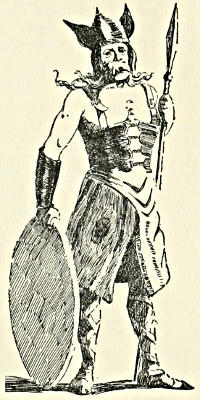
A Soldier of Gaul
The Ænianes and Heracleans, ridding themselves
of the neighbourhood of the barbarians by
an act of treachery, showed Brennus the path
by which in the old days the Persians had turned
Mount Œta. The Phocians who guarded it were
thrown into confusion and the army of the Greeks
would have suffered the same fate as the soldiers
of Leonidas, if it had not been fortunate enough
to take refuge on the Athenian vessels. The
Galatæ immediately proceeded towards Delphi;
they had heard of the riches of the temple and it was primarily for this that
they had invaded Greece. The Delphians demanded of the oracle whether they
should put the sacred treasure in a place of safety: “The god,” answered the
Pythia, “ordains that the votive offerings be left where they are; he will
himself protect his sanctuary by means of the White Virgins.” It was thus
that the Pythia indicated Artemis and Athene, the moon and the light. It
was indeed the terrors of the night which triumphed over the barbarians.
The noise of thunder, repeated by the great echoes of Parnassus, struck
them with fear. Enormous fragments of rock detached themselves from
the mountain and crushed them by thousands. Amidst the awe of the sacred
woods, a prey to the mysterious terror which was ascribed to Pan, they rushed
against one another. Enveloped in a whirlwind of hail and snow they fled
in confusion, pursued like wild beasts through the deep gorges under the irresistible
arrows of the archer who strikes from afar. Brennus ordered them
to burn their chariots and kill their ten thousand wounded who were hindering
their flight. He himself, after taking copious draughts of wine, stabbed himself
with his sword. What remained of this countless army succumbed to
hunger, fatigue, and the attacks of the Ætolians and Dardani. According
to Justin, Diodorus, and Pausanias, not one escaped.[46]
Other bands of Galatæ were destroyed about the same time by Antigonus
Gonatas who since the death of Sosthenes had returned to Macedonia.
He had left them his camp after having distributed his soldiers in the woods
and on ships. When the barbarians were filled with wine and meat he fell
unexpectedly upon them and effected a great slaughter. As these Galatæ
were strong and brave he took many of them into his pay and soon had
occasion to employ them. On the coins struck in memory of this victory
we see the god Pan, the originator of panic fears, bearing a trophy (278).
The absence of any federal link between the Greek cities of Italy
rendered them incapable of resisting the native peoples of the Samnites,
Lucanians, and Bruttians. They were thus naturally led to demand the
support of the great Roman republic, which alone could protect them.
Rome never refused her protection to those who asked for it, even if they
were at a distance from Italy,—like Marseilles which, thanks to her alliance
with the Romans, was able to extend her commerce without any fear of her
barbarian neighbours, the Ligurians and the Gauls. Rome’s first relations
with the Greek towns of Italy were those of friendship: Locri, Thurii,
and Rhegium, asked and obtained her alliance and protection. Tarentum
alone preferred to have the Romans as enemies rather than friends.
She had never had to suffer either from the tyrants of Syracuse or from
the Lucanians or the Samnites, for she was separated from them by less
powerful and less warlike populations. Under the influence of democratic
institutions she had achieved, says Strabo, an amazing prosperity. She
aspired to play a dominant part in the peninsula of Italy similar to that
which Syracuse had acquired in Sicily; it was therefore with anxiety and
jealousy that she watched the progress of the Roman power. By a mad act
of provocation the Tarentines put themselves entirely in the wrong and
rendered war with Rome inevitable. Then, according to their custom, they
called in the assistance of a foreign prince, and though on this occasion they
had chosen the bravest and most skilful captain of the day, the struggle on
which they embarked resulted in the final establishment of the dominion of
the Romans over all Italy.
[280-279 B.C.]
They summoned Pyrrhus, king of Epirus, promising him the support of
the Lucanians and Samnites. He eagerly seized the opportunity to renew
the attempt of his great-uncle, Alexander the Molossian. Ptolemy Ceraunus,
in order to rid himself of a dangerous competitor, furnished him with
soldiers and elephants. Pyrrhus founded great hopes on this expedition.
No sooner had he arrived than he caused the theatre, the gymnasiums,
and the gardens where they met to discuss politics, to be closed, forbade festivals
and all unseasonable diversions, enrolled all the citizens and had them
drilled. There were many who sought to escape but he had the doors
guarded. When this produced murmuring he took some of the malcontents
and sent them to Epirus.
Soon he heard that the Roman army was approaching. He would have
liked to await the arrival of the Lucanians and Samnites, and offered his
mediation to the consul Lævinus, but was answered that the Romans did not
accept him as arbitrator and did not dread him as a foe. The battle was
fought near the river Siris in the neighbourhood of Heraclea. The king had
his horse killed under him, and, according to Justin, was even wounded.
He sent his elephants forward; the Romans, who had never seen any, called
them the Lucanian oxen. It was they that gave Pyrrhus the victory.
When he saw the dead bodies of the Romans, all wounded in front and with
their hands on their arms: “With such men,” he said, “I should have soon
conquered the world.” He caused them to be buried in like manner with
his own soldiers (280).
Pyrrhus marched into Campania, but did not manage to surprise Capua
and was not more successful in an attempt on Naples. He went as far as
Præneste and came within sight of Rome; but the Romans had now raised a
new army; he saw the legions being restored to life like the heads of the
hydra, and fearing to be surrounded he returned to Tarentum. An embassy
was sent to him; he hoped that he was about to dictate terms of peace but
it merely came to discuss the ransom of the captives. Pyrrhus offered to
restore the prisoners without payment. Knowing that Fabricius, the chief
ambassador, was poor, he thought to win him over by proposing to repair
the errors of fortune. Fabricius answered simply that his poverty did not
trouble him and did not prevent his being highly considered in his own
country. Pyrrhus sent Cineas to Rome with presents for the wives of the
senators; it is said that these presents were refused; this is not impossible
though very extraordinary. Historians are not agreed as to the conditions
proposed. The senate would have accepted them, but a lofty speech of the
blind old Appius Claudius so worked on the assembly as to lead to its
returning Pyrrhus the answer that it would not be possible to treat with
him until he had left Italy. Cineas, on his return from Rome, told Pyrrhus
that the senate seemed to him an assembly of kings; politically speaking,
the heads of families who composed the Roman city, may indeed be compared
with the Homeric kings; but if Cineas meant to refer to the successors of
Alexander, the comparison was by no means flattering to honourable men like
Curius and Fabricius.
[279-275 B.C.]
There was nothing for it but to continue the war. A fresh encounter
took place near Asculum; Pyrrhus, whose Italian auxiliaries were armed in
the Roman fashion, had skilfully combined the formation of the legion with
that of the phalanx. But a Roman soldier cut off the trunk of an elephant:
the Lucanian oxen were not, then, invulnerable. According to the Epitome
of Titus Livius the result of the battle was doubtful. According to Plutarch
the Romans had the advantage on the first day, but on the morrow
Pyrrhus, having contrived to decoy them to ground on which he was able to
manipulate his forces, put them to flight and obliged them to take refuge in
their camp. He had lost his best soldiers, and when he was congratulated
on his success: “Another such victory,” he said, “and I shall have to return
to Epirus.” One of his followers offered to poison him for the Romans:
Fabricius denounced the treachery to him, advising him to choose his friends
better. He sent back the Roman prisoners without ransom; the senate sent
him an equal number of Greek and Italian prisoners. An armistice was
concluded and he took advantage of it to pass into Sicily (278).
Since the death of Agathocles Sicily had been continuously troubled by
the acts of brigandage perpetrated by the Mamertines established at Messana,
and by the wars of Hicetas, tyrant of Syracuse, against Phintias, tyrant of
Agrigentum. After having reigned nine years, Hicetas was dethroned by
Thynion who took his place and occupied the island of Ortygia whilst Sosistratus
was master of the rest of the town. The Carthaginians, taking advantage
of the dissensions of these two leader’s, besieged Syracuse. It was
then that the two parties implored the aid of Pyrrhus. He had some claims
to Sicily as son-in-law of Agathocles. He could not pass through Messana
for the Mamertines had made a league with the Carthaginians against him.
He disembarked at Tauromenium, whither he had been summoned by the
tyrant Tyndarion and from there he proceeded to Catana and thence to
Syracuse where he was received as a deliverer. He reconciled Thynion and
Sosistratus and joining the forces of the Syracusans to those which he had
brought with him, he expelled the Mamertines and forced them to retire to
Messana. Agrigentum, Leontini, Selinus, Segesta, and many other towns
opened their gates to him. He took Eryx, leading the assault himself, and
in the same way made himself master of Panormus the principal port of the
Carthaginians, to whom, of all their Sicilian possessions, only Lilybæum remained
(277).
After two months’ siege he judged that this place was impregnable so
long as the Carthaginians were masters of the sea. He then decided to
make a descent on Africa, after the example of Agathocles. But as he
needed sailors he required the cities to supply them and grew angry at their
tardiness and resistance; his yoke began to weigh as heavily as that of the
Carthaginians and Mamertines. He had had enough of Sicily and used the
reiterated appeals of the Tarentines and Samnites as an excuse for departure.
With great difficulty he escaped from the Carthaginian fleet, which sank
seventy of his ships, and he then fell in with a band of Mamertines who were
waiting for him on the coast of Italy. He lost his rear-guard and two of his
elephants; he was hurt and as he was retiring to dress his wound a tall soldier
came and attacked him. But Pyrrhus had a strong arm and a well-tempered
sword: he hit him a blow on the head and cut it in two. The barbarians,
struck with admiration, allowed him to continue his route. He stopped at
Locri to punish the inhabitants who had expelled his garrison, then, as he
was in want of money to pay his troops, he pillaged the temple of Core, one
of the most celebrated in Italy. But the vessels which were carrying off the
sacred treasure were thrown on the shore by a tempest. Pyrrhus, struck
with fear, replaced all the money in the treasury of the goddess and continued
his route to Tarentum.
In his absence the Romans had retaken Crotona, admitted Heraclea to
their alliance and several times defeated the Bruttians, Lucanians, and Samnites.
Weakened by these defeats the allies of Pyrrhus sent him but few
soldiers. Nevertheless he hastened to take the field to prevent the junction
of two Roman armies sent against him—the one by Samnium, the other by
Lucania. Near Beneventum he encountered the consul Curius, who was compelled
to give battle before the arrival of his colleague. But the Romans no
longer dreaded the elephants; they flung flaming tow at them. Some were
killed and others reserved for the triumph. The victory of the Romans was
complete (275). They took the camp of Pyrrhus who re-entered Tarentum
with a small number of riders. He was compelled to renounce his
projects in the west. The whole scheme had failed and he made haste to
embark on another. He told the Tarentines he had written to the kings of
Macedon and Asia for their help, and that he was going away to collect a
fresh army. He left them a garrison. The Tarentines summoned the Carthaginians
who sent their fleet to the harbour. But Milon, the commander
of the Epirot garrison, surrendered the citadel to the Romans. They entered
the town, declared it tributary to Rome and disarmed the inhabitants.
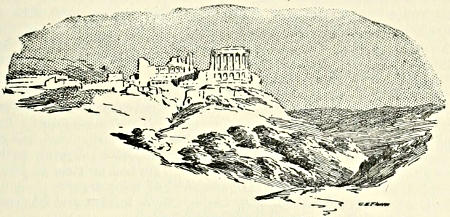
Ruined Temple near Athens
All the native peoples of southern Italy, who had welcomed Pyrrhus as a
deliverer were finally subdued to the dominion of Rome. It was a deliverance
for such Greek cities as still existed, but they were no more than the
shadow of their former selves. Although free under the protection of Rome,
they disappear obscurely from history. In the time of Strabo the name of
Magna Græcia was already an ancient memory and the Greek language was
no longer spoken save at Naples, Rhegium, and Tarentum. For want of a
federal bond between the autonomous cities, the Hellenic race with its brilliant
civilisation had gradually disappeared from the soil of Italy. The
Romans were about to enter into its inheritance that they might eventually
transmit it to Gaul and Spain. They repeopled some of the ancient Greek
colonies which had lapsed into barbarism, notably Posidonia and Hipponium
which had long been peopled, the one by the Campanians, the other by the
Bruttians and which changed their Greek names for those of Pæstum[47] and
Vibo Valentia.
[274-272 B.C.]
The sole advantage which Macedonia had derived from Alexander’s conquest
was the barren honour of furnishing royal dynasties to Egypt and
Asia. No part of the conqueror’s heritage had been more disputed between
ambitious rivals. Within the space of fifty years ten kings had succeeded
each other on the throne in consequence of as many military revolutions.
After the invasion of the Galatæ, Antigonus Gonatas, the son of Demetrius,
fancied he had secured himself in the possession of devastated Macedonia
by making a treaty with his competitor Antiochus Soter, whose daughter
he married. But military anarchy had not yet reached its term. Pyrrhus,
returning from Italy and at a loss how to pay his troops, sought an occasion
for war. He entered Macedonia simply for the purpose of collecting spoil.
Having won a few successes he remembered that he had been king of this
country, marched against Antigonus, cut to pieces the Galatæ whom he employed
as mercenaries, and took his elephants. Then he approached the
phalanx, recognised some of the captains who commanded it, addressed them
by their names and extended his hand to them. All the soldiers went over
to him. Proud of his victory over the Galatæ, he consecrated their shields
in the temple of the Itonian Athene, enlisted the barbarians, whose value he
had recognised, and put them as garrisons in the Macedonian cities. At Ægæ
they pillaged the royal tombs and scattered the bones. This called forth
complaints from the Macedonians; but Pyrrhus, as an Epirot, took little
interest in the ancient kings of Macedonia. He had no time to punish his
mercenaries, and he was soon to stand in need of their services. An opportunity
of conquering Greece had presented itself to him and he desired to
take advantage of it.
[272 B.C.]
This opportunity was offered to him by Cleonymus of Sparta, the same
who had been before him in making an expedition to Tarentum. He requested
Pyrrhus to support the rights which he pretended to have to the
throne of Sparta. The ephors had set him aside in favour of Areus, the son
of his eldest brother; and to complete his chagrin his wife Chelidonis, who
was much beloved by him, did not conceal her aversion, and showed her
preference for the son of Areus, named Acrotatus.
This seemed to Pyrrhus a sufficient pretext for invading the Peloponnesus
with twenty-five thousand footmen, two thousand horses, and twenty-four
elephants. He declared, moreover, that his sole object was to restore liberty
to the towns which Antigonus was keeping in subjection. As to the Spartans,
far from wishing them ill, he proposed, he said, to confide his younger
sons to their care, that they might be educated in the discipline of Lycurgus.
When his soldiers began pillaging, the Spartans reproached him with his
breach of faith. He answered, “Neither are you in the habit of saying beforehand
what you will do.” There had been nothing to give warning of
this aggression in time of peace and the town was not in a state of defence:
the whole army had followed the king Areus to Crete whither he had been
summoned by the Gortynians. Cleonymus would have liked to attack immediately;
but Pyrrhus preferred to wait for a capitulation which seemed
inevitable. He established his camp before Sparta believing himself certain
of being able to enter whenever he might wish.
Sparta was saved by the women. It had been proposed to send them to
Crete, a suggestion which roused their indignation. Archidamia, mother of
Acrotatus and the richest heiress in Sparta, entered the senate, sword in
hand, and protested in the name of the women against their being thought
capable of surviving the ruin of their country. The walls raised in preceding
wars left the town exposed at several points: the night was spent in digging
a great ditch parallel with the enemy’s camp, and barricades were formed on
each side by means of chariots with their wheels buried in the ground. The
women undertook a third of the work and obliged those who were to fight
next day to rest. In the morning they armed the young men and exhorted
them to die under the eyes of their mothers. During the fight, which lasted
all day, they kept close to them, handing them weapons, carrying them food
and drink and tending the wounded. But as Rollin has pointed out, if the
women of Sparta practised masculine virtues they sometimes forgot the virtues
of their sex: seeing the young Acrotatus who had fought like a lion return
covered with blood and dust, they envied the lot of Chelidonis. Plutarch
adds a detail which shows how far the Spartans carried the sacrifice of the
family to the city: the old men, he says, cried out: “Bravo, Acrotatus.
Retain Chelidonis, and may she give the country children as brave as thou.”
As to Chelidonis herself, not wishing to fall into the hands of her husband,
she had prepared a rope to hang herself if the town were taken.
The combat began again the next day. The Macedonians endeavoured
to fill up the trench with branches. Pyrrhus even succeeded in crossing it
and galloped towards the town; but his horse was killed and threw him on
a steep slope; his friends had great difficulty in rescuing him. Almost all
the Spartans were killed or wounded, and the town was on the verge of being
taken when a lieutenant of Antigonus brought help. Almost at the same time
Areus arrived from Crete with two thousand Spartans. Pyrrhus decided to
raise the siege. He turned in the direction of Argos, where one party had
summoned him to oppose another faction supported by Antigonus. Areus
pursued him as he retreated, harassing him in the defiles and destroying his
rear-guard composed of Galatæ and Molossians. To avenge the death of
his son Ptolemy, who had been killed in this fight, Pyrrhus destroyed almost
the whole Spartan army and then continued his route towards Argos.
Antigonus was occupying the heights. Pyrrhus proposed to him to
settle their quarrel in a single combat, but Antigonus answered that
if Pyrrhus was weary of life he might find many roads to death. The
Argives begged the two kings to withdraw and to permit them to remain
friends of both. They consented to do so, but during the night the partisans
of Pyrrhus admitted him into the town. The members of the opposite party
immediately summoned Antigonus. At the same time Areus arrived with
the relics of his army. Fighting went on in the streets all night in the
midst of a general confusion. Pyrrhus would have retired, but his Galatæ,
coming to his assistance, blocked the narrow streets. One of his elephants
had fallen across the gateway, another whose driver was wounded was overturning
friends and enemies indiscriminately. Pyrrhus received a blow
from the javelin of an Argive soldier and turned against the man who had
wounded him; the soldier’s mother, who, with some other women, was
watching the fight from the top of the roofs, seeing her son in danger seized
a tile and flung it at the king’s head. He fell from his horse. Though he
had removed the plume from his helmet he was recognised: his head was
cut off and taken to Antigonus. At this example of the mutability of
fortune the latter was reminded of his father Demetrius and caused a search
to be made for the body of Pyrrhus, which he burned, with the head, on a
funeral pyre. He sent the ashes to Pyrrhus’ son Helenus who returned to
Epirus (272).
[272-243 B.C.]
The history of the twenty years which followed the death of Pyrrhus
is little known. We have no guide but Justing who is not always very
reliable, and some scanty indications in Polybiush and Pausanias.i All we
know is that these twenty years were not an epoch of repose for Greece, and
still less of liberty. The death-blow of Greek liberty had been struck at
Chæronea, and the weapon had been left in the wound. The Macedonian
monarchy clung to Greece like the shirt of Nessus. Though they had been
compelled to renounce Alexander’s heritage the kings of Macedon were still
the heirs of Philip and determined to continue his work of subjugating Greece.
This policy was persistently followed by Antigonus Gonatas, who bequeathed
it to his successors. After the death of Pyrrhus he had no competitors for the
throne of Macedon. The greater part of the army of the king of Epirus
was composed of Macedonians and Galatæ who passed without difficulty into
Antigonus’ service. His rule in Greece extended over Thessaly and Eubœa,
over Corinth and a part of the Peloponnesus, exactly which part is not known:
Justin says vaguely that the Peloponnesians were delivered into his hands by
treachery. Sometimes he put garrisons into the cities, sometimes he set up
tyrants: “Most of the tyrants in Greece,” says Polybius, “date from this
Antigonus.” The isolation of the cities, their mutual jealousies and the
rivalry of the political factions, everywhere raised up interested accomplices
for the Macedonian usurpation.
Following the example of his predecessors, Antigonus Gonatas was
especially eager for the conquest of Athens. He burned the temple of
Poseidon at Colonus and the sacred wood which surrounded it. The war
lasted six or seven years. A revolt of Antigonus’ hired Galatæ scarcely
interrupted hostilities; Areus, king of Sparta, and a lieutenant of Ptolemy
Philadelphus who had been sent to the aid of Athens and might have taken
advantage of this diversion, remained inactive and the Athenians, deserted
by their allies, were obliged to receive a Macedonian garrison (268). Antigonus
also sent garrisons to Megara, Salamis, and Cape Sunium.
But about the same time Alexander, king of Epirus, made an incursion
into Macedonia to avenge the death of his father Pyrrhus, and the phalanx
went over to him, thus giving a fresh example of the facility with which
military monarchies change masters. Antigonus was absent; his son Demetrius,
who was still very young, soon recovered possession of Macedonia.
Alexander, in his turn despoiled of Epirus, took refuge amongst the Acarnanians,
who subsequently reinstated him in possession of his kingdom. This
did not prevent him from treating with the Ætolians for the partition of
Acarnania, for gratitude is by no means a royal virtue. Antigonus kept the
throne of Macedonia till his death in 243, and his dynasty maintained itself
there for more than a century, prosecuting the conquest of Greece up to the
last, till that country, exhausted by the ceaseless struggle, finally threw itself
into the arms of the Roman people.b
[272 B.C.]
Inglorious as was this termination of a career like that of Pyrrhus, the
closing scene of his life was not without some points of resemblance to its
general character. He was undoubtedly one of the nobler spirits of his age,
though it would seem that it could have been only in one which was familiar
with atrocious crimes, that he could have gained the reputation of unsullied
virtue, more particularly of probity, which we find attached to his name.
With extraordinary prowess, such as revived the image of the heroic warfare,
he combined many qualities of a great captain, and was thought by some to
be superior even to Alexander in military art. But his whole life was not
only a series of unconnected, mostly abortive, enterprises, but might be
regarded, with respect to himself, as one ill-concerted, perplexed, and bootless
adventure. From beginning to end he was the sport, not so much of
fortune, as of desires without measure or plan, of an impetuous, but inconstant
will. His ruling passion was less ambition than the love of action; and he
seems to have valued conquest chiefly because it opened new fields of battle.
But viewed as subservient to higher ends, both his life and his death were
memorable and important. He contributed to adjust the balance of power
among Alexander’s successors in the West. He exercised the Roman arms
with a harder trial than they had ever before undergone; and inspired the
people with a confidence in its own strength which nerved it for the struggle
with Carthage, and prepared it for the mastery of the world. His death
forms a momentous epoch in Grecian history, as it left the field clear for
the final contest between the liberty of Greece and the power of Macedon,
a contest which was only terminated by the ruin of both.f
Greek Bottles
(From the Museum of Napoleon III)
CHAPTER LXIII. THE LEAGUES AND THEIR WARS — THE ÆTOLIANS — THE ÆTOLIAN LEAGUE — THE ACHÆAN LEAGUE AND ARATUS OF SICYON — ARATUS CONTROLS THE LEAGUE — ARATUS TAKES CORINTH — SPARTA UNDER CLEOMENES — ANTIGONUS CALLED IN — THE SOCIAL WAR — ALLIANCE WITH ROME — GREEK FREEDOM PROCLAIMED — THE ÆTOLIANS CRUSHED — GREECE AT THE MERCY OF “FRIENDLY” ROME — ROME AGAINST PHILIP — PERSEUS, KING OF MACEDONIA — THE HUMILIATION OF GREECE — FOOTNOTES
Whilst the cultured Greeks of the long-established cities and confederacies
were being gradually absorbed into the Macedonian kingdom, and
the spirit of liberty was dying out amidst luxury and the fleeting pleasures
of sense, amidst theatrical shows and festivals, and amidst the philosophy
and culture of the day; two races, as yet little affected by the influences of
Hellenic life and culture, emerged into the foreground of effective action.
These were the Ætolians and the Achæans.
For centuries the Ætolian mountaineers, a branch of the Æolian race but
with a great admixture of foreign (barbarian) blood, had led in peasant simplicity
a quiet and unnoted existence in the open country, dwelling in villages
and scattered homesteads, remote from the culture and refinement, as from
the enervation and luxury of other Hellenic peoples. Inured to a life of
hardship by the character of their country, which, bounded on the west by
the torrent stream of the Achelous and on the east by the Evenus, offered no
fertile land for cultivation except along the southern coast—the inland tracts
being fit for nothing but pasture and the chase—the Ætolians had preserved
intact the warlike spirit and savage freedom of primitive times “when the
law ran just as far as the sword could reach, and honourable pillage by sea
and land was every brave man’s trade.” Out of sheer valour and love of
fighting they undertook venturesome freebooting voyages under their native
captains and chiefs, penetrating even to the distant coasts of Italy and Asia
Minor, or entered the service of foreign states as mercenaries; while those
who remained at home provided for the few needs of their rude and simple
existence by field labour, cattle-tending, horse-breeding, and the chase.
Weapons were the pride and ornament of the free man, and he hardly
ever laid them aside. When the Ætolians took the field, armed with slings
and spears, and ranged, sometimes in serried phalanx, sometimes in irregular
hordes, their strength, agility, and desperate courage made them formidable
to all their enemies. Their national dress included the kausia or broad-brimmed
white hat, the tunic, girded high and leaving the arms free, and the
high Cretan shoe. The right foot was left bare in climbing or going up-hill,
“to insure a firmer foothold.” In culture and learning they were far behind
other Greeks, who avoided and despised the rude, haughty, and boastful
“mountain peasants” in consequence. Yet even they in time developed
some artistic feeling and talent, for as their power increased, Thermus the
capital of their league, was richly adorned with public buildings and temples,
pictures and statues. In this unfortified town, encircled by mountains and
tracts of fertile country, the districts belonging to the league celebrated
their annual festival and assembly with fairs, games, and feasts, for they were
as ready to enjoy life in every sort of turbulent and unbridled pleasure as to
hazard it in any bold venture.
From very early times the townships and districts under democratic
government had been united in some sort of loose confederacy, which
imposed but a very slight curb upon the independent action of each community;
but it was not until the Macedonian period, when the power of
other states was impaired by civil wars and their energy paralysed by the
effects of a higher state of civilisation, that the several confederacies of
kindred tribes united to form a general Ætolian League, its purpose being
rather to safeguard their predatory excursions than to strengthen a political
system based on moral or legal principles.[48] For although the germ of a
vigorous federal and communal life might lie dormant in this hardy and
primitive race, yet it was wanting in moral discipline, the authority of law,
and the habit of obedience. The first result of the fresh unity and order
brought into Ætolian enterprise by this closer union was the extension of
Ætolian supremacy westward over the Œniades and eastward over Naupactus.
From this time forth we find the Ætolians mentioned in every military
achievement of importance; they manfully withstood the Macedonian greed
of domination; we see them defending Hellenic liberty and independence
against Antipater and Cassander; they formed the nucleus of the force
which checked the wild hordes of the Celts at Thermopylæ and overthrew
Brennus and his robber bands on the sacred soil of Delphi. Everywhere we
find their strong hand and resolute energy at work on the destinies of the
Greek nation in the mournful period of its decline and fall, staving off and
delaying the complete subjugation of Greece to the best of their ability.
The supreme authority of the federated states was vested in the Panætolium,
or Diet of the League, which assembled in council regularly every
year at the autumnal equinox in the mountain city of Thermus, and at
which every free-born Ætolian was entitled to appear and vote. In cases
of urgency this assembly was sometimes held at other times and places.
The Diet of the League declared war and peace, concluded alliances and
treaties, and sent and received ambassadors. Its proceedings were directed
by a president (strategus) who was elected annually. In administrative and
judicial matters the supreme authority was the Council called the Apocleti,
the members or “assessors” (synedri) of which were elected annually from
amongst the members of the Diet and the noble families of the several districts.
Under the presidency of the strategus the Council managed the
ordinary course of business and judicature for the league as a whole as well
as for the several districts or cantons, maintained the rights of the League
and the several confederated districts against attacks from within and from
without, and in certain cases appointed commissions consisting of not more
than thirty members.
At first all members of the League enjoyed full civil rights within it,
and accordingly might settle anywhere within its territory, acquire landed
property, contract marriages, take part in the public assemblies, vote, and
hold public office. These privileges of citizenship were shared not only by
all Ætolians, but by all other Greeks who joined the League, whether voluntarily
or under compulsion, such as the inhabitants of certain towns and
districts in Thessaly, Phocis, Locris, Messenia, and others. Since the expulsion
of Aristotimus, governor of Elis, the Eleans had occupied a relation of
independent defensive alliance with the Ætolians; they gave and received
help at need, but retained their political autonomy. It was otherwise with
the Cephallenians, who paid tribute as Ætolian subjects, and were obliged to
sue for justice in the Ætolian law courts.
In natural contrast with the Ætolian “peasant league,” the league of the
Achæan cities arose in the reign of Antigonus Gonatas. It was the last
vigorous shoot that sprang from the decaying root of the Hellenic tree of
liberty.
From primitive times the twelve towns of the coast of Achaia had been
joined in a loose confederacy for which the sanctuary of Zeus Homagyrius
or Homorius in the district of Helice served as a place of assembly and
council. It was a religious association based upon kinship—ancient Greece
has many such to show—a free union for the worship of tribal divinities
under traditional forms, and involved no restraint upon the political independence
of its members. Without exercising any great influence upon the
political and military life of Greece, Achaia was notable for unostentatious
virtues, for order, unity, and a patriarchal form of government; while Croton,
Sybaris, and other flourishing colonies in lower Italy bore eloquent witness
to the culture and creative energy of the Achæan race. In so great honour
were the uprightness and public virtue of the simple and industrious coast
dwellers held by the rest of Greece that after the battle of Leuctra the great
Hellenic states besought them to arbitrate in their internal quarrels. This
old-time confederacy was broken up and destroyed by the Macedonian rulers,
who craftily sowed the seeds of discord, and then made use of the ensuing
dissensions to subjugate and oppress the several cities by foreign garrisons
and governors. But despotism could not obliterate the memory of the happy
past. Favoured by the weakness and confusion which followed upon the
Celtic invasion of Macedonia, four towns, Dyme, Patræ, Tritæa, and Pharæ,
having expelled their garrisons and tyrants, renewed the confederacy, vowed
mutual aid against external and internal enemies, and pledged themselves
faithfully to observe the decrees of the League. Five years later they were
joined by Ægium, thenceforth the capital. Others soon followed: Burs,
where the tyrant had been slain, Cerynea, where the governor had voluntarily
abdicated in fear of a like fate, Pellene, Leontium, and Ægira.
But even in its rejuvenated form the Achæan League remained for years
in provincial isolation, until Aratus of Sicyon[49] induced his native city to
join it, and set before it a loftier aim in the deliverance of Greece from the
dismemberment and chaos due to the exclusive regard of local interests,
and the awakening of national spirit, unity, and vigour.
[249 B.C.]
Even in the days of Macedonian rule Sicyon had not forfeited her ancient
glories. Her gardens, fruitful fields, and flourishing villages, her
magnificent buildings and art collections, and the merchant vessels in her
sheltered harbour, bore testimony to the wealth, culture, and busy trade of
her citizens. But internal discord, fostered by Macedonian guile, undermined
the foundations of her prosperity. Party strife arose, bringing
revolutions and tyrannies. Clinias, a citizen of noble birth, great wealth,
and patriotic spirit, perished in the struggle against the tyrant Abantidas.
With difficulty his son Aratus, a child of seven years old, was rescued and
brought to Argos, where he grew up sound in body and mind under the
fostering care of friends, while his native city fell under tyranny after
tyranny, until, broken in spirit and shorn of her noblest citizens, she ultimately
came under the sway of the wicked and violent Nicocles. For
thirteen years Aratus dwelt in Argos, in the society of the wealthy and
cultured friends of his family, and in intercourse with the numerous Sicyonians
who sought refuge in this neighbouring town from the wrath and persecution
of their own tyrant, and who turned eyes full of hope upon the
vigorous and able youth who combined courage with discretion and burned
with desire to deliver his native place and avenge his father’s murder. He
contrived cunningly to deceive the tyrant’s spies, to whom he seemed to spend
all his days in thoughtless gaiety with courtesans and boon companions.
When the auspicious moment seemed to have come, Aratus left Argos in
company with some fugitives and a band of mercenaries. They climbed the
walls during the night, surprised and disarmed the tyrant’s bodyguard, and
at daybreak summoned the citizens to rise for their liberties. Nicocles
escaped in the tumult, his palace was sacked and given to the flames, his
property confiscated to the commonwealth. Thus without bloodshed was
the liberation of Sicyon effected. But fresh disorders and disturbances soon
threatened, when some six hundred fugitives, who had once been wealthy
men, returned and demanded the restoration of property which had long
since passed into other hands. In order that he might not be left without
support in this difficult situation Aratus induced the Dorian city, wealthy
still in spite of all, to join the Achæan League on an equality of laws and
privileges, and then, by the help of a large sum of money granted to him by
the friendly king of Egypt, Ptolemy, upon his personal application in
Alexandria, he effected a settlement and reconciliation among his contentious
fellow-citizens.
The fame which he won by this prudent and patriotic act, combined
with the great service he had rendered to the League by inducing such an
important seaport to join it, smoothed the young commander’s way to the
highest office; but he modestly chose to work his way up. He first enrolled
himself in the Achæan cavalry, but by the end of six years he had attained
the dignity of strategus which was thenceforth seldom conferred upon another
until his death. Clear-minded, far-sighted, and steeped in the philosophic and
patriotic culture of his time, Aratus soon turned his energies towards the
great end of uniting all Peloponnesians under the hegemony of Achaia.
Without interfering with the autonomy and freedom of the several states
he established the principle of equal rights for all members of the League.
The road to office and honours lay open to every man within it, without
distinction of wealth or social standing; and, though some towns or districts
of those which were gradually won over to the League might favour
a different form of government, yet the constitution of the Achæan confederacy,
as it developed by degrees under Aratus, retained the character of
a moderate democracy. Moreover, careful as he was to avoid rousing local
jealousies or wounding local self-esteem and prejudices by meddling with
internal administration, traditional privileges and customs, or the religious
peculiarities of different places or communities, he awakened the sense of a
common civilisation by introducing uniformity of weights and measures, a
common coinage, and equality of commercial rights, and secured it by the
bond of religion.
The government of the Achæan
League which was formed under
Aratus was vested in the free Diet
of the people, which met twice a
year (in spring and autumn) at their
ancient place of council, not far from
Ægium, and at which every free citizen who had attained
his thirtieth year was qualified to appear and
give his opinion and his vote. In spring, the beginning
of the civil year, the officers of the League were
elected by the Diet, the president, the secretary or chancellor,
and the senate, which, in concert with the demiurgi,
or representatives of the ten Achæan towns which originally
composed the League, formed the supreme executive
authority, managing political affairs in conformity
with the decrees and ordinances of the Diet and under
its control, directing the discussion and voting of the
great assemblies of the League, and making the necessary
preparations when they were to be held. In
urgent cases the strategus and senate acted on their
own initiative, without the authorisation of the Diet
but subject to the obligation of rendering account to it.
There was a League Court, likewise appointed by the
great assembly, for the settlement of internal disputes.
The strategus presided at the Diet as in the greater
and lesser council, and confirmed decrees and ratified documents by his
signature and the seal of the League. Possessed of executive powers in
external and internal affairs, he had charge of the treasury, called in the
contributions of the confederates in money, ships, and men, and held supreme
command of the army and fleet, subject to the obligation of rendering account
of his actions. In war he was assisted by the captain of the cavalry (hipparch),
and in home affairs by the chancellor or secretary (grammateus).
[249-242 B.C.]
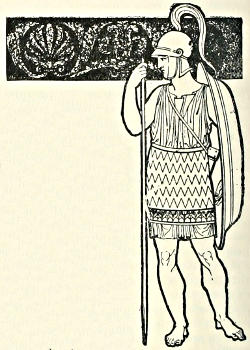
A Shield Bearer
This admirable constitution was in the main the work of Aratus, always
the “moving spirit” of the League, and though his later years are in many
respects open to reproach, yet this practical application of his philosophic
and patriotic ideas is worthy of the highest commendation. He is one of
those characters whose portraits, distorted by the favour and enmity of
partisans, are but uncertainly discerned in history. Strenuously as he
strove in his Memorabilia (the essentials of which Plutarch has preserved
in his biography) to guard his actions and motives from misconception and
to truly exhibit himself to his contemporaries and to posterity, his record is
nevertheless darkened by many shadows and charged with many blunders.
“Aratus had not a great Hellenic soul,” is the verdict of Schorn, “his soul
was narrow and Achæan.” As a man he was distinguished by many fine
and amiable qualities, as a citizen he merits respect for his great love of his
country, to which he dedicated his life with an absolute devotion, and to the
aggrandisement of which all his efforts were directed with rare perseverance.
To the state he sacrificed himself without reserve, giving up his property,
friendships, enmities, and even the implacable hatred of tyrants with which
he had been imbued from his youth up; everything, indeed, except the ambition
which cast a doubt even upon his patriotism. He desired to shine on
the Achæan horizon alone, and he used his influence to keep down any who
attempted to shine beside him.
He regarded the Ætolian peasant-league, with its raids and savage feuds,
and the revolutionary attempts of the Spartan kings Agis and Cleomenes
with equal abhorrence; and by turning his arms against them alternately he
played into the hands of the common national foe, Macedonia. As strategus
his military talents were of a very inferior order. He was admirably skilled
in arranging sudden attacks and ambushes, and in the carrying out of military
surprises his boldness and daring were equal to his subtlety and cunning,
but as a commander his capacity was small, and in his first campaign he
proved diffident, timorous, and faint-hearted. It was not his strong point to
look danger boldly in the face, in battle he lost self-control and presence of
mind; and he consequently preferred the privy and crooked ways of stratagem,
dissimulation, and deceit to a direct and valiant attack.
In his second period of office as strategus, Aratus increased the reputation
he had gained by the liberation of Sicyon, but had impaired by a profitless
campaign against the Ætolians in the first year of his command, by his
successful stratagem at Corinth. With mingled craft and daring he succeeded
in ridding the impregnable citadel of Acrocorinthus of its Macedonian
garrison, and persuaded this important city, one of the three “fetters of
Greece,” to join the League.e
Three brothers, Syrian Greeks, had pilfered from the royal treasure at
Corinth, and one of them named Erginus, came to Sicyon from time to time
to exchange their plunder at the house of a banker well known to Aratus.
Through this channel Aratus learned that there was an accessible point
in the wall of the citadel; and Erginus, having engaged the concurrence of
a fourth brother who served in the garrison, undertook to conduct Aratus
to the place, where the wall was no more than fifteen feet high. The
brothers demanded a large reward. Sixty talents [£12,000 or $60,000]
were to be deposited with the banker, to be paid to them in the event of
success; and even in the case of failure, if they escaped, each was to receive
a house and a talent. Aratus could not immediately raise so large a sum,
and was forced to pledge his plate and his wife’s ornaments, purchasing,
as Plutarch observes, the privilege of a perilous adventure for the good
of his country, at a price which it would have been accounted magnanimous
to reject, if it had been offered as a bribe. When the time came
which had been fixed for the attempt, leaving the main body of his forces
under arms, he proceeded with four hundred men, few of whom were in
the secret, towards Corinth. As they approached the wall, the light of
the full moon, which would have rendered concealment almost impossible,
was intercepted by clouds which rose from the sea. Several other propitious
circumstances contributed to his success, though he fully earned it by his
courage. Erginus with seven others, disguised as wayfarers, gained entrance
at a gate and overpowered the guard, while Aratus, with only a hundred of
his men, scaled the wall, and advanced towards the citadel with the scaling-ladders,
ordering the rest to follow. But on his way through the town he
fell in with a patrol, one of whom escaped, and soon raised a general alarm.
Aratus, again favoured by the moon which broke through the clouds as
he was entangled in the most intricate part of the ascent, reached the wall
of the citadel safely, and was soon engaged in a hard combat with the garrison.
As soon as the alarm was raised, Archelaus, finding that the citadel
was attacked, hastened with all his forces in that direction. But he chanced
to light on three hundred Achæans, who, unable to find the track of their
comrades, had cowered behind a projection of the rock. They now sprang
out as from an ambuscade, and completely routed and dispersed his troops.
But they were recalled from the pursuit by Erginus to the succour of Aratus,
and their arrival decided the struggle. By sunrise he was in possession of
the fortress, and the forces which had followed him from Sicyon, making
their appearance at the same time, were joyfully admitted into the lower
town by the Corinthians, who helped to capture the royal soldiers.d
[242-232 B.C.]
By this act, in which he generously hazarded his private fortune, Aratus
gained such a degree of popular confidence that the Achæans thenceforth
committed the conduct of public affairs to his hands, and followed his counsel
even in the years when he was by law excluded from the office of strategus.
The towns of Trœzen, Epidaurus, Cleonæ, and Megara, presently revolted
from Macedonia and joined the Achæan League.
The rise of the Achæans stirred up the jealousy of other states, and
incited the Macedonians to fresh exertions to recover what they had lost.
The old king Antigonus concluded an alliance with the Ætolians for a joint
attack on Achaia, on the basis of a partition of the territory to be acquired.
But Aratus, who had chosen Ptolemy as patron of the League, and thus
secured the protection of Egypt in the event of possible disaster, repulsed
the Ætolian marauders before they could join hands with the Macedonians,
and dissuaded King Antigonus from the proposed campaign by promising
him the remaining dominions of the Peloponnesus. The aged Antigonus
Gonatas died soon afterwards, and his son and heir, Demetrius II, was kept
fully occupied by an invasion of his own country by the Dardans.
Aratus contrived to make use of these circumstances for fresh acquisitions.
Secured from attack in the rear by an offensive and defensive
alliance with the Ætolians, he induced most of the states of the Peloponnesus
by force or subtlety to join the League. Thus Lydiades, the young
and accomplished prince who reigned at Megalopolis, was prevailed upon
to join, and the rich and extensive territory of that city was won for the
League. The tyrants, abandoned by Macedonia, were no longer able to
withstand the power of Achaia; they yielded voluntarily or under compulsion
to the tide of democracy; so that when Demetrius II sank into his grave
after ten years of feeble sovereignty, and Antigonus Doson (the Promiser)
undertook the government of Macedonia during the minority of King Philip
III, the Achæans ruled over Hermione, Phlius, and the greater part of
Arcadia, counted the rich island of Ægina among their possessions, had
induced Argos to join the League after a long struggle with three successive
tyrants, and had entered into an alliance with Athens (whence, by the
assistance of Aratus, the Macedonian garrisons had been forced to withdraw)
on equal terms though without reciprocal civil rights. Mantinea,
Tegea, Orchomenos, and Elis were the only towns that remained subject
to the Ætolians, who, however, had meanwhile extended their dominion
over part of Thessaly; and Sparta, just awakened from her long trance
and invigorated by a new birth from within, was striving to regain the
ascendency which had been hers in the glorious days of old. Out of these
elements was bred the fatal conflict which broke all that was left of the
strength of Greece at the very moment when the Romans began to intermeddle
in the domestic concerns of warring states.e
[232-227 B.C.]
Lacedæmon had, by this time, exchanged poverty and hardy discipline
for opulence and voluptuous manners. The public meals, that last pledge
of Spartan frugality and temperance, were discountenanced by the rulers
of the state, and fell into disrepute and disuse. One or two princes, who
endeavoured to stem the torrent of corruption, suffered deposition, exile,
and even death. The laws of Lycurgus were totally disregarded. The
lands were all in possession of a few families, who lived in the greatest
splendour, whilst the rest of the Spartans, stripped of their patrimony,
were doomed to the greatest indigence. The efforts of Agis IV, the king,
to enforce the sumptuary laws, to cancel all debts, and to make a new division
of lands, were opposed by the rich, and at last punished with death,
on pretence of a design to alter the government.
In such a situation of affairs, Cleomenes ascended the Spartan throne,
a prince who united integrity of heart with martial spirit and a love of
glory. He found, on his accession, both the internal constitution and the
public affairs of Sparta in the utmost confusion. Domestic distress, with
its concomitant despondency of spirit, had caused throughout Laconia a
universal depopulation. Instead of natives sufficient to occupy the thirty-nine
thousand shares into which Lycurgus had originally divided the land,
only seven hundred families of the Spartan race were now to be found;
and, of these, about six hundred, sunk into abject penury and wretchedness,
were incapable of exerting any degree of vigour in the public service.
The slaves, too, had many of them perished through want of employment
and subsistence, while others had been carried off, in great numbers, by
the enemies of Sparta. Such was the miserable decay of both public and
private virtue! Cleomenes, actuated by his natural disposition to arms, as
well as by the representations already mentioned of the Ætolians, in order
to revive the martial spirit of the Spartans, attacked Tegea, Mantinea, and
Orchomenos, cities of Arcadia. Having reduced these under his obedience,
he marched without delay against a certain castle in the district of Megalopolis,
which commanded on that side the entrance into Laconia.
Immediately upon this act of hostility, the Achæan states declared war
against the Spartans. The Spartan king forthwith took the field, with what
troops he could muster, and ravaged the territories of the cities in alliance
with Achaia. With five thousand men he advanced against the Achæan
general Aratus, who, perceiving the resolution of the Spartans, declined
an engagement, though at the head of twenty thousand. The retreat of
Aratus, determined the Eleans, who had never been steady in the interests
of Achaia, openly to declare against her. The Achæans attempted to
chastise this defection; but they were routed by Cleomenes at Lycæum,
near the Elean borders; and totally overthrown by him in the ensuing
campaign, near Leuctra. Pursuing his good fortune, he reduced several
of the towns of Arcadia, which he garrisoned with his Lacedæmonian
troops.
[227-223 B.C.]
He returned to Sparta with the mercenaries only, and cut off the ephori,
whom he considered as troublesome to himself, and oppressive to the Spartan
subjects, by assassination; a course which he endeavoured to justify, by
arraigning the unconstitutional establishment of this order of magistrates,
and a recital of several acts of iniquity. He now seized on the administration
of justice, and re-established the agrarian and sumptuary laws of
Lycurgus, which he enforced by his own example. Having thus made himself
master of Sparta, he diverted that energy to foreign enterprises, which
might otherwise have broken out in domestic sedition. He plundered the
territories of Megalopolis, forced the Achæan lines at Hecatombæum, and
obtained a complete victory. The Achæan army, composed of the flower of
their nation, were almost all cut off. The Mantineans, having slaughtered
the Achæan garrison stationed in their city, put themselves under the protection
of the Spartans. The same spirit of defection and revolt appeared
in most of the other cities of Peloponnesus. In this extremity, they sued
for peace to Cleomenes; but Aratus, who had for some time declined to take
the lead in the public affairs of Achaia, now resumed his authority; and, by
insisting on such terms as the high-spirited Cleomenes could not accept, contrived
to prevent that peace which his countrymen wished for.
Both Aratus and Cleomenes wished to unite all the nations of Peloponnesus
into one commonwealth, and by that means to form such a bulwark for
the liberties of Greece, as might set all foreign power at defiance. But to
what people the supreme direction of the common affairs should belong, was
the question. Even Aratus, so much above the love of money, showed himself,
on this occasion, the slave of ambition; and, rather than see a superior
in power, determined to involve everything in confusion.
The interruption of the negotiations for peace raised a general ferment
throughout Peloponnesus; the conduct of Aratus fired the martial ardour
of Cleomenes, and excited jealousies in different states; nor could the
Achæans obtain any assistance from the Athenians, the Ætolians, or the
Argives. Corinth was on the point of surrendering to the Spartan king;
and even Sicyon must have been lost, had not a timely discovery prevented
an intended conspiracy. Here we may remark the extreme quickness with
which the Grecian states entered into any confederacy that was formed for
humbling whatever power preponderated in Greece: a proof, that, however
their manners were corrupted, their sentiments of liberty and the balance of
power were not yet wholly subverted.
[223-221 B.C.]
Resentment against Cleomenes induced Aratus to entertain the project
of calling in, for the destruction of Sparta, the aid of Antigonus of Macedon.
But in Greece this attempt was generally odious, and Antigonus was averse
from all interference in Grecian affairs, not being easily dazzled by the splendour
of ambition. But the last and greatest of these difficulties Aratus surmounted
by various artifices, and entered into a compact with Antigonus,
the conditions whereof were that the citadel of Corinth should be delivered
into the hands of the king; that he should be at the head of the Achæan
confederacy, superintend their councils, and direct their operations; that his
army should be supported at their expense. From these articles it is evident,
that the liberties of Achaia were now no more, and that the sovereign
of this country was Antigonus.[50]
This transaction roused the indignation of the Peloponnesian states:
they looked to Cleomenes as the only protector of their liberties. That
hero, upon hearing that the Macedonians were in motion, took possession
of a pass on the Onean Mountains, which commanded the Corinthian
Isthmus; but the Achæans having surprised Argos, he was forced to
abandon it, and to leave it open for the Macedonians. The Achæans
now resumed their superiority in Peloponnesus, and most of the cities in
that peninsula were constrained to submit to their power. The efforts
of Cleomenes to restore the liberties of Peloponnesus, and to protect, of
course, those of the rest of Greece, equal the most famed exploits of
antiquity. But the wary Antigonus, rich in treasure, artfully protracted
the war, and suffered his impetuous adversary to waste his force in vain.
Cleomenes was forced to retreat to Sellasia, in order to cover Sparta.
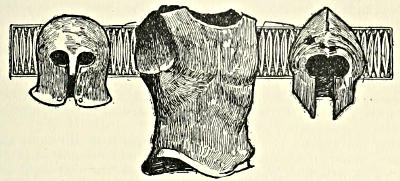
Greek Cuirass and Helmets
(In the British Museum)
Antigonus, therefore, encamped at a distance, on the plain below, in order
to watch the motions of the enemy, and to act according to circumstances.
Cleomenes, reduced to the greatest distress for want of provisions, was forced
to throw open his entrenchments, and, without further delay, to come to an
engagement. All his skill and valour, which were eminently displayed on
this occasion, could not save him from a complete defeat (221 B.C.). He
fled first to Sparta, and from thence to Egypt; where, after various adventures,
the loftiness of his spirit, which could not brook the indignities offered
to him by the ministers of Ptolemy Philopator, brought him to an honourable
but untimely end.f
Having eluded the vigilance of his guards he made a sally with his friends,
thirteen in number, all with drawn swords, and raised the cry of liberty. The
Alexandrian populace stared and applauded, as at a scene on the stage, but
with as little thought of taking any part in the action. The Spartans killed
the governor of the city, and another courtier, but after an ineffectual attempt
to break open the prison in the citadel, finding themselves universally shunned,
they abandoned their forlorn hope, and turned their swords against their own
hearts. Panteus, the dearest of the king’s friends, consented at his request
to survive until he saw that the others had breathed their last. Ptolemy, as
soon as he had learned what had happened, ordered all the women and children
belonging to the deceased to be put to death; and the young wife of
Panteus is said to have paid the like pious offices to Cratesiclea, who was
forced to witness the butchery of her two grandsons, as Cleomenes had received
from her husband. The body of Cleomenes was flayed and hung on a
cross, until, if we may believe Plutarch, an extraordinary occurrence awakened
Ptolemy’s superstitious fears, gave occasion for new expiatory rites in the
palace, and induced the Alexandrians to venerate Cleomenes as a hero.
Such indeed he was, when measured with them. As we turn from them
to the proper subject of this history, we feel, as it were, that we are beginning
again to breathe a healthier atmosphere: and we carry away a strengthened
conviction, that great as were the evils which Greece suffered from the
ill-regulated passion for liberty, it was still better to live there, than under
the sceptre of the Ptolemies—among a people who can hardly be said to
have a history, in any higher sense than a herd of animals, always prone,
unless when goaded into fury.d
[221 B.C.]
During the absence of Antigonus, a multitude of Illyrians, and other
barbarians, made an irruption into Macedon, and committed great devastation.
This irruption hastened his return into his own dominions. In
a decisive battle, the barbarians were defeated; but the Macedonian king,
by straining his voice during the engagement, burst a blood-vessel. The
consequent effusion of blood threw him into a languishing state, and he
died in the space of a few days, lamented by all Greece.
Antigonus II was succeeded by Philip, the son of Demetrius, the last of
the Macedonian kings of that name; a prince only in the seventeenth year
of his age, intelligent, affable, munificent, and attentive to all the duties of
the royal station. This excellent character was formed by a good natural
disposition, cultivated by the instructions and example of Antigonus, who
appointed him his successor on the Macedonian throne.
[221-216 B.C.]
The jealousy which the Ætolians had long entertained of the Achæan
states, was increased by the importance which they had assumed from their
alliance with Macedon. No sooner were they relieved from the dread of
Antigonus, than they ravaged the Achæan coast, and committed depredations
on all the neighbouring countries. Aratus having opposed to them the
Achæan forces in vain, invoked and obtained the aid of the king of Macedon.
Philip promised that as soon as he should have settled the affairs of
his own kingdom, he would repair to Corinth, in order to meet the convention
of the states in alliance with Achaia, that he might have an opportunity
of settling with them a plan of future operations. In the meantime, the
Ætolians, making a fresh irruption into Peloponnesus, sacked Cynætha, a
city of Arcadia, put most of the inhabitants to the sword, and laid the place
in ruins. The convention of the Achæan confederates, now assembled at
Corinth, unanimously agreed that unless the Ætolians should make reparation,
war should be declared against them, and the direction of it committed
to the king of Macedon. Hence the origin of the Social War, so called
from the association entered into by the several states engaged against
Ætolia.
Philip commenced his operations with the siege of Ambracas, a fortress
which commanded an extensive territory, belonging of right to Epirus, but
now in the hands of the Ætolians. Having reduced this fortress, he restored
it to the Epirots, and prepared to carry the war into Ætolia. The Ætolian
spirit was not daunted either by the loss of Ambracas or the threats of Philip.
They invaded Macedon, and made incursions into Achaia, which they reduced
to the greatest distress. The mercenaries in the Achæan service had
mutinied for want of pay; the Peloponnesian confederates became spiritless
or disaffected; even the Messenians, in whose cause chiefly Achaia, had, at
the beginning, taken up arms, were afraid to act against the Ætolians:
whilst the Spartans, notwithstanding their engagements, at the late conventions,
to Achaia, had now massacred, or sent into exile, all such of their own
citizens as were in the interest of the Achæans, and openly declared against
them. For the Spartans, amidst their greatest humiliation, had ever been
impatient of the domination of Achaia, to which the haughtiness of that republic
had, in all probability, very much contributed.
[216-208 B.C.]
A year had elapsed since the alliance had been formed against Achaia,
when Philip of Macedon, in the depth of winter, set out with the utmost
secrecy to Corinth, where a part of his forces were stationed. He surprised
a party of Eleans, who had gone forth to ravage the Sicyonian territories,
and reduced Psophis, a stronghold within the confines of Arcadia, of which
the Eleans had taken possession. He plundered Elis, one of the finest regions
in Greece, in respect to cultivation, and rich in every kind of rural wealth.
He next subdued under his power Triphylia, a district of Peloponnesus to
the southward of Elis, and wrested the Ætolian yoke from the necks of the
Messenians. Philip made a temperate use of all his victories. He granted
peace to all who sued for it; and the whole of his conduct seemed to be
directed by the same generous motives which had formerly directed that
of Antigonus. But in the midst of these fair appearances, Philip began to
manifest latent seeds of ambition. He restrained the pride and power of his
ministers, who had been appointed to their offices by his predecessor Antigonus;
and supported Eperatus in the election of general of Achaia, in opposition
to Aratus. In order to counterbalance this unpopular measure, and to
strengthen himself in the affections of the Achæan people, he besieged Teichos,
and having taken that fortress, restored it to the Achæans, to whom it
belonged. He also made an inroad into Elis, and presented the Dymeans
and the cities in the neighbourhood with all the plunder. He now imagined
that the wealth and vigour of the Achæan republic were at his disposal; but
the new general had not provided any magazines, and the treasury was exhausted.
Philip now affected to place great confidence in Aratus. By the
advice of this statesman, he made an attempt on the island of Cephallenia,
an island in the Ionian Sea, near the coast of Peloponnesus, and the great
resort of the Ætolian pirates. His attempt, after it had been carried on
almost to success, was baffled by the treachery of his ministers.
He now, following the advice of Aratus, invaded and ravaged Ætolia
itself, returned into Peloponnesus, laid waste Laconia, and, flushed with success,
meditated the subjection of all Greece, and a junction with Hannibal
against the Romans. Aratus in vain attempted to dissuade him from this
project. He sent ambassadors to the Carthaginian general, but they were intercepted,
soon after their landing in Italy: as they gave out, however, that
they were going to Rome, they, in a little time, obtained their release, and
made their way to Hannibal, with whom they concluded a treaty. On their
return they were again intercepted, and sent with all their papers to Rome.
But Philip despatched other ambassadors, and a ratification of the treaty was
obtained. It was stipulated that Philip should furnish a fleet of two hundred
ships, to be employed in harassing the Italian coasts; and that he should
also assist Hannibal with a considerable body of land-forces. In return for
this assistance, when Rome and Italy should be finally reduced, which were
to remain in the possession of the Carthaginians, Hannibal was to pass into
Epirus at the head of a Carthaginian army, to be employed as Philip should
desire; and, having made a conquest of the whole country, to give up to him
such parts of it as lay convenient for Macedon.
In consequence of this agreement, the Macedonian king entered the
Ionian Gulf, with a large fleet, fell down to the coast of Epirus, took Oricum,
on the coast of Epirus, a defenceless seaport, but from which there was a
short passage to Italy, and laid siege to Apollonia; but surprised and defeated
by the Romans, secretly retreated homeward across the mountains.
The Romans, humbled by the victorious arms of Hannibal, were not in a
condition in which they might prosecute a war with Macedon; they therefore
determined, if possible, to raise up enemies against Philip in Greece,
that he might be employed at home in the defence of his own dominions.
They accordingly made overtures for this purpose to the Ætolians, who,
confiding in the flattering declarations of the Roman ambassador, hastened
to conclude a treaty, of which the following were the principal conditions:
That the Ætolians should immediately commence hostilities against Philip
by land, which the Romans were to support by a fleet of twenty galleys; that
whatever conquests might be made, from the confines of Ætolia to Corcyra,
the cities, buildings, and territory, should belong to the Ætolians, but every
other kind of plunder to the Romans. The Spartans and Eleans, with other
states, were included in this alliance; and the war commenced with the reduction
of the island of Zacynthus, which, as an earnest of Roman generosity
and good faith, was immediately annexed to the dominions of Ætolia. These
transactions were dated about 208 B.C.
[208-205 B.C.]
It has already been observed, that Philip aimed at the subjection of
all Greece. Aratus, who would have opposed him in this design, he took
off by poison.[51] His interest in Greece was now strengthened by the introduction
of the Romans: he was regarded by the Greeks as the champion
of freedom, and as their defence against the Romans, whom they still
considered and denominated barbarians. Not only the Greeks northward
of the Corinthian isthmus, but even the Achæan League, prepared to take
up arms in his support. Encouraged by these allies, he acted with uncommon
vigour: he carried the war into Illyricum with success; marched
to the relief of the Acarnanians, who were threatened by the Ætolians,
and fortified himself in Thessaly. The Ætolians, notwithstanding these
advantages gained over them by Philip, and that they were afterwards
defeated by him in two hot engagements, remained undaunted, and prosecuted
the war with an amazing obstinacy. The neighbouring states, now
jealous of the successes of Philip, endeavoured to mediate a peace; nor
did the Macedonian show himself unwilling to treat for that purpose.
A peace was ready to be concluded, when the Romans, deeply interested
in the prolongation of war, sent their fleet to support the Ætolians; who,
encouraged also by the prospect of acquiring another ally, Attalus, king
of Pergamus, boldly set Philip at defiance, and talked of terms to which
they knew he would not submit. The moderation of Philip strengthened
the indignation of his Greek confederates against the Ætolians; a disposition
which he soon found an opportunity of calling forth into action.
Intelligence being brought to him, whilst he was assisting at the Nemean
games, that the Romans had landed, and were laying waste the country
from Corinth to Sicyon, he instantly set out, attacked and repulsed the
enemy, and, before the conclusion of the games, returned again to Argos;
an achievement which greatly distinguished him in the eyes of all Greece,
assembled at that solemnity. After other vigorous, though unsuccessful,
exertions against the Romans, he was called back, by domestic insurrections,
to Macedon.
The Achæan states, though deprived of the powerful aid of the Macedonian
king, still carried on their military operations under the conduct
of Philopœmen of Megalopolis, in Arcadia, an enthusiast in the cause of
liberty from his earliest years, and one who had been active in bringing
over several of the Arcadians to join the Achæan League. Soon after the
death of Aratus, to whom he was as much superior in military, as he was
inferior in political abilities, he attained the chief sway in the Achæan
councils. He saw with concern the humiliating condition to which a
foreign yoke had reduced his countrymen, and conceived the noble resolution
of relieving them from it. In the character of general of Achaia,
he improved their discipline, inured them to hardship and toil, and gave
them weightier armour, and more powerful weapons. The effect of this discipline
soon appeared: the armies of Ætolia and Elis, which attacked them
in Philip’s absence, were totally defeated. In the meantime, the Romans,
supported by Attalus, attacked Eubœa, of all the provinces of Greece, though
an island, one of the most considerable for fertility of soil, extent of territory,
and advantage of situation. Philip, on his part, kept a watchful eye on his
enemies: his military preparations were vigorous, and not without success.
The war was prolonged, with various success, for six years, when the Romans
and Attalus retired from Greece. A peace was now concluded between the
Ætolians and Romans, on the one part, and Philip on the other, whose successful
ambition led him, by a natural progress, to attack the dominions of
the king of Egypt.
[205-199 B.C.]
The Romans, whose policy it was never to have more enemies on their
hands than one at a time, had consented to a peace with Macedon, because
they were involved in a war with Carthage; but that war being now
at an end, they eagerly embraced the first pretexts they could find for a rupture
with the prince, whose successes had excited a jealousy of his growing
power. Complaints being brought before that political and powerful people
from Attalus, from the Rhodians, from the Athenians, and from Egypt, they
readily determined to improve so favourable a juncture. And first, they
declared themselves the guardians of the young king of Egypt. Marcus
Æmilius was despatched from Rome, to announce to Philip the intentions
of the Roman senate. The ambassador found the king before Abydos,
at the head of an army flushed with victory. Philip was not insensible
of the advantage of his situation; yet the Roman, undaunted by the deportment
of the monarch, charged him with dignity and firmness, not to
attack the possessions of the crown of Egypt; to abstain from war with
any of the Grecian states; and to submit the matters in dispute between
him, Attalus, and the Rhodians, to fair arbitration. “The boastful inexperience
of youth,” said the king, “thy gracefulness of person, and, still
more, the name of Roman, inspire thee with this haughtiness. It is my
wish, that Rome may observe the faith of treaties; but should she be inclined
again to hazard an appeal to arms, I trust that, with the protection
of the gods, I shall render the Macedonian name as formidable as that of
the Roman.” These things, with the cruel destruction of the city and
inhabitants of Abydos, happened about 199 B.C.
Philip, like other ambitious princes, was now on terms of hostility with
most of the neighbouring nations. Rome, on the contrary, was in a situation
the most favourable that could be imagined to her ambition: Carthage was
subdued; in Italy, all remains of insurrection had subsided; Sicily, in fertility
and opulence, at that time the pride of the western world, with most
of the adjacent islands, was annexed to her dominions; and even those
nations which had not yet felt the force of her arms, heard, with terror,
the fame of a people not to be subdued even by a Hannibal. About three
years, therefore, after peace had been made with Philip, the Romans despatched
a fleet, under the conduct of the consul Sulpicius, for the relief
of Athens, then besieged by the Macedonians.
Philip was moved with resentment, and attempted to wreak his vengeance
on Athens. Disappointed in his hope of surprising that city, he
laid waste the country around it, destroying even the temples, which he had
hitherto affected to venerate, and mangling and defacing every work of art
in such a manner, that there scarcely remained, according to the Roman historian
Livy, a vestige of symmetry or beauty. Here we have an opportunity
of remarking the contrast between the genius of Athens, in the times
of Philip, the father of Alexander, and that Philip who now filled the throne
of Macedon. The Athenians harassed by the arms of this last mentioned
prince, had recourse to the only weapons with which they were now
acquainted—the invectives of their orators, and the acrimony of their
popular decrees. It was resolved, that “Philip should forever be an object
of execration to the Athenian people; that whatever statues had been raised
to him, or to any of the Macedonian princes, should be thrown down; that
whatever had been enacted in their favour should be rescinded; that every
place in which any inscription, or memorial, had been set up in praise of
Philip, should be thenceforth held profane and unclean; that in all their
solemn feasts, when their priests implored a blessing on Athens and her
allies, they should pronounce curses on the Macedonian, his kindred, his
arms by sea and land, and the whole Macedonian name and nation: in a
word, that whatever had been decreed in ancient times against the Pisistratidæ,
should operate in full force against Philip; and that whoever should
propose any mitigation of the resolutions now formed, should be adjudged a
traitor to his country, and be punished with death.” The flatteries of the
Athenians to their allies were in proportion to their impotent execrations
of the Macedonian monarch. Such is the connection between meanness of
spirit and the loss of freedom!
[200-193 B.C.]
A languid and indecisive war had been carried on for the space of two
years between the Macedonians and Romans, during the consulship of Sulpicius
and that of his successor Villius, not much to the honour of these
commanders, when the command of the Roman army devolved to the new
consul, Titus Quintius Flaminius, not indeed unacquainted, being a Roman,
with the science of war, but more remarkable for his skill and address in
negotiation than for military genius. The Roman consul, by the vigour of
his arms, but still more by the dexterity with which he carried into execution
the profound policy of his nation, brought Greece to the lowest state of
humiliation. By detaching the most considerable of the Grecian states, particularly
the Ætolians and the Achæans, from their connection with Macedon;
by ingratiating himself with the Grecian states, whom he managed,
after they had become his confederates, with infinite artifice; by making a
pompous but insidious proclamation of their freedom at the Isthmian and
Nemean games, he reduced the Macedonian king to the necessity of first
seeking a truce, and afterwards of accepting peace on these mortifying conditions,
which were entirely approved by the Roman senate:
“That all the Greek cities, both in Asia and in Europe, should be free,
and restored to the enjoyment of their own laws.
“That Philip, before the next Isthmian games, should deliver up to the
Romans all the Greeks he had in any part of his dominions, and evacuate all
the places he possessed either in Greece or in Asia.
“That he should give up all the prisoners and deserters.
“That he should surrender all his decked ships of every kind; five
small vessels, and his galley of sixteen banks of oars, excepted.
“That he should pay the Romans a thousand talents [£200,000 or
$1,000,000], one half down, the rest in ten equal annual payments.
“And that, as a security for the performance of these regulations, he
should give hostages, his son Demetrius being one.” The date of this peace
was 198 B.C.
Flaminius having made various decrees in favour of the several Grecian
communities in confederacy with the Romans; having expelled Nabis, the tyrant
of Sparta, from Argos; and having obtained the freedom of the Roman
slaves in Greece, returned to Rome, to the great satisfaction of all Greece;
and withdrew, as he had promised, all the Roman garrisons.
[193-187 B.C.]
Antiochus, king of Syria, was renowned for the magnificence of his court,
great treasures, numerous armies, military talents, and political wisdom.
He had visited the coasts of the Hellespont, formerly subject to the kings of
Syria; he had even passed over into Thrace, where he had likewise claims;
and he was preparing to rebuild Lysimachia, in order to make it again the
seat of government in the countries anciently possessed by Lysimachus.
The pretensions of so powerful and politic a prince to countries which the
Romans had already marked as their own, excited the jealousy of that ambitious
people. They gave him repeated notification, that, “by the treaty with
Macedon, the Grecian cities in Asia, as well as Europe, had been declared
free; that Rome expected he would conform to that declaration”; and
further, “that henceforth Asia was to be the boundary of his dominions;
and that any attempt to make a settlement in Europe, would be considered
by Rome as an act of hostility.” Antiochus, at first, manifested a disposition
to peace, and, in order to obtain it, would have made large concessions,
could anything less than the humiliation of the crown of Syria have satisfied
Roman ambition.
But Hannibal, the sworn enemy of Rome, no sooner heard of his meditating
a war against the Romans, than he made his escape from Carthage to
the Syrian court, and urged him to arms. The Ætolians, too, solicited him
to vindicate the cause of Greece, notwithstanding the delusive show of liberty
granted by Rome, more enthralled in reality than at any former period.
Hannibal recommended an invasion of Italy, where alone, in his judgment,
Rome was vulnerable. With only eleven thousand land-forces, and a suitable
naval armament, he offered to carry the war into the heart of that
country; provided Antiochus would, at the same time, appear at the head
of an army on the western coast of Greece, that, by making a show of an
intended invasion from that quarter, he might divert the attention and
divide the strength of the Romans. The Ætolians, on the other hand, told
him, that if Greece were made the seat of war, there would be, throughout
all that country, a general insurrection against the power of the Romans.
Antiochus, having adopted the plan of the Ætolians in preference to that of
Hannibal, entered Greece with a small force, and being disappointed in his
expectations of succour from the Grecian states, was defeated at the straits
of Thermopylæ by Manlius Acilius Glabrio, the Roman consul. He escaped
with only five hundred men to Chalcis, from whence he retreated with precipitation
to his Asiatic dominions, 187 years before the Christian era.
The Ætolians having rejected the terms of peace offered to them by the
Romans, the consul pressed forward the siege of Heraclea, which soon surrendered
at discretion. He was preparing to besiege Naupactas, a seaport
on the Corinthian Gulf, of the greatest importance to the Ætolian nation,
who now decided to submit themselves to the faith of the Roman people, and
sent deputies to intimate this determination to the Roman consul. Acilius,
catching the words of the deputies, said, “Is it then true, that the Ætolians
submit themselves to the faith of Rome?” Phæneas, who was at the head
of the Ætolian deputation, replied, that they did. “Then,” continued the
consul, “let no Ætolian, from henceforth, on any account, public or private,
presume to pass over into Asia; and let Dicæarchus, with all who have had
any share in his revolt, be delivered into my hands.”
“The Ætolians,” interrupted Phæneas, “in submitting to the faith of
the Romans, meant to rely upon their generosity, but not to yield themselves
up to servitude: neither the honour of Ætolia, nor the customs and
laws of Greece, will allow us to comply with your requisition.” “It is
insolent prevarication,” answered the consul, “to mention the honour of
Ætolia and the customs and laws of Greece; you ought even to be put in
chains.” The Ætolians, exasperated even to madness at this imperious
treatment of their deputies and nation, were encouraged in their disposition
to vindicate their liberties by arms, by the expectation of succours from
Asia and from Macedon; but this expectation was disappointed, and they
were reduced to the necessity of sending ambassadors to Rome, to implore
the clemency of the Roman senate. The only conditions they could obtain
were, either to pay a thousand talents [£200,000 or $1,000,000], a sum
which, they declared, far exceeded their abilities, and to have neither friend
nor foe, but with the approbation of Rome, or to submit to the pleasure of
the senate. The Ætolians desired to know, what they were to understand
by “submitting to the pleasure of the senate”: an explanation being refused,
they were obliged to return uncertain of their fate. The war with Rome
was renewed; but the Roman vigour and policy prevailed in the unequal
contest, and the Ætolians were again obliged to apply to the consul, in the
most submissive manner, for mercy. The conditions granted to them were
extremely hard: they were heavily fined, obliged to give up several of their
cities and territories to the Romans, and to deliver to the consul forty
hostages, to be chosen by him, none under twelve, or above forty years of
age. But one express condition comprehended everything that imperious
power might think fit to impose: the Ætolians were to “pay observance to
the empire and majesty of the Roman people.”
The predominant power of the Achæans in the Peloponnesus, now became
the object of Roman jealousy and ambition. Though confederated with
Achaia, the Peloponnesian cities retained each of them peculiar privileges,
and a species of independent sovereignty. No sooner was peace concluded
with Ætolia, than Marcus Fulvius Nobilior, to whom the conduct of the
Ætolian War had been committed on the expiration of the consulship of
Acilius, took up his residence in the island of Cephallenia, that he might be
ready, upon the first appearance of any dispute in Achaia, to pass over into
Peloponnesus, and improve every dissension, for the aggrandisement of the
Roman Republic. Such an opportunity soon presented itself: the congress
of the Achæan states had always been held at Ægium: but Philopœmen,
now the Achæan general, having determined to divide among all the cities
of the League the advantages of a general convention, had named Argos for
the next diet. This innovation the inhabitants of Ægium opposed, and
appealed to the Roman consul for his decision. Another pretext for passing
over into Greece was also soon offered to Fulvius. The Lacedæmonian
exiles, who had been banished in the days of the tyrants, and never restored,
resided in towns along the coast of Laconia, protected by Achæan garrisons,
cut off the inhabitants of Lacedæmon from all intercourse with
the seacoast. One of those maritime towns was attacked by the Spartans in
the night-time, but defended by the exiles, with the assistance of the Achæan
soldiery. Philopœmen represented this attempt of the Spartans as an insult
on the whole Achæan body. He obtained a decree in favour of the exiles,
commanding the Lacedæmonians, on pain of being treated as enemies, to
deliver up the authors of that outrage. This decree the Lacedæmonians
refused to obey. They dissolved their alliance with Achaia, and offered
their city to the Romans. In revenge of this, Philopœmen, notwithstanding
the advanced season, laid waste the territories of Lacedæmon.f
[189-183 B.C.]
The bond which had formerly existed between Macedonia and Greece,
giving the history of both, after the time of Philip and the Great Alexander,
a common road to travel, had in the course of time disappeared. The
Greeks had not desired this bond with Macedonia, though nothing else
could possibly have won the townships their independence. For, while the
kings of Macedonia proceeded rigorously in carrying out their desire of
building for themselves a suzerainty in Greece, yet for all that the ultimate
end of pursuit was not the enslaving of Greece, but her amalgamation with
Macedonia. The Greeks would have been as free as the Macedonians were
under the monarchy, and it was no mean degree of freedom they enjoyed.
An Asiatic despotism could take no root on this soil, it could not spring
up spontaneously. Rome certainly was capable of exercising such power,
since she commanded forces such as would not have been at the disposal of
a king of Macedonia and Greece. But the Greeks had worked against the
amalgamation with Macedonia as though it had been the worst of all fates.
Now, as a reward, they accepted the rule of the cruel Romans, who revealed
their character even more and more clearly through the veiling cloud of
their friendship, their alliance, and their altruistic enthusiasm for freedom.
There is a silence come over the land of Greece, since the result of
the Roman war against Syria, the silence of bondage. Zacynthus, Apollonia,
Epidamnus, and certain other points in the Greek world, might
thereafter at once be considered and treated as subject lands. Altogether
the Romans during this time moved nearer. Istria was conquered and
made a province. Even Ætolia was not talked of in Philip’s last years; here
too, stillness had come. Not one of the many little leagues, which now
divided Greece dared or could dare to refuse anything the Romans demanded—if,
that is to say, the Romans attached any importance to it. And
of what kind these commands were one may still judge from isolated facts
appearing in the detached fragments from which we have to construct
the history of Greece during this period. Thebes had to receive again
within her walls the murderer of the Bœotarch, Brachyllas, because he
murdered for Rome’s sake and was a friend of Rome.
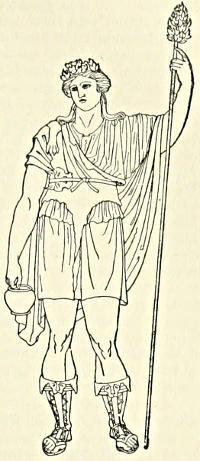
Bacchus
(After Hope)
From only one quarter of Greece did there sound any note of life and
activity—from Achaia; and the Romans did, for an exception, think it
worth while to concern themselves about Achaia somewhat, and to take
action, when occasion offered, that her dissolution might be hastened.
But such life or activity as may still stir in the Achæan League is no
longer a cheering spectacle in any way. Those of its men who are best calculated
to win respect, because they are not in the pay of the Romans, and
still cherish thoughts of independence, prove themselves to be, if not without
real worth, yet certainly without caution or insight. Philopœmen and
Lycortas stand highest among them. Philopœmen himself is said to have
perceived that extinction under the Roman rule was become altogether inevitable,
and that the only thing left to do was to endeavour to put it off as
long as possible. That was the right view for a man to take, unless he had
determined to evade bondage by a voluntary death. But Philopœmen, it
would appear, did not hold the view attributed to him. He thought the
bond might grow stronger again some day, and, if it were necessary, assert
itself in arms against the Romans. For why else, if this were not his idea,
should there have been that madness and murder in Sparta? The old
Spartan life had to be stamped out, the new citizens must be strangled,
because the old Sparta and the strong Sparta would not join the Achæans
and so the Peloponnese remained divided. With the idea that the unity of
the Peloponnese was gained at last, and that the bond was solid and complete,
Philopœmen and his friends may have rested from the festival of
murder in Sparta, which now found herself once more forced into the
Achæan League.
Obviously the heads of the League thought they might move more
freely. They ventured to mention the League’s independence, they continued
to disobey Roman commands. In this they made one of two mistakes.
Either they thought the senate really desired their independence, or
else they imagined that they also were still something
considerable and were capable, if necessary,
of defending themselves in arms. It would not
have suited the Romans just then to appear again
in Greece with an army, and so, for a time, though
only a very short time, they permitted the high
and empty words of the Achæans. And in the
end the sword was not in the least required to
bring them back to heel, only a stern command
from the senate, and at once the liberty craze of
the Achæans tumbled pitifully into nothing.
The trifling differences which sprang from the
endeavours of the Achæans and the counter endeavours
of the Spartans, would be insignificant
did they not conduce to our knowledge of the
Roman method. The arts which were employed
against Macedonia were also employed against
the Achæans. The small should be stricken
like the great, so that in the end both might be
completely and easily taken. The Romans must
have seen with pleasure the perverse measures to
which Philopœmen and the Achæans resorted in
order to force the Peloponnesus to the unity
of the League.g
The Romans, thus invited to act as umpires
in Greece, found means to break the strength of
the commonwealth of Achaia, by seducing its confederate
states—a conduct which, in the eyes of
pure morality, must appear enormously treacherous;
but which if, in the ambitious designs of
states and princes, the certain attainment of the
end be considered as a sufficient justification of the means, must be deemed
refined policy. By the intrigues of Roman emissaries, too, a party of Messenians
took up arms against the Achæans; and Philopœmen, hastening to
suppress the insurgents, fell into their hands, and was put to death.
[185-179 B.C.]
During these transactions in Greece, the Romans, jealous of the increasing
power of their ally, Philip of Macedon, sought an occasion of quarrelling
with him, and, agreeably to their usual policy, encouraged every complaint,
and supported the pretensions of his enemies; prepared to plunder them,
too, in their turns, when the Macedonian power should no longer be formidable.
The small cantons or communities of Thessaly, in which he had
re-established his authority, were now encouraged to assert their independence;
and the Macedonian king was called to account for those very
outrages which he had committed on the side of the Romans. Commissioners
were appointed for the settlement of differences. Philip was
required by them to evacuate Ænus and Maronea, which were claimed by
Eumenes. These were cities on the Hellespont, which, from their maritime
situation, afforded many advantages. The complexion and designs of the
Roman commissioners were obvious; and Philip, judging it vain to keep
measures with men determined at any rate to take part with his adversaries,
expostulated with them with great boldness on the injustice, treachery, and
ingratitude of their nation.
In this temper of mind he wreaked his revenge on the Maroneans, whose
solicitations, he supposed, had been employed against him. A body of his
fiercest Thracian mercenaries being introduced into Maronea, on the night
before the Macedonian garrison was to march out, on pretence of a sudden
tumult, put to the sword all the inhabitants suspected of favouring the
Roman interest, without distinction of condition, age, or sex, and left the
place drenched in the blood of its citizens. The Romans threatened to
revenge this massacre, and Philip was obliged to send his second son,
Demetrius, to Rome, to make an apology. The Roman senate, with a view
to debauch the filial affection of Demetrius and to draw him over to the
interests of Rome, told him that, on his account, whatever had been
improper in his father’s conduct should be passed over; and that, from the
confidence they had in him, they were well assured Philip would, for the
future, perform everything that justice required: that ambassadors should
be sent to see all matters properly settled: and that, from the regard they
bore to the son, they were willing to excuse the father. This message
excited in the breast of Philip a suspicion of the connection formed between
Rome and Demetrius; which suspicion was inflamed by the insinuations and
dark artifices of his eldest son Perseus, a prince, according to the Roman
writers, of an intriguing and turbulent disposition, sordid, ungenerous, and
subtle.
Perseus and Demetrius were both in the bloom of life; the former aged
about thirty years when Demetrius returned from Rome, but born of a mother
of mean descent, a seamstress of Argos, and of so questionable a character,
as to make it doubtful whether he was really Philip’s son. Demetrius was
five years younger, born of his queen, a lady of royal extraction. Hence
Perseus had conceived a jealousy of his brother, and was insidiously active
to undermine him in the royal favour. He accused Demetrius to the
king of a design to assassinate him. Philip, familiarised as he was to acts
of blood, was struck with horror at the story of Perseus. Retiring into
the inner apartment of his palace, with two of his nobles, he sat in solemn
judgment on his two sons, being under the agonising necessity, whether the
charge could be proved or disproved, of finding one of them guilty. Distracted
by his doubts, Philip sent Philocles and Apelles, two noblemen, to
proceed as his ambassadors to Rome, with instructions to find out, if possible,
with what persons Demetrius corresponded, and what were the ends he had
in view.
Perseus, profoundly artful, and having the advantage of being the heir
apparent to the Macedonian crown, secretly gained over to his interest his
father’s ambassadors, who returned to the king with an account that Demetrius
was held in the highest estimation at Rome, and that his views appeared
to have been of an unjustifiable kind; delivering, at the same time, a letter,
which they pretended to have received from Quintus Flaminius. The handwriting
of the Roman, and the impression of his signet, the king was well
acquainted with; and the exactness of the imitation induced him to give
entire credit to the contents, more especially as Flaminius had formerly
written in commendation of Demetrius. The present letter was written in
a different strain. The author acknowledged the criminality of Demetrius,
who indeed, he confessed, aimed at the throne; but for whom, as he had not
meditated the death of any of his own blood, he interceded with the monarch.
The issue of this atrocious intrigue was truly tragical: Demetrius, found
guilty of designs against the crown and the life of his father, was put to
death. Philip, when too late, discovered that he had been imposed upon by
a forgery, and died of a broken heart.
[179-168 B.C.]
Perseus succeeded his father on the throne of Macedon, a hundred and
seventy-nine years before the birth of Christ. The first measures of his
government appeared equally gracious and political. He assumed an air
of benignity and gentleness. He not only recalled all those whom fear or
judicial condemnation had, in the course of the late reign, driven from their
country; but he even ordered the income of their estates, during their exile,
to be reimbursed. His deportment to all his subjects was happily composed
of regal dignity and parental tenderness. The same temper which regulated
his behaviour to his own subjects, he displayed in his conduct towards
foreign states. He courted the affections of the Grecian states, and despatched
ambassadors to request a confirmation of the treaties subsisting
between Rome and Macedon. The senate acknowledged his title to the
throne, and pronounced him the friend and ally of the Roman people. His
insinuations and intrigues with his neighbours were the more effectual, that
most of them began to presage what they had to expect, should the dominion
of Rome be extended over all Greece; and looked upon Macedon as the bulwark
of their freedom from the Roman yoke.
The only states that stood firm to the Roman cause, were Athens and
Achaia. But in this all of them now agreed, that foreign aid was on all
occasions necessary to prop the tottering remains of fallen liberty, which,
by this time, was little else than a choice of masters. Besides all those
advantages which Perseus might derive from the well-grounded jealousy of
Roman ambition, he succeeded to all those mighty preparations which were
made by his father. But all this strength came to nothing: it terminated
in discomfiture, and the utter extinction of the royal family of Macedon.
He lost all the advantages he enjoyed, through avarice, meanness of spirit,
and want of real courage. The Romans, discovering or suspecting his ambitious
designs, sought and found occasion of quarrelling with him. A Roman
army passed into Greece. This army, for the space of three years, did
nothing worthy of the Roman name; but Perseus, infatuated, or struck with
a panic, neglected to improve the repeated opportunities which the incapacity
or the corruption of the Roman commanders presented to him. Lucius
Æmilius Paullus, elected consul, restored and improved the discipline of the
Roman army, which, under the preceding commanders, had been greatly
relaxed. He advanced against Perseus, drove him from his entrenchments
on the banks of the river Enipeus, and engaged and defeated him under the
walls of Pydna.
On the ruin of his army, Perseus fled to Pella. He gave vent to the
distraction and ferocity of his mind, by murdering with his own hand two
of his principal officers, who had ventured to blame some parts of his conduct.
Alarmed at this act of barbarity, his other attendants refused to
approach him; so that, being at a loss where to hide himself, or whom to
trust, he returned from Pella, which he had reached only about midnight,
before break of day. On the third day after the battle he fled to Amphipolis.
Being driven by the inhabitants from thence, he hastened to the seaside,
in order to pass over into Samothrace, hoping to find a secure asylum
in the reputed holiness of that place. Having arrived thither, he took shelter
in the temple of Castor and Pollux. Abandoned by all the world, his eldest
son Philip only excepted, without a probability of escape, and even destitute
of the means of subsistence, he surrendered to Octavius, the Roman prætor,
who transported him to the Roman camp. Perseus approached the consul
with the most abject servility, bowing his face to the earth, and endeavouring
with his suppliant arms to grasp his knees. “Why, wretched man,”
said the Roman, “why dost thou acquit Fortune of what might seem her
crime, by a behaviour which evinces that thou deservest not her indignation?
Why dost thou disgrace my laurels, by showing thyself an abject adversary,
and unworthy of having a Roman to contend with?” He tempered,
however, this humiliating address, by raising him from the ground, and
encouraging him to hope for everything from the clemency of the Roman
people. After being led in triumph through the streets of Rome, he was
thrown into a dungeon, where he starved himself to death. His eldest son,
Philip, and one of his younger sons, are supposed to have died before him.
Another of his sons, Alexander, was employed by the chief magistrates of
Rome in the office of a clerk.
[168-167 B.C.]
Within the space of fifteen days after Æmilius had begun to put his
army in motion, all the armament was broken and dispersed; and, within
two days after the defeat at Pydna, the whole country had submitted to
the consul. Ten commissioners were appointed to assist that magistrate in
the arrangement of Macedonian affairs. A new form of government was
established in Macedon, of which the outlines had been drawn at Rome.
On this occasion the Romans exhibited a striking instance of their policy
in governing by the principle of division. The whole kingdom of Macedon
was divided into four districts; the inhabitants of each were to have no
connection, intermarriages, or exchange of possessions, with those of the
other districts, but every part to remain wholly distinct from the rest. And
among other regulations tending to reduce them to a state of the most abject
slavery, they were inhibited from the use of arms, unless in such places as
were exposed to the incursions of the barbarians. Triumphal games at
Amphipolis, exceeding in magnificence all that this part of the world had
ever seen, and to which all the neighbouring nations, both European and
Asiatic, were invited, announced the extended dominion of Rome, and the
humiliation not only of Macedon, but of Greece; for now the sovereignty
of Rome found nothing in that part of the world that was able to oppose it.
The Grecian states submitted to various and multiplied acts of oppression,
without a struggle. The government which retained the longest a
portion of the spirit of ancient times, was the Achæan. In their treatment
of Achaia, the Romans, although they had gained over to their interests
several of the Achæan chiefs, were obliged to proceed with great circumspection,
lest the destruction of their own creatures should defeat their
designs. They endeavoured to trace some vestiges of a correspondence
between the Achæan body and the late king of Macedon; and when no such
vestiges could be found, they determined that fiction should supply the place
of evidence. Caius Claudius, and Cneius Domitius Ahenobarbus, were sent
as commissioners from Rome, to complain that some of the first men of
Achaia had acted in concert with Macedon. At the same time they required,
that all who were in such a predicament should be sentenced to
death: promising that, after a decree for that purpose should be enacted,
they would produce the names of the guilty. “Where,” exclaimed the
assembly, “would be the justice of such a proceeding? First name the persons
you accuse, and make good your charge.” “I name, then,” said the
commissioner, “all those who have borne the office of chief magistrate of
Achaia, or been the leaders of your armies.” “In that case,” answered
Xenon, an Achæan nobleman, “I too shall be accounted guilty, for I have
commanded the armies of Achaia; and yet I am ready to prove my innocence,
either here, or before the senate of Rome.” “You say well,” replied
one of the Roman commissioners, laying hold on his last words, “let the
senate of Rome then be the tribunal before which you shall answer.”
A decree was framed for this end, and above a thousand Achæan chiefs
were transported into Italy, a hundred and sixty-seven years before Christ.f
Among these was Polybius,b who afterwards became famous as the historian
of the Roman Conquest, and whose work, though preserved only in fragments
beyond the fifth book of the original forty, is the chief reliable source
of information regarding some of the events of the period we have just considered.
Had fortune spared us the later books of Polybius, our knowledge
of the history of the Leagues would have been far different from what it is;
for this Greek of the “degenerate” Hellenistic age is universally admitted
to be the most philosophical and reliable of all historical writers among his
countrymen of any age, Thucydides alone excepted. We shall see more of
his work when we come to the history of the Punic wars, where he is again
the chief authority.a
CHAPTER LXIV. THE FINAL DISASTERS — THE MACEDONIAN INSURRECTION — THE ACHÆAN WAR — THE DESTRUCTION OF CORINTH — GREECE UNDER THE ROMANS
The condition of Achaia during this period of the Roman dominion,
from B.C. 172 to 152, was peculiar and is very obscure. The government
was in a very sad condition; Callicrates and Andronidas tyrannised over
the Achæans, although they had no followers, and although the people were
so enraged against the former that he was publicly hissed, and everybody
shunned him. “He is a man who stands forth branded in every respect
with everlasting infamy; he was never invited by a Greek either to dinner
or to a wedding;” but still it was impossible to change the direction he
gave to the state. “He was regarded as a demon, whose existence could
not be controlled.” No consideration was shown towards foreign powers; it
was a state of utter inactivity and leisure, but at the same time of material
prosperity. Commerce and agriculture were thriving, as is mentioned
several times by Polybius; the taxes were not very heavy, the laws were
suited to the circumstances, and hence it was a period of general material
well-being. But at the same time, it is evident that the number of regular
marriages decreased immensely, and consequently that of persons who were
born citizens also; it was just the same as towards the end of the Roman
Republic and under the Roman emperors, when people generally lived in
concubinage. It was a deplorable condition.
There was not a trace of intellectual life; literature no longer existed,
except that a few philosophers still lived at Athens. Poetry was confined
to little poems, and was cultivated in Asia more than in Peloponnesus;
the new comedy had entirely died away. In spite of the material prosperity,
nothing was done for the arts and for monuments. The Achæans preserved
the Greek name until the end, but the Romans need not have been jealous
of them. There were still some places to be subdued to complete the supremacy
of Rome, as Carthage, for example; and so long as that city
existed, the Romans turned their eyes towards those who might be an
obstacle to their subduing those places.
[156-150 B.C.]
At the middle of the second century B.C., Achaia embraced the whole of
Peloponnesus; it must have extended its dominion even beyond it, for not
to mention Megara, which had belonged to it before, it now also comprised
Pleuron and Calydon, which were originally Ætolian towns, but are called
both Ætolian and Achæan. In general people had become accustomed to
the Achæan League; Sparta alone bore the connection reluctantly.
The disputes which, in the end, led to the fatal war, arose out of the
intrigues of Menalcidas, a Lacedæmonian, who even rose to the dignity of
strategus. This Menalcidas, with a remarkable versatility in his wickedness,
jumped from one party to another. The quarrels between the Achæans and
Lacedæmonians are said to have arisen from his villainy and that of Diæus
of Megalopolis, on the occasion of a quarrel between Athens and Oropus.
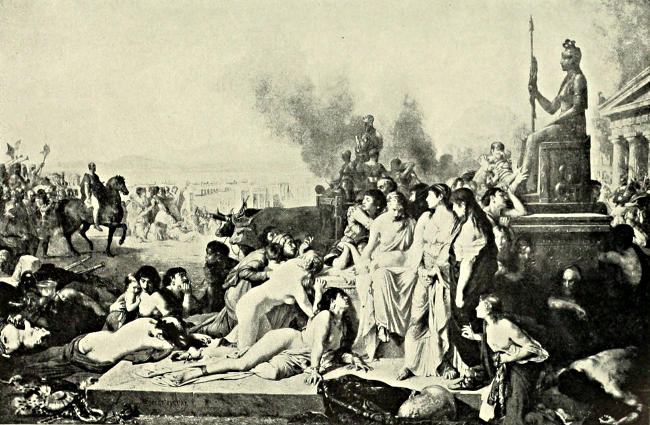
THE LAST DAYS OF CORINTH
The town of Oropus, of which, ever since the Peloponnesian War, the
Athenians had wanted to take possession, which was often subdued by them,
but each time taken from them again, had, according to Pausanias, been assigned
to them by Philip after the Macedonian War, that is, he had made the
town tributary to Athens. The Athenians, it is said, plundered the town,
because they were suffering from severe poverty—but they had probably
imposed too heavy taxes upon the Oropians, and levied them too rigorously,
so that the Oropians applied to the Romans for redress. A great quantity
of existing Athenian tetradrachmæ still attests the poverty prevailing at that
time in Athens, for they consist of copper only covered over with a thin coat
of silver. The Athenians were then compelled to pay to the Oropians one
hundred talents as an indemnification; but they contrived to become reconciled
with them, and induced them not to exact the money, to return to their
former relation, and admit a garrison into their town. The conduct of
this garrison, however, induced the Oropians to demand its withdrawal.
As the Athenians refused, the Oropians applied to the Achæans, and bribed
Menalcidas, who happened to be strategus, with ten talents; Menalcidas
again prevailed upon Callicrates to persuade the popular assembly to compel
Athens to pay the one hundred talents. But the Athenians were beforehand
with them: they completely plundered Oropus, and Menalcidas also exacted
the promised sum with the greatest insolence, while he himself refused to pay
to Callicrates the sum he had promised him. The latter charged him with
high treason, and Menalcidas retaliated. The former repaired to Rome, and
Menalcidas is said to have saved his life only by bribing Diæus, who was
strategus.
The manner in which out of this unrelated quarrel the disputes between
the Achæans and Lacedæmonians arose is not clear. But they gave rise to a
war, and a wretched war it was. Diæus, with an army of the Achæan confederates,
entered Laconia, demanding the condemnation of the recalcitrants.
A Spartan senator proposed, that the twenty-four whose condemnation was demanded
by Diæus, should of their own accord go into exile. This was done,
and according to a preconcerted plan, all were condemned to death. But
these exiles were kindly received by the Roman senate, and Diæus and Callicrates
were sent to Rome to counteract their influence. The latter died on
his journey, having apparently somewhat changed his conduct during the
latter part of his life. Diæus and Menalcidas vehemently disputed before
the senate, which simply commanded them to return and wait, until a Roman
embassy should bring over a decisive answer. The Achæans, however, did
not wait, and Damocritus, who had in the meantime succeeded Diæus as
strategus, invaded Laconia, before the Roman ambassadors arrived, defeated
the enemy, and advanced as far as Sparta. He had no intention to pursue them
farther, and the Achæans accordingly accused and condemned him, thinking
that he had been bribed; and he went into exile. This happened probably
in 150 B.C.; and Diæus now became strategus in the place of Damocritus.
In the meantime the great drama throughout the world came to a crisis.
The Romans had undertaken the destruction of Carthage, but did not find
it so easy as they had imagined. In the provinces, the most contemptible
side of the character of the Romans was seen; they were beheld as plunderers
and oppressors; it was known that they were hated by all the world, and it
was expected that a general insurrection would break out, extending from
Spain to the extreme East. And it was believed that Rome could not stand
against it. It is possible that the nations may have heard of the internal
decay of Rome, of the ferment of Italy, and of the discontent of the allies.
[149-146 B.C.]
Under these circumstances, an insurrection first broke out in Macedonia.
The Romans had torn that country asunder in four parts, as Napoleon wanted
to divide Poland into three states—an attempt which proved fatal to him.
The Romans in Macedonia had not left together those masses which, in language
and origin, as well as geographically, were united; but with a diabolic
and calculating policy they had torn the country to pieces, and it was divided
in such a manner as to have as little connection as possible, one tribe being
mixed up with others. All the respectable people of Macedonia, under the
pretext of their being hostages, had been carried away with their families
into Italy, where they amalgamated with the inhabitants and disappeared.
In this manner all persons of mark had been removed. Moreover, the commercium
and connubium among those four provinces had been abolished, so
that no Macedonian was allowed to possess land in two different provinces,
every one being confined to his own district. But still Macedonia was in a
condition of great prosperity, especially in consequence of its mines and commerce,
as we must infer from the immense quantity of Macedonian money
of that period, which has come down to us. The limbs which had been torn
asunder, longed to be reunited as one whole.
At this time there appeared among them a man of about forty years, calling
himself Philip, and declaring himself to be a son of Perseus, and to have
escaped from his father’s misfortunes. It is possible that he was a pseudo-Philip,
that his real name was Andriscus, and that he was a native of Thrace:
there were several such impostors at that time. Philip defeated the Romans,
and in a very short time made himself master of all Macedonia, which recognised
him. He even penetrated into Thessaly, where he gained advantages,
and successfully maintained himself against the untrained troops of the
Romans. All sided with him; but the Achæans very inconsistently sent
auxiliaries to the Romans, although at the time all nations were harbouring
designs of revolt, but the Achæans thought that they were not yet ripe for
it. The Achæan auxiliaries came very opportunely to the Romans; it was
only through these, who were commanded by a Roman legate, that they succeeded
in defending Thessaly, and with their assistance they repelled the
Macedonians, until Metellus came with the Roman legion. He defeated
this Philip, whom the Romans call Andriscus, in several battles. Macedonia
now became a Roman province, under the absolute power of an imperator;
the senate coolly ordered them to dismiss from the confederacy not only
Lacedæmon, but all the other places which had not belonged to Achaia at
the time when the Achæans concluded the treaty with Rome in the first (or
more correctly the second) Macedonian War. C. Aurelius Orestes, together
with other ambassadors, brought these orders to Corinth, whither he summoned
the allies of the Achæans.
This very unjust and insolent demand threw the Achæans into a state
of frenzy; even before Orestes had finished his speech, the council hastened
to the market-place, calling upon the people to assemble, and it cannot excite
wonder, though it is a proof of the utter want of common sense among the
Achæans, that they fell upon the Roman ambassadors, and insultingly
drove them out of the theatre. All the Lacedæmonians who happened to be
in the city were arrested. After this the Achæans again marched into Laconia,
where Menalcidas had, in the meantime, made away with himself,
because he had broken a truce which he had been ordered to observe by the
Romans.
At this time the Macedonian insurrection was not yet quelled, and fortune
was still undecided. Metellus had not yet come over. Simultaneously the
Third Punic War was going on; the Spaniards and Iberians were stirring;
Masinissa’s family was suspected, and in short the Romans were pressed on
all sides. Their cunning policy therefore was mildness: they said that they
were willing to pardon the Achæans, if they would but acknowledge their
guilt, and apologise. But almost the whole nation was now in a state of
intoxication, “according to the words of Scripture, that God makes the
nations intoxicated for their own destruction.” Critolaus the strategus,
played the part of a hero, and inflamed the minds of the people—especially
of the populace, which was already in commotion at Corinth. When
the Roman ambassadors commenced speaking no one listened to them; they
were obliged to stop, and as the tumult became too great, they went away.
Critolaus, and still more, Diæus, now goaded the Achæans into the madness
of declaring war against the Romans, and marching towards Thermopylæ.
The war was decreed nominally against the Lacedæmonians, but in reality
against the Romans.
We have only very scanty information about the course of this war; but
the Excerpts of Porphyrogenitus from Polybiusc will throw light upon it.
“Posterity can form no conception,” says Polybius, “of the madness with
which the war was carried on; it was as if men rushed into it for the purpose
of perishing.”
Critolaus assembled a considerable army. The Bœotians, headed by the
Thebans under the wretched Pytheas, and the Chalcidians, were the only
Greeks that sided with the Achæans; the Ætolians and the other nations
were neutral; the Lacedæmonians, on the other hand, were hostile towards
the Achæans, for which reason all of the Achæans could not leave their country.
The allied army advanced as far as Heraclea near Mount Œta, and laid
siege to that town in order to protect Thermopylæ. But everything was
there managed so senselessly, that when Metellus, who on being informed of
this, without waiting for orders, had broken in from Macedonia with the
rapidity of lightning, came to its relief, the Achæans under Diæus and Critolaus
hastily fled back through the pass of Thermopylæ.
Metellus overtook them near Scarphe, attacked and defeated them so
completely that within a few hours the Achæan army was utterly annihilated;
many were slain, many were taken prisoners, and many dispersed
in flight. Diæus fled, Critolaus was not to be found, having perhaps perished
in a marsh. The whole army was scattered. An Arcadian contingent
of one thousand men, which arrived too late, was carried away by the
flight of the others, and a few days later, in the neighbourhood of Chæronea,
it was partly taken and partly cut to pieces by the Romans. The Achæans
fled in disorder into Peloponnesus. In Bœotia all the people, quitting the
towns, took refuge in the mountains; Thebes was deserted; many made
away with themselves from despair, and many implored the Romans to kill
them, declaring themselves to be the authors of all the misfortunes.
Diæus succeeded Critolaus in the command of the army; he was a person
of the utmost incapacity, and formidable only to those who obeyed him.
He had recourse to the most extreme measures; he decreed that all judicial
trials for debts should be stopped, all imprisoned debtors should be set free,
and that no debt should become due before the close of the war—a sad decree
for the wealthy, but it made him popular
among the rabble. Twelve thousand
slaves were to be manumitted and
armed (they are called παράτροφοι—i.e.,
milk-brothers, the children of female
slaves or nurses); and heavy war
contributions were levied. Four thousand
men were sent to Megara to defend
that place, and Diæus himself
assembled the army on the isthmus.
When Metellus appeared, those four
thousand soon evacuated Megara, and
all the forces were concentrated on the
isthmus close to the walls of Corinth.
[146 B.C.]
Greek Water Vessel
(Berlin Museum)
Metellus now appeared before Corinth.
Animated by a feeling of humanity
he wished to spare the city;
such a magnificent ancient city was indeed
something venerable to many a
Roman, and the idea of destroying it
was terrible to Metellus. It is also
possible that he grudged the consul
Mummius, who was already advancing
in quick marches, the honour of
bringing the war to a close. Once more Metellus sent some Greeks to the
Achæan army, according, according to Roman notions, fair terms, if they
would but lay down their arms, and requesting them to put confidence in
him. What else could he have done? But Diæus, who knew that his life
was forfeited, goaded the poor people to madness. The Achæans, believing
that Metellus had offered peace from a feeling of weakness, nearly killed the
ambassadors, and Diæus did not set them free until a ransom of ten thousand
drachmæ was paid; this is a characteristic feature of the man who showed
his avarice to the very last minute. The hypostrategus, who was favourable
to the Romans, was tortured.
In the meantime Mummius arrived and took the place of Metellus. He
had no such feelings towards the Achæans as his predecessor, who returned
to Rome. Mummius now had an army of twenty-three thousand foot and
three thousand horse, while the Achæans had only fourteen thousand foot
and a few hundred horse. The Achæans were encamped on the isthmus in a
strong position, but this was of no avail. The Romans had a fleet furnished
by their allies, while the Greeks had no ships, and the Roman fleet cruised
along the whole coast of Peloponnesus, landing everywhere, and ravaging
the country with the most fearful cruelty. What Themistocles had said to
the Peloponnesians, when they wanted to fortify themselves on the isthmus,
now came to pass; the contingents, especially those of the Eleans, dispersed
in all directions in order to protect their own towns, without being able to
do so.
A somewhat favourable engagement, in which they defeated a detachment
of the Romans, which had ventured too far and was not duly supported,
made the Achæans completely mad, and being thus encouraged they
thoughtlessly attacked the Roman army. But their small advantage was
immediately neutralised by a fatal blow; for in a great and decisive battle,
the Achæans were so completely routed, that they were not even able to
throw themselves into Corinth. The cavalry fled immediately; the infantry
maintained its ground better, but in the end all fled in different directions
into the mountains, and Diæus to Megalopolis, where he first murdered his
wife and then took poison. All the population of Corinth deserted the city
and took refuge in the mountains, as the Romans had done on the arrival of
the Gauls, and were hunted by the Romans like wild beasts.b
Mummius had not expected so easy a conquest, and, though informed
that the gates were open, suspecting some stratagem, suffered an entire day
to pass before he marched into the city. Though no resistance was offered,
all the men found within the walls were put to the sword; the women and
children were reserved for sale; and when all its treasures had been carried
away, on a signal given by blast of the trumpet the city was consigned to
the flames. So it is said the senate had expressly decreed. But vengeance
for the insults offered to the Roman envoys was probably more the pretext
than the motive for this cruelty. It was at least no less a crime in the eyes
of the Roman soldiers that Corinth was the richest city of Greece. Scarcely
any other was adorned with so many precious works of art. Mummius
himself had as little eye for them as any of his men, who made dice-boards
of the finest masterpieces of painting; but he knew that such things were
highly valued by others, and he therefore preserved those which were accounted
the choicest to embellish his triumph.
Before the arrival of the ten commissioners, who were sent in the autumn
to regulate the state of Greece, he made a circuit in Peloponnesus to inflict
punishment on the cities and persons that had taken an active share in the
war. The walls of all such towns were dismantled, and their whole population
disarmed. The adherents of Diæus were sentenced to death or exile,
and their property confiscated; and the Achæans—that is, the cities which
had contributed to the war—were condemned to pay two hundred talents
[£40,000 or $200,000] to Sparta. The greater part of the Corinthian territory
was annexed to Sicyon. Mummius afterwards marched northward to
deal like retribution among the insurgents of Bœotia and Eubœa. He razed
Thebes and Chalcis—or at least their walls—to the ground; condemned
the Bœotians and Eubœans—or more probably those cities alone—to pay
one hundred talents to Heraclea, which they had helped to besiege; and at
Chalcis he shed so much blood of the principal citizens, that Polybius himself
can only reconcile his conduct with the supposed mildness of his character
by the suggestion that he was urged by his council to unwonted severity.
It remained for the ten commissioners, according to the instructions of
the senate, to fix the future condition of the conquered nation. All Greece,
as far as Macedonia and Epirus, was constituted a Roman province: and
Achaia enjoyed the melancholy distinction of giving its name to the whole.
But the senate’s jealousy was not satisfied with the formal establishment of
its sovereignty; it had also decreed a series of regulations tending as much
as possible to restrict every kind of union and intercourse among the Greeks,
and to reduce them to the lowest stage of weakness and degradation. All
federal assemblies, all democratical polities, were abolished, and the government
of each city committed to a magistracy, for which a certain amount of
property was required as a qualification. No one might acquire land in any
part of the province but that in which his franchise lay. The details of this
outline, and all temporary measures for the settlement of the country, were
left to the discretion of Mummius and the Ten; and Polybius, who appears
to have arrived in Greece soon after the fall of Corinth, was now able in some
degree to alleviate the calamity which he had found it impossible to avert;
and perhaps it would not have been equally in his power to render such services
to his countrymen if he had been previously less alienated, at least in
appearance, from the national cause. As the intimate friend of the conqueror
of Carthage, he was treated with the highest respect and confidence;
and he employed his influence so as to win the esteem and gratitude of his
fellow-citizens. Mummius himself, when sated with bloodshed and rapine,
showed a disposition to conciliate the vanquished. Before his departure,
though he had removed the statue of the Isthmian Poseidon, to dedicate it—in
gross violation of religious propriety—in the temple of Jupiter at Rome,
he repaired the damage which had been done to the public buildings on the
Isthmus, adorned the temples of Olympia and Delphi, and made a circuit
round the principal Greek cities to receive tokens of their gratitude.
The political institutions were of course, according to the senate’s decree,
strictly oligarchical. And in this respect no alteration seems ever to have
been granted by the Roman government. But in some other points the
rigour of its original regulations was a few years afterward greatly relaxed.
The fines imposed on the Achæans, and on the Bœotians and Eubœans, were
remitted; the restraints on intercourse and commerce were withdrawn; and
the federal unions which had been abolished were revived. The Romans in
their official language seem to have described this renewal of the old forms
as a restoration of liberty to Greece. But even if the monument in which
this sounding phrase appears to be applied to it, did not itself illustrate
the vigilance with which the exercise of political freedom was checked by the
provincial government, we might be sure that these revived confederations
answered no other purpose than that of affording an occasion for some periodical
festivals, and some empty titles, soothing perhaps to the feelings of
the people, but without the slightest effect on their welfare. The end of the
Achæan War was the last stage of the lingering process by which Rome enclosed
her victim in the coils of her insidious diplomacy, covered it with the
slime of her sycophants and hirelings, crushed it when it began to struggle,
and then calmly preyed upon its vitals.
[146 B.C.-540 A.D.]
We have brought the political history of ancient Greece down to a point
which may be fitly regarded as its close; since in the changes which afterwards
befell the country the people remained nearly passive. The events
of the Mithridatic War—in which the Achæans and Lacedæmonians, and all
Bœotia, except Thespiæ, are said to have declared themselves against Rome,
and the royal army in Greece received a reinforcement of Lacedæmonian
and Achæan troops—might serve to indicate that the national spirit was not
wholly extinct, or that the Roman dominion was felt to be intolerably oppressive.
But Athens certainly no more deserved Sulla’s bloody vengeance
for the resistance into which she was forced by the tyranny of Athenion,
than for the credulity with which she had listened to his lying promises.
No historical fact is more clearly ascertained than that from this epoch
the nation was continually wasting away. Strabo,e who visited Greece but
a little more than a century later (B.C. 29), found desolation everywhere
prevailing. Beside his special enumeration of ruined towns and deserted
sites, and his emphatic silence as to the present, while he explores the faint
vestiges or doubtful traditions of the past, the description of almost every
region furnishes occasion for some general remark illustrating the melancholy
truth. Messenia was for the most part deserted, and the population
of Laconia very scanty in comparison with its ancient condition; for beside
Sparta it contained but thirty small towns in the room of the hundred for
which it had once been celebrated. Of Arcadia it was not worth while to say
much, on account of its utter decay. There was scarcely any part of the
land in tillage, but vast sheep-walks, and abundant pasture for herds of cattle,
especially horses; and so the solitude of Ætolia and Acarnania had become
no less favourable to the rearing of horses than Thessaly. Both Acarnania
and Ætolia—he repeats elsewhere—are now utterly worn out and exhausted;
as are many of the other nations. Of the towns of Doris scarcely
a trace was left; the case was the same with the Ænianes. Thebes had sunk
to an insignificant village; and the other Bœotian cities in proportion—that
is, as he elsewhere explains himself, they were reduced to ruins and names,
all but Tanagra and Thespiæ, which, compared with the others, were tolerably
well preserved.
It has been usual in modern times to attribute this decline of population
to the loss of independence, to the withering influence of a foreign yoke—in
a word, to Roman misrule. And it would be bold and probably an error, to
assert, that it was wholly unconnected with the nature of the government to
which Greece was subject as a Roman province. It is too well known what
that government was—how seldom it was uprightly administered, how easily,
even in the purest hands, it became the instrument of oppression. The ordinary
burdens were heavy. The fisherman of Gyaros, who was sent ambassador
to Augustus, to complain that a tax of 150 drachmæ was laid upon his
island which could hardly pay two-thirds of that sum, afforded but a specimen
of a common grievance. Greece was not exempt from those abuses
which provoked the massacre of the Romans in Asia at the outbreak of the
Mithridatic War. And even if we had no express information on the subject,
we might have concluded that it did not escape the still more oppressive
arbitrary exactions of corrupt magistrates, and their greedy officers. “Who
does not know,” Cicero asks, “that the Achæans pay a large sum yearly to
L. Piso?” It was notorious that he had received one hundred talents from
them, beside plunder and extortion of other kinds. The picture which Cicero
draws of the evils inflicted by L. Piso upon Greece is no doubt rhetorically
overcharged; but it is one of utter impoverishment, exhaustion, and ruin.
And here we may remark that the privileges of the free cities included in
the province afforded no security against the rapacity and oppression of a
Piso or a Verres. The Lacedæmonians, Strabo observes, were peculiarly
favoured, and remained free, paying nothing but voluntary offerings. But
these were among the most burdensome imposts; and so Athens, which enjoyed
the like immunity, was nevertheless, according to Cicero’s phrase, torn
to pieces by Piso. To this it must be added that the oligarchical institutions
everywhere established—and even Athens was forced so to qualify her
democracy that little more than the name seems to have been left—tended
to promote the accumulation of property in few hands; as we read that the
whole island of Cephallenia was subject to C. Antonius as his private estate.
Nevertheless it seems certain, that when these are represented as the main
causes of the decline of population in Greece, which followed the loss of her
independence, their importance has been greatly exaggerated, while others
much more efficacious have been overlooked or disparaged. For on the one
hand it is clear that this decline did not begin at that epoch, but had been
going on for many generations before. A comparison of the forces brought
into the field to meet the Celtic invasion by the states of northern Greece
with those which they furnished in the Persian War, would be sufficient to
prove the fact with regard to them; the evil lay deeper than the ravages of
war. And we have now the evidence of Polybius, that in the period either
immediately preceding, or immediately subsequent to the establishment of the
Roman government—a period which he describes as one of concord and comparative
prosperity, when the wounds which had been inflicted on the peninsula
were beginning to heal—even then the population was rapidly shrinking,
through causes quite independent of any external agency, and intimately connected
with the moral character and habits of the society itself.
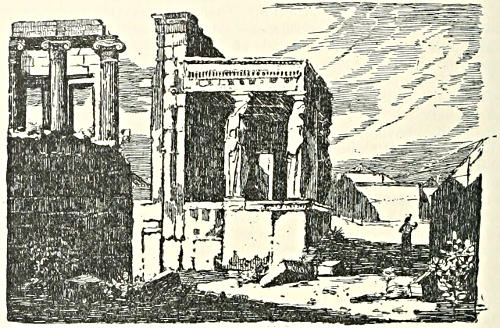
Ruins of the Erechtheum, Athens
The evil was not that the stream of population was violently absorbed,
but that it flowed feebly, because there was an influence at work which tended
to dry up the fountain-head. Marriages were rare and unfruitful through
the prevalence of indifference or aversion toward the duties and enjoyments
of domestic life. The historian traces this unhealthy state of feeling to a taste
for luxury and ostentation. But this explanation, which could only apply to
the wealthy, seems by no means adequate to the result. The real cause
struck deeper, and was much more widely spread. Described in general
terms, it was a want of reverence for the order of nature, for the natural
revelation of the will of God; and the sanction of infanticide was by no
means the most destructive, or the most loathsome form in which it manifested
itself. This was the cancer which had been for many generations
eating into the life of Greece.
How little the vices of the Roman government had to do with the decrease
of population in Greece, becomes still more apparent as we follow its
course through the history of the empire. The change from republican to
monarchical institutions was in general beneficial to the provinces, and especially
to Greece, which was not only exempt from the danger of arbitrary
oppression, but was distinguished by many marks of imperial favour.
Within the space of a few years, about the beginning of this period, three
new colonies animated the south coast of the Corinthian Gulf. Pompey
planted a settlement of pirates in the solitude of Dyme. His great rival
restored Corinth, and, if he had lived longer, would perhaps have opened a
canal through the Isthmus. Though the commerce, which at the fall of
Corinth had been diverted to Delos, and afterwards dispersed by the Mithridatic
War, may not have wholly returned into its ancient channel, still there
can be no question that the advantages of this restoration were very largely
felt throughout Greece. Augustus founded another populous Roman colony
at Patræ, which enjoyed the privileges of a free city. Nicopolis indeed was
rather designed as a monument of his victory, than to promote the prosperity
of Greece: for it was peopled from the decayed towns of the adjacent regions,
and the effect was to turn Acarnania and Ætolia into a wilderness.
Athens too had soon repaired the loss it suffered through Sulla’s massacre,
though Piræus did not rise out of its ruins. But the Athenian population
was recruited, as it had long been, by the lavish grant or cheap sale of the
franchise. It was like the galley of Theseus, retaining nothing but the name
and semblance of the old Athenian people, without any real natural identity
of race; so that it was no exaggeration, when Piso called it a jumble of divers
nations. The poverty indeed of the city, which had been a main cause of its
unfortunate accession to the side of Mithridates, still continued, and was but
slightly relieved by the bounty of benefactors like Pomponius and Herodes
Atticus, or even by the growing influx of wealthy strangers who came to
pursue rhetorical or philosophical studies there.
While its splendour was increased by the magnificent structures added to
it by Hadrian and Herodes, perhaps the larger part of the freemen was never
quite secure of their daily meal. Still the good will of the early emperors
was unequivocally manifested. They seem always to have lent a favourable
ear to the complaints and petitions of the province, and Nero went so far as
to reward the Greeks for their skilful flattery of his musical talents by an
entire and general exemption from provincial government, which may have
compensated for the presents he exacted from them. The Greeks, it is said,
abused their new privileges by discord and tumults, and Vespasian restored
the proconsular administration, and above all the tribute—which was perhaps
his real motive—with the remark that they had forgotten the use of
liberty. But it is evident that on the whole, from the reign of Augustus to
that of Trajan, the increase of the population was not checked by oppression
or by any calamity. Yet at the end of this period we find Plutarch declaring,
that Greece had shared more largely than any other country in the general
failure of population which had been caused by the wars and civil conflicts
of former times over almost all the world, so that it could then hardly furnish
three thousand heavy-armed soldiers—the number raised by Megara
alone for the Persian War; and his assertion is confirmed by the pictures
drawn by another contemporary witness.
In times when the present was so void and cheerless, the future so dark and
hopeless, it was natural that men should seek consolation in the past, even
though it had been less full, than was the case among the Greeks, of power
and beauty, prosperity and glory. Nor was it necessary then to evoke its
images by learned toil out of the dust of libraries or archives. The whole
land was covered with its monuments in the most faultless productions of human
genius and art. There was no region so desolate, no corner so secluded,
as to be destitute of them. Even the rapacity of the Romans could not exhaust
these treasures. Though Mummius was said to have filled Italy with
the sculptures which he carried away, it is probable that in the immense multitude
which remained, their absence, in point of number, might be scarcely
perceived. If Nero robbed Delphi of five hundred statues, there might still
be more than two thousand left there.
The expressive silence of these memorials was interpreted by legends
which lived in the mind and the heart of the people; and so long as any
inhabitants remained in a place, a guide was to be found thoroughly versed
in this traditional lore. The town of Panopeus at the northern foot of Parnassus,
though celebrated by Homer as a royal residence, had been reduced,
when it was visited by Pausanias,f to a miserable assemblage of huts, in which
the traveller could find nothing to deserve the name of a city, as it contained
neither an archive, nor a gymnasium, nor a theatre, nor a market-place, nor a
fountain; but the people remembered that they were not of Phocian, but of
Phlegyan origin: they could show the grave which covered the vast bulk of
the great Tityus, and the remnants of the clay out of which Prometheus had
moulded the human race. Relics of like antiquity were at the same period
reverently treasured in most parts of Greece. The memory of the past was
still more effectually preserved by a great variety of festivals, games, public
sacrifices, and other religious solemnities. After the extinction of the national
independence, the battle of Platæa did not cease to be commemorated by the
Feast of Liberty; as notwithstanding the absence of all political interests,
the forms of deliberation were kept up in the Amphictyonic, the Achæan,
Phocian, and Bœotian councils. The heroes both of the mythical and the
historical age were still honoured with anniversary rites—Aratus and Demosthenes,
and the slain at Marathon, no less than Ajax and Achilles, Temenus,
Phoroneus, and Melampus.
The religion of the Greeks, which was so intimately associated with almost
all their social pleasures and their most important affairs, had never lost its
hold on the great body of the nation. We hear much of the change wrought
in the state of religious feeling by the speculations of the sophists, and the
later kindred philosophical schools, by the frequent examples of sacrilegious
violence, by the progress of luxury, and the growing corruption of manners.
But the effect seems to have been confined to a not very large circle of the
higher classes. With the common people paganism continued, probably as
long as it subsisted at all, to be not a mere hereditary usage, but a personal,
living, breathing, and active faith. In the age of the Antonines the Attic
husbandmen still believed in the potent agency of their hero Marathon, as
the Arcadian herdsmen fancied that they could hear the piping of Pan
on the top of Mænalus. The national misfortunes, as they led the Greeks to
cling the more fondly to their recollections of the past, tended to strengthen
the influence of the old religion, and rendered them the less disposed to
admit a new faith which shocked their patriotic pride and dispelled many
pleasing illusions, while it ran counter to all their tastes and habits, and
deprived them of their principal enjoyments. Accordingly, it seems that
Christianity, notwithstanding the consolations it offered for all that it took
away, made very slow progress beyond the cities in which it was first planted;
and its ascendency was not firmly established long before the beginning of a
period in which a series of new calamities threatened the very existence of
the nation.
The result of the Persian invasion in the mind of the victorious people had
been a feeling of exulting self-confidence, which fostered the development of
all its powers and resources. The terror of the Celtic inroad was followed
by a sense of security earned in a great measure by an honourable struggle.
Far different was the impression left by the irruption of Alaric, when Greece
was at length delivered from his presence. The progress of the barbarians
had been stopped by no resistance before they reached the utmost limits of
the land. They retreated indeed before Stilicho, but not broken or discomfited,
carrying off all their booty to take undisturbed possession of another,
not a distant province. It was long indeed before the Greeks experienced a
repetition of this calamity, but henceforth they lived in the consciousness
that they were continually exposed to it. They neither had strength to
defend themselves, nor could rely on their rulers for protection.
The safety of Greece was one of the last objects which occupied the
attention of the court of Constantinople. In the utter uncertainty how soon
a fresh invader might tread in the steps of Alaric, every rumour of the movements
of the hordes which successively crossed the Danube, might well
spread alarm, even in the remotest corners of Peloponnesus. The direction
which they might take could be as little calculated as the course of lightning.
Who could have foreseen that Attila and Theodoric would be diverted from
their career to fall upon other prey—that Genseric after his repulse before
Tænarus would not renew his invasion—that the Bulgarians would be so
long detained by the plunder of the northern provinces? In the reign of
Justinian the advances of the barbarians became more and more threatening,
and in the year 540 northern Greece was again devastated by a mixed swarm
of Huns and other equally ferocious spoilers, chiefly of the Slavonic race.
The strengthened fortifications of the Isthmus indeed withstood this
flood, though they could not shelter the Peloponnesians from the earthquakes
and the pestilence, which during this unhappy period were constantly wasting
the scanty remains of the Hellenic population which had escaped or
survived the inroads of the barbarians. Justinian’s enormous line of fortresses
revealed the imminence of the danger, but could not long avert it.
In the course of the seventh and eighth centuries the worst forebodings were
realised; after many transient incursions the country was permanently
occupied by Slavonic settlers. The extent of the transformation which ensued
is most clearly proved by the number of the new names which succeeded
to those of the ancient geography. But it is also described by
historians in terms which have suggested the belief that the native population
was utterly swept away, and that the modern Greeks are the descendants
of barbarous tribes which subsequently became subject to the empire, and
received the language and religion which they have since retained from
Byzantine missionaries and Anatolian colonists; and such is the obscurity
which hangs over the final destiny of the most renowned nation of the earth,
that it is much easier to show the weakness of the grounds on which this
hypothesis has been reared, than to prove that it is very wide of the truth.d
CHAPTER LXV. THE KINGDOM OF THE SELEUCIDÆ — SELEUCUS — ANTIOCHUS SOTER — SELEUCUS PHILOPATOR
[323-312 B.C.]
In the final tripartite division of Alexander’s empire, the largest part,
geographically speaking, fell to Seleucus, known as Nicator, or the Conqueror,
who gave his name to the kingdom which was destined for many generations
to play a more or less important part in Asiatic history. Seleucus
had his capital first at Babylon and re-established the power of Grecian or
Macedonian arms over a large part of the Asiatic territory of Alexander’s empire.
Subsequently the seat of the kingdom was shifted to the newly founded
city of Antioch on the coast of Asia Minor, which became one of the most
important capitals in the world, at times almost rivalling Alexandria. The
territory and power of the Seleucidæ were early curtailed owing to the
advance of outlying nations, notably the Parthians, and gradually disintegrated
rather by slow stages than by the sudden shock of a single conquest.
Chiefly because of the shifting of progress far to the west, it was not destined
to play any really important part in the building of world history. In
name, at least, the kingdom continued in independent existence long after
Greece proper had been overthrown; but the Parthians and Sassanians in turn
had largely shorn it of its glory, and it was these powers, rather than the
Seleucidæ proper, that came into rivalry and conflict with the Roman might
when that new mistress of the world extended her influence to the eastward.
We must think therefore of the kingdom of the Seleucidæ rather as a link
in time and place between great powers, than as a thing of really intrinsic
importance. A brief summary of its history is, therefore, all that need detain
us. Here again for the sake of clearness—if clearness be possible in
this chaotic period—some repetition is unavoidable.a
The kingdom of Syria was not confined to that country alone, but also
comprehended those vast and fertile provinces of upper Asia, which formed
the Persian empire; being, in its full extent, bounded by the Mediterranean
on one side, and the river Indus on the other. These wide-spreading dominions
are commonly called the kingdom of Syria, because Seleucus, the first
of the Syro-Macedonian kings, having built the city of Antioch in that
province, chose it, as did likewise his successors, for the usual place of his
residence. Here his descendants, from him styled Seleucidæ, reigned, according
to Eusebius, for the space of 251 years, that is, from the 117th Olympiad,
when Seleucus recovered Babylon, to the third year of the 180th, when
Antiochus Asiaticus, the last of the race of Seleucus, was driven out by
Pompey, and Syria reduced to a Roman province. Before we proceed to the
history of the Seleucidæ, we shall exhibit a series of the kings of that race,
with the years of their respective reigns.
A Table of the Kings of Syria, from the Foundation of that Monarchy to its
being reduced by the Romans, with the Years of their Respective Reigns.
|
Years |
|
| Seleucus Nicator |
32 |
|
| Antiochus Soter |
19 |
|
| Antiochus Theos |
15 |
|
| Seleucus Callinicus |
20 |
|
| Seleucus Ceraunus |
3 |
|
| Antiochus the Great |
36 |
|
| Seleucus Philopator |
11 |
|
| Antiochus Epiphanes |
11 |
|
| Antiochus Eupator |
12 |
|
| Demetrius Soter |
12 |
|
| Alexander Balas |
5 |
|
| Demetrius Nicator |
6 |
|
| Antiochus Theos |
3 |
|
| Tryphon |
4 |
|
| Antiochus Sidetes |
11 |
|
| Alexander Zebina |
13 |
|
| Antiochus Grypus |
19 |
|
| Antiochus Cyzicenus |
21 |
|
| Seleucus Epiphanes |
|
7 months |
| Antiochus Eusebes |
1 |
|
| Demetrius Eucærus |
2 |
|
| Philip |
3 |
|
| Antiochus Epiphanes |
4 |
|
| Antiochus Dionysus |
7 |
|
| Tigranes |
14 |
|
| Antiochus Asiaticus |
4 |
|
Seleucus, the founder of the Syro-Macedonian empire, was the son of
Antiochus, one of the chief captains of Philip, the father of Alexander. He
served under Alexander from his tender years, attended him in his expedition
into Asia, and was by him honoured with the chief command of the
elephants, a commission of great trust and reputation. After the death of
that conqueror, Perdiccas, whom the officers had unanimously appointed
regent of the empire, placed Seleucus at the head of the cavalry of the allies;
in which command he acquitted himself with such reputation that Antipater,
who succeeded Perdiccas in his regency, raised him to the government of
Babylon and its territory.
In this post he was tempted, by the example of the other captains of
Alexander, who aspired to the supreme power in their respective allotments,
to betray his trust, and entertain thoughts of setting up for himself; whence,
when Eumenes, on his march into Susiana, pressed him to join the governors
of the upper provinces against Antigonus, who had openly revolted, he not
only refused to lend them any assistance, but even attempted to destroy
both Eumenes and his army, by cutting the sluices of the Euphrates, and laying
the whole plain where they were encamped under water. Eumenes,
however, though thus surprised, reached an eminence with his troops, before
the waters rose to any height, and the next day, by diverting their course,
found means to escape the danger, without the loss of a single man. Seleucus
made a truce with Eumenes, granting him a free passage through his province.
But when Antigonus demanded an account of the revenues of his government,
the answer he gave him so exasperated Antigonus that he thought
it advisable to abandon his province, and put himself under the protection of
Ptolemy, governor of Egypt.
[312-300 B.C.]
Seleucus meeting with a friendly reception from Ptolemy, in Egypt,
represented so effectually to that prince, as also to Lysimachus and Cassander,
the formidable power and ambitious views of Antigonus, that he
engaged them all three in a league against him. This war put an end both
to the life and reign of Antigonus. After the victory which Ptolemy gained
over Demetrius at Gaza, Seleucus, having obtained of the conqueror a thousand
foot and two hundred horse, took his route towards Babylon, in order
to attempt the recovery of that city. This undertaking was looked upon as
a desperate enterprise, even by his friends, but was attended with all the
success he wished for.
Seleucus being now master of the city and castle, judged it necessary to
raise what forces he could, not doubting that Antigonus would soon send
an army to drive him from these acquisitions. Accordingly, while he was
busy in recruiting his army and disciplining his new-raised troops, news was
brought him that Nicanor, governor of Media under Antigonus, was advancing
against him, at the head of ten thousand foot, and seven thousand
horse. Upon this intelligence Seleucus marched out to meet him with three
thousand foot and four hundred horse only, and passing the Tigris, concealed
his men, as the enemy drew near, in the fens hard by the river, with
a design to attack Nicanor unexpectedly; who not having had any intelligence
of Seleucus’ march, encamped in a disadvantageous post, where he
was the following night surprised, and his army, after great slaughter, put
to the rout. Such of the soldiers as survived the slaughter declared for
Seleucus—a circumstance which enabled him to pursue his conquests, and
reduce in a short time all Media and Susiana, with many of the adjacent
provinces. Having, by this victory, established his interest and power in
Babylon, he daily improved them by the clemency of his government, and
by his justice, equity, and humanity, to such a degree that, from so low a
beginning, he became, in a few years, the greatest and most powerful of all
Alexander’s successors.
And now Seleucus, seeing himself in quiet possession of Babylon and its
territory, advanced at the head of a considerable army into Media, where he
engaged and slew with his own hand Nicanor, or, as others call him, Nicator,
whom Antigonus had sent against him. Having reduced all Media, he pursued
his march into Persia, Bactria, Hyrcania, etc., subjecting to his new
empire these and all the other provinces on this side the Indus, which had
been formerly conquered by Alexander. In the meantime Antigonus and
Demetrius having assumed the title of king, Seleucus imitated their example,
styling himself king of Babylon and Media.
Having therefore no enemy to fear on this side the Indus, he resolved to
cross that river, and, by a sudden irruption, make himself master of those
vast provinces which were known by the name of India. These Alexander
had formerly subdued; but after his death, while his successors were engaged
in mutual wars with each other, one Sandrocottus, or, as others call him,
Androcottus, an Indian of mean extraction, under the specious pretence of
delivering his country from the tyranny of foreigners, had raised a powerful
army, and having driven out the Macedonians, seized the Indian provinces
for himself. To recover these provinces Seleucus crossed the Indus: but
finding that Sandrocottus had made himself absolute master of all India and
drawn into the field an army of six hundred thousand men, with a prodigious
number of elephants, he did not judge it advisable to provoke so great
a power; and therefore entering into a treaty with him, he agreed to
renounce all his pretensions to that country, provided Sandrocottus furnished
him with five hundred elephants—which proposal the Indian prince
willingly agreeing to, a peace was concluded between them.
Seleucus marching into the upper Syria, made himself master of that
rich province, and built on the river Orontes the city of Antioch, which soon
became, and continued to be for many ages, the metropolis of the East; for
the Syrian kings, and afterwards the Roman governors, who presided over
the affairs of the eastern provinces, chose it for their place of residence;
and afterward in the Christian times, it was the see of the chief patriarch
of Asia. Besides Antioch, Seleucus built in the same country several
other cities of less importance.
[283-273 B.C.]
A few months after the decease of Demetrius, died also Ptolemy Soter,
king of Egypt, so that two only of Alexander’s captains survived,—viz.,
Lysimachus and Seleucus. As they were each upwards of seventy, it was
expected that they should have closed the scene of life in the union which
had subsisted so long between them, for they had ever been closely united,
and, to the utmost of their power, supported each other; but it happened
quite otherwise; a war, which proved fatal to both, soon breaking out between
them.
Seleucus was easily persuaded to engage in this war, being already sufficiently
inclined to it on other accounts; but before he embarked in so great
an undertaking, he not only resigned to his son Antiochus a considerable
part of his empire, but also, by an unparalleled example, his favourite queen
Stratonice. Seleucus having, without much difficulty, prevailed upon Stratonice
to accept of a young prince for her husband instead of an old king,
the nuptials were solemnised with the utmost pomp and magnificence; after
which Antiochus and Stratonice were crowned king and queen of upper Asia,
Seleucus willingly resigning to them all those provinces.
Seleucus advanced into Asia Minor, where he easily reduced all the places
belonging to Lysimachus. The city of Sardis was soon obliged to capitulate.
Lysimachus met the enemy at Corupedion in Phrygia. The engagement was
very bloody, and the victory long doubtful; but at last Lysimachus, who
had fought the whole time at the head of his troops with incredible bravery,
being run through with a spear by Malacon of Heraclea, and killed on the
spot, his soldiers betook themselves to flight, and left Seleucus master of
the field and all their baggage. Thus died Lysimachus, after having seen
the death of fifteen of his children; and as he was, to use the expression of
Memnon, the last stone of his house to be pulled down, Seleucus, without
opposition, made himself master of all his dominions.
What gave him most pleasure on this occasion was that he now was the
only survivor of all the captains of Alexander; and that, by the event of
this battle, he was become, as he styled himself, the Conqueror of Conquerors.
This last victory, which he looked upon as the effect of a peculiar providence
in his favour, gave him the best title to the name of Nicator, or conqueror,
by which historians commonly distinguish him from other kings of the same
name, who afterwards reigned in Syria.
His triumph on this occasion did not last long; for, seven months after,
as he was marching into Macedon, to take possession of that kingdom, with a
design to pass the remainder of his life in his native country, he was treacherously
slain by Ptolemy Ceraunus, on whom he had conferred innumerable
favours. Such was the end of Seleucus, the greatest general in the opinion
of Arrian, and the most powerful prince, after Alexander, in the age he
lived in. He died in the forty-third year after the death of Alexander,
in the thirty-second of the Grecian or Seleucian era, and seventy-third or,
as Justin will have it, seventy-eighth of his age.
On the death of Seleucus, Antiochus, surnamed Soter, his son by Apama,
the daughter of Artabazus the Persian, took possession of the empire of
Asia, and held it for the space of nineteen years.
[277-261 B.C.]
Sosthenes, who had reigned some years in Macedon, being dead, Antiochus
Soter, and Antigonus Gonatas, the son of Demetrius, laid claim to
that kingdom, their fathers having held it, one after the other; but Antigonus,
who had already reigned ten years in Greece, being nearest, first
took possession of those dominions; but neither daring to attack the other,
the two kings came to an agreement; and Antigonus having married Phila,
the daughter of Stratonice by Seleucus, Antiochus renounced his pretensions
to the crown of Macedon. In consequence of this renunciation, Antigonus
not only quietly enjoyed the kingdom of Macedon, but transmitted it to his
posterity, who reigned there for several generations.
Antiochus now marched against the Gauls, who having, by the favour of
Nicomedes, got settlements in Asia, harassed, with frequent incursions, the
neighbouring princes. Antiochus defeated them with great slaughter, and
delivered those provinces from their oppressions; and hence he acquired the
title of Soter, or “saviour.”
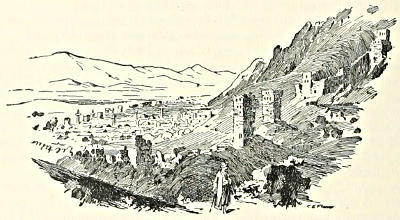
Ruins of Antioch
Not long after this successful expedition against the Gauls, Antiochus,
hearing of the death of Philetærus, prince of Pergamus, seized that opportunity
to invade his territories, with a view to add them to his own dominions;
but Eumenes, nephew and successor of the deceased prince, having
raised a considerable army, encountered him near Sardis, overthrew him in
battle, and thereby not only secured himself in the possession of what he had
already enjoyed, but enlarged his dominions with several new acquisitions.
After his defeat, Antiochus returning to Antioch there put to death one of
his own sons for raising disturbances in his absence, and at the same time
proclaimed the other, called also Antiochus, king of Syria. He died soon
after, leaving his son in the sole possession of his dominions. The young
prince was his son by Stratonice.
Antiochus, on his accession to the throne, assumed the surname of Theos,—that
is, god; and by this he is distinguished from the other kings of
Syria who bore the name of Antiochus.
In the third year of the reign of Antiochus Soter, a bloody war had broken
out between him and Ptolemy Philadelphus, king of Egypt. While Antiochus
was thus engaged in a war with the king of Egypt, great commotions
and revolts happened in the eastern provinces of his empire, which, as he
was not at leisure to suppress them immediately, increased to such a degree
that he could never afterwards re-establish quiet; by which means Antiochus
lost all the provinces of his empire lying beyond the Euphrates.
[261-223 B.C.]
These troubles and commotions in the East made Antiochus Theos weary
of his war with Ptolemy; a treaty of peace was therefore concluded on the
following terms: that Antiochus should divorce his former wife Laodice, who
was his own sister by the father, marry Berenice, the daughter of Ptolemy,
and settle the crown upon the male issue of that marriage. Two years after
this marriage Ptolemy Philadelphus died—an event which Antiochus Theos,
his son-in-law, no sooner understood than he removed Berenice from his bed,
and recalled Laodice, with her children Seleucus Callinicus, and Antiochus
Hierax; but Laodice being well acquainted with his fickle temper, and fearing
lest he might again abandon her and receive Berenice, resolved to improve
the present opportunity and secure the succession to her son, for by the
late treaty with Ptolemy, her children were disinherited and the crown settled
on the son of Berenice. To effect this design, she caused Antiochus to
be poisoned; when she saw him expiring, she ordered him to be privately
conveyed away, and one Artemon, who greatly resembled him, as well in
features as in the tone of his voice, to be placed in his bed. Artemon acted
his part with great dexterity, and personating Antiochus, tenderly recommended
his dear Laodice and her children to the lords that visited him. In
the name of Antiochus, whom the people believed still alive, orders were
issued, enjoining all his subjects to obey his beloved son Seleucus Callinicus,
and acknowledge him for their lawful sovereign. The crown being by this
infamous contrivance secured to Callinicus, the death of the king was publicly
declared, and Callinicus without any opposition ascended the throne. Antiochus
Hierax, the other son of Laodice, had at this time the government of
the provinces of Asia Minor, where he commanded a considerable body of
troops.c
Hardly had Seleucus to some extent recovered from the severe defeats
inflicted upon him by Ptolemy the “benefactor” during the three years’ war
of vengeance, when his younger brother Antiochus, surnamed “the hawk”
(Hierax) on account of his rapacity, raised the standard of revolt in conjunction
with Mithridates of Pontus, and (Seleucus having been routed by
Galatian mercenaries in a terrible battle at Ancyra) made himself master of
a large part of Asia Minor, but was forced to pay tribute for it to the hordes
of Celtic robbers, who overran the provinces after their victory, ravaging
and pillaging with impunity. Not until Seleucus had effected a reconciliation
with his brother and made a peace by which he resigned to the latter
his dominions in Asia Minor, was he able gradually to reunite the lost or
rebellious provinces and to restore tranquillity and order in his kingdom.
Both brothers were brave and energetic; but the sanguinary quarrels of
their house, and the crimes which were handed down from generation to generation
to beget fresh acts of revenge, had imbruted their minds. Alike in
vigour, restlessness, and violence, they persecuted each other to the death.
Antiochus died a fugitive in a Thracian city under the blows of Celtic
assassins, and his royal brother fell in the following year in an unsuccessful
fight with Attalus I, the conqueror of the Galatians and ruler of the kingdom
of Pergamus.
[223-196 B.C.]
The son and successor of Seleucus, who bore the same name as his father
with the surname of “the thunderbolt” (Ceraunus), entered on the heritage
of the kingdom and the war with Attalus, but after a reign of three years
met his death in battle at the hands of Nicanor and the Galatian captain
Apaturius. The Syrian army then bestowed the crown upon his younger
brother, Antiochus III. He, being occupied with the eastern provinces,
delegated the conduct of the war in Asia Minor to his maternal uncle
Achæus. They both fought with good fortune and success. While the
king led an expedition into Media and Persia, defeated the rebellious satraps
Molon and Alexander in the field and constrained them to commit suicide,
and compelled the Bactrians, Parthians, and Indians to acknowledge the
suzerainty of the Syrian king, Achæus drove his adversary Attalus back
over the frontiers of his own principality, pressed hard upon him in his own
capital, and, by a policy of mingled conciliation and coercion, prevailed upon
the Greek cities of the western coast to submit to annexation. But, rendered
presumptuous by success, he next attempted to set up an independent kingdom
in Asia Minor, and thus again prevented the complete restoration of
the Seleucid dominion. Antiochus, involved in a fresh war with Egypt,
from which country he was scheming to wrest the intermediate Syrian territory
of the Lebanon, was obliged to let his uncle have a free hand for a
while. But he had hardly concluded peace with Ptolemy after the disastrous
battle of Raphia in the ancient country of the Philistines, and
abandoned his claim to the Syrian coast, before he took the field against
the traitorous Achæus. The latter, deserted by most of his troops, took
refuge in the fortified city of Sardis, where he was closely besieged by
Antiochus, and, having been treacherously betrayed into his hands, was put
to a painful death.
Antiochus, whom the flattery of contemporary historians styles “the
great,” then conceived the design of restoring the empire of the Seleucids
to its pristine expansion. For this purpose he undertook an adventurous
campaign of several years’ duration in eastern Iran and India, constrained
the revolting princes and states to do homage to him, and extorted a recognition
(more apparent than real) of Syrian supremacy.
Just as Antiochus returned to Asia Minor the fourth Ptolemy, the voluptuous
Philopator, died, and his son Ptolemy Epiphanes, a minor, succeeded
to the kingdom. The consequent disorders, factions, and weakness of Egypt
inspired the enterprising king of Syria with the hope that he might after all
acquire the coast land of the Lebanon. Reinforced by a treaty of partition
with Philip of Macedonia, who himself coveted the Egyptian possessions in
Asia Minor, Thrace, and the islands, Antiochus invaded Judea with an
army, overthrew the Ætolian leader, Scopas, commander of the Egyptian
forces, at Paneas near the sources of the Jordan, and subjugated the coast,
including the fortified town of Gaza. The inhabitants of Jerusalem and
Judea gladly welcomed the rule of Syria, which was at first mild and conciliatory,
though it soon became even more oppressive than that of Egypt.
The guardians of the Egyptian king hastened to prevent an attack upon
Egypt itself by concluding a treaty of peace in which they renounced all
claim to the conquered territory and betrothed their ward to Cleopatra,
daughter of Antiochus. Meanwhile Philip had been waging successful war
in Asia Minor, the Hellespont, and the islands, though all his conquests were
rendered nugatory by the disastrous fight with the Romans at Cynoscephalæ.
[196-170 B.C.]
Instead of manfully supporting his ally against the mighty adversary
from the west, Antiochus endeavoured to turn the withdrawal of the Macedonian
army to his own profit. He laid claim to all the territory west of
the Taurus and on both shores of the Hellespont which his ancestor Seleucus
had acquired by his victory over Lysimachus; and, not content with mastering
the Greek cities on the Asiatic coast and the independent kings of Pergamus,
Bithynia, Cappadocia, Pontus, and Armenia, he crossed the Hellespont,
occupied the city of Lysimachia which had been rebuilt, together with other
places on the Thracian peninsula, and threatened Lampsacus, Byzantium,
and Heraclea. Apprehensive for their independence, the princes and cities
he menaced followed the example set by the rich and powerful commercial
city of Rhodes, and placed themselves under the protection of the Romans.
The latter, by repeated embassies, required “the great” king to desist from
hostilities against their allies, and to liberate all the Greek cities in Asia and
Europe. Antiochus haughtily declined Roman intermeddling with his
affairs, saying that as he did not trouble himself about the concerns of Italy
and the western world, so he forbade the Romans to curtail his prerogatives
in Asia and Thrace, stigmatising their demands as contrary to justice and
honour. [He also gave the Carthaginian Hannibal his protection and support
against Rome.] Further negotiations by embassies and epistles delayed the
outbreak of war for some years, but could not divert the fatal blow from
the Syrian empire. The battle of Magnesia broke the might of the Seleucid
kingdom for evermore; Syria made no second appeal to arms. Antiochus
“the great” was slain at Elymais, south of the Caspian Sea, by the inhabitants
of the city, while he was engaged in plundering the temple of Baal to
fill his empty coffers with its treasures.b
He was succeeded by Seleucus, surnamed Philopator, or, as Josephusd
styles him, Soter, which indeed was the surname of his son Demetrius.
This prince reigned eleven years and some months; but made a very poor
figure, by reason of the low state to which the Syrian empire had been
reduced by the Romans, and the exorbitant sum of a thousand talents he
was obliged to pay annually, by virtue of the treaty of peace between the
king his father and that republic. It was under this prince that the famous
accident happened concerning Heliodorus, which is mentioned in the second
book of Maccabees, and described in the History of Israel. Later Heliodorus
poisoned Seleucus and put the crown on his own head.
Antiochus, brother of Seleucus, being arrived at Athens on his return
from Rome, received there the news of his brother’s death, and was at the
same time told that Heliodorus had seized the crown and was supported by
a strong party; but that another was forming in favour of Ptolemy, who
claimed the kingdom of Syria, in right of his mother, the deceased king’s
sister. Hereupon Antiochus had recourse to Eumenes, king of Pergamus,
and to Attalus, the king’s brother, who conducted him into Syria, at the head
of a powerful army, drove out the usurper, and seated him on the throne.
On his being settled on the throne he assumed the name of Epiphanes, that
is, “the illustrious,” which title was never worse applied. His odd and
extravagant conduct made his subjects look upon him as a madman; whence,
instead of Epiphanes, or “the illustrious,” they used to style him Epimanes,
that is, “the madman.”
[170-125 B.C.]
Antiochus having, ever since the return of Apollonius from the Egyptian
court, been making the necessary preparations for the war with Ptolemy, was
met by the forces of Ptolemy, between Mount Casius and Pelusium. Hereupon
an engagement ensued, in which the Egyptians were routed at the first
onset. Antiochus, having spent the whole winter in making fresh preparations
for a second expedition into Egypt, gained a second victory over the
forces of Ptolemy, took Pelusium, and led his army into the very heart of
the kingdom. In this last overthrow it was in his power to have cut off
all the Egyptians to a man; but, instead of pursuing his advantage, he took
care to put a stop to the slaughter, riding about the field in person, forbidding
his men to put any more to death. This clemency gained him the hearts
of the Egyptians so completely, that when he advanced into the country all
the inhabitants voluntarily submitted to him; by which means he made himself
master of Memphis, and all the rest of Egypt, except Alexandria, which
still held out against him. In his second invasion Ptolemy fell into the
hands of the conqueror; but whether he was taken prisoner, or surrendered
himself voluntarily, is uncertain. It was at this time that Antiochus took
Jerusalem, and profaned the temple.
The Alexandrians, seeing Ptolemy Philometor in the hands of Antiochus,
whom he suffered to govern his kingdom as he pleased, looked upon him as
lost to them, and therefore placed his younger brother on the throne, giving
him the name of Euergetes, which was afterwards changed into that of Physcon,
or “great-bellied,” his luxury and gluttony having made him remarkably
corpulent, and by this name he is most commonly mentioned in history.
Antiochus, being informed of what was transacting in Egypt, took occasion
from this to return a third time into that country, upon the specious
pretence of restoring the deposed king; but in reality he made himself
master of the kingdom. Having therefore defeated the Alexandrians in a
sea-fight near Pelusium, he again entered that unhappy country at the head
of a powerful army, and advanced directly to Alexandria to besiege it.
In this extremity Ptolemy Euergetes and Cleopatra his sister, who were
in the city, sent ambassadors to Rome representing their situation, and imploring
the assistance of that powerful republic. The Roman ambassadors
obliged Antiochus to quit Egypt. On his return, being highly provoked to
see himself thus obliged to quit a kingdom which he looked upon as his own,
Antiochus vented his rage upon the city of Jerusalem, which had given him
no offence. But the desolations he caused in Judea, and the bloody war
which he carried on against the Jews, with the generous resistance made
first by Mattathias, and afterwards by his son, the brave Judas Maccabæus,
are recorded in the history of that people.c
On the death of Antiochus, his favourite Philip was left as regent during
the minority of Antiochus Eupator. Philip was however put to death by a
rival, Lysias. Meanwhile Demetrius, the son of Seleucus Philopator, who
had been at Rome as hostage for many years, escaped and seized the throne,
taking the surname of Soter, “saviour.” The Romans acknowledged him,
but with so little enthusiasm that when an alleged impostor, Alexander
Balas, claiming to be the son of Antiochus, appeared, the Romans favoured
him, and he defeated Demetrius, who fell in battle 150 B.C. He left a son,
also named Demetrius, who, with the aid of Ptolemy Philometor of Egypt,
defeated Alexander Balas, and put him to death. Demetrius, called Nicator,
was overthrown by a general named Tryphon acting for Antiochus, the son
of Alexander Balas, who was crowned as Antiochus Theos, only to be put
to death later by Tryphon, who claimed the crown. Tryphon was dispossessed
by the brother of Demetrius Nicator, who took the name of Antiochus
Sidetes, a monarch of many good qualities, and reigned nine years, winning
praise even from the Jews who had suffered so much from Syrian
kings. He was killed in battle with the Parthians, and Demetrius Nicator,
who had remained in captivity all these nine years, recovered the throne,
but was slain by a new pretender, Alexander Zebina, who was put to death
by a son of Demetrius Nicator, called Antiochus Grypus, who is said to
have made his mother Cleopatra—a past mistress of intrigue—drink a
bowl of poison she had prepared for him.
[125-65 B.C.]
After a reign of eight years he was opposed by his half-brother,
Antiochus Cyzicenus, who compelled him to share the kingdom. Grypus
being assassinated, Syria was again made one under a Seleucus Epiphanes,
who defeated Cyzicenus only to be expelled in seven months by Antiochus
Eusebes, who in turn, after a year, fell before Grypus’ fourth son, Demetrius
Eucærus. He was driven out by his own brother Philip, and Philip by a
younger brother, Antiochus Dionysius.
By this time the kaleidoscopic feuds of the Seleucidæ had weakened
Syria till it was ripe for a foreigner, and the Armenian king, Tigranes, made
prey of it. A last claimant, Antiochus Asiaticus, held out for a time; then
called in the Romans, who under Pompey absorbed Syria into the empire,
and put an end to the race of Seleucus, which had ruled from about
312 B.C. to 65 B.C.a
Greek Bottles
(In the Museum of Napoleon III)
CHAPTER LXVI. THE KINGDOM OF THE PTOLEMIES — PTOLEMY PHILADELPHUS — PTOLEMY EUERGETES — PTOLEMY PHILOPATOR — EPIPHANES — PHILOMETOR AND PHYSCON — ROMAN INTERFERENCE — PTOLEMY AULETES; CLEOPATRA AND THE END
[323-321 B.C.]
When the empire of Alexander was parcelled out among his generals,
the most desirable lot perhaps was that which fell to the share of Ptolemy.
That astute general chose Egypt for his portion, and despite the efforts of
his rivals, he was able, thanks in part to the isolated geographical position,
to retain it, and ultimately to become its recognised sovereign and the
founder of a dynasty of kings which was to hold unbroken sway there for
the long period of three hundred years.
Ptolemy, besides being an excellent general, was evidently a man of rather
wide culture and varied attainments. His capacities have been sometimes
accounted for by the suggestion that he was probably in fact the half-brother
of Alexander the Great, as his mother had been a concubine of
Philip; though his royal paternity, if indeed a fact, was never officially
recognised. Be that as it may, Ptolemy was a man of great ability as a
ruler, and his general culture is evidenced by the fact that he wrote a
history of the life and campaigns of Alexander, which work, as we have
already seen, was one of the two chief sources from which the history of
Arrian was compiled.
The first Ptolemy founded, and his successors enlarged and extended,
the famous Alexandrian library, which came to be by far the most important
collection of books that had probably been gathered together
anywhere in the world up to that time, comprising, it is said, no fewer
than half a million manuscripts. In connection with the library was
an institution which was virtually a college, where the most distinguished
scholars of the day studied and taught. The language and the entire official
life thus transplanted into Old Egypt were of course Grecian. All official
connection with the mother country was soon utterly broken; the kingdom
of the Ptolemies, as a political factor, was a thing quite apart; but in the
broader sense the new Egyptian power was essentially Greek. Alexandria,
the new Athens, became the centre of Greek life, thought, and influence; it
was there, rather than to Athens itself, that the youth flocked from the provinces
to drink at that fount of Grecian culture which still maintained its
influence in the world for generations after the original Hellas had been
shattered in power and shorn of all political significance.
But the time came when the Egyptian empire also was to come in conflict
with the Romans. The tragic romance of Cleopatra, the last daughter
of the Ptolemies, is known to every one, though curiously enough the patent
fact is often overlooked that this “daughter of the Nile” was in no proper
sense an Egyptian, but to the last drop of her blood a Macedonian Greek,
bearing the name even of one of the wives of the father of Alexander the
Great. It was this Egyptian empire of the Ptolemies, then, which served
as the direct channel of transit of the old Grecian culture to Rome, somewhat
as Persia had been the channel of transit of Egyptian and Babylonian culture
to Greece. It was a curious and interesting revival through which Egypt,
which for some centuries had ceased to play an important part in the great
game of the nations, came to be again the centre of culture of the entire
world, even though this time it bore an exotic and not an indigenous culture.
But though this empire of the Ptolemies had thus a vastly greater importance
than the other portions of Alexander’s dismembered empire, we shall
treat its history somewhat briefly here, since we must necessarily return to
some phases of it more in detail in pursuing the history of that Roman power
by which the kingdom of the Ptolemies was finally overthrown.a
The Kingdom of the Ptolemies: the Thirty-third
Egyptian Dynastyd
|
Years |
|
Began
B.C. |
| Lagus or Soter reigned |
38 |
|
323 |
| Philadelphus |
38 |
|
285 |
| Euergetes |
25 |
|
247 |
| Philopator |
17 |
|
222 |
| Epiphanes |
24 |
|
204 |
| Philometor |
35 |
|
181 |
| Physcon or Euergetes II |
29 |
|
146 |
| Soter II or Lathyrus |
10 |
|
117 |
| Alexander I (Soter deposed) |
18 |
|
107 |
| Soter II restored |
7 |
|
89 |
| Berenice |
|
6 months |
81 |
| Alexander II |
|
6 months |
80 |
| Neus Dionysus or Auletes |
14 |
|
80 |
| Ptolemy the Elder |
4 |
|
51 |
| Ptolemy the Younger |
3 |
|
48 |
| Cleopatra |
14 |
|
44 |
| Egypt a Roman province |
|
|
30 |
When Egypt was given to Ptolemy by the council of generals, Cleomenes
was at the same time and by the same power made second in command, and
he governed Egypt for one year before Ptolemy’s arrival, that being in name
the first year of the reign of Philip Arrhidæus, or, according to the chronologer’s
mode of dating, the first year after Alexander’s death. The first act
of Ptolemy was to put Cleomenes to death.
[321-316 B.C.]
Perdiccas, in the death of Cleomenes and the seizure of the body of Alexander,
had seen quite enough proof that Ptolemy, though too wise to take
the name of king, had in reality grasped the power; and he now led the
Macedonian army against Egypt, to enforce obedience and to punish the rebellious
lieutenant.
Perdiccas attempted to cross the Nile at the deep fords below Memphis.
Part of his army passed the first ford, though the water was up to the men’s
breasts. But they could not pass the second ford in the face of Ptolemy’s
army. After this check, whole bodies of men, headed by their generals, left
their ranks; and among them Pithon, a general who had held the same rank
under Alexander as Perdiccas himself, and who would no longer put up with
his haughty commands. Upon this the disorder spread through the whole
army, and Perdiccas soon fell by the hand of one of his own soldiers.
On the death of their leader, all cause of war ceased. Ptolemy sent corn
and cattle into the camp of the invading army, which then asked for orders
from him who the day before had been their enemy. The princes, Philip
Arrhidæus and the young Alexander, both fell into his hands; and he might
then, as guardian in their name, have sent his orders over the whole of
Alexander’s conquests. But, by grasping at what was clearly out of his
reach, he would have lost more friends and power than he would have
gained; and when the Macedonian phalanx, whose voice was law to the rest
of the army, asked his advice in the choice of a guardian for the two princes,
he recommended to them Pithon and Arrhidæus; Pithon, who had just
joined him, and had been the cause of the rout of the Macedonian army, and
Arrhidæus, who had given up to him the body of Alexander.
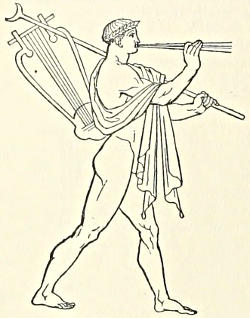
Bacchanalian Figure
(After Hope)
The Macedonian army, accordingly, chose Pithon and Arrhidæus as
guardians, and as rulers with unlimited power over the whole of Alexander’s
conquests; but though none of the Greek
generals who now held Asia Minor, Syria,
Babylonia, Thrace, or Egypt, dared to
acknowledge it to the soldiers, yet in reality
the power of the guardians was limited
to the little kingdom of Macedonia. With
the death of Perdiccas, and the withdrawal
of his army, Phœnicia and Cœle-Syria were
left unguarded, and almost without a master;
and Ptolemy, who had before been
kept back by his wise forethought rather
than by the moderation of his views, sent
an army under the command of Nicanor,
to conquer those countries. Jerusalem
was the only place that held out against
the Egyptian army; but Nicanor, says the
historian Agatharchides, seeing that on
every seventh day the garrison withdrew
from the walls, chose that day for the assault,
and thus gained the city. What
used to be Egypt was an inland kingdom,
bounded by the desert; but Egypt under
Ptolemy was a country on the seacoast;
and on the conquest of Phœnicia and Cœle-Syria he was master of the forests
of Libanus and Antilibanus, and stretched his coast from Cyrene to Antioch,
a distance of twelve hundred miles.
The wise and mild plans which were laid down by Alexander for the
government of Egypt, when a province, were easily followed by Ptolemy
when it became his own kingdom. The Greek soldiers lived in their garrisons
or in Alexandria under the Macedonian laws; while the Egyptian
laws were administered by their own priests, who were upheld in all the
rights of their order and in their freedom from land tax.
While Egypt under Ptolemy was thus enjoying the advantages of its
insulated position, and was thereby at leisure to cultivate the arts of peace,
the other provinces were being harassed by the unceasing wars of Alexander’s
generals, who were aiming like Ptolemy at raising their own power.
[316-311 B.C.]
Antigonus, in his ambitious efforts to stretch his power over the whole
of the provinces, had by force or treachery driven Seleucus out of Babylon,
and forced him to seek Egypt for safety, where Ptolemy received him with
the kindness and good policy which had before gained so many friends. No
arguments of Seleucus were wanting to persuade Ptolemy that Antigonus
was aiming at universal conquest, and that his next attack would be upon
Egypt. He therefore sent ambassadors to make treaties of alliance with
Cassander and Lysimachus, who readily joined him against the common
enemy.
Ptolemy crossed over to Cyprus to punish the kings of the little states on
that island for having joined Antigonus; for now that the fate of empires was
to be settled by naval battles the friendship of Cyprus became very important
to the neighbouring states. He landed there with so large a force that he met
with no resistance. He added Cyprus to the rest of his dominions. He banished
the kings, and made Nicocreon governor of the whole island. From
Cyprus, Ptolemy landed with his army in upper Syria, and then marching
hastily into Asia Minor he took Mallus, a city of Cilicia. Having rewarded
his soldiers with the booty there seized, he again embarked and returned to
Alexandria. This inroad drew off the enemy from Cœle-Syria.
Ptolemy, on reaching Alexandria, set his army in motion towards Pelusium,
on its way to Palestine. He was met at Gaza by the young Demetrius
with an army of eleven thousand foot and twenty-three hundred horse,
followed by forty-three elephants and a body of light-armed barbarians,
who, like the Egyptians in the army of Ptolemy, were not counted. But
the youthful courage of Demetrius was no match for the cool skill and
larger army of Ptolemy; the elephants were easily stopped by iron hurdles,
and the Egyptian army, after gaining a complete victory, entered Gaza,
while Demetrius fled to Azotus. Ptolemy, in his victory, showed a generosity
unknown in ancient warfare; he not only gave leave to the conquered
army to bury their dead, but sent back the whole of the royal baggage which
had fallen into his hands, and also those personal friends of Demetrius who
were found among the prisoners. By this victory the whole of Phœnicia
was again joined to Egypt, and Seleucus regained Babylonia.
When Antigonus, who was in Phrygia on the other side of his kingdom,
heard that his son Demetrius had been beaten at Gaza, he marched with all
his forces to give battle to Ptolemy. Ptolemy did not choose to risk his
kingdom against the far larger forces of Antigonus. Therefore, with the
advice of his council of generals, he levelled the fortifications of Acca, Joppa,
Samaria, and Gaza, and withdrew his forces and treasure into Egypt, leaving
the desert between himself and the army of Antigonus. Antigonus then led
his army northward, leaving Egypt unattacked.
[311-306 B.C.]
This retreat was followed by a treaty of peace between these generals,
by which it was agreed that each should keep the country that he then held;
that Cassander should govern Macedonia until Alexander Ægus, the son of
Alexander the Great, should be of age; that Lysimachus should keep
Thrace, Ptolemy Egypt, and Antigonus Asia Minor and Palestine; and
each wishing to be looked upon as the friend of the soldiers by whom his
power was upheld and the whole of these wide conquests kept in awe, added
the very unnecessary article that the Greeks living in each of these countries
should be governed according to their own laws.
All the provinces held by these generals became more or less Greek kingdoms,
yet in no one did so many Greeks settle as in Lower Egypt. Though
the rest of Egypt was governed by Egyptian laws and judges, the city of
Alexandria was under Macedonian law. It did not form part of the nome
of Hermopolites in which it was built. It scarcely formed a part of Egypt,
but was a Greek state in its neighbourhood, holding the Egyptians in a state
of slavery. In that city no Egyptian could live without feeling himself of
a conquered race. He was not admitted to the privileges of Macedonian
citizenship; while they were at once granted to every Greek, and soon to
every Jew, who would settle there.
By the treaty just spoken of, Ptolemy, in the thirteenth year after the
death of Alexander, was left undisputed master of Egypt. During these
years he had not only gained the love of the Egyptians and Alexandrians by
his wise and just government, but had won their respect as a general by the
skill with which he had kept the war at a distance. He had lost and won
battles in Syria, in Asia Minor, in the island of Cyprus, and at sea; but
since Perdiccas marched against him, before he had a force to defend himself
with, no foreign army had drunk the sacred waters of the Nile.
The next year Ptolemy, finding that his troops could hardly keep their
possessions in Cilicia, carried over an army in person to attack the forces of
Antigonus in Lycia. He gained the whole southern coast of Asia Minor.
[306-280 B.C.]
While Ptolemy was busy in helping the Greek cities of Asia to gain
their liberty, Menelaus, his brother and admiral, was almost driven out of
Cyprus by Demetrius. On this Ptolemy got together his fleet, to the number
of 140 long galleys and two hundred transports, manned with not less than ten
thousand men, and sailed with them to the help of his brother. This fleet
under the command of Menelaus was met by Demetrius with the fleet of Antigonus,
consisting of 112 long galleys and a number of transports; and the
Egyptian fleet, which had hitherto been master of the sea, was beaten near
the city of Salamis in Cyprus by the smaller fleet of Demetrius. This was the
heaviest loss that had ever befallen Ptolemy. Eighty long galleys were sunk,
and forty long galleys with one hundred transports and eight thousand men
were taken prisoners. He could no longer hope to keep Cyprus, and he sailed
hastily back to Egypt, leaving to Demetrius the garrisons of the island as
his prisoners, all of whom were enrolled in the army of Antigonus, to the
number of sixteen thousand foot and six hundred horse.
This naval victory gave Demetrius the means of unburdening his proud
mind of a debt of gratitude to his enemy; and accordingly, remembering
what Ptolemy had done after the battle of Gaza, he sent back to Egypt,
unasked for and unransomed, those prisoners who were of high rank, that
is to say, the whole that had any choice about which side they fought for;
and among them were Leontiscus the son, and Menelaus the brother of
Ptolemy.
Antigonus was overjoyed with the news of his son’s victory. By lessening
the power of Ptolemy, it had done much to smooth his own path to the
sovereignty of Alexander’s empire, which was then left without an heir;
and he immediately took the title of king, and gave the same title to his son
Demetrius. In this he was followed by Ptolemy and the other generals,
but with this difference—that while Antigonus called himself king of all
the provinces, Ptolemy called himself king of Egypt; and while Antigonus
gained Syria and Cyprus, Ptolemy gained the friendship of every other kingdom
and of every free city in Greece; they all looked upon him as their best
ally against Antigonus, the common enemy.
The next year Antigonus mustered his forces in Cœle-Syria, and got
ready for a second attack upon Egypt. The pride of Antigonus would not
let him follow the advice of the sailors, and wait eight days till the north
winds of the spring equinox had passed; and by this haste many of his
ships were wrecked on the coast, while others were driven into the Nile
and fell into the hands of Ptolemy. Antigonus himself, marching with the
land forces, found all the strong places well guarded by the Egyptian
army; and, being driven back at every point, discouraged by the loss of his
ships and by seeing whole bodies of his troops go over to Ptolemy, he at last
took the advice of his officers and led back his army to Syria, while Ptolemy
returned to Alexandria, to employ those powers of mind in the works of
peace which he had so successfully used in war.
Greek Vase
(In the British Museum)
Antigonus then turned the weight of his mighty kingdom against the
little island of Rhodes. The galleys of Ptolemy, though unable to keep at
sea against the larger fleet of Demetrius, often forced their way into the harbour
with the welcome supplies of corn. Month after month every stratagem
and machine which the ingenuity of Demetrius
could invent were tried and failed; and
after the siege had lasted more than a year
he was glad to find an excuse for withdrawing
his troops; and the Rhodians in their joy
hailed Ptolemy with the title of Soter or
“saviour.” This name he ever afterwards
kept, though by the Greek writers he is more
often called Ptolemy the son of Lagus, or
Ptolemy Lagus.
The next of Ptolemy’s conquests was
Cœle-Syria; and soon after this the wars
between these successors of Alexander were
put an end to by the death of Antigonus,
whose overtowering ambition was among the
chief causes of quarrel. This happened at
the great battle of Ipsus in Phrygia, where
they all met, with above eighty thousand men
in each army. Antigonus king of Asia Minor
was accompanied by his son Demetrius, and
by Pyrrhus king of Epirus; and he was defeated
by Ptolemy king of Egypt, Seleucus
king of Babylon, Lysimachus king of Thrace,
and Cassander king of Macedonia; and the
old man lost his life fighting bravely. After
the battle, Demetrius fled to Cyprus, and
yielded to the terms of peace which were
imposed on him by the four allied sovereigns.
He sent his friend Pyrrhus as a hostage to
Alexandria; and there this young king of Epirus soon gained the friendship
of Ptolemy and afterwards his step-daughter in marriage. Ptolemy was thus
left master of the whole of the southern coast of Asia Minor and Syria—indeed
of the whole coast of the eastern end of the Mediterranean, from the
island of Cos on the north to Cyrene on the south.
During these formidable wars with Antigonus, Ptolemy had never been
troubled with any serious rising of the conquered Egyptians; and perhaps
the wars may not have been without their use in strengthening his throne.
[304-285 B.C.]
Ptolemy’s first children were by Thais the noted courtesan, but they
were not thought legitimate. Leontiscus, the eldest, we afterwards hear of,
fighting bravely against Demetrius; of the second, named Lagus after his
grandfather, we hear nothing. He then married Eurydice the daughter of
Antipater, by whom he had several children. The eldest son, Ptolemy, was
named Ceraunus, “the thunderbolt,” and was banished by his father from
Alexandria. In his distress he fled to Seleucus, by whom he was kindly
received; but after the death of Ptolemy Soter he basely plotted against
Seleucus and put him to death. He then defeated in battle Antigonus
the son of Demetrius, and got possession of Macedonia for a short time. He
married his half-sister Arsinoe, and put her children to death; he was soon
afterwards put to death himself by the Gauls, who were either fighting
against him or were mercenaries in his own army. His Macedonian coins,
with the name of Ptolemy Ceraunus, prove that he took the name himself,
and that it was not a nickname given to him for his ungovernable temper, as
has been sometimes thought.
Another son of Ptolemy and Eurydice was put to death by Ptolemy
Philadelphus, for plotting against his throne, to which, as the elder brother,
he might have thought himself the best entitled. Their daughter Lysandra
married Agathocles the son of Lysimachus; but when Agathocles was put
to death by his father, she fled to Egypt with her children, and put herself
under Ptolemy’s care. Next he married Berenice, a lady who had come
into Egypt with Eurydice, and had formed part of her household. She was
the widow of a man named Philip; and she had by her first husband a son
named Magas, whom Ptolemy made governor of Cyrene, and a daughter,
Antigone, whom Ptolemy gave in marriage to Pyrrhus, when that young
king was living in Alexandria as hostage for Demetrius.
With Berenice Ptolemy spent the rest of his years without anything to
trouble the happiness of his family. He saw their elder son Ptolemy, whom
we must call by the name which he took late in life, Philadelphus, grow up
everything that he could wish him to be; and, moved alike by his love for
the mother and by the good qualities of the son, he chose him as his successor
on the throne, instead of his eldest son Ptolemy Ceraunus, who had
shown, by every act in his life, his unfitness for the trust. His daughter
Arsinoe married Lysimachus in his old age, and urged him against his son
Agathocles, the husband of her own sister. She afterwards married her half-brother
Ptolemy Ceraunus; and lastly we shall see her the wife of her
brother Philadelphus. Argæus, the youngest son of Ptolemy, was put to
death by Philadelphus, on a charge of treason. Of his youngest daughter
Philotera we know nothing, except that her brother Philadelphus afterwards
named a city on the coast of the Red Sea after her.
After the last battle with Demetrius, Ptolemy had regained the island of
Cyprus and Cœle-Syria, including Judea; and his throne became stronger
as his life drew to an end.
His last public act, in the thirty-eighth year of his reign, was ordered
by the same forbearance which had governed every part of his life. Feeling
the weight of years press heavily upon him, that he was less able than
formerly to bear the duties of his office, and wishing to see his son firmly
seated on the throne, he laid aside his diadem and his title, and without consulting
either the army or the capital, proclaimed Ptolemy, his son by
Berenice, king, and contented himself with the modest rank of somatophylax,
or satrap, to his successor.
[285-245 B.C.]
One of the chief troubles in the reign of Philadelphus was the revolt of
Cyrene. The government of that part of Africa had been entrusted to
Magas, the half-brother of the king, a son of Berenice by her former husband.
Berenice, who had been successful in setting aside Ceraunus to make
room for her son Philadelphus on the throne of Egypt, has even been said to
have favoured the rebellious and ungrateful efforts of her elder son Magas
to make himself king of Cyrene.
After the war between the brothers had lasted some years, Magas made
an offer of peace, which was to be sealed by betrothing his only child Berenice
to the son of Philadelphus. To this offer Philadelphus yielded; as
by the death of Magas, who was already worn out by luxury and disease,
Cyrene would then fall to his own son. Magas, indeed, died before the
marriage took place; but, notwithstanding the efforts made by his widow to
break the agreement, the treaty was kept, and on this marriage Cyrene again
formed part of the kingdom of Egypt.
But the black spot upon the character of Philadelphus, which all the
blaze of science and letters by which he was surrounded cannot make us
overlook, is the death of two of his brothers.
Philadelphus had, when young, married Arsinoe the daughter of Lysimachus
of Thrace, by whom he had three children—Ptolemy, who succeeded
him, Lysimachus, and Berenice; but, having found that his wife was intriguing
with Amyntas, and with his physician Chrysippus of Rhodes, he put these
two to death, and banished the queen Arsinoe to Coptos in the Thebaid.
He then took Arsinoe his own sister as the partner of his throne. She
had married first the old Lysimachus king of Thrace, and then Ceraunus
her half-brother, when he was king of Macedonia. As they were not children
of the same mother, this second marriage was neither illegal nor improper
in Macedonia; but her third marriage, with Philadelphus, could only
be justified by the laws of Egypt, their adopted country. They were both
past the middle age, and whether Philadelphus looked upon her as his wife
or not, at any rate they had no children. Her own children by Lysimachus
had been put to death by Ceraunus, and she readily adopted those of her
brother with all the kindness of a mother. This seeming marriage, however,
between brother and sister did not escape blame with the Greeks of Alexandria.
The poet Sotades, whose verses were as licentious as his life, wrote
some coarse lines against the queen, for which he was forced to fly from
Egypt, and being overtaken at sea he was wrapped up in lead and thrown
overboard.
In the Egyptian inscriptions Ptolemy and Arsinoe are always called “the
brother-gods”; on the coins they are called Adelphi, “the brothers”; and
afterwards the king took the name of Philadelphus, or “sister-loving,” by
which he is now usually known.
The wars between Philadelphus and his great neighbour Antiochus Theos
seem not to have been carried on very actively, though they did not wholly
cease till Philadelphus offered as a bribe his daughter Berenice, with a large
sum of money under the name of a dower. Antiochus was already married
to Laodice, whom he loved dearly, and by whom he had two children, Seleucus
and Antiochus; but political ambition had deadened the feelings of his
heart, and he agreed to declare this first marriage void and his two sons illegitimate,
and that his children, if any should be born to him by Berenice,
should inherit the throne of Babylon and the East. The peace between the
two countries lasted as long as Philadelphus lived, and was strengthened
by kindnesses which each did to the other.
Philadelphus was of a weak frame of body, and had delicate health;
and though a lover of learning beyond other kings of his time, he also surpassed
them in his unmeasured luxury and love of pleasure.
He reigned over Egypt, with the neighbouring parts of Arabia; also over
Libya, Phœnicia, Cœle-Syria, part of Ethiopia, Pamphylia, Cilicia, Lycia,
Caria, Cyprus, and the isles of the Cyclades. The island of Rhodes and
many of the cities of Greece were bound to him by the ties of friendship,
for past help and for the hope of future. The wealthy cities of Tyre and
Sidon did homage to him, as before to his father, by putting his crowned head
upon their coins. The forces of Egypt reached the very large number of
two hundred thousand foot and twenty thousand horse, two thousand chariots,
four hundred Ethiopian elephants, fifteen hundred ships of war, and one
thousand transports. Of this large force, it is not likely that even one-fourth
should have been Greeks; the rest must have been Egyptians and Syrians,
with some Gauls.
These large forces were maintained by a yearly income, equally large,
of fourteen thousand eight hundred talents, or two millions and a quarter
pounds sterling, besides the tax on corn, which was taken in kind, of a
million and a half of artabas, or about five millions of bushels. To this we
may add a mass of gold, silver, and other valuable stores in the treasury,
which were boastfully reckoned at the unheard-of sum of seven hundred and
forty thousand talents, or above one hundred million pounds sterling.
The trade down the Nile was larger than it had ever been before; the
coasting trade on the Mediterranean was new; the people were rich and
happy; justice was administered to the Egyptians according to their own
laws, and to the Greeks of Alexander, according to the Macedonian laws;
the navy commanded the whole of the eastern half of the Mediterranean;
the schools and library had risen to a great height upon the wise plans of
Ptolemy Soter; in every point of view Alexandria was the chief city in the
world. Athens had no poets or other writers during this century equal
in merit to those who ennobled the Museum. Philadelphus, by joining to
the greatness and good government of his father the costly splendour and
pomp of an eastern monarch, so drew the eyes of after ages upon his reign
that his name passed into a proverb.
Needless to say, the civilisation of this time was essentially Greek. The
main body of writers and scholars of the period naturally gave the stamp of
this culture to the epoch. Yet the old civilisation of Egypt must have reacted
upon the intruders in many ways.
Philadelphus died in the thirty-eighth year of his reign, leaving the
kingdom as powerful and more wealthy than when it came to him from his
father; and he had the happiness of having a son who would carry on, even
for the third generation, the wise plans of the first Ptolemy.
Ptolemy, the eldest son of Philadelphus, succeeded his father on the
throne of Egypt, and after a short time took the name of Euergetes. He
began his reign with a Syrian war; for no sooner was Philadelphus dead
than Antiochus, who had married Berenice only because it was one of the
articles of the treaty with Egypt, sent her away together with her young
son. Antiochus then recalled his first wife, Laodice, and she, distrusting her
changeable husband, had him at once murdered to secure the throne to
her own children. Seleucus, the eldest, seized the throne of Syria; and,
urged on by his mother, sent a body of men after Berenice, with orders to
put her to death, together with her son, who by the articles of marriage had
been made heir to the throne.
[245-222 B.C.]
The cities of Asia Minor hastily sent help to the queen and her son,
while Ptolemy Euergetes, her brother, who had just come to the throne of
Egypt, marched without loss of time into Syria. But it was too late to
save them; they were both put to death by the soldiers of Seleucus. Many
of the cities, moved by hatred of their king’s cruelty, opened their gates to
the army of Euergetes; and, had he not been recalled to Egypt by troubles
at home, he would soon have been master of the whole of the kingdom of
Seleucus. As it was, he had marched beyond the Euphrates, had left an
Egyptian army in Seleucia the capital of Syria, and had gained a large
part of Asia Minor. On his march homeward, he laid his gifts upon the
altar in the temple of Jerusalem, and there returned thanks to heaven for
his victories. He had been taught to bow the knee to the crowds of Greek
and Egyptian gods; and, as Palestine was part of his kingdom, it seemed
quite natural to add the god of the Jews to the list.
No sooner had Euergetes reached home than Seleucus, in his turn,
marched upon Egypt, and sent for his brother Antiochus Hierax, to bring
up his forces and to join him. But before Antiochus could come up the
army of Seleucus was already beaten; and Antiochus, instead of helping
his brother in his distress, strove to rob him of his crown. Instead of leading
his army against Euergetes, he marched upon Seleucus, and by the help
of his Gallic mercenaries beat him in battle. But the traitor was himself
soon afterwards beaten by Eumenes, king of Bithynia, who had entered
Syria in the hope that it would fall an easy prey into his hands after being
torn to pieces by civil war. Antiochus, after the rout of his army, fled to
Egypt, believing that he should meet with kinder treatment from Euergetes,
his enemy, than after his late treachery he could hope for from his own
brother. But he was ordered by Euergetes to be closely guarded, and when
he afterwards made his escape he lost his life in his flight by the hands
of Celtic assassins, as already related.
Euergetes, finding himself at peace with all his neighbours on the coasts
of the Mediterranean, then turned his arms towards the south. He easily
conquered the tribes of Ethiopia, whose wild courage was but a weak barrier
to the arms and discipline of the Greeks; and made himself for the
moment master of part of the highlands of Abyssinia, the country of the
Hexumitæ.
Euergetes did not forget his allies in Greece, but continued the yearly payment
to Aratus, the general of the Achæan League, to support a power which
held the Macedonians in check; and when the Spartans under Cleomenes
tried to overthrow the power of the Achæans, Euergetes would not help
them. Euergetes had married his cousin Berenice, who, like the other queens
of Egypt, is also called Cleopatra; by her he left two sons, Ptolemy and
Magas, to the elder of whom he left his kingdom, after a reign of twenty-five
years of unclouded prosperity. Egypt was during this reign at the very
height of its power and wealth. It had seen three kings, who, though not
equally great men, not equally fit to found a monarchy or to raise the literature
of a people, were equally successful in the parts which they had undertaken.
Euergetes left to his son a kingdom perhaps as large as the world
had ever seen under one sceptre, and though many of his boasted victories
were like letters written in the sand, of which the traces were soon lost,
yet he was by far the greatest monarch of his day.
But here the bright pages in the history of the Ptolemies end. Though
trade and agriculture still enriched the country, though arts and letters did
not quit Alexandria, we have from this time forward to mark the growth
of only vice and luxury, and to measure the wisdom of Ptolemy Soter by
the length of time that his laws and institutions were able to bear up against
the misrule and folly of his descendants.
[222-216 B.C.]
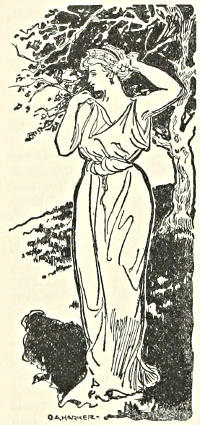
A Greek Maiden
Nothing is known of the death of Ptolemy Euergetes, and there is
no proof that it was by unfair means. But when his son began a cruel and
wicked reign by putting to death his mother and brother, and by taking the
name of Philopator, or father-loving, the world seems to have thought that he
was the murderer of his father, and had taken this name to throw a cloak
over the deed. Unfortunately history is not free from acts of successful
wickedness. By this murder of his brother, and by the minority both of
Antiochus king of Syria and of Philip king of Macedonia, Philopator found
himself safe from enemies either at home or
abroad, and he gave himself up to a life of
thoughtlessness and pleasure. The army and
fleet were left to go to ruin, and the foreign
provinces, which had hitherto been looked
upon as the bulwarks of Egypt, were only half
guarded; but the throne rested on the virtues
of his forefathers, and it was not till his death
that it was found to have been undermined by
his own vices.c
At the instigation of his minister, Sosibius,
he caused his brother Magas to be murdered,
lest he might endeavour to secure the kingdom
to himself. The death of Cleomenes, the exiled
king of Sparta, who had been protected and
provided for by the preceding king, soon followed.
Antiochus the Great, who at this time
ruled in Syria, perceiving the disorder and
licentiousness which prevailed in the court of
Egypt, thought it a favourable time to declare
war against that country. Ptolemy, who seems
not to have lacked courage, roused himself for
the emergency, collected a great army, and proceeded
to meet the enemy. In the beginning
of the war, Antiochus obtained some advantages
over the Egyptian troops: but shortly after, in
a great battle fought at Raphia near Gaza, he
was completely defeated, with great loss; and
Ptolemy obtained a large extension of influence
in Palestine and Syria. Humbled by this defeat,
and alarmed at the progress of Achæus in Asia Minor, Antiochus was
anxious to make peace with Ptolemy; and the Egyptian king, although he had
every inducement to prosecute the war, being equally anxious to return to his
licentious pleasures, was ready to receive his overtures. A peace was in consequence
concluded, by which Cœle-Syria and Palestine were confirmed as
belonging to Egypt. This being done, Ptolemy went to Jerusalem, where
he was well received, and treated the inhabitants kindly, until, having made
a fruitless attempt to enter the inner sanctuary, he retired from the city
threatening the whole nation of the Jews with extermination. It does not
appear that he dared to assail the sacred city; but, on returning to Egypt,
he published a decree which he caused to be engraved on a pillar erected
at the gate of his palace, excluding all those who did not sacrifice to the
gods whom he worshipped. By this means the Jews were virtually outlawed,
being prevented from suing to him for justice, or from claiming his protection.
But this was not the extent of his infliction. By another decree
he reduced them from the first rank of citizens, to which they had been
raised by the favour of Alexander, to the third rank. They were in
consequence degraded so far as to be enrolled among the common people
of Egypt.
[216-170 B.C.]
During this reign the Romans, being again at war with Carthage, sent
ambassadors to Egypt, to renew their ancient friendship, who brought
magnificent presents to Ptolemy and his queen.
At the death of Philopator, 204 B.C., Ptolemy Epiphanes, being then
a child of five years old, ascended the throne. In the early part of his
reign another Roman embassy visited Egypt, when the king’s counsellors
took the opportunity of placing the young prince under the guardianship
of the powerful republic. The senate of Rome accepted the charge, and
sent Marcus Lepidus to act as guardian—a trust which, after a short
stay in Egypt, he conferred upon Aristomenes, an Acarnanian, who discharged
the duties of this important office with integrity and ability for
several years, until the king had attained the age of fourteen, when, according
to the usage of the country, he was entitled to take the administration
of the kingdom into his own hands. The folly of investing a person so
young with absolute power, was in this instance made fully apparent.
The youth, who had been universally popular whilst under the direction
of Aristomenes, was no sooner enthroned than he placed himself under
the influence of worthless men, by whose advice he was led to the
adoption of measures through which great disorders were introduced into
every branch of the government; and at length his former able and honest
minister was put to death.
Epiphanes married Cleopatra, daughter of Antiochus the Great. This
marriage appears to have taken place when the young king was about
seventeen years old. It is generally supposed that he was taken off by
poison, administered by his nobles, to prevent him from entering on a war
with Syria to which he had committed himself, when the national finances
were so low that they feared they should have to contribute largely towards
the expenses of the contest. He left two sons, Philometor and Physcon; and
a daughter, Cleopatra, who was successively married to her two brothers.
[170-146 B.C.]
Philometor, the elder of the two sons, then but six years old, was placed
on the throne under the guardianship of his mother Cleopatra, who for eight
years conducted the affairs of the kingdom with great judgment and success.
After her death, Lenæus, a nobleman of distinction, and Eulæus,
a eunuch, were charged with the government of the country. One of
their earliest measures was to insist on the restoration of Cœle-Syria and
Palestine to Egypt,—these provinces having been wrested from the dominion
of Egypt by the power of Antiochus the Great. This demand led to a
violent contest, which tended more than any preceding event to demonstrate
the rapid decline of Egyptian power, and the rising sway of Rome.
The Syrian army, under the command of Antiochus Epiphanes, prosecuted
the war with such vigour and success that it penetrated to the walls
of Alexandria, and actually secured the person of the Egyptian king.
Whether he was taken in war, or placed himself willingly in the hands of
the Syrian king, does not clearly appear. But, however this may be, the
Syrian monarch gained little by his acquisition. For although he induced
Philometor to enter into a treaty with him, this was instantly disallowed by
the nation, who, regarding a sovereign in the power of an enemy as lost to
his country, immediately raised Physcon, the king’s brother, to the throne.
This led to a second Syrian invasion, which resulted in the expulsion of
Physcon; Antiochus restoring Philometor to the government, but retaining
Pelusium, the key to the country, in the possession of Syrian troops. From
this and other indications of the Syrian king’s intentions, Philometor rightly
judged that it was his design, by setting the two brothers in continued collision
with each other, to retain Egypt virtually in his own power. Acting
on this judgment, Philometor invited his brother to terms of reconciliation,
which, by the aid of their sister Cleopatra, was happily effected.
The measures adopted by the two brothers to restore Egypt to an independent
and prosperous condition, induced Antiochus again to march an
army into that country. He was on this occasion, however, compelled, by
the prompt and energetic interference of the Romans, to abandon the enterprise.
By agreement between the two brothers, they were to reign jointly;
but they were no sooner freed from the danger of foreign aggression, than
they began to quarrel between themselves. This quickly produced an open
rupture, in which Physcon succeeded in driving his brother out of the kingdom.
He was, however, soon after restored by the power of Rome, which
at the same time assigned Libya and Cyrene to Physcon. New disputes
arose, and various contests took place between them, in all of which Rome
regarded herself as entitled to act as the paramount ruler of Egypt, and to
award the sovereignty according to her will.
Philometor was soon after provoked into a war with Alexander Balas,
who had been raised to the throne of Syria mainly by his support. In the
prosecution of this contest, the king of Egypt marched into Syria, where he
completely routed the army of Alexander near Antioch, but died, a few days
after, from wounds received in the battle. He left behind him a high reputation
for wisdom and clemency. It was in his reign, and by his favour and
that of his queen Cleopatra, that the Jews under Onias were permitted to
build the famous Jewish temple at Heliopolis.
[146-107 B.C.]
On the death of her husband, Cleopatra endeavoured to secure the crown
for their son; but some of the leading men inclined towards Physcon, and
invited him from Cyrene, where he then reigned, into Egypt. The queen
raised an army to oppose him, and a civil war was imminent, when an accommodation
was arranged, through the mediation of Rome, by which Physcon
married Cleopatra, who was his sister and his brother’s widow, on the understanding
that they were to reign with joint authority, and that Cleopatra’s
son by Philometor should be declared next heir to the crown. This agreement
was no sooner completed than it was violated. On the day of his marriage
Physcon murdered the son of Philometor in the arms of his mother,
and commenced a career of iniquity and slaughter of which this was a fitting
prelude. He indeed assumed the name of Euergetes, “benefactor,” which
the Alexandrians changed into Kakergetes, “the evil-doer”—an epithet
which he justly merited; for he was the most cruel and wicked, most despicable
and vile, of all the Ptolemies. To the Jews he evinced unmitigated
enmity and cruelty, because they had espoused the cause of Cleopatra. He
then divorced Cleopatra, his wife, and married her daughter, of the same
name, who was his own niece; but not before he had subjected the young
princess to the vilest indignity.
Head-dresses
Such conduct excited the disgust of his subjects, and, accompanied as it
was with excessive cruelty, produced a revolt which drove him from the
kingdom. He, however, succeeded in recovering his position, and at length
died in the sixty-seventh year of his age, having reigned twenty-nine years.
It is a fact as singular as unaccountable, that this most licentious and
bloody prince, whose name is infamous, as associated with almost every
crime, is notwithstanding celebrated by the most respectable
ancient writers as a great restorer of learning,
a patron of learned men, and withal an author of some
celebrity himself. Physcon left three sons—Apion, by
a concubine, and Lathyrus and Alexander by his wife
Cleopatra. By his will he left the kingdom of Cyrene
to Apion, and the crown of Egypt to his widow in conjunction
with either of her sons whom she should choose.
In the exercise of this discretionary power the queen
would have preferred Alexander, the younger son; but
this was so distasteful to the people that she was compelled
to admit Lathyrus to the joint sovereignty, and
place Alexander in the kingdom of Cyprus. After
reigning ten years, the former prince was obliged to
leave Egypt, to which his brother immediately returned;
Lathyrus repairing to Cyprus, and taking upon himself
the government of that country. It was at this period
that Lathyrus invaded Judea, then governed by Alexander
Jannæus, and obtained such advantages over him
that the Jewish state was only saved from ruin by the
aid sent to it by Cleopatra from Egypt.
[107-48 B.C.]
In the meantime the younger brother, Alexander,
having for nearly eighteen years, while bearing the
name of “king,” submitted as a slave to the violent
and capricious will of his mother, became quite weary
of her intolerable tyranny, and put her to death. This
fact being made public, he was driven from the throne,
and Lathyrus, or Soter II, restored; he reigned seven
years longer. During this period the ruin of Thebes took place. Lathyrus,
freed from the power of his rival, undertook to restore the government of
the kingdom to its former state. This led to an insurrection, of which Thebes
was the centre. That ancient city not only refused to submit to the prescribed
laws, but even struggled to regain its lost independence. The effort
was vain. The king, having defeated the rebels in several battles, besieged
Thebes, which, having held out for three years, was at length subdued, and
so devastated that this noble capital was never afterwards repaired, and consequently
sank into ruin.
Lathyrus was succeeded by his only legitimate child, Cleopatra, whose
proper name was Berenice. This princess, however, had scarcely assumed
the sovereignty, when she was called to submit to the dictation of Roman
power. Sulla, then perpetual dictator of the imperial city, no sooner heard
of the death of Lathyrus, than he conferred the crown of Egypt on Alexander,
a son of the king of that name who had been driven out of the country for
having murdered his mother. The Alexandrians succeeded in persuading
Alexander to marry Berenice, and reign jointly with her. This he did,
but in nineteen days afterwards caused her to be murdered. He, however,
continued on the throne, and reigned fifteen years in a manner which
might be expected from the atrocity of the commencement. At length the
people, worn out by his exactions and goaded to desperation by his cruelties,
rose with common consent, and drove him from the throne. He made some
fruitless efforts to induce Pompey to aid him to recover his crown, but died
a few months after his expulsion, in banishment at Tyre.
The Egyptians, having driven out this tyrant, selected a natural son of
Ptolemy Lathyrus to fill the vacant throne. This prince, by a gift of six thousand
talents (£1,200,000 or $6,000,000) to Julius Cæsar and Pompey, was
recognised as king of Egypt in alliance with Rome. He was named Ptolemy
Auletes, “the Flute-player”; but took on himself the title of Neus Dionysus,
“the new Bacchus.” He was a fit representative of the fallen condition
of the Egyptian state. More effeminate than any of his predecessors,
priding himself on dancing in a female dress in religious processions, he
was at the same time equal to his grandfather Physcon in the violence and
viciousness of his conduct. After some time he was, like his predecessor,
expelled from the throne. He succeeded, however, by immense gifts, in
inducing Gabinius, the Roman governor of Syria, to attempt his restoration,
which was at length accomplished; Archelaus, who had been invested with
the government, having been defeated and slain by the Romans. Auletes
was thus restored to the throne, and died in peaceable possession of his
dignity about four years after his restoration.
Auletes on his restoration had put to death his daughter Berenice; and
at his demise left two daughters, Cleopatra and Arsinoe, and two sons. The
first of these, Ptolemy the elder, otherwise called Dionysus II, was, according
to his father’s will, married to his eldest sister, then about seventeen years
old; and the juvenile couple were invested with the sovereignty of Egypt,
under the protection of the Roman republic. It appears that this most celebrated
Egyptian princess evinced considerable vigour and talent, even at
that early age. So clever, indeed, was she, that the ministers who had been
placed in charge of the national affairs were very anxious to get rid of her,
and at length deprived her of her share in the sovereignty, and expelled her
from the kingdom. Cleopatra, however, had a spirit equal to the occasion.
She retired into Syria, raised an army, and in a short time marched upon Pelusium,
prepared to dispute with her brother the sovereignty of the nation.
It was while the hostile armies of the brother and sister lay within sight of
each other, that Pompey, after the loss of the battle of Pharsalia, reached
Egypt, expecting protection and support, but was put to death by the ministers
of Ptolemy. Soon after this event, Julius Cæsar arrived in pursuit
of his rival, and was presented with Pompey’s head and his ring.
[48-30 B.C.]
Cleopatra, whose licentiousness was quite equal to her talent and energy,
caused herself to be secretly conveyed to Cæsar’s quarters, where she succeeded
in captivating that mighty conqueror, and commenced an intimacy
which resulted in the birth of a son, called, after his father, Neocæsar. The
scandal of this conduct enabled Ptolemy and his ministers to rouse the public
spirit of the Alexandrians, and of Lower Egypt generally, against the mighty
Roman, to such an extent that he was placed in most imminent peril. Cæsar,
however, disposed the handful of soldiers which he had with him in such a
manner as to keep the Egyptians in check, until the arrival of Mithridates
with large reinforcements, when he defeated the Egyptian forces with great
slaughter. In the course of this conflict Ptolemy was drowned in the Nile.
Cæsar soon adjusted the affairs of Egypt to his own mind, placing Cleopatra
on the throne. But as the Egyptians had a great antipathy to female
sovereignty, he compelled Cleopatra to submit to the farce of marrying her
younger brother, a lad eleven years old. She, however, held the power in
her own hand until he reached the age of fourteen, when by the laws of
the country he was entitled to enter upon the joint administration of affairs.
She then caused him to be poisoned. Arsinoe, who had been carried to
Rome by Julius Cæsar, and compelled to walk, bound in chains of gold, before
his triumphal chariot, was also assassinated at the instigation of Cleopatra.
The death of Cæsar convulsed the whole empire of Rome and all its dependencies,
and swept away the last feeble figment of Egyptian monarchy
and independence. On this occasion Cleopatra instantly decided to support
the triumvirs against the murderers of Julius. On a charge of being unfaithful
to this purpose, she was summoned to appear before Antony at Tarsus.
Confident in the power of her charms, she obeyed, and effectually seduced
that great captain. In fact, so besotted was he by this intercourse, that he
neglected his affairs, and at length was so completely ruined that, having inflicted
on himself a mortal wound, he died in the arms of his wanton mistress.
Cleopatra had two sons by Antony, and soon after his decease she shared the
fate which she had brought on him. To avoid being made a spectacle at
the triumph of Augustus, as he was proof against her seductive charms, she
procured her own death in some unknown way; tradition says by the bite of
an asp. Egypt then became a province of the Roman empire, and continued
in this state until the birth of Christ, and long afterwards.d
CHAPTER LXVII. SICILIAN AFFAIRS — AGATHOCLES — PYRRHUS AND THE ROMANS
While Greece and Macedonia were torn by the disputes of Alexander’s
successors, Sicily was a prey to a tyrant who for energy, audacity, and complete
absence of moral sense, is worthy to be ranked amongst them. It was
the age of adventurers and soldiers of fortune. Agathocles, the son of
a working potter, became famous in his youth by his beauty, strength, and
courage, and also by his immoral life. He enlisted as a soldier, and men
were amazed by his height and the weight of his weapons. He obtained a
command through the influence of a powerful citizen who liked him, and
whose widow he married shortly after. This marriage brought him riches,
but his ambition was not limited by wealth. He wished to gain the approval
of the people by his eloquence, as he had obtained the affection of the soldiers
by his daring.
Tyranny, the natural result of class antagonism in a city, had reappeared
at Syracuse after the death of Timoleon. The tyrant, Sosistratus, was supported
by the aristocrats; Agathocles became the advocate of the claims of
the people. He had also a personal grievance against Sosistratus, who, after
an expedition against the Bruttians, had refused him the prize for courage
which he deserved. Being driven from Syracuse, he recruited an army
among the exiles, whose number was always very great by reason of the
continual revolutions of Sicily and Magna Græcia. He tried in vain to
seize Croton, then served with the Tarentines, who, a short time after, drove
him away because he wished to direct their government.
[317-310 B.C.]
Some time later, a revolution broke out at Syracuse. Sosistratus was
exiled with six hundred men of his faction and asked help of the Carthaginians.
Agathocles returned, distinguished himself in the war by his courage
and skill, and became so popular that the Corinthian Acestorides, general
of the republic, suspected him of aspiring to the tyranny and wished to
have him murdered. He escaped the danger by changing clothes with a
slave and soon after they heard that he was raising troops. Peace was made
with the Carthaginians, who brought back Sosistratus and his partisans.
Agathocles obtained permission to return also, and swore in the temple of
Demeter to respect the constitution.
Soon after, the people, fascinated by his speeches, named him protector
of peace, and charged him with the re-establishment of harmony between the
factions. According to Justin, who seldom agrees with Diodorus, Agathocles’
usurpation was the result of a treaty with Hamilcar, the Carthaginian
general, who supplied him with African soldiers. Whatever may be the
truth in regard to this, the first use which he made of his power was to
massacre the six hundred senators, their relatives, and friends. The town
was given up to the soldiers, who pillaged the houses, carried off the
women, and killed without discrimination. Those partisans of the oligarchy
who succeeded in escaping the massacre, took refuge at Agrigentum. Then
Agathocles called the people together and declared that his only wish had
been to restore their freedom and that he now intended retiring to private
life. His followers, especially those who had taken part in the pillage,
begged him to remain in power. He consented, but on condition that he
should govern alone, for the colleagues who might be given him would
perhaps attempt to violate the laws, and he would not be responsible except
for his own acts. Votes were taken, and as the rich were paralysed by fear,
and he had promised the poor to cancel debts and divide lands, he obtained
all the votes. But he took neither the crown nor any of the external signs
of power: the reality sufficed; he would not even have a bodyguard. Having
no further enemies to fear, he allowed himself the luxury of clemency,
tactics imitated later by Augustus and recommended by Machiavelli. He
then administered the finances, attended to the necessities of the army and
the navy, and added to the dominion of Syracuse some of the towns and territory
of the interior.
The Syracusan exiles who had taken refuge at Agrigentum stirred up
the people to make war on Agathocles before his rule extended over the
whole of Sicily. The Agrigentines recognised the danger, and joining with
the inhabitants of Gela and Messana sent to Sparta to ask for a general, for
they feared to entrust the command to one of their own citizens who might
make use of it to usurp the tyranny. Acrotatus, son of King Cleomenes,
was detested at Sparta; he seized the opportunity of fighting abroad. But
when he came to Agrigentum, he made himself universally disliked on account
of his insolence, his waste of public funds, his dissolute life, and his
luxury more worthy of a Persian than a Lacedæmonian. He murdered Sosistratus,
the chief of the Syracusan exiles, at a banquet. He was driven away,
they even wished to stone him, but he escaped by night. The Agrigentines
made peace with Agathocles who, having no further foreign hostility to
fear, was able to strengthen and extend his authority. The Syracusan exiles,
being forced to leave Agrigentum, took refuge at Messana, but the Messanians
feared the anger of Agathocles; he offered to make alliance with them,
and persuaded them to grant the freedom of the city to these exiles. Men
were astonished by such noble sentiments, but some time later he found
means to entice them from Messana, to the number of more than six hundred,
and had them put to death. He succeeded in making his government
recognised in most of the towns of Sicily, and on all sides he caused the
death of all who inspired him with fear.
The ever increasing progress of Agathocles awoke the fears of the
Carthaginians and they sent a large army into Sicily under the command of
Hamilcar the son of Gisco. A battle took place near the river Himera between
Gela and Agrigentum. It was said to have been on this spot that a former
tyrant of Agrigentum, Phalaris, put his enemies to death by shutting them
up in a bronze bull under which a fire was lighted; the hill on which
Phalaris’ castle stood was still called Ecnomus. Agathocles seemed to have
won the battle, when unexpected help came to the Carthaginians and gave
them the victory. Then the towns which had accepted or suffered Syracusan
suzerainty submitted successively to the Carthaginians, and Hamilcar,
master of all the rest of Sicily, laid siege to Syracuse. Agathocles repaired
the fortifications of the town and put it in a state of defence, but these precautions
could only delay certain ruin, for no outside help could be expected.
Agathocles then conceived a singularly daring plan: he resolved to carry
the war into Africa. It was what Scipio did at a later date, but in less
difficult circumstances, for in Agathocles’ case it was first necessary to leave
a town besieged by land and sea.
[310-307 B.C.]
He had few soldiers; he set free and enlisted the slaves, and made them
take an oath of fidelity. Although he had been pitiless towards his political
adversaries, he knew that some were still alive, and that they were ready to
capitulate with the enemy. He spoke of his plan to no one. He told the
Syracusans that all he asked of them was a little patience, and that he had
sure means of saving them. In the town he only left the soldiers requisite
for its defence and embarked all the rest, being careful to take as hostages
a member of each of the families which he mistrusted. He persuaded the
rich to avoid the fatigues and privations of the siege by retiring to their
estates, and when they were scattered he had them killed by his soldiers, and
took their money. The port was blockaded by the Carthaginian fleet; but
merchant vessels were seen bringing provisions to the besieged. The Carthaginians
advanced to capture them. Agathocles seized the opportunity to
leave the port, and the merchant vessels were able to enter while the Carthaginians
pursued Agathocles’ fleet. He escaped by dint of hard rowing
and landed with his army on the coast of Africa.
Then, having offered a sacrifice, he told his soldiers that he had made a
vow if his vessels escaped the enemy to make torches of them for the principal
goddesses of Sicily, Demeter and Core, and taking a brand from the
altar he set fire to his fleet. The soldiers, losing all hope of return, had
no other resource than victory. This act of temerity, which has become
proverbial, was perhaps necessary. Agathocles had too few soldiers to
employ some in protecting the fleet; it would have been taken by the Carthaginians,
who were masters of the sea. They seized a pleasure town which
Diodorus calls the Great Town and the White Tunis. Agathocles had not
sufficient soldiers to leave garrisons; he razed it to the ground and encamped
under the walls of Carthage.
The Carthaginians, seeing their country pillaged, thought that their army
in Sicily had been destroyed. They had no time to collect mercenaries;
they armed to the number of forty thousand and placed Hanno and Bomilcar
at their head. These chiefs belonged to two rival families. The Carthaginians
often took this precaution as a guarantee against usurpation. But
this multitude of new and badly disciplined soldiers could not resist Agathocles’
little army. Hanno was killed, and Bomilcar, who aspired to the
tyranny, led the troops back to the town. The terrified Carthaginians
attributed their misfortune to the anger of the gods. For a long time
they had sacrificed to Moloch only children whom they bought; they thought
that he demanded more precious victims, and offered him two hundred children
from the most wealthy families. Three hundred citizens offered themselves
to complete the sacrifice. They were placed on the hands of the
bronze statue, and a large fire was lighted; the victims fell into the burning
flames. Diodorus believes that these human sacrifices, customary among
Phœnician nations, possibly gave rise to the fable of Cronos devouring his
children, for the Greeks identified their Cronos with the Phœnician Moloch.
The Carthaginians ordered Hamilcar to send them some of his troops;
but not wishing to abandon Sicily, they announced the complete ruin of
Agathocles and, as a proof, sent to Syracuse the beaks of
his burnt vessels. Antander, Agathocles’ brother, wished
to surrender; the Ætolian Eurymedon persuaded him not to
despair, and a short time later they received news of the success
of the Greeks. The courage of the besieged was renewed;
Hamilcar wished to attempt an assault; he was taken,
his head was cut off and sent to Agathocles, who threw it
into the Carthaginian camp. His success won him the alliance
of the Libyan and Numidian nations. He wrote to
Ophellas, governor of Cyrene, who had fought under Alexander,
entreating him to invade the Carthaginian territory,
which should be shared after the victory; he would leave
Africa to Ophellas, and would be content to keep Sicily.
This plan tempted Ophellas; he was in communication with
the Athenians, because he had married a descendant of Miltiades.
He raised mercenaries in Greece and set out to cross
the desert with a numerous army, carrying along with it
women and children, for they hoped to found colonies. The
army suffered much from the heat, from thirst, and from
the bites of serpents. Agathocles received his allies warmly,
gave them food, then murdered Ophellas and incorporated
his soldiers in his own army; the women and children were
sent to Sicily and perished in a tempest. Cyrene became
part of the dominions of Ptolemy.
Greek Candle Stick
About the same time, the Carthaginians put Bomilcar to death for attempting
to seize the tyranny. Agathocles might have profited by the confusion
which this event caused in Carthage, but he had received alarming
news. The Agrigentines had endeavoured to profit by Hamilcar’s death to
free Sicily from both Carthaginian and Syracusan rule. Agathocles, leaving
the command of his army to Archagathus, his eldest son, embarked on open
boats which had been hastily built. On landing at Selinuntium, he was told
that his officers had just defeated the Agrigentine army. He reduced to
submission Heraclea, Thermæ, Centuripæ, Cephalœdium, and Apollonia. It
was about this time that, following the example of the successors of Alexander,
he took the title of king, and had it put on his coins (307). However,
he wore no crown, and instead of imitating the mistrust of Dionysius the
Elder, he went to the assembly without a guard. When he gave banquets, he
was often served in an earthen bowl, and willingly recalled the time when
he had begun life as a working potter. He was easy tempered and gay, so
as to encourage his guests to talk freely, but he took note of all that he heard,
and when, by this means, he had discovered which men were not to be trusted,
he invited them separately and put them to death.
In Africa, his son Archagathus was at first successful; but he found
his army weakened by desertions, in need of the necessities of life, and inclined
to revolt. The soldiers complained of not being paid. He risked a battle
and was defeated. Then he resolved to leave the army, as Bonaparte did in
later times in Egypt. The soldiers, furious at finding themselves abandoned
by their general, murdered his two sons and surrendered to the Carthaginians,
who enrolled them in their army.
[307-300 B.C.]
On his return to Sicily, Agathocles first of all gave vent to his anger
against Segesta, which had refused him subsidies. This expedition was
marked, according to Diodorus, by atrocious cruelty: men were burned alive,
pregnant women made to miscarry, young girls and children sold to the Bruttians,
and the town of Segesta, peopled by new inhabitants, received the name
of Dicæopolis—city of vengeance. At the same time Agathocles commanded
his brother Antander to slay the parents, wives, and children of the soldiers
of the African army, to revenge the murder of his
sons. Diodorus adds that these savage executions
produced such horror that Agathocles, despairing
of keeping the power, proposed to Dinocrates, the
general of the exiles, to re-establish the republic
at Syracuse. But Dinocrates had no desire to do
so; in the twenty years during which he had been
leader of armed bands, he had acquired a taste for
this kind of regal dignity. Unsuccessful in forming
this alliance, Agathocles purchased Carthaginian
help by yielding up certain towns to them,
and beat Dinocrates whose troops surrendered.
He had them massacred but spared Dinocrates, and
as they were worthy of each other, he made him
his lieutenant.
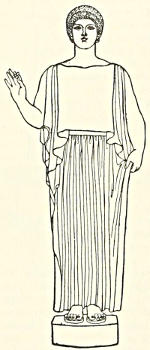
Nymph
(From a statue)
He undertook, following Dionysius’ example,
the conquest of southern Italy. He began by seizing
the Æolian Isles, in order to obtain the treasure
consecrated to Core and to Hephæstus in the prytaneum
of Lipara; then he prepared to cross into
Italy. His preparations excited the fears of the
Tarentines, who were already menaced in another
direction by the native populations. They applied
to the Spartans, whose king, Cleonymus, enrolled
mercenaries at Cape Tænarum. He formed a considerable
army by uniting with them the forces of
Tarentum and the Messapians, with whom he made
an alliance immediately on his arrival. The Lucanians
in alarm made peace with Tarentum, and Cleonymus,
not wishing to have come in vain, turned
against Metapontum, which town, however, he had entered as an ally. He
imposed on the town a tribute of six hundred talents, and took two hundred
young girls as hostages, which caused him to be looked on with suspicion,
for, although he was a Spartan, he had the reputation of a man of dissolute
character; however, he was punished later on by the wicked behaviour of
his wife Chelidonis. Then, instead of delivering Sicily from the tyranny of
Agathocles, as he had announced the intention of doing, he attacked Corcyra,
which appeared to him a convenient post for watching Greek affairs, raised
a tribute, and established a garrison. Then, returning to Italy, without
troubling either about the Tarentines who had summoned him, or about the
Messapians whose alliance he had demanded, he began to fight and pillage
indiscriminately, under pretext of punishing those whom he called rebels.
He carried on this piratical war to the remotest part of the Adriatic Sea.
The Italians killed some of his troops, a tempest destroyed part of his fleet,
but he escaped and wound up his series of adventures by calling Pyrrhus
against his country to avenge his matrimonial troubles.
[300-289 B.C.]
Agathocles conducted an expedition against Corcyra, in pursuit of Cleonymus,
but found Cassander besieging the town by land and by sea. He
burned the Macedonian fleet, and seized Corcyra, which he gave as a dowry to
his daughter Lanassa, whom he married to Pyrrhus, king of Epirus. On his
return he found that a number of his mercenaries were in revolt against
his grandson Archagathus, who had not given them their pay; he had two
thousand of them killed. According to Diodorus, they were Ligurians and
Etruscans, but it seems probable that there were Bruttians among them,
for this punishment led to a war between the Bruttians and Agathocles.
He was defeated and revenged himself on the inhabitants of Croton,
who had done him no injury. He told them not to be troubled by his
advance, he was only travelling through the country to take his daughter
into Epirus. They made no preparations for defence; he took the town,
sacked it, and massacred the inhabitants. Then he attacked Hipponium,
which was in the hands of the Bruttians, took it, and placed a garrison there
which was massacred a short time later.
In his old age he suffered from a very painful illness of the joints, and
his son and grandson disputed his succession during his life-time. The latter
caused him to be poisoned by his favourite, Mænon, by means of a corrosive
placed in a toothpick. This Mænon was a Segestan and had become the
tyrant’s slave; in this manner he avenged his country’s ruin. It is said that
Agathocles, to put an end to the torture he was suffering, had himself placed,
while still alive, on the funeral pyre; this was believed to be a punishment
for the sacrilege which he had committed in the Æolian Isles in stealing the
sacred treasure of Hephæstus.
After the death of Agathocles, his son and grandson were killed by
Mænon, who tried to seize the power with the help of the Carthaginians.
The Syracusans chose Hicetas for their general, and it was agreed that they
should give hostages and recall the exiles. But at the first election of the
magistrates Agathocles’ mercenaries claimed that they were wronged, the citizens
armed, a fight was imminent; at last it was agreed that the mercenaries
should leave Sicily. They were mostly Campanians, known by the
name of Mamertines.
Agathocles had taken a great number into his pay. When it was agreed
that they were to leave Sicily, they went to Messana to embark, and were hospitably
received; but during the night they killed the inhabitants and seized
their wives and possessions. This settlement of Mamertines at Messana was
a fresh element of trouble for Sicily, and later on became the cause of the
first war between the Romans and the Carthaginians.
[282-272 B.C.]
The absence of federal union between the Greek cities of Italy made
them incapable of resisting the native populations, the Samnites, Lucanians,
and Bruttians. They were therefore naturally induced to ask aid of the
great Roman Republic, which alone was able to protect them. The earliest
relations which Rome had with the Greek towns of Italy were friendly.
Tarentum alone preferred having the Romans as enemies to having them as
friends. By an act of mad provocation the Tarentines put themselves entirely
in the wrong and caused war with Rome to become inevitable. Then,
as was their custom, they called to their assistance a foreign prince, and although
this time they chose the bravest and most skilful captain of the period,
the struggle in which they engaged had as a consequence the final establishment
of Roman government over all Italy.
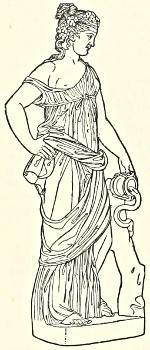
Hygeia
(From a statue)
The Lucanians and the Bruttians having attacked the town of Thurii, the
ally of Rome, an army, commanded by the consul Fabricius was sent to its
rescue, while at the same time a squadron of ten galleys cruised in the Gulf
of Tarentum. The Tarentines, assembled in the theatre which overlooked
the sea, perceived some of these vessels at the entrance
of the port. Immediately an orator named
Philochares, who was known by the name of the
famous courtesan Thais because of his shameful
immorality, exclaimed that the presence of these
ships was an act of hostility, and that by the terms
of a treaty, the Romans were not allowed to pass
Cape Lacinium. The people hurried to the port,
sank or captured the vessels, the duumvir who
commanded them was killed, the rowers were reduced
to slavery. The Roman senate sent an embassy
to demand reparation. The ambassadors had
scarcely entered the theatre where the people were
assembled than they were greeted by insulting
laughter. They wished to speak, but their pronunciation
of Greek was ridiculed and they were
driven out. A drunkard soiled the toga of the
principal ambassador; the laughter increased.
The Roman turned round and said: “Laugh!
you will soon weep, for my robe shall be washed
in your blood.”
They summoned Pyrrhus, king of Epirus, promising
him the support of the Lucanians and Samnites.
An account of his exploits and death has
previously been given.
[272-216 B.C.]
All the natives of southern Italy who had
greeted Pyrrhus as a saviour, were finally subdued
to Roman rule. It was the rescue of the Greek
towns which were still in existence, but they were
only shadows of their former selves. Although
free under the protection of Rome, they vanished obscurely from history.
In the time of Strabo the name of Magna Græcia was already an ancient recollection,
and the Greek language was only spoken at Naples, Rhegium, and
Tarentum. For want of federal union between the autonomous cities, the
Hellenic race with its brilliant civilisation had disappeared gradually from
Italian soil. The Romans were about to reap its inheritance and transmit
it to Gaul and Spain. They repeopled some of the former Greek colonies
which had become barbarous, especially Posidonia and Hipponium, which
had long been inhabited, the latter by the Campanians, the former by the
Bruttians, and which had changed their Greek names for those of Pæstum
and Vibo-Valentia.
The Roman peace did not restore to the Greek towns of Italy the glory
which had radiated from their art and literature during the stormy period
of their political independence. The innumerable painted vases which are
admired in our museums, and the coins of infinite variety suffice to mark
their place in the history of civilisation. Not rich Tarentum only, but towns
of no importance, Terina, Velia, Metapontum, Heraclea in Lucania, made
coins of inimitable perfection. The production of these works of art ceased
abruptly with that communal autonomy of which the coin was the visible
symbol. In 268, Rome, who, till then, had only had moulded copper coinage,
for the first time made silver coins, and at the same time withdrew the
right of coining from all her Italian subjects. Few laws have been more
disastrous to art.
The beautiful iconic coins of King Hiero and his wife, Queen Philistis,
mark the last period of Sicilian autonomy. After a victory gained over the
Mamertines of Messana, Hiero was proclaimed king by the Syracusans who
no longer felt capable of supporting the disturbances of freedom (269). On
leaving Sicily Pyrrhus had said: “What a fine battle-field we leave the
Romans and Carthaginians!” The fulfilment of this prophecy was not
delayed, and the First Punic War, which broke out in 263, had Sicily for a
stage. At the beginning Hiero, the ally of Carthage, was defeated by the
Romans, and passed over to their side. His reign, a long and peaceful one,
was a transition for the Syracusans between their stormy autonomy and the
inevitable dominion of Rome.b