This book contains Old English text that was originally printed in an
Old English typeface. These passages have been transliterated
into modern Latin characters. More details are
located in the Transcriber's Endnote.
THE OXFORD REFORMERS—John Colet,
Erasmus, and Thomas More: a History of their
Fellow-Work. 8vo. 4s. 6d. net.
THE ERA OF THE PROTESTANT REVOLUTION.
With 4 Maps and 12 Diagrams. Fcp. 8vo.
2s. 6d. (Epochs of Modern History.)
THE ENGLISH VILLAGE COMMUNITY: Examined
in its Relations to the Manorial and Tribal
Systems and to the Common or Open Field System of
Husbandry. An Essay in Economic History. With
13 Maps and Plates. 8vo. 4s. 6d. net.
CUSTOMARY ACRES AND THEIR HISTORICAL
IMPORTANCE, being a Series of Unfinished Essays. 8vo.
12s. 6d. net.
~~~~~~~~~~~~~~~~
LONGMANS, GREEN, & CO. 39 Paternoster Row;
London, New York, Bombay, Calcutta,
and Madras.
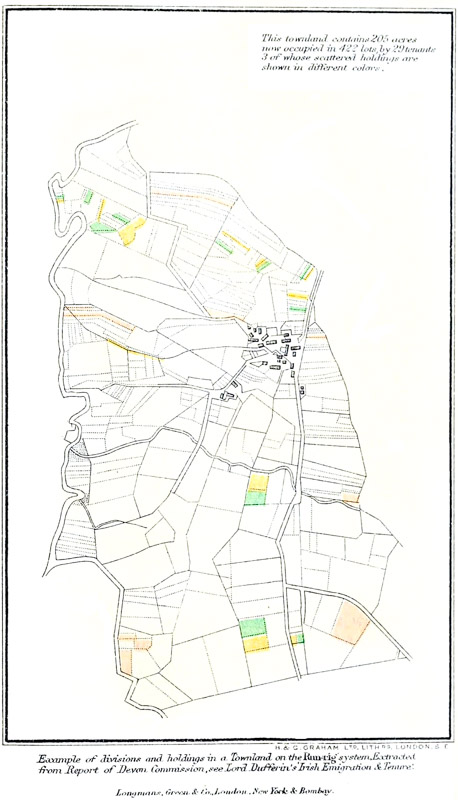
Reduced Tracing of the Tithe Map of Hitchin
Township about 1816,
together with a Hand Map of pieces belonging to
W. Lucas Esqre about 1750,
and an Enlarged Plan of the normal acre strips in the open
fields afterwards adopted as the statute acre.
THE
ENGLISH VILLAGE COMMUNITY
EXAMINED IN ITS RELATIONS TO THE MANORIAL AND TRIBAL
SYSTEMS AND TO THE COMMON OR OPEN FIELD SYSTEM OF HUSBANDRY
AN ESSAY IN ECONOMIC
HISTORY
BY
FREDERIC SEEBOHM
Hon.LL.D.(Edin.), Litt.D.(Camb.)
D.Litt.(Oxford)
REPRINTED FROM THE FOURTH
EDITION (1905)
LONGMANS, GREEN, AND CO. 39
PATERNOSTER ROW, LONDONFOURTH
AVENUE & 30th STREET, NEW YORKBOMBAY, CALCUTTA, AND MADRAS1915
All rights
reserved
DEDICATED BY PERMISSION
TO THE
SOCIETY OF ANTIQUARIES OF LONDON
When I had the honour to lay the two papers which
have expanded into this volume before the Society
of Antiquaries, it was with a confession and an
apology which, in publishing and dedicating to them
this Essay, I now repeat.
I confessed to having approached the subject not as
an antiquary but as a student of Economic History,
and even with a directly political interest. To learn
the meaning of the old order of things, with its
'community' and 'equality' as a key to a right
understanding of the new order of things, with its
contrasting individual independence and inequality,
this was the object which in the first instance
tempted me to poach upon antiquarian manors, and
it must be my apology for treating from an economic
point of view a subject which has also an antiquarian
interest.
To statesmen, whether of England or of the new
Englands across the oceans, the importance can
hardly be over-estimated of a sound appreciation of
the nature of that remarkable economic evolution
in the course of which the great English speaking
nations have, so to speak, become charged in our
time with the trial of the experiment—let us hope
also with the solution of the problem—of freedom
and democracy, using the words in the highest political
sense as the antipodes of Paternal Government and
Communism.
Perhaps, without presumption, it may be said that
the future happiness of the human race—the success
or failure of the planet—is in no small degree
dependent upon the ultimate course of what seems,
to us at least, to be the main stream of human progress,
upon whether it shall be guided by the foresight
of statesmen into safe channels or misguided,
diverted, or obstructed, till some great social or
political convulsion proves that its force and its direction
have been misunderstood.
It may indeed be but too true that, in spite of the
economic lessons of the past—
The weary Titan! with deaf
Ears, and labour dimmed eyes,
Regarding neither to right
Nor left, goes passively by,
Staggering on to her goal;
Bearing on shoulders immense,
Atlantëan, the load,
Wellnigh not to be borne,
Of the too vast orb of her fate.
And she may continue to do so, however clearly
and truthfully the economic lessons of the past may
be dinned into her ear. But still the deep sense I
have endeavoured to describe in these few sentences
of the importance of a sound understanding of English
Economic History as the true basis of much of the
practical politics of the future will be accepted, I
trust, as a sufficient reason why, ill-furnished as I
have constantly found myself for the task, I should
have ventured to devote some years of scant leisure
to the production of this imperfect Essay.
It is simply an attempt to set English Economic
History upon right lines at its historical commencement
by trying to solve the still open question
whether it began with the freedom or with the serfdom
of the masses of the people—whether the village
communities living in the 'hams' and 'tons' of
England were, at the outset of English history, free
village communities or communities in serfdom under
a manorial lordship; and further, what were their
relations to the tribal communities of the Western
and less easily conquered portions of the island.
On the answer to this question depends fundamentally
the view to be taken by historians (let us
say by politicians also) of the nature of the economic
evolution which has taken place in England since the
English Conquest. If answered in one way, English
Economic History begins with free village communities
which gradually degenerated into the serfdom of the
Middle Ages. If answered in the other way, it begins
with the serfdom of the masses of the rural population
under Saxon rule—a serfdom from which it has
taken 1,000 years of English economic evolution to
set them free.
Much learning and labour have already been expended
upon this question, and fresh light has been
recently streaming in upon it from many sides.
A real flash of light was struck when German
students perceived the connexion between the widely
prevalent common or open field system of husbandry,
and the village community which for centuries had
used it as a shell. Whatever may be the ultimate
verdict upon G. L. von Maurer's theory of the German
'mark,' there can be no doubt of its service as a
working hypothesis by means of which the study
of the economic problem has been materially advanced.
A great step was taken as regards the English
problem when Mr. Kemble, followed by Mr. Freeman
and others, attempted to trace in English constitutional
history the development of ancient German
free institutions, and to solve the English problem
upon the lines of the German 'mark.' The merit of
this attempt will not be destroyed even though doubt
should be thrown upon the correctness of this
suggested solution of the problem, and though other
and non-German elements should prove to have been
larger factors in English economic history. The
caution observed by Professor Stubbs in the early
chapters of his great work on English Constitutional
History may be said to have at least reopened the
question whether the German 'mark system' ever
really took root in England.
Another step was gained on somewhat new lines
when Professor Nasse, of Bonn, pointed out to English
students (who hitherto had not realised the fact) that
the English and German land systems were the same,
and that in England also the open-field system of
husbandry was the shell of the mediæval village community.
The importance of this view is obvious,
and it is to be regretted that no English student has
as yet followed it up by an adequate examination of
the remarkably rich materials which lie at the disposal
of English Economic History.
A new flash of light at once lit up the subject
and greatly widened its interest when Sir Henry S.
Maine, carrying with him to India his profound insight
into 'Ancient Law,' recognised the fundamental
analogies between the 'village communities' of the
East and the West, and sought to use actually surviving
Indian institutions as typical representatives
of ancient stages of similar Western institutions. Undoubtedly
much more light may be looked for from
the same direction.
Further, Sir Henry S. Maine has opened fresh
ground, and perhaps (if he will permit me to say so)
even to some extent narrowed the area within which
the theory of archaic free village communities can
be applied, by widening the range of investigation in
yet another direction. In his lectures on the 'Early
History of Institutions' he has turned his telescope
upon the tribal communities,
and especially the 'tribal
system' of the Brehon laws, and tried to dissolve
parts of its mysterious nebulæ into stars—a work in
which he has been followed by Mr. W. F. Skene
with results which give a peculiar interest to the third
volume of that learned writer's valuable work on
'Celtic Scotland.'
Lastly, under the close examination of Dr. Landau
and Professors Hanssen and Meitzen, the open-field
system itself has been found in Germany to take
several distinct forms, corresponding, in part at least,
with differences in economic conditions, if not directly
with various stages in economic development, from
the early tribal to the later manorial system.
It is very much to be desired that the open-field
system of the various districts of France should be
carefully studied in the same way. An examination
of its widely extended modern remains could hardly
fail to throw important light upon the contents of the
cartularies which have been published in the 'Collection
de Documents Inédits sur l'histoire de France,'
amongst which the 'Polyptique d'Irminon,' with
M. Guérard's invaluable preface, is pre-eminently
useful.
In the meantime, whilst students had perhaps been
too exclusively absorbed in working in the rich mine
of early German institutions, Mr. Coote has done
service in recalling attention in his 'Neglected Fact
in English History' and his 'Romans of Britain' to
the evidences which remain of the survival of Roman
influences in English institutions, even though it may
be true that some of his conclusions may require reconsideration.
The details of the later Roman provincial
government, and of the economic conditions
of the German and British provinces, remain so
obscure even after the labours of Mommsen,
Marquardt, and Madvig, that he who attempts to build
a bridge across the gulf of the Teutonic conquests
between Roman and English institutions still builds it
somewhat at a venture.
It is interesting to find that problems connected
with early English and German Economic History are
engaging the careful and independent research also
of American students. The contributions of Mr.
Denman Ross, of Cambridge, Massachusetts, and
Professor Allen, of the University of Wisconsin, will
be welcomed by fellow-students of these questions in
the old country.
It has seemed to me that the time may have
come when an inquiry directed strictly upon
economic lines, and carefully following the English
evidence, might strike a light of its own, in the
strength of which the various side lights might
perhaps be gathered together and some clear result
obtained, at least as regards the main course of
economic evolution in England.
The English, like the Continental village community,
as we have said, inhabited a shell—an open-field
system—into the nooks and corners of which it
was curiously bound and fitted, and from which it
was apparently inseparable.
The remains of this cast-off shell still survive in
parishes where no Enclosure Act happens to have
swept them away. The common or open field system
can even now be studied on the ground within the township
in which I am writing as well as in many others.
Men are still living who have held and worked farms
under its inconvenient rules, and who know the
meaning of its terms and eccentric details. Making
use of this circumstance the method pursued in this
Essay will be, first, to become familiar with the little
distinctive marks and traits of the English open-field
system, so that they may be readily recognised
wherever they present themselves; and then, proceeding
from the known to the unknown, carefully
to trace back the shell by searching and watching
for its marks and traits as far into the past as evidence
can be found. Using the knowledge so
acquired about the shell as the key, the inquiry will
turn upon its occupant.
Examining how the mediæval
English village community in serfdom fitted itself into
the shell, and then again working back from the
known to the unknown, it may be perhaps possible
to discern whether, within historical times, it once
had been free, or whether its serfdom was as old as
the shell.
The relation of the 'tribal system' in Wales, in
Ireland, and in Germany to the open-field system,
and so also to the village community, will be a
necessary branch of the inquiry. It will embrace
also both the German and the Roman sources of
serfdom and of the manorial system of land management.
It may at least be possible that Economic History
may sometimes find secure stepping stones over what
may be impassable gulfs in constitutional history;
and it obviously does not follow that a continuity
lost, perhaps, to the one may not have been preserved
by the other. The result of a strictly economic
inquiry may, as already suggested, prove that more
things went to the 'making of England' than were
imported in the keels of the English invaders of
Britain. But whatever the result—whatever modifications
of former theories the facts here brought
into view, after full consideration by others, may
suggest—I trust that this Essay will not be regarded
as controversial in its aim or its spirit. I had rather
that it were accepted simply as fellow-work, as a
stone added at the eleventh hour to a structure in
the building of which others, some of whose names I
have mentioned, have laboured during the length
and heat of the day.
In conclusion, I have to tender my best thanks
to Sir Henry S. Maine for the kind interest he has
taken, and the sound advice he has given, during the
preparation of this Essay for the press; also to Mr.
Elton, for similar unsolicited help generously given.
To my friend George von Bunsen, and to Professor
Meitzen, of Berlin, I am deeply indebted as regards
the German branches of my subject, and to Mr. T.
Hodgkin and Mr. H. Pelham as regards the Roman
side of it. For the ever ready assistance of my
friend Mr. H. Bradshaw, of Cambridge, Mr. Selby, of
the Record Office, and Mr. Thompson, of the British
Museum, in reference to the manuscripts under their
charge, I cannot be too grateful. Nor must I omit
to acknowledge the care with which Messrs. Stuart
Moore and Kirk have undertaken for me the task of
revising the text and translations of the many extracts
from mediæval documents contained in this
volume.
F. Seebohm.
The Hermitage, Hitchin:
May, 1883
CHAPTER I.THE ENGLISH OPEN-FIELD SYSTEM EXAMINED IN ITS
MODERN REMAINS.
1. The distinctive marks of the open-field system
1
2. Scattered and intermixed ownership in the open fields
7
3. The open fields were the common fields of a village community
or township under a manor
8
4. The wide prevalence of the system through Great
Britain
13
CHAPTER II.THE ENGLISH OPEN-FIELD SYSTEM TRACED BACK TO THE DOMESDAY
SURVEY—IT IS THE SHELL OF SERFDOM—THE MANOR
WITH A VILLAGE COMMUNITY IN VILLENAGE UPON IT.
1. The identity of the system with that of the Middle
Ages
17
2. The Winslow Manor Rolls of the reign of Edward III.—example
of a virgate or yard-land
22
3. The Hundred Rolls of Edward I. embracing five
Midland Counties
32
4. The Hundred Rolls (continued).—Relation of the virgate
to the hide and carucate
36
5. The Hundred Rolls (continued).—The services of the
villein tenants
40
6. Description in Fleta of a manor in the time of Edward I.
45
7. S.E. of England—The hide and virgate under other
names (the records of Battle Abbey and St. Paul's)
49
8. The relation of the virgate to the hide traced in the
cartularies of Gloucester and Worcester Abbeys,
and the custumal of Bleadon in Somersetshire
55
9. Cartularies of Newminster and Kelso, thirteenth century—The
connexion of the holdings with the
common plough team of eight oxen
60
3. The distinction between the tribal and agricultural
economy of the West and South-East of Britain was
pre-Roman, and so also was the open-field system
245
CHAPTER VIII.CONNEXION BETWEEN THE ROMAN LAND SYSTEM AND
THE LATER MANORIAL SYSTEM.
CHAPTER I. THE ENGLISH OPEN FIELD SYSTEM EXAMINED IN ITS MODERN REMAINS. — I. THE DISTINCTIVE MARKS OF THE OPEN FIELD SYSTEM. — II. SCATTERED AND INTERMIXED OWNERSHIP IN THE OPEN FIELDS. — III. THE OPEN FIELDS WERE THE COMMON FIELDS OF A VILLAGE COMMUNITY OR TOWNSHIP UNDER A MANOR. — IV. THE WIDE PREVALENCE OF THE SYSTEM THROUGH GREAT BRITAIN. — CHAPTER I. FOOTNOTES.
[p001]
THE
ENGLISH VILLAGE COMMUNITY.
The distinctive marks of the open or common field
system once prevalent in England will be most easily
learned by the study of an example.
Open fields of Hitchin Manor.
The township of Hitchin, in Hertfordshire, will
answer the purpose. From the time of Edward the
Confessor—and probably from much earlier times—with
intervals of private ownership, it has been a
royal manor.1
And the Queen being still the lady
of the manor, the remains of its open fields have
never been swept away by the ruthless broom of an
Enclosure Act.
Annexed is a reduced tracing of a map of the
[p002]
township without the hamlets, made about the year
1816, and showing all the divisions into which its
fields wore then cut up.
It will be seen at once that it presents almost the
features of a spiders web. A great part of the township
at that date, probably nearly the whole of it in
earlier times, was divided up into little narrow strips.
Divided
into strips
or seliones,
i.e. acres,
by balks.
Form of the acre.
These strips, common to open fields all over England,
were separated from each other not by hedges,
but by green balks of unploughed turf, and are of
great historical interest. They vary more or less in
size even in the same fields, as in the examples given
on the map of a portion of the Hitchin Purwell field.
There are 'long' strips and 'short' strips. But taking
them generally, and comparing them with the
statute acre of the scale at the corner of the map, it
will be seen at once that the normal strip is roughly
identical with it. The length of the statute acre of
the scale is a furlong of 40 rods or poles.
It is 4
rods in width. Now 40 rods in length and 1 rod in
width make 40 square rods, or a rood; and thus, as
there are 4 rods in breadth, the acre of the scale with
which the normal strips coincide is an acre made up
of 4 roods lying side by side.
Thus the strips are in fact roughly cut 'acres,' of
the proper shape for ploughing. For the furlong is
the 'furrow long,' i.e. the length of the drive of the
plough before it is turned; and that this by long
custom was fixed at 40 rods, is shown by the use of
the Latin word 'quarentena' for furlong. The word
'rood' naturally corresponds with as many furrows in
the ploughing as are contained in the breadth of one
rod. And four of these roods lying side by side made
[p003]
the acre strip in the open fields, and still make up
the statute acre.
This form of the acre is very ancient. Six hundred
years ago, in the earliest English law fixing the size
of the statute acre (33 Ed. I.), it is declared that
'40 perches in length and 4 in breadth make an acre.' 2
And further, we shall find that more than a thousand
years ago in Bavaria the shape of the strip in the open
fields for ploughing was also 40 rods in length and 4
rods in width, but the rod was in that case the Greek
and Roman rod of 10 ft. instead of the English rod of
1612 ft.
Half-acres.
But to return to the English strips. In many
places the open fields were formerly divided into half-acre
strips, which were called 'half-acres.' That is to
say, a turf balk separated every two rods or roods in
the ploughing, the length of the furrow remaining
the same.
The strips in the open fields are generally known
by country folk as 'balks,' and the Latin word used
in terriers and cartularies for the strip is generally
'selio,' corresponding with the
French word 'sillon,'
(meaning furrow). In Scotland and Ireland the same
strips generally are known as 'rigs,' and the open
field system is known accordingly as the 'run-rig'
system.
The whole arable area of an uninclosed township
was usually divided up by turf balks into as many
thousands of these strips as its limits would contain,
and the tithing maps of many parishes besides Hitchin,
dating sixty or eighty years ago, show remains of
[p004]
them still existing, although the process of ploughing
up the balks and throwing many strips together had
gradually been going on for centuries.
Shots or furlongs,
or quarentenæ.
Next, it will be seen that the strips on the map lie
side by side in groups, forming larger divisions of
the field. These larger divisions are called 'shots,'
or 'furlongs,' and in Latin documents 'quarentenæ,'
being always a furrow-long in width. Throughout
their whole length the furrows in the ploughing run
parallel from end to end; the balks which divide
them into strips being, as the word implies, simply
two or three furrows left unploughed between them.3
The shots or furlongs are divided from one another
by broader balks, generally overgrown with bushes.
Headlands.
This grouping of the strips in furlongs or shots is
a further invariable feature of the English open field
system. And it involves another little feature which
is also universally met with, viz. the headland.
It will be seen on the map that mostly a common
field-way gives access to the strips; i.e. it runs along
the side of the furlong and the ends of the strips. But
this is not always the case; and when it is not, then there
is a strip running along the length of the furlong inside
its boundaries and across the ends of the strips composing
it.4
This is the headland. Sometimes when the strips
of the one furlong run at right angles to the strips of
its neighbour, the first strip in the one furlong does
[p005]
duty as the headland giving access to the strips in the
other. In either case all the owners of the strips in a
furlong have the right to turn their plough upon the
headland, and thus the owner of the headland must
wait until all the other strips are ploughed before he
can plough his own. The Latin term for the headland
is 'forera;' the Welsh, 'pen tir;' the Scotch, 'headrig;'
and the German (from the turning of the plough
upon it), 'anwende.'
A less universal but equally peculiar feature of
the open field system in hilly districts is the 'lynch,'
and it may often be observed remaining when every
other trace of an open field has been removed by
enclosure. Its right of survival lies in its indestructibility.
When a hill-side formed part of the open
field the strips almost always were made to run, not up
and down the hill, but horizontally along it; and
in ploughing, the custom for ages was always to
turn the sod of the furrow downhill, the plough
consequently always returning one way idle. If the
whole hill-side were ploughed in one field, this would
result in a gradual travelling of the soil from the top
to the bottom of the field, and it might not be noticed.
But as in the open field system the hill-side was
ploughed in strips with unploughed balks between
them, no sod could pass in the ploughing from one
strip to the next; but the process of moving the sod
downwards would go on age after age just the same
within each individual strip. In other words, every
year's ploughing took a sod from the higher edge of
the strip and put it on the lower edge; and the result
was that the strips became in time long level terraces
one above the other, and the balks between them
[p006]
grew into steep rough banks of long grass covered
often with natural self-sown brambles and bushes.
These banks between the plough-made terraces are
generally called lynches, or linces; and the word is
often applied to the terraced strips themselves, which
go by the name of 'the linces.' 5
Butts.
Where the strips abruptly meet others, or abut
upon a boundary at right angles, they are sometimes
called butts.
Gored
acres. No man's
land.
Two other small details marking the open field
system require only to be simply mentioned.
Corners of the fields which, from their shape, could
not be cut up into the usual acre or half-acre strips,
were sometimes divided into tapering strips pointed
at one end, and called 'gores,' or 'gored acres.' In
other cases little odds and ends of unused land remained,
which from time immemorial were called 'no
man's land,' or 'any one's land,' or 'Jack's land,' as
the case might be.
Hitchin, Purwell Field. Proprietors Names
With Their Numbers.
Thus there are plenty of outward marks and
traits by which the open common field may be recognised
wherever it occurs,—the acre or half-acre
[p007]
strips or seliones, the gored shape of some of them,
the balks and sometimes lynches between them, the
shots or furlongs (quarentenæ) in which they lie in
groups, the headlands which give access to the
strips when they lie off the field-ways, the butts, and
lastly the odds and ends of 'no man's land.'
Scattered
or intermixed
ownership.
Passing from these little outward marks to the
matter of ownership, a most inconvenient peculiarity
presents itself, which is by far the most remarkable
and important feature of the open field system wherever
it is found. It is the fact that neither the strips
nor the furlongs represented a complete holding or
property, but that the several holdings were made up
of a multitude of strips scattered about on all sides of
the township, one in this furlong and another in that,
intermixed, and it might almost be said entangled
together, as though some one blindfold had thrown
them about on all sides of him.
The extent to which this was the case in the
Hitchin common fields, even so late as the beginning
of the present century, will be realised by reference
to the map annexed. It is a reduced tracing of a
map showing the ownership of the strips in one division
of the open fields of Hitchin called the Purwell
field. The strips are numbered, and correspond with
the owners' names given in the tally at the side.
The strips belonging to two of the owners are also
coloured, so as at once to catch the eye, and the area
of each separate piece is marked upon it. The number
[p008]
of scattered pieces held by each owner is also
given in the note below; and as the map embraces
only about one-third of the Hitchin fields, it should be
noticed that each owner probably held in the parish
three times as many separate pieces as are there
described!6
Further, at the side of the map of the
Hitchin township, is a reduced tracing of a plan of
the estate of a single landowner in the townfields of
Hitchin, which shows very clearly the curious scattering
of the strips in a single ownership all over the
fields, notwithstanding that the tendency towards
consolidation of the holdings by exchanges and purchases
had evidently made some progress.
The next fact to be noted is that under the
English system the open fields were the common
fields—the arable land—of a village community or
township under a manorial lordship. This could
hardly be more clearly illustrated than by the Hitchin
example. [p009]
Periodical presentment of the jurors and the
homage of the manor.
The Hitchin manor was, as already stated, a royal
manor. The Court Leet and View of Frankpledge
were held concurrently with the Court Baron of the
manor. Periodically at this joint court a record was
made on the presentment of the jurors and homage
of various particulars relating to both the manor
and township.
The record for the year 1819 will be found at
length in Appendix A, and it may be taken as a common
form.
The jurors and homage first present that the manor
comprises the township of Hitchin and hamlet of
Walsworth, and includes within it three lesser manors;
also that it extends into other hamlets and parishes.
The
boundaries.
They then record the boundaries of the
township (including the hamlet of Walsworth) as follows,
viz.:—
'From Orton Head to Burford Ray,
and from thence to a Water Mill called Hide Mill,
and from thence to Willberry Hills,
and from thence to a place called Bossendell,
and from thence to a Water Mill called Purwell Mill,
and from thence to a Brook or River called Ippollitt's Brook,
and from thence to Maydencroft Lane,
and from thence to a place called Wellhead,
and from thence to a place called Stubborn Bush,
and from thence to a place called Offley Cross,
and from thence to Five Borough Hills [Five Barrows],
and from thence back to Orton Head, where the boundaries
commenced.'
The form in which these boundaries are given is
of great antiquity. It is a form used by the Romans
two thousand years ago, and almost continuously
followed from that time to this.7
Its importance for
[p010]
the purpose in hand will be manifest as the inquiry
proceeds.
The courts.
The jurisdiction of the Court Leet and View of
Frankpledge is recorded to extend within the foregoing
boundaries, i.e. over the township, that of the
Court Baron beyond them over the whole manor,
which was more extensive than the township. The
Court Leet is therefore the Court of the township,
the Court Baron that of the manor.
It is then stated that in the Court Leet at Michaelmas
the jurors of the king elect and present to the
lord—
The officers.
Two constables,
Six headboroughs (two for each of the three
wards),
Two ale-conners,
Two leather-searchers and sealers, and
A bellman, who is also the watchman and crier of
the town.
All the foregoing presentments have reference to
the township, and are those of 'the jurors of our
lord the King (i.e. of the Court Leet),
and the homage of the Court' [Baron] of the manor.
Reliefs, fines, &c. Pound and stocks.
Then come presentments of the homage of the
Court of the Manor alone, describing the reliefs of freeholders
and the fines, &c., of copyholders under the
manor, and various particulars as to powers of leasing,
[p011]
forfeiture, cutting timber, heriots, &c.; the freedom
of grain from toll in the market, the provision by the
lord of the common pound and the stocks for the use
of the tenants of the manor, and the right of the
lord with the consent of the homage to grant out
portions of the waste by copy of court roll at a rent
and the customary services.
Next the commons are described.
Green
commons.
Lammas
meadows.
(1) The portions coloured dark green on the map
are described as Green Commons, and those coloured
light green as Lammas Meadows;8
and every occupier
of an ancient messuage or cottage in the township
has certain defined rights of common thereon, the
obligation to find the common bull falling upon the
rectory, and a common herdsman being elected by
the homage at a Court Baron.
Common
fields.
The three
fields and
rotation of
crops.
(2) The common fields are stated to be—
Purwell field, Welshman's croft,
Burford field, Spital field,
Moremead field, Bury field;
and it is recorded that these common fields have
immemorially been, and ought to be, kept and cultivated
in three successive seasons of tilth grain, etch
grain, and fallow: Purwell field and Welshman's
croft being fallow one year; Burford field and Spital
field the next year; Moremead field and Bury field
the year after, and so on in regular rotation.
[p012]
Common
rights over
the open
fields when
not under
crop.
It is stated that every occupier of unenclosed land
in any of the common fields of the township may pasture
his sheep over the rest of the field after the
corn is cut and carried, and when it is fallow. If
he choose to enclose his own portion of the common
field he may do so, but he then gives up
for ever his right of pasture over the rest. It is
under this custom that the strips and balks are gradually
disappearing.
Hamlet.
The ancient messuages and cottages in the hamlet
of Walsworth had their separate green common and
herdsman, but (at this date) no common fields, because
they had already been some time ago enclosed.
It will be seen from the map how very small a
proportion of the land of the township was in meadow
or pasture. The open arable fields occupied nearly
the whole of it. The community to which it belonged,
and to whose wants it was fitted, was evidently
a community occupied mainly in agriculture.
Copyholds
and freeholds
intermixed.
Another feature requiring notice was the fact that
in the open fields freehold and copyhold land were
intermixed; some of the strips being freehold, whilst
the next strip was copyhold, instead of all the freehold
and all the copyhold lying together. And in
the same way the lands belonging to the three lesser
or sub-manors lay intermixed, and not all apart by
themselves. The open field system overrode the
whole.
Thus, if the Hitchin example may be taken as a
typical one of the English open field system, it may
be regarded generally as having belonged to a village
or township under a manor. We may assume that the
holdings were composed of numbers of strips scattered
[p013]
over the three open fields: and that the husbandry
was controlled by those rules as to rotation of crops
and fallow in three seasons which marked the three-field
system, and secured uniformity of tillage
throughout each field. Lastly, whilst fallow after
the crop was gathered, the open fields were probably
everywhere subject to the common rights of
pasture. The sheep of the whole township wandered
and pastured all over the strips and balks of its
fields, while the cows of the township were daily
driven by a common herdsman to the green commons,
or, after Lammas Day, when the hay crop of
the owners was secured, to the lammas meadows.
But before the attempt is made to trace back the
system, it may be well to ask what evidence there is
as to its wide prevalence in England, and with what
reason the particular example of the Hitchin township
may be taken as generally typical.
Enclosure
of open
fields.
In the first place, an examination into the details
of an Enclosure Act will make clear the point that
the system as above described is the system which
it was the object of the Enclosure Acts to remove.
They were generally drawn in the same form, commencing
with the recital that the open and common
fields lie dispersed in small pieces intermixed with
each other and inconveniently situated, that divers
persons own parts of them, and are entitled to rights
of common on them, so that in their present state
they are incapable of improvement, and that it is
[p014]
desired that they may be divided and enclosed, a
specific share being set out and allowed to each
owner. For this purpose Enclosure Commissioners
are appointed, and under their award the balks are
ploughed up, the fields divided into blocks for the
several owners, hedges planted, and the whole face of
the country changed.
Number of
Acts.
The common fields of twenty-two parishes within
ten miles of Hitchin were enclosed in this way between
1766 and 1832. All the Acts were of the
same character.9
And as, taking the whole of England,
with, roughly speaking, its 10,000 parishes,
nearly 4,000 Enclosure Acts were passed between 1760
[p015] and
1844,10
it will at once be understood how generally
prevalent was this form of the open field system
so late as the days of the grandfathers of this generation.
Wide extent
of
open field
system.
The old 'Statistical Account of Scotland,' obtained
eighty years ago by inquiry in every parish,
shows that at its date, under the name of 'run-rig,'
a simpler form of the open field system still lingered
on here and there more or less all over Scotland.
Traces of it still exist in the Highlands, and there
are well-known remains of its strips and balks also
in Wales. The run-rig system is still prevalent in
some parts of Ireland. But at present we confine
our attention to the form which the system assumed
in England, and for this purpose the Hitchin example
may fairly be taken as typical.
Uneconomical;
Now, judged from a modern point of view, it will
readily be understood that the open field system, and
especially its peculiarity of straggling or scattered
ownership, regarded from a modern agricultural point
of view, was absurdly uneconomical. The waste of
time in getting about from one part of a farm to
another; the uselessness of one owner attempting
to clean his own land when it could be sown with
thistles from the seed blown from the neighbouring
strips of a less careful and thrifty owner; the
quarrelling about headlands and rights of way, or
[p016] paths
made without right; the constant encroachments
of unscrupulous or overbearing holders upon the
balks—all this made the system so inconvenient, that
Arthur Young, coming across it in France, could
hardly keep his temper as he described with what
perverse ingenuity it seemed to be contrived as
though purposely to make agriculture as awkward
and uneconomical as possible.
but must
have had
meaning
once.
But these now inconvenient traits of the open
field system must once have had a meaning, a
use, and even a convenience which were the cause of
their original arrangement. Like the apparently
meaningless sentinel described by Prince Bismarck
uselessly pacing up and down the middle of a lawn in
the garden of the Russian palace, there must have been
an originally sufficient reason to account for the
beginning of what is now useless and absurd. And
just as in that case, search in the military archives disclosed
that once upon a time, in the days of Catherine
the Great, a solitary snowdrop had appeared on the
lawn, to guard which a sentinel was posted by an
order which had never been revoked; so a similar
search will doubtless disclose an ancient original
reason for even the (at first sight) most unreasonable
features of the open field system.
3.Balc is a Welsh word; and
when the plough is accidentally
turned aside, and leaves a sod of
grass unturned between the furrows,
the plough is said by the
Welsh ploughman speaking Welsh,
to 'balc' (balco).
5.
Striking examples of these
lynches may be seen from the railroad
at Luton in Bedfordshire, and
between Cambridge and Hitchin,
as well as in various other parts of
England. They may be seen often
on the steep sides of the Sussex
Downs and the Chiltern Hills.
Great numbers of them are to be
noticed from the French line between
Calais and Paris. In some
cases on the steep chalk downs, terraces
for ploughing have evidently
been artificially cut; but even in
these cases there must always have
been a gradual natural growth of
the lynches by annual accretion from
the ploughing. In old times, in
order to secure the turning of the
sod downhill, the plough, after cutting
a furrow, returned as stated
one way idle; but in more recent
times a plough called a 'turn-wrist
plough' came into use, which by reversing
its share could be used both
ways, to the great saving of time.
6.
The number of parcels held by each owner was as
follows:—
Owner No.
Parcels
Owner No.
Parcels
1
38
13
5
2
35
14
5
3
28
15
8
4
25
16
7
5
3
17
2
6
8
18
1
7
4
19
12
8
28
20
1
9
6
21
3
10
1
22
1
11
10
23
4
12
2
24
0
Owner No.
Parcels
Owner No.
Parcels
25
0
37
2
26
1
38
2
27
1
39
1
28
0
40
1
29
1
41
6
30
3
42
3
31
2
43
2
32
1
44
1
33
3
45
1
34
6
46
2
35
4
47
7
36
1
48
1
Total 289
7.Hyginus de Condicionibus Agrorum.Die Schriften der Römischen
Feldmesser (Lachmann, &c.), i. p.
114. 'Nam invenimus sæpe in publicis
instrumentis significanter inscripta
territoria, ita ut ex colliculo
qui appellatur ille ad flumen illud, et
super flumen illud ad rivum illum aut
viam illam, et per viam illam ad infima
montis illius, qui locus appellatur
ille, et inde per jugum montis
illius in summum, et super summum
montis per divergia aquæ ad locum,
qui appellatur ille, et inde deorsum
versus ad locum illum, et inde ad
compitum illius, et inde per monumentum
illius, ad locum unde primum
cœpit scriptura esse.' See as
an early example, 'Sententia Minuciorum,'
Corpus Inscript. Lat. i. 199.
8.
The lammas meadows are
divided into strips like the arable
land for the purpose of the hay
crop.
CHAPTER II. THE ENGLISH OPEN FIELD SYSTEM TRACED BACK TO THE DOMESDAY SURVEY—IT IS THE SHELL OF SERFDOM—THE MANOR WITH A VILLAGE COMMUNITY IN VILLENAGE UPON IT. — I. THE IDENTITY OF THE SYSTEM WITH THAT OF THE MIDDLE AGES. — II. THE WINSLOW MANOR ROLLS OF THE REIGN OF EDWARD III.—EXAMPLE OF A VIRGATE OR YARD-LAND. — III. THE HUNDRED ROLLS OF EDWARD I., EMBRACING FIVE MIDLAND COUNTIES. — IV. THE HUNDRED ROLLS ( continued )—RELATION OF THE VIRGATE TO THE HIDE AND CARUCATE. — V. THE HUNDRED ROLLS ( continued )—THE SERVICES OF THE VILLEIN TENANTS. — EXAMPLES OF VILLEIN SERVICES. — Oxfordshire — Huntingdonshire — Cambridgeshire — VI. DESCRIPTION IN FLETA OF A MANOR IN THE TIME OF EDWARD I. — VII. S.E. OF ENGLAND—THE HIDE AND VIRGATE UNDER OTHER NAMES (THE RECORDS OF BATTLE ABBEY AND ST. PAUL'S). — VIII. THE RELATION OF THE VIRGATE TO THE HIDE TRACED IN THE CARTULARIES OF GLOUCESTER AND WORCESTER ABBEYS, AND THE CUSTUMAL OF BLEADON, IN SOMERSETSHIRE. — VILLEIN SERVICES. — Gloucestershire — Worcestershire — IX. CARTULARIES OF NEWMINSTER AND KELSO (XIII. CENTURY)—THE CONNEXION OF THE HOLDINGS WITH THE COMMON PLOUGH TEAM OF EIGHT OXEN. — — Bolden 87 — Reveden 88 — X. THE BOLDON BOOK, A.D. 1183. — XI. THE 'LIBER NIGER' OF PETERBOROUGH ABBEY, A.D. 1125. — XII. SUMMARY OF THE POST-DOMESDAY EVIDENCE. — CHAPTER II. FOOTNOTES.
[p017]
That this open field system, the remains of which
have now been examined, was identical with that which
existed in the Middle Ages might easily be proved
by a continuous chain of examples. But it will be
enough for the present purpose to pick out a few
typical instances, using them as stepping-stones.
Tusser.
It would be easy to quote Tusser's description of
'Champion Farming' in the sixteenth century. In
his 'Five Hundred Points of Good Husbandry' he
describes the respective merits of 'several,' and
'champion' or open field farming. But as he describes
the latter as a system already out of date in his time,
and as rapidly giving way to the more economical
system of 'several' or enclosed fields, we may pass
on at once to evidence another couple of centuries
earlier in date. [p018]
Of the fact that the open field system 500 years
ago (in the fourteenth century), with its divisions into
furlongs and subdivision into acre or half-acre strips,
existed in England, the 'Vision of Piers the Plowman'
may be appealed to as a witness.
Piers the
Plowman.
What was 'the faire felde ful of folke,' in which
the poet saw 'alle maner of men' 'worchyng and
wandryng,' some 'putten hem to the plow,' whilst
others 'in settyng and in sowyng swonken ful harde'?11
A modern English field shut in by hedges would not
suit the vision in the least. It was clearly enough
the open field into which all the villagers turned
out on the bright spring morning, and over which
they would be scattered, some working and some
looking on. In no other 'faire felde' would he see
such folk of all sorts, the '[hus]bondemen,' bakers
and brewers, butchers, woolwebsters and weavers of
linen, tailors, tinkers, and tollers in market, masons,
dikers, and delvers; while the cooks cried 'Hote pies
hote!' and tavern-keepers set in competition their
wines and roast meat at the alehouse.12
Then as to the division of the fields into furlongs;
remembering that the wide balks between them and
along the headlands were often covered with 'brakes
and brambles,' the point is at once settled by the
naïve confession of the priest who scarce knew perfectly
his Paternoster, and could 'ne solfe ne synge'
'ne seyntes lyues rede,' yet knew well enough the
'rymes of Robyn hood,' and how to 'fynde an hare
in a fourlonge.' 13[p019]
Further, a chance indication that the furlongs
were divided into half-acre strips occurs most naturally
in that part of the story where the folk in the
fair field, sick of priests and parsons and other false
guides, come at last to Piers the plowman, and beg
him to show them the way to truth; and he replies
that he must first plow and sow his 'half-acre:'
I have an half acre to erye · bi the heighe way:
Hadde I eried this half acre · and sowen it after,
And if there should remain a shadow of doubt
whether Piers' half-acre must necessarily have been
one of the strips between the balks into which the
furlongs were divided, even this is cleared up by the
perfect little picture which follows of the folk in the
field helping him to plow it. For in its unconscious
truthfulness of graphic detail, after
saying,—
Now is perkyn and his pilgrymes · to the plowe faren:
To erie his halue acre · holpyn hym manye,
the very first lines in the list of services rendered
explain
that—
Terrier of
Cambridge
open fields
in the
fourteenth
century.
This incidental evidence of 'Piers the Plowman' is
fully borne out by a manuscript terrier of one of the
open fields near Cambridge, belonging to the later
years of the fourteenth or beginning of the fifteenth
century.16
It gives the names of the owners and
occupiers of all the seliones or strips. They are
[p020]
divided by balks of turf. They lie in furlongs or
quarentenæ. They have frequently headlands or
foreræ. Some of the strips are gored, and called
gored acres. Many of them are described as butts.
Indeed, were it not that the country round Cambridge
being flat there are no lynches, almost every
one of the features of the system is distinctly visible
in this terrier.
The
system
already
decaying.
But this terrier also contains evidence that the
system was even then in a state of decay and disintegration.
The balks were disappearing, and the
strips, though still remembered as strips, were becoming
merged in larger portions, so that they lie thrown
together sine balca. The mention is frequent of iii.
seliones which used to be v., ii. which used to be
iv., iii. which used to be viii., and so on. Evidently
the meaning and use of the half-acre strips are already
gone.
It will be well, therefore, to take another leap, and
at once to pass behind the Black Death—that great
watershed in economic history—so as to examine the
details of the system before rather than after it had
sustained the tremendous shock which the death in
one year of half the population may well have given
to it.
Winslow
Manor
rolls of
Ed. III.
A remarkably excellent opportunity for inquiry is
presented by a complete set of manor rolls during
the reign of Edward III. for the Manor of Winslow in
Buckinghamshire, preserved in the Cambridge University
Library.17[p021]
No evidence could possibly be more to the purpose.
Belonging to the Abbey of St. Albans, the rolls
were kept with scrupulous accuracy and care. Every
change of ownership during the long reign of Edward
III. is recorded in regular form; and the year
1348–9—the year of the Black Death—occurring in
the course of this reign, and occasioning more changes
of ownership than usual, the MS. presents, if one may
appropriate a geological expression, something like
an economic section of the manor, revealing with unusual
clearness the various economic strata in which
its holdings were arranged.
The open
field.
Before examining these holdings it is needful only
to state that here, as in the later examples, the fields
of the manor are open fields, divided into furlongs,
which in their turn are made up with apparently
almost absolute regularity of half-acre strips. Whenever
(with very rare exceptions) a change of ownership
takes place, and the contents of the holding are
described, they turn out to be made up of half-acre
pieces, or seliones, scattered all over the fields.
Half-acre
strips.
The typical entry on these rolls in such cases is
that A. B. surrenders to the lord, or has died holding,
a messuage and so many acres of land, of which a
half-acre lies in such and such a field, and often in
such and such a furlong, between land of C. D. and
E. F., another half-acre somewhere else between two
other persons' land, another half-acre somewhere
else, and so on. If the holding be of
112
acres it is
found to be in 3 half-acre pieces, if of 4 acres, in 8
half-acre pieces, and so on, scattered over the fields.
Sometimes amongst the half-acres are mentioned still
smaller portions, roods and even half-roods or doles
[p022]
(chiefly of pasture or meadow land), belonging to the
holdings, but the division into half-acre strips was
clearly the rule.
There can be no doubt, therefore, of the identity
of the system seen at work in these manor rolls with
that of which some of the débris may still be examined
in unenclosed parishes to-day.
Starting with the fact that the fields of the manor
of Winslow and its hamlets18
were open fields divided
into furlongs and half-acre strips, the chief object of
inquiry will be the nature of the holdings of its
various classes of tenants.
Demesne
and villenage.
In the first place the land of the manor was
divided, like that of almost all other manors, into two
distinct parts—land in the lord's demesne, and land in
villenage.
The land in demesne may be described as the
home farm of the lord of the manor, including such
portions of it as he may have chosen to let off to
tenants for longer or shorter terms, and at money
rents in free tenure.
Three-field
system.
The land in villenage is also in the occupation of
tenants, but it is held in villenage, at the will of the
lord, and at customary services. It lies in open fields.
These are divided into three seasons, according to the
[p023]
three-field system. There is a west field, east field,
and south field. The demesne land lies also in these
three fields,19
probably more or less intermixed, as in
many cases, with the strips in villenage, but sometimes
in separate furlongs or shots from the latter.
Throughout the pages of the manor rolls, in recording
transfers of holdings in villenage, the common
form is always adhered to of a surrender by the old
tenant to the lord, and a re-grant of the holding to
the new tenant, to be held by him at the will of the
lord in villenage at the usual services. Where the
change of holding occurs on the death of a tenant, the
common form recites that the holding has reverted to
the lord, who re-grants it to the new tenant as before
in villenage.
Further examination at once discloses a marked
difference in kind between some classes of holdings
in villenage and others.
Virgates
and half-virgates.
In some cases the holding handed over is simply
described by the one comprehensive word 'virgata'
(the Latin equivalent for 'yard-land'), without any
further description. The 'virgate' of A. B. is transferred
to C. D. in one lump; i.e. the holding is an
indivisible whole, evidently so well known as to need
no description of its contents.
In other cases the holding is in the same way
described as a 'half-virgate,' without any details being
needful as to its contents.
But in the case of all other holdings the contents
are described in detail half-acre by half-acre, each
half-acre being identified by the names of the holders
[p024]
of the strips on either side of it. They vary in size
from one half-acre to 8 or 10 or 12 half-acres, and in
a few cases more. The greater number of them are,
however, evidently the holdings of small cottier
tenants. A few cases occur, but only a few, where
a messuage is held without land.
What is a
virgate or
yard-land?
But the question of interest is what may be the
nature of the holdings called virgates and half-virgates—these
well-known bundles of land, which, as
already said, need no description of their contents.
Fortunately in one single case a virgate or yard-land—that
of John Moldeson—loses its indivisible unity
and is let out again by the lord to several persons in
portions. These being new holdings, and no longer
making up a virgate, it became needful to describe
their contents on the rolls.20
Thus the details of which
a virgate was made up are accidentally exposed to view.
Putting the broken pieces of it together, this virgate
of John Moldeson is found to have consisted of
a messuage in the village of Shipton, in the manor of
Winslow, and the following half-acre strips of land
scattered all over the open fields of the manor.
The virgate or yard-land of John Moldeson.
Where
situated.
Between
the Land of
12
acre in Clayforlong.
John Boveton and William Jonynges.
12
acre in Brereforlong.
Richard Lif and John Mayn.
12
acre at Anamanlond by the king's highway (juxta regiam viam).
12
acre at Lofthorn.
John Watekyns and John Mayn.
12
acre at le Wawes.
John Hikkes and Henry Warde.
12
acre at Michelpeysforlong.
Henry Warde and John Watekyns.
12
acre above le Snoute.
John Watekyns and John Mayn.
12
acre in le Snouthale.
John Watekyns and Henry Warde.
12
acre above Livershulle.
John Watekyns and Henry Warde.
12
acre above Narowe-aldemed.
John Watekyns and Henry Warde.
12
acre in Shiptondene.
John Hikkes and John Howeprest.
12
acre in Waterforough.
John Watekyns and John Mayn.
2 roods below Chircheheigh.
John Watekyns and Henry Warde.
12
acre at Fyveacres.
John Watekyns and John Mayn.
12
acre at Sherdeforlong.
John Watekyns and Henry Warde.
12
acre at Thorlong.
John Watekyns and Henry Warde.
12
acre (of pasture) in Farnhamesden.
John Watekyns and Henry Warde.
12
acre (of pasture) in three parcels.
1 acre (of pasture) below Estattemore.
12
acre (of pasture) at Brodemore.
John Watekyns and Henry Warde.
12
acre (of meadow) at Risshemede.
John Watekyns and Henry Warde.
2 doles (of meadow) in Shrovedoles.
John Watekyns and Henry Warde.
12
acre below le Knolle.
John Watekyns and Henry Warde.
12
acre above Brodealdemade.
John Watekyns and John Mayn.
12
acre above Brodelangelonde.
John Watekyns and John Mayn.
12
acre at Merslade.
John Watekyns and Henry Warde.
12
acre above Langebenehullesdene.
John Watekyns and Henry Warde.
12
acre above Hoggestonforde.
John Watekyns and Henry Warde.
12
acre at Clayforde.
John Watekyns and John Mayn.
12
acre at Narwelanglonde.
John Watekyns and Henry Warde.
12
acre at Wodewey.
John Watekyns and John Mayn.
12
acre Benethenhystrete.
William Jonynges and Henry Boviton.
12
acre Benethenhystrete.
John Watekyns and John Mayn.
12
acre at Langeslo.
John Watekyns and John Mayn.
12
acre at Lowe.
John Watekyns and Henry Warde.
12
acre at le Knolle.
John Watekyns and Henry Warde.
12
acre above Brodealdemede.
John Watekyns and John Mayn.
12
acre at Shortslo.
John Watekyns and Henry Warde.
12
acre at Eldeleyen.
John Watekyns and John Janekyns.
12
acre above Langeblakgrove.
John Watekyns and Henry Warde.
12
acre at Blakeputtis.
John Watekyns and John Mayn.
12
acre above Medeforlong.
John Watekyns and Henry Warde.
12
acre at le Thorn.
John Watekyns and Henry Warde.
12
acre above Overlitellonde.
John Watekyns and John Mayn.
12
acre above le Brodelitellonde.
John Watekyns and Henry Warde.
12
acre above Overlitellonde.
John Watekyns and John Mayn.
12
acre above Medeforlong.
John Watekyns and Henry Warde.
12
acre at le Thorn.
John Watekyns and Henry Warde.
12
acre at Hoggestonforde.
John Watekyns and Henry Warde.
12
acre above Eldeleyes.
John Watekyns and Henry Warde.
12
acre above Cokwell.
John Watekyns and John Mayn.
12
acre at Brodefarnham.
John Watekyns and Henry Warde.
12
acre at Langefarnham.
John Watekyns and Henry Warde.
12
acre above Farnhamshide.
Henry Boveton and Richard Atte Halle.
12
acre at Howeshamme.
John Watekyns and Henry Warde.
12
acre at Stonysticch.
John Watekyns and Henry Warde.
12
acre at Coppedemore.
John Watekyns and Henry Warde.
12
acre at Brerebuttes.
John Watekyns and Henry Warde.
12
acre at Wodeforlonge.
John Watekyns and John Mayn.
12
acre at Porteweye.
John Watekyns and John Mayn.
12
acre at Litebenhulle.
Henry Boveton and Matthew atte Lane.
12
acre at Michilblakegrove.
John Watekyns and Henry Warde.
12
acre at Litelblakegrove.
John Watekyns and Henry Warde.
12
acre at Brodereten.
John Watekyns and John Mayn.
12
acre at Brodeliteldon.
John Watekyns and John Mayn.
12
acre at Stoteford.
John Watekyns and John Mayn.
12
acre at Brodelangelonde.
John Watekyns and John Mayn.
12
acre above Litelbelesden.
John Watekyns and John Mayn.
12
acre in Anamaneslonde.
John Watekyns and Henry Warde.
12
acre at Litelpeisaere.
John Watekyns and Henry Warde.
1 rood in le Trendel.
John Watekyns and Henry Warde.
12
acre at Merslade.
John Watekyns and Henry Warde.
12
acre at Merslade.
John Watekyns and Henry Warde.
12
acre at Brodelitellonde.
John Watekyns and Henry Warde.
12
acre below le Knolle.
John Watekyns and Henry Warde.
12
acre above le Brodealdemede.
John Watekyns and John Mayn.
Summary of the contents of a virgate or
yard-land.
Thus the virgate or yard-land of John Moldeson
was composed of a messuage and
68 half-acre strips of arable land,
3 rood strips of arable land,
2 doles,
1 acre of pasture,
3 half-acres of pasture, and
1 half-acre of meadow,
scattered all over the open fields in their various
furlongs.
A Normal Virgate Or
Yardland.
The normal holding of the villanus,
consisting of a messuage and 30
scattered acres coloured red, by way
of example on the Map of the open fields
of Hitchen.
But it may be asked, how can it be proved that
the other virgates were like the one virgate of John
[p027]
Moldeson thus by chance described and exposed to
view on the manor rolls? Is it right to assume that
this virgate may be taken as a pattern of the rest? The
answer is, that in the description of its 72 half-acre
strips the 144 neighbouring strips are incidentally involved.
And as 66 of its strips had on one side of
them 66 other strips of another tenant, viz. John
Watekyns, and on the other side 43 of the next strips
belonged to Henry Warde, and 23 to John Mayn,
and 8 of the strips only had other neighbours, it is
evident that the virgate of John Moldeson was one of a
system of similar virgates formed of scattered half-acre
strips, arranged in a certain regular order of rotation,
in which John Moldeson came 66 times next to John
Watekyns, and two other neighbours followed him,
one 43 and the other 23 times, in similar succession.
A virgate
or yard-land
is a
bundle of
30 or 40
acres in
scattered
acre or
half-acre
strips.
Thus the Winslow virgates were intermixed, and
each was a holding of a messuage in the village, and
between 30 and 40 modern acres of land, not contiguous,
but scattered in half-acre pieces all over the
common fields. The half-virgate consisted in the same
way of a messuage in the village with half as many
strips scattered over the same fields. The intermixed
ownership complained of in the Inclosure Acts, and
surviving in the Hitchin maps, need no longer surprise
us.
The
normal
virgate
was of
30 acres.
We know now what a virgate or yard-land was.
We shall find that its normal area was 30 scattered
acres—10 acres in each of the three fields. Using
again the map of the Hitchin fields, we may mark
upon it the contents of a normal virgate by way of
impressing upon the eye the nature of this peculiar
holding. It must always be remembered that when
[p028]
the fields were divided into half-acres instead of acres
the number of its scattered strips would be doubled.
Two-thirds
of the land
held in virgates
and
half-virgates.
It is not possible to ascertain from a mere record
of the changes in the holdings precisely how many of
these virgates and half-virgates there were in the
manor of Winslow. But in the year of the Black
Death it may be assumed that the mortality fell with
something like equality upon all classes of tenants,
153 changes of holding from the death of previous
holders being recorded in 1348–9. Out of these,
28 were holders of virgates and 14 of half-virgates.
The virgates and half-virgates of these holders who
died of the Black Death must have included more
than 2,400 half-acre strips in the open fields; and adding
up the contents of the other holdings of tenants
who died that year, it would seem that about two-thirds
of the whole area which changed hands in
that memorable year were included in the virgates
and half-virgates. It may be inferred, therefore, that
about the same proportion of the whole area of the
open fields must have been included in the virgates
and half-virgates whose holders died or survived.
Clearly, then, the mass of the land in the open fields
was held in these two grades of holdings.21
They are
held in
villenage.
Thus much, then, may be learned from the Winslow
manor rolls with respect to the virgates and half-virgates.
Not only were they holdings each composed
of a messuage and the scattered strips belonging
to it in the open fields, not only did they form the
[p029]
two chief grades of holdings with equality in each
grade, but also they were all alike held in villenage.
They were not holdings of the lord's demesne land,
but of the land in villenage. The holders, besides
their virgates and half-virgates, often, it is true, held
other land, part of the lord's demesne, as free tenants
at an annual rent. But such free holdings were no
part of their virgates. The virgates and half-virgates
were held in villenage. Of these they were not free
tenants, but villein tenants. So also the lesser cottage
holdings were held in villenage. But the holders of
virgates and half-virgates were the highest grades in
the hierarchy of tenants in villenage. They not only
held the greater part of the open fields in their bundles
of scattered strips; the rolls also show that they almost
exclusively served as jurors in the 'Halimot,' or Court
of the Manor; though occasionally one or two other
villein tenants with smaller holdings were associated
with them.22
The villein
holders,
'villani,'
are 'adscripti
glebæ.'
It is possible that just as villein tenants could hold
in free tenure land in the lord's demesne, so free men
might hold virgates in villenage and retain their personal
freedom; but those at all events of the holders
of virgates who were nativi, i.e. villeins by descent
were adscripti glebæ. They held their holdings at
the will of the lord, and were bound to perform the
customary services. If they allowed their houses to
[p030]
get out of repair they were guilty of waste, and the
jury were fined if they did not report the neglect.23
Yet the entries in the rolls prove that their holdings
were hereditary, passing by the lord's re-grant
from father to son by the rule of primogeniture, on
payment of the customary heriot or relief.24
Widows had dower, and widowers were tenants by
the curtesy, as in the case of freeholds. The holders
in villenage, even 'nativi,' could make wills which
were proved before the cellerarius of the abbey, and
had done so time out of mind, while the wills of free
tenants were proved at St. Albans.25
These things all look like a certain recognition of
freedom within the restraints of the villenage. But
if the 'nativi' married without the lord's consent they
were fined. If they sold an ox without licence, again
they were fined. If they left the manor without
licence they were searched for, and if found arrested
as fugitives and brought back.26
If their daughters
lost their chastity27
the lord again had his fine. And
[p031]
in all these cases the whole jury were fined if they
neglected to report the delinquent.
But their
serfdom is
breaking
up.
Their services were no doubt limited and defined
by custom, and so late as the reign of Edward III.
mostly discharged by a money payment in lieu of the
actual service, but they rested nominally on the will of
the lord; and sometimes to test their obedience the
relaxed rein was tightened, and trivial orders were
issued, such as that they should go off to the woods
and pick nuts for the lord.28
In case of dispute a court
was held under the great ash tree at St. Albans,
and the decision of this superior manorial court at
head-quarters settled the question.29
This villenage of
the Winslow tenants was, no doubt, in the fourteenth
century mild in its character; the silent working of
economic laws was breaking it up; but it was villenage
still. It was serfdom, but it was serfdom in the last
stages of its relaxation and decay.
Already, any harking back by the landlord upon
older and stricter rules—any return, for instance, to
the actual services instead of the money payments
in lieu of them—produced resentment and insubordination
amongst the villein tenants. Murmurs were
already heard in the courts, and symptoms appear
on the rolls in the year following the Black Death
which clearly indicate the presence of smouldering
embers very likely soon to burst into flame.30 The
rebellion under Wat Tyler was, in fact, not far ahead.
But in this inquiry we are looking backwards into
earlier times, in order to learn what English serfdom
was when fully in force, rather than in the days when
[p032]
it was breaking up. In the meantime the practical
knowledge gained from the Winslow manor rolls,
how a community in serfdom fitted as it were into
the open field system as into an outer shell, and still
more the knowledge of what the virgate and half-virgate
in villenage really were, drawn from actual
examples, may prove a useful key in unlocking still
further the riddle of earlier serfdom.
The facts thus learned from the Winslow Manor
Rolls throw just that flash of light upon the otherwise
dry details of the Hundred Rolls of Edward I. which
is needful to make the picture they give in detail of
the manors in parts of five midland counties vivid and
clear.
Surveys of manors in five counties, A.D. 1279.
English economic history is rich in its materials;
and of all the records of the economic condition of
England, next to the Domesday Survey, the Hundred
Rolls are the most important and remarkable. The
second volume, in its 1,000 folio pages, contains inter
alia a true and clear description of every manor in a
large district, embracing portions of Oxfordshire, Berkshire,
Bedfordshire, Huntingdonshire, and Cambridgeshire,
in about the year 1279; and as in most cases the
name of every tenant is recorded, with the character
of his holding and a description of his payments and
services, the picture of each manor has almost the
detail and accuracy of a photograph. Turning over
its pages, the mass of detail may at first appear confused
and bewildering, and in one sense it is so, because
[p033]
it relates to a system which, however simple when
fully at work, becomes broken up and entangled
whilst in process of disintegration. But the key to it
once mastered, the original features of the system may
still be recognised. Even the broken pieces fall into
their proper places, and the general economic outlines
of the several manors stand out sharply and clearly
marked.
They are
of the
Winslow
type.
Speaking generally, in its chief economic features
every manor is alike, as in the record itself one
common form of survey serves for them all. Hence
the Winslow example gives the requisite key to the
whole. Bringing to the record the knowledge of how
the open fields were everywhere divided into furlongs,
and acre or half-acre strips, and that virgates and
half-virgates were equal bundles of strips scattered
all over the fields, the description of the manors in
the Hundred Rolls becomes perfectly intelligible.
In the first place the manor consists, as in the
Winslow example, of two parts—the land in demesne
and the land in villenage.
The land in demesne consists of the home farm,
and portions, irregular in area, let out from it to what
are called free tenants (libere tenentes), some of them
being nevertheless villeins holding their portions of
the demesne lands in free tenure at certain rents in
addition to their regular holdings.
Virgates
and half-virgates.
The land in villenage, as in the Winslow manor, is
held mostly in virgates and half-virgates, and below
these cottiers hold smaller holdings, also in villenage.
In describing the tenants in villenage there is first
a statement that A. B. holds a virgate in villenage at
such and such payments and services, which are often
[p034]
very minutely described. The money value of each
service and the total value of them all is in many
cases also carefully given. This description of the
holding and services of A. B. is then followed by a list
of persons who also each hold a virgate at the same
services as A. B.
Secondly, there is a similar statement in detail that
C. D. holds a half-virgate in villenage, and that such
and such are his payments and services, followed by
a similar list of persons who also each hold a half-virgate
at the same services as C. D.
Cottier
tenants.
Then follows a list of the little cottier tenants, and
their holdings and services. Amongst some of these
cottage holdings there is equality, some are irregular,
and some consist of a cottage and nothing else.
These holdings are all in villenage, but, as before
mentioned, the names of the villein tenants often
occur again in the list of free tenants (libere tenentes)
of portions of the lord's demesne or of recently
reclaimed land (terra assarta).
This may be taken as a fair description of the
common type of manor throughout the Hundred Rolls,
with local variations.
With exceptional
variations
the manors
are all of
one type.
The chief of these is that in many places in Cambridgeshire
and Huntingdonshire the holdings of the
villani, instead of being described as virgates and
half-virgates, are described by their acreage. There
are so many holders of 30, 20, 15, 10, or other
number of acres each. They are not the less in
grades, with equality in each grade, but the holdings
bear no distinctive name.
There is also in these counties a class of tenants,
partly above the villani, called sochemanni, which we
[p035]
shall find again when we reach the Domesday Survey.
But upon exceptional local circumstances it is not
needful to dwell here.
The fact is, then, that in the Hundred Rolls of
Edward I. there is disclosed over the much wider
area of five midland counties almost precisely the
same state of things as that which existed in the
manor of Winslow late in the reign of Edward III.
That manor was under the ecclesiastical lordship of
an abbey, but here in the Hundred Rolls the same
state of things exists under all kinds of ownership.
Manors of the king or the nobility, of abbeys, and
of private and lesser landowners, are all substantially
alike. In all there is the division of the manor into
demesne land and land in villenage. In all the mass
of the land in villenage is held in the grades of holdings
mostly called virgates and half-virgates, with
equality in each grade both as to the holding and the
services. In all alike are found the smaller cottage
holdings, also in villenage; and lastly, in all alike
there are the free tenants of larger or smaller portions
of the demesne land.
The open
field system
is the
shell of
serfdom.
If the picture of a manor and its open fields and
virgates or yard-lands in villenage—i.e. both of the
shell and of the community in serfdom inhabiting the
shell—drawn in detail from the single Winslow
example, has thrown light upon the Hundred Rolls,
these latter, embracing hundreds of manors in the
midland counties of England, give the picture a
typical value, proving that it is true, not for one
manor only, but, speaking generally, for all the
manors of central England.
They also give additional information on the relation
[p036]
of the holdings to the hide, and reveal more
clearly than the Winslow manor rolls the nature of the
serfdom under which the villein tenants held their
virgates. Before passing from the Hundred Rolls it
will be worth while to examine the new facts they
give us, and to devote a section to an examination of
the services.
Before passing to the villein services described in
the Hundred Rolls, evidence may be cited from them
showing the relation of the virgate or yard-land—which
is now known to be the normal holding of the
normal tenant in villenage—to the hide and carucate. If
to the knowledge of what a virgate was, can be added
an equally clear understanding of what a hide was,
another valuable step will be gained.
In the rolls for Huntingdonshire a series of entries
occurs, describing, contrary to the usual practice of
the compilers, the number of acres in a virgate, and the
number of virgates in a hide, in several manors.
These entries are given
below,31
and they show
clearly—
(1) That the bundle of scattered strips called a
virgate did not always contain the same number of
acres.
(2) That the hide did not always contain the
same number of virgates.
But at the same time it is evident that the hide in
[p037]
Huntingdonshire most often contained 120 acres or
thereabouts. It did so in twelve cases out of nineteen.
In one case it contained the double of 120, i.e. 240
acres. In six cases only the contents varied irregularly
from the normal amount.
The normal
hide
four virgates
or
120 acres;
the double
hide of 240
acres: but
there are
local variations.
Taking the normal hides of 120 acres, five of
them were made up of four virgates of thirty acres
each, which we may take to have been normal virgates.
In one case there were eight virgates of fifteen
acres each in the hide. In other places these probably
would have been called half-virgates, as at Winslow.
There were occasionally five virgates and sometimes
six virgates in the hide, and the fact of these variations
will be found to have a meaning hereafter; but
in the meantime we may gather from the instances
given in the Hundred Rolls for Huntingdonshire, that
the normal hide consisted as a rule of four virgates
of about thirty acres each. The really important
[p038]
consequence resulting from this is the recognition of
the fact that as the virgate was a bundle of so many
scattered strips in the open fields, the hide, so far as it
consisted of actual virgates in villenage, was also a
bundle—a compound and fourfold bundle—of scattered
strips in the open fields.
The ancient
hidage
or
assessment
of taxation.
Whilst, however, marking this relation of the virgate
to the hide, regarded as actual holdings in villenage,
it is necessary to observe also that throughout
the Hundred Rolls the assessed value of the manors
is generally stated in hides and virgates; and that,
in the estimate thus given of the hidage of a manor
as a whole, the demesne land as well as the land in
villenage is taken into account. In this case the hide
and virgate are used as measures of assessment, and
it does not follow that all land that was measured or
estimated by the hide and virgate was actually
divided up by balks into acres, although the demesne
land itself was in fact, as we have seen, often in the
open fields, and intermixed with the strips in villenage.
Distinction must therefore be made between
the hide and virgate as actual holdings and the hide
and virgate as customary land measures, used for recording
the assessed values or the extent of manors,
just as in the case of the acre.
The virgate and the hide were probably, like the
acre, actual holdings before they were adopted as
abstract land measures. It may be even possible to
learn or to guess what fact made a particular number
of acres the most convenient holding.
The scutage.
In the Hundred Rolls for Oxfordshire there is
frequent reference to the payment of the tax called
scutage. The normal amount of this is assumed
[p039]
to be 40s. for each knight's
fee, or scutum. And it
appears that the knight's fee was assumed to contain
four normal hides. There is an entry, 'One hide
gives scutage for a fourth part of one scutum.' And
as four virgates went usually to each hide, so each
virgate should contribute
116
of a scutum. There are
several entries which state that when the scutage is
40s. each virgate pays 2s. 6d.,
which is
116
of 40s.32
Connexion
between
acreage of
holdings
and the
coinage.
And these figures seem to lead one step further,
and to connect the normal acreage of the hide of
120A., and of the virgate of 30A., with the scutage of
40s. per knight's fee; for when these normal acreages
were adhered to in practice the assessment would be
one penny per acre, and the double hide of 240 acres
would pay one pound. In other words, in choosing
the acreage of the standard hide and virgate, a number
of acres was probably assumed, corresponding
with the monetary system, so that the number of
pence in the 'scutum' should correspond with the
number of acres assessed to its payment. We shall
find this correspondence of acreage with the coinage
by no means confined to this single instance.
But there remains the question, why the acreage
in the virgate and hide as actual holdings, and the
[p040]
number of virgates in the hide, were not constant.
Their actual contents and relations were evidently
ruled by some other reason than the number of pence
in a pound.
Carucate,
or land of
a plough
team, used
instead of
the hide
for later
taxation,
A trace at least of the original reason of the varying
contents and relations of the hide and virgate is
to be found in the Hundred Rolls, as, indeed, almost
everywhere else, in the use of another word in the place
of hide, when, instead of the anciently assessed hidage
of a manor, its more modern actual taxable value is
examined into and expressed. This new word is
'carucate'—the land of a plough or plough team,—'caruca'
being the mediæval Latin term for both
plough and plough team.
and varied
according
to the soil.
The Hundred Rolls for Bedfordshire afford several
examples in point. In some cases the carucate seems
to be identical with the normal hide of 120 acres, but
other instances show that the carucate varied in
area.33
It is the land cultivated by a plough team;
varying in acreage, therefore, according to the lightness
or heaviness of the soil, and according to the
strength of the team.
Services
often commuted
into
money
payments.
In the Hundred Rolls for Bedfordshire and
Buckinghamshire the services of the villein tenants
[p041]
are almost always commuted into money payments.
From each virgate a payment of from 16s. to 20s. is
described as due, or services to that value (vel opera
ad valorem), showing that the actual services have
become the exception, and the money payments the
rule. But in many cases distinguishing marks of
serfdom still remained in the fine upon the marriage
of a daughter, the heriot on the death of the holder,
and the restraint on the sale of animals.34
In Huntingdonshire and Oxfordshire, on the other
hand, the services, whilst often having their money
value assigned, are mostly given in great detail, as
though still frequently enforced.
Of three
kinds.
Speaking generally, the chief services, notwithstanding
variations in detail, may be classed under
three different heads.
Week
work.
(1) There is the weekly work at ploughing, reaping,
carrying, usually for two or three days a week,
and most at harvest-time. In other cases there are
so many days' work required between certain dates.
Precariæ.
(2) There are precariæ, or 'boon-days,' sometimes
called bene works—special or extra services
which the lord has a right to require, sometimes the
lord providing food for the day, and sometimes the
tenant providing for himself.
Fixed dues
in money
or in kind.
(3) There are payments in kind or in money at
specified times, such as Christmas, Easter, Martinmas,
and Michaelmas dues; churchshot, an ancient ecclesiastical
[p042]
due; besides contributions towards the lord's
taxes in the shape of tallage or scutage.
Sometimes the services are to be performed with
one or two labourers, showing that the cottier tenants
were labourers under the holders of virgates, or indicating
possibly in some cases the remains of a slave
class.
The chief weekly services were those of ploughing,
the tenants sometimes supplying oxen to the lord's
plough team, sometimes using their own ploughs, two
or more joining their oxen for the purpose. This
co-operation is a marked feature of the services, and
is found also in connexion with reaping and carrying.
The cottier tenants in respect of their smaller
holdings often worked for their lord one day a week,
and having no plough, or oxen, their services did not
include ploughing.
Annexed are typical instances of the services of
both classes of tenants. They are taken from three
counties, and placed side by side for comparison.
A. B. holds one croft, and owes from
Michaelmas to August 1, each workable
week, one day's work of whatever kind
the lord requires.
At Martinmas gives 1 cock and 3 hens
for churchshot, and ought to drive to
certain places, and to carry writs,37
his food being found by the lord; also
to wash and shear sheep, receiving a
loaf and a half, and being partaker
of the cheese with the servi; and
to hoe. In the autumn, to work and
receive like as each servus works and
receives for the whole week.38
By doing works from Michaelmas to
Easter, with the exception of the
fortnight after Christmas, viz. 2 days
each week, with one man each day.
Item, he shall plough with his own
plough one selion and a half on every
Friday in the aforesaid time.
Item, he shall harrow the same day as
much as he has ploughed.
He shall do works from Easter to
Pentecost, 2 days each week, with one
man each day.
And he shall plough one selion each
Friday in the same time.
He shall do works from Pentecost till
August 1, for 3 days each week, with
one man each day, either hoeing the
corn, or mowing and lifting (levand).
He shall do works from August 1 till
September 8, for 3 days each week, with
two men each day.
He shall make 1 'love-bonum' with all
his family except his wife, finding
his own food. And from September 8
to Michaelmas he works 3 days each
week, with one man each day. He shall
carry [with a horse or horses] as far
as Bolnhurst, and from Bolnhurst to
Torneye.
Also he gives 12
bushel of corn as
'bensed' in winter-time.
Also 10 bushels of oats at Martinmas as
'fodderkorn.'
Also 7d. as 'loksilver,' that is
for 2d. a loaf, and 5 hens.
Also 1d. on Ash-Wednesday, as
'fispeni' (fishpenny).
Also 20 eggs at Easter.
Also 10 eggs on St. Botolph's Day (June
17).
Also in Easter week 2d. towards
digging the vineyard.
Also in Pentecost week 1d. towards
upholding the mill-dam (stagnum) of
Newetone.
If he sell a bull calf he shall
give the lord abbot 4d., and this
according to custom.
He gives 'merchetum' and
'herietum,' and is tallaged at
Michaelmas according to the will of the
said abbot.
A. B. holds a 12
virgate of customable
land containing 15 acres, and does 3
days' work each week throughout the
year, and 3 precariæ, with meals found
by the lord, and gives at Martinmas
1d., and a hen at Christmas, and 8
eggs at Easter; and the same works and
customs if 'ad firmam' are valued at
9s. per annum.
(20 others each hold 15 acres with like
services.)
A. B. is a cotarius, and holds 1
cottage and 1 acre, for which he
gives—
1 day's work on Monday in every
week unless a festival prevents him.
1 hen at Christmas
5 eggs at Easter.
Landlords
view of a
manor.
Contemporary in date with the Hundred Rolls is
the anonymous work bearing the title of 'Fleta,' which
may be described as the vade mecum of the landlords
of the time of Edward I. It was designed to put
them in possession of necessary legal knowledge; and
mixed up with this are practical directions regarding
the management of their estates. The writer advises
landlords on taking possession of their manors to have
a survey made of their property, so that they may
know the extent of their rights and income.
If in the Hundred Rolls we have photographic
details of hundreds of individual manors surveyed
[p046]
for purposes of royal taxation, so here is a picture
of an ordinary or typical manor—a generalisation
of the ordinary features of a manor—drawn by a
contemporary hand, and regarding all things from a
landlord's point of view.
The manor as described in Fleta is a territorial
unit, with its own courts and local customs known
only on the spot. Therefore the extent is to be
taken upon the testimony of 'faithful and sworn
tenants of the lord.' And inquiry is to be
made43—
Survey of
a manor.
(1) Of castles and buildings in the demesne (intrinsecis) within and
without the moat, with gardens, curtilages, dovecotes, fishponds,
&c.
(2) What fields (campi) and culturæ there are in demesne, and how many acres
of arable in each cultura of meadow and of
pasture.
(3) What common pasture there is outside the demesne (forinseca),
and what beasts the lord can place thereon [he, like his tenants,
being as to this limited in his rights by custom].
(4) Of parks and demesne woods, which the lord at his will can cultivate
and reclaim (assartare).
(5) Of woods outside the demesne (forinsecis), in which others have
common rights, how much the lord may approve.
(6) Of pannage, herbage, and honey, and all other issues of the forests,
woods, moors, heaths, and wastes.
(7) Of mills [belonging to the lord, and having a monopoly of grinding
for the tenants at fixed charges], fishponds, rivers (ripariis), and
fisheries several and common.
(8) Of pleas and perquisites belonging to the county, manor, and forest
courts.
(9) Of churches belonging to the lord's advowson.
(10) Of heriots, fairs, markets, tolls, day-works (operationes), services,
foreign (forinseci) customs, and gifts (exhenniis).
(11) Of warrens, liberties, parks, coneyburrows, wardships, reliefs, and
yearly fees.
Then regarding the
tenants,—
Free tenants.
Villein tenants
(1) De libere tenentibus, or free tenants, how many are intrinseci and
how many forinseci; what lands they hold of the lord, and
[p047]
what of others, and by what service; whether by socage, or by
military service, or by fee farm, or 'in eleemosynam'; who hold
by charter, and who not; what rents they pay; which of them
do suit at the lord's court, &c.; and what accrues to the lord
at their death.
(2) De custumariis, or villein tenants; how many there are, and what
is their suit; how much each has, and what it is worth, both
de antiquo dominico and de novo perquisito; to what amount
they can be tallaged without reducing them to poverty and
ruin; what is the value of their 'operationes' and 'consuetudines'—their
day-works and customary duties—and what rent they
pay; and which of them can be tallaged 'ratione sanguinis
nativi,' and who not.
Officers.
Then there follows a statement of the duties of
the usual officials of the manor.
The seneschal, or steward;
First there is the seneschal,44
or steward, whose
duty it is to hold the Manor Courts and the View of
Frankpledge, and there to inquire if there be any
withdrawals of customs, services, and rents, or of
suits to the lord's courts, markets, and mills, and as
to alienations of lands. He is also to check the
amount of seed required by the præpositus for each
manor, for under the seneschal there may be several
manors.
who arranges the ploughing and the plough
teams.
On his appointment he must make himself acquainted
with the condition of the manorial ploughs
and plough teams. He must see that the land is properly
arranged, whether on the three-field or the two-field
system. If it be divided into three parts, 180
acres should go to each carucate, viz. 60 acres to be
ploughed in winter, 60 in Lent, and 60 in summer for
fallow. If in two parts, there should be 160 acres
to the carucate, half for fallow, half for winter and
Lent sowing, i.e. 80 acres in each of the two 'fields.' [p048]
Besides the manorial ploughs and plough teams
he must know also how many tenant or villein ploughs
(carucæ adjutrices) there are, and how often they are
bound to aid the lord in each manor.
He is also to inquire as to the stock in each
manor, whereof an inventory indented is to be drawn
up between him and the serjeant; and as to any
deficiency of beasts, which he is at once to make
good with the lord's consent.
The præpositus.
The seneschal thus had jurisdiction over all the
manors of the lord. But each single manor should
have its own præpositus.
The best husbandman is to be elected by the villata,
or body of tenants, as præpositus, and he is to be
responsible for the cultivation of the arable land. He
must see that the ploughs are yoked early in the
morning—both the demesne and the villein ploughs—and
that the land is properly ploughed (pure et conjunctim)
and sown. He is a villein tenant, and acts
on behalf of the villeins, but he is overlooked by the
lord's bailiff.
The bailiff.
The bailiff's45
duties are stated to be—To rise
early and have the ploughs yoked, then walk in the
fields to see that all is right. He is to inspect the
ploughs, whether those of the demesne or the villein
or auxiliary ploughs, seeing that they be not unyoked
before their day's work ends, failing which he
will be called to account. At sowing-time the bailiff,
præpositus, and reaper must go with the ploughs
through the whole day's work until they have completed
their proper quantity of ploughing for the day,
[p049]
which is to be measured, and if the ploughmen have
made any errors or defaults, and can make no excuses,
the reaper is to see that such faults do not go
uncorrected and unpunished.
Such is the picture, given by Fleta, of the manorial
machine at work grinding through its daily labour on
the days set apart for service on the lord's demesne.
The other side of the picture, the work of the
villani for themselves on other days, the yoking of
their oxen in the common plough team, and the
ploughing and sowing of their own scattered strips;
whether this was arranged with equal regard to
rigid custom, or whether in Fleta's time the co-operation
had become to some extent broken up, so that
each villein tenant made his own arrangements by
contract with his fellows, or otherwise—this inferior
side of the picture is left undrawn.
In the meantime, returning to the question of the
holdings in villenage, an additional reason for the
variations in their acreage is found in the statement
already alluded to, viz. that the extent of the actual
carucate, or land of one plough team, was dependent,
among other things, upon whether the system of
husbandry was the two-field or the three-field system,
each plough team being able to cultivate a larger
acreage on the former than on the latter system.
Battle Abbey Records.
Passing now to the south-eastern counties, there
are in the Record Office valuable MSS. relating to the
[p050]
estates of Battle Abbey.46
There are two distinct
surveys of these estates, made respectively in the
reigns of Edward I. and Henry VI.
Surveys of
1284–7.
The date of the earliest MS. is from 12 to 15
Edward I. (1284–7). It is, therefore, almost contemporaneous
with the Hundred Rolls. The estates lay
in various counties; but wherever situated, the same
general phenomena as those already described are
found.
Confining attention to the regular grades of holdings
in villenage, the following are examples from the
Battle Abbey estates.
The abbot had an estate at Brichwolton (or
Brightwalton), in Berkshire. In the survey of it 10
holders of a virgate each are recorded as virgarii, and
in the MS. of Henry VI., 5 holders of half-virgates are
in the same way called dimidii virgarii.
There was another estate at 'Apeldreham,' in
Sussex. Here, under the heading 'Isti subscripti
dicuntur Yherdlinges,' there is a list of 5 holders of
virgates, 4 holders of 112
virgates each, and one of 12 a
virgate.
At 'Alsiston,' in Sussex, a manor nestling under
the chalk downs, the holdings were as
follows:—
12 hides
and wistas.
1 wista and 1 great wista.
12 hide.
1 hide.
12
hide and 1 wista.
3 wistas and 1 great wista.
12 hide.
12 hide.
12 hide.
12 hide.
1 wista.
12 hide.
12 hide.
12 hide.
1 wista.
12 hide.
The præpositus 1 wista (without services). [p051]
In the description of the services, those for each
half-hide are first given, and then there follows a note
that each half-hide contains two wistas; wherefore the
services of each wista are half those above mentioned.
There is another manor (Blechinton, near the
coast), where there
were—
2 holdings of half-hides,
9 of wistas,
6 of half-wistas,
and two other manors where the holders were in one
case 5, all of half-hides; and in the other case one of
a hide and 4 of half-hides.
The double
hide of
240 acres.
These are valuable examples of hides and half-hides,
as still actual holdings in villenage, whilst apparently
instead of virgates in some of these Sussex manors a
new holding—the wista—occurs. And among the
documents of Battle Abbey given by Dugdale there
is the following statement, viz., that 8 virgates = 1
hide, and 4 virgates = 1 wista (great wista?). Supposing
the virgate here, as mostly elsewhere, to have
been, normally, a bundle of 30 acres, it is clear that
in this hide of 8 virgates we get another instance
of the double hide of 240 acres; whilst the 'great
wista' of 4 virgates would correspond with the single
hide of 120 acres, and the wista would equal the ordinary
half-hide of two virgates.
Domesday
of St.
Paul's, A.D.
1222.
We pass to another cartulary, and of earlier date.
In 1222 a visitation was made of the manors belonging
to the Dean and Chapter of St. Paul's, London.
The register of this visitation is known as the 'Domesday
of St. Paul's.' 47
The manors were scattered in
[p052]
Herts, Essex, Middlesex, and Surrey—all south-eastern
counties.
In the survey of Thorp,48
one of the manors in
Essex, after a list of tenants on the demesne land, and
others on reclaimed land (de essarto), there follows a
list of tenants in villenage who are called hydarii. As
in the Battle Abbey records the virgarii were holders
of virgates, so these hydarii were probably, as their
name implies, groups of villani holding a hide.
But the holdings had in fact become subdivided and
irregular. Nevertheless, those belonging to each
original hide are bracketed together; and adding
together their acreage, it appears that the hide is
assumed to contain 120 acres. The following examples
will make it clear that the holdings were once hides
of four virgates of 30 acres each.
Hides and
virgates.
Holdings.
xx. a.
= 30 a.
= hide of 120 acres.
x. a.
xxx. a.
= 30 a.
12 hide
= 60 a.
xxx. a.
= 30 a.
= hide of 120 acres.
xxx. a.
= 30 a.
xv. a.
= 30 a.
xv. a.
v. a.
= 30 a.
v. a.
vii.12a.
v. a.
vii.12a.
And so on.
Services reckoned by the hide.
The services also were reckoned by the hide, and
an abstract of them is here given, from which it will
be seen that for some purposes the tenants of the now
divided hide still clubbed as it were together to
[p053]
perform the services required for the hide; whilst for
others 'each homestead (domus) of the hide' had its
separate duties to perform.
The following were the services on the manor of
Thorp:49—
Each of the hidarii ought to plough 8 acres,
4 in winter and 4 in Lent.
Also to harrow and sow with the lord's seed.
After Pentecost each house (domus) of the
hide has to hoe thrice.
And to reap 4 acres, 2 of rye (siligine),
and 2 of barley and oats.
And find a waggon (carrum) with 2 men to
carry the hard grain, and another to carry the soft grain; and each
waggon (plaustrum) shall have 1 sheaf.
Each house of the hide has to mow 3 half-acres.
Each house of the hide has to provide a man to reap until the third
[day], if aught remains.
Each house of the hide and of the demesne allotted to tenants
has to provide the strongest man whom it has for the lord's 'precariæ' in autumn, the lord providing him meals
twice a day.
All men, both of the hide and of the demesne, have to provide their
own ploughs for the lord's 'precariæ,' the lord
providing their meals.
And each hide ought to thresh out seed for the sowing of 4 acres
after Michaelmas Day.
Each hide must thresh out so much seed as will suffice for the land
ploughed by one team in winter and in Lent.
Each house of the whole village owes a hen at Christmas and eggs at
Easter.
These 10 hides ought to repair and keep in repair these houses in
the demesne, viz. the Grange, cowhouse, and threshing house.
Each of these hidarii owes 2 doddæ of oats in the middle of March.
And 14 loaves for 'mescinga' (?).
And a 'companagium' (flesh, fish, or
cheese).
Each hide owes 5s. by the year, and ought to
make of the lord's wood 4 hurdles of rods for the fold.
Solanda, or
double
hide.
The instance of another manor of St. Paul's
(Tillingham), in Essex,50
may be cited as further evidence
that sometimes, even where the holdings (as at
Winslow) were virgates and half-virgates, their original
relation to the hide was not yet forgotten. For after
giving the list of tenants in demesne, and of 19
[p054]
tenants holding 30 acres each, who 'faciunt magnas
operationes,' i.e. do full service, there is a statement
that in this manor 30 acres make a virgate, and 120
acres a hide;51
so that here also there are 4 virgates to
the hide. But there was further in this manor a double
hide, called a 'solanda,' 52
presumably of 240 acres.
A double hide called a solanda is also mentioned in
Sutton in Middlesex,53
and another in Drayton;54
and the term solanda is probably the same as the
well-known 'sullung' or 'solin' of Kent, meaning a
'plough land.'
It will be remembered that in the Huntingdonshire
Hundred Rolls a double hide of 240 acres was
noticed.
The
Kentish
sullungs
and yokes.
It may also be mentioned that in Kent55
the division
of the sullung, or hide, was called a yoke, instead of
a yard-land or virgate; suggesting that the divisions
of the plough land in some way corresponded with
the yokes of oxen in the team.
On the whole little substantial difference appears
between the grades of holdings in the south-east of
England and those of the midland counties. We may
add also that here, as elsewhere, the humbler class of
cottier tenants are found beneath the regular holders
of hides and virgates, and that on the demesne lands
there appears the constantly increasing class of libere
tenentes. Also passing from the holdings in villenage
to the serfdom under which they were held,
[p055]
and speaking generally, the description obtained from
the Hundred Rolls of the services might with little
variation be applied to the different area embraced
in this section.
Gloucester
surveys of
1266.
Further facts relating to the hide and the virgate
are elicited by extending the inquiry into the west of
England. Turning to the cartulary of the monastery
of St. Peter at Gloucester,56
there are several 'extents'
of manors in the west of England of about the year
1266, which give valuable evidence, not only of the
existence of the open fields divided into three fields or
seasons, furlongs, and half-acre strips, but also as regards
the holdings.
The virgates in this district varied in acreage,
some containing 48 acres, others 40, 38, 36, and
28 acres respectively.57
In one case it is incidentally
mentioned that 4 virgates make a hide.58 We
have thus in these extents evidence both of the prevalence
and of the varying acreage of the virgate in
the extreme west of England, to add to the evidence
already obtained in respect of the midland counties.
Worcester
surveys of
1240.
So also the register of the Priory of St. Mary,
Worcester,59
dated 1240, affords still earlier evidence
for the west of England of a similar kind. [p056]
In the first manor mentioned therein the customary
services of the villeins are described as pertaining to
each pair of half-virgates, i.e. to each original virgate.60
In the next manor there were 35 holdings in half-virgates,
and so in other manors.61
It is sometimes mentioned
how many acres in each field belong to the
several half-virgates, thus showing not only the
division of the fields into seasons, but the scattered
contents of the holdings.
Finally, with local variations serfdom in these two
western counties was almost identical with that in
other parts of England.
Two examples of the services of holders of virgates
and half-virgates respectively are appended as
before for comparison with others, and also examples
of the services of cottier tenants. The list given in
the note below of the 'common customs' of the
villein tenants of one of the manors of Worcester
Priory, describes some of the more general incidents
of villenage, and shows how thorough a serfdom it
originally was.62[p057]
Custumal
of Bleadon,
in Somersetshire.
To this evidence from the counties of Worcester
and Gloucester we may add the evidence of the Custumal
of Bleadon, in Somersetshire, also dating from
the thirteenth century.
The manor belonged to the Prior of St. Swithin, at
Winchester. There were very few libere tenentes. The
tenants in villenage were virgarii, or holders of virgates,
and dimidii-virgarii, or holders of half-virgates. There
were also holders of fardels or quarter-virgates,
and half-fardels, or one-eighth-virgates, and other
small cottier tenants. Four virgates went to the hide.
And the services were very similar to those of the
Gloucester and Worcester tenants. They are described
at too great length to be inserted here. We
may, however, notice the importance amongst other
items of the carrying service or averagium—a service
often mentioned among villein services, but here
defined with more than usual exactness.63
In short, without going further into details, it is
obvious that the open field system and the serfdom
which lived within it were practically the same in
their general features in the west and in the east of
England.
The following are the examples of the services in
Gloucestershire and Worcestershire:— [p058]
A. B. holds one 'lundinarium' (in the manor of
Highnam), to wit, a messuage with curtilage, 4 acres of land, and
a half-acre of meadow, and has to work one day a week (probably
Monday, Lunæ-dies, Lundi, whence the title of the holding),
from Michaelmas to August 1, and each day's work is valued
at . . . .
s.
d.
To mow the lord's meadow
for 4 days if necessary,
and a day's mowing
is valued at
2
To aid in cocking and
lifting the hay for 6 days
at least, and the day's
work is valued at
12
To hoe the lord's corn for 1
day, valued at
12
To do 2 'bederipæ' before
August 1, valued at
2
From August 1 to Michaelmas
to do manual
labour 2 days a week,
and each day's work is
valued at
112
To gather rushes on
August 1, valued at
12
And in all other 'conditions'
he shall do as the
customers.
The total value of the service
of a 'lundinarius' is
Of the villenage of Neweham,
with appurtenances (or members),
and of the villeins' works
and customs.
In this manor are 35 half-virgates
with appurtenances, exclusive
of the half-virgate belonging
to the 'præpositus.'
Each half-virgate ad censum pays
on St. Andrew's Day 12d.
(November 30); on Annunciation
Day, 12d. (March 25);
on St. John's Day, 12d. (June
24).
From June 24 till August 1, each villein to work 2 days a week, and,
if the serjeant (serviens) shall so will, to
continue the same work till after August 1.
From August 1 to Michaelmas—
To work 4 days a week.
To do 2 'benripæ' (reapings at
request), with 1 man.
To plough about Michaelmas
a half-acre, to sow it with
his own corn, and to harrow
it.
Also to plough for winter corn,
spring corn, and fallowing, for
1 day, exclusive of the work,
and it is called 'benherthe.'
To give on February 2 one
quarter of oats, and 212d. as
'fisfe' (fish-fee).
To hoe as [one day's] work after
June 24.
All to mow as [one day's] work,
and each to receive on mowing
day as much grass as he can
lift with his scythe, and if his
scythe break he shall lose his
grass and be amerced.
All to receive 6d. for drink.
In this manor 8 gallons of beer
are given as toll, besides the
toll of the mills.
Each half-virgate, if ad operationem,
from Michaelmas till
August 1, to work 2 days a
week.
To plough and sow with
its own corn half an acre,
and to harrow the same.
To plough and harrow one
day in winter, and the
prior to provide the seed;
and, if necessary, each
virgate to harrow as [a
day's work] till ploughing
time.
To plough one day in spring.
And to plough for fallowing
for 1 day (warrectare) as
above.
In the manor of Neweham are
10 cottiers (omitting William
the miller and Adam de Neweham),
each holding 1 messuage
with appurtenances, and
6 acres.
[If ad operationem] each to work
2 days a week (excepting
Easter, Pentecost, and Christmas
weeks).
To drive, take messages, and
bear loads.
To give 'thac,' 'thol,' aid,
and such like.
But they give neither oats nor 'fisfe.'
If 'ad firmam,' to render at each quarter-day
(terminum) 6d.
Passing to the north of England, substantially
the same system is found, along with customs and
details which still further connect the gradations of
the holdings in villenage with the plough team and
the yokes of oxen of which it was composed.
Bovates or
oxgangs.
North of the Tees, in the district of the old Northumbria,
virgates and half-virgates were still the
[p061]
usual holdings, but they were called 'husband-lands.'
The full husband-land, or virgate, was composed of
two bovates, or oxgangs, the bovate or oxgang being
thus the eighth of the hide or carucate.
In the cartulary of Newminster,69
under date 1250,
amongst charters giving evidence of the division of
the fields into 'seliones,' or strips,70
the holdings of
which were scattered over the fields,71
as everywhere
else, is a grant of land to the abbey containing 8
bovates in all, made up of 4 equal holdings of two
bovates each.
Husband
lands of
two
bovates.
Stuht, or
outfit of
two oxen.
In the 'Rotulus Redituum' of the Abbey of Kelso,
dated 1290,72
the holdings were 'husband-lands.' In
one place73—Selkirk—there were 15 husband-lands,
each containing a bovate. In another74—Bolden—the
record of which, with the services of the husband-lands,
is referred to several times in the document as
typical of the rest, there were 28 husband-lands,
owing equal payments and services. The contents
are not given, but as the services evidently are
doubles of those of Selkirk, it may be inferred that
the husband-lands each contained 2 bovates (i.e. a
virgate), and that so did the usual husband-lands of
the Kelso estates. This inference is confirmed by
the record for the manor of Reveden, which states
that the monks had there 8 husband-lands,75 from each
of which were due the services set out at length at
the end of this section; and then goes on to say that
formerly each 'husband' took with his 'land' his
stuht, viz. 2 oxen, 1 horse, 3 chalders of oats, 6 bolls
[p062]
of barley, and 3 of wheat. 'But when Abbot Richard
commuted that service into money, then they returned
their stuht, and paid each for his husband-land 18s.
per annum.' The allotment of 2 oxen as stuht,
or outfit, to the husband-land evidently corresponds
with its contents as two bovates.
If the holding of 2 bovates was equivalent to
the virgate, and the bovate to the half-virgate or
one-eighth of the hide, then the hide should contain
8 bovates or oxgangs; and as the single oxgang
had relation to the single ox, and the virgate or 'two
bovates' to the pair of oxen allotted to it by way of
'stuht,' or outfit, so the hide ought to have a similar
relation to a team of 8 oxen. Thus, if the full team
of 8 oxen can be shown to be the normal plough
team, a very natural relation would be suggested
between the gradations of holdings in villenage, and
the number of oxen contributed by the holders of
them to the full plough team of the manorial plough.
And, in fact, there is ample evidence that it was so.
Full caruca
or plough
team of
eight oxen.
In the Kelso records there is mention of a 'carucate,'
or 'plough-land' 76
('plough' being in these records
rendered by 'caruca'); and this plough-land
turns out, upon examination, to contain 4 husband-lands,
i.e. presumably 8 bovates.
Further, among the 'Ancient Acts of the Scotch
Parliament' there is an early statute77
headed 'Of
Landmen telande with Pluche,' which ordains that 'ilk
man teland with a pluche of viii. oxin' shall sow at the
least so much wheat, &c.: showing that the team of
8 oxen was the normal plough team in Scotland.
[p063]
Again, among the fragments printed under the heading
of 'Ancient Scotch Laws and Customs,' without
date, occurs the following record:78—
'In the first time that the law was made and ordained
they began at the freedom of "halikirk,"
and since, at the measuring of lands, the "plew-land"
they ordained to contain viii. oxingang, &c.'
Even so late as the beginning of the present century,
we learn from the old 'Statistical Account of
Scotland' that in many districts the old-fashioned
ploughs were of such great weight that they required
8, 10, and sometimes 12 oxen to draw them.79
Four oxen
yoked
abreast.
Information from the same source also explains
the use of the word 'caruca' for plough. For the
construction of the word involves not 4 yoke of
oxen, but 4 oxen yoked abreast, as are the horses in
the caruca so often seen upon Roman coins. And the
'Statistical Account' informs us that in some districts
of Scotland in former times 'the ploughs were
drawn by 4 oxen or horses yoked abreast: one trod
constantly upon the tilled surface, another went in
the furrow, and two upon the stubble or white land.
The driver walked backwards holding his cattle by
halters, and taking care that each beast had its equal
share in the draught. This, though it looked awkward,
was contended to be the only mode of yoking
by which 4 animals could best be compelled to exert
all their strength.' 80
So also in
Wales.
The ancient Welsh laws, as we shall see by-and-by,
also speak of the normal plough team as consisting
from time immemorial, throughout Wales, of 8
[p064]
oxen yoked 4 to a yoke. The team of 8 oxen seems
further to have been the normal manorial plough
team throughout England, though in some districts
still larger teams were needful when the land was
heavy clay.
In the 'Inquisition of the Manors of St. Paul's' 81
it is stated of the demesne land of a manor in Hertfordshire,
that the ploughing could be done with two
plough teams (carucæ), of 8 head each. And in
another case in the same county 'with 2 plough
teams of 8 heads, "cum consuetudinibus villatæ"—with
the customary services of the villein tenants.' 82
In another, 'with 5 ploughs, of which 3 have 4 oxen
and 4 horses, and 2 each 6 horses.' In another,
'with 3 ploughs of 8 heads.'
In manors in Essex, on the other hand, where the
land is heavier, there are the following instances:83—
4 plough teams, 10 in each.
2 plough teams, 8 in each.
1 plough team, 10.
3 plough teams, 8 oxen and 2 horses.
2 plough teams, 10 oxen and 10 horses for the two.
2 plough teams, 12 oxen and 8 horses the two.
2 plough teams, 4 horses and 4 oxen in each.
2 plough teams, 10 each.
1 plough team, 6 horses and 4 oxen.
In two manors in Middlesex the teams were as
under:84—
1 of 8 heads.
2 of 8 oxen and 2 horses. [p065]
In the Gloucester cartulary85
there are the following
instances:—
To each plough team 8 oxen and 4 over.
To each plough team 12 oxen and 1 over.
To each plough team 12 oxen and 1 over.
Normal English plough team of eight oxen.
All these instances are from documents of the
thirteenth century, and they conspire in confirming
the point that the normal plough team was, by general
consent, of 8 oxen; though some heavier lands required
10 or 12, and sometimes horses in aid of the
oxen.
Nor do these exceptions at all clash with the
hypothesis of the connexion of the grades of holdings
with the number of oxen contributed by the holders
to the manorial plough team of their village; for as
the number of oxen in the team sometimes varied
from the normal standard, so also did the number of
virgates in the hide or carucate.
Connexion
between
the oxen
and the
holdings.
So that, summing up the evidence of this chapter,
daylight seems to have dawned upon the meaning of
the interesting gradation of holdings in villenage in
the open fields. The hide or carucate seems to be
the holding corresponding with the possession of a
full plough team of 8 oxen. The half-hide corresponds
with the possession of one of the 2 yokes
of 4 abreast; the virgate with the possession of a
pair of oxen, and the half-virgate or bovate with the
possession of a single ox; all having their fixed relations
to the full manorial plough team of 8 oxen.
And this conclusion receives graphic illustration when
the Scotch chronicler Winton thus quaintly describes
[p066]
the efforts of King Alexander III. to increase the
growth of corn in his
kingdom:—
Not that Alexander III. was really the originator
of the terms 'plow-land' and 'oxgate,' but that he
attained his object of increasing the growth of corn
by extending into new districts of Scotland, before
given up chiefly to grazing, the same methods of
husbandry as elsewhere had been at work from time
immemorial, just as the monks of Kelso probably
had done, by giving each of their villein tenants
a 'stuht' of 2 oxen with which to plough their
husband-lands.
One point more, however, still remains to be explained
before the principle of the open field system
can be said to be fully grasped, viz. why the strips of
which the hides, virgates, and bovates were composed
were scattered in so strange a confusion all over the
open fields.
Services
on Kelso
manors.
In the meantime the following examples of the
services of the villein tenants of Kelso husband-lands
and bovates are appended for the purpose of comparison
with those of other districts:— [p067]
At
Bolden—
The monks have 28 'husbands'-lands
in the villa of Bolden,
each of which used to render
6s. 8d. at Pentecost and Martinmas,
and to do certain services,
viz.:
To reap in autumn for 4
days with all his family,
himself and wife.
To perform likewise a fifth
day's work in autumn
with 2 men.
To carry peat with one
waggon for one day from
Gordon to the 'pullis.'
To carry one waggon-load
of peat from the 'pullis'
to the abbey in summer,
and no more.
To carry once a year with
one horse from Berwick.
And to have their meals
from the abbey when
doing this service.
To till 112
acre at the grange
of Neuton every year.
To harrow with one horse
one day.
To find one man at the
sheepwashing and another
man at the shearing,
without meals.
To answer likewise for
foreign service and for
other suits.
To carry corn in autumn with
one waggon for one day.
To carry the abbot's wool
from the barony to the
abbey.
To find him carriage over
the moor to Lessemahagu.
At
Reveden—
The monks have 8 'husbands'-lands
and 1 bovate, each of
which performed certain services
at one time, viz.:
Each week in summer the
carriage with 1 horse to
Berwick.
The horse to carry 3 'bollæ'
of corn, or 2 'bollæ' of
salt, or 112
'bollæ' of coals.
In winter the same carriage,
but the horse only carried
2 'bollæ' of corn, or 112
'bollæ' of salt, or 1
'bolla' and 'ferloth' of
coal.
Each week, when they came
from Berwick, each land
did one day's work according
to order.
When they did not go to
Berwick, they tilled 2
days a week.
In autumn, when they did
not go to Berwick they
did 3 days' work.
At that time each 'husband'
took with his land 'stuht,'
viz.:
2 oxen, 1 horse,
3 'celdræ' of oats,
6 'bollæ' of barley,
3 'bollæ' of corn.
And afterwards, when Abbot
Richard commuted
that service into money,
they returned their
'stuht,' and each one
gave for his land 18s. a
year.
[p068]
We are now in a position to creep up one step
nearer to the time of the Domesday Survey, and in
the Boldon Book to examine earlier examples of
North Country manors.
The Boldon Book is a survey of the manors
belonging to the Bishop of Durham in the year 1183,
nearly a century earlier than the date of the Hundred
Rolls.
Survey of
Boldon.
The typical entry which may be taken as the
common form used throughout the record relates to
the village of Boldon, from which the name of the
survey is taken.
In Boldon there are 22 villani, each holding 2 bovates, or 30 acres,
and paying 2s. 6d. for 'scat-penynges' [being in fact 1d. per acre], a
half 'shaceldra' of oats, 16d., for 'averpenynges' [in lieu of carrying
service], 5 four-wheel waggons of 'woodlade' [lading of wood], 2 cocks,
and 10 eggs.
They work 3 days a week throughout the year, excepting Easter
week and Pentecost, and 13 days at Christmas.
In autumn they do 4 dayworks at reaping, with all their family
except the housewife. Also they reap 3 roods of 'averype,' and
plough and harrow 3 roods of 'averere.'
Also each villein plough-team ploughs and harrows 2 acres, with
allowance of food ('corrodium') once from the bishop, and then
they are quit of that week's work.
When they do 'magnas precationes,' they have a food allowance
(corrodium) from the bishop, and as part of their works do
harrowing when necessary, and 'faciunt ladas' (make loads?).
And when they do these each receives 1 loaf.
Also they reap for 1 day at Octon till the evening, and then they
receive an allowance of food.
And for the fairs of St. Cuthbert, every 2 villeins erect a booth;
and when they make 'logiæ' and 'wodelade' (load wood), they are
quit of other labour. [p069]
There are 12 'cotmanni,' each of whom holds 12 acres, and they work
throughout the year 2 days a week except in the aforesaid
feasts, and render 12 hens and 60 eggs.
Robertus holds 2 bovates or 36 acres, and renders half a mark.
The Punder holds 12 acres, and receives from each plough 1 'trave'
of corn, and renders 40 hens and 500 eggs.
The Miller [renders] 512
marks.
The 'Villani' are, if need be, to make a house each year 40 feet long
and 15 feet wide, and when they do this each is quit of 4d. of his
'averpenynges.'
The whole 'villa' renders 17s. as 'cornagium' (i.e. tax on horned
beasts), and 1 cow 'de metride.'
The demesne is at farm, together with the stock for 4 ploughs and
4 harrows, and renders for 2 ploughs 16 'celdræ' of corn, 16 'celdræ'
of oats, 8 'celdræ' of barley, and for the other 2 ploughs, 10 marks.
They hold yard-lands of two bovates, or single
bovates.
Here then at Boldon were 22 villani, each holding
two bovates or 30 acres, equivalent to a virgate
or yard-land. In another place (Quycham) there are
said to be thirty-five 'bovat-villani,' each of whom
held a bovate of 15 acres, and performed such and
such services.90
These correspond with holders of
half-virgates.
Below these villani, holding one or two bovates,
as in all other similar records, were cottage holdings,
some of 12 acres, some of 6 acres each. There seems
to have been a certain equality in some places, even
in the lowest rank of holdings.
Here then, within about 100 years of the Domesday
Survey, are found the usual grades of holdings in
villenage. The services, too, present little variation
from those of later records and other parts of England.
From the Boldon Book may be gathered a few
points of further information, which may serve to
complete the picture of the life of the village community
in villenage. [p070]
Manor
sometimes
farmed by
villani.
The unity of the 'villata' as a self-acting community
is illustrated by the fact that in many instances
the services of the villani are farmed by them from
the monastery as a body, at a single rent for the whole
village91—a step in the same direction as the commutation
of services and leasing of land to farm tenants,
practices already everywhere becoming so usual.
Village
officials:
the faber.
The corporate character of the 'villata' is also
illustrated by frequent mention of the village officials.
The faber,92
or blacksmith, whose duty it was to keep
in repair the ironwork of the ploughs of the village,
usually held his bovate or other holding in respect of
his office free from ordinary services. The carpenter93
also held his holding free, in return for his obligation
to repair the woodwork of the ploughs and harrows.
The
punder.
The
præpositus.
The punder94
(pound-keeper) was another official
with a recognised position. And, as a matter of course,
the villein tenant holding the office of præpositus
for the time being was freed by virtue of his office
from the ordinary services of his virgate or two
bovates,95
but resumed them again when his term of
[p071]
office ceased, and another villein was elected in his
stead.
Cornage.
In addition to the ordinary agricultural services
in respect of the arable land, there is mention, in the
services of Boldon and other places, of special dues
or payments, probably for rights of grazing or possession
of herds of cattle. This kind of payment is
called 'cornagium,' either because it is paid in horned
cattle, or, if in money, in respect of the number of
horned cattle held.
Drengage.
There are also services connected with the bishop's
hunting expeditions. Thus there are persons holding
in 'drengage,' who have to feed a horse and a dog,
and 'to go in the great hunt' (magna caza) with two
harriers and 15 'cordons,' &c.96
Hunting
services.
Booths at
the fairs
of St.
Cuthbert.
So of the villani of 'Aucklandshire' 97
it is recorded
that they are 'to furnish for the great hunts of the
bishop a "cordon" from each bovate, and to make
the Bishop's hall (aula) in the forest, sixty feet long
and sixteen feet wide between the posts, with a
buttery, a steward's room, a chamber and "privat."
Also they make a chapel 40 feet long by 15 wide,
receiving two shillings, of charity; and make their
portion of the hedge (haya) round the lodges (logiæ).
On the departure of the bishop they have a full tun
of beer, or half a tun if he should stay on. They
also keep the eyries of the hawks in the bailiwick of
Radulphus Callidus, and put up 18 booths (bothas)
at the fairs of St. Cuthbert.'
The last item, which also occurs in the services
of Boldon, is interesting in connexion with a passage
in a letter of Pope Gregory the Great to the Abbot
[p072]
Mellitus (A.D. 601), in which he requests the Bishop
Augustine to be told that, after due consideration of
the habits of the English nation, he (the Pope) determines
that, 'because they have been used to slaughter
many oxen in the sacrifices to devils, some solemnity
must be exchanged for them on this account, as that
on the day of the dedication, or the nativities of the
holy martyrs, whose relics are there deposited, they
may build themselves huts of the boughs of trees,
about those churches which have been turned to
that use from temples, and celebrate the solemnity
with religious feasting, and no more offer beasts to
the devil, but kill cattle to the praise of God in their
eating, it being impossible to efface everything at
once from their obdurate minds: because he who
tries to rise to the highest place rises by degrees or
steps, and not by leaps.' 98
The villeins of St. Cuthbert's successor are found
500 years after Pope Gregory's advice still, as a
portion of their services, yearly putting up the booths
for the fairs held in honour of their patron saint—a
fact which may help us to realise the tenacity of local
custom, and lessen our surprise if we find also that
for the origin of other services we must look back
for as long a period.
Fifty or sixty years earlier than the Boldon Book,
was compiled the 'Liber Niger' 99
of the monastery
of St. Peter de Burgo, the abbey of Peterborough. [p073]
This record is remarkably exact and full in its
details. Its date is from 1125 to 1128; and its evidence
brings up our knowledge of the English manor and
serfdom—the open field and its holdings—almost to
the threshold of the Domesday Survey, i.e. within
about 40 years of it.
The first entry gives the following information:100—
In Kateringes, which is assessed at 10 hides, 40 villani held 40 yard-lands
(virgas terræ, or virgates), and there were 8 cotsetes, each holding
5 acres. The services were as follows:
The holders of virgates for the lord's work plough in spring 4 acres
for each virgate. And besides this they find plough teams (carucæ)
three times in winter, three times for spring plowing, and once in
summer. And they have 22 plough teams, wherewith they work. And
all of them work 3 days a week. And besides this they render per
annum from each virgate of custom 2s.112d. And they all render 50 hens
and 640 eggs. One tenant of 13 acres renders 16d., and [has] 2 acres
of meadow. The mill with the miller renders 20s. The 8 cotsetes
work one day a week, and twice a year make malt. Each of them gives
a penny for a goat, and if he has a she-goat, a halfpenny. There is a
shepherd and a swineherd who hold 8 acres. And in the demesne of
the manor (curiæ) are 4 plough teams with 32 oxen (i.e. 8 to each
team), 12 cows with 10 calves, and 2 unemployed animals, and 3 draught
cattle, and 300 sheep, and 50 pigs, and as much meadow over as is
worth 16s. The church of the village is at the altar of the abbey church.
For the love-feast of St. Peter101
[they give] 4 rams and 2
cows, or 5s.
This entry may be taken as a typical one.
Holdings,
virgates
and half-virgates.
Here, then, within forty years of the date of the
Domesday Survey is clear evidence that the normal
holding of the villanus was a virgate. Elsewhere
there were semi-villani with half-virgates.102[p074]
The manorial
plough
team of
eight oxen.
Further, throughout this record fortunately the
number of ploughs and oxen on the lord's demesne
happens to be mentioned, from which the number of
oxen to the team can be inferred. And the result is
that in 15 out of 25 manors there were 8 oxen to a
team; in 6 the team had 6 oxen, and in the remaining
4 cases the numbers were odd.
Smaller
teams of
the villani.
So far as it goes, this evidence proves that, as a
rule, 8 oxen made up the full normal manorial plough
team in the twelfth as in the thirteenth century. But
it should be observed that this seems to hold good
only of the ploughs on the lord's demesne—in dominio
curiæ. The villani held other and apparently smaller
ploughs, with about 4 oxen to the team instead of
8, and with these they performed their services.103[p075]
But this fact does not appear to clash with the
supposed connexion between the hide of 8 bovates
and the manorial plough with its team of 8 oxen.
It probably simply shows that the connexion between
them on which the regular gradation of holdings in
villenage depended had its origin at an earlier period,
when a simpler condition of the community in villenage
existed than that to be found in those days immediately
following the Domesday Survey. There
were, in fact, many other symptoms that the community
in villenage had long been losing its archaic simplicity
and wandering from its original type.
Symptoms
of the
breaking
up of
serfdom.
One of these symptoms may be found in the fact
observed in the later evidence, that the number of
irregular holdings increased as time went on. In the
'Liber Niger,' with the exception of the peculiar and
local class of 'sochmanni' found in some of the
manors, these irregular holdings seldom occur—a
fact in itself very significant.
Another symptom may be noticed in the circumstance
mentioned in the Boldon Book, and also in
other cartularies, of the land in demesne being as a
whole sometimes let or farmed out to the villani.
Another was the fact, so apparent in the Hundred
Rolls and cartularies, of the substitution of money payments
for the services. There is no mention in the
'Liber Niger' of either of these practices.
All these are symptoms that the system was not a
system recently introduced, but an old system gradually
breaking up, relaxing its rules, and becoming
in some points inconsistent with itself. [p076]
Manors everywhere.
Land in demesne and in villenage.
Open field system.
To sum up the evidence already examined, and
reaching to within forty years of the date of the
Domesday Survey, it is clear that England was
covered with manors. And these manors were in
fact, in their simplest form, estates of manorial
lords, each with its village community in villenage
upon it. The land of the lord's demesne—the home
farm belonging to the manor-house—was cultivated
chiefly by the services of the villata, i.e. of the village
community, or tenants in villenage. The land of this
village community, i.e. the land in villenage, lay round
the village in open fields. In the village were the
messuages or homesteads of the tenants in villenage,
and their holdings were composed of bundles of
scattered strips in the open fields, with rights of pasture
over the latter for their cattle after the crops were
gathered, as well as on the green commons of the
manor or township.
The tenants in villenage were divided into two
distinct classes.
Villani
with yard-lands,
&c.
First, there were the villani proper, whose now
familiar holdings, the hides, half-hides, virgates, and
bovates, were connected with the number of oxen
allotted to them or contributed by them to the manorial
plough team of 8 oxen, the normal holding,
the virgate or yard-land, including about 30 acres in
scattered acre or half-acre strips.
And further, these holdings of the villani were
indivisible bundles passing with the homestead which
[p077]
formed a part of them by re-grant from the lord from
one generation of serfs to another in unbroken regularity,
always to a single successor, whether the
eldest or the youngest son, according to the custom
of each individual manor. They possessed all the
unity and indivisibility of an entailed estate, and were
sometimes known apparently for generations by the
family name of the holders.104
But the reason underlying
all this regular devolution was not the preservation
of the family of the tenant, but of the services
due from the yard-land to the lord of the manor.
Bordarii,
or cottiers.
Below the villani proper were the numerous
smaller tenants of what may be termed the cottier
class—sometimes called in the 'Liber Niger,' as it is important
to notice, bordarii105
(probably from the Saxon
'bord,' a cottage). And these cottagers, possessing
generally no oxen, and therefore taking no part in the
common ploughing, still in some manors seem to
have ranked as a lower grade of villani, having small
allotments in the open fields,—in some manors 5 acre
strips apiece, in other manors more or less.
Slaves.
Lastly, below the villeins and cottiers were, in some
districts, remains, hardly to be noticed in the later
cartularies, of a class of servi, or slaves, fast becoming
[p078]
merged in the cottier class above them, or losing
themselves among the household servants or labourers
upon the lord's demesne.
Open field
the shell
of serfdom.
Thus the community in villenage fitted into the
open field as into its shell—a shell which was long to
survive the breaking up of the system of serfdom
which lived within it. The débris of this shell, as we
have seen, still remains upon the open fields of some
English villages and townships to-day; but for the full
meaning of some of its features, especially of the
scattering of the strips in the yard-lands, we have
to look still farther back into the past even than
the twelfth century.
Analysis
of the
services.
Passing from the shell to the serfdom which lived
within it, we have found it practically alike in the
north and south and east and west of England, and
from the time of the Black Death back to the
threshold of the Domesday Survey. Complicated as
are the numerous little details of the services and payments,
they fall with great regularity under three
distinct
heads:—
Week-work.
Boon-work.
Gafol.
1. Week-work—i.e. work for the lord for so many days a week, mostly
three days.
2. Precariæ, or boon-work—i.e. special work at request ('ad precem'
or 'at bene'), sometimes counting as part of the week-work,
sometimes extra to it.
3. Payments in money or kind or work, rendered by way of rent or
'Gafol'; and various dues, such as Kirkshot, Hearth-penny,
Easter dues, &c.
The first two of these may be said to be practically
quite distinct from the third class, and intimately
connected inter se. The boon-work would seem to be a
necessary corollary of the limitation of the week-work.
If the lord had had unlimited right to the whole work
[p079]
of his villein tenant all days a week, and had an unrestricted
choice as to what kind of work it should
be, week-work at the lord's bidding might have
covered it all. But custom not only limited the
number of days' work per week, but also limited the
number of days on which the work should consist of
ploughing, reaping, and other work of more than
usual value, involving oxen or piece-work, beyond the
usual work of ordinary days.
The week-work, limited or otherwise, was evidently
the most servile incident of villenage.
The payments in money or kind, or in work of
the third class, to which the word gafol, or tribute,
was applied, were more like modern rent, rates, and
taxes than incidents of serfdom.
Comparing the services of the villani with those
of the cottiers or bordarii, the difference evidently
turns upon the size of the holdings, and the possession
or non-possession of oxen.
Cottiers'
services.
Naturally ploughing was a prominent item in the
services of the villanus holding a virgate, with his
'stuht,' or outfit of two oxen. As naturally the services
of the bordarius or cottager did not include
ploughing, but were limited to smaller services.
But apparently the services of each class were
equally servile. Both were in villenage, and week-work
was the chief mark of the serfdom of both.
Besides the servile week-work and 'gafol,' &c.,
there were also other incidents of villenage felt to be
restrictions upon freedom, and so of a servile nature.
Of these the most general were—
Other
servile
incidents.
The requirement of the lord's licence for the marriage of a daughter,
and fine on incontinence. [p080]
The prohibition of sale of oxen, &c., without the lord's licence.
The obligation to use the lord's mill, and do service at his court.
The obligation not to leave the land without the lord's licence.
It was the week-work of the villanus, and these
restrictions on his personal liberty, which were felt to
be serfdom.106
All limited
by custom.
But these servile incidents were limited by custom,
and this limitation by custom of the lord's demands,
as well as the more and more prevalent commutation
of services into money payments in later times, were,
as has been said, notes and marks of a relaxation of
the serfdom. The absence of these limitations would
be the note and mark of a more complete serfdom.
Thus, in pursuing this economic inquiry further
back into Saxon times, the main question will be
whether the older serfdom of the holder of yard-lands
was more or less unlimited, and therefore complete,
than in the times following upon the Norman conquest.
The evidence
has
led up to
the Domesday
Survey.
In the meantime the Domesday Survey is the
next evidence which lies before us, and judging from
the tenacity of custom, and the extreme slowness of
economic changes in the later period, it may be
approached with the almost certain expectation that
no great alteration can well have taken place in the
English open-field and manorial system in the forty
[p081]
years between its date and that of the Liber Niger
of Peterborough Abbey.
If this expectation should be realised, the
Domesday Survey, approached as it has been by
the ladder of the later evidence leading step by step
up to it, ought easily to yield up its secrets.
and must
give the
key to it.
If such should prove to be the case, though losing
some of its mystery and novelty, the Domesday
Survey will gain immensely in general interest and
importance by becoming intelligible. The picture it
gives of the condition of rural England will become
vivid and clear in its outlines, and trustworthy to a
unique degree in its details. For extending as it does,
roughly speaking, to the whole of England south of
the Tees and east of the Severn, and spanning as it
does by its double record the interval between its
date and the time of Edward the Confessor, it will
prove more than ever an invaluable vantage-ground
from which to work back economic inquiries into
the periods before the Norman conquest of England.
It may be trusted to do for the earlier Saxon
records what a previous understanding of later records
will have done for it.
16.
I am indebted to Mr. Bradshaw
for having called my attention
to this MS., which is now in the
Cambridge University Library.
17.
MS. Dd. 7. 22. I am much indebted to Mr. Bradshaw for the loan
of this MS. from the Library.
18.
The MS. is headed 'Extracta
Rotulorum de Halimotis tentis apud
Manerium de Wynselowe tempore
Edwardi tercii a Con uestu' and it
embraced Wynselowe, Horelwode,
Greneburgh, Shipton, Nova Villa de
Wynselowe, Onyng, and Muston.
21.
The number of tenants with
smaller holdings was considerably
larger than the number of holders of
virgates and half-virgates, but their
holdings were so small that in the
aggregate they held a much smaller
acreage than the other class.
22.
Out of 43 jurymen who had
served in 1346, 1347, and 1348,
27 died of the Black Death in
1348–9. Out of these 27 who died,
and whose holdings therefore can be
traced, 16 held virgates, 8 held
half-virgates, and of the other 3 one
held 1 messuage and 2 cottages,
another a messuage and 15 acres in
villenage (equivalent to a half-virgate),
and the third 8 acres arable
and 212
of meadow.
23.
Cases of this are numerous
after the Black Death. See in 27
Ed. III. one case, in 28 Edward III.
11 cases, in 30 Ed. III. five cases.
24.
All the 153 holdings which
changed hands on the death of the
tenants of the Black Death were
re-granted to the single heir of the
deceased holder or to a reversioner,
or in default of such were retained
by the lord. In no case was there a
subdivision by inheritance. The
heriot of a virgate was generally an
ox, or money payment of its value.
But the amount was often reduced
'propter paupertatem;' and sometimes
when a succeeding tenant
could not pay, a half-acre was deducted
from the virgate and held by
the lord instead of the heriot.
25.
See under 23 Ed. III. a record
of the unanimous finding of the jury
to this effect.
26.
The instances of fugitive villeins
are very numerous for years
after the Black Death; and inquiry
into cases of this class formed a
prominent part of the business transacted
at the halimotes.
27.
There were 22 cases of 'Lerewyt'
recorded on the manor rolls
in the first 10 years of Edward III.
62.
Worcester Cartulary, p. 15 a.
Of the common customs of the villeins
on the manor of Newenham—to
give 'Thac' on Martinmas Day;
for pigs above a year old (sows
excepted), 1d., and for pigs not
above a year, 12d.; to sell neither
ox nor horse without licence; to
give 1d. toll on selling an ox or
horse; also 'aid' and 'leyrwite'
(fine for a daughter's incontinence);
to redeem his sons, if they leave
the land; to pay 'gersuma' for his
daughters; no one to leave the
land, nor to make his son a clerk,
without licence; natives coming of
age, unless they directly serve their
father or mother, to perform 3 'benripæ';
and 'forinseci' (i.e. villeins
not born in the manor) shall do
likewise; to carry at the summons
of the 'serviens' (bailiff or serjeant)
besides the work: and if he
carry 'ex necessitate,' to be quit of
[a day's] work; to give at death
his best chattel (catallum); the successor
to make a fine, as he can;
the widow to stay on the land as long as she continues the service;
all to attend their own mill; 'Cotmanni'
to guard and take prisoners
[to jail].
63.
'Et idem faciet averagium apud
Bristoll' et apud Wellias per totum
annum, et apud Pridie, et post
hokeday apud Bruggewauter, cum
affro suo ducente bladum domini,
caseum, et lanam, et cetera omnia
quæ sibi serviens præcipere voluerit,
et habebit unam quadrantem et
dayuam suam quietam. Et debet
facere averagium apud Axebrugge
et ad navem quotiens dominus
voluerit, et nichil habebit propter
idem averagium.'—Proceedings of
Archæological Institute, Salisbury,
p. 203. App. to Notice of the Custumal
of Bleadon, pp. 182–210.
91.
P. 568. 'Villani de Southby-dyk
tenent villam suam ad firmam et
reddunt v. libras, et invenient viiixx.
homines ad metendum in autumpno
et xxxvi. quadrigas (i.e. waggons)
ad quadriganda blada apud Octonam'
(i.e. a neighbouring village
where was probably the bishop's
chief granary) (568 a).
92.
'Faber (de Wermouth tenet)
xii. acras pro ferramentis carucæ et
carbones invenit' (567 a).
'Faber (de Queryndonshire) tenet
xii. acras pro ferramento carucæ
fabricando' (596 b).
'Faber 1 bovat' pro suo servicio'
(569 a).
Compare Hundred Rolls, p. 551 a,
and Domesday of St. Paul's, p. 67.
93.
'Carpentarius (de Wermouth)
qui senex habet in vita sua xii. acras
pro carucis et herceis (i.e. harrows)
faciendis' (567 a).
94.
'Punder (de Neubotill) tenet
xii. acras et habet de unaquaque
caruca de Neubotill, de Bydyk et de
Heryngton (i.e. three villatæ) unam
travam bladi et reddit xl. (vel lx.)
gallinas et ccc. ova' (p. 568 a).
95.
(In Seggefeeld). 'Johannes
præpositus habet ii. bovatas pro
servicio suo et si servicium præposituræ
dimiserit, reddit et operatur
sicut alii Firmarii' (570 a).
101.
The love-feast (caritas) of St.
Peter may possibly, like the fairs
of St. Cuthbert, be a survival of
ancient pagan sacrifices allowed to
continue by the permission of Pope
Gregory the Great. See Hazlitt
under 'Wakes' and 'Fairs.' And
Du Cange under 'Caritas.'
102.
In the next place mentioned
20 men hold 20 virgates, and 13
hold 612
virgates among them, or
half a virgate each; and so on. In
one place 8 villani hold 1 hide
and 1 virgate among them (i.e.
2 probably hold virgates, and 6 of
them half-virgates), and 2 others
hold 1 virgate each. In another, 20 pleni villani
[of 1 virgate each]
and 29 semi-villani [of half-virgate
each] hold in all 34 virgates and
a half. In another, 8 villani hold
8 bovates, and 3 bovates are waste.
In the rest of the record it is
generally assumed that the 'pleni
villani' have a virgate each, and
the 'dimidii villani' half a virgate
each.
103.
The following are instances of the villein plough
teams:—
The holders of 40 virgates hold 22 plough teams.
The holders of 20 virgates hold 12 plough teams.
The holders of 20 virgates hold 9 plough teams.
The holders of 8 virgates hold 2 plough teams.
There seems to have been as
nearly as possible one plough team
to each two virgates, which at two
oxen the virgate would give four
oxen to the plough instead of eight.
Speaking generally, it may therefore
be said that there were on the
Peterborough manors the greater
ploughs of the lord's demense with
their separate teams of eight oxen
belonging to the lord, and the lesser
ploughs of the villani, to work
which two clubbed together, for
which four oxen made a sufficient
team; and it would seem, further,
that not only had the villani to
work at the great manorial ploughs,
but also to do service for their lord
with their own lesser ploughs in
addition. This seems to explain the
expressions used in the Gloucester
cartulary that the demesne land of
this or that manor can be ploughed
with so many ploughs of eight head
of oxen in the team 'cum consuetudinibus
villatæ;' and also the mention
in Fleta of the 'carucæ adjutrices'
of the villani.
104.
'Galfridus Snow tenet quoddam tenementum nativum vocatum
Snowes. . . . Willelmus Biesten tenet tenementum nativum vocatum
Biestes,' and so on.
Extent of 'Byrchsingeseie,' near Colchester.
Leger Book of St. John the Baptist, Colchester.
Wrest Park MSS., No. 57.
I am indebted to Earl Cowper for the opportunity of referring to this
interesting MS., containing valuable examples of extents of manors
from the reign of Edward I., and of the services of the tenants. See
particularly the extent of 'Wycham,' 17 Ed. I., as a good example
of the three field system and serfdom.
106.
The question of the personal status of the villein
tenant is a different one from that of villein tenure. Sir H. S.
Maine (Early Law and Custom, p. 333) and Mr. F. Pollock (in his
Notes on Early English Land Law, 'Law Mag. and Review' for May
1882) have pointed out that, according to Bracton, free men might be
subject to villein tenure and its incidents (except the merchetum
on marriage of a daughter) and yet personally be free, as contrasted
with the nativi' or villeins by blood. Compare Bracton f. 4 b with f.
26 a and 208 b. The question of the origin of the confusion of status
in serfdom will be referred to hereafter.
CHAPTER III. THE DOMESDAY SURVEY ( A.D. 1086). — I. THERE WERE MANORS EVERYWHERE. — II. THE DIVISION OF THE MANOR INTO LORD'S DEMESNE AND LAND IN VILLENAGE. — III. THE FREE TENANTS ON THE LORD'S DEMESNE. — IV. THE CLASSES OF TENANTS IN VILLENAGE. — V. THE VILLANI WERE HOLDERS OF VIRGATES, ETC. — VI. THE HOLDINGS OF THE BORDARII OR COTTIERS. — VII. THE DOMESDAY SURVEY OF THE VILLA OF WESTMINSTER. — VIII. THE EXTENT OF THE CULTIVATED LAND OF ENGLAND, AND HOW MUCH WAS INCLUDED IN THE YARD-LANDS OF THE VILLANI. — CHAPTER III. FOOTNOTES.
[p082]
The
manor.
In the Domesday Survey, as might be expected from
the evidence of the foregoing chapter, the unit of
inquiry is everywhere the manor, and the manor was
a landowner's estate, with a township or village community
in villenage upon it, under the jurisdiction of
the lord of the manor.
But the same person was often the lord of many
manors.
Manors of
the king,
1,422 manors were in the ancient demesne of the
Crown at the date of the Survey,107
and most of them
had also been Crown manors in the time of Edward
the Confessor. Thus, for centuries after the Conquest,
the Domesday book was constantly appealed to as
evidence that this manor or that was of 'ancient
demesne,' i.e. that it was a royal manor in the time
of Edward the Confessor; because the tenants of these
manors claimed certain privileges and immunities
which other tenants did not enjoy. [p083]
of the
monastic
houses,
The monasteries also at the time of Edward the
Confessor were holders of many manors, often in
various counties, and the Survey shows that they
were generally permitted to retain them after the
Conquest.
and of
thanes.
Earls and powerful thanes were also at the time of
Edward the Confessor possessors of many manors, and
so were their Norman successors at the date of the
Survey. The resident lord of a manor was often the
mesne tenant of one of these greater lords. However
this might be, every manor had its lord, resident, or
represented by a steward or reeve (villicus).
Divided
manors.
Sometimes the Survey shows that a village or
township, once probably under a single lord, had
become divided between two or more manors; and
sometimes again, by what was called subinfeudation,
lesser and dependent manors, as in the Hitchin
example, had been carved out of the original manor,
once embracing directly the whole village or township.
But these variations do not interfere with the
general fact that there were manors everywhere, and
that the typical manor was a manorial lord's estate,
with a village or township upon it, under his jurisdiction,
and in villenage.
Further, this was clearly the case both after the
Conquest at the date of the Survey, and also before
the Conquest in the time of Edward the Confessor.
Terra
regis.
What land was extra-manorial or belonged to no
township was probably royal forest or waste. At
the date of the Survey this unappropriated forest, as
well as the numerous royal manors already alluded
to, was included in the royal demesne. Whatever
belonged to the latter was excluded from the jurisdiction
[p084]
of the courts of the hundreds. It acknowledged
no lordship but that of the king, and was described
in the Survey as terra regis.
Not only were there manors everywhere, but
throughout the Domesday Survey the division of the
land of the manor into lord's demesne and land in
villenage was all but universal, both in the time of
Edward the Confessor and at the later date. It was
so equally in the case of manors both in royal and in
private hands.
Hides ad
geldum.
The record generally begins with the number of
hides or carucates at which the whole manor was
rated according to ancient assessment. Generally,
except in the Danish district of England (where the
carucate only is used), the word hide (though often
originally meaning, as already mentioned, the same
thing as a carucate, viz. the land of one plough) was
used in the Survey exclusively as the ancient unit of
assessment, while the actual extent of the manor was
described in carucates, and thus the number of hides
often fell far short of the number of carucates.
Actual
carucæ or
plough
teams.
In the Inquisitio Eliensis the Huntingdonshire
manors of the abbey are described as containing so
many hides 'ad geldum,' and so many carucates 'ad
arandum,' thus exactly explaining the use of the
terms.
Domesday Surveys: Sochmanni and Liberi Homines;
Servi; Bordarii and Cotarii; and Villani.
In Kent the ancient assessment was, consistently
with later records, given by the number of
[p085]
solins—sulung being an old word used both long before and
afterwards, as we have seen, in the south-east of
England for 'plough land.'
Generally, whatever the terms made use of, the
basis of the assessment seems to have been the number
of plough teams at the time it was made, and (except
in the west of England) this probably had been the
case also as regards the ancient one quoted in the
Survey. The actual circumstances of the manors had
at the date of the Survey wandered far away from
those at the date of the ancient assessment, and
therefore it was needful to state the present actual
number of carucates (carucatæ) or plough teams
(carucæ).108
The devastations of the Norman Conquest
had not been wholly repaired at the date
of the Survey, and therefore after the number of
actual plough teams in demesne and in villenage
it is often stated that so many more might be
added.
In demesne
and in
villenage.
The total number of plough teams being given,
information is almost always added how many of
them were in demesne and how many belonged to
the villeins. And it is to be noticed that the plough
teams of the villeins were smaller than the typical
manorial plough team of 8 oxen, just as was the case
on the Peterborough manors, according to the Liber
Niger.
There were on an average in most counties about
half as many ploughs in villenage as there were villeins;
so that, roughly speaking, two villeins, as in
[p086]
the Peterborough manors, seem to have joined at each
villein plough, which thus can hardly have possessed
more than 4 oxen in its team.
In the Domesday Survey for the greater part of
England there is no mention of free tenants, whether
'liberi homines' or 'libere tenentes.'
Liberi homines and sochmanni in Danish district only.
Nor, considering the extreme completeness of the
Survey, is it easy to explain their absence on any
other hypothesis than that of their non-existence.109 A
glance at the map will show that throughout those
[p087]
counties of England most completely under Danish
influence there were plenty of liberi homines and of the
allied class of sochmanni, but nowhere else. And
that these two classes were distinctly and exceptionally
Danish there is evidence in a passage in the laws of
Edward the Confessor, in which the 'Manbote in
Danelaga' is given separately and as different from
that of the rest of England, viz. 'de vilano et socheman
xii. oras: de liberis hominibus iii. marcas.' 110
That the existence of these classes in a manor was
local and quite exceptional is also confirmed by the
place in which they are mentioned in the list of classes
of tenants, the numbers of whom were to be recorded.
They are placed last of all, even after the 'servi.'
Inquiry was to be made, 'quot villani, quot cottarii,
quot servi, quot liberi homines, quot sochemanni.'
These were the words used in the statement of the inquiry
to be made in the manors of the monks of Ely,
[p088]
which manors lay in the Danish district; and the two
last-mentioned classes were added out of order at the
end of a common form, to meet its special needs.111
It is remarkable, however, that by common law
(which generally represents very ancient custom) the
existence of free tenants was essential to the Court
Baron of a manor. Without some freemen, according
to the old law books, it could not be held.112 And
there is a curious instance, in the Survey, of three
sochmanni being lent by one lord to another, so that
he might hold his court.113
Norman
dependants
of the lord
of the
manor and
men of the
hundred.
This being so, it is curious and important to notice
that the survey of the manors of the monks of Ely
was to be taken upon the oaths of the sheriff of the
county, and of all the barons and of their Norman
associates (eorum Francigenarum), and of the whole
hundred (tocius centuriatus), the priests, præpositi,
and six villani of each manor (villa).114
The sochmanni and liberi homines must here be
included either among the 'Norman associates' or the
'whole hundred.'
It may be concluded, therefore, that the liberi
homines and sochmanni were of Danish or Norman
origin, as also probably was the Court Baron itself;
whilst in those districts of England not so much under
Danish or Norman influence, the demesne lands were
not let out until a later period to permanent freeholding
tenants. Upon the lord's demesne, and perhaps
[p089]
in the manorial hall, may have been the 'Francigenæ
eorum' belonging to the 'Comitatus,' not necessarily
holders of land, but more or less dependants of the
lord of the manor. Out of the Danish district nearly
all the population on the manor seems clearly to have
been tenants in villenage or slaves.
We turn now to the tenants in villenage, who
formed the bulk of the population, and with whom
this inquiry has most to do.
The terms of the writ ordering the survey to be
made on the Ely manors show clearly what classes
of tenants in villenage were expected to be found on
the manors. The jury were to
inquire—
(1) Quot villani.
(2) Quot cotarii.
(3) Quot servi.
The three classes of tenants in villenage actually
mentioned in the Survey are almost universally
the—
(1) Villani.
(2) Bordarii [or cottarii].
(3) Servi.
The servi
As regards the servi, the map will show that
whilst only embracing nine per cent. of the whole population
of England, they were most numerous towards
the south-west of England, less and less numerous as
the Danish districts were approached, and absent
[p090]
altogether from Yorkshire, Lincolnshire, and bordering
districts.
Even when most numerous they were hardly
tenants in villenage. They seem to have held no
land, and often to have been rather household thralls
of the lord of the manor than tenants in any ordinary
sense of the word.115
Thus the real tenants in villenage were confined
mainly to the two classes of villani and bordarii, or
cottiers.
The cottiers.
Taking the bordarii or cottage tenants first, the
map will show how evenly they were scattered over
the whole country. They embraced 32 per cent.—roughly
one-third—of the whole population in their
number, and in no county were there less than 12 per
cent. of them.
The villani.
But the villani were evidently at the date of the
Survey, and at the earlier date of Edward the Confessor,
as they were afterwards, by far the most important
and typical tenants in villenage.
Same
classes of
tenants as
afterwards.
They were at the date of the Survey even more
numerous than the cottier class below them. They
embraced 38 per cent. of the whole population, and,
except where partially displaced by the sochmanni of
the Danish district, were pretty evenly dispersed all
over England. Except in Norfolk and Suffolk, they
were seldom less than one-third of the population.
And if at the time of the Survey they were
holders of virgates and half-virgates, as their successors
were afterwards, then it follows that they held
by far the largest proportion of the land of England
[p091]
in their holdings. But before we assume this, some
proof may fairly be required that it was so. In the
meantime it is clear that the classes of tenants in
villenage bore the same names at the time of the Survey
as they did afterwards. The presumption evidently
is that they held similar holdings.
The compilers of the Survey were not in the habit
of describing in detail the character of the holdings
of the villani. Whilst recording how many villani
there were in a manor, the Domesday Survey does
not, like the Hundred Rolls, usually go on to state
how many of them held a virgate and how many a
half-virgate each.
The holdings
of the
villani
hides, virgates,
and
half-virgates.
Still, notwithstanding this general silence of the
Survey on this point, treating the matter manor by
manor, and taking for example the Peterborough
manors, it might be inferred almost with certainty
that as the villani of the Liber Niger in 1125 were
holders of virgates and half-virgates, so their fathers
and grandfathers before them must also have held
virgates and half-virgates at the time of the Domesday
Survey and of Edward the Confessor. And such
an inference would be strengthened by the occasional
use in the Survey of the terms integri villani116 and
villani dimidii,117
answering no doubt to the same
terms, and to the pleni virgarii and semi-virgarii of
the Liber Niger and the Battle Abbey records. [p092]
That the land was really held at the date of the
Survey in hides and virgates may also be gathered
from the well-known statement of the Saxon Chronicle
that 'næs an ælpig hide ne an gyrde landes' was
omitted from the Survey—a statement which does not
mean that not a hide nor a yard of land was omitted,
but not a hide or a yard-land, i.e. a virgate.118 So that
it might fairly be inferred from this passage that the
virgate was the normal or typical holding of the villanus,
and this inference might well cover the whole
area of the Survey.
But there is more direct evidence than these
general inferences. It so happens that there are a few
local exceptions to the general silence of the Survey
as regards the holdings of the villani.
Examples
in survey
of Middlesex.
The most remarkable exception to the general
reticence occurs in the survey for Middlesex, the
compilers of which go out of their way fortunately to
give precisely the desired information. And wherever
they do so the holdings are found to be in the now
familiar grades of hides, half-hides, virgates, and half-virgates.
The following are a few
examples:—
(F. 127 a.)—Hesa.
The priest holds 1 hide.
3 milites hold 612 hides.
2 villani hold 2 hides. [i.e. a hide each].
12 villani hold 6 hides. [i.e.12 hide each].
20 villani hold 5 hides. [i.e.14 hide each, or virgate].
40 villani hold 5 hides. [i.e.18 hide each, or 12 virgate].
16 villani hold 2 hides. [i.e.18 hide each, or 12 virgate]. [p093]
(F. 128 a.)—In Villa ubi sedet Æcclesia Sti. Petri (Westminster).
9 villani each of a virgate.
1 villanus of 1 hide.
9 villani each of 12 virgate.
1 cotarius of 5 acres.
41 cotarii with gardens.
(F. 128 b.)—Hermodesworde.
1 miles holds 2 hides.
2 villani hold 1 hide each.
2 villani of 1 hide (i.e.12 hide each).
14 villani each of 1 virgate.
6 villani each of 12 virgate.
6 bordarii each of 5 acres.
7 cotarii.
6 servi.
And so on throughout the survey for the county.
As might be expected, most of the villani held
virgates and half-virgates, but there are a sufficient
number of cases of hides and half-hides to show conclusively
the relation to each other of the four grades
in the regular hierarchy of villenage.
Examples
in Herts.
Another local and solitary exception occurs in the
record for Sawbridgeworth, in Hertfordshire. The
holdings in this case were as
follows:—
(F. 139 b.)—Sabrixteworde.
The præpositus holds a 12 hide.
The priest holds 1 hide.
14 villani hold each 112 virgate.
35 villani hold each 12 virgate, and among them
112 virgate with 9 acres, paying 17s.412d.
46 bordarii hold each 8 acres.
2 bordarii hold 10 acres (i.e. 5 acres each).
20 cotarii hold 26 acres (i.e. among them).
A few other exceptional cases occur in the [p094]Liber
Eliensis. The abbey had three manors in Hertfordshire,
and in these the holdings were as follows:
(P. 509–10.)—In Oedwinestreu Hundred.
Hadam.
1 'villanus' of 1 virgate.
18 'villani,' each of 12
virgate.
7 'cotarii' of 12 virgate (i.e. together).
In the two Hundreds of Bradeutre.
Hatfield.
18 'villani' each of 1 virgate.
The priest of 12 hide.
4 'homines' of 4 hides (i.e. a hide each).
In Odeseie Hundred.
Chyllessella.
2 villani of 12 hide (i.e. 1 virgate each).
10 villani of 5 virgates (i.e.12 virgate each).
9 bordarii of 1 virgate (i.e. together).
7 servi.
In the Fen
Country.
The monks of Ely also had several manors in the
Fen country, but the holdings in this district seem to
have been peculiar. Instead of being 'each of a
virgate,' or 'each of a half-virgate,' they are 'each of
so many acres,' as was also found to be the case in
some districts of Cambridgeshire in the Hundred
Rolls. The Fen district seems to have had its own local
peculiarities, both in the eleventh and in the fourteenth
centuries, just as Kent also had. But here
was no exception to the rule that the villani were
classed in grades, each grade with equal holdings.
The yard-land
the
normal
holding of
the villanus.
These accidental instances in the Domesday Survey
in which the required information is given are numerous
enough to make it clear that at the date of
the Survey the holdings of the villani were generally
hides, half-hides, virgates, and half-virgates. The
virgate or yard-land was the normal holding, as it was
afterwards. And this being so, it may reasonably be
[p095]
concluded also that the virgates and half-virgates
were themselves what they were afterwards—bundles
of strips scattered over the open fields, and having
some connexion not yet fully explained, but clearly
indicated, with the number of oxen allotted to their
holders or contributed by them to the manorial
plough team of eight oxen.
It has already been noticed that in the Inquisitio
Eliensis the particulars to be recorded as regards the
tenants
were—
1. Quot villani.
2. Quot cottarii.
3. Quot servi, &c.
And that with few exceptions throughout the
Survey the three classes actually found in the Survey
were—
1. Villani.
2. Bordarii.
3. Servi.
From this fact alone it would not be wrong to
conclude that to a great extent the words bordarii
and cottarii were interchangeable.
This inference gains much weight from the fact
that a great many bordarii as well as cottarii are
found even in the Inquisitio Eliensis itself. The
facts, however, when collected together are somewhat
[p096]
curious, as a reference to the note below will
show.119
Cottiers
and bordarii
very
much alike.
In a few cases there are both bordarii and cottarii
mentioned, which would lead to the conclusion that
they were distinct classes. But in most cases there
are either one or the other of the two classes mentioned,
but not both. Examining their holdings there
seems to be no difference between them.
There are bordarii holding so many acres each,
generally five, but varying sometimes from one to ten.
There are cottarii with all these variations of holdings.
There are 'bordarii with their gardens,' and there are
likewise 'cottarii with their gardens.' There are both
bordarii and cottarii who, as their holdings are not
described at all, may, for anything we know, have
held cottages only, and no land or gardens.
Comparing these Cambridgeshire examples with
those in Hertfordshire, and others in the Domesday
Survey for Middlesex, we may conclude that for all
[p097]
practical purposes the bordarius was a cottier—sometimes
with no land, sometimes with a garden, sometimes
with one solitary acre strip in the open fields,
sometimes with more, even up to 10 acres, but that
the typical bordarius was a cottager who held, in addition
to his cottage, 5 acres in the open fields. His
was, therefore, a subordinate position to that of the
villanus proper in the village hierarchy, and he differed
from the villanus probably most clearly in this,
that he put no oxen into the village plough teams,
and took no part in the common ploughing.
His services were no less servile than those of the
villanus, but of a more trivial kind. He was above
the servus, or slave, but his was the class which most
easily would slide into that of the modern labourer,
and in which the servus himself in his turn might most
easily merge. The word 'bordarius' was noticed in the
Liber Niger of Peterborough, but though so universal
in the Domesday Survey it soon slipped out of use;
and as 'bord' gave place to 'cottage' in the common
speech, so the whole class below the villani came to
be known as cottagers.
It may be worth while to test the value of the
key which the results of this inquiry have put into
our hand by applying it to the Domesday description
of a particular manor.
Survey of
Westminster.
For this purpose the survey of the manor of
[p098]
Westminster may be chosen as one of great national
and historical interest. It is as follows:120—
In the villa where is situated the church of St. Peter [i.e. the abbey]
the abbot of the same place holds 1312
hides [i.e. land rated at so much].
There is land for 11 plough teams.
To the demesne belong 9 hides and 1 virgate, and there are 4 plough
teams.
The villeins have 6 plough teams, and one more might be made.
There are 9 villani with a virgate each.
1 villanus with a hide.
9 villani with a half-virgate each.
1 cottier with 5 acres.
41 cottiers rendering a shilling each yearly for their gardens.
There is meadow for 11 plough teams,
Pasture for the cattle of the village,
Wood for 100 pigs.
There are 25 houses of the abbot's soldiers and of other men, who
render 8s. per annum or 10l. in all; when he received them, the
same; in the time of King Edward, 12l.
This manor was and is in the demesne of the Church of St. Peter of
Westminster.
In the same villa Bainiardus holds 3 hides of the abbot. There is
land for 2 plough teams, and they are there, in demesne, and one
cottier. Wood for 100 pigs. Pasture for cattle. Four arpents
of vineyard newly planted. All these are worth 60s.; when he
received them, 20s.; in the time of King Edward, 6l. This land
belonged, and belongs, to the Church of St. Peter.
The abbot's manor.
The open fields.
It is clear from this description that the village
which nestled round the new minster just completed
by Edward the Confessor, was on a manor of the
abbot. It consisted of 25 houses of the abbot's immediate
followers, 19 homesteads of villani, 42
cottages with their little gardens, and one of them
with 5 acres of land. There was also the larger
homestead of the sub-manor of the abbot's under-tenant,
with a single cottage and a vineyard of 4 half-acres
newly planted. There was meadow enough by
the river side to make hay for the herd of oxen
[p099]
belonging to the dozen plough teams of the village,
and pasture for them and other cattle. Further round
the village in open fields were about 1,000 acres of
arable land mostly in the acre strips, lying no doubt
in their shots or furlongs, and divided by green turf
balks and field-ways. Lastly, surrounding the whole
on the land side were the woods where the swineherd
found mast for the 200 pigs of the place. On every
one of these points we have the certain evidence of
sworn eye-witnesses.
Incidental
evidence.
And so with little variation must have been the
condition of things in all material points twenty years
earlier,121
when King Edward lay on his death-bed and
wandered in his mind, and saw in his delirium two
holy monks whom he remembered in Normandy, who
foretold to him the coming disasters to the realm,
which should only be ended when 'the green tree,
after severance from its trunk and removal for the
space of three acres (trium jugerum spatio), should
return to its parent stem, and again bear leaf and
fruit and flower.' It may be that the delirious king
as 'he sat up in bed' dreamily gazed through the
window of his chamber upon the open fields, and
the turf balks dividing the acres. The green tree
may have been suggested to his mind by an actual
tree growing out of one of the balks. The uneven
glass of his window-panes would be just as likely as not
as he rose in his bed to sever the stem from the root
to his eye, moving it apparently three acres' breadth
higher up the open field, restoring it again to its root
as he sank back on his pillow. The very delirium of
[p100]
the dying king thus becomes the most natural thing
in the world when we know that all round were the
open fields, and balks, and acres. Without this
knowledge even the learned and graphic historian of
the Norman Conquest can make nothing of the 'trium
jugerum spatio,' and casts about for other renderings
instead of the perfectly intelligible right one.122
Further
incidental
evidence.
Once more; the contemporary biographer of
Edward the Confessor, with the accuracy of one to
whom Westminster was no doubt familiar, tells us
that 'the devout king destined to God that place, both
for that it was near unto the famous and wealthy city
of London, and also had a pleasant situation amongst
fruitful fields lying round about it, with the principal
river running hard by, bringing in from all parts of
the world great variety of wares and merchandise of
all sorts to the city adjoining; but chiefly for the
love of the apostle, whom he reverenced with a
special and singular affection.' 123
Even the delicate
historical insight of the late historian of the abbey, to
whom all its picturesque surroundings were so dear,
failed to catch the full meaning of this passage. Whilst
referred to in a note it becomes paraphrased thus
in the text:—'By this time also the wilderness of
Thorney was cleared; and the crowded river with
its green meadows, and the sunny aspect of the island,
may have had a charm for the king whose choice
had hitherto lain in the rustic fields of Islip and
Windsor.' 124
Yes, 'meadows of Thorney' there were,
[p101]
on which the oxen of a dozen plough teams were
grazing, but the contemporary writer's 'fruitful fields
lying round about the place' were the 1,000 acres of
corn land of which Dean Stanley was unconscious.
No blame to him, for what economic student had
sufficiently understood the Domesday Survey to tell
him that every virgate of the villani of the 'villa ubi
sedet Æcclesia Sancti Petri' was a bundle of strips of
arable land scattered all over the three great fields
stretching away from the village, and the river, and
the 'meadows of Thorney' for a mile or two round?
Knowing now that the virgate or yard-land was the
normal holding of the villanus, though some villani
held hides and half-hides, i.e. more virgates than one,
and others half-virgates; and knowing that the
normal holding of the villanus, whether called a yard-land
or a husband-land, or by any other name, was a
bundle of scattered strips, containing normally thirty
acres; and knowing also the number of villani in the
several counties embraced in the Survey, it becomes
perfectly possible to estimate, roughly no doubt, but
with remarkable certainty, the total area contained in
their holdings.
Area in
yard-lands
of villani.
The total number of villani in these counties was
108,407.125
If each villanus held a yard-land or virgate
of 30 acres, then about 3,250,000 acres were
[p102]
contained in their holdings. The number of villani
holding half-virgates was, however, probably greater
than the number holding half-hides and hides; so
that the average holding would perhaps hardly be
equal in acreage to the normal holding of 30 acres.
Taking the average holding at 20 acres instead of 30,
we should probably under-estimate the acreage. It
would even then amount to 2,168,000. We shall be
safe if we say that the villani held in their bundles of
strips 214
millions of acres.126
Area in
the holdings
of
cottiers,
We must add the holdings of the 82,000 bordarii
and of the 6,000 or 7,000 cottier tenants.127 If these
lesser holdings averaged three acres each, we must add
another quarter of a million acres for them. The
total of two and a half millions of acres can thus hardly
be an over-estimate of the acreage of the arable
strips in the open fields held by the villani and
bordarii in villenage. What proportion did this bear
to the whole cultivated area of these counties?
and of free
tenants.
To include the total acreage under the plough,
the holdings of the sochmanni and liberi homines of
the Danish district must be added, and also the
arable land (ploughed mainly by the villani) on the
lord's demesne. The 23,000 sochmanni128
can hardly
have held as little as a similar number of villani—say
half a million acres. The 12,000 liberi homines
may have held another half-million. And one or two
million acres can hardly be an excessive estimate for
the arable portion of the lord's demesne.
Total about five million acres, nearly one-half of what is
now arable.
Putting all these figures together, the evidence of
the Domesday Survey seems therefore to show that
[p103]
at its date about five million acres were under the
plough, i.e. from one-third to one-half of the acreage
now in arable cultivation in the same counties of
England.129
This is not mere conjecture. It rests upon facts
recorded in detail in the Survey for each manor
upon the oath of the villani themselves; with no
chance of exaggeration, because upon the result was
to be founded a tax; with little chance of omission,
because the men of the hundred, who also were sworn,
would take care in their own interests that one place
was not assessed more lightly than others. The
general opinion was that 'not a single hide or yard-land
was omitted.'
The acreage under arable cultivation at the time
of the Survey, and twenty years earlier in the time
of Edward the Confessor, was thus really very large.
And the villani in their yard-lands held nearly half of
it, and together with the bordarii fully half of it, in
villenage. It must be borne in mind also that by their
services they tilled the greater part of the rest.
Tilled by
serf
labour.
This was the economic condition in which England
was left by the Saxons as the result of the 500 years
of their rule. The agriculture of England, as they left
it, was carried on under the open field system by village
communities in villenage. It was under the system
of Saxon serfdom, with some little help from the
actual slaves on the lord's demesne, that the land was
tilled throughout all those counties which the Saxons
had thoroughly conquered, with some partial exception
[p104]
as regards the Danish districts, where the
sochmanni and liberi homines were settled.
This is the solid foundation of fact firmly vouched
for by the Domesday Survey, read in the light of
the evidence leading up to it.
From this firm basis the inquiry must proceed,
carefully following the same lines as before—working
still from the known to the unknown—tracing the
open field system, its villani, and their yard-lands still
farther back into the earlier periods of Saxon rule.
The question to be answered is, how far back into
the earlier Saxon times the open field system and its
yard-lands can be followed, and whether the serfdom
connected with them was more or was less complete
and servile in its character in the earlier than in the
later period.
108.
Unfortunately the same contracted form serves in the Survey for
both carucata and caruca.
109.
An elaborate argument was
raised by Archdeacon Hale in the
valuable introduction to the Camden
Society's edition of the Domesday
of St. Paul's, to show that the
values given at the end of the entry
for each manor in the Domesday
Survey consisted of the rents of free
tenants. He based his view on the
fact that in two cases quoted by
him the amount of the value so
given was exceeded by the amount
for which the manor, in these cases,
was let 'ad firmam;' and, further,
upon a comparison of the Domesday
values of the manors of St. Paul's
with the recorded 'Summæ denariorum'
in 1181, and 'Tenants'
rents' in 1222. But the figures
given are probably a sufficient refutation
of the view taken, inasmuch
as though the latter have a certain
general correspondence with the
Domesday values in almost every
case, if the view were correct, there
must have been a falling off in the
number and value of the tenants'
rents between the two periods.
The falling off for the whole of the
18 manors must have been in this
case from 155l. 10s.T.R.E., and
157l. 13s. 4d.T.R.W., of Domesday
amounts, to 112l. 16s. 4d. in 1181,
and 126l. 10s. 3d. in 1222. The
true reading of these figures, there
can hardly be a doubt, is that the
amount of tenants' rents alone at the
later date had become in the interval
nearly as great as the whole
value of the manors (including the
land both in demesne and in villenage)
at the time of the Domesday
Survey. There is abundant
evidence of the rapid growth of
population, and especially of the
class of free tenants, between the
eleventh and the thirteenth century.
The value of manors is given in
many cases in the Hundred Rolls
for Oxfordshire (including demesne land rents and services), and the
figures in the following six cases in
which the comparison is complete
show a large rise in value, as might
be expected:
Domesday Survey
Name
Value
£
£
P. 156b. Lineham (T.R.E.)
12
modo 10
P. 157a. Henestan (T.R.E.)
20
" 18
P. 158b. Esthcote (T.R.E.)
5
" 8
P. 158b. Fulebroc (T.R.E.)
16
" 16
P. 159a. Ideberie (T.R.E.)
12
" 12
P. 159b. Caningeham (T.R.E.)
12
" 15
——
——
£77
" £79
Hundred Rolls
Name
Value
£
s.
d.
P. 743. Lynham
27
8
4
P. 739. Ennestan
38
19
2
P. 730. Estcot
32
3
4
P. 744. Folebrok
28
7
7
P. 734. Iddebir
31
12
1012
P. 733. Keyngham
37
4
2
——
——
——
£195
15
512
It is thus almost certain that
both surveys were taken on the
same plan, and embrace the value
of the whole manor in each case.
113.Ibid. i. 237, note. Domesday, i. 193 b.Orduuelle.
114.
Ellis, i. 22. See, as to Francigenæ, Laws of W. Conq.
iii. Nos. III. and IV. Thorpe, p. 211. As to the 'centuriatus,' see
Capitulare de Villis Caroli Magni, s. 62—'Quid de liberis
hominibus et centenis.' Monumenta Germaniæ Historica, Hanover,
1881, p. 89.
115.
The servi are mentioned
sometimes as on the lord's demesne,
and sometimes at the end of the
tenants in villenage.
129.
The arable acreage in these counties in 1879 was about twelve
million acres.
CHAPTER IV. THE OPEN FIELD SYSTEM TRACED IN SAXON TIMES—THE SCATTERING OF THE STRIPS ORIGINATED IN THE METHODS OF CO-ARATION. — I. THE VILLAGE FIELDS UNDER SAXON RULE WERE OPEN FIELDS. — II. THE HOLDINGS WERE COMPOSED OF SCATTERED STRIPS. — III. THE OPEN FIELD SYSTEM OF CO-ARATION DESCRIBED IN THE ANCIENT LAWS OF WALES. — CHAPTER IV. FOOTNOTES.
[p105]
Traces of the open field in Saxon times.
We have learned from a long line of evidence, leading
backwards to the date of the Domesday Survey,
that the community in villenage fitted into the open
field system as a snail fits into a shell. Let us now,
following the same method, and beginning again with
the shell, inquire whether its distinctive features can
be traced on English fields in early Saxon times from
the date of the Domesday Survey, and of Edward the
Confessor, backwards.
And first it will be convenient to find out whether
traces can be found of the 'strips,' and the 'furlongs,'
'headlands,' 'linches,' 'gored acres,' 'butts,' and odds
and ends of 'no-man's-land,' the remains of which
are still to be seen wherever the open fields are unenclosed.
It will be remembered that the strips upon examination
were found to be acres laid out for ploughing
[p106]
on the open fields. They were, in fact, the original
actual divisions, from the general dimensions of which
the statute acre, with its four roods, was derived.
In the
Saxon
translation
of the
Gospels.
Bearing this in mind, the Anglo-Saxon translation
of the Gospels may be quoted in proof that the fields
round a Saxon village were open fields, and generally
divided into acre strips in the tenth century, just as
the vision of Piers Plowman was quoted in proof that
it was so in the fourteenth century.
The Saxon translator of the story of the disciples
walking through the corn-fields describes them as
walking over the 'æceras.'
Obviously the translator's notion of the corn-fields
round a village was that of the open fields of his own
country. They were divided into 'acres,' and he who
walked over them walked over the 'acres.'
In Saxon
charters.
But by far the best evidence occurs in the multitudes
of charters, from the eighth century downwards,
so many of which are contained in the cartularies
of the various abbeys, and more than 1,300 of
which are collected in Kemble's Codex Diplomaticus.
These charters are generally in Latin. They most
often relate to the grant of a whole manor or estate
with the village upon it. And to the charters is
generally added in Saxon a description of the boundaries
as known to the inhabitants. These descriptions
are in precisely the same form as the description of
the boundaries on the Hitchin manor rolls as presented
by the homage in 1819.130
In the
boundaries.
The boundary is always described as starting at
[p107]
some well-known point—perhaps a road or stream—as
passing on from it to some other, and so on, from
point to point, till the starting-place is reached again.
The chance of finding out from these boundaries
whether they contained within them open fields lies
simply in the possibility that some one or another of
the distinctive features of the system may happen to
occur at the edge of the estate or township, and so to
be mentioned among the links in the chain of objects
making up the boundary.
The fact is that this happens very often.
Example
of Hordwell.
By way of example, the boundaries of Hordwell
in Hampshire may be taken. They are appended to
a charter131
by which King Edward, the son of King
Alfred, gave the estate to the Abbey of Abingdon,
and they are as
follows:—
Metæ de Hordwella.
An Swinbroc ærest, thæt up of
Swinebroce in on riscslæd, of thæs
riscslædes byge foran ongean Hordwylles
weg, thæt andlang thæs
weges oth hit cymth to Iecenhilde
wege, thonne of thæm wege, up on
thone ealdan wude weg, thonne of
thæn wude waga be eastan Tellesbyrg
on ænne garan, thonne of
thæm garan on næne garæcer, thæt
andlangs thære furh to anum andheafdum
to anre forierthe, and sio
forierth gæth in to tham lande,
thanne on gerihte to tham stane on
hricg weg, thanon west on anne
goran, andlanges thære furh to
anum anheafdum, thanon of dune
on fearnhylles slæd, thæt thanon on
ane furh an æcer near thæm hlince,
thonne on thæt hlinc æt fearnhylles
slæde suthewearde, of thæm
hlince on anon heafde, forth thær
on ane furh, on ane stanræwe,
thanon on gerihte on hricgweg thæt
thanone on ane garæcer on anon
heafde, and se garæcer in on thæt
land, thanone andlanges anre furh
oth hitcymth to anum byg, thanone
of thæm byge forth on ane furh oth
hit cymth to anre forierthe, and sio
forierth into tham lande, thonne on
Icenhilde weg be Tellesburh westan,
thanone north ofer Icenhilde weg
on sican wylle, thæt hthweres ofer
an furlang on gerihte on an ælrbed
on hæghylles broces byge, anlang
thæs broces oth hit cymth to twam
garæcer, and than garæceras in on
thæt land, thanon on ane forierthe
on anon heafde, thanon on gerihte
on readan clif on Swinbroc, thonne
andlang thæs broces on thæt riscslæd.
On Swinbroc first, thence up
from Swinbroc on to rush-slade,
from this rush-slade's corner fore-against
Hordwell-way, thence along
this way until it comes to the
Icknild way, then from these ways
upon the old wood-way, then from
that wood-way by east Tellesburg
to a corner, then from that corner
to a goreacre, thence along its furrow
to the head of a headland, and
which headland goes into the land,
then right on to the stone on ridge
way, then on west to a gore along
the furrow to its head, then adown
to fernhills slade, thence on a furrow
in the acre nearer the lince, then on
that lince at fernhills slade southward
from that lince to its head,
forward then on a furrow to a
stonerow, then right on to the
ridge-way, thence thereon to a goreacre
at its head, the goreacre being
within that land, thence along a
furrow till it comes to a corner,
thence from that corner forward on
a furrow till it comes to a headland,
which headland is within the
land, then on the Ickenild way by
Tellesburg west, thence north over
the Ickenild way to Sican-well,
thence . . . over a furlong right
on to an alder-bed at hedgehill's
brook corner, along this brook till
it comes to two goreacres, which
goreacres are within that land,
thence on a headland to its head,
then right on to Redcliffe on Swinbrook,
then along this brook on
that rush-slade.
In this single instance there is mention of acres or
strips, of gores or gored-acres, of headlands, of furlongs,
and of linches.
All the
marks are
found.
Scores of similar instances might be given from the
Abingdon charters, 'Liber de Hyda,' and the 'Codex
Diplomaticus,' showing that the boundaries constantly
make mention of one or another of the distinctive
marks by which the open field system may be recognised.132[p109]
1,000 years
ago.
There can, therefore, be no doubt that the
fields of Saxon manors or villages were open fields
divided into furlongs and strips, and having their
headlands and linches. Even the little odds and
ends of 'no mans land' are incidentally found to
have their place in the Saxon open fields 1,000 years
ago.
But how far back can these Saxon open fields be
traced? The answer is, as far back as the laws of
King Ine can be held to reach into the past.
These laws were republished by King Alfred as
'The Dooms of Ine,' who came to the throne in A.D.
688. In their first clause they claim to have been
recorded by King Ine with the counsel and teaching
of his father Cenred, and of Hedde, his bishop (who
was Bishop of Winchester from A.D. 676 to 705), and
of Eorcenwold, his bishop (who obtained the see of
London in 675); and so, if genuine, they seem to represent
what was settled customary law in Wessex
during the last half of the seventh century—the
century after the conquest of the greater part of
Wessex.
In these laws there occurs a section which so
clearly refers to open common fields divided into
acres, and to common meadows also divided into
strips or doles, that it would have been perfectly
intelligible and reasonable if it had been included
word for word in the record of the customs of the
Hitchin manor as regards the three common fields
and the green commons and Lammas land:— [p110]
(42) If ceorls have common meadow
or other land divided into
strips134
to fence, and some have fenced
their strip, some have not, and . . .
[stray cattle (?)] eat their common
acres or grass, let those go who own
the gap, and compensate the others
who have fenced their strip. . . .
There is here in the smallest possible compass the
most complete evidence that in the seventh century
the fields of Wessex were common open fields, the
arable being divided into acres and the meadows into
doles134;
and as the system is incidentally mentioned as
a thing existing as a matter of course, it is not likely
to have been suddenly or recently introduced. The
evidence throws it back, therefore, at least to the
earliest period of Saxon rule.
The holdings
were
hides and
yard-lands.
Let us next ask whether there are traces of the
scattered ownership—the scattering all over the open
fields of the strips included in the holdings—which
was so essential a characteristic of the system; and,
further, whether in tracing it back into early Saxon
[p111]
times any clue to its original meaning and intention
can be found.
First, it may be stated generally that, when the
nature and incidents of the holdings are examined
hereafter, it will be found that throughout the period
of Saxon rule, from the time of Edward the Confessor
backward to the date of the laws of King Ine, 300
years earlier, the holdings were mainly the same as
those with which we have become familiar, viz. hides,
half-hides, and yard-lands, and that, generally speaking,
there were no other kinds of holdings the names
of which are mentioned.
Holdings
composed
of scattered
strips.
That these Saxon hides and yard-lands were composed
of scattered strips in the open fields, as they
were afterwards, might well be inferred from the mere
fact that they bore the same names as those used after
the Conquest. It would be strange indeed if the same
names at the two dates meant entirely different things—if
the virgate or yard-land before the Conquest was
a thing wholly different from what it was after it.
But there is other evidence than the mere names
of the holdings.
There is a general characteristic of the numerous
Saxon charters of all periods, which, when carefully
considered, can hardly have any other explanation
than the fact that the holdings were composed not of
contiguous blocks of land, but of scattered strips.
The boundaries
were
of whole
manors,
It is this—that whatever be the subject of the
grant made by the charter, i.e. whether it be a whole
manor or township that is granted, or only some of
the holdings in it, the boundaries appended are the
boundaries of the whole manor or township. No
doubt the royal gifts to the monastic houses generally
[p112]
did consist of whole manors, and thus the boundaries
in most cases naturally were the boundaries of the
whole, and could not be otherwise. But it was not
always so. Thus, among the Abingdon charters
there are two of Edward the Martyr, one of vii.
hides (cassatos), in 'Cingestune,' and another of xiii.
'mansas' in 'Cyngestun,' one to the Church of St.
Mary at Abingdon, the other to a person named
Ælfstan;135
and to both charters are appended the same
boundaries in substantially the same words. And
these are the boundaries of the whole township.136
There can hardly be any other explanation of this
peculiarity than the fact that the holdings were not
blocks of land, the boundaries of which could be
easily given, but, in fact, like the hides and virgates
after the Conquest, bundles of strips scattered over
the open fields, and intermixed with strips belonging
to other holdings. Indeed, there is in a charter of
King Ethelred (A.D. 982) among the Abingdon series
relating to five hides at 'Cheorletun,' a direct confession
of the reason why in this case all boundaries
are omitted. Instead of the usual boundaries of the
whole township there is the statement that the estate
is 'the less distinctly defined by boundaries, quia
jugera altrinsecus copulata adjacent'—because the
acres are intermixed.137
of which
they were
shares.
On the hypothesis already suggested that the hides,
half-hides, virgates, and bovates were the shares in the
results of the ploughing of the village plough
[p113]
teams—in other words, the number of strips allotted to each
holder in respect of the oxen contributed by him to
the plough team of eight oxen—it is perfectly natural
that in a grant of some only of the holdings the
boundaries given should be those of the whole township,
viz. of the whole area, an intermixed share in
which constituted the holding.
Other evidence.
There is another fact, which has, perhaps, never
yet been explained, but which is nevertheless perfectly
intelligible on the same hypothesis.
It will be remembered that there was observed in
the Winslow example of a virgate a certain regular
turn or rotation in the order of the strips in the virgates—that
John Moldeson's strips almost always
came next after the strips of one, and were followed
by those of another, particular neighbour. Now this
fact strongly suggests that originally the holdings had
not always and permanently consisted of the same
actual strips, but that once upon a time the strips
were perhaps allotted afresh each year in the ploughing
according to a certain order of rotation, the turn
of the contributor of two oxen coming twice as often
as that of the contributor of one ox, and so making
the virgate contain twice as many strips as the bovate.
This, and this alone, would give the requisite elasticity
to the system so as to allow, if necessary, of the
admission of new-comers into the village community,
and new virgates into the village fields.
So long as the limits of the land were not reached
a fresh tenant would rob no one by adding his oxen to
the village plough teams, and receiving in regular turn
the strips allotted in the ploughing to his oxen. In
the working of the system the strips of a new holding
[p114]
would be intermixed with the others by a perfectly
natural process.
Now, that something like this process did actually
happen in Saxon times is clear from the way in which
the Church was provided for under the Saxon laws.
The mode
in which
tithes were
taken.
In the light which is given by the knowledge of
what the open field system really was, there is nothing
intrinsically impossible even in the alleged but doubtful
donation by King Ethelwulf of one-tenth of the
whole land of England by one stroke of the pen to
the Church. It has been said that he could not do
it except on the royal domains without robbing the
landowners and their tenants of their holdings. It
would be so if the holdings were blocks. But there
is nothing impossible in the supposition that a Saxon
king should enact a law that every tenth strip
ploughed by the common ploughs throughout the
villages of England should be devoted to the Church.
It would create no confusion or dislocation anywhere.
And it would have meant just the same thing if
Ethelwulf had enacted that every tenth virgate, or
every tenth holding, should be devoted to the Church.
For the sum of every tenth strip ploughed by the
villagers, when the strips were tied, as it were, together
into the bundles called virgates or hides, would
amount to every tenth virgate, or hide, as the case
might be. Nor would there be anything strange in
his freeing the strips thus granted to the Church from
all secular services.138
The alleged donation may be spurious, the documents
relating to it may be forgeries, but there is
[p115]
nothing impossible or unlikely in the thing itself.
And the very fact of the forgery of such a grant is
evidence of its intrinsic possibility. And, whatever
may be said as to the donation of Ethelwulf, whether
it be spurious or not, there are other proofs that
something of the kind was afterwards effected.
Priests
often have
yard-lands.
In No. XXV.139
of the 'Excerptiones' of Archbishop
Egbert (A.D. 735–766) it is ordained that 'to every
church shall be allotted one complete holding
(mansa), and that this shall be free from all but
ecclesiastical services.' This was simply putting the
priest in the position of a recognised village official,
like the præpositus or the faber. They held their virgates
free of service, and perhaps their strips were
ploughed by the common ploughs in return for their
services without their contributing oxen to the
manorial plough team. The Domesday Survey proves
that, in a great number of instances at least, room
had in fact been made in the village community for
the priest and his virgate.140
Tithe taken
in acres,
i.e. every
tenth strip.
The following passages in the Saxon laws also
show that for some time, at all events, the tithes were
actually taken, not in the shape of every tenth sheaf,
but exactly in accordance with the plan suggested by
the spurious grant of Ethelwulf, by every tenth strip
being set aside for the Church in the ploughing.
In the laws of King Ethelred141
(A.D. 978–1016)
[p116]
there is a command that every Christian man shall
'pay his tithe justly, always as the plough traverses
the tenth "æcer."'
VII. And pite cristenra
manna gehpilc.
he his Drihtene
his teoðunge. á spa seo
sulh þone teoðan æcer gegá.
rihtlice gelǽste. be Godes miltse.142
And be it known to every
Christian man that he pay to his
lord his tithe rightly always as the
plough traverses the tenth acre, on
peril of God's mercy.
Further, in a Latin law of King Ethelred there is
the following direction:-
Et præcipimus, ut omnis homo
. . . det cyricsceattum, et rectam
decimam suam, . . . hoc est, sicut
aratrum peragrabit decimam acram.143
And we command, that every
man . . . give his churchshot, and
just tithe, . . . that is, as the plough
traverses the tenth acre.
And that this applied to land in villenage as well
as to land in demesne is clear from a still earlier law
of King Edgar (A.D. 959, 975): 'That every tithe be
rendered to the old minster to which the district
belongs, and that it be then so paid both from a
thane's in-land and from geneat-land, so as the plough
traverses it.'
1. Dæt syndyon þonne ærest.
Godes cyrican syn ælces rihtes
þyrðe.
man agífe ælce teoðunge
to þam ealdan mynstre
þe seo hyrnes to-hyrð.
sy
þonne spa gelæst. ægðer ge of
þegnes in-lande ge of geneatlande.
spa spa hit seo sulh gegange.144
1. These then are first: that
God's churches be entitled to every
right; and that every tithe be rendered
to the old minster to which
the district belongs; and that it be
then so paid, both from a thane's
in-land, and from geneat-land, so as
the plough traverses it.
Acres of
tithe in
Domesday
Survey.
There is very little reference in the Domesday
Survey to the churches and their tithes, but there
happens to be one entry at least in which there seems
[p117]
to be a clear reference to this practice of the tithes
being taken in actual strips and acres. It relates to
the church at Wallop, in Hampshire (the place from
which the family name of the Earls of Portsmouth is
derived), and it states that 'to the church there pertains
one hide, also half of the tithes of the manor,
also the whole kirkshot. And of the tithes of the
villani xlvi. pence and half of the acres. There is in
addition a little church to which pertain viii. acres
of the tithes.' 145
It may be taken then as certain that the holdings
in villenage in the open fields of the Saxon 'hams'
and 'tuns' were composed, like the virgate of John
Moldeson, in the manor of Winslow, centuries afterwards,
of strips scattered, one in this furlong and
another in that, all over the village fields; and it may
be taken as already almost certain that the scattering
of the strips was in some way connected with the order
in which the strips were allotted in respect of the
oxen contributed to the village plough teams.
Strips
taken in
an order of
rotation,
The law that every tenth strip as it was traversed
by the plough was to be set apart for the tithe is
certainly the clearest hint that has yet been discovered
of the perhaps annual redistribution of the strips
among the holdings in a certain order of rotation,
[p118]
though it is possible of course that a redistribution
being once made, to make room for the acres set
apart for the tithe, the same strips might always
thereafter be assigned to the tithe and to each particular
yard-land year after year without alteration.
according
to the oxen
contributed.
What is still wanted to lift the explanation already
offered of the connexion of the grades of holdings in
the open fields and the scattering of the strips in
each holding, with the team of 8 oxen, out of the
region of hypothesis into that of ascertained fact is
the discovery if possible somewhere actually at work of
the system of common ploughing with eight oxen, and
the assignment of the strips in respect of the oxen to
their several owners. Were it possible to watch such
an example of the actual process going on, there probably
would be disclosed by some little detail of its
working the reason and method of the scattering of
the strips, and of the order of rotation in which they
seem to have been allotted.
The system
at work
under the
ancient
laws of
Wales.
Now it happens that such an instance is at hand,
affording every opportunity for examination under
the most favourable circumstances possible. We find
it in the ancient Welsh laws, representing to a large
extent ancient Welsh traditions collected and codified
in the tenth century, but somewhat modified afterwards,
and coming down to us in a text of the fourteenth
century. In these laws is much trustworthy
evidence from which might be drawn a very graphic
picture of the social and economic condition of the
unconquered Welsh people, at a time parallel to the
centuries of Saxon rule in England. And amongst
other things fortunately there is an almost perfect
picture of the method of ploughing. Nor is it too
[p119]
much to say that in this picture we have a key which
completely fits the lock, and explains the riddle of
the English open field system.
For the ancient Welsh laws describe a simple form
of the open field system at an earlier stage than that
in which we have yet seen it—at a time, in fact, when
it was a living system at work, and everything about
it had a present and obvious meaning, and its details
were consistent and intelligible.
Let us examine this Welsh evidence.
The Welsh
erws, or
acre strips.
Divided by
turf balks.
Precisely as the modern statute acre had its origin
in the Saxon æcer, which was an actual division of the
fields, so that the Saxon æceras were the strips divided
by balks—the seliones—of the open field system; so
the modern Welsh word for acre as a quantity of land
is 'erw,' and the same word in its ancient meaning in
the Welsh laws was the actual strip in the open fields.
This is placed beyond a doubt by the fact that
its measurements are carefully given over and over
again, and that it was divided from its neighbours by
an unploughed balk of turf two furrows wide.146
Measured
by a rod.
The Welsh laws describe the primitive way in
which the erw was to be measured. In one province
this was to be done by a man holding a rod of a certain
length and stretching it on both sides of him to
fix the width, while the length is to be a certain multiple
of its breadth.147
In other provinces of Wales the
width was to be fixed by a rod equal in length to the
[p120]long yoke used in ploughing with four oxen abreast.148
The erw thus ascertained closely resembled in shape
the English strips, though it varied in size in different
districts, and was less than the modern acre in its
contents.
Next there was, according to the Welsh laws, a
certain regulated rotation of ownership in the erws
'as they were traversed by the plough,' resulting from a
well-ordered system of co-operative ploughing. In
the Venedotian Code especially are elaborate rules
as to the 'cyvar' or co-aration, and these expose the
system in its ancient form actually at work, with great
vividness of detail.
Team of
eight oxen
in the co-aration.
The chief of these rules are given below,149 from
[p121]
which it will be seen that in the co-tillage the team,
as in England and Scotland, was assumed to be of
eight oxen. And those who join in co-ploughing
must bring a proper contribution, whether oxen or
plough irons, handing them over during the common
ploughing to the charge of the common ploughman
and the driver, who together are bound to keep and
use everything as well as they would do their own,
till, the co-ploughing being done, the owners take their
own property away.
Rotation in
'erws' according
to
the oxen.
So the common ploughing was arranged. But
how was the produce of the partnership to be divided?
This, too, is settled by the law, representing no
doubt immemorial custom. The first erw ploughed
was to go to the ploughman, the second to the irons,
the third to the outside sod ox, the fourth to the outside
sward ox, the fifth to the driver, the sixth,
seventh, eighth, ninth, tenth, and eleventh to the other
six oxen in order of worth; and lastly, the twelfth was
the plough erw, for ploughbote, i.e. for the maintenance
of the woodwork of the plough; and so, it is
stated, 'the tie of 12 erws was completed.' Further,
[p122]
if any dispute should arise between the co-tillers as
to the fairness of the ploughing, the common-sense
rule was to be followed that the erw which fell to the
ploughman should be examined as to the depth,
length, and breadth of the furrows and every one's
erw must be ploughed equally well.
Here, then, in the Welsh laws is the clearest evidence
not only of the division of the common fields
by turf balks two furrows wide into the long narrow
strips called erws, or acres, and roughly corresponding
in shape, though not in area, with those on English
fields, but also of the very rules and methods by
which their size and shape, as well as the order of
their ownership, were fixed in Wales.
It is the
method of
division of
the results
of co-tillage.
And this order in the allotment of the erws turns
out to be an ingenious system for equitably dividing
year by year the produce of the co-operative ploughing
between the contributors to it.
Now, without entering at present into the question
of its connexion with the tribal system in Wales,
which will require careful consideration hereafter,
several interesting and useful flashes of light may be
drawn from this glimpse into the methods and rules
of the ancient Welsh system of co-operative ploughing.
The size of
the team
necessitates
co-operation,
In the first place, ancient Welsh ploughing was
evidently not like the classical ploughing of the sunny
south, a mere scratching of the ground with a light
plough, which one or two horses or oxen could draw.
In the Welsh laws a team of eight oxen, as already said,
is assumed to be necessary. And hence the necessity
of co-operative ploughing. The plough was evidently
heavy and the ploughing deep, just as was the case in
[p123]
the twelfth century, and probably from still earlier to
quite modern times in Scotland, where, as we have
seen, the plough was of the same heavy kind, and the
team of eight or of twelve oxen. And it is curious
to observe that the Welsh, like the Scotch oxen in
modern times, were driven four abreast, i.e. yoked
four to a yoke. So that, as already suggested, the
plough was aptly described by the monks in their
mediæval Latin as a 'caruca,' and the ploughed land
as a 'carucate.'
and the
strips go
with the
oxen.
But the most interesting point about the ancient
Welsh co-operative ploughing was the fact that the
key to a share in the produce was the contribution of
one or more oxen to the team. He who contributed
one ox was entitled to one erw in the twelve. He
who contributed two oxen was entitled to two erws.
He who contributed a whole yoke of four oxen would
receive four erws, while only the owner of the full team
of eight oxen could possibly do without the co-operation
of others in ploughing. Surely this Welsh evidence
satisfactorily verifies the hypothesis already
suggested by the term bovate, and by the allotment
of two oxen as outfit to the yard-land or virgate, and
by the taking of tithes in the shape of every tenth
strip as it was traversed by the plough, and lastly by
the order of rotation in the strips disclosed by the
Winslow example.
It explains how the possession of the oxen came
to be in Saxon, as probably in still earlier British or
Roman times, the key to the position of the holder,
and his rank in the hierarchy of the village community.
And it points to the Saxon system of hides
and yard-lands having possibly sprung naturally out
[p124]
of pre-existing British or Roman arrangements, rather
than as having been a purely Saxon importation.
Hence the
yard-land
became a
bundle of
scattered
strips.
It also suggests a ready explanation of how when
the common tillage died out, and the strips included in
a hide, yard-land, or virgate, instead of varying with
each year's arrangements of the plough teams, became
occupied by the villein tenant year after year in permanent
possession, there would naturally be left, as a
survival of the ancient system, that now meaningless
and inconvenient scattering of the strips forming a
holding all over the open fields which in modern
times so incensed Arthur Young, and made the Enclosure
Acts necessary.
The strip
the day's
ploughing.
There is, lastly, another point in which the Welsh
laws of co-aration suggest a clue to the reason and
origin of a widely spread trait of the open field
system. Why were the strips in the open field system
uniformly so small? The acre or erw was obviously
a furrow-long for the convenience of the ploughing.
But what fixed its breadth and its area? This, too, is
explained. According to the Welsh laws it was the
measure of a day's co-ploughing. This is clear from
two passages in the laws where it is called a 'cyvar,'
or a 'co-ploughing.' 150
And it would seem that a day's
ploughing ended at midday, because in the legal
description of a complete ox it is required to plough
only to midday.151
The Gallic word for the acre or
strip, 'journel,' in the Latin of the monks 'jurnalis,' and
[p125]
sometimes diurnalis,152
also points to a day's ploughing;
while the German word 'morgen' for the same strips
in the German open fields still more clearly points to
a day's work which ended, like the Welsh 'cyvar,' at
noon.
130.
The boundaries of the charters contained in first two
volumes of the Codex Div. are collected in the Appendix to vol. iii.
After this they are given with the charters.
132.Codex Dip. cclxxii. 'grenan
hlinc,' cccliii. 'hlinces,' ccclxxvii.
'ealde gare quod indigenæ nane
monnes land vocant.' (See also
dlxx. 'nane mannes land'), cccxcix.
'furlang,' ccccvii. 'forlang,' 'heued
lande,' ccccxiii. 'furlang,' 'hlinces,'
ccccxiv. 'mær hlinces,' ccccxvii.
'forerth akere,' ccccxviii. 'furlanges,'
ccccxix. and xx. 'foryrthe,' 'greatan
hlinces,' and so on. Instances
are equally numerous in the Abingdon
charters and those of the Liber
de Hyda. For linces, see Hist.
Abingdon, i. pp. 111, 147, 158, 188,
259, 284, 315, 341, 404. Liber de
Hyda, pp. 86, 103, 107, 176, 235, 239.
133.
Laws of King Ine. Ancient Laws, &c., of England,
Thorpe, p. 55.
134.
It will be remembered that Lammas land is divided into
strips for the hay crop. In the Winslow Rolls, in the list of strips
included in the virgate of John Moldeson were some strips or doles
of meadow—hence dǽl and gedál-land. That gedal-land = open
fields divided into strips, see Hist. Abingdon (p. 304), where
there is a charter, A.D. 961, making a grant of '9 mansas'
and 'thas nigon hida lieggead on gemang othran gedal-lande, feldes
gemane and mæda gemane and yrthland gemane.'
136.
So also see Codex Diplomaticus,
dii. and dxvi., and cccclxvii.
and cccxxxv.
137.
Vol. i. p. 384. Compare also
the boundaries of Draitune, 'æcer
under æcer,' p. 248. Also the same
expression, pp. 350 and 353.
138.
See, with regard to this donation,
Kemble's Saxons in England,
c. x.; and Stubbs' Const. Hist. i.
pp. 262–71.
139.
Thorpe, p. 328. 'Item—Ut unicuique æcclesiæ vel una
mausa integra absque alio servitio adtribuatur, et presbiteri in eis
constituti non de decimis, neque de oblationibus fidelium, nec de
domibus, neque de atriis vel ortis juxta æcclesiam positis, neque de
præscripta mansa, aliquod servitium faciant præter æcclesiasticum; et
si aliquid amplius habuerint, inde senioribus suis secundum patriæ
morem, debitum servitium impendant.'
140.
See especially the Survey Middlesex, and supra pp.
92–95.
145.D. i. 38b. Wallope (Hants).
'Ibi æcclesia cui pertinet una hida
et medietas decimæ manerii et
totum Cirset, et de decima villanorum
XLVI. denarii et medietas
agrorum.'
'Ibi est adhuc æcclesiola, ad quam
pertinent viii. acræ de decima.'
146.
(5) The breadth of a boundary
(fin) between two trevs, if it be of
land, is a fathom and a half. . . .
(7) Between two erws, two
furrows (Ancient Laws, &c., of
Wales, p. 373). 'The boundary
(tervyn) between two erws, two
furrows, and that is called a balk
(synach).' (P. 525.)
147.Ancient Laws: Venedotian
Code, pp. 81 and 90. Leges Wallicæ,
p. 831.
148.Ancient Laws, p. 263 (Dimetian
Code); p. 374 (Gwentian Code).
1. Whoever shall engage in co-tillage
with another, it is right for
them to give surety for performance,
and mutually join hands;
and, after they have done that, to
keep it until the tye be completed:
the tye is twelve erws.
2. The measure of the erw, has
it not been before set forth?
3. The first erw belongs to the
ploughman; the second to the
irons; the third to the exterior sod
ox; the fourth to the exterior
sward ox, lest the yoke should be
broken; and the fifth to the driver:
and so the erws are appropriated,
from best to best, to the oxen,
thence onward, unless the yoke be
stopped between them, unto the
last; and after that the plough erw,
which is called the plough-bote
cyvar; and that once in the year
· · · · ·
10. Every one is to bring his
requisites to the ploughing, whether
ox, or irons, or other things pertaining
to him; and after everything
is brought to them, the
ploughman and the driver are to
keep the whole safely, and use
them as well as they would their
own.
The driver is to yoke in the
oxen carefully, so that they be not
too tight, nor too loose; and drive
them so as not to break their
hearts: and if damage happen to
them on that occasion, he is to
make it good; or else swear that
he used them not worse than his
own.
12. The ploughman is not to
pay for the oxen, unless they be
bruised by him; and if he bruise
either one or the whole, let him pay,
or exonerate himself. The ploughman
is to assist the driver in yoking
the oxen; but he is to loosen only
the two short-yoked.
13. After the co-tillage shall be
completed, every one is to take his
requisites with him home.
· · · · ·
16. If there should be a dispute
about bad tillage between two co-tillers,
let the erw of the ploughman
be examined as to the depth,
length, and breadth of the furrow,
and let every one's be completed
alike.
· · · · ·
28. Whoever shall own the
irons is to keep them in order, that
the ploughman and driver be not
impeded; and they are to have no
assistance.
The driver is to furnish the
bows of the yokes with wythes;
and, if it be a long team, the small
rings, and pegs of the bows.
See also Gwentian Code, p. 354;
and the Leges Wallice, p. 801.
150.Ancient Laws, &c., p. 150, Venedotian Code. The
worth of 'winter tilth of a cyvar two legal pence;' and so p. 286,
Dimetian Code.
P. 153. 'The plough erw, which is called the ploughbot cyvar.'
P. 354, Gwentian Code. 'The worth of one day's ploughing is two
legal pence.'
152.
See Du Cange under 'Diurnalis,' who quotes a passage
of A.D. 704.
CHAPTER V. MANORS AND SERFDOM UNDER SAXON RULE. — I. THE SAXON 'HAMS' AND 'TUNS' WERE MANORS WITH VILLAGE COMMUNITIES IN SERFDOM UPON THEM. — II. THE RECTITUDINES SINGULARUM PERSONARUM. — III. THE THANE AND HIS SERVICES. — IV. THE GENEATS AND THEIR SERVICES. — V. THE DOUBLE AND ANCIENT CHARACTER OF THE SERVICES OF THE GEBUR—GAFOL AND WEEK-WORK. — VI. SERFDOM ON A MANOR of KING EDWY. — VII. SERFDOM ON A MANOR OF KING ALFRED. — VIII. THE THEOWS OR SLAVES ON THE LORD'S DEMESNE. — IX. THE CREATION OF NEW MANORS. — X. THE LAWS OF KING ETHELBERT—THERE WERE MANORS IN THE SIXTH CENTURY. — XI. RESULT OF THE SAXON EVIDENCE. — CHAPTER V. FOOTNOTES.
[p126]
The hams
and tuns
were
manors.
Having now ascertained that the open field system
was prevalent during Saxon, and probably pre-Saxon
times, we have next to inquire whether the
'hams' and 'tuns' to which the common fields belonged
were manors—i.e. estates with a village community
in serfdom upon them—or whether, on the
contrary, there once dwelt within them a free village
community holding their yard-lands by freehold or
allodial tenure.
Let us at once dismiss from the question the word
'manor.' It was the name generally used in the
Domesday Survey, for a thing described in the Survey
as already existing at the time of Edward the Confessor.
The estate called a manor was certainly as
much a Saxon institution under the Confessor as it
was a Norman one afterwards.
The Domesday book itself does not always adhere
to this single word 'manor' throughout its pages.
[p127]
The word manerium gives place in the Exeter Survey
to the word villa for the whole manor, and mansio for
the manor-house; and the same words, villa and
mansio, are also used in the instructions153 given at
the commencement of the Inquisitio Eliensis. It is
perfectly clear, then, that what was called a manor or
villa, both in the west and in the east of England, was
in fact the estate of a lord with a village community
in villenage upon it.
In the Boldon Book also the word villa is used
instead of manor.
So in Saxon documents the whole manor or estate
was called by various names, generally 'ham' or
'tun.'
King
Alfred's
will.
In King Alfred's will154
estates in the south-east of
England, including the villages upon them, which by
Norman scribes would have been called manors, are
described as hams (the ham at such a place). In the
old English version of the will given in the 'Liber de
Hyda' 155
the word 'twune' is used to translate 'ham,'
and in the Latin version the word 'villa.' 156
Parable of
the prodigal
son.
In the Saxon translation of the parable of the
prodigal son, the country estate of the citizen—the
'burh-sittenden man'—to which the prodigal was sent
to feed swine, and where he starved upon the 'bean-cods'
that the swine did eat, was the citizen's 'tune.' 157
So that the 'hams' and 'tuns' of Saxon times
were in fact commonly private estates with villages
upon them, i.e. manors.
Grants of
whole
manors.
This fact is fully borne out by the series of Saxon
[p128]
charters from first to last. They generally, as already
said, contain grants of whole manors in this sense, including
the villages upon them, with all the village
fields, pastures, meadows, &c., embraced within the
boundaries given. And these boundaries are the
boundaries of the whole village or township—i.e. of the
whole estate.
Saxon
words.
Further, a careful examination of Anglo-Saxon
documents will show that the Saxon manors, not only
at the time of Edward the Confessor, as shown by
the Domesday Survey, but also long previously, were
divided into the land of the lord's demesne and the land
in villenage, though the Norman phraseology was not
yet used. The lord of the manor was a thane or
'hlaford.' The demesne land was the thane's inland.
All classes of villeins were called geneats. The land in
villenage was the geneat-land, or the gesettes-land, or
sometimes the gafol-land. And further, this geneat-,
or gesettes-, or gafol-land was composed, like the later
land in villenage, of hides and yard-lands, whilst the
villein tenants of it, as in the Domesday Survey, were
divided mainly into two classes: (1) the geburs (villani
proper), or holders of yard-lands; and (2) the cottiers
with their smaller holdings. Beneath these two classes
of holders of geneat land were the theows or slaves,
answering to the servi of the Survey. Lastly, there
is clear evidence that this was so as early as the
date of the laws of King Ine, which claim to represent
the customs of the seventh century.
To the proof of these points attention must now
be directed.
[p129]
In order to make these points clear, attention must
be turned to a remarkable document, the Saxon version
of which dates probably from the tenth, and the
Latin translation from the twelfth century.158
The 'Rectitudines,'
tenth
century.
It is entitled the 'Rectitudines Singularum Personarum,'
which may be translated 'the services due from
various persons.'
It commences with two general sections, the first
relating to the services of the 'thane,' and the second
to those of the 'geneat.'
Thane's
services.
Geneat's
or villein's
services.
ÐEGENES LAGU.
Degenes lagu is
he sy his boc-rihtes
wyrðe.
he ðreo
ðinc of his lande do.
fyrd-færeld.
burhbote
bryc-geweorc.
Eac of manegum landum
mare land-riht
arist to cyniges gebanne.
swilce is deorhege
to cyniges hame.
scorp to frið-scipe.
sæ-weard.
heafod-weard.
fyrd-weard.
ælmes-feoh.
cyric-sceat.
mænige
oðeremistliceðingc
TAINI LEX.
Taini lex est, ut sit
dignus rectitudine
testamenti sui, et ut
ita faciat pro terra
sua, scilicet, expeditionem,
burh-botam et
brig-botam. Et de
multis terris majus
landirectum exurgit
ad bannum regis, sicut
est deorhege ad
mansionem regiam et
sceorpum inhosticum,
et custodiam maris
et capitis, et pacis, et
elmesfeoh, id est pecunia
elemosine et
ciricsceatum, et alie
res multimode.
THANE'S LAW.
The thane's law
is that he be worthy
of his boc-rights,
and that he do three
things for his land,
fyrd-færeld, burh-bot,
and brig-bot.
Also from many
lands more land-services
are due at the
king's bann, as deer-hedging
at the king's
ham, and apparel
for the guard, and
sea-ward and head-ward
and fyrd-ward
and almsfee and
kirkshot, and many
other various things. [p130]
GENEATES RIHT.
Geneat-riht is mistlic
be ðam ðe on
lande stænt. On sumon
he sceal land-gafol
syllan
gærsswyn
on geare.
ridan
auerian
lade
lædan. wyrcan
hlaford
feormian.
ripan
mawan. deorhege
heawan.
sæte
haldan. bytlian.
burh hegegian nige
faran to tune feccan.
cyric-sceat syllan
ælmes-feoh. heafod-wearde.
healdan
hors-wearde. ærendian.
fyr swa nyr.
swa hwyder swa him
mon to-tæcð
VILLANI RECTUM.
Villani rectum est
varium et multiplex,
secundum quod in
terra statutum est.
In quibusdam terris
debet dare landgablum
et gærsswin, id
est, porcum herbagii,
et equitare vel averiare,
et summagium
ducere, operari, et dominum
suum firmare,
metere et falcare, deorhege
cedere, et stabilitatem
observare,
edificare et circumsepire,
novam faram
adducere, ciricsceatum
dare et almesfeoh, id
est, pecuniam elemosine,
heafod-wardam
custodire et horswardam,
in nuncium ire,
longe vel prope, quocunque
dicetur ei.
GENEAT'S SERVICES.
The geneat's services
are various as
on the land is fixed.
On some he shall
pay land-gafol and
grass-swine yearly,
and ride, and carry,
and lead loads;
work and support
his lord, and reap
and mow, cut deer-hedge
and keep it
up, build, and hedge
the burh, make new
roads for the tun:
pay kirkshot and
almsfee: keep head-ward
and horse-ward:
go errands
far or near wherever
he is directed.
Then follow what really are sub-sections of the
latter clause, and they describe the services of the
various classes of geneats; first of the cottiers.
Cottier's services.
KOT-SETLAN RIHT.
Kote-setlan riht.
be ðam ðe on lande
stent. On sumon he
sceal ælce Mon-dæge
ofer geares fyrst his
laforde wyrcan. oðð
.III. dagas ælcre wucan
on hærfest.
ne ðearf he land-gafol
syllan. Wim ge-byriað
[.V.] æceras to
habbanne. mare gyf
hit on lande ðeaw sy.
to lytel hit bið beo
hit a læsse. forðan
his weorc sceal beon
oft-ræde. sylle his
heorð-pænig on halgan
Ðunres dæg. eal
swa ælcan frigean
men gebyreð.
werige
hid hlafordes inland.
gif him man
beode. æt sæ-wearde
æt cyniges deor-hege.
æt swilcan ðingan
swilc his mæð sy.
sylle his cyric-sceat
to Martinus mæssan
COTSETLE RECTUM.
Cotsetle rectum est
juxta quod in terra
constitutum est. Apud
quosdam debet omni
die Lune per anni
spatium operari domino
suo, et tribus
diebus unaquaque
septimana in Augusto.
Apud quosdam operatur
per totum Augustum,
omni die, et
unam acram avene
metit pro diurnale
opere. Et habeat garbam
suam quam præpositus
vel minister
domini dabit ei. Non
dabit landgablum.
Debet habere quinque
acras ad perhabendum,
plus si consuetudo
sit ibi, et parum
nimis est si minus
sit quod deservit, quia
sepius est operi illius.
Det super heorðpenig
in sancto die
Jovis, sicut omnis liber
facere debet, et
adquietet inland domini
sui, si submonitio
fiat de sewarde,
id est de custodia
maris, vel de regis
deorhege, et ceteris
rebus que sue mensure
sunt; et det
suum cyricsceatum in
festo Scĩ Martini.
COTTIER'S SERVICES.
The cottier's services
are what on
the land is fixed.
On some he shall
each Monday in the
year work for his
lord, and three days
a week in harvest.
He ought not to
pay land-gafol. He
ought to have five
acres in his holding,
more if it be the
custom on the land,
and too little it is if
it be less: because
his work is often
required. He pays
hearth-penny on
Holy Thursday, as
pertains to every
freeman, and defends
his lord's inland,
if he is required,
from sea-ward
and from
king's deer-hedge,
and from such things
as befit his degree.
And he pays his kirkshot
at Martinmas.
Then the services of the gebur or holder of a
yard-land are described as
follows:—
Gebur's services.
Week-work.
Gafol.
Bene-work.
Gafol-yrth.
Outfit of two oxen to yard-land.
GEBURES GERIHTE.
Gebur-gerihta syn
mislice. gehwar hy
syn hefige. gehwar eac
medeme. on sumen
lande is
he sceal
wyrcan to wic-weorce
.II. dagas. swilc weorc
swilc him man tæcð
ofer geares fyrst.
ælcre wucan.
on
hærfest .III. dagas to
wic-weorce.
of Candelmæsse
oð Eastran
.III. gif he aferað ne
ðearf he wyrcan ða
hwile ðe his hors ute
bið. He sceal syllan
on Michaeles mæsse-dæig
.X. gafol-p.
on
Martinus mæsse-dæg
.XXIII. systra beres.
II. henfugelas. on
Eastran an geong
sceap. oððe .II. p.
he sceal licgan of
Martinus mæssan oð
Eastran æt hlafordes
falde. swa oft swa him
to-begæð.
of ðam
timan ðe man ærest
ereð oð Martinus
mæssan he sceal
ælcre wucan erian .I.
æcer.
rædan sylf
sæd on hlafordes
berne. to-eacan ðam
.III. æceras to bene.
.II. to gærsyrðe.
gyf he maran gærses
beðyrfe ðonne earnige
[erige?] ðæs swa him
man ðafige. His
gauol-yrðe .III. æceras
erige
sawe of his
aganum berne.
sylle
his heorð-pænig. twegen
twegen fedan
ænne heador-hund.
ælc gebur sylle .VI.
hlafas ðam in-swane
ðonne he his heorde
to mæs-tene drife.
On ðam sylfum lande
ðe ðeos ræden on-stænt
gebure gebyreð
him man to land-setene
sylle .II. oxan
.I. cu. .VI. sceap.
.VII. æceras gesawene
on his gyrde
landes. forðige ofer
gear ealle gerihtu ðe
him to-gebyrigean.
sylle him man tol to
his weorce
andlaman
to his huse.
Ðonne him forð-sið
gebyrige gyme his
hlaford ðæs he læfe
Ðeos land-lagu
stænt on suman
lande. gehwar hit is swa
ic ær cwæð hefigre gehwar
eac leohtre. forðam
ealle land-sida ne
syn gelice. On sumen
lande gebur sceal
syllan hunig-gafol. on
suman mete-gafol. on
suman ealu-gafol.
Þedeseðe scirehealde
he wite á hwæt
eald land-ræden sy.
hwæt ðeode ðeaw
GEBURI CONSUETUDINES.
Geburi consuetudines
inveniuntur
multimode, et ubi
sunt onerose et ubi
sunt leviores aut medie.
In quibusdam
terris operatur opus
septimane, II. dies,
sic opus sicut ei dicetur
per anni spatium,
omni septimana; et
in Augusto III. dies
pro septimanali operatione,
et a festo Candelarum
ad usque
Pascha III. Si averiat,
non cogitur operari
quamdiu equus
ejus foris moratur.
Dare debet in festo
Scĩ Michaelis X. đ. de
gablo, et Scĩ Martini
die XXIII., et sestarium
ordei, et II. gallinas.
Ad Pascha I.
ovem juvenem vel
II. đ. Et jacebit a
festo Scĩ Martini
usque ad Pascha ad
faldam domini sui,
quotiens ei pertinebit.
Et a termino quo
primitus arabitur
usque ad festum Scĩ
Martini arabit unaquaque
septimana I.
acram, et ipse parabit
semen domini sui in
horreo. Ad hæc III.
acras precum, et duas
de herbagio. Si plus
indigeat herbagio, arabit
proinde sicut ei
permittatur. De aratura
gabli sui arabit
III. acras, et seminabit
de horreo suo et
dabit suum heorðpenig;
et duo et duo
pascant unum molossum.
Et omnis geburus
det VI. panes
porcario curie quando
gregem suum minabit
in pastinagium. In
ipsa terra ubi hec
consuetudo stat, moris
est ut ad terram
assidendam dentur ei II.
boves et I. vacca, et
VI. oves, et VII. acre
seminate, in sua virgata
terra. Post illum
illum annum faciat
omnes rectitudines
que ad eum attinent;
et committantur ei
tela ad opus suum et
suppellex ad domum
suam. Si mortem
obeat, rehabeat
dominus suus omnia.
Hæc consuetudo
stat in quibusdam
locis, et alicubi est,
sicut prediximus, gravior,
et alicubi levior;
quia omnium terrarum
instituta non sunt
equalia. In quibusdam
locis gebur
dabit hunigablum, in
quibusdam metegablum,
in quibusdam
ealagablum. Videat
qui scyram tenet, ut
semper sciat que sit
antiqua terrarum
institutio, vel populi
consuetudo.
GEBUR'S SERVICES.
The Gebur's services
are various, in
some places heavy,
in others moderate.
On some land he
must work at week-work
two days at
such work as he is
required through the
year every week,
and at harvest three
days for week-work,
and from Candlemas
to Easter three.
If he do carrying
he has not to work
while his horse is
out. He shall pay
on Michaelmas Day
x. gafol-pence, and
on Martinmas Day
xxiii. sesters of barley
and two hens;
at Easter a young
sheep or two pence;
and he shall lie
from Martinmas to
Easter at his lord's
fold as often as he
is told. And from
the time that they
first, plough to Martinmas
he shall each
week plough one
acre, and prepare
himself the seed in
his lord's barn. Also
iii. acres bene-work,
and ii. to grass-yrth.
If he needs
more grass then he
ploughs for it as
he is allowed. For
his gafol-yrth he
ploughs iii. acres,
and sows it from
his own barn. And
he pays his hearth-penny.
Two and
two feed one hound,
and each gebur gives
vi. loaves to the
swineherd when he
drives his herd to
mast. On that land
where this custom
holds it pertains to
the gebur that he
shall have given to
him for his outfit ii.
oxen and i. cow and
vi. sheep, and vii.
acres sown on his
yard-land. Wherefore
after that year
he must perform all
services which
pertain to him. And
he must have given
to him tools for his
work, and utensils
for his house. Then
when he dies his lord
takes back what he
leaves.
This land-law
holds on some lands,
but here and there,
as I have said, it is
heavier or lighter, for
all land services are
not alike. On some
land the gebur shall
pay honey-gafol, on
some meat-gafol, on
some ale-gafol. Let
him who is over the
district take care
that he knows what
the old land-customs
are, and what are
the customs of the
people.
Then follow the special services of the beekeeper,
oxherd, cowherd, shepherd, goatherd, &c., upon which
we need not dwell here; and the document concludes
with another declaration that the services vary according
to the custom of each district. [p134]
Correspondence
with the
Domesday
Survey.
This important document is therefore a general
description of the services due from the thane to the
king, and from the classes in villenage to their manorial
lord. And it might be the very model from
which the form of the Domesday Survey was taken.
Both, in fact, first speak of the lord of the manor, and
then of the villein tenants; the latter being in both
cases divided into the two main classes of villani and
cottiers; for, as already stated, the Saxon thane
answered to the Norman lord, the Saxon gebur
answered to the villanus of the Survey, and the cotsetle
to the cottier or bordarius of the Survey. But
these various classes require separate consideration.
The
thane's
'three
needs.'
The 'Rectitudines' begins with the thane or lord
of the manor; and informs us that he owed his
military and other services (for his manor) to the
king—always including the three great needs—the
trinoda necessitas; viz. (1) to accompany the king in
his military expeditions, or fyrd; (2) to aid in the
building of his castles, or burhbote; (3) to maintain the
bridges, or brigbote.
Thane's
'inland.'
The lord's demesne land was called the 'thane's
inland.' So, too, in a law of King Edgar's already
quoted, the tithes are ordered to be paid 'as
well on the thane's inland as on geneat land,' showing
that this distinction between the two was exhaustive.
So also in Scotland, where the old Saxon words
were not so soon displaced by Norman terms as in
[p135]
England, the lord of a manor was long called the
thane of such and such a place. In the chronicler
Wintoun's story of Macbeth, as well as in Shakespeare's
version of it, there are the 'thane of Fyfe' and the
'thane of Cawdor.'
Scotch
example of
burhbote.
And the circumstance which, according to Wintoun,
gave rise to Macbeth's hatred of Macduff is
itself a graphic illustration of the 'burhbote,' or aid
in castle-building due from the thane to his
king:—
But the military service was by far the most important
of 'the three needs' or services due from the
thane to the king. The thane was a soldier first
of all things. The very word thane implies this.
In translating the story of the centurion who had
soldiers under him, the Saxon Gospel makes the
[p136]
'Hundredes ealdor' say, 'I have thanes under me'
(ic hæbbe þegnas under me).160
And though the text
of the translation may not be earlier than the tenth
century, yet, as the meaning of words does not change
suddenly, it shows that the military service of the
thane dated from a still earlier period.
And just as in Norman times the barons and their
Norman followers (Francigenæ eorum) were marked
off from the population in villenage as companions or
associates of the king or some great earl, or as they
might now be called 'county men,' so the Saxon
thanes 400 years before the Norman Conquest were
'Gesithcundmen,' in respect of their obligation to
'do fyrd-færeld,' i.e. to accompany the king in his
royal expeditions. But this association with the
king did not break the bond of service. By the laws
of King Ine161
the gesithcundmen were fined and forfeited
their land if they neglected their
'fyrd:'—
51. If a gesithcund man owning
land neglect the fyrd, let him pay
cxx. shillings and forfeit his land.
As a
landlord.
But the 'gesithcund' thanes were landlords as
well as soldiers. And King Ine found it needful
to enact laws to secure that they performed their
landlord's duties. They must not absent themselves
from their manors without provision for the cultivation
of the land. When he færes, i.e. goes on long
expeditions, a gesithcundman may take with him on
his journey his reeve, his smith to forge his weapons,
and his child's fosterer, or nurse.162
But if he have xx.
hides of land, he must show xii. hides at least of
[p137]
gesettes land on his manor; if he have x. hides, vi.
hides of gesettes land; and if he have iii. hides, one and
a half hides of gesettes land before he absents himself
from his manor.163
The
geneat,
geset, or
gafol land.
That 'geset land' was a general and rather loose
term meaning the same thing as 'geneat land' is
clear from a charter of A.D. 950, which will be referred
to hereafter, wherein a manor is described as
containing xxx. hides, ix. of inland and xxi. of 'gesettes
land,' and the latter is said to contain so many yard-lands
('gyrda gafol-landes'). This instance also helps
us to understand how gafol land, and gesettes land,
and geneat land were all interchangeable terms—all,
in fact, meaning 'land in villenage,' to the tenants on
which we must now turn our attention.
Geneat
land was
land in
villenage.
It has been shown that the Saxon thane's estate
or manor was divided into thane's inland or demesne
land, and geneat land or gesettes land, answering to the
land in villenage of the Domesday Survey. Let us
now examine into the nature of the villenage on the
geneat land under Saxon rule.
'Gesettes land' etymologically seems to mean
simply land set or let out to tenants. In the parable
of the vineyard, the Saxon translation makes the
'wíngeardes hlaford164
gesette' it out to husbandmen
(gesette þone myd eorð-tylion) before he takes his
journey into a far country, and the husbandmen are
to pay him as tribute a portion of the annual fruits. [p138]
Need of
husbandmen.
In early times, when population was scanty, there
was a lack of husbandmen.
King Alfred, in his Saxon translation of Boethius,
into which he often puts observations of his own, expresses
in one of the most often quoted of these interpolations
what doubtless his own experience had
shown him, viz., that 'a king must have his tools to
reign with—his realm must be well peopled—full
manned.' Unless there are priests, soldiers, and
workmen—'gebedmen, fyrdmen, and weorcmen'—no
king, he says, can show his craft.165
We are to take it, then, that population was still
scanty, that a thane's manor was not always as well
stocked with husbandmen as the necessities of agriculture
required. The nation must be fed as well as
defended, and both these economic needs were imperative.
How, then, was a thane to plant new settlers
on his 'gesettes-land'?
Settene
stuht, or
outfit of
geburs.
We have seen the Kelso monks furnishing their
tenants with their outfit or 'stuht'—the two oxen
needful to till the husbandland of two bovates; also
a horse, and enough of oats, barley, and wheat for
seed. The 'Rectitudines' shows that in the tenth
century this custom had long been followed by Saxon
landlords. It further shows that the new tenants so
created were settled on yard-lands, and called geburs.
Two oxen
to yard-land.
It states that in some places it is the custom that
in settling the gebur on the land, there shall be given
to him 'to land setene' (i.e. as 'stuht' or outfit) two
oxen, one cow, six sheep, and seven acres sown on
his yard-land or virgate. Then after the first year
[p139]
he performs the usual services. Having been supplied
by his lord, not only with his stuht, but also even
with tools for his work and utensils for his house, it
is not surprising that on his death everything reverted
to his lord.
The gebur here answers exactly to the villanus of
post-Domesday times.166
His normal holding is the
yard-land or virgate. His stuht, which goes with the
yard-land 'to setene,' or for outfit, is two oxen, one
cow, &c.; i.e. one ox for each of the two bovates
which made up the yard-land.
That this was the usual outfit of the yard-land,
and that the yard-land at the same time was the one-fourth
part of the sulung or full plough-land, in still
earlier times than the date of the 'Rectitudines,' receives
clear confirmation from an Anglo-Saxon will
dated A.D. 835, in which there is a gift of 'an half
swulung,' and 'to ðem londe iiii oxan & ii cy & 1
scepa,' &c.167
The half-sulung being the double of the
yard-land, it is natural that the allowance for outfit in
[p140]
the bequest of oxen and cows should be just double
the outfit assigned by custom to the yard-land. It
is obvious that the allotment to the whole sulung
would be a full team of eight oxen.
Services.
The gebur, then, having been 'set' upon his yard
land by his lord, and supplied with his setene or 'stuht,'
had to perform his services.
What were these services?
An examination of them as stated in the 'Rectitudines'
will show at once their close resemblance to
those of the holders of virgates in villenage in post-Domesday
times.
They may be classified in the same way as these
were classified.
Gafol.
Some of them are called gafol; i.e. they were
tributes in money and in kind, and in work at ploughing,
&c., in the nature rather of rent, rates, and taxes
than anything else. They were as follows:
Gafol-yrth.
At Michaelmas x. gafol-pence.
At Martinmas xxiii. sesters of barley and ii. hens.168
At Easter a young sheep, or ii.d.
Of gafol-ploughing (gafol-yrð) to plough three acres, and sow it from
his barn.
The hearth-penny.
With another gebur to feed a hound.
Six loaves to the swineherd of the manor, when he takes the flock to
pasture.
In some places the gebur gives honey-gafol, in some mete-gafol, and in
some ale-gafol.
Bene-work.
Next there were the precariæ or bene-work, extra
special services:
To plough three acres 'to bene' (ad precem), and two to 'gærsyrðe.' 169[p141]
Week-work.
Lastly, the chief services were the regular week-work
(wic-weorc), generally limited to certain days a
week according to the season.
'He shall work for week-work two days at such work as he is bid
throughout the year, each week; and in August three days' week-work,
and from Candlemas to Easter three days.'
Thirty
acres in
yard-land;
ten in each
field.
These were the services of the gebur or villanus,
and we may gather that his yard-land embraced the
usual thirty acres or strips, i.e. ten strips in each of
the three common fields of his village. This seems to
follow from the fact that his outfit included 'seven
acres sown.' These seven acres were no doubt on the
wheat-field which had to be sown before winter. It
was seven acres, and not ten, because the crop on
the other three counted as 'gafolyrð' to his lord,
and this was not due the first season. The oats or
beans on the second or spring-sown field he could
sow for himself. The third field was in fallow. The
only start he required was therefore the seven acres
of wheat which must be sown before winter.
So much for the gebur; now as to the cottier.
Cottier's
holding of
five acres,
and his
services.
The cottier tenant, in respect of his five acres
(more or less), rendered similar services on an humbler
scale. His week-work was on Mondays each week
throughout the year, three days a week at harvest.
He was free from land-gafol, but paid hearth-penny
and church-scot at Martinmas. The nature of his
work was the ordinary service of the geneat as
[p142]
required by his lord from time to time; only, having no
oxen, he was exempt from ploughing, as he was also
after the Norman Conquest.
Returning to the services of the gebur, stress must
be laid upon their double character. Like the
later villanus he paid a double debt to his lord in
respect of his yard-land and outfit, or 'setene'—(1)
gafol; (2) week-work.
Laws of
King Ine.
This is a point of great importance at this stage
of the inquiry; for it gives us the key to the meaning
of an otherwise almost unintelligible passage in
the laws of King Ine,170 which bears directly upon the
matter in hand.
Geset-land.
This passage immediately follows those already
quoted, requiring one-half or more of the land of the
absentee landlord to be 'gesettes land.'
It follows in natural order after this requirement,
because it evidently relates to the process of increasing
the number of tenants on the gesettes land,
so introducing new geburs or villani, with new yard-lands
or virgates, into the village community. The
clause is as follows:
Yard-land.
Gafol and
weorc.
BE GYRDE LONDES.
Gif mon geþingað gyrðe
lander oþþe mære to pæðe-gafole.
geereð. gif se hlaforð
him pile
lanð aræran to
weorce
to gafole. ne þearf he
him onfón gif he lum nan botl
ne selð. . . .
OF A YARD OF LAND.
If a man agree for a yard-land
or more at a fixed gafol and
plough it, if the lord desire to
raise the land to him to work
and to gafol, he need not take it
upon him, if the lord do not give
him a dwelling. . . .
[p143] The meaning of it
apparently is that if a man agree for a yard-land or more to
'ræd-gafol' (i.e. at such gafol payments as
have been described), and plough it, still the lord cannot put the new
holding 'to weorce and to
gafole,' that is, make the holder completely into a gebur or villanus, owing both gafol and week-work
to his lord, unless the lord also supply the homestead ('botl').
That the 'botl' or homestead was looked upon as
the essential part of a man's holding is shown by
another law of King
Ine:—
68. If a gesithcund man be driven
off, it must be from the botl, not
the setene.
The manor
and serfdom
in
seventh
century.
Now the importance of these passages can hardly
be exaggerated; for, if we may trust the genuineness
of the laws of King Ine,171
they show more clearly than
anything else could do, that in the seventh century—400
years before the Domesday Survey—the manor
was already to all intents and purposes what it was
afterwards. They show that at that early date part
of the land was in the lord's demesne and part let
out to tenants, who when supplied by the lord with
everything—their homestead and their yard-land—owed,
not only customary tribute or gafol, but also
'weorc' or service to the lord; and how otherwise
could this 'weorce' be given then or afterwards
[p144]
except in the shape of labour on the lord's demesne,
as is described in the 'Rectitudines'?
It is worth while to notice that while the double
debt of both gafol and week-work was due from the
gebur or villanus proper, and the week-work was the
most servile service, yet even the mere payment of
gafol was the sign of a submission to an overlordship.
It had a servile taint about it, as well it might, being
paid apparently part in kind and part in work. As
the class of free hired labourers had not yet been born
into existence under these early Saxon economic conditions,
in times when the theows were the servants,
so the modern class of farmers or free tenants at a
rent of another's land had not yet come into being.
It was the 'ceorl' who lived on 'gafol land,' 172 and to
pay gafol was to do service, though of a limited kind.
Gafol a
servile
tribute.
The Saxon translators of the Gospels rendered
the question, 'Doth your master pay tribute?' 173 by
the words 'gylt he gafol?' And they used the same
word gafol also in translating the counter question,
'Of whom do kings take tribute, of their own people
or of aliens?'
Bede.
So when Bede described the northern conquest of
Ethelfred, king of the Northumbrians, over the Britons
in A.D. 603, and spoke of the inhabitants as being
either exterminated or subjugated, and their lands as
either cleared for new settlers or made tributary to
the English, King Alfred in his translation expressed
[p145]
the latter alternative by the words 'set to gafol'—to
gafulgyldum gesette.174
No doubt the Teutonic notion of a subjugated
people was that of a people reduced to serfdom or
villenage. They—the conquerors—were the nation,
the freemen. The conquered race were the aliens,
subjected to gafol and servitude.
Parable
of 'the
unjust
steward.'
Thus, recurring to the Saxon translation of the
parable of 'the unjust steward,' one may recognise
how perfectly naturally everything seemed to the
translators to transfer itself to a Saxon thane's estate,
and to translate itself into Saxon terms.175
The 'hlaford' of the 'tun' or manor
had his 'tun-gerefa'
or reeve, just as the Saxon thane had. The
land in villenage was occupied not by mere trade
debtors of the lord, as our version has it, but by
'gafol-gyldan'—tenants to whom land and goods of
the lord had been entrusted, as Saxon tenants were
entrusted with their 'setene,' and who, therefore, paid
gafol or tribute in kind. The natural gafol of the
tenant of an olive-garden would be so many 'sesters'
of oil. The tenant of corn land would pay for gafol,
like the English tenant of a yard-land inter alia so
[p146]
many 'mittan' of wheat; and it was the duty of the
unrighteous 'tun-gerefa,' or reeve of the manor, to
collect the gafol from these tenants, as it was the
duty of the Saxon thane's reeve to gather the dues
from his servile tenants.
How many otherwise free tenants hired yard-lands
without becoming geburs, and rendering the full week-work
as well as gafol, we do not know. Except in the
Danish district they seem to have left, as we have
seen, no trace behind them on most manors in the
Domesday Survey. The fact already mentioned, that
the yard-lands of geburs, who owed both gafol and
services, were sometimes called 'gyrda gafollandes,'
shows how completely the gafol and the services had
become united as coincidents of a common villein
tenure. All villein tenants were apparently 'geneats'
and paid 'gafol,' and there is a passage in the laws of
King Edgar which states that if a geneat-man after
notice should persist in neglecting to pay his lord's
gafol, he must expect that his lord in his anger will
spare neither his goods nor his life.176
Completeness
of the
evidence
to the
seventh
century.
On the whole, leaving out of notice doubtful
and exceptional tenants, as well we may, we are now
in a position to state generally what were the main
classes of villein tenants in early Saxon times, and
what were their holdings on the land in villenage,
whether it were known as geneat, or geset, or gafol
land.
First, the 'Rectitudines,' of the tenth century, describes,
as we have seen, these tenants as all geneats
or villeins, and records their services in general terms.
[p147]
It then divides them into classes, just as the Domesday
Survey does. And the two chief classes of the
geneats are the geburs and the cottiers. These two
classes are evidently the villani and the bordarii or
cottiers of the Domesday Survey.
Secondly, the same document describes the holdings
of these two classes. It speaks of the cottiers
as holding mostly five acres each—sometimes more
and sometimes less—in singular coincidence with
the Domesday Survey and later evidence. And it
describes the gebur, as we have seen, as holding a
yard-land or virgate, the typical holding of the
Domesday villanus, and as having allotted to him as
'outfit' two oxen, just as was the case with the Kelso
husbandmen.
Thirdly, the laws of King Ine bring back the evidence
to the seventh century by their incidental
mention of the yard-land as a typical holding on
geset-land; and also of half-hides177
and hides, as well
as of geneats178
and geburs,179
with their gafol and
weorc.
When this concurrence of the evidence of the
tenth and the seventh century is duly considered,
it will be seen how complete is the proof that in the
seventh century the West Saxon estate, though called
a 'tun' or a 'ham,' was in reality a manor in the
Norman sense of the term—an estate with a village
community in villenage upon it under a lord's jurisdiction. [p148]
The evidence hitherto given on the nature of the
serfdom on Anglo-Saxon manors has been of a general
character.
We are fortunately able to confirm and illustrate
it by reference to actual local instances.
Manor of
Tidenham.
The first example is that of the manor of Tidenham,
and it derives a more than ordinary value from
its peculiar geographical position.
The parish of Tidenham comprises the wedge-shaped
corner of Gloucestershire, shut in between the
Wye and the Severn, where they join and widen into
the Bristol Channel; while to the north-east, on its
land side, it was surrounded by the Forest of Dean.
In the belief of local antiquaries, the Roman road
from Gloucester to Caerleon-upon-Usk—the key to
South Wales—passed through it as well as the western
continuation of the old British road of Akeman
Street from the landing-place of the Severn, opposite
Aust (where St. Augustine is said to have met the
Welsh Christians) to the further crossing-place on the
Wye. Lastly, upon it was the southern end of Offa's
Dyke, the mysterious rampart which, commencing
thus at the mouth of the Wye, extended to the mouth
of the Dee.180
Saxon
since A.D.
577,
The manor probably has been in English hands
ever since about the time when, according to the
Saxon Chronicle, after Deorham battle in A.D. 577,
Bath, Gloucester, and Cirencester were wrested from
[p149]
the Welsh by Ceawlin, king of the West Saxons.
According to the Welsh legends of the Liber Landavensis181
this was about the time when the diocese
of Llandaff was curtailed by the Wye instead of the
Severn becoming the boundary between the two kingdoms.
It may therefore have been for nearly five
centuries before the Norman Conquest the extreme
corner of West Saxon England on the side of South
Wales.
Conquered probably by Ceawlin, or soon after
the year 577, the manor of Tidenham seems to have
remained folkland or terra regis of the West Saxon
kings, till Offa conquered it from them and gave his
name to the dyke upon it. One of its hamlets bore,
as we shall find, the name of Cinges tune, and Tidenham
Chase remained a royal chase till after the
Norman Conquest.
given by
King Edwy,
A.D. 956, to
the Abbey
of Bath.
The manor itself was granted by King Edwy in
A.D. 956 by charter182
to the Abbot of Bath, under
whose name it is registered in the Domesday Survey.
It is in this charter of King Edwy that the description
of the manor and of the services of the tenants
is contained. The services must be regarded, therefore,
as those of a royal manor before it was handed
over to ecclesiastical hands.
The boundaries
still
to be
traced.
The boundaries as appended to the charter are
given below,183
and may still, with slight exceptions, be
traced on the Ordnance Survey. [p150]
The northern limit on the Severn is described
as Astege pul, now, after a thousand years, known as
Ashwell Grange Pill, the puls of 1,000 years ago and
the present pills being the little streams which wear
away a sort of miniature tidal estuary in the mudbanks
as they empty themselves into the Severn and
the Wye. Numbers of pills are marked in the Ordnance
map, and as many 'puls' are mentioned in the
boundaries of Saxon charters and those inserted in
the Liber Landavensis.
Inland and
gesettes
land.
After the boundaries, under the heading 'Divisiones
et consuetudines in Dyddanhamme,' 184
the document
proceeds to state that 'at Dyddanhamme are
xxx. hides, ix. of inland and xxi. of gesettes land.'
The manor was therefore in the tenth century divided
into demesne land and land in villenage.
Next are stated separately the contents of each
hamlet on the manor, as
follows:—
Yard-lands.
Hæc- and
cyt- weirs.
At Stræt are xii. hides—xxvii. gyrda gafollandes, and on the
Severn xxx. cytweras.
At Middeltun are v. hides—xiiii. gyrda gafollandes, xiiii.
cytweras on the Severn, and ii. hæcweras on the Wye.
At the Cinges túne are v. hides—xiii. gyrda gafollandes, and i. hide
above the dyke, which is now also gafolland; and that outside the
hamme is still part inland and part gesett to gafol to 'scipwealan.'
At the Cinges túne on the Severn are xxi. cytweras, and on the
Wye xii.
At the Bishop's túne are iii. hides, and xv. cytweras on the Wye.
At Landcawet are iii. hides and ii. hæcweras on the Wye, and ix.
cytweras.
The hamlets.
Thus this manor, like the Winslow manor, had
hamlets or small dependencies upon it, and these are
[p151]
still traceable on the map. Street is still Stroat on the
old Roman street—the Via Julia (?)—from Gloucester
to Caerleon. The Cinges túne, now Sudbury, lay
on the high wedge-shaped southern promontory above
the cliffs, between the Wye and Severn where they
join; and it lies as it did then, part on one side and
part on the other side of Offa's Dyke, as if the dyke
had been cut through its open fields. Its fisheries were
naturally some on the Severn and some on the Wye.
The 'Bishop's túne' is still traceable in Bishton farm.
Lastly, Llancaut, the only hamlet on this Saxon manor
900 years ago with a Welsh name, bears its old name
still. This hamlet is surrounded almost entirely by
a bend of the Wye, and its situation backed by its
woods (coit=wood) may well have protected it from
destruction at the time of the Saxon conquest.
Next, it is clear that the geset land in the open
fields round each 'túne' or hamlet, except at Llancaut
and Bishop's tune, was divided, as usual, into
yard-lands—gyrda gafollandes. These yard-lands and
the open fields have long since been swept away by
the enclosure of the parish.
The fishing
weirs.
Besides the yard-lands there were belonging to
each hamlet the numerous fisheries—cytweras and
hæcweras—some on the Severn and some on the Wye.
What were these 'cyt' and 'hæc' weirs?
They certainly were not the ancient dams or
banks across the river which are now called 'weirs,'
over which the tidal wave sweeps,
thus—
'Hushing half the babbling Wye.'
It is impossible that there can have been so many
of these as there were cytweras and hæcweras 900
[p152]
years ago—as many as thirty together at Street,
fourteen at Middletune, and twenty-one at Cingestune.
The fact is that the old Saxon word wera meant any
structure for entrapping fish or aiding their capture.
And no doubt arrangements which would not be
called 'weirs' now were so called then. The words
cyt and hæc weras seem to point rather to wattled
basket and hedge weirs than to the solid structures
now called weirs.
But the best illustration of what they were may
be derived from the arrangements now at work for
catching salmon in the Wye and Severn.
Cytweras.
Hæcweras.
The stranger who visits this locality will find here
and there across the muddy shore of the Severn structures
which at a distance look like breakwaters; but
on nearer inspection he will find them to be built up
of rows two or three deep of long tapering baskets
arranged between upright stakes at regular distances.
These baskets are called putts or butts or kypes, and
are made of long rods wattled together by smaller
ones, with a wide mouth, and gradually tapering
almost to a point at the smaller or butt end. These
putts are placed in groups of six or nine between
each pair of stakes, with their mouths set against the
outrunning stream; and each group of them between
its two stakes is called a 'puttcher.' The
word 'puttcher' can hardly be other than a rapidly
pronounced putts weir, i.e. a weir made of putts. If
the baskets had been called 'cyts' instead of 'putts,'
the group would be a cytweir. So, e.g., the thirty
cytweras at Street would represent a breakwater such
as may be seen there now, consisting of as many puttchers.
This use of what may be called basket weirs
[p153]
is peculiar to the Wye and the Severn, and has been
adopted to meet the difficulty presented by the unusual
volume and rapidity of the tidal current.
Then as to the hæcweras there is nothing unusual
in the use of barriers or fences of wattle, or, as it is
still called, hackle, to produce an eddy, or to entrap
the fish. Thus a statute (1 Geo. I. c. 18, s. 14)
relating to the fisheries on the Severn and the Wye
uses the following words: 'If any person shall make,
'erect, or set any bank, dam, hedge, stank, or net
across the same,' &c.
These wattled hedges or hackle-weirs are sometimes
used to guide the fish into the puttchers, but
generally in the same way as more permanent structures
on the Wye, now called cribs, to make an eddy
in which the fish are caught from a boat in what is
called a stop-net.
Salmon
fisheries.
This mode of fishing is also peculiar to the Wye
and Severn. The boat is fixed by two long stakes
sideways across the eddy, and a wide net, like a bag
with its open end stretched between two poles, is let
down so as to offer a wide open mouth to the stream
which carries the closed end of the bag-net under the
boat. When a salmon strikes the net the open end is
raised out of the water, and the fish is taken out
behind. This clumsy process of catching salmon is
the ancient traditional method used in the Wye and
Severn fisheries, and so tenaciously is it adhered to
that the fishermen can hardly be induced to substitute
more efficient modern improvements.
So much for the cytweras and the hæcweras.
The fisheries are now almost exclusively devoted
to salmon. About the date of the Norman Conquest
[p154]
the manor of Tidenham was let on lease by the Bishop
of Bath to Stigand, Archbishop of Canterbury,185 and
as a portion of the rent reserved was 6 porpoises
(merswin) and 30,000 herrings, it would seem at first
sight that the main fisheries there were for herrings
rather than salmon, but it is more probable that the
lease was a mutual arrangement whereby the archbishop's table
was provided with salmon from the
west, and the monks of Bath with herrings from the
east.
Turning from the fisheries to the services, they are
described as follows:186—
General services of geneats.
Of Dyddanhamme gebyreð
micel weorcrǽden.
Se geneát sceal wyrcan swá on
lande, swá of lande, hweðer swá
him man byt, and ridan and auerian,
and láde lǽdan, dráfe drífan,
and fela óðra þinga dón.
To Tidenham belong many
services.
The geneat shall work as well
on land as off land, whichever he
is bid; and ride, and carry and
lead loads, and drive droves, and do
other things.
And after thus stating, to begin with, the general
services of all geneats, the document proceeds, like
the 'Rectitudines,' to describe the special services of
the gebur, or holder of a yard-land.
Services of
geburs.
Week-work.
Se gebúr sceal his riht dón.
He sceal erian healfne æcer
tó wíceworce, and ræcan sylf ðæt
sæd on hláfordes berne gehálne tó
cyrcscette, sá hweðere of his ágenum
berne.
Tó werbolde xl. mæra oððe án
foðer gyrda; oððe viii. geocu byld.
iii. ebban tyne. Æcertyninge xv.
gyrda, oððe díche fiftyne; and
dície i. gyrde burhheges, ripe óðer
healfne æcer, máwe healfné; on
oðran weorcan wyrce, á be weorces
mæðe.
The gebur shall do his 'riht.'
He shall plough a half-acre as
week-work, and himself prepare
the seed in the lord's barn ready for
kirkshot, or else from his own
barn.
For weir-building 40 large rods
or 1 load of small rods, or build
8 yokes and wattle 3 ebbs. Of
acre-fencing 15 yards, or ditch 15;
and ditch 1 yard of burh-hedge,
reap 1 acre and a half, mow half
an acre. At other work, work as
the work requires.
[p155]
These are the various details of his week-work.
Then follow the gafol-payments.
Gafol.
Sylle vi. penegas ofer éstre,
healfne sester hunies tó Hlafmæssan.
vi. systres mealtes tó Martines
mæsse, an cliwen gódes nettgernes.
On ðam sylfum lande stent
seðe vii. swýn hæbbe ðæt he sylle iii.
and swá forð á ðæt teoðe, and ðæs
naðulæs mæstenrǽdene ðonne
mæsten beó.
Pay 6d. after Easter, half a
sester of honey (or mead?) at
Lammas. 6 sesters of malt at Martinmas,
1 clew of good net-yarn. On
the same land, if he has 7 swine, he
pays 3, and so forth at that rate,
and nevertheless give mast dues if
there be mast.
It will be observed that in their week-work the
geburs of Tidenham, in addition to strictly agricultural
services, had to provide the materials for the
puttchers and hedge-weirs, as well as other requisites
for the fisheries.
What the eight geocu to be built may have been is
doubtful; but the tyning or wattling of three ebbs was
at once explained on the spot by the lessee of the
fisheries, who pointed out that when hackle weirs
were used, three separate wattled hedges would always
be needed, as, owing to the very various heights of
the tide, the hedge must be differently placed for the
spring tides, the middle tides, and the neap tides respectively.
The 'week-work' was shown by the 'Rectitudines'
to be the chief service of the gebur, and this work,
added to the gafol, made the holder of the yard-land
into a gebur, according to the laws of Ine.
No limitation
of
week-work
to three
days.
Two things are very striking about the week-work
on the manor of Tidenham. (1) There is no limit to
three days a week more or less, as in the 'Rectitudines.'
(2) There is a clear adaptation of the week-work
[p156]
to local circumstances. In particular the fisheries
have a prominent regard in its arrangement. As
described in the 'Rectitudines,' the work varied according
to the customs of each place.
So much for the 'week-work.'
No bene-work.
Next, there were at Tidenham no 'precariæ,' or
'bene' works, which formed so prominent a feature
in the later services. When the week-work was not
limited to some days only, clearly there was no need
or room for these additional services.
Lastly, as to the gafol—this formed a prominent
feature of the weorc-ræden of the Tidenham yard-land.
Gafol
chiefly in
produce:
honey, &c.
It consisted mainly of the produce of the land, like
the gafol of the gafolgylders in the Saxon translation
of the parable of 'the unjust steward.' Honey and
malt, or ale, and yarn and pork—these, as we shall see
by-and-by, were the chief products of this and the adjoining
districts of Wales.
These, then, were the services of the geburs of
Tidenham in respect of their yard-lands in A.D. 950,
while the manor was still in royal hands just before it
was handed over to the Abbot of Bath.
Comparison
of
services in
the thirteenth
century.
Now let us compare these services with the
services on the same manor 350 years afterwards,
in the time of Edward I. An Inquisitio post mortem
of the 35th year of Edward I. enables us to make
this comparison.187
The following is an abstract of the services of a
tenant who held a messuage and xviii. acres of land
in villenage (probably a half-virgate).
[p157]
His week-workwas—
5 days in every other week for xxxv. weeks in the year from
Michaelmas to Midsummer, except the festival works of Christmas,
Easter, and Pentecost; 8712
works.
212
days every week for 6 weeks from Midsummer to Gules of August;
15 works.
3 days every week for 8 weeks from Gules of August to Michaelmas;
24 works.
And of this week-work between Michaelmas and Christmas, 1 day's
work every other week was to lie ploughing and harrowing a
half-acre. Each ploughing was accounted for a day's work.
Then as to his precariæ,—
He made 1 precaria called 'cherched,' and he ploughed and harrowed
a half-acre for corn, and sowed it with 1 bushel of corn
from his own seed; and in the time of harvest he had to reap
and bind and stack the produce, receiving one sheaf for himself
on account of the half-acre, 'as much as can be bound with a binding
of the same corn, cut near the land.'
And he had to plough 1 acre for oats, and this was accounted for 2
days' manual work.
And he made another precaria, ploughing a half-acre with his own
plough for winter sowing with as many oxen as he possessed, so that
there should be a team of 8 oxen. But if he had no oxen he did
not plough.
And he made [several other precariæ of various kinds].
Lastly came his gafol, &c.
He gave i. hen, which was called 'wodehen,' at Christmas.
And 5 eggs at Easter.
And 1d. for every yearling pig, and 12d. for those only of half-year,
by way of pannage.
He paid . . . for every horse or mare sold.
And viii. gallons of beer at every brewing.
And he could not marry his daughter without licence.
Now, comparing the services on the manor of
Tidenham at these dates 300 years apart, at which
period was the service most complete serfdom? at
the later date, when the week-work of the villeins
was limited to two and a half or three days a week,
and in addition he made precariæ or extra works; or
at the earlier date, when his week-work was unlimited[p158]
as to the days, and therefore there was no room for
the extra work?
Saxon services
more
complete.
Surely the unlimited week-work marked the most
complete serfdom. Surely the later services, limited
in their amount and commutable into money payments,
were clearly a mitigated service fast growing
into a fixed money rent. In fact, the gebur or villanus
was fast growing into a mere customary tenant
in the time of Edward I. Indeed, he is not called in
the 'Inquisition' a 'villanus,' but a 'custumarius,' and
such he was. He was halfway on the road to freedom.
Another sign of the times was this, that at the
later date, side by side with the customary tenants
on the land in villenage, a whole host of libere
tenentes had already grown up upon the lord's demesne,
not, as we have more than once observed, necessarily
liberi homines at all, but some of them villein
tenants or custumarii holding additional pieces of free
land of the lord's demesne. Of these free tenants
there were none at the earlier period. So that the
gebur, with his weorc-ræden 100 years and more
before the Norman Conquest, was much more clearly
a serf, and rendered far more complete and servile services
than his successor in the thirteenth century,
with the Black Death and Wat Tyler's rebellion in the
near future before him.
Finally, let us look backward and ask how long
this more complete serfdom had lasted on the manor
of Tidenham.
They probably
go
back to
near the
first conquest.
If in the laws of King Ine are found, as we have
seen, the 'geset land' and 'gyrd lands,' and the
'gafol,' and the 'weorc,' and the 'geneat,' and the
'gebur,' and the obligation not to leave the lord's
[p159]
land; and if all those were incidents of what in the
'Rectitudines' and in the charter of King Edwy just
examined was in fact serfdom—if the laws of Ine are
good evidence that this serfdom existed in full force
in the seventh century anywhere—they must surely
be good evidence that it existed on the manor of
Tidenham. For it was, as we have seen, a royal
manor of King Edwy, and most probably he had
received it through a succession of royal holders from
King Ine. There is no evidence of its having ceased
to be folcland, and so to be in the royal demesne
of the kings of Wessex or of Mercia, from Ine's time
to Edwy's. And if it was a royal manor of King
Ine's, surely the laws of King Ine may be taken to
interpret the serfdom on his own estate. Lastly,
looking further back still, as King Ine probably held
the manor in direct succession from Ceawlin, or
whoever conquered it from the Welsh, and cut it from
the diocese of Llandaff in A.D. 577 or thereabouts,
the inference is very strong indeed that the weorc-ræden
had remained much the same ever since, 100
years before the date of King Ine's laws, it first fell
under Saxon rule.
Changes in
local customs
very
slow.
The lesson to be learned from a careful tracing
back of the customs of such a manor as Tidenham,
and we might add also the methods of fishing, and
the construction of the 'cyt' and 'hæcweras,' surely
is, that in those early times changes in custom and
habit were slow, and not easily made. It would be
as unlikely that between the days of King Ceawlin
and those of King Ine great changes should have been
made in the internal economic structure of a Saxon
manor, as that in the same period bees should have
changed the shape of their hexagonal cells.
[p160]
Manor of Hysseburne, which had belonged to
Egbert, Ethelwulf, and Alfred.
The second example of a Saxon manor is that of
'Stoke-by-Hysseburne,' a royal estate in Hampshire.188
It had belonged in succession to King Egbert, King
Ethelwulf, and King Alfred, and was by his son
Edward given over to the monks of the 'old minster'
at Winchester under the following curious circumstances.
King Alfred, towards the close of his reign, in his
anxiety for the better education of the children of his
nobles, called to his aid the monk Grimbald, from the
monastery of St. Bertin, near St. Omer in Picardy,
in which he himself had spent some time in his childhood
on his way to Rome. It was the plan of Grimbald
and King Alfred to build a new monastery (the
'new minster') at Winchester where Grimbald should
carry out the royal object. But King Alfred died
before this wish was fully accomplished. He had
bought the land for the chapel and dormitory in
[p161]
the city, but the building and endowment of the
monastery was left for his son King Edward to
complete. Grimbald, then eighty-two years old,
was the first abbot, but within a year died and
was canonised. The body of King Alfred lay enshrined
in Winchester Cathedral, in the 'old minster'
of the bishop; but the canons of the old foundation
having, according to the Abbey Chronicle, conceived
'delirious fancies' that the royal ghost, roaming by
night about their cloisters, could not rest in peace,
the remains of Alfred and his queen were removed to
the 'new minster.' 189
Granted to
the 'old
minster'
at Winchester.
Now, King Ethelwolf, when dying, having left
to King Alfred his son certain lands at 'Cyseldene'
and elsewhere, with instructions when he died to
give them over to the refectory of the old minster,
King Alfred in his will gave his land at that place to
the proper official at Winchester accordingly. In
other words, the body of King Alfred lay in the 'new
minster,' and this land given for the good of his soul
belonged to the 'old minster.' So it came to pass—whether
this time the 'delirious fancies' of the superstitious
canons had anything to do with it or not
cannot be told—that this property at Cyseldene, like
the royal donor's body, could not rest in the hands
of the 'old minster,' but must be transferred to the
'new minster.' So King Edward in the year 900
made an arrangement with the monks, whereby the
lands at Cyseldene were transferred to the 'new
minster,' and by charter he gave instead of them to
the 'old minster' ten holdings (manentes) at
[p162]Stoke-be-Hisseburne, with all the men who were thereon, and
those at 'Hisseburne,' when King Alfred, died.
The
'hiwisc,'
or family
holding,
equal here
to yard-land.
It is in the charter190
effecting this object that the
services are described. 'Here are written the gerihta
'that the ceorls shall do at Hysseburne.' From
every 'hiwisc' such and such services. The hiwisce
or family holding seems from the services to have
been a yard-land of 30 acres. The services were as
follows:—
Services.
Hér synd gewriten ða gerihta
ðæ ða ceorlas sculan dón tó Hysseburnan.
Ærest æt hilcan hiwisce feorwerti
penega tó herfestes emnihte:
and vi. ciricmittan ealað; and iii.
sesðlar hláfhwétes: and iii. æceras
ge-erian on heora ægenre hwíle,
and mid heora ágenan sæda gesáwan,
and on hyra ágenre [h]wíle on
bærene gebringan: and þréo pund
gauolbæres and healfne æcer gauolmǽde
on hiora ágienre hwíle, and
ðæt on hreace gebringan: and iiii.
fóðera áclofenas gauolwyda tó
scidhræce on hiora ágenre hwíle:
and xvi. gyrda gauoltininga eác
on hiora ágenre hwíle: and tó
Eástran twó ewe mid twam lamban,
and we [talað] twó geong
sceap tó eald sceapan: and hí sculan
waxan sceap and scíran on hiora
ágenre hwíle.
Here are written the services
that the ceorls shall do at Hysseburne.
From each hiwisc (family) 40d.
at harvest equinox, and 6 church-mittans
of ale, and 3 sesters of
bread-wheat: and plough 3 acres
in their own time, and sow it with
their own seed, and in their own
time bring it to the barn: and
3 pounds of gafol-barley, and a half-acre
of gafol-mowing in their own
time, and to bring it to the rick:
and split 4 fothers (loads) of gafol-wood
and stack it in their own
time, and 16 yards of gafol-fencing
in their own time; and at Easter
two ewes with two lambs, and two
young sheep may be taken for one
old one: and they shall wash sheep
and shear them in their own time.
Gafol and
gafol-yrthe.
Here we have clearly, as in the 'Rectitudines,' the
gafol, including the three acres of gafol-yrth or ploughing,
as well as other gafol-work and payments in
[p163]
kind. And if the services had stopped here, we might
have concluded that the 'ceorls' of Hysseburne were
gafolgelders, and not serfs. But there is another
clause which forbids such a conclusion—which shows
that, in the words of the laws of King Ine, they were
'set to work as well as to gafol.' It is
this:—
Week-work.
And ǽlce wucan wircen ðæt
hí man háte bútan þrim, án tó
middan-wintra, oðeru tó Eástran,
þridde to Gangdagan.
And every week do what work
they are bid, except three weeks—one
at midwinter, the second at
Easter, and the third at 'Gang
days.'
Unlimited.
Comparing these services with the other examples,
they do not seem to be any more the services of freemen,
or any less those of serfs. They seem to plainly
bear the ordinary characteristics of what is meant by
serfdom wherever it is found. There is the gafol and
there is the week-work; and the latter is not limited
to certain days each week, as in the 'Rectitudines,' but
'each week, except three in the year, they areTO WORK
AS THEY ARE BID.'
And these are the services—this is the serfdom—on
a manor which was part of the royal domain of
King Alfred, which for three successive reigns at least,
and probably for generations earlier, had been royal
domain, and now by the last royal holder is handed
over, with the men that were upon it, to the perpetual,
never-dying lordship of a monastery, as an eternal
inheritance.
The chain
of evidence
complete.
Finally, the evidence of these Saxon documents—the
'Rectitudines' and the charters of Tidenham and
Hysseburne—read in the light of the later evidence
and of the earlier laws of King Ine, is so clear that it
seems needful to explain how it has happened that
[p164]
there has ever been any doubt as to the servile nature
of the services of the holders of yard-lands in Saxon
times. The explanation is simple. Mr. Kemble
quotes from all these documents in his chapter on
'Lænland;' 191
but for want of the clear knowledge what
a yard-land was, it never seems to have occurred to
him that in these services of the geburs or holders of
yard-lands we have the services of the later villani of
the Domesday Survey—the services of the holdings
embracing by far the greater part of the arable land
of England. Dr. Leo, in his work on the 'Rectitudines,'
confesses that he does not know what is meant
by the yard-land of the gebur.192
It is only when, proceeding
from the known to the unknown, we get a
firm grasp of the fact that the yard-land was the
normal holding of the gebur or villanus, that it was a
bundle of normally thirty scattered acres in the open
fields, that it was held in villenage, and that these
were the services under which it was held of the
manorial lord of the ham or tun to which it belonged—it
is only when these facts are known and
their importance realised, that these documents become
intelligible, and take their proper place as links
in what really is an unbroken chain of evidence.
The theows,
or slave class.
One word must be said of the theows or slaves on
the lord's demesne—the thane's inland—lest we should
[p165]
forget the existence of this lowest class of all, in contrast
with whose slavery the geburs and cottiers on
the geneat land, notwithstanding their serfdom, were
'free.' These latter were prædial serfs 'adscripti
glebæ,' but not slaves. The theows were slaves,
bought and sold in the market, and exported from
English ports across the seas as part of the commercial
produce of the island. Some of the theows were slaves
by birth. But it seems to have been a not uncommon
thing for freemen to sell themselves into slavery under
the pressure of want.193
The servi
of the
Domesday
Survey.
The 'servi' of the Domesday Survey were no doubt
the successors of the Saxon theows. And as in the
Survey the servi are mostly found on the demesne
land of the lord, so probably in Saxon times the
theows were chiefly the slaves of the manor-house.
Most of the farm work on the thane's inland, especially
the ploughing, was done no doubt by the services
of the villein tenants; but as, in addition to
the villein ploughs, there were the great manorial
plough teams, so also there were theows doing slave
labour of various kinds on the home farm of the lord,
and maintained at the lord's expense.
In the bilingual dialogue of Ælfric,194
written in
Saxon and Latin late in the tenth century as an educational
lesson, in the reply of the 'yrthling' or ploughman
to the question put as to the nature of his daily
work, a touching picture is given of the work of a
theow conscious of his thraldom:— [p166]
Feelings of
the theow.
Hwæt sægest þu yrþlinge?
Hu begæst þu weorc þin?
Eala leof hlaford þearle ic
deorfe ic ga ut on dægræd þywende
oxon to felda and iugie hig
to syl. Nys hyt swa stearc winter
þæt ic durre lutian æt ham for
ege hlafordes mines ac geiukodan
oxan and gefæstnodon sceare and
cultre mit þære syl ælce dæg ic
sceal erian fulne æþer (æcer) oþþe
mare.
Hæfst þu ænigne geferan?
Ic hæbbe sumne cnapan þywende
oxan mid gad isene þe eacswilce nu
has ys for cylde and hreame.
Hwæt mare dest þu on dæg?
Gewyslice þænne mare ic do.
Ic sceal fyllan binnan oxan mid
hig and wæterian hig and sceasn
(scearn) heora beran ut. hig hig
micel gedeorf ys hyt geleof micel
gedeorf hit ys forþam ic neom
freoh.
What sayest thou, plowman?
How dost thou do thy work?
Oh, my lord, hard do I work.
I go out at daybreak driving the
oxen to field, and I yoke them to
the plough. Nor is it ever so hard
winter that I dare loiter at home,
for fear of my lord, but the oxen
yoked, and the ploughshare and
coulter fastened to the plough,
every day must I plough a full
acre, or more.
Hast thou any comrade?
I have a boy driving the oxen
with an iron goad, who also is
hoarse with cold and shouting.
What more dost thou in the
day?
Verily then I do more. I must
fill the bin of the oxen with hay,
and water them, and carry out the
dung. Ha! ha! hard work it is,
hard work it is! because I am not
free.
Perhaps some day his lord will provide him with
an outfit of oxen, give him a yard-land, and make
him into a gebur instead of a theow. This at least
seems to be his yearning.
We have hitherto spoken only of the manors.
Are we therefore to conclude that there was no land
extra-manorial?
Folkland,
or terra
regis, included
royal hams
or manors.
It may be asked whether 'folkland' was not extra-manorial.
Now in one sense all that belonged to the ancient
demesne of the Crown was folkland and extra-manorial.
All estates with the villages and towns upon
them, which had no manorial lord but the king,
[p167]
were in the demesne of the Crown, as also were the
royal forests.
Formerly, while there were many petty kings in
England, and before the kingship had attained its
unity and its full growth, i.e. before it had, as we are
told by historians, absorbed in itself exclusively the
sole representation of the nation, the term folkland
was apparently applied to all that was afterwards
included in the royal demesne. All that had not
become the boc-land or private property either of
members of the royal house or of a monastery or of
a private person was still folkland. And it would
appear that the kings had originally no power to
alienate this folkland without the consent of the
great men of their witan.
But inasmuch as the royal demesne or folkland
included an endless number of manors as well as
forest, it cannot properly be said that it was necessarily
extra-manorial. More correctly it was in the
manor of the king. The king was its manorial lord,
and the geburs and cottiers upon it were geneats or
villani of the king. The Tidenham and Hysseburne
manors were both of them manors of the royal demesne
until they were granted by charter to their
new monastic owners.
Now, it is clear that in the course of time, after
that in a similar way grant after grant had been
made of 'ham' after 'ham,' with its little territory—its
ager or agellus, or agellulus, as the ecclesiastical
writers were wont to describe it in the charters—to
the king's thanes or to monasteries, as boc-land or
private estate, the number of 'hams' still remaining
folkland would grow less and less.
[p168]
These were
granted as
lænland to
thanes in
reward for
services.
In the meantime the royal forests were managed
by royal foresters under separate laws and regulations
of great severity, whilst the royal hams or manors
were put under the management of a resident steward,
præpositus or villicus—in Saxon 'tun-gerefa,'—or
were let out for life as lænland to neighbouring great
men or their sons, or to thanes in the royal service.
This granting of life-leases of folkland or hams
on the royal demesne seems to have been a usual mode
of rewarding special military services, and Bede
bitterly complained that the profuse and illegitimate
grants which were wheedled out of the king for pretended
monastic purposes had already in his time
seriously weakened the king's power of using the
royal estates legitimately as a means of keeping up
his army and maintaining the national defences.195 To
be able to provide some adequate maintenance for
the thanes, on whose services he relied, was a king's
necessity; for well might King Alfred enforce the
truth of the philosophy of his favourite Boethius by
exclaiming that every one may know how 'full miserable
and full unmighty' kings must be who cannot
count upon the support of their thanes.196
Tendency
for them to
pass into
private
hands.
But from the nature of the case it was inevitable
that the area of folkland or royal demesne must constantly
be lessened as each succeeding grant increased
the area of the boc-land. In other words, to use the
later phrase, the tendency was not only for new
[p169]
manors to be created out of the royal forests and
wastes, but also for more and more of the royal
manors to pass from the royal demesne into private
hands.
King
Alfred's
sketch of
the growth
of a new
ham.
Now there is a remarkable passage in one of King
Alfred's treatises197
which incidentally throws some
light upon this process, and explains the way in
which new manors may have been created. He describes
how the forest or a great wood provided every
[p170]
requisite of building, shafts and handles for tools, bay
timbers and bolt timbers for house-building, fair rods
(gerda) with which many a house (hus) may be constructed,
and many a fair tun timbered, wherein men
may dwell permanently in peace and quiet, summer
and winter, which, writes the king with a sigh, 'is
more than I have yet done!' There was, he said,
an eternal 'ham' above, but He that had promised
it through the holy fathers might in the meantime
make him, so long as he was in this world, to
dwell softly in a log-hut on lænland ('lænan stoclif' 198),
waiting patiently for his eternal inheritance. So we
wonder not, he continued, that men should work
in timber-felling and in carrying and in building,199
for a man hopes that if he has built a cottage on
lænland of his lord, with his lord's help, he may be
allowed to lie there awhile, and hunt and fowl and
fish, and occupy the læn as he likes on sea and land,
until through his lord's grace he may perhaps some
day obtain boc-land and permanent inheritance. Then
finally he completes his parable by reverting once
more to the contrast between 'thissa lænena stoclife'
and 'thara ecena hama'—between the log hut on lænland
and the permanent freehold 'ham' on the boc-land,
or hereditary manorial estate.
It is true that in this passage King Alfred does
not suggest distinctly that the lord would make the
actual holding of lænland into boc-land, thus converting
a clearing in his forest into a new manor for his
thane; but, on the other hand, there was a good reason
[p171]
for this omission, seeing that such a suggestion would
have just overreached the point of his parable.
Be this as it may, the vivid little glimpse we get
into the modus operandi of the possible growth of a
Saxon manorial estate, out of folkland granted first as
lænland, and then as boc-land, or out of the woods
or waste of an ealdorman's domain, may well be
made use of to illustrate the matter in hand.
The rod,
gyrd, or
virga in
the growth
of a new
ham.
The typical importance in so many ways of the
gyrd, or rod, or virga in the origin and growth of the
Saxon 'tun' or 'ham' is worth at least a moment's
notice.
The typical site for a new settlement was a clearing
in a wood or forest, because of the 'fair rods'
which there abound. The clearing was measured
out by rods. An allusion to this occurs in Notker's
paraphrase of Psa. lxxviii. 55—'He cast out the
heathen before them, and divided them an inheritance
by line.' The Vulgate which Notker had
before him was 'Et sorte divisit eis terram in funiculo
distributionis;' and he translated the last clause
thus—'teilta er daz lant mit mazseile,'—to which he
added, 'also man nu tuot mitRUOTO,' as they now do
it with rods, i.e. at St. Gall in the tenth or eleventh
century.200
So in England the typical holding in the cleared
land of the open fields was called yard-land, or
in earlier Saxon a gyrd landes, or in Latin a virgata
terræ; yard, gyrd, and virga all meaning rod, and all
meaning also in a secondary sense a yard measure.
The holdings in the open fields were of yarded or
[p172]rooded land—land measured out with a rod into
acres four rods wide, each rod in width being therefore
a rood, as we have seen.
Again, the whole homestead was called a tun or a
worth, because it was tyned or girded with a wattled
fence of gyrds or rods. And so, too, in the Gothic
of Ulfilas the homestead was a 'gard.' So that in the
evident connexion of these words we seem to get
confirmation of the hint given by King Alfred of the
process of the growth of new manors.
It begins
with a
clearing in
the forest.
The young thane, with his lord's permission,
makes a clearing in a forest, building his log hut and
then other log huts for his servants. At first it is
forest game on which he lives. By-and-by the cluster
of huts becomes a little hamlet of homesteads. He
provides his servants with their outfits of oxen, and
they become his geburs. The cleared land is measured
out by rods into acres. The acres ploughed by the
common plough are allotted in rotation to the yard-lands.
A new hamlet has grown up in the royal
forest, or in the outlying woods of an old ham or
manor. In the meantime the king perhaps rewards
his industrious thane, who has made the clearing in
his forest, with a grant of the estate with the village
upon it, as his boc-land for ever, and it becomes
a manor, or the lord of the old manor of which
it is a hamlet grants to him the inheritance, and the
hamlet becomes a subject manor held of the higher
lord.
So we seem now to see clearly how new tuns and
hams or manors were always growing up century
after century, on the royal demesne and on private
estates or manors, as in a former chapter it became
[p173]
clear incidentally how new geburs with fresh yard-lands
could be added to the village community, and
the strips which made up the yard-lands intermixed
with those of their neighbours in the village fields.
Tuns and
hams in the
time of
Ethelbert,
We have seen that not only the general description
of serfdom contained in the 'Rectitudines,' but
also the two examples we have been able to examine
of serfdom upon particular manors in Saxon times,
testify clearly to the existence of a serfdom upon
Saxon manors as complete and onerous as the later
serfdom upon Norman manors. And we have seen
that, connecting this evidence with that of the laws of
King Ine, the proof is clear of the existence of manors
and serfdom in the seventh century, i.e. 400 years
before the Norman Conquest. There remains to be
quoted the still earlier though scanty evidence of the
laws of King Ethelbert, A.D. 597–616; which, if
genuine, bring us back to the date of the mission of
St. Augustine to England.
in single
ownership.
The evidence of these laws is accidental and indirect,
but taken in connexion with that already considered,
it seems to show conclusively that the 'hams'
and 'tuns' of that early period were already manors.
Upon one point at least it is clear. It goes so far
as to indicate that they were in the ownership of
individuals, and not of free village communities.
[p174]
The following passages occur:—
III.
Gif cyning æt mannes ham drincæð, &c.
V. Gif in cyninges túne man
mannan ofslea, &c.
XIII. Gif on eorles túne man
mannan ofslæhð, &c.
XVII. Gif man in mannes tun
ærest geirneð, &c.
3. If the king drink at a man's
ham, &c.
5. If in the king's tun a man
slay another, &c.
13. If in an earl's tun a man
slay another, &c.
17. If a man into a man's tun
enter, &c.
If there be any doubt as to the manorial character
of these 'hams' and 'tuns,' it lies not in the point
of the single ownership of them, but in other points,
whether they were worked and tilled by the owners'
slaves, or by a village community in serfdom.
The only classes of tenants which are mentioned
in the laws of King Ethelbert are the three grades of
læts referred to in the following passage:
26. If [a man] slay a læt of the
best [class], let him pay lxxx. shillings:
if he slay one of the second,
let him pay lx. shillings: of the
third, let him pay xl. shillings.
with semi-servile
tenants or
'læts.'
The word læt is of doubtful meaning in this passage.
It might have reference to the Roman læti, or
people of conquered tribes deported into Roman
provinces at the end of a war; or it might refer to
the liti or lidi—the servile tenants mentioned in so
many of the early Continental codes. We are not
yet in a position to decide. But in any case these
læts of King Ethelbert's laws were clearly of a semi-servile
class here in Kent, as were the lidi in Frankish
Gaul,201
for their 'wergild' was distinctly less than that
of the Kentish freemen.202
Whether they were a
[p175]
different class from the geburs or villani, or identical
with them, it is not easy to decide.
The evidence of the earliest Saxon or Jutish laws
thus leaves us with a strong presumption, if not actual
certainty, that the Saxon ham or tun was the estate of
a lord, and not of a free village community, and that
it was so when the laws of the Kentish men were first
codified a few years after the mission of St. Augustine.
The
manorial
system not
of ecclesiastical
origin.
It becomes, therefore, all but impossible that the
manorial character of English hams and tuns can have
had an ecclesiastical origin. The codification of the
laws was possibly indeed the direct result of ecclesiastical
influence no less than in the case of the Alamannic,
and Bavarian, and Visigothic, and Burgundian,
and Lombardic codes. In all these cases the codification
partook, to some extent, of the character of a
compact between the king and the Church. Room
had to be made, so to speak, for the new ecclesiastical
authority. A recognised status and protection had
to be given to the Church for the first time, and this
introduction of a new element into national arrangements
was perhaps in some cases the occasion of the
codification. This may be so; but at the same time
it is impossible that a new system of land tenure can
have been suddenly introduced with the new [p176]
religion. The property granted to the Church from the
first was already manorial. A ham or a tun could
not be granted to the Church by the king, or an earl,
unless it already existed as a manorial estate. The
monasteries became, by the grants which now were
showered down upon them, lords of manors which
were already existing estates, or they could not have
been transferred.
The holdings in yard-lands implied serfdom,
Further, looking within the manor, whether on the
royal demesne or in private hands, it seems to be
clear that as far back as the evidence extends, i.e. the
time of King Ine, the holdings—the yard-lands—were
held in villenage, and were bundles of a recognised
number of acre or half-acre strips in the open field,
handed down from one generation to another in single
succession without alteration.
because inconsistent with the equal division of
allodial property among heirs.
Now let it be fully understood what is involved in
this indivisible character of the holding, in its devolution
from one holder to another without division
among heirs. We have seen that the theory was that
as the land and homestead, and also the setene, or
outfit, were provided by the lord, they returned to the
lord on the death of the holder. The lord granted
the holding afresh, most often, no doubt, to the eldest
son or nearest relation of the landholder on his payment
of an ox or other relief in recognition of the
servile nature of the tenure, and thus a custom of
primogeniture, no doubt, grew up, which, in the
course of generations—how early we do not know—being
sanctioned by custom, could not be departed
from by the lord. The very possibility of this permanent
succession, generation after generation, of
a single holder to the indivisible bundle of strips
[p177]
called a yard-land or virgate, thus seems to have
implied the servile nature of the holding. The lord
put in his servant as tenant of the yard-land, and put
in a successor when the previous one died. This
seems to be the theory of it. It was probably precisely
the same course of things which ultimately produced
primogeniture in the holding of whole manors.
The king put in a thane or servant of his (sometimes
called the 'king's geneat'), or a monastery put in a
steward or villicus to manage a manor. When he
died his son may have naturally succeeded to the
office or service, until by long custom the office became
hereditary, and a succession or inheritance by primogeniture
under feudal law was the result. The benefice,
or læn, or office was probably not at first generally
hereditary; though of course there were many cases
of the creation of estates of inheritance, or boc-land,
by direct grant of the king. As we have seen from
the passage quoted from Bede, the læn of an estate
for life was the recognised way in which the king's
thanes were rewarded for their services.
Thus it seems that in the very nature of things
the permanent equality of the holdings in yard-lands
(or double, or half yard-lands), on a manor, was a
proof that the tenure was servile, and that the community
was not a free village community. For imagine
a free village community taking equal lots, and holding
these lots, as land of inheritance, by allodial tenure,
and with (what seems to have been the universal custom
of Teutonic nations as regards land of inheritance)
equal division among heirs, how could the equality
be possibly maintained? One holder of a yard-land
would have seven sons, and another two, and another
[p178]
one. How could equality be maintained generation
after generation? What could prevent the multiplication
of intricate subdivisions among heirs, breaking
up the yard-lands into smaller bundles of all imaginable
sizes? Even if a certain equality could be
restored, which is very unlikely, at intervals, by a
re-division, which should reverse the inequality produced
by the rule of inheritance, what would become
of the yard-lands? How could the contents of the
yard-land remain the same on the same estate for
hundreds of years, notwithstanding the increase in
the number of sharers in the land of the free village
community?
We may take it, then, as inherently certain that
the system of yard-lands is a system involving in
its continuance a servile origin. The community of
holders of yard-lands we may regard as a community
of servile tenants, without any strict rights of inheritance—in
theory tenants at the will of their lord,
becoming by custom adscripti glebæ, and therefore
tenants for life, and by still longer custom gaining a
right of single undivided succession by primogeniture,
or something very much like it.
Result of
the Saxon
evidence.
Now we know that the holdings were yard-lands
and the holders geburs, rendering the customary gafol
and week-work to their lords, in the time of King Ine,
if we may trust the genuineness of his 'laws.' There
was but an interval of 100 years between Ine and
Ethelbert; whilst Ine lived as near to the first conquest
of large portions of the middle districts of
England as Ethelbert did to the conquest of Kent.
No room
for a system
of free
village
communities,
which
afterwards
sank into
serfdom.
The laws of Ethelbert, taken in connexion with
the subsequent laws of Ine, and the later actual
[p179]
instances of Saxon manors which have been examined,
form a connected chain, and bring back the links of
the evidence of the manorial character of Saxon
estates to the very century in which the greater part
of the West Saxon conquests took place. The existence
of earl's and king's and men's hams and tuns
in the year of the codification of the Kentish laws,
A.D. 602 or thereabouts, means their existence as a
manorial type of estate in the sixth century; and with
the exception of the southern districts, the West
Saxon conquests were not made till late in the sixth
century. Surely there is too short an interval left
unaccounted for to allow of great economic changes—to
admit of the degeneracy of an original free village
community if a widely spread institution, into a
community in serfdom. So that the evidence strongly
points to the hams and tuns having been manorial in
their type from the first conquest. In other words,
so far as this evidence goes, the Saxons seem either
to have introduced the manorial system into England
themselves, founding hams and tuns on the
manorial type, or to have found them already existing
on their arrival in Britain. There seems no room for
the theory that the Saxons introduced everywhere
free village communities on the system of the German
'mark,' which afterwards sank into serfdom under
manorial lords.
The tribal
system
must be
investigated.
But before we can be in a position to understand
what probably happened we must turn our attention
to those portions of Britain which were not manorial,
and where village communities did not generally exist.
They form an integral part of our present England,
and English economic history has to do with the
[p180]
economic growth of the whole people. It cannot,
therefore, confine itself to facts relating to one element
only of the nation, and to one set of influences,
merely because they became in the long run the
paramount and overruling ones. And, moreover, the
history of the manorial system itself cannot be properly
understood without an understanding also of the
parallel, and perhaps older, tribal system, which in
the course of many centuries it was destined in some
districts to overrule and supplant; in others, after centuries
of effort, to fail in supplanting.
166.
In the Codex Diplomaticus,
No. MCCCLIV., there is an interesting
document early in the
eleventh century, the original of
which is in the British Museum
(MS. Cott. Tib. B. v. f. 76 b),
written on the back of a much
older copy of the Gospels, and containing
particulars respecting the
geburs on the Hatfield estate in
Hertfordshire—their pedigrees, in
fact—showing that they had intermarried
with others of the following
manors in Hertfordshire, viz.:—Tæccingawyrde
(Datchworth),
Wealaden (King's or Paul's Walden),
Welugun (Welwyn), Wadtune
(Watton), Munddene (Mundon),
Wilmundeslea (Wymondley),
and Eslingadene (Essenden). The
fact that it was worth while to
preserve a record of the pedigree
of the geburs shows that they were
adscripti glebæ. And there can be
no doubt of the identity of the
geburs of this document with the
villani of the Domesday Survey of
these various places. The pedigrees
of villani or nativi were carefully
kept in some manors even after the
Black Death.
167.
Cotton MS. Augustus, ii. 64.
Fac-similes of Ancient Charters in
the British Museum, Part II.
168.
This may be read 23d. and a
sester of barley; or, perhaps, 20d.
and three sestras of barley. But
the best reading seems to be that
in the text.
169.
This is a word often used in
later documents, and seems to mean
a certain amount of ploughing done
as an equivalent for an allowance
of grass. Grass-yrth may be the
gafol for the share in the Lammas
meadows, and the gafol-yrth for the
arable in the yard-land.
171.
The opening clause of Ine's
laws, as republished by King
Alfred with his own, states that
they were recorded under the
counsel and teaching of his father
Cenred, who resigned his kingship
to Ine in A.D. 688.
172.Alfred and Guthrum's Peace, Thorpe, p. 66. 'We
hold all equally dear, English and Danish, at viii. half marks of
pure gold, except the "ceorle þe on gafol-lande sit, and heora
liesingum" (lysingon); they also are equally dear at cc.
shillings,' i.e. they are 'twihinde men.'
Nemo enim in tribunis,
nemo in regibus
plures eorum terras,
exterminatis vel subjugatis
indigenis, aut
tributarias genti Anglorum,
aut habitabiles
fecit.
Ne wæs æfre
ænig cyning ne ealdorman
ma heora
landa ute amærde
him to gewealde underþeodde
forþon ðe
he hi to gafulgyldum
gesette on Angel
ðeodde. oþþe of
heora lande adraf.
Never was there
ever any king nor
ealdorman that more
their lands exterminated,
and to his
power subjected, for
that he them to gafol
set to the English
people, or else off their
land drove.
180.
For the archæology of Tidenham see Proceedings of
the Cotteswold Naturalists' Field Club, 1874–5, and Mr. Ormerod's
Archæological Memoirs relating to the district adjacent to the
confluence of the Severn and the Wye. London, 1861 (not published).
182.
Kemble's Cod. Dip. CCCCLII. (vol. ii. p. 327).
183.Codex Dip. iii. p. 444; App. CCCCLII. 'Ðis synd ða
landgemæra tó Dyddenháme. Of Wægemúðan to iwes héafdan; of iwes
héafden on Stánræwe; of Stánræwe on hwítan heal; of hwítan heale on
iwdene; of iwdene on brádan mór; of brádan mór on Twyfyrd; of Twyfyrd
on astege pul ut innan Sæfern.'
184.Cod. Dip. iii.
p. 450, where they are evidently misplaced.
187.
Record Office, Chancery Inquisitions post mortem, Anno
35 Edw. I. No. 46b. Gloucestria, § Manerium de Tudenham.
188.
Mr. Kemble identifies this place with Stoke near
Hurstbourne Priors, near Whitechurch; but it may possibly be one of
the Stokes on the Itchin River near Winchester.
That the upper part of the Itchin was called 'Hysseburne' and
'Ticceburne,' see Cod. Dip. MLXXVII., CCCXLII., MXXXIX. & CLVIII.
The boundaries in MLXXVII. of 'Hysseburna' (beginning at Twyford)
correspond at a few points with those of 'Hisseburne' in Abingdon,
i. p. 318, and of Eastune appended thereto, and of Eastune in Cod.
Dip. MCCXXX. The position of Twyford and Easton seems to fix this
locality on the Itchin. The parishes of Itchin Stoke and Titchbourne
('æt Hisseburne') still nearly adjoin those of Twyford and Easton,
but the parishes here are intermixed, and the 'Hysseburne' of the
charters may have been a district with different boundaries, and may
not be the Hysseburne of King Alfred's will. Compare Domesday Survey,
i. 40, where Twyford, Eastune, and Stoches occur together among
the 'Terra Wintonensis Episcopi.'
189.
See Liber de Hyda, Mr. Edwards' Introduction.
190.Codex Dip. MLXXVII.; and Dugdale, Winchester
Monastery, Num. X. This charter is preserved in a copy of the twelfth
century in the Winchester Cartulary (St. Swithin's) now in the
British Museum. Add. MSS. 15350, f. 69b.
192.
H. Leo, Rectitudines. Halle,
1842, p. 231. 'Wenigstens weisz
ich "on his gyrde landes" (auf seiner
rute des gutes, oder des landes) an
dieser stelle nicht anders zu erklären.'
194.British Museum Cotton MS.
Tib. A. III. f. 58b. For the text of
this passage I am indebted to Mr.
Thompson of the British Museum.
195.
Bede's letter to Bishop Egbert.
Smith, p. 309. 'Quod enim turpe est
dicere, tot sub nomine monasteriorum
loca hi qui monachicæ vitæ
prorsus sunt expertes in suam ditionem
acceperunt, sicut ipsi melius
nostis, ut omnino desit locus, ubi filii
nobilium aut emeritorum militum
possessionem accipere possint,' &c.
197.
Alfred's Blossom Gatherings
out of St. Augustine. British Museum,
Vit. A. xv. f. 1:—Gaderode
me þonne kigclas
stuþan
sceaftas
lohsceaftas
hylfa to
ælcum þara tola þe ic mid pircan
cuðe
bohtimbru
bolt timbru
to ælcum þara peorca þe ic pyrcan
cuðe þa plitegostan treopo be þam
dele ðe ic aberan meihte. ne com ic
naþer mid anre byrðene ham þe me
ne lyste ealne þane pude ham brengan
gif ic hyne ealne aberan meihte. on
ælcum treopo ic geseah hpæt hpugu
þæs þe ic æt ham beþorfte. For
þam ic lære ælcne ðara þe maga si
ma[nigne] wæn hæbbe
he menige
to þam ilcan puda þar ic ðas stuðan
sceaftas cearf. Fetige hym þar ma
gefeðrige hys pænas mid fegrum
gerdum þat he mage pindan manigne
smicerne pan
manig ænlic hus
settan
fegerne tun timbrian
þara
þær murge
softe mid mæge oneardian
ægðer ge pintras ge sumeras
spa spa ic nu ne gyt ne dyde. Ac
se þe me lærde þam se pudu licode
se mæg gedon
ic softor eardian
ægðer ge on þisum lænan stoclife be
þis pæge ða phile þe ic on þisse
peorulde beo ge eac on þam hecan
hame ðe he us gehaten hefð þurh
scanctus augustinus
sēs gregorius
scanctus Ieronimus
purh manege
oððre halie fædras spa ic gelyfe. eac
he gedo for heora ealra earnum ge
ægðer ge þisne peig gelimpfulran
gedo þonne he ær þissum pes ge
hure mines modes eagan to þam ongelihte
ic mage rihtne peig aredian
to þam ecan hame
to þam
ecan are
to þare ecan reste þe us
gehaten is þurh þa halgan fæderas
sie spa. Nis hit nan pundor
þeah m[an] sp[ylce] on timber gepirce
eac on þæ[re] lade
eac
on þære bytlinge. ac ælcne man lyst
siððan he ænig cotlyf on his hlafordes
læne myd his fultume getimbred
hæfð
he hine mote hpilum
þar ongerestan.
huntigan.
fulian.
fiscian.
his on gehpilce
pisan to þære lænan tilian ægþær
ge on se ge on lande oð oð þone
fyrst þe he bocland
æce yrfe þurh
his hlafordes miltse geearnige. spa gedo
se pile ga gidfola seðe egðer
pilt ge þissa lænena stoclife ge þara
ecena hama. Seðe ægþer gescop
ægðeres pilt forgife me
me to
ægðrum onhagige ge her nytpyrde
to beonne ge huru þider to cumane.—For
the text of this passage
I am indebted to Mr. Thompson.
198.
'Stoc-lif,' literally stake-hut.
The logs were put upright, as in the
case of the Saxon church at Greenstead
in Essex.
200.Schilteri Thesaur. Antiq. Teut. i. p. 158. Ulm, 1728.
201.
See M. Guérard's Introduction
to the Polyptyque de l'Abbé Irminon,
pp. 250–75.
202.
The leod-geld or wer-gild of a
'man' was 200 shillings (see mention
of the half leod-geld of c. shillings,
s. 21). As regards the three
grades of læts, there were also three
grades of female theows of the king
(see s. 10–11), the cup-bearer, the
grinding-theow, and the lowest class.
See also s. 16, where again there is
mention of three classes of theows,
each with its value.
CHAPTER VI. THE TRIBAL SYSTEM (IN WALES). — I. EVIDENCE OF THE DOMESDAY SURVEY. — II. THE WELSH LAND SYSTEM IN THE TWELFTH CENTURY. — III. THE WELSH LAND SYSTEM ACCORDING TO THE WELSH LAWS. — IV. LAND DIVISIONS UNDER THE WELSH CODES. — V. EARLIER EVIDENCE OF THE PAYMENT OF WELSH GWESTVA, OR FOOD-RENT. — CHAPTER VI. FOOTNOTES.
[p181]
The Saxon land system has now been examined. No
feature has been found to be more marked and general
than its universally manorial character; that is to
say, the Saxon 'ham' or 'tun' was an estate or
manor with a village community in villenage upon
it. And the services of the villein tenants were of a
uniform and clearly defined type; they consisted of
the combination of two distinct things—fixed gafol
payments in money, in kind, or in labour, and the
more servile week-work.
It is needful now to examine the land system
beyond the border of Saxon conquest.
A good opportunity of doing this occurs in the
Domesday Survey.
The Tidenham manor has already been examined.
It afforded a singularly useful example of the Saxon
system. Its geographical position, at the extreme
south-west corner of England, on the side of Wales,
enabled us to trace its history from its probable
conquest in 577, or soon after, and to conclude
that it remained Saxon from that time to the date of
[p182]
the Survey; and distinctly manorial was found to be
the character of its holdings and services.
West side
of the
Wye.
Now, the neighbouring land, on the west side of
the Wye, was equally remarkable in its geographical
position. For as long as Tidenham had been the
extreme south-west corner of England, so long had
the neighbouring land between the Wye and the
Usk been the extreme south-east corner of unconquered
Wales.
Gwent.
Remained
Welsh till
conquered
by Harold.
It was part of the district of Gwent, and it seems
to have remained in the hands of the Welsh till
Harold conquered it from the Welsh king Gruffydd,
a few years only before the Norman Conquest.
Harold seems to have annexed whatever he
conquered between the Wye and the Usk—i.e. in
Gwent—to his earldom of Hereford; and after the
Norman Conquest it fell into the hands of William
FitzOsborn, created by William the Conqueror Earl
of Hereford and Lord of Gwent.203
It was he204
who built at Chepstow the Castle of
Estrighoiel, the ruins of which still stand on the west
bank of the Wye, opposite Tidenham. His son, Roger
FitzOsbern, succeeded to the earldom of Hereford
and the lordship of Gwent; and, upon his rebellion
[p183]
and imprisonment, this region of Wales became terra
regis, and as such is described in the Domesday Survey,
mostly as a sort of annexe to Gloucestershire,205
but partly as belonging to the county of Hereford.206
So also the
district of
Archenfield.
Nor is Gwent the only district very near to
Tidenham whose Welsh history can be traced down
to the time of the Domesday Survey. There was
another part of ancient Wales, the district of Ergyng,
or Archenfield,—which included the 'Golden Valley'
of the Dour. It lay, like Gwent—but further north—between
the unmistakable boundaries of the Wye and
the Usk, and it remained Welsh till conquered by
Harold; and this is confirmed by the fact that the
district of 'Arcenefelde' is brought within the limits
of the Domesday Survey207
as an irregular addition
to Herefordshire, just as Gwent was an annexe to
Gloucestershire.
Both
districts
described
in the
Domesday
Survey.
Here, then, we have two districts, one to the
west and the other to the north of Tidenham, both
of which clearly remained Welsh till conquered by
Harold a few years before the Norman Conquest, and
both of them are described in the Domesday Survey.
Further, it so happens that because they had been
but recently conquered, and had not yet been added
to any English county, and because also their customs
differed from those of the neighbouring English
manors, the services of their tenants, quite out of
ordinary course, are described.
So that, by a convenient chance, we are able to
bring together upon the evidence of the Domesday
[p184]
Survey the land systems of a district which for five
hundred years before the Norman Conquest had been
the extreme south-east edge of Wales, and of a district
which for the same five hundred years had been
the extreme south-west corner of Saxon England,
beyond the Severn.
We have seen what was the Saxon land system
on one side of the Wye, which divided the two districts;
let us now see what was the Welsh land
system on the other side of the river, so far as it is
disclosed in the Survey.
Gwent.
Part of the Welsh district of Gwent is thus described
in the Domesday annexe to
Gloucestershire:—
'Under Waswic, the præpositus, are xiii. villæ; under [another præpositus]
xiiii. villæ, under [another præpositus] xiii., under [another præpositus]
xiiii. (i.e. 54 in all). These render xlvii. sextars of honey, and
xl. pigs, and xli. cows, and xxviii. shillings for hawks.208 . . .
'Under the same præpositi are four villæ wasted by King Caraduech.' 209
Again, a little further on, this entry
occurs:—
'The same A. has in Wales vii. villæ which were in the demesne of
Count William and Roger his son (i.e. Fitz-Osbern, Earl of Hereford
and Lord of Gwent). These render vi. sextars of honey, vi. pigs, and x.
shillings.' 210
Passing to the Domesday description of the district
of Archenfield, we find a similar record.
Archenfield.
The heading of the survey for Herefordshire211 is
as follows: 'Hic annotantur terras tenentes in
[p185]
Herefordscire et in Arcenefelde et in Walis.' And further
on212
we learn
that—
'In Arcenefelde the king has 100 men less 4, who with their men
have 73 teams, and give of custom 41 sextars of honey and 20s. instead
of the sheep which they used to give, and 10s. for fumagium; nor do
they give geld or other custom, except that they march in the king's
army if it is so ordered to them. If a liber homo dies there, the king
has his horse, with arms. From a villanus when he dies the king has
one ox. King Grifin and Blein devastated this land in the time of King
Edward, and so what it was then is not known.' Lagademar pertained
to Arcenefelde in the time of King Edward, &c. There is a manor [at
Arcenefelde] in which 4 liberi homines with 4 teams render 4 sextars of
honey and 16d. of custom. Also a villa with its men and 6 teams, and
a forest, rendering a half sextar of honey and 6d.
There are other instances of similar honey rents,
e.g.—
In Chipeete 57 men with xix. teams render xv. sextars of honey and
x. shillings.
In Cape v. Welshmen having v. teams render v. sextars of honey,
and v. sheep with lambs, and xd.
In Mainaure one under-tenant having iv. teams renders vi. sextars of
honey and x. s.
In Penebecdoc one under-tenant having iv. teams render vi. sextars of
honey and x. s.
In Hulla xii. villani and xii. bordarii with xi. teams render xviii.
sextars of honey.
Food rents
and clusters
of
villas
under a
præpositus.
The distinctive points in these descriptions of the
recently Welsh districts west and north of Tidenham
are obviously (1) the prevalence of produce or food
rents—honey, cows, sheep, pigs, &c.—honey being
the most prominent item; (2) the absence of the
word 'manor,' used everywhere else in the survey of
Gloucestershire and Herefordshire; (3) the remarkable
grouping in the district of Gwent of the 'villas'
in batches of thirteen or fourteen, each batch under a
separate præpositus. [p186]
It is clear that on the Welsh side of the Wye
Welsh instead of Saxon customs prevailed, and that
these were some of them.213
So much we learn from
these irregular additions of newly conquered Welsh
ground to the area of the Domesday Survey.
The meaning of the peculiarities thus indicated
will become apparent when the Welsh system has
been examined upon its own independent evidence.
There is no reason why, in trying to learn the
nature of the Welsh land system, the method followed
throughout, of proceeding backwards from the known
to the unknown, should not be followed.
Open-field
system in
Wales.
It has already been shown that such arable fields
as there are in Wales, like the Saxon arable fields,
were open fields. They were shown to be divided by
turf balks, two furrows wide,214
into strips called erws—representing
a day's work in ploughing. The
Welsh laws were also found to supply the simplest
and clearest solution given anywhere of the reason
of the scattering of the strips in the holdings, as well
as of the relations of the grades of holdings to the
number of oxen contributed by the holders to the
common plough team of eight oxen.
In fact, the Welsh codes clearly prove that, as
regards arable husbandry, the open field system was
the system prevalent throughout all the three districts
of Wales. [p187]
The Welsh
mainly
pastoral.
But partly from the mountainous nature of the
country, and partly from the peculiar stage of
economic development through which the Welsh
were passing, long after the Norman Conquest they
were still a pastoral people. Cattle rather than corn
claimed the first consideration, and ruled their habits;
and hence the Welsh land system, even in later times,
was very different from that of the Saxons.
In fact, the two land systems, though both using
an open-field husbandry, were in their main features
radically distinct. In those parts of Wales which
were unconquered, and therefore uncivilised, till the
conquest of Edward I., we look in vain in the early
surveys for the manor or estate with the village
community in villenage upon it.
No manors
or villages.
The Welsh system was not manorial. Its unit
was not a village community on a lord's estate.
Scattered
green
timber
houses.
As late as the twelfth century Giraldus Cambrensis215
described the houses of the Welsh as not built either
in towns or even in villages, but as scattered along
the edges of the woods. To his eye they seemed
mere huts made of boughs of trees twisted together,
easily constructed, and lasting scarcely more than a
season. They consisted of one room, and the whole
family, guests and all, slept on rushes laid along the
wall, with their feet to the fire, the smoke of which
found its way through a hole in the roof.216
The Welsh,
in fact, being a pastoral people, had two sets of homesteads.
In summer their herds fed on the higher
ranges of the hills, and in winter in the valleys. So
they themselves, following their cattle, had separate
[p188]
huts for summer and for winter use, as was also the
custom in the Highlands of Scotland, and is still the
case in the higher Alpine valleys. Giraldus Cambrensis
describes the greater part of the land as in
pasture and very little as arable; and accordingly the
food of the Welsh he describes, just as Cæsar had
described it eleven centuries earlier, as being chiefly
the produce of their herds—milk, cheese and butter,
and flesh in larger proportions than bread.217 The
latter was mostly of oats.
Welsh
ploughing.
The Welsh ploughed for their oats in March and
April, and for wheat in summer and winter, yoking to
their ploughs seldom fewer than four oxen; and he
mentions as a peculiarity that the driver walked
backward in front of the oxen, as we found was the
custom in Scotland.218
Love of
war.
Genealogies.
Another marked peculiarity of the Welsh was
their hereditary liking and universal training for warlike
enterprise. They were soldiers as well as herdsmen;
even husbandmen eagerly rushed to arms from
the plough.219
Long settlement and the law of division
of labour had not yet brought about the separation
of the military from the agricultural population of
Wales even so late as the twelfth century. And here
we come upon traces of their old tribal economy.
For the facts that they had not yet attained to settled
villages and townships, that they had not yet passed
from the pastoral to the agricultural stage, that they
were still craving after warfare and wild enterprise—all
[p189]
these are traces of tribal habits still remaining. And
a still clearer mark of the same thing was the stress
they laid upon their genealogy. Even the common
people (he says) keep their genealogies, and can not
only readily recount the names of their grandfathers
and great-grandfathers, but even refer back to the
sixth or seventh generation, or beyond them, in this
manner: Rhys, son of Gruffydh, son of Rhys, son of
Theodor, son of Eineon, son of Owen, son of Howel,
son of Cadelh, son of Roderic Mawr, and so on.220
Survivals
of the
tribal
system.
Thus in the twelfth century there were in Wales
distinct survivals of a tribal economy. Instead of a
system like the Saxons, of village communities and
townships, the Welsh system was evidently a tribal
system in the later stages of gradual disintegration,
tenaciously preserving within it arrangements and
customs pointing back to a period when its rules had
been in full force.
But the Welsh codes must be further examined
before the significance of the Domesday entries can be
fully appreciated.
Laws of
Howel in
the tenth
century.
The Welsh version of the ancient laws of Wales
contains three several codes: The Venedotian of North
Wales, the Dimetian and Gwentian of South Wales.
They profess to date substantially from Howel dda,
who codified the local customs about the middle of
the tenth century. They contain, however, later
[p190]
additions, and the MSS. are not earlier than the end
of the thirteenth century. There is a Latin version
of the Dimetian code in MS. of the early part of the
thirteenth century, which is especially valuable as
giving the received Latin equivalent of the Welsh
terms used in the laws. And there are also, apart
from these codes, triads of doubtful date, but professing
to preserve traditional customs and laws of the
Welsh nation before the time of the Saxon conquest
of Britain.221
For the present purpose the actual date of a law
or custom is not so important as its own intrinsic
character. We seek to gain a true notion of the
tribal system, and an economically early trait may
well be preserved in a document of later date.
Saxon and
Welsh
systems
contemporary.
There is no reason why we should be even tempted
to exaggerate the antiquity of the evidence. The
later the survival of the system the more valuable for
our purpose. The Saxon and Welsh systems were
contemporary systems, and it is best to compare them
as such.
It would appear that under this tribal system a
district was occupied by a tribe (cenedl) under a petty
king (brenhin) or chief.
Free
tribesmen
of tribal
blood.
The tribe was composed of households of free
Welshmen, all blood relations; and the homesteads of
these households were scattered about on the country
side, as they were found to be in the time of Giraldus
Cambrensis. They seem to have been grouped into
artificial clusters mainly, as we shall see, for purposes
of tribute or legal jurisdiction. [p191]
Taeogs
without
tribal
blood.
But all the inhabitants of Wales were not members
of the tribes. Besides the households of tribesmen of
blood relations and pure descent, there were hanging
on to the tribes or their chiefs, and under the overlordship
of the latter, or sometimes of tribesmen,
strangers in blood who were not free Welshmen;
also Welshmen illegitimately born, or degraded for
crime. And these classes, being without tribal or
family rights, were placed in groups of households
and homesteads by themselves. If there were any
approach to the Saxon village community in villenage
upon a lord's estate under Welsh arrangements, it
was to be found in this subordinate class, who were
not Welshmen, and had no rights of kindred, and were
known as aillts and taeogs of the chief on whose land
they were settled. Further, as there was this marked
distinction between tribesmen and non-tribesmen, so
also there was a marked and essential distinction
between the free tribe land occupied by the families
of free Welsh tribesmen, called 'tir gwelyawg,' or family
land, and the 'caeth land' or bond land of the taeogs
and aillts, which latter was also called 'tir-cyfrif' or
register land, and sometimes 'tir-kyllydus' or geldable
land (gafol-land?).222
The main significance of the Welsh system, both
as regards individual rights and land usages, turns
[p192]
on this distinction between the two different classes of
persons and the two different kinds of land occupied
by them. They will require separate examination.
Let us first take the free tribesmen ('Uchelwyrs'
or 'Breyrs') and their 'family land.'
The free
tribesmen.
If the professed triads of Dyvnwal Moelmud may
be taken to represent, as they claim to do, the condition
of things in earlier centuries, the essential to
membership in the cenedl, or tribe, was birth within
it of Welsh parents.
Free-born Welshmen were 'tied' together in a
'social state' by the three ties
of—
And the five free strips, afterwards apparently
[p193]
reduced to four, of each head of a house—free,
possibly, in the sense of their having been freed
from the common rights of others over them, as well
as being free from charges or tribute—we may probably
regard as contained in the tyddyn, or as lying
in croft near the homesteads.
The holding
that
of a
household
or family.
The Gwentian, Dimetian, and Venedotian codes all
represent the homestead or tyddyn and land of the
free Welshman as a family holding. So long as the
head of the family lived, all his descendants lived
with him, apparently in the same homestead, unless
new ones had already been built for them on the
family land. In any case, they still formed part of
the joint household of which he was the head.226
When a free tribesman, the head of a household,
died, his holding was not broken up. It was held by
his heirs for three generations as one joint holding;
it was known as the holding of 'the heirs of So-and-so.' 227
But within the holding there was equality of
division between his sons; the younger son, however,
retaining the original tyddyn or homestead, and
others having tyddyns found for them on the family
land. All the sons had equal rights in the scattered
strips and pasture belonging to the holding.228
Equality within the family
Thus, in the first generation there was equality
between brothers; they were co-tenants in equal
[p194]
shares of the family holding of which they were
co-heirs.
When all the brothers were dead there was, if
desired, a re-division, so as to make equality between
the co-heirs, who were now first cousins.
When all the first cousins were dead there might
be still another re-division, to make equality between
the co-heirs, who were now second cousins.
to second
cousins.
But no one beyond second cousins could claim
equality; and if a man died without heirs of his
body, and there were no kindred within the degree
of second cousins, the land reverted to the chief who
represented the tribe.229
Great-grandfather
the
common
ancestor.
The great-grandfather was thus always looked
back to as the common ancestor, whose name was
still given to the family holding of his co-heirs. The
family tie reached from him to his great-grandchildren,
and then ceased to bind together further generations.230
The Gwely
or family
couch.
We have seen that even in the twelfth century
the household all used one couch, extending round
the wall of the single room of the house; this couch
was called the 'gwely.' The 'tir gwelyawg' was
thus the land of the family using the same couch;
and the descendants of one ancestor living together
were a 'gweli-gordd.' 231
As late as the fourteenth
century, in the Record of Carnarvon, the holdings
[p195]
are still called 'Weles' and 'Gavells.' They are
essentially 'family' or tribal holdings.232
And now as to the tenure upon which these
holdings of the free tribesmen were held.
The
Gwestva
or food
rent.
It was a free tenure, subject to the obligation to
pay Gwestva, or 'food rent,' to the chief, and to some
incidents which marked an almost feudal relationship
to the chief,
viz.:—
(4) Joining his host in his enterprises in the
country whenever required, out of the country six
weeks only in the year.234
These were the usual accompaniments of free
tenure everywhere, and are no special marks of
serfdom.
The tunc
pound in
lieu of it.
Several homesteads were grouped together in
'maenols' or 'trevs' for the purpose of the payment of
the Gwestva, as we shall see by-and-by. This consisted
in Gwent, of a horse-load of wheat-flour, an ox, seven
threaves of oats, a vat of honey, and 24 pence of
silver.235
And as the money value of the Gwestva was
always one pound, so that its money equivalent was
known as 'the tunc pound,' holdings of family land
were spoken of, as late as the fourteenth century, as
'paying tunc' 236—the gwestva, or tunc pound in lieu
[p196]
of it, being the distinctive tribute of the free tribesmen.
Such was the tenure of the family land, and these
were the services of the free tribesmen.
A free
tribal
tenure.
There is no trace here of villenage, or of the
servile week-work of the Saxon serf. The tribesmen
had no manorial lord over them but their chief, and
he was their natural and elected tribal head. So,
when Wales was finally conquered, the tunc was paid
to the Prince of Wales, and no mesne lord was interposed
between the tribesman and the Prince.
Thus the freedom of the free tribesman was
guarded at every point.
The aillts
or taeogs.
Their
tyddyns
and
ploughs.
Turning now to the other class, the aillts or
taeogs—who in the Latin translations of the laws are
called villani—the key to their position was their
non-possession of tribal blood, and therefore of the
rights of kindred. They were not free-born Welshmen;
though, on the other hand, by no means to be
confounded with caeths, or slaves. They must be
sworn men of some chieftain or lord, on whose land
they were placed, and at whose will and pleasure they
were deemed to remain.237
Each of these taeogs had
his tyddyn—his homestead, with corn and cattle yard.
In his tyddyn he had cattle of his own. In South
Wales several of these taeogs' homesteads were
grouped together into what was called a taeog-trev.
Further, the arable fields of the 'taeog-trev' were
ploughed on the open-field system by the taeogs'
[p197]
common plough team, to which each contributed
oxen.
Equality
in the
taeog-trev.
But the distinctive feature of the taeog-trev was
that an absolute equality ruled, not between brothers
or cousins of one household, as in the case of the
family land of the free tribesmen, but throughout the
whole trev. Family relationships were ignored. All
adults in the trev—fathers and sons, and strangers in
blood—took equal shares, with the single exception
of youngest sons, who lived with their fathers, and had
no tyddyn of their own till the parent's death. This
principle of equality ruled everything.238
The common
ploughing must not begin till every taeog in the trev
had his place appointed in the co-tillage.239 Nor could
there be any escheat of land in the taeog-trev to the
lord on failure of heirs; for there was nothing hereditary
about the holdings. Succession always fell (except
in the case of the youngest son, who took his father's
tyddyn) to the whole trev.240
When there was a death
there was a re-division of the whole land, care, however,
being taken to disturb the occupation of the
actual tyddyns only when absolutely needful.241
Per capita
no account
of blood
relationship.
The principle upon which the taeog's rights rested
was simply this: where there was no true Welsh
blood no family rights were recognised. In the absence
of these, equality ruled between individuals;
they shared 'per capita,' and not 'per stirpes.'
Their
register
land.
The land of a taeog-trev was, as already said
called 'register land' 242—tir cyfrif. [p198]
There were other incidents marking off the taeog
from the free Welshman. He might not bear arms;243
he might not, without his lord's consent, become a
scholar, a smith, or a bard, nor sell his swine, honey,
or horse.244
Even if he were to marry a free Welsh
woman, his descendants till the fourth, and in some
cases the ninth degree, remained taeogs. But the
fourth or ninth descendant of the free Welsh woman,
as the case might be, might at last claim his five free
strips, and become the head of a new kindred.245
Incidents
to their
tenures.
Even the taeog was, however, under these laws,
hardly a serf. With the exception of his duty to
assist the lord in the erection of buildings, and to
submit to kylch, i.e. to the lord's followers, being
quartered upon him when making a 'progress,' and to
dovraith, or maintenance of the chief's dogs and servants,
there seems to have been no exaction of menial
personal services.246
Food-rents.
The taeogs' dues, like those of free Welshmen,
consisted of fixed summer and winter contributions
of food for the chief's table. In Gwent they had to
provide in winter a sow, a salted flitch, threescore
loaves of wheat bread, a tub of ale, twenty sheaves
of oats, and pence for the servants. In summer, a
tub of butter and twelve cheeses and bread.247
These tributes of food were called 'dawnbwyds,'
gifts of food, or 'board-gifts,' and from these the
taeog or register land is in one place in the Welsh
laws called tir bwrdd, or 'board-land' (terra mensalia,
[p199]
or 'mensal land' 248), a term which we shall find again
when we come to examine the Irish tribal system.
The caeth
or slave.
Lastly, it must not be forgotten that beneath the
taeogs, as beneath the Saxon geneat and gebur, were
the 'caeths,' or bondmen, the property of their
owners,249
without tyddyn and without land, unless
such were assigned to them by their lord. These
caeths were, therefore, not settled in separate trevs,
but scattered about as household slaves in the tyddyns
of their masters.
There were, then, these two kinds of holdings—those
of the free tribesmen, of 'family land,' and those
of the taeogs, of 'register land.' There remains to
be considered the system on which the holdings were
clustered together.
The holdings grouped for payment of the food-rent or tunc
pound.
The principle of this it is not very easy at first to
understand, and the difficulty is increased by a confusion
of terms between the codes. But there is one
fact, by keeping hold of which the system becomes
intelligible, viz., that the grouping seems to have been
based upon the collective amount of the food-rent.
The homesteads, or tyddyns, each containing its four
free erws, were scattered over the country side. But
they were artificially grouped together for the purpose
of the payment of the food-rent, or tunc pound in lieu
of it. And by following the group which pays the
[p200]
'tunc pound' as the unit of comparison, the at first
conflicting evidence falls into its proper place.
In the Venedotian Code the maenol is this unit.
In the Dimetian and Gwentian Codes this unit is the
trev.
In North
Wales the
maenol the
unit for
food-rent.
According to the Venedotian Code of North Wales,250
The cymwd was thus a half-hundred, and each
cymwd had its court, and so was the unit of legal
jurisdiction. At its head was a maer and a canghellor,
the two officers of the chief who had jurisdiction over
it.
The twelve maenols in the cymwd were thus
disposed:—
1
free maenol for the support of the office of maer.
1
free maenol for the support of the office of canghellor.
6
occupied by 'uchelwrs,' or tribesmen.
—
Making
8
free maenols of 'family land,' from each of which a
gwestva or tunc pound was paid.
The other
4
maenols were 'register land' occupied by aillts or
taeogs, paying 'dawn bwyds.'
Now, it must be admitted that all this singular
system, arranged according to strict arithmetical rules,
looks very much like a merely theoretical arrangement,
plausible on paper but impossible in practice.
It will be found, however, that there is more
[p201]
probability, as well as reason and meaning in it, than
at first sight appears.
Threescore
pence of
the tunc
pound to
each trev.
In the first place, as regards the twelve maenols
making up the cymwd, there is no difficulty; four of
them were taeog maenols and eight were free maenols.
But there is an obvious difficulty in the description of
the contents of each maenol. Taken literally, the
description in the Venedotian Code seems to imply
that every maenol was composed of four trevs, each
of which contained four gavaels composed of four
randirs, each of which contained four tyddyns composed
of four erws. But in this case the maenol would
contain nothing but tyddyns—nothing but homesteads!—there
would be no arable and no pasture.
This cannot be the true reading. A clue to the real
meaning is found in a clause which, after repeating
that from each of the eight free maenols in the
cymwd the chief has a gwestva yearly, 'that is a
pound yearly from each of them,' goes on to say,
'Threescore pence is charged on each trev of the four
that are in a maenol, and so subdivided into quarters in
succession until each erw of the tyddyn be assessed.' 252
Four gavaels or holdings in each trev.
Now, from this statement it may be assumed that
there must be some correspondence between the
number of pence in the tunc pound and the number
of erws in the maenol, otherwise why speak of each
erw being assessed? But, according to the foregoing
figures, there would be 1,024 erws in the maenol.253[p202]
Each trev, which thus contains 256 erws, is to pay
threescore pence. How can 256 erws be divided
into quarters till each erw is assessed? Dividing the
trev by four we get the gavael of sixty-four erws, and
threescore pence divided by four is sixty farthings.
It is evident that sixty farthings cannot be divided
between sixty-four erws. But if we suppose each
trev to contain four homesteads or tyddyns, then
the gavael254
of sixty-four erws would be the single
holding belonging to a tyddyn or homestead, and the
four erws in the actual tyddyn (which are to be free
erws) being deducted, then the sixty farthings exactly
correspond with the remaining sixty erws forming the
holding of land appendant to the tyddyn, and each
erw would pay one farthing. We may take it then
as possible that each Venedotian maenol contained
four trevs, paying sixty pence each, and that each
trev was a cluster of four holdings of sixty erws
each, in respect of which the holders paid sixty
farthings each to the gwestva, holding their actual
tyddyns free.
A group of
sixteen
homesteads
paid the
tunc
pound.
In other words, each of the eight free maenols
contained sixteen homesteads, which sixteen homesteads
were first classified in groups of four called
trevs. Or, to put the case the other way, the eight
free maenols, were divided into quarters or trevs, and
these trevs again each contained four homesteads.
It is evidently a tribal arrangement, clustering
the homesteads numerically for purposes of the payment
of gwestva, and probably the discharge of other
[p203]
public duties, and not a natural territorial arrangement
on the basis of the village or township.
In South
Wales the
trev is the
unit for
gwestva.
Turning now to the Dimetian and Gwentian Codes,
according to which the free trev instead of the maenol
is the gwestva-paying unit:255
there is first the group
of twelve trevs (instead of twelve maenols) under a
single maer, and under the name of maenol instead
of cymwd; but apparently all the trevs in the group
of twelve256
are free trevs. There are other groups of
seven taeog-trevs making a taeog-maenol, and the
maenol (instead of the cymwd) has its court, and
becomes the unit of legal jurisdiction.257
Confining attention to the free maenol, the first
thing to notice is that each of the twelve free trevs
of which it was composed paid its gwestva, or tunc
pound in lieu of it. The trev, therefore, was the
gwestva-paying unit.
And as to the interior of the trev we
read,—
'There are to be four randirs in the trev, from which the king's
gwestva shall be paid.'
'312 erws are to be in the randir between clear and brake,
wood and field, and wet and dry, except a supernumerary trev [the
upland has in addition].' 258
In this case the 'tunc pound' of 240d. was paid
by each trev of 4 randirs, each randir containing 312
erws, and the trev 1,248 erws in all. The trev in
South Wales is, therefore, slightly larger than the
[p204]
Venedotian maenol. Here we are bound by no law
that the pence in the gwestva should exactly correspond
with the number of erws. But in the other
versions the 12 odd erws in the randir are stated to
be for 'domicilia,' 259
or buildings, and 12 erws would
allow of 3 tyddyns of the requisite 4 erws each.
This fixes for us the number of homesteads or
tyddyns in the trev. There were 3 tyddyns to each
randir, and 4 randirs to the trev, and so there were
12 tyddyns in each trev, and to each tyddyn there were
appendant 100 erws in the arable, pasture, and waste.
The trev a
cluster of
twelve
holdings,
each
paying an
ounce or
score of
silver, so
between
them the
tunc
pound.
The trev which paid its tunc pound of 240d. was
thus made up of 12 holdings, each paying a score
pence. And as in the Latin version of the Dimetian
Laws (p. 825) a score pence is translated uncia argenti,
the connexion is at once made clear between the
system of grouping the holdings so as to pay the tunc
pound, and the monetary system which prevailed in
Wales, viz., that according to which 20d. made an
ounce, and 12 ounces one pound. The 12 holdings
each paying a score of pence, or ounce of silver, made
up between them the tunc pound of the trev.
The tribal
households
shifted
among the
holdings.
This curious geometrical arrangement or classification
of tyddyns and trevs, with an equal area of land
to each, is at first sight entirely inconsistent with the
division of the family land among the heirs of the
holder, inasmuch as the great grandchildren when they
divided the original family holding must, one would
suppose, have held smaller shares than their great
[p205]
grandfather. And there is only one answer to this. It
would have been so if the tribe, and the families composing
it, were permanently fixed and settled on the
same land, and pursuing a regular agriculture, with
an increasing population within certain boundaries.
But the Welsh were still a pastoral people, and, as we
shall see when we come to examine the Irish tribal
system, while the homesteads and land divisions were
fixed, the occupants were shifted about by the chiefs
from time to time, each sept, or clan, or family receiving
at each rearrangement a certain number of tyddyns
or homesteads, according to certain tribal rules of
blood relationship of a very intricate character.
This permanence of the geographical divisions
and homesteads, and shifting of the tribal households
whenever occasion required it, was only possible with
a pastoral and scanty population. Long before the
fourteenth century the households were settled in
their homesteads, geometrical regularity had ceased,
and the land was divided and subdivided into irregular
fractions. This is the state of things disclosed
in the Record of Carnarvon. But in the tenth century,
according to the Welsh laws, the old tribal rules
were apparently still in force.
The clustering
of
households
the distinctive
mark of
the tribal
system.
Without pretending to have mastered all the
details of these obscure tribal arrangements, the
point to be noted is that the scattering of the tyddyns
all over the country side, and the clustering of them
by fours and sixteens, or twelves, into the group
which was the unit paying the gwestva or tunc pound,
and again into clusters of twelve or thirteen260 under a
[p206]
maer, as the unit of civil jurisdiction, were obviously
distinctive features arising from the tribal holding of
land, and that the system was adopted apparently to
facilitate the division of the land among the families
in the tribe somewhat in the same way as in the open
field system the division of the arable land by turf
balks into actual erws facilitated the division of the
ploughed land among the contributors to the plough
team.
Bearing this in mind we may now turn back to
the Domesday Survey, and compare its description of
the land system of Gwent and Archenfield with the
results obtained from the Welsh laws.
In order, however, to make this comparison the
Welsh terms must be translated into Latin, otherwise
it will be difficult to recognise the trev, and maer,
and maenol, and gwestva in the Domesday description.
Latin
equivalent
of tribal
words
in the
Domesday
Survey.
The before-mentioned Latin version of the Dimetian
Code, the MS. of which dates from the early thirteenth
century, will do this for us.261
It translates trev, the unit of the tunc pound, by
villa. It takes the Welsh word 'maenol' as equivalent
to manor, and indeed it did resemble the Saxon and
Norman manor in this, that it was the unit of the
jurisdiction of each single steward or villicus of the
chief. This officer was called in Welsh the maer,
which was translated into the Latin præpositus. He
did to some extent resemble the English præpositus,
but he differed in this—that instead of being
set over the 'trev' or 'villata' of a single manor,
[p207]
the Welsh maer was, as we have seen, set over a
number of 'villas' or trevs—thirteen free trevs or
seven taeog-trevs, in Gwent—each free trev of which
rendered its 'tunc pound' or 'gwestva,' and each
taeog or villein-trev its 'dawn-bwyd' of food.
Now, this is precisely what is described in the
Domesday Survey of Gwent.
The
clusters of
villas
under a
præpositus
paying
food-rent.
There are four groups of thirteen or fourteen
'villas' or trevs, each group under a 'præpositus' or
maer; and these four groups, which were in fact
Gwentian 'maenols,' rendered as gwestva a food-rent
amounting to 47 sextars of honey, 40 pigs, 41 cows,
and 28 shillings for hawks.
In the district of Archenfield the clusters of trevs
do not appear, but the food-rents were similar—honey
being a marked item throughout.
Honey
rents.
In the Welsh gwestva, also, honey was an important
element. It is mentioned as such in the Welsh codes,
and it is conspicuous also in the Domesday Survey
both of Gwent and Archenfield.
Importance
of
honey.
Its importance is shown by the fact that in the
Gwentian Code a separate section was devoted to
'The Law of Bees.' It begins as follows:—'The
origin of bees is from Paradise, and on account of
the sin of man they came from thence, and they were
blessed by God, and, therefore, the mass cannot be
without the wax.' 262
The price of a swarm of bees in August was equal
to the price of an ox ready for the yoke, i.e. ten or
fifteen times its present value, in proportion to the ox.
Honey had, in fact, two uses, besides its being the
[p208]
substitute for the modern sugar—one for the making
of mead, which was three times the price of beer; the
other for the wax for candles used in the chief's household,
and on the altar of the mass.263
The lord of a
taeog had the right of buying up all his honey;264 and in
North Wales, according to the Venedotian Code, all
the honey of the king's aillts or taeogs was reserved for
the court.265
The mead brewer was also an important
royal officer in all the three divisions of Wales.
It is not surprising, then, that the tribute of honey,
which formed so important a part of the Welsh
gwestva, should be retained as an item in the tribute
of the trevs of Gwent after their conquest by Harold.
From the combined evidence of the Domesday
Survey and the 'Ancient Laws of Wales,' the fact has
now been learned that in the eleventh century, as it
had done previously probably for 400 years, the river
Wye separated by a sharp line the Saxon land, on which
the manorial land system prevailed, from the Welsh
land, on which the Welsh tribal land system prevailed.
On the one side of the river, at the date of the Survey,
clusters of scattered homesteads of free Welshmen
contributed food-rents in the form of gwestva to
the conqueror of their chief, and taeogs their dawn-bwyds.
On the other side the villata of geneats
and geburs, besides paying gafol, performed servile
week-work upon the demesne lands of the lord of the
[p209]
village or manor. It may be well, however, to seek
for some earlier evidence of the payment of gwestva
on the Welsh side of the river.
Documentary evidence of the manorial system on
the Saxon side was forthcoming as early as the
seventh century, in the laws of King Ine. How far
back can documentary evidence be traced of the
Welsh system?
The Book
of St. Chad.
Charters of
the eighth
century
mention
food-rent.
In the possession of the church of Llandaff there
was long preserved an ancient MS. of the Gospels in
Latin, called the Book of St. Chad.266 This MS.
appears to date back to the eighth century. And it
was for long the custom to enter on its margin a
record of solemn compacts sworn upon it, as in the
similar case of the Book of Deer. It thus happens to
contain (inter alia) two short records of grants to the
church of St. Teilo (or Llandaff). One of these gifts
is as follows:267—
'This writing showeth that Ris and the family of
Grethi gave to God and St. Teilo, Treb guidauc. . .
and this is its census: 40 loaves and a wether sheep
in summer; and in winter, 40 loaves, a hog, and 40
dishes of butter. . . .'
Another is in these
words:—
'This writing showeth that Ris and Hirv . . . .
gave Bracma as far as Hirmain Guidauc, from the
desert of Gelli Irlath as far as Camdubr, its "hichet"
[food-rent?], 3 score loaves and a wether sheep,
[p210]
and a vessel of butter. And then follow the witnesses.' 268
Evidently
of Taeog-trevs.
Rhys ap Ithael, the donor in these two cases, was
king of the district of Glewyssig in the middle of the
ninth century, about the time of Alfred the Great.
Now, a king or chief would hardly be likely to transfer
to the church of Llandaff a free trev and the gwestva
paid therefrom. This would have involved the severance
of free members of the tribe from the tribe, to put
them under an ecclesiastical lordship. We should expect
then to find that the Trev 'Guidauc' was a taeog-trev
on the chief's own land, and according to the
description given in the grants, the census corresponds
not with the gwestva of a free trev under the Welsh
laws, but with the 'dawn-bwyd' of the taeog-trev.
The food tribute in these grants was divided into
summer and winter payments, and so, as we have seen,
were the dawn-bwyds of the taeogs in the Welsh laws;
the scores of loaves, the sow, the wether sheep, and
the tubs of butter, correspond also with the food-gifts
from the taeog-trevs, as described in the laws, though
with varying quantities.269
These grants in the margin of the Book of St.
Chad may, therefore be taken as evidence that the
system of food-rents was prevalent in Wales in the
middle of the ninth century.
Survival
of Welsh
customs in
Wessex.
There is still earlier evidence of the prevalence
of the system of food-rents where we should little
expect to find it, viz., in the laws of King Ine. Ine
being King of Wessex, and Wessex shading off as it
[p211]
were into the old British districts both south and east
of the Severn, it was but natural that some old Welsh
or British customs should have survived in certain
places; as Walisc men here and there survived
amongst the conquering English. These Welshmen
were allowed under Ine's laws to hold half-hides and
hides of land. We have only to examine the Domesday
Survey for Gloucestershire and Herefordshire to find
traces even at that date of survivals of Welsh and
Saxon customs in exceptional cases, even outside
those districts which had only just been conquered.
In some places where Saxon customs had long
prevailed a little community of Welshmen remained
under Welsh customs. In other places the customs
were partly Welsh and partly English.270[p212]
Food-rents
mentioned
in the laws
of Ine in
the seventh
century.
In precisely the same way survivals such as these
must have existed in King Ine's time. There must
have been then, as 400 years afterwards, at the date
of the Survey, places in Wessex where Welshmen predominated
and Welsh customs survived. There must
have been, in other words, manors which paid Welsh
gwestva instead of Saxon services. There is a remarkable
passage in King Ine's laws which can only be
thus explained. On the same page, and in the next
paragraph but two to the law about the yard-land
set to 'gafol' and to 'weorc,'271
there is a clause apparently
out of place, which begins abruptly with this
heading: 'Æt x. hidum to fostre.' 272
In the Latin
version this is rendered 'De x. hides ad corredium.' 273
Now, there is a passage in a charter of Louis VII. of
France, anno 1157, given by Du Cange under the
word 'Corredium,' in which certain 'villas' are
freed from the exaction of 'quædam convivia, quæ
vulgo Coreede vel Giste vocantur.' This definition
of corredium and of 'giste,' as a contribution of
food exacted from tenants, corresponds exactly to the
Welsh 'gwestva.' And the Saxon word fostre also
means food. So that this heading to the passage in
question may be translated—'from x. hides paying
gwestva.' And so interpreted the following list
[p213]
becomes perfectly intelligible, for it describes what the
gwestva consisted of.
From 10 hides—
x. dolia of honey.
ccc. loaves.
xii. amphora of Welsh ale.
xxx. of clear [do.]
ii. oxen or x. wethers,
x. geese.
xx. hens.
x. cheeses.
A full amphora of butter.
v. salmons of xx. pounds weight.
c. eels.
Now, if the system of gwestva payment or food-rent
described in this passage of the laws of King Ine be
evidence of the survival of the Welsh custom after
the Saxon conquest, it is at the same time equally
clear documentary evidence of the seventh century
that the system of gwestva or food-rents was prevalent
outside Wales in the west of Britain before the Saxon
conquest.274
203.Liber Landavensis, p. 545. Ordericus Vitalis, ii.
190. It may have been conquered in 1049, after Gruffydd and Irish
pirates had, according to Florence, crossed the Wye and burned
'Dymedham' (see Freeman's Norman Conquest, ii. App. P); but most
likely shortly before A.D. 1065, under which date is the
following entry in the Saxon
Chronicle:—
'A. 1065. In this year before Lammas, Harold the Eorl ordered a
building to be erected in Wales at Portskewith after he had subdued
it, and there he gathered much goods and thought to have King Edward
there for the purpose of hunting; but when it was all ready, then
went Cradock, Griffin's son, with the whole force which he could
procure, and slew almost all the people who there had been building.'
208.
See Leges Wallice, p. 812. 'De qualibet villa
rusticana debet habere ovem fetam vel 4 denarios in cibos
accipitrum.' The 54 villæ at 4d. each would make xviii s. (?
whether xxviii. by an extra x. in error).
213.
So f. 185b: 'In Castellaria
de Carlion . . . iii. Walenses lege
Walensi viventes cum iii. car. et
ii. bord. cum dim. car. et reddunt
iiii. sextar. mellis.'
221.Ancient Laws and Institutes of Wales. Record Commission, 1841.
See preface by Aneurin Owen.
222.Venedotian Code. Ancient
Laws of Wales, pp. 81–2, and see
pp. 644–6 (Welsh Laws). Mr.
Skene, in his chapter on The Tribe
in Wales in his Celtic Scotland, iii.
pp. 200, 201, does not seem to have
grasped fully the distinction between
the free tribesmen and their family
land on the one hand and the Aillts
and Taeogs with their geldable or
register land on the other. Everything,
however, turns upon this.
Compare Welsh Laws, xiv. s. 31
and s. 32 (pp. 739–741), where
the distinction is again clearly
stated.
227.
See the surveys in the Record of Carnarvon (14th
century), where the holdings are sometimes called 'Weles,'
thus:—'In eadem villa sunt tria Wele libera, viz. Wele Yarthur
ap Ruwon Wele Joz. ap Ruwon and Wele Keneth ap Ruwon. Et sunt
heredes predicte Wele de Yarthur ap Ruwon, Eign. ap Griffiri and
Hoell. ap Griffri et alii coheredes sui;' and so on of the other
Weles (p. 11). This is the common form of the survey passim.
230.
The fullest description of the rules of 'family land'
are those in the Venedotian Code, c. xii., The Law of Brothers for
Land, pp. 81 et seq. See also Welsh Laws, Book IX. xxxi. p.
536; also Book XIV. xxxi. pp. 739 et seq.
231.Ancient Laws, &c., of Wales, Glossary, p. 1001.
232.
The Record of Carnarvon, passim. Thus 'the Wele
of So-and-so, the son of So-and-so, and the heirs of this Wele are
So-and-so.'
233.
This was not payable if an investiture fee had been paid
by the person dying.
249.
P. 294 (Dimetian Code). 'The caeth—there is no
galanas (death-fine) for him, only payment of his "werth" to his
master like the "werth" of a beast.'
252.Id. p 91, s. 15. In Leges
Wallice, p. 825, 'score pence' or
'score of silver' is translated 'uncia
argenti;' ∴ 3 uncie agri should
equal a 'trev.' See Liber Landavensis,
pp. 70 and 317.
254.
The word Gabail still in
Scotch Gaelic retains its meaning of a farm.
The word is pronounced 'gāv´-ul.'
255.Ancient Laws, pp. 261. 'Four randirs are to be in the
trev from which the king's gwestva is to be paid' (s. 5).
256.
In upland districts there were 13 trevs in the maenol,
p. 375.
257.
There were seven taeog-trevs in taeog-maenols, and
each contained three randirs, in two of which there were three
taeog-tyddyns to each, the third being pasture for the other two.
There were therefore six taeog holdings in each taeog-trev. Ancient
Laws, &c., pp. 375 and 829.
259.
P. 829. 'In randir continentur
ccc. et xii. acre: ut in ccc. acris,
araturam, et pascua et focalia possessor
habeat; inde xii. domicilia.'
See also p. 790. 'Id est xii. domicilia.'
The Dimetian Code has it
'space for buildings on the 12 erws'
(p. 263).
260.
'There are to be thirteen trevs
in every maenol, and the thirteenth
of these is the supernumerary trev.'
Gwentian Code, p. 375.
261.Leges Wallice, Ancient Laws, &c.,
p. 771 et seq.
267.
For the translation see p. 616.
For the original, p. 272, as follows:
'Ostendit ista scriptio quod dederunt
Ris et luith Grethi Treb
guidauc i malitiduck Cimarguich,
et hic est census ejus, douceint
torth hamaharuin in irham, haduceint
torth in irgaem, ha huch, ha
douceint mannudenn deo et sancto
elindo. . . .'
268.
For the translation see p. 617;
for the original, p. 272.
269.
See Leges Wallice, ii. 14,
'De Daunbwyt' [Dono Cibi]. Ancient
Laws, &c., of Wales, p. 790.
270.
Fol. 162 b. 'In Cirencester
hundred King Edward had five
hides of land. In demesne v.
ploughs and xxxi. villani with x.
ploughs, xiii. servi and x. bordarii,
&c. The Queen has the wool of the
sheep. T. R. E.: this manor rendered
iii.12
modii of corn, and of
barley iii. modii, and of honey vi.12
sextars, and ix.l. and v.s., and 3,000
loaves for dogs.'
This is very much like a survival
of the Welsh food-rents at
one of the cities conquered by the
Saxons in 577.
In some other places out of
Archenfield there was a mixture of
Welsh and English customs.
The manor of Westwode (f. 181)
was held by St. Peter of Gloucester.
It contained vi. hides, 'one
of which had Welsh custom, the
others English.' A Welshman in
this manor had half a carucate, and
rendered i. sextar of honey.
And at Clive (f. 179 b), 8 Welshmen
had 8 teams, and rendered x.12
sextars of honey and vi.s. v.d., and
in the forest of the king was land
of this manor, which T. R. E. had
rendered vi. sextars of honey, and
vi. sheep with lambs.
These instances are sufficient to
show that in Herefordshire, as in
Gloucestershire, in the newly conquered
districts, the old Welsh dues
of honey, sheep, &c., remained undisturbed;
while in the districts
which had long been under Saxon
rule, in some few cases there was a
mixture of services, and in others
the Saxon services of ploughing on
the lord's demesne had become
general.
It may be assumed that when
the services were thus described
contrary to the usual routine of the
Domesday surveyors, it was because
there was something unusual about
them; and that in the majority of
instances where Saxon customs prevailed,
no description was deemed
needful. Compare the Domesday
survey of Dorsetshire—a portion
of the 'West Wales'—where the
manors in the royal demesne are
grouped so that each group renders
a 'firma unius noctis,' or a 'firma
dimidiæ noctis.'
274.
For much curious information
respecting the Welsh system of
tenures, see Taylor's History of
Gavel-kind. London, 1663.
CHAPTER VII. THE TRIBAL SYSTEM ( continued ). — I. THE TRIBAL SYSTEM IN IRELAND AND SCOTLAND. — II. THE TRIBAL SYSTEM IN ITS EARLIER STAGES. — III. THE DISTINCTION BETWEEN THE TRIBAL AND AGRICULTURAL ECONOMY OF THE WEST AND SOUTH-EAST OF BRITAIN WAS PRE-ROMAN, AND SO ALSO WAS THE OPEN-FIELD SYSTEM. — CHAPTER VII. FOOTNOTES.
[p214]
The Welsh evidence brings us back to a period
parallel with the Saxon era marking the date of King
Ine's laws. The Welsh land system was then clearly
distinguished from the Saxon by the absence of the
manor with its village community in serfdom, and by
the presence instead of it of the scattered homesteads
(tyddyns) of the tribesmen and taeogs, grouped together
for the purpose of the payment to the chief of
the food-rents, or their money equivalents.
Further light may possibly be obtained from observation
of the tribal system in a still earlier economic
stage, though at a much later date, in Ireland.
Irish land
divisions
closely
resemble
the Welsh.
Now, first—without going out of our depth as we
might easily do in the Irish evidence—it may readily
be shown, sufficiently for the present purpose, that
the system of land divisions, or rather of the grouping
of homesteads into artificial clusters with arithmetical
precision, was prevalent in Ireland outside
the Pale as late as the times of Queen Elizabeth and
[p215]
James I., when an effort was made to substitute
English for Irish customs and laws.
There are extant several surveys of parts of Ireland
of that date in which are to be recognised
arrangements of homesteads almost precisely similar
to those of the Welsh Codes. And further, the
names of the tenants being given, we can see that
they were blood relations like the Welsh tribesmen,
with a carefully preserved genealogy guarding the
fact of their relationship and consequent position in
the tribe.
The best way to realise this fact may be to turn
to actual examples.
According to an inquisition275
made of the county of
Fermanagh in 1 James I. (1603), the county was
found to be divided into seven equal baronies, the
description of one of which may be taken as a
sample.
Clusters of
taths or
tyddyns.
'The temporal land within this barony is all equally divided into
712ballybetaghes [literally victuallers' towns,276
or units for purposes of the
food-rents like the Welsh trevs], each containing 4 quarters, each of
those quarters containing 4 tathes [corresponding with the Welsh
tyddyns], and each of those tathes aforesaid to be 30 acres country
measure.'
Of 'spiritual lands' there are two parish churches, one having 4 quarters,
the other 1 quarter.
Also there are 'other small freedoms containing small parcels of land,
some belonging to the spiritualty, and others being part of the mensal
lands allotted to Macgwire (the chief).'
This exactly corresponds with the arrangement
for the purposes of the gwestva of the Welsh tyddyns
in groups of 4 and 16, as in the Venedotian Code.
[p216]
There is also a Survey of County Monaghan in
33 Elizabeth277
(1591), in which the names of the
holders of the tates in each bailebiatagh, or group of
16, are given. Thus, again, to take a single
example,—
Example
in Co.
Monaghan.
Balleclonangre, a ballibeatach
containing xvi. tates.
To Breine McCabe Fitz Alexander
5 tates.
To Edmond McCabe Fitz Alexander
1 tate.
To Cormocke McCabe
2 tates.
To Breine Kiagh McCabe
2 tates.
To Edmond boy, McCabe
1 tate.
To Rosse McCabe McMelaghen
1 tate.
To Gilpatric McCowla McCabe
1 tate.
To Toole McAlexander McCabe
1 tate.
To James McTirlogh McCabe
1 tate.
To Arte McMelaghlin Dale McMahon
1 tate.
——
16
A fresh survey of the same district was made by
Sir John Davies in 1607;278
the record for this same
bailebiatagh is as
follows:—
Patrick M'Brian M'Cabe being found by a jury
the legitimate son of Brian M'Cabe Fitz-Alexander,
in demesne, 5 tates
1. Lissenarte.
2. Cremoyle.
3. Sharaghanadan.
4. Nealoste.
5. Tirehannely.
Patrick M'Edmond M'Cabe Fitz-Alexander, in
demesne, 1 tate
6. Curleighe.
Cormock M'Cabe, in demesne, 2 tates
7. Aghenelogh.
8. Derraghlin.
Rosse M'Arte Moyle, in demesne, 2 tates
9. Benage.
10. Cowlerasack.
James M'Edmond boy M'Cabe, in demesne, 1 tate
11. Tollagheisce.
Colloe M'Art Oge M'Mahowne, in demesne, 1 tate
12. Dromegeryne.
Patrick M'Art Oge M'Mahowne, in regard there
is good hope of his honest deserts, and that
the first patentee disclaimeth, in demesne, 1
tate
13. Corevanane.
Toole M'Toole M'Alexander M'Cabe, in demesne,
1 tate
14. Turrgher.
James M'Tirleogh M'Cabe, in demesne, 1 tate
15.
Brian M'Art Oge M'Mahowne, in demesne, 1 tate
16.
The tribesmen
blood
relations.
Now, by comparison it will be seen that at both
dates there were sixteen tates in the bailebiatagh, and
that the holders were evidently blood relations. In
some cases the name of a son takes the place of his
father (the genealogy being kept up), and in others
new tenants appear.
The tates
family
holdings.
There is also reason to suppose that these tates
were family homesteads (like the tyddyns of the
Welsh 'family land'), with smaller internal divisions,
and embracing a considerable number of lesser households.
The fact that one person only is named as
holding the tate, or the two tates, as the case may
be, suggests that he is so named as the common ancestor
or head of the chief household representing all
the belongings to the tate. Within the tate the subdivision
of land seems to have been carried to an
indefinite extent. The following extract from Sir
John Davies' report will probably give the best
account of the actual and, to his eye, somewhat confused
condition of things within the tates, as he found
them. It relates to the county of Fermanagh, and is
in the form of a letter to the Earl of Salisbury, dated
1607:279— [p218]
Sir John
Davies'
description
of the
septs.
For the several possessions of all these lands we took this course to find
them out, and set them down for his lordship's information. We called
unto us the inhabitants of every barony severally. . . We had present certain
of the clerks or scholars of the country, who know all the septs and
families, and all their branches, and the dignity280
of one sept above another,
and what families or persons were chief of every sept, and who were next,
and who were of a third rank, and so forth, till they descended to the most
inferior man in all the baronies; moreover, they took upon them to tell
what quantity of land every man ought to have by the custom of their
country, which is of the nature of gavelkind. Whereby, as their
septs or families did multiply, their possessions have been from time to
time divided and subdivided and broken into so many small parcels as
almost every acre of land hath a several owner, which termeth himself a
lord, and his portion of land his country: notwithstanding, as McGuyre
himself had a chiefry over all the country, and some demesnes that did
ever pass to him only who carried that title; so was there a chief of
every sept who had certain services, duties, or demesnes, that ever
passed to the tannist of that sept, and never was subject to division.
When this was understood, we first inquired whether one or more septs
did possess that barony which we had in hand. That being set down,
we took the names of the chief parties of the sept or septs that did possess
the baronies, and also the names of such as were second in them, and
so of others that were inferior unto them again in rank and in possessions.
Then, whereas every barony containeth seven ballibetaghs and a half, we
caused the name of every ballibetagh to be written down; and thereupon
we made inquiry what portion of land or services every man held
in every ballibetagh, beginning with such first as had land and services;
and after naming such as had the greatest quantity of land, and so descending
unto such as possess only two taths; then we stayed, for lower
we could not go,281
because we knew the purpose of the State was only to
establish such freeholders as are fit to serve on juries; at least, we had
found by experience in the county of Monaghan that such as had less than
two taths allotted to them had not 40s. freehold per annum ultra reprisalem;
and therefore were not of competent ability for that service; and
yet the number of freeholders named in the county was above 200.
Sir John Davies, in the same report, also gives a
graphic description of the difficulty he had in
[p219]
obtaining from the aged Brehon of the district the roll
on which were inscribed the particulars of the various
holdings, including those on the demesne or mensal
land of the chief.282
It is difficult to form a clear conception of what
the tribes, septs, and families were, and what were
their relations to one another. But for the present
purpose it is sufficient to understand that a sept consisted
of a number of actual or reputed blood relations,
bearing the same family names, and bound together by
other and probably more artificial ties, such as common
liability for the payment of eric, or blood fines.
A curious example of what is virtually an actual
sept is found in the State Papers of James I.
Example
of a Cumberland
sept.
In 1606 a sept of the 'Grames,' under their
chief 'Walter, the gude man of Netherby,' being
troublesome on the Scottish border, were transplanted
from Cumberland to Roscommon; and in
the schedule to the articles arranging for this transfer,
it appears that the sept consisted of 124 persons,
nearly all bearing the surname of Grame. They
were divided into families, seventeen of which were
set down as possessed of 20l. and upwards, four of
10l. and upwards, six of the poorer sort, six of no
abilities, while as dependants there were four servants
of the name of Grame, and about a dozen of irregular
hangers on to the sept.283
The sept was a human swarm. The chief was
the Queen Bee round whom they clustered. The
territory occupied by a whole sept was divided
[p220]
among the inferior septs which had swarmed off it.
And a sort of feudal relation prevailed between the
parent and the inferior septs.
There can probably, on the whole, be no more
correct view of the Irish tribal system in its essence
and spirit than the simple generalisation made by
Sir John Davies himself, from the various and, in
some sense, inconsistent and entangled facts which
bewildered him in detail.284
The chiefs
and the
tanists.
First, as regards the chiefs, whether of tribes or
septs, and their demesne lands, he writes:285—
'1. By the Irish custom of tanistry the chieftains of every country
and the chief of every sept had no longer estate than for life in their
chieferies, the inheritance whereof did rest in no man. And these
chieferies, though they had some portions of land allotted unto them, did
consist chiefly in cuttings and coscheries and other Irish exactions,
whereby they did spoil and impoverish the people at their pleasure. And
when their chieftains were dead their sons or next heirs did not succeed
them, but their tanists, who were elective, and purchased their elections
by show of hands.'
Division of
holdings
among
tribesmen.
Next, as to tribesmen and their inferior
tenancies:—
'2. And by the Irish custom of gavelkind the inferior tenancies were
partible amongst all the males of the sept; and after partition made, if
any one of the sept had died his portion was not divided among his sons,
but the chief of the sept made a new partition of all the lands belonging
to that sept, and gave every one his part according to his antiquity.'
The
'shuffling
and changing'
and
frequent
redistributions.
These two Irish customs (Sir John Davies continues)
made all their possessions uncertain, being
shuffled and changed and removed so often from one
to another, by new elections and partitions, 'which
uncertainty of estates hath been the true cause of
desolation and barbarism in this land.' [p221]
These were obviously the main features of an
earlier stage of the tribal system than we have seen
in Wales. It was the system which fitted easily into
the artificial land divisions and clusters of homesteads.
And this method of clustering homesteads,
in its turn, not only facilitated, but even made possible
those frequent redistributions which mark this early
stage of the tribal system.
The method of artificial clustering was apparently
widely spread through Ireland, as we found it in the
various divisions of Wales.
The system
ancient
It also was ancient; for according to an early
poem, supposed by Dr. Sullivan286
to belong 'in substance
though not in language to the sixth or seventh
century,' Ireland was anciently divided into 184
'Tricha Céds' (30 hundreds [of cows]), each of which
contained 30 bailes (or townlands); 5,520 bailes in
all.
The baile or townland is thus
described:—
'A baile sustains 300 cows,
Four full herds therein may roam.
and pastoral.
The poem describes the bailes (or townlands) as
divided into 4 quarters, i.e. a quarter for each of the
4 herds of 75 cows each.
Ballys and
quarters.
The poem further explains that the baile or townland
was equal to 12 'seisrighs' (by some translated
'plough-lands'), and that the latter land measure is 120
acres,287
making the quarter equal to three 'seisrighs'
[p222]
or 360 acres. But this latter mode of measurement
is probably a later innovation introduced with the
growth of arable farms. The old system was division
into quarters, and founded on the prevalent pastoral
habits of the people. In the earliest records Connaught
is found to be divided into ballys, and the
ballys into quarters, which were generally distinguished
by certain mears and bounds.288
The quarters were
sometimes called 'cartrons,' but in other cases the
cartron was the quarter of a quarter, i.e. a 'tate.'
O'Kelly's county in 1589 was found to contain 66512quarters of 120 acres each.289
Lastly, it may be mentioned that in the re-allotment
of the lands in Roscommon to the sept of the
Grames on their removal from Cumberland each family
of the better class was to receive a quarter of land
containing 120 acres.290
The system
in Scotland
The evidence as regards Scotland is scanty, but
Mr. Skene, in his interesting chapter on 'the tribe in
Scotland,' has collected together sufficient evidence to
show that the tribal organisation in the Gaelic districts
was closely analogous to that in Ireland.291
and in the
Isle of
Man.
There are also indications that the Isle of Man was
anciently divided into ballys and quarters.292[p223]
The old tribal division of the ballys into 'quarters'
and 'tates' has left distinct and numerous traces
in the names of the present townlands in Ireland.
Annexed is an example of an ancient bally divided
into quarters. It is taken from the Ordnance Survey
of county Galway. Two of the quarters, now townlands,
still bear the names of 'Cartron' and 'Carrow,'
or 'Quarter,' as do more than 600 townlands in
various parts of Ireland.293
This example will show
that the quarters were actual divisions.
Scattered over the bally were the sixteen 'tates'
or homesteads, four in each quarter; and in some
counties—Monaghan especially—they are still to be
traced as the centres of modern townlands, which bear
the names borne by the 'tates' three hundred years
ago, as registered in Sir John Davies' survey. There
is still often to be found in the centre of the modern
townland the circular and partly fortified enclosure294
where the old 'tate' stood, and the lines of the present
divisions of the fields often wind themselves
round it in a way which proves that it was once their
natural centre.
Moreover, the names of the 'tates' still preserved
in the present townlands bear indirect witness to the
[p224]
reality of the old tribal redistributions and shiftings
of the households from one 'tate' to another. They
seldom are compounded of personal names. They
generally are taken from some local natural feature.
The homestead was permanent. The occupants were
shifting.
Again, an example taken from the Ordnance Survey—from
county Monaghan—will most clearly illustrate
these points, and help the reader to appreciate
the reality of the tribal arrangements.
In the survey of the barony of 'Monoughan' 295
made in 1607, the 'half ballibetogh called Correskallie'
is described as containing eight 'tates,' the Irish
names of which are recorded. They are given below,
and an English translation of the names is added296 in
brackets to illustrate their peculiar and generally
non-personal character.
In the half ballibetogh called Correskallie (Round Hill of the
Story-tellers)—
4 tates
Corneskelfee (? Correskallie).
Correvolen (Round Hill of the Mill).
Corredull (Round Hill of the Black Fort).
Aghelick (Field of the Badger).
4 tates
Dromore (the Great Ridge).
Killagharnane (Wood of the Heap).
Fedowe (Black Wood).
Clonelolane (Lonan's Meadow).
A reduced map of this ancient 'half-ballibetogh,'
as it appears now on the large Ordnance Survey, is
appended, in which the names of the old 'tates'
appear, with but little change, in the modern townlands.
The remains of the circular enclosures
[p225]
marking the sites of the old 'tates' are still to be traced
in one or two cases. The acreage of each townland
is given on the map in English measures. It will be
remembered that in Monaghan 60 Irish acres were
allotted to each tate instead of the usual 30.
Example of an ancient 'Bally' or 'Townland' still
divided into 'Quarters' which are now called 'Townlands,' taken
from sheet 103 of the Ordnance Survey of Co. Galway.
Map of the 'Half-bally' of Correskallie Co. Monaghan.
This evidence will be sufficient to prove that the
arithmetical clustering of the homesteads was real, and
that, as in Wales, so in Ireland, under the tribal system
the homesteads were scattered over the country,
and not grouped together in villages and towns.297
Passing to the methods of agriculture, it is obvious,
that, even in a pastoral state, the growth of corn
cannot be wholly neglected. We have seen that in
Wales there was agriculture, and that, so far as it extended,
the ploughing was conducted on an open-field
system, and by joint-ploughing.
It was precisely so also in Ireland, and it had been
from time immemorial.
Open fields.
It is stated in the 'Book of the Dun Cow' (Lebor
na Huidre), compiled in the seventh century by the
Abbot of Clanmacnois, known to us in an Irish MS. of
the year 1100, that 'there was not a ditch, nor fence,
nor stone wall round land till came the period of the
sons of Aed Slane [in the seventh century], but only
smooth fields.' Add to this the passage pointed out
by Sir H. S. Maine298
in the 'Liber Hymnorum' (a MS.
probably of the eleventh century), viz.— [p226]
'Very numerous were the inhabitants of Ireland at this time [the
time of the sons of Aed Slane in the seventh century], and their number
was so great that they only received in the partition 3 lots of 9 ridges
[immaire] of land, namely 9 ridges of bog land, 9 of forest, and 9 of
arable land.'
The run-rig
or
Rundale
system in
Ireland
and Scotland.
Taking those two passages together, and noting
that the word for 'ridges' (immaire) is the same word
(imire, or iomair299) now used in Gaelic for a ridge of
land, and that the recently remaining system of strips
and balks in Ireland and Scotland is still known as
the 'run-rig' system, it becomes clear that whatever
there was of arable land in any particular year lay in
open fields divided into ridges or strips.
There are, further, some passages in the Brehon
Laws which show that at least among the lower
grades of tribesmen there was joint-ploughing. And
this arose not simply from 'joint-tenancy' of undivided
land by co-heirs,300
but from the fact that the
tribesmen of lower rank only possessed portions of
the requisites of a plough,301
just as was the case with
Welsh tribesmen and the Saxon holders of yard-lands.
There can be little doubt, therefore, that we must
picture the households of tribesmen occupying the
four 'tates' in each 'quarter' as often combining
to produce the plough team, and as engaged to some
extent in joint-ploughing. [p227]
At first, what little agriculture was needful would
be, like the Welsh 'coaration of the waste,' the joint-ploughing
of grass land, which after the year's crop,
or perhaps three or four years' crop, would go back
into grass.302
But it would seem from the passage
quoted above, that the whole quarter of normally
120 Irish acres was at first divided into 'ridges'—possibly
Irish acres—to facilitate the allotment
among the households not only of that portion which
was arable for the year, but also of the shares in the
bog and the forest. No doubt originally there was
plenty of mountain pasture besides the thirty, or
sometimes sixty scattered acres or ridges allotted in
[p228]
'run-rig' to each 'tate' or household. In the
seventh century, as we have seen, the complaint was
made that the pressure of population had reduced
the shares to twenty-seven ridges instead of thirty.
Finally, when we examine in the Highlands of
Scotland as well as in Ireland the still remaining
custom known as the 'Rundale' or 'run-rig' system,
whereby a whole townland or smaller area is held
in common by the people of the village, and shared
among them in rough equality by dividing it up into
a large number of small pieces, of which each holder
takes one here and another there; we see before us
in Scotland as in Ireland a survival of that custom of
scattered ownership which belonged to the open-field
system all the world over; whilst we mark again the
absence of the yard-land, which was so constant a
feature of the English system. The method is even
applied to potato ground, where the spade takes the
place of the plough; and thus instead of the strip, or
acre laid out for ploughing, there is the 'patch'
which so often marks the untidy Celtic townland.
Existing maps of townlands, whilst showing very
clearly the practice still in vogue of subdividing a
holding by giving to each sharer a strip in each of
the scattered parcels of which the old holding consisted,
hardly retain traces of the ancient division of
the whole 'quarter' into equal ridges or acres. But
they show very clearly the scattered ownership which
has been so tenaciously adhered to, along with the old
tribal practice of equal division among male heirs.
An example of a modern townland is annexed, which
will illustrate these interesting points. The confusion
it presents will also illustrate the inherent
[p229]
incompatibility in a settled district of equal division among
heirs with anything like the yard-land, or bundle of
equal strips handed down unchanged from generation
to generation.
Example of divisions and holdings in a Townland on
the Run-rig system, Extracted from Report of Devon Commission, see
Lord Dufferin's 'Irish Emigration & Tenure.'
This townland contains 205
acres now occupied in 422 lots, by 29 tenants 3 of whose scattered
holdings are shown in different colors.
Mr. Skene, in his interesting chapter on the 'Land
Tenure in the Highlands and Islands,' 303
has brought
together many interesting facts, and has drawn a
vivid picture of local survivals of farming communities
pursuing their agriculture on the run-rig system,
and holding their pasture land in common. And the
traveller on the west coast of Scotland cannot fail to
find among the crofters many examples of modified
forms of joint occupation in which the methods of the
run-rig system are more or less applied even to newly
leased land at the present time.
Thus whilst the tribal system seems to be the
result mainly of the long-continued habits of a pastoral
people, it could and did adapt itself to arable
agriculture, and it did so on the lines of the open
field system in a very simple form, extemporised
wherever occasion required, becoming permanent
when the tribe became settled on a particular territory.
The Irish
tribal
system in
an earlier
stage than
the Welsh.
Returning now to the main object of the inquiry
we seem, in the perhaps to some extent superficial and
too simple view taken by Sir John Davies of the Irish
tribal arrangements, to have found what we sought—to
have got a glimpse in the sixteenth and seventeenth
centuries of an earlier stage in the working of the
tribal system than we get in Wales nearly 1,000
years earlier. In this stage the land in theory was still
in tribal ownership, its redistribution among the tribesmen
[p230]
was still frequent, and arable agriculture was
still subordinate to pasture. Lastly, the arithmetical
clustering of the homesteads was the natural method
by which the frequent redistributions of the land
were made easy; while the run-rig form of the open-field
system was the natural mode of conducting a
co-operative and shifting agriculture.
But whilst gaining this step, and resting upon it
for our present purpose, we must not be blind to the
fact that in another way the Irish system had become
more developed and more complex than the Welsh.
Sir John Davies sometimes dwells upon the fact
that the chief was in no true sense the lord of the
county, and the tribesmen in no true sense the freeholders
of the land. The land belonged to the tribe.
But, as we have seen, he found also that, as in Wales,
the chiefs and sub-chiefs had, as a matter of fact,
rightly or wrongly, gradually acquired a permanent
occupation of a certain portion of land—so many
townlands—which, using the English manorial phrase,
he speaks of as 'in demesne.' Upon these the chief's
immediate followers, and probably bondservants,
lived, like the Welsh taeogs, paying him food-rents
or tribute very much resembling those of the taeogs.
The complications
described
in the
Brehon
Laws.
This land, as we have seen, he calls 'mensal land,'
probably translating an Irish term; and we are reminded
at once of the Welsh taeog-land in the Register
trevs, which also, from the gifts of food, was called
in one of the Welsh laws 'mensal land.'
Further, besides these innovations upon the
ancient simplicity of the tribal system, there had
evidently, and perhaps from early times, grown up
artificial relationships, founded upon contract, or even
[p231]
fiction, which, so to speak, ran across and complicated
very greatly the tribal arrangements resting upon
blood relationship. This probably is what makes the
Brehon laws so bewildering and apparently inconsistent
with the simplicity of the tribal system as in its
main features it presented itself to Sir John Davies.
The loan of cattle by those tribesmen (Boaires)
who had more than enough to stock their proper share
of the tribe land to other tribesmen who had not cattle
enough to stock theirs, in itself introduced a sort of
semi-feudal, or perhaps semi-commercial dependence
of one tribesman upon another. Tribal equality, or
rather gradation of rank according to blood relationship,
thus became no doubt overlaid or crossed by an
actual inequality, which earlier or later developed in
some sense into an irregular form of lordship and
service. Hence the complicated rules of 'Saer' and
'Daer' tenancy. There were perhaps also artificial
modes of introducing new tribesmen into a sept without
the blood relationship on which the tribal system
was originally built. These complications may be
studied in the Brehon laws, as they have been studied
by Sir Henry Maine and Mr. Skene, and the learned
editors of the 'Laws' themselves; but, however
ancient may be the state of things which they describe,
they need not detain us here, or prevent our
recognising in the actual conditions described by Sir
John Davies the main features of an earlier stage of
the system than is described in the ancient Welsh laws.
The comparison of the Gaelic and Cymric tribal
systems has shown resemblances so close in leading
[p232]
principles, that we may safely seek to obtain from
some of the differences between them a glimpse into
earlier stages of the tribal system than the Welsh
evidence, taken alone, would have opened to our view.
Outside influences:
Rome,
Christianity,
and
the ecclesiastical
system.
Two powerful influences had evidently already
partially arrested the tribal system in Wales, and
turned it as it were against its natural bent into fixed
and hardened grooves, before it assumed the shape in
which it appears in the Welsh laws. These two
powerful influences were (1) Roman rule and (2)
Christianity. Their first action was to some extent
exercised singly and apart, though concurrently in
point of time. But their separate influences were
afterwards surpassed and consolidated by the remarkable
combination of them both which was presented
in the ecclesiastical system.
The influences of Christianity, and of the later
ecclesiastical system, were powerfully exerted in
Ireland also; but the Irish tribal system differed
from the Welsh in its never having passed directly
under Roman imperial rule.
The Brehon laws of Ireland perhaps owe their
form and origin to the necessity of moulding the old
traditional customs to the new Christian standard
of the ecclesiastics, under whose eye the codification
was made. So, also, the Welsh laws of Howell the
Good, and the Saxon laws of Ine and his successors,
all reflect and bear witness to this influence, and had
been no doubt moulded by it into softer forms
than had once prevailed. At least the harshest thorns
which grew, we may guess, even rankly upon the tribal
system, must, we may be sure, have been already
removed before our first view of it.
[p233]
In fact, nearly all the early codes, whether those of
Ireland, Wales, or England, or those of German tribes
on the Continent, bear marks of a Christian influence,
either directly impressed upon them by ecclesiastical
authorship and authority, or indirectly through contact
with the Roman law, which itself in the later
edicts contained in the Codes of Theodosius and
Justinian had undergone evident modification in a
Christian sense.
So far as the Welsh tribal system is concerned, it
is quite clear that whatever had been the influence
upon it of direct Roman imperial rule and early
Christianity, it submitted to a second and fresh influence
in the tenth century.
This appears when we consider the avowed motives
and object of Howell the Good in making his code.
Its preface recites that he 'found the Cymry perverting
the laws and customs, and therefore summoned
from every cymwd of his kingdom six men
practised in authority and jurisprudence; and also
the archbishop, bishops, abbots, and priors, imploring
grace and discernment for the king to amend the
laws and customs of Cymru.' It goes on to say that,
'by the advice of these wise men, the king retained
some of the old laws, others he amended, others
he abolished entirely, establishing new laws in their
place;' special pains being taken to guard against
doing anything 'in opposition to the law of the Church
or the law of the Emperor.' 304
Finally, it is stated in the same preface that Howell
the Good went to Rome to confirm his laws by papal
[p234]
authority, A.D. 914, and died A.D. 940. It may be
added that the reference to the 'law of the Emperor'
was no fiction, for 'Blegewryd, Archdeacon of Llandav,
was the clerk, and he was a doctor in the law of the
Emperor and in the law of the Church.'
The tribal
division
among
male heirs
survives
these influences.
In connexion with this ecclesiastical influence
there is a curious exception which proves the rule,
in the refusal of Howell the Good to give up the tribal
rule of equal division among sons, which lay at the
root of the tribal system, and to introduce in its place
the law of primogeniture.
'The ecclesiastical law says that no son is to have the patrimony
but the eldest born to the father by the married wife: the law of
Howell, however, adjudges it to the youngest son as well as to the oldest,
[i.e. all the sons] and decides that sin of the father or his illegal act is
not to be brought against a son as to his patrimony.' 305
And so tenaciously was this tribal rule adhered to
that even Edward I., after his conquest of Wales, was
obliged for the sake of peace to concede its continuance
to the Welsh, insisting only that none but lawful
sons should share in the inheritance.306
The fixing of the gwestva dues, and their commutation
into the tunc pound from every free trev, may
well have been one of the emendations needful to
bring the Welsh laws into correspondence with the
'law of the Emperor,' if it was not indeed the result
of direct Roman rule, under which the chiefs paid a
fixed tributum to the Roman State, possibly founded
on the tribal food-rent.307[p235]
Early
exactions
and
license on
the part of
the chiefs.
The special Welsh laws which relieve the free
trevs of 'family land' from being under the maer (or
villicus) and canchellor, and from kylch (or progress),
and from dovraeth (or having the king's officers quartered
upon them), and even limit the right of the
maer and canchellor to quarter on the taeogs to three
times a year with three followers, and their share in
the royal dues from the taeogs to one-third of the
dawnbwyds,308
look very much like restrictions of old
and oppressive customs resembling those prevalent in
Ireland in later times, made with the intention of
bringing the tribesmen and even the taeogs within the
protection of rules similar to those in the Theodosian
Code protecting the coloni on Roman estates.
The probability, therefore, is that the picture
drawn by Sir John Davies of the lawless exactions
of the Irish chieftain from the tribesmen of his sept
would apply also to early Welsh and British chieftains
before the influence of Christianity and later Roman
law, through the Church, had restrained their harshness,
and limited their originally wild and lawless exactions
from the tribesmen. The legends of the Liber
Landavensis contain stories of as wild and unbridled
license and cruelty on the part of Welsh chieftains as
are recorded in the ancient stories of the Irish tribes.
And Cæsar records that the chiefs of Gallic tribes had
so oppressively exacted their dues (probably food-rents),
that they had reduced the smaller people almost
into the condition of slaves.
[p236]
The close resemblance of the Welsh system of
clustering the homesteads and trevs in groups of four
and twelve or sixteen, to that prevalent in Ireland,
points to the common origin of both. It confirms
the inference that both in Wales and in Ireland this
curious practice found its raison d'être in a stage of
tribal life when the families of free tribesmen did not
as yet always occupy the same tyddyn, but were
shifted from one to another whenever the dying out
of a family rendered needful a redistribution to
ensure the fair and equal division of the tribal lands
among the tribesmen, 'according to their antiquity'
and their rank under the tribal rules.
Redivisions
and
shifting of
holdings.
This occasional shifting of tribal occupation within
the tribe-land was still going on in Ireland under the
eyes of Sir John Davies, and it seems to have survived
the Roman rule in Wales, though it was there probably
confined within very narrow limits.
It seems, however, to have been itself a survival
of the originally more or less nomad habits of pastoral
tribes.
Semi-nomadic
habits
stopped by
the Roman
rule.
So, also, the frailty of the slightly constructed
homesteads of the Welsh of the thirteenth century,
which seemed to Giraldus Cambrensis as built only to
last for a year, may be a survival of a state of tribal
life when the tribes were nomadic, and driven to move
from place to place by the pressure of warlike neighbours,
or the necessity of seeking new pastures for
their flocks and herds. But the nomadic stage of
Welsh tribal life had probably come to an end
during the period of Roman rule.
The grades in tribal society.
Putting together the Irish and Welsh evidence in
[p237]
a variety of smaller points, a clearer conception may
perhaps be gained than before of the character and
relations to each other of the three or four orders
into which tribal life seems to have separated people—the
chiefs, the tribesmen, the taeogs, and under all
these, and classed among chattels, the slaves.
The chief evidently corresponds less with the later
lord of a manor than with the modern king. He is
the head and chosen chief of the tribesmen. His
office is not hereditary. His successor, his tanist or
edling, is chosen in his lifetime, and is not necessarily
his son.309
The chieftains of Ireland are spoken of in
mediæval records and laws as reguli—little kings.
When Wales (or such part of it as had not been
before conquered and made manorial) was conquered
by Edward I. the chieftainship did not fall into the
hands of manorial lords, but was vested directly in
the Prince of Wales.310
The tribesmen.
The tribesmen are men of the tribal blood, i.e. of
equal blood with the chief. They, therefore, do not
at all resemble serfs. They are more like manorial
lords of lordships split up and divided by inheritance,
than serfs. They are not truly allodial holders, for
they hold tribal land; but they have no manorial lord
over them. Their chief is their elected chief, not their
manorial lord. When Irish chieftains claim to be
owners of the tribal land in the English sense, and
set up manorial claims over the tribesmen, they are
disallowed by Sir John Davies. When Wales is
[p238]
conquered, the tunc pound is paid by the free tribesmen
direct to the Prince of Wales, the substituted chieftain
of the tribe, and the tribesmen remain freeholders,
with no mesne lord between him and them.311 So it
would have been also in Ireland if the plans of Sir
John Davies had been permanently carried out.312
The taeogs.
The taeogs are not generally the serfs of the free
tribesmen, but, if serfs at all, of the chief. They are
more like Roman coloni than mediæval serfs. But
they are easily changed into serfs. In Ireland the
mensal land on which they live is allowed by Sir
John Davies to be (by a rough analogy) called the
chief's demesne land. In Wales they are called in
Latin documents villani; but they become after the
Conquest the villani, not of manorial lords, but of
the Prince of Wales, and they still live in separate
trevs from the tribesmen.313
The slaves.
These, then, are the three orders in tribal life;
while the slaves in household or field service, and
more or less numerous, are, like the cattle, bought
and sold, and reckoned as chattels alike under the
tribal and the manorial systems.
And we may go still further. These three tribal
orders of men, with their large households and cattle
in the more or less nomadic stage of the tribal system,
move about from place to place, and wherever they
[p239]
go, what may be called tribal houses must be erected
for them.
The tribal house is in itself typical of their tribal
and nomadic life. It is of the same type and pattern
for all their orders, but varying in size according to
the gradation in rank of the occupier.
The tribal
house.
The gwelys,
or lecti.
The household.
The chief.
It is built, like the houses observed by Giraldus
Cambrensis, of trees newly cut from the forest.314 A
long straight pole is selected for the roof-tree. Six well-grown
trees, with suitable branches apparently reaching
over to meet one another, and of about the same
size as the roof-tree, are stuck upright in the ground
at even distances in two parallel rows—three in
each row. Their extremities bending over make a
Gothic arch, and crossing one another at the top each
pair makes a fork, upon which the roof-tree is fixed.
These trees supporting the roof-tree are called gavaels,
forks, or columns,315
and they form the nave of the
tribal house. Then, at some distance back from these
rows of columns or forks, low walls of stakes and
wattle shut in the aisles of the house, and over all is
the roof of branches and rough thatch, while at the
ends are the wattle doors of entrance. All along the
aisles, behind the pillars, are placed beds of rushes,
[p240]
called gwelys (lecti), on which the inmates sleep.
The footboards of the beds, between the columns,
form their seats in the daytime. The fire is lighted
on an open hearth in the centre of the nave, between
the middle columns, and in the chieftain's hall a screen
runs between these central pillars and either wall,
so partially dividing off the upper portion where the
chief, the edling, and his principal officers have their
own appointed places, from the lower end of the hall
where the humbler members of the household are
ranged in order.316
The columns, like those in Homeric
houses and Solomon's temple, are sometimes cased in
metal, and the silentiary, to call attention, strikes
one of them with his staff. The bed or seat of the
chieftain is also sometimes covered by a metal canopy.317
In his hand he holds a sceptre or wand of gold, equal
in length to himself, and as thick as his little finger.
He eats from a golden plate as wide as his face, and
as thick as the thumb-nail of a ploughman who has
handled the plough for seven years.318
The kitchen and other outbuildings are ranged
round the hall, and beyond these again are the corn
and the cattle-yard included in the tyddyn.
Likeness of the tribal house to the Gothic cathedral.
The chieftain's hall is twice the size and value of
the free tribesman's, and the free tribesman's is twice
[p241]
that of the taeog. But the plan is the same. They
are all built with similar green timber forks and roof-tree
and wattle,319
with the fireplace in the nave and
the rush beds in the aisles. One might almost conjecture
that as the tabernacle was the type which
grew into Solomon's temple, so the tribal house built
of green timber and wattle, with its high nave and
lower aisles, when imitated in stone, grew into the
Gothic cathedral. Certainly the Gothic cathedral,
simplified and reduced in size and materials to a
rough and rapidly erected structure of green timber
and wattle, would give no bad idea of the tribal
house of Wales or Ireland. It has been noticed in a
former chapter that the Bishop of Durham had his
episcopal bothy, or hunting hall, erected for him
every year by his villeins, in the forest, as late as the
time of the Boldon Book. This also was possibly a
survival of the tribal house.320
The tribal
household.
In this tribal house the undivided household of
free tribesmen, comprising several generations down
to the great-grandchildren of a common ancestor,
lived together; and, as already mentioned, even the
structure of the house was typical of the tribal family
arrangement.
In the aisles were the gwelys of rushes, and the
whole household was bound as it were together in
one gwellygord. The gwelys were divided by the
[p242]
central columns, or gavaels (Welsh for 'fork'), into
four separate divisions; so there were four gavaels
in a trev, and four randirs in a gavael. And so in
after times, long after the tribal life was broken up,
the original holding of an ancient tribesman became
divided in the hands of his descendants into gavells
and gwelys, or weles.321
Another point has been noticed. In the old
times, when the tribesmen shifted about from place
to place, their personal names by necessity could not
be given to the places or tyddyns they lived in. The
local names in a country where the tribal system prevailed
were taken from natural characteristics—the
streams, the woods, the hills, which marked the site.
This was the case, for instance, with the townlands
and tates of Ireland. Most of them bear witness, as
we have seen, by their impersonal names, to the shifting
and inconstant tenancy of successive tribesmen.322
It was probably not till the tribes became stationary,
and, after many generations, the same families
became permanent holders of the same homesteads,
that the Welsh gwelys and gavells became permanent
family possessions, known by the personal name of
their occupants, as we find them in the extents of
the fourteenth century.323
The tribal
blood-money.
Another characteristic of the tribal system in its
early stages was the purely natural and tribal character
of the system of blood-money, answering to the
[p243]Wergelt of the Germans. It was not an artificial
bundling together of persons in tens or tithings, like
the later Saxon and Norman system of frankpledge,
but strictly ruled by actual family relationship. The
murderer of a man, or his relations of a certain degree,
and in a certain order and proportion, according to
their nearness of blood, owed the fixed amount of
blood-money to the family of the murdered person,
who shared it in the same order and proportions on
their side.324
The same principle held good for insults
and injuries, between not only individuals, but tribes.
For an insult done by the tribesman of another tribe
to a chief, the latter could claim one hundred cows
for every cantrev in his dominion (i.e. a cow for
every trev), and a golden rod.325
Tenacity
of tribal
habits.
The tribesmen and the tribes were thus bound
together by the closest ties, all springing, in the first
instance, from their common blood-relationship. As
this ruled the extent of their liability one for another,
so it fixed both the nearness of the neighbourhood of
their tyddyns, and the closeness of the relationships of
their common life. And these ties were so close, and
the rules of the system so firmly fixed by custom and
by tribal instinct, that Roman or Saxon conquest,
and centuries of Christian influence, while they modified
and hardened it in some points, and stopped its
actual nomadic tendencies, left its main features and
spirit, in Ireland and Wales and Western Scotland,
unbroken. It would seem that tribal life might well
go on repeating itself, generation after generation,
for a thousand years, with little variation, without
[p244]
really passing out of its early stages, unless in the
meantime some uncontrollable force from outside of it
should break its strength and force its life into other
grooves.
Nor was the tenacity of the tribal system more
remarkable than its universality. As an economic
stage in a people's growth it seems to be well-nigh
universal. It is confined to no race, to no continent,
and to no quarter of the globe. Almost every people
in historic or prehistoric times has passed or is passing
through its stages.
Wide prevalence
of
the tribal
system.
Lastly, this wide prevalence and extreme tenacity
of the tribal system may perhaps make it the more
easy to understand the almost equally wide prevalence
of that open-field system, by the simplest forms
of which nomadic and pastoral tribes, forced by circumstances
into a simple and common agriculture,
have everywhere apparently provided themselves
with corn. It is not the system of a single people
or a single race, but, in its simplest form, a system
belonging to the tribal stage of economic progress.
And as that tribal stage may itself take a thousand
years, as in Ireland, to wear itself out, so the open
field system also may linger as long, adapting itself
meanwhile to other economic conditions; in England
becoming for centuries, under the manorial system, in
a more complex form, the shell of serfdom, and leaving
its débris on the fields centuries after the stage of
serfdom has been passed; in Ireland following the
vicissitudes of a poor and wretched peasantry, whose
tribal system, running its course till suddenly arrested
under other and economically sadder phases than
serfdom, leaves a people swarming on the subdivided
[p245]
land, with scattered patches of potato ground, held in
'run-rig' or 'rundale,' and clinging to the 'grazing'
on the mountain side for their single cow or pig,
with a pastoral and tribal instinct ingrained in their
nature as the inheritance of a thousand years.
Such in its main features seems to have been the
tribal system as revealed by the earliest Irish and
Welsh evidence taken together.
There remains the question, What was the relation
of this tribal system to the manorial system in
the south-east of England and on the continent of
Europe?
The south and east Britain not tribal but mainly
agricultural before Saxon conquest.
The manorial system of the east and the tribal
system of the west of Britain have now been traced
back, in turn, upon British ground, as far as the
direct evidence extends, i.e. to within a very few
generations of the time of the Saxon conquest; and
in neither system is any indication discernible of a
recent origin.
So far as the evidence has hitherto gone, the two
systems were, and had long been, historically distinct.
The tribal system probably once extended as
far into Wessex as the eastern limits of the district
long known as West Wales, i.e. as far east as Wiltshire;
and within this district of England the
manorial system was evidently imposed upon the
conquered country, as it was later in portions of
[p246]
Wales, leaving only here and there, as we have
found, small and mainly local survivals of the earlier
tribal system.
But no evidence has yet been adduced leading to
the inference that before the Saxon invasion the
Welsh tribal system extended all over Britain.
Indeed, the evidence of Cæsar is clear upon the
point that the economic condition of the south-east of
Britain was quite distinct from that of the interior
and west of Britain even in pre-Roman times.
Evidence
of Cæsar.
Cæsar describes the south and east of Britain,
which he calls the maritime portion, as inhabited by
those who had passed over from the country of the
Belgæ for the purpose of plunder and war, almost
all of whom, he says, retain the name of the states
(civitates) from which they came to Britain, where
after the war they remained, and began to cultivate
the fields. Their buildings he describes as exceedingly
numerous, and very like those of the Gauls.326 The
most civilised of all these nations, he says, are those
who inhabit Kent, which is entirely a maritime district;
nor do they differ much from Gallic customs.327
He speaks, on the other hand, of the inland inhabitants
as aborigines who mostly did not sow corn,
but fed upon flesh and milk.328
Now, we have seen that the main distinctive mark
of the tribal system was the absence of towns and
villages, and the preponderance of cattle over corn.
When corn becomes the ruling item in economic
arrangements, there grows up the settled homestead
and the village, with its open fields around it. [p247]
Cæsar, therefore, in describing the agriculture and
buildings of the Belgic portion of England, and the
non-agricultural but pastoral habits of the interior,
exactly hit upon the distinctive differences between
the already settled and agricultural character of the
south-east and the pastoral and tribal polity of the
interior and west of Britain.
A corn-growing
country
before and
during
Roman
rule.
Nor was this statement one resting merely upon
hearsay evidence. Cæsar himself found corn crops
ripening on the fields, and relied upon them for the
maintenance of his army. Nay, the reason which
led him to invade the island was in part the fact
that the Britons had given aid to the Gauls. Further,
he obtained his information about Britain from the
merchants, and the news of his approach was carried
by the merchants into Britain, thus making it evident
that there was a commerce going on between the
two coasts, even in pre-Roman times.329
We know that throughout the period of Roman
occupation Britain was a corn-growing country.
Evidence
of Zosimus.
Zosimus represents Julian as sending 800 vessels,
larger than mere boats, backwards and forwards to
Britain for corn to supply the granaries of the cities
on the Rhine.330
Eumenius.
Eumenius, in his 'Panegyric of Constantine' (A.D.
310), also describes Britain as remarkable for the
richness of its corn crops and the multitude of its
cattle.331
Pliny.
Pliny further describes the inhabitants of Britain
as being so far advanced in agriculture as to plough
[p248]
in marl in order to increase the fertility of the
fields.332
Tacitus.
Tacitus,333
in the same way (A.D.circa 90), speaks
of the soil of Britain as fertile and bearing heavy
crops (patiens frugum), and describes the tricks of
the tax gatherers in collecting the tributum, which was
exacted in corn.334
Strabo.
Strabo335
(B.C. 30) mentions the export from Britain
of 'corn, cattle, gold, silver, iron, skins, slaves, and
dogs.'
Diodorus
Siculus.
Diodorus Siculus336
(B.C. 44) describes the manner
of reaping and storing corn in England
thus:—
They have mean habitations constructed for the most part of reeds
or of wood, and they gather in the harvest by cutting off the ears of corn
and storing them in subterraneous repositories; they cull therefrom
daily such as are old, and dressing them, have thence their sustenance. . . .
The island is thickly inhabited.
Pytheas.
Lastly, we have been recently reminded by Mr.
Elton that Pytheas, 'the Humboldt of antiquity,' who
visited Britain in the fourth century B.C., saw in the
southern districts abundance of wheat in the fields,
[p249]
and observed the necessity of threshing it out in
covered barns, instead of using the unroofed threshing-floors
to which he was accustomed in Marseilles.
'The natives,' he says, 'collect the sheaves in great
barns, and thresh out the corn there, because they
have so little sunshine that our open threshing-places
would be of little use in that land of clouds and
rain.' 337
It is clear, then, that in the south-east of Britain a
considerable quantity of corn was grown all through
the period of Roman rule and centuries before the
Roman conquest of the island. And if so, that difference
between the pastoral tribal districts of the interior
and the more settled agricultural districts of the
south and east, noticed by Cæsar, was one of long
standing.
The tribal system of Wales furnishes us, therefore,
with no direct key to the economic condition of
South-eastern Britain.
But, on the other hand, the continuous and long-continued
growth of corn in Britain from century to
century adds great interest to the further question,
Upon what system was it grown?
The corn
probably
grown on
the open-field
system.
Upon what other system can it have been grown
than the open-field system? The universal prevalence
of this system makes it almost certain that the fields
found by Cæsar waving with ripening corn were
open fields. The open-field system was hardly first
introduced by the Saxons, because we find it also in
Wales and Scotland. It was hardly introduced by
the Romans, because its division lines and measurements
[p250]
are evidently not those of the Roman agrimensores.
The methods of these latter are well known
from their own writings. Their rules were clear and
definite, and wherever they went they either adopted
the previous divisions of the land, or set to work on
their own system of straight lines and rectangular divisions.
We may thus guess what an open field would
have been if laid out, de novo, by the Roman agrimensores;
and conclude that the irregular network or
spider's web of furlongs and strips in the actual open
fields of England with which we have become familiar
is as great a contrast as could well be imagined to
what the open field would have been if laid out
directly under Roman rules.
We happen to know also, from passages which
we shall have occasion to quote hereafter, that the
Roman agrimensores did find in other provinces—we
have no direct evidence for Britain—an open-field
system, with its irregular boundaries, its joint occupation,
its holdings of scattered pieces, and its common
rights of way and of pasture, existing in many districts—in
multis regionibus—where the red tape rules
of their craft had not been consulted, and the land
was not occupied by regularly settled Roman colonies.338
The open-field system in some form or other we
may understand, then, to have preceded in Britain
even the Roman occupation. And perhaps we may
go one step further. If the practice of ploughing
marl into the ground mentioned by Pliny was an
early and local peculiarity of Britain and of Gaul, as
it seems to have been from his description, then clearly
[p251]
it indicates a more advanced stage of the system than
the early Welsh co-aration of portions of the waste.
The marling of land implies a settled arable farming
of the same land year after year, and not a ploughing
up of new ground each year. It does not follow that
there was yet a regular rotation of crops in three
courses, and so the fully organised three-field system;
but evidently there were permanent arable fields
devoted to the growth of corn, and separate from the
grass land and waste, before Roman improvements
were made upon British agriculture.
Was the
system
manorial?
But the prevalence of an open-field husbandry in
its simpler forms was, as we have been taught by the
investigation into the tribal systems of Wales and
Ireland, no evidence of the prevalence of that particular
form of the open-field husbandry which was
connected with the manorial system, and of which
the yard-land was an essential feature. In order
to ascertain the probability of the manorial system
having been introduced by the Saxons, or having
preceded the Saxon conquest in the south and east of
Britain, it becomes necessary to examine the manorial
system in its Continental history, so as if possible,
working once more from the known to the unknown—this
time from the better known Roman and
German side of the question—to find some stepping-stones
at least over the chasm in the English evidence.
275.Inquisitiones Cancellariæ Hiberniæ,
ii. xxx. iii.
276.Proceedings of the Royal Irish
Academy, vii. p. xiv., p. 474. Paper
by the Rev. W. Reeves, D.D.
277.Inquisitiones Cancellariæ Hiberniæ,
ii. p. xxi.
278.Calendar of State Papers, Ireland,
1606–8, p. 170.
279.
Appended to Sir John Davies' Discovery of Ireland, in some of the
early editions.
280.
Compare the words of Tacitus,
'Agri pro numero cultorum ab universis
vicis occupantur, quos mox
inter se secundum dignationem partiuntur.
Germania, xxvi.
281.
In Monaghan Sir J. Davies
had found tates with 60 acres each.
Here there were only 30 acres in
a tate, so he kept to his old rule,
and took 2 tates as his lowest unit.
282.
This may be found also in
Ancient Laws of Ireland, iii. Preface,
xxxv. 6.
283.Calendar of State Papers, Ireland,
1603–6, p. 554; and 1606–8,
p. 492.
284.
The evidence by which he
was gradually informed may be
traced in detail in the above-mentioned
Calendars.
285.
Sir John Davies' Discovery
of Ireland, 1612, pp. 167 et seq.
286.Manners and Customs of the
Ancient Irish, E. O'Curry. Dr.
Sullivan's Introduction, p. xcvi.
See also Skene's Celtic Scotland,
iii. 154.
292.
In a poem of the sixteenth
century (1507–22), in Manks, given
in Train's Isle of Man, i. p. 50,
occur the
lines—
'Ayns dagh treen Balley ren eh unnane
D'an sleih shen ayn dy heet dy ghuee,'
alluding to St. Germain; translated
thus by Mr.
Train:—
'For each four quarterlands
he made a chapel
For people of them to meet in prayer.'
For the 'quarterlands' see Statute
of the Tinwald Court, 1645. Also
Feltham's Tour, Manx Society, p.
41, &c.
293.
That in many cases the quarters
had become townlands as early
as the year 1683, see Tribes and
Customs of Hy Many, Introd. p. 454.
See also Dr. Reeve's paper 'On the
Townland Distribution of Ireland,'
Proceedings of the Royal Irish
Academy, 1861, vol. vii. p. 483.
294.
Many thousands of these circular
enclosures are marked on the
Ordnance Map of Ireland.
295.Calendars of State Papers, Ireland. 1607, p. 170.
296.
Taken from Shirley's Hist. of Monaghan, part iv. pp. 480–482.
297.
'Neither did any of them in
all this time plant any gardens or
orchards, enclose or improve their
lands, live together in settled villages
or towns.'—Discovery of Ireland,
p. 170. Compare this with
the description of the Germans
by Tacitus. It was, as Sir John
Davies remarks, a condition of
things 'to be imputed to those
[tribal] customs which made their
estates so uncertain and transitory
in their possessions' (id.).
300.
As to joint-tenancy between
co-heirs, see tract called 'Judgments
of Co-tenancy.' Brehon
Laws, iv. pp. 69 et seq.
301.
See the tract 'Crith Gablach.'
Brehon Laws, iv. pp. 300 et seq.
One grade has 'a fourth part of a
ploughing apparatus, i.e. an ox, a
plough-straw, a goad, and a bridle'
(p. 307); another 'half the means
of ploughing' (p. 309); another 'a
perfect plough' (p. 311); and so on.
And the size of their respective
houses and the amount of their food-rent
is graduated also according to
their rank in the tribal hierarchy.
There is a reference to 'tillage in
common' in the 'Senchus Mor.'
Brehon Laws, iii. p. 17.
302.
The following appeared in the Athenæum, March 3, 1883,
under the signature of Mr. G. L. Gomme:—'The 312 acres in possession
of the Corporation of Kells (co. Meath) are divided into six fields,
and thus used. The fields are broken up in rotation one at a time,
and tilled during four years. Before the field is broken the members
of the Corporation repair to it with a surveyor, and it is marked out
into equal lots, according to the existing number of resident members
of the body. Each resident freeman gets one lot, each portreeve and
burgess two lots, and the deputy sovereign five lots. A portion of
the field, generally five or six acres, is set apart for letting,
and the rent obtained for it is applied to pay the tithes and taxes
of the entire. The members hold their lots in severalty for four
years and cultivate them as they please, and at the expiration of
the fourth year the field is laid down with grass and a new one
is broken, when a similar process of partition takes place. The
other five fields are in the interim in pasture, and the right of
depasturing them is enjoyed by the members of the Corporation in the
same proportion as they hold the arable land; that is to say, the
deputy sovereign grasses five heads of cattle (called "bolls") for
every two grazed by the portreeves and burgesses, and for every one
grazed by the freemen; with this modification, however, that the
widow of a burgess enjoys a right of grazing to the same extent as a
freeman, and the widow of a freeman to half that extent. The widows
do not obtain any portions of the field in tillage. I should note
that the first charter of incorporation to Kells dates from Richard I.'
303.Celtic Scotland, iii. c. x. See
also 'Account of Improvements on
the Estate of Sutherland.' By James
Loch. London, 1826.
305.
The Venedotian Code. Ancient
Laws, &c., p. 86.
306.
See the last clause in the
'Statuta de Rothelan.' Record of
Carnarvon, pp. 128–9, and Ancient
Laws, p. 872.
307.
The pound of 12 ounces of
20 pence used in codes of South
Wales seems to have been the
pound used in Gaul in Roman
times. 'Juxta Gallos vigesima
pars unciæ denarius est et duodecim
denarii solidum reddunt . . .
duodecim unciæ libram xx. solidos
continentem efficiunt. Sed veteres
solidum qui nunc aureus dicitur
nuncupabunt.' De mensuris excerpta.
Gromatici Veteres. Lachmann,
i. pp. 373–4.
309.
This presents a curious analogy
to the method followed by
'adoptive' Roman emperors.
310.
See the surveys in the Record
of Carnarvon, and compare the
Statute of Rothelan.
311.
See the surveys in the Record
of Carnarvon. The tunc pound in
some districts of Wales is still collected
for the Prince of Wales. Id.
Introduction, p. xvii.
312.
See Sir John Davies' Discovery,
&c., the concluding paragraphs.
And for further information on this
point, see my articles in the Fortnightly
Review, 1870, and the
Nineteenth Century, January 1881,
'On the Irish Land Question.'
314.
To make a royal house more pretentious the bark is
peeled off, and it is called 'the White House.' See Ancient Laws,
&c., pp. 164 and 303.
315.
See Ancient Laws, &c., p. 142.—Hall of the chief.
40d. for each gavael supporting the roof, i.e. six kolonon,
80d. for roof. Hall of uchelwe or tribesman, 20d. each gavael
supporting the roof, i.e. six colonen, 40d. the roof. House of
aillt or taeog, 10/d. for each gavael supporting the roof, i.e.
six kolovyn. P. 351.—Worth of winter house, 30d. the roof-tree,
30d. each forck supporting the roof-tree. P. 676.—Three
indispensables of the summer bothy (bwd havodwr)—a roof-tree (nen
bren), roof-supporting forks (nen fyrch), and wattling (bangor). See
also p. 288.
316.
Compare description of Irish houses in Dr. Sullivan's
Introduction, cccxlv. et seq., with the Venedotian Code.
Ancient Laws, &c., of Wales, p. 5, s. vi.—'Of Appropriate
Places.' Compare also the curious resemblances in the structure of
stone huts in the Scotch islands where trees could not be used, and
especially the position of the beds in the walls or in the rough
aisles.—Mitchell's Past in the Present, Lecture III. Compare Dr.
Guest's description of the Celtic houses. Origines Celticæ, ii.
70–83.
320.
Compare Strabo's description
of the Gallic houses, 'great houses,
arched, constructed of planks and
wicker and covered with a heavy
thatched roof' (iv. c. iv. s. 3). Also
for the early stake and wattle German
houses, see Tacitus (Germania,
xvi.), and the interesting section
(Bk. i. s. 4) on the subject in Dr.
Karl von Inama-Sternegg's Deutsche
Wirthschaftsgeschichte. Leipzig,
1879.
321.
See the Record of Carnarvon,
Introduction, p. vii. Wele, Gwele,
or Gwely in Welsh signifies a bed,
and accordingly in these extents it
is often called in Latin Lectus.
See pp. 90, 95–99, 101.
322.
See supra, and the lists given
of the names of townlands and
their meanings in Shirley's Hist. of
Co. Monaghan, pp. 392–542.
332.
Pliny (Monument. Hist. Brit., pp. viii. ix.): 'Alia
est ratio, quam Britannia et Gallia invenere alendi eam (terram)
ipsa: quod genus vocant "margam." . . . Omnis autem marga aratro
injicienda est.'
Pugh's Welsh Dict., p. 328: 'Marl, earth deposited by water, a
rich kind of clay (with many compounds).'
See Chron. Monas. Abingdon. II. xxx. P. 147, 'on tha lampyttes;'
p. 402, 'on thone lampyt' ('lam,' loam, mud, clay.—Bosworth, p.
41 b). Pp. 150 and 404, 'on tha cealc seathas' (chalk-pits).
See Liber de Hyda, p. 88, 'caelcgrafan' (chalk-pits).
Compare Pliny (ubi supra) with Abingdon, ii. p. 294: 'Totam
terram quæ nimis pessima et infructifera erat tam citra aquam quam
ultra compositione terræ quæ vulgo "Marla" dicitur, ipse optimam et
fructiferam fecit.' (Colne in Essex.)
338.
Siculus Flaccus, De Conditionibus
Agrorum. Gromatici veteres.
Lachmann. P. 152. The passage
will be given in full hereafter.
CHAPTER VIII. CONNEXION BETWEEN THE ROMAN LAND SYSTEM AND THE LATER MANORIAL SYSTEM. — I. IMPORTANCE OF THE CONTINENTAL EVIDENCE. — II. THE CONNEXION BETWEEN THE SAXON 'HAM,' THE GERMAN 'HEIM,' AND THE FRANKISH 'VILLA.' — III. THE ROMAN 'VILLA,' ITS EASY TRANSITION INTO THE LATER MANOR, AND ITS TENDENCY TO BECOME THE PREDOMINANT TYPE OF ESTATE. — IV. THE SMALLER TENANTS ON THE AGER PUBLICUS IN ROMAN PROVINCES—THE VETERANS. — V. THE SMALLER TENANTS ON THE 'AGER PUBLICUS' ( continued )—THE LÆTI. — VI. THE 'TRIBUTUM' OF THE LATER EMPIRE. — VII. THE 'SORDIDA MUNERA' OF THE LATER EMPIRE. — VIII. THE TENDENCY TOWARDS A MANORIAL MANAGEMENT OF THE 'AGER PUBLICUS,' OR IMPERIAL DOMAIN. — IX. THE SUCCESSION TO SEMI-SERVILE HOLDINGS; AND METHODS OF CULTIVATION. — X. THE TRANSITION FROM THE ROMAN TO THE LATER MANORIAL SYSTEM. — CHAPTER VIII. FOOTNOTES.
[p252]
The question a complex one.
In now returning to the question of the origin of the
English manorial system it is needful to widen the
range of the inquiry, and to seek for further light in
Continental evidence.
The question itself has become a complex one.
There may have been manors in the south-eastern
districts of Britain before the Saxon conquest, while
Britain was a Roman province, or the Saxons may
have introduced the manorial system when they conquered
the country. These remain the alternatives
now that we have seen that the tribal system in
Britain was evidently not its parent. But even if the
Saxons introduced the manorial system, the further
question arises whether it was a natural growth
from their own tribal system, or whether they had
themselves adopted it from the Romans? It is
obvious, therefore, that no adequate result can be
obtained without a sufficiently careful study (1) of
the Roman provincial land system and (2) of the
[p253]
German tribal system. Not till both those have
been examined can it be possible to judge which
of the two factors contributed most to the manorial
system, and to what extent it was their joint product.
The two factors, the Roman land system and the
German tribal system.
The question must needs be complicated by the
fact that during the whole period of the later empire
a large portion of Germany was included within the
lines of the Roman provinces; or, to state the point
more exactly, that a large proportion of the inhabitants
of these Roman provinces were Germans. It will be
seen in the course of the inquiry how much depends
upon the full recognition of this fact. Indeed, the
very first step taken will bring it into prominence,
and put us, so to speak, on right geographical lines,
by showing that the nearest analogies to the English
manor were to be found in those districts precisely
which were both Roman and German under the
later empire.
In studying, therefore, the land system in Roman
provinces, we must not forget that we are studying
what, though Roman, may have been subject to
barbarian influences. In studying, on the other hand,
the German tribal system, it is no less important
to remember that some German customs may betray
the results of centuries of contact with Roman rule.
It would be unwise to build too much upon a mere
resemblance in terms, but we have seen that the Saxon
words generally used for manor were 'ham' and 'tun.'
[p254]
We have seen how King Alfred, in the remarkable
passage quoted in an earlier chapter, put in contrast
the temporary log hut on lænland with the permanent
hereditary possession—the 'ham' or manor. This
latter was, as we have seen, the estate of a manorial
lord, with a community of dependants or serfs upon
it, and not a village of coequal freemen. Hence the
word ham did not properly describe the clusters of
scattered homesteads in the Welsh district. In King
Alfred's time Cornwall, Devon, Somerset, and even
parts of Wiltshire were still, as already mentioned,
regarded as Welsh. They formed what was known as
West Wales. The manorial system had encroached
far into them, but it would seem that the phraseology
of the earlier system had not yet wholly disappeared.
King Alfred in his will carefully abstained from applying
the word ham to his numerous possessions in
these districts.
He disposed in his will of more than thirty separately
named estates in this West Welsh district, but
he invariably used, in describing them, the word
'land'—the land or the landes at such and such a
place;—and he concluded this part of his will with
the statement, 'These are all that I have in Wealcyne,
except in Truconshirie' (in Cornwall). Then in the
rest of his will King Alfred disposed of nearly as
many estates in the south-east or manorial districts of
England, and here he immediately changed his style.
It was no more the land, at this place and that, but the
ham at such and such a place.339
In the old English
translation of the will given in the Liber de Hyda[p255]
'land' is rendered by 'lond' and 'ham' invariably
by 'twune.' 340
Thus without saying that the words
ham and tun always were used in this sense, and could
be used in no other, they were generally at least
synonymous with manor.
As late as the time of Bede, the suffix 'ham' or
'tun' was not yet so fully embodied with the names
of places as to form a part of them. In the Cambridge
MS. of his works 'ham' is still written as a
separate word.
The German
heim.
It is a curious fact that the suffix 'ton' or 'tun'
was practically used nowhere on the Continent in the
names of places; but the other manorial suffix, 'ham,'
in one or other of its forms—'hem,' 'heim,' or 'haim'—was
widely spread. And as in those districts where
it was found most abundantly, it translated itself, as
in England, into the Latin villa, its early geographical
distribution may have an important significance.
Geographical
distribution
of hams
and heims.
In England.
On the annexed map is marked for each county
the per-centage of the names of places mentioned in
the Domesday Survey ending in ham.341
This will give
a fair view of their distribution in Saxon England.
It will be seen that the 'hams' of England were
most numerous in the south-eastern counties, from
Lincolnshire and Norfolk to Sussex, finding their
densest centre in Essex.342
In Picardy.
Passing on to the Continent, very similar evidence,
but of earlier date, is afforded for a small district
surrounding St. Omer, in Picardy, by a survey of the
[p256]
estates of the Abbey of St. Bertin, taken about the
year 850. The 'villas' there mentioned as 'ad
fratrum usus pertinentes,' and which were distinctly
manors, are twenty-five in number, and the names of
fifteen of them ended in 'hem.' 343
Similar evidence is given for various districts in
Germany in the list of donations to the abbeys, the
abbots of which possessed estates in different parts
of Germany—sometimes whole manors or villages,
sometimes only one or two holdings in this or that
place.
In the
various
abbey
cartularies.
Heims
most
numerous
in the
Roman
province
of Germania
Prima.
On the accompanying map are marked the sites
of places mentioned in the cartularies of the Abbeys
of Fulda,344
Corvey,345
St. Gall,346
Frising,347
Wizenburg,348
Lorsch,349
and in other early records, ending in heim in
the various districts of Germany. The result is remarkable.
It shows that these heims were most
numerous in what was once the Roman province of
Germania Prima, on the left bank of the upper Rhine,
the present Elsass, and on both sides of the Rhine
around Mayence—districts conquered by the Frankish
and Alamannic tribes in the fifth century, but inhabited
by Germans from the time of Tacitus, and
perhaps of Cæsar, and so districts in which German
populations had come very early and continued long
under Roman rule. In this district the heims rose in
[p257]
number to 80 per cent. of the places mentioned in
the charters.
Distribution in Europe of Local Names Ending in
'ham', 'heim', 'ingen', 'ingahem', or without further suffix.
German patronymic village names in France.
There were many, but not so many, heims in the
valley of the Neckar; but everywhere (with small
local exceptions) they faded away in districts outside
the Roman boundary, except in Frisia, where the
proportion was large.
Now, the question is, what do these heims represent?
Heim and
villa interchange.
We have already said that they interchange like
the English 'ham' with the Latin 'villa.' The districts
where they occur most thickly, where they
formed 80 per cent. of the names of places in the
time of the monastic grants, and which had formed
for several centuries the Roman province of Upper
Germany, shade off into districts which abounded with
local names ending in villa.
Wilare,
weiler, and
wyl.
They did so a thousand years ago, and they do so
now. It is only needful to examine the Ordnance
Survey of any part of these districts to see how, even
now, the places with names ending in 'heim' are
mixed with others ending in 'villa,' or 'wilare,' or
the Germanised form of the word, 'weiler,' or 'wyl;'
and further, how the region abounding with 'heims'
shades off into a district abounding with names ending
in 'villa,' or 'wilare,' and we may add the equally
manorial Latin or Romance termination curtis, or
'court,' and its German equivalent 'hof,' or 'hoven.'
And such was the case also at the date of the earliest
monastic charters.
This fact in itself at least suggests very strongly
that here, as in England, 'ham' and 'villa' were
synonyms for the same thing, sometimes called by its
[p258]
Latin and sometimes by its German name. Indeed,
actual instances may be found in the charters of these
districts in which the name of the same place has
sometimes the suffix villa or wilare
and sometimes heim.350
Moreover, these places which are thus called
'villas' or 'heims' in the monastic charters were to
all intents and purposes manors as far back as the records
allow us to trace them.
The earliest surveys of the possessions of the
abbeys leave no doubt as to their manorial character.351
And the earliest charters prove that they were
often at least manorial estates before they were handed
over to the monks.
Indeed, a careful examination of the Wizenburg
and Lorsch charters and donations leads to the result
that these 'heims' and 'villas' were often royal
manors, 'villæ fiscales' on the royal domains, just as
Tidenham and Hysseburne were in England. They
seem to have often been held as benefices by a dux[p259]
or a comes, or other beneficiary of the king, just as
Saxon royal manors were held by the king's thanes as
'læn-land.' 352
Thus the royal domains of Frankish kings were
apparently under manorial management, and practically
divided up into manors. The boundaries or
'marchæ' of one manor often divided it from the
next manor;353
while one 'villa' or 'heim' often had
sub-manors upon it, as in the case of Tidenham.354
Thus the 'villa,' 'heim,' or 'manor,' seems to
have been the usual fiscal and judicial territorial
unit under Frankish rule, as the manor once was
and the parish now is in England. And this alone
seems to afford a satisfactory explanation of the use
of the word 'villa' in the early Frankish capitularies,
and in the Salic laws. It is there used apparently for
both private estates and the smallest usual territorial
unit for judicial or fiscal purposes.355
When a law speaks of a person attacking or taking
possession of the 'villa' of another, the 'villa' is
clearly a private estate. But when it speaks of a
[p260]
crime committed 'between two villas,' the word seems
to be used for a judicial jurisdiction, just as if we
should say 'between two parishes.'
This double use of the word becomes intelligible
if 'villa' may be used as 'manor,' and if the whole
country—the terra regis with the rest—were divided
in the fifth century into 'villas' or 'manors,' but
hardly otherwise.
The remarkable passage in the Salic laws 'De
Migrantibus,' which provides that no one can move
into and settle in another 'villa' without the license
of those 'qui in villa consistunt,' but that after
a twelvemonth's stay unmolested he shall remain
secure, 'sicut et alii vicini,' seems at first sight to
imply a free village.356
But another clause which permits
the emigrant to settle if he has the royal 'præceptum'
to do so,357
suggests that the 'villa' in question
was one of the royal 'villas'—a 'villa fiscalis'
in the demesne of the Crown.358
Ham and
villa in the
Salic laws,
The Salic law has come down to us in Latin
versions, but the Malberg glosses contain some indications
that the word villa was used as a translation
of variations of the word ham, then applied by the
Franks to both kinds of villas in the manorial sense.
The old tradition recorded in the prologue to the
[p261]
later versions of the Salic laws, whatever it be worth,
attributes their first compilation to four chosen men,
whose names and residences are as follows:—Uuisogastis,
Bodogastis, Salegastis, Uuidogastis, in loca
nominancium, Bodochamæ, Salchamæ, Uuidochamæ.
In another version of the prologue instead of the
words 'in loca nominancium,' the reading is 'in
villis,' and the termination of the names is 'chem,'
'hem,' and 'em.' 359
and in the
Malberg
glosses.
Dr. Kern, in editing the Malberg glosses, points
out that the gloss in Title xlii. shows that 'ham'
might be used by the Franks in the sense of 'court'—'king's
court,'—just as in some parts of the Netherlands,
especially in the Betuwe, 'ham' is even now a
common name for ancient mansions, such as in mediæval
Latin were termed 'curtes.' Thus he shows
that the Frankish words 'chami theuto' (the bull of
the ham) were translated in Latin as 'taurum regis,'
cham being taken to mean king's court.360
Possibly the
lord of a villa provided the 'village bull,' just as till recent
times in the Hitchin manor, as we have seen, the
village bull was under the manorial customs provided
for the commoners by the rectorial sub-manor.
So in another place the word 'chamestalia' seems
to be used in the Malberg gloss for 'in truste dominica,' 361
the 'cham' again being taken in a thoroughly
manorial sense.
That there were manorial lords with lidi and tributarii—semi-servile
tenants—as well as servi, or
slaves, under them, is clear from other passages of the
Salic laws.362[p262]
But the 'ham' of the Malberg glosses seems to
have had sometimes at least the king for its lord. And
this brings us again to the double use in the Salic
laws of the word 'villa.' It seems, as we have said,
to have been used not only for a 'villa' in private
hands, but also in a wider sense for the usual fiscal
or judicial territorial unit, whether under the jurisdiction
of a manorial lord, or of the 'villicus' or
'judex,' or beneficiary of the king.
Lastly, the early date of the Salic laws bringing
the Frankish and Roman provincial rule into such close
proximity, irresistibly raises the question363 whether
there may not have been an actual continuity, first
between the Roman and Frankish villa, and secondly,
between the Roman system of management of the
imperial provincial domains during the later empire,
and the Frankish system of manorial management of
the 'terra regis' or 'villæ fiscales' after the Frankish
conquest. If this should turn out to have been the
case, then the further question will arise whether under
the tribal system of the Germans the beginnings of
manorial tendencies can be so far traced as to explain
the ease with which Frankish and Saxon conquerors
of the old Roman provinces fell into manorial ways,
and adopted the manor as the normal type of estate.
This is the line of inquiry which it is now proposed
to follow. [p263]
The
Roman
villa like a
manor.
The Roman villa was, in fact, exceedingly like
a manor, and, moreover, becoming more and more
so in the Gallic and German provinces, at least under
the later empire as time went on.
An estate.
The villa, as described by Varro and Columella,
before and shortly after the Christian era, was a farm—a
jundus. It was not a mere residence, but, like
the villa of the present day in Italy, a territory or
estate in land.
The curtis.
The lord's homestead on the villa was surrounded
by two enclosed 'cohortes,' or courts, from which
was derived the word 'curtis,' so often applied to the
later manor-house.364
The
villicus
and slaves.
At the entrance of the outer court was the abode
of the 'villicus'—a strictly manorial officer, as we have
seen—generally a slave chosen for his good qualities.365
Near this was the common kitchen, where not only
the food was cooked, but also the slaves performed
their indoor work. Here also were cellars and
granaries for the storing of produce, the cells in which
were the night quarters of the slaves, and the underground
'ergastulum,' with its narrow windows, high
and out of reach, where those slaves who were kept
in chains lived, worked, and were tormented; for
[p264]
in the ergastulum was revealed the cruel side of the
system of slave labour under Roman law. Columella
says that the cleverest slaves must oftenest be kept in
chains.366
Cato, according to Plutarch, advised that
slaves should be incited to quarrel amongst themselves,
lest they should conspire against their master,
and considered it to be cheaper to work them to death
than to let them grow old and useless.367
In the inner 'cohort' were the stalls and stables
for the oxen, horses, and other live stock; and all
around was the land to be tilled.
Thus the Roman villa, if not at first a complete
manor, was already an estate of a lord (dominus)
worked by slaves under a villicus.
Sometimes the whole work of the estate was done
by slaves; and though the estimates of historians
have varied very much, there is no reason to doubt
that in the first and second centuries the proportion
of slaves to the whole population of the empire was
enormous.
The decuriæ,
slaves.
But even the management of slaves required
organisation. The anciently approved Roman method
of managing the slaves on a villa was to form them
into groups of tens, called decuriæ, each under an
overseer or decurio.368
The villicus, or general steward of the manor, was
sometimes a freedman. And there was a strong
reason why a freedman was often put in a position of
trust, viz. that if he should be dishonest, or show
[p265]
ingratitude to his patron, he was liable to be degraded
again into slavery. There is an interesting fragment
of Roman law which suggests that the decurio of a
gang of slaves was sometimes a freedman, and that it
was a common practice to assign to the freedman a
portion of land and a decuria of slaves, and no doubt
oxen also to work it, thus putting him very much in
the position of a colonus with slaves under him. The
result of his betrayal of trust, in the case mentioned
in the fragment, was his degradation, and the resumption
by his patron of the decuria of slaves.369
Thus we learn that the lord of a villa might, in
addition to his home farm worked by the slaves in
his own homestead, have portions of the land of his
estate let out, as it were, to farm to freedmen, each
with his decuria of slaves, and paying rent in produce.
Groups of
tens.
There was nothing very peculiarly Roman in this
system of classification in tens. The fact that men
everywhere have ten fingers makes such a classification
all but universal. But the Romans certainly did
use it for a variety of purposes—for taxation and
military organisation as well as in the management of
the slaves of a villa. And M. Guerard, probably
with reason, connects these decuriæ of the Roman
villa with the decaniæ, or groups of originally ten
servile holdings, under a villicus or decanus, which
are described on the estates of the Abbey of St. Germain
in the Survey of the Abbot Irminon about A.D.
850.370
So possibly a survival of a similar system may
be traced also in the much earlier instances mentioned
by Bede under date A.D. 655, in one of which
[p266]
King Oswy grants to the monastery at Hartlepool
twelve possessiunculæ, each of 'ten families;' and in the
other of which the abbess Hilda, having obtained a
'possession of ten families,' proceeds to build Whitby
Abbey.371
In all these cases of the Roman freedman
and his decuria, the Gallic decanus and his decania,
and the Saxon possessiuncula of ten families, there is
the bundle of ten slaves or semi-servile tenants with
their holdings, treated as the smallest usual territorial
division.372
But to return to the Roman villa. The organisation
of decuriæ of slaves was not the only resource of
the lord in the management of his estate.
The coloni,
on a villa.
Varro speaks of its being an open point, to be
decided according to the circumstances of each farm,
whether it were better to till the land by slaves or
by freemen, or by both.373
And Columella, speaking
of the families or 'hands' upon a farm, says 'they
are either slaves or coloni;' 374
and he goes on to say,
'It is pleasanter to deal with coloni, and easier to get
out of them work than payments. . . . They will
sooner ask to be let off the one than the other. The
best coloni,' he says, 'are those which are indigeni,
born on the estate and bound by hereditary ties
to it.' Especially distant corn farms, he considers,
are cultivated with less trouble by free coloni than
by slaves under a villicus, because slaves are dishonest
and lazy, neglect the cattle, and waste the produce;
[p267]
whilst coloni, sharing in the produce, have a joint
interest with their lord.
Adscripti
glebæ.
That the coloni sometimes were indigeni upon the
estate, and were sometimes called originarii, shows
the beginning at least of a tendency to treat them as
adscripti glebæ, like the mediæval 'nativi.' Indeed,
we find it laid down in the later laws of the empire
that coloni leaving their lord's estate could be reclaimed
at any time within thirty years.375
And nothing
could more clearly indicate the growth of the semi-servile
condition of the colonus, as time went on, than
the declaration (A.D. 531) that the son of a colonus
who had done no service to the 'dominus terræ'
during his father's lifetime, and had been absent more
than thirty or forty years, could be recalled upon his
father's death and obliged to continue the services
due from the holding.376
We know from Tacitus that the typical colonus
had his own homestead and land allotted to his use,
and paid tribute to his lord in corn or cattle, or other
produce. And there is a clause in the Justinian
Code prohibiting the arbitrary increase of these tributes,
another point in which the coloni resembled
the later villani.377
Likeness
to a manor.
Village
round a
villa.
A villa under a villicus, with servi under him
living within the 'curtis' of the villa, and with a
little group of coloni in their vicus also upon the
estate, but outside the court, would thus be very much
like a later manor indeed. And Frontinus,378
describing
[p268]
the great extent of the latifundia, especially of provincial
landowners, expressly says that on some of
these private estates there was quite a population
of rustics, and that often there were villages surrounding
the villa like fortifications. It would seem
then that the villas in the provinces were still more
like manors than those in Italy.
The villa
becoming
the prevalent
type
of estate.
It is now generally admitted that indirectly, at
least, the Roman conquest of German territory—the
extension of the Roman province beyond the Rhine
and along the Danube—added greatly to the number
of semi-servile tenants upon the Roman provincial
estates, and so tended more and more to increase
during the later empire the manorial character of
the 'villa;' whilst at the same time the pressure
of Roman taxation within the old province of Gaul,
and beyond it, was so great as steadily to force more
and more of the free tenants on the Ager Publicus to
surrender their freedom and swell the numbers of
the semi-servile class on the greater estates; so that
not only was the villa becoming more and more
manorial itself, but also it was becoming more and
more the prevalent type of estate.
As regards the first point, during the later empire
there was direct encouragement given to landowners
to introduce barbarians taken from recently
conquered districts, and to settle them on their estates
as coloni, and not as slaves. These foreign coloni
became very numerous under the name of tributarii
and perhaps 'læti;' so that the proportion of coloni to
[p269]
slaves was probably, during the later period of Roman
rule, always increasing, and the Roman villa under its
villicus was becoming more and more like a later
manor, with a semi-servile village community of coloni
or tributarii upon it in addition to the slaves.379
As regards the second point, the evidence will be
given at a later stage of the inquiry.
Confining our attention at present to the Roman
villa, and the slaves and semi-servile tenants upon it,
we have finally to add to the fact of close resemblance
to the later manor and manorial tenants proof
of actual historical connexion and continuity in districts
where the evidence is most complete.
A clear and continuous connexion can be traced in
many cases, at all events in Gaul, between the Roman
villa and the later manor.
German
lords of
villas.
In the letters of Sidonius Apollinaris the Visigothic
and Burgundian invaders are described as
adapting themselves roughly and coarsely to Roman
habits in many respects. He speaks of their being
put into the 'villas' as 'hospites.' Indeed, it is well
known that these Teutonic invaders settled as invited
guests, being called hospites or gasti;380 that
they shared the villas and lands of the Romans on
the same system as that which was adopted when
Roman legions—often of German soldiers—were
quartered on a district, according to a well-known
[p270]
passage of the 'Codex Theodosianus.' 381 They took
their sortes, or fixed proportions of houses and lands
and slaves, and, sharing the lordship of these with
their Roman 'consortes,' they must have sanctioned
and adapted themselves to the manorial character of
the villas whose occupation they shared, ultimately
becoming themselves lords of villas probably as manorial
as any Roman villas could be.382
Dr. P. Roth has shown that in Frankish districts
many of the wealthy provincials remained, under
Frankish rule, in unbroken possession of their former
estates—their numerous 'villæ.' Amongst these the
bishops and abbots were conspicuous examples. He
shows that thousands of 'villæ' thus remained unchanged
upon the widely extended ecclesiastical
estates.383
Gregory of Tours speaks of the restitution by King
Hildebert of the 'villas' unjustly seized under the lawless
regime of Hilperic.384
He also relates how bishops
and monasteries were endowed by the transfer to them
of villas with the slaves and coloni upon them.
Villas
given to
the
Church.
Under the year 582, he mentions the death of
a certain Chrodinus, also the subject of a poem by
Fortunatus, a great benefactor of the clergy, and
describes him as 'founding villas, setting vineyards,
building houses [domos], making fields [culturas],'
and then, having invited bishops of slender means to
[p271]
his table, after dinner 'kindly distributing these
houses, with the cultivators and the fields, with the
furniture, and male and female servants and household
slaves [ministris et famulis], saying, "These are
given to the Church, and whilst with these the
poor will be fed, they will secure to me favour
with God."' 385
Here, then, after the Frankish conquest, we have
the word villa still used for the typical estate; and the
estate consists of the domus, with the vineyards and
the fields, and their cultivators.
Turning to the earliest monastic records we have
seen that the 'villas' or 'heims' of the abbeys of
Wizenburg and Lorsch were in fact manors.
Villas become
villages,
The donations to the Abbot of St. Germain-des-Prés,386
in the neighbourhood of Paris, commenced in
the year 558, and in the survey of the estates of the
Abbey made in the year 820, there are described
villas still cultivated by coloni, leti, &c.—villas which
grew into villages which now bear the names of the
villas out of which they
sprang:—
Levaci Villa, now Levaville (p. 90).
Landulfi Villa, now Landonville (p. 94).
Aneis Villa, now Anville.
Gaudeni Villa, now Grinville (p. 99).
Sonani Villa, now Senainville (p. 100).
Villa Alleni, now Allainville (p. 102).
Ledi Villa, now Laideville (p. 102).
Disboth Villa, now Bouville (p. 104).
Mornane Villare, now Mainvilliers (p. 112).
And so on in numbers of instances.
and 'hems' which are manor.
The chartulary of the Abbey of St. Bertin also [p272]
contains instructive examples. By the earliest charter
of A.D. 648 the founder of the abbey granted to the
monks his villa called 'Sitdiu,' and it included within
it twelve sub-estates, one of them, the Tattinga Villa,
which later is called in the cartulary Tattingaheim.387
The chief villa with these sub-estates was granted
to the abbey 'cum domibus, ædificiis, terris cultis et
incultis, mansiones cum silvis pratis pascuis, aquis
aquarumve decursibus, seu farinariis, mancipiis, accolabus,
greges cum pastoribus,' &c. &c., and therefore
was a manor with both slaves (mancipia) and coloni,
or other semi-servile tenants (accolæ) upon it, as indeed
were the generality of villas handed over to the
monasteries.
There seems, therefore, to be conclusive evidence
not only of a remarkable resemblance, but also in
many cases of a real historical continuity between
the Roman 'villa' and the later Frankish manor.
Tenants
on the
Ager
Publicus.
Passing from that part of the land in Roman
provinces included in the villas, or latifundia, of the
richer Romans, and so placed under private lordship,
we must now turn our attention to the wide tracts of
'Ager Publicus,' and try to discover the position and
social economy of the tenants, so to speak, on the
great provincial manor of the Roman Emperor.
Care must be taken to discriminate between the
[p273]
different classes of these tenants, some of them being
of a free and some of them of a semi-servile kind.
The
veterans.
First, there were the veterans of the legions, who,
according to Roman custom, were settled on the
public lands at the close of a war, by way of pay
for their services.
Regular
centuriæ.
For the settlement of these, sometimes regularly
constituted military coloniæ were founded; and in
this case, where everything had to be started de novo,
a large tract of land was divided for the purpose by
straight roads and lanes—pointing north, and south,
and east, and west—into centuriæ of mostly 200 or
240 jugera, which were then sub-divided into equal
rectangular divisions, according to the elaborate
rules of the Agrimensores,388
the odds and ends of land,
chiefly woods and marshes, being alone left to be used
in common by the 'vicini,' or body of settlers.
But in other cases the settlement was much more
irregular and haphazard in its character.
Irregular
holdings.
Sometimes the veteran received his pay and his
outfit, and was left to settle wherever he could find unoccupied
land—'vacantes terræ'—to his mind. Under
the later empire, owing to the constant ravages of
German tribes, there was no lack of land ready for
cultivators, without the appliance of the red-tape
rules of the Agrimensores. The veterans settled
upon this and occupied it pretty much as they liked,
taking what they wanted according to their present
or prospective means of cultivating it. Lands thus
taken were called 'agri occupatorii,' and were irregular
[p274]
in their boundaries and divisions, instead of
being divided into the rectangular centuriæ.389
It is to these more irregular occupations of territory
that the chief interest attaches.
Outfit of
oxen and
seed of two
kinds.
When, under the later empire, veterans were
allowed to settle upon 'vacantes terræ,' they had
assigned to them an outfit of oxen and seed closely
resembling the Saxon 'setene' and the Northumbrian
'stuht.'
Single or double fuga.
The jugum.
Those of the upper grade, whether so considered
from military rank or special service rendered by
them to the State, were provided, according to the
edicts of A.D. 320 and 364, with an outfit of two pairs
of oxen and 100 modii of each of two kinds of
seed. Those of lower rank received as outfit one pair
of oxen and fifty modii of each of the two kinds of
seed.390
And the land they cultivated with these
single or double yokes of oxen was perhaps called
their single or double jugum. Cicero, in his oration
[p275]
against Verres, speaks of the Sicilian peasants as
mostly cultivating 'in singulis jugis.' 391
During the
later empire the typical holding of land—the hypothetical
unit for purposes of taxation—as we shall
see, came to be the jugum, but the assessment no
longer always corresponded with the actual holdings.
But to return to the holding of the Roman veteran.
It is not impossible to ascertain roughly its normal
acreage from the amount of seed allotted in the outfit,
as well as from the number of oxen.
Of about
30 jugera.
A single pair of oxen was, as we have seen, allotted
under Saxon rules as outfit to the yard-land of
thirty acres, of which, under the three-field or three-course
system, ten acres would be in wheat, ten in
oats or pulse, and ten in fallow. With the single
pair of oxen was allotted to the veteran fifty modii
of wheat seed, and fifty of oats or pulse. Five
modii of wheat seed, according to the Roman writers
on agriculture, commonly went to the jugerum;392 so
that the veteran with a single yoke of oxen had seed
for ten jugera of wheat, and thus was apparently assumed
to be able to cultivate, if farming on the
three-course system, about thirty jugera in all, like
the holder of the Saxon yard-land. The veteran to
whom was assigned the double yoke of four oxen
and 200 modii of seed—100 modii of each kind—would
have about 60 jugera in his double holding.
Of course, too much stress should not be placed
upon any close correspondence in the number of
jugera; but it is, on the other hand, perfectly natural
[p276]
that, in the theory of these outfits, seed should be
given for a definite area, and that this should be
some actual division of the centuria of the Agrimensores.
Normal
centuria,
200 and
240 jugera.
Siculus Flaccus, who wrote about A.D. 100, and
chiefly of Italy, describes how, in the regular allotments
by the Agrimensores, one settler, according to
his military rank, would receive a single modus,
another one and a half, and another two modii,
whilst sometimes a single allotment was given to
several people jointly. He mentions also that the
centuriæ varied in size, being sometimes 200 jugera
and sometimes 240; the smaller lots also sometimes
varying in size, even in the same centuria, according
to the fertility or otherwise of the land.393
All we can say is that the centuria of 240 jugera
would be divisible into single and double holdings
of thirty and sixty jugera respectively, just as the
English double hide of 240 acres, or single hide of
120 acres, was divisible into yard-lands of thirty
acres. The centuria of 200 jugera would be divisible
into holdings of fifty and twenty-five jugera respectively.394
Passing from the outfit and the holdings, it may
[p277]
be asked, what was the system of cultivation? was it
an open field husbandry?
Traces of
an open-field
husbandry
in
some cases.
Supercilia
or linches.
It is obvious that formal centuriation in straight
lines and rectangular divisions, by the Agrimensores,
produced something entirely different from the open
field system as we have found it in England. But
Siculus Flaccus records that in some cases, when
vacant districts were occupied by settlers without
this formal centuriation, as 'agri occupatorii'—the
settlers taking such tracts of land as they had the
means or expectation of cultivating—the boundaries
were irregular, and followed no rules but those of
common sense and the custom of the country.395 And
he gives as an instance of such a common-sense rule
the custom about 'supercilia,' or linches, the sloping
surface of which, where they formed boundaries
between the land of two owners, should be kept the
same number of feet in width, the slope always
belonging to the upper owner, because otherwise it
would be in the power of the lower owner, by
ploughing into the slope, to jeopardise the upper
owner's land.396
This, he says, is the reason of the
rule that the land of the owner of the upper terrace
generally descends to the bottom of the slope.397
The holdings
sometimes
composed
of scattered
pieces.
Here, in this mention of linches and irregular
boundaries, traces seem to turn up of an open-field
husbandry; and a few pages further on the same
writer makes another observation which shows clearly
that frequently the holding, like the yard-land, was
[p278]
composed of scattered pieces in open fields, and that
this scattered ownership, as in England, was the
result of an original joint occupation, and probably
of a system of co-operative ploughing.
He says398
that in many districts were to be found
possessores whose lands were not contiguous, but
made up of little pieces scattered in different places,
and intermixed with those of the others, the several
owners having common rights of way over one
another's land to their scattered pieces, and also to
the common woods, in which the vicini only have
common rights of cutting timber and feeding stock.
This reference to the common woods and rights
of way belonging only to the 'vicini' seems to show
that the scattering of the pieces in the holdings had
arisen as in the later open-field system, from an original
co-operation of ploughing or other cultivation.
The result
of joint
occupation.
Connecting these statements with the previous
one, that sometimes land was assigned to a number
of settlers jointly, and that sometimes settlers took
possession, without centuriation, of so much land as
they could cultivate, and transferring these same
methods from Italy, where Flaccus observed them,
to transalpine provinces, where larger teams were
[p279]
needful for ploughing, it would seem that we may
rightly picture bodies of free settlers on the 'ager
publicus' as frequently joining their yokes of oxen
together to plough their allotments on the open-field
system. And if this was done by retired
veterans on public land, they were probably only
following the common method adopted by the coloni
on the villas of the richer Roman landowners in the
provinces. If they did so, they probably simply
adopted the custom of the country in which they
settled, and followed a method common not only to
Gaul and Germany, but also to Europe and Asia.399
The
method of
centuriation.
Even in the case of the regular centuriation, there
was an opportunity, apparently, for joint occupation,
and probably often a necessity for joint ploughing.
Hyginus, describing the mode of centuriation,
speaks first of the two broad roads running north
and south and east and west; and then he says the
'sortes' were divided, and the names recorded in tens
(per decurias, i.e. per homines denos), the subdivision
among the ten being left till afterwards.400 It does
not follow, perhaps, that the subdivision was always
made in regular squares. There may sometimes
have been a common occupation and joint ploughing;
but of this we know nothing.
The
veterans a
privileged
class.
The retired veterans were a privileged class, and
specially exempted from many public burdens;401 but
in other respects there is no reason to suppose that
in their methods of settlement and agriculture, and
[p280]
in the size of their holdings proportioned to their
single or double yokes, they differed from other
free settlers or ancient original tenants on the ager
publicus. We may add that, following the usual
Roman custom, these settlers probably as a rule
lived in towns and villages, and not on their farms. We
may assume that, having single or double yokes of
oxen and outfits of two kinds of seed, they were
arable and not pasture farmers, with their homesteads
in the village and their land in the fields around
it—in some places under the three-field system, in
others with a rectangular block of land on which
they followed the three-course or other rotation of
crops for themselves.
Groups of settlers may therefore be regarded as
sometimes forming something very much like a free
village community upon the public land of the
Empire, with no lord over it except the fiscal and
judicial officers of the Emperor.
The Læti
a semi-servile
class, like
the Welsh
taeogs.
In the second place, there were settlers of quite
another grade—families of the conquered tribes of
Germany, who were forcibly settled within the limes
of the Roman provinces, in order that they might
repeople desolated districts or replace the otherwise
dwindling provincial population—in order that
they might bear the public burdens and minister to
the public needs, i.e. till the public land, pay the
[p281]
public tribute, and also provide for the defence of
the empire. They formed a semi-servile class, partly
agricultural and partly military; they furnished corn
for the granaries and soldiers for the cohorts of the
empire, and were generally known in later times by
the name of 'Læti,' or 'Liti' 402
They were somewhat
in the same position as the Welsh 'taeogs' or 'aillts.'
They were foreigners, without Roman blood, and
hence a semi-servile class of occupiers distinct from,
and without the full rights of, Roman citizens403—a
class, in short, upon whom the full burden of taxation
and military service could be laid.
Mostly
deported
Germans.
Probably this system had been followed from the
time of Augustus, as a substitute for the earlier and
more cruel course of sending tens of thousands of
vanquished foes to the Roman slave market for sale;
but it became a more and more important part of
the imperial defensive policy of Rome during the
later empire, as the inroads of barbarians became
more and more frequent.
System of
forced
emigration
from conquered
districts.
There is clear evidence, from the third century,
of the extension of this kind of colonisation over
a wide district. It is important to realise both its
extent and locality.
A German population already in Rhætia, the Agri
Decumates, and in Elsass.
In order fully to comprehend the meaning and
consequences of this German colonisation of Roman
provinces, it must be borne in mind that the rich
lands on the left bank of the Rhine, between the
Vosges mountains and the river, had been settled
[p282]
by Germans before the time of Tacitus. Strabo404
distinctly
says that the Suevic tribes, who in his day
dwelt on the east bank of the Rhine, had driven out
the former German inhabitants, and that the latter
had taken refuge on the west bank. Tacitus describes
three German tribes as settled in this district
(now Elsass).405
Further, the large extent of country
to the east of the Rhine, within the Roman lines,
reaching from Mayence to Regensburg, included in
the Agri Decumates and the old province of Rhætia
(i.e. what is now Baden, Wirtemberg, and Bavaria),
had by the third century become filled with straggling
offshoots from various German and mostly
Suevic tribes who had crossed the 'Limes'—a mixed
population of Hermunduri, Thuringi, Marcomanni,
and Juthungi, with a sprinkling of Franks, Vandals,
Longobards, and Burgundians,—some of them
friendly, some of them hostile to the empire and
gradually becoming absorbed in the greater group of
the 'Alamanni.'
The Alamanni.
The Limes,
or 'Pfahlgraben.'
Further, it should be remembered that in the third
century offshoots from the Alamanni and the Franks
attempted to spread themselves over the country on
the Gallic side of the Rhine, assuming, during
periods of Roman weakness, a certain independence
and even over-lordship, so that Probus found sixty
cities under their control. Probus completely reduced
them once more into obedience, and again
made the Roman authority supreme over the 'Agri
Decumates,' and Rhætia as far as the 'Limes.' 406[p283]
A few years before, Marcus Antoninus, after he
had conquered the Marcomanni in this district, had
deported many of them into Britain.407
Forced
colonisation
in Britain
and
Belgic
Gaul.
Probus followed his example, and deported also
into Britain such of the Burgundians and Vandals
from the 'Agri Decumates' as he could secure alive
as prisoners, 'in order that they might be useful as
security against revolts in Britain.' 408
Of Læti
in Belgic
Gaul and
the Moselle
Valley.
He also colonised large numbers of Germans in
the Rhine valley (where he introduced, it is said, the
vine culture), and some of them in Belgic Gaul. In
his report to the Senate he described his victory as
the reconquest of all Germany. He boasted of the
subjection of the numerous petty kings, and declared
that the Germans now ploughed, and sowed, and
fought for the Romans. And, as he himself had deported
Germans into Britain, his words cover the
British as well as the Gallic and German provinces.409
This victory over the Alamannic tribes and colonisation
of them in Britain and Gaul, by Probus, was in
A.D. 277.
Very soon afterwards the same policy was again
followed in dealing with the Franks, who were plundering
and depopulating the Belgic provinces of Gaul
further to the north, and ravaging the coasts of Britain.
[p284]
In 286, Carausius, who was put in charge of the
Roman fleet, and whose business it was to guard the
Gallic and British shores infested by the Saxons and
Franks, revolted and proclaimed himself Emperor,
defending himself successfully against the Emperor
Maximian, and leaguing himself with the Franks and
Saxons. In 291, Maximian, after directing his arms
against the Franks, deported a number of them and
settled them as læti on the vacant lands of the
Nervii and Treviri, in Belgic Gaul and in the valley
of the Moselle.410
Further
deportations
of
Franks,
Frisians,
and Chamavi.
The further steps taken by his co-Cæsar Constantius
to put an end to the revolt of Carausius are very
instructive. He first recovered the haven of Gesoriacum
(Boulogne), and cut off the connexion of the
British fleet with Gaul. Then he turned northward
again upon the districts from whence the Frankish
and Saxon pirates had been accustomed to make their
ravages upon Britain and Gaul. They were, as has
been said, in league with the British usurper, but
succumbed to the arms of Constantius. The first
use he made of his victory over them was to repeat
the policy of his predecessors—to deport a great
multitude into those very Belgic districts which
they had depopulated by their ravages. This was
the time when the districts around Amiens and Beauvais,
once inhabited by the Bellovaci, and further
south around Troyes and Langres, where the Tricassi
and Lingones had dwelt, were colonised by Franks,
[p285]
Chamavi, and Frisians; and Eumenius,411
in his Panegyric,
represented them, as Probus had described the
Alamanni, as now tilling the fields they had once
plundered, and supplying recruits to the Roman
legions. A 'pagus Chamavorum' existed in the ninth
century in this district, and so bore witness to the
extent and permanence of this colony of Chamavi.412
Similar evidence for the other districts, as we
shall have occasion to see hereafter, is possibly to be
found in the names of places with a Teutonic termination
remaining to this day, though the language
spoken is French.
A recent German writer, in a sketch of the reign
of Diocletian, makes the pregnant remark that when
account is taken of all the masses of Germans thus
brought into the Roman provinces, partly as colonists
and partly as soldiers, it becomes clear that the
northern districts of Gaul were already half German
before the Frankish invasion. These German settlers
were valuable at the time as tillers of the land, payers
of tribute, and as furnishing recruits to the legions; but
in history they were more than this, for they were,
partly against their will, the pioneers of the German
'Völkerwanderung.' 413
Alamanni
in Britain.
We have seen that Probus had deported Alamanni
into Britain in pursuance of this continuous
[p286]
policy. It is curious to observe that when Constantius
soon after (in A.D. 306) died at York, and Constantine
was proclaimed Emperor in Britain, one of
his supporters was Crocus or Erocus,414
a king of the
Alamanni, proving that there were Alamannic soldiers
in Britain under their own king—probably, more
properly speaking, a sept or clan under its own chief—at
that date.
But it was not long before both the Alamanni
and the Franks again became troublesome in the
Rhine valley. Under the year 357, in the history of
Ammianus Marcellinus, there is a vivid description of
the struggle of Julian to regain from the Alamanni
the cities on the Lower Rhine which the latter had
occupied, as in the time of Probus, within the Roman
province of Lower Germany. After the decisive
battle of Strasburg, Julian crossed the Rhine at
Mayence and laid waste the country between the
Maine and the Rhine, 'plundering the wealthy farms
of their crops and cattle, and burning to the ground
all the houses, which latter in that district were built
in the Roman fashion.' 415
He then restored the
fortress of Trajan which protected this part of the
'Limes.' The next year, the Salian Franks having
taken possession of Toxandria, on the Scheldt, Julian
pounced down upon them and recovered possession,
and then set himself 'to restore the fortifications of
the cities of the Lower Rhine, and to establish afresh
the granaries which had been burned, in which to stow
[p287]
the corn usually imported from Britain.' 416 This was
the occasion on which, according to Zosimus, 800
vessels, more than mere boats, were employed in
going backwards and forwards bringing over the
British corn, thus proving both the extent of British
agriculture and the close connexion between Britain
and the province of Lower Germany.
Bucenobantes
deported
into Britain.
The aggressions of the Alamanni, however, continued,
and again we find Ammianus Marcellinus
describing how, at the close of a campaign, Valentinian,
in A.D. 371, deported into Britain the Bucenobantes,
a tribe of the Alamanni from the east banks
of the Rhine, immediately north of Mayence. He
made them elect Fraomarius as their chief, and then,
giving him the rank of a tribune, sent him with his
tribe of Alamannic soldiers to settle in Britain, as
probably Crocus or Erocus had been sent before him.417
The policy
a settled
one, and
long continued.
This policy of planting colonies of German colonists—even
whole clans under their petty chiefs—in
the Belgic provinces and Britain, with the double
object of keeping up the supply of corn for the
empire and soldiers for the legions, was therefore
steadily adhered to for several generations. And a
further proof of the extent to which the system
was carried turns up later in the numerous cohorts
of Læti mentioned by Ammianus,418
and in the
'Notitia,' 419
as having been drawn from these colonies
[p288]
and placed as garrisons all over Gaul and Germany,
but especially on the banks of the Rhine.
It has been necessary to dwell upon this subject
because it is needful for the present purpose that it
should be fully understood that throughout the German
provinces of Rhætia, the Agri Decumates, Upper
and Lower Germany, in Belgic Gaul, and in Britain,
there were large numbers of German semi-servile
settlers upon the Ager Publicus interspersed among
the free coloni and veterans; and that most of the
settlers, whether free coloni, veterans, or læti, were
engaged in agriculture. Some of them, no doubt,
especially since the encouragement said to have been
given by Probus to vine culture, may have occupied
vineyards in Southern Gaul, or in the valleys of the
Rhine and its tributaries.
Lastly, it must also be remembered that there may
have been intermixed among the privileged veterans
and the overburdened 'læti,' on the public lands,
dwindling remains of original Gallic inhabitants,
and other free coloni or tenants, not privileged like the
veterans, but subject to the various public burdens.
Some of these were scarcely to be distinguished, perhaps,
in point of law and right from the owners of
villas. They may have been holders of slaves, and have
had possibly sometimes even free coloni of their own,
though varying very much in the size of their holdings,
and falling far below the owners of latifundia in
social importance. Be this as it may, we shall presently
find the free class of landholders, whoever
they might be, sinking steadily into a semi-servile
condition under the oppression of the Imperial fiscal
officers and the burden of the taxation and services
[p289]
imposed upon them—the tributum and sordida munera—the
oppressive exaction of which during the later
empire was forcing them gradually to surrender their
freedom, and to seek the shelter of a semi-servile position
under the patrocinium, sometimes of the fiscal
officer himself, sometimes of the lord of a neighbouring
'villa.'
Passing now to the system of taxation and forced
services during the later empire, it will be found to
be of peculiar importance, not only because of its
connexion with the growing manorial tendencies, but
also because the taxation resembled so closely the
system of 'hidation' prevalent afterwards in Saxon
England, and some of the forced services actually
survived in the manorial system.
The system of taxation was modified by the Emperor
Diocletian at the very time when the policy of
forced colonisation described in the last chapter was
being carried out.
The jugatio
or assessment
by
the jugum
or caput.
It was known as the taxation 'jugatione vel capitatione'—the
tribute or stipendium of so much for
every jugum or caput.
'Jugum' and 'caput' were names for a hypothetically
equal, if not always the same, unit of
taxation.420
The 'jugum' was probably originally taken from
the area which could be cultivated by the single or
double yoke of oxen allotted to the settler, and may
[p290]
have been a single or double one accordingly. But
a person holding a fraction of a jugum or caput
was said to hold only a 'portio,' 421
and paid, in consequence,
a proportion only of the burdens assessed
upon the whole jugum.
Now, if the taxation had continued at actually
so much per yoke of oxen, the system would have
been simple enough; and it would be easy to understand
how, whilst the jugum represented the unit of
taxation for land, the caput might be the unit corresponding
in value with the jugum, but applying to
other kinds of property, such as slaves and cattle,
and including the capitation tax levied in respect of
wives and children. And this, probably, may be
the meaning of the double nomenclature—jugum vel
caput. At any rate, we know from the Theodosian
Code, that the members of a veteran's family were
constituent parts of his 'caput.' 422
The subject is obscure, but the reform of Diocletian
seems to have aimed at an equalisation of the taxation
according to the value of property.
The jugum
became a
unit of
taxation,
This seems to have involved an assessment of
various kinds of land in hypothetical juga, of the
same value (said to be fixed at 2,000 solidi); and this
involved a variation in the acreage of the hypothetical
jugum, according to the richness or otherwise
of the land, just as according to Flaccus was
the case also as regards the actual centuriæ and
allotments.
and varied
in area.
In one instance in which the figures have been
[p291]
preserved, viz. for Syria, under the Eastern Empire,
the assessment was as follows under the system of
Diocletian:423—
Of vine-land
5 jugera, or 10 plethra or half-acres.
Arable, first class
20 jugera, or 40 plethra or half-acres.
Arable, second class
40 jugera, or 80 plethra or half-acres.
Arable, third class
60 jugera, or 120 plethra or half-acres.
In the east, therefore, sixty jugera, or 120 Greek
plethra or half-acres, of ordinary arable land, were
assessed as a jugum.
This instance makes it clear that while originally
the actual allotment to a single or double yoke of
oxen may have been taken as the basis of taxation,
the 'jugum' had already become a hypothetical
unit of assessment, just as, by a similar process,
was the case with the English hide. Property had
come to be assessed at so many juga under the
jugation, without any attempt to make the assessment
accord with the actual number of yokes employed.
The Indiction.
The assessment was revised every fifteen years at
what was called the Indiction.424
We have seen that the nominal acreage of the
typical holding assigned to the single yoke of two
oxen under Roman law on the Continent resembled
very closely that of the Saxon yard-land, which also
had two oxen allotted with it.425[p292]
Analogy of
the jugum
and centuria
to
the yard-land
and
hide.
We have also seen that the twenty-five or thirty
jugera of the single yoke were probably fixed as an
eighth of the Roman centuria, as the yard-land was
the eighth of a double hide.
The common acreage of the centuria was, as we
have seen, 200 or 240 jugera. The latter number may
be the simple result of the use of the long hundred of
120; or it may have resulted, as suggested above,
from the necessity of making the centuria of the
free citizen's typical estate divisible into four double
holdings of 60 acres, or eight single holdings of 30
acres each.
Be this as it may, the centuria, or typical estate
of a free citizen in a regularly constructed Roman
colony, seems to have stood to the single or double
holding of the common and often semi-servile settler
in the same arithmetical relation as the Saxon larger
hide of 240 acres did to the yard-land.426
We have, then, two kinds of
holdings:—
1. The one or more centuriæ embraced in the
[p293]
latifundia or villas of the large landowners, which,
however, when tilled by their coloni, and not by
slaves, might well be subdivided into holdings of
sixty or thirty acres each.
2. The double and single holdings of the smaller
settlers on the 'ager publicus' of fifty or sixty and
twenty-five or thirty acres each.
And we may conclude that the system of taxation
called the 'jugatio' was founded upon these facts,
though in order to equalise its burden the assessment
of an estate or a territory in juga became, under
Diocletian, a hypothetical assessment, corresponding
no longer with the actual number of yokes, just as the
Saxon hide ad geldam, at the date of the Domesday
Survey, no longer corresponded with the actual carucate
ad arandum.
Another resemblance between the Roman jugation
and the Saxon hidage was to be found in the
method adopted when it became needful to reduce
the taxation of a district.
Thus, the land of the Ædui had been ravaged
and depopulated. It had paid the tributum on
32,000 juga; 7,000 juga were released from taxation.
In future it was assessed at 25,000 juga only;
and so relief was granted.427
The tributum
paid
by the
lord, who
claimed
tribute
from his
tenants, or
'tributarii.'
Further, as the English manorial lord paid the
hidage for the whole manor, so the lord of the villa,
under Roman law, paid the tributum not only for his
own demesne land, but also for the land of his coloni
and tenants. Just as the servile tenants of a Saxon
thane were called his 'gafol gelders,' so the
[p294]
semi-servile tenants of a Roman lord were called his
tributarii. In both cases they paid their tribute to
their lord, whilst the lord paid the imperial tributum
for himself and for them.428
Coloni and
tributarii
in Britain.
In a decree of the year 319, issued by Constantine
to the 'Vicar of Britain,' words are used which
prove that there were coloni and tributarii429
on British
estates.430
Putting all these things together, the analogy
between the Roman 'jugation' and the later English
hidage can hardly be regarded as accidental.
But to return, at present, to the tribute and the
service due from each jugum or caput.
The Roman
'tributum'
and the
Saxon
'gafol.'
The tribute was generally paid part in money
and part in produce, and was, in fact, a tax. It
was a separate thing from the tithe of produce, rendered
as rent to the State on the tithe-lands of the
Agri decumates and of Sicily, though all these various
annual payments in produce may have been confused
together under the term annonæ. The tribute proper
survived probably, as we shall see, in the later
manorial 'gafol.' The tithe, or other proportion taken
as rent—for the proportion was not always a tenth431—more
nearly resembled the manorial 'gafol-yrth.'
[p295]
But we are not quite ready yet to trace the actual
connexion between these Roman and later manorial
payments.
The
sordida
munera.
In addition to the payments in kind or rents in
produce, called annonæ, there were other personal
services demanded from settlers in the provinces.
They were called 'sordida munera,' and strangely
resembled the base services of later manorial tenants.
There is a special title of the 'Codex Theodosianus'
on the 'base services' exacted under Roman
law;432
so that there is evidence of the very best kind
as to what they were.
Of three
grades of
holdings.
By an edict of A.D. 328 there was laid upon the
rectores of provinces the duty of fixing the burden
of the services according to three grades of holdings—those
of the greater, the middle, and the lowest
class—as well as the obligation of seeing that the
services were not exacted at unreasonable times, as
during the collection of crops. Further, the rectores
were also ordered to record with their own hand
'what is the service and how to be performed for
every "caput" [or jugum], whether so many angariæ
or so many operæ, and in what way they are to be
rendered for each of the three grades of holdings.' 433[p296]
Certain privileged classes were specially exempted
from these 'base services,' and it happens that edicts
expressly mentioning Rhætia specify from what services
they shall be exempt, and so reveal in detail
what the services were.
The province of Rhætia lay to the south of the
Roman Limes, and east of the 'Agri decumates' of
Tacitus, whilst also extending into the Alpine valleys
of the present Graubunden. The chief city in
North Rhætia, of which we speak (Vindelicia), was
Augusta Vindelicorum (Augsburg), and Tacitus describes
the German tribes of the Hermunduri, north
of the Limes, as engaged in friendly commerce with
the Romans, and as having perfectly free access not
only to the city, but also to the Roman villas
around it.434
What they
were in
Rhætia.
We have seen that in this district south of the
Danube, and in the Agri decumates between the
Danube and the Rhine, there were large numbers of
German as well as Roman settlers, occupying land
probably as free 'coloni' and 'læti,' paying tribute
to the State, in addition to the usual tenth of the
produce and personal services, according to their
grades of holding. Edicts of A.D. 382 and 390435
represent the tenants and settlers in this Roman province
as liable with others to render, in addition to
the tithe of the produce in corn, &c. (annonæ), inter
alia, the following 'base services' (sordida munera),
viz.:— [p297]
Supply of
bread.
(1) The 'cura pollinis conficiendi, excoctio panis,
and obsequium pistrini,' i.e. the preparation of flour,
making of bread, and service at the bakehouse.
The supply of so many loaves of bread is a very
common item of the later manorial services everywhere.
Post-horse
and carrying
services.
(2) The præbitio paraveredorum et parangariarum.
These also were services found surviving,
in fact and in name, amongst the later manorial services.
The angariæ436
and the veredi437
were carrying
services, with waggons and oxen or with pack-horses,
on the main public Roman roads. The
parangariæ and paraveredi were extra carrying
services off the main road. There is a special title
of the Codex Theodosianus 'De Cursu Publico, Angariis
et Parangariis,' 438
in which, by various edicts,
abuses are checked and the services restrained within
reasonable limits, both as to the weight to be carried
and the number of oxen or horses required.
Carrying services also are familiar in manorial
records under the name of 'averagium.' In the
Hundred Rolls and the Cartularies, and in the
Domesday Survey, they occur again and again; and
in the Anglo-Saxon version of the 'Rectitudines,' in
describing the services of the 'geneat' or 'villanus,'
the Latin words 'equitare vel averiare et summagium
[p298]
ducere,' are rendered 'ridan
auerian
lade lædan.'
Also, in the record of the services of the Tidenham
'geneats' the words run, 'ridan, and averian, and lāde
lædan, drāfe drīfan,' &c.439
At the same time, on the
Continent the word 'angariæ' became so general a
manorial phrase as to be almost equivalent to 'villein
services' of all kinds.440
The carrying and post-horse services, more strictly
included in the manorial angariæ and averagium,
extended over Britain, Gaul, and the German provinces.
Various
operæ.
(3) The 'obsequia operarum et artificum diversorum'—the
doing all sorts of services and labour
when required—like the Saxon 'boon-work,' which
formed so constant a feature of manorial services
in addition to the gafol and regular week-work. How
could the words be better translated than in the
Anglo-Saxon of the Tidenham record—'and sela ōdra
[p299]
þinga dón,' 'and shall do other things,' qualified by the
previous words, 'swá him man byt,' 'as he is bid.'?441
Lime burning.
(4) The 'obsequium coquendæ calcis'—lime-burning.
This was one of the specially mentioned services
of the servi of the Church in Frankish times,
under the Bavarian laws, in this very district of
Rhætia, as we shall see by-and-by.
Building,
&c., and
support of
inns, roads
and
bridges.
(5) The 'præbitio materiæ, lignorum, et tabulorum;
cura publicarum vel sacrarum ædium construendarum
atque reparandarum; cura hospitalium domorum
et viarum et pontium'—the supply of material,
wood, and boarding for building, repairing, or constructing
public and sacred buildings, and the keeping
up of inns, roads, and bridges. Here we have two
out of the 'three needs' marking in England the
higher service of the Saxon thane.
Such were the chief 'sordida munera' of the
settlers in Rhætia and other Roman provinces. But
servile as they were, and like as they were to the
later manorial services, we must not therefore conclude
that the settlers from whom they were due—whether
German or Roman, in Romano-German provinces—were
under Roman law necessarily serfs. They
were, as we have said, 'free coloni' or 'læti,' and
below them were the 'servi.' The three grades in
which they were classed, 'ditiores, mediocres, atque
infimi,' marked gradations of wealth,—probably according
to the number of yokes of oxen held, or the
size of their holdings—not necessarily degrees of
freedom.442[p300]
Having now examined into the character of the
holdings, tribute, and 'sordida munera' of the
tenants on what may be called the great provincial
manor of the Roman emperor, it may perhaps be possible
to trace some steps in the process by which these
tenants became in some districts practically serfs on
the royal villas or manors of the Teutonic conquerors
of the provinces.
The beginning of the process can be traced apparently
at work during the later empire.
The Imperial
military
and
fiscal
officers.
The German and Gallic provinces had for long
been considered as in an especial sense Imperial provinces,
and their 'ager publicus' and tithe-lands had
become regarded to a great extent as the personal
domain of the emperors. They were under the
personal control of his imperial procuratores, or
agents.443
In fact there had grown up strictly imperial
classes of military and fiscal officers with local jurisdiction
over larger or smaller areas. There were the
'duces,' or 'magistri militum,' and 'comites,' and
'vicarii,' 444
whilst in the lowest rank of 'procuratores,'
possibly controlling smaller fiscal districts or
[p301]
subdistricts, were the 'ducenarii,' and 'centenarii.' 445 They
seem to have combined military, and judicial, and
fiscal duties with functions belonging to a local police.
Whatever at first the exact position and authority
of these military and fiscal officers of the
Emperor may have been, there is evidence that they
easily assumed a kind of manorial lordship over the
portion of the public domains under their charge in
two distinct ways.
Were apt
to assume
a sort of
lordship in
their district.
In the first place, the 'villa' in which a military
or fiscal officer lived was the fiscal centre of
his district. He was the 'villicus' by whom the
'annonæ,' tribute, and 'sordida munera' were exacted.
In some instances the services seem to have been rendered
in the form of work on his 'villa,' or on the
villas of 'conductores,' by whom the special products
of some districts were sometimes farmed.446 And there
are passages in the Codes which complain of the
tendency in these Imperial officers of higher and
lower rank to oppress those under their jurisdiction,
even sometimes using their services on their own
estates, and thus arrogating to themselves almost the
position of manorial lords, whilst reducing their fiscal
dependants to the position of semi-servile tenants.447[p302]
Take persons
and
villages
under their
patrocinium.
In the second place, the practice also was complained
of by which the fiscal officers, using their influence
unduly, induced tenants on the public lands
of their district, and sometimes even whole villages, to
place themselves under their 'patrocinium,' thereby
practically converting themselves into semi-servile
tenants of a mesne lord who stood between them and
the emperor.448
The question would be well worth a more careful
consideration than can be given here how far these
tendencies towards the gradual establishment under
[p303]
the later empire of a manorial relation between the
'coloni' and 'læti' on the crown lands, and the fiscal
officer of the district in which they lived, were the
beginnings of a process which ended in the division of
the crown lands practically into 'villæ,' or districts
appendant to the villa of the fiscal officer, which in
their turn may have been the prototypes of the villas
or manors on the 'terra regis' of Frankish and Saxon
kings.449
Frankish
'Terra
Regis'
divided
into Villæ,
or Manors.
As we have said, the use of the word 'villa'
in the Salic laws and early capitularies, for the
smallest general territorial unit as well as for the
'villa' of a private lord, would thus perhaps be most
easily accounted for. And possibly the continuity
which such a result would indicate between Roman
and Frankish institutions might, after all, be confirmed
by the seeming continuity, in name at least, between
the fiscal officers of the later empire and those of the
Salic and Ripuarian, and other early barbarian codes.
The appearance of the dux and the comes and the
centenarius in these codes, and in the early capitularies,
as the military, fiscal and judicial officers of the Frankish
kings, is at least suggestive of continuity in fiscal
and judicial arrangements, though of course it does
not follow that many German elements may not have
been directly imported into institutions which, even
under the later Roman rule in the Romano-German
provinces, already indirectly and to some extent were
[p304]
no doubt the compound product of both Roman and
German ingredients.450
The settlement of these difficult points perhaps
belongs to constitutional rather than to economic
history.
The process
of
commendation
commenced
under
Roman
rule.
Having noticed the evident tendencies of the fiscal
district of the later empire to approach the manorial
type, and to become a crown villa or manor with
dependent holdings upon it, we must pass on to
a further important effect of the oppression of
the imperial officers. We have noticed the edicts
intended to prevent the tenants on the imperial
domain from putting themselves under their direct
'patrocinium.' These edicts did not prevent the over-burdened
and oppressed tenant from putting himself
under the 'patrocinium' of the lord of a neighbouring
villa, thereby becoming his semi-servile tenant, in
order to escape from the cruel exactions of the tax-gatherer.
This process was called 'commendation,' and it
was carried out on a remarkable scale. It consisted
in the surrender by the smaller tenants on the public
lands of themselves and their property to some richer
landowner; so parting with their inheritance and
their freedom whilst receiving back a mere occupation
of their holding by way of usufruct only as a
'præcarium,' or for life, as a servile tenement, paying
[p305]
to their lord the fixed census or 'gafol' of the servile
tenant.
And so
hastened
on manorial
tendencies.
By this process they rapidly swelled the number
of servile tenants on villas of the manorial type, and
hastened the growing prevalence of the manorial
system.451
Commendation
very
ancient.
This process of commendation was nothing new.
It was an old tribal practice at work long before
Roman times in Gaul, and destined not only to outlast
the Roman rule, but also to receive a fresh impulse
afterwards from the German invasions. And as its
progress can be traced step by step from Roman
times, through the period of conquest into the times
of settled Frankish rule, and its history is closely
mixed up with the history of the growth of the
Roman villa into the mediæval manor, and with the
change of the 'sordida munera' from public burdens
into manorial services, it presents useful stepping-stones
over a gulf not otherwise to be easily crossed
with security.
Cæsar.
Subjection
to an overlordship
a
means of
escape
from
oppression.
Cæsar describes how in Gaul, even before the
Roman conquest, the free tribesmen, overburdened
by the exactions of chieftains and the tributes imposed
upon them (probably by way of 'gwestva' or food-rents),
surrendered their freedom, and became little
more than 'servi' of the chiefs. And so far had this
practice proceeded that he describes the people of
Gaul as practically divided into two classes—the
chiefs, whom he likened to the Roman 'equites;'
[p306]
and the common people, who were in a position little
removed from slavery.452
Tacitus.
Further, there is the evidence of Tacitus himself
that oppressive Roman exactions were forcing free
tribesmen, even in Frisia, to surrender their lands
and their children into a condition of servitude.453
Gregory of
Tours.
Again, Gregory of Tours454
describes how, in a
year of famine, the poor surrendered their freedom—subdebant
se servitio—to escape starvation. [p307]
Salvian's
complaint
in the
fifth
century.
Lastly, in the fifth century (A.D. 450–90) Salvian455
describes at great length the process by which Roman
freemen were in the practice of surrendering their
possessions to great men and becoming tributary to
them, in order to escape the exactions of the officers
who collected the 'tributum.' He narrates how
the rich Romans threw upon the poor the weight
of the public tribute, and made extra exactions of
their own; how multitudes in consequence deserted
their property and became bagaudæ—rebels and outlaws;—how,
in districts conquered by the Franks and
Goths, there was no such oppression; how Romans
living in these districts had their rights respected;
how people even fled for safety and freedom from the
districts still under Roman rule into these Teutonic
districts; and he expresses his wonder why more did
not do this.
The effect
of surrenders
to an
overlord.
Many (he says) would fly from the Roman districts
if they could carry their properties and houses and
families with them. As they cannot do this (he goes
on to say), they surrender themselves to the care and
protection of great men, becoming their dediticii or
semi-servile tenants. And the rich (he complains)
receive them under their 'patrocinium' or overlordship,
not from motives of charity, but for gain: for they
require them to surrender almost all their substance,
temporary possession only being allowed to the parent
making the surrender during his life,456
while the heirs
lose their inheritance. And this (he adds) is not all.
[p308]
The poor wretches who have surrendered their property
are compelled nevertheless to pay tribute for it
to these lords, as if it were still their own. Better is the
lot of those who, deserting their property altogether,
hire farms under great men, and so become the free
coloni of the rich. For these others not only lose
their property and their status, and everything that
they can call their own; they lose also themselves and
their liberty.457
This evidence of Salvian proves that the surrender
by freemen of themselves and their property to an
overlord was rapidly going on in Roman provinces
during the fifth century, and this as the result of
Roman misrule, not of German conquest.
From the evidence of Salvian we can pass at once,
crossing the gulf of Teutonic conquest, to that of
the Alamannic and Bavarian laws and the monastic
cartularies, in which we shall find the process described
by Salvian still going on under German rule,
and thereby holding after holding, which had once
been free, falling under the manorial lordship of the
monasteries.
[p309]
But before we do so it may be worth while to
inquire further into the position, under Roman rule,
of the class of semi-servile tenants into which a free
possessor of land descended when he made the surrender
of his holding. We may ask, What was the
rule of succession to semi-servile holdings? and what
were the customary methods of cultivation followed
by semi-servile tenants, whether upon the villa of a
lord or upon the imperial domains?
The rule
of single
succession
to a servile
holding.
Salvian distinctly states, as we have seen, that
upon the death of the person making the surrender
to a lord, the right of inheritance was lost to his
children. The holding became, on the surrender, a
'præcarium'—a tenancy at the will of the lord by
way of usufruct only. This being so, any actual
succession to the holding must naturally have been,
not by inheritance, but, in theory at all events, by
regrant from the lord to the successor—generally a
single successor—for, under the circumstances, the
rule of single succession would be likely to be adopted
as most convenient to the landlord.
The later
coloni
'usufructuarii.'
The tenants produced by commendation were,
however, hardly a class by themselves. They most
likely sank into the ordinary condition of the large
class of 'coloni,' &c., on the great provincial estates.
And there is a passage in the 'Institutes of Justinian'
which incidentally seems to imply that the ordinary
'colonus' of the later empire was very nearly in the
position of the 'usufructuarius,' and held a holding
which, in legal theory at least, ended with his life.458[p310]
And if this was the generally received theory of the
status of semi-servile tenants on the great estates, the
probability is that the practice of single succession by
regrant may have followed as a matter of convenience
and as an all but universal usage.
Further, if we may suppose this to have been the
case on the private estates of provincial landowners,
the question remains whether the semi-servile classes
of tenants on the imperial domains may not have
been subject to the same customary rules.
Tenants on
public
lands in
theory
'usufructuarii.'
Probable
prevalence
of the rule
of single
succession.
Now it must be remembered that the legal theory
as regards that part of the provincial land which was
not centuriated and allotted to the soldiers of the
conquering Roman army as a 'colonia,' but left in
the possession of the old barbarian inhabitants, was
that the latter were merely usufructuary tenants,
paying tribute for the use of the land which belonged
now to the conquerors.459
And although quasi-rights
of inheritance, founded perhaps more upon barbarian
usage than direct Roman law, probably grew up
generally in the more settled districts of Gaul and the
two Germanies, yet there may well have been grades
of tenants, some with rights of inheritance and some
without them. It may well be questioned whether,
in the case of the 'læti' and other semi-servile tenants,
hereditary rights were generally recognised. If we
take into account the tendency we have noticed in
the management of the provincial domains towards
manorial methods and usages, it seems at least probable
that the semi-servile classes of tenants under
[p311]
the imperial military and fiscal officers were placed
much in the same position as the coloni on private
villas; that, in fact, their tenure was only a usufruct
for life or at will—a tenure to which, by custom,
the single succession would be a natural incident.
The
Romans
adapted
themselves
to existing
usages.
Passing now specially to the tenants on the 'Agri
Decumates' and other tithe lands north of the Alps,
and asking what were their rules of succession and
methods of husbandry, perhaps sufficient stress has
not always been laid upon the elasticity with which
Roman provincial management adopted local customs
and adapted itself to the local circumstances of a
widely extended empire. We know little of the
methods and rules adopted in the management of the
'tithe lands,' but if the foregoing considerations be
sound, it may be that but little change was needful
to convert their tenants into serfs on a manorial estate.
They may have had but little to gain or to lose, or
even to alter in their habits, in exchanging the rule
of the imperial fiscal officers for the lordship of the
later manorial lord.
Management
of
tithe
lands.
Modern
Eastern
example.
It is much to be hoped that more light may ere
long be thrown upon this obscure subject by students
of provincial law and the barbarian codes. In the
meantime it may be possible, perhaps—so slowly do
things change in the East—that an actual modern
example taken from thence of the customary mode of
managing public tithe lands at the present moment
in what was once a Roman province might be a better
guide to a correct conception of what went on 1,500
years ago on the 'Agri Decumates' than we could
easily get in any other way.
The Syrian
code of
fifth
century.
The Roman province of Syria is peculiarly
[p312]
interesting, because the Roman code460
applying to it
in the fifth century happens to remain, and to afford
interesting evidence of adaptation to local customs in
a district unique in the advantage that its usages, little
altered by the lapse of time, can be studied as well
in the parables of the New Testament as on its
actual fields to-day.
The
'Pflicht-theil'
in
Syria and
in Bavaria
of Roman
origin.
Sir Henry S. Maine461
has recently referred to the
parable of the 'Prodigal Son' as illustrating the
custom still followed in Turkey of sons taking their
portions during the parent's lifetime, leaving one
home-staying son to become the single successor to
the remainder, including the family homestead and
land.
The Syrian code,462
following Roman Law,463 insisted
upon three-twelfths of a man's property going to his
children equally, and left him at liberty to dispose of
the remaining nine-twelfths among them at his pleasure.
But an emancipated son had no claim to a
share in the three-twelfths.464
These local or Roman
usages have an interesting connexion with the permission
which, as we shall see in the next section, was
given by the Bavarian code of the seventh century,
to free possessors of land 'after they had made division
with their sons' to surrender their 'own portion,' by
way of commendation, to the Church.465[p313]
It is remarkable that, to the present day, in those
districts of Bavaria where the Code Napoléon has
not superseded ancient custom and law, the 'Pflicht-theil'
of not less than one-half or one-third, as fixed
by the later Roman law, still remains inalienable from
the heirs, whilst a custom for the father to hand over
the whole or a part of the family holding to a son
during his lifetime also occurs.466
These coincidences between customs of Syria and
Bavaria—both once Roman provinces—refer to land
of inheritance. But there were also in Syria as
elsewhere in the fifth century, between the freeholders
and the slaves, a class of semi-servile tenants—adscriptitii—who
were, in a sense, the property of a
lord.467
And besides these, again, from the time of
the New Testament468
to the present, there have been
tenants paying a tithe or other portion of the produce
in return for a usufruct only of public or
private lands.
There is no direct reference to public tithe lands
in the Syrian code, but the following description
of present customs as regards such lands may be
valuable in the absence of earlier evidence. It describes
the tenants of the Crown tithe lands in
Palestine as having only a usufruct, expiring at their
death, and as conducting their husbandry upon an
open-field system, which being so widely spread is no
doubt very ancient, and likely enough to resemble
[p314]
more or less closely local methods followed on the
'Agri Decumates' under Roman rule.469
In this class are included nearly all the large and fruitful plains like
those of Jaffa, Ramleh, and Esdraelon. These lands are leased by the
Government to various individuals, or sometimes to a whole village. The
lessee pays a tenth of the produce of the soil for his right of cultivation.
Miri land, therefore, cannot be sold by the lessee, nor has he the power to
transfer it; he merely possesses the right of cultivation for a given time,
and this only holds good during the lifetime of the lessee. In the event of
his death, the contract he has made becomes null and void, even though
its term be not expired.
II. Ard wakûf, or glebe-land. . . .
III. Ard mulk, or freehold, is chiefly composed of small pieces of
ground in the neighbourhood of the villages, such as fig and olive plantations,
gardens, and vineyards. . . .
Tithe
lands let to
villages,
and
worked
under the
open-field
system.
It has been already mentioned that by far the greater part of the
cultivated land is not private, but Government property, either miri or
wakûf, and that the cultivator is merely the holder. Each district has
certain tracts of such lands, and after the rains they are let to the different
inhabitants in separate plots. The division is decided by lottery. Herr
Schick has given an account of the manner in which this lottery takes
place. All those who are desirous of land assemble in the sāha (an open
place generally in front of the inns). The Imam, or khatib, who is writer,
accountant, and general archivist to the whole village, presides over this
meeting. The would-be cultivators notify how many ploughs they can
muster. If a man has only a half-share in one, he joins another man with
a like share. Then the whole number is divided into classes. Supposing
the total number of ploughs to be forty, these would be divided into four
classes of ten, and each class would choose a Sheikh to represent them.
The land of course varies in quality, and this division into classes makes
the distribution simpler. Say there are four classes, the land is divided
into four equal portions, so that each class may have good as well as bad.
When the Sheikhs have agreed that the division is fair, the lots are drawn.
Each of the Sheikhs puts some little thing into the khatib's bag. Then the
khatib calls out the name of one of the divisions, and some passing child is
[p315]
made to draw out one of the things from the bag, and to whichever Sheikh
it belongs, to this class belongs the division named by the khatib. This
decided, the Sheikhs have to determine the individual distribution of the
land. In the case of ten ploughs to a class, they do not each receive a
tenth piece of the whole, but, in order to make it as fair as possible, the
land is divided into strips, so that each portion consists of a collection of
strips in different parts of the village lands. The boundaries are marked
by furrows or stones, and to move a neighbour's landmark is still accounted
an 'accursed deed,' as in the days of ancient Israel (Deut. xix. 4). . . .
The measure by which the Fellahin divide their land is the feddân. It
is decided by the amount which a man with a yoke of oxen can plough per
day, and is therefore a most uncertain measure.
Was it so
on the
Roman
tithe
lands?
This description of the mode in which public
land in Palestine is often let to individual tenants or
to whole villages at a rent of a tenth of the produce,
and further, the picture it gives of the cultivation of
the land let to a village by those villagers who supply
oxen for the ploughing on an open-field system so
like that of Western Europe, at least may suggest the
possibility of a somewhat similar system having been
adopted in the management of the tithe lands of the
'Agri Decumates.'
The allusion to the division of the fields into
strips, and to the unit of land measurement being the
day's work of a pair of oxen, and, we may add, the
use of the same unit of measurement throughout
the Turkish Empire,471
may at least prepare us to find
[p316]
indications of a somewhat similar system of cultivation
on the tithe lands on the Danube and the Rhine
when we come to examine their conditions under the
early Alamannic and Bavarian laws.
And, lastly, this Eastern illustration of the modern
management of 'tithe lands' may help us to give due
weight to the suggestion of Sir H. S. Maine472 that
not only on the 'ager publicus,' but even on the
Roman provincial villa itself, in the organisation of
the mostly barbarian and servile tenants, and of
the husbandry, many features may well have been
borrowed from ordinary and wide-spread customs of
barbarian communities, thus partially explaining
what must again and again strike us in this investigation,
viz., the ease with which Roman and barbarian
elements combined during the later Roman
rule of the provinces and afterwards in producing a
complex and joint result—the typical manorial estate.
Laws of the Alamanni,
A.D. 622.
The Alamannic conquest of the province of Germania
Prima, including what is now Elsass and the
western part of the 'Agri Decumates,' may be described
as almost a passive one. The population had
long been partly German, and Roman provincial usages
can hardly have been altogether supplanted in the fifth
century. It was not till the Alamanni were themselves
[p317]
conquered by the Franks (who had in the meantime
become nominally Christian) that their laws were
codified. When this took place in the year 622 it was
with special reference to the interests of the Church
that the laws were framed, just as in the case of the
first codification of Anglo-Saxon laws on King Ethelbert
becoming a Christian.
Permission
to surrender
to the
Church.
The very first provision of the Alamannic laws
was a direct permission to any freeman, without
hindrance from 'Dux' or 'Comes,' to surrender his
property and himself to the Church by charter executed
before six or seven witnesses; and it provided
further that if he should surrender his land, to receive
the usufruct of it back again during life as a
benefice charged with a certain tribute or census,
his heir should not dispute the surrender.473
In the Bavarian laws of slightly later date there
is a similar permission to any freeman, from his own
share, after he has made division with his sons, to
surrender to the Church villas, lands, slaves, or other
property, to be received back as a beneficium in the
same way,474
and neither 'rex,' 'dux,' nor 'any other
person' is to prevent it. [p318]
Who are the people thus permitted to surrender
their possessions to the Church? Clearly they are
the free possessores or tenants on the public lands,
now become 'terra regis,' under the fiscal officers who
are still called duces and comites.
Here, then, is still going on, but in the interest of
the Church, precisely the process described by Salvian,
and with precisely the same results.
Further, these results can be traced with remarkable
exactness; for in the charters of St. Gall and
Lorsch and Wizenburg there are numerous instances
of surrenders made under this law.
Instances
of surrender
in the
St. Gall
charters.
In the 'Urkundenbuch' of the Abbey of St. Gall,
under date A.D. 754,475
there is a charter by which a
possessor of land in certain 'villas' in the neighbourhood
of St. Gall hands over to the monastery all that
he possesses therein, with the cattle, slaves, houses,
fields, woods, waters, &c., thereon, together with
two servi and all their belongings; and (it proceeds)
'for these things I am willing to render service every
year as follows:—viz. xxx. seglas of beer (cervesa),
xl. loaves and a sound spring pig (frischenga), and
xxx. mannas, and to plough 2 jugera476
(jochos) per
[p319]
annum, and to gather and carry the produce to
the yard, also to do post service (angaria) when
required.'
Here we have not only the public tributum converted
into a manorial census or 'gafol,' but also the
sordida munera transformed into manorial services.
In another charter, A.D. 759, is a surrender of all a
man's possessions in the place called Heidolviswilare,
to the Abbey, 'in this wise that I may receive it back
from you per precariam, and yearly I will pay
thence census, i.e. xxx. siclas of beer, xl. loaves,
a sound spring frisginga, 3 day-works (operæ) of
one man in the course of the year; and my son
Hacco, if he survive me, shall do so during his life.' 477
In another, A.D. 761,478
the monks of St. Gall regrant
a 'villa' called 'Zozinvilare' to the original
maker of the surrender at the following census, viz.
xxx. siclas of beer and xl. loaves, a friscinga, and
two hens, with this addition—'In quisqua sicione479
thou shalt plough saigata una (one selion?) and
reap this and carry it into [the yard], and in one
day (jurno)480
thou shalt cut it, and in another gather
it and carry it, as aforesaid.'
In the surrender of a holding 'in villa qui dicitur
Wicohaim,481
the census is . . . siclas of beer, xx.
maldra of bread and a frisginga, and work at the
stated time at harvest and at hay-time, two days in
reaping the harvest and cutting the hay, and in
early spring one "jurnalis" at ploughing, and in
the month of June to break up [brachan] another,
[p320]
and in autumn to plough and sow it—this is the
census for that villa.'
Like those
described
by Salvian.
These grants were clearly surrenders by freemen
like those described by Salvian, which carried with
them whatever coloni or servi there were upon the land.
Thus, under date 771,482
a priest gives to the
monks all his property in villa Ailingas and another
place, except two servi and five yokes of land; and
in another place he gives 'servum unum cum hoba
sua et filiis suis et cum uxore sua.' The hoba was
clearly the 'hub' or yard-land of the serf, and it,
he and his wife and children were all granted over
by their lord to the abbey.
In the same year 771483
a man named Chunibertus
and his wife surrendered an estate called Chuniberteswilari,
and it is described as including just what a
Roman villa would include, i.e. the villa itself (casa),
surrounded by its court (curte circumclausa), together
with buildings, slaves, arable land, meadows, fields,
&c., &c. And yet in this case also he retains possession
'sub usu fructuario' during his life, paying the
same kind of census as in the other cases—xx. siclas
of beer, a maldra of bread, and a frisking.
Likeness
of the
census and
services to
the Saxon
'gafol'
and 'gafolyrth.'
Now, it will at once be seen how like is the census
described in these charters to the Saxon gafol of the
'Rectitudines,' and of the manors of Tidenham or
Hysseburne. There is distinctly the gafol, and in
many cases the gafolyrth also, but no mention of the
week-work. Add this, and there would be an almost
exact likeness to Saxon serfdom.
But it will be remembered that even under the
[p321]
laws of Ine the week-work was not added to the gafol
unless the lord provided not only the yard-land, but
also the homestead. These surrenders were surrenders
by freemen of their own land and homesteads.
It was hardly likely that the more servile
week-work should be added to their census. How
it would fare with their children when they sought
to succeed their parents in the now servile holding
is quite another thing.
New serf
created
and 'week
work'
added.
There is, indeed, apparently an instance, under
date 787,484
of the settlement of a new serf—the
grant of a fresh holding in villenage from the Abbot
of St. Gall to the new tenant. The holding, if we
may use the Saxon terms, is 'set' both 'to gafol and
to week-work;' for the tenant binds himself (1) to pay
to the abbey as census (i.e. as gafol) yearly vii. maldra
of grain and a sound spring frisking, to be delivered
at the granary of the monastery; and (2) to
plough every week (i.e. as week-work)485
at their nearest
manor (curtem) a 'jurnal' (or acre strip) in every zelga486
(i.e. in each of the three fields); and also six days in
a year when work out of doors is needed, whether in
harvest or hay-mowing, to send two 'mancipii' for
the work: also, when work is wanted in building or
repairing bridges, to send one man with food to the
work, who is to stop at it as long as required. And
to these payments and services the new tenant bound
'himself, his heirs, and all their descendants lawfully
begotten.' [p322]
This surely is a distinct case of the settlement of
a new serf upon the land, rendering in Saxon phrase
both gafol and week-work; and the serfdom created
is as nearly as possible identical with that of an
English manor of the same date.
Surrender
of whole
villas or
of holdings
on villas.
But to return to the surrenders. It is clear from
the instances quoted that some of these owners who
surrendered their holdings were holders of whole villas
or heims, some of them of portions of villas or heims.
And yet they placed themselves by the surrender, as
Salvian described it, in a servile position, lower, as he
says, than that of the coloni of the rich, for they merely
retained the usufruct during their life. The inheritance
was lost. And they still had a tribute to pay
to their lord, though free from tribute to the public
purse. The Frankish kings now stood in the place
of the Roman Emperor. The old Roman tributum
apparently remained, but was payable to the Frankish
king. When under the Alamannic laws these surrenders
were made to the Church, the tribute also
was transferred from the king to the Church.
We have seen that when such a surrender had
been made under Roman rule to a rich Roman landowner,
the latter became responsible to the public exchequer
for the tributum, but he exacted tribute in
his turn from his tenant, who thus, as Salvian said,
though parting with his inheritance, still paid tribute
to his lord. But this tribute can hardly have been
the full tributum at which the holding was assessed
to the jugatio. It seems to have been rather a fixed
and typical gafol or census, marking a servile condition.
For in the Alamannic laws there are clauses
making the following remarkable provisions:—
[p323]
Tribute, services, and three days' 'week-work'
under the Alamannic law.
(1) Servi enim ecclesiæ tributa
sua legitime reddant, quindecim
siclas de cervisa, porco valente [al.
porcum valentem] tremisse uno,
pane [al. panem] modia dua, pullos
quinque, ova viginti.
(2) Ancillæ autem opera inposita
sine neglecto faciant.
(3) Servi dimidiam partem sibi
et dimidiam [al. dimidium] in dominico
arativum reddant. Et si super
hæc est, sicut servi ecclesiastici ita
faciant, tres dies sibi et tres in
dominico.
XXII.
(1) Let servi of the Church pay
their tribute rightly, viz., 15 siclæ
of beer, with a sound spring pig, of
bread two modia, five fowls, twenty
eggs.
(2) Let female servi do services
required without neglect.
(3) Let servi do ploughing, half
for themselves and half in the demesne.
And if there be other
services, let them do as the servi
of the Church—three days for
themselves and three days in the
demesne.
XXIII.
De liberis autem ecclesiasticis,
quod [al. quos] colonos vocant,
omnes sicut coloni regis ita reddant
ad ecclesiam.
XXIII.
Concerning the freemen of the
Church who are called 'coloni,' let
all pay to the Church just as the
coloni of the king.
These clauses seem to establish clearly three
facts:—
(1) That the slavery of the slaves or servi on the
ecclesiastical estates had already, in A.D. 622, become
modified and restricted as a matter of general ecclesiastical
custom to a three days' week-work.
(2) That the proper tribute (or gafol) of persons
becoming servi of the Church by surrender under
this edict was to be as stated; the resemblance of the
details of this tribute with those mentioned in the
St. Gall surrenders showing the servile nature of the
status into which those making the surrender placed
themselves thereby.
(3) Freemen of the Church called 'coloni' were
[p324]
to pay to the Church as the coloni on the terra regis
did to the king.
In other words, a whole villa or manor, with the
village community of 'free coloni' and the 'servi'
upon it, might be handed over as a whole to the
Church: in which case the free coloni were to remain
free and pay tribute to the Church as they
would have done to the king if they had been 'coloni'
on the terra regis.
After thus becoming 'free coloni' of the Church
they might, if they chose, by a second act surrender
their freedom and become servi of the Church, just
as 'free coloni' on royal villas or on the terra regis
might do under this edict.
This evidence relates, it will be remembered, to
the district on the left bank of the Rhine, which so
abounded with 'heims' and 'villas,' as well as to that
portion of the 'Agri Decumates' which was included
in the province of Germania Prima.
There is still clearer evidence for the district to
the east of the 'Agri Decumates,' comprehended in
the Roman province of Rhætia.
Rhætia, it will be remembered, was the province,
in edicts relating to which the 'sordida munera' were
most clearly defined. We have seen traces of some
of these 'base services,' especially the boon-work and
the 'angariæ,' in the St. Gall charters. Still clearer
traces of them are found in the services described in
the early 'Bavarian laws' of the seventh century.
These laws, as has been seen, expressly allowed 'surrenders'
by freemen of their property to the Church,
and the services of the servi and coloni of the Church
are described with remarkable clearness.
[p325]
The section is
headed—
Tribute services and three days' 'week-work' under the
Bavarian laws.
De colonis vel servis ecclesiæ, qualiter
serviant vel quale [al.
qualia] tributa reddant.
Hoc est agrario secundum estimationem
iudicis; provideat hoc
iudex secundum quod habet donet:
de 30 modiis 3 modios donet, et
pascuario dissolvat secundum usum
provinciæ.489
Andecenas legitimas,
hoc est pertica [al. perticam] 10
pedes habentem, 4 perticas in transverso,
40 in longo arare, seminare,
claudere, colligere, trahere et recondere.
A tremisse unusquisque
accola490
ad duo modia sationis excolligere,
seminare, colligere et recondere
debeat; et vineas plantare,
fodere, propaginare, præcidere, vindemiare.
Reddant fasce [al. fascem]
de lino [al. ligno]; de apibus 10
vasa [al. decimum vas]; pullos 4,
ova 15 reddant. Parafretos [al.
palafredos] donent, aut ipsi vadant,
ubi eis iniunctum fuerit. Angarias
cum carra faciant usque 50 lewas
[al. leugas]; amplius non minentur.
Ad casas dominicas stabilire
[al. stabiliendas], fenile, granica vel
tunino recuperanda, pedituras rationabiles
accipiant, et quando necesse
fuerit, omnino componant.
Calce furno [al. calcefurno], ubi
prope fuerit, ligna aut petra [al.
petras] 50 homines faciant, ubi
longe fuerat [al. fuerit], 100 homines
debeant expetiri, et ad civitatem
vel ad villam, ubi necesse
fuerit, ipsa calce trahantur [al.
ipsam calcem trahant].
13.
Concerning the coloni or servi of the
Church, what services and tributes
they are to render.
This is the tribute for arable,
according to the estimation of the
judge. The judge must look to it
that according to what a man has
he must give; for 30 modia he
must give 3 modia. And for pasturage
he must pay according to
the custom of the province. Legal
andecenæ (the perches being of 10
feet), 4 perches in breadth and 40
in length, [he is] to plough, to sow,
to fence, to gather, to carry, and to
store. For spring crops every
cultivator to prepare for two modia
of seed, and sow, gather, and
store it. And to plant vines, tend,
graft, and prune them, and gather
the grapes. Let them render a
bundle of flax, of honey the tenth
vessel, 4 fowls, and 15 eggs. Let
them give post-horses, or go themselves
wherever they are told. Let
them do carrying service with waggons
as far as 50 leugæ. They
cannot be compelled to go farther.
In keeping up the buildings in
the demesne, in repairing the hayloft,
the granary, or the 'tun,' let them
take reasonable portions, and when
needful let them compound
together. To the limekiln when
near let 50 men, and when it is far
let 100 men be found to supply
wood or [lime-]stone, and where
needful let the lime itself be carried
to city or villa.
These are the services of the coloni or accolæ of
the Church. Next as to the servi:—
Servi autem ecclesiæ secundum
possessionem suam reddant tributa.
Opera vero 3 dies in ebdomada in
dominico operent [al. operentur], 3
vero sibi faciant. Si vero dominus
eius [al. eorum] dederit eis boves
aut alias res quod habet [al. quas
habent], tantum serviant, quantum
eis per possibilitatem impositum
fuerit; tamen iniuste neminem
obpremas [al. opprimas].
Let the servi of the Church pay
tribute according to their holdings.
Let them work 3 days a week in the
demesne, and 3 days for themselves.
But if their lord give them oxen or
other things they have, let them do
as much service as can be put upon
them, yet thou shalt oppress no
one unjustly.
Gafol-yrth
or ploughing
of
andecenæ
or acre
strips,
probably
for the
tenths on
the 'tithe-lands.'
In the face of this evidence it seems impossible to
ignore either the continuity of the tribute and services
under Roman and German rule on the one hand, or
their identity with the gafol, the gafol-yrth, and the
week-work of the English manor on the other hand.
There is first the tenth of the chief produce due as of
old from these occupants of the 'Agri Decumates' of
Tacitus, closely connected with the tribute of ploughing—the
Saxon gafol-yrth noticed above in the St.
Gall charters. This is to be rendered in lawful
andecenæ, and this measure of the plough-work is
reckoned by the Roman rod of ten feet, and takes
the precise form, four rods by forty, which belongs
to the English acre of four roods;491
and this is the
[p327]
strip to be sown, gathered, and stored, just as in the
case of the Saxon 'gafol-yrth.'
The tending of vines is peculiar to the country.
The tenth bundle of flax, the tenth vessel of honey,
and the fowls and eggs are also familiar items of the
census or gafol, both in the charters of St. Gall and
in the services of Saxon manors.
'Sordida
munera.'
Then there are the pack-horse services (parafreti)
and the carrying services ('angariæ cum carra'), the
keeping up of buildings, supply of the limekiln,
and the carriage of lime to the villa—all which once
public services ('sordida munera'), due to the Roman
Emperor on whose tithe lands the coloni were settled,
were now the manorial services of 'coloni' of the
Church. They were called in the Codex Theodosianus
'obsequia,' and are almost identical with the
Saxon 'precariæ' or boon-works.
Lastly, it has been observed that the coloni or
accolæ did not give 'week-work.' This was, as has
been seen, the distinctive mark of serfdom here in
Rhætia, as for centuries afterwards throughout the
manors of mediæval Europe.
In other words, in the seventh century there are
two classes of tenants on ecclesiastical manors—(1)
the coloni or accolæ, to use the Saxon terms of King
Ine's laws, set to gafol; and (2) the servi, set to gafol
and to week-work.
Throw the two classes together, or let the remaining
Roman coloni sink, as the result of conquest or
otherwise, down into the condition up to which the
slaves have risen in becoming serfs, and the serfdom
of the mediæval manorial estate is the natural result.
At the same time an explanation is given of the
[p328]
persistently double character of the later services, which
apparently was a survival of their double origin in the
union of the public tribute and sordida munera of the
Roman colonus with the servile work of the Roman slave.
Transition
from
slavery to
serfdom.
On the estates of the Church in the early years
of the seventh century the humanising power of
Christian feeling had silently raised the status of the
slave. It had dignified labour, and given to him a
property in his labour, securing to him not only one
day in seven for rest to his weary and heavy-laden
limbs, but also three days in the week wherein his
labour was his own. From slavery he had risen into
serfdom. And this serfdom of the quondam slave
had become, in the eyes of the still more weary and
heavy-laden free labourers on their own land, so light
a burden compared with their own—such was the
lawless oppression of the age—that they went to the
Church and took upon them willingly the yoke of
her serfdom, in order that they might find rest under
her temporal as well as spiritual protection.
Such an impulse did this rush for safety into
serfdom on ecclesiastical or monastic estates receive
from the unsettlement and lawlessness of the period
of the Teutonic invasions, that by the time of Charles
the Great a large proportion of the land in these
once Roman provinces had become included in the
manorial estates of the monasteries.
Scores of
free-tenants
on
a single
manor
make surrenders
to the
Abbey of
Lorsch.
In the thickly peopled Romano-German lands on
both sides of the Rhine, including the present Elsass
on the one side, and the district between the Rhine
and the Maine (the present Baden and Wirtemberg)
on the other, so strong was the current in this direction
that we find in the Traditiones of the monasteries
[p329]
of 'Lorsch' and 'Wizenburg' scores of surrenders
taking place sometimes in a single village. And
these cases are of peculiar interest because G. L. von
Maurer relies almost solely upon them as the earliest
examples available in support of his theory of the
original German mark and free village community.
His only early instances are taken from the Lorsch
Cartulary.492
He cites 107 surrenders to the Abbey
of Lorsch in 'Hantscuhesheim' alone,493
and concludes
that there must have been at least as many free holders
resident there in earlier times. In Loeheim there
were eight surrenders; in other heims thirty-five, five,
twenty-three, ten, forty, five, and so on. These must,
he concludes, have formed part of originally free
village communities on the German mark system.494
Now these surrenders to the abbey go back to the
reign of Pepin; and the question is, What were these
freemen who made these surrenders? Were they
indeed members of German free village communities?
In the first place, they lived in a district which
for many centuries had been a Roman province.
The manners of the people had long been Romanised.
Even across the Maine for generations the homesteads
had been built in Roman fashion.495
And it is significant
that the fragments surrendered in this district, which
since the time of Probus had become devoted to the
vine culture, were mostly little vineyards; e.g. 'rem
meam, hoc est vineam, i. in Hantscuhesheim,' 496 and so
[p330]
on. These vineyards were often composed of so many
'scamelli,' or little scamni—ridges or strips marked out
by the Roman Agrimensores. All this is thoroughly
Roman. What looks at first sight so much like a
German free village community, was once a little
Roman 'vicus' full of people, with their vineyards on
the hills around it. They look like German settlers
or 'free coloni' on the public domains, who had become
appendant to the villa of the fiscal officer of the
district, which had in fact by this time become to all
intents and purposes a manor.
A little further examination will confirm this view.
The villas
were
manors.
Turning to the record of the earliest donation to
the abbey, in A.D. 763,497
we find a description of a
whole villa or heim—'Hoc est, villam nostram quæ
dicitur Hagenheim, cum omni integritate sua, terris
domibus ædificiis campis pratis vineis silvis aquis
aquarumve decursibus farinariis litis libertis conlibertis
mancipiis mobilibus et immobilibus, &c.'
Here there clearly is a villa or manor, and the
tenants of this manor are liti, liberti, coliberti,498 and
mancipii or slaves. There are charters of other
estates which are just as clearly manors with servile
tenements and slaves upon them.
In the similar records of surrenders to the Abbey
of St. Gall, as we have seen, there are also donations
of little free properties in 'heims' and 'villares,' but
by far the greater number of the earliest donations
are distinctly of whole manors or parts of manors,
with coloni and mancipii upon them. [p331]
The heims of this Romano-German district were
therefore distinctly manors. They were also 'marks.'
Another
instance.
In 773 Charles the Great gave to the Abbey of
Lauresham the 'villa' called 'Hephenheim,' 'in pago
Rinense, cum omni merito et soliditate sua cum terris
domibus ædificiis accolis mancipiis vineis sylvis
campis pratis, &c.'—that is, the whole manor—'cum
omnibus terminis et marchis suis.' And then follow
the marchæ sive terminus silvæ, which pertained to
the same villa of Hephenheim, 'as it had always
been held sub ducibus et regibus ex tempore antiquo.'
It was then a 'villa' or manor belonging to the
Royal domain, and it was then held as a benefice by
a 'comes,' whose predecessor had also held it, and
his father before him, of the king.499
This is clearly a grant of a whole manor with
the tenants and slaves upon it, and a manor of
long standing; and the word mark is simply the
base Latin word for boundary, like the Saxon word
'gemære.' Further, the boundaries are given exactly
as in the Saxon charters, in the form described in
the writings of the Roman Agrimensores.
In 774,500
Charles the Great made a similar grant to
the abbey in almost identical terms of the 'villa' called
'Obbenheim,' in the district of Worms, 'cum omni merito
et soliditate sua, &c., accolis, mancipiis, &c.,' just as
before. This was another whole royal manor granted
with its tenants and slaves to the abbey. Yet in 788501
the holder of a vineyard ('j petiam de vinea') in this
same Obbenheim surrenders it to the abbey. In 782502[p332]
there is another grant. In 793503
there is a similar
grant of five vineyards, and another504
of three vineyards;
and scores of other donations of vineyards
occur in the reigns of Charles and of his predecessor
Pepin.505
The 'free
coloni'
were
manorial
tenants.
Surrenders
by
'free
coloni.'
It is obvious, then, that these surrenders or donations,
which were exactly like those of Hantscuhesheim,
were made by 'free coloni' of the manor, who
in the time of Pepin, while the lordship remained in
the king, as well as afterwards when the manor had
been transferred to the abbey, surrendered their
holdings to the abbey, thus converting them either
into tenancies on the demesne land, or into servile
holdings under the lordship of the abbey. They
were not members of a German free village community,
for they were tenants of a manor when they
made their surrenders. Nor were they slaves
(mancipii). The only other class mentioned in
the charter was that of the accolæ, the word used
for 'free coloni' in the Bavarian laws. These accolæ,
it seems, then, were 'coloni' or free tenants upon a
royal manor, part of the old ager publicus, now
'terra regis.' And as such under the Frankish law
it seems that they had power to transfer themselves
from the lordship of the king to that of the Church.
The Alamannic laws were enacted or at least confirmed
after the Frankish conquest, and probably
were in force over this particular district at the date
of these surrenders. These laws, as we have seen,
expressly forbade the comes under whom they lived
[p333]
to prevent free tenants from making such surrenders
for the good of their souls.
Indeed, among the St. Gall charters there is one
exactly in point.
Example.
It is dated A.D. 766,506
and by it the sons of a person
who had surrendered his land to the Abbey under
these laws by this charter renewed the arrangement,
'in this wise, that so as we used to do service to
the king and the comes, so we shall do service
for that land to the monastery, receiving it as a
benefice of the same monks per cartulam precariam.'
This view of the case may be still further confirmed.
In the Lorsch records are contained in some
cases descriptions of the services of the two kinds of
tenants on the manors surrendered to the Abbey.
There are free tenants and servile tenants, and it is a
strong confirmation of the continuity of the services
from Roman to mediæval times to find some of them
so closely identical with the 'sordida munera' of the
Theodosian Code and the services described in the
Bavarian laws.
To take an example: In Nersten the services of
each mansus ingenualis may be thus
classified:507—
(1) As census, 5 modii of barley, 1 pound of flax, at Easter 4d., 1
fowl, 10 eggs, 2 loads of wood.
(2) As work, 4 weeks a year whenever required.
(3) As 'gafolyrth,' to plough 1 acre in each of the [three] fields
(sationes), and to gather and store it.
(4) As 'precariæ,' or sordida munera—
3 days' work at reaping
2 days' work at mowing. [p334]
2 days' work at binding and 2 loads of carrying.
The tenant gives a parafredum.
Attends in the host.
Carts 5 loads of lime to the kiln.
Carts 5 loads of wood.
Goes messages 'infra regnum' whenever required.
Each mansus servilis rendered, on the other
hand—
(1) As census, 1 uncia, 1 fowl, 10 eggs, a
frisking worth 4d.
(2) As boon work, 'facit moaticum et bracem
et picturas in sepe et in grania.' In addition the tenant:—
Ploughs 4 days, and all demesne land.
Feeds for the winter 5 pigs and 1 cow.
(3) As week-work, 3 days a week whenever required.
For women's work, 1 uncia, 1 load of wood, 1 of grass, 10 eggs.
In total there were eighty-seven 'mansi et sortes.'
Their
Roman
connexion.
It is evident that these mansi and sortes were not
allodial lots in the common mark of a free village
community, but the holdings of two grades of semi-servile
and servile tenants on a manor; and it is evident
that some of the services were survivals of the sordida
munera exacted under Roman law. Surely the continuity
in the mode of surrender and in the services
and tribute on these South German manors, traced
from the Theodosian Code to the Alamannic and Bavarian
laws, and found again in the surrenders (identical
with those described by Salvian) made under those
laws, and also in the later surveys of the monastic
estates, excludes the probability of their having been
original settlements of German free village communities
on the German mark system, such as G. L. von
Maurer assumes that they were.
Manorial
tendency
of the
Roman
land-system.
These curious and numerous instances on which
this writer relied as evidence of the mark-system,
and as remains of a once free German village community,
turn out in fact to be further instances of
[p335]
the progress under Frankish rule, within a once Roman
province, of the practice described by Salvian—a
practice which continued from century to century,
helping on the threefold tendency (1) in the villa to
become more and more manorial, i.e. more and more
an estate of a lord with a village community in serfdom
upon it; (2) for all land to fall under some
manorial lordship or other, whether royal, ecclesiastical,
monastic or private, and so to become part
of a manorial estate; (3) for the originally distinct
classes of 'free coloni' on the one hand, and slaves
or servi on the other hand, to become merged in the
one common class of mediæval serfs.
We have yet, however, to examine the German
side of this continental economic history as carefully
as we have examined the Roman side of it, before we
shall be in a position to use continental analogies as the
key to the solution of the English economic problem.
It may be that direct and important German elements
also entered as factors in the manorial system,
both during the period of Roman rule in the German
provinces, and also after their final conquest by the
German tribes.
341.
The per-centage is under-estimated,
owing to the repetition of
various forms of the same name
having been excluded in counting
those ending in ham, but not in
counting the total number of places.
342.
In Essex the h is often
dropped, and the suffix becomes
'am.'
350.
The following are examples of the interchange of villa and heim in the
names of places mentioned in the charters of the Abbey of Wizenburg in
the district of Spires. The numbers refer to the charters in the Traditiones Wizenburgenses.
Batanandouilla (9).
Batanantesheim (28).
Hariolfesuilla (4).
Hariolueshaim (55).
Lorencenheim (141).
Lorenzenuillare (275).
Modenesheim (2).
Moduinouilare (52).
Moresuuilari (189).
Moresheim (181).
Munifridesheim (118).
Munifridouilla (52).
Radolfeshamomarca (90).
Ratolfesham, p. 241.
Radolfouuilari, Radulfo villa (71 and 73).
So also, among the manors
of the Abbey of St. Bertin, 'Tattinga
Villa' granted to the abbey
in A.D. 648 (Chart. Sithiense, p. 18),
called afterwards 'Tattingaheim'
(p. 158). See also Codex Dip. ii.
p. 227, 'Oswaldingvillare' interchangeable
with 'Oswaldingtune,'
in England. See also Codex Laureshamensis,
iii. preface.
351.
See Traditiones Wizenburgenses,
pp. 269 et seq.Codex Laureshamensis,
iii. pp. 175 et seq.
352.
See among the Lorsch charters
that of Hephenheim (A.D. 773).
'Hanc villam cum sylva habuerunt
in beneficio Wegelenzo, pater Warini,
et post eum Warinus Comes
filius ejus in ministerium habuit ad
opus regis et post eum Bougolfus
Comes quousque eam Carolus rex
Sancto Nazario tradidit' (I. p. 16).
353.
See again the case of Hephenheim.
'Limites. Inprimis incipit a
loco ubi Gernesheim marcha adjungitur
ad Hephenheim marcham,' &c.
354.
'Villam aliquam nuncupatam
Hephenheim sitam in Pago Renense,
cum omni merito et soliditate
sua, et quicquid ad eandem
villam legitime aspicere vel pertinere
videtur.' See also the case of
the Manor of 'Sitdiu,' with its
twelve sub-estates upon it, granted
to the Abbot of St. Bertin A.D. 648.
Chartularium Sithiense, p. 18.
355.Lex Salica, xxxix. (cod. ii.), 4.
'Nomina hominum et villarum
semper debeat nominare.'
xlv. (De Migrantibus). When
any one wants to move from one
'villa' to another, he cannot do so
without the licence of those 'qui in
villa consistunt;' but if he has removed
and stayed in another 'villa'
twelve months, 'securus sicut et alii
vicini maneat.'
xiv. 'Si quis villa aliena adsalierit. . . .'
xlii. v. 'Si quis villam alienam
expugnaverit. . . .'
Capitulare Ludovici Primi, ix.
'De eo qui villam alterius occupaverit'
(Hessels and Kern's edition,
p. 419).
Chlodovechi Regis Capitula
(id. p. 408), A.D. 500–1. 'De
hominem inter duas villas occisum.'
362.
Tit. xxvi. (1) 'Si quis lidum
alienum extra consilium domini sui
ante Regem per denarium ingenuum
dimiserit IIIIM. den. qui faciunt sol.
c. culp. judicetur, et capitate domino
ipsius restituat. (2) Res vero
ipsius lidi legitimo domino restituantur.
(3) Si quis servum alienum,'
&c. &c. (H. and K. 136–144).
There were also Roman tributarii,
Tit. xli. 'Si quis Romanum
tributarium occiderit,' &c. (s. 7).
365.
Cato, R. R. 2. Columella, R. R. i. 6–8. M. Guerard
says of the 'villicus,' 'Cet officier est le même que nous retrouvons
au moyen âge sous son ancien nom de villicus, ou sous le nom
nouveau de major.' Polyptique d'Irminon, i. 442.
378.
Frontini, Lib. ii. De controversiis
Agrorum. Lachmann, p. 53.
'Frequenter in provinciis . . . .
habent autem in saltibus privati
non exiguum populum plebeium et
vicos circa villam in modum munitionum.'
379.Cod. Theod. v. tit. iv. 3,
A.D. 409. By this edict liberty is
given for landowners to settle upon
their property, as free coloni, people
of the recently conquered 'Scyras'
(a tribe inhabiting the present
'Moravia').
380.
Sid. Apol. Epist. ii. xii. He
complains that a governor partial
to barbarians 'implet villas hospitibus.'
381.Cod. Theod. lib. vii. tit. viii.
5. Compare as regards the Burgundian
settlement the passages in
the Burgundian Laws, carefully
commented upon in Binding's 'Das
Burgundisch-Romanische Königreich,
von 443 bis 532A.D.,' 1, c. i.
s. ii. et seq.
382.
Binding, p. 36. And they
called them villas. Leges Burg.
T. 38–9.
383.
Roth's Geschichte des Beneficialwesens,
p. 81.
386.Polyptique d'Irminon. Large
donations were made to the abbey
as early as A.D. 558 by the Frankish
King Hildebert. See M. Guerard's
Introduction, p. 35.
388.
Mr. Coote has pointed out
many remains of this centuriation
in Britain; and the inscriptions
on many centurial stones are given
in Hübner's collection.
389.
Siculus Flaccus, Lachmann and Rudorff, i. pp. 136–8.
390.Cod. Theod. lib. vii. tit. xx. 3. A.D. 320.
'Constantinus ad universos veteranos.' 'Let veterans according to
our command receive vacant lands, and hold them "immunes" for ever;
and for the needful improvement of the country let them have also 25
thousand folles, a pair of oxen (boum quoque par), and 100 modii
of different kinds of grain, &c. (frugum).'
Ib. s. 8. 'Valentinianus et Valens ad universos provinciales,'
A.D. 364. 'To all deserving veterans we give what
dwelling-place (patriam) they wish, and promise perpetual
"immunity."
'Let them have vacant or other lands where they chose, free from
stipendium and annual "præstatio." Further, we grant them for the
cultivation of these lands both animals and seed, so that those who
have been protectores (body-guards) should receive two pairs of oxen
(duo boum paria) and 100 modii, of each of the two kinds of corn
(fruges)—others after faithful service a single pair of oxen
(singula paria boum) and 50 modii of each of the two kinds of corn,
&c. If they bring male or female slaves on to the land, let them
possess them "immunes" for ever.'
392.
Varro, De Re Rustica, i. 44.
Columella, ii. 9. Guerard, Irminon,
i. 1.
393.
Siculus Flaccus, De Condicionibus
Agrorum. Lachmann and
Rudorff, i. pp. 154–6.
394.
In the division of the land
between the Romans and Visigoths
the amount allotted 'per singula
aratra' was to be 50 aripennes (i.e.
25 jugera). Lex Visigothorum, x.
1, 14 (A.D. 650 or thereabouts).
The Liber Coloniarum I. describes
the 'ager jugarius' as 'in
quinquagenis jugeribus,' the 'ager
meridianus in xxv. jugeribus.' Lachmann,
i. 247. Here we have the
normal divisions of the centuria of
200 jugera into holdings of 25 and
50 jugera. On the other hand, the
Lex Thoria, B.C. 111, fixed 30 jugera
as the largest holding to be recognised
on the public lands. Rudorff,
p. 213 (Corp. Jur. Lat. 200, 1. 14).
395.
P. 142. 'Quam maxime secundum
consuetudinem regionum
omnia intuenda sunt.'
396.
P. 143. See also Frontinus,
p. 43, and Hyginus, p. 115, and p.
128 on the same point.
398.
Siculus Flaccus, Lachmann,
p. 152. 'Præterea et in multis
regionibus comperimus quosdam
possessores non continuas habere
terras, sed particulas quasdam in
diversis locis, intervenientibus complurium
possessionibus: propter
quod etiam complures vicinales
viæ sint, ut unusquisque possit ad
particulas suas jure pervenire. Sed
et de viarum conditionibus locuti
sumus. Quorundam agri servitutem
possessoribus ad particulas suas
eundi redeundique præstant. Quorundam
etiam vicinorum aliquas
silvas quasi publicas, immo proprias
quasi vicinorum, esse comperimus,
nec quemquam in eis cedendi pascendique
jus habere nisi vicinos quorum
sint: ad quas itinera sæpe, ut
supra diximus, per alienos agros
dantur.'
399.
Teams of six and of eight
oxen in the plough are mentioned
in the Vedas. 'Altindisches Leben,'
H. Zimmer. Berlin, 1879, p. 237.
401.
See Codex Theodosianus, vii.
tit. xx. s. 9, A.D. 366.
402.
In Cod. Theod. vii. xx. s. 10,
A.D. 369, 'læti' are mentioned; and
in s. 12, A.D. 400, 'lætus Alamannus
Sarmata, vagus, vel filius
veterani,' are mentioned together.
403.
Compare the Welsh aillt, or
alltud (Saxon althud, foreigner),
and the Aldiones of the Lombardic
laws, with the Læti.
406.
The importance of the Limes
or Pfahlgraben as marking the extent
of Roman rule to the east of
the Rhine, has recently been fully
realised. See Wilhelm Arnold's
Deutsche Urzeit, c. iii. 'Der
Pfahlgraben und seine Bedeutung.'
See also 'Allgemeine Geschichte in
Einzeldarstellungen' (Berlin, 1882),
Abth. 48, c. viii. And Mr. Hodgkin's
interesting paper on 'The
Pfahlgraben' in Archæologia Æliana,
pt. 25, vol. ix. new series.
Newcastle-on-Tyne, 1882.
407.
Gibbon, c. ix., quoting Dion.
Cas., lxxi. and lxxii.
408.
Zosimus, i. p. 68. Excerpta,
Mon. Brit. lxxv.
409.
Wietersheim's Geschichte der
Völkerwanderung (Dahn), i. 245.
Guerard's Polypt. d'Irminon, i. p.
252.
410.
'Tuo, Maximiane Auguste, nutu,
Nerviorum et Treverorum arva
jacentia Lætus postliminio restitutus
et receptus in leges Francus excoluit.'
Eumen. Panegyr. Constantio
Cæs., c. 21. Guerard, i.
250.
412.
Zeuss, Die Deutschen und die
Nachbarstämme, pp. 582–4, quoting
the will of St. Widrad, Abbot of
Flavigny in the eighth century:
'In pago Commavorum,' 'in pago
'Ammaviorum.' In the Notitia
Occidentis, cxl., there is mention of
Læti from this district—Præfectus
Lætorum Lingonensium. Boeking,
p. 120.
413.Kaiser Diocletian und seine
Zeit, von Theodor Preuss, Leipzig,
1869 (pp. 54–5).
414.
'Quo [Constantio] mortuo,
cunctis qui aderunt adnitentibus,
sed præcipue Eroco Alamannorum
rege, auxilii gratia Constantium
comitato, imperium capit.' Mon.
Brit. Excerpta. Ex Sexti Aurelii
Victoris Epitome (p. lxxii.).
419.
Among the 'Præfecti Lætorum
et Gentilium' there is mention
of the Præfectus Lætorum Teutonicianorum,
Batavorum, Francorum,
Lingonensium, Nerviorum,
and Lagensium. Notitia Occ. cxl.
Böcking, p. 120. See also the valuable
annotation 'De Lætis.' Böcking,
1044 et seq.
420.Cod. Theod. vii. 6, 3. Per
viginti juga seu capita conferant
vestem. . .
Id. xi. 16, 6. Pro capitibus
seu jugis suis. . .
421.Cod. Theol. xi. 17, 4. 'Universi
pro portione suæ possessionis jugationis
que ad hæc munia coarctentur.'
423.
See Syrisch-Römisches Rechtsbuch
aus dem Fünften Jahrhundert
(Bruns und Sachan), Leipzig, 1880,
p. 37; and Marquardt's Staatsverwaltung,
ii. 220. See also Hyginus,
De Limitibus Constituendis,
Lachmann, &c., p. 205, where there
is mention of 'arvum primum, secundum,'
&c., in Pannonia.
425.
Not that the Roman jugerum
was equal in area to the Saxon acre.
It was much smaller, and of quite a
different shape, at least in Italy.
The acreage of the jugum no doubt
varied very much, as did also the
acreage of the yard-land.
426.
It is even possible and probable
that the Gallic coinage in
Roman times, mentioned in the
Pauca de Mensuris (Lachmann and
Rudorff, p. 373), 'Juxta Galios
vigesima pars unciæ denarius est . . .
duodecies unciæ libram xx.
solidos continentem efficiunt, sed
veteres solidum qui nunc aureus dicitur
nuncupabant,'—the division of
the pound of silver into 12 ounces,
and these into 20 pennyweights—with
which we found the Welsh
tunc pound to be connected, may also
have had something to do with the
contents of the centuria and jugum.
At all events, the division of the
pound into 240 pence was very conveniently
arranged for the division
of a tax imposed upon holdings of
240 acres, or 120 acres, or 60 acres,
or 30 acres, or the 10 acres in each
field. In other words, the coinage
and the land divisions were remarkably
parallel in their arrangement,
as we found was also the case with
the scutage of the Hundred Rolls,
and the scatt penny of the villani
in the Boldon Book.
427.
Eumenius, Pan. Constantini, Marquardt, S. V., ii. 222.
430.Cod. Theod. lib. xi. tit. vii. 2.
Idem A ad Pacatianum Vicarium
Britanniarum. Unusquisque decurio
pro ea portione conveniatur,
in qua vel ipse vel colonus vel tributarius
ejus convenitur et colligit;
neque omnino pro alio decurione
vel territorio conveniatur. Id enim
prohibitum esse manifestum est et
observandum deinceps, quo[d] juxta
hanc nostram provisionem nullus
pro alio patiatur injuriam. Dat.
xii. Kal. Dec. Constantino A. et
Licinio C. Coss. (319).
432.Cod. Theod. lib. xi. tit. xvi.
De Extraordinariis sive Sordidis
Muneribus. See also Godefroy's
notes.
433.
Lib. xi. t. xvi. 4. 'Ea forma
servata, ut primo a potioribus, deinde
a mediocribus atque infimis, quæ
sunt danda, præstentur.' 'Manu
autem sua rectores scribere debebunt,
quid opus sit, et in qua necessitate,
per singula capita, vel
quantæ angariæ vel quantæ operæ,
vel quæ aut in quanto modo præbendæ
sint, ut recognovisse se scribant;
exactionis, prædicto ordine
inter ditiores, mediocres, atque infimos
observando.'
436.
From angarius = ἄγγαρος, a
messenger or courier. The word is
probably of Persian origin.
'Nothing mortal travels so fast
as these Persian messengers. The
entire plan is a Persian invention. . . .
The Persians give the riding post
the name of "angarum."'—Herodotus,
bk. viii. 98.
See also the Cyropædia, bk. viii.
c. 17, where the origin of the post-horse
system is ascribed to Cyrus.
439.
The 'veredus' or post-horse,
from which the paraveredus or
extra post-horse, sometimes parhippus
(all these words occur in the
Codex Justin. xii. l. [li.], 2 and 4,
De Cursu Publico), may have been
equivalent to the later 'averius' or
'affrus' by which the averagium
was performed. Cf. 'Parhippus
vel Avertarius' (Cod. Theod.
VIII. v. xxii.) and see Id. xlvii.,
'avertarius' = a horse carrying
'averta' or saddlebags. Hence,
perhaps, the base Latin avera,
averiæ, averii, affri, beasts of
burden, oxen, or farm horses, and
the verb 'averiare' (Saxon of
10th century 'averian'), and lastly
the noun 'averagium' for the
service. See also the Gallic Ep-o-rediæ
(men of the horse-course)
mentioned by Pliny iii. 21 (Dr.
Guest's Origines Celticæ, i. 381),
and compare this word with paraveredi.
In modern Welsh 'Rhed'
= a running, a course.
440.
Compare the careful paragraphs
on these words in M.
Guerard's Introduction to the Polyptique
de l'Abbé Irminon, pp. 793
et seq. The sense of the word as
implying a compulsory service is
shown in the Vulgate of Matt. v. 4:
'Et quicunque te angariaverit mille
passus: vade cum illo et alia duo.'
The same word is used in Matt.
xxvii. 32, and Mark xv., where
Simon is compelled to bear the
cross.
442.
There were probably servi on
the 'ager publicus' as there were
on the Frankish public lands, called
'servi fisci.' See Decretio Chlotharii
regis, A.D. 511, 55S. Mon.
Germ. Hist. Legum Sectio, ii. p. 6
443.
Compare Dr. J. N. Madvig's
Die Verfassung und Verwaltung
des Römischen Staates (Leipzig,
1882), ii. p. 408.
444.
Madvig, ii. p. 573; and Cod.
Just. xii. 8–14, and Cod. Theod.
xii. i. 38. See also the Notitia
Dignitatum, passim.
445.
With regard to the procuratores,
ducenarii, and centenarii
see Madvig, ii. p. 411. See also
Cod. Just., xii. 20 (De agentibus
in rebus), where a certain 'magister
officiorum' is forbidden to have
under him more than 48 ducenarii
and 200 centenarii. Also Cod.
Just., xii. 23 (24). Mr. Coote
(Romans in England, p. 317 et
seq.), identifies the 'centenarii'
with the 'stationarii,' or police of
the later provincial rule. Compare
this with the distinctly police
duties of the 'centenarii' of the
'Decretio Clotharii' (A.D. 511–558),
Mon. Germ. Hist.—Capitularia, p. 7.
446.
Madvig, ii. 432, and the
authorities there quoted.
447.Cod. Theod., xi. tit. 11. i.
'Si quis eorum qui provinciarum
Rectoribus exequuntur, quique in
diversis agunt officiis principatus,
et qui sub quocumque prætextu
muneris publici possunt esse terribiles,
rusticano cuipiam necessitatem
obsequii, quasi mancipio sui
juris, imponat, aut servum ejus aut
bovem in usus proprios necessitatisque
converterit. . . ultimo subjugatur
exitio.' Quoting the above Lehuërou
observes:—'Les ducs, les
comtes, les recteurs des provinces,
institués pour résister aux puissants
et aux forts, n'usèrent plus
de l'autorité de leur charge que pour
se rendre redoutables aux petits
et aux faibles, et se firent un honteux
revenue de la terreur qu'ils
répandaient autour d'eux. Ils enlevaient
sans scrupule, tantôt le
bœuf, tantôt l'esclave du pauvre, et
quelquefois le malheureux lui-même
avec sa femme et ses enfants, pour
les employer tous ensemble à la
culture de leurs villæ' (p. 140). See
also Cod. Theod. viii. t. v. 7 and
15.
448.Cod. Theod., xi. tit. 24, De Patrociniis
vicorum. 'Quicumque ex
tuo officio, vel ex quocumque hominum
ordine, vicos in suum detecti
fuerint patrocinium suscepisse, constitutas
luent pœnas. . . . Quoscumque
autem vicos aut defensionis
potentia, aut multitudine sua fretos,
publicis muneribus constiterit obviari,
ultioni quam ratio ipsa dictabit,
conveniet subjugari.'
'Censemus ut qui rusticis patrocinia
præbere temptaverit, cujuslibet
ille fuerit dignitatis, sive
MAGISTRI UTRIUSQUE MILITIÆ, sive
COMITIS, sive ex pro-consulibus, vel
vicariis, vel augustalibus, vel tribunis
(C. J. xii. 17, 2), sive ex
ordine curiali, vel cujuslibet alterius
dignitatis, quadraginta librarum
auri se sciat dispendium pro singulorum
fundorum præbito patrocinio
subiturum, nisi ab hac postea
temeritate discesserit. Omnes ergo
sciant, non modo eos memorata
multa ferendos, qui clientelam susceperint
rusticorum, sed eos quoque
qui fraudandorum tributorum causa
ad patrocinia solita fraude confugerint,
duplum definitæ multæ dispendium
subituros.' (Dat. vi. Id. Mart.
Constantinop., Theodoro v. c. Coss.
399). See also Lehuërou, p. 136
139, and Cod. Just., xi. 54.
449.
Madvig, ii. 432. 'Wie lange
die Ackersleute auf den Kaiserlichen
Grundstücken (Coloni Cæsaris
Dig. vi. 6, s. 11, i. 19, 3) eine
grössere persönliche Freiheit bewahrten,
und seit welcher Zeit das
spätere Kolonatsverhältniss galt,
lässt sich nicht bestimmen, da der
Uebergang schrittweise vor sich
ging.'
450.
In the Ripuarium Laws, tit. li.
(53) 'Grafio' = 'comes' = 'judex fiscalis,'
and the mallus was sometimes
held 'ante centenarium vel comitem,
sen ante Ducem Patricium vel
Regem,' tit. 1. (52). So in the Salic
Laws, tit. lxxv. 'debet judex, hoc
est, comes aut grafio,' &c., but this
occurs in one of the additions to the
'Lex Antiqua.' Compare the 'centenarius'
in his relation to his
superior, the 'comes,' and in his
position of 'judex' in the mallus
with the 'centenarius' under Cod.
Just., vii. 20, 4.
451.
M. Lehuërou observes, 'Il y a
déjà des seigneurs, cachés encore
sous l'ancienne et familière dénomination
de patrons. Cela est si vrai
que, non seulement la chose, mais
le mot se trouve dans Libanius:—Περὶ
τῶν προστασιῶν εἴσι κῶμαι μεγάλαι,
πολλῶν ἑκαστη δεσποτὢν.
452.De Bello Gallico, vi. c. xiii.–xv.
'In omni Galliâ eorum hominum
qui aliquo sunt numero atque
honore genera sunt duo. Nam
plebes pœne servorum habetur loco,
quæ per se nihil audet et nulli adhibetur
consilio. Plerique, quum
aut ære alieno aut magnitudine tributorum
aut injuriâ potentiorum
premuntur, sese in servitutem dicant
nobilibus. In hos eadem
omnia sunt jura quæ dominis in
servos. . . . Alterum genus est
Equitum. Hi, quum est usus, atque
aliquod bellum incidit (quod ante
Cæsaris adventum fere quotannis
accidere solebat, uti aut ipsi injurias
inferrent aut illatas propulsarent),
omnes in bello versantur: atque
eorum ut quisque est genere copiisque
amplissimus, ita plurimos circum
se ambactos clientesque habet.
Hanc unam gratiam potentiamque
noverunt.'
453.
Tacitus, Annals, iv. 72. 'In
the course of the year the Frisians,
a people dwelling beyond the
Rhine, broke out into open acts of
hostility. The cause of the insurrection
was not the restless spirit
of a nation impatient of the yoke;
they were driven to despair by
Roman avarice. A moderate tribute,
such as suited the poverty of
the people, consisting of raw hides
for the use of the legions, had been
formerly imposed by Drusus. To
specify the exact size and quality
of the hide was an idea that never
entered into the head of any man
till Olennius, the first centurion of
a legion, being appointed governor
over the Frisians, collected a quantity
of the hides of forest bulls, and
made them the standard both of
weight and dimensions. To any
other nation this would have been
a grievous burden, but was altogether
impracticable in Germany,
where the cattle running wild in
large tracts of forest are of prodigious
size, while the breed for domestic
uses is remarkably small.
The Frisians groaned under this
oppressive demand. They gave up
first their cattle, next their lands;
and finally were obliged to see their
wives and children carried into
slavery by way of commutation.
Discontent arose, and they rebelled,'
&c.
455.
Salvian, De Gubernatione Dei,
ib. v. s. vi.–viii.
456.
'Hoc enim pacto aliquid parentibus
temporarie attribuitur, ut in
futuro totum filiis auferatur'—Salvian,
s. viii.
457.
The above is only an abridged
summary of the lengthy declamation
of Salvian. See Gregory of
Tours, 'De Miraculis S. Martini,'
iv. xi. (1122), where a surrender is
mentioned. 'Tradidit ei omnem
possessionem suam, dicens: "Sint
hæc omnia penes Sti. Martini ditionem
quæ habere videor, et hoc tantum
exinde utar, ut de his dum
vixero alar."'
458.
Lib. ii. Tit. i. 36. 'Is ad quem
ususfructus fundi pertinet, non
aliter fructuum dominus efficitur,
quam si ipse eos perceperit; et ideo,
licet maturis fructibus nondum
tamen perceptis decesserit, ad heredem ejus non pertinent, sed domino
proprietatis adquiruntur. Eadem
fere et de colono dicuntur.
465.
See also Lex Burgundiorum,
i. 2, 'Si cum filiis deviserit et portionem
suam tulerit, . . .' and id.
xxiv. 5 and li. 1 and 2. Also
'Urkunden' of St. Gall, No. 360.
'Quicquid contra filios meos in portionem
et in meam swascaram
accepi.' See also Sir H. Maine's
Ancient Law, pp. 198, 224, 228.
466.Reports on Tenure of Land,
1869–70, p. 226. Just. Nov. 18.
468.
See the parable of 'The unjust
steward,' and supra, p. 145.
469.Journal of the Palestine Exploration
Society, January 1883.
'Life, Habits, and Customs of the
Fellahin of Palestine,' by the Rev.
F. A. Klein. From the Zeitschrift
of the German Palestine Exploration
Society.
470.
Shortened form of ard emiri—land
of the Emir.
471.
The standard measure of land
throughout the Turkish Empire is
called a deunum, and is the area
which one pair of oxen can plough
in a single day; it is equal to a
quarter of an acre, or a square of
forty arshuns (nearly 100 feet).
There seems to be but one allusion
to this fact in the Scriptures; it is
found in 1 Sam. xiv. 14, where the
exploit of Jonathan and his armour-bearer
is described: twenty of the
enemy are stated to have fallen
within a space of 'a half-acre of
land' of 'a yoke of oxen,' an expression
better rendered 'within
the space of half a deunum of land.'
This measure is referred to in
ancient profane writers, so that no
change has occurred in this respect.
Van Lenner's Bible Customs in
Bible Lands, i. 75.
473.Lex Alamannorum Chlotharii.
1. 'Ut si quis liber res suas vel semetipsum
ad ecclesiam tradere voluerit,
nullus habeat licentiam contradicere
ei, non dux, non comes, nec
ulla persona, sed spontanea voluntate
liceat christiano homine Deo
servire et de proprias res suas semetipsum
redemere. . . .
2. Si quis liber, qui res suas ad
ecclesiam dederit et per cartam firmitatem
fecerit, sicut superius dictum
est, et post hæc ad pastorem ecclesiæ
ad beneficium susceperit ad victualem
necessitatem conquirendam diebus
vitæ suæ: et quod spondit persolvat
ad ecclesiam censum de illa
terra, et hoc per epistulam firmitatis
fiat, ut post ejus discessum nullus
de heredibus non contradicat.'—Pertz,
Legum, t. iii. pp. 45–6.
1. 'Ut si quis liber persona
voluerit et dederit res suas ad ecclesiam
pro redemptione animæ
suæ, licentiam habeat de portione
sua, postquam cum filiis suis partivit.
Nullus eum prohibeat, non
rex, non dux, nec ulla persona habeat
potestatem prohibendi ei. Et
quicquid donaverit, villas, terras,
mancipia, vel aliqua pecunia, omnia
quæcumque donaverit pro redemptione
animæ suæ, hoc per
epistolam confirmet propria manu
sua ipse. . . .
'Et post hæc nullam habeat potestatem
nec ipse nec posteri ejus,
nisi defensor ecclesiæ ipsius beneficium
præstare voluerit ei.'—Pertz,
Legum, t. iii. pp. 269–70.
485.
"Et ad proximam curtem vestram
in unaquaque zelga ebdomedarii
jurnalem arare debeamus"
(p. 107).
486.
Waitz speaks of the three
great fields under the 'Dreifelderwirthschaft'
as 'Zelgen.'—Verfassung
der Deutschen Völker, i.
120. And see infra, chap. x. s. iii.
489.
Compare Chlotharii II. Præceptio
(584–628) s. 11. 'Agraria,
pascuaria vel decimas porcorum
ecclesiæ pro fidei nostræ devotione
concedimus, ita ut actor aut decimator
in rebus ecclesiæ nullus accedat.'—Mon.
Germ. Hist. Capitularia,
I. i. p. 19.
490.
This word 'accola' is often
used in charters for 'free coloni.'
491.
In the Glosses this andecena is called a 'sharwork.'
492.Geschichte der Dorfverfassung
in Deutschland, i. pp. 6 et seq.
493.Traditiones in Pago Rhinensi.
Codex Lauresham. pp. 357 et seq.
507.Codex Laureshamensis, iii.
212. See also the services at
Winenheim (iii. 205), a manor near
Heppenheim.
CHAPTER IX. THE GERMAN SIDE OF THE CONTINENTAL EVIDENCE. — I. THE GERMAN TRIBAL SYSTEM, AND ITS TENDENCY TOWARDS THE MANORIAL SYSTEM. — II. THE TRIBAL HOUSEHOLDS OF GERMAN SETTLERS. — CHAPTER IX. FOOTNOTES.
[p336]
Cæsar's
description
of the
German
tribal
system.
The description given of the Germans by Cæsar is
evidently that of a people in the same tribal stage of
economic development as the one with which Irish
and Welsh evidence has made us familiar.
'Their whole life is occupied in hunting and warlike enterprise. . . .
They do not apply much to agriculture, and their food mostly consists of
milk, cheese, and flesh. Nor has anyone a fixed quantity of land or
defined individual property, but the magistrates and chiefs assign to
tribes and families who herd together, annually, and for one year's occupation,
as much land and in such place as they think fit, compelling them
the next year to move somewhere else.' 508
He also alludes to the frailty of their houses,509
another mark of the tribal system in Wales, which
[p337]
indeed was a necessary result of the yearly migration
to fresh fields and pastures.
Now what were the tribes of Germans with whom
Cæsar came most in contact?
The Suevi.
His chief campaigns against the Germans were (1)
against the Suevi, who were crossing the Rhine north of
the confluence with the Moselle, and (2) against Ariovistus
in the territory of the Sequani at the southern
bend of the Rhine eastward. And it is remarkable
that the Suevi were prominent again among the tribes
enlisted in the army of Ariovistus.510
So that it is
easy to see how the Suevi, coming into close contact
with Cæsar at both ends, came to be considered by
him as the most important of the German peoples.
He describes the Suevi separately, and in terms
which show over again that they were still in the early
tribal stage511
in which an annual shifting of holdings
was practised. Indeed, their semi-nomadic habits
could not be shown better than by the inadvertently
mentioned facts that the Suevi who were crossing the
Rhine to the north brought their families with them;
and that the Suevi and other tribes forming the army
of Ariovistus to the south had not had settled homes
for fourteen years,512
but brought their families about
with them in waggons wherever they went, the
waggons and women of each tribe being placed
behind the warriors when they were drawn up by
tribes in battle array.513
This statement of Cæsar that the Germans of his
[p338]
time were still in the early tribal stage of economic
development in which there was an annual shifting
of the households from place to place needs no corroboration
or explaining away after what has already
been seen going on under the Welsh and Irish tribal
systems. The ease with which tribal redistributions
were made under the peculiar method of clustering
homesteads which prevailed in Wales and Ireland,
makes the statement of Cæsar perfectly probable.
But how was it 150 years later, when Tacitus
wrote his celebrated description of the Germans of
his time?
The
'Germania'
of Tacitus.
The 'Germania' was obviously written from a
distinctly Roman point of view.
The eye of the writer was struck with those points
chiefly in which German and Roman manners differed.
The Romans of the well-to-do classes lived in cities.
City life was their usual life, and those of them who
had villas in the country, whilst sometimes having
residences for themselves upon them, as we have seen,
cultivated them most often by means of slave-labour
under a villicus, but sometimes by coloni.
The
scattered
settlements
of
the free
tribesmen.
The
villages
of their
servile
tenants.
What struck Tacitus in the economy of the
Germans (and by Germans he obviously meant the
free tribesmen, not their slaves) was that they did
not live in cities like the Romans. 'They dwell' (he
says) 'apart and scattered, as spring, or plain, or
grove attracted their fancy.' 514
Of whom is he speaking?
Obviously of free tribesmen or tribal households,
not of villagers or village communities, for he
[p339]
immediately afterwards, in the very next sentence,
speaks of the Germans as avoiding even in their
villages (vici) what seemed to him to be obviously
the best mode of building, viz. in streets with continuous
roofs. 'Their villages' (he says) 'they
build not in our manner with connected and attached
buildings. There is an open space round
every one's house.' And this he attributes not to
their fancy for one situation or another, as in the
first case, but 'either to fear of fire or ignorance of
how to build.' 515
It is obvious, therefore, that the Germans who
chose to live scattered about the country sides, as
spring, plain or grove attracted them, were not the
villagers who had spaces round their houses. We
are left to conclude that the first class were the chiefs
and free tribesmen, who, now having become settled
for a time, were, in a very loose sense, the landowners,
while the latter, the villagers, must chiefly have been
their servile dependants. And this inference is confirmed
when Tacitus comes to the second point and
tells us that the servi of the Germans differed
greatly from those of the Romans. There were some
slaves bought and sold in the market, and free men
sometimes sank into slavery as the result of war
or gambling ventures; but in a general way (he
says) their slaves were not included in the tribesmen's
households or employed in household service,
but each family of slaves had a separate
[p340]
homestead.516
They had also separate crops and cattle;
for 'the lord (dominus) requires from the slave a
certain quantity of corn, cattle, or material for
clothing, as in the case of coloni. To this modified
extent (Tacitus says) the German servus is
a slave. The wife and children of the free tribesman
do the household work of his house, not slaves
as in the Roman households.'
Clearly, then, the vicus—the village—on the land
of the tribesman who was their lord, was inhabited
by these servi, who, like Roman coloni, had their
own homesteads and cattle and crops, and rendered
to their lord part of their produce by way of tribute
or food-rent.
The lords—the tribesmen—themselves (as Tacitus
elsewhere remarks) preferred fighting and hunting to
agriculture, and left the management of the latter to
the women and weaker members of the family.517
A later
tribal
stage than
Cæsar
described.
Division
among
heirs.
Now, if we could be sure that the tribal homestead
was a permanent possession, and that the village
of serfs around it had a single tribesman for its lord,
the settlement would practically be to all intents and
purposes a heim or manor with a village in serfdom
upon it. It was evidently in a real sense the tribesman's
separate possession, for, after speaking of blood
relationships which bind the German tribesman's
family and home most strongly together, Tacitus
adds, 'Everyone's children are his heirs and successors
[p341]
without his making a will; and if there be no
children, the grades of succession are brothers,
paternal uncles, maternal uncles.' 518
But then this was also the case in Wales and
Ireland. There was division among male heirs of the
family land. And yet this family land was not a
freehold permanent estate so long as a periodical
redistribution of the tribe land might shift it over to
someone else.
The
embryo
manor.
The embryo manor of the German tribesman,
with its village of serfs upon it, might therefore, if
the same practice prevailed, differ in three ways from
the later manor. It might become the possession of
a tribal household instead of a single lord; and also
it possibly might, on a sudden redistribution of the
tribal land, fall into the possession of another tribesman
or tribal household, though perhaps this is not
very likely often to have happened. Finally, it might
become subdivided when the time came for the unity
of the tribal household to be broken up as it was in
Wales after the final redivision among second cousins.
It must be remembered that land in the tribal
stages of economic progress was the least stable and
the least regarded of possessions. A tribesman's
property consisted of his cattle and his serfs. These
were his permanent family wealth, and he was rich
or poor as he had more or less of them. So long as
the tribe land was plentiful, he as the head of a tribal
household took his proper share according to tribal
rank; and so long as periodical redistributions took
place, even when the tribal household finally was
[p342]
broken up, room would be found for the new tribal
households on the tribal land. But when at last the
limits of the land became too narrow for the tribe, a
portion of the tribesmen would swarm off to seek
new homes in a new country. Frequent migrations
were, therefore, at once the proofs of pressure of
population and the safety-valve of the system.
Fresh
settlements.
The emigrating tribesmen in their new home
would form themselves into a new sept or tribe, take
possession of fresh tracts of unoccupied land, and
perhaps, if land were plentiful, wander about for a
time from place to place as pasture for their cattle
might tempt them. Then at last they would settle:
each tribesman would select his site by plain, wood
or stream, as it pleased him. He would erect his
stake and wattle tribal house, and daub it over with
clay519
to keep out the weather. He would put up his
rough outbuildings and fence in his corn and cattle
yard. Round this tribal homestead the still rougher
homesteads of his serfs, each with its yard around it,
would soon form a straggling village, and the likeness
to the embryo manor would once more appear.
The
celebrated
passage of
Tacitus
describing
German
agriculture.
Indeed, when we turn to the famous passage in
which the German settlements and their internal
economy are described, the words used by Tacitus
seem in themselves to indicate that he had in his eye
precisely this process which the example of the Welsh
and Irish tribal systems has helped to make intelligible
to us. Tracts of country (agri), he says, are
'taken possession of' (occupantur) by a body of tribesmen
(ab universis) who are apparently seeking new
[p343]
homes; and then the agri are presently divided among
them.
This passage, so often and so variously construed
and interpreted, is as
follows:—
'Agri pro numero cultorum ab universis vicis [or in or per vices]520
occupantur, quos mox inter se secundum dignationem partiuntur: facilitatem
partiendi camporum spatia præstant.
'Arva per annos mutant, et superest ager: nec enim cum ubertate et
amplitudine soli labore contendunt, ut pomaria conserant et prata
separent et hortos rigent: sola terræ seges imperatur.' 521
It is unfortunate that the first few lines of this
passage are made ambiguous by an error in the texts.
If the true reading be, as many modern German
critics now hold, 'ab universis vicis'—by all the vici
together, or by the whole community in vici—there
still must remain the doubt whether the word vicus
should not be considered rather as the equivalent of
the Welsh trev than of the modern village. The
Welsh 'trev' was, as we have seen, a subordinate
cluster of scattered households. Tacitus himself
probably uses the word in this sense in the passage
where he describes the choice of the chiefs, or head
men (principes) 'qui jura per pagos vicosque reddunt.' 522
The vicus is here evidently a smaller tribal subdivision
of the pagus, just as the Welsh trev was of the
'cymwd,' and not necessarily a village in the modern
sense.523[p344]
Fresh agri taken possession of and divided under tribal
rules.
If, on the other hand, the true reading be 'ab universis in,' or
'per, vices' or 'invicem,' the meaning probably is that fresh
tracts of land (agri) are one after another taken possession of by
the tribal community when it moves to a new district or requires more
room as its numbers increase.
The new agri, the passage goes on to say, are soon
divided among the tribesmen or the trevs, 'secundum
dignationem,' according to the tribal rules, the great
extent of the open country and absence of limits
making the division easy, just as it was in the instance
of Abraham and Lot.
The agriculture is a co-aration of fresh portions of the
waste each year.
In any case it is impossible to suppose that Tacitus
meant by the words in vices or invicem, if he used
them, that there was any annual shifting of the tribe
from one locality to another, for it is obvious that
the very next words absolutely exclude the possibility
of an annual movement such as that described by
Cæsar. 'Arva per annos mutant et superest ager.'
They change their arva or ploughed land yearly, i.e.,
they plough up fresh portions of the ager or grass
land every year, and there is always plenty left over
which has never been ploughed.524
Nothing could describe
more clearly what is mentioned in the Welsh
triads as 'co-aration of the waste.' The tribesmen have
their scattered homesteads surrounded by the lesser
homesteads of their 'servi.' And the latter join in
the co-tillage of such part of the grass land as year
by year is chosen for the corn crops, while the cattle
wander over the rest. [p345]
This seems to have been the simple form of the
open field husbandry of the Germans of Tacitus.
And this is sufficient for the present purpose; for
whichever way this passage be read, it does not modify
the force of the previous passages, which show how
manorial were the lines upon which the German tribal
system was moving even in this early and still tribal
stage of its economic development, owing chiefly to
the possession of serfs by the tribesmen. It gives us
further a clear landmark as regards the use by the
Germans of the open-field system of ploughing.
Tacitus describes a husbandry in the stage of 'co-aration
of the waste.' It has not yet developed into a
fixed three-course rotation of crops, pursued over and
over again permanently on the same arable area, as
in 'the three-field system' afterwards so prevalent in
Germany and England.
The tendency
of
the German
tribal
system unlike
the
Welsh towards
the
manor.
These are important points to have gained, but
the most important one is that, notwithstanding the
strong resemblances between the Welsh and German
tribal arrangements, there was this distinct difference
between them. The two tribal systems were not
working themselves out, so to speak, on the same
lines. The Welsh system, in its economic development,
was not directly approaching the manorial
arrangement except perhaps on the mensal land of
the chiefs. The Welsh tribesmen had as a rule no
servile tenants under them. The taeogs were mostly
the taeogs of the chiefs, not of the tribesmen. Thus,
as we have seen, when the conquest of Wales was
completed, the tribesmen of the till then unconquered
districts became freeholders under the Prince of Wales,
and with no mesne lord over them. The taeogs
[p346]
became taeogs of the Prince of Wales and not of local
landowners. So that the manor did not arise. But
even in the time of Tacitus the German tribesmen
seem to have already become practically manorial
lords over their own servi, who were already so nearly
in the position of serfs on their estates that Tacitus
described them as 'like coloni.'
The German
and
Roman
elements
easily combined
to
make the
manor.
The manor—in embryo—was, in fact, already in
course of development. The German economic
system was, to say the very least, working itself out
on lines so nearly parallel to those of the Roman
manorial system that we cannot wonder at the silent
ease with which before and after the conquest of
Roman provinces, German chieftains became lords
of villas and manors. The two systems, Roman and
German, may well have easily combined in producing
the later manorial system which grew up in the Roman
provinces of Gaul and the two Germanies.
Now, if we were to rely upon this evidence of
Tacitus alone, the conclusion would be inevitable that
the German and Roman land-systems were so nearly
alike in their tendencies that they naturally and
simply joined in producing the manorial system of
later times. And there can be little doubt that,
speaking broadly, this would be a substantially
correct statement of the case.
Were there other kinds of settlements not so
manorial?
But before we can fairly and finally accept it as
such, it is necessary to consider another branch of
evidence which has sometimes been understood to
point to a kind of settlement not manorial.
[p347]
The
patronymic
suffix
ing or ingas
to local
names.
The evidence alluded to is that of local names
ending in the remarkable suffix ing or ingas. It is
needful to examine this evidence, notwithstanding its
difficult and doubtful nature. It raises a question
upon which the last word has by no means yet been
spoken, and out of which interesting and important
results may eventually spring. The impossibility of
arriving, in the present state of the evidence, at a
positive conclusion, is no reason why its apparent
bearing should not be stated, provided that suggestion
and hypothesis be not confounded with verified
fact. At all events, the inquiry pursued in this essay
would be open to the charge of being one-sided if it
were not alluded to.
Do they
represent
clan
settlements?
The reader of recent literature bearing upon the
history of the English conquest of Britain will have
been struck by the confidence and skill with which,
in the absence of historical, or even, in some cases,
traditional evidence, the story of the invasion and
occupation of England has been sometimes created
out of little more than the combination of physical
geography with local names, on the hypothesis that
local names ending in 'ing,' or its plural form 'ingas,'
represent the original clan settlements of the German
conquerors. Writers who rely upon G. L. Von
Maurer's theory of the German mark-system have
also naturally called attention to local names with
this suffix as evidence of settlements on the basis of
the free village community as opposed to those of a
manorial type.
Local names with this suffix, it is hardly needful
to say, are found on the Continent as well as in
England.
[p348]
How, it may well be asked, does the evidence they
afford of clan settlements or free village communities
comport with the thoroughly manorial character of
the German settlements on the lines described by
Tacitus?
What Germans
did
Tacitus
describe?
Now, in order to answer this question, it must
first be considered how far the description of Tacitus
covers the whole field—whether it refers to the
Germans as a whole, or whether only to those tribes
who had come within Roman influences, and so had
sooner, perhaps, than the rest, relinquished their
earlier tribal habits to follow manorial lines.
So far as his description is geographical it is very
methodical.
Those
within the
limes.
(1) There are the Germans within the Roman
limes.525
These included the tribes who, following up
the conquests of Ariovistus, had settled on the left
bank of the Rhine in what was then called the province
of Upper Germany, including the present Elsass
and the country round the confluence of the Rhine
with the Maine and Moselle. These tribes were the
Tribocci, Nemetes and Vangiones.526
Further, there
were the tribes or emigrants, many of them German,
gradually settling within the limits of the 'Agri
Decumates.' Lastly, there were the Batavi and
other tribes settled in the province of Lower Germany
at the mouths of the Rhine, shading off into Belgic
Gaul.
Northern
tribes outside
it.
(2) There were the Northern tribes outside the
Roman province,527
some of them tributary to the
[p349]
Romans and some of them hostile, the Frisii, the
Chatti (or Hessians), and other tribes, reaching from
the German Ocean to the mountains, and occupying
the country embracing the upper valleys of the
Weser and the Elbe, some of which tribes afterwards
joined the Franks and Saxons.
The Suevic
tribes on
the borders.
(3) There were the Suevic tribes528
so familiar to
Cæsar, and amongst whom were the Angli and Varini,
the Marcomanni and Hermunduri, always hovering
over the limes of the provinces from the Rhine and
Maine to the Danube: some of them hostile and some
of them friendly; some of whom afterwards mingled
with the Franks and Saxons, but most of whom were
absorbed in the Alamannic and the Bavarian tribes
who finally, following the course of the previous
emigration, passed over the limes and settled within
the 'Agri Decumates' in Rhætia, and in the Roman
province of Upper Germany.
Distant
tribes.
(4) Behind all these tribes with whom the Romans
came in contact were others vaguely described as
lying far away to the north and east.
The habits of which of these widely different
classes of German tribes did Tacitus describe?
The Suevic
tribes
most in his
mind probably.
Probably it would not be safe to go further than
to say that the Germans whose manners he was most
likely to describe were those chiefly Suevic tribes
hovering round the limes of the provinces, especially
of the 'Agri Decumates,' with whom the Romans
had most to do. It is at least possible that he left out
of his picture, on the one hand, those distant northern
or eastern tribes who may still have retained their
early nomadic habits, and on the other hand those
[p350]
Germans who had silently and peaceably settled
within the limes of the Roman provinces, and so had
become half Roman.529
But to what class are we to refer the settlements
represented by the local names with the supposed
patronymic suffix?
The
patronymic
local
names
imply fixed
settlement.
The previous study of the Welsh and Irish tribal
system ought to help us to judge what they were.
In the first place we have clearly learned that in
tracing the connexion of the tribal system with local
names, the fixing of a particular personal name to
a locality implies settlement. It implies not only a
departure from the old nomadic habits on the part of
the whole tribe, but also the absence within the territory
of the tribe of those redistributions of the tribesmen
among the homesteads—the shifting of families
from one homestead to another—which prevailed
apparently in Wales and certainly in Ireland to so late
a date.
Following the parallel experience of the Irish and
Welsh tribal system we may certainly conclude that
in the early semi-nomadic and shifting tribal stage
described by Cæsar the names of places, like those
of the Irish townlands, would follow local peculiarities
of wood or stream or plain, and that not until there
was a permanent settlement of particular families
in fixed abodes could personal names attach themselves
to places, or suffixes be used which in themselves
involve the idea of a fixed abode.
They are
suggestive
of the
tribal
household.
Then with regard to the nature of the tribal
settlements which these local names with a patronymic
[p351]
suffix may represent, surely the actual evidence of
the Welsh laws and the 'Record of Carnarvon,' as to
what a tribal household was, must be far more likely
to guide us to the truth than any theoretical view of
the 'village community' under the German mark-system,
or even actual examples of village communities
existing under complex and totally different circumstances
at the present time, valuable as such examples
may be as evidence of how the descendants of tribesmen
comport themselves after perhaps centuries of
settlement on the same ground.
The joint
holding of
a family
down to
second
cousins.
Now we have seen that the tribal household in
Wales was the joint holding of the heirs of a common
ancestor from the great-grandfather downwards, with
redistributions within it to make equality, first between
brothers, then between cousins, and finally between
second cousins; the youngest son always retaining
the original homestead in these divisions. The Weles,
Gwelys, and Gavells of the 'Record of Carnarvon' were
late examples of such holdings. They were named
after the common ancestor and occupied by his heirs.
Such holdings, so soon as there was fixed settlement
in the homesteads, were obviously in the economic
stage in which, according to German usage, the name
of the original holders with the patronymic suffix
might well become permanently attached to them.530
The division,
the
youngest
retaining
the family
homestead.
We may then, following the Welsh example, fairly
expect the distinctive marks of the tribal household to
be joint holding for two or three generations, and then
the ultimate division of the holding among male heirs,
the youngest retaining the original ancestral homestead.
[p352]
We know how persistently the division among
male heirs was adhered to in Wales and in Ireland
under the custom of Gavelkind,531
though of the
peculiar right of the youngest son to the original
homestead we have no clear trace in Ireland.
Possibly St. Patrick was strong enough to reverse in
this instance a strong tribal custom. But in Wales the
succession of the youngest was, as we have seen, so
deeply ingrained in the habits of the people that it
was observed even among the taeogs. The elder sons
received tyddyns of their own in the taeog trev in their
father's lifetime, whilst the youngest son remained in
his father's tyddyn, and on his death succeeded to it.
The persistence in division among heirs and the
right of the youngest were very likely therefore to
linger as survivals of the tribal household.
Survival of
this equal
division
and the
right of the
youngest.
Now it is well known that in the south-east of
England, and especially in Kent, the custom of Gavelkind
has continued to the present day, retaining the
division among male heirs and historical traces of the
right of the youngest son to the original homestead.
In other districts of England and in many parts of
Europe and Asia the division among heirs has passed
away, but the right of the youngest—Jüngsten-Recht—has
survived.
Mr. Elton, in his 'Origins of English History,' has
carefully described the geographical distribution in
Western Europe of the practice, not so much of
division among heirs, as of the right of the youngest to
[p353]
inherit the original homestead, the latter having survived
in many districts where the other has not.
In Wales
and S.E.
England—the
old
'Saxon
shore.'
In England he finds the right of the youngest
most prevalent in the south-east counties—in Kent,
Sussex, and Surrey, in a ring of manors round London,
and to a less extent in Essex and the East Anglian
kingdom,—i.e. as Mr. Elton describes it, in a district
about co-extensive with what in Roman times was
known as the Saxon shore. A few examples occur in
Hampshire, and there is a wide district where the
right of the youngest survives in Somersetshire, which
formed for so long a part of what the Saxons called
'Wealcyn.' 532
Further, as the custom is found to apply to copyhold
or semi-servile holdings, it would not be an impossible
conjecture that previously existing original
tribal households were, at some period, upon conquest,
reduced into serfs, the division of the holdings
among heirs being at the same time stopped, so as to
keep the holdings in equal 'yokes,' or 'yard-lands,'
thus leaving the right of the youngest as the only
point of the pre-existing tribal custom permitted to
survive.
Survival of
the 'right
of the
youngest'
on the
Continent.
A similar process, perhaps in connexion with the
Frankish conquest of parts of Germany, possibly
had been gone through in many continental districts.
Mr. Elton traces the right of the youngest in the
north-east corner of France and in Brabant, in Friesland,
in Westphalia, in Silesia, in Wirtemberg, in the
Odenwald and district north of Lake Constance, in
Suabia, in Elsass, in the Grisons. It is found also in
[p354]
the island of Borneholm, though it seems to be absent
in Denmark and on the Scandinavian mainland.533
Attention has been called to this curious survival
of the right of the youngest because it forms a possible
link between the Welsh, English, and continental
systems of settlements in tribal households.
We now pass to the more direct consideration of
the local names with the supposed patronymic suffix.
Wide extension
and meaning
of the
patronymic
suffix
'ing,' &c.
These peculiar local names are scattered over a
wide area; the suffix varying from the English ing
with its plural 'ingas,' the German ing or ung with
its plural ingas, ingen, ungen, ungun, and the French
'ign' or igny, to the Swiss534
equivalent ikon, the
Bohemian ici,535
and the wider Slavonic itz or witz.
It seems to be clear that the termination ing, in its
older plural form ingas, in Anglo-Saxon, not by any
means always,536
but still in a large number of cases,
had a patronymic significance.
We have the evidence of the Anglo-Saxon
Chronicle itself that if Baldo were the name of the
parent, his children or heirs would in Anglo-Saxon
be called Baldings537
(Baldingas).
There is also evidence that the oldest historical
form of settlement in Bohemian and Slavic districts
[p355]
was in the tribal or joint household—the undivided
family sometimes for many generations herding together
in the same homestead (dĕdiny).538
And the number of local names ending in ici, or
owici, changing in later times into itz and witz, taken
together with the late prevalence of the undivided
household in these semi-Slavonic regions, so far as it
goes, confirms the connexion of the patronymic termination
with the holding of the co-heirs of an
original holder.539
The geographical distribution of local names with
the patronymic termination is shown on the same
map as that on which were marked the position of
the 'hams' and 'heims.'
In England.
First, as regards England, the map will show that
in the distribution of places mentioned in the Domesday
survey ending in ing, the largest proportion occurs
east of a line drawn from the Wash to the Isle of
Wight: just as in the case of the 'hams,' only that in
Sussex the greatest number of 'ings' occurs instead of
in Essex.
It is worthy of notice that names ending in ingham
or ington are not confined so closely to this district,
but are spread much more evenly all over England.540
Further, it will be observed that the counties where
the names ending in ing occur without a suffix are remarkably
coincident with those where Mr. Elton has
found survivals of the right of the youngest, i.e. the old
'Saxon shore.' [p356]
In Picardy.
Next, as to the opposite coast of Picardy, the ings
and hems are alike, for very nearly all the hems in the
Survey of the Abbey of St. Bertin of A.D. 850 are preceded
by ing, i.e. they are inghems. The proportion
was found to be sixty per cent.541
In this north-east
corner of France the right of the youngest, as we
have seen, also survives.
In the
Moselle
valley
and round
Troyes and
Langres.
There are also many patronymic names of places
in the Moselle valley and in Champagne around Troyes
and Langres.542
In Frisia.
Next, as to Frisia, eight per cent. of the names
mentioned in the Fulda records end in 'inga,' two
and a half per cent. in ingaheim, and three per cent.
in ing with some other suffix, making thirteen and a
half per cent. in all. In Friesland also there are
survivals of the right of the youngest.
In Germany
most
densely in
the old
Roman
provinces
of the 'Agri
Decumates.'
Over North Germany, outside the Roman limes,
the proportion is much less, shading off in the Fulda
records from six to three, two, and one per cent.
But the greatest proportion occurs within the
Roman limes in the valleys of the Neckar and the
Upper Danube, where (according to the Fulda records)
it rises to from twenty to twenty-four per cent.,543 shading
off to ten per cent. towards the Maine, and in
the present Elsass, and to nine per cent. southwards
in the neighbourhood of St. Gall.544[p357]
This chief home of the 'ings' was the western
part of the district of the 'Agri Decumates' of Tacitus
and the northern province of Rhætia, gradually occupied
by the Alamannic and Bavarian tribes in the
later centuries of Roman rule.
Whether they entered these districts under cover
of the Roman peace, or as conquerors to disturb
it, the founders of the 'ings' evidently came from
German mountains and forests beyond the limes.
North of
the limes
chiefly in
Grapfeld
and Thuringia.
North of the Danube names with this suffix extend
chiefly through the region of the old Hermunduri
into the district of Grapfeld and Thuringia, where
they were in the Fulda records six per cent.
This remarkable geographical distribution in Germany
suggests important inferences.
They suggest
settlements
(1) The attachment of the personal patronymic to
the name of a particular locality implies in Germany
no less than in Ireland and Wales a permanent settlement
in that locality, and so far an abandonment of
nomadic habits and even of the frequent redistributions
and shifting of residences within the tribal territory.
within
Roman
provinces,
(2) The occurrence of these patronymic local
names most thickly within the Roman limes and near
to it, points to the fact that the Roman rule was the
outside influence which compelled the abandonment
of the semi-nomadic and the adoption of the settled
form of life.
possibly
manorial.
(3) The addition in some cases—most often in
Flanders and in England, which were both Roman
[p358]
provinces—of the suffix ham to the patronymic local
name, although most probably a later addition, and
possibly the result of conquest, at least reminds us of
the possibility already noticed that even a villa or
ham or manor, with a servile population upon it,
might be the possession of a tribal household, who
thus might be the lords of a manorial estate.
Offshoots
from Suevic
tribes
who became
Alamanni.
(4) Considering the geographical distribution of
the patronymic termination, beginning in Thuringia
and Grapfeld, but becoming most numerous in Rhætia
and the 'Agri Decumates,' it is almost impossible to
avoid the inference that it is in most cases connected
with settlements in these Roman districts of offshoots
from the old Suevic tribe of the Hermunduri—viz.
Thuringi, Juthungi, and others who, settling in these
districts during Roman rule, became afterwards lost in
the later and greater group of the Alamanni.
Forced
settlement
of Alamanni
in
Belgic
Gaul,
and possibly
in
England.
This inference might possibly be confirmed by
the fact that the isolated clusters of names ending in
'ing' on the west of the Rhine, correspond in many
instances with the districts into which we happen to
know that forced colonies of families of these and
other German tribes had been located after the termination
of the Alamannic wars of Probus, Maximian,
and Constantius Clorus. These colonies of læti
were planted, as we have seen, in the valley of the
Moselle, and the names of places ending in 'ing' are
numerous there to this day. They were planted in
the district of the Tricassi round Troyes and Langres,
and here again there are numerous patronymic names.
They were planted in the district of the Nervii round
Amiens close to the cluster of names ending in 'ingahem,'
so many of which in the ninth century are
[p359]
found to belong to the Abbey of St. Bertin. Lastly—and
this is a point of special interest for the present
inquiry—we know that similar deportations of tribesmen
of the Alamannic group were repeatedly made
into Britain, and thus the question arises whether
the places ending in 'ing' in England may not also
mark the sites of peaceable or forced settlements of
Germans under Roman rule.
They lie, as we have seen, chiefly within the
district of the Saxon shore, i.e. east of a line between
the Wash and the Isle of Wight, just as was
the case also with the survivals of the right of the
youngest.
If evidence had happened to have come to hand
of a similar deportation of Alamannic Germans into
Frisia instead of Frisians into Gaul, the coincidence
would be still more complete.
Such
settlements
naturally
in tribal
households
without
slaves.
The suggestion is very precarious. Still, it might
be asked, where should clusters of tribal households
of Germans resembling the Welsh Weles and Gavells
be more likely to perpetuate their character and
resist for a time manorial tendencies than in these
cases of peaceable or forced emigration into Roman
provinces? Who would be more likely to do so than
troublesome septs (like that of the Cumberland
'Grames' in the days of James I.) deported bodily to
a strange country, and settled, probably not on private
estates, but on previously depopulated public land,
without slaves, and without the possibility of acquiring
them by making raids upon other tribes?
Not necessarily
Alamannic.
Now, according to Professor Wilhelm Arnold, the
German writer who has recently given the closest
attention to these local names, the patronymic suffix
[p360]
'ingen' is one of the distinctive marks of settlements
of Alamannic and Bavarian tribes, and denotes that
the districts wherein it is found have at some time
or another been conquered or occupied by them.
The heims, on the other hand, in this writer's view,
are in the same way indicative of Frankish settlements.545
The view of so accurate and laborious a student
must be regarded as of great authority. But the
foregoing inquiry has led in both cases to a somewhat
different suggestion as to their meaning. The
suffix heim is Anglo-Saxon as well as Frankish, and
translating itself into villa and manor seems to represent
a settlement or estate most often of the
manorial type. So that it seems likely, that whatever
German tribes at whatever time came over
into the Roman province and usurped the lordship
of existing villas, or adopted the Roman villa as
the type of their settlements, would probably have
called them either weilers or heims according to
whether they used the Roman or the German word
for the same thing.
And in the same way it also seems likely, that
whatever tribes, at whatever time, by their own choice
or by forced colonisation, settled in house communities
of tribesmen with or without a servile population under
them, would be passing through the stage in which
they might naturally call their settlements or
[p361]
homesteads after their own names, using the patronymic
suffix ing.
It is undoubtedly difficult to obtain any clear indication
of the time546
when these settlements may
have been made. Nor, perhaps, need they be referred
generally to the same period, were it not for the remarkable
fact that the personal names prefixed to the
suffix in England, Flanders, the Moselle valley, round
Troyes and Langres, in the old Agri Decumates (now
Wirtemburg), and in the old Rhætia (now Bavaria),
and even those in Frisia, were to a very large extent
identical.
The names are not clan
names, but personal names.
But the identity of the names throughout is very
remarkable.
This identity is so striking, that if the names were,
as some have supposed, necessarily clan-names, it might
be impossible to deny that the English and continental
districts were peopled actually by branches of the same
clans. But it must be admitted that, as the names to
[p362]
which the peculiar suffix was added were personal
names and not family or clan names—John and
Thomas, and not Smith and Jones—it would not be
safe to press the inference from the similarity too far.
Baldo was the name of a person. There may have
been persons of that name in every tribe in Germany.
The Baldo of one tribe need not be closely related
to the Baldo of another tribe, any more than John
Smith need be related to John Jones. The households
of each Baldo would be called Baldings, or in the
old form Baldingas; but obviously the Baldings of
England need have no clan-relationship whatever to
the Baldings of Upper Germany.547
Nevertheless, the
striking similarity of mere personal names goes for
something, and it is impossible to pass it by unnoticed.
The extent of it may be shown by a few
examples.
In the following list are placed all the local names
mentioned in the Domesday Survey of Sussex, beginning
with the first two letters of the alphabet in
which the peculiar suffix occurs, whether as final
or not,548
and opposite to them similar personal or local
[p363]
names taken from the early records of Wirtemberg,
i.e. the district of the Rhine, Maine, and Neckar, formerly
part of the 'Agri Decumates.'
In Sussex.
Sussex.
Wirtemberg.
Achingeworde
Acco, Echo, Eccho, Achelm
Aldingeborne
Aldingas
Babintone
Babinberch, Babenhausen, Bebingon
Basingeham
Besigheim
Bechingetone
Bechingen
Beddingesjham
Bedzingeswilaeri
Belingeham
Bellingon, Böllingerhof
Berchinges
Bercheim
Bevringetone
Bollintun
Bollo, Bollinga
Botingelle
Böttinger
Brislinga
Brisgau
In Picardy.
As regards the supposed patronymic names in
the district between Calais and St. Omer, Mr. Taylor
states that 80 per cent. are found also in England.549
In the
Moselle
valley.
We may take as a further example the resemblance
between names of places occurring in Sprüner's maps
of 'Deutschlands Gaue' in the Moselle valley and those
of places and persons mentioned in early Wirtemberg
charters.
Moselle Valley.
Wirtemberg.
Beringa
Beringerus
Eslingis
Esslingen
Frisingen
Frieso, Frisingen
Gundredingen
Gundrud
Heminingsthal
Hemminbah
Holdingen
Holda
Hasmaringa
Hasmaresheim
Lukesinga
Lucas, Lucilunburch [p364]
Munderchinga
Mundricheshuntun, Munderkingen
Ottringas
Oteric, Otrik
Putilinga
Pettili, Pertilo
Uffeninga
Ufeninga
Uttingon
Uto, Uttinuuilare
In Champagne.
The following coincidences550
occur in the modern
Champagne, which embraces another district into
which forced emigrants were deported.
Champagne.
England.
Wirtemberg.
Autigny
Edington
Eutingen
Effincourt
Effingham
Oeffingen
Euffigneux
Uffington
Offingen
Alincourt
Allington
—
Arrigne
Arrington
Erringhausen
Orbigny
Orpington
Erpfingen
Attigny
Attington
Atting
Etigny
Ettinghall
Oettinger
Bocquegney
Buckingham
Böchingen
Bettigny
Beddington
Böttingen
And so on in about forty cases.
A comparison of the fifteen similar names in
Frisia occurring in the Fulda records, with other
similar names of places or persons in England and
Wirtemberg, gives an equally clear result.
It is impossible to follow out in greater detail these
remarkable resemblances between the personal names
which appear with a patronymic suffix in the local
names in England and Frisia, and certain well-defined
districts west of the Rhine, and the local and personal
names mentioned in the Wirtemberg charters. The
foregoing instances must not be regarded as more
than examples. And for the reasons already given it
would also be unwise to build too much upon this
evident similarity in the personal names, but still it
should be remembered that the facts to be accounted
for are—(1) The concentration of these places with
names having a supposed patronymic termination in
certain defined districts mostly within the old Roman
provinces. (2) The practical identity throughout all
these districts of so many of the personal names to
which this suffix is attached.
The first fact points to these settlements in tribal
households having taken place by peaceable or forcible
emigration during Roman rule, or very soon after, at
all events at about the same period. The second fact
points to the practical homogeneity of the German
tribes, whose emigrants founded the settlements which
[p366]
in England, Flanders, around Troyes and Langres,
on the Moselle, in Wirtemberg, in Bavaria, and also
in Frisia, bear the common suffix to their names.
The facts already mentioned of the survival to a
great extent in the same districts, strikingly so in England,
of the right of the youngest, and in Kent of the
original form of the local custom of Gavelkind, point
in the same direction.
Taking all these things together, we may at least
regard the economic problem involved in them as one
deserving closer attention than has yet been given to it.
The settlements
in
tribal
households
may have
been
manors.
In conclusion, turning back to the direct relation
of these facts to the process of transition of the
German tribal system into the later manorial system,
it must be remembered that the holdings of tribal
households might quite possibly be, from the first,
embryo manors with serfs upon them. They might be
settlements precisely like those described by Tacitus,
the lordship of which had become the joint inheritance
of the heirs of the founder. As a matter of fact, the
actual settlements in question had at all events become
manors before the dates of the earliest documents.
We have seen, e.g., that the villas belonging to the
monks of St. Bertin, with their almost invariable suffix
'ingahem,' were manors from the time of the first
records in the seventh century, and they may never
have been anything else. We have seen that in the year
645 the founder of the abbey gave to the monks his
villa called Sitdiu, and its twelve dependent villas
(Tatinga villa, afterwards Tatingahem, among them)553
with the slaves and coloni upon them. They seem to
[p367]
have been, in fact, so many manorial farms just like
those which, as we learned from Gregory of Tours,
Chrodinus in the previous century founded and handed
over to the Church.
They at
least ultimately
became
manorial.
We have not found, therefore, in this inquiry into
the character of the settlements with local names
ending in the supposed patronymic suffix, doubtful as
its result has proved, anything which conflicts with the
general conclusion to which we were brought by the
manorial character of the Roman villa and the manorial
tendency of the German tribal system as described
by Tacitus, viz. that as a general rule the German
settlements made upon the conquest of what had once
been Roman provinces were of a strictly manorial
type. If the settlements with names ending in ing
were settlements of læti or of other emigrants during
Roman rule, taking at first the form of tribal households,
they at least became manors like the rest during
or very soon after the German conquests. If, on
the other hand, they were later settlements of the conquerors
of the Roman provinces, or of emigrants following
in the wake of the conquests, they none the less
on that account soon became just as manorial as those
Roman villas which by a change of lordship and
translation of words may have become German heims
or Anglo-Saxon hams.
It is certainly possible that during a short period,
especially if they held no serfs or slaves, tribal
households may have expanded into free village
communities. But to infer from the existence of
patronymic local names that German emigration at
all generally took the form of free village communities
would surely not be consistent with the evidence.
508.De Bello Gallico, lib. vi. c.
21 and 22. 'Neque quisquam agri
modum certum aut fines habet
proprios, sed magistratus ac principes
in annos singulos gentibus
cognationibusque hominum, qui una
coierunt, quantum eis et quo loco
visum est agri attribuunt, atque
anno post alio transire cogunt.'
514.
'Colunt discreti ac diversi, ut fons, ut campus,
ut nemus placuit.'—Germania,
xvi.
515.
'Vicos locant non in nostrum
morem, connexis et cohærentibus
ædificiis: suam quisque domum
spatio circumdat, sive adversus casus
ignis remedium, sive inscitia ædificandi.'—Germania,
xvi.
516.
'Ceteris servis non in nostrum
morem descriptis per familiam
ministeriis utuntur. Suam quisque
sedem, suos penates regit. Frumenti
modum dominus aut pecoris
aut vestis ut colono injungit, et
servus hactenus paret: cetera
domus officia uxor ac liberi exsequuntur.'—Germania, xxv.
520.
The Bamberg Codex has 'ab universis vicis,' and this
is followed by Waitz (Verfassungsgeschichte, Kiel, 1880, i. 145).
The Leyden Codex has 'in vicem.' Others 'per vices,' which earlier
critics considered to be an error for 'per vicos.' See Wietersheim's
Geschichte der Völkerwanderung, with Dahn's notes, i. p. 43.
Leipzig, 1880.
529.
He regarded the 'Agri Decumates' as 'hardly in Germany.'
530.
This result did not follow in Wales, because in Welsh local names
suffixes are not usual.
531.Gavelkind may be derived
from gabel, a fork or branch, and
the word is used in Ireland as well
as in Kent. Irish gabal, gabal-cined
(Gavelkind). Manners, &c. of the
Ancient Irish. O'Curry, iii. p. 581.
535.
Palacky's Geschichte von Böhmen,
Buch ii. c. 6, p. 169.
536.
'Ing' also meant a low meadow
by a river bank, as 'Clifton
Ings,' near York, &c. Also it was
sometimes used like 'ers,', as 'Ochringen,'
dwellers on the river 'Ohra.'
In Denmark the individual strip
in a meadow was an 'ing,' and so the
whole meadow would be 'the ings.'
537.
See Anglo-Saxon Chronicle
sub anno 522. 'Cordic was Elesing,
Elesa was Esling, Esla was
Gewising,' and so on. See also
Bede's statement that the Kentish
kings were called Oiscings, after
their ancestor Oisc. Bede, bk. ii. c. 5.
538.
Palacky, pp. 168–9. Compare
the word with the Welsh
tyddyn, and the Irish tate or tath.
539.
See Meitzen's Ausbreitung der
Deutschen, p. 17. Jena, 1879.
541.
It is curious to observe that,
taking all the names in the Cartulary
(including many of later date),
only 2 per cent. end in ing or inga,
6 per cent. in inghem or ingahem:
making 8 per cent. in all.
543.
Out of 119 places named in
the charters of the Abbey of Frisinga
earlier in date than A.D. 800,
24 per cent. ended in inge, and only
1 per cent. in heim.—Meichelbeck,
passim.
544.
In the St. Gall charters, out
of 1,920 names, 9 per cent. end in
inga,
312
per cent. in inchova. The
most common other terminations
are either wilare or wanga; only
2 per cent. end in heim.
545.
Arnold's Ansiedelungen und
Wanderungen deutscher Stämme.
Marburg, 1881. See pp. 153 et seq.
He considers that the Alamanni
were a group of German peoples
who had settled in the Rhine
valley and the Agri Decumates,
including among them the Juthungi,
who had crossed over from the
north of the limes late in the third
century.
546.
In the Erklärung der Peutinger
Tafel, by E. Paulus, Stuttgart,
1866, there is a careful attempt to
identify the stations on the Roman
roads from Brigantia to Vindonissa,
and from Vindonissa to Regino.
The stations on the latter, which
passed through the district abounding
in 'ings,' are thus identified;
the distances between them, except
in one case (where there is a difference
of 2 leugen), answering to
those marked in the Table (see p.
35):—
Vindonissa (Windisch), Tenedone
(Heidenschlöschen), Juliomago
(Hüfingen), Brigobanne (Rottweil),
Aris flavis (Unter-Iflingen), Samulocennis
(Rottenberg), Grinario
(Sindelfingen), Clarenna (Carlsstatt),
Ad lunam (Pfahlbronn),
Aquileia (Aalen) [up to which
point there is a remarkable change
of names throughout, but from
which point the similarity of names
becomes striking], Opie (Bopfingen),
Septemiaci (Maihingen), Losodica
(Oettingen), Medianis (Markhof),
Iciniaco (Itzing), Biricianis
(Burkmarshofen), Vetonianis (Nassenfels),
Germanico (Kösching),
Celeuso (Ettling), Abusena (Abensberg),
Regino (Regensburg). But
these names in ing and ingen, and
Latin iaci, do not seem to be patronymic.
So also in the case of the
Roman 'Vicus Aurelii' on the Ohra
river, now 'Oehringen.' Is it not
possible that many other supposed
patronymics may simply mean such
and such or So-and-so's 'ings' or
meadows?
547.
The occasional instances in which the patronymic
termination is added to the name of a tree or an animal, has led
to the hasty conclusion that the Saxons were 'totemists,' and
believed themselves descended from trees and animals; e.g. that
the Buckings of Bucks thought themselves descendants of the
beech tree. The fact that personal names were taken from trees and
animals—that one person called himself 'the Beech,' another 'the
Wolf'—quite disposes of this argument, for their households would
call themselves 'Beechings' and 'Wolfings' in quite a natural
course, without any dream of descent from the tree or the animal
whose name their father or great-grandfather had borne.
548.
The resemblance is equally apparent whether the
comparison be made between names without further suffix or whether
those with it are included. See the long list
of patronymic names in England,
Germany, and France in Taylor's
Words and Places, App. B, pp.
496–513.
549.
Taylor's Words and Places, pp.
131–4, and App. B, p. 491.
550.
See the lists given in Taylor's Words and Places,
Appendix B, pp. 496 et seq. Taylor says that there are 1,100 of
the patronymic names in France, of which 250 are similar to those in
England. See pp. 144 et seq.
551.
Taken from Traditiones Fuldensis,
Dronke, pp. 240–243. The
above list includes all the names in
Frisia with a patronymic and no
other suffix.
CHAPTER X. THE CONNEXION BETWEEN THE OPEN-FIELD SYSTEM AND SERFDOM OF ENGLAND AND OF THE ROMAN PROVINCES OF GERMANY AND GAUL. — I. THE OPEN-FIELD SYSTEM IN ENGLAND AND IN GERMANY COMPARED. — II. THE BOUNDARIES, OR 'MARCHÆ.' — III. THE THREE FIELDS, OR 'ZELGEN.' — IV. THE DIVISION OF THE FIELDS INTO FURLONGS AND ACRES. — V. THE HOLDINGS—THE YARD-LAND OR HUB. — VI. THE HIDE, THE HOF, AND THE CENTURIA. — VII. THE GAFOL AND GAFOL-YRTH. — VIII. THE BOON-WORK AND WEEK-WORK OF THE SERF. — IX. THE CREATION OF SERFS AND THE GROWTH OF SERFDOM. — X. THE CONFUSION IN THE STATUS OF THE TENANTS ON ENGLISH AND GERMAN MANORS. — XI. RESULT OF THE COMPARISON. — CHAPTER X. FOOTNOTES.
[p368]
We now return to the English manorial and open-field
system, in order, taking it up where we left it,
to trace its connexion with the similar Continental
system, and to inquire in what districts the closest
resemblances to it are to be found—whether in the
un-Romanised north or in the southern districts so
long included within the limes
of the Roman provinces.
Under the
manorial
system, the
open-field
system the
shell of
serfdom.
The earliest documentary evidence available on
English ground left us in full possession of the Saxon
manor with its village community of serfs upon it,
inhabiting as its shell the open-field system in its most
organised form, i.e. with its (generally) three fields,
its furlongs, its acre or half-acre strips, its headlands,
its yard-lands or bundles of normally thirty acres, scattered
all over the fields, the yard-land representing the
year's ploughing of a pair of oxen in the team of
[p369]
eight, and the acre strip the measure of a day's plough-work
of the team.
This was the system described in the 'Rectitudines'
of the tenth century, and the allusions to the 'gebur,'
the 'yard-land,' the 'setene,' the 'gafol,' and the
'week-work' in the laws of Ine carried back the evidence
presumably to the seventh century.
Simpler
form of
open-field
husbandry
under the
tribal
system.
But it must not be forgotten that side by side
with this manorial open-field system we found an
earlier and simpler form of open-field husbandry
carried on by the free tribesmen and taeogs of Wales.
This simpler system described in the Welsh laws
and the 'triads' seemed to be in its main features
practically identical with that described also in the
Germania of Tacitus. It was an annual ploughing
up of fresh grass-land, leaving it to go back again
into grass after the year's ploughing. It was, in fact,
the agriculture of a pastoral people, with a large
range of pasture land for their cattle, a small portion
of which annually selected for tillage sufficed for their
corn crops. This is clearly the meaning of Tacitus,
'Arva per annos mutant et superest ager.' It is clearly
the meaning of the Welsh 'triads,' according to which
the tribesman's right extended to his 'tyddyn,' with
its corn and cattle yard, and to co-aration of the
waste.
Three-field
system
produced
by a three-course
rotation of
crops.
Nor can there be much mystery in the relation
of these two forms of open-field husbandry to each
other. In both, the arable land is divided in the
ploughing into furlongs and strips. There is co-operation
of ploughing in both, the contribution of oxen
to the common team of eight in both, the allotment
of the strips to the owners of the oxen in rotation,
[p370]
producing the same scattering of the strips in both.
The methods are the same. The difference lies in the
application of the methods to two different stages of
economic growth. The simple form is adapted to
the early nomadic stage of tribal life, and survives
even after partial settlement, so long as grassland is
sufficiently abundant to allow of fresh ground being
broken by the plough each year. The more complex
and organised form implies fixed settlement on the
same territory, the necessity for a settled agriculture
within a definite limit, and the consequent
ploughing of the same land over and over again for
generations. The three-field system seems to be simply
the adaptation of the early open-field husbandry to a
permanent three-course rotation of crops.
The yard-land
the
mark of
serfdom.
But there is a further distinguishing feature of
the English three-field system which implies the
introduction of yet another factor in the complex
result, viz. the yard-land. And this indivisible bundle
of strips, to which there was always a single succession,
was evidently the holding not of a free tribesman
whose heirs would inherit and divide the inheritance,
but of a serf, to whom an outfit of oxen had been
allotted. In fact, the complex and more organised
system would naturally grow out of the simpler form
under the two conditions of settlement and serfdom.
Now, turning from England to the Continent, we
have in the same way various forms of the open-field
system to deal with, and in comparing them with the
English system their geographical distribution becomes
very important.
German
authorities
on the
German
system.
Happily, very close attention has recently been
given to this subject by German students, and we are
[p371]
able to rely with confidence on the facts collected by
Dr. Landau,554
by Dr. Hanssen,555
and lastly by Dr. August
Meitzen in his Ausbreitung der Deutschen in Deutschland,556
and in his still more recent and interesting
review of the collected works of Dr. Hanssen.557
Whilst we learn from these writers that much
remains to be done before the last word can be said
upon so intricate a subject, some general points seem
at least to be clearly made out.
In the first place there are some German systems
of husbandry which may well be weeded out at once
from the rest as not analogous to the Anglo-Saxon
three-field system in England.
The Feldgraswirthschaft.
There is the old 'Feldgraswirthschaft,' analogous
perhaps to the Welsh co-ploughing of the waste and
the shifting 'Arva' of the Germans of Tacitus, which
still lingers in the mountain districts of Germany and
Switzerland, where corn is a secondary crop to grass.558
The Einzelhöfe.
There are the 'Einzelhöfe' of Westphalia and other
districts, i.e. single farms, each consisting mainly of
land all in one block, like a modern English farm,
but as different as possible from the old English open-field
system, with its yard-lands and scattered strips.559
Forest and
marsh
system.
Further, there is a peculiar form of the open-field
system, chiefly found in forest and marsh districts, in
which each holding consists generally of one single
[p372]
long strip of land, reaching from the homestead right
across the village territory to its boundary.560 This
system, so different from the prevalent Anglo-Saxon
system, is supposed to represent comparatively modern
colonisation and reclamation of forest and marsh land;
and though possibly bearing some analogy to the English
fen system, is not that for which we are seeking.
Passing all these by, we come to a peculiar
method of husbandry which covers a large tract of
country, and which is adopted under both the single
farm system and also the open-field system with scattered
ownership, but which nevertheless is opposed
to the three-field system. It is especially important
for our purpose because of its geographical position.
The one-field
system
All over the sand and bog district of the north of
Germany, crops, mostly of rye and buckwheat, have
for centuries been grown year after year on the same
land, kept productive by marling and peat manure,
on what Hanssen describes as the 'one-field system.' 561
This system is found in Westphalia, East Friesland,
Oldenburg, North Hanover, Holland, Belgium. Denmark,
Brunswick, Saxony, and East Prussia. Over
parts of the district under this one-field system the
single-farm system prevails, in others the fields are
divided into 'Gewanne' and strips, and there is
scattered ownership.
in North
Germany.
Now, possibly this one-field system, with its
marling and peat manure, may have been the
system described by Pliny as prevalent in Belgic
Britain and Gaul before the Roman conquest,
[p373]
but certainly it is not the system prevalent in
England under Saxon rule. And yet this district
where the one-field system is prevalent in Germany
is precisely the district from which, according to the
common theory, the Anglo-Saxon invaders of Britain
came. It is precisely the district of Germany where
the three-field system is conspicuously absent. So
that although Nasse and Waitz somewhat hastily
suggested that the Saxons had introduced the three-field
system into England, Hanssen, assuming that
the invaders of England came from the north, confidently
denies that this was possible. 'The Anglo-Saxons
and the Frisians and Low Germans and
Jutes who came with them to England cannot [he
writes] have brought the three-field system with
them into England, because they did not themselves
use it at home in North-west Germany and Jutland.'
He adds that even in later times the three-field
system has never been able to obtain a firm footing
in these coast districts.562
The three-field
system
There remains the question, where on the Continent
was prevalent that two-or three-field system
analogous to the one most generally prevalent on the
manors of England?
in the old
Suevic and
Roman
districts.
The result of the careful inquiries of Hanssen,
Landau, and Meitzen seems to be, broadly speaking,
this, viz., that setting aside the complication which
arises in those districts where there has been a Slavic
occupation of German ground and a German re-occupation
of Slavic ground,563
the ancient three-field
system, with its huben of scattered strips, was most
[p374]
generally prevalent south of the Lippe and the
Teutoberger Wald, i.e. in those districts once occupied
by the Suevic tribes located round the Roman
limes, and still more in those districts within the
Roman limes which were once Roman province—the
'Agri Decumates,' Rhætia, and Germania Prima—the
present Baden, Wirtemberg, Swabia, and Bavaria,
on the German side of the Rhine, and Elsass and the
Moselle valley on its Gallic side.564
These once Roman or partly Romanised districts
were undoubtedly its chief home. Sporadically and
later, it existed further north but not generally.
This general geographical conclusion is very important.
But before we can fairly assume either a
Roman or South German origin, the similarity of the
English and South German systems must be examined
in their details and earliest historical traces. Further,
the examination must not be confined to the shell.
It must be extended also to the serfdom which in
Germany as in England, so to speak, lived within it.
In previous chapters some of the resemblances
between the English and German systems have incidentally
been noticed, but the reader will pardon
some repetition for the sake of clearness in the statement
of this important comparison. [p375]
The boundaries, or marchæ.
First as to the whole territory or ager occupied
by the village community or township. This, by
the presentment of the homage of the Hitchin Manor,
was described in the record by its boundaries—from
such a place to such a place, and so on fill the starting-point
was reached again.
In the 'gemæru' of the Saxon charters the same
form was used.
In the 'marchæ' of the manors surrendered to
the abbey of Lorsch in the seventh and eighth centuries,
the same form was used in the Rhine valley.
It is, in fact, as we have seen, a form in use
before the Christian era, and described by the Roman
'Agrimensores' as often adopted in recording the
'limites' of irregular territories, to which their rectangular
centuriation did not extend.
Now, when we consider this method, it implies
permanent settlements close to one another, where
even the marshes or forests lying between them have
been permanently divided by a fixed line, or it implies
that a necessity has arisen to mark off the occupied
territory from the ager publicus. It may have
been derived from the rough and ready methods of
marking divisions of tribe-land during the early and
unsettled stages of tribal life. But the German
settlements described by Tacitus seem to have been
without defined boundaries. 'Agri' were taken possession
of according to the number of the settlers,
pro numero cultorum. Not till some outside influence
compelled final settlement would the necessity for
[p376]
well-marked boundaries of territories arise. And we
have seen that the evidence of local names strongly
points to the Roman rule as this settling influence.
In the Lorsch charters the districts included
within the 'marchæ' are often, as we have seen,
called 'marks.'
The three
fields.
Next as to the division of the arable land into
fields—generally three fields565—representing the
annual rotation of crops.
The homage of the Hitchin Manor presented that
the common fields within the township had immemoriably
been and ought to be kept and cultivated
in three successive seasonsof—
(1) Tilth-grain,
(2) Etch-grain, and
(3) Fallow.
The three fields are elsewhere commonly known
as
the—
(1) Winter corn,
(2) Spring corn, and
(3) Fallow.
Universally, the fallow ends at the autumn
sowing of the wheat crop of the next season, which
is hence called 'winter corn.'
The word etch, or eddish, or edish, occurs in
Tusser, and means the stubble of the previous crop
[p377]
of whatever kind. Thus, in the 'Directions for
February,' he
says,—
Etch-grain sown on the stubble of a previous
crop.
'Etch-grain' is therefore the crop, generally
oats or beans, sown in spring after ploughing the
stubble of the wheat crop, which itself was best
sown if possible upon the fallow, and so was called
the 'tilth-grain.'
Breach-corn.
The oats or beans grown on the wheat stubble
were sometimes called 'Breach-corn,' and Breach-land
was land prepared for a second crop.570[p378]
Where shall we find these words and things on
the Continent?
Looking to the Latin words used for the three
fields, it is obvious that these were sometimes regarded
as three separate ploughings—araturæ, or culturæ,—or
as so many sowings—sationes,571—just as in the
north of England they are called 'falls,' or 'fallows,'
which have to be ploughed.
Names for the three fields, 'Felder,' 'Sationes,'
'Zelgen.'
In North Germany, where they occur, they
are generally simply called 'felder;' 572 in France
around Paris they were called in the ninth century
'sationes;' 573
but in South Germany and Switzerland
the usual word for each field is Zelg, which Dr.
Landau connects with the Anglo-Saxon 'tilgende'
(tilling), and the later English 'tilth,' one of the
Hitchin words. And he says that Zelg strictly means
only the ploughed field574
(aratura), though used for
all the three. The three fields were thus spoken of
as three tilths. The word 'Zelg' we have already
found in the St. Gall charters in the eighth century,
and Dr. Landau points out other instances of the
same date of its use in the districts of Swabia, the
middle Rhine, and later in the Inn Valley.
'Esch,'
and the
Gothic
'Attisk.'
On the other hand, in Westphalia, in Baden, and
especially in Upper Swabia and Upper Bavaria, as
far as the river Isar, and also in Switzerland, the
word Esch is the one in use,575
the word being used in
[p379]
Westphalia, also for the whole arable area.576Esch
also was in use at the date of the earliest form of
the Bavarian laws (in the seventh century). The
hedge put up in defence of the sown field is there
called an 'ezzisczun.' 577
Still earlier, in the fourth
century, further East the open fields seem to have
been called 'attisk;' for Ulphilas, in his translation
of Mark ii. 23, speaks of the disciples walking over the
'attisk'—i.e. over the 'etch,' or 'eddish'—instead of
as in the Anglo-Saxon translation over the 'æcera.'
Here, therefore, we have another of the Hitchin
words.
'Brachfrichte.'
These
words
point to
connexion
with South
Germany.
In Hesse, according to Dr. Landau, the three
fields are spoken of
as—
(1) In der Lentzen.
(2) In der Brache.
(3) In der Rure.
On the Main, in the fifteenth century, they were
spoken of
as—
(1) Lenz frichte.
(2) Brach frichte.
(3) Rur frichte.
In Elsass, in the fourteenth century, and on the
Danube—
(1) Brochager (Brach field)
(2) Rurager (Fallow field)
were used, and Dr. Landau says that Esch is sometimes
put in contrast with 'Brach.' 578
Whatever may be
[p380]
the exact meaning of the word Brach—whether
referring to the breaking of the rotation or the
breaking of the stubble—there can be no doubt of
the identity of the word with the English Breach and
Breach-corn.
It appears, therefore, that in South Germany,
and especially in the districts once Roman province,
the three fields representing the rotation of crops
for many centuries have been known by names closely
resembling those used in England.
Passing next to the divisions of the open fields,
we take first the Furlongs or Shots (the Latin
Quarentenæ).
'Shot.'
The word 'Shot' probably is simply the Anglo-Saxon
'sceot,' or division; but it is curious to find in
a document of 1318 mention of 'unam peciam,
quod vulgariter dicitur Schoet' at Passau, near the
junction of the Inn with the Danube.579
'Gewann.'
The usual word in Middle and South Germany
is 'Gewende,' in Lower Germany 'Wande' or 'Wanne,'
or 'Gewann'—words which no less than the Furlong580
refer to the length of the furrow and the turning of
the plough at the end of it.
Headland.
The headland, on which the plough was turned,
[p381]
is also found in the German three-field system as in
England.
'Voracker.'
In a Frankish document quoted by Dr. Landau, it
is called the 'Voracker,' elsewhere it is known as the
'Anwänder' (versura), or 'Vorwart.' 581
The Lince
called
'Rain.'
In the English system the furlongs were divided
into strips or acres by turf balks left in the ploughing,
and, as we have seen, on hill-sides, the strips
became terraces, and the balks steep banks called
'linces.' It will be remembered that these were
produced by the practice of always turning the sod
downhill in the ploughing. There are many linces
as far north as in the district of the 'Teutoberger
Wald,' 582
and they occur in great numbers as far south
as the Inn Valley, all the way up to St. Mauritz and
Pontresina. Although in many places the terraces
in the Engadine are now grass-land, it is well known
to the peasantry that they were made by ancient
ploughing.
The German word for the turf slope of these
terraces is 'Rain,' and, like the word balk, it means
a strip of unploughed turf.583
It is sometimes used for
the terrace itself. Precisely the same word is used
for the similar terraces in the Dales of Yorkshire,
which are still called by the Dalesmen 'reeans' or
'reins.' 584
Terraces of the same kind are found in
[p382]
Scotland; and when Pennant in 1772 asked what
they were called, he was told that they were 'baulks.' 585
The Celtic
Rhan.
Both words suggest a wider than merely German
origin. 'Balk' is as thoroughly a Welsh word586 as
it is English and German. 'Rain' can hardly be
other than the Welsh 'Rhan' (a division), or 'Rhyn'
and 'grwn' (a ridge), with which the name of the
open-field system in Ireland and Scotland—'run-rig'—is
no doubt connected. The English word lince or
linch, with the Anglo-Saxon 'hlinc' and 'hlince,' is
perhaps allied to the Anglo-Saxon 'Hlynian,' or
'Hlinian,' to lean, making its participle 'hlynigende;'
and this, and the old High German 'hlinen,' are
surely connected with the Latin and Italian 'inclinare'
and the French 'enclin.' As we have seen,
the Roman 'Agrimensores' called these slopes or
terraces 'supercilia.'
Next let us ask, whence came the English acre
strip itself?
The acre
strip a
day's work.
It represented, as we have seen, a day's work at
ploughing. Hence the German Morgen and Tagwerk,
in the Alps Tagwan and Tagwen; and hence also, as
early as the eighth century, the Latin 'jurnalis' and
[p383]
'diurnalis.' 587
In early Roman times Varro describes
the jugerum [or jugum]—the Roman acre—as 'quod
juncti boves uno die exarare possint.' 588
The division of arable open fields into day-works
was therefore ancient. It was also widely spread, and
by no means confined to the three-field system. It was
common to the co-aration of both free tribesmen and
'taeogs' in Wales; and the Fellahin of Palestine to
this moment divide their open fields into day-works
for the purpose of easy division among them, according
to their ploughs or shares in a plough.589
In the Irish open-field system, as we have seen,
the land was very early divided into equal 'ridges,'
for in the passage quoted, referring to the pressure of
population in the seventh century, the complaint was,
not that the people received smaller ridges than in
former times, but fewer of them. These ridges, however,
may or may not have been 'day-works.'
But perhaps, outside of the three-field system, a
still more widely spread practice was that of dividing
the furlongs or larger divisions into as many strips as
there were sharers, without reference to the size of the
strips. This practice seems to be the one adopted in
many parts of Germany, in Russia, and in the East, and
it is in common use in the western districts of Scotland
to this day whenever a piece of land is held by a
number of crofters as joint holders.590[p384]
It is doubtful whether the division into acre strips
representing day-works, and divided from their neighbours
by 'raine' or balks, was one of the features of
the original German system of ploughing. It is
chiefly, if not entirely, in the districts within or near
to the Roman 'limes,' or colonised after the conquest
of the Roman provinces, that it appears to have been
prevalent.591
With regard to the word 'acre,' it is probably of
very ancient origin.
The German 'acker' has the wider sense of
ploughed land in general, but sometimes in East
Friesland,592
and also in South Germany and German
Switzerland it has still the restricted meaning of the
acre strip laid out for ploughing.593
We now pass to the form of the acre strip or
day's work in ploughing.
Roman
jugerum.
The Roman actus or furrow length was 120 feet,
or twelve 10-feet rods. The actus quadratus was
120 feet square. The jugerum was composed of two
of these actus quadrati. It was therefore in length
still an actus or furrow of 120 feet, and it was twice
as broad as it was long; whilst the length of the
English acre is ten times its breadth.
Strips of the same form as the English acre in France and
in Bavaria in the seventh century.
Thus the English acre varied much in its shape
[p385]
from the Roman jugerum. Its exact measurements
are found in the mappa, or measure of the day-work of
the tenants of the abbot of St. Remy at Rheims, which
is described in the Polyptique of the ninth century
as forty perches in length and four in width.594 It
occurs again in the 'napatica' of the Polyptique of
the abbey of St. Maur, near Nantes, which was of
precisely the same dimensions.595
And we have seen
that the 'andecena,' or measure of the day's work of
ploughing for the coloni and servi of the Church, was
described by the Bavarian laws in the seventh century
as of precisely the same form as the English
acre, forty rods in length and four rods in width, only
that the rods were Roman rods of 10 feet.
We have to go, therefore, to Bavaria in the seventh
century for the earliest instance of the form of the
English acre. And in this earliest instance it had a
distinctly servile connexion, as it had also in the
French cases quoted. In all it fixed the day's task-work
of semi-servile tenants.
Further, the Bavarian 'andecena,' if the spelling
of the word may be trusted, may have another curious
and interesting connexion with the Saxon acre, to
which attention must be once more turned.
The form in which the 'agrarium' or tithe-rent was taken.
We have seen that the tithes were to be paid in
Saxon times in the produce of 'every tenth acre as it
[p386]
is traversed by the plough.' The Roman land-tribute
in Rhætia and the 'Agri Decumates' also consisted of
tithes. If these latter tithes were paid as the Saxon
ecclesiastical tithes were, by every tenth strip being
set aside for them in the ploughing, the words of the
Bavarian law have an important significance. The
judex or villicus is required by the laws to see that
the colonus or servus shall render by way of agrarium
or land tribute according to what he has, from
every thirty modii three modii (i.e. the tenth)—'lawful
andecenæ (andecenas legitimas), that is (the rod having
ten feet) four rods in width and forty in length, to
plough, to sow, to hedge, to gather, to lead, and to
store.' 596
Now why is the peculiar phraseology used 'from
30 modii 3 modii'? Surely either because three
modii, according to the 'Agrimensores,' went to the
juger, or because the actual acre of the locality was
sown with three modii of seed,597
so that in either case it
was a way of saying 'from every ten acres one acre.'
Further, the form and measure of the acre is described,
and it is called the 'lawful andecena.' The
word itself in its peculiar etymology possibly contains
a reference to the one strip set apart in ten for the
tithe. Be this as it may, here again, in another point
connected with the 'acre,' we find the nearest and
earliest analogies in South Germany within the old
Roman province. [p387]
Lastly, we have still to explain the reason of the
difference between the form of the Roman 'actus'
and 'jugerum' and that of the early Bavarian and
English acre.
The Greek πλέθρον was 10 rods or 100 feet square.599
The Roman actus was 12 rods or 120 feet square.
The Roman 'jugerum' was made up of two
'actus' placed side by side, and was the area to be
ploughed in a day.
Form of
the acre or
day's-work
connected
with the
number of
oxen in
the team.
In all these cases the yoke of two oxen is assumed,
and the length of the acre, or 'day-work,' is the
length of the furrow which two oxen could properly
plough at a stretch.600
The reason of the increased length of the Bavarian
and the English acre was, no doubt, connected with
the fact of the larger team.601
If the Bavarian team was of eight oxen, like that
of the English and Welsh and Scotch common plough,
it would seem perfectly natural that with four times
the strength of team the furrow might also be assumed
to be four times the usual length. In this way the
Greek and Roman furrow of 10 or 12 rods may naturally
have been extended north of the Alps into the
'furlong' of forty rods. [p388]
.
Now, there is a remarkable proof that long furrows,
and therefore probably large teams, were used in
Bavaria, then within the Roman province of Rhætia,
as early as the second century. The remains of the
Bavarian 'Hochäcker' are described as running uninterruptedly
for sometimes a kilomètre and more,
i.e. five times the length of the English furlong.
And a Roman road with milestones, dating as early
as A.D. 201, in one place runs across these long furrows
in a way which seems to prove that they were
older than the road.602
The
Bavarian
'Hochäcker'
and
their long
furrows.
Professor Meitzen argues from this fact that these
'Hochäcker' with long furrows are pre-German
in these districts, and in the absence of evidence of
their Celtic origin he inclines to attribute them to the
husbandry of officials or contractors on the imperial
waste lands, who had at their command hundreds of
slaves and heavy plough teams.
This may be the solution of the puzzling question
of the origin of the Bavarian 'Hochäcker,' but the
presence of the team of eight oxen in Wales and
Scotland as well as in England, and the mention of
teams of six and eight oxen in the Vedas603 as used
by Aryan husbandmen in the East, centuries earlier,
makes it possible, if not probable, that the Romans,
in this instance as in so many others, adopted and
adapted to their purpose a practice which they found
already at work, connected perhaps with a heavier
soil and a clumsier plough than they were used to
south of the Alps.604[p389]
We now pass from the strips to the holdings.
The typical English holding of a serf in the open
fields was the yard-land of normally thirty acres (ten
[p390]
scattered acres in each of the three fields), to which
an outfit of two oxen was assigned as 'setene' or
'stuht,' and which descended from one generation to
another as a complete indivisible whole.
The hub
or yard-land.
The German word for the yard-land is hof or hub;
in its oldest form huoba, huba, hova.605
And Aventinus,
writing early in the sixteenth century of the holdings
in Bavaria in the thirteenth century, distinguishes the
hof as the holding belonging to a quadriga, or yoke
of four oxen, taxed at sixty 'asses,' from the hub or
holding of the biga or yoke of two oxen, and taxed
[p391]
at thirty 'asses.' 606
If the tax in this case were one
'as' per acre, then the hof contained sixty acres, and
the hub thirty acres. So that, as in the yard-land,
ten acres in each field would go under the three-field
system to the pair of oxen.
Wide prevalence
of
the hub of
thirty morgen
in
Middle
and South
Germany.
The hub of thirty morgen seems to have been the
typical holding of the serf over a very wide area,
according to the earliest records. Whilst as a rule
absent from North Germany, Dr. Landau traces it in
Lower Saxony, in Engern, in Thuringia, in Grapfeld,
in Hesse, on the Middle Rhine and the Moselle, in
the old Niederlahngau, Rheingau, Wormsgau, Lobdengau
and Spiergau, in Elsass, in Swabia, and in
Bavaria.607
The double huf of sixty morgen also occurs on
the Weser and the Rhine in Lower Saxony and in
Bavaria.608
The word 'huf' first occurs in a document
of A.D. 474.609
The passage in the Bavarian laws of the seventh
century, already referred to, declaring the tithe to
be 'three modii from every thirty' modii—or one
'lawful andecena' from each ten that, in the typical
case taken, 'a man has'—would seem to suggest that
ten andecenæ or acre strips in each field (or thirty in
all) was a typical holding, whilst the use of the
Roman rod of ten feet points to a Roman influence.
The double
'hub' of
sixty morgen.
The
outfit of
oxen.
Further, the fact of the prevalence of the double
and single huf or hub of sixty and thirty acres over
so large an area once Roman province, irresistibly
suggests a connexion with the double and single yoke
[p392]
of oxen given as outfit to the Roman veteran, with
such an allowance of seed as to make it probable,
as we have seen, that the double yoke received
normally fifty or sixty jugera, and the single yoke
twenty-five or thirty jugera.
It is worth remembering, further, that in the Bavarian
law before quoted, limiting the week-work of the
servi on the ecclesiastical estates to three days a week,
an exception is made allowing unlimited week-work
to be demanded from servi who had been supplied
with their outfit of oxen de novo by their lord. So
that there is a chain of evidence as to the system of
supplying the holders of 'yard-lands,' 'huben,' and
'yokes,' with an outfit of oxen, of which the Kelso
'stuht,' the Saxon 'setene,' the outfit of the servus
under this Bavarian law, and that of the Roman
veteran, are links.610
It is hardly needful to repeat that it does not
follow from this that the system of allotting about
thirty acres (varying in size with the locality) to the
pair of oxen was a Roman invention. The clear fact
is that it was a system followed in Roman provinces
under the later empire, as well as in Germany and
England afterwards; and, as the holding of thirty
acres was found to be the allotment to each 'tate' or
household under the Irish tribal system, it may
possibly have had an earlier origin and a wider
prevalence than the period or extent of Roman rule.
Scattering
of the
strips composing
them.
The scattering of the strips composing a yard-land
or hub, over the open fields should also be once
more mentioned in comparing the two. It was not
[p393]
confined to the 'yard-land' or 'hub.' It arose, as we
have seen, in Wales, from the practice of joint ploughing,
and was the result of the method of dividing the
joint produce, probably elsewhere also, under the
tribal system. It is the method of securing a fair
division of common land in Scotland and Ireland and
Palestine to this day, no less than under the English
and German three-field system. And the remarkable
passage from Siculus Flaccus has been quoted, which
so clearly describes a similar scattered ownership,
resulting probably from joint agriculture carried on
by 'vicini,' as often to be met with in his time on
Roman ground. This passage proves that the Roman
holding (like the Saxon yard-land and the German
hub) might be composed of a bundle of scattered
pieces; but this scattering was too widely spread from
India to Ireland for it to be, in any sense, distinctively
Roman. It perhaps resulted, as we have seen,
from the heaviness of the soil or the clumsiness of the
plough, and the necessity of co-operation between free
or semi-servile tenants, in order to produce a plough
team of the requisite strength according to the custom
of the country; and this necessity probably
arose most often in the provinces north of the Alps.
The single
succession
to the
'hub' and
'yard-land.'
Another point distinctive of the 'yard-land' and
the 'hub' was the absence of division among heirs,
the single succession, the indivisibility of the bundle
of scattered strips in the holding. And this finds its
nearest likeness perhaps, as we have seen, in the
probably single succession of the semi-servile holder,
or mere 'usufructuarius' under Roman law, and
especially under the semi-military rule of the border
provinces.
[p394]
The Saxon
'Gebur'
and the
High German
'Gipur.'
Lastly, before leaving the comparison between the
yard-land and hub it may be asked why the serf who
held it in England was called a Gebur.
The word villanus of the Domesday Survey is
associated with other words, such as villicus, villata,
villenage, all connected with serfdom, and all traceable
through Romance dialects to the Roman 'villa.'
But the Anglo-Saxon word was 'Gebur.' It was
the Geburs who were holders of yard-lands.
We trace this word Gebur in High German dialects.
We find it in use in the High German translation
of the laws of the Alamanni, called the 'Speculi
Suevici,' where free men are divided into three
classes:—
(1) The 'semperfrien' = lords with vassals under
them.
(2) The 'mittlerfrien' = the men or vassals of the
lords.
(3) The 'geburen' = liberi incolæ, or 'fri-lant-sæzzen'
[i.e. not slaves].611
The word 'gebur' or 'gipur' occurs also in the
High German of Otfried's 'Paraphrase of the Gospels,' 612
of the ninth century, and in the Alamannic
dialect of Notger's Psalms for vicinus.613
Here, again, the South German connexion seems
to be the nearest to the Anglo-Saxon.
[p395]
The 'hide,'
'familla,'
'casatum,'
and 'hiwisc.'
From the yard-land, or hub, the holding of a serf,
we may pass to the typical holding of the full free
landholder, connected in England with the full team
of eight oxen.
The Saxon hide, or the familia of Bede, was Latinised
in Saxon charters into 'casatum.' We have found
in the St. Gall charters the word 'casa' used for
the homestead. The present Romanish word for
house is 'casa,' and for the verb 'to dwell,' 'casar.'
And there is the Italian word 'casata,' still meaning
a family. Thus the connexion between the 'familia'
of Bede and the 'casatum' of the charters is natural.
Bede wrote more classical Latin than the ecclesiastical
scribes in the charters. The hide was the holding
of a family.614
Hence it was sometimes, like the yard-land
or holding of a servile family, called a 'hiwisc,'
which was Anglo-Saxon, and also High German for
family.615
But the Saxon hide, also, was translated into
ploughland or carucate, corresponding with the full
team of eight oxen.
The 'carucate,'
'sulung,'
or
plough-land.
Generally in Kent, and sometimes in Sussex,
Berks, and Essex, we found in addition to or instead
of the hide or carucate, or 'terra unius aratri,' solins,
sullungs, or swullungs—the land pertaining to a 'suhl,'
the Anglo-Saxon word for plough. This word is
[p396]
surely of Roman rather than of German origin. The
Piedmontese 'sloira,' and the Lombardic 'sciloira,'
and the Old French 'silleoire,' are surely allied to the
Romanish 'suilg,' and the Latin 'sulcus.'
The 'gioc,'
or 'jugum.'
Again, in Kent the quarter of a 'sulung' (answering
to the yard-land or virgate of other parts) is
called in the early charters a 'gioc,' 'ioclet,' or
'iochlet,' 616i.e. a yoke or small-yoke of land. We have
seen in the St. Gall charters, also, mention of 'juchs'
or 'jochs,' which, however, were apparently jugera.
This word gioc is surely allied to the Italian 'giogo,'
and the Latin jugum.
The 'hide'
and 'centuria'
the
typical free
holding.
Here, then, we have the hide the typical holding
of a free family, as the centuria was under Roman
law. A free Saxon thane might hold many hides, and
so might and did the lord of a Roman villa hold more
than one 'centuria' within its bounds. Still Columella
took as his type of a Roman farm the 'centuria' of 200
acres,617
and calculated how much seed, how many
oxen, how many opera, or day-works of slaves, or
'coloni' were required to till it. The hide, double
or single, was also a land measure, and contained
eight or four yard-lands, and so also was the 'centuria'
a land measure divisible into eight normal holdings
allotted with single yokes. Both also became, as
we have seen, units of assessment. But in England
the hide was the unit. Under the Roman system of
taxation the jugum was the unit. [p397]
This variation, however, confirms the connexion.
The Roman jugum, or yoke of two oxen, made a
complete plough. Nothing less than the hide was
the complete holding in England, because a team
of eight oxen was required for English ploughing.
The yard-land was only a fractional holding, incomplete
for purposes of ploughing without co-operation.
Hence it would seem that the complete plough was
really the unit in both cases.
The Saxon
'hidation'
and the
Roman
'jugatio.'
How closely the English hidation followed the
lines of the Roman 'jugatio' has already been seen.
When to the many resemblances of the hide to the
'centuria,' and of the 'jugum' to the virgate, regarded
as units of assessment, are now added the
other connecting links found in this chapter, in things,
in figures, and in words, between the Saxon open-field
system, and that of the districts of Upper
Germany, so long under Roman rule, the English
hidation may well be suspected to go back to
Roman times, and to be possibly a survival of the
Roman jugation. When Henry of Huntingdon, in
describing the Domesday Survey, instead of saying
that inquiry was made how many hides and how
many virgates there were, uses the words 'quot
jugata et quot virgata terræ,' 618
he at any rate used
the exact words which describe what in the Codex
Theodosianus is spoken of as taxation 'per jugationem.' 619
Not, as already said, that the Romans introduced
into Britain the division of land according to
plough teams, and the number of oxen contributed
[p398]
to the plough team. It would grow, as we have
seen, naturally out of tribal arrangements whenever
the tribes settled and became agricultural, instead of
wandering about with their herds of cattle. It was
found in Wales and Ireland and Scotland, in Bohemia,
apparently in Slavonic districts also and further east.620
It is much more likely that the Romans, according to
their usual custom, adopted a barbarian usage and
seized upon an existing and obvious unit as the basis
of provincial taxation.
Roman
tributum
in Frisia
paid in
hides.
The Frisian tribute of hides was perhaps an example
of this. The Frisians were a pastoral people, and
a hide for every so many oxen was as ready a mode
of assessing the tribute as counting the plough teams
would be in an agricultural district. The word 'hide,'
which still baffles all attempts to explain its origin,
may possibly have had reference to a similar tribute.
Even in England it does not follow that it was in its
origin connected with the plough team. Its real
equivalent was the familia, or casatum—the land of
a family—and in pastoral districts of England and
Wales the Roman tribute may possibly have been, if
not a hide from each plough team, a hide from every
family holding cattle; just as in A.D. 1175 Henry II.
bound his Irish vassal, Roderic O'Connor, to pay
annually 'de singulis animalibus decimum corium
placabile mercatoribus'—perhaps a tenth of the hides
he himself received as tribute from his own tribesmen.621
The supposition of such an origin of the connexion
of the word 'hide' with the 'land of a family'
[p399]
or of a plough team is mere conjecture; but the fact
of the connexion is clear. All these three things,
the hide, the hiwisce, and the sullung,
and their subdivision
the yard-land, were the units of British
'hidation,' just as the centuria and the jugum were
the units of the Roman 'jugatio.'
Passing now to the serfdom and the services
under which the 'yard-lands' and the 'huben' were
held, it may at least be said that their practical
identity suggests a common origin.
We learned from the Rectitudines and from the
Laws of Ine, to make a distinction between the two
component parts of the obligations of the 'gebur' in
respect of his yard-land.
There was (1) the gafol, and (2) the week-work.
The gafol was found to be a semi-servile incident
to the yard-land. The week-work was the most
servile one.
A man otherwise free and possessing a homestead
already, could, under the laws of Ine, hire a yard-land
of demesne land and pay gafol for it, without incurring
liability to week-work. But if the lord found
for him both the yard-land and the homestead, then
he was a complete 'gebur' or 'villanus,' and must
do week-work also.
The Saxon
'gafol'
and 'gafol-yrth.'
Taking the gafol first, and descending to details,
it was found to be complex—i.e. it included gafol
and gafol-yrth.
[p400]
The gafol of the 'gebur,' as stated in the Rectitudines,
was
this:—
For gafol proper:—
10d. at Michaelmas.
23 sesters of beer, and 2 fowls, at Martinmas.
1 lamb at Easter, or 2d.
For gafolyrth:—the ploughing of 3 acres, and sowing of
it from the 'gebur's' own barn.
Comparing the gafol proper with the census of the
St. Gall charters, and the tribute of the 'servi' of the
Church under the Alamannic laws of A.D. 622, the
resemblance was found to be remarkably close.
The tribute of the 'servi' of the Church was thus
stated in the
latter:—
15 siclæ of beer.
A sound spring pig.
2 modia of bread.
5 fowls.
20 eggs.
As regards this tribute in kind the likeness is
obvious, and it further so closely resembles the food-rent
of the Welsh free tribesmen as to suggest that
it may have been a survival of ancient tribal
dues—a suggestion which the word 'gafol' itself
confirms. It seems to be connected with the Abgabe,
or food gifts of the German tribesmen.622
Possible
connexion
with
Roman
tributum.
We saw that the word gafol was the equivalent
of tributum in the Saxon translation of the Gospels.
'Does your master pay tribute?' 'Gylt he gafol?'
Further, the French evidence seems to show
[p401]
that the later manorial payments in kind and services
upon Frankish manors were, to some extent, a survival
of the old Roman exactions in Gaul.623 And
the tribute of the Alamannic and Bavarian laws, and
of the St. Gall and other charters, was found to be
equally clearly a survival of the Roman tributum
in the German province of Rhætia and the 'Agri
Decumates.'
The Saxon
'gafol-yrth'
and
the Roman
'agrarium'
or
tithe-rent.
But in addition to the 'gafol' in kind, there was
the gafol-yrth; and of this also we found in the St.
Gall charters numerous examples. In the many cases
where the owner of homesteads and land surrendered
them to the Abbey, and henceforth paid tribute to
the Abbey, there was not only the tribute in kind,
but also the ploughing of so many acres, sometimes
of one, sometimes of two, and sometimes of one in
each zelga or field—to be ploughed, and reaped, and
carried by the tenant. The combination of the dues
in kind and in ploughing, with sometimes other
services, made up the tributum in servitium—i.e. the
gafol of the tributarius, or 'gafol-gelder,' which he
paid under the Alamannic laws to his lord, the latter
thenceforth paying the public tributum for the
land to the State.
Perhaps we may go one step further.
Not always
a tenth.
From the remarkable resemblance of the English
gafol-yrth and its South German equivalent the inference
was drawn that this peculiar rent taken in
the form of the ploughing of a definite number of
acres, was probably a survival of the Roman tenths,
[p402]
or other proportion of produce claimed as rent from
settlers on the ager publicus of the 'Agri Decumates,'
and of Rhætia. Indications were found that the
agrarium, or tenth of the arable produce, may have
been taken in actual acres like the Saxon tithes—i.e.
in the produce of so many 'andecenæ,' the ploughing,
sowing, reaping, and garnering of which were done
by the tenant.
But under Roman usage the proportion taken
was not always a tenth. The State rent was nominally
a tithe. But it was in fact so extortionately gathered
as sometimes in Sicily to treble the tithe.624 Hyginus
also says that the 'vectigal,' or tax, was taken in
some provinces in a certain part of the crop, in some
a fifth, in others a seventh.625
In Italy the dues from
the Agri Medietates perhaps surviving in the later
métayer system, amounted sometimes to one-half. At
any rate, the proportion varied.
Now the Saxon 'gafol-yrth' of the yard-land of
thirty acres seems, according to the 'Rectitudines,' as
we have seen, to have been the produce of three acres
in the wheat-field, ploughed by the 'gebur' and sown
with seed from his own barn. For it will be remembered
that the first season after the yard-land was given
there was to be no gafol, and in the gebur's outfit
only seven out of the ten acres in the wheat-field
[p403]
were to be handed over to him already sown, leaving
three unsown, i.e. probably the three which otherwise
he must have sown for the gafol-yrth due to
his lord. As ten acres of the yard-land were probably
always in fallow, three acres of wheat was a
heavier gafol-yrth than a fairly gathered tithe would
have been.
It would therefore seem probable that as the
'gafol' in kind may be traced back to the Roman
tributum, itself perhaps a survival of the tribal food-rents
of the conquered provinces, so the 'gafol-yrth'
may be traced back to the Roman decumæ, or other
proportion of the crop due by way of land-tax or
rent to the State. And this survival of the complex
tribute or gafol, made up of its two separate elements,
from Roman to Saxon times, becomes all the more
striking when it is considered also that it was due
from a normal holding with an outfit of a pair of
oxen, both in the case of the Saxon yard-land and of
the Roman veteran's allotment.
The Saxon
'boon-work'
and
the Roman
'sordida
munera.'
Proceeding still further, besides the gafol and
gafol-yrth, and yet distinct from the week-work, was
the liability of the serfs on the Saxon manor to certain
boon-work or services ad preces; sometimes in
ploughing or reaping a certain number of acres of the
lord's demesne land in return for grass land or other
advantages, or without any special equivalent;
sometimes in going errands or carrying goods to
market or otherwise, generally known as averagium.
'He shall land-gafol pay, and shall ridan and averian[p404]
and lade lædan' for his lord. So this boon-work in
addition to 'gafol' is described in the 'Rectitudines.'
The various kinds of manorial 'averagium'
were, as we have seen, often called in mediæval Latin
angariæ, a going on errands or postal service; paraveredi,
or packhorse services; and carroperæ, or
waggon services.
We have seen how these services resembled the
angariæ and the parangariæ and paraveredi, which
were included among the 'sordida munera' or 'obsequiæ'
of the Theodosian Code in force in Rhætia in
the fourth century, found still surviving, though
transformed into manorial services, in the same districts
in the seventh century and afterwards, under
the Bavarian laws and in the monastic charters. The
carrying services and other boon-work on Saxon
manors closely resembled those of the Frankish
charters and the Bavarian laws, and probably
therefore shared their Roman origin.
The week-work
of the
serf.
There remains to complete the serfdom its most
servile incident, the week-work—that survival of the
originally unrestricted claim of the lord of the Roman
villa to his slave's labour which, limited, as we have
seen, according to the evidence of the Alamannic
laws, under the influence of Christian humanity by
the monks or clergy, in respect of the servi on their
estates, to three days a week, became the mediæval
triduanum servitium. The words of the Alamannic
law are worth re-quoting.
'Servi dimidiam partem sibi et
dimidiam in dominico arativum reddant.
Et si super hæc est, SICUT
SERVI ECCLESIASTICIita faciunt, tres
dies sibi et tres in dominico.'
Let servi do plough service, half
for themselves and half in demesne.
And if there be any further [service]
let them work as the servi of the
Church, three days for themselves,
and three in demesne. [p405]
This remarkable passage in the Alamannic code
of A.D. 622 seems to be the earliest version extant
of the Magna Charta of the agricultural servus, who
thus early upon ecclesiastical estates was transformed
from a slave into a serf.
Serfdom
recruited
from above
and from
below.
There is yet another point in which the correspondence
between British and Continental usages is
worth remarking.
The community in serfdom on a lord's estate was
both by Saxon and Continental usage recruited from
above and from below.
Free-men
become
serfs.
Free men from above, by voluntary arrangement
with a lord, could and did descend into serfdom.
The Saxon free tenant could, by free contract,
arrange to take a yard-land, and if he were already
provided with a homestead and oxen, he became a
'gafol-gelder,' or tributarius of his lord, without incurring
the liability to the more servile 'week-work,'
just as was the case when, under the Alamannic laws,
free men made surrender of their holdings to the
Abbey of St. Gall. In both cases, as we saw, week-work
was added if the lord found the homestead and
the outfit.
Slaves become
serfs.
On the other hand, whenever a lord provided his
slave with an outfit of oxen, and gave him a part in
the ploughing, he rose out of slavery into serfdom.
To speak more correctly, he rose into that middle
class of tenants who, by whatever name they were
[p406]
known at first, afterwards became confounded together
in the ranks of mediæval serfdom.
Grades in
serfdom
during the
period of
transition.
'Tributarii,'
'coloni,'
and 'liti.'
There were, in fact, grades in the community in
serfdom not only like those of the Saxon geburs and
cottiers, but also corresponding to the historical
origin of the serfs. Thus, as we have seen in the
'Polyptique d'Irminon' and in many other cartularies
and surveys of monastic estates, there are coloni and
liti among the serfs, names bearing witness to the
historical origin of the serfs, though the difference
between them had all but vanished.
Slaves
made into
these.
The læts
of the laws
of Ethelbert.
There is a passage in the Ripuarian laws, 'If any
one shall make his slave into a "tributarius," or a
"litus," &c.' 626
The 'lidus' of the 'Lex Salica' was
under a lordship, and classed with 'servi,' and by a
legal process he could be set free.627
We have noticed
the passage in the Theodosian Code which speaks of
'coloni' and 'tributarii' on British estates, and also
the mention by Ammianus Marcellinus of 'tributarii'
in Britain. We have noticed also the three grades of
'læts,' the only class of tenants mentioned in the laws
of Ethelbert.
Survivals
of the
period of
transition
in Britain.
Now, whatever doubt there might be as to what
were the 'læts' on Kentish 'hams' and 'tuns' in the
sixth century, if they stood alone as isolated phenomena;
taken together with the 'tributarii' and 'coloni'
and 'liti' on Continental manors, there can be hardly
any doubt that they belonged to the same middle
[p407]
class of semi-servile tenants to which allusion has
been made. Their presence on the manorial 'hams'
and 'tuns' of England revealed in the earliest historical
record after the Saxon Conquest, taken in
connexion with the many other points brought
together in this chapter, makes the inference very
strong indeed that they, like the 'coloni,' 'tributarii,'
and 'liti' on Continental manors, were a survival from
that period of transition from Roman to German rule,
during which the names of the various classes of
semi-servile tenants, afterwards merged in the common
status of mediæval serfdom, still preserved traces of
their origin.
Serfs free
in status
unfree in
tenure.
In one sense both in England and Germany the
holders of the 'yard-lands' and 'huben,' though serfs,
were free. As regards their lords they were serfs.
As regards the slaves they were free. In this respect
they resembled very closely the Roman 'coloni' on a
private villa.
Grades of
manorial
tenants.
On the Frankish manors there were two classes of
these semi-servile tenants—'mansi ingenuiles,' who
were free from the 'week-work;' and 'mansi serviles,'
from whom 'week-work' was due. Probably owing
to the nature of the Saxon conquest the first of these
classes seems to have practically become absorbed in
the other. The laws of Ine, indeed, mention the gafol-gelder
who, providing his own homestead, did not
become liable to 'week-work' like the 'gebur.' But
[p408]
in the statements of the services on the manors of
Hisseburne and Tidenham no such class appears.
In the 'Rectitudines' there is no class mentioned between
the thane, who is lord of the manor, and the
'geneats'—i.e. the 'gebur' and the 'cotsetl.' In the
Domesday Survey there are no tenants above the
villani, as a general rule, except in the Danish districts,
where the 'Sochmanni' and the 'liberi homines'
appear.
Comparing the status of English and German
holders of 'yard-lands' and 'huben,' the resemblances
are remarkable, and they confirm the suggestion
of a common origin. Both are 'adscripti glebæ.' In
both cases there is the absence of division among
heirs. In both the succession is single, and in theory
at the will of the lord. In both there are the gafol
and customary services.
In both cases there is the distinction in grade of
serfdom between the man who freely becomes the
holder of a yard-land or hub by his own surrender, or
by voluntary submission to the semi-servile tenure,
and the man who is a nativus or born serf.
In both cases there is a regular contribution towards
military service or the equipment of a soldier,
and apparently no bar in status from actual service,
though doubtless in a semi-menial position.
The confusion
perhaps
partly a
survival
from
Roman
provincial
conditions.
In all these points we have noticed strong analogies
between the semi-free and semi-servile conditions of
the various classes of tenants on Roman villas, and on
the Roman public lands, which we have spoken of as
the great provincial manor of the Roman Empire.
And the natural inference seems to be, that even the
curious confusion of the free and servile status may
[p409]
be, in part, a survival of the like confusion in the
Roman provinces. It naturally grew up under the
semi-military rule of the German provinces, and possibly
in Britain also; whilst the Saxon conquest of
the latter, no doubt, as we have said, tended to reduce
the confusion into something like simplicity by fusing
together classes of semi-servile tenants of various
historical origins, in the one common class of the later
'geneats' or 'villani,' in whose status the old confusion,
however, survived.
Strong evidence of connexion between Britain and the
South German provinces during Roman rule, in the serfdom and in the
open-field system which was its shell.
To sum up the result of the comparison made in
this chapter between the English and the Continental
open-field system and serfdom. The English and
South-German systems at the time of the earliest
records in the seventh century were to all intents
and purposes apparently identical.
The mediæval serf, judging from the evidence of
his gafol and services, seems to have been the compound
product of survivals from three separate
ancient conditions, gradually, during Roman provincial
rule and under the influence of barbarian
conquest, confused and blended into one, viz. those of
the slave on the Roman villa, of the colonus or other
semi-servile and mostly barbarian tenants on the
Roman villa or public lands, and of the slave of the
German tribesman, who to the eyes of Tacitus was
so very much like a Roman colonus.
That peculiar form of the open-field system,
which was the shell of serfdom both in England and
on the Continent, also connects itself in Germany
[p410]
distinctly with the Romano-German provinces, whilst
at the same time conspicuously absent from the less
Romanised districts of Northern Germany.
It seems therefore inconceivable that the three-field
system and the serfdom of early Anglo-Saxon
records can have been an altogether new importation
from North Germany, where it did not exist, into
Britain, where it probably had long existed under
Roman rule.
The Saxon
invaders
from
North
Germany
hardly
brought
the three-field
system
into England.
We have already quoted the strong conclusion of
Hanssen that the Anglo-Saxon invaders and their
Frisian Low-German and Jutish companions could not
introduce into England a system to which they were
not accustomed at home. It must be admitted that
the conspicuous absence of the three-field system
from the North of Germany does not, however,
absolutely dispose of the possibility that the system
was imported into England from those districts of
Middle Germany reaching from Westphalia to Thuringia,
where the system undoubtedly existed. It is
at least possible that the invaders of England may
have proceeded from thence rather than as commonly
supposed, from the regions on the northern coast.
But if it be possible that a system of agriculture implying
long-continued settlement, and containing within
it numerous survivals of Roman elements, could be
imported by pirates and the emigrants following
in their wake, the possibility itself implies that the
immigrants had themselves previously submitted to
long-continued Roman influences.
On the whole we may adopt as a more likely
theory the further suggestion of Hanssen, that if the
three-field system was imported at all into England,
[p411]
the most likely time for its importation was that same
period of Roman occupation during which he considers
that it came into use in the Roman provinces
of Germany.628
The
Romans
probably
introduced
the three-course
rotation
of
crops.
Nor is there anything inconsistent with this
suggestion in the irregular lines of the English open
fields and their divisions, so different from those
produced by the rectangular centuriation of Roman
'Agrimensores.' We must not forget that the open
field system in its simpler forms was almost certainly
pre-Roman in Britain as elsewhere; so that what the
Romans added to transform it into the manorial
three-field system probably was rather the three-course
rotation of crops, the strengthening of the manorial
element on British estates, and the methods of
taxation by 'jugation,' than any radical alteration
in the land-divisions or in the system of co-operative
ploughing.629
575.
Landau, p. 54. 'Die alte Form dieses Wortes ist
ezzisc, ezzisca, ezzisch (gothisch atisk), und wird in den
Glossen durch segetes erklärt.'
576.
Hanssen's chapter, 'Zur Geschichte
der Feldsysteme in Deutschland,'
in his Agrarhistorische Abhandlungen,
p. 194.
577.
'Si illum sepem eruperit vel
dissipaverit quem Ezzisczun vocant,'
&c. Textus Legis Primus, x. 16.
Pertz, p. 309. In id. x. 21 the
words 'Semitæ convicinales' are
used of open fields. In the Burgundian
Laws 'Additamentum Primum,'
tit. 1, 'Agri communes.'
582.
There are great numbers to be
seen from the railway from Ems as
far as Nordhausen on the route to
Berlin.
583.
Thus Rainbalken is the turf
balk left unploughed as a boundary.
584.
Halliwell. 'Räin,' a ridge
(north). See also Studies, by
Joseph Lucas, F.G.S., c. viii.,
where there is an interesting description
of the 'Reins' in Nidderdale.
These terraces occur in
the neighbouring dales of Billsdale,
Bransdale, and Furndale; and also
in Wharfdale and the valley of the
Ribble, &c.
585.
Pennant's Tour in Scotland,
p. 281. 'Observed on the right
several very regular terraces cut on
the face of a hill. They are most
exactly formed, a little raised in the
middle like a firm walk, and about
20 feet broad, and of very considerable
length. In some places were
three, in others five flights, placed
one above the other, terminating
exactly in a line at each end, and
most precisely finished. I am told
that such tiers of terraces are not uncommon
in these parts, where they
are called baulks.'
587.
So in the St. Gall charters,
quoted above. Thus also Dronke,
Traditiones et Antiq. Fuldenses, p.
107, 'xx. diurnales hoc est quod
tot diebus arari poterit.'—Landau,
45.
588.
Varro, De Re Rustica, i. 10;
and see Plin. Hist. Nat. 18. 3. 15.
590.
I have found it in use on the
coast opposite the Isle of Skye.
Several crofters will take a tract of
land, divide it first into larger
divisions, or 'parks,' and then divide
the parks into lots, of which each
takes one.
591.
I am indebted for this information
to Professor Meitzen, who informs
me that he doubts whether it
was a feature of the old purely
German open fields. In undisturbed
old German districts the 'Gewanne'
and strips are of irregular and
arbitrary size, and are not separated
by permanent turf 'raine' or balks.
593.
In the Engadine, in reply to
the question what the flat strips
between the linches were called,
the driver answered, 'acker.' When
it was pointed out that they were
grass, the reply was, 'Ah! but
a hundred years ago they were
ploughed.'
594.
M. Guérard's Introduction to
the Polyptique d'Irminon, p. 641.
595.Id. p. 641; and Appendix,
i. p. 285. The Irish acre is of the
same form as the English—4 rods
by 40—but the rod is 21 feet. See
the Cartulaire de Redon in Brittany,
No. cccxxvi. (p. 277), where a church
is given to the abbey 'cum sedecim
porcionibus terræ quæ lingua eorum
"acres" nominantur' (A.D. 1061–1075).
In Normandy, in the twelfth
and thirteenth centuries, there were
acres of four roods, 'vergées.' Id.
p. cccxi. Compare also the form of
the Welsh erw.
597.
The Agrimensores reckoned 3
modii of land to the jugerum. Gromatici
Veteres, i. p. 359 (13). In
general 5 modii of wheat seed was
sown on the jugerum, but the 'lawful
andecena,' being only about
three-fifths of a jugerum, would require
only 3 modii of wheat seed to
sow it.
599.
According to Suidas it was
equal to four ἄρουραι, and Homer
mentions τετράγυον as a usual field
representing a day's work. (Od.
xviii. 374.) Hence τετράγυον = 'as
much as a man can plough in a day.'
600.
'Sulcum autem ducere longiorem
quam pedum centumviginti
contrarium pecori est.'—Col. ii.
11, 27.
601.
The Rev. W. Denton, in his
Servia and the Servians, p. 135,
mentions Servian ploughs with six,
ten, or twelve oxen in the team.
See also mention of similar teams
of oxen or buffaloes in Turkey—Reports
on Tenures of Land, 1869–70, p. 306.
602.
'Der älteste Anbau der Deutschen.'
Von A. Meitzen, Jena, 1881.
604.
There are two other points
which bear upon the Roman connexion
with the acre.
(1) If the length of the furrow
was to be increased, it would be natural
to jump from one well-known
measure to another. The stadium,
or length of the foot race, was one-eighth
of a mile, and was composed
of ten of the Greek ἅμμα.
The 'furlong' is also the one-eighth
of a mile, and contains ten chains.
But the stadium contained 625
Roman feet or 600 Greek feet—about
607 English statute feet.
How does this comport with its
containing 40 rods? The fact is,
the rod varied in different provinces,
and the Romans adopted probably
the rod of the country in measuring
the acre. 'Perticas autem juxta
loca vel crassitudinem terrarum,
prout provincialibus placuit videmus
esse dispositas, quasdam decimpedas,
quibusdam duos additos pedes, aliquas
vero xv. vel x. et vii. pedum
diffinitas.'—Pauca de Mensuris,
Grom. Vet., Lachmann, &c., p. 371.
Forty rods of 10 cubits, or 15 feet
each, would equal the 600 feet of
the Greek stadium. In fact, the
English statute furlong is based
upon a rod of
1612
feet. There is
also the further fact that the later
Agrimensores expressly mention a
'stadialis ager of 625 feet' (Lachmann,
Isodorus, p. 368; De Mensuris
excerpta, p. 372). So that it
seems to be clear that the stadium,
like the furlong, was used not only
in measuring distances, but also in
the division of fields.
(2) We have seen that the acre
strips in England were often called
'balks,' because of the ridge of unbroken
turf by which they were
divided the one from the other. We
have further seen that the word
'balk' in Welsh and in English
was applied to the pieces of turf left
unploughed between the furrows
by careless ploughing. There is a
Vedic word which has the same
meaning.
The Latin word 'scamnum' had
precisely this meaning, and also it
was applied by the Agrimensores
to a piece of land broader than its
length. The 'scamnum' of the
Roman 'castrum' was the strip
600 feet long and 50 to 80 feet
broad—nearly the shape of the
English and Bavarian 'acre'—set
apart for the 'legati' and 'tribunes.'
The fields in a conquered district,
instead of being allotted in squares
by 'centuriation,' were divided into
'scamna' and 'striga;' and the fields
thus divided into pieces broader
than their length were called 'agri
scamnati,' while those divided into
pieces longer than their breadth
were called 'agri strigati.' Length
was throughout reckoned from
north to south; breadth from east
to west. Frontinus states that the
'arva publica' in the provinces were
cultivated 'more antiquo' on this
method of the 'ager per strigas et
per scamna divisus et assignatus,'
whilst the fields of the 'coloniæ'
of Roman citizens or soldiers planted
in the conquered districts were
'centuriated.' See Frontinus, lib.
i. p. 2, and fig. 3 in the plates, and
also fig. 199; and see Rudorff's observations,
ii. 290–298. The whole
matter is, however, very obscure,
and it is difficult to identify the
'ager scamnatus' with the Romano-German
open fields. Frontinus
was probably not specially acquainted
with the latter.
605.
The meaning of 'hub' is perhaps simply 'a holding,' from
'haben.'
The term 'yard-land,' or 'gyrd-landes,' seems to be simply the
holding measured out by the 'gyrd,' or rod; just as gyrd also means a
'rood.' Compare the 'vergée' of Normandy.
The Roman 'pertica' was the typical rod or pole used by the
Agrimensores, and on account of its use in assigning lands to the
members of a colony, it is sometimes represented on medals by the
side of the augurial plough. By transference, the whole area of land
measured out and assigned to a colony was known to the Agrimensores
as its 'pertica' (Lachmann, Frontinus, pp. 20 and 26; Hyginus, p.
117; Siculus Flaccus, p. 159; Isodorus, p. 369).
The Latin 'virga,' used in later times instead of 'pertica' for
the measuring rod, followed the same law of transference with still
closer likeness to the Saxon 'gyrd.' Both 'virga' and 'gyrd' = a
rod and a measure. Both 'virga terræ' and 'gyrd landes' = (1) the
rood, and (2) the normal holding—the virgate or yard-land. The
word 'virgate,' or 'virgada,' was used in Brittany as well as in
England. In the Cartulaire de Redon it is, however, evidently the
equivalent of the Welsh 'Randir.' See the twelve references to the
word 'virgada' in the index of the Cartulary.
614.
Compare Cod. Theod. IX. tit.
xlii. 7: 'Quot mancipia in prædiis
occupatis . . . quot sint casarii vel
coloni,' &c.
615.
See Ancient Laws of England,
Thorpe, p. 79, under wer-gilds, s.
vii., where 'hiwisc' = 'hide.' See
also 'hiwiski,' 'hiwischi,' for 'familia,'
in 'St. Paules Glossen,' sixth or
seventh century. Braune's Althochdeutsches Lesebuch, p. 4.
616.B. M. Ancient Charters, ii.
Cotton MS. Aug. ii. 42, A.D. 837.
The Welsh short yoke was that
of two oxen, i.e. a fourth part of
the full plough team.
617.
Columella, ii. 12. The calculation
in this passage, how many
opera or day-works a farm requires
shows striking resemblance to the
later manorial system.
621.Fœd. vol. i. p. 31. Robertson's
Historical Essays, p. 133.
622.
Diez, p. 150. 'Gabella,' Portuguese,
Spanish, and Provençal
= tax. French gabelle = salt-tax.
Italian 'gabellan,' to tax, from v. b.
gifan, Goth. giban.
623.
See Guérard's Polyptique d'Irminon,
i. chap. viii. Also Lehuérou's
Institut. Meroving. liv. ii. c. 1; and
M. Vuitry's Etudes sur le Régime
Financier de la France, Première
Etude.
624.
So Cicero asserted against
Verres. The seed, he argued, was
fairly to be taken at about a medimnus
to each jugerum. Eight medimni
of corn per acre would be a
good crop; ten would be the outside
that under all possible favour
of the gods the jugerum could yield.
Therefore the tithe ought not to
exceed at the highest estimate one
medimnus per jugerum. But the
tax-gather had taken three medimni
per jugerum, and so by extortion had
trebled the tithes.—In Verrem, act.
ii. lib. iii. c. 47, 48, 49.
627.Lex Salica, tit. xxxviii. 'De
homicidiis servorum et ancillarum.
v. Si quis homo ingenuus lidum
alienum expoliaverit,' &c. See also
tit. xvi. See also tit. xxvi. 'De
libertis extra consilium Domini sui
dimissis' (xxxv. 'De libertis dimissis
ingenuis'). 'Si quis alienum
lætum ante rege per dinarium ingenuum
demiserit,' &c.
628.
'Soll die Dreifelderwirthschaft
nach England importirt sein, so
bliebe wohl nur übrig an die
Periode der römischen Okkupation
zu denken, wie ich eine ähnliche
Vermuthung, die sich freilich auch
nicht weiter begründen lässt, für
Deutschland ausgesprochen habe
(p. 153). Einfacher ist es den
selbstständigen Ursprung der Dreifelderwirthschaft
in ganz verschiedenenen
Ländern als einen auf einer
gewissen wirthschaftlichen Kulturstufe
wie von selber eintretenden
Fortschritt sich zu denken' (Agrarhist.
Abhand. p. 497).
629.
Mr. Coote has adduced apparently
clear evidence of centuriation
in many parts of England;
but we have already seen that only
the land actually assigned to the
soldiers of a colonia was centuriated.
There would seem to be no reason
to suppose that they disturbed the
generally existing open fields still
cultivated by the conquered population.
CHAPTER XI. RESULT OF THE EVIDENCE. — I. THE METHOD OF THE ENGLISH SETTLEMENTS. — II. LOCAL EVIDENCE OF CONTINUITY BETWEEN ROMAN AND ENGLISH VILLAGES. — III. CONCLUSION. — CHAPTER XI. FOOTNOTES.
[p412]
It may perhaps now be possible to sum up the
evidence, without pretending to more certainty in
the conclusion than the condition of the question
warrants.
The tribal
system in
Wales and
Germany.
At the two extreme limits of our subject we have
found, on one side, the tribal system of Wales and
Ireland, and, on the other side, the German tribal
system.
In the earliest stage of these systems they were
seemingly alike, both in the nomadic habits of the
tribes, and the shifting about of the households in a
tribe from one homestead to another. Sir John Davis
describes this shifting as going on in Ireland in his
day, and Cæsar describes it as going on in Germany
1,700 years earlier.
Co-aration
of the
waste on
the early
open-field
system.
In both cases, such agriculture as was a necessity
even to pastoral tribes was carried on under the
open-field system in its simplest form—the ploughing
up of new ground each season, which then went
back into grass. The Welsh triads speak of it as a
[p413]co-aration of portions of the waste. Tacitus describes
it in the words, 'Arva per annos mutant, et superest
ager.' In neither case, therefore, is there the three-field
system, which implies fixed arable fields ploughed
again and again in rotation.
The three-field system implies fixed settlements and
rotation of crops, which came probably with Roman rule. The yard-land
or hub implies servile tenants.
The three-field system evidently implies the surrender
of the tribal shifting and the submission to
fixed settlement. Further, as wherever we can examine
the three-field system we find the mass of the
holdings to have been fixed bundles, called yard-lands
or huben—bundles retaining the same contents from
generation to generation—it seems to follow either
that the tribal division of holdings among heirs, which
was the mark of free holdings, had ceased, or that
the three-field system was from the first the shell of
a community in serfdom.
The geographical distribution of the three-field
system—mainly within the old Roman provinces and
in the Suevic districts along their borders—makes
it almost certain that, in Germany, Roman rule was
the influence which enforced the settlement, and
introduced, with other improvements in agriculture,
such as the vine culture, a fixed rotation of crops.
In Wales the necessity for settlement did not
generally produce the three-field system with holdings
in yard-lands,630
because, as the Welsh tribesmen,
though they may have had household slaves, as a
rule held no taeogs or prædial slaves, it produced no
serfdom. But under the German tribal system, even
in the time of Tacitus, the tribesmen in the
[p414]
semi-Romanised districts, at all events, already had prædial
slaves.
The Roman
villa another
factor
and
grew into
the manor.
The manorial system, however, was not simply a
development from the tribal system of the Germans;
it had evidently a complex origin. A Roman element
also seems to have entered into its composition.
The Roman villa, to begin with, a slave-worked
estate, during the later empire, whether from German
influence or not, became still more like a manor by
the addition of coloni and other mostly barbarian
semi-servile tenants to the slaves.
There may have been once free village communities
on the 'ager publicus,' but, as we have seen, the management
of the public lands under the fiscal officers of
the Emperor also tended during the later Empire to
become more and more manorial in its character, so
much so that the word 'villa' could apparently sometimes
be applied to the fiscal district.
Roman
and German
elements
combined.
Whichever of the two factors—Roman or German—contributed
most to the mediæval manor, the
manorial estate became the predominant form of land
ownership in what had once been Roman provinces.
And the German successors of Roman lords of villas
became in their turn manorial lords of manors; whilst
the 'coloni,' 'liti,' and 'tributarii' upon them, wherever
they remained upon the same ground, apparently
became, with scarcely a visible change, a community
of serfs.
Both 'ager
publicus'
and 'terra
regis'
manorial.
On the other hand, the fact that the terra regis
also was divided under Saxon and Frankish kings into
manors probably was the natural result of the growing
manorial management of the public lands under the
fiscal officers of the Emperor during the later Empire,
[p415]
quickened or completed after the barbarian conquests.
The fiscal districts seem to have become in fact royal
manors, and the free 'coloni,' 'liti,' and 'servi' upon
them appear as manorial tenants of different grades
in the earliest grants to the monasteries.
The fact that as early as the time of Tacitus, the
German chieftains and tribesmen were in their own
country lords of serfs, in itself explains the ease with
which they assumed the position of lords of manors
on the conquest of the provinces.
The result of conquest seems thus to have been
chiefly a change of lordship, both as regards the
private villas and the public lands. The conquered
districts seem to have become in a wholesale way
practically terra regis. There is no evidence that the
modes of agriculture on the one hand or the modes
of management on the other hand were materially
changed. The conquering king would probably at
once put followers of his own into the place of the
Roman fiscal officers. These would become quasi-lords
of the royal manors on the terra regis. Then
by degrees would naturally arise the process whereby
under lavish royal grants manors were handed one
after another into the private ownership of churches
and monasteries and favourites of the king, thus honey-combing
the terra regis with private manors.
This seems to have been what happened in the
Frankish provinces, and in the Alamannic and
Bavarian districts, where the process can be most
clearly traced. And the result seems to have been
the almost universal prevalence of the manorial
system in these districts. Even the towns came to
be regarded as in the demesne of the king. And
[p416]
gradually manorial lordship extended itself over the
free tenants as well as over the various semi-servile
classes who were afterwards confused together in the
general class of serfs.
The community of serfs was fed from above and
from below. Free 'coloni,' by their own voluntary
surrender, and free tribesmen, perhaps upon conquest
or gradually by the force of long usage, sank into
serfs. Slaves, on the other hand, by their lord's
favour, or to meet the needs of agriculture, were
supplied with an outfit of oxen and rose out of
slavery into serfdom.
But what was this serfdom? It was not simply
the old prædial slavery of the Germans of Tacitus.
Nor was it merely a continuance of the slavery on
the Roman villa.
Slavery
mitigated
by Christian
humanity.
For finally, in the period of transition from Roman
to German lordship, a new moral force entered as a
fresh factor in the economic evolution. The silent
humanising influence of Christianity seems to have
been the power which mitigated the rigour of slavery,
and raised the slave on the estates of the Church
into the middle status of serfdom, by insisting upon
the limitation of his labour to the three days' week-work
of the mediæval serf.
Thus, from the point of view alike of the German
and the Roman 'servi,' mediæval serfdom, except
to the freemen who by their own surrender or by
conquest were degraded into it, was a distinct step
upward in the economic progress of the masses of the
people towards freedom.
The pre-Roman one-field system in England.
Applying these results especially to England, we
[p417]
have once more to remember that there was settled
agriculture in Belgic Britain before the Roman
invasion: that the fact vouched for by Pliny, that marl
and manure were ploughed into the fields, is proof
that the simplest form of the open-field system—the
Welsh co-aration of the waste, and the German
shifting every year of the 'arva'—had already given
place to a more settled and organised system, in
which the same land remained under tillage year
after year. Pliny's description of the marling of the
land, however, points rather to the one-field system of
Northern Germany than to the three-field system, as
that under which the corn was grown which Cæsar
found ripening on British fields when he first landed
on the southern coast.631
Roman introduction
of the
three-course
rotation of
crops.
In the meantime Roman improvements in agriculture
may well have included the introduction into
the province of Britain of the three-course rotation
of crops. The open fields round the villa of the
Roman lord, cultivated by his slaves, 'coloni,' 'tributarii,'
and 'liti,' may have been first arranged on the
three-field system; and, once established, that system
would spread and become general during those centuries
of Roman occupation in which so much corn
was produced and exported from the island.
The Roman annonæ—founded, perhaps, on the
earlier tribal food-rents—were, in Britain, as we know
from the 'Agricola' of Tacitus, taken mostly in corn;
[p418]
and the tributum was probably assessed during the
later empire on that system of jugation which was
found to be so like to the hidation which prevailed
after the Saxon conquest.
Conquest
the rule.
The invaders
become
lords
of hams
manors.
Putting aside as exceptional the probably peaceful
but at best obscure settlements in tribal households,
and regarding conquest as the rule, the economic
evidence seems to supply no solid reason for supposing
that the German conquerors acted in Britain in a
way widely different from that which they followed on
the conquest of Continental Roman provinces. The
conquered territory here as elsewhere probably became
at first terra regis of the English, Saxon, or Jutish
kings. And though there may have been more cases
in England than elsewhere of extermination of the
old inhabitants, the evidence of the English open-field
system seems to show that, taking England as a whole,
the continuity between the Roman and English system
of land management was not really broken. The
Roman provincial villa still seems to have remained
the typical form of estate; and the management of
the public lands, now terra regis, seems to have preserved
its manorial character. For whenever estates
are granted to the Church or monasteries, or to thanes
of the king, they seem to be handed over as already
existing manors, with their own customs and services
fixed by immemorial usage.
It is most probable that whenever German conquerors
descended upon an already peopled country
where agriculture was carried on as it was in Britain,
their comparatively small numbers, and still further
their own dislike to agricultural pursuits and liking
for lordship, and familiarity with servile tenants in
[p419]
the old country, would induce them to place the
conquered people in the position of serfs, as the
Germans of Tacitus seem to have done, making them
do the agriculture by customary methods. If in
any special cases the numbers in the invading hosts
were larger than usual, they would probably include
the semi-servile dependants of the chieftains and
tribesmen. These, placed on the land allotted to their
lords, would be serfs in England as they had been at
home.
The yard-land
shows
this,
At this point, as we have seen, the internal evidence
of the open-field system, at the earliest date at
which it arises, comes to our aid, showing that as a
general rule it was the shell, not of household communities
of tribesmen doing their own ploughing like
the Welsh tribesmen by co-aration, but of serfs doing
the ploughing under an over-lordship.
Here the English evidence points in precisely the
same direction as the Continental. For, as so often
repeated, the prevalence, as far back as the earliest
records, of yard-lands and huben, handed down so
generally, and evidently by long immemorial custom,
as indivisible bundles from one generation to another,
implies the absence of division among heirs, and is
accordingly a mark of the servile nature of the holding.
and also
local
names.
The earlier 'hams' and 'tuns' manors.
Further, whenever a place was called, as so
many places were, by the name of a single person, it
seems obvious that at the moment when its name
was acquired it was under a land ownership, which,
as regards the dependent population upon it, was
a lordship. We have seen that in the laws of King
Ethelbert the 'hams' and 'tuns' of England are
spoken of as in a single ownership, whilst the
[p420]
mention of the three grades of 'læts' shows that there
were semi-servile tenants upon them. And in the
vast number of instances in which local names consist
of a personal name with a suffix, the evidence
of the local name itself is strong for the manorial
character of the estate. When that suffix is tun, or
ham, or villa, with the personal name prefixed, the
evidence is doubly strong. Even when connected
with an impersonal prefix, these suffixes in themselves
distinctly point, as we have seen, to the
manorial character of the estate, with at least direct,
if not absolutely conclusive, force.
Whatever doubt remains is not as to the generally
manorial character of the hams and tuns of the
earliest Saxon records, or as to the serfdom of their
tenants; as to this, it is submitted that the evidence
is clear and conclusive. Whatever doubt remains is
as to which of two possible courses leading to this
result was taken by the Saxon conquerors of Britain.
As regards the methods of their conquest, there
happens to exist no satisfactory contemporary evidence.
They may either have conquered and adopted
the Roman villas, whether in private or imperial hands,
with the slaves and 'coloni' or 'tributarii' upon them,
calling them 'hams,' or they may have destroyed
the Roman villas and their tenants, and have established
in their place fresh 'hams' of their own, which
in mediæval Latin records, whether in private or
royal possession, were also afterwards called 'villas.'
In some districts they may have followed the one
course, in other districts the other course. Either
of the two might as well as the other have produced
manors and manorial serfdom.
[p421]
Survivals
from the
Romano-German
province
prove continuity,
and are inconsistent
with extermination
But when the internal evidence of the Anglo-Saxon
land system is examined, even this doubt as to which
of the two methods was generally followed is in part
removed. For it may at least be said with truth
that the hundred years of historical darkness during
which there is a simple absence of direct testimony,
is at least bridged over by such planks of indirect
economic evidence as the apparent connexion between
the Roman 'jugation' and the Saxon 'hidage,' the
resemblance between the Roman and Saxon allotment
of a certain number of acres along with single
or double yokes of oxen to the holdings, the prevalence
of the rule of single succession, the apparent
continuance of the Roman tributum and annonæ, and
even some of the sordida munera in the Saxon gafol,
gafol-yrth, averagium, and other manorial services;
and, lastly, the fact that in Gaul and Upper Germany
the actual continuity between the Roman villa and
the German heim can be more or less clearly traced.
unless the
invaders
were themselves
Romanised.
The force of this economic evidence, it is submitted,
is at least enough to prove either that there
was a sufficient amount of continuity between the
Roman villa and the Saxon manor to preserve the
general type, or that the German invaders who destroyed
and re-introduced the manorial type of estate
came from a district in which there had been such
continuity, and where they themselves had lived long
enough to permit the peculiar manorial instincts of
the Romano-German province to become a kind of
second nature to them.
It is as impossible to conceive that this complex
manorial land system, which we have found to bristle
with historical survivals of usages of the
[p422]
Romano-German province, should have been suddenly introduced
into England by un-Romanised Northern
piratical tribes of Germans, as it is to conceive of the
sudden creation of a fossil.
The most reasonable hypothesis, in the absence of
direct evidence, appears therefore to be that the
manorial system grew up in Britain as it grew up in
Gaul and Germany, as the compound product of
barbarian and Roman institutions mixing together
during the periods first of Roman provincial rule, and
secondly of German conquest.
The large
extent of
folk-land
evidence
against
extensive
allodial
allotments.
This hypothesis seems at least most fully to
account for the facts. Perhaps, it is not too much to
say that whilst the large tracts of England remaining
folk-land or terra regis, in spite of the lavish grants to
monasteries complained of by Bede, are in themselves
suggestive of the comparatively limited extent of
allodial allotments among the conquering tribesmen,
the existence and multiplication upon the terra regis,
not of free village communities, but of royal manors
of the same type as that of the Frankish villas, with
a serfdom upon them also of the same type, and connected
with the same three-field system of husbandry
in both cases, almost amounts to a positive verification
when the historical survivals clinging to the
system in both cases are taken into account.
The invaders
either
adopted
the natives
as serfs or
brought
serfs with
them.
Even on the supposition that the Saxons really
exterminated the old population and destroyed every
vestige of the Roman system, it has already become
obvious that it would not at all follow that they
generally introduced free village communities; for in
that case the evidence would go far to show that
they most likely brought slaves with them and settled
[p423]
them in servile village communities round their own
dwellings, as Tacitus saw the Germans of his time
doing in Germany. But, again, it must be remembered
that however naturally this might produce the
manor and serfdom, still the survivals of minute provincial
usages hanging about the Saxon land system
would remain unaccounted for, unless the invaders of
the fifth century had already been thoroughly Romanised
before their conquest of Britain.
English
history
begins not
with free
communities
but
with serfdom.
We cannot, indeed, pretend to have discovered
in the economic evidence a firm bridge for all purposes
across the historic gulf of the fifth century,
and to have settled the difficult questions who were
the German invaders of England, whence they came,
and what was the exact form of their settlements
in one district or another. But the facts we have
examined seem to have settled the practical economic
question with which we started, viz. whether
the hams and tuns of England, with their open
fields and yard-lands, in the earliest historical times
were inhabited and tilled in the main by free village
communities, or by communities in villenage.
However many exceptional instances there may have
been of settlements in tribal households, or even free
village communities, it seems to be almost certain
that these 'hams' and 'tuns' were, generally speaking,
and for the most part from the first, practically
manors with communities in serfdom upon them.
The yard-land
not
the allodial
allotment
of a free
tribesman.
It has become at least clear, speaking broadly, that
the equal 'yard-lands' of the 'geburs' were not the
'alods' or free lots of 'alodial' freeholders in a common
'mark,' but the tenements of serfs paying 'gafol'
and doing 'week-work' for their lords. And this is
[p424]
equally true whether the manors on which they lived
were bocland of Saxon thanes, or folk-land under
the 'villicus' of a Saxon king.
There yet remains one test to which the hypothesis
of continuity between the British, Roman, and English
village community and open-field system may
be put.
Doubts as
to the extermination
of the
British
population
by the
English invaders.
It has sometimes been inferred, perhaps too
readily, that the English invaders of Roman Britain
nearly exterminated the old inhabitants, destroying
the towns and villages, and making fresh settlements
of their own, upon freshly chosen sites. If this
were so, it would, of course, involve the destruction
of the open fields round the old villages, and the
formation of fresh open fields round the new ones.
The passage in Ammianus Marcellinus has sometimes
been quoted, in which he describes the
Alamanni, who had taken possession of Strasburg,
Spires, Worms, Mayence, &c., as encamped outside
these cities, shunning their inside 'as though they had
been graves surrounded by nets.' 632
But this was in
time of war, and no proof of what they might do
when in peaceable possession of the country.
Mr. Freeman also has drawn a graphic picture of
Anderida, with the two Saxon villages of Pevensey and
West Ham outside of its old Roman walls, and no
dwellings within them. But it would so obviously be
[p425]
much easier to build new houses outside the gates of
a ruined city, or, perhaps, we should say rather
fortified camp, than to clear away the rubbish and
build upon the old site, that such an instance is far
from conclusive. Nor does the fact that in so many
cases the streets of once Roman cities deviate from
the old Roman lines prove that the new builders
avoided the ancient sites. It proves only that, instead
of removing the heaps of rubbish, they chose
the open spaces behind them as more convenient for
their new buildings, in the process of erecting
which the heaps of rubbish were doubtless gradually
removed.
Is there
evidence of
continuity
in the rural
villages?
But, in truth, cases of fortified cities are not to
the point. What we want to find out is whether, in
the rural districts, the British villages, with their open
fields around them, were generally adopted by the
Romans, and whether, having survived the Roman
occupation, the Saxons adopted them in their turn.
e.g. in the
Hitchin
district.
It may be worth while to recur to the district
from which was taken the typical example of the
open fields, testing the point by such local evidence
as may there be found.
The Icknild
way
and other
ancient
roads.
Among the ancient boundaries of the township
of Hitchin, or rather of that part which included the
now enclosed hamlet of Walsworth, was mentioned
the Icknild way—that old British road which, passing
from Wiltshire to Norfolk, here traverses the edge of
the Chiltern hills. It sometimes winds lazily about
uphill and down, following the line of the chalk
downs. In many places it is merely a broad turf
drift way. Here and there a long straight stretch of
a mile or two suggests a Roman improvement upon
[p426]
its perhaps once more devious course. Here and
there, too, are fragments of similar broad turf lanes
leading nowhere, having lost the continuity which no
doubt they once possessed. Sometimes crossing it,
sometimes branching off from it, sometimes running
parallel to it, are also frequently found similar winding
broad turf drift ways, or straight roads of apparently
British or Roman origin. It crosses Akeman
Street at Tring, Watling Street at Dunstable, and
Irmine Street at Royston. Neither Dunstable nor
Royston, however, are examples of continuity, being
comparatively modern towns, neither of them mentioned
in the Domesday Survey. Hitchin lies about
half-way between the cross-roads.
The district
under
its Belgic
kings.
The district included in the annexed map, of
which Hitchin is the centre, was a part of Belgic
Britain. According to Cæsar this had been under
the rule of the same king as Belgic Gaul, and upon
the evidence of coins and certain passages in Roman
writers, it is pretty well understood to have been,
soon after the invasion of Cæsar, under the rule of
Tasciovanus,633
whose capital was Verulamium, and
after him of his son Cunobeline, whose capital was
Camulodunum. The sons of the latter (one of them
Caractacus) were prevented from succeeding him by
the advance of the Roman arms.634
The intimate
relations of the two capitals at Verulam and at Colchester
explain the existence of the roads between
them.
Maps of the Neighbourhood of Hitchin, The Hills at Meppershall,
Litlington, and Toot Hill at Pirton.
The dykes which cross the Icknild way at
[p427]
intervals, East of Royston—the Brent dyke, the Balsham
dyke (parallel to the Via Devana), and the
Devil's dyke, near Newmarket—seem to indicate that
here was the border land between this district and
that of the Iceni (Norfolk and Suffolk).
Coins of
Tasciovanus
and
Cunobeline.
Sandy (the Roman Salinæ), at the north of the
district in the map, is known, from the evidence of
coins of Cunobeline, to have been an important British
centre. A gold coin of Tasciovanus, and other
British coins, have been picked up on the Icknild
way, between Hitchin and Dunstable. A gold coin
of Cunobeline, and many fragments of Roman pottery,
have been found about half a mile to the east of
Abington, a village a little to the north of the Icknild
way, near Royston.635
Coins of Cunobeline have also
been found at Great Chesterford. A copper coin of
Cunobeline was picked up in a garden in Walsworth,
a hamlet of Hitchin, and British urns of a rude type
have been recently found on the top of Benslow Hill,
the high ground on the east of the town.
Pre-Roman
roads, &c.
The map will show in how many directions the
district is cut up by Roman roads, which, as they
evidently connect the various parts of the domain
of the before-mentioned British kings, were probably,
with the Icknild way itself, British tracks before they
were adopted by the Romans.
Almost every commanding bluff of the chalk
downs retains traces of its having been used as a hill
fort, probably in pre-Roman times, as well as later,
while the numerous tumuli all along the route of the
Icknild way testify, probably, to the numerous battles
fought in its neighbourhood. [p428]
Its Roman conquest under Claudius and Aulus Plautius,
about A.D. 43.
Probably this district fell under direct Roman
rule after the campaigns of Aulus Plautius and
Claudius, about A.D. 43.636
The direction of the advance
was probably across the Thames at Wallingford,
and along the Icknild way, from which the descent
upon Verulam could well be made from Tring
or Dunstable down what were afterwards called
Akeman Street and Watling Street. Under the
tumulus near Litlington, called Limloe, or Limbury
Hill, skeletons were found, and coins of the reign
of Claudius, and of later date. It is possible that the
battle was fought here in a later reign which brought
the further parts of the district under Roman rule.
The Saxon
conquest
about A.D.
571.
The date of the Saxon conquest of this district
may be as definitely determined. It preceded the
conquest of Bath, Cirencester, and Gloucester by a
very few years. It may be pretty clearly placed at
about A.D. 571, when, according to the Saxon Chronicle,
'Cuthwulf fought with the Brit-weals at Bedcan-ford
(Bedford), and took four towns. He took
Lygean-birg (Lenborough) and Aegeles-birg (Aylesbury),
and Bænesingtun (Bensington) and Egonesham
(Eynsham).' This was the time when Bedfordshire,
Buckinghamshire, and Oxfordshire fell into the
hands of the West Saxons.
The old boundary of the ecclesiastical division of
the country before the time of the Norman conquest
included this district, with Bedford, in the diocese of
Dorchester. The boundary probably followed the
lines of the old West Saxon kingdom, and shut it off
[p429]
from Essex and the rest of Hertfordshire, which were
included in the diocese of London.
The district, therefore, seems to have remained
nearly 400 years under Roman rule, and under the
British post-Roman rule another 100 years, till within
twenty-five or thirty years of the arrival of St.
Augustine in England, and the date of the laws of
King Ethelbert, and within little more than 100 years
of the date of the laws of King Ine, which laws presumably
were founded upon customs of this district,
once a part of the West Saxon kingdom.
Do the
Roman remains
suggest
continuity?
The question is whether the position of the Roman
remains which have been discovered in this neighbourhood
points to a continuity in the sites of the
present villages between British, Roman, and Saxon
times. This question may certainly, in many instances,
and, perhaps, generally, be answered distinctly
in the affirmative.
The town
of Hitchin,
or 'Hiz,'
i.e. 'of the
streams.'
Take first the town of Hitchin itself. Its name
in the Domesday Survey was 'Hiz,' and there can be
little doubt that it is a Celtic word, meaning 'streams.' 637
The position of the township accords with this name.
The river 'Hiz' rises out of the chalk at Wellhead,
almost immediately turns a mill, and, flowing through
the town, joins the Ivel a few miles lower down in its
course, and so flows ultimately into the Ouse. The
Orton638
rises at the west extremity of the township, in
[p430]
a few hundred yards turns West Mill, and forms the
boundary of the parish till it meets the Hiz at Ickleford,
where the two are forded by the Icknild way.
The Purwell, rising from the south east, forms the
boundary between the parishes of Hitchin and Much
Wymondley, and then, after turning Purwell Mill,
and dividing Hitchin from Walsworth Hamlet, also
joins the Hiz before it reaches Ickleford. Thus two
of these three pure chalk streams embrace the township,
and one passes through it giving its Celtic name
Hiz to the town.639
Its Celtic
name.
It is not likely that either the Romans or the
Saxon invaders gave it this Celtic name.
British and
Roman remains.
As already mentioned, on the top of the hill, to
the east of the town, British sepulchral urns have
been recently found.
A Roman cemetery, with a large number of
sepulchral urns, dishes, and bottles, and coins of
Severus, Carausius, Constantine, and Alectus, was
turned up a few years ago on the top of the hill on
the opposite side of the town, in a part of the open
fields called 'The Fox-holes' 640—a plot of useless
ground being often used for burials by the Romans.
Another Roman cemetery, with very similar
pottery and coins, has been found on Bury Mead,
near the line where the arable part ceases and the
[p431]
Lammas meadow lands begin. Bury field itself (i.e.
the arable) has been deeply drained, but yielded no
coins or urns.
Occasional coins and urns have been found in
the town itself.
This, so far as it goes, is good evidence that
Hitchin was a British and a Roman before it was a
Saxon town.
In the sub-hamlet of Charlton, near Wellhead, the
source of the Hiz, small coins of the lower Empire
have been found. As already mentioned, a coin of
Cunobeline was found in the village of Walsworth.
In even the hamlets, therefore, there is some evidence
of continuity. At Ickleford, where the Icknild way
crosses the Hiz, Roman coins have been found.
Much Wymondley.
The next parish to the east, divided from Hitchin
by the Purwell stream, is Much Wymondley.
The evidence of continuity, as regards this parish,
is remarkably clear. The accompanying map641 supplies
an interesting example of open fields, with their
strips and balks and scattered ownership still remaining
in 1803. These open arable fields were originally
divided off from the village by a stretch of Lammas
land.
Roman
holding
perhaps of
a retired
veteran.
Between this Lammas land and the church in the
village lie the remains of the little Roman holding, of
which an enlarged plan is given. It consists now of
several fields, forming a rough square, with its sides
to the four points of the compass, and contains, filling
in the corners of the square, about 25 Roman
[p432]
jugera—or the eighth of a centuria of 200 jugera—the
extent of land often allotted, as we have seen,
to a retired veteran with a single pair of oxen. The
proof that it was a Roman holding is as follows:—In
the corner next to the church are two square
fields still distinctly surrounded by a moat, nearly
parallel to which, on the east side, was found a line
of black earth full of broken Roman pottery and tiles.
Near the church, at the south-west corner of the
property, is a double tumulus, which, being close to
the church field, may have been an ancient 'toot hill,'
or a terminal mound. In the extreme opposite corner
of the holding was found a Roman cemetery, containing
the urns, dishes, and bottles of a score or two of
burials. Drawings of those of the vessels not broken
in the digging, engraved from a photograph, are
appended to the map, by the kind permission of the
owner.642
Over the hedge, at this corner, begins the
Lammas land.643
How many other holdings were included in the
Roman village we do not know, but that the village
was in the same position in relation to the open fields
that it was in 1803 is obvious.
Ashwell.
Ashwell also evidently stands on its old site round
the head of a remarkably strong chalk spring, the
clear stream from which flows through the village
as the river Rhee, a branch of the Cam. Early
Roman coins and sepulchral urns have been found
in the hamlet called 'Ashwell End,' and a Roman road,
called 'Ashwell Street,' passes by the town parallel
[p433]
to the Icknild way. Near to the town is a camp,
with a clearly defined vallum, called Harborough
Banks, where coins of the later Empire have been
found. A map of the parish, made before the enclosure,
and preserved in the place, shows that it presented
a remarkably good example of the open-field
system.
Plan of the Parish of Much Wymondley.
Enlarged Plan of the Roman Holding.
An instance of continuity as remarkable as that
of Much Wymondley occurs at Litlington,644 the next
village to Ashwell, on the Ashwell Street. The church
and manor house in this case lie near together on the
west side of the village, and in the adjoining field and
gardens the walls and pavements of a Roman villa
were found many years ago. At a little distance
from it, nearer to the Ashwell Street, a Roman ustrinum
and cemetery were found, surrounded by four
walls, and yielding coins of Hadrian, Antoninus Pius,
Quintillus, Carausius, Constantine the Great, Magnentius,
&c. A map of this village is appended.
When the Roman villa was discovered, the open
fields around the village were still unenclosed, and
the position of Ashwell Street was pushed farther
from the village at the time of the enclosure.
The tumulus called 'Limloe,' or 'Limbury Hill,'
lies at the side of the road leading from the Icknild
way across the Ashwell Street to the village, and immediately
under it skeletons with coins of Claudius,
Vespasian, and Faustina were found, as already mentioned.
Ickleton
and Chesterford.
A few miles further east than Royston are two
villages, Ickleton on the Icknild way, and Great
[p434]
Chesterford a little to the south of it. That both these
places are on Roman sites the foundations and coins
which have been found attest.645
There are remains of a
camp at Chesterford, and coins of Cunobeline as well
as numerous Roman coins have been dug up there.646
Hadstock.
At Hadstock, a village near, in a field called
'Sunken Church Field,' Roman foundations and coins
have been found.647
Other instances
of
continuity
in the
sites of
villages.
Proceeding further east the list of similar cases
might be greatly increased. But keeping within the
small district, in the following other cases the finding
of Roman coins in the villages seems to be fair proof
of continuity in their sites, viz.:—Sandy, Campton,
Baldock, Willian, Cumberlow Green, Weston, Stevenage,
Hexton, and Higham Gobion.
Ancient
mounds
and earth
works.
Two remarkable instances of ancient mounds or
fortifications close to churches occur at Meppershall
and Pirton, of both of which plans are given. The
Pirton mound is called in the village the 'toot hill.'
These mounds in the neighbourhood of churches may
be much older than the Saxon conquest. Open air
courts were by no means confined to one race.648 Roman
remains have been found in the neighbourhood of
both these places, but how near to the actual village
sites I am unable to say.649
Leaving out these two and many more doubtful
cases, and without pretending to be exhaustive, there
have been mentioned nearly a score in which Roman
[p435]
remains or coins have already been found on the
present sites of villages in this small district.
Roman Pottery Found at Great Wymondley,
Herts. March 1882.
So far the local evidence supports the view that
the West Saxons, who probably conquered it about
A.D. 570, succeeded to a long-settled agriculture; and
further it seems likely that, assuming the lordship
vacated by the owners of the villas, and adopting the
village sites, they continued the cultivation of the open
fields around them by means of the old rural population
on that same three-field system, which had probably
been matured and improved during Roman
rule, and by which the population of the district had
been supported during the three generations between
the departure of the Roman governors and the West
Saxon conquest.
But it may perhaps be urged that these districts,
conquered so late as A.D. 570, may have been exceptionally
treated. If this were so, it must be borne in
mind that the whole of central England—i.e. the counties
described in the second volume of the Hundred
Rolls as to which the evidence for the existence of the
open-field system was so strong—was included in the
exception. Indeed, if the line of the Icknild way be
extended along Akeman Street to Cirencester, Bath,
and Gloucester, the line of the Saxon conquests which
were later than A.D. 560 would be pretty clearly
marked. The laws of Ine, pointing backwards as
they do from their actual date, reach back within
two or three generations of the date of the Saxon
conquest of this part of Old Wessex.
The
Hitchin
district
hardly
exceptional.
It would be impossible here to pursue the question
in detail in other parts of England. Perhaps it
will be sufficient to call attention to the many cases
[p436]
mentioned in Mr. C. Roach Smith's valuable 'Collectanea,' 650
in which Roman remains have been found in
close proximity to the churches of modern villages,
and to his remark that a long list of such instances
might easily be made.651
The number of such cases which occur in Kent is
very remarkable, and Kent was certainly not a late
conquest.
I will only add a passing allusion to the remarkable
case at Woodchester, in Gloucestershire, where
the church, present mansion, and Roman villa are
close together,652
and mention that in two of the hamlets
on the manor of Tidenham—Stroat and Sedbury
(or Cingestun)—Roman remains bear testimony to a
Roman occupation before the West Saxon conquest.653
The fact seems to be that the archæological evidence,
gradually accumulating as time goes on, points
more and more clearly to the fact that our modern
villages are very often on their old Roman and sometimes
probably pre-Roman sites—that however much
the English invaders avoided the walled towns of
Roman Britain, they certainly had no such antipathy
to the occupation of its villas and rural villages. [p437]
Economic
result.
The economic result of the inquiry pursued in this
essay may now be summed up in few words.
Its object was not to inquire into the origin of
village and tribal communities as the possible beginning
of all things, but simply to put English
Economic History on true lines at its historical beginning,
viz.: the English Conquest.
Two rural
systems
throughout—the
village
community
in the east,
and the
tribal community
in
the west.
Throughout the whole period from pre-Roman to
modern times we have found in Britain two parallel
systems of rural economy side by side, but keeping
separate and working themselves out on quite different
lines, in spite of Roman, English, and Norman
invasions—that of the village community in the
eastern, that of the tribal community in the western
districts of the island.
Community
and
equality in
both.
Each had
its own
open-field
system.
Both systems as far back as the evidence extends
were marked by the two notes of community and
equality, and each was connected with a form of the
open or common field system of husbandry peculiar
to itself. These two different forms of the common
field system also kept themselves distinct throughout,
and are still distinct in their modern remains or
survivals.
Both pre-Roman.
Neither the village nor the tribal community
seems to have been introduced into Britain during a
historical period reaching back for 2,000 years at
least.
The English village community in serfdom, and its
three-field system.
A step out of slavery towards the freedom of the new order
of things.
On the one hand, the village community of the
eastern districts of Britain was connected with a
settled agriculture which, apparently dating earlier
[p438]
than the Roman invasion and improved during the
Roman occupation, was carried on, at length, under
that three-field form of the open-field system which
became the shell of the English village community.
The equality in its yard-lands and the single succession
which preserved this equality we have found to be
apparently marks not of an original freedom, not of
an original allodial allotment on the German 'mark
system,' but of a settled serfdom under a lordship—a
semi-servile tenancy implying a mere usufruct,
theoretically only for life, or at will, and carrying
with it no inherent rights of inheritance. But this
serfdom, as we have seen reason to believe, was, to
the masses of the people, not a degradation, but a
step upward out of a once more general slavery. Certainly
during the 1,200 years over which the direct
English evidence extends the tendency has been towards
more and more of freedom. In other words,
as time went on during these 1,200 years, the serfdom
of the old order of things has been gradually breaking
up under those influences, whatever they may have
been, which have produced the new order of things.
The tribal community and its 'run-rig' system.
opposed to the new order of things.
On the other hand, the tribal community of the
western districts of Great Britain and of Ireland, though
parallel in time with the village community of the
eastern districts, was connected with an earlier stage
of economic development, in which the rural economy
was pastoral rather than agricultural. This tribal
community was bound together, perhaps, in a unique
degree, by the strong ties of blood relationship between
free tribesmen. The equality which followed
the possession of the tribal blood involved an equal
division among the sons of tribesmen, and was
[p439]
maintained in spite of the inequality of families by frequent
redistributions of the tribal lands, and shiftings of the
tribesmen from one homestead to another according
to tribal rules. We have traced the curious method
of clustering the homesteads in arithmetical groups
mentioned in the ancient Welsh laws, and still practised
in Ireland in the seventeenth century, and we
have found many survivals of it in the present names
and divisions of Irish townlands. We have found
the simple form of open-field husbandry used under
the tribal system, and suited to its precarious and
shifting agriculture, still surviving in the 'rundale'
or 'run-rig' system, by which, to this day, is effected
in Ireland and western Scotland that infinite subdivision
of holdings which marks the tenacious adherence
to tribal instincts on the part of a people still
fighting an unequal battle against the new order of
things.
The new
order opposed
to
community
and
equality.
The new order has, no doubt, arisen in one sense
out of both branches of the old, but neither the
manorial village community of the eastern district,
nor the tribal community of the west, can be said to
be its parent. Its fundamental principle seems to be
opposed to the community and equality of the old order
in both its forms. The freedom of the individual and
growth of individual enterprise and property which
mark the new order imply a rebellion against the
bonds of the communism and forced equality, alike
of the manorial and of the tribal system. It has
triumphed by breaking up both the communism of
serfdom and the communism of the free tribe.
Belongs to a wider range of
economic development.
Nor, it would seem, can the new order be regarded
with any greater truth as a development from the
[p440]
germs of any German tribal or 'mark' system imported
in the keels of the English invaders. It would
seem to belong to an altogether wider range of economic
development than that of one or two races. Its
complex roots went deeply back into that older world
into which the Teutonic invaders introduced new
elements and new life, no doubt, but, it would seem,
without destroying the continuity of the main stream
of its economic development, or even of the outward
forms of its rural economy.
This, from an economic point of view, is the
important conclusion to which the facts examined in
this essay seem to point. These facts will be examined
afresh by other and abler students, and the
last word will not soon have been said upon some of
them. They are drawn from so wide a field, and
from lines reaching back so far, that their interest
and bearing upon the matter in hand will not soon
be exhausted or settled. But if the conclusion here
suggested should in the main be confirmed, what
English Economic History loses in simplicity it will
gain in breadth. It will cease to be provincial. It
will become more closely identified with the general
economic evolution of the human race in the past.
And this in its turn will give a wider interest to the
vast responsibilities of the English-speaking nations
in connexion with the progress of the new order of
things and the solution of the great economic problems
of the future.
The communism
of
the old
order a
thing of
the past,
What are the forces which have produced, and
are producing, the evolution of the new order, and to
what ultimate goal the 'weary Titan' is bearing
the 'too full orb of her fate,' are questions of the
[p441]
highest rank of economic and political importance,
but questions upon which not much direct light has
been thrown, perhaps, in this essay. Still the knowledge
what the community and equality of the English
village and of the Keltic tribe really were under
the old order may at least dispel any lingering wish
or hope that they may ever return. Communistic
systems such as these we have examined, which have
lasted for 2,000 years, and for the last 1,000 years
at least have been gradually wearing themselves out,
are hardly likely—either of them—to be the economic
goal of the future.
like the
open-field
system.
The reader of this essay may perhaps contemplate
the few remaining balks and linces of our English
common fields, and the surviving examples of the
'run-rig' system in Ireland and Scotland, with greater
interest than before, but it will be as historical survivals,
not of types likely to be reproduced in the
future, but of economic stages for ever past.
630.
There are undoubtedly manors
and yard-lands in some districts,
but of later and English introduction.
631.
The 'one-field system 'of permanent
arable must not be confused
with the improvement of the early
Welsh and Irish 'co-aration of the
waste,' by which the land was
cropped perhaps two or three or
four years before it was left to go
back into grass. This resembles the
German Feldgraswirthschaft and
not the German one-field system.
635.
I am indebted to the Rev. W. G. F. Pigott for this
information.
636.
See the paper on 'The Campaign of Aulus Plautius,' in Dr.
Guest's Origines Celticæ, vol. ii.
637.
Compare supra, p. 161: the
change of 'Hisse-burn' or 'Icenan-burn'
into 'Itchin River,' and of
'æt Icceburn' into 'Ticceburn,'
and 'Titchbourne.' May not Icknild
Way, or 'Icenan-hild-wæg,'
mean highway 'by the streams,'
and Ricknild Way mean highway
'by the ridge'? See map, supra, ch.
v., s. v. They are sometimes parallel
as an upper and lower road.
638.
Formerly 'Alton.' See Survey
of the Manor of Hitchin. 1650,
Public Record Office.
639.
In Hampshire the old Celtic
or Belgic names of rivers in many
cases gave their names to places
upon them. The 'Itchin' to Itchin
Stoke, Itchin Abbas, Itchbourne,
&c. The 'Meona' (Cod. Dip.
clviii.) to Meon Stoke, East and
West Meon, &c. The 'Candefer'
(Cod. Dip. mcccix.) to three 'Candovers.'
So also the Tarrant gives
its names to several places.
640.
Now part of the garden of
Mr. W. T. Lucas, in whose possession
many of them now remain.
Three skeletons, one of them of
great size, were found near the urns.
641.
For permission to reproduce
this map I am indebted to the
present lord of the manor, C. W.
Wilshere, Esq., of the Fryth, Welwyn.
642.
Mr. William Ransom, of Fairfield,
near Hitchin.
643.
As regards Roman cemeteries,
as placed in the extreme corner of
a holding, see Lachmann, pp. 271–2;
De Sepulchris Dolabell. p. 303.
648.See Mr. Gomme's interesting
work on Primitive Folkmotes, c. ii.
649.
A remarkably fine glass funeral
urn was found about half a mile
below the Meppershall Hills in 1882
by the tenant of the neighbouring
farm.
650.
Vol. i. pp. 17, 66, 190; vol.
iii. p. 33; vol. iv. p. 155; vol. v.
p. 187; vol. vi. p. 222.
651.Collectanea, v. p. 187. The
recently discovered Roman villa
on the property of Earl Cowper,
at Wingham, near Canterbury,
is a striking instance. See Mr.
Dowker's pamphlet thereon. See
also Archæologia, xxix. p. 217, &c.,
where Mr. C. Roach Smith mentions
several other instances.
652.Account of the Roman Antiquities
at Woodchester, by S.
Lysons. Lond.: MDCCXCVII.
APPENDIX. — THE MANOR OF HITCHIN (PORTMAN AND FOREIGN) IN THE COUNTY OF HERTFORD. — PRESENTMENTS OF THE HOMAGE. — COMMONS WITHIN THE TOWNSHIP OF HITCHIN. — SHEEP COMMONS.
[p443]
1891. Oct. 21
'At the Court [Leet and] of the View of Frank pledge
of our Sovereign Lord the King with the General Court
Baron of William Wilshere, Esquire, Lord Firmar of the
said manor of his Majesty, holden in and for the manor
aforesaid, on Thursday, the twenty-first day of October,
One thousand eight hundred and nineteen, Before Joseph
Eade, Gentleman, Steward of the said manor, and by adjournment
on Monday, the first day of November next
following, before the said Joseph Eade, the Steward aforesaid.
'The jurors for our Lord the King and the Homage of
this Court having diligently enquired into the boundaries,
extent, rights, jurisdictions, and customs of the said manor,
and the rights, powers, and duties of the lord and tenants
thereof, and having also enquired what lands in the township
of Hitchin and in the hamlet of Walsworth respectively
within this manor are subject to common of pasture for the
commonable cattle of the occupiers of messuages, cottages,
and land within the said township and hamlet respectively,
and for what descriptions and number of cattle, and at what
times of the year and in what manner such rights of common
are by the custom of this manor to be exercised, and
what payments are by such custom due in respect thereof,
they do upon their oaths find and present as
follows:—
'That the manor comprises the township of Hitchin and
the hamlet of Walsworth, in the parish of Hitchin, the
[p444]
lesser manors of the Rectory of Hitchin, of Moremead,
otherwise Charlton, and of the Priory of the Biggin, being
comprehended within the boundaries of the said manor of
Hitchin, which also extends into the hamlets of Langley
and Preston in the said parish of Hitchin, and into the
parishes of Ickleford, Ippollitts, Kimpton, Kingswalden,
and Offley.
Boundaries.
'That the following are the boundaries of the township
of Hitchin with the hamlet of Walsworth (that is to say),
beginning at Orton Head, proceeding from thence to Burford
Ray, and from thence to a water mill called Hide Mill,
and from thence to Wilberry Hills; from thence to a place
called Bossendell, from thence to a water mill called Purwell
Mill, and from thence to a brook or river called Ippollitts'
Brook, and from thence to Maydencroft Lane, and
from thence to a place called Wellhead, and from thence to
a place called Stubborn Bush, and from thence to a place
called Offley Cross, and from thence to Five Borough
Hills, and from thence back to Orton Head, where the
boundaries commenced. And that all the land in the
parish of Hitchin lying on the north side of the river which
runneth from Purwell Mill to Hide Mill is within the hamlet
of Walsworth, and that the following lands on the south
side of the same river are also within the same hamlet of
Walsworth (vizt.), Walsworth Common, containing about
fourteen acres; the land of Sir Francis Sykes called the
Leys, on the south side of Walsworth Common, containing
about four acres; the land of William Lucas and Joseph
Lucas, called the Hills, containing about two acres; and
nine acres or thereabouts, part of the land of Sir Francis
Sykes, called the Shadwells, the residue of the land called
the Shadwells on the north side of the river.
Jurisdiction.
'That the lord of the manor of Hitchin hath Court Leet
View of Frank pledge and Court Baron, and that the jurisdiction
of the Court Leet and View of Frank pledge extendeth
over the whole of the township of Hitchin and the
hamlet of Walsworth. That a Court Leet and Court of the
View of Frank pledge and Great Court Baron are accustomed
to be holden for the said manor within one month
[p445]
after the Feast of Saint Michael the Archangel in every
year, and may also be holden within one month after the
Feast of Easter. And that general or special Courts Baron
and customary Courts are holden at the pleasure of the lord
or of his steward.
'That in the Court Leet yearly holden after the Feast of
St. Michael the Archangel the jurors for our Lord the King
are accustomed to elect and present to the lord two constables
and six headboroughs (vizt.), two headboroughs for
Bancroft Ward, two for Bridge Ward, and two for Tilehouse
Street Ward (each such constable and headborough having
right and being bound to execute the office through the
whole leet), and likewise two ale conners, two leather
searchers and sealers, and a bellman who is also the watchman
and cryer of the town. And they present that Bancroft
Ward contains Bancroft Street, including the Swan
Inn, Silver Street, Portmill Lane, and the churchyard,
church and vicarage house, and the alley leading out of
Bancroft now called Quaker's Alley. That Bridge Ward
contains the east and north sides of the market place, and
part of the south side thereof to the house of John Whitney,
formerly called the Maidenhead Inn, Mary's Street, otherwise
Angel Street, now called Sun Street, Bull Street, now
called Bridge Street, to the river; Bull Corner, Back
Street, otherwise Dead Street, from the south to the north
extremities thereof; Biggin Lane with the Biggin and
Hollow Lane. And that Tilehouse Street Ward contains
Tilehouse Street, Bucklersbury to the Swan Inn, and the
west side and the remainder of the south side of the market
place.
Reliefs.
'And the Homage of this Court do also further present
that freeholders holding of the said manor do pay to the
lord by way of relief upon the death of the preceding tenant
one year's quitrent, but that nothing is due to the lord
upon the alienation of freehold.
Fines on admissions.
'That the fines upon admissions of copyholders, whether
by descent or purchase, are, and beyond the memory of
[p446]
man have been, certain (to wit), half a year's quitrent; and
that where any number of tenants are admitted jointly in
one copy, no greater fine than one half year's quitrent is
due for the admission of all the joint tenants.
Power of
leasing.
'The Homage also present that by the custom of the
manor the customary tenants may without licence let their
copyholds for three years and no longer, but that they may
by licence of the lord let the same for any term not exceeding
twenty-one years; and that the lord is upon every
such licence entitled to a fine of one year's quitrent of the
premises to be demised.
Forfeiture.
'The Homage present that the freehold tenants of the
said manor forfeit their estates to the lord thereof for
treason and for murders and other felonies; and that the
copyholders forfeit their estates for the like crimes, and for
committing or suffering their copyholds to be wasted, for
wilfully refusing to perform their services, and for leasing
their copyholds for more than three years without licence.
'The Homage also present that by the custom of this
manor copyholds are granted by copy or court roll for the
term of forty years, and that a tenant outliving the
said term is entitled to be re-admitted for the like term
upon payment of the customary fine of half a year's quitrent.
Heriots.
'The Homage present that there are no heriots due or
payable to the lord of this manor for any of the tenements
holden thereof.
Woods and
trees.
'The Homage also present that, all woods, underwoods,
and trees growing upon the copyhold lands holden of the
said manor were by King James the First, by his Letters
Patent, under the Great Seal of England, bearing date the
fourteenth day of March, in the 6th year of his reign (in
consideration of two hundred and sixty-six pounds sixteen
shillings paid to his Majesty's use), granted to Thomas
Goddesden and Thomas Chapman, two copyholders of the
said manor, and their heirs and assigns, in trust to the use
of themselves and the rest of the copyholders of the said
manor; and that the copyhold tenants of the said manor
are by virtue of such grant entitled to cut all timber and
[p447]
other trees growing on their copyholds, and to dispose
thereof at their will.
Grain sold
in the
market
toll free.
'The Homage also present that no toll has ever been
paid or ought to be paid for any kind of corn or grain sold
in the market of Hitchin.
Common
pound
and stocks.
'They also present that from the time whereof the
memory of man is not to the contrary, the lord of this
manor has been used to find and provide a common pound
and stocks for the use of the tenants of this manor.
'And the Homage do further present that by the custom
of this manor the lord may, with the consent of the Homage,
grant by copy of court roll any part of the waste thereof, to
be holden in fee according to the custom of the manor, at
a reasonable rent and by the customary services, or may
with such consent grant or demise the same for any lesser
estate or interest.
'And the Homage of this Court do further present that
the commonable land within the manor and township of
Hitchin consists
of—
1st. Green
Commons
in the
township
of Hitchin.
'Divers parcels of ground called the Green Commons,
the soil whereof remains in the lord of the said manor (that
is to say):
'Butts Close, containing eight acres or thereabouts;
Orton Mead, containing forty acres or thereabouts, exclusively
of the Haydons, and extending from the Old Road
from Hitchin to Pirton by Orton Head Spring west unto
the way which passes through Orton Mill Yard east; and
that the Haydons on the east of the last mentioned way,
containing four acres or thereabouts, are parts of the same
common, and include a parcel of ground containing one
rood and thirteen perches or thereabouts adjoining the
river, which have been fenced from the rest of the common
by Samuel Allen; and the ground called the Plats lying
between Bury Mead and Cock Mead, containing two acres
or thereabouts, including the slip of ground between the
river and the way leading to the mill of the said John
[p448]
Ransom, lately called Burnt Mill, and now called Grove
Mill, which hath been fenced off and planted by John
Ransom.
2nd.
Lammas
Meadows.
'And of the lands of divers persons called the Lammas
Meadows in Cock Mead, which contain eighteen acres or
thereabouts, and in Bury Mead, which contains forty-five
acres or thereabouts, including a parcel of land of the Rev.
Woollaston Pym, clerk, called Old Hale.
3rd. Common
fields.
'And of the open and unenclosed land within the several
common fields, called Purwell Field, Welshman's Croft, Burford
Field, Spital Field, Moremead Field, and Bury Field.
Right of
common.
'That the occupier of every ancient messuage or cottage
within the township of Hitchin hath a right of common for
such cattle and at such times as are hereinafter specified
upon the Green Commons and the Lammas Meadows, but
no person hath any right of common within this township
as appurtenant to or in respect of any messuage or cottage
built since the expiration of the 13th year of the reign of
Queen Elizabeth, unless the same shall have been erected
on the site of an ancient messuage then standing.
'That any person having right of common in respect of
the messuage or cottage in his actual occupation may turn
on the Green Commons and the Lammas Meadows two
cows and one bullock, or cow calf under the age of two
years.
Common
bull.
'That the rectors impropriate of the rectory of the parish
of Hitchin or their lessees of the said rectory are bound to
find a bull for the cows of the said township, and to go with
the herd thereof, and that no other bull or bull calf may be
turned on the commons.
'That Butts Close is the sole cow common from the 6th
day of April, being Old Lady-day inclusive, to the 12th day
of May also inclusive, and after that time is used for collecting
in the morning the herd going out to the other
commons.
'That Orton Mead, including the Haydons, is an open
common upon and from the thirteenth day of May, called
Old May-day, till the fourteenth day of February, called
Old Candlemas Day.
[p449]
'That the Plats are an open common upon and from
Whitsunday till the 6th day of April.
'That Cock Mead and Bury Mead became commonable
on the thirteenth day of August, called Old Lammas Day,
and continue open till the 6th day of April.
'That the common fields called Bury Field and Welshman's
Croft are commonable for cows only from the time
when the corn is cut and carried therefrom until the twelfth
day of November, called All Saints', and that the close of
Thomas Wilshire, gentleman, called Bury Field Close, is part
of the common field called Bury Field, and the closes of
John Crouch Priest, called Ickleford Closes, are part of
Welshman's Croft, and are respectively commonable at the
same times with the other parts of such respective common
fields.
'That every occupier of an ancient messuage or cottage
hath right of common upon the Green Commons, except
Butts Close, for one gelding from and after the thirteenth
day of August until the fourteenth day of February.
'That no person entitled to common for his cattle may
turn or suffer the same to remain on any of the commons
between the hours of six in the evening and six in the
morning.
'That it is the duty of the Homage at every Great Court
Baron holden next after the Feast of St. Michael to appoint
a herdsman for this township, and that every commoner
turning his cows upon the commons is bound to pay a
reasonable sum, to be from time to time assessed by the
Homage, for the expenses of scouring the ditches, repairing
the fences and hedges, and doing other necessary works for
the preservation of the commons and for the wages of the
herdsman. And the Homage of this Court assess and present
such payments at one shilling for every head of cattle
turned on the commons, payable by each commoner on the
first day in every year on which he shall turn his cattle
upon the commons, to be paid to the foreman of the Homage
of the preceding Court Baron, and applied in and towards
such expenses. And that the further sum of threepence be
paid on Monday weekly for every head of cattle which any
[p450]
commoner shall turn or keep on the commons for the wages
of the herdsman.
'That the cattle to be depastured on the commons ought
to be delivered or sent by the owners to Butts Close between
the hours of six and eight of the morning from the sixth
day of April to the eleventh day of October, both inclusive;
and after the eleventh of October between the hours of
seven and nine of the morning. And that it is the duty of
the herdsman to attend there during such hours, and to
receive into his care the cattle brought to him, and to
conduct them to the proper commons, and to attend and
watch them there during the day, and to return them to
the respective owners at six o'clock in the evening or as
near thereto as may be; but no cow which is not brought
to the herdsman within the hours before appointed for
collecting the herd is considered as part of the herd or to
be under the herdsman's care; and that no horned cattle
ought to be received into the herd without sufficient knobs
on their horns.
The common
fields.
'That every occupier of unenclosed land in any of the
common fields of the said township hath common of pasture
for his sheep levant and couchant thereon over the residue
of the unenclosed land in the same common field, in every
year from the time when the corn is cut and carried until
the same be again sown with corn, and during the whole of
the fallow season, save that no sheep may be depastured on
the land in Bury Field and Welshman's Croft between the
harvest and the twelfth day of November, the herbage
thereof from the harvest to the twelfth day of November
being reserved for the cows.
The three
seasons.
'That the common fields within the township of Hitchin
have immemorially been and ought to be kept and cultivated
in three successive seasons of tilthgrain, etchgrain,
and fallow.
'That the last fallow season of Purwell Field and Welshman's
Croft was from the harvest of 1816 until the wheat
sowing in the autumn of 1817; and that the fallow season
[p451]
of those fields commenced again at the close of the last
harvest. That the last fallow season of Burford Field and
Spital Field was from the harvest of the year 1817 until the
wheat sowing in the autumn of the year 1818. And the
last fallow season of Moremead Field and Bury Field was
from the harvest of 1818 until the wheat sowing of 1819.
'That no person hath any right of common for sheep on
any of the Green Commons or Lammas ground within this
township except on Old Hale and on the closes of John
Crouch Priest, called Ickleford Closes, which are commonable
for sheep at the same time with the field called Welshman's
Croft.
Right of
enclosure
giving up
right of
common.
'The Homage find and present that every owner and
every occupier of land in any of the common fields of this
township may at his will and pleasure enclose and fence
any of his land lying in the common fields of this township
(other than and except land in Bury Field and Welshman's
Croft), and may, so long as the same shall remain so enclosed
and fenced, hold such land, whether the same belong to one
or to more than one proprietor, exempt from any right or
power of any other owner or occupier of land in the said
township to common or depasture his sheep on the land so
enclosed and fenced (no right of common on other land
being claimed in respect of the land so enclosed and fenced).
'The Homage also find and present that the commonable
lands in the hamlet of Walsworth within this manor consist
of—
Walsworth
Common.
'A parcel of meadow ground called Walsworth Common,
containing fourteen acres or thereabouts, the soil whereof
remains in the lord of the manor.
'And of certain parcels of meadow called Lammas
Meadow (that is to say), the Leys, part of the estate of Sir
Francis Sykes adjoining to Walsworth Common, and containing
four acres or thereabouts; Ickleford Mead, containing
two acres or thereabouts; Ralph's Pightle, adjoining
to Highover Moor, containing one acre or thereabouts,
Woolgroves, containing three acres or thereabouts, lying
near to the mill of John Ransom, heretofore called Burnt
Mill, and now called Grove Mill.
[p452]
'A close called the Hills, containing two acres or
thereabouts, on the west side of the road from Hitchin to
Baldock, and a parcel of land called the Shadwells on the
east side of the same road, and divided by the river, containing
twelve acres or thereabouts.
'And they find and present that four several parcels of
land hereinafter described have been by John Ransom enclosed
and fenced out from the said Lammas ground called
Woolgroves, and are now by him held in severalty.
'And that the same are and always have been parts of
the commonable land of the said hamlet (to wit): A piece
of land containing twenty-one perches or thereabouts on
the south-west side of the present course of the river, and
between the same and the old course; a piece of land
containing twelve perches or thereabouts, now by the alteration
of the course of the river surrounded by water; a piece
of land on the north-east side of Woolgroves, containing
one rood and twenty-two perches or thereabouts; and a
piece of land at the south-east corner of Woolgroves, containing
one rood or thereabouts.
'And the Homage find and present that the occupier of
every ancient messuage or cottage within the hamlet of
Walsworth hath a right to turn and depasture on the commonable
land thereof, in respect of and as appurtenant to
his messuage or cottage, two cows and a bullock or yearling
cow calf upon and from the thirteenth day of May, called
Old May-day, until the sixth day of April, called Old Lady-day,
and one horse upon and from the said thirteenth day
of May until the thirteenth day of August, called Old
Lammas-day, and hath a right to turn the like number of
cattle upon the Lammas ground in Walsworth upon and
from Old Lammas-day until Old Lady-day. That no person
hath a right to common or turn any sheep upon the said
common called Walsworth Commons, and that no sheep
may be turned on the Lammas ground of Walsworth between
Old Lammas-day and the last day of November.
'The Homage also present that it is the duty of the
Homage of this Court at every Great Court Baron yearly
holden next after the Feast of St. Michael, upon the
[p453]
application and request of any of the persons entitled to common
the cattle upon the commons within the hamlet of Walsworth,
to appoint a herdsman for the said hamlet, and to
fix and assess a reasonable sum to be paid to him for his
wages, and also a reasonable sum to be paid by the commoners
for draining and fencing the commons.
'This Court was then adjourned to Monday, the first day
of November next.
'Signed
Thos. Jeeves (Foreman).
Samuel Smith.
John Marshall.
Willm. Dunnage.
Wm. Bloom.
Robt. Newton.
Willm. Hall.
Wm. Martin.
Thos. Waller.
Geo. Beaver.
W. Sworder.
John Moore.'
INDEX AND GLOSSARY.
Acre, the 'selio,' or strip in the open field (40 x 4 rods),
3, 106, 385.
A day's work in ploughing, 124.
Reason of its shape, 124.
Welsh acre, see 'Erw'
Ager, agellus, agellulus, territory of a manor, 167
Ager publicus, tenants on, 272–288. Tendencies towards
manorial methods of management, 300, 308
Agri decumates, occupied by Alamannic
tribes, 282–288. Position of
tenants on, 311
Agri occupatorii, with irregular boundaries, 277,
and sometimes scattered ownership, 278
Agrimensores (Roman), methods of centuriation, 250, 276, 279
Aillt, or altud.See 'Taeog.'
Compare Aldiones of Lombardic Laws and Saxon 'althud' = foreigner, 281
Alamanni, German tribes, offshoots of, Hermundori, Thuringi, &c., 282.
Some deported into Britain, 285.
Conquered by Julian, 286
Alfred the Great, his founding the New Minster at Winchester, 160.
Services of serfs on his manor of Hysseburne, 162.
His sketch of growth of a new ham, 169.
His Boethius quoted, 168
Amobr, fee on marriage of females under Welsh laws, 195
Andecena, day work of serf under Bavarian laws same shape as English acre, 325, 386, 391
Angariæ and parangariæ, carrying or post-horse services (see Roman 'sordida munera'), 297,
and so any forced service, 298.
Manorial services, 324–327
Archenfeld, in Wales, survey of, in Domesday Book, 182, 206–7
Averagium manorial carrying service from avera or affri, beasts of burden, 298, n.;
at Bleadon, 57
Balk, the unploughed turf between two acre strips in the open fields.
4;
in 'Piers the Plowman,' 19;
in Cambridge terrier, 20;
in Welsh laws, 119;
a Welsh word, 382
Ballibetogh, cluster of 16 taths or homesteads, 215–224
Book of St. Chad, Welsh charters in margins of, 209
Booths, making of, by villani, for fairs of St. Cuthbert, 71
Bordarii, or cottagers (from 'bord,' a cottage), 76;
in Domesday Survey, 95;
normal holding about 5 acres, 97;
mentioned in Liber Niger of Peterborough, 97
Boundaries, method of describing, in Hitchin Manor, 9;
in Saxon charters, 107, 111.
Manor of King Edwy (Tidenham), 149;
in Lorsch charters, 331. Roman method, 9. See also, 375
Bovate (Bovata terræ), the half yard-land contributing one ox to the team of eight, 61.
2 bovates in Boldon Book = virgate, 68
Britain, Belgic districts of, pre-Roman settled agriculture in, 245.
Exports of corn during Roman rule, 247, 286.
The marling of the land described by Pliny, 250.
Analogous to 'one-field system' of North Germany, 372
Cæsar, description of British and Belgic agriculture, 246.
Ditto of chiefs and tribesmen in Gaul, 305.
Description of German tribal system, 336–338
Cambridge, terrier of open fields of, in fourteenth or fifteenth century, 19, 20
Carpenter, village official having his holding free, 70
Caruca (see Carucate), plough team of eight oxen, yoked four to a yoke, 62, 74, 123;
carucæ adjutrices, or smaller teams of villeins, 48, 74, 85;
variations in team, 64, 74;
of Domesday Survey, 85
Carucate, unit of assessment = land of a caruca (see Caruca), connexion with hide, 40.
Used in Domesday Survey, 85
Centuria, division of land by Roman Agrimensores of 200 or 240 jugera, 276.
Divided into eight normal single holdings of 25 or 30, or double holdings of 50 or 60 jugera, 276
Centuriation.See Agrimensores
Ceorl= husbandman; a wide term embracing, like 'geneat,' the lower class of freemen and serfs above the slaves, 110, 144
Co-aration, or co-operative ploughing by contributors to team of eight oxen, 117.
Described in Welsh Laws as 'Cyvar,' 118–124;
in Ireland, 226;
in Palestine, 314;
in Roman provinces, 278
Coloni, position of, on the later Roman villa, 266.
Right of lord to compel son to continue his parent's holding and services, 267.
Often barbarians, 269.
Like usufructuarii, 309, n.
Possibly with single succession, 308–310
Commendation, surrender, putting a freeman under the patrocinium or lordship of another, instances of, 305.
Salvian's description of, 307.
Effect of, 307–310.
Practice continues under Alamannic and Bavarian laws, allowing surrenders to the Church, 316–335
Dimetian Code of South Wales. See 'Wales, Ancient Laws of'
Domesday Survey (A.D. 1086). Manors everywhere, 82.
Lord's demesne and land in villenage, 84.
Assessment by hides and carucates, 84;
in Kent by solins, 85;
liberi homines and sochmanni in Danish district,
86–89.
Tenants in villenage, villani, bordarii or cottarii, and servi, 89.
The villani holders of virgates or yard-lands, 91;
examples from surveys of Middlesex, Herts, and Liber Eliensis, 92–94.
Bordarii hold about five acres each, more or less, 95–97.
Survey of Villa of Westminster, 97–101;
area of arable land in England, and how much of it held in the yard-lands of villani, 101–104.
Survey of portions of Wales, 182–184, 211
Doles, or Dǽls, i.e. pieces or strips, hence 'gedal-land,' 110;
and run-dale (or run-rig) system of taking strips in rotation or scattered about, 228
(see also Doles of Meadow-land, 25)
Furlong (shot, or quarentena), division of open fields 'a furrow long,'
divided into strips or acres, 4;
in Saxon open fields, 108;
German, Gewann, 380
Gafol (from German Gaben, Abgaben, food gifts under German tribal system), tribute, 144, 145; in money and in kind, of villein tenants.
Perhaps survival of Roman tributum based upon tribal food rents (see 'Roman tributum,' and 'jugatio,' 'gwestva');
of villani, on English manors, 78;
of gebur, on Saxon manors, 132, 140–142, 155, 162.
Marked a semi-servile condition, 146, 326
Gafol-yrth, the ploughing of generally three acre strips and sowing by the gebur, from his own barn, and reaping and carrying of crop to lord's barn by way of rent; in 'Rectitudines,' 132–140;
on Hysseburne Manor of King Alfred, 162;
in South Germany in seventh century, 326et seq.
Possibly survival of the agrarium or tenth of produce on Roman provincial tithe lands, 399–403
Gavael, the tribal homestead and holding in N. Wales, 200–202
Gavelkind, Irish gabal-cined, distinguished by equal division among heirs, 220, 352
Gebur, villanus proper, or owner of a yard-land normally of thirty acres with outfit of two oxen and seed, in 'Rectitudines,' 131–133.
His services described, 131–133, and 137–143;
his gafol and week-work in respect of yard-land, 142;
his outfit or 'setene,' 133, 143;
in laws of Ine, 147.
Services and gafol on Tidenham Manor of King Edwy, 154.
In High German 'Gebur and Gipur' = vicinus, 394, and compare 278
Gedal-land, land divided into strips (Laws of Ine), 110.
See Doles
Geneat, a wide term covering all tenants in villenage, 129, 137, 154.
Servile condition of, liable to have life taken by lord, 146
Geneat-land, land in villenage as opposed to 'thane's inland,' or land in demesne, 116.
Sometimes called 'gesettes-land' and 'gafol-land, 128, 150;
'gyrds of gafol-land,' 150
Geset-land, land set or let out to husbandmen, 128.
See 'Geneat-land'
Gored Acres, strips in open fields pointed at one end, 6, 20;
in Saxon open fields, 108
Gwely, the Welsh family couch (lectus), also a name for a family holding, 195;
in Record of Carnarvon, 194
Gwentian Code, of South Wales. See 'Wales, Ancient Laws of'
Gwestva, food rent of Welsh tribesmen, and tunc pound in lieu of it, 195;
early evidence of, in Ine's laws, 209–213
Ham (hem, heim, haim), in Saxon, like 'tun,' generally = villa or manor, 126, 254.
A private estate with a village community in serfdom upon it, 127.
Geographical distribution of suffix, 255.
See Villa
Headland, strip at head of strips in a furlong on which the plough was turned, 4.
Latin 'forera,' Welsh 'pentir,' Scotch 'headrig,' German 'anwänder,' 5, 380.
In Saxon open fields, 108
Hide, normal holding of a free family (hence Latin casatum and the familia of Bede), but in later records corresponding with the full plough team of eight oxen, and so = four yard-lands. Used as the unit of assessment for early times, 38.
Perhaps from Roman times. Compare Roman tributum, 290–294.
Connexion with carucate and yard-land, 36.
Normal hide, 120 a., 37.
Double hide of 240 a., 37, 39, 51, 54.
Possible origin of word, 398.
The hide, the hof, and the centuria compared, 395
Hitchin (Herts), its 'open fields,' 1–7.
Map of township and of an estate therein, opposite title-page.
Map of Purwell field, 6.
Its village community described in Manor Rolls of 1819, 8, and appendix.
Boundaries, 9.
Officers, 10.
Common fields, 11.
Its Celtic name Hiz, 429.
Roman remains, 430.
Continuity of villages in Hitchin district from Celtic and Roman and Saxon times, 424–436
Hundred Rolls of Edward I., A.D. 1279, evidence of, as to the prevalence of the Manor, the open-field system and serfdom in five Midland Counties, 32, et seq.
Husband-lands in Kelso and Newminster Records = virgate or yard-land, 61
Lex Salica, use of 'villa' in a manorial sense, 259–262, 303
Lex Visigothorum (A.D. 650 about) in division of land between Romans
and Visigoths, fifty aripennes allotted per singula
aratra, 276n.
Liber Niger of Peterborough Abbey (A.D. 1125), nearest evidence to the Domesday
Survey, 72et seq.
Libere tenentes, holders of portions of
demesne-land, i.e. land not in villenage, 33. Villeins holding yard-lands in villenage may be
libere tenentes of other land besides, 34. Increasing in later times, 54.
Absent from Domesday survey generally, 86;
Archdeacon Hale's theory of their presence disproved, 86–87 n.
Liberi homines, of Domesday Survey in Danish districts, 86, 102
Lince, or lynch, acre strip in open fields formed into a terrace by always turning the sod downwards in ploughing a hill side, 5;
sketch of, 5;
in Saxon open fields, 108;
in Yorkshire 'reean' and Germany 'rain' = lince or balk, 381
Lorsch (Lauresham), instances of surrenders to the Abbey of, 329–333
Maenol, cluster of tribal homesteads in Welsh laws, in North Wales of sixteen homesteads paying between them the tunc pound, 202.
In South Wales the maenol is a group of twelve trevs, each paying tunc pound, 203–4
Manor, or villa, in
Saxon, ham or tun. An
estate of a lord or thane with a village community generally in serfdom
upon it. Hitchin Manor and its connexion with open-field system,
1–13. Manors before Domesday Survey—Winslow,
22; Hundred Rolls, 32;
described in Fleta, 45; Battle Abbey and St.
Paul's, 49; Gloucester and Worcester, 55; Bleadon, 57; Newminster and
Kelso, 60. In Boldon Book, 68;
in Liber Niger of Peterborough, 72; summary, 76. In Domesday Survey manors everywhere, 82 et seq. Westminster, 97. Saxon
'hams' and 'tuns' were manors, 126et seq.
Manor of Tidenham, of King Edwy, 148.
Hysseburne, of King Alfred, 160.
Creation of new manors, 166.
Terra Regis composed of manors, 167.
'Hams' and 'tuns' in King Ethelbert's laws, manors, i.e., in private ownership with semi-servile tenants (læts) upon them, 173.
There were manors in England before St. Augustine's arrival, 175.
English and Frankish identical, 253.
Villa of Salic Laws probably a manor on Terra Regis, 259–263.
Likeness of Roman villa to, 263–272 (see Roman 'Villa').
Villas, or fiscal districts of Imperial officials, tend to become manors, 300–305.
Transition from villas to manors under Alamannic and Bavarian laws in South Germany, 316–335.
Frankish manors, their tenants and services, 333.
Manorial tendencies of German tribal system, 346
Monetary System, Gallic and Welsh pound of 240 pence of silver divided into twelve unciæ each of a score pence, 204.
The Gallic system in Roman times, 234, 292
No Man's Land, or 'Jack's Land,' odds and ends of lands in open fields, 6.
In Saxon boundaries, 108
Open-Field Systemin England; remains of open fields described, 1, et seq.
Divided into acre or half-acre strips, 2,
and furlongs or shots, 4.
Holdings in bundles of scattered strips, 7;
i.e., hides, half-hides, yard-lands, &c. (to which refer).
Wide prevalence of system in England, 13.
The shell of a village community, 8–13—which was in serfdom, 76–80.
The English system, the three-field system, i.e., in three fields, representing three-course rotation of crops, 11.
Traced back in Winslow manor rolls (Ed. III.), 20et seq.;
in Gloucester and Worcester surveys, 55;
Battle Abbey and St. Paul's records, 49;
Newminster and Kelso records, 60;
Boldon Book, 68;
Liber Niger of Peterborough, 72.
Summary of post-Domesday evidence, 76.
Prevalence in Saxon times, shown by use of the word æcera, 106,
and by occurrence of gored acres,
head-lands,
furlongs, linces,
&c., in the boundaries appended to charters, 108.
Evidence of division of fields into acre strips in seventh century in Laws of Ine, 109–110.
Holdings in hides, half-hides and yard-lands, 110–117.
Scattering of strips in a holding the result of co-operative ploughing, 117–125.
The three-field system would grow out of the simple form of tribal system, by addition of rotation of crops in three courses, settlement, and serfdom, 368–370.
Welsh open-field system, 181, 213,
with division into 'erws,' or acres, 119.
Scattering of strips in a holding arising from co-aration, 121.
The system 'co-aration of the waste,' i.e. of grass land which went back into grass, 192, 227, 244, 251.
Like that of the Germania of Tacitus, 369, 412.
No fixed 'yard-lands' or rotation of crops, 251, 413.
Irish and Scotch open-field system like the Welsh; modern remains of, in Rundale or Run-rig system, 214–231.
German open-field systems, 369–411;
different kinds of, Feldgraswirthschaft resembling that described by Tacitus and Welsh 'co-aration of waste,' 371.
One-field system of N. Germany, 372–373.
Forest and marsh system, 372.
Three-field system in S. Germany, 373.
Comparison of, with English, and connexion with Roman province, 375–409.
Absent from N. Germany, and so could not have been introduced into England by the Saxon invaders, 373, 409, 411.
Rotation of crops, perhaps of Roman introduction, 410, 411.
Wide prevalence of forms of open-field system, 249.
Description of, in Palestine, 314.
Mention of, by Siculus Flaccus, 278.
Possibly in use on Roman tithe lands, 315.
Remains of the simple tribal form of, in modern rundale or run-rig of Ireland and Scotland, quite distinct from the remains of the three-field form in England, 437–439.
Described by Tusser as uneconomical, 17,
and by Arthur Young, 16
Parangariæ, extra carrying services, see 'angariæ'
Paraveredi, extra post-horses (see Roman 'sordida munera'), 297,
from veredus a post-horse, 298.
Manorial Parafretus, 325–334
Patrocinium.See 'Commendation'
Pfahl-graben, the Roman limes on the side of Germany, 282
Pflicht-theil, survival of late Roman law, obliging a fixed proportion of a man's property to go equally to his sons. In Bavaria, 313.
Compare Bavarian laws of the seventh century, 317,
and Syrian code of fifth century, 312
Piers the Plowman, his 'faire felde,' an open field divided into half-acre strips and furlongs, by balks, 18–19
Plough-bote, or Plough-erw, the strips set apart in the co-ploughing, for the carpenter, or repair of plough, 121.
(See Carpenter)
Plough team, normal English manorial common plough team of 8 oxen (see 'Caruca').
Welsh do., also of 8 oxen, 121–2.
Scotch also, 62–66.
6, 10, or 12 oxen in Servia, 387n.
In India, 388.
Single yoke of 2 oxen in Egypt and Palestine, 314, 387;
and in Sicily, 275,
and Spain, 276
Polyptique d'Irminon, Abbot of St. Germain
des Prés, and M. Guérard's Introduction quoted,
265, 298, 641
Præpositus of a manor elected by tenants, 48.
Holds one wista without services at Alciston, 50.
Holds his two bovates free (Boldon Book), 70.
Word used for Welsh 'maer,' 184
Precaria, a benefice or holding at will of lord or for life only, 319, 333
Precariæ or Boon-works, work at will of lord, 78.
On Saxon Manors, 140, 157.
In South Germany, 327.
Sometimes survivals of the Roman 'sordida munera,' 327, 403
Priest, his place in village community often with his yard-land, 90–111, 115
Probus introduces vine culture on the Rhine, 288.
Deports Burgundians and Vandals into Britain, 283.
Colonised with Læti Rhine Valley and Belgic Gaul, 283
Quarentena.See Furlong. Length of furrow 40 poles long
Rain, German for 'balk' as in Yorkshire 'reean' = linch, 381
Randir, from rhan, a division, and tir, land; a share of land under Welsh laws, 200.
A cluster of three homesteads in South Wales, 204;
and four randirs in the trev, 204;
but in North Wales a subdivision of the homestead, 200
'Rectitudines Singularum Personarum' (10th century?), evidence of,
129et seq.
Dr. Leo's work upon, 164
Rhætia, semi-servile barbarian settlers in, 288.
Sordida munera in, 296–299.
Roman custom, in present Bavaria as to land tenure, 313.
Transition from Roman to Mediæval manor in, 316–335
Rig, strip in Irish and Scotch open fields, 3. Hence Run-rig system
Roman jugatio sive capitatio, 289, 295.
See Roman tributum
Roman 'sordida munera,' 295–299.
Some of them survive in manorial services, 324, 325, 327, 334, 404
Roman tributum of later Empire, 289–295.
Roman jugatio and Saxon hidage compared, id., and 397
Roman Veterans settled on ager publicus with single or double yokes of oxen and seed for about 30 or 60 jugera, 272–276
Roman Villa.See Villa
Run-rig or Rundale, the Irish and Scotch modern open-field system, 3.
Survival of methods of tribal system now used in subdivision of holdings among heirs, 226, 230, 438–440
St. Bertin, Abbey of Sitdiu at, Grimbald brought by King Alfred from thence, 160;
Chartularium Sithiensis, and surveys of estates of, 255–6;
villa or manor of Sitdiu, 272, 366;
suffix 'inghem' to names of manors, 356
St. Gall, records of Abbey, surrenders to, 316–324
Scattered Ownership, in open fields, 7.
Characteristic of 'yard-land' in Winslow manor rolls, 23.
In Saxon open fields, 111.
In Welsh laws, 118.
Resulted from co-ploughing, 121.
Under runrig system, 226–229
Scutage, 1d. per acre or 1l. per double hide of 240 a., or 40s. per scutum, to which four ordinary hides contributed, 38
Seliones, the acre or half-acre strips into which the open fields were divided, separated by turf balks, 2, 3, 19, 119
Servi (slaves), in Domesday Survey, 89, 93–95.
Saxon Theow164–166, 175.
Welsh caeth, 199, 238.
On Roman Villa, 263.
Arranged in decuriæ, 264.
Under Alamannic and Bavarian laws, 317, 323–326
Services of villani, chiefly of three kinds: (1) Gafol, (2) precariæ or boon-work, (3) week-work (refer to these heads), 41.
In Hundred Rolls, 41.
Domesday of St. Paul's, 53.
Gloucester and Worcester records, 58.
In Kelso records, 67.
Boldon Book, 68.
Liber Niger of Peterborough, 73.
Summary of post-Domesday evidence, 78.
On Saxon manors, in 'Rectitudines,' 130, 137–147.
On Tidenham manor of King Edwy, 154.
On Hysseburne manor of King Alfred, 162.
In Saxon 'weork-ræden,' 158.
Of cottiers (or bordarii) in Hundred Rolls, 44.
Gloucester and Worcester, 58, 69.
Of Saxon 'cotsetle,' 130, 141.
On German and English manors compared, 399–405
Setene, outfit of holder of Saxon yard-land, 133, 139.
See Stuht
Shot, 4 (see furlong), Saxon 'sceot,' a division, occurs at Passau, 380
Siculus Flaccus mentions open fields, irregular boundaries, and scattered ownership, on agri occupatorii, 274–278
Sochmanni, a class of tenants on manors chiefly in the Danish districts, 34.
Mentioned in Hundred Rolls in Cambridgeshire, 34;
in Domesday Survey, 87, 102
Solanda, in Domesday of St. Paul's = double hide of 240 a., 54
Solin, sullung, of Kent, plough land from 'Suhl,' a plough, 54;
divided into 'yokes' (= yard-lands), 54;
sullung = 4 gyrdlands and to 12
sullung, outfit of four oxen, A.D. 835, 139.
See also, 395
Stuht, Kelso records, outfit of two oxen, &c., with husband-land (yard-land), 61.
Compare 'setene' of the Saxon gebur with yard-land,
133 and 139,
and outfit of Roman veteran, 274;
and see under Bavarian Laws, 326
Succession to holdings, under the tribal system to all sons of tribesmen equally, 193, 234, 340;
to yard-lands and other holdings in serfdom single by regrant, 23–24, 133, 176;
so probably in the case of semi-servile holdings of usufructuarii under Roman law, 308
Supercilia, or linches, mentioned by Agrimensores, 277
Tacitus, description of German tribal system in the Germania, 338–343
Tacogs (or aillts), Welsh tenants without Welsh blood or rights of inheritance, not tribesmen—their 'register land' (tir cyfrif), 191;
arranged in separate clusters or trevs with equality within each, 197;
their 'register land,' 197;
their dues to their lord and other incidents, 198–199
Tate, or Tath, the Irish homestead, analogous to Welsh 'tyddyn,' 214, 231.
See Tribal system, Irish
Thane, Lord of a ham. Thane's inland = Lord's demesne land, 128.
Thane's law or duties in 'Rectitudines,' 129;
his services, 134;
a soldier and servant of king, 135;
his 'fyrd,' 136;
trinoda necessitas, 134
Theows, slaves on Saxon estates, 144;
their position, 164.
Example from 'Ælfric's Dialogue,' 165
Three-Field System. (See Open-field system.) Form of the open-field system with three-course rotation of crops
Tidenham, Manor of King Edwy. Description of, and of services of geneats and geburs upon,
A.D. 956, 148–159.
Cytweras and hæcweras, for salmon fishing, 152
Tithes of Church under Saxon laws taken in actual strips or acres 'as they were traversed by the plough,' 114;
acres of tithes in Domesday Survey, 117;
Ethelwulf's grant, 114
Tithe lands of Sicily, 275;
of modern Palestine, 314.
(See 'Agri decumates.')
Trev, cluster of Welsh free tribesmen's homesteads, four in North Wales, 200–202;
twelve in South Wales, 204.
Taeog trevs, 203
Tribal System in Wales, 181–213.
Welsh districts and traces of, in Domesday Survey, 182, 206–7.
Food rents in D.S., 185.
Welsh land system described by Giraldus Cambrensis, 186–189.
In Ancient Laws of Wales, 189 et seq.
The free tribesmen of Welsh blood, 190.
Homesteads scattered about, but grouped into clusters for payment of food rents, 190.
Their family land (tir-gwelyawg), 190–191.
Their right to a tyddyn (homestead), five free 'erws' and co-tillage of waste, 192.
The tribal household with equality within it among brothers, first cousins, and second cousins, 193.
The gwely or family couch, 194.
The gwestva, or food rent, and tunc pound in lieu of it, 195.
Other obligations of tribesmen, 195.
The taeogs or aillts (see these words) not tribesmen, their tenure and rules of equality, 197.
Land divisions under Welsh Codes connected with the gwestva and food rents, 199–208.
Early evidence of payment of gwestva and of food rents of taeogs, 208–213.
Shifting of holdings under tribal system, 205.
Cluster of twelve tyddyns in Gwent and sixteen in N. Wales pay tunc pound, 202, 203.
In Ireland and Scotland, 214–231.
Clusters of sixteen tates or taths (Welsh tyddyn), 215–217.
Sir John Davies's surveys and description of tribal system, Tanistry, and Gavelkind, 215–220.
Example of a Sept deported from Cumberland, 219.
Ancient division of Bally or townland into quarters and tates, 221, 224.
Quarters and names of tates still traceable on Ordnance Survey, 223–224.
Names of tates not personal, owing to tribal distributions and shiftings of tribal households from tate to tate, 224.
Irish open-field system—rundale or run-rig—226–228.
Similar system in Scotland, 228–229.
Tribal system in its earlier stages, 231–245.
Tenacity with which tribal division among sons maintained, 234.
The tribal house, 239.
Blood money, 242.
Wide prevalence of tribal system, 244.
Absent from S.E. or Belgic districts of England at Roman conquest, 245.
In Germany, description of tribal system by Cæsar, 336–337.
Description of, by Tacitus, 338–342.
Husbandry like Welsh co-tillage of the waste for one year only, 343–345.
Manorial tendencies of German system: tribesmen have their servi who are 'like coloni,' 345–346.
The manor in embryo, 346.
Tribal households of German settlers—local names ending in 'ing'—whether clan settlements or perhaps as manorial as others, 346–367
Tun, generally in Saxon = ham or manor, (to which refer), 255
Tunc pound, payment in lieu of Welsh gwestva (to which refer) paid to the Prince of Wales, 196
Tusser, his description of 'Champion' or open-field husbandry, 17
Tyddyn, the Welsh homestead, 192–193.
Compare Irish 'tate' or 'tath' and Bohemian 'dĕdiny,' 355
Villa, word interchangeable with manor, ham, tun, 126, 254.
Frankish heim or villa on Terra Regis was a manor and unit of jurisdiction, 257, 262.
The Roman villa, an estate under a villicus, worked by slaves, 263.
Its cohortes and ergastulum, 263–264.
Slaves arranged in decuriæ, 264.
Coloni, often barbarians on a villa, 266.
Likeness to a manor increasing, 267–268.
Burgundians shared villas with Romans, 269.
Villas transferred to Church, 270.
And continued under German rule to be villas, 270.
And became gradually mediæval manors with villages upon them, 271.
Villas surrendered under Alamannic and Bavarian laws to the Church, 317 et seq.
Village Community or Villata, under a manor, 8.
Hitchin example.
See Hitchin.
Its common or open fields: arable, 11;
meadow and pasture, 11.
Its officials, 10, 70
Villani, holders of land in villenage, 29.
Sometimes nativi and adscripti glebæ, 29.
Pay heriot or relief;
widows have dower;
make wills proved in Manor Court, 30.
The yard-land the normal holding of full villanus with two oxen,
27 (see Yard-land).
Sometimes they hold the demesne land at farm, 69.
Sometimes farm whole manor, 70.
Pleni-villani and semi-villani, 74
Villenage.See Villani.
Breaking up in 14th century, 31.
Its death-blow the Black Death and Wat Tyler's rebellion, 31–32.
Incidents of, in Worcestershire, 56.
General incidents, 80.
See Servius
Wales, Ancient Laws of, ascribed to Howel Dda (10th century), 189.
Contemporary with Saxon Laws, 190.
See 'Tribal System' of, 181–213.
Parts of, mentioned in Domesday Survey, 182, 185
Week-work. The distinctive service
of the serf in villenage, 78
(and see for details 'Services'), in Rectitudines, week-work of gebur three days a week, 131, 141.
In services of Tidenham unlimited, 155.
So in those of Hysseburne, 163.
In laws of Alamanni (A.D. 622) three days on estates of Church, 323.
So in Bavarian laws (7th century), 326.
Unless lord has found everything, 326.
On Lorsch manors three days, 334.
See also, 404
Wele, Welsh holding in Record of Carnarvon. See 'Gwely,' 193–195
Westminster, description of its manor and open fields in Domesday Survey, 97–101
Wista, in Battle Abbey records = 12
hide—the Great Wista = 12
double hide, 50
Wizenburg, surrenders to Abbey of, 329.
Interchange between villas and heims in records of, 258
Yard-land (gyrd-landes, virgata terræ), normal holding of villanus with two oxen in the common plough of eight oxen—a bundle of mostly thirty scattered strips in the open fields = German 'hub.' Example of yard-land in Winslow Manor rolls, 24.
Rotation in the strips, 27.
Large area in yard-lands, 28.
Held in villenage by villani, 29.
Evidence of Hundred Rolls, 33.
Variation in acreage and connexion with 'hide,' 36,
55 = husband-land of two bovates in the North, 61, 67.
Normal holding of villanus in Liber Niger of Peterborough, 73.
Normal holding of villanus of Domesday Survey, 91–95.
Large proportion of arable land of England held in yard-lands at date of survey, 101.
Saxon 'gyrd-lands,' 111, 117.
In 'Rectitudines,' 133.
In 'Laws of Ine,' 142.
A bundle of scattered strips resulting from co-operative ploughing, 117–125.
With single succession (see 'Succession') which is the mark of serfdom of the holders, 176, 370
Yoke of Land (mentioned in Domesday Survey of Kent) = yard-land. Division of the sullung or double hide in Kent, 54.
Compared with Roman jugum.
See Jugum
Yoke, short for two oxen, long for four oxen abreast in Welsh laws, 120
Youngest son, custom for, to succeed to holding.
See Jüngsten-Recht
PRINTED BY
SPOTTISWOODE AND CO. LTD., COLCHESTER
LONDON AND ETON, ENGLAND
Original punctuation and spelling are generally retained.
Illustrations are moved from inside paragraphs to between paragraphs.
Footnotes are renumbered and moved from the ends of pages to the ends
of chapters.
The original printed page numbers are shown in the right margin like this:
"[p052]".
Original Small capital lettersLOOKSLike
This.
The transcriber created the cover image, and assigns it
to the public domain.
This "handheld" version contains illustrations that
are limited to 600 by 800 pixels. Some of the maps are
not very legible at such resolution. The html version, available
from Project Gutenberg, contains larger (1200 px
maximum per side) illustrations.
Repeated sidenotes of this form: "Chap. [number]" were eliminated.
The other sidenotes are relocated to the beginning of the
associated paragraph. This sometimes results in several sidenotes
appearing together at the head of a paragraph.
The List of Maps and Plates was reformatted slightly to eliminate the
original ditto marks ahead of each page number. Ditto marks have also
been removed elsewhere, as they do not generally work well in ebooks.
Large curley brackets, "{" or "}", meant to indicate combination or
grouping of information on two or more lines, have mostly been eliminated
from this ebook. Such information has been recast appropriately to
retain the original meaning.
TRANSLITERATION-CHARACTERS RETAINED: The characters Thorn and thorn,
("Þ"=U+00DE, "þ"=U+00FE), are retained. (The symbol "U+00DE", for example,
denotes the Unicode character with hexadecimal reference number 00DE.)
Also, the characters Eth and
eth, ("Ð"=U+00D0, "ð"=U+00F0). The letter "đ", (U+0111) is an abbreviation for
"pence", used only twice, in a Latin section.
The abbreviation "" (U+A765), meaning þæt, and the Tironian sign
"" (U+204A), abbreviation for et/and/ond, are retained.
However, these two characters are not supported by many common fonts;
so images have been substituted for the Unicode characters.
A symbol that looks like three dots in an equilateral triangle
""
has been retained. This also is not available as a Unicode character,
so an image has been substituted. Text containing these three
characters will not be text-searchable in a browser.
TRANSLITERATION-CHARACTERS CHANGED:The letters Wynn and wynn
("Ƿ"=U+01F7, "ƿ"=U+01BF) are transliterated as "W", "w". The
letter "insular g" ("ᵹ"=U+1D79), is transliterated as "g". The
letter "insular s" ("ꞅ"=U+A785), is transliterated as "s". The
letter "insular r" ("ꞃ"=U+A783), is transliterated as "r". The
letter "insular t" ("ꞇ"=U+A787), is transliterated as "t". The
letter "y with dot above" is changed to "y". A letter "p with
tilde above" was used twice in OE as an abbreviation for pence;
this ebook uses "p" instead. Many other transliterations
will need no comment here. Compare the original printed book at
https://archive.org/details/englishvillageco00seeb.
Page 142: No anchor was found for the footnote;
a new anchor was therefore inserted thus: "passage in the laws of King
Ine,170 which".
Page 144, first footnote: The text looks like
"twihinde mek"; this has been changed to "twihinde men".
Page 207: changed "rendered as gwesta" to
"rendered as gwestva".
Page 216–217: "ballibeatach"
is also spelled "bailebiatagh" on these pages.
Page 261: changed "in the sense of
'court'—king's court,'—just as in" to "in the sense of 'court'—'king's
court,'—just as in", by adding the single quote.
Page 340: The first footnote on this page lacks
the volume number for the reference Germania.
The second edition of the book contains the same footnote, but shows
the volume number as "xxv", which has been inserted herein.
Page 391: The third footnote is rendered "Id. 37–8" herein, based on the second edition of
the book. The current edition was illegible.
Index, under "Hide": "Double hide of, 240 a"
changed to "Double hide of 240 a".
Index, under "Polyptique d'Irminon": It
says "Introduction quoted, 265, 298, 641", but there is no page 641
in the book. However, footnote number 594
refers to page 641 of M. Guérard's Introduction.
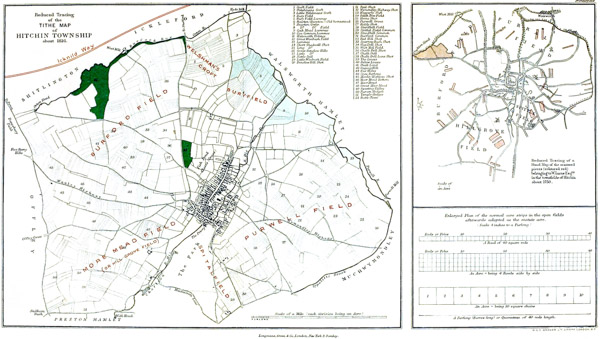


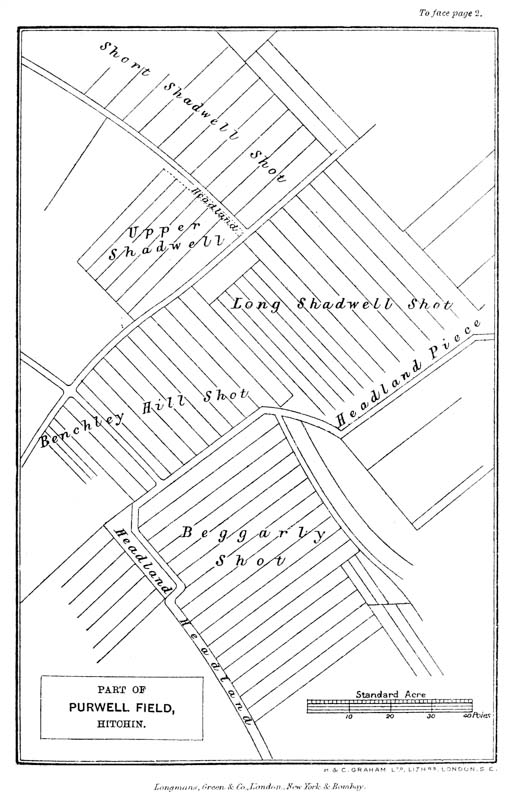
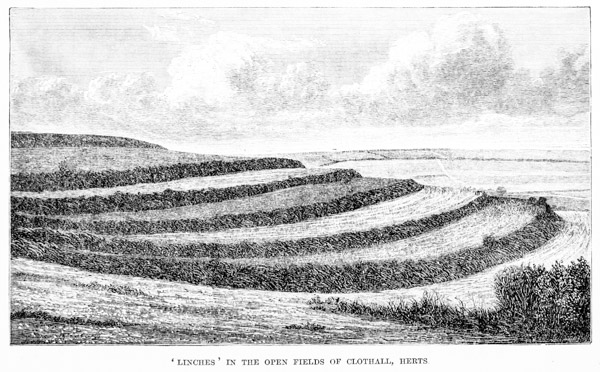
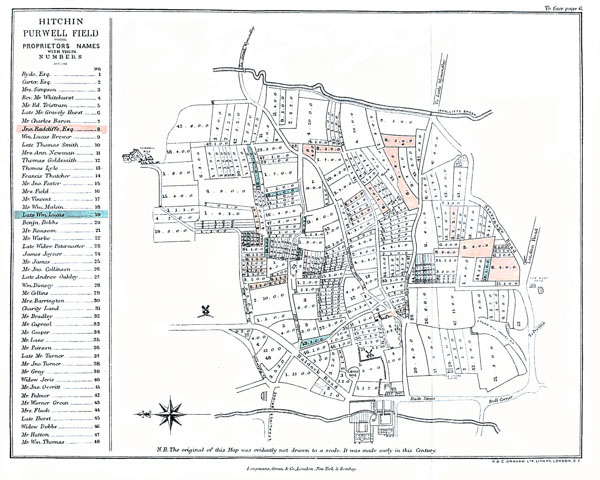
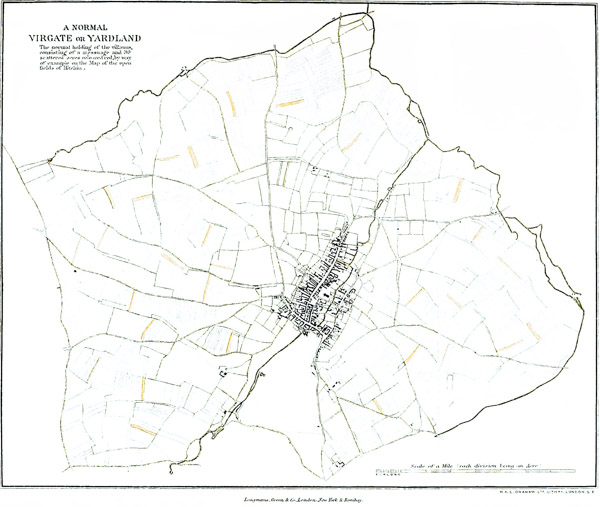
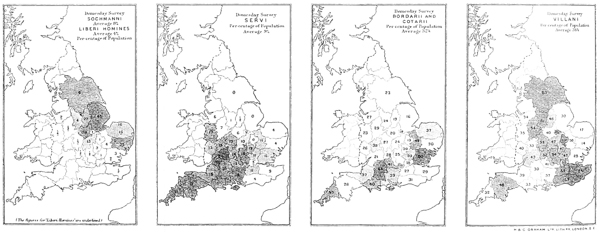
 hæbben
sume getyned hiora dæl. sume
næbban.
hæbben
sume getyned hiora dæl. sume
næbban.
 geat agan.