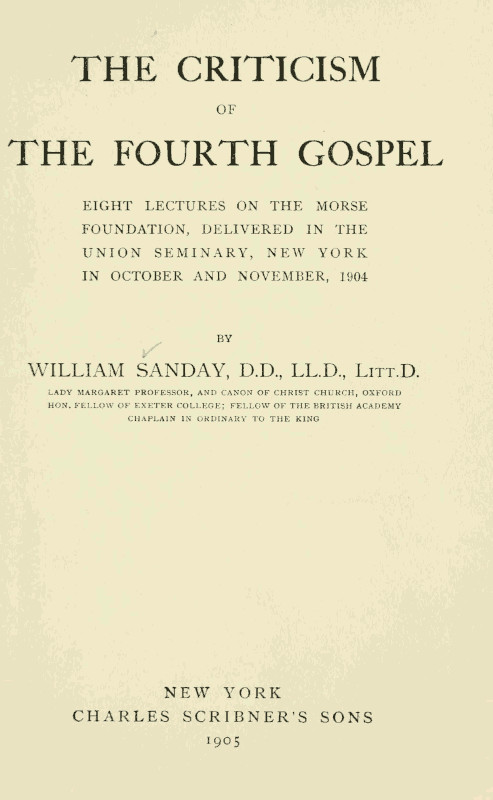
THE CRITICISM OF THE FOURTH GOSPEL.
By William Sanday, D.D., LL.D. 8vo $1.75 net
THE PLACE OF CHRIST IN MODERN THEOLOGY.
By A. M. Fairbairn, D.D., LL.D. 8vo $2.50
THE RELIGIONS OF JAPAN.
By William Elliot Griffis. 12mo $2.00
THE WHENCE AND THE WHITHER OF MAN.
By Professor John M. Tyler. 12mo $1.75
THE CRITICISM OF THE FOURTH GOSPEL
EIGHT LECTURES ON THE MORSE
FOUNDATION, DELIVERED IN THE
UNION SEMINARY, NEW YORK
IN OCTOBER AND NOVEMBER, 1904
BY
WILLIAM SANDAY, D.D., LL.D., Litt.D.
LADY MARGARET PROFESSOR, AND CANON OF CHRIST CHURCH, OXFORD
HON. FELLOW OF EXETER COLLEGE; FELLOW OF THE BRITISH ACADEMY
CHAPLAIN IN ORDINARY TO THE KING
NEW YORK
CHARLES SCRIBNER’S SONS
1905
TO
MY AMERICAN FRIENDS
PREFACE
vii
These lectures were delivered in accordance with
the terms of the Morse foundation in the Union Theological
Seminary, New York, between October 12
and November 4, 1904; and they were afterwards
repeated, with some changes, in Oxford. I have
tried to improve their form both while they were
being delivered and since. But I have been content
to state the case for the most part broadly and constructively,
and have not (as I had at one time
intended) burdened the pages with notes and detailed
discussions.
I am conscious of inadequate treatment throughout,
but especially perhaps in Lecture VII. There has
been a movement of thought going on ever since
the lectures were begun; and, if I am not mistaken,
the burning point of the whole controversy has come
to rest more and more upon the question discussed
in this lecture. But on neither side has the real issue
been pressed home with any thoroughness. Critical
writers are in the habit of assuming with very little
proof that the theology of St. John is simply a development
of that of St. Paul, and that the theology
of St. Paul was from one end to the other the
Apostle’s own creation. I cannot think that this is
a true representation of the facts; it seems to me
to ignore far too much the Mother Church and that
which gave its life to the Mother Church. At the
viiisame time I am quite aware that what I have given
is rather a sketch for a possible answer to this question,
than a really satisfactory discussion of it. There
are not wanting signs that a fuller examination of
the relations between the teaching of Christ on the
one hand and St. Paul and St. John on the other is
the next great debate that lies before us. In this
debate the question of the genuineness and authenticity
of the Fourth Gospel will be but an episode.
It is a matter of regret to me that the subject of
these lectures should have been so predominantly controversial.
I cannot help feeling the deep cleft which
divides me from many of the writers whose views
I have discussed—a cleft that extends to matters more
fundamental still than the criticism of the Gospel.
I find it in some ways a relief to think of the division
between us as greater even than it is. Where there
is frank and open hostility, the approaches that are
made by the one side to the other are more highly
valued. And from this point of view there is much
in the writings of those of whom I am obliged to
think as opponents that greatly appeals to me. As
typical of this I may mention the pamphlet by
Freiherr von Soden entitled Die wichtigsten Fragen
im Leben Jesu. I have referred to this pamphlet in
a note on p. 129, in terms that are not those of
praise; and it true that the critical portion of the
pamphlet, especially so far as it deals with the Fourth
Gospel, seems to me very defective. I also cannot
ixdisguise from myself that the author explicitly denies
what I should most wish that he affirmed (op. cit.,
p. 92). But, when I have said this, it is only just
to add that I have read the concluding sections of
his essay with warm respect and admiration. And
what is true of this essay is true of much beside.
I console myself by thinking that German criticism
with which I have had to break a lance more often
than with any other, has a wonderful faculty for correcting
itself. Only in the last few years we have
had, first the discussions started by Wellhausen about
the title Son of Man, and then those set on foot by
Wrede in his book Das Messiasgeheimnis in den Evangelien,
and in each case criticism seems to be working
its way through to a view that is really right and
reasonable. In like manner the extravagant estimate
of the apocalyptic element in the Gospels which has
been in vogue in recent years seems to be reducing
itself to sounder dimensions. In each case there is
error; but in each case the error is corrected, and
something is learnt and gained by the way. May
we not hope that on this question of the Fourth
Gospel, and the still more vital matters with which
it is bound up, by degrees the tension may be relaxed,
and there may be the same experience of
permanent gain? Already one may see great potentialities
of good in much that as it at present stands
may well give cause for concern.
One common form of criticism that may be directed
xagainst this book I confess that I should rather
deprecate. Even my friend Dr. Cheyne, whose
sympathies are so large, allows himself to write:
‘Apologetic considerations are brought in to limit
our freedom. The Fourth Gospel must be the work
of the Apostle John, and must be in the main historical,
because the inherited orthodoxy requires it’
(Bible Problems, p. 40 f.). Does he really think that
this is our only reason for holding those paradoxical
positions? Or rather, I would put my question in
another way; Does he really think that ‘the inherited
orthodoxy’ is nothing better than a taskmaster that
stands over us with a whip, to keep us from straying?
Is that his view of the divine meaning in the history
and development of nineteen centuries? I have had
occasion incidentally to define my attitude on this
subject, and I may perhaps refer to the pages on
which I have done so (pp. 3-5; comp. pp. 233-235;
262 f.). I hope that this attitude is at least as
consistent with an earnest pursuit of truth as that
which appears to assume that orthodox or traditional
opinions are always wrong.
Again, I am not conscious of that ‘paralyzing dread
of new facts’ of which my friend speaks. It may be
true that new theories perhaps, rather than new facts,
have a greater attraction for some of us than for
others. But, as far as I am concerned, if I have
been silent in public on some of the no doubt important
questions raised, the cause has been chiefly
xiwant of time. Life is very short, and very crowded,
and we are not all rapid workers, or gifted with the
power of facing in many directions at once. And
yet I have tried to keep pace with the progress of
thought; the problems which Dr. Cheyne propounds
are not unfamiliar to me; and I am not without more
or less deliberate views about them. Dr. Cheyne’s
book is enough to convince me that the problems
are really urgent; and I shall do my best to say
what I have to say upon them as soon as I can.
Perhaps it should be explained that the enumeration
of books and writers does not profess to be
exhaustive. In the main I have confined myself
to the more recent, and to what may be called
‘living’ literature. Some few things may have
dropped out because they did not happen to fall
in with the method of treatment adopted. Of these
the various writings of Dr. Edwin A. Abbott are the
most important that I can remember. To the older
works mentioned on pp. 12-15 there should have
been added Archdeacon Watkin’s Bampton Lectures
for 1890 as a summary of earlier criticism. The
absence of reference to the elaborate work of Dr. Joh.
Kreyenbühl (Das Evangelium der Wahrheit, vol. i,
1900; vol. ii, 1905) is due in part to the accidental
loss of my copy of the first volume. But it would
be wrong to suggest that I should have had patience
enough to discover what there is of sanity in its
learned but fantastic pages.
xiiIt only remains for me to express my heartfelt
thanks to those who so kindly invited me to deliver
these lectures, and to those who gave me such
generous and considerate hospitality, while they were
being delivered. My visit to America was deeply
interesting to me. I returned home, not only with
the feeling that I had made new and valued friends,
but also with a greatly strengthened hope and desire
that American and English workers may long be
found side by side—not as though either of them
had already obtained, or were already made perfect,
but pressing on, if so be that they may apprehend that
for which also they were apprehended by Christ Jesus.
I must also add a word of very sincere thanks to
my friends Dr. Lock, who read the whole, and Mr.
Ll. J. M. Bebb, who read a part of the proofs of
these lectures, and to whose kindness and care I owe
it that they are not more faulty than they are.
LECTURE I SURVEY OF RECENT LITERATURE — 1. Conservative Opinion. — 2. Mediating Theories. — 3. Partition Theories. — 4. Uncompromising Rejection. — 5. Recent Reaction.
1
The Situation in November, 1903.
The subject of these lectures illustrates in a striking
way the fluctuations and vicissitudes of critical opinion
as presented before the public. The facts remain the
same, and the balance of essential truth and error in
regard to them also remains the same; but the balance
of published opinion is a different matter, and in regard
to this the changes are often very marked and very
rapid.
In November last (1903), when I definitely accepted
the invitation so kindly given me by your President,
and definitely proposed the subject on which I am
about to speak, the criticism of the Fourth Gospel
had reached a point which, in my opinion, was further
removed from truth and reality than at any period
within my recollection. There had followed one
another in quick succession four books—or what were
practically books—three at least of which were of
conspicuous ability, and yet all as it seemed to me
seriously wrong both in their conclusions and in their
methods. To the year 1901 belong the third and
fourth editions, published together, of the justly praised
and largely circulated Introduction to the New Testament
of Professor Jülicher of Marburg (now translated
into English by the accomplished daughter of Mrs.
Humphry Ward), the second volume of Encyclopaedia
2Biblica, containing a massive article on ‘John, Son
of Zebedee,’ by Professor P. W. Schmiedel of Zürich,
and a monograph on the Fourth Gospel by M. Jean
Réville of Paris.[1] To these was added in the autumn
of last year a complete commentary on the Gospel by
the Abbé Loisy, whose more popular writings were
at the time attracting so much attention. A profound
dissent from the conclusion arrived at in these works
was one of my main reasons in offering to discuss the
subject before you. The feeling was strong within
me that in this portion of the critical field—and I do
not know any other so vital—the time was one of
trouble and rebuke; that there was a call to me to
speak; and that, however inadequate the response
to the call might be, some response ought to be
attempted.
These were the motives present to my mind in the
month of November when I chose my subject. But
by the beginning of the year (1904) the position of
things by which they had been prompted was very
largely changed. The urgency was no longer nearly
so great. Two books had appeared, both in the
English tongue, which did better than I could hope
to do the very thing that I desired—one more limited,
the other more extended in its scope, but both
maintaining what I believe to be the right cause in
what I believe to be the right way. These books
3were The Gospels as Historical Documents, Part I,
by Professor V. H. Stanton of Cambridge, and
The Character and Authorship of the Fourth Gospel
by Dr. James Drummond, Principal of Manchester
College. I should be well content to rest the case,
as I should wish it to be stated, on these two books,
especially the second. But by the time when they
appeared I was already committed to my task. As
I have said, one of them is limited in its scope; and
the other—admirable as it is, and heartily as I agree
with its principles as well as with most of its details—is
perhaps not quite so complete on all points as it is
on some; so that there may still be room for such
a brief course of lectures as you ask of me, partly to
reinforce points already made, and partly, it may be,
in some small degree to supplement them.
What I have been saying amounts to a confession
that my purpose is apologetic. I propose to defend
the traditional view, or (as an alternative) something
so near to the traditional view that it will count as
the same thing. It is better to be clear on this point at
starting. And yet I know that there are many minds—and
those just the minds to which I should most like
to appeal—to which this will seem to be a real drawback.
There is an impression abroad—a very natural impression—that
‘apologetic’ is opposed to ‘scientific.’
In regard to this there are just one or two things
that I would ask leave to say.
(1) We are all really apologists, in the sense that
for all of us some conclusions are more acceptable
4than others. No one undertakes to write on any
subject with his mind in the state of a sheet of white
paper. We all start with a number of general principles
and general beliefs, conscious or unconscious,
fixed or provisional. We all naturally give a preference
to that which harmonizes best with these beliefs,
though all the time a process of adjustment may be
going on, by which we assimilate larger conclusions to
smaller as well as smaller to larger.
(2) Even in the strictest science it must not be
supposed that the evidence will always point the same
way. The prima facie conclusion will not always be
necessarily the right one. It cannot be, because it
is very possible that it may conflict with some other
conclusion that is already well established. A balance
has to be struck, and some adjustment has to be
attempted.
(3) If I defend a traditional statement as to a plain
matter of fact, I am the more ready to do so because
I have found—or seemed to myself to find—as
a matter of experience, that such statements are far
more often, in the main, right than wrong. It is
a satisfaction to me to think that in this experience,
so far as it relates to the first two centuries of Christian
history, I have the distinguished support of Professor
Harnack, who has expressed a deliberate opinion to
this effect, though he certainly did not start with any
prejudice in favour of tradition. Of course one sits
loosely to a generalization like this. It only means
that the burden of proof lies with those who reject
such a statement rather than with those who accept it.
5(4) I cannot but believe that there is a real presumption
that the Christian faith, which has played so
vast a power in what appear to be the designs of the
Power that rules the world, is not based upon a series
of deceptions. I consider that, on any of the large
questions, that view is preferable which does not
involve an abrupt break with the past. It is very
likely that there may be involved some modification
or restatement, but not complete denial or reversal.
To say this is something more than the instinct of
continuity—something more than the instinct expressed
in such words as—
‘I could wish my days to be
Bound each to each by natural piety.’
It is the settled belief that there is a Providence that
shapes our ends, and that this Providence never has
wholly to undo its own work, but that there is a continuous
purpose running through the ages.
That is the sense—and I do not think more than
that—in which I plead guilty to being an apologist.
I hope there is such a thing as ‘scientific apology’ or
‘apologetic science,’ and that this is entitled to fair
consideration along with other kinds of science. I
would not for a moment ask that anything I may
urge should be judged otherwise than strictly on its
merits.
I began by saying that the nearer past, the last
three or four years, has been distinguished by the
successive appearance of a number of prominent books
on the criticism of the Fourth Gospel, which have been
6all on the negative side. Those I mentioned are
not only negative, but they have taken the more
extreme form of negation. Not content with denying
that the author of the Gospel was the Apostle St. John,
they insist at once that the true author is entirely
unknown, and that whoever he was he stood in no
direct relation to the Apostle. It has been the special
characteristic of the last few years, as compared with the
preceding period, that this more extreme position has
been held by writers of note and influence. If we take
the period from 1889 to 1900—or even if we go further
back, say, from 1870 to 1900, the dominant tendency
had been different. Opinion had seemed to gravitate
more and more towards a sort of middle position, in
which the two sides in the debate could almost reach
hands to each other. There was a distinct recognition
on the critical side of an element in the Gospel of
genuine and authentic history. And, on the other
hand, there was an equally clear recognition among
conservative writers that the discourses of our Lord
in particular were reported with a certain amount of
freedom, not as they had been actually spoken but as
they came back to the memory of the Apostle after
a considerable lapse of time. While the critics could
not bring themselves to accept the composition of the
Gospel by the son of Zebedee himself, they seemed
increasingly disposed to admit that it might be the
work of a near disciple of the Apostle, such as the
supposed second John, commonly known as ‘the
Presbyter.’
If this was the state of things six or seven years
7ago, and if this description might be given of the
general tendency of research in the decade or two
preceding, the same can be said no longer. The
threads that seemed to be drawing together have
again sprung asunder. The sharp antitheses, that
seemed in the way to be softened down and harmonized,
have asserted themselves again in all their
old abruptness. The alternatives are once more not
so much between stricter and less strict history as
between history and downright fiction, not so much
between the Apostle and a disciple or younger contemporary
of the Apostle as between a member of the
Apostolic generation and one who was in no connexion
with it.
I am speaking of the more pronounced opinions on
either side. Whereas seven or eight or fifteen or
twenty years ago the most prominent scholars were
working towards conciliation, at the present time, and
in the near past, the most strongly expressed opinions
have been the most extreme. The old authorities,
happily for the most part, still remain upon the scene,
and they have not withdrawn the views which they
had expressed; but other, younger writers have come
to the front, and they have not shown the same disposition
for compromise. They know their own minds,
and they are ready enough to proclaim them without
hesitation and without reserve.
The consequence is that the situation, as we look
out upon it, presents more variety than it did. There
are many shades of opinion, some of them strongly
opposed to each other. It is no longer possible to
8strike an average, or to speak of a general tendency.
The only thing to be done is for each of us to state
his view of the case as he sees it, and to appeal to the
public, to the jury of plain men, and to the rising
generation, to decide between the competing theories.
It must not be thought that conservative scholars
have shown any weakening of confidence in their
cause. Quite the contrary. The latest period, which
has seen so much recrudescence of opposition, has
also seen not only the old positions maintained by
those who had maintained them before, but an important
accession to the literature on the Fourth Gospel—from
the hand of a veteran indeed, but a veteran who
had not before treated the subject quite directly.
I refer to Zahn’s monumental Introduction to the New
Testament, 2 vols., published in 1899, with which may
be taken vol. vi of the same writer’s Forschungen z.
Gesch. d. neutest. Kanons published in 1900. It is
no disparagement to other workers in the field of
Early Christian Literature to say that Dr. Zahn is
the most learned of them all. We could indeed count
upon our fingers several who know all that really
needs to be known; but Dr. Zahn has a singular
command of the whole of this material in its remotest
recesses. He keeps a keen eye not only on theological
literature proper, but on everything that appears
in the world of scholarship that might have any bearing
upon the questions at issue. An indefatigable
industry he shares with more than one of his colleagues;
9but he is surpassed by none in the vigour
and energy of mind with which he works up his
knowledge.
And yet, with all his masterly erudition, and imposing
as is the monument which he has erected of it,
I am afraid that I should have to call it in some ways
a rather isolated monument. There is something in
Dr. Zahn’s work and in his position that is rather
solitary. He has indeed his fidus Achates in Professor
Haussleiter of Greifswald, and I do not doubt that
his influence is widely felt among theologians of the
Right. It is an encouragement to all who are like-minded
to know that this strong tower of learning
and character is with them. But it is hardly to be
expected that Dr. Zahn’s writings, especially his
greater writings, should ever be popular. Those
closely packed pages, with long unbroken paragraphs
and few helps to the eye and to readiness of apprehension,
are a severe exercise for the most determined
student: to any one else they must be forbidding.
And when such a student has made his way into them,
he is apt to find in them every quality but one. The
views expressed on all points, larger and smaller,
testify unfailingly to the powers of mind that lie
behind them, but the one thing that they do often
fail to do is to convince. There has fallen upon the
shoulders of Dr. Zahn too much of the mantle of von
Hofmann: if he were a little less original, he would
carry the reader with him more.
Another veteran scholar, who has continued his
laborious and unresting work upon the Fourth Gospel
10during this period, Dr. Bernhard Weiss[2], suffers less
from this cause. Not that the writings of Dr. Weiss
are much easier (they are a little easier) or more
attractive in outward form. But one has a feeling
that the Berlin Professor is more in the main stream—that
he is more in touch with other opinion on the
right hand and on the left. For this reason one finds
him, on the whole, more helpful. Every question, as
it arises, is thoughtfully weighed, and a strong judgement
is brought to bear upon it. Each edition of
Dr. Weiss’ books is conscientiously revised and
brought, so far as can be reasonably expected, up to
date. This untiring worker, as he enters upon the
decline of a long life, has the satisfaction of looking
back upon a series of volumes, always sound and
always sober, which have contributed as much as any
in this generation to train up in good and wholesome
ways those who are to follow. Dr. Weiss’ work
upon the Fourth Gospel is distinguished at once by
his steady maintenance of the Apostolic authorship
and by his steady insistence on the necessity of allowing
for a certain freedom of handling. This freedom
in the treatment, more particularly of the discourses,
Dr. Weiss was practically the first writer to assert on
the conservative side. He has sometimes stated it in
a way that I cannot but think rather exaggerated.
Along with Bernhard Weiss it is natural to name
Dr. Willibald Beyschlag, of whose dignified conduct
of the proceedings at the Halle Tercentenary reports
11reached us in England, followed—as it seemed, too
soon—by the news of his death on Nov. 25, 1900.
Beyschlag was a good average representative of the
liberal wing of the defenders of the Fourth Gospel,
who also combine its data with those of the Synoptics
in reconstructing the Life of our Lord. His style
has more rhetorical ease and flow than that of Weiss,
and he states his views with confidence and vigour;
but one feels that in his hands problems are apt to
become less difficult than they really are. For a
reasonable middle position, a compromise between
extremes on both sides, we may go to Beyschlag as
well as to any one; but it may be doubted whether
he really sounds the depths of the Gospel[3].
In this respect writers like Luthardt (died Sept. 21,
1902) and Godet (died Oct. 29, 1900), who are nearer
to the old-fashioned orthodoxy, are more satisfactory.
Of these writers we have fairly recent editions:
Luthardt’s Kurzgefasster Kommentar came out in
a second edition in 1894, and a posthumous edition
of Godet’s elaborate and weighty work began to
appear in 1902. With such books as these we may
group the reprint of the commentary by Drs. Milligan
and Moulton (Edinburgh, n. d.) and the two commentaries,
in The Expositor’s Bible (1891-2) and in
The Expositor’s Greek Testament, 1897, by Dr. Marcus
Dods.
12In the same connexion may also be mentioned
a little group of French writings, headed by Six
Leçons sur les Évangiles (Paris, 1897), by Abbé (now
Monsignor) Pierre Batiffol—slight, but with a note
of real distinction both in style and matter; an
Introduction by Abbé Jacquier (Histoire des Livres
du N. T., Paris, 1903), and a commentary by Père
Calmes (Paris and Rome, 1904)—both (as it would
seem) sufficiently competent and modern but not
specially remarkable.
Besides these there are three works on the conservative
side which English-speaking readers at least
can never forget—the searching examination of the
external evidence by Dr. Ezra Abbot (Boston, 1880,
reprinted in Critical Essays, 1888); articles in The
Expositor for the early months of 1890 by Bp. Lightfoot
(reprinted with other matter bearing upon the
subject in Biblical Essays, 1893); and the classical
commentary on the Gospel (first published as part of
the Speaker’s Commentary) by Dr. Westcott. Of these
three works two stand out as landmarks in theological
literature; Dr. Lightfoot’s papers were somewhat
slighter and less permanent in form, consisting in part
of Notes for Lectures, though they bear all the marks
of his lucid and judicious scholarship, and though they
are I think still specially useful for students.
An Englishman addressing an American audience
must needs pause for a moment over the first of these
three names[4]. It is the more incumbent on me to do
13this because as a young man, at a time when encouragement
is most valued, I was one of many who
profited by Dr. Ezra Abbot’s generous and self-denying
kindness. He opened a correspondence with me,
and sent me not only his own books but some by
other writers that I might be presumed not to possess,
and it was touching to see the care with which corrections
were made in these in his own finely formed
hand. I would fain not only pay a tribute of reverence
to the memory of Dr. Abbot, but also, if I may, repay
a little of my own debt by holding up his example to
the younger generation of American scholars as one
that I would earnestly entreat them to adopt and
follow. I do not know how far I am right, but I have
always taken the qualities of Dr. Ezra Abbot’s work as
specially typical of the American mind at its best.
His work reminds one in its exactness and precision
of those fine mechanical instruments in which America
has so excelled. To set for oneself the highest possible
standard of accuracy, and to think no time and no
pains misspent in the pursuit of it, is a worthy object
of a young scholar’s ambition.
In like manner we, in England, have a standard
proposed to us by Dr. Westcott’s famous Commentary
on St. John. It is the culminating product of a life
14that was also devoted to the highest ends. It is
characteristic of Dr. Westcott that the Commentary
was, I believe, hardly altered in its later editions from
the form in which it first appeared. This was due to
the thoroughness and circumspection with which the
author had in the first instance carried out his task.
I believe that in spite of the lapse of time Dr. Westcott’s
Commentary remains, and will still for long
remain, the best that we have on the Fourth Gospel,
as it is also (with the article on Origen) the best and
most characteristic work that its author bequeathed to
the world.
In this connexion I must needs mention another
American scholar and divine, to whom I am also bound
by personal ties of affectionate regard—the veteran
Dr. George Park Fisher of Yale. It is matter for
thankfulness that he has been able to give to the
world, carefully brought up to date, a new edition of
his Grounds of Theistic and Christian Belief (1902).
The pages devoted to the Fourth Gospel are, like the
rest, full of knowledge and suffused with sweet reasonableness
and mild wisdom. Dr. Fisher’s attitude is
perhaps not exactly that of the younger men, but it
certainly is not any less near to the ideal. If I were
a tutor or professor in an American seminary, there is
no book that I should more warmly recommend to my
pupils. To imbibe its spirit would be the best training
they could have. I should think it especially
excellent as a starting-point for further study. It
would implant nothing that would have to be unlearnt.
Dr. Ezra Abbot has in many ways found a worthy
15inheritor in Dr. Drummond; and it is perhaps true
that the positive results which he obtained are adequately
embodied in Dr. Drummond’s book, though
as a model for work of the kind the older essay can
never become antiquated. But, speaking generally,
I should think it a great misfortune if the better
examples of this older literature were thrust out of use
by the newer and more advanced criticism. I believe
it to be one of the weak points in that criticism that it
too much forgets what has been done. It contents
itself with an acceptance that is often grudging or
perfunctory and always inadequate of results that have
been really obtained. The scheme of argument common
to the older writers was to prove, in gradually
contracting circles, (1) that the author of the Gospel
was a Jew; (2) that he was a Jew of Palestine; (3)
that he was a contemporary; and (4) an actual companion
and eye-witness of the ministry of our Lord.
We must expect the last two propositions to be matter
for some controversy, and I shall return to them later;
but it seems to me that scant justice is done to the
argument as a whole.
Since this paragraph was written I have come across
some words of Professor von Dobschütz, which are so
much to the point that I am tempted to quote them:
‘That the Gospel not only shows a good knowledge
of Palestinian localities but also a thoroughly Jewish
stamp in thought and expression, is one of the truths
rightly emphasized by conservative theology which
critical theology is already, though reluctantly, making
up its mind to admit: the Hellenism of the Fourth
Gospel, together with its unity, belongs to those only
16too frequent pre-conceived opinions, on the critical side
too, which are all the more obstinately maintained the
more unfounded they are[5].’
Would that all critical writers were so clear-sighted
and so candid!
The really crucial point in the argument relating to
the Fourth Gospel is whether or not the author was
an eye-witness of the events which he describes. In
any case, if we are to take the indications of the
Gospel itself, the author must be identified with ‘the
disciple whom Jesus loved.’ But it does not quite
necessarily follow that this disciple is also to be identified
with the Apostle John, the son of Zebedee.
Internally there seems to be a fair presumption that
he is; and externally, the evidence seems to be clear
from the time of Irenaeus (180-90) onwards. But
neither the presumption in the one case, nor the
evidence in the other, is so stringent as to exclude all
possibility of doubt. We shall have presently to consider
the whole question upon its merits. But in the
meantime we note that in recent years the hypothesis
has been definitely put forward that the author of the
Gospel was not the Apostle John, but another disciple—some
would say a disciple of his—of the same name,
commonly known for distinction as ‘the Presbyter.’
The existence of this second John, if he really did
exist, rests upon a single line of an extract from
Papias, a writer of the first half of the second century.
He too is called a ‘disciple of the Lord’; so that he
17too may have been an eye-witness as fully, or almost
as fully, as the Apostle.
The hypothesis which ascribes the Gospel to this
John the Presbyter has taken different forms, some
more and some less favourable to the historical truth
and authority of the Gospel.
From a conservative point of view the most
attractive form of the hypothesis is that put forward
by the late Dr. Hugo Delff, of Husum, in Hanover[6],
to some extent adapted and defended by Bousset in
his commentary on the Apocalypse, and by one or two
others. The theory is that the beloved disciple was
not of the number of the Twelve, but that he was
a native of Jerusalem, of a priestly family of wealth
and standing. We are expressly told that he was
‘known to[7]’ the high priest (John xviii. 15); and he
seems to have had special information as to what went
on at meetings of the Sanhedrin (vii. 45-52, xi. 47-53,
xii. 10 ff.). These facts are further connected with the
statement by Polycrates, Bishop of Ephesus, towards
the end of the second century, that the John who lay
upon the breast of the Lord ‘became, or acted as,
priest and wore the frontlet of gold’ (Eus. H. E. v. 24.
2 ff.). This John is claimed as one of the ‘great
lights’ of the Churches of Asia.
18The theory opens up interesting vistas, the discussion
of which must, however, be reserved. It is
consistent with the attribution of a high degree of
authenticity to the Gospel. At the same time it ought
to be said that Delff himself regarded certain portions
of our present Gospel—more particularly those relating
to the Galilean ministry—as interpolations.
Without going all the way with Delff, and without
raising the question as to the identity of the beloved
disciple, other writers who have inclined towards a
middle position took the view that the Gospel was the
work of John the Presbyter, whom some of them
regarded as a disciple of John the Apostle. At the
head of this group would stand Harnack and Schürer,
who have examined the external evidence very closely.
The assigning of the Gospel to John the Presbyter,
or to some unnamed disciple of the Apostle, was
indeed the key to the compromise offered by those
who came nearest to the traditional position at the
end of the eighties and in the early nineties.
One of the very best of these attempts is by Professor
von Dobschütz, of Jena, in his brightly written Probleme
des apostolischen Zeitalters[8] (Leipzig, 1904), to which
reference has been made. Dr. von Dobschütz goes
with Delff (whom he does not mention) so far as to
describe the fourth Evangelist as a native of Jerusalem,
and to identify him with John of Ephesus. He does
not, however (at least explicitly), identify him with the
19beloved disciple; and he treats him as rather the
figure behind the author, than the actual author, of
the Gospel. He also, I cannot but think, makes the
mistake of questioning the unity of the Gospel.
Probably, if we had his views in full—which as yet we
have not—they would come under the next head, and
not under that of which we are now speaking.
In Great Britain a theory similar to Harnack’s has
found expression in Dr. James Moffatt’s Historical
New Testament (Edinburgh, 1901), and in other
quarters. In America, it is represented by Professor
McGiffert, and, more or less nearly, by Professor
Bacon. Of the latter I hope to say a word presently;
the former, if I might hazard the opinion, has not yet
said his last word on the Fourth Gospel. While
I recognize in what he has written many sound and
true observations, there seem to be two strains in his
thought which are not as yet fully harmonized.
Even Professor Harnack, whose influence is greatest,
has not, I venture to think, been quite consistent in the
view that he has taken. The Gospel may be assigned
to the Presbyter or to some other disciple, and yet
have different degrees of value ascribed to it as a
historical document. In this respect it seems to me
that Dr. Harnack has rather blown hot and cold: in his
Chronologie d. altchristlichen Litteratur he blew hot;
in his more recent lectures (E. Tr. What is Christianity?
p. 19 f.), and, if I am not mistaken, on Monday last he
blew cold[9]. A good deal turns on the description of
20John the Presbyter by Papias. In the text of the
extract as it stands both John the Presbyter and
Aristion are called ‘disciples of the Lord.’ There is
some tendency among critical writers to get rid of
these words as a gloss; if they are retained, they may
be taken in a stricter or a laxer sense; but if they
really cover a relation such as that of the ‘beloved
disciple,’ there could not be a better guarantee of
authenticity.
However this may be—and the subject is one of
which I hope to speak in more detail—in any case it
must be somewhere within the limits marked out by
Delff on the one hand, and Harnack with his allies
and followers on the other, or else by means of the
theories that I am just about to mention, that an
understanding must be reached between the two sides,
if that understanding is at all to take the form of
compromise.
Where two or more persons are concerned in the
composition of a book, the relation between them may
be through a written document, or it may be oral.
Hitherto we have been going upon the latter assumption:
the mediating theories that we have been considering,
so far as they were mediating, have treated
the writer of the Gospel, whatever his name, as a
disciple or associate of St. John the Apostle; and the
information derived from him is supposed to have
come by way of personal intercourse. But it is quite
conceivable that St. John may have set down something
21on paper, and that some later Christian—disciple
or not—took this and worked it up into our present
Gospel. Accordingly, various attempts have been
made at different times to mark off a Gospel within
the Gospel, an original authentic document derived
from a first-hand authority—either the Apostle or the
Presbyter—and certain added material incorporated
in the Gospel as we now have it. Many of these
attempts are obsolete and do not need discussion. It
has already been mentioned that Delff—without any
clear necessity even from his own point of view—cuts
out more particularly the Galilean passages and some
others with them as interpolations. These additions
to the Gospel he regards as the work of the author of
chap. xxi[10]. But the most systematic and important
experiments in this direction are those of Dr. Wendt
and Dr. Briggs.
After a preliminary sketch of his theory in the first
edition of his Lehre Jesu (1886), i. 215-342, Dr. H. H.
Wendt brought out in 1900 an elaborate and fully
argued analysis of the Gospel, carefully dissecting
each section and assigning the parts either to the
Apostolic author or to the later redactor. Approximately
similar results were obtained independently
with a less amount of published argument, by Dr.
C. A. Briggs in his General Introduction to the Study
of Holy Scripture (1899), p. 327, and in his New
Light on the Life of Jesus (1904), pp. 140-58. A like
theory has been put forward by Professor Soltau
(Zeitschrift f. d. neutest. Wissenschaft, 1901, pp. 140-9).
22In my opinion all attempts of this kind are fore-doomed
to failure. The underlying motive is to rescue
some portion of the Gospel as historical, while others
are dismissed as untrustworthy. At the same time it
is allowed that the separation can only be made where
there is a real break in the connexion. On this
Schmiedel pertinently remarks:—
‘There is much reason to fear that distrust of the
authenticity of the substance often causes an interruption
of the connexion to be imagined where in
reality there is none. Many passages of the same
sort as others, which give Wendt occasion for the
separating process, are left by him untouched, when
the result would not be removal of some piece held to
be open to exception in respect to its contents; the
ground for exception which he actually takes, on the
other hand, is often altogether non-existent[11].’
I look with considerable distrust on many of the
attempts that are made to divide up documents on
the ground of want of connexion. I suspect that the
standard of consecutiveness applied is often too
Western and too modern. But the one rock on
which it seems to me that any partition theory must
be wrecked is the deep-seated unity of structure and
composition which is characteristic of the Gospel.
Dr. Briggs turns the edge of this argument by
referring the unity to the masterful hand of the editor.
It is, no doubt, open to him to do so; but we may
observe that, if in this way he makes the theory
difficult to disprove, he also makes it difficult to
prove. I must needs think that both in this case and
23in Dr. Wendt’s the proof is quite insufficient. I would
undertake to show that the distinctive features of the
Gospel are just as plentiful in the passages excised as
in those that are retained. Perhaps the most tangible
point made by the two critics is the attempt to distinguish
between the words for ‘miracle’: ‘works’
they would assign to the earlier writer, and ‘signs’ to
the later. We remember, however, that the combination
of ‘signs’ and ‘wonders’ occurs markedly in
St. Paul, e. g. Rom. xv. 19, 2 Cor. xii. 12, and is
indeed characteristic of early Christian literature long
before the Fourth Gospel was written.
Another very original suggestion of Dr. Briggs’
which would be helpful if we could accept it, is that
we are not tied down to the chronological order of the
Gospel as we have it, but that this too is due to the
later editor, who has arranged the sections of his
narrative rather according to subject than to sequence
in time. I am prepared to allow that the narrative
may not be always strictly in the order in which the
events occurred; and it is true that there are some
difficulties which the hypothesis would meet. At the
same time we cannot but notice that the order is by
no means accidental, but that attention is expressly
drawn to it in the Gospel itself; see (e. g. ii. 11, iv. 54,
xxi. 14). And some incidents seem clearly to hang
together which Dr. Briggs has divided[12] (e. g. i. 29, 35,
43, where the connexion is natural historically, as well
as expressly noted by the Evangelist).
I fear that the learned Professor is seeking in a
24wrong direction for a solution of the problem of the
Gospel. But I would be the last to undervalue the
vigorous independence and the fearlessness and fertility
in experiment that are conspicuous in all his
writings.
Perhaps I should be right in saying a few words at
this point about Professor B. W. Bacon of Yale.
His view is not as yet (I believe) quite sufficiently
developed in print for me to be clear how much he
would refer to oral transmission and how much to
a written source. He distinguishes three hands in
the Gospel. I gather that the first would be that of
the Apostle, but he as yet stands dimly in the background.
Then comes the main body of the Gospel,
without the Appendix. This is ascribed to John the
Presbyter, whom—rather by a paradox—Professor
Bacon would seek in Palestine and not in Asia Minor.
Lastly there is the editor who works over the whole.
The two articles lately contributed to the Hibbert
Journal (i. 511 ff., ii. 323 ff.)[13] are highly original,
very incisive, and exceedingly clever. My objection
to them would be that they are too clever. Professor
Bacon has been to Germany, and learnt his lesson
there too well. At least I find myself differing
profoundly from his whole method of argument. The
broad simple arguments that seem to me really of
importance (Irenaeus, Heracleon, Polycrates, Tatian,
Clement of Alexandria) he puts aside, and then he
spends his strength in making bricks with a minimum
25of straw, and even with no straw at all (the argument
from silence).
I began by saying that the tendency towards rapprochement
which was characteristic of the eighties
and nineties, gave way towards the end of the century,
and has been succeeded in recent years by conspicuous
instances of uncompromising denial, at once of the
apostolic authorship of the Gospel and of its historical
character. The names of Jülicher, Schmiedel, Wrede,
Wernle, Jean Réville and Loisy are sufficient evidence
of this.
We shall probably not be wrong in classing with these
writers the eminent scholar Dr. H. J. Holtzmann of
Strassburg. It is indeed characteristic of Dr. Holtzmann’s
method to avoid anything like dogmatic assertion
of his own opinion, to work in with subtle skill
a kaleidoscopic presentation of the opinions of others,
while himself remaining in the background. He does
indeed leave room for a rather larger amount of
authentic tradition in the Gospel than the other writers
mentioned. Still, in the main his position is sceptical,
both as to the Asian tradition of St. John, and as to
the historical character of the Gospel.
It may be observed in passing that Dr. H. J.
Holtzmann of Strassburg should be carefully distinguished
from his younger cousin Oscar Holtzmann,
who is now Professor at Giessen. Dr. Oscar Holtzmann
published a monograph on the Fourth Gospel
in 1887, and he has since brought out a Life of Christ26which has lately been translated into English. The
two cousins occupy much the same general position;
the younger has not the distinction of the elder, but
he compensates to some extent by greater clearness
and definiteness in the expression of his views.
Another of the older writers, Dr. O. Pfleiderer, is
even more thorough-going as an allegorist. For him
the Gospel is from first to last a didactic work in
the guise of history; it is a ‘transparent allegory of
religious and dogmatic ideas[14].’ He would place the
first draft of the Gospel about the year 135, the
last chapter and the First Epistle about 150[15]. But
I have long thought that this attractive writer, though
interesting and instructive as a historian of thought,
is a ‘negligible quantity’ in the field of criticism
proper.
The other four German writers whom I have mentioned
all belong to the younger generation. Dr.
Schmiedel (who though a Swiss Professor is, I believe,
German by birth) is the eldest, and he is not yet quite
fifty-three: Jülicher, the next on the list, is forty-seven.
And as they belong to the younger generation, so
also they may be said to mark the rise of a new
School, or new method of treatment, in German
Theology. The Germany for which they speak is
not the dreaming, wistful, ineffective, romantic Germany
of the past, but the practical, forceful, energetic and
assertive Germany of the present. All, as I have
said, are able writers; and the type of their ability
27has much in common, though they have also their
little individual differences. They have all a marked
directness and lucidity of style. What they think
they say, without hesitation and without reserve; no
one can ever be in any doubt as to their meaning.
They are all apt to be somewhat contemptuous, not
only of divergent views, but of a type of mind that
differs from their own. Of the four, Jülicher and
especially Wernle have the warmer temperament;
Schmiedel and Wrede are cold and severe. Wrede
writes like a mathematician, who puts Q. E. D. at
the end of each step in the argument—though it
would be a misfortune if the demonstration were
taken to be as complete as he thinks it. Schmiedel
is rather the lawyer who pursues his adversary from
point to point with relentless acumen: if we could
grant the major premises of his argument, there
would be much to admire in his handling of the
minor; but the major premises, as I think I shall
show, are often at fault. Jülicher is just the downright
capable person, who sees vividly what he sees
and is intolerant of that which does not appeal
to him. Wernle alternately attracts and repels; he
attracts by his real enthusiasm for that with which
he sympathizes, by his skill in presentation, and his
careful observance of perspective and proportion; he
repels by aggressiveness and self-confidence.
The two French writers also have something in
common, though they belong to different communions.
We are not surprised to find that both have an easy
grace of style, to which we might in both cases also
28give the epithet ‘airy,’ because both are fond of speaking
in generalities which are not always in the closest
contact with facts; both are thorough-going allegorists,
and regard the whole Gospel as a pure product of
ideas and not literal history. In spite of their difference
of communion, M. Loisy is on the critical side
of his mind as essentially rationalist as his Protestant
confrère, though he brings back, by an act of faith
which some of us would call a tour de force, in the
region of dogmatics what he had taken away in the
field of criticism.
It seems to me that there is one word that requires
to be said, though I am anxious not to have my
motive misunderstood in saying it. I do not wish
to do so in the least ad invidiam. Controversy is,
I hope, no longer conducted in that manner. I speak
simply of an objective fact which has too important
a bearing on the whole question to be ignored.
When I read an argument by Professor Schürer,
and try to reply to it, I am conscious that we are
arguing (so to speak) in the same plane. I feel that
the attitude of my opponent to the evidence is substantially
the same as my own. Whatever the presuppositions
may be deep down in his mind, he at any
rate keeps them in abeyance. No doubt we differ
widely enough as to detail; but in principle I should
credit my opponent with an attitude that is really
judicial, that tries to keep dogmatic considerations, or
questions of ultimate belief as much in suspense as
possible, and to weigh the arguments for and against
in equal scales. But when I pass over to the younger
29theologians, I no longer feel that this is so; we seem
to be arguing, not in the same, but in different planes.
There is a far-reaching presupposition not merely far
back but near the front of their minds. I cannot
regard them as fellow seekers in the sense that we
are both doing our best to ascertain how far the events
of the Gospel history really transcended common
experience. I take it that on this point their minds
are made up before they begin to put pen to paper.
They all start with the ‘reduced’ conception of
Christianity current in so many quarters, that is akin
to the ancient Ebionism or Arianism. But so far
as they do this their verdict as to the Fourth Gospel
is determined for them beforehand. The position is
stated with great frankness by Mr. Conybeare:
‘It may indeed be said that if Athanasius had not
had the Fourth Gospel to draw texts from, Arius
would never have been confuted. Had the fathers of
the third, fourth, and fifth centuries not known this
Gospel, or not embraced it as authentic, the Church
would have remained semi-Ebionite, and the councils
of Nice and Ephesus would never have taken place[16].’
This does not indeed quite correspond to the facts.
To make it do so, we should have to blot out St. Paul,
and other parts of the New Testament, as well as
St. John. But just so far as the reasoning holds
good, it is obvious that we may invert it. If a writer
starts with a conception of Christianity that is ‘semi-Ebionite’
or ‘semi-Arian,’ he is bound at all costs to
rule out the Fourth Gospel, not only as a dogmatic
authority, but as a record of historical fact.
30Another characteristic is common to the writers of
the School of which we are speaking. The complexity
of a critical hypothesis very rarely stands in the way
of its adoption; but a very little psychological complexity
acts as a deterrent. For instance, after quoting
from B. Weiss some rather exaggerated language as
to the freedom used by the evangelist in reproducing
the discourses, Schmiedel goes on thus:
‘As compared with such a line of defence, there is
a positive relief from an intolerable burden as soon as
the student has made up his mind to give up any such
theory as that of the “genuineness” of the Gospel, as
also of its authenticity in the sense of its being the
work of an eye-witness who meant to record actual
history[17].’
So far from being an ‘intolerable burden,’ it seems
to me that Weiss’ theory is not only in itself perfectly
natural, nay inevitable, but that it is also specially
helpful as enabling us to account at one and the same
time for the elements that are, and those that are
not, strictly genuine in the report of the discourses.
Jülicher writes to much the same effect as Schmiedel;
and the passage which follows is indeed very characteristic
of his habit of mind:
‘The defenders of the “genuineness” of the Gospel
indeed for the most part allow that John has carried
out a certain idealization with the discourses of Jesus,
that in writing he has found himself in a slight condition
of ecstasy, in short, that his presentation of his
hero is something more than historical. With such
mysticism or phraseology science can have no concern;
in the Johannean version of Christ’s discourses form and
31substance cannot be separated, the form to be assigned
to the later writer, and the substance to Jesus Himself:
sint ut sunt aut non sint!...’
To please Professor Jülicher a picture must be all
black or all white; he is intolerant of half-shades that
pass from the one into the other. And no doubt there
are some problems for the treatment of which such
a habit is an advantage, but hardly those which have
to do with living human personalities.
The French writers, like the German, have a certain
resemblance to each other. To some of these points
I shall have to come back in detail later. I will only
note for the present that they are both allegorists
of an extreme kind. I would just for the present
commend to both a passage of Wernle’s:
‘This conception, however, of the Fourth Gospel
as a philosophical work, to which the Alexandrines
first gave currency, and which is still widely held
to-day, is a radically wrong one. John’s main idea,
the descent of the Son of Man to reveal the Father,
is unphilosophical.... So, too, the Johannine miracles
are never intended to be taken in a purely allegorical
sense. The fact of their actual occurrence is the
irrefragable proof of God’s appearance upon earth[18].’
If the miracles of the Fourth Gospel were facts there
was some point in the constant appeals that the
Gospel makes to them; but there would be no point
if these appeals were to a set of didactic fictions.
Within the last few months a monograph has
appeared, which from its general tendency may be
32ranged with the works of which we have been speaking,
though in its method it rather stands by itself,
E. Schwartz, Ueber den Tod der Söhne Zebedaei (Berlin,
1904). Dr. Schwartz is the editor of Eusebius in
the Berlin series, and his point of view is primarily
philological. He writes in a disagreeable spirit, at
once carping and supercilious. The only generous
words in his paper are a few in reference to the
Church historian. He exemplifies copiously most
of the procedure specially deprecated in these lectures.
His monograph has, however, a value of its own, from
the precise and careful way in which he has collected
and discusses the material bearing upon the history
of the Evangelist and of the Gospel in the first and
earlier part of the second century.
Far as I conceive that all these writers have travelled
away from the truth, they followed each other in such
quick succession that it would have been strange if
public opinion had not been affected by them. To
one who himself firmly believed in St. John’s authorship
of the Gospel, and in its value as a record of
the beginning of Christianity, the outlook last autumn
seemed as, I said, very black. A single book dispelled
the clouds and cleared the air. Dr. Drummond’s
Character and Authorship of the Fourth Gospel is
of special value to the defenders of the Gospel for
two reasons: (1) because it is the work of one who
cannot in any case be accused of dogmatic prepossessions,
as it would to all appearance be more favourable
33to his general position that the Gospel should not
be genuine or authentic; and (2) because the whole
work is something more than a defence of the
Gospel; it is a striking application to a particular
problem of principles of criticism in many respects
differing from those at present in vogue, and at the
same time, as I cannot but think, a marked improvement
on them.
To these points must be added the inherent qualities
of the book itself—the thorough knowledge with which
it is written, its evident sincerity and effort to get at
realities, its nervous directness and force of style, its
judicial habit of weighing all that is to be said on
both sides.
Perhaps the most important and the most far-reaching
of all the corrections of current practice is
a passage in the text with the note appended to it
upon the argument from silence. The text is dealing
with the common assumption that because Justin
quotes less freely from the Fourth Gospel than from
the other three, therefore he must have ascribed to
it a lower degree of authority.
‘But why, then, it may be asked, has Justin not
quoted the Fourth Gospel at least as often as the
other three? I cannot tell, any more than I can tell
why he has never named the supposed authors of his
Memoirs, or has mentioned only one of the parables,
or made no reference to the Apostle Paul, or nowhere
quoted the Apocalypse, though he believed it to
be an apostolic and prophetical work. His silence
may be due to pure accident, or the book may have
seemed less adapted to his apologetic purposes; but
considering how many things there are about which
34he is silent, we cannot admit that the argumentum a
silentio possesses in this case any validity.’
To this is added a note which raises the whole
general question:
‘An instructive instance of the danger of arguing
from what is not told is furnished by Theophilus of
Antioch. He does not mention the names of the
writers of the Gospels, except John; he does not tell
us anything about any of them; he says nothing about
the origin or the date of the Gospels themselves, or
about their use in the Church. He quotes from them
extremely little, though he quotes copiously from the
Old Testament. But most singular of all, in a defence
of Christianity he tells us nothing about Christ Himself;
if I am not mistaken, he does not so much as
name Him or allude to Him; and, if the supposition
were not absurd, it might be argued with great plausibility
that he cannot have known anything about
Him. For he undertakes to explain the origin of the
word Christian; but there is not a word about Christ,
and his conclusion is ἡμεῖς τούτου εἵνεκεν καλούμεθα
ὅτι χριόμεθα ἔλαιον θεοῦ (Ad Autol. i. 12). In the
following chapter, when he would establish the doctrine
of the resurrection, you could not imagine that he had
heard of the resurrection of Christ; and instead of
referring to this, he has recourse to the changing
seasons, the fortune of seeds, the dying and reappearance
of the moon, and the recovery from illness. We
may learn from these curious facts that it is not correct
to say that a writer knows nothing of certain things,
simply because he had not occasion to refer to them
in his only extant writing: or even because he does not
mention them when his subject would seem naturally
to lead him to do so[19].’
The remarkable thing in this note is not only its
independence and sagacity, but more particularly the
35trained sagacity which brings to bear upon the argument
just those examples which are most directly in
point and most telling.
Professor Bacon, in the first of his recent articles
(Hibbert Journal, i. 513), good-naturedly defends the
present writer from the charge of wishing to discredit
the argument from silence in general. And it is true
that in the place to which he refers I had in mind only
a particular application of the argument. Still I am
afraid that I do wish to see its credit abated. At
least it is my belief that too much use is made of the
argument, and that too much weight is attached to it.
There are two main objections to the way in which
the argument is often handled. (1) The critic does
not ask himself what is silent—what extent of material
does the argument cover? Often this extent is so
small that, on the doctrine of chances, no inference
can rightly be drawn from it. And (2) experience
shows that the argument is often most fallacious.
Dr. Drummond’s examples of this will I hope become
classical[20].
Dr. Drummond’s book contains a multitude of
36passages like the above and exhibiting the same
qualities. Many of them are a vindication of popular
judgement as against the far-fetched arguments of
professed scholars. The excellence of his method
seems to me to consist largely in this, that he begins
by making for himself an imaginative picture of the
conditions with which he has to deal, not only of the
particular piece of evidence which shows upon the surface,
but of the inferential background lying behind it;
that he thus escapes the danger of the doctrinaire who
argues straight from the one bit of evidence before
him to the conclusion; and that he also constantly
tests the process of his argument by reference to
parallel conditions and circumstances in our own day
which we can verify for ourselves.
If I were to express an opinion on the characteristic
positions which Dr. Drummond takes up, I think it
would be that, whereas he seems to me to overstate
a little—but only a little—the external evidence for
the Gospel, he at the same time somewhat understates
the internal evidence. He gives his decision
against the Fourth Gospel sometimes where I cannot
help thinking that a writer of equal impartiality would
not necessarily do so. It would also be unfair if I did
37not say that his general estimate of the historical
trustworthiness of the Gospel is lower than I should
form myself.
I have spoken of Dr. Drummond’s book first
because of its importance as a landmark in the study
of the Gospel, and because it covers the whole of the
ground with which we are concerned. But another
book preceded it by a week or two in the date of its
publication, which as yet deals only with a limited
portion of this ground, and yet which, unless I am
mistaken, presents qualities similar in general character
to those of Dr. Drummond, though perhaps the expression
of them is rather less striking. I refer to
Dr. Stanton’s The Gospels as Historical Documents,
Part I. Dr. Stanton’s book is planned on a larger
scale than Dr. Drummond’s in so far as it includes all
four Gospels; but as yet he has only dealt with the
external evidence bearing upon their early use. An
important part of the volume is naturally that devoted
to the Fourth Gospel. Like Dr. Drummond, Dr.
Stanton also presents a marked contrast as to method
with the group of continental writers that we have
just been considering. It was therefore a matter of
special interest that his book should be reviewed a
few months after its appearance by Dr. Schmiedel in
the Hibbert Journal (ii. 607-12). It is not very
surprising that Dr. Stanton was moved to reply to
his critic in the next number (pp. 803-7). There
is a direct antithesis of contrasted and competing
principles.
It may naturally be thought that I am a biased
38judge in such a case; but I confess that it seems to
me that the advantage is very much on the side of my
countryman. He shows without much difficulty that
Dr. Schmiedel has seriously misrepresented him. Indeed
one might say that the critic’s representation of
views and arguments was not so much derived from
the book he was reviewing as from his own internal
consciousness of what might be expected from an
apologist. This, however, is the personal, and more
ephemeral, aspect of the controversy. It is of more
general interest to note the critical assumptions made
in the course of the review. The writer admits that
his opponent ‘not unfrequently gives the impression
of being animated by the sincere resolve to maintain
nothing save only what can be assumed with certainty.’
‘With certainty’ is characteristic; the writer attributes
to Dr. Stanton (in this case) what he would have
aimed at doing himself. In the eyes of the school to
which Dr. Schmiedel belongs, I will not say exactly
that all the data of which they approve are certain,
but they are treated very much as if they were; in
building up an argument upon them, possibilities
easily and imperceptibly glide into probabilities, and
probabilities into certainties. Dr. Stanton disclaims
the idea of dealing with certainties; he would only
profess to adduce facts on a nicely graduated scale
of probability, which by their cumulative weight went
some way to carry conviction.
‘Concerning Barn. iv. 14, [Dr. Stanton] says
(p. 33) with justice that this is our earliest instance
of the citation of a saying of Christ as “scripture.”
39In the year A.D. 130, the date upon which he
rightly fixes for the composition of the Epistle
of Barnabas, this estimate of the Gospels would
have been in the highest degree surprising, since
it is not until A.D. 170 that the next examples
of such an estimate make their appearance.’ Dr.
Schmiedel goes on (1) to have recourse to the accustomed
expedient of suggesting that Barnabas is
quoting, not from the words of the Gospel which
are identical, but from a passage in 4 Ezra which is
quite different; and (2) if that expedient fails, to
represent the quotation as a ‘winged word,’ though
it is expressly introduced by the formula ‘it is written.’
However, it is not of either of these points that
I wish to speak, but rather to call attention to what
Dr. Schmiedel thinks would be ‘in the highest degree
surprising.’ Why so surprising? What substantial
ground have we for expecting anything else? In
the first place Dr. Schmiedel begins by exaggerating
the significance of the phrase ‘it is written,’ as though
on its first extant occurrence it would necessarily
imply full canonical authority. And then he goes
on to lay stress upon what is really little more than
the absence of literature. If we take the whole
extant Christian literature between the years 130 and
170 A.D., it would not fill more than a thin octavo
volume, and by far the greater part of that is taken
up with external controversy. What sort of argument
can be drawn from such a state of things as
to the exact estimate which Christians formed of
their own sacred books? No valid argument can be
40drawn from it either way, and it is far better simply
to confess our ignorance. It is reasonable to suppose
that there was a gradual development in the process
by which the Gospels attained to the position that
we call canonical; but the data to which we have
access do not allow us to map out its stages with
any precision.
It seems to me to be a fundamental defect in the
reasoning of Dr. Schmiedel and his school that they
fail to see that the real question is, not simply, What
is the evidence for this or that proposition? but,
What is the relation which the extant evidence bears
to the whole body of that which once existed, and how
far can we trust the inferences drawn from it?
I pass over some quite unwarrantable assumptions
which Dr. Schmiedel makes as to the apologetic point
of view: such as that, ‘if there can be shown to be
resemblance between a canonical and a non-canonical
writing, the former is uniformly to be regarded as the
earlier’; and that ‘Apocryphal Gospels would not
have been used in the influential circles of the
Church.’ Apologists would lay down nothing of the
kind, though in a certain number of concrete cases
they may think that the priority of a canonical to
a non-canonical writing does not need arguing, and
though they may also think that in some particular
case the evidence for the use of an Apocryphal Gospel
by a Church writer is insufficient.
Dr. Schmiedel easily satisfies himself that he has
refuted an argument bearing on the Fourth Gospel.
Professor Stanton had rightly maintained, ‘There
41must have been good grounds for believing that the
Fourth Gospel was founded upon the apostolic testimony
in order to overcome the prejudice that would
be created by the contrasts between it and the
Synoptics.’ He has shown, I think, in his reply,
that the instances alleged against this are not relevant,
and also that the part played by the two ideas
of Apostolicity and Catholicity in the forming of the
Canon are not quite correctly stated by his opponent.
But even if they had been as stated the original contention
would still have been left standing, because
agreement with previously accepted writings was part
of the idea of Catholicity. It is a sound argument
to say that a work so independent as the Fourth
Gospel must have come with good credentials to
obtain the place which it held.
Lastly, when Dr. Schmiedel speaks so imposingly
of ‘the silence of the entire first half of the second
century in regard to the sojourn of the Apostle John
in Ephesus,’ I would once more ask him what this
silence amounts to. What is the total bulk of the
literature on which the argument is based? Is it
possible to draw from it an inference of any value
at all[21]?
LECTURE II CRITICAL METHODS. THE OLDEST SOLUTION OF THE PROBLEM OF THE FOURTH GOSPEL — I. i. Defects in the Methods of current Criticism. — ii. Instances in which Criticism has corrected itself. — iii. Examples of Mistaken Method as applied to the Fourth Gospel. — II. The Oldest Solution of the Problem of the Fourth Gospel.
42
It is now rather more than eight years since Harnack
wrote the famous Preface to his Chronologie der altchristlichen
Litteratur. It was an instance of the
genial insight of the writer, and a keen diagnosis of
the criticism of the day.
The main outline of the Preface will be remembered.
Looking back over the period from which Science
was just beginning to emerge, the writer characterized
it as one in which all the early Christian literature
including the New Testament had been treated as
a tissue of illusions and falsifications. That time, he
went on to say, was past. For Science it had only
been an episode, during which much had been learnt
and after which much had to be forgotten. His own
researches, Harnack explained, would be found to go
in a reactionary direction even beyond the middle
position of current criticism. The results might be
summed up by saying that the oldest literature of the
Church, in its main points and in most of its details,
from the point of view of literary history, was veracious
and trustworthy. In the whole New Testament
there was probably only a single writing that could be
called pseudonymous in the strict sense of the term,
43the so-called Second Epistle of St. Peter; and, apart from
the Gnostic fictions, the whole number of pseudonymous
writings down to Irenaeus was very small, and
in one case (the Acts of Thecla) the production of such
a work was expressly condemned. In like manner
the amount of interpolation was also far less than had
been supposed; and the tradition relating to this early
period might in the main, and with some reservations,
be trusted.
Baur and his school had thought themselves compelled,
in order to give an intelligible account of the
rise of Christianity, to throw over both the statements
in the writings themselves and those of tradition about
them, and to post-date their composition by several
decades. They were driven to do this by mistaken
premises. Starting with the assumption that all these
writings were composed with a definite purpose, to
commend some sectional view of Christianity, they
were constantly on the watch for traces of that purpose,
and they found them in the most unexpected
places. The views of Baur and his followers had
been generally given up; but the tendencies set on
foot by them remained. The Christian writings were
still approached in an attitude of suspicion; they were
cross-examined in the spirit of a hostile attorney; or
else they were treated after the manner of a petit
maître, fastening upon all sorts of small details, and
arguing from them in the face of clear and decisive
indications. Baur thought that everything had a
motive, and an interested motive. But, whereas he
sought for the motive on broad lines, his more recent
44successors either gave themselves up to the search for
minor incidental motives, or for interpolations on a
large scale, or else they gave way to a thorough-going
scepticism which confused together probabilities and
improbabilities as though they were all the same.
Harnack went on to describe the results of the
labours of the last two decades (1876-96) as constituting
a definite ‘return to tradition.’ This return
to tradition he regarded as characteristic of the period
in which he was writing; indeed he looked forward to
a time when the questions of literary history which
had excited so much interest would do so no longer,
because it would come to be generally understood that
the early Christian traditions were in the main right.
This Preface of Harnack’s attracted considerable
attention, and probably nowhere more than in England.
English students hailed it as the beginning of a new
epoch, and one in which they could be more at home.
It fell in with certain marked characteristics of the
English mind. Even the progressive element in that
mind naturally works on conservative lines; it has
been reluctant to break away from the past. The
very advances of freedom, so steady and so sure, have
not been revolutionary; they have been advances
‘Of freedom slowly broadening down
From precedent to precedent.’
But it was not only the destructive conclusions of
continental criticism with which dissatisfaction was felt,
and which gave an apologetic colour to much English
work. The methods were in many ways not less
45distasteful than the conclusions. Englishmen felt,
whether they said so or not, that there was something
wrong. And therefore, when a scholar of Harnack’s
distinction put their thoughts into words and pointed
to the very defects of which they seemed to be
conscious, their hopes were raised that at last a
movement was begun which they could follow with
sympathy, and in which they might perhaps to some
extent bear a part.
When I take upon myself to speak in this way of
‘English students,’ I of course do so with some reservations.
I have in mind the rather considerable majority
of the theological faculties in our Universities, and
I might say the majority of the teaching staffs of all
denominations throughout Great Britain; for there
are excellent relations, and a great amount of solidarity,
among British teachers of Theology in all the churches.
A good general representation of the average views
would be found (e. g.) in Hastings’ Dictionary of the
Bible. No doubt there is also the other type—the
type represented by Encyclopaedia Biblica. There are
not a few among us who are less dissatisfied with
Continental methods, and who pursue those methods
themselves with ability and independence. And beyond
these there are very many more, especially among
the cultivated and interested laity, who are acquainted
in a general way with what has been done on the
Continent, and who are impressed by what they take
to be the results, though for the most part they have
not time to test the processes. I say advisedly that
this class is impressed by what it conceives to be
46results, because I imagine that, while there is a feeling
that Continental scholars are freer in their researches
and less trammelled than our own, there is also some
reserve owing to the consciousness that the results
have not been fully tested. To this extent I should
say that the intellectual posture of this class was one
of waiting—serious and interested waiting—rather
than of complete committal either to one side or to
the other.
Since my visit to America I seem to be better
able to speak of the situation there, though closer
acquaintance did but in the main confirm and define
the opinion that I had previously formed. There
are several differences between the conditions in
the two countries. On the other side of the
Atlantic there are probably greater inequalities of
theological instructedness. They have a greater
number of Universities and Seminaries, in which
the standard varies more than it does with us. And
while on the one hand general culture and that kind
of vague knowledge of the nature and tendencies
of criticism which goes with general culture is more
widely diffused in these islands, on the other hand
I should be inclined to think that a real first-hand
knowledge of critical work is more often to be found
there than it is here. This is due to the fact that
a large proportion of the ablest professors and teachers
have been themselves trained in Germany. And yet,
in spite of these differences and inequalities, there is
a general tendency, which seemed to me to embrace
the whole nation.
47It was summed up in a few words by one of the
Methodist Bishops (it will be remembered that the
Episcopalian Methodists are strong in America) with
whom I had some conversation. He had, I believe,
been secretary of some Board of Religious Education,
and spoke with wide knowledge. I should be afraid
to say how many students had passed through his
hands. And, speaking of these students, he said that
their general attitude was this: ‘They want to keep
their faith; and yet they also want to see the realities
of things.’
The same description would, I believe, fit the teachers
and professors as well as the students, including those
trained in Germany. They too want to keep their
faith, and to help their students to keep their faith.
As compared with the state of things in Germany,
there is a more general and sustained effort to make
their teaching positive and constructive; and this
constructive teaching takes, I suspect, in most cases
very similar lines—I should describe it as in the main
Ritschlianism of the Right. At the same time, they
too want to see the reality of things; in other words,
they want to teach by strictly scientific methods. And
the only further remark that I should have to make
would be that they are perhaps a little inclined—and
it naturally could not be otherwise—to look at these
methods through German spectacles.
Now I would not hesitate to carry this generalization
still further. We, in this country, have probably a
greater number of cross currents; there is a greater
number of media that stand between the individual
48and his ultimate aims and wishes, in the shape of
loyalties to this or that church or party. And yet
I think that, broadly speaking, we should not be wrong
in summing up what is really at the bottom of the
minds and hearts of the whole Anglo-Saxon race in
the same words: ‘They want to keep their faith; and
yet they also want to see the realities of things.’
It is the equilibrium of these two propositions that
is most characteristic. I fully believe that motives of
the same kind are present among the Germans as well
as ourselves. I could easily name a number of German
professors who, I feel sure, are as anxious to keep their
faith as we are. At the head of the list I should put
Harnack himself, whose views have been so much
discussed in this country. There is, however, a greater
diversity of attitude among the professorial body as
a whole. And so far as they were agreed—I am
speaking especially of the widespread liberal branch—they
would, I think, all invert the order of the two
propositions: they would give precedence to the desire
to get at realities; and they would identify this getting
at realities with the use of scientific method. The
reason is that in Germany, more than elsewhere, the
prevalent standards of judgement are essentially academic.
The Universities give the lead and set the tone
for the whole nation; and the Universities have now
been accustomed for many generations to an atmosphere
of free thought.
Now it is far from my intention to undervalue, either
the use of scientific method in general, or German
science in particular. I have the highest opinion of
49both. By far the greater part of the advance that has
been made in Theology—and I believe that a great
advance has been made in our own country as well as
elsewhere—I would again appeal to Hastings’ Dictionary
as representing a sort of average—has been due
to the stricter application of science; and a great part
of this has been German science. Honour must be
given where honour is due. We must not hold back
the full recognition that at the present time Germany
holds the first place in Science, and that its output of
scientific work is perhaps as great as that of all the
rest of the world besides. I am not sure whether this
is an exaggeration, but I hardly think it is.
But in all the more tentative forms of science, such
as philosophy, history, and theology, there is, or at
least has been so far, a double element, one that is
stable and permanent, and another that is more or less
local and ephemeral.
If I proceed to offer some criticisms upon German
critical methods, I am perfectly well aware that the
Germans in turn would have something to criticize in
ours. At the present day discussion is not limited to
any one country, but is international. It is by scholars
of different race and training comparing notes together
that mistakes are corrected, methods gradually
perfected, and results established. I shall not hesitate
therefore to point out where it seems to me that
German methods have gone wrong. And I feel that
I can do this the more freely when a scholar of
Harnack’s high standing has set the example. The
faults that we seem to have noticed in German criticism
50are very much those which he has indicated: it
has been too academic, too doctrinaire, too artificial,
too much made in the study and too little checked by
observation of the facts of daily life. The very excellences
of the German mind have in some ways
contributed to the formation of wrong standards of
judgement. More than other people the Germans
have the power of sustained abstract thought, of
thoroughness in mustering and reviewing all the
elements of a problem, of thinking a problem out in
such a way as not to leave gaps and inconsistencies.
Hence they are too ready to assume that all the rest
of the world will do the same, that if an important
piece of evidence is omitted in an argument it can
only be because it was not known, that carelessness
and oversights and inconsistencies are things that need
not be reckoned with. And there is also too great
a tendency to argue as though men were all made
upon one pattern. There is a want of elasticity of
conception. And, to sum up many points in one,
there is a great tendency to purism or over-strictness
in the wrong place, and to over-laxity also in the
wrong place, to strain out the gnat and swallow the
camel.
What one desiderates most is greater simplicity,
greater readiness to believe that as a rule, in ancient
times as well as modern, people meant what they said
and said what they meant, and that more often than
not they had some substantial reason for saying it.
51
These are not merely a priori reflections, but they
are based upon experience of the actual course that
criticism has taken. By this time criticism has a considerable
history behind it. It has corrected some of
its mistakes, and is able to look back upon the course
by which it came to make them. In this way it should
learn some wholesome lessons.
I will take three rather conspicuous examples in
which criticism has at first gone wrong and has afterwards
come to set itself right, in the hope that they
may teach us what to avoid in future. I imagine
that they may be found to throw some side-light
upon the particular problem of the Fourth Gospel.
The first example that I will take shall be from
the criticism of the Ignatian Epistles. I may assume
that the Seven Epistles are now generally allowed to
be genuine, and written by Ignatius, bishop of Antioch,
on his way to martyrdom at Rome sometime before
the end of the reign of Trajan (i. e. before 117). This
result is due especially to the labours of two scholars,
Zahn and Lightfoot. It is instructive to note with
what kind of argument they had to contend.
Both in their day had to stem a formidable current
of opinion. Bishop Lightfoot wrote in the Preface to
his great work dated ‘St. Peter’s day, 1885’:
‘We have been told more than once that “all
impartial critics” have condemned the Ignatian Epistles
as spurious. But this moral intimidation is
unworthy of the eminent writers who have sometimes
52indulged in it, and will certainly not be permitted
to foreclose the investigation. If the ecclesiastical
terrorism of past ages has lost its power, we shall,
in the interests of truth, be justly jealous of allowing
an academic terrorism to usurp its place.’
I should not find it difficult to produce parallels to
this kind of intimidation in the case of the Fourth
Gospel. To look back in face of them upon the issue
of the Ignatian controversy is consoling.
Much was said in the course of the controversy
about certain features of style and character as unworthy
of an Apostolic father. It was enough to answer with
Bishop Lightfoot that ‘objections of this class rest for
the most part on the assumption that an Apostolic
father must be a person of ideal perfections intellectually
as well as morally—an assumption which has only
to be named in order to be refuted[22].’
It is true that the letters contained exaggerated
language of humility, and also an exaggerated eagerness
for martyrdom. Beside these general features,
there were a good many strange and crude expressions
of other kinds. It is needless to say that it did not
in the least follow that such expressions could not
have been used by Ignatius. But if the critics had
been willing to study the letters a little deeper and
with a little more sympathy, they might have found
reason to change their estimate even of these acknowledged
flaws.
In dealing with Ignatius it is always important to
remember that we have to do with a Syrian and not
53a Greek. Certainly the language that he wrote was
not in his hand a pliant instrument. It always cost
him a struggle to express his thought; and the expression
is very often far from perfect. The figure of the
writer that one pictures to oneself is rugged, shaggy
(if one may use the word), uncouth; and yet there
is a virile, nervous strength about his language which
is at times very impressive. And even his extravagances
differ in this from many like extravagances,
that they are not in the least insincere. For instance,
if we read through the letter to Polycarp, we shall
see in it a really great personality. And Ignatius had
a very considerable power of thought as well as of
character. Outside the New Testament, he is the
first great Christian thinker; and he is one who left
a deep mark on all subsequent thinking.
I have little doubt that the strong expressions of
humility that are found from time to time in Ignatius
are wrung from him by the recollection of the life that
he led before he became a Christian. They are doubtless
suggested by St. Paul, and they spring from
a feeling not less intense than his.
The humility of St. John is a different matter.
But as very shallow and obtuse criticisms are sometimes
passed upon it, the Ignatian parallel may serve
as a wholesome warning. I shall have occasion to
return to this point later.
The main arguments against the Ignatian authorship
of the letters were drawn from the seemingly
advanced condition of things which they implied in the
way of heretical teaching on the one hand, and church
54organization on the other. The objections on these
grounds have been quite cleared up; and now the
letters supply some of the most important data that
the historian has to go upon.
It will be remembered that Bishop Lightfoot began
by converting himself before he converted others. He
had been inclined to think at one time that the shorter
Syriac version represented the true Ignatius. He tells
us himself how he came to give up this opinion.
He says:
‘I found that to maintain the priority of the
Curetonian letters I was obliged from time to time
to ascribe to the supposed Ignatian forger feats of
ingenuity, knowledge, intuition, skill, and self-restraint,
which transcended all bounds of probability’ (Preface
to the First Edition).
This is another bit of experience that it may be
worth while to bear in mind.
My second example is perhaps in this sense not
quite so clear a case, that there is not as yet as complete
a consensus in regard to it as there is in regard
to the Ignatian Letters. It is taken from the discussions
which have been going on at various times in
the last twenty-five years as to the genuineness of the
treatise De Vita Contemplativa which has come down
to us among the works of Philo.
A marked impression was made on the side of the
attack by a monograph by Lucius, Die Therapeuten u.
ihre Stellung in d. Gesch. der Askese, published in 1879.
This, together with the acceptance at least of the
55negative part of its result by Schürer, inaugurated
a period during which opinion was on the whole
rather unfavourable to the treatise. A reaction began
with two articles by Massebieau in 1888, followed by
the important and valuable work of Mr. F. C. Conybeare,
Philo about the Contemplative Life, Oxford, 1895.
The success of this defence may be regarded as
clenched by the accession of such excellent and impartial
authorities as Cohn and Wendland, who are bringing
out the great new edition of Philo, and of Dr.
James Drummond. It is true that Schürer reviewed
Mr. Conybeare in an adverse sense so far as his main
conclusion was concerned, and that he still maintains
his opinion in the third edition of his Geschichte d. Jüdischen
Volkes (1898); but I must needs think that his
arguments were satisfactorily and decisively answered
by Dr. Drummond in the Jewish Quarterly Review
for 1896.
One or two points in this reply of Dr. Drummond
have a general bearing, relevant to our present subject.
Lucius had maintained that the treatise was of
Christian origin, and that it was composed not long
before the time of its first mention by Eusebius. The
history of the text is opposed to this; and Dr. Drummond
is quite right in saying ‘the argument seems
valid that Eusebius did not make his extracts from
a work which had been recently sprung upon the
market, but from one which had already undergone
a long process of transcription.’ I may point to Dr.
Schmiedel’s article in the Encyclopaedia Biblica as one
of many examples of reasoning similar to that of Lucius
56in regard to the Fourth Gospel. It is a common
thing among critics to think it unnecessary to allow
any but the smallest interval between the first production
of a book and the date of its first mention in
the literature that happens to be extant. I would not
lay down an absolute rule. Circumstances vary in
different cases. But I would contend that in any case
they need careful consideration, and that assumptions
like those of Lucius and Schmiedel are highly precarious.
The next point I would notice is the argument from
identity of thought and style. One of the striking
features in Mr. Conybeare’s book was the vast accumulation
of parallels both in thought and expression
between the De Vita Contemplativa and the certainly
genuine works of Philo. Dr. Schürer thinks that this
might be due to imitation. On that head I should
like to quote Dr. Drummond:
‘The purely literary evidence will affect different
men differently. To those who have no difficulty in
attributing to the forger a boundless power of refined
imitation it will carry little weight. To others who
act upon the proverb, ex pede Herculem, and believe
that successful forgery in the name of an author, if
not of high genius, at least of unusual ability and
distinguished style, is an exceedingly difficult art, this
line of evidence will come with almost overwhelming
force. It is easy enough to imitate tricks of style, or
to borrow some peculiarities of phrase; but to write
in a required style, without betraying any signs of
imitation; to introduce perpetual variation into sentences
which are nevertheless characteristic; to have
shades of thought and suggestion, which remind one
of what has been said elsewhere, and nevertheless are
57delicately modified, and pass easily into another subject;
in a word, to preserve the whole flavour of
a writer’s composition in a treatise which has a theme
of its own, and follows its own independent development,
may well seem beyond the reach of the forger,
and must be held to guarantee the genuineness of a
work, unless very weighty arguments can be advanced
on the other side.’
This paragraph seems to be very much in point
for those who, like Schmiedel, H. J. Holtzmann and
Professor Bacon, would distinguish the author of the
First Epistle of St. John from the author of the
Gospel.
On this point it is also worth while to consider
Dr. Drummond’s replies to the inconsistencies alleged
to exist between particular details in the De Vita
Contemplativa and the other Philonic writings. There
is always a tendency in the critical school to make too
much of these little prima facie differences, which
generally shrink a good deal on closer examination.
My last example shall be taken from the Vita
Antonii, ascribed to, and now generally believed to
be a genuine work of, St. Athanasius. The Vita
Antonii holds an important place in the literature
of the beginnings of Monasticism. As such it was
involved in the wholesale scepticism on that subject
which was pushed to its furthest limits by the late
Professor Weingarten in the seventies and eighties.
How complete the reaction has been may be seen
in the recent edition of the Historia Lausiaca by
Dom Cuthbert Butler. Among Weingarten’s converts
58was our English scholar, Professor Gwatkin; and
I do not think that anything could speak more eloquently
than just to transcribe the list of objections
brought against the Vita Antonii by Professor Gwatkin
in his Studies of Arianism (Cambridge, 1882). I proceed
to give the more important of them in an
abridged form:
‘In the rest of the works of Athanasius there is no
trace of Antony’s existence. Considering the grandeur
of the saint’s position, and his intimate relations with
the bishop of Alexandria, this fact alone should be
decisive.’
Observe the argument from silence, which is enlarged
upon in the remainder of the paragraph.
1. The treatise is addressed to the monks of the
West, whereas ‘monasticism was unknown in Europe
in the reign of Valentinian, and at Rome in particular
when Jerome went into the East in 373; and at Milan
it had only lately been introduced by Ambrose at the
time of Augustine’s visit in 385.’
2. ‘Apart from its numerous miracles, the general
tone of the Vita is unhistorical. It is a perfect
romance of the desert, without a trace of human
sinfulness to mar its beauty. The saint is an idealized
ascetic hero, the mons Antonii a paradise of peaceful
holiness. We cannot pass from the Scriptores Erotici
to the Vita Antonii without noticing the same atmosphere
of unreality in both. From Anthanasius there
is all the difference of the novel writer from the orator—of
the Cyropaedia from the de Corona.’
3. ‘Though Athanasius had ample room for miracles
in the adventures of his long life, he never records
anything of the sort.... But miracles, often of the
most puerile description, are the staple of the Vita
Antonii, and some of them are said to have been done
before the eyes of Athanasius himself, who could not
59have omitted all reference to them in the writings of
his exile.’
Again, the argument from silence.
4. ‘Antony is represented as an illiterate Copt,
dependent on memory even for his knowledge of
Scripture.’ Yet he alludes to Plato, Plotinus, &c., and
in general reasons like a learned philosopher.
5. ‘The Vita Antonii has coincidences with Athanasius
in language and doctrine, as we should expect
in any professed work of his.... But the divergences
are serious’....
6. It is implied throughout the Vita Antonii that
the monks were extremely numerous throughout the
East during Antony’s lifetime. Now there were
monks in Egypt, monks of Serapis, long before;
but Christian monks there were none’ (Studies of
Arianism, pp. 100-2).
Now I am not for a moment going to disparage
this display of learning. It is very clever; it is very
scholarly: in the state of knowledge when it was
written it was at least very excusable in its statements.
Altogether it was as brilliant a piece of
criticism as one would wish to see. To this day
the objections read quite formidably. And yet the
inference drawn from them is pretty certainly wrong;
indeed the whole array is little more than an impressive
bugbear.
With such warnings from the past before our eyes,
I think we should be inclined to scrutinize rather
closely arguments of a like kind when they meet us in
the course of our present investigation.
60
At this point we may go back to Harnack’s Preface.
And here I cannot help expressing my regret that it
has not had more of the influence that it deserved to
have, both in the country of its author and elsewhere.
I am even tempted to go a little further, and express
my regret that it has not had more influence upon the
author himself. I will henceforward confine myself
more strictly to the Fourth Gospel. And it seems to
me that, in his incidental treatment of this, Harnack
has more than once forgotten his own precepts.
He expends endless ingenuity in trying to prove
that there was a confusion, in the minds of the
Christian writers of the second century, between the
Apostle St. John and a certain ‘Presbyter’ of the same
name, who really lived, as the Apostle was supposed
to have lived, at Ephesus in the Roman province of
Asia. An important difficulty in the way of this proof
is the explicit testimony of Irenaeus. To meet this
difficulty, the attempt is made to show that Irenaeus
derived all his knowledge, or supposed knowledge,
about St. John and his surroundings from two sources,
a very brief intercourse in early youth with Polycarp,
bishop of Smyrna, and the book of Papias, called
Expositions of the Oracles of the Lord. It is like
Nero wishing that Rome had one neck, in order that
it might be cut at a single stroke. By reducing the
channels through which Irenaeus received his knowledge
to these two, it became more possible that if
61they happened in any way to lend themselves to the
confusion, that confusion should really take hold of his
mind and express itself in his writings. The learning
and ingenuity and skill displayed are admirable. But
how futile, from the very first, to suppose that all the
information Irenaeus possessed about the greatest
leader of the Church of his own home came only
through these two channels and no others; indeed,
that he was like the princess in the fairy tale, shut up
in a tower and cut off from all communication with
the outer world. We know that two at least of his
companions in the Gallic churches of Vienne and
Lyons came from the same region as himself. It is
commonly supposed that these churches had as a
nucleus a little colony from Asia Minor. In his
Fourth Book Irenaeus often refers to a certain
Presbyter, whom Harnack rightly shows to have been
not a direct hearer of the Apostles, but at one degree
removed from them, a disciple of those who had heard
from the Apostles. It is natural, with Lightfoot, to
identify this Presbyter with Pothinus, Irenaeus’ own
predecessor in his see, who had passed the age of
ninety when he died in the persecution of the year
177. In any case, Pothinus must have been a store-house
of traditions and memories, to which Irenaeus
would have constant access. We know also that after
the persecution Irenaeus was in Rome; and there is
some reason to think that he had resided there more
than twenty years before[23]. This was another great
62centre with which he was familiar, and to which news
and traditions of the past came streaming in from
every quarter of the Christian world. And yet we
are asked to believe that Irenaeus was the victim of
a confusion that in any number of ways might have
been corrected. As Dr. Drummond well says, ‘Critics
speak of Irenaeus as though he had fallen out of the
moon, paid two or three visits to Polycarp’s lecture-room,
and never known any one else. In fact, he
must have known all sorts of men, of all ages, both in
the East and the West, and among others his venerable
predecessor Pothinus, who was upwards of ninety at
the time of his death. He must have had numerous
links with the early part of the century[24].’
Again the same writer says:
‘The testimonies of Irenaeus, of Polycrates, and of
Clement are those on which we must mainly rely. In
judging of the collective force of the evidence, we must
not forget that the second century was a literary age.
The churches freely communicated with one another
by letters, and there was an abundant theological
literature of which only a few fragments have survived.
I see no reason why the churches of Asia should not
have had as well-grounded a certainty that John had
been once among them as we have that Goldsmith
was once in London[25].’
To deal with all this body of evidence as Harnack
deals with it is very like ‘arguing on the strength of
63a few particulars in the face of clear and decisive
indications[26].’
Here is another instance of the very thing that
Harnack himself complained of. He has made up
his mind that chap. xxi of the Gospel could not have
been written until after the death of the author. But
in ver. 24 the editors of the Gospel say expressly that
the Apostle who figures so conspicuously in it was the
author of the whole book (‘this is the disciple who
beareth witness of these things, and wrote these
things’). This, according to Harnack, only convicts
them of a deliberate untruth, contradicted by the verses
immediately preceding. If we must needs accuse the
unfortunate editors of falsification, we might at least
give them credit for the sense to take care that their
falsehood was not exposed by their own words, and
almost (as it were) in the same breath. But the fact
is that the premiss, from which Harnack argues, is
purely gratuitous, as I hope to show in the next
lecture.
Perhaps it is the same persons, the editors of the
Gospel—in any case it is the Presbyters who were
closely connected with them—who are charged with
another piece of dishonesty. Harnack sees that mere
accident will not account for the supposed confusion
of John the Presbyter with John the Apostle. He
therefore does not shrink from imputing deliberate
fraud.
‘The legend purposely set on foot that the author of
the Gospel was the son of Zebedee, &c.[27]’
64‘But Papias, through the oral traditions about which
he took so much trouble, already stood under the
influence of Presbyters, of whom some perhaps purposely
started the legend that the Presbyter John was the
Apostle[28].’
‘The John who had the encounter with Cerinthus,
after what has been said can only be the Presbyter.
But in the confusion, “the unconscious” alone can
hardly have been involved.’
The dishonesty went beyond the confusion of the
two persons. It is also seen in the definite ascription
of the Gospel to the Apostle.
‘The twenty-fourth verse of the twenty-first chapter
of the Fourth Gospel, about which we have spoken,
will always remain a strong indication of the fact that
in Ephesus the Fourth Gospel was deliberately put
out after the death of its author as a work of the
Apostle, and so that the Apostle and the Presbyter
were deliberately identified, as Philip the Evangelist
was made to change places with Philip the Apostle[29].’
Facilis descensus. When once we begin imputing
fraudulent actions we may very easily find that we
have to go on doing so. It should, however, be
remembered that the ground for all this is no assured
fact, but only the exigencies of a complicated theory
which, quite apart from this, has a load of improbability
to contend with.
I will give one further example of a different kind.
The tendency of the criticism that has been, and still
is largely in vogue, is to give what seems to me quite
undue weight to the exceptional, the abnormal, the
65eccentric, as compared with that which is normal and
regular.
In the controversy over the Fourth Gospel one of
the questions has been as to the exact degree of importance
to be attached to the so-called Alogi, who, about
the third quarter of the second century, denied
St. John’s authorship of the writings attributed to
him, including the Gospel, and by a piece of sheer
bravado ascribed it to the heretic Cerinthus.
Harnack’s account of this—coterie perhaps rather
than sect—is just. ‘The attack did not spread; it was
soon defeated; but the memory of it lingered on, and
the policy of the Church, auspiciously begun by
Irenaeus, came to be that of teaching the absolute
equality in rank and value of the four component
parts of the Gospel[30].’ But the point to which I wish
to call attention is that the Church writers did not
allow the existence of these Alogi to prevent them
from classing the Gospel among the Homologoumena,
or books about the canonicity of which all Christians
were agreed. Eusebius uses strong language. He
says that both the Gospel and the First Epistle were
accepted without dispute by his own contemporaries
as well as by the ancients (H. E. iii. 24. 17). And, if
it is said that Eusebius was writing a century and
a half after the Alogi, when that little side-eddy of
opinion had subsided and been forgotten, it is not
Eusebius alone who ignores their existence in this
manner. Irenaeus is one of those who certainly knew
about them; and yet he regards the Four Gospels,
66our present four, as a sort of divine institution, deeply
implanted in the nature of things, directly presided
over and inspired by Christ the Word (adv. Haer. iii.
11. 9). A little later Clement of Alexandria speaks of
the same Four Gospels as specially handed down
among Christians (Strom. iii. 13. 93). And, again,
a little later Origen describes them as ‘alone unquestioned
in the Church of God under heaven’ (Eus.
H. E. vi. 25. 4). Still earlier, a contemporary of the
Alogi, Tatian, gave effect to the same belief by composing
his Diatessaron. And the Muratorian Fragment
also endorses it.
This striking unanimity from all parts of the
Christian world serves to reduce the Alogi to their
right dimensions. The reason why they have bulked
rather larger than they should do is, I believe, because
they wielded the pen. It will be remembered that
Dr. Salmon was for reducing them to the single
person of Caius of Rome. Schwartz also argues that
not more than a single writer may be meant. He
thinks that in any case Epiphanius had a book before
him[31]. The Alogi were in any case a very ephemeral
phenomenon, chiefly significant in the history of the
Canon, as marking the slight element of resistance to
the establishment of the group of Four Gospels.
You will think perhaps that I have been a long
time in approaching the direct treatment of the Fourth
67Gospel. It is quite true that I have thought well
to begin the approach from a distance, as it were by
sap and trench, before planting my guns—such as
they are. I have indeed the ambition in this course
of lectures not only to state a case in regard to the
Fourth Gospel, but also at the same time to contribute,
if I may, to the work so admirably initiated
by Dr. Drummond, of commending by the way what
I conceive to be sound principles of criticism, as contrasted
with others which I consider unsound. It
happens that a discussion of the Fourth Gospel
specially lends itself to this purpose.
In accordance with what I have been saying, you
will not expect of me any new and startling theory to
account for the phenomena of the Fourth Gospel.
I am content to go back to the oldest categorical
statement in respect to it that history has handed
down to us. It seems to me that this statement,
plain and direct as it is, really gives an adequate
explanation, if not exactly of everything, yet at least
of all the salient points that need explaining.
Eusebius (H. E. vi. 14. 7) has preserved for us the
substance of a passage from the Hypotyposes, or
Outlines, of Clement of Alexandria, which he says
that Clement derived from the ‘early Presbyters’
(παράδοσιν τῶν ἀνέκαθεν πρεσβυτέρων), and which dealt
among other things with the order of the Gospels.
After speaking of the other Evangelists, he says that
‘last of all John perceiving that the bodily (or
external) facts had been set forth in the (other)
Gospels, at the instance of his disciples and with
68the inspiration of the Spirit composed a spiritual
Gospel.’
A very similar tradition had been given by Eusebius
in an earlier book (iii. 24). He heads the chapter,
‘On the Order of the Gospels,’ and in the course
of it he writes as follows:
‘Nevertheless, of all the disciples of the Lord, only
Matthew and John have left us written memoirs, and
they are reported (κατέχει λόγος[32]) to have been led to
write under pressure of necessity. Matthew, having
previously preached to the Hebrews, when he was
about to go to other peoples, committed to writing
the Gospel that bears his name in his native tongue,
and so by the written book compensated those whom
he was leaving for the loss of his presence. And when
Mark and Luke had by that time published their
Gospels, they say that John, having before spent all
his time in oral preaching, at last came also to write
for some such reason as this. The three Gospels first
written having been by this distributed everywhere,
and having come into his hands, they say that he
accepted them, bearing witness to their truth, but
(adding) that there was only wanting to their record
the narrative of what was done by Christ at first and
at the beginning of His preaching.’
At this point Eusebius digresses to show that what
was said was true. The first three Evangelists began
the main body of their narrative after John the
Baptist was cast into prison; but St. John expressly
tells us that, at the time of the events related in his
early chapters, John was not yet in prison. Any one
attending to this, Eusebius said, would no longer
69suppose that the Gospels were at variance with each
other, and would see that John had reason for being
silent as to the genealogy of our Saviour’s human
descent, as this had been already written by Matthew
and Luke, and for beginning with His divinity, as
though this had been reserved by the Holy Ghost for
him as one greater than they. These last are the
words of Eusebius, who is very probably influenced
by his recollection of the language of Clement. Unfortunately
we cannot locate the rest of the tradition.
It would be only a guess to suppose that it came from
Hippolytus, at the time of his controversy with Caius.
But in any case there is a good deal of evidence to
show that the opening sections of the Gospels were
being much canvassed towards the end of the second
and at the beginning of the third century. The
passage is in general agreement with Clement, and
avoids his mistake in saying that the two Gospels
containing the genealogies were the first to be written.
Really Clement alone has all the essential points,
which are these:
1. The Gospel is the work of St. John the Apostle—for
there is no doubt that he is intended.
2. It was written towards the end of his life, after
the publication of the other three.
3. The three Gospels were in the hands of the
Apostle, and he had read and up to a certain
point approved of them.
4. What he himself undertook to write was a
Gospel, not a biography; the difference is
important.
705. In contrast with the other Gospels it was recognized
as being in a special sense ‘a spiritual
Gospel.’
I believe that these data will enable us to understand
all the facts, both those which are more favourable
to the Gospel and those which are in a sense
less favourable.
1. The best of reasons is given for all those marks
of an eye-witness which we shall see to be present in
great number and strength. They point to a first-hand
relation between the author and the facts which
he records. If the Gospel is not the work of an eye-witness,
then the writer has made a very sustained
and extraordinary effort to give the impression that
he was one.
2. By throwing the Gospel to the end of the
Apostle’s life, a considerable interval is placed between
the events and the date of its composition. That
means that the facts will have passed through a
medium. Unconsciously the mind in which they lay
will have brought its own experience to bear upon
them; it will have a tendency to mix up the plain
statement of what was said and done with an element
of interpretation suggested by its own experience.
And this will be done in a way that we should
call ‘naïve,’ i. e. without any conscious self-analysis.
The mingling of objective and subjective will take
place spontaneously and without reflection. The
details will not be given out exactly as they went in;
and yet the writer will not be himself aware that he
is setting down anything but what he heard and saw.
713. The relation of the Fourth Gospel to its predecessors
accurately corresponds to that described in the
tradition. On the one hand their contents are very
largely assumed; and on the other hand the author
does not hesitate, where he thinks it necessary, to
correct them. The relation is easy and natural; it
at once accounts for the selection of the incidents
narrated. The author evidently felt himself at liberty
to select just those incidents which suited his purpose.
4. And that purpose, it is important to remember,
was not by any means purely historical. The author
was writing a Gospel, not a biography in the modern
sense of the word. His object was definitely religious,
and not literary. He tells us in set terms what he
proposed to do: ‘These things are written, that ye
may believe that Jesus is the Christ, the Son of God;
and that believing ye may have life in His name.’
He did not really aim at a complete narrative of
external events or an exhaustive study of a complex
human character. He aimed at producing faith;
and he sought to produce it by describing at length
a few significant incidents, taken out of a much
larger whole.
5. The previous writings that came into his hands
were also Gospels; and they too were intended to
produce faith. But in this direction the author of the
Fourth Gospel felt that something more remained to
be done. Christendom had its Gospels, but not as
yet exactly ‘a spiritual Gospel.’ A ‘spiritual Gospel’
meant one that sought to bring out the divine side of
its subject. When St. Paul at the beginning of the
72Epistle to the Romans draws an antithesis between
the Son of David ‘according to the flesh’ and the
Son of God ‘according to the spirit of holiness,’ he is
anticipating exactly this later contrast between the
Gospels of the bodily life and of the spirit. ‘Spiritual’
means ‘indwelt by the Spirit of God.’ And it was
that side of the life of Christ in which the Spirit of
God was seen living and working in Him that the
fourth evangelist undertook specially to describe.
If, then, it is objected that the Gospel is onesided,
that it gives undue prominence to this divine side,
we begin by asking what is meant by undue, what
standard of measurement marks it as undue. Obviously
the standard is that which we have just dismissed as
altogether beside the mark, the standard of the modern
biography. The Gospel does not in the least profess
to do what the modern biographer does; but what
the writer does profess to do, he was perfectly within
his right in doing. He desired to set forth Christ
as Divine. If that is to be onesided, of course he
is onesided. Clement tells us why he did it. It was
because he thought that the physical and external
side, the human side of his subject, had had justice
done to it already. In this respect the older Gospels
were adequate, and he had no special wish to add to
them. The one thing he did feel called upon to add,
and that he knew he could add, was a fuller delineation
of the divine side. He is not to be blamed for
doing the very thing which he proposed.
The paragraph in Clement of Alexandria is stated
by him to be derived from ‘the early presbyters.’
73They were a good authority; probably, if not altogether
identical with the group drawn upon by
Papias, yet at least in part identical with it. Papias
and Irenaeus on the one hand, and Clement of
Alexandria on the other, are just two branches of
the same tree, or at least two suckers from the
same root. That root is often called the School of
St. John. It is from the School of St. John that they
ultimately derive their information about St. John.
What authority could be better?
It is not possible to say how far the language of
Clement comes from the Presbyters, and how far it
is his own. The phrase ‘a spiritual Gospel’ may
be his own coinage, an early effort of descriptive
criticism, putting into words what he felt to be the
distinctive characteristic of the Gospel. In any case
the phrase is a happy one; it just expresses, in the
briefest compass, that which really most differentiates
the Fourth Gospel from the other three.
LECTURE III THE STANDPOINT OF THE AUTHOR — I. The Gospel is put forward as the Work of an Eye-witness. — i. Passages which make a direct claim. — ii. Passages in which the impression conveyed is indirect. — II. The Identity of the Evangelist.
74
There are a number of passages in the Gospel
and First Epistle of St. John which go to show that
the author either was, or at least intended to give
the impression that he was, an eye-witness of the
Life of Christ. We will leave it an open question
for the present which of these two alternatives we
are to choose. And we will begin by collecting the
passages, and justifying the description that has just
been given of them.
The passages fall into groups; the first small but
important, the others larger but, except in a few cases,
more indefinite.
On the principles of criticism on which we are
going, we shall assume that the Gospel and First
Epistle that bear the name of St. John are by the
same author, and that, so far as the authorship is concerned,
what holds good for the one will hold good
also for the other. The proof is not absolutely
stringent. Identity of style, and close resemblance
of ideas, are compatible with duality of authorship,
because one writer may imitate another. But in
practice, unless the reasons for laying stress upon
it are strong and clear, a refinement like this may be
75left out of account. Of course there is the distinction
which Bacon noted between the minds that are quick
to observe resemblances and those that are quick to
observe differences. This question of the relation
of the Gospel of St. John to the First Epistle is a
touchstone by which such minds may be distinguished.
I allow that the two works may be assigned to
different authors[33]. I allow it in the way in which
on most questions, if we attempt a nice enumeration
of conditions, there is usually some remote possibility
to be allowed for. The quotation from Dr. Drummond
on the De Vita Contemplativa that I gave in the
last lecture may help us to measure how remote
the other possibility is. As a practical person, dealing
with these questions on a practical scale, I shall
venture to assume that the Gospel and the First
Epistle are by the same hand. It is of course open
to any one to ignore arguments based on this assumption,
if he prefers to do so.
I am treading on very familiar ground, but I must
ask you to forgive me if I begin by quoting the opening
words of the First Epistle:
‘That which was from the beginning, that which
76we have heard, that which we have seen with our
eyes, that which we beheld, and our hands handled,
concerning the Word of life (and the life was manifested,
and we have seen, and bear witness, and declare
unto you the life, the eternal life, which was with the
Father, and was manifested unto us); that which we
have seen and heard declare we unto you also, that ye
also may have fellowship with us: yea, and our fellowship
is with the Father, and with his Son Jesus Christ:
and these things we write, that our joy may be fulfilled’
(1 John i. 1-3).
The prima facie view of this passage undoubtedly
is that the writer is speaking as one of a group of
eye-witnesses. But there are two ways in which this
inference is turned aside.
1. Harnack[34] and some others take it as referring
not to bodily but to mystical vision.
2. Others, again, think of the writer as speaking
in the name of a whole generation, or of Christians
generally.
In regard to the first of these explanations we note
that the word θεᾶσθαι is used twenty-two times in all
the New Testament, including the present passage;
and in every one of bodily and not of mental or
spiritual vision. And whatever sense we may put
upon seeing or hearing, it is difficult to explain such
a strong expression as ‘that which ... our hands have
handled,’ where the writer seems to go out of his
way to exclude any ambiguity, in any other sense
than of physical handling.
In regard to the second explanation we observe
77that there is a contrast between ‘we’ and ‘you,’
between teachers and taught. The teachers are in
any case a small body; and they seem to rest their
authority, or at least the impulse to teach, on the
desire to communicate to others what they had themselves
experienced. I have therefore little doubt
that the prima facie view of the passage is the right
one. The writer speaks of himself as a member of
a small group, like that of the Apostles, but a group
that may include all who had really seen the Lord
and who afterwards took up the work of witnessing
to Him.
The other passage, John i. 14, is more ambiguous:
‘the Word became flesh, and dwelt among us (and
we beheld his glory, glory as of the only begotten
from the Father), full of grace and truth.’ If this
had stood alone, it might have seemed an open
question whether ‘we beheld’ was not used in a vague
sense of Christians generally—or even of the human
race, as ‘tabernacled among us’ just before might
mean ‘among men.’ But the more specific reference
would be more pointed; and it is favoured by the
analogy of the passage of which we have just been
speaking as well as of those which follow.
In both the above cases the writer is speaking in his
own person. This is not quite so clear in xix. 35, where,
after describing the lance-thrust and the pierced side,
the narrative goes on, ‘And he that hath seen hath
borne witness, and his witness is true: and he (ἐκεῖνος)
knoweth that he saith true, that ye also may believe.’
Is the writer by these words objectifying, and as it
78were looking back upon himself, or is he pointing to
some third person unnamed in the background? Both
views are antecedently possible. Perhaps the latter
is more consistent with the ordinary use of ἐκεῖνος. If
we accept it, then I should be inclined to think with
Zahn that ἐκεῖνος points to Christ. It would be just
a formula of strong asseveration, like ‘God knoweth’
in 2 Cor. xi. 11, 31, &c. There would be a near
parallel in 3 John 12, ‘Demetrius hath the witness of
all men, and of the truth itself: yea, we also bear
witness; and thou knowest that our witness is true.’
This view is the more attractive because it is in
keeping with the habit of thought disclosed in the
Gospel. As the Son appeals to the witness of the
Father, as it were dimly seen in the background, so
also it would I think be natural for the beloved
disciple to appeal to the Master who is no longer at
his side in bodily presence, but who is present with
him and with the Church in spirit: ‘he who saw the
sight has set it down in writing ... and there is one
above who knows that he is telling the truth.’
This is the view that, after giving to it the best
consideration I can, I am on the whole inclined to
accept. I could not, however, agree that there is
anything really untenable in what may be called the
common view, that the asseveration is of a lower
kind, and that the author is simply turning back upon
himself and protesting his own veracity. The use of
ἐκεῖνος to take up the subject of a sentence is specially
frequent and specially characteristic of this Gospel;
and as the author systematically speaks of himself in
79the third person, it seems to me that the word may
also naturally refer to himself so objectified: ‘he who
saw the sight has set it down ... and he is well
assured that what he says is true.’
In any case, however, I must needs think that the
bearing witness is that of the written Gospel, and that
the author of the Gospel is the same as he who saw
the sight. The identity is, it seems to me, clenched
by xxi. 24, to which I shall come back in a moment.
At this point I may be permitted to interject a
speculation—shall I call it a pious speculation? it
certainly does not profess to be more—as to the
origin of the peculiar way the Fourth Evangelist has
of referring to himself. The idea can only be entertained
by those who think that the writer was really
a companion of the Lord, either an Apostle or one
very near to the Apostles. Is it not possible that such
a one may have been influenced by the way in which
the Master referred to Himself? It is characteristic
of the Synoptic Christ that He constantly speaks of
Himself objectively as ‘the Son of Man.’ May we
not suppose that the Evangelist, through long and
familiar intercourse, came insensibly and instinctively
to adopt for himself a similar method of oblique and
allusive reference? It is of course not quite the same
thing; but there seems to be enough resemblance
for the one usage to suggest the other. The beloved
disciple had a special reason for not wishing to obtrude
his own personality. He was conscious of a great
privilege, of a privilege that would single him out for
all time among the children of men. He could not
80resist the temptation to speak of this privilege. The
impulse of affection responding to affection prompted
him to claim it. But the consciousness that he was
doing so, and the reaction of modesty led him at the
same moment to suppress, what a vulgar egotism
might have accentuated, the lower plane of his own
individuality. The son of Zebedee (if it was he)
desired to be merged and lost in ‘the disciple whom
Jesus loved.’
There is nothing in the least unnatural in this; it
is a little complex perhaps, but only with the complexity
of life, when different motives clash in a fine
nature. The delicacy of attitude corresponds to an
innate delicacy of mind. When one reads some of
the criticisms on this attitude, one is reminded of
a sentence in an English classic, Cowper’s indignant
remonstrance at Johnson’s treatment of Milton.
‘As a poet, he has treated him with severity enough,
and has plucked one or two of the most beautiful
feathers out of his Muse’s wing, and trampled them
under his great foot[35].’
Samuel Johnson, excellent person as he was, is
not the only critic who has had the misfortune to
be born (metaphorically, if not physically) with a
‘great foot’ and a heavy hand.
The Gospel closes with a scene in which the writer
refers in his usual oblique way to himself. I cannot
think that there is any real reason for the assumption,
which is so often and so confidently made, that the
last chapter is an appendix written after the author
81was dead. On this point, again, I entirely agree with
Dr. Drummond, ‘It is surely conceivable that the
aged disciple, feeling death stealing upon him, might
point out that no words of Jesus justified the expectation
which had arisen among some of his devoted
friends[36].’ The complete identity of thought and style,
and the way in which this last chapter is dovetailed
into the preceding (‘This is now the third time that
Jesus was manifested to the disciples’; compare at
the beginning of the Gospel the counting up of the
first Galilean miracles, ii. 11, iv. 54), seem to prove
that the last chapter is by the same hand as the rest
of the Gospel[37].
But at the very end another hand does take up the
pen; and this time the writer speaks in the name
of a plurality; ‘This is the disciple which beareth
witness of these things, and wrote these things: and
we know that his witness is true’ (xxi. 24). The
critics who assert that the Gospel is not the work
of an eye-witness, and even those who say that the
last chapter was not written by the author of the
whole, wantonly accuse these last words of untruth.
That is another of the methods of modern criticism
that seem to me sorely in need of reforming. I hope
that a time may come when it will be considered as
wrong to libel the dead as it is to libel the living.
I accept, then, this last verse as weighty testimony
to the autoptic character of the Gospel. It is easy to
see that the two concluding verses are added on the
82occasion of its publication by those who published it.
They, as it were, endorse the witness which it had
borne to itself.
We have been through the few salient passages
which, in spite of the criticism to which they have
been exposed, still proclaim in no uncertain terms the
first-hand character of the work to which they belong.
I now go on to collect a number of passages which
are more indirect in their evidence, and just because
of this indirectness have a special value, because the
evidence which they afford is unconscious and undesigned.
For the present I shall speak only of two
groups: first, a series of passages in which the author
seems to write as though from the inner circle of the
disciples and companions of Jesus; and, secondly,
another series in which he refers to the way in which
impressions received at the time were corrected or
interpreted by subsequent experience and reflection.
The Gospel has not long opened before we begin
to receive that subtle impression which is given when
one who has himself taken part in a scene reproduces
it as history. I know that this kind of effect may be
produced by imagination; and I will not assume as
yet that it may not be so produced in this instance;
I content myself for the present with pointing out
that it exists.
When we take the last two paragraphs of the first
chapter of the Gospel (i. 35-51), I think we shall feel
83as though we were being introduced to a little circle
of neighbours and acquaintances. Two friends, one
of whom is called Andrew, and the other is unnamed,
are interested in what they have seen of Jesus and
in what the Baptist had said about Him, and they
ask leave to join Him. They remain for some hours
in His company; and it is clear that their interest
is not diminished. Andrew finds his brother Simon,
and he too is brought up and introduced. Jesus Himself
takes the initiative in inviting a fourth, Philip.
We are told expressly that Philip was from the same
city as the two before named; and he in turn finds
and introduces his friend Nathanael. There is just
one of the five whose name is not given. He is the
silent spectator in the background. What if it were
he to whom we owe the story? In any case there
is this little group, all apparently from the same
locality, who naturally enough find themselves together,
drawn at first by the preacher of repentance,
but leaving him to join one greater than he.
We pass over to the next chapter; but that will
give us more to say under the next head. There are
many points upon which we might pause, but I will
pass on to the middle of chap. iii (vers. 22-6). There
we have the description of what have now become
two groups, the disciples of Jesus and the disciples
of John, in near proximity to each other, and with
easy intercourse between them. The narrative seems
to be written from the standpoint of the disciples.
The two principals are in the background, but we
follow the events of the day among their entourage.
84There is a little discussion between some of John’s
disciples and a stranger (R. V.) about a question
naturally connected with baptism. Such a discussion
might have interested at the time one who was near at
hand and in friendly relation with those who took
part in it. But it would be hard to find any other
motive that could suggest it to a Christian at the
end of the first century.
It is indeed quite possible and perhaps probable
that Baldensperger (Der Prolog des vierten Evangeliums,
Freiburg i. B., 1898) is right in supposing
that among the motives present to the mind of the
Evangelist was that of marking the subordinate
position of the Baptist as compared with the Messiah,
to whom he bore witness. We can quite believe
that at Ephesus, at the time when the Gospel was
written, there still remained some who had only been
baptized into the baptism of John, like the disciples
mentioned in Acts xix. 1-7. There may be a certain
amount of polemical or apologetic reference to such
a sect as this. The latter part of chap. iii (‘he must
increase, but I must decrease’) may be of this
character; but the purely historical statements in
vers. 22-6 have in them nothing polemical; they
have far more the appearance of personal reminiscences,
introduced only because they came back to
the memory of the writer. It is a curious fact that
the Gospel contains several references to ‘purifying’:
e. g. ii. 6 (the waterpots at Cana ‘set there after
the Jews’ manner of purifying’), the present passage,
iii. 22; the description, in xi. 55, of the Jews going
85up to purify themselves before the Passover, and the
statement (xviii. 28) that the accusers of our Lord
did not enter the praetorium ‘that they might not
be defiled, but might eat the Passover.’ Nothing is
made of these allusions; no argument is based upon
them; but they would be very natural if the Evangelist
began life as a disciple of the Baptist and had
been early interested in such questions.
Turning to the discourse with the woman of Samaria
we observe how it is framed as it were in the movements
of the disciples: in ver. 8 they go into the city
to buy provisions; in ver. 27 they return, and are
surprised to find their Master engaged in conversation
with a woman—contrary to the practice and maxims
of the Rabbis. They are surprised, but they do not
venture upon any remonstrance. They had left their
Master weary and way-worn, and they find Him refreshed.
They do not understand how refreshment
of the mind carries with it that of the body; and
they speculate as to whether food had not been
brought to Him during their absence. This is
another scene in which the point of view seems to
be that of the disciples, and in which we, as it were,
overhear their comments.
It has often been objected that there were no
witnesses of the discourse with the woman, and therefore
that the narrative of it must be imaginary. It
is full of touches, as we shall see presently, which are
so appropriate to the circumstances that I find it
difficult to think of them as imaginary. But how
do we know that there were no witnesses of the discourse?
86It would certainly be too much to assume
that every allusion to the disciples in a body meant
of necessity the whole number of the Twelve. We
must remember by the way that the Twelve were
not yet chosen; but in any case we must expect
language to be rough and approximate. If we are
really to think of the author of the Gospel as ‘the
disciple whom Jesus loved,’ we should doubtless be
right in assuming that the love was ardently returned.
We may think of the Apostle as a youth, only just
out of boyhood, and with something of the fidelity
of a dog for his master, who does not like to be long
out of his sight. ‘Sicut oculi servorum in manibus
dominorum suorum, sicut oculi ancillae in manibus
dominae suae‘: we may picture to ourselves this gentle
youth seated a pace or two away, and not wishing to
obtrude his presence, but eagerly drinking in all that
passed.
In chap. v, the disciples are not prominent; but
in chap. vi, before the feeding of the multitude, we
have one of those little dialogues which are so
characteristic of this Gospel, bringing in two of the
disciples who are both mentioned by name (vi. 5-10).
At the end of the chapter (vers. 60-71) we are again
taken into the midst of the circle of the disciples.
We see some perplexed, and some falling away, and
an echo reaches us of St. Peter’s confession. At the
same time we have a premonitory hint, such as we may
be sure that other members of the Twelve recalled
after the fact, that one of their number was a traitor.
About chap. vii I shall have occasion to speak
87later. I will only now point to the discussion with
which it begins between Jesus and His brethren
(vers. 3-8). This again—if it is not pure invention—is
only likely to have been reported by one who
was in the closest intimacy, not only with the disciples
of Jesus but with His domestic circle. And again
we have to ask, what motive there could be for
invention. If the Gospel gives examples of belief,
and tries to promote belief, it does not on that
account suppress examples of unbelief, even among
the nearest relations. This episode is St. John’s
counterpart to Mark iii. 21: ‘His friends (οἱ παρ’
αὐτοῦ) ... went out to lay hold on him: for they
said, He is beside himself.’
The next occasion on which we are reminded of
the intimate personal side of our Lord’s ministry is
the story of Lazarus. Here we have two groups,
into the interior of which we are allowed some
glimpses. The family at Bethany is one, the company
of the Twelve is the other. Here once more
we see what passed from within. The passage,
vers. 7-16, is full of delicate portraiture. We have
the remonstrances of the Twelve as a body; moving
in a higher plane than these, we have the divine
insight which sees what they cannot see, and knows
what it will do; and lastly, we have the impulsive,
despondent, faithful Thomas—a figure so clearly
drawn in the few strokes that are allotted to it—fully
recognizing and perhaps exaggerating the dangers,
and yet not letting its loyalty yield to them: ‘Let
us also go, that we may die with Him.’
88Parallel to this description of what passed among
the Twelve is the description further on of the interior
of the household, the different behaviour of
the two sisters and their Jewish sympathizers. If
this is not a picture constructed wholly by art, it
represents the recollections of one who had himself
been present at the events of the day, and who had
moved freely to and fro, and very probably talked
them over after the day was done.
A natural sequel to this scene is the supper in
the same house six days before the Passover. And,
as we might expect, the attitude and standpoint of
the narrator are still the same. He shows the same
intimacy with the members of the household and
with his own companions. He remembers the ungenerous
short-sighted speech of Judas Iscariot, to
whom, with natural antipathy, he attributes the worst
motives.
The incident of the coming of the Greeks, with
its accurate singling out of the two friends Philip
and Andrew and the account of the part played by
them, also reflects the standpoint of a bystander who
is near the centre.
Still more does this come out in the whole narrative
of the Last Supper. One or two episodes stand
out as specially graphic and life-like. The first is
the whole description of the Feet-washing (vers. 3-12).
The other is the indication of the traitor (vers. 21-30).
Bishop Lightfoot noticed long ago the careful use
of terms in this last passage. In the book by which
he prepared the way for the undertaking of a Revised
89Version of the New Testament, happily accomplished
ten years later, he called attention to the defects of
the Authorized Version of John xiii. 23, 25:
‘[It] makes no distinction between the reclining
position of the beloved disciple throughout the meal,
described by ἀνακείμενος, and the sudden change of
posture at this moment, introduced by ἀναπεσών. This
distinction is further enforced in the original by a
change in both the prepositions and the nouns, from
ἐν to ἐπί, and from τῷ κόλπῳ to τὸ στῆθος. St. John
was reclining on the bosom of his Master and he
suddenly threw back his head upon his breast to
ask a question.’
After referring also to xxi. 20, Dr. Lightfoot adds:—
‘This is among the most striking of those vivid
descriptive traits which distinguish the narrative of
the Fourth Gospel generally, and which are especially
remarkable in these last scenes of Jesus’ life, where
the beloved disciple was himself an eye-witness and an
actor[38].’
It has been objected that too high a place is given
to the ‘beloved disciple,’ and that the stress laid on
this is a mark of egotism. But Bishop Westcott has
shown (ad loc.) that this criticism rests on a mistaken
view of the order of precedence. The place of honour
was in the centre, and the guests reclined on the left
side. Peter occupies the second place behind his
Master. The beloved disciple has the third place,
where his head would naturally be in his Master’s
bosom. When we realize this all the details of the
narrative become plain.
90What we have said of the Last Supper applies also
to the last discourses which followed upon it. There
too we have the same distinct recollection of persons,
of the questions put by each, and the replies which
they received. Thomas and Philip stand out in the
dialogue of xiv. 4-9. But what is perhaps still more
noticeable is the careful specification of Judas (not
Iscariot), a disciple otherwise obscure and of little
prominence, in ver. 22. If this is art, it is art that is
wonderfully like nature. We notice also the disciples’
comments, evidently spoken in an undertone, in xvi. 17.
What could be more easy or more natural than the
description of Gethsemane in xviii, 1, 2, and the explanation
that it was a familiar haunt of Jesus and
His disciples? This is just such a reminiscence as
we might expect from one who had been himself
a disciple.
There is an ‘undesigned coincidence’ in the fact
that the unnamed disciple is described as being ‘known
to the high priest,’ and that the Gospel, of which he
may be presumed to be the writer, alone gives the
name of the high priest’s servant, whose ear Peter
cut off, as Malchus, and alone knows that one of the
servants who questioned Peter was his kinsman (xviii.
10, 15, 26). It was apparently because the unnamed
disciple was a privileged person, that he was not called
upon to give an account of himself as Peter was.
We need not go the whole length of the way with
Delff, and may yet feel sure that it is not an accident
that this same disciple, who is so much at home in the
high priest’s house, should also have special knowledge
91of persons like Joseph of Arimathaea and
Nicodemus, both members of the Sanhedrin.
Other portions of chaps. xviii and xix will come
before us in other connexions. The important passage
xix. 34, 35 has already been discussed in part, and we
shall have to return to it later. The whole of chap. xx
is really significant for our purpose. It is a record of
events that immediately followed the Resurrection, and
is told throughout from the point of view of the
disciples. The delicate precision of the narrative is
specially noteworthy in vers. 3-10, where again we
have the unnamed disciple in the company of St. Peter.
The story is briefly told, but there is enough detail to
let us see the different characterization of the two men.
We shall not be wrong in thinking of the unnamed
disciple as the younger of the two, indeed in the first
flush of youth. He is fleet of foot and outstrips his
companion; but he is also of a finer and more sensitive
mould, and when he reaches the tomb a feeling of awe
comes over him, and he pauses for a moment outside.
The impetuous Peter has fewer scruples, and he hurries
at once into the tomb, and makes his examination of
its contents. The spell is broken, and the young
disciple also enters. I shall have a word to say later
of the effect on both disciples of what they see.
In the rest of the chapter the reader, with the
author, is drawn a little aside and allowed to witness
the events one by one; first, the appearance to Mary
Magdalene, and then the two appearances to the
collected disciples, when Thomas is absent and afterwards
when he is present.
92A like point of view appears in the next chapter.
The narrator is himself never far away from the events
he is recording. Towards the end of the chapter he
is pushed forward into a prominence that is only
faintly disguised. In the scene on the lake there
comes back to him the feeling that had first passed
through his own mind as well as those of his companions.
They did not recognize the figure that in
the grey dawn called to them from the shore. The
instinct of love was the first to awake that sensitive
quick perception: the old parts are again repeated;
it is the unnamed disciple who speaks and Peter who
acts. But the two are friends; and presently, when
Peter has been rather hard pressed by his Lord’s
searching inquiry and the prophetic forecast with which
it ends, a sudden impulse leads him to turn the conversation
to his companion. He would fain have the
forecast extended to him. His interest, or curiosity,
is baffled by an ambiguous reply. And here, once
more, the writer steps in to prevent a wrong inference
being drawn from its ambiguity.
So far we have been following a series of passages
which place us at the standpoint of the disciples at the
time of the events of which they were witnesses. The
writer for the moment revives in himself, or seems to
revive, the old impression. If it is not a spontaneous
recurrence to the past, it is at least successful in giving
the appearance of spontaneity.
But there is another class of passages where the
procedure is rather more complex; where the writer
not only throws himself back into the past, but also
93looks back upon the past in the light of his subsequent
experience. There is no better example of this than
the very first that meets us:
‘And to them that sold the doves he said, Take
these things hence; make not my Father’s house
a house of merchandise. His disciples remembered
that it was written, The zeal of thine house shall eat
me up. The Jews therefore answered and said unto
him, What sign shewest thou unto us, seeing that
thou doest these things? Jesus answered and said
unto them, Destroy this temple, and in three days
I will raise it up. The Jews therefore said, Forty
and six years was this temple in building, and wilt
thou raise it up in three days? But he spake of the
temple of his body. When therefore he was raised
from the dead, his disciples remembered that he spake
this; and they believed the scripture, and the word
which Jesus had said’ (John ii. 16-22).
Here we have two allusions to the disciples as
‘remembering’ something that had happened, and
combining it in their minds with an idea of interpretation.
Bishop Westcott distinguishes between
the two occasions. He thinks that the expulsion of
the buyers and sellers recalled to the disciples at once
the passage of the psalm (Ps. lxix. 9): he thinks that
they applied it to the act while it was going on. On
the other hand ver. 22 is explicit to the effect that the
disciples did not bethink them of the saying, and see
what they conceive to be the meaning, until after the
Lord was risen from the dead. I am not so sure that
any contrast is intended. The tense (ἐμνήσθησαν) in
the first instance is indefinite, and allows us to think
that the application of the psalm was an after-thought;
94and the attitude of mind which was on the watch for
fulfilments of scripture came later. However this may
be, in the second instance at least, we clearly have
what professes to be a bit of autobiography—autobiography
in which the writer speaks for his fellows
as well as himself.
Exactly similar to this is the comment on the
Triumphal Entry, and the passages of Scripture which
it too recalled:
‘These things understood not his disciples at the
first: but when Jesus was glorified, then remembered
they that these things were written of him, and that
they had done these things unto him’ (xii. 16).
It is an apt description of a process that we may be
sure was constantly going on in the minds of the first
disciples. It is a rather different kind of allusion
when at the Last Supper the Lord explains to Peter
in reference to the washing of the disciples’ feet,
‘What I do thou knowest not now; but thou shalt
understand hereafter.’ This points to the interpretation
which was to come, not so much from Scripture
as from experience and reflection.
The last discourses contain many passages of this
latter kind. Their general character is prophetic; but
the writer and his companions had lived to see the
prophecies fulfilled. It is very natural, and we cannot
be surprised if the effect of the fulfilment is traceable
in the form given to the prediction. The spirit in
which the writer looks back upon the events that
happened after the Resurrection is that expressed in
95xiv. 29, ‘And now I have told you before it come to
pass, that, when it is come to pass, ye may believe.’
Here is a retrospect: ‘They shall put you out of the
synagogues: yea, the hour cometh, that whosoever
killeth you shall think that he offereth service unto
God.... But these things have I spoken unto you,
that when their hour is come, ye may remember them,
how that I told you’ (xvi. 2, 4).
And this is another: ‘Behold, the hour cometh, yea,
is come, that ye shall be scattered, every man to his
own, and shall leave me alone’ (xvi. 32).
A later stage of the Apostles’ experience is reflected
in the following: ‘Verily, verily, I say unto you, that
ye shall weep and lament, but the world shall rejoice:
ye shall be sorrowful, but your sorrow shall be turned
into joy. A woman when she is in travail hath sorrow,
because her hour is come: but when she is delivered
of her child, she remembereth no more the anguish,
for the joy that a man is born into the world. And ye
therefore now have sorrow: but I will see you again,
and your heart shall rejoice, and your joy no one
taketh away from you’ (xvi. 20-2).
The great salient fact that stood out in the experience
of the first disciples was the outpouring of the
Holy Spirit and its effect upon themselves. This is
vividly reflected in a series of passages:
‘These things have I spoken unto you, while yet
abiding with you. But the Comforter, even the Holy
Spirit, whom the Father will send in my name, he
shall teach you all things, and bring to your remembrance
all that I said unto you. Peace I leave with
you; my peace I give unto you: not as the world
96giveth, give I unto you. Let not your heart be
troubled, neither let it be fearful’ (xiv. 25-7).
‘But when the Comforter is come, whom I will
send unto you from the Father, even the Spirit of
truth, which proceedeth from the Father, he shall bear
witness of me: and ye also bear witness, because ye
have been with me from the beginning’ (xv. 26, 27).
‘Howbeit when he, the Spirit of truth, is come, he
shall guide you into all the truth: for he shall not
speak from himself; but what things soever he shall
hear, these shall he speak: and he shall declare unto
you the things that are to come. He shall glorify
me: for he shall take of mine, and shall declare it
unto you’ (xvi. 13, 14).
It might be said that these passages are a summary
sketch of the mental history of the Evangelist from
the day of Pentecost onwards. They show him to us
looking back upon the eventful time through which he
had passed with ever broadening intelligence. They
contain the whole secret of the way in which he came
to write the ‘spiritual Gospel.’
I am aware that the probative force of the phenomena
which I have been reviewing will be differently
estimated. I should myself not have laid so much
stress upon them if they had stood alone, or if they
had occurred in a different class of literature. The
novel writers and imaginative biographers of the
present day make a point of keeping up the illusion
of only allowing the supposed author to use the language
appropriate to the exact situation in which he
is placed at the time when he is conceived to be
writing. But the writers of the first century A.D. were
not so scrupulous, and what is natural to us would be
97very unusual with them. Still I do not deny that
a writer whose habit of mind it was to throw himself
back into an assumed position, might by the exercise
of a special gift have been able to keep up the position
so assumed. But in the case before us, we have the
instances which I began by quoting where the author
claims for himself or others claim for him that he is
recording what he had himself heard and seen. This
at once puts in our hands a far simpler and easier
hypothesis, a hypothesis which really makes no demands
upon our constructive powers at all. Whereas it is
probable that not one ancient in a thousand, or one
in ten thousand, would have written as the writer
of the Fourth Gospel has done, if he had not been an
eye-witness; it would have been only the natural way
for him to write, if he had been an eye-witness. This
latter hypothesis therefore seems much preferable to
the other. It is confirmed by the really remarkable
consistency with which the point of view is carried
out, and by another large class of phenomena which
will come before us in the next lecture.
Before we pass on, however, it may be convenient
at this point to consider, on the assumption that the
author of the Gospel was really an eye-witness of the
events, what are the indications as to his personal
identity. If we confine ourselves to those contained
in the Gospel itself, it would not follow with any
stringency that he was the Apostle John the son of
Zebedee. The portion of the Gospel that contributes
98most to the identification is the last chapter, the scene
by the Sea of Galilee, where we are expressly told
that the sons of Zebedee were present (xxi. 2). But
we are also told that there were two other disciples
of whom the author of the Gospel may have been one.
If we begin by supposing—and the supposition is very
natural—that in order to stand in the intimate relation
in which he appears to have stood to Christ, the
author must have been an Apostle, then by a process
of elimination we should arrive at St. John; and
it is no doubt an important fact that in this way
internal and external evidence would converge upon
the same result. But if we look at some sides of
the internal evidence, and bring in only a select few
of the indications from without, another hypothesis
that has been actually put forward would have great
claims upon our attention. It is not on the face of
it certain that ‘the disciple whom Jesus loved’ must
have been one of the Twelve. He may have been
what might perhaps be called a sort of supernumerary
Apostle. I mean that he may have been one who
although, perhaps on account of his youth, not
actually admitted to the number of the Twelve, yet
had all—and even more than all—of their privileges.
We have been led to think of the beloved
disciple as a youth who, so far as he could help it,
never left his Master’s side. We should only have
to subtract a couple of years, and the young Apostle
of eighteen or twenty would become a stripling—highly
favoured, though not an Apostle—of sixteen to
eighteen, or even fifteen to seventeen.
99I am not sure that this point of the youthfulness
that may be attributed to the beloved disciple was
much brought out by the author of the theory. And
yet it would be a real advantage. We are told that
the John who wrote the Gospel lived till the time of
Trajan (i. e. till 98 A.D.). In that case, if he were born
about 11 or 12 A.D., he need not have been more
than eighty-six or eighty-seven at the time of his
death; the main body of the Gospel might quite well
have been written (probably from dictation) eight or
ten years earlier, and the Appendix (chap. xxi) added
when the writer felt his strength beginning to fail.
All these would be quite reasonable dates; whereas
if the writer was a full adult in the years 27-9, that
would make him rather old by the end of the century.
We must keep down the dates as much as we
rightly can.
But it is time that I gave a fuller account of the
theory of which I am speaking, as it was put forward
by its author—in some ways a rather eccentric person—the
late Dr. Delff of Husum. I will try at the same
time, as well as I can, to balance the arguments for
and against it.
Dr. Delff is not content with distinguishing the
beloved disciple from the Apostle. For him the
former is no Galilean at all but a native of Jerusalem;
he is not a fisherman, but a member of the higher
aristocracy, not only acquainted with the high priest
but himself belonging to one of the high-priestly
families. It was through this connexion that Polycrates,
bishop of Ephesus, came to make the remarkable
100statement about him that he wore the frontlet or
golden plate (τὸ πέταλον) of the high priest (Eus.
H. E. iii. 31. 3).
It will be seen that this is a bold reconstruction;
but in this case the boldness has a good deal of justification.
There are a number of very tangible data
which the theory works up into a coherent whole.
i. The theory might be said to take its start from
John xviii. 15, ‘And Simon Peter followed Jesus, and
so did another disciple. Now that disciple was known
unto the high priest, and entered in with Jesus into
the court of the high priest.’ It is natural to suppose
that the unnamed disciple here is the same whose
presence is hinted at so mysteriously throughout the
Gospel. But, if that is so, the relation in which he is
said to stand to the high priest explains at once a
series of facts. It explains how it was that the Evangelist
came to know that the name of the high priest’s
servant, whose ear had been cut off, was Malchus; and
also how it was that he came to recognize one of those
who questioned Peter as a kinsman of this Malchus.
It explains again the special information that the
Evangelist seems to have about Nicodemus, a member
of the Sanhedrin, who is mentioned by name in three
different contexts in the Gospel. Along with this it
would explain the special information which the
Evangelist also seems to possess as to what went on
at meetings, and even secret meetings, of the Sanhedrin.
We have a graphic account of the debate at
one such meeting in vii. 45-52, and again in xi. 47-53;
and the Gospel has some precise details not found
101elsewhere as to the part played by Annas, as well as
Caiaphas, in the preliminary examination of our Lord.
This whole group of facts is in any case one of
which we must take notice. In any case it forms an
important element in the portrait that we are to
construct for ourselves of the Evangelist, even if we
suppose him to be the son of Zebedee. There is no
antecedent reason why Zebedee and his sons should
not have had friends, and even friends in high places,
in Jerusalem. It would seem that Zebedee himself
was a person of substance: he has ‘hired servants’
with him in the ship, and Salome—if that is the name
of his wife—was one of those who contributed to the
support of Jesus and His disciples. We must also
remember that the practice of a trade or handicraft
was not held to be derogatory among the Jews as it
was among the Greeks and Romans. There is, however,
also the other possibility that the acquaintance
of the Evangelist with the high priest is not to be
taken too strictly, but that it meant rather acquaintance
with some member of his household. The account of
what happened to Peter might well seem to be told
from the point of view of what we should describe as
the servants’ hall.
ii. Another set of phenomena which Delff’s theory
at once explains is the extent to which the Gospel is
concerned with events that happened in Jerusalem
and Judaea. Delff himself carries out this with a
logical severity that hardly seems necessary. He cuts
out all the Galilean incidents in the Gospel as later
insertions. Even so he cannot be quite thorough
102enough, because he leaves the latter half of chap. i,
which introduces to us the unnamed disciple in the
company of Andrew and Peter, natives of Bethsaida.
This disciple and Peter were evidently friends: they
lodged together in Jerusalem (xx. 2) and go together
to the tomb, and they each take an affectionate
interest in the other (xxi. 20).
This last point is in agreement with the way in
which Peter and John are found acting together in the
other Gospels and in the Acts (Mark v. 37, &c.; Acts
iii. 1, 11; iv. 13; viii. 14; cf. Gal. ii. 9). On the
other hand the scene at the foot of the cross (John
xix. 26, 27) would seem to be rather in favour of the
Jerusalem theory, especially if we are to connect the
words, ‘And from that hour the disciple took her unto
his own (home),’ with the tradition that John had
a house in Jerusalem.
iii. In another direction Delff’s theory fits in well
with some portions of the patristic evidence. We
have seen how it would account for the curious
expression used by Polycrates (circa 195 A.D.). Delff
thinks that the beloved disciple must have actually
performed the functions of the high priest. The high
priest only wore his full dress on the Day of Atonement,
but on an emergency his place might be taken
for him by a substitute; and it is in this capacity that
John of Ephesus is supposed to have acted. That
does not on the face of it appear very probable; but
we can more easily conceive that in the early days,
before liturgical details were settled, and when the
Christian Church had not yet wholly outgrown its
103Jewish antecedents, one who had the blood of high
priests in his veins might on some solemn occasion
(e. g. at Easter) have assumed a part of his distinctive
dress.
iv. Yet another alleged point in the testimony of
Papias would be explained on this theory, and is not
easily explained on the view which identifies the John
who wrote the Gospel with the son of Zebedee. Since
the publication of De Boor’s Fragment (Cod. Barocc.
142[39]) we have two authorities instead of one for the
express statement that Papias in his second book
asserted that both the sons of Zebedee were ‘slain by
the Jews.’ When attention was first called to this
statement, the tendency among scholars was to
explain it away, to suppose that there had been some
corruption of the text, or some confusion between
John the Baptist and John the son of Zebedee. Of
course there may have been something of the kind;
and yet the statement is quite explicit as it stands, and
one does not like emending away just the words that
cause a difficulty. Hence there is an increasing
tendency among scholars to regard the statement as
having some real foundation. Schwartz, the editor of
Eusebius, has lately put forth a monograph[40], the whole
104argument of which turns on the assumption that the
statement is true. If it were true, the prediction of
our Lord in Mark x. 38, 39, will have been literally
fulfilled: both the sons of Zebedee will have suffered
‘red martyrdom,’ and not one red and one white.
Wellhausen is among those who think that this was
probably the case.
v. Now Schwartz assumes that if John perished by
the sword like his brother James, he did so at the
same time and at the hands of Herod Agrippa I, in
the year 41. Of course he can only do this by
throwing over the data in the Acts, which I do not
think that he is warranted in doing. I have little
doubt that the John who was still a pillar of the
Church at the time referred to in Gal. ii. 9 was the
son of Zebedee. But it is quite credible that he may
have perished, if not at the same time as James the
Elder, yet about the same time as James the Brother
of the Lord, or in the troublous times which preceded
the destruction of Jerusalem.
vi. If the younger son of Zebedee had died in this
or some other way, there would be nothing to prevent
us from supposing that the John who took up his
abode at Ephesus was the beloved disciple. And it
would really simplify the history, and make everything
more compact, if we could suppose that the beloved
disciple, and the John who wrote the Gospel and
Epistles, and the John who appears to have called
himself, and to have been called by others ‘the
Presbyter,’ were one and the same person.
vii. It is a remarkable fact that some of our best
105authorities, while they leave no doubt as to the identification
of the John who figured so conspicuously at
Ephesus with the beloved disciple, abstain from expressions
that would identify him with the son of
Zebedee. Irenaeus most often calls him ‘the disciple
of the Lord,’ which we remember is the very phrase
used by Papias of the Presbyter. He also more than
once describes him as having lain upon the breast of
the Lord, but he nowhere (I believe) speaks of him as
one of the Twelve or as the son of Zebedee. Polycrates
uses the same designation, ‘John who lay upon
the breast of the Lord’; and the Muratorian Fragment
speaks of him as ‘one of the disciples’: but neither of
these witnesses ever calls him an Apostle. Irenaeus,
however, does perhaps hint at this title where he says
that the Church at Ephesus, ‘having been founded by
Paul, and John having resided among them until the
time of Trajan, is a true witness of the tradition of
the Apostles’ (Eus. H. E. iii. 23. 4). Clement of
Alexandria also and Tertullian unequivocally call
John an Apostle.
viii. If these expressions had stood alone, there
need be no great difficulty. We may be pretty sure
that the beloved disciple, even if he had not been one
of the original Twelve, would be called an Apostle in
the wider sense, like St. Paul and St. Barnabas and
James the Brother of the Lord. And it would be only
natural that he should seem to step into the place
of the older John (on the hypothesis of his martyrdom),
just as James the Lord’s Brother in a manner
stepped into the place of the older James.
106It is worth while to bear in mind that the title
‘Apostle’ was used more freely in the early days of
the Church than we are in the habit of using it. It
was not till about the end of the second century that
(except in the case of St. Paul and St. Barnabas
and one or two others) it came to be as a rule
narrowed down to the Twelve. In the earliest usage
of all the word had its proper meaning of ‘one who
is sent on a mission.’ But this usage was gradually
lost sight of, and it took the place of the primitive
μαθητής.
In view of this history of the terms, it will be
understood how easily one who was in the position
of the beloved disciple would come to be spoken of
as an Apostle, and in time to be confused with the
older Apostles who bore the same name. In such
a process there would be no need, as Harnack does,
to bring in the hypothesis of fraud; every step in the
process would be really innocent and natural. Harnack
of course gets into his difficulties by minimizing
the designation ‘disciple of the Lord’ as applied to
John the Presbyter, who is also John of Ephesus.
One who stood to the Lord in the relation of the
beloved disciple would have a right to the name
Apostle which the Presbyter, as Harnack conceives
him, would not.
ix. So far it would seem that a really strong case
can be made out for distinguishing the Evangelist
from the son of Zebedee and identifying him with the
beloved disciple. My wish is not to make out a case
either way, but to state the facts as impartially as I can.
107From this point of view, there seem to be two serious
difficulties in the way of Delff’s hypothesis.
The first is that it puts asunder two sets of phenomena
that we feel sure ought to be combined. We
have seen that the Gospel represents the beloved
disciple and St. Peter as close friends. And we have
also seen that the other Gospels, the Acts and, we
might add, the Epistle to the Galatians, represent
St. Peter and St. John as constantly acting together.
It may indeed just be said that this joint action is
a sort of official relation, which is a different thing
from the private friendship implied in the Gospel.
And yet we cannot doubt that the more natural and
obvious view would be to regard the later relation
as the direct continuation of the earlier, and so to
identify the beloved disciple with the leading Apostle.
Delff’s theory would make two pairs, who would be
too much the doubles of each other.
x. And another difficulty, or set of difficulties, turns
round the statement of De Boor’s Fragment. It is
certainly strange that this statement appears in no
other early authority, and especially that no hint of
it is found in Eusebius. I am not sure that this would
weigh with me so much as it would with others, because
I always discount the argument from silence, even
where it is apparently strong, as it is in the present
instance.
But there is something more than silence. The
common tradition of the church did not ascribe to
St. John a violent death. And we cannot escape the
inference by saying that the common tradition relates
108to John of Ephesus and not to the son of Zebedee;
because the earliest authority for the tradition, the
Apocryphal Acts of John, a second-century work,
without any ambiguity identifies the two.
xi. We might perhaps sum up the whole case thus.
The Life of the Evangelist falls into three periods:
first, the period covered by the Gospel in which he
appears as the beloved disciple; then, at the end of
his career, the period during which he appears as John
of Ephesus: and, between these two, the period of
some forty years which connects them together. Now
we might say of Delff’s theory, that it gives a quite
satisfactory account of the first period, and also in
most ways of the last, and that in particular it enables
us to work in the statement as to the death of the two
sons of Zebedee; but that its difficulties come out
chiefly in regard to the connexion between the first
stage of the history and the last.
On the other hand, the common view gives what
I think is really on the whole as good an account of
the first period, and raises no special difficulties as to
the second, but it does leave some obscurities which
with our present knowledge it is difficult to clear away
as to the third. And it also leaves the alleged
statement of Papias an enigma for which we have
no certain solution.
At the same time, although the cohesion is on either
view not quite complete, it is in each case far too
complete to be rejected in the interests of an agnosticism
which only presents no target for objections
because it has no tangible form or substance.
LECTURE IV THE PRAGMATISM OF THE GOSPEL — Different Kinds of Precision in Detail. — i. Pilgrimages. — ii. Ceremonies. — iii. The Temple. — iv. Sects and Parties. — v. Jewish Ideas and Dialectic. — vi. The Messianic Expectation.
109
I hope the title that I have given to this lecture is
not an affectation. The word ‘Pragmatism’ is more
common in German than in English. In English it
is chiefly used as the name for a particular kind of
philosophy which lays stress upon conduct or practice
rather than theory. But we want the word, or something
like it, in criticism as well as in philosophy. We
want a word which shall express a tendency in a given
writer or a given book, without begging any questions
as to the relation between this tendency in the mind of
the writer and the facts that he professes to describe;
I mean the tendency to throw his thoughts into the
form of concrete pictorial history, whether that history
is real or imagined. It is in this sense that I use the
word: I use it to describe a very marked characteristic
of the Fourth Gospel, the abundance of detail—to all
appearance precise detail—with which it presents its
pictures. But I do not as yet say anything further as
to the nature of this detail or the inference to be drawn
from it.
One of the most uncompromising critics of the
Gospel[41] calls this apparent precision, more especially
in the notes of place and time, a ‘trump-card’ in the
110hands of the defenders of the Gospel. He goes on to
give a meagre list, just of some of these notes of place
and time, and nothing else. His only comment on
them is that they ‘fail to impart to the presentation
life, colour, and movement.’ As though life, in the
sense of active life, and movement were the only
guarantees of reality. It is true that St. John is not
what we should call a dramatic writer; his narrative
has not rapidity of movement. He is contemplative
rather than energetic, and yet he has a quiet intensity
of vision that is in its way not less valuable. He
must be judged according to his type: we do not
(e. g.) apply to a Maeterlinck the same sort of measure
as to a Stanley Weyman.
Wrede’s is a specimen of what I consider poor
criticism. It is in striking contrast to that which
Dr. Drummond has devoted to the same subject.
Dr. Drummond discusses in his judicial manner this
phenomenon that I have called ‘Pragmatism.’ He
begins by noting how the writer ‘specifies particular
days, for no apparent reason except that he remembered
them, and sometimes even mentions the hour. He
often names the disciple who was the speaker, even
when the remark is not of great consequence.’ We
have said enough on this part of the subject. But he
not only specifies times and persons but also places,
with which he connects various incidents, ‘frequently
for no discoverable reason beyond the fact itself.’
Then again there is, generally speaking, the graphic
character of the work. On this Dr. Drummond has
some discriminating remarks:—
111‘The Gospel is sometimes spoken of as though it
were a monotonous unfolding of the Logos doctrine,
and brought before us a number of shadowy puppets,
marked by no distinguishing features. I cannot but
think that this view is partly owing to the prepossession
of critical dogmatism, but partly also to the
identity of style and tone which, wherever you may
open the book, at once betrays the author. The
simplicity is not the simplicity of Genesis or Homer,
in which we forget all but the persons and events that
are brought before us; the dramatic power is not
that of Shakespeare, in which the author is hidden
behind his own creations. On the contrary, everything
seems more or less transfused with the individuality
of the writer; and I think this fact sometimes
causes us to overlook the wonderful variety of character
that passes before us, and the graphic nature of some
of the descriptions, which imprints the scenes for evermore
on the imagination’ (The Character and Authorship,
&c., p. 376).
I am not sure that we might not say that, so far as
the narrative is concerned, the simplicity is really like
that of Genesis: there is a Biblical style of narration,
which descended down the centuries, and which the
writer has thoroughly assimilated. But then his own
personality must be added to this, and there was
much more in his mind besides the impulse of simple
narration. It is, as we shall see, the discourses, and
especially the longer discourses, in which this personal
element comes out most strongly, and which make it
seem so dominant. But Dr. Drummond is certainly
right in laying stress on the ‘variety of character that
passes before us, and the graphic nature of some of
the descriptions.’
112But when he has said this, Dr. Drummond turns
round upon himself, and proceeds to discount the
inference that might be drawn from these characteristics
of the Gospel. While allowing that they fit in excellently
with the external evidence, he will not urge
them as an independent proof of authorship, because
‘the introduction of names and details is quite in
accordance with the usage of Apocryphal composition.’
This is true, and the examples given are quite to
the point. The Apocryphal Gospels and Acts are
plentifully sprinkled with names. We observe, however,
that names of places are somewhat less common
than names of persons; and where there is any real
precision in the use of place-names, an inference in
regard to the author may often be fairly deduced from
it, and as a matter of fact has in a number of cases
been successfully so deduced[42]. It would be unsafe to
draw a conclusion simply from the presence of precise
details. But all details are not alike; and when they
come to be critically tested, they will soon be found
to fall into two classes—one that admits of verification
and is valuable, and the other that is soon exposed as
worthless.
One of the parallels for the Fourth Gospel specially
put forward from this point of view was the Apocryphal
Gospel of Matthew, and I took some little pains to
test this in the pages of the Expositor (1892, pp. 172 ff.).
It was quickly found to teem with anachronisms and
113confusions. Professing to describe the circumstances
of the birth of the Virgin Mary, it spoke of her father’s
almsgiving in terms borrowed from the practice of the
Christian Church. There were supposed to be schools
for girls in the Temple, modelled upon the convent
schools of the fifth century. The father and mother
of the Virgin were represented as meeting at the
‘Golden Gate’ of the Temple. A gate bearing that
name may be seen at the present day; but it probably
owes its name to a corruption (aurea = ὡραία); and
though the modern gate, which can be traced back
to the time of Heraclius, is supposed to represent the
Beautiful Gate of Herod’s Temple, it certainly occupies
a different position. The Gospel contains a developed
legend of the Descent into Egypt, which is also
garnished with topographical details. These, however,
cannot be worked into a consistent itinerary,
and an official title introduced into the story belongs
rather to the period after Constantine than to the
time of Augustus.
Does the Fourth Gospel present anything at all
analogous to this? One or two mistakes have been
attributed to the author which are not seriously
maintained at the present time. The only supposed
anachronism that does not stand refuted is one recently
put forward by Furrer the eminent geographer. In
an interesting article on the topographical data in the
Gospel[43] he gives them in general the praise of accuracy.
He himself, however, regards the Gospel as a work of
114the second century, and he sees an indication of this
in the name ‘Sea of Tiberias’ for ‘Sea of Galilee’ or
‘of Gennesaret.’ Dr. Furrer points out that this last
form (‘Sea of Gennesar’ or ‘Gennesaritis’) is found
in the writers of the first century, while ‘Sea of
Tiberias’ became the regular designation in the second
century, and from that time onwards. It is found in
the Greek writer Pausanias (who wrote in the middle
of the century, under Hadrian and the Antonines), and
consistently in the Talmud. We may observe that in
any case the Gospel was written quite late in the first
century; and the way in which the name is introduced
the first time it is mentioned would seem to point
exactly to the period of transition from the one form
to the other. John vi. 1 runs thus: ‘After these
things Jesus went away to the other side of the sea
of Galilee, which is the sea of Tiberias’ (πέραν τῆς
θαλάσσης τῆς Γαλιλαίας τῆς Τιβερίαδος). There is
perhaps something a little awkward and unusual in
the apposition, which, however, does not justify the
striking out of one of the two names as a gloss, against
all the authorities[44].
Another point made by Furrer is that in xii. 21
Bethsaida is called ‘Bethsaida of Galilee,’ whereas,
according to Josephus, Galilee ended with the right
bank of the Jordan, and Bethsaida is on the left bank.
Josephus, however, is by no means precise in his usage,
as he twice speaks of Gamala as in Galilee, which is
much further away on the other side of the lake.
115Professor von Dobschütz treats as an anachronism
the allusions (John ix. 22; xii. 42) to expulsion from
the synagogue as practised upon the followers of Jesus
during His lifetime. But this is surely very gratuitous.
Partly the argument goes upon the assumption that
the extreme penalty must have been always inflicted.
Partly it seems to imply that excommunication was
too great a punishment for the disciples, at the very
time when death itself was threatened against the
Master.
I hardly know whether I ought to mention as a
fourth example, that is at the present time seriously
alleged, the notion that the phrase ‘being high priest
that year’ (xi. 49, 51), is derived from the fact that
the Asiarch acting as high priest in the worship of
the Emperor held office for a single year[45]. It is far
more probable that the phrase is connected with the
deep sense which the writer of the Fourth Gospel
shows of the significance of particular times. I take
it to be the counterpart of the often recurring words,
‘the hour had not yet come,’ ‘the hour is come.’
So that the four precarious examples really shrink
up to one, the first, and that is explainable without
any straining. There is no anachronism; but at the
time when the Evangelist wrote the usage was
changing, and he was aware of this, and expressed
the fact in his text.
And now let us consider what there is to be said on
the other side—for the Gospel from this same point
116of view of truth to a particular period. Is the Fourth
Gospel in the main true to the period which it professes
to describe?
This is a question that should not be difficult to
answer. It should be less difficult than in the case
of most periods, because as a rule one period shades
gradually and imperceptibly into another, and there
is a more or less prolonged transition. But the history
of Judaism and Christianity in the first century of our
era is not like this. There we have one great catastrophe
standing out in the boldest possible way and
dividing what goes before from what comes after.
The destruction of Jerusalem by Titus completely
altered the conditions of Judaism, and altered no less
the conditions of Christianity both in itself and in
relation to Judaism. We have to remember that
Judaism as it existed up to that date—from the time
of Josiah to the year 70 A.D.—had been the most
centralized religion of the ancient world. Its system
of worship, its hierarchy, and what remained to it of
self-government, all had a single centre in the holy
place and the holy city, the temple and Jerusalem.
It is true that there was the newer institution of
synagogues, which was destined to play such an important
part in the Judaism of the future; but this
was as yet quite subordinate, existing side by side
with the temple worship, but not consciously regarded
as a substitute for it.
Now with one single stroke the whole of this
temple system, the hierarchy, and the Sanhedrin,
as hitherto constituted, came to an end. It was not
117that it went on with modifications, but it was destroyed
root and branch.
At the same time Christianity broke loose from
Judaism more thoroughly than it had ever done
before. Henceforth the dominant forces in the Church
were Gentile, not Jewish. In particular the last shreds
of the idea of a political Messiah were thrown off.
These considerations supply us with abundant means
of testing the picture of the time that we have in
the Fourth Gospel. We can easily determine whether
its features correspond to the state of things in the
first half of the first century or at its end. What we
have chiefly to ask ourselves is, does the Fourth
Gospel presuppose a centralized religion or a de-centralized?
We may discuss this in relation to (i)
the pilgrimages to Jerusalem and the Jewish feasts;
(ii) the detailed ceremonies connected with those
feasts; (iii) the temple itself; (iv) the state of sects
and parties; (v) the Messianic expectation.
It is characteristic of the Fourth Gospel, as compared
with the common matter of the Synoptics, that
it alone represents our Lord as making a number of
pilgrimages to Jerusalem for the express purpose of
attending the Jewish feasts. The Synoptic narrative
mentions only a single Passover at the very end of our
Lord’s public ministry, which led to His arrest and
death. St. John mentions three Passovers as falling
in the course of the ministry: one soon after it may
be said to have begun, one in the middle, and one at
118the end. Beside this there is an unnamed feast in
v. 1; there is a Feast of Tabernacles which our Lord
attends in vii. 2, 10; and the Feast of Dedication is
expressly mentioned in x. 22.
It is somewhat surprising that Dr. Drummond, who
takes in general so favourable a view of the Fourth
Gospel, should seem to be in doubt as to these visits
and these feasts, and should sum up rather against
them[46]. I must not stay now to go fully into the
question of their historical character, which will come
before us again. But, speaking broadly, I may point
to the improbability that a pious Jew, within the
Holy Land and not a member of the Dispersion,
would neglect to attend the feasts for so long a time
and in the course of a religious mission addressed
directly to his countrymen. I must needs think it
wholly improbable. And apart from this improbability,
we should have to account for the determined hostility
of the authorities at Jerusalem, which had manifested
itself before the last Passover, and which came to
a head in proposals of betrayal so soon after its victim
had set foot in Jerusalem.
However this may be—and I reserve the fuller
discussion for the present—in any case it must be
allowed that the narrative of the Fourth Gospel is
in the strictest accordance with the religious customs
of the time to which it relates, and not in accordance
with those at the time when the Gospel was written.
We must at least set down this fact as markedly to
its credit.
119
The effect of this is heightened when we further
observe that the feasts are more than once not
mentioned barely, but with some little allusion that
agrees well with what we know of them from other
sources.
I will not lay much stress upon what is said of the
first Passover in chap. ii, because it might be thought
that the account of the cleansing of the Temple is
simply derived from the Synoptics, although in them
it appears at a later period. It is, however, worth
while to point out the specially graphic delineation in
the Fourth Gospel (the upsetting of the money-changers’
piles of coin, and the address to the sellers of doves,
whose commodities could not be overturned or driven
out). Little touches of this kind acquire an increased
importance from the fact that the marketing in the
temple courts, even if it survived the drastic treatment
described in the Gospel, in any case did not
survive the events of 70 A.D.
There is nothing very special in connexion with
the unnamed feast; and the Passover of vi. 4 is
mentioned only by the way. But in the account of
the Feast of Tabernacles there is a precise touch in
vii. 37, ‘on the last day, the great day of the feast.’
This shows accurate knowledge, because the last day
was kept as a sabbath with an ‘holy convocation’
(Lev. xxiii. 36). Whether, as many have supposed,
our Lord’s words on this day (‘If any man thirst,
let him come unto me, and drink’) were suggested
120by the libations of water from Siloam poured out
during the feast, is a question of association that is
hardly capable of proof, but may be true[47].
There is nice accuracy in the picture presented by
xi. 55-7:—
‘Now the passover of the Jews was at hand:
and many went up to Jerusalem out of the country
before the passover, to purify themselves. They
sought therefore for Jesus, and spake one with
another, as they stood in the temple, What think ye?
That he will not come to the feast? Now the chief
priests and the Pharisees had given commandment,
that, if any man knew where he was, he should shew
it, that they might take him.’
The strictest ritualistic purity was required of those
who took part in the feast. ‘Every man,’ said R.
Isaac, ‘is bound to purify himself for the feast’ (Lightfoot,
Hor. Hebr. ad loc.). The purifying might take
quite seven days, and during this time the pilgrims
to the feast would be standing about and often conversing
among themselves, and the rumours of the
day would circulate freely among them.
There are several pointed allusions in the Gospel
to the laws of Levitical purity. The mention of the
water-jars at the miracle of Cana is one; the dispute
of John’s disciples with a Jew about purifying is perhaps
another; we have just had a third; and a fourth is
in xviii. 28, where the Sanhedrists are prevented from
entering the praetorium, in order not to incur defilement,
and so be prevented from eating the passover[48].
121These allusions are really, if we think of it, very
striking. They fit into the narrative with perfect ease
and appropriateness; and they are admirably natural
if the author of the Gospel was really St. John, a
Christian brought up as a Jew, and even as it would
seem in some way personally connected with the
priesthood, who had been himself in the company
of Jesus, had himself held intercourse with disciples
of the Baptist, and himself moved about among the
crowds and heard their comments. It is a wholly
different thing if we are to suppose that all these
touches were thrown in by a Christian of the third
generation, who could only arrive at them by study
and imagination.
Chwolson says expressly: ‘After the destruction of
the Temple all the regulations about cleanness and
uncleanness, which were closely connected with the
sacrificial system, fell into disuse[49].’
The last instance that I will notice is xix. 31, which
is full of the same truth of detail.
‘The Jews therefore, because it was the Preparation,
that the bodies should not remain on the cross upon
the sabbath (for the day of that sabbath was a high
day), asked of Pilate that their legs might be broken,
and that they might be taken away.’
The exact nature of the ‘high day’ will depend
upon the day of the month, which is disputed. I have
little doubt that on St. John’s reckoning it would be
Nisan 15, the first day of the feast of unleavened
bread, which was to be marked by an ‘holy convocation’
122(Lev. xxiii. 7), and which, coinciding with the
sabbath, would make it a double sabbath. It would
also be the day for the offering of the peace-offering
or Chagigah. This would be on the Saturday morning:
when the Jewish day began (at sunset on Friday)
the Jews would be engaged on the paschal meal.
The references to the Temple in the Fourth Gospel
are marked by the same minute accuracy.
There is a remarkable allusion in ii. 20, where we
might paraphrase the force of the aorist by saying
in our own idiom, ‘it took forty-six years to build this
temple.’ The calculation is exact, though we must
suppose the word for temple (ναός, ‘the holy place’)
to be used somewhat loosely. The building of the
Temple appears to have been begun about 20-19 B.C.
The holy place or sanctuary proper is said to have
been finished in eighteen months; but the whole complex
of buildings was not finished till the reign of
Nero. Reckoning forty-six years from 19 B.C. we
should come to 27 A.D., which suits the chronology of
the Life of Christ as well as any date could do. It
seems, however, very improbable that the date was
arrived at by any elaborate process of calculation.
We are in the midst of a multitude of examples of the
precise and accurate detail which is characteristic of
the Gospel; and the most natural explanation seems
to be that the actual words used stuck in the memory
of the Apostle, and were reproduced by him just as
they were spoken.
123There are two other close specifications of locality
in connexion with the Temple. One is the mention
of ‘the treasury’ in viii. 20. The name ‘treasury’
(γαζοφυλάκιον) was given to the thirteen boxes with
funnel-shaped openings which stood round the women’s
court. This court was not confined to women, and
was used indifferently by both sexes; but it was the
point beyond which women were not allowed to pass.
The other part of the Temple mentioned is
‘Solomon’s porch’ in x. 23. It is explained that
Jesus was walking here because of the season of
the year. The time was the Feast of the Dedication,
which was held late in December, when those who
walked in the open court would be exposed to snow
or rain.
These points relating to the Temple are of more
importance, because at the time when the Gospel was
written the Temple was a heap of ruins, which had
long ceased to be frequented for worship, and of which
an accurate knowledge could hardly be expected except
from a few Rabbinical students, like the author of the
tract Middoth, and those who had used the Temple
before its destruction.
The fall of Jerusalem in 70 A.D. made a great
change in the ecclesiastical organization of the Jewish
people. During the life of Christ this too had been
highly centralized. Both the great parties of Pharisees
and Sadducees—especially the latter—had their head
quarters in Jerusalem. Jerusalem was the seat of the
124Sanhedrin, in which both parties were represented—the
Sadducees in the numerical majority and with the
control of executive power, but the Pharisees in closer
touch with the people and with the stronger religious
influence. In the Gospel we have traces of both
parties and in both characters, official and extra-official.
We meet first with the Pharisees, and that in rather
peculiar circumstances, but in circumstances which we
may be sure existed. We are expressly told (i. 24)
that the deputation sent to cross-examine John the
Baptist as to the nature of his mission was sent from
the Pharisees. Only one party was represented upon
it, so that it cannot have been sent by an act of the
Sanhedrin as a whole. From the religious point of
view the Pharisees would be far more interested in
the Baptist and his doings than the Sadducees.
At the same time the deputation consisted of official
persons (‘priests and Levites from Jerusalem,’ i. 19),
who would carry with them a certain authority. Of
the nature of their questions we shall have to speak
presently.
In this part of our subject we are a little entangled
in cross-division, because the same sections of the
narrative are interesting in more ways than one.
Chap. vii in particular will meet us under several
heads; but there is just one section of it that I must
ask leave to quote in full, as containing in a small
compass a sketch that seems drawn from the life of
the Sanhedrin and its ramifications.
‘The officers therefore came to the chief priests
125and Pharisees; and they said unto them, Why did ye
not bring him? The officers answered, Never man
so spake. The Pharisees therefore answered them,
Are ye also led astray? Hath any of the rulers
believed on him, or of the Pharisees? But this
multitude which knoweth not the law are accursed.
Nicodemus saith unto them (he that came to him
before, being one of them), Doth our law judge a man,
except it first hear from himself and know what he
doeth? They answered and said unto him, Art thou
also of Galilee? Search, and see that out of Galilee
ariseth no prophet’ (vii. 45-52).
The ‘chief priests’ in this Gospel correspond to the
Sadducees in the Synoptics; the chief priests and
Pharisees together make up the Sanhedrin. This
body had its own servants and apparitors, whom it
sent to arrest Jesus; and their report is discussed in
a debate which we may be sure exactly reproduces the
kind of thing that actually happened. ‘Hath any of
the rulers believed on him, or of the Pharisees?’
‘But this multitude which knoweth not the law are
accursed.’ ‘Doth our law judge a man, except it first
hear from himself and know what he doeth?’ ‘Art
thou also of Galilee? Search, and see that out of
Galilee ariseth no prophet.’ It is a perfect specimen
of the kind of speeches that would be made, and the
kind of answers that would be given.
We again get an interior view of the meeting of the
Sanhedrin in xi. 47-50. ‘The chief priests therefore
and the Pharisees gathered a council, and said, What
do we? for this man doeth many signs. If we let him
thus alone, all men will believe on him: and the
Romans will come and take away both our place and
126our nation. But a certain one of them, Caiaphas, being
high priest that year, said unto them, Ye know nothing
at all, nor do ye take account that it is expedient for
you that one man should die for the people, and that
the whole nation perish not.’
Here we are introduced to the politics of the time.
‘The Romans will come and take away both our
place and our nation’ was exactly the fear which
constantly haunted the minds of the Sadducean aristocracy,
but is expressed in such general terms as would
appeal most to the Pharisees as well. The haughty
Caiaphas makes a speech which, as reported to the
Evangelist, he interprets in a sense that was very
possibly not that of its author. The high priest may
have meant only that as an act of policy a single
individual might be made a scapegoat. But the
Evangelist, who is himself a true prophet, has so
strong a sense of divine overruling in all that happened
and of divine inspiration taking hold of men without
their will, that he sees in the words a profounder
meaning than they were intended to have, though not
perhaps than they really had in the counsels of God
and to an insight like his own.
Another example of the same attitude of mind
meets us a little lower down in another passage that
has the same strong marks of verisimilitude.
‘They led Jesus therefore from Caiaphas into the
palace: and it was early; and they themselves entered
not into the palace, that they might not be defiled, but
might eat the passover. Pilate therefore went out unto
them, and saith, What accusation bring ye against this
127man? They answered and said unto him, If this man
were not an evil-doer, we should not have delivered
him up unto thee. Pilate therefore said unto them, Take
him yourselves, and judge him according to your law.
The Jews said unto him, It is not lawful for us to put
any man to death: that the word of Jesus might be
fulfilled, which he spake, signifying by what manner
of death he should die’ (xviii. 28-32).
There is an often-quoted statement in the Talmud
to the effect that the Jews lost the power of capital
punishment forty years before the great siege. The
Evangelist sees in this a providential appointment
designed to verify the Lord’s words, and that His
death might take the Roman form (crucifixion) and not
the Jewish form (stoning).
There is a singularly fine characterization in the
whole narrative of the Trial. Take for instance the
following:
‘Upon this Pilate sought to release him: but the
Jews cried out, saying, If thou release this man,
thou art not Cæsar’s friend: every one that maketh
himself a king speaketh against Cæsar. When
Pilate therefore heard these words, he brought
Jesus out, and sat down on the judgement-seat
at a place called The Pavement, but in Hebrew,
Gabbatha. Now it was the Preparation of the passover:
it was about the sixth hour. And he saith unto
the Jews, Behold, your King! They therefore cried
out, Away with him, away with him, crucify him.
Pilate saith unto them, Shall I crucify your King?
The chief priests answered, We have no king but
Cæsar’ (xix. 12-15).
The Roman had sufficient sense of justice not to
wish to condemn an innocent man. But the accusers
128of Jesus have a weapon that they use against him
mercilessly. They know that he was not in the best
odour at Rome. His administration of his province
through his own wilfulness and harshness, had not
been very successful. It was in the later days of
Tiberius; and Tiberius thought something of the
welfare of the provinces, but thought still more of
having in office instruments on whom he could depend
for strict subservience to himself. The accusers play
their part with cynical adroitness: ‘If thou release
this man, thou art not Cæsar’s friend;’ ‘We have no
king but Cæsar.’
We are in search of hints and allusions appropriate
to the time. The evidence is overwhelming that
the author of the Gospel was a Jew, and (as I think)
also a Jew of Palestine. The best critics admit this,
and it is hardly worth while to stay to prove it;
indeed it is incidentally proved by a large proportion
of the examples I am giving. But it is of more
importance to prove that the author was a contemporary
of the events he is describing. Now I will
not say that the points I am going to urge exactly
prove this. They do, however, I believe, justify us in
saying that if the author was really an Apostle, a
member of the original Twelve, or closely associated
with them, the indications in the Gospel entirely
correspond with such a position. If the author was
not an Apostle, then he must either have been in
a position extremely similar to that of the Apostles,
129or else he must have taken great pains to convey the
impression that he was in such a position. The
passages I am about to adduce all reflect with great
vividness a state of things like that which must have
existed in the time of our Lord.
There is just one period in which the Christian
Church stood in a relation to Judaism which it never
occupied again: that was in its origin. Christianity
arose out of the bosom of Judaism. The first disciples
reached manhood as Jews; they were witnesses of the
process by which Christianity gradually broke loose
from Judaism; they themselves underwent a process of
conversion; their ideas were modified little by little as
they went on, and in the end the new displaced the old.
But they had been as familiar with the attitude of their
Jewish opponents as they were with their own; they
knew the arguments to which the Jews appealed, the
prejudices by which they were animated, the language
that they used. I repeat, there was one period to
which this description applied, and never another in
the same degree. The Fourth Gospel is full of
instances of this. Let us turn to some of them.
The earlier chapters have been drawn upon rather
freely in other connexions: we will therefore begin
with chap. iv. How perfect is the local colour of the
story of the Samaritan woman![50]
130‘The Samaritan woman therefore saith unto him,
How is it that thou, being a Jew, askest drink of me,
which am a Samaritan woman?... The woman saith
unto him, Sir, thou hast nothing to draw with, and
the well is deep: from whence then hast thou that
living water? Art thou greater than our father Jacob,
which gave us the well, and drank thereof himself,
and his sons, and his cattle?’ (iv. 9, 11, 12).
The standing feud between Jews and Samaritans is
notorious, and does not need illustrating. ‘The well
is deep’ in the most literal sense; the actual depth is
about 75 feet. But how appropriate and natural is
the appeal to the patriarch Jacob, and the local
tradition about him!
131‘The woman saith unto him, Sir, I perceive that
thou art a prophet. Our fathers worshipped in this
mountain; and ye say, that in Jerusalem is the place
where men ought to worship. Jesus saith unto her,
Woman, believe me, the hour cometh, when neither
in this mountain, nor in Jerusalem, shall ye worship
the Father.... The woman saith unto him, I know
that Messiah cometh (which is called Christ): when
he is come, he will declare unto us all things’
(vers. 19-21, 25).
The natural impression of the discourse to which
she was listening upon the woman would be that her
interlocutor was a prophet. And her first impulse
would be to put to Him the burning question which
divided Jews and Samaritans—Was the true centre
of worship to be sought in Jerusalem or on Mount
Gerizim? It was at one time contended that the
Samaritans had no Messianic expectation; but that is
now given up. The Samaritans not only had such an
expectation, but have it to the present day.
The Jews at Capernaum in chap. vi apply the
Pentateuchal history in very much the same way as
the Samaritan woman. Some of our modern critics,
who have a keen eye for anything to which exception
can be taken, and who do not appreciate the simplicity
which is not peculiar to St. John but characteristic of
the Biblical narrative generally, will say that here
we have a ‘schematism,’ a stereotyped formula, which
shows poverty of invention. On the contrary, I would
describe it as a touch of nature so ingrained in the
Jewish habit of mind that it was sure to recur, and
harmonizes thoroughly with the historical situation.
132Chap. vii is full of the kind of materials of which we
are in search; but the greater proportion of them we
will reserve for our next head. I must, however, just
refer in passing to the expression of the Jews’ surprise,
‘How knoweth this man letters, having never
learned?’ (ver. 15). It is just what would excite the
astonishment of the populace that one who seemed to
be a simple peasant, and had not been a student in any
of the current Rabbinical schools, should yet show
himself so well able to deal with the profoundest
questions that the Rabbis were in the habit of discussing.
This seventh chapter places us in the midst
of a society which, with only a slight difference of
method, reminds us of the restless curiosity with
which we are told that Alexandrian Christians canvassed
the metaphysical problems involved in the
Arian controversy. In Palestine the dominant influence
was Rabbinism; the one idea that the people
had of learning was Rabbinical learning; and so
entirely did the ‘scribes and Pharisees’ cover the
ground that the appearance of a teacher who was
neither scribe nor Pharisee was sure to be remarked
upon.
A little lower down we have exactly the kind of
argument to which the Jewish people were accustomed.
‘The multitude answered, Thou hast a devil: who
seeketh to kill thee? Jesus answered and said unto
them, I did one work, and ye all marvel. For this
cause hath Moses given you circumcision (not that it
is of Moses, but of the fathers); and on the sabbath
133ye circumcise a man. If a man receiveth circumcision
on the sabbath, that the law of Moses may not be
broken; are ye wroth with me, because I made a man
every whit whole on the sabbath?’ (vers. 20-3).
I do not think it can be doubted that arguments
like this were just what would be constantly heard at
the first beginnings of Christianity. But they belong
to the time when it was just in the act of differentiating
itself from Judaism; and I cannot easily imagine that
they would be so clearly realized and so appropriately
introduced later.
Of the same kind is much of the discussion in
ch. viii. I do not undertake to say that this discussion, or
other discussions in the Fourth Gospel, are given
exactly as they really happened. I am quite prepared
to believe that especially the part in them taken by
our Lord Himself was a little different from that which
He is represented as taking. But, if I think this, it is
because the narrative seems to me (if it is not too
much of a paradox to say so) even too true to the
time and circumstances in which the discussion took
place. No doubt our Lord is represented as holding
Himself apart from and above the Jewish controversialists.
I feel sure that He did this; but, with the
Synoptic Gospels before me, I suspect that He did it
in a slightly different, i. e. in a more reserved and—if
I may be forgiven the expression—delicate way.
With thus much of preface I will just give a specimen
of what I mean by truth to the time and circumstances.
‘The Jews answered and said unto Him, Say we
not well that thou art a Samaritan, and hast a devil?
134Jesus answered, I have not a devil; but I honour my
Father, and ye dishonour me.... The Jews said unto
him, Now we know that thou hast a devil. Abraham
is dead, and the prophets; and thou sayest, if a man
keep my word, he shall never taste of death. Art
thou greater than our father Abraham, which is dead?
and the prophets are dead: whom makest thou thyself?’
(vers. 48, 49, 52, 53).
‘Thou art a Samaritan, and hast a devil’; ‘Abraham
is dead, and the prophets.’ These are exactly the
things that would be said, and that we may be sure
were said. But I am not satisfied with the hypothesis
that the author who wrote them was a Jew of Palestine.
I believe that he was, and must have been, an actual
contemporary and eye-witness of what he is recording.
The same conclusion forces itself upon us all through
the next chapter, which is steeped in Jewish ideas and
customs; and those not Jewish ideas and customs in
the abstract, but in direct and close connexion with
the Jewish controversy as it existed in the time of our
Lord and centring in His person. I single out a few
of the verses that illustrate this most vividly.
‘And as he passed by, he saw a man blind from
his birth. And his disciples asked him, saying,
Rabbi, who did sin, this man, or his parents, that he
should be born blind? Jesus answered, Neither did
this man sin, nor his parents: but that the works of
God should be made manifest in him.... Some therefore
of the Pharisees said, This man is not from God,
because he keepeth not the sabbath. But others said,
How can a man that is a sinner do such signs? And
there was a division among them.... He therefore
135answered, Whether he be a sinner, I know not: one
thing I know, that, whereas I was blind, now I see.
They said therefore unto him, What did he to thee?
how opened he thine eyes? He answered them,
I told you even now, and ye did not hear: wherefore
would ye hear it again? would ye also become his
disciples? And they reviled him, and said, Thou art
his disciple; but we are disciples of Moses. We
know that God hath spoken unto Moses: but as for
this man, we know not whence he is. The man
answered and said unto them, Why, herein is the
marvel, that ye know not whence he is, and yet he
opened mine eyes. We know that God heareth not
sinners: but if any man be a worshipper of God, and
do his will, him he heareth. Since the world began it
was never heard that any one opened the eyes of
a man born blind. If this man were not from God,
he could do nothing. They answered and said unto
him, Thou wast altogether born in sins, and dost thou
teach us? And they cast him out’ (ix. vers. 1-3, 16,
25-34).
Notice in this the following essentially Jewish ideas:
The connexion of sin with physical infirmity, and the
speculation as to how far back, in a particular case,
this connexion went—whether it was confined to the
individual affected himself, or whether it went back to
his parents; the observance of the sabbath as indispensable
to one who really had a divine mission;
in reply to this, the plea that none but a righteous
man could work miracles; the relation of discipleship,
and the claim of the Pharisees to be in the strict
sense Moses’ disciples; and finally, the characteristic
abuse of one who bore in his body the mark of
having been born in sin, and yet presumed to teach
136doctors of the Law; for such a one expulsion from
the synagogue was a fitting penalty[51].
We have already more than once come across
allusions to the Messianic expectation as it existed in
the time of Christ. But there are a few examples of
this to which it is well that we should direct special
attention.
The first is the series of questions put to the Baptist
by the deputation which came to test the nature of his
mission. They ask him who he is, and he expressly
denies that he is the Christ. Is he then Elijah? He
replies that he is not. He is once more asked if he is
the expected prophet like unto Moses; and to this too
he answers, No. His questioners draw the natural
inference, and call upon him to explain what is his
authority for administering this new rite of baptism,
if he had none of these credentials. Thereupon he
discriminates between his own mission and that of his
greater successor.
It may be contended that this passage was suggested
by two parallel groups in the Synoptics, the speculations
of Herod Antipas as to our Lord—that He is the
Baptist risen from the dead, or Elijah, or a prophet
(Mark vi. 14-16; Matt. xiv. 1, 2; Luke ix. 7, 8), and the
preliminary of St. Peter’s confession, when the disciples
are asked by their Master as to the common opinion
about Him and they reply that some supposed Him to
137be the Baptist and others Elijah, and others again, one
of the prophets (Mark viii. 27, 28; Matt. xvi. 13, 14;
Luke ix. 18, 19).
There are doubtless the two possibilities: the
questions attributed to the deputation in St. John, if
we suppose that the author was really remote from
the events, would be suggested by passages like
these; if he was an eye-witness, it would be more
probable that they were taken directly from the life,
or at least from the personal knowledge of the writer
that such ideas were commonly entertained at the
time. There are several reasons for thinking that
this latter hypothesis is the easier and less artificial.
To suppose that the scene was a literary invention
would involve the adaptation to the Baptist of what
was originally said of Christ. It is also against the
supposition that the questions are borrowed from
the Synoptists, that in one important point they run
directly counter to the Synoptic tradition. When the
Baptist is asked if he is Elijah, he says that he is
not, whereas the Synoptists persistently identify him
with Elijah, and that upon the authority of Christ
Himself (Matt. xi. 14; xvii. 10-13; Mark ix. 11-13).
There is another noticeable divergence. In St. John
the question relates to ‘the prophet,’ with direct reference
to Deut. xviii. 15, 18; in the Synoptists the phrase
used is ‘a prophet, as one of the prophets,’ or ‘one
of the prophets.’ These are the forms of the phrase
in St. Mark, which is fundamental. On the second
occasion St. Matthew substitutes ‘Jeremiah or one
of the prophets’; on both occasions St. Luke has
138‘one of the old prophets is (was) risen again.’ The
difference between the two versions is rather marked,
though no doubt the Synoptic idea ultimately goes
back to Deut. xviii, like the other. For these reasons
the hypothesis that St. John is drawing from the life
seems distinctly preferable.
Allusion has already been made to some of the
popular ideas and to the meeting of the Sanhedrin
in chap. vii. That chapter is especially important
from our present point of view, that of the Messianic
expectation. We see there reproduced with wonderful
vividness just such an undercurrent of criticism as
we may be sure was constantly going on, particularly
in Jerusalem.
‘Some therefore of them of Jerusalem said, Is not
this he whom they seek to kill? And lo, he speaketh
openly, and they say nothing unto him. Can it be
that the rulers indeed know that this is the Christ?
Howbeit we know this man whence he is: but when
the Christ cometh, no one knoweth whence he is.’
‘But of the multitude many believed on him; and
they said, When the Christ shall come, will he do
more signs than those which this man hath done?’
‘Some of the multitude therefore, when they heard
these words, said, This is of a truth the prophet.
Others said, This is the Christ. But some said,
What, doth the Christ come out of Galilee? Hath
not the Scripture said that the Christ cometh of
the seed of David, and from Bethlehem, the village
where David was? So there arose a division in
the multitude because of him. And some of them
would have taken him; but no man laid hands on
him.’
‘They answered and said unto him, Art thou also
139of Galilee? Search, and see that out of Galilee
ariseth no prophet’ (vers. 25-7, 31, 40-4, 52).
It is to be observed that several of the points in
the expectation thus depicted are of a somewhat recondite
character. ‘We know this man whence he
is: but when the Christ cometh, no one knoweth
whence he is.’ This point can be verified, at least
approximately. There is a Jewish saying that ‘three
things come wholly unexpected, Messiah, a god-send,
and a scorpion[52].’ And Justin Martyr alludes to
another tradition, that the Messiah would not even
know his own mission until he was anointed by
Elijah[53]—the idea of this was perhaps suggested by
the anointing of David.
Again we note that the writer assumes the point
of view of the crowd, according to which Christ was
regarded as coming from Nazareth in Galilee, though
in any case he had before him the First and Third
Gospels which placed His birth in Bethlehem. Not
a hint escapes the Evangelist of his knowledge of
this, although the point is brought as an objection
to our Lord’s Messianic claims. In other words, the
Gospel reflects the real state of things in A.D. 28,
not the Christian beliefs of A.D. 90. We have to say
the same of the test applied by the Sanhedrin, that
a prophet was not to be looked for from Galilee.
All these points agree beautifully with the time
when Jesus was moving about with His disciples
among His countrymen, a time of which the genuine
recollection must have been long lost to all those
140Christians who had not themselves actually lived in
it. The same comment would have to be made upon
the language in which the Evangelist more than once
refers to Christ’s mission, or rather the popular conception
of it. In vi. 15, the people are represented
as coming to take Him by force and make Him
king; and at the entry into Jerusalem He is greeted
as the King of Israel, and the prophecy of Zechariah
is applied to Him, ‘Behold thy King cometh, &c.’
In all this there are evident traces of the unreformed
Messianic idea, as associated with political domination.
By the year 90 all such ideas must have entirely
vanished, and it must have required an effort of mind
to recover them which one who had not been himself
connected with the events would have had no incentive
to make.
I am greatly mistaken if the mass of particulars
collected in this lecture does not come home to the
mind with great, and even overwhelming, force. In
me at least it inspires, and has always inspired ever
since I took up the study of the Gospel, a strong
conviction that it could only be the work of one
who had really lived through the events that he
describes. Perhaps there is a little exaggeration in
the phrase that it ‘could only be’ such a one. It
is the kind of rough approximate phrase that one
is apt to use for practical common-sense purposes.
Strictly speaking, there is the other alternative, of
which we ought not wholly to lose sight, that the
author was a second-century Christian, perhaps of
141Jewish descent and with some Jewish training, who
by a tour de force threw himself back into the circumstances
of the time and had a wonderful success in
reproducing them. Dr. Drummond reminds us that
there is this alternative.
‘It is sometimes said that to produce an untrue
narrative possessing such verisimilitude as the Gospel
would have been quite beyond the capacity of any
writer of the second century: such an author would
be without example; such a work would be a literary
miracle. In making this allegation people seem to
forget that the book is in any case unique. Whether
it be true history, or the offspring of spiritual imagination,
or a mixture of both, no one, so far as we know,
could have written it in the second or any other
century, except the man who did write it; and to
assert that an unexampled, unknown, and unmeasured
literary genius could not have done this or that appears
to me extremely hazardous’ (p. 378 f.).
Perfectly true; there doubtless is the possibility
that ‘an unexampled, unknown, and unmeasured
literary genius’ could have done what we find. But
as a rule, where facts can be explained easily and
naturally without having recourse to any such extraordinary
assumption, the world is content so to explain
them. The practical question is a balance of probabilities.
And even now, as in the days of Bishop
Butler, probability is the very guide of life.
LECTURE V THE CHARACTER OF THE NARRATIVE — I. Alleged Discrepancies with the Synoptic Narrative. — i. The Scene of the Ministry. — ii. The Duration of the Ministry. — iii. The Cleansing of the Temple. — iv. The Date of the Last Supper and of the Crucifixion. — II. The alleged Want of Development in St. John’s Narrative. — i. Anticipated Confessions. — ii. The Use of the Word ‘Believe.’ — iii. Traces of Development in the Fourth Gospel. — III. The Nature of the Discourses. — IV. The Presentation of the Supernatural. — i. The treatment of Miracle in the Fourth Gospel. — ii. Method of approaching the Question of Miracle. — iii. The Gospel embodies ocular Testimony. — iv. A Patristic Parallel.
142
The last lecture called attention to a multitude of
little points that seem to lead to a definite conclusion.
They almost all belonged to the framework, or
setting of the narrative, and not to its salient features.
I was conscious, not seldom, of stopping short just
where we seemed to be coming to something of more
importance, and to which exception would be more
likely to be taken. I stopped short deliberately and
of set purpose, because I am myself of opinion that
from the point of view of critical method, it is just
these small incidental details that are most significant.
They are the sort of details that an author throws in
when he is off his guard. From them, far more than
from his laboured arguments, we may tell what is
his real standpoint and attitude. In regard to
the abundant details which we have examined, the
Evangelist had plentiful opportunities of tripping;
but in no single instance is he really convicted of
doing so, whereas in a vast number his record has
been verified.
Taking this ample verification of details with the
direct claim considered in the last lecture but one, we
have reached a point at which the authentic character
of the Gospel, its claim to come from an eye-witness if
not from an Apostle, seems to be really well assured.
But the question that now meets us is, how far this
143assurance is neutralized by the arguments brought
against the Gospel from a comparison of it with the
Synoptics and from certain points of general probability.
It is true that there are differences, which may
amount to discrepancies, between the Fourth Gospel
and its predecessors.
There is, however, this preliminary remark to be
made, before we discuss the differences in detail, that
whatever we may think in regard to them, in any case
the result must in one respect be favourable, and not
adverse, to the Gospel; it must be favourable at least
to its independence and authority. For there are two
things to be noticed in regard to these differences.
i. The Evangelist had the Synoptic Gospels before
him; and, where he differs from them, he does so
deliberately. Either his intention is to correct them,
or at least he deliberately goes his own way.
It follows that he was a person who was conscious
of writing with authority. If he had not been, and if
he was only desirous of insinuating his own views
under cover of a great name, we may be pretty sure
that he would have kept closely to the lines already
marked out by works that had a considerable vogue
and a considerable reputation.
ii. And we are confirmed in this opinion by the
further observation that the points on which he differs
from his predecessors are for the most part and to all
appearance indifferent for any particular purpose that
he seems to have had in writing. He has certainly
not gone out of his way to exploit or insist upon them.
For anything that we can see the only reason that he
144had for his divergences was that to the best of his
belief and knowledge the facts were really as he has
stated them, and not otherwise.
One of the most obvious differences between the
Synoptic and the Johannean narrative is that the
scene of so much of the latter is laid in Judaea and
Jerusalem.
The first comment that we have to make upon this
is that the difference is not really so great or so
significant as it seems. From both sides it is subject
to some discounting, from the side of St. John as well
as from that of the Synoptics.
I have already alluded to the fundamental mistake
that is so often made of judging the Gospel as though
it were not a Gospel, but a biography. If the author
had been writing a biography like (e. g.) Mr. Morley’s
Life of Gladstone, he would have felt himself bound
to cover the whole of the ground. He would have
had to sketch the whole of his hero’s career. He
would have had to observe a due proportion between
its different parts. If the hero had spent part of his
life in England, and part of it in the Colonies, each of
these should have had justice done to it. But the
author of the Gospel was under no such obligation.
His object was not to write a complete and connected
history. The Gospel is not a history, but a series of
scenes, chosen with a view to a particular purpose of
145which I shall have to speak later. For that purpose
geography did not matter: it was quite indifferent
whether the scene was laid in Judaea or in Galilee.
But there was a sub-current in the author’s mind which
led him to supplement the work of his predecessors,
and to notice some things which they had omitted.
Perhaps this was one of the reasons that led him to
single out by preference Judaean scenes. And perhaps
those scenes really lent themselves better to the
object that he had in view. The simple peasants of
Galilee needed moral teaching; whereas the theologically
minded inhabitants of Judaea called out more
of a theology. If the writer of the Gospel had his
home (or a home) at Jerusalem, it would be only
natural that he would give prominence to scenes
enacted there. But in any case it is to be observed
that the Gospel by no means excludes a Galilean
ministry, but rather presupposes it.
We are expressly told (in iv. 44) of the reason
which caused Jesus to retire from Judaea to Galilee,
and it is rather implied that the stay there would be
of considerable duration. (‘After the two days he
went forth from thence into Galilee. For Jesus himself
testified, that a prophet hath no honour in his own
country.’) Again, in vii. 4, the brethren of Jesus taunt
Him with avoiding the head quarters of Judaism.
Their words imply that His work had been done in
the obscurity of a province (‘No man doeth anything
in secret, and himself seeketh to be known openly’).
He had not as yet manifested Himself to the world.
On the other hand, when we come to examine the
146evidence of the Synoptics we find that it too is by
no means so clear as it might seem at first sight.
From the critical point of view what we have to
deal with is not our Gospels as we have them, but
the original documents out of which they are composed.
Thus their evidence is really reduced to
that of the main document, which is common to
all three and is practically identical with our present
Gospel of St. Mark. The second leading document,
commonly known as the Logia, was a collection
(in the main) of sayings with very few exact
notes of place or time; and one or two allusions in
this would perhaps be better satisfied by a Judaean
ministry. In any case that would be true of the
special source, or sources, of St. Luke. For instance,
the story of Mary and Martha (Luke x. 38-42) points
to Bethany; and parables like those of the Good
Samaritan and the Pharisee and the Publican would
have more local colour if delivered in or near Jerusalem.
Going back to the ground-document, we must
remember that that too does not profess to be a
biography: it is in the strictest sense a Gospel, the
main object of which is to produce belief. If we may
accept the well-attested tradition as to its origin—that
it was put together from material supplied by the
occasional preaching of St. Peter—completeness and
consecutiveness are not what we should look for.
There can be little doubt that this Gospel was really
full of gaps, into which there is nothing to prevent us
from inserting such southward excursions as we find
147described in the Fourth Gospel. It is true that there
is something rather strange in the fact that our Second
Gospel should be so predominantly taken up with
Galilee. Nothing that we know quite serves to explain
this. But, however that may be, the unsolved problem
has more to do with St. Mark than with St. John.
The antecedent probabilities of the case are really
in favour of St. John’s narrative and not against it.
It is not likely that a pious Jew would neglect the
command to appear before the Lord in Jerusalem.
Neither is it likely that a religious reformer would be
content to work and teach only in a province. ‘It
cannot be that a prophet perish out of Jerusalem’
(Luke xiii. 33) is a Synoptic saying; and it would be
strange if the prophet only went to Jerusalem to die.
It may be true that some of the traces of acquaintance
with inhabitants of Judaea, such as the owners of the
ass requisitioned for the public entry into Jerusalem
and of the upper room in which the last Passover was
eaten, might be accounted for by visits paid to the
south before the active ministry of Jesus began. But
this would not hold so well of cases like those of Judas
Iscariot and Joseph of Arimathaea, whose relation
to Jesus is associated with His religious work. Of
course the proof is not decisive; but both these and
many other indications would be better satisfied if the
ministry had really been carried on in Judaea as well
as Galilee. In that case we should better understand
why the Pharisees sent emissaries to the north to
watch what was going on (Mark iii. 22, vii. 1), and
also how events gradually led up to the final crisis;
148how the populace was worked up to the enthusiasm
which greeted the public entry, and how the hostility
of the rulers was deepened until it could be satisfied
with nothing short of death. If the Synoptic narrative
had stood alone, the catastrophe would be too sudden
and abrupt.
The question as to the length of our Lord’s
ministry is allied to that as to its place. As to
this, however, I should not be prepared to speak
with quite so much confidence. Antecedently we
have no sufficient means of saying whether a period
of a little over one year or a little over two years
would be more probable. Over such work a year
is soon gone; and the relation of the different
Synoptic documents to each other seems to show
that all are but fragmentary and give an imperfect
account of the events. The plucking of the ears
of corn (or ‘grain,’ Amer. R. V.) has been taken to
point to the occurrence of a Passover in the course
of the Galilean ministry, because it would be at Passover
time that the grain was beginning to ripen. We
cannot press this very far; the incident may have
occurred (if we have not to work in the Johannean
narrative as well) near the beginning of the ministry.
On the other hand it is just possible that St. John’s
story may be compressed within the shorter limits.
All turns on the reading of John vi. 4, where it is well
known that there is strong patristic evidence for
omitting ‘the Passover,’ so that this feast, like that in
149ver. 1, would be unnamed. At the same time readings
that rest entirely on patristic quotations are notoriously
precarious; and I should hesitate as much to lay stress
on this point as on the other. If I myself give the
preference to the Johannean reckoning, it would be
not because I thought that a clear case could be made
out for it in itself, but only on the ground of the
general superiority of the Fourth Gospel in chronological
precision.
Another well-known difference is that as to the
place assigned to the cleansing of the Temple. In
the Fourth Gospel this comes at the beginning of
the ministry, and in the Synoptic Gospels at the
end. Really the opposition is only between one
document and another. The three Synoptics have
in this instance a single base, which is practically our
St. Mark. In matters of chronology the authority
of this document does not rank very high; so that
on external grounds it is possible enough that the
Fourth Gospel should be preferred.
It is, however, often assumed that the internal
grounds in this case outweigh the external. It is
held that so strong a measure as the expulsion of the
buyers and sellers could only fall in the later period,
when the tension between the two sides was reaching
its climax and the end was drawing near. I am not
sure that this is not to exaggerate the significance of
the action. It is really very much in the spirit of the
Old Testament prophets. Compared (e. g.) to the
150slaughter of Baal’s prophets by Elijah, it may well
seem a small thing. I agree that the act was in the
strict sense Messianic rather than prophetic. This
I think comes out in the saying, ‘Make not my Father’s
house a house of merchandise’ (John ii. 16). And
yet, when we remember that the Lord had not long
before come up from His baptism in the Jordan, and
still had the Divine Voice proclaiming His sonship as it
were sounding in His ear, it seems natural enough that
He should mark the beginning of His ministry by some
emphatic act. The conscience of the bystanders would
be on His side, and one could well understand that
they would be abashed and make no defence, like the
accusers of the woman taken in adultery.
For these reasons it seems to me that the inferiority
of St. John’s version is not so self-evident as is
supposed. If it were, how was it that the Evangelist
came to change the accepted story as it reached him?
At the same time I quite allow that memory may
have played him false. The point is not really of any
great importance, and I would not ask for more than
that the question should be kept open.
Few subjects connected with the Fourth Gospel are
more difficult and more complicated than this question
of the date (i. e. the day of the month) of the Last
Supper and the Crucifixion. As the texts stand there
is a real difference between the dates assigned to these
events in the Synoptics and in the Fourth Gospel.
There is agreement as to the day of the week. In
151any case the Last Supper was eaten on the evening
of Thursday, and our Lord suffered on the afternoon
of Friday. But according to the Synoptics this
Thursday would be Nisan 14, though on the Jewish
reckoning (which counted the days from sunset to
sunset) the Last Supper would fall on the beginning
of Nisan 15. The Supper itself would be the regular
passover, and the Crucifixion will have taken place
after the passover. According to St. John we are
expressly told that the Last Supper was held ‘before
the passover’ (xiii. 1), on what we should call the
evening of Nisan 13, and the Jews the beginning of
Nisan 14; and our Lord will have suffered on the
afternoon of the following day, that still belonged to
Nisan 14, and His death will have taken place at the
time devoted to the slaughter of the Paschal lambs
(3-5 p.m.).
It is said that this date is chosen for typological
reasons, to identify Christ as the true Paschal Lamb.
If that is so, the Evangelist has at least not said
a word to emphasize the point, and to appreciate its
significance we have to go to St. Paul (1 Cor. v. 7, ‘For
our passover also hath been sacrificed, even Christ’).
But the argument may just as well be inverted, and
St. Paul may be taken as corroborating the statement
in the Fourth Gospel. It is indeed, as I cannot but
think in this as in other cases, more probable that the
fact gave rise to the idea, than that the idea came
first and was afterwards translated into fact.
There does not, therefore, seem to be any real
presumption against the accuracy of the Fourth
152Gospel. Probably, if the truth were known, the presumption
so far as it went would be rather in its
favour, from the early date and excellent character
of the evidence supplied by St. Paul. But when we
come to compare the two narratives in detail, the
favourable presumption is increased by the fact that,
whereas the Fourth Gospel is throughout entirely
consistent with itself, the Synoptics are by no means
so consistent.
An interesting point was raised by the late Dr.
Chwolson, an eminent Russian savant, who was a
great authority on things Jewish—he was a Jew by
birth, though he embraced Christianity, and became
Professor at St. Petersburg and a member of the
Imperial Academy. In an elaborate monograph, Das
letzte Passamahl Christi und der Tag seines Todes
(St. Petersburg, 1892), Dr. Chwolson tried with great
learning and ingenuity to bring the Synoptic narrative
into harmony with that of St. John. The attempt
was carefully examined by Dr. Schürer[54], and I am
not prepared to say that it was successful. But I am
not sure that one of the items in Dr. Chwolson’s
criticism of the Synoptic story was completely disposed
of, even though so formidable a triad as Schürer himself,
H. J. Holtzmann and Zahn agree in taking the other
side. The three Synoptic Gospels all place the Last
Supper on the evening of ‘the first day of unleavened
bread, when they sacrificed the passover’ (Mark xiv.
12: cf. Matt. xxvi. 17, Luke xxii. 7). Chwolson
challenges the accuracy of this expression and asserts
153that ‘From the Mosaic writings down to the Book of
Jubilees (chap. xlix), Philo, Flavius Josephus, the
Palestinian Targum ascribed to Jonathan ben Uziel,
the Mishnah, the Talmud, the Rabbinical writings of
the Middle Ages, indeed down to the present day, the
Jews have always understood by the expression “the
first day of the feast of unleavened bread,” only the
15th of the month, never the 14th.’ There is something
of an answer to this criticism; and it is
perhaps made good that by a laxity of expression
the Synoptists might write as they have done. Of
course the fundamental text is that of St. Mark,
and Chwolson’s ingenious solution by emending the
text of St. Matthew is so much labour thrown
away. Still the comprehensive statement as to
Jewish usage does not seem to be invalidated, and
the laxity of expression remains somewhat curious.
I can conceive it possible that the Synoptists may
be brought into closer agreement with St. John—perhaps
on the lines of a paper by the Rev. G. H. Box
(Journ. of Theol. Studies, April, 1902), which I am
glad to see is spoken of with some approval by Dr.
Drummond—on the hypothesis that the meal of which
our Lord and His disciples partook was really the
ceremony of Kiddûsh, a solemn ‘sanctification’ which
preceded the weekly Sabbath and great festivals
like the Passover.
But in any case the Synoptic version is too much
burdened by contradictions to be taken as it stands.
Many of these have been often pointed out In Mark
xiv. 2 (Matt. xxvi. 5) we are expressly told that the
154Sanhedrin determined to arrest Jesus, but ‘not during
the feast,’ lest there should be a tumult among the
people. But, according to the Synoptic account, it
was on the most sacred day of the feast, and after the
Passover had been eaten, that the arrest was carried
out. Further, we observe that although the Last
Supper is described as a Passover, there is no hint
or allusion to its most characteristic feature, the paschal
lamb. The events of the night would involve sacrilege
for a devout Jew. On such a holy day it was not
allowed to bear arms; and yet Peter is armed, and
the servants of the High Priest, if not themselves
armed, accompany an armed party. Then we have
the hurried meeting of the Sanhedrin who, according
to the Synoptic version, would have just risen from
the paschal meal. Jesus is taken to the praetorium
of the Roman Governor, to enter which would cause
defilement, and that on the most sacred day of the
feast. Simon of Cyrene is represented as coming in
from the country, which though perhaps not necessarily
implying a working day, looks more like it than a day
treated as a sabbath. The haste with which the
bodies were taken down from the cross is accounted
for by the sanctity of a day that is about to begin, not
of one that is just ending (Mark xv. 42). If it had
been the latter, Joseph of Arimathaea could not
have ‘bought’ the linen cloth in which the body
was laid.
We may add to the above a point specially brought
out by Mr. Box. ‘In all the accounts it is noticeable
that one cup only is mentioned which was partaken
155of by all; whereas at the Passover a special point is
made of each man bringing his own cup to drink
from.’
It seems on the whole to be safe to say that if the
two accounts are to be harmonized, it is not St. John
who will need to be corrected from the Synoptists, but
the Synoptists who will have to be corrected by
St. John. And the result of the investigation on
which we have been engaged will be that, of the
four points commonly alleged against the Gospel, two
are more or less clearly in its favour, and the remaining
two are not more than open questions on which
either side may be right. Even if the investigation
had been more adverse than it is, it would by no
means have followed that the Fourth Gospel was not
the work of an eye-witness: but its position appears
to be strengthened rather than the reverse.
More serious than any criticism in detail is the
general objection that the narrative of the Fourth
Gospel does not, like the ground-document of the
Synoptics, supply a reasonable and natural evolution
of events. It is said—and not without cause—that
in the Fourth Gospel we see the end from the very
beginning. Whereas in the Synoptics, and more
particularly in St. Mark, Jesus does not at first put
Himself forward as the Messiah, and is not recognized
as such even by His disciples before the Confession
of St. Peter, or by the public before the triumphal
156entry into Jerusalem; in the very first chapter of
St. John He is twice over greeted as the Messiah
(vers. 41, 45) and twice described as the Son of God
(vers. 34, 49), and the Baptist also at this early stage
already points to Him as ‘the Lamb of God, which
taketh away the sin of the world’ (ver. 29, cf. 36).
Nor is it enough that His disciples are said to have
believed on Him from the first (ii. 11), but we are
also told that in Jerusalem at the Passover ‘many
believed on his name’ (ii. 23). In chap. iii advanced
teaching is given to Nicodemus, and John
the Baptist is represented as using very exalted
language about Him (iii. 31-6). In chap. iv Jesus
reveals Himself as the Messiah to the Samaritan
woman (ver. 26); and we are not only told that
many of the Samaritans believed on Him, but that
they actually acknowledged Him as ‘the Saviour of
the world’ (vers. 39-42). In chap. v He is accused
of ‘making himself equal with God’ (ver. 18). In
chap. vi the people are so carried away by enthusiasm
that they want to force Him to place Himself
at their head (ver. 15); and once more very
advanced teaching is imparted (vers. 26-58).
These earlier chapters are the more important
because in the latter part of the ministry the advanced
teaching that we find may seem more in place.
The difficulty that we have to deal with is threefold:
it relates partly to the anticipated confessions, partly
to the free use of the word ‘believed,’ and partly to
the advanced character of the teaching. This last
point may be dealt with more appropriately when
157we come to speak of the teaching generally; but the
other two call for consideration at once.
Before passing on to this, I should like to say
frankly that I am not going to deny or to minimize
the facts. I do not honestly believe that everything
happened exactly as it is, or seems to be, reported.
But in saying this I must add that I also do not
believe that, even if the argument were made good
to the full extent that is alleged, it would at all decisively
impugn the conclusion at which we have
hitherto seemed to arrive—that the Gospel is really
the work of an eye-witness and of St. John.
In looking back over a distant past it is always
difficult to keep the true perspective; the mind is
apt to forget, or at least to foreshorten, the process
by which its beliefs have been reached; and when
once a settled conviction has been formed it is treated
as though it had been present from the beginning.
It would have been strange indeed if the aged disciple
had nowhere allowed the cherished beliefs of more
than half a lifetime to colour the telling of his story,
or to project themselves backwards into those early
days when his faith was not as yet ripe but only
ripening. It would not in the least disturb our conclusion
to admit, that in the earlier chapters of the
Gospel there are a number of expressions that are
heightened in character and more definite in form
than those that were really used.
What has just been said will apply especially to
158the terms in which the first disciples who gathered
round our Lord are described as giving in their
adhesion. The author of the Gospel was himself
a convinced Christian—a Christian so convinced that
he could hardly recall the time when he had been
anything else. It was natural to him to think of his
comrades in the faith as he thought of himself. And
if he puts into their mouths stronger expressions than
they actually used, it was only a little antedating the fact.
But, apart from this, it is a question whether we
ourselves do not read into the words more than they
really contain. There can be no doubt that the half-century,
or rather more, before the fall of Jerusalem
was a time of high-strung expectation on the part of
the Jews. The belief that the Messiah was about
to appear was widely diffused among all classes of
the people. It was this belief which gave a transient
success to the many pretenders of whom we read
in the Acts and in the pages of Josephus. There
was the feeling that the Messiah might come at any
moment, and no Jew would have been surprised if
He had appeared in his own immediate neighbourhood.
Vague rumours were everywhere about, and
we may be sure would readily attach themselves to
individuals. It is probable enough that among the
crowds which gathered round the Baptist this expectation
was even more rife than elsewhere. Those
who came to his baptism, we may well believe, were
among the most earnest, the most patriotic, and the
most sanguine spirits of the nation. That little
groups, united by local ties, would be readily formed,
159and readily seek to attach themselves to one who
seemed to possess the qualities of a leader, would
be only what we should expect. And if their enthusiasm
was easily aroused, that would be all in
harmony with their surroundings.
Perhaps the most remarkable of all the anticipations
in these early chapters is the announcement attributed
to the Baptist, ‘Behold, the Lamb of God, which
taketh away the sin of the world!’ There is no
doubt that the Baptist had a prophetic gift. In all
our authorities he is represented as predicting the
coming greatness of his successor. But it was one
thing to feel a dim presentiment of a mission higher
than his own, and another thing to predict for that
mission at the very outset a form which it did indeed
actually take, but which it seems impossible that anything
should have suggested at the moment. It
would be difficult to find a better example of what
we may call the ‘interpretative function’ of the
Evangelist. It is evident that the events of these
first days made the deepest impression upon him,
an impression that no lapse of time could obliterate.
Certainly something occurred which in later years
gave its shape to this remarkable saying. In the
next chapter we have a similar saying, the history
of which is fully related: ‘When therefore he was
raised from the dead, his disciples remembered that
he spake this; and they believed the scripture, and
the word which Jesus had said.’ In this case the
whole process was consciously realized; the Evangelist
distinguished in his own mind between the word
160as originally spoken and the sense which he was led
to put upon it. May we not suppose that in regard
to the earlier saying a similar process went on, but
with just the difference that it was in great part
unconscious, and not conscious? The Baptist is represented
as repeating his exclamation twice; but on
the second occasion the qualifying clause is dropped;
the words are only, ‘Behold, the Lamb of God!’
Is it not possible that this, or something like it, is
all that was actually spoken? Perhaps not so much
even as this; but in some way or other we may
believe that the Baptist did, as a matter of fact,
compare the Figure approaching him to a lamb.
This comparison sank deep into the mind of one at
least of his hearers; and imperceptibly the words
filled out with all the full religious significance of the
lamb—the paschal lamb, the lamb dumb before his
shearers, the suffering Servant, whose sufferings were
also an atonement, the Lamb of God which taketh
away the sin of the world.
This is a process which psychologically we can
follow. But here, as in so many other places, we
can follow it far more easily, if we take as our
starting-point some actual phrase which the Evangelist
had heard and which had lodged in his mind,
than if we are compelled to regard it as pure invention.
We may well ask what conceivable train of
thought could put it into the head of a second-century
writer to introduce so strange and remote a thought
at a point in his narrative with which it seems to
have no natural connexion.
161
I have long suspected that one of the reasons
for the apparent want of progressive development
in the Fourth Gospel has been the ambiguity of
its use of the word ‘believe.’ We are told from
the first that disciples and others ‘believed,’ and
it is natural enough that we should take the word
in the full sense of complete conversion and acceptance
of Jesus as the Messiah. But there can be
little doubt that to do so is to read into the word
a great deal more than the writer intended. We
do not make sufficient allowance for the extreme
simplicity of his vocabulary. He has but one word
to denote all the different stages of belief. We
must attend closely to the context if we would
see when he means the first dawning of belief
and when he means full conviction. Many times
over he uses the word of what must have been
a quite transient impression. The impression might
be confirmed and become rooted, or it might pass
rapidly away. As applied to members of the Twelve
the word denotes successive stages of acceptance,
culminating—but even then only provisionally—in
St. Peter’s confession. As applied to the Samaritans
and to the mixed crowds in Galilee and Jerusalem,
the word probably does not cover more than faint
stirrings of curiosity and emotion which lightly came
and lightly passed away. One example of the use
of the word is especially interesting. The writer
is speaking of the visit of Peter and the unnamed
162disciple to the tomb, and he tells how, after Peter
had entered, the other disciple also entered, ‘and
he saw, and believed’ (xx. 8); but he immediately
adds: ‘For as yet they knew not the scripture, that
he must rise again from the dead.’ We might
perhaps paraphrase: ‘The wonder of the resurrection
began to dawn upon them, though they were not
prepared for it. At a later date they came to
understand that prophecy had distinctly pointed to
it, and that the whole mission of the Messiah would
have been incomplete without it: but as yet this
was hidden from them. They saw that something
mysterious had happened, and they felt that what
had happened was profoundly important; as yet they
could not say more. The first step towards a full
belief had been taken, though the full belief itself
was still in the future.’
So far I have not questioned the indictment that
the Gospel is wanting in historical development. All
that I have done has been to urge some mitigating
or qualifying considerations. But I believe that the
extent within which it can be said that there is no
development, and that the end appears from the beginning,
is often much exaggerated. The unfavourable
instances are observed and the favourable are neglected.
If, instead of fixing our attention upon what is said
of the disciples in the first few chapters, we were to
look at the attitude of those who are not disciples
from chap. vii onwards, we should find a state of things
163differing somewhat from our expectations, and one
that really bears out the Synoptic version of the great
reserve and reticence with which the claims of Christ
were prosecuted.
Use has already been made of the opening paragraph
of chap. vii to show that in the conception of the
Fourth Evangelist as well as in that of his predecessors
the ministry of Christ had been in the main carried
on in a province and not in Judaea or Jerusalem.
The evidence of the same passage, and indeed of the
whole chapter, is not less clear that He did not go
about definitely proclaiming Himself as the Messiah,
but that He left His claim to be inferred, and doubtfully
inferred, from the indirect implications of His
teaching. The brethren of Jesus insinuate that He
shrank from putting His claims really to the test. It
was a paradox to suppose that He could work in
secret, and yet expect public recognition. If He
desired this He should go about the right way to
obtain it; He should come forward to the front of the
stage, where He could be seen and known (vii. 3, 4).
On the other hand, the answer which the brethren
received implies that the time for this complete manifestation
was not yet come; it was to come before
His work was finished, but the hour had not yet
struck.
Again, when Jesus does at last go up to the feast,
the crowds begin to speculate about Him; but their
speculations are as yet quite vague. Was He really
a good man or a deceiver? (ver. 12). Had He really
a mission from God? (vers. 15-18). Only by degrees
164do some throw out the tentative question, ‘Can it be
that the rulers indeed know that this is the Christ?‘
They throw out the question, but they seem inclined
for themselves to answer it in the negative (vers.
26, 27). Others think that even the Christ, when He
came, would not do greater wonders (ver. 31). As
these discussions went on, some were emboldened to
go further, and expressed the belief that Jesus was
really that great Prophet whom they were expecting.
Yet others—but still tentatively—returned to the idea
that He may be the Christ. But no sooner do they
suggest this than they are met by the reply that the
Christ must be born at Bethlehem, and cannot come
out of Galilee. Thus there is a division of opinion,
and no advance is made (vers. 40-3). This tentative
and interrogative attitude is not confined to the crowds.
Even in the Sanhedrin itself, though the great majority
scornfully reject Him, there is at least one (Nicodemus)
who pleads that the accused should be heard before
He is condemned. He too is met by the same test;
‘out of Galilee ariseth no prophet’ (vers. 45-52).
It is very clear that no sharply defined issue was
set before the people. They are left to draw their
own conclusions; and they draw them as well as they
can by the help of such criteria as they have. But
there is no Entweder-oder—either Messiah or not
Messiah—peremptorily propounded by Jesus Himself.
Nor does this state of things last only to the Feast
of Tabernacles. It still continues at the end of the
December before the Passion. At the Feast of the
Encaenia, as Jesus is walking in Solomon’s Porch,
165the Jews are represented as coming round Him and
saying to Him, ‘how long dost thou hold us in suspense
(τὴν ψυχὴν ἡμῶν αἴρεις)? If thou art the Christ,
tell us plainly’ (x. 24). It is evident that up to this
point, so near the end, the claim of Jesus to be the
Christ had never been so plainly made as to be
a matter of notoriety. It is true that Jesus replied,
‘I told you, and ye believed not.’ The reference no
doubt is to the rather enigmatical sayings found in
this Gospel. But even from these it would seem that
the inference was not direct and inevitable; and our
Lord is represented as going on to appeal not to His
words, but to His works (ver. 25). As to the nature
of the sayings, there will be more to be said later.
But the broad conclusion seems to be that the writer
of this Gospel is as clearly conscious as any of the
Synoptists of the real course of events, and that he
too was well aware that the Messiah, when He came,
had not forced a peremptory claim upon an unwilling
people. It may thus be seen that the anticipated
confessions of the early chapters, whatever we may
otherwise think of them, are really subordinate and
(so to speak) accidental; the main course of the ministry
is not conceived differently in the Fourth Gospel and
in the Synoptics.
Another of the objections brought against the
Fourth Gospel that is not without a certain amount
of foundation is that from the nature of the Discourses.
166It is said with some degree of truth that the discourses
put into the mouth of our Lord in this Gospel
are different from those in the Synoptics. We notice
at once that the parables, which contribute so much
to our conception of the outward form and manner
of our Lord’s teaching, have dropped out. What
St. John calls by that name, although similar, is not
exactly the same thing. Many of the discourses are
longer; for instance, that which is apparently addressed
to Nicodemus in chap. iii, the discourse after the healing
of the impotent man in chap. v, the discourse in the
synagogue at Capernaum in chap. vi, and the last discourses
in chaps. xiv-xvii. And we observe further
that the style of many parts of these discourses, while
it is not like that which we find in the Synoptic
Gospels, corresponds remarkably with the style of
St. John’s Epistles.
It is not the case that the speeches in the Fourth
Gospel are systematically longer than those in the
Synoptics. We perhaps have an impression that they
are; but, if so, it is not borne out by the facts. For
the proof of this I may refer to the statistics carefully
worked out by Dr. Drummond on p. 24. There is
no doubt that the speeches of our Lord were, as Justin
said, ‘short and concise.’ They had nothing in common
with the elaborate compositions and rounded periods
of Greek rhetoric. The type on which they were
modelled was wholly different. We find the nearest
parallel to it in the so-called ‘Sayings of the Jewish
Fathers’ (Pirke Aboth). Each saying is a sort of
aphorism; and a longer discourse is only a string of
167aphorisms, unless it takes the form of a simple narrative
or description, like the parables in the Synoptic
Gospels or allegories, like those of the Good Shepherd
and the Vine and its Branches, in the Fourth
Gospel.
One form of discourse, that we may be sure must
have been common, is more fully represented in the
Fourth Gospel than in the other three; I mean the
dialogue, and in particular the controversial dialogue,
growing out of some natural occasion, such as those
of which I spoke in the last lecture, the woman of
Samaria’s appeal to the patriarch Jacob, the Jews’
demand for a sign like a gift of manna, the practice
of circumcising on the sabbath day, the charge of
demoniacal possession and the claim of the Jews to
be Abraham’s children. Instances like these must
be set down to the credit of the Gospel and not
against it.
The longer discourses appear to grow out of the
aphoristic sayings of which I have spoken. Of these
again Dr. Drummond has made an ample collection
(pp. 18-20). But it is true that the Evangelist permits
himself to dwell on such sayings, to repeat and enforce
them by expansions of his own, which keep coming
back to the same point. It has often been remarked
that we are constantly left in doubt where the words
of our Lord end and those of the Evangelist begin.
Probably the Evangelist himself did not discriminate,
or even try to discriminate. A modern writer, in
similar circumstances, would feel obliged to ask himself
whether the words which he was setting down
168were really spoken or not; but there is no reason
to suppose that the author of the Gospel would be
conscious of any such obligation. He would not pause
to put to himself questions, or to exercise conscious
self-criticism. He would just go on writing as the
spirit moved him. And the consequence is that historical
recollections and interpretative reflection, the
fruit of thought and experience, have come down to
us inextricably blended.
St. Paul was not a historian, or we may be sure
that he would have furnished abundant parallels for
the sort of procedure that we find in St. John. He
is not a historian, but he does for once lapse into
history, and he does then furnish a parallel which has
always seemed to me very exact and very illuminating.
You will remember in Gal. ii. 11 ff. the account of the
dispute with St. Peter at Antioch. The first few
verses are strictly historical; but suddenly and without
a word of warning the Apostle glides into one
of his own abstruse doctrinal arguments as to justification
by works of law and by faith.
While therefore I quite allow that in any given
instance there is need for close scrutiny to determine
what belongs to the Master and what to the disciple,
I entirely repudiate the inference that St. John cannot
have written the Gospel.
Psychologically, the Gospel is more intelligible if
one like St. John wrote it, one who drew upon his
own memories and was conscious of speaking with
authority. It is a mechanical and, I believe, really
untenable view to suppose that the author has simply
169taken over certain Synoptic sayings and adapted them
to his own ideas. We form for ourselves a far truer
and more adequate conception if we think of these
discourses as the product of a single living experience.
They are from first to last a part of the author’s self.
The recollections on which they are based are his
own, and it is his own mind that has insensibly played
upon them, and shaped them, and worked up in them
the fruits of his own experience.
It is this that really constitutes the value of the
Gospel. It is not a mere invention, but it is the
result of a strong first-hand impression of a wonderful
Personality. It is a blending of fact and interpretation;
but the interpretation comes from one who had
an unique position and unique advantages for getting
at the heart and truth of that which he sought to
interpret. It is the mind of Christ, seen through the
medium of one of the first and closest of His companions.
I cannot regard anything that we have hitherto had
to deal with as constituting a substantial set-off against
the arguments previously urged for the authentic and
autoptic character of the Gospel. It is otherwise when
we come to its manner of presenting the Supernatural.
It must be confessed that the miracles in the Fourth
Gospel, while in the main they run parallel to those in
the Synoptic Gospels, yet do appear to involve a
170certain heightening of the effect. The courtier’s
servant is healed from a distance; the impotent man
had been thirty-and-eight years in his infirmity; the
blind man who was sent to wash in the pool of Siloam
had been blind from his birth; Lazarus had lain four
days in the tomb.
Not only do these details imply an enhancement of
the supernatural, but it seems that the author of the
Gospel valued them specially for that reason. They
fall in entirely with his purpose in writing. He sees
in them so many striking illustrations of the glory of
the Christ. He had been himself keenly on the watch
for the manifestations of that glory, and he delighted
to record them in the hope that they might impress
his readers as they had impressed him.
We must not make too much of the details I have
just mentioned. There is no real difference of principle.
The healing of the centurion’s servant is telepathic
like that of the courtier’s son. The woman with the
issue of blood had been ill for twelve years, and had
spent all her living on physicians. From the way in
which blind Bartimaeus describes his sensations we
should infer that he too had never had his sight.
Death is death; and Jairus’s daughter and the widow’s
son at Nain were as dead as Lazarus. Really, on this
point, there is little to choose between the Gospels, as
there is little to choose between the documents out of
which the Synoptics are composed.
A common form of objection is that which lays stress
on the isolation of the narrative of the raising of
Lazarus. So notable a miracle, it is urged, would have
171been sure to leave traces of itself in the other Gospels.
And I quite allow that the argument from silence has
more force here than in many of the other cases in
which it is used. And yet even here it is easily, and
I feel sure it is often, much exaggerated. The only
document of which the author seems to have had the
intention of making any sort of collection of miracles
was the ground-document of the Synoptics—we may
say, our present St. Mark. Neither the Logia nor the
special source or sources of St. Luke do more than
mention incidentally a very few. But when we think
of the way in which St. Mark is said to have composed
his Gospel, it is evident that his collection of miracles
could not be in the least exhaustive. He was dependent
in the main upon the preaching of St. Peter,
the object of which was not historical or biographical,
but the edification of its hearers. If it is true (and it
is as yet hardly proved) that St. Mark had access also
to the Logia, that was a collection of sayings rather
than of acts. So that there is no one source that we
should expect to have anything like a complete enumeration
of miracles.
On the other hand, if we turn to what I have called
the special source or sources of St. Luke, how vividly
do they bring home to us the incompleteness of the
whole previous record! St. Mark apparently tried to
collect parables as well as miracles; so also did the
Logia. And yet neither of these documents has any
trace of the Prodigal Son, or the Good Samaritan, or
the Pharisee and the Publican, or the Rich Man and
Lazarus, or the Rich Man cut off before he could enjoy
172his wealth, or the Importunate Widow, or the Unrighteous
Steward. We should have thought it incredible
beforehand that any one who professed to make
collections with a view to a Life of Christ at all could
have omitted, I will not say all, but any two or three
of gems like these. And yet we have two considerable
works, both including a collection of parables, and yet
in neither of them is there a vestige of any one of
the group I have mentioned. Even the conspicuous
example of the Raising of Lazarus does not shake me
in my distrust of the argument from silence.
And yet I can well understand the reluctance
to accept narratives of miracle. I can well understand
a nineteenth or twentieth-century reader taking
up the Fourth Gospel and saying at once and off-hand,
‘The writer of this cannot have been an
eye-witness of the events he describes.’ I have
little doubt that it is the same sort of off-hand
impression which is really at work in the minds of
many of the critics. They acquire the impression
in the course of a rapid perusal; or rather it
attaches itself to the recollection that they bring with
them of what they learnt in their childhood. They do
not try to shake it off; it is always there at the back
of their minds; and it colours, and I must needs think
discolours, all the elaborate and learned study that they
make of the Gospels in maturer years.
This question of miracles has been occupying my
173mind for some time; and I think that at once the most
candid and the best procedure that I can follow in
regard to it will be just to lay before you the provisional
conclusions that I have reached as provisional,
as a stage in the investigation of a subject that does
not at all profess to be final, but that I hope contains
something of truth and something that may be helpful
to others as it has been to myself.
The one main principle in the treatment of miracle
that I should like to urge would be the importance of
keeping as distinct as we can two things, the attitude
of mind in regard to miracles of the contemporaries—those
before whom they are said to have happened
and on whose testimony they have come down to us—and
our own attitude now in the twentieth century. It
seems to me that our difficulties are much increased,
and that we are prevented from realizing the full
strength of the case for miracles, by confusing these
two things.
If we take first the attitude of the contemporaries, it
seems to me that several fixed points come out in
regard to them on which we may really take our stand
with great confidence.
(i) The first point is that what these men fully believed
to be miracles undoubtedly happened. We have
evidence on this head that is strictly first-hand, the
evidence of those who believed that they had wrought
miracles themselves, as well as that they had witnessed
the working of miracles by others.
(ii) The second point is that this evidence is absolutely
bona fide. Our best example is, I suppose,
174St. Paul. It is a good exercise to collect the allusions
to miracles in the Epistles of St. Paul, to ‘signs and
wonders,’ to δυνάμεις or ‘acts of power,’ to special gifts
of the Spirit. There can be no doubt that St. Paul
was possessed with the conviction that he was living in
the midst of miracle. This conviction lies behind and
permeates all his thought in the same natural, spontaneous,
inevitable way in which he performed, or saw
others perform, the most ordinary functions of nature,
eating or drinking or sleeping or breathing.
(iii) We observe further that these extraordinary
phenomena of which he was conscious had for him the
value of miracle. The ancients conceived of miracle
as a mark of the presence and co-operation of
Deity. The man who could work miracles showed
thereby that God was actively with him. Hence the
working of miracles served to authenticate teaching; it
was the proof of commission from God. It was in this
sense that St. Paul appealed to his own miracles as the
‘signs of an apostle’ (2 Cor. xii. 12), and in this sense
that he claimed that his preaching carried with it ‘the
demonstration of the Spirit and of power’ (1 Cor. ii. 4;
cf. Rom. xv. 19).
(iv) If we enlarge our view and look away from the
performance of miracle by individuals to the great part
which the belief in miracle has played in the history of
mankind, and more particularly in the history of the
Christian Church, we cannot, I think, fail to see that it
must have had a providential function. I do not
hesitate to introduce teleology. The history of the
evolution of the world and of man is such that we are
175compelled to think of it as designed; in other words
we are compelled to think that the Power which lies
behind phenomena has had a purpose, which is at least
analogous to purpose in man. There may be some
paradoxical features in the carrying out of this purpose,
due to the peculiar conditions under which it has
operated; but these cannot obscure the broad lines of
purposeful development; and over a considerable tract
of that development the belief in miracle has played
a substantial part, and a part that we can see to be
deeply interwoven with some of the culminating events
in the history of the human race.
Some of us might be content to stop at this point;
we might be content to accept a belief that has been
so ingrained in the mind of man and so important in
its effects and associations simply as it stands. But
the curiosity of science is not easily satisfied, and in
the present day especially it goes on to press the
further question, After all, what was it that really
happened? We can see clearly enough what St. Paul
(e. g.) believed to have happened, but how far did this
belief of his correspond to the fact? Were these
miracles that he assumes real miracles?
When we ask these questions, it is well to remember
that we are still in the region of relative ideas; we do
not mean so much What is the absolute reality of what
happened? as How should we describe it—we, with
our twentieth-century habits of thought and improved
scientific categories?
It is here that we get on to the really difficult ground.
It is ground that by the nature of the case must be
176difficult, because it means that we have to put a twentieth-century
construction upon first-century records.
It is as if a present-day physician were dependent for
his diagnosis of the facts upon Galen or Hippocrates;
or rather, the real state of the case is worse still, for
that would be at least comparing science with science,
the science of one century with the science of another,
whereas the data that we have to go upon are not
scientific (in the sense of proceeding from experts), but
rather represent popular ideas and popular assumptions.
i. In spite of these difficulties there are still, I cannot
but think, some general considerations that may help
us. The first is that the cause must be in some degree
commensurate with the effects. Christianity is in any
case a very stupendous fact; and it will not do to
explain it as arising out of a series of trivial misunderstandings.
ii. The evidence of the Gospels is not quite equal
in quality to that of the Epistles. It is the evidence
of men reporting what they or others had seen, not
(so far as appears) that of men who had felt the current
of miraculous energy actually thrill through themselves.
St. Paul had felt this; it was part of the experience on
which he looked back, and which he felt to be intimately
bound up with the whole success of his mission.
And yet we have to remember that the miracles of
St. Paul and his companions and contemporaries are
secondary, whereas those of the Gospels are primary.
They are like the waves caused by an earthquake, but
they are not themselves the earthquake. If Christ
had not come first and done the things that never man
177did, there would have been no Day of Pentecost, no
outpouring of the Spirit, no overmastering impulse
that carried men like St. Paul from one end of the
Mediterranean to the other ‘in the power of signs and
wonders, in the power of the Holy Ghost’ (Rom. xv. 19).
iii. The argument is therefore a fortiori. The
disciple is not above his master, or the servant above
his lord. All these subordinate manifestations, though
we have in some ways better evidence for them, do
but point back to the one supreme manifestation, the
Incarnation of our Lord Jesus Christ. We must never
forget that behind the alleged miracles of the Gospels
we have the absolutely greatest spiritual force that the
world has ever known. If our knowledge is as yet
very imperfect of the influence of spirit upon matter in
general, it is inevitably still more imperfect of this
crowning instance of the spirit-world in contact with
the material. When we argue upwards from the
analogy of the known to the unknown, we must always
leave a large margin for the interval between the point
at which our common experience, and even higher
extraordinary experience, ends, and the point at which
this highest of all human experiences begins. Even
a strictly scientific method should be conscious of its
own limitations; when it has done all that it can do, it
should be aware that its ladders are still too short to
scale the height that has to be scaled; it must leave
room for a venture of faith beyond the furthest horizon
of sight.
iv. We are not called upon to believe that anything
is really contrary to, or in violation of, nature
178St. Augustine laid down, some fifteen centuries ago:
‘Portentum ergo fit non contra naturam sed contra
quam est nota natura’ (De Civitate Dei, xxi. 8). We
can always exercise an act of faith, that if we really
knew what had taken place, and if we really knew the
highest laws of the universe, there would not be any
contradiction between them. As it is, there is a double
margin of error: it is difficult, and in many cases
impossible, for us so to translate the language of the
distant past into the idiom of the present as to be sure
that we can realize what are the facts that we have to
deal with; and, even if we had got the facts, we should
still have but a very imperfect knowledge of the causes
by which they were determined.
v. We speak, therefore, not of what we know, but, as
I have said, by an act of faith, of that which would be
if we knew. In this attitude we make allowance for
possible and probable defects in our sources: we make
allowance for all the disturbing influences that have
brought them into the shape in which we see them.
But in doing this, we have the consolation of feeling
that any element of mistake that has come in under
this head has been all of the nature of extension. The
miracles of primitive Christianity are certainly not
a series of fictions. There certainly was among them
a large nucleus of events that really had the character
claimed for them, that were really due to the operation
of a Divine cause, and really bore witness to the
presence of such a cause. If there was anything
beyond this of a less trustworthy character, we may
be sure that it was framed on the analogy of that
179which is verifiable, or that would be verifiable if we
possessed instruments and methods capable of dealing
with it.
This principle of extensions is, I believe, of the first
importance in the scientific reconstruction of primitive
Christianity. It at once explains and covers the
transition from that which is permanent to that which
is not permanent. It signifies ‘the removing of those
things that are shaken, ... that those things which are
not shaken may remain.’ As, for instance, in the case
of the belief in Inspiration, there is undoubtedly a
reality underlying the popular belief both of ancient
and of modern times, so, also, in the case of miracle
we may be sure that there is an inner reality, which no
criticism will ever dissolve, though it may succeed in
making us conscious that the descriptions of eighteen
centuries ago no longer satisfy the thought of to-day.
For these reasons I do not wish it to be supposed
that I regard all difficulties as removed and every
question as closed, if I insist upon the conclusion that
has so far seemed to be emerging from our study—the
conclusion that the Gospel is the work of an eye-witness
of the events, who is describing for us what he had
himself actually seen. I do not want to use any kind of
argumentative coercion. I fully believe that the author
of the Gospel occupied this position; and yet I do not
mean, by asserting this, to impose upon others the
necessary consequence that everything happened (i. e.
that we can realize it to ourselves as having happened)
180exactly as it is described. For my own part I abstain
from attempting to re-write the narrative. I know that
any such attempt is foredoomed to failure. Still more
do I refuse to follow those who peremptorily dismiss
all that they cannot understand. I cherish and value
very highly the assurance that we have to do with the
work of an eye-witness. And yet, as I have said,
I accept the result with a certain reserve, with the
consciousness that there is something unexplained and
which I perhaps myself shall never be able to explain.
This does not prevent me from making what I can
of the easier incidents, in which one seems to see one’s
way more clearly. I will give an example. One of
the great passages discussed at the outset of our
inquiries is typical and significant in the light which it
throws on the mental attitude of the writer. We are
told how, as he stood at the foot of the Cross, he saw
the side pierced, and blood and water flow from the
wound. It is in connexion with this that we have one
of those solemn asseverations (whether made by the
writer for himself or by some one else for him) of the
truth, resting upon his own ocular testimony, of the fact
that he is recording. The whole incident evidently
made a deep impression upon him, for he goes on to
quote it as a direct fulfilment of two distinct passages
of Scripture. And again, in his First Epistle, he
refers to the peculiar phenomenon which he had seen
as one that was fraught with mystical meaning.
Now physicians tell us that what the Evangelist
actually saw was not, strictly and literally, what he has
described. The efflux from the side was not exactly
181blood and water, though it might quite well have had
an appearance like that of blood and water, and the
Evangelist no doubt supposed it to be what he says.
The blood was real blood, but that which looked like
water was a sort of lymph or serum. This would
serve equally well to suggest the train of thought
which the Evangelist attached to it. It is easy to
understand how what was for him a strange phenomenon
at first struck the eye and then dwelt in his
mind, and as he often returned to it and pondered over
it, at last took definite shape, as a visible emblem,
divinely produced, of a principle deeply rooted in the
Christian religion, the principle that found expression
in its two leading Sacraments.
Clearly here it is permissible to distinguish between
the fact itself for which we have this explicit testimony,
and the train of speculation to which it gave rise. The
speculations are such as in all ages have naturally
commended themselves to devout minds. There have
always been those who have had so strong a sense of
the unity of things, of the ‘pre-established harmony’
between the material and the spiritual, that the ‘outward
shows’ of external nature ‘the earth and every
common sight,’ have seemed to reflect and symbolize
that which is unseen. We may well believe that there
is broad fundamental truth underlying these dim intuitions,
though it may be another thing to say that in
any particular case the harmony that is guessed is
precisely that which the Divine Artificer intended.
But the point on which I should wish to lay stress is,
that the order of thought is from the observed fact to
182the idea, and not backwards from the idea to a fact
imagined to correspond with it. And in regard to the
Fourth Gospel, I think we may lay down that the
Evangelist always starts from something that he has
seen. It is possible that his mind, acting retrospectively
on his memory of the physical impression,
may emphasize features in the impression that were
not so distinct at the time when it was given. But the
notion that the Gospel is a pure romance woven
entirely out of the creations of the brain seems to me
contrary to its whole character.
I do not wish at all to imply—I desire expressly to
guard myself against implying—that other miracles in
the Fourth Gospel can be explained so simply as that
of the pierced side. On the wider question I have just
said what I have to say. But for my present purpose,
in its bearing upon the criticism of the Fourth Gospel,
I content myself with maintaining, that St. John’s
descriptions of the supernatural always start from
facts that had come under his own personal observation,
or that of others who were very near to him.
So far as the treatment of the supernatural has
been made a ground of objection to the Gospel,
I think we may take a warning from critical experience
in another field. I quoted in the second
Lecture several instances in which criticism has distinctly
changed its mind and come back to a view
far more in accordance with tradition than that which
at one time prevailed. One of these instances was
183taken from the literature of the beginnings of Monasticism,
and more particularly from the Vita Antonii
ascribed to St. Athanasius. I pointed out how the
whole class of literature to which this treatise belongs
has been definitely set upon its feet again. After
being at one time very radically treated, it is now
widely accepted as in great part resting upon good
first-hand authority. One of the arguments alleged
against the Athanasian treatise turned upon the
miracles contained in it. But at the present time that
argument would be differently stated. Whereas it
used to run, This treatise contains miracles of a kind
that must be unhistorical, and therefore it cannot be
the genuine work of St. Athanasius; now it would
run, This treatise is certainly a genuine work of
St. Athanasius, and therefore we must make of the
miracles what we can: a judicious estimate of them
is given by Dom Cuthbert Butler in his Lausiac
History of Palladius (1898), pp. 192-6. In like
manner I should like to reverse the objection that is
often brought against the Fourth Gospel and to say,
that there is strong reason for regarding it as a first-hand
authority, and that the recognition of this should
be a postulate of any examination of its bearing upon
the question of the supernatural.
I observe that at the Church Congress recently
held at Liverpool, in the discussion on New Testament
Criticism, Mr. F. C. Burkitt made use of an argument
very similar to this, and that exception was taken to it
at the end of the debate by the Bishop of Salisbury,
on the ground that the miracles in the Gospels and in
184the Historia Lausiaca are too different to be compared.
Of course I perfectly acknowledge the difference.
I would not for a moment wish to press the argument
for more than it is worth. At the same time, it seems
to me that we must not despise the day of small things;
we must not reject an analogy simply because it is incomplete.
It rarely happens that an analogy entirely
covers that with which it is compared. Many an
argument is employed a minori ad maius; and I do
not doubt that it was in that sense that Mr. Burkitt
wished his words to be taken, as I should wish mine.
LECTURE VI THE DOCTRINE OF THE LOGOS, AND ITS INFLUENCE ON THE GOSPEL — I. Affinities of the Logos doctrine. — 1. Partial parallels in O. T. and Judaism. — 2. The Evangelist not a philosopher. — 3. Points of Agreement with Philo. — 4. Absence of Philonian Catch-words. — 5. More fundamental differences. — iv. Possible avenues of connexion. — II. Relation of the Prologue to the rest of the Gospel. — 1. View of Harnack. — 2. View of Grill. — 3. View of Loisy.
185
The Fourth Gospel is like one of those great
Egyptian temples which we may see to this day at
Dendera or Edfu or Karnak—and we remember that
the Temple on Mount Zion itself was of the same
general type—the sanctuary proper is approached
through a pylon, a massive structure overtopping it in
height and outflanking it on both sides. The pylon of
the Fourth Gospel is of course the Prologue; and this
raises at the outset two important questions: I. What
are the affinities of its leading thought; or, in other
words, what is its place in the history of thought and
the history of religion? and II. In what relation does
the prologue stand to the rest of the Gospel? I need
not say that both these points have been, and are
being still, actively debated.
The preponderance of opinion at the present time
doubtless leans to the view that there is some connexion
between the Logos of Philo and the doctrine
of the Logos in the Fourth Gospel. But the question
is as to the nature and closeness of that connexion.
On this many shades of opinion are possible.
186
If the Logos of St. John is not connected with
that of Philo, the alternative must be that its origin
is Palestinian. The directions in which we should
look would be to the Old Testament, the Apocrypha,
and the Memra of the Targums. And it is true that
there are many places in these writings in which ‘the
Word of God’ is used with pregnant meaning.
Ps. xxxiii. 6: ‘By the word of the Lord were the
heavens made; and all the host of them by the breath
of His mouth.’ Cf. 2 Esdras vi. 43: ‘As soon as thy
word went forth the work was done.’
Ps. cvii. 20: ‘He sendeth his word, and healeth
them, and delivereth them from their destructions.’
Ps. cxlvii. 15: ‘He sendeth out his commandment
upon earth; his word runneth very swiftly.’
Ps. cxlvii. 18: ‘He sendeth out his word, and
melteth them; he causeth his wind to blow, and the
waters flow.’
Isa. xl. 8: ‘The grass withereth, the flower fadeth:
but the word of our God shall stand for ever.’
Isa. lv. 10, 11: ‘For as the rain cometh down and
the snow from heaven, and returneth not thither, but
watereth the earth, and maketh it bring forth and bud,
and giveth seed to the sower and bread to the eater;
so shall my word be that goeth forth out of my
mouth: It shall not return unto me void, but it shall
accomplish that which I please, and it shall prosper in
the thing whereto I sent it.’
Wisd. ix. 1: ‘O God of the fathers, and Lord who
keepest thy mercy, who madest all things by thy
word.’
187Wisd. xvi. 12: ‘For of a truth it was neither herb
nor mollifying plaister that cured them, but thy word,
O Lord, which healeth all things.’
Wisd. xviii. 15, 16: ‘Thine all-powerful word leaped
from heaven out of the royal throne, a stern warrior,
into the midst of the doomed land, bearing as a sharp
sword thine unfeigned commandment; and standing it
filled all things with death; and while it touched the
heaven it trode upon the earth.’
This last passage goes furthest in the way of
personification. But in the other passages there is
a tendency—we can hardly call it more—to objectify
the ‘word of God’ and to treat it as though it had
a substantive existence. This is, however, still some
way short of the Logos both of St. John and of Philo.
Rather more may be said of the Memra of the
Targums. These writings are indeed, in their extant
form, of uncertain date. And yet I suspect, though
I cannot prove, that our present texts faithfully
preserve the interpretative tradition of the synagogues.
The same tendencies were at work as far
back as the beginning of the Christian era, and the
probabilities are that they expressed themselves in the
same way. The Jews were a conservative people;
and the ‘tradition of the elders’ went on continuously
without any real break.
We are always hampered by our want of knowledge.
The works of Philo bulk large upon our shelves, and
their contents naturally impress the imagination. Of
the state of thought in Syria and Palestine we have
far scantier information. I believe it to be possible
that a doctrine like that of the Philonian Logos was
188more widely diffused than we suppose. After all
Philo grounded his use of the term largely upon the
Stoics; and the Stoics were spread all over the
Roman Empire; they were strong in Asia Minor. At
the same time we should not be justified in drawing
too much upon conjecture, where we have positive
data in our hands. So far as Palestine goes, we have
traces of a tendency but not of a system. In both
Philo and St. John we have what might really be
called a system. This creates a presumption that the
connexion between them is not accidental.
The example of St. Paul may show us what an
active stimulus to thought had been given by
Christianity. In his case we see what far-reaching
consequences were drawn from concentrated reflexion
upon single detached verses of the Jewish Scriptures.
We must not wholly put aside the possibility that the
author of the Fourth Gospel let his thoughts work in
the same manner. We shall see presently that on
some important topics he has certainly done so. Still,
if the doctrines of Philo came in his way, the easier
hypothesis would be that he was influenced by them.
The work of construction would in that case be lighter
for him; he would find the half of it done ready to his
hand.
It is a distinct question in what form we are to
conceive of Philo’s teaching as coming before him.
The author of the Fourth Gospel was a thinker, but
not a professed philosopher. So far as we can judge
189from the writings of his that have come down to us,
we should not be inclined to credit him with much
philosophical erudition. The idea that we form to
ourselves of the Evangelist is not that of a great
reader always poring over books. I find it hard to
think of him as sitting down to a deliberate study of
the Jewish scholar’s voluminous treatises. The mental
habits of the two men are too different. The Evangelist
has a shorter and more direct way of getting at
the truth. He was more like the old Ionian philosophers,
who looked up to the sky and out upon the
earth, and set down the thoughts that rose in them in
short loosely connected aphorisms. The author of the
Fourth Gospel did not look so much without as
within: he sank into his own consciousness, and at
last brought out to light what he found there. He
dwelt upon the past until it became luminous to him;
and then he took up the pen.
We will consider presently what sort of hypothesis
we may form as to the process by which the Evangelist
came to assimilate Philonian ideas, if he did
assimilate them. But it may be well, first, to try to
realize rather more exactly the extent of the agreement
and difference between the two writers.
And, first, as to the agreement. I have said that
Philo’s philosophy, in spite of its decorative exuberance
and prolixity, is yet at bottom a system. And in the
main outline of that system the Evangelist coincides
with him.
190By the side of the Eternal, Philo has what he
himself called ‘a second God’ (πρὸς τὸν δεύτερον θεόν, ὅς
ἔστιν ἐκείνου λόγος Grill, Entstehung d. vierten Evang.
p. 109); and this second God he called ‘the Divine
Word.’ The Word was Himself God (καλεῖ δὲ θεὸν τὸν
πρεσβύτατον αὐτοῦ νυνὶ λόγον, ibid.). The Word was the
agent or instrument (ὄργανον) in creation (ibid., p. 110).
The action of the Word is not infrequently compared
to that of Light; and although it is nowhere said that
the Word is Life[55], there are contexts in which the
ideas of light and life appear in connexion[56]. In like
manner there is a certain amount of parallelism for
the idea of the Word coming to his own and being
rejected; it is the Word that makes the mind receptive
of good; there are some who may be fitly called ‘sons
of God,’ and those for whom this title is too high may
at least model themselves after the pattern of the
Word. The parallels for the later part of the
Prologue are slighter, until we come to the last verse
(ver. 18). Philo fully shares the conception of the
transcendence of God, and speaks of the Logos as
His ‘prophet’ and ‘interpreter[57].’
There are many coincidences of idea in the attributes
ascribed to the Logos, as existing in heaven, as revealing
the name of God, as possessing supernatural
knowledge and power, as continually at work, as eternal,
as free from sin, as instructing and convincing, as
191dwelling in the souls of men, as high priest towards
God, as the source of unity, of joy and peace, as
imparting eternal life, as bridegroom, father, guide,
steersman, shepherd, physician, as imparting manna, the
food of the soul[58].
I am by no means clear that the case for the connexion
of the Logos of St. John with the Logos of
Philo is really much strengthened by these parallels.
If we ask ourselves whether they necessarily imply
literary dependence, I think we should have to answer
in the negative. We have to remember that Philo
and St. John alike have the Old Testament behind
them. Whatever is suggested by this may as well
come from it directly, and not through a further
literary medium. And, when once we have the idea
of the Logos, there are a number of epithets and
metaphors that would go with it almost of themselves.
On the other hand, when we examine the parallels
adduced in detail, we cannot help noticing that many
catch-words of the Philonian doctrine are entirely
absent from the Fourth Gospel: πρεσβύτατος in many
connexions (Grill, p. 106); πρεσβύτατος υἱός (p. 107);
πρωτόγονος (pp. 106, 107); μέσος τῶν ἅκρων, ἀμφοτέροις
ὁμηρεύων (p. 106); λόγος ἀίδιος, ὁ ἐγγυτάτω (sc. θεοῦ), εἰκὼν
ὑπάρχων θεοῦ (a term which occurs in St. Paul and in the
Epistle to the Hebrews, but not in St. John); λόγος
ἀρχέτυπος, σκιὰ θεοῦ (p. 108); μεθόριος στάς, μεθόριός τις
192θεοῦ (καὶ ἀνθρώπου) φυύις (pp. 109 f.); τῆς μακαρίας φύσεως
ἐκμαγεῖον ἢ ἀπόσπασμα ἢ ἀπαύγασμα (p. 115); λόγος ἀόρατος
καὶ σπερματικὸς καὶ τεχνικὸς καὶ θεῖος (p. 112).
Among these expressions are several that at an
early date entered into Christian literature, but they
are not found in the Fourth Gospel.
It is probably to such examples as these that Dr.
Drummond refers when he speaks of ‘the total absence
of Philo’s special vocabulary not only in relation to
God, but in regard to the Logos’ (Character, &c.,
p. 24).
It is of yet more importance that the conception
of the Logos in Philo and in the Fourth Gospel
presents great and fundamental differences.
I do not feel compelled to number among these
that particular difference which is at once the most
obvious and the most comprehensive. It is of course
true that the Evangelist identifies the Logos with
the person of Jesus Christ, whereas it is doubtful
how far the Philonian Logos is to be regarded as in
any sense personal. We always need to remember
that the whole category of personality was wanting
at the time when Philo wrote. The question whether
such a conception as that of the Logos is personal,
naturally forces itself upon us; we have a name for
it, and we are accustomed to think of things as either
personal or impersonal. Philo, on the contrary, had
neither the name nor the idea corresponding to the
name. Hence we are not surprised to find his
193language fluctuating, to find him sometimes write as
though the Logos were personal, and sometimes as
though it were not. Where there is no clearly drawn
boundary line between two ideas, it is easy to pass
from one to the other without being aware of it.
With St. John the conditions are different. In any
case it was he who took the decisive step of identifying
the Divine Word with the person of Christ.
Having once done this, his language necessarily
became fixed; the ambiguities which attached to
Philo’s teaching were for him so far at an end. The
personal element in the Johannean conception belongs
not to the idea of the Logos but to the historical
Christ; the originality of the Evangelist consists in
uniting the Christ of history with the idea of the Logos,
but whether that idea were personal or impersonal as
it came to him was of secondary importance.
The divergence is really more significant when we
observe that the Logos idea itself has a different content.
The central point in Philo’s conception is the
philosophic idea of the Divine reason; the centre of
St. John’s is the religious idea of the Divine word,
Divine utterance, creative, energizing, revealing. If
we for a moment cease to think of the hypostatic and
mediating aspect of the Word and dwell rather on the
attributes and functions associated with it, we find
ourselves naturally deserting Philo and going back to
the Old Testament. When we glance over the string
of passages quoted above, we see in them a truer
counterpart to the real meaning of the Prologue.
Ps. xxxiii. 6, with 2 Esdras vi. 43; Ps. cxlvii. 15, 18;
194Wisd. ix. 1, bring out the creative activity of the Word;
[Num. xi. 23; Hos. vi. 5]; Isa. xl. 8; lv. 10, 11; Wisd.
xviii. 15, 16, bring out the broad providential, governing
and energizing activity; Ps. cvii. 20; Wisd. xvi.
12, emphasize the redemptive activity in the narrower
sense. All these ideas really underlie the Prologue,
though they do not all receive equally explicit
expression. The dominant thought of the Prologue
is the thought of creation, revelation and redemption
wrought by ‘the living God’—that old comprehensive
genuinely Hebraic name—but wrought by Him through
His Son, who is also His Word.
The phrase that has just been used brings us round
to another aspect of the Prologue, which also takes
us away from Philo and back to the Old Testament,
or to sources still more immediately Christian. If
there is any truth in the contention that the doctrine
of the Prologue governs the rest of the Gospel, it
must be not directly as a doctrine of the Logos, but
rather (as has been pointed out especially by Grill
and H. J. Holtzmann) indirectly through those two
great constituent conceptions of Life and Light which
together make up, and are embraced under, the doctrine
of the Logos. The antecedents of these two
conceptions are to be sought far more in the Old
Testament, and on the direct line of Christian development,
than in any language of Philo’s. As has just
been said, ‘the living God’ is not only a strictly
Hebraic and Old Testament idea, but one of the most
fundamental of all the ideas of which the Hebrew
mind and the Old Testament have been the vehicles.
195The Prologue to the Fourth Gospel is essentially
based upon this idea, and works it out in a form that
is also determined by the Old Testament. The significant
combination of Life and Light, which is so
characteristic of the Prologue and which so runs
through the Gospel, can hardly have any other ultimate
source than Ps. xxxvi. 9: ‘With thee is the
fountain of life; in thy light shall we see light,’ the
first half of which has an important parallel in Jer.
ii. 13, ‘my people have committed two evils; they
have forsaken me the fountain of living waters, and
hewed them out cisterns, broken cisterns, that can
hold no water.’ There is of course the difference
that what in the Old Testament is ascribed directly
to Jehovah, in the Gospel is ascribed to the Logos.
That is part of the Evangelist’s method, which we
may assume to be at work all through. But not only
does the combination of Life and Light belong essentially
to the Old Testament and not to Philo, but
each of these ideas taken separately has without doubt
an Old Testament and not a Philonic basis. It is
true enough that Philo makes use of metaphors derived
from ‘Life’ and ‘Light,’ and applies them to
the Logos, as he is indeed profuse in metaphors of
this character; they are part of his literary embroidery.
It is also quite possible that the metaphors were in
the first instance suggested to him by the same Old
Testament passages. But the use in the Fourth
Gospel is far deeper and more pregnant with meaning.
It is also rightly urged that the use in the Gospel,
more particularly of the conception of Life, is really
196incompatible with Philo’s system. The teaching of
Philo is at bottom dualistic; for him matter is evil,
and his object is to remove God from contact with
it. In St. John there is no dualism. The writer
conceives of matter as penetrated with the divine.
Alike God and the Word of God work downwards
and outwards, through spirit to the material envelope
and vesture of spirit. There is no inconsistency between
the spiritual and the material quickening, both
of which are taught distinctly in the Gospel. ‘As
the Father raiseth the death and quickeneth them,
even so the Son also quickeneth whom he will’
(John v. 21); ‘As the Father hath life in himself, even
so gave he to the Son also to have life in himself’
(ver. 26). Both Father and Son are a principle of life
which takes possession at once of soul and body,
which imparts alike ethical and spiritual vitality to
the disciple of Christ on earth, and that eternal life
which is not something distinct from this but really
the continuation of it in the world to come. No one
can fail to see the powerful comprehensiveness of this
idea, which incorporates and assimilates with ease
such Jewish notions as that of the resurrection of the
body, where Philo’s dualism makes a break and condemns
his system either to superficiality or inconsequence.
Another point that would be of importance if the
facts were really as is often alleged, is the use of the
term Paraclete. Philo, like St. John, has this term;
and if it were true that with him too it is a designation
of, or directly in connection with, the Logos, that
197would greatly strengthen the case for the view that
St. John was really borrowing from him. But the
doubts on this head, first raised by Heinze, and more
recently enforced by Dr. Drummond and Dr. Grill,
appear to be perfectly valid[59]. It is not the Logos
that is called Paraclete, but the Cosmos[60].
We observe that the Cosmos, which is compared to
the high priest’s vestments, is also described as ‘son
(of God).’ This is very contrary to the usage of the
Evangelist, for whom the Cosmos (in the sense in
which he uses the word) is far more the enemy of
God than His son.
All these points together make up a wide divergence
between Philo’s doctrine and that of the Fourth Gospel.
They go far to justify Harnack’s epigrammatic saying
that ‘even the Logos has little more in common with
that of Philo than the name, and its mention at the
beginning of the book is a mystery, not the solution
of one’ (History of Dogma, i. 97). We may discount
the epigram a little, as one has to discount all epigrams;
but when we have done this, there remains
in it a large and substantial truth.
It does not follow that I would deny all connexion
between the Philonian Logos and St. John’s. My
doubt is whether this connexion can have been
literary. I find it difficult to picture to myself the
Evangelist sitting down to master the diffuse tomes
198of Philo. Where is the interest that would impel
him to do this? Philo is a student and a philosopher.
He is a philosopher who operates with a
sacred text, and therefore has unlimited opportunity
for applying and expounding his philosophy. But
the Evangelist is interested in none of his theorems
for their own sake. There is only one thing that he
seeks. He wants a formula to express the cosmical
significance of the Person of Christ. When he has
got that, he is satisfied. For the purpose of filling
up his formula and working out its meaning, he goes
not to Philo but to the Old Testament. There, and
in his own experience, he finds all the data that he
needs.
I believe that there is a connexion between Greek,
or Hellenistic, speculation and the Fourth Gospel. But
I can conceive of this best through the medium of
personal intercourse and controversy. How did St. Paul
get his first knowledge of Christianity? Doubtless
through his own vehement attacks upon Christians,
which he found so calmly and steadfastly resisted; or,
it may be, through the disputations in the synagogues
and in the law courts, of which he was the witness.
We may well believe that St. John extended his
knowledge in the same way. Partly he would learn
from foe, and partly from friend. In a place like
Ephesus he would from time to time hold controversy
with philosophers of the stamp of Justin. But, apart
from this, in the Christian community itself he would
find germs of teaching such as had been planted by the
Alexandrian Jew Apollos. We are left to conjecture;
199and we have so few positive data to go upon, that our
conjectures are of necessity vague. The Evangelist
need not have waited for his arrival in Ephesus to come
in contact with the idea of the Logos, not perhaps in its
full Philonian form but in a form that might lead up to
the Philonian. Philo (as we have seen) drew largely
from the Stoics; and there were Stoics in the cities of
Decapolis[61]. At a centre like Antioch they would be
found in greater numbers; and at such a centre it
would be quite possible to fall in with a wandering
disciple or disciples of Philo. I have long thought
that it would facilitate our reconstruction of the history
of early Christian thought, if we could assume an
anticipatory stage of Johannean teaching, localized
somewhere in Syria, before the Apostle reached his
final home at Ephesus. This would account more
easily than any other hypothesis for the traces of this
kind of teaching in the Didaché, and in Ignatius, as
well as in some of the earliest Gnostic systems.
We cannot verify anything. We have no materials
for the purpose. We can only deal a little with probabilities.
But behind all probabilities it is enough for
us to know that there must have been many avenues
200by which the conception of the Logos may well have
reached the Apostle besides that of the direct and
systematic study of the writings of Philo.
Mention has been made above of Harnack’s view as
to the relation of the Prologue to the main body of the
Gospel. He holds that the Prologue is really separable
from this, that it is of the nature of a postscript,
or after-thought, rather than a preface. He regards it
as not so much the statement of a programme to be
worked out in the Gospel as a sort of ‘covering letter,’
intended to commend the work to cultivated Gentile
or Hellenistic readers.
This view has in its favour the obvious fact that the
word λόγος, wherever it occurs in the body of the
Gospel, is used in its ordinary and familiar sense, and
not in the special sense given to it in the Prologue.
In face of this fact it seems at first sight difficult to
treat the Prologue as containing the leading idea that
runs through and determines the character of the rest
of the Gospel. And yet it is well known that many
writers have so treated it—and conspicuously the two
French scholars, M. Jean Réville and the Abbé Loisy.
There are two ways of escaping the inference just
referred to. One is that of which I have just been
speaking, the method adopted by Dr. Julius Grill in
his recent work on the origin of the Fourth Gospel,
to take as the leading idea, not the Logos but the
201combination of Life and Light which the Evangelist
gives as equivalent to the Logos[62]. The other is to
follow in the track of M. Loisy, and to treat the
doctrine of the Logos as a summary name for the
whole ‘theology of the Incarnation[63].’
It is easy (as I have said) to bring under the head
of Life and Light all the miracles in the Gospel, from
the miracle at Cana down to the Raising of Lazarus and
even the miraculous Draught of Fishes in chap. xxi.
Both the first ‘sign’ and the last are instances of the
assertion of creative power, and the Healing of the
Blind Man in chap. ix, where this aspect is more subordinate,
illustrates the activity of Christ as the Light
of the World, a text on which the concluding paragraph
of the chapter enlarges.
Besides the miracles there are many other allusions
to these ideas of Life and Light: notably to the ‘living
water’ in the discourse with the Samaritan woman
(John iv. 10-14); to the ‘bread of life’ in the discourse
in the synagogue of Capernaum (vi. 31-58);
in the comment apparently suggested by the libation
at the Feast of Tabernacles (vii. 37 f.); in the sayings
on Light in viii. 12, xi. 9 f., as well as in chap. ix.
There can be no doubt at all that these ideas of
202Light and Life are quite fundamental to the Evangelist,
and that they fill a large place in his mind. But
to say this is not quite the same thing as to say
that the Gospel is constructed upon them. The
Evangelist has told us in set terms on what the
ground-plan of his Gospel is constructed; ‘these
(things) are written, that ye may believe that Jesus
is the Christ, the Son of God; and that believing
ye may have life in his name’ (xx. 31). There
is no need to seek for any other definition of the
object and plan of the Gospel than this.
The same verse may help us to form an estimate
of the theory of M. Loisy. So far as ‘the theology
of the Incarnation’ is meant to express the same
thing, the phrase is certainly justified. And if
M. Loisy intends it to be at the same time a paraphrase
for the doctrine of the Logos, we can have
no objection. At least the only objection we need
have would be that he is using a vaguer and more
general term, when he might use one that is both
definite and characteristic. As a rule, one is more
likely to get at the heart of a writer’s meaning by
laying stress on the peculiar and individual elements
in his teaching, and not on that which he shares
with others.
But the question how far either M. Loisy or Dr.
Grill has succeeded in defining the root-idea of the
Gospel is after all only secondary. The real issue
is not as to the accuracy of the definition, but as
203to the nature of the relation which is pre-supposed
between the root-idea, the principle which covers the
plan and object of the Gospel, and the narrative of
which the main body of the Gospel consists. If
I may speak for a moment of the leading idea, not
of St. John but of M. Loisy, I am afraid that the
tendency, if not the purpose, of his whole book is to
convict the author of the Gospel of writing fiction
where he professes to write fact. ‘The theology of
the Incarnation’ is a euphemism which is meant to
describe the Gospel as from end to end allegory and
symbol, the product of an idea and not of reality.
M. Loisy, we all know, occupies a peculiar position.
His criticism is radical and destructive, but he believes
himself to bring back as faith what his criticism has
destroyed. Few recent writers have left less of the
Fourth Gospel standing as solid history; but at
the same time he is a dutiful son of his Church, and
what the Church accepts he also accepts as true.
There can hardly be any doubt that the Church,
as far back as we can trace its convictions, regarded
the Fourth Gospel as strictly historical. If it had not
done so, it is very questionable whether the Church
itself would have taken the shape it did. There are
many in these days who, if they followed M. Loisy
as a critic, would find it very hard to follow him as
a theologian. They are not a little perplexed to
understand how he himself can reconcile the two
trains of his thinking. That, however, is his own
affair, with which outsiders are not concerned. But
they are greatly concerned to know whether or not
204his criticism is sound. There is no doubt at all that the
Fourth Gospel expresses the Evangelist’s ‘theology
of the Incarnation.’ It expresses it, but is it the
product of it? Has it no more substantial foundation
than an idea? Is it history, or is it fiction? That
is the great and vital question to which we must
address ourselves more directly in the next lecture.
LECTURE VII The Christology of the Gospel — 1. The Gospel not a Biography. — 2. The Christology of St. John compared with that of St. Paul and of the Epistle to the Hebrews. — 3. Comparison with the Synoptic Gospels. — 4. Interpretation of these Relations between the Synoptic Gospels, St. Paul and St. John: Alternative Constructions. — Two Preliminary Remarks. — 5. Objections to the Critical Theory. — 6. Larger Objections.
205
Once more we fall back upon our main position.
The Evangelist is writing a spiritual Gospel, and his
whole procedure is dominated by that one fact. His
object is to set forth Christ as Divine, not only as
Messiah but as Son of God, as an object of faith
which brings life to the believer.
It follows that all criticism which does not take
account of this—and how large a part of the strictures
upon the Gospel does not take account of it!—is really
wide of the mark. M. Loisy, for instance, brings a long
indictment against the Gospel for not containing things
that it never professed to contain. It never professed
to be a complete picture of the Life of the Lord. It
never professed to show Him in a variety of human
relationships. It never professed to give specimens
of His ethical teaching simply as such. It did not
profess to illustrate, and it does not illustrate, even
the lower side of those activities that might be called
specially divine, as (e. g.) the casting out of demons.
The Gospel is written upon the highest plane
throughout. It seeks to answer the question who
it was that appeared upon earth, and suffered on
206Calvary, and rose from the dead and left disciples
who revered and adored Him. And this Evangelist
takes a flight beyond his fellows inasmuch as he asks
the question who Christ was in His essential nature:
What was the meaning—not merely the local but the
cosmical meaning—of this great theophany?
It is not surprising if in the pursuit of this object
the Evangelist has laid himself open to the charge of
being partial or onesided. Those who use such terms
are really, as we have seen, judging by the standard
of the modern biography, which is out of place. The
Gospel is, admittedly and deliberately, not an attempt
to set forth the whole of a life, but just a selection
of scenes, a selection made with a view to a limited
and sharply-defined purpose. The complaint is made
that it is monotonous, and the complaint is not without
reason. The monotony was involved, we might say,
from the outset in the concentration of aim which the
writer himself acknowledges. And in addition to this
it is characteristic of the writer that his thought is
of the type which revolves more than it progresses.
The picture has not that lifelike effect which is given
by the setting of a single figure in a variety of circumstances.
The variety of circumstance was included
among those bodily or external aspects (τὰ σωματικά)
which the writer considered to have been sufficiently
treated by his predecessors. He described for himself
a narrower circle. And it was because he kept
within that circle, because he goes on striking the
same chord, that we receive the impression of repetition
and monotony. Perhaps the intensity of the
207effect makes up for its want of extension. But at
any rate the Evangelist was within his rights in
choosing his own programme, and we must not blame
him for doing what he undertook to do.
We may blame him, however, if within his self-chosen
limits the picture that he has drawn for us is misleading.
That is the central point which we must
now go on to test. The object of the Gospel would
be called in modern technical language to exhibit
a Christology. Is that Christology true? Does it
satisfy the tests that we are able to apply to it? Can
we find a suitable place for it in the total conception
that we form of the Apostolic Age? Does it belong
to the Apostolic Age at all; or must we, to understand
it, come down below the time of the Apostles? To
answer these questions we must compare the Christology
of the Fourth Gospel with that of the other
Apostolic writings, and more particularly with that
of the Synoptic Gospels, of St. Paul, and of the Epistle
to the Hebrews.
It does not take us long to see that the Christology
of the Fourth Gospel has the closest affinity with this
group of Epistles—we may say, with the leading
Epistles of St. Paul and with that other interesting
Epistle of which we know, perhaps, or partly know,
the readers but do not know the author. It is worth
while to bring in this because the unmistakable quotation
from it in Clement of Rome proves it to belong
to the Apostolic Age.
208
The meeting-point of all the authorities just mentioned—indeed
we might say the focus and centre of
the whole New Testament—is the title ‘Son of God.’
But whereas the Synoptic Gospels work up to this
title, St. John with St. Paul and the Epistle to the
Hebrews work downwards or onwards from it. What
I mean is this. The Synoptic Gospels show us how,
through the conception of the Messiah and the titles
equivalent to it, by degrees a point was reached at
which the faith of the disciples found its most adequate
expression in the name ‘Son of God.’ The culminating
point is of course St. Peter’s confession
represented at its fullest in the form adopted by
St. Matthew, ‘Thou art the Christ, the Son of the living
God’ (Matt. xvi. 16). In the Synoptic Gospels, and
we may say also in the historic order of events, this
confession is a climax, gradually reached; and we are
allowed to see the process by which it was reached.
‘Son of God’ is the highest of all the equivalents for
‘Messiah.’ And in the Synoptic Gospels we have
unrolled before us, wonderfully preserved by a remarkable
and we may say truly providential accuracy
of reproduction with hardly the consciousness of a
guiding idea, the historic evolution, spread over the
whole of the public ministry, by which at its end
the little knot of disciples settled upon this term as
the best and amplest expression of its belief in its
Master.
209We have seen that the Fourth Gospel is by no
means wanting in traces of this evolution. But these
too are traces, preserved incidentally and almost accidentally,
without any deliberate purpose on the part
of the author: they are the product of his historical
sense, as distinct from the special object and the large
idea that he had before his mind in writing his Gospel.
This special object and large idea presuppose the title
as it were full-blown. It was not to be expected that
an evangelist sitting down to write towards the end
of the first century should unwind the threads of the
skein which, some fifty or sixty years before, had
brought his consciousness to the point where it was.
To him looking back, the evolutionary process was
foreshortened; and we have seen that as a consequence
he allowed the language that he used about
the beginning of the ministry to be somewhat more
definite than on strictly historical principles it should
have been. That he should do so was natural and
inevitable—indeed from the point of view of the
standards of his time there was no reason why he
should be on his guard against such anticipations.
If we distinguish between the gradual unfolding of
the narrative and the total conception present to
the mind of the writer throughout from the beginning,
we should say that this conception assumes for Christ
the fullest significance of Divine Sonship.
More than this: we see, when we come to study
the Gospel in detail, that the writer not only assumes
the full idea of Sonship but has also dwelt upon it
and thought about it and followed it out through all
210the logic of its contents. We may say that it is not
only he that has done so but practically all the thinking
portion of the Church of his time. We may see this
from the comparison of St. Paul and the Epistle to
the Hebrews, not to speak of other New Testament
writers. The Synoptists hardly come under the head
of thinkers. They are content to set down facts and
impressions without analysis and without reflection.
But long before St. John sat down to write, those who
really were thinkers had evidently asked themselves
what was the meaning and what was the origin of that
title ‘Son of God’ by which the Church was agreed
to designate its Master. The more active minds had
evidently pressed the inquiry far home. They did
not stop short at the Baptism; they did not stop short
at the Birth: they saw that the Divine Sonship of
Christ stretched back far beyond these recent events;
they saw that it was rooted in the deepest depths of
Godhead. It is true both of St. Paul and of the
Epistle to the Hebrews—that is, assuming that the
Epistle to the Colossians is St. Paul’s—that they have
not only the doctrine of the Son but the doctrine of
the Logos, all but the name.
Now I know that there are many who will not
agree with me; I know also that the position is
not easy to prove, though, as we shall see, I believe
that there are a number of definite facts that at
least suggest it. But for myself I suspect so
strongly as to be practically sure that in these
processes of thought the apostolic theologians, as
we may call them, were not altogether original.
211They were not without a precursor; they did not
invent their ideas for the first time. I believe
that we shall most reasonably account for the whole
set of phenomena if we suppose that there had been
intimations, hints, Anhaltspunkte, in the discourses of
our Lord Jesus Christ Himself. We have as a matter
of fact such hints or intimations in the Fourth Gospel.
The Evangelist may have expanded and accentuated
them a little—he may have dotted the i’s and crossed
the t’s—but I believe that it is reasonable to hold
that they had been really there. The Founding of
Christianity is in any case a very great phenomenon;
and it seems to me simpler and easier, and in all ways
more probable, to refer the features which constitute
its greatness to a single source, to the one source which
is really the fountain-head of all. Without that one
source the others would never have been what they
were.
The fact that St. Paul and the Epistle to the Hebrews
had substantially arrived at a Logos doctrine before
any extant writing has mentioned the name, seems to
throw light on the order of thought by which the
Fourth Evangelist himself arrived at his doctrine of
the Logos. It is the coping-stone of the whole edifice,
not the foundation-stone. It is a comprehensive synthesis
which unites under one head a number of
scattered ideas. From this point of view it would be
more probable that the Prologue to the Fourth Gospel
was a true preface, written after the rest of the work
to sum up and bind together in one mighty paragraph
the ideas that are really leading ideas, though scattered
212up and down the Gospel. Whether it was actually
written last does not matter. What I mean is that the
philosophic synthesis of the events recorded in the
Gospel came to the Evangelist last in the order of his
thought; the order was, history first and then philosophic
synthesis of the history. No doubt the synthesis
was really complete before the Apostle began to write
his Gospel; the writing of the Prologue may or may
not have followed the order of his thought. It may
have been, as Harnack thinks, a sort of commendatory
letter sent out with the Gospel; or it may be that the
Gospel was written out in one piece upon a plan present
from the first to the writer’s mind. The order of
genesis and the order of production do not always
coincide; and it is really a very secondary consideration
whether in any particular instance they did or not.
We do not know exactly at what stage in his career
the Evangelist grasped the idea of the Logos. We
should be inclined to think comparatively late, from
the fact that it has not been allowed to intrude into
the historical portion of the Gospel. The various ideas
which are summed up under the conception of the
Logos appear there independently and in other connexions.
As we have just seen, in St. Paul also and
in the Epistle to the Hebrews the arch is fully formed
before the key-stone is dropped into it.
Whatever we may think about this, there is a close
parallelism between the whole theology, including the
Christology, of St. Paul and St. John. Both start from
the thought of an Incarnation (John i. 14; Rom. viii. 3;
Gal. iv. 4; Phil. ii. 7, 8; Col. i. 15; and with the latter
213part of the same verse, cp. Col. i. 19; ii. 9). In both
St. John and St. Paul the union of the Son with the
Father is not only moral but a union of essential nature
(cp. John i. 1, 2, 14; x. 30, 38; xiv. 10, 11, 20; xvii.
21, 23 with 2 Cor. v. 19; Col. i. 13, 15, 19; ii. 9).
Between the Son and the Father there is the bond of
mutual love, of a love supreme and unique (that is the
real meaning of μονογενής in John i. 14, 18; cp. xvii.
23, 24, 26 and Rom. viii. 3, 32; Eph. i. 6; Col. i. 13).
As a consequence of this relation between the Son and
the Father, which has its roots in the eternal past
(John i. 1, 2; xvii. 5, 24), there was also complete
union of will in the work of the Son upon earth
(John v. 30; vi. 38; xiv. 31; xvii. 16: cp. Phil.
ii. 8; Heb. v. 7, 8). Thus the acts of the Son are
really the acts of the Father, the natural expression
of that perfect intimacy in which they stand to each
other (v. 19, 20; viii. 29; x. 25, 37, 38). The
reciprocity between them is absolute, it is seen in
the perfection of their mutual knowledge (vii. 29;
viii. 19; x. 15; xvii. 25); so that the teaching of
the Son is really the teaching of the Father (vii. 16;
viii. 26, 28, 38; xii. 49, 50; xiv. 10, 24; xv. 15). What
the Son is, the Father also is. Hence the life and
character and words of the Son, taken as a whole, constitute
a revelation of the Father such as had never
been given before (vi. 46; xiv. 7-10: cp. i. 14, 18)[64].
Thus we are brought to another central idea of the
Fourth Gospel, the function of the Son as revealing
214the Father. For this, again, we have a parallel in an
impassioned passage of St. Paul:
‘The god of this world hath blinded the minds of
the unbelieving, that the light of the gospel of the
glory of Christ, who is the image of God, should not
dawn upon them. For we preach not ourselves, but
Christ Jesus as Lord, and ourselves as your servants
for Jesus’ sake. Seeing it is God, that said, Light
shall shine out of darkness, who shined in our hearts,
to give the light of the knowledge of the glory of God
in the face of Jesus Christ’ (2 Cor. iv. 4-6).
It may be true that this idea, though central with
St. John, is subordinate with St. Paul; but it is
distinctly recognized—just as, conversely, the doctrine
of the Atonement, though clearly implied, is less
prominent with St. John than with St. Paul.
The close resemblance between the teaching of
St. John and St. Paul does not end with the exposition
of the character and mission of the incarnate Son;
it is exhibited no less in what is said about the Holy
Spirit. The teaching of the Fourth Gospel on the
subject of the Spirit repeats in a remarkable way
certain leading features in its teaching about the Son.
The Father is in the Son (as we have seen), and the
Son is one with the Father; and yet the Son is distinct
(in the language of later theology, a distinct Person)
from the Father; and in like manner the Paraclete is
‘another’ than the Son (xiv. 16), and is sent by the
Son (xv. 26; xvi. 7); and yet in the coming of the
Spirit the Son Himself returns to His people (xiv. 18;
cf. iii. 28).
Here again the parallel is quite remarkable between
215St. Paul and St. John. If we take a passage like
Rom. viii. 9-11 we see that, in this same connexion of
the work of the indwelling Spirit among the faithful,
He is described at one moment as the Spirit of God,
at another as the Spirit of Christ, and almost in the
same breath we have the phrase, ‘If Christ is in you’
as an equivalent for ‘If the Spirit of Christ is in you.’
The latter phrase is fuller and more exact, but with
St. Paul, as well as with St. John, it is Christ Himself
who comes to His own in His Spirit.
No writer that I know has worked out the whole of
this relation with more philosophical and theological
fulness and accuracy than Dr. Moberly in his Atonement
and Personality. And I am tempted to quote one
short passage of his (where I should like to quote
many), because it seems to me to sum up in few words
the fundamental teaching of St. Paul and St. John.
‘Christ in you, or the Spirit of Christ in you; these
are not different realities; but the one is the method
of the other. It is in the Person of Christ that the
Eternal God is revealed in manhood to man. It is in
the Person of His Spirit that the Incarnate Christ is
Personally present within the spirit of each several
man. The Holy Ghost is mainly revealed to us as
the Spirit of the Incarnate[65].’
It is to the language of St. Paul and St. John that
we go for proof that the Holy Spirit is a Person; but
it is also from their language that we learn how intimately
He is associated with the other Divine Persons.
We are led up to what is in later theological language
216called the doctrine of the Holy Trinity. It is well
known that some of the most important data for this
doctrine are derived from the Fourth Gospel, especially
from the last discourse. And whatever is found in
St. John may be paralleled in substance from St. Paul.
Now I am not going to maintain that, if one of us
had been an eye-witness of the Life of Christ, the
profound teaching of which I have just given an
outline would have seemed to him to bear the same
kind of proportion to the sum total of His teaching
that it bears in the Fourth Gospel. By the essential
conditions of the case it could not be so. It is this
particular kind of teaching which the Evangelist
specially wishes to enforce; and, in order to enforce
it, he has singled out for his narrative just those
scenes in which it came up—those and, broadly
speaking, no others.
We have seen that in regard to this teaching there
is a very large amount of coincidence between St. Paul
and St. John. We shall have presently to consider
what is the nature and ground of this coincidence,
how it arose and what relation it implies between the
two Apostles. But before going on to this, we must
first ask ourselves how far it can be verified by
comparison with the Synoptic Gospels. It is right
to look for such verification, however much we may
be convinced that these Gospels are an extremely
partial and fragmentary representation of all that
Christ said and did. Even a modern biography,
217contemplated perhaps during the life-time of its subject,
and actually begun soon after his death, will only
contain a tithe (if he is a really great man) of his more
significant acts and sayings. But those who attempted
to write what we wrongly call Lives of Christ did not,
as it would seem, for the most part even begin to do
so or make preparations for beginning for some thirty
years after the Crucifixion, when the company of the
apostles and intimate disciples was already dispersed,
or at least in no near contact with the writers[66]. We
have only to ask ourselves what we should expect in
such circumstances. And I think we should find that
our expectations were fully borne out if we were to
compare together the contents of the oldest documents,
those of the Logia with the Mark-Gospel, and those of
the special source or sources of St. Luke with both.
The amount and value of the gleanings which each
attempt left for those who came after tells its own
story.
But if we do not expect that the Synoptic Gospels
would be in the least degree exhaustive in the
materials they have preserved for us from the Life of
Christ, we might be sure that their defects would be
greatest in regard to the class of teaching with which
we are at present concerned. It is teaching of a kind
that might perhaps haunt the minds of a few gifted
218and far-sighted individuals, but would certainly fall
through the meshes of the mind of the average man.
It was this very fact, as we have seen, which prompted
the Fourth Evangelist to write his Gospel. The
externals of the Lord’s Life he recognized as having
been adequately told; but it was just the profoundest
teaching and some of the most significant acts that
had escaped telling, and that he himself desired to
rescue from oblivion.
We must therefore be content if we can verify a few
particulars. We must not from the outset expect to
be able to do more. And we must be still more
content if these particulars show by their character
that they are fragments from a much larger wreckage,
that they are what we might call chance survivals of
what had once existed on a much larger scale.
We concluded our sketch of the Christology of the
Fourth Gospel by speaking of the data which it
contained for the doctrine of the Trinity. These
however are only data. It is perhaps a little surprising
that the only approach to a formulation of the
doctrine of the Trinity occurs not in St. John but at
the end of the Gospel of St. Matthew (xxviii. 19).
I am of course well aware that this part of the First
Gospel is vigorously questioned by the critics. I am
prepared to believe myself that the passage is a late
incorporation in the Gospel; and antecedently I should
not say that we had strong guarantees for its literal
accuracy. But then—this is an old story, so far as
I am concerned, and I must apologize for introducing
it, but I cannot leave the point unnoticed—how are
219we to explain that other remarkable verse that occurs
at the end of the second Epistle to the Corinthians
(2 Cor. xiii. 14)? This familiar three-fold benediction
must have had antecedents; it must, I should
say, have had a long train of antecedents. The most
adequate explanation of it seems to me to be that the
train of antecedents started from something corresponding,
something said at some time or other, in the
teaching of our Lord[67]. I fully believe that the hints
and intimations of a Trinity that we find scattered
about the New Testament have their origin ultimately
in the teaching of Christ. Apart from this, how could
the conception have been reached at so early a date?
For 2 Corinthians must in any case fall between
53-57 A.D.[68]
Let us work our way backwards through another
of the hints. We have seen that the coming of
the Paraclete is described in the Fourth Gospel as
a return of Christ to His own. Are there any
220parallels for this in the Synoptic Gospels? Not
exactly, because the two things are not brought
into combination. But we have on the one hand
distinct predictions of the activity of the Holy Spirit
after the departure of Christ. For instance:
‘When they deliver you up, be not anxious how or
what ye shall speak.... For it is not ye that speak,
but the Spirit of your Father that speaketh in you’
(Matt. x. 19, 20).
And in St. Luke’s version of the promise as to
answers to prayer, the Holy Spirit is spoken of as
imparted to the believer:
‘If ye then, being evil, know how to give good gifts
unto your children, how much more shall your heavenly
Father give the Holy Spirit to them that ask him?’
(Luke xi. 13).
The gift of the Holy Spirit in connexion with prayer
is one of the topics in the Last Discourse as recorded
by St. John. On the other hand there are in the
Synoptics remarkable allusions to the continued presence
of Christ with His people. Such is that which
follows immediately upon the verse about Baptism in
the threefold Name: ‘Lo, I am with you alway, even
unto the end of the world.’ And in Matt. xviii. 20,
‘Where two or three are gathered together in my
name, there am I in the midst of them[69].’ Wendt
connects this last passage with the instances in which
acts done in the name of Christ and for the benefit of
His followers are spoken of as though they were done
to Him. For instance, ‘Whosoever shall receive one
221of such little children in my name, receiveth me: and
whosoever receiveth me, receiveth not me, but him
that sent me’ (Mark ix. 37; cf. Luke x. 16; Matt.
xxv. 40). Wendt goes on to dilute the meaning of
these allusions. He would make them mean no more
than that such actions have the same value and the
same reward as though they were done to Christ.
But the ascending series is against this: ‘Whosoever
receiveth Me, receiveth not Me, but Him that sent
Me.’
And once again we have to ask, what is the origin
of all those passages in the Epistles, where St. Paul
speaks of the solidarity between Christ and the whole
body of the faithful, so that in that extraordinary phrase
the sufferings of His Apostle actually fill up or supplement
the sufferings of Christ (ἀνταναπληρῶ τὰ ὑστερήματα
τῶν θλίψεων τοῦ Χριστοῦ, Col. i. 24)?
The existence of such passages suggests the probability—and
indeed more than probability—that there
were others like them, but more directly didactic and
expository, which have not been preserved. The
Fourth Gospel contains some specimens of this teaching;
but that Gospel and the Synoptics together
rather give specimens of a class of teaching than make
any approach to an exhaustive record of all that our
Lord must have said on these topics.
We have seen that the Synoptic Gospels distinctly
represent our Lord as the Jewish Messiah. They
represent Him as filled from the first with the consciousness
of a mission that is beyond that of the
ordinary teacher or prophet. He taught as one having
222authority, and not as the scribes. The demoniacs
recognized in Him a presence before which they were
awed and calmed. He took upon Himself to forgive
sins, with the assurance that those whom He forgave
God also would forgive. He called Himself, in one
very ancient form of narrative, ‘Lord of the sabbath.’
He did not hesitate to review the whole course of
previous revelation, and to propound in His own name
a new law superseding the old. He evidently regarded
His work on earth as possessing an extraordinary
value. He was Himself a greater than Solomon,
a greater than Jonah; and, what is perhaps more
remarkable, He seems to regard His own claim as
exceeding that of the whole body of the poor (‘Ye
have the poor always with you ... but Me ye have
not always’). As His teaching went on, He began to
speak as though His relation to the human race was
not confined to His life among them, but as though it
would be continued and renewed on a vast scale after
His death; He would come again in the character of
Judge, and He would divide mankind according to the
service which (in a large sense) they had rendered, or
not rendered, to Him.
These are a number of particulars which helped to
bring out what there was extraordinary in His mission.
By what formula was it to be described and covered?
It was described under the Jewish name ‘Messiah,’
with its various equivalents. Among those equivalents,
that which the apostolic generation deemed most
adequate was ‘the Son of God.’ One of the Synoptic
Gospels says expressly that He applied this title to
223Himself (Matt. xxvii. 43), and it is quite possible that
He did so, but critical grounds prevent us from laying
stress upon the phrase. On two great occasions (the
Baptism and Transfiguration) the title is given to
Him by a voice from heaven. But only in a single
passage (Matt. xi. 27; Luke x. 22) is there anything
like an exposition of what is contained in the title.
The mutual relation of the Father and the Son is
expressed as a perfect insight on the part of each, not
only into the mind, but into the whole being and
character of the other.
Different critics have dealt with this saying in
different ways. Harnack, in his famous lectures, gave
it the prominence that it deserves, but at the same
time reduced its meaning, in accordance with his
generally reduced conception of Christianity. His
exegesis tended to limit the peculiar knowledge of the
Son to His special apprehension of the truth of Divine
Fatherhood. M. Loisy demurs to this. He says:
‘There is clearly involved a transcendental relation,
which throws into relief the high dignity of the Christ,
and not a psychological reality, of which one cannot
see the possibility in respect to God. The terms
Father and Son are not here purely religious, but they
have already become metaphysical; theological and
dogmatic speculation has been able to take hold of
them without greatly modifying their sense. There is
only one Father and only one Son, constituted, in
a manner, by the knowledge that they have of one
another, absolute entities the relations of which are
almost absolute[70].’
Perhaps this is a little exaggerated in the opposite
224direction to Harnack. Still I believe it to be in the
main right. The mutual knowledge of the Father and
the Son rests upon their essential community of nature.
But, having recognized this, M. Loisy goes on, with
what I cannot but think singular levity, to cast doubt
upon the passage. He regards the whole context in
St. Matthew as a sort of psalm based upon the last
chapter (li) of Ecclesiasticus; and he ascribes it not to
our Lord, but to the tradition of the early Church.
This is far from being a favourable specimen of
Biblical criticism. We have only to set the two
passages side by side to estimate its value. It is
possible enough that there are reminiscences not only
of this, but of other passages of Ecclesiasticus and of
other books in the mind of speaker or writer[71]. We
might conceive of a defining phrase here or there
being due to the Evangelist and suggested by such
reminiscences. Or we might conceive of Christ
Himself going back in thought (as well He might)
to the invitation of personified Wisdom. There
would be nothing strange in either supposition. The
New Testament everywhere takes up the threads of
the Old, and is not confined to the Jewish Canon.
But in any case the materials thus supplied are
entirely recast; and the whole passage (‘Come unto
Me,’ &c.) bears the inimitable stamp of one Figure,
and only one[72].
225The truth is that in the Synoptic Gospels, as well
as in the Fourth, there is really a mysterious background,
though we see less of the attempt to pierce it.
These simple-looking sayings are not so simple as
they seem. To take, for instance, one upon which we
have touched, ‘he that receiveth you, receiveth Me,
and he that receiveth Me, receiveth Him that sent
Me.’ The words are almost childlike in their simplicity,
and yet they lead up to the highest heights,
and down to the deepest depths. No doubt we may
rationalize it all away, if we please. We may shut out
the mystery from our minds. But we shall not keep
it out for long.
Just when we are safest, there’s a sunset-touch,
A fancy from a flower-bell, some one’s death,
A chorus-ending from Euripides—
And that’s enough for fifty hopes and fears
As old and new at once as nature’s self,
To rap and knock and enter in our soul.
There is a movement perhaps on a large scale, like
the Bentham period in England in the first half of the
nineteenth century, or the sceptical and deistical period
a hundred years earlier, and it seems as though everything
were to be made clear and intelligible, and the
conscience and soul of men were not to be troubled
by phantoms any more. And then there come ‘Lake
226Poets,’ or an ‘Oxford Movement,’ and the other world,
the old world, all comes back again; and the forces
that try to restrain it are snapped like Samson’s
withes.
The reason appears to be that these very clear outlines
are always obtained by omissions or suppressions
that are artificial, and do not do justice to the wonderful
richness and subtlety either of the human mind or
of the powers that work upon it.
These comparisons that we have just been instituting
between the Synoptic Gospels, St. Paul, and St.
John raise a very large question, a question involving
nothing less than our whole construction of the history
of the Apostolic Age.
It is becoming more and more the custom with the
left wing of critical writers to make the most fundamental
part of Christianity, the pivot teaching of the
New Testament, an invention of St. Paul’s. St. John
is only the chief of his disciples. According to these
writers primitive Christianity, the genuine Christianity,
loses itself in the sands, or is represented, let us say,
deducting the stress on the Mosaic Law, by the sect
of the Ebionites. It is St. Paul who strikes out the
new road; and the writer whom we call St. John
follows him in it. The attempt of this later writer to
supply a historical basis for Paulinism, holds good only
227in appearance. The teaching which it puts into the
mouth of Jesus is in no sense an antecedent of the
teaching of St. Paul, but a product of it.
Here, for instance, is a trenchant statement of the
position.
‘The Fourth Gospel derived this importance, lasting
long beyond the time of his birth, from its having
bridged over the chasm between Jesus and St. Paul,
and from its having carried the Pauline Gospel back
into the life and teaching of Jesus. It is only through
this gospel that Paulinism attains to absolute dominion
in the theology of the Church.... Jesus Christ, the
Son of God, the Redeemer of the world, is for John
as well as Paul the core and centre of Christianity.
And, moreover, John’s Christology is Pauline in all
its important features—the Son of God who was with
God in heaven, and was sent by God upon earth, the
Mediator of creation, the God of Revelation of the
Old Testament, the Son of Man from heaven, as Paul,
too, called Him. And the chief object of His coming
into the world is the atonement by means of His
death.... The whole of the Johannine theology is
a natural development from the Pauline. It is
Paulinism modified to meet the needs of the sub-apostolic
age. Two important consequences follow
from this. There is no Johannine theology by the
side of and independent of the Pauline. Luther
already felt this clearly, and he understood something
of the matter. John and Paul are not two theological
factors, but one. Were we to accept that St. John
formed his conception of Christianity either originally
or directly from Jesus’ teaching, we should have to
refuse St. Paul all originality, for we should leave him
scarcely a single independent thought. But it is St.
Paul that is original; St. John is not. In St. Paul’s
letters we look, as through a window, into the factory
where these great thoughts flash forth and are
228developed; in St. John we see the beginning of
their transformation and decay.’ Wernle, Beginnings
of Christianity, ii. pp. 262, 264, 274 f. (E. T.).
Nothing could be clearer. And by reason of his
clearness and boldness of statement Wernle is an
excellent representative of the whole school; for what
he asserts in set terms is really presupposed by
a number of other writers who do not assert it. It
remains for us to ask, Is this construction of the early
history of Christianity tenable?
Before I attempt to answer this question, there are
two remarks that I should like to make upon it.
i. We observe here, as in so many other cases, that
the theory reflects, not so much the essential disposition
and proportions of the facts as the state of the
extant evidence. Hardly anything has come down to
us from the early years, at least for the first three
decades, of the Mother Church; and from that which
has come down to us, the earlier chapters of the Acts
and the Epistle of St. James, criticism would make
considerable deductions. I think that these deductions
are greater than ought to be made, but their existence
cannot be ignored. What we know of the Mother
Church has to be pieced together by inference and
constructive imagination. On the other hand for
St. Paul we have in any case an impressive body of
certainly genuine epistles. It is natural enough that
the mind should be dominated by these, and that the
assumption should be made—for it is pure assumption—that
229the leading ideas of these epistles are an original
creation.
ii. But there is nothing really in the Epistles themselves
to bear out this assumption. St. Paul does not
write as though he were a wholesale innovator. He
does not write as though he were founding a new
religion. On the contrary, he lays great stress in
a familiar passage (1 Cor. iii. 11) on the fact that the
foundation is already laid. In another place (1 Cor.
xv. 11) he speaks as though it made no difference
whether he were the preacher or others, the belief
of Christians was the same. St. Paul has indeed
his special views and his special controversies, but
they do not affect the main point. He assumes
that this is common to all Christians.
This brings me to some of the points on which we
have to test the theory, as it is stated by Wernle.
Let us think for a moment what the theory involves.
It involves that the Pauline Gospel not only conquered
the West, but that it came flooding back in
a great reflux-wave all over the East. The East,
on this theory, has no power of resistance; it surrenders
at discretion. How does this accord with the
evidence?
i. In order that there should be this conquest and
annexation of the whole Church by the Pauline
Gospel it is implied, and it is of the essence of the
theory to imply, that there was a broad and well-marked
difference between this Pauline Gospel and
230the general belief of the Church, more particularly of
the Mother Church. But St. Paul himself expressly
disclaims any such difference; he was anxious that there
should not be any, and he took steps to guard against
the possibility that serious divergence might have
come between them unawares. He tells us that he
compared notes with the leading apostles at Jerusalem,
to make sure that he and they were preaching substantially
the same thing: ‘I laid before them the
gospel which I preach among the Gentiles, but privately
before them who were of repute, lest by any means
I should be running, or had run in vain’ (Gal. ii. 2).
And again, at the end of the conferences, he tells us
how James and Peter and John gave to him and
Barnabas the right hands of fellowship, as a pledge of
their substantial agreement (ibid. ver. 9).
It is true that there were points of discussion, which
in other sections of the Church amounted to controversy,
between St. Paul and the Judaean Christians.
But the Epistle to the Galatians allows us to see the
full extent of these debatable matters; and, by defining
them, it also defines the extent of the common
ground of agreement. What we should call the doctrine
of the Person of Christ certainly comes under the latter
head, and not under the former. The Mother Church
was not Ebionite, or St. Paul would have been in still
sharper antagonism to it than he was.
ii. It was this substantial agreement between St.
Paul and the leading Apostles that saved the Church
from a formidable rupture. Such glimpses as we have
of the Judaean churches do not at all give us the
231impression that they would have submitted meekly
to Pauline dictation. No doubt there was a considerable
prejudice against St. Paul personally; but it was
a prejudice that turned upon other things altogether
than his teaching about Christ. We have in Acts
xxi. 20-5 a graphic description, which is also full of
verisimilitude, of the kind of ways in which St. Paul
came into collision with the Jewish Christians; but his
teaching about Christ was not one of them.
iii. We have seen that the confession that Jesus
is the Christ, the Son of God, was common ground
for all Christians. It was on this ground that St. Paul
and the Judaean churches felt themselves one. They
also felt themselves one in what we ought not to call
the doctrine of the Trinity, but in those root-facts out
of which the doctrine of the Trinity afterwards came
to be formulated. There was doubtless still room for
variety of speculation. There was room for different
interpretation of current terms and current beliefs.
The doctrine of the Church had as yet a certain
fluidity. St. Paul might take one line, and Cephas
another, and Apollos a third. And yet Christ was
not divided. There was a consciousness of union
underlying these differences. There was a sense, that
could not as yet be put adequately into words, of
certain great facts, of certain fundamental beliefs, by
virtue of which the Church was one.
iv. It is out of this common ground, and not out
of the special features of the Pauline theology, that
the teaching of the Fourth Gospel really sprang.
True, there are resemblances and affinities between
232details in the theologies of the Evangelist and the
Apostle. But it does not follow that these were
borrowed by the one from the other[73]. If they had
been, we may be sure that there would have been
clearer evidence of the fact. Somewhere in the group
of Johannean writings there would have been a side-glance
at St. Paul that we should have understood.
As it is, the two great Apostolic cycles stand majestically
apart. There may be a connexion between them,
but it is a connexion in the main underground. There
is no direct affiliation, but the parentage of both lies
behind. Many a seed sprouted in the early years of
the Pentecostal Church: but it was not this apostle
or that who made them grow; the seeds were sown
before Pentecost, and they had their watering and
their growth and their increase from the same Hand.
It is true that we cannot give chapter and verse
for all this. The books from which chapter and
verse might have been taken were never written.
Even in our own much-lettered age, how many a
pregnant thought is there that is not caught and
fixed in writing! And what sort of record should
we have of the thought, say, of America or England
for some fifteen years, if the chronicle of it were compressed
into a single document of the length of the
first twelve chapters of the Acts?
The best record of the thoughts that grew and
fructified in those momentous early years is to be
233found not in the Acts but in the Gospels; and the
fact that it is to be sought there shows whence the
impulse really came. It may seem a truism to
maintain that Jesus Christ was the real Founder of
Christianity, and that He founded it by what He was,
and not by what men imagined Him to be. Of course
to many Christians it will seem a truism to say this;
the simple Christian never thought otherwise; but
there are Christians who are not simple, and who
may be encouraged to search with a closer scrutiny
to see if the old account of the origin of Christianity
is not the best, indeed the only account possible.
The New Testament is scattered with hints, which
are not more than hints, arrow-heads as it were
pointing back to Christ. These are a profitable
subject of study—none more profitable. If we pay
attention to these hints, and if we look for the roots
of St. Paul’s teaching, I do not think we shall say that
Christianity—the Christianity of nineteen centuries—was
his invention, and that St. John did but follow
in his train.
The kind of study that I have just been recommending
is strictly critical; but the theory of which
I have been speaking carries us out beyond the
narrower ground of criticism into the wider field of
history and teleology. I may just for a moment in
conclusion touch on this. It may supply us with a
warning that there is at least a strong presumption
that the theory which fathers the teaching of St. John
234upon that of St. Paul, and St. Paul’s teaching upon
itself, with no higher sanction behind, cannot well
be true. Such a theory would mean that quite a
half, and the most important half, of the fundamental
theses of historical Christianity, were a mere human
invention which those who have had the wit to discover
them to be a human invention may go on to
treat as nothing better,—to bestow on them perhaps
a certain amount of praise in relation to their time,
but to regard them as something that the world has
outgrown. This is a view that in the present day,
avowedly or unavowedly, is very largely taken. On
this view there is a real nucleus of truth in biblical
Christianity, but that nucleus in the light of modern
science is seen to be very small indeed; all the rest
is surplusage. The misfortune for the theory is that
it is not only on the nucleus of truth, but very
largely upon the surplusage, that nineteen centuries
of Christians have lived.
Now I am quite prepared to believe that most
great truths that do not come under the head of
Mathematics or Physical Science have had a certain
amount of surplusage attached to them; there has
been husk and kernel, flower and sheath. I quite
believe that men do
‘rise on stepping-stones
Of their dead selves to higher things.’
But I cannot help thinking that, on the theory of
Wernle and his friends, the surplusage is too great,
the dead self too large. The course of history, as
this theory would describe it, seems to me contrary
235to the analogy of what we otherwise know of the
dealings of God with man. If we look, for instance,
at the Old Testament, we see a gradual preparation
for the coming of Christ, a gradual elevation and
expansion of religious ideas, on the whole a nearer
approximation to truth. All of us, critics and non-critics,
would give substantially the same account
of this; we should all of us at least see in it progress.
But when we come to Christianity, Wernle and his
friends see in it a far larger proportion of what is
not progress but depravation and corruption, not the
gradual expansion and purification of true ideas, but
the wider dissemination of ideas that are false. There
are nearly fourteen centuries of the dissemination of
these false ideas; then comes a sudden spasmodic
effort of partial relief; and at last, in the latter half
of the nineteenth and in the twentieth centuries, there
is some sort of approach to a rediscovery of truth. It
seems to me difficult to describe this view of history
as anything else than a systematic impeachment of
Divine Providence.
I do not wish to press the point. As I have said,
we have left behind the region of criticism, and
entered upon another that is not only very wide but
that some of you may think rather outside my subject.
The Christian, it seems to me, ought to have a comprehensive
view of the purpose of God in history;
he ought to be able to adjust this to his fundamental
beliefs. And I would only ask you to consider how
far this can be done on the theory I have been
discussing.
LECTURE VIII THE EARLY HISTORY OF THE GOSPEL — I. Summary of the Internal Evidence. — II. The External Evidence. — 1. The Position at the end of the Second Century. — 2. Earlier Evidence. — III. Unsolved Problems. — 1. The relation of the Gospel to the Apocalypse. — 2. The date of Papias. — 3. The death of the Apostle John. — 4. The son of Zebedee and the beloved disciple. — 5. John of Ephesus and his Gospel. — Epilogue on the Principles of Criticism.
236
All our discussions have for their object, not the
production of rounded and symmetrical theories but
the ascertainment of truth. We must take the data
as we find them. If they do not as they stand sustain
a clear conclusion, we cannot make them do so. And
it seems to me far better frankly to confess the fact
than to strain the evidence one way or the other.
We may state the case with such indications of
leaning as we please, but always with the reservation
that a slight change in the evidence, the discovery
or recovery of a single new fact, might turn the scale.
This is, I think, the position of things in regard to
some of the outlying parts of the problem of the
Fourth Gospel. One broad conclusion seems to
stand out from the evidence, internal as well as
external. The author was an eye-witness, an Apostolic
man—either in the wider sense of the word ‘Apostle’
or in the narrower. So much seems to me to be
assured; but round that broad conclusion there arises
a cluster of questions to which I cannot give a simple
and categorical answer.
237I will come back to these questions in a moment.
But I ought perhaps first to remind you of the point
to which the previous argument has brought us, and
of the grounds on which the main proposition is based.
I take it to be a fundamental element in the
question that in several places (especially xix. 35,
xxi. 24; cf. i. 14, 1 John i. 1-3), the Gospel itself lays
claim to first-hand authority. This is a different
matter from ordinary pseudonymous writing. The
direct and strong assertions that the Gospel makes
are either true or they are a deliberate untruth.
Between these alternatives I have no hesitation in
choosing. I do not think that we should have the
right to make so grave an imputation as that implied
in the second on anything but the clearest necessity.
But the first alternative appeared to me to be confirmed
by a multitude of particulars: first, by a
number of places in which the author of the Gospel
seems to write from a standpoint within the Apostolic
circle, or in which he gives expression to
experiences like those of an Apostle; and secondly
by the very marked extent to which the narrative
of the Gospel corresponds in its details to the real
conditions of the time and place in which its scene
is laid, conditions which rapidly changed and passed
away.
This constitutes the internal argument for the
authentic character of the Gospel. It is met and,
as I conceive, strongly corroborated by the nature
of the external evidence.
238
In regard to this I would not spend time in refinements
upon some of the scanty details furnished by
the scanty literature of the first half of the second
century. I would rather take my stand on the state
of things revealed to us on the lifting of the curtain
for that scene of the Church’s history which extends
roughly from about the year 170 to 200. I would
invite attention to the distribution of the evidence in
this period: Irenaeus and the Letter of the Churches
of Vienne and Lyons in Gaul, Heracleon in Italy,
Tertullian at Carthage, Polycrates at Ephesus, Theophilus
at Antioch, Tatian at Rome and in Syria,
Clement at Alexandria. The strategical positions are
occupied, one might say, all over the Empire. In
the great majority of cases there is not a hint of
dissent. On the contrary the four-fold Gospel is
regarded for the most part as one and indivisible.
Just in one small coterie at Rome objections are
raised to the Fourth Gospel, not on the ground of
any special and verifiable tradition, but from dislike
of some who appeal to the Gospel and from internal
criticism of which we can take the measure. Just at
this period of which I am speaking these dissentients
appear and disappear, leaving so little trace that (as
we have seen) Eusebius, who is really a careful and
candid person, and has ancients like Origen and
239Clement behind him, can describe the Gospel as
unquestioned both by his own generation and by
preceding generations (p. 65supra).
Let us for the moment treat these great outstanding
testimonies as we should treat the reading of a group
of MSS. The common archetype of authorities so
wide apart and so independent of each other must
go back very far indeed. If we were to construct
a stemma, and draw lines from each of the authorities
to a point x, representing the archetype, the lines
would be long and their meeting point would be near
the date at which according to the tradition the Gospel
must have been composed. A tradition of this kind,
so wide-spread and so deep-rooted, could not have
arisen if it had not had a very substantial ground.
Suppose we allow for a moment that it is something
in itself a little short of absolutely decisive, there
comes in to reinforce it what we have just been
speaking of as the result of internal criticism, that
the Gospel is the work of an eye-witness, a member
of the circle which immediately surrounded our Lord.
That is also a position which seems to me very
strong.
I submit that this is a much fairer statement of the
case than that (e. g.) which we find in Schmiedel (Enc.
Bibl. ii. 2550):
‘Instead of the constantly repeated formula that an
ancient writing is “attested” as early as by (let us
say) Irenaeus, Tertullian, or Clement of Alexandria,
there will have to be substituted the much more
modest statement that its existence (not genuineness)
240is attested only as late as by the writers named, and
even this only if the quotations are undeniable or the
title expressly mentioned.’
This is a characteristic example of the spirit in
which the author writes—much more that of the
lawyer speaking to his brief for the prosecution than
of the scholar or historian. The criticism is couched
in general terms: as far as it applies in particular to
the Gospel of St. John the caveat is superfluous,
because all the three writers named, Irenaeus, Tertullian,
and Clement of Alexandria bear witness
expressly to the genuineness of the Gospel, and not
only to its existence. The witness of Heracleon is
still more important. To recognize a writing is one
thing; to recognize it as sacred is another; to comment
upon it as so sacred and authoritative that its
contents can be interpreted allegorically is a third:
and all this is so early as c. 170. But apart from this
the whole form of the statement is unjust. It leaves
entirely out of account the extreme scantiness of the
material from which evidence could be drawn in the
period before the year 180. To me the wonder is
that the evidence borne to the New Testament
writings in the extant literature prior to this date
should be as much as it is and not as little.
But Dr. Schmiedel certainly understates that for
the Fourth Gospel. He assumes that no trace
can be found of this earlier than 140. A single
241item of the evidence, which he does not notice, is
enough to refute this. I refer to our present conclusion
of the Gospel of St. Mark. We may say
with confidence that its date is earlier than the year
140—whether we argue from the chronology of
Aristion, its presumable author, or from its presence
in the archetype of almost all extant MSS., or from
the traces of it in writers so early as Justin and
Irenaeus. But I may take it for granted that the
added verses imply not only the existence but up to
a certain point the authority of the Fourth Gospel.
But, besides this, Dr. Schmiedel assumes the negative
results of an inquiry, which he has conducted
very lightly, and the scale on which he was writing
compelled him to conduct lightly, into the bearings
of the literature older than 140. I am not so sure
as he is that there is no allusion to the Gospel in
Barnabas or Hermas, where it is found (e. g.) by Keim,
or in the Elders of Papias, where it is found (e. g.) by
Harnack. The questions raised in these cases are
too complex and too delicate to be quite worth discussing
from the point of view of that legal proof
which for Schmiedel seems alone to have any value.
But Ignatius and the Didaché are of more tangible
importance. I am inclined to think that justice has
rarely been done from this point of view to Ignatius.
It is not so much a question of close coincidence in
expression. There I should perhaps allow that Dr.
Schmiedel is within his rights in denying what
Dr. Drummond and Dr. Stanton affirm. The evidence
of Ignatius is obscured by the fact that, unlike
242Polycarp[74], he is not given to exact quotation. Polycarp
is by far the weaker man; it is natural to him
to express his thoughts in the words of others. But
Ignatius has a rugged strength of mind which digests
and assimilates all that comes to it, and if it reproduces
the thoughts of others, does so in a form of its
own[75]. But I do not think there can be any doubt
that Ignatius has digested and assimilated to an
extraordinary degree the teaching that we associate
with the name of St. John. If any one questions
this, I would refer him to the excellent monograph,
Ignatius von Antiochien als Christ und Theologe, by
Freiherr von der Goltz (Texte und Untersuchungen,
Band xii). It will be best to give the conclusion
to which this writer comes in his own words, as
I agree with it largely but not quite entirely. He
says:
‘The question is whether Ignatius came to appropriate
this world of thought through reading our
Fourth Gospel, or whether he must be held to be an
independent witness to this mode of thinking. Up to
a certain point the preceding investigation has already
shown that the latter is the case. Although, for
instance, certain details might seem to point to borrowing
from the Fourth Gospel, yet this peculiar religious
Modalism, this mysticism, this combination and accentuation
of the same points, this special form of
faith in Christ, and, in general, this identical mode of
thought and belief could not be simply transferred by
243means of a book to one who had not in other ways
taken up the same ideas and made them his own.
There is also proof from various turns given to the
thought, as from his use of an independent terminology,
that the author is in possession of “Johannean” ideas
as his own property. So that in case we really came
to the result that Ignatius was acquainted with the
Fourth Gospel, we should have indeed to refer to that
acquaintance the portrait that he draws of Christ and
some details, but in spite of that we should have to
hold fast the conclusion that in appropriating his
general conception of things, Ignatius must have come
under the prolonged influence of a community itself
influenced by Johannean thought’ (p. 139).
It will have been observed that the reason for
thinking that the affinity of thought between Ignatius
and St. John is not to be explained by the use of
a book, is not because of its slightness but because
it is really too deep to be accounted for in that way.
It is true that the affinity goes very deep. I had
occasion a few years ago to study rather closely the
Ignatian letters, and I was so much impressed by it
as even to doubt whether there is any other instance
of resemblance between a biblical and patristic book,
that is really so close. Allowing for a certain crudity
of expression in the later writer and remembering
that he is a perfervid Syrian and not a Greek, he
seems to me to reflect the Johannean teaching with
extraordinary fidelity. This applies especially to his
presentation of the doctrine of the Incarnation, to
his conception of the Logos, and of the relation of
Christ at once to the Father and to the believer.
In the writers of the next generation to Ignatius
244e. g. in Justin—the conception of the Logos is infected
by Greek philosophy, giving to it more or less the sense
of reason, whereas in Ignatius the leading idea is,
as we have seen it to be in St. John, that of revelation.
Nowhere else have we the idea of the fullness
of Godhead revealed in Christ grasped and expressed
with so much vigour. What difference there is is
of the nature of exaggeration. It is not wrong to
say that the language of Ignatius tends towards
Modalism. But it is just because he has grasped
ideas, for every one of which there are parallels in
the Fourth Gospel, with so much intensity.
I can quite allow that Ignatius has so absorbed
the teaching that we call St. John’s as it were in
succum et sanguinem that the relation cannot be
adequately explained by the mere perusal of a book
late on in life. There is something more in it than
this. Von der Goltz would explain it by the hypothesis
that Ignatius had resided for a considerable
length of time in a ‘Johannean’ community like the
churches of the province of Asia. There is however
no hint of anything of the kind in the letters. It is
I think Harnack who somewhere remarks that from
the opening of the letter of Ignatius to Polycarp
we should infer that the latter was a stranger to the
writer.
It would be more natural to fall back on the
tradition that Ignatius was an actual disciple of
St. John. But this tradition appears first in the
Martyrium Colbertinum; in other words there is no
evidence for it before the fourth century. Indeed
245Zahn has sketched in a plausible manner the process
by which we may conceive it to have arisen[76]. Still
there is ample room in the dark spaces of the lives
both of Ignatius and of St. John for some more or
less intimate connexion between them. The alternative
seems to me to be, either to suppose something
of this kind, or else to think that Ignatius had really
had access to the Johannean writings years before
the date of his journey to Rome, and that he had
devoted to them no mere cursory reading but a close
and careful study which had the deepest effect upon
his mind.
If the Fourth Gospel was really the work of
St. John, the chronology would leave quite sufficient
room for this hypothesis. But in any case the phenomena
of the Ignatian letters seem to me to prove
the existence, well before the end of the first century,
of a compact body of teaching like that which we
find in the Fourth Gospel. For even Dr. Schmiedel,
I suppose, would hardly wish us to invert the relationship,
and to say that the Evangelist took his ideas
from Ignatius. But if the substance of the Fourth
Gospel existed before the end of the first century,
that is surely a considerable step towards the belief
that the Gospel existed in writing, and the other
reasons that we have for thinking that it had been
written are so far confirmed.
A smaller item of proof tending in the same
direction is supplied by the Didaché. It is well-known
that the very ancient Eucharistic prayer contained
246in that document has the remarkable phrase ‘to make
perfect in love,’—‘Remember, Lord, Thy Church to
deliver it from all evil and to perfect it in Thy love,’
which it is natural to compare with 1 John iv. 17, 18;
John xvii. 23. The coincidence cannot be wholly
accidental, though the question must be left open
whether the phrase comes directly from a writing or
only circulated orally[77]. The problem is the same as
that which has just met us in the case of Ignatius,
though on a much smaller scale. As far as it goes,
it helps to strengthen the conclusion that has just
been drawn.
Between Ignatius and Irenaeus we have Papias,
Justin, and the greater Gnostics. In view more particularly
of the discussion by Schwartz, I think it
may be said that Papias probably knew the Gospel
and recognized it as an authority. That Justin also
used it I think we may take as at the present time
generally admitted; and from the extent to which
he used it I do not think that any inference can be
drawn. Professor Bacon complains that the suggestions
which have been put forward to account for the
somewhat sparing use which he makes of it are not
satisfactory[78]. Probably they are not in the sense of
carrying conviction that any one of them is right to
the exclusion of others. There must always be this
difficulty where we are quite in the dark, and where
247the whole chapter of accidents is open before us.
It is no doubt a sounder method to fall back with
Dr. Drummond simply upon our ignorance[79]. But
to say that the negative side of Justin’s evidence in
any sense cancels the positive seems to me untenable.
As to Basilides and Valentinus, though there remains
in my own mind a slight degree of probability
that they really used the Gospel, I admit that this
probability is not of a kind that can be strongly
asserted where it is challenged. At the same time
I cannot think Schmiedel’s hypothesis at all probable
that ‘the Fourth Gospel saw the light somewhere
between A.D. 132 and A.D. 140[80], and that
although it was not used by the founders of the great
Gnostic schools, it was at once adopted by their
disciples. This is an instance of the way in which
Dr. Schmiedel and his friends, when they light upon
a hypothesis that favours the negative side, content
themselves with stating it, as if it must at once carry
conviction; and form no mental picture of the conditions
with a view to ascertain whether the hypothesis
is or is not probable. We may be pretty sure that
the Fourth Gospel did not come in surreptitiously
in this way, like a thief over the wall, and at once
obtain recognition without any examination of credentials.
I do not hesitate to say that this theory of the
late origin of the Gospel is not one that will work,
or bear to be consistently carried out. On the other
248hand, if we assume the traditional view, all the evidence
falls into line; we have an adequate cause for
the authority which from the first attached to the
Gospel; and, allowing for the scantiness and critical
drawbacks of the materials from which our evidence
is drawn, we have a picture quite as satisfactory as
we can expect of its gradually expanding circulation.
So far, our course has been straightforward. The
salient points stand out in orderly succession, and
they all rest on solid foundations. But when we
come to closer quarters, and try to reconstruct for
ourselves the circumstances under which the Gospel
was written, and which attended the first two or three
decades of its history, the case is otherwise. Many
questions may be raised that cannot be categorically
answered. Bricks cannot be made without straw;
and positive history cannot be written on the ground
of mere surmises and possibilities. All I would contend
for is that no valid argument can be brought from
the facts as they stand against the Gospel; it is
another matter, and will require longer time and
perhaps further discoveries, before we can paint on
the canvas of history a picture strictly harmonious
and coherent in all its parts.
Of the questions that are still sub judice one of the
most difficult is that of the relation of the Gospel
249to the Apocalypse. The Apocalypse is a book on
which criticism is very far from having said its last
word. I should like to express myself about it with
great reserve. But I do not think that in any case
an argument can be drawn from it against the Gospel.
I will quote two very unprejudiced opinions. Harnack
writes as follows:—
‘I confess my adhesion to the critical heresy which
carries back the Apocalypse and the Gospel to a single
author, always presupposing that the Apocalypse is
the Christian working-up of a Jewish apocalypse
(I should be prepared to say of several Jewish
apocalypses—to me this seems beyond our power
to unravel). I mark off the Christian portions very
much as Vischer has done, and see in them the same
spirit and the same hand which has presented us
with the Gospel[81].‘
We remember that in Harnack’s view the author
is not the Apostle but the Presbyter.
And then Bousset, who has written the commentary
on the Apocalypse in Meyer’s series, though he does
not go quite so far as Harnack, places the two
works in close relation to each other. After a careful
examination of the language of the Apocalypse he
sums up thus:—
‘It is certainly right when this Johannean colouring
of the language is set down to the account of the
last redactor of the Apocalypse (Harnack, Spitta).
But here too it may be seen that this redactor has
transformed the material before him more thoroughly
than is commonly supposed. The linguistic parallels
adduced seem to justify the supposition that the
250Apocalypse also proceeds from circles which stood
under the influence of John of Asia Minor[82].’
There are many to whom these opinions will seem
paradoxical, but there is much to be said for them.
I quote them, however, only to show that the two
problems must be worked out independently, and that
they need not necessarily clash with one another.
The next question on which I will touch is the
date of Papias, which has a subordinate but rather
important bearing upon the group of questions with
which he is connected.
I am by no means sure that the late date now
commonly assigned to him is right (c. 145-60, Harnack).
It turns upon a statement in De Boor’s fragment,
supposed to be made by Papias, that some of those who
were raised from the dead by Christ lived till the time
of Hadrian. A very similar statement is quoted by
Eusebius from the Apology of Quadratus (H. E. iv. 3, 2).
I suspect that there has been some confusion at work
here. Experience shows that nothing is commoner than
for the same story to be referred to different persons.
In the case of Quadratus we have his own words
in black and white, whereas the attribution to Papias
is vague and may be only a slip of memory[83]. On the
251other hand Irenaeus expressly calls Papias ‘one of the
ancients’ (ἀρχαῖος ἀνήρ), a phrase that I do not think
he would have used of a time so near his own as
145-60. Besides, when we look into the great passage,
Eus. H. E. iii. 39, the standpoint appears to be that,
at latest of the third generation, or more strictly where
the second generation is passing into the third, if we
suppose that Aristion and the Presbyter John were
still alive. The natural date for the extracts in this
chapter seems to me to be circa 100.
De Boor’s Fragment is more precise in its assertion,
‘Papias, in his second book, says that John the divine
(ὁ θεολόγος) and James his brother were slain by the
Jews.’ ‘John the divine’ is naturally questioned; it
is defended by Schwartz, but may quite well be due
to the fragmentist. The main arguments against the
statement are the silence of the early writers, especially
Eusebius, and the possibility of confusion between
John the Baptist and John the Apostle, or between
red martyrdom and white. No doubt this is one of
the better examples of the argument from silence, and
no doubt we must reckon with the possibility of
mistake. Still I do not feel that the statement
altogether loses its force. I said something about
it in Lecture III; I will at present only add that
supposing it were true, the language of Papias about
the two Johns can be explained more satisfactorily.
252
I cannot disguise from myself that if the elder John
really perished at an earlier stage in the history, the
position of the younger becomes much clearer. There
would then be no difficulty in the way of identifying
him at once with the beloved disciple and with the
author of the Gospel and Epistles. We should indeed
have all the advantages of Harnack’s theory without
its disadvantages. We should not be compelled to
attribute to the Ephesian Church any fraudulent
intention or practice. We should only have to regard
the younger John as succeeding in a manner to the
place of the elder, much (as I said) in the way that
James the brother of the Lord succeeded to the place
of the elder James.
I do not wish to prejudge the question. But those
who are familiar with its intricacies will, I think, agree
with me that it would be a real gain to have only one
claimant to the Ephesian tradition[84].
253
We must in any case think of John of Ephesus as
‘the aged disciple,’ for to our modern ears some such
double name as that expresses most adequately the
feeling that surrounded him. He called himself by
preference ὁ πρεσβύτερος, but we have unfortunately no
sufficient rendering for this in English. ‘Elder’ and
‘Presbyter’ have both contracted the associations of
office, and of a rather formal kind of office that has lost
too much of its original meaning, for the natural authority
of age was at first always conveyed in it. I suppose
that the Apostle thought of himself most of all as a
memory—the last and strongest link with those
wonderful years. It was this especially that gave
him his sense at once of dignity and of responsibility.
When his disciples spoke of ὁ πρεσβύτερος, I imagine
that they meant, as we might say, ‘the Venerable’;
they looked up to him with a feeling of awe tempered
with affection.
It was at Ephesus, the capital of Proconsular Asia,
that he whom we too may call ‘the Venerable’ held
his modest court, and from thence that he went on
circuit, organizing and visiting the little congregations
formed in the cities and greater towns of the province.
We have a glimpse of these activities in the famous
story of the Robber Chief. We are more concerned
with the contemplative side of his life, with that
inward retrospect which occupied his mind. I do not
doubt that it is true that the other Gospels, as they
came into circulation among the churches, were
254brought to him, and that he expressed his approval of
them. The story makes him speak with unique
authority, which has about it however nothing artificial,
but is just the natural deference for one who
of all men living was in the best position to know
the things of which he spoke. His approval of the
other Gospels was calm and objective, but critical.
I believe that the precious statements that Papias has
preserved for us about the compositions of St. Mark
and St. Matthew are really fragments of his criticism.
I accept also as literally true the story that it was
partly because he felt that there was something wanting
in the older records, and partly because of the urgency
of those around him, that the old man at last was
himself impelled to write. Browning’s ‘Death in the
Desert’ presents him at a later stage—at the last stage
of all—but as an imaginative reproduction of the
circumstances and frame of mind in which the Gospel
was written, it is the best that I know.
At Ephesus in Asia the embers of the apostolic age
glowed longer than elsewhere; and we cannot wonder
that here the torch should be lit which was to be
handed on to later times. If the devotion of disciples
had to do with the writing of the Gospel, we may be
sure that it also had to do with the commending and
spreading of the Gospel when written. It is possible
enough that they were the first to give it the name
of ‘the spiritual Gospel.’ As such it passed from
hand to hand; and again it is not surprising that
those who prided themselves on superior spirituality
and insight, like the Gnostics, showed a special fondness
255for this Gospel, as we are told they did[85]. Neither
is it any more surprising that in an opposite quarter,
where a spirit like that of our own Hanoverian Bishops
looked with jealousy upon every outbreak of enthusiasm,
there should be a movement of reaction against
the Gospel which seemed to encourage such manifestations
(the Alogi). The catholic Church went
calmly on its way, and these partialities and inequalities
soon found their level. By the time of Irenaeus there
is a stable equilibrium; no one of the four Gospels
is either before or after another. And this is really
the lesson taught by the Muratorian Fragment, though
the writer has to speak a little more apologetically—there
are, it is true, differences, but all are inspired
by the self-same Spirit.
The last trace in ancient times of the preference
which from its birth had been given to the Fourth
Gospel appears, as we might expect, in Origen. After
describing in detail the different purposes which
dominated the other Gospels, Origen explains that
Providence reserved for him who had leaned upon the
breast of Jesus the greater and more mature discourse
about Him, for none of the others had set forth His
deity so unreservedly as John.
‘So then we make bold to say that of all the
Scriptures the Gospels are the firstfruits, and the
firstfruits of the Gospels is that according to John
the meaning whereof none can apprehend who has not
leaned upon the breast of Jesus, or received at the
hands of Jesus Mary to be his mother too[86].’
256This is the kind of history that the extant materials
and tradition sketch for us of the origin and early
fortunes of the Fourth Gospel. From the moment
that we leave behind the shade of obscurity which
does just linger over the person of the author, everything
seems to me quite consistent and coherent and
natural and probable. Can we say as much of the
opposition to the Gospel, especially in its extremer
form, as represented by Schmiedel or Jean Réville
or Loisy? We certainly cannot give the epithets just
used to the theory of these writers, because there is
really nothing to apply to them; the Gospel is for
them a great ignotum, and nothing more. Is not this
in itself a rather serious objection? As an ignotum
the Gospel is really too great to plant down in the
middle of the history of the second century without
creating a disturbance of all the surrounding conditions
which we may be sure would have lasted for years.
Imagine this solid mass suddenly thrust into the
course of events, as Schmiedel would say, somewhere
about the year 140, between Basilides and Valentinus
and their disciples, as it were under the very eyes
of Polycarp and Anicetus and Justin and Tatian,
without making so much as a ripple upon the surface.
Of course nothing can be simpler than to say that
the author of the Gospel is unknown; but the moment
we come to close quarters with the statement, and
realize what it means, we perceive its difficulty.
257
And now that we have come to the end of this brief
sketch of the history of the Gospel for the first
hundred years or so of its existence, I may perhaps
turn in conclusion to the other object which has been
present to my mind throughout this course of lectures,
and attempt to collect and state, also in the most
summary form, some of the underlying principles of
criticism which have from time to time found expression
in the lectures and which I desire to submit for
your consideration, more especially where they differ
from much current practice. I consider them to be
self-evident; but their obviousness has at least not
prevented them from being too often disregarded.
The main points would, I think, be as follows:—
1. In judging of the external evidence for any
ancient writing, it is always important to observe not
only the details of the evidence itself (date, genuineness,
authority, freedom from ambiguity, the precise
point attested), but also the extent of the area from
which it is drawn and the proportion which it bears to
the extant literature of the period which it covers.
The first step should be an attempt to realize by an
effort of the imagination the proportion between (1)
the whole of the extant evidence, (2) the amount of
the material that yields this evidence, (3) the amount
of the material, once extant but now no longer extant,
which might have contributed evidence if we had it.
In other words, what we have to consider is not only
258the actual, positive evidence available, but the distribution
of this evidence and its relation to the real lie
of the facts—no longer accessible to us but as they
may be imaginatively reconstructed.
2. In particular, when use is made of the argument
from silence, the first question to be asked is, What
is silent? It may well be that the literature supposed
to be silent is so small that no inference of any value
can be drawn from it.
3. In any further use of the argument from silence
full allowance should be made for common human
infirmity in the persons who are silent—for oversight
forgetfulness, limited range of thought. It is always
desirable that the application of the argument from
silence should be checked by comparison with verifiable
examples from actual experience, whether that
experience is derived from ancient life or from modern.
4. The presumption is that plain statements of fact
may be trusted, unless there is a distinct and solid
reason to the contrary. Even where there is a considerable
interval of time between the fact and the
statement, it may be presumed that the writer who
makes the statement had connecting links of testimony
to which he had access and we have not. In any case
it is worth while to ask ourselves whether it is not
probable that such connecting links existed.
5. In such plain statements the presumption further
is that the writer meant what he says, or appears to
say. Not until this apparent sense has proved wholly
unworkable is it right to tamper with his express
language, whether by emendation of the text or
259putting upon his words a sense that is not obvious
and natural.
6. The imputation of conscious deception or fraud
is to be strongly deprecated, except with writers of
ascertained bad character, and even then the imputation
should not be made without substantial reason.
7. All imputations of motive, and especially of
sinister motive, should be carefully weighed, and it
should in particular be considered whether the supposed
motive is one that was likely to be in operation
under the historical conditions of the time and circumstances
of the writer affected.
8. It should never be forgotten that human nature
is a very subtle and complex thing—usually far more
subtle and complex than any picture of it that we are
likely to form for ourselves. Hence it is improbable
that the enumeration of motives by the critical historian
will really exhaust the possibilities of the case. Many
seeming inconsistencies, whether of character or of
statement, are really less than they seem, and quite
capable of conjunction in the same person.
9. Where a simple cause suffices to explain a group,
especially a large group, of facts, it is better not to
assume a cause that is highly exceptional and complicated.
This rule seems to apply to the indications of
an eye-witness in the Fourth Gospel.
10. Such indications do not in the least exclude
the natural effect of lapse of time and the unconscious
action of experience and reflection on the mind of
a writer who sets down late in life a narrative of events
that had happened long before.
26011. In studying a narrative of this kind we should
bear in mind, as well as we can, the whole career of
the writer: we should divide it into its successive
stages, and we should be constantly asking ourselves
which stage of his experience is reflected in the shape
that each portion of the narrative takes. If the
conception which results as a whole appears to be
such as naturally starts from direct contact with the
facts, that will supply us with a much easier explanation
than any which involves the wholesale use of
fiction.
12. There are different kinds of portraiture; and it
does not at all follow that a portrait to be real must
be full of movement and action. There are some
minds that, from peculiarity of mental habit, although
they preserve what they once saw or heard with great
distinctness and fidelity, nevertheless easily travel
away from these recollections of observed fact and
glide into a train of reflection which is almost soliloquy.
The author of the Fourth Gospel appears to be
a writer of this kind.
13. He himself lays so much stress upon ocular
testimony that we must give him credit for such
testimony, even where it is not altogether easy for
us to follow him.
14. This applies particularly to his reports of
miracle. But in judging of these reports, we must
before all things bear in mind that the personal disciples
of Jesus and the whole first generation of
Christians certainly believed that they were living
in the midst of miracle, and certainly held that belief
261to be an important constituent in their conception
of Christ.
15. If we would form an adequate idea of what
we call ‘the supernatural’ in the dealings of God
with men, we must not begin by ruling out all that
transcends our common experience. We must keep
it in our minds even where we feel that there are
features of it that we do but imperfectly understand.
More light may be given to us by degrees.
16. All our Gospels together present us with a view
of the life and words of Christ to which, if we did
but know it, there would be much to be added. The
first Christians were acquainted with many particulars
under both heads which to us are entirely lost.
These particulars contributed in an important degree
to the total impression which they formed of the
Person of Christ.
17. The conception was naturally fullest and most
adequate in the Mother Church, i. e. in the Church
in which the immediate followers of Christ were for
the longest time collected. It was here, and nowhere
else, that that conception of His Person was formed
which dominated all parts of the Church, and which
carried with it certain corollaries as to the nature
of God and his dealings with men that became a permanent
body of belief.
18. St. Paul no doubt developed certain portions
and aspects of this body of belief, but it is quite
impossible and contrary to the evidence that he can
have invented its main propositions.
19. We may be sure that St. John did not draw
262directly from St. Paul, but, firstly, from his own
recollections, and in the second place, from the store
of common memories and common doctrine that was
the possession of all Christians and especially of those
who had been nearest to the Master.
20. If we attempt a reconstruction of the main lines
of the progress of the Church in the early and in
subsequent centuries, such reconstruction ought to be
worthy of its subject. In other words, it ought to
be one in which we can really see the finger of God.
21. The workings of Divine Providence, as we have
experience of them, do not indeed always correspond
to what we should antecedently expect. They are
such as belong to a world, not of perfect, but of
imperfect beings. The Divine purpose as we see it,
does not take effect at once, but by slow and gradually
expanding degrees.
22. In a world so mixed and chequered progress
also has been mixed and chequered; it has not been
exactly what we, with our limited faculties, could at
once recognize as ideal. It has been progress by
tentative experiment, by gradual formulation, by
description, at first rough and approximate, but
improved little by little as time went on. Any
reconstruction of Christian history which agrees with
these broad conditions is legitimate, I mean, any
reconstruction which recognizes the tentative, experimental,
imperfect but gradually improved formulation
of Christian belief. It is incumbent upon us, in our
own day, to take our part in the attempt to formulate
our conceptions of truth, whether historical or
263doctrinal, with all the accuracy in our power; and we
may be quite sure that future generations will improve
upon anything that we leave behind us.
23. Any method of reconstructing history on these
lines is, as I have stated, legitimate and worthy of
a Christian who is loyal to his faith. But a view of
history that cannot be expressed in terms fit to describe
the operation of Divine Providence; that sees
in it nothing but huge blunders and gross deteriorations;
that regards the Church of Christ as built on
fundamental untruth, which only becomes worse and
not better as the centuries advance; such a view
seems to me to be not loyal and not really Christian.
1. It is this last work that I consider an exception to the high
standard of ability in the group of which I am speaking. It is
absolutely one-sided. I do not doubt the writer’s sincerity, but he
is blissfully unconscious that there is another side to the argument.
2. Einleitung in d. N. T., 3rd ed., 1897; Das Johannes-Evangelium,
9th ed. (4th of those undertaken by Dr. Weiss), 1892.
3. For Beyschlag’s treatment of the Fourth Gospel see Zur johanneischen
Frage, reprinted from Theol. Studien und Kritiken (Gotha,
1876); Neutest. Theologie (Halle a. S., 1891), i. 212-19; Leben Jesu
(3rd ed., Halle, 1893).
4. English readers may be reminded that Dr. Ezra Abbot was an
American Unitarian who died in 1884. He was a leading member
of the American Committee which joined in the production of the
Revised Version, and, after serving as Assistant Librarian, became
Professor of New Testament Criticism in Harvard University in
1872. He was a scholar of retiring habits, and was one of those
who spend in helping and improving the work of others time that
might have been given to great work of their own. His literary
remains were religiously collected after his death.
6. The writings of Dr. Delff that bear upon the subject of the
Fourth Gospel are Die Geschichte d. Rabbi Jesus v. Nazareth
(Leipzig, n. d., but the preface is dated 1889); Das vierte Evangelium
wiederhergestellt (Husum, 1890); Neue Beiträge zur Kritik
und Erklärung des vierten Evangeliums (Husum, 1890).
7. Bousset thinks that this may mean ‘related to’ the high priest
(Offenb. p. 46 n.); but this is questioned by Zahn (Einl. ii. 483).
8. This book is not to be confused with Die urchristlichen Gemeinden
published two years earlier, and now translated under the title
Christian Life in the Primitive Church.
9. Professor Harnack gave a lecture, which I was privileged to
hear, at the Union Seminary on October 10, 1904.
20. An incidental passage in Dr. Dill’s Roman Society from Nero to
Marcus Aurelius (p. 120 f.) deserves to be set by the side of
Dr. Drummond’s. He is speaking of the Satiricon of Petronius.
‘Those who have attributed it to the friend and victim of Nero have
been confronted with the silence of Quintilian, Juvenal, and Martial,
with the silence of Tacitus as to any literary work by Petronius,
whose character and end he has described with a curious sympathy
and care. It is only late critics of the lower empire, such as
Macrobius, and a dilettante aristocrat like Sidonius Apollinaris, who
pay any attention to this remarkable work of genius. And Sidonius
seems to make its author a citizen of Marseilles. Yet silence in
such cases may be very deceptive. Martial and Statius never
mention one another, and both might seem unknown to Tacitus.
And Tacitus, after the fashion of the Roman aristocrat, in painting
the character of Petronius, may not have thought it relevant or
important to notice a light work such as the Satiricon, even if he had
ever seen it. He does not think it worth while to mention the
histories of the Emperor Claudius, the tragedies of Seneca, or the
Punica of Silius Italicus.’
21. The two books of Drs. Drummond and Stanton were reviewed
by M. Loisy in the Revue Critique, 1904, pp. 422-4, and Dr. Drummond’s
by Prof. H. J. Holtzmann in Theol. Literaturzeitung, 1905,
cols. 136-9. Both reviews were disappointing, though Dr. Holtzmann’s
contains the usual amount of painstaking detail. It is
natural that play should be made with the real inconsistencies of
Dr. Drummond’s position; but his weightier arguments are in
neither case directly grappled with.
23. See the story in the Moscow MS. of the Martyrium Polycarpi
(Lightfoot, Ignatius, iii. 402), which professes to be taken from ‘the
writings of Irenaeus.’
32. On this phrase see Hort, Judaistic Christianity, pp. 170-3.
33. The division of opinion in this case is among the more radical
critics themselves. H. J. Holtzmann, Schmiedel, and Professor
Bacon are on the one side: Jülicher, Wrede, and Wernle are on
the other; and in each of these instances the opinion is thoroughly
characteristic; the subtle and acute minds are ranged against those
that are stronger on the side of what we should call plain common
sense.
38. On a Fresh Revision of the New Testament (1871), pp. 72, 73.
39. Texte u. Untersuch. v. 2, p. 170. The other authority is a single
MS. (but the oldest and most interesting) of the ninth-century writer
Georgius Monachus or Georgius Hamartolus (ed. De Boor, p. 447
[Ἰωάννης] μαρτυρίου κατηξίωται, where the other MSS. have ἐν εἰρήνη
ἀνεπαύσατο). The question of the relation of the texts is judiciously
discussed by De Boor (Preface, pp. lx-lxxi), but the fuller statement
of particulars is reserved for a third volume.
40. Ueber den Tod der Söhne Zebedaei (Berlin, 1904).
41. Wrede, Charakter und Tendenz d. Johannesevangeliums (Tübingen
and Leipzig, 1903), p. 25.
42. An excellent example is the treatment of the Acts of Paul and
Thecla by Professor W. M. Ramsay in The Church in the Roman
Empire, pp. 375-428.
43. ‘Das Geographische im Evangelium nach Johannes,’ in the
Zeitschr. f. neuttest. Wiss., 1902, pp. 257-265.
44. Cf. Drummond, p. 366 f.; and the writer’s Sacred Sites of the
Gospels, p. 95.
45. H. J. Holtzmann, ad loc., and Einleitung, ed. 2, p. 469: cf.
Drummond, p. 437 f.
50. It is very surprising that Freiherr Hermann von Soden, in
a pamphlet published at the end of the year, Die wichtigsten Fragen
im Leben Jesu (Berlin, 1904), p. 9, should deny the existence of
local colour in the Fourth Gospel. In proof he mentions some
half-dozen points that occur in the Synoptics but not in this Gospel;
which only means that it is of a different type from the other three,
and does not repeat what was already found in them. And yet,
even of these points, several come back in another form. It is true
that the Gospel does not describe the healing of a demoniac, but it
has many marked allusions to demoniacal possession (see below,
p. 134). It is true that it has not the name ‘Sadducees’; it speaks
of them rather as ‘chief priests’; but it is well acquainted with their
character and policy (see above, p. 126 ff.). The Gospel has no
‘elders,’ but it has ‘rulers’ or members of the Sanhedrin, whose
position it perfectly understands. In like manner it has no νομικοί
or νομοδιδάσκαλοι, but it is fond of the title ‘Rabbi,’ and it makes
pointed reference to Rabbinical training (see below, p. 132). The
whole page of criticism, coming from a writer of such eminence, is
most disappointing. Either the statements are very questionable as
fact or they have not the slightest bearing on the authorship of the
Gospel. Why should not an Apostle break off somewhat abruptly
in his report of a discourse, or glide imperceptibly from narrative
into comment? That is just what St. Paul does, as we shall see
(p. 168, below).
The truth is that the criticism of the Fourth Gospel on the liberal
side has become largely conventional; one writer after another
repeats certain stereotyped formulae without testing them. It is
high time that they were really tested and confronted with the
facts.
51. On the application of this penalty in the lifetime of Christ, see
above, p. 115.
61. That accomplished scholar P. Wendland points to the tendency
to attach the Stoical idea of the λόγος specially to Hermes and the
Egyptian Thoth. He quotes from Cornutus (temp. Nero) τυγχάνει δὲ
ὁ Ἑρμῆς ὁ λόγος ὤν, ὃν ἀπέστειλαν πρὸς ἡμᾶς ἐξ οὐρανοῦ οἱ θεοί.
Hermes is the messenger of the gods, and communicates their will
to men; and it is conceivable that the use of the term λόγος in connexion
with him may have in some slight degree suggested, or prepared
the way for, its use in connexion with the new revelation.
See Christentum u. Hellenismus (1902), p. 7.
63. Le Quatrième Evangile, p. 98: ‘Les observations précédentes et
tout ce qu’on a remarqué touchant le caractère du quatrième Evangile
prouvent suffisamment que la théologie de l’incarnation est la clef du
livre tout entier, et qu’elle le domine depuis la première ligne jusqu’à
la dernière.’
64. A few sentences here are repeated from my article in Hastings,
D. B. iv. 575.
65. Atonement and Personality, p. 194. Compare the important
and detailed exposition, pp. 154-9, 168 f., 180-2.
66. I do not doubt that the most active period for the putting
together of material for Gospels was the decade 60-70 A.D. At the
beginning of this period St. Mark had not yet taken up his task;
and his Gospel forms the base of the other two Synoptics. The
Matthaean Logia perhaps by this time were collected.
67. I cannot regard this argument as at all invalidated by Dr. Drummond’s
three sermons, The Pauline Benediction (London, 1897).
At the same time I can quite accept the view that the Apostle’s
words are ‘the seed rather than the final expression of Christian
theology.’
68. With the above may be compared Dr. Hort’s comment (ad. loc.)
on 1 St. Peter, i. 1, 2, and other Trinitarian passages referred to in
illustration: ‘In no passage is there any indication that the writer
was independently working out a doctrinal scheme: a recognized
belief or idea seems to be everywhere presupposed. How such an
idea could arise in the mind of St. Paul or any other apostle without
sanction from a Word of the Lord, it is difficult to imagine: and this
consideration is a sufficient answer to the doubts which have, by no
means unnaturally, been raised whether Matt. xxviii. 19 may not
have been added or recast in a later generation.’
71. H. J. Holtzmann, for instance, points to Is. xiv. 3; xxviii. 12;
lv. 1-3; Jer. vi. 16; xxxi. 2, 25, but especially Ecclus. iii. 6; vi. 24,
25, 28, 29; li. 23-30.
72. Contrast the treatment of the passage by M. Loisy with the way
in which it is singled out by Matthew Arnold (Literature and Dogma,
p. 214 f.). Indeed the course of the most recent criticism has borne
in upon me more and more that, far from being a stumbling-block,
it is really the key to any true understanding of the Christ of the
Gospels. If we had not had the passage, we should have had to
invent one like it!
73. I do not of course mean to deny all influence of St. Paul upon
St. John in the shaping or formulating of Christian ideas. But the
ultimate origin of those ideas goes further back than to St. Paul.
74. See, however, the Oxford Society of Hist. Theol., N. T. in
Apost. Fathers (1905), p. 84.
75. Ibid., pp. 64, 67, 69; on the use of the Fourth Gospel,
pp. 81-83 (a judicious estimate).
83. It is pointed out to me by Dr. V. Bartlet that the sentence in
the Fragment about the dead raised to life is really a new statement
not connected with the sentences preceding which are referred to
Papias. I am inclined to think that this is right, and that the
authority may be Quadratus.
84. Since this was written I have had the advantage of seeing in
manuscript an argument by Dom John Chapman, presenting in a
more attractive shape than I have ever yet seen the view that the
only John of Ephesus was the son of Zebedee. All depends upon
the truth of the story of this Apostle’s death. It is one of those
statements that we can neither wholly trust, nor wholly distrust.
There is a real chance that it may be right, and there is an
equally real chance that it may be wrong; the evidence, as it
seems to me, does not warrant a positive assertion either way.
I should be much inclined to think that, if the statement is true,
there was but one John at Ephesus, the beloved disciple who was
also the Presbyter; and, if the statement is false, there was still but
one John, who was both Presbyter and Apostle. But then there
comes in the problem of the Apocalypse, which may require two
Johns!