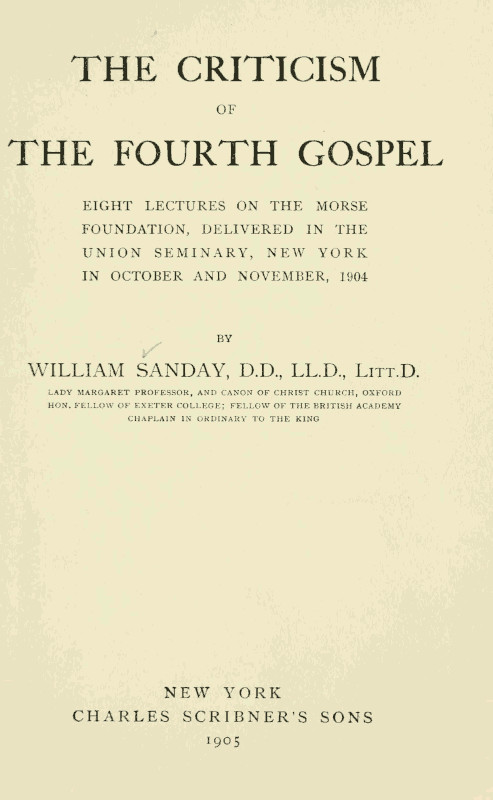
The Criticism of the Fourth Gospel
by W. Sanday
★★★★★No ratings yet
Language: English
Sign in to rate this book.
Sign in to shelve this book.
About this eBook
- Author
- Sanday, W. (William), 1843-1920
- Title
- The Criticism of the Fourth Gospel Eight Lectures on the Morse Foundation, Delivered in the Union Seminary, New York in October and November 1904
- Credits
- Produced by Charlene Taylor, David King, and the Online Distributed Proofreading Team at www.pgdp.net. (This file was produced from images generously made available by The Internet Archive/American Libraries.)
- Language
- English
- LoC Class
- BS: Philosophy, Psychology, Religion: Christianity: The Bible, Old and New Testament
- Subject
- Bible. John -- Criticism, interpretation, etc.
- Category
- Text
- Project Gutenberg
- eBook-No. 60553
- Release Date
- October 22, 2019
- Copyright
- Public domain in the USA.
Contents
- 1.The Criticism of the Fourth Gospel
- 2.PREFACE
- 3.CONTENTS
- 4.LECTURE I SURVEY OF RECENT LITERATURE — 1. Conservative Opinion. — 2. Mediating Theories. — 3. Partition Theories. — 4. Uncompromising Rejection. — 5. Recent Reaction.
- 5.LECTURE II CRITICAL METHODS. THE OLDEST SOLUTION OF THE PROBLEM OF THE FOURTH GOSPEL — I. i. Defects in the Methods of current Criticism. — ii. Instances in which Criticism has corrected itself. — iii. Examples of Mistaken Method as applied to the Fourth Gospel. — II. The Oldest Solution of the Problem of the Fourth Gospel.
- 6.LECTURE III THE STANDPOINT OF THE AUTHOR — I. The Gospel is put forward as the Work of an Eye-witness. — i. Passages which make a direct claim. — ii. Passages in which the impression conveyed is indirect. — II. The Identity of the Evangelist.
- 7.LECTURE IV THE PRAGMATISM OF THE GOSPEL — Different Kinds of Precision in Detail. — i. Pilgrimages. — ii. Ceremonies. — iii. The Temple. — iv. Sects and Parties. — v. Jewish Ideas and Dialectic. — vi. The Messianic Expectation.
- 8.LECTURE V THE CHARACTER OF THE NARRATIVE — I. Alleged Discrepancies with the Synoptic Narrative. — i. The Scene of the Ministry. — ii. The Duration of the Ministry. — iii. The Cleansing of the Temple. — iv. The Date of the Last Supper and of the Crucifixion. — II. The alleged Want of Development in St. John’s Narrative. — i. Anticipated Confessions. — ii. The Use of the Word ‘Believe.’ — iii. Traces of Development in the Fourth Gospel. — III. The Nature of the Discourses. — IV. The Presentation of the Supernatural. — i. The treatment of Miracle in the Fourth Gospel. — ii. Method of approaching the Question of Miracle. — iii. The Gospel embodies ocular Testimony. — iv. A Patristic Parallel.
- 9.LECTURE VI THE DOCTRINE OF THE LOGOS, AND ITS INFLUENCE ON THE GOSPEL — I. Affinities of the Logos doctrine. — 1. Partial parallels in O. T. and Judaism. — 2. The Evangelist not a philosopher. — 3. Points of Agreement with Philo. — 4. Absence of Philonian Catch-words. — 5. More fundamental differences. — iv. Possible avenues of connexion. — II. Relation of the Prologue to the rest of the Gospel. — 1. View of Harnack. — 2. View of Grill. — 3. View of Loisy.
- 10.LECTURE VII The Christology of the Gospel — 1. The Gospel not a Biography. — 2. The Christology of St. John compared with that of St. Paul and of the Epistle to the Hebrews. — 3. Comparison with the Synoptic Gospels. — 4. Interpretation of these Relations between the Synoptic Gospels, St. Paul and St. John: Alternative Constructions. — Two Preliminary Remarks. — 5. Objections to the Critical Theory. — 6. Larger Objections.
- 11.LECTURE VIII THE EARLY HISTORY OF THE GOSPEL — I. Summary of the Internal Evidence. — II. The External Evidence. — 1. The Position at the end of the Second Century. — 2. Earlier Evidence. — III. Unsolved Problems. — 1. The relation of the Gospel to the Apocalypse. — 2. The date of Papias. — 3. The death of the Apostle John. — 4. The son of Zebedee and the beloved disciple. — 5. John of Ephesus and his Gospel. — Epilogue on the Principles of Criticism.
- 12.INDEX
Community reviews
Sign in to write a review.
No reviews yet.