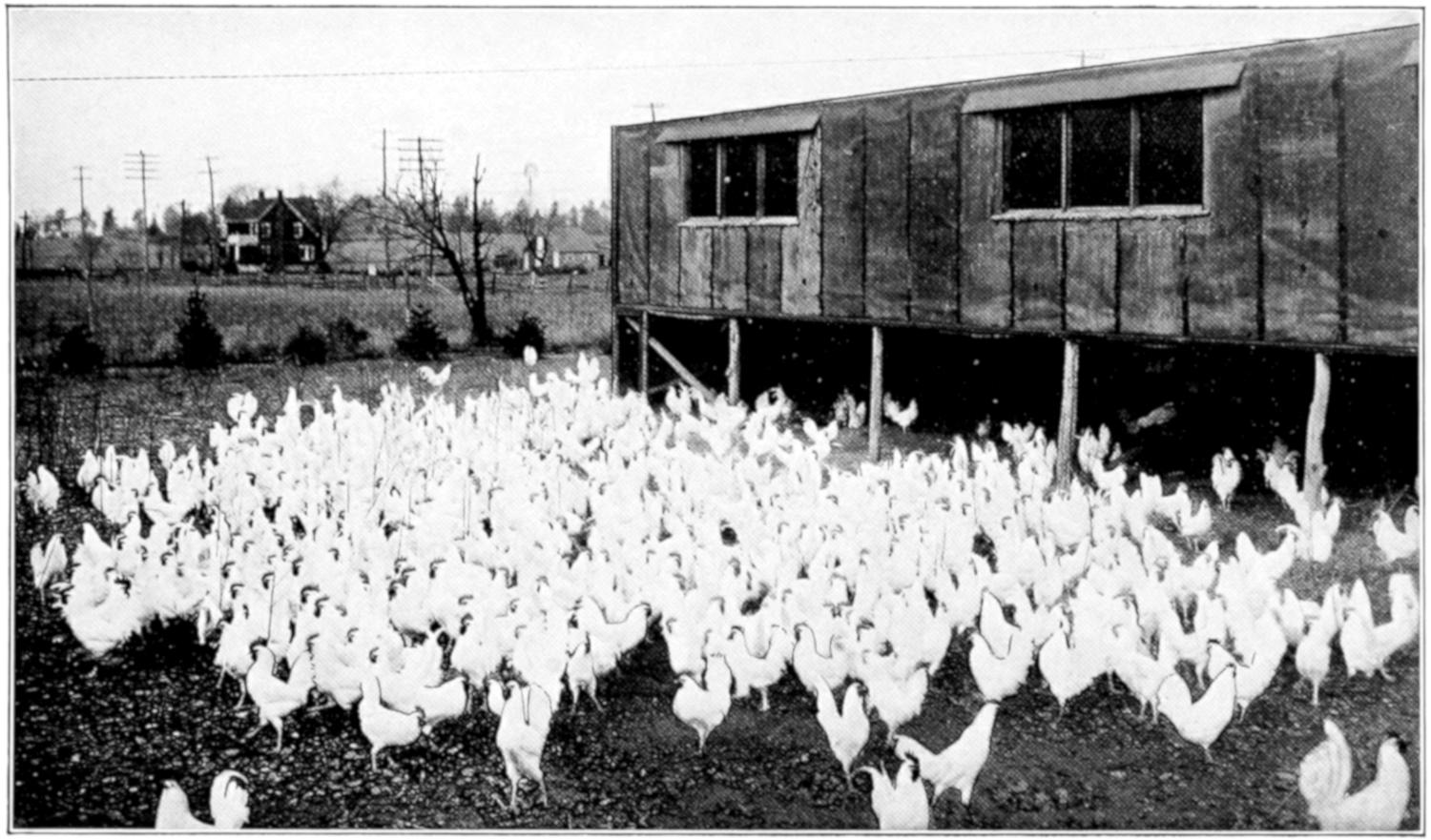
The Method, and the style of the buildings,
evolved and worked out on The Corning Egg Farm,
when put into book form proved so helpful to so
vast a number of poultry keepers, that the sale of this
first literature, which for a time was added to as the
months went by, reached the enormous total of over
140,000 copies in eighteen months.
The writings were the simple, plain statements of
facts, and enabled others who followed them to reach
a success which, until this System was used, may have
been dreamed of, but was never realized.
The literature from this Farm has gone out over
the entire civilized World, and the visitors, who arrive
in ever increasing numbers from month to month,
come from every quarter of the Globe.
The Corning Egg Farm has been written of in
periodicals of every nature, and in almost every language
the World over. For the last twelve months
the requests for further, and more explicit, detailed
information relative to breeding and feeding for eggs,
the specialty from which The Corning Egg Farm has
never swerved, have become a demand. So that, after
mature deliberation, it was decided to write the history
of The Corning Egg Farm, from its inception to
date, including the work of the last two years, which
has never before been fully published.
“The Corning Egg Farm Book by Corning Himself”
is to-day the only publication giving facts in
regard to the Farm and its unique Method right up
to date.
As the book is read it must be borne in mind that,
in breeding to produce a great layer, at first very
marked increases in the number of eggs during the
first ten months of laying may be gained. The general
average number of eggs laid each year, from official
reports, is less than 100 per hen. On The Corning
Egg Farm, when the average had reached 143.25
eggs, the next jump, in the following year, was more
than had been expected, and the record of 145.11
eggs for each hen for ten months, though showing
an increase apparently small, in reality was a very
great advance indeed.
From this time on, the gain, although representing
a narrower margin of increase, was in reality a much
greater achievement. The trotting horse may serve
as an illustration. When Dexter trotted his famous
mile he clipped off a number of seconds from the
previous record, and it seemed as if it would be a
matter of considerable time before his mark would
be lowered. But within a comparatively short time
a number of trotters turned off a mile in two-ten,
and from this figure, within a short period, a large
company of famous horses had reached the two-five
mark, but every quarter of a second which reduced
this mark meant greater achievement in breeding
than was represented by the reduction of records
from two-sixteen to two-five, and we have not yet
seen the horse which, in single harness, without a
running mate, can turn the mile track in two minutes
flat.
The Corning Egg Farm realizes that from this on
improvement will be shown by fractional figures, but
these fractions will represent a greater progress than
the figures which have gone before.
Two years ago the unequaled results of The
Corning Egg Farm had seemed unsurpassable, but
to-day we are able to look back from higher ground
and see the road over which we have traveled to
reach a point very considerably beyond the unequaled
position of two years ago.
It is our hope and aim, year by year, to improve
the present position. The man who believes he has
learned all there is to learn is a failure. The successful
man is the one who is sure there is an opportunity
to advance considerably beyond the point
he has already attained, and The Corning Egg Farm
believes this to be true, and has constantly worked
with that idea before it.
With an experience back of them of nearly six
years the Builders of The Corning Egg Farm know
that this Book furnishes the necessary guide for success
in poultry culture. What has been, and what
is being, done at The Corning Egg Farm is not experimental
work. Successful results follow the
Method and System employed as surely as day
follows night. It is no longer necessary for the
novice to try out the various plans proposed to him
by the literary poultryman, whose methods are
worked out on a mahogany desk, with pen and ink,
or more often, perhaps, by dictation to a stenographer.
Years of careful thought and study, and the expenditure
of much time and many thousands of
dollars in developing the Corning Method have
eliminated all necessity for experimental expenditure.
The building up of an Egg Farm is within the reach
of any man who will follow the Corning plan herein
described faithfully and persistently.
The man or woman who determines to pursue some
branch of the poultry industry must first decide what
particular branch.
Shall it be to raise poultry for market?
If so, what? Squab Broilers? Soft Roasters?
Or Capons?
Perhaps all of these.
Some utility line is the best to start with.
Fresh, sanitary eggs are a necessity and command
the highest price in the market, daily, for spot cash,
just as readily as stocks and bonds command a daily
cash value in any financial market. There can be
no better proof of the truth of this than the success
of The Corning Egg Farm.
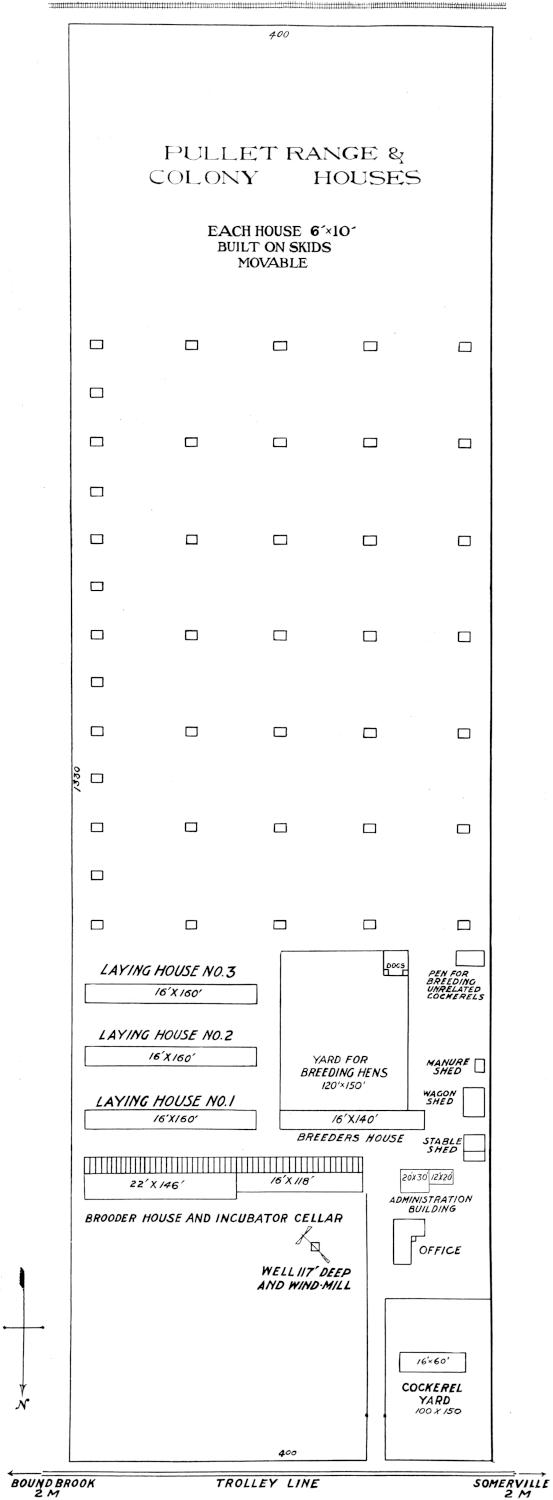
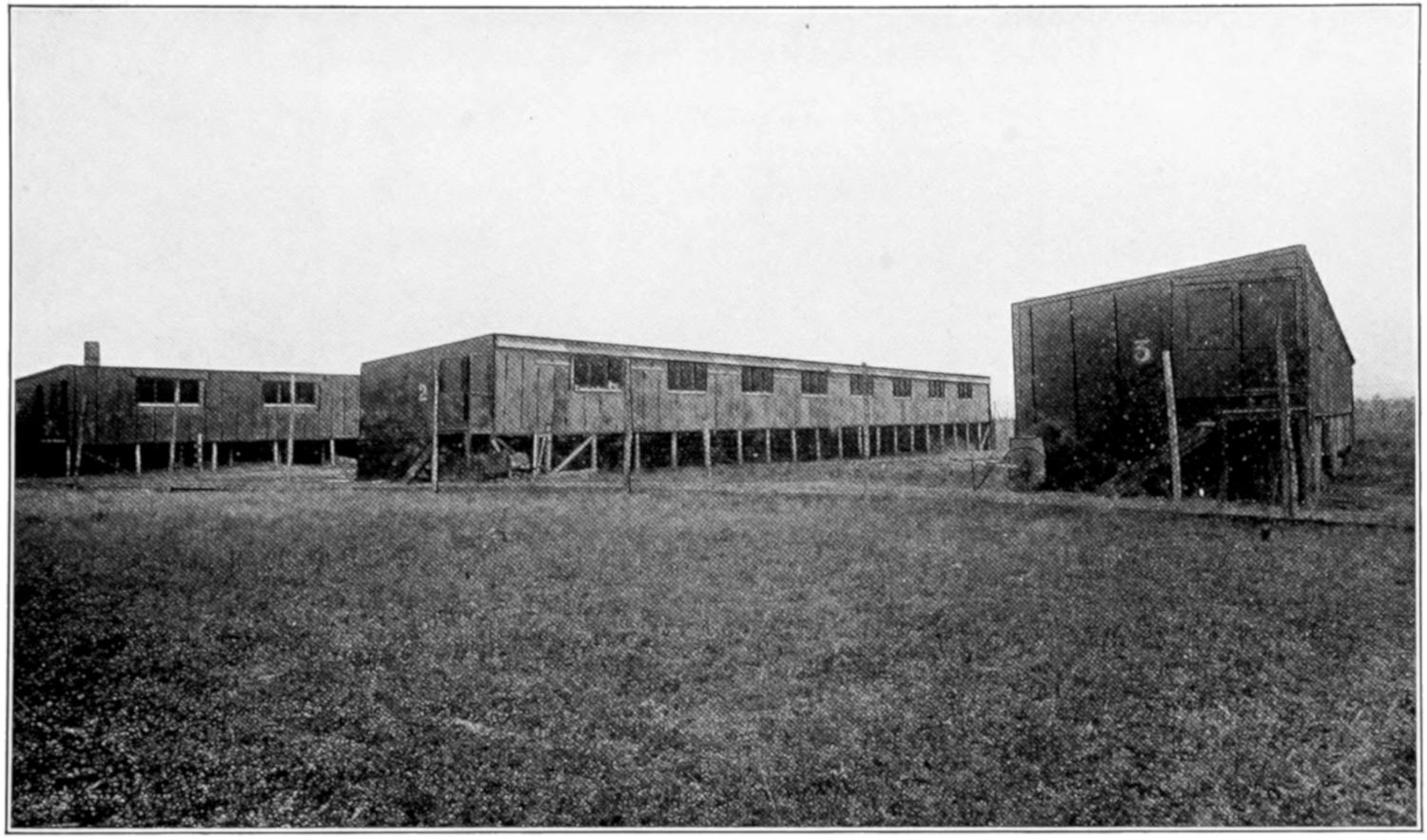
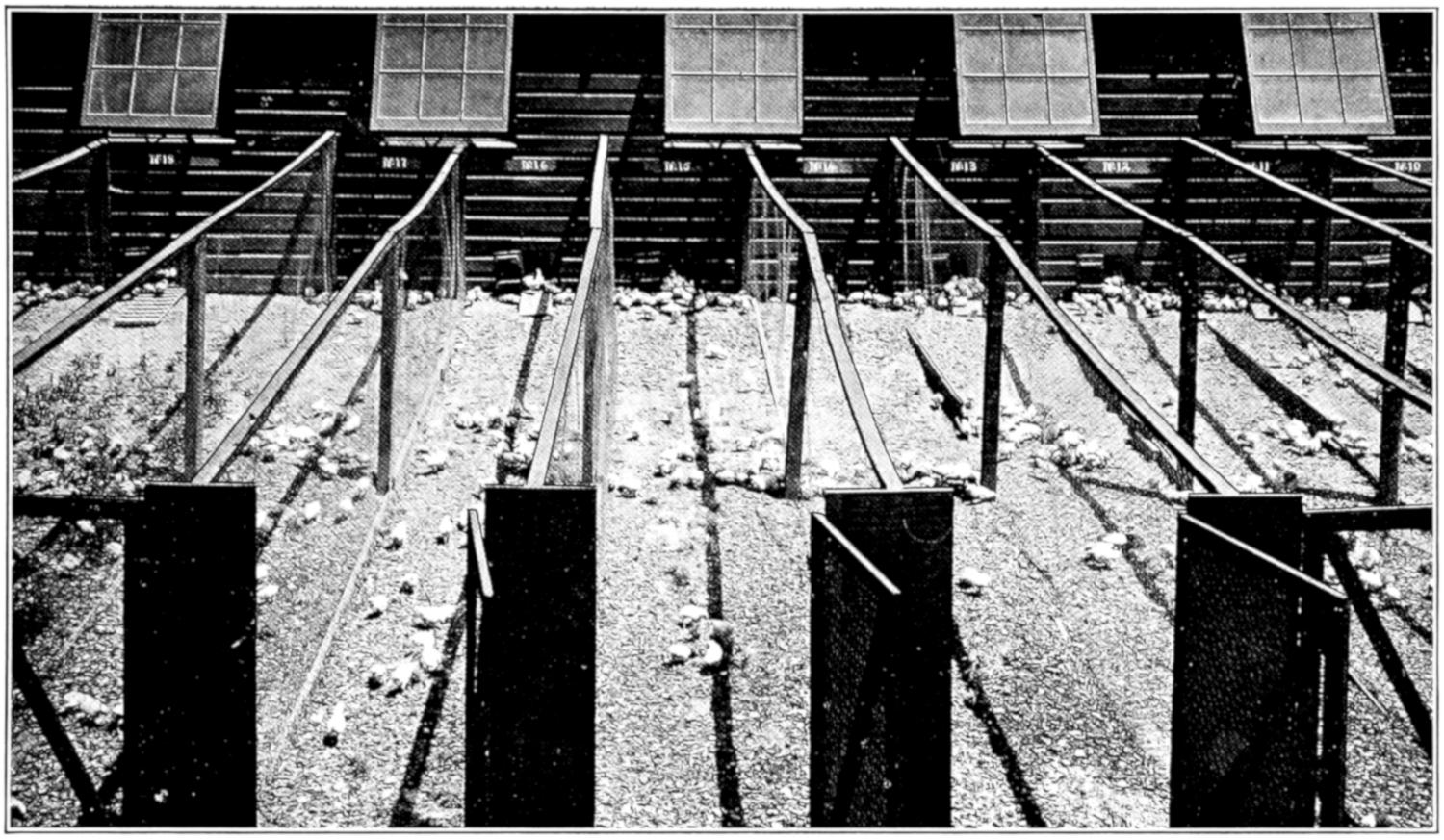
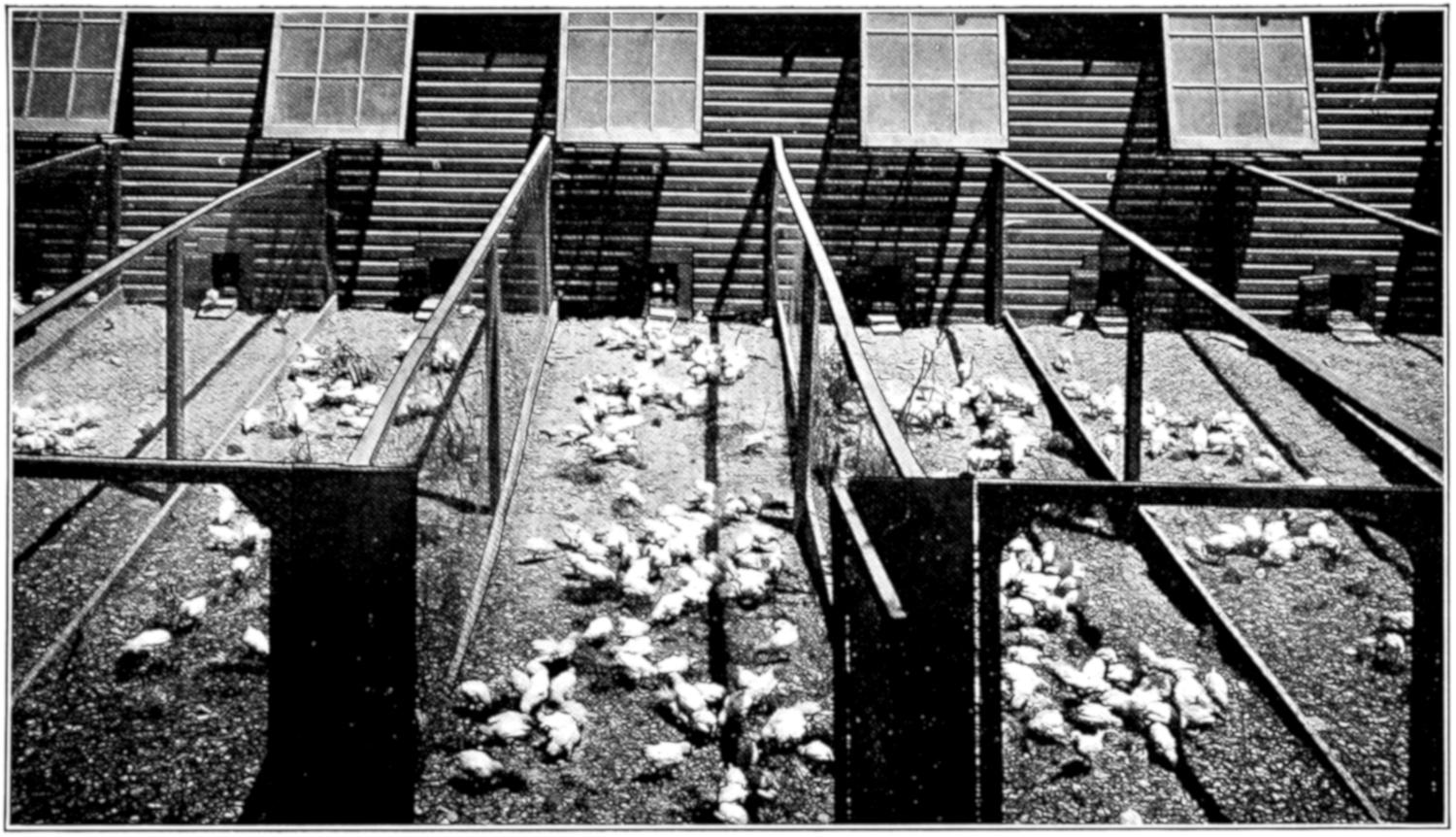
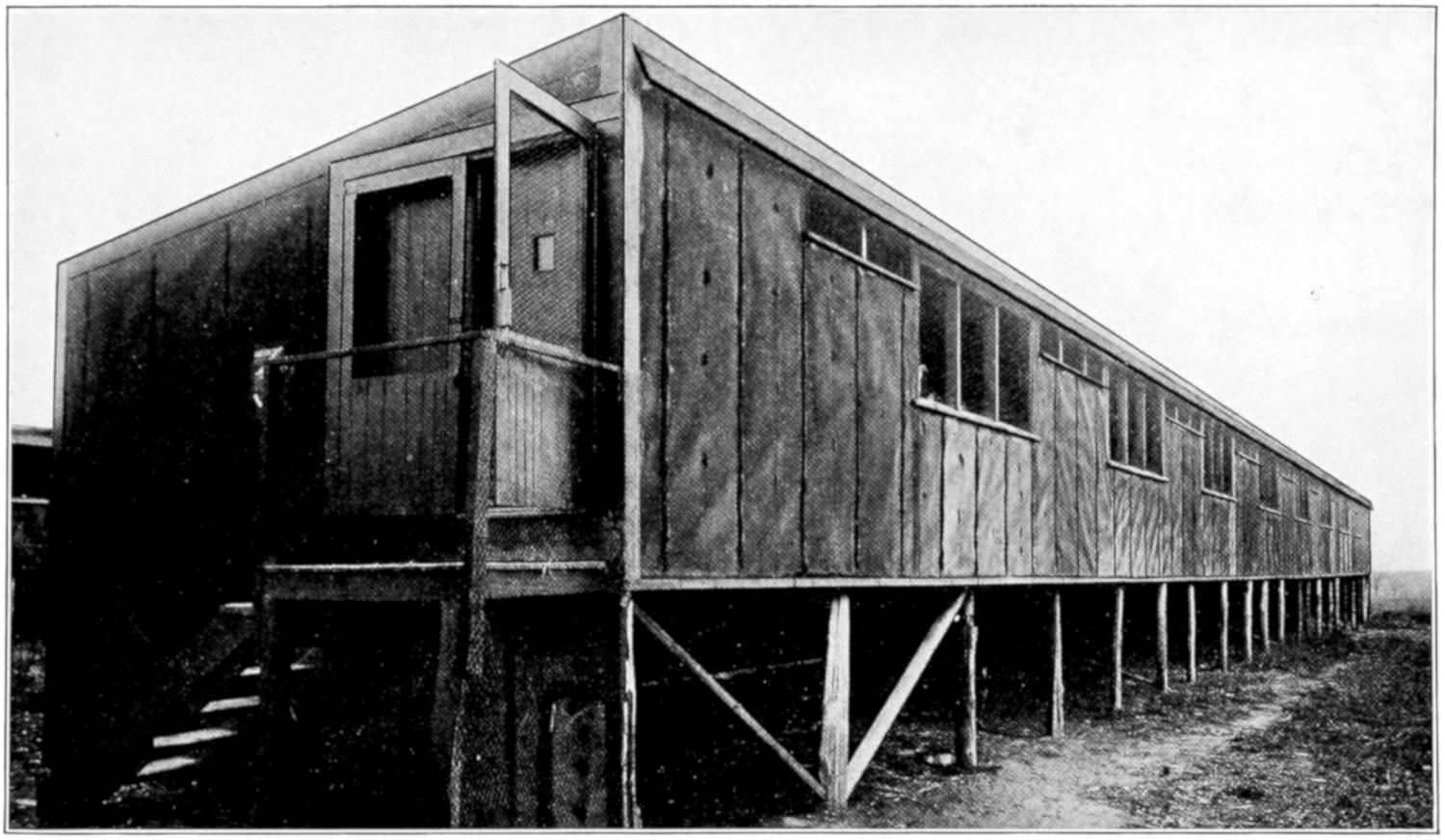
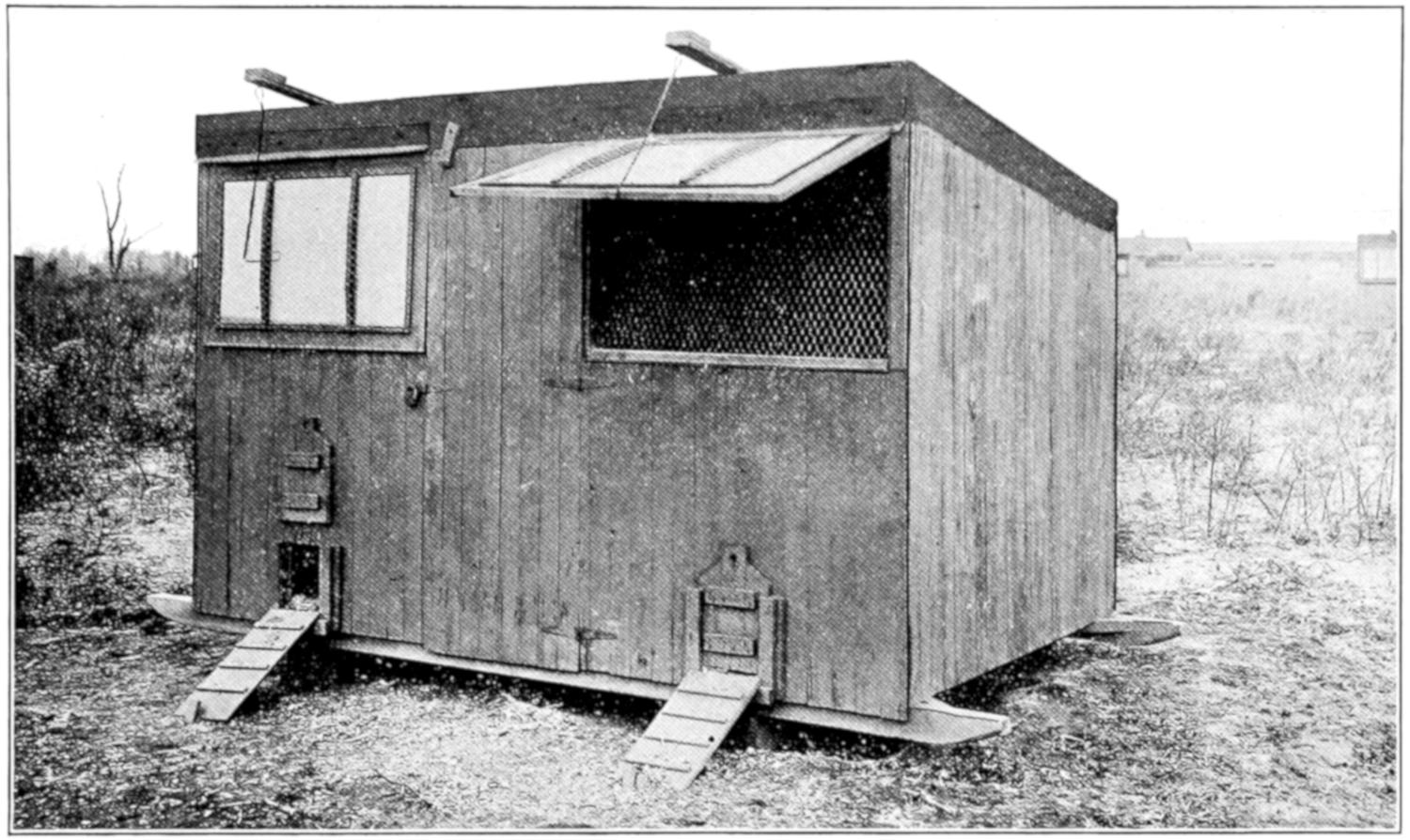
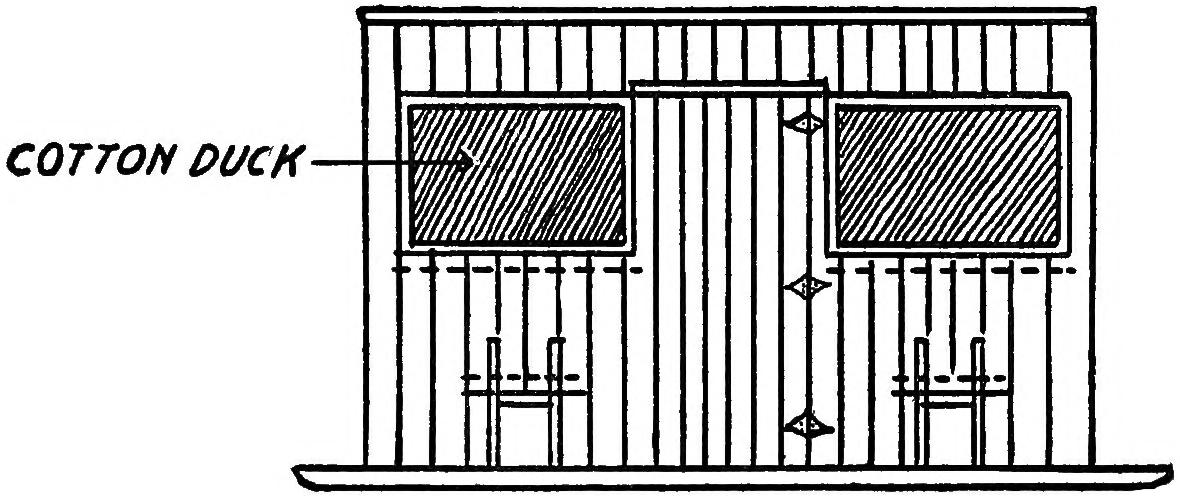
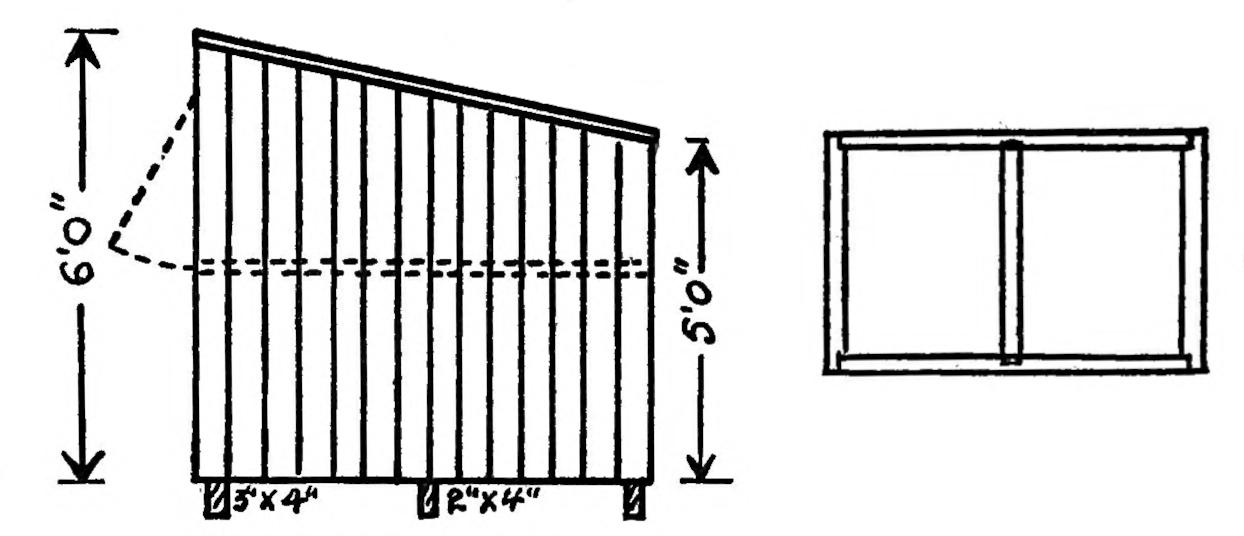
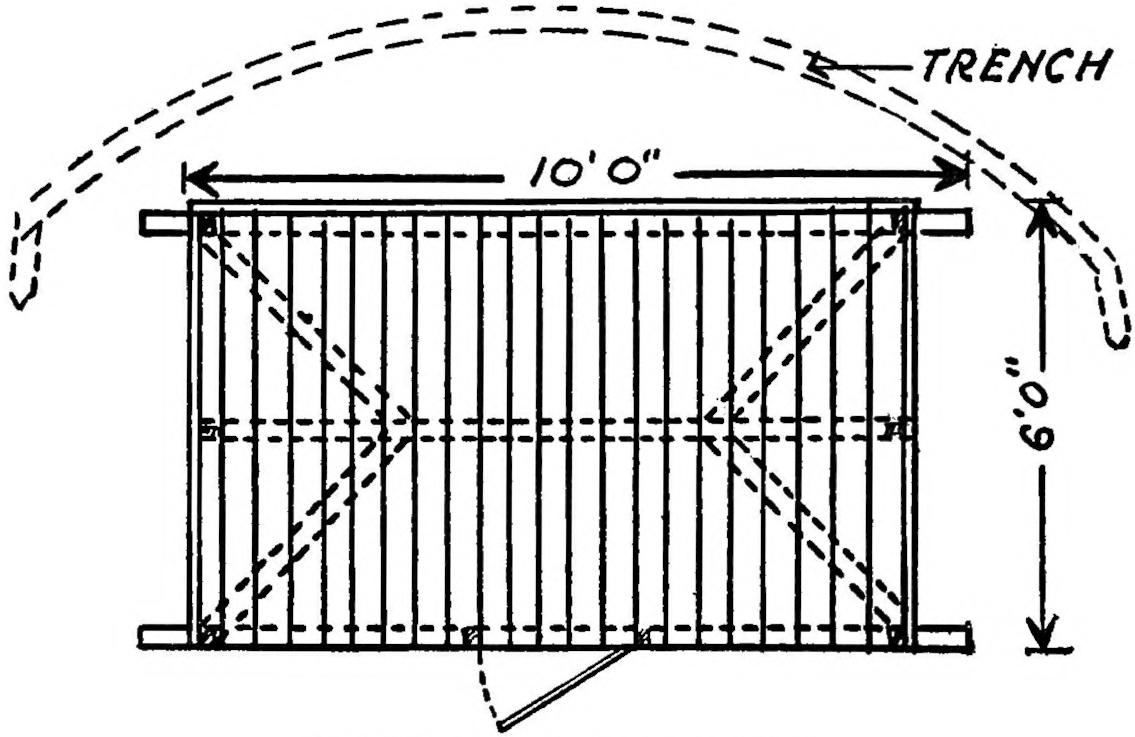
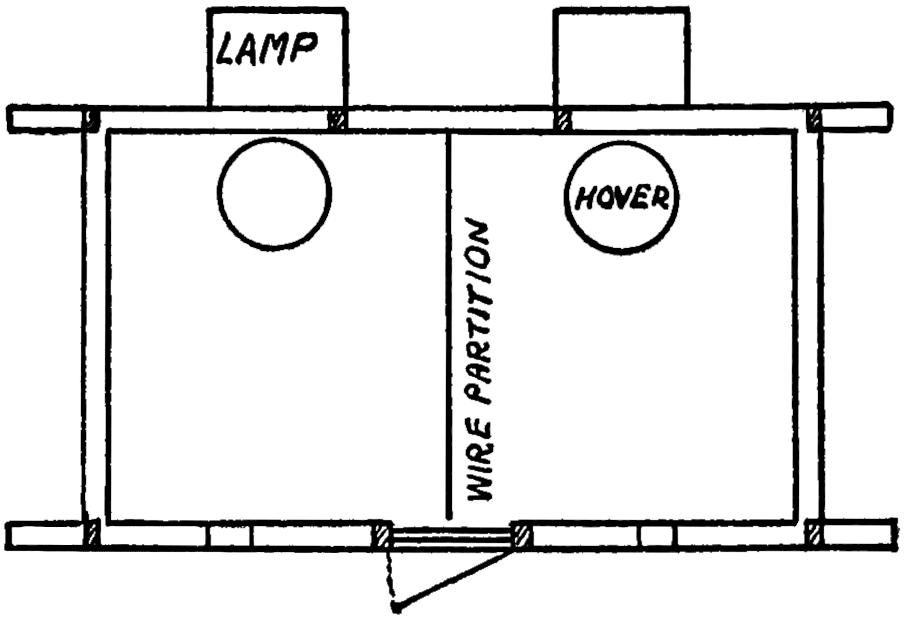
PULLET RANGE &
COLONY HOUSES
EACH HOUSE 6′ × 10′
BUILT ON SKIDS
MOVABLE
In whatever line a beginner decides to start he
needs to go straight down that line without deviation,
taking as his motto, “This one thing I do.” In
the fullness of time, having established a reputation
for the quality of his eggs and birds, the demand for
his eggs for hatching purposes and for his birds as
foundation stock for other people, will naturally come
to him, and it is very profitable.
One certain fact should be settled in the understanding
of every beginner, to wit: it is not possible
to invest from five hundred to five thousand dollars
in the Poultry Industry and double your money in the
first year, or even to earn 50% on the investment.
Neither is it possible with $300.00 to build a Laying
House with a capacity for five hundred birds, if the
house is properly built for warmth and meets sanitary
conditions.
Housing for hens must be free from dampness.
Concrete absorbs dampness, therefore, avoid it.
Any person starting in the poultry industry for
profit, and, intending to follow it for a livelihood
should begin in a small way, realizing that, like any
other business venture, it must be built up and grow
from year to year, and that, certainly for the first
year, no money can be drawn out for living expenses.
These statements are made clearly and emphatically
because quite the contrary has been given out as a
fact. Such reckless representations, because untrue,
are misleading and injurious to both those engaged in
the poultry industry and also to those who contemplate
entering it, and should be branded as false, and
the authors of such statements should be prohibited
from using the United States Mails.
We are not, and make no pretense of being, philanthropists.
We have written this Book primarily with
the expectation that it will make The Corning Egg
Farm and the Corning Method of Poultry Culture
even more widely and impressively known to the
World, and so benefit us by increased demand for our
stock, eggs, and all other goods we may have for sale.
Secondly, we know that the Book will benefit
others if they will follow the Corning Method and
System herein laid down, and so prove of mutual advantage
to readers and authors as well.
The Single Comb White Leghorn is par excellence
the Egg Machine, provided always first class
and the best strain of birds is procured, and the
Corning Strain, without doubt or question, is the very
best strain of Single Comb White Leghorns yet developed
anywhere in the World.
We know this new, large, complete and thoroughly
up to date Book will be the means of bringing us, and
our unequaled Strain of Single Comb White Leghorns,
into favor with thousands of people who, as
yet, do not know us, just as the publishing of the
small and older booklet put us into touch with other
thousands who are now doing a prosperous business
by the use of this same Corning Strain Single Comb
White Leghorns, and by following the Corning
Method now more completely elaborated and explained
in “The Corning Egg Farm Book by Corning
Himself.”
Edward and Gardner Corning.
The Corning Egg Farm, Bound Brook, New Jersey.
December, 1911.
CHAPTER I The Building of the Corning Egg Farm — Started with 60 Buff Rock Eggs — More Money in Eggs — Adopted White Leghorns — First Use of Roosting Closets — We Count Only Livable Chicks — Percentage of Cockerels Low — The Great Flock System Succeeds — Foreigners Visit the Farm — Investigated for Germany — Selection of Cockerels — Pullets Lay in 129 Days — Keeping Down Labor Bill — Adopted Hot Water Incubators — Why Great Farms Fail
The Corning Egg Farm Book
Having determined, in 1905, to engage in some
business connected with the feathered tribe, we decided
to try out the squab proposition versus market
poultry. After searching over a period of many
months, in various parts of the country, with the idea
of finding a place where the existing buildings might
be utilized for our needs, we finally were obliged to
abandon this idea and purchased, early in the year
1906, twelve and a half acres of land, now known
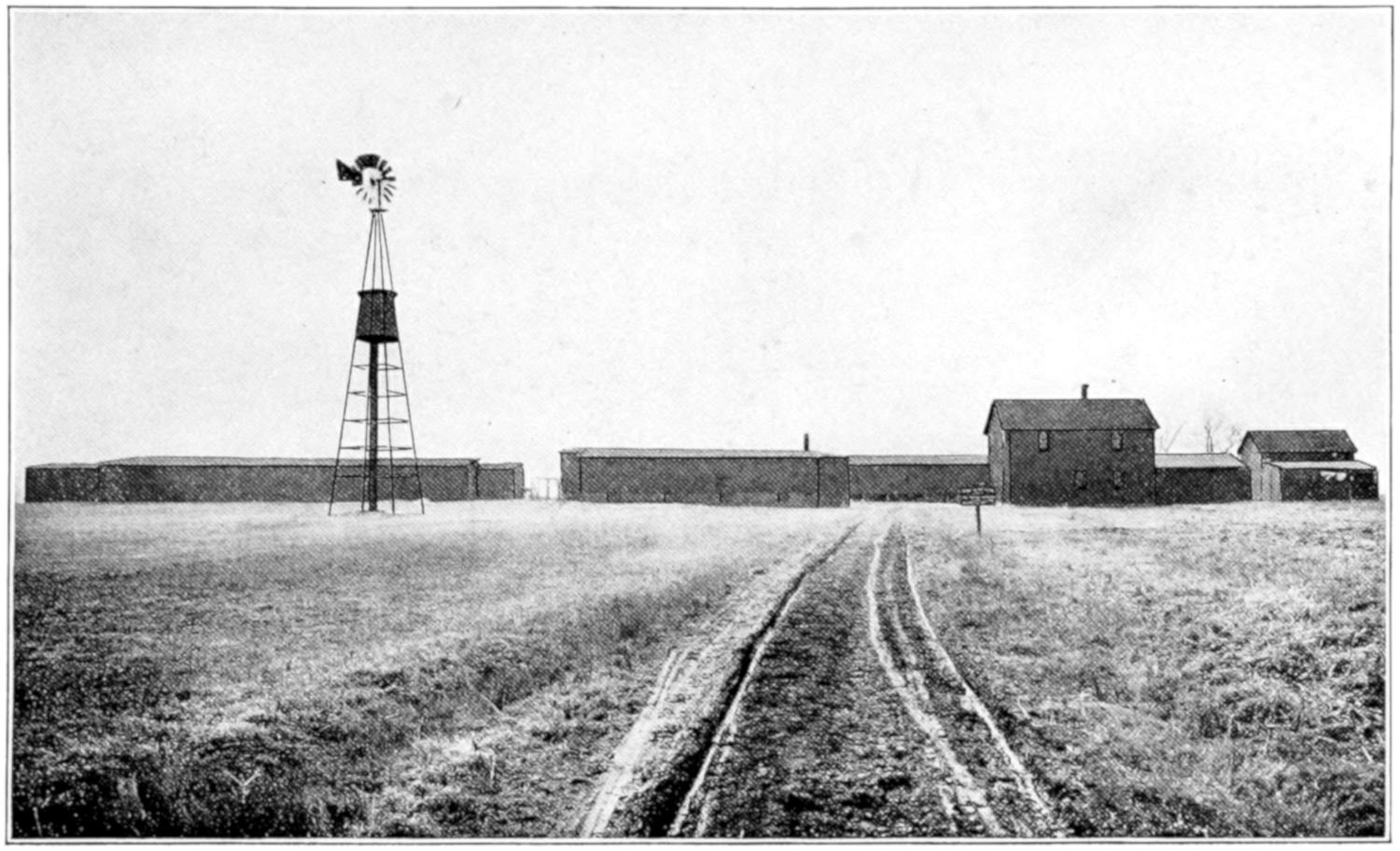
as Sunny Slope Farm. This property lies about two
miles west of Bound Brook, New Jersey, which town
is reached by the Central Railroad of New Jersey,
the Baltimore & Ohio, the Philadelphia & Reading
and the Lehigh Valley Railroads, and the Farm is
most accessible, as it is on the trolley line which connects
Bound Brook and Somerville.
In the early Spring of 1906 we began our buildings,
erecting a house, for raising squabs, which
would accommodate five hundred pairs of breeding
birds, a hen house of the scratching shed variety,
capable of accommodating some two hundred and fifty
hens, and a work-shop with living apartments for the
resident man.
We also sunk a well one hundred and seventeen feet
deep, erecting over it a sixty foot wind-mill tower,
which carries an eighteen hundred gallon tank. From
this pipes were laid to convenient parts of the property.
Three hundred pairs of Homer pigeons were placed
in the house built for that purpose, and we went diligently
to work to prove that this was the quick and
easy way to wealth which the ingenious writers of
squab literature proved so conclusively on paper.
On the chicken side of the experiment we seemed
to lean (possibly because of the fact that squabs take
one into the slaughter house business) towards one
or more of the market breeds, and, to meet the needs
of this part of the business, we understood that any
of the “Rock” family were best for the purpose.
We purchased an incubator with the capacity of
sixty eggs, being fearful of attempting the operation
of a larger machine, because, like a great many novices,
we had the feeling that an incubator was a very
dangerous thing, and that anyone without a vast
amount of experience should not attempt to handle
it. We placed in this diminutive machine sixty Buff
Rock eggs, and obtained a very fair hatch. With
daily contact our fear of the machine decreased, and
we exchanged it for one with a capacity of one hundred
and twenty-five eggs, and this, in turn, was exchanged
for one holding two hundred and fifty eggs.
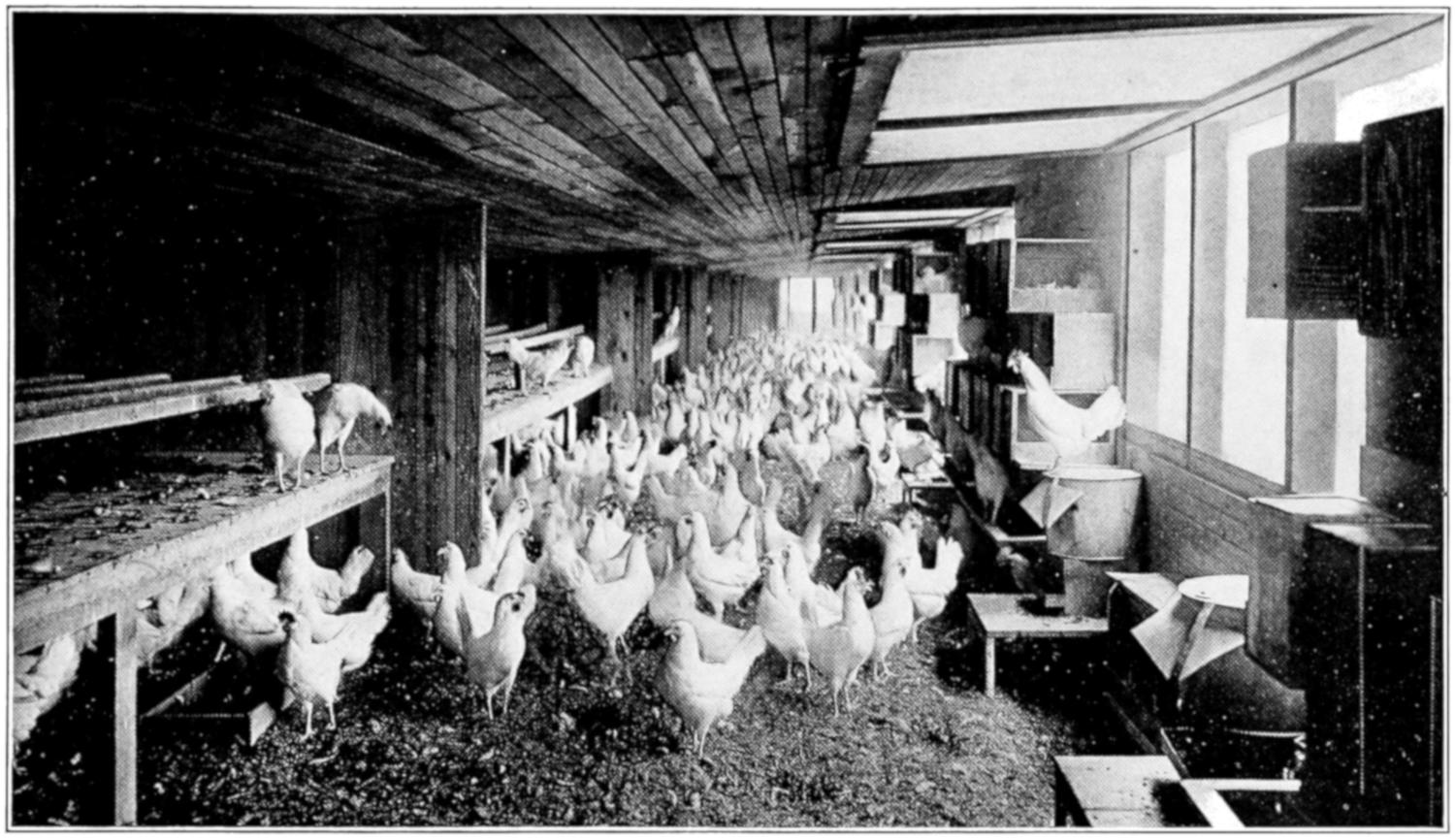
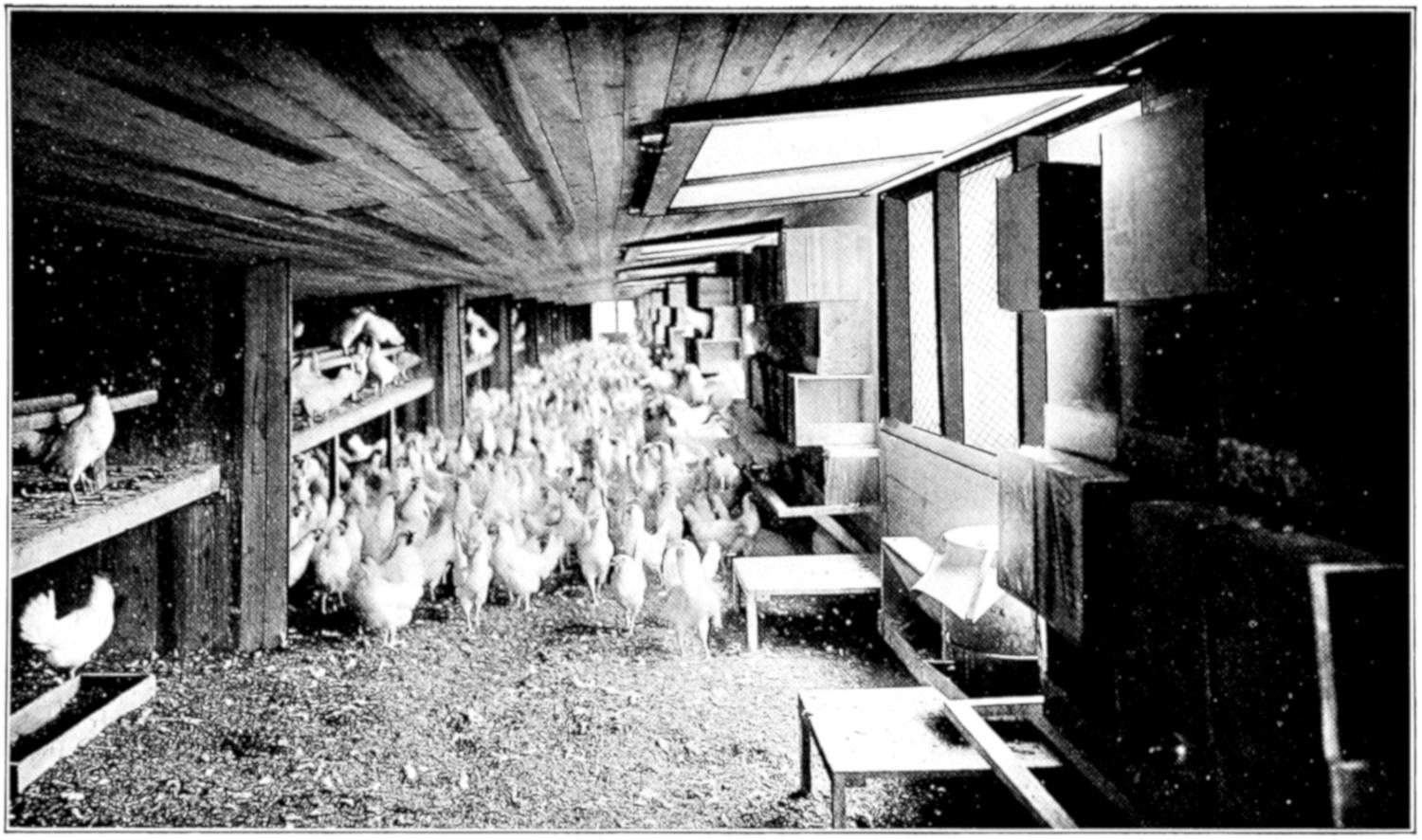
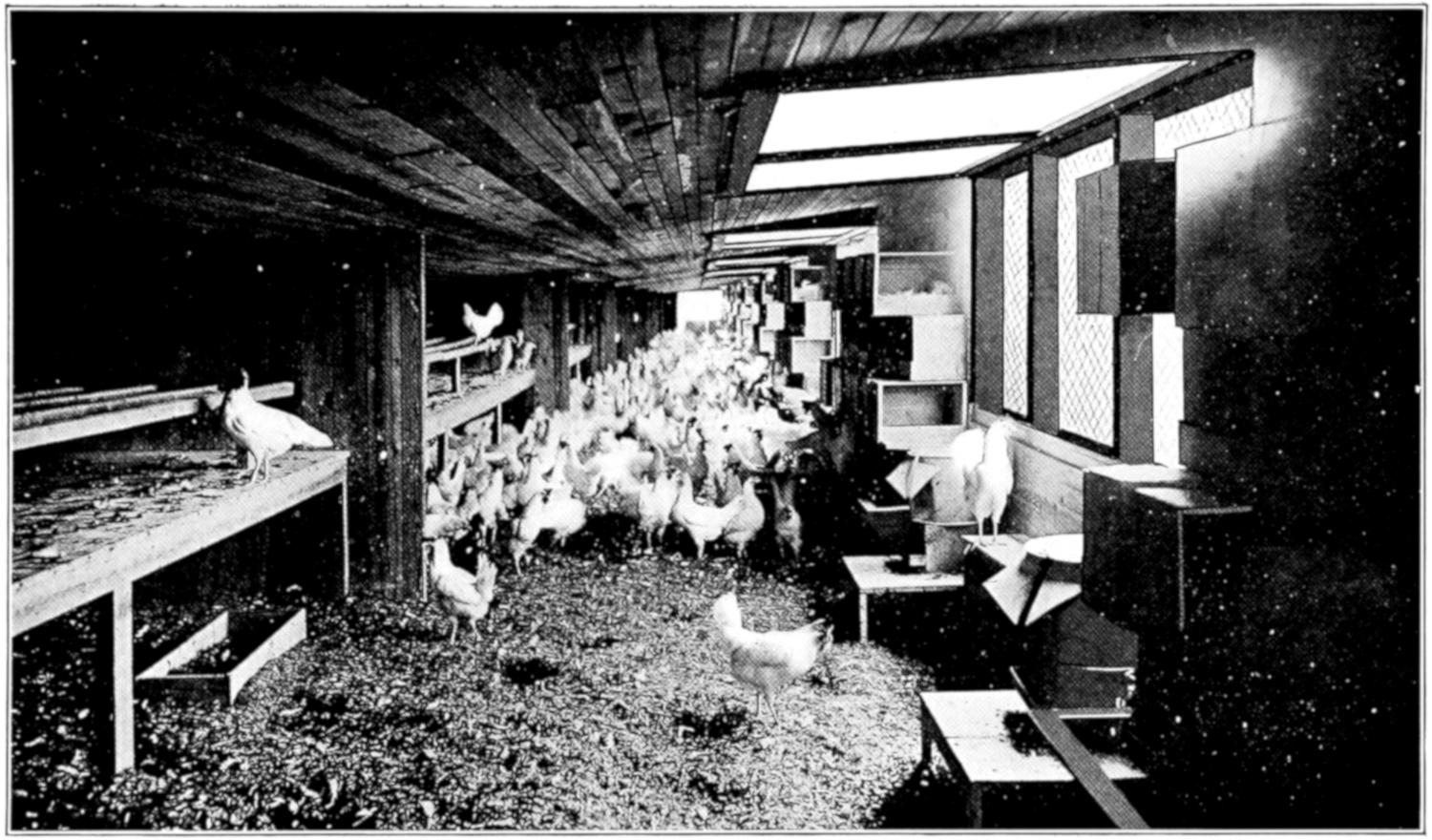
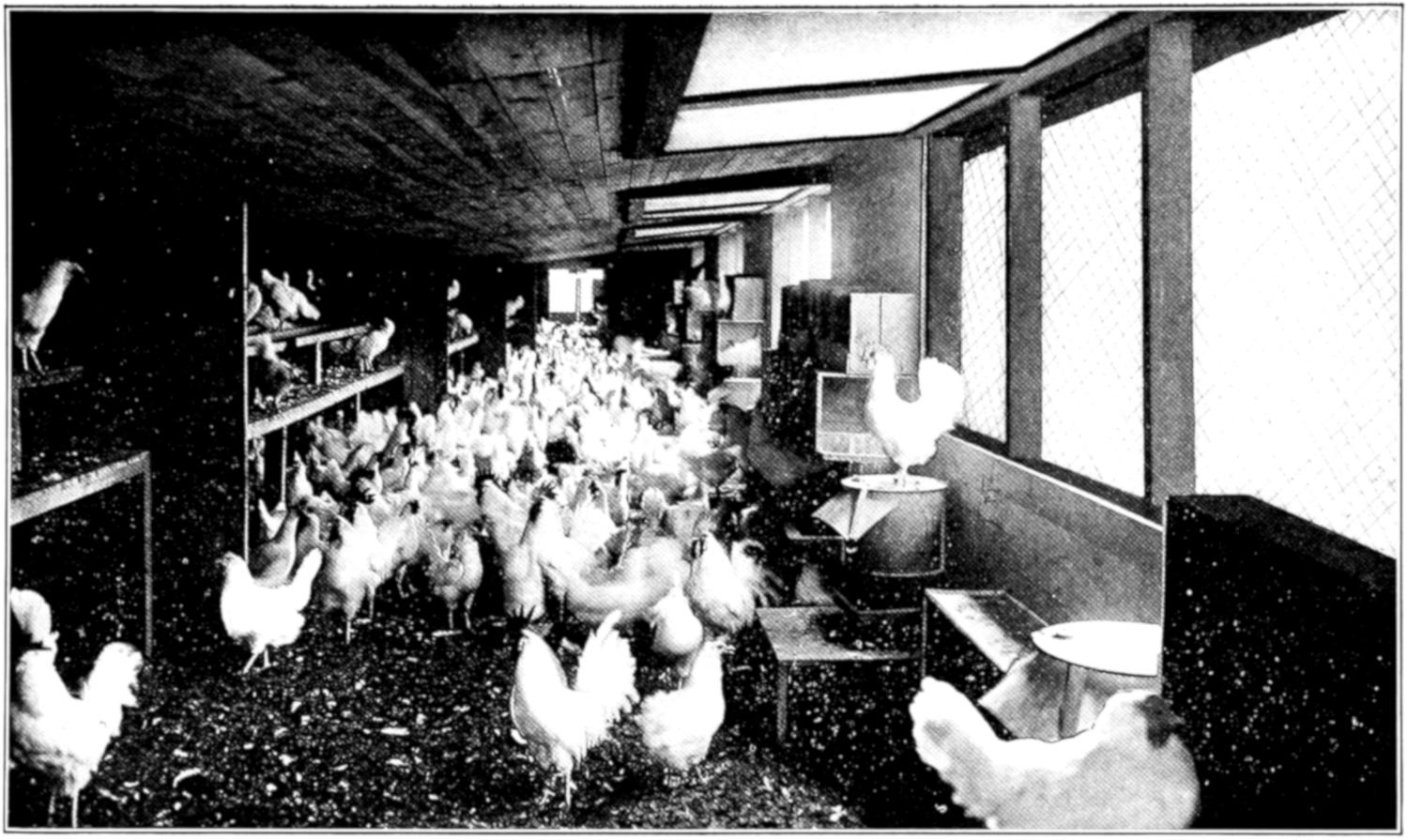
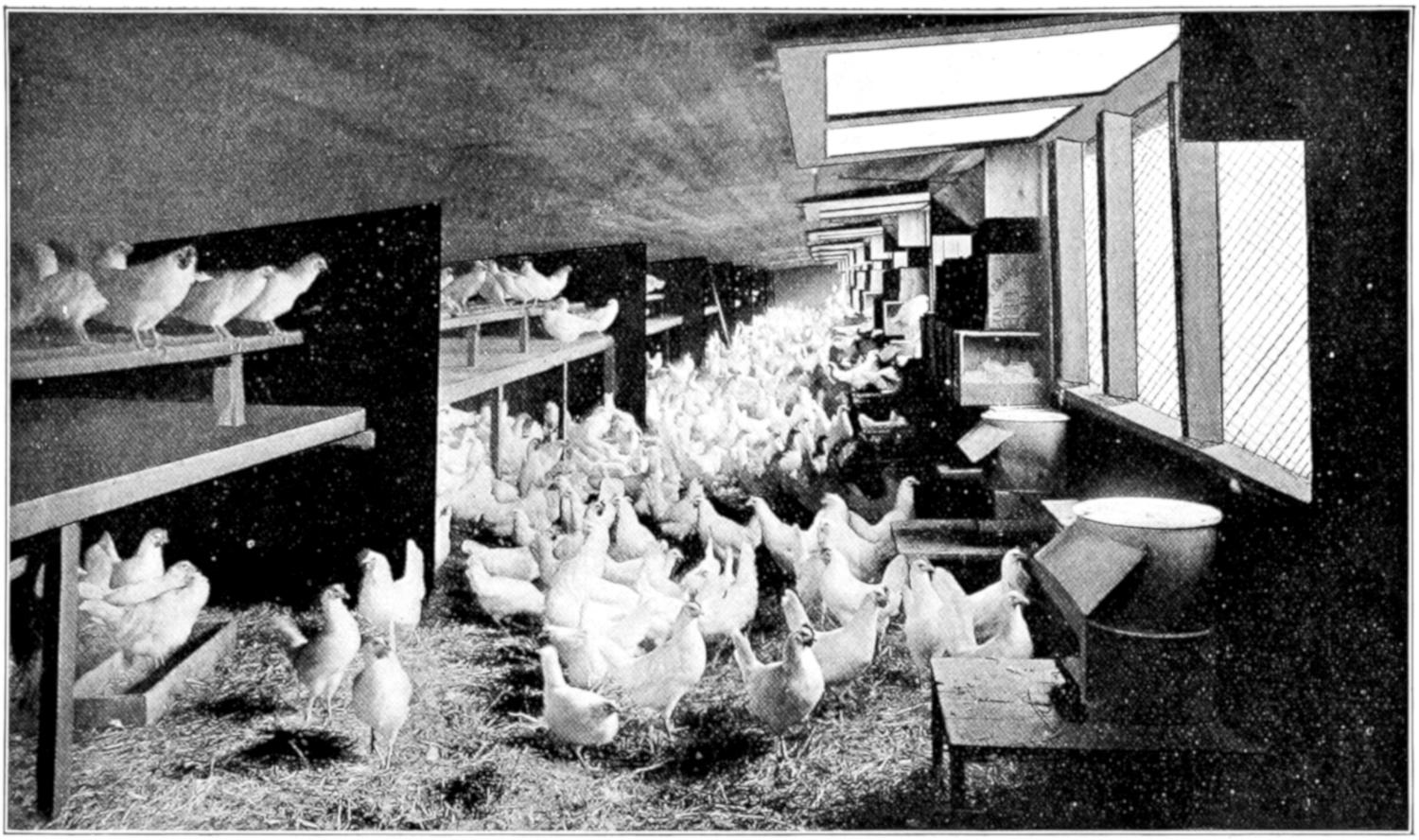
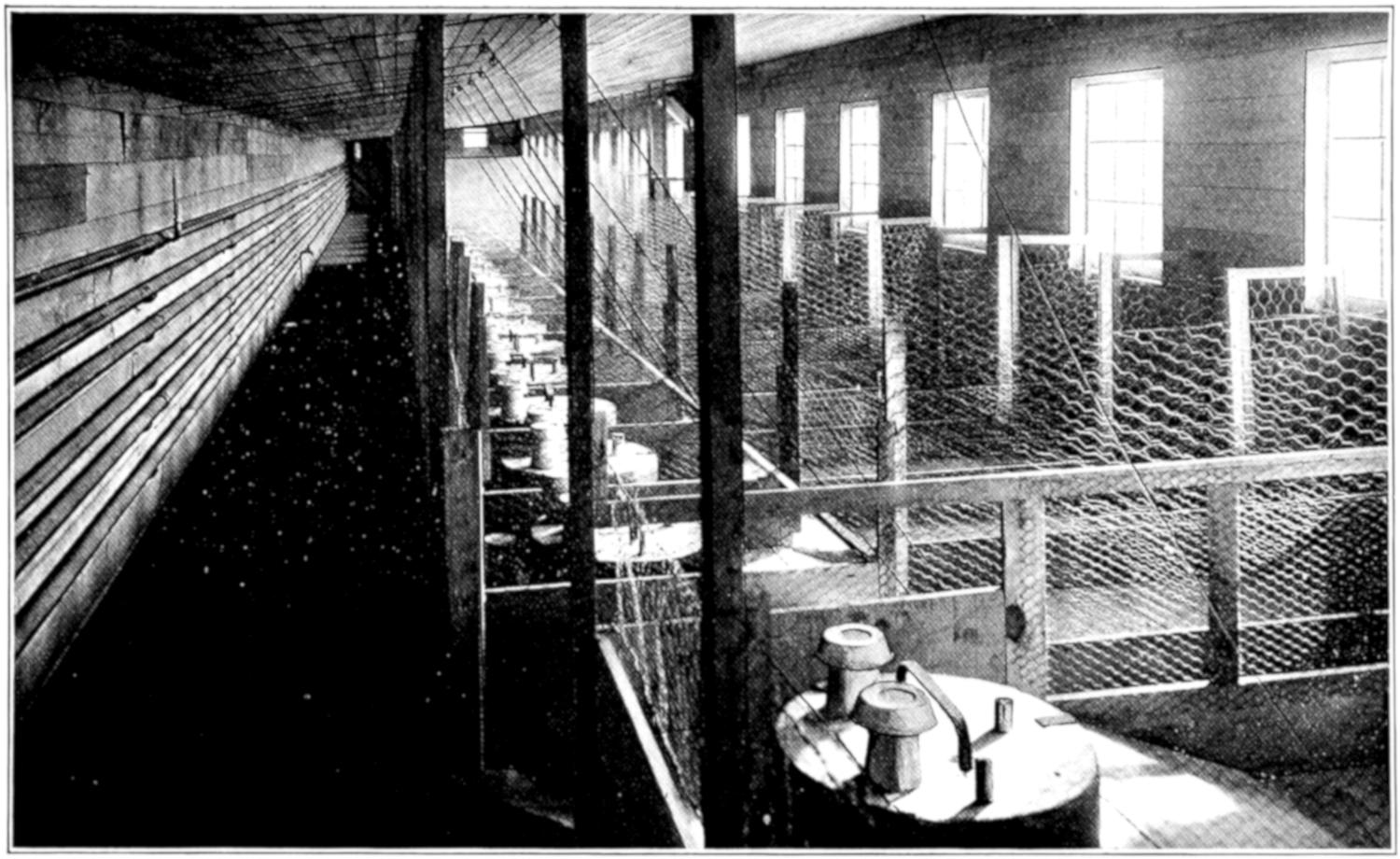
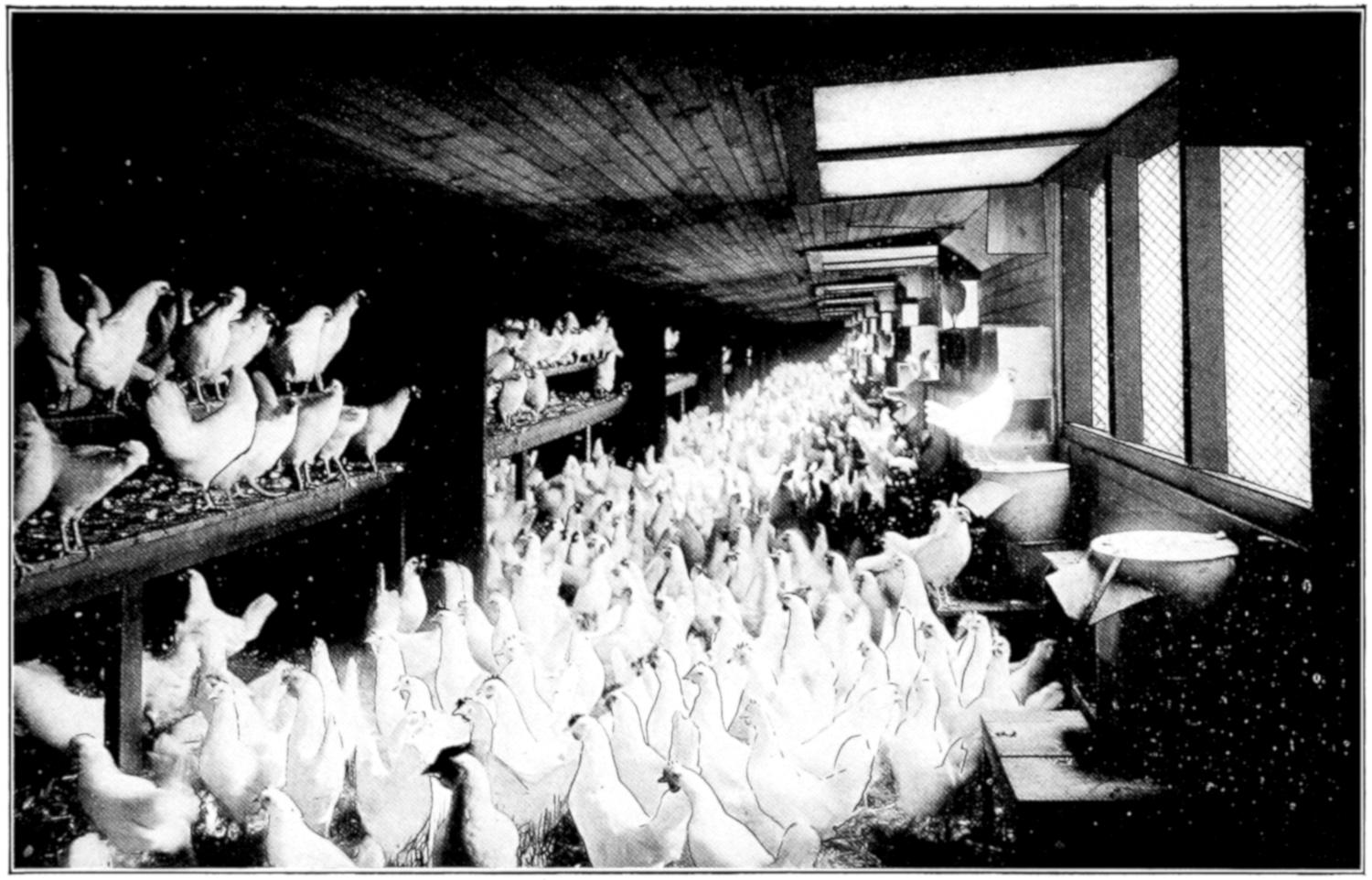
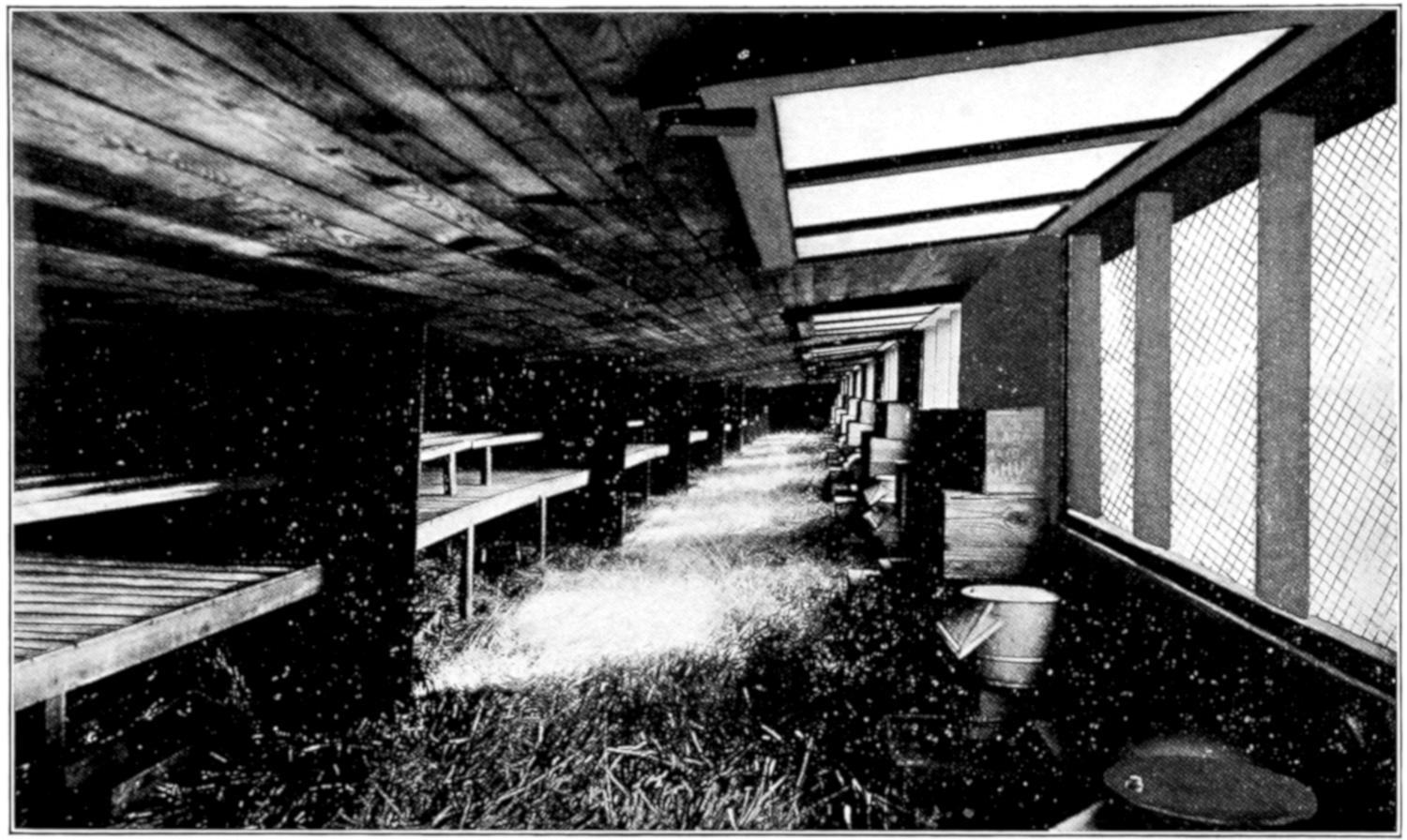
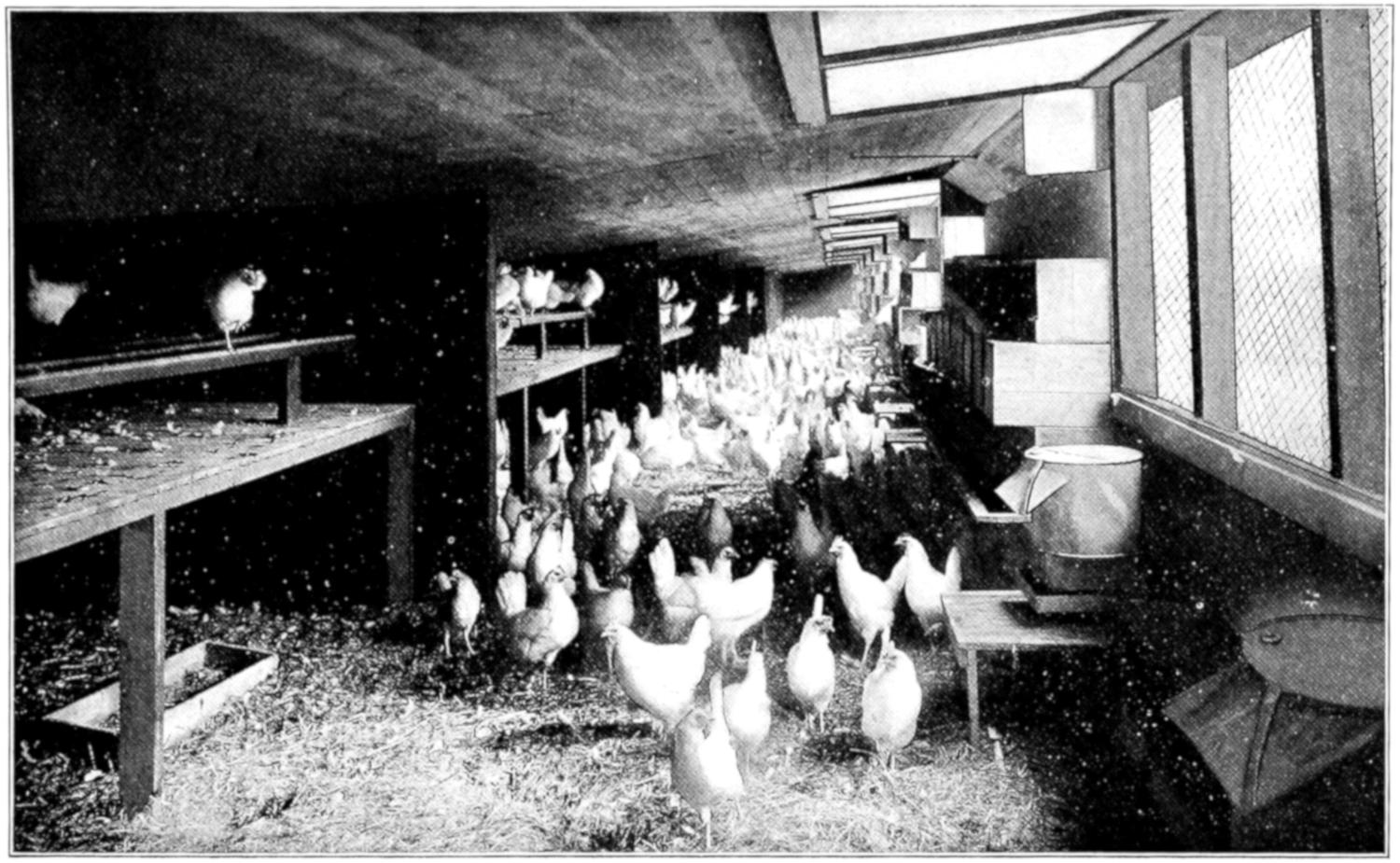
INTERIOR STERILE LAYING HOUSE NO. 3 IN 1910
We obtained fairly large flocks of youngsters that
season, but, as we had the usual hallucination that
poultry culture was really a miracle, and required
neither work, capital, nor brains, that all you had to
do was to accept the profit and the chickens did it all
themselves, we did not get so very far. The growth
of the birds was so slow they did not reach a profitable
weight until the broiler market had dropped the price
to its lowest level. The pullets which we carried
through the winter never produced an egg, for the
simple reason that we had never studied the question
out as to how the hen produces an egg. In other
words, our lack of knowledge of the right methods
was the reason for charging up a considerable loss
instead of profit so far as the first season’s work with
hens went.
We very early discovered there must have been
a considerable amount of fiction in the writings on
the squab industry. One reads that a pair of pigeons
eats nothing like the amount of food which is required
for one hen, and that they never eat more than
their exact wants require, and that when they have
young in the nest, this amount is very slightly increased.
We found, however, that they ate in season
and out of season. In fact one recalls, in this
connection, and with considerable amusement, the
song, in the light opera “Wang,” of the elephant who
ate all day and the elephant who ate all night.
During our work with pigeons we tried out a number
of different varieties: Homers, Dragoons, Runt
Dragoon crosses, Homer Runt crosses, Maltese
Hens, and the various crosses with Runt Dragoons;
also Carneaux. We were led to buy these fancy breeds
through the stories of extreme prices paid for large
squabs, and we bred some heavy weights only to find,
from the commission man who made a specialty of
these birds, that it was impossible to pay the price
which such birds were really worth, as trade for this
class was extremely limited.
Very early in our experience we realized that the
poultry side of our experiment was very much more
to our liking and offered so much greater and more
profitable outlook for our energies that we rang
down the curtain on Squab raising—and turned our
attention exclusively to the Hen.
While our minds were still running in the line of
poultry for market purposes we tried out the Black
Orpingtons, the idea being that, on account of their
size, they would make ideal roasting fowls. We
found, however, that they were a very much inbred
variety, and it was almost impossible to hatch the
eggs. Out of one hundred eggs, for which we paid
twenty dollars, eight chicks hatched, and these were
not of sufficient vitality to live.
ENTRANCE TO THE FARM IN 1909
During all this time, however, we were studying
the poultry question, and had arrived at the conclusion
that there was more money in eggs, properly
produced and marketed, than in any other branch.
One of the difficulties we met with in our investigations
was the fact that so many different writers had
such a variety of ideas on the same subject, and practically
no two of them agreed on any given part of
poultry culture. What seemed to us even more confusing
was that, in most cases, the writer summed
up his article by contradicting everything he had said
in the previous chapters. We were finally forced to
the conclusion that the raising of poultry had not yet
been reduced to a science, but was almost entirely
made up of guesses. In our investigations, however,
we found in the writings of the late Prof. Gowell,
of Maine, an entirely different condition. He was
the first man, so far as our observations went, who
worked on the principle that effect followed cause,
in poultry as in everything else. We studied his bulletins
with great interest, and decided we would endeavor
to prove that the same results gotten by him
could be duplicated by others.
We had also been studying the condition of the
egg market, so far as New York and vicinity was
concerned, and had found that this market paid a
premium for a white shelled egg. This, then, was
the determining factor in the selection of the breed
of fowls, and after gathering all the information we
could regarding birds which laid white eggs, we were
satisfied, taking everything into consideration, that for
an Egg Farm, the Single Comb White Leghorn, was
the only fowl.
In the Spring of 1907 we collected a breeding pen,
from different sources, of thirty Single Comb White
Leghorn yearling hens, and three strong, vigorous
cockerels. We purchased an incubator holding three
hundred and ninety eggs, and three out-door
brooders, and built a number of small Colony
Houses to move the birds into as soon as they were
large enough to be transferred from the brooders.
The hens chosen for the initial breeding pen of the
Farm were most carefully selected, for even then we
had in mind the result which we intended to reach,
as to the ultimate type of layer on the Farm. We
placed the resulting eggs from this breeding pen in
the incubator, using a primitive turning machine to
keep them in proper condition until the requisite
number was acquired to fill the incubator. Our
hatch was a very good one, and we succeeded in raising
a fair number of the youngsters hatched.
During the Summer we erected what is now known
on the Farm as the No. 1 Laying House. This was
built one hundred feet long, by twelve feet wide, and
on the same twenty foot section construction which
has proved to be so successful a plan for poultry
houses. The one mistake in this house was its width,
and that has now been remedied by widening it to the
standard, sixteen feet in width, and sixty feet in
length have been added to it.
The youngsters on range grew rapidly. We marketed
the cockerels at between eight and ten weeks
of age, and they weighed from one and a quarter
pounds to a pound and three quarters. These were
sold “on the hoof,” as we had decided for the future
to do nothing in the slaughter house line, and to this
decision we have strictly adhered, shipping alive also
all culls and birds of any age showing imperfections,
the majority of our stock finding ready market for
breeding purposes when we are ready to dispose of it.
As a correct record of the mortality of our hatching,
and the number of cockerels marketed, had been
kept, we found that we should have in the Colony
Houses about two hundred and twenty-five pullets to
place in No. 1 House.
In catching up the birds we found that the number
figured on was about right. These two hundred and
twenty-five birds went into the House, October 31st.
They were already laying on the Range.
It was a very interesting sight to us to watch these
birds at work in the first house which had ever been
successfully built without partitions, in other words,
one large flock with the run of the entire house.
Others had tried it, and had failed. They had had
draughts, and had found the house, therefore, very
undesirable. We conceived the idea of roosting
closets, with a partition extending some little distance
beyond the dropping boards, running from the ceiling
to the floor, thus breaking the house up so far as
extended circulation of air went, and at the same
time giving the birds the benefit of the larger area.
It was also a matter of great interest to two
novices to watch the egg output in this first house.
On the first day of November five eggs were gathered;
on the second, seven; the third saw a drop to
four. Of course these pullets had been giving us
more eggs than this on the Range, but a transfer from
one place to another always means a set-back to a
layer.
The middle of the month saw the hens producing
above seventeen eggs a day. December was started
with an output of forty, and from that the birds ran
into larger numbers daily until the last of December,
when, with the mercury registering well down
around zero, they were turning out one hundred eggs
a day. The increase in the egg output continued
steadily, and we found that March was the record
month, but the highest single day was in April, when
the pen produced one hundred and seventy eggs.
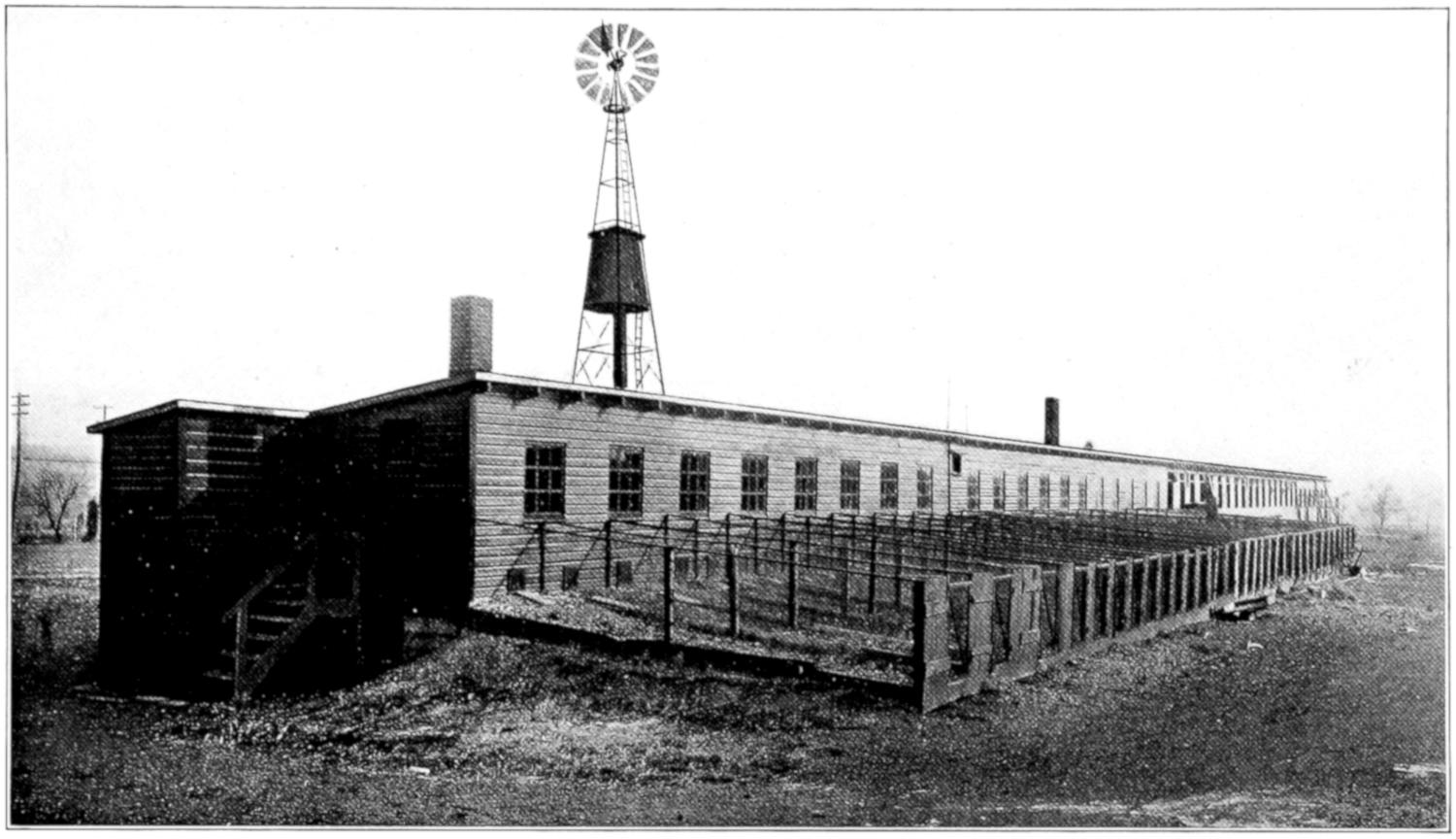
AS YOU APPROACH THE CORNING EGG FARM FROM THE PUBLIC HIGHWAY,
IN 1911
Showing 264-Foot Brooder House, Breeding Cockerel House and Office
We were well satisfied with the result of the Winter’s
work with these pullets, and, although we did
not have the knowledge that has since come to us in
feeding for eggs, the output was a most creditable
one, and we found a ready market at a good price.
Early in the Fall we had mapped out our plans for
a very decided increase in plant for the coming season.
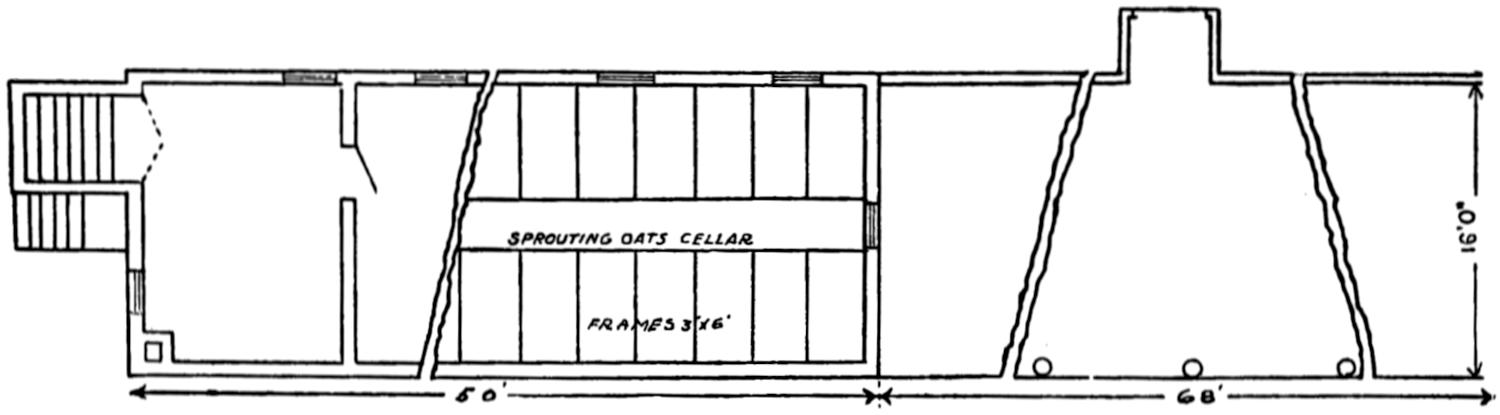
The excavation for the Incubator Cellar, sixteen by
fifty feet, had been made, and the Brooder House
above it was enclosed without difficulty before
weather of any great severity overtook us. We were
blessed with a very late Fall, and mild weather continued,
with only occasional dips, well into December,
1907.
We installed in the Cellar ten incubators, with a
capacity of three hundred and ninety eggs each.
The Brooder House, with its arrangement for Hovers
and Nursery pens, was all completed, and the month
of March found us placing eggs in the machines.
In the Fall of 1907 we had enlarged our Breeding
House, so that we were able to place in it some two
hundred and fifty breeders. Out of our original pen
of thirty, we had lost two. From different sources
we bought yearling hens, and with our original
twenty-eight, made up the breeding pen.
Of course, as we had planned to endeavor to produce
some three thousand pullets for the Fall of
1908, we were obliged to very materially supplement
the product of our own breeders, with eggs from
other sources, and this we did, buying eggs from
different breeders, in widely separated territories.
As the hatching season advanced we added one
more incubator to our battery of ten, and we placed
in these incubators a total of eleven thousand eight
hundred and four eggs, of which two thousand and
ninety-six showed dead germs and clear eggs on the
fourteenth day test.
The resulting number of chicks placed in the
Brooder House was five thousand eight hundred
and sixty-six for the entire season.
We found that the eggs purchased did not produce
anything like the number of chicks, that is, strong,
livable chicks, that did the eggs coming from our own
breeding pen, which proved to us that the method of
feeding and caring for breeding stock, pursued by
others, fell very far short of the results gotten by our
own methods.
The lesson of incubation, which it is so difficult to
make people understand, is not so much a question of
how many chicks may be hatched from a given number
of eggs as of how many strong, livable chicks
are brought out. We very early in our hatching experience
decided to count only those chicks, which
were strong, and apparently capable of a steady
growth and a sturdy maturity. Thus, the count of
the number of chicks produced, does not really show
the number which came out of the shells.
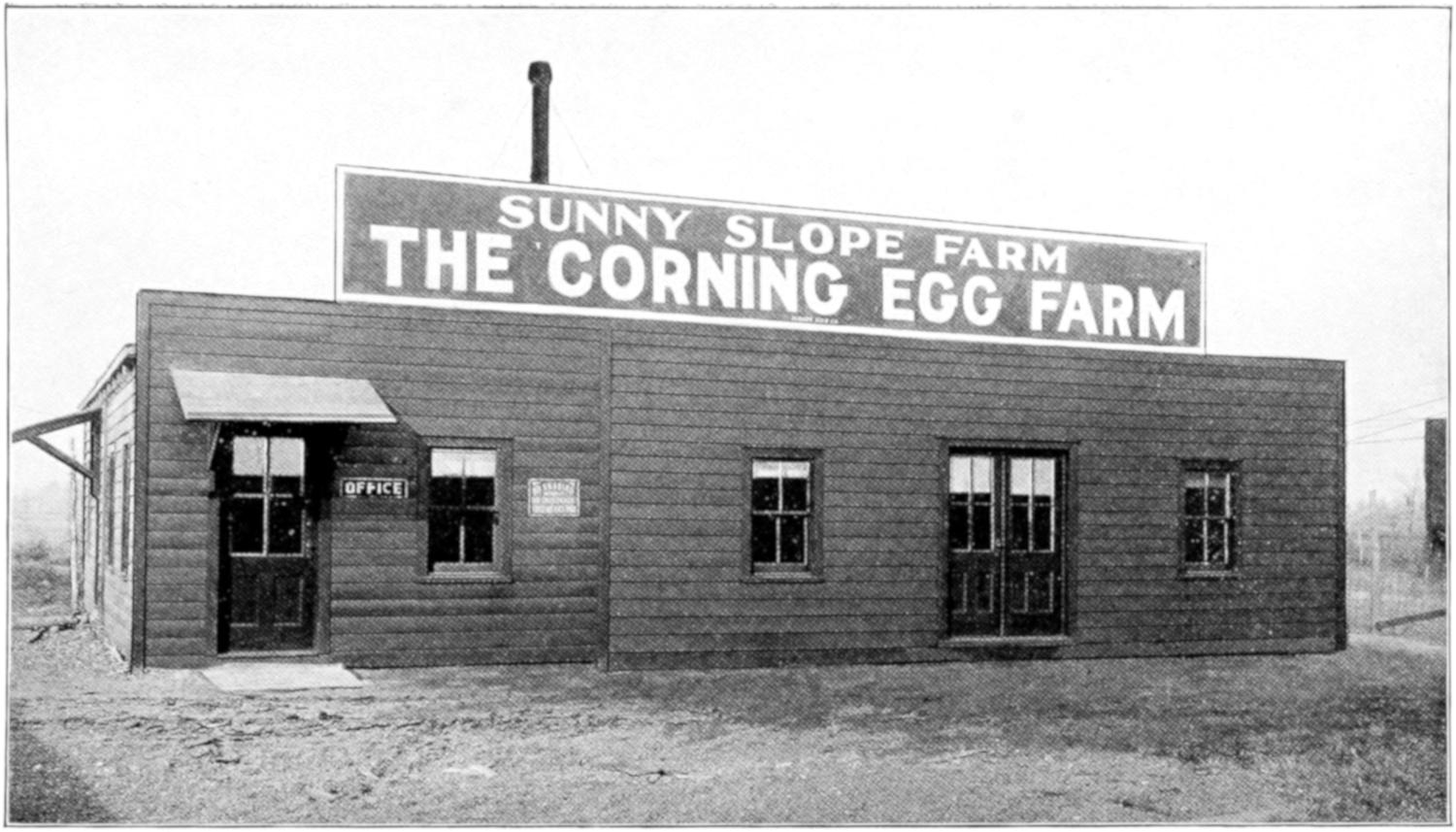
OFFICE BUILDING
We were extremely fortunate in handling the
youngsters in the Brooder House, and our mortality
was very low, and when the youngsters were placed
in the Colony Houses, which had been built during the
early Spring months, and placed out on the Range in
readiness for them, they were a sturdy, vigorous
crowd.
The number of cockerels was very low, and these,
as rapidly as they developed, were taken away from
the pullets and placed in a fattening pen which had
been provided, and as our stock was still an “unknown
quantity” in Poultrydom, we marketed the
larger part of them at broiler size.
The pullets came on finely, and the records show
that a large number of them came into eggs when
they were a few days over four months of age.
Through the connivance of an employé we made
a heavy loss in the way of theft, and, when the final
round-up of the pullets came, we found we had one
thousand nine hundred and fifty-three.
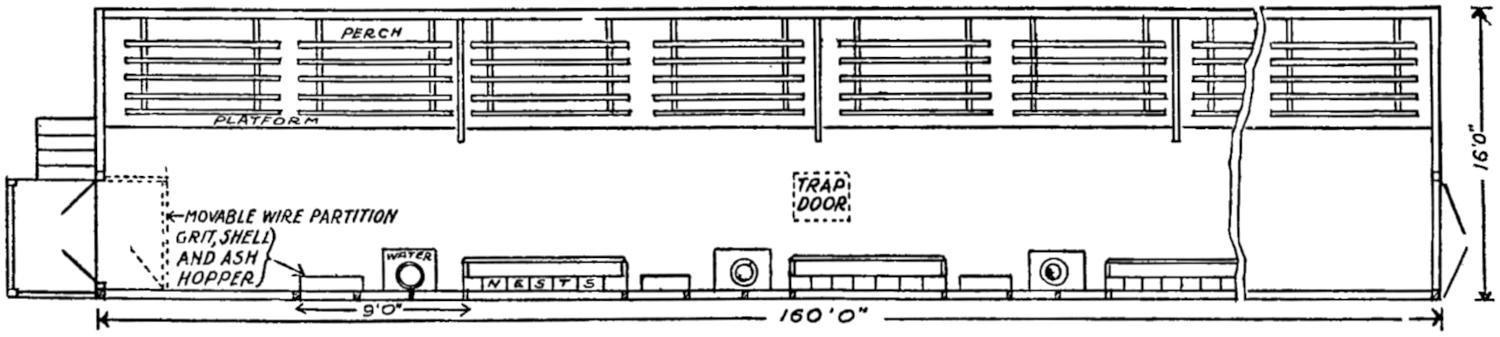
During the Summer, we had built the No. 2 Laying
House, sixteen feet wide by one hundred and sixty
feet long, and in this house the first fifteen hundred
pullets were installed, the balance going into No. 1
Laying House.
A number of visitors had called at the Farm during
the Summer of 1908, and we had listened to the
different stories of the ease with which five thousand
laying pullets were produced annually, but at the end
of this season we had much more respect for the
number five thousand than we ever had before, and
realized very fully what it meant to produce that
number of females each year.
With the placing of these fifteen hundred pullets
in this House of one hundred and sixty feet in
length by sixteen feet wide, without being divided
into separate pens, each hen having the entire run of
the House and no more (that is, she did not leave the
house for a yard, but stayed right in that space and
did her work), we accomplished what, from the standpoint
of all authorities on the subject of Poultry, was
an impossible thing to do, and have the hen produce
anything. And yet each hen had only two and one
third square feet of floor space, which included the
dropping boards.
The secret of being able to work the hen successfully
in such a limited space per bird is in the length
of the house. In reality, every bird has one hundred
and sixty feet by sixteen feet in which to exercise
and roam.
The four hundred and fifty-three pullets which were
placed in No. 1 Laying House were given the entire
run of this house, of one hundred feet by twelve feet,
and yet the Egg Record for the ten months, in which
these birds never left either house, is rather in favor
of the house containing the fifteen hundred pullets.
The average number of eggs per pullet in these houses,
from December 1st, 1908, to September 30th, 1909,
was 143.25. Many people who had seen the No. 2
House filled with the fifteen hundred pullets could
hardly believe what they saw.
The extreme health and great vigor of the birds was
evident to anyone who looked in through the wire
doors. Articles were written in numerous papers
stating that the thing was impossible, and that, before
many months, absolute failure would result.
But in spite of all the prophecies the great flock system,
in the Corning style House, proved by its great
success, that a decided forward step had been made
in economical management and housing of poultry.
We had gone ahead handling poultry in just the
same way that any business would be handled, plus the
scientific study of the anatomy of the hen, and what
it was necessary to breed in order to accomplish a
great success as a producer of large, white, uniform
eggs, with the ability added to that formula, of turning
them out in large quantities.
Callers at the Farm brought very forcibly home to
us the fact, then quite unappreciated by us, that the
methods employed, and the results obtained, were
very remarkable from the standpoint of anything
done in Poultry Culture up to that time. It was
pointed out that in almost every other case it was not
known by the poultryman just where he stood at any
time of the year, let alone being able to tell where he
stood every day of the year. The success of The
Corning Egg Farm really has that feature as its
foundation stone.
Before the close of the ten months of laying of the
1953 pullets we had received a number of overtures
to put our methods and results into a book, and, after
a time, such a book was written. The tremendous
sale and success of that book is now a matter of history,
and the great number of people who were helped
to better things in poultry, and the still greater number
of novices who were started on the road, were
enabled, through this book, to reach a success which,
as many of them testify, would have been impossible
without it. In eighteen months over one hundred
and forty thousand copies of this first book were sold.
Hundreds of people came to the Farm to find out for
themselves whether or not the statements in the book
were true, and these people found everything, down to
the smallest detail, just exactly as represented.
The Visitors’ Register, which is kept at the Farm,
shows callers from almost every nook and corner of
the Globe. In Scotland, a short distance from Glasgow,
there is now almost a perfect duplicate of Sunny
Slope Farm. The owner, who has twice crossed the
ocean and come to the Farm, states that if you were
blindfolded and taken from Glasgow the three miles
out to his property it would be quite impossible for
you to tell whether you were in New Jersey or Scotland,
so absolutely alike are the buildings in every
detail.
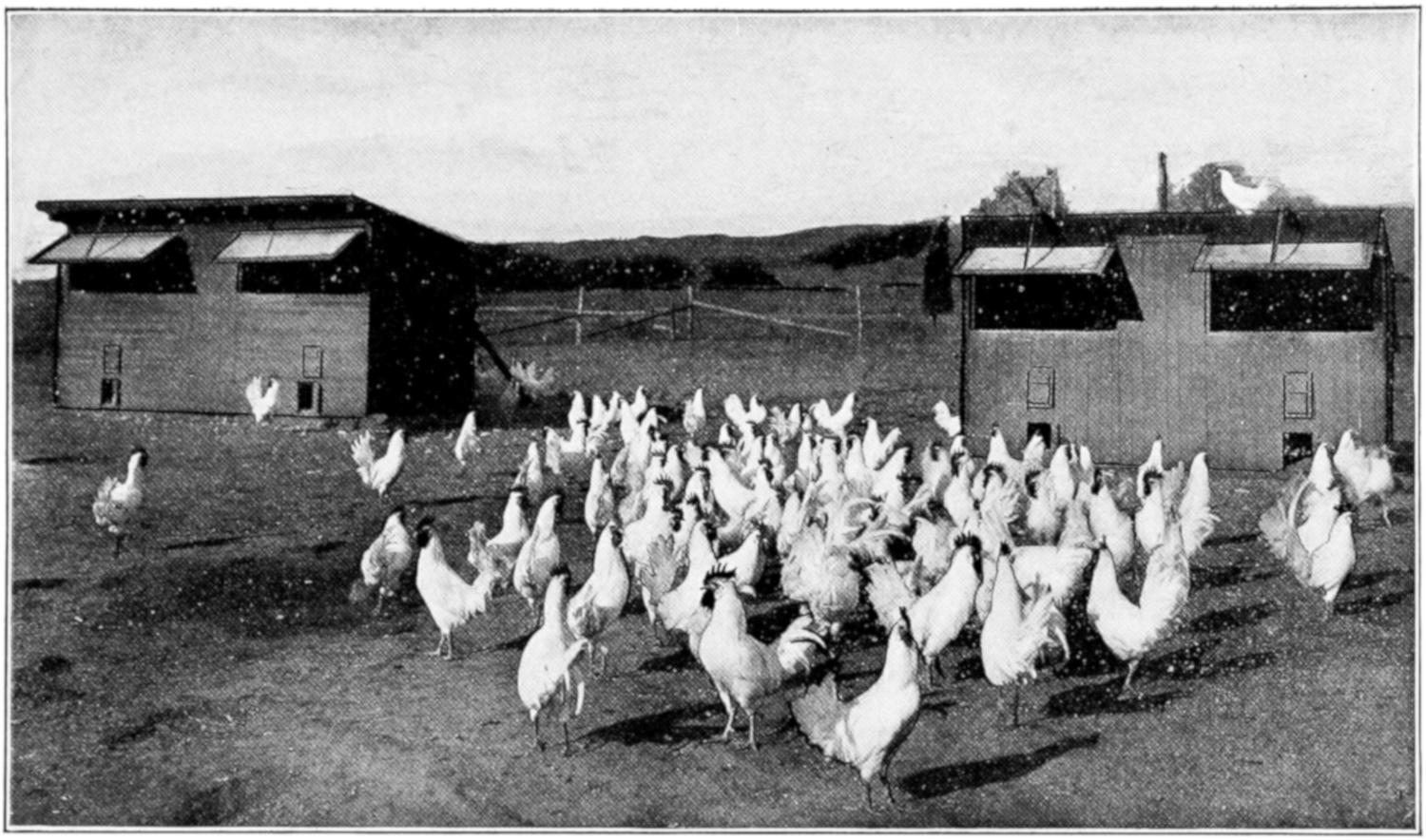
BREEDING COCKERELS, FALL OF 1909
In England, a short distance from Tunbridge, the
Corning Laying House is again found. At this
Farm both White and Black Leghorns are carried,
and the owners write that they are meeting with great
success in following the Corning Method.
Germany sent a man who spent twelve months investigating
the different methods of poultry raising
and housing, and he visited all the plants of any note
whatever from the Atlantic to the Pacific, including
Canada, down to the Gulf of Mexico. He did not
make his mission known, and it was only after his
return to his native country that his identity was disclosed.
His report is of more than passing interest
to The Corning Egg Farm, as it states that the Method
and System envolved on The Corning Egg Farm
surpasses anything that has as yet come under his observation.
The investigator is not only conversant
with what he saw in the line of poultry breeding during
his twelve months’ sojourn in America, but he is
thoroughly posted in regard to everything in Europe.
The pullets were hardly placed in the Nos. 1 and 2
Laying Houses, in the Fall of 1908, before we began
to plan for the Spring of 1909. We had enlarged the
Breeding House again, so that we now had housed
some four hundred and seventy-five yearling and two
year old hens. These were made up from our breeding
pen of the year before, and as many of our two
hundred and twenty-five pullets as qualified. We
bought a few other yearling hens from different
sources, and likewise the necessary complement of
cockerels.
We gave great care to the selection of the males
heading the breeding pen, every bird having perfect
head points, being strong and vigorous, and as large
as we could find him, where we felt sure that no outside
blood had been introduced.
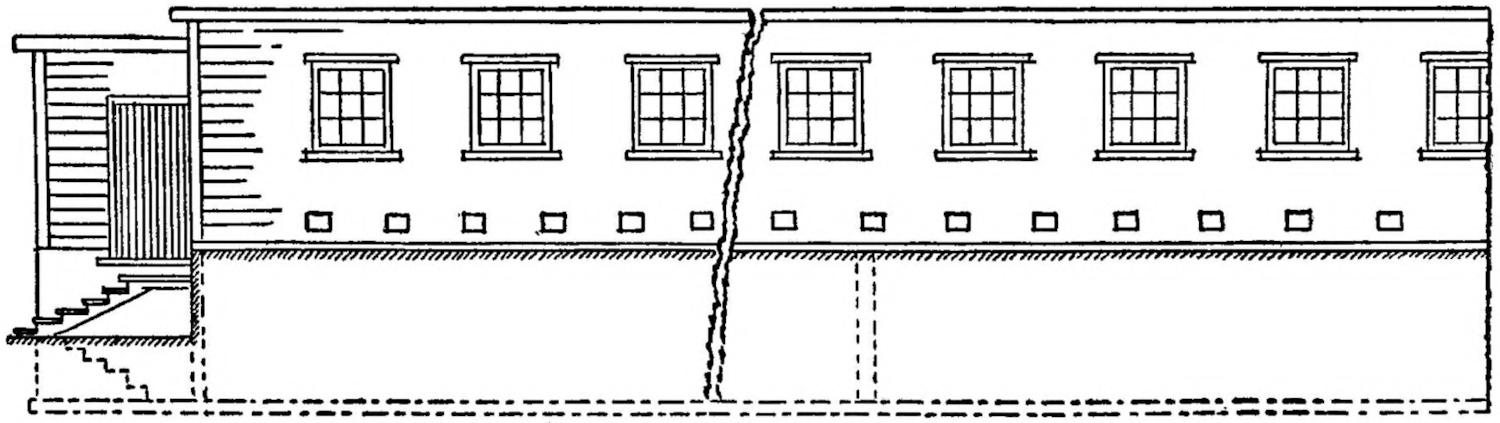
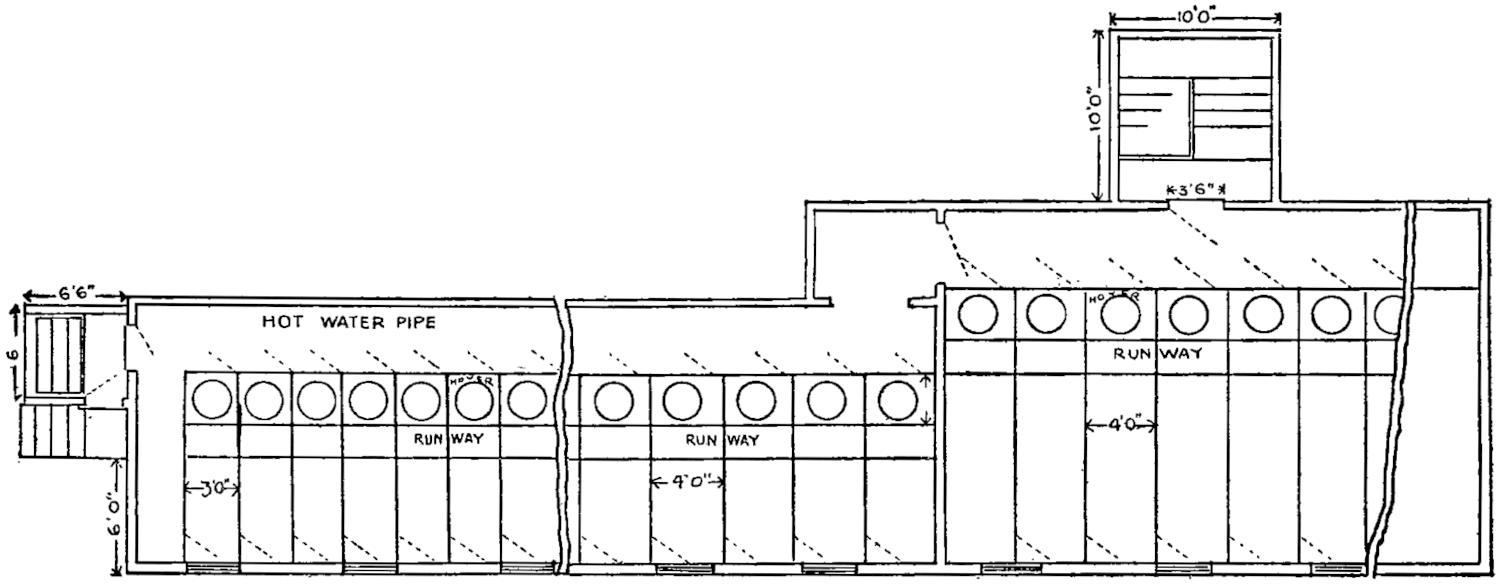
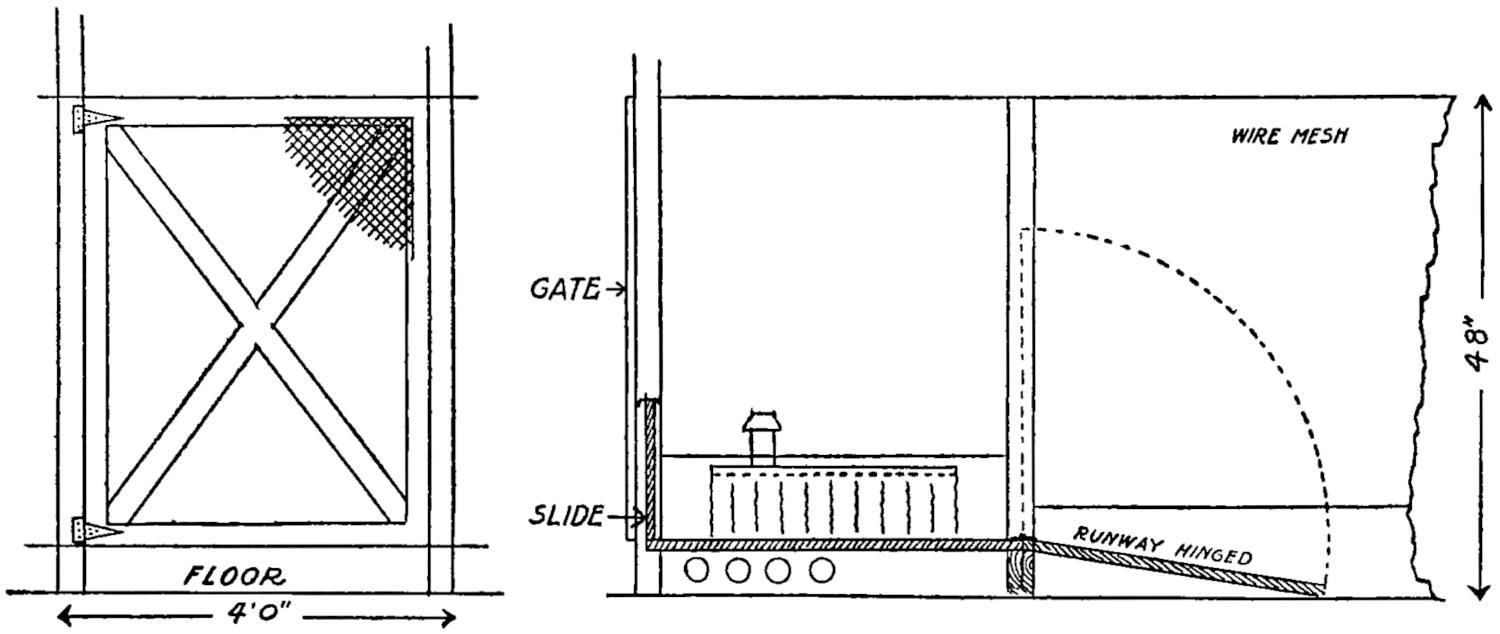
The Brooder House during the Fall, was materially
added to, giving us twenty Hover Pens, three
feet wide, and twelve Nursery Pens, each nearly five
feet wide, this giving us a Brooder House 118 feet
long by 16 feet wide.
We again this year (1909) supplemented our own
breeding pen with purchases of eggs from different
sources.
Our hatches this Spring were very successful, and
the chicks which went up into the Brooder House
were strong and vigorous. The mortality was low,
and when placed on Range they grew rapidly. The
pullets came into eggs, as they had in the two previous
years, within a few days after they passed the four
months’ mile-stone.
We had added some six Colony Houses to our
range equipment. The building originally designed
for pigeons we planned to change over into a Breeding
House, for, in the Fall of 1909, we would have
a sufficient number of yearling hens to carry quite a
breeding establishment. This house was about completed
in the month of May, when it mysteriously
took fire, and was a complete loss. Fortunately the
fire broke out at about ten o’clock in the morning,
and, by the timely assistance of the boys of the Wilson
Military Academy, under the able direction of the
Military Officers of that Academy, we were able to
confine it to this one building in spite of the fact that
a high wind was blowing, which carried the sparks
directly on to the other buildings. The water supply
on the Farm proved more than adequate to the necessities
of the occasion, and the loss was entirely
covered by insurance.
As we desired to recognize the services of the
young men, and at the suggestion of the Commanding
Officer, medals were struck off commemorative of the
fire and of the bravery displayed by these young men
at this time, and were presented to them.
An addition to the Breeding House, extending over
the site of the burned building, was immediately
erected, and the small building which had been used
as a fattening pen for cockerels was rebuilt, and became
the breeding pen for the production of unrelated
cockerels.
Also during this season the No. 3 Laying House
was built, this being an exact duplicate of the No. 2
House.
Our selection of Breeders for 1910 was of course
made from the birds which had completed their first
ten months of pullet laying, in the houses Nos. 1 and
2. The mortality during these months had been
about 7 per cent. With our method of selection
only 950 of these birds qualified to be used as yearling
breeders, and these were placed in the Breeding
House which had been prepared for them. We had
made a most careful selection of cockerels, and these
we had reared in two Colony Houses, placed in a
large yard, where we were planning to eventually
erect a Cockerel House for the housing of cockerels
specially selected for breeders.
The balance of the birds from Nos. 1 and 2, together
with our breeders of 1909, were sold, and we
were able to face the hatching season of 1910 with a
very decided step forward towards the realization of
the ideal yearling breeder, which The Corning Egg
Farm is working nearer to each season.
INTERIOR LAYING HOUSE NO. 2 IN 1910
We placed in the Laying Houses Nos. 2 and 3 about
2750 pullets, and our respect for the man who could
successfully, yearly, produce and raise to maturity
five thousand pullets, increased materially.
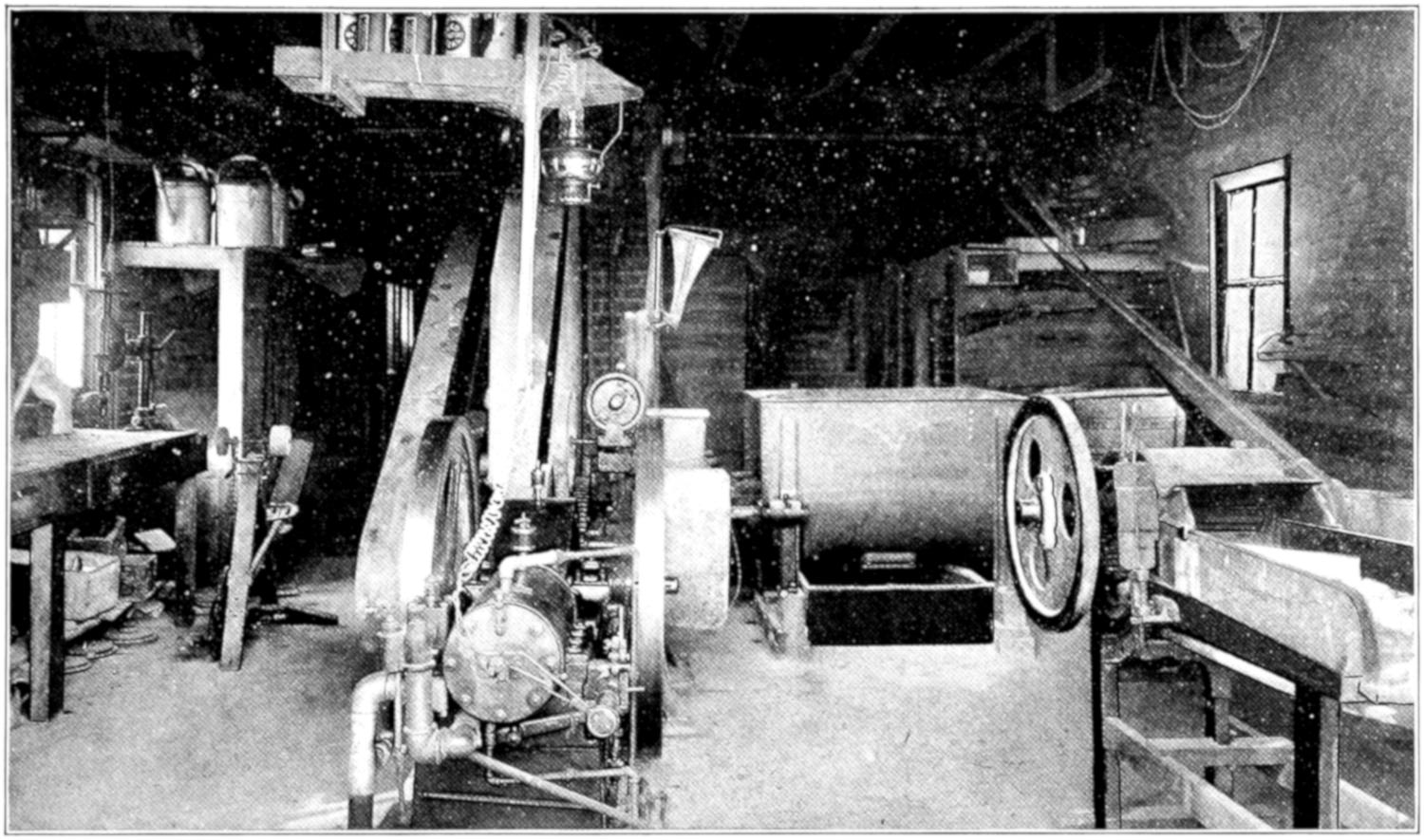
The question of keeping down the labor bill on the
Farm has at all times been a matter of careful study,
and the machinery which is in use is of large capacity,
enabling us to turn out whatever may be required in
a very short space of time, and allowing the men to
get at other work. As an illustration; the Clover
Cutter on the Farm has a capacity of 3000 pounds
an hour, cut in one-fourth-inch lengths, which enables
us, when we are cutting green food, to turn out the
amount required for the day, fill the tubs, and have it
on the way to the Laying Houses, in less than fifteen
minutes.
The question of economy in time in handling the
Incubator Cellar had been a problem, which we finally
solved by piping gas into the Cellar and Brooder
House, from the mains which are laid in the road
passing the Farm. Thus we did away with the danger
of fire from sixteen incubator lamps (for we now
had in the cellar sixteen machines) and the twenty
Hover lamps, and the time and labor of cleaning and
filling them. We placed a governor on the gas main,
so that it was impossible to increase the pressure at
any time of the day or night, and the gas worked
most satisfactorily in incubation and brooding.
The extensions on the Farm planned for 1910 were
a Cockerel House, for the housing of breeding cockerels,
and the widening and lengthening of No. 1 Laying
House. These alterations were made in No. 1, so
that it was an exact counterpart of Nos. 2 and 3.
We also planned, as soon as the breeding season was
over, and the 1910 breeding pen was shipped to the
various buyers who had purchased these birds for
August delivery (and the entire pen was sold early
in 1910), to add another section to the Breeder House,
and to build a few more Colony Houses. Then we
built what we thought would be an adequate Office to
handle the business of the Farm, but which has since
proved large enough for only one quarter of the present
requirements. We increased the size of the Egg
Packing Room, and installed a freezer with a capacity
of over two thousand pounds of green bone. This
practically covers the enlargements on the plant for
1910.
For three years we had been investigating quietly
the so-called Mammoth Incubators, or in other words,
the Coal Heated, Hot Water Incubator, and before
the close of the hatching season of 1911 we had decided
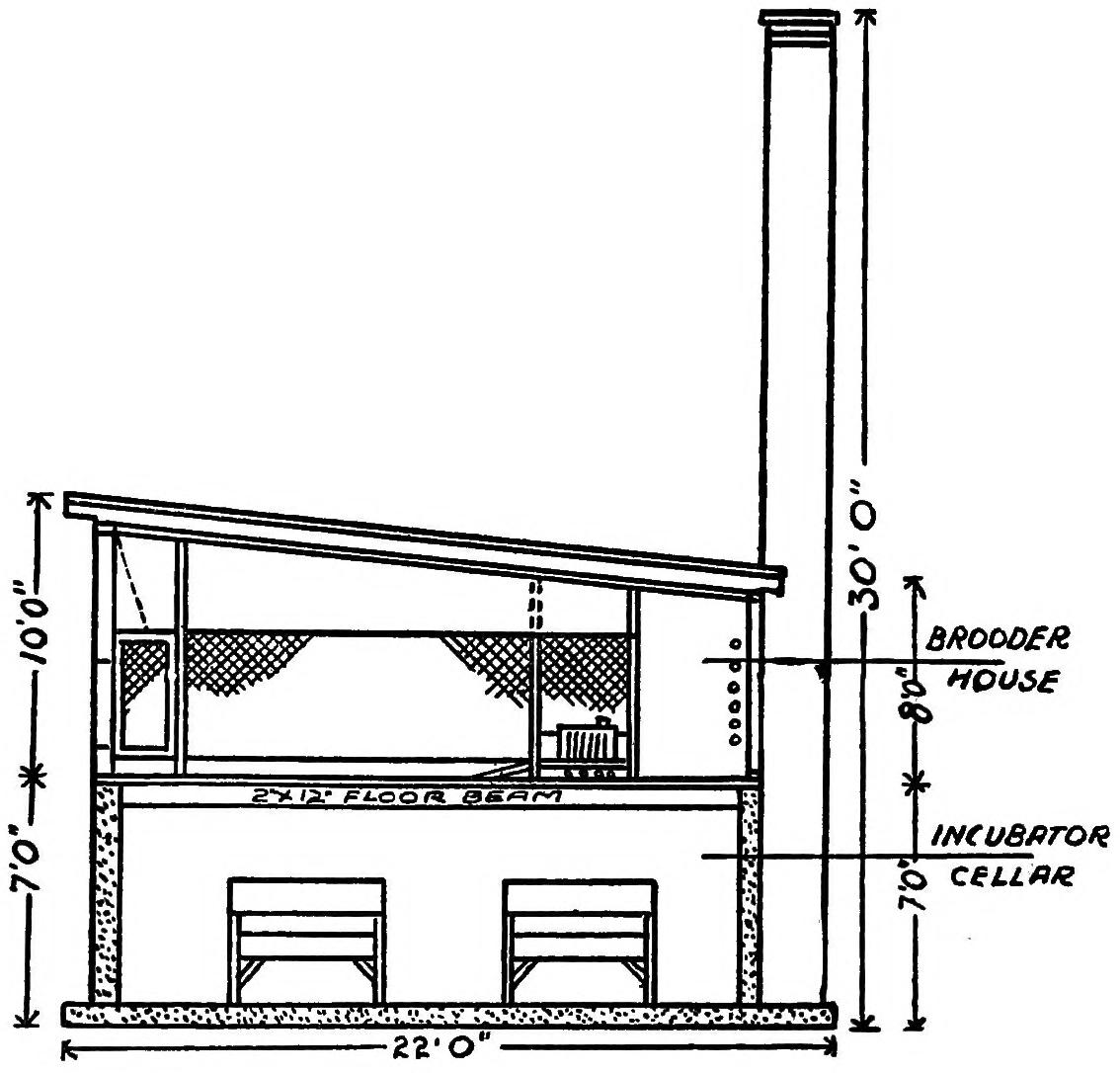
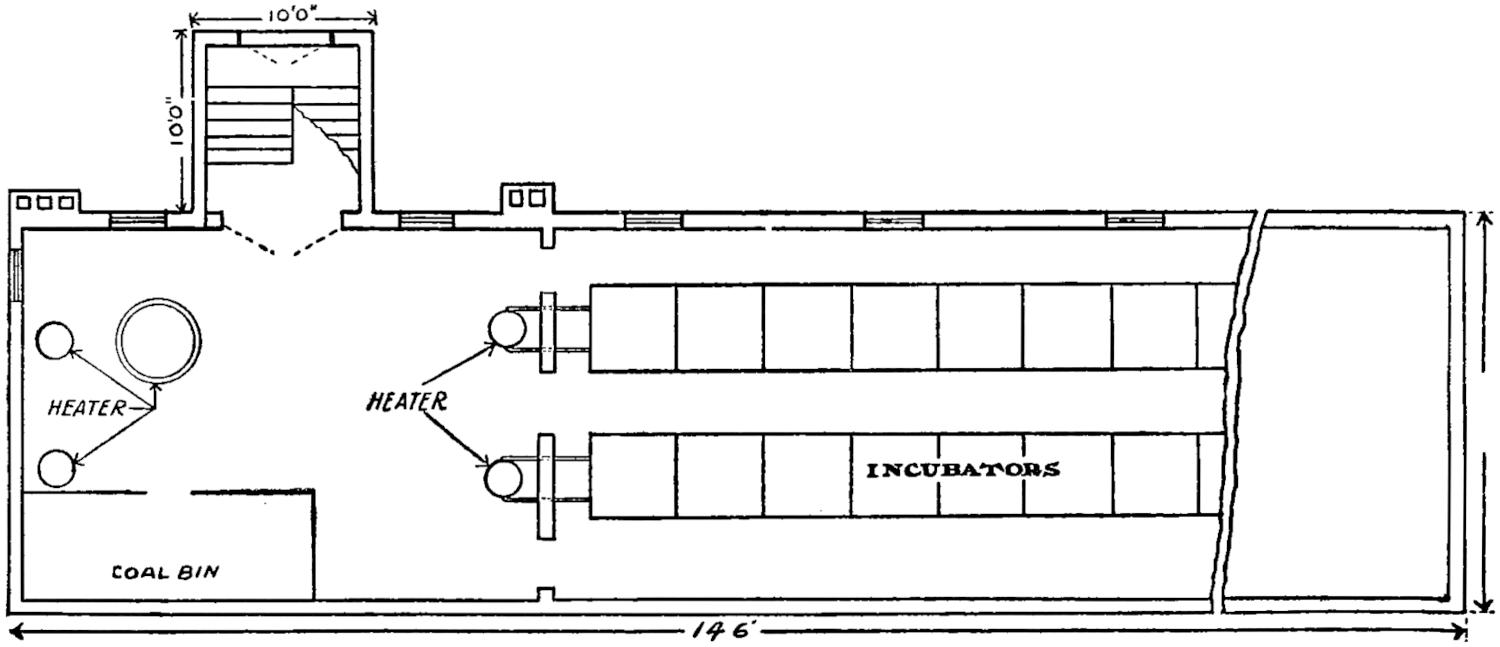
to install two such machines in a cellar 146
feet long by 22 feet wide—this cellar to be built so
as to allow us to extend the present Brooder House
to the same length and width as the cellar.
This cellar has since been constructed, with a
Brooder House over it, so that we now have capacity
for the incubation of 15,600 eggs at one time.
The Hot Water System for heating the air supplying
the Hovers has also been installed, and the
Brooder House now has a capacity of some 12,000
youngsters, before it is necessary to move any of
them to the Range.
The Breeder House has again been enlarged, and,
with the addition, a year hence, of another Breeding
House, which is planned to be 180 feet long by 16
feet wide, and a larger house for the breeding of unrelated
cockerels, The Corning Egg Farm will have
reached the limit planned for since the inception of the
Farm. We shall then have a capacity of 4500 sterile
pullets, 3500 yearling hens for breeding purposes, and
housing for 1200 cockerels.
One reads of Poultry Farms carrying anywhere
from twenty to forty thousand layers. Experience
has taught us that the plant that gets beyond the size
where those financially interested can supervise and
know the condition of the Farm from one end to another
daily, falls down of its own weight, as it is
impossible to find men, unless financially interested,
who will look after the endless details, which spell
success or ruin on a large poultry plant.
The planning and designing of all buildings on The
Corning Egg Farm was done by ourselves, and all
the construction has been done under our personal
supervision. In the first two years we did not contract
even the labor, employing simply “handy men”
who worked with us under our instructions. Latterly,
with the large amount of routine and office work
pressing upon us, we found it to be wise economy to
contract the labor, ourselves supplying the material
and supervising the work.
The buildings, with the arrangement of all equipment,
are built in accordance with ideas thought and
worked out by ourselves, on lines which seemed to us
common sense, and economical in time and money for
the handling of Poultry.
Until within the last two years we had never seen
another poultry farm, and those we have seen have
only strengthened our conviction that no serious error
has been made in laying out The Corning Egg Farm
Plant.
CHAPTER II Egg Farming the Most Profitable Branch of Poultry Keeping — Developing the Great Layer — Corning Method in Small Flocks — On Large Farms
The profits are surer and larger. The reason this
is not more widely known is because, in the past, few
people have been able to resist the temptation of attempting
to cover a number of the different branches
of poultry culture. They have tried to get into the
“fancy,” and have dreamed of taking a blue ribbon at
Madison Square Garden, or at some other large Show.
Then the broiler branch has engrossed their attention,
and from that they have gone on to soft roasters, and
the other phases of the slaughter house side of poultry
for market purposes, and they have endeavored to
cover all the different branches from which money is
made in poultry, while entirely overlooking the fact
that this is an age of specialization, and that the person
who would succeed in any business must make up
his mind to follow one branch of it, and bring that
branch up to the highest efficiency.
From the start the Builders of The Corning Egg
Farm, at Bound Brook, N. J., realized these conditions,
and were never led into side issues but gave their
entire thought and attention to the development of a
great layer, realizing that if this was to be accomplished
everything except an egg must be considered
a by-product, and disposed of along the line of least
resistance: in short carrying out the Scriptural injunction,
“This one thing I do.” This one thought
has been so successfully adhered to that the development
of The Corning Egg Farm in five years has been
remarkable in its production of the greatest laying
type of hen yet produced, the Corning Strain Single
Comb White Leghorn, placing the Farm head and
shoulders above any other Egg Farm anywhere in the
Country.
Egg Farming is profitable not only when carried on
in a large way, but, to the suburban dweller, a small
number of hens in the back yard is a profitable investment,
and the system, as worked out on The Corning
Egg Farm, succeeds with a few hens, and enables
the owner of a small plot of land to always have sanitary,
fresh eggs, to reduce his grocery bills, and materially
increase the pleasure of suburban life.
Two illustrations of the working out of the Corning
Method in a small way would doubtless be of
interest. While it is true that the 16 feet wide House
is the most desirable from all standpoints, the length
of the house may be anything from 20 feet to 200
feet, as the house is of sectional construction, 20 feet
being a section.
In the back yard of a gentleman living in Bound
Brook was kept a small pen of birds, in all eighteen,
composed of hens and pullets. These were a mixture
of Barred Rocks and Rhode Island Reds. The
pullets were of early hatch and should have come into
eggs at least in the first week of October. The hens
completed the moult much earlier than is generally
expected, and still the owner was without eggs.
Different methods, and nostrums of guaranteed
egg producing foods, were tried, but all without success.
After a call at The Corning Egg Farm, he
stated that in one week and three days the first eggs
were found in the nests, and the continuance of the
Corning Method of feeding and working the hens
produced eggs steadily through the Winter months,
beginning with the middle of December, and the birds
continued to lay more than an average output until
they went into the moult the following Fall.
A gentleman, who has a small place within a mile
of The Corning Egg Farm, some four years ago purchased
hatching eggs from our Breeding Pen, and the
following Fall he also bought a small pen of Breeders.
He aims to produce and carry through the Winter
about one hundred pullets, and for four years now,
by adhering strictly to the Corning Method, and with
the Corning Strain Single Comb White Leghorns, he
has met with a success almost phenomenal.
Before he became conversant with the Corning
Method (and with the stock he was then carrying before
beginning with the Corning Strain) his success
was represented by zero, but to-day his balance sheets,
which he displays with great pride, are extremely interesting
reading.
This gives a very fair illustration of two small
flocks of different size, and of the results obtained.
Turning now to the story of two egg farms which
have been built within the last two years, one in New
Jersey and the other in Pennsylvania, we find again
most interesting and successful conditions.
The Pennsylvania Farm started its first season by
the purchase from us of fifteen hundred hatching
eggs. The owner came to our Farm and asked our
assistance in planning his campaign of growth. His
hatch from the fifteen hundred eggs, and he never
had run an incubator before, was some 75 per cent. of
all eggs set, and, by following the feeding methods
prescribed, his mortality was very low. He placed
in his Laying House that Fall some five hundred pullets,
and in July, 1910, he had sent us an order for
three thousand eggs for the season of 1911.
As he told this story on a visit to The Corning Egg
Farm, in the month of February, 1911, he had done
the almost impossible, simply by following the Method
laid down in the literature published by The Corning
Egg Farm, and had made money from the second
month that his pullets had begun to lay. The quality
of his eggs was such that he took over the trade of
the largest hotel in a neighboring city, so far as he
was able to supply their wants.
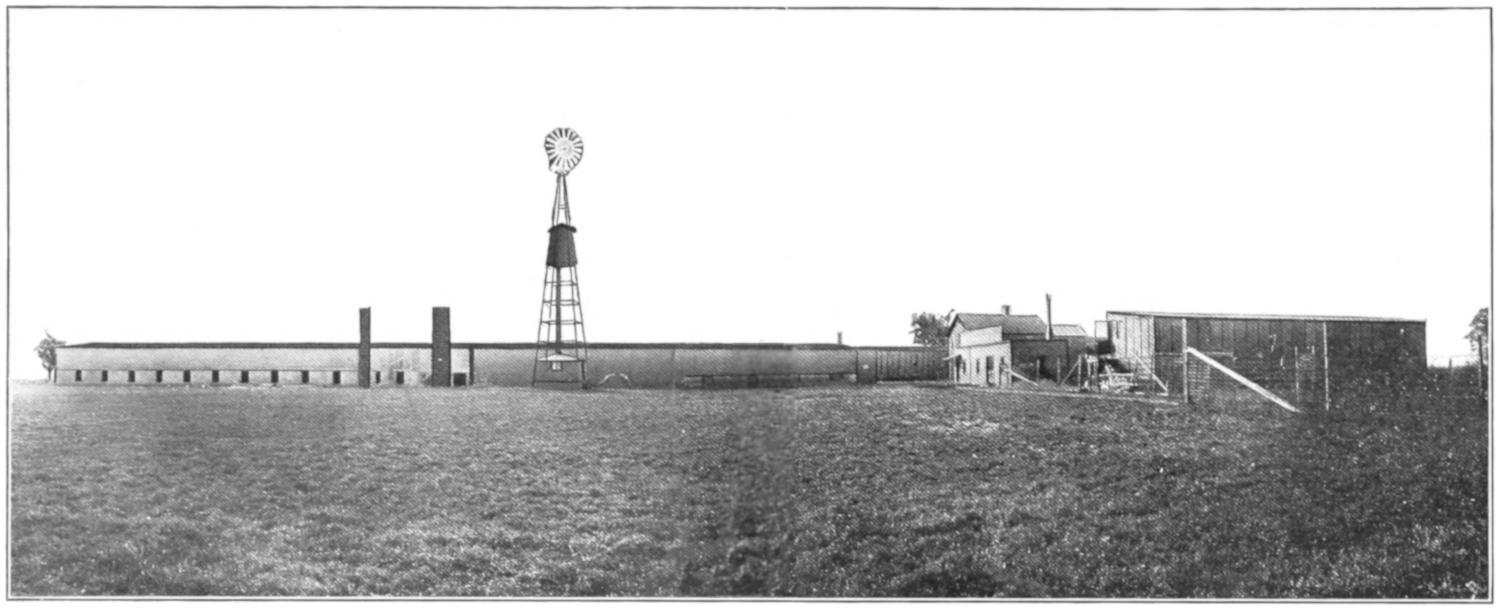
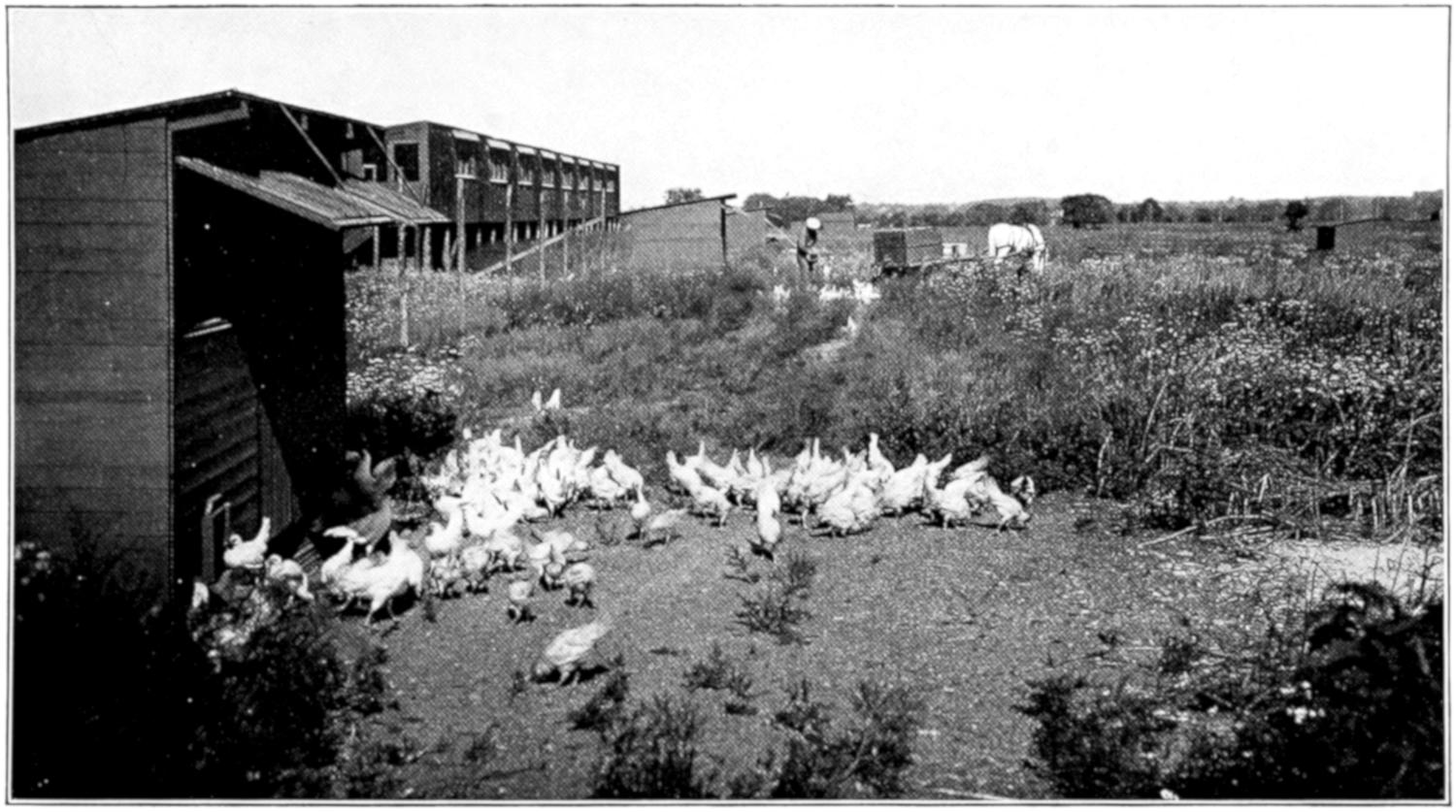
PANORAMIC VIEW OF PART OF THE CORNING EGG FARM, PHOTOGRAPHED IN OCTOBER, 1910.
The Jersey Egg Farm referred to is owned and run
by a gentleman of advanced years. His first season’s
start was on a very small scale, but he was most successful
in bringing his pullets to the laying point, and
getting a remarkable output of eggs through the Winter
months. In his district he was able to dispose of
all his eggs to people who came to the door and paid
the cash for them at prices ten to twenty cents per
dozen above the market. The Corning Egg Farm
received from him a very large order for hatching
eggs for the season of 1911, and this Fall he had an
elegant flock of pullets ready to house and turn out
an ever increasing supply of eggs for the coming
Winter.
These four illustrations are a few of the many which
The Corning Egg Farm is able to point to as the result
of the use of its Method.
CHAPTER III What is a Fresh Egg?—An Egg Should be Sanitary as Well as Fresh — Manure Drainage to Drink — Diseased Meat to Eat — As the Food, so the Egg — A Perfect Egg a Rarity — Unlimited Demand for Quality Eggs
The answer one generally gets to this query is, an
egg so many hours old, and, as the average grocer
prints the card, “just laid.” “Fresh” and “new
laid,” as applied to eggs, mean nothing. Hens improperly
fed lay eggs not only often unpalatable, but
that are carriers of disease. The hen’s productive
organs are so constructed that bacteria which she may
take into her crop with impure food are passed into
the egg.
An egg being eighty per cent. water, consider the
effect on eggs produced by the farmers’ flocks, where
the water supply is mainly pools in the barn yard,
which receive the drainage from the manure piles,
and where the principal food supply is scratched out
of manure heaps, consisting of undigested grain that
has already passed through another animal.
A hen must have a large proportion of animal food
to lay well, and to produce rich, nutritious eggs.
Consider what in many instances this animal food
consists of, carcasses of glandered horses, tuberculous
cows, and putrid and maggoty meat. If a dish of
putrid beef were placed on the table before people
they would shrink back in horror, yet they will eat
eggs which have been produced by hens which have
been fed on these identical ingredients, apparently
entirely oblivious of the fact that the hen performs no
miracle in the production of an egg, but simply manufactures
the egg from the materials, whatever they
may be, which she gathers into her system.
The Chief of the Bureau of Chemistry, U. S. Department
of Agriculture, says that while such conditions
undoubtedly do exist it cannot be proven that
such eggs are shipped from State to State, and that,
therefore, it does not come under the jurisdiction of
the Interstate Commerce Commission, and cannot
be controlled under the National Pure Food Law.
What is needed, then, is to know that eggs are not
only fresh, but sanitary. The Corning Egg Farm
layers are fed the best quality of grains and meals
that can be procured. The animal food is supplied by
fresh, green bone, cut and prepared daily. This bone
comes from inspected cattle only, and the Farm is
equipped with a large freezing plant for the purpose
of carrying the bone in a perfectly fresh condition.
The hens are housed and cared for under absolutely
sanitary conditions.
The growing interest in Poultry Culture is bringing
the Public to a realization of the fallacy of the
old idea that “any egg not rotten must be a good
egg.” Comparatively few people have ever eaten a
perfect egg. With the growth of real egg farms
through the country, the time is approaching when the
words “fresh” or “strictly fresh” will no longer
mean anything to the purchaser, and the word “sanitary”
will take their place, and in some way the egg
trade will be controlled, and the grocer, and butcher,
and peddlers of eggs, will not be allowed to put cold
storage eggs out as a sanitary article of food.
Some of the New York papers are now beginning
to agitate the question of Sanitary Eggs, notably the
New York Commercial, which is a leader in this
educational line. The day is coming when the person
who is operating an egg farm that is known to produce
the egg of real quality will have no difficulty in
obtaining the price that such an article is really worth.
There is an unlimited demand for an egg which
can be depended upon as to quality. The difficulty
that the seller meets with when going to a hotel or
restaurant is the fact that the proprietor has been
fooled many times. As they have put it, “people
start well, and for a time keep up the quantity, and
the quality is all right, but when the stringent time
of year comes they fall down as to quantity, and a
little later they have evidently been tempted to keep
up the quantity by gathering eggs from other sources
than their own, and then we meet with the questionable
pleasure of having a patron at our tables return
to us an egg just ready to hatch.”
When one seeks private trade for the output of his
hennery it is possible to obtain extreme prices, provided
the buyers can be convinced of the absolutely
high quality of what they are purchasing.
In New York, last year, for a few weeks, a man,
gotten up as a veritable “hay-seed” farmer, sold eggs
from house to house through the streets running
from 45th to 65th, in large quantities. They were
all marked in red ink with the date on which they
were said to be laid.
He did not last very long, and his liberty was curtailed,
and for some time he graced one of the free
institutions where iron bars obstruct the view of the
surrounding country. It developed that this enterprising
crook was buying the culls from cold storage
houses, and, in a basement on 43d Street near the
North River, he had eight girls steadily at work marking
the alleged dates when these eggs were laid.
The difficulty seems to be that when you reach the
question of a “fresh egg,” everyone, almost, becomes
a fakir. The grocers, many of them, buy case after
case of storage eggs, and, when the retail price reaches
sixty-five cents a dozen for so called “fresh eggs,”
they are supplying all buyers with the cold storage
product, in quantities practically unlimited. Their
counters are always decorated with baskets of these
“just laid, perfectly fresh eggs.”
Therefore, it becomes necessary for the Egg Farmer
to satisfy customers, beyond peradventure, as to his
ability to himself supply the goods which he contracts
to deliver, and after once doing this his experience
will be the same as that of The Corning Egg Farm,
not to be able to keep and properly look after enough
hens to turn out half the eggs he could sell at profitable
prices, because the price he asks does not discourage
customers who are willing to pay well for a
really satisfactory article.
The following is the basis on which The Corning
Egg Farm makes all its contracts for table eggs.
Sunny Slope Farm (The Great Corning Egg Farm) PRODUCES Eggs for the Table “WHICH CANNOT BE SURPASSED”
THEY ARE:
WHITE,
STERILE,
SANITARY,
FRESH,
STERILE.—The hens producing Eggs for the
Table are housed by themselves and their
eggs do not contain the life germ, giving a
purity not otherwise obtained.
SANITARY,—because of the clean, fresh air
housing and best quality of pure food and
water. People are learning the necessity of
investigating the source from which Eggs
come more carefully than milk or water, as
it is now known that Eggs can be a greater
carrier of disease than either milk or water.
FRESH,—because eggs laid one day are delivered
the next.
OUR METHODS and feeding formulas give these
eggs a delicious flavor, peculiarly their own.
EVERY EGG sold by us is produced on Sunny
Slope Farm, and is guaranteed as above
stated.
ONCE BOUGHT, ALWAYS SOUGHT
Sunny Slope Farm
BOUND BROOK
NEW JERSEY.
CHAPTER IV Preparation of Eggs for Market
If high prices are to be obtained for eggs they
must not only be good, but have a look of “class,” to
the would be purchaser. They must be spotlessly
clean, and, as far as possible, each dozen should
present a uniform appearance.
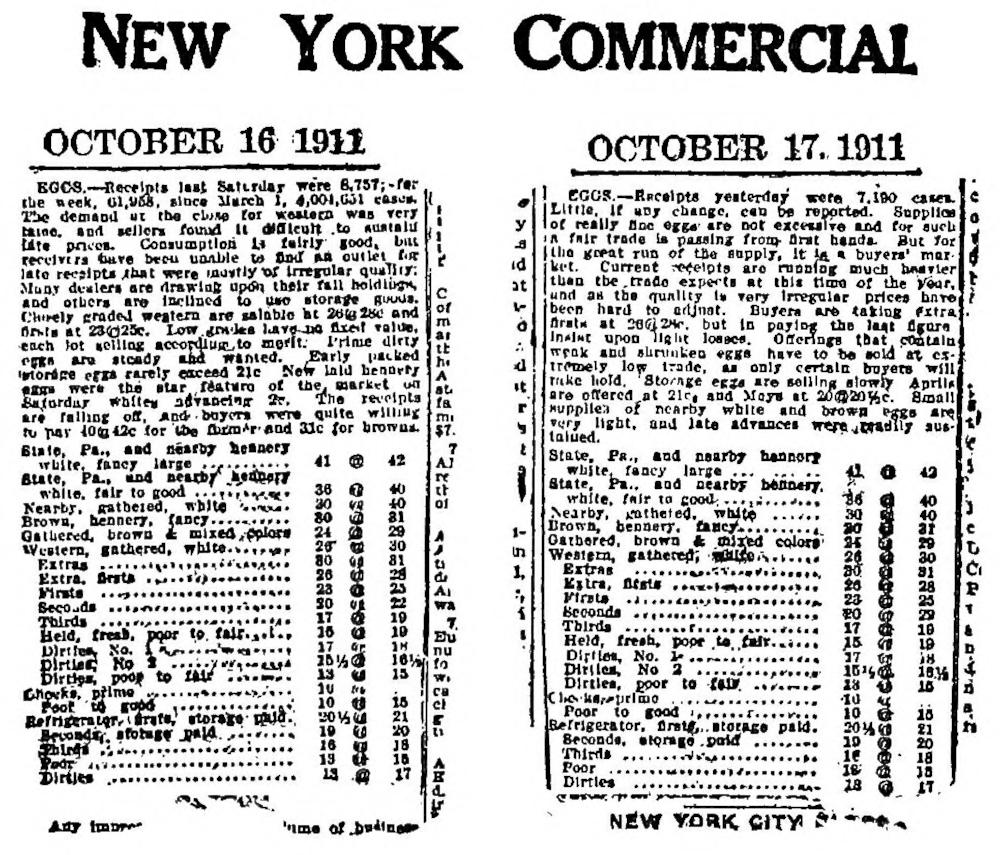
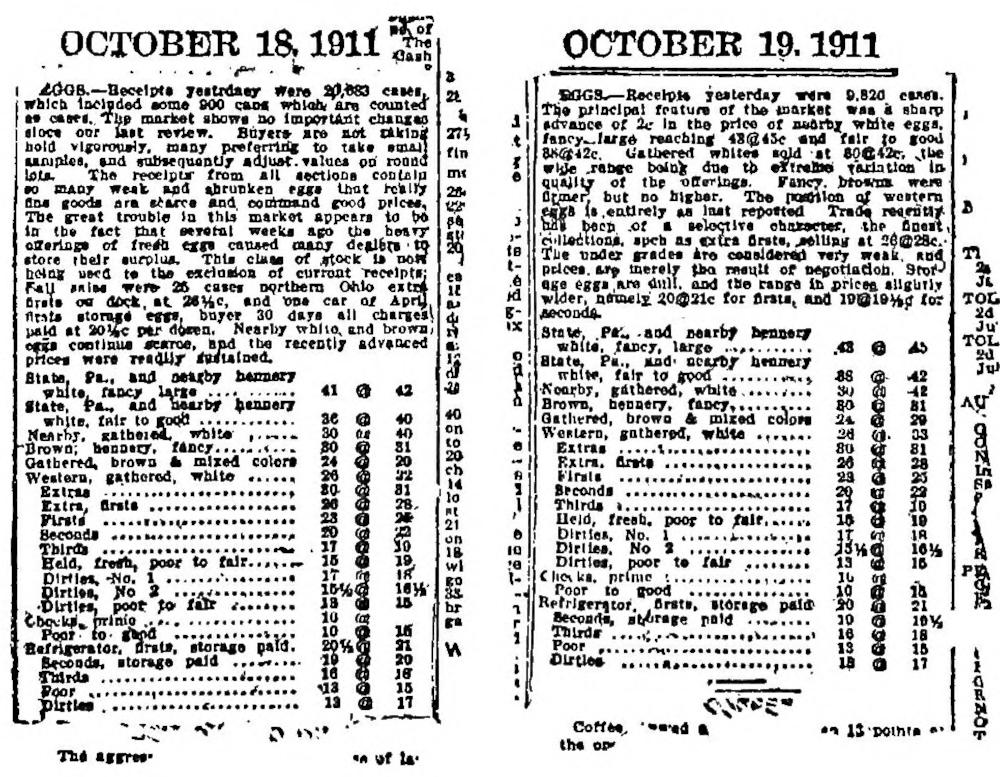
One is able to know each day the exact price of the
class of eggs which he is selling, for the Egg Market
is like the Stock or Bond Market, and one who is in
the Egg business is dealing with a commodity which
at all times is salable at a price. At The Corning
Egg Farm we receive daily the reports from the Exchange,
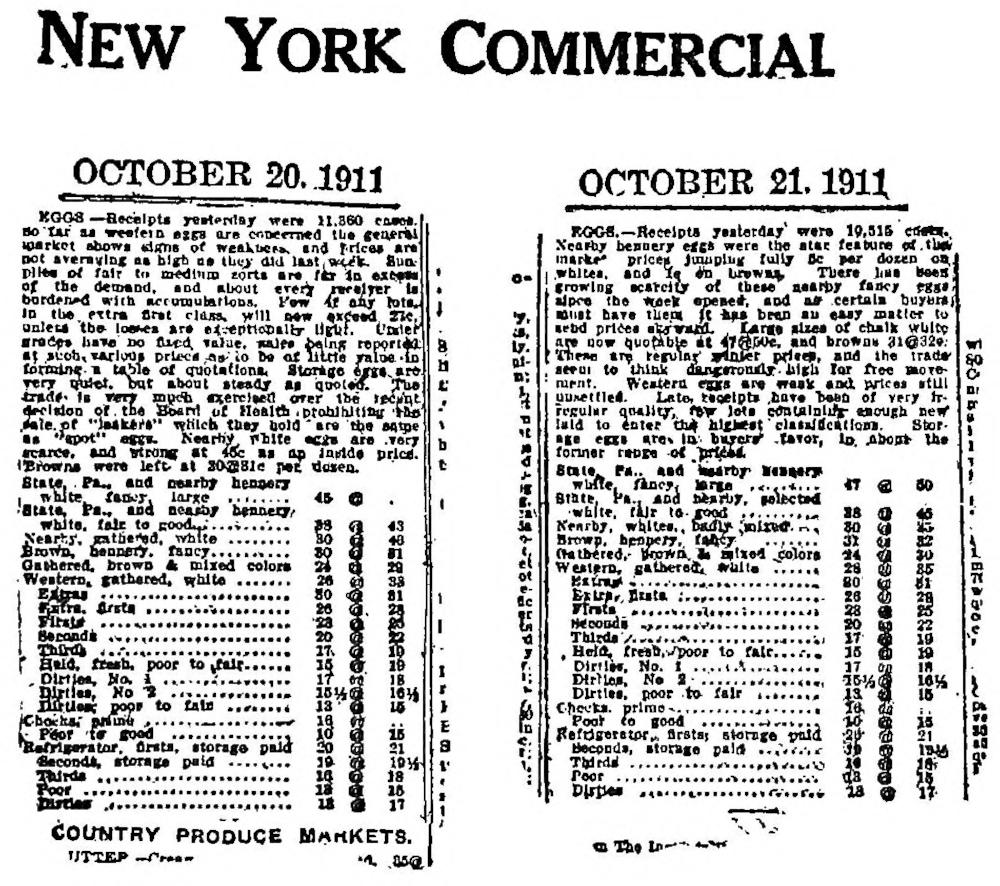
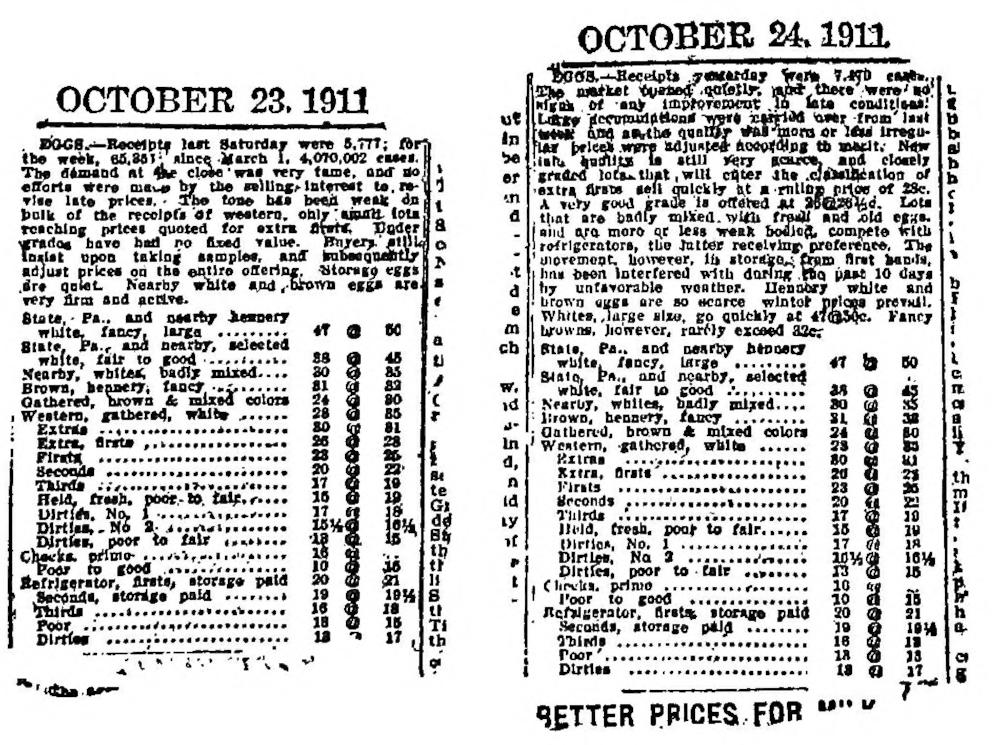
as given in the New York Commercial.
These are cut out and placed in a scrap book, so that,
from year to year, we are able to tell exactly what
the conditions were on any given date, and form a
very close idea as to what can be expected in regard
to prices. And so we have an absolute basis of prices
for contracts.
The nearest quotation to the egg which is produced
by The Corning Egg Farm is what is termed “State
Pa. and nearby Hennery, white, fancy, large.” This
we take as a basis and arrange our prices from it
daily, adding the advance which the Corning sanitary
table egg brings.
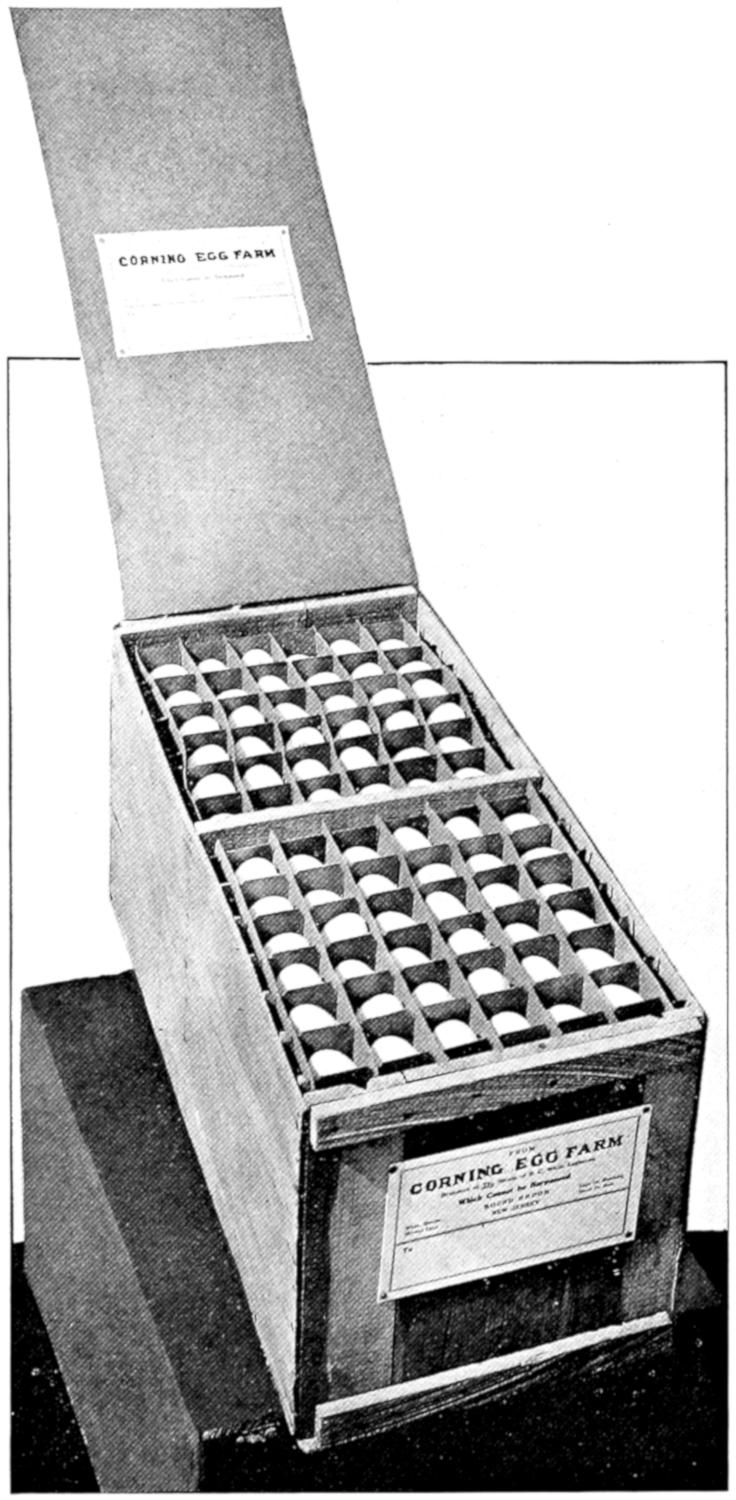
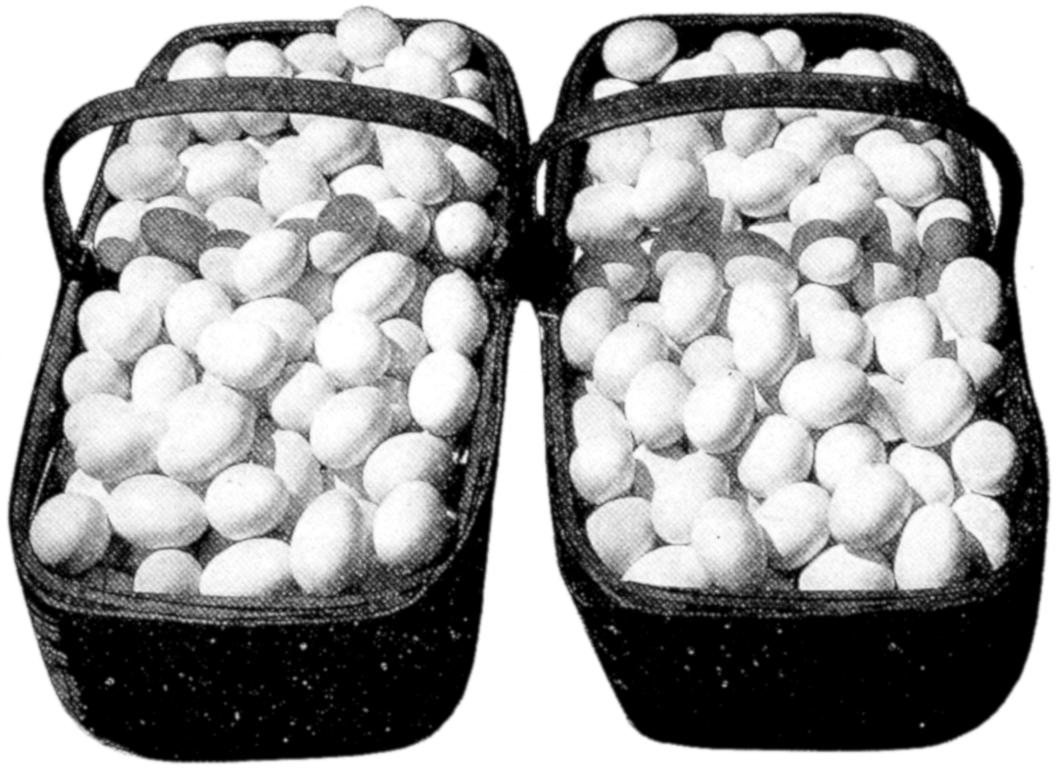
30 DOZEN CORNING SANITARY FRESH EGGS
READY TO SHIP
It is quite impossible, with the growth of the country
and the demand for better things in all food products,
to over-do the production of Sanitary Eggs.
The following pages show the manner in which the
quotations are placed in our Scrap Book.
CHAPTER V The Selection of the Breed—The Strain is of Utmost Importance — S. C. White Leghorns Outclass All — Line Breeding—Not Inbreeding — How Corning Farm Produces Unrelated Cockerels
To a man engaging in any branch of Poultry Culture
the selection of the proper breed is of grave importance,
but to the man who is planning an Egg
Farm it is without doubt of graver importance than
where any other branch of the poultry business is to
be carried on.
For many years different localities have believed
that there was very decided merit in the different
colored egg shells. The Culture of Boston was certain
that the dark shell contained an egg with a richer
flavor, while New York and vicinity would believe in
nothing but the white shelled egg. It is, however,
noted with interest that the Culture of Boston has
discovered that the color of the shell really has nothing
to do with the flavor of the egg, and to-day the
rigid adherence to a premium paid for the dark shelled
egg, generally throughout the New England States,
is rapidly passing into history.
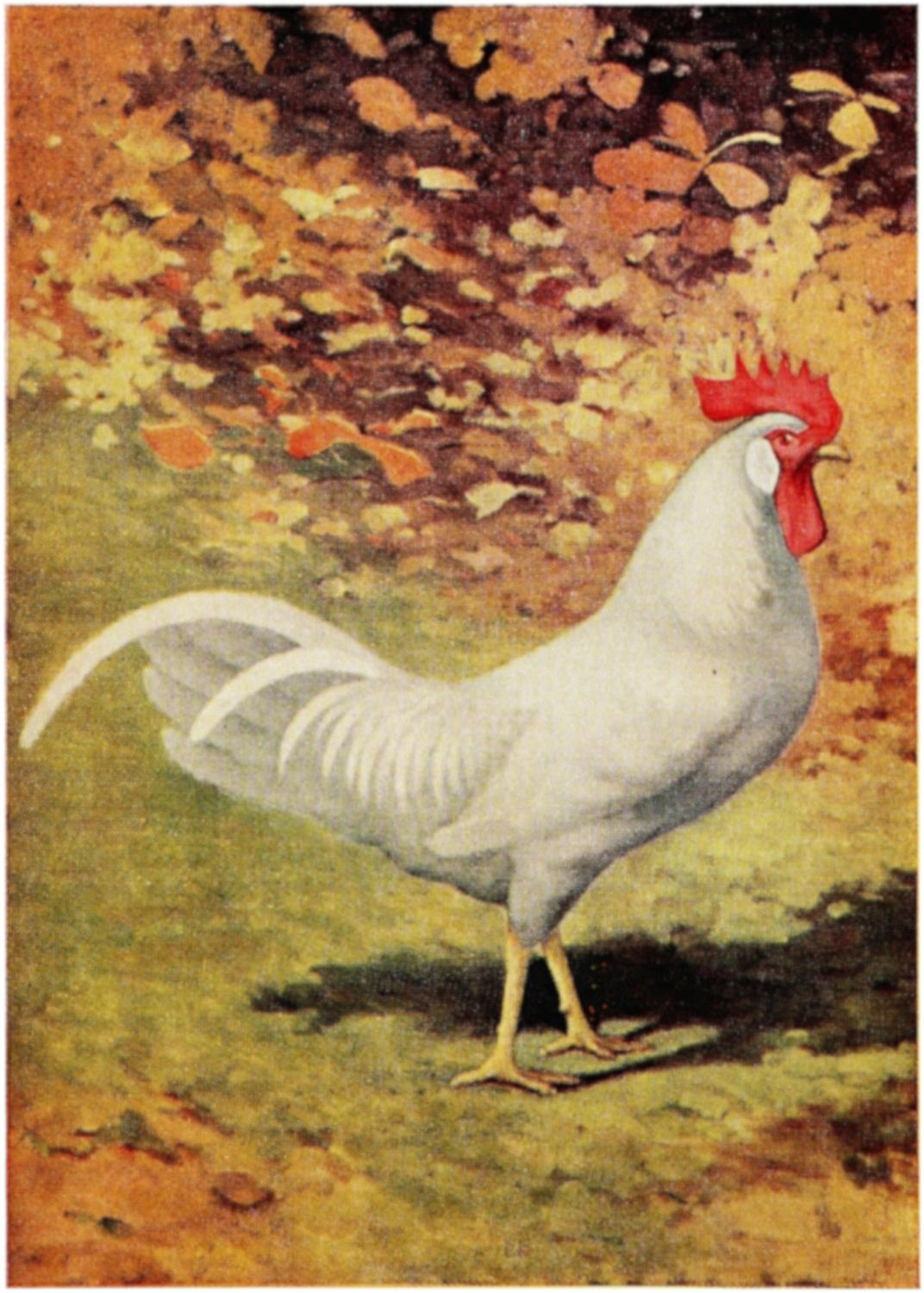
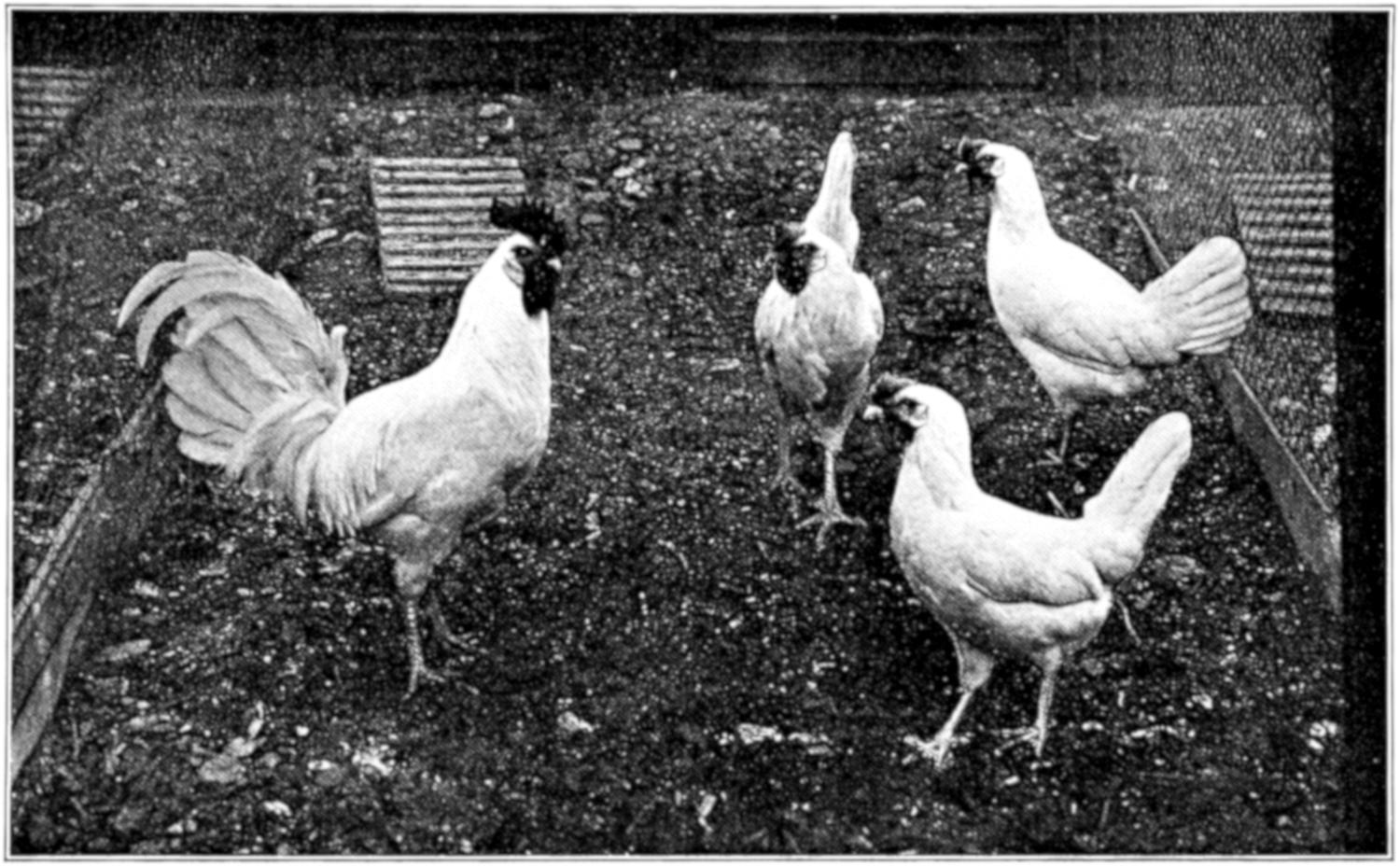
THE STRAIN THAT MAKES THE CORNING EGG FARM FAMOUS
As The Corning Egg Farm was located within a
few miles of New York City the breeds which laid
the white shelled egg were the only ones worthy of
consideration, and, in the study of the question, it was
found there was another important matter confronting
the egg farmer, as to the breed which he should
keep, whether a setter, or a non-setter. On an egg
farm, where hundreds of layers are to be kept, if
any of the Asiatics, or so called American Breeds,
were kept, they would be a source of considerable
added expense, first, in the way of loss of eggs during
their numerous broody periods; second, in the necessary
buildings in which to carry the “broody biddies”
until they have become sensible, and are in a
proper frame of mind to be returned to the Laying
House. This might look on its face a small affair,
but success to The Corning Egg Farm has come
through watching every corner, and while sparing no
needed expenditure, avoiding unnecessary and foolish
outlay.
So, to the man who would really meet with a large
success, all the breeds which lay the dark shelled egg,
because of their setting propensity, must be eliminated.
All the members of the Mediterranean family are
layers of the white shelled egg, and are what is termed
“non-setting.”
Before deciding we looked the different members
of this family over with considerable care, and we
found that the Single Comb White Leghorn is the
fowl that out-classes all the others for the purpose of
an egg farm. It is a bird, where properly bred, of
great hardiness and stamina. It readily adapts itself
to all conditions of climate, and, where the right
“strain” is procured, it is never a disappointer as to
the number, size, and the class of eggs which it produces.
We, therefore, decided to adopt the Single
Comb White Leghorn, and we have outlined, in a
previous chapter, how we went to work to build up
the unequaled Corning Strain, by the most careful
selection, and scientific mating.
Prof. Gowell, at the Maine Agricultural Station,
carried on his breeding with Barred Plymouth Rocks,
and it is interesting to note that his average for some
eight years, taking his star performers, was 134.27
eggs per hen for twelve months, while at The Corning
Egg Farm the flocks of fifteen hundred pullets averaged
per hen, for ten months laying, 143.25 eggs in
1909, and 145.11 eggs in 1910. Here was a difference
of two months in time, and yet the large flocks,
taken as a whole, not weeding out a few star performers,
surpassed the twelve months’ record of the
Barred Plymouth Rocks at the Maine Station by almost
nine eggs in 1909, and ten eggs in 1910. This
significant fact made considerable impression on a
number of breeders in the neighborhood of Boston,
with the result that, in the last two years, The Corning
Egg Farm has supplied a large number of hatching
eggs and considerable breeding stock for farms
in New England.
As one gentleman from Boston pointed out, even
with the difference in price between the brown and
the white egg, he found that he could not really afford
to continue with the breeds laying the brown egg,
for the Leghorn, in numbers, more than made up for
the slight difference in price between the two colors,
in the Boston Market. And, as he still further
pointed out, it took less food to supply the Leghorn
than it did any of the larger breeds, and this, of
course, was another source of economy.
It should be remembered that the “Strain” of any
breed is most important. One may purchase White
Leghorns where the inbreeding has been so great that
they are not capable of laying eggs in large numbers,
and the percentage of fertility from the hatching
standpoint in such birds will be a most uncertain
quantity. Such chicks as may be hatched will be far
from strong, and the mortality will run into figures
which will dishearten anyone.
In the building up of a great strain of birds it is
necessary to “line breed,” for, if the old theory of
introducing new blood to prevent inbreeding, and the
method of introducing the new blood, was, as is done
in so many places even to-day, by introducing males
from other sources, the entire system falls down.
Nothing is accomplished and time is worse than
wasted. The possibility of handing down the virtues
of mother to daughter, and of father to son, is eliminated.
If all the qualities of a given “Strain” are to
be handed down line breeding must be adhered to in
the strictest sense. Inbreeding, however, must be
avoided, or disaster will follow.
The Method of The Corning Egg Farm is as follows:
a pen of carefully selected yearling hens is set
aside in what is known as “the pen for the production
of unrelated cockerels.” A most carefully
selected cockerel to every twelve hens is placed in the
pen. Incubators are run with eggs from this pen
only, and the resulting chicks are marked before being
placed in the Brooder House. The cockerels which
appear with this marking are grown to maturity, those
coming up to our standard being selected to head the
breeding pens for the following season. The marked
pullets are placed in the Laying Houses with the other
pullets, but are never selected for yearling breeders
on our own Farm. In pens sold to others we always
furnish unrelated cockerels.
Having hatched a sufficient number of chicks to
produce about four hundred cockerels, no further
eggs are set from this pen, and, at the end of the
season, all the birds comprising this pen are sold.
This Method of line breeding hands down the laying
quality which has been so developed, and which is
being increased from season to season in an unbroken
line, but inbreeding is absolutely avoided, and the
vigor of the stock is maintained.
Perhaps, in closing the chapter, nothing could be
more apt than a letter received from a Breeder of
Crystal White Orpingtons, in the neighborhood of
one of the large Western Cities. The letter-head, in
large type, states, “Breeder of Crystal White Orpingtons,
the Great Winter Layer.” The contents of the
letter is as follows:
“As I am now planning to go into the Egg business,
and desire to follow your method as closely
as possible, and, while in this locality there is not
such a marked preference for the white egg over the
brown, still the White Leghorn, of a good strain,
doubtless outlays any other breed known, and the
shape of its egg is such that it is superior for table
use, to any laid by the dark shelled family. It,
therefore, is my purpose, as rapidly as possible to
work into a large flock of Leghorns, with Corning
stock as a basis.”
It will be noted that the gentleman is a breeder of
Crystal White Orpingtons, and prints in large type
on his letter-head, “The Great Winter Layer,” but
that when it comes down to “brass tacks,” from the
standpoint of the hen which will produce an egg
for table use, and the hen that will give you the
requisite number to make the dollars, the Breeder of
the Crystal White Orpingtons wants to put in the
Corning Strain of Single Comb White Leghorns.
CHAPTER VI Advantages of the Large Flock System—Reduces Cost of Housing and Economizes in Time and Labor — Draughts the Stumbling Block — 2,000 Birds to a House
For many years the floor space per hen has been
an interesting study to anyone reading poultry literature,
either in books or in magazine articles.
Some fifteen years ago it was generally considered
for a hen to do at all well she must have at least
twenty square feet of floor space. Later, the number
of feet was divided by half, and for some time
ten square feet was considered to be the very least
a hen could possibly do with. Then we come to the
four square feet period, and this created a great deal
of controversy. Many writers declared that it was
impossible for any hen, no matter how housed, to do
well in such a restricted space. At times, some visionary
writer pictured a flock in one house, of what
was then considered an enormous size. One Professor
of poultry went so far as to state that he
had successfully kept some three hundred hens in one
flock, and had obtained most satisfactory results.
This statement, however, was denied by others, and
the Professor wrote an article in which he set forth
that, while he had done this, he would never think of
suggesting that the average poultry-keeper attempt it.
In his statement there were some truths that it is
well to remember, namely, that the average poultry-keeper
would not give the flock the care and supervision
necessary to keep it in health. In other words,
the poultry-keeper would not attend to the necessary
cleanliness, and disease would break out, and, in the
average poultry house, under such conditions, this
would mean the total annihilation of the flock.
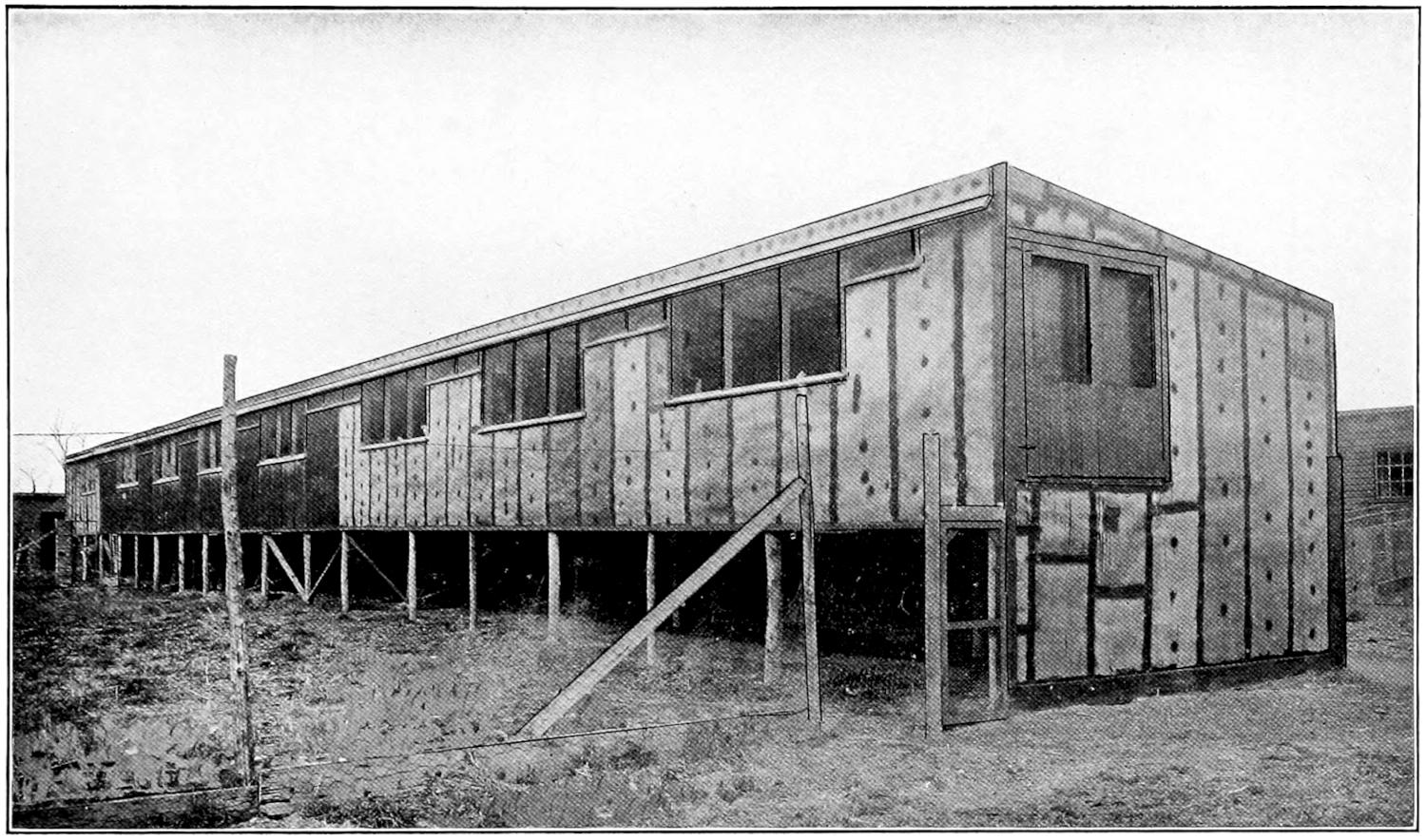
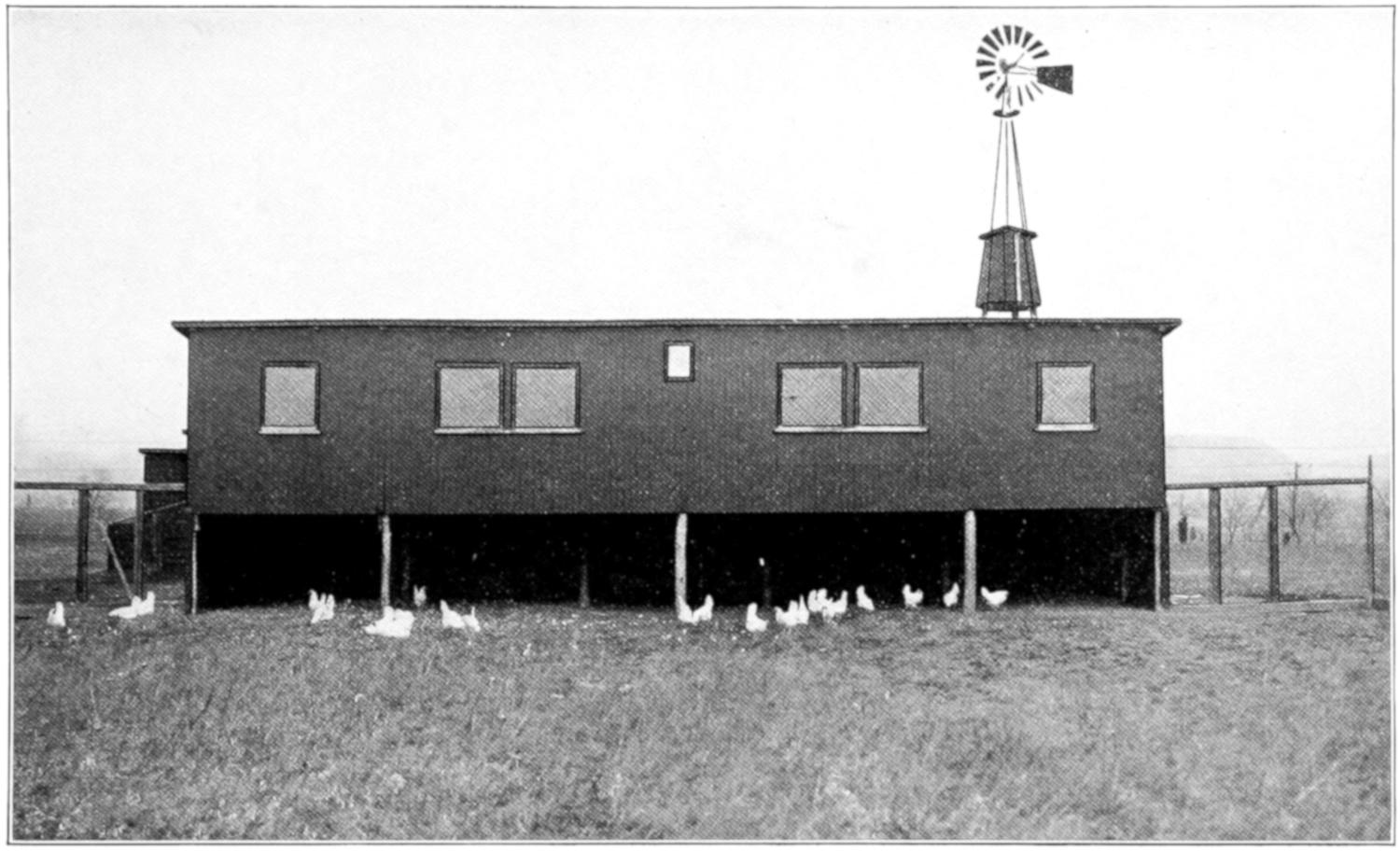
THREE STERILE LAYING HOUSES CONTAINING 4500 PULLETS, WITH A
FLOOR SPACE OF 7680 SQUARE FEET
As economy of space and labor is one of the main
factors in getting a commercial profit where poultry
is operated with, the large flock system appealed
most strongly to The Corning Egg Farm. Long
houses, under one roof, without divisions, had been
attempted by others, and the endeavor to discover the
reason for the failures, where this had been attempted,
was a very interesting study. It was found
that the main stumbling block in houses of this type
was draughts. To eliminate the draughts was the
problem we then undertook to solve. It was found
that if the houses were built in sections of twenty
feet, and the partitions which divided the house into
roosting closets were extended twelve inches beyond
the dropping boards, and were carried from the floor
to the roof, the air currents were broken up, and the
difficulty of draughts was overcome.
Houses, as we believed in constructing them, were
expensive, unless it was possible to carry a very
large number of layers successfully in them. In
studying the two hundred and twenty-five pullets as
they worked contentedly in the No. 1 Laying House,
which was but twelve feet wide, we became convinced
that it was perfectly possible in a house sixteen
feet wide by one hundred and sixty feet in
length to carry fifteen hundred layers. This, to be
sure, allowed the hen only a little over two square
feet of floor space, with the dropping boards included.
But, as we figured it, the hen also had the
entire house for floor space, and, while it is true that
fourteen hundred and ninety-nine sisters were her
near neighbors, they all enjoyed the same large space
to roam in. A house, then, of this size, accommodating
fifteen hundred layers, was not an expensive
house per bird, and, when you consider that the construction
was such that the up-keep was practically
nothing, it became not only not an expensive house,
but really a very cheap one.
The success of the fifteen hundred layers in one
house proved itself at once, and we never have seen
the slightest necessity for altering the plan of the
Laying House, as we first laid it out.
The large flock system works economies, then, in
housing, in the amount of labor necessary to care for
the birds, and in gathering the eggs. And there is
no doubt but that a house of considerably greater
length, with a flock ranging as high as two thousand
birds, could successfully be handled. In fact, on one
farm which has been in existence over twenty-five
years, a Corning Method Laying House of two hundred
feet in length has been in operation now for
twelve months, and the owners write us that it is the
most successful house on their entire farm, and that
as rapidly as possible they are rebuilding all their Laying
Houses, and making them of this type.
CHAPTER VII What is the Winter Layer?—The Properly Hatched and Reared Pullet — Must Feed Green Food
Many people have a very erroneous idea with regard
to getting Winter eggs. They seem to think
any hen should produce eggs in Winter. The hen
generally moults in the early Fall, and Nature has
provided this time of rest for her. The egg organs
cease to produce, for the hen finds she has all she can
do to supply the necessary material for her new dress,
and this is a very serious drain on her system. The
natural time, however, for a pullet to begin to lay
is when she reaches maturity, and, as the pullet
hatched in the early Spring, properly cared for, should
come into eggs in the early Fall, the pullet, then, is
the Winter layer.
It must still be remembered that the domesticated
fowl of to-day is a bird of evolution. In its wild
state a pullet did not begin to lay eggs in the Fall,
and neither did she lay a large number of eggs at
any time. With the coming of Spring, and an abundance
of succulent green food, and large quantities of
animal food in the shape of a great variety of worms
and insects, she laid and hatched her brood. Therefore,
to have successful Winter layers, it is necessary
to produce as nearly as possible the Spring-time conditions.
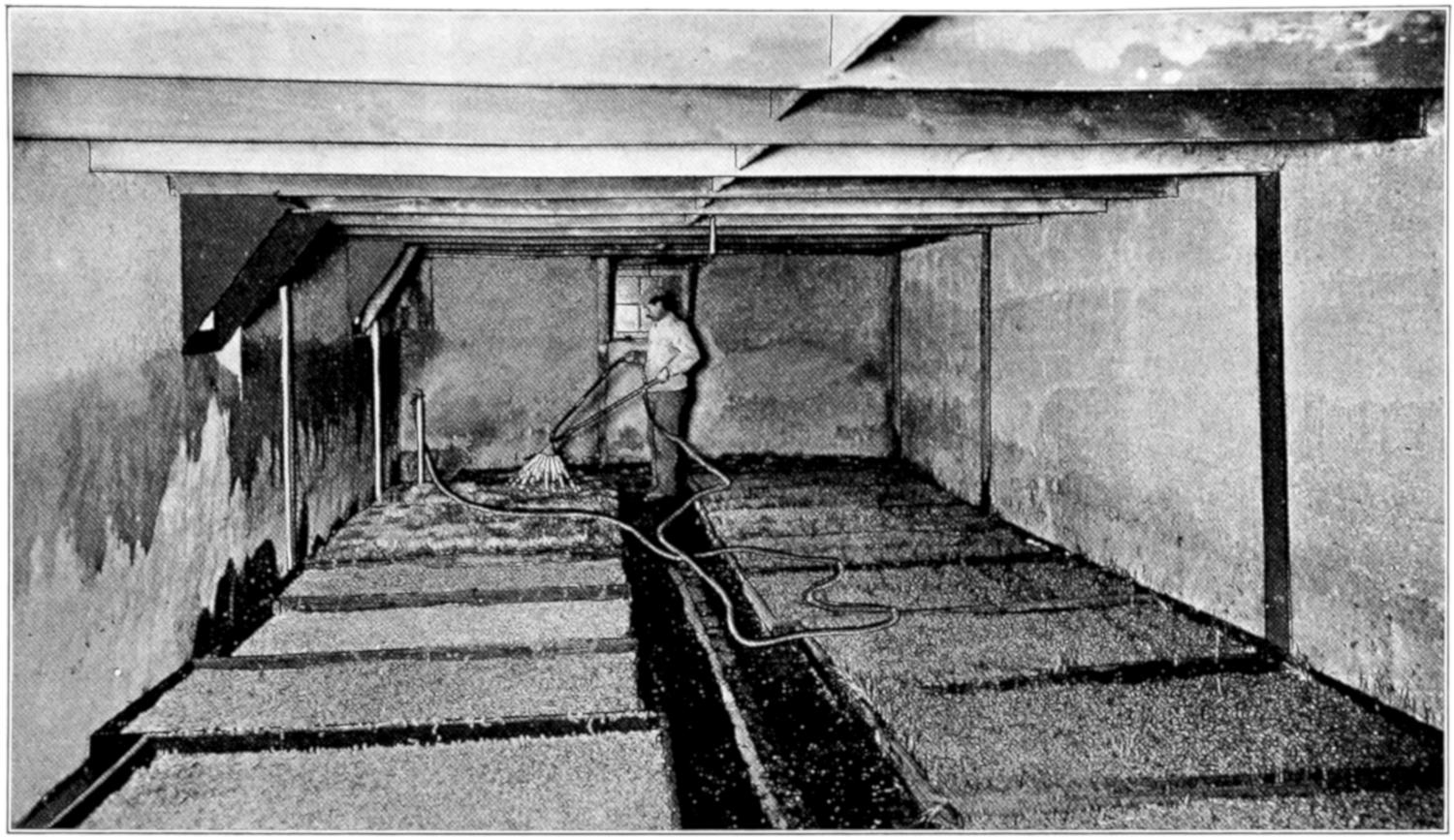
INTERIOR LAYING HOUSE NO. 1 IN 1910
On The Corning Egg Farm, when the pullets are
brought up from the Range into the Laying Houses,
the majority of them have already been laying on
the Range, and they are in fit condition to be brought
strongly into eggs. They are fed a large quantity of
succulent green food, in the form which, perhaps,
is more delicious to the hen than any other, that is,
Sprouted Oats. The quantity of animal food in their
mash is increased, and, with the vigorous digging for
the grain in the deep litter, the problem of Winter
eggs is solved, and from day to day, the number of
eggs coming from the pullet houses, increases very
rapidly.
On the other hand, the pullet which has completed
its first ten months of laying is well advanced in the
moult, and is becoming a yearling hen. Those qualifying
under the drastic examination for perfect type
are selected for the next year’s Breeders, and are removed
to the Breeding Houses, which have been thoroughly
disinfected and put in the most sanitary condition
to receive them. Those not reaching the
Corning Standard are marketed, as we sell culls only
to the butcher.
The aim in handling the yearling hen is not to get
eggs from her during the Winter, but to give her a
long rest, and to build her up, and put her in the
pink of condition for the coming breeding season, and
it is the aim at The Corning Egg Farm to have as
few eggs produced as possible from the breeding pens
until about the first of January, when an increased
amount of animal food is added to the daily ration for
the purpose of bringing the hens into eggs, and within
a few days there is a very rapid increase in the number
of eggs from these pens.
It must be remembered that the profit in Winter
eggs is made from pullets, and to be successful in this
line the Laying Houses must be well stocked with
them.
Yearling and two year old hens are the proper
breeding females. The Corning Egg Farm Method
is one of continuous rotation, as follows:
Incubator to Brooder House.
Brooder House to Range.
Range to Laying House. Those selected as coming
up to the Corning Standard go to the Breeder
House.
At the end of the second year the Breeders are all
sold for foundation stock.
This gives an opportunity to the public to procure
the very best Breeders at a most reasonable price.
CHAPTER VIII A Great Laying Strain—The Selection of Breeders to Produce It — Eighteen Months Old — Trap Nests a Failure — Type Reproduces Type
The first requisite is to breed from a mature animal,
from a real yearling hen. The term “yearling
hen” is a misnomer, for, when she is twelve months
of age she has not as a rule developed into a true
yearling hen. The female has five months of growth,
ten months of laying, and then she moults, which
process varies in duration from eight to ten weeks.
When she has completed the moult, her entire anatomy
has undergone a change, and she is a mature animal,
about eighteen months of age, a fit specimen to
reproduce her kind, and her off-spring will be strong
and vigorous youngsters.
The great mortality one reads of among chicks can
be traced more to breeding from immature females
than to any other cause.
The general method of selecting breeders for a
great many years has been by the use of “trap nests.”
Surely the use of a mechanical device is a poor method
to determine what hens are proper for breeding purposes,
and really the trap nest tells you nothing.
In every pen there are daily a number of eggs which
are not laid in the nest at all. To what particular
hen does the attendant credit eggs found in hollows
scooped out in corners under the dropping boards? It
is a peculiarity of “Biddy” that where she sees an egg
she almost always decides it is a good and proper
place for her to lay another. Thus, on some days,
where trap nests are in use, it may be necessary to
make a great number of guesses as to which hen did
not lay in the traps, but on the floor.
There is another reason why trap nests really tell
you nothing. Take two females of a pen whose numbers
are one and two. For the first few weeks No.
1 surpasses her sister No. 2 in the production of eggs.
To this pen, clover has been the green food fed, and
of this ingredient the farm has run short. The shipment
has been expected daily but did not arrive, and,
because of that failure, for four or five days no other
green food was provided. Then cabbage was resorted
to to take the place of the clover. The pen
having been without green food for a number of days
was fairly greedy for it, and good, crisp cabbage
suits the palate of many hens exactly, and they are
very apt to overdo the matter in eating it. A great
layer must be a large eater, and so hen No. 1 gorged
herself on the cabbage. Her digestive organs were
upset, and for a number of weeks she ceased laying,
while hen No. 2 continued to shell out a fair number
of eggs. The owner of these birds, when it came
time for the selection of the breeders, expressed his
great disappointment over hen No. 1. She had
started so well, and then had blown up entirely, and
so she is passed up, and hen No. 2 is accepted as a
breeder.
ONE OF THE BREEDING HOUSES JUST AFTER MATING 1910
Now, if the anatomy of these two birds had been
studied, it would have been found at once that hen
No. 1 was much better qualified to take a place in
the breeding pen than hen No. 2. The mere fact that
the trap nest record of any female shows a phenomenal
number of eggs laid in ten or twelve months does
not necessarily prove that she is a proper animal to
breed from. Post-mortem examinations show in
many cases that they are freaks, and, while they have
laid a great number of eggs, there was much to be
desired in regard to the eggs, as to their size, shape,
and color. As a matter of fact it would have been
a great mistake to have bred from such an individual.
It must be remembered that type produces type, and
the only proper way to select birds for the breeding
pen which will produce progeny capable of great egg
production is to thoroughly understand their anatomy.
It is impossible to produce a great performer
in any line unless the animal is of a build capable of
the performance. No one would expect to breed a
two-minute trotter from a Shetland Pony.
The hen which is capable of becoming an ideal layer
must have a deep keel, a long body, and, as she faces
out, she must have an appearance of broadness, and
must be the shape of a wedge back to the point where
the wings join the body.
The Large Flock System is carried on in the Breeding
Pen on The Corning Egg Farm, and it has been
most successful. It has been found that the small
pen does not produce the high fertility continuously
which the Large Flock System does. During the
season of 1910, for long periods, the fertility ran as
high as 96%, and as early as the first of March it
was above 90%. In the season of 1911, eggs incubated
in the early part of February, ran above
91%, and during the season there were times when
the fertility reached 97%.
The Breeding Pens are mated up two weeks before
eggs are to be used for incubation, and early hatched
cockerels are used to head these Breeding Pens. It
has been found that the mating of cockerels with
yearling hens produces a very decided predominance
of pullets, and the youngsters are strong and vigorous
from the start.
The proportion of mating is one to twelve, and the
records of The Corning Egg Farm show that by this
method of mating the number of cockerels produced,
through the years that the Farm has been in operation,
has been as low as one-quarter, and as high as
one-third.
The males to head the pens are selected with the
same care that the hens are. They are all perfect
birds, of large size, and conform as closely as possible
to the standard requirements, without interfering
with the paramount aim of producing a Great Layer.
CHAPTER IX What is the Best Time to Hatch? — An Interesting Experiment in Late Hatching
The question which is the title of this chapter is
asked over and over again. You see it propounded
to the editor of almost every poultry paper in the
country. And it is a difficult one to answer, because
the various needs of different people are so diversified.
April and May are doubtless the natural hatching
seasons for all varieties. Climatic conditions are
then kinder, the food which is necessary for the production
of many eggs, and eggs of the strong hatchable
kind, is supplied by Nature in great abundance,
and the young chick coming into life in these months
finds a great variety of natural food of the very best
kind for growth awaiting it. In Spring eggs run
strongly fertile, and in every way Nature seems to
lend herself to successful hatching, and the starting of
the young chick properly on its journey.
The man, however, who is operating an egg farm,
and has made contracts for the delivery of a continuous
supply of eggs to exacting customers, cannot
well afford to wait until these months to hatch in,
for it is necessary for him to have a large number of
pullets reaching maturity and beginning to lay,
before his last year’s pullets reach the moulting period
and stop egg production. To accomplish this it is
necessary to have in his brooder house, by not later
than the first week of March, a goodly number of
yellow babies. From that time on he must keep
them coming, so as to have a sufficient number a few
weeks apart to take the place of the yearling hens
going into the moult. In this way he will succeed in
keeping up a continuous flow of eggs.
It is true there is a danger in these early hatched
pullets. They may go into what is called the Winter
moult, after laying well into the month of December,
but they will not all moult, and before there is a
marked shrinkage the later hatches will be laying
strongly.
The moult which occurs with early hatched birds
does not last as long as the moult coming in the regular
season. The birds soon return to the nest, and
the house rapidly jumps back to a very large output
of eggs for the coming Spring months. Thus the
great increase in numbers helps to offset the decrease
in price, and to equalize the bank account.
It must be remembered, however, that Leghorns
hatched up to the 25th of June make good Winter
layers provided they are properly cared for, and given
the food and attention which produces a great growth,
and under such conditions one will find no difficulty
in getting them into laying eggs readily by the time
they are five months of age.
In the season of 1910 The Corning Egg Farm made
a very interesting experiment, in a large way, so far
as late hatching goes. We incubated two large
batches of eggs, the first being set so that the chicks
hatched from the 18th to the 26th of July; the second
batch completed incubation August 15th. The resulting
pullets from these two hatches were some fifty
odd over twelve hundred. We carried them on
Range until December 1st, and then placed them in
a Laying House by themselves. They had not begun
to lay on Range so far as we were able to discover,
although many of the pullets had the appearance of
eggs. Almost from the start, after they were placed
in the Colony Houses, we fed them, in addition to the
regular Range ration, a good supply of Sprouted Oats
each day. This was done for the reason that of
course the succulent green food had passed away, and
we consider it of vital importance that growing birds
be given the opportunity to gather a large supply of
succulent green food. The records show that within
three days after the pullets were placed in the Laying
House we began to gather from one to three eggs a
day. Before December was over the house was producing
10%; January saw 35% output of eggs, and
before February was very far advanced we were
doing better than 60%. There was a time in March
when the House was yielding a 75% output.
SPROUTED OATS CELLAR
These birds laid strongly all Summer, and we were
interested in noting when they would start to moult.
We had seen the statement made a number of times
that late hatched pullets were very late moulters. In
our experience, however, this did not prove to be true,
for this pen of birds moulted at just about the same
time, and in the same proportion, as the earlier hatches
did.
We had frequently seen it stated that birds
hatched in the very last week of August, or the first
week in September, would produce eggs at the same
time that the June hatched pullets would begin to
produce them. Our experience with June hatches,
and we have had four years of it, disproves this
statement absolutely. We find that the June hatched
pullet, properly cared for, comes in quite as rapidly
as those hatched in April and May.
We do not wish to go on record as advocates of
July and August hatching, but we simply wish to show
what could be accomplished if a Breeder met with
some misfortune, and was compelled to hatch late
or not at all.
CHAPTER X Succulent Green Food—Satisfactory Egg Production Impossible Without It — Sprouted Oats Best — How They Are Grown on the Farm — Timothy and Clover Cut Green
A goodly supply of green food is necessary to all
birds, the growing chicken as well as the yearling hen,
for it is a great aid to digestion, helping to properly
assimilate all foods as they are taken into the crop,
and passed through the great grinding mill of a
chicken.
There is no possible hope of a full egg supply from
any Laying House where a large quantity of green
food is not fed daily. It may be fed in many forms.
Clover or Alfalfa (and we are now speaking first of
the Winter supply of green food) may be procured in
a dry state, and by properly scalding it with hot water
it may be made to almost live again, so far as its
freshness and delightful odor go. In many cases the
preparation of Clover or Alfalfa spoils it. The
water should be quite at the boiling point, and it
should be poured over, preferably it should be put on
with a sprinkling can. The method at The Corning
Egg Farm is to place whichever we are using of the
Clover family in pails, a given number for each Laying
House, and as they stand in rows the hot water
is applied with a sprinkling can. The contents are
not allowed to steep, but as soon as the second wetting
of the long row of pails is reached they are placed on
the delivery wagon and at once taken to their destination.
When the contents are emptied from the
pails they will be steaming hot, too hot for the birds
to take at first, and you will find them standing in a
ring around the Clover, and from time to time testing
the heat. As soon as it is cool enough they will
devour it with great avidity.
Where Alfalfa is fed some flocks give considerable
difficulty at first as they do not seem to relish it, but
after a short time they seem to acquire the taste, and
become very fond of it. It contains a higher amount
of protein than the ordinary Clover which can be
bought in the market, but in purchasing Alfalfa products
one should be careful not to buy a large quantity
of dirt, but get what is known as “short cut,” and
have it carefully sifted.
By many people cabbages are considered a most excellent
green food for Winter use, but if they are
chopped up and fed to the layers considerable caution
should be used in the feeding. They are very apt
to upset the digestive organs of the birds, and that
means a very decided decrease in the number of eggs.
This is equally true of Mangle beets and other roots
which in many cases are used.
At The Corning Egg Farm we are strong believers
in Sprouted Oats as a green food, and we now maintain
a cement Cellar, with good drainage, which is
used for nothing else. The method of sprouting oats
is really very simple, and does not require the arduous
labor which one would imagine from numerous articles
written on the subject.
We have frames three by six feet in size, built of
ordinary boards, but not matched material. The
sides are about four inches high. These frames are
laid on the floor of the Cellar, and each frame is filled
with forty-eight quarts of oats spread evenly over the
bottom. We have a large sprinkler attached to the
hose, and the oats are thoroughly wet as they lie in
the trays, and this wetting is repeated every morning.
In a temperature from fifty to sixty degrees we find
that the oats have started to sprout about the third
day, and from this on the growth is very fast. Parts
of the oats in the frame will swell two or three inches
in places, above the surrounding mass of oats, and we
make it a practice to place the sprinkler directly on
top of this swelling, and it is found by so doing that
the frame in a short time will present a very even
growth.
If the Sprouted Oats are fed when the green tops
are from one and a half to two inches in length the
chemical quality of the oat is not lost, and we really
get a double ration when it is fed. If allowed to go
beyond this length, they are then just an ordinary
green food.
In many instances we have noticed writers advocating
soaking the oats overnight, and then, for the next
few days, to periodically stir them. And in other
cases writers advise, when they are placed in the
frames to turn the oats over. This is a serious mistake,
for anyone can readily see that the tender shoots,
which grow most rapidly after the third day, would
be broken off, and where this occurs the oats will rot.
Oats, of course, can be sprouted in sheds, or even
out-of-doors, if they are covered up so that the sun
will not dry them out too rapidly.
A frame should be made in such a manner that the
water sprayed over the oats will slowly drain away.
There are a number of different contrivances now
being placed on the market for sprouting oats, and we
have no doubt that, on small plants, some of them
would prove quite satisfactory. Where it is desired
to sprout oats in a small way, in the Cellar of one’s
house, a rack can be built with run-ways for the
trays to slide on, with a space of two inches between
the trays. By thoroughly sprinkling the top tray
the water will run down through from one tray to
another, and, as the growth progresses, the more
advanced ones can be moved up from the bottom of
the rack, as they require less water than those in a
less advanced stage.
The oats sprout more quickly if grown and
sprinkled in a fairly dark place, and it must be remembered
that too warm a temperature will rot the
mass after the growth has reached its fourth or fifth
day.
As one enters The Corning Egg Farm, on the left
of the drive, there is about an acre of Timothy and
Clover. This acre has been very heavily fertilized
and brought up to a high state of cultivation. The
Timothy and Clover grow so rapidly, and the growth
comes in such abundance almost before the snow is
off the ground, that cutting it as we do, so many rows
each morning, it is impossible to cross the entire plot
before that which was first cut has almost grown beyond
the succulent point. To make a change for the
hens we cut this in the early Spring, and pass it
through the Clover Cutter, reducing it to quarter inch
lengths, but we find that after the first few days of
feeding the hens show a decided preference for
Sprouted Oats, and now we make it a rule to feed
the Timothy and Clover one day and the Sprouted
Oats the next. This works very well, and the “Biddies”
seem to enjoy the different rations on alternate
days.
TWO WEEKS OLD CHICKS IN BROODER HOUSE RUNS
The Colony Range is so cared for and fertilized
that the growing pullet, for the Spring and Summer
months, finds an unlimited supply of succulent green
food at her door.
CHAPTER XI Anthracite Coal Ashes—A Substitute for Many More Expensive Necessities — Better Than Charcoal
The feather of a bird is composed almost entirely
of phosphorous, and phosphorous is a great aid to the
bird in digesting food. In fact, there are manufactured
“grits” offered on the market, which base their
efficiency on the amount of phosphorous they carry.
Anthracite, or hard, coal ashes, carry a considerable
quantity of phosphorous, and this is the reason
chickens in all stages of their existence are so fond
of them. Our attention was first called to this fact
by observing the large number of pullets on the
Colony Range, where some loads of ashes had been
used the previous season in mixing with the fertilizer
for the growing of potatoes. It was noticed that
these small heaps of ashes were very soon consumed,
and when they were replenished the pullets were never
absent from the piles. The experiment was then
made of placing a small heap at the extreme end
of the chick runs from the Brooder House, and to
our surprise we found one was unable to see the ashes
because of the moving mass of yellow which covered
them. It was necessary to replenish these heaps almost
daily. As ashes are perfectly sanitary we decided
to cover the entire chick run with them, which
we did, and every few days, through the brooding
season, a fresh coating is necessary, as the youngsters
consume so much of the surface constantly.
Next, we sifted ashes and filled the hoppers in the
Laying Houses with them. The layers ate them in
the same way in which they consumed wheat. For
an experiment we stopped feeding charcoal entirely,
and found that the ashes supplied everything that the
charcoal did, with none of the dangers, for there
seems to be no doubt that where hens consume large
quantities of charcoal they are very susceptible to
colds.
Large heaps of Anthracite ashes are now kept
within a short distance of every Colony House on the
Range, and the use of these ashes has very materially
reduced the quantity of Grit and Shell consumed,
thus representing a considerable economy.
Until the use of Anthracite ashes came in on the
Range we placed Grit in receptacles near each Colony
House, and the amount consumed was really remarkable.
As soon as the ashes were placed there the Grit
was deserted, and there practically was no consumption
of it at all, and after a few weeks we ceased to
supply it and have not done so now for years.
Since the use of the sifted ashes in the Laying
Houses a soft shelled egg is almost a curiosity on the
Farm.
In the Brooder House runs, beside supplying the
phosphorus to the youngsters for their digestion, and
the making of their feathers, it does away with the
fear of contamination of soil, of which so much is now
written, and it presents a surface which dries almost
before the rain storm is over, and there is no possibility
of the youngsters being let out into a muddy run.
CHAPTER XII Eggs for Breeding Should be Laid by a Real Yearling Hen — 90,000 Orders for 40,000 Eggs
Having heard many stories told by Breeders who
were sellers of eggs for hatching, and also the tales
by purchasers, we were somewhat loath to embark
in this branch of the Egg Trade. The Breeders told
stories of letters which would “raise your hair” from
people who had purchased from them and met with
poor success, and of course, from their point of view,
the only person at fault was the man who sold the
eggs.
For the season of 1910 our breeding pen had
reached a size which allowed us, for the first time,
to offer eggs to the public, and we decided to try it
out. To everyone we stated that we would not guarantee
fertility, but, as they were getting eggs from
exactly the same pens which were supplying our own
incubators, we were able, at all times, to tell what the
customer was receiving. But we went further, and
agreed that anyone claiming a low fertility, if he
would send us the eggs which he claimed to be clear,
and prepay the expressage, we would, if his claim was
substantiated, send him another lot of eggs and pay
the expressage both ways.
During the season of 1910 we sold something over
40,000 eggs and returned money for about 50,000 beyond
our ability to supply. The result was that many
people who were disappointed booked orders at very
early dates in 1910 for hatching eggs for the season
of 1911.
Our experience was quite the reverse from the
stories we had been told. Of course, in doing a large
business, it is not possible to satisfy everyone, and
then, unfortunately, there are some people who are
extremely fond of attempting to get something for
nothing, and you receive statements regarding orders
which have been filled, which when investigated,
prove to be somewhat different from what you were
at first led to believe.
The fertility of our eggs was such that it was almost
impossible for anyone to make a complaint, and the
hatching season of 1910, both at the Farm and for our
customers, was a most successful one.
For the season of 1911 we were able to increase
our breeding facilities considerably over 1910, but
we were even more unable to meet the demands upon
us for hatching eggs, than in the previous season.
The results of this year were quite as satisfactory as
for the previous, and for the season of 1912 the Farm
will be in a position to fill more orders than ever
before, as we have been able to make a still greater
increase on the breeding side.
YEARLING HENS IN BREEDER HOUSE BEFORE MATING READY FOR 1912
Orders for hatching eggs are booked by such a system
that people receive them when we agree to deliver
the goods, and the illustration herewith plainly shows
the plan.
$ ........SUNNY SLOPE FARMNo.
THE GREAT CORNING EGG FARM BREEDERS OF THE STRAIN OF S. C. WHITE LEGHORNS WHICH CANNOT BE SURPASSED
BOUND BROOK, N. J. .................... 191
Received of.............................................
....................................................Dollars
FOR ........... S. C. W. LEGHORN EGGS FOR HATCHING. THESE
EGGS ARE TO BE SHIPPED BY EXPRESS ON OR ABOUT THE
.................. DAY OF .................... 191..
THE CORNING EGG FARM BY ....................
CHAPTER XIII Policing the Farm—With Bloodhounds, Searchlights and Rifles — Shoot First—Investigate Afterwards — Socrates, the Great Bloodhound
In the Fall of each year, from almost every part
of the Country, come reports of what seems to be organized
thieving in the poultry line. Both large and
small farms are generally sufferers. For a number of
years people in the vicinity of the The Corning Egg
Farm have met with losses, and in the year 1910
an organized gang was unearthed, which had a camp
on the adjacent hills, and made nightly raids, then
shipped the birds by crossing the Watchung Mountains
and reaching railroad communication on the
other side, sending their stolen feathered plunder into
the New York Market.
The Corning Egg Farm takes a great many precautions
in regard to efficient policing, and has earned
a reputation for straight shooting, not with a gun
carrying bird shot, but with rifles. It is thoroughly
understood for miles around that we shoot first and
investigate afterwards. The farm carries some of
the finest Blood Hounds in the Country, all trained
man-trailers, and it is thoroughly understood that if
the rifle fails to stop a thief, and it becomes desirable
to see him, the hounds will take up the trail the next
day, and no matter where he may have gone there will
be no difficulty in reaching him. Should he take train
the dogs will tell the fact, and then it will be only
necessary to try each station until the one is reached
where he left the train. Should he leave by means of
a horse, when he either gets into the wagon, or mounts
the horse, the hound will take the scent, and carry it
until he again takes to the ground.
“SOCRATES,” THE GREAT BLOODHOUND WHICH HEADS THE CORNING
KENNELS
The head of the kennel, “Socrates,” No. 127320,
(his registered name is “Ottawa’s Major”) is a
direct descendant from Rosemary and Delhi, the two
great dogs of Mr. Burgh, of England, who for years
has been the leading breeder of man-trailing Blood
Hounds. Altogether the Farm to-day is carrying
seventeen dogs. Fifteen of them are pure and grade
Blood Hounds; two are Fox Terriers. The Fox
Terriers are kept for a breed of thieves other than
the two-legged kind, and rats have no place on which
to rest the soles of their feet.
The dogs, every night, are distributed at different
points of the Farm, and one of the great qualities of
the Blood Hound is its marvelous nose, which works
just as well in the dark as in the light, and as watch
dogs, because of this peculiarity, they are most efficient,
giving notice of anyone approaching the Farm
long before he could possibly be detected by a dog
of another breed. When they give tongue there is
no doubt in the mind of anyone but that he is approaching
a very dangerous zone.
On the Foreman’s Apartments there is a Tower
which connects with his room, the windows of which
command a view of every part of the Farm. In this
Tower there is a searchlight, and at any time of the
night, if the dogs give warning of a possible disturber,
any part of the Farm can be instantly flooded
with light. Back of the search light is the high power
rifle.
Throughout the Range there is a trolley system
which is used, the overhead wire being so divided
that each dog has a run of one hundred feet, and the
leash attached to the sliding pulley gives him twenty
feet on either side of the wire. This makes a complete
circuit of the Colony Range, so that it is impossible
for anyone to cross in among the Colony
Houses without being reached by one of the dogs.
We have been breeding some grade hounds, which
make a rather more ferocious animal than the pure
breed, so far as natural disposition goes. The nose
quality, however, is all retained, thus enabling these
grades to become perfect trailers.
SOCRATES II AND DIOGENES
Sons of the Great Socrates
BUSTER, AMERICA’S GREATEST RATTER
It is well on any egg farm to establish a reputation
for being in a position to always place a marauder
behind the bars, and nothing so insures protection as
the knowledge that on the Farm there are carried
dogs which are capable of trailing a trespasser wherever
he may go.
CHAPTER XIV The Necessity for Pure Water—An Egg is Chemically 80% Water — Automatic Fountains Essential — Hot Water in Cold Weather — Hens Drink More in Afternoon
Eighty per cent. of an egg is water. If a sanitary
egg is to be produced it is most essential that pure
water should be accessible to the hens at all times,
and not only should the water be pure, but the drinking
fountains must be of such a nature that they can
readily be kept in a pure state, and that the cups,
into which the water flows from the main fountain,
cannot be fouled by the birds.
On The Corning Egg Farm the supply of water is
placed before the birds in automatic fountains, which
work on air pressure, and contain five gallons each.
The water feeds down through a pipe into the cups,
the feeding pipe shutting off by the turning of a
small cock, thus permitting the removal of the cup,
so that it can be thoroughly cleansed each day at the
time of filling the fountain, by the use of a small
brush, or swab. Once a week a quarter of a teaspoonful
of Potassium Permanganate is put into each
fountain, just enough to give the water a slight
coloring. It is a mistake to have the color so deep
that it verges on the purple. This purifies the fountain
and acts as a preventive of colds.
CORNING AUTOMATIC DRINKING FOUNTAIN
It is a very good practice also to occasionally put
a few drops of Kerosene oil into the bottom of the
cup and then allow the water to run in. The Kerosene
will run over the entire surface of the cup and
then rise to the top of the water. As the birds dip
their bills to drink a small amount of the Kerosene
is taken up on the bill, and, when the head is thrown
back to swallow it runs into the nostrils.
The drinking fountains are occasionally thoroughly
cleansed with a strong solution of Washing Soda.
This, of course, is carefully washed out of the fountains
before they are filled up and placed in the Laying
Houses.
In the Breeding and Laying Houses during the
cold months, hot water is placed in the fountains.
On The Corning Egg Farm a large boiler, with a hot
water attachment, is maintained for this purpose, and
water is taken to the Laying Houses at as close to
boiling point as it is possible to get it there.
At first the watering was done early in the morning,
but now the watering hour has been changed to the
first hour of the afternoon. The reason for this is
because, by sitting in the Laying Houses and watching
the birds, it was discovered that from one o’clock
to roosting time more water is consumed than at any
other hours of the day. At first it was thought that
Biddy, on leaving her roost, immediately sought the
drinking fountain, but we find the first act, generally
speaking, is to endeavor to fill the crop with grain,
and she vigorously starts to work in the litter.
By placing the hot water in the fountains during
the hour after noon, we find that with the closing of
the house for the night, the water retains its temperature
to a remarkable degree, and it is not at all chilling
to the birds in the morning of ordinary cold weather.
If the night has been an extremely cold one we make
it a practice of going through the Houses with boiling
water, emptying out what may be in the cups, and
refilling them from the hot water can, thus giving
any bird which may desire a large quantity, warm
water to drink at this time in the morning.
The supply of water for all the stock on The Corning
Egg Farm comes from the deep well, already described
in the chapter on “Building the Farm.”
CHAPTER XV Hard Coal Ashes, Oyster Shell, and Grit
As stated in the chapter on “Anthracite Coal
Ashes,” ashes have entirely taken the place of charcoal
on The Corning Egg Farm. They are fed in
hoppers with the Grit and Oyster Shell. These hoppers
are divided into three compartments, and are
automatic in feeding down the ingredients, in small
quantities at a time, for Biddy’s use.
It is very essential to supply the hen with the
proper grinding material for operation in her mill,
for, from the crop, what she takes into her system in
the way of grain, etc., is passed into the gizzard, where
she places a certain amount of hard, sharp stones,
to use as mill stones, and this great muscular organ
then puts the food into the proper condition for her
to assimilate it.
The Grit placed in the hoppers is hard and sharp.
Ordinary pebbles are of no use to Biddy in preparing
her food for digestion. There are a great many different
grits on the market sold through Poultry Supply
Houses, and by the manufacturers themselves.
Where it is possible to procure Grit having the essentials
as already described, and carrying a good percentage
of lime, it adds very materially to the desirability
of the Grit.
Oyster Shell occupies the third compartment of the
hoppers, this supplying the hen with the lime necessary
for her own system and for the shell of the
egg. It should be seen to that the Oyster Shell is
free from dust, and rather coarse as to its size. This
represents an economy because there is so little waste
by the fowls when the Shell is fed to them in this
condition. The lack of lime in the system of the hen
is one of the reasons for soft shelled eggs, and the
lack of lime in the ingredients fed to a young chick
means soft bones, which shows most decidedly in leg
weaknesses.
Where the hen is supplied with the full quantity of
the ingredients which give her lime, she turns out
eggs which you might term “well shelled” and this
adds materially to the appearance of the egg, and, consequently,
helps to give it a better grading.
CHAPTER XVI Beef Scrap and Green Bone Substitutes for Nature’s Animal Food — Green Cut Bone Nearest Nature
Undoubtedly the ideal animal food for the hen,
if it were possible to procure it in sufficient quantities
the year round, would be angle worms, grasshoppers,
and other members of the insect family, which the
early Spring supplies in such liberal quantities. It
must be remembered that in these different worms
and insects there is a large amount of phosphorous,
which adds very greatly to the ability of the hen to
successfully digest the large quantity of food which
is necessary, if she is to produce a large quantity of
eggs.
The thing, perhaps, nearest in an artificial way to
Nature’s animal food, is green cut bone, and it is
certainly relished by the hens, and a great assistance
in producing Winter eggs. The exercise of great care,
however, in the selection of bone is very necessary,
for, if salt bone, or tainted bone, is cut up and fed
to the fowls, it will prove most detrimental, and in
many instances will mean the loss of the hen.
For those who do not find it possible to set up the
necessary bone-cutting machinery there are numerous
brands of “Beef Scrap” on the market. This is
made from green bone and meat which is
then cooked, ground and pressed, so as to preserve
it fresh and sweet. This also is a most successful
way to supply the hens with the necessary amount
of animal food. It is readily mixed into the
mash, just as the green cut bone is, and, where the
proper mechanical mixer is used, it is possible
to thoroughly coat the entire meal mixture with the
oily condition coming from the beef scrap, and
until one has seen beef scrap mixed into the mash
by such a mixer he has no idea how successful the
operation is in preparing a high grade mash. The
beef scrap and also the fresh cut bone carry a high
percentage of phosphorus, and in fact have about
all the ingredients found in animal food secured by
the hen while running on Range.
There are now appearing numerous advertisements
of a prepared fish, to take the place of other animal
foods, but The Corning Egg Farm is unable to give
any opinion as to the efficiency of this preparation.
It has been the rule at the Farm, when we have
thoroughly tested and found satisfactory any article
of food, not to experiment with the various substitutes
which at all times are so widely advertised.
CHAPTER XVII A Time for Everything—Everything on Time — Fixed Feeding Hours — Four Collections of Eggs Daily — Mash Fed in Afternoon
In any business, or occupation, that one attempts to
carry on successfully there must be system. Nature
teaches system, and the hen, as a part of Nature, is
a very regular performer. She does everything on
time, and at a given time, and if her routine is broken
in upon she is a very much upset individual. The
owner who rudely disturbs her routine suffers in the
loss of eggs.
The schedule of work among the fowls on The
Corning Egg Farm is without variation each day.
In Summer the houses are always open and need no
attention in the morning, but in Winter the drops are
raised in ordinarily cold weather, as soon as it is light
enough to enable the hens to work in the litter for
grain. On very cold mornings the raising of the
drops is deferred until the Sun is up, and when this is
done the drinking cups in the fountains are filled with
hot water.
As close to eight o’clock as possible green food is
fed to all the hens, and, if the ground is in a reasonably
dry condition, the green food for the cockerels is
scattered outside their pen, and the entire flock is
driven out of the House, where they are soon busy
consuming the green food and whatever grain may
have been left on the ground from their outdoor feeding
of the previous day.
For a number of years it was the method at The
Corning Egg Farm, between the hours of nine and
ten o’clock, to make a gathering of eggs. This has
now been abandoned for the reason that so many birds
were disturbed on the nests during such an early visit
to the House for gathering, and the first gathering now
on the Farm is made at eleven-thirty.
In the study of feeding, extending over a term of
years, it has been found that a considerable economy
in time can be made, with exactly as advantageous
results from the layers, by the following routine.
Fresh water is placed in all the laying and breeding
pens at one o’clock, P.M., and it is boiling water
during the Winter months. Directly following the
watering the mash is placed in the troughs, and the
grain ration is scattered through the litter, both in
Summer and Winter. It has been found that the
hens work just as hard, and continue to do so, as
they did when the mash and grain fed were given at
hours which practically followed the Sun, that is,
earlier in Winter, and later in Summer. In past
years, the oats were fed to the flocks as a separate
ration, at eleven-thirty o’clock. This we have discontinued.
The grain ration is made up of cracked
corn, wheat and oats, in varying proportions according
to the season of the year.
PART OF THE OLD INCUBATOR CELLAR
The New Building with the 15,600 Egg Machines was not Sufficiently Completed for
Interior Photograph
At three o’clock another collection of eggs is made,
and at five o’clock eggs are again collected, and at
this last collection all the corners of the litter under the
dropping boards are carefully searched for eggs laid
by the wayward Biddy, who prefers her own scooped
out corner to a good nest.
The Houses are closed for the night, according to
the condition of the weather, and at this time still
another collection of eggs is made. At seven-thirty
the Houses are again visited, and all birds not roosting
as they should be are removed from the nest
boxes or windows and placed upon the perches.
During the Summer months, when the birds are on
Range, they are fed their mash and grain ration between
the hours of two and three in the afternoon.
Throughout the year nothing whatever is allowed
to interfere with the Schedule, and, if one would succeed
with poultry a rigid adherence to regularity is
most necessary.
CHAPTER XVIII Incubation on the Corning Egg Farm — Hen Reigns Supreme — Livable Chicks—Not Numbers — Uniform Temperature Most Important — Ventilation and Moisture Next — Hot Water Machines Best — Corning Incubator Cellar Unequaled — Eggs Turned from Third to Eighteenth Day — 103 Degrees Maintained — Cool But Never Cold — Cover Glass Doors — All Good Chicks Hatch in 20 Days — Set Incubators Toward Evening — Tested Only on Eighteenth Day — Moisture — Chicks Handled Only Once — Baby Chick Business Cruel
We find, in studying Artificial Incubation, it has
been in vogue, one might almost say, for centuries.
The Chinese practiced artificial incubation by the use
of hot sand and ovens, for it must be remembered
that the Pekin Duck, which comes from China, is a
non-setter. Therefore, ages ago, the Chinese were
driven to the necessity of artificial incubation in order
to maintain their large flocks of ducks. In studying
the art one cannot help wondering that the progress
in its development has been so slow, and the advance,
year by year, has been almost nothing.
The Owners of The Corning Egg Farm were somewhat
taken aback one day by the statement of a young
man that he must evolve a theory of incubation for
himself, and carefully carry it out. In incubation
one does not want theory, but the knowledge which
comes from long practice and the most scientific study
of the art. After all these years, the hen, as a
hatcher, reigns supreme. There is nothing which approximates
her ability to turn out strong, vigorous
chicks, and yet it is unfortunately necessary to abandon
the hen when large numbers of chicks are to be
produced. So Man has struggled in his vain efforts to
reach something which will, at least in a measure, become
a competitor of the hen.
In 1911, the readers of advertisements in the Poultry
Magazines were confronted with the statement
that a certain incubator was the only competitor the
hen had. But, it is sad to state, there must have been
some mistake, for this incubator could not live up to
the claim in the advertisement, nor, so far as it is
known, is there any incubator which approximates
that claim. Some marvelous hatches are written of,
but the question is not one of marvelous hatches, so
far as it means the number of chicks which manage
to come through the strenuous act of exclusion, but
the real question of incubation is as to the number
of strong chicks, capable of living and growing into an
animal which will become a money maker for the man
who hatched and raised it.
Many people stand in great awe of an incubator, no
matter what its make, and have the feeling that to
hatch a fair number of chicks in a machine is almost
a miracle. The fact is, however, if the purchaser of
any incubator will realize that the manufacturer knows
more about the proper way to run it than Tom Jones,
or Bill Smith, who may be neighbors, and will follow
the instructions as given by the manufacturer,
with good fertile eggs, it will be almost a miracle if
he does not get at least a fair hatch.
There are so many different makes of machines it
is quite impossible to write a chapter on incubation
which will cover the needs of all phases of it. The
above advice, however, if followed, will certainly be
more apt to bring about successful hatches than anything
else that can be done.
On The Corning Egg Farm the problem of incubation
has been most carefully studied from the inception
of the Farm.
A thermostat and regulator which will absolutely
insure an even temperature in the egg chamber, and
a thermostat so sensitive, with an adjustment of the
regulator to such a nicety, that it will insure the maintaining
of an equal temperature in the egg chamber
even if there is a variation of atmosphere in the Cellar
of from 10 to 20 degrees, is perhaps, the first great
essential in incubation.
Ventilation and the retention of moisture undoubtedly
come next. The growing embryo must be fed
a large quantity of oxygen, and there must be a sufficient
amount of moisture to prevent a too rapid drying
out of the egg, under the temperature which, if a
chick is to result, must be maintained. So far as
moisture goes, it is not a question of moisture at the
time of hatching. If the proper amount of moisture
has been always present during the period of incubation
there will be no difficulty at the time of exclusion.
Where a large amount of incubation is going on,
and the ordinary style of lamp heated machine is being
used, oxygen is of necessity constantly absorbed
from the atmosphere, by the fire. While it is quite
possible, nay, even probable, that any of the mammoth
machines of the day are far from what might
be desired, still, they do solve the difficulty of a great
number of individual fires sucking the vital oxygen.
Of the mammoth machines now on the market there
are two which produce better chicks than any of the
others, so far as we can see. There are features in
the one which we finally decided upon, which, from
our point of view, made it more desirable than the
other. We feel, however, that in the construction
of these machines there is much to be desired, and
we suggest to any would-be purchasers to make most
thorough and complete stipulations with any company
from whom they purchase, as to the workmanship and
finish of the machine, and also the proper fitting of
one part to another, especially the proper working
of doors and egg trays through all the different periods
of incubation. All trays should be absolutely interchangeable,
and there should be a sufficient amount of
play in the runs, so that, with the swelling of the
wood from the moisture, there would never be a possibility
of their binding. While the doors should
shut air-tight, their dove-tailed joints should so fit as
to allow their coming away without a particle of stick,
or jar, to the machine.
When it had been fully determined by The Corning
Egg Farm to put in Hot Water Heated Incubators,
the capacity desired being about sixteen thousand eggs,
it was concluded to divide this capacity between two
machines.
It was also decided to build an entirely new Incubator
Cellar, and the dimensions were 146 feet long
by 22 feet wide, 7 feet from the concrete floor to the
bottom of the floor joists, these latter being 12 inches
in width, making a full height to the floor of the
Brooder House overhead, 8 feet. The floor joists on
the under side of the floor of the Brooder House are
planed and painted white. The Cellar is constructed
of concrete blocks, made rock faced, and showing in
the interior of the Cellar. The two incubators are
also painted white enamel.
So as to eliminate any question of the consumption
of oxygen by fire in the Cellar the heaters are placed
with a concrete block partition between them and the
incubators, the hot water pipes passing through this
concrete wall, and connecting with the incubators.
In this separate part of the Cellar, where the heaters
for the incubators stand, are also the two heaters for
the Brooding System, upstairs, and also the large
auxiliary heater which cares for the hot-water system
which allows the Brooder House to be carried at an
even temperature, day and night.
In the heater part of the Cellar there are three
large windows, and an entrance is made into this
Cellar through a vestibule which is ten by nine feet.
The doors leading into this are large, double, glass
doors, and from the landing just inside there is a
staircase leading to the Brooder House, above. Entrance
is made into the Heater Cellar through another
pair of glass doors, five feet wide. The Incubator
Cellar itself is reached directly in the center by a four
foot door, also of glass. The two side alleys between
the incubators and the outer walls, are also
reached from the Heater Cellar by narrow, glass doors.
It is believed this Cellar, with its plan of equipment,
is unequaled, anywhere, as to the convenience of its
general arrangement. Ample light and ventilation
are supplied in the Incubation Cellar proper, by twelve
windows on the north and east sides, the south wall
being blank, as the chick runs from the Brooder
House go out on that side.
It is impossible, owing to the necessity of the narrow
alleys between the incubators and the walls, to use
the V-shaped window drops, which have been so successful
on the Farm for the prevention of draughts.
The windows work on sash-weights, both top and bottom.
A Spring Roller Shade device, covered with
sheer muslin, with a screw eye on the window sill, is
so placed that the cord may be passed through it, holding
the shade rigid. Thus, when the prevailing wind
creates a draught, the window may be opened to any
desired width, and the draught prevented by the shade.
In operating the incubators they are run empty for
a sufficient number of hours to adjust the regulator,
and to know they will maintain a temperature of 103
degrees exactly.
After eggs are placed in the incubators the process
of turning does not begin until the third day, after
which they are turned regularly twice a day until the
completion of the 18th day, when they are left undisturbed.
The temperature at which the incubators are carried
for the first week is a matter of wide difference
of opinion. In many cases 102 degrees is the maximum
temperature for the first seven days, after which
103 is maintained as closely as possible during the
remaining period of incubation. In operating the incubators
on The Corning Egg Farm it has been found
(and this is particularly true of early hatches) that,
if the eggs are not brought up to 103 degrees for the
first week, a retarded hatch is the result. A hatch
which drags over its time usually means a lot of weaklings.
It is our practice, therefore, to bring the eggs
up to 103 degrees as soon as possible after setting
them, and to continue this temperature as nearly as
possible.
Cooling the eggs is of course practiced on The Corning
Egg Farm. For the first week, five or six minutes
will usually be found a sufficient time, but as the
embryo grows the length of time should be increased.
It is quite impossible to give any exact length of
period for cooling, and it must be determined by the
feel of the egg to the hand. They should never reach
a point where they can be termed perfectly cold, but
should feel slightly warm as the palm of the hand is
laid upon them. In cooling, the egg tray should be
placed on top of an incubator or table so that the bottom
is completely protected, otherwise the eggs will
cool too rapidly. In other words they should lie as
they do in the nest of the hen. According to atmospheric
conditions, cooling, during the latter part of incubation,
will sometimes reach from forty to sixty
minutes. It is a practice with us to give the eggs a
very long period of cooling on the 18th day, before
they are placed in the incubator for the last time.
After closing the incubator on the 18th day it is not
opened again until the chicks are removed on the 22d
day.
To open the door and reach in to assist some chick
out of difficulty means allowing the moisture to escape,
and, while the one individual which was seen to
be in trouble might be rescued, by the lack of moisture
in the egg chamber, many others would be held fast
in the shell.
When the chicks begin to hatch we make it a practice
to throw a cloth over the glass door, so as to prevent
the youngsters crowding toward the light, and
piling up on top of each other, either in the egg trays
or in the nurseries below.
Many people have an erroneous idea in regard to
the time required for hatching. If the temperature
has been carried at a correct point during the entire
period the eggs will begin to pip on the afternoon of
the 19th day, and the morning of the 20th day should
find the youngsters coming out of the shells like
Pop Corn over a hot fire if the eggs have been of
proper strength, but on the morning of the 21st day
the hatch should be completed. Generally speaking,
chicks which hatch later than the 21st day are weak,
and while they may come along for a time, when
placed in the Brooder House they generally snuff out,
and add to the list of mortalities.
It is our belief that there is a best time in the twenty-four
hours in which to set an incubator. As a rule, it
requires about eight hours after the eggs have been
placed in the machine for it to come up to temperature.
Therefore, if the eggs go into the chamber late
in the afternoon, and anything goes wrong with the
regulator, the eggs cannot have been in a detrimental
temperature for any great length of time before the
operator is making his first morning round. We observe
the temperature in the egg chamber three times
a day as a rule, the first thing in the morning before
the eggs are turned; at noon, or a sufficient number of
hours after turning and cooling the eggs, allowing a
sufficient time to elapse for coming up to temperature;
and again late in the afternoon, before the final turning
for the day. At these hours of observation any
slight alteration of regulator, to meet changes noted
in the temperature, is, of course made.
The Hot Water, Coal-Heated, Incubator is a great
step in advance, and these machines are now built in
sizes from twelve hundred eggs up.
With the old style lamp machine, people who were
running a small plant did not need an Incubator Cellar,
but the Insurance Companies would not allow the
placing of an incubator in the cellar of a house without
a special permit, and in many cases would not issue
such a permit at all. The hot water machine will, of
course, go into any cellar without vitiating the insurance,
and, what is more, the machine itself is insurable,
just as is any hot water plant in a house.
Until this season, on The Corning Egg Farm, we
had made it a rule to test the eggs on the 14th day.
Many operators believe in testing the eggs from the
5th to the 7th day, again on the 14th, with the final
test on the 18th day. In operating one of the old
style machines, with the large trays, it was expedient
to remove the clear eggs and those with dead germs
to facilitate the turning of the eggs in the trays, but
all this arduous labor is done away with in the hot
water machine. The trays hold seventy-five eggs,
and are so constructed that one tray fits on top of another,
and then the trays are simply reversed and
the turning is accomplished. This makes it necessary
to have a full tray to prevent the eggs rolling and
breaking when they are turned in the manner described.
Testing the eggs is, therefore, deferred until
the 18th day.
When one sees the tremendous saving of time
which the coal-heated, hot water machine accomplishes
for the operator, it produces a feeling bordering on
mirth in the man who has labored with the old style
machine and big tray, when thousands of eggs were
turned by hand twice a day. Ten thousand eggs in
one of the modern machines are handled with less effort
and in less time than three thousand could possibly
be cared for in one of the other styles of incubator.
On The Corning Egg Farm moisture is provided
in the Cellar by thoroughly wetting the floor with a
hose twice a day, the floor sloping gently to a drain
in one corner. Large earthen-ware vessels, of about
three inches in depth and eighteen inches in diameter,
are stood at different points throughout the Cellar,
and are constantly kept filled with fresh water. This
is done, not so much for the purpose of increasing
the humidity of the air, as it is to take up the impurities.
As an illustration, if you stand vessels filled
with water in a freshly painted room, the odor of
paint is almost entirely absorbed by the water.
As even a temperature as possible is carried in the
Cellar, and at all times there is a constant flow of
fresh air, but it is so controlled that it does not produce
a draught. It should be remembered that while
a moist cellar is desirable, unless it is well ventilated,
it is utterly unfit for the purpose of incubation.
The chicks, at the end of the 22d day, are counted
out of the incubator into large baskets lined with Canton
Flannel, and in these they are carried upstairs to
the Brooder House.
The last act of the chicken, before pipping the shell,
is to absorb into its system the yolk of the egg, which
supplies it with a sufficient amount of nourishment to
last at least forty-eight hours. This supply of nourishment
is what really makes possible the tremendous
business carried on in “baby chicks.” But, as The
Corning Egg Farm views it, the Society for Prevention
of Cruelty to Animals should step in and stop
this business. After exclusion is accomplished the
chick is thoroughly exhausted, and for a number of
hours, if left to its own devices, it lies in a deep sleep.
Consider then the torture that this small animal is
put through when it is taken out of the warm egg
chamber, or nursery, as soon as it is dry enough,
packed like a sardine in a box, and then hustled to an
express office, placed on a train, and, by the swaying
of the train, kept in constant motion.
The sellers of day old chicks in many cases guarantee
the arrival of the small “puff ball” alive. Unless
the distance is extreme this is not such a difficult
feat. They are alive on arrival, and perhaps continue
to live in apparently fair strength for some days,
but somewhere between the 7th and 10th days the
mortality usually runs into such numbers that the purchaser
finds the remaining number of youngsters
has cost him about a dollar apiece. As the season advances
many more of them drop off, one by one, from
causes which, to the unsophisticated, are unknown.
A short time ago a gentleman who has been engaged
in the Baby Chick business for a number of
years was making a call at The Corning Egg Farm,
and expressed his regret at having placed an order
with a breeder of White Rocks for eggs at too late a
date to insure their delivery before the first day of
May. The breeder, however, had offered him some
day old chicks. Our amusement was considerable
when he remarked that he would not accept a day old
chick as a gift if he was expected to pay the expressage.
The man who expects to procure strong, healthy
youngsters would much better place his money in eggs
for hatching, from reliable breeders, than to make
himself a party to the suffering of these helpless mites.
If the humane side of the argument does not appeal
to him, certainly the money expended will.
Correct records, on cards designed by us for the
purpose, are kept on The Corning Egg Farm, showing
the results from the incubators. These are filed,
giving the Farm a record which, as the years go by,
becomes invaluable, when planning for a year’s work
in incubation.
INCUBATOR NO.
Set P. M. 191
Eggs
Clear
Dead
——————
Hatchable
Chicks
Turn
P. M.
14th day
18th day
21st day
HOVER NO.
191
Chicks
on
191
Moved to Colony House No.
BROODER HOUSE SHOWING CHICK RUNS
Extension of Building Nearing Completion
CHAPTER XIX Rearing Chicks in Brooder House—The Following Two Years’ Results Depend Upon Success in Brooding — Corn Not Proper Chick Food — Follow Nature’s Teaching — A Balanced Food — Never Build a Double House — Must Drain Chick Runs — Concrete Floors Mean Dampness — Corning Heated Brooder House — Corning Feeds Dry Food Only — Three Feeds Daily — Green Food Third Day — Animal Food Tenth Day — Avoid Moving Chicks Often
The Brooder House is built over the Sprouted Oats
Cellar and the Incubator Cellar. Its total length is
264 feet. 118 feet of this is 16 feet wide, and the
balance is 22 feet wide.
Incubation might be termed a mechanical operation,
and, as outlined in the previous chapter, a very
fair hatch is usually obtained. But after all is said
and done artificial rearing of young chicks is the most
difficult problem which a poultryman has to solve.
Chicks running with a hen will stand climatic conditions,
and in fact thrive under conditions, which, if
they were being handled in a Brooder House, would
mean a tremendous mortality. The hen will feed her
brood on substances which would mean the annihilation
of ones’ entire flock of youngsters, should one
attempt it, and, perhaps, the most curious feature of
the feeding part is the fact that one may give the
brood, running with the hen, food Nature never intended
a small chick to eat, and many of the brood
will thrive on it, and the mortality will, in most cases,
be confined to the weak ones.
In past decades, wet corn meal seemed to be about
the standard ration which the chicks were fed on by
the farmer’s wife, and in fact this practice has not
yet entirely gone out. Naturally, it brought about a
large mortality which everyone deplored but could not
understand. Corn in any form was never intended for
a chick to eat, but when you place it before them in
the form of meal, and this made into a sloppy mass,
the wonder is, not at the largeness of the mortality,
but rather that any of them live at all.
But the advance in Poultry Culture has brought
about feeding of whole grains, to a large extent. For
years the proper feeding of chicks, even on farms
with modern brooding equipment, has been a stumbling
block, causing serious loss, and, in many instances,
failure, to those attempting to raise chickens
either in large or small numbers.
In Poultry Culture, in order to succeed it is essential
to study Nature, to find out how the hen in a
wild state cares for her brood, and then bring the artificial
conditions as near to Nature as possible. In
almost every chick food put on the market the main
ingredient, namely corn, was never intended for a
young chick to eat. Consider for a moment, and you
will realize that the hen in a wild state could not possibly
feed corn to her young. For the sake of argument,
however, suppose that corn did ripen at a time
when it would be possible for the hen to procure it
for her brood, the size of the kernel is so great that
the small chick could not possibly swallow it. Thus
Nature plainly points out that corn, for young chicks,
is not the proper food.
On The Corning Egg Farm the question of chick
food that could properly be called “chick food” has
been a study for years, the problem being to procure
a balanced ration containing, as closely as possible,
the ingredients intended by Nature for a young chick
to eat and thrive on. Many experiments were made
with different mixtures, both with chicks running with
natural mothers and with those being reared in the
Brooder House, and it was found that in all cases
where corn was fed in the mixture the results were
bad. The youngsters running with the hen did not
show the large mortality which those did in the
Brooder House, but even the broods running with the
hen did not do nearly so well where the corn was
fed, as did those not having this ingredient in their
food.
The great mortality in young chicks is produced
by the upsetting of their digestive organs. Corn is
very heating, and as soon as the chick’s blood is
over-heated its digestive organs fail to work properly,
and what is now known as “White Diarrhœa” almost
invariably develops. It is claimed by some authorities
that this difficulty comes from a germ which is in
the egg before incubation. This may be the case,
but it is certainly true that wrong feeding will bring
this germ into active life, and snuff out the existence
of the chick.
Another phase, which has been a special study on
The Corning Egg Farm in the brooding of chicks, is
an abundant supply of fresh air, not only in the room
itself, but also to have the oxygen fed to the chicks
properly when they are under the hovers. The use
of gas for heating the hovers was found a decided
improvement over the lamp, so far as the freshness
of the air went, but, for procuring the purest hot air,
to flow up into the hovers, we are now installing a
system of hot water pipes.
OLD ARRANGEMENT OF BROODER HOUSE
New House not Completed in Time for Photographing
In a dwelling house, properly constructed, the entire
heating apparatus is a hot air furnace, with a cold
air box connected with outdoors constantly bringing in
a fresh supply of pure air to be heated. If it were possible
this would be the ideal way of supplying the
heat to the hover, but of course in a long Brooder
House it is impossible to do this. The nearest approach
to this system of heating is a trunk line of hot
water pipes, extending beneath the hover floor, with
the pipes enclosed in a long box, standing some two
inches from the floor, and with orifices of proper size
to allow the fresh air to circulate around the pipes,
and then, through the radiating devices, to flow out
underneath the hover, and thus to be diffused over the
backs of the chicks. On The Corning Egg Farm this
box is constructed of galvanized iron, and covered on
the top and sides with asbestos board, with an air
space between the asbestos board and the hover floor.
Through this floor comes a thimble which connects
with the radiator above. The top of this radiator is
a spiral screw, which works like a piano stool reversed,
and with a tripod device which carries the
thread but allows the hover itself to be removed without
changing its position on the screw. As the chicks
grow the hover can be slowly raised away from them,
until it is finally removed entirely, and the chicks learn
to do without it for a considerable time before they
are moved to the Colony Range. The thimble is
most thoroughly insulated with asbestos, so that there
is no possibility of the much dreaded heat on the
hover floor, which, when it does exist, tends to dry up
the chicks’ legs.
From the hover floor there is an inclined runway
down to the main floor of the Brooder House, which
is covered with a fine litter, preferably short cut wheat
straw, to a depth of about two inches.
The inclined runway is hinged to the hover floor
and works with a cord passing through a pulley on
the ceiling, enabling the operator to raise it and retain
the chicks directly around the hover. The trough
surrounding the trunk line of hot water pipes is closed
by a partition corresponding to the width of the hover
run, which prevents the heat from flowing by the
radiator in each section, and in this way equalizing the
heat in every hover.
The Corning Egg Farm is much opposed to what is
known as the Double Brooder House, which is advocated
by many builders of Brooder House equipments,
and, in which, in the majority of cases, the use
of concrete floors is also practiced. The advantages
in the supposed economy of this construction are more
than off-set by the disadvantages. The proper place
for the windows of the Brooder House is on the south
front, and likewise the south side of the building is the
proper place for the chick runs. The roof should be a
shed roof sloping to the north, thus carrying all the
water to the back and allowing none of it to drip down
into the runs. The north side of the Brooder House
should be absolutely tight, for, from this quarter,
comes the great majority of cold storms, and the tight
wall means an economy in fuel. And every item of
expense must be carefully watched on a poultry farm.
In these different respects let us look at the double
house. First, it must run north and south; second,
it must have windows on the east and west, and the
chick runs must go the same way; third, it must be
built with a peaked roof, the drippings from storms
thus falling directly into the yards.
In the Corning plan of Brooder House the yards are
sloped toward the south, and, as there is no possibility
of dripping from the roof, in a few moments after a
hard storm the slope and the sun combined put the
yards at once into a usable condition, so that the
youngsters can be let out. All day long in this style
Brooder House the yellow babies enjoy the sunshine.
In the double constructed Brooder House the yards
are bathed on the east side with sunshine for a short
time, and the west side receives the Sun for a few
hours before sunset.
An added menace in this double style of construction
is the concrete floor generally used. It is almost
impossible, with the greatest care and forethought, to
produce a piece of concrete which does not constantly
take up and give off moisture, and one thing to be
absolutely avoided in poultry houses, little or big, is
dampness.
The dollars saved in the construction of double
houses are usually dollars which would have been
made ten times over by the expenditure necessary to
build a proper house.
The chick yards on The Corning Egg Farm are
sloping, and are twenty feet long, and correspond in
width with the hover runs inside the house, which
vary from three to four feet in width. The diameter
of the hover varies with the size of the run, from 26
to 30 inches. The sloping runs of the Brooder yards
are covered with Anthracite Coal ashes, which have
been found to entirely eliminate the much talked of
danger of contamination of soil, the surface being constantly
renewed as the ashes are consumed by the
chicks.
Each hover is numbered, and directly back, on the
north wall of the Brooder House, is a corresponding
number, and a nail, on which is hung the record card.
When the chicks are carried up in baskets from the
Incubator Cellar, they are carefully examined, all
weaklings being excluded, and counted into the hover
compartments. Careful selection and the “survival
of the fittest” begin at this point with the stock on
The Corning Egg Farm.
Before speaking of the number of chicks carried in
the hover compartments, it must be understood that
running along the north wall of the Brooder House
is a coil of hot water pipes, capable of maintaining
a temperature of 85 degrees, three feet from the floor,
and in zero weather.
The Corning Egg Farm believes absolutely in
Brooder Houses heated beyond what is supplied by
the hovers, and this is the reason it is possible to
carry such a large number of youngsters in each hover
compartment. In large hatches, when we have been
crowded for room, two hundred chicks have frequently
been carried in one compartment of four feet in width.
CHICKS SIX WEEKS OLD IN BROODER HOUSE RUNS
When the chicks are first placed in the hover compartment
the inclined plane is drawn up and they find
two drinking cups ready—the style that feeds itself
into a small cup, into which it is not possible for the
youngsters to get. They also find waiting for them
their first meal of Corning Chick Food. For the first
twenty-four hours the inclined plane remains up,
and the hovers are visited every two hours. If the
amount of Chick Food has been well cleaned up, another
feeding is evenly distributed over the boards.
It must be understood that litter is never placed on
the hover floor, though it is kept two inches deep on
the floor of the pen.
The following morning the inclined plane is let
down, about five handfuls of Corning Chick Food to
every hundred chicks is thrown into the litter, and a
little is scattered just at the top of the inclined plane
to entice the youngsters down. No more food is
given until the noon hour, when, into the litter is
thrown two handfuls to every hundred chicks, and
again a small quantity is placed at the top. No more
feeding is done until four o’clock when five handfuls
of Corning Chick Food are again thrown into the
litter.
For the first two or three nights, or more if necessary,
the chicks are quietly driven up to the hover,
and the inclined plane pulled up after them, it being
let down the first thing in the morning.
Fresh water is supplied in the drinking cups each
day, morning, noon, and night, and, with the night
filling, a brush on the plan of those made for the
cleansing of milk bottles, is used to give the cups a
proper cleaning.
On the back of the record cards, hung behind each
hover, the mortality is kept.
The hovers are raised every morning to learn the
exact condition of the entire brood after the night.
On the third day green food is added to the ration,
in the form of the tops of Sprouted Oats. Never
feed the rooty mass to the youngsters for it is almost
sure to upset them. The smallest chick has no difficulty
breaking up and getting away with Oat Sprouts
from one and a half to two inches long, and there is
nothing they like so well.
The regular ration is continued with judgment, for
in feeding it is to be remembered that judgment must
be exercised at all times. After the tenth day animal
food is added to the ration, commencing with a small
handful of The Corning Egg Farm Mash, thrown on
top of the litter. Where beef scraps are used to supply
the animal food they may be fed alone, and this
was done at first on The Corning Egg Farm, but for
the last three years we have fed the green bone in
the mash mixture. It, however, must be fed with
great care, and the bone used for this purpose must
be most carefully selected, and must be absolutely
fresh.
It must be remembered that even one or two ham
bones, or corned beef bones mixed in the ration would
mean the loss of a great many chicks. Shank bones
and briskets, when obtainable, are ideal for this purpose,
and during the Brooding season these are selected
out and kept for what is termed the “baby’s mash.”
With the introduction on the tenth day of the Mash,
the noon-day feeding of Corning Chick Food is discontinued.
By the time the youngsters are four weeks old the
hovers have been removed entirely, and one finds that
the little fellows will lie very contentedly, spread out
on the floor, so long as the temperature in the Brooder
House is kept up to 85° three feet above the floor, as
before indicated.
The removal of the chicks from the hover runs
into the nurseries, as formerly practiced on The
Corning Egg Farm, has been entirely discontinued.
A chick in many respects resembles a flower; every
time it is moved or transplanted it receives a certain
setback. For this reason the great Brooder House
has all been turned into hover runs, and the chicks
make one move from the Brooder House to the Colony
House. A moving generally represents not only a
slight setback, but some mortality through accident
and the change itself.
The small chick doors into the outside runs are
opened, if the weather is propitious, about the fifth or
sixth day in the early part of the hatching season,
and on the third or fourth day later on. The chicks
are never driven into the yard, any more than they
are driven down the inclined plane, but it is always
our method to allow the youngsters to seek a new
field for themselves, and slowly. When they go out
into the yard they are watched, and if there is any
inclination to huddle up against the warm side of the
building they are driven back into the Brooder House.
Another great advantage of the heated Brooder
House (and we speak of this as entirely separate
from the heat under the hovers) is that it allows the
chick to seek different degrees of temperature. There
is one temperature under the hover; another temperature
outside of the hover, on the hover floor;
still another degree on the main floor of the Brooder
House; and, then, there is the outdoor temperature.
When the chicks are first placed under the hovers,
during the first day, we carry the temperature at 95
degrees, and then slowly decrease this by raising the
hover. Where an adjustable hover is not used this
may be accomplished by turning down the lamp.
CHAPTER XX Handling Birds on Range—The Youngsters Must Be Kept Growing All the Time — A Corning Wrinkle — Grain and Mash Once a Day — Plenty of Shade — Removed to Laying House Middle of September
The birds leave the Brooder House for their
permanent Summer home on the Colony Range, so far
as the pullets in the flock go, at eight to nine weeks of
age.
The Colony Houses are prepared for the new tenants
by being thoroughly sprayed with a solution of
Kerosene and Carbolic Acid, in a proportion of one
to five—one Carbolic and five Kerosene. Before
spraying, the canvas drops to the windows are let
down, and after spraying the House is left twenty-four
hours in a perfectly closed condition, before the
drops are raised. The floor is then covered with
straw litter to the depth of four inches; the five gallon
drinking fountain is filled and placed on its stand
close to the door; the feed box receives its quantity of
mash, and the grain is scattered over the litter.
We practice the filling of from six to eight Colony
Houses at a time, and with this coming season of 1912
we shall increase that number to ten.
The Colony Houses are raised about eight inches
from the ground, by blocks, and, as it is not advisable
for the small birds to get under the House for the
first few days, we have sets of boards which fit around
the House to prevent their making the mistake of
huddling under the House at night, instead of going
up into it.
Another preparation, on the outside of the House,
is the digging of a ditch, in the shape of a crescent,
about two feet back of the House, the ditch tapering
out to nothing at the two ends, the dirt being thrown
to the side away from the Colony House. All houses
face due south. The heavy storms of the Summer
come rushing up, as a general thing, from the west
and northwest, and this ditch, together with the
mound of earth back of it, prevents the rush of wind
and rain getting under the Colony House, protecting
the large number of chicks, that, on occasion of sudden
storm, collect there for shelter. It has been
found that this materially reduces the mortality resulting
from these heavy Summer showers, accompanied
by a strong wind. The ditch also keeps dampness
entirely away from the ground under the Colony
Houses, which is also a very great advantage.
All being now ready at the Colony Houses, a large
wire cage (the one now in use being eight feet long
and two and a half feet wide, and eight inches high,
with sliding doors at each end, and two soft leather
handles to carry it by) is placed at the door opening
into the chick runs from the Brooder House, and the
youngsters are quietly driven into the cage. When
a sufficient number to carry safely has been driven in,
the cage is carried out, placed on the wagon and
driven to the Range. The birds at this time are from
eight to nine weeks old, we having found it is better
to have a sufficient amount of brooder room to carry
them to this age before placing on Range, as they
are then much better feathered, and are less affected
by changes of atmosphere.
When the cages reach the Colony House the sliding
door is placed directly in front of the small chick door,
and both slides pulled up, and the chicks gently coaxed,
by patting the box on the top and sides, to leave it
for the Colony House. We place in each of these
Colony Houses from two hundred and fifty to three
hundred birds of this age.
As the cockerels develop they are separated, and
those which are perfect in formation, and as to toes,
five pointed combs, etc., and give promise of growing
into proper Breeders, are placed in the Cockerel House,
and given the Range of the large enclosure surrounding
this House.
Until well along in the Summer, when the youngsters
are first placed in the Colony House, we make
it a practice to hang, directly in the center of the
House and within about three feet of the floor, a large
barn lantern, and with the window drops closed this
produces a very considerable amount of heat, and
helps materially to give a feeling of comfort and contentment
to the birds in their new quarters.
COLONY RANGE FEED AND WATER WAGON WITH “BILLY” IN THE SHAFTS
The afternoon following the day in which chicks
are put into the Colony Houses (which means that
they have been confined for about twenty-four hours),
they are let out, but not until four o’clock, and they
find their grain ration scattered close to the door of
the House. In fact, it is not scattered until the small
chick doors are opened for them to come out, and
then it is thrown on the runs, and through the doors,
as well as on the ground directly in front. The
grain lying in the runways acts in a double way; it
entices them out, and as they see it on the ground they
eat very little on the runs, but later, after they have
cleaned up all on the ground, that lying on the chick
runs attracts them on back into the House at night.
The reason for letting the birds out so late in the day
for their first outing is that a chicken, late in the day,
will never go any great distance from where it has
been confined, but works around close to the quarters
in which it has spent the previous hours, and naturally
returns there for shelter as the Sun goes down. The
following morning the chick doors are opened and
the birds allowed to roam at will.
From this on the regular routine of Range feeding
is followed. The Range Feed Wagon is low geared
and broad tired. On the rear of the wagon there is
a large, square tank, carrying some two hundred gallons
of water. The faucet for drawing the water is
placed on the bottom and center of the rear, the tank
being placed on the wagon with a slight incline, and
is of inch size so as to facilitate the rapid filling of
the drinking fountains, which are placed directly underneath
it. The front part of the wagon carries the
tubs of mash and the grain ration. As the Colony
Houses are laid out symmetrically the broad tires of
the wagon soon wear smooth roads in front of them,
and heavy loads are readily pulled over the Range
streets. The Houses are placed from side to side
about eighty feet apart. From the front of the Houses
on one street to the rear of the House on the next
street is about one hundred feet.
The question of shelter on the Range was quite a
problem at first, and to meet it in a measure we set out
shelters, which were constructed by stretching roofing
over frames about twelve feet square, and set up
some two and a half feet on stakes driven into the
ground.
It had been planned to carry the Colony Range in
Timothy and Clover, but we lost the catch, and as the
ground had been very heavily fertilized with the litter
from the Laying Houses, a very rank and luxuriant
growth of all kinds of Flora sprang up, and we found
that what seemed to us a piece of very hard luck in
losing the catch, was really a blessing in disguise, for
this rank growth of Flora, even in its first year, was
of sufficient height to give very considerable shelter
to the large flocks on the Range, and with the Colony
Houses just off the ground, the improvised shelters
were practically abandoned by the birds, and so they
have been removed.
With the yearly scattering of the increased amount
of litter as the Farm enlarged, the growth on the
Range is becoming more and more luxuriant, and
now the entire Range has a succession of changing
Flora from month to month, and with some varieties,
almost from week to week. There is a considerable
growth of Timothy and Clover, and many other
varieties of the grass family, which produce a varied
diet of succulent food, and of course the constant
change in Flora also supplies a varied diet of seeds
which the birds harvest for themselves. Any oats
and wheat which have been missed in the litter from
the Laying Houses sprout here, and the birds also
harvest this crop for themselves. The condition of
the Range under this method of handling, as we view
it, is absolutely ideal for the growing youngsters.
Fresh water is supplied daily to the Houses, and the
grain ration consists of two-thirds wheat, and one-third
cracked corn. The amount of grain fed to each
Colony House depends upon the cleaning up of it by
the tenants of this particular House. The mash box
is filled daily with what is now known as the Corning
Range Mash, which consists of wheat middlings, bran,
ground oats, corn meal, and a sufficient amount of
green bone, when mechanically mixed in a machine
which has been designed by the Farm for this purpose,
to give the mash a slight feeling of moisture, which
is derived entirely from the juices of the bone.
There is not so great a proportion of animal food in
this Range Mash as in the mash for the layers, and it
should be noticed that there is in it no gluten or oil
meal. The early hatches particularly are not forced
along quite so rapidly, and are less liable to go into a
Winter moult than if they get these ingredients, and
should they moult it comes at a later date and does
not extend over so long a period.
On such a range it is not necessary to have so great
a proportion of animal food in the mash, because the
floral growth harbors myriads of worms and insects,
which supply a large part of the animal food needed.
It is now our plan to allow the early hatched pullets
to remain on the Range until the first or second
week in September, according to the weather and the
way they are laying.
The time has now arrived for taking up the first fifteen
hundred pullets.
FEEDING ON THE COLONY RANGE
The Laying House has been previously prepared
for their reception, by removing all the old litter, the
nest boxes having been scraped and brushed out, and
the House then thoroughly swept, and all the corners
cleaned out with a scraper, after which, with all the
doors and drops closed, it is subjected to a most
thorough spraying with Kerosene and Crude Carbolic,
in the same proportions given in the earlier
part of this chapter. This spraying covers every part
of the House, and is done with a force pump, so
that the solution is forced into every nook and
cranny. The House is then bedded down with about
eight inches of fresh straw, the nest boxes made ready
with excelsior, and the mash for that day placed in
the two mash boxes in each section, under the dropping
boards. The grain is scattered in the litter, this
being all done before the birds are brought to the
house, so as to obviate the necessity of disturbing
them more than is absolutely necessary for the first
twenty-four hours in their new quarters.
The birds having been left shut up in the Colony
Houses, a wire hook is used to catch them, and a
man who is accustomed to using it, standing at the
door, reaches in and easily catches one pullet after
another by the leg, gently pulls her to the door and
hands her out to the man in waiting, who drops her
quietly into a large box, on the Farm Wagon, with
an opening, provided with a slide at the top. These
boxes are carried right into the Laying House, when
the entire front slides out, thus releasing the birds all
at once, and any chance of struggling through a small
opening and injuring themselves, is done away with.
The method used in accustoming the birds in the
Colony Houses to get on without artificial heat is as
follows: for the first three or four nights, depending
on the coolness of the weather, all canvas drops
are down, and a large, lighted, stable lantern is hung
in the House. For the next few nights after the
lantern is removed the drops are left closed. Then
one drop is propped out an inch or two, and from
night to night the opening is increased, until the drop
is left up altogether. After that, for a few nights,
one drop is left up and the other closed. Next, the
second drop is slowly worked up in the manner described,
until it reaches the height of the hook.
After this they are never lowered again so long as
the birds remain on the Range.
CHAPTER XXI Feeding for Eggs—Wholesome Nourishment—Not Destructive Stimulants — Easy Assimilation — Perfect Health or No Eggs — Abundant Animal Food — The Corning Mash the Secret — “Egg Foods” Kill Layers — Mustard Increases Egg Laying — Mustard Increases Fertility — 4,000 Layers Fed Mustard — Mustard Maintains Health — Keep Appetite Keen
Unless a hen is properly fed she may have been
purchased from the greatest strain of layers that it is
possible to imagine, and still you may have an empty
nest so far as eggs go.
The food which the hen takes into her system goes
first to supply her bodily wants, the surplus she turns
into eggs, and if properly bred she will turn that surplus
into profit very rapidly.
She must be fed, then, so as to have what is generally
termed a “balanced ration,” which really means
a ration supplying all her different wants.
She must be fed so as to be able to assimilate her
food with ease. She might be fed a ration which she
could easily digest, but the ration might not so assimilate
and combine as to be an egg maker.
The greatest factor in assimilation is proper green
food, and the hen should have this in a crisp, succulent
state, and plenty of it. The egg being to such
a large extent formed of water, unless she is supplied
with all the drinking water she will take, your
labor will go for naught, and the hen will not be able
to lay eggs.
Her grain ration must be of the best, and it should
be fed in such a way that she is forced to work for it.
If Biddy is to lay, she must be kept in perfect
health, and without exercise that is impossible.
She must live in a house without draughts but in
which the air is always fresh by means of perfect
ventilation, and she must have sunshine.
Her quarters must be kept clean and sweet, and a
good supply of coarse oyster shell, sharp grit, or
sifted, hard coal ashes, should be always accessible in
quantities.
She must have an abundance of animal food,
either in form of green cut bone, or beef scraps,
and this should be mixed as we feed it in The Corning
Egg Farm Mash, which is a mixture of different
meals in which the animal food is thoroughly distributed.
Of grain, to one hundred hens, eight quarts
of a mixture of wheat, corn and oats, should be
given; in Summer, about two-thirds wheat and one-third
cracked corn, reducing the wheat to a third and
increasing the corn to about two-thirds in cold
weather, adding to this mixture at all times two
quarts of oats. That is to say, six quarts of wheat
and corn and two quarts of oats.
The amount of Mash fed in the troughs varies in
accordance with the way the birds clean it up. The
point aimed at being to feed in each House the quantity
that the birds will about clean up, by roosting
time. The intention is that their first food in the
morning shall be obtained by their vigorous scratching
in the litter. All the grain is fed at one time,
in the afternoon, and is not forked into the litter,
as the birds have worked all day up to this time, it
is desired that they fill up rather easily from feeding
time till dark. As they move and scratch they bury
the surplus grain most effectively in the litter, thus
saving considerable labor, which is expended on
many poultry farms, by using the pitch fork to place
the grain deep in the straw.
When the pullets are first put into the Laying
House, about ten pounds of Mash is placed in each
trough, this being estimated as sufficient for each
one hundred birds. If it is not cleaned up, the
amount, the next day, is decreased, but if entirely
consumed the quantity is increased.
Over and over again it is stated in articles that
large quantities of animal food and rich meals in the
mash are very stimulating and wear the hen out.
This is a great mistake. When the hen is being supplied
with the proper ingredients for a large egg
production she is not being stimulated, but rather
helped and sustained in the natural way.
On the market, to-day, is found an ever increasing
number of preparations advertised as “egg
foods”; “foods” warranted to produce eggs without
fail and in record breaking quantities. An
analysis of almost any of these concoctions discloses
the fact that Capsicum, or in other words red pepper,
is the basis of the preparation, or at least it is
the ingredient in the mixture which is counted upon
to produce the advertised results, namely, the certain
and great output of eggs. If fed in sufficient quantities
to actually stimulate the egg organs of the hen
it must in a short time kill her, but if it should not
have this effect, it certainly does put her in such a
condition that she is worthless as a layer. It must
be constantly borne in mind that the production of
eggs is not a question of stimulation, but is the putting
of the hen into a perfect condition of health,
keeping her in that condition, and supplying her with
foods which are egg making substances, and which
nourish her completely, and allow a surplus to be
turned into eggs.
On The Corning Egg Farm, this plan has always
been the line along which we have worked, supplying
the hen with the natural ingredients from which,
in a healthy state, she is able to produce the greatest
number of large, sanitary eggs.
For the last three years experiments have been carried
on with mustard. It had been accidently noticed
that table scraps, containing some of the leavings of
a salad where mustard had been used, and which had
been thrown out to a few barn-yard hens, were
greedily devoured. It was further observed that,
after a few days, the egg production increased. Following
this interesting discovery, quite an exhaustive
test was carried on with eighteen hens, running over
a period of twelve months. The Corning Egg Farm
followed this experiment with considerable interest.
Six of the hens were fed an ordinary ration; six of
them were given Red Pepper, and the other half dozen
were fed mustard mixed in their food. At the end
of the test all the hens were killed and carefully examined.
The organs of the six hens which were
fed an ordinary ration were found to be in fair shape,
and those fed red pepper had enlarged livers. The
six hens which were fed the mustard were found to
be in perfect organic condition, and they had been
in good healthy shape all through the entire twelve
months. They had produced a considerable percentage
of eggs beyond either of the other two pens.
As a matter of fact the hens fed on the pepper laid
fewer eggs than those fed the ordinary ration.
CORNING EGG FARM BOOK SEE PAGE 147 ON MUSTARD.
By an error in printing, the paragraph giving the proportions of
mustard was omitted:
If highly concentrated mustard is used, one teaspoonful for every
six hens. If mustard bran is used, three teaspoonfuls for every six
hens.
Now, the mustard used in this experiment was
highly concentrated table mustard, and while the cost,
where only six hens were being fed with it, amounted
to very little, on a large plant like The Corning Farm,
the question of cost becomes a serious item. Whether
to feed concentrated mustard or a mustard bran was
found to be worthy of careful consideration, because
it was impossible to get nearly as perfect a mixture
in the Mash, with a small quantity of highly concentrated
mustard, as with a mustard not so strong but
running three times the amount in bulk. As an illustration
of the advisability of introducing the mustard
in form of bran we might say that, by using a small
quantity of one certain meal carrying a very high
percentage of protein, it would be possible to introduce
into the Mash the amount of protein desired, but
by using a number of meals, each carrying a small
percentage of protein, a much better Mash results,
and every bird is able to get its due and necessary
proportion of the ingredients.
The three pens before mentioned, after being fed
as described through the Winter months, were mated
in the month of March, and it was found that the
fertility of the eggs of the mustard fed pen far exceeded
that of either of the other pens, and that the
resulting chicks were much stronger, developed better,
and were altogether more desirable than the
chicks produced where the birds had been fed merely
the ordinary ration, and where the attempt had been
made to stimulate the egg production by the use of
red pepper.
The exact action of mustard, in the animal or human
being, is a somewhat disputed point, but the
Medical Fraternity seems to agree that it increases
the secretion of gastric juices, and very decidedly
promotes good digestion.
A great layer must be a large eater, but she cannot
be a large eater unless she is kept in perfect
health, and has the necessary appetite which only
comes when in a strong, robust, vigorous condition.
The Corning Egg Farm has fed mustard in a way
that it has never been fed before; the egg production
has increased very materially; the percentage of
fertility has run considerably higher; the germs have
been strong, large, hatchable germs, and the resulting
chicks, have come into existence with a jump and,
where they have been properly handled, have rapidly
grown into sturdy youngsters.
We started to feed our breeding pens with mustard
in the Mash just at the time we desired them to come
into eggs, and they responded at once. That is to
say, after the Mash containing mustard had been fed
to them for about a week, the egg output increased
daily, and not only did it increase, but the high marks
which were reached were steadily maintained. Four
thousand layers have been fed mustard in their Mash
daily, and after months of this feeding the flocks
have never been in better health, and the egg production
has never been equaled even on The Corning
Egg Farm.
The Mustard Bran is about twenty-five per cent. of
the cost of table mustard.
The experiment with mustard, with the eighteen
hens, was carried on over a term of twelve months.
We do not believe, however, that it is wise to feed
mustard to the layers and breeders after June 15th,
unless the early months of Summer should prove to
be exceptionally cool. The mustard nourishes very
strongly and puts an immense amount of red corpuscles
into the blood, so that if continued into warm
weather the hen is not in best condition to stand extreme
Summer heat.
It is not necessary to gradually decrease the mustard,
but it may be simply cut right out of the Mash
without any detrimental effect.
The great thing, then, to be remembered, when one
is feeding for eggs is constant watchfulness of the
flock, to so feed that the appetite is always keen, but
yet the necessities of the bird fully satisfied; to be
most watchful as to the exercise the bird is forced to
take for its grain ration, and to keep the litter deep.
Right in this connection we may say, a deep litter does
not necessarily mean one that is so broken up and
packed together that the grain cannot readily sift
through it. The litter straw should be constantly
added to so as to offer a surface that the grain will
readily sift through.
For the past years, in feeding the layers, The
Corning Egg Farm Mash was prepared on Sundays
and fed exactly as on any other day of the week.
With the increase of the work on the Farm it has
been a study to lighten Sunday labor as much as
possible.
On investigating the litter around the Mash Boxes
there will always be found a certain amount of Mash
that has been scratched out of the troughs, and to
a certain extent neglected. The experiment was
therefore made of omitting the Mash on Sunday,
and at once Biddy became extremely energetic in her
efforts to extract from the litter every particle of Mash
which she had wasted through the week. It is quite
possible that by continuing the Mash ration on Sunday
a trifle higher egg average might be maintained
throughout the week. When the cost of feeding is
figured in, however, it is found that there is a real
saving in discontinuing the Mash for one day. The
plan has now been in operation for over eight months,
and there is no reason, so far as can be seen, why the
old method of preparing the Mash seven days in the
week should be returned to. The economy lies in
the fact that Biddy cleans up what might otherwise
be a considerable waste, and in this way supplies herself
with a fair mash ration for the one day.
Of course the green food and the grain ration are
fed exactly as on any other day.
The original experiments in mustard feeding, referred
to in this chapter, were conducted by Messrs.
Ralph R. Allen, Editor of Monthly Hints on Poultry,
and Mr. A. J. Odam, at Llangammarch Wells Poultry
Farm, Great Britain.
CHAPTER XXII Breeding Hens During Moult—Coming Breeders Must be Kept Exercising Through This Period — Do Not Overfeed
The hens which are to be breeders and the producers
of the hatching eggs for the coming Spring are
selected as early in the Fall as possible. The quarters
into which they are to be moved would have been
most carefully cleansed, and then disinfected with
Kerosene and Crude Carbolic. After this, fresh, clean
litter would be put in, and for these yearling hens we
make it a practice to place eight inches of straw on
the floor, for they have well learned the lesson of
digging in the litter and very rapidly knock the straw
to pieces.
The tendency of a hen during the moult is to be
inactive. In many cases she feels far from comfortable.
The growing of her new dress is a process
which drains her system of an immense amount of
vitality, still she must be made to take a certain
amount of exercise, and therefore the litter must be
constantly looked after, and kept in a condition
which will compel her to work persistently for her
grain ration.
The Mash Boxes are most carefully watched, and
the moment there is the slightest inclination not to
clean the Mash up thoroughly, the quantity is cut
down.
It would be somewhat easier if all the hens would
moult simultaneously, but this they do not do, and so
the needs of the different individuals during the moulting
period have to be looked after.
With the Leghorn, the combs shrink, and almost
go down to nothing in many cases. It is quite impossible,
in looking over a large number of yearling
hens at this time in their lives, to believe that the
great, red comb will ever return, and it is a curious
fact that, in the majority of cases, the yearling hen’s
comb is never as large as it was in her pullet year.
As the combs begin to redden and their size increase,
the flock becomes more active, and it is necessary
to add to the amount of Mash, and, if it had
been found expedient to reduce the grain ration, this
also must be brought back to the full eight quarts to
one hundred hens.
From day to day the Mash consumption increases
rapidly, and the nests begin to receive a good deal of
attention, and very shortly the output from the breeding
pens becomes a very decided item in the gathering
of eggs.
By the second week in January, the pen having
been handled in the best possible way, the egg output
has reached a point where it will be safe to mate the
pen, and in two weeks after this the eggs should be
running strongly fertile.
CHAPTER XXIII Feeding the Breeding Cockerels
These birds are fed green food about eight o’clock
in the morning. In good weather it is fed in their
large range yard, where the attendant scatters it in
small bunches over a wide area. At 11:30 is fed
to every hundred birds, six quarts of corn, wheat
and oats, two-thirds corn, the wheat and oats making
up the other third. This is also distributed widely
over the yard. In this way the cockerels are kept
busy hunting for food, and they are less likely to
get into broils with each other for entertainment.
At 1:30 o’clock they are allowed to return to their
House, having been shut out during the morning
hours. The Mash is fed daily at 1:30, and a sufficient
amount is placed in their troughs for them to
thoroughly clean up by roosting time.
Sufficient grain is fed in the litter in the House to
make the quantity for the day’s rations about eight
quarts for one hundred birds.
BREEDING COCKERELS FALL OF 1911
CHAPTER XXIV Preparing Surplus Cockerels for Market — Must Have Green Food
The growing cockerels, fed in the same way as
the pullets up to six or eight weeks of age, will be,
in the majority of cases, in prime condition to have
the finishing touches applied to round them out into
the best possible weight at the age for market.
We, of course, do not go into the various liquid
foods which are fed with a pump, but simply the
most inexpensive and rapid way of putting the birds
in a condition to return the most money in the shortest
possible time. Corn, in its different forms, is, perhaps,
the most fattening food which can be fed, and
for the cockerels intended for market, the grain ration
consists of nothing but corn, and as much of it as they
will clean up.
If it is possible to give the time to it, the mash,
fed three times a day, will produce the finest quality
flesh. A mash made from corn meal, ground oats,
gluten meal, middlings and bran, in equal parts, with
beef scrap, or green cut bone, equal to the total of
the meals, and moistened so that the birds can choke
it down in large quantities, will produce the result
better, perhaps, than anything else.
Green food, however, should be given the bird at
the most convenient hour in between the other feedings.
If to save time in feeding was an object, a
very good schedule is to feed corn first thing in the
morning, green food at about ten o’clock, and, between
two and three, the exact quantity of mash as
described. If mash alone is fed, it is best to feed
each time only what the birds will clean up in from
thirty to forty minutes, the troughs in which it is
placed then being removed.
NO. 3 LAYING HOUSE FILLED WITH 1500 PULLETS TWO WEEKS FROM
THE RANGE
CHAPTER XXV $6.41 Per Hen Per Year Corning Method and Strain Enabling Others to Better $6.41 — $6.41 Not Extravagant Claim — Corning Farm Making More Than $6.41
The figures at the head of this chapter have become
famous, and, perhaps, in the way of small things, represent
as great a bone of contention as has been squabbled
over for many a year. And yet there really was
nothing so extraordinary in the profit. It represented
a large amount of careful work and study, a
keen business administration, a careful looking after
of all the little details, the preserving of all by-products
and selling them at a figure which was actually under
their true value, as was proven in later years by better
prices obtained.
For instance, the fertilizer made on the Farm has
been so handled that its returns to the owners are
much greater than when these figures were given to
the public. The Corning Egg Farm was very much
criticised in numerous statements made in the different
papers throughout the country as to the authenticity
of these figures, and, to put it in clear Anglo-Saxon,
many writers indulged quite freely in the word
so much used by one of the distinguished Presidents
of the United States, and threw the lie indiscriminately
at everything and everybody connected with The
Corning Egg Farm.
After a time the humor of the situation dawned
upon those who were being so adversely criticized.
The fact is, the critics were people who wanted to
gauge everything in the World by their own little yard
stick. They did not themselves know how to make
$6.41 per hen per year, and, therefore, they reasoned
it out that the man did not exist who could. One
fact entirely overlooked by these profound writers on
poultry subjects was that two dollars of this profit
was made by the sale of the hen at the end of ten
months of laying.
In the last few years there have appeared in the
advertising columns of numerous publications, claims
by a man selling a book in which he asserts he made
$120.00 per hen, in twelve months, in a back-yard.
Another individual blossomed forth with a statement
of ten dollars and fifty odd cents profit per hen per
year, but these statements did not excite widespread
criticism. They were statements of men who were
doing a back-yard business, with from ten to twenty
hens, and were, therefore, simply looked upon as ridiculous
and not entitled to serious consideration.
But The Corning Egg Farm “$6.41 per hen, per
year” was not an extravagant claim, and the figures
showing just exactly how it had been accomplished
were plainly set forth. It was not done with twenty
hens in a back-yard, but on a large, commercial scale,
and an extensive business was in active operation.
The methods were so entirely new, and the results
so unprecedented, that poultry writers and lecturers
hastily declared them fantastic, without the careful investigation
to which they were entitled, and proceeded
to wholesale condemnation of the figures, the methods,
and everything else connected with the Farm.
However, later, the majority of our critics have visited
The Corning Egg Farm, and have seen what we
have, what we are doing, and satisfied themselves thoroughly
that every statement made was well within the
facts.
It will be noticed that the profit of $6.41 was figured
with the cockerels selling at the live weight price
of broilers, and when no hatching eggs were sold.
At The Corning Egg Farm, to-day, the hen is making
considerably more than $6.41 per year. A large
number of cockerels, which formerly brought merely
the live weight broiler price, are now being reared and
disposed of for breeders. Hatching eggs are sold in
large quantities, but, it must be remembered, before
one can reach this point, his Strain of birds must be
brought to a high point of perfection, he must establish
his reputation, and his customers must find his
claims are substantiated. As an illustration, purchasers
of hatching eggs from The Corning Egg Farm,
in the season of 1910, came back with orders for the
season of 1911 increased by the multiple of ten, and
these same customers are already booking large orders
in September and October, 1911, for the hatching season
of 1912.
This chapter is written to emphasize our statement
that anyone possessed of the ordinary qualifications to
succeed with poultry, can, by following The Corning
Egg Farm Method, surely build up a large and profitable
business.
THE WORK SHOP ON THE CORNING EGG FARM
CHAPTER XXVI The Buildings on the Corning Egg Farm — No. 1. Brooder House, Incubator and Sprouted Oats Cellars — Building No. 2, Work Shop, etc. — Building No. 9, Horse Stable — Building No. 10, Wagon Shed — Building No. 12, Office Building
The Buildings on the The Corning Egg Farm, at
the close of the year 1911, were as follows:
No.
1
—
Brooder House, with Incubator and
Sprouted Oats Cellars underneath.
No.
2
—
Work Shop, Grain Bins, Egg Packing
Room, Refrigerator Room, and Quarters
for the Resident Foreman, all under
one roof.
No.
3
—
Breeding House.
No.
4
—
Laying House No. 1.
No.
5
—
Laying House No. 2.
No.
6
—
Laying House No. 3.
No.
7
—
Line Breeding House.
No.
8
—
Breeding Cockerel House.
No.
9
—
Horse Stable.
No.
10
—
Wagon Shed.
No.
11
—
41 Colony Houses Scattered over the
Range.
No.
12
—
Office Building.
To give an idea of the magnitude of The Corning
Egg Farm, there are under roof 18,455 square feet of
floor space.
This building is 264 feet in length, and consists
really of two buildings. When this structure was
first erected it was sixteen feet wide and fifty feet in
length. The Incubator Cellar is entirely of concrete
construction, with a Brooder House one story in height
above it. The floor joists were all beam filled, making
the building rat proof. The second year it became
necessary to enlarge the Brooder House, and an
extension was built, sixty-eight feet in length, and set
up on cedar posts, with concrete filled in on top of the
sills between the floor joists, making this part of the
building also rat-proof.
After using this Brooder House and Incubator Cellar
for three seasons a still further enlargement became
an absolute necessity. Sixteen feet has been,
and still is, the standard width of Laying Houses on
The Corning Egg Farm. It has been found, however,
with the Brooder House, an additional width is desirable
in order to give the chicks more roomy runs when
confined by bad weather to the House alone. Mainly
for this reason, the 1911 addition to the Brooder
House has been made twenty-two feet in width. This
new building is 146 feet in length. It is joined on
to the old building in such a way that the alley-way
merely widens at the point of connection, thus making
one continuous House.
The interior arrangement of a four foot alley-way,
the entire length of the building, along the north wall,
greatly facilitates the feeding, watering, and general
care of the chicks, without disturbing them by passing
through the pens.
The raised hover floor starts at the south side of
this alley-way, and is raised about a foot so as to
allow the passing underneath of the hot water trunk
line, with its perfect insulation. Attached to this
hover floor, by hinges, is an inclined runway, which
is raised or lowered by a cord running through pulley
wheels and fastened by cleats to the north wall.
The division wires between the pens are of inch
mesh, four feet high, brought down to a ten inch board
which is securely fastened to the floor.
The ventilation is acquired by the use of V-shaped
window drops, placed just under the plate, full detailed
drawing of which is given in the back of this
Book. The bottom of the windows, on the south front
of the building, are three feet above the floors, and
these windows are forty-four inches in length and
thirty-six inches in width. They are hung at the top,
and are opened and closed by the same sort of device
used in churches for the “Cathedral” window.
The holes in the fastening irons are about two inches
apart, allowing the window to be firmly held open to
any degree desired.
There is a slide board at the back of the hover,
which is easily raised, materially assisting in the quick
and perfect cleansing of the hover floor. Hanging
above this, and using the slide board as a sill, is a
gate which extends to the height of the wire division,
and swings out, giving the attendant ready access to
the hover, drinking cups, etc.
The whole Brooder House is heated by hot water
coils, extending along the entire length of the north
wall of the building. These are of two inch pipe, and
in the sixteen feet part of the building there are six,
while in the twenty-two foot extension there are eight
pipes.
As stated, the Brooder House is built over the Incubator
and Sprouted Oats Cellars. The Sprouted Oats
Cellar is entirely of concrete, and the floor slopes to
one point, where drains carry off the water, allowing
the frames to slowly drain themselves, and preventing
the oats from rotting from an over supply of moisture.
Access is given to the Incubator Cellar by a vestibule
in which are located broad stairways, enabling one
to go from the Cellar to the Brooder House without
going outdoors.
The heater room occupies the first 30 feet of this
Cellar, and is divided from the incubator room proper
by an eight inch concrete wall. In this heater room
is the large hot water boiler which heats the Brooder
House, above. There are also two automatic heaters,
controlling the trunk line pipes for the heating of
the air passing up under the hovers in the Brooder
House. The incubator heaters also stand in this room,
the pipes passing through the division wall, connecting
with the incubators on the other side.
The floor is smooth surface concrete, there being
a gentle slope in the heater room all to one corner,
where a drain carries off the water used in flushing
the floor. This same arrangement exists also in the
Incubator Cellar proper, allowing the hose to be used
in flooding the floor twice a day to give the proper
amount of moisture for incubation.
The concrete blocks used in the construction of this
Cellar are what is known as rock faced, and the face
is on the inside, pointed up in black. The floor joists
overhead are dressed lumber, and are painted in the
following manner: the priming coat is almost pure
oil with just enough lead to give it a whitish tinge;
the next coat is dead white, flat finish, and the third
is white enamel of the best stock obtainable. The incubators
are finished in the same way, allowing the
whole Cellar to be literally scrubbed with a brush.
This Cellar has no duplicate, anywhere.
The Work Shop proper is twenty by thirty feet, on
a concrete foundation, with a cement floor. The
height from the floor to the rafters is ten feet in the
clear. In this room stands a ten horse power Gasolene
Engine, and a large Mixer, the second Mixer
designed by The Corning Egg Farm, which produces
a mix in less time, and with less power, than any
other machine to-day on the market. With the necessary
meals and green cut bone, in seven minutes the
juices from the bone are so uniformly distributed
throughout the entire mass that it is almost impossible
to believe that no water has been added. The weight
of a mix will average about five hundred pounds. In
experiments with beef scrap in The Corning Egg Farm
Mash, in ten minutes’ time the meals are completely
coated with oils which come from good beef scrap
when properly mixed. This Mixer is now being made
by Wilson Bros., Easton, Pa., in different sizes, from
hand to horse power, to meet the needs of large and
small plants.
The Bone Cutter is also made by Wilson Bros., and,
in our opinion, is the best Bone Cutter on the market,
and we have tried all the different designs. Wilson
Bros. manufacture these cutters in all sizes, from hand
power up to the large one which they first built for
The Corning Egg Farm, and we have graduated in
size, during the past years from a hand power to the
Large Cutter now in use.
There is also a large Clover Cutter, which will cut
in various lengths from a quarter of an inch to an inch
and a half. The necessary pulleys and hangers for
this machine are placed in the rafters above.
Built into the rear and sides of this room are the
various grain bins, compactly arranged to reduce the
labor of handling to a minimum.
In the Work Shop is also a bench, with vices, etc.,
and cupboards, built into the walls, where complete
kits of tools for carpentry, plumbing, hot water fitting,
etc., are kept, in order that the mechanical work, so
far as repairs and keeping up the efficiency of the
plant go, is done without calling in outside labor.
Back of the Shop, and connecting with it, is the Egg
Packing Room, with its necessary arrangement of
shelves, tables, etc., for the work carried on there.
To the rear of the Egg Packing Room, but having
no connection with it whatever, is the room in which
the large Freezer stands, for the preservation of green
bone. The concrete floor in this room is sloped to
a drain so that it may be thoroughly cleansed every
day after the bone is taken out or put into the Freezer.
The Freezer itself has a capacity of 2500 lbs. of
bone, but the room, under ordinary conditions of
weather, maintains such a temperature that there is
no difficulty in carrying bone in barrels, standing
around the room, which increases our storing capacity
to more than double the quantity.
On the second floor of the Work Shop is a complete
and modern apartment in which the working
foreman lives.
This is constructed on the general plan of all the
buildings on the Farm, with capacity for four horses,
and with necessary room for hay, etc., in the loft
above.
A large shed is built at the rear of the stable, in
which bins are constructed for the carrying of grit
and shell, and also for the storage of packing crates
for eggs.
This is conveniently placed to the stable, and is
twenty by forty feet, with four sets of double doors,
allowing the placing of vehicles without interfering
with those already inside.
Conveniently arranged in three rooms covering a
floor space of nine hundred and twenty-five square
feet, hot water heated, and with electric lights.
THE CELEBRATED CORNING LARGE FLOCK LAYING HOUSE NO. 3 CARRYING
1500 PULLETS
CHAPTER XXVII Construction of Laying, Breeding, and Breeding Cockerel Houses — Nearly Six Feet from Ground — Double Floors — Canvas Windows — Double Doors — Draught-Proof Roosting Closets
The Breeding and Laying Houses, on The Corning
Egg Farm, are all built in the manner described in the
remainder of this chapter, and are each 160 feet long.
The Breeding Cockerel House is 60 feet in length.
These Houses are all fifteen feet, nine inches, in width,
the drawing in of them being three inches for the purpose
of making the roof rafters, which are sixteen feet
in length, readily reach out to the end of the plates,
on the slant which they carry. The height of the
buildings from the ground, over all, is twelve feet, two
inches at the back and fourteen feet, two inches in
front.
The interior of these buildings is divided into
20 foot sections, by partitions extending out from the
north wall of the buildings, seven feet, and forming
the roosting closets. These partitions run from the
floor clear to the ceiling, breaking the draughts, which
but for them, would make the long Laying Houses utterly
impracticable.
The north wall of the Laying House is five feet high
in the clear, the south wall being seven feet. This
makes a sufficient height for walking through the
building without stooping, and, as the bottom of the
windows is carried up three feet from the floor, the
window itself going up to the plate under the roof,
the Sun reaches every part of the House of practically
sixteen feet wide.
The buildings are all set on posts, three feet in the
ground and five feet above. The floor joists are ten
inches in width and two inches thick, and, instead of
the usual sill, two by ten planks are spiked at both ends
of these floor joists resting on the posts which support
the building. This construction is much simpler than
the ordinary sills, and is also less expensive.
The posts are eight feet apart and well braced.
They are cross tied at the corners, and about every
fifty feet throughout the building; they are also braced
at the ends.
The floor joists are placed three feet apart, and the
uprights are made of two by four joists, placed three
feet apart. At the corners of the House the upright
supports are doubled, making the corner posts equivalent
to four by four.
The construction of these buildings without any projections
over the top of the roof has two advantages.
First, there is a saving in the quantity of lumber used
and in labor expended; second, all the joints of the
roof and walls are made tighter, and the lapping of
the roofing over the edges of the building and cementing
it make all joints absolutely air and water tight.
LAYING HOUSE PREPARED TO RECEIVE 1500 PULLETS FROM RANGE
The floors are all built double. The under floor
may be of any kind of rough boards, and carefully
covered over with one ply roofing of any good quality,
the laps, as elsewhere in the building, being carefully
cemented and nailed down with large, flat headed, galvanized
nails made for the purpose. The upper floor
should be of a cheap quality of tongued and grooved
boards, well driven up and securely nailed. Preferably
this upper flooring is laid crosswise of the building.
The outside of these buildings is covered with any
cheap, rough boards obtainable. These should be securely
nailed over the studding of the building, and
then covered with a good grade of two ply roofing
paper. On the sides and ends of the building the
roofing should be put on upright, but on the roof it is
better to lay it lengthwise of the building and lapped,
on the plan of laying shingles, the joints all being securely
cemented and nailed down, and then the joints
and nails painted over with cement, to make sure
against any possible leaks.
The inside walls of the building are lined with one
ply roofing, with the joints carefully nailed and cemented,
and then both walls and ceiling are covered
with matched flooring. This gives four inches of
dead air space to all the walls of the building, making
them cooler in Summer and warmer in Winter than
any other known construction. Owing to the roof
rafters being ten inches in width, the dead air space
under the roof is of course ten inches.
The three outsides of the building, north, east and
west, are covered with roofing down to the ground,
there being, of course, no inner lining below the floor
under the House. To the south the House is entirely
open from the floor to the ground. Each House,
raised five feet from the ground and open to the south,
gets the sunlight underneath clear to the back of the
building, which eliminates all dampness, and, being so
open prevents rats and other vermin making any attempt
to get into the House.
The window openings are nine feet long by three
and a half feet in width. As the studding is three
feet apart this permits the making of the openings
without cutting the studding, and so weakening any
of the supports under the roof. These openings are
spaced off so that their total length comes as near as
may be to one-half the length of the south front of the
House.
Ventilators, one foot in width and occupying the
space between the window openings, have recently been
constructed in these Houses, which permit the closing
of all canvas windows tight at night, when the weather
is very cold, letting the air come in through these ventilators,
at the top, without bringing any draughts
down upon the birds. Detailed plans of these ventilators
will be found at the end of this Book.
ONE OF THE BREEDING HOUSES IN 1911
The frames of the curtained windows are made of
one by four inch boards, with two center supports dividing
the window frame into three foot sections.
These frames are covered with medium weight cotton
duck, from which the dust must be brushed at regular
intervals to permit the air to circulate through them
freely.
Outside of the Office, Brooder House, Work Shop,
Stable and the Resident Quarters, no glass is used in
any of the buildings, with the exception of one small
pane in the door of each Laying House, through which
a view of the interior may be had.
A hood, extending out eight inches, is built over the
windows and ventilators, the whole length of the
buildings. This prevents the rain from southerly
storms beating into the Houses.
The windows are hung on hinges, and open inward
from the top, and are fastened to the ceiling with
wooden buttons.
The front of all of the window openings, on the
outside, is covered with one inch mesh wire netting, to
prevent the birds from flying out, and also to prevent
sparrows and other birds from flying in to consume the
grain provided for the fowls.
There are double doors at both ends of each House,
swinging inward, the opening being six feet in width.
These doors are made of two thicknesses of matched
boards, one side being vertical, and the other diagonal,
with a lining of roofing paper between. These are kept
closed only in cold and stormy weather.
A board, twelve inches wide, is fastened to the floor
a little over three feet back from the door opening.
This board runs across the width of the House for six
feet, and at that point a board of the same width,
three feet long, is fastened to it and carried down to
the end wall of the House. This makes a clear space
in which the doors can be swung open without being
blocked by the litter, which the hens would otherwise
be sure to bank up against the doors. A vestibule of
wire netting, on sectional frames, is fastened to the
ceiling and baseboard, with wire hooks and eyes. See
details shown in drawing, at the back of the Book.
The second pair of doors, which open outward, are
covered with inch mesh wire down to within three feet
of the floor, and are used during the Summer months
and in mild weather in Winter.
A small glass window, about eight by ten, is placed
in one of the solid doors at a convenient height. This
enables one to observe the conditions in the Laying
Houses without being obliged to open the door.
At the west end of all the Laying Houses there is
a flight of stairs with a platform at the top, five feet
square and with a hand rail around it, giving easy
access to the House through the end from which the
least number of violent storms comes. The east ends
of the Laying Houses do not have steps and platforms.
The dropping boards are placed three feet above the
floor in all the Houses, except in the Cockerel House,
where they are thirty inches from the floor, as we
found the growing cockerels needed additional space
overhead to prevent injury to their combs. This
leaves abundance of room in the Laying Houses for
the birds to work in the litter, and is also of sufficient
height to allow a man to get under the dropping boards
to search for the eggs which the hens often deposit in
the litter.
This height also gives the Sun an opportunity to
reach every nook and corner of the House at some
time during the day.
The partitions dividing the twenty foot sections of
the roosting closets, as previously explained, are seven
feet in width, extending out one foot beyond the dropping
boards, which are six feet wide, and thus giving
absolute protection to the hen, sitting on the roost,
from any draughts which may be blowing through the
House.
Two sets of roosts are placed in each roosting
closet, each consisting of five perches, of two by two
spruce, nine feet, ten inches long, rounded at the top
and nailed to a cross piece of the same material. The
first perch stands nine inches from the back wall; the
others are thirteen inches from center to center. Birds
larger than the Leghorns require more space between
perches than here specified. The two sets of roosts are
placed side by side, and are fastened at the back with a
bolt, as shown in the plans. When the dropping
boards are being cleaned, the roosts are raised up and
fastened to hooks suspended in the ceiling. They are
supported in front by a piece of joist one foot high
securely nailed to the cross pieces of the roosts.
There are openings under the dropping boards in
all the Houses for the egress and ingress of the fowls,
with a runway leading to the ground underneath.
These openings are securely boxed and are covered
at top and bottom to prevent any draughts. The
detail of these openings is shown in the plans at the
back of the Book.
The nests are all made of boxes bought from
grocers and other dealers in the neighborhood, and are
much cheaper and better than any nests laid out and
built by mechanics. They are put up in three tiers,
and fill up the spaces between the windows, as shown
in the detailed drawing.
The boxes are cut down to twelve by fourteen
inches, which makes the best sized nest.
In the floor of each Laying House there are three
hatchways dividing the length of the building into
four equal parts. These hatchways are for convenience
in removing the litter, and greatly facilitate the
operation and reduce the necessary amount of labor,
because a wagon can be backed directly underneath.
If the wagon should be too high, shovel out a runway
for the wheels.
THE CORNING COLONY HOUSE
These hatchways are made of two thicknesses of
boards with roofing between and are rabbited and securely
fastened.
The nesting material used is fine excelsior. This is
better than straw or shavings as it does not offer a
convenient home for lice, and, if the nests be thoroughly
disinfected with Crude Carbolic and Kerosene,
there is no danger of having any.
CHAPTER XXVIII The Colony Houses—There are Forty-one on the Farm — Cotton Duck Windows
These Houses have a floor space 6 × 10 feet, are
six feet high in front and five feet in the rear, with a
shed roof. The frame work is built on three skids.
The outside skids are made of 3 × 4 timbers, rounded
at the ends to facilitate the ready sliding of the Houses
when it becomes desirable to move them, and 12
feet in length, making a projection of a foot at either
end beyond the sides of the House. Two by four
studding is used for the center skid. The three skids
are securely fastened together by four pieces of 2 × 4
studding. To this frame is nailed the floor, of inch,
matched boards. The upright studs are made of
2 × 3’s. In the first Colony Houses we built, 2 × 4’s were
used, but it was found there was an economy in using
2 × 3’s, and, as they answer every purpose, the frame
being absolutely stiff, they were substituted for the
2 × 4’s, and they have been used ever since.
The frame work is covered by a cheap grade of
matched flooring, the boards running perpendicularly.
The roof is covered with cheap, twelve inch, rough
boards, and over this is laid two ply roofing, this being
carried over the front, back and sides three inches,
well cemented and securely nailed down, then all the
joints are again cemented, covering the nails thoroughly.
The door, for the use of the attendant, is in the
front of the House, being two feet wide and the full
height of the inside of the building. On either side
of the door, hanging by hinges from the plates, are
two windows 45 × 27 inches. These are covered with
a medium weight cotton duck, and open outward. A
device which carries a long hook readily allows them
to be fastened so as to practically form an awning,
which materially assists in maintaining a cool condition
inside the House during the Summer. Two
doors for the use of the birds are placed on each side
of the main door, and are fitted with slides. On the
inside of the window openings one inch wire mesh is
securely nailed, preventing the birds from flying out,
and also keeping night prowlers from going in. Over
the outside of the window frames also inch wire mesh
is nailed. The main reason for this wiring of the outside
is to prevent the birds, as they develop and fly
up on top of the Colony House, from breaking through
the canvas.
From the detailed drawings which will be found at
the end of the Book, and the photograph of the Colony
House, a very clear idea is given of its construction.
CHAPTER XXIX — Materials Required for Laying House — Bill of Material for the Construction of Colony House
Bill of material for the construction of 60 feet,
being three sections of the Corning Laying House.
14 Posts, 8′ long, 4″ top diameter.
Cross Braces at ends, and Corner Braces—5 pieces, 2″ × 6″
× 16′.
It is impossible to give prices of lumber, as there is
a great variation according to locality. The above
list will enable anyone to work out the full bill of
lumber required, and the builder or lumber dealer will
be able to give the prices in a very few moments.
The cost of labor on the Laying Houses is from
$1.50 to $1.75 per running foot. This would include
every item of labor in the construction of these Houses
down to the smallest detail.
CHAPTER XXX The Original Thirty Hens
The egg production of the Original Thirty Hens
on The Corning Egg Farm is an interesting story,
but, of course, it must be remembered that this record
is of one hundred and fifty-three days, the banner
days of the year for eggs from yearling hens.
The Biddies arrived in different lots, the last days
of February, our record beginning with March first,
and ending with July 31st. During that period they
laid 2466 eggs, and at the end of the third month we
lost two of them. The cause of death we were
unable to tell, for, at that time our experience was
not of sufficient duration to have made even a close
guess.
The average for the birds, it will be noted, was
eighty-five eggs per hen. Had we been better posted
as to feeding methods, doubtless the hens would have
been capable of producing eggs in numbers considerably
greater than the figures show.
PULLETS IN LAYING HOUSE NO. 2, FALL OF 1911
The record, however, for real yearling hens (and
these were real yearling hens, because when they
started to lay with us they were fully eighteen months
of age), was very far from a poor one, and the novice
who succeeds in caring for his breeding stock in such
a way that he does not fall short of this average, may
consider that he has done very well.
CHAPTER XXXI Egg Records — February 1st, 1908 to June 30th, 1911. — How Corning Farm Is Able To Get Great Egg Records — Highest Percentage of Fertility
Dates
Average Number of Hens
Production of Eggs
Average Price per doz.
Feb. 1, 1908 to Jan. 31, 1909
2,040
338,976
.5066
Feb. 1, 1909 to June 30, 1910
2,811
709,836
.47125
July 1, 1910 to June 30, 1911
4,723
612,000
.4618
AVERAGE FOR FIRST TEN MONTHS OF PULLET LAYING IN FLOCKS OF
FIFTEEN HUNDRED.
1909
143.25
1910
145.11
1911
146.23
On examination of this Egg Record it will be noticed
that in the average number of eggs laid by the
pullets, in flocks of fifteen hundred, there have been
three gains, and in analyzing these averages it must
be remembered that these are results obtained, not by
the handling of a few pullets most carefully selected
to produce a record, but of thousands, and the advance
of three eggs in the average is therefore a remarkable
gain.
The salient reasons which make possible such egg
records as The Corning Egg Farm is able to show
are:
1st,—Careful selection of breeders by the Corning
Method, which is the only proper Method and has already
been described.
2nd,—Pullets raised on free range, feeding to them
a strengthening and upbuilding ration, which constantly
supplies new tissues, and is, therefore, a nutritious
and not a forcing food.
3rd,—Housing them in The Corning Laying
House, which to-day stands unequaled, where they are
practically outdoors yet protected from extremes of
heat and cold, for if hens are to lay to their capacity
they must be kept always in a perfectly comfortable
condition.
4th,—The succulent, green food, which is so necessary
to their welfare if they are to lay strongly, and
which must be given to them in large quantities.
Hens on the ordinary free range, in the general run
of seasons, after July 1st., cannot find succulent
green food in sufficient quantities to enable them to
keep up even a fair average of eggs. Receipts of eggs
at all large market centers, begin to fall off at about
this date, and prices correspondingly increase.
Every observer, viewing the stock of The Corning
Egg Farm, is at once convinced that the scientific
Method here employed produces better birds than
any other. The steady increase, from year to year,
in the hatchability of the eggs towards full fertility;
the strong, livable chicks, their rapid growth to maturity;
and the voluntary testimony given by our customers
whose ever increasing orders come back to us,
year after year, all conclusively establish the fact that
hens bred and raised by The Corning Method are unequaled
anywhere.
For the last two years hatching eggs have been
shipped from the Atlantic to the Pacific, and from the
Northern part of Canada to the Gulf of Mexico, and
even across the Atlantic to far away Scotland. From
this widely extended territory comes the unsolicited
testimony that The Corning Strain of Single Comb
White Leghorns is unequaled.
At the present time the amount of labor carried on
The Corning Egg Farm is one working foreman and
three laborers. The latter are $1.50 a day men, and,
with this force all the work of the farm is accomplished.
The Houses are thoroughly cleaned, as to
the dropping boards, drinking fountain stands, tops
of nests, and the inside of nests where required, every
day in the week and three hundred and sixty-five days
in the year.
When the Colony Houses are in use they are
cleaned and rebedded every two or three weeks, as
required, during the first part of the Spring. After
the first part of the season is over, say from July
1st., they are not cleaned as often for the reason that
there is very little dampness, and so long as the
Houses remain dry, the cleaning is not required.
The cost of feed in the last two years has gone up
materially, and it now requires an outlay of about
eighteen cents to raise a Leghorn cockerel to broiler
size. The cost of raising a pullet to the laying point
is forty-two and a half cents, which includes cost of
incubation. The pullet, through her first ten months
of laying, costs $1.15.
It is somewhat difficult to give a fixed figure as to
the cost of caring for the coming breeder through
the time of moult, during the months when she is producing
eggs for hatching, and up to the time when
she is shipped, in August, eleven months in all. Different
seasons and different flocks of birds vary in
the amount of food necessary during these months.
Our records show, however, that the output of eggs
through the moulting season from the birds which we
are carrying for hatching eggs has always been enough
to show a profit over the feeding cost. It would be
safe to figure that the outlay will be between one dollar
and forty and one dollar and fifty cents. These
amounts, as given, represent the cost of feeding and
the cost of labor.
CHAPTER XXXII Prevention and Treatment of Diseases
Diseases in poultry generally come from neglecting
sanitary conditions. A damp house, filthy drinking
fountains, musty and sour foods, or a general condition
of filth, bring diseases, whether the birds are kept
in large or small flocks.
An ailing bird should at once be removed and
isolated, and, unless it shows immediate signs of recovery,
the best remedy, and the safest, is the hatchet.
The constant and systematic spraying of the roosting
closets, the drinking trough platforms, underneath the
dropping boards, and in the corners between the sections,
with Kerosene Oil and Crude Carbolic (and it
must be remembered that the solution used for spraying
is one-half gallon of Crude Carbolic to five gallons
of Kerosene Oil, when the birds are in the House),
will eliminate all danger of contagion, provided the
Houses, in all other respects, are kept in a proper and
cleanly condition.
When the pullets are first put into the House, in
the Fall of the year, it is wise to watch with great
care that individuals in the flock do not develop the
“snuffles,” which mean increasing trouble of a more
serious nature if allowed to go without attention.
The washing of the drinking cups of the fountains
with Kerosene Oil, and Potassium Permanganate in
the water once a week, will, in most cases, keep the
flock immune from trouble. Spraying is one of the
best cures for colds, as it not only restores the affected
bird to health, but clears up the danger of infection
which, otherwise, might result in spreading disease
among the whole flock.
We have never had a “run” of any disease at The
Corning Egg Farm. Gapes and White Diarrhœa—the
most dreaded of all young chick diseases—are
unknown on the Farm. This is attributed to the
strong vitality and vigorous condition maintained by
fresh air housing, cleanliness, sanitary regulation, and
by giving sweet, wholesome food and plenty of pure,
fresh water.
CHAPTER XXXIII A Word in Closing — Nothing to Hide — Illustrations are Photographs — The Corning Success — Our Advice to Beginners — Single Comb White Leghorns Only — It’s “Strain” You Want — Utility, Not Show Birds — Corning Largest Specialty Farm in World — Points That Mean Success
Our business is running The Corning Egg Farm
and not writing books, so that in telling our Story we
may have lacked some of the polish of the experienced
author, but every word that we have written is true,
and we shall be very glad to welcome any of our readers
at the Farm, and let them see for themselves just
what we have.
The Corning Egg Farm actually does enjoy the
supreme position among the egg farms of the World
that we claim for it, and that the great authorities,
after thorough, personal examination, have frankly
admitted.
And we have been far more open in telling you
everything that has been done on the Farm than, for
instance, owners of large manufacturing plants would
be.
Methods and problems in the successful and profitable
production of eggs for table and hatching purposes
have been worked out on The Corning Egg
Farm, and we are quite willing others should have the
benefit of our very expensively acquired experience.
We have nothing to hide; nothing to keep to ourselves.
We started in a very modest way, and believe
that is the preferable way to successfully build up a
paying poultry farm. Those who have an abundance
of capital might be tempted to work out too many
self-evolved theories and to begin on too elaborate
and extravagant a basis, whereas, in our opinion, it
is wiser to follow precedent, known successes, and
start in a smaller way and expand.
The illustrations in this Book are all from photographs,
and the camera cannot be persuaded to exaggerate
or to show buildings where there are none.
The diagrams are drawn of sufficient size, and such
measurements given, that our plant in its entirety, or
any part of it, can be readily reproduced by anyone
who cares to do so.
The success we have made on the Farm gives us
a certain feeling of satisfaction that we are entitled
to enjoy, and yet we have accomplished nothing that
cannot be done by any person who will give as much
thought, time and attention to the work as we have.
Our advice to the beginner is that he carefully study
the Corning Method as set forth in this Book (and
we want to impress upon you again the fact that the
Corning Method is just as adaptable to the town lot
as to the large tract, and in this particular it surpasses
other systems which have had considerable publicity),
and then start, either with a breeding pen, or with an
incubator and hatching eggs purchased from a Breeder
whose eggs can be depended upon, and in this connection
we want to say that for the production of eggs
there is only one breed of fowls—Single Comb
White Leghorns—and that, in considering the purchase
of a breeding pen, or eggs for hatching, experience
will show that it is the height of folly to begrudge
the additional price you must pay in order to
get the right kind of Stock. Whether you buy Corning
Strain or not, let us again emphasize the fact that
no matter how famous the Breeder, or how high his
prices, if he has not a Strain that has proved itself a
good Strain, you do not want it at any price. It is
Strain that counts, because it includes every good
quality for the purpose, and the market for the right
Strain for breeding and hatching is a very large and
profitable one. The Corning Egg Farm cannot produce
enough birds and eggs to fill its orders, and probably
never will, because we do not believe in increasing
the size of the Farm beyond our ability to be personally
in constant touch with every detail connected with
it.
We want to write just a word or two as to the
difference between a Strain for the production of eggs
and of Show Birds. It must be remembered that a
great laying Strain cannot be, at the same time, a
Show Bird, at least not under the present requirements
of the Association, because a great egg layer
must have size, and must be bred to produce size, and
not inbred to secure fancy Show points, which produce
a bird without constitution, and eggs from birds of
the show class are small, the fertility runs low, and,
in many instances, their hatchability is so poor as to
be hardly worth speaking of.
The Corning Strain Single Comb White Leghorn is
an egg machine, a large bird, of vigorous constitution,
and typical Leghorn shape. The Corning Egg
Farm is the largest poultry farm in the World devoted
entirely and exclusively to one single purpose—the
developing and breeding of the great egg machine,
Corning Strain Single Comb White Leghorn.
Just to repeat in regular order the points a Breeder
must observe if he is to make a permanent success:
Suitable location for houses and runs.
Properly planned, arranged and constructed houses.
Right breeding stock.
Hatching eggs from a farm that has “made good.”
Care in incubating and brooding.
Proper handling of the pullets and cockerels.
Careful selection of breeders.
Regularity in feeding and attending.
Properly balanced ration.
Clean, sanitary quarters, fresh water, and pure air,
all the time.
Constant adherence to one Strain, and that the best
Strain.
Be jealous of your reputation, because it is on your
reputation that you build up a demand for breeding
stock and eggs for hatching.
Care, and courtesy, and regularity in serving customers.
You will know after reading this Book that on the
Farm we have little idle time on our hands, and yet
we are always willing to advise and help those who
are really seriously seeking information, and who are
willing to accept what we may be able to give them, in
addition to the contents of this Book, and in our
regular way of furnishing it.
The Authors.
BUILDINGS ON THE CORNING EGG FARM AND MANY HANDY DEVICES
These plans and drawings are of sufficient size to
show quite clearly the construction of every building
on the Farm. Those who care to do so are entirely
welcome to duplicate the entire Plant, or any part of it.
As the dimensions are also given, it is a simple matter
to reduce the size of the buildings to suit a flock
of any number, because, as we have made clear in the
Book, the Corning Method and Buildings are equally
suitable for the largest flock, or the few hens and a
rooster kept by the average family.
We do not want to be thought egotistical, but believe
we have the most complete and economically arranged
lay-out in the country, but if any reader thinks
he can point out improvements we shall be very glad
to hear of them, and to discuss those that are worth
while in some future edition of the Book.
Of course it is easier to build from an architect’s
plans, and we can furnish working size blue-prints of
the principal buildings.
EXTERIOR OF THE CORNING BROODER HOUSE
Total length, 264 feet. The older part, 118 feet long, is 16 feet in breadth; the new addition of 146 feet is
22 feet wide.
FLOOR PLAN OF BROODER HOUSE
Equipped with Hovers, giving capacity for 12,000 Chicks at one time.
CROSS SECTION OF HOVER FLOOR
Showing hot water pipes underneath, and hinged runway, with drawing of entrance gate from alley to
Hover pen.
BROODER HOUSE WINDOWS AND VENTILATORS
Showing details of construction.
CROSS SECTION OF BROODER
HOUSE AND INCUBATOR CELLAR
DETAIL OF BEAM FILLING
Where building is over 16 feet in width,
floor beams are 2″ x 12″.
FLOOR PLAN OF INCUBATOR CELLAR
146 feet by 22 feet, with a capacity for 15,600 eggs at a setting, and space to double the number.
SPROUTED OATS CELLAR
With capacity for sprouting 100 bushels of oats at a time.
VESTIBULED ENTRANCE TO INCUBATOR CELLAR
Also giving access by inside stairway to Brooder House.
WEST END OF BROODER HOUSE
Opening into Sprouted Oats Cellar, and by stairway up to
Brooder House.
THE CORNING LAYING HOUSE
Which is built in 20 foot sections, and can be extended to any desired length. Those on The Corning Egg
Farm are 160 feet by 16 feet.
INTERIOR ARRANGEMENT OF LAYING HOUSE
Showing the draught-proof roosting closets, and arrangement of nests, drinking fountains, etc.
CROSS SECTION OF LAYING HOUSE
Showing method of raising perches while cleaning dropping board.
DETAILS OF MASH BOX
CONSTRUCTION OF LAYING HOUSE RUNWAY
Opening being placed at back of dropping boards. See Cross
Section of House on opposite page.
DOORS OF LAYING HOUSE
Showing outside half wire door and solid interior door with
observation window.
DETAIL OF SILL CONSTRUCTION
OF LAYING HOUSE
CORNING VENTILATOR
Showing full details of construction. Used in Laying House.
GRIT, SHELL AND ASH HOPPER
CORNING COLONY HOUSE
The Cotton Duck Windows when hooked up forming awnings.
SIDE ELEVATION
DETAIL OF WINDOW
FRAME
FLOOR OF COLONY HOUSE
Showing skids, and brace construction. Also Storm Trench.
PLAN FOR UTILIZING COLONY HOUSE AS A BROODER
DETAILS OF LAYING HOUSE WINDOW,
Showing Handy Button Fastener.
BOX FOR MOVING PULLETS FROM
RANGE TO LAYING HOUSE.
BOX FOR CARRYING
YOUNGSTERS FROM
BROODER HOUSE TO
COLONY HOUSE.
CATCHING HOOK
Transcriber’s Notes
PRESS OF
THE VAIL-BALLOU CO. Binghamton, N. Y.
Inconsistent spelling and hyphenation have been retained.
Depending on the hard- and software used to read this text and on their settings, not all
elements may display as intended.
Page 194: in the source document, the section headers (“Single Comb White Leghorns Only” and
“It’s “Strain” You Want”) are printed in the middle of the text paragraph.
Changes made:
Illustrations and tables have been moved out of text paragraphs.
Text in a dashed box has been transcribed from the accompanying illustration, and does
not occur as text in the source document.
Some minor obvious typographical errors and missing punctuation have been corrected
silently. Dimensions have been standardised to m × n.
Page 9, Table of Contents: the entry “Buildings on the Corning Egg Farm and Many Handy Devices” has been added.
Page 10-13: illustration numbers were added.
Page 147: the addenda slip has been inserted at the end of the page.