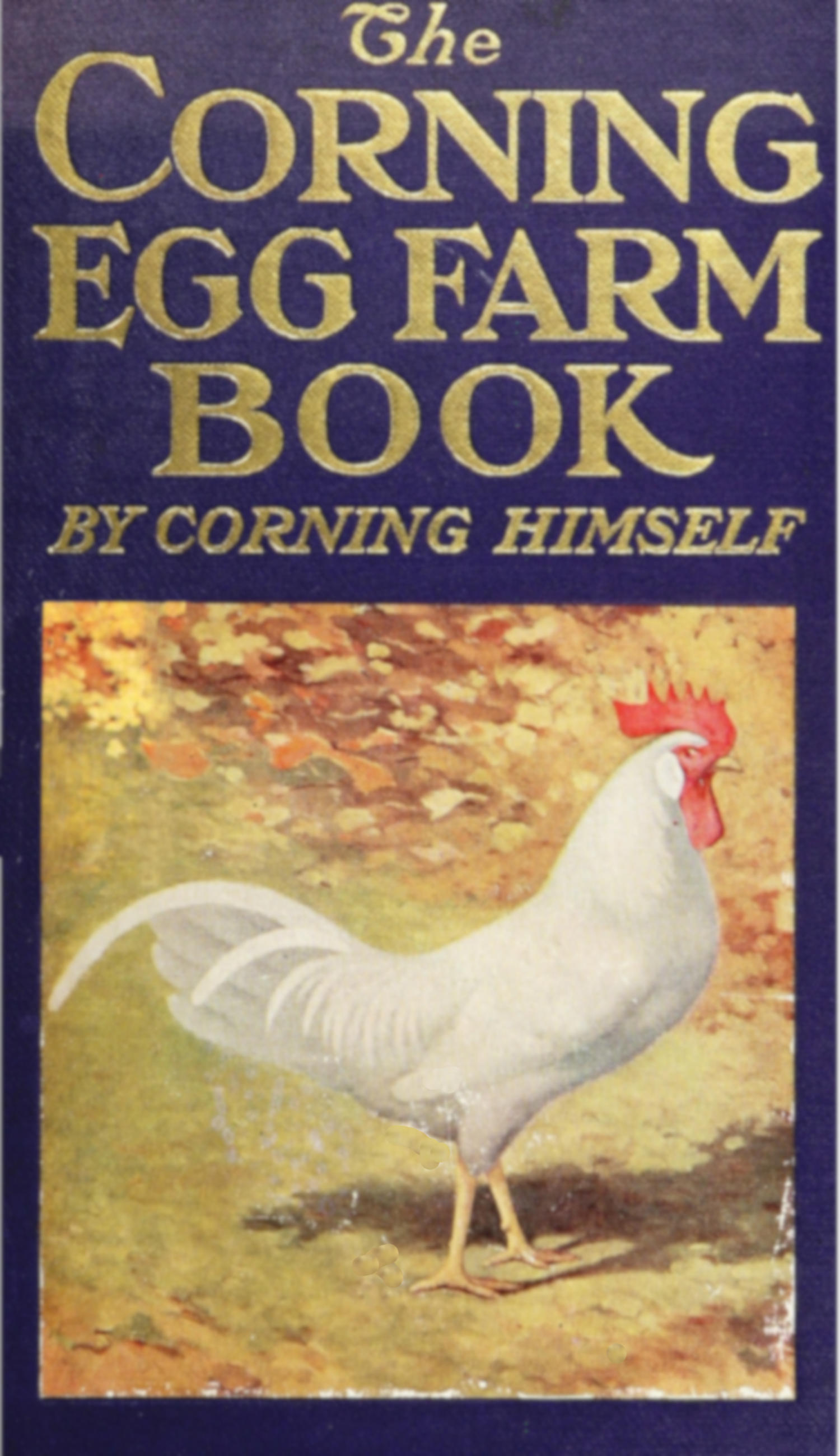
The Corning Egg Farm Book
by Edward Corning
★★★★★No ratings yet
Language: English
Sign in to rate this book.
Sign in to shelve this book.
About this eBook
- Author
- Corning, Gardner, 1867-1945
- Title
- The Corning Egg Farm book, by Corning himself
- Original Publication
- Bound Brook: The Corning Egg Farm, 1912.
- Credits
- deaurider, Harry Lamé and the Online Distributed Proofreading Team at www.pgdp.net (This file was produced from images generously made available by The Internet Archive)
- Language
- English
- LoC Class
- SF: Agriculture: Animal culture
- Subject
- Eggs -- Production
- Category
- Text
- Project Gutenberg
- eBook-No. 72042
- Release Date
- November 5, 2023
- Copyright
- Public domain in the USA.
Contents
- 1.THE CORNING EGG FARM BOOK
- 2.CONTENTS
- 3.ILLUSTRATIONS
- 4.INTRODUCTORY
- 5.CHAPTER I The Building of the Corning Egg Farm — Started with 60 Buff Rock Eggs — More Money in Eggs — Adopted White Leghorns — First Use of Roosting Closets — We Count Only Livable Chicks — Percentage of Cockerels Low — The Great Flock System Succeeds — Foreigners Visit the Farm — Investigated for Germany — Selection of Cockerels — Pullets Lay in 129 Days — Keeping Down Labor Bill — Adopted Hot Water Incubators — Why Great Farms Fail
- 6.CHAPTER II Egg Farming the Most Profitable Branch of Poultry Keeping — Developing the Great Layer — Corning Method in Small Flocks — On Large Farms
- 7.CHAPTER III What is a Fresh Egg?—An Egg Should be Sanitary as Well as Fresh — Manure Drainage to Drink — Diseased Meat to Eat — As the Food, so the Egg — A Perfect Egg a Rarity — Unlimited Demand for Quality Eggs
- 8.CHAPTER IV Preparation of Eggs for Market
- 9.CHAPTER V The Selection of the Breed—The Strain is of Utmost Importance — S. C. White Leghorns Outclass All — Line Breeding—Not Inbreeding — How Corning Farm Produces Unrelated Cockerels
- 10.CHAPTER VI Advantages of the Large Flock System—Reduces Cost of Housing and Economizes in Time and Labor — Draughts the Stumbling Block — 2,000 Birds to a House
- 11.CHAPTER VII What is the Winter Layer?—The Properly Hatched and Reared Pullet — Must Feed Green Food
- 12.CHAPTER VIII A Great Laying Strain—The Selection of Breeders to Produce It — Eighteen Months Old — Trap Nests a Failure — Type Reproduces Type
- 13.CHAPTER IX What is the Best Time to Hatch? — An Interesting Experiment in Late Hatching
- 14.CHAPTER X Succulent Green Food—Satisfactory Egg Production Impossible Without It — Sprouted Oats Best — How They Are Grown on the Farm — Timothy and Clover Cut Green
- 15.CHAPTER XI Anthracite Coal Ashes—A Substitute for Many More Expensive Necessities — Better Than Charcoal
- 16.CHAPTER XII Eggs for Breeding Should be Laid by a Real Yearling Hen — 90,000 Orders for 40,000 Eggs
- 17.CHAPTER XIII Policing the Farm—With Bloodhounds, Searchlights and Rifles — Shoot First—Investigate Afterwards — Socrates, the Great Bloodhound
- 18.CHAPTER XIV The Necessity for Pure Water—An Egg is Chemically 80% Water — Automatic Fountains Essential — Hot Water in Cold Weather — Hens Drink More in Afternoon
- 19.CHAPTER XV Hard Coal Ashes, Oyster Shell, and Grit
- 20.CHAPTER XVI Beef Scrap and Green Bone Substitutes for Nature’s Animal Food — Green Cut Bone Nearest Nature
- 21.CHAPTER XVII A Time for Everything—Everything on Time — Fixed Feeding Hours — Four Collections of Eggs Daily — Mash Fed in Afternoon
- 22.CHAPTER XVIII Incubation on the Corning Egg Farm — Hen Reigns Supreme — Livable Chicks—Not Numbers — Uniform Temperature Most Important — Ventilation and Moisture Next — Hot Water Machines Best — Corning Incubator Cellar Unequaled — Eggs Turned from Third to Eighteenth Day — 103 Degrees Maintained — Cool But Never Cold — Cover Glass Doors — All Good Chicks Hatch in 20 Days — Set Incubators Toward Evening — Tested Only on Eighteenth Day — Moisture — Chicks Handled Only Once — Baby Chick Business Cruel
- 23.CHAPTER XIX Rearing Chicks in Brooder House—The Following Two Years’ Results Depend Upon Success in Brooding — Corn Not Proper Chick Food — Follow Nature’s Teaching — A Balanced Food — Never Build a Double House — Must Drain Chick Runs — Concrete Floors Mean Dampness — Corning Heated Brooder House — Corning Feeds Dry Food Only — Three Feeds Daily — Green Food Third Day — Animal Food Tenth Day — Avoid Moving Chicks Often
- 24.CHAPTER XX Handling Birds on Range—The Youngsters Must Be Kept Growing All the Time — A Corning Wrinkle — Grain and Mash Once a Day — Plenty of Shade — Removed to Laying House Middle of September
- 25.CHAPTER XXI Feeding for Eggs—Wholesome Nourishment—Not Destructive Stimulants — Easy Assimilation — Perfect Health or No Eggs — Abundant Animal Food — The Corning Mash the Secret — “Egg Foods” Kill Layers — Mustard Increases Egg Laying — Mustard Increases Fertility — 4,000 Layers Fed Mustard — Mustard Maintains Health — Keep Appetite Keen
- 26.CHAPTER XXII Breeding Hens During Moult—Coming Breeders Must be Kept Exercising Through This Period — Do Not Overfeed
- 27.CHAPTER XXIII Feeding the Breeding Cockerels
- 28.CHAPTER XXIV Preparing Surplus Cockerels for Market — Must Have Green Food
- 29.CHAPTER XXV $6.41 Per Hen Per Year Corning Method and Strain Enabling Others to Better $6.41 — $6.41 Not Extravagant Claim — Corning Farm Making More Than $6.41
- 30.CHAPTER XXVI The Buildings on the Corning Egg Farm — No. 1. Brooder House, Incubator and Sprouted Oats Cellars — Building No. 2, Work Shop, etc. — Building No. 9, Horse Stable — Building No. 10, Wagon Shed — Building No. 12, Office Building
- 31.CHAPTER XXVII Construction of Laying, Breeding, and Breeding Cockerel Houses — Nearly Six Feet from Ground — Double Floors — Canvas Windows — Double Doors — Draught-Proof Roosting Closets
- 32.CHAPTER XXVIII The Colony Houses—There are Forty-one on the Farm — Cotton Duck Windows
- 33.CHAPTER XXIX — Materials Required for Laying House — Bill of Material for the Construction of Colony House
- 34.CHAPTER XXX The Original Thirty Hens
- 35.CHAPTER XXXI Egg Records — February 1st, 1908 to June 30th, 1911. — How Corning Farm Is Able To Get Great Egg Records — Highest Percentage of Fertility
- 36.CHAPTER XXXII Prevention and Treatment of Diseases
- 37.CHAPTER XXXIII A Word in Closing — Nothing to Hide — Illustrations are Photographs — The Corning Success — Our Advice to Beginners — Single Comb White Leghorns Only — It’s “Strain” You Want — Utility, Not Show Birds — Corning Largest Specialty Farm in World — Points That Mean Success
- 38.BUILDINGS ON THE CORNING EGG FARM AND MANY HANDY DEVICES
- 39.Transcriber’s Notes
Community reviews
Sign in to write a review.
No reviews yet.