I. FORMS OF WATER, in Clouds, Rain, Rivers, Ice, and Glaciers.
By Prof. John Tyndall, LL. D., F. R. S. 1 vol. Cloth. Price, $1.50.
II. PHYSICS AND POLITICS; or, Thoughts on the Application of
the Principles of “Natural Selection” and “Inheritance” to
Political Society. By Walter Bagehot, Esq., author of “The
English Constitution.” 1 vol. Cloth. Price, $1.50.
III. FOODS. By Edward Smith, M. D., LL. B., F. R. S. 1 vol. Cloth.
Price, $1.75.
IV. MIND AND BODY: the Theories of their Relations. By Alex.
Bain, LL. D., Professor of Logic in the University of Aberdeen, 1 vol.,
12mo. Cloth. Price, $1.50.
V. THE STUDY OF SOCIOLOGY. By Herbert Spencer. Price, $1.50.
VI. THE NEW CHEMISTRY. By Prof. Josiah P. Cooke, Jr., of Harvard
University. 1 vol., 12mo. Cloth. Price, $2.00.
VII. THE CONSERVATION OF ENERGY. By Prof. Balfour Stewart,
LL. D., F. R. S. 1 vol., 12mo. Cloth. Price, $1.50.
VIII. ANIMAL LOCOMOTION; or, Walking, Swimming, and Flying,
with a Dissertation on Aëronautics. By J. Bell Pettigrew,
M. D., F. R. S. E., F. R. C. P. E. 1 vol., 12mo. Fully illustrated.
Price, $1.75.
IX. RESPONSIBILITY IN MENTAL DISEASE. By Henry Maudsley,
M. D. 1 vol., 12mo. Cloth. Price, $1.50.
X. THE SCIENCE OF LAW. By Prof. Sheldon Amos. 1 vol., 12mo.
Cloth. Price, $1.75.
XI. ANIMAL MECHANISM. A Treatise on Terrestrial and Aërial
Locomotion. By E. J. Marey. With 117 Illustrations. Price, $1.75.
XII. THE HISTORY OF THE CONFLICT BETWEEN RELIGION
AND SCIENCE. By John Wm. Draper, M. D., LL. D., author of
“The Intellectual Development of Europe.” Price, $1.75.
XIII. THE DOCTRINE OF DESCENT, AND DARWINISM. By Prof.
Oscar Schmidt, Strasburg University. Price, $1.50.
XIV. THE CHEMISTRY OF LIGHT AND PHOTOGRAPHY. In its
Application to Art, Science, and Industry. By Dr. Hermann
Vogel. 100 Illustrations. Price, $2.00.
XV. FUNGI; their Nature, Influence, and Uses. By M. C. Cooke,
M. A., LL. D. Edited by Rev. M. J. Berkeley, M. A., F. L. S. With
109 Illustrations. Price, $1.50.
XVI. THE LIFE AND GROWTH OF LANGUAGE. By Prof. W. D.
Whitney, of Yale College. Price, $1.50.
XVII. THE NATURE OF LIGHT, with a General Account of Physical
Optics. By Dr. Eugene Lommel, Professor of Physics in the University
of Erlangen. With 188 Illustrations and a Plate of Spectra in
Chromo-lithography. (In press.)
THE CONSERVATION OF ENERGY.
THE INTERNATIONAL SCIENTIFIC SERIES.
BY
BALFOUR STEWART, LL. D., F.R.S., PROFESSOR OF NATURAL PHILOSOPHY AT THE OWENS COLLEGE, MANCHESTER.
WITH AN APPENDIX, TREATING OF THE VITAL AND MENTAL APPLICATIONS OF THE DOCTRINE
NEW YORK: D. APPLETON AND COMPANY,
549 & 551 BROADWAY.
1875.
Entered, according to Act of Congress, in the year 1874, by
D. APPLETON & COMPANY,
In the Office of the Librarian of Congress, at Washington.
NOTE TO THE AMERICAN EDITION.
The great prominence which the modern doctrine
of the Conservation of Energy or Correlation of Forces
has lately assumed in the world of thought, has made
a simple and popular explanation of the subject very
desirable. The present work of Dr. Balfour Stewart,
contributed to the International Scientific Series, fully
meets this requirement, as it is probably the clearest
and most elementary statement of the question that has
yet been attempted. Simple in language, copious and
familiar in illustration, and remarkably lucid in the
presentation of facts and principles, his little treatise
forms just the introduction to the great problem of the
interaction of natural forces that is required by general
readers. But Professor Stewart having confined himself
mainly to the physical aspects of the subject, it was
desirable that his views should be supplemented by a
statement of the operation of the principle in the
spheres of life and mind. An Appendix has, accordingly,
been added to the American edition of Dr. Stewart’s
work, in which these applications of the law are
considered.
Professor Joseph Le Conte published a very able
essay fourteen years ago on the Correlation of the
Physical and Vital Forces, which was extensively reprinted
abroad, and placed the name of the author
among the leading interpreters of the subject. His
mode of presenting it was regarded as peculiarly happy,
and was widely adopted by other writers. After further
investigations and more mature reflection, he has
recently restated his views, and has kindly furnished
the revised essay for insertion in this volume.
Professor A. Bain, the celebrated Psychologist of
Aberdeen, who has done so much to advance the study
of mind in its physiological relations, prepared an interesting
lecture not long ago on the “Correlation of the
Nervous and Mental Forces,” which was read with much
interest at the time of its publication, and is now reprinted
as a suitable exposition of that branch of the
subject. These two essays, by carrying out the principle
in the field of vital and mental phenomena, will
serve to give completeness and much greater value to
the present volume.
New York, December, 1873.
PREFACE.
We may regard the Universe in the light of a vast
physical machine, and our knowledge of it may be
conveniently divided into two branches.
The one of these embraces what we know regarding
the structure of the machine itself, and the other what
we know regarding its method of working.
It has appeared to the author that, in a treatise like
this, these two branches of knowledge ought as much
as possible to be studied together, and he has therefore
endeavored to adopt this course in the following pages.
He has regarded a universe composed of atoms with
some sort of medium between them as the machine,
and the laws of energy as the laws of working of this
machine.
The first chapter embraces what we know regarding
atoms, and gives also a definition of Energy. The various
forces and energies of Nature are thereafter enumerated,
and the law of Conservation is stated. Then follow the
various transmutations of Energy, according to a list, for
which the author is indebted to Prof. Tait. The fifth
chapter gives a short historical sketch of the subject,
ending with the law of Dissipation; while the sixth and
last chapter gives some account of the position of living
beings in this universe of Energy.
CHAPTER I. WHAT IS ENERGY? — Our Ignorance of Individuals. — Action and Reaction, Equal and Opposite. — In a Vessel of Goldfish. — In a Rifle. — In a Falling Stone. — The Rifle further considered. — The Rifle Ball possesses Energy. — Definition of Work. — Relation between Velocity and Energy. — FOOTNOTES:
THE CONSERVATION OF ENERGY.
1. Very often we know little or nothing of individuals,
while we yet possess a definite knowledge of the laws
which regulate communities.
The Registrar-General, for example, will tell us that
the death-rate in London varies with the temperature in
such a manner that a very low temperature is invariably
accompanied by a very high death-rate. But if we ask
him to select some one individual, and explain to us in
what manner his death was caused by the low temperature,
he will, most probably, be unable to do so.
Again, we may be quite sure that after a bad harvest
there will be a large importation of wheat into the
country, while, at the same time, we are quite ignorant
of the individual journeys of the various particles of flour
that go to make up a loaf of bread.
Or yet again, we know that there is a constant carriage
of air from the poles to the equator, as shown by the
trade winds, and yet no man is able to individualize
a particle of this air, and describe its various motions.
2. Nor is our knowledge of individuals greater in the
domains of physical science. We know nothing, or next
to nothing, of the ultimate structure and properties of
matter, whether organic or inorganic.
No doubt there are certain cases where a large number
of particles are linked together, so as to act as one
individual, and then we can predict its action—as, for
instance, in the solar system, where the physical astronomer
is able to foretell with great exactness the positions
of the various planets, or of the moon. And so, in
human affairs, we find a large number of individuals
acting together as one nation, and the sagacious statesman
taking very much the place of the sagacious
astronomer, with regard to the action and reaction of
various nations upon one another.
But if we ask the astronomer or the statesman to
select an individual particle and an individual human
being, and predict the motions of each, we shall find that
both will be completely at fault.
3. Nor have we far to look for the cause of their ignorance.
A continuous and restless, nay, a very complicated,
activity is the order of nature throughout all her individuals,
whether these be living beings or inanimate
particles of matter. Existence is, in truth, one continued
fight, and a great battle is always and everywhere raging,
although the field in which it is fought is often completely
shrouded from our view.
4. Nevertheless, although we cannot trace the motions
of individuals, we may sometimes tell the result of the
fight, and even predict how the day will go, as well as
specify the causes that contribute to bring about the
issue.
With great freedom of action and much complication
of motion in the individual, there are yet comparatively
simple laws regulating the joint result attainable by the
community.
But, before proceeding to these, it may not be out
of place to take a very brief survey of the organic and
inorganic worlds, in order that our readers, as well as
ourselves, may realize our common ignorance of the
ultimate structure and properties of matter.
5. Let us begin by referring to the causes which bring
about disease. It is only very recently that we have begun
to suspect a large number of our diseases to be caused
by organic germs. Now, assuming that we are right in
this, it must nevertheless be confessed that our ignorance
about these germs is most complete. It is perhaps
doubtful whether we ever saw one of these organisms,[1]
while it is certain that we are in profound ignorance of
their properties and habits.
We are told by some writers[2] that the very air we
breathe is absolutely teeming with germs, and that we
are surrounded on all sides by an innumerable array of
minute organic beings. It has also been conjectured
that they are at incessant warfare among themselves, and
that we form the spoil of the stronger party. Be this as
it may, we are at any rate intimately bound up with,
and, so to speak, at the mercy of, a world of creatures, of
which we know as little as of the inhabitants of the
planet Mars.
6. Yet, even here, with profound ignorance of the
individual, we are not altogether unacquainted with some
of the habits of these powerful predatory communities.
Thus we know that cholera is eminently a low level
disease, and that during its ravages we ought to pay
particular attention to the water we drink. This is a
general law of cholera, which is of the more importance
to us because we cannot study the habits of the individual
organisms that cause the disease.
Could we but see these, and experiment upon them, we
should soon acquire a much more extensive knowledge of
their habits, and perhaps find out the means of extirpating
the disease, and of preventing its recurrence.
Again, we know (thanks to Jenner) that vaccination
will prevent the ravages of small-pox, but in this instance
we are no better off than a band of captives who
have found out in what manner to mutilate themselves,
so as to render them uninteresting to their victorious foe.
7. But if our knowledge of the nature and habits of
organized molecules be so small, our knowledge of the
ultimate molecules of inorganic matter is, if possible, still
smaller. It is only very recently that the leading men
of science have come to consider their very existence as a
settled point.
In order to realize what is meant by an inorganic
molecule, let us take some sand and grind it into smaller
and smaller particles, and these again into still smaller.
In point of fact we shall never reach the superlative
degree of smallness by this operation—yet in our imagination
we may suppose the sub-division to be carried on
continuously, always making the particles smaller and
smaller. In this case we should, at last, come to an
ultimate molecule of sand or oxide of silicon, or, in other
words, we should arrive at the smallest entity retaining
all the properties of sand, so that were it possible to
divide the molecule further the only result would be to
separate it into its chemical constituents, consisting of
silicon on the one side and oxygen on the other.
We have, in truth, much reason to believe that sand,
or any other substance, is incapable of infinite sub-division,
and that all we can do in grinding down a
solid lump of anything is to reduce it into lumps similar
to the original, but only less in size, each of these small
lumps containing probably a great number of individual
molecules.
8. Now, a drop of water no less than a grain of sand is
built up of a very great number of molecules, attached to
one another by the force of cohesion—a force which is
much stronger in the sand than in the water, but which
nevertheless exists in both. And, moreover, Sir William
Thomson, the distinguished physicist, has recently arrived
at the following conclusion with regard to the size
of the molecules of water. He imagines a single drop of
water to be magnified until it becomes as large as the
earth, having a diameter of 8000 miles, and all the molecules
to be magnified in the same proportion; and he
then concludes that a single molecule will appear, under
these circumstances, as somewhat larger than a shot, and
somewhat smaller than a cricket ball.
9. Whatever be the value of this conclusion, it enables
us to realize the exceedingly small size of the individual
molecules of matter, and renders it quite certain that we
shall never, by means of the most powerful microscope,
succeed in making visible these ultimate molecules. For
our knowledge of the sizes, shapes, and properties of such
bodies, we must always, therefore, be indebted to indirect
evidence of a very complicated nature.
It thus appears that we know little or nothing about
the shape or size of molecules, or about the forces which
actuate them; and, moreover, the very largest masses of
the universe share with the very smallest this property
of being beyond the direct scrutiny of the human senses—the
one set because they are so far away, and the other
because they are so small.
10. Again, these molecules are not at rest, but, on the
contrary, they display an intense and ceaseless energy in
their motions. There is, indeed, an uninterrupted warfare
going on—a constant clashing together of these minute
bodies, which are continually maimed, and yet always
recover themselves, until, perhaps, some blow is struck
sufficiently powerful to dissever the two or more simple
atoms that go to form a compound molecule. A new
state of things thenceforward is the result.
But a simple elementary atom is truly an immortal
being, and enjoys the privilege of remaining unaltered
and essentially unaffected amid the most powerful blows
that can be dealt against it—it is probably in a state of
ceaseless activity and change of form, but it is nevertheless
always the same.
11. Now, a little reflection will convince us that we
have in this ceaseless activity another barrier to an intimate
acquaintance with molecules and atoms, for even
if we could see them they would not remain at rest
sufficiently long to enable us to scrutinize them.
No doubt there are devices by means of which we can
render visible, for instance, the pattern of a quickly
revolving coloured disc, for we may illuminate it by a
flash of electricity, and the disc may be supposed to be
stationary during the extremely short time of the flash.
But we cannot say the same about molecules and atoms,
for, could we see an atom, and could we illuminate it by a
flash of electricity, the atom would most probably have
vibrated many times during the exceedingly small time
of the flash. In fine, the limits placed upon our senses,
with respect to space and time, equally preclude the
possibility of our ever becoming directly acquainted with
these exceedingly minute bodies, which are nevertheless
the raw materials of which the whole universe is built.
12. But while an impenetrable veil is drawn over the
individual in this warfare of clashing atoms, yet we
are not left in profound ignorance of the laws which
determine the ultimate result of all these motions, taken
together as a whole.
Let us suppose, for instance, that we have a glass globe
containing numerous goldfish standing on the table, and
delicately poised on wheels, so that the slightest push, the
one way or the other, would make it move. These goldfish
are in active and irregular motion, and he would be
a very bold man who should venture to predict the movements
of an individual fish. But of one thing we may
be quite certain: we may rest assured that, notwithstanding
all the irregular motions of its living inhabitants,
the globe containing the goldfish will remain at rest
upon its wheels.
Even if the table were a lake of ice, and the wheels
were extremely delicate, we should find that the globe
would remain at rest. Indeed, we should be exceedingly
surprised if we found the globe going away of its own
accord from the one side of the table to the other, or from
the one side of a sheet of ice to the other, in consequence
of the internal motions of its inhabitants. Whatever be
the motions of these individual units, yet we feel sure
that the globe cannot move itself as a whole. In such a
system, therefore, and, indeed, in every system left to
itself, there may be strong internal forces acting between
the various parts, but these actions and reactions are
equal and opposite, so that while the small parts, whether
visible or invisible, are in violent commotion among themselves,
yet the system as a whole will remain at rest.
13. Now it is quite a legitimate step to pass from this
instance of the goldfish to that of a rifle that has just
been fired. In the former case, we imagined the globe,
together with its fishes, to form one system; and in the
latter, we must look upon the rifle, with its powder and
ball, as forming one system also.
Let us suppose that the explosion takes place through
the application of a spark. Although this spark is an
external agent, yet if we reflect a little we shall see that
its only office in this case is to summon up the internal
forces already existing in the loaded rifle, and bring them
into vigorous action, and that in virtue of these internal
forces the explosion takes place.
The most prominent result of this explosion is the out-rush
of the rifle ball with a velocity that may, perhaps,
carry it for the best part of a mile before it comes to
rest; and here it would seem to us, at first sight, that the
law of equal action and reaction is certainly broken, for
these internal forces present in the rifle have at least propelled
part of the system, namely, the rifle ball, with a
most enormous velocity in one direction.
14. But a little further reflection will bring to light
another phenomenon besides the out-rush of the ball.
It is well known to all sportsmen that when a fowling-piece
is discharged, there is a kick or recoil of the piece
itself against the shoulder of the sportsman, which he
would rather get rid of, but which we most gladly welcome
as the solution of our difficulty. In plain terms,
while the ball is projected forwards, the rifle stock (if
free to move) is at the same moment projected backwards.
To fix our ideas, let us suppose that the rifle stock weighs
100 ounces, and the ball one ounce, and that the ball is
projected forwards with the velocity of 1000 feet per
second; then it is asserted, by the law of action and reaction,
that the rifle stock is at the same time projected
backwards with the velocity of 10 feet per second, so
that the mass of the stock, multiplied by its velocity of
recoil, shall precisely equal the mass of the ball, multiplied
by its velocity of projection. The one product forms a
measure of the action in the one direction, and the other
of the reaction in the opposite direction, and thus we
see that in the case of a rifle, as well as in that of the
globe of fish, action and reaction are equal and opposite.
15. We may even extend the law to cases in which we
do not perceive the recoil or reaction at all. Thus, if I
drop a stone from the top of a precipice to the earth, the
motion seems all to be in one direction, while at the
same time it is in truth the result of a mutual attraction
between the earth and the stone. Does not the earth
move also? We cannot see it move, but we are entitled
to assert that it does in reality move upwards to meet
the stone, although quite to an imperceptible extent,
and that the law of action and reaction holds here as
truly as in a rifle, the only difference being that in
the one case the two objects are rushing together, while
in the other they are rushing apart. Inasmuch, however,
as the mass of the earth is very great compared
with that of the stone, it follows that its velocity must be
extremely small, in order that the mass of the earth,
multiplied into its velocity upwards, shall equal the mass
of the stone, multiplied into its velocity downwards.
16. We have thus, in spite of our ignorance of the
ultimate atoms and molecules of matter, arrived at a
general law which regulates the action of internal forces.
We see that these forces are always mutually exerted, and
that if A attracts or repels B, B in its turn attracts or
repels A. We have here, in fact, a very good instance of
that kind of generalization, which we may arrive at, even
in spite of our ignorance of individuals.
But having now arrived at this law of action and
reaction, do we know all that it is desirable to know?
have we got a complete understanding of what takes
place in all such cases—for instance, in that of the rifle
which is just discharged? Let us consider this point a
little further.
17. We define quantity of motion to mean the product
of the mass by the velocity; and since the velocity of
recoil of the rifle stock, multiplied by the mass of the
stock, is equal to the velocity of projection of the rifle
ball, multiplied by the mass of the ball, we conceive
ourselves entitled to say that the quantity of motion, or
momentum, generated is equal in both directions, so that
the law of action and reaction holds here also. Nevertheless,
it cannot but occur to us that, in some sense, the
motion of the rifle ball is a very different thing from that
of the stock, for it is one thing to allow the stock to
recoil against your shoulder and discharge the ball into
the air, and a very different thing to discharge the ball
against your shoulder and allow the stock to fly into the
air. And if any man should assert the absolute equality
between the blow of the rifle stock and that of the rifle
ball, you might request him to put his assertion to this
practical test, with the absolute certainty that he would
decline. Equality between the two!—Impossible! Why,
if this were the case, a company of soldiers engaged in
war would suffer much more than the enemy against
whom they fired, for the soldiers would certainly feel
each recoil, while the enemy would suffer from only a
small proportion of the bullets.
18. Now, what is the meaning of this great difference
between the two? We have a vivid perception of a
mighty difference, and it only remains for us to clothe
our naked impressions in a properly fitting scientific
garb.
The something which the rifle ball possesses in contradistinction
to the rifle stock is clearly the power of
overcoming resistance. It can penetrate through oak
wood or through water, or (alas! that it should be so
often tried) through the human body, and this power of
penetration is the distinguishing characteristic of a
substance moving with very great velocity.
19. Let us define by the term energy this power which
the rifle ball possesses of overcoming obstacles or of doing
work. Of course we use the word work without reference
to the moral character of the thing done, and conceive
ourselves entitled to sum up, with perfect propriety
and innocence, the amount of work done in drilling a hole
through a deal board or through a man.
20. A body such as a rifle ball, moving with very great
velocity, has, therefore, energy, and it requires very little
consideration to perceive that this energy will be proportional
to its weight or mass, for a ball of two ounces
moving with the velocity of 1000 feet per second will be
the same as two balls of one ounce moving with this
velocity, but the energy of two similarly moving ounce
balls will manifestly be double that of one, so that the
energy is proportional to the weight, if we imagine that,
meanwhile, the velocity remains the same.
21. But, on the other hand, the energy is not simply
proportional to the velocity, for, if it were, the energy of
the rifle stock and of the rifle ball would be the same,
inasmuch as the rifle stock would gain as much by its
superior mass as it would lose by its inferior velocity.
Therefore, the energy of a moving body increases with the
velocity more quickly than a simple proportion, so that
if the velocity be doubled, the energy is more than
doubled. Now, in what manner does the energy increase
with the velocity? That is the question we have now to
answer, and, in doing so, we must appeal to the familiar
facts of everyday observation and experience.
22. In the first place, it is well known to artillerymen,
that if a ball have a double velocity, its penetrating
power or energy is increased nearly fourfold, so that it
will pierce through four, or nearly four, times as many
deal boards as the ball with only a single velocity—in
other words, they will tell us in mathematical language,
that the energy varies as the square of the velocity.
23. And now, before proceeding further, it will be
necessary to tell our readers how to measure work in a
strictly scientific manner. We have defined energy to be
the power of doing work, and although every one has a
general notion of what is meant by work, that notion
may not be sufficiently precise for the purpose of this
volume. How, then, are we to measure work? Fortunately,
we have not far to go for a practical means of
doing this. Indeed, there is a force at hand which enables
us to accomplish this measurement with the greatest precision,
and this force is gravity. Now, the first operation
in any kind of numerical estimate is to fix upon our unit
or standard. Thus we say a rod is so many inches long,
or a road so many miles long. Here an inch and a mile
are chosen as our standards. In like manner, we speak of
so many seconds, or minutes, or hours, or days, or years,
choosing that standard of time or duration which is most
convenient for our purpose. So in like manner we must
choose our unit of work, but in order to do so we must
first of all choose our units of weight and of length, and
for these we will take the kilogramme and the metre,
these being the units of the metrical system. The kilogramme
corresponds to about 15,432·35 English grains,
being rather more than two pounds avoirdupois, and the
metre to about 39·371 English inches.
Now, if we raise a kilogramme weight one metre in
vertical height, we are conscious of putting forth an
effort to do so, and of being resisted in the act by the
force of gravity. In other words, we spend energy and
do work in the process of raising this weight.
Let us agree to consider the energy spent, or the work
done, in this operation as one unit of work, and let us call
it the kilogrammetre.
24. In the next place, it is very obvious that if we raise
the kilogramme two metres in height, we do two units of
work—if three metres, three units, and so on.
And again, it is equally obvious that if we raise a
weight of two kilogrammes one metre high, we likewise
do two units of work, while if we raise it two metres high,
we do four units, and so on.
From these examples we are entitled to derive the
following rule:—Multiply the weight raised (in kilogrammes)
by the vertical height (in metres) through which
it is raised, and the result will be the work done (in
kilogrammetres).
25. Having thus laid a numerical foundation for our
superstructure, let us next proceed to investigate the relation
between velocity and energy. But first let us say a
few words about velocity. This is one of the few cases in
which everyday experience will aid, rather than hinder,
us in our scientific conception. Indeed, we have constantly
before us the example of bodies moving with
variable velocities.
Thus a railway train is approaching a station and is
just beginning to slacken its pace. When we begin to
observe, it is moving at the rate of forty miles an
hour. A minute afterwards it is moving at the rate
of twenty miles only, and a minute after that it is at
rest. For no two consecutive moments has this train
continued to move at the same rate, and yet we may
say, with perfect propriety, that at such a moment
the train was moving, say, at the rate of thirty miles
an hour. We mean, of course, that had it continued to
move for an hour with the speed which it had when
we made the observation, it would have gone over
thirty miles. We know that, as a matter of fact, it did
not move for two seconds at that rate, but this is of no
consequence, and hardly at all interferes with our mental
grasp of the problem, so accustomed are we all to cases
of variable velocity.
26. Let us now imagine a kilogramme weight to be
shot vertically upwards, with a certain initial velocity—let
us say, with the velocity of 9·8 metres in one second.
Gravity will, of course, act against the weight, and
continually diminish its upward speed, just as in the
railway train the break was constantly reducing the
velocity. But yet it is very easy to see what is meant
by an initial velocity of 9·8 metres per second; it means
that if gravity did not interfere, and if the air did not
resist, and, in fine, if no external influence of any kind
were allowed to act upon the ascending mass, it would be
found to move over 9·8 metres in one second.
Now, it is well known to those who have studied the
laws of motion, that a body, shot upwards with the
velocity of 9·8 metres in one second, will be brought
to rest when it has risen 4·9 metres in height. If, therefore,
it be a kilogramme, its upward velocity will have
enabled it to raise itself 4·9 metres in height against the
force of gravity, or, in other words, it will have done 4·9
units of work; and we may imagine it, when at the top of
its ascent, and just about to turn, caught in the hand and
lodged on the top of a house, instead of being allowed to
fall again to the ground. We are, therefore, entitled to
say that a kilogramme, shot upwards with the velocity
of 9·8 metres per second, has energy equal to 4·9, inasmuch
as it can raise itself 4·9 metres in height.
27. Let us next suppose that the velocity with which
the kilogramme is shot upwards is that of 19·6 metres
per second. It is known to all who have studied dynamics
that the kilogramme will now mount not only
twice, but four times as high as it did in the last instance—in
other words, it will now mount 19·6 metres
in height.
Evidently, then, in accordance with our principles of
measurement, the kilogramme has now four times as
much energy as it had in the last instance, because it
can raise itself four times as high, and therefore do four
times as much work, and thus we see that the energy is
increased four times by doubling the velocity.
Had the initial velocity been three times that of the
first instance, or 29·4 metres per second, it might in like
manner be shown that the height attained would have
been 44·1 metres, so that by tripling the velocity the
energy is increased nine times.
28. We thus see that whether we measure the energy
of a moving body by the thickness of the planks through
which it can pierce its way, or by the height to which it
can raise itself against gravity, the result arrived at is
the same. We find the energy to be proportional to
the square of the velocity, and we may formularize
our conclusion as follows:—
Let v = the initial velocity expressed in metres per
second, then the energy in kilogrammetres = v²/19·6. Of
course, if the body shot upwards weighs two kilogrammes,
then everything is doubled, if three kilogrammes, tripled,
and so on; so that finally, if we denote by m the mass of
the body in kilogrammes, we shall have the energy in kilogrammetres
= mv²/19·6. To test the truth of this formula,
we have only to apply it to the cases described in Arts.
26 and 27.
29. We may further illustrate it by one or two
examples. For instance, let it be required to find the
energy contained in a mass of five kilogrammes, shot upwards
with the velocity of 20 metres per second.
Here we have m = 5 and v = 20, hence—
Energy = 5(20)²/(19·6) = 2000/(19·6) = 102·04 nearly.
Again, let it be required to find the height to which the
mass of the last question will ascend before it stops. We
know that its energy is 102·04, and that its mass is 5.
Dividing 102·04 by 5, we obtain 20·408 as the height
to which this mass of five kilogrammes must ascend in
order to do work equal to 102·04 kilogrammetres.
30. In what we have said we have taken no account
either of the resistance or of the buoyancy of the atmosphere;
in fact, we have supposed the experiments to be
made in vacuo, or, if not in vacuo, made by means of a
heavy mass, like lead, which will be very little influenced
either by the resistance or buoyancy of the air.
We must not, however, forget that if a sheet of paper,
or a feather, be shot upwards with the velocities mentioned
in our text, they will certainly not rise in the air
to nearly the height recorded, but will be much sooner
brought to a stop by the very great resistance which they
encounter from the air, on account of their great surface,
combined with their small mass.
On the other hand, if the substance we make use of be
a large light bag filled with hydrogen, it will find its way
upwards without any effort on our part, and we shall certainly
be doing no work by carrying it one or more
metres in height—it will, in reality, help to pull us up,
instead of requiring help from us to cause it to ascend.
In fine, what we have said is meant to refer to the force of
gravity alone, without taking into account a resisting
medium such as the atmosphere, the existence of which
need not be considered in our present calculations.
31. It should likewise be remembered, that while the
energy of a moving body depends upon its velocity, it is
independent of the direction in which the body is
moving. We have supposed the body to be shot upwards
with a given velocity, but it might be shot horizontally
with the same velocity, when it would have
precisely the same energy as before. A cannon ball, if
fired vertically upwards, may either be made to spend
its energy in raising itself, or in piercing through a
series of deal boards. Now, if the same ball be fired
horizontally with the same velocity it will pierce through
the same number of deal boards.
In fine, direction of motion is of no consequence, and
the only reason why we have chosen vertical motion is
that, in this case, there is always the force of gravity
steadily and constantly opposing the motion of the body,
and enabling us to obtain an accurate measure of the
work which it does by piercing its way upwards against
this force.
32. But gravity is not the only force, and we might
measure the energy of a moving body by the extent to
which it would bend a powerful spring or resist the attraction
of a powerful magnet, or, in fine, we might make
use of the force which best suits our purpose. If this
force be a constant one, we must measure the energy of
the moving body by the space which it is able to traverse
against the action of the force—just as, in the case of
gravity, we measured the energy of the body by the space
through which it was able to raise itself against its own
weight.
33. We must, of course, bear in mind that if this force
be more powerful than gravity, a body moved a short
distance against it will represent the expenditure of as
much energy as if it were moved a greater distance
against gravity. In fine, we must take account both
of the strength of the force and of the distance moved
over by the body against it before we can estimate in an
accurate matter the work which has been done.
[1] It is said that there are one or two instances where the microscope
has enlarged them into visibility.
CHAPTER II. MECHANICAL ENERGY AND ITS CHANGE INTO HEAT. — Energy of Position. A Stone high up. — A Head of Water. — A Cross-bow bent. A Watch wound up. — Advantage of Position. — Transmutations of Visible Energy.—A Kilogramme shot upwards. — The Inclined Plane. — Functions of a Machine. — Principle of Virtual Velocities. — What Friction does. — When Motion is destroyed, Heat appears. — Heat a species of Motion. — Heat a Backward and Forward Motion. — Mechanical Equivalent of Heat. — FOOTNOTES:
34. In the last chapter it was shown what is meant
by energy, and how it depends upon the velocity of
a moving body; and now let us state that this
same energy or power of doing work may nevertheless
be possessed by a body absolutely at rest. It
will be remembered (Art. 26) that in one case where
a kilogramme was shot vertically upwards, we supposed
it to be caught at the summit of its flight and lodged on
the top of a house. Here, then, it rests without motion,
but yet not without the power of doing work, and hence
not without energy. For we know very well that if we let
it fall it will strike the ground with as much velocity, and,
therefore, with as much energy, as it had when it was
originally projected upwards. Or we may, if we choose,
make use of its energy to assist us in driving in a pile, or
utilize it in a multitude of ways.
In its lofty position it is, therefore, not without energy,
but this is of a quiet nature, and not due in the least to
motion. To what, then, is it due? We reply—to the
position which the kilogramme occupies at the top of the
house. For just as a body in motion is a very different
thing (as regards energy) from a body at rest, so is a body
at the top of a house a very different thing from a body
at the bottom.
To illustrate this, we may suppose that two men of
equal activity and strength are fighting together, each
having his pile of stones with which he is about to belabour
his adversary. One man, however, has secured for
himself and his pile an elevated position on the top of a
house, while his enemy has to remain content with a
position at the bottom. Now, under these circumstances,
you can at once tell which of the two will gain the day—evidently
the man on the top of the house, and yet not
on account of his own superior energy, but rather on
account of the energy which he derives from the elevated
position of his pile of stones. We thus see that there
is a kind of energy derived from position, as well as a
kind derived from velocity, and we shall, in future, call
the former energy of position, and the latter energy of
motion.
35. In order to vary our illustration, let us suppose
there are two mills, one with a large pond of water near
it and at a high level, while the other has also a pond,
but at a lower level than itself. We need hardly ask
which of the two is likely to work—clearly the one
with the pond at a low level can derive from it no advantage
whatever, while the other may use the high level
pond, or head of water, as this is sometimes called, to
drive its wheel, and do its work. There is, thus, a great
deal of work to be got out of water high up—real substantial
work, such as grinding corn or thrashing it, or
turning wood or sawing it. On the other hand, there is no
work at all to be got from a pond of water that is low down.
36. In both of the illustrations now given, we have
used the force of gravity as that force against which we
are to do work, and in virtue of which a stone high up,
or a head of water, is in a position of advantage, and has
the power of doing work as it falls to a lower level. But
there are other forces besides gravity, and, with respect to
these, bodies may be in a position of advantage and be
able to do work just as truly as the stone, or the head of
water, in the case before mentioned.
Let us take, for instance, the force of elasticity, and
consider what happens in a cross-bow. When this is
bent, the bolt is evidently in a position of advantage
with regard to the elastic force of the bow; and when
it is discharged, this energy of position of the bolt is
converted into energy of motion, just as, when a stone on
the top of a house is allowed to fall, its energy of position
is converted into that of actual motion.
In like manner a watch wound up is in a position of
advantage with respect to the elastic force of the mainspring,
and as the wheels of the watch move this is
gradually converted into energy of motion.
37. It is, in fact, the fate of all kinds of energy of
position to be ultimately converted into energy of motion.
The former may be compared to money in a bank, or
capital, the latter to money which we are in the act of
spending; and just as, when we have money in a bank, we
can draw it out whenever we want it, so, in the case of
energy of position, we can make use of it whenever we
please. To see this more clearly, let us compare together
a watermill driven by a head of water, and a windmill
driven by the wind. In the one case we may turn on
the water whenever it is most convenient for us, but in
the other we must wait until the wind happens to blow.
The former has all the independence of a rich man; the
latter, all the obsequiousness of a poor one. If we pursue
the analogy a step further, we shall see that the great
capitalist, or the man who has acquired a lofty position,
is respected because he has the disposal of a great
quantity of energy; and that whether he be a nobleman
or a sovereign, or a general in command, he is powerful
only from having something which enables him to make
use of the services of others. When the man of wealth
pays a labouring man to work for him, he is in truth
converting so much of his energy of position into actual
energy, just as a miller lets out a portion of his head of
water in order to do some work by its means.
38. We have thus endeavoured to show that there is
an energy of repose as well as a living energy, an energy
of position as well as of motion; and now let us trace
the changes which take place in the energy of a weight,
shot vertically upwards, as it continues to rise. It starts
with a certain amount of energy of motion, but as it
ascends, this is by degrees changed into that of position,
until, when it gets to the top of its flight, its energy is
entirely due to position.
To take an example, let us suppose that a kilogramme
is projected vertically upwards with the velocity of 19·6
metres in one second. According to the formula of Art.
28, it contains 19·6 units of energy due to its actual
velocity.
If we examine it at the end of one second, we shall
find that it has risen 14·7 metres in height, and has now
the velocity of 9·8. This velocity we know (Art. 26)
denotes an amount of actual energy equal to 4·9, while
the height reached corresponds to an energy of position
equal to 14·7. The kilogramme has, therefore, at this
moment a total energy of 19·6, of which 14·7 units are
due to position, and 4·9 to actual motion.
If we next examine it at the end of another second, we
shall find that it has just been brought to rest, so that its
energy of motion is nil; nevertheless, it has succeeded in
raising itself 19·6 metres in height, so that its energy of
position is 19·6.
There is, therefore, no disappearance of energy during
the rise of the kilogramme, but merely a gradual change
from one kind to another. It starts with actual energy,
and this is gradually changed into that of position; but
if, at any stage of its ascent, we add together the actual
energy of the kilogramme, and that due to its position,
we shall find that their sum always remains the same.
39. Precisely the reverse takes place when the kilogramme
begins its descent. It starts on its downward
journey with no energy of motion whatever, but with a
certain amount of energy of position; as it falls, its
energy of position becomes less, and its actual energy
greater, the sum of the two remaining constant throughout,
until, when it is about to strike the ground, its
energy of position has been entirely changed into that
of actual motion, and it now approaches the ground
with the velocity, and, therefore, with the energy, which
it had when it was originally projected upwards.
40. We have thus traced the transmutations, as regards
energy, of a kilogramme shot vertically upwards, and
allowed to fall again to the earth, and we may now
vary our hypothesis by making the kilogramme rise
vertically, but descend by means of a smooth inclined
plane without friction—imagine in fact, the kilogramme
to be shaped like a ball or roller, and the plane to be
perfectly smooth. Now, it is well known to all students
of dynamics, that in such a case the velocity which the
kilogramme has when it has reached the bottom of the
plane will be equal to that which it would have had if
it had been dropped down vertically through the same
height, and thus, by introducing a smooth inclined plane
of this kind, you neither gain nor lose anything as regards
energy.
In the first place, you do not gain, for think what
would happen if the kilogramme, when it reached the
bottom of the inclined plane, should have a greater
velocity than you gave it originally, when you shot it up.
It would evidently be a profitable thing to shoot up the
kilogramme vertically, and bring it down by means of
the plane, for you would get back more energy than you
originally spent upon it, and in every sense you would
be a gainer. You might, in fact, by means of appropriate
apparatus, convert the arrangement into a perpetual
motion machine, and go on accumulating energy without
limit—but this is not possible.
On the other hand, the inclined plane, unless it be
rough and angular, will not rob you of any of the energy
of the kilogramme, but will restore to you the full amount,
when once the bottom has been reached. Nor does it
matter what be the length or shape of the plane, or
whether it be straight, or curved, or spiral, for in all
cases, if it only be smooth and of the same vertical
height, you will get the same amount of energy by causing
the kilogramme to fall from the top to the bottom.
41. But while the energy remains the same, the time
of descent will vary according to the length and shape of
the plane, for evidently the kilogramme will take a longer
time to descend a very sloping plane than a very steep
one. In fact, the sloping plane will take longer to generate
the requisite velocity than the steep one, but both
will have produced the same result as regards
energy, when once the kilogramme has arrived
at the bottom.
42. Our readers are now beginning to perceive
that energy cannot be created, and that
by no means can we coax or cozen Dame
Nature into giving us back more than we are
entitled to get. To impress this fundamental
principle still more strongly upon our minds,
let us consider in detail one or two mechanical
contrivances, and see what they amount
to as regards energy.
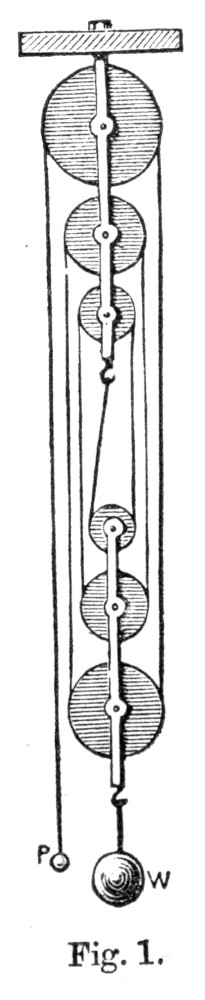
Fig. 1.
Let us begin with the second system of
pulleys. Here we have a power P attached
to the one end of a thread, which passes
over all the pulleys, and is ultimately attached, by its
other extremity, to a hook in the upper or fixed block.
The weight W is, on the other hand, attached to the
lower or moveable block, and rises with it. Let us
suppose that the pulleys are without weight and the
cords without friction, and that W is supported by six
cords, as in the figure. Now, when there is equilibrium
in this machine, it is well known that W will be equal
to six times P; that is to say, a power of one kilogramme
will, in such a machine, balance or support a weight of
six kilogrammes. If P be increased a single grain more,
it will overbalance W, and P will descend, while W will
begin to rise. In such a case, after P has descended, say
six metres, its weight being, say, one kilogramme, it has
lost a quantity of energy of position equal to six units,
since it is at a lower level by six metres than it was before.
We have, in fact, expended upon our machine six units
of energy. Now, what return have we received for this
expenditure? Our return is clearly the rise of W, and
mechanicians will tell us that in this case W will have
risen one metre.
But the weight of W is six kilogrammes, and this
having been raised one metre represents an energy of
position equal to six. We have thus spent upon our
machine, in the fall of P, an amount of energy equal to
six units, and obtained in the rise of W an equivalent
amount equal to six units also. We have, in truth,
neither gained nor lost energy, but simply changed it
into a form more convenient for our use.
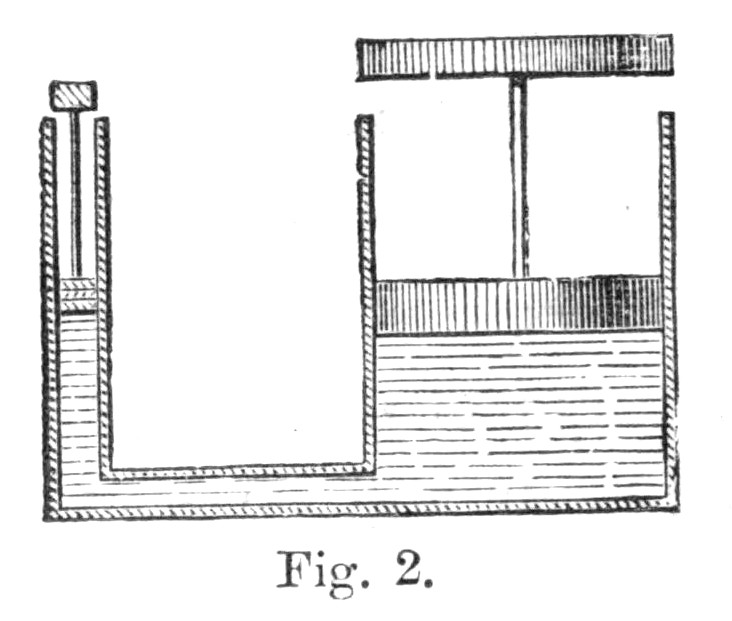
Fig. 2.
43. To impress this truth still more strongly, let us
take quite a different machine, such as the hydrostatic
press. Its mode of action will be
perceived from Fig. 2. Here we
have two cylinders, a wide and
a narrow one, which are connected
together at the bottom by
means of a strong tube. Each of
these cylinders is provided with
a water-tight piston, the space beneath being filled with
water. It is therefore manifest, since the two cylinders
are connected together, and since water is incompressible,
that when we push down the one piston the other will be
pushed up. Let us suppose that the area of the small piston
is one square centimetre,[3] and that of the large piston
one hundred square centimetres, and let us apply a weight
of ten kilogrammes to the smaller piston. Now, it is
known, from the laws of hydrostatics, that every square
centimetre of the larger piston will be pressed upwards
with the force of ten kilogrammes, so that the piston will
altogether mount with the force of 1000 kilogrammes—that
is to say, it will raise a weight of this amount as it
ascends.
Here, then, we have a machine in virtue of which a
pressure of ten kilogrammes on the small piston enables
the large piston to rise with the force of 1000 kilogrammes.
But it is very easy to see that, while the
small piston falls one metre, the large one will only rise
one centimetre. For the quantity of water under the
pistons being always the same, if this be pushed down
one metre in the narrow cylinder, it will only rise one
centimetre in the wide one.
Let us now consider what we gain by this machine. The
power of ten kilogrammes applied to the smaller piston is
made to fall through one metre, and this represents the
amount of energy which we have expended upon our
machine, while, as a return, we obtain 1000 kilogrammes
raised through one single centimetre. Here, then, as in
the case of the pulleys, the return of energy is precisely
the same as the expenditure, and, provided we ignore
friction, we neither gain nor lose anything by the machine.
All that we do is to transmute the energy into a more
convenient form—what we gain in power we lose in
space; but we are willing to sacrifice space or quickness
of motion in order to obtain the tremendous pressure or
force which we get by means of the hydrostatic press.
44. These illustrations will have prepared our readers
to perceive the true function of a machine. This was
first clearly defined by Galileo, who saw that in any
machine, no matter of what kind, if we raise a large
weight by means of a small one, it will be found that the
small weight, multiplied into the space through which it
is lowered, will exactly equal the large weight, multiplied
into that through which it is raised.
This principle, known as that of virtual velocities,
enables us to perceive at once our true position. We see
that the world of mechanism is not a manufactory, in
which energy is created, but rather a mart, into which
we may bring energy of one kind and change or barter it
for an equivalent of another kind, that suits us better—but
if we come with nothing in our hand, with nothing
we shall most assuredly return. A machine, in truth,
does not create, but only transmutes, and this principle
will enable us to tell, without further knowledge of
mechanics, what are the conditions of equilibrium of any
arrangement.
For instance, let it be required to find those of a lever,
of which the one arm is three times as long as the other.
Here it is evident that if we overbalance the lever by a
single grain, so as to cause the long arm with its power to
fall down while the short one with its weight rises up,
then the long arm will fall three inches for every inch
through which the short arm rises; and hence, to make up
for this, a single kilogramme on the
long arm will balance three kilogrammes
on the short one, or the
power will be to the weight as one
is to three.
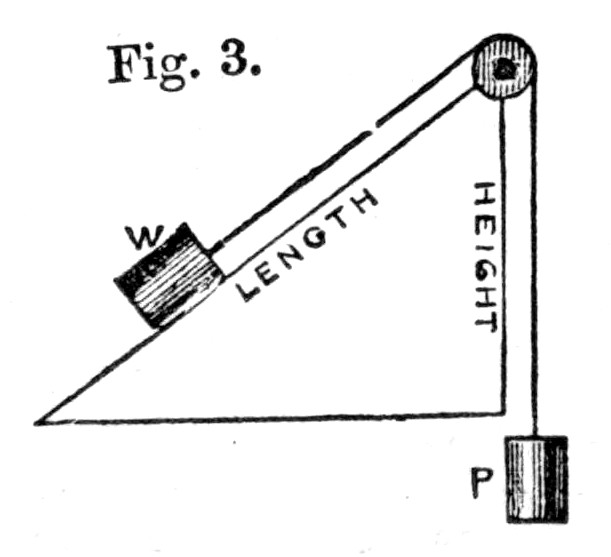
Fig. 3.
45. Or, again, let us take the inclined
plane as represented in Fig. 3.
Here we have a smooth plane and a weight held upon
it by means of a power P, as in the figure. Now,
if we overbalance P by a single grain, we shall bring
the weight W from the bottom to the top of the plane.
But when this has taken place, it is evident that
P has fallen through a vertical distance equal to the
length of the plane, while on the other hand W has only
risen through a vertical distance equal to the height.
Hence, in order that the principle of virtual velocities
shall hold, we must have P multiplied into its fall equal
to W multiplied into its rise, that is to say,
P × Length of plane = W × Height of plane,
or P/W = (Height.)/(Length.)
46. The two examples now given are quite sufficient to
enable our readers to see the true function of a machine,
and they are now doubtless disposed to acknowledge that
no machine will give back more energy than is spent
upon it. It is not, however, equally clear that it will
not give back less; indeed, it is a well-known fact that
it constantly does so. For we have supposed our
machine to be without friction—but no machine is without
friction—and the consequence is that the available
out-come of the machine is more or less diminished by
this drawback. Now, unless we are able to see clearly
what part friction really plays, we cannot prove the conservation
of energy. We see clearly enough that energy
cannot be created, but we are not equally sure that it
cannot be destroyed; indeed, we may say we have
apparent grounds for believing that it is destroyed—that
is our present position. Now, if the theory of the
conservation of energy be true—that is to say, if energy
is in any sense indestructible—friction will prove itself
to be, not the destroyer of energy, but merely the converter
of it into some less apparent and perhaps less
useful form.
47. We must, therefore, prepare ourselves to study
what friction really does, and also to recognize energy
in a form remote from that possessed by a body in visible
motion, or by a head of water. To friction we may
add percussion, as a process by which energy is apparently
destroyed; and as we have (Art. 39) considered
the case of a kilogramme shot vertically upwards, demonstrating
that it will ultimately reach the ground
with an energy equal to that with which it was shot
upwards, we may pursue the experiment one step further,
and ask what becomes of its energy after it has struck
the ground and come to rest? We may vary the question
by asking what becomes of the energy of the smith’s
blow after his hammer has struck the anvil, or what of
the energy of the cannon ball after it has struck the
target, or what of that of the railway train after it has
been stopped by friction at the break-wheel? All these
are cases in which percussion or friction appears at first
sight to have destroyed visible energy; but before pronouncing
upon this seeming destruction, it clearly behoves
us to ask if anything else makes its appearance at
the moment when the visible energy is apparently
destroyed. For, after all, energy may be like the Eastern
magicians, of whom we read that they had the power of
changing themselves into a variety of forms, but were
nevertheless very careful not to disappear altogether.
48. Now, in reply to the question we have put, it may
be confidently asserted that whenever visible energy is
apparently destroyed by percussion or friction, something
else makes its appearance, and that something is heat.
Thus, a piece of lead placed upon an anvil may be greatly
heated by successive blows of a blacksmith’s hammer.
The collision of flint and steel will produce heat, and a
rapidly-moving cannon ball, when striking against an
iron target, may even be heated to redness. Again, with
regard to friction, we know that on a dark night sparks
are seen to issue from the break-wheel which is stopping
a railway train, and we know, also, that the axles of railway
carriages get alarmingly hot, if they are not well
supplied with grease.
Finally, the schoolboy will tell us that he is in the
habit of rubbing a brass button upon the desk, and applying
it to the back of his neighbour’s hand, and that
when his own hand has been treated in this way, he has
found the button unmistakeably hot.
49. For a long time this appearance of heat by friction
or percussion was regarded as inexplicable, because it
was believed that heat was a kind of matter, and it was
difficult to understand where all this heat came from.
The partisans of the material hypothesis, no doubt,
ventured to suggest that in such processes heat might
be drawn from the neighbouring bodies, so that the
Caloric (which was the name given to the imaginary
substance of heat) was squeezed or rubbed out of them,
according as the process was percussion or friction. But
this was regarded by many as no explanation, even
before Sir Humphry Davy, about the end of last century,
clearly showed it to be untenable.
50. Davy’s experiments consisted in rubbing together
two pieces of ice until it was found that both were
nearly melted, and he varied the conditions of his experiments
in such a manner as to show that the heat
produced in this case could not be abstracted from the
neighbouring bodies.
51. Let us pause to consider the alternatives to which
we are driven by this experiment. If we still choose to
regard heat as a substance, since this has not been taken
from the surrounding bodies, it must necessarily have
been created in the process of friction. But if we choose
to regard heat as a species of motion, we have a simpler
alternative, for, inasmuch as the energy of visible motion
has disappeared in the process of friction, we may suppose
that it has been transformed into a species of molecular
motion, which we call heat; and this was the conclusion
to which Davy came.
52. About the same time another philosopher was
occupied with a similar experiment. Count Rumford was
superintending the boring of cannon at the arsenal at
Munich, and was forcibly struck with the very great
amount of heat caused by this process. The source of
this heat appeared to him to be absolutely inexhaustible,
and, being unwilling to regard it as the creation of a
species of matter, he was led like Davy to attribute it to
motion.
53. Assuming, therefore, that heat is a species of
motion, the next point is to endeavour to comprehend
what kind of motion it is, and in what respects it is
different from ordinary visible motion. To do this, let us
imagine a railway carriage, full of passengers, to be whirling
along at a great speed, its occupants quietly at ease,
because, although they are in rapid motion, they are all
moving at the same rate and in the same direction. Now,
suppose that the train meets with a sudden check;—a
disaster is the consequence, and the quiet placidity of the
occupants of the carriage is instantly at an end.
Even if we suppose that the carriage is not broken up
and its occupants killed, yet they are all in a violent
state of excitement; those fronting the engine are driven
with force against their opposite neighbours, and are, no
doubt, as forcibly repelled, each one taking care of himself
in the general scramble. Now, we have only to substitute
particles for persons, in order to obtain an idea of
what takes place when percussion is converted into heat.
We have, or suppose we have, in this act the same violent
collision of atoms, the same thrusting forward of A upon
B, and the same violence in pushing back on the part of
B—the same struggle, confusion, and excitement—the
only difference being that particles are heated instead of
human beings, or their tempers.
54. We are bound to acknowledge that the proof which
we have now given is not a direct one; indeed, we have,
in our first chapter, explained the impossibility of our
ever seeing these individual particles, or watching their
movements; and hence our proof of the assertion that
heat consists in such movements cannot possibly be direct.
We cannot see that it does so consist, but yet we may
feel sure, as reasonable beings, that we are right in our
conjecture.
In the argument now given, we have only two alternatives
to start with—either heat must consist of a
motion of particles, or, when percussion or friction is converted
into heat, a peculiar substance called caloric must
be created, for if heat be not a species of motion it must
necessarily be a species of matter. Now, we have preferred
to consider heat as a species of motion to the alternative
of supposing the creation of a peculiar kind of
matter.
55. Nevertheless, it is desirable to have something to
say to an opponent who, rather than acknowledge heat
to be a species of motion, will allow the creation of matter.
To such an one we would say that innumerable experiments
render it certain that a hot body is not sensibly
heavier than a cold one, so that if heat be a species of
matter it is one that is not subject to the law of gravity.
If we burn iron wire in oxygen gas, we are entitled to
say that the iron combines with the oxygen, because we
know that the product is heavier than the original iron
by the very amount which the gas has lost in weight.
But there is no such proof that during combustion the
iron has combined with a substance called caloric, and
the absence of any such proof is enough to entitle us to
consider heat to be a species of motion, rather than a
species of matter.
56. We shall now suppose that our readers have
assented to our proposition that heat is a species of
motion. It is almost unnecessary to add that it must
be a species of backward and forward motion; for
nothing is more clear than that a heated substance is
not in motion as a whole, and will not, if put upon a
table, push its way from the one end to the other.
Mathematicians express this peculiarity by saying that,
although there is violent internal motion among the particles,
yet the centre of gravity of the substance remains
at rest; and since, for most purposes, we may suppose a
body to act as if concentrated at its centre of gravity, we
may say that the body is at rest.
57. Let us here, before proceeding further, borrow an
illustration from that branch of physics which treats of
sound. Suppose, for instance, that a man is accurately
balanced in a scale-pan, and that some water enters his
ear; of course he will become heavier in consequence,
and if the balance be sufficiently delicate, it will exhibit
the difference. But suppose a sound or a noise enters
his ear, he may say with truth that something has entered,
but yet that something is not matter, nor will he become
one whit heavier in consequence of its entrance, and he
will remain balanced as before. Now, a man into whose
ear sound has entered may be compared to a substance
into which heat has entered; we may therefore suppose a
heated body to be similar in many respects to a sounding
body, and just as the particles of a sounding body move
backwards and forwards, so we may suppose that the
particles of a heated body do the same.
We shall take another opportunity (Art. 162) to enlarge
upon this likeness; but, meanwhile, we shall suppose that
our readers perceive the analogy.
58. We have thus come to the conclusion that when
any heavy body, say a kilogramme weight, strikes the
ground, the visible energy of the kilogramme is changed
into heat; and now, having established the fact of a relationship
between these two forms of energy, our next
point is to ascertain according to what law the heating
effect depends upon the height of fall. Let us, for instance,
suppose that a kilogramme of water is allowed to
drop from the height of 848 metres, and that we have
the means of confining to its own particles and retaining
there the heating effect produced. Now, we may suppose
that its descent is accomplished in two stages; that, first
of all, it falls upon a platform from the height of 424
metres, and gets heated in consequence, and that then
the heated mass is allowed to fall other 424 metres. It
is clear that the water will now be doubly heated; or, in
other words, the heating effect in such a case will be proportional
to the height through which the body falls—that
is to say, it will be proportional to the actual energy which
the body possesses before the blow has changed this into
heat. In fact, just as the actual energy represented by a
fall from a height is proportional to the height, so is the
heating effect, or molecular energy, into which the actual
energy is changed proportional to the height also. Having
established this point, we now wish to know through
how many metres a kilogramme of water must fall in
order to be heated one degree centigrade.
59. For a precise determination of this important
point, we are indebted to Dr. Joule, of Manchester, who
has, perhaps, done more than any one else to put the
science of energy upon a sure foundation. Dr. Joule
made numerous experiments, with the view of arriving
at the exact relation between mechanical energy and
heat; that is to say, of determining the mechanical
equivalent of heat. In some of the most important of
these he took advantage of the friction of fluids.
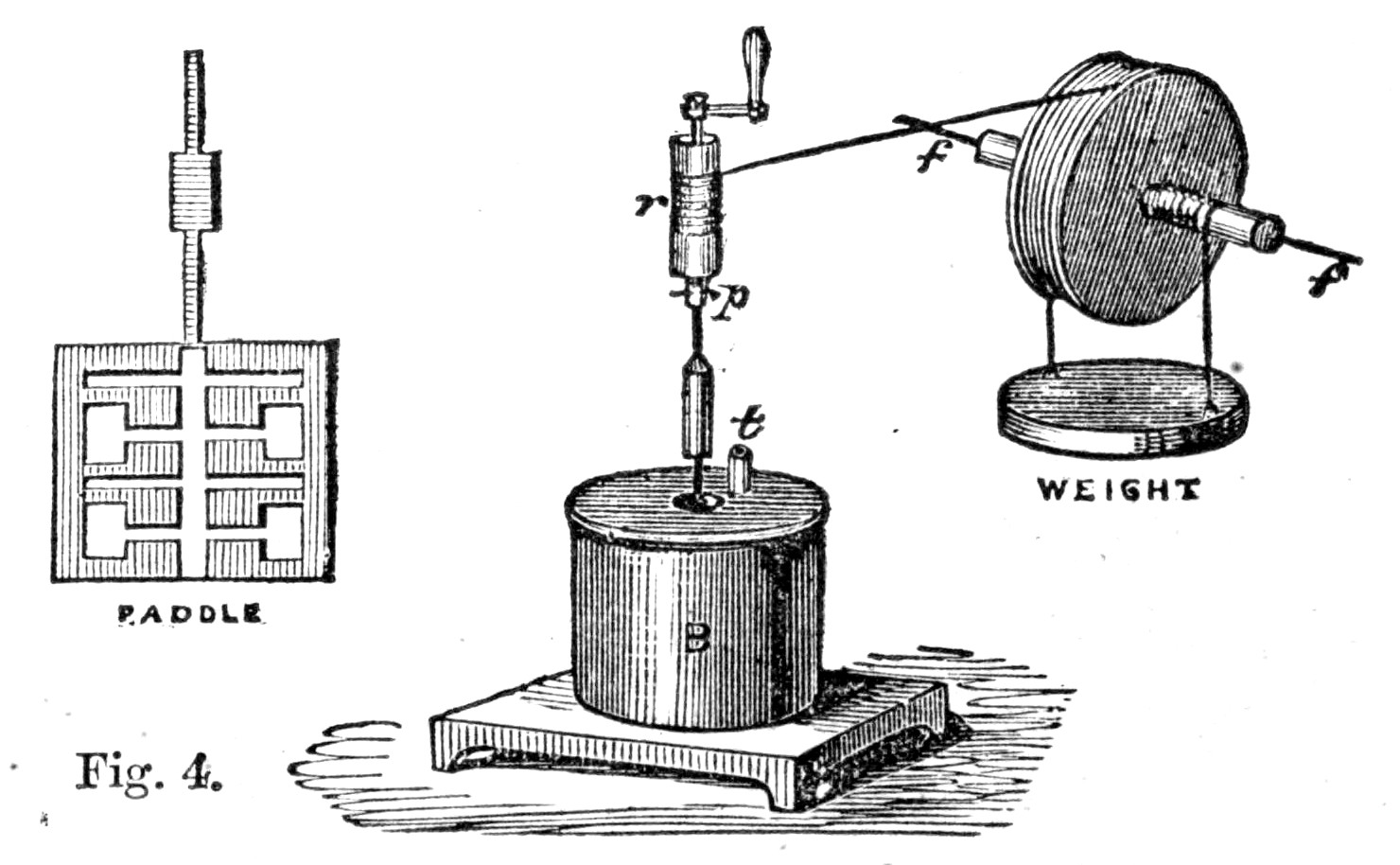
Fig. 4.
60. These experiments were conducted in the following
manner. A certain fixed weight was attached to a pulley,
as in the figure. The weight had, of course, a tendency
to descend, and hence to turn the pulley round. The
pulley had its axle supported upon friction wheels, at f
and f, by means of which the friction caused by the
movement of the pulley was very much reduced. A
string, passing over the circumference of the pulley, was
wrapped round r, so that, as the weight descended, the
pulley moved round, and the string of the pulley caused
r to rotate very rapidly. Now, the motion of the axis r
was conducted within the covered box B, where there
was attached to r a system of paddles, of which a sketch
is given in figure; and therefore, as r moved, these
paddles moved also. There were, altogether, eight sets
of these paddles revolving between four stationary vanes.
If, therefore, the box were full of liquid, the paddles and
the vanes together would churn it about, for these stationary
vanes would prevent the liquid being carried
along by the paddles in the direction of rotation.
Now, in this experiment, the weight was made to
descend through a certain fixed distance, which was
accurately measured. As it descended, the paddles were
set in motion, and the energy of the descending weight
was thus made to churn, and hence to heat some water
contained in the box B. When the weight had descended
a certain distance, by undoing a small peg p, it could be
wound up again without moving the paddles in B, and
thus the heating effect of several falls of the weight
could be accumulated until this became so great as to be
capable of being accurately measured by a thermometer.
It ought to be mentioned that great care was taken in
these experiments, not only to reduce the friction of the
axles of the pulley as much as possible, but also to
estimate and correct for this friction as accurately as
possible; in fact, every precaution was taken to make the
experiment successful.
61. Other experiments were made by Joule, in some of
which a disc was made to rotate against another disc of
cast-iron pressed against it, the whole arrangement being
immersed in a cast-iron vessel filled with mercury.
From all these experiments, Dr. Joule concluded that the
quantity of heat produced by friction, if we can preserve
and accurately measure it, will always be found proportional
to the quantity of work expended. He expressed
this proportion by stating the number of units of work in
kilogrammetres necessary to raise by 1° C. the temperature
of one kilogramme of water. This was 424, as
determined by his last and most complete experiments;
and hence we may conclude that if a kilogramme of
water be allowed to fall through 424 metres, and if its
motion be then suddenly stopped, sufficient heat will be
generated to raise the temperature of the water through
1° C., and so on, in the same proportion.
62. Now, if we take the kilogrammetre as our unit of
work, and the heat necessary to raise a kilogramme of
water 1° C. as our unit of heat, this proportion may be
expressed by saying that one heat unit is equal to 424
units of work.
This number is frequently spoken of as the mechanical
equivalent of heat; and in scientific treatises it is
denoted by J., the initial of Dr. Joule’s name.
63. We have now stated the exact relationship that
subsists between mechanical energy and heat, and before
proceeding further with proofs of the great law of conservation,
we shall endeavour to make our readers
acquainted with other varieties of energy, on the ground
that it is necessary to penetrate the various disguises
that our magician assumes before we can pretend to
explain the principles that actuate him in his transformations.
[3] That is to say, a square the side of which is one centimetre, or the
hundredth part of a metre.
CHAPTER III. THE FORCES AND ENERGIES OF NATURE: THE LAW OF CONSERVATION. — Gravitation. — Elastic Forces. — Force of Cohesion. — Force of Chemical Affinity. — Remarks on Molecular and Atomic Forces. — Electricity: its Properties. — Electric Induction. — The Electric Current. — Its Magnetic Effects. — Its Heating Effect. — Its Chemical Effect. — Attraction and Repulsion of Currents. — Attraction and Repulsion of Magnets. — Induction of Currents. — List of Energies. — Energy of Visible Motion. — Visible Energy of Position. — Heat Motion. — Molecular Separation. — Atomic or Chemical Separation. — Electrical Separation. — Electricity in Motion. — Radiant Energy. — Law of Conservation.
64. In the last chapter we introduced our readers to
two varieties of energy, one of them visible, and the other
invisible or molecular; and it will now be our duty to
search through the whole field of physical science for
other varieties. Here it is well to bear in mind that all
energy consists of two kinds, that of position and that of
actual motion, and also that this distinction holds for
invisible molecular energy just as truly as it does for that
which is visible. Now, energy of position implies a body
in a position of advantage with respect to some force, and
hence we may with propriety begin our search by
investigating the various forces of nature.
65. The most general, and perhaps the most important,
of these forces is gravitation, and the law of action of this
force may be enunciated as follows:—Every particle of
the universe attracts every other particle with a force
depending jointly upon the mass of the attracting and
of the attracted particle, and varying inversely as the
square of distance between the two. A little explanation
will make this plain.
Suppose a particle or system of particles of which
the mass is unity to be placed at a distance equal to unity
from another particle or system of particles of which the
mass is also unity—the two will attract each other. Let us
agree to consider the mutual attraction between them
equal to unity also.
Suppose, now, that we have on the one side two such
systems with a mass represented by 2, and on the other
side the same system as before, with a mass represented
by unity, the distance, meanwhile, remaining
unaltered. It is clear the double system will now attract
the single system with a twofold force. Let us next
suppose the mass of both systems to be doubled, the
distance always remaining the same. It is clear that we
shall now have a fourfold force, each unit of the one
system attracting each unit of the other. In like manner,
if the mass of the one system is 2, and that of the other
3, the force will be 6. We may, for instance, call the
components of the one system A1, A₂, and those of
the other A3, A4, A5, and we shall have A1 pulled towards
A3, A4, and A5, with a threefold force, and A₂ pulled
towards A3, A4, and A5, with a threefold force, making
altogether a force equal to 6.
In the next place, let the masses remain unaltered, but
let the distance between them be doubled, then the force
will be reduced fourfold. Let the distance be tripled,
then the force will be reduced ninefold, and so on.
66. Gravitation may be described as a very weak force,
capable of acting at a distance, or at least of appearing
to do so. It takes the mass of the whole earth to produce
the force with which we are so familiar at its
surface, and the presence of a large mass of rock or
mountain does not produce any appreciable difference in
the weight of any substance. It is the gravitation of the
earth, lessened of course by distance, which acts upon
the moon 240,000 miles away, and the gravitation of the
sun influences in like manner the earth and the various
other planets of our system.
67. Elastic forces, although in their mode of action
very different from gravity, are yet due to visible
arrangements of matter; thus, when a cross-bow is bent,
there is a visible change produced in the bow, which, as a
whole, resists this bending, and tends to resume its
previous position. It therefore requires energy to bend
a bow, just as truly and visibly as it does to raise a
weight above the earth, and elasticity is, therefore, as
truly a species of force as gravity is. We shall not here
attempt to discuss the various ways in which this force
may act, or in which a solid elastic substance will resist
all attempts to deform it; but in all cases it is clearly
manifest that work must be spent upon the body, and the
force of elasticity must be encountered and overcome
throughout a certain space before any sensible deformation
can take place.
68. Let us now leave the forces which animate large
masses of matter, and proceed to discuss those which
subsist between the smaller particles of which these large
masses are composed. And here we must say one word
more about molecules and atoms, and the distinction we
feel ourselves entitled to draw between these very small
bodies, even although we shall never be able to see either
the one or the other.
In our first chapter (Art. 7) we supposed the continual
sub-division of a grain of sand until we had arrived at
the smallest entity retaining all the properties of sand—this
we called a molecule, and nothing smaller than
this is entitled to be called sand. If we continue this
sub-division further, the molecule of sand separates itself
into its chemical constituents, consisting of silicon on
the one side, and oxygen on the other. Thus we arrive
at last at the smallest body which can call itself silicon,
and the smallest which can call itself oxygen, and we
have no reason to suppose that either of these is capable
of sub-division into something else, since we regard
oxygen and silicon as elementary or simple bodies. Now,
these constituents of the silicon molecule are called atoms,
so that we say the sand molecule is divisible into atoms
of silicon and of oxygen. Furthermore, we have strong
reason for supposing that such molecules and atoms really
exist, but into the arguments for their existence we cannot
now enter—it is one of those things that we must
ask our readers to take for granted.
69. Let us now take two molecules of sand. These,
when near together, have a very strong attraction for
each other. It is, in truth, this attraction which renders
it difficult to break up a crystalline particle of sand or
rock crystal. But it is only exerted when the molecules
are near enough together to form a homogeneous crystalline
structure, for let the distance between them be somewhat
increased, and we find that all attraction entirely
vanishes. Thus there is little or no attraction between
different particles of sand, even although they are very
closely packed together. In like manner, the integrity
of a piece of glass is due to the attraction between its
molecules; but let these be separated by a flaw, and it
will soon be found that this very small increase of distance
greatly diminishes the attraction between the particles,
and that the structure will now fall to pieces from
the slightest cause. Now, these examples are sufficient
to show that molecular attraction or cohesion, as this is
called, is a force which acts very powerfully through a
certain small distance, but which vanishes altogether
when this distance becomes perceptible. Cohesion is
strongest in solids, while in liquids it is much diminished,
and in gases it may be said to vanish altogether. The
molecules of gases are, in truth, so far away from one
another, as to have little or no mutual attraction, a fact
proved by Dr. Joule, whose name was mentioned in the
last chapter.
70. Let us now consider the mutual forces between
atoms. These may be characterized as even stronger
than the forces between molecules, but as disappearing
still more rapidly when the distance is increased. Let
us, for instance, take carbon and oxygen—two substances
which are ready to combine together to form carbonic
acid, whenever they have a suitable opportunity. In
this case, each atom of carbon will unite with two of
oxygen, and the result will be something quite different
from either. Yet under ordinary circumstances carbon, or
its representative, coal, will remain unchanged in the
presence of oxygen, or of atmospheric air containing
oxygen. There will be no tendency to combine together,
because although the particles of the oxygen would appear
to be in immediate contact with those of the carbon,
yet the nearness is not sufficient to permit of chemical
affinity acting with advantage. When, however, the
nearness becomes sufficient, then chemical affinity begins
to operate. We have, in fact, the familiar act of combustion,
and, as its consequence, the chemical union of the
carbon or coal with the oxygen of the air, carbonic acid
being the result. Here, then, we have a very powerful
force acting only at a very small distance, which we
name chemical affinity, inasmuch as it represents the
attraction exerted between atoms of different bodies in
contradistinction to cohesion, which denotes the attraction
between molecules of the same body.
71. If we regard gravitation as the representative of
forces that act or appear to act, at a distance, we may
regard cohesion and chemical affinity as the representatives
of those forces which, although very powerful, only
act or appear to act through a very small interval of
distance.
A little reflection will show us how inconvenient it
would be if gravitation diminished very rapidly with the
distance; for then even supposing that the bond which
retains us to the earth were to hold good, that which
retains the moon to the earth might vanish entirely, as
well as that which retains the earth to the sun, and the
consequences would be far from pleasant. Reflection
will also show us how inconvenient it would be if
chemical affinity existed at all distances; if coal, for
instance, were to combine with oxygen without the application
of heat, it would greatly alter the value of this
fuel to mankind, and would materially check the progress
of human industry.
72. Now, it is important to remember that we must
treat cohesion and chemical affinity exactly in the same
way as gravity has been treated; and just as we have
energy of position with respect to gravity, so may we
have as truly a species of energy of position with
respect to cohesion and chemical affinity. Let us
begin with cohesion.
73. We have hitherto regarded heat as a peculiar
motion of the molecules of matter, without any reference
to the force which actuates these molecules. But it is
a well-known fact that bodies in general expand when
heated, so that, in virtue of this expansion, the molecules
of a body are driven violently apart against the force of
cohesion. Work has in truth been done against this
force, just as truly as, when a kilogramme is raised from
the earth, work is done against the force of gravity.
When a substance is heated, we may, therefore, suppose
that the heat has a twofold office to perform, part of it
going to increase the actual motions of the molecules,
and part of it to separate these molecules from one
another against the force of cohesion. Thus, if I swing
round horizontally a weight (attached to my hand by
an elastic thread of india-rubber), my energy will be
spent in two ways—first of all, it will be spent in communicating
a velocity to the weight; and, secondly, in
stretching the india-rubber string, by means of the
centrifugal tendency of the weight. Work will be done
against the elastic force of the string, as well as spent
in increasing the motion of the weight.
Now, something of this kind may be taking place
when a body is heated, for we may very well suppose
heat to consist of a vertical or circular motion, the tendency
of which would be to drive the particles asunder
against the force of cohesion. Part, therefore, of the
energy of heat will be spent in augmenting the motion,
and part in driving asunder the particles. We may,
however, suppose that, in ordinary cases, the great proportion
of the energy of heat goes towards increasing
the molecular motion, rather than in doing work against
the force of cohesion.
74 In certain cases, however, it is probable that the
greater part of the heat applied is spent in doing work
against molecular forces, instead of increasing the
motions of molecules.
Thus, when a solid melts, or when a liquid is rendered
gaseous, a considerable amount of heat is spent in the
process, which does not become sensible, that is to say,
does not affect the thermometer. Thus, in order to melt
a kilogramme of ice, heat is required sufficient to raise
a kilogramme of water through 80° C., and yet, when
melted, the water is no warmer than the ice. We express
this fact by saying that the latent heat of water
is 80. Again, if a kilogramme of water at 100° be converted
entirely into steam, as much heat is required as
would raise the water through 537° C., or 537 kilogrammes
of water through one degree; but yet the steam is no
hotter than the water, and we express this fact by saying
that the latent heat of steam is 537. Now, in both of
these instances it is at least extremely probable that
a large portion of the heat is spent in doing work against
the force of cohesion; and, more especially, when a fluid
is converted into a gas, we know that the molecules are
in that process separated so far from one another as to
lose entirely any trace of mutual force. We may, therefore,
conclude that although in most cases the greater
portion of the heat applied to a body is spent in increasing
its molecular motion, and only a small part in
doing work against cohesion, yet when a solid melts, or
a liquid vaporizes, a large portion of the heat required is
not improbably spent in doing work against molecular
forces. But the energy, though spent, is not lost, for
when the liquid again freezes, or when the vapour again
condenses, this energy is once more transformed into the
shape of sensible heat, just as when a stone is dropped
from the top of a house, its energy of position is transformed
once more into actual energy.
75. A single instance will suffice to give our readers a
notion of the strength of molecular forces. If a bar of
wrought iron, whose temperature is 10° C. above that
of the surrounding medium, be tightly secured at its
extremities, it will draw these together with a force of at
least one ton for each square inch of section. In some
cases where a building has shown signs of bulging outwards,
iron bars have been placed across it, and secured
while in a heated state to the walls. On cooling, the
iron contracted with great force, and the walls were
thereby pulled together.
76. We are next brought to consider atomic forces, or
those which lead to chemical union, and now let us see
how these are influenced by heat. We have seen that
heat causes a separation between the molecules of a
body, that is to say, it increases the distance between
two contiguous molecules, but we must not suppose that,
meanwhile, the molecules themselves are left unaltered.
The tendency of heat to cause separation is not confined
to increasing the distance between molecules, but acts
also, no doubt, in increasing the distance between parts
of the same molecule: in fact, the energy of heat is spent
in pulling the constituent atoms asunder against the force
of chemical affinity, as well as in pulling the molecules
asunder against the force of cohesion, so that, at a very
high temperature, it is probable that most chemical compounds
would be decomposed, and many are so, even at a
very moderate heat.
Thus the attraction between oxygen and silver is so
slight that at a comparatively low temperature the oxide
of silver is decomposed. In like manner, limestone, or
carbonate of lime, is decomposed when subjected to the
heat of a lime-kiln, carbonic acid being given off, while
quick-lime remains behind. Now, in separating heterogeneous
atoms against the powerful force of chemical
affinity, work is done as truly as it is in separating molecules
from one another against the force of cohesion, or in separating
a stone from the earth against the force of gravity.
77. Heat, as we have seen, is very frequently influential
in performing this separation, and its energy is spent in
so doing; but other energetic agents produce chemical
decomposition as well as heat. For instance, certain rays
of the sun decompose carbonic acid into carbon and
oxygen in the leaves of plants, and their energy is spent
in the process; that is to say, it is spent in pulling
asunder two such powerfully attracting substances against
the affinity they have for one another. And, again, the
electric current is able to decompose certain substances,
and of course its energy is spent in the process.
Therefore, whenever two powerfully attracting atoms
are separated, energy is spent in causing this separation
as truly as in separating a stone from the earth, and
when once the separation has been accomplished we have
a species of energy of position just as truly as we have in
a head of water, or in a stone at the top of a house.
78. It is this chemical separation that is meant when
we speak of coal as a source of energy. Coal, or carbon,
has a great attraction for oxygen, and whenever heat is
applied the two bodies unite together. Now oxygen, as
it exists in the atmosphere, is the common inheritance of
all, and if, in addition to this, some of us possess coal in
our cellars, or in pits, we have thus secured a store of
energy of position which we can draw upon with more
facility than if it were a head of water, for, although we
can draw upon the energy of a head of water whenever
we choose, yet we cannot carry it about with us from
place to place as we can with coal. We thus perceive
that it is not the coal, by itself, that forms the source of
energy, but this is due to the fact that we have coal, or
carbon, in one place, and oxygen in another, while we
have also the means of causing them to unite with each
other whenever we wish. If there were no oxygen in
the air, coal by itself would be of no value.
79. Our readers have now been told about the force
of cohesion that exists between molecules of the same
body, and also about that of chemical affinity existing
between atoms of different bodies. Now, heterogeneity
is an essential element of this latter force—there must
be a difference of some kind before it can exhibit itself—and
under these circumstances its exhibitions are frequently
characterized by very extraordinary and interesting
phenomena.
We allude to that peculiar exhibition arising out of the
forces of heterogeneous bodies which we call electricity,
and, before proceeding further, it may not be out of place
to give a short sketch of the mode of action of this very
mysterious, but most interesting, agent.
80. The science of electricity is of very ancient origin;
but its beginning was very small. For a couple of thousand
years it made little or no progress, and then, during
the course of little more than a century, developed into
the giant which it now is. The ancient Greeks were
aware that amber, when rubbed with silk, had the property
of attracting light bodies; and Dr. Gilbert, about
three hundred years ago, showed that many other things,
such as sulphur, sealing-wax, and glass, have the same
property as amber.
In the progress of the science it came to be known
that certain substances are able to carry away the
peculiar influence produced, while others are unable to
do so; the former are called conductors, and the latter
non-conductors, or insulators, of electricity. To make
the distinction apparent, let us take a metal rod, having
a glass stem attached to it, and rub the glass stem with
a piece of silk, care being taken that both silk and glass
are warm and dry. We shall find that the glass has now
acquired the property of attracting little bits of paper, or
elder pith; but only where it has been rubbed, for the
peculiar influence acquired by the glass has not been able
to spread itself over the surface.
If, however, we take hold of the glass stem, and rub
the metal rod, we may, perhaps, produce the same property
in the metal, but it will spread over the whole, not
confining itself to the part rubbed. Thus we perceive
that metal is a conductor, while glass is an insulator, or
non-conductor, of electricity.
Fig. 5.
81. We would next observe that this influence is of
two kinds. To prove this, let us perform the following
experiment. Let us suspend
a small pith ball by a very
slender silk thread, as in Fig. 5.
Next, let us rub a stick of
warm, dry glass with a
piece of warm silk, and with
this excited stick touch the
pith ball. The pith ball, after
being touched, will be repelled
by the excited glass. Let us
next excite, in a similar manner,
a stick of dry sealing-wax with a piece of warm, dry
flannel, and on approaching this stick to the pith ball it
will attract it, although the ball, in its present state, is
repelled by the excited glass.
Thus a pith ball, touched by excited glass, is repelled
by excited glass, but attracted by excited sealing-wax.
In like manner, it might be shown that a pith ball,
touched by excited sealing-wax, will be afterwards repelled
by excited sealing-wax, but attracted by excited
glass.
Now, what the excited glass did to the pith ball, was
to communicate to it part of its own influence, after
which the ball was repelled by the glass; or, in other
words, bodies charged with similar electricities repel one
another.
Again, since the pith ball, when charged with the electricity
from glass, was attracted to the electrified sealing-wax,
we conclude that bodies charged with unlike electricities
attract one another. The electricity from glass
is sometimes called vitreous, and that from sealing-wax
resinous, electricity, but more frequently the former is
known as positive, and the latter as negative, electricity—it
being understood that these words do not imply the
possession of a positive nature by the one influence, or
of a negative nature by the other, but are merely terms
employed to express the apparent antagonism which
exists between the two kinds of electricity.
82. The next point worthy of notice is that whenever
one electricity is produced, just as much is produced of
an opposite description. Thus, in the case of glass
excited by silk, we have positive electricity developed
upon the glass, while we have also negative electricity
developed upon the silk to precisely the same extent. And,
again, when sealing-wax is rubbed with flannel, we have
negative electricity developed upon the sealing-wax, and
just as much positive upon the flannel.
83. These facts have given rise to a theory of electricity,
or at least to a method of regarding it, which, if
not absolutely correct, seems yet to unite together the
various phenomena. According to this hypothesis, a
neutral, unexcited body is supposed to contain a store
of the two electricities combined together, so that whenever
such a body is excited, a separation is produced
between the two. The phenomena which we have
described are, therefore, due to this electrical separation,
and inasmuch as the two electricities have a great affinity
for one another, it requires the expenditure of energy to
produce this separation, just as truly as it does to separate
a stone from the earth.
84. Now, it is worthy of note that electrical separation
is only produced when heterogeneous bodies are
rubbed together. Thus, if flannel be rubbed upon glass,
we have electricity; but if flannel be rubbed upon glass
covered with flannel, we have none. In like manner, if
silk be rubbed upon sealing-wax covered with silk, or, in
fine, if two portions of the same substance be rubbed
together, we have no electricity.
On the other hand, a very slight difference of texture
is sometimes sufficient to produce electrical separation.
Thus, if two pieces of the same silk ribbon be rubbed
together lengthwise, we have no electricity; but if they
be rubbed across each other, the one is positively, and the
other negatively, electrified.
In fact, this element of heterogeneity is an all important
one in electrical development, and this leads us to
conjecture that electrical attraction may probably be
regarded as peculiarly allied to that force which we call
chemical affinity. At any rate, electricity and chemical
affinity are only manifested between bodies that are, in
some respects, dissimilar.
85. The following is a list of bodies arranged according
to the electricity which they develop when rubbed together,
each substance being positively electrified when
rubbed with any substance beneath it in the list.
Thus, if resin be rubbed with cat’s skin, or with
flannel, the cat’s skin or flannel will be positively, and
the resin negatively, electrified; while if glass be rubbed
with silk, the glass will be positively, and the silk negatively,
electrified, and so on.
86. It is not our purpose here to describe at length the
electrical machine, but we may state that it consists of
two parts, one for generating electricity by means of the
friction of a rubber against glass, and another consisting
of a system of brass tubes, of considerable surface, supported
on glass stems, for collecting and retaining the
electricity so produced. This latter part of the machine
is called its prime conductor.
Fig. 6.
87. Let us now suppose that we have set in action a
machine of this kind, and accumulated a considerable
quantity of positive electricity in its prime conductor at
A. Let us next take two vessels, B and C, made of brass,
supported on glass stems. These two vessels are supposed
to be in contact, but at the same time to be
capable of being separated from one another at their
middle point, where the line is drawn in Fig. 6.
Now let us cause B and C to approach A together. At
first, B and C are not electrified, that is to say, their two
electricities are not separated from each other, but are
mixed together; but mark what will happen as they
are pushed towards A. The positive electricity of A will
decompose the two electricities of B and C, attracting the
negative towards itself, and repelling the positive as far
away as possible. The disposition of electricities will,
therefore, be as in the figure. If we now pull C away
from B, we have obtained a quantity of positive electricity
on C, by help of the original electricity which was
in A; in fact, we have made use of the original stock or
electrical capital in A, in order to obtain positive electricity
in C, without, however, diminishing the amount
of our original stock. Now, this distant action or help,
rendered by the original electricity in separating that of
B and C, is called electric induction.
88. The experiment may, however, be performed in a
somewhat different manner—we may allow B and C to
remain together, and gradually push them nearer to A.
As B and C approach A, the separation of their electricities
will become greater and greater, until, when A and B are
only divided by a small thickness of air, the two opposite
electricities then accumulated will have sufficient strength
to rush together through the air, and unite with each
other by means of a spark.
89. The principle of induction may be used with advantage,
when it is wished to accumulate a large quantity
of electricity.
Fig. 7.
In this case, an instrument called a Leyden jar is very
frequently employed. It consists of a glass jar, coated
inside and outside with tin foil, as in
Fig. 7. A brass rod, having a knob at
the end of it, is connected metallically
with the inside coating, and is kept in
its place by being passed through a
cork, which covers the mouth of the
jar. We have thus two metallic
coatings which are not electrically
connected with one another. Now, in order to charge
a jar of this kind, let the outside coating be connected
by a chain with the earth, while at the same
time positive electricity from the prime conductor of
an electrical machine is communicated to the inside knob.
The positive electricity will accumulate on the inside
coating with which the knob is connected. It will then
decompose the two electricities of the outside coating,
driving the positive electricity to the earth, and there
dissipating it, but attracting the negative to itself. There
will thus be positive electricity on the inside, and
negative on the outside coating. These two electricities
may be compared to two hostile armies watching each
other, and very anxious to get together, while, however,
they are separated from one another by means of an
insurmountable obstacle. They will thus remain facing
each other, and at their posts, while each side is, meanwhile,
being recruited by the same operation as before.
We may by this means accumulate a vast quantity of
opposite electricities on the two coatings of such a jar,
and they will remain there for a long time, especially if
the surrounding atmosphere and the glass surface of the
jar be quite dry. When, however, electric connection of
any kind is made between the two coatings, the electricities
rush together and unite with one another in the
shape of a spark, while if the human body be the instrument
of connecting them a severe shock will be felt.
90. It would thus appear that, when two bodies
charged with opposite electricities are brought near
each other, the two electricities rush together, forming
a current, and the ultimate result is a spark. Now,
this spark implies heat, and is, in truth, nothing else
than small particles of intensely heated matter of some
kind. We have here, therefore, first of all, the conversion
of electrical separation into a current of electricity, and,
secondly, the conversion of this current into heat. In
this case, however, the current lasts only a very small
time; the discharge, as it is called, of a Leyden jar being
probably accomplished in ¹⁄₂₄₀₀₀th of a second.
91. In other cases we have electrical currents which,
although not so powerful as that produced by discharging
a Leyden jar, yet last longer, and are, in fact, continuous
instead of momentary.
We may see a similar difference in the case of visible
energy. Thus we might, by means of gunpowder, send
up in a moment an enormous mass of water; or we
might, by means of a fountain, send up the same mass
in the course of time, and in a very much quieter
manner. We have the same sort of difference in electrical
discharges, and having spoken of the rushing together of
two opposite electricities by means of an explosion and
a spark, let us now speak of the eminently quiet and
effective voltaic current, in which we have a continuous
coming together of the same two agents.
Fig. 8.
92. It is not our object here to give a complete description,
either historical or scientific, of the voltaic
battery, but rather to give such an account as will
enable our readers to understand what the arrangement
is, and what sort of effect it produces; and with this
object we shall at once proceed to describe the battery
of Grove, which is perhaps the most efficacious of all the
various arrangements for the purpose of producing an
electric current. In this battery we have a number of
cells connected together,
as in Fig. 8,
which shows a battery
of three cells. Each
cell consists of two
vessels, an outer and
an inner one; the outer vessel being made of glass
or ordinary stone ware, while the inner one is made
of unglazed porcelain, and is therefore porous. The
outer vessel is filled with dilute sulphuric acid, and a
plate of amalgamated zinc—that is to say, of metallic
zinc having its outer surface brightened with mercury,—is
immersed in this acid. Again, in the inner or porous
vessel we have strong nitric acid, in which a plate of
platinum foil is immersed, this being at the same time electrically
connected with the zinc plate of the next outer
vessel, by means of a clamp, as in the figure. Both metals
must be clean where they are pressed together, that is to
say, the true metallic surfaces of both must be in contact.
Finally, a wire is metallically connected with the platinum
of the left-hand cell, and a similar wire with the
zinc of the right-hand cell, and these connecting wires
ought, except at their extremities, to be covered over
with gutta-percha or thread. The loose extremities of
these wires are called the poles of the battery.
93. Let us now suppose that we have a battery containing
a good many cells of this description, and let the
whole arrangement be insulated, by being set upon glass
supports, or otherwise separated from the earth. If now
we test, by appropriate methods, the extremity of the
wire connected with the left-hand platinum plate, it will
be found to be charged with positive electricity, while
the extremity of the other wire will be found charged
with negative electricity.
94. In the next place, if we connect these poles of the
battery with one another, the two electricities will rush
together and unite, or, in other words, there will be an
electric current; but it will not be a momentary but a
continuous one, and for some time, provided these poles
are kept together, a current of electricity will pass through
the wires, and indeed through the whole arrangement,
including the cells.
The direction of the current will be such that positive
electricity may be supposed to pass from the zinc to the
platinum, through the liquid; and back again through
the wire, from the platinum at the left hand, to the zinc
at the right; in fact, to go in the direction indicated by
the arrow-head.
95. Thus we have two things. In the first place, before
the two terminals, or poles, have been brought together,
we have them charged with opposite electricities; and,
secondly, when once they have been brought together, we
have the production of a continuous current of electricity.
Now, this current is an energetic agent, in proof of which
we shall proceed to consider the various properties which
it has,—the various things which it can do.
96. In the first place, it can deflect the magnetic needle.
For instance, let a compass needle be swung freely, and
let a current of electricity circulate along a wire placed
near this needle, and in the direction of its length, then
the direction in which the needle points will be immediately
altered. This direction will now depend upon that
of the current, conveyed by the wire, and the needle will
endeavour to place itself at right angles to this wire.
In order to remember the connection between the
direction of the current and that of the magnet, imagine
your body to form part of the positive current, which may
be supposed to enter in at your head, and go out at your
feet; also imagine that your face is turned towards the
magnet. In this case, the pole of the magnet, which
points to the north, will always be deflected by the current
towards your right hand. The strength of a current
may be measured by the amount of the deflection it produces
upon a magnetic needle, and the instrument by which
this measurement is made is called a galvanometer.
97. In the next place, the current is able, not merely
to deflect a magnet, but also to render soft iron magnetic.
Let us take, for instance, the wire
connected with the one pole of the
battery, and cover it with thread, in
order to insulate it, and let us wrap
this wire round a cylinder of soft
iron, as in Fig. 9. If we now
make a communication between the
other extremity of the wire, and
the other pole of the battery, so as
to make the current pass, it will be
found that our cylinder of soft iron
has become a powerful magnet, and that if an iron
keeper be attached to it as in the figure, the keeper
will be able to sustain a very great weight.
Fig. 9.
98. The electric current has likewise the property of
heating a wire through which it passes. To prove this,
let us connect the two poles of a battery by means of a
fine platinum wire, when it will be found that the wire
will, in a few seconds, become heated to redness. In
point of fact, the current will heat a thick wire, but not
so much as a thin one, for we may suppose it to rush with
great violence through the limited section of the thin
wire, producing in its passage great heat.
99. Besides its magnetic and heating effects, the current
has also the power of decomposing compound substances,
under certain conditions. Suppose, for instance, that the
poles of a battery, instead of being brought together, are
plunged into a vessel of water, decomposition will at once
begin, and small bubbles of oxygen will rise from the
positive pole, while small bubbles of hydrogen will make
their appearance at the negative. If the two gases are
collected together in a vessel, they may be exploded, and
if collected separately, it may be proved by the ordinary
tests, that the one is oxygen and the other hydrogen.
100. We have now described very shortly the magnetic,
the heating, and the chemical effects of currents; it
remains for us to describe the effects of currents upon
one another.
In the first place, suppose that we have two wires
which are parallel to one another, and carry currents
going in the same direction; and let us further suppose
that these wires are capable of moving, then it is found
that they will attract one another. If, however, the
wires, although parallel, convey currents going in opposite
directions, they will then repel one another. A good way
of showing this experimentally is to cause two circular
currents to float on water. If these currents both go
either in the same direction as the hands of a watch,
or in the opposite direction, then the two will attract
one another; but if the one goes in the one direction,
and the other in the other, they will then repel one
another.
101. Ampère, who discovered this property of currents,
has likewise shown us that in very many respects a
magnet may be likened to a collection of circular currents
all parallel to one another, their direction being such that,
if you look towards the north pole of a freely suspended
cylindrical magnet facing it, the positive current will
descend on the east or left-hand side, and ascend on the
west or right-hand side. If we adopt this method of
viewing magnets, we can easily account for the attraction
between the unlike and the repulsion between the like
poles of a magnet, for when unlike poles are placed
near each other, the circular currents which face each
other are then all going in the same direction, and the
two will, therefore, attract one another, but if like poles
are placed in this position, the currents that face each
other are going in opposite directions, and the poles will,
therefore, repel one another.
Fig. 10.
102. Before closing this short sketch of electrical
phenomena, we must allude to the inductive effect of
currents upon each other. Let us suppose (Fig. 10) that
we have two circular
coils of wire, covered
with thread, and placed
near each other. Let
both the extremities of
the right-hand coil be
connected with the poles
of a battery, so as to
make a current of electricity
circulate round
the coil. On the other
hand, let the left-hand
coil be connected with
a galvanometer, thus
enabling us to detect
the smallest current of
electricity which may
pass through this coil.
Now, it is found that
when we first connect
the right-hand coil, so
as to pass the battery
current through it, a
momentary current will
pass through the left-hand
coil, and will deflect
the needle of the
galvanometer, but this current will go in an opposite
direction to that which circulates round the right-hand
coil.
103. Again, as long as the current continues to flow
through the right-hand coil there will be no current
through the other, but at the moment of breaking the
contact between the right-hand coil and the battery there
will again be a momentary current in the left-hand coil,
but this time in the same direction as that of the right-hand
coil, instead of being, as before, in the opposite
direction. In other words, when contact is made in the
right-hand coil, there is a momentary current in the left-hand
coil, but in an opposite direction to that in the right,
while, when contact is broken in the right-hand coil, there
is a momentary current in the left-hand coil in the same
direction as that in the right.
104. In order to exemplify this induction of currents,
it is not even necessary to make and break the current
in the right-hand coil, for we may keep it constantly going
and arrange so as to make the right-hand coil (always
retaining its connection with the battery) alternately
approach and recede from the other; when it approaches
the other, the effect produced will be the same as when
the contact was made in the above experiment—that is
to say, we shall have an induced current in an opposite
direction to that of the primary, while, when it recedes
from the other, we shall have a current in the same direction
as that of the primary.
105. Thus we see that whether we keep both coils
stationary, and suddenly produce a current in the right-hand
coil, or whether, keeping this current constantly
going, we suddenly bring it near the other coil, the
inductive effect will be precisely the same, for in both
cases the left-hand coil is suddenly brought into the
presence of a current. And again, it is the same, whether
we suddenly break the right-hand current, or suddenly
remove it from the left-hand coil, for in both cases
this coil is virtually removed from the presence of a
current.
106. We are now in a position to enumerate the various
kinds of energy which occur in nature; but, before doing
so, we must warn our readers that this enumeration has
nothing absolute or complete about it, representing, as it
does, not so much the present state of our knowledge as
of our want of knowledge, or rather profound ignorance,
of the ultimate constitution of matter. It is, in truth,
only a convenient classification, and nothing more.
107. To begin, then, with visible energy. We have
first of all—
(A.) Visible energy of actual motion—in the planets,
in meteors, in the cannon ball, in the storm, in
the running stream, and in other instances of
bodies in actual visible motion, too numerous to
be mentioned.
(B.) We have also visible energy of position—in a stone
on the top of a cliff, in a head of water, in a rain
cloud, in a cross-bow bent, in a clock or watch
wound up, and in various other instances.
108. Then we have, besides, several cases in which
there is an alternation between (A) and (B).
A pendulum, for instance, when at its lowest point, has
only the energy (A), or that of actual motion, in virtue of
which it ascends a certain distance against the force of
gravity. When, however, it has completed its ascent, its
energy is then of the variety (B), being due to position,
and not to actual motion; and so on it continues to
oscillate, alternately changing the nature of its energy
from (A) to (B), and from (B) back again to (A).
109. A vibrating body is another instance of this alternation.
Each particle of such a body may be compared to
an exceedingly small pendulum oscillating backwards
and forwards, only very much quicker than an ordinary
pendulum; and just as the ordinary pendulum in passing
its point of rest has its energy all of one kind, while in
passing its upper point it has it all of another, so when
a vibrating particle is passing its point of rest, its energy
is all of the variety (A), and when it has reached its
extreme displacement, it is all of the variety (B).
110. (C.) Coming now to molecular or invisible energy,
we have, in the first place, that motion of the
molecules of bodies which we term heat. A
better term would be absorbed heat, to distinguish
it from radiant heat, which is a very
different thing. That peculiar motion which is
imparted by heat when absorbed into a body is,
therefore, one variety of molecular energy.
(D.) Analogous to this is that effect of heat which
represents position rather than actual motion.
For part of the energy of absorbed heat is spent
in pulling asunder the molecules of the body
under the attractive force which binds them
together (Art. 73), and thus a store of energy of
position is laid up, which disappears again after
the body is cooled.
111. (E.) The two previous varieties of energy may be
viewed as associated with molecules rather than
with atoms, and with the force of cohesion
rather than with that of chemical affinity.
Proceeding now to atomic force, we have
a species of energy of position due to the
separation of different atoms under the strong
chemical attraction they have for one another.
Thus, when we possess coal or carbon and also
oxygen in a state of separation from one
another, we are in possession of a source of
energy which may be called that of chemical
separation.
112 (F.) The attraction which heterogeneous atoms
possess for one another, sometimes, however,
gives rise to a species of energy which manifests
itself in a very peculiar form, and
appears as electrical separation, which is thus
another form of energy of position.
113 (G.) But we have another species of energy connected
with electricity, for we have that due to
electricity in motion, or in other words, an
electric current which probably represents some
form of actual motion.
114 (H.) It is well known that there is no ordinary
matter, or at least hardly any, between the sun
and the earth, and yet we have a kind of energy
which we may call radiant energy, which proceeds
to us from the sun, and proceeds also with
a definite, though very great velocity, taking
about eight minutes to perform its journey.
Now, this radiant energy is known to consist of
the vibrations of an elastic medium pervading
all space, which is called ether, or the ethereal
medium. Inasmuch, therefore, as it consists
of vibrations, it partakes of the character of
pendulum motion, that is to say, the energy of
any ethereal particle is alternately that of
position and that of actual motion.
115. Having thus endeavoured, provisionally at least,
to catalogue our various energies, we are in a position
to state more definitely what is meant by the conservation
of energy. For this purpose, let us take the universe
as a whole, or, if this be too large, let us conceive, if
possible, a small portion of it to be isolated from the rest,
as far as force or energy is concerned, forming a sort of
microcosm, to which we may conveniently direct our
attention.
This portion, then, neither parts with any of its
energy to the universe beyond, nor receives any from it.
Such an isolation is, of course, unnatural and impossible,
but it is conceivable, and will, at least, tend to concentrate
our thoughts. Now, whether we regard the great universe,
or this small microcosm, the principle of the conservation
of energy asserts that the sum of all the various energies
is a constant quantity, that is to say, adopting the language
of Algebra—
116. This does not mean, of course, that (A) is constant
in itself, or any other of the left-hand members of this
equation, for, in truth, they are always changing about
into each other—now, some visible energy being changed
into heat or electricity; and, anon, some heat or electricity
being changed back again into visible energy—but it
only means that the sum of all the energies taken together
is constant. We have, in fact, in the left hand, eight
variable quantities, and we only assert that their sum is
constant, not by any means that they are constant themselves.
117. Now, what evidence have we for this assertion?
It may be replied that we have the strongest possible
evidence which the nature of the case admits of. The
assertion is, in truth, a peculiar one—peculiar in its magnitude,
in its universality, in the subtle nature of the
agents with which it deals. If true, its truth certainly
cannot be proved after the manner in which we prove a
proposition in Euclid. Nor does it even admit of a proof
so rigid as that of the somewhat analogous principle of
the conservation of matter, for in chemistry we may
confine the products of our chemical combination so
completely as to prove, beyond a doubt, that no heavy
matter passes out of existence that—when coal, for instance,
burns in oxygen gas—what we have is merely a
change of condition. But we cannot so easily prove that
no energy is destroyed in this combination, and that the
only result is a change from the energy of chemical
separation into that of absorbed heat, for during the
process it is impossible to isolate the energy—do what
we may, some of it will escape into the room in which we
perform the experiment; some of it will, no doubt, escape
through the window, while a little will leave the earth
altogether, and go out into space. All that we can do
in such a case is to estimate, as completely as possible,
how much energy has gone away, since we cannot possibly
prevent its going. But this is an operation involving
great acquaintance with the laws of energy, and very
great exactness of observation: in fine, our readers will
at once perceive that it is much more difficult to prove
the truth of the conservation of energy than that of the
conservation of matter.
118. But if it be difficult to prove our principle in
the most rigorous manner, we are yet able to give the
strongest possible indirect evidence of its truth.
Our readers are no doubt familiar with a method
which Euclid frequently adopts in proving his propositions.
Starting with the supposition that they are not
true, and reasoning upon this hypothesis, he comes to
an absurd conclusion—hence he concludes that they are
true. Now, we may adopt a method somewhat similar
with regard to our principle, only instead of supposing
it untrue, let us suppose it true. It may then
be shown that, if it be true, under certain test conditions
we ought to obtain certain results—for instance, if we
increase the pressure, we ought to lower the freezing
point of water. Well, we make the experiment, and
find that, in point of fact, the freezing point of water is
lowered by increasing the pressure, and we have thus
derived an argument in favour of the conservation of
energy.
119. Or again, if the laws of energy are true, it may
be shown that, whenever a substance contracts when
heated, it will become colder instead of hotter by compression.
Now, we know that ice-cold water, or water
just a little above its freezing point, contracts instead
of expanding up to 4° C.; and Sir William Thomson has
found, by experiment, that water at this temperature is
cooled instead of heated by sudden compression. India-rubber
is another instance of this relation between these
two properties, for if we stretch a string of india-rubber it
gets hotter instead of colder, that is to say, its temperature
rises by extension, and gets lower by contraction;
and again, if we heat the string, we find that it contracts
in length instead of expanding like other substances as
its temperature increases.
120. Numberless instances occur in which we are
enabled to predict what will happen by assuming the
truth of the laws of energy; in other words, these laws
are proved to be true in all cases where we can put them
to the test of rigorous experiment, and probably we can
have no better proof than this of the truth of such a
principle. We shall therefore proceed upon the assumption
that the conservation of energy holds true in all cases,
and give our readers a list of the various transmutations
of this subtle agent as it goes backwards and forwards
from one abode to another, making, meanwhile, sundry
remarks that may tend, we trust, to convince our readers
of the truth of our assumption.
CHAPTER IV. TRANSMUTATIONS OF ENERGY. — Energy of Visible Motion. — Visible Energy of Position. — Absorbed Heat. — Chemical Separation. — Units of Heat developed by Combustion in Oxygen . — Electrical Separation. — Electricity in Motion. — Radiant Energy. — FOOTNOTES:
121. Let us begin our list of transmutations with the
energy of visible motion. This is changed into energy
of position when a stone is projected upwards above the
earth, or, to take a case precisely similar, when a planet
or a comet goes from perihelion, or its position nearest the
sun, to aphelion, or its position furthest from the sun. We
thus see why a heavenly body should move fastest at
perihelion, and slowest at aphelion. If, however, a
planet were to move round the sun in an orbit exactly
circular, its velocity would be the same at all the various
points of this orbit, because there would be no change
in its distance from the centre of attraction, and therefore
no transmutation of energy.
122. We have already (Arts. 108, 109) said that the
energy in an oscillating or vibrating body is alternately
that of actual motion, and that of position. In this
respect, therefore, a pendulum is similar to a comet or
heavenly body with an elliptical orbit. Nevertheless the
change of energy is generally more complete in a pendulum
or vibrating body than it is in a heavenly body; for in a
pendulum, when at its lowest point, the energy is entirely
that of actual motion, while at its upper point it is
entirely that of position. Now, in a heavenly body we
have only a lessening, but not an entire destruction, of
the velocity, as the body passes from perihelion to
aphelion—that is to say, we have only a partial conversion
of the one kind of energy into the other.
123. Let us next consider the change of actual visible
energy into absorbed heat. This takes place in all cases
of friction, percussion, and resistance. In friction, for
instance, we have the conversion of work or energy into
heat, which is here produced through the rubbing of surfaces
against each other; and Davy has shown that two pieces
of ice, both colder than the freezing point, may be melted
by friction. In percussion, again, we have the energy
of the blow converted into heat; while, in the case of a
meteor or cannon ball passing through the air with great
velocity, we have the loss of energy of the meteor or
cannon ball through its contact with the air, and at the
same time the production of heat on account of this
resistance.
The resistance need not be atmospheric, for we may
set the cannon ball to pierce through wooden planks or
through sand, and there will equally be a production of
heat on account of the resistance offered by the wooden
planks or by the sand to the motion of the ball. We
may even generalize still further, and assert that whenever
the visible momentum of a body is transferred to a
larger mass, there is at the same time the conversion of
visible energy into heat.
124. A little explanation will be required to make this
point clear.
The third law of motion tells us that action and reaction
are equal and opposite, so that when two bodies
come into collision the forces at work generate equal and
opposite quantities of momentum. We shall best see
the meaning of this law by a numerical example, bearing
in mind that momentum means the product of mass
into velocity.
For instance, let us suppose that an inelastic body of
mass 10 and velocity 20 strikes directly another inelastic
body of mass 15 and velocity 15, the direction of both
motions being the same.
Now, it is well known that the united mass will, after
impact, be moving with the velocity 17. What, then, has
been the influence of the forces developed by collision?
The body of greater velocity had before impact a
momentum 10 × 20 = 200, while its momentum after
impact is only 10 × 17 = 170; it has therefore suffered
a loss of 30 units as regards momentum, or we may consider
that a momentum of 30 units has been impressed
upon it in an opposite direction to its previous motion.
On the other hand, the body of smaller velocity had
before impact a momentum 15 × 15 = 225, while after
impact it has 15 × 17 = 255 units, so that its momentum
has been increased by 30 units in its previous direction.
The force of impact has therefore generated 30 units
of momentum in two opposite directions, so that, taking
account of direction, the momentum of the system is
the same before and after impact; for before impact we
had a momentum of 10 × 20 + 15 × 15 = 425, while after
it we have the united mass 25 moving with the velocity
17, giving the momentum 425 as before.
125. But while the momentum is the same before and
after impact, the visible energy of the moving mass is
undoubtedly less after impact than before it. To see
this we have only to turn to the expression of Art. 28,
from which we find that the energy before impact
was as follows:—Energy in kilogrammetres = (m v²)/(19 · 6) =
(10 × 20² + 15 × 15²)/19·6 = 376 nearly; while that after impact
= (25 × 17²)/19·6 = 368 nearly.
126. The loss of energy will be still more manifest if we
suppose an inelastic body in motion to strike against a
similar body at rest. Thus if we have a body of mass
20 and velocity 20 striking against one of equal mass,
but at rest, the velocity of the double mass after impact
will obviously be only 10; but, as regards energy, that
before impact will be (20 × 20²)/19·6 = ⁸⁰⁰⁰⁄₁₉·6 while that after
impact will be (40 × 10²)/19·6 = ⁴⁰⁰⁰⁄₁₉·6 or only half the former.
127. Thus there is in all such cases an apparent loss of
visible energy, while at the same time there is the production
of heat on account of the blow which takes
place. If, however, the substances that come together be
perfectly elastic (which no substance is), the visible energy
after impact will be the same as that before, and in this
case there will be no conversion into heat. This, however,
is an extreme supposition, and inasmuch as no substance
is perfectly elastic, we have in all cases of collision a
greater or less conversion of visible motion into heat.
128. We have spoken (Art. 122) about the change of
energy in an oscillating or vibrating body, as if it were
entirely one of actual energy into energy of position,
and the reverse.
But even here, in each oscillation or vibration, there is
a greater or less conversion of visible energy into heat.
Let us, for instance, take a pendulum, and, in order to
make the circumstances as favourable as possible, let it
swing on a knife edge, and in vacuo; in this case there
will be a slight but constant friction of the knife edge
against the plane on which it rests, and though the
pendulum may continue to swing for hours, yet it will
ultimately come to rest.
And, again, it is impossible to make a vacuum so perfect
that there is absolutely no air surrounding the pendulum,
so that part of the motion of the pendulum will always
be carried off by the residual air of the vacuum in
which it swings.
129. Now, something similar happens in that vibratory
motion which constitutes sound. Thus, when a bell is in
vibration, part of the energy of the vibration is carried
off by the surrounding air, and it is in virtue of this that
we hear the sound of the bell; but, even if there were no
air, the bell would not go on vibrating for ever. For
there is in all bodies a greater or less amount of internal
viscosity, a property which prevents perfect freedom of
vibration, and which ultimately converts vibrations into
heat.
A vibrating bell is thus very much in the same position
as an oscillating pendulum, for in both part of the energy
is given off to the air, and in both there is unavoidable
friction—in the one taking the shape of internal viscosity,
and in the other that of friction of the knife edge
against the plane on which it rests.
130. In both these cases, too, that portion of the energy
which goes into the air takes ultimately the shape of
heat. The oscillating pendulum communicates a motion
to the air, and this motion ultimately heats the air. The
vibrating bell, or musical instrument, in like manner communicates
part of its energy to the air. This communicated
energy first of all moves through the air with the
well-known velocity of sound, but during its progress it,
too, no doubt becomes partly converted into heat.
Ultimately, it is transmitted by the air to other bodies,
and by means of their internal viscosity is sooner or
later converted into heat. Thus we see that heat is the
form of energy, into which all visible terrestrial motion,
whether it be rectilinear, or oscillatory, or vibratory, is
ultimately changed.
131. In the case of a body in visible rectilinear motion
on the earth’s surface, this change takes place very soon—if
the motion be rotatory, such as that of a heavy revolving
top, it may, perhaps, continue longer before it is
ultimately stopped, by means of the surrounding air, and
by friction of the pivot; if it be oscillatory, as in the
pendulum, or vibratory, as in a musical instrument, we
have seen that the air and internal friction are at work,
in one shape or another, to carry it off, and will ultimately
succeed in converting it into heat.
132. But, it may be said, why consider a body moving
on the earth’s surface? why not consider the motion
of the earth itself? Will this also ultimately take
the shape of heat?
No doubt it is more difficult to trace the conversion
in such a case, inasmuch as it is not proceeding at a
sensible rate before our eyes. In other words, the
very conditions that make the earth habitable, and a
fit abode for intelligent beings like ourselves, are those
which unfit us to perceive this conversion of energy
in the case of the earth. Yet we are not without
indications that it is actually taking place. For the
purpose of exhibiting these, we may divide the earth’s
motion into two—a motion of rotation, and one of revolution.
133. Now, with regard to the earth’s rotation, the conversion
of the visible energy of this motion into heat is
already well recognized. To understand this we have
only to study the nature of the moon’s action upon the
fluid portions of our globe. In the following diagram
(Fig. 11) we have an exaggerated representation of this,
by which we see that the spherical earth is converted
into an elongated oval, of which one extremity always
points to the moon. The solid body of the earth itself
revolves as usual, but, nevertheless, this fluid protuberance
remains always pointing towards the moon, as we
see in the figure, and hence the earth rubs against the
protuberance as it revolves. The friction produced by
this action tends evidently to lessen the rotatory energy
of the earth—in other words, it acts like a break—and we
have, just as by a break-wheel, the conversion of visible
energy into heat. This was first recognized by Mayer
and J. Thomson.
Fig. 11.
134. But while there can be no doubt about the fact of
such a conversion going on, the only question is regarding
its rate of progress, and the time required before it can
cause a perceptible impression upon the rotative energy
of the earth.
Now, it is believed by astronomers that they have
detected evidence of such a change, for our knowledge of
the motions of the sun and moon has become so exact,
that not only can we carry forward our calculations so as
to predict an eclipse, but also carry them backwards, and
thus fix the dates and even the very details of the
ancient historical eclipses.
If, however, between those times and the present, the
earth has lost a little rotative energy on account of this
peculiar action of the moon, then it is evident that the
calculated circumstances of the ancient total eclipse will
not quite agree with those actually recorded; and by
a comparison of this nature it is believed that we
have detected a very slight falling off in the rotative
energy of our earth. If we carry out the argument, we
shall be driven to the conclusion that the rotative energy
of our globe will, on account of the moon’s action, always
get less and less, until things are brought into such a
state that the rotation comes to be performed in the same
time as the revolution of the moon, so that then the same
portion of the terrestrial surface being always presented
to the moon, it is evident that there will be no effort
made by the solid substance of the earth, to glide from
under the fluid protuberance, and there will in consequence
be no friction, and no further loss of energy.
135. If the fate of the earth be ultimately to turn the
same face always to the moon, we have abundant evidence
that this very fate has long since overtaken the moon
herself. Indeed, the much stronger effect of our earth
upon the moon has produced this result, probably, even
in those remote periods when the moon was chiefly fluid;
and it is a fact well known, not merely to astronomers,
but to all of us, that the moon nowadays turns always
the same face to the earth.[4] No doubt this fate has long
since overtaken the satellites of Jupiter, Saturn, and the
other large planets; and there are independent indications
that, at least in the case of Jupiter, the satellites turn
always the same face to their primary.
136. To come now to the energy of revolution of the
earth, in her orbit round the sun, we cannot help believing
that there is a material medium of some kind between
the sun and the earth; indeed, the undulatory theory of
light requires this belief. But if we believe in such a
medium, it is difficult to imagine that its presence will
not ultimately diminish the motion of revolution of the
earth in her orbit; indeed, there is a strong scientific
probability, if not an absolute certainty, that such will be
the case. There is even some reason to think that the
energy of a comet of small period, called Encke’s comet, is
gradually being stopped from this cause; in fine, there can
be hardly any doubt that the cause is really in operation,
and will ultimately affect the motions of the planets and
other heavenly bodies, even although its rate of action
may be so slow that we are not able to detect it.
We may perhaps generalize by saying, that wherever
in the universe there is a differential motion, that is to
say, a motion of one part of it towards or from another,
then, in virtue of the subtle medium, or cement, that binds
the various parts of the universe together, this motion is
not unattended by something like friction, in virtue of
which the differential motion will ultimately disappear,
while the loss of energy caused by its disappearance will
assume the form of heat.
137. There are, indeed, obscure intimations that a conversion
of this kind is not improbably taking place in the
solar system; for, in the sun himself, we have the matter
near the equator, by virtue of the rotation of our luminary,
carried alternately towards and from the various
planets. Now, it would seem that the sun-spots, or
atmospheric disturbances of the sun, affect particularly
his equatorial regions, and have likewise a tendency to
attain their maximum size in that position, which is as
far away as possible from the influential planets, such as
Mercury or Venus;[5] so that if Venus, for instance,
were between the earth and the sun, there would be few
sun-spots in the middle of the sun’s disc, because that
would be the part of the sun nearest Venus.
But if the planets influence sun-spots, the action is no
doubt reciprocal, and we have much reason to believe that
sun-spots influence, not only the magnetism, but also the
meteorology of our earth, so that there are most displays
of the Aurora Borealis, as well as most cyclones, in those
years when there are most sun-spots.[6] Is it not then
possible that, in these strange, mysterious phenomena,
we see traces of the machinery by means of which the
differential motion of the solar system is gradually being
changed into heat?
138. We have thus seen that visible energy of actual
motion is not unfrequently changed into visible energy of
position, and that it is also very often transformed into
absorbed heat. We have now to state that it may likewise
be transformed into electrical separation. Thus, when
an ordinary electrical machine is in action, considerable
labour is spent in turning the handle; it is, in truth,
harder to turn than if no electricity were being produced—in
other words, part of the energy which is spent upon
the machine goes to the production of electrical separation.
There are other ways of generating electricity besides the
frictional method. If, for instance, we bring an insulated
conducting plate near the prime conductor of the electrical
machine, yet not near enough to cause a spark to pass,
and if we then touch the insulated plate, we shall find it,
after contact, to be charged with an electricity the opposite
of that in the machine; we may then remove it
and make use of this electricity.
It requires a little thought to see what labour we have
spent in this process. We must bear in mind that, by
touching the plate, we have carried off the electricity of
the same name as that of the machine, so that, after
touching the insulated plate it is more strongly attracted
to the conductor than it was before. When we begin to
remove it, therefore, it will cost us an effort to do so, and
the mechanical energy which we spend in removing it
will account for the energy of electrical separation which
we then obtain.
139. We may thus make use of a small nucleus of
electricity, to assist us in procuring an unlimited supply,
for in the above process the electricity of the prime conductor
remains unaltered, and we may repeat the
operation as often as we like, and gather together a very
large quantity of electricity, without finally altering the
electricity of the prime conductor, but not, however,
without the expenditure of an equivalent amount of
energy, in the shape of actual work.
140. While, as we have seen, there is a tendency in all
motion to be changed into heat, there is one instance
where it is, in the first place at least, changed into a current
of electricity. We allude to the case where a conducting
substance moves in the presence of an electric current, or
of a magnet.
In Art. 104 we found that if one coil connected with a
battery were quickly moved into the presence of another
coil connected with a galvanometer, an induced current
would be generated in the latter coil, and would affect
the galvanometer, its direction being the reverse of that
passing in the other. Now, an electric current implies
energy, and we may therefore conclude that some other
form of energy must be spent, or disappear, in order to
produce the current which is generated in the coil
attached to the galvanometer.
Again, we learn from Art. 100 that two currents going
in opposite directions repel one another. The current
generated in the coil attached to the galvanometer or
secondary current will, therefore, repel the primary
current, which is moving towards it; this repulsion will
either cause a stoppage of motion, or render necessary
the expenditure of energy, in order to keep up the
motion of this moving coil. We thus find that two
phenomena occur simultaneously. In the first place,
there is the production of energy in the secondary coil,
in the shape of a current opposite in direction to
that of the primary coil; in the next case, owing to
the repulsion between this induced current and the
primary current, there is a stoppage or disappearance of
the energy of actual motion of the moving coil. We
have, in fact, the creation of one species of energy, and at
the same time the disappearance of another, and thus we
see that the law of conservation is by no means broken.
141. We see also the necessary connection between the
two electrical laws described in Arts. 100 and 104. Indeed,
had these laws been other than what they are, the
principle of conservation of energy would have been
broken.
For instance, had the induced current in the case now
mentioned been in the same direction as that of the
primary, the two currents would have attracted each
other, and thus there would have been the creation of a
secondary current, implying energy, in the coil attached
to the galvanometer, along with an increase of the visible
energy of motion of the primary current—that is to say,
instead of the creation of one kind of energy, accompanied
with the disappearance of another, we should
have had the simultaneous creation of both; and thus
the law of conservation of energy would have been
broken.
We thus see that the principle of conservation enables
us to deduce the one electrical law from the other, and
this is one of the many instances which strengthen our
belief in the truth of the great principle for which we
are contending.
142. Let us next consider what will take place if we
cause the primary current to move from the secondary
coil instead of towards it.
In this case we know, from Art. 104, that the induced
current will be in the same direction as the primary,
while we are told by Art. 100 that the two currents will
now attract each other. The tendency of this attraction
will be to stop the motion of the primary current from
the secondary one, or, in other words, there will be a disappearance
of the energy of visible motion, while at the
same time there is the production of a current. In both
cases, therefore, one form of energy disappears while
another takes its place, and in both there will be a very
perceptible resistance experienced in moving the
primary coil, whether towards the secondary or from it.
Work will, in fact, have to be spent in both operations,
and the outcome of this work or energy will be the production
of a current in the first place, and of heat in the
second; for we learn from Art. 98 that when a current
passes along a wire its energy is generally spent in heating
the wire.
We have thus two phenomena occurring together. In
the first place, in moving a current of electricity to and
from a coil of wire, or any other conductor, or (which is
the same thing, since action and reaction are equal and
opposite) in moving a coil of wire or any other conductor
to and from a current of electricity, a sense
of resistance will be experienced, and energy will have
to be spent upon the process; in the second place, an
electrical current will be generated in the conductor, and
the conductor will be heated in consequence.
143. The result will be rendered very prominent if
we cause a metallic top, in rapid rotation, to spin near
two iron poles, which, by means of the battery, we can
suddenly convert into the poles of a powerful electro-magnet.
When this change is made, and the poles become
magnetic, the motion of the top is very speedily
brought to rest, just as if it had to encounter a species
of invisible friction. This curious result can easily be
explained. We have seen from Art. 101 that a magnet
resembles an assemblage of electric currents, and in the
metallic top we have a conductor alternately approaching
these currents and receding from them; and hence, according
to what has been said, we shall have a series of
secondary currents produced in the conducting top which
will stop its motion, and which will ultimately take the
shape of heat. In other words, the visible energy of the
top will be changed into heat just as truly as if it were
stopped by ordinary friction.
144. The electricity induced in a metallic conductor,
moved in the presence of a powerful magnet, has received
the name of Magneto-Electricity; and Dr. Joule has
made use of it as a convenient means of enabling him
to determine the mechanical equivalent of heat, for it
is into heat that the energy of motion of the conductor
is ultimately transformed. But, besides all this, these
currents form, perhaps, the very best means of obtaining
electricity; and recently very powerful machines have
been constructed by Wild and others with this view.
145. These machines, when large, are worked by a
steam-engine, and their mode of operation is as follows:—The
nucleus of the machine is a system of powerful
permanent steel magnets, and a conducting coil is made
to revolve rapidly in presence of these magnets. The
current produced by this moving coil is then used in
order to produce an extremely powerful electro-magnet,
and finally a coil is made to move with great rapidity
in presence of this powerful electro-magnet, thus causing
induced currents of vast strength. So powerful are these
currents, that when used to produce the electric light,
small print may be read on a dark night at the distance
of two miles from the scene of operation!
It thus appears that in this machine a double use is
made of magneto-electricity. Starting with a nucleus
of permanent magnetism, the magneto-electric currents
are used, in the first instance, to form a powerful electro-magnet
much stronger than the first, and this powerful
electro-magnet is again made use of in the same way as
the first, in order to give, by means of magneto-electricity,
an induced current of very great strength.
146. There is, moreover, a very great likeness between
a magneto-electric machine like that of Wild’s for generating
electric currents, and the one which generates
statical electricity by means of the method already described
Art. 139. In both cases advantage is taken of a
nucleus, for in the magneto-electric machine we have
the molecular currents of a set of permanent magnets,
which are made the means of generating enormous
electric currents without any permanent alteration to
themselves, yet not without the expenditure of work.
Again, in an induction machine for generating statical
electricity, we have an electric nucleus, such as we have
supposed to reside in the prime conductor of a machine;
and advantage may be taken, as we have seen, of this
nucleus in order to generate a vast quantity of statical
electricity, without any permanent alteration of the
nucleus, but not without the expenditure of work.
147. We have now seen under what conditions the
visible energy of actual motion may be changed—1stly,
into energy of position; 2ndly, into the two energies
which embrace absorbed heat; 3rdly, into electrical separation;
and finally into electricity in motion. As far as
we know, visible energy cannot directly be transformed
into chemical separation, or into radiant energy.
148. Having thus exhausted the transmutations of the
energy of visible motion, we next turn to that of
position, and find that it is transmuted into motion, but
not immediately into any other form of energy; we may,
therefore, dismiss this variety at once from our consideration.
140. Coming now to these two forms of energy which
embrace absorbed heat, we find that this may be converted
into (A) or actual visible energy in the case of
the steam-engine, the air-engine, and all varieties of heat
engines. In the steam-engine, for instance, part of the
heat which passes through it disappears as heat, utterly
and absolutely, to reappear as mechanical effect. There
is, however, one condition which must be rigidly fulfilled,
whenever heat is changed into mechanical effect—there
must be a difference of temperature, and heat will
only be changed into work, while it passes from a body
of high temperature to one of low.
Carnot, the celebrated French physicist, has ingeniously
likened the mechanical power of heat to that of water;
for just as you can get no work out of heat unless there
be a flow of heat from a higher temperature level to a
lower, so neither can you get work out of water unless it
be falling from a higher level to a lower.
150. If we reflect that heat is essentially distributive
in its nature, we shall soon perceive the reason for this
peculiar law; for, in virtue of its nature, heat is always
rushing from a body of high temperature to one of low,
and if left to itself it would distribute itself equally
amongst all bodies, so that they would ultimately become
of the same temperature. Now, if we are to coax
work out of heat, we must humour its nature, for it may
be compared to a pack of schoolboys, who are always
ready to run with sufficient violence out of the schoolroom
into the open fields, but who have frequently to be
dragged back with a very considerable expenditure of
energy. So heat will not allow itself to be confined,
but will resist any attempt to accumulate it into a
limited space. Work cannot, therefore, be gained by
such an operation, but must, on the contrary, be spent
upon the process.
151. Let us now for a moment consider the case of an
enclosure in which everything is of the same temperature.
Here we have a dull dead level of heat, out of which it
will be impossible to obtain the faintest semblance of
work. The temperature may even be high, and there
may be immense stores of heat energy in the enclosure,
but not a trace of this is available in the shape of work.
Taking up Carnot’s comparison, the water has already
fallen to the same level, and lies there without any
power of doing useful work—dead, in a sense, as far as
visible energy is concerned.
152. We thus perceive that, firstly, we can get work
out of heat when it passes from a higher to a lower
temperature, but that, secondly, we must spend work upon
it in order to make it pass from a lower temperature to a
higher one; and that, thirdly and finally, nothing in the
shape of work can be got out of heat which is all at the
same temperature level.
What we have now said enables us to realize the conditions
under which all heat engines work. The essential
point about such engines is, not the possession of a
cylinder, or piston, or fly wheels, or valves, but the
possession of two chambers, one of high and the other
of low temperature, while it performs work in the process
of carrying heat from the chamber of high to that of low
temperature.
Let us take, for example, the low-pressure engine.
Here we have the boiler or chamber of high, and the
condenser or chamber of low, temperature, and the engine
works while heat is being carried from the boiler to the
condenser—never while it is being carried from the condenser
to the boiler.
In like manner in the locomotive we have the steam
generated at a high temperature and pressure, and cooled
by injection into the atmosphere.
153. But, leaving formal engines, let us take an
ordinary fire, which plays in truth the part of an engine,
as far as energy is concerned. We have here the cold
air streaming in over the floor of the room, and rushing
into the fire, to be there united with carbon, while the
rarefied product is carried up the chimney. Dismissing
from our thoughts at present the process of combustion,
except as a means of supplying heat, we see that there
is a continual in-draught of cold air, which is heated by
the fire, and then sent to mingle with the air above.
Heat is, in fact, distributed by this means, or carried from
a body of high temperature, i.e. the fire, to a body of low
temperature, i.e. the outer air, and in this process of distribution
mechanical effect is obtained in the up-rush
of air through the chimney with considerable velocity.
154. Our own earth is another instance of such an
engine, having the equatorial regions as its boiler,
and the polar regions as its condensers; for, at
the equator, the air is heated by the direct rays
of the sun, and we have there an ascending current of
air, up a chimney as it were, the place of which is supplied
by an in-draught of colder air along the ground
or floor of the world, from the poles on both sides. Thus
the heated air makes its way from the equator to the
poles in the upper regions of the atmosphere, while the
cold air makes its way from the poles to the equator
along the lower regions. Very often, too, aqueous vapour
as well as air is carried up by means of the sun’s heat
to the upper and colder atmospheric regions, and there
deposited in the shape of rain, or hail, or snow, which
ultimately finds its way back again to the earth, often
displaying in its passage immense mechanical energy.
Indeed, the mariner who hoists his sail, and the miller
who grinds his corn (whether he use the force of the
wind or that of running water), are both dependent
upon this great earth-engine, which is constantly at work
producing mechanical effect, but always in the act of
carrying heat from its hotter to its colder regions.
155. Now, if it be essential to an engine to have two
chambers, one hot and one cold, it is equally important
that there should be a considerable temperature difference
between the two.
If Nature insists upon a difference before she will give
us work, we shall not be able to pacify her, or to meet
her requirements by making this difference as small as
possible. And hence, cæteris paribus, we shall obtain a
greater proportion of work out of a certain amount of
heat passing through our engine when the temperature
difference between its boiler and condenser is as great
as possible. In a steam-engine this difference cannot
be very great, because if the water of the boiler were at
a very high temperature the pressure of its steam would
become dangerous; but in an air-engine, or engine that
heats and cools air, the temperature difference may be
much larger. There are, however, practical inconveniences
in engines for which the temperature of the boiler is
very high, and it is possible that these may prove so
formidable as to turn the scale against such engines,
although in theory they ought to be very economical.
156. The principles now stated have been employed by
Professor J. Thomson, in his suggestion that the application
of pressure would be found to lower the freezing
point of water; and the truth of this suggestion was afterwards
proved by Professor Sir W. Thomson. The following
was the reasoning employed by the former:—
Suppose that we have a chamber kept constantly at
the temperature 0° C., or the melting point of ice, and
that we have a cylinder, of which the sectional area
is one square metre, filled one metre in height with
water, that is to say, containing one cubic metre of
water. Suppose, next, that a well-fitting piston is
placed above the surface of the water in this cylinder,
and that a considerable weight is placed upon the piston.
Let us now take the cylinder, water and all, and carry
it into another room, of which the temperature is just
a trifle lower. In course of time the water will freeze,
and, as it expands in freezing, it will push up the piston and
weight about ⁹⁄₁₀₀ths of a metre; and we may suppose
that the piston is kept fastened in this position by means
of a peg. Now carry back the machine into the first
room, and in the course of time the ice will be melted,
and we shall have water once more in the cylinder, but
there will now be a void space of ⁹⁄₁₀₀ths of a metre
between the piston and the surface. We have thus acquired
a certain amount of energy of position, and we
have only to pull out the peg, and allow the piston with
its weight to fall down through the vacant space, in order
to utilize this energy, after which the arrangement is ready
to start afresh. Again, if the weight be very great, the
energy thus gained will be very great; in fact, the energy
will vary with the weight. In fine, the arrangement
now described is a veritable heat engine, of which the
chamber at 0° C. corresponds to the boiler, and the other
chamber a trifle lower in temperature to the condenser,
while the amount of work we get out of the engine—or, in
other words, its efficiency—will depend upon the weight
which is raised through the space of ⁹⁄₁₀₀ths of a metre,
so that, by increasing this weight without limit, we may
increase the efficiency of our engine without limit. It
would thus at first sight appear that by this device of having
two chambers, one at 0° C., and the other a trifle lower,
we can get any amount of work out of our water engine;
and that, consequently, we have managed to overcome
Nature. But here Thomson’s law come into operation,
showing that we cannot overcome Nature by any such
device, but that if we have a large weight upon our
piston, we must have a proportionally large difference of
temperature between our two chambers—that is to say,
the freezing point of water, under great pressure, will be
lower in temperature than its freezing point, if the
pressure upon it be only small.
Before leaving this subject we must call upon our
readers to realize what takes place in all heat engines.
It is not merely that heat produces mechanical effect,
but that a given quantity of heat absolutely passes out
of existence as heat in producing its equivalent of work.
If, therefore, we could measure the mere heat produced
in an engine by the burning of a ton of coals, we
should find it to be less when the engine was doing
work than when it was at rest.
In like manner, when a gas expands suddenly its
temperature falls, because a certain amount of its heat
passes out of existence in the act of producing mechanical
effect.
157. We have thus endeavoured to show under what
conditions absorbed heat may be converted into mechanical
effect. This absorbed heat embraces (Art. 110) two
varieties of energy, one of these being molecular motion,
and the other molecular energy of position.
Let us now, therefore, endeavour to ascertain under
what circumstances the one of these varieties may be
changed into the other. It is well known that it takes
a good deal of heat to convert a kilogramme of ice into
water, and that when the ice is melted the temperature
of the water is not perceptibly higher than that of the
ice. It is equally well known that it takes a great deal
of heat to convert a kilogramme of boiling water into
steam, and that when the transformation is accomplished,
the steam produced is not perceptibly hotter than the
boiling water. In such cases the heat is said to become
latent.
Now, in both these cases, but more obviously in the
last, we may suppose that the heat has not had its usual
office to perform, but that, instead of increasing the
motion of the molecules of water, it has spent its energy
in tearing them asunder from each other, against the
force of cohesion which binds them together.
Indeed, we know as a matter of fact that the force of
cohesion which is perceptible in boiling water is apparently
absent from steam, or the vapour of water, because
its molecules are too remote from one another to allow of
this force being appreciable. We may, therefore, suppose
that a large part, at least, of the heat necessary to convert
boiling water into steam is spent in doing work
against molecular forces.
When the steam is once more condensed into hot water,
the heat thus spent reassumes the form of molecular
motion, and the consequence is that we require to take
away somehow all the latent heat of a kilogramme of
steam before we can convert it into boiling water. In
fact, if it is difficult and tedious to convert water into
steam, it is difficult and tedious to convert steam into
water.
158. Besides the case now mentioned, there are other
instances in which, no doubt, molecular separation
becomes gradually changed into heat motion. Thus,
when a piece of glass has been suddenly cooled, its particles
have not had time to acquire their proper position,
and the consequence is that the whole structure is thrown
into a state of constraint. In the course of time such
bodies tend to assume a more stable state, and their
particles gradually come closer together.
It is owing to this cause that the bulb of a thermometer
recently blown gradually contracts, and it is no
doubt owing to the same cause that a Prince Rupert’s
drop, formed by dropping melted glass into water, when
broken, falls into powder with a kind of explosion. It
seems probable that in all such cases these changes are
attended with heat, and that they denote the conversion
of the energy of molecular separation into that of
molecular motion.
159. Having thus examined the transmutations of (C)
into (D), and of (D) back again into (C), let us now
proceed with our list, and see under what circumstances
absorbed heat is changed into chemical separation.
It is well known that when certain bodies are heated,
they are decomposed; for instance, if limestone or carbonate
of lime be heated, it is decomposed, the carbonic
acid being given out in the shape of gas, while quick-lime
remains behind. Now, heat is consumed in this
process, that is to say, a certain amount of heat energy
absolutely passes out of existence as heat and is changed
into the energy of chemical separation. Again, if the
lime so obtained be exposed, under certain circumstances,
to an atmosphere of carbonic acid, it will
gradually become changed into carbonate of lime; and in
this change (which is a gradual one) we may feel assured
that the energy of chemical separation is once more converted
into the energy of heat, although we may not perceive
any increment of temperature, on account of the
slow nature of the process.
At very high temperatures it is possible that most
compounds are decomposed, and the temperature at
which this takes place, for any compound, has been
termed its temperature of disassociation.
160. Heat energy is changed into electrical separation
when tourmalines and certain other crystals are heated.
Let us take, for instance, a crystal of tourmaline and
raise its temperature, and we shall find one end positively,
and the other negatively, electrified. Again, let us take
the same crystal, and suddenly cool it, and we shall find
an electrification of the opposite kind to the former, so
that the end of the axis, which was then positive, will
now be negative. Now, this separation of the electricities
denotes energy; and we have, therefore, in such crystals
a case where the energy of heat has been changed into
that of electrical separation. In other words, a certain
amount of heat has passed out of existence as heat,
while in its place a certain amount of electrical separation
has been obtained.
161. Let us next see under what circumstances heat is
changed into electricity in motion. This transmutation
takes place in thermo-electricity.
Suppose, for instance, that we have a bar of copper or
antimony, say copper, soldered
to a bar of bismuth, as in Fig.
12. Let us now heat one of
the junctions, while the other
remains cool. It will be found
that a current of positive electricity
circulates round the
bar, in the direction of the
arrow-head, going from the bismuth to the copper across
the heated junction, the existence of which may be
detected by means of a compass needle, as we see in the
figure.
Fig. 12.
Here, then, we have a case in which heat energy
goes out of existence, and is converted into that of an
electric current, and we may even arrange matters
so as to make, on this principle, an instrument which
shall be an extremely delicate test of the existence of
heat.
By having a number of junctions of bismuth and
antimony, as in Fig. 13, and heating the upper set, while
the lower remain cool, we get a
strong current going from the bismuth
to the antimony across the
heated junctions, and we may pass
the current so produced round the
wire of a galvanometer, and thus,
by increasing the number of our
junctions, and also by using a very
delicate galvanometer, we may get
a very perceptible effect for the
smallest heating of the upper junctions. This arrangement
is called the thermopile, and, in conjunction with
the reflecting galvanometer, it affords the most delicate
means known for detecting small quantities of heat.
Fig. 13.
162. The last transmutation on our list with respect to
absorbed heat is that in which this species of energy is
transformed into radiant light and heat. This takes
place whenever a hot body cools in an open space—the
sun, for instance, parts with a large quantity of his heat
in this way; and it is due, in part at least, to this process
that a hot body cools in air, and wholly to it that such a
body cools in vacuo. It is, moreover, due to the penetration
of our eye by radiant energy that we are able to
see hot bodies, and thus the very fact that we see them
implies that they are parting with their heat.
Radiant energy moves through space with the enormous
velocity of 188,000 miles in one second. It takes about
eight minutes to come from the sun to our earth, so that
if our luminary were to be suddenly extinguished, we
should have eight minutes respite before the catastrophe
overtook us. Besides the rays that affect the eye, there
are others which we cannot see, and which may therefore
be termed dark rays. A body, for instance, may not be
hot enough to be self-luminous, and yet it may be rapidly
cooling and changing its heat into radiant energy, which
is given off by the body, even although neither the eye
nor the touch may be competent to detect it. It may
nevertheless be detected by the thermopile, which was
described in Art. 161. We thus see how strong is the
likeness between a heated body and a sounding one.
For just as a sounding body gives out part of its sound
energy to the atmosphere around it, so does a heated
body give out part of its heat energy to the ethereal
medium around it. When, however, we consider the
rates of motion of these energies through their respective
media, there is a mighty difference between
the two, sound travelling through the air with the
velocity of 1100 feet a second, while radiant energy
moves over no less a space than 188,000 miles in the
same portion of time.
163. We now come to the energy denoted by chemical
separation, such as we possess when we have coal or
carbon in one place, and oxygen in another. Very evidently
this form of energy of position is transmuted into
heat when we burn the coal, or cause it to combine with
the oxygen of the air; and generally, whenever chemical
combination takes place, we have the production of heat,
even although other circumstances may interfere to prevent
its recognition.
Now, in accordance with the principle of conservation,
it may be expected that, if a definite quantity of carbon
or of hydrogen be burned under given circumstances,
there will be a definite production of heat; that is to
say, a ton of coals or of coke, when burned, will give us
so many heat units, and neither more or less. We may,
no doubt, burn our ton in such a way as to economize
more or less of the heat produced; but, as far as the mere
production of heat is concerned, if the quantity and
quality of the material burned and the circumstances of
combustion be the same, we expect the same amount of
heat.
164. The following table, derived from the researches
of Andrews, and those of Favre and Silbermann, shows
us how many units of heat we may get by burning a
kilogramme of various substances.
Substance Burned.
Kilogrammes of Water raised 1° C. by the combustion of one kilogramme of each substance.
Hydrogen
34,135
Carbon
7,990
Sulphur
2,263
Phosphorus
5,747
Zinc
1,301
Iron
1,576
Tin
1,233
Olefiant Gas
11,900
Alcohol
7,016
165. There are other methods, besides combustion, by
which chemical combination takes place.
When, for instance, we plunge a piece of metallic iron
into a solution of copper, we find that when we take it
out, its surface is covered with copper. Part of the iron
has been dissolved, taking the place of the copper, which
has therefore been thrown, in its metallic state, upon the
surface of the iron. Now, in this operation heat is given
out—we have in fact burned, or oxidized, the iron, and
we are thus furnished with a means of arranging the
metals, beginning with that which gives out most heat,
when used to displace the metal at the other extremity
of the series.
166. The following list has been formed, on this principle,
by Dr. Andrews:—
1. Zinc
2. Iron
3. Lead
4. Copper
5. Mercury
6. Silver
7. Platinum
—that is to say, the metal platinum can be displaced by
any other metal of the series, but we shall get most heat
if we use zinc to displace it.
We may therefore assume that if we displace a definite
quantity of platinum by a definite quantity of zinc,
we shall get a definite amount of heat. Suppose,
however, that instead of performing the operation in one
step, we make two of it. Let us, for instance, first of all
displace copper by means of zinc, and then platinum by
means of copper. Is it not possible that the one of these
processes may be more fruitful in heat giving than the
other? Now, Andrews has shown us that we cannot
gain an advantage over Nature in this way, and that if
we use our zinc first of all to displace iron, or copper, or
lead, and then use this metal to displace platinum, we
shall obtain just the very same amount of heat as if we
had used the zinc to displace the platinum at once.
167. It ought here to be mentioned that, very generally,
chemical action is accompanied with a change of
molecular condition.
A solid, for instance, may be changed into a liquid,
or a gas into a liquid. Sometimes the one change
counteracts the other as far as apparent heat is concerned;
but sometimes, too, they co-operate together to increase
the result. Thus, when a gas is absorbed by water,
much heat is evolved, and we may suppose the result
to be due in part to chemical combination, and in part
to the condensation of the gas into a liquid, by which
means its latent heat is rendered sensible. On the
other hand, when a liquid unites with a solid, or when
two solids unite with one another, and the product
is a liquid, we have very often the absorption of
heat, the heat rendered latent by the dissolution of
the solid being more than that generated by combination.
Freezing mixtures owe their cooling properties
to this cause; thus, if snow and salt be mixed together,
they liquefy each other, and the result is brine
of a temperature much lower than that of either the
ingredients.
168. When heterogeneous metals, such as zinc and
copper, are soldered together, we have apparently a
conversion of the energy of chemical separation into
that of electrical separation. This was first suggested
by Volta as the origin of the electrical separation which
we see in the voltaic current, and recently its existence
has been distinctly proved by Sir W. Thomson.
To render manifest this conversion of energy, let us
solder a piece of zinc and copper together—if we now
test the bar by means of a delicate electrometer we shall
find that the zinc is positively, while the copper is negatively,
electrified. We have here, therefore, an instance
of the transmutation of one form of energy of position
into another; so much energy of chemical separation
disappearing in order to produce so much electrical separation.
This explains the fact recorded in Art. 93,
where we saw that if a battery be insulated and its poles
kept apart, the one will be charged with positive, and
the other with negative, electricity.
169. But further, when such a voltaic battery is in
action, we have a transmutation of chemical separation
into electricity in motion. To see this, let us consider
what takes place in such a battery.
Here no doubt the sources of electrical excitement are
the points of contact of the zinc and platinum, where, as
we see by our last article, we have electrical separation
produced. But this of itself would not produce a
current, for an electrical current implies very considerable
energy, and must be fed by something. Now, in
the voltaic battery we have two things which accompany
each other, and which are manifestly connected
together. In the first place we have the combustion,
or at least the oxidation and dissolution, of
the zinc; and we have, secondly, the production of a
powerful current. Now, evidently, the first of these is
that which feeds the second, or, in other words, the
energy of chemical separation of the metallic zinc is
transmuted into that of an electrical current, the zinc
being virtually burned in the process of transmutation.
170. Finally, as far as we are aware, the energy of
chemical separation is not directly transmuted into
radiant light and heat.
171. In the first place the energy of electrical separation
is obviously transmuted into that of visible motion,
when two oppositely electrified bodies approach each
other.
172. Again, it is transmuted into a current of
electricity, and ultimately into heat, when a spark passes
between two oppositely electrified bodies.
It ought, therefore, to be borne in mind that when the
flash is seen there is no longer electricity, what we see
being merely air, or some other material, intensely heated
by the discharge. Thus a man might be rendered insensible
by a flash of lightning without his seeing the
flash—for the effect of the discharge upon the man, and
its effect in heating the air, might be phenomena so
nearly simultaneous that the man might become insensible
before he could perceive the flash.
173. This energy is transmuted into that of visible
motion when two wires conveying electrical currents in
the same direction attract each other. When, for instance,
two circular currents float on water, both going
in the direction of the hands of a watch, we have seen
from Art. 100 that they will move towards each other.
Now, here there is, in truth, a lessening of the intensity
of each current when the motion is taking place, for
we know (Art. 104) that when a circuit is moved into
the presence of another circuit conveying a current,
there is produced by induction a current in the opposite
direction; and hence we perceive that, when two similar
currents approach each other, each is diminished by
means of this inductive influence—in fact, a certain
amount of current energy disappears from existence
in order that an equivalent amount of the energy of
visible motion may be produced.
174. Electricity in motion is transmuted into heat
during the passage of a current along a thin wire, or any
badly conducting substance—the wire is heated in consequence,
and may even become white hot. Most
frequently the energy of an electric current is spent in
heating the wires and other materials that form the
circuit. Now, the energy of such a current is fed by the
burning or oxidation of the metal (generally zinc) which
is used in the circuit, so that the ultimate effect of this
combustion is the heating of the various wires and other
materials through which the current passes.
175. We may, in truth, burn or oxidize zinc in two
ways—we may oxidize it, as we have just seen, in the
voltaic battery, and we shall find that by the combustion
of a kilogramme of zinc a definite amount of heat is
produced. Or we may oxidize our zinc by dissolving it
in acid in a single vessel, when, without going through the
intermediate process of a current, we shall get just as
much heat out of a kilogramme of zinc as we did in the
former case. In fact, whether we oxidize our zinc by the
battery, or in the ordinary way, the quantity of heat
produced will always bear the same relation to the
quantity of zinc consumed; the only difference being
that, in the ordinary way of oxidizing zinc, the heat is
generated in the vessel containing the zinc and acid,
while in the battery it may make its appearance a
thousand miles away, if we have a sufficiently long wire
to convey our current.
176. This is, perhaps, the right place for alluding to a
discovery of Peltier, that a current of positive electricity
passing across a junction of bismuth and antimony in
the direction from the bismuth to the antimony appears
to produce cold.
Fig. 14.
To understand the significance of this fact we must
consider it in connection with the thermo-electric
current, which we have seen, from Art. 161, is established
in a circuit of bismuth and antimony, of which one
junction is hotter than the other. Suppose we have a
circuit of this kind with both its junctions
at the temperature of 100° C. to begin with.
Suppose, next, that while we protect one
junction, we expose the other to the open
air—it will, of course, lose heat, so that
the protected junction will now be hotter
than the other. The consequence will be
(Art. 161) that a current of positive electricity
will pass along the protected junction
from the bismuth to the antimony.
Now, here we have an apparent anomaly, for the
circuit is cooling—that is to say, it is losing energy—but
at the very same time it is manifesting energy
in another shape, namely, in that of an electric current,
which is circulating round it. Clearly, then, some of
the heat of this circuit must be spent in generating
this current; in fact, we should expect the circuit to
act as a heat engine, only producing current energy
instead of mechanical energy, and hence (Art. 152) we
should expect to see a conveyance of heat from the
hotter to the colder parts of the circuit. Now, this is
precisely what the current does, for, passing along the
hotter junction, in the direction of the arrow-head, it
cools that junction, and heats the colder one at C,—in
other words, it carries heat from the hotter to the colder
parts of the circuit. We should have been very much
surprised had such a current cooled C and heated H,
for then we should have had a manifestation of current
energy, accompanied with the conveyance of heat from a
colder to a hotter substance, which is against the principle
of Art. 152.
177. Finally, the energy of electricity in motion is
converted into that of chemical separation, when a
current of electricity is made to decompose a body.
Part of the energy of the current is spent in this process,
and we shall get so much less heat from it in consequence.
Suppose, for instance, that by oxidizing so
much zinc in the battery we get, under ordinary circumstances,
100 units of heat. Let us, however, set the
battery to decompose water, and we shall probably find
that by oxidizing the same amount of zinc we get now
only 80 units of heat. Clearly, then, the deficiency or
20 units have gone to decompose the water. Now, if we
explode the mixed gases which are the result of the
decomposition, we shall get back these 20 units of
heat precisely, and neither more nor less; and thus we
see that amid all such changes the quantity of energy
remains the same.
178. This form of energy is converted into absorbed
heat whenever it falls upon an opaque substance—some of
it, however, is generally conveyed away by reflexion, but
the remainder is absorbed by the body, and consequently
heats it.
It is a curious question to ask what becomes of the
radiant light from the sun that is not absorbed either by
the planets of our system, or by any of the stars. We
can only reply to such a question, that as far as we can
judge from our present knowledge, the radiant energy
that is not absorbed must be conceived to be traversing
space at the rate of 188,000 miles a second.
179. There is only one more transmutation of radiant
energy that we know of, and that is when it promotes
chemical separation. Thus, certain rays of the sun are
known to have the power of decomposing chloride of
silver, and other chemical compounds. Now, in all such
cases there is a transmutation of radiant energy into
that of chemical separation. The sun’s rays, too, decompose
carbonic acid in the leaves of plants, the carbon
going to form the woody fibre of the plant, while the
oxygen is set free into the air; and of course a certain
proportion of the energy of the solar rays is consumed
in promoting this change, and we have so much less
heating effect in consequence.
But all the solar rays have not this power—for the
property of promoting chemical change is confined to the
blue and violet rays, and some others which are not
visible to the eye. Now, these rays are entirely absent
from the radiation of bodies at a comparatively low
temperature, such as an ordinary red heat, so that a
photographer would find it impossible to obtain the
picture of a red-hot body, whose only light was in itself.
180. The actinic, or chemically active, rays of the sun
decompose carbonic acid in the leaves of plants, and they
disappear in consequence, or are absorbed; this may,
therefore, be the reason why very few such rays are either
reflected or transmitted from a sun-lit leaf, in consequence
of which the photographer finds it difficult to
obtain an image of such a leaf; in other words, the rays
which would have produced a chemical change on his
photographic plate have all been used up by the leaf for
peculiar purposes of its own.
181. And here it is important to bear in mind that
while animals in the act of breathing consume the
oxygen of the air, turning it into carbonic acid, plants,
on the other hand, restore the oxygen to the air; thus
the two kingdoms, the animal and the vegetable, work
into each other’s hands, and the purity of the atmosphere
is kept up.
[4] This explanation was first given by Professors Thomson and Tait in
their Natural Philosophy, and by Dr. Frankland in a lecture at the Royal
Institution of London.
[5]See De La Rue, Stewart, and Loewy’s researches on Solar Physics.
[6]See the Magnetic Researches of Sir E. Sabine, also C. Meldrum on
the Periodicity of Cyclones.
CHAPTER V. HISTORICAL SKETCH: THE DISSIPATION OF ENERGY. — Heraclitus on Energy. — Democritus on Atoms. — Aristotle on a Medium. — The Ideas of the Ancients were not Prolific. — Descartes, Newton, and Huyghens on a Medium. — Bacon on Heat. — Principle of Virtual Velocities. — Rise of true Conceptions regarding Work. — Perpetual Motion. — Theory of Conservation. — Dissipation of Energy. — Natural Energies and their Sources. — Fuel. — Food. — Head of Water. — Tidal Energy. — Native Sulphur, &c. — Air and Water in Motion. — The Sun—a Source of High Temperature Heat. — A Perpetual Light Impossible. — Is the Sun an Exception? — Origin of the Sun’s Heat. — Probable Fate of the Universe. — FOOTNOTES:
182. In the last chapter we have endeavoured to exhibit
the various transmutations of energy, and, while
doing so, to bring forward evidence in favour of the
theory of conservation, showing that it enables us to
couple together known laws, and also to discover new
ones—showing, in fine, that it bears about with it all the
marks of a true hypothesis.
It may now, perhaps, be instructive, to look back and
endeavour to trace the progress of this great conception,
from its first beginning among the ancients, up to its
triumphant establishment by the labours of Joule and
his fellow-workers.
183. Mathematicians inform us that if matter consists
of atoms or small parts, which are actuated by forces
depending only upon the distances between these parts,
and not upon the velocity, then it may be demonstrated
that the law of conservation of energy will hold good.
Thus we see that conceptions regarding atoms and their
forces are allied to conceptions regarding energy. A
medium of some sort pervading space seems also necessary
to our theory. In fine, a universe composed of
atoms, with some sort of medium between them, is to
be regarded as the machine, and the laws of energy as
the laws of working of this machine. It may be that
a theory of atoms of this sort, with a medium between
them, is not after all the simplest, but we are probably
not yet prepared for any more general hypothesis.
Now, we have only to look to our own solar system, in
order to see on a large scale an illustration of this conception,
for there we have the various heavenly bodies attracting
one another, with forces depending only on the distances
between them, and independent of the velocities;
and we have likewise a medium of some sort, in virtue of
which radiant energy is conveyed from the sun to the earth.
Perhaps we shall not greatly err if we regard a molecule
as representing on a small scale something analogous to
the solar system, while the various atoms which constitute
the molecule may be likened to the various bodies
of the solar system. The short historical sketch which
we are about to give will embrace, therefore, along with
energy, the progress of thought and speculation with
respect to atoms and also with respect to a medium, inasmuch
as these subjects are intimately connected with
the doctrines of energy.
184. Heraclitus, who flourished at Ephesus, B.C. 500,
declared that fire was the great cause, and that all things
were in a perpetual flux. Such an expression will no
doubt be regarded as very vague in these days of precise
physical statements; and yet it seems clear that
Heraclitus must have had a vivid conception of the
innate restlessness and energy of the universe, a conception
allied in character to, and only less precise than that
of modern philosophers, who regard matter as essentially
dynamical.
185. Democritus, who was born 470 B.C., was the
originator of the doctrine of atoms, a doctrine which in
the hands of John Dalton has enabled the human mind
to lay hold of the laws which regulate chemical changes,
as well as to picture to itself what is there taking place.
Perhaps there is no doctrine that has nowadays a more
intimate connection with the industries of life than this
of atoms, and it is probable that no intelligent director of
chemical industry among civilized nations fails to picture
to his own mind, by means of this doctrine, the inner
nature of the changes which he sees with his eyes. Now,
it is a curious circumstance that Bacon should have
lighted upon this very doctrine of atoms, in order to
point one of his philosophical morals.
“Nor is it less an evil” (says he), “that in their philosophies
and contemplations men spend their labour in investigating
and treating of the first principles of things, and the extreme
limits of nature, when all that is useful and of avail in
operation is to be found in what is intermediate. Hence it
happens that men continue to abstract Nature till they arrive
at potential and unformed matter; and again they continue
to divide Nature, until they have arrived at the atom; things
which, even if true, can be of little use in helping on the
fortunes of men.”
Surely we ought to learn a lesson from these remarks
of the great Father of experimental science, and be very
cautious before we dismiss any branch of knowledge or
train of thought as essentially unprofitable.
186. As regards the existence of a medium, it is remarked
by Whewell that the ancients also caught a glimpse
of the idea of a medium, by which the qualities of bodies,
as colours and sounds are perceived, and he quotes the
following from Aristotle:—
“In a void there could be no difference of up and down;
for, as in nothing there are no differences, so there are none
in a privation or negation.”
Upon this the historian of science remarks, “It is
easily seen that such a mode of reasoning elevates
the familiar forms of language, and the intellectual connexions
of terms, to a supremacy over facts.”
Nevertheless, may it not be replied that our conceptions
of matter are deduced from the familiar experience, that
certain portions of space affect us in a certain manner;
and, consequently, are we not entitled to say there must
be something where we experience the difference of up
or down? Is there, after all, a very great difference
between this argument and that of modern physicists in
favour of a plenum, who tell us that matter cannot act
where it is not?
Aristotle seems also to have entertained the idea that
light is not any body, or the emanation of any body (for
that, he says, would be a kind of body), and that therefore
light is an energy or act.
187. These quotations render it evident that the
ancients had, in some way, grasped the idea of the
essential unrest and energy of things. They had also the
idea of small particles or atoms, and, finally, of a medium
of some sort. And yet these ideas were not prolific—they
gave rise to nothing new.
Now, while the historian of science is unquestionably
right in his criticism of the ancients, that their ideas
were not distinct and appropriate to the facts, yet we
have seen that they were not wholly ignorant of the
most profound and deeply-seated principles of the material
universe. In the great hymn chanted by Nature, the
fundamental notes were early heard, but yet it required
long centuries of patient waiting for the practised ear of
the skilled musician to appreciate the mighty harmony
aright. Or, perhaps, the attempts of the ancients were
as the sketches of a child who just contrives to exhibit,
in a rude way, the leading outlines of a building;
while the conceptions of the practised physicist are more
allied to those of the architect, or, at least, of one who
has realized, to some extent, the architect’s views.
188. The ancients possessed great genius and intellectual
power, but they were deficient in physical conceptions,
and, in consequence, their ideas were not prolific. It
cannot indeed be said that we of the present age are
deficient in such conceptions; nevertheless, it may be
questioned whether there is not a tendency to rush into
the opposite extreme, and to work physical conceptions to
an excess. Let us be cautious that in avoiding Scylla, we
do not rush into Charybdis. For the universe has more
than one point of view, and there are possibly regions
which will not yield their treasures to the most determined
physicists, armed only with kilogrammes and
metres and standard clocks.
189. In modern times Descartes, author of the vertical
hypothesis, necessarily presupposed the existence of a
medium in inter-planetary spaces, but on the other hand
he was one of the originators of that idea which regards
light as a series of particles shot out from a luminous
body. Newton likewise conceived the existence of a
medium, although he became an advocate of the theory of
emission. It is to Huyghens that the credit belongs of
having first conceived the undulatory theory of light
with sufficient distinctness to account for double refraction.
After him, Young, Fresnel, and their followers,
have greatly developed the theory, enabling it to account
for the most complicated and wonderful phenomena.
190. With regard to the nature of heat, Bacon, whatever
may be thought of his arguments, seems clearly to
have recognized it as a species of motion. He says,
“From these instances, viewed together and individually,
the nature of which heat is the limitation seems to be
motion;” and again he says, “But when we say of
motion that it stands in the place of a genus to heat, we
mean to convey, not that heat generates motion or motion
heat (although even both may be true in some cases), but
that essential heat is motion and nothing else.”
Nevertheless it required nearly three centuries before
the true theory of heat was sufficiently rooted to develop
into a productive hypothesis.
191. In a previous chapter we have already detailed
the labours in respect of heat of Davy, Rumford, and
Joule. Galileo and Newton, if they, did not grasp the
dynamical nature of heat, had yet a clear conception of
the functions of a machine. The former saw that what
we gain in power we lose in space; while the latter went
further, and saw that a machine, if left to itself, is strictly
limited in the amount of work which it can accomplish,
although its energy may vary from that of motion to
that of position, and back again, according to the
geometric laws of the machine.
192. There can, we think, be no question that the great
development of industrial operations in the present age
has indirectly furthered our conceptions regarding work.
Humanity invariably strives to escape as much as
possible from hard work. In the days of old those
who had the power got slaves to work for them;
but even then the master had to give some kind of
equivalent for the work done. For at the very lowest a
slave is a machine, and must be fed, and is moreover apt
to prove a very troublesome machine if not properly
dealt with. The great improvements in the steam
engine, introduced by Watt, have done as much, perhaps,
as the abolition of slavery to benefit the working man.
The hard work of the world has been put upon iron
shoulders, that do not smart; and, in consequence, we have
had an immense extension of industry, and a great
amelioration in the position of the lower classes of mankind.
But if we have transferred our hard work to
machines, it is necessary to know how to question a
machine—how to say to it, At what rate can you
labour? how much work can you turn out in a day?
It is necessary, in fact, to have the clearest possible idea
of what work is.
Our readers will see from all this that men are not
likely to err in their method of measuring work. The
principles of measurement have been stamped as it were
with a brand into the very heart and brain of humanity.
To the employer of machinery or of human labour, a
false method of measuring work simply means ruin; he
is likely, therefore, to take the greatest possible pains to
arrive at accuracy in his determination.
193. Now, amid the crowd of workers smarting from
the curse of labour, there rises up every now and then
an enthusiast, who seeks to escape by means of an artifice
from this insupportable tyranny of work. Why not
construct a machine that will go on giving you work
without limit without the necessity of being fed in any
way. Nature must have some weak point in her armour;
there must surely be some way of getting round her; she
is only tyrannous on the surface, and in order to stimulate
our ingenuity, but will yield with pleasure to the persistence
of genius.
Now, what can the man of science say to such an
enthusiast? He cannot tell him that he is intimately
acquainted with all the forces of Nature, and can prove
that perpetual motion is impossible; for, in truth, he
knows very little of these forces. But he does think
that he has entered into the spirit and design of Nature,
and therefore he denies at once the possibility of such
a machine. But he denies it intelligently, and works
out this denial of his into a theory which enables him
to discover numerous and valuable relations between the
properties of matter—produces, in fact, the laws of energy
and the great principle of conservation.
194. We have thus endeavoured to give a short sketch
of the history of energy, including its allied problems, up
to the dawn of the strictly scientific period. We have
seen that the unfruitfulness of the earlier views was due
to a want of scientific clearness in the conceptions entertained,
and we have now to say a few words regarding
the theory of conservation.
Here also the way was pointed out by two philosophers,
namely, Grove in this country, and Mayer on
the continent, who showed certain relations between
the various forms of energy; the name of Séguin
ought likewise to be mentioned. Nevertheless, to
Joule belongs the honour of establishing the theory on
an incontrovertible basis: for, indeed, this is preeminently
a case where speculation has to be tested by
unimpeachable experimental evidence. Here the magnitude
of the principle is so vast, and its importance is so
great, that it requires the strong fire of genius, joined to
the patient labours of the scientific experimentalist, to
forge the rough ore into a good weapon that will cleave
its way through all obstacles into the very citadel of
Nature, and into her most secret recesses.
Following closely upon the labours of Joule, we have
those of William and James Thomson, Helmholtz, Rankine,
Clausius, Tait, Andrews, Maxwell, who, along
with many others, have advanced the subject; and while
Joule gave his chief attention to the laws which regulate
the transmutation of mechanical energy into heat,
Thomson, Rankine, and Clausius gave theirs to the converse
problem, or that which relates to the transmutation
of heat into mechanical energy. Thomson, especially,
has pushed forward so resolutely from this point of view
that he has succeeded in grasping a principle scarcely
inferior in importance to that of the conservation of
energy itself, and of this principle it behoves us now to
speak.
195. Joule, we have said, proved the law according
to which work may be changed into heat; and Thomson
and others, that according to which heat may be changed
into work. Now, it occurred to Thomson that there was
a very important and significant difference between these
two laws, consisting in the fact that, while you can with
the greatest ease transform work into heat, you can by
no method in your power transform all the heat back
again into work. In fact, the process is not a reversible
one; and the consequence is that the mechanical energy
of the universe is becoming every day more and more
changed into heat.
It is easily seen that if the process were reversible,
one form of a perpetual motion would not be impossible.
For, without attempting to create energy by a
machine, all that would be needed for a perpetual motion
would be the means of utilizing the vast stores of heat
that lie in all the substances around us, and converting
them into work. The work would no doubt, by means
of friction and otherwise, be ultimately reconverted into
heat; but if the process be reversible, the heat could
again be converted into work, and so on for ever. But
the irreversibility of the process puts a stop to all this.
In fact, I may convince myself by rubbing a metal
button on a piece of wood how easily work can be
converted into heat, while the mind completely fails to
suggest any method by which this heat can be reconverted
into work.
Now, if this process goes on, and always in one
direction, there can be no doubt about the issue. The
mechanical energy of the universe will be more and
more transformed into universally diffused heat, until the
universe will no longer be a fit abode for living beings.
The conclusion is a startling one, and, in order to
bring it more vividly before our readers, let us now proceed
to acquaint ourselves with the various forms of useful
energy that are at present at our disposal, and at the
same time endeavour to trace the ultimate sources of
these supplies.
196. Of energy in repose we have the following
varieties:—(1.) The energy of fuel. (2.) That of food.
(3.) That of a head of water. (4.) That which may be
derived from the tides. (5.) The energy of chemical
separation implied in native sulphur, native iron, &c.
Then, with regard to energy in action, we have mainly
the following varieties:—
(1.) The energy of air in motion. (2.) That of water
in motion.
197. Let us begin first with the energy implied in fuel.
We can, of course, burn fuel, or cause it to combine with
the oxygen of the air; and we are thereby provided with
large quantities of heat of high temperature, by means of
which we may not only warm ourselves and cook our
food, but also drive our heat-engines, using it, in fact, as
a source of mechanical power.
Fuel is of two varieties—wood and coal. Now, if we
consider the origin of these we shall see that they are
produced by the sun’s rays. Certain of these rays,
as we have already remarked (Art. 180), decompose
carbonic acid in the leaves of plants, setting free the
oxygen, while the carbon is used for the structure or
wood of the plant. Now, the energy of these rays is
spent in this process, and, indeed, there is not enough
of such energy left to produce a good photographic impression
of the leaf of a plant, because it is all spent in
making wood.
We thus see that the energy implied in wood is
derived from the sun’s rays, and the same remark applies
to coal. Indeed, the only difference between wood and
coal is one of age: wood being recently turned out from
Nature’s laboratory, while thousands of years have elapsed
since coal formed the leaves of living plants.
198. We are, therefore, perfectly justified in saying that
the energy of fuel is derived from the sun’s rays;[7] coal
being the store which Nature has laid up as a species of
capital for us, while wood is our precarious yearly income.
We are thus at present very much in the position
of a young heir, who has only recently come into his
estate, and who, not content with the income, is rapidly
squandering his realized property. This subject has been
forcibly brought before us by Professor Jevons, who
has remarked that not only are we spending our
capital, but we are spending the most available and
valuable part of it. For we are now using the surface
coal; but a time will come when this will be exhausted,
and we shall be compelled to go deep down for our
supplies. Now, regarded as a source of energy, such
supplies, if far down, will be less effective, for we have
to deduct the amount of energy requisite in order to
bring them to the surface. The result is that we must
contemplate a time, however far distant, when our supplies
of coal will be exhausted, and we shall be compelled
to resort to other sources of energy.
199. The energy of food is analogous to that of fuel,
and serves similar purposes. For just as fuel may be
used either for producing heat or for doing work, so food
has a twofold office to perform. In the first place, by its
gradual oxidation, it keeps up the temperature of the
body; and in the next place it is used as a source of
energy, on which to draw for the performance of work.
Thus a man or a horse that works a great deal requires
to eat more food than if he does not work at all. Thus,
also, a prisoner condemned to hard labour requires a
better diet than one who does not work, and a soldier
during the fatigues of war finds it necessary to eat more
than during a time of peace.
Our food may be either of animal or vegetable origin—if
it be the latter, it is immediately derived, like fuel,
from the energy of the sun’s rays; but if it be the former,
the only difference is that it has passed through the body
of an animal before coming to us: the animal has eaten
grass, and we have eaten the animal.
In fact, we make use of the animal not only as a
variety of nutritious food, but also to enable us indirectly
to utilize those vegetable products, such as grasses, which
we could not make use of directly with our present
digestive organs.
200. The energy of a head of water, like that of fuel
and food, is brought about by the sun’s rays. For the
sun vaporizes the water, which, condensed again in upland
districts, becomes available as a head of water.
There is, however, the difference that fuel and food are
due to the actinic power of the sun’s rays, while the
evaporation and condensation of water are caused rather
by their heating effect.
201. The energy derived from the tides has, however,
a different origin. In Art. 133 we have endeavoured to
show how the moon acts upon the fluid portions of
our globe, the result of this action being a very gradual
stoppage of the energy of rotation of the earth.
It is, therefore, to this motion of rotation that we
must look as the origin of any available energy derived
from tidal mills.
202. The last variety of available energy of position
in our list is that implied in native sulphur, native iron,
&c. It has been remarked by Professor Tait, to whom
this method of reviewing our forces is due, that this may
be the primeval form of energy, and that the interior of
the earth may, as far as we know, be wholly composed of
matter in its uncombined form. As a source of available
energy it is, however, of no practical importance.
203. We proceed next to those varieties of available
energy which represent motion, the chief of which are
air in motion and water in motion. It is owing to the
former that the mariner spreads his sail, and carries his
vessel from one part of the earth’s surface to another,
and it is likewise owing to the same influence that the
windmill grinds our corn. Again, water in motion is
used perhaps even more frequently than air in motion as
a source of motive power.
Both these varieties of energy are due without doubt
to the heating effect of the sun’s rays. We may, therefore,
affirm that with the exception of the totally insignificant
supply of native sulphur, &c., and the small
number of tidal mills which may be in operation, all
our available energy is due to the sun.
204. Let us, therefore, now for a moment direct our
attention to that most wonderful source of energy, the
Sun.
We have here a vast reservoir of high temperature
heat; now, this is a kind of superior energy which has
always been in much request. Numberless attempts
have been made to construct a perpetual light, just as
similar attempts have been made to construct a perpetual
motion, with this difference, that a perpetual light was
supposed to result from magical powers, while a perpetual
motion was attributed to mechanical skill.
Sir Walter Scott alludes to this belief in his description
of the grave of Michael Scott, which is made
to contain a perpetual light. Thus the Monk who buried
the wizard tells William of Deloraine—
“Lo, Warrior! now the Cross of Red
Points to the Grave of the mighty dead;
Within it burns a wondrous light,
To chase the spirits that love the night.
That lamp shall burn unquenchably
Until the eternal doom shall be.”
And again, when the tomb was opened, we read—
“I would you had been there to see
How the light broke forth so gloriously,
Stream’d upward to the chancel roof,
And through the galleries far aloof!
No earthly flame blazed e’er so bright.”
No earthly flame—there the poet was right—certainly
not of this earth, where light and all other forms of
superior energy are essentially evanescent.
205. In truth, our readers will at once perceive that
a perpetual light is only another name for a perpetual
motion, because we can always derive visible energy out
of high temperature heat—indeed, we do so every day
in our steam engines.
When, therefore, we burn coal, and cause it to combine
with the oxygen of the air, we derive from the process a
large amount of high temperature heat. But is it not
possible, our readers may ask, to take the carbonic acid
which results from the combustion, and by means of low
temperature heat, of which we have always abundance at
our disposal, change it back again into carbon and oxygen?
All this would be possible if what may be termed the
temperature of disassociation—that is to say, the
temperature at which carbonic acid separates into its
constituents—were a low temperature, and it would also
be possible if rays from a source of low temperature possessed
sufficient actinic power to decompose carbonic acid.
But neither of these is the case. Nature will not be
caught in a trap of this kind. As if for the very purpose
of stopping all such speculations, the temperatures
of disassociation for such substances as carbonic acid are
very high, and the actinic rays capable of causing their
decomposition belong only to sources of exceedingly high
temperature, such as the sun.[8]
206. We may, therefore, take it for granted that a perpetual
light, like a perpetual motion, is an impossibility;
and we have then to inquire if the same argument
applies to our sun, or if an exception is to be made in
his favour. Does the sun stand upon a footing of his
own, or is it merely a question of time with him, as with
all other instances of high temperature heat? Before
attempting to answer this question let us inquire into the
probable origin of the sun’s heat.
207. Now, some might be disposed to cut the Gordian
knot of such an inquiry by asserting that our luminary
was at first created hot; yet the scientific mind finds
itself disinclined to repose upon such an assertion. We
pick up a round pebble from the beach, and at once
acknowledge there has been some physical cause for the
shape into which it has been worn. And so with regard
to the heat of the sun, we must ask ourselves if there
be not some cause not wholly imaginary, but one which
we know, or at least suspect, to be perhaps still in operation,
which can account for the heat of the sun.
Now, here it is more easy to show what cannot
account for the sun’s heat than what can do so. We
may, for instance, be perfectly certain that it cannot
have been caused by chemical action. The most probable
theory is that which was first worked out by Helmholtz
and Thomson;[9] and which attributes the heat of the
sun to the primeval energy of position possessed by its
particles. In other words, it is supposed that these particles
originally existed at a great distance from each other,
and that, being endowed with the force of gravitation, they
have since gradually come together, while in this process
heat has been generated just as it would be if a stone were
dropped from the top of a cliff towards the earth.
208. Nor is this case wholly imaginary, but we have
some reason for thinking that it may still be in operation
in the case of certain nebulæ which, both in their constitution
as revealed by the spectroscope, and in their
general appearance, impress the beholder with the idea
that they are not yet fully condensed into their ultimate
shape and size.
If we allow that by this means our luminary has
obtained his wonderful store of high-class energy, we
have yet to inquire to what extent this operation is
going on at the present moment. Is it only a thing
of the past, or is it a thing also of the present? I
think we may reply that the sun cannot be condensing
very fast, at least, within historical times. For if the
sun were sensibly larger than at present his total eclipse
by the moon would be impossible. Now, such eclipses
have taken place, at any rate, for several thousands of years.
Doubtless a small army of meteors may be falling into
our luminary, which would by this fall tend to augment
his heat; yet the supply derived from this source must
surely be insignificant. But if the sun be not at present
condensing so fast as to derive any sufficient heat from this
process, and if his energy be very sparingly recruited
from without, it necessarily follows that he is in the
position of a man whose expenditure exceeds his income.
He is living upon his capital, and is destined to share the
fate of all who act in a similar manner. We must, therefore,
contemplate a future period when he will be poorer
in energy than he is at present, and a period still further
in the future when he will altogether cease to shine.
209. If this be the fate of the high temperature
energy of the universe, let us think for a moment what
will happen to its visible energy. We have spoken
already about a medium pervading space, the office of
which appears to be to degrade and ultimately extinguish
all differential motion, just as it tends to reduce and ultimately
equalize all difference of temperature. Thus the
universe would ultimately become an equally heated
mass, utterly worthless as far as the production of work
is concerned, since such production depends upon difference
of temperature.
Although, therefore, in a strictly mechanical sense,
there is a conservation of energy, yet, as regards usefulness
or fitness for living beings, the energy of the
universe is in process of deterioration. Universally
diffused heat forms what we may call the great waste-heap
of the universe, and this is growing larger year
by year. At present it does not sensibly obtrude itself,
but who knows that the time may not arrive when we
shall be practically conscious of its growing bigness?
210. It will be seen that in this chapter we have regarded
the universe, not as a collection of matter, but
rather as an energetic agent—in fact, as a lamp. Now, it
has been well pointed out by Thomson, that looked at in
this light, the universe is a system that had a beginning
and must have an end; for a process of degradation
cannot be eternal. If we could view the universe as a
candle not lit, then it is perhaps conceivable to regard it
as having been always in existence; but if we regard it
rather as a candle that has been lit, we become absolutely
certain that it cannot have been burning from eternity,
and that a time will come when it will cease to burn.
We are led to look to a beginning in which the particles
of matter were in a diffuse chaotic state, but endowed
with the power of gravitation, and we are led to look to
an end in which the whole universe will be one equally
heated inert mass, and from which everything like life or
motion or beauty will have utterly gone away.
[7] This fact seems to have been known at a comparatively early period
to Herschel and the elder Stephenson.
[9] Mayer and Waterston seem first to have caught the rudiments of
this idea.
CHAPTER VI. THE POSITION OF LIFE. — Twofold nature of Equilibrium. — Mechanical Instability. — Chemical Instability. — Machines are of two kinds. — An Animal is a delicately-constructed Machine. — Life is like the Commander of an Army. — Organized Tissues are subject to Decay. — Difference between Animals and Inanimate Machines. — Ultimate Dependence of Life upon the Sun. — FOOTNOTES:
211. We have hitherto confined ourselves almost
entirely to a discussion of the laws of energy, as these
affect inanimate matter, and have taken little or no account
of the position of life. We have been content very much
to remain spectators of the contest, apparently forgetful
that we are at all concerned in the issue. But the conflict
is not one which admits of on-lookers,—it is a universal
conflict in which we must all take our share. It
may not, therefore, be amiss if we endeavour to ascertain,
as well as we can, our true position.
212. One of our earliest mechanical lessons is on the
twofold nature of equilibrium. We are told that this
may be of two kinds, stable and unstable, and a very
good illustration of these two kinds is furnished by an
egg. Let us take a smooth level table, and place an egg
upon it; we all know in what manner the egg will lie
on the table. It will remain at rest, that is to say, it
will be in equilibrium; and not only so, but it will be in
stable equilibrium. To prove this, let us try to displace
it with our finger, and we shall find that when we remove
the pressure the egg will speedily return to its previous
position, and will come to rest after one or two oscillations.
Furthermore, it has required a sensible expenditure
of energy to displace the egg. All this we express by
saying that the egg is in stable equilibrium.
213. And now let us try to balance the egg upon its
longer axis. Probably, a sufficient amount of care will
enable us to achieve this also. But the operation is a
difficult one, and requires great delicacy of touch, and even
after we have succeeded we do not know how long our
success may last. The slightest impulse from without, the
merest breath of air, may be sufficient to overturn the
egg, which is now most evidently in unstable equilibrium.
If the egg be thus balanced at the very edge of the table,
it is quite probable that in a few minutes it may topple
over upon the floor; it is what we may call an even
chance whether it will do so, or merely fall upon the
table. Not that mere chance has anything to do with
it, or that its movements are without a cause, but we
mean that its movements are decided by some external
impulse so exceedingly small as to be utterly beyond our
powers of observation. In fact, before making the trial
we have carefully removed everything like a current of
air, or want of level, or external impulse of any kind,
so that when the egg falls we are completely unable to
assign the origin of the impulse that has caused it to
do so.
214. Now, if the egg happens to fall over the table
upon the floor, there is a somewhat considerable transmutation
of energy; for the energy of position of the egg,
due to the height which it occupied on the table, has all
at once been changed into energy of motion, in the first
place, and into heat in the second, when the egg comes
into contact with the floor.
If, however, the egg happens to fall upon the table, the
transmutation of energy is comparatively small.
It thus appears that it depends upon some external
impulse, so infinitesimally small as to elude our observation,
whether the egg shall fall upon the floor and give
rise to a comparatively large transmutation of energy, or
whether it shall fall upon the table and give rise to a
transmutation comparatively small.
215. We thus see that a body, or system, in unstable
equilibrium may become subject to a very considerable
transmutation of energy, arising out of a very small
cause, or antecedent. In the case now mentioned, the
force is that of gravitation, the arrangement being one of
visible mechanical instability. But we may have a substance,
or system, in which the force at work is not gravity,
but chemical affinity, and the substance, or system, may,
under certain peculiar conditions, become chemically
unstable.
When a substance is chemically unstable, it means
that the slightest impulse of any kind may determine
a chemical change, just as in the case of the egg the
slightest impulse from without occasioned a mechanical
displacement.
In fine, a substance, or system, chemically unstable
bears a relation to chemical affinity somewhat similar
to that which a mechanically unstable system bears
to gravity. Gunpowder is a familiar instance of
a chemically unstable substance. Here the slightest
spark may prove the precursor of a sudden chemical
change, accompanied by the instantaneous and violent
generation of a vast volume of heated gas. The various
explosive compounds, such as gun-cotton, nitro-glycerine,
the fulminates, and many more, are all instances of
structures which are chemically unstable.
216. When we speak of a structure, or a machine, or
a system, we simply mean a number of individual particles
associated together in producing some definite
result. Thus, the solar system, a timepiece, a rifle, are
examples of inanimate machines; while an animal, a
human being, an army, are examples of animated structures
or machines. Now, such machines or structures
are of two kinds, which differ from one another not
only in the object sought, but also in the means of
attaining that object.
217. In the first place, we have structures or
machines in which systematic action is the object aimed
at, and in which all the arrangements are of a conservative
nature, the element of instability being avoided as
much as possible. The solar system, a timepiece, a
steam-engine at work, are examples of such machines,
and the characteristic of all such is their calculability.
Thus the skilled astronomer can tell, with the utmost
precision, in what place the moon or the planet Venus
will be found this time next year. Or again, the
excellence of a timepiece consists in its various hands
pointing accurately in a certain direction after a certain
interval of time. In like manner we may safely count
upon a steamship making so many knots an hour, at
least while the outward conditions remain the same. In
all these cases we make our calculations, and we are not
deceived—the end sought is regularity of action, and the
means employed is a stable arrangement of the forces of
nature.
218. Now, the characteristics of the other class of
machines are precisely the reverse.
Here the object aimed at is not a regular, but a sudden
and violent transmutation of energy, while the means
employed are unstable arrangements of natural forces.
A rifle at full cock, with a delicate hair-trigger, is a very
good instance of such a machine, where the slightest
touch from without may bring about the explosion of the
gunpowder, and the propulsion of the ball with a very great
velocity. Now, such machines are eminently characterized
by their incalculability.
219. To make our meaning clear, let us suppose that
two sportsmen go out hunting together, each with a
good rifle and a good pocket chronometer. After a hard
day’s work, the one turns to his companion and says:—“It
is now six o’clock by my watch; we had better rest
ourselves,” upon which the other looks at his watch, and
he would be very much surprised and exceedingly
indignant with the maker, if he did not find it six o’clock
also. Their chronometers are evidently in the same state,
and have been doing the same thing; but what about
their rifles? Given the condition of the one rifle, is it
possible by any refinement of calculation to deduce that
of the other? We feel at once that the bare supposition
is ridiculous.
220. It is thus apparent that, as regards energy,
structures are of two kinds. In one of these, the object
sought is regularity of action, and the means employed,
a stable arrangement of natural forces: while in the other,
the end sought is freedom of action, and a sudden transmutation
of energy, the means employed being an unstable
arrangement of natural forces.
The one set of machines are characterized by their
calculability—the other by their incalculability. The
one set, when at work, are not easily put wrong, while
the other set are characterized by great delicacy of construction.
221. But perhaps the reader may object to our use of
the rifle as an illustration.
For although it is undoubtedly a delicately-constructed
machine, yet a rifle does not represent the same surpassing
delicacy as that, for instance, which characterizes an
egg balanced on its longer axis. Even if at full cock,
and with a hair trigger, we may be perfectly certain it
will not go off of its own accord. Although its object is
to produce a sudden and violent transmutation of energy,
yet this requires to be preceded by the application of an
amount of energy, however small, to the trigger, and if
this be not spent upon the rifle, it will not go off. There
is, no doubt, delicacy of construction, but this has not
risen to the height of incalculability, and it is only when
in the hands of the sportsman that it becomes a machine
upon the condition of which we cannot calculate.
Now, in making this remark, we define the position
of the sportsman himself in the Universe of Energy.
The rifle is delicately constructed, but not surpassingly
so; but sportsman and rifle, together, form a machine
of surpassing delicacy, ergo the sportsman himself is
such a machine. We thus begin to perceive that a
human being, or indeed an animal of any kind, is in
truth a machine of a delicacy that is practically infinite,
the condition or motions of which we are utterly unable
to predict.
In truth, is there not a transparent absurdity in the
very thought that a man may become able to calculate
his own movements, or even those of his fellow?
222. Let us now introduce another analogy—let us
suppose that a war is being carried on by a vast army,
at the head of which there is a very great commander.
Now, this commander knows too well to expose his person;
in truth, he is never seen by any of his subordinates.
He remains at work in a well-guarded room, from which
telegraphic wires lead to the headquarters of the various
divisions. He can thus, by means of these wires, transmit
his orders to the generals of these divisions, and by the
same means receive back information as to the condition
of each.
Thus his headquarters become a centre, into which all
information is poured, and out of which all commands are
issued.
Now, that mysterious thing called life, about the nature
of which we know so little, is probably not unlike such
a commander. Life is not a bully, who swaggers out
into the open universe, upsetting the laws of energy in
all directions, but rather a consummate strategist, who,
sitting in his secret chamber, before his wires, directs the
movements of a great army.[10]
223. Let us next suppose that our imaginary army is
in rapid march, and let us try to find out the cause of
this movement. We find that, in the first place, orders
to march have been issued to the troops under them by
the commanders of each regiment. In the next place, we
learn that staff officers, attached to the generals of the
various divisions, have conveyed these orders to the
regimental commanders; and, finally, we learn that the
order to march has been telegraphed from headquarters
to these various generals.
Descending now to ourselves, it is probably somewhere
in the mysterious and well-guarded brain-chamber that
the delicate directive touch is given which determines
our movements. This chamber forms, as it were, the
headquarters of the general in command, who is so well
withdrawn as to be absolutely invisible to all his subordinates.
224. Joule, Carpenter, and Mayer were at an early
period aware of the restrictions under which animals are
placed by the laws of energy, and in virtue of which the
power of an animal, as far as energy is concerned, is not
creative, but only directive. It was seen that, in order
to do work, an animal must be fed; and, even at a still
earlier period, Count Rumford remarked that a ton of hay
will be administered more economically by feeding a horse
with it, and then getting work out of the horse, than by
burning it as fuel in an engine.
225. In this chapter, the same line of thought has
been carried out a little further. We have seen that life
is associated with delicately-constructed machines, so
that whenever a transmutation of energy is brought
about by a living being, could we trace the event back,
we should find that the physical antecedent was probably
a much less transmutation, while again the antecedent of
this would probably be found still less, and so on, as far
as we could trace it.
226. But with all this, we do not pretend to have discovered
the true nature of life itself, or even the true
nature of its relation to the material universe.
What we have ventured is the assertion that, as far as
we can judge, life is always associated with machinery of
a certain kind, in virtue of which an extremely delicate
directive touch is ultimately magnified into a very considerable
transmutation of energy. Indeed, we can
hardly imagine the freedom of motion implied in life
to exist apart from machinery possessed of very great
delicacy of construction.
In fine, we have not succeeded in solving the problem
as to the true nature of life, but have only driven
the difficulty into a borderland of thick darkness, into
which the light of knowledge has not yet been able to
penetrate.
227. We have thus learned two things, for, in the
first place, we have learned that life is associated with
delicacy of construction, and in the next (Art. 220), that
delicacy of construction implies an unstable arrangement
of natural forces. We have now to remark that the
particular force which is thus used by living beings is
chemical affinity. Our bodies are, in truth, examples of
an unstable arrangement of chemical forces, and the
materials which composed them, if not liable to sudden
explosion, like fulminating powder, are yet preeminently
the subjects of decay.
228. Now, this is more than a mere general statement;
it is a truth that admits of degrees, and in virtue of
which those parts of our bodies which have, during life,
the noblest and most delicate office to perform, are the
very first to perish when life is extinct.
“Oh! o’er the eye death most exerts his might,
And hurls the spirit from her throne of light;
Sinks those blue orbs in their long last eclipse,
But spares us yet the charm around the lips.”
So speaks the poet, and we have here an aspect of
things in which the lament of the poet becomes the true
interpretation of nature.
229. We are now able to recognize the difference between
the relations to energy of a living being, such as
man, and a machine, such as a steam-engine.
There are many points in common between the two.
Both require to be fed, and in both there is the transmutation
of the energy of chemical separation implied in
fuel and food into that of heat and visible motion.
But while the one—the engine—requires for its maintenance
only carbon, or some other variety of chemical
separation, the other—the living being—demands to be
supplied with organized tissue. In fact, that delicacy of
construction which is so essential to our well-being, is
not something which we can elaborate internally in our
own frames—all that we can do is to appropriate and
assimilate that which comes to us from without; it is
already present in the food which we eat.
230. We have already (Art. 203) been led to recognize
the sun as the ultimate material source of all the energy
which we possess, and we must now regard him as the
source likewise of all our delicacy of construction. It
requires the energy of his high temperature rays so to
wield and manipulate the powerful forces of chemical
affinity; so to balance these various forces against each
other, as to produce in the vegetable something which
will afford our frames, not only energy, but also delicacy
of construction.
Low temperature heat would be utterly unable to
accomplish this; it consists of ethereal vibrations which
are not sufficiently rapid, and of waves that are not sufficiently
short, for the purpose of shaking asunder the
constituents of compound molecules.
231. It thus appears that animals are, in more ways
than one, pensioners upon the sun’s bounty; and those
instances, which at first sight appear to be exceptions,
will, if studied sufficiently, only serve to confirm the rule.
Thus the recent researches of Dr. Carpenter and Professor
Wyville Thomson have disclosed to us the existence
of minute living beings in the deepest parts of the ocean,
into which we may be almost sure no solar ray can
penetrate. How, then, do these minute creatures obtain
that energy and delicacy of construction without which
they cannot live? in other words, how are they fed?
Now, the same naturalists who discovered the existence
of these creatures, have recently furnished us with
a very probable explanation of the mystery. They think
it highly probable that the whole ocean contains in
it organic matter to a very small but yet perceptible
extent, forming, as they express it, a sort of diluted soup,
which thus becomes the food of these minute creatures.
232. In conclusion, we are dependent upon the sun and
centre of our system, not only for the mere energy of our
frames, but also for our delicacy of construction—the
future of our race depends upon the sun’s future. But
we have seen that the sun must have had a beginning,
and that he will have an end.
We are thus induced to generalize still further, and
regard, not only our own system, but the whole material
universe when viewed with respect to serviceable energy,
as essentially evanescent, and as embracing a succession
of physical events which cannot go on for ever as they
are.
But here at length we come to matters beyond our
grasp; for physical science cannot inform us what must
have been before the beginning, nor yet can it tell us
what will take place after the end.
[10]See an article on “The Position of Life,” by the author of this
work, in conjunction with Mr. J. N. Lockyer, “Macmillan’s Magazine,”
September, 1868; also a lecture on “The Recent Developments of Cosmical
Physics,” by the author of this work.
APPENDIX.
CORRELATION OF VITAL WITH CHEMICAL AND
PHYSICAL FORCES.
By JOSEPH LE CONTE,
PROFESSOR OF GEOLOGY AND NATURAL HISTORY IN THE
UNIVERSITY OF CALIFORNIA.
CORRELATION OF VITAL WITH CHEMICAL AND PHYSICAL FORCES. — FOOTNOTES:
Vital force; whence is it derived? What is its relation
to the other forces of Nature? The answer of
modern science to these questions is: It is derived from
the lower forces of Nature; it is related to other forces
much as these are related to each other—it is correlated
with chemical and physical forces.
At one time matter was supposed to be destructible.
By combustion or by evaporation matter seemed to be
consumed—to pass out of existence; but now we know
it only changes its form from the solid or liquid to the
gaseous condition—from the visible to the invisible—and
that, amid all these changes, the same quantity of
matter remains. Creation or destruction of matter, increase
or diminution of matter, lies beyond the domain
of Science; her domain is confined entirely to the
changes of matter. Now, it is the doctrine of modern
science that the same is true of force. Force seems often
to be annihilated. Two cannon-balls of equal size
and velocity meet each other and fall motionless. The
immense energy of these moving bodies seems to pass
out of existence. But not so; it is changed into heat,
and the exact amount of heat may be calculated; moreover,
an equal amount of heat may be changed back
again into an equal amount of momentum. Here, therefore,
force is not lost, but is changed from a visible to
an invisible form. Motion is changed from bodily motion
into molecular motion. Thus heat, light, electricity,
magnetism, chemical affinity, and mechanical force,
are transmutable into each other, back and forth; but,
amid all these changes, the amount of force remains unchanged.
Force is incapable of destruction, except by
the same power which created it. The domain of Science
lies within the limits of these changes—creation and
annihilation lie outside of her domain.
The mutual convertibility of forces into each other
is called correlation of forces; the persistence of the
same amount, amid all these protean forms, is called
conservation of force.[11]
The correlation of physical forces with each other
and with chemical force is now universally acknowledged
and somewhat clearly conceived. The correlation
of vital force with these is not universally acknowledged,
and, where acknowledged, is only imperfectly
conceived. In 1859 I published a paper[12] in which I
attempted to put the idea of correlation of vital force
with chemical and physical forces in a more definite
and scientific form. The views expressed in that paper
have been generally adopted by physiologists. Since
the publication of the paper referred to, the subject has
lain in my mind, and grown at least somewhat. I propose,
therefore, now to reëmbody my views in a more
popular form, with such additions as have occurred to
me since.
There are four planes of material existence, which
may be represented as raised one above another. These
are: 1. The plane of elementary existence; 2. The plane
of chemical compounds, or mineral kingdom; 3. The
plane of vegetable existence; and, 4. The plane of animal
existence. Their relations to each other are truly
expressed by writing them one above the other, thus:
I may sometimes use the word energy instead. If any one should charge
me with want of precision in language, my answer is: Our language cannot
be more precise until our ideas in this department are far clearer than now.
Now, it is a remarkable fact that there is a special
force, whose function it is to raise matter from each
plane to the plane above, and to execute movements on
the latter. Thus, it is the function of chemical affinity
alone to raise matter from No. 1 to No. 2, as well as to
execute all the movements, back and forth, by action
and reaction; in a word, to produce all the phenomena
on No. 2 which together constitute the science of chemistry.
It is the prerogative of vegetable life-force alone
to lift matter from No. 2 to No. 3, as well as to execute
all the movements on that plane, which together constitute
the science of vegetable physiology. It is the prerogative
of animal life-force alone to lift matter from
No. 3 to No. 4, and to preside over the movements on
this plane, which together constitute the science of animal
physiology. But there is no force in Nature capable
of raising matter at once from No. 1 to No. 3, or
from No. 2 to No. 4, without stopping and receiving an
accession of force, of a different kind, on the intermediate
plane. Plants cannot feed upon elements, but only
on chemical compounds; animals cannot feed on minerals,
but only on vegetables. We shall see in the sequel
that this is the necessary result of the principle of conservation
of force in vital phenomena.
It is well known that atoms, in a nascent state—i. e.,
at the moment of their separation from previous combination—are
endowed with peculiar and powerful affinity.
Oxygen and nitrogen, nitrogen and hydrogen,
hydrogen and carbon, which show no affinity for each
other under ordinary circumstances, readily unite when
one or both are in a nascent condition. The reason seems
to be that, when the elements of a compound are torn
asunder, the chemical affinity which previously bound
them together is set free, ready and eager to unite the
nascent elements with whatever they come in contact
with. This state of exalted chemical energy is retained
but a little while, because it is liable to be changed into
some other form of force, probably heat, and is therefore
no longer chemical energy. To illustrate by the
planes: matter falling down from No. 2 to No. 1 generates
force by which matter is lifted from No. 1 to No.
2. Decomposition generates the force by which combination
is effected. This principle underlies every thing
I shall further say.
There are, therefore, two ideas or principles underlying
this paper: 1. The correlation of vital with physical
and chemical forces; 2. That in all cases vital force
is produced by decomposition—is transformed nascent
affinity. Neither of these is new. Grove, many years
ago, brought out, in a vague manner, the idea that
vital force was correlated with chemical and physical
forces.[13] In 1848 Dr. Freke, M. R. I. A., of Dublin,
first advanced the idea that vital force of animal life
was generated by decomposition. In 1851 the same
idea was brought out again by Dr. Watters, of St. Louis.
These papers were unknown to me when I wrote my
article. They have been sent to me in the last few
years by their respective authors. Neither of these authors,
however, extends this principle to vegetation, the
most fundamental and most important phenomenon of
life. In 1857 the same idea was again brought out by
Prof. Henry, of the Smithsonian Institution, and by
him extended to vegetation. I do not, therefore, now
claim to have first advanced this idea, but I do claim to
have in some measure rescued it from vagueness, and
given it a clearer and more scientific form.
I wish now to apply these principles in the explanation
of the most important phenomena of vegetable and
animal life:
1. Vegetation.—The most important phenomenon in
the life-history of a plant—in fact, the starting-point of
all life, both vegetable and animal—is the formation of
organic matter in the leaves. The necessary conditions
for this wonderful change of mineral into organic matter
seem to be, sunlight, chlorophyl, and living protoplasm,
or bioplasm. This is the phenomenon I wish
now to discuss.
The plastic matters of which vegetable structure is
built are of two kinds—amyloids and albuminoids. The
amyloids, or starch and sugar groups, consist of C, H,
and O; the albuminoids of C, H, O, N, and a little S
and P. The quantity of sulphur and phosphorus is very
small, and we will neglect them in this discussion. The
food out of which these substances are elaborated are,
CO₂, H₂O, and H3N—carbonic acid, water, and ammonia.
Now, by the agency of sunlight in the presence of
chlorophyl and bioplasm, these chemical compounds
(CO₂, H₂O, and H3N) are torn asunder, or shaken asunder,
or decomposed; the excess of O, or of O and H, is rejected,
and the remaining elements in a nascent condition
combine to form organic matter. To form the
amyloids—starch, dextrine, sugar, cellulose—only CO₂
and H₂O are decomposed, and excess of O rejected. To
form albuminoids, or protoplasm, CO₂, H₂O, and H3N,
are decomposed, and excess of O and H rejected.
It would seem in this case, therefore, that physical
force (light) is changed into nascent chemical force, and
this nascent chemical force, under the peculiar conditions
present, forms organic matter, and reappears as
vital force. Light falling on living green leaves is destroyed
or consumed in doing the work of decomposition;
disappears as light, to reappear as nascent chemical
energy; and this in its turn disappears in forming
organic matter, to reappear as the vital force of the organic
matter thus formed. The light which disappears
is proportioned to the O, or the O and H rejected; is
proportioned also to the quantity of organic matter
formed, and also to the amount of vital force resulting.
To illustrate: In the case of amyloids, oxygen-excess
falling or running down from plane No. 2 to plane No.
1 generates force to raise C, H, and O, from plane No.
2 to plane No. 3. In the case of albuminoids, oxygen-excess
and hydrogen-excess running down from No. 2
to No. 1 generate force to raise C, H, O, and N, from
No. 2 to No. 3. To illustrate again: As sun-heat falling
upon water disappears as heat, to reappear as mechanical
power, raising the water into the clouds, so
sunlight falling upon green leaves disappears as light, to
reappear as vital force lifting matter from the mineral
into the organic kingdom.
2. Germination.—Growing plants, it is seen, take
their life-force from the sun; but seeds germinate and
commence to grow in the dark. Evidently there must
be some other source from which they draw their supply
of force. They cannot draw force from the sun.
This fact is intimately connected with another fact, viz.,
that they do not draw their food from the mineral kingdom.
The seed in germination feeds entirely upon a
supply of organic matter laid up for it by the mother-plant.
It is the decomposition of this organic matter
which supplies the force of germination. Chemical
compounds are comparatively stable—it requires sunlight
to tear them asunder; but organic matter is more
easily decomposed—it is almost spontaneously decomposed.
It may be that heat (a necessary condition of
germination) is the force which determines the decomposition.
However this may be, it is certain that a portion
of the organic matter laid up in the seed is decomposed,
burned up, to form CO₂ and H₂O, and that this
combustion furnishes the force by which the mason-work
of tissue-making is accomplished. In other words,
of the food laid up in the form of starch, dextrine, protoplasm,
a portion is decomposed to furnish the force by
which the remainder is organized. Hence the seed always
loses weight in germination; it cannot develop
unless it is in part consumed; “it is not quickened except
it die.” This self-consumption continues until the
leaves and roots are formed; then it begins to draw
force from the sun, and food from the mineral kingdom.
To illustrate: In germination, matter running down
from plane No. 3 to plane No. 2 generates force by
which other similar matter is moved about and raised
to a somewhat higher position on plane No. 3. As
water raised by the sun may be stored in reservoirs, and
in running down from these may do work, so matter
raised by sun-force into the organic kingdom by one
generation is stored as force to do the work of germination
of the next generation. Again, as, in water running
through an hydraulic ram, a portion runs to waste,
in order to generate force to lift the remainder to a
higher level, so, of organic matter stored in the seed, a
portion runs to waste to create force to organize the remainder.
Thus, then, it will be seen that three things, viz., the
absence of sunlight, the use of organic food, and the
loss of weight, are indissolubly connected in germination,
and all explained by the principle of conservation
of force.
3. Starting of Buds.—Deciduous trees are entirely
destitute of leaves during the winter. The buds must
start to grow in the spring without leaves, and therefore
without drawing force from the sun. Hence, also,
food in the organic form must be, and is, laid up from
the previous year in the body of the tree. A portion
of this is consumed with the formation of CO₂ and
H₂O, in order to create force for the development of the
buds. So soon as by this means the leaves are formed,
the plant begins to draw force from the sun, and food
from the mineral kingdom.
4. Pale Plants.—Fungi and etiolated plants have
no chlorophyl, therefore cannot draw their force from
the sun, nor make organic matters from inorganic.
Hence these also must feed on organic matter; not, indeed,
on starch, dextrine, and protoplasm, but on decaying
organic matter. In these plants the organic
matter is taken up in some form intermediate between
the planes No. 3 and No. 2. The matter thus taken up
is, a portion of it, consumed with the formation of CO₂
and H₂O, in order to create force necessary to organize
the remainder. To illustrate: Matter falling from
some intermediate point between No. 2 and No. 3 to
No. 2, produces force sufficient to raise matter from the
same intermediate point to No. 3; a portion runs to
waste downward, and creates force to push the remainder
upward.
5. Growth of Green Plants at Night.—It is well
known that almost all plants grow at night as well as in
the day. It is also known that plants at night exhale
CO₂. These two facts have not, however, as far as I
know, been connected with one another, and with the
principle of conservation of force. It is usually supposed
that in the night the decomposition of CO₂ and
exhalation of oxygen are checked by withdrawal of sun
light, and some of the CO₂ in the ascending sap is exhaled
by a physical law. But this does not account for
the growth. It is evident that, in the absence of sun
light, the force required for the work of tissue-building
can be derived only from the decomposition and combustion
of organic matter. There are two views as to
the source of this organic matter, either or both of which
may be correct: First. There seems to be no doubt that
most plants, especially those grown in soils rich in humus,
take up a portion of their food in the form of semi-organic
matter, or soluble humus. The combustion of a
portion of this in every part of the plant, by means of
oxygen also absorbed by the roots, and the formation
of CO₂, undoubtedly creates a supply of force night and
day, independently of sunlight. The force thus produced
by the combustion of a portion might be used to
raise the remainder into starch, dextrine, etc., or might
be used in tissue-building. During the day, the CO₂
thus produced would be again decomposed in the leaves
by sunlight, and thus create an additional supply of
force. During the night, the CO₂ would be exhaled.[14]
Again: It is possible that more organic matter is
made by sunlight during the day than is used up in tissue-building.
Some of this excess is again consumed,
and forms CO₂ and H₂O, in order to continue the tissue-building
process during the night. Thus the plant during
the day stores up sun-force sufficient to do its work
during the night. It has been suggested by Dr. J. C.
Draper,[15] though not proved, or even rendered probable,
that the force of tissue-building (force plastique) is always
derived from decomposition, or combustion of organic
matter. In that case, the force of organic-matter
formation is derived from the sun, while the force of
tissue-building (which is relatively small) is derived
from the combustion of organic matter thus previously
formed.
6. Fermentation.—The plastic matters out of which
vegetable tissue is built, and which are formed by sunlight
in the leaves, are of two kinds, viz., amyloids
(dextrine, sugar, starch, cellulose), and albuminoids, or
protoplasm. Now, the amyloids are comparatively stable,
and do not spontaneously decompose; but the albuminoids
not only decompose spontaneously themselves,
but drag down the amyloids with which they are associated
into concurrent decomposition—not only change
themselves, but propagate a change into amyloids. Albuminoids,
in various stages and kinds of decomposition,
are called ferments. The propagated change in
amyloids is called fermentation. By various kinds of
ferments, amyloids are thus dragged down step by step
to the mineral kingdom, viz., to CO₂ and H₂O. The
accompanying table exhibits the various stages of the
descent of starch, and the ferments by which they are
effected:
1. Starch
Diastase.
2. Dextrine
3. Sugar
4. Alcohol and CO₂
Yeast.
5. Acetic acid
Mother of vinegar.
6. CO₂ and H₂O
Mould.
By appropriate means, the process of descent may
be stopped on any one of these planes. By far too
much is, unfortunately, stopped on the fourth plane.
The manufacturer and chemist may determine the
downward change through all the planes, and the chemist
has recently succeeded in ascending again to No. 4;
but the plant ascends and descends the scale at pleasure
(avoiding, however, the fourth and fifth), and even passes
at one step from the lowest to the highest.
Now, it will be seen by the table that, connected
with each of these descensive changes, there is a peculiar
ferment associated. Diastase determines the change
from starch to dextrine and sugar—saccharification;
yeast, the change from sugar to alcohol—fermentation;
mother of vinegar, the change from alcohol to acetic
acid—acetification; and a peculiar mould, the change
from acetic acid to CO₂ and water. But what is far
more wonderful and significant is, that, associated with
each of these ferments, except diastase, and therefore
with each of these descensive changes, except the change
from starch to sugar, or saccharification, there is a peculiar
form of life. Associated with alcoholic fermentation,
there is the yeast-plant; with acetification, the vinegar-plant;
and with the decomposition of vinegar, a
peculiar kind of mould. We will take the one which is
best understood, viz., yeast-plant (saccharomyce), and
its relation to alcoholic fermentation.
It is well known that, in connection with alcoholic
fermentation, there is a peculiar unicelled plant which
grows and multiplies. Fermentation never takes place
without the presence of this plant; this plant never
grows without producing fermentation, and the rapidity
of the fermentation is in exact proportion to the rapidity
of the growth of the plant. But, as far as I know,
the fact has not been distinctly brought out that the decomposition
of the sugar into alcohol and carbonic acid
furnishes the force by which the plant grows and multiplies.
If the growing cells of the yeast-plant be observed
under the microscope, it will be seen that the
carbonic-acid bubbles form, and therefore probably the
decomposition of sugar takes place only in contact with
the surface of the yeast-cells. The yeast-plant not only
assimilates matter, but also force. It decomposes the
sugar in order that it may assimilate the chemical force
set free.
We have already said that the change from starch to
sugar, determined by diastase (saccharification), is the
only one in connection with which there is no life.
Now, it is a most significant fact, in this connection, that
this is also the only change which is not, in a proper sense,
descensive, or, at least, where there is no decomposition.
We now pass from the phenomena of vegetable to
the phenomena of animal life.
7. Development of the Egg in Incubation.—The
development of the egg in incubation is very similar to
the germination of a seed. An egg consists of albuminous
and fatty matters, so inclosed that, while oxygen of
the air is admitted, nutrient matters are excluded. During
incubation the egg changes into an embryo; it
passes from an almost unorganized to a highly-organized
condition, from a lower to a higher condition.
There is work done: there must be expenditure of
force; but, as we have already seen, vital force is always
derived from decomposition. But, as the matters
to be decomposed are not taken ab extra, the egg must
consume itself; that it does so, is proved by the fact
that in incubation the egg absorbs oxygen, eliminates
CO₂ and probably H₂O, and loses weight. As in the
seed, a portion of the matters contained in the egg is
consumed in order to create force to organize the remainder.
Matter runs down from plane No. 4 to plane
No. 2, and generates force to do the work of organization
on plane No. 4. The amount of CO₂ and H₂O
formed, and therefore the loss of weight, is a measure
of the amount of plastic work done.
8. Development within the Chrysalis Shell.—It
is well known that many insects emerge from the egg
not in their final form, but in a wormlike form, called a
larva. After this they pass into a second passive state,
in which they are again covered with a kind of shell—a
sort of second egg-state, called the chrysalis. From this
they again emerge as the perfect insect. The butterfly
is the most familiar, as well as the best, illustration of
these changes. The larva or caterpillar eats with enormous
voracity, and grows very rapidly. When its
growth is complete, it covers itself with a shell, and remains
perfectly passive and almost immovable for many
days or weeks. During this period of quiescence of animal
functions there are, however, the most important
changes going on within. The wings and legs are
formed, the muscles are aggregated in bundles for moving
these appendages, the nervous system is more highly
developed, the mouth-organs and alimentary canal
are greatly changed and more highly organized, the
simple eyes are changed into compound eyes. Now, all
this requires expenditure of force, and therefore decomposition
of matter; but no food is taken, therefore the
chrysalis must consume its own substance, and therefore
lose weight. It does so; the weight of the emerging
butterfly is in many cases not one-tenth that of the
caterpillar. Force is stored up in the form of organic
matter only to be consumed in doing plastic work.
9. Mature Animals.—Whence do animals derive
their vital force? I answer, from the decomposition of
their food and the decomposition of their tissues.
Plants, as we have seen, derive their vital force from
the decomposition of their mineral food. But the chemical
compounds on which plants feed are very stable.
Their decomposition requires a peculiar and complex
contrivance for the reception and utilization of sunlight.
These conditions are wanting in animals. Animals,
therefore, cannot feed on chemical compounds of the
mineral kingdom; they must have organic food which
easily runs into decomposition; they must feed on the
vegetable kingdom.
Animals are distinguished from vegetables by incessant
decay in every tissue—a decay which is proportional
to animal activity. This incessant decay necessitates
incessant repair, so that the animal body has been likened
to a temple on which two opposite forces are at
work in every part, the one tearing down, the other repairing
the breach as fast as made. In vegetables no
such incessant decay has ever been made out. If it exists,
it must be very trifling in comparison. Protoplasm,
it is true, is taken up from the older parts of vegetables,
and these parts die; but the protoplasm does not seem
to decompose, but is used again for tissue-building.
Thus the internal activity of animals is of two kinds,
tissue-destroying and tissue-building; while that of
plants seems to be, principally, at least, of one kind, tissue-building.
Animals use food for force and repair and
growth, and in the mature animal only for force and
repair. Plants, except in reproduction, use food almost
wholly for growth—they never stop growing.
Now, the food of animals is of two kinds, amyloids
and albuminoids. The carnivora feed entirely on albuminoids;
herbivora on both amyloids and albuminoids.
All this food comes from the vegetable kingdom, directly
in the case of herbivora, indirectly in the case of
carnivora. Animals cannot make organic matter. Now,
the tissues of animals are wholly albuminoid. It is obvious,
therefore, that for the repair of the tissues the
food must be albuminoid. The amyloid food, therefore
(and, as we shall see in carnivora, much of the albuminoid),
must be used wholly for force. As coal or wood,
burned in a steam-engine, changes chemical into mechanical
energy, so food, in excess of what is used for
repair, is burned up to produce animal activity. Let us
trace more accurately the origin of animal force by examples.
10. Carnivora.—The food of carnivora is entirely
albuminoid. The idea of the older physiologists, in regard
to the use of this food, seems to have been as follows:
Albuminoid matter is exceedingly unstable; it is
matter raised, with much difficulty and against chemical
forces, high, and delicately balanced on a pinnacle, in a
state of unstable equilibrium, for a brief time, and then
rushes down again into the mineral kingdom. The animal
tissues, being formed of albuminoid matter, are
short-lived; the parts are constantly dying and decomposing;
the law of death necessitates the law of reproduction;
decomposition necessitates repair, and therefore
food for repair. But the force by which repair is
effected was for them, and for many physiologists now,
underived, innate. But the doctrine maintained by me
in the paper referred to is, that the decomposition of the
tissues creates not only the necessity, but also the force,
of repair.
Suppose, in the first place, a carnivorous animal uses
just enough food to repair the tissues, and no more—say
an ounce. Then I say the ounce of tissue decayed
not only necessitates the ounce of albuminous food for
repair, but the decomposition sets free the force by which
the repair is effected. But it will be perhaps objected
that the force would all be consumed in repair, and none
left for animal activity of all kinds. I answer: it would
not all be used up in repair, for, the food being already
albuminoid, there is probably little expenditure of force
necessary to change it into tissue; while, on the other
hand, the force generated by the decomposition of tissue
into CO₂, H₂O, and urea, is very great—the ascensive
change is small, the descensive change is great. The
decomposition of one ounce of albuminous tissue into
CO₂, H₂O, and urea, would therefore create force sufficient
not only to change one ounce of albuminous matter
into tissue, but also leave a considerable amount for
animal activities of all kinds. A certain quantity of
matter, running down from plane No. 4 to plane No. 2,
creates force enough not only to move the same quantity
of matter about on plane No. 4, but also to do much
other work besides. It is probable, however, that the
wants of animal activity are so immediate and urgent
that, under these conditions, much food would be burned
for this purpose, and would not reach the tissues, and
the tissues would be imperfectly repaired, and would
therefore waste.
Take, next, the carnivorous animal full fed. In this
case there can be no doubt that, while a portion of the
food goes to repair the tissues, by far the larger portion
is consumed in the blood, and passes away partly
as CO₂ and H₂O through the lungs, and partly as urea
through the kidneys. This part is used, and can be of
use only, to create force. The food of carnivora, therefore,
goes partly to tissue-building, and partly to create
heat and force. The force of carnivorous animals is derived
partly from decomposing tissues and partly from
food-excess consumed in the blood.
11. Herbivora.—The food of herbivora and of man
is mixed—partly albuminoid and partly amyloid. In
man, doubtless, the albuminoids are usually in excess of
what is required for tissue-building; but in herbivora,
probably, the albuminoids are not in excess of the requirements
of the decomposing tissues. In this case,
therefore, the whole of the albuminoids is used for tissue-making,
and the whole of the amyloids for force-making.
In this class, therefore, these two classes of
food may be called tissue-food and force-food. The force
of these animals, therefore, is derived partly from the
decomposition of the tissues, but principally from the
decomposition and combustion of the amyloids and
fats.
Some physiologists speak of the amyloid and fat
food as being burned to keep up the animal heat; but
it is evident that the prime object in the body, as in the
steam-engine, is not heat, but force. Heat is a mere
condition and perhaps a necessary concomitant of the
change, but evidently not the prime object. In tropical
regions the heat is not wanted. In the steam-engine,
chemical energy is first changed into heat, and heat into
mechanical energy; in the body the change is, probably,
much of it direct, and not through the intermediation
of heat.
12. We see at once, from the above, why it is that
plants cannot feed on elements, viz., because their food
must be decomposed in order to create the organic
matter out of which all organisms are built. This
elevation of matter, which takes place in the green
leaves of plants, is the starting-point of life; upon it
alone is based the possibility of the existence of the
organic kingdom. The running down of the matter
there raised determines the vital phenomena of germination,
of pale plants, and even of some of the vital
phenomena of green plants, and all the vital phenomena
of the animal kingdom. The stability of chemical
compounds, usable as plant-food, is such that a
peculiar contrivance and peculiar conditions found only
in the green leaves of plants are necessary for their decomposition.
We see, therefore, also, why animals as
well as pale plants cannot feed on mineral matter.
We easily see also why the animal activity of carnivora
is greater than that of herbivora, for the amount
of force necessary for the assimilation of their albuminoid
food is small, and therefore a larger amount is left
over for animal activity. Their food is already on plane
No. 4; assimilation, therefore, is little more than a shifting
on the plane No. 4 from a liquid to a solid condition—from
liquid albuminoid of the blood to solid albuminoid
of the tissues.
We see also why the internal activity of plants may
conceivably be only of one kind; for, drawing their
force from the sun, tissue-making is not necessarily dependent
on tissue-decay. While, on the other hand,
the internal activity of animals must be of two kinds,
decay and repair; for animals always draw a portion of
their force, and starving animals the whole of their force,
from decaying tissue.
13. There are several general thoughts suggested by
this subject, which I wish to present in conclusion:
a. We have said there are four planes of matter
raised one above the other: 1. Elements; 2. Chemical
compounds; 3. Vegetables; 4. Animals. Their relative
position is truly represented thus:
4. Animals.
3. Plants.
2. Chemical compounds.
1. Elements.
Now, there are also four planes of force similarly related
to each other, viz., physical force, chemical force,
vitality, and will. On the first plane of matter operates
physical force only; for chemical force immediately
raises matter into the second plane. On the second
plane operates, in addition to physical, also chemical
force. On the third plane operates, in addition to physical
and chemical, also vital force. On the fourth plane,
in addition to physical, chemical, and vital, also the force
characteristic of animals, viz., will.[16] With each elevation
there is a peculiar force added to the already existing,
and a peculiar group of phenomena is the result.
As matter only rises step by step from plane to plane,
and never two steps at a time, so also force, in its transformation
into higher forms of force, rises only step by
step. Physical force does not become vital except
through chemical force, and chemical force does not become
will except through vital force.
Again, we have compared the various grades of matter,
not to a gradually rising inclined plane, but to successive
planes raised one above the other. There are,
no doubt, some intermediate conditions; but, as a broad,
general fact, the changes from plane to plane are sudden.
Now, the same is true also of the forces operating
on these planes—of the different grades of force, and
their corresponding groups of phenomena. The change
from one grade to another, as from physical to chemical,
or from chemical to vital, is not, as far as we can see, by
sliding scale, but suddenly. The groups of phenomena
which we call physical, chemical, vital, animal, rational,
and moral, do not merge into each other by insensible
gradations. In the ascensive scale of forces, in the evolution
of the higher forces from the lower, there are
places of rapid, paroxysmal change.
b. Vital force is transformed into physical and chemical
forces; but it is not on that account identical with
physical and chemical force, and therefore we ought not,
as some would have us, discard the term vital force.
There are two opposite errors on this subject: one is
the old error of regarding vital force as something innate,
underived, having no relation to the other forces
of Nature; the other is the new error of regarding the
forces of the living body as nothing but ordinary physical
and chemical forces, and therefore insisting that the
use of the term vital force is absurd and injurious to
science. The old error is still prevalent in the popular
mind, and still haunts the minds of many physiologists;
the new error is apparently a revulsion from the other,
and is therefore common among the most advanced scientific
minds. There are many of the best scientists
who ridicule the use of the term vital force, or vitality,
as a remnant of superstition; and yet the same men use
the words gravity, magnetic force, chemical force, physical
force, etc. Vital force is not underived—is not unrelated
to other forces—is, in fact, correlated with them;
but it is nevertheless a distinct form of force, far more
distinct than any other form, unless it be still higher
forms, and therefore better entitled to a distinct name
than any lower form. Each form of force gives rise to
a peculiar group of phenomena, and the study of these
to a peculiar department of science. Now, the group
of phenomena called vital is more peculiar, and more
different from other groups, than these are from each
other; and the science of physiology is a more distinct
department than either physics or chemistry; and therefore
the form of force which determines these phenomena
is more distinct, and better entitled to a distinct
name, than either physical or chemical forces. De Candolle,
in a recent paper,[17] suggests the term vital movement
instead of vital force; but can we conceive of movement
without force? And, if the movement is peculiar,
so also is the form of force.
c. Vital is transformed physical and chemical forces;
true, but the necessary and very peculiar condition of
this transformation is the previous existence then and
there of living matter. There is something so wonderful
in this peculiarity of vital force that I must dwell on
it a little.
Elements brought in contact with each other under
certain physical conditions—perhaps heat or electricity—unite
and rise into the second plane, i. e., of chemical
compounds; so also several elements, C, H, O, and N,
etc., brought in contact with each other under certain
physical or chemical conditions, such as light, nascency,
etc., unite and rise into plane No. 3, i. e., form organic
matter. In both cases there is chemical union under
certain physical conditions; but in the latter there is
one unique condition, viz., the previous existence then
and there of organic matter, under the guidance of
which the transformation of matter takes place. In a
word, organic matter is necessary to produce organic
matter; there is here a law of like producing like—there
is an assimilation of matter.
Again, physical force changes into other forms of
physical force, or into chemical force, under certain
physical conditions; so also physical and chemical forces
are changed into vital force under certain physical conditions.
But, in addition, there is one altogether unique
condition of the latter change, viz., the previous existence
then and there of vital force. Here, again, like
produces like—here, again, there is assimilation of
force.
This law of like producing like—this law of assimilation
of matter and force—runs throughout all vital
phenomena, even to the minutest details. It is a universal
law of generation, and determines the existence
of species; it is the law of formation of organic matter
and organic force; it determines all the varieties of organic
matter which we call tissues and organs, and all
the varieties of organic force which we call functions.
The same nutrient pabulum, endowed with the same
properties and powers, carried to all parts of a complex
organism by this wonderful law of like producing like,
is changed into the most various forms and endowed
with the most various powers. There are certainly
limits and exceptions to this law, however; otherwise
differentiation of tissues, organs, and functions, could
not take place in embryonic development; but the
limits and exceptions are themselves subject to a law
even more wonderful than the law of like producing
like itself, viz., the law of evolution. There is in all
organic nature, whether organic kingdom, organic individual,
or organic tissues, a law of variation, strongest
in the early stages, limited very strictly by another law—the
law of inheritance, of like producing like.
d. We have seen that all development takes place at
the expense of decay—all elevation of one thing, in one
place, at the expense of corresponding running down
of something else in another place. Force is only transferred
and transformed. The plant draws its force from
the sun, and therefore what the plant gains the sun
loses. Animals draw from plants, and therefore what
the animal kingdom gains the vegetable kingdom loses.
Again, an egg, a seed, or a chrysalis, developing to a
higher condition, and yet taking nothing ab extra, must
lose weight. Some part must run down, in order that
the remainder should be raised to a higher condition.
The amount of evolution is measured by the loss of
weight. By the law of conservation of force, it is inconceivable
that it should be otherwise. Evidently,
therefore, in the universe, taken as a whole, evolution
of one part must be at the expense of some other part.
The evolution or development of the whole cosmos—of
the whole universe of matter—as a unit, by forces within
itself, according to the doctrine of conservation of
force, is inconceivable. If there be any such evolution,
at all comparable with any known form of evolution, it
can only take place by a constant increase of the whole
sum of energy, i. e., by a constant influx of divine energy—for
the same quantity of matter in a higher condition
must embody a greater amount of energy.
e. Finally, as organic matter is so much matter taken
from the common fund of matter of earth and air,
embodied for a brief space, to be again by death and
decomposition returned to that common fund, so also it
would seem that the organic forces of the living bodies
of plants and animals may be regarded as so much force
drawn from the common fund of physical and chemical
forces, to be again all refunded by death and decomposition.
Yes, by decomposition; we can understand this.
But death! can we detect any thing returned by simple
death? What is the nature of the difference between
the living organism and a dead organism? We can detect
none, physical or chemical. All the physical and
chemical forces withdrawn from the common fund of
Nature, and embodied in the living organism, seem to
be still embodied in the dead until little by little it is
returned by decomposition. Yet the difference is immense,
is inconceivably great. What is the nature of
this difference expressed in the formula of material science?
What is it that is gone, and whither is it gone?
There is something here which science cannot yet understand.
Yet it is just this loss which takes place in death,
and before decomposition, which is in the highest sense
vital force.
Let no one from the above views, or from similar
views expressed by others, draw hasty conclusions in
favor of a pure materialism. Force and matter, or
spirit and matter, or God and Nature, these are the opposite
poles of philosophy—they are the opposite poles
of thought. There is no clear thinking without them.
Not only religion and virtue, but science and philosophy,
cannot even exist without them. The belief in spirit,
like the belief in matter, rests on its own basis of phenomena.
The true domain of philosophy is to reconcile
these with each other.
[11] In recent works the word energy is used to designate active or working
force as distinguished from passive or non-working force. It is in this
working condition only that force is conserved, and therefore conservation
of energy is the proper expression. Nevertheless, since the distinction
between force and energy is imperfectly or not at all defined in the higher
forms of force, and especially in the domain of life, I have preferred in
this article to use the word force in the general sense usual until recently.
[12]American Journal of Science, November, 1859. Philadelphia Magazine,
vol. xix., p. 133.
[13] In 1845 Dr. J. R. Mayer published a paper on “Organic Motion and
Nutrition.” I have not seen it.
[14] For more full account, see my paper, American Journal of Science,
November, 1859, sixth and seventh heads.
[15]American Journal of Science, November, 1872. The experiments of
Dr. Draper are inconclusive, because they are made on seedlings, which, until their supply of organic food is exhausted, are independent of sunlight.
[16] I might add still another plane and another force, viz., the human
plane, on which operate, in addition to all the lower forces, also free-will
and reason. I do not speak of these, only because they lie beyond the
present ken of inductive science.
[17]Archives des Sciences, vol. xlv., p. 345, December, 1872.
CORRELATION OF NERVOUS AND MENTAL FORCES.
By ALEXANDER BAIN, LL. D.,
PROFESSOR OF LOGIC AND MENTAL PHILOSOPHY IN THE
UNIVERSITY OF ABERDEEN.
THE CORRELATION OF NERVOUS AND MENTAL FORCES. — FOOTNOTES:
The doctrine called the correlation, persistence,
equivalence, transmutability, indestructibility of force,
or the conservation of energy, is a generality of such
compass that no single form of words seems capable of
fully expressing it; and different persons may prefer
different statements of it. My understanding of the
doctrine is, that there are five chief powers or forces
in Nature: one mechanical, or molar, the momentum
of moving matter; the others molecular, or embodied
in the molecules, also supposed in motion—these are,
heat, light, chemical force, electricity. To these powers,
which are unquestionable and distinct, it is usual to add
vital force, of which, however, it is difficult to speak as
a whole; but one member of our vital energies, the
nerve-force, allied to electricity, fully deserves to rank
in the correlation.
Taking the one mechanical force, and those three of
the molecular named heat, chemical force, electricity,
there has now been established a definite rate of commutation,
or exchange, when any one passes into any
other. The mechanical equivalent of heat, the 772 foot-pounds
of Joule, expresses the rate of exchange between
mechanical momentum and heat: the equivalent or exchange
of heat and chemical force is given (through the
researches of Andrews and others) in the figures expressing
the heat of combinations; for example, one
pound of carbon burnt evolves heat enough to raise
8,080 pounds of water one degree, C. The combination
of these to equivalents would show that the consumption
of half a pound of carbon would raise a man of
average weight to the highest summit of the Himalayas.
It is an essential part of the doctrine, that force is
never absolutely created, and never absolutely destroyed,
but merely transmuted in form or manifestation.
As applied to living bodies, the following are the
usual positions. In the growth of plants, the forces of
the solar ray—heat and light—are expended in decomposing
(or deoxidizing) carbonic acid and water, and in
building up the living tissues from the liberated carbon
and the other elements; all which force is given up
when these tissues are consumed, either as fuel in ordinary
combustion, or as food in animal combustion.
It is this animal combustion of the matter of plants,
and of animals (fed on plants)—namely, the reoxidation
of carbon, hydrogen, etc.—that yields all the manifestations
of power in the animal frame. And, in particular,
it maintains (1) a certain warmth or temperature
of the whole mass, against the cooling power of
surrounding space; it maintains (2) mechanical energy,
as muscular power; and it maintains (3) nervous power,
or a certain flow of the influence circulating through the
nerves, which circulation of influence, besides reacting
on the other animal processes—muscular, glandular, etc.—has
for its distinguishing concomitant the MIND.
The extension of the correlation of force to mind,
if at all competent, must be made through the nerve-force,
a genuine member of the correlated group. Very
serious difficulties beset the proposal, but they are not
insuperable.
The history of the doctrines relating to mind, as
connected with body, is in the highest degree curious
and instructive, but, for the purpose of the present paper,
we shall notice only certain leading stages of the
speculation.[18]
Not the least important position is the Aristotelian;
a position in some respects sounder than what followed
and grew out of it. In Aristotle, we have a kind of
gradation from the life of plants to the highest form of
human intelligence. In the following diagram, the continuous
lines may represent the material substance, and
the dotted lines the immaterial:
A. Soul of Plants.
—— Without consciousness.
B. Animal Soul.
—— Body and mind inseparable.
........
C. Human Soul—Nous—Intellect.
I. Passive intellect.
—— Body and mind inseparable.
........
II. Active intellect—cognition of the highest principles.
........ Pure form; detached from matter; the prime mover of
all; immortal.
All the phases of life and mind are inseparably interwoven
with the body (which inseparability is Aristotle’s
definition of the soul) except the last, the active
nous, or intellect, which is detached from corporeal matter,
self-subsisting, the essence of Deity, and an immortal
substance, although the immortality is not personal
to the individual. (The immateriality of this higher
intellectual agent was net, however, that thorough-going
negation of all material attributes which we now
understand by the word “immaterial.”) How such a
self-subsisting and purely spiritual soul could hold communication
with the body-leagued souls, Aristotle was
at a loss to say—the difficulty reappeared after him, and
has never been got over. That there should be an
agency totally apart from, and entirely transcending,
any known powers of inert matter, involves no difficulty—for
who is to limit the possibilities of existence?
The perplexity arises only when this radically new and
superior principle is made to be, as it were, off and on
with the material principle; performing some of its
functions in pure isolation, and others of an analogous
kind by the aid of the lower principle. The difference
between the active and the passive reason of Aristotle
is a mere difference of gradation; the supporting
agencies assumed by him are a total contrast in kind—wide
as the poles asunder. There is no breach of
continuity in the phenomena, there is an impassable
chasm between their respective foundations.
Fifteen centuries after Aristotle, we reach what may
be called the modern settlement of the relations of
mind and body, effected by Thomas Aquinas. He extended
the domain of the independent immaterial principle
from the highest intellectual soul of Aristotle to
all the three souls recognized by him—the vegetable or
plant soul (without consciousness), the animal soul (with
consciousness), and the intellect throughout. The two
lower souls—the vegetable and the animal—need the
coöperation of the body in this life; the intellect works
without any bodily organ, except that it makes use of
the perceptions of the senses.
A. Vegetable or Nutritive Soul.
—— Incorporates an immaterial part, although unconscious.
........
B. Animal Soul.
—— Has an immaterial part, with consciousness.
........
C. Intellect.
........ Purely immaterial.
The animal soul, B, contains sensation, appetite, and
emotion, and is a mixed or two-sided entity; but the
intellect, C, is a purely one-sided entity, the immaterial.
This does not relieve our perplexities; the phenomena
are still generically allied and continuous—sensation
passes into intellect without any breach of continuity;
but as regards the agencies, the transition from a mixed
or united material and immaterial substance to an immaterial
substance apart, is a transition to a differently constituted
world, to a transcendental sphere of existence.
The settlement of Aquinas governed all the schools
and all the religious creeds, until quite recent times; it
is, for example, substantially the view of Bishop Butler.
At the instance of modern physiology, however, it has
undergone modifications. The dependence of purely
intellectual operations, as memory, upon the material
processes, has been reluctantly admitted by the partisans
of an immaterial principle; an admission incompatible
with the isolation of the intellect in Aristotle and in
Aquinas. This more thorough-going connection of the
mental and the physical has led to a new form of expressing
the relationship, which is nearer the truth,
without being, in my judgment, quite accurate. It is
now often said the mind and the body act upon each
other; that neither is allowed, so to speak, to pursue its
course alone—there is a constant interference, a mutual
influence between the two. This view is liable to the
following objections:
1. In the first place, it assumes that we are entitled
to speak of mind apart from body, and to affirm its
powers and properties in that separate capacity. But
of mind apart from body we have no direct experience,
and absolutely no knowledge. The wind may act upon
the sea, and the waves may react upon the wind; but
the agents are known in separation—they are seen to
exist apart before the shock of collision; but we are not
permitted to see a mind acting apart from its material
companion.
2. In the second place, we have every reason for believing
that there is an unbroken material succession,
side by side with all our mental processes. From the
ingress of a sensation, to the outgoing responses in action,
the mental succession is not for an instant dissevered
from a physical succession. A new prospect
bursts upon the view; there is a mental result of sensations,
emotion, thought, terminating in outward displays
of speech or gesture. Parallel to this mental
series is the physical series of facts, the successive agitation
of the physical organs, called the eye, the retina,
the optic nerve, optic centres, cerebral hemispheres,
outgoing nerves, muscles, etc. There is an unbroken
physical circle of effects, maintained while we go the
round of the mental circle of sensation, emotion, and
thought. It would be incompatible with every thing
we know of the cerebral action to suppose that the physical
chain ends abruptly in a physical void, occupied by
an immaterial substance; which immaterial substance,
after working alone, imparts its results to the other edge
of the physical break, and determines the active response—two
shores of the material with an intervening ocean of
the immaterial. There is, in fact, no rupture of nervous
continuity. The only tenable supposition is, that mental
and physical proceed together, as individual twins.
When, therefore, we speak of a mental cause, a mental
agency, we have always a two-sided cause; the effect
produced is not the effect of mind alone, but of mind in
company with body. That mind should have operated
on the body, is as much as to say that a two-sided phenomenon,
one side being bodily, can influence the body;
it is, after all, body acting upon body. When a shock
of fear paralyzes digestion, it is not the emotion of fear,
in the abstract, or as a pure mental existence, that does
the harm; it is the emotion in company with a peculiarly
excited condition of the brain and nervous system; and
it is this condition of the brain that deranges the
stomach. When physical nourishment, or physical stimulant,
acting through the blood, quiets the mental irritation,
and restores a cheerful tone, it is not a bodily
fact causing a mental fact by a direct line of causation:
the nourishment and the stimulus determine the circulation
of blood to the brain, give a new direction to the
nerve-currents, and the mental condition corresponding
to this particular mode of cerebral action henceforth
manifests itself. The line of mental sequence is thus,
not mind causing body, and body causing mind, but
mind-body giving birth to mind-body; a much more
intelligible position. For this double or conjoint causation,
we can produce evidence; for the single-handed
causation we have no evidence.
If it were not my peculiar province to endeavor to
clear up the specially metaphysical difficulties of the
relationship of mind and body, I would pass over what
is to me the most puzzling circumstance of the relationship,
and indeed the only real difficulty in the question.
I say the real difficulty, for factitious difficulties in
abundance have been made out of the subject. It is
made a mystery how mental functions and bodily functions
should be allied together at all. That, however,
is no business of ours; we accept this alliance, as we
do any other alliance, such as gravity with inert matter,
or light with heat. As a fact of the universe, the union
is, properly speaking, just as acceptable, and as intelligible,
as the separation would be, if that were the fact.
The real difficulty is quite another thing.
What I have in view is this: when I speak of mind
as allied with body—with a brain and its nerve-currents—I
can scarcely avoid localizing the mind, giving it a
local habitation. I am thereupon asked to explain
what always puzzled the schoolmen, namely, whether
the mind is all in every part, or only all in the whole;
whether in tapping any point I may come at consciousness,
or whether the whole mechanism is wanted for
the smallest portion of consciousness. One might perhaps
turn the question by the analogy of the telegraph
wire, or the electric circuit, and say that a complete
circle of action is necessary to any mental manifestation;
which is probably true. But this does not meet the
case. The fact is that, all this time we are speaking of
nerves and wires, we are not speaking of mind, properly
so called, at all; we are putting forward physical
facts that go along with it, but these physical facts are
not the mental fact, and they even preclude us from
thinking of the mental fact. We are in this fix: mental
states and bodily states are utterly contrasted; they
cannot be compared, they have nothing in common except
the most general of all attributes, degree, and order
in time; when engaged with one we must be oblivious
of all that distinguishes the other. When I am studying
a brain and nerve communicating, I am engrossed
with properties exclusively belonging to the object or
material world; I am at that moment (except by very
rapid transitions or alternations) unable to conceive a
truly mental fact, my truly mental consciousness. Our
mental experience, our feelings and thoughts, have no
extension, no place, no form or outline, no mechanical
division of parts; and we are incapable of attending to
any thing mental until we shut off the view of all that.
Walking in the country in spring, our mind is occupied
with the foliage, the bloom, and the grassy meads, all
purely objective things; we are suddenly and strongly
arrested by the odor of the May-blossom; we give
way for a moment to the sensation of sweetness: for
that moment the objective regards cease; we think of
nothing extended; we are in a state where extension
has no footing; there is, to us, place no longer. Such
states are of short duration, mere fits, glimpses; they
are constantly shifted and alternated with object states,
but while they last and have their full power we are in
a different world; the material world is blotted out,
eclipsed, for the instant unthinkable. These subject-moments
are studied to advantage in bursts of intense
pleasure, or intense pain, in fits of engrossed reflection,
especially reflection upon mental facts; but they are seldom
sustained in purity beyond a very short interval; we
are constantly returning to the object-side of things—to
the world where extension and place have their
being.
This, then, as it appears to me, is the only real difficulty
of the physical and mental relationship. There
is an alliance with matter, with the object, or extended
world; but the thing allied, the mind proper, has itself
no extension, and cannot be joined in local union.
Now, we have no form of language, no familiar analogy,
suited to this unique conjunction; in comparison with
all ordinary unions, it is a paradox or a contradiction.
We understand union in the sense of local connection;
here is a union where local connection is irrelevant, unsuitable,
contradictory, for we cannot think of mind
without putting ourselves out of the world of place.
When, as in pure feeling—pleasure or pain—we change
to the subject attitude from the object attitude, we have
undergone a change not to be expressed by place; the
fact is not properly described by the transition from the
external to the internal, for that is still a change in the
region of the extended. The only adequate expression
is a change of state: a change from the state of the extended
cognition to a state of unextended cognition.
By various theologians, heaven has been spoken of us
not a place, but a state; and this is the only phrase that
I can find suitable to describe the vast, though familiar
and easy, transition from the material or extended, to the
immaterial or unextended side of the universe of being.
When, therefore, we talk of incorporating mind
with brain, we must be held as speaking under an important
reserve or qualification. Asserting the union
in the strongest manner, we must yet deprive it of the
almost invincible association of union in place. An extended
organism is the condition of our passing into a
state where there is no extension. A human being is
an extended and material thing, attached to which is
the power of becoming alive to feeling and thought, the
extreme remove from all that is material; a condition
of trance wherein, while it lasts, the material drops out
of view—so much so, that we have not the power to
represent the two extremes as lying side by side, as container
and contained, or in any other mode of local conjunction.
The condition of our existing thoroughly in
the one, is the momentary eclipse or extinction of the
other.
The only mode of union that is not contradictory is
the union of close succession in time; or of position in
a continued thread of conscious life. We are entitled
to say that the same being is, by alternate fits, object
and subject, under extended and under unextended consciousness;
and that without the extended consciousness
the unextended would not arise. Without certain peculiar
modes of the extended—what we call a cerebral
organization, and so on—we could not have those times
of trance, our pleasures, our pains, and our ideas, which
at present we undergo fitfully and alternately with our
extended consciousness.
Having thus called attention to the metaphysical difficulty
of assigning the relative position of mind and
matter, I will now state briefly what I think the mode
of dealing with mind in correlation with the other forces.
That there is a definite equivalence between mental
manifestations and physical forces, the same as between
the physical forces themselves, is, I think, conformable
to all the facts, although liable to peculiar difficulties in
the way of decisive proof:
I. The mental manifestations are in exact proportion
to their physical supports.
If the doctrine of the thorough-going connection of
mind and body is good for any thing, it must go this
length. There must be a numerically-proportioned rise
and fall of the two together. I believe that all the unequivocal
facts bear out this proportion.
Take first the more obvious illustrations. In the
employment of external agents, as warmth and food, all
will admit that the sensation rises exactly as the stimulant
rises, until a certain point is reached, when the
agency changes its character; too great heat destroying
the tissues, and too much food impeding digestion.
There is, although we may not have the power to fix it,
a sensational equivalent of heat, of food, of exercise, of
sound, of light; there is a definite change of feeling, an
accession of pleasure or of pain, corresponding to a rise
of temperature in the air of 10°, 20°, or 30°. And
so with regard to every other agent operating upon
the human sensibility: there is, in each set of circumstances,
a sensational equivalent of alcohol, of odors,
of music, of spectacle.
It is this definite relation between outward agents
and the human feelings that renders it possible to discuss
human interests from the objective side, the only
accessible side. We cannot read the feelings of our fellows;
we merely presume that like agents will affect
them all in nearly the same way. It is thus that we
measure men’s fortunes and felicity by the numerical
amount of certain agents, as money, and by the absence
or low degree of certain other agents, the causes of pain
and the depressors of vitality. And, although the estimate
is somewhat rough, this is not owing to the indefiniteness
of the sensational equivalent, but to the complications
of the human system, and chiefly to the narrowness
of the line that everywhere divides the wholesome
from the unwholesome degrees of all stimulants.
Let us next represent the equivalence under vital or
physiological action. The chief organ concerned is the
brain; of which we know that it is a system of myriads
of connecting threads, ramifying, uniting, and crossing
at innumerable points; that these threads are actuated
or made alive with a current influence called the nerve
force; that this nerve-force is a member of the group of
correlating forces; that it is immediately derived from
the changes in the blood, and in the last resort from oxidation,
or combustion, of the materials of the food, of
which combustion it is a definite equivalent. We know,
further, that there can be no feeling, no volition, no intellect,
without a proper supply of blood, containing
both oxygen and the material to be oxidized; that, as
the blood is richer in quality in regard to these constituents,
and more abundant in quantity, the mental processes
are more intense, more vivid. We know also
that there are means of increasing the circulation in one
organ, and drawing it off from another, chiefly by calling
the one into greater exercise, as when we exert the
muscles or convey food to the stomach; and that, when
mental processes are more than usually intensified, the
blood is proportionally drawn to the brain; the oxidizing
process is there in excess, with corresponding defect
and detriment in other organs. In high mental excitement,
digestion is stopped; muscular vigor is abated
except in the one form of giving vent to the feelings,
thoughts, and purposes; the general nutrition languishes;
and, if the state were long continued or oft repeated,
the physical powers, strictly so called, would
rapidly deteriorate. We know, on the other extreme,
that sleep is accompanied by reduced circulation in the
brain; there is in fact a reduced circulation generally;
while of that reduced amount more goes to the nutritive
functions than to the cerebral.
In listening to Dr. Frankland’s lecture on “Muscular
Power,” delivered at the Royal Institution of London, I
noticed that, in accounting for the various items of expenditure
of the food, he gave “mental work” as one
heading, but declined to make an entry thereinunder.
I can imagine two reasons for this reserve, the statement
of which will further illustrate the general position.
In the first place, it might be supposed that mind
is a phenomenon so anomalous, uncertain, so remote
from the chain of material cause and effect, that it is
not even to be mentioned in that connection.
To which I should say, that mind is indeed, as a
phenomenon, widely different from the physical forces,
but, nevertheless, rises and falls in strict numerical concomitance
with these: so that it still enters, if not directly,
at least indirectly, into the circle of the correlated
forces. Or, secondly, the lecturer may have held
that, though a definite amount of the mental manifestations
accompanies a definite amount of oxidation in the
special organs of mind, there is no means of reducing
this to a measure, even in an approximate way. To
this I answer, that the thing is difficult but not entirely
impracticable. There is a possibility of giving, approximately
at least, the amount of blood circulating in the
brain, in the ordinary waking state; and, as during a
period of intense excitement we know that there is a
general reduction, almost to paralysis, of the collective
vital functions, we could not be far mistaken in saying
that, in that case, perhaps one-half or one-third of all
the oxidation of the body was expended in keeping up
the cerebral fires.
It is a very serious drawback in any department of
knowledge, where there are relations of quantity, to
be unable to reduce them to numerical precision. This
is the case with mind in a great degree, although not
with it alone; many physical qualities are in the same
state of unprecise measurement. We cannot reduce
to numbers the statement of a man’s constitutional
vigor, so as to say how much he has lost by fatigue, by
disease, by age, or how much he has gained by a certain
healthy regimen. Undoubtedly, however, it is in mind
that the difficulties of attaining the numerical statement
are greatest if not nearly insuperable. When we say
that one man is more courageous, more loving, more
irascible than another, we apply a scale of degree, existing
in our own mind, but so vague that we may apply
it differently at different times, while we can hardly
communicate it to others exactly as it stands to ourselves.
The consequence is, that a great margin of allowance
must always be made in those statements; we
can never run a close argument, or contend for a nice
shade of distinction. Between the extremes of timidity
and courage of character the best observer could not
entertain above seven or eight varieties of gradation,
while two different persons consulting together could
hardly agree upon so minute a subdivision as that.
The phrenologists, in their scale of qualities, had the
advantage of an external indication of size, but they
must have felt the uselessness of graduating this beyond
the delicacy of discriminating the subjective side of
character; and their extreme scale included twenty
steps or interpolations.
Making allowance for this inevitable defect, I will
endeavor to present a series of illustrations of the principle
of correlation as applied to mind, in the manner
explained. I deal not with mind directly, but with its
material side, with whose activity, measured exactly as
we measure the other physical forces, true mental activity
has a definite correspondence.
Let us suppose, then, a human being with average
physical constitution, in respect of nutritive vigor, and
fairly supplied with food and with air, or oxygen. The
result of the oxidation of the food is a definite total of
force, which may be variously distributed. The demand
made by the brain, to sustain the purely mental functions,
may be below average, or above average; there
will be a corresponding, but inverse, variation of the
remainder available for the more strictly physical processes,
as muscular power, digestive power, animal heat,
and so on.
In the first case supposed, the case of a small demand
for mental work and excitement, we look for, and we
find, a better physique—greater muscular power and
endurance, more vigor of digestion, rendering a coarser
food sufficient for nourishment, more resistance to excesses
of cold and heat; in short, a constitution adapted
to physical drudgery and physical hardship.
Take, now, the other extreme. Let there be a great
demand for mental work. The oxidation must now be
disproportionately expended in the brain; less is given
to the muscles, the stomach, the lungs, the skin, and secreting
organs generally. There is a reduction of the
possible muscular work, and of the ability to subsist on
coarser food, and to endure hardship. Experience confirms
this inference; the common observation of mankind
has recognized the fact—although in a vague, unsteady
form—that the head-worker is not equally fitted
to be a hand-worker. The master, mistress, or overseer
has each more delicacy of sense, more management,
more resource, than the manual operatives, but to these
belongs the superiority of muscular power and persistence.
There is nothing incompatible with the principle in
allowing the possibility of combining, under certain
favorable conditions, both physical and mental exertion
in considerable amount. In fact, the principle teaches
us exactly how the thing may be done. Improve the
quality and increase the quantity of the food; increase
the supply of oxygen by healthy residence; let the habitual
muscular exertion be such as to strengthen and
not impair the functions; abate as much as possible all
excesses and irregularities, bodily and mental; add the
enormous economy of an educated disposal of the forces;
and you will develop a higher being, a greater aggregate
of power. You will then have more to spare for all
kinds of expenditure—for the physico-mental, as well
as for the strictly physical. What other explanation is
needed of the military superiority of the officer over
the common soldier? of the general efficiency of the
man nourished, but not enervated, by worldly abundance?
It may be possible, at some future stage of scientific
inquiry, to compute the comparative amount of oxidation
in the brain during severe mental labor. Even
now, from obvious facts, we must pronounce it to be a
very considerable fraction of the entire work done in
the system. The privation of the other interests during
mental exertion is so apparent, so extensive, that if the
exertion should happen to be long continued, a liberal
atonement has to be made in order to stave off general
insolvency. Mental excess counts as largely as muscular
excess in the diversion of power; it would be competent
to suppose either the one or the other reducing
the remaining forces of the system to one-half of
their proper amount. In both cases, the work of restoration
must be on the same simple plan of redressing
the inequality, of allowing more than the average flow
of blood to the impoverished organs, for a length of
time corresponding to the period when their nourishment
has been too small. It is in this consideration that
we seem to have the reasonable, I may say the arithmetical,
basis of the constitutional treatment of chronic
disease. We repay the debt to Nature by allowing the
weakened organ to be better nourished and less taxed,
according to the degradation it has undergone by the
opposite line of treatment. In a large class of diseases
we have obviously a species of insolvency, to be dealt
with according to the sound method of readjusting the
relations of expenditure and income. And, if such be
the true theory, it seems to follow that medication is
only an inferior adjunct. Drugs, even in their happiest
application, can but guide and favor the restorative process;
just as the stirring of a fire may make it burn,
provided there be the needful fuel.
There is thus a definite, although not numerically-statable
relation, between the total of the physico-mental
forces and the total of the purely physical processes.
The grand aggregate of the oxidation of the system includes
both; and, the more the force taken up by one,
the less is left to the other. Such is the statement of
the correlation of mind to the other forces of Nature.
We do not deal with pure mind—mind in the abstract;
we have no experience of an entity of that description.
We deal with a compound or two-sided phenomenon—mental
on one side, physical on the other; there is a
definite correspondence in degree, although a difference
of nature, between the two sides; and the physical side
is itself in full correlation with the recognized physical
forces of the world.
II. There remains another application of the doctrine,
perhaps equally interesting to contemplate, and
more within my special line of study. I mean the correlation
of the mental forces among themselves (still
viewed in the conjoint arrangement). Just as we assign
limits to mind as a whole, by a reference to the grant
of physical expenditure, in oxidation, etc., for the department,
so we must assign limits to the different
phases or modes of mental work—thought, feeling, and
so on—according to the share allotted to each; so that,
while the mind as a whole may be stinted by the demands
of the non-mental functions, each separate manifestation
is bounded by the requirements of the others.
This is an inevitable consequence of the general principle,
and equally receives the confirmation of experience.
There is the same absence of numerical precision of estimate;
our scale of quantity can have but few divisions
between the highest and the lowest degrees, and these
not well fixed.
What is required for this application of the principle
is, to ascertain the comparative cost, in the physical
point of view, of the different functions of the mind.
The great divisions of the mind are—feeling, will,
and thought; feeling, seen in our pleasures and pains;
will, in our labors to attain the one and avoid the other;
thought, in our sensations, ideas, recollections, reasonings,
imaginings, and so on. Now, the forces of the mind,
with their physical supports, may be evenly or unevenly
distributed over the three functions. They may go by
preference either to feeling, to action, or to thinking;
and, if more is given to one, less must remain to the
others, the entire quantity being limited.
First, as to the feelings. Every throb of pleasure costs
something to the physical system; and two throbs cost
twice as much as one. If we cannot fix a precise equivalent,
it is not because the relation is not definite, but
from the difficulties of reducing degrees of pleasure to
a recognized standard. Of this, however, there can be
no reasonable doubt—namely, that a large amount of
pleasure supposes a corresponding large expenditure of
blood and nerve-tissue, to the stinting, perhaps, of the
active energies and the intellectual processes. It is a
matter of practical moment to ascertain what pleasures
cost least, for there are thrifty and unthrifty modes of
spending our brain and heart’s blood. Experience
probably justifies us in saying that the narcotic stimulants
are, in general, a more extravagant expenditure
than the stimulation of food, society, and fine art. One
of the safest of delights, if not very acute, is the delight
of abounding physical vigor; for, from the very supposition,
the supply to the brain is not such as to interfere
with the general interests of the system. But the theory
of pleasure is incomplete without the theory of
pain.
As a rule, pain is a more costly experience than
pleasure, although sometimes economical as a check to
the spendthrift pleasures. Pain is physically accompanied
by an excess of blood in the brain, from at least
two causes—extreme intensity of nervous action, and
conflicting currents, both being sources of waste. The
sleeplessness of the pained condition means that the circulation
is never allowed to subside from the brain; the
irritation maintains energetic currents, which bring the
blood copiously to the parts affected.
There is a possibility of excitement, of considerable
amount, without either pleasure or pain; the cost here
is simply as the excitement: mere surprises may be of
this nature. Such excitement has no value, except intellectually;
it may detain the thoughts, and impress
the memory, but it is not a final end of our being, as
pleasure is; and it does not waste power to the extent
that pain does. The ideally best condition is a moderate
surplus of pleasure—a gentle glow, not rising into
brilliancy or intensity, except at considerable intervals
(say a small portion of every day), falling down frequently
to indifference, but seldom sinking into pain.
Attendant on strong feeling, especially in constitutions
young or robust, there is usually a great amount
of mere bodily vehemence, as gesticulation, play of
countenance, of voice, and so on. This counts as muscular
work, and is an addition to the brain-work. Properly
speaking, the cerebral currents discharge themselves
in movements, and are modified according to the scope
given to those movements. Resistance to the movements
is liable to increase the conscious activity of the
brain, although a continuing resistance may suppress
the entire wave.
Next as to the will, or our voluntary labors and
pursuits for the great ends of obtaining pleasure and
warding off pain. This part of our system is a compound
experience of feeling and movement; the properly
mental fact being included under feeling—that is,
pleasure and pain, present or imagined. When our
voluntary endeavors are successful, a distinct throb of
pleasure is the result, which counts among our valuable
enjoyments: when they fail, a painful and depressing
state ensues. The more complicated operations of the
will, as in adjusting many opposite interests, bring in
the element of conflict, which is always painful and
wasting. Two strong stimulants pointing opposite
ways, as when a miser has to pay a high fee to the surgeon
that saves his eyesight, occasion a fierce struggle
and severe draft upon the physical supports of the feelings.
Although the processes of feeling all involve a manifest,
and it may be a serious, expenditure of physical
power, which of course is lost to the purely physical
functions; and although the extreme degrees of pleasure,
of pain, or of neutral excitement, must be adverse
to the general vigor; yet the presumption is, that we
can afford a certain moderate share of all these without
too great inroads on the other interests. It is the
thinking or intellectual part of us that involves the
heaviest item of expenditure in the physico-mental department.
Any thing like a great or general cultivation
of the powers of thought, or any occupation that
severely and continuously brings them into play, will
induce such a preponderance of cerebral activity, in oxidation
and in nerve-currents, as to disturb the balance
of life, and to require special arrangements for redeeming
that disturbance. This is fully verified by all we
know of the tendency of intellectual application to exhaust
the physical powers, and to bring on early decay.
A careful analysis of the operations of the intellect
enables us to distinguish the kind of exercises that involve
the greatest expenditure, from the extent and
the intensity of the cerebral occupation. I can but
make a rapid selection of leading points:
First. The mere exercise of the senses, in the way
of attention, with a view to watch, to discriminate, to
identify, belongs to the intellectual function, and exhausts
the powers according as it is long continued, and
according to the delicacy of the operation; the meaning
of delicacy being that an exaggerated activity of the
organ is needed to make the required discernment. To
be all day on the qui vive for some very slight and barely
perceptible indications to the eye or the ear, as in
catching an indistinct speaker, is an exhausting labor
of attention.
Secondly. The work of acquisition is necessarily a
process of great nervous expenditure. Unintentional
imitation costs least, because there is no forcing of reluctant
attention. But a course of extensive and various
acquisitions cannot be maintained without a large
supply of blood to cement all the multifarious connections
of the nerve-fibres, constituting the physical side
of acquisition. An abated support of other mental functions,
as well as of the purely physical functions, must
accompany a life devoted to mental improvement,
whether arts, languages, sciences, moral restraints, or
other culture.
Of special acquisitions, languages are the most apparently
voluminous; but the memory for visible or pictorial
aspects, if very high, as in the painter and the
picturesque poet, makes a prodigious demand upon the
plastic combinations of the brain.
The acquisition of science is severe, rather than multifarious;
it glories in comprehending much in little, but
that little is made up of painful abstract elements, every
one of which, in the last resort, must have at its beck a
host of explanatory particulars: so that, after all, the
burden lies in the multitude. If science is easy to a select
number of minds, it is because there is a large spontaneous
determination of force to the cerebral elements
that support it; which force is supplied by the limited
common fund, and leaves so much the less for other
uses.
If we advert to the moral acquisitions and habits in
a well-regulated mind, we must admit the need of a large
expenditure to build up the fabric. The carefully-poised
estimate of good and evil for self, the ever-present
sense of the interests of others, and the ready obedience
to all the special ordinances that make up the morality
of the time, however truly expressed in terms of high
and abstract spirituality, have their counterpart in the
physical organism; they have used up a large and definite
amount of nutriment, and, had they been less
developed, there would have been a gain of power to
some other department, mental or physical.
Refraining from further detail on this head, I close
the illustration by a brief reference to one other aspect
of mental expenditure, namely, the department of intellectual
production, execution, or creativeness, to which
in the end our acquired powers are ministerial. Of
course, the greater the mere continuance or amount of
intellectual labor in business, speculation, fine art, or
any thing else, the greater the demand on the physique.
But amount is not all. There are notorious differences
of severity or laboriousness, which, when closely examined,
are summed up in one comprehensive statement—namely,
the number, the variety, and the conflicting nature
of the conditions that have to be fulfilled. By this
we explain the difficulty of work, the toil of invention,
the harassment of adaptation, the worry of leadership,
the responsibility of high office, the severity of a lofty
ideal, the distraction of numerous sympathies, the meritoriousness
of sound judgment, the arduousness of any
great virtue. The physical facts underlying the mental
fact are a wide-spread agitation of the cerebral currents,
a tumultuous conflict, a consumption of energy.
It is this compliance with numerous and opposing
conditions that obtains the most scanty justice in our
appreciation of character. The unknown amount of
painful suppression that a cautious thinker, a careful
writer, or an artist of fine taste, has gone through, represents
a great physico-mental expenditure. The regard
to evidence is a heavy drag on the wings of speculative
daring. The greater the number of interests that
a political schemer can throw overboard, the easier his
work of construction. The absence of restraints—of
severe conditions—in fine art, allows a flush and ebullience,
an opulence of production, that is often called the
highest genius. The Shakespearean profusion of images
would have been reduced to one-half, if not less, by the
self-imposed restraints of Pope, Gray, or Tennyson.
So, reckless assertion is fuel to eloquence. A man of
ordinary fairness of mind would be no match for the wit
and epigram of Swift.
And again. The incompatibility of diverse attributes,
even in minds of the largest compass (which supposes
equally large physical resources), belongs to the
same fundamental law. A great mind may be great in
many things, because the same kind of power may have
numerous applications. The scientific mind of a high
order is also the practical mind; it is the essence of reason
in every mode of its manifestation—the true philosopher
in conduct as well as in knowledge. On such a
mind also, a certain amount of artistic culture may be
superinduced; its powers of acquisition may be extended
so far. But the spontaneous, exuberant, imaginative
flow, the artistic nature at the core, never was, cannot
be, included in the same individual. Aristotle could
not be also a tragic poet; nor Newton a third-rate portrait-painter.
The cost of one of the two modes of intellectual
greatness is all that can be borne by the most
largely-endowed personality; any appearances to the
contrary are hollow and delusive.
Other instances could be given. Great activity and
great sensibility are extreme phases, each using a large
amount of power, and therefore scarcely to be coupled
in the same system. The active, energetic man, loving
activity for its own sake, moving in every direction,
wants the delicate circumspection of another man who
does not love activity for its own sake, but is energetic
only at the spur of his special ends.
And once more. Great intellect as a whole is not
readily united with a large emotional nature. The incompatibility
is best seen by inquiring whether men of
overflowing sociability are deep and original thinkers,
great discoverers, accurate inquirers, great organizers in
affairs; or whether their greatness is not limited to the
spheres where feeling performs a part—poetry, eloquence,
and social ascendency.
[18] For the fuller elaboration of the point here referred to, see Chapter
VII., Professor Bain’s “Mind and Body”—an earlier volume in the present
series.
THE END.
INDEX. — Transcriber’s Notes
Absorbed heat changed into chemical separation, 114.