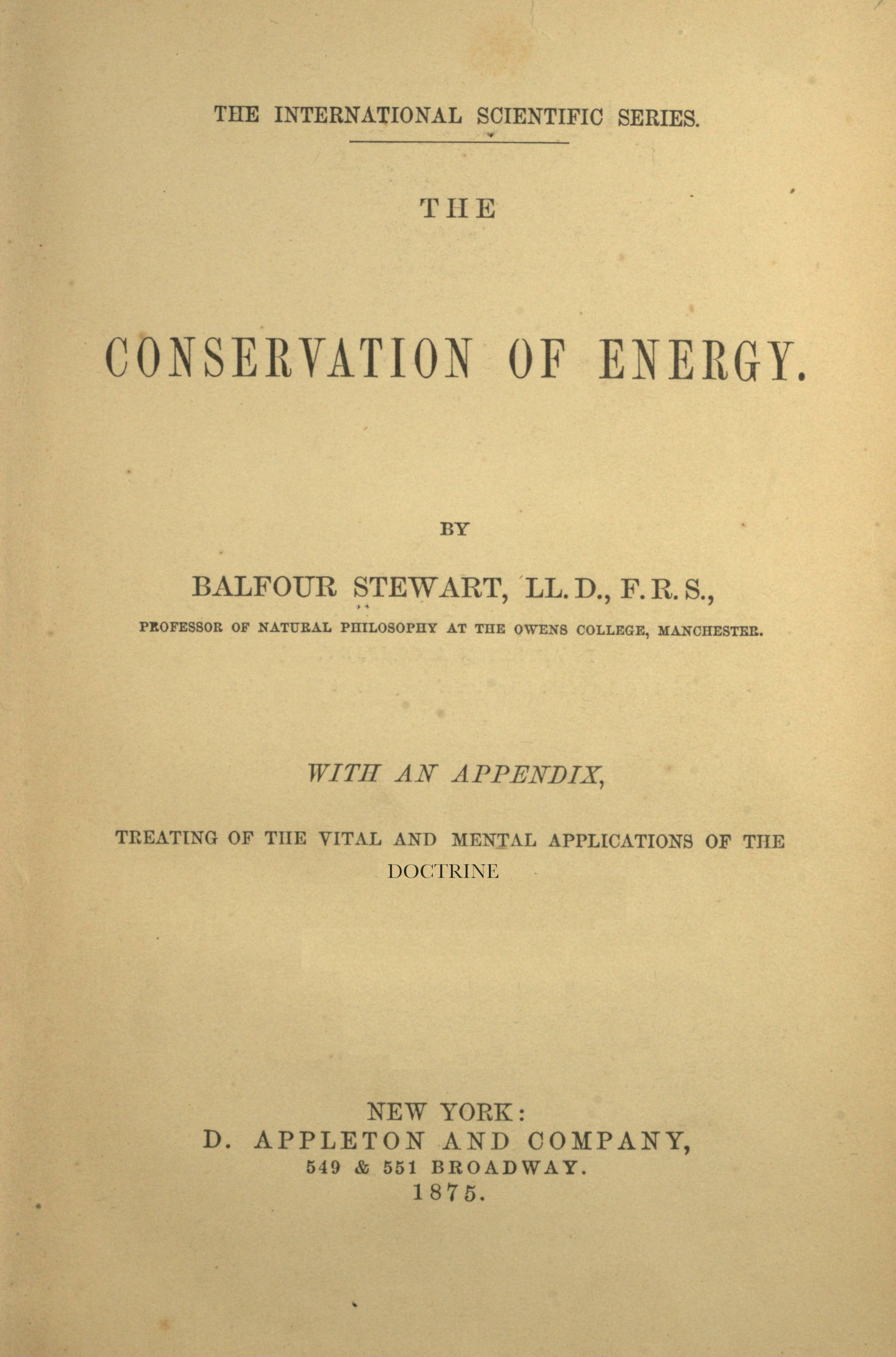
The Conservation of Energy
by Balfour Stewart
★★★★★No ratings yet
Language: English
Sign in to rate this book.
Sign in to shelve this book.
About this eBook
- Author
- Stewart, Balfour, 1828-1887
- Title
- The conservation of energy
- Original Publication
- United States: D. Appleton and Company,1875.
- Credits
- Nina Akalis and the Online Distributed Proofreading Team at www.pgdp.net (This file was produced from images generously made available by The Internet Archive)
- Language
- English
- LoC Class
- QC: Science: Physics
- Subject
- Force and energy
- Category
- Text
- Project Gutenberg
- eBook-No. 69053
- Release Date
- September 27, 2022
- Copyright
- Public domain in the USA.
Contents
- 1.Untitled
- 2.THE CONSERVATION OF ENERGY.
- 3.Untitled
- 4.NOTE TO THE AMERICAN EDITION.
- 5.PREFACE.
- 6.CONTENTS.
- 7.CHAPTER I. WHAT IS ENERGY? — Our Ignorance of Individuals. — Action and Reaction, Equal and Opposite. — In a Vessel of Goldfish. — In a Rifle. — In a Falling Stone. — The Rifle further considered. — The Rifle Ball possesses Energy. — Definition of Work. — Relation between Velocity and Energy. — FOOTNOTES:
- 8.CHAPTER II. MECHANICAL ENERGY AND ITS CHANGE INTO HEAT. — Energy of Position. A Stone high up. — A Head of Water. — A Cross-bow bent. A Watch wound up. — Advantage of Position. — Transmutations of Visible Energy.—A Kilogramme shot upwards. — The Inclined Plane. — Functions of a Machine. — Principle of Virtual Velocities. — What Friction does. — When Motion is destroyed, Heat appears. — Heat a species of Motion. — Heat a Backward and Forward Motion. — Mechanical Equivalent of Heat. — FOOTNOTES:
- 9.CHAPTER III. THE FORCES AND ENERGIES OF NATURE: THE LAW OF CONSERVATION. — Gravitation. — Elastic Forces. — Force of Cohesion. — Force of Chemical Affinity. — Remarks on Molecular and Atomic Forces. — Electricity: its Properties. — Electric Induction. — The Electric Current. — Its Magnetic Effects. — Its Heating Effect. — Its Chemical Effect. — Attraction and Repulsion of Currents. — Attraction and Repulsion of Magnets. — Induction of Currents. — List of Energies. — Energy of Visible Motion. — Visible Energy of Position. — Heat Motion. — Molecular Separation. — Atomic or Chemical Separation. — Electrical Separation. — Electricity in Motion. — Radiant Energy. — Law of Conservation.
- 10.CHAPTER IV. TRANSMUTATIONS OF ENERGY. — Energy of Visible Motion. — Visible Energy of Position. — Absorbed Heat. — Chemical Separation. — Units of Heat developed by Combustion in Oxygen . — Electrical Separation. — Electricity in Motion. — Radiant Energy. — FOOTNOTES:
- 11.CHAPTER V. HISTORICAL SKETCH: THE DISSIPATION OF ENERGY. — Heraclitus on Energy. — Democritus on Atoms. — Aristotle on a Medium. — The Ideas of the Ancients were not Prolific. — Descartes, Newton, and Huyghens on a Medium. — Bacon on Heat. — Principle of Virtual Velocities. — Rise of true Conceptions regarding Work. — Perpetual Motion. — Theory of Conservation. — Dissipation of Energy. — Natural Energies and their Sources. — Fuel. — Food. — Head of Water. — Tidal Energy. — Native Sulphur, &c. — Air and Water in Motion. — The Sun—a Source of High Temperature Heat. — A Perpetual Light Impossible. — Is the Sun an Exception? — Origin of the Sun’s Heat. — Probable Fate of the Universe. — FOOTNOTES:
- 12.CHAPTER VI. THE POSITION OF LIFE. — Twofold nature of Equilibrium. — Mechanical Instability. — Chemical Instability. — Machines are of two kinds. — An Animal is a delicately-constructed Machine. — Life is like the Commander of an Army. — Organized Tissues are subject to Decay. — Difference between Animals and Inanimate Machines. — Ultimate Dependence of Life upon the Sun. — FOOTNOTES:
- 13.APPENDIX.
- 14.CORRELATION OF VITAL WITH CHEMICAL AND PHYSICAL FORCES. — FOOTNOTES:
- 15.CORRELATION OF NERVOUS AND MENTAL FORCES.
- 16.THE CORRELATION OF NERVOUS AND MENTAL FORCES. — FOOTNOTES:
- 17.INDEX. — Transcriber’s Notes
Community reviews
Sign in to write a review.
No reviews yet.