The two highest offices in the Kuomintang are
Tsung-li (Leader) and Tsung-ts'ai (Chief). These
are occupied by Sun Yat-sen as Leader and Chiang
K'ai-shek as Chief. Sun Yat-sen, though he died on
March 12, 1925, holds the higher office in perpetuity.
So vast is his legacy to modern China that it exceeds full
enumeration: founder of the effective revolutionary
movement and Party, first practical republican, political
organizer of the modern and overseas Chinese, first
President of the Republic, and therefore officially
acknowledged State Founder, a drafter of the national
plan of modernization, author of the accepted ideology
(San Min Chu I), initiator of the Nationalist-Communist
entente and of the consequent Great Revolution,
promulgator of the Outline of National Reconstruction,
and posthumous patron of the National
Government. Keenly and devotedly an advocate of
democracy, Sun Yat-sen established by practical example
the principle of charismatic leadership. He most
certainly left a mantle. This is now, after years of
struggle, draped about the shoulders of Chiang K'ai-shek,
although Wang Ch'ing-wei retains a few threads
torn from the hem.
Sun Yat-sen was a leader in the sense that the great
religious and philosophical figures have been leaders.
He is not to be compared to Alexander, Genghis Khan,
Napoleon, or Hitler, but to Confucius, Gautama Buddha,
or Mohammed. Like the spiritual leaders he
blended profound humility and complete assurance.
He knew that he was the savior of China, and knew it
long before anyone else did. He did not rely on rising
to power within a party, as did Lenin, or within a state,
as did Hitler. He created his own Party and his own
state. Had he not succeeded, he would have been
labelled a maniac; so would most of the other major
figures of human history, had they failed. His success,
whatever its future fortune, is already so immense that
it makes his sense of leadership seem modest. And
within the limits of success, he was very modest;
throughout life Sun remained more open-minded, ready
to consult, deferential to the opinions of others, and
more willing to yield power for the sake of harmony
than the majority of his compeers. This duality has
troubled some of his biographers. As late as 1939 an
anonymous Englishman published an attack on Sun,
which, missing the history of six decades, failed to note
that Sun had lived, had succeeded, and had died objectively
justified in his conception of himself.
Sun's example, unconsciously at variance with his
teachings, has left a strong Caesarian strain in practical
Chinese politics. Without Sun Yat-sen in the background,
it is altogether impossible to understand the
role played by Chiang, or to resolve the contradiction
between a state pledged to democracy and a leader over-loaded
with power. No group in China, except the
officials of Manchoukuo, disavows Sun Yat-sen: the
Japanophiles, the Nationalists, and the Communists all
claim to execute his will.
Sun Yat-sen was born in Kwangtung Province, near
the Portuguese city of Macao. Although he was uncertain
of the date, the National Government has found
it to be November 12, 1866. Both his provincial and
class background had effect on his later life. The
Cantonese are among the most turbulent of Chinese,
living at the southern edge of China and speaking a
dialect far different from the majority of the country.
Active, rebellious, enterprising, the Cantonese were disposed
to change. Sun's use of their tongue and knowledge
of their customs gave him an audience which both
suffered and profited by its distinctness. Sun's family
was certainly not of the gentry class, and yet not so
utterly poor that it lacked all profitable connections.
Otherwise his potentialities might have been thwarted
by ruinous poverty, disease, or early death.
In adolescence, Sun felt the stings and urges of resentment
driving him to reform and revolution. He
had kin who were involved in the T'aip'ing Rebellion
(1850-65), the vast peasant uprising which, under
Christian collectivist leadership by the Messianic Hung
Hsiu-ch'üan, swept North to the Yangtze and drowned
in a sea of blood less than two years before Sun's birth.
He thus had direct knowledge not merely of Chinese
revolt against the alien Manchu empire, but he knew
of the revolutionary technique of a religious leader.
The effect of this presumptive knowledge has never
been explored; it would explain a great deal in Sun's
career—much of the sharp enthusiasm, the use of
ecstatic slogans, the emphasis on will, his demands for
faith in himself—if one could know that he followed the
instance of a Chinese Joseph Smith or Brigham Young,
not that of a Chinese Mazzini or Marx. The other important
feature about his early life was Western education.[1]
Western training gave him a channel upward which
the Confucian system had denied a hundred generations
of his predecessors. Patriots, rebels, reformers—these
have been sown by temperament and fortune
across the centuries of Chinese social existence, but
such potential heroes have been ploughed out or crippled
by the language and the examinations. No man could
command power—save in its transient forms: banditry,
conspiracy, commerce—without mastering the Confucian
canon. Once the intricate scholarship of the past
gripped him, the complex, beautiful, archaic language
of the mandarinate stopped up his mouth for plain
utterance. He was isolated from the people. Sun escaped
this by the use of the English language and the
command of Western science. He was par excellence the
great counter-ideologue, whose self-confidence and command
of men rested upon foundations beyond the ken
of his adversaries. Judge Linebarger wrote, on the
basis of what Sun told him:
Like a soldier who after long study and practice has at
length mastered the manual of arms so as to have complete
confidence in his weapons, Sun now began to feel at last
a confidence in his ability to show others the path of his
new wisdom, for, while thus enjoying a steady advance
under English tutelage in the ways of the foreigner, he was
by no means neglecting his study of Chinese politics, even
in the pressure of college work. He knew now that he
would have to lead out in the Great Reform. At Hong
Kong, Macao, and Canton he had college intimates, and
these he sought out as often as his college course would
permit.[2]
Sun lived with his elder brother in Honolulu on two
occasions, and finally, after a period of discontent and
rising turbulence at home, went to study medicine in
Hong Kong. He was the outstanding student in the
school because of his already fluent command of the
English language,[3] and was graduated as one of the
very first Chinese physicians to be trained in Western
medicine. Through their very nature, medical studies
impart to the student a sense of responsibility for others,
and also incline them toward the expert's indifference
to lay opinion. Throughout his life Sun never lost
confidence in the powers of his own reason, or in the
belief that, although difficult, it was both necessary
and possible to know the form and nature of social
no less than of biological processes, and to prescribe
remedies for an ill civilization as well as for a sick
man.
With traditional patriotism, a Cantonese background,
the memory of poverty, foreign training, and contact
with overseas China, Sun was already a marked man in
his twenties. By 1895 he was important enough for the
Imperial Chinese Legation in London to kidnap him,
preparing to charter a ship to return him to China,
where the torturers of the Board of Punishments waited.
In a cause célèbre, Sun was released; from then on he
had an international reputation.
His technique of revolution was little affected by the
growing proletarian parties of Europe. He adhered to
traditional Chinese methods, working through the
consolidation of pre-existent secret societies, the recruitment
of terrorists, the launching of insurrection after
insurrection in the hope that one of them would catch
the waiting tinder and blaze across China. In Japan,
in America, and in Europe, he travelled, gathering
funds, carrying on vigorous polemics against his fellow-exiles,
the monarchist reformers. His followers were
organized under a variety of names, of which Kuomintang
is the last and best-known. By 1911 the revolution
broke out, flared sporadically across the central
and southern provinces, then lapsed into negotiations
between the Republicans and the Empire. Sun Yat-sen,
in America when the clash was precipitated, returned
home to be elected Provisional President of the Chinese
Republic, on January 1, 1912. But his revolution had
begun to pass into other hands. Opportunists, no rare
breed in China, leapt aboard the bandwagon, minimizing
the role of the Nationalists and grasping for the materials
of power: offices, guns and money, slogans. The
new-born Republic was taken over by the formidable
Yüan Shih-k'ai and converted into a pyramid of military
dictatorships; with Yüan's death the nation fell into
tuchünism and foreign meddling.
The years following were the saddest in Sun's life. He
headed miscellaneous governments in Canton, lived for
a while in Shanghai, and died at a fruitless unification
conference in Peking. In his last years, obsessed by his
clear realization of the evils which beset his country,
he was even derided. He saw the vast economic maladjustments
which would follow the World War, and
wrote a work, The International Development of
China[4] which in its grandeur anticipated the Five-Year
and Four-Year Plans; his idea was to finance a spectacular
modernization of China through public works
by a scheme of international loans. Not only would the
imports of capital goods have benefited the Western
powers, but the development of a prosperous China
would have provided the expansion necessary to support
an imperialist capitalism. His argument was that
international capitalism needed a market; China, one
fourth of humanity, provided a market; international
guarantees and supervision would make modernization
possible; and modernization, while building state-socialism
and the material basis of prosperity in China,
would have enriched capitalism throughout the world.
There is no evidence that anyone save his followers and
friends took his plan seriously.
The next step, in 1922, was a turning from capitalist
democracies, which had disappointed him, to a Russia
which professed a new justice in the world. Sun negotiated
with emissaries of the Third International, accepting
Red help on the clear understanding that Communism
was recognized, by him and by the Communists,
as unsuited to China—a proposition which
history calls into question. Only in his last stay in
Canton did he escape the ten-year pattern of frustration
which had been broken only by his happy second
marriage, to Soong Ching-ling. (The author, then a
small boy, remembers Sun in Shanghai as a man of
gentle kindness and rueful gaiety; Sun was never too
busy to speak to him, nor to remember little presents;
and in the midst of revolution Sun found time to write
a note of encouragement and good cheer.) With the
new allies, Sun, a dying man, went South, founded the
lineal predecessors of the Chungking government, called
his comrades to him, and discovered an effective military
helper—his first after Huang Hsing, dead in the
years of Yüan. This military aide was Chiang K'ai-shek.
Just before his death Sun made sixteen lectures, out
of a scheduled program of eighteen. He did not write
them, but they were transcribed and roughly edited.
In other years he had drafted monumental political
treatises; when the manuscripts were lost he did not
reconstruct them. The lectures, improvised, filled with
minor inaccuracies, incomplete arguments, and appeals
to immediate opinion, rank nevertheless among works
of political genius. They are sharp, stirring, pointed,
hopeful, concrete. They define China's position in the
world, and the goals of the Chinese revolution. They
adumbrate the reinforced democracy which was to come
and now fights for existence. And they prescribe an economic
philosophy humane beyond the dogma of the
Russo-German dialecticians and far more self-conscious
than the obstinate torpor of Coolidge's capitalism. Sun's
lectures are today the foundation of the Chinese state
philosophy, taught in all curricula, required in all examinations.
As the San Min Chu I, they form an ideology
with more legal adherents than Marxism and National
Socialism and Fascism combined. For democrats,
wherever they may be, this is a matter of importance,
bearing directly on the confused uncanalized
struggles of our time. China possesses a doctrine which
indefeasibly associates her independence, her democracy,
and her prosperity.
It would be a mistake to consider these lectures and
Sun's lesser writings the only source of Sun Yat-sen's
dogma. Since the government is in the hands of the
Kuomintang, and Kuomintang seniority depends largely
on closeness of association with Sun Yat-sen, Sun's personal,
casual, unconsidered influence on his friends
forms a vital background to state policy. Sun's American
biographer wrote,
Some criticize the San Min Chu I, because it seems to
them severe and lofty. To this I reply that there are things
other than what is written in the San Min Chu I. The
English and other nations have their laws, written and
unwritten. So too do we, the partisans of Sun Yat-sen, have
our laws, written and unwritten. And this unwritten law
is to us the dearer, is closer to our hearts, and is more moving
as the goal of our activity, than even the written
commentaries. This unwritten law is for us, who, sitting at
his feet, received his teaching, the highest of all laws of
truth and fidelity, the law of bona fides.[5]
The continuing power of Sun Yat-sen is shown by the
prestige and power of his kin. Sun Yat-sen had two
families. Early in life, before his medical studies had
ended, he was married to a woman of his own class who
was devoted, family-loving, characteristically Chinese,
untouched by the West, and undisposed to revolution.
She bore him three children; the son, Dr. Sun K'ê,
was reared largely in the United States and has been an
important figure in Chinese politics ever since his return
to China from Columbia University. Successively
Mayor of Canton, Chairman of Kwangtung Province,
Minister of Communications, of Finance, and of Railways,
President of the Executive and of the Legislative
Yüan, he has served with distinction. A practical and
moderate man, he has always advocated a moderate, constitutional
application of his father's dogma, has espoused
full democratic government, stood for Party
abdication, and worked for national unity. One of his
sisters died young and the other married a gentleman
who was later Chinese Minister to Brazil. Mrs. Sun
Yat-sen, Sun K'ê's mother, lived to a ripe old age in
Macao. Charitable, pious, humane, she was an enthusiastic
Christian convert and a terror to sluggard
officials in that European outpost of vice. She took no
part in politics.
Sun Yat-sen's second family was acquired when he
married Miss Soong Ching-ling. After his defeat by
Yüan Shih-k'ai and the frustration of the first Republic,
Sun Yat-sen felt very much in need of a companion to
hearten him, help his work, and share his troubles.
He had been on very close terms with C. J. Soong, a
Christian business man, and had asked Mr. Soong's eldest
daughter, Ai-ling, to act as his secretary. When Miss
Ai-ling Soong left, her sister succeeded her. Sun fell
genuinely and deeply in love with the beautiful, vivacious,
American-educated girl who understood his work
and desired to share his troubles. In all his life, it is
likely that Sun met no one more devoted to himself,
more understanding of what he sought from life and
from his work for China, than Ching-ling Soong. They
were married on October 15, 1915, in Japan, Sun Yat-sen
having provided for separation from his first wife.
The younger wife has since become world-famous as
Mme. Sun Yat-sen.
Ching-ling and Ai-ling Soong had a third sister,[6]
May-ling, who married Chiang K'ai-shek after Ai-ling
had married H. H. K'ung. (Hence Chiang K'ai-shek's
closest family connection with Sun Yat-sen consists in
being brother-in-law to the second wife.) The three
Soong sisters thus married the two outstanding leaders
and another who stood just below. The Soong brothers
were less successful, although one, T. V. Soong, has
been a leading fiscal reformer and financial expert.
The beauty, American education, polished cosmopolitan
manners, and sense of publicity of the three
sisters have made them sensational news figures. Their
eldest brother's success has added distinction to this
family. The inescapable consequence has been a great
deal of speculation about the "Soong dynasty"; but
the surprising feature of the Soongs is not their fame
and power through marriage, plus ability, but their
slight cohesion as a Chinese family. They have stood
together only at times of highest crisis, and not always
then. Mme. Sun Yat-sen has continued along the Leftist
tangent which her husband followed just before he
died. For years she was the only Leftist in China who
did not fear death or a more painful fate. She kept
her ideals; from the homes of her family she wrote
scathing denunciations of the blood-soaked tyranny of
her brother-in-law, her sisters, her stepson, and her
brother. Mme. K'ung appears to have worked most
steadfastly in the interest of the entire family, although
rivalry between her brother and her husband has been
a matter of general report. Mme. Chiang K'ai-shek,
the youngest of the three sisters, has been a loyal wife
first of all, and has contributed enormously to the Generalissimo's
international prestige. No other modern
leader possesses an able publicity adviser, capable and
apt, so near to himself. The family relationships of
Sun Yat-sen thus display themselves in his son, constitutional
and moderate, who is inclined to favor Mme.
Sun, with Sun's sisters-in-law and brothers-in-law following
their respective political courses with their own
families—all on cordial political terms, but scarcely a
monolithic family bloc.
In addition to his doctrine, his Party, his followers,
and his family, Sun Yat-sen has bequeathed his name.
As Chung Shan, he fills the void in Chinese polity left
by the Emperor. Every Monday morning his will is
read, throughout every government office in the land.
His picture is seen everywhere. His sayings and slogans
have become the shibboleths of revolution, union, and
reconstruction. The reverence paid to him is a form
of secular worship, focussed upon a magnificent mausoleum
near the cenotaphs of the Ming Emperors on
Purple Mountain, Nanking. All virtues and most knowledge
are attributed to him; inescapably, some hard-headed
people react against the cult. Dead, he is to the
Chinese what the King is to the British, or the assembled
forefathers to the Americans, or—save partial
eclipse by Stalin—Lenin is to the Soviet Union. Perpetual
leader of the Kuomintang, Sun has in death
more power than life vouchsafed him. In a world wild
with alarm and hungry for leadership, his sense of providential
mission and of terrible political urgency no
longer seems shrill or vain. His is the greatest of posthumous
satisfactions: vindication by history.
Out of the broad body of doctrine embodied in the
public and private utterances of Sun Yat-sen, one single
integrating philosophy stands forth, which entitles him
to rank as a major political thinker. This is the San
Min Chu I, which may be translated "three principles
of the people," "three principles of government for the
benefit of the people," "three principles concerning
people" and so forth, or may—most accurately—be represented
by the neologism, "tridemism."[7] It consists
of an affirmation of a body of theory and a scheme of
programs to be applied generally to human experience,
and particularly to the modern problems of China.
The prime problem faced by Sun Yat-sen was displacement
of the Confucian ideology, long refreshed
and perpetuated by the mandarinate. (The scholastic
bureaucracy rested on the difficulty and character of the
language, which removed writing from speaking and,
lacking what Westerners commonly consider grammar,
depended upon exact, appropriate choice of terms.)
Confucius, anticipating semantic controversialists by
many centuries, established a doctrine of meaning
which made politics the by-product of correct speech
and thought, to be performed by conspicuous, informed,
and majestic persons. When ideas and ideals were clear,
moral standards firm and visible, and demeanor correct—as
determined by archaic natural standards—the realm
would prosper. Education was stressed as a means to
public service. In succeeding centuries Confucians first
monopolized education, establishing the Confucian
classics as formal Chinese canons, and then monopolized
the bureaucracy. Providing for elementary circulation
of an academic elite, although economically based on
land-ownership, they gave China a modified sort of
representative government, which operated by the all-encompassing
constitutionalism of common sense itself,
and rested ultimately on the lack of an alternative to
common sense. The Confucians were intellectually indifferent
to natural science and economically unfriendly
to technological change; China, unsurpassed for political
sophistication and deliberate social order, was
immobilized by an ancient success. Ideological control
led to veneration of the scholar, even veneration of
writing. Emperors, officials, people—all were captive to
accomplishment, and so completely indoctrinated that
they presumably enjoyed a very high conscious freedom.
Rigid social and mental uniformity spelled political
laxity; the state became atrophied and vestigial.
Social rigidity made China only very slowly progressive
in mechanical terms. Political laxity made the
country weak in the face of invasion, exploitation, and
possible partition. Intellectual traditionalism shut off
stimuli available from the outside. Confucius had said,
"If terms be not correct, language is not in accordance
with the truth of things. If language be not in accordance
with the truth of things, affairs cannot be carried
on to success."[8] Sun Yat-sen, Confucian in spirit
though not in form, turned to the dynamics of ideological
rather than legal control. To stir the immense
lethargy of China, he substituted science for archaism;
a Party elite for the scholastic system, propaganda to
replace doctrinal education, and agitation to supersede
incantation and reverence.
He struck at ideas first: "We cannot say in general
that ideas, as ideas, are either good or bad. We must
judge whether, when put into practice, they prove useful
or not. If they are of practical use to us, they are
good; if they are impractical, they are bad. If they are
useful to the world, they are good; if they are not useful
to the world, they are not good."[9] This pragmatic
utilitarianism was to be the philosophical foundation
of his revolution. The San Min Chu I therewith remained
alien to Marxism, which is dependent upon the
occult mysteries of a topsy-turvy Hegelianism; Sun's
thought is kin to the working philosophy of America,
a pragmatism tinctured by idealist vestiges.
The first political principle he developed was Nationalism
(min ts'u). The theoretical basis for this was
a racialism which, scientifically no more tenable than
National Socialist Aryanism, is clear in common practice.
Very few Chinese have trouble in identifying
another Chinese. Sun Yat-sen pointed out that although
the European peoples were divided, China was to him
both a race and a nation. He thereby established for
his followers a foundation for nationality more credible
than any mere appeal to state allegiance. Treason
against one's government is taken lightly in China:
witness the Japanophiles. Treason to the Chinese race
is a far more serious matter. In order to preserve the
Chinese race-nation, Sun Yat-sen called for ideological
reconstruction from three elements: ancient Chinese
morality, traditional Chinese social knowledge (e.g.,
bureaucratic techniques; arbitration instead of adjudication),
and Western physical science. He urged
a return to cosmopolitanism through nationalism. By
becoming strong—instead of extinct under alien colonial
rule—the Chinese state could lead the world back to
the old pacific cosmopolitanism of Eastern Asia.
Programmatically, Sun subsumed under his min t'su
theory, the necessity of a patriotic elite, formed into
the party of his followers, which was to unify China
and to cultivate a genuine state-allegiance instead of
the veneration of a concretely paramount Emperor
or other leader. He also advocated that China maintain
independence, make independence a reality in which
the entire race-nation should share by fostering actual
autonomy (hence, democracy), and by fighting defensively
against economic exploitation by the imperialist
powers.
The second principle presented was Democracy (min
ch'üan). He pointed out that old China was democratic
in allowing considerable social mobility, and much
equality within the framework of that mobility, and
that popular government was a reality in local affairs,
while popular supremacy (corresponding to Western
theories of popular sovereignty) followed from the universally
admitted Chinese right of rebellion. He justified
democracy on the grounds that it was commanded
by China's antique sages, was necessarily consequent
upon nationalism, was decreed by the Zeitgeist, was
necessary to good administration, and was a modernizing
force. But he modified his democracy by a distinction
between ch'üan (power) and nêng (ability), keeping
government and people perpetually dual, and making
the problem of democratic personnel one of popular
choice plus the control of popular choice. The programs
of democracy involved the revolution of three
stages, the five-yüan government, and emphasis on the
hsien.[10]
The third principle is based on Sun Yat-sen's own
philosophy of history. Min shêng, frequently
translated "the principle of the people's livelihood," rested
upon Sun Yat-sen's belief that history is not based exclusively
on materialism and that it cannot be analyzed
merely in terms of the ownership of the means of production.
He insisted that history was based on the
fundamental fact that man has jên—humane self-awareness;
human fellow-sympathy; consciousness of being
located in society, together with orientation by values
social, not individually or materially established; benevolence.
Min shêng is accordingly an ethical doctrine
first, and an economic one afterward. It is the basis of
history (min-shêng wei li-shih-ti chung-hsin). It presupposes,
for China: (1) a national economic revolution
against imperialism and for democracy; (2) an industrial
revolution for the enrichment of China; and (3) a
prophylactic against social revolution. Although showing
the influence of Karl Marx, Henry George, and
the modern American, Maurice William,[11] the doctrine
remained Chinese in spirit, pragmatically collectivist in
application. Under the programs of min shêng Sun included
the bold projects for which he had sought all
his life, desiring the independent, socially just prosperity
of his country.
These doctrines form the constitutional foundation
of government action, as well as being the Party credo
of the Kuomintang. Whoever proposes policy in China
must first square it with the San Min Chu I. In this
the Generalissimo has combined adroitness with profound
sincerity.
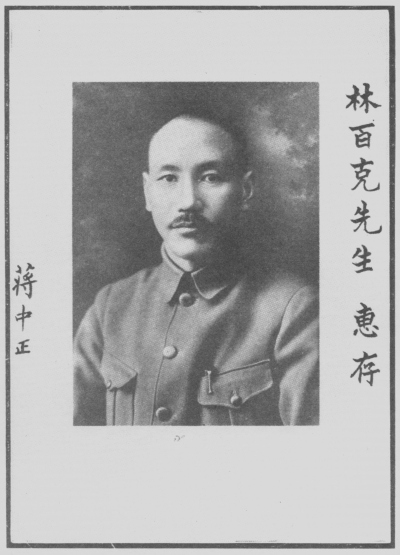
Despite a small shelf of biographies, Chiang K'ai-shek
remains a personality above and behind the news,
not in it. His former teacher and present publicity adviser,
Hollington Tong, has written an authorized life,
clear, detailed, and well expurgated. The celebrated
Sven Hedin published a study of Chiang; virtues, but
not specific personality stood forth. An able American
newspaperman had recourse to his files, and some Chinese
admirers sketched an incredibly soft, lovely picture:
the background was clarified, but not Chiang.
Two world-famous reporters, trained to epitomize a life
or a nation in a double column or sharp review, failed
to grasp Chiang. He eludes everyone.
Part of the trouble comes from the fact that he possesses
virtues which, once lauded, are now suspected
of being mythical, wheresoever they occur. Frederick the
Great, George Washington, Julius Caesar in his careerist
years—authentic in history, as contemporaries these
leaders would strike the moderns as characters inflated
or incredible. Sincerity has become consistency with
one's source of income; persons who fail to fit into the
accepted moral and intellectual types of Western industrialist
society are labelled fakes. One is a gentleman-liberal,
an intellectual-liberal, a capitalist, a picturesque
native, a war-lord sinister, obscene, cruel, and
criminal—one fits such a type, and if one doesn't, one
does not exist. Yet Chiang exists, and is thereby suspect
to a host of commentators. Sun Yat-sen as First President
was an acceptable news figure; as Saint of the
Great Revolution he became vulnerable. When Chiang
seems neither a general nor a reactionary, he bewilders
many Westerners.
Within China, Chiang is more readily grasped. In
any other age, he would be the founder of a new dynasty.
The establishers of Imperial houses have, as a group,
combined intense vigor with a flair for the disreputably
picturesque, in turn qualified by the highly respectable
associates they sought out after success. Several have
been bandits; one was an unfrocked Buddhist priest.
For vigor and a timely libertarianism, they compare
favorably with the Claudian line. Today the Dragon
Throne is irrecoverably remote; the Manchoukuoan
Emperor Kang Tê lacks elementary plausibility. Chiang
is far too wise, far too modern in his own motivations,
to wish or dare dream of Empire. Upon him has descended
grace of a new kind, the charismatic halo of Sun
Yat-sen. His reputation can be carved in the most enduring
of materials: indefeasible history. With a son who is
a Bolshevik, a little Eurasian grandchild, and an
adopted son of no high merit, Chiang does not face
the problem of power-bequeathal. He has power now;
it matters little where power goes after his death; the
value to him lies in immediate use.
Assuming even an abnormal egocentrism, Chiang—at
the apex of state—is above ambition; he has no welfare
but that of the state. In fact, Chiang is a man of
almost naively insistent morality. Even Westerners act
on the stage of today with posterity as an audience; Chinese,
state-building, moral, Chiang moves under the
glare of his perpetual reputation. As in the case of
Sun, his sense of leadership would be maniacal if not
grounded on fact; but what assumption would not?
A peanut-vendor who thinks he is the King of Egypt
is crazy; Farouk is not therefore crazy because King
of Egypt. If Chiang were not the leader of China, he
would be mad; but he, and he alone, is leader. His
humility begins with the assumption of his power.
Twenty-one years the junior of Sun Yat-sen, Chiang
was born in 1888 in Chekiang province.[12] His family
was of a class intermediate between the truly eminent
landlord-official or merchant families, and the farmers.
They had been farmers, but also minor gentry, and
had been connected with the salt-revenue system. His
grandfather attained considerable renown as a scholar,
but Chiang's own father died when Chiang was eight
years of age. The child had few special advantages. His
family background is one which is of common occurrence
among political leaders; his widowed mother,
mastering and managing for the family, inculcated a
sharp morality, an unrelenting frugality, and a persistent
drive of industriousness in her children. To
such a person, who rises from poverty and hardship by
his own efforts, the failure of others to do likewise
becomes a personal problem. By his own case he has
proved that opportunities are there. He is impatient
with the poor, the stupid, or the shiftless; instead of re-arranging
society to give them a chance, he expects them
to improve themselves to meet existing realities. Chiang
has not explicitly stated all these points; many of them
are qualified by the fact that the status quo in modern
China is the status quo of perpetual revolution.
Leftist commentators, dubbing Chiang a combined
product of landlordism, compradore class, and criminal
gangs, explain him through a mystagogic economic
determinism. Actually, Western impress on Chiang is
of a more special nature: Western religion, and Western
warfare. The ideals which animate him, and determine—so
far as these are visible—his own sense of values,
are concepts and attitudes extraneous to the Chinese
scene. Deduct the threaded recurrency of religion, and
the sense of technique from military training, and
Chiang could be paired with many other modern Chinese
leaders—soldiers of turmoil, administrators of the
ad interim, complacent leaders of hypothetical groups.
He and Sun stand out because each had a Western
technique so thoroughly mastered that it gave him a
clear competence over other men: Sun, the physician;
Chiang, the strategist. Each also had a Western moral
drive which turned hungrily to the past and justified
itself in Chinese antiquity: Sun, the all-around Christian,
who professed and denied the churches alternately
throughout life, and Chiang, the Bible-quoting Methodist,
both cite the Confucian canons; both esteem the
Chinese ethics; both discern the forcefulness of Western
spirituality.
Leadership, plus technical power, plus alien moral
reinforcement, spells preeminence. The Confucians
have gone; the serene mandarins are dead. Methodist
soldiers, Baptist bankers—such Chinese control China.
Marxism, which by combining jargon and act of faith,
is both religion and erudition, unites these ideocratic
forces; Wang Ming can feel that he is a scientist analyzing
society with peculiar objectivity, and he can feel
morally gratified at the same time. Chiang and the
Nationalist leaders keep such sustenance dual.
The special religious background came to him
through his mother. Women have traditionally turned
to Buddhism for piety in China, and Mrs. Chiang was
one of the exceptional characters who combined intense
hard work with great piety. The children grew with
the infinite looming over them; every misstep meant
thousands upon thousands of years of hopeless, damnable
rebirth. Buddhism can match the Christian, "It
is a fearefull thing to fall into the hands of the living
God ...,"[13] with the even more fearful doom of life
in a world which does not want to live. Buddhism,
socially, goes about in circles; the Mahayana sect provides
a qualified kind of salvation, but not the salvation
which a determined man can wring bloody-handed
out of circumstance itself. The discipline, the austerity,
were ready; Christianity, when it came to him, fell on
plowed and waiting ground. The other instinct of
ascendancy was cultivated by his education: professionalism.
His life falls into three stages after childhood:
education; wasted years; and the mastery and use of
power.
Chiang went to the Imperial Military Academy at
Paotingfu. Aloof and ambitious, he was so successful
that within a year he was sent to the Shinbo Gokyo
(Preparatory Military Academy) in Tokyo; he remained
in Japan four years. The Japanese under whom
he studied retained no special impression of him, except
that he eagerly accepted discipline. As a part of
his study, he served with the 13th Field Artillery (Takada)
Regiment of the Imperial Army. Chiang therewith
acquired not merely military knowledge, but a
working insight into Japanese language, mentality, and
strength.
His military studies were terminated by the outbreak
of the Republican Revolution in 1911. Chiang returned
to Shanghai, and began a vigorous military
career under the local military commander, pro-Sun
in politics. Chiang himself had come into contact with
the Republican-Nationalist group while in Japan.
There was already no question of where his loyalties
lay. He made rapid progress, and saw something of
fighting. He took part in the abortive Second Revolution,
of 1913, which was the military attempt by Sun
Yat-sen and his first military coadjutant, Huang Hsing,
to check Yüan Shih-k'ai and to save the newborn Republic
by force. In this time, while the enthusiasm of
his military studies had not yet worn off, Chiang wrote
prodigiously. No Westerner has, so far as the present
author knows, taken the trouble to go through Chiang's
writings in order to study him. Chinese commentators
praise them as full of military acumen, a sense of the
novel and important forces in Chinese society, and a
vigorous moralism—modern-military in form, but archaic
in language—which animated Chiang's youthful
desire to improve the world with good, technically
apt gunfire. He was at this time twenty-three or twenty-four.
Between this early career and the later years of
Chiang's life—the years in which his star rode incessantly
ascendant—there is a gap of several years, 1913 to
1918. In this time Chiang lived a life primarily civilian,
although he remained under the patronage of his first
military leader, General Chen Ch'i-mei, murdered in
1915. Chiang went on a military intelligence trip for
the Sun Yat-sen group, travelling through Manchuria
in 1915. He opposed Yüan's moves, and stayed in close
contact with the patriotic organization. Yet, the total
picture of his life in these years lacks the connecting
linkage which binds his childhood, his school days, and
his mature career. His activity, while considerable, was
diffuse.
He went down to Canton in 1918, and fought under
the command of Sun Yat-sen, with the inferior troops
and hopeless expeditions which the Leader, politically
adept but strategically inexpert, kept throwing against
the confusion of the tuchün wars, with the result that
the war-lords, counting him as another element in their
balance of power, did not even set up a united front
against him. Chiang, a Central Chinese, was unsympathetic
to the intense provincialism of the Cantonese,
and was hopelessly tactless in criticizing old-type soldiers
upon whom Sun then relied. Disillusioned but still
loyal, he went back to Shanghai and wrote letters of
advice to his friends in the South, including Dr. Sun.
Throughout this time he was simply one more among
the dozens of bright young military men who were, in
the existing crudity of warfare, unneeded in China.
(Chu Tê, Chiang's present colleague and rival who
heads the Soviet Chinese military system, was at this
time besotted in Yünnan—a petty war-lord of landlord
family, trapped hopeless on his little island of power
amidst ruin.)
The period in the Shanghai years was filled in with
business activity. Chiang was acquainted with some of
the most influential merchants of the city, among them
the crippled Chang Ching-chiang, a Paris merchant
whose personal wealth was an informal treasury of
Sun's movement. Chiang entered brokerage, and is
supposed to have made a great deal of money. He became
acquainted with the modernized, Westernized
young Chinese of the metropolis, and left many friends
behind him among the Chinese business men and industrialists.
Speculative or unfriendly writers asseverate that
Chiang joined the Green Gang, an association which
combined the features of a protection racket and a
benevolent society. (Such a society, common in China
during periods of disturbance, is the archetype of the
American-Chinese Tong [tang] in its more violent
phases.) If so, membership gave Chiang the key to an
underworld as well organized as François Villon's Paris,
wherein beggars, thieves, pickpockets, kidnappers, labor
contractors, burial societies, and legitimate associations
merged under the extra-legal government of a Masonic-like
hierarchy. (The author is acquainted with a Chinese
League of Nations official who joined the Gang
as a necessary implement of social research, and was
afforded genuine courtesy in preparing a report, general
but accurate as to prevailing conditions, through the
assistance of his fellow-members.)
Chiang's marriage, which had been made Chinese-fashion
in his late boyhood, had given him posterity—a
son, now the pro-Communist, Soviet-trained Major-General
Chiang Ching-kuo—but little companionship.
His wife and son remained most of the time at his native
home, whence he returned to see them and his mother,
at Fenghua in Chekiang. Social contacts, acquaintance
with capitalism, looseness of family connections, spasmodic
work for the Revolution, and some military
work—this, combined with the making and the losing
of a fortune, fill the early maturity of Chiang.
He appeared upon the national and the world scene
by his selection in 1923 to go to Moscow under the terms
of the Nationalist-Soviet understanding, there to receive
military training. He had definitely cast in his lot with
Sun Yat-sen, making soldiery his vocation, and the selection
implied that Sun began to see in him a military
aide, to replace Huang Hsing of the first revolution.
Chiang spent four months in the Soviet Union. The
Communists, whom he was to fight six years later,
showed him their combination of political and military
warfare applied in Trotsky's Red Army. Chiang,
already the beneficiary of Japanese training, had found
Japanese military science dependent upon the framework
of a stable constitutional system. In China his
earlier training had been superior to its environment
and did not have the practical utility of five years'
banditry. Chiang, professional by spirit, restless under
the drive of conscience and ambition, now found in
Moscow the intermediate steps between modern warfare
and government-building. He found that an army,
from being the tool of pre-existing order, could become
the spearhead of an accompanying order. Returning
to China via the Trans-Siberian Railroad, he
met General Galens (Vassili Bluecher), later his chief
Soviet military aide at Canton.
In Canton, the first military creation on Soviet models
was the Whampoa (Huangpu) Academy. Decreed by
Sun Yat-sen, who made Chiang chief, the Academy had
Soviet advisers, eager to instill revolutionary and civil-war
techniques. Chiang began the development of a
modern army, and the real accretion of his own power.
Even before he commanded full armies, Chiang used
his cadets to good purpose in actual combat.
From this point on, Chiang's career becomes a part
of the military history of the revolution. In his earlier
years of power, Chiang emerged to leadership by cooperating
with various intra-Kuomintang groups. He
stood with the Left and utilized the Communists, although
he managed to provoke, suppress, and appease
the Communists in a way which no one else managed.
He led the victorious Northern Expedition in 1925-27,
carrying his forces on the crest of the Great Revolution.
He was little known, but seen to be ambitious, zealous,
incalculable, and a political strategist of ruthless genius.
He soon found himself one of the triumvirate of Sun
Yat-sen's successors: Hu Han-min, the Right Kuomintang
leader, editor of Sun's works; Chiang; and Wang
Ch'ing-wei, the Left Kuomintang leader.
At Shanghai, in 1927, Chiang's troops turned suddenly
against the Communists and Left groups, quenching
the uprising which had taken the city under his
flag. This coup was undertaken because Chiang felt
that the Communists were outrunning their promises.
The Soviet advisers, who had come to help the Nationalists,
had professed their concern for China's
national struggle, and for the desirability of a fight
against imperialism. They had not told Sun himself
that he was a mere precursor to the proletarian revolution,
nor informed the Nationalists that they were being
given the privilege of fighting a war to advance the
historical necessity of Nationalist extinction, as the next
step in China's dialectic progression. Trotsky talked
openly in Moscow about overthrowing the Chinese
revolutionaries, and hijacking the Chinese revolution
with the Chinese Communists, while Stalin believed
in appeasing the Nationalists longer before discarding
them. Of this Chiang was fully aware, and he struck
at the sources of Communist power, labor and peasant
unions, using a ruthlessness comparable to theirs. He
went further, establishing the National Government (in
the five-power form) at Nanking, and leaving the Left
Kuomintang uneasily in the company of the Communists
at Hankow. When the Communists proceeded
to debate the question of monopolizing the remnants,
even the Left-Kuomintang had had enough. They
suppressed the Communists, and dissolved, coming down
river to Nanking and joining the new government,
while Chiang stepped technically out of the picture
to ease the healing of the schism. Chiang's legitimacy
in the leadership of the Kuomintang and the Sun Yat-sen
revolution is shown by the fact that within two years
he had an overwhelming majority of the veteran Kuomintang
leaders at his capital.
In the ensuing years Chiang dedicated himself to
three tasks: the development of the National Government,
the stabilization of his own power, and the
modernization of the country, both moral and mechanical.
In 1927 he had married Miss May-ling Soong,
and brought himself into alliance with the influential
Soong family. The success of his efforts is attested by
the continued functioning of a National Government at
Chungking, the resistance and unification of China,
which Chiang has come to symbolize, and the stalemate
of Japan. These things would have appeared in some
form, even without Chiang, but they would probably
not exist with their present clarity and strength. The
ten years of armament, modernization, and Japan-appeasement
built an area into a nation, changing one
more government into an elementary national state.
The Generalissimo has changed in appearance and
manner considerably in the past ten years; these changes
seem to have immediate bearing on his political role.
In 1931 he was unmistakably the first soldier of China—brusque,
forthright, sharp-voiced, and dismayingly lacking
in the devious but pleasant k'ê-ch'i (ceremonial
politeness) which is carried to professional heights by
Chinese officials. Even then he was a masterful and
clear-willed sort of man, who upset political precedents
by a directness which would have been naive were it not
so obviously both self-conscious and sincere. He possessed
a keen awareness of his own historical importance,
and a consistent responsibility before history—which
still animates him—was the result. When coupled with
the regular exercise of authority, this trait may have
the consequence of moderating arbitrariness and minimizing
opportunism.
With Chiang's self-possession there went an impatience
with opposing views, a carelessness of means
in the face of ends, and a fanatical insistence on loyalty.
He now seems little older in body, despite the injury
to his back during the Sian episode, but the years have
left a very clear impress on his moral character. To
the sharp discipline and authority of the soldier he has
added the characteristics of a teacher—reserved kindliness,
a daily preoccupation with moral questions, an
inclination to harangue his followers on the general
meaning of their problems. Ten years ago it was very
difficult to find out what Chiang really believed and
wanted; his ambition and patriotism were both patent,
but beyond them there was little detail to be filled
in. He is beginning to have the relationship of, let
us say, Lenin to Marx in his treatment of the San Min
Chu I of Sun Yat-sen, and is beginning to stand forth
as an interesting political theorist in his own right. He
gives every indication of maturing in office, and of rising
in stature in proportion to the responsibilities which
are thrust upon him.
Among both official and unofficial circles in Chungking
there is a widespread and apparently well-founded
belief that the two critical points of China's resistance
and continued national independence rest more on
Chiang's life, activity, and support than on any other
single man or institution. These points are, of course,
the domestic armistice and the promotion of resistance
and reconstruction. The enormous strains which collaboration
imposes on Nationalists and Communists
are borne by Chiang. The finesse necessary to keep regions,
classes, and groups in line, would probably not
be available if the Generalissimo were dead. It is a
tribute to his associates and followers of all parties that
they work with him and with each other, but at the
same time it is the supreme accomplishment of Chiang
to have developed so that he can personify unity.
A question which the writer put to almost everyone
he met in Western China was, "What do you think
of Chiang? And what do you think Chiang thinks of
himself?" The answers varied in tone and detail, but
showed an interesting unanimity in major stress. One
of the National Salvationist leaders,[14] bitter about
Chiang's high-handed repression of Left-liberal movements
in pre-war years, replied "Impossible!" to the
question, "From your point of view, could General
Chiang become an outright dictator?" But this leader
explained that Chiang differed from President George
Washington in that the latter's own conception of his
role was in close harmony with public expectation and
governmental necessity, whereas Chiang—believing in
democracy as a part of his loyalty to his leader, Dr.
Sun, and to the San Min Chu I—found himself unready
to trust democratic processes in really vital issues.
The critic continued by adding that the difference
between Sun and Chiang was to be found in the fact
that the former, whatever his impatience, let the Plenary
Session of the C.E.C. of the Kuomintang reach its
decisions through discussion, whereas Chiang tried to
help the committee decide by lecturing at it. He concluded
thus: if there were no political group other
than the Kuomintang, Chiang might become a dictator
in fact while remaining a democratic leader in name.
The presence of other parties and groups makes this difficult,
if not impossible. For example, the Kuomintang
might try to apply the new constitution in such a way
as to prevent its being an additional step on the road
to democracy; but the other groups, including the Communists,
could thwart this move by refusing to take
part in any of the constitutional ceremonies, and thereupon
[in the traditional Chinese fashion] discredit the
whole thing. These opinions are of special interest
when one considers that they stem from a group which
is still suffering from a very careful police supervision
and a state of non-recognition and semi-repression.
Another interesting interpretation of Generalissimo
Chiang's role is found among the Communists. One
of the Chinese Communist leaders[15] had the question
put to him, "On what long-range basis of practical
politics can you people and the Generalissimo cooperate?
After all, you must be consolidating power which
can be used against him and he power which can be
turned against you?" He replied that if Chiang made
terms with the Japanese, or if he failed to resist, the
Communists would need to have nothing to do with
him, nor he with them, since he would be ruined in
any case. On the other hand, if the war came to a successful
end, Chiang would be the supreme hero of
modern China; the Communists could not turn against
him; and Chiang knew this well enough to know that
if he defeated Japan he had won China. The commentator
did not explore other obvious possibilities, such
as a long stalemate in the Japanese war, or a shift in
Soviet policies, but what he said indicates the present
reality of the common interests between the Communists
and the Generalissimo.
From these and other comments, the visitor to China
soon learns that although Chiang is the Chief (Tsung-ts'ai)
of the Kuomintang, his power rests as much on
broad national support as it does on Party power. It
is significant that although Chiang still has two groups
of semi-secret protective police, one Party and the other
Army, he has far less occasion to use them than he
did five years ago. There is an inadequacy of due
process, of course, which would strike the lay American
as critically unsatisfactory, but the smoothness,
evenness, and relative frankness of government is far
greater than at any other time in modern China.
Democracy is obtaining some real beginnings, not
because of a sudden lurch in political necessity, nor because
of the charm of a theory, but because the firm
ground of a common opinion is knitting the country
together and affording the limits indispensable to the
functioning of democratic techniques; this common
opinion, the universal popularity of the war, is based on
the resistance-and-reconstruction policy. The same patriotic
surge which supports the war supports Chiang,
as the hero and chief technician of the war.
The political changes which translated Chiang from
the status of a Party leader and a new kind of militarist
into a real national leader are mirrored in his writings.
His published political works now run to a considerable
number of volumes, representing collections of his
speeches and essays.[16] It would, perhaps, be interesting
to note the main trends of his political philosophy, since
it serves as the firm ground of his policy. It is possible
that no other leader in the world, except Stalin, has
satisfied himself so thoroughly with the connection between
his own epistemological and ethical presuppositions
and his working conclusions in terms of action
as has Chiang.
First and foremost, Chiang accepts the San Min Chu
I of Sun Yat-sen, deviating from the letter of these doctrines
by no single brush-stroke. In his spirit of interpretation,
he follows in general the Rightist exegeses,
as represented by the works of Hu Han-min and T'ai
Ch'i-t'ao, although he has developed his own conclusions
in great part from his first-hand memory of Dr.
Sun, and from his own experience. (Needless to say,
he is worlds apart from the interpretations given by such
Leftists as the Communists, the Third Party, or Mme.
Sun, or such ultra-Rightists as the Japanophiles.)
Secondly, he has found the pragmatic elements of
Sun's philosophy highly palatable. Apart from his public
life, he has always made a fetish of action, and has
stood for getting something done. His orthodox but
modified Sunyatsenism and his practicality can best be
shown by excerpts from a recent essay of his which
states his position.[17] One notes the stress on practicality,
the Christian influence in the matter of love, and the
opinions of Communism, Fascism, and Democracy:
In order to make a scientific study of any subject it is
best to use the analytical, deductive and inductive methods.
By applying this principle to the study of the San Min Chu
I, I have made a chart showing its system and working
procedure.... In order to realize his ideas, Sun invented
the most complete and the most practical political principles,
the San Min Chu I. At the present there are mainly
three schools of political thought, namely, Democracy so-called,
Communism, and Fascism. None of them is perfect.
For instance, take Communism. It attaches enough importance
to the economic side of life and resembles the
Principle of Livelihood, but it ignores the ideas embodied in
the Principles of Nationalism and Democracy. Furthermore,
it considers the economic interests of only one class of people,
and not of all. The Fascist school stresses only those ideas
as embodied in the Principle of Nationalism and ignores
the other two principles. Besides, it ignores the interests
and welfare of other nationalities. So-called Democracy
is too much involved with capitalism and can hardly solve
the problems of min shêng. The Three Principles of Sun
are different from these in that they originate from the
idea that the world belongs to the public. His aim is to
bring about the real equality of the people without any
distinction of classes, religion, and occupations. After this
is realized in China, it is expected that the equality of all
nationalities in the whole world can be brought about by
means of the spirit of mutual help and sincere cooperation.
Of all the common human feelings, the sentiment of
nationality is the most worthy one. The Principle of Nationalism
is based on this point. Laws specifically define
the popular responsibilities and privileges which underlie
the Principle of Democracy. And lastly, in Livelihood,
each man's reasoning power is used to advantage in working
out the most rational way of distribution, whereby
people will be put in an equitable position economically.
Thus it can be seen that the Three Principles are very
adaptable to China as well as to any other nation.
As I outline above, Sun, starting with the Principle of
people's livelihood and embodying the idea that the world
belongs to the public, established the San Min Chu I. But
just having a Principle won't do; a motive power is needed
to fulfill it. That power is revolution....
Revolution is not an easy thing. It needs a very strong
driving force to carry it out. What are the driving forces
in the case of the Chinese revolution? They are wisdom,
love, and courage. I wish to point out specially that the
second factor is the most important. "Love" means, among
other things: Save your country, even at the cost of your
life!
Let us define more fully the meanings of these three
words. Wisdom means, how to understand Love. It also
means: first, wide reading; second, care in your inquiries;
third, careful thinking; fourth, the power of distinguishing
right and wrong. By Love is meant loyalty, filial piety,
faithfulness, and peace. Courage means the determination
to do what is right. Besides, what is the most important
is the need for persistence, without which nothing can be
accomplished.
When you have the virtues of Wisdom, Love and Courage
and the persistence required, the next move is to start and
work. Sun told us that it is hard to know and easy to do.
If you study the San Min Chu I carefully and yet don't do
what is required of you, it is not because you can't do it, but
because you won't do it. If you just won't do it, you are not
a faithful disciple of the San Min Chu I.
When you are to start the revolutionary work, you must
have a Party, because in a Party all the revolutionary forces
can be consolidated and all the revolutionary activities can
be planned and directed....
The character of Chiang as a political leader which
emerges from his military training, his successful marriage
and even more successful jockeying for power,
his maturity under the influence of that power, and his
somewhat crude but austere recognition of responsibility,
is quite different from the portraits drawn by
the coastal diehards or by Leftists. To the former he
is just another Asiatic swashbuckler who conceals murder
and extortion behind orotund banality; to the latter
he is a sort of Franco, supinely cooperative with
Anglo-American imperialism because of his
compradore-class mentality, who faces a last chance of dialectical
salvation if he yields to the Chinese Communists in
their version of democracy and promotes upper-class
liquidation in war time. It is likely that he will break
the limits of either attempt to define him, and will—if
the war succeeds—play a distinctly Chinese part in
the construction of a China which, by reason of the
speed of technological progress coupled with the rising
extent of governmental economics, will break through
the ruinous Right-Left pattern of Western politics.
Chiang probably has enough awareness of Chinese history
to realize that as the founder of an enduring democratic
system his prestige would exceed that obtainable
by any process of dictatorship. If he becomes a dictator,
he will have successors; but as first President of a real
democracy, he would be eternally unique, and as de
facto founder of a great power, a world figure for this
century. Against his desire to let democracy grow beneath
his military aegis, his conservatism of habit and
his anxiety to get things done right continue to militate;
but there is thirteen years' evidence to show that he has
tried very hard to work within the limits of the constitutional
system of the National Government, has
avoided arbitrariness as much as he thought possible,
and has at worst behaved like a Salazar, Atatürk, or
Pilsudski.
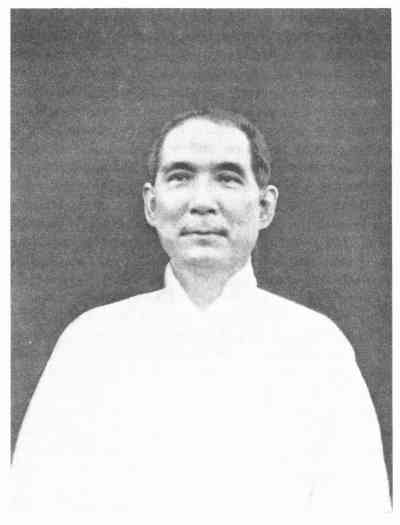
 Generalissimo Chiang K'ai-shek