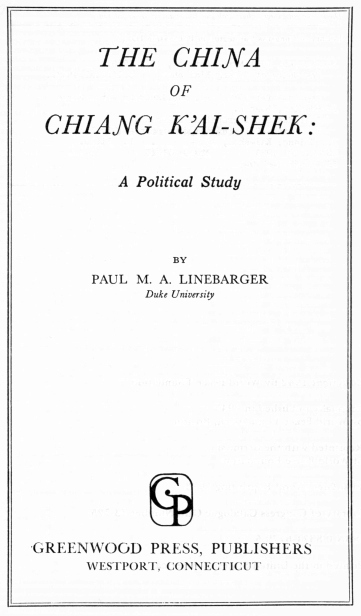
The China of Chiang K'ai-Shek
by Paul Myron Anthony Linebarger
★★★★★No ratings yet
Language: English
Sign in to rate this book.
Sign in to shelve this book.
About this eBook
- Author
- Linebarger, Paul Myron Anthony, 1913-1966
- Title
- The China of Chiang K'ai-Shek: A Political Study
- Credits
- E-text prepared by Judith Wirawan, Adam Buchbinder, and the Online Distributed Proofreading Team
- Language
- English
- LoC Class
- DS: History: General and Eastern Hemisphere: Asia
- Subject
- Chiang, Kai-shek, 1887-1975
- Category
- Text
- Project Gutenberg
- eBook-No. 50465
- Release Date
- December 8, 2015
- Copyright
- Public domain in the USA.
Contents
- 1.THE CHINA OF CHIANG K'AI-SHEK: A Political Study
- 2.ACKNOWLEDGMENTS
- 3.CONTENTS
- 4.INTRODUCTION — The Chinese Political Inheritance: Some Continuing Aspects — China at the Outbreak of War — The Beginning of Active Hostilities — The Hankow Period — The Chungking Period — FOOTNOTES:
- 5.Chapter I THE CONSTITUTION — The Yüeh Fa of 1931 — The Draft Permanent or Double Five Constitution — The Issue of Constitutional Change — FOOTNOTES:
- 6.Chapter II THE POLITICAL ORGANS OF THE NATIONAL GOVERNMENT — The Five-Power Constitution — The Supreme National Defense Council — The President of the National Government — The Council of State — The Executive Yüan — The Military Affairs Commission — The Judicial, Legislative, Examination and Control Yüan — FOOTNOTES:
- 7.Chapter III CONSULTATIVE AND ADMINISTRATIVE ORGANS — The People's Political Council — The Administrative Pattern — The Political Ministries — Social and Cultural Agencies — The Economic Ministries — FOOTNOTES:
- 8.Chapter IV PROVINCIAL, LOCAL, AND SPECIAL-AREA GOVERNMENT — The Provinces — Local Government — The Communist Zone — Guerrilla Governments — FOOTNOTES:
- 9.Chapter V THE KUOMINTANG — The Party Constitutional System — Party Organization — The Kuomintang Bid for Leadership — Intra-Kuomintang Politics — The New Life Movement and Other Affiliates — FOOTNOTES:
- 10.Chapter VI THE COMMUNIST AND MINOR PARTIES — The Chinese Communists: Party and Leaders — Communism: Patriotism or Betrayal? — The National Salvation Movement — The Third Party — The Chinese National Socialist Party — Social Democrats and La Jeunesse — FOOTNOTES:
- 11.Chapter VII GOVERNING INSTITUTIONS OF THE JAPANESE AND PRO-JAPANESE — The Japanese Army as a Chinese Government — The Problem of Puppet States — The Provisional and Reformed Governments — The Reorganized National Government of Wang Ch'ing-wei — FOOTNOTES:
- 12.Chapter VIII EXTRA-POLITICAL FORCES — The Foundations of Chinese Government — Mass Education — Rural Reconstruction — The Chinese Industrial Cooperatives — Unorganized Pressure — FOOTNOTES:
- 13.Chapter IX SUN YAT-SEN AND CHIANG K'AI-SHEK — Sun Yat-sen — The San Min Chu I — Chiang K'ai-shek — Chinese Appraisals of Chiang — The Ideology of Chiang — FOOTNOTES:
- 14.CONCLUSION — The Chief Alternatives in China — The United States in Chinese Politics — FOOTNOTES:
- 15.APPENDIX I. GOVERNMENT DOCUMENTS
- 16.A. THE GOVERNMENT DRAFT OF THE PROPOSED CONSTITUTION [1] — Chapter I. General Provisions — Chapter II. Rights and Duties of the Citizens — Chapter III. The People's Congress — Chapter IV. The Central Government — Section 1. The President — Section 2. The Executive Yuan — Section 3. The Legislative Yuan — Section 4. The Judicial Yuan — Section 5. The Examination Yuan — Section 6. The Censor Yuan — Chapter V. The Local Institutions — Section 1. The Provinces — Section 2. The Districts — Section 3. The Municipalities — Chapter VI. National Economic Life — Chapter VII. Education — Chapter VIII. The Enforcement and Amendment of the Constitution — FOOTNOTE:
- 17.B. THE SYSTEM OF ORGANIZATION OF THE NATIONAL CONGRESS [1] — FOOTNOTE:
- 18.C. ACT OF THE LEGISLATIVE YÜAN , APRIL 31, XXVI (1937) GOVERNING THE ELECTION OF REPRESENTATIVES TO THE NATIONAL CONGRESS [1] — Chapter I. General Principles — Chapter II. District Election — Chapter III. Professional Election — Chapter IV. Special Elections — Section 1. Elections in the Provinces of Liaoning, Kirin, Heilungkiang and Jehol — Section 2. Elections in Mongolia and Tibet — Section 3. Representatives from Overseas — Section 4. Elections in the Army, Navy, and Air Forces — Chapter V. Election of the Chief Election Office and of the Election Inspectors — Chapter VI. Election and Forfeited Election — Chapter VII. Law Suits Concerning Election Affairs — Chapter VIII. Supplement — FOOTNOTE:
- 19.D. THE PROGRAM OF RESISTANCE AND RECONSTRUCTION [1] — A. GENERAL PRINCIPLES: — B. DIPLOMACY: — C. MILITARY AFFAIRS: — D. POLITICS: — E. ECONOMICS: — F. MASS MOVEMENT: — G. EDUCATION: — FOOTNOTE:
- 20.E. AN OUTLINE OF WAR-TIME CONTROLMENT [1] — THE CONTROL YÜAN: — FOOTNOTE:
- 21.F. A CHART OF THE CONTROL YÜAN FROM JULY 1937 TO JUNE 1940 [1] — THE READJUSTMENT: — THE FUNCTIONS: — THE PRESENT ORGANIZATION: — THE WORK: — THE MINISTRY OF AUDIT: — FOOTNOTES:
- 22.G. REGULATIONS CONCERNING THE ORGANIZATION OF THE VARIOUS CLASSIFICATIONS OF HSIEN [1] — A. GENERAL PRINCIPLES — B. THE Hsien GOVERNMENT ( hsien chêng-fu ) — C. THE Hsien PEOPLE'S COUNCIL ( hsien ts'ang-chêng hui ) — D. FINANCES OF A Hsien — E. Ch'ü — F. Hsiang [3] — G. THE Hsiang PEOPLE'S COUNCIL — H. FINANCE OF THE Hsiang — I. Pao AND Chia — FOOTNOTES:
- 23.H. A CHART OF GOVERNMENT ORGANIZATION
- 24.APPENDIX II. DOCUMENTS ON PARTY POLITICS
- 25.A. A CHART OF KUOMINTANG ORGANIZATION
- 26.B. CONSTITUTION OF THE SAN MIN CHU I YOUTH CORPS, YEAR XXVII (1938) [1] — Chapter I. General Principles — Chapter II. Membership — Chapter III. System of Organization — Chapter IV. The Corps Leader — Chapter V. The All-Corps Representative Assembly and Other Meetings of Representatives — Chapter VI. The Central Headquarters — Chapter VII. The Branch Corps — Chapter VIII. The Divisional Corps — Chapter IX. The Sectional Corps — Chapter X. The Divisional Troop — Chapter XI. The Sectional Troop — Chapter XII. The Election of Officers and Their Term of Service — Chapter XIII. Discipline — Chapter XIV. Fees — Chapter XV. Amendments, etc. — FOOTNOTE:
- 27.C . THE DUTIES AND GENERAL ACTIVITIES OF THE SAN MIN CHU I YOUTH CORPS (CH'ÊN CH'ÊNG) [1] — Outline — A. The Duties and Nature of the Corps — 1. The Duties — 2. The Activities — 3. The Nature — B. The Growth and the Plan concerning the Intensification of the Works of the Corps — 1. The Growth — 2. Plan concerning the Intensification of Activities — C. The General Activities of the Corps — 1. Organization — 2. The Training — 3. Publicity — 4. Social Work — 5. Financial Assistance — D. General Discussion of the Two Years' Activities of the Corps and the Principles Governing the Nation's Youth — 1. Discussion of the Corps' Past Work — 2. Principles Guiding the Nation's Youth — FOOTNOTES:
- 28.D. THE HSIAO-TSU (SMALL GROUP) TRAINING PROGRAM [1] — Introduction — A. Organization — B. Conferences — C. Guidance and Examination — D. Appendix — FOOTNOTES:
- 29.E. PARTY CONSTITUTION OF THE CHINESE COMMUNIST PARTY [1] — Chapter I. Title — Chapter II. The Members — Chapter III. The Organization — Chapter IV. Branch Party Organs — Chapter V. City and Country District Party Organs — Chapter VI. Hsien and Municipal Party Organs — Chapter VII. Provincial Party Organs — Chapter VIII. The National Party Convention [4] — Chapter IX. The National Party Congress — Chapter X. The Central Party Committee [5] — Chapter XI. The Central Control Committee [6] — Chapter XII. The Party Discipline — Chapter XIII. Party Finance — Chapter XIV. Special Party Groups [Corps] [7] — Chapter XV. Relationship with the Communist Youth Corps [8] — FOOTNOTES:
- 30.APPENDIX III. MATERIALS ON POLICY
- 31.A. REPLY TO QUESTIONS (CHIANG K'AI-SHEK) [1] — FOOTNOTE:
- 32.B. WHAT I MEAN BY ACTION, OR A PHILOSOPHY OF ACTION (CHIANG K'AI-SHEK) [1] — The Truths We Must Endeavor to Grasp Anew — Action Is Life Itself: the Tireless Pertinacity of Nature Our Example — Action Is Not Mere Motion — Action Is Nature at Work in Man: the Whole Universe Is the Scene of Action — The Broadest Sense of Life — The Revolution Demands Action of All Men at All Times — The Meaning of Ease — Sincerity the Root of Action and Goodwill — The Laws of Action — One: The Starting Point — Two: Ordered Unfolding of Plans — Three: Unswerving Aim at the Target — Four: The Even Texture of a Life of Action — Formation and Constancy of Purpose — Action Engenders Knowledge — Comrades in Revolution! Resolve Anew! — FOOTNOTE:
- 33.C. DEFINITION OF THE PROBLEMS CONCERNING THE ORGANIZATION OF THE VARIOUS CLASSIFICATIONS OF HSIEN (CHIANG K'AI-SHEK) [1] — A. Readjustments in the Relations among the Various Administrative Party and Political Organizations of the Hsien — B. Political Organizations — C. People's Organs through Which Popular Political Opinions May Be Expressed — Explanation — FOOTNOTES:
- 34.D. A DISCUSSION OF MAO TSÊ-TUNG'S COMMENTS ON THE PRESENT STATE OF INTERNATIONAL RELATIONS (CH'ÊN KUO-HSIN) [1] — I. The Question of Unexpected Political "Coups" — II. Is the German-Soviet Pact Casual? — III. Why the German-Soviet Pact? — IV. A Discussion on the "New Front" as Made in a Chinese Story-Teller's Way — V. A Single Enemy? Or a Single Ally? — VI. A Reasonless Conclusion — FOOTNOTES:
- 35.E. CHINA'S LONG-RANGE DIPLOMATIC ORIENTATION (WANG CH'UNG-HUI) [1] — 1. Outline of China's Foreign Policy — 2. China's Stand Vis-à-Vis Japan — 3. Non-Recognition of Puppet Regimes — 4. China's Foreign Relations Based on Nine-Power Treaty — FOOTNOTE:
- 36.GLOSSARY
- 37.INDEX
- 38.TRANSCRIBER'S NOTE:
Community reviews
Sign in to write a review.
No reviews yet.