In the present edition, while most of the matter
which has appeared in previous editions of our little
book has been retained, we have deleted portions
that we considered could be dispensed with, and
added some fresh incidents and reminiscences
that we think may add to its interest. We have
enlarged the work by the addition of a chapter
descriptive of the pictures and objects of interest
to be seen within the precincts of this historic
House. We desire to record our thanks to
Messrs. W. Marchant & Co., of the Goupil Gallery,
5, Regent Street, for assistance given in relation to
the pictures, and to many old customers of the
House for facts relating to its past history.
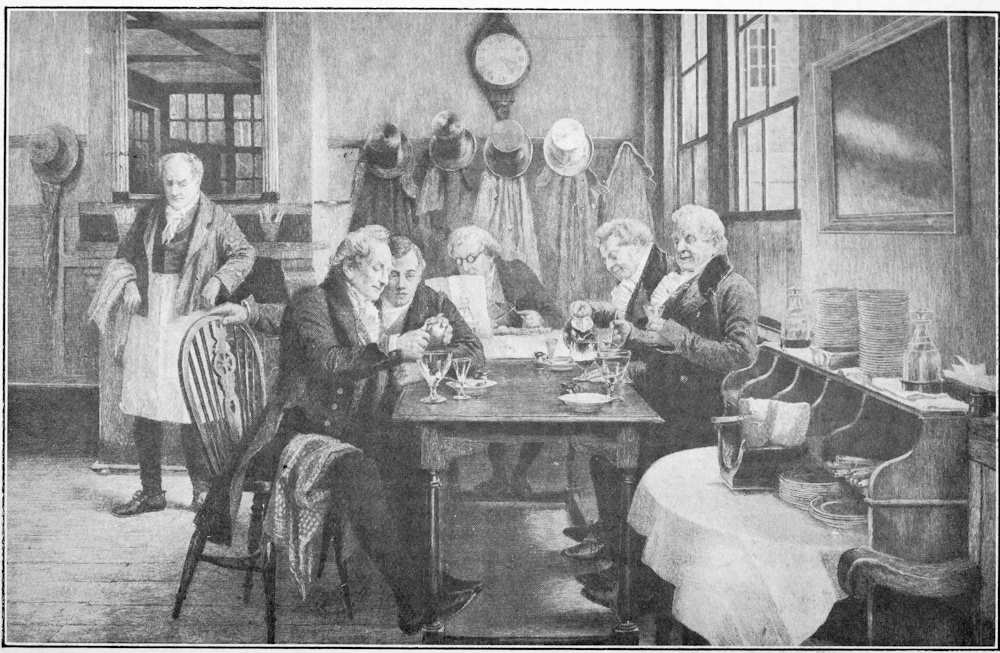
“TODDY AT THE CHESHIRE CHEESE.” By W. Dendy Sadler. By permission of Mr. L. H. Lefèvre, owner of the Copyright.
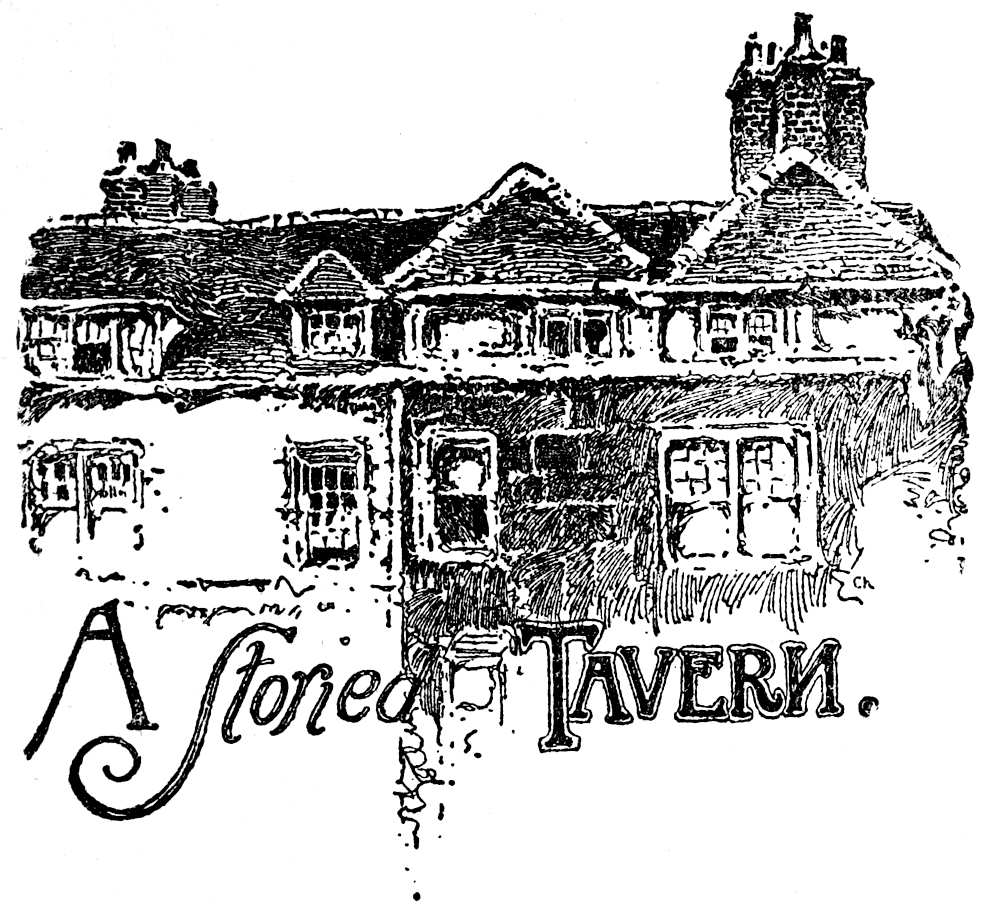
A StoriedTavern.
CHAPTER I EARLY HISTORY OF YE OLDE CHESHIRE CHEESE
Time consecrates;
And what is grey with age becomes religion.—Schiller.
Old London is fast disappearing off the face of the
earth. One by one its ancient taverns have gone, or if
the names familiar to our ancestors have been retained,
the hand of the builder has been laid remorselessly
on the structures our forefathers knew, and they
have been transformed beyond recognition. One of
them, however, survives, untouched by the hand of
time, spared by the vitality of the traditions, literary
and other, which it enshrines, and that is the Cheshire
Cheese. Though its story reaches back long before
the eighteenth century, it is with the memory of
Dr. Johnson and his more brilliant contemporaries
that it is very largely associated in the minds of men.
It is in a special sense London’s living memorial of
the great Lexicographer. Amid the changes which
have altered Fleet Street almost beyond recognition
by the Doctor and his contemporaries, it stands safe
still, its old activities in full swing in the narrow
backwater of Wine Office Court, a venerable
reminder of the past. That men should be possessed
with an unwearying curiosity about the old tavern
which was so much the haunt of the mighty literary
potentate who was the patron and friend of
Goldsmith, is but natural. They feel for it what the
devotee feels for a shrine. Dr. Johnson was not
himself indifferent to a sentiment of the sort, and
just as we take an intense interest in the “Cheshire
Cheese” which he frequented, so he, in his day, was
sympathetically curious as to the places which
Dryden half a century or so before the Doctor’s time
had made sacred to literary memory by his presence.
“When I was a young fellow,” he says, “I wanted
to write the life of Dryden, and in order to get
materials I applied to the only two persons then alive
who had seen him; these were old Swinney and old
Cibber. Swinney’s information was no more than
this, ‘That at Will’s Coffee-house, Dryden had a
particular chair for himself, which was set by the
fire in winter and then called his winter chair, and
that it was carried out for him to the balcony in
summer, and then called his summer chair.’ I went
and sat in it.”
Thanks, therefore, to the fact that we have one
specimen of the Johnsonian tavern remaining practically
the same as it was in the Johnsonian days, we
can still depict for ourselves, with but the slightest
effort of the imagination, what must have been the
scene at the Cheshire Cheese in the Doctor’s time.
Johnson is there in his favourite seat, mouthing and
talking as who should say: “I am Sir Oracle, and
when I ope my mouth let no dog bark.” One or
other of his friends is never wanting to keep him
company—Burke, or Goldsmith, or it may be Langton
or Beauclerk. But the inn is with us, though the
men of the eighteenth century are gone.
Even then the tavern as a club was beginning to
fall into comparative decay. Fashion was voting for
the club proper, proprietary or otherwise, and the
habit of ceasing to live in the City carried away the
old frequenters of the Fleet Street taverns into
the suburbs or the more distant environs of London.
Washington Irving gives us in his “Sketch Book” a
charming account of one of the city of London
hostelries, as it was at the beginning of the nineteenth
century. The opening of the description
would serve for the Cheshire Cheese of to-day.
“This has been a temple of Mirth and Wine from
time immemorial. It has always been in the family,
so that its history is tolerably well preserved by the
present landlord. It was much frequented by the
gallants and cavalieros of the reign of Elizabeth, and
was looked into now and then by the wits of Charles
the Second. The members of the club which now
holds its weekly sessions there abound in old catches,
glees, and choice stories that are traditional in the
place. The life of the club, and indeed the prime
wit of the neighbourhood, is mine host himself. At
the opening of every club night he is called in to sing
his ‘Confession of Faith,’ which is the famous old
drinking troll from Gammer Gurton’s ‘Needle.’”
Washington Irving gives the words of the four verses
of the song with chorus, the first of which, as a
specimen of an old-time City tavern song, may suffice
to be produced here:
I cannot eate but little meat,
My stomack is not good;
But sure I think that I can drink
With him that wears a hood.
Though I go bare, take ye no care,
I nothing am acold.
I stuff my skin so full within
With jolly good ale and old.
Chorus: Back and side go bare, go bare,
Both foote and hand go cold;
But belly! God send thee good ale enough,
Whether it be new or old.
But from the time of Dr. Johnson down to the
present day unbroken links of tradition connect
the Cheshire Cheese of the twentieth century with
the Cheshire Cheese of the eighteenth, and through
that with all the taverns in story, which begin with
the Tabard and pass on, through the Mermaid and
the rest, to the old house in Wine Office Court. This
venerable survivor of a vanished race has a double
interest: to the lover of antiquity in general it appeals
as the type of the place our forefathers loved; to the
lover of the Johnsonian cycle, as enabling him to
picture to himself what that race of giants did, where
they ate and drank, and where they talked. That
they had reason for their choice of an inn, and could
give a reason for that choice too, is plain from a
well-known passage in Boswell, which runs as
follows:—
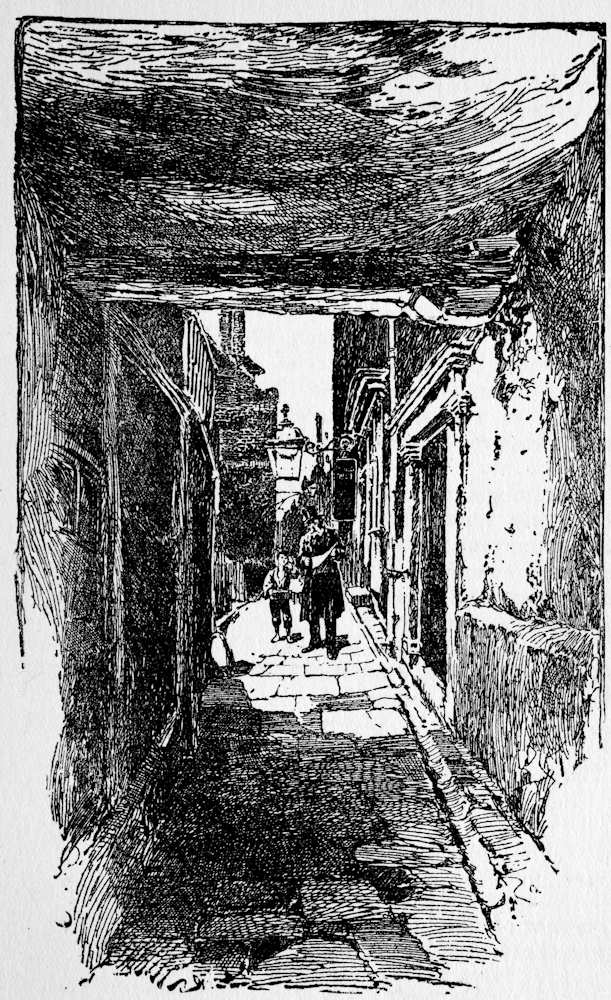
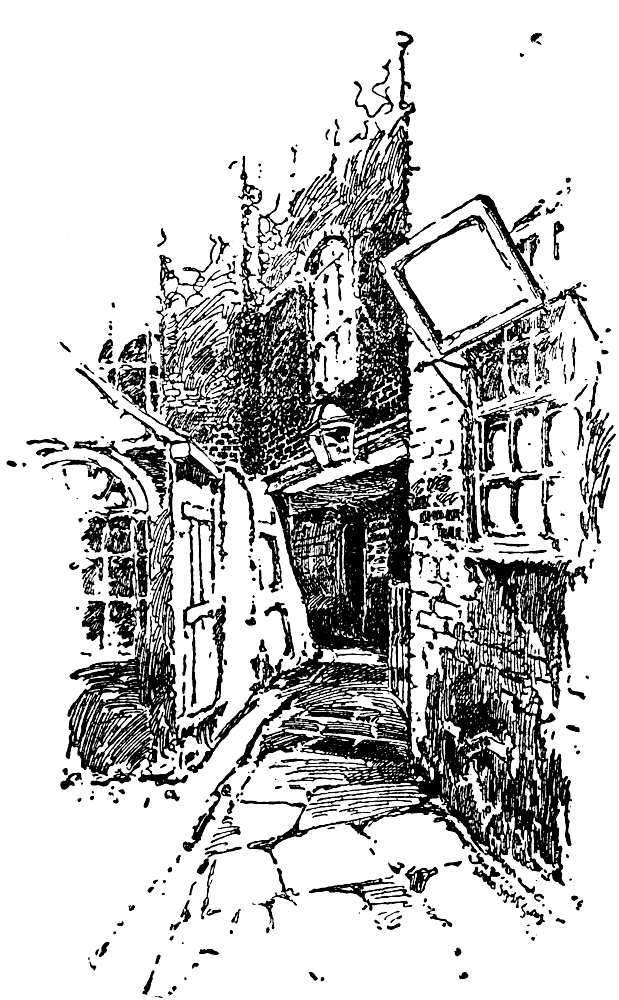
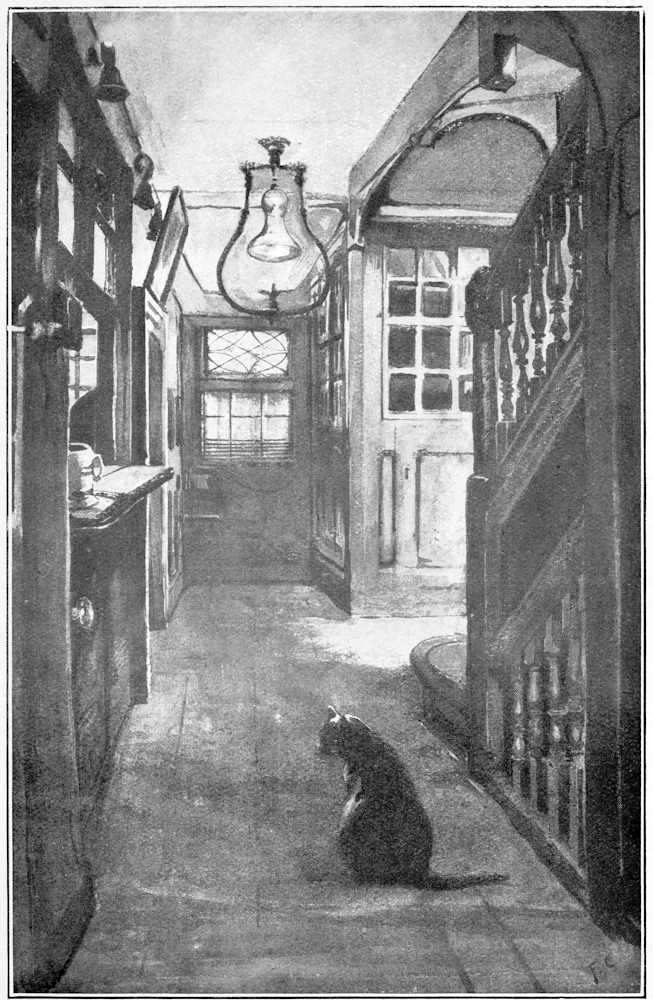
ENTRANCE TO THE “OLD CHESHIRE CHEESE” IN WINE OFFICE
COURT.
From an Original Drawing by Herbert Railton.
“There is no private house in which people can
enjoy themselves so well as at a capital tavern. Let
there be ever so great plenty of good things, ever so
much grandeur, ever so much elegance, ever so much
desire that everybody should be easy, in the nature
of things it cannot be; there must always be some
degree of care and anxiety. The master of the house
is anxious to entertain his guests, the guests are
anxious to be agreeable to him; and no man but a
very impudent dog indeed can as freely command
what is in another man’s house as if it were his own.
Whereas, at a tavern, there is a general freedom from
anxiety. You are sure you are welcome, and the
more noise you make, the more trouble you give” (we
should remember that this was said in the rougher
world of the last century), “the more good things
you call for, the welcomer you are. No servants will
attend you with the alacrity which waiters do who
are incited by the prospect of an immediate reward
in proportion as they please. No, Sir, there is nothing
which has yet been contrived by man by which so
much happiness is produced as by a good tavern or
inn.”
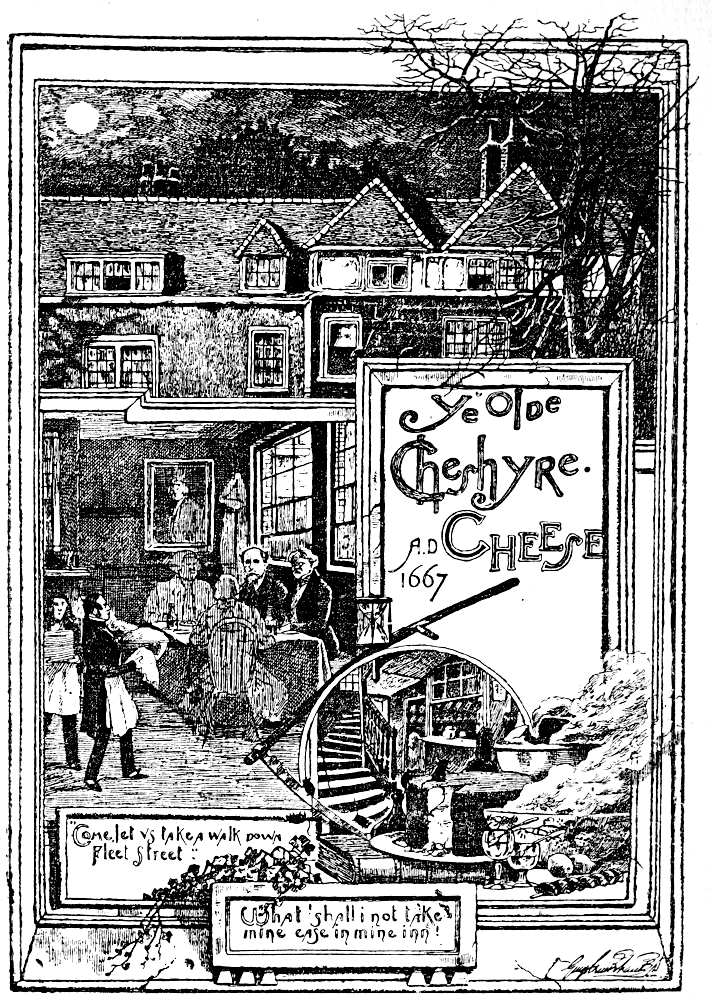
Although the origin of the Old Cheshire Cheese
(formerly spelt “Ye Olde Cheshire Chese”) is not
altogether involved in obscurity, there is a decided
want of complete, or even semi-complete, details as
to its very early history; but it is much more affluent
in literary anecdote.
It was in the Old Cheshire Cheese that the dispute
arose about who would most quickly make the
best couplet. One said:—
I, Sylvester,
Kiss’d your sister.
The other’s retort was:
I, Ben Jonson,
Kiss’d your wife.
“But that’s not rhyme,” said Sylvester. “No,”
said Jonson; “but it’s true.”
A later poet, Lord Tennyson, was himself a frequenter
of the “Cheese” in his young days, while it
was there that Isaac Bickerstaff made the epigram:
When late I attempted your pity to move,
What made you so deaf to my prayers?
Perhaps it was right to dissemble your love,
But—why did you kick me down stairs?
In fact, the “Cheese” was famous for epigrammatists.
Who would not like to have seen the face
of the old glutton and scandalmonger when, in the
“Cheese,” the following lines were solemnly presented
to him?—
You say your teeth are dropping out—
A serious cause of sorrow,
Not likely to be cured, I doubt,
To-day, or yet to-morrow.
But good may come of this distress,
While under it you labour,
If, losing teeth you guzzle less,
And don’t backbite your neighbour.
That Samuel Johnson, Oliver Goldsmith, and
other distinguished men were in the habit of
frequenting the Old Cheshire Cheese, there can be
no manner of doubt, and they knew what they were
about in choosing their place of rendezvous, for I find
in a brochure entitled “Round London” (1725), that
the house is described as “Ye Olde Cheshire Cheese
Tavern, near ye Flete Prison, an eating-house for
goodly fare.”
Wine Office Court, where the Cheshire Cheese is
situated, took its name from the fact that wine licences
were granted in a building close by. The present
“wine office” of the Old Cheshire Cheese is exactly
at the junction of the Court and Fleet Street.
“In this court,” says Mr. Noble, “once flourished
a fig tree, planted a century ago by the vicar of St.
Bride’s, who resided at No. 12. It was a slip from
another exile of a tree formerly flourishing in a sooty
kind of grandeur at the sign of the Fig Tree in Fleet
Street.”
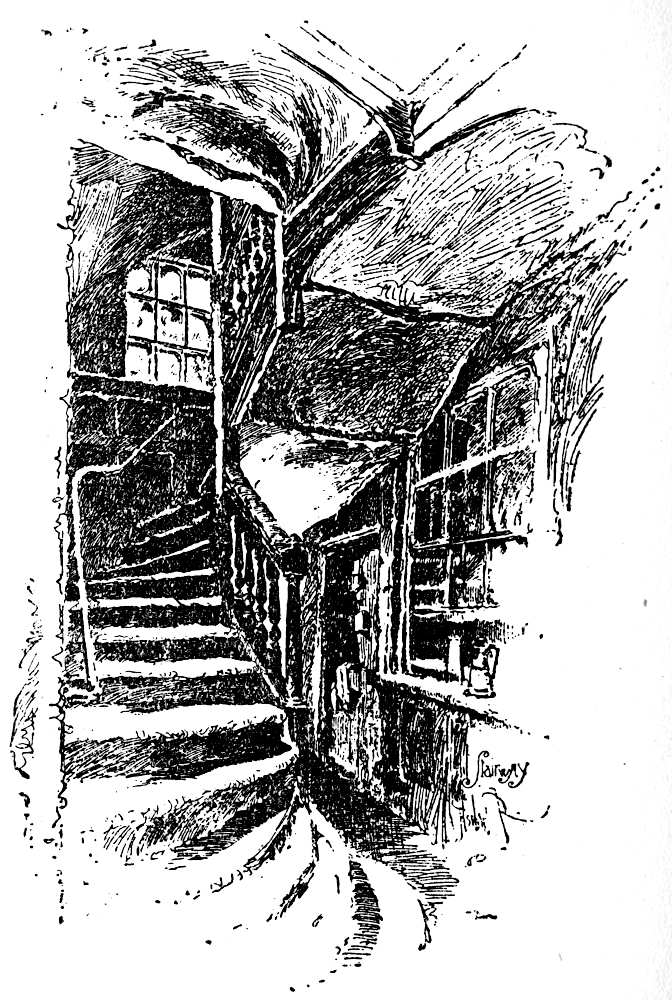
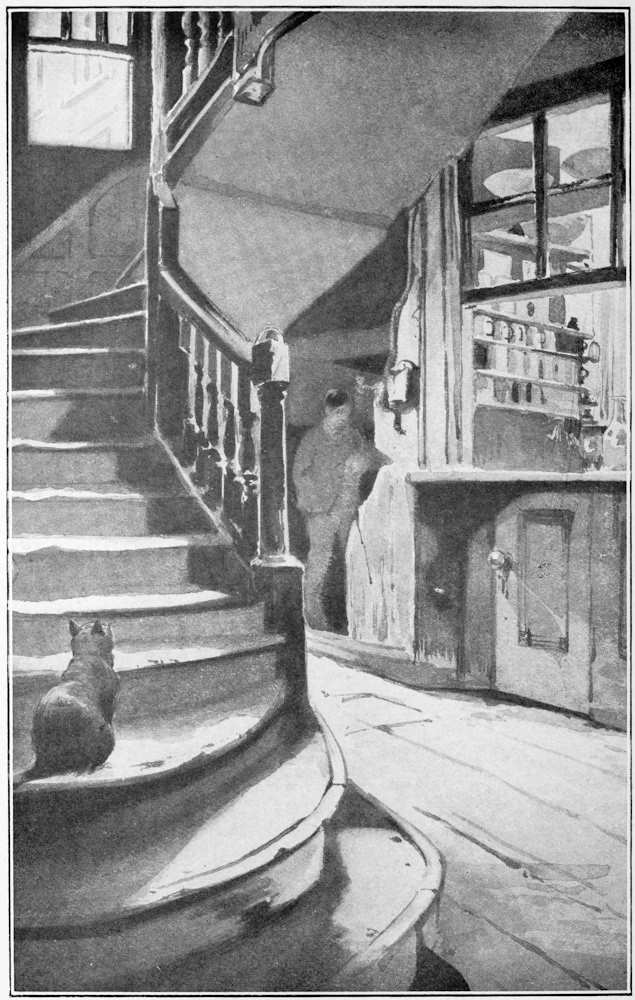
STAIRCASE IN “OLD CHESHIRE CHEESE.”
From an Original Drawing by Herbert Railton.
CHAPTER II JOHNSON AND GOLDSMITH AT THE “CHEESE”
There is nothing which has yet been contrived by man, by
which so much happiness is produced as by a good tavern or
inn.—Johnson.
Not the least delightful characteristic of the
“Cheese” is the persistency of its old customers.
Those who once have been admitted to its charmed
circle soon become wedded to its ways. It is not
merely to the goodly cheer provided there that this
loyalty is due, although, no doubt, to the viands and
the wines a share of it is to be attributed. An
anecdote of the late Mr. George Augustus Sala, the
well-known writer, Daily Telegraph special correspondent,
and genial bon vivant and gastronomist, is
delightfully illustrative of the attractions of the place
from the side of the creature comforts. The story is
told by the London correspondent of the Liverpool
Courier (December 10, 1895) in recording Mr. Sala’s
death. He writes: “Some years ago Mr. Sala went
to Paris on behalf of the Daily Telegraph, to write
on the subject of French cooking and French
restaurants. Such praise of Parisian kickshaws was
never lavished before, and the extollation, to the complete
discomfiture of English cooks, lasted for fully
six weeks. Everything in the cooking line in Paris
was grand, everything in England in the same line
was horrible. At the end of the six weeks Mr. Sala
returned to London, went immediately to the
Cheshire Cheese in Fleet Street and said to the
head waiter—‘William, bring me a beefsteak, some
potatoes in their jackets, and a pint of ale. I’ve had
nothing to eat for six weeks.’”
The sentimental attractions are equally strong,
and their influence is felt even by the most occasional
of guests whose situation in life, or whose distance
from London, unfortunately precludes their being
regular attendants at the hostelry. A fine acrostic
sent to the landlord by the Rev. William Kerr-Smith,
Vicar of Whiteby, Newcastle-on-Tyne, embodies
some of the thoughts that naturally arise in the mind
of the cultivated visitant:
C hanged are the times and changed, alas, the guests!
H ow changed from those who erst with gossip stored
E ach day saw grouped about thy cheerful board!
S till are their voices now, whose noisy jests
H ave filled these rooms with laughter. Gathered here
I n rare confusion Beau, and Wit and Sage,
R ich, Poor and Spendthrift, Youth and fuller age
E njoyed whilst yet they might thy festive cheer.
C areless of censure each one told his tale,
H eard the last scandal as he quaffed his ale.
E ager to praise, they scrupled not to school,
E njoyed the folly, but condemned the fool.
S o lived they far removed from dulness dire,
E schewed the commonplace and tuned the lyre.
Among the bygone guests with whose memory
the Cheshire Cheese is fragrant, not the least notable
was the immortal author of “The Deserted Village”
and “The Vicar of Wakefield.” Indeed he was its
very near neighbour, for Goldsmith’s lodging was at
No. 6 Wine Office Court, nearly opposite the
“Cheese,” and here he wrote “The Vicar of Wakefield.”
It was on Johnson’s first visit to supper here
with Goldsmith that Percy called for him on his way,
and found him dressed in a new suit of clothes and
well-powdered wig. Noticing Johnson’s unusual
smartness, he heard from him the reason of it. “Sir,
Goldsmith is a great sloven, and justifies his disregard
of propriety by my practice. To-night I desire to
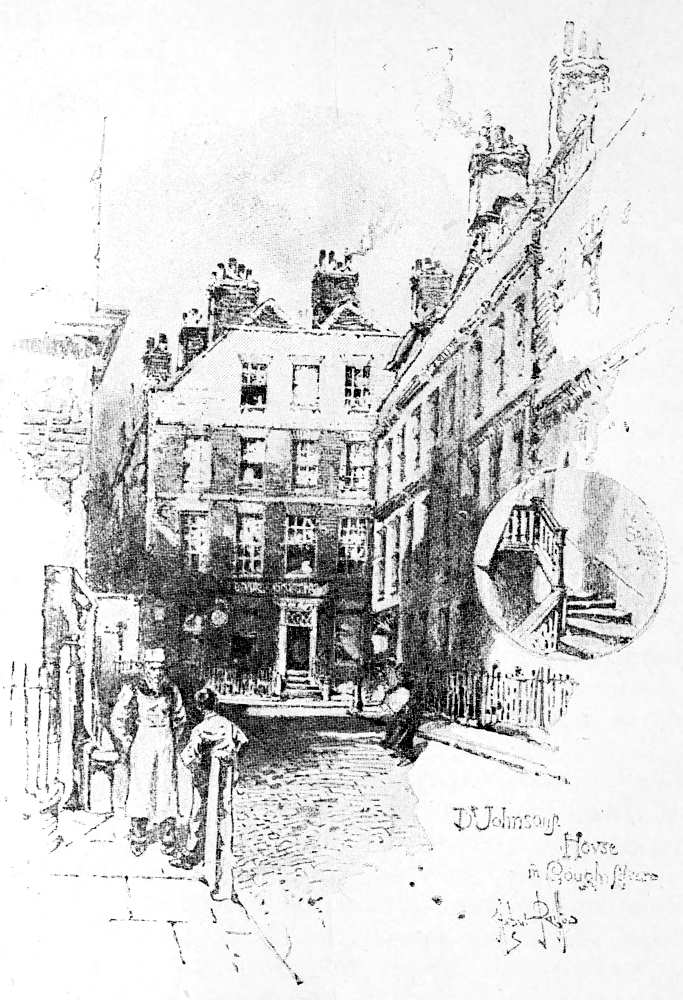
show him a better example.” Johnson’s house, where
the Dictionary was compiled, was within a minute’s
walk, in Gough Square. Boswell does not record any
visits to the “Cheese,” but Boswell’s acquaintance
with Johnson began when Johnson was an old man,
when he had given up the house in Gough Square,
and Goldsmith had long departed from Wine Office
Court. At the best, Boswell only knew Johnson’s
life in widely separated sections. Boswell was in
Edinburgh while Johnson was in Bolt Court, and it
is certain Johnson wrote no diary for the benefit of
his biographer. Witnesses who were on the spot
supply the deficiency. Some of them Mr. Cyrus Jay,
in a little book entitled, “The Law—What I have
Seen, Heard and Known,” published in 1868, states
that he had met. The book contains this inscription:
TO THE LAWYERS AND GENTLEMEN
WITH WHOM I HAVE DINED FOR MORE THAN
HALF A CENTURY
AT THE OLD CHESHIRE CHEESE TAVERN
WINE OFFICE COURT, FLEET STREET
THIS WORK
IS RESPECTFULLY DEDICATED
BY THEIR OBEDIENT SERVANT CYRUS JAY
In his preface Mr. Jay says: “During the fifty-five
years that I have frequented the Cheshire Cheese
Tavern ... there have been only three landlords.
When I first visited the house I used to meet several
very old gentlemen, who remembered Dr. Johnson,
nightly at the Cheshire Cheese; and they have told
me, what is not generally known, that the Doctor,
whilst living in the Temple, always went to the Mitre
or the Essex Head; but when he removed to Gough
Square and Bolt Court he was a constant visitor at
the Cheshire Cheese, because nothing but a hurricane
would have induced him to cross Fleet Street.”
Mr. Jay’s fifty-five years, from 1868, take us back
to 1813, or little more than a quarter of a century
after the death of Johnson. But who then was Mr.
Jay, and what are his claims to credibility? “I have
heard,” says Dr. Birkbeck Hill, that indefatigable
inquirer into Johnsonian facts and dates, “a member
of our (the Johnson) club relate that, when he was
a student of law, there used to be pointed out to him
in the Cheshire Cheese an old gentleman who, day
after day, was always to be found there, prolonging
his dinner by an unbroken succession of glasses of
gin and water. It was as a kind of awful warning
of the depths to which a lawyer might sink, that this
toper was shown, and it was added in a whisper that
he was the son of Jay, of Bath. Jay, of Bath, is
well-nigh forgotten now, but during the first half
of the present century his fame as a preacher stood
exceedingly high. It was Cyrus Jay, his son, who
for fifty-three years frequenting this ancient tavern,
preserved and handed down this curious tradition of
Johnson. The landlord has told me how, in his
childhood, he used to hear in the distance the gruff
voice of the old gentleman as he came along Fleet
Street, and how sometimes he was sent to see Mr. Jay
safe home to his chambers at 15 Serjeants’ Inn hard
by. For most of his long life, port, that medium liquor,
neither like claret for boys nor brandy for heroes, but
the drink for men, had been his favourite beverage.
A failing income brought him down at last to gin and
water. He used to comfort himself by the reflection
that he could get twice as drunk for half the money.
He dined in the tavern to the very end. One evening
he was led home to his lodgings, and within four-and-twenty
hours he was dead. He was the last
frequenter of the Old Cheshire Cheese who knew
the men who had known Johnson. Mine host
remembers a still older guest, Dr. Pooley by name,
a barrister, who died about 1856, at the age of eighty.
Night after night for many a long year he had dined
at half-past seven to the minute on a ‘follower,’ the
end chop of the loin. He, too, used to tell of the
men of his younger days, who boasted that they had
often spent an evening there with Dr. Samuel
Johnson.”
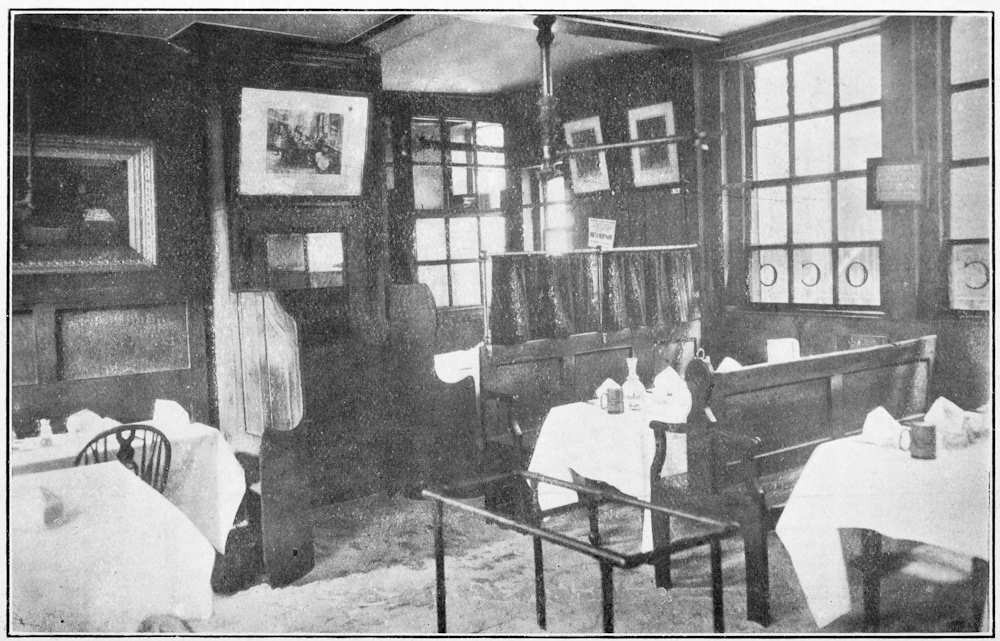
“THE COSY CORNER” IN OLD CHESHIRE CHEESE.
Another writer, Mr. Cyrus Redding, who went to
live in Gough Square in 1806, in his “Fifty Years’
Recollections, Literary and Personal,” published in
1858, takes us a little further back. He says:
“I often dined at the Cheshire Cheese. Johnson
and his friends, I was informed, used to do the same,
and I was told I should see individuals who had met
them there. This I found to be correct. The company
was more select than in later times. Johnson
had been dead about twenty years, but there were
Fleet Street tradesmen who well remembered both
Johnson and Goldsmith in this place of entertainment.”
Mr. Cyrus Jay, deploring the loss of the Mitre,
the Cock, and other old taverns, remarks, “There
still remains the Old Cheshire Cheese, in Wine Office
Court, which will afford the present generation, it is
hoped, for some years to come, an opportunity of
witnessing the kind of tavern in which our forefathers
delighted to assemble for refreshment.
“There was a Mr. Tyers, a silk merchant on Ludgate
Hill, and Colonel Laurence, who carried the
colours of the 20th regiment at the battle of Minden,
ever fond of repeating that his regimental comrades
bore the brunt on that memorable day. The evening
was the time we thus met. There was also a
sprinkling of lawyers, old demisoldes and men of
science; among the latter was a Mr. Adams, an
optician, of Fleet St.
“Colonel Laurence showed me Goldsmith’s tomb
in the Temple Churchyard; he was never tired of
talking of his acquaintance with the poet, whom he
knew when Goldsmith, as well as Johnson, lived hard
by the Cheshire Cheese. I listened with eagerness
to what these men of other days told me. Tyers
broke a leg, and was confined to his bed for a long
time, and the rubicund-cheeked Colonel passed the
way of all the earth in a year or two after I first
became acquainted with him. He used to speak of
Goldsmith’s ordinary person, and told me the poet
never broke in upon the conversation when Johnson
was talking.
“The left-hand room, entering the ‘Cheshire,’ and
the table on the extreme right upon entering that
room, was the table occupied by Johnson and his
friends almost uniformly. This table and the room
are now as they were when I first saw them, having
had the curiosity to visit them recently. They were,
and are still, as Johnson and his friends left them in
their time. Goldsmith sat at Johnson’s left hand.”
But the public room on the ground floor was not the
only place affected by Johnson and his friends.
When they wished to retire from the madding crowd
a little room on another floor supplied all the privacy
they occasionally desired, and here to this day is
carefully preserved the chair from which the Doctor
thundered.”
CHAPTER III RELICS AND ART TREASURES OF “THE CHESHIRE CHEESE”
“There is nothing which has yet been contrived by man, by
which so much happiness is produced as by a good tavern or inn.”—Johnson.
About half-way up Fleet Street, on the right or
northern side if we are coming from Ludgate Circus,
the sign of “The Cheshire Cheese” meets the eye
of the wayfarer, and intimates to him the near
presence of the famous hostelry. There are two
approaches, the western by Wine Office Court, the
other by the passage way leading to the annexe. We
will take the western, by Wine Office Court, because
up it have often strolled side by side Dr. Johnson
and Oliver Goldsmith, the latter parting for a moment
with his dictatorial friend at the portals of “The
Cheese” to go on to his lodgings a dozen yards
further up the court on the other side the way. The
sign beneath which the Doctor stands intimates to
all and sundry that “The Cheshire Cheese” was
rebuilt in 1667, seven years after the glorious Restoration,
on the site of that older Cheshire Cheese,
where Shakespeare, Ben Jonson and many another
Elizabethan wit were wont to quaff their sack amid
laughter and eager bandying of jest. We will
leave the Doctor to make for his favourite seat in
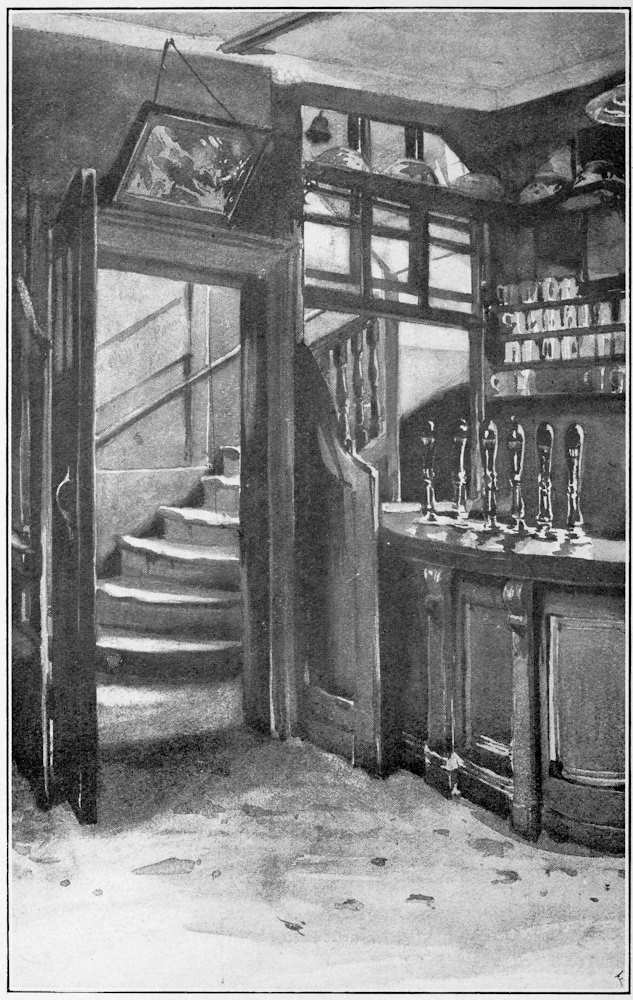
the room on the left, while we enter the bar. This
is a delightful apartment in its tranquil reminder of
the past. Ranged round it are a number of valuable
punch bowls, of which we can imagine Mr. Pickwick
if he were on a visit here took elaborate and reverential
note. They speak eloquently of countless noctes
ambrosianæ, when the wit and the liquor were alike
of the best. The bar of the Cheshire Cheese has
seen them drained to the last drop with effusive
enthusiasm when the news of Blenheim, and
Oudenarde, and Ramilies arrived, or later for Dettingen
and Minden. We can imagine the punch was
not without its tributory tears when its patriotic
customers suddenly learnt that Nelson had fallen in
the hour of victory, though there was nothing lachrymal
to dilute their jovial joy in the frequent
triumphs of “The Iron Duke.” If the old punch
bowls could but speak! But the very air of the place
is redolent of the past, both storied and convivial,
and eloquent for him who but pauses to think and
to recall.
One of the most touching things about “The
Cheese” is the way in which it treasures the memory
of its old servants. “William” has actually given
his name to a room, and there over the fireplace of
the bar just opposite the door is his portrait, the
portrait of William Simpson, who commenced waiter
at “Ye Olde Cheshire Cheese” Chop-house in
1829. “This picture,” says the inscription below,
“was subscribed for by the gentlemen frequenting
the Coffee Room, and presented to Mr. Dolamore
(the Landlord) to be handed down as an heirloom
to all future Landlords of ‘Ye old Cheshire Cheese,’
Wine Office Court Fleet Street.” The name of the
artist is unknown. It is worth noting that in this
inscription the room in which we stand is called a
Coffee Room. Its modern designation of “the bar”
therefore is of comparatively recent origin.
The two small oil paintings on either side this
heirloom were painted in 1883 by William Allen.
One of them depicts the interior of the old bar, the
other its exterior. To the right of the fireplace is a
striking and important painting. It is a portrait, but
it is not certainly known of whom. Tradition varies,
and while according to some it is a portrait of Dean
Swift, others maintain that here we have the counterfeit
presentment of the first proprietor of the house
after the Great Fire, Theophilus B. Cruneble. There
are other objects of interest in the room, particularly
worth notice being the old china and glass. Nor
must we omit to mention the young ladies behind the
bar, but it is for the visitor to appraise their grace
and charm. Beauty draws the human heart in every
generation, and the men of Johnson’s day were no
less susceptible to its appeal than are we. The picture
upstairs, near the “Grandfather’s Clock,” would have
fired their imaginations as readily as it does ours.
But now, turning from the bar over which Hebes
of our twentieth century so efficiently preside, we pass
to the room opposite, and immediately on the left of
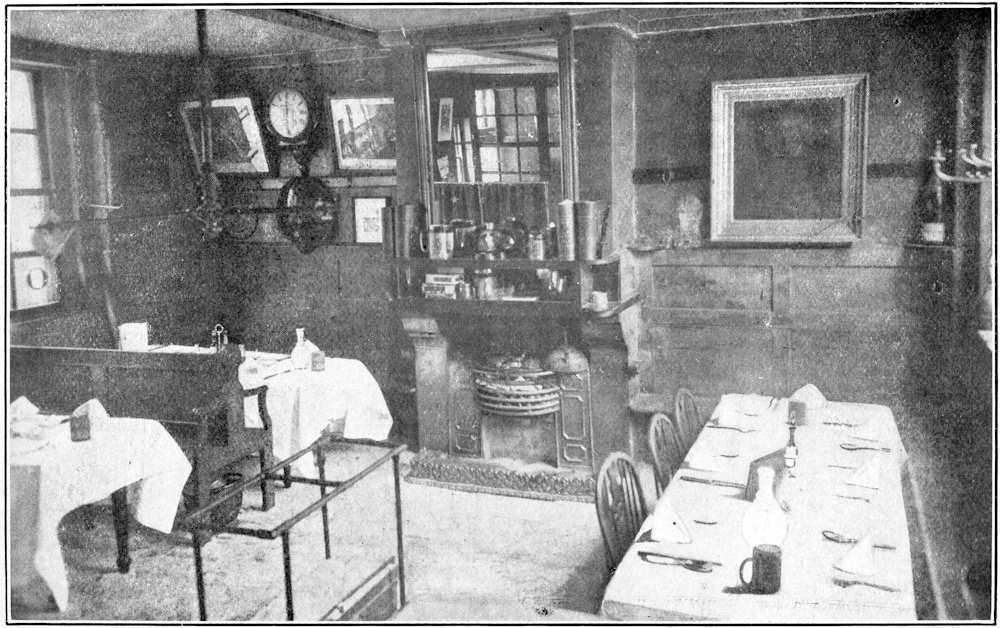
the passage way as we enter. This room has not
changed its character or its furniture for centuries.
If Dr. Johnson were to come in now and go by us to
his corner seat there to the right of the fireplace, he
would find things essentially much as he left them.
If his ghost wanders about Fleet Street, it must be
a great relief to it to get, when it can, back safe into
its unchanging old haunt, out of reach of the structural
revolutions which elsewhere time has wrought.
As in the bar, the important picture in this room is
that of a waiter. It is a portrait of Henry Todd, as
the inscription informs us, who commenced waiter at
the Olde Cheshire Cheese the 27th February, 1812.
It was painted by Wageman, July, 1827, and “subscribed
for by the gentlemen frequenting the Coffee
Room, and presented to Mr. Dolamore (the landlord)
in trust to be handed down as an heirloom to all
future landlords of the Old Cheshire Cheese, Wine
Office Court, Fleet Street.”
Two oil paintings by Seymour Lucas, R.A., of
the dining-room, with portraits of customers, will
repay inspection, while above Dr. Johnson’s old seat
is an oil painting of the Lexicographer himself, a
copy of the famous portrait by Sir Joshua Reynolds,
now preserved in the National Gallery. Underneath
may be read the following inscription:—“The
Favourite Seat of Dr. Johnson. Born 18th Septr.,
1709. Died 13th Decr., 1784. In him a noble understanding
and a masterly intellect were united. With
grand independence of character, and unfailing goodness
of heart, which won the admiration of his own
age and remain as recommendations to the reverence
of posterity. ‘No, Sir! there is nothing which has
yet been contrived by man by which so much happiness
has been produced as by a good tavern.—Johnson.’”
Hard by are two interesting old prints, one of
Dr. Johnson rescuing Oliver Goldsmith from his
landlady, the other of a literary party at the house
of Sir Joshua Reynolds. Then there is an oil
painting of a family group in which the Doctor is
easily to be recognised. More modern, but still well
worthy of inspection, is an artist’s proof, signed by
the artist himself, of the well-known picture—“Toddy
at the Cheese.” This is the painter, Mr. Dendy
Sadler’s own gift to the house, the interior of whose
dining-room he has so genially portrayed. Noticeable
adjuncts of the apartments also are two old
water-bottles, one of leather, the other of stone, and
of what is known as Godstone ware.
THE JOHNSONIAN CORNER.
The old staircase is well worth careful attention,
having stood marvellously the test of time. If we
ascend it we arrive at the first floor and William’s
room, to which an announcement on the wainscot
at the foot of the stairs served as a guide. It is
immediately on our left when we reach the landing,
perpetuating with its name the memory of Mr. Dolamore’s
faithful old henchman. Its most interesting
feature is a second copy in oils of the portrait of
Dr. Johnson by Sir Joshua Reynolds, to which I have
just made allusion. But it is much more than a mere
replica of the copy downstairs in the dining-room.
It is a copy, indeed, but a very old copy, and dates
back to the Doctor’s own time. It was painted in
order that it might adorn the room at “The Mitre,”
in Chancery Lane, where the club founded by Dr.
Johnson first held its meetings. Dr. Johnson’s
“Mitre” has long since been pulled down, but the
club he founded exists, and meets several times a
year in William’s room. Two prints next claim our
attention—a coloured one of Dr. Johnson’s House in
Gough Square, the other a book print of Dr. Johnson,
who is also shown to us in a framed wax bas-relief
model.
About the room also are a number of sepia
drawings of the various parts of the house—the work
of that accomplished artist, F. Cox—while there are
several pictures on the wall which serve to show that
the tastes of the frequenters of the “Cheese” are not
limited to literature and journalism. For example, we
have “Roach, Perch and Dace,” and “Salmon Trout”
and “Trout,” by C. Foster, a coloured print of
steeple-chasing, a portrait of Lord Palmerston,
engraved by F. Holl from the painting by F. Grant;
a landscape of considerable merit by an unknown
artist, and a view of Fleet Street, showing the
entrance to Wine Office Court. Very interesting too
is a print of the meeting of Dr. Johnson and Flora
Macdonald in the Isle of Skye in the year 1773. This
valuable work was recently exhibited at the Franco-British
Exhibition of 1908 at Shepherd’s Bush.
Issuing from this room, which embalms the memory
of “William,” we must pause at the foot of the flight
of stairs leading to the next floor to admire a handsome
old grandfather’s clock, which even in Dr.
Johnson’s time was venerable by reason of its years,
as it was almost certainly part of the furniture of
“The Cheese” when the hostelry was rebuilt after
the Great Fire of 1667. It is not impossible it was
ticking off the flight of time when Hawkins and
other Elizabethan sea captains were harrying the warships
of the great Armada in its progress up the
British Channel. Shakespeare and Ben Jonson may
have studied that ancient clock-face which would
warn them that it was desirable to cut short their
pleasant revelry and hasten to the theatre. We pass
on with a lingering look, and the next turn in the
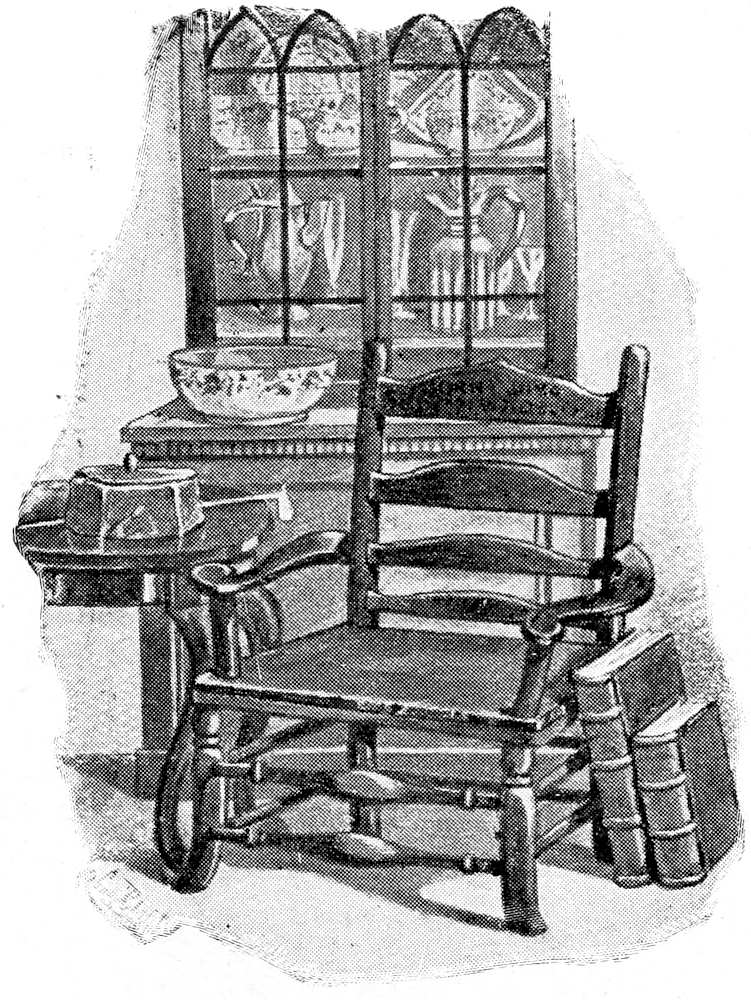
old staircase brings us to a private room, containing
one of the most valued treasures of the Cheshire
Cheese, nothing less than the original chair used by
Dr. Johnson at the Mitre, the old Chancery Lane
tavern, patronised occasionally by the Doctor and
now pulled down. This chair was acquired by the
proprietor of the Cheshire Cheese, and sedulously
protected from all accident and injury. The better
to ensure this end it is now enclosed in a glass case.
On the back of the chair is a medallion of Dr.
Johnson with the inscription—“Born Sept. 7th, 1709.
Died Dec. 13th, 1784.” Copies of the chair can be
supplied to order in oak at £5 each, but the medallion
and inscriptions, which are perhaps modern, or at
least post-Johnsonian additions to the original chair,
are not copied. A notice card upon the seat of the
chair announces to the visitor that “This chair was
in daily use by Dr. Samuel Johnson,” while below
follows the quotation:—“More regal in his state than
many kings.” Though he passed away when George
Washington was in the zenith of his renown after
splendid epoch-making achievement in arms and
diplomacy and council, the memory of the great
Doctor is as fresh and fragrant as ever, as on the
day when he last sat in the chair before us, the oracle
of a select company of wits and scholars. It is idle
to moralise further on this more than royal relic.
Each intelligent visitor, as he reverently contemplates
it, will pursue his own line of reflection.
Turning from the chair we find at the other end
of the room a glass-fronted cupboard, which contains
many original samples of the old willow pattern
plate and also of the unique badge plate, which has
been in use in the house for many years. Here, too,
are several specimens of the old punch glasses, which
have found favour with so many generations of
convives of the Cheshire Cheese. The stranger is
not perhaps without a tremor of gastronomic emotion
when the spoon used for at least three generations,
probably for a period of over a century, in stirring
the pudding is pointed out to him. Hard by on the
walls of the room are seven old prints from Hogarth’s
“Rake’s Progress.”
The great artistic treasures of this room are, however,
three important paintings, which have recently
been restored by Messrs. William Marchant & Co., of
the Goupil Gallery, 5 Regent Street. The first, which
looks down on the chair of Dr. Johnson in its glass
shrine, is an oil painting of a boy and dog. On the
back of the picture is written:—“David Boyle, aged
10.” “Ye 19th of July, 1691.” So that it was
painted eighteen years before the birth of Dr.
Johnson. On the opposite wall is another oil painting,
a still life picture, attributed by competent
critics to Peter Boel, who lived from 1626 to 1680,
and was a pupil of Snyders. The third of these oil
paintings is a figure picture, probably of “Diana,”
by Charles Le Brun, or the school (France, XVII.
century).
In the smoking-room adjoining there is nothing
of special interest for visitors, since this apartment is
mainly devoted to the smoking of churchwarden pipes
and to the consumption of “goes” of rack, cork, and,
above all, of Punch, for the right compounding of
which Ye Old Cheshire Cheese enjoys a reputation
so deservedly high. Here take place noteworthy
arguments, conducted with much skill and logical
acumen by the regular customers, each in his own
special chair, and each with his own churchwarden
pipe in his mouth, or held gracefully poised to emphasise
a rhetorical point. A case is provided in which
gentlemen may keep from harm the favourite pipes
to which use and wont have made them attached. In
this room, too, the evening clubs hold their meetings.
The subject of “Ye Olde Cheshire Cheese Clubs”
is, however, dealt with elsewhere. Still attention may
be drawn to the fact that on the walls of the smoking-room
are some interesting pen and ink sketches and
drawings relating to the clubs. It would be unbecoming
perhaps to omit mention of an engraving of “The
Empty Chair at Gadshill,” since it serves to remind
us of the intimate association of Charles Dickens
with “Ye Olde Cheshire Cheese,” while it suggests
that other empty chair in the next room. Further,
a pen and ink drawing of the old bar downstairs, by
Joseph Pennell, must not be forgotten, any more
than three Phil May sketches, the gift of the Goupil
Gallery.
DR. JOHNSON’S CHAIR.
AN INCIDENT AT THE OLD CHESHIRE CHEESE.
“An interesting episode in the family history of the House.”
By F. Cox.
(William’s Room in the distance.)
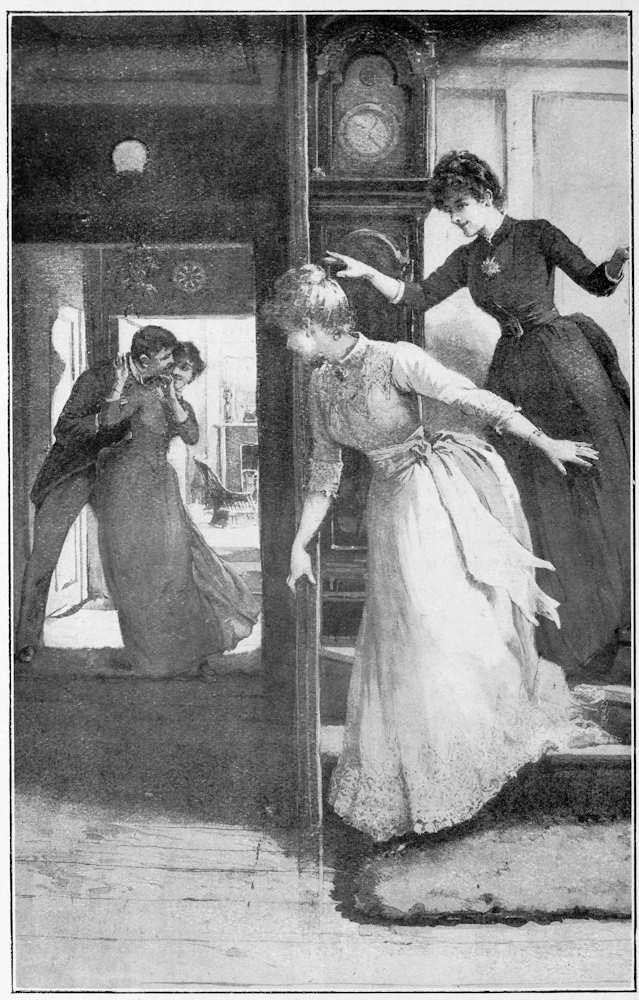
At the foot of the staircase leading up to the
apartments sacred to the fair Hebes of the House a
sepia drawing by F. Cox claims our notice. It is
entitled “An interesting episode in the family history
of the House.” A stalwart favourite of the bar is
snatching a kiss, while two lovely colleagues of his
beautiful victim are tip-toeing down these very stairs
to see the fun, and one pretty forehead has just
reached the corner of the wainscoting. And now as
the smiling beauties to the right of the picture bar
our further progress, let us descend to the kitchen,
where the most interesting objects are the original
coal range and coal grill, which have been in use for
over a hundred years. Possibly nowhere in the wide
world is there a gastronomic temple of greater renown
or more worthy of it, for here have always been
cooked in huge copper boilers the famous pudding,
the fire being fed and the pudding tended throughout
the whole night previous to the solemn and regular
introduction of this mammoth delicacy to the longing
gaze of its patrons. That is the hour when the
analytical observer might make valuable studies of
the watering mouth.
Dinners, by the way, are now served in the
Annexe. This room has been formed by roofing
with glass what was originally a court-yard. It
contains amongst the rest two famous original prints
by H. Bunbury—“A City Hunt” and “Hyde Park,
1780.” Other interesting prints are “Destruction of
the Bastile, July 14, 1789,” after a painting by H.
Singleton, and a line engraving by James Heath from
a painting by F. Wheatley of “The Riot in Broad
Street on the 17th of June, 1773.” Here also is a
cabinet containing various articles which may be
purchased by visitors. The price list may be conveniently
appended here. It runs as follows:—
O.C.C. Ware, etc.
Each
s.
d.
Three-handle Mugs, silver mounted
50
0
Three-handle Mugs
10
0
Two-handle Mugs
7
6
One-handle Mugs
2
0
One-handle Mugs, silver mounted
21
0
Cream Jugs
1
0
Sugar Basins
1
0
Mustard Pots
1
0
Salt Cellars
1
0
Pepper Pots
1
0
Tea Pots
—
Large.
Small.
s.
d.
s.
d.
Badged Willow Pattern Plates
1
0
0
8
Badged Willow Pattern Dishes
1
0
0
8
Post Cards.
No. 1 Series
6d. per packet.
No. 2 Series
6d. per packet.
Coloured Interior
1d. each.
Views of the House
6d. and 1s.
The above is a fairly complete inventory of the
relics and art treasures of the Cheshire Cheese, that
ancient hostelry which has become a place of
pilgrimage for all in the wide realms of Anglo-Saxondom
who cherish the memory of a unique
figure in the literary history of the English-speaking
peoples. Much has been said and written of the
great men of the sixteenth, seventeenth, and eighteenth
centuries who have eaten good fare and waxed
honestly merry within the precincts of the Cheshire
Cheese, but little of the men of note of this generation
and the preceding one who have at one time
or another been its guests. There are few distinguished
Englishmen who have not partaken of its
hospitality, and few persons of eminence, whether
hailing from the far Antipodes or from the great
country over which floats the Stars and Stripes, who
would deem a visit to England complete if due
homage to the memory of the great Lexicographer in
the Johnsonian shrine in Wine Office Court had not
been paid. There is nothing to compare with this
worship of the mighty literary monarch, unless it is to
be found in that of which Shakespeare is the centre,
which has made of Stratford-on-Avon the other
Mecca of Anglo-Saxondom.
CHESHIRE COURT AT SIDE OF “OLD CHESHIRE
CHEESE.”
CHAPTER IV MR. JOSEPH PENNELL AND LADY COLIN CAMPBELL ON “THE CHEESE” — FOOTNOTES:
Hard by there is the Cheshire Cheese,
A famous tap.—T. Hood.
In the last chapter no mention was made of the
fact that in 1887 a remarkable picture of the Cheshire
Cheese by Mr. Seymour Lucas, R.A., was exhibited
at the Royal Academy, since it is not among the art
treasures of the house. It can, however, not be
passed by, since Mr. Seymour Lucas and the Cheshire
Cheese are mutual friends. We will therefore quote
here the description given of the picture by a well-known
London evening paper. To Mr. Dendy
Sadler’s picture, “Toddy at the Cheshire Cheese,”
allusion has already been made.
“THE WAY IN.”
The Pall Mall Gazette of March 29, 1887: “It
represents a scene in the Old Cheshire Cheese inn,
and is entitled ‘The Latest Scandal.’ In one corner
of the quaint old room, on the bench which is still
pointed out as the place where Dr. Johnson used to
sit, we see a typical group of the wits of the period.
Some wear powder, while others have the full dark
wigs of an older fashion still. One of the group,
in the uniform of the Guards, is relating the latest
scandal to the rest, and pointing over his shoulder
towards two young beaux, who stand by the fireside.
One of these wears his right arm in a sling, and has
evidently come to grief in a duel on the previous
night. He and his friend are mightily disconcerted
to discover that their escapade has become the talk
of the town, and that it is affording vast amusement
to this group of scandal-mongers.”
What Mr. Seymour Lucas and Mr. Dendy Sadler
have so admirably portrayed for us with the brush,
an American writer of distinction has both described
with his pen and illustrated with his pencil in the
pages of Harper’s Weekly. In a November number
of that periodical, in 1887, Mr. Joseph Pennell writes
as follows:—
“On my first coming to London, I had fortified
myself, not with a course of English history, but by
re-reading ‘Pickwick.’ My first Sunday morning,
about one o’clock, I found myself in Chancery Lane
outside the entrance to Lincoln’s Inn, in the company
of the proverbial solitary policeman and convivial
cat. On my asking the policeman where in the
world I could get something to eat—as it is well
known one must starve in London on Sunday before
one and after three—he gave me the inevitable
answer, ‘Down to the bottom, first to your left, under
the lamp, up the passage, and there you are!’ After
he had repeated these mysterious directions two or
three times, and had found me hopelessly ignorant
of his meaning, he did what I have very seldom
known a London policeman to do—a proof of his
loneliness; he walked to the end of Chancery Lane
with me, and there being no one in Fleet Street,
pointed out the sign of the Cheshire Cheese.... A
push at the door, and I have passed into another world.
I was in a narrow hall, at the far end of which was
a quaint bar, where, framed in by small panes, were
two very pretty, but I cannot say fascinating barmaids—I
never could be fascinated by the ordinary
English barmaid. Suddenly a waiter with a very
short nose came out of another room and screamed
up the stairs: ‘Cotherum steak. Boatherum foozlum
mash. Fotherum coozlum, botherum steak!’ and
then remarked to me: ‘Lunch, sir? Yes, sir. Thank
you, sir. What can I get you, sir? Steak, sir; chop,
sir; kidney, sir; potatoes, sir, cooked in their jackets,
sir? Yes, sir; thank you, sir.’ Then up the stairs
he added: ‘Underdone steak one!’ Then to me
again: ‘Walk in, sir. Take a seat, sir. Paper, sir?
Lloyd’s, sir? Reynolds’, sir? Yes, sir.’...
“I had begun to look around me. I found I had
stumbled on just what I had determined to make a
hunt for. I was in one of the greenbaize-curtained
boxes into which Mr. Pickwick was always dropping
under the guidance of Sam Weller, whose ‘knowledge
of London was extensive and peculiar.’ Unless
you have a Sam Weller at your elbow you will not
very easily find the Cheshire Cheese, the last of the
London chop-houses, even though it is in Baedeker.
In the opposite corner was, not Mr. Pickwick, but
one of those respectable shabby old gentlemen you
never see outside of London. The waiter asked him
in the same confidential tone, ‘if he would not have
a half-bitter! if he would not like to see yesterday’s
Times? A most interestin’ article in it, sir, Mr.
Price, sir.’ Then Mr. Price’s half-bitter came in a
dented old pewter pot, and along with it an exaggerated
wine-glass; and Mr. Price held the pewter in
the air, and a softly murmuring stream flowed from
the one into the other. Beyond the box I was in I
saw other hard straight-backed seats, and between
them other most beautifully clean, white cloth-covered
tables, at all of which were three or four
rather quiet and sedate, but after their manner
sociable, Englishmen, everybody seeming to know
everybody else in the place. Everything seemed
happy, even to the cat purring on the hearth, and the
brass kettle singing on the hob. Perhaps I should
except the restless waiter, who, when anyone came
in, rushed to the bottom of the stairs and gave his
unearthly yell. Soon down the same stairs came the
translation of the yell in the shape of the steak I
had ordered, and with it the potatoes in their jackets,
all on old blue willow-ware plates.
“‘Your steak, sir. Yes, sir. Anything else, sir?
Napkin, sir? Oh, serviette! Yes, sir. All Americans
like them, sir.’
“And so I found for the first time that napkins
and bread, freely bestowed in decent restaurants at
home, are in England looked upon as costly luxuries.[1]
... “I have returned again and again to the
Cheshire Cheese, and have, moreover, tried to induce
others to go there with me. For if the place is not
haunted, as it is said to be, by the shades of Ben
Jonson and Herrick, of Samuel Johnson and Boswell,
the waiter is perfectly willing, for a consideration, to
point out to you the stains of their wigs on the wall.
It is certain that Dickens, Forster, Tom Hood,
Wilkie Collins, and many other worthies did frequent
it, while Sala periodically puffs it, and a host of other
lights have written about it. In my own small way
I have endeavoured to lead some modern junior
novelists and poets there, to show them how near they
could come to some of the great masters whom they
apparently worship so thoroughly. But on the only
occasion when I succeeded in placing one probably
in the seat of Goldsmith or Herrick, he sniffed at
the chops and remarked that if Johnson had had a
napkin it would have been better for his personal
appearance.
“I hardly know myself what is the attraction of
the place, for you can only[2] get chops and steaks,
kidneys and sausages, or on Saturdays a gigantic
pudding, to eat your money’s worth of which you
must have the appetite of a Gargantua, or, on Shrove
Tuesdays, pancakes. If you should happen to want
anything else, you would probably get the answer
which Mr. Sala says was given to a friend of his who
asked (at the Cock) for a hard boiled egg with his
salad: ‘A hegg! If Halbert Hedward ’imself wuz
to cum ’ere he couldn’t ’ave a hegg.’ Whoever really
cares to see the last of the Old London chop-houses,
let him, when next in London, look up the sign of
Ye Olde Cheshyre Cheese.”
Not out of place, after the remarks of Mr. Pennell,
will be found a vivacious description of a dinner at
the “Cheese,” given by Lady Colin Campbell, writing
under the pseudonym of “Ina” in the World of
August 31, 1892. Its “go” and high spirits render
an apology for quoting at length unnecessary. This
clever lady writes as follows:—
“It is August, London is empty, and we are
bored; yet dine we must somewhere, and where to
go is the difficulty. Everybody one knows is either
at Homburg or Cowes, so we cannot possibly go to
the Savoy or the Amphitryon. There is nothing more
utterly stupid than to visit the haunts of society after
society has left, and to find them peopled by the unknown—good
creatures in their way, no doubt, but
not exactly des nôtres; not fashionably dressed
enough to admire, nor ridiculously dressed enough to
be amusing, and the affairs of whom we cannot
discuss, for the simple reason that we know nothing
about them, good, bad, or indifferent. How strange
it is to think that only a short time ago no lady
would ever have dreamed of dining at a London
restaurant! Then a few somewhat fast people set
the fashion of supping at some public place instead
of their own homes; and now there is probably no
inhabitant of Mayfair or Belgravia, with any pretensions
to smartness, who has not at some time or other
either dined or supped at one of the many fashionable
cafés which have sprung up in various parts of the
town, and have become for a time the rage, only to
be displaced by some newer, more pretentious, and
more expensive restaurant, to which people flock,
quite as much to see and discuss each other as they
do to discuss the delicacies provided for them by the
latest celebrated chef imported direct from Paris.
But, as I said before, dine we must somewhere; and
dining at a restaurant being depressing, and dining
at home dull, we are just turning over in our minds
what we had best do under the circumstances, when
there comes a loud peal at the front door bell. We
all start up, and”—and, to abridge Lady Colin’s
narrative, three ladies and three gentlemen find themselves
in Fleet Street “in front of a little narrow
alley, suggestive (to me) of robbery and murder.
Here we alight, and, with many apologies for the
shabbiness of the entrance, our host conducts us—by
the back way by mistake—into a dining place. A
flare of unshaded gas lights up a small, old-fashioned
room, the floor of which is covered with sawdust.
The ceiling is white, with projecting cross-beams, and
at one side of the room is a long oak table, at which
Johnson, Goldsmith, and a few other choice spirits,
were wont to sit and feed; and here, it is said, originated
the well-known riddle about the number of
beefsteaks it would take to reach the moon. All
along one side of the room are wooden partitions,
exactly like old-fashioned pews, with hard, cushionless
sets. One of our party says, as she sits down,
that she feels as if she were in church; we devoutly
wished she would behave a little more as though she
were there, long before the evening was over; but
reaction having set in, we are all, I fear, in a terribly
frivolous humour, not by any means in keeping with
the solemn respectability of our surroundings, for we
are told that this chop-house has been in existence
ever since the year 1667, and is no ephemeral mushroom-house
of the hour, to be sought out one day
and forgotten the next.... Our pew just holds six
comfortably, and we sit down three and three,
opposite each other, on either side of a very narrow
table covered with a spotless white cloth. We have
willow-pattern plates, large and hot for the meat, and
small and cold, each with a pat of butter on it, for
our potatoes. First, we have thick slices of hot ham,
the lean tender and pink and the fat succulent, with
an immense dish of the most delicious peas I ever
ate, and young potatoes served in their jackets.
Anyone who has tasted a fresh-run salmon which has
been green-kippered, and has compared it with the
hard, salt fish that is cured for the London market,
will appreciate the difference between an ordinary
ham and one that is prepared for immediate consumption.
These Yorkshire hams were not intended
for keeping, and, as the cook afterwards informed us,
were all eaten up in a day. I could easily have
believed her if she had said one was eaten up at
every meal, judging by the thickness of the slices to
which we were helped, and the amount we were supposed
to eat of them. The next dish is a point steak,
rosy without being saignant, accompanied by fresh
dishes of young peas and potatoes.... Our somewhat
eccentric dinner is brought to a close by a bowl
of rum punch, accompanied by six long churchwarden
pipes and a glass full of bird’s-eye tobacco.”
[1] Serviettes are now provided as a matter of course.
“How do you make it?” asked a fair American of
the proprietor.
The answer is not recorded, for in the manner of
making chiefly lies the speciality of the Old Cheshire
Cheese. The hand of the proprietor himself compounds
the ingredients in a secret room, secure from
the gaze of even his most inquisitive attendants.
Yet when we look on the immense bowl from
which sixty or seventy people are to be fed, one
cannot wonder at the lady’s desire to know how such
a Brobdingnagian dish could be so exquisitely prepared.
The proportions of the bowl are emblematic of
the profusion with which its contents are dispensed,
and even Gargantua would find himself vanquished
in presence of the “Cheese” hospitality.
Old “William,” for many years the head-waiter,
could only be seen in his real glory on Pudding
Days. He used to consider it his duty to go round
the tables insisting that the guests should have
second or third, ay, and with wonder be it spoken,
fourth helpings.
“Any gentleman say pudden?” was his constant
query; and his habit was not broken when a crusty
customer growled:
“No gentleman says pudden.”
William either never saw the point or disdained
to make reply.
The narrow limits of this volume are all too small
for a complete collection of the prose and verse
written in praise of the pudding. A few examples
must serve.
In “Ye Lay of Ye Lost Minstrel,” printed in the
West London Observer (April, 1890), are a number of
verses in praise of the “Cheese,” by Mr. William
Henderson. We give the following extract from his
poem:—
If you’d dine at your ease
Try “Ye Olde Cheshire Cheese.”
At this famous resort
In the Wine Office Court
Kickshaws, entrées or slops
You’ll not get, but the chops
Devil’d kidneys and steaks
He will say who partakes
Are all second to none—
To a turn they are done!
But the pudding!—oh my!
You look on with a sigh,
As it comes piping hot
From the cauldron or pot—
Oh the savour, the taste,
Of its lining, its paste!
How it wells! how it swells!
In its bosom there dwells
Food for gods, meat for men,
Who resort to Moore’s den.
A parody by the same author will appeal to the
sentiment of those who scorn a foreign yoke. It is
inscribed to Beaufoy A. Moore, and was published
by Mr. J. H. Wadsworth, of Boston (U.S.A.):—
YE PUDDING’S REQUIEM
Air: Death of Nelson.
We sought “The Cheese,” with thirst and hunger prest,
And own we love the pudding day the best.
But no one quarrels with the chops cook’d here,
Or steaks, when wash’d down by Old English beer!
’Twas on Saint Andrew’s day,
Our way thro’ Fleet Street lay;
We sniff’d the pudding then!
We scorn’d all foreign fare,
True British food was there,
To “cut and come agen.”
Our landlord carved with manner grave,
Brave portions to each guest he gave,
Nor thought he of his booty,
Nor thought he of his booty.
Along the boards the signal ran,
“Charlie” expects that ev’ry man
Will pay and do his duty,
Will pay and do his duty.
And now the waiters pour
Prime “Burton” foaming o’er
“Old William” marks his prey!
No tips that waiter claimed,
Long be that waiter famed,
Who smiles and makes it pay!
Not dearly was that pudding bought,
For ev’ry hungry Briton sought
A “follow” from that beauty,
A “follow” from that beauty.
With plate on plate each waiter ran;
“Charlie” confessed that ev’ry man
That day had done his duty,
That day had done his duty.
At last the fatal sound,
Which spread dismay around,
The pudding’s off, the pudding’s off at last!
“The vict’ry’s on your side,
The day’s your own” Moore cried!
“I serve and have to fast!
However large that pudding be,
No scrap is ever left for me!
Content I do my duty!
Content I do my duty!
For to complain was ne’er my plan.”
Let all confess that Moore, good man,
Has ever done his duty,
Has ever done his duty!
1890. W.H.
The “Cheese” pudding has a far-extended
sphere of influence. It boasts a clientèle much
more numerous than are the actual frequenters of the
ancient hostelry. Hundreds are sent out every year
to all parts of London, and, indeed, England. Some
even have found their way to the United States, imported
direct from “The Cheese” by enthusiastic
Americans. The following extract from the Court
Journal of April 4, 1891, describes the misadventures
of one owing to the operation of the McKinley Act:
“The London lark pudding is renowned in many
lands. The travelled American speaks with rapture
of that lark pudding he partook of in Fleet Street.
Mr. Burras, of New York, requested that such a lark
pudding should be sent out to him from London, so
that the stay-at-home ones might partake of the
British culinary luxury. The delicacy duly arrived;
the guests who were to aid Mr. Burras in eating it
were duly invited—all was ready, indeed, when an
unexpected difficulty arose. The Customs House
authorities declined to give it up until the question as
to what duty ‘lark pudding’ was liable to was settled.
The McKinley Bill does not mention lark pudding.
It takes cognisance of canned goods and potted
meats, certainly; but larks in a pudding were unclassified,
and they said it did not come under the
head of manufactured articles, because it was food in
a natural state. A week has elapsed while the
authorities have been debating the point, and in the
meantime the lark pudding is most probably turning
sour, and Mr. Burras and his friends dancing with
indignation. More trouble will ensue over this lark
pudding, no doubt, than did upon the opening of
the four-and-twenty-blackbird pie of yore! It may
cause the establishment of Free Trade in the States.”
It is satisfactory to be able to state that the
pudding eventually passed the Customs House none
the worse for its detention. The guests were eloquent
in its praise, and several of them have since visited
England merely to track the pudding to the place of
its nativity.
THE BAR.
CHAPTER VI THE BAR — FOOTNOTES:
If on thy theme I rightly think,
There are five reasons why men drink:
Good wine, a friend, because I’m dry,
At least, I should be by-and-bye,
Or any other reason why.—H. Aldrich.
The bar of the “Cheese” is unique amongst the
bowers of Boniface in the metropolis. It has no
equal and no rival. “Here,” says the Sportsman of
March 30, 1887, “gather poets, painters, lawyers,
barristers, preachers, journalists, stockbrokers, musicians,
town councillors, and vestrymen, with just a
soupçon of sporting celebrities, and a decided dash of
the impecunious ‘Have beens.’ The latter represent
in the ‘Cheese’ colony the Irish division in Parliament.
Many of our most eminent journalists, legal
luminaries, and successful merchants have been
patrons of the Old Cheshire Cheese in the days when
it was to them club, discussion forum, and even home.”
The “Cheese” bar resembles no other in London.
The customers are unique, and the names of their
drinks are peculiar. The simplest and amplest is
“whisky,” and that means Scotch whisky. No old
customer of the “Cheese” would ever think of asking
for “Scotch.” If anyone dares to say “Scotch,” he
is marked down at once as one not yet inured to the
ways of the bar. On the other hand, neither must
he whisper “Irish”—certainly not! If he knows his
“Cheese” he asks for “Cork,” and if he says “Irish”
he is an ignoramus. Then who would mention “gin?”
The word is absolutely vulgar, and should be confined
to the East End and Mrs. Harris. No, no! the cognoscente
calls for “rack”—an odd name, which may
be meant to suggest the state of mind of the drinker
on the morrow, or it may be a mere contraction of
arrack.
Punch, a mysterious and delectable compound, we
had better not order in the bar, its consumption is so
much more pleasant upstairs; but there is no reason
why we should not admire the punch bowls, and
having considered them and studied the portrait of
an erstwhile waiter over the fireplace as much as they
deserve, we probably turn about, and, as the eyes
become accustomed to the darkness, find ourselves
confronted with the way out. But don’t go for a
while. You would probably like to see somebody in
the bar. Adequately to people the bar would task
the pencil of a Hogarth, the pen of a Thackeray.
That more genial Hogarth of our time, the late Phil
May, has indeed done it exceedingly well in his
“Parson and the Painter.” But the human constituents
of the bar’s society vary with the hour of the
day. In the morning the journalistic element predominates.
But it is when night begins to fall that
the life of the bar is at its brightest. Then the blinds
are drawn, the gas is lighted, and the full orchestra
tunes up. The Cheeseites are in their glory, and what
might be copy for a dozen comic papers elicits a little
passing laughter and then is forgotten. When the
sparkle has fled from the champagne, who can restore
it? Here, however, are a few fragments of typical
conversation.
The bar is crowded, and floating in the ambient
air one detects the rich voice of a Scotch poet who is
being taken to task for his grammar.
“THE WAY OUT.”
“It’s maybe not English at present, Mr. Bluggs;
but wha maks your English? It’s your Shakespeares,
your Multons, an Me!”
From another part of the room comes the voice of
an Englishman somewhat at a disadvantage among
Irish and Scotch intonations of rich variety.
“Of course the Scotch say they speak better
English than the English. I remember I once had a
short engagement on an Edinburgh paper. When
about to leave ‘Auld Reekie’ there was a little deoch-an-dorus,
and some fifteen of the fellows came to
wish me God-speed. They were from some fifteen
different parts of Scotland, and after certain formalities
in the way of hot toddy my Scotch friends
brought up the eternal question of their immaculate
English. ‘It may be as you say,’ I interposed, ‘but
why do you speak it with fifteen different accents?’
Had them there, ha! ha!”
Irish Dramatist (discussing tours, etc.)—“Did I
hear you say Stony Stratford? I was once there,
and no wonder they called it Stony Stratford, for I
was never so bitten with bugs in my life.”[3]
Genial Advertising Manager—“I hear that poor
old Mac’s dead” (general sorrow and display of handkerchiefs).
(Enter poor old Mac—silence falls on the
company.)
Poor old Mac—“Good evening, Miss S——, I
haven’t seen you for a long time.”
Miss S.—“Was it very hot where you have come
from?”
Funny Man—“Why, Jack, you seem to believe in
a lot of things nobody else believes in”—(then, as
a clincher)—“I suppose you believe in the transmigration of
souls!”
Solemn Man—“I do—and so do you. You must
feel you were an ass when you lent me that half-sovereign
six months ago.”
Socialistic Journalist (to admiring friends)—“Have
you read my articles in the X Y Gazette?
No? Well, read them, and you will see that I am
the second, if not the first, among the teachers of
humanity. Nobody, for at least eighteen hundred
years, has taught as I have taught.”
Waiter, suddenly entering the bar—“Oh, I beg
your pardon, but you did not pay for that steak you
had in the room.”
Socialistic Journalist—“Pay for it! Not likely!
It was from the beginning as much my steak as
Charlie Moore’s. Now it is more mine than his.
Pay? Base is the slave that pays.”
Racing Journalist—“Jones is a good writer, but
he will never set the Thames on fire.”
Impecunious Reporter—“I wish he would, for it’s
very cold, and I have to sleep on the Embankment.”
The story goes that on one occasion there was
some little misunderstanding at the bar; but misunderstandings
are of the rarest, and this one has
become legendary. The account which reached me
ran something after this manner:—
Great Sub-Editor (with back to fire)—“You’re not
a freemason.”
Great Reporter—“I am.”
G. S.-E.—“Why, I’ve been making masonic signs
to you for the last half-hour.”
G. R.—“Do you call me a——?”
G. S.-E.—“I do.”
G. R.—“Then——” (and they roll together on the
floor).
Head waiter (rushing in)—“What’s this? What’s
this about?”
Manageress—“Only two gentlemen making a few
masonic signs under the table.”
Of course, as a rule, harmony prevails in the
“Cheese,” and “chaff” abounds without physical
threshing, for the habitués love the ancient hostelry
and themselves too much to make the place a bear-garden.
To quote again from the Sportsman:—
“There is a sense of comfort and veneration about
the place which constitutes an absolute charm. There
is something homely and out of the common in its
sawdust-coated floors, with uneven boards and great
gaping ‘chinks.’ The fireplaces are huge and commodious,
capable of holding a hundredweight of coal
at a time. These said fireplaces, by the way, have
much to answer for in legions of broken resolutions
to be home at six. On a cold winter’s day, when
their genial warmth penetrates every portion of the
room, and the merry flames dance and leap after each
other up the capacious chimney space, a man listens
to the howling wind without, or hears the rain pattering
on the paved courts, and he says, says he,
‘The old woman may be cross, or the mater may
scold; but we don’t kill a sheep every day, and—just
one more, James, and I will catch the seven.’
Those wicked fireplaces, the huge singing kettle, the
cosy recesses, and the seductive perfume of toddy
have indeed much to answer for.”
[3] This non sequitur has already appeared in print.
CHAPTER VII. CLUB LIFE AT THE “CHEESE” — FOOTNOTES:
The feast of reason and the flow of soul.—Pope.
One of the most interesting features of the “Cheese”
is its club life. It is not the stately and withal solemn
life of the modern West-end club, but it is the social
and intensely human life of the club as Johnson,
Burke, Reynolds, understood it. When the Doctor,
Sir Joshua, and some others established “The Club”
in 1764, the members were to meet once a month and
take supper, passing their evening in witty discourses.
At the “Old Cheshire Cheese” the Johnsonian
tradition is naturally strong; it pervades the whole
place, and all the clubs which hold their regular or
occasional meetings there endeavour, as much as our
less heroic days will allow, to emulate the example of
the giants of the days gone by.
The following is a complete list of the clubs
actually in existence at the present time:—The
Johnson Club, founded about 25 years; Sawdust
Club, founded 1906; Ye Punchbowlers; the Mitre
Club, founded November, 1903; “Ourselves,” founded
1897; St. Dunstan’s, founded 1790; Rump Steak
Club; the Dickens Club.
The following further details regarding the
Cheshire Cheese Clubs of the past as well as the
present may be found not without interest. The
place of honour is given to—
THE JOHNSON CLUB.
This club is composed of many men eminent in
literature and art, or distinguished in other ways.
The club, which is literary and social, and is restricted
to thirty-one members, was founded about twenty-five
years ago. The members bind themselves to sup
together annually on or about December 13, the anniversary
of the Doctor’s death, but various other
meetings are held throughout the year. The constitution
of the club is thus described by Dr. George
Birkbeck Hill, the well-known editor of the latest and
best edition of “Boswell.” “We are,” he says (in the
Atlantic Monthly of January, 1896), “in strict accordance
with the great Lexicographer’s definition, ‘an
assembly of good fellows meeting under certain conditions’;
the conditions being that we shall do honour
to the immortal memory of Dr. Samuel Johnson by
supping together four times a year, and by swallowing
as much beefsteak pudding, punch, and tobacco
smoke as the strength of each man’s constitution
admits. A few of the weaker brethren—among
whom unhappily I am included—whose bodily
infirmity cannot respond to the cheerful Johnsonian
cry, ‘Who’s for poonsh?’ do their best to play their
part by occasionally reading essays on Johnsonian
subjects, and by seasoning their talk with anecdotes
and sayings of the great Doctor. We are tolerated
by the jovial crew, for they see that we mean well,
and are as ‘clubbable’ as nature allows. Our
favourite haunt is the OLD CHESHIRE
CHEESE, the only tavern in Fleet Street
left unchanged by what Johnson called that ‘fury
of innovation’ which, beginning with Tyburn and its
gallows-tree, has gradually transformed London.
The Mitre—‘where he loved to sit up late’; where
he made Boswell’s head ache, not with the port wine,
but with the sense he put into it; where, at their
first supper, he called to him with warmth, ‘Give me
your hand, I have taken a liking to you’; where,
nearly a century later, Hawthorne, in memory of the
two men, dined ‘in the low, sombre coffee-room’—the
Mitre has been rebuilt.
“The Cock, most ancient of taverns, has followed
its ‘plump head-waiter’ along the road of mortality,
although, fortunately, its fittings and furniture are
still preserved with the house which, under the same
name, has risen on the other side of the street. The
Old Cheshire Cheese stands as it stood in
the days when Goldsmith used to pass its
side door on his way up the dark entry to his
lodgings in Wine Office Court. The jolly host who
owns the freehold can show title-deeds going back
almost to the time of the Great Fire of London.
“There, on the ground floor, we meet our ‘Prior’
sitting on a bench, above which is set in the wall a
brass tablet bearing the following inscription:—
“‘The Favourite Seat of
Dr. SAMUEL JOHNSON. Born September 18, 1709; Died December 13, 1784.
“‘In him a noble understanding and a masterly intellect were
united to great independence of character and unfailing goodness
of heart, which won the admiration of his own age, and
remain as recommendations to the reverence of posterity.
“‘No, sir! there is nothing which has yet been contrived by
man, by which so much happiness has been produced as by a
good tavern.—Johnson.’
“In this same room, with its floor as ‘nicely
sanded’ as when Goldsmith knew it, our club gathers
from time to time; here, undisturbed in our thoughts
by a single modern innovation except the gas, we
sup on one of those beefsteak puddings for which
the Cheshire Cheese has been famous from time immemorial.
So vast is it in all its glorious rotundity
that it has to be wheeled in on a table; it disdains a
successor in the same line, and itself alone satisfies
forty hungry guests. ‘A magnificent hot apple pie
stuck with bay leaves,’ our second course, recalls the
supper with which Johnson ‘celebrated the birth of
the first literary child of Mrs. Lennox, the novelist,
when at five in the morning his face still shone with
meridian splendour though his drink had been only
lemonade.’[4] The talk is of the liveliest; from time to
time toasts are drunk and responded to.”
The centenary of the death of Dr. Johnson was
celebrated in December, 1884, and the Illustrated
Sporting and Dramatic News of the 20th of that
month thus refers to the Doctor’s connection with the
ancient hostelry:—“Whoever has heard of the grand
old Doctor knows well that the greater part of his life
was passed between Ludgate Hill and Temple Bar,
and that the most interesting portion of it revolved
about Gough Square. There seems to be little doubt
that while he lived here, the Old Cheshire Cheese
tavern was, as is claimed for it, the haunt which he
most favoured, and where much of that sledgehammer
wisdom was coaxed forth or teased forth,
which Boswell has recorded that, as Macaulay put it,
the memory of Johnson might keep alive the fame
of his works.”
Many notable men have sat down at the Johnson
centenary dinners in the Cheshire Cheese. At that
held on December 13, 1894, for example, the chair
was taken by Mr. Augustine Birrell, Q.C., M.P., then
most popularly known as the author of “Obiter
Dicta,” but subsequently to become President of the
Board of Education and later Chief Secretary for
Ireland in a Liberal Government. From the Sketch
of December 19, which devoted to this particular
festivity a page and half of illustrated literary matter,
is taken the following extract:—“The most interesting
figure of the evening was undoubtedly Mr.
Dobson. His health was proposed just in such a way
as it must have been in the days when men of letters
indited odes to one another.” Then followed the
reading of gentle imitations of Mr. Dobson’s style,
but exigency of space precludes our quoting more
than a couple of stanzas from a delightful perversion
of “The Ladies of St. James’s”:—
The Journalists of Fleet Street
Have precious little cash,
They put their all in papers
Which swiftly go to smash;
But Publishers, my Publishers,
Sit twirling of their thumbs
While sweated clerks with ledgers
Tot up colossal sums.
The Journalists of Fleet Street
While taking of their ease,
Invoke the frequent tankard
That haunts the Cheshire Cheese;
But Publishers, my Publishers,
As epicures enjoy
The wines of Mr. Nicols,
And soups of the Savoy.
THE RHYMERS’ CLUB.
Another club which affected the stern, uncushioned
comforts of the “Cheese” was known as the Rhymers’
Club, and we betray no secret when we give the
names of the members, for are they not written in the
book of their poetic deeds? In this book, published
through Elkin Mathews in 1892, the composition of
the club is thus recorded: Ernest Dowson, Edwin J.
Ellis, G. A. Greene, Lionel Johnson, Richard Le
Gallienne, Victor Plarr, Ernest Radford, Ernest Rhys,
T. W. Rolleston, Arthur Symons, John Todhunter,
W. B. Yeats.
When such sweet singers meet, it may well be
believed that the night was ambrosial, care and the
world were banished, and the contests of the
“Cheese” and of the “Mermaid”—in miniature, it is
no discourtesy to say—live again, as Mr. Rhys sings:
As once Rare Ben and Herrick
Set older Fleet Street mad,
With wit not esoteric,
And laughter that was lyric,
And roystering rhymes and glad.
As they, we drink defiance
To-night to all but Rhyme,
And most of all to Science
And all such skins of lions
That hide the ass of time.
A very considerable poet and proseman, Mr. John
Davidson, a Scotchman, by the way, from the vicinity
of Paisley, in his work, “A Full and True Account
of the Wonderful Mission of Earl Lavender, which
Lasted One Night and One Day, with a History of
the Pursuit of Earl Lavender and Lord Brumm, by
Mrs. Scamler and Maud Emblem,” brings two of his
characters, Mr. Gurdon and Sir Harry Emblem, into
the “Cheese” in a condition which would spell ruin
to the landlord were it generally adopted. The two
gentlemen had spent some £40 in eight days, and now
they are “on the rocks” in a Strand restaurant. But
foreigners have hard hearts, and so the delightful
couple find their way to the Cap and Bells, which every
Fleet Streeter will recognise as the Cheshire Cheese.
They order supper, and, though unprepared to pay,
are prepared to justify their deeds. They were quite
unconventional in the matter of settlement of
accounts; they were financially naked, yet they were
not ashamed. Fortunately for the landlord, it happens
that on this night the Guild of Prosemen (oh,
sarcastic Mr. Davidson!), otherwise the Rhymers’
Club, are holding their meeting, and one of the
members, acting more like an impulsive poet than a
mere proseman, settles their account and introduces
them to the club. There we must say farewell to
Mr. Davidson’s creations, but we cannot leave the
Rhymers without quoting, by the kindness of the
author and publisher, the following exquisite:—
BALLADE OF THE CHESHIRE CHEESE
IN FLEET STREET.
I know a home of antique ease
Within the smoky city’s pale,
A spot wherein the spirit sees
Old London through a thinner veil.
The modern world so stiff and stale,
You leave behind you when you please,
For long clay pipes and great old ale
And beefsteaks in the “Cheshire Cheese.”
Beneath this board Burke’s, Goldsmith’s knees
Were often thrust—so runs the tale—
’Twas here the Doctor took his ease
And wielded speech that like a flail
Threshed out the golden truth. All hail,
Great Souls! that met on nights like these
Till morning made the candles pale,
And revellers left the “Cheshire Cheese.”
By kindly sense and old decrees
Of England’s use they set their sail;
We press to never-furrowed seas,
For vision-worlds we breast the gale,
And still we seek and still we fail,
For still the “glorious phantom” flees.
Ah well! no phantom are the ale
And beefsteaks of the “Cheshire Cheese.”
Envoi.
If doubts or debts thy soul assail,
If Fashion’s forms its current freeze,
Try a long pipe, a glass of ale,
And supper at the “Cheshire Cheese.”
“THE 49 CLUB.”
This is a more recent club which met at the
“Cheese” to partake, as their “Chronicle” has it, of
“a curious mysterie
Yclept ye 49 pudding,
Also Grylled Bones,
Also Stewed Cheese,
together with such Olde Ales, Costlie Wines, and
strong waters as may suit ye taste, purse, or conscience
of ye Members.”
The Chronicle of this club is very diverting, and
begins with a motto not from Goethe,
Ein guter Trunk
Macht Alte junk
which is, after all, a very partial and temporary truth.
For the guidance of other social clubs I cannot refrain
from quoting in extenso the article headed “Rules”:—
“The Rules of the Club being of the sort once
heard are never forgotten, there is no need to repeat
them in this Chronicle.”
So much for the Forty-niners.
THE SOAKERS’ CLUB.
“We’ll have flesh for holidays, fish for fasting
days, and moreo’er puddings and flapjacks; and thou
shalt be welcome,” was the Shakesperean motto of
this frankly christened club. The pious founder of
the club, in a finely printed booklet, declared that “it
was deemed a requisite that your club should flourish
under some rollicking epithet such as had not previously
been ‘empounded’ by any other fraternity.
The title should be terse; it should also be outrageous.
It should smack of the caveau, and have the scent of
the beeswing. Accordingly, many have been the
creations that have in turn possessed the mind of your
promoters. Fuddling clubs, gorging clubs, out
Heroding Herod clubs—these comprised a whole hand
of clubs, in which was not a single trump. Then did
your promoters bethink themselves of that unctuous
cognomen, ‘The Soakers.’ The title is a nudity....
The name of ‘The Soakers’ Club’ is selected only
as conveying a sharp antithetical travestie upon our
sober habits as moderate men.” This last statement
is consolatory, for it would have been unpleasant if
the club had come to the “Cheese” merely to make
manifest their loyalty to their name. They were good
fellows, and, though not quite antithetical to their
designation did not allow it to run riot with their
moderate tendencies. They dined at the “Cheese”
regularly for years, but their numbers did not increase,
owing probably to the frank brutality of their title,
and the natural result was that they gradually dwindled
away.
THE ST. DUNSTAN’S CLUB.
No wife, however shrewd, could object to her
marital slave being a member of the St. Dunstan’s,
while even the most angelic of ladies would scarcely
like to see her lord flourishing as a leader among
“The Soakers.” Therefore has the St. Dunstan’s
flourished like a green bay tree for over a century.
Its proud boast is that it has contributed more Common
Councilmen and Aldermen (and consequently
Lord Mayors) to the Corporation of the City of
London than any other club in the Metropolis.
The St. Dunstan’s is pre-eminently a social club,
neither party nor religion entering into its management.
As may be expected, its members (now limited
to twenty-eight) are leading men in their respective
walks of life. The St Dunstan’s Club is called after
the courageous English saint who, according to tradition,
once pulled Satan by the nose with a pair of
pincers. This episode in the life of the holy friar is
represented on the insignia of the club. The club
legend is that St. Dunstan shook the devil all round
the boundaries of the parish, and then dropped him
in the Temple, hence the origin of the name of the
“Devil’s Own” applied to the legal profession, hence
also the name of the “Devil” tavern, nearly opposite
St. Dunstan’s Church, where the Apollo Club was
presided over by Ben Jonson. Fleet Streeters can no
longer “go to the Devil,” in the sense of going to
any particular tavern, but anyone of respectability
may be introduced to Child’s Bank, No. 1 Fleet Street,
which stands on the Devil’s site. The bankers preserve
in their parlour Jonson’s Latin rules set down
for the guidance of the club.
It appears by the Minute Book that the St.
Dunstan’s Club was first established at Anderton’s
Coffee House on March 10, 1790, by the Rev. Joseph
Williamson, the then Vicar of St. Dunstan’s, Mr.
Nicholls, of St. Bride’s, Deputy of the South Side of
the Ward of Farringdon Without, and some fifteen
others, inhabitants of Fleet Street and its immediate
vicinity. The club was limited to thirty members,
whereof twenty-six were to be inhabitants of the
parish, and four gentlemen resident in the ward. A
chairman, treasurer, and secretary, were annually
elected at the first meeting of the club in the month
of October, and the toasts were fixed by resolution
to be as follows:—
1st.—The King.
2nd.—The Queen, the Prince of Wales, and the
rest of the Royal Family.
3rd.—Unanimity to this Parish.
4th.—Prosperity to the Ward.
5th.—The Absent Members.
At the first regular meeting of the club Mr.
Brewer, of St. Sepulchre’s, who was the Deputy for
the North Side of the Ward, was duly elected a
member, and at a meeting held on October 17, 1792,
the celebrated John Wilkes, Alderman of the Ward,
was unanimously elected an honorary member. The
subscription to the club was one guinea per annum,
and the principal source of income appears to have
been derived from wagers for bottles of wine amongst
the members, the annual elections for Common
Councilmen in the Ward always producing a good
number of bets as to the position of the various members
of the club at the declaration of the poll. Wagers
were laid about every conceivable thing under the sun,
as a few of the following examples will show:—
January 25, 1792.—“Mr. Whipham laid Mr. P.
North a gallon of claret that 14 days from this date
the 3 per Cent. Consols would be 95 per cent.” Mr.
Whipham lost.
January 16, 1793.—“Mr. P. North lays Mr.
Hounsom a bottle of wine that he (Mr. P. North)
will be in bed before 2 o’clock the next morning
(January 17), and Mr. Hounsom lays Mr. P. North
that he has lost the above wager.”
June 12, 1793.—“Mr. P. North lays that Mr.
Hounsom will not forget to pay Mr. Thorne the 2d.
to-morrow in the course of the day which he (Mr.
Thorne) had lent and advanced for him to pay the
waiter 2d. for a Welsh rarebit which Mr. Hounsom
had for his supper.”
January 19, 1793.—“Mr. Thorne reported that Mr.
Hounsom had paid him the 2d. at half-past 9 o’clock
in the morning.”
June 12, 1793.—“Mr. Lambe and Mr. Dep.
Nicholls ‘1 bottle.’ Mr. Lambe lays that Mr. Dep.
Nicholls knows Miss W——. Upon explanation Mr.
Dep. Nicholls lost. Mr. Jones and Mr. J. North ‘1
bottle.’ Mr. Jones lays that neither Mr. Lambe nor
Mr. Dep. Nicholls knows Miss W——. Mr. Jones
lost. Mr. Dep. Nicholls requested that the club
would permit him to pay a bottle for having termed
Miss W—— Mr. Hounsom’s friend instead of neighbour.
Ordered that it be granted. Mr. Lambe and
Mr. J. North ‘a bottle.’ Mr. Lambe lays that he
(Mr. Lambe) never ran away from a good thing.
After some discussion it was decided that Mr. Lambe
had lost the bet.”
In 1795 a great number of bets were made about
the wearing of hair powder, and the wagering was so
keen that counsel’s opinion was taken as to who had
won the respective bets; the original opinion and
decision of the counsel (Mr. George Bond, of Serjeants’
Inn) is attached to the Minute Book.
It was also the custom of the club to wager
on the “first letter” of the King’s or Queen’s Speech
after the words “My Lords and Gentlemen.” This
naturally afforded great scope for speculation, which,
it appears by the minutes, the members were accustomed
to take full advantage of. When the funds
of the club were low the following among other
expedients was adopted:—
February 22, 1792.—“Resolved that any member
of this club elected to any office of honour or emolument
shall pay for the benefit of the club one bottle
of port wine.”
April 8, 1795.—“Mr. Hounsom and Mr. Whipham
‘1 bottle.’ Mr. Hounsom lays that the Prince of
Wales will not have issue within the space of 12
months. Mr. Fisher and Mr. Williams ‘1 bottle.’
Mr. Fisher lays that the Prince of Wales will have
issue within the space of 12 months. Mr. Thorne
and Mr. George ‘1 bottle.’ Mr. Thorne lays that the
Princess of Wales will be delivered of a son or
daughter within 12 calendar months.”
April 22, 1795.—“Rev. Mr. Williamson and Mr.
Ustonson ‘1 bottle.’ Mr. Williamson lays that the
Princess of Wales is not delivered of a son or
daughter within 12 calendar months. Mr. Butterworth
and Mr. Piggott ‘1 bottle.’ Mr. Butterworth
lays that the Prince of Wales will not have issue
within 12 months.”
THE LEGITIMIST CLUB.
Before leaving the subject of “Cheese” clubs one
more of the many which have enjoyed on occasion the
hospitality of the “Cheese” may be mentioned.
Most people in this land, and presumably everybody
in America, would consider this club somewhat
belated. It has an idea that King Edward is a
usurper, and that the rightful sovereign of these isles
and of the empire is some foreign potentate whom
even his own states disown. The following paragraph
from the Daily Telegraph of March 25, 1895, will
show that whatever we may think of the views of its
members, the excellence of their taste in gastronomy
cannot be called in question:—
“A few gentlemen are still left in this hasteful,
bustling, and forgetful age who have time to remember
that James I. ascended the throne of England on
March 24, 1603. It is hardly necessary to add that
they are members of the Thames Valley Legitimist
Club, who spend their leisure in moaning over the
extinguished glories of their country since the expulsion
of James II. Taking advantage of the fact
that yesterday was not only the anniversary of the
date just given, but was also Mothering Sunday, when
the rigidity of the Lenten fast is temporarily suspended,
they dined together last evening in the Old
Cheshire Cheese, and after doing justice to the
famous Johnsonian puddings and other viands,
amused themselves after their wont by inspecting a
piece of the scaffold on which some unfortunate followers
of the House of Stuart were executed. The
health of the Queen was drunk, and it was incidentally
mentioned as a fact not generally known that, with
two exceptions, every sovereign in Europe was
descended from the saintly mother of the monarch
whose anniversary they were that day celebrating.
The health of Charles VII. of Spain, whoever he
may be, was duly honoured.”
Dr Johnson’s house in Gough Square (By permission ofMessrs. Ingram Brothers, Proprietors of
“The Sketch.”)
[4] “The supper was elegant. Johnson had directed that a
magnificent hot apple-pie should make part of it, and this he
would have stuck with bay leaves, because, forsooth, Mrs.
Lennox had written verses, and, further, he had prepared for
her a crown of bays with which, but not till he had invoked the
Muses by some ceremonies of his own invention, he encircled
her brows.”
The first literary child whose birth was here celebrated was
a dreary novel called The Female Quixote, or the Adventures
of Arabella.
CHAPTER VIII DR. JOHNSON’S HOMES AND HAUNTS
Whoe’er has travelled life’s dull round,
Where’er his stages may have been,
May sigh to think he still has found
The warmest welcome at an inn.
Shenstone.
It is a common belief that Fleet Street is dotted with
houses which were Dr. Johnson’s homes in later years,
and with the taverns in which he sat drinking tea and
talking philosophy till the small hours of the morning.
It is not so. The Doctor’s house at No. 1 Inner
Temple Lane has given way to “Johnson’s Buildings.”
In Johnson’s Court (named after Thomas Johnson,
citizen and merchant taylor, and one of the Common
Council from 1598 till his death in 1625) the Doctor
lived from 1765 to 1776, and during his “journey”
in Scotland humorously described himself as “Johnson
of that Ilk.” The house (No. 7) has, however, gone
the way of all bricks and mortar. In 1776 he
removed to No. 8 Bolt Court, where he passed the
rest of his life. The house was demolished soon after
his death. In fact there is only one house—No. 17
Gough Square—on which we can look and say,
“Here dwelt Dr. Johnson.”
Gough Square itself has undergone inevitable
alteration, but fortunately for the devotee, at the
western end the Doctor’s house, No. 17, still stands
intact. Here his wife died in 1752, and here he completed
his Dictionary in 1755. In his note book for
1831, Carlyle mentions having paid a visit to the house
and interviewed the occupant, who was apparently
under the impression that his illustrious predecessor
in the tenancy had been a schoolmaster. So he had
been, and one of his pupils, a pupil of whom any
master might have been proud, was David Garrick.
But the tenant knew not that schoolmastering had
long been abandoned when the Doctor was compiling
his Dictionary in that by no means majestic abode.
On the right-hand side of the doorway the Society
of Arts has placed a plaque with the following inscription:—
DR. SAMUEL
JOHNSON Author
Lived Here
B. 1709. D. 1784.
CHAPTER IX THE “CHEESE” AND ITS FARE—A GREAT FALL IN PUDDING
Resurgam.
La découverte d’un mets nouveau fait plus pour le bonheur du genre
humain que la découverte d’une étoile.—Brillat-Savarin.
If, as Brillat-Savarin says, the discovery of a new dish
does more for the happiness of mankind than the discovery
of a star, how much more deserving of human
gratitude is the discoverer of the “Cheese” pudding
than a Herschel or an Adams?
The Sportsman of March 30, 1887, has a long and
eulogistic article on the “Cheese,” but exigencies of
space preclude its being quoted in its entirety. The
writer says: “Happily the most famous of London
ancient taverns is left to us in the Old Cheshire
Cheese, which is yet nightly haunted by the shade
of Dr. Johnson, whose modern prototypes still enjoy
their steaks and punch, and discuss politics, polemics,
and plays, though they wear short hair and masher
collars instead of full-bottomed wigs and ruffles.
“The ‘Old C.C.’ is a retiring, respectable, very
conservative, and hoary-headed aristocrat of the
bygone school. Changes are made with a very
rebellious spirit, and the introduction of a patent
American machine for squeezing lemons savoured so
much of modern progress that its appearance nearly
raised a riot amongst the patrons of the sawdust-strewed
bar. The ‘Cheese’ has no glaring front,
nor does it invite custom by acres of plate glass,
glittering gasaliers, or gorgeous frescoes. A modest
representation of a cheese in dingy glass does duty
for a sign, so far as the street of Fleet is concerned.
The house has its school of customers, who look upon
it as a species of club, without the expense of
entrance fee. How old the original edifice was I am
not prepared to say, but I notice by an ancient sideboard
that it was rebuilt in 1667.
“Inside, the hostelry has a curiously quaint, old-world
appearance, and this has been jealously preserved
to good purpose by successive proprietors.
Rebuilt, decorated in the prevailing style of public-house
architecture, the ‘Old C.C.’ would have nothing
to recommend it over scores—nay, hundreds—of its
fellows.
“The dining-room is fitted with rows of wooden
benches and wooden tables without the slightest
pretence of show. But the cloths are white and
clean, and the cutlery bright, while the china service
is of that ancient and undemonstrative blue design
which delighted our forefathers, and is known as the
willow pattern.... On the walls hang three prominent
objects, a barometer, a print of Dr. Johnson,
and an old oil painting by Wageman, representing
the interior of the room, with a gentleman trying his
steak with his knife; a waiter holding up a port wine
cork in the well-known attitude ‘two with you’;
and a cat rubbing her oleaginous hide in anxious
expectation against the leg of the settle. This
picture, like one in the bar, is an heirloom, or rather
a fixture, which cannot be sold—‘for ever and ever,
amen!’—but must pass from landlord to landlord.
“Upstairs there are extensive ranges of kitchens
where burnt sacrifices are being perpetually offered
up in the shape of mutton and beef; a dining-room
and a smoke-room, dark-panelled and cosy, where a
man may forget the world and be lost to it during
a much coveted mid-day rest. Of other rooms on
other floors no man knoweth, save that in rumours it
is alleged there have been private parties over
marrow-bones and puddings, a theory which is well
borne out by echoes of peals of laughter, and the
popping of champagne corks. Whatever the place
may be above, however, it has no comparison with
the glories that lie below the paving. The privileged
few who are allowed to go into the wondrous cellars—redolent
of sawdust, cobweb-coated, and covered
with dust—wander amidst avenues of wine-bins with
wonder and astonishment at the space occupied
underground as compared with the upper regions.
The entrance to the cellars is in the dingy office in
the street of Fleet, which is devoted to the wholesale
department, and here a record is kept of the rich old
ports and generous clarets sleeping below, with the
merry devils of laughter bottled up in quarts and
magnums in overcoats of pink and foil. No man
could remember them, be his experience as a cellar-man
what it may.
“The ‘Old C.C.’ is a fine record of the passing
seasons. When genial spring has brought forward
vegetation, the waiter’s cheerful intimation that
‘Asparagus is on, sir,’ recalls the fact forcibly to your
notice. When, later, ‘’Am and peas’ can be secured,
the vision of early summer is perfect, and is not even
disturbed by boiled beans and bacon. In the hot,
sultry days, cool salads are appropriate, and when
these disappear there is a closing in of daylight and
a general warning that the year is past its prime.
Then does the ‘Cheese’ draw its blinds and light its
gas, stoke up its fires, and announce its great puddings.
Yet further ahead, when raw November days
come upon us, the savoury smell of Irish stew—that
fine winter lining for the hungry—pervades the place
and so the season goes round. Of all the changes
brought about by the rolling year, however, none is
so popular as the advent of
THE PUDDING,
though it means frost, and damp, and cold winds.
The pudding (italics for ‘the,’ please,) has no rival in
size or quality. Its glories have been sung in every
country. The pudding ranges from fifty to sixty,
seventy, and eighty pounds’ weight, and gossip has
it that in the dim past the rare dish was constructed
to proportions of a hundredweight. It is composed
of a fine light crust in a huge basin, and there are
entombed therein beefsteaks, kidneys, oysters, larks,
mushrooms, and wondrous spices and gravies, the
secret of which is known only to the compounder.
The boiling process takes about
SIXTEEN TO TWENTY HOURS,
and the smell on a windy day has been known to
reach as far as the Stock Exchange. The process
of carving the pudding on Wednesdays and Saturdays
is a solemn ceremony. The late proprietor, Mr.
Beaufoy A. Moore, could be with difficulty restrained
from rising from his bed, when stricken down with
illness, to drive to the ‘Cheese’ and serve out the
pudding. No one, he believed, could do it with such
judicious care and judgment as he did.
“Once, and once only was that pudding dropped.
Alas, the sad day! In the room sat an expectant
hungry army of fifty men. The waiter, bearing in
triumph the pudding, appeared smiling on the scene.
His foot slipped, he tripped, the pudding wavered,
and then bowled along the floor, breaking up and
gathering sawdust as it went. There was a breathless
silence. The proprietor dropped the upraised
carver, stood speechless for a moment, and then went
out and wept bitterly. The occasion was too much
for him. One after another the awed and hungry
crowd put their hats on and departed, with sorrowful
faces and watering mouths.”
CHAPTER X MR. GEORGE AUGUSTUS SALA AND OTHERS ON THE “CHEESE” — FOOTNOTES:
For he’s a jolly good fellow.—Old Song.
The late Mr. George Augustus Sala, in an article
entitled “Brain Street,” which is to be found in “Old
and New London” (Cassell, Petter & Galpin), thus
describes Wine Office Court and the Cheshire
Cheese:—
“The vast establishments of Messrs. Pewter and
Antimony, type-founders (Alderman Antimony was
Lord Mayor in the year ’46); of Messrs. Quoin, Case,
and Chappell, printers to the Board of Blue Cloth;
of Messrs. Cutedge and Treecalf, bookbinders; with
the smaller industries of Scawper and Tinttool, wood-engravers;
and Treacle, Gluepot, and Lampblack,
printing-roller makers, are packed together in the
upper part of the court as closely as herrings in a
cask. The ‘Cheese’ is at the Brain Street end. It
is a little lop-sided, wedged-up house, that always
reminds you, structurally, of a high-shouldered man
with his hands in his pockets. It is full of holes and
corners and cupboards and sharp turnings; and in
ascending the stairs to the tiny smoking-room you
must tread cautiously, if you would not wish to be
tripped up by plates and dishes momentarily deposited
there by furious waiters. The waiters at the ‘Cheese’
are always furious. Old customers abound in the
comfortable old tavern, in whose sanded-floored
eating-rooms a new face is a rarity; and the guests
and the waiter are the oldest of familiars. Yet the
waiter seldom fails to bite your nose off as a preliminary
measure when you proceed to pay him.
How should it be otherwise when on that waiter’s
soul there lies heavy a perpetual sense of injury
caused by the savoury odour of steaks and ‘muts’ to
follow; of cheese bubbling in tiny tins—the original
‘speciality’ of the house; of floury potatoes and
fragrant green peas; of cool salads, and cooler
tankards of bitter beer; of extra-creaming stout and
‘goes’ of Cork and ‘rack,’ by which is meant gin;
and, in the winter-time, of Irish stew and rump-steak
pudding, glorious and grateful to every sense? To
be compelled to run to and fro with these succulent
viands from noon to late at night, without being able
to spare time to consume them in comfort—where do
waiters dine, and when, and how?—to be continually
taking other people’s money only for the purpose of
handing it to other people—are not these grievances
sufficient to cross-grain the temper of the mildest-mannered
waiter? Somebody is always in a passion
at the ‘Cheese’: either a customer because there is
not fat enough on his ‘point’ steak, or because there
is too much bone in his mutton-chop; or else the
waiter is wroth with the cook; or the landlord with
the waiter, or the barmaid with all. Yes, there is
a barmaid at the ‘Cheese,’ mewed up in a box not
much bigger than a bird-cage, surrounded by groves
of lemons, ‘ones’ of cheese, punch-bowls, and cruets
of mushroom-catsup. I should not care to dispute
with her, lest she should quoit me over the head with
a punch-ladle, having a William-the-Third guinea
soldered in the bowl.”
“Old and New London,” ch. 10, part iii., p. 123,
contains this paragraph:—
“Mr. William Sawyer[5] has also written a very
admirable sketch of the ‘Cheese’ and its old-fashioned
conservative ways, which we cannot resist
quoting:—
“‘We are a close, conservative, inflexible body—we,
the regular frequenters of the “Cheshire,”’ says
Mr. Sawyer. ‘No new-fangled notions, new usages,
new customs, or new customers for us. We have our
history, our traditions, and our observations, all sacred
and inviolable. Look around! There is nothing
new, gaudy, flippant, or effeminately luxurious here.
A small room, with heavily timbered windows, a low-planked
ceiling. A huge projecting fireplace, with
a great copper boiler always on the simmer, the sight
of which might have roused even old John Willett, of
the “Maypole,” to admiration. High, stiff-backed,
inflexible “settees,” hard and grainy in texture, box
off the guests half a dozen each to a table. Sawdust
covers the floor, giving forth that peculiar faint odour
which the French avoid by the use of the vine sawdust
with its pleasant aroma. A chief ornament in
which we indulge is a picture over the mantel-piece,
a full-length of a now departed waiter, whom, in the
long past, we caused to be painted, by subscription
of the whole room, to commemorate his virtues, and
our esteem. We sit bolt upright round our tables,
waiting, but not impatient. A time-honoured
solemnity is about to be observed, and we, the old
stagers, is it for us to precipitate it? There are men
in the room who have dined here every day for a
quarter of a century—aye, the whisper goes round
that one man did it on his wedding day! In all
that time the more staid and well-regulated among
us have observed a steady regularity of feeding. Five
days in the week we have “Rotherham steak”—that
mystery of mysteries—or our “chop and chop to
follow,” with the indispensable wedge of Cheshire—unless
it is preferred stewed or toasted—and on
Saturday decorous variety is afforded in a plate of
the world-renowned “Cheshire” pudding. It is of
this latter luxury that we are now assembled to
partake, and that with all fitting ceremony and
observance.’”
[5] The late Mr. Sawyer was for many years the brilliant editor
of Funny Folks. His articles signed “Rupert,” in the Budget
have often been reprinted.
CHAPTER XI. THE PRESS AND THE “CHEESE” — FOOTNOTES:
Crown high the goblets with a cheerful draught;
Enjoy the present hour; adjourn the future thought.
Dryden’s Virgil.
Among the earlier notices of the “Cheese” which
have appeared in newspapers is the following, taken
from Common Sense, or, the Englishman’s Journal,[6]
of Saturday, April 23, 1737:—
“On Sunday, April 17, one Harper, who formerly
lived with Mr. Holyoake at the sign of the ‘Old
Cheshire Cheese,’ in Wine Office Court, Fleet Street,
for eight years, found Means to conceal himself in the
House, and early on Monday Morning got into the
Room where the Daughter lay, and where Mr. Holyoake
(as he well knew) kept his Money; and
accordingly he took away a small Box wherein was
£200 and Notes to the Value of £600 more. The
Child, hearing a Noise, happily awaked, and cry’d
out, ‘Mammy, Mammy, a Man has carried away the
Box;’ which alarm’d her Father and Mother, who lay
near, and immediately they got up; which oblig’d
the Fellow to hide himself in the Chimney, where he
was discover’d, with the Box carefully ty’d up in a
Handkerchief, and being secur’d, was afterwards
carried before the Lord Mayor, who committed him
to Newgate.”
In the Morning Herald and Daily Advertiser of
Monday, August 9, 1784, we read an account of an
attempted murder at the “Cheese.” It appears that
a porter in the Temple named John Gromont
induced a woman who had cohabited with, and then
deserted him, to accept a drink at a public-house in
Wine Office Court, “where, starting up in a fit of
frenzy, he cut the woman’s throat.”
“Before the transaction he had made several
attempts to destroy himself at Mr. Bosher’s, the
Rainbow, opposite the end of Chancery Lane, in
Fleet Street, and other public-houses in the neighbourhood.”
Coming to a more recent period, we find the press
notices of the “Cheese” increase in frequency.
Punch, for April 14, 1864, describes a famous evening
at the “Cheese.” Mr. John Cordy Jeaffreson, no
mean authority, in his “A Book about the Table,”
mentions the “Cheese” as one of the three houses
in the immediate neighbourhood of the Inns of Court
worthy of comparison with those near St. Paul’s, and
so the references go on ever spreading till they cross
the Atlantic and even return from the Antipodes.
Considerations of space will only permit a few
further quotations from the vast mass of journalistic
literature dealing with the subject.
The Kent Examiner and Ashford Chronicle of
June 20, 1885, referring to the “Cheese,” says:—“It
is very generally believed that Shakespeare was
one of its numerous frequenters, but undoubtedly one
famous man was, namely—François Marie Arouet,
otherwise Voltaire—while often enough were present
Bolingbroke, Pope, and Congreve, and it is well
known that Rare Ben Jonson was one of its most
jolly frequenters. Coming down to more modern
times, among the many customers of the house have
been Douglas Jerrold, Mark Lemon, Shirley Brooks,
Tom Taylor, Tom Hood, and last, but not least,
Thackeray and Dickens.”
In “A Walk up Fleet Street,” which appeared in
the Sunday Times, the following passage occurs:—“The
Cheshire Cheese is not imposing in appearance,
nor is it even to be seen from the street. Two little
courts lead to its somewhat dingy portals; portals
much frequented by the London correspondents of
provincial journals and gallery reporters. More or
less throughout every day of the week barristers and
journalists—even members of Parliament are not
always missing—come to this house for their dinner,
and sit contentedly round the sides of two good old-fashioned
rooms. But it is on Saturday that the
Cheshire Cheese is seen at its best. Then it is that
‘rump-steak pudding’ makes its appearance; announced
all the week, anxiously expected, come at
last!”
The Reporter, of October 28, 1874, says of the
“Cheese”:—
“We have occasionally used this old-fashioned
house for over a quarter of a century, and can conscientiously
assert that for its chops and steaks, cold
beef and salad, and marvellous rump-steak pudding,
and for the alacrity with which these edibles are
supplied the establishment is unmatchable in the
metropolis. Besides, the malt liquors are of the
strongest and the best brew, and the whiskies are
mellow and old; whilst the ancient punch, which is
served exactly as compounded in the days of Dr.
Johnson, is simply nectar worthy of elevating even
the gods.”
Under the heading “Some Gossip about Famous
Taverns,” a writer in the Licensed Victuallers’
Gazette says:—
“What man who has ever been called into Fleet
Street, either on business or pleasure, does not know
the sawdusted floor and old-time appointments of the
Cheshire Cheese? Who would dare to confess ignorance
of the Brobdingnagian chops, the world-famous
point steaks, the stewed cheese, which constitute its
main attractions all the year round? Who has not
here devoted himself during the hot summer months,
in the cool dining-room which seems ever impervious
to the sun’s rays, to the manufacture of an elaborate
salad to enjoy with his cold beef? And who, again,
has never yet been so fortunate as to witness that
appetising procession to be seen every Saturday
during the winter months, when Mr. Moore, the
master of the house, in dress coat clad, and armed
with a mighty carver, precedes into the room that
mighty steak and oyster pudding, the secret of whose
manufacture has never been allowed to penetrate
beyond the mazes of Wine Office Court.”
And again the same writer observes:—“The
secret of the success of the Cheshire Cheese is that
everything sold within its doors is good. For this
we prefer its sanded floors to marble halls, for this we
listen curiously to the weird cry of the waiter up the
crooked staircase of ‘Rudderhumbake,’ which, by
old experience, we know heralds the approach of a
choice cut from the mighty rump of a succulent
shorthorn or an Aberdeen steer.”
The Philadelphia Times of October, 1884, thus
refers to the “Cheese”:—
“A famous man who haunted the ‘Cheese’ was
Voltaire, side by side with Bolingbroke, Pope, and
Congreve, and there is to-day an old play in manuscript
in Scotland, written in Rare Ben Jonson’s day,
in which these lines occur:—
“Heaven bless ‘The Cheese’ and all its goodly fare—
I wish to Jove I could go daily there.
Then fill a bumper up, my good friend, please—
May fortune ever bless the ‘Cheshire Cheese.’”
A reviewer in the City Press (October 30, 1875)
says:—“Ben Jonson loved the ‘Cheese’; and at one
time you had only to walk into a Fleet Street coffee-house
to become familiar with all the choice spirits
of the age. Dean Swift, Addison, and Steele affected
the tavern; so did Sheridan, and so did Lord Eldon,
and so, indeed, did all men of mark down to our own
time.”
An article headed:—
“YE RUMPE STEAKE PUDDINGE”
in the Fort Worth (Texas) Daily Gazette opens as
follows:—
“While I am on the subject of ‘food’ I must be
permitted to mention that I enjoyed the privilege of
partaking of ‘ye rumpe steake puddinge’ a few days
since at no less celebrated board than ‘The Cheese,’
Wine Office Court, Fleet Street. ‘The Cheese,’ or,
to give it its full title, ‘Ye Olde Cheshire Cheese,’
is now the most historical tavern of all the old taverns
in London. Nearly all the other taverns have had
to make way for the more modern restaurant or
public-house. Little is known, it seems, of the very
early history of the place. A brochure entitled
‘Round London,’ published in 1725, describes the
house as ‘Ye Olde Cheshire Cheese tavern, near ye
Flete Prison, an eating house for goodly fare.’ And
now in 1883, or very near the beginning of the year
1884, I can bear cheerful witness to the fact that it
still deserves to be classed with the very few public
places in London where one can secure ‘goodly fare.’
The rump-steak pudding, which is the special feature
of the place, is certainly toothsome, and is not apt to
be speedily forgotten by the epicure. It has been
served promptly at one o’clock p.m. every Saturday
‘since when the memory of man runneth not to the
contrary,’ and the particular one that I assisted to
dissect was enjoyed by quite a hundred persons.
Though nominally a ‘steak pudding,’ there are very
many other ingredients in the dish than rump steak.
It is said that for more than 200 years the old tavern
has changed hands but twice, and that it is now in
the hands of the third family that has helped to keep
up its ancient reputation. It is also said that the
recipe by which the pudding is builded is a secret
that belongs to the place, and is as sacred an heirloom
as the old oil painting of Henry Todd, who,
according to the inscription on the portrait, commenced
waiter at the ‘Old Cheshire Cheese’ February
17, 1812. This picture was, according to the inscription
again, ‘painted by Wageman, July, 1827,
subscribed for by the gentlemen frequenting the
coffee-room, and presented to Mr. Dolamore (the
landlord) in trust, to be handed down as a heirloom
to all future landlords of the Old Cheshire Cheese,
Wine Office Court, Fleet Street.’”
“Henry Todd, ‘Old’ Harry as he was familiarly
called by the visitors, had made a considerable sum
of money while in his situation,” writes the compiler
of the great work on which the British Museum so
prides itself, “Signs of Taverns,” “but I am informed
that a spendthrift son reduced his circumstances
much. To a stranger he appears a morose, cynical
kind of man, apparently not by any means adapted
for the waitership of a tavern, although he is always
attentive to the wants of his customers. Perhaps he
was a different being when younger, and to those who
were old customers of the house and who knew him
well, he used more freedom probably.
“The portrait, I am informed, is the first attempt
in oil by that exceedingly talented artist Wageman,
and was painted at the instigation of a visitor to the
house, a Mr. Thomas Morell, a well-known pen and
quill dealer who resided in the Broadway, Ludgate
Hill (a brother of the Morell also pen and ink dealer
in Fleet Street), and who was well known to the
public for his eccentricity by the name of Peculiar
Tom Morell, from the singularity of his puffs and
advertisements.”
“Old Harry” retired soon after the portrait-painting
from age and infirmity, but was alive at
Christmas, 1838.
[6] Printed and sold by J. Purser in White Fryars, and
G. Hawkins at Milton’s Head, between the Two Temple Gates,
Fleet St. MDCCXXXVII.
CHAPTER XII WHAT THE WORLD SAYS OF THE “CHEESE” — FOOTNOTES:
That all-softening, overpowering knell,
The tocsin of the soul—the dinner-bell.—Byron.
The “Diner Out,” in the Evening Standard of
January 10, 1867, writes:—
“In each of the apartments on the ground floor is
a full-length portrait, in oil, of a departed waiter—subscribed
for upon his retirement by the gentlemen
‘using’ the house. The one which most strikes my
memory at the moment is the representation of
a portly, respectable—scrupulously respectable—middle-aged
man, clad in a costume worn early in
the century—that is to say, the coat is of blue, the
buttons are gilt, the cravat is a cheerful roll surmounting
a frilled shirt, and the legs know no trousers
but the breeches and stockings of departed days,
when well-made men ‘stood upon their legs’ in something
more than the merely literal sense of the term.
The background of the picture is a faithful representation
of a section of the room in which it is hung.
The box before which the waiter is standing, opening
a bottle of port (I say port, because a man would
never open a bottle of sherry with the same grave, but
complacent, air of responsibility), is a speaking likeness,
and so is evidently the representation of the
guest for whom the order is being executed—a person
even more respectable than the waiter, if possible,
with a very high coat collar, his hair all brushed up
to the top of his head, and a cute knowledge of wine
depicted in every lineament of his countenance. You
may be sure that no inferior quality is being opened
for him. Indeed, the waiter is as incapable of deceiving
as the guest of being deceived. The wine is
evidently of that degree of excellence which impels
people to talk about it while they drink it—a wine
which is its own aim and end—not a mere stimulating
drink, setting men on to be enthusiastic upon general
subjects. The diner is plainly the model diner of the
Cheshire Cheese, as the waiter is the model waiter.
“The Cheshire Cheese is famous for steak-pudding,
agreeably tempered by kidneys, larks, and
oysters. This dish, which is often ordered for private
parties, and even for private houses, is frequently
made the occasion of social gatherings of an extensive
character—so much so, indeed, that Madame Roland
might have extended her celebrated apostrophe to
Liberty by saying—‘O Steak Pudding, how much
conviviality is committed in thy name!’ Whatever
you get at the ‘Cheshire’ is sure to be good and
capitally cooked.”
From an article entitled “At the Cheshire Cheese,”
which appeared in the Commercial Travellers’
Review, the following is taken:—“At one o’clock—the
time at which the ‘Cheese’ is most frequented—we
accompanied our friends up Fleet Street, and then
by devious ways and turnings, more than enough to
upset our geography, until we finally arrived at that
part of Wine Office Court where the ‘Cheshire’
stands. We were ushered into what seemed most
like the after cabin of a steamer, with comfortably
arranged and well appointed miniature tables on
either side, attended by trim obliging waiters, and
everything else equally inviting, and fully justifying
our friend’s previous good report. ‘Roast Lamb,’
‘Roast Beef,’ ‘Boiled Beef,’ ‘Beefsteak Pie,’ and——‘Thanks—plates
for four of the first with the various
&c., and four tankards of stout.’ ‘Yes, sir’—and
away vanishes our excellent friend, the waiter, to
the unknown regions where cook holds sway and
reigns supreme, only to return in less time than it
takes to record the fact, with all that was calculated
to make us content and comfortable.... We enjoyed
one of the pleasantest afternoons it has been
our good fortune to participate in for many a day.
Pleasant dinner—pleasant company over a well-brewed
bowl of palatably flavoured sipping punch,
that engendered pleasant reflections on past assemblies
and present associations—in the heart of dear
old London—surely no alloy was possible in our
midst, and nothing more was needed save the presence
of some other far away friends to overflow the
cup of pleasure at the ‘Cheshire Cheese.’”
In the World of December 24, 1884, there is an
article on the “The Old Chop Houses,” in which the
writer, drawing on the recollections of thirty years,
says: “There was only one other house that excelled
the old Cheshire Cheese for a steak, and that was the
Blue Posts in Cork Street.... But as regards mutton,
chops, the Cheshire Cheese was unrivalled in London,
or anywhere short of Barnsley, where a mutton chop
is about a third part of a loin, not reckoning the
chump end, and where this doubled or trebled chop is
so taperly trimmed and freed from its superfluous
fat, that when cooked, by a process which I take to
be rather roasting than grilling, and served with the
fillet under, like a sirloin of beef, it might, by virtue
of its shapely plumpness, be taken for a roast partridge
or grouse.”
Under the head of “Public Refreshment,” in
Knight’s “London,” vol. iv., p. 314, appears this
passage:—
“There is a dingy house in a court in Fleet Street
where the chops and steaks are unrivalled. Who that
has tasted there that impossible thing of private
cookery, a hot mutton chop—a second brought when
the first is despatched—has not pleasant recollections
of the never-ending call to the cook of ‘two muttons
to follow’?”
In Charles Dickens’s “A Tale of Two Cities”
(book ii., chap. 4), after the trial at the Old Bailey,
the text proceeds:
“‘I begin to think I am faint.’
“‘Then why the devil don’t you dine? I dined,
myself, while those numskulls were deliberating
which world you should belong to—this or some
other. Let me show you the nearest tavern to dine
well at.’
“Drawing his arm through his own, he took him
down Ludgate Hill to Fleet Street, and so, up a
covered way, into a tavern.[7] Here they were shown
into a little room, where Charles Darnay was soon
recruiting his strength with a good plain dinner and
good wine; while Carton sat opposite to him at the
same table, with his separate bottle of port before
him, and his fully half-insolent manner upon him.”
“Jeems Pipes, of Pipesville,” in a letter dated
from Regent Street, London, June 26, 1879, to the
San Francisco Daily Evening Post, thus refers to
the Cheshire Cheese:—
“The Old Cheshire Cheese is, perhaps, at the
present writing, one of the most popular of the old
hostelries, and when you consider that for over two
hundred years it has been in existence, and has been
patronised by celebrities of every degree, rank, and
station, and even royalty—for Charles II. ate a chop
here with Nell Gwynne—and the genial landlord will
actually show you the seats used by Dr. Samuel
Johnson and Oliver Goldsmith, even to the marks on
the wainscotted wall made by their greased wigs;
the corner where the author of ‘Pendennis’ and
‘The Newcomes’ sat, or where Charles Dickens,
Mark Lemon, Shirley Brooks, Douglas Jerrold, John
Leech, and a host of others enjoyed their ’arf-and-’arf
and toasted cheese. The tavern is situated up a
little narrow passage called
‘WINE OFFICE COURT.’
I don’t think it can be more than three feet wide.
On the right hand side of it is the entrance. Over
the door is a glass lamp painted red, with the words
‘Old Cheshire Cheese’ on it. But, oh! what chops,
what steaks, what cold lamb and salad, what beefsteak
pudding you do get here! It is indeed a
revelation! And should you be permitted to ascend
to the upper part of the building you will find the
walls adorned with paintings, articles of vertu, and
other evidences of comfort and ease, where the proprietor
dispenses his hospitality in the most genial
manner; and, when I inform you that Mr. Moore is
a vestryman and churchwarden of St. Bride’s, will
shortly become Councilman, and probably Alderman
and Lord Mayor, you will see that it is no common
thing to be the landlord of the ‘Cheshire Cheese.’”
Mr. Moore did not live to attain the dignity of
Lord Mayor which “Jeems Pipes” presaged. He
died in 1886, loved and respected in his life, and
deeply lamented at his death by the troops of friends
who knew him both in his private and business life.
The following are extracted from a London letter
in the New York World of September 14, 1884, and
are interesting:—
“London abounds in historic taverns, but of them
all none are more historic and interesting than the
‘Cheese.’ To eat a steak here is not to masticate
fried cork, while the tankards of bitter ale, foaming
and delicious, with which you wash down the steak
are worth a long journey to enjoy. The folk-lore of
this famous haunt is interesting, not alone to tavern-loving,
but to general posterity, although as to a
complete and detailed account of its very early
history there is much of obscurity. While there are
no positive proofs, there are authentic legends that
Shakespeare spent many an idle hour at this place,
because it was on his way to the Blackfriars’ Theatre,
in Playhouse Yard, Ludgate Hill, of which he was
so long a time absolute manager. In his time the
play began at 1 p.m. and ended at 5 p.m., at which
hour the wits of the town mustered forces in Fleet
Street haunts.
“In modern times, William Makepeace Thackeray,
Charles Dickens, and now to-day that prince of diners
and bons vivants, George Augustus Sala, have frequented
the Cheshire Cheese and waxed eloquent
over its comforts and subtle charms. Both Dickens
and Thackeray knew how to appreciate a good inn,
and, after singing the praises of the bill of fare, pay
deserved compliments to the waiters. Men who
serve the frequenters of the Cheshire grow gray in
the service, and each boasts his own particular
customers. Of the younger waiters all are most civil,
and the young women at the bar are not only polite,
but lady-like in manners and appearance.
“It is surprising how soon one gets used to the
innovation of the feminine bar-tender, and it is not to
be questioned that it is a good custom, productive
of greater refinement among the male frequenters,
and, where the young women conduct themselves
modestly, in no wise degrading to their minds or
morals.
FRONTISPIECE OF BILL OF FARE.
By Cruickshank
“It matters little what hour you select to visit ‘Ye
Olde Cheshire Cheese,’ you will have plenty to amuse
and instruct you, and always find the pretty barmaids
in the bar room attentive and clever. The cutting
of the rump-steak and kidney pie is a spearing process
performed by the proprietor, and often as many
as three, even four waiters are needed to lift the huge
smoking hot pie to the centre table, while often from
thirty to sixty hungry men wait at the various tables
for a triangle of this toothsome viand. Take my
word for it, you will have a great desire for a second
help, and even though, like myself, you are a petticoat
wearer, no one will annoy you or even look
surprised at your devoting an evening among the odd
masculine characters nightly frequenting ‘Ye Olde
Cheshire Cheese.’”
In an article written by Mr. W. Outram Tristram,
and illustrated by Mr. Herbert Railton, the English
Illustrated Magazine of December, 1889, gives,
under the title of “A Storied Tavern,” a most interesting
account of this old house.
“Here,” says the writer, “is no home for kickshaws
and cigarettes. From this kitchen comes no
sample of fashionable culinary art, that ‘art with
poisonous honey stolen from France.’ Nothing of
that kind obtains at the Cheshire Cheese. Here the
narrowed kingdom lies of point steaks turned to a
second and served hissing on plates supernaturally
hot, of chops gargantuan in size and inimitable in
tenderness and flavour, of cheese bubbling sympathetically
in tiny tins, of floury potatoes properly
cooked, of tankards of bitter beer, of extra creaming
stout, of a rump-steak and oyster pudding served on
Saturdays only,[8] and so much the specialty of the
house, that I must deal with it hereafter. All smacks
here of that England of solid comfort and solid
plenty.
“There is a collection of useful
IMPLEMENTS OF INEBRIETY
in the bar of the Cheshire Cheese, which brings the
place’s past more vividly, perhaps, before one than
any view of its sanded floors, low ceilings, or quaint
staircase, disappearing suddenly from the entrance
passage in formal but inviting bend.
“Voltaire was certainly here; Bolingbroke, in
this place cracked many a bottle of Burgundy; and
Congreve’s wit flashed wine-inspired, while Pope,
sickly and intolerant of tobacco-smoke, suffered under
these low roofs I doubt not many a headache. But
it is of its distinguished visitors of later days that the
Cheshire Cheese as it now stands reminds one most
fully. Johnson, Garrick, Goldsmith, and Chatterton
were undoubted frequenters. Many a time the great
Samuel, turning heavily in his accustomed seat, and
beset by some pert sailing pinnace, brought, like a
galleon manœuvring, his ponderous artillery to bear.
Goldsmith lived at No. 6 Wine Office Court, where
he wrote or partly wrote the ‘Vicar of Wakefield,’ his
flagging inspiration possibly gaining assistance from
the tavern’s famed Madeira.
“His (Dr. Johnson’s) frequent, nay, nightly visits
here are matters of history, and have been vouched
for on
AUTHORITY BEYOND DISPUTE.
The time is not so far distant when old frequenters
to the house were to be found who had drunk and
eaten with men whom Johnson had conversationally
annihilated, and who recalled the circumstance with
an extreme clearness of recollection. A recollection
this which joined the record of two generations of the
tavern’s great visitors. And the second generation
offered names not unworthy to compare with the first,
such notabilities as these figuring in the list: Dickens,
Thackeray, Douglas Jerrold, Mark Lemon, Shirley
Brooks, Tom Taylor, John Forster, Sir Alexander
Cockburn, Professor Aytoun, Tom Hood, Andrew
Halliday, and Charles Mathews.”
Miss Sarah Morton, a special correspondent of the
Illustrated Buffalo Express (N.Y.), gives in her
paper, February 15, 1891, an amusing report of her
visit to the “Cheese.” “It was,” she says, “with slow
and lingering steps that I emerged from a visit to the
ghastly yet fascinating Tower of London, by the way
of old St. Paul’s Churchyard into Fleet Street, towards
the ‘Cheshire Cheese.’ ’Twas the night of the beefsteak
pudding, a delicacy served only twice a week,
and in precisely the same way that it has been served
in this very place for 200 years.
“One feels just like sidling into an old-fashioned
church pew, for the three tables on the left, each
accommodating six persons, are provided with high-backed
benches black with age.
“‘Will you wait for the pudding?’ asks the Imposing
Personage.
“‘What time will it come on?’ I diffidently
query.
“‘Six o’clock to the minute,’ was the answer.
“‘I will wait,’ I replied, and again I was left alone
to continue my observations.
“Over on the broad window seat is something
under glass in a gilt frame. It is a most glowing
description of the glories of ‘Ye Olde Cheshire
Cheese,’ written by Jeems Pipes of Pipesville.
“Every seat is occupied.
“’Tis just six.
“The door swings slowly open. A huge, round
white ball is borne aloft, high above the head of The
Personage, who enters with slow and stately tread,
followed in single file by six serious-faced attendants.
The salver is tenderly lowered, and rests upon the
table. Every eye is fixed upon it. The room is pervaded
with perfect hush.
“The Personage solemnly receives a big spoon
and knife from his first gentleman in waiting. The
fateful moment has arrived. The pastry is broken.
The gravy gently oozes over it.
“The Personage gravely approaches me and
apologises for not serving me first, but ‘really the
middle portion will be safer for you,’ he explained.
“The plates of the others were heaped upon. My
time has come. There is my big dinner plate piled
high with—what on earth! Birds! yes, tiny bits of
birds, skylarks, kidneys, strips of beef, just smothered
in pastry like sea-foam, and dark brown gravy,
steaming with fragrance, as seasoning.
“‘Half-and-half’—British bitter and stout in old-time
pewter mugs was brought; out of deference to
my sex, I suppose, a glass tumbler was placed before
me, but I scorned to use it. Didn’t Thackeray say it
was worth a year’s absence in far-away countries to
realise the joy that filled one’s soul upon returning to
old England and quaffing her bitter from a pewter
mug?
“Then came stewed cheese, on the thin shaving
of crisp, golden toast in hot silver saucers—so hot
that the cheese was of the substance of thick cream,
the flavour of purple pansies and red raspberries
commingled.
“There were only 400 skylarks put into the
pudding made for the Prince of Wales at the banquet
of the Forth Bridge opening in Edinburgh. How
many thousands of the ‘blithe spirits’ have been put
into the Cheshire Cheese pudding for 200 years?
“Shades of Shelley and Keats!”
In Society a series of articles was devoted to the
description of famous restaurants and of the fare to
be enjoyed within their walls. The writer, long an
intimate of the “Cheese,” devotes not the least
piquant of his descriptions to that immortal house.
He writes: “Christopher North chopped here, and
has recorded his high opinion of its kitchen and its
cellar. I fancy, however, that it was about the early
Punch period that its real connection with journalism
was ratified and the union consummated. Shirley
Brooks has written pleasantly about it, Albert Smith
has chaffed it, Edmund Yates has embalmed it in his
‘Reminiscences,’ and I have always had an idea that
the Fleet Street chop-house in which poor Sydney
Carton is found sitting in a semi-drunken condition
is the Cheshire Cheese. Dickens, at all events, knew
this place well, nor was it likely to escape a use of
this sort. Mr. George Augustus Sala was a constant
customer.”
The Freemason’s Chronicle of June 5, 1886, in
reviewing an earlier edition of this little book, says:—“The
praises of Ye Olde Cheshire Cheese, one
of the most antiquated, and yet the most favourite,
resorts in the city of London, have been sung by
historians and poets through the whole of the last
century, and quaint stories have been handed down
to us of scenes and incidents that have from time to
time been enacted within the age-begrimed walls of
this historic ‘chop-house.’ In these days of progress,
when the links connecting us with the bygone history
of Old London are being snapped one by one, and
once familiar landmarks are being improved off the
face of the City by modern innovations, it is refreshing
to be able to sit down and con over the sayings
and doings of eminent men who have left ‘footprints
on the sands of Time,’ and whose names are immortalised
in literature and song. This little volume
brings us tête-à-tête with such sturdy intellects as
those of Dr. Johnson, Boswell, Reynolds, Goldsmith,
Burke, and a host of other ‘men of the time,’ who
in their periods of leisure sought ease and refreshment
at the ‘Cheese,’ and set the tables often in a roar with
their pungent criticisms and flights of mirth and
satire.
“You can have pointed out to you the seats used
by Dr. Samuel Johnson, Oliver Goldsmith, even to
the marks on the wainscoted walls made by their
greased wigs; the corner where the author of ‘Pendennis’
and the ‘Newcomes’ sat; or where Charles
Dickens, Mark Lemon, Shirley Brooks, Douglas
Jerrold, John Leech, and a host of others enjoyed
their ’arf-and-’arf and toasted cheese. The ‘Cheese’
has still its habitués and on Saturday there is the
famous rump-steak pudding, which draws a large
attendance, for it is considered that you may search
the wide world round without matching that succulent
delicacy. Although we miss the genial form and
face of the late Moore, whose prerogative it was to
preside over this chef-d’œuvre of the culinary art, yet
his place is filled by a worthy scion of the race, and
the company, if not so garrulous or so boisterous as
of yore, is still permeated by a sense of deep and
affectionate loyalty to the ‘old shop.’”
The Globe of September 23, 1887, says: “London
itself bristles with associations of the great dead.
The toil and moil of Fleet Street has tired you.
Then turn up Wine Office Court and enter the
Cheshire Cheese, where you may sit in the same seat,
perchance drink out of the same glass, and if, like
poor Oliver, you still ask for more, it is possible to
rest your head on the identical spot of grease that
Johnson’s wig provoked on the bare wall.”
[8] An error on the part of the writer. It is served on Mondays
and Wednesdays as well.
CHAPTER XIII. THE “CHESHIRE CHEESE” IN LITERATURE — Transcriber’s Notes
“The Field of Art” (“Scribner”), Feb. 1897:
“There is no date recorded of the building of the
‘Cheese,’ but for over two hundred years it has been in
existence, and has been patronised by celebrities of every
degree. Charles II. ate a chop there with Nell Gwynne.
A brass tablet in one corner informs you that this was the
favourite seat of Dr. Samuel Johnson, and the panelling
immediately below is quite polished by the heads of
generations of the faithful who have held it an honour to
occupy the seat....
“Along Fleet Street nineteenth century humanity rushes
in throngs, feverishly intent on the main chance. But now
and again units from the mass fall out and disappear into
a little doorway, so unobtrusive in its character as to be
easily passed by strangers in search of it. A small passageway,
a bit of court, and one enters the Old Cheshire
Cheese, treading in the footsteps of generations of wits
and philosophers. A wit the visitor may not be, but he is
certain to be the other in one way or another, and his
purpose in coming here can have little in common with
the hurly-burly he has but just left out there in Fleet Street.
The tide of affairs has left him stranded on an oasis of
peculiar charm—a low-ceilinged room, brown as an old
meerschaum, heavily raftered, and carrying to the sensitive
nostril the scent of ages, the indescribable aroma inseparable
from these haunts of geniality: the merry glow of the
fire in the old grate, flirting tiny flames upwards that caress
the steaming, singing kettle hanging just above. The old
copper scuttle glints with the fitful gleams upon its burnished
pudgy sides; the floor spread abundantly with
sawdust softens the sounds of footfalls. The white tablecloths
make the note of tidiness relieving the prevailing
low tone of the room.... The silk hats and trousers of
modern London almost seem out of harmony with the cosy
quaintness of their environment; but smalls and buckles,
and cocked hats pass away, and architecture survives the
fashions and persons of its creators.
“The waiter before one looks very different from the
picture on the wall of his one-time predecessor, but, what
is important, the spirit remains the same. In an atmosphere
of good fellowship the frequenters of to-day converse
over their chop and pint, or perhaps before the cheery fire
nurse their knees in reflective mood, drawn together by the
same instincts that animated this delightful company of
old.
“But who among these, if appealed to, could define the
æsthetic charm of the place? Is it the rich colouring of
yellow, and old gold, and silver, and brown, the traditions
mellow as old wine that sweeten the atmosphere, the
satisfaction of the senses, the pure contentment of soul,
the pause by the way for the furbishing of one’s mental
apparel? It is all these and more that make the Old
Cheshire Cheese a delight, and, when one has gone, leaves
of its high-backed benches and polished tables, its general
aspect of warm and cheery hospitality, a glowing memory.”
“Chambers’s Journal,” Saturday, June 2, 1883, after
speaking of an imaginary journey from Temple Bar
eastward, thus describes the “Cheese”:
“There is another old City tavern where Dr. Johnson
and Goldsmith often sat together over a snug dinner, a
tavern in Wine Office Court called the Old Cheshire Cheese.
Passing along Fleet Street and glancing up this court, those
magic words seem to take up all the space in the distance
as completely as though they were being glanced at
through a telescope, and if you follow the instincts of your
nature you will dive down the telescope towards the
attractive lamp above the door, and enter the tavern. The
customary pint of stout in an old pewter will be placed
before you, if your taste lies that way; and when you have
finished your chop, or steak, or pudding as the case may
be, there will follow that speciality for which the Cheshire
Cheese is principally noted, a dish of bubbling and blistering
cheese, which comes up scorching in an apparatus
resembling a tin of Everton toffee in size and shape.
“It was the same when frequented by Johnson and
Goldsmith, and their favourite seats in the north-east
corner of the window are still pointed out. Nothing is
changed—except the waiters, in course of nature—in this
conservative and cosy tavern. If Goldsmith did not
actually write parts of the ‘Vicar of Wakefield’ in that
corner, he must have thought out more chapters than one
while seated there. He lived in Wine Office Court, and
here it is supposed the novel begun at Canonbury Tower
was finished.”
“Picturesque London” (Percy Fitzgerald):
“Fleet Street, interesting in so many ways, is remarkable
for the curious little courts and passages into which
you make entry under small archways. These are Johnson’s
Court, Bolt Court, Racquet Court, and the like. But in
Fleet Street there is one that is specially interesting. We
can fancy the Doctor tramping up to his favourite tavern,
the Cheshire Cheese.
“Passing into the dark alley known as Wine Office
Court, we come to a narrow flagged passage, the house or
wall on the other side quite close and excluding the light.
The ‘Cheese’ looks indeed a sort of dark den, an inferior
public-house, its grimed windows like those of a shop,
which we can look at from the passage. On entering, there
is the little bar facing us, and always the essence of
snugness and cosiness; to the right a small room, to the
left a bigger one. This is the favourite tavern, with its
dingy walls and sawdusted floor, a few benches put against
the wall, and two or three plain tables of the rudest kind.
The grill is heard hissing in some back region where the
chop or small steak is being prepared; and it may be said
en passant that the flavour and treatment of the chop and
steak are quite different from those ‘done’ on the more
pretentious grills which have lately sprung up. On the
wall is the testimonial portrait of a rather bloated waiter—Todd,
I think, by name—quite suggestive of the late Mr.
Liston. He is holding up his corkscrew of office to an
expectant guest, either in a warning or exultant way, as if
he had extracted the cork in a masterly style. Underneath
is an inscription that it was painted in 1812, to be hung
up as an heirloom and handed down, having been executed
under the reign of Dolamore, who then owned the place.
Strange to say, the waiter of the Cheshire Cheese has been
sung, like his brother at the Cock, but not by such a bard.
There is a certain irreverence, but the parody is a good
one:
“Waiter at the Cheshire Cheese,
Uncertain, gruff, and hard to please,
When ‘tuppence’ smooths thy angry brow,
A ministering angel thou!
“It has its habitués, and on Saturday there is a famous
rump-steak pudding which draws a larger attendance, for
it is considered that you may search the wide world round
without matching that succulent delicacy. These great
savoury meat puddings do not kindle the ardour of many
persons, being rather strong for the stomachs of babes.
“Well, then, hither it was that Dr. Johnson used to
repair. True, neither Boswell nor Hawkins, nor after
them Mr. Croker, takes note of the circumstances, but there
were many things that escaped Mr. Croker, diligent as he
was. There is, however, excellent evidence of the fact. A
worthy solicitor named Jay—who is garrulous, but not
unentertaining in a book of anecdotes which he has
written—frequented the Cheshire Cheese for fifty years
during which long tavern life he says, ‘I have been
interested in seeing young men when I first went there who
afterwards married; then in seeing their sons dining there,
and often their grandsons, and much gratified by observing
that most of them succeeded well in life. This applies
particularly to the barristers with whom I have so often
dined when students, when barristers, and some who were
afterwards judges.’”
Mr. Fitzgerald then goes on to quote from Jay the
extract given in an earlier chapter, and concludes by
saying, “Be that as it may, it is an interesting locality and
a pleasing sign—the Old Cheshire Cheese, Wine Office
Court, Fleet Street, which will afford the present generation,
it is hoped, for some time to come an opportunity
of witnessing the kind of tavern in which our forefathers
delighted to assemble for refreshment.”
G. A. S. (“Twice Round the Clock: Six P.M.”) (talking
of the ancient Roman repasts): “Better I take it, a mutton
chop at the Cheshire Cheese than those nasty ancient
Roman repasts.”
The “Gentleman’s Magazine,” April, 1895 (“A Six
Days’ Tour in London with a Pretty Cousin”):—
“We must take a glance at a tavern of the good old
pattern close by, which has a regular pedigree and has had
books written about it—the Cheshire Cheese to wit. We go
up Wine Office Court and there it stands with its blinking
windows and somewhat shaky walls.... Not so, Mr.
Sylvanus Urban, the windows of the good old house may
blink, but there is nothing shaky about the walls, they at
all events are founded on a rock solid as the credit of the
house. No wonder too, for it carries its two hundred years
or so bravely enough, and like its extinct neighbour, the
Cock, witnessed the Plague and Fire. It is needless to say
that the older Cheshire Cheese perished in the Fire of
London, which stopped about a hundred yards west of
Wine Office Court, just on the City side of St. Dunstan’s
Church. Here the floor is sanded—or rather sawdusted;
here are boxes and rude tables; the chop is done on a
gridiron before you, and there is a beefsteak pudding
which delights epicures.”
Walter Thornbury (“Old and New London”):
“Goldsmith appears to have resided at No. 6 Wine
Office Court from 1760 to 1762. They still point out
Johnson and Goldsmith’s favourite seats in the north-east
corner of the window of that cosy though utterly unpretentious
tavern, the Cheshire Cheese in this court.
“It was while living in Wine Office Court that Goldsmith
is supposed to have partly written that delightful
novel, the ‘Vicar of Wakefield,’ which he had begun at
Canonbury Tower. We like to think that seated in the
‘Cheese’ he perhaps espied and listened to the worthy but
credulous vicar and his gosling son attending to the profound
theories of the learned and philosophic but shifty
Mr. Jenkinson. We think now, by the windows, with a
cross light upon his coarse Irish features and his round
prominent brow, we see the watchful poet sit eyeing his
prey, secretly enjoying the grandiloquence of the swindler
and the admiration of the honest country parson.”
Mr. Lewis Hough, in “Once a Week,” Oct. 26, 1867:
“The historical haunts of Fleet Street have a peculiar
charm for those who are open to the influences of association.
The bench may be hard, but Dr. Johnson has sat
upon it; the oak panelling is not luxurious to lean back
against, but the periwigs of Steele and Addison have
pressed it; the little room may be dingy, but the peach-coloured
garments of Goldsmith once lent it a temporary
brilliancy.
“The Cock, immortalised by Tennyson, will live for
ever in poetry, but the architects, alas! have decided that
it shall vanish from the world of prose. But there is a
favourite haunt of mine higher up in Fleet Street. There
you can feast upon marrow bones. On Saturdays the
pièce de résistance is a wonderful pudding compounded
of steaks, oysters, kidneys, and other unknown delicacies;
there is a smoking-room upstairs, where punch is served in
an old-fashioned bowl, with glasses of the pattern in use
in the last century.
THE CHEESE IN THE TIME OF JOHNSON
“‘As soon as I enter the door of a tavern’—and many
were the taverns whose doors the great Samuel entered—exclaimed
Dr. Johnson from that tavern chair which he
regarded as the throne of human felicity, ‘I experience an
oblivion of care and a freedom from solitude; when I am
seated I find the master courteous’ (courtesy is thus hereditary
in the masters of the Cheshire Cheese) ‘and the
servants obsequious to my call, anxious to know and ready
to supply my wants; wine then exhilarates my spirits and
prompts me to free conversation and an interchange of discourse
with those whom I most love: I dogmatise and am
contradicted, and in this conflict of opinion and sentiments
I delight.’
“One can picture to oneself Johnson when he had
entered and taken his favourite seat at the Cheshire Cheese,
the fire blazing then as it blazes to-day, after a lapse of
more than a century, in the mighty grate, and casting its
flashes, as it casts them to-day, over the same oak-wainscotted
walls, infusing a ruddier glow into the red curtains
drawn across the windows, and dropping a deeper-dyed
ruby into the drink that was meant for men.
“All the other tavern haunts which Johnson and his
disciples frequented have passed away or been improved
out of all semblance to the Johnson era; but the Cheese
remains, within and without, the same as it did when
Goldsmith reeled up the steps to his lodgings opposite the
main entrance in Wine Office Court, or Johnson rolled his
huge bulk past it to the house in Gough Square, where his
wife died in 1752 and the Dictionary was completed in
1755.”
Mr. Philip Norman, in the “Illustrated London
News” for December, 1890, remarks, in his “Inns and
Taverns of Old London”:
“The faithful journey to the Cheshire Cheese firm in
the belief that when Goldsmith lived hard by in Wine
Office Court the two friends must have spent many an hour
together in those panelled rooms and have sat on the seat
assigned to them by tradition. Now that the Cock has
quitted his original home, though under his former
proprietor” (it must be remembered this was written in
1890, and does not hold at present—he crows gallantly
over the way) “the Cheshire Cheese is unquestionably the
most perfect specimen of an old-fashioned tavern in
London.”
John Cordy Jeaffreson (“A Book about the Table,”
vol. ii. page 43):
“But ere we pass from beef to less majestic delicacies,
let us render homage to the steak pudding, than which no
goodlier fare can be found for a strong hungry man on a
cold day. Rising from his pudding at the Cheshire
Cheese, such a feaster is at a loss to say whether he should
be most grateful for the tender steak, savoury oyster,
seductive kidney, fascinating lark, rich gravy, ardent
pepper, or delicate paste.”
“Scribner” (“In London with Dickens”), March,
1881:
“These noisy and nasty eating-houses” (in and about
Chancery Lane) “are in striking contrast with the staid
old-fashioned taverns in the same neighbourhood, the
Cheshire Cheese, etc.”
“The tavern,” says Sir Walter Besant (in “Fifty
Years Ago”), “We can hardly understand how large a
place it filled in the lives of our forefathers, who did not
live scattered about in suburban villas, but over their shops
and offices. When business was over, all, of every class,
repaired to the tavern. Dr. Johnson spent the evenings of
his last years wholly at the tavern; the lawyer, the draper,
the grocer, even the clergyman, all spent their evenings at
the tavern, going home in time for supper with their
families. The Cheshire Cheese is a survival; the Cock,
until recently, was another. And when one contrasts the
cold and silent coffee-room of the new great club, where the
men glare at each other, with the bright and cheerful
tavern where every man talked with his neighbour, and the
song went round, and the great kettle bubbled upon the
hearth, one feels that civilisation has its losses.”
Mark Lemon (“Punch”):
“LINES WRITTEN AT THE ‘CHEESE.’
“DEDICATED TO LOVELACE.
“Champagne will not a dinner make,
Nor caviare a meal.
Men gluttonous and rich may take
Those till they make them ill.
If I’ve potatoes to my chop,
And after chop have cheese,
Angels in Pond & Spiers’s shops
Know no such luxuries.”
pg 24 Changed: Views of the Honse to: Views of the House
pg 24 Changed: Mecca of Anglo-Saxondum to: Mecca of Anglo-Saxondom
pg 50 Changed: anl the natural result to: and the natural result