[Pg 256]
Two of the most important operating factors entering into the
consideration of what constitutes a satisfactory boiler are its
efficiency and capacity. The relation of these factors to one another
will be considered later under the selection of boilers with reference
to the work they are to accomplish. The present chapter deals with the
efficiency and capacity only with a view to making clear exactly what is
meant by these terms as applied to steam generating apparatus, together
with the methods of determining these factors by tests.
Efficiency—The term “efficiency”, specifically applied to a steam
boiler, is the ratio of heat absorbed by the boiler in the generation of
steam to the total amount of heat available in the medium utilized in
securing such generation. When this medium is a solid fuel, such as
coal, it is impossible to secure the complete combustion of the total
amount fed to the boiler. A portion is bound to drop through the grates
where it becomes mixed with the ash and, remaining unburned, produces no
heat. Obviously, it is unfair to charge the boiler with the failure to
absorb the portion of available heat in the fuel that is wasted in this
way. On the other hand, the boiler user must pay for such waste and is
justified in charging it against the combined boiler and furnace. Due to
this fact, the efficiency of a boiler, as ordinarily stated, is in
reality the combined efficiency of the boiler, furnace and grate, and
Efficiency of boiler,
furnace and grate | = | | Heat absorbed per pound of fuel | | –––––––––––––––––––––––––––––––––––––––––––––––––– | | Heat value per pound of fuel |
| (31) |
|
The efficiency will be the same whether based on dry fuel or on fuel as
fired, including its content of moisture. For example: If the coal
contained 3 per cent of moisture, the efficiency would be
Efficiency of boiler,
furnace and grate | = | | Heat absorbed per pound of fuel × 0.97 | | ––––––––––––––––––––––––––––––––––––––––––––––––––––––––––––– | | Heat value per pound of fuel × 0.97 |
|
|
where 0.97 cancels and the formula becomes (31).
The heat supplied to the boiler is due to the combustible portion of
fuel which is actually burned, irrespective of what proportion of the
total combustible fired may be.[54] This fact has led to the use of a
second efficiency basis on combustible and which is called the
efficiency of boiler and furnace[55], namely,
Efficiency of boiler
and furnace[55] | = | | Heat absorbed per pound of combustible[56] | | ––––––––––––––––––––––––––––––––––––––––––––––––––––––––––––––––––– | | Heat value per pound of combustible |
| (32) |
|
The efficiency so determined is used in comparing the relative
performance of boilers, irrespective of the type of grates used under
them. If the loss of fuel through the grates could be entirely overcome,
the efficiencies obtained by (31) and (32) would obviously be the same.
Hence, in the case of liquid and gaseous fuels, where there is
practically no waste, these efficiencies are almost identical.
Pg 257]
As a matter of fact, it is extremely difficult, if not impossible, to
determine the actual efficiency of a boiler alone, as distinguished from
the combined efficiency of boiler, grate and furnace. This is due to the
fact that the losses due to excess air cannot be correctly attributed to
either the boiler or the furnace, but only to a combination of the
complete apparatus. Attempts have been made to devise methods for
dividing the losses proportionately between the furnace and the boiler,
but such attempts are unsatisfactory and it is impossible to determine
the efficiency of a boiler apart from that of a furnace in such a way as
to make such determination of any practical value or in a way that might
not lead to endless dispute, were the question to arise in the case of a
guaranteed efficiency. From the boiler manufacturer’s standpoint, the
only way of establishing an efficiency that has any value when
guarantees are to be met, is to require the grate or stoker manufacturer
to make certain guarantees as to minimum CO2, maximum CO, and that
the amount of combustible in the ash and blown away with the flue gases
does not exceed a certain percentage. With such a guarantee, the
efficiency should be based on the combined furnace and boiler.
General practice, however, has established the use of the efficiency
based upon combustible as representing the efficiency of the boiler
alone. When such an efficiency is used, its exact meaning, as pointed
out on opposite page, should be realized.
The computation of the efficiencies described on opposite page is best
illustrated by example.
Assume the following data to be determined from an actual boiler trial.
| Steam pressure by gauge, 200 pounds. |
| Feed temperature, 180 degrees. |
| Total weight of coal fired, 17,500 pounds. |
| Percentage of moisture in coal, 3 per cent. |
| Total ash and refuse, 2396 pounds. |
| Total water evaporated, 153,543 pounds. |
| Per cent of moisture in steam, 0.5 per cent. |
| Heat value per pound of dry coal, 13,516. |
| Heat value per pound of combustible, 15,359. |
The factor of evaporation for such a set of conditions is 1.0834. The
actual evaporation corrected for moisture in the steam is 152,775 and
the equivalent evaporation from and at 212 degrees is, therefore,
165,516 pounds.
The total dry fuel will be 17,500 × .97 = 16,975, and the evaporation
per pound of dry fuel from and at 212 degrees will be 165,516 ÷ 16,975 =
9.75 pounds. The heat absorbed per pound of dry fuel will, therefore, be
9.75 × 970.4 = 9461 B. t. u. Hence, the efficiency by (31) will be 9461
÷ 13,516 = 70.0 per cent. The total combustible burned will be 16,975
- 2396 = 14,579, and the evaporation from and at 212 degrees per pound
of combustible will be 165,516 ÷ 14,579 = 11.35 pounds. Hence, the
efficiency based on combustible from (32) will be (11.35 × 97.04) ÷
15,359 = 71.71.
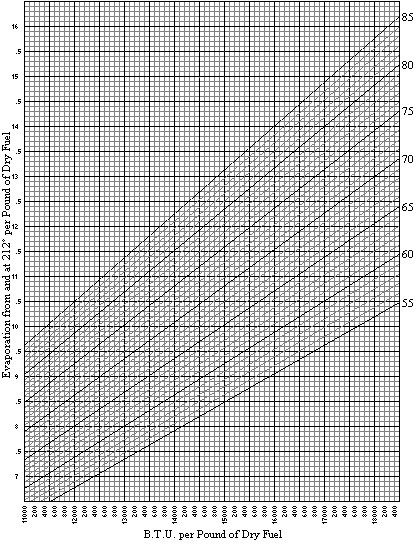
For approximate results, a chart may be used to take the place of a
computation of efficiency. Fig. 39 shows such a chart based on the
evaporation per pound of dry fuel and the heat value per pound of dry
fuel, from which efficiencies may be read directly to within one-half of
one per cent. It is used as follows: From the intersection of the
horizontal line, representing the evaporation per pound of fuel, with
the vertical line, representing the heat value per pound, the efficiency
is read directly from the diagonal scale of efficiencies. This chart may
also be used for efficiency based upon combustible when the evaporation
from and at 212 degrees and the heat values are both given in terms of
combustible.
[Pg 258]
Diagonal Lines Represent Per Cent Efficiency
[Pg 259]
Boiler efficiencies will vary over a wide range, depending on a great
variety of factors and conditions. The highest efficiencies that have
been secured with coal are in the neighborhood of 82 per cent and from
that point efficiencies are found all the way down to below 50 per cent.
Table 59[57] of tests of Babcock & Wilcox boilers under varying
conditions of fuel and operation will give an idea of what may be
obtained with proper operating conditions.
The difference between the efficiency secured in any boiler trial and
the perfect efficiency, 100 per cent, includes the losses, some of which
are unavoidable in the present state of the art, arising in the
conversion of the heat energy of the coal to the heat energy in the
steam. These losses may be classified as follows:
1st. Loss due to fuel dropped through the grate.
2nd. Loss due to unburned fuel which is carried by the draft, as small
particles, beyond the bridge wall into the setting or up the stack.
3rd. Loss due to the utilization of a portion of the heat in heating the
moisture contained in the fuel from the temperature of the atmosphere to
212 degrees; to evaporate it at that temperature and to superheat the
steam thus formed to the temperature of the flue gases. This steam, of
course, is first heated to the temperature of the furnace but as it
gives up a portion of this heat in passing through the boiler, the
superheating to the temperature of the exit gases is the correct degree
to be considered.
4th. Loss due to the water formed and by the burning of the hydrogen in
the fuel which must be evaporated and superheated as in item 3.
5th. Loss due to the superheating of the moisture in the air supplied
from the atmospheric temperature to the temperature of the flue gases.
6th. Loss due to the heating of the dry products of combustion to the
temperature of the flue gases.
7th. Loss due to the incomplete combustion of the fuel when the carbon
is not completely consumed but burns to CO instead of CO2. The CO
passes out of the stack unburned as a volatile gas capable of further
combustion.
8th. Loss due to radiation of heat from the boiler and furnace settings.
Obviously a very elaborate test would have to be made were all of the
above items to be determined accurately. In ordinary practice it has
become customary to summarize these losses as follows, the methods of
computing the losses being given in each instance by a typical example:
(A) Loss due to the heating of moisture in the fuel from the atmospheric
temperature to 212 degrees, evaporate it at that temperature and
superheat it to the temperature of the flue gases. This in reality is
the total heat above the temperature of the air in the boiler room, in
one pound of superheated steam at atmospheric pressure at the
temperature of the flue gases, multiplied by the percentage of moisture
in the fuel. As the total heat above the temperature of the air would
have to be computed in each instance, this loss is best expressed by:
| Loss in B. t. u. per pound | = | W | ( | 212 | - | t | + | 970.4 | + | .47 | (T - 212) | ) | (33) |
| Where | W | = | per cent of moisture in coal, |
| t | = | the temperature of air in the boiler room, [Pg 260] |
| T [Pg 261] | = | temperature of the flue gases, |
| .47 | = | the specific heat of superheated steam at the atmospheric
pressure and at the flue gas temperature, |
| (212-t) | = | B. t. u. necessary to heat one pound of water from the
temperature of the boiler room to 212 degrees, |
| 970.4 | = | B. t. u. necessary to evaporate one pound of water at 212
degrees to steam at atmospheric pressure, |
| .47(T-212) | = | B. t. u. necessary to superheat one pound of steam at
atmospheric pressure from 212 degrees to temperature T. |
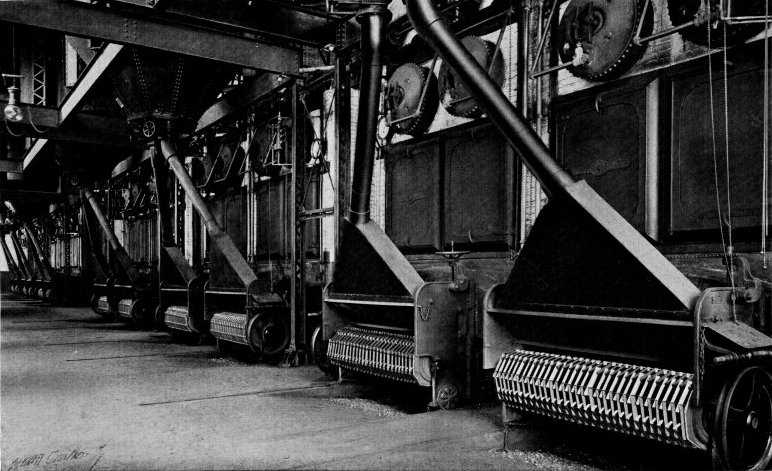
Portion of 15,000 Horse-power Installation of Babcock & Wilcox Boilers, Equipped with Babcock & Wilcox Chain Grate Stokers at the Northumberland, Pa., Plant of the Atlas Portland Cement Co. This Company Operates a Total of 24,000 Horse Power of Babcock & Wilcox Boilers in its Various Plants
(B) Loss due to heat carried away in the steam produced by the burning
of the hydrogen component of the fuel. In burning, one pound of hydrogen
unites with 8 pounds of oxygen to form 9 pounds of steam. Following the
reasoning of item (A), therefore, this loss will be:
| Loss in B. t. u. per pound | =
| 9H |
( | (212 - t)
| +
| 970.4
| +
| .47
| (T - 212)
| )
| (34)
|
| Where | H | = | the percentage by weight of hydrogen. |
This item is frequently considered as a part of the unaccounted for
loss, where an ultimate analysis of the fuel is not given.
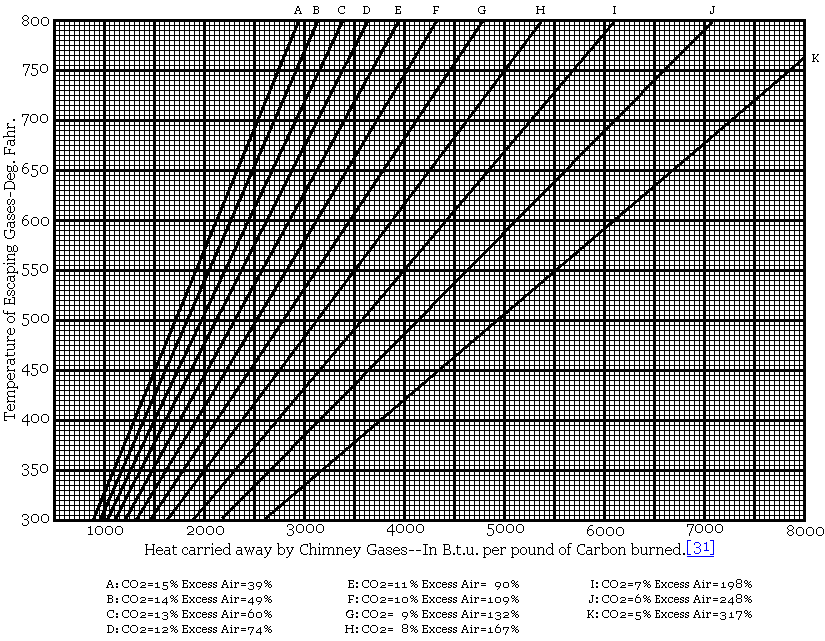
(C) Loss due to heat carried away by dry chimney gases. This is
dependent upon the weight of gas per pound of coal which may be
determined by formula (16), page 158.
Loss in B. t. u. per pound = (T - t) × .24 × W.
Where T and t have values as in (33),
.24 = specific heat of chimney gases,
W = weight of dry chimney gas per pound of coal.
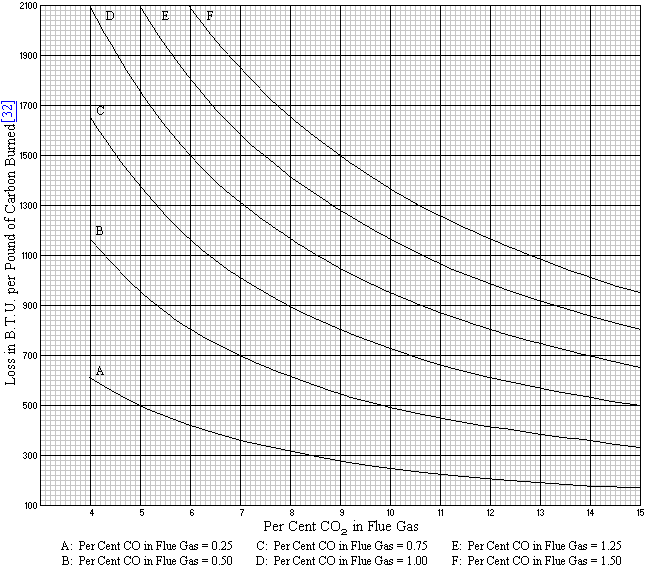
(D) Loss due to incomplete combustion of the carbon content of the fuel,
that is, the burning of the carbon to CO instead of CO2.
| Loss in B. t. u. per pound | = | C | × | | 10,150 CO | | –––––––––––––––––– | | CO2 + CO |
| (35) |
|
C = per cent of carbon in coal by ultimate analysis,
CO and CO2 = per cent of CO and CO2 by volume from flue gas
analysis,
10,150 = the number of heat units generated by burning to CO2 one
pound of carbon contained in carbon monoxide.
(E) Loss due to unconsumed carbon in the ash (it being usually assumed
that all the combustible in the ash is carbon).
| Loss in B. t. u. per pound | = | per cent C | × | per cent ash | × | B. t. u. per pound of combustible in the ash
(usually taken as 14,600 B. t. u.) | (36) |
|
TABLE 57
DATA FROM WHICH HEAT BALANCE
(TABLE 58) IS COMPUTED
| Steam Pressure by Gauge, Pounds | 192 |
| Temperature of Feed, Degrees Fahrenheit | 180 |
| Degrees of Superheat, Degrees Fahrenheit | 115.2 |
| Temperature of Boiler Room, Degrees Fahrenheit | 81 |
| Temperature of Exit Gases, Degrees Fahrenheit | 480 |
| Weight of Coal Used per Hour, Pounds | 5714 |
| Moisture, Per Cent | 1.83 |
| Dry Coal Per Hour, Pounds | 5609 |
| Ash and Refuse per Hour, Pounds | 561 |
| Ash and Refuse (of Dry Coal), Per Cent | 10.00 |
| Actual Evaporation per Hour, Pounds | 57036 |
| Ultimate Analysis Dry Coal | { | C, Per Cent | 78.57 |
| H, Per Cent | 5.60 |
| O, Per Cent | 7.02 |
| N, Per Cent | 1.11 |
| Ash, Per Cent | 6.52 |
| Sulphur, Per Cent | 1.18 |
| Heat Value per Pound Dry Coal, B. t. u. | 14225 |
| Heat Value per Pound Combustible, B. t. u. | 15217 |
| Combustible in Ash by Analysis, Per Cent | 17.9 |
| Flue Gas Analysis | { | CO2, Per Cent | 14.33 |
| O, Per Cent | 4.54 |
| CO, Per Cent | 0.11 |
| N, Per Cent | 81.02 |
|
The loss incurred in this way is, directly, the carbon in the ash in
percentage terms of the total dry coal fired, multiplied by the heat
value of carbon.
To compute this item, which is of great importance in comparing the
relative performances of different designs of grates, an analysis of the
ash must be available.
The other losses, namely, items 2, 5 and 8 of the first classification,
are ordinarily grouped under one item, as unaccounted for losses, and
are obviously the difference between 100 per cent and the sum of the
heat utilized and the losses accounted for as given above. Item 5, or
the loss due to the moisture in the air, may be readily computed, the
moisture being determined from wet and dry bulb thermometer readings,
but it is usually disregarded as it is relatively small, averaging, [Pg 262] say,
one-fifth to one-half of one per cent. Lack of data may, of course, make
it necessary to include certain items of the second and ordinary
classification in this unaccounted for group.
A schedule of the losses as outlined, requires an evaporative test of
the boiler, an analysis of the flue gases, an ultimate analysis of the
fuel, and either an ultimate or proximate analysis of the ash. As the
amount of unaccounted for losses forms a basis on which to judge the
accuracy of a test, such a schedule is called a “heat balance”.
A heat balance is best illustrated by an example: Assume the data as
given in Table 57 to be secured in an actual boiler test.
From this data the factor of evaporation is 1.1514 and the evaporation
per hour from and at 212 degrees is 65,671 pounds. Hence the evaporation
from and at 212 degrees per pound of dry coal is 65,671 ÷ 5609 = 11.71
pounds. The efficiency of boiler, furnace and grate is:
| ( | 11.71 | × | 970.4 | ) | ÷ | 14,225 | = | 79.88 per cent. |
|
The heat losses are:
(A) Loss due to moisture in coal,
| = | .01831 | ( | (212 - 81) | + | 970.4 | + | .47 (480 - 212) | ) |
|
|
|
(B) The loss due to the burning of hydrogen:
| = | 9 | × | .0560 | ( | (212 - 81) | + | 970.4 | + | .47 (480 - 212) | ) |
|
|
|
(C) To compute the loss in the heat carried away by dry chimney gases
per pound of coal the weight of such gases must be first determined.
This weight per pound of coal is:
| ( | | 11CO2 + 8O + 7(CO + N) | | ––––––––––––––––––––––––––––––––––––––––––– | | 3(CO2+CO) |
| ) | C |
|
[Pg 263]
where CO2, O, CO and H are the percentage by volume as determined by
the flue gas analysis and C is the percentage by weight of carbon in the
dry fuel. Hence the weight of gas per pound of coal will be,
| ( | | 11 × 14.33 + 8 × 4.54 + 7(0.11 + 81.02) | | –––––––––––––––––––––––––––––––––––––––––––––––––––––––––––––––– | | 3(14.33 + 0.11) |
| ) | × 78.57 | = | 13.7 pounds. |
|
Therefore the loss of heat in the dry gases carried up the chimney =
| 13.7 × 0.24(480 - 81) | = | 1311 B. t. u., |
| | = | 9.22 per cent. |
|
(D) The loss due to incomplete combustion as evidenced by the presence
of CO in the flue gas analysis is:
| 0.11 | | ––––––––––––––––––––– | | 14.33 + 0.11 |
| × 78.57 × 10,150 | = | 61. B. t. u., |
| | | = | .43 per cent. |
|
(E) The loss due to unconsumed carbon in the ash:
The analysis of the ash showed 17.9 per cent to be combustible matter,
all of which is assumed to be carbon. The test showed 10.00 of the total
dry fuel fired to be ash. Hence 10.00×.179 = 1.79 per cent of the total
fuel represents the proportion of this total unconsumed in the ash and
the loss due to this cause is
| 1.79 per cent × 14,600 | = | 261 B. t. u., |
| | = | 1.83 per cent. |
|
The heat absorbed by the boilers per pound of dry fuel is 11.71×970.4 =
11,363 B. t. u. This quantity plus losses (A), (B), (C), (D) and (E), or
11,363+22+618+1311+61+261 = 13,636 B. t. u. accounted for. The heat
value of the coal, 14,225 B. t. u., less 13,636 B. t. u., leaves 589
B. t. u., unaccounted for losses, or 4.15 per cent.
The heat balance should be arranged in the form indicated by Table 58.
TABLE 58
HEAT BALANCE
B. T. U. PER POUND DRY COAL 14,225
| | B. t. u. | Per Cent |
|---|
| Heat absorbed by Boiler | 11,363 | 79.88 |
| Loss due to Evaporation of Moisture in Fuel | 22 | 0.15 |
| Loss due to Moisture formed by Burning of Hydrogen | 618 | 4.34 |
| Loss due to Heat carried away in Dry Chimney Gases | 1311 | 9.22 |
| Loss due to Incomplete Combustion of Carbon | 61 | 0.43 |
| Loss due to Unconsumed Carbon in the Ash | 261 | 1.83 |
| Loss due to Radiation and Unaccounted Losses | 589 | 4.15 |
| Total | 14,225 | 100.00 |
|
Application of Heat Balance—A heat balance should be made in connection
with any boiler trial on which sufficient data for its computation has
been obtained. This is particularly true where the boiler performance
has been considered unsatisfactory. The distribution of the heat is thus
determined and any extraordinary loss may be detected. Where accurate
data for computing such a heat balance is not [Pg 264] available, such a
calculation based on certain assumptions is sometimes sufficient to
indicate unusual losses.
The largest loss is ordinarily due to the chimney gases, which depends
directly upon the weight of the gas and its temperature leaving the
boiler. As pointed out in the chapter on flue gas analysis, the lower
limit of the weight of gas is fixed by the minimum air supplied with
which complete combustion may be obtained. As shown, where this supply
is unduly small, the loss caused by burning the carbon to CO instead of
to CO2 more than offsets the gain in decreasing the weight of gas.
The lower limit of the stack temperature, as has been shown in the
chapter on draft, is more or less fixed by the temperature necessary to
create sufficient draft suction for good combustion. With natural draft,
this lower limit is probably between 400 and 450 degrees.
Capacity—Before the capacity of a boiler is considered, it is necessary
to define the basis to which such a term may be referred. Such a basis
is the so-called boiler horse power.
The unit of motive power in general use among steam engineers is the
“horse power” which is equivalent to 33,000 foot pounds per minute.
Stationary boilers are at the present time rated in horse power, though
such a basis of rating may lead and has often led to a misunderstanding.
Work, as the term is used in mechanics, is the overcoming of
resistance through space, while power is the rate of work or the
amount done per unit of time. As the operation of a boiler in service
implies no motion, it can produce no power in the sense of the term as
understood in mechanics. Its operation is the generation of steam, which
acts as a medium to convey the energy of the fuel which is in the form
of heat to a prime mover in which that heat energy is converted into
energy of motion or work, and power is developed.
If all engines developed the same amount of power from an equal amount
of heat, a boiler might be designated as one having a definite horse
power, dependent upon the amount of engine horse power its steam would
develop. Such a statement of the rating of boilers, though it would
still be inaccurate, if the term is considered in its mechanical sense,
could, through custom, be interpreted to indicate that a boiler was of
the exact capacity required to generate the steam necessary to develop a
definite amount of horse power in an engine. Such a basis of rating,
however, is obviously impossible when the fact is considered that the
amount of steam necessary to produce the same power in prime movers of
different types and sizes varies over very wide limits.
To do away with the confusion resulting from an indefinite meaning of
the term boiler horse power, the Committee of Judges in charge of the
boiler trials at the Centennial Exposition, 1876, at Philadelphia,
ascertained that a good engine of the type prevailing at the time
required approximately 30 pounds of steam per hour per horse power
developed. In order to establish a relation between the engine power and
the size of a boiler required to develop that power, they recommended
that an evaporation of 30 pounds of water from an initial temperature of
100 degrees Fahrenheit to steam at 70 pounds gauge pressure be
considered as one boiler horse power. This recommendation has been
generally accepted by American engineers as a standard, and when the
term boiler horse power is used in connection with stationary
boilers[58] [Pg 265] throughout this country,[59] without special definition, it
is understood to have this meaning.
Inasmuch as an equivalent evaporation from and at 212 degrees Fahrenheit
is the generally accepted basis of comparison[60], it is now customary
to consider the standard boiler horse power as recommended by the
Centennial Exposition Committee, in terms of equivalent evaporation from
and at 212 degrees. This will be 30 pounds multiplied by the factor of
evaporation for 70 pounds gauge pressure and 100 degrees feed
temperature, or 1.1494. 30 × 1.1494 = 34.482, or approximately 34.5
pounds. Hence, one boiler horse power is equal to an evaporation of
34.5 pounds of water per hour from and at 212 degrees Fahrenheit. The
term boiler horse power, therefore, is clearly a measure of evaporation
and not of power.
A method of basing the horse power rating of a boiler adopted by boiler
manufacturers is that of heating surfaces. Such a method is absolutely
arbitrary and changes in no way the definition of a boiler horse power
just given. It is simply a statement by the manufacturer that his
product, under ordinary operating conditions or conditions which may be
specified, will evaporate 34.5 pounds of water from and at 212 degrees
per definite amount of heating surface provided. The amount of heating
surface that has been considered by manufacturers capable of evaporating
34.5 pounds from and at 212 degrees per hour has changed from time to
time as the art has progressed. At the present time 10 square feet of
heating surface is ordinarily considered the equivalent of one boiler
horse power among manufacturers of stationary boilers. In view of the
arbitrary nature of such rating and of the widely varying rates of
evaporation possible per square foot of heating surface with different
boilers and different operating conditions, such a basis of rating has
in reality no particular bearing on the question of horse power and
should be considered merely as a convenience.
The whole question of a unit of boiler capacity has been widely
discussed with a view to the adoption of a standard to which there would
appear to be a more rational and definite basis. Many suggestions have
been offered as to such a basis but up to the present time there has
been none which has met with universal approval or which would appear
likely to be generally adopted.
With the meaning of boiler horse power as given above, that is, a
measure of evaporation, it is evident that the capacity of a boiler is a
measure of the power it can develop expressed in boiler horse power.
Since it is necessary, as stated, for boiler manufacturers to adopt a
standard for reasons of convenience in selling, the horse power for
which a boiler is sold is known as its normal rated capacity.
The efficiency of a boiler and the maximum capacity it will develop can
be determined accurately only by a boiler test. The standard methods of
conducting such tests are given on the following pages, these methods
being the recommendations of the Power Test Committee of the American
Society of Mechanical Engineers brought out in 1913.[61] Certain changes
have been made to incorporate in the boiler code such portions of the
“Instructions Regarding Tests in General” as apply to boiler testing.
Methods of calculation and such matter as are treated in other portions
of the book have been omitted from the code as noted.
[Pg 266]
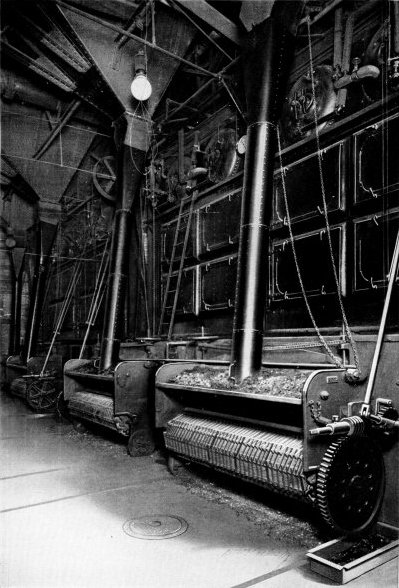
Portion of 2600 Horse-power Installation of Babcock & Wilcox Boilers, Equipped with Babcock & Wilcox Chain Grate Stokers at the Peter Schoenhofen Brewing Co., Chicago, Ill.
Ascertain the specific object of the test, and keep this in view not
only in the work of preparation, but also during the progress of the
test, and do not let it be obscured by devoting too close attention to
matters of minor importance. Whatever the object of the test may be,
accuracy and reliability must underlie the work from beginning to end.
If questions of fulfillment of contract are involved, there should be a
clear understanding between all the parties, preferably in writing, as
to the operating conditions which should obtain during the trial, and as
to the methods of testing to be followed, unless these are already
expressed in the contract itself.
Among the many objects of performance tests, the following may be noted:
Determination of capacity and efficiency, and how these compare
with standard or guaranteed results.
Comparison of different conditions or methods of operation.
Determination of the cause of either inferior or superior
results.
Comparison of different kinds of fuel.
Determination of the effect of changes of design or proportion
upon capacity or efficiency, etc.
(A) Dimensions:
Measure the dimensions of the principal parts of the apparatus to be
tested, so far as they bear on the objects in view, or determine these
from correct working drawings. Notice the general features of the same,
both exterior and interior, and make sketches, if needed, to show
unusual points of design.
The dimensions of the heating surfaces of boilers and
superheaters to be found are those of surfaces in contact with
the fire or hot gases. The submerged surfaces in boilers at the
mean water level should be considered as water-heating surfaces,
and other surfaces which are exposed to the gases as
superheating surfaces.
(B) Examination of Plant:
Make a thorough examination of the physical condition of all parts of
the plant or apparatus which concern the object in view, and record the
conditions found, together with any points in the matter of operation
which bear thereon.
In boilers, examine for leakage of tubes and riveted or other
metal joints. Note the condition of brick furnaces, grates and
baffles. Examine brick walls and cleaning doors for air leaks,
either by shutting the damper and observing the escaping smoke
or by candle-flame test. Determine the condition of heating
surfaces with reference to exterior deposits of soot and
interior deposits of mud or scale.
See that the steam main is so arranged that condensed and
entrained water cannot flow back into the boiler.
If the object of the test is to determine the highest efficiency or
capacity obtainable, any physical defects, or defects of operation,
tending to make the result unfavorable should first be remedied; all
foul parts being cleaned, and the whole put in first-class condition.
If, on the other hand, the object is to ascertain the performance under
existing conditions, no such preparation is either required or desired.
(C) General Precautions against Leakage:
In steam tests make sure that there is no leakage through blow-offs,
drips, etc., or any steam or water connections of the plant or apparatus
undergoing test, which [Pg 268] would in any way affect the results. All such
connections should be blanked off, or satisfactory assurance should be
obtained that there is leakage neither out nor in. This is a most
important matter, and no assurance should be considered satisfactory
unless it is susceptible of absolute demonstration.
Determine the character of fuel to be used.[62] For tests of maximum
efficiency or capacity of the boiler to compare with other boilers, the
coal should be of some kind which is commercially regarded as a standard
for the locality where the test is made.
In the Eastern States the standards thus regarded for
semi-bituminous coals are Pocahontas (Va. and W. Va.) and New
River (W. Va.); for anthracite coals those of the No. 1
buckwheat size, fresh-mined, containing not over 13 per cent ash
by analysis; and for bituminous coals, Youghiogheny and
Pittsburgh coals. In some sections east of the Allegheny
Mountains the semi-bituminous Clearfield (Pa.) and Cumberland
(Md.) are also considered as standards. These coals when of good
quality possess the essentials of excellence, adaptability to
various kinds of furnaces, grates, boilers, and methods of
firing required, besides being widely distributed and generally
accessible in the Eastern market. There are no special grades of
coal mined in the Western States which are widely and generally
considered as standards for testing purposes; the best coal
obtainable in any particular locality being regarded as the
standard of comparison.
A coal selected for maximum efficiency and capacity tests, should be the
best of its class, and especially free from slagging and unusual
clinker-forming impurities.
For guarantee and other tests with a specified coal containing not more
than a certain amount of ash and moisture, the coal selected should not
be higher in ash and in moisture than the stated amounts, because any
increase is liable to reduce the efficiency and capacity more than the
equivalent proportion of such increase.
The size of the coal, especially where it is of the anthracite class,
should be determined by screening a suitable sample.
The apparatus and instruments required for boiler tests are:
(A) Platform scales for weighing coal and ashes.
(B) Graduated scales attached to the water glasses.
(C) Tanks and platform scales for weighing water (or water
meters calibrated in place). Wherever practicable the feed water
should be weighed, especially for guarantee tests. The most
satisfactory and reliable apparatus for this purpose consists of
one or more tanks each placed on platform scales, these being
elevated a sufficient distance above the floor to empty into a
receiving tank placed below, the latter being connected to the
feed pump. Where only one weighing tank is used the receiving
tank should be of larger size than the weighing tank, to afford
sufficient reserve supply to the pump while the upper tank is
filling. If a single weighing tank is used it should preferably
be of such capacity as to require emptying not oftener than
every 5 minutes. If two or more are used the intervals between
successive emptyings should not be less than 3 minutes.
(D) Pressure gauges, thermometers, and draft gauges.
(E) Calorimeters for determining the calorific value of fuel and
the quality of steam.
(F) Furnaces pyrometers.
(G) Gas analyzing apparatus.
Determine what the operating conditions and method of firing should be
to conform to the object in view, and see that they prevail throughout
the trial, as nearly as possible.
Where uniformity in the rate of evaporation is required,
arrangement can be usually made to dispose of the steam so that
this result can be attained. In a single boiler it may be
accomplished by discharging steam through a waste pipe and
regulating the amount by means of a valve. In a battery of
boilers, in which only one is tested, the draft may be regulated
on the remaining boilers to meet the varying demands for steam,
leaving the test boiler to work under a steady rate of
evaporation.
The duration of tests to determine the efficiency of a hand-fired
boiler, should be 10 hours of continuous running, or such time as may be
required to burn a total of 250 pounds of coal per square foot of grate.
In the case of a boiler using a mechanical stoker, the duration, where
practicable, should be at least 24 hours. If the stoker is of a type
that permits the quantity and condition of the fuel bed at beginning and
end of the test to be accurately estimated, the duration may be reduced
to 10 hours, or such time as may be required to burn the above noted
total of 250 pounds per square foot.
In commercial tests where the service requires continuous
operation night and day, with frequent shifts of firemen, the
duration of the test, whether the boilers are hand fired or
stoker fired, should be at least 24 hours. Likewise in
commercial tests, either of a single boiler or of a plant of
several boilers, which operate regularly a certain number of
hours and during the balance of the day the fires are banked,
the duration should not be less than 24 hours.
The duration of tests to determine the maximum evaporative
capacity of a boiler, without determining the efficiency, should
not be less than 3 hours.
The conditions regarding the temperature of the furnace and boiler, the
quantity and quality of the live coal and ash on the grates, the water
level, and the steam pressure, should be as nearly as possible the same
at the end as at the beginning of the test.
To secure the desired equality of conditions with hand-fired boilers,
the following method should be employed:
The furnace being well heated by a preliminary run, burn the
fire low, and thoroughly clean it, leaving enough live coal
spread evenly over the grate (say 2 to 4 inches),[64] to serve
as a foundation for the new fire. Note quickly the thickness of
the coal bed as nearly as it can be estimated or measured; also
the water level,[65] the steam pressure, and the time, and
record the latter as the starting time. Fresh coal should then
be fired from that weighed for the test, the ashpit throughly
cleaned, and the regular work of the test proceeded with. Before
the end of the test the fire should again be burned low and
cleaned in such a manner as to leave the same amount of live
coal on the grate as at the start. When this condition is
reached, observe quickly the water level,[65] the steam
pressure, and the time, and record the latter as the stopping
time. If the water level is not the same as at the beginning a
correction should be made by computation, rather than by feeding
additional water after the final readings are taken. Finally
remove the ashes and refuse from the ashpit. [Pg 270] In a plant
containing several boilers where it is not practicable to clean
them simultaneously, the fires should be cleaned one after the
other as rapidly as may be, and each one after cleaning charged
with enough coal to maintain a thin fire in good working
condition. After the last fire is cleaned and in working
condition, burn all the fires low (say 4 to 6 inches), note
quickly the thickness of each, also the water levels, steam
pressure, and time, which last is taken as the starting time.
Likewise when the time arrives for closing the test, the fires
should be quickly cleaned one by one, and when this work is
completed they should all be burned low the same as the start,
and the various observations made as noted. In the case of a
large boiler having several furnace doors requiring the fire to
be cleaned in sections one after the other, the above directions
pertaining to starting and stopping in a plant of several
boilers may be followed.
To obtain the desired equality of conditions of the fire when a
mechanical stoker other than a chain grate is used, the procedure should
be modified where practicable as follows:
Regulate the coal feed so as to burn the fire to the low
condition required for cleaning. Shut off the coal-feeding
mechanism and fill the hoppers level full. Clean the ash or dump
plate, note quickly the depth and condition of the coal on the
grate, the water level,[66] the steam pressure, and the time,
and record the latter as the starting time. Then start the
coal-feeding mechanism, clean the ashpit, and proceed with the
regular work of the test.
When the time arrives for the close of the test, shut off the
coal-feeding mechanism, fill the hoppers and burn the fire to
the same low point as at the beginning. When this condition is
reached, note the water level, the steam pressure, and the time,
and record the latter as the stopping time. Finally clean the
ashplate and haul the ashes.
In the case of chain grate stokers, the desired operating
conditions should be maintained for half an hour before starting
a test and for a like period before its close, the height of the
throat plate and the speed of the grate being the same during
both of these periods.
A log of the data should be entered in notebooks or on blank sheets
suitably prepared in advance. This should be done in such manner that
the test may be divided into hourly periods, or if necessary, periods of
less duration, and the leading data obtained for any one or more periods
as desired, thereby showing the degree of uniformity obtained.
Half-hourly readings of the instruments are usually sufficient. If there
are sudden and wide fluctuations, the readings in such cases should be
taken every 15 minutes, and in some instances oftener.
The coal should be weighed and delivered to the firemen in
portions sufficient for one hour’s run, thereby ascertaining the
degree of uniformity of firing. An ample supply of coal should
be maintained at all times, but the quantity on the floor at the
end of each hour should be as small as practicable, so that the
same may be readily estimated and deducted from the total
weight.
The records should be such as to ascertain also the consumption
of feed water each hour and thereby determine the degree of
uniformity of evaporation.
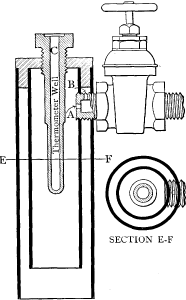
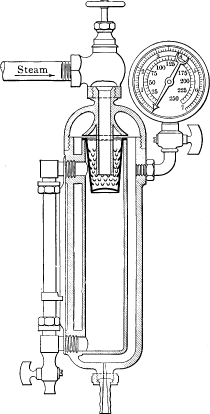
If the boiler does not produce superheated steam the percentage of
moisture in the steam should be determined by the use of a throttling or
separating calorimeter. If the boiler has superheating surface, the
temperature of the steam should be determined by the use of a
thermometer inserted in a thermometer well.
[Pg 271]
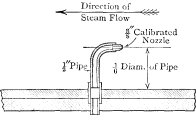
For saturated steam construct a sampling pipe or nozzle made of one-half
inch iron pipe and insert it in the steam main at a point where the
entrained moisture is likely to be most thoroughly mixed. The inner end
of the pipe, which should extend nearly across to the opposite side of
the main, should be closed and interior portion perforated with not less
than twenty one-eighth inch holes equally distributed from end to end
and preferably drilled in irregular or spiral rows, with the first hole
not less than half an inch from the wall of the pipe.
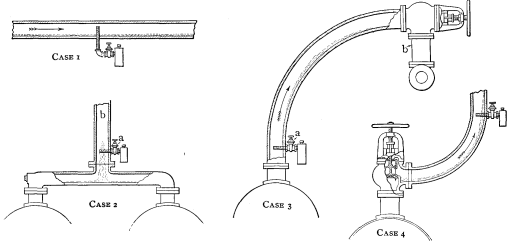
The sampling pipe should not be placed near a point where water
may pocket or where such water may effect the amount of moisture
contained in the sample. Where non-return valves are used, or
there are horizontal connections leading from the boiler to a
vertical outlet, water may collect at the lower end of the
uptake pipe and be blown upward in a spray which will not be
carried away by the steam owing to a lack of velocity. A sample
taken from the lower part of this pipe will show a greater
amount of moisture than a true sample. With goose-neck
connections a small amount of water may collect on the bottom of
the pipe near the upper end where the inclination is such that
the tendency to flow backward is ordinarily counterbalanced by
the flow of steam forward over its surface; but when the
velocity momentarily decreases the water flows back to the lower
end of the goose-neck and increases the moisture at that point,
making it an undesirable location for sampling. In any case it
must be borne in mind that with low velocities the tendency is
for drops of entrained water to settle to the bottom of the
pipe, and to be temporarily broken up into spray whenever an
abrupt bend or other disturbance is met.
If it is necessary to attach the sampling nozzle at a point near the end
of a long horizontal run, a drip pipe should be provided a short
distance in front of the nozzle, preferably at a pocket formed by some
fitting and the water running along the bottom of the main drawn off,
weighed, and added to the moisture shown by the calorimeter; or, better,
a steam separator should be installed at the point noted.
In testing a stationary boiler the sampling pipe should be located as
near as practicable to the boiler, and the same is true as regards the
thermometer well when the steam is superheated. In an engine or turbine
test these locations should be as near as practicable to throttle valve.
In the test of a plant where it is desired to get complete information,
especially where the steam main is unusually long, sampling nozzles or
thermometer wells should be provided at both points, so as to obtain
data at either point as may be required.
During the progress of test the coal should be regularly sampled for the
purpose of analysis and determination of moisture.
Select a representative shovelful from each barrow-load as it is drawn
from the coal pile or other source of supply, and store the samples in a
cool place in a covered metal receptacle. When all the coal has thus
been sampled, break up the lumps, thoroughly mix the whole quantity, and
finally reduce it by the process of repeated quartering and crushing to
a sample weighing about 5 pounds, the largest pieces being about the
size of a pea. From this sample two one-quart air-tight glass fruit
jars, or other air-tight vessels, are to be promptly filled and
preserved for subsequent determinations of moisture, calorific value,
and chemical composition. These operations should be conducted where the
air is cool and free from drafts.
When the sample lot of coal has been reduced by quartering to, say, 100
pounds, a portion weighing, say, 15 to 20 pounds should be withdrawn for
the purpose of [Pg 272]
[Pg 273] immediate moisture determination. This is placed in a
shallow iron pan and dried on the hot iron boiler flue for at least 12
hours, being weighed before and after drying on scales reading to
quarter ounces.
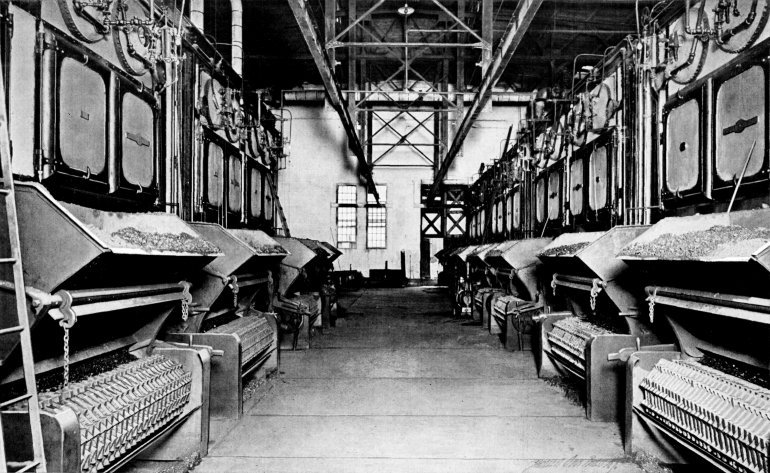
3460 Horse-power Installation of Babcock & Wilcox Boilers at the Chicago, Ill., Shops of the Chicago and Northwestern Ry. Co.
The moisture thus determined is approximately reliable for anthracite
and semi-bituminous coals, but not for coals containing much inherent
moisture. For such coals, and for all absolutely reliable determinations
the method to be pursued is as follows:
Take one of the samples contained in the glass jars, and subject
it to a thorough air drying, by spreading it in a thin layer and
exposing it for several hours to the atmosphere of a warm room,
weighing it before and after, thereby determining the quantity
of surface moisture it contains.[68] Then crush the whole of it
by running it through an ordinary coffee mill or other suitable
crusher adjusted so as to produce somewhat coarse grains (less
than 1⁄16 inch), thoroughly mix the crushed sample, select from
it a portion of from 10 to 50 grams,[69] weigh it in a balance
which will easily show a variation as small as 1 part in 1000,
and dry it for one hour in an air or sand bath at a temperature
between 240 and 280 degrees Fahrenheit. Weigh it and record the
loss, then heat and weigh again until the minimum weight has
been reached. The difference between the original and the
minimum weight is the moisture in the air-dried coal. The sum of
the moisture thus found and that of the surface moisture is the
total moisture.
The ashes and refuse withdrawn from the furnace and ashpit during the
progress of the test and at its close should be weighed so far as
possible in a dry state. If wet the amount of moisture should be
ascertained and allowed for, a sample being taken and dried for this
purpose. This sample may serve also for analysis and the determination
of unburned carbon and fusing temperature.
The method above described for sampling coal may also be followed for
obtaining a sample of the ashes and refuse.
The quality of the fuel should be determined by calorific tests and
analysis of the coal sample above referred to.[70]
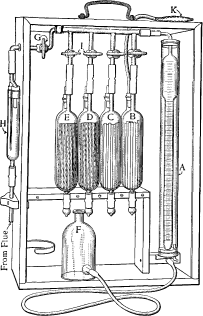
For approximate determinations of the composition of the flue gases, the
Orsat apparatus, or some modification thereof, should be employed. If
momentary samples are obtained the analyses should be made as frequently
as possible, say, every 15 to 30 minutes, depending on the skill of the
operator, noting at the time the sample is drawn the furnace and firing
conditions. If the sample drawn is a continuous one, the intervals may
be made longer.
In tests of bituminous coals requiring a determination of the amount of
smoke produced, observations should be made regularly throughout the
trial at intervals of [Pg 274] 5 minutes (or if necessary every minute), noting
at the same time the furnace and firing conditions.
The methods to be followed in expressing and calculating those results
which are not self-evident are explained as follows:
(A) Efficiency. The “efficiency of boiler, furnace and
grate” is the relation between the heat absorbed per pound of
coal fired, and the calorific value of one pound of coal.
The “efficiency of boiler and furnace” is the relation between
the heat absorbed per pound of combustible burned, and the
calorific value of one pound of combustible. This expression of
efficiency furnishes a means for comparing one boiler and
furnace with another, when the losses of unburned coal due to
grates, cleanings, etc., are eliminated.
The “combustible burned” is determined by subtracting from the
weight of coal supplied to the boiler, the moisture in the coal,
the weight of ash and unburned coal withdrawn from the furnace
and ashpit, and the weight of dust, soot, and refuse, if any,
withdrawn from the tubes, flues, and combustion chambers,
including ash carried away in the gases, if any, determined from
the analysis of coal and ash. The “combustible” used for
determining the calorific value is the weight of coal less the
moisture and ash found by analysis.
The “heat absorbed” per pound of coal, or combustible, is
calculated by multiplying the equivalent evaporation from and at
212 degrees per pound of coal or combustible by 970.4.
Other items in this section which have been treated elsewhere are:
(B) Corrections for moisture in steam.
(C) Correction for live steam used.
(D) Equivalent evaporation.
(E) Heat balance.
(F) Total heat of combustion of coal.
(G) Air for combustion and the methods recommended for
calculating these results are in accordance with those described
in different portions of this book.
The data and results should be reported in accordance with either the
short form or the complete form, adding lines for data not provided for,
or omitting those not required, as may conform to the object in view.
In trials having for an object the determination and exposition of the
complete boiler performance, the entire log of readings and data should
be plotted on a chart and represented graphically.
Tests of boilers using oil or gas for fuel should accord with the rules
here given, excepting as they are varied to conform to the particular
characteristics of the fuel. The duration in such cases may be reduced,
and the “flying” method of starting and stopping employed.
The table of data and results should contain items stating
character of furnace and burner, quality and composition of oil
or gas, temperature of oil, pressure of steam used for
vaporizing and quantity of steam used for both vaporizing and
for heating.
TABLE DATA AND RESULTS OF EVAPORATIVE TEST
SHORT FORM, CODE OF 1912
| 1 | Test of | boiler located at | |
| | to determine | conducted by | |
| 2 | Kind of furnace | |
| 3 | Grate surface | square feet |
| 4 | Water-heating surface | square feet |
| 5 | Superheating surface | square feet [Pg 275] |
| 6 | Date | |
| 7 | Duration | hours |
| 8 | Kind and size of coal | |
| AVERAGE PRESSURES, TEMPERATURES, ETC. |
| 9 | Steam pressure by gauge | pounds |
| 10 | Temperature of feed water entering boiler | degrees |
| 11 | Temperature of escaping gases leaving boiler | degrees |
| 12 | Force of draft between damper and boiler | inches |
| 13 | Percentage of moisture in steam, or number degrees of superheating | per cent or degrees |
| TOTAL QUANTITIES |
| 14 | Weight of coal as fired[72] | pounds |
| 15 | Percentage of moisture in coal | per cent |
| 16 | Total weight of dry coal consumed | pounds |
| 17 | Total ash and refuse | pounds |
| 18 | Percentage of ash and refuse in dry coal | per cent |
| 19 | Total weight of water fed to the boiler[73] | pounds |
| 20 | Total water evaporated, corrected for moisture in steam | pounds |
| 21 | Total equivalent evaporation from and at 212 degrees | pounds |
| HOURLY QUANTITIES AND RATES |
| 22 | Dry coal consumed per hour | pounds |
| 23 | Dry coal per square feet of grate surface per hour | pounds |
| 24 | Water evaporated per hour corrected for quality of steam | pounds |
| 25 | Equivalent evaporation per hour from and at 212 degrees | pounds |
| 26 | Equivalent evaporation per hour from and at 212 degrees per square foot of water- | |
| | heating surface | pounds |
| CAPACITY |
| 27 | Evaporation per hour from and at 212 degrees (same as Line 25) | pounds |
| 28 | Boiler horse power developed (Item 27 ÷ 34½) | boiler horse power |
| 29 | Rated capacity, in evaporation from and at 212 degrees per hour | pounds |
| 30 | Rated boiler horse power | boiler horse power |
| 31 | Percentage of rated capacity developed | per cent |
| ECONOMY RESULTS |
| 32 | Water fed per pound of coal fired (Item 19 ÷ Item 14) | pounds |
| 33 | Water evaporated per pound of dry coal (Item 20 ÷ Item 16) | pounds |
| 34 | Equivalent evaporation from and at 212 degrees per pound of dry coal (Item 21 ÷ | |
| | Item 16) | pounds |
| 35 | Equivalent evaporation from and at 212 degrees per pound of combustible [Item 21 ÷ | |
| | (Item 16 - Item 17)] | pounds |
| EFFICIENCY |
| 36 | Calorific value of one pound of dry coal | B. t. u. |
| 37 | Calorific value of one pound of combustible | B. t. u. |
| 38 | Efficiency of boiler, furnace and grate | ( | 100 × | | Item 34 × 970.4 | | ––––––––––––––––––––––––– | | Item 36 |
| ) | | per cent |
| 39 | Efficiency of boiler and furnace | ( | 100 × | | Item 35 × 970.4 | | ––––––––––––––––––––––––– | | Item 37 |
| ) | | per cent |
| COST OF EVAPORATION |
| 40 | Cost of coal per ton ofpounds delivered in boiler room | dollars |
| 41 | Cost of coal required for evaporating 1000 pounds of water from and at 212 degrees | dollars
[Pg 276] |
|
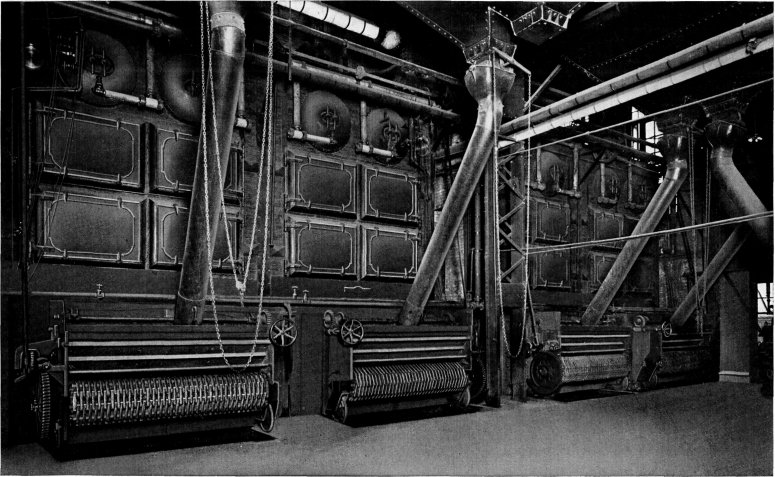
Portion of 3600 Horse-power Installation of Babcock & Wilcox Boilers, Equipped with Babcock & Wilcox Chain Grate Stokers at the Loomis Street Plant of the Peoples Gas Light & Coke Co., Chicago, Ill. This Company has Installed 7780 Horse Power of Babcock & Wilcox Boilers