SELLING LATIN AMERICA A Problem in International Salesmanship WHAT TO SELL AND HOW TO SELL IT
Transcriber’s Note:
The cover image was created by the transcriber and is placed in the public domain.
SELLING LATIN AMERICA
BY
WILLIAM E. AUGHINBAUGH, M.D., LL.B., LL.M.
Illustrated from Photographs
BOSTON
SMALL, MAYNARD & COMPANY
PUBLISHERS
Copyright, 1915
By Small, Maynard and Company
(INCORPORATED)
Printers
S. J. Parkhill & Co., Boston, U.S.A.
FOREWORD
i
I made the acquaintance of Doctor W. E.
Aughinbaugh about eight years ago, when I
was in charge of the advertising department
of a large concern doing an international
business. The doctor came with us to look
after the export trade, especially in the West
Indies and South America. My work naturally
brought me into close association with
him, and I soon began to appreciate his unusual
ability in many directions and his special
fitness for the position he occupied.
There seemed to be no phase of merchandising
in far-off markets with which he was not
fully conversant; nor did this knowledge relate
solely to Latin America. He had previously
travelled the distant markets of the
Orient in the interests of an American house
whose products he successfully introduced
there and to him the Far East was an open
book.
He has been in Egypt eight times on business
iimissions. He has travelled Somaliland,
Palestine, Asia Minor, Morocco, Tunis, Tripoli,
Algiers, South Africa, Persia, Arabia,
Afghanistan, Cashmir, Beluchistan, India, Assam,
Burma, Siam, China, Cochin-China,
Japan, the East Indies and all over Europe
with the single exception of Russia. The
doctor also spent two years of his restless life
in the Far North where a business mission of
importance took him into Iceland, Greenland,
Labrador, Newfoundland, Cape Breton Island,
Prince Edward Island and the Hudson’s
Bay Country. As to the West Indies
and South America, he has been not only to
them, but through them many times and in
every habitable spot where business was to be
done. Some idea may be gained as to the
frequency of his visits to South America by
mentioning the fact that he has made thirty-six
trips across the Equator.
Dr. Aughinbaugh talks about the markets
of foreign countries with the authority of long
experience for he has been engaged in these
special fields for more than twenty years; yet
iiihe is still a young man with a modern viewpoint.
He speaks the languages of many
countries and speaks them well. His information
is first-hand, reliable data gathered on
the ground where he lived and worked, whose
people he knew and could speak to in their
own tongue, not the unreliable, superficial vaporings
of some dilettante globe-trotter who
has given the high-spots of civilization the
“once over” and therefore considers himself a
competent authority to write upon the commerce,
customs and manners of foreign countries
the very languages of which he does not
understand without the aid of an interpreter,
or who could not find his way back to the
railway station or dock without the assistance
of a guide.
Doctor Aughinbaugh is no such lightweight.
He has not written this book because he believes
he knows it all. Left to himself he
would never have written it. It was only
after repeated urgings on the part of some of
his friends who appreciated his ability to
write an unusual book, that he consented to
ivundertake the work, and then he did so under
protest.
It may be asked with pertinence how a man
could travel in the interest of one line and
yet be in possession of so much information
relating to every other line; or how one could
master the intricacies of foreign banking and
credits and still attend to his business. The
answer to all of this is that no man can successfully
negotiate foreign markets unless he
is more than a mere “order taker.” As to the
doctor’s ability to measure the requirements
of a market all the way from cereals to concrete,
that may be accounted for by the fact
that he is both a physician and a graduate of
the law, and while he never practised at the
bar to any great extent he did have considerable
experience in medicine, a profession
which developed a naturally analytical mind,
so that he looked at things with the eyes of a
student and from the viewpoint of the trained
diagnostician. For six years he followed
medicine in Latin America, finally giving it
up to accept an offer from a large company
vwho compensated him accordingly. His experience
in that line alone took him all over
the world and the ramifications of the business
brought him into close contact with the marketing
of nearly every other commodity. But
even had this not been so, he is the sort of
man who would have sensed a business opportunity
because he is naturally a keen observer
and everything interests him. He is the type
of man who absorbs information; he does not
have to be shown—he sees.
Here, then, is a man possessed of a fund of
particularly desirable information—especially
valuable to-day when Europe is war-mad and,
in her sanguinary frenzy, has left open the
door of opportunity to peaceful Uncle Sam.
Why not put this information in concrete
form for the benefit of American commerce?
These considerations were put up to the
author by some of his friends who knew him
to be a keen, accurate, analytical observer, a
writer and a raconteur of more than ordinary
ability, and this book was the result.
Probably never—let us fervently hope never
vifor the same reason—will the United States
have another opportunity such as the present
one, to enter those fruitful fields to the south,
where Europe in general, and Germany in particular,
has reaped a golden harvest for so
many years.
A careful reading of this book—not a difficult
matter, for unlike most works on commerce
it is full of lively interest—will be profitable
to every business man interested in the
subject of Latin America. It will be valuable
to those who are equipped or willing to prepare
themselves to cope with conditions as
they really are, and just as valuable to those
who are not, for it may save them from the
costly mistakes of experimentation in foreign
fields.
War completely changes commercial currents.
The victor takes the established and
profitable trade, leaving to the vanquished the
harder lines of business and the development
of new fields. This is as true of the first war
recorded by history as it will be of the last.
As an illustration of the veracity of this
statement it is only necessary to recall our war
with Spain. Prior to her defeat, Spain controlled
the bulk of the banking and commerce
of the Philippines, Cuba and Porto Rico.
To her possessions she exported wines, foods,
manufactured articles, textiles, drugs, perfumes,
canned goods, shoes and hats, receiving
in exchange their sugar, tobacco and coffee.
2To-day the United States consumes all of
these exports, while the requirements of the
three countries are supplied by America,
which also does their financing through banks
organized in these possessions, and capitalized
with American money. To be more specific
and by way of a concrete example let me mention
Cuba, which in 1913 exported $165,000,000
worth of products, all but 15 per cent.
of which was taken by the United States, the
amount shipped to Spain being about four-tenths
of one per cent. During the same
period of time she imported goods to the value
of $132,000,000 of which we supplied 65 per
cent. against Spain’s 8 per cent. Since 1902,
Cuba’s foreign commerce has increased 250
per cent. due absolutely to the part played by
the United States in the Spanish-American
war. The same condition of affairs in exports,
imports and other lines is equally true,
although not on such a large scale, of course,
of the Philippines and Porto Rico.
The Napoleonic wars gave to England the
strong position she now occupies in the financial
3and commercial world. Her bankers
and shippers, merchants and manufacturers,
with one accord grasped the opportunity that
presented itself then and have held the supremacy
thus gained for more than a century.
Perhaps it was the recollection of what
gave Great Britain her start in this field
which led the London Spectator to remark, at
the outbreak of war in 1914:
“The present war gives the United Kingdom
an excellent opportunity to capture the
export and import trade of Germany and Austria-Hungary.”
If England, engaged in the most desperate
and expensive war she or the civilized world
ever has known, with her enormous resources
taxed to their utmost, saw an “opportunity”
for trade expansion, how much greater is the
chance in this line for an absolutely neutral
power, populated with keen business men, and
provided by Nature with unparalleled productive
possibilities.
The war in Europe developed the most remarkable
business situation for the United
4States ever presented to any nation. The virtual
closing of all the doors of the export and
import trade of the Old World and the almost
total dependence heretofore of the Far East
and Latin America, especially, on Europe for
finance and trade connections made the war
truly the psychological moment for us, as a
nation, not only to overcome the lead of the
European commercial world, but also to cement
by other than ties of business the bonds
of friendship due us not only on account of
our ideal geographical position, but also because
of our similar republican form of government.
By embracing this extraordinary opportunity—apparently
almost created for our express
benefit, we being the only people able
to profit by it—we can make the nations which
formerly depended on Europe for support in
their trade ventures our business allies, our sincere
friends and well-wishers, and at the same
time bring about a new trade alignment so that
all America will reap the benefit.
Let us briefly consider some of the enormous
5possibilities of foreign trade in Latin American
countries.
Latin America—that is, the countries of
Central and South America, together with
Mexico, Cuba, Santo Domingo and Porto
Rico—comprises twenty distinct states, with a
total population of about 65,000,000, a large
portion of whom are Indians and half-breeds—a
fact which we should not lose sight of in
view of the tremendous imports.
Statistics recently compiled by the Pan-American
Bureau show that these countries,
in 1913, conducted a foreign commerce valued
at $2,870,178,575. Of this the imports were
$1,304,261,763, and the exports, $1,565,916,812,
thus giving Latin America a favorable
balance of $261,655,049.
Ten of these countries alone purchased
goods to the amount of $961,000,000. Of this
sum Great Britain supplied $273,000,000;
Germany, $180,000,000; France, $84,000,000;
Italy, $54,000,000; Belgium, $47,000,000, and
Austria-Hungary, $8,000,000. The United
States exported to these ten countries last year
6$160,000,000 and imported from them $250,000,000.
Brazil, in 1913, imported $15,000,000
in textiles alone, of which amount the
United States supplied only $500,000. In the
same length of time Argentine imported goods
to the amount of $468,999,996, of which
amount less than 8 per cent, was supplied by
this country. The United Kingdom exported
to all of Latin America $23,500,000 worth of
coal in 1913, the United States, during the
same period of time, $750,000.
Practically the same story in all lines of exports
could be told of these countries, demonstrating
that individually in nearly all cases
the United States is the largest consumer of
their raw or finished products and the smallest
exporter of the goods they most require.
Fearful that some one may infer after looking
at these figures that European countries
have preferential duties with Latin America,
let me state most emphatically that this is not
the case. With one single exception no favoritism
is shown any of the trading nations, in
the matter of import fees, and in that instance
7we benefit by it. Brazil makes a decided
preferential tariff in favor of some of our
goods in view of the fact that we are the largest
consumers of her chief product—coffee.
Everyone of these countries is in process of
development and expansion. They have in
profusion the things the busy world most
needs. Their mines are the richest known
to man. Some have been worked for thousands
of years and are still productive. Their
broad fields are destined to make them the
granaries of the world. Their miles of pasture
lands and their extensive acreage mean
that Europe and the United States will depend
upon them for meat. Their vast virgin forests
are capable of supplying humanity with
cabinet and other woods for several centuries.
Their trade and imports must therefore increase.
It is apparent that they cannot diminish.
We cannot as a nation afford to remain
indifferent any longer to their possibilities
and opportunities.
Very naturally there have been many objections
on the part of our business men to going
8after this trade which all of Europe
strained every resource to acquire and control.
It was urged that we had all the business we
required; that we lacked foreign banking
facilities; that our merchant marine was small
and inefficient; that to go abroad for trade
meant learning new languages, acquiring new
customs, opening new accounts, taking more
risks. These conditions were equally true
when the European merchant decided to enter
this field. He met and overcame all these
difficulties under far more adverse circumstances
than exist for us, to-day. His experience
in this territory has charted the path
for us to follow, and if we take advantage of
the beacons he has erected we shall be saved
from many pitfalls.
Latin America with the things the world
most requires—wheat, meat, wool, coffee,
sugar, nitrates, minerals, woods—can never
collapse completely through any financial
crisis. Furthermore its power of reviving
quickly from any unfavorable panic is truly
phenomenal. I recall Venezuela, the year she
9terminated her bloodiest revolution under
Castro, harvesting and exporting a bumper
crop of coffee, which immediately cleared up
her monetary depression, and this rapid convalescent
condition has been duplicated time
and time again after every period of internal
trouble experienced by all of these countries.
Nature has been bounteous in her gifts to
these favored lands of the sun. If in a given
locality the soil is not fertile, it is rich in mineral
wealth, or covered with luxuriant forests.
Throughout Latin America large and
small rivers afford easy and cheap means of
transportation. Drought or excessive rainfalls
are comparatively unknown. Despite
the fact that a majority of the population lives
primitively, epidemics of a severe nature have
been few and far between. Revolutions, formerly
the blight on these lands, are becoming
rare and in most of these countries there
have been no such uprisings or demonstrations
of this character for more than twenty years.
The opportunities for successful business
in almost any chosen line in Latin America are
10unlimited, provided one uses ordinary judgment
and simple tact in the undertaking.
Furthermore less capital is required to start
an enterprise than in lands where competition
is keener, and less energy necessary to insure
success. The truth of these statements is
demonstrated most completely by the fact that
millions of Europeans—many of them uneducated
and possessed of no great amount of
ability or money—have settled throughout
these lands and established themselves in
prosperous occupations.
The greatest possibilities exist along the
lines of general development. All these countries
are new; most of them practically unexplored—many
of them not even having their
boundary lines definitely established. Think
of what must be the opportunities in Brazil—a
country larger in area than the United
States, and supporting only 20,000,000 people—or
of Argentine, spreading over almost as
much territory as Europe, excepting Russia
and Austria-Hungary, with a population
slightly more than 7,000,000. It is to these
11countries that overcrowded Europe must come
for elbow room—for a glimpse of the sun.
Once a business or a plant is established in
Latin America one need not have the intense
fear of bitter local competition. These people
have never been manufacturing or creative
in their desires, and the chances are, if we are
to predicate their future from their past, that
they never will become competitors in any of
these fields. Climatic conditions, racial and
inherited traits have made them follow the
lines of least resistance and they have become
cattle raisers and large farmers, while comparatively
few have entered commercial life.
This being true it follows that these countries
are ideal for those desirous of leading an active
commercial or manufacturing career.
All of Latin America is in the process of
awakening. They are building railways,
making vast municipal and national improvements,
exploiting their natural resources,
modernizing their agricultural methods. The
advent of the foreigner has been potent in raising
their standard of living. If these people
12were to raise their standard of living to that
of the United States at the present time, it
would be the equivalent, so far as market possibilities
are concerned, to creating three new
Americas. Each day sees some progress in
this direction, and with it a desire for more of
the comforts of modern civilization—for more
of the things which go to make up the full and
complete life. This means employment for
their people—civic progress—and prosperity.
Their markets are easily reached, the
merchants willing to buy, our producers capable
of providing the things they require.
Their first orders may be small, but they become
enormous buyers when they find the
article adapted for their needs. The European
marts which might have supplied the
things these nations require in their growth
cannot do so for a long time to come, thus giving
us an ideal opportunity to capture these
markets and at the same time introduce American
methods throughout the length and
breadth of the land.
II BRAZIL
13
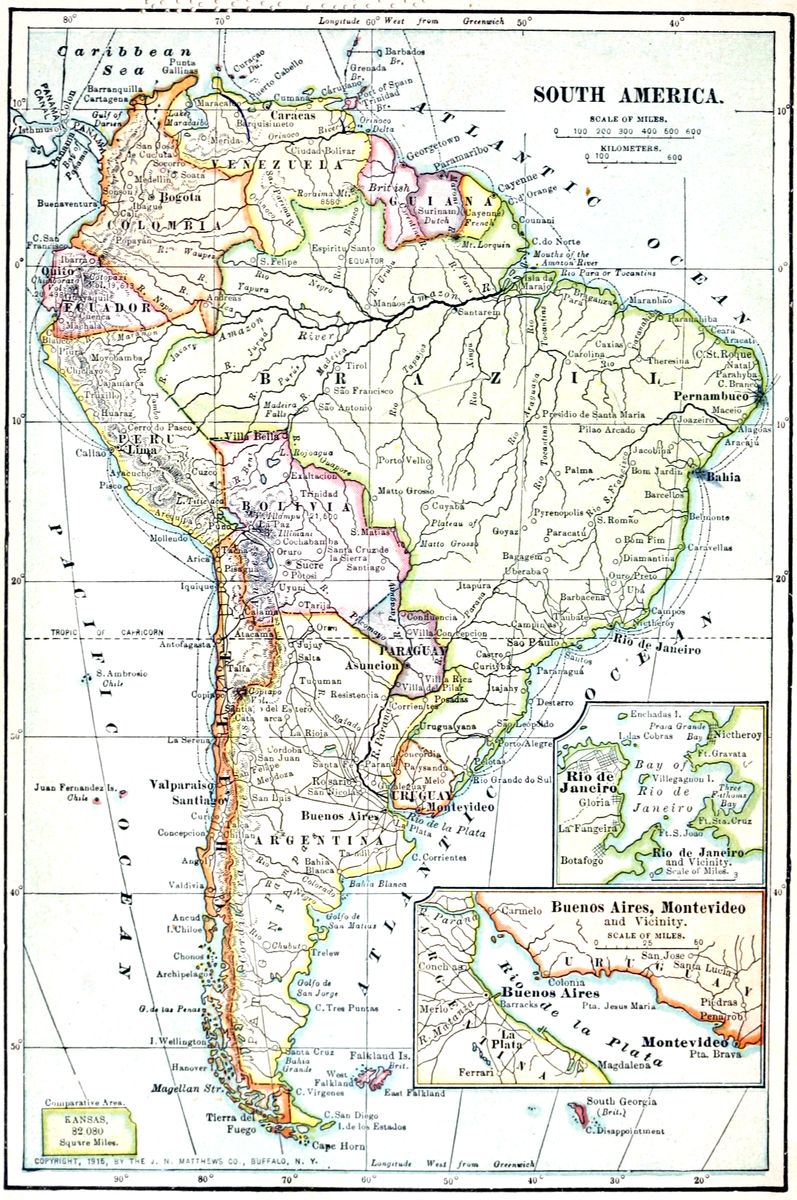
The Republic of the United States of
Brazil, including the Acre Territory, is the
largest of the South American countries and
if we include Alaska and our island possessions
is really larger in area than the United
States of America, by about 200,000 square
miles. It is fifteen times larger than Germany
and sixteen times larger than France.
With the exception of Ecuador and Chile its
frontier touches every country of South
America, being bounded on the north by British,
French and Dutch Guiana and Venezuela;
on the west by Colombia, Peru, Bolivia, Paraguay
and Argentine; on the south by Uruguay,
while the Atlantic Ocean forms its eastern and
a portion of its northern limitation. Its most
eastern point is but three days’ sail from the
western coast of Africa. It is the fourth
14largest country in the world, and is widest between
the Equator and the Tropic of Capricorn,
covering an area of 3,292,000 square
miles.
The population has been variously estimated
at from 20,000,000 to 24,000,000, of whom less
than 1,000,000 are aborigines, thus giving it
about one-fifth of the population per square
mile of the population of the United States of
America. Its inhabitants are white, black,
mulattoes, Indians and mixed breeds, a heavy
percentage being descendants from the slaves
imported originally from Africa, slavery in
Brazil having been abolished in 1888.
The language of Brazil is Portuguese except
among the Indian tribes, each one of
which has its own dialect. These Indians are
to be found in the interior and the remote districts,
and are a negligible quantity as far as
trade is concerned, living primitive lives and
having few wants that the rich country and
rivers cannot supply.
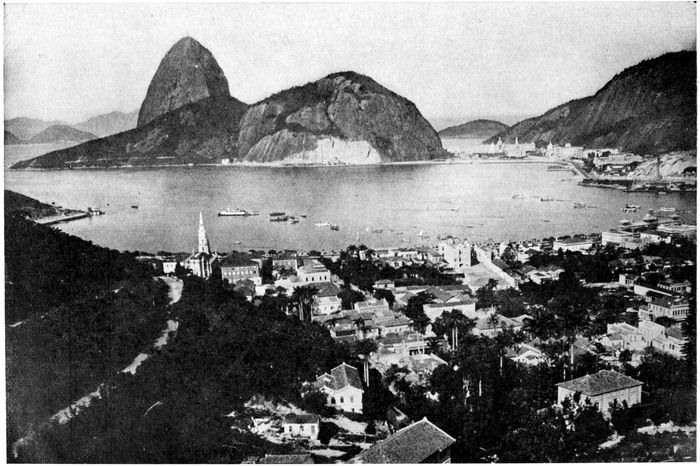
The Harbor of Rio de Janeiro
15Brazil was discovered April 22, 1500, by
Pedro Alvarez Cabral, a Portuguese explorer,
but no definite attempt was made to settle it,
or assume governing power by the Portuguese
until 1549, fifty-seven years after Columbus
had been to America, when Portugal awoke to
the great possibilities of the country and dispatched
her first Governor General in the
personage of Thome de Souza.
During the century following the arrival
of its first constituted governor, Brazil became
the scene of numerous attacks and invasions on
the part of the French, Dutch and British,
each one desirous of acquiring portions of its
territory, having been attracted by the current
stories of its great wealth and latent resources.
For a time both France and Holland established
themselves in a small way within its
boundary, but ultimately abandoned their outposts.
From 1640 to 1808 Brazil was governed by
a Viceroy, who resided in Rio de Janeiro.
The victorious armies of Napoleon and their
progress across the Spanish Peninsula ultimately
caused King John to abandon his capital
in Portugal and flee to Brazil, where he
16established himself in Rio de Janeiro (in
1808), and ruled Portugal from this one of
his possessions. This is the only instance in
history of any portion of Europe ever being
ruled from the western continent. When
peace came to Europe, King John returned,
leaving Brazil under the regency of his eldest
son Dom Pedro, who in 1822, proclaimed
Brazil independent of Portugal, and established
himself in power as Emperor, the first
and only instance of such a form of government
in South America. Dom Pedro was
forced to abdicate in 1831 in favor of his son
Dom Pedro II, who after reigning through a
regency assumed the throne on becoming of
age in 1840. It is unnecessary to detail the
causes that led to the bloodless revolution of
November 15, 1889, which ended his reign
and by means of which Brazil proclaimed herself
a republic, adopting a constitution patterned
after our own and a government comprising
a President, with legislative powers
vested in a Congress composed of two bodies,
a Senate and a Chamber of Deputies.
17Brazil is so immense, situated between the
fifth degree north and the thirty-third degree
south, and its topography so varied that it has
all kinds of climates excepting extreme cold.
Lying in the temperate and tropical zones one
would incline to the belief that it would be
more or less warm, but its many rivers and
mountains, its high table-lands and plateaus
exert a beneficial influence in this regard and
materially modify what otherwise would be
extreme degrees of heat.
More than half of Brazil is an elevated
plateau, varying from 2000 to 3000 feet in
altitude. It has four distinct mountain
ranges, which deflect its rains and form vast
watersheds for irrigating the fertile lands at
their base. The eastern and central portions
are elevated while the chief characteristics of
the north and west are its fertile plains and
valleys.
The coast of Brazil straggles along for over
5000 miles and is provided with numerous
natural harbors, where the earlier settlers established
cities which have grown and prospered,
18the principal ones from the north to
the south being Belem, or Para, San Luiz,
Parnahyba, Fortaleza or Ceara, Natal, Parahyba,
Recife or Pernambuco, Maceio, Aracaju,
São Salvador or Bahia, Victoria, Rio de
Janeiro, Santos, Paranagua, São Francisco,
Rio Grande do Sul and Porto Allegre. As a
rule each of these ports is the terminus for a
railway system penetrating the interior, designed
solely for the purpose of bringing the
products to market and carrying supplies and
necessities to the part of the country dependent
upon it. There are practically no trunk or
interstate lines, but plans are now formulated
to overcome this condition.
Manaos is an inland port of Brazil, famous
as a trading depot and one of the centers of
the rubber industry. It is located on the Rio
Negro, at its mouth where it empties into the
great Amazon, one thousand miles from the
Atlantic Ocean, and maintains direct steamship
connection with the United States and
Europe as well as the other ports of Brazil.
Perhaps no other country in the world is so
19well provided with rivers as Brazil. The
mighty, muddy Amazon, the greatest river in
existence, practically traverses the country
from east to west in its 3850 miles journey to
the sea. Some idea of its strength and volume
may be gained when I state that its yellow
waters color the Atlantic for over 100 miles
beyond its mouth, and freshen the salt water
for a distance of 180 miles. Emptying into
this Queen of Rivers are more than 200 tributaries,
over 100 of which are navigable, the
famous Rio Roosevelt or River of Doubt forming
one of the number. There are over 10,000
miles of navigable waterways for ocean
vessels and 20,000 miles for light-draft boats.
Brazil is a pastoral country and the indications
are that it will always remain so. Its
vast savannahs and fields have formed ideal
locations for raising cattle and sugar, while
its mountain sides and plateaus are unparalleled
for the growth of its staple product—coffee,
the average yearly crop of which is the
enormous amount of 1,596,000,000 pounds.
Rice, cotton, sugar, tobacco, matte (a species
20of tea for native use), mandioca (a starchy
tuber from which a bread is made much liked
by the native) and cacao are also extensively
grown. India rubber, the use of which was
early known to the Indians of Brazil, to whom
it is indebted for its name, is the second leading
product of this remarkable land. The
tree, the juice of which produces this twentieth
century necessity, grows wild in the northern
portion of the country, although it can be successfully
cultivated. No effort is made to
preserve the trees when once tapped, and the
rubber prospectors are continually going farther
and farther into the interior in search of
new districts. The trees are from three to
twelve feet in diameter, of slow growth, indigenous
to the region of the Amazon and its
tributaries, growing wild, scattered through
the jungles and tropical shrubbery.
The forests of Brazil are practically virgin.
They abound in dye, cabinet and hard woods
and the opportunities for the development in
this field alone are enormous. Due to the fact
that the country has a wonderful series of
21aqueous arteries the transportation problem to
mills and markets is easily solved and the
waterpower can be used in preparing the timber
for shipping.
Brazil has at present more local factories
than all the other Latin American countries
combined, forty per cent. of her manufactured
articles being cotton goods, which find a ready
market. In the Federal District of Rio de
Janeiro, five of these mills have eight thousand
operatives, producing yearly about 80,000,000
yards. Petropolis has four mills and
São Paulo twenty-five with a total output of
nearly 100,000,000 yards. The number of establishments
in this industry alone amounts to
3664, giving employment to 168,760 hands,
with a total yearly output of 275,000,000 yards
of goods.
Of late the shoe-making industry has developed
extensively. In 1913 there were in
all of Brazil 4524 factories employing ten or
more operatives, with a total invested capital
of $18,857,000. These plants are nearly all
operated by American machinery, many of
22them under American superintendents, the demand
for American equipment being sufficiently
large to warrant the big shoe machinery
and shoe-finding houses of New England
in maintaining their own offices and carry
their own stock in the larger cities devoted to
this business.
Brazil is wonderfully rich in mines of precious
and semi-precious stones. Among the
semi-precious stones to be found are achroite,
actinolite, agates, amethysts, analcime, anatase,
andalusites, anthophyllite, apophyllite, apatite,
aquamarines, cymophane, citune, columbite,
desemine, iolite, jasper, opals, ruby, sapphires,
spinel, topaz, tourmalines. There are
many deposits of minerals, such as copper,
iron, silver, gold, arsenic, barium, bismuth,
cinnabar, cobalt, galena, manganese, nickel,
platinum, tin, and wolframite. There are also
rich veins of asbestos, coal, soapstone, sulphur,
salt, marble, mica, and evidences of petroleum.
Gold has been mined in Brazil for over 300
years, the principal deposits being in the State
of Minas Geraes. A mine near the Honario
23Bicalho station produced from 1888 to 1912,
over $26,000,000 worth of gold and as late as
1911, paid a dividend of 10 per cent. An
English authority has estimated the total output
of gold to date from all mines at $1,000,000,000.
Brazil is reputed to be the second largest
diamond-producing country in the world, the
Brazilian stone being considered fifty per cent.
better than others owing to the constant attrition
it has undergone in prehistoric days. At
one time more than 40,000 men were employed
in this industry in Minas Geraes alone. The
best diamond fields extend from 10 degrees to
25 degrees south latitude and many enormous
and high-grade stones have been discovered,
the total amount exported in 175 years or up
to 1903, being estimated at four tons. Edwin
Streeter in his book on precious stones, says
that “The State of Minas Geraes produced in
the first twenty years 144,000 carats. Up to
1850,—5,844,000 carats worth $45,000,000
were sold and some $10,000,000 stolen from
the mines by employes.” As an evidence of
24the fact that these mines are still productive,
there were registered 456 claims in 1909 in the
Diamanta Districts, which produced $1,000,000
worth of gems. In 1911 there were registered
in the State of Minas Geraes 437 claims.
Travel along the coast and to the cities located
on the railway lines is comparatively
convenient and comfortable although very expensive.
In the interior and from the beaten
paths it is difficult and filled with hardships.
Living is high—much more so than in the
larger cities of the States or Europe. Hotels
are far from the standard one is accustomed to
in towns of corresponding size, throughout
the world—a statement equally true of all
Latin America.
At first the monetary system of Brazil may
confuse one, its currency being on the gold
exchange basis. A milreis is the unit of value
and while it is subject to fluctuation, may for
all practical purposes be reckoned as worth
.33⅓ cents, or three milreis as the equivalent
of a United States dollar. The symbol for
the unit is $ and the value of our dollar would
25be expressed thus 3$000. A conto, or about
$333.33 would be written 1000$000. The
banking of Brazil is chiefly controlled by the
British, while Germany is their closest competitor,
both France and Italy being represented
each by a bank. The National City
Bank of New York has recently established a
branch in Rio de Janeiro, with sub-agencies
throughout Brazil, so that direct exchange on
New York may now be bought.
Brazil imported in 1913, $326,428,509
worth of goods, of which sum the United
Kingdom supplied $79,881,008; Germany,
$57,043,754; United States, $51,289,682;
France, $31,939,752; Argentine, $24,293,712.
In the same period of time she exported
goods to the value of $315,164,687, the United
States taking about one-third of the total
amount or to be exact, $102,652,923; Germany,
$44,392,410; United Kingdom, $41,701,815;
France, $38,685,561; Holland, $23,252,700.
The United States should do a much larger
trade with Brazil owing to a preferential duty
26allowed our nation due to the fact that we are
the largest consumers of her leading staple—coffee.
According to government decree No.
9323, of January 17, 1912, flour imported
from the States pays 30 per cent. less duty than
if imported from any other land, while dried
fruit, condensed milk, typewriters, rubber articles,
and supplies, scales, refrigerators, cement,
corsets, school furniture, windmills,
watches, desks and printing inks, pay 20 per
cent. less duty than similar articles imported
from other countries.
Brazil exports coffee, rubber, hides, skins,
cacao, tobacco, salt, cotton, sugar, woods, nuts,
precious and semi-precious stones and gold.
She imports foodstuffs, shoes, machinery, textiles,
building woods, ammunition, wheat,
automobiles, vehicles, codfish, dried fruits,
glass, toilet articles, building and kitchen
hardware, cement, scientific instruments, iron
and steel, enamelled ware, paints and varnish,
haberdashers’ goods, cottons, hats, corrugated
iron, galvanized iron, tools, condensed milk,
stationery, pipe, printing material and
27presses, electric machinery and supplies, typewriters,
nails, screws and rivets.
American fruits are much in demand in
Brazil, and an excellent market exists to-day
for apples. Potatoes, onions, beets, garlic and
other fresh vegetables would also sell well and
a lucrative trade in these necessities of life
could be developed without any great effort.
The refrigerator ships running from the Argentine
to New York with meat could carry as
return freight these perishable cargoes at a
low rate.
Steamship connections between Europe and
the United States, with Brazilian ports are
numerous and sailings comparatively frequent
and as a rule the accommodations are all
that could be desired. From New York the
Booth line (English) has two steamers a
month to North Brazil and Amazon River
towns, touching at Barbados, Para and Manaos,
with a ship every six weeks to Iquitos,
Peru. One steamer goes each month to North
Brazilian ports including Parnahyba, Natal
and nearby localities. The United States
28Steamship Line (American) has one vessel
monthly for Pernambuco, Rio de Janeiro and
Santos, freight being redistributed at these
ports for intermediate points. The Lloyd
Brazilleiro Line (Brazilian) maintains a
semi-monthly service between New York and
Natal, and Parahiba; and Pernambuco, Rio
de Janeiro, and Santos, with occasional service
to other larger ports. These boats do not
as a rule carry passengers. They also maintain
a service along the smaller coast towns
and the rivers leading into the interior of
Brazil, even having regular sailings from
Asuncion, Paraguay, for Brazilian river towns.
The Lamport & Holt Line (English) has
weekly sailings from New York to Bahia, Rio
de Janeiro and Santos, generally stopping at
Trinidad and Barbados, West Indies, on their
trip north. The Prince Line (British) touch
once a month at Rio de Janeiro and Santos,
carrying freight chiefly. Other vessels of
this line make monthly calls at Pernambuco,
Bahia, Rio de Janeiro and Santos. Numerous
tramp ships also sail from American
ports on the eastern coast of the States to
Brazil.
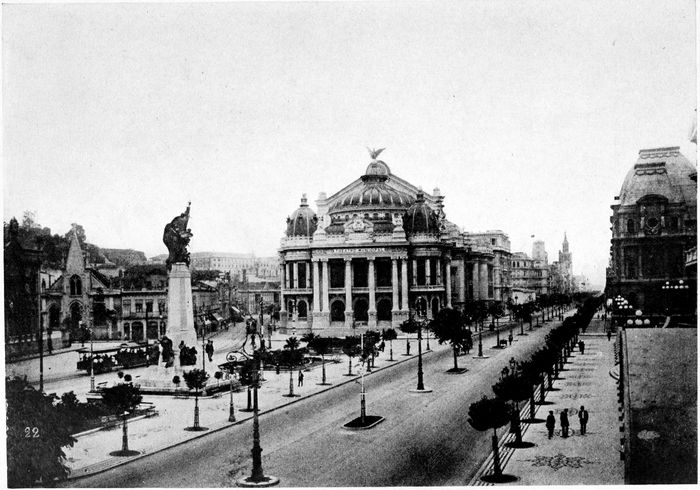
Photograph by Underwood & Underwood
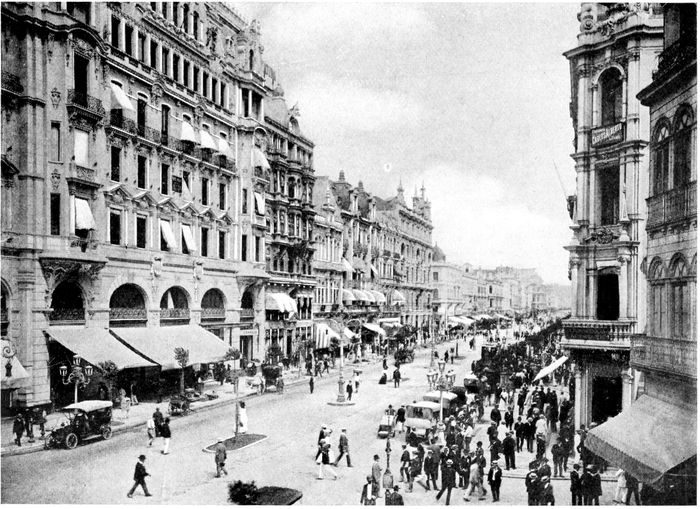
Avenida Rio Branco and Opera House, Rio de Janeiro
29Brazil has 15,272 miles of railways, federal,
state and private, over many of which tickets
which correspond to our mileage books are
issued, for the convenience of the travelling
public. Many new lines are in process of
construction or contemplated, and a very decided
effort is being made to unite the various
main lines by connecting roads, so that the entire
republic, including its most remote districts,
may be thus reached.
The leading cities, which should be visited
for business purposes, are:—
Population
Rio de Janeiro
1,128,000
São Paulo
450,000
Bahia
300,000
Belem or Para
250,000
Pernambuco
200,000
Porto Allegre
125,000
Mañaos
60,000
Santos
45,000
Campinas
40,000
Ceara
40,000
San Luiz or Maranao
40,000
Parahiba
32,000
30Nichteroy
30,000
Florianopolis, or Desterro
27,000
Rio Grande do Sul
20,000
Some of the States and municipalities of
Brazil have a special tax for commercial
travellers, which varies from year to year,
concerning the payment of which arrangements
can be best made when on the ground.
A small tax is also levied on trade samples,
presumably to be refunded when leaving the
country. It is advisable to learn how best to
handle the situation from travellers with
whom you will meet en route. As a rule, all
of these are mere matter of detail and can be
advantageously arranged, through the proper
channel.
III ARGENTINE
31
Juan Diaz de Solis in 1508 discovered the
Rio de la Plata, otherwise known as the River
Plate, while searching for a southerly passage
to the Pacific Ocean. In 1525 Sebastian
Cabot entered the river and gave it the name
it now bears, at the same time erecting a fort
near its mouth. A wealthy Spaniard, Pedro
de Mendoza, in 1536, in exchange for certain
landed rights and governmental privileges,
established what is now the present city of
Buenos Aires.
It is unnecessary for the purposes of this
book to do more than state briefly that the conditions
imposed by Spain on all its colonies
were outrageously unjust and caused much dissension.
Efforts to progress were throttled
and the friction between the mother country
developed until the conquest of Spain by Napoleon,
32which gave the many Spanish colonies
that had become thoroughly satiated with disgust
and contempt for the Madrid Government,
a chance to rebel and establish themselves
as independent nations. Taking advantage
of the condition in Europe and having in
mind the successful revolution of the American
colonists, the people of Argentine, Bolivia,
Paraguay and Chile revolted, and after much
fighting finally drove the Spanish troops from
their shores. May 25, 1810, the people of
Buenos Aires declared their independence.
A Congress was held in Tucuman on July 9,
1816, the result of which was the more complete
unification of the Argentine people under
the title of the United Provinces of the La
Plata River. The government in 1860
adopted as its national title “The Argentine
Nation” by which it now prefers to be called.
Few know that the British had covetous
plans upon this really wonderful country and
twice invaded it, once in 1806, and again in
1807. After their fleet had bombarded the
capital, the troops landed, and were both times
33thoroughly defeated, some of the English
battle flags which were captured still being
exhibited in Buenos Aires.
The government of the Argentine Nation
is patterned after that of the United States
of America, and has a constitution similar in
its important features. There are three
branches of government, executive, legislative
and judicial; the legislative power being
vested in a Congress composed of a Senate
and a House of Deputies. The executive
power is vested in a President and Vice-President
elected as those of the United States, each
holding office for the period of six years. Of
late the Government has been very stable and
there have been less tendencies to overthrow
the authorized power than in most Latin
American countries. By a treaty with Chile
in 1881, the great territory of Patagonia, to
the south of the Argentine, was divided between
these two nations.
Argentine covers an area of 1,153,418 square
miles, or about one-third as large as the
United States. To be more specific it is as
34large as Texas, and all of our territory east of
the Mississippi. It is bounded on the north
by Bolivia, and Paraguay, on the west by
Chile, on the south by a portion of Chile
and the Atlantic Ocean. Paraguay, Brazil
and Uruguay, together with the Atlantic
Ocean which washes its shores for more than
1500 miles, constitute its eastern boundary.
Over 700,000,000 acres of its land is admirably
adapted for cattle raising and the growing
of cereals, a fact which argues much for
its future development and prosperity.
Its population is variously estimated at
from 6,000,000 to 9,000,000 but it can with
safety be placed at 7,000,000, a little less than
25 per cent. of its inhabitants residing in the
city of Buenos Aires, which has 1,700,000
citizens, a rather unusual condition of affairs.
The early settlers of the Argentine were of
course Spaniards and their descendants form
the bulk of the population to-day. There are
comparatively few blacks or mixed breeds,
slavery having been abolished in 1813, while
the Indians and aborigines are scattered along
35the frontier. Early in its history Argentine
encouraged emigration from Europe, using
as an inducement the free grant of public
lands, which proved especially attractive to
the Italian and Spaniard. In fact the preponderance
of the Italian in the business and
social life, due to this movement has had a
noticeable effect on the Spanish language as
spoken in this country. From 1857 to 1913
the total of newcomers amounted to 4,781,653,
many of whom became landholders and began
at once to contribute to the growth and wealth
of the country. The population to-day is
7.8 persons per square mile as against 32.31
per square mile in the United States. More
than 300,000 persons migrate to this country
each year.
The chief characteristic of the physical
formation of the Argentine is its vast pampas
or plains stretching from the Rio de la Plata
to the west, terminating in the foothills of the
Andes, or the Cordilleras. Perhaps no part
of the earth’s surface has such flat, smooth,
treeless plains as here confront the traveller.
36The climatic conditions, owing to the fact that
it extends over thirty-four degrees of latitude,
vary from tropical in the north to practically
arctic coldness in the south, the seasons being
the reverse of ours,—that is, they have winter
when we have summer and vice versa. The
greater portion of the country is in the temperate
zone, the summers being very hot and the
winters typified by heavy rains, especially in
the eastern portion, diminishing toward the
west where there is often much drought. In
the extreme south, in what was formerly Patagonia
the heavy snows of winter take the place
of rains, which together with the warm summers
produce a luxuriant growth of grass, especially
adapted for the grazing of sheep.
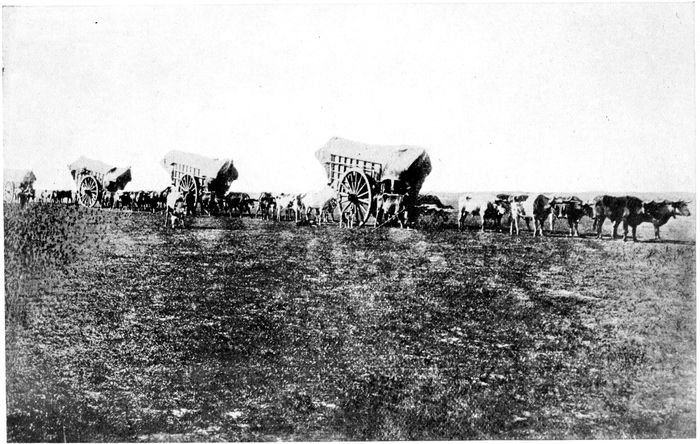
Photograph by Underwood & Underwood
Taking produce to the station, Argentine
37The Argentine has for some years been one
of the granaries of the world and as its available
land becomes cultivated is destined to
play a more important rôle in this field.
Some idea of its rapid development may be
gained from the fact that in 1904, 26,000,000
acres were under cultivation, while in 1913
over 60,000,000 were sown. Wheat is of
course its chief cereal, last year over 17,000,000
acres being cultivated. The Argentine
Agricultural Department states that for the
same period of time there were 12,000,000
acres in corn; 4,000,000 in oats and 15,000,000
in lucerne or alfalfa, proportionately large
territories being planted with barley, sugar,
grapes, rice, cotton and tobacco.
This country has been the second largest linseed
producing nation of the world, yielding
first place to India. Last year nearly 6,000,000
acres were devoted to the growing of this
seed alone.
Comparatively little attention is paid to
truck gardening or the raising of kitchen vegetables,
fruits or berries, and this offers a remarkable
opportunity to one versed in the subject.
Conditions for growing these necessities
are most favorable but have been neglected
in the efforts made to develop other sources of
revenue.
Tucuman has been the center of the sugar
industry, practically all of which is consumed
in the country, 43 refineries and plants being
38devoted to this business. The grapes grown
at the foot of the eastern slopes of the Andes,
near and around Mendoza, yield 500,000,000
quarts of wine yearly, most all being for internal
consumption. Owing to the reversal
of seasons here, crops are harvested when ours
are being sown.
Recently dairying has developed to a remarkable
extent, over 1300 creameries and
factories being devoted to the manufacture of
butter and cheese, doing a gross business of
nearly $9,000,000. Much butter and cheese
are shipped to England, Brazil and South
Africa. For the first time in its history, butter
was exported to the United States last year.
Flour milling was established in the Argentine
in the 16th century. Prior to this Chilean
flour supplied the demands for this article.
To-day in addition to providing sufficient for
its own requirements, Argentine ships much
of its flour to Brazil, Chile and Europe and
has about 800 flour mills in operation, representing
an investment of approximately $14,000,000.
39From the days of the early Spaniards stock-raising
has flourished and will always be one
of the chief industries of the land. Not only
the Government but individuals as well realize
this and co-operate with each other for the
purpose of producing the best strains of all
breeds of cattle.
There are many “refrigerificos” or cold-storage
plants and abattoirs throughout the
land and for years Europe received practically
all of Argentine’s animal products,
her exports in this line alone being approximately
$350,000,000 in 1914. Due to the
fact that these establishments were operated
by British capital, England naturally took
most of this meat. The larger American
packing-houses have now entered the trade
with the double purpose of supplying both
their European and American customers from
this field and direct refrigerator ships now run
from the River Plate to New York City with
cargoes of Argentine beef and mutton. The
last census showed 30,000,000 beef cattle;
9,000,000 horses; 500,000 mules; 300,000
40asses; 90,000,000 sheep; 4,000,000 goats and
3,000,000 pigs.
Nature seems content in having blessed this
country with fertile pampas and agricultural
lands, consequently there are comparatively
few minerals within its territory. There are
however some veins of gold, silver, copper and
wolfram. Petroleum has recently been discovered,
but not in large quantities. There is
no coal in the Argentine, but in some sections
bogs of peat cover extensive areas and await
development.
To the north and in the interior are forests
of valuable woods, there being over thirty-three
species of commercial value. Quebracho
wood is found in the provinces of
Santa Fe, Santiago del Estero and Corrientes.
It is very hard, impervious to moisture and
will not rot. Due to these admirable qualities
it was formerly used for sleepers for railways
but now owing to the fact that it is excessively
rich in tannin it is used almost exclusively
for the purpose of curing leather.
Formerly it was exported in large logs to Europe
41or to the States and the tanning extracts
expressed, but to-day there are many factories
in the districts where the wood is grown, devoted
to obtaining the tannin directly, thereby
materially reducing the cost of the article.
Inasmuch as hides and quebracho are products
of the Argentine it would seem that the tanning
of leather would under proper management
develop into a large industry here.
The export of tannin for 1914 was over $11,000,000.
Outside of the industries referred to and a
few breweries, cigar factories, and apparel
factories, wherein goods for local consumption
are produced, there is no general manufacturing
in the Argentine.
No other country of Latin America is as
well provided with railways as the Argentine,
nor with as regular and superior access to
Europe and the States and all parts of the
world. More than fifty steamship lines arrive
and depart regularly from the various
Argentine ports, all the seafaring nations of
the earth being represented. In 1852, one
42observer counted over 600 vessels in the harbor
of Buenos Aires flying the American flag
or more than double the number of all the
other nations combined. To-day but few are
to be seen in the vast shipping of this busy
port.
The Argentine Republic stands ninth
among the world’s nations in the length of her
railways, having about 22,000 miles of track.
Many lines are in process of construction or
contemplated, the public and the government
both realizing that a complete network of railways
leading to the ports accelerate the moving
of crops and cattle and are absolutely essential
to its prosperity. Buenos Aires quite
naturally is the principal terminal of most
roads, while Santa Fe, Rosario, Bahia Blanca
and La Plata are rapidly coming to the front
as shipping centers and are providing appropriate
facilities for handling trade. It has
been said that every railway in the country
is extending its lines more and more into the
interior, and railway journeys to Brazil, Paraguay
and Bolivia as well as Chile are now
43possible. It may be interesting to note that
the longest stretch of straight track known to
railroad builders is to be found in the Argentine,
where the rails run a distance of 175
miles without a curve of any kind.
Wagon roads outside of the larger cities are
poor and in bad condition, and much is needed
to be done in this respect.
There are many weekly sailings of the most
modern and swift passenger ships to Europe,
one Italian line making the voyage from
Buenos Aires to Genoa in fifteen days. It is
also possible to go via Hamburg or England to
New York in better ships for practically the
same money and in less time than is taken by
ships engaged in the direct run from Buenos
Aires to New York. The Lamport & Holt
Line (British) runs directly from New York
to Buenos Aires, with weekly sailings, carrying
freight and passengers. The Prince Line
(British) and the Barber Line (American but
flying the British flag), the Norton Line
(British), the American Rio Plate Line
(American) leave New York twice a month
44for Argentine ports. The Houston Line
(British) from Boston and New York and
the New York and South American Line sail
monthly from New York for River Plate
ports. The Munson Line (American) from
Mobile, Alabama, sends two ships monthly to
Buenos Aires. There are many tramp ships
from American ports in this trade also.
The docks and facilities for handling goods
in Buenos Aires are second to none in the
world and are modeled after the famous
Liverpool system, having cost over $50,000,000.
Steamers unload cargoes directly into
the government custom warehouses, on the
other side of which are networks of railway
tracks from which they can be forwarded to
the interior. Each of the large cement-sided
canals or basins for the ship traffic is provided
with locks or water gates, while the masonry
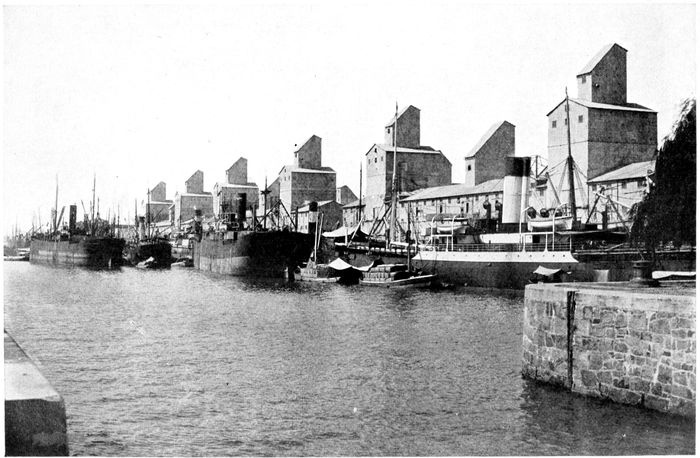
warehouses, buildings and grain elevators extend
for miles along the city water front. Yet
the business of the port has grown so that there
is much congestion, especially at certain seasons
of the year and plans are being considered
for doubling its present facilities.
By permission of the editor of The Americas
Grain Elevators, Buenos Aires
45Much of the impetus in trade circles in this
land is due to the presence of the English,
Germans and Italians who control the banking,
transportation and commercial life of the
country. Both the Briton and the Teuton
have large sums invested in all kinds of enterprises,
the total being estimated at $2,000,000,000.
The Italian has developed into the
small shopkeeper and farmer. In Buenos
Aires alone there are two daily papers printed
in English, which serves to give some idea of
the extent of the English speaking population
in this city. There are also daily papers
published in Italian, German, French and
Arabic.
Practically all the nations of Europe are
represented in the banking business, the United
States being the last to enter the field. The
English are the strongest and the Germans
next.
Argentine is supposed to be on a gold exchange
46basis, the gold peso being worth one
hundred centavos, or in our money 96.5 cents.
The gold peso is designated by the sign $C/L,
the symbol C/L meaning curso legal, or legal
tender. This is practically an imaginary
coin, and the money one sees is paper currency,
the paper peso being worth 44 per cent. of its
face value, or 42.46 cents in United States
gold. This is represented in the following
manner $M/N, meaning moneda nacional or
national money. This paper currency fluctuates
slightly each day, being governed by the
market conditions. The abbreviations O/S,
C/L, and M/N are placed before the dollar
or peso mark, as for example O/S $500 or
may follow it, as, for instance, $500 M/N.
The Argentine has long been noted for its
unfavorable fees charged travellers, each
province having a separate tariff, varying according
to the commodity one may be selling.
They are subject to such changes on short
notice that it is useless to give them here, besides
the subject has been dealt with elsewhere
in this book. Before doing business it
47is wise to give this matter careful consideration.
No duty is charged on samples.
The following cities should be visited:
Population
Buenos Aires
1,700,000
Rosario
300,000
Cordoba
120,000
La Plata
100,000
Tucuman
80,000
Bahia Blanca
75,000
Mendoza
65,000
Santa Fe
50,000
Salta
40,000
Parana
37,000
Corrientes
30,000
San Juan
16,000
San Luis
15,000
The Argentine exported goods to the value
of $468,999,410 in 1913, and during the same
time imported goods to the extent of $408,711,966,
of which amount less than 8 per cent.
came from the United States. England controlled
the bulk of the trade with Germany
second and France third.
The principal exports are meats and meat
products, agricultural products such as wheat,
48corn, oats, barley, linseed, hay, alfalfa, woods
and dye woods, live animals, wool, hides, skins,
butter and cheese. It imports foodstuffs, textiles,
iron, steel, railway supplies and rolling
stock, agricultural implements and machinery,
wagons, carriages, automobiles and automobile
supplies, electrical apparatus, glass, china,
ready-made clothes, hats, shoes, toilet articles,
drugs and chemicals, paints and varnish, stockings
and socks, silks, kitchen-utensils, enamelled
ware, tools, vegetables, fruits, eggs, oils,
greases, and coal.
IV URUGUAY
49
The first European who set foot on Uruguayan
soil was the man who discovered the
Rio de la Plate—Juan Diaz de Solis. This
was in 1508. He and his associates were immediately
attacked by the Charruca Indians,
who annihilated the party. Later on Portuguese
settlers from Brazil attempted to colonize
this land, but they met with repulses,
as did also the Spanish colonists who followed
them. As a result of the invasion of this territory
by Portuguese and Spanish it was claimed
by both these countries and became a bone of
contention between them for more than two
hundred years. The Portuguese colonists
were finally routed bodily and their city of
Montevideo, founded in 1724, came under
control of the Spanish Viceroy. Portugal
50still persisted in claiming this province and
when Dom Pedro made an Empire of Brazil,
he also attempted to exercise jurisdiction over
Uruguay as well. This ultimately resulted in
a war between Brazil and Argentine, in which
the Uruguayans rallied to the aid of the
Argentinians, defeating the Brazilians. A
treaty of peace in which the mediation of England
was asked, was signed August 27, 1828,
giving Uruguay its independence.
The present government is based upon that
of the United States and comprises executives
in the persons of a President and a Vice-President,
elected for four years, and a legislative
body, consisting of a House of Representatives
and a Senate.
Uruguay occupies an area of 72,210 square
miles, or is about as large as all of the New
England States. It is virtually an extensive
undulating plain, having in its northern section
a series of mountain ranges but few
of which are higher than 2000 feet. It is
bounded on the east by the Atlantic Ocean
and on the north by Brazil, the Rio Cuareim
51flowing between the two countries. The Uruguay,
dividing Argentine and Uruguay, forms
its western boundary while the wide mouth of
the Rio de la Plate may be called its southern
boundary line.
The climate is extremely temperate and
healthful—so much so in fact that it is rapidly
developing into a summer resort for Chileans,
Argentinians and Brazilians; many of the
wealthiest of these nationalities have established
seashore homes within its boundaries,
especially outside of Montevideo. Extreme
summer heat such as one finds in Buenos Aires,
is never encountered here, although there are
days in winter when it is particularly cold.
Snow occasionally falls.
Uruguay has a population of 1,500,000, its
people being among the best in Latin America.
As in Argentine, the Indians are comparatively
few and to be found in remote districts
only. There are practically no negroes and
mixed breeds. Owing to the influx of English,
Italian, and Swiss colonists, the standard
of the population is continually rising and its
52geographical position, salubrious climate and
vast areas of tillable land will attract more and
more desirable settlers to its boundary. Immigration
is encouraged along the most modern
and progressive lines.
Uruguay is fortunate in having many navigable
rivers, the chief of which are the Rio
de la Plate and the Uruguay, giving a total of
over 700 miles of water deep enough for ocean-going
vessels. One river alone—the Uruguay—has
ten ports open for interoceanic trade,
the cities on this river being Carmelo, Neuva
Palmira, Soriano, Fray Bentos, Neuva Berlin,
Casa Blanca, Pysandu, Neuva Pysandu,
Salto and Santa Rosa. Mercedes is a large
city, on the Rio Negro, and is used as a port
of call for ocean-going vessels. There is also
Lake Merim on the borders of Brazil on
which run small launches.
Uruguay has comparatively few railroad
systems and only 1600 miles of railways.
There are many projects for railway development
however and the completion of the
53mileage planned will rapidly bring the country
to the fore. American capital is now being
interested in this field.
While there are some minerals to be found
in the mountainous sections, still the country
will always be a pastoral one. Mica, gold,
precious stones and petroleum are known to
exist, yet comparatively little, if anything, has
been done along these lines.
Of her 45,000,000 acres of land, less than
5 per cent. is devoted to agriculture, owing to
lack of population. There are about 1,700,000
acres of virgin forest lands and over 40,000,000
acres devoted to grazing cattle and
sheep.
Wheat is the chief cereal grown, with corn,
barley, oats and linseed in the order named.
Tobacco has been tried with favorable results.
The raising of cattle of all kinds and the
maintenance of slaughter-houses and packing
establishments for the purpose of supplying
Europe with meat forms the largest industry.
One plant alone at Fray Bentos—owned
54by the Liebig Company and where the
extract of that name is made,—kills over
3,000,000 head a year. Very naturally meat
by-products are produced and exported in
large quantities. Much frozen and tinned
meat is exported. Some idea of the enormous
size of the cattle industry here may be gained
when we are told that at the present time
Uruguay has over 9,000,000 cattle, 30,000,000
sheep, 800,000 hogs, 600,000 goats and 430,000
horses.
One of the leading industries is the shearing
of wool, all of which is exported. The good
climatic conditions, in connection with attention
paid to breeding, have resulted in the
production of a wool of superior length and
texture and as a consequence wool-buyers from
Europe are attracted to this market. In 1913
the amount exported reached the enormous
sum of $35,875,975.
Despite the fact that Uruguay has no gold
coin of its own, it is on a gold basis and its
peso, or dollar, is worth almost four cents
more than ours, or to be exact, $1.034. This
55is a decidedly unusual state of affairs for Latin
America, and reflects favorably on the financial
condition of the country.
There is much English capital invested
here, and to a large extent trade is in the hands
of Englishmen. Many German and Italian
houses are represented and these nationalities
are also becoming interested in local enterprises.
Uruguay exports wool, hides, horn, hair,
meats and meat products, grease tallow, grain
and cereals, the total amount expressed in figures
for 1913 being $65,142,000.
In 1913 she imported goods to the value of
$50,666,000, the leading items being foodstuffs,
iron, steel, glass, china, wooden products,
oils, chemicals, medicines, stationery,
toilet articles, tobacco, textiles, shoes, hats,
and silks.
While commercial travellers are supposed
to pay a yearly license of $100, still this can
be waived by making the proper connection
with some local dealer or commission house.
The following cities should be visited:
56
Population
Montevideo
500,000
Pysandu
35,000
Mercedes
25,000
Salto
25,000
Fray Bentos
15,000
Rivera
10,000
Guadalupe
10,000
Minas
10,000
Florida
10,000
Colonia
10,000
Uruguay has from three to five steamships
sailing weekly direct for Europe, or the
United States.
All vessels leaving either Europe or the
United States and calling at Buenos Aires
touch at Montevideo the day before arriving
at Buenos Aires, as well as on the return trip.
Two night lines of comfortable steamers connect
Buenos Aires and Montevideo, which are
about 110 miles apart. Ample transoceanic
and coastwise freight service is also provided.
V PARAGUAY
57
Due to the ambitions of one man—Carlos
Antonio Lopez—a dictator of the worst type,
with Napoleonic designs, Paraguay, one of
the finest of South American countries, one
with brilliant prospects and holding the greatest
opportunities, is to-day the most backward
and has the smallest population.
Paraguay was discovered by Sebastian
Cabot in 1526. Following him came Juan de
Ayolas and Domingo Irala, who in 1536
founded the city of Asuncion, now the capital
of the republic. Up to 1810 it was a Spanish
colony, being latterly governed by the Viceroy
from the home country who resided in
Buenos Aires. At that time it was called the
Province of Paraguay. It declared its independence
from the mother country in 1811,
the Spanish Governor-General aiding in the
58movement. After trying various forms of
government it became a republic in 1844,
which form of government still exists, the executive
power being vested in a President and
Vice-President, with a legislative body composed
of a Senate and Chamber of Deputies.
It is impossible in even briefly writing of
this really wonderful country to refrain from
some reference to the one man, Lopez, whose
desire for power resulted in the almost total
annihilation of a people. His arbitrary rule
embroiled his nation in disputes with much
of Europe and the United States, and resulted
in a war with Uruguay, Brazil and Argentine.
In addition to this internal strife developed in
which assassins, murderers and executioners
played their parts. When Lopez was finally
killed and his power gone, Paraguay’s population,
according to Dawson, the well-known
historian, had decreased from a “1,300,000 to
a little over 200,000, only about 29,000 being
men and 90,000 children under fifteen years
of age.” There were five women to one man.
As a result of this devastation the country
59never has revived. Recent revolutions have
set it back still further and whatever of good
may come to this benighted land must be written
in the future tense.
Paraguay is almost an inland country, having
but one outlet to the sea in the Parana
River. Its 196,000 square miles of territory
is bounded on the north by Brazil and Bolivia;
on the west and south by Argentine, and on the
east by Argentine and Brazil. The Paraguay
River runs directly through its territory from
south to north dividing it into two sections,
Western Paraguay, or the Chaco, and Eastern
Paraguay. It is well watered with many
small streams, while toward the north and east
are mountain chains.
The climate of Paraguay is so equable that
the country is sometimes called the “Sanitarium.”
The two seasons are the rainy and the
dry. It never snows in this land and flowers
in great variety and a riot of color bloom constantly.
The southern two-thirds are in the
Temperate Zone, the northern one-third in the
Tropic Zone.
60The population is estimated at 800,000, over
100,000 of which are wild Indians, the remainder
being largely of mixed blood, negro
predominating. There have been some sporadic
attempts to encourage immigration,
which have not resulted in any great movement
in this direction, owing to the instability
of the government and the backward condition
of the people as well as to the general
isolation of the country.
Travel in Paraguay is most primitive.
There are few roads and most of the commerce
is carried by bullock carts on almost impassable
trails or by pack train over narrow
paths. But one railway, having a total length
of about 250 miles, ekes out a homeopathic
existence, running from Asuncion, the capital,
to Ville Encarnacion. Many railways must
be built to open the country. One can go by
rail from Asuncion to Buenos Aires in two
days, the trip requiring a ferry-age from Posadas
to Ville Encarnacion. The Trans-Paraguayan
Railway now in course of construction
will do much to develop the country. Communication
with the outside world via Montevideo
or Buenos Aires is maintained by river
steamers, requiring from five days to a week
to make the trip to Asuncion, which is about
1100 miles from the Argentine capital.
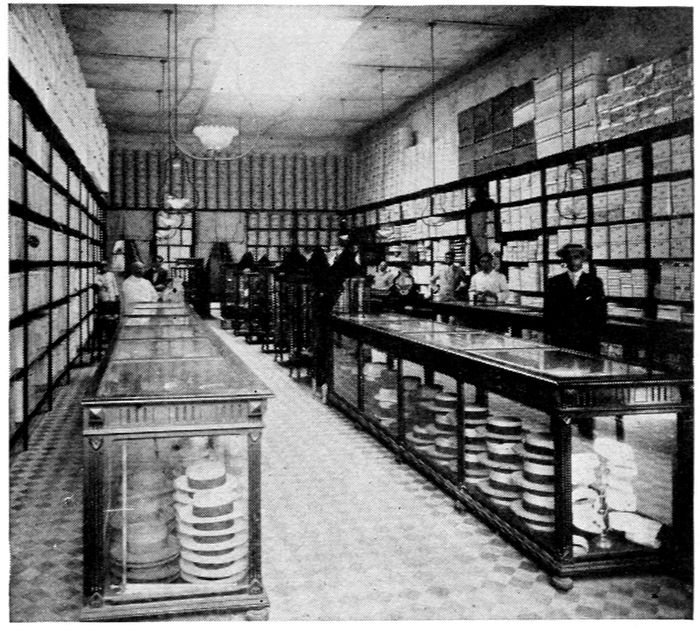
Interior of a gentlemen’s hat store, Asuncion, Paraguay
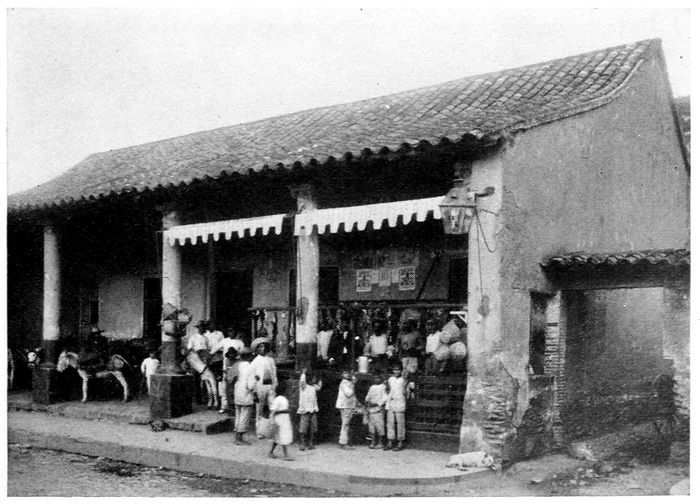
A country store in Colombia
61From Asuncion it is possible to go into the
interior or even to Brazil, on light-draft
steamers, the Guyara Falls, 1300 miles above
the capital, stopping navigation of the Parana
River at this point.
The Paraguay River is navigable for vessels
of twelve-foot draft to Asuncion and for smaller
vessels 700 miles farther.
Most of the commerce of Paraguay is carried
in lighters drawn by tugs, and these emissaries
of trade are to be met on all the rivers
and waterways of this country.
There are several lakes, navigable for small
craft, but of no importance from a commercial
standpoint.
While both the climate and the soil warrant
one in stating that Paraguay is susceptible of
high agricultural development, little has been
done in this regard, outside of locally producing
62the few vegetables and fruits required for
home consumption. Sugar-cane, tobacco,
tropical fruits and cotton would thrive in this
country. Each one of these staples has been
successfully raised, the cotton being something
like our own famous Sea Island brand.
A business, small in size, yet of great importance,
and restricted to this locality, is the
production of oil of petitgrain, a form of
orange perfume, much in use in European
perfume houses as a base for toilet and flavoring
extracts. The essential oil is obtained
in the most primitive manner and is always in
great demand.
A lace peculiar to the country, called
“nanduti” or spider lace, is made by native
women, and if properly commercialized
might develop into a paying trade.
The growing and curing of “Yerba Mate,”
a native tea, used extensively in Paraguay,
Uruguay, Brazil, Argentine and Chile, yields
considerable income, but is never destined to
become an article of great international commerce.
The plant or shrub grows wild. The
63crop amounts to about 18,000,000 pounds
yearly.
Quebracho, a red-colored wood, rich in
tannin, is indigenous to the country. It is
used for furniture and railroad ties and the
extract made from it is employed in tanning
leather. In one year, over $4,000,000 of this
wood alone was imported to the United States,
much of it being used for paving blocks.
Thousands of acres of cabinet and other
commercial woods are to be found in the forests,
but are without value, owing to their isolation
and lack of means of transportation to
get them to the markets.
The country has some ore deposits. The
principal ones are copper, mercury, manganese
and iron. They cannot be developed
on account of their remote location.
It therefore follows that the chief industries
of Paraguay for years to come will be in
the production of raw materials and in the
raising of cattle for which its well-watered
plains are admirably adapted. It has now
about 6,000,000 head of cattle and sheep and
64two slaughter-houses, killing about 40,000 annually.
There are two large American companies
engaged in the cattle industry; also one
big German firm in the same line.
Paraguay has not invited capital and inducements
of this nature need not be expected
for some time.
While supposedly on a gold basis, money of
this metal exists only as a fiction. The inconvertible
paper peso has a fluctuating value,
being at times as low as two and a half cents
U. S. gold, and as high as five cents U. S.
gold, according to the stability of the government
and local commercial conditions.
Credits should be extended with the greatest
caution.
In 1913 Paraguay exported $5,462,000
worth of materials, chiefly fruit to Argentine,
as well as yerba mate, timber, hides, dried
beef, quebracho, lace, and tobacco. Most of
her exports were taken by the neighboring republics,
and by them reshipped to the markets
of the world. No exports to the United
States for 1913 are given, but in 1912 they
65amounted to only $593. Germany is her
largest European creditor, last year taking
over $1,198,686 of her products.
Paraguay in 1913, imported $7,671,551 in
textiles, foods, hardware, fancy and toilet
goods, shoes, hats, liquors, drugs, clothes, steel
and iron, of which amount the United States
contributed $181,367 as against Germany’s
$989,898 and England’s $963,418.
Commercial travelers are supposed to pay
a duty proportionate to the business they do.
As a matter of fact, no effort is made to collect
this tax and the local merchant generally protects
the traveler visiting him from such exploitation.
The following cities should be visited:
Population
Asuncion
60,000
Villa Rica
35,000
Concepcion
25,00
Encarnacion
10,000
Owing to its situation it is necessary in order
to reach Paraguay to go by train or boat from
Buenos Aires, or by boat from Montevideo;
66the journey from Buenos Aires is the quickest
and most comfortable.
All goods intended for Asuncion or other
points in the country are trans-shipped at
either Buenos Aires or Montevideo, arrangements
for which can be made with the lines
running from Europe or the United States
direct to either of these ports. Or your customer
in Paraguay will instruct you to ship his
order through some agent whom he will specify
in his shipping instructions, who will attend
to the routine detail to forward the consignment.
VI CHILE
67
After Pizarro had conquered Peru he dispatched
Diego de Almagro with an army, instructing
him to explore and take the territory
to the south, or what is now Chile. He was
unable to accomplish the task. In 1540
Pizarro sent another expedition under Pedro
Valdivia, whom fortune favored and who
penetrated to what is now the city of Santiago,
which he founded in 1541. For more than
100 years the warlike Araucanian Indians
made repeated attacks on settlers in this territory,
the Spaniards having great difficulty in
conquering them. A treaty of peace was concluded
in 1640.
When the revolutionary movement in South
America started against Spain, Chile on September
18, 1810, declared her independence,
and became the scene of much fighting, finally
68on April 5, 1818, defeating forever Spanish
power and becoming absolutely independent.
A republican form of government was
adopted, the executive power being vested in
a President, and the legislative in two houses,
a Senate and a Chamber of Deputies.
The Republic of Chile has 292,580 square
miles, with a ragged coast line of 2,627 miles,
and varies in width from 90 to 248 miles. It
is bordered on the north by Peru, the east by
Bolivia and Argentine, the south and west by
the Pacific Ocean.
Two almost parallel ranges of mountains,
the Cordillera de la Costa and the Andes, run
from north to south, with a valley over 500
miles long and 40 wide spread between them.
In this chain of mountains are more than 30
extinct volcanoes from 11,700 to 21,340 feet
in height.
Owing to its extreme length Chile possesses
many climates. To the north it is dry and
hot, the central portion being decidedly temperate
with changing seasons, almost like California,
while in the south the temperature gets
lower, and rains increase. To the extreme
south there is much snow and cold with but
little vegetation.
Valparaiso
69There are practically no negroes in the
3,500,000 of Chile’s population. Some writers
estimate that 25 per cent. of the inhabitants
are Germans, or of German descent, this nation
having many business men and large colonies
in the Republic, especially toward the
south and around Valdivia. Perhaps 50 per
cent. are descendants of the Araucanian Indians
by the early Spanish explorers. There
is a large percentage of English; it is estimated
that in Valparaiso, a city of 250,000,
there are at least 20,000 Anglo-Saxons. The
French and Italian colonies are also quite
numerous.
Chile ranks third in South America in
her railways, possessing a total of 3800 miles,
nearly 2000 of which are owned by the Government.
A longitudinal railway, designed
to run practically the length of the country—2132
miles—from north to south, is in process
of construction. It will be connected with
70the coast and the hinterland by roads crossing
it at right angles, and is designed to develop
the entire country and to be of strategic
value in transporting troops. Two new trans-Andean
roads are contemplated in addition
to the one now running from Los Andes to
Mendoza, one to operate about 300 miles
north of Santiago—the other to cross 400 miles
to the south of the capital. Other lines from
the smaller ports to the longitudinal road are
proposed, in all over 3000 miles being projected.
Of the roads maintained by the government,
it might be said that they are run
at a great annual loss, a condition which
may operate materially against the country’s
prosperity at some near date. Many of the
privately owned roads are used only in connection
with the nitrate industry.
Chile has many small rivers varying from
25 to 150 miles in length arising in the mountains
and rushing to the sea. Most of them
are dry a greater part of the year, but during
the rainy season become raging torrents.
With the exception of a few in the southern
71part of the country, they are not navigable,
but by a proper system of conserving and storing
their water might be made useful for generating
power or light.
Her extensive coast line gives Chile 59
ports on the Pacific, most of which are open
roadsteads and at certain times of the year
positively dangerous, loading and unloading
of vessels being done by means of lighters,
ships being obliged to lie from one to two
miles off the land. The principal ports from
north to south in the order named are Arica,
Pisagua, Iquiqui, Tocopilla, Antofagasta,
Taltal, Caldera, Carrizal, Coquimbo, Valparaiso,
Talcahuano, Coronel, Valdivia,
Puerto Monte, Ancud, and Punta Arenas, the
most southerly city on this continent and one
of the big fur markets of the world.
Chile is to-day spending millions of dollars
on the modernization of her leading ports so
as to properly safeguard life and property,
but it will be years before this work is finished.
Primarily the wealth of Chile comes from
her nitrate beds and her mining possibilities.
72There are about $150,000,000 invested in the
nitrate industry alone—$55,000,000 being
English and $51,000,000 local. American
capital is little represented in this line. The
exports in 1913 amounted to 60,500,000 quintals,
a quintal being 101.41 pounds; the value
in money was $98,239,569. Iodine is one of
the by-products in the manufacture of nitrate,
and is controlled by a combination or trust,
$1,876,277 worth being exported last year, the
United States taking 183 tons, England 65
tons and the remainder of Europe 264 tons.
The nitrate beds run a distance of 450 miles
south of the Camarones River, at an altitude
of 4000 to 5000 feet and from 10 to 20 miles
inland. Many theories have been advanced
as to these deposits, the one generally accepted
being that these fields were once the bottom of
some sea elevated by a titanic upheaval. The
beds vary in width from a half to five miles,
and the “caliche” or strata of earth bearing
the nitrate is usually covered by sand and dirt
varying from a few inches to 10 feet. This
is blown out by dynamite, separated by washing
73and boilings from foreign matter, then
bagged and shipped. A more desolate spot
than a nitrate “officina,” as these reduction
plants are called, would be hard to imagine.
No trees or vegetation are to be seen and even
water has to be carried for miles in cars for
operating the machinery and for other uses.
Authorities differ as to the extent of the deposits,
some alleging they will be worked out
in 20 years, while others claim there is sufficient
supply available for 200 years. Nitrate
is used extensively in the arts, for manufacturing
gunpowder and explosives and for a fertilizer
in agriculture.
Copper is found in great profusion, $7,947,307
worth being exported last year. One of
the largest copper mines is owned by the
Braden Copper Company, an American concern.
In 1913 its average daily production
was 30 tons of bar copper. Machinery is being
installed which is intended to double this
output. Chile at one time contributed one-third
of the world’s supply of this metal and
mineralogists state that there are yet great bodies
74of high grade ore awaiting the discoverer.
Coal is found throughout the south of Chile,
one coal field alone being estimated to contain
1,862,000,000 tons. Over $7,500,000 is invested
in this enterprise.
Iron ore of excellent quality and freeness
from sulphur is found in large quantities. An
American company is largely interested in developing
this market, and contemplates investing
$6,000,000 in their property.
There are silver and gold, deposits of salt
and borax, as well as cobalt, nickel, mercury
bearing ores, tungsten, zinc, graphite, sulphur
and alum. All of these await proper development
as they exist in paying quantities.
Much of the territory, which resembles
California in scenery, climate and formation,
is given over to agriculture. Over 600,000
tons of wheat were harvested in 1912 with
71,000 tons of barley, 50,000 tons of oats and
40,000 tons of corn. Some authorities claim
Chile to be the fourth largest wine producing
country of the world, most of its vintage being
consumed locally.
75Stock raising is increasing, especially to the
south, where sheep are profitably grazed.
The latest census gives the number of cattle
at 1,900,000, sheep 5,000,000 and goats 300,000.
Much wool from three to four-inch
staple is produced, last year 20,563,833 pounds
being exported. Dairying is rapidly growing.
Bee culture is becoming a permanent industry,
there being 90,000 hives in Chile in
1913. Much honey and wax are exported.
There are millions of acres of virgin forests
of valuable hard woods in the south, the north
being a barren, treeless country. The chief
trees are the Chilean oak, the rauli, elm, cypress,
pine, cherry, laurel and of late the
eucalyptus is being propagated extensively.
Some industries such as shoe factories, canneries,
breweries, distilleries, sugar refineries,
cracker bakeries, and the like exist but their
products are for local consumption.
The fruits of Chile, such as the cherry,
peach, pear, apple, nectarine, plum, apricot
and melon, are the equal of ours. Inasmuch
as the seasons here are reversed, these luscious
76fruits would reach our markets during winter,
and this could be developed into a profitable
trade.
Chile exports nitrate of soda (nitrate), copper,
iodine, wheat, borate of lime, iron, gold,
silver, wool, hides, woods, honey, and wax.
She imports bottles, cars and rolling stock,
cement, cotton goods, glassware, iron and steel
manufactures, such as wire, nails, pipes, corrugated
iron, hardware, tools, locomotives,
mining and agricultural machinery, mineral
waters, paper, petroleum, rice, sacks, tinned
salmon, thread, tea, woolen goods, shoes, and
hats.
Chilean money is unstable and fluctuates
from day to day, the paper peso or dollar being
worth from 17 to 36 cents, according to
variations in exchange. A gold peso exists
fictitiously for trade purposes, being estimated
at 18 pence or 36 cents U. S. gold. When this
mark “$” is followed by the word oro the
amount is understood to be gold. If however
this abbreviation is used “m/c” it means
77“moneda corriente” or the paper money.
Chile has for a long time talked of changing
its currency and making it staple. The
sooner this is done the better for the country.
Such a movement has been greatly retarded by
men who have made money due to the fluctuations
in currency.
Both the English and Germans have large
interests here, and as a consequence do the
bulk of the exporting and importing business
with Chile. Imports in 1913 were $122,075,994
as against $139,878,201 of exports. India
shipped to Chile $3,500,000 worth of jute bags
for nitrate in 1913, and stands seventh in the
list of countries sending goods here, the United
States being third with $16,806,341 to its
credit as against England’s $38,616,886 and
Germany’s $33,189,070.
Commercial travelers are not required to
pay a license. The authorities are very liberal
about admitting samples.
The following cities are worth visiting for
trade purposes:
78
Population
Santiago
400,000
Valparaiso
250,000
Iquiqui
50,000
Concepcion
50,000
Chillon
45,000
Antofagasta
35,000
Punta Arenas
20,000
Talcahuano
16,000
Valdivia
16,000
Coquimbo
12,000
Chile may be reached by taking any line
from New York to Buenos Aires, then crossing
via the Trans-Andean road to Santiago or
Valparaiso, or by any line of steamers sailing
for Colon, thence via train to Panama from
where English, German, Chilean or Peruvian
steamers sail weekly, touching at all the leading
coast ports. There are also English and
German ships direct from Europe, which pass
through Smythe Channel on the southwest
coast of Chile and touch at all its ports on
both the outward and return voyage.
VII BOLIVIA
79
Bolivia, the fourth largest of the South
American republics, extending over an area
of 708,195 square miles, is without a seacoast,
having lost control of her ports on the Pacific
Ocean as a result of the war between Peru
and Chile. This country occupies as much
territory as all of the states east of the Mississippi,
excepting those of New England, or is
as large as the combined areas of California,
Washington, Oregon, Idaho, Arizona, Utah
and Nevada, and is bounded on the north and
east by Brazil, the south by Paraguay, Argentine
and Chile, while her western boundary is
made up by Peru and Chile.
After Pizarro discovered Peru, he organized
an expedition, explored Bolivia, and annexed
it to the Spanish crown, which controlled
its destinies until all of Latin America
80revolted against the home government. In
1809 the Spanish authorities were deposed and
independence declared in 1825, as a result of
the Battle of Ayacucho, fought on Dec. 9,
1824, when the Spanish forces were totally
defeated.
Simon Bolivar, the hero of the rebellion
against Spain, drafted its constitution which
provided for a President, two Vice-Presidents,
and two houses of Congress—composed of a
Senate and a Chamber of Deputies.
Although Bolivia is entirely within the
Tropic Zone, it is blessed with a variety of
climates, due chiefly to its altitude. There
are two seasons, the rainy from December to
May and the dry covering the remainder of
the year.
Owing to some gigantic convulsion of Nature,
ages ago, what evidently was the bottom
of the ocean was forced upward, and now
forms an enormous plateau over 500 miles in
length, covering more than 60,000 square
miles, at an average altitude of 12,000 feet.
This is a comparatively barren stretch of land
81with little vegetation, but is extremely rich
in mineral deposits.
Running north and south, and at the east
and west sides of this vast plateau are two
ranges of the Andes, the distance between them
being about 85 miles. In addition to these
main ranges are many others which criss-cross
the country in numerous directions. In but
few, if any, countries of the world is there to
be found such a wealth of scenery, Bolivia
possessing three of the highest peaks in this
hemisphere, namely Illampu, Sorata and Illimani,
the sentinel of La Paz, whose snowcovered
peak towers into space 22,500 feet.
As may be surmised the climate in the plateau
and mountain regions is cool and invigorating
most of the year, but extremely warm in
the summer, while as the land descends toward
Brazil and the upper Amazon region it becomes
milder until it reaches tropic warmth.
On account of the high altitude of Bolivia,
the traveler generally has attacks of what is
known locally as “puno” or “sirroche”—or in
plain English, mountain sickness, owing to the
82rarity of the atmosphere. While it is exceedingly
unpleasant and may cause palpitation of
the heart, shortness of breath, bleeding at the
nose and ears, and other disagreeable symptoms,
it seldom results fatally. Rest until acclimated
and the use, under a physician’s direction,
of some heart stimulant, are all that
is necessary to restore the patient to his normal
state. Stout persons are apt to suffer more
than others and should exert themselves as
little as possible. Compressed oxygen is carried
in most of the passenger trains to give
immediate relief in case of danger from mountain
sickness, the train crew being instructed
as to its administration.
The population of Bolivia is estimated at
2,300,000, but no census has ever been taken,
and it is doubtful if it has more than 1,500,000
inhabitants. Fully fifty per cent. of its people
are docile, full-blooded Indians, living
the most primitive life and speaking their
own dialect with a few head men familiar
with Spanish, which is the official or state
tongue. The Beni, or white Indians of
83Bolivia, are a rather warlike race and have
maintained their tribal laws, the control of
their lands and customs, independent of all attempts
to subjugate them. In fact, the Bolivians
stand in awe of them. There are about
500,000 “cholos,” the native term for half-castes
or mixed breeds, 250,000 whites of
Spanish descent and perhaps 10,000 foreigners,—that
is Americans and Europeans engaged
in business.
Bolivia has been the scene of a remarkable
railway development encouraged by the government.
There are to-day about 900 miles
of road in actual operation, about 400 miles
in the process of construction and nearly 2,500
miles, plans and estimates for the completion
of which are under consideration.
These railways maintain three arteries of
commerce with the Pacific coast from the interior,
and reach the ocean via Lake Titicaca
at Mollendo, Peru; at Antofagasta, and also
at Arica in Chile, the last named being the
shortest and most direct route from the coast
to the capital at La Paz, a distance of 274
84miles, and only recently completed, requiring
about 14 hours for the journey. To go to La
Paz via Mollendo, or via Antofagasta is much
longer in distance, requiring two days’ time,
but repays the traveller in the magnificence of
the scenery encountered all along the line.
Roads are in process of construction from
Potosi to Sucre, in order to afford an outlet
for the products of the mines located in this
vicinity, and from Uyuni to Tupiza near the
border line of Argentine, so that direct communication
can be had with this country as
well as Chile and Peru. Other roads are being
built from Oruro to Banderani and Oruro
and Cochabamba, also from La Paz to
Yungas, from Yungas to Puerto Panda and
from Cochabamba to Chimon. The government
also intends building roads from Yacuiba
to Santa Cruz, and thence to Puerto
Saurez. Connecting lines will be built to the
famous Mamore-Madeira R. R. in Brazil.
There is a perfect net work of rivers in
Bolivia, located chiefly in the northeast and
southeastern sections, many of which are
85navigable for light draught vessels and lighters.
It is estimated that the Paraguay, Beni,
Itenes, Mamore, Pilcomayo, Paragua, and
other streams give a total water transportation
of more than 11,000 miles. These streams,
however, can be used more advantageously as
commerce carriers toward Brazil, Paraguay
and Argentine than to the West Coast countries.
Various projects have been suggested
for dredging them and providing locks so as
to develop the territory drained by them, but
it is doubtful if the next century will see this
work started, although it is feasible.
Lake Titicaca is the highest body of navigable
water in the world, the steamers which
operate on it having been brought from Europe
in sections and erected on its banks. It
is one of the largest lakes in this hemisphere,
covering an area of more than 4,000 square
miles and being 160 miles long and 30 wide.
While the steamers which ply on its surface
carry passengers, they also bring all of the
freight into or leaving the country via the port
of Mollendo in Peru.
86Bolivia may rightly be called the mineral
storehouse of the world, for locked within the
heart of her many mountains are untold riches,
the tons which she has contributed to the universe
being microscopic in proportion to what
remains. Her inexhaustible dried lakes of
borax and salt, glistening like snow in the pure
air of the high elevation, have been scraped
for centuries without apparently reducing
their supply. There are many rich deposits
of gold, silver, copper, tin, antimony, bismuth,
borax, zinc, wolfram and coal.
In the production of tin, Bolivia ranks second,
the chief producer being the Malay Peninsula.
Tin forms about 70 per cent. of the
total export of Bolivia, amounting in value
to over $23,000,000, Great Britain taking
about 90 per cent. of the output of the mines
and selling it to the other nations of the world.
There are yet enormous unworked deposits
of this metal in this land.
Copyright by Underwood & Underwood
Lake Titicaca at Puno, Peru, with native balsas in the foreground. Balsas, which are made of reeds lashed together, are used for carrying freight and passengers
87Bolivia is one of the largest bismuth producing
countries of the world and the third in
the production of copper, and is rich in antimony
and wolfram. In 1912, the latest available
authentic data, she exported the following
amount of metals:
Antimony
$ 26,615
Bismuth
784,183
Copper
1,311,156
Gold
23,039
Silver
1,676,704
Tin
23,289,732
Wolfram
114,847
Zinc
129,243
If the forests of Bolivia as well as the territory
sloping toward Brazil were more accessible,
much of value would be added to its products.
This land is especially adapted for
grazing and agriculture as well as the growth
of medicinal plants and trees.
In 1912, Bolivia exported rubber to the
value of over $6,000,000.
It gives to the pharmacopœia the following
drugs: aconite, arnica, belladona, some camphor,
cocaine, digitalis, ipecac, jalap, quinine,
quassia, sarsaparilla, tamarind, tolu and valerian.
Cabinet woods, such as ebony, mahogany,
88rosewood, satinwood and cedar are to be found
in great profusion. Fruits of the tropical and
temperate zones flourish. Coffee and cocoa
are largely grown.
Bolivia is one of the few countries of the
world without a national debt, a remarkable
condition of affairs, more especially for a
Latin American country, and its monetary
system is on a gold basis, the unit being the
boliviano, worth about 39 cents in our currency.
English capital is largely invested in the
various mines and railways but the greater
portion of the mercantile business, especially
in the crude drug line, is in the hands of Germans,
who shipped to the Fatherland over
83,000 pounds of the 100,000 pounds of quinine
exported last year.
In 1913 Bolivia exported tin, rubber, silver,
copper, bismuth, cocoa, wolfram, zinc, lead,
hides, alpaca-wool, medicinal and crude drugs
to the value of $36,551,390. Her imports during
the same time were $20,600,000, comprising
iron, steel and railway building materials,
89textiles, machinery, arms and ammunition,
foodstuffs, toilet goods, glass ware, and medicines.
Bolivia is one of the countries where the
travelling salesman is sure to be obliged to pay
a tax; the porters, hotel employes and others
assisting, on a commission basis, of course, the
person who has this concession. The fee
which amounts to about $115 can often be
“side-stepped” by arrangement with the local
merchant with whom you may desire to establish
a connection. Under no circumstances
let it be known that you are a travelling man
until you have perfected your plans with regard
to this problem.
The following cities should be visited:
Population
La Paz (the capital)
85,000
Cochabamba
35,000
Sucre
30,000
Potosi
28,000
Oruro
25,000
Santa Cruz
20,670
Tarija
10,000
Tupiza
5,000
90Bolivia may be reached via the three cities
referred to, namely Mollendo, Antofagasta
and Arica, these places being ports of call
for all vessels. Both the Peruvian and Chilean
steamship companies, as well as the European
lines, touch here also. It is to be expected
that some of the larger lines from New
York will arrange a service passing through
the Panama Canal and calling at these places,
thereby saving the long trip around the Horn,
or the trans-shipping at Colon and Panama.
VIII PERU
91
Recent archæological finds warrant some
authorities in claiming Peru to have been the
home of a highly civilized and cultured people
25,000 years before Christ. The race which
inhabited the land then were the Chumus, the
progenitors of the Incas, whom Pizarro found
when his expedition arrived in Peru from
Panama in 1532. The Incas had a socialistic
form of government, were able engineers,
good surgeons, noted agriculturists and really
a wonderful people. The treatment of this
docile and intellectual nation by the invading
Spaniards is one of the darkest pages of history.
Francisco Pizarro founded Lima, the capital
of Peru, in 1535, was appointed by the
Crown governor of the newly acquired territory
92and was assassinated in front of his palace
in 1541.
The great wealth which Peru, through her
rich mines, contributed to Spain, warranted
that country in making this possession a viceroyalty,
the viceroy at one time governing all
Spanish possessions in South America from
Lima.
The movement for independence from
Spanish control, started early in the last century,
found many adherents in Peru and after
several reverses the yoke of Spain was thrown
off July 28, 1821, a congress organized in 1822,
representing a republican form of government
and the first president inaugurated in 1823.
In 1879, over a question of boundary lines,
Peru became involved in a war with Chile,
lasting five years, the result being the defeat
of Peru and the invasion of its capital. As a
consequence, Peru ceded one of its richest
provinces, Tarapaca, outright to Chile, and
the territories of Tacna and Arica conditionally
for ten years, at the end of which period a
vote was to be taken in these provinces, and
93the inhabitants were to decide under which
country they preferred to remain. The Chileans,
despite the repeated requests of Peru,
have failed to observe this condition of the
peace treaty and these territories with all their
wealth still are under the control of the conquerors.
The methods employed by the Germans
in Alsace-Lorraine have been used here
by Chile, and the chances are that this district
will always remain in the hands of its present
governors.
A President and two Vice-Presidents, together
with a legislative body of two branches,
a Senate and a House of Representatives, control
the destinies of Peru.
Peru contains 687,600 square miles, and is
bounded on the north by Ecuador and Colombia,
on the east by Brazil and Bolivia, on the
south by Chile, its western boundary being
washed by the waters of the Pacific for its entire
length of 1600 miles. For purposes of
comparison Peru covers as much territory as
Texas, Nevada, Utah, New Mexico and Arizona.
94Three mountain ranges run through this
country between which are found extremely
fertile and productive plateaus, the scene of
much of the country’s agricultural development.
The land from the coast to the foothills
of the Andes is as a rule barren, and were
it not for the Humboldt Current which runs
close to the shore and cools it, would be exceedingly
tropical. On the eastern slopes of
the Andes, as they stretch toward Brazil and
Bolivia, there is a wealth of verdure, vegetation
and virgin forests, due to the heavy rains
and the tropical sun’s action. This comprises
three-fourths of Peru’s territory. The table-lands
are cool and enjoy a temperate climate.
From June to November, the days are marked
by a fine drizzling rain, particularly along the
coast but for the rest of the year rain coats and
umbrellas are not needed.
Peru claims a population of 4,500,000 but I
seriously doubt if it will reach 3,500,000. Of
this number fully half are unlettered, ignorant
Indians, lacking in ambition, requiring
few necessities and living most primitively.
95One-fourth are half-breeds, the descendants of
the conquerors and the Incas. About two per
cent. of the population are Chinese. Here it
may be noted that many archæologists and
anthropologists believe that the early settlers
of Peru came from China, across the stepping
stones in line with the finger of Alaska which
points toward Asia, and by degrees wandered
down the western coast of America, finally
establishing a government near what is now
the city of Cuzco. Perhaps 15 per cent. are
pure white. There are nearly 50,000 Europeans
and Americans located throughout
Peru. Italians and their descendants are most
numerously represented, followed by Germans
and English.
Peru has no navigable rivers on her west
coast, the many streams which empty into the
Pacific being dry or very low except during
the periods of heavy rains. Properly husbanded
their water power could be effectively
used. To-day they serve for irrigation and
near some of the larger cities, such as Lima
and Callao, have been advantageously used for
96generating electric light and power for tram
systems. On the eastern side of Peru there
are about 3500 miles of navigable rivers for
light-draft vessels, drawing 8 to 15 feet, all
of these streams ultimately emptying into the
Atlantic.
Iquitos with 20,000 inhabitants, on the
Amazon, 2500 miles from the Atlantic Ocean,
is the center of the rubber industry, and is
more accessible from New York than from the
capital of the Republic, Lima.
Peru has 1840 miles of railway, 1300 being
standard and 500 narrow gauge. Nearly 3500
miles of road have been surveyed and are in
various process of construction. Nominally
about 1200 miles of these roads are owned
by the Government but are operated and controlled
by the Peruvian Corporation, Ltd.,
an English organization, whose presence is
very much in evidence in Peru, and which also
operates a line of steamers on Lake Titicaca.
Under the present contract with the government
this concern is to control the railways
under it until 1973, a certain percentage of
97the profits to go to the State, and another portion
to be utilized in railway extension.
The Peruvian Corporation, it should be
stated, was organized by Europeans holding
Peruvian bonds on which it was impossible to
collect the guaranteed interest, due to the mismanagement
of the government as well as the
outcome of the war with Chile. This corporation
took over and cancelled the indebtedness
in return for certain privileges among
which was the right to exploit the railways.
To Henry Meiggs, an American from San
Francisco, Peru and the world is indebted for
the completion of what are the most marvelous
railways on the globe. By a series of twists
and turns, which include 65 tunnels and 67
bridges, it climbs to the highest point in the
world ever reached by a railway, 15,665 feet
above sea level in a distance of 138 miles, to
what is locally called “the roof of the world.”
Some idea of the rapidity of the ascent may
be gained when I state that in the first twenty-five
miles from Lima the train ascends 2800
98feet above the sea, while it reaches 5000 feet
twelve miles further on its journey.
Another wonderful road runs from Mollendo
through Arequipa and on to Puno, at the
edge of Lake Titicaca, passing through the
most magnificent scenery and ascending to an
altitude of 14,665 feet. There are numerous
Americans employed in the management of
the Peruvian railways and practically all the
rolling stock comes from the States.
The many mountains paralleling the coast
make railway construction a difficult and expensive
problem. It is possible that this will
have much to do with the retarding of the
progress of mine development, inasmuch as
many of the mineral deposits are almost inaccessible
due to their interior location.
Unlike Chile, Peru has many natural harbors,
affording protection against storms, Mollendo,
Salaverry and Eten being the only ones
really dangerous to shipping and life. The
ports from north to south are Tumbez, Paita,
Eten, Pacasmayo, Salaverry, Chimbote,
Huacho, Ancon, Callao, Pisco, Mollendo, and
Ilo. The docks at Callao, the leading port,
are quite modern and capable of receiving the
largest vessels.
Copyright by Underwood & Underwood
Oroya Line, Peru
99Peru’s products are chiefly mineral and agricultural.
Her mines have long been famous, producing
gold, silver, copper, iron, coal, bismuth,
lead, quicksilver, tungsten, antimony, molybdenum,
vanadium and borax. Her petroleum
fields are a source of much revenue. Her
guano industry is being revived by protecting
the birds which frequent the islands and by
restricting the working of these deposits.
Sugar cane, cotton, and rice are profitably
raised.
The forests of the eastern section are rich in
cabinet and medicinal woods.
Copper is the leading metal mined, the production
in 1912 being valued at $9,625,000,
while the amount of silver extracted in the
same period was $5,152,412. Vanadium,
used for hardening steel, exists, the deposits
being larger than in any other locality. More
than $500,000, or 70 per cent. of the world’s
100output, was exported in 1912. The bulk of
these industries is controlled by American
capital and many Americans are employed.
There was mined in Peru in 1912, 268,000
long tons of coal, 254,088 of which came from
the mine owned by the American companies
operating at Cerro de Pasco and was used
chiefly in the smelters. Geologists estimate
that there is a carboniferous area in this country
of approximately 40,000,000 tons of coal.
Peru is fortunately rich in being the possessor
of petroleum fields yielding a high-quality
oil, much of which goes to the States
and Europe for purifying. One local refinery
has a capacity of 300,000 gallons per month.
The Standard Oil Company owns some of
these properties, but the largest holders are
British and Italians. In 1912, 214,947 metric
tons of oil were produced. The national line
of steamers are oil burners.
In 1913 Peru exported over $51,000,000
worth of cotton and $7,500,000 of sugar; $2,000,000
of vicuna, alpaca, llama and sheep’s
wool; $500,000 worth of cocaine and $3,000,000
101worth of rubber. Much coffee, tobacco,
and cocoa are grown, most of which is used
for home consumption.
Peru’s crops are produced chiefly by irrigation,
the watersheds on the mountain sides
being of great advantage in this connection.
Cotton is manufactured into cloth in mills
situated at Lima, Arequipa and Ica. There
are also woolen mills but they do not come
anywhere near supplying the local demand
and much is imported.
Panama hats are largely produced, in 1911
the exports in this line reaching the enormous
sum of $2,147,668. Some twenty-five factories
in the Cuzco valley are devoted to the production
of cocaine, the world’s supply largely
coming from this section. The cattle and
wool growing industries are capable of much
greater development.
Peru is on a gold basis, the sole being the
unit of value. This is a silver coin and is
designated thus “$.” Ten soles ($10) equal a
gold Libra or pound, worth a pound sterling
or $4.8665 U. S. gold and expressed thus
102“Lp.,” meaning Libra Peruana, or Peruvian
Pound. A sole contains 100 centavos, or cents.
Peru’s exports in 1912 were $45,871,504,
and her imports $25,066,354, the bulk of the
business being done with the United Kingdom,
the United States being second. Within the
past five years the exports from and imports
to the States have materially increased and are
rapidly approaching those of our greatest competitor,
England. This is due perhaps to the
development of the mining industries, under
the control of American capital. In 1910,
England shipped Peru $8,134,189 worth of
goods to our $4,484,214 and Germany’s $3,842,855.
In 1912 the figures were as follows,
England $6,800,708, United States $5,763,423
and Germany $4,557,698. Undoubtedly the
figures for 1913, when available, will show a
decided further gain for us.
Peru exports copper, gold, silver, mercury,
vanadium, bismuth, cocaine, quinine, wool,
sugar, petroleum, hides, hats and guano, and
imports textiles, mining machinery, oil machinery,
103pipe, railway supplies, windmills,
corrugated iron, tools, hardware, flour, canned
goods, shoes, electric supplies, typewriters,
mineral waters, wines and liquors.
The bulk of invested capital is English, but
in this line the Americans are forging to the
front. Germans, Italians, and French are
chiefly interested as merchants throughout the
country.
There are no taxes or restrictions placed on
commercial travelers and samples are admitted
duty free.
If you are handling mining machinery or
devices for use in mines or petroleum fields,
it is apparent that the localities where these industries
thrive should be visited personally.
Many of the mines have company stores located
in their holdings that are worthy of calls,
while others maintain purchasing agents in
Lima for this purpose. Inquiry of local
authorities will give all the information necessary,
otherwise the following cities should be
visited:
104
Population
Lima
150,000
Callao
35,000
Arequipa
35,000
Cerro de Pasco
18,000
Piura
15,000
Trujillo
12,000
Mollendo
6,000
Cuzco, with a population of 26,000, is
hardly worth a visit for business purposes, but
is interesting for its historical associations. It
was the ancient metropolis of the Inca Empire.
Mostly all of its buildings were of
stone, set together as wonderfully as the Pyramids,
their joints being so perfect that a knife
blade cannot be inserted between them.
Streets crossed each other at right angles, and
were paved with naturally colored stones,
forming intricate patterns and geometrical designs,
which can still be seen. There was an
imposing temple dedicated to the sun, whose
walls were studded with gold plates. Water
from the mountains ran through the city
streets, while around the entire town were fortifications
105many of which yet remain. Its
civilization was of the highest order.
Iquitos, 20,000, should only be visited from
Mañaos in Brazil. It is a good business town.
Peruvian ports can be reached via the
Straits of Magellan and Smythe Channel from
New York or via Colon and Panama. There
are direct European steamers from England
and Germany weekly, with connections for
Panama, either through their own lines or via
the Chilean or Peruvian National steamers,
both of which make all the ports along the
coast. There are also tramp and freight boats
from San Francisco which carry passengers,
but for personal comfort this service is not to
be recommended.
To get to Iquitos, take the river boats from
Mañaos, Brazil.
IX ECUADOR
106
Sebastian de Benalcazar, a lieutenant of
Pizarro, on December 6, 1534, was the first
European to enter the Kingdom of Quito, the
seat of government of the Caras Indians. The
Spaniards controlled this territory at different
times from Lima, Peru, or from Bogota, Colombia,
as conditions warranted.
In 1809 the Ecuadorians attempted to throw
off the yoke of Spain, but were unsuccessful in
establishing their independence from the
Mother Country until May 24, 1822, when
General Sucre defeated the Spanish forces at
Pichincha, as a result of which Ecuador entered
a union, fathered by the Great Liberator,
Simon Bolivar, and comprising as its other
states Colombia and Venezuela. Internal dissension
which grew resulted in the dissolution
of this trinity of republics, and on August
10714, 1830, Ecuador proclaimed herself an
independent republic, adopting a constitution
similar to those in vogue in Latin America.
The executive power is vested in a President
and Vice-President, the legislative in a National
Congress composed of two houses—a
Senate and a Chamber of Deputies.
Ecuador has an area of 116,000 square miles,
or about as big as the combined areas of Missouri
and Arkansas. The Galapagos Islands,
which at one time the United States tried to
acquire by purchase for a coaling station, lying
750 miles to the westward, with an area about
2500 square miles, also belong to this country.
Ecuador is wedge-shaped, bounded on the
north and east by Colombia, on the south by
Peru while the waters of the Pacific lap its
western shore line.
The climate is diversified, running all the
gamuts of change from tropic, semi-tropic and
temperate to cold. The tropical region, as
may be surmised, starts at the coast line and
continues to the foothills where it gradually
changes to semi-tropical at 6000 feet, and to
108cold in the fertile plateau on which Quito is
situated at about 9000 feet. Above this in the
mountains it is always much colder. The
Equator passes across the northern tip of the
country near Quito, while two ranges of the
Andes run parallel throughout its length for
520 miles, embracing some of the highest
peaks in the system, Chimborazo being 20,498
feet high and Cotopaxi 19,613. The plateau
between these ranges averages 65 miles in
width and has a mean altitude of 8250 feet.
These mountains form watersheds giving
rise to two river systems, flowing respectively
toward the sea and toward the interior, which
ultimately develop into 91 distinct rivers, only
one, the Guayas, on which Guayaquil is situated
about 60 miles from where it empties into
the sea, being of any great commercial value.
The other rivers which are navigable for a
short distance are the Daule and the Vinces
in the west, while the extension of the Amazon
in Ecuador, there called Marañon, affords
direct communication with Brazil.
A census has never been taken in Ecuador
109but the population is estimated at 1,500,000.
Perhaps 1,200,000 would be nearer the true
figure. Seventy-five per cent. are Indians,
200,000 half-breeds, 100,000 white, 2500 negroes,
with a floating foreign population of
7500.
There are fewer railways in Ecuador than
any other country of South America. One
American owned and operated railway running
from Duran, on the opposite bank of
the river from Guayaquil to Quito, a distance
of 285 miles, may be described briefly as the
scenic road of the world. There is another
road of about 20 miles, and one or two contemplated
lines.
Ecuador has been cursed by revolutions, and
depressed by the lack of enterprise on the part
of its various governments. Guayaquil is perhaps
the dirtiest city in the world and at all
times a hotbed of filth and disease. For these
reasons it has been shunned by tourist and
traveler alike, although it is one of the best
markets I know of on the West Coast.
The country has no great industries. It is,
110however, susceptible of enormous developments.
It has no agriculture to speak of, but
can successfully raise sugar, tobacco, coffee,
cotton, cocoa, bananas, wheat, cereals and
tropical and temperate fruits. Its forests are
rich in cabinet and hard woods. Medicinal
trees abound, as well as the tagua nut tree from
which the ivory nut comes, and the species of
palm which furnishes the fibre for Panama
hats. Cocoanuts are plentiful and of an excellent
quality. There are minerals in quantities
sufficient to pay for the mining, such as
coal, sulphur, copper, gold, iron and silver.
Oil has recently been discovered. Over most
of the land disease lurks and the ambition of
the native is dead.
The monetary unit of value is the sucre,
named after one of its military heroes; it has a
value in American money of 48.7 cents. Ten
sucres are the equivalent of a pound sterling
and are called a condor, after the Andean bird.
There are a few English houses in business
here, but the bulk of the trade is under German
control. Many Syrians have come to the
111country and established themselves as petty
merchants.
Cocoa is largely grown in Ecuador, the bean
being of a high grade, rich in color and fats.
Strange to say, practically none of the chocolate
of commerce is made here, the crude dried
bean only being exported. In 1912 $7,653,505
of this article alone was exported, chiefly to
Europe, despite the fact that we, as a nation,
are the largest users of chocolate.
Forty million one hundred and forty-three
thousand four hundred and fifty-two pounds
of tagua or ivory nuts worth $936,511 were exported
in the same time, most of it going to
Germany to be made into buttons; one German
village has fourteen factories elaborating this
product into the finished article of commerce.
Panama hats are made by individuals, collected
by jobbers, and exported, this trade in
1912 amounting to $1,372,051.
More than $1,000,000 worth of rubber was
exported in 1913, and in the same time coffee
to the value of $783,787, most of which went
to Chile.
112The total exports in 1912 amounted to $13,717,884,
as against $10,652,843 imports, the
leading articles being boots and shoes, candles,
ready made clothes, crockery, drugs, food
stuffs (flour and canned goods), hats, hardware,
machinery, oils, paper, perfumes, textiles,
wines and liquors.
I cannot refrain from repeating that Ecuador,
due to the prevalence of disease, is passed
over by most travelers and as a consequence
there is little competition, and one is sure of
doing business here if his product is appropriate.
A small license or fee is one of the legal requirements
to sell goods in this country, but
is more honored in the breach than the observance.
These towns should be made:
Population
Guayaquil
80,000
Quito
80,000
Cuenca
35,000
Riobamba
18,000
There is but one city in the Galapagos group
of islands, namely Floriana. They are unworthy
113of any attention from a commercial
standpoint.
Ecuador is reached most directly from
Panama in about three days. Travelers going
to Peru or Panama from any of its ports are
detained in quarantine and have their baggage
disinfected. This rule is strictly observed.
Freight should be sent via any line to Colon
or Panama for trans-shipment as there are but
few direct boats. From San Francisco the
Kosmos Line of Hamburg formerly maintained
a bi-monthly direct service which may
be resumed after the war. The West Coast
Line from New York has irregular sailings
via the Strait of Magellan, carrying only
freight; the voyage takes about three months
as the ships drop off cargo en route.
X COLOMBIA
114
Columbus on his fourth trip of discovery to
the New World was the first European to
sight Colombia. He sailed along the coast
during September, 1502, but did not undertake
to land. Alonso de Ojeda in 1508 obtained a
patent from the Spanish crown and after repeatedly
repulsing the warlike Indians, secured
a foothold at Cartagena, which place he
proceeded to fortify. Others with warrants
from the King of Spain also entered the territory,
ultimately subjugating the Indians and
establishing the capital at Bogota in 1538.
The province was called New Granada and
was governed by a Viceroy until 1810 when a
revolutionary movement deposed him, and on
December 17, 1819, the Republic of Colombia
was born. Under the guidance of Simon
Bolivar, Venezuela and Ecuador joined with
115Colombia in forming a union of these republics,
which could not be held together after the
death of the founder, in 1830. On the dissolution
of this body of states, the Republic of
New Granada came to light November 17,
1831, this title being changed to the United
States of Colombia in 1863.
Colombia covers an area of 438,436 square
miles, and like the United States enjoys the
unique advantage of having a coast line on two
oceans—the Caribbean Sea to the northwest
being part of the Atlantic and the Pacific on
the south and west. Ecuador and Peru form
her southern boundary, Brazil and Venezuela
are on her eastern frontier, while Venezuela
stretches across much of her northern limits,
and the Republic of Panama is the only land
on the west.
Colombia is a land of mountains, plateaus
and wide plains. To the east and south are
large areas of level ground known as “llanos,”
or “selvas,” covered with grass and tropical
growths including virgin forests. This section
has enormous rainfalls, is very warm, unhealthful
116and sparsely populated, in fact, has
hardly been explored. There are three different
mountain systems running northeast and
southwest, between which are rich, luxuriant
valleys, capable of great agricultural possibilities.
These mountains contain many extinct
volcanoes, of varying altitude, one being
18,000 feet high.
The climate ranges from tropical to temperate,
Bogota, the capital, having a uniformly
cool and spring-like temperature throughout
the year, due to its elevation of 8600 feet. In
the lowlands, and especially along both coasts,
the heat is oppressive and far from salubrious.
This is also true of much of the low-lying interior
country. The cities on both coasts are
notably unsanitary.
Colombia claims a population slightly in
excess of 5,000,000, but I doubt if it really has
4,000,000. About one-tenth of the inhabitants
are pure white and there are 200,000 wild
Indians, living primitively under tribal chiefs,
nominally under the control of the local government.
The remainder are mixtures of
117white, black and Indian in varying proportion,
over 300,000 of whom are negroes and
mulattoes. Little can be hoped for from the
majority of these people owing to their poor
source of origin and the climatic conditions
which surround them.
The Government recognizes the doctrine of
states rights, and is republican in form with
the usual branches, judicial, legislative and executive.
A President with two Vice-Presidents
represent the executive control, and the
legislative body is composed of a Senate and
House of Representatives.
The mountainous topography of Colombia
has had much to do with the scarcity of railways,
rendering them expensive in construction
and owing to the great distance between
possible termini, likely to make them profitless
ventures. There are about 650 miles of
railroads in Colombia, many of them supplemental
to river transportation, or connecting
ports with interior towns. It is doubtful if
this condition will ever alter materially.
The trade of Colombia is carried chiefly on
118the Magdalena River, which is 1060 miles
long with a swift current, and navigable to
Honda, a city 600 miles from Barranquilla
at its mouth. A marine railway, around the
rapids at Honda, allows small steamers to go
about 200 miles above this inland port.
Goods intended for Bogota usually go via rail
from Puerto Colombia to Barranquilla, a distance
of about sixteen miles, and are then transferred
to the stern wheeler, wood-burning,
river steamers for all the world like those
which navigate the Mississippi. A trip from
Barranquilla or from Cartagena to Bogota
takes via the Magdalena River from ten to
fourteen days, according to the stage of water
in the river and includes steamboat, railway
and muleback travel. In making this trip the
traveler is advised to take tinned food and bottled
mineral water.
Travel through Colombia at best is difficult,
the roads are bad and the hotels miserable.
Goods intended for Bogota have six trans-shipments
from the ocean to their destination—an
argument for good packing.
119The Atrato River, which rises in the foothills
of the Andes and empties into the Gulf
of Darien, an arm of the Caribbean Sea and
which England threatened to make into a
canal connecting the two oceans if not given
special privileges in the Panama Canal, is
navigable for about 225 of its 350 miles. The
largest river on the Pacific side is the San
Juan, being navigable for 150 of its 200 or
more miles. The rivers emptying into the
Amazon are navigable for canoes and lighters,
but are so remote and in such a sparsely populated
region as to be negligible quantities in
this connection.
Agricultural experts estimate that only one-third
of Colombia is susceptible of cultivation,
the eastern part being swampy and the
high mountain lands incapable of sustaining
any growth, especially at an elevation of
13,000 feet. The belt of coast lands with the
plateau regions can be made highly productive.
Coffee is perhaps the largest crop grown, in
1913 the output being nearly 55,993 tons valued
120at $16,777,908, practically all of which
came from the Cauca Valley, and nearly all
taken by the United States.
Some cotton is grown, of a particularly long
fibre, and this industry could be easily developed
into a larger one.
Due to the work of the United Fruit Company
of Boston, which maintains banana
plantations near Santa Marta and Cartagena,
the growing of this staple fruit is enlarging
into a great business, owing to the fact that the
soil and climatic conditions are ideal for its
propagation. In 1913, $1,996,999 worth of
this fruit alone was shipped.
Rubber to the extent of $736,427, tobacco
valued at $442,461, most of which went to
Germany, ivory or tagua nuts worth $754,708
and Panama hats to the extent of $1,174,641
were shipped in 1913. These industries are
susceptible of a greater increase.
The cattle-raising business could be materially
developed in some sections of the country
which now grazes about 3,000,000 head.
The breeding of goats could be done profitably.
121Hides to the value of $2,661,721 were
exported last year, the United States taking
by far the greater portion. Some 30,000 alligator
skins are sent annually to the leather
markets of Europe and America.
Excellent hard, cabinet and dye woods are
to be found toward the interior, but the poor
transportation facilities retard the development
of trade in this field.
Colombia’s chief wealth is in her mines.
There is much gold, also iron, silver, lead, copper
and coal. In the production of platinum
this country ranks next to Russia. Petroleum
is found and the petroleum industry is rapidly
assuming large proportions. Practically all
the emeralds of the world to-day come from
Colombia, this precious stone being worth
more per carat than diamonds. The government
controls the exploitation of emerald
mines, leasing them to operators. The chief
groups of mines are the Muzo, the Coscuez,
the Chivor and the Cuincha, the first named
having a yearly output of 262,548 carats of
the first water, 467,690 of the second, 22,700
122of the third and 17,800 of the fourth class.
The Chivor group, it is estimated, is capable
of producing $500,000 worth of these stones
per year.
Gold to the value of $6,634,914 was exported
in 1913. Its production increases annually.
About $1,000,000 worth of silver and
$600,000 worth of platinum were shipped
abroad in 1913.
Colombia is presumably on a gold standard,
having as its unit of value a peso or dollar
equal in value to the American one. As a
matter of fact, however, the currency in circulation
is an inconvertible paper dollar, which
fluctuates in value according to the stability
of the government. I have seen it take three
hundred of these dollars to equal one of
ours. Now a paper dollar is worth about one
cent gold. Business transactions are usually
done in United States dollars or English
pounds.
Much of the business of Colombia is in the
hands of the Germans who maintain houses at
the port towns and branches at other trade centers
123in the interior. The English are the next
largest investors, followed by the French.
Colombia in 1913 imported goods to the
value of $28,535,780 and exported products
worth $34,315,252. Of these amounts the
United States shipped her 27 per cent., Great
Britain 20 per cent. and Germany 14 per cent.
Colombia shipped us 55 per cent. of her products,
to Great Britain 16 per cent. and to Germany
9½ per cent. Expressed in figures we
bought from Colombia $18,861,880 and sold
her $7,629,000. It is obvious that we should
do a much larger trade with the country, especially
when it is practically next door to us.
Our trade with her in textiles now is $1,500,000
against England’s $3,500,000. In this one
line we should be able to make a 100 per cent.
increase.
124While Colombia per se does not impose a
tax in order to do business within her territory,
many of the municipalities do. This
problem is a matter that can generally be adjusted
with the leading police official of the
city.
The chief cities are:
Population
Bogota
150,000
Medellin
72,000
Barranquilla
50,000
Cartagena
40,000
Manizales
35,000
Sonson
30,000
Pasto
28,000
Aguadas
27,000
Cali
27,000
Ibague
25,000
Palmari
24,000
Neiva
22,000
Monteria
21,000
Yarumal
21,000
Cucuta
20,000
Bucaramanga
20,000
Travel is tiresome, cities hard to reach,
samples difficult to carry. The country can
be thoroughly covered by calling on the trade
125in Barranquilla, Cartagena, Bogota, Santa
Marta, Rio Hacha, Medellin and Bucaramanga.
The larger business houses are located
at these points and have branches in the
smaller cities, to which goods are shipped, and
with which they are in close contact.
Colombia may be reached directly from the
United States by the United Fruit Company’s
ships which stop at all ports on the Caribbean
Sea, or one may go direct to Colon and there
transship to some vessel, of which there are
many plying along the coast.
Buenaventura and Tumaco are the largest
ports on the Pacific coast and are in weekly
connection with Panama through the medium
of small steamers.
XI VENEZUELA
126
Venezuela was discovered by Columbus on
his third voyage to America August 1, 1498,
at the time of his visit being the home of more
than 150 different tribes of warlike Indians,
who resisted to their limit the attempts made
by Spain to conquer them and explore the
country. In 1520, Cumana, on the coast of
the Caribbean Sea, was founded and is the oldest
European settlement in this hemisphere.
The Indians, however, kept up a continuous
warfare against the invaders, being gradually
pushed into the interior while the conquerors
established themselves along the coast in towns
fortified to resist invasion from the buccaneers
who paid them many visits.
An attempt at independence was made in
1718, which was suppressed. Although quasi
loyal to the Spanish crown, there were many
127abortive attempts at revolution, which finally
assumed definite form in 1810 when the citizens
of Caracas revolted openly, and declared
Venezuela independent July 5, 1811. Spain,
however, put down this uprising and reestablished
its authority, maintaining control of the
colony until August 7, 1819, when Simon Bolivar
defeated the Castilian army, and made
Venezuela one of the three States of Greater
Colombia. With the breaking up of this alliance
Venezuela became absolutely independent
September 22, 1830.
Venezuela is situated in the northern tip of
South America with a northwestern boundary
of 2000 miles on the Caribbean Sea. To the
east she is bounded by British Guiana, on the
south by Brazil and the west by Colombia,
a total area of 393,976 square miles, although
it is really doubtful if the exact extent of the
country is known, especially along the Brazilian
frontier. It is as large as Illinois, Indiana,
Ohio, Michigan, Wisconsin and Iowa.
There are three different mountain regions
in Venezuela—a continuation of the Andes—the
128Coastal Range and the Parima Range, between
which are many high plateaus. The
mountain ranges reach an altitude of nearly
10,000 feet, while the highest plateau is about
6000 feet.
Owing to the mountain systems, Venezuela
is divided into three climatic zones: the
tropical extending along the coast and up into
the valley through the center of which flows
the Orinoco River, the semi-tropical zone to
be found in the llanos or broad plains or
plateau between the mountain ranges, and the
temperate zone along the sides of the mountains
on which is grown the famous coffee for
which the country is noted.
The United States of Venezuela is a federal
union with a republican form of government,
the States, of which there are 20, being entirely
autonomous in their internal affairs.
The executive power is vested in a President
and two Vice-Presidents, and the legislative
in two houses—a Senate and a Chamber of
Deputies.
While the official estimate of the population
129is 2,743,000, it is doubtful if the country has
1,500,000 inhabitants. There are about 400,000
semi-nomadic Indians, the remainder being
of mixed blood, part Indian, part negro,
part white, or a mixture of all three. Pure
white and pure negroes are comparatively few.
There are perhaps 20,000 Europeans engaged
in business and located in the larger cities, the
countries represented in the order of their
population being Germany, Italy, France,
Spain, England and a very few Americans.
In the northwest of the country is situated
Lake Maracaibo, 370 miles in circumference,
covering an area of 8000 square miles, and
navigable over its entire surface. This lake is
accessible to the Caribbean Sea by a strait 34
miles long and varying from 8 to 12 miles in
width. Its channel permits the entrance of
ocean-going vessels of 5000 tons or less.
The fluvial systems of Venezuela are numerous,
there being about 70 rivers navigable for
shallow-draft boats for over 6000 miles, the
third largest river in the world—the Orinoco—with
its many tributaries contributing some
1304000 miles of this distance. About 600 miles
up this river is situated the town of Ciudad
Bolivar, formerly known as Angostura, where
the bitters of that name were first made.
Regular lines of ocean-going vessels and
steamboats run to this inland port, the river
being navigable for smaller vessels to San
Fernando de Apuri, where the Apuri River
joins it over a thousand miles from its mouth.
It drains a territory of over 370,000 square
miles. Other navigable rivers are the Meta,
the Portuguesa, the Yaracuy, and the Escalante.
Along the coast of Venezuela there are
about 50 harbors and 32 ports.
For its size there are few railways in Venezuela,
the total mileage being about 550, and
the chances are that it will be many years before
there will be any marked activity in this
field, due to the topography of the country, its
lack of population and its tendency to revolutions.
Some idea of the conditions confronting
the engineer may be had when I state that
the German railway from Caracas to Valencia,
a distance of 111 miles, is cut through the
131mountains in 86 different tunnels and passes
over 212 bridges, often coming out of a tunnel
on a bridge and into a tunnel again. Every
time a revolution started some of its bridges
were blown up or tunnels blocked. The English
road from La Guaira to Caracas, a distance
of 23 miles, has nowhere 50 feet of
straight track and goes up the mountain its entire
length at a gradient of 4 per cent. The
road from Valencia to Puerto Cabello, a distance
of 33 miles, owned by an English company,
requires a rack and pinion supplemental
track to negotiate some of its climbs.
There are no manufactured products exported
from this country. The few things
elaborated within its confines, matches,
candles, shoes, beer, alcohol, sugar and the
like, are for local consumption.
The chances are that its people will always
be pastoral in their pursuits. Its coffee and
cocoa are world famous and form a large proportion
of its exports, about 25 per cent. of its
population being engaged in this line. In
1912, $15,137,994 worth of coffee was exported,
132two-fifths of this going to the United
States and the remainder to Germany.
“Caracas” cocoa is famous, most of the product
going to France, which in 1913 imported
$2,305,475 worth of this article alone.
Tonka beans, used in flavoring extracts, are
shipped to the United States, which bought
$137,156 worth of them in 1913.
This country is rich in dye woods, cabinet
and hard woods, but the great distance of the
forests from the seacoast retards this industry.
“Ballata,” an inferior rubber, much used in
the arts and found in the forests bordering the
Orinoco and its tributaries, formed an important
article of export, $1,767,259 worth being
shipped abroad in 1913.
One of the largest asphalt deposits in the
world, covering 1000 acres in extent, is to be
found in the State of Bermudez. This is
owned by an American company and is practically
all exported to the States, $294,184 of
the $303,589 shipped last year going to
America, and the remainder of $9,405 to England.
133Venezuela, due to its vast grassy, well-watered
plains, is destined to become one of the
world’s greatest cattle-producing countries,
and is capable of supporting many million
heads. It is estimated that there are more
than 2,000,000 goats and 3,000,000 head of beef
cattle in this land to-day. Four slaughter-houses
adapted to ship frozen meat to Europe
were opened and seemed to be on the verge
of success when governmental interference
closed them.
Hides to the extent of $1,010,636 and goatskins
to the value of $365,447, came to the
United States from this country in 1913.
Feathers, horns, wild animal skins, deer skins
and fish-sounds are also large items of export.
The extent of the mineral wealth of Venezuela
is unknown, but the chances are that it is
exceedingly rich in such deposits. It is certain
that there is gold, silver, copper, iron, tin,
sulphur, asphalt, coal, lead, petroleum, phosphates,
manganese and caolin. One gold mine
between the years 1871–1890 yielded $25,000,000.
I have seen many Indians bring bottles
134of gold dust to stores to trade for supplies.
There is undoubtedly much gold to be found
in the country and the man with determination
and enterprise who will follow this clue is sure
to get rich returns.
The Island of Margarita, off the coast of
Venezuela, and owned by the Republic, produces
the finest of pearls and mother of pearl.
Other islands off the coast are rich in guano
and phosphate rock.
Venezuela is on a gold basis, the bolivar,
equalling almost 20 cents in our currency, being
the unit of value. The peso, according to
which bills of the country are reckoned, consists
of four bolivars, and is a fictitious coin
not existing in reality. The “peso fuerte,” or
five-bolivar piece, is a regular silver coin.
The bulk of the business of Venezuela is
handled by the Germans, although the United
States takes most of its exports, with France
second, Germany third and England fourth.
German merchants are all over the country,
the Italians also are much in evidence.
In 1912, the latest data available, Venezuela
135exported goods to the value of $25,260,908
and imported articles worth $20,568,940.
She purchases agricultural implements,
arms, ammunition, bags for coffee and cocoa,
beer, butter, canned goods, confectionery,
chemicals, drugs, medicines, flour, glassware,
iron-ware, lard, leather, oils, paints, paper,
perfumery, railroad material (chiefly from
Europe), wall-paper, wines, textiles, cotton
and woolen goods, shoes, hats, and exports
coffee, cocoa, hides, skins, horns, feathers, dye
woods, tonka beans, gold, pearls, guano, phosphate
rock, fish-sounds and ballata.
There are no fees or taxes assessed on the
commercial traveler, and samples are as a rule
admitted duty free.
The following cities should be visited:
Population
Caracas
100,000
Valencia
65,000
Barquisimeto
60,000
Maracaibo
50,000
Puerto Cabello
40,000
Ciudad Bolivar
40,000
La Guaira
20,000
136Cumana
10,000
Carupano
10,000
Barcelona
10,000
A visit to the Island of Margarita is not
necessary because its traders come to the ports
of Venezuela for supplies.
Owing to the fact that in Venezuela the
consignee can obtain his goods without presenting
an invoice or bill of lading, it is well,
unless the merchant to whom the goods are
shipped is known to be reliable, to send them
through some bank or banker, with draft attached.
Venezuela is reached by the Red D Line,
flying the American flag, direct from New
York to La Guaira, which maintains weekly
freight and passenger sailings. The Royal
Dutch West Indies Line, under the Dutch
flag, sail bi-monthly from New York, having
freight and passenger service, but their route
involves many stops and takes about twice the
time of the direct Red D Line.
Ciudad Bolivar may be reached by either
137of these lines or by going to Trinidad, B. W.
I., on any of the vessels touching there, then
taking the river steamers which cross the Gulf
of Para and make the Orinoco River landings.
Better passage and quicker time can be made
for these ports by taking a Red D ship to La
Guaira and trans-shipping there to one of the
coast boats.
XII CENTRAL AMERICA
138
Owing to their many points of similarity in
productions and climate and their geographical
position, the five republics of Central
America, the English colony of British Honduras,
as well as the Republic of Panama, may
be considered together.
Nicaragua and Costa Rica were discovered
by Columbus on his last voyage to the New
World in 1502, and a small settlement was
made by him in Costa Rica, which the Indians
afterwards destroyed, being incensed by
the treatment received at the hands of the invaders.
In 1540 a further attempt to establish
a trading-post was successful and finally
in 1565 a Spanish governor was appointed,
these colonies having proved to be valuable
acquisitions to the crown.
[Click anywhere on map for high resolution image.]
139In the meantime, Cortez, having completely
subjugated the Aztecs in Mexico, dispatched
his officers in all directions to explore the countries
to the south. Pedro Alvaredo, after a
series of battles, finally established Spanish
rule over San Salvador in 1525, and Guatemala
in 1527 when he founded the City of
Guatemala. Spanish Honduras was acquired
in 1526 by means of conquest.
British Honduras was originally a part of
Guatemala, the Spanish troops stationed there
having conquered it, and it was ceded by Spain
to England in 1760.
Panama was a part of Colombia and was
discovered by Columbus in 1502 who minutely
explored its shore in search of an expected
passage to the Pacific. In 1903 it revolted
against Colombia and became an independent
republic.
In 1821 the five Central American Spanish
Colonies, after many unsuccessful attempts at
independence formed a Federation, known as
the Central American Federation. This independence,
however, was short-lived, for Augustin
Iturbide, who had proclaimed himself
140Emperor of Mexico, annexed them to his territory
in 1822 despite their protests. After
the downfall of Iturbide’s government and the
execution of its head, these states again formed
a new union in 1824. Continual friction and
lack of harmony among the various countries,
caused its dissolution and one state after the
other withdrew and ultimately established
and proclaimed its independence. Several
abortive attempts since the rupture of 1839
have been made to reorganize this union, and
the chances are that these states will always
maintain their separate individualities.
Each one, including Panama, is organized
as a republic, with a constitution based on that
of the United States, an executive in the personage
of a President, and a legislative body
composed of two houses—a Senate and a
House of Representatives or Chamber of
Deputies.
British Honduras is ruled by a governor
sent from England.
Guatemala has a total area of 48,290 square
miles, with a population of 2,000,000, the
141greater portion of whom are Indians, mixed
breeds, some negroes, chiefly from the West
Indies, and perhaps 50,000 whites, mostly
Europeans and Americans. It is bounded on
the north by Mexico, on the east by British
Honduras, and Salvador, while the Pacific
forms its southern and western boundary.
Salvador with an area of 7,225 square miles
is the smallest of the Central American Republics.
It has a population of 1,700,000 and
its people are of a progressive type. There is
a large percentage of Indian and mixed blood
among the inhabitants with a fair number of
whites. The Pacific Ocean forms its southern
boundary, Guatemala its western and
Spanish Honduras its northern and eastern
limits.
Honduras extends over 46,250 square miles,
with a population of 600,000, chiefly Indians,
100,000 of whom are uncivilized. There are
few whites and many mixed breeds. Its
northern boundary is the Gulf of Honduras,
an arm of the Caribbean Sea. Guatemala is
on its western frontier, Salvador, with a bay
142of the Pacific Ocean on its south and Nicaragua
on the east.
Nicaragua has 49,200 square miles of territory
with 700,000 inhabitants, mostly Indians,
and mixed breeds, with a gradual increasing
of the white race. Honduras runs diagonally
across from northeast to southwest, the Pacific
Ocean is on its west coast, Costa Rica on the
southern frontier, and the Caribbean Sea
washes its eastern boundary.
Costa Rica covers 23,000 square miles and
has 399,424 citizens, about 7000 being Europeans,
Americans or from the West Indies.
There are about 5000 Indians and the remainder
whites, blacks and mulattoes. Its northern
neighbor is Nicaragua, the Caribbean Sea
washes its eastern shore, Panama is its southern
boundary, while the Pacific Ocean laves
its entire western coast.
Panama, 33,800 square miles in extent, with
about 400,000 inhabitants, and varying in
width from 37 to 110 miles, needs little description.
It is bounded on the north by
Costa Rica, on the east by the Caribbean Sea,
143the south by Colombia, and the west by the
Pacific Ocean.
Through its center is a strip of land stretching
five miles on either side of the Panama
Canal for a distance of 45 miles and known
as the Canal Zone. By the Isthmian Canal
Convention of November 18, 1903, the United
States acquired a perpetual right of occupation,
use and control over the Zone, paying
the Republic of Panama the sum of $10,000,000,
and, beginning February 26, 1913, the
sum of $250,000 annually so long as such occupancy
continues. The Canal Zone is governed
by the President of the United States.
The population of this strip during the building
of the canal was as high as 70,000, but it is
doubtful if it has 30,000 inhabitants to-day.
With the completion of the Canal, the force of
workmen necessary to maintain it in running
order, together with civilian employes and
the United States garrison, will make a permanent
population of perhaps 25,000.
British Honduras, with an area of 7562
square miles and a population of 40,000, is the
144only European colony in Central America.
Its inhabitants are Indians and negroes, with
a few mixed breeds, and less than a thousand
whites. It has no railways, although some effort
has been made to get capital interested,
so far unsuccessfully. The British Government
seems to have completely neglected this
possession. Its rivers, navigable for some distance,
serve all its transportation requirements.
The topography and climate of all these
countries is much the same. Mountain
ranges cross and recross them, having peaks
of considerable altitude, many of which are
still active volcanoes. As is obvious, these
mountain systems influence the climate to a
marked degree, making it always pleasant
and spring-like in the plateaus extended between
them, as well as in the intermediary
table-lands. The higher elevations are always
cool, while the low-lying coast-lands are extremely
warm and, as a rule, unhealthy. The
watershed which they form deflects the streams
arising in them toward either the Pacific or
the Atlantic. If harnessed these streams
145could be used to great advantage for light and
power. Near the coast they are navigable for
small steamers of light draft and canoes and
are also useful in getting out lumber, affording
a cheap method of transporting it to the
coast.
Due to the smallness of the countries, and
the complications in the way of engineering
problems, especially in the mountains, there
are comparatively few railways.
Costa Rica has 490 miles of railroad, by
means of which the capital is kept in touch
with ports on the Atlantic and Pacific Oceans.
Salvador has about 174 miles of railroad in
operation with about fifty more in progress
of construction. Transportation in the interior
is made convenient and comfortable by
the 2000 miles of really good roadway built
in accordance with the most modern methods.
Guatemala contains 450 miles of railroads
which afford an ocean to ocean communication.
Honduras possesses slightly over 100 miles
of road, in a bad state of repair, with obsolete
146rolling-stock. Engineers are making preliminary
surveys which will mean a material addition
to the railway mileage here.
Nicaragua maintains about 225 miles of
railway which touch her leading cities. In
addition to this, Lake Nicaragua, 92 miles
long, and Lake Managua, 32 miles long, are
used largely for transportation purposes and
have a fair-sized fleet of steamers operating in
connection with the railways.
Panama has no railways of its own at present,
although $3,000,000 has been borrowed
from New York bankers for the purpose of
building lines throughout the Republic.
The Panama Railway, owned by the United
States Government, passing through the Canal
Zone, and about 50 miles in length, may be
considered as a portion of the railway system
of the Republic of Panama for its citizens
have the use of it for every purpose.
Substantially all the railways of Central
America are equipped with American rolling-stock
and operated with but few exceptions
under American control. It is extremely
147doubtful if the demands of these republics will
warrant a very great expansion of railways for
years to come.
These countries have no manufactories, and
were designed by nature to be agricultural.
In time, with the development of steamship
service they may become truck gardens for
the United States, as their soil is admirably
adapted for vegetables, early fruits, melons
and berries. In some districts, especially in
Nicaragua and in Honduras, cattle could be
raised much more extensively. There are
mines, but not of sufficient wealth to attract
much capital.
Owing to the diversity of zones, there are
opportunities for many varieties of fruits, vegetables,
and cereals. For centuries these
countries have been covered with the most
luxuriant tropical growths, so that the subsoil
is overlaid with a thick mould estimated at
over ten feet deep, capable of excessive productive
possibilities. Tobacco, sugar, indigo,
rice, corn, coffee, cocoa, cocoanuts, and
bananas, are the principal products.
148Virgin forests are numerous; in fact they
exist throughout Central America. There is
an abundance of pine, oak, many natural hardwoods,
such as ironwood, and mahogany,
plenty of cedar, and a host of ideally grained
cabinet woods, susceptible of high polish.
Logwood, dividivi, quebracha, and other
trees furnish dye woods. Throughout these
countries grows the Peruvian balsam from
which the well known balsam of commerce
comes. There are rubber trees. Much of
the chicle from which chewing-gum is made
comes from these lands, as well as other gums
of a medicinal nature.
Banana growing has done much to bring
prosperity to Costa Rica, Guatemala, Nicaragua,
Honduras and Panama and the chances
are that this industry will become the chief
one of all these countries, along their lowlands,
which are so well adapted to the propagation
of this fruit now so much in demand.
As an evidence of the growth of this business
and what it means to these localities, let
149me state that in 1913 Costa Rica exported $5,200,000
worth of bananas; Panama, $1,150,000;
Nicaragua, $425,000; Guatemala, $825,000;
Honduras, $1,400,000, and British Honduras,
$200,000. And this trade is yet in its
infancy. The markets of Europe, notably
Germany and England, are also supplied from
these countries and within twenty-five years
the demand will undoubtedly double, due to
the opening of the Canal, which permits the
dispatch of the fruits along the west coast of
South America in modern vessels.
Coffee is also an important export. In 1913
Costa Rica exported $3,600,000 worth of coffee;
Nicaragua $1,780,000; Guatemala $12,250,000;
and Salvador $7,900,000.
Gold and silver amounting to $6000 was
exported from Panama last year; $875,000
from Costa Rica; $900,000 from Nicaragua;
$900,000 from Honduras, and $1,600,000 from
Salvador.
These with hides and skins, cocoanuts, ivory
nuts, cabinet and other woods, rubber, balsam,
150chicle, tortoise-shell, pearl shells, sugar and
tobacco form the principal items of export.
The exports and imports during 1913 were
as follows:
Country
Exports
Imports
Panama
$ 2,467,556
$10,400,000
Costa Rica
10,432,553
8,778,497
Nicaragua
3,861,516
4,966,820
Salvador
9,928,724
6,173,545
Guatemala
14,449,926
10,062,328
Honduras
3,300,254
5,132,678
British Honduras
2,850,000
3,500,000
The bulk of the export and import trade of
all of these countries is in the hands of the
United States, due to our geographical position,
and the fact that we have many citizens
living within their boundaries, engaged in
various enterprises. England, Germany and
France are our closest competitors. Perhaps
Germany has more real money invested here,
and there is a great preponderance of German
mercantile establishments throughout these
nations. The following table gives the details
for 1913:
151
IMPORTS TO CENTRAL AMERICA FOR 1913
Country
U. S.
Germany
United Kingdom
Guatemala
$5,053,060
$2,043,329
$1,650,387
Salvador
2,491,146
713,855
1,603,846
Honduras
3,463,662
558,327
751,651
Nicaragua
2,549,026
804,038
939,290
Costa Rica
4,515,871
1,355,417
1,303,187
Panama
5,483,678
970,263
2,453,118
British Honduras
2,250,000
7,280
300,000
EXPORTS FROM CENTRAL AMERICA FOR 1913
Country
U. S.
Germany
United Kingdom
Guatemala
$3,923,354
$7,653,557
$1,600,029
Salvador
2,823,251
1,699,694
705,607
Honduras
2,869,188
176,112
13,467
Nicaragua
1,766,548
702,265
515,381
Costa Rica
5,297,146
509,804
4,364,436
Panama
2,130,000
240,000
86,000
British Honduras
1,325,000
55,000
675,000
Each one of these countries requires cotton
and woolens, iron and steel supplies, corrugated
iron, tools, machinery, food-products,
flour, wines, liquors, mineral waters, wooden
ware and manufactures, agricultural implements,
152soaps, perfumes, pharmaceuticals, surgical
instruments, boots and shoes, hats,
hardware, oil, candles, electric supplies, glassware,
coffee sacks, socks, stockings, rubber
goods, musical instruments and paints. In
fact they are dependent upon the outside world
for all the manufactured necessities of life.
American money is accepted in preference
to any other throughout this part of the world,
although each country has its individual monetary
system.
In the Canal Zone American and Panamanian
money is interchangeable, that is either
United States or Panama currency is equally
well received. The Republic of Costa Rica
as well as the English Colony of British Honduras,
are on a gold basis, while Spanish Honduras
and Salvador are on a silver basis, the
national money in common circulation in
Guatemala being inconvertible paper, subject
to daily fluctuations, dependent upon market
conditions and the law of supply and demand.
Nicaragua and Panama are on a gold exchange
standard basis.
153The following table gives the necessary data
as to the monetary units and the respective
value in United States gold:—
CENTRAL AMERICAN CURRENCY
Country
Standard
Unit
Value in U. S. Gold
Condition
Costa Rica
Gold
Colon
46½
cents
Staple.
British Honduras
Gold
Dollar
100
cents
Staple.
Nicaragua
Gold exchange standard
Cordoba
100
cents
Staple.
Panama
Gold exchange standard
Balboa
100
cents
Staple.
Honduras
Silver
Peso
39
cents
Practically staple.
Salvador
Silver
Peso
44
cents
Practically staple.
Guatemala
Inconvertible paper
Peso
5
cents
Subject to daily fluctuation.
In all these countries the subject of commercial
travelers’ fees may be dismissed
briefly, by stating that British Honduras,
Costa Rica, Panama and Salvador require the
payment of fees and the others do not. By
the exhibition of tact it is often possible to
evade these charges, especially if proper arrangements
are made with some local agent or
merchant.
The following cities should be visited:
Country
Cities
Population
British Honduras
Belize
20,000
Guatemala
Guatemala City
100,000
Quezaltenango
25,000
154
Coban
23,000
Salvador
San Salvador
70,000
Santa Ana
60,000
San Miguel
30,000
Honduras
Tegucigalpa
40,000
La Ceiba
10,000
Nicaragua
Leon
70,000
Managua
40,000
Granada
15,000
Bluefields
6,000
Costa Rica
San Jose
50,000
Cartago
5,000
Puerto Limon
6,000
Panama
Panama
40,000
Colon
20,000
Bocas del Toro
10,000
With the single exception of Salvador, all
these countries are most easily reached from
the eastern coast, there being many passenger
and freight vessels with regular sailings from
New York, Baltimore, Mobile and New
Orleans. The United Fruit Company maintain
an excellent bi-weekly service between the
chief ports of Central America and New York
and New Orleans.
Steamship service along the west coast is
155miserable, passenger and freight rates being
excessive. The passenger ships from San
Francisco are old, poorly equipped, slow and
the food inferior. Travelers are recommended
to enter these countries from the east,
taking the railway across to the west coast, and
a local coasting steamer thence to their destination.
The Kosmos Line maintains an irregular
service from San Francisco. Salvador
has a national line of steamships, making
calls at ports in Nicaragua, Honduras, and
Guatemala and going as far north as Salinas
Cruz in Mexico, the western terminus of the
Tehuantepec Railway, from which goods coming
from the eastern part of the United States,
after crossing Mexico, are reshipped for Central
American west coast ports.
XIII MEXICO
156
Prior to the invasion of Mexico by the
Spaniards, the Aztecs who inhabited the country,
had developed a wonderful system of religion,
education, civilization and government.
Hernando Cortes landed April 12,
1519, at about where Vera Cruz is now located,
marched inland, and with the aid of
friendly Indians succeeded in finally conquering
the inhabitants, burning their cities, destroying
their libraries and killing their emperors,
in reward for his service being made
Governor of New Spain as the Spaniards
called this land in 1522. The Spanish possessions
in Mexico and Central America were
united for the purposes of government, and a
viceroy appointed first in 1535, this method for
the control of these colonies being used until
1821. Spanish rule in Mexico, as with all of
her dependencies, was harsh, and the spirit of
revolt came to a head in 1810, under the
leadership of a Spanish priest, Miguel
Hidalgo y Costilla, who was defeated and executed
in 1811. The movement for freedom
was kept alive by another priest, Jose Maria
Morales, who was captured and killed in 1815.
In 1821 Augustin Iturbide defeated the Spanish
army and was successful in having himself
crowned Emperor of Mexico July 21, 1822.
He was forced to abdicate in 1823, and to
leave the country, but returning in 1824, was
captured and shot. On the departure of
Iturbide, Gen. Antonio Lopez de Santa Ana
proclaimed the country a republic, Guadalupe
Victoria becoming the first president. Spain
sent an army to regain Mexico in 1829 but
was utterly defeated, within three months after
landing, and ultimately the Spanish Crown
recognized the independence of Mexico, Dec.
28, 1836.
[Click anywhere on map for high resolution image.]
157April 21, 1836, Texas seceded from Mexico
and was annexed to the United States in 1845,
following which Mexico went to war with its
158northern neighbor, was conquered and had
her capital occupied by American troops.
Taking advantage of the American Civil
War, Napoleon III, aided by England and
Spain, in 1862 placed the Austrian prince,
Maximilian, on a throne in Mexico, maintaining
him in power by a European army.
When the Civil War had terminated and it
became evident that the Washington government
would oppose this European invasion
of Mexico, Napoleon III withdrew his military
support, Maximilian was captured, and
on June 19, 1867, was shot at Queretaro. On
the death of the second Emperor of Mexico,
the republic again came into being; six presidents
had controlled its destinies up to the
assassination of Francisco Madero and the assumption
of the executive power by Victoriano
Huerta. Porfirio Diaz, who ruled from
1877 to 1911 gave Mexico a stability that it
never possessed before or since.
More than 300 successful or abortive attempts
at revolution are recorded during the
stormy life of Mexican independence. A confusion
159of empires, republics, dictatorships and
military usurpations have succeeded each
other with bewildering rapidity. Between
1821 and 1868 the form of government was
changed ten times, over fifty persons succeeding
each other as presidents, dictators or emperors.
And the end is not yet in sight. The
curse of anarchy and military dictatorship
hangs over the land like a pall. Murder, assassination,
execution, rapine, the wanton destruction
of property and the complete
paralysis of the commerce of the nation make
us ask how long can this continue? It is safe
to assume that when some man is found strong
enough to take up the frayed fragments of this
people, and bring order out of chaos, a republican
form of government will again be
established.
Its constitution, based after ours, calls for a
federal form of government, the various states
being free to regulate their internal affairs;
the executive power is vested in a President
and Vice-President elected for six years each,
with a legislative body of two branches,
160namely, a Senate and a Chamber of Deputies.
Mexico, including the islands along its
coast and Southern California, extends over an
area of 767,097 square miles. Its northern
boundary is the United States, a coast line of
4574 miles on the Pacific Ocean marks its
western and southern limit, in connection with
a portion of Guatemala and British Honduras,
while a little section of Guatemala, 1400 miles
of the Gulf of Mexico and 327 miles on the
Caribbean Sea form its eastern confines.
Two mountain systems traverse the entire
country between which are a series of plateaus
of various altitudes and many fertile valleys.
An evidence of the extent of these elevated
table-lands may be formulated when one realizes
that Mexico has fifty-three cities located
above an altitude of 4000 feet. Mexico City
in the valley of Anahuac is 7850 feet above sea
level. The mountains have many high peaks
and extinct volcanoes, always covered with
snow, the chief ones being Popocatepetl, 17,748
feet, Ixtaccihuatl, 16,176 feet, and Ajusco,
13,628 feet.
161Owing to the location of the country partly
in the Temperate and partially in the Torrid
Zones, the climate is diversified, the varying
altitudes tempering extreme heat, except, of
course, along the low lands near both coasts.
There are two seasons—the wet and the dry,
the times for the rains being materially governed
by the altitude and location, but generally
corresponding respectively to our winter
months.
The present population is about 14,000,000
although it was estimated to be 15,063,207 in
1910. The greater number of these people
are unlettered Indians, and mixed breeds.
There are some negroes about the coastal
regions. Most of the business of the country
is in the hands of the foreigners, Americans
predominating, with many English, Spanish,
French and Germans.
There are about 16,000 miles of railway in
Mexico in actual operation, with 1000 more
contemplated. The Mexican government
owns 8612 miles of road, while the remainder
is controlled by private interests. These
162roads form a network in the interior, and lead
from both coasts and the United States toward
Mexico City.
Mexico has no large rivers suitable for the
navigation of ocean-going vessels to any great
distance. She has, however, much available
water power, which is going to waste, and
possesses thirty-four deep water ports on her
eastern shore and thirty-one on the Pacific.
The chief wealth of Mexico is in her mines,
although agricultural products and the raising
of cattle add much to her source of revenue,
the annual value being estimated at more
than $200,000,000.
The soil is exceptionally productive, yielding
coffee, henequen, corn, cocoa, tobacco,
fruits, beans and cotton. At one time much
rubber was exported and there are to-day
many estates of cultivated rubber unable to
ship their products.
The forests have valuable woods and have
been but little exploited. In the north are
excellent pine forests, while cedar, mahogany,
163dye and many cabinet woods abound in the
south.
Henequen-growing, from which rope is
made, is a prosperous and profitable industry
in southern Mexico. Chicle, the gum from a
resinous tree, is found throughout the tropical
forests of the country, while guayule, a sort of
bastard rubber, is being grown extensively.
Owing to the troubled condition of Mexico
for the past few years, it has been impossible
to get authentic data as to the quantities exported
in these various lines.
Over $700,000,000 is invested in mining in
Mexico, of which sum $500,000,000 is American,
$90,000,000 English, $10,000,000 French
and $30,000,000 Mexican.
The leading minerals exported in 1912, the
latest records available, were:
Silver
$44,784,177
Gold
24,952,558
Copper
13,285,192
Lead
3,009,060
Antimony
859,876
Zinc
441,897
164The production of petroleum is rapidly increasing,
in 1912 over 17,000,000 barrels being
the output from the wells.
Mexico has been dependent upon Europe
and the United States for her coal supply, her
yearly requirements being about 5,000,000 tons
of which she produced from local mines almost
1,000,000 tons. There are, however,
enormous deposits of this commodity and under
proper development Mexico could supply
her own needs in this line as well as become
an exporter.
The local industries comprise paper mills,
cotton-mills, cigarette factories, woolen-mills,
breweries, sugar refineries, shoe, furniture and
match factories. They produce only sufficient
for home consumption.
Mexico exported goods to the value of
$150,202,808 in 1913, while during the same
period her imports reached the sum of $97,886,169,
the United States buying and selling
the greater portion thereof.
The following table shows the relative
165amounts of exports and imports credited to
the leading mercantile nations.
Country
Imports from Mexico
Exports to Mexico
United States
$48,643,778
$116,017,854
United Kingdom
12,950,046
15,573,551
Germany
12,610,384
8,219,009
France
9,168,977
3,575,509
The monetary system of Mexico to-day is
completely disorganized, owing to the issuance
of paper money by the many revolutionary
leaders. Mexico is nominally on a gold exchange
standard basis, the peso having a value
in American gold of 49.846 cents. Prior to
the present unrest in this country, there were
direct banking connections between Europe
and the United States.
Some of the states and municipalities
charged commercial travelers’ taxes, while
others did not. As a rule these fees can be
evaded.
Under ordinary conditions travel accommodations
in Mexico are not bad and the hotels
passable.
166The following are the leading cities:
Population
City of Mexico
500,000
Guadalajara
120,000
Pueblo
100,000
Monterey
65,000
San Luis Potosi
61,000
Vera Cruz
60,000
Merida
50,000
Guanajuanto
42,000
Aguas Caliente
40,000
Morelia
40,000
Queretero
40,000
Zacatecas
36,000
Chihuahua
35,000
Orizaba
35,000
Toluca
30,000
Jalapa
25,000
Saltillo
25,000
Tampico
25,000
Torreon
25,000
Colima
21,000
Campeche
20,000
Irapuato
20,000
Mazatlan
20,000
Cuernavaca
15,000
Manzanillo
12,000
Mexico may be entered by rail from the
United States at Nogales, Ciudad Porfirio
167Diaz, Ciudad Juarez and Laredo. There are
many lines of steamships from Europe, New
York and Gulf ports, plying to the larger eastern
coast cities. Its western coast is reached
by direct steamship lines from San Francisco,
Canada and one line every two weeks from
Japan, calling en route at China, Hong Kong
and Hawaii, and proceeding down the west
coast of South America, touching at all the
leading ports to and including Coronel, Chile.
XIV CUBA
168
Cuba is so near to us and our commercial
and political relations with it are so intimate
that it is worthy of careful study. It was
discovered by Columbus on his first trip to
America October 28, 1498, and in 1511 Diego
Velasquez was appointed its first Spanish governor.
His principal task was the subduing
of the warlike Carib Indians. In 1762 when
Spain was fighting England and France,
Havana was captured by the English who,
when peace was finally declared, returned it to
Spain.
Many sporadic attempts at independence
were made, the earliest dating from the beginning
of the last century when all of Spain’s
colonies in this hemisphere revolted. None
was successful, however, until American intervention
in 1898 when Cuba became free
and in May 1902 inaugurated her first president.
[Click anywhere on map for high resolution image.]
169Cuba, situated in the Atlantic Ocean, but a
few hours sail from Florida, is 760 miles long,
slightly over 90 miles in width at its eastern
end and about 20 miles at its western extremity
with about 2000 miles of coast line containing
many deep water harbors. Its area covers
45,881 square miles. Situated 38 miles off the
southern coast of Cuba is the Isle of Pines,
containing 1214 square miles, with a population
of 3500, including many American colonists
engaged in raising citrus fruits. The
island is governed by Cuba.
The chief topographical features of Cuba
are the many mountain ranges which cross and
intersect each other, the eastern end being particularly
mountainous, with one peak 8600 feet
high. Between the mountains are many fertile,
healthful and beautiful valleys and
plateaus.
The climate varies from the tropical
warmth of the coast to cool on the plateaus and
on the mountain sides. The trade winds do
170much to modify the heat and add to the agreeableness
of the temperature. There are two
seasons, the wet and the dry, the first lasting
from May to October, and the dry the remainder
of the year, the average rainfall being fifty-four
inches. The thermometer ranges from
60° to 92° Fahrenheit. Since the American invasion
when its various cities were cleaned up
and made sanitary Cuba claims to be the second
healthiest country in the world, with a
death rate of 12.69 per thousand as against
Australia’s 12.00 per thousand.
Cuba’s population is 2,457,990, about half of
whom are white and the remainder black or
mulattoes. The larger percentage of her
foreign inhabitants are Spaniards, who elected
to remain after the close of the war, and
Americans.
Her government is of the republican representative
type, consisting of a President and
Vice-President, elected for four years, and a
Senate and House of Representatives, the Constitution
being based on that of the United
States.
171Cuba has 2360 miles of steam railways, over
200 miles of electric systems, and 1246 miles
of excellent macadamized roads, which are
probably unsurpassed anywhere in the world,
and are ideal for automobiling, being over sixteen
feet wide.
Most of the rivers of Cuba are short, with
currents too swift for navigation. Some of
them can be used for short distances by shallow
draft boats, a favorite means of getting
sugar to ports. The Cauto is navigable for
50 miles and the Sagua la Grande for 20
miles.
Sugar is king in Cuba, the 1914 crop being
worth $240,000,000, with only 4 per cent. of
the available soil under cultivation, and but
172 estates growing and grinding cane.
Tobacco ranks next in importance, the annual
production averaging $32,000,000. This
industry is centered in the Province of Pinar
del Rio which grows the famous Vuelta Abajo
leaf. Much of this tobacco is made into
cigars and cigarettes in the country, the local
factories exporting in 1913 $13,878,436 worth
172while leaf tobacco amounting to $17,604,299
was shipped abroad in the same time.
Although the groves are young and have not
reached full bearing yet, citrus fruits and vegetables
to the extent of $10,000,000 were
shipped in 1913. Pineapples, henequen,
cedar, mahogany, bananas, mangoes, figs,
cocoanuts, tamarinds, guavas, and honey valued
at $8,000,000 are annually exported.
In 1911, there were 1074 mines registered
with the government, including iron, copper,
gold, mercury, lead, zinc, antimony, coal, asbestos,
asphalt and manganese, the total production
of which in 1913 amounted to $5,068,449,
iron being the chief metal exported,
valued at over $4,000,000.
Excellent opportunities exist for truck-farming,
bee-culture, lumbering, and cattle-raising.
Good markets for all these products
prevail throughout Cuba and also in the
United States.
Nearly $400,000 worth of sponges and $50,000
worth of tortoise shell are annually exported.
173In 1913 Cuba exported goods valued at
$165,135,059; her imports in the same year being
$143,826,829. Her export trade has increased
140 per cent. in ten years and her imports
82 per cent. Since Cuba has been a republic
her foreign commerce has increased
250 per cent.
The United States takes 85 per cent. of
Cuba’s exports, and supplies her with about 60
per cent. of her requirements; the United
Kingdom receiving 11 per cent., Germany 2
per cent., France 1 per cent., and Spain which
formerly controlled this trade but four-tenths
of one per cent. England exports 13 per cent.,
Spain 8 per cent., Germany 7 per cent. and
France 6 per cent. of Cuba’s imports.
Cuba requires foodstuffs, textiles, shoes,
machinery, tools, hardware, chemicals, drugs,
toilet and paper materials. The main articles
of import, and their value, last year were:
Potatoes
$ 1,897,066
Condensed Milk
2,165,766
Flour
4,327,806
Lard
6,148,827
174Hams
735,918
Wines and Liquors
1,473,391
Cotton Goods
12,648,470
Shoes
4,980,055
Cuba has just established its own coinage.
Its monetary system is on a gold basis. The
unit is the gold peso, worth exactly one dollar,
United States money. A silver fractional
currency, with subsidiary coins resembling
our nickel, two and one cent pieces, is employed,
these also being the equivalent in
value of American money of the same denomination.
Formerly American currency
was in use, and the possibilities are that it will
continue to be accepted at its face value
through the island.
Banking houses in close association with
American financial institutions are numerous
here and every modern facility in this connection
is afforded. American capital is largely
invested in various enterprises; England and
Canada are also well represented here.
Commercial travellers pay no tax in Cuba,
and samples are admitted duty free.
175Travel is convenient and comfortable and
the hotels fairly good, especially in the cities.
The following places should be visited:
Population
Havana
350,000
Matanzas
75,000
Cienfuegos
75,000
Camaqüey
70,000
Manzanillo.
56,000
Santiago
55,000
Pinar del Rio
53,000
Santa Clara
48,000
Guantanamo
45,000
Trinidad
31,000
Cardenas
30,000
Guanabacoa
27,000
Cuba may be reached by rail or water
routes, it now being possible owing to an ocean
ferry via Florida to land in Havana in the
sleeper in which one left New York.
There are 22 steamers a week from the leading
ports of the United States for Cuba, in
addition to others regularly from Europe and
Mexico. There are weekly ships from New
York, Boston, New Orleans, Mobile and
Galveston to Havana. There is also direct
daily service between Tampa, Florida and
Havana.
XV SANTO DOMINGO
176
The Dominican Republic occupies the
eastern and larger section of the island known
as Santo Domingo or Haiti.
This island was discovered by Columbus on
his first voyage December 6, 1492. The
peaceable aborigines whom he found on landing
were so abused under the Spanish rule,
that by the year 1500 fully 90 per cent. had
died and the colonists turned to Africa for
slaves to work their estates, 4000 being brought
here in 1517.
French, Dutch and English buccaneers
made this island their rendezvous owing to its
favorable location. France recognized them
as constituting a state in 1630 and gave them
the protection of the home government. In
1697 France secured control over the western
177half of the island, and in 1795 obtained by
treaty the remaining portion.
In 1809 Spain and France were at war, and
Spanish rule was again established on the island.
The Spanish-speaking section of this
territory declared its independence of Spain
in 1821 and in 1822 the Haitians acquired control
of the entire island, governing it until
1844, when as the result of a rebellion in 1846
Santo Domingo became independent, remaining
so until 1861 when again fearing conquest
she petitioned Spain to direct her destinies.
Following a revolution in 1863, Spanish rule
terminated in 1865, the country since being
known as the Dominican Republic. Uprisings
and revolutions followed each other and
foreign debts accumulated to such an extent
that European invasion was threatened. In
1907 the United States undertook to administer
the affairs of the government through
American officials, cancelling each year from
the revenues of the country a portion of its
foreign debt, using another portion for internal
national improvements.
178The present constitution provides for a
President as an executive and a Senate and
Chamber of Deputies for legislative purposes.
The island of Santo Domingo, or Haiti, is
about 400 miles long and 160 wide, its shores
possessing numerous deep-water bays and inlets.
Four almost parallel mountain-ranges exist
within its boundaries, one peak, Mt. Tina,
being 10,300 feet in altitude. These mountains
form an excellent watershed, resulting
in many creeks and streams, but few navigable
and those only for very light draft boats.
Along the coast and in the lowlands, the
heat is extreme, Haiti being much warmer
than Santo Domingo. The high lands of the
interior and the plateaus between the mountains
are pleasant and healthful. Continuous
sea breezes add materially to the comfort of
the inhabitants.
The Dominican Republic has an area of 19,325
square miles and a population of 673,611,
mostly blacks or mulattoes. There is a small
white foreign population, numbering perhaps
10,000.
179There are 160 miles of railway, partially
under government ownership, and 250 miles of
railway privately owned and used in connection
with the larger sugar estates.
There exist exceptional opportunities for
cattle and goat raising. Lumbering of hard,
dye and cabinet woods could be profitably developed.
Gold is washed from the rivers in
small quantities and some copper, iron and silver
are found.
Cane is extensively grown throughout the
island, the amount exported in 1912 being $5,841,357.
Cocoa is largely raised, the crop last
year yielding $4,248,724. Tobacco, coffee,
beeswax, honey, bananas, lignum-vitae, dye
woods, mahogany, gums, resins, hides and
copra form the other leading items of its exports
which in 1913 amounted to $12,385,248.
In the same period her imports were $8,217,898,
consisting of cotton goods valued at
$2,000,000, iron and steel, $1,400,000, meat
and butter $660,000, flour $450,000, drugs
$225,000, paper $125,000, and soap $100,000.
Last year this country used 16,221,141 pounds
180of rice, 94.5 per cent. of which came from Germany,
a land that does not grow a pound of
this cereal.
The United States takes considerably more
than 50 per cent. of this country’s exports, and
ships it about 70 per cent. of its requirements,
Germany ranking next, followed by England
and France.
Santo Domingo has no currency of its own,
but uses American money. An American
bank in Santo Domingo City exists, being the
only financial institution in the country, and
affords every facility in monetary matters.
Credits are fairly good and detailed information
will be supplied by the bank.
Travelers pay no tax and samples are admitted
duty free.
The chief cities are:
Population
Santo Domingo
30,000
Santiago
15,000
Puerto Plata
10,000
San Pedro de Macoris
7,000
Sanchez
5,000
181The Clyde S. S. Company (American)
maintains a semi-monthly service from New
York touching all the ports of the Republic.
There are many European lines calling at
the various ports also.
XVI HAITI
182
Much of the history of Haiti is associated
with its neighbor, Santo Domingo, and need
not be again told. After the French had established
their government in this island they
imported negroes from Africa as slaves.
These revolted in 1791 and in 1801 declared
their independence, finally expelling the
French in 1804. This land has been the scene
of much bloodshed and lacks stability in its
government, as it always will until taken under
the control of some strong power.
Its geography and climatic conditions are
the same as those of Santo Domingo, its area
of 10,200 square miles supporting a population
estimated at 2,000,000, French or a
“patois” being the language spoken. Perhaps
95 per cent. of its inhabitants are negroes, or
have negro blood. The country is backward.
183But few attempts have been made to modernize
it and it is to-day one of the most hopeless
nations of this hemisphere. About 75 miles
of railways are in operation. No navigable
streams exist. There are no roads, travel in
the interior being over trails. The natives
are ignorant, uneducated and in some portions
of the land are supposed to practice cannibalism.
There are two seasons—a rainy and a
dry—the rainy lasting from April to November.
Haiti’s chief products are coffee, 40,000
tons of which were exported last year, cocoa,
dye woods and cabinet woods, medicinal
gums, rubber, castor oil bean and bark for
tanning. Her exports of $17,300,000 for 1913
were divided as follows:
France
$8,500,000
Germany
6,400,000
United Kingdom
1,300,000
United States
1,100,000
while her imports for the same period
amounted to $8,700,000, credited to the following
nations:
184
United States
$6,500,000
France
800,000
United Kingdom
630,000
Germany
530,000
Others
240,000
Her requirements are for flour, rice, foodstuffs,
candles, oil, cotton goods, shoes, hats,
and tools.
The country is retrograding and there is no
inducement to capital to revive its exhausted
financial condition.
The monetary system is in a hopeless tangle,
and is on an inconvertible paper basis, a
gourde the unit of value, fluctuating from 20
to 24 cents, U. S. Gold. There has been some
talk of placing its finances on a gold basis,
but this is visionary. There is one bank—Banque
Nationale de la Republique d’Haiti,
financed by American money, but it has been
closed by the government. No one can authoritatively
state with certainty as to the outcome
in consequence of this condition of affairs.
Credits should be closely watched.
Owing to the heavy national debt and the inability
185of the government to administer its
affairs, it is quite possible that the United
States will sooner or later be forced to play
the rôle it is at present doing in Santo Domingo.
There is a tax for travellers but by arrangement
with some of the petty municipal authorities
the full sum need not be paid. Samples
are supposed to be free.
Haiti may be reached from New York via
the Clyde Line (American) which disembarks
its passengers in Santo Domingo.
Tramp steamers or coasting vessels may there
be taken to Haitian ports, or one may go directly
by the Royal Dutch West India Mail
line sailing twice a month from New York.
The principal cities of Haiti are:
Population
Port au Prince
65,000
Jeremie
35,000
Cape Haitien
30,000
Aux Cayes
25,000
Mole St. Nicholas
12,000
XVII PORTO RICO
186
Porto Rico was discovered by Columbus in
1493, and colonized by Ponce de Leon in
1509. Because the greater percentage of the
population of the island speak Spanish and
have the traits, desires and inclinations of that
race, it may be briefly considered despite the
fact that it has been an American possession
since 1898. Within another 25 years practically
all of its 1,120,000 inhabitants will be
able to speak or understand English, which is
now taught in all the schools, education being
compulsory. A large portion of the population
are negroes and mulattoes. There are
also many Americans and Europeans.
The island is 100 miles long and 35 wide,
containing 2,300,000 acres of which but 24 per
cent. is under cultivation. It is extremely
mountainous toward the interior, one peak
reaching a height of 3700 feet, the lowland on
187which sugar is cultivated being along the
coast. The climate is warm but equable and
comfortable, the trade winds moderating any
tendency toward excessive heat. Porto Rico
is a land of continual summer, and maintains
its extreme verdure owing to its rainfall which
has an annual average of 77.30 inches.
Porto Rico has about 500 miles of steam
railways, and nearly 1000 miles of excellent
roads. There are no navigable rivers, but
many good harbors.
Its government is under the control of the
Insular Board of the United States War Department,
a governor being appointed by the
President of the United States. The Governor
has as Council, six resident American
officials, and six natives, who with a House of
Delegates of 35 members, constitute the Legislative
Assembly, the veto power being held
by the Executive; legislation is subject to the
final revision of the Congress of the United
States. A Resident Commissioner to the
United States having a seat in Congress is
elected by the people every two years.
188Since the yoke of Spain was cast off the
island has progressed wonderfully under
American management. In 1904 its exports
amounted to $16,250,000 and had grown to
the enormous sum of $43,000,000 in 1914,
while its imports in 1904 were $13,000,000;
they had increased in 10 years to $35,500,000.
Its development and prosperity have been
steadily upward. Owing to the fact that it
has free trade with the United States, we do
most of its business, last year taking $34,400,000
of its exports and sending it $31,750,000
of its imports.
Porto Rico is essentially an agricultural
country and will remain so. Cattle can be
raised. There are no mineral resources.
Its requirements are for foodstuffs, flour,
189meats, tools, fertilizer, oil, machinery, cement,
structural iron, vegetables, dried fruits, and
fish, cotton goods, shoes, wines and liquors,
confectionery, butter, and toilet articles.
United States money is used exclusively, as
are also our systems of weights and measures.
Direct banking is done with the United States
through nine banks in the island.
English is the official tongue, Spanish the
popular language.
There are no travelers’ taxes and samples
pay no duty.
The following cities are the most important:
Cities
Population
San Juan
50,000
Ponce
35,000
Mayaguez
17,000
Caguas
11,000
Arecibo
10,000
Fajardo
9,000
Yauco
8,500
Guayama
8,500
Humacao
7,000
Aguadilla
6,000
Cayey
5,000
Coamo
4,000
190Thirteen lines of vessels connect this island
with the United States, four going direct to
New York and providing a semi-weekly mail
service. There are also ships to Europe as
well as the nearby islands.
XVIII THE GUIANAS: BRITISH, DUTCH AND FRENCH
191
Most travelers ignore British, Dutch and
French Guiana, assuming that climatic conditions
are unfavorable and the small size of the
population means no demand for goods. The
fact is that they are not unhealthful, that their
credit is good, their merchants reliable, their
purchasing power in proportion to their inhabitants
is excellent and especially the Dutch
and British colonies are friendly to us and
what we produce. They are well worth a
visit, and spend annually in the United States
jointly about $3,000,000. Furthermore, they
are easily accessible from either Trinidad or
Barbados.
British Guiana is by far the largest and most
prosperous. This entire tract was at one time
192in the possession of Spain and was under its
control until 1624. The Dutch in 1648, after
the close of their war with Spain, and through
one of their mercantile companies, obtained a
trading port in what afterwards became
known as Dutch Guiana. Following their
move, the English under Sir Walter Raleigh,
acquired their present possession, establishing
a town now known as Surinam, the English
afterwards giving a portion of this territory
to the Dutch in exchange for their holdings in
North America. About the same time the
French established a colony at Cayenne, and
later on came near being embroiled in a war
with Brazil over the boundary line, which
was finally amicably adjusted.
These three European colonies, the only
ones by the way, in South America, British
Guiana being the most westerly, French
Guiana the eastern and Dutch Guiana between
the others, have for their northern
boundary the Atlantic Ocean. Venezuela is
the western neighbor of British Guiana.
Brazil touches each of these colonies as their
193southern border, also forming the western
boundary of French Guiana.
The topography of all of these possessions
is similar. Toward the interior are mountains
whose watershed forms many small rivers
and creeks flowing toward the Atlantic. Between
the mountains and the ocean are broad
fields or savannahs, millions of acres in extent,
which gradually terminate in the low lands
near the sea. In the highlands and toward the
mountains of the interior the climate is spring-like,
but it is always very warm along the
coast, the temperature being about 80° Fahrenheit,
the entire year. There is much rainfall—100
inches being the annual average.
British Guiana covers an area of 90,277
square miles, with a population of about 300,000,
composed of about 160,000 coolies, imported
by contract from India and under the
supervision of the British government, the remainder
being white, black and mixed breeds.
The native Indians have never been counted
owing to the inaccessible location of their
settlements. The East Indians were brought
194for the purpose of working sugar plantations,
labor being very scarce. There are also about
5000 Chinese.
Georgetown with 55,000 inhabitants is the
capital, the other settlements being Essequibo
and Berbice.
The exports which represent the country’s
products were in 1913:
Sugar
$5,250,000
Rum
1,000,000
Gold
1,400,000
Balata
800,000
Rice
500,000
Diamonds
80,000
Of this the United Kingdom took goods worth
$9,300,000 and the United States but $125,000.
During the same period, the imports
amounted to $7,750,000, England and her
colonies supplying $5,545,000 and the United
States $1,800,000.
This colony has about 100 miles of railway,
its many rivers and creeks sufficing for its interior
transportation.
No traveler’s license is required.
195Banking is done through Canada and
London; banks in these places having branches
in Georgetown and selling exchange on New
York. English or American money is used.
Sugar is the great crop here and rum, a byproduct
from the sugar cane, the next largest.
Cattle might be raised extensively. The forests
are rich in cabinet woods. Cocoa, rice,
bananas, rubber and cocoanuts could be more
extensively grown. There are some gold and
a few diamond mines in operation. This
colony could be much more highly developed.
The business is almost entirely in the hands
of the British, England selling about 65 per
cent. of its requirements and the United States
25 per cent.
They import bags and sacks, boots and
shoes, flour, corn meal, coal, drugs and medicines,
vegetables, hardware, machinery,
clothes, textiles, oils, wines and liquors,
tobacco, cigars and cigarettes.
Georgetown is the only town to visit, and is
best reached by either one of the several
steamers sailing from Trinidad or Barbados.
196Dutch Guiana, sometimes called Surinam,
is 46,060 square miles in area, with a population
of 87,500, mostly Indians, negroes and
Javanese, who are brought out to work the
canefields. The proportion of white is small
and they are mostly merchants and government
employes.
This country is susceptible of agricultural
development, its products and requirements
being the same as British Guiana. Paramaribo,
with 40,000 inhabitants, is the capital
and only town that will repay a visit. This
colony is not very progressive, and its trade is
decreasing. In 1912 its exports were $3,500,000,
mostly sugar, with some cocoa, coffee,
balata, gold, bananas and rum, of which Holland
took $1,500,000 worth and the United
States $900,000.
It imported goods to the value of $3,000,000,
Holland supplying $1,700,000 and the United
States $700,000.
There are opportunities here but for some
reason the colony has been neglected, the capital,
Paramaribo, having no modern conveniences,
197not even a water supply, although it is
ideally located for sewerage and aqueducts.
Dutch money is in use, although American
and English is accepted. Merchants
maintain accounts in New York or Europe for
their requirements. Credits are good. English
is spoken by all business men.
The Royal Dutch West Indies Mail direct
from New York has two sailings a month for
this colony. It is also accessible from Trinidad,
Curaçao, and Barbados.
French Guiana has 49,000 square miles of
territory, with a population of about 13,500,
some 8,500 of which are convicts, as this is a
penal settlement. Capt. Dreyfus was confined
here on Devil’s Island. This is the least developed
and less promising of these colonies.
There is little agriculture and less cattle raising.
Whatever trade there is is controlled by
France.
In 1912 the exports were:
Gold
$2,000,000
Phosphate
55,000
Balata
20,000
198Rosewood oil
46,000
Rosewood
19,000
Cocoa and hide
2,400,000
Most of this was shipped direct to the mother
country.
Of the imports of $2,000,000, 70 per cent.
came from France, our share being $300,000.
It is doubtful if our trade here could be materially
increased. Cayenne is the only town
to visit, and may be best reached from Trinidad
or from the French possession of Martinique
or Guadaloupe. French money is in
use and while dealers give drafts on Paris or
London, most of them having business with
New York, do so through some branch of the
Credit Lyonnais.
No traveler’s fee is required. French is
spoken.
All of these possessions are ruled by officials
sent from the motherland for a term of
years.
XIX EUROPEAN POSSESSIONS IN THE WEST INDIES
199
Four European countries, England, France,
Holland and Denmark, have possessions in
the West Indies. They are readily accessible,
cleanly, attractive, hospitable, and will repay
a visit both for business and for pleasure. All
of them are dependent on the outside world
for their staples and food supplies, and to-day
are receiving great attention at the hands of
the Canadian merchant, who has in many instances
supplanted us, especially in such necessities
as flour, dried fish, butter, potatoes,
onions, cheese and fruits. Their trade is well
worth catering to, and much of it can be diverted
into American channels. With the exception
of Martinique and Guadeloupe, English
is spoken universally, even in the Dutch
and Danish islands.
200The Dutch colony of Curaçao consists of
the island of that name, and the adjacent islands
of Bonaire, Aruba, St. Eustache, Saba
and the southern part of St. Martin, the northern
portion belonging to France. These islands
are small and situated about 60 miles off
the coast of Venezuela to the north, having a
total area of 403 square miles, Curaçao being
the largest, and about 30 miles long with an
area of 210 square miles. They are mostly
all of coral formation and cannot raise enough
food for the sustenance of their 50,000 inhabitants,
30,000 of whom reside in Curaçao.
Wilhelmstadt with 25,000 is the capital and
the residence of the Dutch Governor. It is
well equipped for coaling and provisioning
ships, being a free port, and as it is in the
beaten path of travel from Europe to the Panama
Canal its future seems bright.
The inhabitants of these islands are poor
whites who have intermarried and a few
blacks. Curaçao, however, is the home of
many wealthy Jews, whose forefathers were
banished from Portugal, these islands having
201formerly belonged to that country. They are
all merchants or traders, owning coasting
vessels that ply along the Latin American
shores and the other islands. Their credit is
good and they are thoroughly up-to-date in
their business methods.
While Dutch money is used, American,
English, French, German and other currency
is received at the current rate of exchange.
There are no government banks, but each merchant
has credits in the United States or Europe
and buys and sells exchange against it.
The total exports of these islands are less than
$1,000,000 yearly, $300,000 representing coal
brought from the United States and resold to
steamers. Many straw hats made from fibre
imported from Venezuela and Colombia are
exported, the yearly production being about
$350,000. Aloes to the extent of $70,000 and
dividivi, a dye wood, to the value of $25,000,
with hides, skins, and a native lace are the
chief exports. Aruba ships some phosphate
rock and has one small gold mine in operation.
Much smuggling is done into Latin America.
202This group imports about $2,000,000,
$500,000 coming from the United States,
$250,000 from Holland and the remainder
from the leading European nations. They
require flour, rice, beans, onions, garlic, corn-meal,
condensed milk, medicines, oil, candles,
tinned foods, soups, hams, cottons, shoes and
hardware.
No duty or fees for travelers are charged.
The “Red D” (American) Steamship Line
has a ship a week from New York to Curaçao,
and the other islands can be reached by coasting
boats from this port.
The Danish West Indies consist of three
small islands in the Caribbean sea, St.
Thomas, St. Croix and St. John, their total
area being 138 square miles, with a population
of about 25,000, mostly negroes, a few
mulattoes and some European officials. St.
Thomas, the largest in the group and about
26 miles from Fajardo, Porto Rico, is used
as a coaling station for Hamburg-American
ships in the Latin American trade. Its imports
of $1,000,000 in 1913 are chiefly accounted
203for by one item—coal from the
United States amounting to $550,000. Much
bay rum is distilled here. The Panama Canal
may revive the trade of this island, owing to
its location in the lane of steamship travel.
St. Croix, with 14,000 people in its 81
square miles of area, raises sugar and cotton.
They also make considerable rum.
The United States in 1913 exported $600,000
of St. Thomas’s $1,000,000 imports and
$550,000 of St. Croix’s $800,000 worth of imports.
No fees are charged in these islands for
commercial travelers.
American money is used here as much as
Danish. There are no banks, merchants
maintaining credits in New York or European
markets from the sale of their exports
and drawing against them. English is spoken
universally.
The Quebec Steamship Company sailing
from New York connects with St. Thomas;
the other islands being reached by coasting
vessels from this point. There are many opportunities
204from San Juan, Porto Rico, to
get to St. Thomas.
These people buy from us coal, food stuffs,
flour, dried fish, candles, oil, rice, onions,
beans, shoes, clothing, boots, medicines, soaps
and other staples.
The French islands in the Caribbean Sea
are Martinique and Guadeloupe, and they import
their requirements from the mother country,
owing to the fact that such goods pay no
duties. The town of St. Pierre, Martinique,
with its entire population of 70,000 inhabitants
was totally destroyed by an eruption
from the extinct volcanoe of Mt. Pelee, May
8, 1902. Josephine, the first wife of the Great
Napoleon, was born at Fort de France, Martinique.
We sell these colonies some food stuffs, oils
and necessities, our yearly sales to Martinique
being about $700,000 and to Guadeloupe
about $900,000.
Martinique raises sugar and manufactures
rum, her sugar production being about $3,000,000
yearly, and her rum export equalling
205$2,000,000 annually. Guadeloupe exports
about $3,000,000 yearly, mostly cocoa, bay
leaves, and vanilla beans.
The natives all speak French, and are
mostly negroes and half-breeds, with the usual
admixture of French officials and soldiers.
Guadeloupe has about 1200 square miles and
a population of 160,000, while Martinique
possesses an area of 380 square miles with
about 200,000 inhabitants.
The smaller islands of Marie Galante, St.
Barts and half of St. Martins also belong to
France and get their supplies from either
Martinique or Guadeloupe.
The Quebec Steamship Company maintains
a direct service between New York and these
islands, connections for the smaller ports
being made by coasting vessels. France also
has a line of ships from Europe direct.
The British West Indies are made up of the
following islands:
Trinidad and Tobago, Jamaica and Turks
Island, with Caicos Islands and Caymans;
Barbados; the Leeward Islands, consisting of
206Antigua, St. Kitts, Barbuda, Redonda, Virgin
Islands, Nevis, Anguilla, Montserrat and
Dominica; the Windward Islands comprising
Granada, Grenadines, St. Vincent, and
St. Lucia; the Bahamas and Bermuda.
Of these islands the population perhaps
numbers 1,500,000, mostly blacks, and mulattoes,
with a small percentage of white officials
and merchants. The larger islands of Jamaica
with 900,000 people, Barbados with
200,000 and Trinidad with 300,000 are the
only ones worth visiting for business purposes,
as merchants in these places have trading connections
with residents of the smaller localities.
Kingston in Jamaica, Georgetown in
Barbados, and Port of Spain in Trinidad are
the only large cities, and have good hotels and
prosperous business houses.
English is spoken exclusively everywhere
and American money accepted at its face value
as readily as English currency in all these possessions.
The larger islands have branches of
Canadian and English banks with direct connection
in New York. Credits are good.
207In 1913 the exports were as follows:
Trinidad and Tobago
$26,000,000
Jamaica and her outlying islands
11,000,000
Barbados
5,000,000
Leeward Islands
2,800,000
Windward Islands
2,900,000
Bahamas
1,300,000
$49,000,000
Trinidad, (with Tobago, twenty miles distant),
1754 square miles in area, is perhaps the
most important. Of the $26,000,000 it should
be noted that $11,000,000 was for coal, trans-shipped
and not produced in the country,
thereby reducing her actual productive power
in money to $15,000,000. Her chief exports
were as follows:
Cocoa
$7,000,000
Sugar
2,000,000
Asphalt
1,300,000
Petroleum
400,000
Cocoanuts
500,000
in addition to copra, rum and molasses. Of
these exports the United States took $7,000,000,
France $2,500,000, England $2,400,000,
Canada $875,000, and Germany $675,000.
208Her imports in 1913 were $13,750,000, England
supplying $4,500,000; the United States
$4,000,000, Canada, $1,250,000, France $300,000
and Germany $200,000.
Both England and Canada are favored by a
preferential tariff.
Jamaica covers an area of 4424 square miles.
Its exports in 1913 were $11,000,000 as against
$14,000,000 in imports. Her chief exports
are:
Bananas
$5,000,000
Logwood
850,000
Coffee
750,000
Cocoanuts
650,000
Rum
500,000
Sugar
260,000
Ginger
180,000
Tobacco
180,000
Of these the United States took $6,200,000,
Great Britain $2,000,000, France $750,000,
Canada $425,000 and Germany $425,000.
Jamaica’s chief export is bananas, almost all
of which are taken by the United States, who
in return sells her 50 per cent. of her imports,
England, Canada and Germany following in
209the order named with $5,300,000, $1,300,000,
and $340,000 respectively to their credit.
Jamaica has no preferential tariff with the
United Kingdom and will not have so long
as the United States continues to be her best
customer.
Barbados’ area of 166 square miles is the
most densely populated piece of land in the
world, with 200,000 inhabitants. It imported
$6,500,000 worth of goods in 1913 and exported
$2,600,000. It is a great coaling station
for ocean vessels, its trade in this line alone
amounting to $2,400,000 last year.
The United States took $330,000 of its production
in 1913 and sold it goods to the extent
of $1,850,000. England controls most of its
trade. Its chief articles of export are sugar,
rum and molasses.
The following table shows the imports and
exports of the chief of the remaining islands:
Islands
Imports
Exports
St. Kitts and Nevis
$1,250,000
$ 950,000
Antigua
830,000
850,000
Dominica
720,000
735,000
Montserrat
150,000
180,000
210Granada
1,350,000
1,800,000
St Lucia
1,500,000
550,000
St. Vincent
600,000
550,000
All of these islands have a preferential duty
treaty with Canada and Great Britain, despite
which our own sales with them in 1913 were
about $2,000,000.
Sugar and rum are their chief products.
Dominica and Montserrat export limes, lime
juice and citrate of lime. Granada and St.
Lucia export cocoa, and St. Vincent’s chief
product is arrow-root. Last year St. Lucia
supplied 135,000 tons of coal to vessels, most
of which came from the United States.
The Bahama group, of which Nassau with
13,000 population is the capital, exported last
year goods valued at $1,300,000, of which
amount $850,000 was in sponges and $350,000
in sisal, the United States taking $620,000
worth. The imports in the same period were
$2,000,000, of which we supplied $1,400,000.
Bermuda, 20 miles square with 3,000 inhabitants,
depends for its existence upon the tourists
211who visit it and what we purchase from
and ship to its shores. Its chief exports are
Easter lilies, potatoes and early vegetables,
4,000 out of 12,000 acres being under cultivation,
yielding the islands $500,000 yearly. Of
its $2,775,000 imports this country supplied
$1,600,000, England $750,000 and Canada
$350,000.
None of these islands is self-sustaining.
They need the necessities of life; flour, foodstuffs,
hams, meats, vegetables, butter, lard,
candles, oil, shoes, cotton, textiles, drugs, soaps,
toilet articles, glassware, machinery and corrugated
iron.
The Quebec Steamship Company and the
Royal Mail Steamship Company, sailing from
New York, stop at the leading cities of the
larger islands, an inter-island steamship service
being provided for. The Lamport and
Holt line touches both at Trinidad and Barbados
on their northward trip and the United
Fruit Company boats stop at Jamaica. The
Hamburg-American Line ships call at many
of these islands.
XX FOREIGN TRADE WITH LATIN AMERICA AND HOW IT DEVELOPED
212
No military campaign was ever planned
with such exactness of detail and precision as
that which characterized the preliminary
movements of the exporting nations of Europe
to acquire control of Latin American markets.
When the Franco-Prussian war was over and
the Powers of the Old World had settled down
to a development of their resources, it soon became
apparent that foreign fields must be
sought in which to dispose of the excess products
of their industry. With that object in
view governments, trade associations, manufacturers,
shippers, exporters, civic and social
societies, colleges, merchants, and individuals
united in one harmonious movement to accomplish
this purpose. While each nation
followed more or less the same general plan,
213still Germany attacked the problem with the
thoroughness so typical of its people that its
course in this direction may be taken as an example
of what should be done in similar contingencies,
and it may be well worth mentioning
in detail.
To impress the Latin American people that
their trade was courted by the nation as well
as the individual producer, government commissions
were dispatched from Europe to each
of these countries, when possible in a war
vessel of the nation sending them. With much
pomp and great ceremony visits were exchanged
between the members of this body and
the authorities ashore and every effort made to
develop a national feeling of regard between
both parties, very much the same as we did
when Commodore Perry opened up Japan
to the world. Much time was spent in each
country and nothing was overlooked that
might be of any aid to accomplish the object
in view.
Following these emissaries from the
European Power came officials of trade bodies
214and business organizations, college professors
and writers, each one studying the situation
from his particular point of view and noting
the things most required and the methods under
which business was conducted. One of
the subjects given the most complete and far
reaching attention was the question of banking
relations and how to best develop this important
field, for it was early seen that this would
form the most essential link in the perfected
chain of business success. In the meantime
the home government had caused to be printed
throughout its territory, full and specific
facts regarding the countries, the nature of
their soils, everything obtainable about the
flora and fauna, their mountains and minerals,
the various waterways, climatic conditions and
what crops could be grown with profit, with
complete data concerning business opportunities.
Commercial schools were opened
wherein the student was taught Spanish and
Portuguese, and perfectly drilled in Latin
American business methods and etiquette.
Realizing that much of their future success in
215these lands would be dependent upon having
colonies throughout them, every effort was
made to encourage emigration, the official authorities
knowing full well that affection for
the Fatherland and a belief in the superiority
of its products, would materially help in the
dissemination of its goods and keep up a demand
for home made articles, until they had
through their own merit obtained a foothold
among the natives. As a direct result of this
plan of colonization, fully one-fourth of the
population of Chile are either German or of
German descent, and the southern section of
this country reminds one more of a portion of
Germany in its type of building, the characteristics
of the inhabitants, their dress, the
nature of their business and their modes of
living than of a Latin nation. The same is
also true in the southern part of Brazil, where
the Germans have many colonies, each provided
with public schools in which natives
are really taught German before acquiring
their mother tongue.
The real ambassador of commerce—the
216traveling man—courteous, polite, affable,
familiar with trade customs, national mannerisms,
and speaking both Spanish and Portuguese
perfectly was on the scene early, paying
particular attention to the demands of the
merchant. If a certain style of cloth was too
wide, the obliging German made it of the dimensions
required. If the color was too subdued
for the aboriginal customer of the native
merchant, the pattern and pigment were
changed to suit the buyer. If plows were required
with one handle instead of two, so that
the farmer could have the other free for
manipulating his cigarette, his wish was cheerfully
complied with. The idea that filled the
mind of the salesmen from Europe was to
give the customer just what he wanted, and
this rule was never deviated from. No attempt
was made to force the storekeeper to
adopt the customs of Europe in anything, but
stress was laid on the fact that their only object
was to oblige in every way the buyer, and
cater to his demands. The suggestion from
the storekeeper that he got six months’ time
217from England’s manufacturers, on this line of
goods, was combated with the unanswerable
argument that the seller would be pleased to
bill the order at eight months if desired.
Samples of native-made articles that sold
well were also purchased by the wide-awake
representatives and sent home with full and
complete data as to price, cost of manufacture,
quantities consumed, and any other useful hint
that practical observation might suggest, so
that those in Germany might have an opportunity
to experiment with a view to reducing
the cost of the article and thereby obtain commercial
control of this particular line. In a
word, no stone was left unturned to accomplish
the object always in view, namely—the
complete capture of these markets.
As orders began to come in and were ready
for exportation Germany suddenly realized
that she was confronted with a problem which
she had not seriously considered before—that
of a national merchant marine. Without
ships this vast business, now practically acquired,
was at the mercy of the foreigner who
218had vessels in which to convey it to the
markets across the seas. With the exorbitant
freight rates which were beginning to be
charged, as cargoes multiplied and ships became
scarce, it became obvious that all this
newly secured trade would be seriously jeopardized,
if not completely lost, unless the entire
situation was under the absolute control of the
Government and in the hands of the German
people. Accordingly the State took up the
question, and to make a long story short, the
result was the development of the enormous
German merchant marine,—perhaps the most
complete and perfect in the world—with subsidies
from the national treasury, which enabled
ship owners to quote a freight rate per
ton so low, that it was cheaper to ship German
made goods from Hamburg to Valparaiso,
than from Hamburg to many of the interior
cities of the Fatherland for home consumption.
This last stroke of generalship in this business
campaign for commercial supremacy gave
Germany the greatest impetus toward reaching
the goal upon which her eyes were fixed,
219and as a result her export trade as well as her
import trade, increased by leaps and bounds,
making her the envy of all Europe, a condition
which in the opinion of many people undoubtedly
had much to do with precipitating the
European War.
This briefly is the story of how Germany
secured control of not only Latin American
trade, but much of the over seas business of the
world. In the republics to the south of us the
national effect of this commercial invasion is
very noticeable. Natives were invited to visit
and get acquainted with Germans in Germany,
and when they accepted were the recipients of
such courteous treatment and became so thoroughly
impressed with the perfection of the
German nation in every field of enterprise,
that they returned enthusiasts on the subject.
One of the results of this is seen to-day in the
armies of Colombia, Mexico, Chile, Argentine,
Venezuela and some of the Central
American countries. They have all been instructed
by German officers, imported for the
special purpose and kindly loaned by the German
220military authorities—a fact worthy of
serious thought when we think that some day
Germany may turn covetous eyes upon some
parts of Latin America. To see some of these
troops march past with their peculiar knapsack,
their goose-step and the pickelhaub helmet,
makes one feel that one is in Germany for
the time being, anyway. Throughout the
length and breadth of Central and South
America are to be found German delicatessen
shops and hotels; German stores and breweries;
German banks and steamship lines; German
salesmen and German schools, each one
dependent on the Fatherland for supplies, and
in turn playing an effective part and contributing
a strenuous share toward forcing Germany
to the front in every way.
In developing local markets their methods
were equally unique and practical. I recall
for instance the first brewery started in Venezuela.
Venezuelans knew of beer in much the
same way that we of the States know of mate,
the herb used so extensively in the Argentine,
Uruguay and Paraguay, for making a beverage—that
221is they had read about it and heard
people refer to it, but few really knew what it
looked like or how it tasted. All were naturally
more or less suspicious of it. Nothing
daunted the phlegmatic Teutons who had invested
their money in the erection of the plant
in pursuing their stolid, predetermined plan
of introducing beer as a national beverage in
lieu of the light clarets and other wines, formerly
so much in use in these countries. A
building on the most prominent corner of the
city of Caracas was leased and in it chairs and
tables were arranged as in German beer halls,
while adjacent to the bar at which the beer was
served direct from the barrel, was a lunch
stand which provided excellent delicatessen
food. When everything was ready, invitations
were sent broadcast to the better class
families to come and accept the hospitality of
the brewing company without cost for the purpose
of becoming better acquainted with the
health and strength-giving properties of real
German beer. Physicians were “sampled” in
detail and told when to prescribe and what to
222expect from this wonderful beverage in certain
diseases and especially during convalescence.
Within a few months’ time the
saloon became a rendezvous of the elite. Ultimately
beer supplanted all other alcoholic
drinks in this particular city. The same plan
was carried out in other towns and I am
certain that Latin America to-day can boast
of more breweries, per capita, than Germany.
Other local trade problems were attacked
and solved in the same sensible, simple and
practical manner, the result always being that
German products grew in favor and in demand.
England, France and Italy of course developed
their business in these lands along much
the same lines, but none of these nations
showed the deliberately planned aggressiveness
and solidarity of purpose, or the determined
unity of spirit that animated the German.
England did more to establish her connections
throughout Latin America along the
path of extensive investments in national and
local securities, the building of railroads, the
223dredging of harbors and erection of docks,
while France, relying upon the admitted and
acknowledged fact that all the civilized world
looked to her for its fashions, styles, millinery,
articles of clothing and dress, toilet goods, and
luxuries, very naturally took advantage of existing
conditions and used this as a foundation
on which to erect her trade. Whatever commercial
prestige either Spain or Portugal acquired
in these countries was due almost entirely
to the presence of thousands of citizens
of these nations, who created a demand for articles
of home production, and this is relatively
small.
In this simple but thorough manner was the
trail to business success in this field blazed.
The experiences of our predecessors, and the
lessons they learned should stand us in good
stead in our efforts and help to direct our feet
from all possible pitfalls. In fact we should,
by following and improving on their attempts,
if this be possible, acquire a commercial supremacy
in this territory in less than half the
time taken by the Europeans.
XXI METHODS OF DOING BUSINESS
224
The question of what method to employ in
developing a business in Latin America depends
primarily upon your capital and the nature
of your product. Obviously we manufacture
numerous things that these countries
cannot use. Many of our manufacturers seem
to be totally unaware of the goods suitable for
these markets or their peculiar requirements.
I have met a man in Brazil selling, or rather
trying to sell, snow plows. It is quite apparent
that no amount of exploitation or argument
could possibly produce results with such
a commodity. With the exception of a few
of the more southerly cities of South America,
and some located in the highest mountains
it would be useless to send a representative to
these fields for the purpose of introducing a
heating system, no matter what virtue it
might have. I know of an American canoe
manufacturing concern advertising its wares
in a portion of the Argentine which is absolutely
dry and without navigable water, as a
result of which imported bull frogs die of old
age without ever having a swim. It therefore
behooves one to make a full and exhaustive investigation
through all possible sources of information,
and ascertain if one’s goods are
really appropriate for these lands. Another
point worthy of consideration is that wares
especially adapted to the uses of some countries
may be totally unfit for others. Accurate
preliminary data of a reliable nature
may generally be obtained by addressing the
United States Consuls located at the various
seaports of the Latin American countries.
These gentlemen are especially equipped for
obtaining all the information necessary, and
are charged by the United States Government
to supply complete details to inquirers.
A Comparison of Climates
This map shows South America with its cities and countries placed just as far to the north of the Equator as they naturally lie to the south of it, in order to enable comparison at a glance of the climatic relationship between the United States and the South American markets. The effect is the same as if the map of the Western Hemisphere were folded together at the Equator and the impression of the South American part transferred upon the map of North America. The longitudinal position of every part of South America is thus correct.
The map at first glance would lead one to say that Argentina has a range of climate equal to that from the City of Mexico to Hudson Bay, but the climate of South America can’t be judged that way. A cold ocean current along the West Coast and a warm one along the East Coast greatly modify it. The altitudes of parts of the continent within the tropical zone also temper the heat. The extreme north of Argentina is described as having the climate of Southern Florida. The mean annual temperature at the very southermost part of Argentina is said to be about that of Maine with a minimum hardly lower than the moderate one of Puget Sound and a maximum no higher than that of Nova Scotia. All Argentina is said not to have the extreme range of temperature found in the United States. Going to show how greatly ocean currents offset latitude, the islands of Great Britain are also drawn in on the map in their position relative to the Equator. London is farther north than the northermost spot in the United States exclusive of Alaska.
(Reprinted by permission of the editor of The Americas, published by the National City Bank of New York).
225The wisest and best plan, once you are determined
to enter these fields, is for one of the
heads of the firm or one of the leading officers
226of the company to make a preliminary tour
through the lands in question for the purpose
of studying the situation and ascertaining the
demands existing for similar lines. On such
a trip prices should be carefully observed,
strict attention paid to duties, freight and other
incidental charges. It is by noting and studying
these conditions that you will be able to
meet and overcome competition. Special
care should be exercised in giving the natives
just what they want and not in trying to foist
on them the thing you wish them to have, even
should it be better, cheaper and more practicable.
With this object in view, local dealers
and merchants should be interviewed and care
taken to ascertain every detail that might possibly
have any bearing on your future marketing
plans. Being thoroughly prepared in advance
helps materially in smoothing the road
to be travelled. Samples of competing lines
with prices and minute data of all kinds should
be sent to the home office for reference purposes.
It will soon be apparent, assuming that the
227official or representative who has gone over
the field finds it pregnant with possibilities,
that your business in Latin America may be
conducted upon one of the following lines:
First. The opening of your own branch
house for each country, or for a group of countries.
Second. Establishing an exclusive agency
for each country with a resident merchant
therein.
Third. Selling through your own representative
directly and conducting your own
shipping and banking.
Fourth. Marketing your article through
some American export commission house.
Fifth. Exploiting your goods through your
own representative and turning the account
over to a local or native commission house or
merchant for forwarding the goods and collecting
for the same.
Sixth. Uniting with several manufacturers
in allied lines and sending one salesman to
represent you, on a co-operative plan.
Which of these particular forms of introduction
228is best adapted to your special line is a
matter for you alone to determine.
Assuming that your capital and commodity
warrants you in establishing a branch house
in each individual country or in a group of
countries, which is by far the best plan of conducting
your business, the question of prime
importance is that you should be located in or
near the leading seaport in order that you may
be close to shipping as well as to be able to
superintend personally the discharge of goods
and their clearance through the slow moving
native custom houses. Great care should be
taken to be on the leading line of railway, or
near as many different lines as possible in
order to facilitate the forwarding of goods to
their destination and to the interior. These
are vital factors and should be carefully
weighed in determining your location. If
your business is one requiring the carrying of
a large and varied stock, it will be rather difficult
to get proper warehousing accommodations
especially in the metropolis or port and
229it may be necessary to erect your own building
for this purpose.
The adoption of this system of introducing
a line of goods requires careful planning and
too much stress cannot be laid upon the selection
of a tactful and experienced manager for
your venture. Banking arrangements must be
made. Municipal and state taxes must be provided
for and the thousand and one details attended
to that are unknown and unheard of in
this country, each one of which requires patience
and tact in solving and means the expenditure
of money and the apparent wasting
of much time. In other words the initial expense
involved is far greater than a similar
undertaking would be in the United States or
Europe and only a business yielding large
profits can be expected to withstand the immense
financial drains to be incurred. While
the salaries of the native office help will be
comparatively smaller than the prices paid in
the United States, still there will be noted an
increased cost in maintaining a travelling force
230as well as the necessary American employes of
the staff. Transportation charges are high
and the cost of a salesman on the road in any
of these lands means fully double the expenses
of a similar man in this country. Travel
facilities are poor, distances between markets
long and much time must be consumed in each
city visited, especially in the preliminary trips,
all of which increases the cost of the traveller,
and for the first few years makes him a rather
expensive luxury. This must be submitted to
with patience for upon his efforts depends your
success. It therefore follows that the business
to be done must be a large one to afford such
preliminary charges and its future outlook
must be of the brightest character. That such
agencies can be maintained at a profit however
is proved by the fact that all the large houses
of Europe prefer doing business along this
line, and within comparatively recent years
this is the method being employed by the big
American houses and corporations venturing
into these territories. The Standard Oil Company,
the Vacuum Oil Company, The Singer
231Sewing Machine Company, The National
Cash Register Company and many of the
larger mercantile houses and manufacturing
concerns maintain their own branch offices in
the principal cities of the Latin American
countries and are entirely satisfied with the results.
The establishment of your own agency in a
country indicates to the public your intention
to become a portion of the native business community
and gives you a solid standing with the
trade besides bringing you in closer and more
intimate touch with the consumer. It has
many other advantageous features which must
be apparent.
Should your business not warrant such an
outlay, the next best method of approaching
the situation is the appointing of some high-grade,
resident merchant, either foreign or native,
in each country, as your exclusive representative.
It is obviously unnecessary to state
that in making such a selection the greatest
care should be taken to investigate most thoroughly
the business reputation and financial
232standing of the one appointed. Very often it
is wisest to give your agency to some small,
young aggressive firm, with limited capital,
rather than to a staid old house with much
money and prestige. These suggestions are
given for what they are worth. Common
sense will indicate the concern which in your
good judgment is best adapted to represent
you properly. Old established houses generally
have the capital and means to introduce
goods through the country and will often guarantee
to place a certain amount of business
within the year upon conditions to be specified.
Once you have placed your agency, be
sure to turn over all inquiries or orders received
from within their territory to them for
their attention. This I regret to state has not
been typical of American houses and has done
much to make responsible firms hesitate about
accepting exclusive agencies. A strict adherence
to this suggestion will tend to establish
your honesty of purpose and will be deeply
gratifying to your local representatives.
The house accepting your agency will have
233its own salesmen to travel the country and to
introduce your line to the trade in addition to
other appropriate means toward this end.
They will be only too glad to have your representative
accompany their local man from time
to time and are highly appreciative of such an
interest, because it stimulates both the customer
and their representative and at the same
time gives you the opportunity of knowing just
what they are doing and what they have to
overcome in the way of prejudice and competition.
It is always well to aid the local
agency with a small advertising allowance, to
be spent as your combined judgments may dictate.
This gives a further evidence to them
of your desire to go after the trade and keeps
their interest more intense on your line. Unfortunately
too many American houses think
that it is unnecessary to spend any money in
advertising their goods in these lands. The
sooner they take advantage of the advertising
possibilities afforded by these virgin fields the
larger and quicker will come the returns.
Very often it is advisable to make specific allowances
234to the firm holding your local agency
with a view to having their representatives
make special trips in your behalf. These
are, however, all details to be worked out advantageously
between the contracting parties
and will suggest themselves as conditions develop.
In the event of your organization having an
export department, properly equipped to conduct
correspondence in the native tongue and
give direct attention to the banking problems
arising as well as to shipping and forwarding
it is advisable to have your own traveller, or
travellers, to cover one or more of the countries
or all of the territory involved. This
keeps the home office in closer touch with all
the details of the business and is to be commended
in certain lines of trade but is only
advisable when one’s foreign department is
thoroughly perfected and in the hands of a
competent manager.
Orders sent in by your traveller will contain
such complete and specific instructions as to
forwarding and banking that they can be intelligently
235handled at a minimum of expense
with your own force. It should be observed
however that your representatives for the first
few years should make the entire territory
once every twelve months at least, and oftener
if conditions warrant, in order to keep your
goods continually before the dealers and to engrave
upon their memories that you are in the
field to stay and wish to cater to them and their
wants.
If conditions are such that you cannot afford
a personal representative the commission export
house offers opportunities for bringing
your goods to the attention of the native dealer.
There are many of these concerns situated in
all of the larger cities of the United States;
New York, New Orleans and San Francisco
being especially well provided with them,
owing to the fact that they are the largest
ports in the East, South and West respectively
and have excellent forwarding facilities. As
a rule these firms are well supplied with capital
and capable of rendering effective and efficient
services. They are open, however, to
236the one objection that most naturally they will
give the greatest attention to the line yielding
them the largest profit, and just how to induce
them to handle your goods to the exclusion of
other competitors is a problem to be solved by
you with the concern you decide to use for
your purposes. Furthermore, it should be
your express duty to see positively that
your customer is thoroughly protected against
the commission house making any additional
charges or increasing the original price quoted
by you to your client. This has been a common
practice, and has had the effect of tending
to retard business and prejudice trade in
these lands.
As a rule these agents pay cash for goods
when delivered, a feature which has its attractions
to the manufacturer or merchant working
on a limited capital and requiring his
money promptly. Their financial connections
are of a kind that enable them to do this,
allowing a very small commission for their
trouble. In addition to all these features they
have a corps of experts familiar with shipping
237procedures, insurance problems, the routing
of freight, packing, banking, as well as the details
of foreign correspondence so that much
of the complications and annoyances of the
export trade is taken from your shoulders and
borne by men familiar with the entire subject.
Every few months it is the custom of many of
these organizations to send their representatives
through the entire Latin American territory
with the idea of developing trade and receiving
orders. There can be no question as
to their place in this field or as to their general
efficiency, and it is always well to discuss with
some high class commission export house what
they can offer your particular line when contemplating
the possibilities of doing business
in these lands.
A few American merchants have found it
expedient to sell goods through their own representatives,
turning the accounts over for delivery
to some local concern for the purpose of
forwarding the goods and making the collections
thereon. While this may be advisable
under some conditions, still it is not a practice
238to be commended and is only warranted when
the local or native commission agent is of a
high grade and financially responsible and
where the purchaser is likely to impose upon
the buyer through some of the many methods
in vogue among a certain type of small native
business men.
Rather than entrust the future of one’s business
in the export field with an inferior representative,
it would be better to co-operate with
several manufacturers in allied lines, and send
one man to represent the entire group. It is
questionable if one traveller could do justice
to more than five or six lines and they for obvious
reasons should be related to each other,
the principal idea being to economize the time
and expenses of the one handling them. For
example, a representative might carry neckties,
shirts, collars, socks, and men’s underwear
and hats, or such lines as corsets, stockings,
ladies’ underwear and shirt waists might
be effectively presented by one salesman.
The strictest care should be taken in the
selection of the person to represent each group
239of merchants and under no circumstances
should lines which might sooner or later develop
into competing ones be allowed to be
carried.
Such an arrangement appeals particularly
to the smaller manufacturer or merchant in
that it brings his goods to the attention of the
foreign dealer at a minimum of cost with a
maximum of efficiency and paves the way for
developing the market. Many of the leading
sellers in Latin America to-day had their start
along this line of co-operative selling.
Whatever medium you may feel it wise to
select in entering these fields, bear in mind the
fact that under no circumstances should your
representative overstock the buyer with goods.
It is far better to receive small orders at first
than to sell large ones which may move slowly.
Climatic conditions are such that in Latin
America many goods, unless sold quickly,
rapidly deteriorate and the consequent loss will
fall on the individual merchant and result in
complaints from the buyer if he becomes the
possessor of damaged goods, thereby prejudicing
240your article in his sight. The salesman in
thus cautioning a dealer will exhibit his material
interest in the future welfare of the merchant
and more thoroughly establish a substantial
business friendship with his client.
In many of the countries of Latin America,
owing to their enormous extent and lack of
travel facility, as well as the exorbitant local
freight rates and great distances to be traversed
it is often wise to establish more than one
agency. In Brazil for example, it might be
well to place agencies in Rio de Janeiro,
Santos, Bahia, Pernambuco, and Para, for the
simple but sufficient reason that the freight on
goods from New York to any of these ports direct,
is less than the local freights between
many of these cities. To get from Callao,
Peru, on the west coast to Iquitos on the
eastern boundary of that republic is a difficult
problem. It is really quicker, cheaper and
far more convenient and comfortable to come
first to New York, then go to Brazil and up
the Amazon, to Iquitos, than to undertake the
hazardous journey of many weeks across the
risky overland trails through the interior of
Peru. Assuming that you were desirous of
giving an agency for some special line of merchandise
liable to be a good seller in the eastern
frontier of Peru as well as throughout the
republic, one agency should be placed in
Callao, or Lima and the other in Iquitos. In
Chile, it is likewise often advisable to place an
agency for goods in one of the northern ports
of the republic as well as in Valparaiso, or
Santiago, either Iquique or Antofagasta being
selected for this purpose, as being best adapted
to reach the center of the nitrate industries.
Photograph by Underwood & Underwood
Drying hides and skins in Argentine
241Many of the Central American countries,
particularly Nicaragua, Guatemala, and Honduras,
as well as Mexico, having seaboards on
both coasts will present problems for determining
the location of agencies accessible to
both oceans. These and other conditions will
be continually arising. After discussing the
matter with your factor or your representative,
common business judgment will be the
only safe and sane rule to warrant you in
reaching a decision.
XXII THE SALESMAN AND THE CUSTOMER
242
The success or failure of a business venture
in Latin America depends materially on the
character of the representative sent to these
marts of trade. Never having seen or heard
of you or your goods, it is most natural for the
foreign merchant to make his deductions from
your emissary.
The typical ambassador of commerce for
South American fields should combine elegance
of dress and courtliness of manners; be
a linguist; a scholar; a diplomat; a philosopher;
always a student and a business man as
well. He should continually bear in mind
that his visit is unsolicited—that in a sense he
is an aggressor, an intruder, and above everything
he should conform to the usages that custom
has established in this part of the world.
European merchants and their travellers,
243with the hope of strengthening their position
have spread about the unwarranted idea that
the Yankee is tricky in all his dealings and this
condition must at all times be combated not
theoretically but obviously and practically.
Be frank with prospective customers. Do not
try to load them up with goods. Keep your
agreements to the letter. Live up to your contract
even if you lose money by doing so. Follow
exactly whatever shipping instructions are
given.
After an initial visit to a possible client it is
advisable to develop his social side. Ascertain
to what clubs he belongs and get put up
at them, so that an opportunity may arise to
see him after the cares that infest the day are
gone. You will find the Latin American a
gentleman, a past master of the art of etiquette,
a Chesterfield in matters of decorum and an
agreeable companion. He, like ourselves, has
his weaknesses. Find what they are and cater
to them. He will be responsive, after he gets
to know you. The amount of flattery that he
will stand for and assimilate is beyond belief.
244The Spanish language is especially equipped
for the purpose and provides means for raising
to its nth power the superlative degree.
Do not for a moment get the idea that you are
dealing with a child, for though, like the
Chinaman, he presents a bland exterior, he is
uncannily wise. He knows his line and prices
and market conditions. Existing in a world
of little excitement, few amusements, and one
foreign mail per week, his mind is not diverted
and he unconsciously concentrates and becomes
a specialist in his business. Having always
lived thousands of miles from markets he
has learned to prognosticate trade developments
years ahead.
He expects to talk to you in Spanish excepting
in Brazil where the language is Portuguese,
and he will tell you that 100,000,000
people all over the world speak in this tongue;
that European salesmen converse with him in
this tongue. Obviously, if you can discuss
affairs with him in his own idiom you are
on the road to success. He often speaks
French too, and if you cannot talk in the language
245of the Dons he will ask you to do so in
that of the Gauls. Only in the largest establishments
of the big seaport towns will one find
merchants with an employe or two familiar
with English. It is therefore obvious without
a knowledge of Spanish a salesman in this territory
is hopelessly and seriously handicapped.
In fact he is inefficient. Europeans recognizing
the importance of this employ only representatives
speaking the languages of the countries
wherein they travel. I recall meeting a
German in Assam talking fluently the native
tongue and later ran across him in Arabia conversing
in Arabic in the market place. Americans
have never been linguists, but in our
business lexicon there should be no such word
as “impossible.”
I remember an American traveller for an
oil machinery house startling those in the dining
room of the leading hotel in Lima, Peru,
by pointing to the menu and alternately grunting
and squealing aloud. He could not talk
Spanish. In a few moments the place was in
an uproar. Some thought he had gone crazy;
246others that he was insulting the Peruvians or
the proprietor of the hotel. The head waiter
rushed to me and asked that I ascertain what
the trouble was. Imagine my surprise when
my countryman in explanation of his barnyard
impersonation said: “I was trying to tell
these durned fools that I wanted ham.” Incidents
like these are never forgotten; always
magnified when told and invariably hurt us
seriously, socially and otherwise. This little
affair happening in a foreign country where
news is scarce was talked of in the hotels, clubs
and cafés, printed in the journals and illustrated
in the comic papers. Americans were
always referred to by each narrator as uncouth
and the story gone into with great detail and
precision. Grandparents in Peru one hundred
years from now will be telling this yarn
to their grandchildren.
I have long ago ceased to wonder at the lack
of common sense exhibited by some large
American houses in selecting the type of man
they employ for Latin America. I recall one
well known concern in this country sending a
247man to sell carbon paper and typewriter ribbons
who spoke only English. Of the man
personally I will only state that by nature he
was the very antithesis of everything he should
have been. Calling upon the leading jobber
in his line in Bolivia who spoke only Spanish
he found it impossible to do business, and undertook
to tell his prices by yelling them, a
method in vogue among those who have command
of one language and who seem to feel
that if you can repeat loudly in a crescendo
voice, and with great precision, what you have
to say your hearer will ultimately by some occult
means understand. In the midst of this
vocal exercise by the American, a German
happened to drop in, also desirous of selling
the dealer goods, and kindly offered to interpret
for the Yankee, which suggestion was
eagerly accepted. The gentleman from the
Fatherland was also selling typewriter supplies
and I heard him afterwards telling his
friends in the hotel with much gusto how he
handled the matter. I shall not try to repeat
the conversation. It was humiliating for me
248to think what a fool my fellow citizen had allowed
himself to be made. When the American
said “These ribbons are $4.00 a dozen,”
the German translated: “These ribbons are
$8.00 a dozen.” The American salesman told
me afterwards that he had written his house
that they could not compete with European
prices in this market and I am certain that this
concern will never again be tempted even to
consider Latin American possibilities. These
two cases strikingly serve to illustrate the importance
of being familiar with Spanish, or
the language of the country wherein you are
expected to sell goods.
Extremely sensitive and quick to appreciate
a kindness, it pays to study the social usages
among Latin Americans and to live in conformity
therewith when among them. It is,
for example, considered good taste to walk always
on the side of the street next the curb, to
take off your hat and stand uncovered as the
funeral of peon or plutocrat passes, to bow
generally to those present as you enter a streetcar
or café and to salute them similarly as you
249depart, while gentlemen always raise their hats
when they meet. The observance of these
frivolous niceties marks the gentleman, the
failure to do so the man, and the yawning
abyss between these two degrees of masculinity
to the Latin American mind cannot be
bridged.
Generally speaking every Latin American
is named after some saint and observes the
festival of this canonized individual both socially
and religiously. Ascertain what day
this is and always send some little remembrance.
It creates an intimacy hard for us
cold-blooded northerners to understand.
Never forget church and national festivals.
Both of these are dearer to the impulsive natives
than are our own and are celebrated more
elaborately. It pays to keep a memorandum
book for this purpose, noting data of this nature,
so as to be always in close personal touch
with customers and prospective clients. Little
cards and other appropriate souvenirs from
the north commemorating these events are
highly cherished as well as deeply appreciated
250and erect invisible and effective barricades
about the sympathetic Latin, sufficient to repulse
the attacks of other salesmen.
Religion and political conditions should
never be discussed. The Latin American is
almost always superstitiously religious and intensely
political. To take the wrong side of a
theological argument may land you in the hospital
while an error in judgment on a political
problem may mean jail. Both are places to
be avoided in these lands. Besides such arguments
always serve to make one decidedly unpopular
and materially hurt business prospects.
Religious processions are frequent in the
streets. They excite curiosity and are often
amusing viewed from our standpoint. Do
what the populace does as they pass: kneel or
raise your hat, otherwise get away from the
scene as quickly as you can. Many clerical
parades have been turned to riots by some foolish
foreigner failing to observe these suggestions.
With but few exceptions, hotels in Latin
251America are terrible. Toilet and bathing accommodations
are poor, the cooking vile and
the dishes unpalatable, while the beds are intolerable.
Vaults in American cemeteries are
far preferable as residential quarters in comparison
with some rooms I have slept in in this
part of the world, especially in the small towns
and villages of the interior. Conditions become
rapidly worse the farther away one gets
from the larger cities, and as one penetrates
out of the way places hammocks and your own
food supplies are to be recommended. It
would be almost impossible to describe the
primitiveness which exists in this part of the
Western Continent away from the beaten path.
Travel facilities are execrable. Trains are
slow and late and accommodations decidedly
bad. Steamers are small and stuffy and not
safe. River boats are provided with few if
any conveniences. Going up the Magdalena
River in Colombia from Barranquilla to
Bogota, a journey of about ten days, the traveller
formerly had to provide his own sleeping
accommodations and this was wise, and it always
252showed good judgment to carry tinned
food and bottled water.
Appointments are more often honored in
the breach than in the observance, more often
forgotten or delayed than kept. Business for
no apparent reason is deferred to “mañaña”
(to-morrow). Time is not considered by our
friends residing in the vicinity of the equator.
These and many more heart-breaking conditions
will confront you every day of your
trip through Mañaña land. Be a philosopher.
Don’t grumble. You came for business.
These delays and deprivations are only incidents
in the game; they make the reaching of
the goal all the more of a victory. Grit your
teeth and forge ahead. If fleas and mosquitoes
and bedbugs bite, don’t revenge yourself
on your possible customer, by telling him what
you think of his country and countrymen.
Learn to smile. It helps more here than elsewhere.
Be a student from the day that you sail
from America to the day that you hand in
your last expense account. It will improve
253you mentally and help your firm financially.
Study the needs of the various countries
through which you pass. Observe what the
people require. Listen to suggestions from all
sources. European successes in these markets
were greatly advanced by giving the people
just what they wanted. Yours will come in
the same manner. Remember that a vast
majority of the population whom you will
meet are either Indians or of Indian origin.
Their tastes are sure to be primitive, to incline
to gaudy colorings and lack practicability.
Remember, too, that they are paying the
bills. If they want the things that offend your
educated, æsthetic eye, forget it and explain to
the house why they should make them as desired.
It is always easier to follow styles in
vogue for centuries than to create new ones
and foist them on the public.
Latin America has always been a hotbed for
disease. Be abstemious in eating and drinking.
Alcoholic beverages should be taboo, inasmuch
as they unnecessarily heat the system.
Water supplies are inefficient and
254often polluted. Your drinking water should
be boiled; if good water is not obtainable
otherwise drink some reliable mineral water.
Remember that plague comes from the bite of
the flea, and yellow fever and malaria from the
bite of the mosquito, so avoid as much as possible
the places where these pests are to be
found. Daily baths are apt to remove danger
from flea bites and sleeping under a net minimizes
the possibilities of contracting yellow
and malarial fevers. Personal hygiene should
always be observed. In twenty years of the
roughest and toughest travelling up creeks and
down tropical rivers, through forests heavy
with dew, across barren, wind-swept plains,
over mountains, in high and low altitudes, by
exercising these suggested precautions I have
had only one serious illness, yellow fever.
Conditions have vastly improved since I first
began my trips and are getting better every
year. With judgment one could now take a
journey all over Latin America without any
physical dangers or serious illness intervening,
and with less risk than he would be liable to
255encounter on a trip between New York and
Chicago.
From a perusal of the requirements necessary
for a salesman in this territory, and I may
add that I have not overcolored, or underestimated
them, it is apparent that the right
man will be difficult to find. If a house cannot
see its way clear to enter this field with the
right kind of a representative, it had better
remain out of it altogether or combine with
several concerns in allied lines and send one
high grade man to represent them jointly. It
is extremely doubtful if any one could do
justice to more than five firms in such a venture.
The plan adopted by European houses
is to send a capable young man to one of the
countries and let him live there until he has
acquired the language, the customs of the people
and their ways of doing business. Then
they put him on the road. This serves to
demonstrate the thoroughness which marked
every step of the European conquest of these
markets. Our American public schools are
now instructing pupils in Spanish and Latin
256Americans are coming to this country to acquire
English in increasing numbers right
along, so that the possibilities are that within
a few years these conditions will change for
the better. To-day, however, the efficient,
competent and reliable salesman for Latin
America is so rare and so much in demand
that he can practically name his own salary.
Nearly every country in Latin America requires
that a license to sell goods must be taken
out by the salesman before he can do business
within its territory, and as a result there
has arisen much cause for complaint. As a
rule these taxes or fees are entirely too high
and out of proportion to those charged anywhere
else in the world, thereby creating a
natural tendency to evade the law by every
possible means. In some localities runners
about the hotels stand in with the authorities
and for a small sum provide guests with the
necessary paper entitling them to sell goods,
while in other places the law is practically
ignored.
The right to collect this tax in many countries
257is sold yearly by the municipal authorities
for a lump sum to some individual, who always
endeavors to collect as much as he can
from the concession. Beware of the person
who holds this right. He has at his beck and
call a score of petty employes about the city
and around the hotels who report your movements
to him, and the result is generally disastrous
to you, especially if you try to do business
without his permission.
In the Argentine republic for example each
province has a fixed fee for this purpose and
the total sum, if paid, would eliminate the
profits from the average amount of your sales.
Failure to pay generally means a term in jail.
The merchant’s yearly taxes in many countries
includes the right to sell goods by travelling
salesmen and if he is approached properly
by a non-resident representative will allow
him to take advantage of his business foresight
and use this permit, thereby giving a legitimate
and legal opportunity to omit paying
these obnoxious charges. By observing these
suggestions and the exercise of diplomacy and
258good judgment, little need be feared from the
authorities in this connection.
Before entering a foreign country for the
first time, it is well to obtain letters of introduction
to leading merchants and especially to
government officials. They prove wonderfully
beneficial and are highly successful in
smoothing out the rough places which are sure
to be met with in the paths of business. It
generally pays to act implicitly on the advice
given by responsible people living in the land
wherein you are a pilgrim, for they are well
acquainted with local idiosyncrasies, and can
suggest the exact spot where a small tip will
facilitate matters materially.
Be sure to cultivate the acquaintance of the
high grade old time traveller whom you will
be certain to meet sooner or later on your trip.
You will find him pregnant with pertinent
and useful suggestions, which will do much
toward making your initial trip a success.
Years of experience in the Latin American
school of business have given him a marvellous
amount of wisdom, which you will always find
259him willing to dispense if you are the right
kind and not trying to impress the world with
your superior knowledge.
Both as a matter of courtesy and as a good
business proposition be sure to call on the
American consular officer whom you will always
find at the port. He is in touch with the
local merchants, is generally well informed as
to market conditions and can give you many
practical suggestions. He also has a line on
the financial standing of most dealers throughout
his territory.
Be sure that your order blanks are printed
in triplicate and in Spanish for all countries
except Brazil where the language is Portuguese.
Ample space should be provided under
the captions “Terms”; “How Packed”;
“How Invoiced”; “How Shipped.” When
possible, I have always insisted on the buyer
signing the order and filling in with his own
handwriting the spaces referred to. There
can be no cause for refusal to accept the goods,
if you have complied with the written conditions
of the merchant. Very naturally when
260the order has been signed the merchant should
have a copy, another sent to the house, while
you retain the third one for your personal files
and for future reference.
If possible always carry your samples in
one or more cases. Clothes should never be
packed with them, but in separate trunks.
Now and then you will find officious and over
energetic customs officials. Treat them with
courtesy, even if they irritate you. Remember
that they can make you endless trouble and
that they may understand any caustic remarks
you may venture to make in English. As a
rule, however, these officials are very considerate.
If you are selling shoes, it is wise to bring
only one sample of each pair. If you carry a
line of silverware, have each sample sawed in
half. This will at once remove suspicion
from you as far as the customs are concerned.
If you are to travel the West Indies, Central
America and the northern countries of South
America, including Brazil, Colombia, Venezuela
and Ecuador, light clothes should be relied
upon. Remember too that in the highlands
261and mountainous districts of these
countries it is often cool, especially at night,
and a light overcoat is therefore advisable.
In the highlands of Peru, Bolivia and Chile,
heavy clothes are always worn. The climate
of Southern Chile, Argentine, Uruguay and
Paraguay is much like our middle States, excepting
that the seasons are reversed, their
winter corresponding to our summer and vice
versa. A trunk packed for a complete trip for
all of Latin America should therefore include
both summer and winter clothing.
It is wise to pay much attention to the style
and nature of your correspondence. American
business men for years have been concentrating
and condensing their thoughts—saying
in a few words the same thing that formerly
were expressed in pages. The Latin American
has not yet practiced this conservative
method of expressing himself and as a result
his correspondence is voluminous and he indulges
in word paintings that are picturesque
and unique but not practical. If you are not
as excessive in this respect as he is, the chances
262are, unless he knows you exceedingly well, that
he will construe your letters as brusque and far
from courteous. His letters will be filled with
the sentimental phrases of past ages. This is
his idea of politeness and should be your guide
in addressing him. You cannot be too verbose
in your communications. He comes from a
race noted for its grandiloquent declamations
and this typical characteristic, this desire to
figuratively gild refined gold, add a perfume
to the violet and a whiteness to the lily, means
much to him. It is one of his ways of estimating
your educational worth and of calibrating
your standing as a gentleman. I know of no
better exemplification of this than a comparison
between the flowery way Latin American
letters are terminated and our own. It is
more personal, more deferential and more impressive
to sign yourself, “Your attentive and
secure servant who kisses your hand,” than
briefly and harshly, “Yours very truly,” yet
the former method is the one in which practically
all letters close coming from these
sunny lands.
Avenida Central, Rio de Janeiro
263Bills, catalogues, price-lists, in a word all
“literature” should be in the language of the
country for obvious reasons and in having
these translated be sure to employ only experienced
and able translators. Nothing paves
the way for so much ridicule as poorly expressed
and badly produced business documents,
for the keen eye of the Latin notes
errors with great precision. Efficiently produced
and artistically printed materials of this
nature impress one in these lands and help
materially in giving you and your firm a high
standing in the minds of the native merchants,
while poorly got up pamphlets and the like
open his flood gates of criticism and prejudice
both against you and your goods. All weights
and measurements should be in the metric system.
Be sure always to bear in mind that first-class
mail to Latin America, excepting Panama,
Mexico, Cuba and Porto Rico, cost five
cents an ounce or fraction thereof and three
cents for each additional ounce or fraction
thereof; all printed matter, one cent for each
264two ounces or fraction thereof. Be careful
therefore to put full postage on all correspondence,
otherwise your mail will be delayed and
its recipient subjected to a series of fines for
your sin in short postage which will have the
effect of hurting your cause. Mistakes of this
kind are unwarranted and you should caution
the house and the one in charge of the mail to
put proper postage on letters. Latin American
merchants always look upon letters short-posted
as a shrewd Yankee plan to make them
pay part of the expenses of your establishment.
From their point of view this is not far from
right either, for they are never guilty of this
fault so very prevalent among Americans.
If you have no fixed address instruct your
correspondents to send all mail in care of the
consul of the United States of America, at each
port where you intend stopping. Remember
that consuls are to be found only at seaports.
To address a letter Care of the Consul for the
United States of America, Bogota, Colombia,
would practically mean that you would never
get the letter, for the reasons that these officials
265are found for example in Colombia, at Barranquilla,
Savanilla, Santa Marta, and along the
seaboard. It is unwise to send mail in care of
the General Delivery. Later on after you
have been over the territory and established
friendly relations with some dealer or merchant,
mail may be sent in his care.
Passports are unnecessary in Latin America.
Funds should be carried in the form of Letters
of Credit. It is wise to take one of these
in Dollars and Cents and the other in Pounds
Sterling, as there will be many opportunities
to use one of these advantageously in selling
exchange when the other cannot be so employed.
This all depends of course on the
local demands for foreign exchange, and before
buying money, it is wise to ascertain
which letter of credit can be used more profitably.
The saving which can be made in the
course of a long trip in closely watching the
price of money and buying when conditions
favor you, is worthy of your best attention.
XXIII CUSTOM-HOUSES AND TARIFFS
266
No one can fully appreciate what difficulties
custom-houses and tariffs can cause until
he has had experience with those in Latin
America. The custom-house officials deem
it their duty to harass, embarrass, annoy and
add to the troubles, worries and expenses
of the merchant in these lands. They are
veritable boulders in the path of business
progress. The charges, fees, tariffs, taxes, and
the hundred and one incidental and unwarranted
expenses which exist in no other custom-houses
in the world save in those of Latin
America, change from day to day and are susceptible
to as many interpretations as there are
government employees having any work to do
with the goods under consideration. It would
be the height of folly to attempt to give tariffs
and other custom-house charges in any Latin
267American country to-day, for by to-morrow
fully half of them would be changed, and let
me add that the alteration is always in the
form of an additional charge and never a reduction.
Tariffs are extreme and exorbitant,
subject to the whims and financial needs of
those in power and liable to complete variation
without warning. Customs officials are
recruited always from the class of “politicos”
hereinbefore discussed. The positions which
they fill are the political plums of the land.
These men have not the interest of their country,
their countrymen or the merchants within
their borders at heart. Their desire is to acquire
wealth by exploiting those with whom
their official duties bring them in contact, and
they have reduced this to a perfect science.
The doings of Tammany are in the kindergarten
class as compared with these exponents
of the theory that to the victor belongs the
spoils. The schemes designed and resorted to
by these modern inquisitors are almost beyond
belief, and could only emanate from the brains
of those whose ancestors received their schooling
268in the days when the “auto da fe” was common
and Torquemada reigned supreme. Let
me illustrate by a few custom-house rulings
taken at random from different Latin American
ports.
In a certain Central American country,
clinical thermometers are admitted duty free,
according to the government tariff schedule.
Laboring under this belief a local druggist
ordered one hundred. Imagine his surprise
when the customs collector charged him the
duty assessed on cut glass decanters, classing
the thermometers as “etched glass containers.”
Their contents—mercury—was classed as an
explosive at a prohibitive rate and for “trying
to evade the customs” a fine of $500.00 was
added, or instead of getting the goods in, without
charges, the importer was obliged to pay
$642.50 or go to jail.
In a shipment of pickles, because the invoice
failed to state whether they were put up
in vinegar or mustard, a fine of $100.00 was
collected.
On a box of candy weighing five pounds,
269sent as a present, the nature of the ingredients
of each separate piece of candy was not indicated,
and a fine of $80.00 imposed and obtained.
The bar of a famous ex-prize-fighter has
been for years in a Latin American custom
house because the importer never could raise
the money to pay the arbitrary fine exacted.
Brass pays a high duty according to the
schedule of the country to which this bar was
shipped, because cartridges can be made from
it, although there is not an ammunition factory
in the entire land. In the decorations of the
wooden pillars at the end of the bar, there
were one or two strips of brass about two
inches wide. The whole bar was assessed as
of this metal and a duty and fine amounting to
several thousand dollars imposed, which
caused the American who bought it and who
had intended to open a café in one of its cities,
to get out of the place on the first ship, leaving
the bar as a souvenir.
An iron bed, with four hollow brass balls as
ornaments on the end posts met with the same
270treatment in the same custom-house, paying a
duty of $200.00.
Theatrical appliances are free everywhere,
especially if the property of a traveling
troupe. Despite this fact and a positive statement
to this effect in the tariff regulations, I
knew one large Latin American country,
wherein a carousel, or “flying-horse” outfit,
was refused admission unless the owner paid
the duty charged on live stock, each wooden
horse being assessed at the rate of $25.00,
which is the tariff on breeding stallions.
Thefts by minor employees of the custom-house
are only too common. As a rule these
men are poorly paid and add to their scanty
income by appropriating whatever comes
within their reach. I have known of cases of
soap, provisions, perfumes, shoes and the like
to be entirely confiscated in this manner.
There is absolutely no redress. Very often the
higher employees are implicated in these
nefarious practices. In one of the largest and
most progressive of Latin American cities, all
the foreign and native merchants had been receiving
271cases short of their invoiced contents.
Complaints to the authorities did not remedy
matters. Finally the thieves became bolder
and the thefts more extensive, many merchants
being offered their own goods for sale at prices
less than they originally cost abroad. Concerted
diplomatic pressure was brought to
bear, and an investigation promised. The day
before the official hearing, the entire block of
custom houses involved was burnt, a strange
coincidence being that the four car tracks in
front thereof, were occupied with loaded
freight cars so that the fire engines could not
get near enough to stop the conflagration. All
records were thus destroyed and nothing could
be done, the loss, involving millions of dollars,
falling as usual on the foreign merchant.
Pages could be filled with similar data.
All of our consular offices are cognizant of
these outrages, yet nothing definite has been
attempted to stop them. No matter what precautions
the exporter takes, or how closely he
follows the shipping instructions, his customer
can always be victimized by these scheming
272officials. European nations suffer equally
with us and it would seem that the time is ripe
for some united action on the part of the great
exporting countries to remedy this growing
evil, for that it hurts trade cannot be denied.
Not only are there unwarranted and excessive
duties charged on imports but on exports
as well, and on these exports we as the largest
user of the things produced in Latin America
pay the bill. These conditions should be attended
to at once, and it should be the business
of our State Department to adjust them properly.
On hides, coffee, rubber and sugar, which
are the leading exports from these countries,
the United States charges no duty, or a merely
nominal one. The remarkable feature of this
trade is that every Latin American country imposes
on all of these articles heavy export
charges, which according to their own laws are
unconstitutional, and we pay the bills, at the
same time allowing them to impose exorbitant
duties, outrageous port charges, and illegitimate
273fines on our exports to them. It
may be argued that in the end the cost is finally
borne by them, but the fact nevertheless remains
that there is much work here to be done
by our government to overcome these conditions
for the benefit of all parties involved. It
is decidedly unfair for a country to collect
revenues both ways, namely, on its exports to
us and on our exports to it.
The importer is the one who bears the brunt
of these burdens. He is continually paying
bribes or fines which are of course added to
the cost of the goods. Failure on his part to
“come across” means delays, loss of goods,
higher port charges and incalculable annoyances.
One of the great objections to this system
of robbery aside from its basic principle
of error is that one shipment does not serve as
a means for calculating a price on the next
one. A new custom-house official (and custom-house
officials are changed in these lands
as often as a chameleon changes color) may
have come into office between shipments requiring
a higher standard of fines and bribes
274to placate. This obviously hurts the sale of
any article and makes the merchant hesitate
to renew orders. Both importers and exporters
have preferred to be harassed, fearing that
their failure to comply with these unwarranted
and illegal demands would result in
the exclusion of their goods from the country,
a condition which has often been imposed.
Concerted action on the part of all nations to
stop this blackmail would meet with the support
of the merchants and importers of these
lands, and the sooner some step in this direction
is taken the better.
Under the condition of affairs now existing,
and the long-continued attitude of our
government toward all of Latin America, it
seems as if there is no hope for our people or
merchants and that we must submit uncomplainingly
to these iniquities. There can be
no doubt but that the existence of such a state
of affairs has done much to retard the healthy
growth of trade relations between all of these
countries and the rest of the world. Latin-American
merchants are absolutely powerless
275to remedy the situation by themselves. Attempts
to improve must come from the outside
and be presented through diplomatic channels
and most emphatically insisted upon. A determined
effort on the part of this government
would do much to bring about a change and
would be a most potent factor in extending our
trade relations in these lands.
It may be argued that despite the system of
fines, bribes and graft which are so intimately
associated with the Latin American custom-houses
the lands are prosperous and their
merchants thriving, but the fact cannot be disputed
that the practice is decidedly wrong and
reflects materially on the integrity and dignity
of the nation permitting it and positively
hampers the legitimate growth of trade.
XXIV TRADE MARKS
276
The registration of your trade mark should
be attended to as soon as possible if it is your
intention to enter the Latin American field
with the article which you manufacture. In
many of these countries the laxity of the laws
governing this important commercial protection
work great hardship on legitimately established
enterprises. I regret to state that
in nearly every one of these lands, it is legally
permissible for anyone to register any trade
mark on fulfilling certain simple conditions
and the payment of a small fee. The result is
that a class of men without scruples are continually
on the lookout for articles which are
being well advertised in this country, knowing
the probabilities are that sooner or later
there will be a demand for them throughout
the world and especially in the place wherein
277they reside. Magazines and periodicals of all
classes are watched with care and as soon as
extensive publicity campaigns are launched in
the United States or Europe, the chances are
that the trade name of the article being exploited
will be simultaneously registered by a
native in many Latin American Patent Offices.
The next step in the technique of these rogues
is to wait until some shipment of the goods in
question arrives, a fact easily ascertained by
noting the shipping news from the States and
reading the invoices and the names of consignees,
data which is eagerly sought after and
published with great detail by all the papers
of the port. An injunction is then immediately
obtained and the entire shipment is
either prohibited from landing or held in the
custom house pending wearying and tiresome
legal complications, with the result that the
quasi owner of the trade-mark in question is
always victorious and the shipment either excluded
from the country in toto or awarded to
the unlawful owner of the brand, in lieu of
court costs and legal fees. In the latter event
278they are then sold, and the money derived
therefrom goes of course to the pirates who
had the foresight to register the name. These
men often wait for years before accomplishing
their purpose and with the idea of ultimately
making money from their venture have been
known to renew repeatedly the trade-mark,
when it expired owing to legal limitations.
Of course on attaching a shipment of goods
bearing one of these stolen and registered
trade-marks, the native owner always offers
to sell out his interest in the same, invariably
asking a price absurdly excessive, particularly
so when one stops to consider that he is asked
to pay a sum for the right to use his own
name. Knowing that he holds the whip hand
in the controversy, and that you must meet his
terms and conditions, if you wish to do business
in the country, and further that he has
you at a decided disadvantage in many ways,
the situation which develops is trying in the
extreme. Then follows a period of conferences,
time-wasting interviews during which
much patience must be exhibited until ultimately
279practically the original sum of money
asked must be paid. This has been the general
experience of almost every one who has
been so unfortunate as to be confronted by such
a situation.
Good business judgment therefore dictates
that when you register your trade-mark in the
United States, you should also protect yourself
by registering it in the principal countries
of Latin America. The easiest way to do this
is through your patent attorney or legal adviser.
If however you have failed to take this
precaution, the first duty of your representative
on arriving in each of the countries in
question should be the registration of your
trade name in the proper department of the
government.
In order to give this his personal attention
he should have a power of attorney authorizing
him to act in this capacity. This paper
may be prepared by your attorney, and should
be in Spanish for all countries excepting
Brazil, where the language is Portuguese.
This document should be signed with the firm
280name by the individual having the right to do
so and in the case of corporations by the
proper officer, and the corporate seal attached.
The signature should then be sworn to before
a notary public, whose name and seal should
be certified to by the Secretary of State for the
State wherein the firm or corporation does
business or is chartered. The notarial oath
and the certificate of the Secretary of State
may be in English. These papers should
then be sent to the Secretary of State of the
United States at Washington, D. C., who will
in turn certify to the fact that the signature of
the Secretary of State for the State in question
is correct and they should then be forwarded
to the Ambassador or Minister or proper representative
of the Latin American country,
wherein it is desired to register the power of
attorney, who will in turn certify to the signature
of the Secretary of State of the United
States. Armed with this much verified and
sealed document, your representative is then
in a position to sign your name to the application
for the trade mark on his arrival, and to
281conduct any further business before the local
government arising therefrom. A separate
legal document of this nature is required for
each country in which you propose to protect
your trade name.
In case your mark is not registered prior to
the departure of your representative for Latin
America, it is wise to pursue the course above
outlined and have him take the matter up personally.
It often happens that by the exercise
of judgment and through acquaintances which
will be made, or the prestige of the local attorney
whom your agent will retain, many objections
which might seem unsurmountable
can be easily overcome by the man on the
ground. Oftentimes too, the mark can be altered
in word or design, so as to evade one already
registered without in any manner affecting
your rights.
When one stops to consider that much over
80 per cent. of the population of these countries
are unable to either read or write, and
that they are therefore forced to recognize an
article by some distinguishing sign or character,
282the great value of an easily discernible,
prominent and effective trade-mark becomes
obvious. As a matter of fact the Indians who
make up the greater portion of the purchasing
public of these countries know goods only by
brands and ask the storekeeper for them by
their distinguishing names.
Another feature to be most seriously considered
in selecting a name for your article in
Latin America is that the Spanish alphabet
contains no “W.” This letter is formed, when
it is necessary to use a word employing it, by
combining two V’s,—thus VV. Even to the
educated native this letter is unpronounceable.
It is therefore quite obvious that no word containing
it should ever be used for distinguishing
any brand. Such a trade mark, for instance,
as “White Wings” instead of attracting
custom, would act otherwise, owing to the extreme
sensitiveness of the native in fearing
criticism in pronouncing the words.
Once your trade mark is established, no matter
how crude it may be, never change it. I
know of a firm in Baltimore who formerly
283did an enormous business in lard with Brazil.
The cans which they used for export purposes
were a gaudy blue color and decorated with a
pig of elephantine proportions. For economic
reasons they decided to use plain tin
cans, stamping the porker in relief thereon,
but preserving his pachyderm proportions.
The result was a package equally as good, as
far as shipping purposes were concerned, with
a saving of about two cents on each one. As
a consequence of the alteration the merchant
was absolutely unable to sell the goods shipped
in the new container, and when later on the
manufacturers tried to regain the field
which they lost, by sending their former tins,
the natives were sure that they were being deceived
and refused to buy these goods also.
Competitors who had eagerly sought this
market took advantage of the situation and the
Maryland house was completely shut out of
the territory and absolutely lost their business.
Another illustration may serve to impress
the importance of maintaining your trade
mark in its entire originality. The Chinese
284are great consumers of canned salmon, and our
Western fisheries supply much of the article.
One firm in San Francisco had a brand well
liked and very famous among the Celestials.
The label on the tin showed a highly colored
salmon having the wrong number of fins, with
tail elevated in the act of leaping over a waterfall
down stream, while the background was
filled with tropical palms and cocoanut trees.
The trade mark was simplicity itself, and was
recognized with favor all over the Flowery
Kingdom. Higher education however completely
removed the brand from the map.
The head of the house had a son just from
college, who had been recently admitted to
the firm. He started to clean up things—to
be 100 per cent. efficient. His æsthetic and
educated eye at once saw that the label on the
brand which had made the firm’s fortune was
a living lie. Salmon were not colored like
the rainbow; leaped up stream only; had less
fins and depressed their tails when doing acrobatic
feats. And horror of horrors—no
tropical palms or cocoanut trees grew in the
285vicinity of the salmon’s habitat. So the label
was reconstructed and made a work of art,
scientifically and piscatorially correct, and not
a mere illegitimate combination of wrong details.
Then goods with the new and authentic
label were shipped. When they got to China
no Chinaman could be induced to buy them.
They became dubious at once of the changed
label. Living in a land of suspicion they
knew intuitively that some designing schemer
was falsifying their favorite trade mark.
“No samee chop” was the laconic reply when
told that these were the old and well known
goods in a new dress. Argument was useless.
The brand was completely lost to the market.
I know one merchant in Hong-Kong who was
forced to throw two car-loads of this salmon
into the sea, because space in his “go-down”
or warehouse was worth more than that occupied
by unsaleable stock.
Should you for some reason contemplate altering
your trade mark or the color or shape or
size of your container, always take the wise
precaution of consulting the merchant handling
286your goods abroad and if possible adopt
or be guided by his suggestions. He is on the
firing line and has his finger on the pulse of the
buyers, therefore his opinion is worthy of the
most serious attention.
As typical of the high-handed hold ups of
the local Dick Turpins, who have registered
trade marks under their own names in Latin
America let me state that I know of two
American patent medicine men whose products
have been extensively advertised and are
almost household words in the United States,
paying $28,000 and $25,000 respectively for
the privilege of using their own names in one
country of South America. Both of these
concerns had been doing business in the United
States for forty years and they afterwards ascertained
that the gentlemen (?) who had
registered their names had been waiting patiently
for their coming all the time. A well
known mineral water, within the past two
years, paid according to my positive knowledge
$2500 for their trade-mark and considered
that they got off remarkably cheap.
287The price originally asked was $20,000 and
their representative spent three months on the
ground using every possible means to reduce
the figures of the original demand. In the
meantime nearly 500 cases of the water in
question were held up by the authorities, who
refused to allow them to be landed until they
had the written consent of the native holding
the registration papers. A prominent typewriter
company flatly refused to pay the excessively
high sum demanded by the party holding
the right to use their trade mark, reversed
its name, and now sells its machine by this unpronounceable
designation. Pages could be
filled with similar illustrations, showing the
great importance of properly protecting your
trade mark at the start.
XXV FINANCE AND CREDITS
288
The science of foreign banking is the most
difficult to understand of all the departments
of modern finance. It requires the experience
of experts whose knowledge must be the most
profound and complete and includes such details
as the conditions of the world’s markets,
the existing crops, factory productions, local
and extraneous political affairs, as well as external
and internal commerce.
European financiers and merchants soon
recognized the importance of reciprocal banking
arrangements between the home countries
and foreign fields and as early as 1862, anticipating
the growth of Latin America and
sensing the financial necessities of its future
merchants, opened the London and River Plate
Bank, which with its ramifications of branches
and agencies in Argentine, Brazil, Chile, New
York, and various European countries has
been a potent factor in developing and controlling
business along British channels. Following
the pioneer move of this corporation,
other institutions were organized in England,
until to-day the amount of British capital invested
in banks in all of Latin America is close
to $500,000,000.
Calle Rivàdavia, Buenos Aires
289Realizing the benefits to be derived from
such monetary connections in these countries
and knowing that a bank’s co-operation meant
much to both the buyer and seller and formed
perhaps the strongest link in the chain of foreign
commerce with which they hoped to
girdle the world, Germany followed in the
footsteps of England and opened a similar
series of institutions in the same territories,
even going so far as to have branches in England,
knowing the decided preference for
“bills on London.” Through their offices in
the English capital, they succeeded in keeping
as much as possible of the business they acquired
abroad in their own hands, reaping all
possible profit from every transaction. In
their turn, and as their foreign trade demanded
290it, France, Italy, Spain and Switzerland
entered the field but on a much smaller
financial basis, at the same time restricting
their activities so as to confine them more to
the home countries and to persons of their
own nationalities engaged in this field of commerce.
Only recently have statutory and business
conditions warranted the advance of the
American banker into this sphere of finance.
To-day in Latin America our banking institutions
may be found in the Argentine, Brazil,
Panama, Cuba, Santo Domingo, Porto Rico,
Mexico and to a small extent in Haiti. As it
becomes apparent that our merchants and those
of other countries require financial organizations
to further and facilitate trade with the
United States, additional establishments will
be opened in these lands until ultimately the
dollar will be so enthroned in the estimation
of the business world that it need pay no homage
to the Pound Sterling, which up to the
present has been Emperor Supreme in the
Realm of Finance.
291That this movement is judicious no one
familiar with this trade will for a moment
dispute. The ability of the British banks,
through their strong financial arteries, gave
them exceptional opportunities to force business
into the hands of English merchants, by
obliging the seller of exchange, for example,
in Buenos Aires on New York to pay from 1
per cent. to 1.5 per cent. more than if he sold
on London, or if he desired to buy, to pay a
correspondingly higher price for a draft on
New York than on London. In addition to
exerting thus their powers through a high rate
of exchange to drive merchants into British
markets, the profits in the transfer of money
incident to the transaction were enormous.
The truth of this statement is vividly apparent
when we are told that in 1912, “bills on London”
valued at $9,025,000,000 were sold, on
every penny of which a fraction of a per cent.
of profit was made by English bankers.
It is not deemed necessary for the purpose
of this work to go into the intricacies of the
banking problem in Latin America. Such incidents
292as local loans, credits and financing,
need not concern us, and are best left for solution
to those in this line of business. It is to
be hoped however that the presence of American
banking institutions throughout Latin
America will result in the financing with
American money of municipal and national
improvements such as water-works, sanitation,
electric and gas companies, subways, harbor
improvements, fortifications, building of warships,
telephones, electric and steam railways.
It was the custom of the European financier in
making such loans to stipulate that the work
should be done under the supervision of citizens
of, and with articles and machinery purchased
in, the country placing the loan. This
was as it should be. It gave their engineers
and contractors an opportunity to force upon
these countries their products and methods,
provided permanent employment for many of
their countrymen, who in return created a demand
for articles of home production.
We may therefore consider the banking situation
only in so far as it applies to the traveller,
293the house he represents and the customer
he sells in the accommodation it can afford
them and the service it may render all parties.
One of its chief uses will be to give reliable information
as to the credit rating of customers.
From a financial point of view all of Latin
America may be divided into seven groups:
(1) the east coast countries of Brazil, Argentine,
Uruguay and Paraguay; (2) the west
coast countries of Chile, Peru, Bolivia and
Ecuador; (3) the northern countries of Venezuela
and Colombia; (4) the Central American
Republics of Guatemala, San Salvador,
Nicaragua, Costa Rica, Honduras, with which
Haiti may be considered; (5) Mexico; (6)
the countries wherein American banking systems
exist, such as Panama, Cuba, Santo
Domingo and Puerto Rico, and (7) the extensive
group of foreign possessions and
islands such as British, French and Dutch
Guiana, British Honduras, Trinidad, Barbados,
Jamaica, Martinique, Guadeloupe, Curaçao
and St. Thomas.
The first and second groups of these South
294American countries are almost entirely under
the domination and control of the European
financier, the English being paramount, followed
by Germans, French, Italians and Spanish,
in the order named. Throughout Brazil,
Argentine, Uruguay, Paraguay, Chile, Bolivia,
Peru and Ecuador, in all the larger cities
and ports, as well as in the interior and isolated
towns, where business is to be had, may be
found branches, agencies, or representatives
of banking houses of these nationalities.
They keep their fingers on the pulse of trade,
know mine outputs, crop prospects, cattle
productions, stability of governments, possibilities
of revolutions or political unrest, the
condition of business—in a word everything
that has any bearing on banking or that could
by any possibility reflect on the money market.
Taking all these elements into consideration
together with the important factor of the question
of supply and demand, they decide the
price of exchange each day or how much a
merchant having a foreign obligation to meet,
must pay for the necessary sum to liquidate his
295indebtedness. Very naturally a better price
is quoted for the money required if payment
is to be made in coin of the bank’s nationality
for the reason that it necessitates less actual
movement in the medium of exchange, the entire
transaction as a rule being done on paper.
This preliminary saving of a fraction of a per
cent. in a big business means much in the
course of a year and it has a strong tendency
to make the buyer seek markets so situated that
he might profit thereby. On the other hand
the Latin American trader desiring to remit
to the United States for goods bought in this
country is forced because of lack of direct
financial connection in South America to buy
his exchange on London, Hamburg, Paris or
some other European money center, thereby
giving the European banker a profit of a fraction
of a per cent. on every dollar of our foreign
business. Furthermore, invoices and
bills of lading are frequently attached to
banking documents for custom house clearance
and other purposes, thereby giving the European
banker and through him, his clients
296and friends, an opportunity of learning our
prices and terms. And so, not content with
giving the foreign financier a chance to make
money on our export trade, we also aid our
greatest competitors by supplying prices and
information to defeat our commercial purpose.
Some mercantile houses in the larger of
these countries maintain for their own use accounts
in New York against which they draw
when liquidating bills in the States and do a
general banking business as well, including
the cashing of drafts and selling of exchange.
Obviously only a large business concern could
afford to do this and their natural tendency
is to sell direct exchange on New York as
high as the European banks. The dealer with
small capital or the foreign merchant is invariably
for one reason or another forced as a
general rule to do business through the European
banker when in need of American exchange.
In both Venezuela and Colombia, their
nearness to the United States, a direct steamship
service to our leading ports and the fact
297that we as a nation take the bulk of their products,
combine to overcome all attempts on
the part of Europeans to establish banks in
these countries. As the local exporters
ship their goods to our shores where they
are disposed of they instruct their agents
to deposit the moneys so received in local
American banks, against which they issue
checks in liquidation of indebtedness, thereby
eliminating the necessity for the services of the
international banker. Local banks in these
countries, never very strong, and always subject
to forced loans from financially embarrassed
governments, do not enter materially into
the business life of the community although
they also maintain credits in New York and
sell drafts against them. The consequence is
that every leading merchant throughout these
lands develops into a foreign banker, on a
small scale, and buys and sells exchange. As
long as this condition prevails, and it works
most satisfactorily, the foreign bank will not
be required to open its doors.
Practically the same state of affairs occurs
298in Central America, the general tendency to
political unrest and the existence of an inconvertible
paper currency in some of these countries,
(similar conditions being current in
Colombia) serve to emphasize distrust in local
banks and concentrate banking operations in
the hands of the larger mercantile houses.
Prior to the revolutionary troubles which
are now convulsing Mexico, American, English,
German, French and Spanish banks were
to be found throughout that country. The
presence of the American banker in this territory
and the great bulk of trade movements
between Mexico and the United States, kept
the price of exchange within reasonable
bounds.
In Panama, Cuba, Santo Domingo and
Porto Rico, American banks exist and American
currency is in use almost exclusively. All
financial calculations are made in dollars and
cents and a complete and perfect system of exchange
on leading cities of this country is current
so that the subject need not be further discussed.
299As is to be supposed, the European countries
having possessions in the West Indies and
South or Central America, very naturally have
banking facilities between these colonies and
each mother country. In addition, prominent
Canadian banks have successfully established
branches in the largest of the British
colonies for the purpose of building up direct
trade with the Dominion of Canada, thereby
eliminating the tribute London usually demands
on exchange. Although we take much
of the exports and sell these possessions most
of their necessities, still the individual business
done in each island or colony is relatively
small and the field of operation too
restricted to warrant other banking connections.
Besides exchange on New York
is cheaper here than elsewhere, owing to
the fact that both Canadian and English banks
maintain branches in that city. In the other
colonies merchants, as a rule, have personal accounts
in American banks in the States and are
thereby enabled to handle their own transactions
advantageously.
300There are four monetary systems in use in
Latin America: (1) the gold standard,
wherein gold is the only legal tender, other
forms of money being maintained at a parity
with or without a government guarantee; (2)
the gold exchange standard, wherein gold and
other forms of money are legal tender, the conversion
of the legal tender into gold being
guaranteed by the government; (3) the silver
standard, wherein silver is the legal tender,
and (4) inconvertible paper, the value of
which continually fluctuates and is dependent
entirely upon the stability of the government’s
credit.
The gold standard is used by Bolivia, Cuba,
Costa Rica, Ecuador, Peru, Porto Rico, Santo
Domingo, Uruguay, the British, French, Danish
and Dutch West Indies and possessions.
The gold exchange standard is in use in Argentine,
Brazil, Mexico, Nicaragua and Panama.
The silver standard is current in Salvador
and Honduras.
Inconvertible paper is found in Chile, Colombia,
301Guatemala, Haiti and Paraguay.
The basis of exchange between countries depends
primarily on the relation existing between
the gold value of their respective
moneys, the price paid being materially influenced
by the condition of the balance of trade
and the social or political state of the country.
For example, with the balance of trade in
favor of England, the price of exchange on
that country would go up a fraction of a point
or so, while if a country is in a state of political
or economic unrest, or at war, the price of
exchange on it goes much higher than if conditions
were normal. For these reasons exchange
in all countries varies daily, the price
for the day being decided upon the receipt of
European cables from the home institution.
It will therefore be apparent that it is impossible
to determine a fixed rate of exchange for
any definite period. By buying when exchange
is low and selling when it is high, much
money can be made, especially if the sum involved
is large. The United States did a gross
business with Latin America in 1912 of $526,468,815,
302practically all of which was paid for
by European exchange. Assuming that the
commission charged was one-half of one per
cent., the cost to the American merchant would
be $2,632,344, which in itself is a strong argument
for American banks in these lands.
Furthermore the home offices of all of these
European banks having branches throughout
Latin America, have had in mind the rendering
of financial assistance to the home merchant
or manufacturer. This was especially
true of the German organizations, which were
designed to foster and facilitate commercial
relations of all kinds abroad. In the headquarters
of these institutions, complete records
and data are kept regarding all overseas merchants,
their credits and the financial turnover
of their business each year being known. As a
consequence when the exporter presented his
shipping documents at say Hamburg, the bank,
should he so desire, knowing the rating of the
importer, discounted the bill, and for the service
rendered charged a commission, while the
Latin American customer had the benefit of
303the time agreed upon for payment, according
to the terms of the sale. Compare this perfect
system of the banks extending courtesy to the
exporters and the importers with the American
policy of “cash against documents” and we
see another vital reason why the Europeans
succeeded in their conquest of these markets.
The American manufacturer with small capital
was handicapped. His business demanded
a quick turnover; he had no way of ascertaining
Latin American credits and no American
banking connections to accept his export shipping
documents at a discount. As a consequence,
the door of this trade was closed to
him and his productions.
Owing to the fact that gold coin is bulky
and heavy to transport and paper money of a
foreign nation always worth as a rule much
less than its face value, a traveler is accustomed
to carry what is known as a Letter of
Credit. This is a document issued by a bank
to a person or concern authorizing him or it to
draw on the bank or its correspondents drafts
for the whole or any desired part of the sum
304named in the Letter of Credit, by means of
sight or time drafts. Customary means to prevent
forgery of the holder’s signature are provided.
On presenting this document to the
bank’s foreign correspondent, the sum desired
is advanced in the money of the country or in
the monetary terms expressed in the Letter of
Credit. These Letters of Credit are always
time limited and are made against cash or
some suitable guarantee to the bank issuing
them.
In traveling in South America it is advisable
to have two different Letters of Credit,
one in Pounds Sterling and the other in Dollars.
In Central America, Venezuela, Colombia,
the British, Dutch and Danish West
Indies it is often more advantageous to use dollars
when buying exchange or getting cash on
the Letter of Credit, while in Chile, Argentine,
Brazil and Uruguay, pounds sterling are
better. Before selling exchange on your Letter
of Credit or realizing money on it, always
visit the banks and see which one offers
the best rate and whether English or American
305gold is in demand. By taking advantage
of these conditions much money
can be saved in the course of a long trip.
The opening of American banks in Latin
America will do much toward making the
dollar popular and travelers are advised to
take out letters of credit through United States
banks with local branches in these lands.
It has been the understood custom for the
correspondent banking house on whom a letter
of credit was drawn to give the holder all information
desired as to the rating and financial
standing of local merchants and to aid him in
every way possible. This was done in theory
more than in practice. Assuming that your
letter of credit was on an English bank in
Buenos Aires, and that you were selling cotton
goods, it would be most natural for the
bank manager in Argentine to evade all direct
information as to a possible customer’s standing,
especially if his home institution had been
discounting bills for a good client in England
drawn against the local merchant. This is
generally the attitude of bank managers in
306competitive lines and particularly when there
is a tendency to cut into the trade of their customers.
In this regard they can hardly be
blamed for they are really protecting their
patrons. If however, one is selling flour, or
something which England cannot produce,
the desired information is given fully and
freely and every assistance rendered. Native
or private bankers are not so reliable or as
trustworthy sources of information.
In only two or three South American countries
are there responsible commercial
agencies; therefore, after getting what data
you can from the bank it is always well to
verify it by any other means at hand. Customers
will often give references either in Europe
or America as to their standing, which
should be corroborated. Inasmuch as you desire
information as to your clients’ credit and
standing, you should be equally willing to
establish the reputation of your house and to
that end should assist as much as possible in
supplying whatever facts in this connection
may be wanted.
307To illustrate the insufficiency of our knowledge
regarding Latin American credits, let
me cite a personal experience. At the beginning
of the war in Europe, one of the
largest daily papers in Buenos Aires was refused
credit for less than $100.00 a week of
cable news, because there was no really reliable
means in New York of satisfying the
manager of the foreign press agency that the
paper was of the highest financial standing.
A moratorium had been declared in the Argentine
and Europe and at that time no direct
banking connections existed with the United
States. This condition of affairs only served
to make the New York manager insist that the
service be paid for weekly. He was absolutely
unwilling to extend credit for even
ninety days, provided the paper paid the cable
tolls in Buenos Aires, which it had offered to
do. The publication, its plant, equipment
and the building it owns and occupies are
easily worth $5,000,000. Furthermore it is
eminently responsible and reputable. With
308all the manifold resources of a great, wealthy
newspaper, it was absolutely impossible for it
to remit money to the United States to get the
war news so essential for its readers. Cables
to Europe were cut, as the world knows, thereby
preventing it from getting reports from
this source. Its position was desperate. After
finding that efforts to obtain the desired service
from the press agency were useless and that
no credit would be extended, the South American
editor, in despair, cabled me, and I
financed the paper for five months, paying
weekly the bills incurred. With the opening
of the National City Bank in Buenos Aires, remittance
in full with interest was made for
the money I had advanced, the draft sent me
being one of the very first issued by that institution.
This American news association had
a great opportunity to establish a profitable
connection in a country where a service of this
kind is badly needed, for the favorable attitude
of the press is of the greatest benefit in
developing both business and friendly relations
between nations. Instead of taking advantage
309of the situation, the position it assumed
has positively hurt us as a nation.
One of the things to be met and overcome is
the question of long credits. European merchants
originally extended much time to reliable
customers. Instances are on record of
from twenty-four to thirty-six months being
given. Goods were often shipped on consignment.
The tendency of late, however, as business
became established in these lands has been
to curtail credits. This condition is one
which demands delicate and diplomatic
handling and very naturally will be materially
controlled by circumstances. European
banks were organized, as hereinbefore explained,
to discount long time paper, provided
the drawer and the drawee were considered
good risks. The Federal Reserve Act, however,
falls short of helping us in this regard
for the life of a foreign negotiable draft is
limited by it to ninety days.
Long credits are not to be encouraged.
They were excusable in the age of the sailing
ships and poor banking facilities, but with the
310quick transportation service of to-day are unwise
and unnecessary. Under no conditions
should more than six months time be allowed
and that only for some special line dependent
upon some future contingency, such for instance
as crops—agricultural machinery being
a good illustration. Staples and necessities
require less time to dispose of and ninety
days should be ample. If possible it might be
wise to get the customer to agree to pay one-third
of the invoice on receipt of shipping documents
and the balance in sixty or ninety days.
On overdue accounts, the Latin American
merchant has always been accustomed to pay
a good rate of interest.
XXVI PACKING AND SHIPPING
311
The method of packing goods intended for
the export markets of Latin America is worthy
of the greatest study and the most serious
consideration. Poor and improper packing,
so characteristic of American made goods, has
caused us the loss of much business, and wherever
I have been in these countries it has
formed the subject of much unfavorable comment
and highly warranted criticism. Of
late there has been a slight tendency toward
improvement in this really important branch
of the foreign trade, but there is still much
opportunity for bettering conditions in this
regard.
In the United States with every forwarding
facility, the largest, best and most complete
transportation systems on earth, we are prone
to think of the rest of the world as being similarly
312provided with modern methods for
handling goods. The fact is that the burro,
the llama, the camel, the elephant, the coolie
and the Indian are yet the greatest common
carriers, and it will be many, many years before
the shrill whistle of the locomotive will
supplant the jingling bells of the pack train,
or the slow moving caravan, in the outer edges
of terra firma. In Latin America to-day, in
proportion to its size, there are comparatively
few railways, and fully another century will
elapse before it possesses half the amount of
mileage that we have at present in the United
States. This is primarily due to the scarcity
of population and secondarily to the inaccessibility
of many of its interior towns, built in
early days in remote and secluded spots so as
to be free from the frequent invasions of buccaneers,
as were the coast cities, or for the purpose
of being near some rich mine or fertile
agricultural district. The narrow mountain
trails that wend their circuitous and tiresome
way along the gigantic buttresses which Nature
has so profusely placed throughout this
part of the world are the only routes to these
inland cities. As a rule they are hardly wide
enough for two mules or pack animals to pass,
except at certain localities. On one side they
are bounded by the walls of snow-tipped
mountains, which raise their majestic heads
into the clouds, while on the other yawning
abysses, hundreds, sometimes thousands of feet
deep, open their gaping mouths, along the bottom
of which winding watercourses wend their
way to the sea.
Photograph by Underwood & Underwood
A Pack-train on the Andes Trail in Colombia
“In the United States with every forwarding facility, the largest, best and most complete transportation systems on earth, we are prone to think of the rest of the world as being similarly provided with modern methods for handling goods. The fact is that the burro, the llama, the camel, the elephant, the coolie and the Indian are yet the greatest common carriers”
313Many of the ports of Latin America are
open roadsteads, such for instance as Mollendo,
Peru, one of the gateways to the interior
of that country and Bolivia as well. At certain
seasons of the year it is almost impossible
for one to land and I have known of vessels to
wait as long as six weeks before getting their
cargoes discharged into the rolling, tossing
lighters which continually thump and smash
against the side of the ship. After the lighters
are loaded, they in turn have to wait days,
weeks and often months before a favorable
opportunity arrives for getting their contents
314ashore. Without being conversant with these
conditions one can hardly realize the strain
and pressure exerted upon packing cases at
such times.
After the goods have been brought to land
by the none too gentle longshoremen, they are
opened by the customs authorities and examined,
and are then placed upon trains for
forwarding into the interior points, for practically
all these ports are the terminus of some
railway leading into the remote inland districts.
When they have gone as far as the
train can take them, they are then consigned
to the tender mercies of the muleteer, aided
and abetted by the llama, burro or mule, and
may be weeks on the road to their final destination.
The varying climatic changes to which they
are subjected should also be given due consideration.
Leaving the ice-bound northern
ports of the States in winter, they come
through the storm tossed waters of either or
both oceans to the port of disembarkation,
where for days they may rest under the broiling
315tropical sun. As they follow their path
to the interior, on train and by beast of burden,
they pass through torrid heat and tropical
rains, across wind swept plateaus, through
sand and snow storms, sleet and hail, above the
clouds in high altitudes, and down into green
valleys, across swollen streams, and on again
up the sides of steep canyons, and through
gloomy woods. Each night they are unstrapped
from the animals’ backs, and roughly
thrown on the ground along the trail or in the
filthy barnyard of some mountain hospice.
Before the stars have stopped their twinkling
in the early dawn they are again piled upon
the backs of the unwilling, resisting beasts and
the dreary, wearying, monotonous march resumed.
Custom has decreed the exact weight each
burro, llama or mule will carry and let me add
that these animals know to a nicety their load,
and are life members of a union that prohibits
its initiates from carrying more than is expected
of them. Attempts to overload bring
forth growls, groans and moans, and if these
316signals of protestation are overlooked by the
attendants, the animal flatly refuses to budge,
until the burden is made the standard union
size, a condition of affairs that must be extremely
satisfactory to the cause of labor.
The merchant living in the interior is always
specific to state the exact dimensions of
each box and how he wishes it strapped and
packed, in accordance with the transportation
which he will have available at the time the
goods arrive. Obviously a llama or burro
cannot carry as heavy a load as a mule, and the
buyer, who generally owns his own pack animals,
gives his instructions in accordance with
the nature and size of the animals which will
form his caravan. Extraordinarily heavy
cases may be carried suspended from poles between
two mules.
Copyright by Underwood & Underwood
Llamas in Cerro de Pasco, Peru, bringing in their burdens of copper ore from nearby Indian mines
“Custom has decreed the exact weight each burro, llama or mule will carry, and let me add that these animals know to a nicety their load, and are life members of a union that prohibits its initiates from carrying more than is expected of them.”
317Follow these shipping instructions to the
letter. The man who makes them out knows
all about the difficulties that are to be overcome
and is familiar with every inch of the
road that must be traveled. Do not let the superior
judgment of your shipping clerk alter
one word of these requirements. Near Durango,
in Mexico, there lie practically all the
parts of a large plant, not made according to
the instructions given the man who took the
order. In the draughting room of the shops
which constructed the machinery, they could
not understand why the fly wheel of the engine
should be made in so many sections
adapted to be bolted together, and so they constructed
it as if intended for shipment to Buffalo,
and not so that a mule might carry each
component part on his back. The entire order
was executed in the same manner. As a
result the equipment they turned out is gradually
resolving itself into iron oxide, at the
railway station nearest to the mine it was designed
for, while the people who purchased it
are filled with contempt for American methods
and the American machinery company
that received the business has long since
vowed never to accept another Latin American
commission.
If the packing instructions read:—“Each
case to be made of half-inch pine boards,
318strapped with iron bands, half an inch wide
around each end, and wrapped first in waterproof
paper, then sewn in burlap, and NOT
TO WEIGH more than 40 kilos (about 100
pounds)”—do exactly this and NOTHING
more.
The iron bands and the heavy wood of the
packing case insure protection against breakage
during its ocean and railway voyage.
The waterproof paper will serve to keep the
contents of the case from rain and snow
storms, to say nothing of preventing the spray
of the ocean while it is in the lighter, from
damaging its contents. The burlap sewed
over all is a visible defense against theft en
route, either by the customs authorities or by
the pack train men. The weight of 40 kilos
means that it may be strapped to the side of a
burro, and form one of two such packages to
be carried by him. Furthermore the wood of
the case being half an inch wide, means that
when the box reaches its destination, it can be
sold to the coffin maker for conversion into a
baby’s casket, because wood of this nature is
319scarce in many of these lands. The metal
strips will find another use and the waterproof
paper and burlap covering will serve some
particular purpose, perhaps be sold to the upholsterer.
Your shipping instructions will also tell you
exactly what signs or marks to put upon the
outside of the case or its covering. Observe
this with precision. The net and gross
weights must also be marked thereon in a
legible manner. Be sure that in weighing and
marking the case you use the metric system
for this is the only one used through all of
Latin America. They know nothing of
pounds and ounces. It is a wise plan to have
your shipping clerk familiarize himself with
this method, so as to avoid mistakes in marking,
which may cause the importer much
trouble at the custom house when the goods
arrive.
Never place anything of a foreign nature
in a packing case unless expressly instructed to
do so by the shipper. Many exporters often
take advantage of a small space available in a
320box to enclose a package of cards or some
other advertising material. In most Latin
American countries it is against the law for
a case to contain anything more than what the
bill of lading or the consular invoice expressly
states, and the trouble that ensues from this
desire to really help the purchaser can never
be understood by those so far away from the
native customs official who seizes every opportunity
to extort money from the local dealer
in the shape of fines and fees.
The merchant in ordering will generally
definitely state just how he wants the goods
which you are shipping him declared, so
as to properly conform to the classification
in vogue in the local custom house and its
tariff regulations. Here it again behooves
you to follow his instructions word for word,
otherwise the officious custom house employe
sees another chance to levy a fine and the unfortunate
importer becomes correspondingly
disgusted with your methods of doing business
with him.
Finally, the packages should agree in number,
321weights, markings, declarations and contents
with the consular invoice and the bill of
lading. This will help materially all along
the line from the receiving clerk of the steamship
company to the merchant who accepts the
consignment at its destination.
It would be well if shipping clerks engaged
in the export trade would make a careful study
of the geography of the Latin American countries,
and the various ways of routing goods,
as well as the topography of each state.
This would do much toward eliminating complications.
As an illustration of the ignorance
so frequently displayed in this connection,
let me recite what happened to a joint
shipment of beer and mineral water, intended
for Leon, Nicaragua. In ordering goods
from this country the Latin American merchant
will often have a shipment made up of
goods from different cities. He will instruct
or request the exporter living at the port from
which the shipment is to be made, to assemble
the several cases which make up his various
orders, and send them under one consular invoice,
322his idea being to save money, in the
many incidental charges made by consuls and
those handling his freight. The beer came
from Milwaukee and the mineral water from
the warehouse in New York City. The shipping
instructions read as follows:
“Ship via Isthmus of Tehuantepec, to Salina
Cruz then via first opportunity to Leon,
Nicaragua.”
The intellectual shipping clerk could see no
valid reason for sending goods intended for
Nicaragua through Mexico, so he took upon
himself their routing, and as a result the goods
were sent direct from New York to Bluefields,
Nicaragua, on the east coast of that country,
with instructions to a forwarding agent there
to dispatch them to their destination on the
west coast. That was three years ago and the
last I heard of them was that they had been
sold by the customs authorities to pay storage
and other accumulated charges. Of course
the forwarding agent in Bluefields realized
323that it would be easier to send goods to the
North Pole than across the country, as he had
been instructed, owing to the fact that there
was hardly a mountain trail over which they
might be transported. In addition to this it
would take several weeks to make the journey,
and the expense would be enormous. These
facts were communicated to the shippers who
promptly decided to abandon the goods, replying
that they did not care to do business
in such an inaccessible country. As a result
of this colossal error goods to the value of
more than $2500 were lost to the exporter
and the importer, and bad feeling engendered
on both sides. The speculator who bought
them at the custom house sale, told me that the
contents of the bottles had deteriorated so that
the goods were unsaleable after their long
stay in the tropical warehouse, and as a result
he was the possessor of a large quantity
of bottles for which he had no sale.
Shipments from the United States to a foreign
country require what is known as a consular
invoice to accompany them. This document
324states briefly the contents of the invoice,
its weight, and value, from whom and for
whom intended. This paper must be made
out before the consul or vice-consul of the
country to which the goods are to be exported,
the idea being to keep track of the business between
the nations. This document should always
be in the language of the country for
which the shipment is intended, although all
the consuls do not require this condition to be
rigidly complied with. They must be taken
to the office of the consul or vice-consul empowered
to issue and sign them and as a rule
he requires one or more copies for his files and
for forwarding to his government, or to the
customs authorities at the port to which the
goods are going. For this service he charges
a fee, generally specified by law. Great care
should be exercised in the preparation of these
papers, as before intimated. The importer
generally states just how he wishes his goods
declared in these documents and it is best to
follow his commands instead of those which
may be issued or suggested by some of the employes
325of the consular office, or even the consul
himself. Besides if you follow your shipping
instructions there can be no cause of complaint,
on the part of the buyer, should unfavorable
conditions arise.
It might be well in order to impress upon
the reader’s mind some of the great difficulties
to be overcome and the many handlings
that are received by goods in transit to follow
in detail a shipment actually made from New
York City to La Paz, Bolivia, the route being
the usual one taken by merchandise intended
for that place. The order was placed in
February, 1913, early in the month and the
goods arrived December 22nd, 1913, being
more than ten months on the way. When the
American salesman received the order at La
Paz, it was immediately forwarded by the
next mail to New York City, where it arrived
in about five weeks. The shipment of 854
cases was made from the factory in the middle
West about the 15th of April, 1913, and the
vessel containing them sailed from New York
harbor, May 1st, 1913. Exceptionally bad
326weather in the Atlantic, delays in the Straits,
storms in the southern Pacific, and time lost
in discharging cargo intended for intermediate
ports made it September 1st, before
the goods reached Mollendo, in Peru, the
port of discharge for the interior. Here,
owing to bad weather, Mollendo being one of
the worst ports on the Pacific, and the further
fact that the roads and custom house were both
congested with freight, a common occurrence
in this part of the world, another month was
consumed before the cases were finally got
ashore and passed by the Peruvian authorities.
A few more days were lost in loading them on
the narrow gauge railroad that runs from
Mollendo to Arequipa, an inland city of Peru,
and the end of the first railway. Here the
goods were trans-shipped to the road running
to Puno, Peru, on the shores of Lake Titicaca,
where they were again discharged and allowed
to wait for many days before their turn came to
be stowed on the small steamer plying across
this perpetually storm-tossed lake in the
327clouds, to Guaqui, where after being put
ashore they were again examined by the Bolivian
customs officials. They were next placed
on the train which took them across the wind
swept plateaus of Bolivia, to the edge of the
tea-cup rim, at the bottom of which La Paz
is situated. Here again they were transferred,
this time to an electric train which took them
down the face of the canyon wall, 1500 feet,
to the station at the outskirts of La Paz. At
this point Indian cargadores took the cases,
one at a time, on their backs and carried them
to the merchant’s warehouse, where they were
again opened, and checked up, after which
they were repacked and sent on into the interior
towns, mining camps and his branch
stores, via llama, burro and mule.
In this shipment there was nothing unusual.
It went over the route commonly selected and
took about the average length of time. If
you have followed its many handlings by
rough men, in all kinds of weather, you will
admit at once the necessity for strong packing
328cases and you will, I am sure, cease to wonder
why it takes goods intended for interior cities
so long to reach their goal.
A wise precaution, and one to be recommended
for all shipments to Latin America,
is to insure them against theft en route. This
may add a little to the cost of the article, but
it is the only protection against petty pilfering.
The fact is that the minor employes of the
custom houses, as well as the porters, trainmen
and pack train attendants are so poorly paid,
and so completely lacking in honesty that there
is every tendency in the world to appropriate
whatever appeals to their fancy. I have
known what should have been cases of toilet
soap to arrive at their destination, filled with
scrap-iron, so as not to attract suspicion by
their weight, and this after duty had been collected
at the custom house and freight paid by
the shipper. Unless there is an insurance
against these depredations one has absolutely
no protection, for it is practically impossible
to prove where and by whom the theft was
committed. Furthermore if a conviction
329were obtained it would mean that in future
all goods bearing your particular shipping
mark would be forever doomed to trouble.
I am always forced to laugh when I think of
the experience of a traveller for a well-known
baking company in the United States who was
making his initial trip to South America.
The port at which he landed was, as it generally
is, the scene of a yellow fever epidemic.
Fearful of contracting this disease he decided
to take the first train for the capital, located in
the mountains and as a rule free from the
scourge which infests the port. Inasmuch as
the train left early, he deposited his twelve
sample cases at the custom house with the keys
and the request that after they had been inspected
one of the men whom he had tipped
should send them by the evening train to his
hotel. After waiting for three days without
receiving the trunks, during which time he frequently
sent telephonic messages to the customs
authorities and telegraphed and wrote
the United States consul on the subject, he decided
to go in person, despite his fear of contracting
330fever, and secure his samples. You
may imagine his surprise on reaching his cases
to find every one empty—the cakes and biscuits
and dainties had been eaten by the customs employes.
Of course it was impossible to place
the blame on any one, and his loud demands
for redress resulted in the police escorting him
to the railway station and threatening to arrest
him if he persisted in continuing his demonstrations.
His cable to the house,
“Samples eaten by the customs authorities.
Send duplicates,”
confirmed the belief of his employers that he
had gone suddenly insane and brought this
brief reply:—
“Return immediately.”
As far as I know, this big company have made
no further efforts to enter these really profitable
fields, which are still dominated by English
cracker and biscuit concerns. I trust that
the moral will be patent to my readers that it
pays to keep close to your sample cases and
never trust them with unreliable or unknown
natives.
XXVII ADVERTISING
331
Advertising is in its infancy in all parts of
Latin America. It has been given neither
thought, study or attention, by the native, and
where some particular article has made a “hit”
or developed into a profitable seller through
publicity, the chances are that the campaign
was conducted by some foreigner more or less
familiar with modern methods. Thousands
of dollars are yearly wasted by inexperienced
persons in trying to market goods along erroneous
lines.
The great thing which militates against successful
work in this field is the enormous percentage
of illiteracy—some authorities placing
it as high as 85 per cent. Chile admits that 49
per cent. of her citizens cannot read or write;
Argentine 54 per cent.; Cuba 56 per cent.;
Mexico 75 per cent.; Brazil 85 per cent. and
332Guatemala 92 per cent. This condition is
easily conceivable when we stop to consider
the scarcity of either public or private schools,
and the large percentage of aborigines, Indians,
negroes and mixed breed population,
especially in the northern countries of South
America, as well as in Central America, Mexico
and the Spanish-speaking West Indies.
How to reach this class, each member of
which is a potential possibility from a purchasing
point of view, is a problem requiring much
consideration. Bright colors attract them and
posters and cards illustrating your article, and
showing its application and practicability
have their value. Such souvenirs are never
thrown away but are preserved for years. If
any member of the village can read he is asked
to transcribe the printing on the medium, and
this will in all probability form the subject for
much discussion so that ultimately everybody
becomes acquainted with whatever may be
thereon related or depicted, thereby fulfilling
the mission for which it was intended.
To advertise a luxury to the uneducated
333classes is a waste of money, for they have
neither the means nor the desire to indulge in
such extravagances. Very naturally the great
demand among these people, as it is among
persons of this class elsewhere, is for the necessities
of life—cotton goods, textiles, patent
medicines, shoes, farming implements, hardware,
machinery, tools and the like. These
are the things required by the farmer and the
laborer who make up the greater proportion
of the world’s population, and perhaps the
very best way to reach them is through the influence
of the middle man, the jobber and the
local storekeeper. Of these three, the village
merchant is by far the most important with
the masses. He is always a man of standing
in his community. He is invariably respected
and looked up to. His word among many
amounts to law—his judgment final. He is
the moneyed man of the neighborhood. He
carries the peons on his books—helps them
along in hard times, and when crops are short—extends
credit when he thinks it wise to do
so and curtails it when proper. He is therefore
334in a position to force on this great class
of the people whatever he wishes. I recall
one of these typical country merchants telling
me that practically every man in the neighborhood
owed him money and that therefore he
had them all in his power, so that he could
tell them just what he wished them to do or
buy or be closed out. The control held by
such a man in these remote communities is far-reaching
and conclusive. It is quite obvious
that the proletariat may be reached through
direct appeal to him. He usually takes the
local papers, and those published in his immediate
vicinity, and is certain to subscribe to
one or more of the leading metropolitan dailies,
so as to keep in touch with the markets
and shipping conditions. He knows almost
to a ton what this year’s crop will amount to;
what the output of the neighboring mines will
be; how much rubber will come from up country;
if wool will bring a high price, or if
cattle will be lower than last year, and is generally
an all around encyclopaedia of useful
information on every local subject. The
335course to pursue is obvious—advertise in the
papers he takes, and at the same time cultivate
his friendship. Get to know him personally
and intimately, and seek to do him favors when
the opportunity offers.
The educated and better class of people demand
all the luxuries and the nicer things that
the markets of the world afford. In addition
to their native language, they have been taught
to speak French and most of them use this
idiom as frequently as they do their mother
tongue and have perhaps at various times in
their careers lived in the capitals of Europe.
Their tastes are most modern. They demand
the best and have the money to pay for it.
Obviously it is a comparatively simple problem
to reach this class. In each Latin American
country are to be found numerous weeklies
and monthlies, most of which are well got
up typographically and profusely illustrated,
which are an excellent medium for placing
one in direct touch with this desirable portion
of the purchasing public. They also take the
leading metropolitan dailies and these papers
336are very effective in bringing to their attention
articles which they may desire.
Sign boards are beginning to be well
thought of and are making their appearance
throughout the larger cities. Posters, well
executed, but in glaring colors, and if possible
displaying a portion of a nude female always
attract universal attention and for many lines
are excellent mediums. Some of the countries
charge an internal revenue tax on all sign
boards, posters, placards and street announcements
proportionate to their size. Before undertaking
a campaign requiring the use of this
class of material, it is therefore well to ascertain
what this fee will amount to and arrange
for its payment. In some cities the hoardings
are sold for a period of years, to the highest
bidder, who in turn rents them to the user for
a specified time. These spaces are often the
property of the municipality which contracts
directly with the user for them. In Buenos
Aires these stands are so highly thought of that
they are often leased years in advance.
Moving picture theatres abound in the
337larger cities as they do with us. Between
films it is the custom to run advertisements
which are thrown on the screen for a few minutes.
This is a rather cheap and practical
means of announcing one’s wares, inasmuch as
it reaches a good class of people.
Street cars are used as extensively as in the
United States, and are worthy of serious consideration
in conducting an elaborate advertising
campaign. Not only are the inside
spaces in the car for sale, but in many cities
the spaces outside both above and below the
windows and the front and rear dashboards
are effectively used.
Electric signs are as yet comparatively unknown.
Some of the larger cities such as Rio
de Janeiro and Buenos Aires have a few but
they are the exception to the general rule.
The streets are usually so narrow that good
locations for display purposes are difficult to
find. This condition will be overcome in time,
in many of the metropolitan towns, with the
advent of municipal improvements, the broadening
of streets and the laying out of modern
338avenues. Another element which militates
against the universal use of the “flash” sign is
the fact that they are apt to get out of order
and mechanics experienced enough to repair
and keep them in operative condition are not
numerous in these localities. It therefore follows
that for some years to come, the fixed
electric sign would be the more ideal for this
section of the world.
I doubt if any business house in any part of
Latin America is really familiar with the
value of the follow-up letter system such as
we use so satisfactorily in the United States.
I am certain that its introduction and regular
use will be found profitable in developing any
line of trade, especially when intended for
those who in the course of a year receive comparatively
little correspondence.
With regard to advertising rates the Latin
American publisher is becoming more consistent
of late. Time was when he asked
$600.00 a year and took $60.00. To-day he
keeps closer to an established price, although
diplomacy and politeness can accomplish
339much toward a generous reduction on his first
quotation. Local dealers always are given a
far better rate than foreigners and before doing
business with a paper it is highly advisable
to find out by some means the price paid by the
larger business houses of the place. This will
serve you as a guide in determining what to
pay for your space. It is always customary to
run little “readers” in the columns especially
if you have contracted for much advertising,
and as these cost nothing, it is well to provide
appropriate manuscript for them and insist
upon its being used.
Local copy in many sections of Latin
America is far from our idea of what it should
be and may appear a bit startling to our notions
of propriety. In Peru, there is a mineral
water known as “Jesus Water,” the labels on
the bottle, the colored posters and other advertising
showing Christ at the spring.
A cognac company uses cuts, posters and
large signs depicting the Saviour in the act of
pouring out a glass of brandy and saying to
Lazarus, lying in a coffin at his feet, “Lazarus,
340arise and take a glass of Cognac Bisquit.” I
have seen this announcement in colors on the
back page of the leading illustrated weekly.
“You Furnish the Corpse and Do the
Mourning—We Do the Rest,” is the ingenious
slogan announcing the advertisement of an undertaking
firm. Let me add that such advertisements
are not considered sacrilegious or
brutal, but simply show how primitive conditions
are in these fields.
Doctors advertise patients and patients advertise
doctors in these favored lands of the
sun. This is considered perfectly ethical and
adds to rather than detracts from the reputation
of both parties. I recall a picture in halftones
in the leading weekly of South America
showing the photographs of a physician and
his patient, a well known lady of the city.
Grouped between the two were reproductions
of forty-eight stones alleged to have been removed
from the sufferer. Pictures of amputations
are shown in detail, with lifelike illustrations
of the surgeon. Executions are also minutely
depicted. I mention these facts in
order that a more complete insight may be
gained as to the advertising disposition and
temperament of the public.
Chilean Infantry
“To see some of these troops march past with their peculiar knapsack, their goose-step and the pickelhaub helmet, makes one feel that one is in Germany.”
“Local copy in many sections of Latin America is far from our idea of what it should be and may appear a bit startling to our ideas of propriety.... A cognac company uses cuts, posters and large signs depicting the Saviour in the act of pouring out a glass of brandy and saying to Lazarus lying in a coffin at his feet, ‘Lazarus, arise and take a glass of cognac!’”
341Position in the greater number of papers is
an unknown quantity and its value little understood
or appreciated. Those connected
with the journal positively do not realize its
importance. Even if a definite location is
contracted for in your agreement you need not
be surprised if the advertisement appears anywhere
on any page. This is not done to antagonize
you, but is due to the fact above mentioned.
Attempts to deduct for wrong position
in making payments generally start all
kinds of trouble and result in caustic editorial
comments. Here as in all things in Latin
America, friendship counts, and if you have
taken the precaution to get on the right side of
the editor and the make-up man, you can have
your choice of positions. I know of a representative
who was advertising a well known
American mineral water in South America
three years ago. One of the dailies in which
he was doing much display work had just
342added a new two-color press to its equipment
and as he was very intimate with the editor
the advertisement appeared in red ink for a
long time in the center of the front page along
with the foreign telegraphic news, columns
being broken for the purpose. No extra
charge was made for the service and the owner
of the sheet felt that he had done nothing more
than exhibit his high regard for the gentleman
from the North.
Before preparing your copy for Latin
America it is well to study all these conditions
and see wherein you can take advantage
of them for there is no denying that peculiar
opportunities exist which if profited by may
mean for you and your firm success in this territory.
Once you have decided upon your copy and
the size of the space you intend using, it is
advisable to have electro cuts made. This
saves time and insures for your advertisement
a uniformity of text and type which cannot be
guaranteed if the same is to be set up in the
office of the paper for each issue. When these
electros are to be used in rotation they should
be numbered and printed instructions for the
foreman should accompany them.
South American appreciation of advertisements “made in U.S.A.”
“They recognize Americans as the best advertisers in the world and not being familiar with English appropriate and use our illustrations irrespective of the fact that they have absolutely no bearing on what they are advertising.”
343Plagiarism is rampant. They recognize
Americans as the best advertisers in the world
and not being familiar with English appropriate
and use our illustrations irrespective of
the fact that they may have absolutely no bearing
on what they are advocating.
Typical of this purloining I recall a well
known picture from an American cereal advertisement
showing two men seated in a dining
car, eating breakfast food. Outside snow
is all over the ground and trees; “Smoke
El Toro Cigar” is the announcement beneath
the sketch and in no place does a cigar appear
or is any reference made to one. Whoever
selected this picture did not even have the
good judgment to modify the same to the extent
of cutting out the snow storm, in a land
where snow is unknown or eliminating the
raised spoons piled high with the cereal and
held in the hands of the travelers.
The full page advertisements of Pillsbury’s
344Flour were bodily appropriated and used by a
local cement manufacturing concern. The
fact that they also put up cement in bags
seemed enough to warrant them in using this
copy, although the picture of the cook surrounded
by the paraphernalia of his office was
not altered in the least.
XXVIII RECIPROCITY
345
Foreign trade to be permanent should be established
on a reciprocal basis. To expect to
ship a nation your raw or manufactured
materials, receiving only in exchange therefor
a monetary consideration, is neither equitable,
sensible nor practical. It is decidedly
lacking in business judgment and reflects on
the sincerity of the country endeavoring to do
its trade along such lines.
Perhaps the chief reason that European
Powers have obtained such a foothold in foreign
markets is due to the fact that they take
in exchange much of the crude exports of
these lands and convert them into finished
factory products. This from an economic
standpoint is as it should be. It gives employment
to the citizens of the importing nations,
develops and maintains their merchant
346marine, necessitates less material movements in
the medium of exchange in payment for goods
on the part of those concerned in the transaction
and more firmly entrenches each in the
other’s business and friendly relations.
The various countries comprising Latin
America are in no sense manufacturing ones.
They possess few if any factories or plants and
these are usually devoted to the perfection of
some local necessity, such as wines, cigarettes,
cigars, soap, sugar, and other articles for personal
use or consumption. They are however
the largest producers of raw materials the
world knows. Due to our shortsightedness as
a nation, we have allowed the European
merchant and manufacturer to take these
products from Nature’s laboratory, elaborate
the finished article therefrom and during each
stage of its perfection, from its origin to its
completion, we have paid a profit, not to one,
but to several enterprising foreigners.
The Latin Americans—in fact no nation—will
buy from us for sheer love or their high
regard for us as a people, or even from dire
347necessity for that matter. Most of these countries
achieved their independence from Spain
because they refused to be further exploited by
the mother country. It behooves us as modern
and liberal minded, wide-awake business men,
to develop our trade in these territories so that
our exports to each country will be paid for
by the things which we import from it. This
is not a difficult problem to solve, especially as
at the present time our imports from them
exceed the value of our exports to them by approximately
$100,000,000 yearly. This sum
should represent the amount of trade expansion
with the United States these countries
will be in a position to stand on a reciprocal
basis.
Another feature in this connection which
has developed since the beginning of the present
war is the monetary situation in Latin
America. These countries as the world
knows were borrowing nations, and practically
dependent upon Europe for all of their financing.
To-day Europe cannot aid them in this
respect and they have turned toward us for
348assistance, thereby placing us in a much more
advantageous position than we formerly occupied
with relation to developing our trade
along reciprocal lines, for a lending nation
can always dictate to the borrowing one.
Following the stringency in the European
money markets and their inability to lend
further financial aid to Latin American enterprises,
there has been a decided slump in
property values of all kinds, thereby giving
the American investor desirous of entering
these fields an excellent opportunity to acquire
controlling interests at the minimum expense
in undertakings which will ultimately rehabilitate
themselves as money making propositions.
These conditions should not be lost sight of
during the readjustment of values in this part
of the world.
To be more specific, perhaps 80 per cent. of
the world’s supply of bismuth comes from
Peru. This metal is largely used in the arts
and medicine. An Italian company owns
practically all the mines. Germans and English
buy the ore and ship it to their respective
349clients in Europe. On its arrival it is sold
to smelters which produce the metal therefrom.
Manufacturing chemists purchase this
and convert it into the bismuth subnitrate used
so extensively by the physician of to-day. This
product is imported by the American drug
broker who sells it to the jobber, whose traveller
in turn disposes of it to the wholesale chemist
through whom it reaches the local druggist
and finally the consumer. It is safe to say
that fully 30 per cent. of the prescriptions
written by the doctor and compounded by the
apothecary call for this drug. If the metal is
to be used in the arts it goes through as many
hands before reaching the ultimate user. It
is not difficult therefore to see that from the
mine to the consumer there are six or seven
profits made, several of which might be eliminated,
thereby reducing the cost of the article,
provided the ore was brought direct to this
country and the reduction made here. Furthermore
instead of going around the Horn to
Europe, the freight through the Panama
Canal to an American port would be much
350less, consequently effecting a great initial saving.
Why does not some manufacturing
chemical house take advantage of this opportunity?
This same condition of affairs is true of cinconah,
from which quinine is made, iodine,
opium, belladona, menthol, castor oil, licorice,
linseed and many other extensively used and
well known drugs. What a chance exists in
this field alone to establish a reciprocal trade,
and at the same time to reduce the high cost of
these medicines!
Last year Bolivia sent to Germany and England
50,000 tons of tin. We bought back 30,000
tons of this tin from the wide-awake Teuton
and Anglo-Saxon merchants, or expressed
in figures we contributed more than $16,000,000
to the bank accounts of these gentlemen.
We are the largest users of tin in the world
and Bolivia is the second largest tin producing
country, with thousands of acres of unexploited
tin fields yet to be developed. It is
about two-thirds as far again from Bolivia to
Europe as it is to the United States. With
351proper shipping facilities and the use of the
Canal or by going to California, the saving in
freight alone should be sufficient to interest
some progressive concern in the handling of
this article direct.
Europe sends its wool buyers to Argentine
and Uruguay. I have attended these markets
and have yet to meet an American buyer representing
any of our woolen cloth manufacturers.
We buy much of our wool from European
markets, thereby giving Belgians,
French, English and Germans who have initiative
and enterprise a profit on their business
acumen. Is this sensible? It only adds
to what each one of us pays for our clothes.
Ecuador’s chief product is cocoa. It is the
largest grower of this commodity in the world.
The bean is perhaps the richest and most
highly flavored and is in great demand in the
trade. Europe buys 80 per cent. of this article
and although we are the biggest individual
users of chocolate on earth, our merchants purchase
but 20 per cent. direct. Then England
and Germany, and even little Switzerland,
352turn around and sell us back—at a profit of
course—fifty per cent. of what they bought in
Ecuador. And we call ourselves merchants!
Who exhibits the good judgment in such a
transaction?
The linseed of the world is produced by
Argentine and India. The small farmer
trades it for supplies to the village merchant,
who in turn exchanges it for goods with the
jobber in the capital or seaport. To these men
come the buyers for the Greek firm which
practically controls this industry and purchase
the seed, and we, the most extensive users of
linseed oil in the world, pay our toll and tribute
to the able and shrewd men who have their
headquarters in Athens. Isn’t there something
radically wrong here?
The alpaca gives a fine soft wool. Practically
all of this material is bought in Bolivia
by Europeans who manufacture the cloth
which they afterwards sell us. I cannot understand
why some sagacious American has
not entered this profitable market.
The seasons in the southern part of South
353America are reversed, so that they have summer
when we have winter, which means that
their fruits and vegetables, melons and berries
are ripe when we have snow on the ground.
The apples, peaches, pears, plums, apricots,
nectarines, cherries, grapes and melons of
Chile are as good as our own. A profitable
return awaits the one who will forward these
goods in refrigerator ships to our big northern
markets.
In Colombia and Ecuador large quantities
of tagua or ivory nuts formerly grew wild.
They are about the size of a goose egg, or
slightly larger, very hard and a dead white,
protected by a thin black skin. For years no
one knew what to do with them. Finally an
enterprising German found that they could be
converted into buttons. To-day the ivory nut
is cultivated for this purpose, and forms one of
the leading exports from the countries named;
the shipments for 1913 amounted to over
$5,000,000. The finished button is sold not
only to the Latin Americans, but throughout
the world as well.
354Brazil is the second largest diamond producing
country in the world. English companies
have $50,000,000 invested in these
mines, which means that the diamonds obtained
therefrom pass through the hands of
several Europeans before they ultimately
reach the wearer in the United States. One
State of Brazil—Minas Geraes—has for the
past six years been exporting gold to Europe,
sometimes as much as $2,000,000 a month, because
Germans, Belgians and Englishmen own
the mines.
Chile contains the largest known deposits of
“caliche”—that is, the earthy material from
which nitrate is made. This article is extensively
used in the arts, in the production of
gunpowder and other high explosives and also
as a fertilizer. Last year she exported 50,781,241
quintals, the world’s total consumption
for the same period of time being 51,296,489
quintals. I know of but one American house
established in these fields. The business is
controlled almost entirely by English and German
companies.
355We should also make a more determined
effort to finance municipal and national improvements
in these countries. The money
lenders of Europe have been quick to take advantage
of such opportunities. They proved
good investments for them. We should also
find them profitable, under the right conditions.
In this field there are and will be for
years to come great possibilities, especially in
electric and gas plants, electric and steam
roads, water works, sewers, and sanitations,
mines and smelters. The benefits to be derived
from such a source of investment are
only too obvious. They give our engineers
and contractors and all connected with such
an enterprise an opportunity to force upon
these countries our products and methods,
provide permanent employment for many of
our countrymen, who in return will create a
demand for goods made in America. England
leads the world in outside investments of
this nature, having over $10,000,000,000 in
various foreign lands, $5,000,000,000 of which
is in Latin America. The German long ago
356saw the advantage of following in the footsteps
of the Briton and is the second largest
investor in such enterprises abroad.
International bankers when making loans to
private persons or governments interested in
these progressive movements always stipulated
that the materials to be used should be purchased
from the country which furnished the
money for the development. This was a fair
and far-seeing business proposition and should
serve as a guide for us in our future dealings
with these markets.
Chile to-day is spending $400,000,000 on
harbor improvements and fortifications, most
of the work being in the hands of Europeans.
The plans contemplated will require many
years to complete, and during all this time
European material will be used and workmen
from the Old World will derive profit from
the undertaking.
An American first had the concession to
build the subway in Buenos Aires. He spent
months trying to get capital in the United
357States without success. Finally a German
raised the money in Hamburg and now everything
about the line from the electrical installation
to the motorman and his uniform is
“Made in Germany.” Being the first and
only underground road in Latin America it
was written about and talked of everywhere,
and at all times the Germans got credit for
the enterprise and were well advertised as
efficient and wonderful engineers. This was
another opportunity lost to us.
Before the European War started a syndicate
of English, French and Germans had
agreed to expend $200,000,000 in Colombia
building railways and in making the Magdalena
River, the only highway to the capital at
Bogota, navigable at all seasons of the year.
Due to present hostilities they had to abandon
the project. The terms offered by Colombia
were excellent, including 5 per cent. interest
on the capital and the further provision that
the government would ultimately within a
specified period take over the road, paying an
358exceptional profit to the original investors.
Here is an excellent opportunity for American
capital to develop a reciprocal market.
One of the chief reasons for the scarcity of
invested American capital in Latin America
is the indefinite and indifferent attitude of our
State Department in failing to protect its
citizens abroad or in seeking redress for injuries
done individuals or business conducted
in these countries.
No race of men are as enterprising or venturesome
or more truly pioneers in every sense
of the word than we Americans. This trait
is a natural inheritance from our forefathers,
who left comparatively civilized and comfortable
Europe to gain a livelihood in the
wilds of unknown and unexplored America.
We are a practical people, also, and when
through years of trying experiences we became
definitely impressed with the fact that in our
foreign ventures we had neither the co-operation
nor the protection of our government,
very naturally we abandoned these tempting
fields of business and allowed them to be
359profitably tilled by the citizens of European
governments which sympathized with their
subjects in their efforts to develop trade and at
the same time provided them adequate protection
of a substantial and impressive type.
In the early days which marked the European
campaign for the commercial supremacy
of Latin America, most of these countries
were the scenes of much bloodshed and the
violence of devastating revolutions. As a result
of the instability of their governments,
there was positively little or no security of life
or property. Concessions solemnly made
were ruthlessly cancelled. Business ventures
involving the outlay of immense patience and
large capital were completely wiped out. In
brief the foreigner in these lands was looked
upon as an intruder and treated with scant
consideration. When Americans were involved
in such occurrences, our State Department,
with very few exceptions, ignored the
petitions of the victims, until its neglect in this
regard became so notorious that finally no
promoter had the temerity to seek capital in
360this country for any Latin American enterprise.
This condition of affairs had much to
do with turning the current of these ventures
toward European money markets, an opportunity
eagerly accepted by all parties.
On the other hand, the European, whether
prospecting in the snow-topped mountains or
uplands of Bolivia, or in the jungles of the
Amazon, knew that his government kept a
watchful eye on him and encouraged his every
effort, first because this was the privilege and
duty of a government and secondly the success
of the individual in these lands ultimately
meant prosperity for the nation. If he was
robbed, imprisoned or murdered, if the result
of his years of labor was destroyed in national
or local uprisings, the warship would
always materialize to emphasize the collection
of compensation when diplomacy failed.
Such consideration for their people on the
part of the European governments duly impressed
the Latin American mind, and more so
especially when he was heavily taxed to reimburse
the foreigner for injuries received. As
361a result the European became respected more
and more from Mexico to Patagonia, and was
allowed to pursue his way in comparative
peace, the converse of this proposition being
true of the unfortunate American, who could
not expect governmental protection and who
became the object of much abuse and ridicule
in these lands. The truth of these statements
is so obvious that it is unnecessary for me to
cite any illustrations in support of them.
Socially speaking all of Latin America may
be divided into two general classes, the politician
and the business man. As a rule the
“politico” has been the cause of all the unrest
and upheavals these countries have experienced,
while the advance and progress of these
nations is due to the “commerciante”—the
man who uses his brain and invests his money
in its various ventures. The larger progressive
enterprises in Spanish America—the
building of railroads, the developing of mines,
exporting, importing, in brief, commerce as
a whole—is chiefly carried on by foreigners,
aided by a few ambitious, practical, far-seeing,
362native business men, never the politician.
Commerce is a great civilizing agency. The
higher in the scale of civilization a people are,
the more secure will trade relations with them
be. The larger and more important countries
of Latin America have at last begun to realize
that internal peace means prosperity, that
prosperity attracts, yes invites capital, even
from the timid and those whose government
does not stand behind them in a dignified
manner.
As a consequence, despite the unfavorable
attitude of the United States State Department
toward foreign investment, and with the
idea of showing our Latin American friends
that we are sincerely interested in establishing
our trade relations with them on a reciprocal
basis, American capital in large sums is beginning
to find its way into this hitherto, for
us, closed market. Panama has just been
loaned $3,000,000 American money to be used
in the construction of railways and roads,
thereby bringing the producer nearer to the
markets and the shipping points of the country.
363Within five years I venture to predict
that as a result of this investment, our trade
with Panama will have materially increased,
owing to the fact that agricultural products
heretofore prevented from reaching the consumer
will be able to do so with comparative
ease, especially in the case of tropical fruits,
cocoanuts, copra and sugar.
American bankers have loaned the Argentine
Government $15,000,000 in 6 per cent.
gold notes. The temperament of the public
as to the attractiveness of the loan may be
readily estimated when I state that the entire
amount of securities to cover the indebtedness
was sold before four o’clock of the day on
which they were offered. The successful consummation
of this business—the first ever concluded
directly between the Argentine Government
and the bankers of this country—will
serve greatly to strengthen the “entente cordiale”
now so rapidly developing between the
United States and the rest of Latin America.
Nor is this all. Movements are now on foot
leading to investments of American capital in
364large sums in practically all of our sister republics.
With each step in this direction we
as a nation, and also our manufacturers and
merchants, become more firmly entrenched in
the Latin American commercial world, and
our mercantile supremacy in these lands is
more positively assured.
As a typical illustration of what can be done
in these countries when the subject is handled
intelligently let me mention the case of the
United Fruit Company, which operates in
Colombia, Cuba, and practically all of Central
America. Starting in 1870 with a small
beginning, this organization is now one of
the most solid to be found anywhere in the
world. In Costa Rica alone they have invested
over $19,000,000 in bananas, while
enormous sums are also being expended in
other countries in sugar, coffee, cocoa, cocoanuts,
the development of mines and the building
of railroads and hotels. In fact the prosperity
of all these nations is directly due to the
presence of this great organization, which
finds a market for its products in Europe
365and the United States, and which through its
various local branches and stores, as well as
its numerous employes, is a potent factor in
introducing American goods and American
ideas to all with whom it comes in contact.
Its large fleet of ships come to all the leading
seaports of this country, and the vast trade
which it now controls, and which is still in its
infancy, is capable of enormous growth. As
one example of what its business means in
freight alone, I may state that from the port
of New Orleans this company shipped, last
year, nearly 150,000 car-loads of bananas to the
West and Middle West. The model hospitals
which it has installed in each of the countries
in which it operates for the free treatment of
its servants have caused our physicians to be
highly respected throughout this portion of
Central and South America, and as a consequence
the native now comes to the United
States for serious surgical operations and
medical treatment, instead of to Europe as
formerly. Further than this, the intimate association
bound to result from so many Americans
366living in Latin American communities
has tended to develop in each due respect for
the ability and integrity of the other, and this
has been beneficial to all parties concerned.
It is to be hoped that all the countries of
Latin America will take advantage of the disposition
so apparent on the part of our financiers
to extend external credits among them
and that every effort will be used by those in
power to establish lasting internal peace and
a guarantee of protection against unwarranted
attacks on foreign capital. Such an assurance
will do much to develop the commercial
side of these really wonderfully productive
lands.
Is it not the duty of our State Department to
assist such a movement by giving capitalists
and merchants of this country its positive and
definite assurance that legitimate investors and
investments will be efficiently and effectively
protected by the United States Government,
along the same lines as those in general use by
367the European powers? Such an edict on the
part of the United States would remove the
last great barrier to American trade development
in Latin America.
XXIX HEALTH PRECAUTIONS
368
Travel in Latin America can be made
comparatively safe, from a medical point of
view, by the strict observance of a few common
sense precautions. Perhaps the first thing to
be considered is the question of water. With
but one or two exceptions, drinking water is
notoriously bad in all of these countries, being
polluted and almost certain, if drunk, to
develop, sooner or later, either typhoid or
some other intestinal disorder. Credence
should not be placed in the well-intentioned
statement of the native that the water is good.
Like their ancestors, through the continual
drinking of the local water, they have become
self-immunized to any form of contagion from
its use. Because the water comes from snow-clad
mountains does not insure its purity,
either. Most mountain streams, long before
369they reach reservoirs, are used for washing
clothes or bathing and become infected in this
manner. It is obviously out of the question to
boil all water prior to drinking and if you are
obliged to take many trips to the interior or off
the beaten paths of travel, bottled mineral
waters are not always obtainable. Therefore
it is wise for the purposes of such excursions to
carry any of the well-known makes of pocket
filter, which come especially made for such
purposes. Let me take advantage of this opportunity
to correct the erroneous idea entertained
by so many of the laity that locally made
aerated mineral waters are free from bacteria.
They should be shunned as much as the local
unboiled water. The best thing to do if you
are going to these countries, is to have your
system rendered immune to the typhoid
bacillus, by having your family physician give
you the anti-typhoid vaccination, such as is
used in the American army and navy. There
is but little inconvenience attending its administration
and you can rest assured that after
taking the treatment you will not contract
370typhoid fever. Drink bottled mineral water
when possible. Its purity is certain to eliminate
tendencies to either stomachic or intestinal
troubles.
Photograph by Underwood & Underwood
The Plaza Hotel in Buenos Aires
371Pineapples, berries, melons or green uncooked
vegetables such as radishes, cucumbers,
onions, water-cress, lettuce, salad and the like
should be avoided for the same reasons.
Truck gardens wherein they are grown mostly
use dirty water for irrigation purposes. Even
the native is aware of this practice among
many gardeners and I recall one man whose
farm on the outskirts of a large South American
city bears this announcement:—
“The vegetables from this place are not
irrigated with water from the sewers.”
Cholera, a rare visitor to these lands, need
not be feared, if you are careful in your diet
and drinking water. Green vegetables, berries,
melons, and fruits should be avoided in
the event of an epidemic and only cooked vegetables
eaten.
There is much small-pox, especially in communities
372where there is a large percentage of
Indian population, but this need not be a cause
for worry if one is vaccinated. A popular
South American hotel, having had many cases
of this disease among its patrons, has hanging
in each room this sign:—
“Rooms disinfected when guests leave,”
in order to inspire confidence in its new clients.
This sign might have as a companion, another
one displayed in a leading Latin American
hotel, reading:—
“Guests are requested not to spit
through the mosquito netting.”
Yellow fever always exists in many of the
towns of Ecuador, Colombia, Venezuela,
Brazil and most of the Mexican and Central
American ports. It is due to the bite of a
certain species of mosquito. By observing
precautions, such as sleeping under a net and
staying away from districts known to breed
these insects, the chances for contracting this
disease are materially minimized.
That bubonic plague is present in many localities
373cannot be denied. Ecuador, Venezuela,
Peru and Brazil have this disease more
than any other countries of South America.
It is caused by the bite of a specific flea.
Daily baths have a tendency to wash away the
germs deposited by this insect.
For the purpose of keeping away fleas,
mosquitoes and other pests it is well to apply
daily to the exposed portions of the body a
solution of equal parts of spirits of camphor
and oil of citronella, a pint bottle of which
should form part of one’s traveling kit.
Leprosy need not be feared. My experience
of several years in one of the largest leprosy
hospitals in the world, in a country with
many lepers among its inhabitants warrants
me in saying positively that the probabilities
of a temporary resident contracting this disorder
are almost nil.
It is a wise precaution, for obvious reasons,
when travelling in remote districts to carry
your own pillow, sheets and bed-clothes, a
hammock being preferable to a bed because
more sanitary and easily conveyed.
374Oranges, bananas, limes and the many other
delicious tropical fruits need not be feared.
You will meet persons who will warn you
against them, but they do no harm when eaten
in moderation.
Whiskey, wines and beer, especially in the
warm climates are to be eschewed. They heat
the blood and are over-stimulating. Every
doctor will tell you that the possibilities of
recovery from disease are always against the
person who uses alcohol, and nowhere in the
world is the truth of this more exemplified
than in Latin America. In one hospital of
which I was in charge in one of these lands,
out of 47 cases of yellow fever, among foreigners,
during an epidemic, 44 succumbed.
Each man who died was an extreme user of
alcohol in some form. Of the three recoveries
one man was a teetotaler, the other two
being occasional drinkers.
The old doctor’s advice to keep your head
cool, your feet warm and your bowels normal
in order to avoid sickness is as appropriate
for Latin America as for anywhere else.
375A small medical case containing calomel,
quinine, soda-mint tablets, peroxide of hydrogen,
a bandage, some aseptic gauze, and a
packet of absorbent cotton is all that is needed
for a trip. Symptoms of any disorder should
not be ignored or made light of. If they
persist be sure to call in the very best physician
available.
APPENDIX LATEST STATISTICS AVAILABLE IN 1915 ABOUT SOUTH AMERICAN IMPORTS — Argentine — Bolivia — Brazil — Chile — Colombia — Ecuador — Paraguay — Peru — Uruguay — Venezuela
377
Articles.
From United States.
From United Kingdom.
From Germany.
From France.
Total Imports.
Automobiles
$543,930
$430,530
$822,315
$2,252,835
$5,159,030
Bagging
13,025
3,299,705
68,130
5,230
8,355,140
Beams, iron
94,440
91,035
1,846,070
495,815
3,276,365
Beverages
46,690
169,155
168,350
129,525
1,149,360
Binder twine
2,729,950
10,655
5,835
8,760
2,765,130
Books and pamphlets
30,515
462,520
58,015
154,900
1,254,810
Book paper
7,395
61,275
947,850
2,900
1,154,760
Brick, paving
8,375
98,520
153,625
109,400
1,055,840
Bridge materials
66,905
776,810
110,240
3,265
997,670
Carriages and cars, accessories and parts of
64,550
350,550
406,335
389,360
1,504,605
Cement, hydraulic
13,545
640,520
258,135
752,880
3,989,340
Cheese
15,825
7,010
73,890
2,074,590
Chemical and pharmaceutical products:
Candles, stearin
1,700
272,460
104,675
9,520
1,094,570
Medicinal preparations
340,680
153,065
206,685
1,154,280
2,191,620
Perfumery
27,550
206,740
86,690
1,043,180
1,411,500
All other
1,982,965
2,086,355
1,764,010
1,101,350
9,083,685
Cigars
32,045
21,605
20,935
8,685
1,415,630
Coal
782,910
23,642,425
381,320
25,047,240
Coffee
585
4,980
7,020
1,631,615
Cotton and silk goods
10,635
430,995
275,395
518,345
1,447,725
Cotton and woolen goods
75
682,520
303,845
76,075
251,842
Cotton goods made up
8,200
157,340
497,315
430,635
1,186,140
Cotton hose
750
22,000
1,101,325
223,015
1,407,220
378Cotton laces
$2,810
$559,200
$415,285
$123,525
$1,349,000
Cotton tissues:
White
21,305
4,099,620
133,420
77,075
4,813,065
Unbleached (linen)
12,500
874,610
3,920
4,485
1,127,060
Printed
1,605
2,610,395
460,140
68,935
3,693,435
Dyed
9,370
4,377,675
920,095
244,910
10,315,680
Color not specified
3,015
534,595
170,910
121,190
1,059,655
Cotton yarn:
Colored
2,705
111,845
129,475
20,195
1,003,695
Unbleached
70,735
326,310
52,430
46,420
1,508,790
Cotton goods, all other
301,675
2,568,815
1,064,295
619,455
6,632,860
Ducks
550
493,600
162,180
156,150
1,156,655
Dyes and colors
249,550
997,635
722,980
199,185
2,427,250
Dynamos and motors, electric
28,545
219,935
1,212,775
42,385
1,637,755
Electric and wire cable
102,885
1,205,515
1,227,695
96,465
3,087,700
Furniture, wooden
587,060
513,055
308,515
489,640
2,668,230
Glass and plain crystal
12,145
663,930
201,380
68,860
1,538,850
Harvesting machines
1,948,165
46,200
14
2,712,855
Household and cooking utensils.
52,450
89,910
741,430
95,940
1,210,210
Iron and steel wire, galvanized:
Smooth—
Up to No. 14
638,990
249,100
1,027,250
1,500
2,015,735
No. 15 and higher
625
53,430
13,590
465
75,945
Barbed
635,030
106,320
137,085
2,825
926,250
Twisted
3,599
16,485
3,410
27
25,300
Iron and steel wire, not galvanized:
Up to No. 14
408,200
16,495
213,970
75
720,060
No. 15 and higher
19,645
2,905
15,975
175
41,395
Iron and steel wire, plated (with bronze copper, nickel, or tin)
79
5,750
27,630
307
35,605
Iron axles and wheels
87,685
1,156,005
7,750
1,256,735
Iron bars and sheets
408,135
656,150
2,489,430
80,800
6,288,590
Iron, galvanized
1,398,165
4,088,950
381,955
24,985
6,160,145
379Iron, wrought
321,005
1,156,670
377,870
77,300
2,753,025
Jewelry, fine, except watches and loose precious stones
15,885
180,215
769,525
620,660
1,849,545
Leather and manufactures
1,283,105
758,510
688,340
792,230
3,766,540
Locomotives
1,847,135
293,845
627
2,188,660
Machinery, general
1,119,225
2,022,795
2,572,365
459,975
6,939,140
Machines, spare parts
1,132,290
684,510
692,340
119,950
2,909,925
Malt
59,385
1,074,280
Manufactures of copper and bronze
100,795
402,430
281,845
144,120
1,073,095
Manufactures of stone, earth, glass, etc.
170,240
987,185
2,050,820
616,460
4,667,250
Materials for port works
105
110,280
66,075
14,580
204,035
Materials for sanitary works
962,525
57,135
3,045
1,066,365
Motors:
Windmills, with or without framework, and pumps
372,580
13,980
555
393,275
Other various
631,820
316,015
85,765
6,800
1,142,485
News print paper
727,970
85,595
603,725
7,735
1,610,380
Oil:
Lubricating
1,301,930
787,995
63,980
10,815
2,518,350
Olive
146,075
3,645
5,240
143,525
4,748,915
Kerosene
2,289,115
156
2,289,275
Naphtha, unrefined
5,495,150
126,010
75,895
43
5,710,755
Pine, unplaned:
White
1,728,450
140,350
11,773
23,160
2,130,015
Pitch
8,078,590
3,880
29,170
30
8,164,720
Spruce
1,662,050
76,925
50,635
14,065
3,689,605
Pipes, iron:
Galvanized
229,180
966,955
83,565
3,205
1,294,550
Other
51,460
756,245
238,810
34,290
1,171,965
Railway coaches
117,730
1,073,510
1,191,240
Railway couplings, steel
136,585
485,835
397,810
2,480
1,147,350
Railway freight cars
558,855
2,650,155
74,190
16,095
3,812,510
Railway materials
132,810
4,152,660
237,460
93,345
5,013,430
Rice:
Unhulled
30,685
286,055
Hulled
378
76,860
5,020
2,476,215
Sand for building
115
1,024,380
Sardines
516
27,130
26,120
44,485
1,031,425
380Screws and nuts
$170,230
$401,675
$156,050
$183,830
$1,061,980
Seeds:
Alfalfa
482
155,145
73,230
740,945
Flax
1,020
100
1,335
Corn
332
1
100
1,115
Wheat
1,175
39
48
265
7,630
Other kinds
41,510
26,170
281,195
201,115
1,069,415
Silk
635
208,055
428,735
1,287,600
2,341,730
Steel rails
737,685
2,226,600
1,343,315
17,290
5,088,405
Spirits and cordials
12,070
462,545
44,365
1,685,810
3,183,410
Sugar:
Refined
215
467,710
228,260
852,550
Other
1,669
1,110,785
1,575
1,117,385
Tea
230
306,100
18,930
374
1,072,030
Tin plate, unworked
345,530
673,230
5
67
1,036,860
Threshing machines with or without motor
1,182,175
179,385
119,385
97
1,517,030
Tobacco dip
95,545
2,153,045
6,285
520
2,348,005
Tobacco, leaf
378,260
19,495
82,675
4,615
3,485,160
Tramway materials
107,725
506,110
599,020
20,920
1,688,460
Watches:
Gold
2,270
15,420
64,010
209,035
593,300
Other kinds
115,450
26,985
230,270
302,665
1,395,305
Wines
9,160
21,235
39,985
8,031,335
9,830,910
Woolen goods:
Made up
4,150
235,295
586,865
504,855
1,418,170
Tissues, all wool
4,425
3,571,105
1,039,340
888,125
5,957,735
Mixed
3,245
2,018,030
441,055
133,225
2,799,150
Yerba, Brazilian
4,946,085
Imports by parcel post, etc.
3,070
609,945
839,485
944,510
3,308,795
All other articles
12,223,614
19,315,571
21,833,634
11,791,528
90,808,013
Total
$57,057,505
$114,515,800
$61,703,550
$36,301,925
$371,383,595
381
IMPORTS
Articles.
Value.
Animals, live:
Cattle
$302,553
Horses
482,528
Arms and ammunition
692,047
Breadstuffs:
Cereals
111,462
Pastes, alimentary
72,617
Rice
194,541
Wheat flour
857,148
Candles
366,220
Cars and carriages:
Railway cars
272,219
Other
102,944
Cement
148,292
Coal and briquettes
674,512
Cotton manufactures, not mixed with other material
1,684,088
Earthenware, tiles, and piping of, and porcelain
151,840
Explosives, including powder
452,490
Fish, fresh, including shellfish
125,027
Fruits
100,636
Gold, coined
107,082
Hats
447,937
Hides and skins, manufactures of
118,023
Instruments, musical and scientific
107,238
Iron and steel and manufactures:
Beaten, drawn, and in sheets
348,456
Machinery and apparatus:
Electric
339,731
Mining
446,881
Other and parts
633,095
Tools
225,340
Iron manufacturers
2,046,497
Jewelry:
Genuine (of precious metals)
105,702
Other
104,271
Leather boots and shoes
155,088
Medicines, prepared
154,297
Oils, mineral, and products
86,315
Paints, colors, and varnishes
99,604
Paper and manufactures
386,503
Soap
97,209
Spirits, wines, and malt liquors:
Beer, cider, and “chicha”
80,160
Spirituous liquors
644,226
Wines
380,603
Sugar, refined
1,195,665
Textile manufactures:
Laces, embroideries, and trimmings
188,666
Knitted goods
174,418
Wearing apparel, ready-made, except waterproof
763,364
Wood and manufactures:
Unmanufactured, except dyewood
248,087
Manufactures:
Furniture
130,702
Other
75,794
Wool, pure
689,861
All other articles
1,887,017
Total
$19,258,996
EXPORTS
Bismuth
$836,366
Coca
286,417
Copper
1,318,389
Rubber
6,032,892
382Silver:
Crude
$1,675,940
Coined
168,204
Tin
23,432,658
Wolfram
$202,165
All other articles
1,104,816
Total
$35,057,841
Articles
Year
United States
United Kingdom
Germany
France
Belgium
Total
Arms and ammunition:
Ammunition
1912
$457,294
$1,369,956
$197,561
$2,178,121
Firearms
1912
572,302
$21,756
1,111,676
$488,328
2,280,796
Asphalt
1912
39,334
172,889
Belting
1912
44,394
206,090
42,740
49,137
351,719
Bicycles
1912
37,116
103,249
41,287
31,837
258,786
Blacking, boot
1912
19,573
29,039
17,163
72,676
Breadstuffs:
Flours and meals, not wheat
1912
57,540
48,186
214,938
Wheat
1912
213
14,026,977
Wheat flour
1912
4,007,047
11,733,682
Cars, carriages, motor cars, etc.:
Railway cars
1912
1,915,701
991,730
331,761
3,912,337
7,382,069
Axles and wheels, for railway cars
1912
271,653
268,616
431,786
337,014
1,328,604
Carriages, etc.
1912
161,351
31,658
41,716
285,090
Axles, etc., for carriages
1912
26,803
18,790
29,125
93,150
Motor cars
1912
924,045
317,873
1,526,018
1,470,795
186,216
5,368,650
Motor-car accessories
1912
110,530
112,434
320,209
483,508
1,265,430
Cement
1912
275,942
1,138,048
2,525,183
117,025
960,125
5,263,961
Cordage, jute and hemp
1912
12,168
34,919
17,643
11,058
91,014
Cotton manufactures:
Piece goods—
Bleached
1912
12,094
1,310,654
1,457,021
Unbleached
1912
4,386
237,242
255,016
383
Dyed
1912
54,865
2,905,293
74,654
59,781
120,078
3,320,815
Printed
1912
1,195
836,941
935,708
Other
1912
69,650
4,608,054
1,461,724
376,106
438,478
8,329,407
Other
1912
187,005
1,091,231
2,272,635
402,305
3,788,388
Coal
1912
2,788,601
15,490,137
18,482,303
Patent fuel
1912
2,099,247
56,702
2,214,749
Clocks and watches:
Clocks
1912
100,479
93,059
227,530
Watches
1912
10,027
14,586
247,059
Chemicals and drugs:
Calcium carbide
1912
52,939
435,057
Pills, etc.
1912
47,158
72,467
Pharmaceutical goods, etc.
1912
423,164
962,656
1,364,543
1,537,131
4,908,461
Dynamite and other explosives
1912
10,257
417,202
91,324
37,119
563,570
Electrical machinery and supplies:
Cable
1912
250,047
241,369
49,997
579,885
Insulators
1912
55,044
125,582
204,388
Machinery
1912
2,060,944
569,562
1,375,764
537,636
4,811,052
Fishhooks, locks, stirrups, etc.
1912
140,729
106,077
236,351
51,979
559,805
Fish:
Codfish
1912
279,415
449,641
6,537,176
Preserved extracts, etc.
1912
144,028
75,259
1,267,575
Fruits:
Dried
1912
19,544
24,847
703,853
Fresh
1912
212,010
961,797
Preserved, and extracts
1912
33,304
14,359
64,082
Glass and manufactures:
Bottles and tumblers
1912
58,245
564,005
73,050
776,833
Window glass
1912
4,042
135,855
319,055
518,487
Hats
1912
89,217
149,846
756,931
Ink:
Printing
1912
18,148
59,066
32,535
111,969
Writing
1912
2,923
25,160
36,576
Instruments, scientific:
Dental
1912
165,793
34,385
23,810
230,589
Optical, and goods
1912
19,065
25,612
36,965
85,485
Surgical, and goods
1912
36,873
70,598
95,661
216,052
Other
1912
172,381
75,190
191,322
110,639
586,037
384Iron and steel, and manufactures of:
Cutlery
1912
$178,465
$337,214
$576,594
$86,941
$1,193,260
Enameled ware
1912
13,020
59,051
379,110
485,525
Galvanized corrugated sheets
1912
328,994
1,540,600
91,931
2,060,072
Furniture
1912
54,393
51,471
42,635
170,171
Bars, rods, plates, and sheets
1912
114,879
529,803
569,338
$397,021
1,797,435
Cast, pig, and puddled iron
1912
7,019
331,278
372,735
Locomotives
1912
1,871,639
459,850
1,290,737
122,518
3,749,149
Motors and stationary engines
1912
425,918
333,763
507,533
70,511
1,460,513
Machinery—
Agricultural
1912
409,458
84,233
179,056
702,012
Industrial
1912
230,799
2,776,668
1,784,057
354,519
5,758,613
Other
1912
3,556,371
2,379,798
2,249,642
888,227
345,870
10,071,038
Nails, screws, etc.
1912
117,401
143,478
116,929
80,627
547,469
Rails, joints, etc.
1912
1,868,840
751,474
1,344,151
2,071,438
3,318,764
9,384,650
Scales
1912
67,337
24,013
31,839
135,175
Sewing machines
1912
1,563,131
105,297
963,594
2,548,510
Steel bars and rods
1912
94,276
518,345
81,098
944,537
Stills, boilers, etc.
1912
77,836
466,263
78,623
716,563
Structural material
1912
196,928
648,719
1,223,603
384,630
564,202
3,099,101
Tubes, pipes, fittings
1912
419,678
1,988,125
985,359
354,521
3,973,039
Typewriters and accessories
1912
354,833
60,116
423,494
Tools
1912
694,927
1,537,651
661,834
299,377
3,311,443
Telegraph poles, bridge and fence material
1912
328,901
391,635
360,880
25,509
469,437
1,478,680
Leather, and manufactures of:
Boots and shoes
1912
333,285
27,181
531,639
Sole leather
1912
40
20,150
20,842
Other leather
1912
561,458
224,854
1,585,747
896,943
3,587,909
Manufactures of leather and skins
1912
35,724
92,322
120,066
76,573
412,719
Lighting apparatus
1912
60,656
107,021
223,470
465,826
Meats and products:
Bacon
1912
157,373
187,414
385
Hams
1912
15,210
458,846
525,627
Lard
1912
92,275
111,526
Preserved, and extracts
1912
25,202
35,156
308,424
Milk, condensed
1912
18,541
1,396,423
Mills
1912
15,332
48,325
42,722
128,429
Musical instruments:
Phonographs and accessories
1912
138,602
303,147
458,952
Pianos
1912
126,894
607,091
79,795
866,547
Oils:
Gasoline
1912
1,164,021
1,185,084
Kerosene
1912
4,383,101
4,424,901
Lubricating
1912
812,756
152,101
129,294
1,262,449
Paper, and manufactures of:
Card and mill board
1912
4,413
261,009
451,045
Playing cards
1912
4,414
2,451
9,058
Printing paper
1912
13,595
61,101
881,228
111,916
2,107,646
Stationery, etc.
1912
57,291
115,605
261,500
74,376
525,185
Writing paper
1912
12,974
220,869
425,648
Paraffine
1912
13,151
29,405
14,266
65,229
Photographic apparatus and accessories
1912
51,521
72,405
51,663
224,255
Presses
1912
6,333
14,712
10,237
37,519
Pumps, hydraulic, and parts
1912
92,776
118,906
86,698
365,636
Pipe, lead
1912
1,776
45,491
51,542
Plated ware
1912
3,368
32,398
26,423
72,960
Perfumery, dyes, etc., and materials for
1912
277,532
620,696
301,905
1,041,177
1,964
2,829,581
Paints, prepared
1912
130,806
394,256
127,948
43,801
753,872
Resin
1912
1,547,214
1,593,017
Rubber manufacture
1912
182,828
278,553
288,933
111,358
962,267
Soap, unscented
1912
35,734
198,953
56,998
289,575
Starch
1912
1,502
59,796
69,984
56,828
212,972
Salt
1912
137,923
731,785
Tallow and grease
1912
2,871
15,137
80,022
Tin plates, in sheets
1912
271,451
1,112,935
1,421,649
Tinware
1912
6,678
47,953
29,369
100,931
Tents
1912
2,054
13,480
14,226
41,336
Type, printers’
1912
2,089
107,021
37,188
233,373
Tobacco leaf
1912
44,602
343,987
386Varnishes
1912
$49,260
$115,833
$198,527
Vegetables:
Dried
1912
815
$9,859
35,413
Preserved and extracts
1912
15,389
$118,861
611,043
Wire:
Copper
1912
851,550
65,115
285,042
1,293,638
Other
1912
823,876
227,990
1,403,714
$344,331
2,880,837
Wearing apparel
1912
40,577
214,689
222,144
247,057
1,140,662
Wood, and manufactures of:
Furniture
1912
137,340
76,271
115,560
108,453
871,002
Pine blocks and boards
1912
2,302,576
2,768,805
Staves and hoops
1912
7,886
28,931
112,666
186,883
Rough, sawed, planed, and veneered
1912
33,123
25,621
464,835
Articles
From United States
From United Kingdom
From Germany
Total
Bottles for liquor
$498
$523,145
$525,154
Cars for portable and aerial railways
$18,727
335,521
393,922
850,535
Cement, Roman
72,917
313,012
1,168,373
1,703,032
Coal
502,787
7,103,652
278,210
11,129,959
Coffee, grain
1,293
12,640
21,785
770,292
Coke
155,402
176,455
383,753
Colors, common, prepared with waters and oil
13,893
306,272
84,326
409,157
Cotton goods
770,188
6,923,309
3,413,980
14,161,177
Cotton yarn
38,558
621,476
522,450
1,593,200
Glassware
30,858
27,682
274,723
391,455
Iron and steel, and manufactures of
3,521,167
4,447,775
4,446,738
13,448,154
Wire
465,300
28,459
146,187
694,661
Iron articles for domestic use
26,599
125,583
510,028
689,537
387
Pipes, tubes, tools, etc.
152,906
813,813
568,463
1,883,638
Nails
216,655
58,493
205,515
525,819
Railway couplings and plates
37,157
49,141
145,620
276,940
Iron and steel, unworked, in bars, plates, and other forms
240,183
149,994
413,660
1,153,087
Sheet iron, corrugated, galvanized
967,402
776,490
4,150
1,748,128
Rails for railways
516,384
488,551
443,247
1,516,485
Live animals
3,919,088
Cattle
3,286,871
Locomotives and tenders
107,932
337,791
656,819
1,119,018
Machinery, implements, etc.:
For arts and sciences
327,923
169,531
762,327
1,369,415
Mining
99,827
250,047
296,913
652,828
Agricultural
915,971
683,360
342,550
1,979,586
Industrial
226,647
867,627
1,049,792
2,345,184
Motors
81,737
1,022,549
304,967
1,471,558
Parts
153,672
494,480
613,277
1,122,020
Materials for Longitudinal Railway
316,032
148,954
201,036
666,022
Metals, other than iron and steel
155,706
840,196
932,125
2,249,211
Mineral water
9,450
145,113
90,612
401,054
Olive and other edible oils
560,434
28,040
162,025
1,244,117
Paper, unsized, for printing
225,398
40,477
893,543
1,220,867
Paraffine in paste form
87,808
94,811
440,909
634,204
Paraffine and petroleum, naphtha, gasoline, etc.
1,134,728
10,102
186
1,144,624
Petroleum, fixed, impure
273,881
58,466
34,337
365,026
Petroleum, crude
1,240,221
2,527,758
Pine lumber, rough
1,252,359
76,335
3,079
148,949
Railway freight cars
13,205
187,866
62,022
430,473
Rice
720
5,352
380,485
820,954
Sacks, empty
220,705
1,105
3,285,198
Salmon
373,640
10,613
12,292
401,314
Silk thread and manufactures
2,716
24,903
333,584
1,183,838
Sugar:
Refined
205
890
167,733
199,417
White
409
19,618
81,182
Granulated
5,460
52,151
2,261,793
Raw
346
501
23,220
Tea
5,700
829,158
60,937
933,672
Woolen goods
8,920
3,211,547
2,445,224
7,047,551
388Woolen yarn
$10,168
$54,294
$621,698
$705,738
Yerba maté
790
78,150
23,503
689,646
Articles
From United States
Total
Animals
$1,608
$26,016
Arms and accessories
27,203
57,439
Ceramics, crockery, etc.
157,674
503,579
Drugs and medicines
390,546
838,347
Electric machinery and equipment
110,922
175,638
Explosives
48,876
94,116
Food products
1,573,257
3,054,952
Metals
1,060,274
2,916,924
Machinery:
Agricultural and mining
182,017
381,587
Locomotive
876,863
1,031,711
For arts and sciences
349,060
620,251
Musical instruments
17,398
69,622
Oils and fat products
94,457
171,733
Perfumes, soaps, etc.
92,064
152,169
Paper and cardboard
96,629
477,522
Textiles
1,667,131
10,547,134
Varnishes, paints, etc.
48,824
125,862
Wines, liquors, etc.
68,172
835,772
All other articles
749,062
1,884,249
Total
$7,612,037
$23,964,623
Articles
Value
Animals, live
$47,111
Arms and ammunition
49,521
Boats, launches, etc.
10,390
Books, blank and printed
34,135
Boots, shoes, and findings
234,302
Candles
155,938
Carriages in general
76,809
Cement, stone, and earth
56,423
Clothing, ready-made
624,959
Cordage, twine, and thread
166,328
389Crockery and glassware
161,102
Drugs and medicines
430,229
Foodstuffs
1,849,847
Gold and silver coins
285,333
Hats and caps
140,185
Iron and steel, and manufactures of:
Hardware
798,971
Machinery
620,554
Jewelry
19,807
Leather
26,569
Lumber, rough and finished
94,594
Matches
26,917
Mineral products
206,445
Musical instruments
53,699
Oils in general
115,092
Paints and varnishes
41,063
Paper in general
171,167
Perfumery
79,065
Textiles:
Silk fabrics, pure and mixed
18,143
All other
2,784,944
Vegetable products
54,899
Wines and liquors
375,574
Miscellaneous
830,728
Total
$10,652,843
Articles and countries
Value
Beverages
$281,844
France
60,636
Italy
61,203
Spain
123,670
Drugs
215,039
United States
42,134
Argentine
14,191
France
33,084
Germany
48,936
United Kingdom
44,202
Government supplies (for public works)
119,499
United States
18,070
Argentine
24,414
Germany
62,351
Haberdashery (small wares sold by dry goods stores)
380,518
Argentine
19,865
France
84,109
Germany
171,797
Italy
$16,289
Spain
18,640
United Kingdom
60,874
Hardware
836,621
United States
103,467
Germany
368,286
United Kingdom
268,886
Provisions
1,171,578
United States
81,795
Argentine
448,602
Austria
106,492
Germany
205,870
Italy
64,926
Spain
105,738
Textiles
1,462,367
France
64,441
Germany
396,413
Italy
83,121
United Kingdom
835,666
390
Articles and countries
1910
1911
Cotton textiles and manufactures:
United Kingdom
$1,770,615
$2,131,482
Germany
438,676
535,076
Italy
224,175
404,303
Belgium
132,222
169,378
United States
149,202
139,605
Spain
60,811
130,091
France
59,629
99,281
Japan
11,986
8,189
Other countries
14,337
12,064
Total
$2,861,653
$3,629,469
Wool and animal hair and manufactures:
United Kingdom
$532,944
$638,459
Germany
277,565
577,760
Belgium
92,726
159,246
Italy
61,532
84,559
France
42,153
77,513
Spain
8,189
United States
2,501
6,856
Other countries
29,026
10,138
Total
$1,038,447
$1,562,720
Linen, hemp, jute, and other textile fibers and manufactures:
United Kingdom
$249,441
$280,042
British India
88,969
188,683
Germany
31,194
55,531
Australia
19,636
42,027
France
16,088
20,113
Belgium
13,820
16,998
United States
5,133
13,971
Spain
10,390
Italy
$11,338
$10,283
Chile
16,321
6,910
Other countries
4,245
1,230
Total
$456,185
$646,178
Silk, animal and vegetable, and manufactures:
Germany
$121,146
$161,299
United Kingdom
63,633
66,792
France
58,120
63,964
Italy
23,539
20,157
Belgium
7,425
19,032
Hongkong
10,399
Japan
5,742
United States
$4,847
Other countries
$26,613
4,053
Total
$300,476
$356,285
Hides, skins, and leather goods:
United Kingdom
$58,957
$163,144
United States
37,481
139,040
Germany
40,727
100,897
France
14,108
52,626
Japan
22,814
Italy
10,745
Spain
4,618
Other countries
17,988
13,935
Total
$169,261
$507,819
Wearing apparel and notions:
Italy
$108,746
$47,705
France
124,469
26,166
Germany
118,796
12,472
United Kingdom
258,955
10,769
391
United States
58,081
2,331
Other countries
145,483
3,526
Total
$814,530
$102,969
Furniture:
Germany
$53,574
$49,516
United States
40,226
45,004
United Kingdom
44,007
42,912
France
10,818
22,123
Hongkong
4,540
Other countries
6,732
7,536
Total
$155,357
$171,631
Metals and manufactures:
United Kingdom
$1,270,759
$1,948,984
United States
498,529
1,579,651
Germany
205,570
616,240
Belgium
165,188
490,747
France
36,814
182,843
Brazil
24,424
Italy
18,925
Other countries
9,166
12,432
Total
$2,186,026
$4,874,246
Stones, earth, coal, glass, and chinaware:
United Kingdom
$272,100
$935,964
Germany
142,845
476,249
Belgium
67,955
237,524
United States
51,925
127,507
Australia
26,916
59,604
France
15,178
60,305
Chile
33,194
Japan
32,011
Italy
14,044
Other countries
17,237
12,672
Total
$594,156
$1,989,074
Woods, lumber, and manufacturers:
United States
$322,726
$1,530,689
Chile
17,421
49,034
Germany
15,183
53,137
Ecuador
16,059
36,035
France
23,943
Japan
17,601
United Kingdom
17,333
16,063
Hongkong
8,939
Belgium
5,999
Spain
5,693
Italy
5,596
Other countries
48,542
13,187
Total
$437,264
$1,765,916
Paints, dyes, varnishes, bitumen, gum:
United States
$213,200
$491,146
Germany
67,604
223,551
United Kingdom
62,403
152,262
Belgium
16,433
72,282
Salvador
15,985
43,812
Mexico
$22,760
France
19,397
Italy
6,467
Other countries
$12,896
4,960
Total
$388,521
$1,036,637
Live animals:
Chile
$10,088
$44,425
Ecuador
10,292
United States
5,313
392
Germany
$3,309
United Kingdom
1,747
Other countries
35,218
786
Total
$45,306
$65,872
Stationery, paper, and cardboard:
Germany
$154,574
$422,898
Spain
21,689
108,503
United Kingdom
35,680
98,794
United States
46,829
97,310
Belgium
$28,424
$57,458
France
16,706
36,999
Italy
11,733
Hongkong
4,550
Other countries
4,897
5,880
Total
$323,466
$859,404
Tools, ships’ stores, machines and vehicles:
United States
$436,758
$749,864
United Kingdom
269,136
809,800
Germany
77,644
225,503
Belgium
35,685
172,842
France
57,998
49,253
Italy
11,733
Hongkong
4,550
Other countries
17,066
10,725
Total
$894,287
$2,034,270
Musical instruments:
Germany
$19,986
$75,960
United States
7,936
30,532
United Kingdom
$11,373
France
5,499
Other countries
8,187
14,168
Total
$36,109
$137,532
Arms, ammunition, and explosives:
Germany
$17,333
$172,171
United Kingdom
67,225
123,851
United States
39,331
102,317
France
76,569
Hongkong
27,009
57,847
Belgium
8,968
Other countries
34,778
9,076
Total
$185,676
$550,799
Dry goods and miscellaneous articles:
United Kingdom
$2,583,430
$336,527
Germany
1,490,550
255,510
United States
1,801,962
205,638
France
1,495,523
142,928
Chile
143,322
134,417
Belgium
561,506
96,239
Cuba
35,374
78,049
Italy
62,563
17,509
Mexico
16,020
Ecuador
55,146
11,927
Japan
11,810
Hongkong
42,353
9,425
Spain
37,349
7,922
Other countries
156,830
3,314
Total
$8,465,908
$1,327,235
393Beverages:
France
$160,715
$173,850
Germany
88,049
87,241
United Kingdom
82,375
118,708
Portugal
69,449
63,736
Italy
45,447
43,350
Spain
31,919
51,224
Belgium
25,111
25,417
United States
16,394
10,331
Hongkong
4,185
Other countries
42,752
1,878
Total
$562,211
$579,920
Comestibles and condiments:
Australia
$801,639
$1,013,886
Hongkong
507,400
626,795
United States
547,456
568,416
United Kingdom
370,549
322,906
Germany
345,219
273,677
Italy
182,726
185,579
Chile
497,755
94,935
France
89,290
Belgium
38,065
59,390
Spain
40,552
Portugal
56,154
28,181
Brazil
14,331
Japan
7,586
Other countries
227,306
6,466
Total
$3,574,269
$3,331,990
Medicines and pharmaceutical products:
United States
$118,766
$212,933
Germany
131,346
210,426
France
76,106
177,568
United Kingdom
144,568
143,950
Italy
49,701
53,793
Belgium
12,983
Hongkong
10,321
Other countries
30,877
48,925
Total
$551,364
$870,899
Articles not classified:
Germany
$16,224
United Kingdom
14,959
United States
$94,696
14,725
France
51,229
7,494
Other countries
52,453
10,888
Total
$198,378
$64,290
Articles
Value
Beverages
$2,224,582
Chemical products, etc.
1,433,804
Chalk
52,661
Cement, Portland
981,279
Coal
2,742,100
Chinaware
187,546
Food products:
Cheese
113,573
Coffee
365,174
Codfish
90,894
Chocolate
129,899
Sardines
91,011
Canned goods
89,599
Fruits
370,006
Indian corn
317,804
Oils
737,926
394
Potatoes
$978,165
Peas
113,028
Wheat
109,620
Yerba maté
1,236,542
Sugar, refined and unrefined
2,338,379
Rice
637,092
Glass bottles and flask
97,323
Glass, window
307,585
Hides and skins and manufactures
66,805
Iron, steel and manufactures:
Agricultural machinery and implements
552,319
Beams
555,211
Carriage springs
76,135
Enameled ware
150,108
Cutlery
63,195
Fence wire
848,326
Galvanized iron—
Bars and sheets
144,958
For roofs
692,365
Hoops
76,279
Iron in bars and sheets
697,835
Machinery, for trades
634,419
Nails
38,933
Pipes—
Iron
82,818
Galvanized iron
81,450
Rails
53,998
Screws and nuts
50,125
Live animals
905,318
Metals (other than iron and steel and manufactures of)