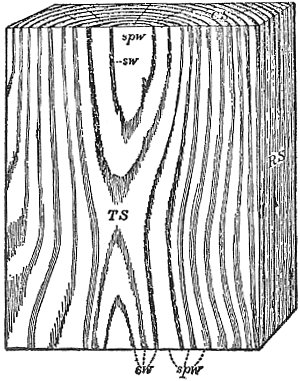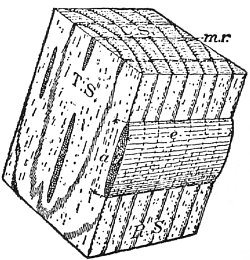
Fig. 4. Block of Oak. CS,
cross-section; RS,
radial section; TS, tangential
section; mr,
medullary or pith ray;
a, height; b, width; and
e, length of pith ray.
On a cross-section of oak, the same arrangement of pith
and bark, of sapwood and heartwood, and the same disposition
of the wood in well-defined concentric or annual
rings occur, but the rings are marked by lines or rows of
conspicuous pores or openings, which occupy the greater
part of the spring-wood for each ring (see Fig. 4, also 6),
and are, in fact the hollows of vessels
through which the cut has been
made. On the radial section or
quarter-sawn board the several
layers appear as so many stripes
(see Fig. 5); on the tangential section
or "bastard" face patterns
similar to those mentioned for pine
wood are observed. But while the
patterns in hard pine are marked
by the darker summer-wood, and
are composed of plain, alternating
stripes of darker and lighter wood,
the figures in oak (and other broad-leaved
woods) are due chiefly to
the vessels, those of the spring-wood
in oak being the most
conspicuous (see Fig. 5). So that in an oak table, the
darker, shaded parts are the spring-wood, the lighter
unicolored parts the summer-wood. On closer examination
of the smooth cross-section of oak, the spring-wood
part of the ring is found to be formed in great part
of pores; large, round, or oval openings made by the cut
through long vessels. These are separated by a grayish
and quite porous tissue (see Fig. 6, A), which continues
here and there in the form of radial, often branched,
patches (not the pith rays) into and through the summer-wood
to the spring-wood of the next ring. The large
vessels of the spring-wood, occupying six to ten per cent
of the volume of a log in very good oak, and twenty-five
per cent or more in inferior and narrow-ringed timber,
are a very important feature, since it is evident that the
greater their share in the volume, the lighter and weaker
the wood. They are smallest near the pith, and grow
wider outward. They are wider in the stem than limb,
and seem to be of indefinite length, forming open channels,
in some cases probably as long
as the tree itself. Scattered
through the radiating gray
patches of porous wood are
vessels similar to those of the
spring-wood, but decidedly
smaller. These vessels are
usually fewer and larger near
the outer portions of the ring.
Their number and size can be
utilized to distinguish the oaks
classed as white oaks from
those classed as black and
red oaks. They are fewer and
larger in red oaks, smaller but
much more numerous in white
oaks. The summer-wood,
except for these radial, grayish patches, is dark colored and
firm. This firm portion, divided into bodies or strands by
these patches of porous wood, and also by fine, wavy, concentric
lines of short, thin-walled cells (see Fig. 6, A), consists
of thin-walled fibres (see Fig. 7, B), and is the chief element
of strength in oak wood. In good white oak it forms
one-half or more of the wood, if it cuts like horn, and the
cut surface is shiny, and of a deep chocolate brown color.
In very narrow-ringed wood and in inferior red oak it is
usually much reduced in quantity as well as quality. The
pith rays of the oak, unlike those of the coniferous woods,
are at least in part very large and conspicuous. (See Fig.
4; their height indicated by the letter a, and their width
by the letter b.) The large medullary rays of oak are
often twenty and more cells wide, and several hundred
cell rows in height, which amount
commonly to one or more inches.
These large rays are conspicuous
on all sections. They appear as
long, sharp, grayish lines on the
cross-sections; as short, thick lines,
tapering at each end, on the tangential
or "bastard" face, and as
broad, shiny bands, "the mirrors,"
on the radial section. In addition
to these coarse rays, there is also
a large number of small pith rays,
which can be seen only when magnified.
On the whole, the pith
rays form a much larger part of
the wood than might be supposed.
In specimens of good white oak it
has been found that they form
about sixteen to twenty-five per
cent of the wood.
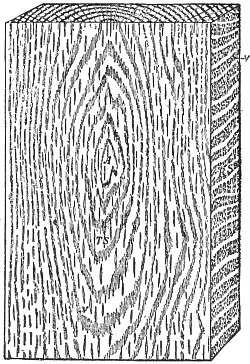
Fig. 5. Board of Oak. CS, cross-section; RS, radial section; TS, tangential
section; v, vessels or pores, cut through.; A, slight curve in log which
appears in section as an islet.
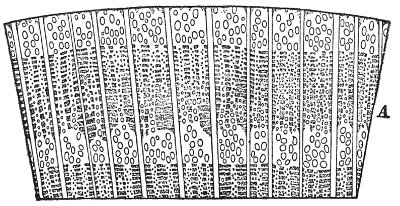
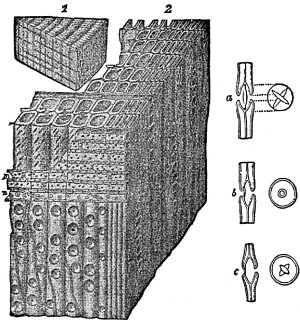
Fig. 6. Cross-section of Oak (Magnified about 5 times).
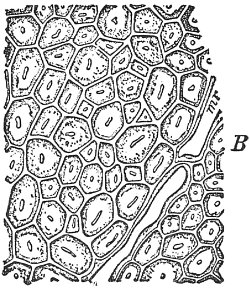
Fig. 7. Portion of the Firm Bodies
of Fibres with Two Cells of a
Small Pith Ray mr (Highly
Magnified).
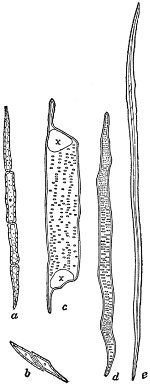
Fig. 8. Isolated Fibres and
Cells, a, four cells of
wood, parenchyma; b,
two cells from a pith ray;
c, a single joint or cell of
a vessel, the openings x
leading into its upper
and lower neighbors; d,
tracheid; e, wood fibre
proper.
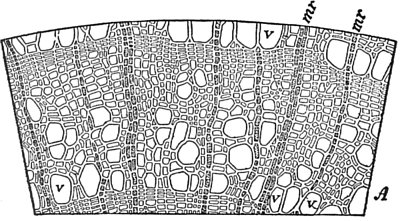
Fig. 9. Cross-section of Basswood (Magnified). v, vessels; mr, pith rays.
If a well-smoothed thin disk or
cross-section of oak (say one-sixteenth
inch thick) is held up to
the light, it looks very much like
a sieve, the pores or vessels appearing
as clean-cut holes. The
spring-wood and gray patches are
seen to be quite porous, but the
firm bodies of fibres between them
are dense and opaque. Examined
with a magnifier it will be noticed
that there is no such regularity of arrangement in straight
rows as is conspicuous in pine. On the contrary, great
irregularity prevails. At the same time, while the pores
are as large as pin holes, the cells of the denser wood,
unlike those of pine wood, are too small to be distinguished.
Studied with the microscope, each vessel is
found to be a vertical row of a great number of short,
wide tubes, joined end to end (see Fig. 8, c). The
porous spring-wood and radial gray tracts are partly
composed of smaller vessels, but chiefly of tracheids, like
those of pine, and of shorter cells, the "wood parenchyma,"
resembling the cells of the medullary rays. These latter,
as well as the fine concentric lines mentioned as occurring
in the summer-wood, are composed entirely of short tube-like
parenchyma cells, with square or oblique ends (see
Fig. 8, a and b). The wood fibres proper, which form the
dark, firm bodies referred to, are very fine, thread-like
cells, one twenty-fifth to one-tenth inch long, with a wall
commonly so thick that scarcely any empty internal space
or lumen remains (see Figs. 8, e, and 7, B). If, instead
of oak, a piece of poplar or basswood (see Fig. 9)
had been used in this study, the structure would have
been found to be quite different. The same kinds of cell-elements,
vessels, etc., are, to be sure, present, but their
combination and arrangement are different, and thus
from the great variety of possible combinations results
the great variety of structure and, in consequence, of
the qualities which distinguish the wood of broad-leaved
trees. The sharp distinction of sap wood and heartwood
is wanting; the rings are not so clearly defined; the vessels
of the wood are small, very numerous, and rather evenly
scattered through the wood of the annual rings, so that
the distinction of the ring almost vanishes and the medullary
or pith rays in poplar can be seen, without being
magnified, only on the radial section.
Woods of complex and very variable structure, and
therefore differing widely in quality, behavior, and consequently
in applicability to the arts.
1. Ailanthus (Ailanthus glandulosa). Medium to large-sized
tree. Wood pale yellow, hard, fine-grained, and
satiny. This species originally came from China,
where it is known as the Tree of "Heaven," was introduced
into the United States and planted near
Philadelphia during the 18th century, and is more
ornamental than useful. It is used to some extent
in cabinet work. Western Pennsylvania and Long
Island, New York.
Wood heavy, hard, stiff, quite tough, not durable in
contact with the soil, straight-grained, rough on the split
surfaces and coarse in texture. The wood shrinks moderately,
seasons with little injury, stands well, and takes a
good polish. In carpentry, ash is used for stairways,
panels, etc. It is used in shipbuilding, in the construction
of cars, wagons, etc., in the manufacture of all kinds of
farm implements, machinery, and especially of all kinds
of furniture; for cooperage, baskets, oars, tool handles,
hoops, etc., etc. The trees of the several species of ash
are rapid growers, of small to medium height with stout
trunks. They form no forests, but occur scattered in
almost all our broad-leaved forests.
2. White Ash (Fraxinus Americana). Medium-, sometimes
large-sized tree. Heartwood reddish brown,
usually mottled; sapwood lighter color, nearly white.
Wood heavy, hard, tough, elastic, coarse-grained,
compact structure. Annual rings clearly marked by
large open pores, not durable in contact with the
soil, is straight-grained, and the best material for oars,
etc. Used for agricultural implements, tool handles,
automobile (rim boards), vehicle bodies and parts,
baseball bats, interior finish, cabinet work, etc., etc.
Basin of the Ohio, but found from Maine to Minnesota
and Texas.
3. Red Ash (Fraxinus pubescens var. Pennsylvanica).
Medium-sized tree, a timber very similar to, but
smaller than Fraxinus Americana. Heartwood light
brown, sapwood lighter color. Wood heavy, hard,
strong, and coarse-grained. Ranges from New
Brunswick to Florida, and westward to Dakota,
Nebraska, and Kansas.
4. Black Ash (Fraxinus nigra var. sambucifolia) (Hoop
Ash, Ground Ash). Medium-sized tree, very common,
is more widely distributed than the Fraxinus Americana;
the wood is not so hard, but is well suited for
hoops and basketwork. Heartwood dark brown,
sapwood light brown or white. Wood heavy, rather
soft, tough and coarse-grained. Used for barrel
hoops, basketwork, cabinetwork and interior of
houses. Maine to Minnesota and southward to
Alabama.
5. Blue Ash (Fraxinus quadrangulata). Small to medium-sized
tree. Heartwood yellow, streaked with brown,
sapwood a lighter color. Wood heavy, hard, and
coarse-grained. Not common. Indiana and Illinois;
occurs from Michigan to Minnesota and southward
to Alabama.
6. Green Ash (Fraxinus viridis). Small-sized tree. Occurs
from New York to the Rocky Mountains, and
southward to Florida and Arizona.
7. Oregon Ash (Fraxinus Oregana). Small to medium-sized
tree. Occurs from western Washington to
California.
8. Carolina Ash (Fraxinus Caroliniana). Medium-sized
tree. Occurs in the Carolinas and the coast regions
southward.
9. Basswood (Tilia Americana) (Linden, Lime Tree,
American Linden, Lin, Bee Tree). Medium- to large-sized
tree. Wood light, soft, stiff, but not strong,
of fine texture, straight and close-grained, and white
to light brown color, but not durable in contact with
the soil. The wood shrinks considerably in drying,
works well and stands well in interior work. It is
used for cooperage, in carpentry, in the manufacture
of furniture and woodenware (both turned and carved),
for toys, also for panelling of car and carriage bodies,
for agricultural implements, automobiles, sides and
backs of drawers, cigar boxes, excelsior, refrigerators,
trunks, and paper pulp. It is also largely cut for
veneer and used as "three-ply" for boxes and chair
seats. It is used for sounding boards in pianos and
organs. If well seasoned and painted it stands fairly
well for outside work. Common in all northern
broad-leaved forests. Found throughout the eastern
United States, but reaches its greatest size in the
Valley of the Ohio, becoming often 130 feet in height,
but its usual height is about 70 feet.
10. White Basswood (Tilia heterophylla) (Whitewood).
A small-sized tree. Wood in its quality and uses
similar to the preceding, only it is lighter in color.
Most abundant in the Alleghany region.
11. White Basswood (Tilia pubescens) (Downy Linden,
Small-leaved Basswood). Small-sized tree. Wood
in its quality and uses similar to Tilia Americana.
This is a Southern species which makes it way as far
north as Long Island. Is found at its best in South
Carolina.
12. Beech (Fagus ferruginea) (Red Beech, White Beech).
Medium-sized tree, common, sometimes forming
forests of pure growth. Wood heavy, hard, stiff,
strong, of rather coarse texture, white to light brown
color, not durable in contact with the soil, and subject
to the inroads of boring insects. Rather close-grained,
conspicuous medullary rays, and when
quarter-sawn and well smoothed is very beautiful.
The wood shrinks and checks considerably in drying,
works well and stands well, and takes a fine polish.
Beech is comparatively free from objectionable taste,
and finds a place in the manufacture of commodities
which come in contact with foodstuffs, such as lard
tubs, butter boxes and pails, and the beaters of ice
cream freezers; for the latter the persistent hardness
of the wood when subjected to attrition and abrasion,
while wet gives it peculiar fitness. It is an excellent
material for churns. Sugar hogsheads are made of
beech, partly because it is a tasteless wood and partly
because it has great strength. A large class of woodenware,
including veneer plates, dishes, boxes, paddles,
scoops, spoons, and beaters, which belong to the
kitchen and pantry, are made of this species of wood.
Beech picnic plates are made by the million, a single
machine turning out 75,000 a day. The wood has
a long list of miscellaneous uses and enters in
a great variety of commodities. In every region
where it grows in commercial quantities it is made
into boxes, baskets, and crating. Beech baskets are
chiefly employed in shipping fruit, berries, and vegetables.
In Maine thin veneer of beech is made
specially for the Sicily orange and lemon trade. This
is shipped in bulk and the boxes are made abroad.
Beech is also an important handle wood, although
not in the same class with hickory. It is not selected
because of toughness and resiliency, as hickory is,
and generally goes into plane, handsaw, pail, chisel,
and flatiron handles. Recent statistics show that
in the production of slack cooperage staves, only
two woods, red gum and pine, stood above beech in
quantity, while for heading, pine alone exceeded it.
It is also used in turnery, for shoe lasts, butcher
blocks, ladder rounds, etc. Abroad it is very extensively
used by the carpenter, millwright, and wagon
maker, in turnery and wood carving. Most abundant
in the Ohio and Mississippi basin, but found from
Maine to Wisconsin and southward to Florida.
13. Cherry Birch (Betula lenta) (Black Birch, Sweet Birch,
Mahogany Birch, Wintergreen Birch). Medium-sized
tree, very common. Wood of beautiful reddish
or yellowish brown, and much of it nicely figured,
of compact structure, is straight in grain, heavy,
hard, strong, takes a fine polish, and considerably used
as imitation of mahogany. The wood shrinks considerably
in drying, works well and stands well, but
is not durable in contact with the soil. The medullary
rays in birch are very fine and close and not
easily seen. The sweet birch is very handsome, with
satiny luster, equalling cherry, and is too costly a
wood to be profitably used for ordinary purposes,
but there are both high and low grades of birch, the
latter consisting chiefly of sapwood and pieces too
knotty for first class commodities. This cheap material
swells the supply of box lumber, and a little of
it is found wherever birch passes through sawmills.
The frequent objections against sweet birch as box
lumber and crating material are that it is hard to
nail and is inclined to split. It is also used for veneer
picnic plates and butter dishes, although it is not
as popular for this class of commodity as are yellow
and paper birch, maple and beech. The best grades
are largely used for furniture and cabinet work, and
also for interior finish. Maine to Michigan and to
Tennessee.
14. White Birch (Betula populifolia) (Gray Birch, Old
Field Birch, Aspen-leaved Birch). Small to medium-sized
tree, least common of all the birches. Short-lived,
twenty to thirty feet high, grows very rapidly.
Heartwood light brown, sapwood lighter color. Wood
light, soft, close-grained, not strong, checks badly
in drying, decays quickly, not durable in contact
with the soil, takes a good polish. Used for spools,
shoepegs, wood pulp, and barrel hoops. Fuel, value
not high, but burns with bright flame. Ranges from
Nova Scotia and lower St. Lawrence River, southward,
mostly in the coast region to Delaware, and
westward through northern New England and New
York to southern shore of Lake Ontario.
15. Yellow Birch (Betula lutea) (Gray Birch, Silver Birch).
Medium- to large-sized tree, very common. Heartwood
light reddish brown, sapwood nearly white,
close-grained, compact structure, with a satiny luster.
Wood heavy, very strong, hard, tough, susceptible
of high polish, not durable when exposed. Is similar
to Betula lenta, and finds a place in practically all
kinds of woodenware. A large percentage of broom
handles on the market are made of this species of
wood, though nearly every other birch contributes
something. It is used for veneer plates and dishes
made for pies, butter, lard, and many other commodities.
Tubs and pails are sometimes made of
yellow birch provided weight is not objectionable.
The wood is twice as heavy as some of the pines and
cedars. Many small handles for such articles as
flatirons, gimlets, augers, screw drivers, chisels, varnish
and paint brushes, butcher and carving knives,
etc. It is also widely used for shipping boxes, baskets,
and crates, and it is one of the stiffest, strongest
woods procurable, but on account of its excessive
weight it is sometimes discriminated against. It
is excellent for veneer boxes, and that is probably
one of the most important places it fills. Citrus
fruit from northern Africa and the islands and countries
of the Mediterranean is often shipped to market
in boxes made of yellow birch from veneer cut in
New England. The better grades are also used for
furniture and cabinet work, and the "burls" found
on this species are highly valued for making fancy
articles, gavels, etc. It is extensively used for turnery,
buttons, spools, bobbins, wheel hubs, etc. Maine
to Minnesota and southward to Tennessee.
16. Red Birch (Betula rubra var. nigra) (River Birch).
Small to medium-sized tree, very common. Lighter
and less valuable than the preceding. Heartwood
light brown, sapwood pale. Wood light, fairly strong
and close-grained. Red birch is best developed in
the middle South, and usually grows near the banks
of rivers. Its bark hangs in tatters, even worse than
that of paper birch, but it is darker. In Tennessee
the slack coopers have found that red birch makes
excellent barrel heads and it is sometimes employed
in preference to other woods. In eastern Maryland
the manufacturers of peach baskets draw their supplies
from this wood, and substitute it for white elm
in making the hoops or bands which stiffen the top
of the basket, and provide a fastening for the veneer
which forms the sides. Red birch bends in a very
satisfactory manner, which is an important point.
This wood enters pretty generally into the manufacture
of woodenware within its range, but statistics
do not mention it by name. It is also used in the
manufacture of veneer picnic plates, pie plates, butter
dishes, washboards, small handles, kitchen and pantry
utensils, and ironing boards. New England to Texas
and Missouri.
17. Canoe Birch (Betula paprifera) (White Birch, Paper
Birch). Small to medium-sized tree, sometimes forming
forests, very common. Heartwood light brown
tinged with red, sapwood lighter color. Wood of
good quality, but light, fairly hard and strong, tough,
close-grained. Sap flows freely in spring and by
boiling can be made into syrup. Not as valuable as
any of the preceding. Canoe birch is a northern
tree, easily identified by its white trunk and its ragged
bark. Large numbers of small wooden boxes are
made by boring out blocks of this wood, shaping
them in lathes, and fitting lids on them. Canoe
birch is one of the best woods for this class of commodities,
because it can be worked very thin, does
not split readily, and is of pleasing color. Such boxes,
or two-piece diminutive kegs, are used as containers
for articles shipped and sold in small bulk, such as
tacks, small nails, and brads. Such containers are
generally cylindrical and of considerably greater depth
than diameter. Many others of nearly similar form
are made to contain ink bottles, bottles of perfumery,
drugs, liquids, salves, lotions, and powders of many
kinds. Many boxes of this pattern are used by
manufacturers of pencils and crayons for packing
and shipping their wares. Such boxes are made in
numerous numbers by automatic machinery. A
single machine of the most improved pattern will
turn out 1,400 boxes an hour. After the boring and
turning are done, they are smoothed by placing them
into a tumbling barrel with soapstone. It is also
used for one-piece shallow trays or boxes, without
lids, and used as card receivers, pin receptacles,
butter boxes, fruit platters, and contribution plates
in churches. It is also the principal wood used for
spools, bobbins, bowls, shoe lasts, pegs, and turnery,
and is also much used in the furniture trade. All
along the northern boundary of the United States
and northward, from the Atlantic to the Pacific.
18. Blue Beech (Carpinus Caroliniana) (Hornbeam, Water
Beech, Ironwood). Small-sized tree. Heartwood
light brown, sapwood nearly white. Wood very hard,
heavy, strong, very stiff, of rather fine texture, not
durable in contact with the soil, shrinks and checks
considerably in drying, but works well and stands
well, and takes a fine polish. Used chiefly in turnery,
for tool handles, etc. Abroad much used by mill-
and wheelwrights. A small tree, largest in the Southwest,
but found in nearly all parts of the eastern
United States.
Wood light, soft, not strong, often quite tough, of fine,
uniform texture and creamy white color. It shrinks considerably
in drying, but works well and stands well. Used
for woodenware, artificial limbs, paper pulp, and locally
also for building construction.
19. Ohio Buckeye (Æsculus glabra) (Horse Chestnut,
Fetid Buckeye). Small-sized tree, scattered, never
forming forests. Heartwood white, sapwood pale
brown. Wood light, soft, not strong, often quite
tough and close-grained. Alleghanies, Pennsylvania
to Oklahoma.
20. Sweet Buckeye (Æsculus octandra var. flava) (Horse
Chestnut). Small-sized tree, scattered, never forming
forests. Wood in its quality and uses similar to
the preceding. Alleghanies, Pennsylvania to Texas.
21. Buckthorne (Rhanmus Caroliniana) (Indian Cherry).
Small-sized tree. Heartwood light brown, sapwood
almost white. Wood light, hard, close-grained. Does
not enter the markets to any great extent. Found
along the borders of streams in rich bottom lands.
Its northern limits is Long Island, where it is only
a shrub; it becomes a tree only in southern Arkansas
and adjoining regions.
22. Butternut (Juglans cinerea) (White Walnut, White
Mahogany, Walnut). Medium-sized tree, scattered,
never forming forests. Wood very similar to black
walnut, but light, quite soft, and not strong. Heartwood
light gray-brown, darkening with exposure;
sapwood nearly white, coarse-grained, compact structure,
easily worked, and susceptible to high polish.
Has similar grain to black walnut and when stained
is a very good imitation. Is much used for inside
work, and very durable. Used chiefly for finishing
lumber, cabinet work, boat finish and fixtures, and
for furniture. Butternut furniture is often sold as
circassian walnut. Largest and most common in the
Ohio basin. Maine to Minnesota and southward
to Georgia and Alabama.
The catalpa is a tree which was planted about 25 years
ago as a commercial speculation in Iowa, Kansas, and
Nebraska. Its native habitat was along the rivers Ohio
and lower Wabash, and a century ago it gained a reputation
for rapid growth and durability, but did not grow
in large quantities. As a railway tie, experiments have
left no doubt as to its resistance to decay; it stands abrasion
as well as the white oak (Quercus alba), and is
superior to it in longevity. Catalpa is a tree singularly
free from destructive diseases. Wood cut from the living
tree is one of the most durable timbers known. In spite
of its light porous structure it resists the weathering influences
and the attacks of wood-destroying fungi to a
remarkable degree. No fungus has yet been found which
will grow in the dead timber, and for fence posts this wood
has no equal, lasting longer than almost any other species
of timber. The wood is rather soft and coarse in texture,
the tree is of slow growth, and the brown colored heartwood,
even of very young trees, forms nearly three-quarters of
their volume. There is only about one-quarter inch of
sapwood in a 9-inch tree.
23. Catalpa (Catalpa speciosa var. bignonioides) (Indian
Bean). Medium-sized tree. Heartwood light brown,
sapwood nearly white. Wood light, soft, not strong,
brittle, very durable in contact with the soil, of coarse
texture. Used chiefly for railway ties, telegraph poles,
and fence posts, but well suited for a great variety of
uses. Lower basin of the Ohio River, locally common.
Extensively planted, and therefore promising
to become of some importance.
24. Cherry (Prunus serotina) (Wild Cherry, Black Cherry,
Rum Cherry). Wood heavy, hard, strong, of fine
texture. Sapwood yellowish white, heartwood reddish
to brown. The wood shrinks considerably in drying,
works well and stands well, has a fine satin-like luster,
and takes a fine polish which somewhat resembles
mahogany, and is much esteemed for its beauty.
Cherry is chiefly used as a decorative interior finishing
lumber, for buildings, cars and boats, also for
furniture and in turnery, for musical instruments,
walking sticks, last blocks, and woodenware. It is
becoming too costly for many purposes for which it
is naturally well suited. The lumber-furnishing
cherry of the United States, the wild black cherry,
is a small to medium-sized tree, scattered through
many of the broad-leaved trees of the western slope
of the Alleghanies, but found from Michigan to
Florida, and west to Texas. Other species of this
genus, as well as the hawthornes (Prunus cratoegus)
and wild apple (Pyrus), are not commonly offered in
the markets. Their wood is of the same character
as cherry, often finer, but in smaller dimensions.
25. Red Cherry (Prunus Pennsylvanica) (Wild Red Cherry,
Bird Cherry). Small-sized tree. Heartwood light
brown, sapwood pale yellow. Wood light, soft, and
close-grained. Uses similiar to the preceding, common
throughout the Northern States, reaching its
greatest size on the mountains of Tennessee.
The chestnut is a long-lived tree, attaining an age of
from 400 to 600 years, but trees over 100 years are usually
hollow. It grows quickly, and sprouts from a chestnut
stump (Coppice Chestnut) often attain a height of 8 feet
in the first year. It has a fairly cylindrical stem, and
often grows to a height of 100 feet and over. Coppice
chestnut, that is, chestnut grown on an old stump, furnishes
better timber for working than chestnut grown from the
nut, it is heavier, less spongy, straighter in grain, easier
to split, and stands exposure longer.
26. Chestnut (Castanea vulgaris var. Americana). Medium-
to large-sized tree, never forming forests. Wood
is light, moderately hard, stiff, elastic, not strong,
but very durable when in contact with the soil, of
coarse texture. Sapwood light, heartwood darker
brown, and is readily distinguishable from the sapwood,
which very early turns into heartwood. It
shrinks and checks considerably in drying, works
easily, stands well. The annual rings are very distinct,
medullary rays very minute and not visible to
the naked eye. Used in cooperage, for cabinetwork,
agricultural implements, railway ties, telegraph poles,
fence posts, sills, boxes, crates, coffins, furniture,
fixtures, foundation for veneer, and locally in heavy
construction. Very common in the Alleghanies. Occurs
from Maine to Michigan and southward to
Alabama.
27. Chestnut (Castanea dentata var. vesca). Medium-sized
tree, never forming forests, not common.
Heartwood brown color, sapwood lighter shade,
coarse-grained. Wood and uses similar to the preceding.
Occurs scattered along the St. Lawrence River,
and even there is met with only in small quantities.
28. Chinquapin (Castanea pumila). Medium- to small-sized
tree, with wood slightly heavier, but otherwise
similiar to the preceding. Most common in Arkansas,
but with nearly the same range as Castanea vulgaris.
29. Chinquapin (Castanea chrysophylla). A medium-sized
tree of the western ranges of California and Oregon.
30. Coffee Tree (Gymnocladus dioicus) (Coffee Nut,
Stump Tree). A medium- to large-sized tree, not
common. Wood heavy, hard, strong, very stiff, of
coarse texture, and durable. Sapwood yellow, heartwood
reddish brown, shrinks and checks considerably
in drying, works well and stands well, and takes a
fine polish. It is used to a limited extent in cabinetwork
and interior finish. Pennsylvania to Minnesota
and Arkansas.
31. Crab Apple (Pyrus coronaria) (Wild Apple, Fragrant
Crab). Small-sized tree. Heartwood reddish brown,
sapwood yellow. Wood heavy, hard, not strong,
close-grained. Used principally for tool handles and
small domestic articles. Most abundant in the middle
and western states, reaches its greatest size in the
valleys of the lower Ohio basin.
32. Dogwood (Cornus florida) (American Box). Small to
medium-sized tree. Attains a height of about 30
feet and about 12 inches in diameter. The heartwood
is a red or pinkish color, the sapwood, which is
considerable, is a creamy white. The wood has a
dull surface and very fine grain. It is valuable for
turnery, tool handles, and mallets, and being so free
from silex, watchmakers use small splinters of it for
cleaning out the pivot holes of watches, and opticians
for removing dust from deep-seated lenses. It is
also used for butchers' skewers, and shuttle blocks
and wheel stock, and is suitable for turnery and inlaid
work. Occurs scattered in all the broad-leaved forests
of our country; very common.
Wood heavy, hard, strong, elastic, very tough, moderately
durable in contact with the soil, commonly cross-grained,
difficult to split and shape, warps and checks
considerably in drying, but stands well if properly seasoned.
The broad sapwood whitish, heartwood light brown, both
with shades of gray and red. On split surfaces rough,
texture coarse to fine, capable of high polish. Elm for
years has been the principal wood used in slack cooperage
for barrel staves, also in the construction of cars, wagons,
etc., in boat building, agricultural implements and machinery,
in saddlery and harness work, and particularly
in the manufacture of all kinds of furniture, where
the beautiful figures, especially those of the tangential or
bastard section, are just beginning to be appreciated.
The elms are medium- to large-sized trees, of fairly rapid
growth, with stout trunks; they form no forests of pure
growth, but are found scattered in all the broad-leaved
woods of our country, sometimes forming a considerable
portion of the arborescent growth.
33. White Elm (Ulmus Americana) (American Elm, Water
Elm). Medium- to large-sized tree. Wood in its
quality and uses as stated above. Common. Maine
to Minnesota, southward to Florida and Texas.
34. Rock Elm (Ulmus racemosa) (Cork Elm, Hickory Elm,
White Elm, Cliff Elm). Medium- to large-sized tree
of rapid growth. Heartwood light brown, often
tinged with red, sapwood yellowish or greenish white,
compact structure, fibres interlaced. Wood heavy,
hard, very tough, strong, elastic, difficult to split,
takes a fine polish. Used for agricultural implements,
automobiles, crating, boxes, cooperage, tool
handles, wheel stock, bridge timbers, sills, interior
finish, and maul heads. Fairly free from knots and
has only a small quantity of sapwood. Michigan,
Ohio, from Vermont to Iowa, and southward to
Kentucky.
35. Red Elm (Ulmus fulva var. pubescens) (Slippery Elm,
Moose Elm). The red or slippery elm is not as large
a tree as the white elm (Ulmus Americana), though
it occasionally attains a height of 135 feet and a diameter
of 4 feet. It grows tall and straight, and
thrives in river valleys. The wood is heavy, hard,
strong, tough, elastic, commonly cross-grained, moderately
durable in contact with the soil, splits easily
when green, works fairly well, and stands well if
properly handled. Careful seasoning and handling
are essential for the best results. Trees can be
utilized for posts when very small. When green the
wood rots very quickly in contact with the soil.
Poles for posts should be cut in summer and peeled
and dried before setting. The wood becomes very
tough and pliable when steamed, and is of value for
sleigh runners and for ribs of canoes and skiffs. Together
with white elm (Ulmus Americana) it is extensively
used for barrel staves in slack cooperage
and also for furniture. The thick, viscous inner
bark, which gives the tree its descriptive name, is
quite palatable, slightly nutritious, and has a medicinal
value. Found chiefly along water courses.
New York to Minnesota, and southward to Florida
and Texas.
36. Cedar Elm (Ulmus crassifolia). Medium- to small-sized
tree, locally quite common. Arkansas and
Texas.
37. Winged Elm (Ulmus alata) (Wahoo). Small-sized
tree, locally quite common. Heartwood light brown,
sapwood yellowish white. Wood heavy, hard, tough,
strong, and close-grained. Arkansas, Missouri, and
eastern Virginia.
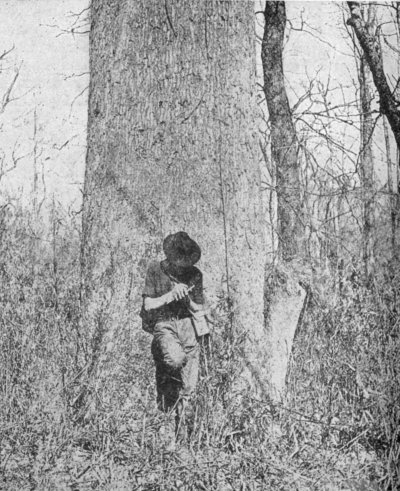
Fig. 10. A Large Red Gum.
This general term applies to three important species
of gum in the South, the principal one usually being distinguished
as "red" or "sweet" gum (see Fig. 10).
The next in importance being the "tupelo" or "bay poplar,"
and the least of the trio is designated as "black" or
"sour" gum (see Fig. 11). Up to the year 1900 little
was known of gum as a wood for cooperage purposes, but
by the continued advance in price of the woods used, a
few of the most progressive manufacturers, looking into
the future, saw that the supply of the various woods in
use was limited, that new woods would have to be sought,
and gum was looked upon as a possible substitute, owing
to its cheapness and abundant supply. No doubt in the
future this wood will be used to a considerable extent in
the manufacture of both "tight" and "slack" cooperage.
In the manufacture of the gum, unless the knives and
saws are kept very sharp, the wood has a tendency to
break out, the corners splitting off; and also, much difficulty
has been experienced in seasoning and kiln-drying.
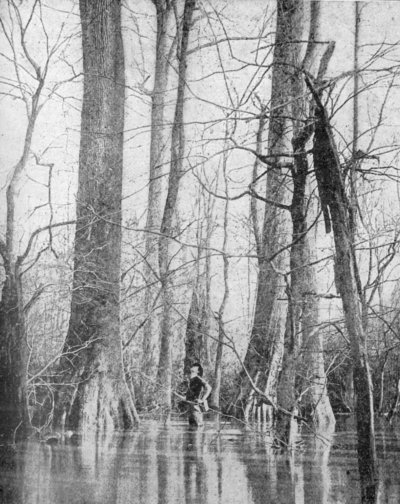
Fig. 11. A Tupelo Gum Slough.
In the past, gum, having no marketable value, has been
left standing after logging operations, or, where the land
has been cleared for farming, the trees have been "girdled"
and allowed to rot, and then felled and burned as trash.
Now, however, that there is a market for this species of
timber, it will be profitable to cut the gum with the other
hardwoods, and this species of wood will come in for a
greater share of attention than ever before.
38. Red Gum (Liquidamber styraciflua) (Sweet Gum,
Hazel Pine, Satin Walnut, Liquidamber, Bilsted).
The wood is about as stiff and as strong as chestnut,
rather heavy, it splits easily and is quite brash, commonly
cross-grained, of fine texture, and has a large
proportion of whitish sapwood, which decays rapidly
when exposed to the weather; but the reddish brown
heartwood is quite durable, even in the ground. The
external appearance of the wood is of fine grain and
smooth, close texture, but when broken the lines of
fracture do not run with apparent direction of the
growth; possibly it is this unevenness of grain which
renders the wood so difficult to dry without twisting
and warping. It has little resiliency; can be easily
bent when steamed, and when properly dried will
hold its shape. The annual rings are not distinctly
marked, medullary rays fine and numerous. The
green wood contains much water, and consequently is
heavy and difficult to float, but when dry it is as light
as basswood. The great amount of water in the
green wood, particularly in the sap, makes it difficult
to season by ordinary methods without warping and
twisting. It does not check badly, is tasteless and
odorless, and when once seasoned, swells and shrinks
but little unless exposed to the weather. Used for
boat finish, veneers, cabinet work, furniture, fixtures,
interior decoration, shingles, paving blocks, woodenware,
cooperage, machinery frames, refrigerators, and
trunk slats.
Red gum is distributed from Fairfield County, Conn.,
to southeastern Missouri, through Arkansas and Oklahoma
to the valley of the Trinity River in Texas,
and eastward to the Atlantic coast. Its commercial
range is restricted, however, to the moist lands of
the lower Ohio and Mississippi basins and of the Southeastern
coast. It is one of the commonest timber trees
in the hardwood bottoms and drier swamps of the South.
It grows in mixture with ash, cottonwood and oak (see
Fig. 12). It is also found to a considerable extent on
the lower ridges and slopes of the southern Appalachians,
but there it does not reach merchantable value and is of
little importance. Considerable difference is found between
the growth in the upper Mississippi bottoms and
that along the rivers on the Atlantic coast and on the
Gulf. In the latter regions the bottoms are lower, and
consequently more subject to floods and to continued
overflows (see Fig. 11). The alluvial deposit is also greater,
and the trees grow considerably faster. Trees of the same
diameter show a larger percentage of sapwood there than
in the upper portions of the Mississippi Valley. The
Mississippi Valley hardwood trees are for the most part
considerably older, and reach larger dimensions than the
timber along the coast.
In the best situations red gum reaches a height of 150
feet, and a diameter of 5 feet. These dimensions, however
are unusual. The stem is straight and cylindrical,
with dark, deeply-furrowed bark, and branches often
winged with corky ridges. In youth, while growing vigorously
under normal conditions, it assumes a long, regular,
conical crown, much resembling the form of a conifer
(see Fig. 12). After the tree has attained its height
growth, however, the crown becomes rounded, spreading
and rather ovate in shape. When growing in the forest
the tree prunes itself readily at an early period, and forms
a good length of clear stem, but it branches strongly after
making most of its height growth. The mature tree is
usually forked, and the place where the forking commences
determines the number of logs in the tree or its merchantable
length, by preventing cutting to a small diameter in
the top. On large trees the stem is often not less than
eighteen inches in diameter where the branching begins.
The over-mature tree is usually broken and dry topped,
with a very spreading crown, in consequence of new
branches being sent out.
Throughout its entire life red gum is intolerant in shade,
there are practically no red seedlings under the dense
forest cover of the bottom land, and while a good many
may come up under the pine forest on the drier uplands,
they seldom develop into large trees. As a rule seedlings
appear only in clearings or in open spots in the forest. It
is seldom that an over-topped tree is found, for the gum
dies quickly if suppressed, and is consequently nearly
always a dominant or intermediate tree. In a hardwood
bottom forest the timber trees are all of nearly the same
age over considerable areas, and there is little young
growth to be found in the older stands. The reason for
this is the intolerance of most of the swamp species. A
scale of intolerance containing the important species, and
beginning with the most light-demanding, would run as
follows: Cottonwood, sycamore, red gum, white elm,
white ash, and red maple.
While the red gum grows in various situations, it prefers
the deep, rich soil of the hardwood bottoms, and there
reaches its best development (see Fig. 10). It requires
considerable soil moisture, though it does not grow
in the wetter swamps, and does not thrive on dry pine land.
Seedlings, however, are often found in large numbers on
the edges of the uplands and even on the sandy pine land,
but they seldom live beyond the pole stage. When they
do, they form small, scrubby trees that are of little value.
Where the soil is dry the tree has a long tap root. In the
swamps, where the roots can obtain water easily, the development
of the tap root is poor, and it is only moderate
on the glade bottom lands, where there is considerable
moisture throughout the year, but no standing water in
the summer months.
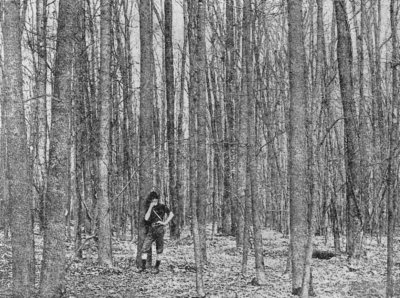
Fig. 12. Second Growth Red Gum, Ash, Cottonwood, and Sycamore.
Red gum reproduces both by seed and by sprouts
(see Fig. 12). It produces seed fairly abundantly every
year, but about once in three years there is an extremely
heavy production. The tree begins to bear seed when
twenty-five to thirty years old, and seeds vigorously up
to an age of one hundred and fifty years, when its productive
power begins to diminish. A great part of the
seed, however, is abortive. Red gum is not fastidious in
regard to its germinating bed; it comes up readily on sod
in old fields and meadows, on decomposing humus in the
forest, or on bare clay-loam or loamy sand soil. It requires
a considerable degree of light, however, and prefers
a moist seed bed. The natural distribution of the seed
takes place for several hundred feet from the seed trees,
the dissemination depending almost entirely on the wind.
A great part of the seed falls on the hardwood bottom when
the land is flooded, and is either washed away or, if already
in the ground and germinating, is destroyed by the long-continued
overflow. After germinating, the red gum
seedling demands, above everything else, abundant light
for its survival and development. It is for this reason
that there is very little growth of red gum, either in the
unculled forest or on culled land, where, as is usually the
case, a dense undergrowth of cane, briers, and rattan is
present. Under the dense underbrush of cane and briers
throughout much of the virgin forest, reproduction of any
of the merchantable species is of course impossible. And
even where the land has been logged over, the forest is
seldom open enough to allow reproduction of cottonwood
and red gum. Where, however, seed trees are contiguous
to pastures or cleared land, scattered seedlings are found
springing up in the open, and where openings occur in the
forest, there are often large numbers of red gum seedlings,
the reproduction generally occurring in groups. But over
the greater part of the Southern hardwood bottom land
forest reproduction is very poor. The growth of red gum
during the early part of its life, and up to the time it
reaches a diameter of eight inches breast-high, is extremely
rapid, and, like most of the intolerant species, it attains
its height growth at an early period. Gum sprouts readily
from the stump, and the sprouts surpass the seedlings in
rate of height growth for the first few years, but they seldom
form large timber trees. Those over fifty years of
age seldom sprout. For this reason sprout reproduction
is of little importance in the forest. The principal requirements
of red gum, then, are a moist, fairly rich soil
and good exposure to light. Without these it will not
reach its best development.
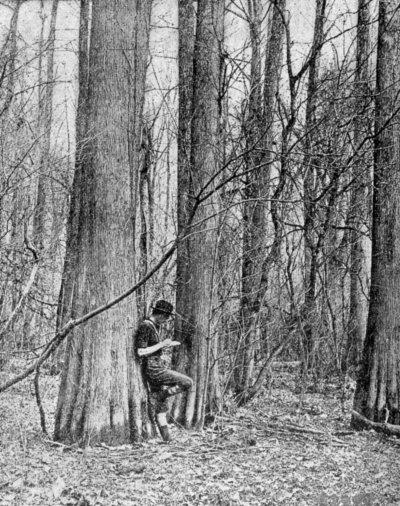
Fig. 13. A Cypress Slough in the Dry Season.
Second-growth red gum occurs to any considerable extent
only on land which has been thoroughly cleared.
Throughout the South there is a great deal of land which
was in cultivation before the Civil War, but which during
the subsequent period of industrial depression was abandoned
and allowed to revert to forest. These old fields
now mostly covered with second-growth forest, of
which red gum forms an important part (see Fig. 12).
Frequently over fifty per cent of the stand consists of this
species, but more often, and especially on the Atlantic
coast, the greater part is of cottonwood or ash. These
stands are very dense, and the growth is extremely rapid.
Small stands of young growth are also often found along
the edges of cultivated fields. In the Mississippi Valley
the abandoned fields on which young stands have sprung
up are for the most part being rapidly cleared again. The
second growth here is considered of little value in comparison
with the value of the land for agricultural purposes.
In many cases, however, the farm value of the land is not
at present sufficient to make it profitable to clear it, unless
the timber cut will at least pay for the operation. There
is considerable land upon which the second growth will
become valuable timber within a few years. Such land
should not be cleared until it is possible to utilize the
timber.
39. Tupelo Gum (Nyssa aquatica) (Bay Poplar, Swamp
Poplar, Cotton Gum, Hazel Pine, Circassian Walnut,
Pepperidge, Nyssa). The close similarity which exists
between red and tupelo gum, together with the
fact that tupelo is often cut along with red gum, and
marketed with the sapwood of the latter, makes it
not out of place to give consideration to this timber.
The wood has a fine, uniform texture, is moderately
hard and strong, is stiff, not elastic, very tough and
hard to split, but easy to work with tools. Tupelo
takes glue, paint, or varnish well, and absorbs very
little of the material. In this respect it is equal to
yellow poplar and superior to cottonwood. The
wood is not durable in contact with ground, and requires
much care in seasoning. The distinction between
the heartwood and sapwood of this species is
marked. The former varies in color from a dull gray
to a dull brown; the latter is whitish or light yellow
like that of poplar. The wood is of medium weight,
about thirty-two pounds per cubic foot when dry, or
nearly that of red gum and loblolly pine. After
seasoning it is difficult to distinguish the better grades
of sapwood from poplar. Owing to the prejudice
against tupelo gum, it was until recently marketed
under such names as bay poplar, swamp poplar, nyssa,
cotton gum, circassian walnut, and hazel pine. Since
it has become evident that the properties of the wood
fit it for many uses, the demand for tupelo has largely
increased, and it is now taking rank with other standard
woods under its rightful name. Heretofore the
quality and usefulness of this wood were greatly
underestimated, and the difficulty of handling it was
magnified. Poor success in seasoning and kiln-drying
was laid to defects of the wood itself, when, as a
matter of fact, the failures were largely due to the
absence of proper methods in handling. The passing
of this prejudice against tupelo is due to a better
understanding of the characteristics and uses of the
wood. Handled in the way in which its particular
character demands, tupelo is a wood of much value.
Tupelo gum is now used in slack cooperage, principally
for heading. It is used extensively for house flooring and
inside finishing, such as mouldings, door jambs, and casings.
A great deal is now shipped to European countries, where
it is highly valued for different classes of manufacture.
Much of the wood is used in the manufacture of boxes, since
it works well upon rotary veneer machines. There is also
an increasing demand for tupelo for laths, wooden pumps,
violin and organ sounding boards, coffins, mantelwork,
conduits and novelties. It is also used in the furniture
trade for backing, drawers, and panels.
Tupelo occurs throughout the coastal region of the Atlantic
States, from southern Virginia to northern Florida,
through the Gulf States to the valley of the Nueces River
in Texas, through Arkansas and southern Missouri to
western Kentucky and Tennessee, and to the valley of
the lower Wabash River. Tupelo is being extensively
milled at present only in the region adjacent to Mobile
Ala., and in southern and central Louisiana, where it
occurs in large merchantable quantities, attaining its
best development in the former locality. The country
in this locality is very swampy (see Fig. 11), and within
a radius of one hundred miles tupelo gum is one of the
principal timber trees. It grows only in the swamps and
wetter situations (see Fig. 11), often in mixture with
cypress, and in the rainy season it stands in from two to
twenty feet of water.
40. Black Gum (Nyssa sylvatica) (Sour Gum). Black
gum is not cut to much extent, owing to its less abundant
supply and poorer quality, but is used for repair
work on wagons, for boxes, crates, wagon hubs,
rollers, bowls, woodenware, and for cattle yokes and
other purposes which require a strong, non-splitting
wood. Heartwood is light brown in color, often
nearly white; sapwood hardly distinguishable, fine
grain, fibres interwoven. Wood is heavy, not hard,
difficult to work, strong, very tough, checks and
warps considerably in drying, not durable. It is
distributed from Maine to southern Ontario, through
central Michigan to southeastern Missouri, southward
to the valley of the Brazos River in Texas, and
eastward to the Kissimmee River and Tampa Bay
in Florida. It is found in the swamps and hardwood
bottoms, but is more abundant and of better size on the
slightly higher ridges and hummocks in these swamps,
and on the mountain slopes in the southern Alleghany
region. Though its range is greater than that of
either red or tupelo gum, it nowhere forms an important
part of the forest.
41. Hackberry (Celtis occidentalis) (Sugar Berry, Nettle
Tree). The wood is handsome, heavy, hard, strong,
quite tough, of moderately fine texture, and greenish
or yellowish color, shrinks moderately, works well
and stands well, and takes a good polish. Used to
some extent in cooperage, and in the manufacture of
cheap furniture. Medium- to large-sized tree, locally
quite common, largest in the lower Mississippi Valley.
Occurs in nearly all parts of the eastern United States.
The hickories of commerce are exclusively North American
and some of them are large and beautiful trees of
60 to 70 feet or more in height. They are closely allied
to the walnut, and the wood is very like walnut in grain
and color, though of a somewhat darker brown. It is one
of the finest of American hardwoods in point of strength;
in toughness it is superior to ash, rather coarse in texture,
smooth and of straight grain, very heavy and strong as
well as elastic and tenacious, but decays rapidly, especially
the sapwood when exposed to damp and moisture, and
is very liable to attack from worms and boring insects.
The cross-section of hickory is peculiar, the annual rings
appear like fine lines instead of like the usual pores, and
the medullary rays, which are also very fine but distinct,
in crossing these form a peculiar web-like pattern which
is one of the characteristic differences between hickory
and ash. Hickory is rarely subjected to artificial treatment,
but there is this curious fact in connection with the
wood, that, contrary to most other woods, creosote is
only with difficulty injected into the sap, although there
is no difficulty in getting it into the heartwood. It dries
slowly, shrinks and checks considerably in seasoning; is not
durable in contact with the soil or if exposed. Hickory
excels as wagon and carriage stock, for hoops in cooperage,
and is extensively used in the manufacture of implements
and machinery, for tool handles, timber pins,
harness work, dowel pins, golf clubs, and fishing rods.
The hickories are tall trees with slender stems, never forming
forests, occasionally small groves, but usually occur
scattered among other broad-leaved trees in suitable localities.
The following species all contribute more or less
to the hickory of the markets:
42. Shagbark Hickory (Hicoria ovata) (Shellbark Hickory,
Scalybark Hickory). A medium- to large-sized
tree, quite common; the favorite among the hickories.
Heartwood light brown, sapwood ivory or cream-colored.
Wood close-grained, compact structure,
annual rings clearly marked. Very hard, heavy,
strong, tough, and flexible, but not durable in contact
with the soil or when exposed. Used for agricultural
implements, wheel runners, tool handles,
vehicle parts, baskets, dowel pins, harness work, golf
clubs, fishing rods, etc. Best developed in the Ohio
and Mississippi basins; from Lake Ontario to Texas,
Minnesota to Florida.
43. Mockernut Hickory (Hicoria alba) (Black Nut Hickory,
Black Hickory, Bull Nut Hickory, Big Bud
Hickory, White Heart Hickory). A medium- to large-sized
tree. Wood in its quality and uses similar to
the preceding. Its range is the same as that of
Hicoria ovata. Common, especially in the South.
44. Pignut Hickory (Hicoria glabra) (Brown Hickory,
Black Hickory, Switchbud Hickory). A medium- to
large-sized tree. Heavier and stronger than any
of the preceding. Heartwood light to dark brown,
sapwood nearly white. Abundant, all eastern United
States.
45. Bitternut Hickory (Hicoria minima) (Swamp Hickory).
A medium-sized tree, favoring wet localities.
Heartwood light brown, sapwood lighter color. Wood
in its quality and uses not so valuable as Hicoria
ovata, but is used for the same purposes. Abundant,
all eastern United States.
46. Pecan (Hicoria pecan) (Illinois Nut). A large tree,
very common in the fertile bottoms of the western
streams. Indiana to Nebraska and southward to
Louisiana and Texas.
47. Holly (Ilex opaca). Small to medium-sized tree.
Wood of medium weight, hard, strong, tough, of
exceedingly fine grain, closer in texture than most
woods, of white color, sometimes almost as white as
ivory; requires great care in its treatment to preserve
the whiteness of the wood. It does not readily
absorb foreign matter. Much used by turners and
for all parts of musical instruments, for handles on
whips and fancy articles, draught-boards, engraving
blocks, cabinet work, etc. The wood is often dyed
black and sold as ebony; works well and stands well.
Most abundant in the lower Mississippi Valley and
Gulf States, but occurring eastward to Massachusetts
and north to Indiana.
48. Holly (Ilex monticolo) (Mountain Holly). Small-sized
tree. Wood in its quality and uses similar to
the preceding, but is not very generally known. It
is found in the Catskill Mountains and extends southward
along the Alleghanies as far as Alabama.
49. Ironwood (Ostrya Virginiana) (Hop Hornbeam, Lever
Wood). Small-sized tree, common. Heartwood light
brown tinged with red, sapwood nearly white. Wood
heavy, tough, exceedingly close-grained, very strong
and hard, durable in contact with the soil, and will
take a fine polish. Used for small articles like levers,
handles of tools, mallets, etc. Ranges throughout
the United States east of the Rocky Mountains.
50. Laurel (Umbellularia Californica) (Myrtle). A Western
tree, produces timber of light brown color of great
size and beauty, and is very valuable for cabinet and
inside work, as it takes a fine polish. California and
Oregon, coast range of the Sierra Nevada Mountains.
51. Black Locust (Robinia pseudacacia) (Locust, Yellow
Locust, Acacia). Small to medium-sized tree. Wood
very heavy, hard, strong, and tough, rivalling some
of the best oak in this latter quality. The wood has
great torsional strength, excelling most of the soft
woods in this respect, of coarse texture, close-grained
and compact structure, takes a fine polish. Annual
rings clearly marked, very durable in contact with
the soil, shrinks and checks considerably in drying,
the very narrow sapwood greenish yellow, the heartwood brown,
with shades of red and green. Used
for wagon hubs, trenails or pins, but especially for
railway ties, fence posts, and door sills. Also used
for boat parts, turnery, ornamentations, and locally
for construction. Abroad it is much used for furniture
and farming implements and also in turnery. At
home in the Alleghany Mountains, extensively planted,
especially in the West.
52. Honey Locust (Gleditschia triacanthos) (Honey Shucks,
Locust, Black Locust, Brown Locust, Sweet Locust,
False Acacia, Three-Thorned Acacia). A medium-sized
tree. Wood heavy, hard, strong, tough, durable
in contact with the soil, of coarse texture, susceptible
to a good polish. The narrow sapwood yellow,
the heartwood brownish red. So far, but little appreciated
except for fences and fuel. Used to some
extent for wheel hubs, and locally in rough construction.
Found from Pennsylvania to Nebraska,
and southward to Florida and Texas; locally quite
abundant.
53. Locust (Robinia viscosa) (Clammy Locust). Usually
a shrub five or six feet high, but known to reach a
height of 40 feet in the mountains of North Carolina,
with the habit of a tree. Wood light brown, heavy,
hard, and close-grained. Not used to much extent
in manufacture. Range same as the preceding.
54. Magnolia (Magnolia glauca) (Swamp Magnolia, Small
Magnolia, Sweet Bay, Beaver Wood). Small-sized
tree. Heartwood reddish brown, sap wood cream
white. Sparingly used in manufacture. Ranges from
Essex County, Mass., to Long Island, N. Y., from
New Jersey to Florida, and west in the Gulf region
to Texas.
55. Magnolia (Magnolia tripetala) (Umbrella Tree). A
small-sized tree. Wood in its quality similiar to the
preceding. It may be easily recognized by its great
leaves, twelve to eighteen inches long, and five to
eight inches broad. This species as well as the preceding
is an ornamental tree. Ranges from Pennsylvania
southward to the Gulf.
56. Cucumber Tree (Magnolia accuminata) (Tulip-wood,
Poplar). Medium- to large-sized tree. Heartwood
yellowish brown, sapwood almost white. Wood light,
soft, satiny, close-grained, durable in contact with
the soil, resembling and sometimes confounded with
tulip tree (Liriodendron tulipifera) in the markets.
The wood shrinks considerably, but seasons without
much injury, and works and stands well. It bends
readily when steamed, and takes stain and paint well.
Used in cooperage, for siding, for panelling and finishing
lumber in house, car and shipbuilding, etc., also
in the manufacture of toys, culinary woodenware, and
backing for drawers. Most common in the southern
Alleghanies, but distributed from western New York
to southern Illinois, south through central Kentucky
and Tennessee to Alabama, and throughout
Arkansas.
Wood heavy, hard, strong, stiff, and tough, of fine
texture, frequently wavy-grained, this giving rise to
"curly" and "blister" figures which are much admired.
Not durable in the ground, or when exposed. Maple
is creamy white, with shades of light brown in the heartwood,
shrinks moderately, seasons, works, and stands well,
wears smoothly, and takes a fine polish. The wood is
used in cooperage, and for ceiling, flooring, panelling,
stairway, and other finishing lumber in house, ship, and
car construction. It is used for the keels of boats and ships,
in the manufacture of implements and machinery, but
especially for furniture, where entire chamber sets of
maple rival those of oak. Maple is also used for shoe
lasts and other form blocks; for shoe pegs; for piano
actions, school apparatus, for wood type in show bill
printing, tool handles, in wood carving, turnery, and
scroll work, in fact it is one of our most useful woods.
The maples are medium-sized trees, of fairly rapid growth,
sometimes form forests, and frequently constitute a large
proportion of the arborescent growth. They grow freely
in parts of the Northern Hemisphere, and are particularly
luxuriant in Canada and the northern portions of the
United States.
57. Sugar Maple (Acer saccharum) (Hard Maple, Rock
Maple). Medium- to large-sized tree, very common,
forms considerable forests, and is especially esteemed.
The wood is close-grained, heavy, fairly hard and
strong, of compact structure. Heartwood brownish,
sapwood lighter color; it can be worked to a satin-like
surface and take a fine polish, it is not durable
if exposed, and requires a good deal of seasoning.
Medullary rays small but distinct. The "curly"
or "wavy" varieties furnish wood of much beauty,
the peculiar contortions of the grain called "bird's
eye" being much sought after, and used as veneer for
panelling, etc. It is used in all good grades of furniture,
cabinetmaking, panelling, interior finish, and
turnery; it is not liable to warp and twist. It is also
largely used for flooring, for rollers for wringers and
mangling machines, for which there is a large and
increasing demand. The peculiarity known as "bird's
eye," and which causes a difficulty in working the
wood smooth, owing to the little pieces like knots
lifting up, is supposed to be due to the action of boring
insects. Its resistance to compression across the
grain is higher than that of most other woods. Ranges
from Maine to Minnesota, abundant, with birch, in
the region of the Great Lakes.
58. Red Maple (Acer rubrum) (Swamp Maple, Soft
Maple, Water Maple). Medium-sized tree. Like
the preceding but not so valuable. Scattered along
water-courses and other moist localities. Abundant.
Maine to Minnesota, southward to northern Florida.
59. Silver Maple (Acer saccharinum) (Soft Maple, White
Maple, Silver-Leaved Maple). Medium- to large-sized
tree, common. Wood lighter, softer, and inferior
to Acer saccharum, and usually offered in small
quantities and held separate in the markets. Heartwood
reddish brown, sapwood ivory white, fine-grained,
compact structure. Fibres sometimes
twisted, weaved, or curly. Not durable. Used in
cooperage for woodenware, turnery articles, interior
decorations and flooring. Valley of the Ohio, but
occurs from Maine to Dakota and southward to
Florida.
60. Broad-Leaved Maple (Acer macrophyllum) (Oregon
Maple). Medium-sized tree, forms considerable
forests, and, like the preceding has a lighter, softer,
and less valuable wood than Acer saccharum. Pacific
Coast regions.
61. Mountain Maple (Acer spicatum). Small-sized tree.
Heartwood pale reddish brown, sapwood lighter color.
Wood light, soft, close-grained, and susceptible of
high polish. Ranges from lower St. Lawrence River
to northern Minnesota and regions of the Saskatchewan
River; south through the Northern States and
along the Appalachian Mountains to Georgia.
62. Ash-Leaved Maple (Acer negundo) (Box Elder).
Medium- to large-sized tree. Heartwood creamy
white, sapwood nearly white. Wood light, soft, close-grained,
not strong. Used for woodenware and paper
pulp. Distributed across the continent, abundant
throughout the Mississippi Valley along banks of
streams and borders of swamps.
63. Striped Maple (Acer Pennsylvanicum) (Moose-wood).
Small-sized tree. Produces a very white wood much
sought after for inlaid and for cabinet work. Wood
is light, soft, close-grained, and takes a fine polish.
Not common. Occurs from Pennsylvania to Minnesota.
64. Red Mulberry (Morus rubra). A small-sized tree.
Wood moderately heavy, fairly hard and strong,
rather tough, of coarse texture, very durable in contact
with the soil. The sapwood whitish, heartwood
yellow to orange brown, shrinks and checks considerably
in drying, works well and stands well. Used
in cooperage and locally in construction, and in the
manufacture of farm implements. Common in the
Ohio and Mississippi Valleys, but widely distributed
in the eastern United States.
Wood very variable, usually very heavy and hard, very
strong and tough, porous, and of coarse texture. The
sapwood whitish, the heartwood "oak" to reddish brown.
It shrinks and checks badly, giving trouble in seasoning,
but stands well, is durable, and little subject to the attacks
of boring insects. Oak is used for many purposes,
and is the chief wood used for tight cooperage; it is used
in shipbuilding, for heavy construction, in carpentry, in
furniture, car and wagon work, turnery, and even in woodcarving.
It is also used in all kinds of farm implements,
mill machinery, for piles and wharves, railway ties, etc.,
etc. The oaks are medium- to large-sized trees, forming
the predominant part of a large proportion of our broad-leaved
forests, so that these are generally termed "oak
forests," though they always contain considerable proportion
of other kinds of trees. Three well-marked kinds—white,
red, and live oak—are distinguished and kept
separate in the markets. Of the two principal kinds
"white oak" is the stronger, tougher, less porous, and
more durable. "Red oak" is usually of coarser texture,
more porous, often brittle, less durable, and even more
troublesome in seasoning than white oak. In carpentry
and furniture work red oak brings the same price at present
as white oak. The red oaks everywhere accompany the
white oaks, and, like the latter, are usually represented
by several species in any given locality. "Live oak,"
once largely employed in shipbuilding, possesses all the
good qualities, except that of size, of white oak, even to
a greater degree. It is one of the heaviest, hardest, toughest,
and most durable woods of this country. In structure
it resembles the red oak, but is less porous.
65. White Oak (Quercus alba) (American Oak). Medium-
to large-sized tree. Heartwood light brown,
sapwood lighter color. Annual rings well marked,
medullary rays broad and prominent. Wood tough,
strong, heavy, hard, liable to check in seasoning,
durable in contact with the soil, takes a high polish,
very elastic, does not shrink much, and can be bent
to any form when steamed. Used for agricultural
implements, tool handles, furniture, fixtures, interior
finish, car and wagon construction, beams,
cabinet work, tight cooperage, railway ties, etc., etc.
Because of the broad medullary rays, it is generally
"quarter-sawn" for cabinet work and furniture.
Common in the Eastern States, Ohio and Mississippi
Valleys. Occurs throughout the eastern United
States.
66. White Oak (Quercus durandii). Medium- to small-sized
tree. Wood in its quality and uses similiar to
the preceding. Texas, eastward to Alabama.
67. White Oak (Quercus garryana) (Western White Oak).
Medium- to large-sized tree. Stronger, more durable,
and wood more compact than Quercus alba. Washington
to California.
68. White Oak (Quercus lobata). Medium- to large-sized
tree. Largest oak on the Pacific Coast. Wood in
its quality and uses similar to Quercus alba, only it
is finer-grained. California.
69. Bur Oak (Quercus macrocarpa) (Mossy-Cup Oak,
Over-Cup Oak). Large-sized tree. Heartwood "oak"
brown, sapwood lighter color. Wood heavy, strong,
close-grained, durable in contact with the soil.
Used in ship- and boatbuilding, all sorts of construction,
interior finish of houses, cabinet work,
tight cooperage, carriage and wagon work, agricultural
implements, railway ties, etc., etc. One of the most
valuable and most widely distributed of American
oaks, 60 to 80 feet in height, and, unlike most of the
other oaks, adapts itself to varying climatic conditions.
It is one of the most durable woods when in
contact with the soil. Common, locally abundant.
Ranges from Manitoba to Texas, and from the foot
hills of the Rocky Mountains to the Atlantic Coast.
It is the most abundant oak of Kansas and Nebraska,
and forms the scattered forests known as "The oak
openings" of Minnesota.
70. Willow Oak (Quercus phellos) (Peach oak). Small
to medium-sized tree. Heartwood pale reddish brown,
sapwood lighter color. Wood heavy, hard, strong,
coarse-grained. Occasionally used in construction.
New York to Texas, and northward to Kentucky.
71. Swamp White Oak (Quercus bicolor var. platanoides).
Large-sized tree. Heartwood pale brown, sapwood
the same color. Wood heavy, hard, strong, tough,
coarse-grained, checks considerably in seasoning.
Used in construction, interior finish of houses, carriage-
and boatbuilding, agricultural implements, in cooperage,
railway ties, fencing, etc., etc. Ranges from
Quebec to Georgia and westward to Arkansas. Never
abundant. Most abundant in the Lake States.
72. Over-Cup Oak (Quercus lyrata) (Swamp White Oak,
Swamp Post Oak). Medium to large-sized tree,
rather restricted, as it grows in the swampy districts
of Carolina and Georgia. Is a larger tree than most
of the other oaks, and produces an excellent timber,
but grows in districts difficult of access, and is not
much used. Lower Mississippi and eastward to
Delaware.
73. Pin Oak (Quercus palustris) (Swamp Spanish Oak,
Water Oak). Medium- to large-sized tree. Heartwood
pale brown with dark-colored sap wood. Wood
heavy, strong, and coarse-grained. Common along
the borders of streams and swamps, attains its greatest
size in the valley of the Ohio. Arkansas to Wisconsin,
and eastward to the Alleghanies.
74. Water Oak (Quercus aquatica) (Duck Oak, Possum
Oak). Medium- to large-sized tree, of extremely
rapid growth. Eastern Gulf States, eastward to
Delaware and northward to Missouri and Kentucky.
75. Chestnut Oak (Quercus prinus) (Yellow Oak, Rock
Oak, Rock Chestnut Oak). Heartwood dark brown,
sapwood lighter color. Wood heavy, hard, strong,
tough, close-grained, durable in contact with the soil.
Used for railway ties, fencing, fuel, and locally for
construction. Ranges from Maine to Georgia and
Alabama, westward through Ohio, and southward
to Kentucky and Tennessee.
76. Yellow Oak (Quercus acuminata) (Chestnut Oak,
Chinquapin Oak). Medium- to large-sized tree.
Heartwood dark brown, sapwood pale brown. Wood
heavy, hard, strong, close-grained, durable in contact
with the soil. Used in the manufacture of wheel
stock, in cooperage, for railway ties, fencing, etc.,
etc. Ranges from New York to Nebraska and eastern
Kansas, southward in the Atlantic region to the
District of Columbia, and west of the Alleghanies
southward to the Gulf States.
77. Chinquapin Oak (Quercus prinoides) (Dwarf Chinquapin
Oak, Scrub Chestnut Oak). Small-sized tree.
Heartwood light brown, sapwood darker color. Does
not enter the markets to any great extent. Ranges
from Massachusetts to North Carolina, westward to
Missouri, Nebraska, Kansas, and eastern Texas.
Reaches its best form in Missouri and Kansas.
78. Basket Oak (Quercus michauxii) (Cow Oak). Large-sized
tree. Locally abundant. Lower Mississippi
and eastward to Delaware.
79. Scrub Oak (Quercus ilicifolia var. pumila) (Bear Oak).
Small-sized tree. Heartwood light brown, sapwood
darker color. Wood heavy, hard, strong, and coarse-grained.
Found in New England and along the
Alleghanies.
80. Post Oak (Quercus obtusiloda var. minor) (Iron Oak).
Medium- to large-sized tree, gives timber of great
strength. The color is of a brownish yellow hue,
close-grained, and often superior to the white oak
(Quercus alba) in strength and durability. It is used
for posts and fencing, and locally for construction.
Arkansas to Texas, eastward to New England and
northward to Michigan.
81. Red Oak (Quercus rubra) (Black Oak). Medium- to
large-sized tree. Heartwood light brown to red, sapwood
lighter color. Wood coarse-grained, well-marked
annual rings, medullary rays few but broad. Wood
heavy, hard, strong, liable to check in seasoning.
It is found over the same range as white oak, and
is more plentiful. Wood is spongy in grain, moderately
durable, but unfit for work requiring strength.
Used for agricultural implements, furniture, bob
sleds, vehicle parts, boxes, cooperage, woodenware,
fixtures, interior finish, railway ties, etc., etc. Common
in all parts of its range. Maine to Minnesota,
and southward to the Gulf.
82. Black Oak (Quercus tinctoria var. velutina) (Yellow
Oak). Medium- to large-sized tree. Heartwood
bright brown tinged with red, sapwood lighter color.
Wood heavy, hard, strong, coarse-grained, checks
considerably in seasoning. Very common in the
Southern States, but occurring North as far as Minnesota,
and eastward to Maine.
83. Barren Oak (Quercus nigra var. marilandica) (Black
Jack, Jack Oak). Small-sized tree. Heartwood
dark brown, sapwood lighter color. Wood heavy,
hard, strong, coarse-grained, not valuable. Used
in the manufacture of charcoal and for fuel. New
York to Kansas and Nebraska, and southward to
Florida. Rare in the North, but abundant in the
South.
84. Shingle Oak (Quercus imbricaria) (Laurel Oak). Small
to medium-sized tree. Heartwood pale reddish
brown, sapwood lighter color. Wood heavy, hard,
strong, coarse-grained, checks considerably in drying.
Used for shingles and locally for construction.
Rare in the east, most abundant in the lower Ohio
Valley. From New York to Illinois and southward.
Reaches its greatest size in southern Illinois and
Indiana.
85. Spanish Oak (Quercus digitata var. falcata) (Red Oak).
Medium-sized tree. Heartwood light reddish brown,
sapwood much lighter. Wood heavy, hard, strong,
coarse-grained, and checks considerably in seasoning.
Used locally for construction, and has high fuel value.
Common in south Atlantic and Gulf region, but found
from Texas to New York, and northward to Missouri
and Kentucky.
86. Scarlet Oak (Quercus coccinea). Medium- to large-sized
tree. Heartwood light reddish-brown, sapwood
darker color. Wood heavy, hard, strong, and
coarse-grained. Best developed in the lower basin
of the Ohio, but found from Minnesota to Florida.
87. Live Oak (Quercus virens) (Maul Oak). Medium- to
large-sized tree. Grows from Maryland to the Gulf
of Mexico, and often attains a height of 60 feet and
4 feet in diameter. The wood is hard, strong, and
durable, but of rather rapid growth, therefore not
as good quality as Quercus alba. The live oak of
Florida is now reserved by the United States Government
for Naval purposes. Used for mauls and mallets,
tool handles, etc., and locally for construction.
Scattered along the coast from Maryland to Texas.
88. Live Oak (Quercus chrysolepis) (Maul Oak, Valparaiso
Oak). Medium- to small-sized tree. California.
89. Osage Orange (Maclura aurantiaca) (Bois d'Arc).
A small-sized tree of fairly rapid growth. Wood
very heavy, exceedingly hard, strong, not tough, of
moderately coarse texture, and very durable and
elastic. Sapwood yellow, heartwood brown on the
end face, yellow on the longitudinal faces, soon
turning grayish brown if exposed. It shrinks considerably
in drying, but once dry it stands unusually
well. Much used for wheel stock, and wagon framing;
it is easily split, so is unfit for wheel hubs, but is very
suitable for wheel spokes. It is considered one of
the timbers likely to supply the place of black locust
for insulator pins on telegraph poles. Seems too
little appreciated; it is well suited for turned ware
and especially for woodcarving. Used for spokes,
insulator pins, posts, railway ties, wagon framing,
turnery, and woodcarving. Scattered through the
rich bottoms of Arkansas and Texas.
90. Papaw (Asimina triloba) (Custard Apple). Small-sized
tree, often only a shrub, Heartwood pale,
yellowish green, sapwood lighter color. Wood light,
soft, coarse-grained, and spongy. Not used to any
extent in manufacture. Occurs in eastern and central
Pennsylvania, west as far as Michigan and Kansas,
and south to Florida and Texas. Often forming
dense thickets in the lowlands bordering the Mississippi
River.
91. Persimmon (Diospyros Virginiana). Small to medium-sized
tree. Wood very heavy, and hard, strong and
tough; resembles hickory, but is of finer texture and
elastic, but liable to split in working. The broad
sapwood cream color, the heartwood brown, sometimes
almost black. The persimmon is the Virginia
date plum, a tree of 30 to 50 feet high, and 18 to 20
inches in diameter; it is noted chiefly for its fruit,
but it produces a wood of considerable value. Used
in turnery, for wood engraving, shuttles, bobbins,
plane stock, shoe lasts, and largely as a substitute
for box (Buxus sempervirens)—especially the black
or Mexican variety,—also used for pocket rules and
drawing scales, for flutes and other wind instruments.
Common, and best developed in the lower
Ohio Valley, but occurs from New York to Texas
and Missouri.
Wood light, very soft, not strong, of fine texture, and
whitish, grayish to yellowish color, usually with a satiny
luster. The wood shrinks moderately (some cross-grained
forms warp excessively), but checks very little in seasoning;
is easily worked, but is not durable. Used in cooperage,
for building and furniture lumber, for crates and
boxes (especially cracker boxes), for woodenware, and
paper pulp.
92. Cottonwood (Populus monilifera, var. angulata) (Carolina
Poplar). Large-sized tree, forms considerable
forests along many of the Western streams, and
furnishes most of the cottonwood of the market.
Heartwood dark brown, sapwood nearly white. Wood
light, soft, not strong, and close-grained (see Fig.
14). Mississippi Valley and West. New England
to the Rocky Mountains.
93. Cottonwood (Populus fremontii var. wislizeni). Medium-
to large-sized tree. Common. Wood in its
quality and uses similiar to the preceding, but not
so valuable. Texas to California.
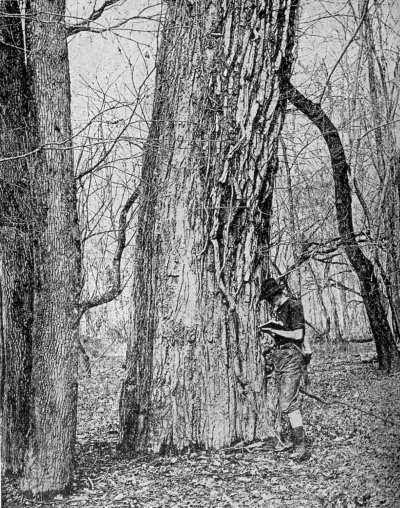
Fig. 14. A Large Cottonwood. One of the Associates of Red Gum.
94. Black Cottonwood (Populus trichocarpa var. heterophylla)
(Swamp Cottonwood, Downy Poplar). The
largest deciduous tree of Washington. Very common.
Heartwood dull brown, sapwood lighter brown. Wood
soft, close-grained. Is now manufactured into lumber
in the West and South, and used in interior finish
of buildings. Northern Rocky Mountains and
Pacific region.
95. Poplar (Populus grandidentata) (Large-Toothed Aspen).
Medium-sized tree. Heartwood light brown,
sapwood nearly white. Wood soft and close-grained,
neither strong nor durable. Chiefly used for wood
pulp. Maine to Minnesota and southward along
the Alleghanies.
96. White Poplar (Populus alba) (Abele-Tree). Small
to medium-sized tree. Wood in its quality and uses
similar to the preceding. Found principally along
banks of streams, never forming forests. Widely
distributed in the United States.
97. Lombardy Poplar (Populus nigra italica). Medium-
to large-sized tree. This species is the first ornamental
tree introduced into the United States, and
originated in Afghanistan. Does not enter into the
markets. Widely planted in the United States.
98. Balsam (Populus balsamifera) (Balm of Gilead, Tacmahac).
Medium- to large-sized tree. Heartwood light
brown, sapwood nearly white. Wood light, soft,
not strong, close-grained. Used extensively in the
manufacture of paper pulp. Common all along the
northern boundary of the United States.
99. Aspen (Populus tremuloides) (Quaking Aspen). Small
to medium-sized tree, often forming extensive forests,
and covering burned areas. Heartwood light brown,
sapwood nearly white. Wood light, soft, close-grained,
neither strong nor durable. Chiefly used
for woodenware, cooperage, and paper pulp. Maine
to Washington and northward, and south in the
western mountains to California and New Mexico.
100. Sassafras (Sassafras sassafras). Medium-sized tree,
largest in the lower Mississippi Valley. Wood light,
soft, not strong, brittle, of coarse texture, durable
in contact with the soil. The sapwood yellow, the
heartwood orange brown. Used to some extent in
slack cooperage, for skiff- and boatbuilding, fencing,
posts, sills, etc. Occurs from New England to Texas
and from Michigan to Florida.
101. Sourwood (Oxydendrum arboreum) (Sorrel-Tree). A
slender tree, reaching the maximum height of 60 feet.
Heartwood reddish brown, sapwood lighter color.
Wood heavy, hard, strong, close-grained, and takes
a fine polish. Ranges from Pennsylvania, along the
Alleghanies, to Florida and Alabama, westward through
Ohio to southern Indiana and southward through
Arkansas and Louisiana to the Coast.
102. Sycamore (Platanus occidentalis) (Buttonwood, Button-Ball
Tree, Plane Tree, Water Beech). A large-sized
tree, of rapid growth. One of the largest deciduous
trees of the United States, sometimes attaining a
height of 100 feet. It produces a timber that is moderately
heavy, quite hard, stiff, strong, and tough,
usually cross-grained; of coarse texture, difficult to
split and work, shrinks moderately, but warps and
checks considerably in seasoning, but stands well,
and is not considered durable for outside work, or in
contact with the soil. It has broad medullary rays,
and much of the timber has a beautiful figure. It
is used in slack cooperage, and quite extensively for
drawers, backs, and bottoms, etc., in furniture work.
It is also used for cabinet work, for tobacco boxes,
crates, desks, flooring, furniture, ox-yokes, butcher
blocks, and also for finishing lumber, where it has too
long been underrated. Common and largest in the
Ohio and Mississippi Valleys, at home in nearly all
parts of the eastern United States.
103. Sycamore (Platanus racemosa). The California
species, resembling in its wood the Eastern form.
Not used to any great extent.
104. Tulip Tree (Liriodendron tulipifera) (Yellow Poplar,
Tulip Wood, White Wood, Canary Wood, Poplar,
Blue Poplar, White Poplar, Hickory Poplar). A
medium- to large-sized tree, does not form forests,
but is quite common, especially in the Ohio basin.
Wood usually light, but varies in weight, it is soft,
tough, but not strong, of fine texture, and yellowish
color. The wood shrinks considerably, but seasons
without much injury, and works and stands extremely
well. Heartwood light yellow or greenish brown,
the sapwood is thin, nearly white, and decays rapidly.
The heartwood is fairly durable when exposed to the
weather or in contact with the soil. It bends readily
when steamed, and takes stain and paint well. The
mature forest-grown tree has a long, straight, cylindrical
bole, clear of branches for at least two thirds of
its length, surmounted by a short, open, irregular
crown. When growing in the open, the tree maintains
a straight stem, but the crown extends almost
to the ground, and is of conical shape. Yellow poplar,
or tulip wood, ordinarily grows to a height of from
100 to 125 feet, with a diameter of from 3 to 6 feet,
and a clear length of about 70 feet. Trees have been
found 190 feet high and ten feet in diameter. Used
in cooperage, for siding, for panelling and finishing
lumber in houses, car- and shipbuilding, for sideboards,
panels of wagons and carriages, for aeroplanes,
for automobiles, also in the manufacture of furniture
farm implements, machinery, for pump logs, and
almost every kind of common woodenware, boxes
shelving, drawers, etc., etc. Also in the manufacture
of toys, culinary woodenware, and backing for veneer.
It is in great demand throughout the vehicle and implement
trade, and also makes a fair grade of wood
pulp. In fact the tulip tree is one of the most useful
of woods throughout the woodworking industry
of this country. Occurs from New England to Missouri
and southward to Florida.
105. Waahoo (Evonymus atropurpureus). (Burning Bush,
Spindle Tree). A small-sized tree. Wood white,
tinged with orange; heavy, hard, tough, and close-grained,
works well and stands well. Used principally
for arrows and spindles. Widely distributed.
Usually a shrub six to ten feet high, becoming a tree
only in southern Arkansas and Oklahoma.
106. Black Walnut (Juglans nigra) (Walnut). A large,
beautiful, and quickly-growing tree, about 60 feet and
upwards in height. Wood heavy, hard, strong, of
coarse texture, very durable in contact with the soil.
The narrow sapwood whitish, the heartwood dark,
rich, chocolate brown, sometimes almost black; aged
trees of fine quality bring fancy prices. The wood
shrinks moderately in seasoning, works well and stands
well, and takes a fine polish. It is quite handsome,
and has been for a long time the favorite wood for
cabinet and furniture making. It is used for gun-stocks,
fixtures, interior decoration, veneer, panelling,
stair newells, and all classes of work demanding
a high priced grade of wood. Black walnut is
a large tree with stout trunk, of rapid growth, and
was formerly quite abundant throughout the Alleghany
region. Occurs from New England to Texas,
and from Michigan to Florida. Not common.
107. White Willow (Salix alba var. vitellina) (Willow,
Yellow Willow, Blue Willow). The wood is very
soft, light, flexible, and fairly strong, is fairly durable
in contact with the soil, works well and stands well
when seasoned. Medium-sized tree, characterized
by a short, thick trunk, and a large, rather irregular
crown composed of many branches. The size of
the tree at maturity varies with the locality. In
the region where it occurs naturally, a height of 70
to 80 feet, and a diameter of three to four feet are
often attained. When planted in the Middle West,
a height of from 50 to 60 feet, and a diameter of one
and one-half to two feet are all that may be expected.
When closely planted on moist soil, the tree forms a
tall, slender stem, well cleared branches. Is widely
naturalized in the United States. It is used in cooperage,
for woodenware, for cricket and baseball bats,
for basket work, etc. Charcoal made from the wood
is used in the manufacture of gunpowder. It has
been generally used for fence posts on the Northwestern
plains, because of scarcity of better material.
Well seasoned posts will last from four to seven
years. Widely distributed throughout the United
States.
108. Black Willow (Salix nigra). Small-sized tree.
Heartwood light reddish brown, sapwood nearly
white. Wood soft, light, not strong, close-grained,
and very flexible. Used in basket making, etc.
Ranges from New York to Rocky Mountains and
southward to Mexico.
109. Shining Willow (Salix lucida). A small-sized tree.
Wood in its quality and uses similiar to the preceding.
Ranges from Newfoundland to Rocky Mountains
and southward to Pennsylvania and Nebraska.
110. Perch Willow (Salix amygdaloides) (Almond-leaf
Willow). Small to medium-sized tree. Heartwood
light brown, sapwood lighter color. Wood light,
soft, flexible, not strong, close-grained. Uses similiar
to the preceding. Follows the water courses and
ranges across the continent; less abundant in New
England than elsewhere. Common in the West.
111. Long-Leaf Willow (Salix fluviatilis) (Sand Bar Willow).
A small-sized tree. Ranges from the Arctic
Circle to Northern Mexico.
112. Bebb Willow (Salix bebbiana var. rostrata). A small-sized
tree. More abundant in British America than
in the United States, where it ranges southward to
Pennsylvania and westward to Minnesota.
113. Glaucous Willow (Salix discolor) (Pussy Willow).
A small-sized tree. Common along the banks of
streams, and ranges from Nova Scotia to Manitoba,
and south to Delaware; west to Indiana and northwestern
Missouri.
114. Crack Willow (Salix fragilis). A medium to large-sized
tree. Wood is very soft, light, very flexible
and fairly strong, is fairly durable in contact with
the soil, works well and stands well. Used principally
for basket making, hoops, etc., and to produce
charcoal for gunpowder. Very common, and
widely distributed in the United States.
115. Weeping Willow (Salix babylonica). Medium- to
large-sized tree. Wood similiar to Salix nigra, but
not so valuable. Mostly an ornamental tree. Originally
came from China. Widely planted in the
United States.
116. Yellow Wood (Cladrastis lutea) (Virgilia). A small
to medium-sized tree. Wood yellow to pale brown,
heavy, hard, close-grained and strong. Not used
to much extent in manufacturing. Not common.
Found principally on the limestone cliffs of Kentucky,
Tennessee, and North Carolina.