Nature of Thinking.—In the study of general method, as well as in
that of the foregoing mental processes, it has been taken for granted
that our minds are capable of identifying different objects on the basis
of some common feature or features. This tendency of the mind to
identify objects and group individual things into classes, depends upon
its capacity to detect similarity and difference, or to make
comparisons. When the mind, in identifying objects, events, qualities,
etc., discovers certain relations between its various states, the
process is especially known as that of thinking. In its technical sense,
therefore, thought implies a more or less explicit apprehension of
relation.
Thinking Involved in all Conscious States.—It is evident, however,
that every mental process must involve thinking, or a grasping of
relations. When, by my merely touching an object, my mind perceives it
is an apple, this act of perception, as already seen, takes place
because elements of former experience come back as associated factors.
This implies, evidently, that the mind is here relating elements of its
past experience with the present touch sensation. Perception of external
objects, therefore, implies a grasping of relations. In the same way,
if, in having an experience to-day, one recognizes it as identical with
a former experience, he is equally grasping a relation. Every act of
memory, therefore, implies thinking. Thus in all forms of knowledge the
mind is apprehending relations; for no experience could have meaning
for the mind except as it is discriminated from other experiences. In
treating thinking as a distinct mental process, however, it is assumed
that the objects of sense perception, memory, etc., are known as such,
and that the mind here deals more directly with the relations in which
ideas stand one to another. As a mental process, thinking appears in
three somewhat distinct forms, known as conception, judgment, and
reasoning.
The Abstract Notion.—It was seen that at least in adult life, the
perception of any object, as this particular orange, horse, cow, etc.,
really includes a number of distinct images of quality synthesised into
the unity of a particular idea or experience. Because of this union of a
number of different sensible qualities in the notion of a single
individual, the mind may limit its attention upon a particular quality,
or characteristic, possessed by an object, and make this a distinct
problem of attention. Thus the mind is able to form such notions as
length, roundness, sweetness, heaviness, four-footedness, etc. When such
an attribute is thought of as something distinct from the object, the
mental image is especially known as an abstract idea, or notion, and the
process as one of abstraction.
The Class Notion.—One or more of such abstracted qualities may,
moreover, be recognized as common to an indefinite number of objects.
For instance, in addition to its ability to abstract from the perception
of a dog, the abstract notions four-footedness, hairy, barking, etc.,
the mind further gives them a general character by thinking of them as
qualities common to an indefinite number of other possible individuals,
namely, the class four-footed, hairy, barking objects. Because the idea
representing the quality or qualities is here accepted by the mind as a
means of identifying a number of objects, the idea is spoken of as a
class notion, and the process as one of classification, or
generalization. Thus it appears that, through its ability to detect
sameness and difference, or discover relations, the mind is able to form
two somewhat different notions. By mentally abstracting any quality and
regarding it as something distinct from the object, it obtains an
abstract notion, as sweetness, bravery, hardness, etc.; by synthesising
and symbolizing the images of certain qualities recognized in objects,
it obtains a general, or class, notion by which it may represent an
indefinite number of individual things as, triangle, horse, desert, etc.
Thus abstract notions are supposed to represent qualities; class
notions, things. Because of its reference to a number of objects, the
class notion is spoken of especially as a general notion, and the
process of forming the notion as one of generalization. These two types
of notions are technically known as concepts, and the process of their
formation as one of conception.
Formal Analysis of Process.—At this point may be recalled what was
stated in Chapter XV concerning the development of a class notion.
Mention was there made of the theory that in the formation of such
concepts, or class notions, as cow, dog, desk, chair, adjective, etc.,
the mind must proceed through certain set stages as follows:
1. Comparison: The examination of a certain number of particular
individuals in order to discover points of similarity and
difference.
2. Abstraction: The distinguishing of certain characteristics
common to the objects.
3. Generalization: The mental unification, or synthesis, of these
common characteristics noted in different individuals into a class
notion represented by a name, or general term.
But Conception is Involved in Perception.—From what has been seen,
however, it is evident that the development of our concepts does not
proceed in any such formal way. If the mind perceives an individual
object with any degree of clearness, it must recognize the object as
possessing certain qualities. If, therefore, the child can perceive such
an object as a dog, it implies that he recognizes it, say, as a hairy,
four-footed creature. To recognize these qualities, however, signifies
that the mind is able to think of them as something apart from the
object, and the child thus has in a sense a general notion even while
perceiving the particular dog. Whenever he passes to the perception of
another dog, he undoubtedly interprets this with the general ideas
already obtained from this earlier percept of a dog. To say, therefore,
that to gain a concept he compares the qualities found in several
individual things is not strictly true, for if his first percept becomes
a type by which he interprets other dogs, his first experience is
already a concept. What happens is that as this concept is used to
interpret other individuals, the person becomes more conscious of the
fact that his early experience is applicable to an indefinite number of
objects. So also, when an adult first perceives an individual thing, say
the fruit of the guava, he must apprehend certain qualities in relation
to the individual thing. Thereupon his idea of this particular object
becomes in itself a copy for identifying other objects, or a symbol by
which similar future impressions may be given meaning. In this sense the
individual idea, or percept, will serve to identify other particular
experiences. Such being the case, this early concept of the guava has
evidently required no abstraction of qualities beyond apprehending them
while perceiving the one example of the fruit. This, however, is but to
say that the perception of the guava really implied conception.
Comparison of Individuals Necessary for Correct Concepts.—It is, of
course, true that the correctness of the idea as a class symbol can be
verified only as we apply it in interpreting a number of such individual
things. As the person meets a further number of individuals, he may even
discover the presence of qualities not previously recognized. A child,
for instance, may have a notion of the class triangle long before he
discovers that all triangles have the property of containing two right
angles. When this happens, he will later modify his first concept by
synthesising into it the newly discovered quality. Moreover, if certain
features supposed to be common are later found to be accidental, if, for
instance, a child's concept of the class fish includes the quality
always living in water, his meeting with a flying fish will not result
in an utterly new concept, but rather in a modification of the present
one. Thus the young child, who on seeing the Chinese diplomat, wished to
know where he had his laundry, was not without a class concept, although
that concept was imperfect in at least one respect.
Concept and Term.—A point often discussed in connection with
conception is whether a general notion can be formed without language.
By some it is argued that no concept could exist in the mind without the
name, or general term. It was seen, however, that our first perception
of any object becomes a sort of standard by which other similar
experiences are intercepted, and is, therefore, general in character.
From this it is evident that a rudimentary type of conception exists
prior to language. In the case of the young child, as he gains a mental
image of his father, the experience evidently serves as a centre for
interpreting other similar individuals. We may notice that as soon as he
gains control of language, other men are called by the term papa. This
does not imply an actual confusion in identity, but his use of the term
shows that the child interprets the new object through a crude concept
denoted by the word papa. It is more than probable, moreover, that this
crude concept developed as he became able to recognize his father, and
had been used in interpreting other men before he obtained the term,
papa. On the other hand, it is certain that the term, or class name, is
necessary to give the notion a definite place in consciousness.
It will appear from the foregoing that a concept presents the following
factors for consideration:
1. The essential quality or qualities found in the individual things,
and supposed to be abstracted sooner or later from the individuals.
2. The concept itself, the mental image or idea representative of the
abstracted quality; or the unification of a number of abstracted
qualities, when the general notion implies a synthesis of different
qualities.
3. The general term, or name.
4. The objects themselves, which the mind can organize into a class,
because they are identified as possessing common characteristics. When,
however, a single abstracted quality is taken as a symbol of a class of
objects, for example, when the quality bitterness becomes the symbol for
the class of bitter things, there can be no real distinction between the
abstracted quality and the class concept. In other words, to fix
attention upon the quality bitterness as a quality distinct from the
object in which it is found, is at the same time to give it a general
character, recognizing it as something which may be found in a number of
objects—the class bitter things. Here the abstract term is in a sense
a general notion representative of a whole class of objects which agree
in the possession of the quality.
Intension of Concepts.—Certain of our general notions are, however,
much more complex than others. When a single attribute such as
four-footedness is generalized to represent the class four-footed
objects, the notion itself is relatively simple. In other words, a
single property is representative of the objects, and in apprehending
the members of the class all other properties they chance to possess may
be left out of account. In many cases, however, the class notion will
evidently be much more complex. The notion dog, for instance, in
addition to implying the characteristic four-footedness, may include
such qualities as hairy, barking, watchful, fearless, etc. This greater
or less degree of complexity of a general notion is spoken of as its
intensity. The notion dog, for instance, is more intensive than the
notion four-footed animals; the notion lawyer, than the notion man.
Extension of Concepts.—It is to be noted further that as a notion
increases in intension it becomes limited to a smaller class of objects.
From this standpoint, notions are said to differ in extension. The class
lawyer, for instance, is not so extensive as the class man; nor the
class dog, as the class four-footed objects. It will appear from the
above that an abstract notion viewed as a sign of a class of objects is
distinguished by its extension, while a class notion, so far as it
implies a synthesis of several abstracted qualities, is marked rather by
its intension.
So far as school lessons aim to establish and develop correct class
notions in the minds of the pupils, three somewhat distinct types of
work may be noted:
1. TO DEFINE CLASSES
In some lessons no attempt is made to develop an utterly new class
notion, or concept; the pupils in fact may already know the class of
objects in a general way and be acquainted with many of their
characteristics. The object of the lesson is, therefore, to render the
concept more scientific by having it include the qualities which
essentially mark it as a class and especially separate it from other
co-ordinate classes. In studying the grasshopper; for instance, in
entomology, the purpose is not to give the child a notion of the insect
in the ordinary sense of the term. This the pupil may already have. The
purpose is rather to enable him to decide just what general
characteristics distinguish this from other insects. The lesson may,
therefore, leave out of consideration features which are common to all
grasshoppers, simply because they do not enter into a scientific
differentiation of the class.
2. TO ENLARGE A CONCEPT
In many lessons the aim seems to be chiefly to enlarge certain concepts
by adding to their intensiveness. The pupil, for instance, has a
scientific concept of a triangle, that is, one which enables him to
distinguish a triangle from any other geometrical figure. He may,
however, be led to see further that the three angles of every triangle
equal two right angles. This is really having him discover a further
attribute in relation to triangles, although this knowledge is not
essential to the concept as a symbol of the members of the class. In the
same way, in grammar the pupil is taught certain attributes common to
verbs, as mood and tense, although these are not essential attributes
from the standpoint of distinguishing the verb as a special class of
words.
3. TO BUILD UP NEW CONCEPTS
A. Presentation of Unknown Individuals.—In many lessons the chief
object seems to be, however, to build up a new concept in the mind of
the child. This would be the case when the pupil is presented with a
totally unknown object, say a platypus, and called upon to examine its
characteristics. In such lessons two important facts should be noticed.
First, the child finds seemingly little difficulty in accepting a single
individual as a type of a class, and is able to carry away from the
lesson a fairly scientific class notion through a study of the one
individual. In this regard the pupil but illustrates what has been said
of the ability of the child to use his early percepts as standards to
interpret other individuals. The pupil is able the more easily to form
this accurate notion, because he no doubt has already a store of
abstract notions with which to interpret the presentation, and also
because his interest and attention is directed into the proper channels
by the teacher.
B. Division of Known Classes.—A second common mode of developing new
concepts in school work is in breaking up larger classes into
co-ordinate sub-classes. This, of course, involves the developing of new
concepts to cover these sub-classes. In such cases, however, the new
notions are merely modified forms of the higher class notion. When, for
example, the pupil gains general notions representative of the classes,
proper noun and common noun, the new terms merely add something to the
intension of the more extensive term noun. This will be evident by
considering the difference between the notions noun and proper noun.
Both agree in possessing the attribute used to name. The latter is
more intensive, however, because it signifies used to name a particular
object. Although in such cases the lesson seems in a sense to develop
new general notions, they represent merely an adding to the intension
of a notion already possessed by the child.
Use of the Term.—A further problem regarding the process of
conception concerns the question of the significance of a name. When a
person uses such a term as dog, whale, hepatica, guava, etc., to name a
certain object, what is the exact sense, or meaning, in which the name
is to be applied? A class name, when applied scientifically to an
object, is evidently supposed to denote the presence in it of certain
essential characteristics which belong to the class. It is clear,
however, that the ordinary man rarely uses these names with any
scientific precision. A man can point to an object and say that it is a
horse, and yet be ignorant of many of the essential features of a horse.
In such cases, therefore, the use of the name merely shows that the
person considers the object to belong to a certain class, but is no
guarantee that he is thinking of the essential qualities of the class.
It might be said, therefore, that a class term is used for two somewhat
different purposes, either to denote the object merely, or to signify
scientifically the attributes possessed by the object. It is in the
second respect that danger of error in reasoning arises. So far as a
name represents the attributes of a class, it will signify for us just
those attributes which we associate with that class. So long, therefore,
as the word fish means to us an animal living in the water, we will
include in the class the whale, which really does not belong to the
class, and perhaps exclude from the class the flying fish, although it
is scientifically a member of the class.
It has been noted that, when man discovers common characteristics in a
number of objects, he tends on this basis to unite such objects into a
class. It is to be noted in addition, however, that in the same manner
he is also able, by examining the characteristics of a large class of
objects, to divide these into smaller sub-classes. Although, for
example, we may place all three-sided figures into one class and call
them triangles, we are further able to divide these into three
sub-classes owing to certain differences that may be noted among them.
Thus an important fact regarding classification is that while a class
may possess some common quality or qualities, yet its members may be
further divided into sub-classes and each of these smaller classes
distinguished from the others by points of difference. Owing to this
fact, there are two important elements entering into a scientific
knowledge of any class, first, to know of what larger class it forms a
part, and secondly, to know what characteristics distinguish it from the
other classes which go with it to make up this larger class. To know the
class equilateral triangle, for instance, we must know, first, that it
belongs to the larger class triangle, and secondly, that it differs from
other classes of triangles by having its three sides equal. For this
reason a person is able to know a class scientifically without knowing
all of its common characteristics. For instance, the large class of
objects known as words is subdivided into smaller classes known as parts
of speech. Taking one of these classes, the verb, we find that all verbs
agree in possessing at least three common characteristics, they have
power to assert, to denote manner, and to express time. To distinguish
the verb, however, it is necessary to note only that it is a word used
to assert, since this is the only characteristic which distinguishes it
from the other classes of words. When, therefore, we describe any class
of objects by first naming the larger class to which it belongs, and
then stating the characteristics which distinguish it from the other
co-ordinate classes, we are said to give a definition of the class, or
to define it. The statement, "A trimeter is a verse of three measures,"
is a definition because it gives, first, the larger class (verse) to
which the trimeters belong, and secondly, the difference (of three
measures) which distinguishes the trimeter from all other verses. The
statement, "A binomial is an algebraic expression consisting of two
terms," is a definition, because it gives, first, the larger class
(algebraic expression) to which binomials belong, and secondly, the
difference (consisting of two terms) which distinguishes binomials from
other algebraic expressions.
Nature of Judgment.—A second form, or mode, of thinking is known as
judgment. Our different concepts were seen to vary in their intension,
or meaning, according to the number of attributes suggested by each. My
notion triangle may denote the attributes three-sided and
three-angled; my notion isosceles triangle will in that case include
at least these two qualities plus equality of two of the sides. This
indicates that various relations exist between our ideas and may be
apprehended by the mind. When a relation between two concepts is
distinctly apprehended in thought, or, in other words, when there is a
mental assertion of a union between two ideas, or objects of thought,
the process is known as judgment. Judgment may be defined, therefore,
as the apprehension, or mental affirmation, of a relation between two
ideas. If the idea, or concept, heaviness enters as a mental element
into my idea stone, then the mind is able to affirm a relation between
these concepts in the form, "Stone is heavy." In like manner when the
mind asserts, "Glass is transparent" or "Horses are animals," there is
a distinct apprehension of a relation between the concepts involved.
Judgment Distinguished from Statement.—It should be noted that
judgment is the mental apprehension of a relation between ideas. When
this relation is expressed in actual words, it is spoken of as a
proposition, or a predication. A proposition is, therefore, the
statement of a judgment. The proposition is composed of two terms and
the copula, one term constituting the subject of the proposition and the
other the predicate. Although a judgment may often be expressed in some
other form, it can usually be converted into the above form. The
proposition, "Horses eat oats," may be expressed in the form, "Horses
are oat-eaters"; the proposition, "The sun melts the snow," into the
form, "The sun is a-thing-which-melts-snow."
Relation of Judgment to Conception.—It would appear from the above
examples that a judgment expresses in an explicit form the relations
involved within the concept, and is, therefore, merely a direct way of
indicating the state of development of any idea. If my concept of a dog,
for example, is a synthesis of the qualities four-footed, hairy, fierce,
and barking, then an analysis of the concept will furnish the following
judgments:
| { A four-footed thing. |
| { A hairy thing. |
| A dog is | { A fierce thing. |
| { A barking thing. |
Because in these cases a concept seems necessary for an act of judgment,
it is said that judgment is a more advanced form of thinking than
conception. On the other hand, however, judgment is implied in the
formation of a concept. When the child apprehends the dog as a
four-footed object, his mind has grasped four-footedness as a quality
pertaining to the strange object, and has, in a sense, brought the two
ideas into relation. But while judgment is implied in the formation of
the concept, the concept does not bring explicitly to the mind the
judgments it implies. The concept snow, for instance, implies the
property of whiteness, but whiteness must be apprehended as a distinct
idea and related mentally with the idea snow before we can be said to
have formed, or thought, the judgment, "Snow is white." Judgment is a
form of thinking separate from conception, therefore, because it does
thus bring into definite relief relations only implied in our general
notions, or concepts. One value of judgment is, in fact, that it enables
us to analyse our concepts, and thus note more explicitly the relations
included in them.
Universal and Particular Judgments.—Judgments are found to differ
also as to the universality of their affirmation. In such a judgment as
"Man is mortal," since mortality is viewed as a quality always joined to
manhood, the affirmation is accepted as a universal judgment. In such a
judgment as "Men strive to subdue the air," the two objects of thought
are not considered as always and necessarily joined together. The
judgment is therefore particular in character. All of our laws of
nature, as "Air has weight," "Pressure on liquids is transmitted in
every direction," or "Heat is conducted by metals," are accepted as
universal judgments.
Errors in Judgment due to: A. Faulty Concepts.—It may be seen from
the foregoing that our judgments, when explicitly grasped by the mind
and predicated in language, reflect the accuracy or inaccuracy of our
concepts. Whatever relations are, as it were, wrapped up in a concept
may merge at any time in the form of explicit judgments. If the fact
that the only Chinamen seen by a child are engaged in laundry work
causes this attribute to enter into his concept Chinaman, this will lead
him to affirm that the restaurant keeper, Wan Lee, is a laundry-man. The
republican who finds two or three cases of corruption among democrats,
may conceive corruption as a quality common to democrats and affirm that
honest John Smith is corrupt. Faulty concepts, therefore, are very
likely to lead to faulty judgments. A first duty in education is
evidently to see that children are forming correct class concepts. For
this it must be seen that they always distinguish the essential features
of the class of objects they are studying. They must learn, also, not to
conclude on account of superficial likeness that really unlike objects
belong to the same class. The child, for instance, in parsing the
sentence, "The swing broke down," must be taught to look for essential
characteristics, and not call the word swing a gerund because it ends
in "ing"; which, though a common characteristic of gerunds, does not
differentiate it from other classes of words. So, also, when the young
nature student notes that the head of the spider is somewhat separated
from the abdomen, he must not falsely conclude that the spider belongs
to the class insects. In like manner, the pupil must not imagine, on
account of superficial differences, that objects really the same belong
to different classes, as for example, that a certain object is not a
fish, but a bird, because it is flying through the air; or that a whale
is a fish and not an animal, because it lives in water. The pupil must
also learn to distinguish carefully between the particular and universal
judgment. To affirm that "Men strive to subdue the air," does not imply
that "John Smith strives to subdue the air." The importance of this
distinction will be considered more fully in our next section.
B. Feeling.—Faulty concepts are not, however, the only causes for
wrong judgments. It has been noted already that feeling enters largely
as a factor in our conscious life. Man, therefore, in forming his
judgments, is always in danger of being swayed by his feelings. Our
likes and dislikes, in other words, interfere with our thinking, and
prevent us from analysing our knowledge as we should. Instead,
therefore, of striving to develop true concepts concerning men and
events and basing our judgments upon these, we are inclined in many
cases to allow our judgments to be swayed by mere feeling.
C. Laziness.—Indifference is likewise a common source of faulty
judgments. To attend to the concept and discover its intension as a
means for correct judgment evidently demands mental effort. Many people,
however, prefer either to jump at conclusions or let others do their
judging for them.
Sound Judgments Based on Scientific Concepts.—To be able to form
correct judgments regarding the members of any class, however, the child
should know, not only its common characteristics, but also the essential
features which distinguish its members from those of co-ordinate
classes. To know adequately the equilateral triangle, for instance, the
pupil must know both the features which distinguish it from other
triangles and also those in which it agrees with all triangles. To know
fully the mentha family of plants, he must know both the characteristic
qualities of the family and also those of the larger genus labiatae.
From this it will be seen that a large share of school work must be
devoted to building up scientific class notions in the minds of the
pupils. Without this, many of their judgments must necessarily be
faulty. To form such scientific concepts, however, it is necessary to
relate one concept with another in more indirect ways than is done
through the formation of judgments. This brings us to a consideration of
reasoning, the third and last form of thinking.
Nature of Reasoning.—Reasoning is defined as a mental process in
which the mind arrives at a new judgment by comparing other judgments.
The mind, for instance, is in possession of the two judgments, "Stones
are heavy" and "Flint is a stone." By bringing these two judgments under
the eye of attention and comparing them, the mind is able to arrive at
the new judgment, "Flint is heavy." Here the new judgment, expressing a
relation between the notions, flint and heavy, is supposed to be
arrived at, neither by direct experience, nor by an immediate analysis
of the concept flint, but more indirectly by comparing the other
judgments. The judgment, or conclusion, is said, therefore, to be
arrived at mediately, or by a process of reasoning. Reasoning is of two
forms, deductive, or syllogistic, reasoning, and inductive reasoning.
Nature of Deduction.—In deduction the mind is said to start with a
general truth, or judgment, and by a process of reasoning to arrive at a
more particular truth, or judgment, thus:
Stone is heavy;
Flint is a stone;
∴ Flint is heavy.
Expressed in this form, the reasoning process, as already mentioned, is
known as a syllogism. The whole syllogism is made up of three parts,
major premise, minor premise, and conclusion. The three concepts
involved in the syllogism are known as the major, the minor, and the
middle term. In the above syllogism, heavy, the predicate of the major
premise, is the major term; flint, the subject of the minor premise,
is the minor term; and stone, to which the other two are related in
the premises, is known as the middle term. Because of this previous
comparison of the major and the minor terms with the middle term,
deduction is sometimes said to be a process by which the mind discovers
a relation between two concepts by comparing them each with a third
concept.
Purpose of Deduction.—It is to be noted, however, as pointed out in
Chapter XV, that deductive reasoning takes place normally only when the
mind is faced with a difficulty which demands solution. Take the case of
the boy and his lost coin referred to in Chapter II. As he faces the
problem, different methods of solution may present themselves. It may
enter his mind, for instance, to tear up the grate, but this is rejected
on account of possible damage to the brickwork. Finally he thinks of the
tar and resorts to this method of recovery. In both of the above cases
the boy based his conclusions upon known principles. As he considered
the question of tearing up the grate, the thought came to his mind,
"Lifting-a-grate is a-thing-which-may-cause-damage." As he considered
the use of the tar, he had in mind the judgment, "Adhesion is a property
of tar," and at once inferred that tar would solve his problem. In such
practical cases, however, the mind seems to go directly from the problem
in hand to a conclusion by means of a general principle. When a woman
wishes to remove a stain, she at once says, "Gasoline will remove it."
Here the mind, in arriving at its conclusion, seems to apply the
principle, "Gasoline removes spots," directly to the particular
problem. Thus the reasoning might seem to run as follows:
Problem: What will remove this stain?
Principle: Gasoline will remove stains.
Conclusion: Gasoline will remove this stain.
Here the middle term of the syllogism seems to disappear. It is to be
noted, however, that our thought changes from the universal idea
"stains," mentioned in the statement of the principle, to the particular
idea "this stain" mentioned in the problem and in the conclusion. But
this implies a middle term, which could be expressed thus:
Gasoline will remove stains;
This is a stain;
∴ Gasoline will remove this.
The syllogism is valuable, therefore, because it displays fully and
clearly each element in the reasoning process, and thus assures the
validity of the conclusion.
Deduction in School Recitation.—It will be recalled from what was
noted in our study of general method, that deduction usually plays an
important part during an ordinary developing lesson. In the step of
preparation, when the pupil is given a particular example in order to
recall old knowledge, the example suggests a problem which is intended
to call up certain principles which are designed to be used during the
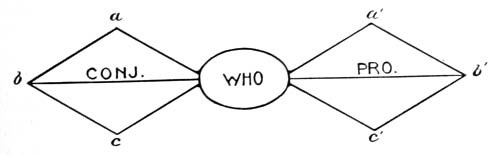
presentation. In a lesson on the "Conjunctive Pronoun," for instance, if
we have the pupil recall his knowledge of the conjunction by examining
the particular word "if" in such a sentence as, "I shall go if they
come," he interprets the word as a conjunction simply because he
possesses a general rule applicable to it, or is able to go through a
process of deduction. In the presentation also, when the pupil is called
on to examine the word who in such a sentence as, "The man who met us
is very old," and decides that it is both a conjunction and a pronoun,
he is again making deductions, since it is by his general knowledge of
conjunctions and pronouns that he is able to interpret the two functions
of the particular word who. Finally, as already noted, the application
of an ordinary recitation frequently involves deductive processes.
Nature of Induction.—Induction is described as a process of reasoning
in which the mind arrives at a conclusion by an examination of
particular cases, or judgments. A further distinguishing feature of the
inductive process is that, while the known judgments are particular in
character, the conclusion is accepted as a general law, or truth. As in
deduction, the reasoning process arises on account of some difficulty,
or problem, presented to the mind, as for example:
What is the effect of heat upon air?
Will glass conduct electricity?
Why do certain bodies refract light?
To satisfy itself upon the problem, the mind appeals to actual
experience either by ordinary observation or through experimentation.
These observations or experiments, which necessarily deal with
particular instances, are supposed to provide a number of particular
judgments, by examining which a satisfactory conclusion is ultimately
reached.
Example of Induction.—As an example of induction, may be taken the
solution of such a problem as, "Does air exert pressure?" To meet this
hypothesis we must evidently do more than merely abstract the manifest
properties of an object, as is done in ordinary conception, or appeal
directly to some known general principle, as is done in deduction. The
work of induction demands rather to examine the two at present known but
disconnected things, air and pressure, and by scientific observation
seek to discover a relation between them. For this purpose the
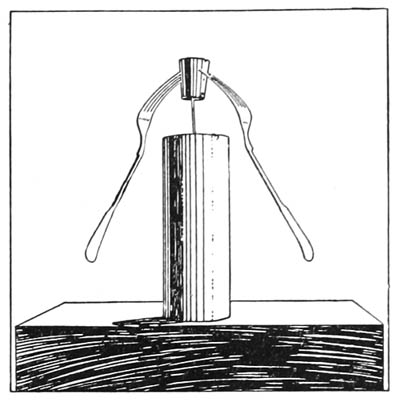
investigator may place a card over a glass filled with water, and on
inverting it find that the card is held to the glass. Taking a glass
tube and putting one end in water, he may place his finger over the
other end and, on raising the tube, find that water remains in the tube.
Soaking a heavy piece of leather in water and pressing it upon the
smooth surface of a stone or other object, he finds the stone can be
lifted by means of the leather. Reflecting upon each of these
circumstances the mind comes to the following conclusions:
Air pressure holds this card to the glass,
Air pressure keeps the water in the tube,
Air pressure holds together the leather and the stone,
∴ Air exerts pressure.
How Distinguished from, A. Deduction, and B. Conception.—Such a
process as the above constitutes a process of reasoning, first, because
the conclusion gives a new affirmation, or judgment, "Air exerts
pressure," and secondly, because the judgment is supposed to be arrived
at by comparing other judgments. As a process of reasoning, however, it
differs from deduction in that the final judgment is a general judgment,
or truth, which seems to be based upon a number of particular judgments
obtained from actual experience, while in deduction the conclusion was
particular and the major premise general. It is for this reason that
induction is defined as a process of going from the particular to the
general. Moreover, since induction leads to the formation of a universal
judgment, or general truth, it differs from the generalizing process
known as conception, which leads to the formation of a concept, or
general idea. It is evident, however, that the process will enrich the
concept involved in the new judgment. When the mind is able to affirm
that air exerts pressure, the property, exerting-pressure, is at once
synthesised into the notion air. This point will again be referred to in
comparing induction and conception as generalizing processes.
In speaking of induction as a process of going from the particular to
the general, this does not signify that the process deals with
individual notions. The particulars in an inductive process are
particular cases giving rise to particular judgments, and judgments
involve concepts, or general ideas. When, in the inductive process, it
is asserted that air holds the card to the glass, the mind is seeking to
establish a relation between the notions air and pressure, and is,
therefore, thinking in concepts. For this reason, it is usually said
that induction takes for granted ordinary relations as involved in our
everyday concepts, and concerns itself only with the more hidden
relations of things. The significance of induction as a process of going
from the particular to the general, therefore, consists in the fact that
the conclusion is held to be a wider judgment than is contained in any
of the premises.
Particular Truth Implies the General.—Describing the premises of an
inductive process as particular truths, and the conclusion as a
universal truth, however, involves the same fiction as was noted in
separating the percept and the concept into two distinct types of
notions. In the first place, my particular judgment, that air presses
the card against the glass, is itself a deduction resting upon other
general principles. Secondly, if the judgment that air presses the card
against the glass contains no element of universal truth, then a
thousand such judgments could give no universal truth. Moreover, if the
mind approaches a process of induction with a problem, or hypothesis,
before it, the general truth is already apprehended hypothetically in
thought even before the particular instances are examined. When we set
out, for instance, to investigate whether the line joining the bisecting
points of the sides of a triangle is parallel with the base, we have
accepted hypothetically the general principle that such lines are
parallel with the base. The fact is, therefore, that when the mind
examines the particular case and finds it to agree with the hypothesis,
so far as it accepts this case as a truth, it also accepts it as a
universal truth. Although, therefore, induction may involve going from
one particular experiment or observation to another, it is in a sense a
process of going from the general to the general.
That accepting the truth of a particular judgment may imply a universal
judgment is very evident in the case of geometrical demonstrations. When
it is shown, for instance, that in the case of the particular isosceles
triangle ABC, the angles at the base are equal, the mind does not
require to examine other particular triangles for verification, but at
once asserts that in every isosceles triangle the angles at the base are
equal.
Induction and Conception Interrelated.—Although as a process,
induction is to be distinguished from conception, it either leads to an
enriching of some concept, or may in fact be the only means by which
certain scientific concepts are formed. While the images obtained by
ordinary sense perception will enable a child to gain a notion of water,
to add to the notion the property, boiling-at-a-certain-temperature, or
able-to-be-converted-into-two-parts-hydrogen-and-one-part-oxygen, will
demand a process of induction. The development of such scientific
notions as oxide, equation, predicate adjective, etc., is also dependent
upon a regular inductive process. For this reason many lessons may be
viewed both as conceptual and as inductive lessons. To teach the adverb
implies a conceptual process, because the child must synthesise certain
attributes into his notion adverb. It is also an inductive lesson,
because these attributes being formulated as definite judgments are,
therefore, obtained inductively. The double character of such a lesson
is fully indicated by the two results obtained. The lesson ends with the
acquisition of a new term, adverb, which represents the result of the
conceptual process. It also ends with the definition: "An adverb is a
word which modifies a verb, adjective, or other adverb," which indicates
the general truth or truths resulting from the inductive process.
Deduction and Induction Interrelated.—In our actual teaching
processes there is a very close inter-relation between the two processes
of reasoning. We have already noted on page 322 that, in such inductive
lessons as teaching the definition of a noun or the rule for the
addition of fractions, both the preparatory step and the application
involve deduction. It is to be noted further, however, that even in the
development of an inductive lesson there is a continual interplay
between induction and deduction. This will be readily seen in the case
of a pupil seeking to discover the rule for determining the number of
repeaters in the addition of recurring decimals. When he notes that
adding three numbers with one, one, and two repeaters respectively,
gives him two repeaters in his answer, he is more than likely to infer
that the rule is to have in the answer the highest number found among
the addenda. So far as he makes this inference, he undoubtedly will
apply it in interpreting the next problem, and if the next numbers have
one, one, and three repeaters respectively, he will likely be quite
convinced that his former inference is correct. When, however, he meets
a question with one, two, and three repeaters respectively, he finds his
former inference is incorrect, and may, thereupon, draw a new inference,
which he will now proceed to apply to further examples. The general fact
to be noted here, however, is that, so far as the mind during the
examination of the particular examples reaches any conclusion in an
inductive lesson, it evidently applies this conclusion to some degree in
the study of the further examples, or thinks deductively, even during
the inductive process.
Development of Reasoning Power.—Since reasoning is essentially a
purposive form of thinking, it is evident that any reasoning process
will depend largely upon the presence of some problem which shall
stimulate the mind to seek out relations necessary to its solution.
Power to reason, therefore, is conditioned by the ability to attend
voluntarily to the problem and discover the necessary relations. It is
further evident that the accuracy of any reasoning process must be
dependent upon the accuracy of the judgments upon which the conclusions
are based. But these judgments in turn depend for their accuracy upon
the accuracy of the concepts involved. Correct reasoning, therefore,
must depend largely upon the accuracy of our concepts, or, in other
words, upon the old knowledge at our command. On the other hand,
however, it has been seen that both deductive and inductive reasoning
follow to some degree a systematic form. For this reason it may be
assumed that the practice of these forms should have some effect in
giving control of the processes. The child, for instance, who habituates
himself to such thought processes as AB equals BC, and AC equals BC,
therefore AB equals AC, no doubt becomes able thereby to grasp such
relations more easily. Granting so much, however, it is still evident
that close attention to, and accurate knowledge of, the various terms
involved in the reasoning process is the sure foundation of correct
reasoning.